Volume 82, Issue 5, 2004

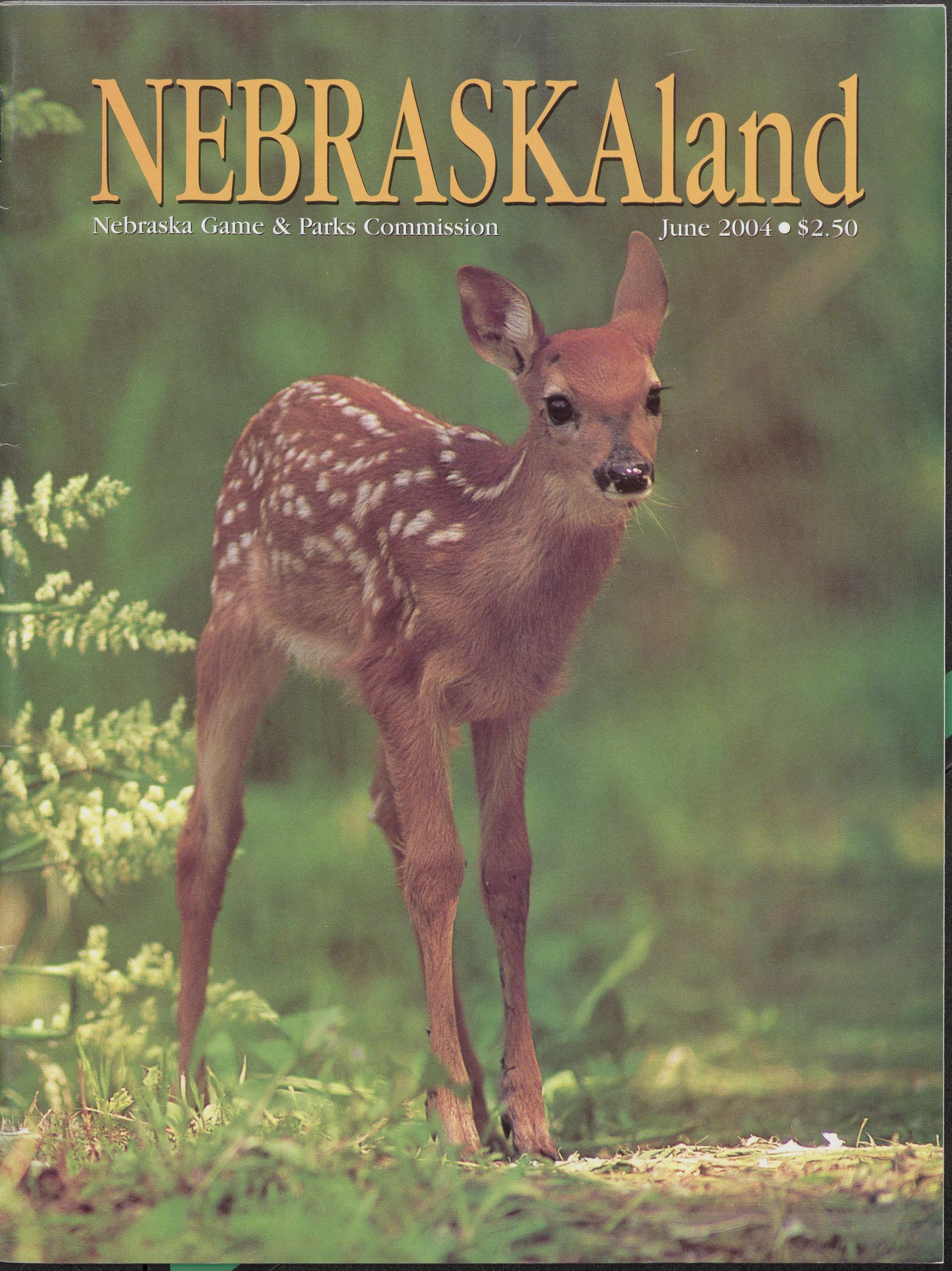
NEBRASKAland
Nebraska Game & Parks Commission June 2004 $2.50
NEBRASKAland
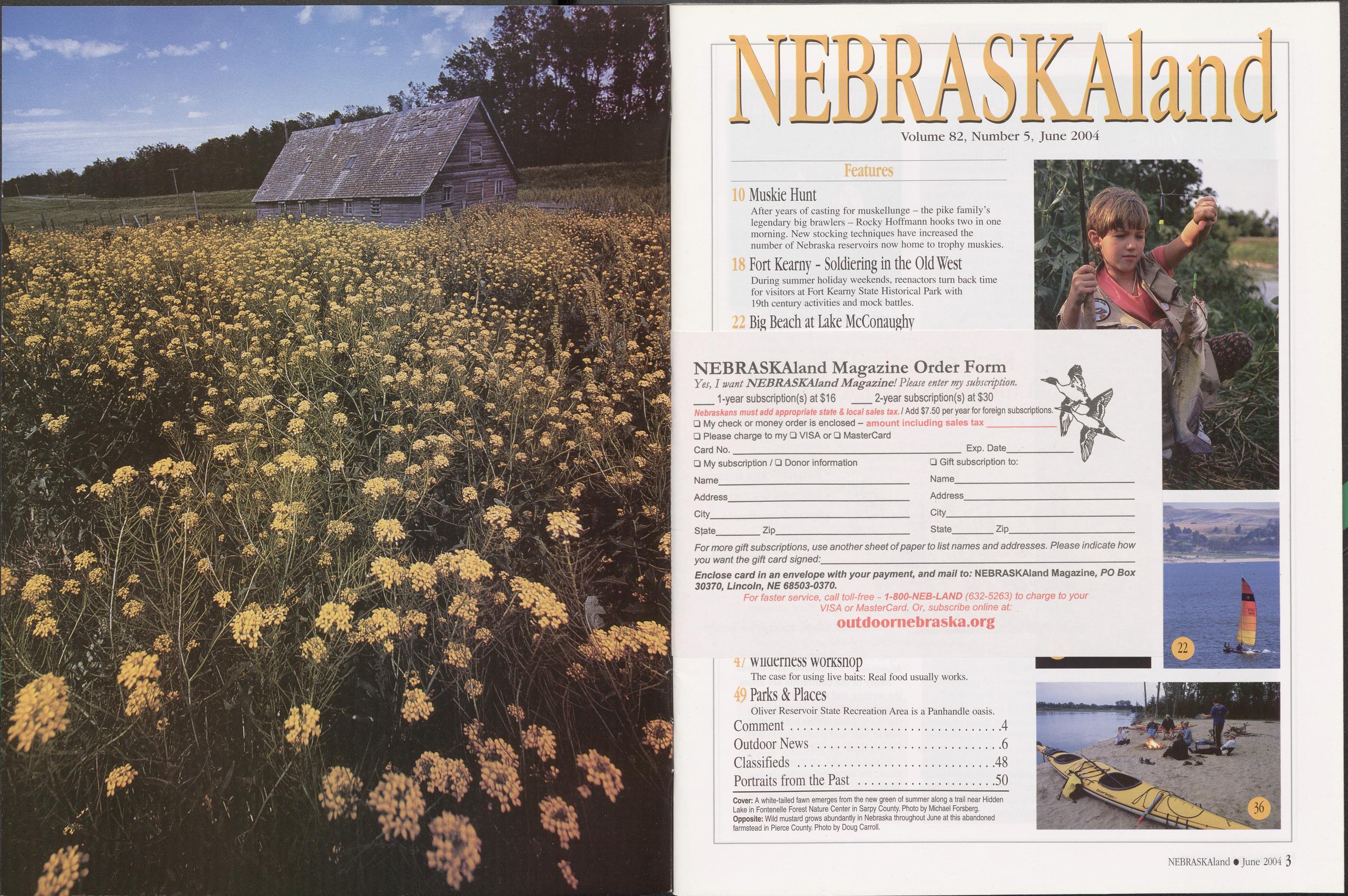
Volume 82, Number 5, June 2004 Features 10 Muskie Hunt After years of casting for muskellunge - the pike family’s legendary big brawlers - Rocky Hoffmann hooks two in one morning. New stocking techniques have increased the number of Nebraska reservoirs now home to trophy muskies. 18 Fort Kearny - Soldiering in the Old West During summer holiday weekends, reenactors turn back time for visitors at Fort Kearny State Historical Park with 19th century activities and mock battles. 22 Big Beach at Lake McConaughy Departments The case for using live baits: Real food usually works. Parks & Places Oliver Reservoir State Recreation Area is a Panhandle oasis. Comment........................................4 Outdoor News ...................................6 Classifieds.....................................48 Portraits from the Past ..........................50 Cover: A white-tailed fawn emerges from the new green of summer along a trail near Hidden Lake in Fontenelle Forest Nature Center in Sarpy County. Photo by Michael Forsberg. Opposite: Wild mustard grows abundantly in Nebraska throughout June at this abandoned farmstead in Pierce County. Photo by Doug Carroll.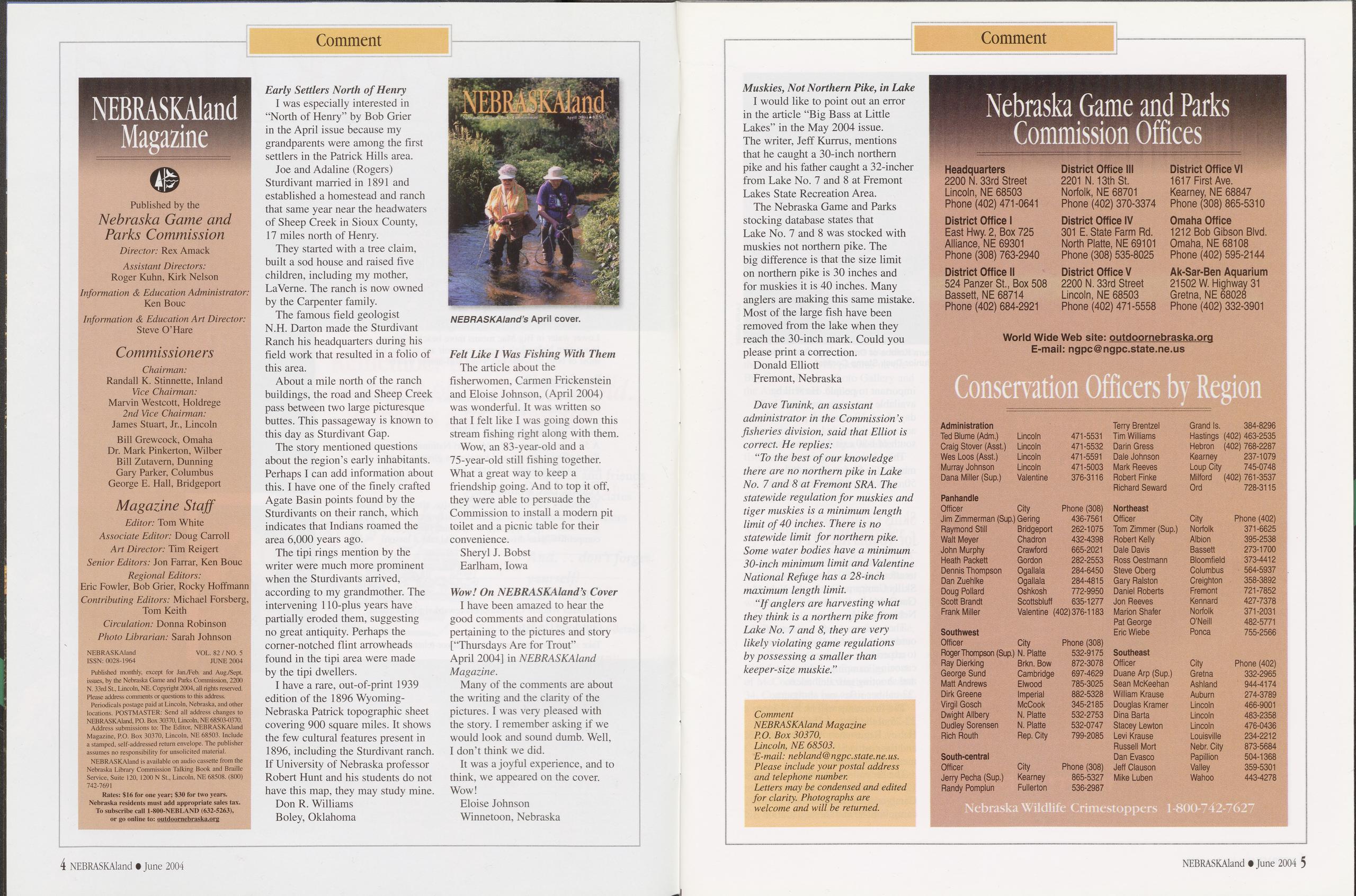
Comment
Early Settlers North of HenryI was especially interested in “North of Henry” by Bob Grier in the April issue because my grandparents were among the first settlers in the Patrick Hills area.
Joe and Adaline (Rogers) Sturdivant married in 1891 and established a homestead and ranch that same year near the headwaters of Sheep Creek in Sioux County, 17 miles north of Henry.
They started with a tree claim, built a sod house and raised five children, including my mother, LaVerne. The ranch is now owned by the Carpenter family.
The famous field geologist N.H. Darton made the Sturdivant Ranch his headquarters during his field work that resulted in a folio of this area.
About a mile north of the ranch buildings, the road and Sheep Creek pass between two large picturesque buttes. This passageway is known to this day as Sturdivant Gap.
The story mentioned questions about the region’s early inhabitants. Perhaps I can add information about this. I have one of the finely crafted Agate Basin points found by the Sturdivants on their ranch, which indicates that Indians roamed the area 6,000 years ago.
The tipi rings mention by the writer were much more prominent when the Sturdivants arrived, according to my grandmother. The intervening 110-plus years have partially eroded them, suggesting no great antiquity. Perhaps the corner-notched flint arrowheads found in the tipi area were made by the tipi dwellers.
I have a rare, out-of-print 1939 edition of the 1896 Wyoming- Nebraska Patrick topographic sheet covering 900 square miles. It shows the few cultural features present in 1896, including the Sturdivant ranch. If University of Nebraska professor Robert Hunt and his students do not have this map, they may study mine.
Don R. Williams Boley, OklahomaThe article about the fisherwomen, Carmen Frickenstein and Eloise Johnson, (April 2004) was wonderful. It was written so that I felt like I was going down this stream fishing right along with them.
Wow, an 8 3-year-old and a 75-year-old still fishing together. What a great way to keep a friendship going. And to top it off, they were able to persuade the Commission to install a modern pit toilet and a picnic table for their convenience.
Sheryl J. Bobst Earlham, Iowa Wow! On NEBRASKAland’s CoverI have been amazed to hear the good comments and congratulations pertaining to the pictures and story [“Thursdays Are for Trout” April 2004] in NEBRASKAland Magazine.
Many of the comments are about the writing and the clarity of the pictures. I was very pleased with the story. I remember asking if we would look and sound dumb. Well, I don’t think we did.
It was a joyful experience, and to think, we appeared on the cover. Wow!
Eloise Johnson Winnetoon, Nebraska 4 NEBRASKAland • June 2004 Muskies, Not Northern Pike, in LakeI would like to point out an error in the article “Big Bass at Little Lakes” in the May 2004 issue. The writer, Jeff Kurrus, mentions that he caught a 30-inch northern pike and his father caught a 32-incher from Lake No. 7 and 8 at Fremont Lakes State Recreation Area.
The Nebraska Game and Parks stocking database states that Lake No. 7 and 8 was stocked with muskies not northern pike. The big difference is that the size limit on northern pike is 30 inches and for muskies it is 40 inches. Many anglers are making this same mistake. Most of the large fish have been removed from the lake when they reach the 30-inch mark. Could you please print a correction.
Donald Elliott Fremont, NebraskaDave Tunink, an assistant administrator in the Commission’s fisheries division, said that Elliot is correct. He replies:
“To the best of our knowledge there are no northern pike in Lake No. 7 and 8 at Fremont SRA. The statewide regulation for muskies and tiger muskies is a minimum length limit of 40 inches. There is no statewide limit for northern pike. Some water bodies have a minimum 30-inch minimum limit and Valentine National Refuge has a 28-inch maximum length limit.
“If anglers are harvesting what they think is a northern pike from Lake No. 7 and 8, they are very likely violating game regulations by possessing a smaller than keeper-size muskie.”
Comment NEBRASKAland Magazine P.O. Box 30370, Lincoln, NE 68503. E-mail: nebland@ ngpc. state, ne. us. Please include your postal address and telephone number. Letters may be condensed and edited for clarity. Photographs are welcome and will be returned. Comment Nebraska Game and Parks Commission Offices Headquarters 2200 N. 33rd Street Lincoln, NE 68503 Phone (402) 471-0641 District Office I East Hwy. 2, Box 725 Alliance, NE 69301 Phone (308) 763-2940 District Office II 524 Panzer St., Box 508 Bassett, NE 68714 Phone (402) 684-2921 District Office ill 2201 N. 13th St. Norfolk, NE 68701 Phone (402) 370-3374 District Office IV 301 E. State Farm Rd. North Platte, NE 69101 Phone (308) 535-8025 District Office V 2200 N. 33rd Street Lincoln, NE 68503 Phone (402) 471-5558 District Office VI 1617 First Ave. Kearney, NE 68847 Phone (308) 865-5310 Omaha Office 1212 Bob Gibson Blvd. Omaha, NE 68108 Phone (402) 595-2144 Ak-Sar-Ben Aquarium 21502 W. Highway 31 Gretna, NE 68028 Phone (402) 332-3901 World Wide Web site: outdoornebraska.org E-mail: ngpc@ngpc.state.ne.us Conservation Officers by Region Administration Terry Brentzel Grand Is. 384-8296 Ted Blume (Adm.) Lincoln 471-5531 Tim Williams Hastings (402) 463-2535 Craig Stover (Asst.) Lincoln 471-5532 Darin Gress Hebron (402) 768-2287 Wes Loos (Asst.) Lincoln 471-5591 Dale Johnson Kearney 237-1079 Murray Johnson Lincoln 471-5003 Mark Reeves Loup City 745-0748 Dana Miller (Sup.) Valentine 376-3116 Robert Finke Milford (402) 761-3537 Richard Seward Ord 728-3115 Panhandle Officer City Phone (308) Northeast Jim Zimmerman (Sup.) Gering 436-7561 Officer City Phone (402) Raymond Still Bridgeport 262-1075 Tom Zimmer (Sup.) Norfolk 371-6625 Walt Meyer Chadron 432-4398 Robert Kelly Albion 395-2538 John Murphy Crawford 665-2021 Dale Davis Bassett 273-1700 Heath Packett Gordon 282-2553 Ross Oestmann Bloomfield 373-4412 Dennis Thompson Ogallala 284-6450 Steve Oberg Columbus 564-5937 Dan Zuehlke Ogallala 284-4815 Gary Ralston Creighton 358-3892 Doug Pollard Oshkosh 772-9950 Daniel Roberts Fremont 721-7852 Scott Brandt Scottsbluff 635-1277 Jon Reeves Kennard 427-7378 Frank Miller Valentine (402)376-1183 Marion Shafer Norfolk 371-2031 Pat George O’Neill 482-5771 Southwest Eric Wiebe Ponca 755-2566 Officer City Phone (308) Roger Thompson (Sup.) N. Platte 532-9175 Southeast Ray Dierking Brkn. Bow 872-3078 Officer City Phone (402) George Sund Cambridge 697-4629 Duane Arp (Sup.) Gretna 332-2965 Matt Andrews Elwood 785-3025 Sean McKeehan Ashland 944-4174 Dirk Greene Imperial 882-5328 William Krause Auburn 274-3789 Virgil Gosch McCook 345-2185 Douglas Kramer Lincoln 466-9001 Dwight Allbery N. Platte 532-2753 Dina Barta Lincoln 483-2358 Dudley Sorensen N. Platte 532-0747 Stacey Lewton Lincoln 476-0436 Rich Routh Rep. City 799-2085 Levi Krause Louisville 234-2212 Russell Mort Nebr. City 873-5684 South-central Dan Evasco Papillion 504-1368 Officer City Phone (308) Jeff Clauson Valley 359-5301 Jerry Pecha (Sup.) Kearney 865-5327 Mike Luben Wahoo 443-4278 Randy Pomplun Fullerton 536-2987 WUHMVNKWN7 ■ /AH Nebraska Wildlife Crimestoppers 1-800-742-7627 NEBRASKAland • June 2004 5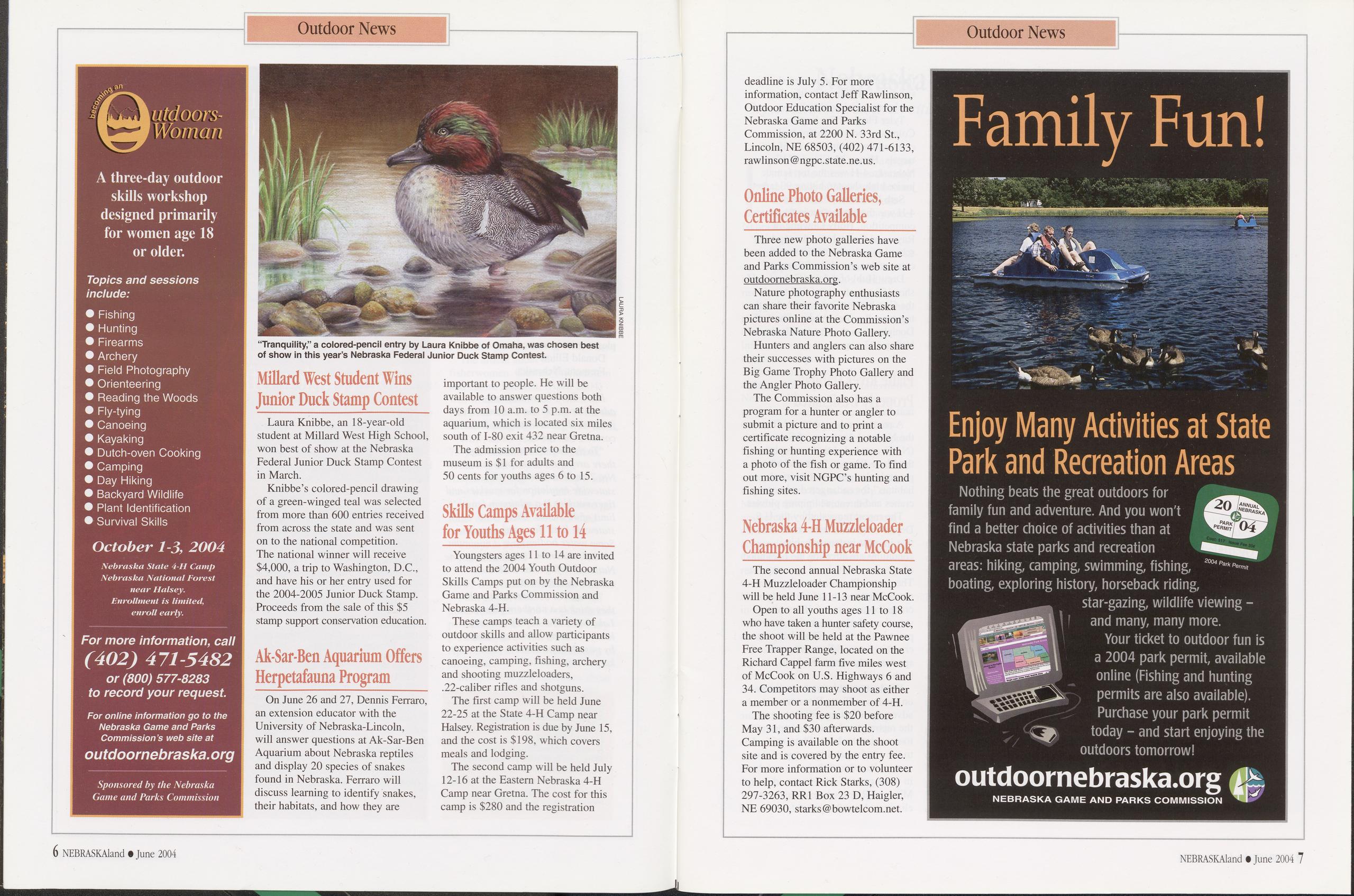
Outdoor News
Laura Knibbe, an 18-year-old student at Millard West High School, won best of show at the Nebraska Federal Junior Duck Stamp Contest in March.
Knibbe’s colored-pencil drawing of a green-winged teal was selected from more than 600 entries received from across the state and was sent on to the national competition. The national winner will receive $4,000, a trip to Washington, D.C., and have his or her entry used for the 2004-2005 Junior Duck Stamp. Proceeds from the sale of this $5 stamp support conservation education.
Ak-Sar-Ben Aquarium Offers Herpetafauna ProgramOn June 26 and 27, Dennis Ferraro, an extension educator with the University of Nebraska-Lincoln, will answer questions at Ak-Sar-Ben Aquarium about Nebraska reptiles and display 20 species of snakes found in Nebraska. Ferraro will discuss learning to identify snakes, their habitats, and how they are important to people. He will be available to answer questions both days from 10 a.m. to 5 p.m. at the aquarium, which is located six miles south of 1-80 exit 432 near Gretna.
The admission price to the museum is $1 for adults and 50 cents for youths ages 6 to 15.
Skills Camps Available for Youths Ages 11 to 14Youngsters ages 11 to 14 are invited to attend the 2004 Youth Outdoor Skills Camps put on by the Nebraska Game and Parks Commission and Nebraska 4-H.
These camps teach a variety of outdoor skills and allow participants to experience activities such as canoeing, camping, fishing, archery and shooting muzzleloaders, .22-caliber rifles and shotguns.
The first camp will be held June 22-25 at the State 4-H Camp near Halsey. Registration is due by June 15, and the cost is $198, which covers meals and lodging.
The second camp will be held July 12-16 at the Eastern Nebraska 4-H Camp near Gretna. The cost for this camp is $280 and the registration 6 NEBRASKAland • June 2004 deadline is July 5. For more information, contact Jeff Rawlinson, Outdoor Education Specialist for the Nebraska Game and Parks Commission, at 2200 N. 33rd St., Lincoln, NE 68503, (402) 471-6133, rawlinson@ngpc.state.ne.us.
Online Photo Galleries, Certificates AvailableThree new photo galleries have been added to the Nebraska Game and Parks Commission’s web site at outdoornebraska.org.
Nature photography enthusiasts can share their favorite Nebraska pictures online at the Commission’s Nebraska Nature Photo Gallery.
Hunters and anglers can also share their successes with pictures on the Big Game Trophy Photo Gallery and the Angler Photo Gallery.
The Commission also has a program for a hunter or angler to submit a picture and to print a certificate recognizing a notable fishing or hunting experience with a photo of the fish or game. To find out more, visit NGPC’s hunting and fishing sites.
Nebraska 4-H Muzzleloader Championship near McCookThe second annual Nebraska State 4-H Muzzleloader Championship will be held June 11-13 near McCook.
Open to all youths ages 11 to 18 who have taken a hunter safety course, the shoot will be held at the Pawnee Free Trapper Range, located on the Richard Cappel farm five miles west of McCook on U.S. Highways 6 and 34. Competitors may shoot as either a member or a nonmember of 4-H.
The shooting fee is $20 before May 31, and $30 afterwards. Camping is available on the shoot site and is covered by the entry fee. For more information or to volunteer to help, contact Rick Starks, (308) 297-3263, RR1 Box 23 D, Haigler, NE 69030, starks@bowtelcom.net.
The Niobrara River from Valentine to the Nebraska Highway 137 bridge north of Newport is a federally designated scenic river. Thousands of Nebraskans and people from across the country enjoy this beautiful river every summer by canoeing, kayaking or riding inflatable tubes.
When I first started working in the Valentine area, I was fortunate to be responsible for patrolling the river, where I dealt with large numbers of people on a daily basis. Most people conducted themselves responsibly while having fun, a few bent the rules as much as possible and needed guidance, and others had questions or needed help with one thing or another.
On one occasion I came across a woman whose canoe had overturned, pinning her leg against a rock. Her canoeing partner tried to help but could not move the canoe, and as more and more water filled the tipped canoe, the pressure on her leg increased and the woman began to panic.
I paddled my kayak into a safe position and flagged down a passing canoe with two young men in it. We were able to move the canoe and get the woman into shallow water where we could examine her leg. Because it appeared to be broken, the two men helped me load her into their canoe and we paddled her down to the Buffalo Bridge, where personnel from the Fort Niobrara National Wildlife Refuge met us with a pickup and took the injured woman to the refuge headquarters where an ambulance was waiting.
It’s always refreshing to cross paths with individuals who take the time to offer assistance in emergency situations. Those two young men should be commended for their act.
- Dana Miller Conservation Officer Supervisor, Valentine Lake Ogallala to Get New Oxygenation SystemThe Nebraska Game and Parks Commission received a $300,000 federal grant to help fund a liquid oxygen injection system to be installed in Lake Ogallala to protect its trout fishery.
The new system will pull cold water from the bottom of the lake, add liquid oxygen, and return the water to the bottom of the lake before it warms.
The oxygenation system that has been used in the past has warmed the water too much to support trout, which require cool, well-oxygenated water to survive.
The money for the project comes from a U.S. Bureau of Reclamation drought-mitigation program.
Cornhusker Trapshoot Sets Another Record for EntrantsMore than 1,375 junior high and high school trapshooters - 200 more than last year - from four states competed in the 35th National High School Cornhusker Trapshoot held in Doniphan, April 29-May 1.
Because of the meet’s growth, it was extended to three days this year.
Rocky Hoffmann, shoot director for the Nebraska Game and Parks Commission said, "The event ran smoothly, thanks to the responsible young shooters and hundreds of volunteers, coaches and donors who feel strongly that organized shooting sports are lifetime activities for young men and women.”
Tyler Flock of Burlington, Colorado, won the junior high competition, hitting 98 out of 100 targets. Hanna McCloud of Western Nebraska 4-H was the top female junior high shooter, hitting 90 targets.
Seth Davidson of Lancaster County 4-H was the top shooter in the 16-yard competition. Holly Dowling of Raymond Central was the top high school female shooter in the 16-yard competition, breaking 96 targets.
Drew Hubl of Adams County 4-H shot 188 targets out of 200 to win the Cornhusker Cup, awarded to the top overall scorer. Andrea Short of Doniphan was the best female shooter, hitting 173 targets.
Platte River Habitats Properly DesignatedA recently released report from the National Academy of Sciences (NAS) concluded that areas along the Platte River in Nebraska are properly designated as "critical habitats” for endangered whooping cranes and threatened piping plovers.
The report requested by the U.S. Department of Interior concluded that in most instances habitat conditions are affecting the likelihood of species survival and recovery. The central Platte habitat, the report noted, is important to whooping cranes because many, if not all, stop there during migration at some point in their lives. The whooping crane is the world’s rarest crane species; only about 185 birds remain in the wild.
While current habitat conditions on the lower Platte River are not adversely affecting pallid sturgeon, the report stated that it is appropriate to consider the lower Platte critical to the survival and recovery of the species because of their low numbers in other parts of the Platte and in the Missouri River, where dams have eliminated suitable habitat.
8 NEBRASKAland June 2004Outdoor Business
Nebraska Wildlife Crimestoppers
Organization rewards citizen reports of violations of the state’s wildlife laws.
For more than 20 years, a group of private citizens has donated thousands of hours and dollars to help the Nebraska Game and Parks Commission protect Nebraska’s wildlife.
The Nebraska Wildlife Protector’s Association (NWPA) formed in 1982 as a nonprofit organization devoted to protecting Nebraska’s wildlife resources. One of the first groups of its type in the nation, NWPA formed after receiving permission from the Commission to offer rewards for information leading to the arrest and conviction of poachers.
The reward money NWPA raises is disbursed through the Commission’s Nebraska Wildlife Crimestoppers program, formerly known as Operation Game Thief. The program allows citizens to report wildlife violations by calling the toll-free hotline at 1-800-742-7627. Callers may remain anonymous if they wish, and calls made between 8 a.m. and 5 p.m. Monday through Friday are answered by the law enforcement division and routed directly to the appropriate conservation officer. Calls made at other times are referred to the statewide Crimestoppers hotline at the Nebraska State Patrol headquarters in Lincoln, which then routes the information to the appropriate conservation officer.
In successful cases in which the reporting party is interested in a reward, the Commission makes recommendations to the NWPA, which then decides on the reward amount and disburses the money.
From its inception through the end of 2003, the Wildlife Protectors Association has given out 279 rewards totaling $35,090 and the Operation Game Thief/Nebraska Wildlife Crimestoppers program has resulted in more than 1,200 investigations and 671 arrests, with a 97 percent conviction rate. The partnership has been a positive addition to the Commission.
"Overall it’s been a very successful program, a cooperative effort between the Commission and the NWPA,” said Ted Blume, administrator for the Commission’s Law Enforcement Division. "We’ve made some real good cases through the program that we wouldn’t have known about otherwise.”
Paul Pack of Ceresco, president of NWPA and one of its founding
“All we’re trying to do is lend a helping hand,” Pack said.
Rewards typically run from $100 up to $500 for more serious offenses. All of the reward money the group raises comes from donations and from a banquet that Pack organizes every two years. The banquet raises money through ticket sales, raffles and the auctions of donated items.
Pack said its important for people to follow game laws, because wildlife is a renewable resource that must be managed by following biologists’ recommendations if it is going to continue to be available. Everyone who spends time outdoors can help protect our wildlife by having a watchful eye and using cell phones to immediately report violations to conservation officers or the hotline, he said. The hotline provides a ready means for anyone who cares about wildlife to report violations.
“A lot of people aren’t even asking for rewards when they call in with information,” Pack said. "They’re not doing it for the money, they’re doing it because it’s the right thing to do.”
One case reported through the program in 2003 involved a person who had caught and kept 45 channel catfish, 35 over the 10-channel- catfish limit. The person was cited and released, but did not appear in court or pay the violation by waiver. A few weeks later the same subject was contacted by another conservation officer and again was charged with an overbag violation. Because a warrant was now active for the first offense, the subject ultimately spent 30 days in jail and paid nearly $ 1,000 in fines and liquidated damages for the illegally taken wildlife. Since its inception, the Nebraska Wildlife Crimestoppers program has resulted in the collection of more than $168,000 in liquidated damages, all of which goes back into the Commission’s Game Fund. In a few cases that went to federal court, suspects had to pay money back into the NWPA’s reward fund.
In addition to raising reward money, Pack said, members work to raise awareness about the Crimestoppers program and the importance of wildlife. There is no cost to join the organization.
To join NWPA or to make a donation, write Nebraska Wildlife Crimestoppers, P.O. Box 726, Broken Bow, NE 68822-0726. NEBRASKAland • June 2004 9
Muskie Hunt
Until a few years ago, Merritt Reservoir and Watts Lake were the only muskie waters in Nebraska. But, with an improved method of stocking, fisheries biologists are now establishing muskies in several more lakes across the state.
After a dozen casts into the cold November waters of Elwood Reservoir, I experienced my first hands-on thrill with one of Nebraska’s coming-of-age muskellunge.
My passion to catch muskies began decades ago in remote northern waters of the Wabigoon and Winnipeg river systems of Ontario. Although I occasionally coaxed a ghostly follow-up or even a huge strike from one of these legendary brawlers, never had one stretched my line or cartwheeled across the surface of a weedbed, lure implanted. And, I never thought that would happen in Nebraska.
Many muskie anglers agree that a missed strike or a silent shadowing of your lure to the boat makes a successful
Although Nebraska is not recognized as a notable trophy muskie state - a status commonly granted to Minnesota and Wisconsin - it has produced some big muskies over the past few decades, including the 41-pound, 8-ounce state record muskie measuring 52 inches long that was caught in 1992 at Merritt Reservoir.
Since that trophy catch, every time I have fished at Merritt for walleyes or panfish, I have always spent an hour or two pumping big lures with treble hooks through the water. Sometimes on the way home to North Platte, I detoured into the Valentine National Wildlife Refuge and waded along the reed-spiked shoreline of Watts Lake, throwing surface lures with propellers on both ends at an elusive target.
Until a few years ago, Merritt and Watts were the only muskie lakes in Nebraska, and even in those waters muskies were an incidental species usually caught by anglers fishing for something else. I shuddered whenever I heard of a supersized muskie taken by a crappie fisherman using ultralight gear and a jig.
Say it ain’t so, Joe! Muskies are supposed to be caught on nothing less than big wooden lures with glass eyes, preceded by 12-inch steel leaders. The lure should have faded stenciling reading Heddon, Dowagiac, South Bend, Mud Puppy or Cisco Kid. It should be riddled with tooth holes, badly in need of paint and armed with bent or missing hooks. That’s how muskies should be caught. At least that’s the way I wanted to catch a muskie.
The problem was that I had not caught a muskie - even by accident - and with the species present in only two Nebraska impoundments, it seemed my odds for success ranked with winning the lottery.
The Nebraska Game and Parks Commission had stocked a number of lakes with tiger muskies, a hatchery- bred cross between northern pike and muskellunge, producing some big fish 10 NEBRASKAland • June 2004
 employing the techniques suggested by the nationally known muskie fishermen, who write about their experiences in popular fishing magazines. I watched the Saturday morning television programs that showed huge muskies being caught by anglers using those very techniques. I investigated spring patterns, summer patterns, early fall patterns and late fall patterns. Time was running out as I fished my way through the seasons without a single follow or strike. I cast, cranked, jigged, jerked and trolled baits through Elwood’s water. I went deep, on top and in between. I bounced off the bottom and I churned the surface with propellers and blades. Nothing!
The cold nights and warm days of
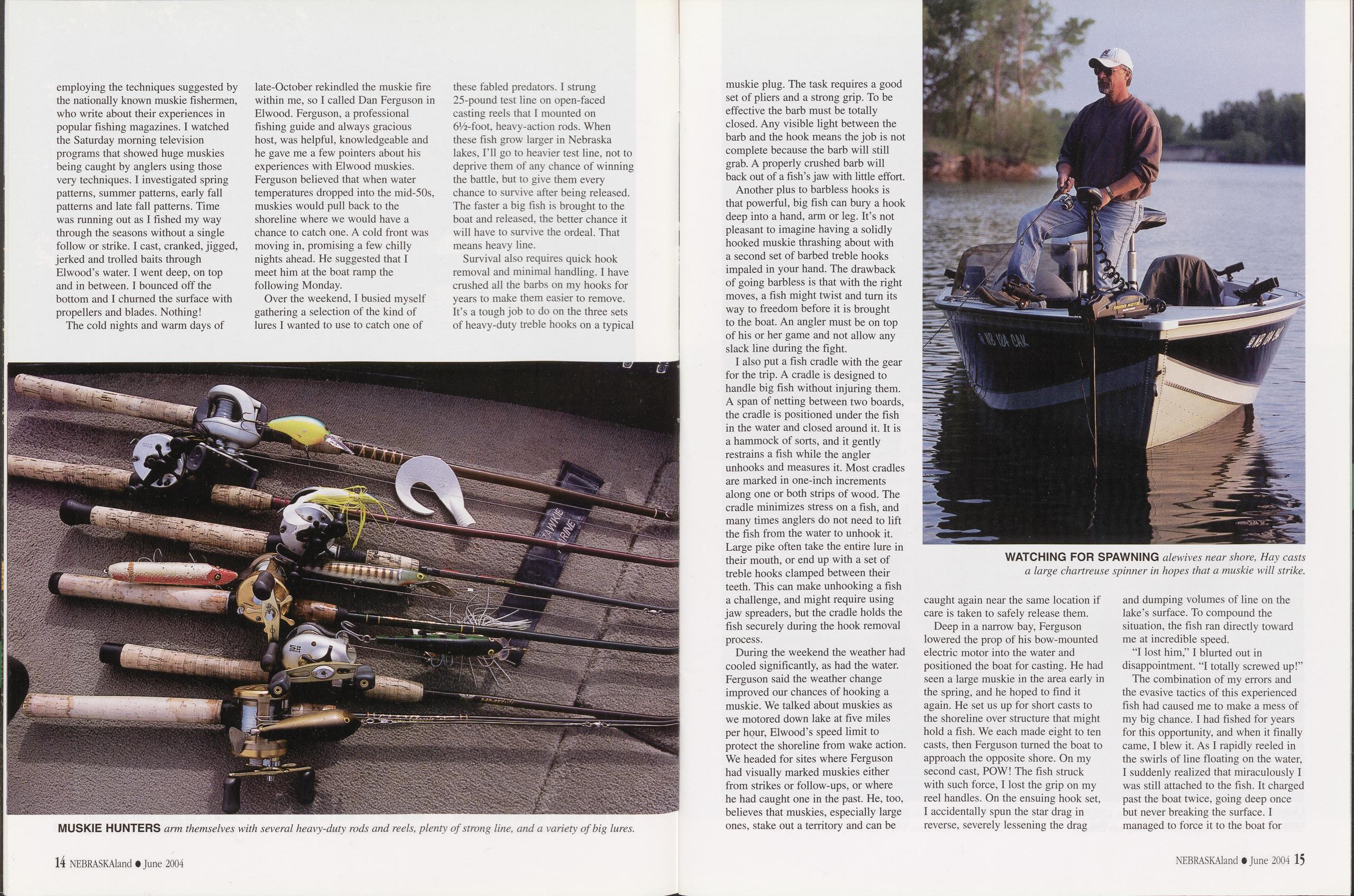
Over the weekend, I busied myself gathering a selection of the kind of lures I wanted to use to catch one of these fabled predators. I strung 25-pound test line on open-faced casting reels that I mounted on b/2-foot, heavy-action rods. When these fish grow larger in Nebraska lakes, I’ll go to heavier test line, not to deprive them of any chance of winning the battle, but to give them every chance to survive after being released. The faster a big fish is brought to the boat and released, the better chance it will have to survive the ordeal. That means heavy line.
Survival also requires quick hook removal and minimal handling. I have crushed all the barbs on my hooks for years to make them easier to remove. It’s a tough job to do on the three sets of heavy-duty treble hooks on a typical 14 NEBRASKAland • June 2004 muskie plug. The task requires a good set of pliers and a strong grip. To be effective the barb must be totally closed. Any visible light between the barb and the hook means the job is not complete because the barb will still grab. A properly crushed barb will back out of a fish’s jaw with little effort.
Another plus to barbless hooks is that powerful, big fish can bury a hook deep into a hand, arm or leg. It’s not pleasant to imagine having a solidly hooked muskie thrashing about with a second set of barbed treble hooks impaled in your hand. The drawback of going barbless is that with the right moves, a fish might twist and turn its way to freedom before it is brought to the boat. An angler must be on top of his or her game and not allow any slack line during the fight.
I also put a fish cradle with the gear for the trip. A cradle is designed to handle big fish without injuring them. A span of netting between two boards, the cradle is positioned under the fish in the water and closed around it. It is a hammock of sorts, and it gently restrains a fish while the angler unhooks and measures it. Most cradles are marked in one-inch increments along one or both strips of wood. The cradle minimizes stress on a fish, and many times anglers do not need to lift the fish from the water to unhook it. Large pike often take the entire lure in their mouth, or end up with a set of treble hooks clamped between their teeth. This can make unhooking a fish a challenge, and might require using jaw spreaders, but the cradle holds the fish securely during the hook removal process.
During the weekend the weather had cooled significantly, as had the water. Ferguson said the weather change improved our chances of hooking a muskie. We talked about muskies as we motored down lake at five miles per hour, Elwood’s speed limit to protect the shoreline from wake action. We headed for sites where Ferguson had visually marked muskies either from strikes or follow-ups, or where he had caught one in the past. He, too, believes that muskies, especially large ones, stake out a territory and can be
Deep in a narrow bay, Ferguson lowered the prop of his bow-mounted electric motor into the water and positioned the boat for casting. He had seen a large muskie in the area early in the spring, and he hoped to find it again. He set us up for short casts to the shoreline over structure that might hold a fish. We each made eight to ten casts, then Ferguson turned the boat to approach the opposite shore. On my second cast, POW! The fish struck with such force, I lost the grip on my reel handles. On the ensuing hook set, I accidentally spun the star drag in reverse, severely lessening the drag and dumping volumes of line on the lake’s surface. To compound the situation, the fish ran directly toward me at incredible speed.
"I lost him,” I blurted out in disappointment. "I totally screwed up!” The combination of my errors and the evasive tactics of this experienced fish had caused me to make a mess of my big chance. I had fished for years for this opportunity, and when it finally came, I blew it. As I rapidly reeled in the swirls of line floating on the water, I suddenly realized that miraculously I was still attached to the fish. It charged past the boat twice, going deep once but never breaking the surface. I managed to force it to the boat for NEBRASKAland • June 2004 15 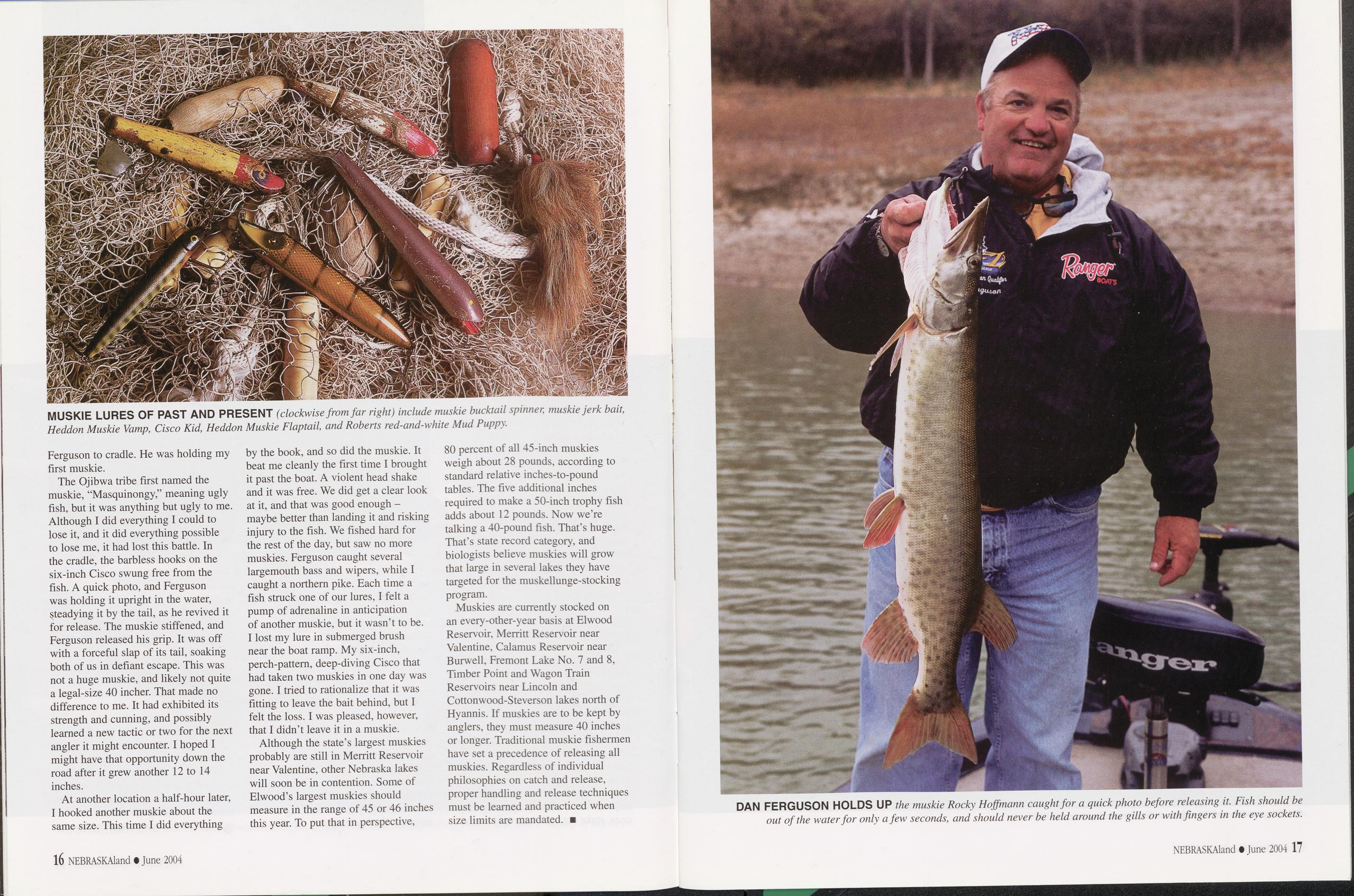
The Ojibwa tribe first named the muskie, “Masquinongy,” meaning ugly fish, but it was anything but ugly to me. Although I did everything I could to lose it, and it did everything possible to lose me, it had lost this battle. In the cradle, the barbless hooks on the six-inch Cisco swung free from the fish. A quick photo, and Ferguson was holding it upright in the water, steadying it by the tail, as he revived it for release. The muskie stiffened, and Ferguson released his grip. It was off with a forceful slap of its tail, soaking both of us in defiant escape. This was not a huge muskie, and likely not quite a legal-size 40 incher. That made no difference to me. It had exhibited its strength and cunning, and possibly learned a new tactic or two for the next angler it might encounter. I hoped I might have that opportunity down the road after it grew another 12 to 14 inches.
At another location a half-hour later, I hooked another muskie about the same size. This time I did everything by the book, and so did the muskie. It beat me cleanly the first time I brought it past the boat. A violent head shake and it was free. We did get a clear look at it, and that was good enough - maybe better than landing it and risking injury to the fish. We fished hard for the rest of the day, but saw no more muskies. Ferguson caught several largemouth bass and wipers, while I caught a northern pike. Each time a fish struck one of our lures, I felt a pump of adrenaline in anticipation of another muskie, but it wasn’t to be. I lost my lure in submerged brush near the boat ramp. My six-inch, perch-pattern, deep-diving Cisco that had taken two muskies in one day was gone. I tried to rationalize that it was fitting to leave the bait behind, but I felt the loss. I was pleased, however, that I didn’t leave it in a muskie.
Although the state’s largest muskies probably are still in Merritt Reservoir near Valentine, other Nebraska lakes will soon be in contention. Some of Elwood’s largest muskies should measure in the range of 45 or 46 inches this year. To put that in perspective, 80 percent of all 45-inch muskies weigh about 28 pounds, according to standard relative inches-to-pound tables. The five additional inches required to make a 50-inch trophy fish adds about 12 pounds. Now we’re talking a 40-pound fish. That’s huge. That’s state record category, and biologists believe muskies will grow that large in several lakes they have targeted for the muskellunge-stocking program.
Muskies are currently stocked on an every-other-year basis at Elwood Reservoir, Merritt Reservoir near Valentine, Calamus Reservoir near Burwell, Fremont Lake No. 7 and 8, Timber Point and Wagon Train Reservoirs near Lincoln and Cottonwood-Steverson lakes north of Hyannis. If muskies are to be kept by anglers, they must measure 40 inches or longer. Traditional muskie fishermen have set a precedence of releasing all muskies. Regardless of individual philosophies on catch and release, proper handling and release techniques must be learned and practiced when size limits are mandated.
16 NEBRASKAland • June 2004
FORT KEARNY
SOLDIERING IN THE OLD WEST
No civil war battles were fought in Nebraska, but the effects of the war were keenly felt at Fort Kearny, built in 1848 to protect emigrants. Many of the fort’s soldiers left to fight for the North or South, leaving citizen volunteers to staff the post. Today, a new crop of volunteers returns each summer to re-create history for visitors to Fort Kearny State Historical Park.
On Memorial Day, July Fourth and Labor Day holiday weekends, a group of local reenactors, portraying C Battery, Third U.S. Artillery, set up a camp on the park's grounds and open it to the public.
During the day, they demonstrate how people lived in the 1800s. Visitors can watch a blacksmith mold raw iron into tools, and might be invited to help sew a quilt, clean a soldier's rifle, or take part in an old-time baseball game ir friendly game of cards. Each day,
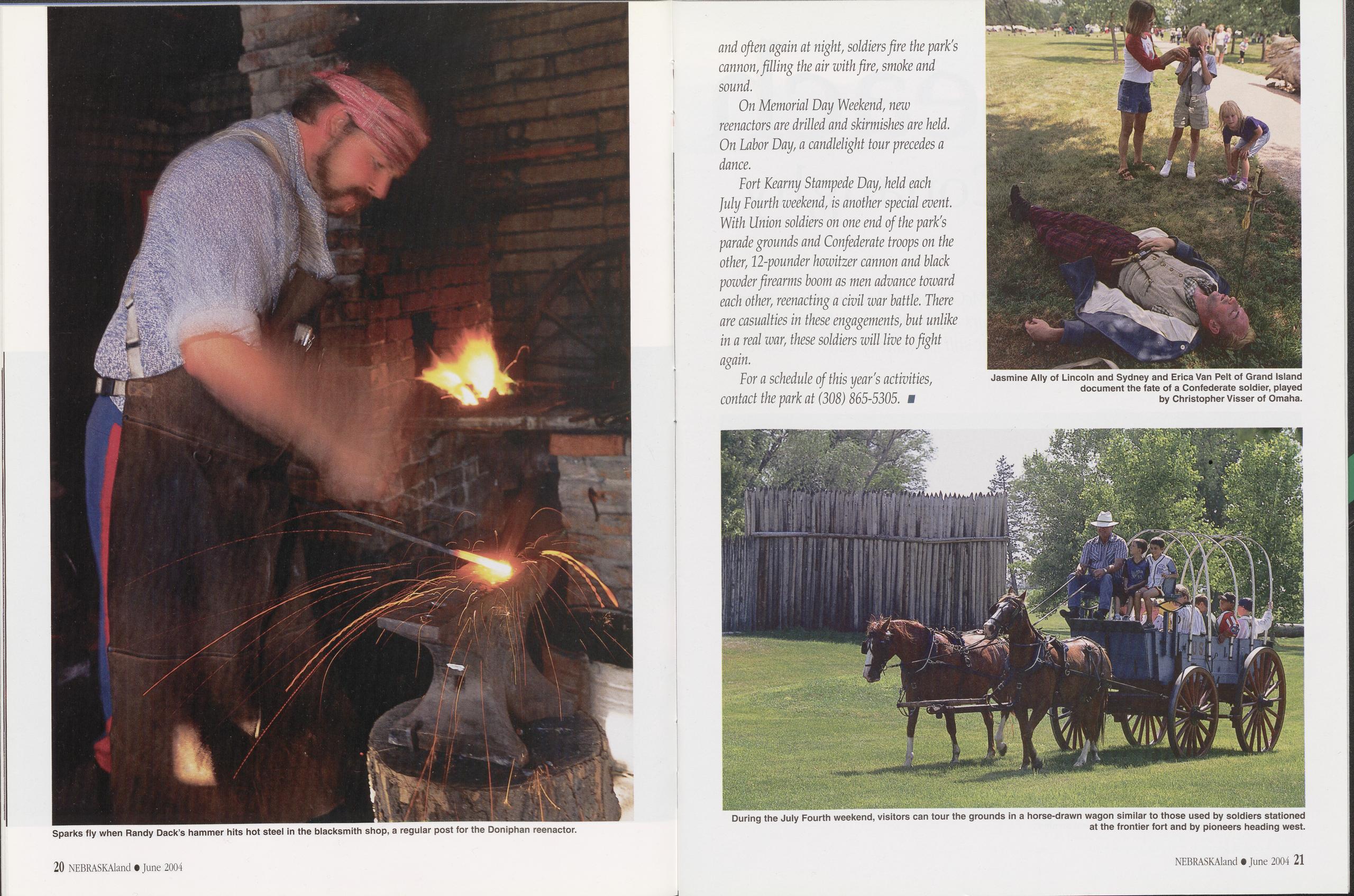
On Memorial Day Weekend, new reenactors are drilled and skirmishes are held. On Labor Day, a candlelight tour precedes a dance.
Fort Kearny Stampede Day, held each July Fourth weekend, is another special event. With Union soldiers on one end of the park's parade grounds and Confederate troops on the other, 12-pounder howitzer cannon and black powder firearms boom as men advance toward each other, reenacting a civil war battle. There are casualties in these engagements, but unlike in a real war, these soldiers will live to fight again.
For a schedule of this year's activities, contact the park at (308) 865-5305.
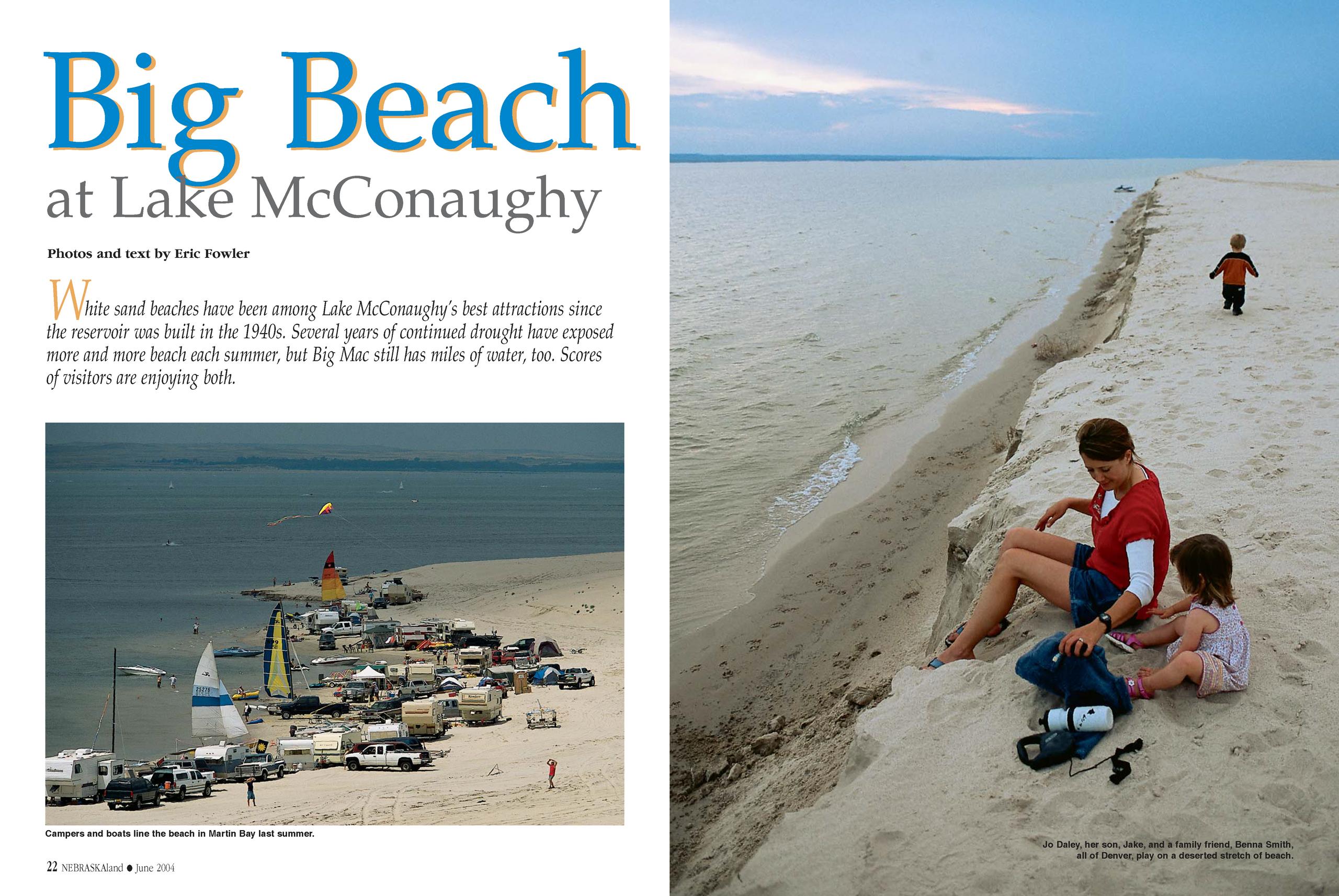
Big Beach at Lake McConaughy
White sand beaches have been among Lake McConaughy's best attractions since the reservoir was built in the 1940s. Several years of continued drought have exposed more and more beach each summer, but Big Mac still has miles of water, too. Scores of visitors are enjoying both.
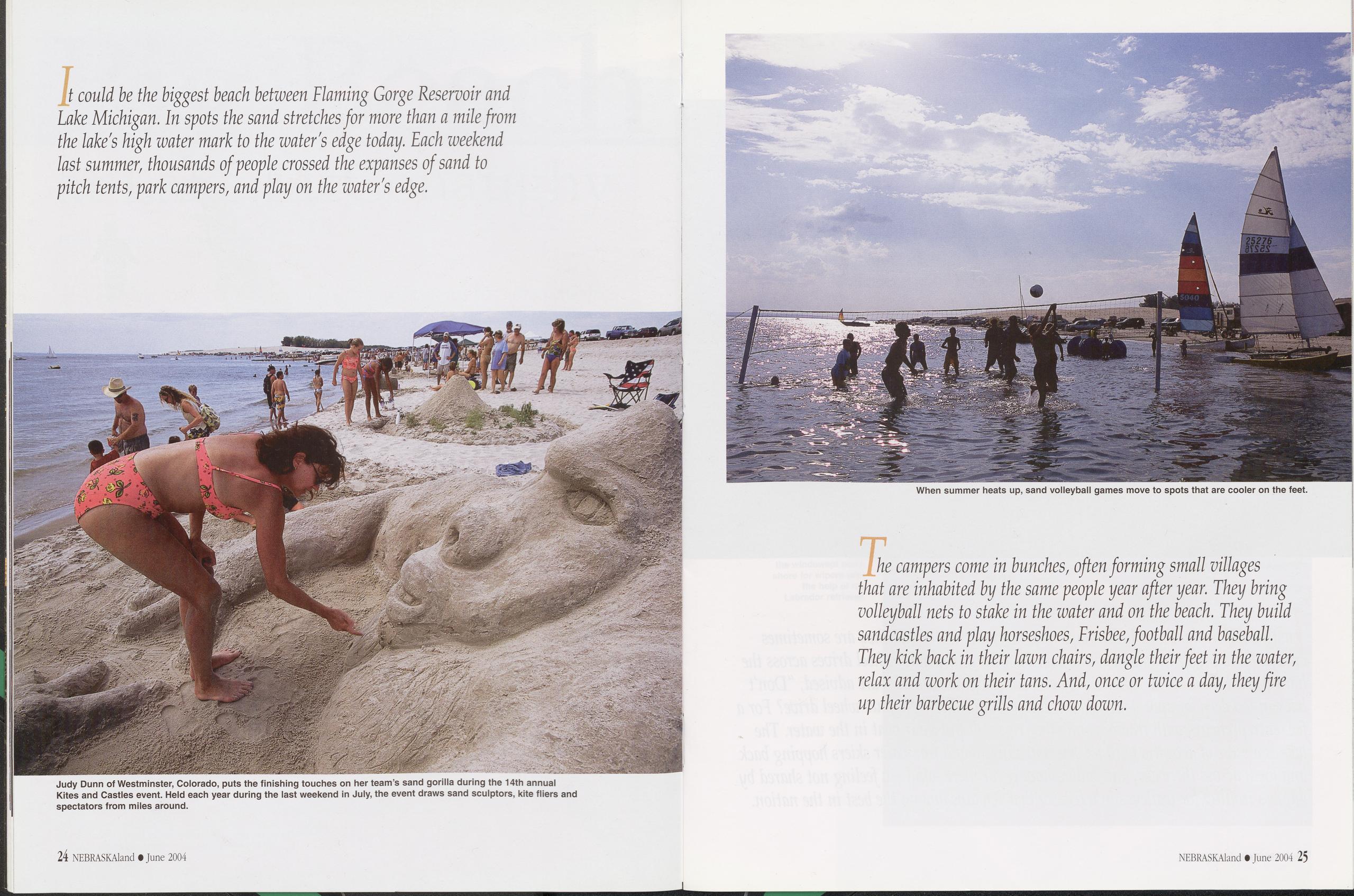
It could be the biggest beach between Flaming Gorge Reservoir and Lake Michigan. In spots the sand stretches for more than a mile from the lakes high water mark to the water's edge today. Each weekend last summer; thousands of people crossed the expanses of sand to pitch tents, park campers, and play on the water's edge.
The campers come in bunches, often forming small villages that are inhabited by the same people year after year. They bring volleyball nets to stake in the water and on the beach. They build sandcastles and play horseshoes, Frisbee, football and baseball. They kick back in their lawn chairs, dangle their feet in the water, relax and work on their tans. And, once or twice a day, they fire up their barbecue grills and chow down.
NEBRASKAland • June 2004 25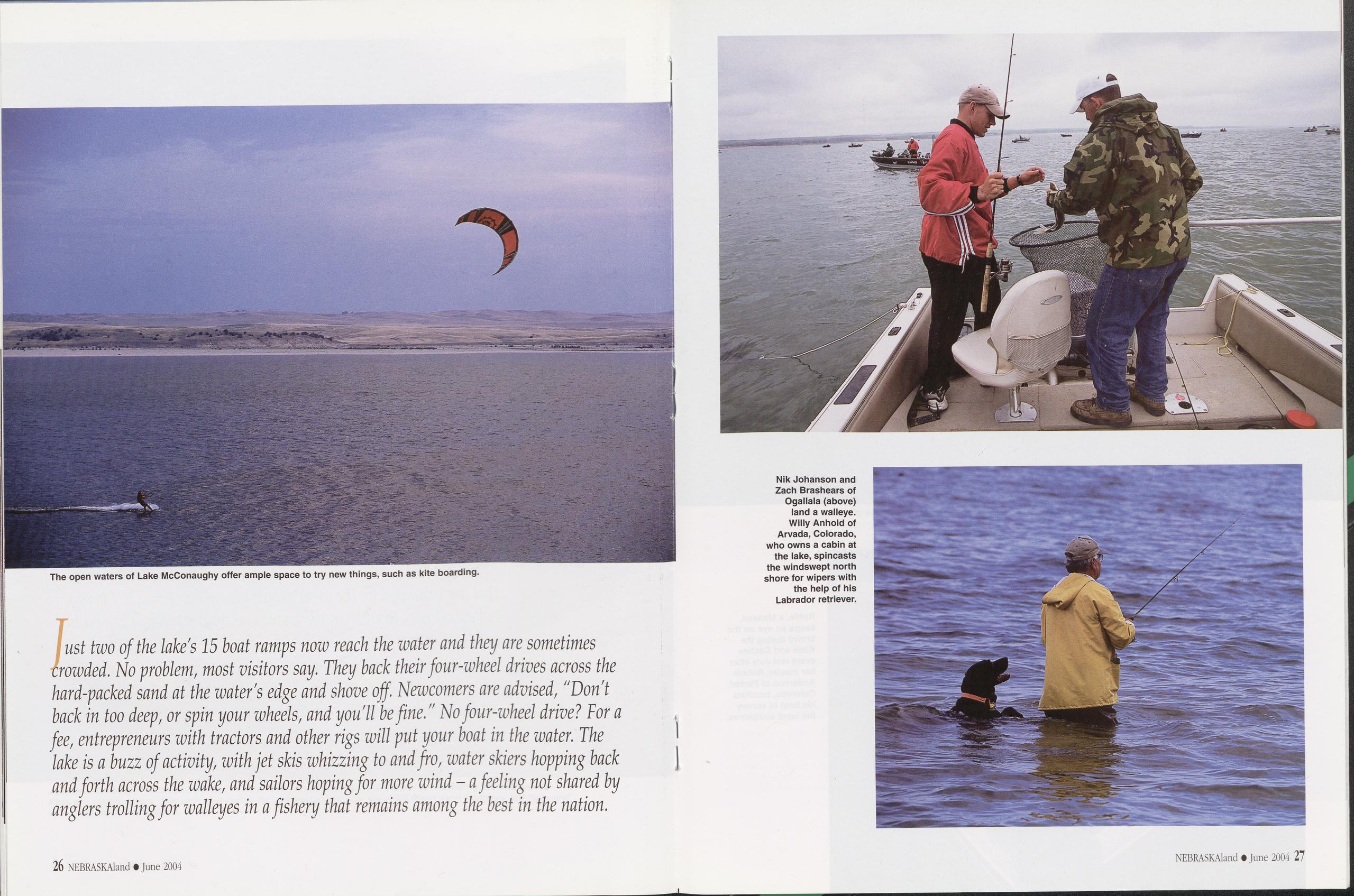
Just two of the lake's 15 boat ramps now reach the water and they are sometimes crowded. No problem, most visitors say. They back their four-wheel drives across the hard-packed sand at the water's edge and shove off. Newcomers are advised, "Don't back in too deep, or spin your wheels, and you'll be fine." No four-wheel drive? For a fee, entrepreneurs with tractors and other rigs will put your boat in the water. The lake is a buzz of activity, with jet skis whizzing to and fro, water skiers hopping back and forth across the wake, and sailors hoping for more wind - a feeling not shared by anglers trolling for walleyes in a fishery that remains among the best in the nation.
26 NEBRASKAland • June 2004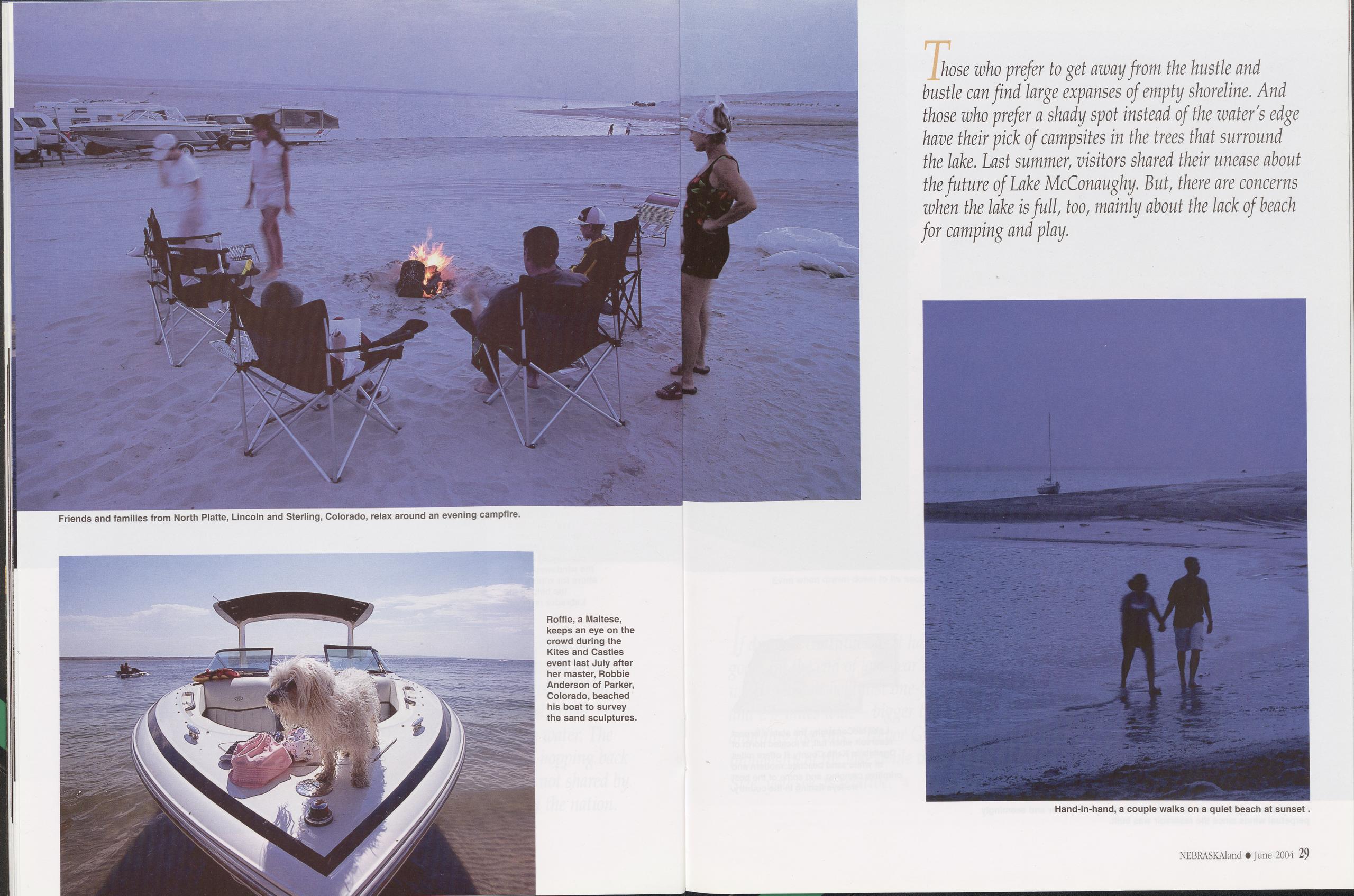
Those who prefer to get away from the hustle and bustle can find large expanses of empty shoreline. And those who prefer a shady spot instead of the water's edge have their pick ofcampsites in the trees that surround the lake. Last summer, visitors shared their unease about the future of Lake McConaughy. But, there are concerns when the lake is full, too, mainly about the lack of beach for camping and play.
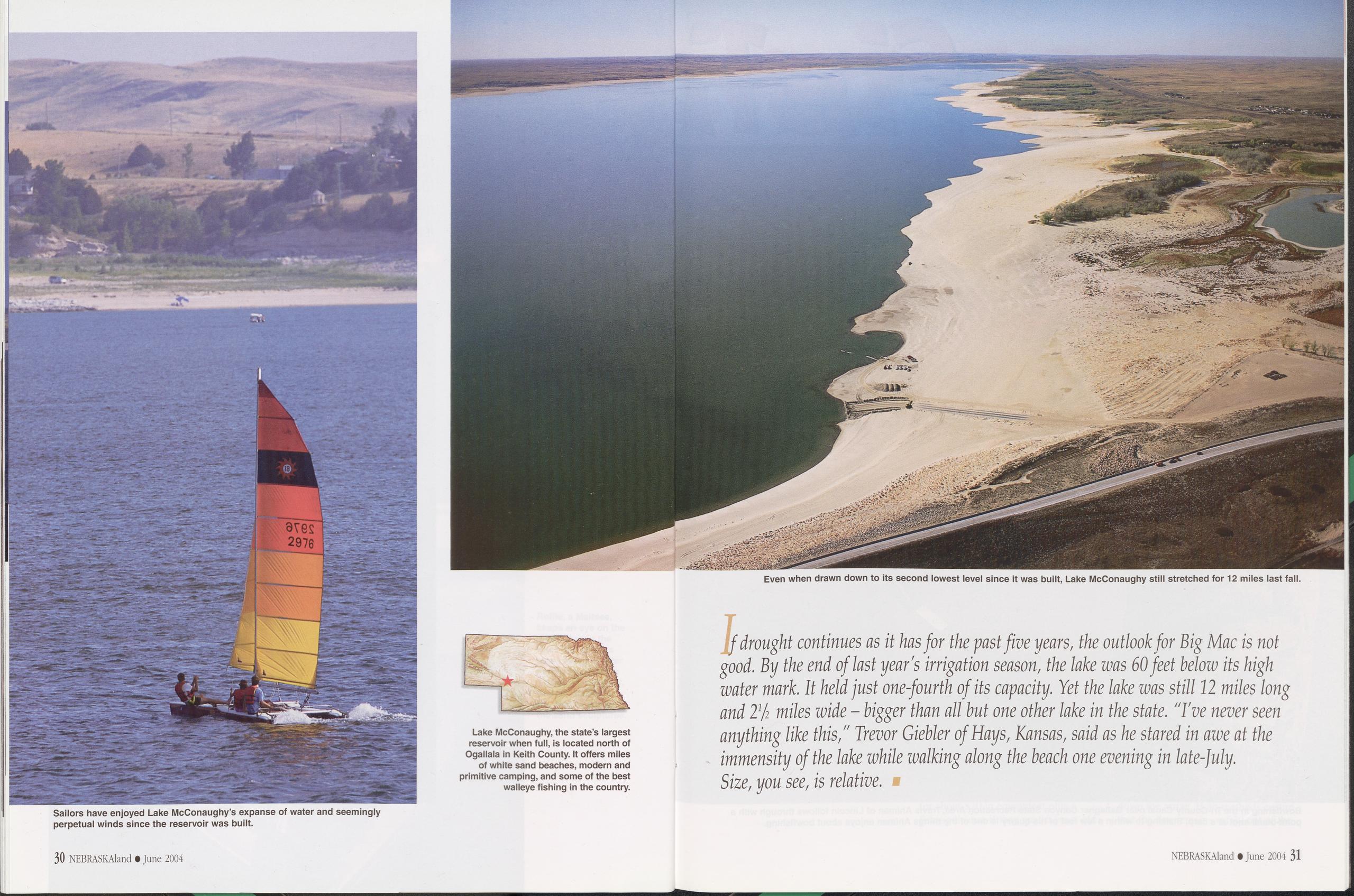
If drought continues as it has for the past five years, the outlook for Big Mac is not good. By the end of last year's irrigation season, the lake was 60 feet below its high water mark. It held just one-fourth of its capacity. Yet the lake was still 12 miles long and Ifi miles wide - bigger than all but one other lake in the state. "I've never seen anything like this," Trevor Giebler of Hays, Kansas, said as he stared in awe at the immensity of the lake while walking along the beach one evening in late-july. Size, you see, is relative.
NEBRASKAland • June 2004 31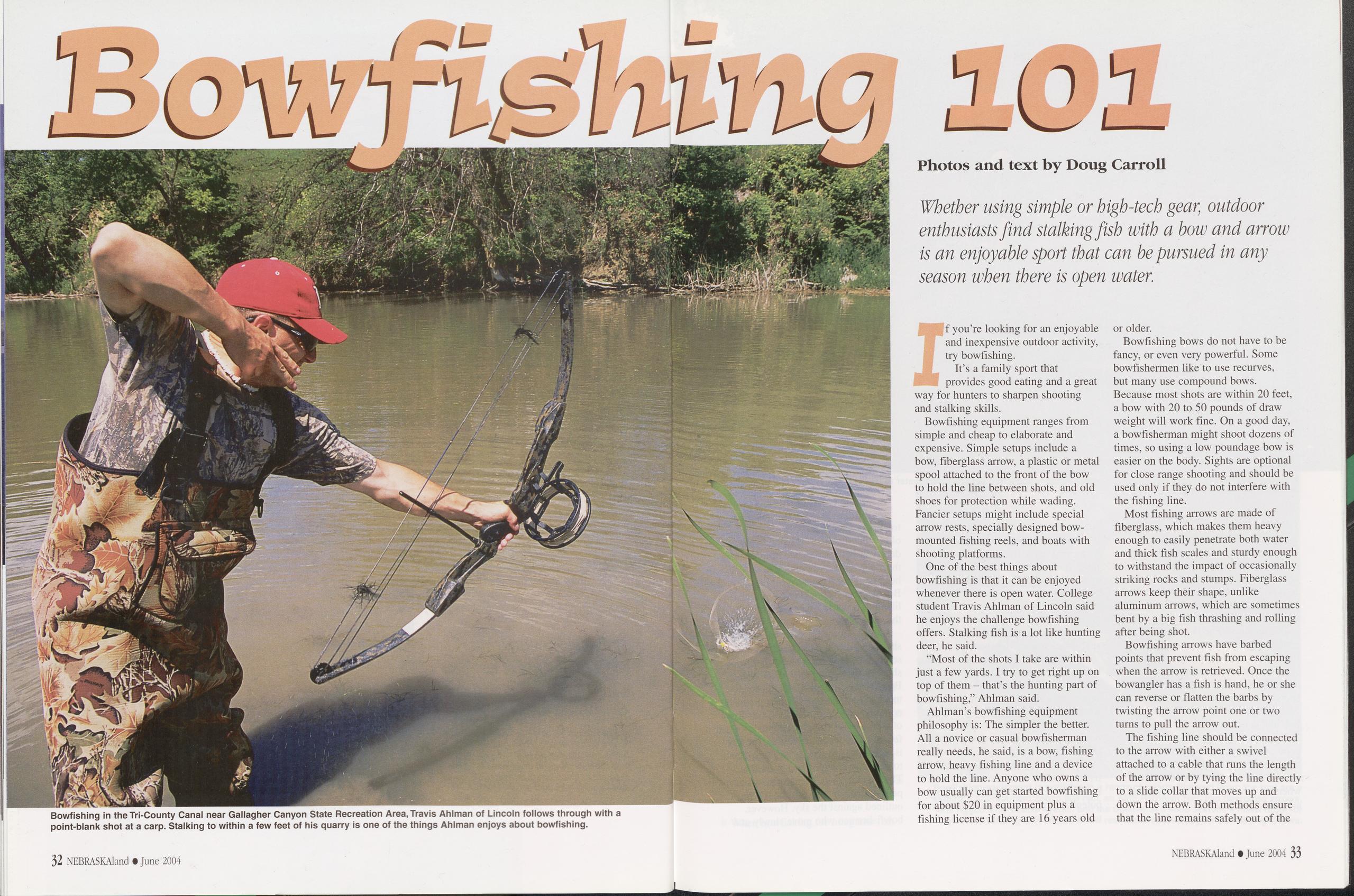
Bowfishing 101
Whether using simple or high-tech gear, outdoor enthusiasts find stalking fish with a bow and arrow is an enjoyable sport that can be pursued in any season when there is open water.
If you’re looking for an enjoyable and inexpensive outdoor activity, try bowfishing.
It’s a family sport that provides good eating and a great way for hunters to sharpen shooting and stalking skills.
Bowfishing equipment ranges from simple and cheap to elaborate and expensive. Simple setups include a bow, fiberglass arrow, a plastic or metal spool attached to the front of the bow to hold the line between shots, and old shoes for protection while wading. Fancier setups might include special arrow rests, specially designed bow- mounted fishing reels, and boats with shooting platforms.
One of the best things about bowfishing is that it can be enjoyed whenever there is open water. College student Travis Ahlman of Lincoln said he enjoys the challenge bowfishing offers. Stalking fish is a lot like hunting deer, he said.
“Most of the shots I take are within just a few yards. I try to get right up on top of them - that’s the hunting part of bowfishing,” Ahlman said.
Ahiman’s bowfishing equipment philosophy is: The simpler the better. All a novice or casual bowfisherman really needs, he said, is a bow, fishing arrow, heavy fishing line and a device to hold the line. Anyone who owns a bow usually can get started bowfishing for about $20 in equipment plus a fishing license if they are 16 years old or older.
Bowfishing bows do not have to be fancy, or even very powerful. Some bowfishermen like to use recurves, but many use compound bows. Because most shots are within 20 feet, a bow with 20 to 50 pounds of draw weight will work fine. On a good day, a bowfisherman might shoot dozens of times, so using a low poundage bow is easier on the body. Sights are optional for close range shooting and should be used only if they do not interfere with the fishing line.
Most fishing arrows are made of fiberglass, which makes them heavy enough to easily penetrate both water and thick fish scales and sturdy enough to withstand the impact of occasionally striking rocks and stumps. Fiberglass arrows keep their shape, unlike aluminum arrows, which are sometimes bent by a big fish thrashing and rolling after being shot.
Bowfishing arrows have barbed points that prevent fish from escaping when the arrow is retrieved. Once the bowangler has a fish is hand, he or she can reverse or flatten the barbs by twisting the arrow point one or two turns to pull the arrow out.
The fishing line should be connected to the arrow with either a swivel attached to a cable that runs the length of the arrow or by tying the line directly to a slide collar that moves up and down the arrow. Both methods ensure that the line remains safely out of the NEBRASKAland • June 2004 33 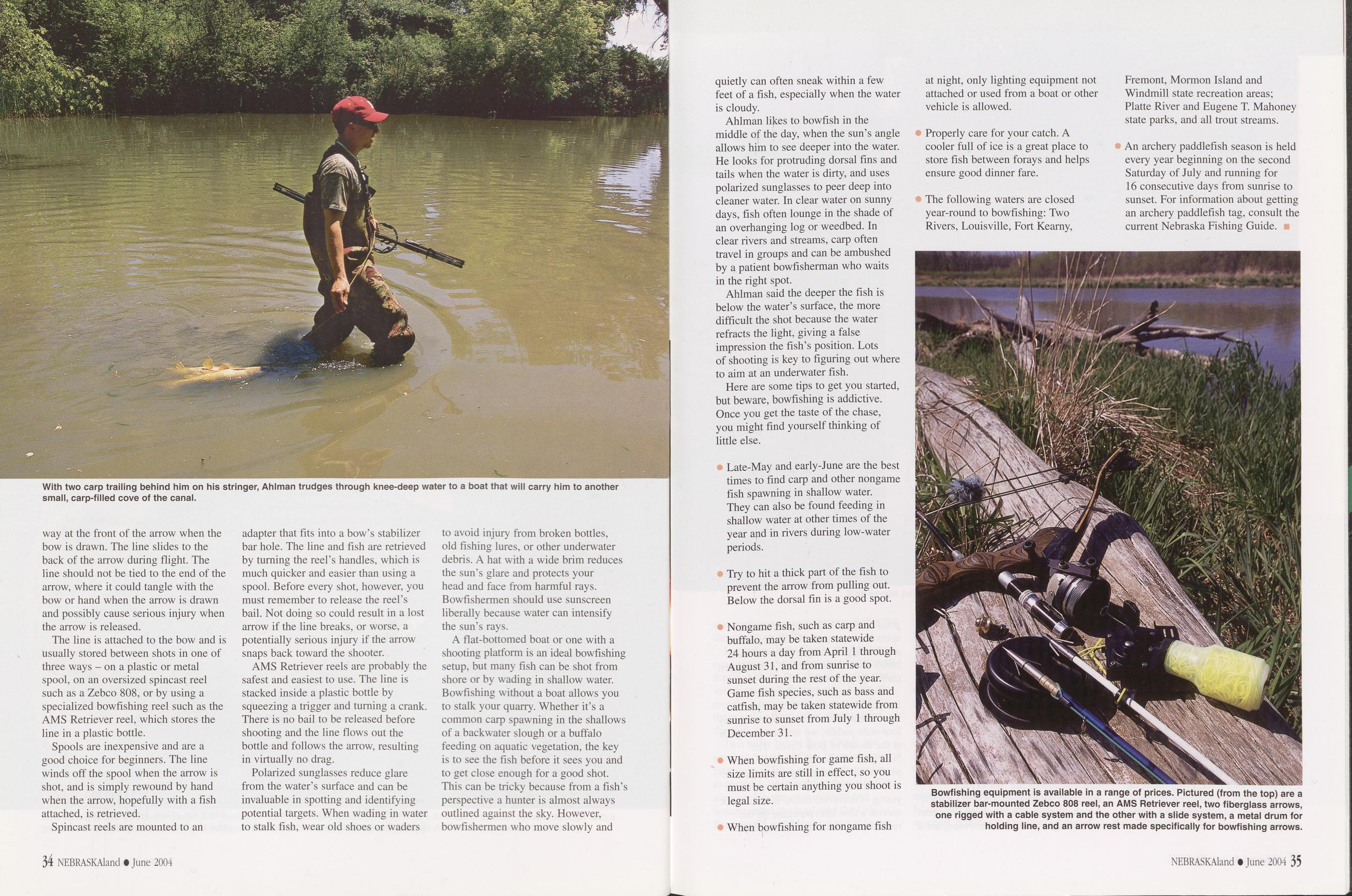
The line is attached to the bow and is usually stored between shots in one of three ways - on a plastic or metal spool, on an oversized spincast reel such as a Zebco 808, or by using a specialized bowfishing reel such as the AMS Retriever reel, which stores the line in a plastic bottle.
Spools are inexpensive and are a good choice for beginners. The line winds off the spool when the arrow is shot, and is simply rewound by hand when the arrow, hopefully with a fish attached, is retrieved.
Spincast reels are mounted to an adapter that fits into a bow’s stabilizer bar hole. The line and fish are retrieved by turning the reel’s handles, which is much quicker and easier than using a spool. Before every shot, however, you must remember to release the reel’s bail. Not doing so could result in a lost arrow if the line breaks, or worse, a potentially serious injury if the arrow snaps back toward the shooter.
AMS Retriever reels are probably the safest and easiest to use. The line is stacked inside a plastic bottle by squeezing a trigger and turning a crank. There is no bail to be released before shooting and the line flows out the bottle and follows the arrow, resulting in virtually no drag.
Polarized sunglasses reduce glare from the water’s surface and can be invaluable in spotting and identifying potential targets. When wading in water to stalk fish, wear old shoes or waders to avoid injury from broken bottles, old fishing lures, or other underwater debris. A hat with a wide brim reduces the sun’s glare and protects your head and face from harmful rays. Bowfishermen should use sunscreen liberally because water can intensify the sun’s rays.
A flat-bottomed boat or one with a shooting platform is an ideal bowfishing setup, but many fish can be shot from shore or by wading in shallow water. Bowfishing without a boat allows you to stalk your quarry. Whether it’s a common carp spawning in the shallows of a backwater slough or a buffalo feeding on aquatic vegetation, the key is to see the fish before it sees you and to get close enough for a good shot. This can be tricky because from a fish’s perspective a hunter is almost always outlined against the sky. However, bowfishermen who move slowly and 34 NEBRASKAland • June 2004 quietly can often sneak within a few feet of a fish, especially when the water is cloudy.
Ahlman likes to bowfish in the middle of the day, when the sun’s angle allows him to see deeper into the water. He looks for protruding dorsal fins and tails when the water is dirty, and uses polarized sunglasses to peer deep into cleaner water. In clear water on sunny days, fish often lounge in the shade of an overhanging log or weedbed. In clear rivers and streams, carp often travel in groups and can be ambushed by a patient bowfisherman who waits in the right spot.
Ahlman said the deeper the fish is below the water’s surface, the more difficult the shot because the water refracts the light, giving a false impression the fish’s position. Lots of shooting is key to figuring out where to aim at an underwater fish.
Here are some tips to get you started, but beware, bowfishing is addictive. Once you get the taste of the chase, you might find yourself thinking of little else.
Late-May and early-June are the best times to find carp and other nongame fish spawning in shallow water. They can also be found feeding in shallow water at other times of the year apd in rivers during low-water periods.
Try to hit a thick part of the fish to prevent the arrow from pulling out. Below the dorsal fin is a good spot.
Nongame fish, such as carp and buffalo, may be taken statewide 24 hours a day from April 1 through August 31, and from sunrise to sunset during the rest of the year. Game fish species, such as bass and catfish, may be taken statewide from sunrise to sunset from July 1 through December 31.
When bowfishing for game fish, all size limits are still in effect, so you must be certain anything you shoot is legal size.
• When bowfishing for nongame fish at night, only lighting equipment not attached or used from a boat or other vehicle is allowed.
• Properly care for your catch. A cooler full of ice is a great place to store fish between forays and helps ensure good dinner fare.
• The following waters are closed year-round to bowfishing: Two Rivers, Louisville, Fort Kearny, Fremont, Mormon Island and Windmill state recreation areas; Platte River and Eugene T. Mahoney state parks, and all trout streams.
• An archery paddlefish season is held every year beginning on the second Saturday of July and running for 16 consecutive days from sunrise to sunset. For information about getting an archery paddlefish tag, consult the current Nebraska Fishing Guide.
Canoeing the Missouri River
Gavins Point Dam to Ponca State Park
This 59-mile segment of the Missouri National Recreational River offers visitors a glimpse of what Lewis and Clark saw 200 years ago.
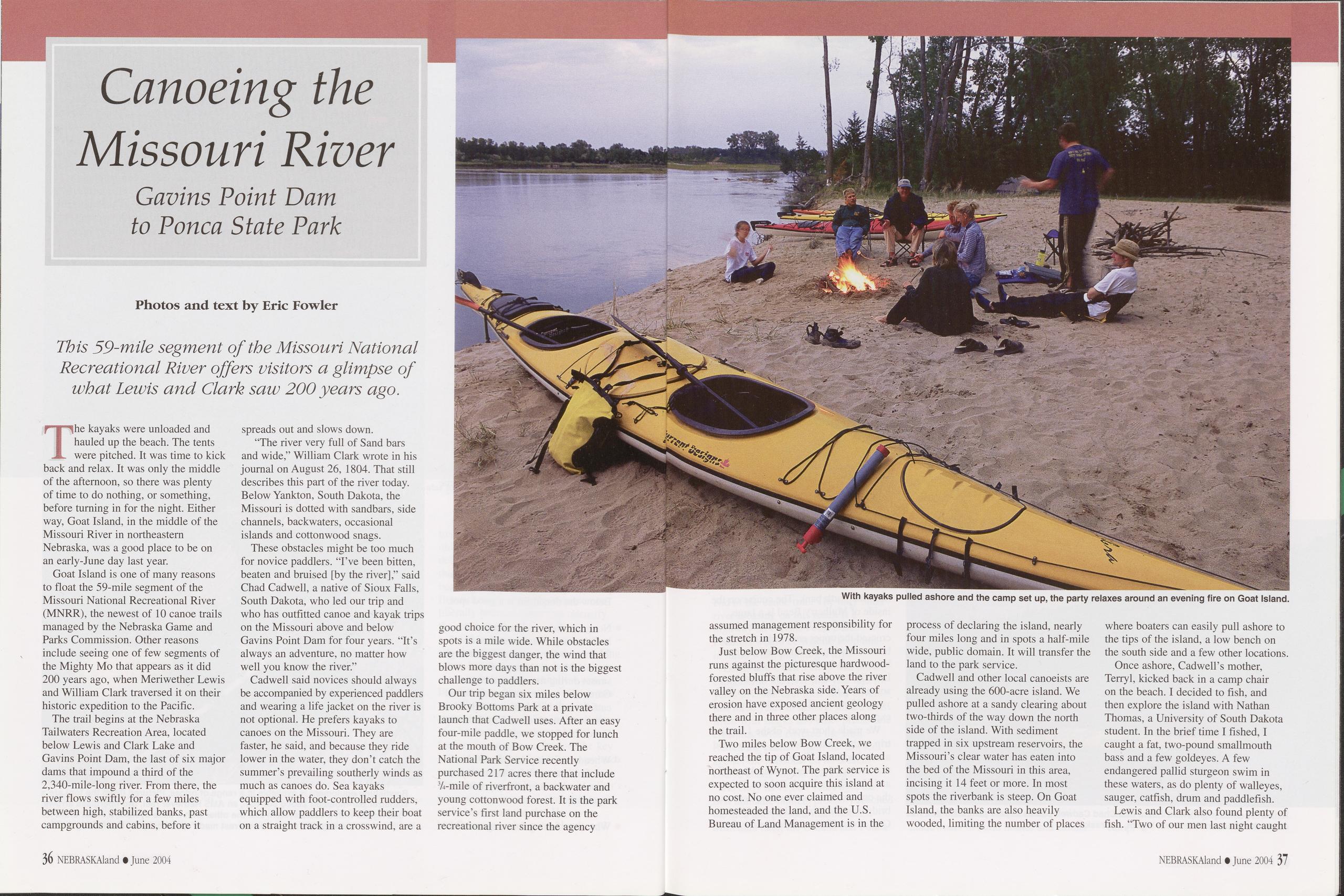
The kayaks were unloaded and hauled up the beach. The tents were pitched. It was time to kick back and relax. It was only the middle of the afternoon, so there was plenty of time to do nothing, or something, before turning in for the night. Either way, Goat Island, in the middle of the Missouri River in northeastern Nebraska, was a good place to be on an early-June day last year.
Goat Island is one of many reasons to float the 59-mile segment of the Missouri National Recreational River (MNRR), the newest of 10 canoe trails managed by the Nebraska Game and Parks Commission. Other reasons include seeing one of few segments of the Mighty Mo that appears as it did 200 years ago, when Meriwether Lewis and William Clark traversed it on their historic expedition to the Pacific.
The trail begins at the Nebraska Tailwaters Recreation Area, located below Lewis and Clark Lake and Gavins Point Dam, the last of six major dams that impound a third of the 2,340-mile-long river. From there, the river flows swiftly for a few miles between high, stabilized banks, past campgrounds and cabins, before it spreads out and slows down.
“The river very full of Sand bars and wide,” William Clark wrote in his journal on August 26, 1804. That still describes this part of the river today. Below Yankton, South Dakota, the Missouri is dotted with sandbars, side channels, backwaters, occasional islands and cottonwood snags.
These obstacles might be too much for novice paddlers. “I’ve been bitten, beaten and bruised [by the river],” said Chad Cadwell, a native of Sioux Falls, South Dakota, who led our trip and who has outfitted canoe and kayak trips on the Missouri above and below Gavins Point Dam for four years. “It’s always an adventure, no matter how well you know the river.”
Cadwell said novices should always be accompanied by experienced paddlers and wearing a life jacket on the river is not optional. He prefers kayaks to canoes on the Missouri. They are faster, he said, and because they ride lower in the water, they don’t catch the summer’s prevailing southerly winds as much as canoes do. Sea kayaks equipped with foot-controlled rudders, which allow paddlers to keep their boat on a straight track in a crosswind, are a
Our trip began six miles below Brooky Bottoms Park at a private launch that Cadwell uses. After an easy four-mile paddle, we stopped for lunch at the mouth of Bow Creek. The National Park Service recently purchased 217 acres there that include %-mile of riverfront, a backwater and young cottonwood forest. It is the park service’s first land purchase on the recreational river since the agency 36 NEBRASKAland • June 2004 assumed management responsibility for the stretch in 1978.
Just below Bow Creek, the Missouri runs against the picturesque hardwood- forested bluffs that rise above the river valley on the Nebraska side. Years of erosion have exposed ancient geology there and in three other places along the trail.
Two miles below Bow Creek, we reached the tip of Goat Island, located northeast of Wynot. The park service is expected to soon acquire this island at no cost. No one ever claimed and homesteaded the land, and the U.S. Bureau of Land Management is in the process of declaring the island, nearly four miles long and in spots a half-mile wide, public domain. It will transfer the land to the park service.
Cadwell and other local canoeists are already using the 600-acre island. We pulled ashore at a sandy clearing about two-thirds of the way down the north side of the island. With sediment trapped in six upstream reservoirs, the Missouri’s clear water has eaten into the bed of the Missouri in this area, incising it 14 feet or more. In most spots the riverbank is steep. On Goat Island, the banks are also heavily wooded, limiting the number of places where boaters can easily pull ashore to the tips of the island, a low bench on the south side and a few other locations.
Once ashore, Cadwell’s mother, Terryl, kicked back in a camp chair on the beach. I decided to fish, and then explore the island with Nathan Thomas, a University of South Dakota student. In the brief time I fished, I caught a fat, two-pound smallmouth bass and a few goldeyes. A few endangered pallid sturgeon swim in these waters, as do plenty of walleyes, sauger, catfish, drum and paddlefish.
Lewis and Clark also found plenty of fish. “Two of our men last night caught NEBRASKAland • June 2004 37 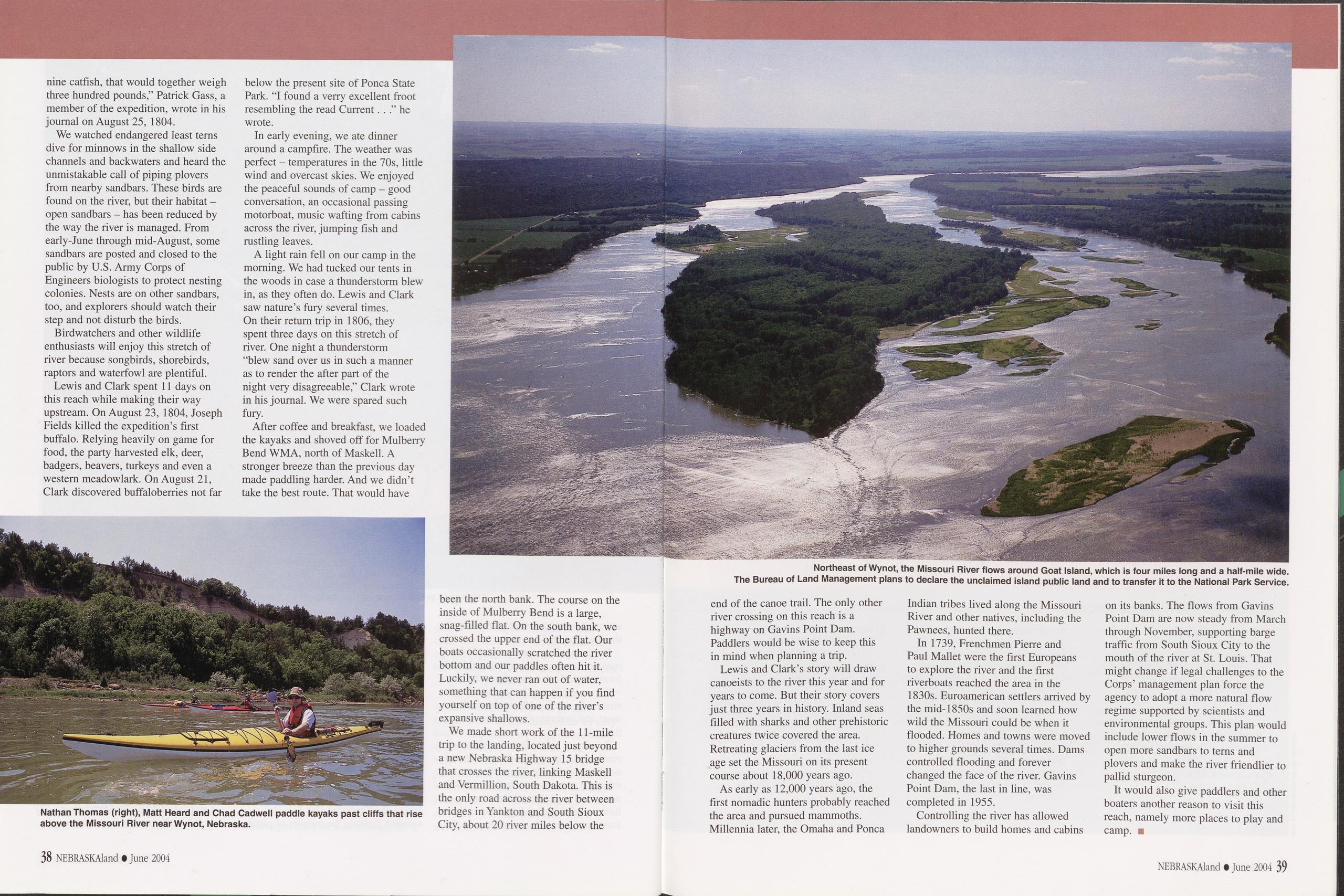 nine catfish, that would together weigh three hundred pounds,” Patrick Gass, a member of the expedition, wrote in his journal on August 25, 1804.
We watched endangered least terns dive for minnows in the shallow side channels and backwaters and heard the unmistakable call of piping plovers from nearby sandbars. These birds are found on the river, but their habitat - open sandbars - has been reduced by the way the river is managed. From early-June through mid-August, some sandbars are posted and closed to the public by U.S. Army Corps of Engineers biologists to protect nesting colonies. Nests are on other sandbars, too, and explorers should watch their step and not disturb the birds.
Birdwatchers and other wildlife enthusiasts will enjoy this stretch of river because songbirds, shorebirds, raptors and waterfowl are plentiful.
Lewis and Clark spent 11 days on this reach while making their way upstream. On August 23, 1804, Joseph Fields killed the expedition’s first buffalo. Relying heavily on game for food, the party harvested elk, deer, badgers, beavers, turkeys and even a western meadowlark. On August 21, Clark discovered buffaloberries not far
In early evening, we ate dinner around a campfire. The weather was perfect - temperatures in the 70s, little wind and overcast skies. We enjoyed the peaceful sounds of camp - good conversation, an occasional passing motorboat, music wafting from cabins across the river, jumping fish and rustling leaves.
A light rain fell on our camp in the morning. We had tucked our tents in the woods in case a thunderstorm blew in, as they often do. Lewis and Clark saw nature’s fury several times. On their return trip in 1806, they spent three days on this stretch of river. One night a thunderstorm "blew sand over us in such a manner as to render the after part of the night very disagreeable,” Clark wrote in his journal. We were spared such fury.
After coffee and breakfast, we loaded the kayaks and shoved off for Mulberry Bend WMA, north of Maskell. A stronger breeze than the previous day made paddling harder. And we didn’t take the best route. That would have
We made short work of the 11-mile trip to the landing, located just beyond a new Nebraska Highway 15 bridge that crosses the river, linking Maskell and Vermillion, South Dakota. This is the only road across the river between bridges in Yankton and South Sioux City, about 20 river miles below the 38 NEBRASKAland • June 2004 end of the canoe trail. The only other river crossing on this reach is a highway on Gavins Point Dam. Paddlers would be wise to keep this in mind when planning a trip.
Lewis and Clark’s story will draw canoeists to the river this year and for years to come. But their story covers just three years in history. Inland seas filled with sharks and other prehistoric creatures twice covered the area. Retreating glaciers from the last ice age set the Missouri on its present course about 18,000 years ago.
As early as 12,000 years ago, the first nomadic hunters probably reached the area and pursued mammoths. Millennia later, the Omaha and Ponca Indian tribes lived along the Missouri River and other natives, including the Pawnees, hunted there.
In 1739, Frenchmen Pierre and Paul Mn allet were the first Europeans to explore the river and the first riverboats reached the area in the 1830s. Euroamerican settlers arrived by the mid-1850s and soon learned how wild the Missouri could be when it flooded. Homes and towns were moved to higher grounds several times. Dams controlled flooding and forever changed the face of the river. Gavins Point Dam, the last in line, was completed in 1955.
Controlling the river has allowed landowners to build homes and cabins on its banks. The flows from Gavins Point Dam are now steady from March through November, supporting barge traffic from South Sioux City to the mouth of the river at St. Louis. That might change if legal challenges to the Corps’ management plan force the agency to adopt a more natural flow regime supported by scientists and environmental groups. This plan would include lower flows in the summer to open more sandbars to terns and plovers and make the river friendlier to pallid sturgeon.
It would also give paddlers and other boaters another reason to visit this reach, namely more places to play and camp.
NEBRASKAland • June 2004 39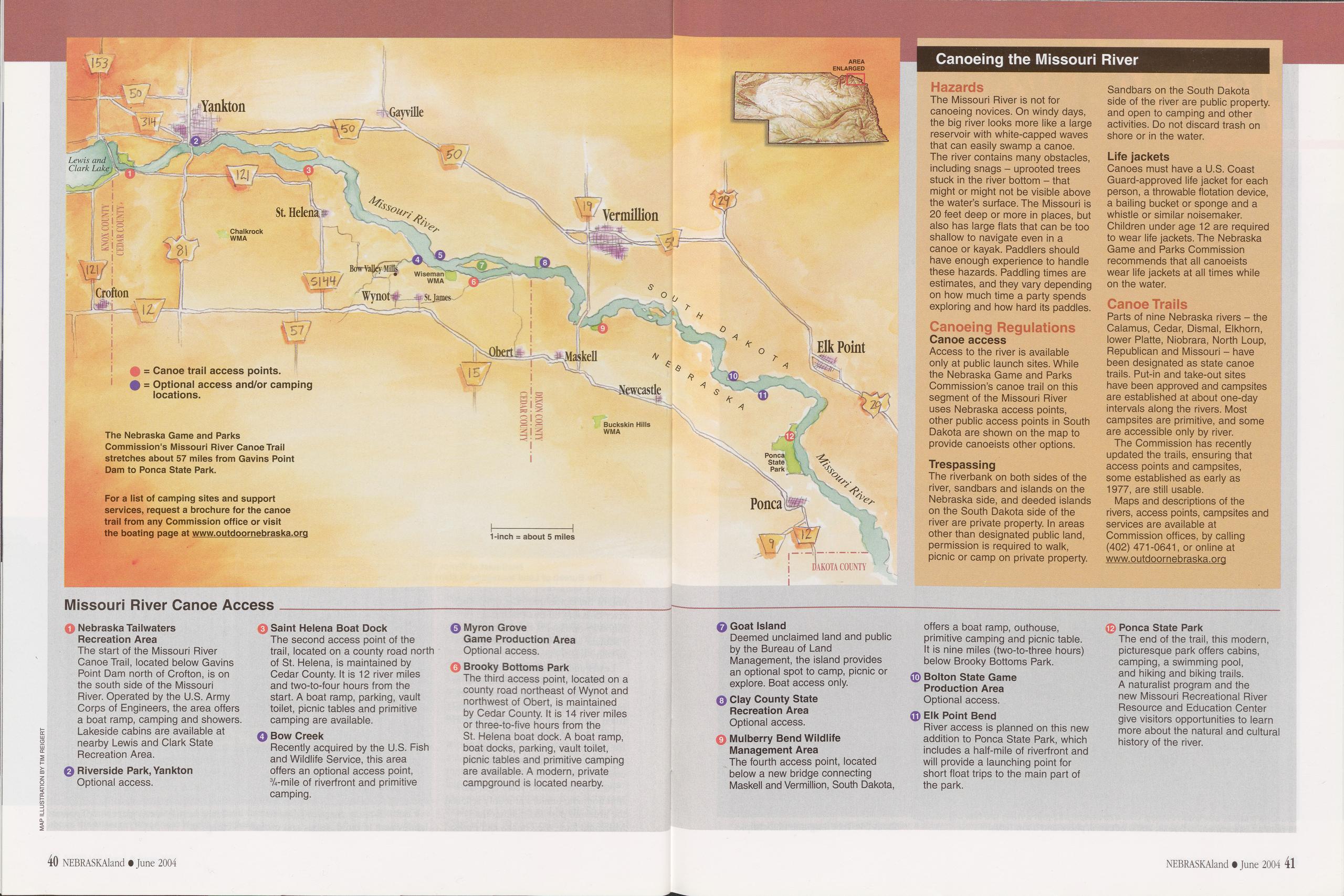
The Missouri River is not for canoeing novices. On windy days, the big river looks more like a large reservoir with white-capped waves that can easily swamp a canoe. The river contains many obstacles, including snags - uprooted trees stuck in the river bottom - that might or might not be visible above the water’s surface. The Missouri is 20 feet deep or more in places, but also has large flats that can be too shallow to navigate even in a canoe or kayak. Paddlers should have enough experience to handle these hazards. Paddling times are estimates, and they vary depending on how much time a party spends exploring and how hard its paddles.
Canoeing Regulations Canoe access Access to the river is available only at public launch sites. While the Nebraska Game and Parks Commission’s canoe trail on this segment of the Missouri River uses Nebraska access points, other public access points in South Dakota are shown on the map to provide canoeists other options. Trespassing The riverbank on both sides of the river, sandbars and islands on the Nebraska side, and deeded islands on the South Dakota side of the river are private property. In areas other than designated public land, permission is required to walk, picnic or camp on private property. Sandbars on the South Dakota side of the river are public property, and open to camping and other activities. Do not discard trash on shore or in the water. Life jackets Canoes must have a U.S. Coast Guard-approved life jacket for each person, a throwable flotation device, a bailing bucket or sponge and a whistle or similar noisemaker. Children under age 12 are required to wear life jackets. The Nebraska Game and Parks Commission recommends that all canoeists wear life jackets at all times while on the water. Canoe TrailsParts of nine Nebraska rivers - the Calamus, Cedar, Dismal, Elkhorn, lower Platte, Niobrara, North Loup, Republican and Missouri - have been designated as state canoe trails. Put-in and take-out sites have been approved and campsites are established at about one-day intervals along the rivers. Most campsites are primitive, and some are accessible only by river.
The Commission has recently updated the trails, ensuring that access points and campsites, some established as early as 1977, are still usable.
Maps and descriptions of the rivers, access points, campsites and services are available at Commission offices, by calling (402) 471-0641, or online at www.outdoornebraska.org
Missouri River Canoe Access 1 Nebraska Tailwaters Recreation Area The start of the Missouri River Canoe Trail, located below Gavins Point Dam north of Crofton, is on the south side of the Missouri River. Operated by the U.S. Army Corps of Engineers, the area offers a boat ramp, camping and showers. Lakeside cabins are available at nearby Lewis and Clark State Recreation Area. 2 Riverside Park, Yankton Optional access. 3 Saint Helena Boat Dock The second access point of the trail, located on a county road north of St. Helena, is maintained by Cedar County. It is 12 river miles and two-to-four hours from the start. A boat ramp, parking, vault toilet, picnic tables and primitive camping are available. 4 Bow Creek Recently acquired by the U.S. Fish and Wildlife Service, this area offers an optional access point, 3/4-mile of riverfront and primitive camping. 5 Myron Grove Game Production Area Optional access. 6 Brooky Bottoms Park The third access point, located on a county road northeast of Wynot and northwest of Obert, is maintained by Cedar County. It is 14 river miles or three-to-five hours from the St. Helena boat dock. A boat ramp, boat docks, parking, vault toilet, picnic tables and primitive camping are available. A modern, private campground is located nearby. 7 Goat Island Deemed unclaimed land and public by the Bureau of Land Management, the island provides an optional spot to camp, picnic or explore. Boat access only. 8 Clay County State Recreation Area Optional access. 9 Mulberry Bend Wildlife Management Area The fourth access point, located below a new bridge connecting Maskell and Vermillion, South Dakota, offers a boat ramp, outhouse, primitive camping and picnic table. It is nine miles (two-to-three hours) below Brooky Bottoms Park. 10 Bolton State Game Production Area Optional access. 11 Elk Point Bend River access is planned on this new addition to Ponca State Park, which includes a half-mile of riverfront and will provide a launching point for short float trips to the main part of the park. 12 Ponca State Park The end of the trail, this modern, picturesque park offers cabins, camping, a swimming pool, and hiking and biking trails. A naturalist program and the new Missouri Recreational River Resource and Education Center give visitors opportunities to learn more about the natural and cultural history of the river. 40 NEBRASKAland • June 2004 NEBRASKAland • June 2004 41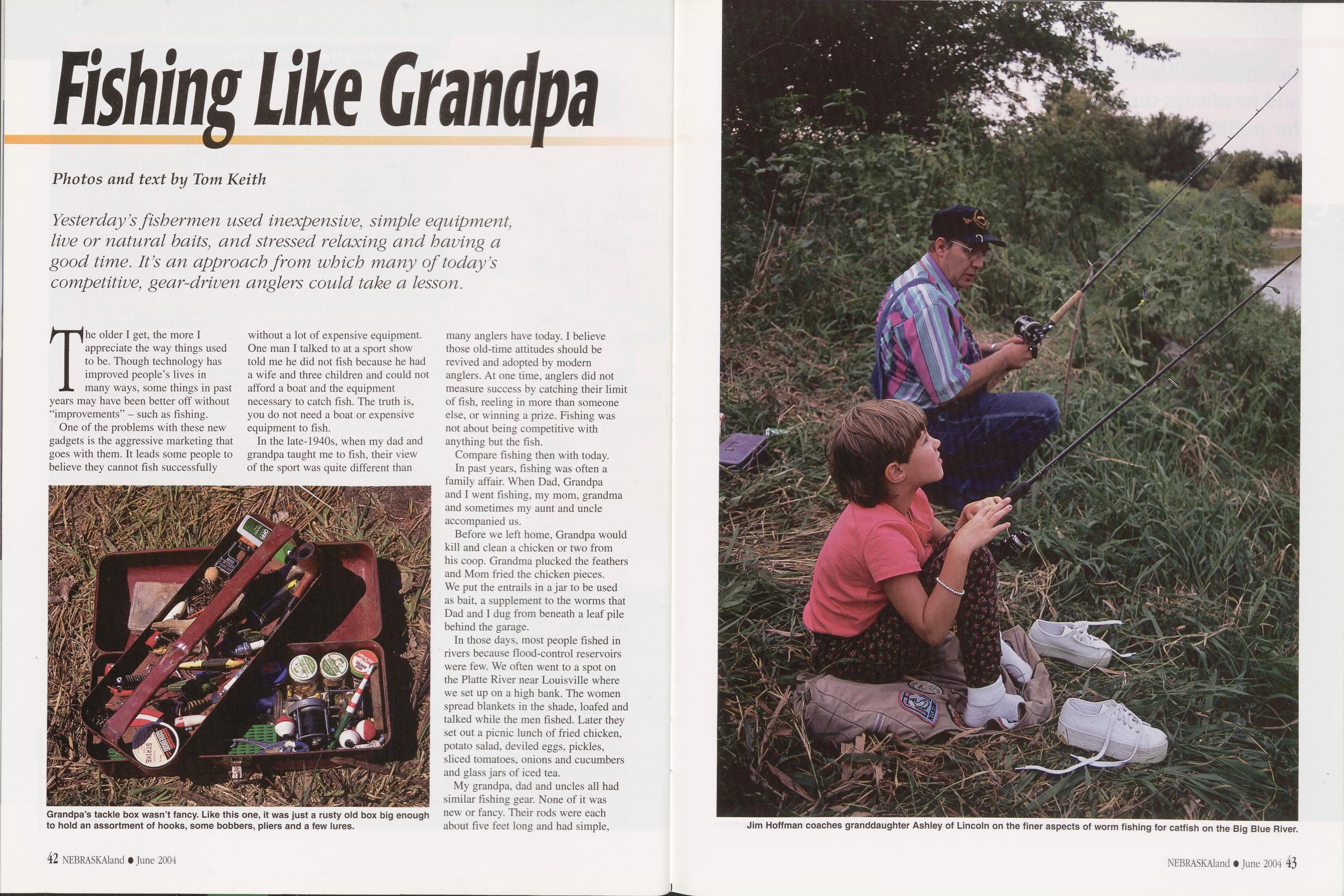
Fishing Like Grandpa
Yesterday’s fishermen used inexpensive, simple equipment, live or natural baits, and stressed relaxing and having a good time. It’s an approach from which many of today’s competitive, gear-driven anglers could take a lesson.
The older I get, the more I appreciate the way things used to be. Though technology has improved people’s lives in many ways, some things in past years may have been better off without “improvements” - such as fishing.
One of the problems with these new gadgets is the aggressive marketing that goes with them. It leads some people to believe they cannot fish successfully
In the late-1940s, when my dad and grandpa taught me to fish, their view of the sport was quite different than many anglers have today. I believe those old-time attitudes should be revived and adopted by modern anglers. At one time, anglers did not measure success by catching their limit of fish, reeling in more than someone else, or winning a prize. Fishing was not about being competitive with anything but the fish.
Compare fishing then with today. In past years, fishing was often a family affair. When Dad, Grandpa and I went fishing, my mom, grandma and sometimes my aunt and uncle accompanied us.
Before we left home, Grandpa would kill and clean a chicken or two from his coop. Grandma plucked the feathers and Mom fried the chicken pieces. We put the entrails in a jar to be used as bait, a supplement to the worms that Dad and I dug from beneath a leaf pile behind the garage.
In those days, most people fished in rivers because flood-control reservoirs were few. We often went to a spot on the Platte River near Louisville where we set up on a high bank. The women spread blankets in the shade, loafed and talked while the men fished. Later they set out a picnic lunch of fried chicken, potato salad, deviled eggs, pickles, sliced tomatoes, onions and cucumbers and glass jars of iced tea.
My grandpa, dad and uncles all had similar fishing gear. None of it was new or fancy. Their rods were each about five feet long and had simple,
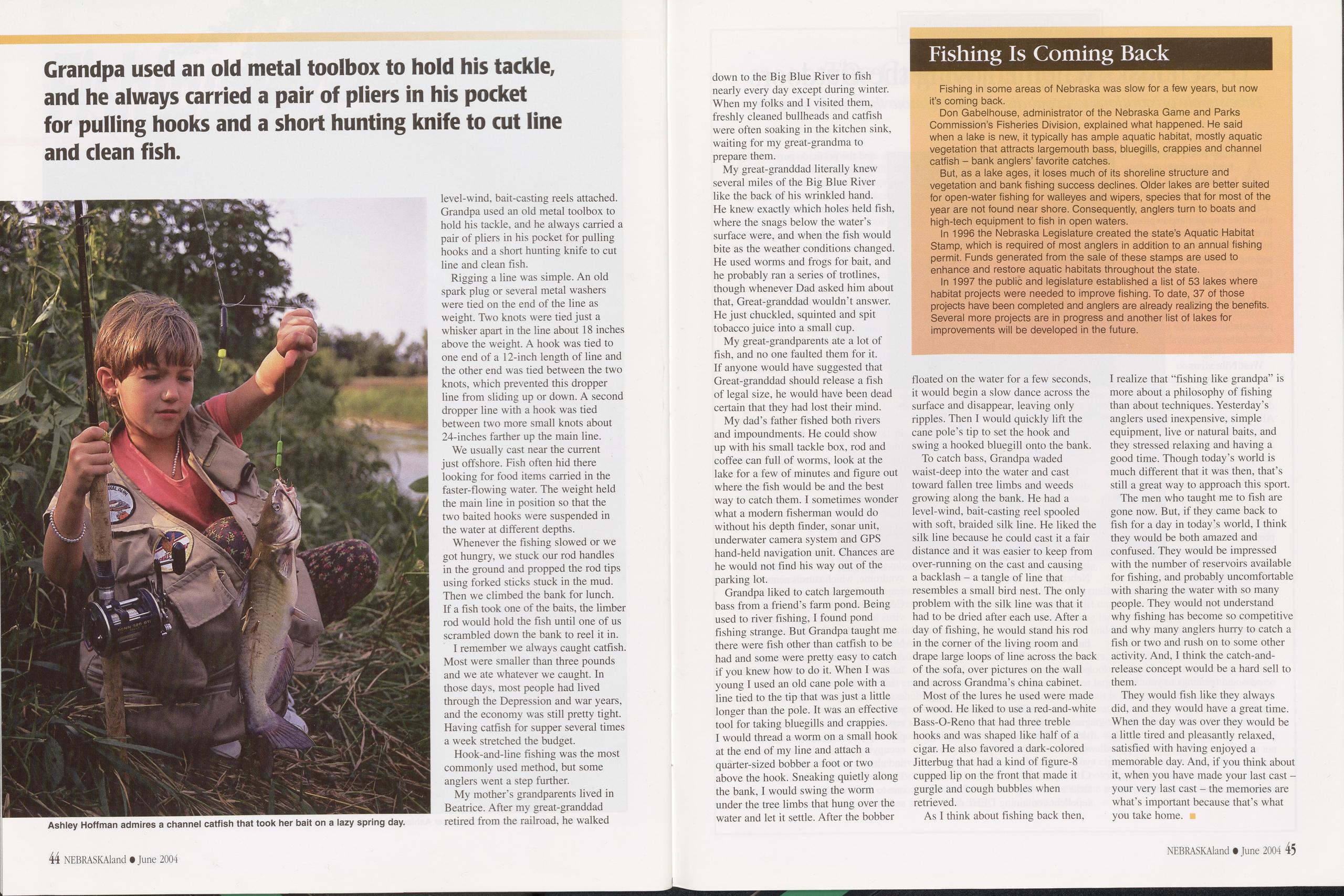 level-wind, bait-casting reels attached. Grandpa used an old metal toolbox to hold his tackle, and he always carried a pair of pliers in his pocket for pulling hooks and a short hunting knife to cut line and clean fish.
Grandpa used an old metal toolbox to hold his tackle, and he always carried a pair of pliers in his pocket for pulling hooks and a short hunting knife to cut line and clean fish.
Rigging a line was simple. An old spark plug or several metal washers were tied on the end of the line as weight. Two knots were tied just a whisker apart in the line about 18 inches above the weight. A hook was tied to one end of a 12-inch length of line and the other end was tied between the two knots, which prevented this dropper line from sliding up or down. A second dropper line with a hook was tied between two more small knots about 24-inches farther up the main line.
We usually cast near the current just offshore. Fish often hid there looking for food items carried in the faster-flowing water. The weight held the main line in position so that the two baited hooks were suspended in the water at different depths.
Whenever the fishing slowed or we got hungry, we stuck our rod handles in the ground and propped the rod tips using forked sticks stuck in the mud. Then we climbed the bank for lunch. If a fish took one of the baits, the limber rod would hold the fish until one of us scrambled down the bank to reel it in.
I remember we always caught catfish. Most were smaller than three pounds and we ate whatever we caught. In those days, most people had lived through the Depression and war years, and the economy was still pretty tight. Having catfish for supper several times a week stretched the budget.
Hook-and-line fishing was the most commonly used method, but some anglers went a step further.
My mother’s grandparents lived in Beatrice. After my great-granddad retired from the railroad, he walked down to the Big Blue River to fish nearly every day except during winter. When my folks and I visited them, freshly cleaned bullheads and catfish were often soaking in the kitchen sink, waiting for my great-grandma to prepare them.
My great-granddad literally knew several miles of the Big Blue River like the back of his wrinkled hand. He knew exactly which holes held fish, where the snags below the water’s surface were, and when the fish would bite as the weather conditions changed. He used worms and frogs for bait, and he probably ran a series of trotlines, though whenever Dad asked him about that, Great-granddad wouldn’t answer. He just chuckled, squinted and spit tobacco juice into a small cup.
My great-grandparents ate a lot of fish, and no one faulted them for it. If anyone would have suggested that Great-granddad should release a fish of legal size, he would have been dead certain that they had lost their mind.
My dad’s father fished both rivers and impoundments. He could show up with his small tackle box, rod and coffee can full of worms, look at the lake for a few of minutes and figure out where the fish would be and the best way to catch them. I sometimes wonder what a modern fisherman would do without his depth finder, sonar unit, underwater camera system and GPS hand-held navigation unit. Chances are he would not find his way out of the parking lot.
Grandpa liked to catch largemouth bass from a friend’s farm pond. Being used to river fishing, I found pond fishing strange. But Grandpa taught me there were fish other than catfish to be had and some were pretty easy to catch if you knew how to do it. When I was young I used an old cane pole with a line tied to the tip that was just a little longer than the pole. It was an effective tool for taking bluegills and crappies. I would thread a worm on a small hook at the end of my line and attach a quarter-sized bobber a foot or two above the hook. Sneaking quietly along the bank, I would swing the worm under the tree limbs that hung over the water and let it settle. After the bobber floated on the water for a few seconds, it would begin a slow dance across the surface and disappear, leaving only ripples. Then I would quickly lift the cane pole’s tip to set the hook and swing a hooked bluegill onto the bank.
To catch bass, Grandpa waded waist-deep into the water and cast toward fallen tree limbs and weeds growing along the bank. He had a level-wind, bait-casting reel spooled with soft, braided silk line. He liked the silk line because he could cast it a fair distance and it was easier to keep from over-running on the cast and causing a backlash - a tangle of line that resembles a small bird nest. The only problem with the silk line was that it had to be dried after each use. After a day of fishing, he would stand his rod in the corner of the living room and drape large loops of line across the back of the sofa, over pictures on the wall and across Grandma’s china cabinet.
Most of the lures he used were made of wood. He liked to use a red-and-white Bass-O-Reno that had three treble hooks and was shaped like half of a cigar. He also favored a dark-colored Jitterbug that had a kind of figure-8 cupped lip on the front that made it gurgle and cough bubbles when retrieved.
As I think about fishing back then, I realize that “fishing like grandpa” is more about a philosophy of fishing than about techniques. Yesterday’s anglers used inexpensive, simple equipment, live or natural baits, and they stressed relaxing and having a good time. Though today’s world is much different that it was then, that’s still a great way to approach this sport.
The men who taught me to fish are gone now. But, if they came back to fish for a day in today’s world, I think they would be both amazed and confused. They would be impressed with the number of reservoirs available for fishing, and probably uncomfortable with sharing the water with so many people. They would not understand why fishing has become so competitive and why many anglers hurry to catch a fish or two and rush on to some other activity. And, I think the catch-and- release concept would be a hard sell to them.
They would fish like they always did, and they would have a great time. When the day was over they would be a little tired and pleasantly relaxed, satisfied with having enjoyed a memorable day. And, if you think about it, when you have made your last cast - your very last cast - the memories are what’s important because that’s what you take home.
Fishing Is Coming BackFishing in some areas of Nebraska was slow for a few years, but now it’s coming back.
Don Gabelhouse, administrator of the Nebraska Game and Parks Commission’s Fisheries Division, explained what happened. He said when a lake is new, it typically has ample aquatic habitat, mostly aquatic vegetation that attracts largemouth bass, bluegills, crappies and channel catfish - bank anglers’ favorite catches.
But, as a lake ages, it loses much of its shoreline structure and vegetation and bank fishing success declines. Older lakes are better suited for open-water fishing for walleyes and wipers, species that for most of the year are not found near shore. Consequently, anglers turn to boats and high-tech equipment to fish in open waters.
In 1996 the Nebraska Legislature created the state’s Aquatic Habitat Stamp, which is required of most anglers in addition to an annual fishing permit. Funds generated from the sale of these stamps are used to enhance and restore aquatic habitats throughout the state.
In 1997 the public and legislature established a list of 53 lakes where habitat projects were needed to improve fishing. To date, 37 of those projects have been completed and anglers are already realizing the benefits. Several more projects are in progress and another list of lakes for improvements will be developed in the future.
44 NEBRASKAland • June 2004 NEBRASKAland • June 2004 45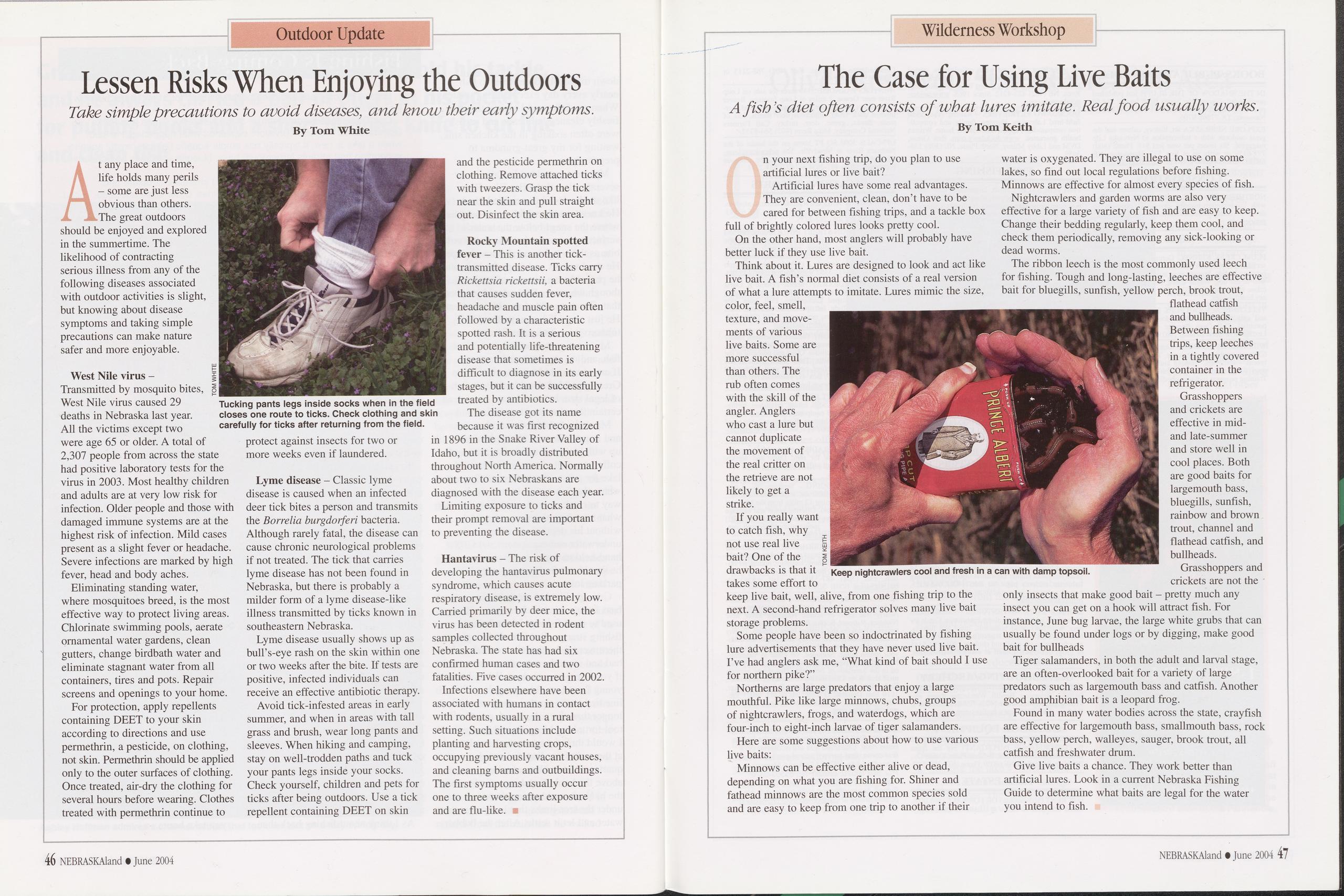
Outdoor Update
Lessen Risks When Enjoying the Outdoors
Take simple precautions to avoid diseases, and know their early symptoms.
At any place and time, life holds many perils some are just less obvious than others. The great outdoors should be enjoyed and explored in the summertime. The likelihood of contracting serious illness from any of the following diseases associated with outdoor activities is slight, but knowing about disease symptoms and taking simple precautions can make nature safer and more enjoyable.
West Nile virus -Transmitted by mosquito bites, West Nile virus caused 29 deaths in Nebraska last year. All the victims except two were age 65 or older. A total of 2,307 people from across the state had positive laboratory tests for the virus in 2003. Most healthy children and adults are at very low risk for infection. Older people and those with damaged immune systems are at the highest risk of infection. Mild cases present as a slight fever or headache. Severe infections are marked by high fever, head and body aches.
Eliminating standing water, where mosquitoes breed, is the most effective way to protect living areas. Chlorinate swimming pools, aerate ornamental water gardens, clean gutters, change birdbath water and eliminate stagnant water from all containers, tires and pots. Repair screens and openings to your home.
For protection, apply repellents containing DEET to your skin according to directions and use permethrin, a pesticide, on clothing, not skin. Permethrin should be applied only to the outer surfaces of clothing. Once treated, air-dry the clothing for several hours before wearing. Clothes treated with permethrin continue to
Lyme disease -
Classic lyme disease is caused when an infected deer tick bites a person and transmits the Borrelia burgdorferi bacteria. Although rarely fatal, the disease can cause chronic neurological problems if not treated. The tick that carries lyme disease has not been found in Nebraska, but there is probably a milder form of a lyme disease-like illness transmitted by ticks known in southeastern Nebraska.
Lyme disease usually shows up as bull’s-eye rash on the skin within one or two weeks after the bite. If tests are positive, infected individuals can receive an effective antibiotic therapy.
Avoid tick-infested areas in early summer, and when in areas with tall grass and brush, wear long pants and sleeves. When hiking and camping, stay on well-trodden paths and tuck your pants legs inside your socks. Check yourself, children and pets for ticks after being outdoors. Use a tick repellent containing DEET on skin and the pesticide permethrin on clothing. Remove attached ticks with tweezers. Grasp the tick near the skin and pull straight out. Disinfect the skin area.
Rocky Mountain spotted fever -This is another tick- transmitted disease. Ticks carry Rickettsia rickettsii, a bacteria that causes sudden fever, headache and muscle pain often followed by a characteristic spotted rash. It is a serious and potentially life-threatening disease that sometimes is difficult to diagnose in its early stages, but it can be successfully treated by antibiotics.
The disease got its name because it was first recognized in 1896 in the Snake River Valley of Idaho, but it is broadly distributed throughout North America. Normally about two to six Nebraskans are diagnosed with the disease each year.
Limiting exposure to ticks and their prompt removal are important to preventing the disease.
Hantavirus -The risk of developing the hantavirus pulmonary syndrome, which causes acute respiratory disease, is extremely low. Carried primarily by deer mice, the virus has been detected in rodent samples collected throughout Nebraska. The state has had six confirmed human cases and two fatalities. Five cases occurred in 2002.
Infections elsewhere have been associated with humans in contact with rodents, usually in a rural setting. Such situations include planting and harvesting crops, occupying previously vacant houses, and cleaning bams and outbuildings. The first symptoms usually occur one to three weeks after exposure and are flu-like.
46 NEBRASKAland • June 2004Wilderness Workshop
The Case for Using Live Baits
A fish’s diet often consists of what lures imitate. Real food usually works.
On your next fishing trip, do you plan to use artificial lures or live bait?
Artificial lures have some real advantages. They are convenient, clean, don’t have to be cared for between fishing trips, and a tackle box full of brightly colored lures looks pretty cool. On the other hand, most anglers will probably have better luck if they use live bait.
Think about it. Lures are designed to look and act like live bait. A fish’s normal diet consists of a real version of what a lure attempts to imitate. Lures mimic the size, color, feel, smell, texture, and move- ments of various live baits. Some are more successful than others. The rub often comes with the skill of the angler. Anglers who cast a lure but cannot duplicate the movement of the real critter on the retrieve are not likely to get a strike.
If you really want to catch fish, why not use real live bait? One of the drawbacks is that it takes some effort to keep live bait, well, alive, from one fishing trip to the next. A second-hand refrigerator solves many live bait storage problems.
Some people have been so indoctrinated by fishing lure advertisements that they have never used live bait. I’ve had anglers ask me, "What kind of bait should I use for northern pike?”
Northerns are large predators that enjoy a large mouthful. Pike like large minnows, chubs, groups of nightcrawlers, frogs, and waterdogs, which are four-inch to eight-inch larvae of tiger salamanders.
Here are some suggestions about how to use various live baits:Minnows can be effective either alive or dead, depending on what you are fishing for. Shiner and fathead minnows are the most common species sold and are easy to keep from one trip to another if their water is oxygenated. They are illegal to use on some lakes, so find out local regulations before fishing. Minnows are effective for almost every species of fish.
Nightcrawlers and garden worms are also very effective for a large variety of fish and are easy to keep. Change their bedding regularly, keep them cool, and check them periodically, removing any sick-looking or dead worms.
The ribbon leech is the most commonly used leech for fishing. Tough and long-lasting, leeches are effective bait for bluegills, sunfish, yellow perch, brook trout, flathead catfish and bullheads. Between fishing trips, keep leeches in a tightly covered container in the refrigerator.
Grasshoppers and crickets are effective in mid- and late-summer and store well in cool places. Both are good baits for largemouth bass, bluegills, sunfish, rainbow and brown trout, channel and flathead catfish, and bullheads.
Grasshoppers and crickets are not the only insects that make good bait - pretty much any insect you can get on a hook will attract fish. For instance, June bug larvae, the large white grubs that can usually be found under logs or by digging, make good bait for bullheads
Tiger salamanders, in both the adult and larval stage, are an often-overlooked bait for a variety of large predators such as largemouth bass and catfish. Another good amphibian bait is a leopard frog.
Found in many water bodies across the state, crayfish are effective for largemouth bass, smallmouth bass, rock bass, yellow perch, walleyes, sauger, brook trout, all catfish and freshwater drum.
Give live baits a chance. They work better than artificial lures. Look in a current Nebraska Fishing Guide to determine what baits are legal for the water you intend to fish.
Classifieds
BOOKS/PUBLICATION S/VIDEOS
IN THE SHADOW OF THE BLUFF, just published novel about migrant life; Scotts Bluff locale; $14.50 ppd. Betty Heidbreder Dunn, 410 County Rd. 324, Navasota, TX 77868-9706.
EXPLORE NEBRASKA art, history, culture and the great outdoors with a subscription to Nebraska Life magazine. Six issues per year just $19. Phone (800) 777-6159 or write us at Box 577, Hartington, NE 68739. Makes a great gift. Visit NebraskaLife.com.
CONSERVATION
NORTHERN PRAIRIES LAND TRUST. Working with conservation-minded private landowners to develop conservation solutions, www.northern- prairies.org.
DOGS
PLUM CREEK KENNEL. German Shorthairs, stud service, puppies and started dogs. Training for all pointing breeds. Specialize in training the handler as well as the dog. Wayne Clark, Percival, Iowa 51648 (close to Omaha) (712) 529-4238, email wclark@sid- ney.heartland.net.
YELLOW-BLACK LAB PUPS. Breeders hips O.F.A. and eyes CERF. Excellent bloodlines and hunting potential. Call Dave Bendler (308) 785-2554 in Lexington or Scott Bendler (402) 477-1305, Lincoln.
WILDERNESS KENNELS. Gun dog training - over 60 years combined experience. Training all sporting breeds - retrievers, flushing and pointing dogs. All dogs worked on pen-raised birds and wild game. Training program includes obedience training - heel,
NEBRASKAland Magazine For Visa or MasterCard orders, call 1-800-NEB-LAND (632-5263) For mail orders, send check or money order to NEBRASKAland Magazine P.O. Box 30370 Lincoln, NE 68503-0370 Order online at QHldoornebraska. org
sit, stay, down and come when called. Pups, started dogs and fully trained dogs for sale. Hunting dogs trained by hunters. Henry Sader, Wilderness Kennels, Roca, NE (402) 423-4212. Since 1968. www.wilder- nesskennels.com
DUCKDAWG RETRIEVERS - Raising exceptional field-bred Labradors. Hunting, family and competi- tion companions. Puppies raised in our home. Written health guarantee, www.duckdawg.com. Ron Green, DVM and Libby Milroy, North Platte, NE (308) 534- 3659.
FISH/FISHING
FISH FOR SALE. Catfish, largemouth bass, small- mouth bass, perch, crappies, bluegills, walleyes, rain- bow trout, grass carp, minnows, bullheads. Consulting available. Pleasant Valley Fish Farm, RR 1, Box 147, McCook, NE 69001. Phone (308) 345-6599.
NEBRASKA LAKE MANAGEMENT - Biological lake surveys, fish stocking, rough fish control, lake aeration, algae control, shorewall construction. Rob Hofpar, Aquatic Biologist, licensed, insured and qualified. Phone (402) 784-6005 (Lincoln), or toll-free (888) 850-2460.
WILLOW LAKE FISH HATCHERY - Channel cat, bluegill, hybrid bluegill, largemouth bass, crappie, grass carp, walleye, perch, minnows available for stocking. Gaylord Crawford and Son, 7580 N. Highland Rd., Hastings, NE 68901-9339 or phone (402) 463-8022 day or night. Also pond consultant. We deliver.
FOOD/GIFTS/HOME
ENJOY A TASTE of the good life! Award-winning gourmet BBQ sauces and seasonings, breadings, native jellies, fruit butters, honey, coffees and more! Great gift-set ideas! Toll free (888) 926-2879 or (308) 468-5635. Hollman Foods, 1948 36 Road, Minden, NE 68959, or www.hollmans.com
HOMEBREWING/BEER & WINEMAKING sup- plies. Fermenter’s Supply, 8410 K Plz. #10, Omaha, NE 68127. (402) 593-9171. Mail orders welcome. www.fermenterssupply.com
GUIDES/ OUTFITTERS
CANOE THE NIOBRARA with an affordable canoe trip by Dryland Aquatics. One- and two-day trips...full service, or just canoe, tube or kayak. Transportation furnished. Your Niobrara River specialists... We do it your way! Dryland Aquatics, Dept. N, Box 33C, Sparks, NE 69220 or phone (800) 337-3119. www.drv- landaquatics.com info@drylandaquatics.com.
HENNECKE HUNTS Guided hunts in Nebraska for Canada geese near Lewellen and late-season snow geese near Beatrice. Heated pit blind hunting on decoyed birds. 29 years waterfowling experience. 14 years Nebraska Hunter Education Instructor. Pointing Labrador retriever pups for sale. (402) 645-8223, e-mail: kevin@henneckehunts.com, web site: henneckehunts.com.
KRIPPLE DUCK ADVENTURES - Southwestern Nebraska. Guided hunts along Frenchman Creek for deer, waterfowl, wild pheasants, quail and turkeys. New for 2004, we have started a controlled hunting area for pheasants, quail and chukars, (308) 394-5345 or (308) 280-5345. E-mail at cdom@bwtelcom.net. www.krippleduck.com.
GUNS/SHOOTING/ARCHERY
GUNS - Browning, Benelli, Winchester, Ruger, etc. 1700 guns, buy-sell-trade (402) 729-6112, Bedlan’s, Fairbury, NE 68352. www.bedlans.com.
OUTDOOR EQUIPMENT
IS PERFORMANCE IMPORTANT? For the finest canoes and accessories look to Great Plains Canoe Co., 205 Main, Springfield, NE 68059. Phone (402) 253-2000.
REAL ESTATE
FOR RENT ($650/month) OR FOR SALE ($65,000). Three-bedroom house at Lake McConaughy. Detached two-car garage. Call (402) 768-2113 or (308) 355-7531.
HUNTERS PARADISE! 340 acres for sale on Loup River near Genoa, 2 miles of Loup frontage, Beaver Creek flows through the land, spring-fed pond, per- manent duck blind, numerous deer stands, lots of trees, ducks, geese, deer, turkey. Call Farmers National Company, Mike Bemt (402) 564-8332.
UPSCALE 3000 SQ FT home on the banks of the Niobrara River at Meadville. See nebraskarealesta- teonline.com then click on acreages, the click on homepage. (402) 497-2634 or (402) 684-2711.
VACATIONS/RESORTS
FOR FISHING AND HUNTING accommodations. Guided pheasant hunts. Jefco Inn, Gordon, NE 69343. South Cornell, (308) 282-2935.
THE OLDE MAIN STREET INN. A historic bed and breakfast listed in the National Register of Historic Places. Beautiful dining room with fireplace. Featuring prime rib, buffalo, seafood, homemade soups, chilis and desserts. 115 Main Street, Chadron NE 69337 (308) 432-3380. www.chadron.com/oldemain.
SANDHILL HIDEAWAY! Scenic Double R Guest Ranch south of Valentine. Open all year. Great lodging with fully furnished kitchenettes. Fish, hunt, ride horses, relax. Right for sportsmen, families, small groups, artists, writers, newlyweds! Call (866) 217- 2042. www.sandhilldoublerranch.com
LORD RANCH RESORT. Hunters, fishermen, family vacations, family reunions. New deluxe cabins. Complete cooking facilities. Quiet and peaceful in the middle of the Sandhills. Three miles north of the Valentine Wildlife Refuge, open all year. Aubrey and Dorothy Lord, HC 37, Box 41, Valentine, NE 69201. Call (800) 270-0181.www.lordranchresort.com
DIAMOND B TROUT RESORT & RESTAURANT, Orchard, Nebraska. Lodge, cabins, restaurant, spring- fed lakes, playground equipment, paddleboats. Great for families, groups, hunters. Book your cabin now! Call for brochure (800) 974-3002. www.diamondh- troutresort.com
SANDY BEACH PARADISE at Lake McConaughy. Three-bedroom house for rent. Daily and weekly rates. $90 per day. Call (402) 768-2113 or (308) 355- 7531.
MILL IRON V LODGING - Verdigre, NE. 3 new cabins with cooking facilities, walk-in showers, AC. In secluded scenic setting 12 miles from the Missouri River. Open year-round. Offering horse and carriage rides or bring your own horse and ride off road. (402) 668-7488, email jpeinrem@carrollsweb.com, www.milliron-v-lodging.com.
BOX BUTTE RESERVOIR, located 10 miles north of Hemingford. One of Nebraska’s top lakes; breathtak- ing scenery; boating, fishing, camping, hiking, jet ski- ing, mountain biking. Family fun! For more informa- tion, call (308) 487-3300 or visit www.visit- boxbutte.com.
RECREATIONAL PROPERTY - 924 acres, 2 miles of Schlagel Creek with brown and rainbow trout. Nearly one mile of scenic Niobrara River near Niobrara National Scenic River Corridor. Bountiful waterfowl making this a nature lover’s dream. Trophy mule, white-tailed deer, turkey and grouse are abun- dant on this property. Several beautiful sites to build your dream home. Secluded, yet close to Valentine, NE-America’s Heart City. Thriving community locat- ed in the Sandhills of Nebraska. This strong agricul- tural area is an Outdoorsman’s Paradise. $924,000., Earley Real Estate, Inc., Thomas F. Earley, Broker, 1010 East Douglas, O’Neill, NE 68763, (402) 336- 4005, e-mail earley@morcomm.net, website earlevrealestate.com.
Classified Rates: 750 per word, minimum $15. Closing: First business day two months before issue date. Classified ads are accepted on a first-come, first-served, space-available basis. Classified Ads, NEBRASKAland Magazine, P.O. Box 30370, Lincoln, NE 68503-0370. Telephone (402) 471-5585. Fax: (402) 471-5528. E-mail: nebland@ngpc.state.ne.us. Ads are posted online at outdoomebraska. oro/nebland at no additional charge.
Parks & Places
Oliver Reservoir State Recreation Area
Camping areas, fishing pier and swimming beach attract visitors.
Located eight miles west of Kimball on U.S. Highway 30, Oliver Reservoir State Recreation Area is the only water-based recreational area in the southwestern Panhandle. The lake offers excellent bank and boat fishing and the area’s tree-shaded shoreline is popular with anglers, campers and day visitors from Nebraska, Colorado and Wyoming. A new self-registration system for daily park entry permit sales offers increased convenience for Oliver visitors.
The area includes a 270-acre lake area and 917 acres of uplands. Oliver has both day-use-only areas for fishing and picnicking below the dam and along the western end of the lake. There are designated camping areas for self-contained RVs and tent campers along the northern shore of the reservoir. Electrical hookups are not available, but the area’s facilities include two boat ramps, docks, a swimming beach, changing houses, drinking water, vault toilets, picnic tables, shelters, grills, lighting and parking lots.
The southern shore of the lake is maintained in a primitive state for hiking, fishing and hunting. The fee for primitive camping is $4 per night, and all sites are available on a first-come, first-served basis. Stays are limited to 14 consecutive days during any 30-day period. A valid Nebraska State Park Entry Permit is required for vehicles entering Oliver SRA. Oliver Reservoir was originally
built in 1911 as an irrigation impoundment on Lodgepole Creek and it served generations of outdoor enthusiasts with excellent fishing, hunting and water recreation. The lake was drained in 1976 when the dam no longer met structural and safety requirements. A cooperative effort by area residents and local and state governments rebuilt the dam and refilled the reservoir. More than $100,000 from private contributions and money from the South Platte Natural Resources District matched state and federal project funding.
Drought across the region has lowered water levels at Oliver Reservoir and reduced access to one of the lake’s two boat ramps during low-water periods. The lake’s wheelchair-accessible fishing pier is popular with anglers.
Lower water levels and efforts by Nebraska Game and Parks Commission fisheries biologists to improve the lake’s fishery have prompted recent fisheries manage- ment changes. The lake is currently stocked annually with walleyes and with channel catfish as needed. Biologists plan to manage the lake for walleyes, white crappies, channel catfish and trophy muskellunge. In recent years, the Commission’s state parks division reduced maintenance and mowing operations in many of Nebraska’s 87 parks and recre- ation areas because of budget reductions. Park visitors at Oliver Reservoir and other state areas are invited to pitch-in to maintain the park’s beauty by disposing of trash in the provided containers and leaving the park as clean as possible.
For additional information on Oliver Reservoir SRA, contact the Commission’s Wildcat Hills maintenance office at P.O. Box 65, Gering, NE 69341, by phone at (308) 436-2383, or by e-mail at wildcat© scottsbluff.net. Visitors may also contact the Wildcat Hills SRA and Nature Center, 210615 Hwy 71, Gering, NE 69341, (308) 436-3777, and wildcat@ngpc.state.ne.us, or the Commission’s web site at www.outdoomebraska.org. ■
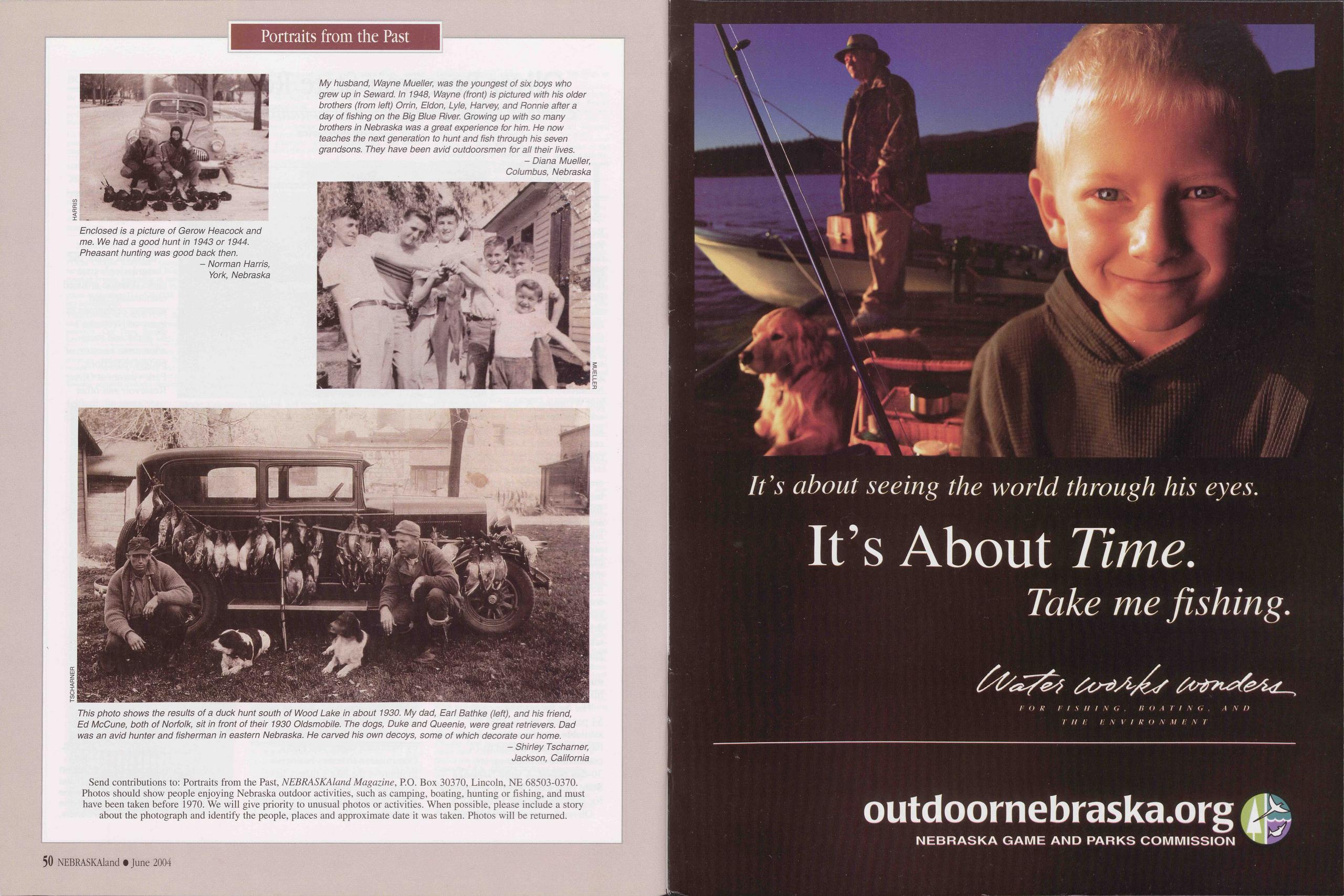
Portraits from the Past

Position: 541 (20 views)