Volume 82, Issue 4, 2004
NEBRASKAland
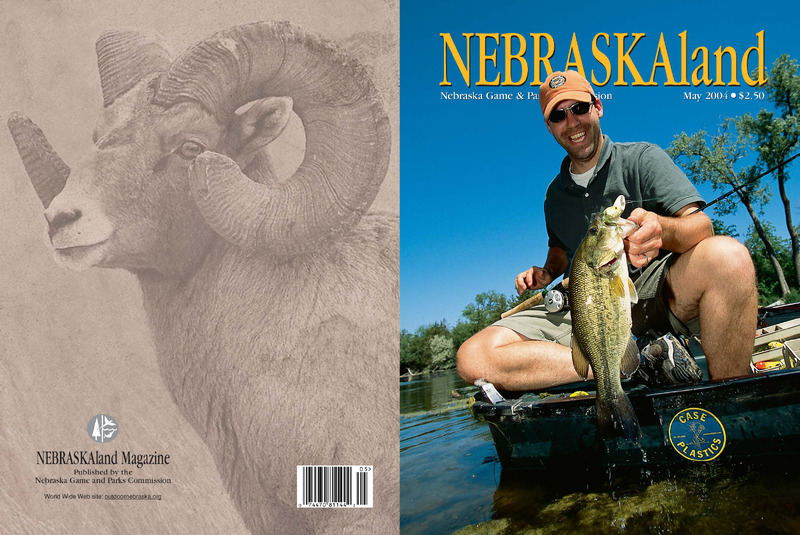
Nebraska Game & Parks Commission May 2004 $2.50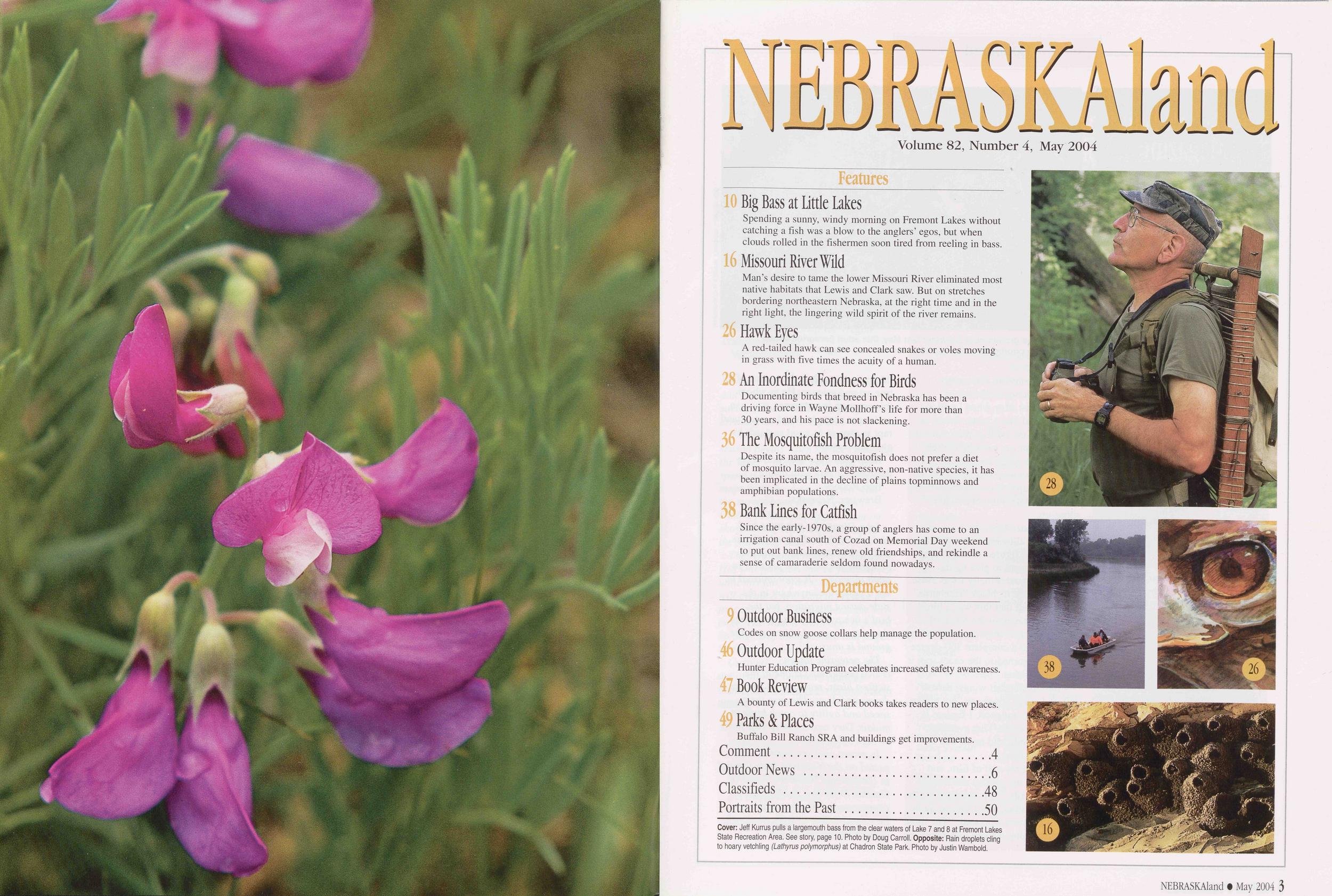
NEBRASKAland
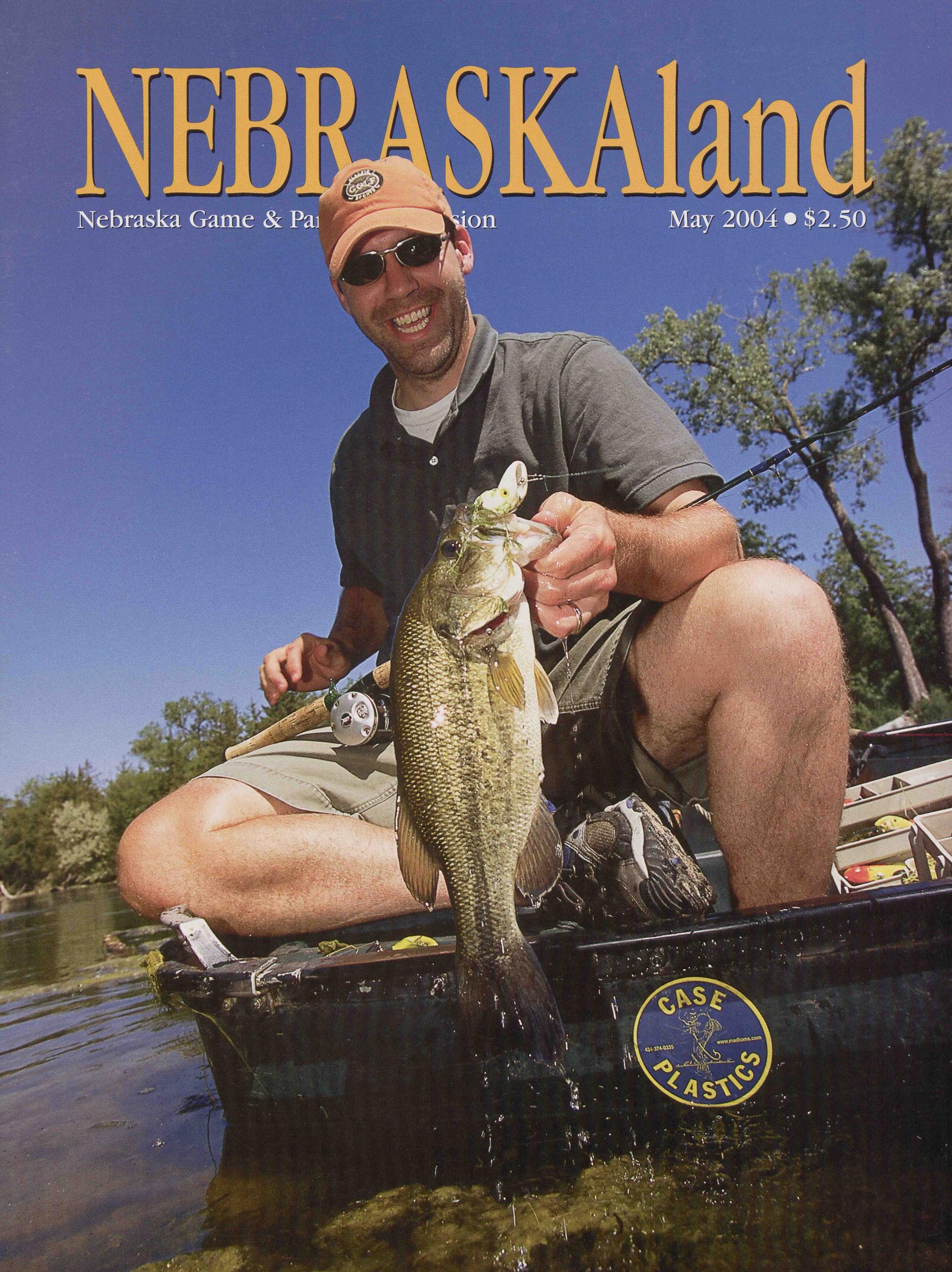
Volume 82, Number 4, May 2004 Features 10 Big Bass at Little Lakes Spending a sunny, windy morning on Fremont Lakes without catching a fish was a blow to the anglers’ egos, but when clouds rolled in the fishermen soon tired from reeling in bass. 16 Missouri River Wild Man’s desire to tame the lower Missouri River eliminated most native habitats that Lewis and Clark saw. But on stretches bordering northeastern Nebraska, at the right time and in the right light, the lingering wild spirit of the river remains. 26 Hawk Eyes A red-tailed hawk can see concealed snakes or voles moving in grass with five times the acuity of a human. 28 An Inordinate Fondness for Birds Documenting birds that breed in Nebraska has been a driving force in Wayne Mollhoff’s life for more than 30 years, and his pace is not slackening. 36 The Mosquitofish Proble Despite its name, the mosquitofish does not prefer a diet of mosquito larvae. An aggressive, non-native species, it has been implicated in the decline of plains topminnows and amphibian populations. 38 Bank Lines for Catfish Since the early-1970s, a group of anglers has come to an irrigation canal south of Cozad on Memorial Day weekend to put out bank lines, renew old friendships, and rekindle a sense of camaraderie seldom found nowadays. Departments 9 Outdoor Business Codes on snow goose collars help manage the population. 46 Outdoor Update Hunter Education Program celebrates increased safety awareness. 47 Book Review A bounty of Lewis and Clark books takes readers to new places. 49 Parks & Places Buffalo Bill Ranch SRA and buildings get improvements. Comment.......................................4 Outdoor News ...............................6 Classifieds ...................................48 Portraits from the Past .................50 Cover: Jeff Kurrus pulls a largemouth bass from the clear waters of Lake 7 and 8 at Fremont Lakes State Recreation Area. See story, page 10. Photo by Doug Carroll. Opposite: Rain droplets cling to hoary vetchling (Lathyrus polymorphus) at Chadron State Park. Photo by Justin Wambold.28
38
26
16
Comment
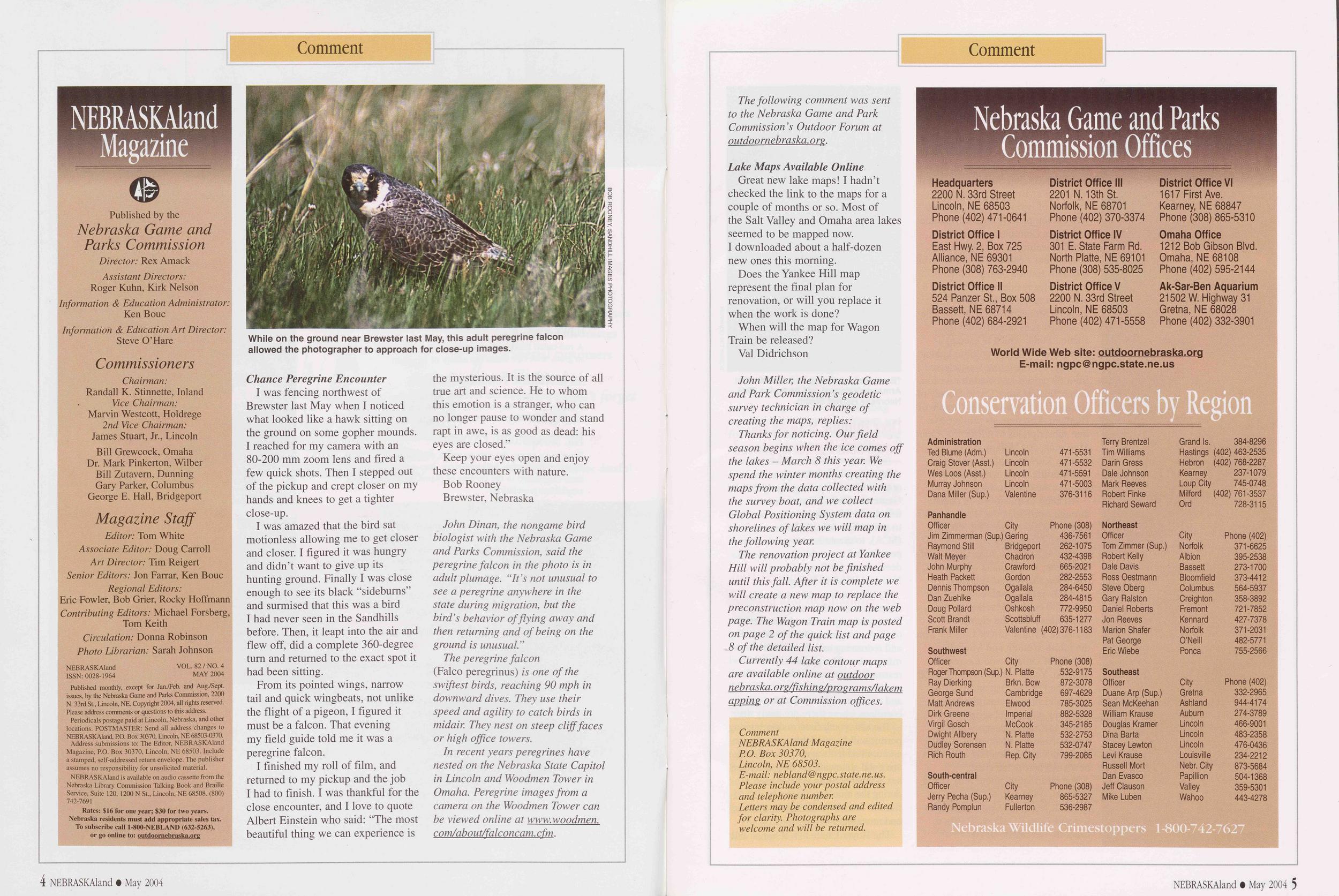
Chance Peregrine EncounterI was fencing northwest of Brewster last May when I noticed what looked like a hawk sitting on the ground on some gopher mounds. I reached for my camera with an 80-200 mm zoom lens and fired a few quick shots. Then I stepped out of the pickup and crept closer on my hands and knees to get a tighter close-up.
I was amazed that the bird sat motionless allowing me to get closer and closer. I figured it was hungry and didn’t want to give up its hunting ground. Finally I was close enough to see its black “sidebums” and surmised that this was a bird I had never seen in the Sandhills before. Then, it leapt into the air and flew off, did a complete 360-degree turn and returned to the exact spot it had been sitting.
From its pointed wings, narrow tail and quick wingbeats, not unlike the flight of a pigeon, I figured it must be a falcon. That evening my field guide told me it was a peregrine falcon.
I finished my roll of film, and returned to my pickup and the job I had to finish. I was thankful for the close encounter, and I love to quote Albert Einstein who said: "The most beautiful thing we can experience is the mysterious. It is the source of all true art and science. He to whom this emotion is a stranger, who can no longer pause to wonder and stand rapt in awe, is as good as dead: his eyes are closed.”
Keep your eyes open and enjoy these encounters with nature.
Bob Rooney Brewster, NebraskaJohn Dinan, the nongame bird biologist with the Nebraska Game and Parks Commission, said the peregrine falcon in the photo is in adult plumage. “It’s not unusual to see a peregrine anywhere in the state during migration, but the bird’s behavior of flying away and then returning and of being on the ground is unusual.”
The peregrine falcon (Falco peregrinus) is one of the swiftest birds, reaching 90 mph in downward dives. They use their speed and agility to catch birds in midair. They nest on steep cliff faces or high office towers.
In recent years peregrines have nested on the Nebraska State Capitol in Lincoln and Woodmen Tower in Omaha. Peregrine images from a camera on the Woodmen Tower can be viewed online at www. woodmen, com/about/falconcam.cfm.
Comment
The following comment was sent to the Nebraska Game and Park Commission’s Outdoor Forum at outdoornebraska. org.
Lake Maps Available OnlineGreat new lake maps! I hadn’t checked the link to the maps for a couple of months or so. Most of the Salt Valley and Omaha area lakes seemed to be mapped now. I downloaded about a half-dozen new ones this morning.
Does the Yankee Hill map represent the final plan for renovation, or will you replace it when the work is done?
When will the map for Wagon Train be released?
Vai DidrichsonJohn Miller, the Nebraska Game and Park Commission’s geodetic survey technician in charge of creating the maps, replies:
Thanks for noticing. Our field season begins when the ice comes off the lakes - March 8 this year. We spend the winter months creating the maps from the data collected with the survey boat, and we collect Global Positioning System data on shorelines of lakes we will map in the following year.
The renovation project at Yankee Hill will probably not be finished until this fall. After it is complete we will create a new map to replace the preconstruction map now on the web page. The Wagon Train map is posted on page 2 of the quick list and page 8 of the detailed list.
Currently 44 lake contour maps are available online at outdoor nebraska.org/fishin2/pro2rams/lakem apping or at Commission offices.
Comment NEBRASKAland Magazine P.O. Box 30370, Lincoln, NE 68503. E-mail: nebland@ngpc. state, ne. us. Please include your postal address and telephone number. Letters may be condensed and edited for clarity. Photographs are welcome and will be returned. Nebraska Game and Parks Commission Offices Headquarters 2200 N. 33rd Street Lincoln, NE 68503 Phone (402) 471-0641 District Office I East Hwy. 2, Box 725 Alliance, NE 69301 Phone (308) 763-2940 District Office II 524 Panzer St., Box 508 Bassett, NE 68714 Phone (402) 684-2921 District Office III 2201 N. 13th St. Norfolk, NE 68701 Phone (402) 370-3374 District Office IV 301 E. State Farm Rd. North Platte, NE 69101 Phone (308) 535-8025 District Office V 2200 N. 33rd Street Lincoln, NE 68503 Phone (402) 471-5558 District Office VI 1617 First Ave. Kearney, NE 68847 Phone (308) 865-5310 Omaha Office 1212 Bob Gibson Blvd. Omaha, NE 68108 Phone (402) 595-2144 Ak-Sar-Ben Aquarium 21502 W. Highway 31 Gretna, NE 68028 Phone (402) 332-3901 World Wide Web site: outdoornebraska.org E-mail: ngpc@ngpc.state.ne.us Conservation Officers by Region Administration Terry Brentzel Grand Is. 384-8296 Ted Blume (Adm.) Lincoln 471-5531 Tim Williams Hastings (402) 463-2535 Craig Stover (Asst.) Lincoln 471-5532 Darin Gress Hebron (402) 768-2287 Wes Loos (Asst.) Lincoln 471-5591 Dale Johnson Kearney 237-1079 Murray Johnson Lincoln 471-5003 Mark Reeves Loup City 745-0748 Dana Miller (Sup.) Valentine 376-3116 Robert Finke Milford (402) 761-3537 Richard Seward Ord 728-3115 Panhandle Officer City Phone (308) Northeast Jim Zimmerman (Sup.) Gering 436-7561 Officer City Phone (402) Raymond Still Bridgeport 262-1075 Tom Zimmer (Sup.) Norfolk 371-6625 Walt Meyer Chadron 432-4398 Robert Kelly Albion 395-2538 John Murphy Crawford 665-2021 Dale Davis Bassett 273-1700 Heath Packett Gordon 282-2553 Ross Oestmann Bloomfield 373-4412 Dennis Thompson Ogallala 284-6450 Steve Oberg Columbus 564-5937 Dan Zuehlke Ogallala 284-4815 Gary Ralston Creighton 358-3892 Doug Pollard Oshkosh 772-9950 Daniel Roberts Fremont 721-7852 Scott Brandt Scottsbluff 635-1277 Jon Reeves Kennard 427-7378 Frank Miller Valentine (402)376-1183 Marion Shafer Norfolk 371-2031 Pat George O’Neill 482-5771 Southwest Eric Wiebe Ponca 755-2566 Officer City Phone (308) Roger Thompson (Sup.) N. Platte 532-9175 Southeast Ray Dierking Brkn. Bow 872-3078 Officer City Phone (402) George Sund Cambridge 697-4629 Duane Arp (Sup.) Gretna 332-2965 Matt Andrews Elwood 785-3025 Sean McKeehan Ashland 944-4174 Dirk Greene Imperial 882-5328 William Krause Auburn 274-3789 Virgil Gosch McCook 345-2185 Douglas Kramer Lincoln 466-9001 Dwight Allbery N. Platte 532-2753 Dina Barta Lincoln 483-2358 Dudley Sorensen N. Platte 532-0747 Stacey Lewton Lincoln 476-0436 Rich Routh Rep. City 799-2085 Levi Krause Louisville 234-2212 Russell Mort Nebr. City 873-5684 South-central Dan Evasco Papillion 504-1368 Officer City Phone (308) Jeff Clauson Valley 359-5301 Jerry Pecha (Sup.) Kearney 865-5327 Mike Luben Wahoo 443-4278 Randy Pomplun Fullerton 536-2987 Nebraska Wildlife Crimestoppers 1-800-742-7627 4 NEBRASKAland • May 2004 NEBRASKAland • May 2004 5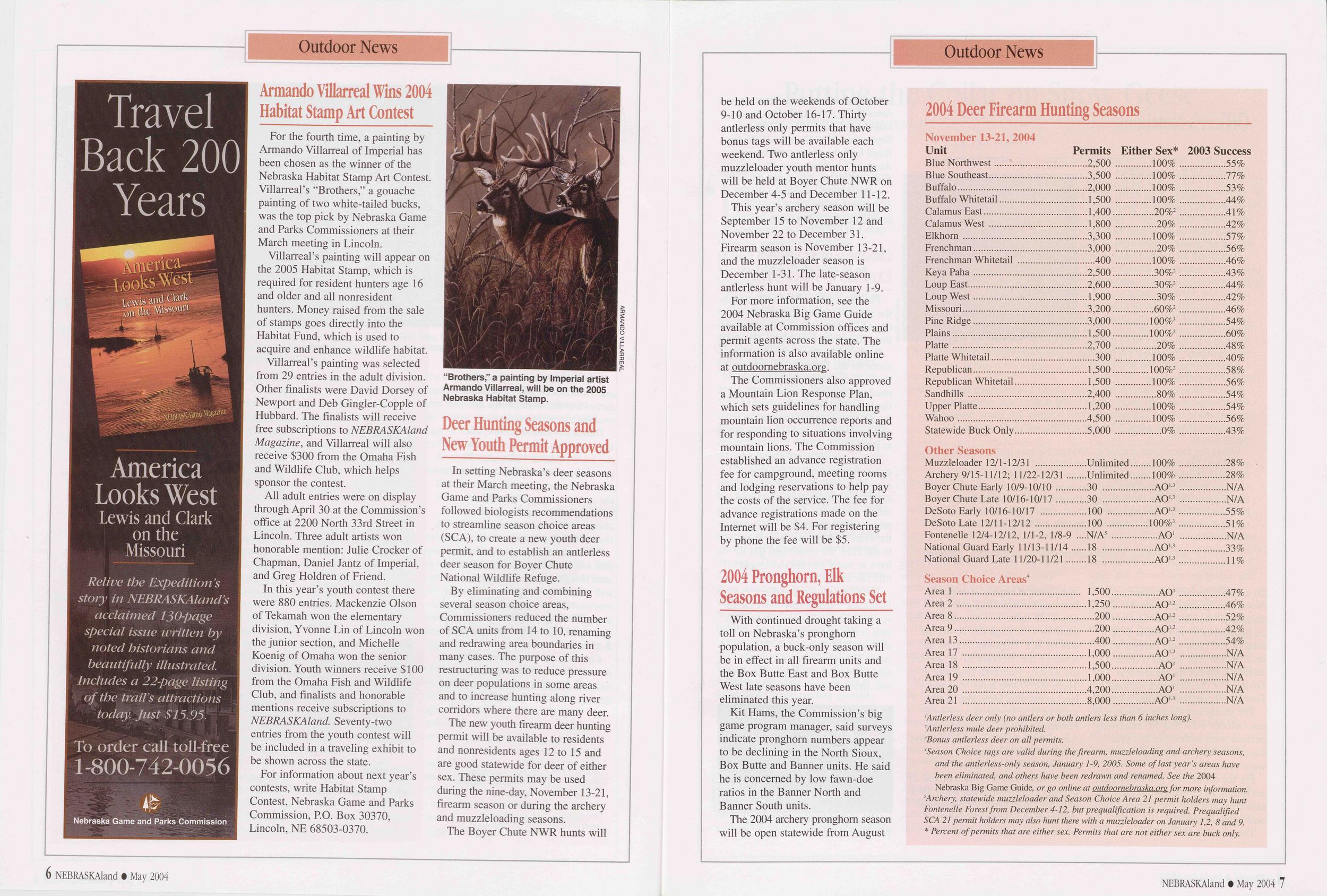
Outdoor News
Travel Back 200 YearsFor the fourth time, a painting by Armando Villarreal of Imperial has been chosen as the winner of the Nebraska Habitat Stamp Art Contest. Villarreal’s “Brothers,” a gouache painting of two white-tailed bucks, was the top pick by Nebraska Game and Parks Commissioners at their March meeting in Lincoln.
Villarreal’s painting will appear on the 2005 Habitat Stamp, which is required for resident hunters age 16 and older and all nonresident hunters. Money raised from the sale of stamps goes directly into the Habitat Fund, which is used to acquire and enhance wildlife habitat.
Villarreal’s painting was selected from 29 entries in the adult division. Other finalists were David Dorsey of Newport and Deb Gingler-Copple of Hubbard. The finalists will receive free subscriptions to NEBRASKAland Magazine, and Villarreal will also receive $300 from the Omaha Fish and Wildlife Club, which helps sponsor the contest.
All adult entries were on display through April 30 at the Commission’s office at 2200 North 33rd Street in Lincoln. Three adult artists won honorable mention: Julie Crocker of Chapman, Daniel Jantz of Imperial, and Greg Holdren of Friend.
In this year’s youth contest there were 880 entries. Mackenzie Olson of Tekamah won the elementary division, Yvonne Lin of Lincoln won the junior section, and Michelle Koenig of Omaha won the senior division. Youth winners receive $100 from the Omaha Fish and Wildlife Club, and finalists and honorable mentions receive subscriptions to NEBRASKAland. Seventy-two entries from the youth contest will be included in a traveling exhibit to be shown across the state.
For information about next year’s contests, write Habitat Stamp Contest, Nebraska Game and Parks Commission, P.O. Box 30370, Lincoln, NF 68503-0370.
In setting Nebraska’s deer seasons at their March meeting, the Nebraska Game and Parks Commissioners followed biologists recommendations to streamline season choice areas (SCA), to create a new youth deer permit, and to establish an antlerless deer season for Boyer Chute National Wildlife Refuge.
By eliminating and combining several season choice areas, Commissioners reduced the number of SCA units from 14 to 10, renaming and redrawing area boundaries in many cases. The purpose of this restructuring was to reduce pressure on deer populations in some areas and to increase hunting along river corridors where there are many deer.
The new youth firearm deer hunting permit will be available to residents and nonresidents ages 12 to 15 and are good statewide for deer of either sex. These permits may be used during the nine-day, November 13-21, firearm season or during the archery and muzzleloading seasons.
The Boyer Chute NWR hunts will be held on the weekends of October 9-10 and October 16-17. Thirty antlerless only permits that have bonus tags will be available each weekend. Two antlerless only muzzleloader youth mentor hunts will be held at Boyer Chute NWR on December 4-5 and December 11-12.
This year’s archery season will be September 15 to November 12 and November 22 to December 31. Firearm season is November 13-21, and the muzzleloader season is December 1-31. The late-season antlerless hunt will be January 1-9. For more information, see the 2004 Nebraska Big Game Guide available at Commission offices and permit agents across the state. The information is also available online at outdoornebraska.org.
The Commissioners also approved a Mountain Lion Response Plan, which sets guidelines for handling mountain lion occurrence reports and for responding to situations involving mountain lions. The Commission established an advance registration fee for campground, meeting rooms and lodging reservations to help pay the costs of the service. The fee for advance registrations made on the Internet will be $4. For registering by phone the fee will be $5.
2004 Pronghorn, Elk Seasons and Regulations SetWith continued drought taking a toll on Nebraska’s pronghorn population, a buck-only season will be in effect in all firearm units and the Box Butte East and Box Butte West late seasons have been eliminated this year.
Kit Hams, the Commission’s big game program manager, said surveys indicate pronghorn numbers appear to be declining in the North Sioux, Box Butte and Banner units. He said he is concerned by low fawn-doe ratios in the Banner North and Banner South units.
2004 Deer Firearm Hunting Seasons November 13-21, 2004 Unit Blue Northwest Permits Either Sex* 2003 Success 55% 2,500 100% . Blue Southeast 3,500 100% . 77% Buffalo 2,000 100% . 53% Buffalo Whitetail 1,500 100% . 44% Calamus East 1,400 20%2 . 41% Calamus West 1,800 20% . 42% Elkhorn 3,300 100% . 57% Frenchman 3,000 20% . 56% Frenchman Whitetail 400 100% . 46% Keya Paha 2,500 30%2 . 43% Loup East 2,600 30%2 . 44% Loup West 1,900 30% . 42% Missouri 3,200 60%2 . 46% Pine Ridge 3,000 ....100%' . 54% Plains 1,500 ....100%' . 60% Platte 2,700 20% . 48% Platte Whitetail 300 100% . 40% Republican 1,500 ....100%2 . 58% Republican Whitetail 1,500 100% . 56% Sandhills 2,400 80% . 54% Upper Platte 1,200 100% . 54% Wahoo 4,500 100% . 56% Statewide Buck Only 5,000 0% . 43% Other Seasons Muzzleloader 12/1-12/31 Unlimited... 100% . 28% Archery 9/15-11/12; 11/22-12/31 .. Unlimited.... 100% . 28% B oyer Chute Early 10/9-10/10 30 AO" . N/A Boyer Chute Late 10/16-10/17 30 AO" . N/A DeSoto Early 10/16-10/17 100 AO" .. 55% DeSoto Late 12/11-12/12 100 ...100%' .. 51% Fontenelle 12/4-12/12, 1/1-2, 1/8-9 ....N/A5 AO' . N/A National Guard Early 11/13-11/14 18 AO" . 33% National Guard Late 11/20-11/21.. 18 AO" . 11% Season Choice Areas4 Area 1 .... 1,500 AO' . 47% Area 2 1,250 AO'2 . 46% Area 8 200 AO ' 2 . 52% Area 9 200 AO ' 2 . 42% Area 13 400 AO'2 . 54% Area 17 1,000 AO" . N/A Area 18 1,500 AO' . N/A Area 19 1,000 AO' . N/A Area 20 4,200 AO' . N/A Area 21 8,000 AO" . N/A 'Antlerless deer only (no antlers or both antlers less than 6 inches long). 2Antlerless mule deer prohibited. 3.Bonus antlerless deer on all permits. 4Season Choice tags are valid during the firearm, muzzleloading and archery seasons, and the antlerless-only season, January 1-9, 2005. Some of last year’s areas have been eliminated, and others have been redrawn and renamed. See the 2004 Nebraska Big Game Guide, or go online at outdoomebraska. org for more information. 5Archery, statewide muzzleloader and Season Choice Area 21 permit holders may hunt Fontenelle Forest from December 4-12, but prequalification is required. Prequalified SCA 21 permit holders may also hunt there with a muzzleloader on January 1,2, 8 and 9. * Percent of permits that are either sex. Permits that are not either sex are buck only. 6 NEBRASKAland • May 2004 NEBRASKAland • May 2004 7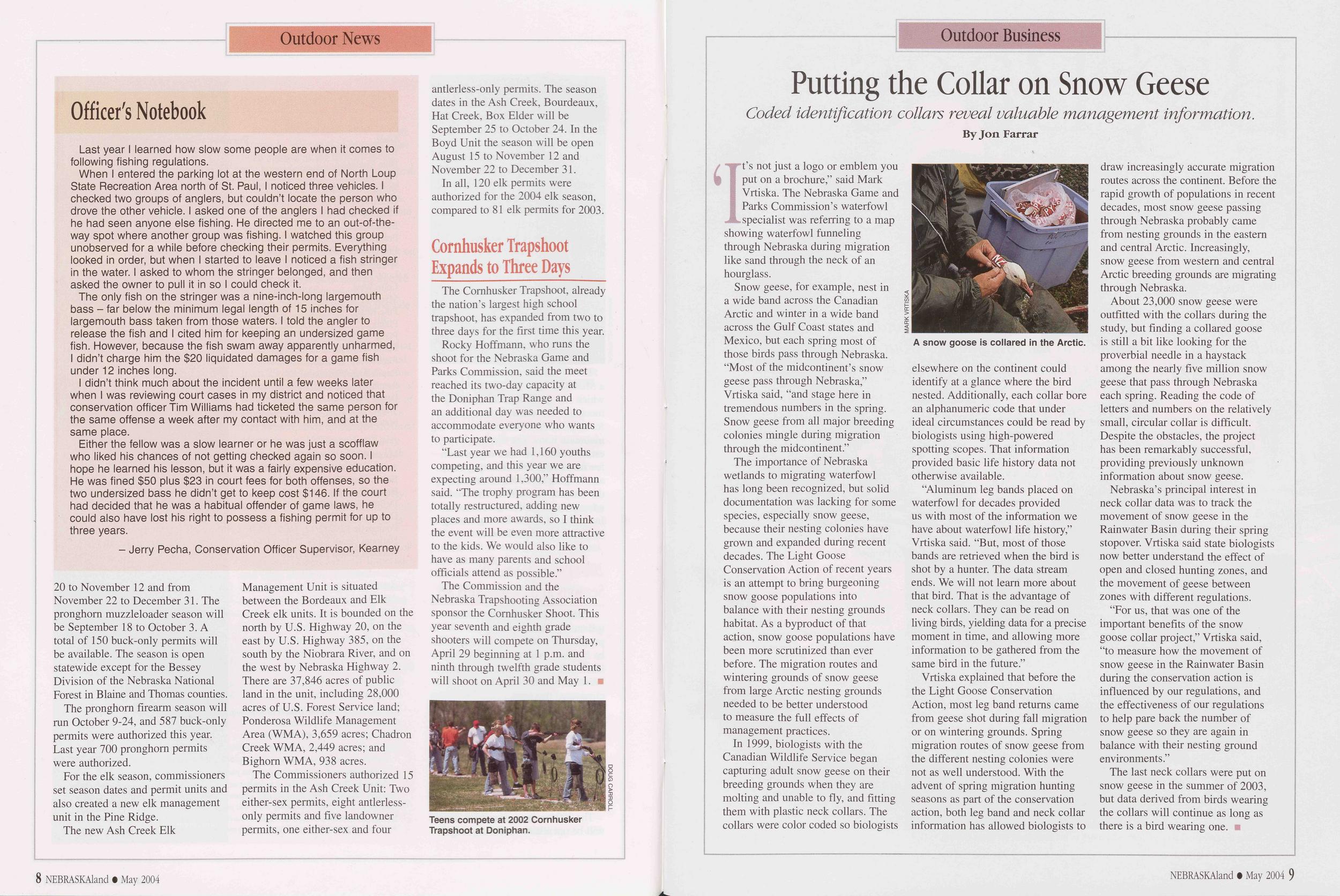 Officer's Notebook
Last year I learned how slow some people are when it comes to following fishing regulations.
When I entered the parking lot at the western end of North Loup State Recreation Area north of St. Paul, I noticed three vehicles. I checked two groups of anglers, but couldn’t locate the person who drove the other vehicle. I asked one of the anglers I had checked if he had seen anyone else fishing. He directed me to an out-of-the- way spot where another group was fishing. I watched this group unobserved for a while before checking their permits. Everything looked in order, but when I started to leave I noticed a fish stringer in the water. I asked to whom the stringer belonged, and then asked the owner to pull it in so I could check it.
The only fish on the stringer was a nine-inch-long largemouth bass - far below the minimum legal length of 15 inches for largemouth bass taken from those waters. I told the angler to release the fish and I cited him for keeping an undersized game fish. However, because the fish swam away apparently unharmed, I didn’t charge him the $20 liquidated damages for a game fish under 12 inches long.
I didn’t think much about the incident until a few weeks later when I was reviewing court cases in my district and noticed that conservation officer Tim Williams had ticketed the same person for the same offense a week after my contact with him, and at the same place.
Either the fellow was a slow learner or he was just a scofflaw who liked his chances of not getting checked again so soon. I hope he learned his lesson, but it was a fairly expensive education. He was fined $50 plus $23 in court fees for both offenses, so the two undersized bass he didn’t get to keep cost $146. If the court had decided that he was a habitual offender of game laws, he could also have lost his right to possess a fishing permit for up to three years.
- Jerry Pecha, Conservation Officer Supervisor, KearneyThe 2004 archery pronghorn season will be open statewide from August 20 to November 12 and from November 22 to December 31. The pronghorn muzzleloader season will be September 18 to October 3. A total of 150 buck-only permits will be available. The season is open statewide except for the Bessey Division of the Nebraska National Forest in Blaine and Thomas counties.
The pronghorn firearm season will run October 9-24, and 587 buck-only permits were authorized this year. Last year 700 pronghorn permits were authorized.
For the elk season, commissioners set season dates and permit units and also created a new elk management unit in the Pine Ridge.
The new Ash Creek Elk Management Unit is situated between the Bordeaux and Elk Creek elk units. It is bounded on the north by U.S. Highway 20, on the east by U.S. Highway 385, on the south by the Niobrara River, and on the west by Nebraska Highway 2. There are 37,846 acres of public land in the unit, including 28,000 acres of U.S. Forest Service land; Ponderosa Wildlife Management Area (WMA), 3,659 acres; Chadron Creek WMA, 2,449 acres; and Bighorn WMA, 938 acres.
The Commissioners authorized 15 permits in the Ash Creek Unit: Two either-sex permits, eight antlerless- only permits and five landowner permits, one either-sex and four antlerless-only permits. The season dates in the Ash Creek, Bourdeaux, Hat Creek, Box Elder will be September 25 to October 24. In the Boyd Unit the season will be open August 15 to November 12 and November 22 to December 31.
In all, 120 elk permits were authorized for the 2004 elk season, compared to 81 elk permits for 2003
Cornhusker Trapshoot Expands to Three DaysThe Cornhusker Trapshoot, already the nation’s largest high school trapshoot, has expanded from two to three days for the first time this year.
Rocky Hoffmann, who runs the shoot for the Nebraska Game and Parks Commission, said the meet reached its two-day capacity at the Doniphan Trap Range and an additional day was needed to accommodate everyone who wants to participate.
“Last year we had 1,160 youths competing, and this year we are expecting around 1,300,” Hoffmann said. “The trophy program has been totally restructured, adding new places and more awards, so I think the event will be even more attractive to the kids. We would also like to have as many parents and school officials attend as possible.”
The Commission and the Nebraska Trapshooting Association sponsor the Cornhusker Shoot. This year seventh and eighth grade shooters will compete on Thursday, April 29 beginning at 1 p.m. and ninth through twelfth grade students will shoot on April 30 and May 1.
Outdoor Business
Putting the Collar on Snow Geese
Coded identification collars reveal valuable management information.
By Jon FarrarIt’s not just a logo or emblem you put on a brochure,” said Mark Vrtiska. The Nebraska Game and Parks Commission’s waterfowl specialist was referring to a map showing waterfowl funneling through Nebraska during migration like sand through the neck of an hourglass.
Snow geese, for example, nest in a wide band across the Canadian Arctic and winter in a wide band across the Gulf Coast states and Mexico, but each spring most of those birds pass through Nebraska. “Most of the midcontinent’s snow geese pass through Nebraska,” Vrtiska said, “and stage here in tremendous numbers in the spring. Snow geese from all major breeding colonies mingle during migration through the midcontinent.”
The importance of Nebraska wetlands to migrating waterfowl has long been recognized, but solid documentation was lacking for some species, especially snow geese, because their nesting colonies have grown and expanded during recent decades. The Light Goose Conservation Action of recent years is an attempt to bring burgeoning snow goose populations into balance with their nesting grounds habitat. As a byproduct of that action, snow goose populations have been more scrutinized than ever before. The migration routes and wintering grounds of snow geese from large Arctic nesting grounds needed to be better understood to measure the full effects of management practices.
In 1999, biologists with the Canadian Wildlife Service began capturing adult snow geese on their breeding grounds when they are molting and unable to fly, and fitting them with plastic neck collars. The collars were color coded so biologists
“Aluminum leg bands placed on waterfowl for decades provided us with most of the information we have about waterfowl life history,” Vrtiska said. “But, most of those bands are retrieved when the bird is shot by a hunter. The data stream ends. We will not learn more about that bird. That is the advantage of neck collars. They can be read on living birds, yielding data for a precise moment in time, and allowing more information to be gathered from the same bird in the future.”
Vrtiska explained that before the the Light Goose Conservation Action, most leg band returns came from geese shot during fall migration or on wintering grounds. Spring migration routes of snow geese from the different nesting colonies were not as well understood. With the advent of spring migration hunting seasons as part of the conservation action, both leg band and neck collar information has allowed biologists to draw increasingly accurate migration routes across the continent. Before the rapid growth of populations in recent decades, most snow geese passing through Nebraska probably came from nesting grounds in the eastern and central Arctic. Increasingly, snow geese from western and central Arctic breeding grounds are migrating through Nebraska.
About 23,000 snow geese were outfitted with the collars during the study, but finding a collared goose is still a bit like looking for the proverbial needle in a haystack among the nearly five million snow geese that pass through Nebraska each spring. Reading the code of letters and numbers on the relatively small, circular collar is difficult. Despite the obstacles, the project has been remarkably successful, providing previously unknown information about snow geese.
Nebraska’s principal interest in neck collar data was to track the movement of snow geese in the Rainwater Basin during their spring stopover. Vrtiska said state biologists now better understand the effect of open and closed hunting zones, and the movement of geese between zones with different regulations.
“For us, that was one of the important benefits of the snow goose collar project,” Vrtiska said, “to measure how the movement of snow geese in the Rainwater Basin during the conservation action is influenced by our regulations, and the effectiveness of our regulations to help pare back the number of snow geese so they are again in balance with their nesting ground environments.”
The last neck collars were put on snow geese in the summer of 2003, but data derived from birds wearing the collars will continue as long as there is a bird wearing one.
8 NEBRASKAland • May 2004 NEBRASKAland • May 2004 9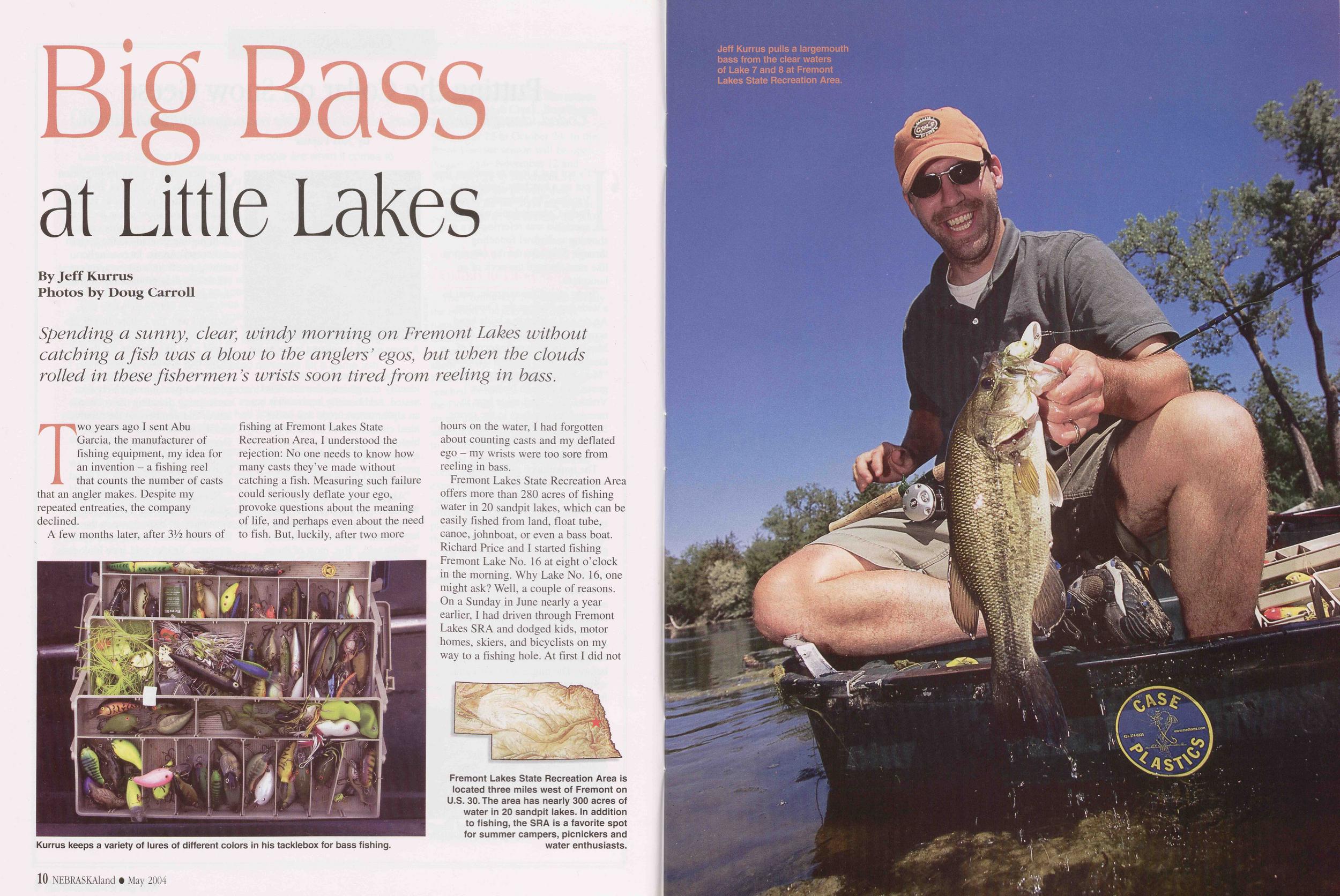
Big Bass at Little Lakes
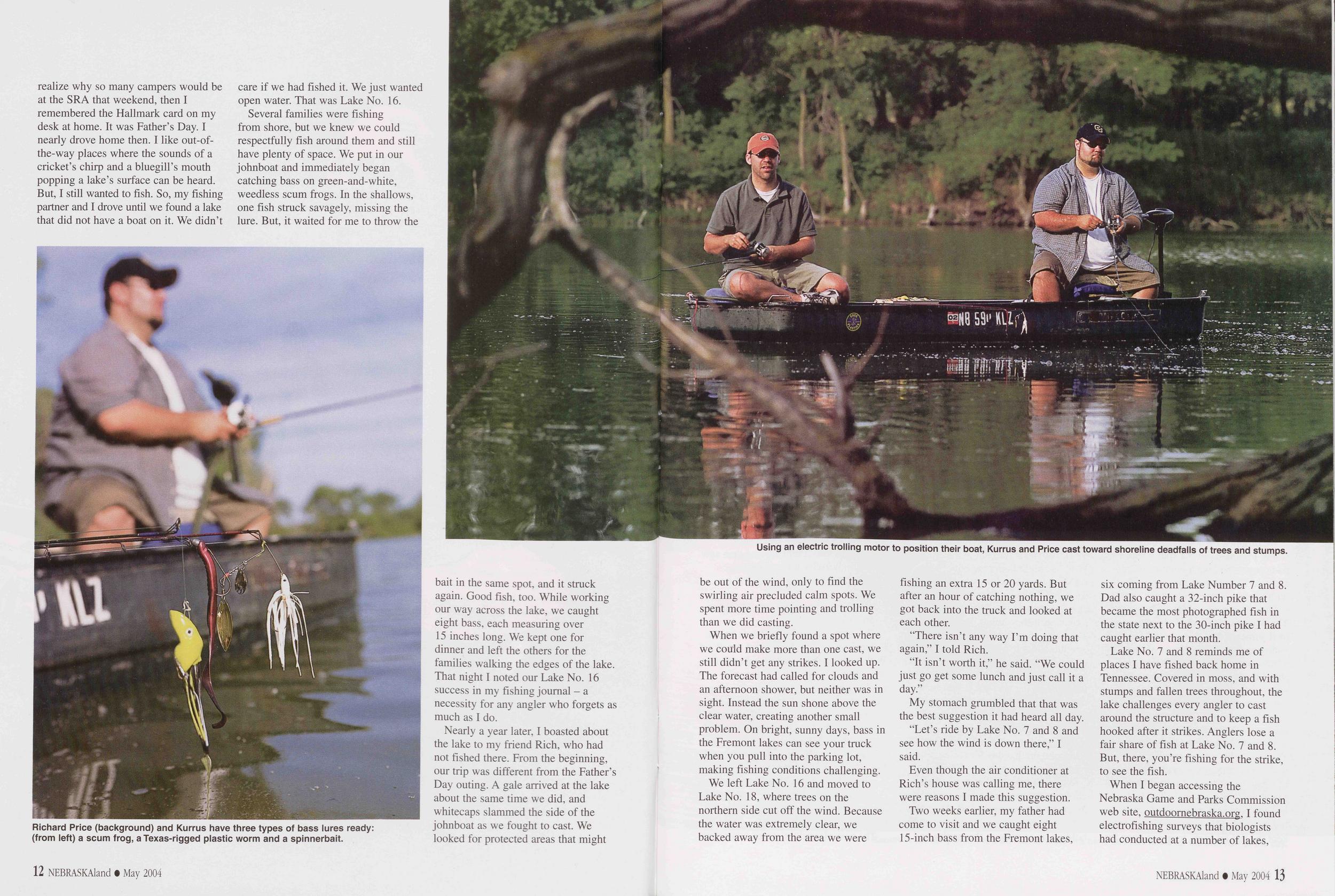
By Jeff Kurrus Photos by Doug Carroll Spending a sunny, clear, windy morning on Fremont Lakes without catching a fish was a blow to the anglers’ egos, but when the clouds rolled in these fishermen’s wrists soon tired from reeling in bass.Two years ago I sent Abu Garcia, the manufacturer of fishing equipment, my idea for an invention - a fishing reel that counts the number of casts that an angler makes. Despite my repeated entreaties, the company declined.
A few months later, after hours of
Fremont Lakes State Recreation Area offers more than 280 acres of fishing water in 20 sandpit lakes, which can be easily fished from land, float tube, canoe, johnboat, or even a bass boat. Richard Price and I started fishing Fremont Lake No. 16 at eight o’clock in the morning. Why Lake No. 16, one might ask? Well, a couple of reasons. On a Sunday in June nearly a year earlier, I had driven through Fremont Lakes SR A and dodged kids, motor homes, skiers, and bicyclists on my way to a fishing hole. At first I did not
 realize why so many campers would be
at the SRA that weekend, then I
remembered the Hallmark card on my
desk at home. It was Father’s Day. I
nearly drove home then. I like out-of-
the-way places where the sounds of a
cricket’s chirp and a bluegill’s mouth
popping a lake’s surface can be heard.
But, I still wanted to fish. So, my fishing
partner and I drove until we found a lake
that did not have a boat on it. We didn’t
realize why so many campers would be
at the SRA that weekend, then I
remembered the Hallmark card on my
desk at home. It was Father’s Day. I
nearly drove home then. I like out-of-
the-way places where the sounds of a
cricket’s chirp and a bluegill’s mouth
popping a lake’s surface can be heard.
But, I still wanted to fish. So, my fishing
partner and I drove until we found a lake
that did not have a boat on it. We didn’t
Several families were fishing from shore, but we knew we could respectfully fish around them and still have plenty of space. We put in our johnboat and immediately began catching bass on green-and-white, weedless scum frogs. In the shallows, one fish struck savagely, missing the lure. But, it waited for me to throw the
Nearly a year later, I boasted about the lake to my friend Rich, who had not fished there. From the beginning, our trip was different from the Father’s Day outing. A gale arrived at the lake about the same time we did, and whitecaps slammed the side of the johnboat as we fought to cast. We looked for protected areas that might be out of the wind, only to find the swirling air precluded calm spots. We spent more time pointing and trolling than we did casting.
When we briefly found a spot where we could make more than one cast, we still didn’t get any strikes. I looked up. The forecast had called for clouds and an afternoon shower, but neither was in sight. Instead the sun shone above the clear water, creating another small problem. On bright, sunny days, bass in the Fremont lakes can see your truck when you pull into the parking lot, making fishing conditions challenging.
We left Lake No. 16 and moved to Lake No. 18, where trees on the northern side cut off the wind. Because the water was extremely clear, we backed away from the area we were fishing an extra 15 or 20 yards. But after an hour of catching nothing, we got back into the truck and looked at each other.
“There isn’t any way I’m doing that again,” I told Rich.
"It isn’t worth it,” he said. “We could just go get some lunch and just call it a day.”
My stomach grumbled that that was the best suggestion it had heard all day.
“Let’s ride by Lake No. 7 and 8 and see how the wind is down there,” I said.
Even though the air conditioner at Rich’s house was calling me, there were reasons I made this suggestion.
Two weeks earlier, my father had come to visit and we caught eight 15-inch bass from the Fremont lakes, six coming from Lake Number 7 and 8. Dad also caught a 32-inch pike that became the most photographed fish in the state next to the 30-inch pike I had caught earlier that month.
Lake No. 7 and 8 reminds me of places I have fished back home in Tennessee. Covered in moss, and with stumps and fallen trees throughout, the lake challenges every angler to cast around the structure and to keep a fish hooked after it strikes. Anglers lose a fair share of fish at Lake No. 7 and 8. But, there, you’re fishing for the strike, to see the fish.
When I began accessing the
Nebraska Game and Parks Commission
web site, outdoornebraska.org, I found
electrofishing surveys that biologists
had conducted at a number of lakes,
12 NEBRASKAland • May 2004
NEBRASKAland • May 2004 13
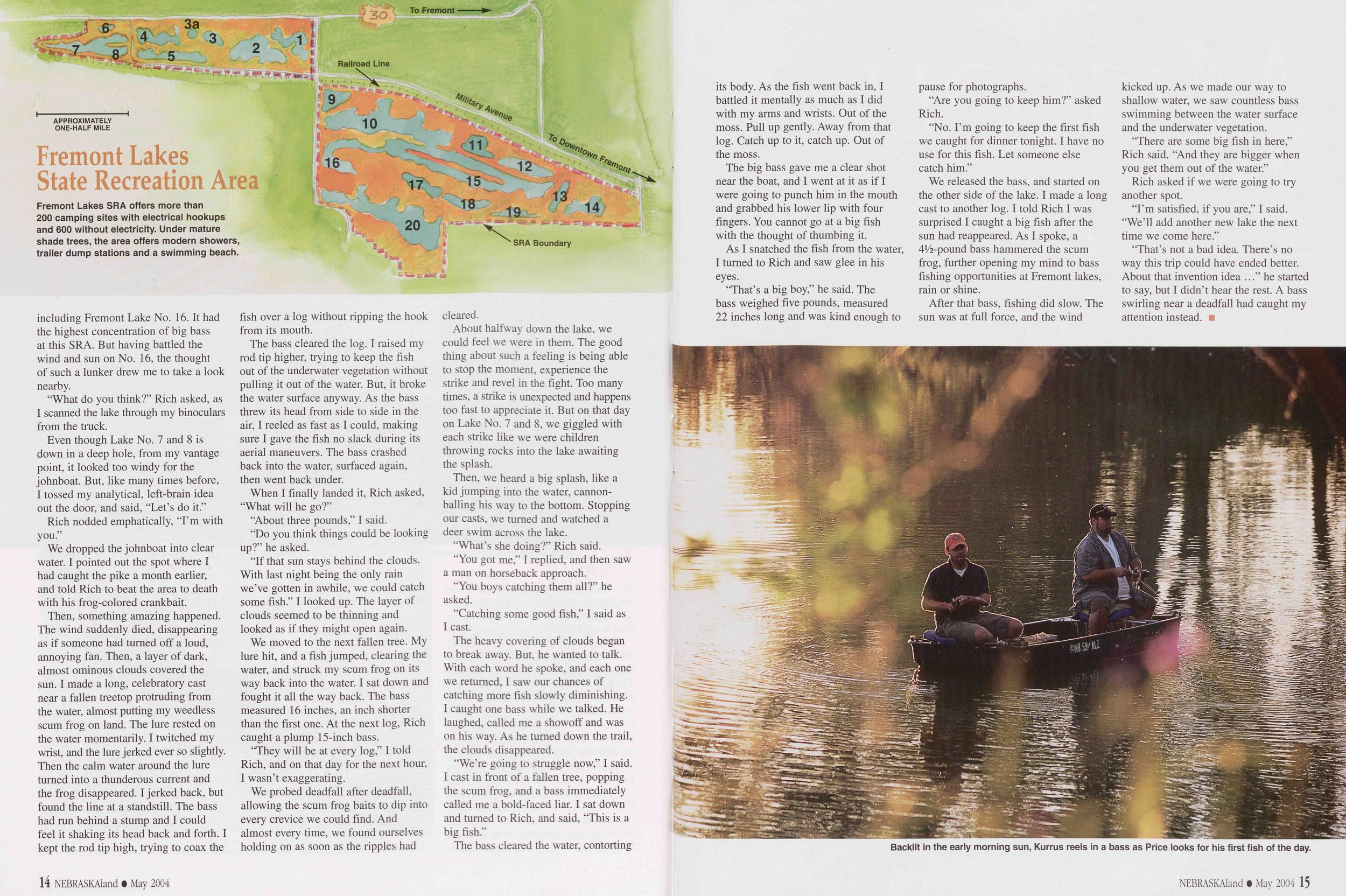
“What do you think?” Rich asked, as I scanned the lake through my binoculars from the truck.
Even though Lake No. 7 and 8 is down in a deep hole, from my vantage point, it looked too windy for the johnboat. But, like many times before, I tossed my analytical, left-brain idea out the door, and said, “Let’s do it.”
Rich nodded emphatically, “I’m with you.”
We dropped the johnboat into clear water. I pointed out the spot where I had caught the pike a month earlier, and told Rich to beat the area to death with his frog-colored crankbait.
Then, something amazing happened. The wind suddenly died, disappearing as if someone had turned off a loud, annoying fan. Then, a layer of dark, almost ominous clouds covered the sun. I made a long, celebratory cast near a fallen treetop protruding from the water, almost putting my weedless scum frog on land. The lure rested on the water momentarily. I twitched my wrist, and the lure jerked ever so slightly. Then the calm water around the lure turned into a thunderous current and the frog disappeared. I jerked back, but found the line at a standstill. The bass had run behind a stump and I could feel it shaking its head back and forth. I kept the rod tip high, trying to coax the fish over a log without ripping the hook from its mouth.
The bass cleared the log. I raised my rod tip higher, trying to keep the fish out of the underwater vegetation without pulling it out of the water. But, it broke the water surface anyway. As the bass threw its head from side to side in the air, I reeled as fast as I could, making sure I gave the fish no slack during its aerial maneuvers. The bass crashed back into the water, surfaced again, then went back under.
When I finally landed it, Rich asked, “What will he go?”
“About three pounds,” I said. “Do you think things could be looking up?” he asked.
“If that sun stays behind the clouds. With last night being the only rain we’ve gotten in awhile, we could catch some fish.” I looked up. The layer of clouds seemed to be thinning and looked as if they might open again.
We moved to the next fallen tree. My lure hit, and a fish jumped, clearing the water, and struck my scum frog on its way back into the water. I sat down and fought it all the way back. The bass measured 16 inches, an inch shorter than the first one. At the next log, Rich caught a plump 15-inch bass.
“They will be at every log,” I told Rich, and on that day for the next hour, I wasn’t exaggerating.
We probed deadfall after deadfall, allowing the scum frog baits to dip into every crevice we could find. And almost every time, we found ourselves holding on as soon as the ripples had cleared.
About halfway down the lake, we could feel we were in them. The good thing about such a feeling is being able to stop the moment, experience the strike and revel in the fight. Too many times, a strike is unexpected and happens too fast to appreciate it. But on that day on Lake No. 7 and 8, we giggled with each strike like we were children throwing rocks into the lake awaiting the splash.
Then, we heard a big splash, like a kid jumping into the water, cannon- balling his way to the bottom. Stopping our casts, we turned and watched a deer swim across the lake.
“What’s she doing?” Rich said. “You got me,” I replied, and then saw a man on horseback approach.
“You boys catching them all?” he asked.
“Catching some good fish,” I said as I cast.
The heavy covering of clouds began to break away. But, he wanted to talk. With each word he spoke, and each one we returned, I saw our chances of catching more fish slowly diminishing. I caught one bass while we talked. He laughed, called me a showoff and was on his way. As he turned down the trail, the clouds disappeared.
“We’re going to struggle now,” I said. I cast in front of a fallen tree, popping the scum frog, and a bass immediately called me a bold-faced liar. I sat down and turned to Rich, and said, “This is a big fish.”
The bass cleared the water, contorting its body. As the fish went back in, I battled it mentally as much as I did with my arms and wrists. Out of the moss. Pull up gently. Away from that log. Catch up to it, catch up. Out of the moss.
The big bass gave me a clear shot near the boat, and I went at it as if I were going to punch him in the mouth and grabbed his lower lip with four fingers. You cannot go at a big fish with the thought of thumbing it.
As I snatched the fish from the water, I turned to Rich and saw glee in his eyes.
“That’s a big boy,” he said. The bass weighed five pounds, measured 22 inches long and was kind enough to
“Are you going to keep him?” asked Rich.
“No. I’m going to keep the first fish we caught for dinner tonight. I have no use for this fish. Let someone else catch him.”
We released the bass, and started on the other side of the lake. I made a long cast to another log. I told Rich I was surprised I caught a big fish after the sun had reappeared. As I spoke, a 41/i-pound bass hammered the scum frog, further opening my mind to bass fishing opportunities at Fremont lakes, rain or shine.
After that bass, fishing did slow. The sun was at full force, and the wind kicked up. As we made our way to shallow water, we saw countless bass swimming between the water surface and the underwater vegetation.
“There are some big fish in here,” Rich said. “And they are bigger when you get them out of the water.”
Rich asked if we were going to try another spot.
“I’m satisfied, if you are,” I said. “We’ll add another new lake the next time we come here.”
“That’s not a bad idea. There’s no way this trip could have ended better. About that invention idea ...” he started to say, but I didn’t hear the rest. A bass swirling near a deadfall had caught my attention instead.
14 NEBRASKAland • May 2004 NEBRASKAland • May 2004 15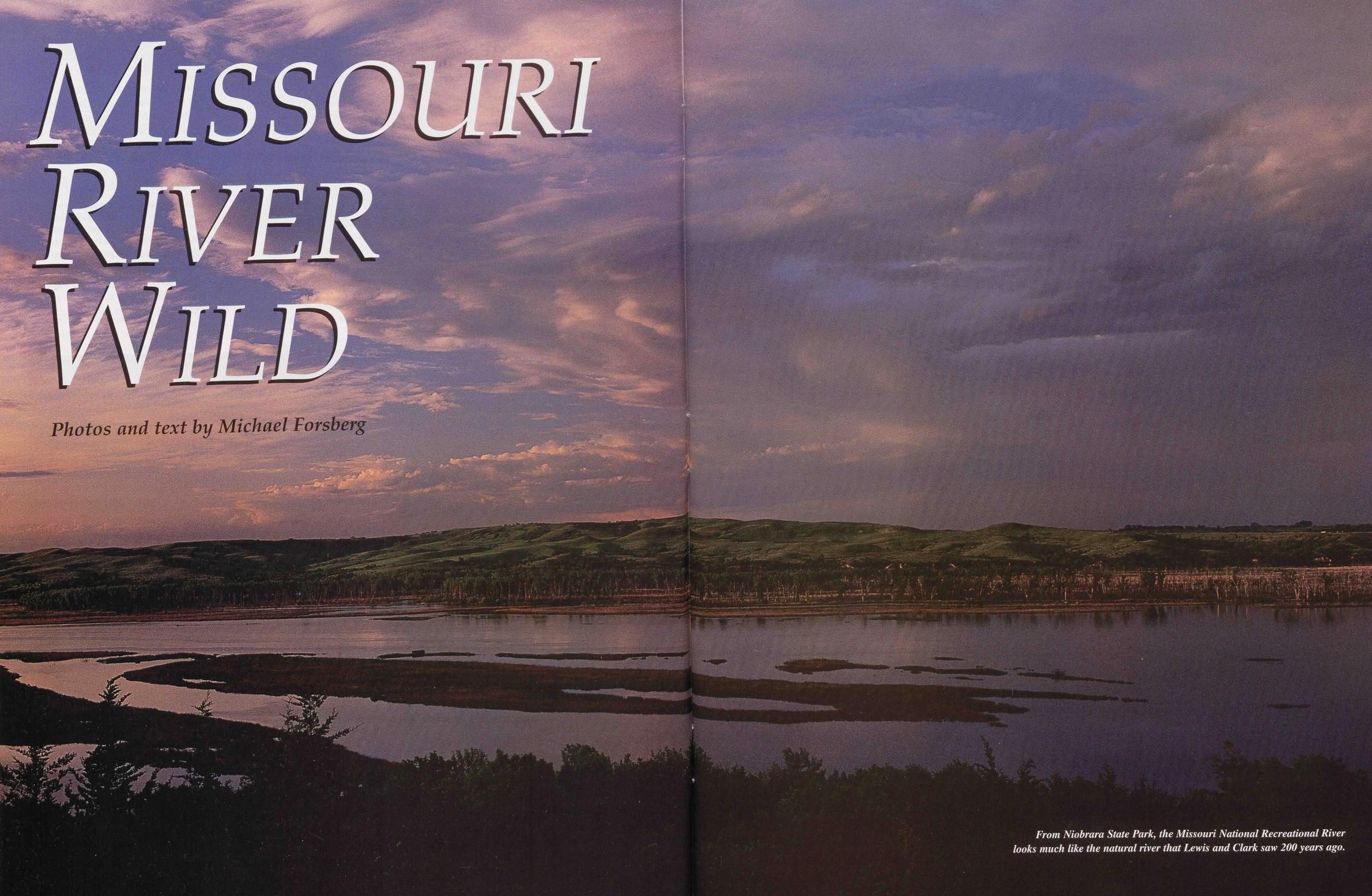
MISSOURI RIVER WILD
Photos and text by Michael Forsberg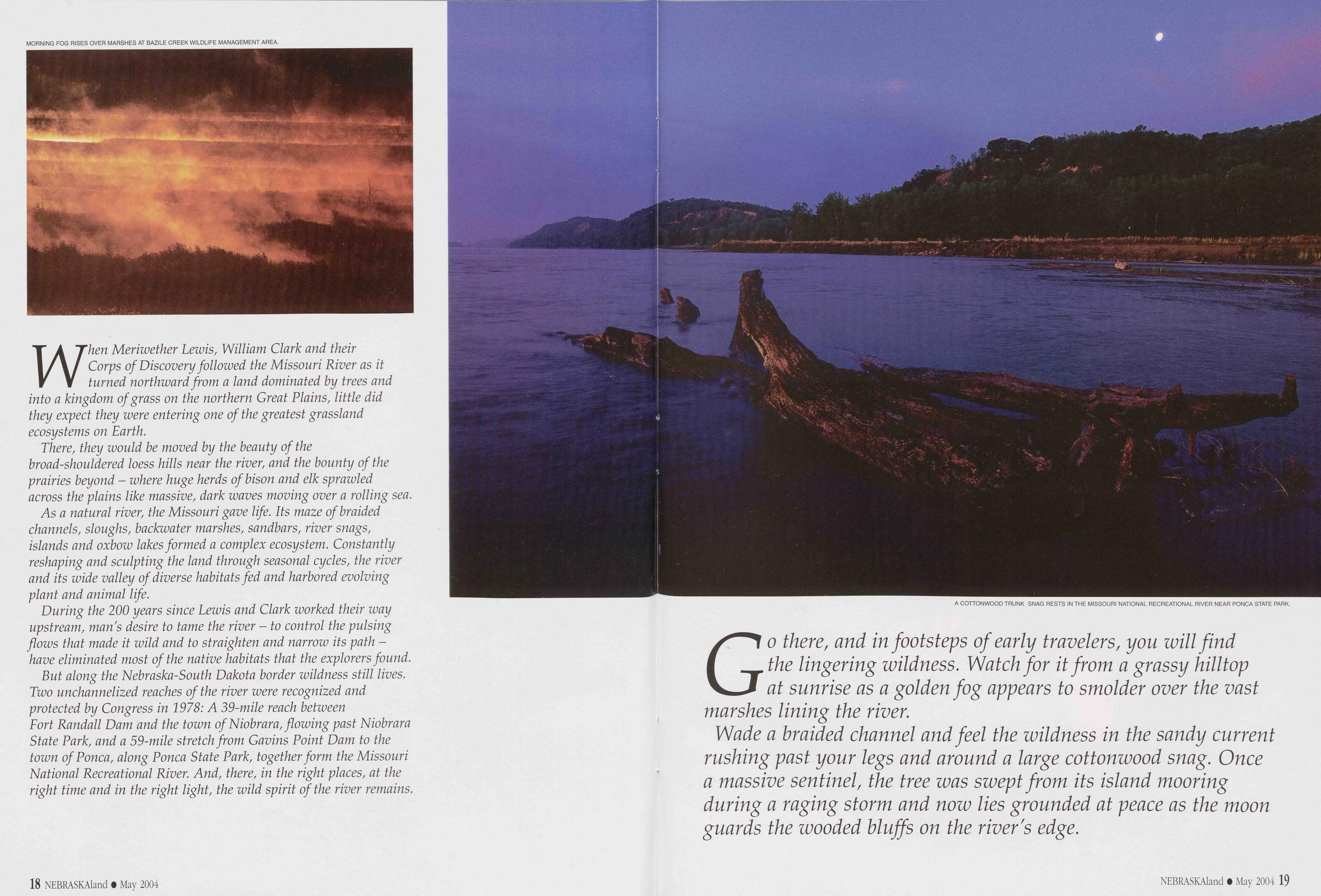
When Meriwether Lewis, William Clark and their Corps of Discovery followed the Missouri River as it turned northward from a land dominated by trees and into a kingdom of grass on the northern Great Plains, little did they expect they were entering one of the greatest grassland ecosystems on Earth.
There, they would be moved by the beauty of the broad-shouldered loess hills near the river, and the bounty of the prairies beyond - where huge herds of bison and elk sprawled across the plains like massive, dark waves moving over a rolling sea.
As a natural river, the Missouri gave life. Its maze of braided channels, sloughs, backwater marshes, sandbars, river snags, islands and oxbow lakes formed a complex ecosystem. Constantly reshaping and sculpting the land through seasonal cycles, the river and its wide valley of diverse habitats fed and harbored evolving plant and animal life.
During the 200 years since Lewis and Clark worked their way upstream, man's desire to tame the river - to control the pulsing flows that made it wild and to straighten and narrow its path - have eliminated most of the native habitats that the explorers found.
But along the Nebraska-South Dakota border wildness still lives. Two unchannelized reaches of the river were recognized and protected by Congress in 1978: A 39-mile reach between Fort Randall Dam and the town of Niobrara, flowing past Niobrara State Park, and a 59-mile stretch from Gavins Point Dam to the town of Ponca, along Ponca State Park, together form the Missouri National Recreational River. And, there, in the right places, at the right time and in the right light, the wild spirit of the river remains.
Go there, and in footsteps of early travelers, you will find the lingering wildness. Watch for it from a grassy hilltop at sunrise as a golden fog appears to smolder over the vast marshes lining the river.
Wade a braided channel and feel the wildness in the sandy current rushing past your legs and around a large cottonwood snag. Once a massive sentinel, the tree was swept from its island mooring during a raging storm and now lies grounded at peace as the moon guards the wooded bluffs on the river's edge.
18 NEBRASKAland • May 2004 NEBRASKAland • May 2004 19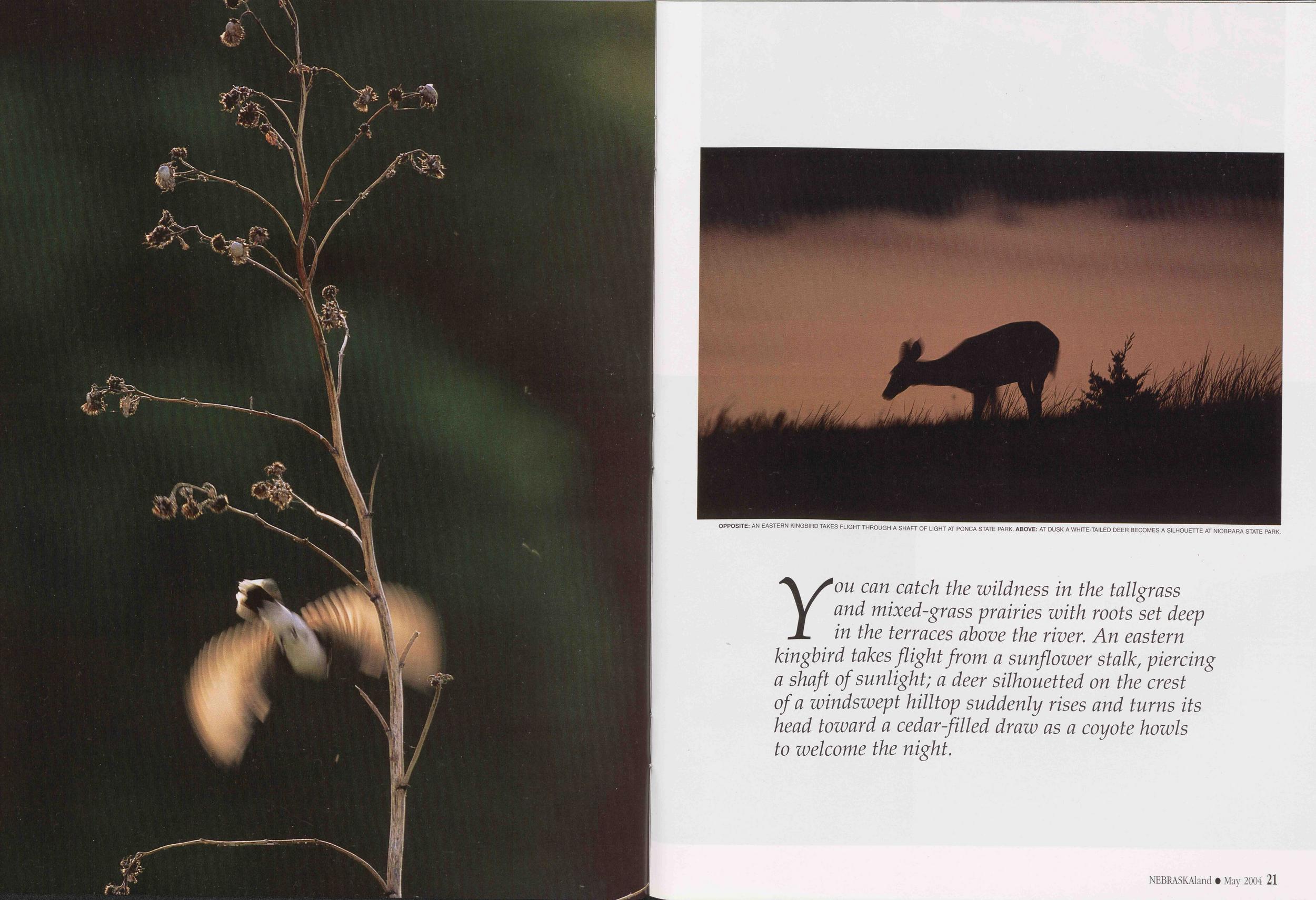
You can catch the wildness in the tailgrass and mixed-grass prairies with roots set deep in the terraces above the river. An eastern kingbird takes flight from a sunflower stalkpiercing a shaft of sunlight; a deer silhouetted on the crest of a windswept hilltop suddenly rises and turns its head toward a cedar-filled draw as a coyote howls to welcome the night.
NEBRASKAland • May 2004 21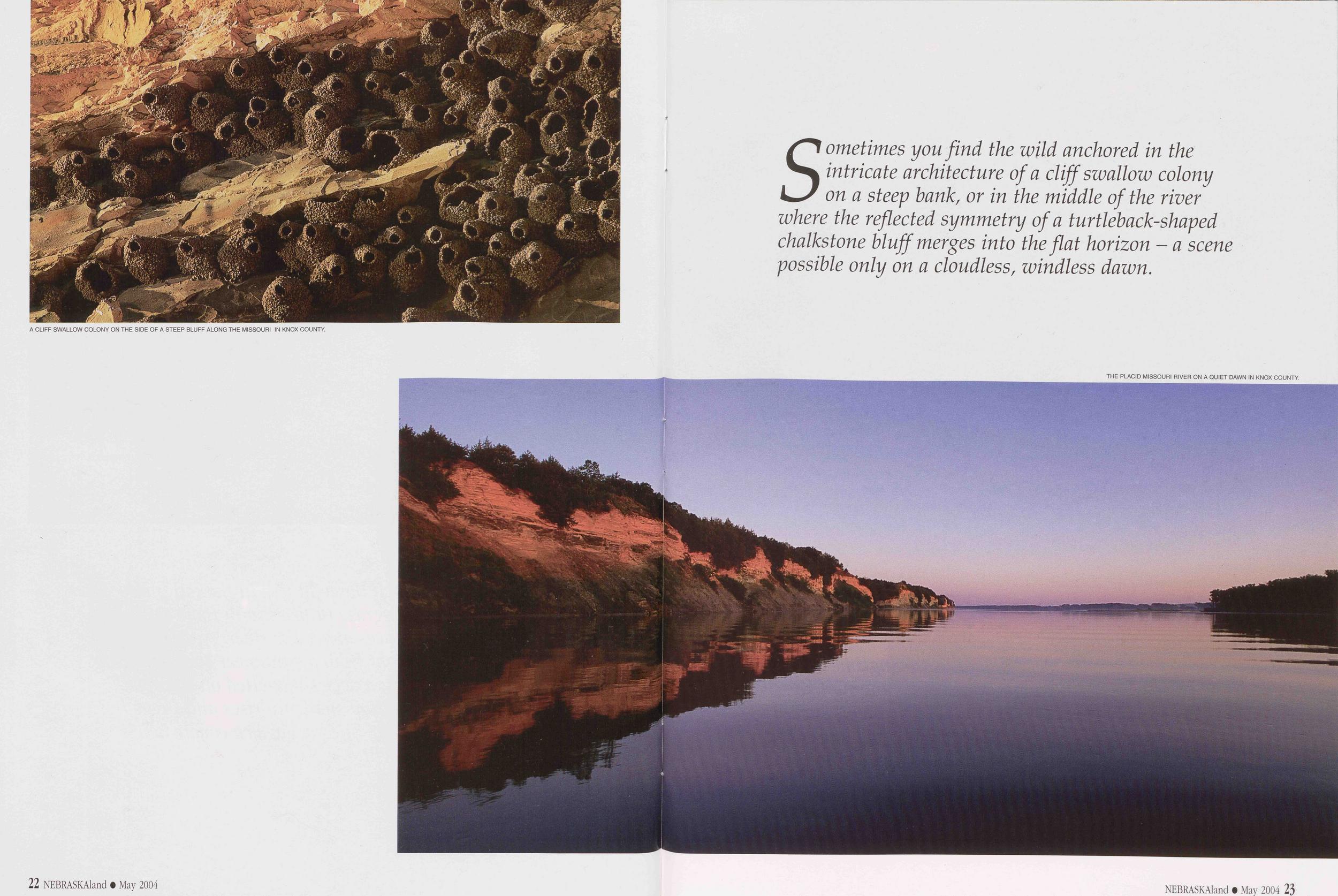
Sometimes you find the wild anchored in the intricate architecture of a cliff swallow colony on a steep hank,, or in the middle of the river where the reflected symmetry of a turtieback-shaped chalkstone bluff merges into the flat horizon - a scene possible only on a cloudless, windless dawn.
To find out more about the natural wonders of the unchannelized reaches of the Missouri National Recreational River, and how to experience them for yourself, go online to www.nps.gov/mnrrj.
The National Park Service has two visitor centers on these stretches of the Missouri. The Lewis and Clark Visitor Center is located on Calumet Bluff overlooking the river and Gavins Point Dam. It is located on Nebraska Highway 121 about four miles west of the junction with U.S. Highway 81 and about 10 miles north of Crofton. The Missouri National Recreational River Resource and Education Center is located in Ponca State Park, which is located two miles north of the town of Ponca, on Nebraska Spur 26E.
For information about Ponca and Niobrara state parks go online to outdoornebraska.org. Both parks offer camping, cabins and a variety of recreational opportunities.
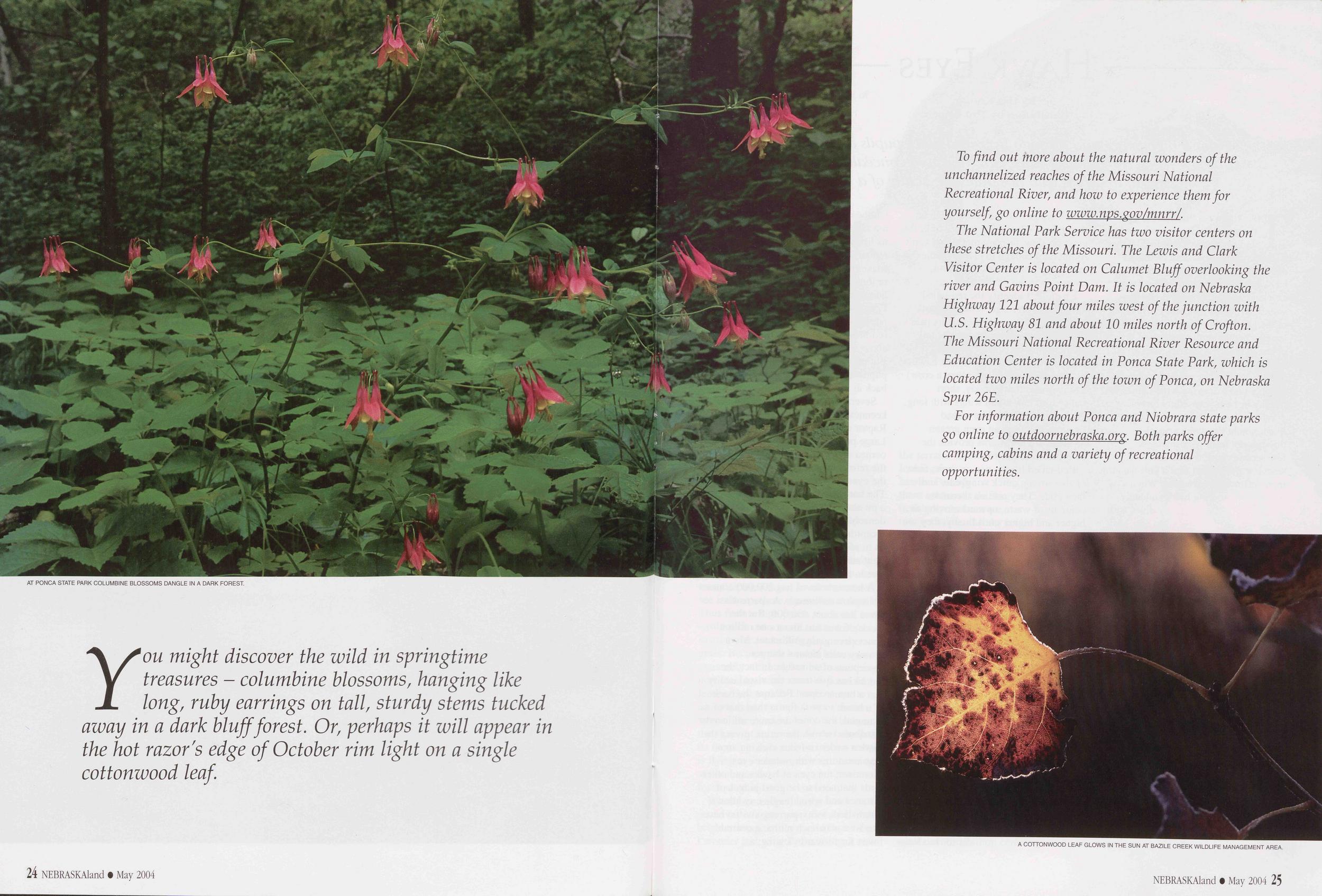
You might discover the wild in springtime treasures - columbine blossoms, hanging like long, ruby earrings on tall, sturdy stems tucked away in a dark bluff forest. Or, perhaps it will appear in the hot razor's edge of October rim light on a single cottonwood leaf
Hawk Eyes
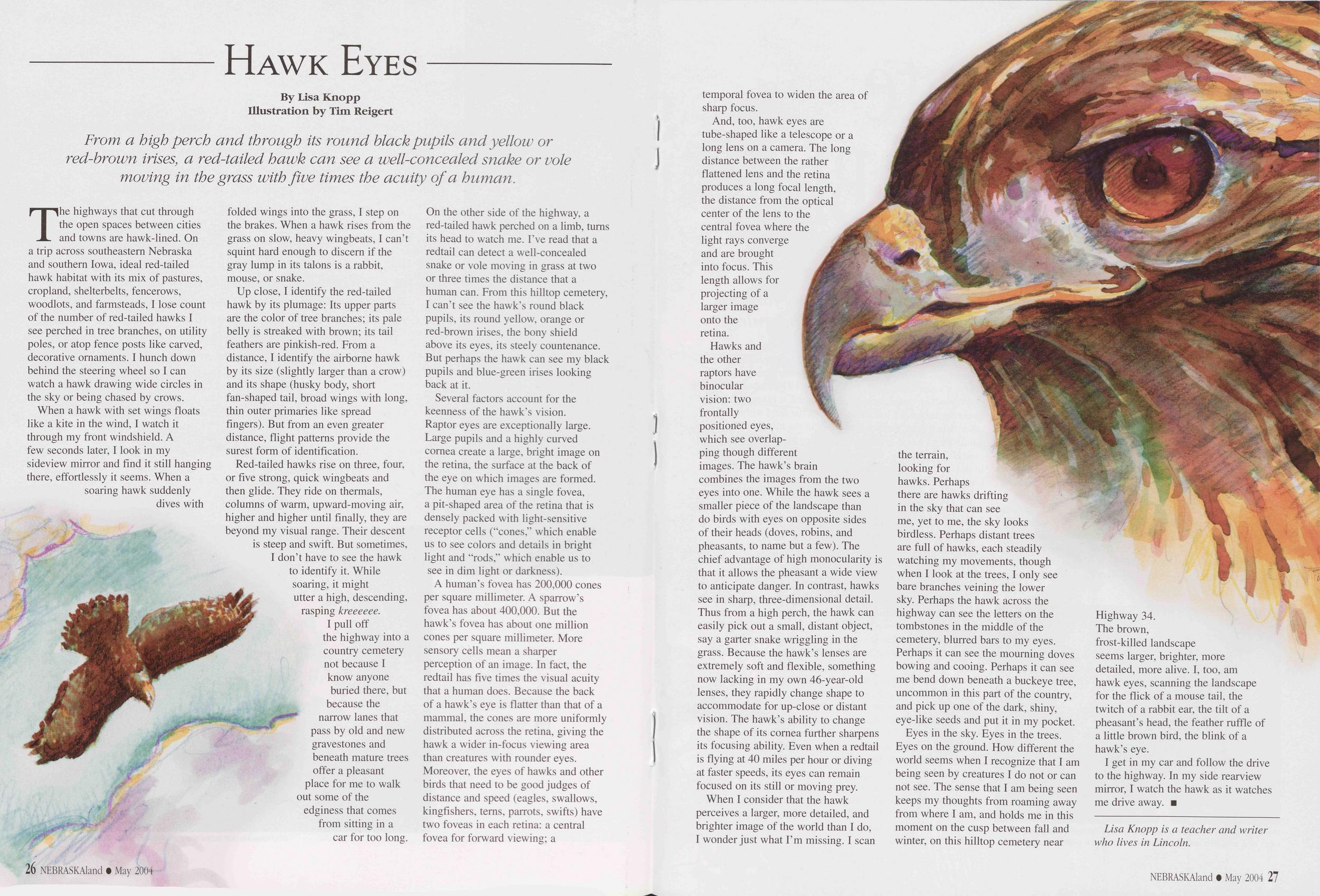
By Lisa Knopp Illustration by Tim Reigert From a high perch and through its round black pupils and yellow or red-brown irises, a red-tailed hawk can see a well-concealed snake or vole moving in the grass with five times the acuity of a human.The highways that cut through the open spaces between cities and towns are hawk-lined. On a trip across southeastern Nebraska and southern Iowa, ideal red-tailed hawk habitat with its mix of pastures, cropland, shelterbelts, fencerows, woodlots, and farmsteads, I lose count of the number of red-tailed hawks I see perched in tree branches, on utility poles, or atop fence posts like carved, decorative ornaments. I hunch down behind the steering wheel so I can watch a hawk drawing wide circles in the sky or being chased by crows.
When a hawk with set wings floats like a kite in the wind, I watch it through my front windshield. A few seconds later, I look in my sideview mirror and find it still hanging there, effortlessly it seems. When a soaring hawk suddenly dives with
Up close, I identify the red-tailed hawk by its plumage: Its upper parts are the color of tree branches; its pale belly is streaked with brown; its tail feathers are pinkish-red. From a distance, I identify the airborne hawk by its size (slightly larger than a crow) and its shape (husky body, short fan-shaped tail, broad wings with long, thin outer primaries like spread fingers). But from an even greater distance, flight patterns provide the surest form of identification.
Red-tailed hawks rise on three, four, or five strong, quick wingbeats and then glide. They ride on thermals, columns of warm, upward-moving air, higher and higher until finally, they are beyond my visual range. Their descent is steep and swift. But sometimes, I don’t have to see the hawk to identify it. While soaring, it might utter a high, descending, rasping kreeeeee. I pull off the highway into a country cemetery not because I know anyone buried there, but because the narrow lanes that pass by old and new gravestones and beneath mature trees offer a pleasant place for me to walk out some of the edginess that comes from sitting in a car for too long. On the other side of the highway, a red-tailed hawk perched on a limb, turns its head to watch me. I’ve read that a redtail can detect a well-concealed snake or vole moving in grass at two or three times the distance that a human can. From this hilltop cemetery, I can’t see the hawk’s round black pupils, its round yellow, orange or red-brown irises, the bony shield above its eyes, its steely countenance. But perhaps the hawk can see my black pupils and blue-green irises looking back at it.
Several factors account for the keenness of the hawk’s vision. Raptor eyes are exceptionally large. Large pupils and a highly curved cornea create a large, bright image on the retina, the surface at the back of the eye on which images are formed. The human eye has a single fovea, a pit-shaped area of the retina that is densely packed with light-sensitive receptor cells ("cones,” which enable us to see colors and details in bright light and "rods,” which enable us to see in dim light or darkness).
A human’s fovea has 200,000 cones per square millimeter. A sparrow’s fovea has about 400,000. But the hawk’s fovea has about one million cones per square millimeter. More sensory cells mean a sharper perception of an image. In fact, the redtail has five times the visual acuity that a human does. Because the back of a hawk’s eye is flatter than that of a mammal, the cones are more uniformly distributed across the retina, giving the hawk a wider in-focus viewing area than creatures with rounder eyes. Moreover, the eyes of hawks and other birds that need to be good judges of distance and speed (eagles, swallows, kingfishers, terns, parrots, swifts) have two foveas in each retina: a central fovea for forward viewing; a temporal fovea to widen the area of sharp focus.
And, too, hawk eyes are tube-shaped like a telescope or a long lens on a camera. The long distance between the rather flattened lens and the retina produces a long focal length, the distance from the optical center of the lens to the central fovea where the light rays converge and are brought into focus. This length allows for projecting of a larger image onto the retina.
Hawks and the other raptors have binocular vision: two frontally positioned eyes, which see overlap- ping though different images. The hawk’s brain combines the images from the two eyes into one. While the hawk sees smaller piece of the landscape than do birds with eyes on opposite sides of their heads (doves, robins, and pheasants, to name but a few). The chief advantage of high monocularity is that it allows the pheasant a wide view to anticipate danger. In contrast, hawks see in sharp, three-dimensional detail. Thus from a high perch, the hawk can easily pick out a small, distant object, say a garter snake wriggling in the grass. Because the hawk’s lenses are extremely soft and flexible, something now lacking in my own 46-year-old lenses, they rapidly change shape to accommodate for up-close or distant vision. The hawk’s ability to change the shape of its cornea further sharpens its focusing ability. Even when a redtail is flying at 40 miles per hour or diving at faster speeds, its eyes can remain focused on its still or moving prey.
When I consider that the hawk perceives a larger, more detailed, and brighter image of the world than I do, I wonder just what I’m missing. I scan the terrain, looking for hawks. Perhaps there are hawks drifting in the sky that can see me, yet to me, the sky looks birdless. Perhaps distant trees are full of hawks, each steadily watching my movements, though when I look at the trees, I only see bare branches veining the lower sky. Perhaps the hawk across the highway can see the letters on the tombstones in the middle of the cemetery, blurred bars to my eyes. Perhaps it can see the mourning doves bowing and cooing. Perhaps it can see me bend down beneath a buckeye tree, uncommon in this part of the country, and pick up one of the dark, shiny, eye-like seeds and put it in my pocket.
Eyes in the sky. Eyes in the trees. Eyes on the ground. How different the world seems when I recognize that I am being seen by creatures I do not or can not see. The sense that I am being seen keeps my thoughts from roaming away from where I am, and holds me in this moment on the cusp between fall and winter, on this hilltop cemetery near Highway 34. The brown, frost-killed landscape seems larger, brighter, more detailed, more alive. I, too, am hawk eyes, scanning the landscape for the flick of a mouse tail, the twitch of a rabbit ear, the tilt of a pheasant’s head, the feather ruffle of a little brown bird, the blink of a hawk’s eye.
I get in my car and follow the drive to the highway. In my side rearview mirror, I watch the hawk as it watches me drive away.
Lisa Knopp is a teacher and writer who lives in Lincoln. 26 NEBRASKAland • May 2004 NEBRASKAland • May 2004 27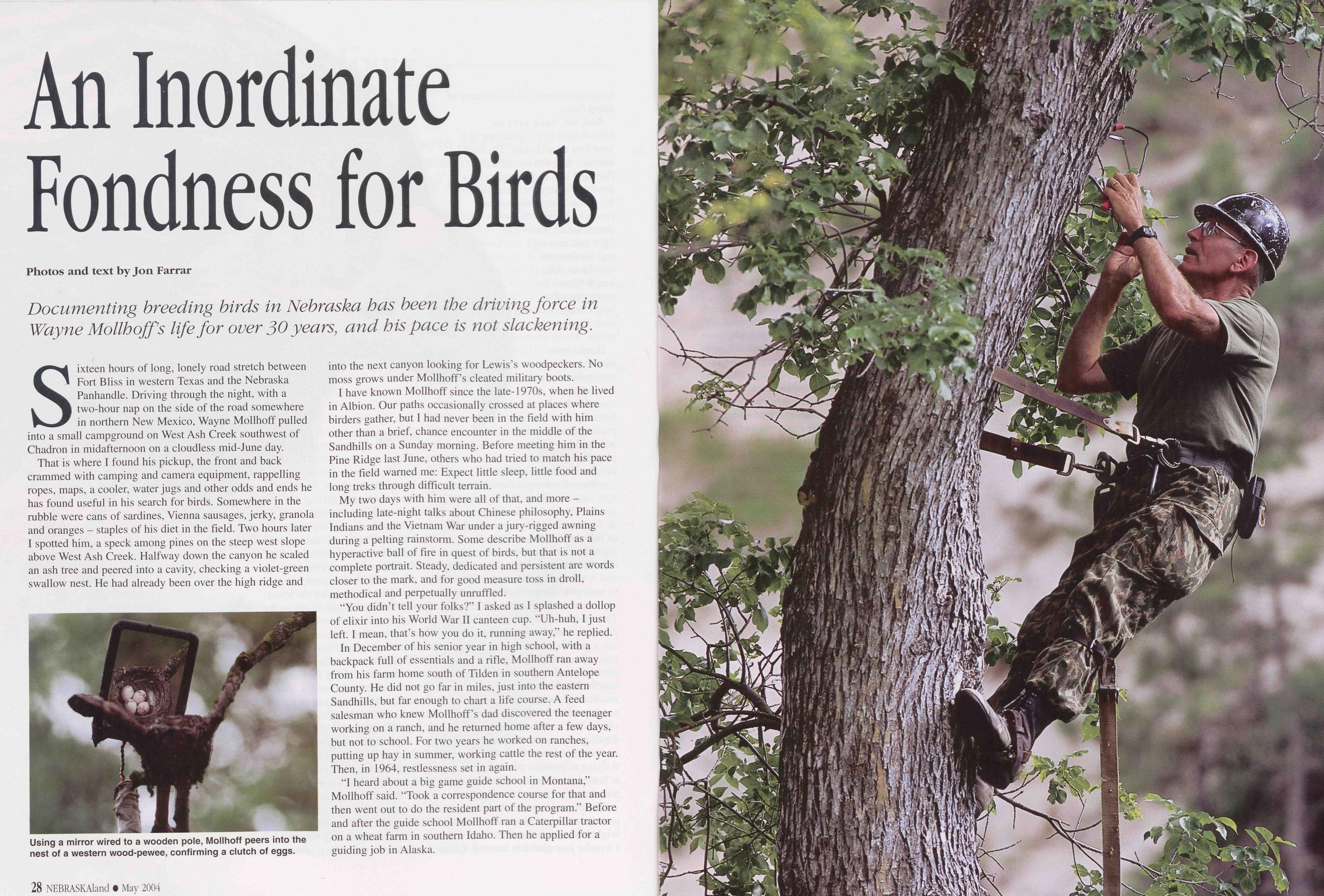
An Inordinate Fondness for Birds
Photos and text by Jon Farrar Documenting breeding birds in Nebraska has been tbe driving force in Wayne Mollboff’s life for over 30 years, and bis pace is not slackening.Sixteen hours of long, lonely road stretch between Fort Bliss in western Texas and the Nebraska Panhandle. Driving through the night, with a two-hour nap on the side of the road somewhere in northern New Mexico, Wayne Mollhoff pulled into a small campground on West Ash Creek southwest of Chadron in mid afternoon on a cloudless mid-June day.
That is where I found his pickup, the front and back crammed with camping and camera equipment, rappelling ropes, maps, a cooler, water jugs and other odds and ends he has found useful in his search for birds. Somewhere in the rubble were cans of sardines, Vienna sausages, jerky, granola and oranges - staples of his diet in the field. Two hours later I spotted him, a speck among pines on the steep west slope above West Ash Creek. Halfway down the canyon he scaled an ash tree and peered into a cavity, checking a violet-green swallow nest. He had already been over the high ridge and
I have known Mollhoff since the late-1970s, when he lived in Albion. Our paths occasionally crossed at places where birders gather, but I had never been in the field with him other than a brief, chance encounter in the middle of the Sandhills on a Sunday morning. Before meeting him in the Pine Ridge last June, others who had tried to match his pace in the field warned me: Expect little sleep, little food and long treks through difficult terrain.
My two days with him were all of that, and more - including late-night talks about Chinese philosophy, Plains Indians and the Vietnam War under a jury-rigged awning during a pelting rainstorm. Some describe Mollhoff as a hyperactive ball of fire in quest of birds, but that is not a complete portrait. Steady, dedicated and persistent are words closer to the mark, and for good measure toss in droll, methodical and perpetually unruffled.
“You didn’t tell your folks?” I asked as I splashed a dollop of elixir into his World War II canteen cup. “Uh-huh, I just left. I mean, that’s how you do it, running away,” he replied.
In December of his senior year in high school, with a backpack full of essentials and a rifle, Mollhoff ran away from his farm home south of Tilden in southern Antelope County. He did not go far in miles, just into the eastern Sandhills, but far enough to chart a life course. A feed salesman who knew Mollhoff’s dad discovered the teenager working on a ranch, and he returned home after a few days, but not to school. For two years he worked on ranches, putting up hay in summer, working cattle the rest of the year. Then, in 1964, restlessness set in again.
"I heard about a big game guide school in Montana,” Mollhoff said. "Took a correspondence course for that and then went out to do the resident part of the program.” Before and after the guide school Mollhoff ran a Caterpillar tractor on a wheat farm in southern Idaho. Then he applied for a guiding job in Alaska.
28 NEBRASKAland • May 2004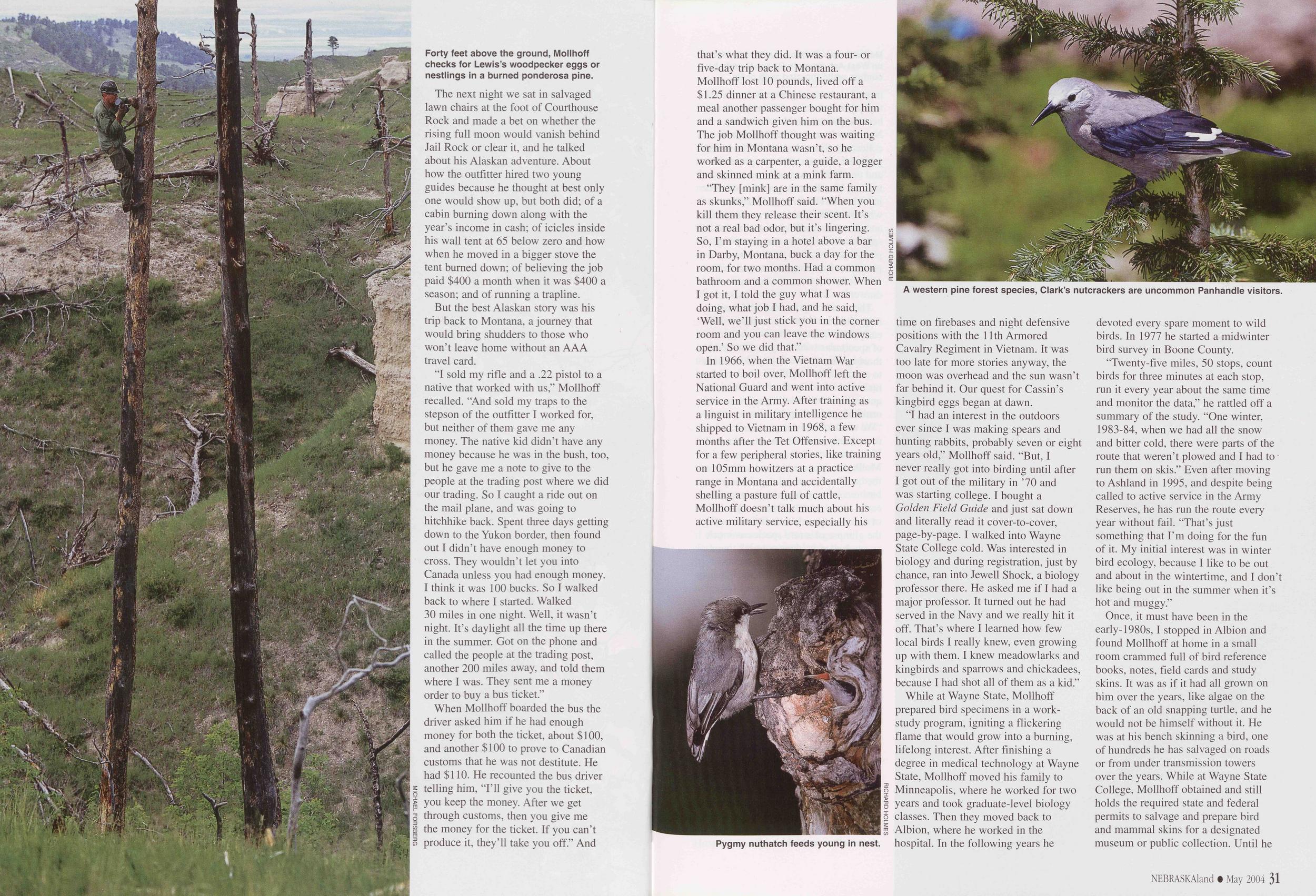
The next night we sat in salvaged lawn chairs at the foot of Courthouse Rock and made a bet on whether the rising full moon would vanish behind Jail Rock or clear it, and he talked about his Alaskan adventure. About how the outfitter hired two young guides because he thought at best only one would show up, but both did; of a cabin burning down along with the year’s income in cash; of icicles inside his wall tent at 65 below zero and how when he moved in a bigger stove the tent burned down; of believing the job paid $400 a month when it was $400 a season; and of running a trapline.
But the best Alaskan story was his trip back to Montana, a journey that would bring shudders to those who won’t leave home without an AAA travel card.
"I sold my rifle and a .22 pistol to a native that worked with us,” Mollhoff recalled. "And sold my traps to the stepson of the outfitter I worked for, but neither of them gave me any money. The native kid didn’t have any money because he was in the bush, too, but he gave me a note to give to the people at the trading post where we did our trading. So I caught a ride out on the mail plane, and was going to hitchhike back. Spent three days getting down to the Yukon border, then found out I didn’t have enough money to cross. They wouldn’t let you into Canada unless you had enough money. I think it was 100 bucks. So I walked back to where I started. Walked 30 miles in one night. Well, it wasn’t night. It’s daylight all the time up there in the summer. Got on the phone and called the people at the trading post, another 200 miles away, and told them where I was. They sent me a money order to buy a bus ticket.”
When Mollhoff boarded the bus the driver asked him if he had enough money for both the ticket, about $100, and another $100 to prove to Canadian customs that he was not destitute. He had $110. He recounted the bus driver telling him, “I’ll give you the ticket, you keep the money. After we get through customs, then you give me the money for the ticket. If you can’t produce it, they’ll take you off.” And
“They [mink] are in the same family as skunks,” Mollhoff said. "When you kill them they release their scent. It’s not a real bad odor, but it’s lingering. So, I’m staying in a hotel above a bar in Darby, Montana, buck a day for the room, for two months. Had a common bathroom and a common shower. When I got it, I told the guy what I was doing, what job I had, and he said, ‘Well, we’ll just stick you in the corner room and you can leave the windows open.’ So we did that.”
In 1966, when the Vietnam War started to boil over, Mollhoff left the National Guard and went into active service in the Army. After training as a linguist in military intelligence he shipped to Vietnam in 1968, a few months after the Tet Offensive. Except for a few peripheral stories, like training on 105 mm howitzers at a practice range in Montana and accidentally shelling a pasture full of cattle, Mollhoff doesn’t talk much about his active military service, especially his
“I had an interest in the outdoors ever since I was making spears and hunting rabbits, probably seven or eight years old,” Mollhoff said. “But, I never really got into birding until after I got out of the military in ’70 and was starting college. I bought a Golden Field Guide and just sat down and literally read it cover-to-cover, page-by-page. I walked into Wayne State College cold. Was interested in biology and during registration, just by chance, ran into Jewell Shock, a biology professor there. He asked me if I had a major professor. It turned out he had served in the Navy and we really hit it off. That’s where I learned how few local birds I really knew, even growing up with them. I knew meadowlarks and kingbirds and sparrows and chickadees, because I had shot all of them as a kid.”
While at Wayne State, Mollhoff prepared bird specimens in a work- study program, igniting a flickering flame that would grow into a burning, lifelong interest. After finishing a degree in medical technology at Wayne State, Mollhoff moved his family to Minneapolis, where he worked for two Z years and took graduate-level biology p classes. Then they moved back to Albion, where he worked in the hospital. In the following years he devoted every spare moment to wild birds. In 1977 he started a midwinter bird survey in Boone County.
"Twenty-five miles, 50 stops, count birds for three minutes at each stop, run it every year about the same time and monitor the data,” he rattled off a summary of the study. "One winter, 1983-84, when we had all the snow and bitter cold, there were parts of the route that weren’t plowed and I had to run them on skis.” Even after moving to Ashland in 1995, and despite being called to active service in the Army Reserves, he has run the route every year without fail. "That’s just something that I’m doing for the fun of it. My initial interest was in winter bird ecology, because I like to be out and about in the wintertime, and I don’t like being out in the summer when it’s hot and muggy.”
Once, it must have been in the
early-1980s, I stopped in Albion and
found Mollhoff at home in a small
room crammed full of bird reference
books, notes, field cards and study
skins. It was as if it had all grown on
him over the years, like algae on the
back of an old snapping turtle, and he
would not be himself without it. He
was at his bench skinning a bird, one
of hundreds he has salvaged on roads
or from under transmission towers
over the years. While at Wayne State
College, Mollhoff obtained and still
holds the required state and federal
permits to salvage and prepare bird
and mammal skins for a designated
museum or public collection. Until he
NEBRASKAland • May 2004 31
The ornithologists Mollhoff most respects were at the university in the early-1900s, and prodigious collectors of specimens with the gun. It’s their thoroughness in the field and attention to accuracy that Mollhoff emulates in his own bird study. One of his favorite quotes is from University of Nebraska ornithologist Robert Wolcott in 1901: "We must know what we know and record only what we know we know.” If there is a thread running through Mollhoff’s 30 years of bird study, it is the quest to document the unknown, or bird records not duplicated since the early-1900s. Mollhoff has no life list of species sighted, and while he enjoys the glimpse of a rare species as much as any birder, he does not seek them.
The quest to know the unknown led Mollhoff to a study that would consume more than six years of his life. The Nebraska Breeding Bird Atlas project grew out of a seemingly simple request from British ornithologists for someone from each state to participate in the Holarctic Avian Speciation Atlas project, mapping the breeding ranges of all birds nesting north of the tropics worldwide. Mollhoff responded. The organizers of the project assumed that in well-studied areas of North America it would be a simple matter of gathering and updating breeding bird records. Mollhoff volunteered to provide the Nebraska information. What he found was a huge void in Nebraska breeding bird records. It was evident the only way to gather the needed information was a statewide atlas project. At a presentation to the Nebraska Ornithologists’ Union (NOU) board in 1983, he gained the backing of the state’s only bird study organization.
Field work for the project took from 1984 through 1989. A total of 443, nine-square-mile blocks, totaling less than five percent of the state, were chosen, representing as many types of habitat in the state as possible. When the project was finished, 26,000 records had been gathered and observers had logged 5,803 hours looking for nesting birds. When the data was compiled, 191 species met all the criteria as a confirmed breeding species. In addition to designing, coordinating and compiling the data, Mollhoff completed more sample blocks than any other birder in the state, something he admits reluctantly.
"I would work it out ahead of time,” he recalled, "sit down with the maps and try to figure out how to do two or three counties over a weekend and be back home by midnight Sunday. I would drive to the first block on Friday night, crawl in the back of the pickup and sleep until daylight. I’d try to have that block done by 9 o’clock, drive to the next block, and finish my notes while I was driving. Before I got to the next one I would be preparing the report card for it. I’d try to be done by noon, eat something, maybe take a nap, and then go to the next block.
"Sometimes I would do five in a day, if they were close. I would go until dark, until it was completely dark, to try to get the owls and other nocturnal species. When I quit I would finish notes by lantern light in the pickup, probably until 10 o’clock, then drive to the next block and get up in the morning and do it again. When I quit picking up new species, I knew it was time to move, because you never get a block completely done. There are always more birds to be found, but I knew there just wasn’t time enough to be more thorough.”
When the project ended, Mollhoff had worked about 260 survey blocks. Was it fun? "That wouldn’t be the word I would put with it,” he said. Why did you do it? "Once I start something, I’m going to get it done.” While keeping that withering pace, Mollhoff had a fulltime job as a laboratory and X-ray supervisor at the Boone County Hospital in Albion and was in the Using a mirror and flashlight, Mollhoff inspects a violet-green swallow nest. Army Reserves. After the field work was completed he labored at the onerous task of assembling the massive volume of data gathered. Finally, in 2001, after years of searching for financial support, The Nebraska Breeding Bird Atlas was published. In recognition of the atlas work, the NOU voted Mollhoff an honorary life member, a distinction sparingly awarded.
So, how does Mollhoff vent his energy these days? That brings us back to moonrises over Jail Rock and evening thunderstorms on West Ash Creek. But first, an old bird study story.
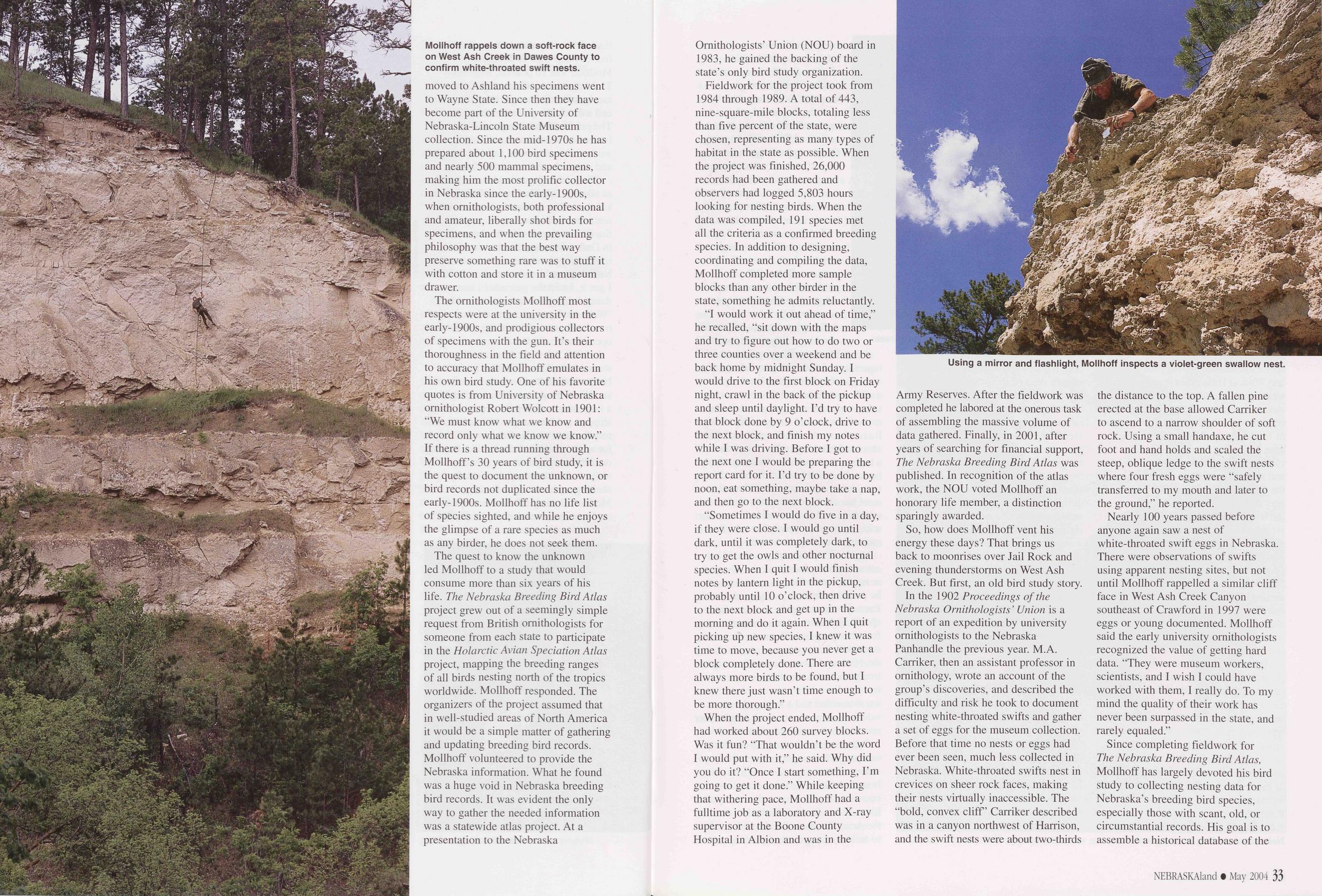
In the 1902 Proceedings of the Nebraska Ornithologists' Union is a report of an expedition by university ornithologists to the Nebraska Panhandle the previous year. M.A. Carriker, then an assistant professor in ornithology, wrote an account of the group’s discoveries, and described the difficulty and risk he took to document nesting white-throated swifts and gather a set of eggs for the museum collection. Before that time no nests or eggs had ever been seen, much less collected in Nebraska. White-throated swifts nest in crevices on sheer rock faces, making their nests virtually inaccessible. The "bold, convex cliff’ Carriker described was in a canyon northwest of Harrison, and the swift nests were about two-thirds the distance to the top. A fallen pine erected at the base allowed Carriker to ascend to a narrow shoulder of soft rock. Using a small handaxe, he cut foot and hand holds and scaled the steep, oblique ledge to the swift nests where four fresh eggs were "safely transferred to my mouth and later to the ground,” he reported.
Nearly 100 years passed before anyone again saw a nest of white-throated swift eggs in Nebraska. There were observations of swifts using apparent nesting sites, but not until Mollhoff rappelled a similar cliff face in West Ash Creek Canyon southeast of Crawford in 1997 were eggs or young documented. Mollhoff said the early university ornithologists recognized the value of getting hard data. "They were museum workers, scientists, and I wish I could have worked with them, I really do. To my mind the quality of their work has never been surpassed in the state, and rarely equaled.”
Since completing fieldwork for
The Nebraska Breeding Bird Atlas,
Mollhoff has largely devoted his bird
study to collecting nesting data for
Nebraska’s breeding bird species,
especially those with scant, old, or
circumstantial records. His goal is to
assemble a historical database of the
NEBRASKAland • May 2004 33
 state’s breeding bird records.
He began compiling breeding
bird records by gathering data
from egg sets collected by the
likes of Carriker and Wolcott in
the early-1900s. His museum
research revealed few nesting
records for many species, and
he targeted those for fieldwork.
Mollhoff studies Nebraska’s
breeding birds whenever and
wherever he has the opportunity,
but he has concentrated on
western species with ranges
barely extending into the state -
pinyon jays, pygmy nuthatches,
white-throated swifts, poorwills,
violet-green swallows, Clark’s
nutcrackers, red crossbills and
Lewis’s woodpeckers.
state’s breeding bird records.
He began compiling breeding
bird records by gathering data
from egg sets collected by the
likes of Carriker and Wolcott in
the early-1900s. His museum
research revealed few nesting
records for many species, and
he targeted those for fieldwork.
Mollhoff studies Nebraska’s
breeding birds whenever and
wherever he has the opportunity,
but he has concentrated on
western species with ranges
barely extending into the state -
pinyon jays, pygmy nuthatches,
white-throated swifts, poorwills,
violet-green swallows, Clark’s
nutcrackers, red crossbills and
Lewis’s woodpeckers.
Mollhoff’s work in the Panhandle during the atlas project raised as many questions as it answered about western species found only in the Pine Ridge and Wildcat Hills. Even more intriguing were species sporadically irrupting into western counties when poor feeding conditions pushed them east in search of food, principally pine seeds. The time of nesting for those species is closely tied to the abundance of food and might occur in late winter or during the fall. Clark’s nutcrackers, pinyon jays and red crossbills especially intrigued Mollhoff, but his quest for information on those species broadened to include others. Bird study as Mollhoff does it is not leisurely and comfortable outdoor recreation. In March 1997, while searching for early nesting red crossbills, he was stranded in a blizzard in his pickup for two days and two nights on the side of a county road east of Crawford waiting for a snow plow.
Mollhoff did not find nesting crossbills on that trip, but he returned later in the spring and while searching for nutcrackers found pygmy nuthatches carrying nesting material. As with the white-throated swifts, there were a few reports of these western nuthatches nesting in Nebraska, but no hard data, no records of number of eggs or time of hatching. He found eight pygmy nuthatch nests with eggs in the Pine Ridge that year.
Mollhoff’s greatest chase for western Nebraska breeding birds records has
Like the white-throated swift and pygmy nuthatch, poor documentation for Lewis’s woodpeckers can largely be attributed to the inaccessible locations of their nests. The first Lewis’s woodpecker nest Mollhoff examined was 54 feet above the ground in a burned ponderosa pine that creaked and rocked in the wind. His avocation is not without risk. He has climbed burned pine trunks that seem solid and destined to raise Lewis’s woodpeckers for many more years, and found the tree on the ground the next spring. Given the tenuous nature of their nesting sites, Mollhoff is no doubt the only person to have seen Lewis’s woodpecker and pygmy nuthatch eggs in Nebraska.
Mollhoff adopts new technology only grudgingly. He’s skeptical about computers because they can rarely be repaired with a pair of pliers, and he keeps all his original field records in a fireproof safe along with birth records, deeds and other important documents. He has embraced Global Positioning System technology as an easier way to precisely document locations, but he records that information in pencil or permanent ink on paper. And he carries a cellular phone. “When I go out alone, I try to call my wife every night, or when I get down off the trees or off the cliff, just to put her mind at ease. Yes, I do risky things, but I do them very carefully.”
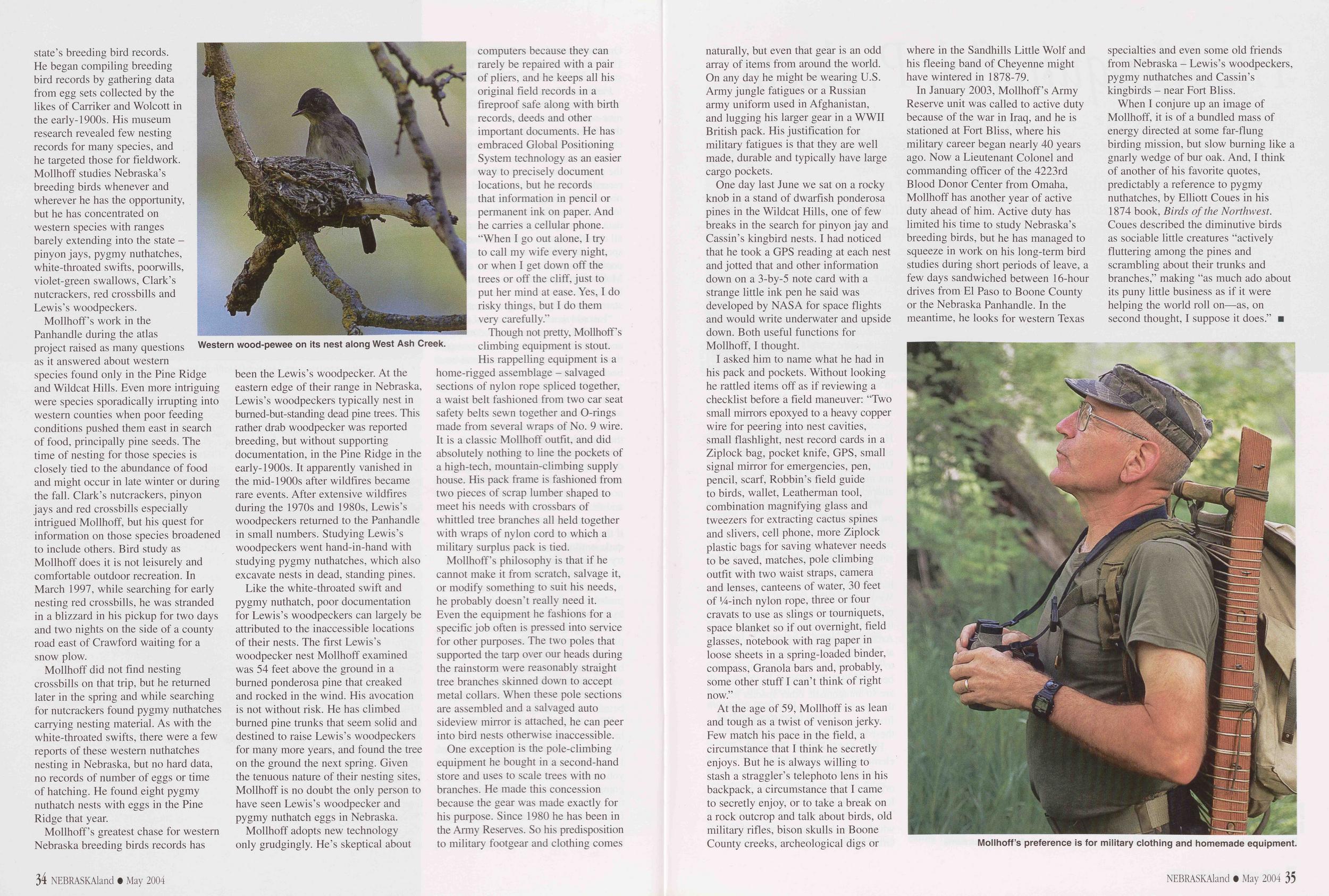
Though not pretty, Mollhoff’s climbing equipment is stout. His rappelling equipment is a home-rigged assemblage - salvaged sections of nylon rope spliced together, a waist belt fashioned from two car seat safety belts sewn together and O-rings made from several wraps of No. 9 wire. It is a classic Mollhoff outfit, and did absolutely nothing to line the pockets of a high-tech, mountain-climbing supply house. His pack frame is fashioned from two pieces of scrap lumber shaped to meet his needs with crossbars of whittled tree branches all held together with wraps of nylon cord to which a military surplus pack is tied.
Mollhoff’s philosophy is that if he cannot make it from scratch, salvage it, or modify something to suit his needs, he probably doesn’t really need it. Even the equipment he fashions for a specific job often is pressed into service for other purposes. The two poles that supported the tarp over our heads during the rainstorm were reasonably straight tree branches skinned down to accept metal collars. When these pole sections are assembled and a salvaged auto sideview mirror is attached, he can peer into bird nests otherwise inaccessible.
One exception is the pole-climbing equipment he bought in a second-hand store and uses to scale trees with no branches. He made this concession because the gear was made exactly for his purpose. Since 1980 he has been in the Army Reserves. So his predisposition to military footgear and clothing comes naturally, but even that gear is an odd array of items from around the world. On any day he might be wearing U.S. Army jungle fatigues or a Russian army uniform used in Afghanistan, and lugging his larger gear in a WWII British pack. His justification for military fatigues is that they are well made, durable and typically have large cargo pockets.
One day last June we sat on a rocky knob in a stand of dwarfish ponderosa pines in the Wildcat Hills, one of few breaks in the search for pinyon jay and Cassin’s kingbird nests. I had noticed that he took a GPS reading at each nest and jotted that and other information down on a 3-by-5 note card with a strange little ink pen he said was developed by NASA for space flights and would write underwater and upside down. Both useful functions for Mollhoff, I thought.
I asked him to name what he had in his pack and pockets. Without looking he rattled items off as if reviewing a checklist before a field maneuver: “Two small mirrors epoxyed to a heavy copper wire for peering into nest cavities, small flashlight, nest record cards in a Ziplock bag, pocket knife, GPS, small signal mirror for emergencies, pen, pencil, scarf, Robbin’s field guide to birds, wallet, Leatherman tool, combination magnifying glass and tweezers for extracting cactus spines and slivers, cell phone, more Ziplock plastic bags for saving whatever needs to be saved, matches, pole climbing outfit with two waist straps, camera and lenses, canteens of water, 30 feet of ^-inch nylon rope, three or four cravats to use as slings or tourniquets, space blanket so if out overnight, field glasses, notebook with rag paper in loose sheets in a spring-loaded binder, compass, Granola bars and, probably, some other stuff I can’t think of right now.”
At the age of 59, Mollhoff is as lean and tough as a twist of venison jerky. Few match his pace in the field, a circumstance that I think he secretly enjoys. But he is always willing to stash a straggler’s telephoto lens in his backpack, a circumstance that I came to secretly enjoy, or to take a break on a rock outcrop and talk about birds, old military rifles, bison skulls in Boone County creeks, archeological digs or where in the Sandhills Little Wolf and his fleeing band of Cheyenne might have wintered in 1878-79.
In January 2003, Mollhoff’s Army Reserve unit was called to active duty because of the war in Iraq, and he is stationed at Fort Bliss, where his military career began nearly 40 years ago. Now a Lieutenant Colonel and commanding officer of the 4223rd Blood Donor Center from Omaha, Mollhoff has another year of active duty ahead of him. Active duty has limited his time to study Nebraska’s breeding birds, but he has managed to squeeze in work on his long-term bird studies during short periods of leave, a few days sandwiched between 16-hour drives from El Paso to Boone County or the Nebraska Panhandle. In the meantime, he looks for western Texas
When I conjure up an image of Mollhoff, it is of a bundled mass of energy directed at some far-flung birding mission, but slow burning like a gnarly wedge of bur oak. And, I think of another of his favorite quotes, predictably a reference to pygmy nuthatches, by Elliott Coues in his 1874 book, Birds of the Northwest. Coues described the diminutive birds as sociable little creatures “actively fluttering among the pines and scrambling about their trunks and branches,” making “as much ado about its puny little business as if it were helping the world roll on—as, on second thought, I suppose it does.”
34 NEBRASKAland • May 2004 NEBRASKAland • May 2004 35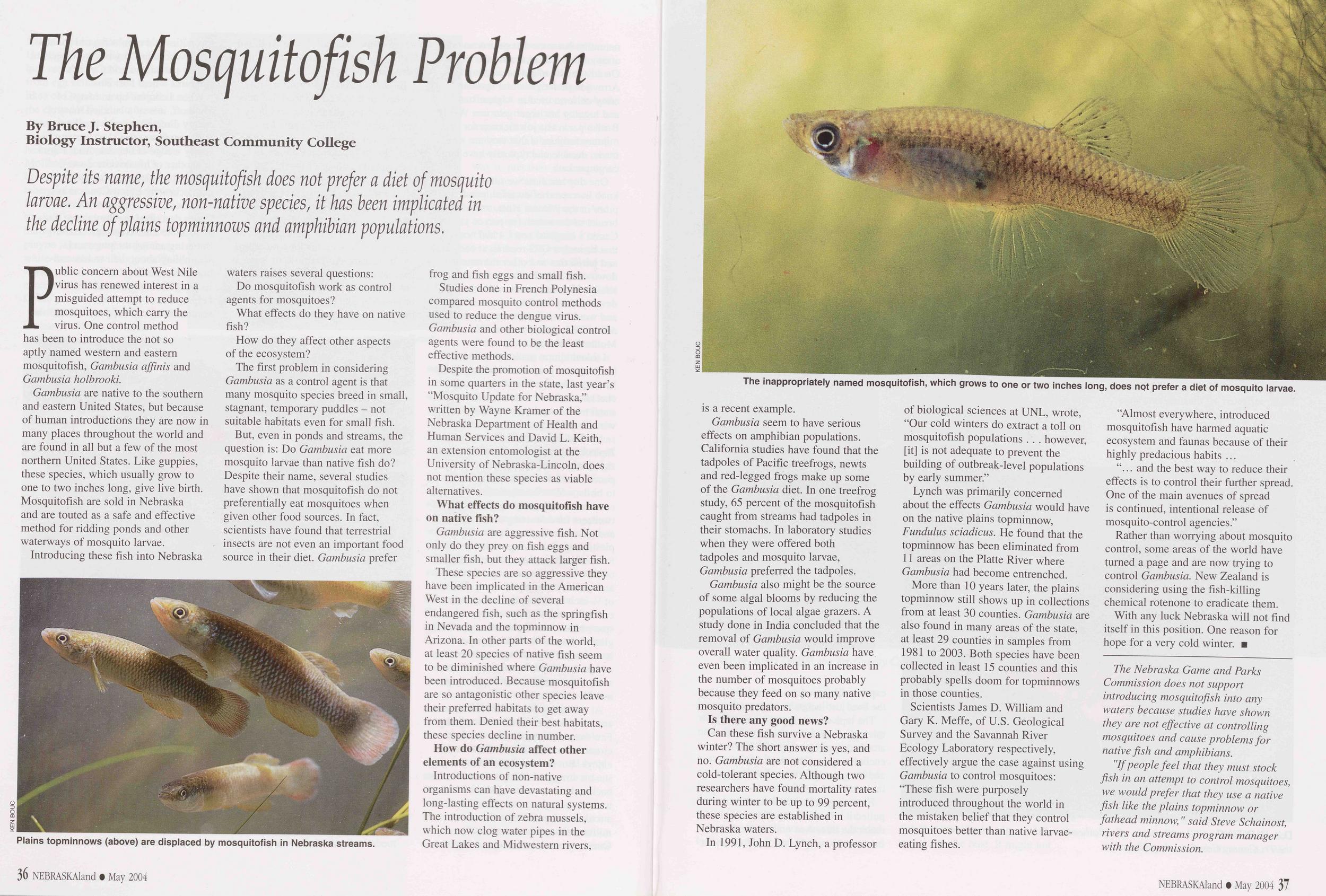
The Mosquitofish Problem
By Bruce J. Stephen, Biology Instructor, Southeast Community College Despite its name, the mosquitofish does not prefer a diet of mosquito larvae. An aggressive, non-native species, it has been implicated in the decline of plains topminnows and amphibian populations.Public concern about West Nile virus has renewed interest in a misguided attempt to reduce mosquitoes, which carry the virus. One control method has been to introduce the not so aptly named western and eastern mosquitofish, Gambusia ajfinis and Gambusia holbrooki.
Gambusia are native to the southern and eastern United States, but because of human introductions they are now in many places throughout the world and are found in all but a few of the most northern United States. Like guppies, these species, which usually grow to one to two inches long, give live birth. Mosquitofish are sold in Nebraska and are touted as a safe and effective method for ridding ponds and other waterways of mosquito larvae.
Introducing these fish into Nebraska
Do mosquitofish work as control agents for mosquitoes?
What effects do they have on native fish?
How do they affect other aspects of the ecosystem?
The first problem in considering Gambusia as a control agent is that many mosquito species breed in small, stagnant, temporary puddles - not suitable habitats even for small fish.
But, even in ponds and streams, the question is: Do Gambusia eat more mosquito larvae than native fish do? Despite their name, several studies have shown that mosquitofish do not preferentially eat mosquitoes when given other food sources. In fact, scientists have found that terrestrial insects are not even an important food source in their diet. Gambusia prefer frog and fish eggs and small fish.
Studies done in French Polynesia compared mosquito control methods used to reduce the dengue virus. Gambusia and other biological control agents were found to be the least effective methods.
Despite the promotion of mosquitofish in some quarters in the state, last year’s “Mosquito Update for Nebraska,” written by Wayne Kramer of the Nebraska Department of Health and Human Services and David L. Keith, an extension entomologist at the University of Nebraska-Lincoln, does not mention these species as viable alternatives.
What effects do mosquitofish have on native fish?Gambusia are aggressive fish. Not only do they prey on fish eggs and smaller fish, but they attack larger fish.
These species are so aggressive they have been implicated in the American West in the decline of several endangered fish, such as the springfish in Nevada and the topminnow in Arizona. In other parts of the world, at least 20 species of native fish seem to be diminished where Gambusia have been introduced. Because mosquitofish are so antagonistic other species leave their preferred habitats to get away from them. Denied their best habitats, these species decline in number.
How do Gambusia affect other elements of an ecosystem?Introductions of non-native organisms can have devastating and long-lasting effects on natural systems. The introduction of zebra mussels, which now clog water pipes in the Great Lakes and Midwestern rivers,
Gambusia seem to have serious effects on amphibian populations. California studies have found that the tadpoles of Pacific treefrogs, newts and red-legged frogs make up some of the Gambusia diet. In one treefrog study, 65 percent of the mosquitofish caught from streams had tadpoles in their stomachs. In laboratory studies when they were offered both tadpoles and mosquito larvae, Gambusia preferred the tadpoles.
Gambusia also might be the source of some algal blooms by reducing the populations of local algae grazers. A study done in India concluded that the removal of Gambusia would improve overall water quality. Gambusia have even been implicated in an increase in the number of mosquitoes probably because they feed on so many native mosquito predators.
Is there any good news?Can these fish survive a Nebraska winter? The short answer is yes, and no. Gambusia are not considered a cold-tolerant species. Although two researchers have found mortality rates during winter to be up to 99 percent, these species are established in Nebraska waters.
In 1991, John D. Lynch, a professor of biological sciences at UNL, wrote, “Our cold winters do extract a toll on mosquitofish populations . . . however, [it] is not adequate to prevent the building of outbreak-level populations by early summer.”
Lynch was primarily concerned about the effects Gambusia would have on the native plains topminnow, Fundulus sciadicus. He found that the topminnow has been eliminated from 11 areas on the Platte River where Gambusia had become entrenched.
More than 10 years later, the plains topminnow still shows up in collections from at least 30 counties. Gambusia are also found in many areas of the state, at least 29 counties in samples from 1981 to 2003. Both species have been collected in least 15 counties and this probably spells doom for topminnows in those counties.
Scientists James D. William and Gary K. Meffe, of U.S. Geological Survey and the Savannah River Ecology Laboratory respectively, effectively argue the case against using Gambusia to control mosquitoes: “These fish were purposely introduced throughout the world in the mistaken belief that they control mosquitoes better than native larvae- eating fishes.
“Almost everywhere, introduced mosquitofish have harmed aquatic ecosystem and faunas because of their highly predacious habits ...
"... and the best way to reduce their effects is to control their further spread. One of the main avenues of spread is continued, intentional release of mosquito-control agencies.”
Rather than worrying about mosquito control, some areas of the world have turned a page and are now trying to control Gambusia. New Zealand is considering using the fish-killing chemical rotenone to eradicate them.
With any luck Nebraska will not find itself in this position. One reason for hope for a very cold winter.
The Nebraska Game and Parks Commission does not support introducing mosquitofish into any waters because studies have shown they are not effective at controlling mosquitoes and cause problems for native fish and amphibians. "If people feel that they must stock fish in an attempt to control mosquitoes, we would prefer that they use a native fish like the plains topminnow or fathead minnow," said Steve Schainost, rivers and streams program manager with the Commission. 36 NEBRASKAland • May 2004 NEBRASKAland • May 2004 37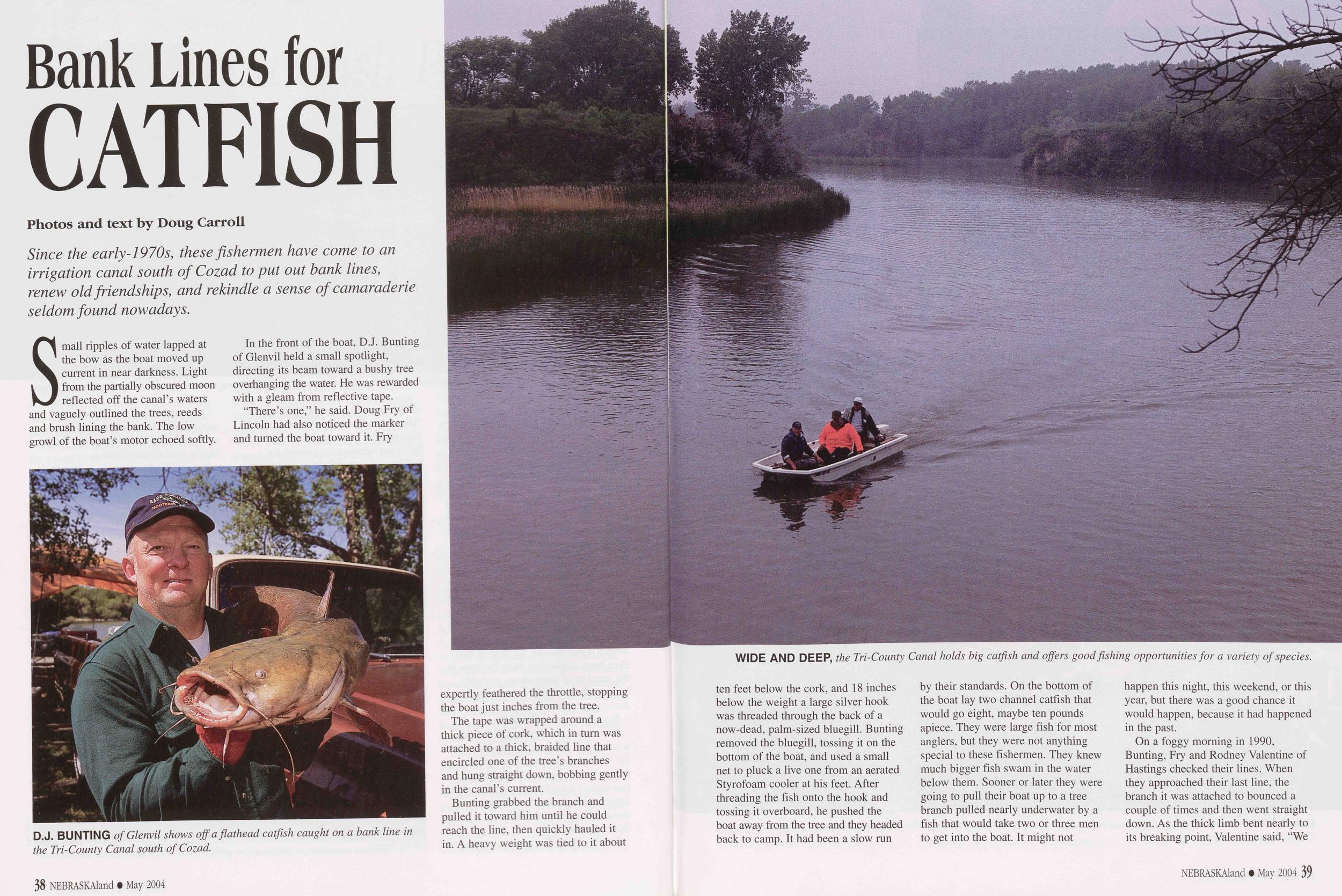
Bank Lines for CATFISH
Photos and text by Doug Carroll Since the early-1970s, these fishermen have come to an irrigation canal south of Cozad to put out bank lines, renew old friendships, and rekindle a sense of camaraderie seldom found nowadays.Small ripples of water lapped at the bow as the boat moved up current in near darkness. Light from the partially obscured moon reflected off the canal’s waters and vaguely outlined the trees, reeds and brush lining the bank. The low growl of the boat’s motor echoed softly.
In the front of the boat, D.J. Bunting of Glenvil held a small spotlight, directing its beam toward a bushy tree overhanging the water. He was rewarded with a gleam from reflective tape.
“There’s one,” he said. Doug Fry of Lincoln had also noticed the marker and turned the boat toward it. Fry
The tape was wrapped around a thick piece of cork, which in turn was attached to a thick, braided line that encircled one of the tree’s branches and hung straight down, bobbing gently in the canal’s current.
Bunting grabbed the branch and pulled it toward him until he could reach the line, then quickly hauled it in. A heavy weight was tied to it about ten feet below the cork, and 18 inches below the weight a large silver hook was threaded through the back of a now-dead, palm-sized bluegill. Bunting removed the bluegill, tossing it on the bottom of the boat, and used a small net to pluck a live one from an aerated Styrofoam cooler at his feet. After threading the fish onto the hook and tossing it overboard, he pushed the boat away from the tree and they headed back to camp. It had been a slow run by their standards. On the bottom of the boat lay two channel catfish that would go eight, maybe ten pounds apiece. They were large fish for most anglers, but they were not anything special to these fishermen. They knew much bigger fish swam in the water below them. Sooner or later they were going to pull their boat up to a tree branch pulled nearly underwater by a fish that would take two or three men to get into the boat. It might not happen this night, this weekend, or this year, but there was a good chance it would happen, because it had happened in the past.
On a foggy morning in 1990,
Bunting, Fry and Rodney Valentine of
Hastings checked their lines. When
they approached their last line, the
branch it was attached to bounced a
couple of times and then went straight
down. As the thick limb bent nearly to
its breaking point, Valentine said, “We
38 NEBRASKAland • May 2004
NEBRASKAland • May 2004 39
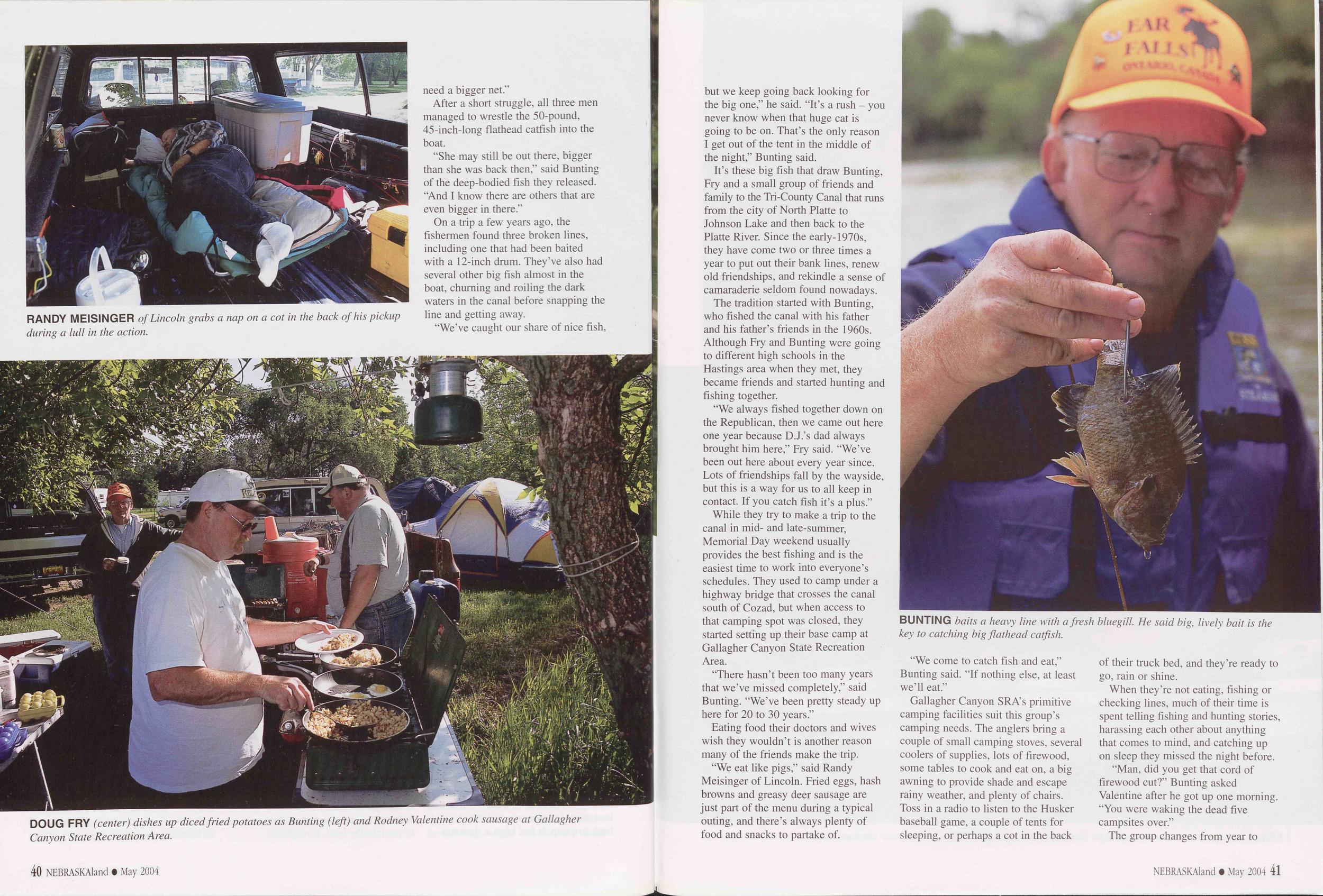
After a short struggle, all three men managed to wrestle the 50-pound, 45-inch-long flathead catfish into the boat.
“She may still be out there, bigger than she was back then,” said Bunting of the deep-bodied fish they released. “And I know there are others that are even bigger in there.”
On a trip a few years ago, the fishermen found three broken lines, including one that had been baited with a 12-inch drum. They’ve also had several other big fish almost in the boat, churning and roiling the dark waters in the canal before snapping the line and getting away.
“We’ve caught our share of nice fish,
It’s these big fish that draw Bunting, Fry and a small group of friends and family to the Tri-County Canal that runs from the city of North Platte to Johnson Lake and then back to the Platte River. Since the early-1970s, they have come two or three times a year to put out their bank lines, renew old friendships, and rekindle a sense of camaraderie seldom found nowadays.
The tradition started with Bunting, who fished the canal with his father and his father’s friends in the 1960s. Although Fry and Bunting were going to different high schools in the Hastings area when they met, they became friends and started hunting and fishing together.
“We always fished together down on the Republican, then we came out here one year because D.J.’s dad always brought him here,” Fry said. “We’ve been out here about every year since. Lots of friendships fall by the wayside, but this is a way for us to all keep in contact. If you catch fish it’s a plus.”
While they try to make a trip to the canal in mid- and late-summer, Memorial Day weekend usually provides the best fishing and is the easiest time to work into everyone’s schedules. They used to camp under a highway bridge that crosses the canal south of Cozad, but when access to that camping spot was closed, they started setting up their base camp at Gallagher Canyon State Recreation Area.
“There hasn’t been too many years that we’ve missed completely,” said Bunting. “We’ve been pretty steady up here for 20 to 30 years.”
Eating food their doctors and wives wish they wouldn’t is another reason many of the friends make the trip.
“We eat like pigs,” said Randy Meisinger of Lincoln. Fried eggs, hash browns and greasy deer sausage are just part of the menu during a typical outing, and there’s always plenty of food and snacks to partake of.
“We come to catch fish and eat,” Bunting said. “If nothing else, at least we’ll eat.”
Gallagher Canyon SRA’s primitive camping facilities suit this group’s camping needs. The anglers bring a couple of small camping stoves, several coolers of supplies, lots of firewood, some tables to cook and eat on, a big awning to provide shade and escape rainy weather, and plenty of chairs. Toss in a radio to listen to the Husker baseball game, a couple of tents for sleeping, or perhaps a cot in the back of their truck bed, and they’re ready to go, rain or shine.
When they’re not eating, fishing or checking lines, much of their time is spent telling fishing and hunting stories, harassing each other about anything that comes to mind, and catching up on sleep they missed the night before.
“Man, did you get that cord of firewood cut?” Bunting asked Valentine after he got up one morning. “You were waking the dead five campsites over.”
The group changes from year to
40 NEBRASKAland • May 2004
NEBRASKAland • May 2004 41
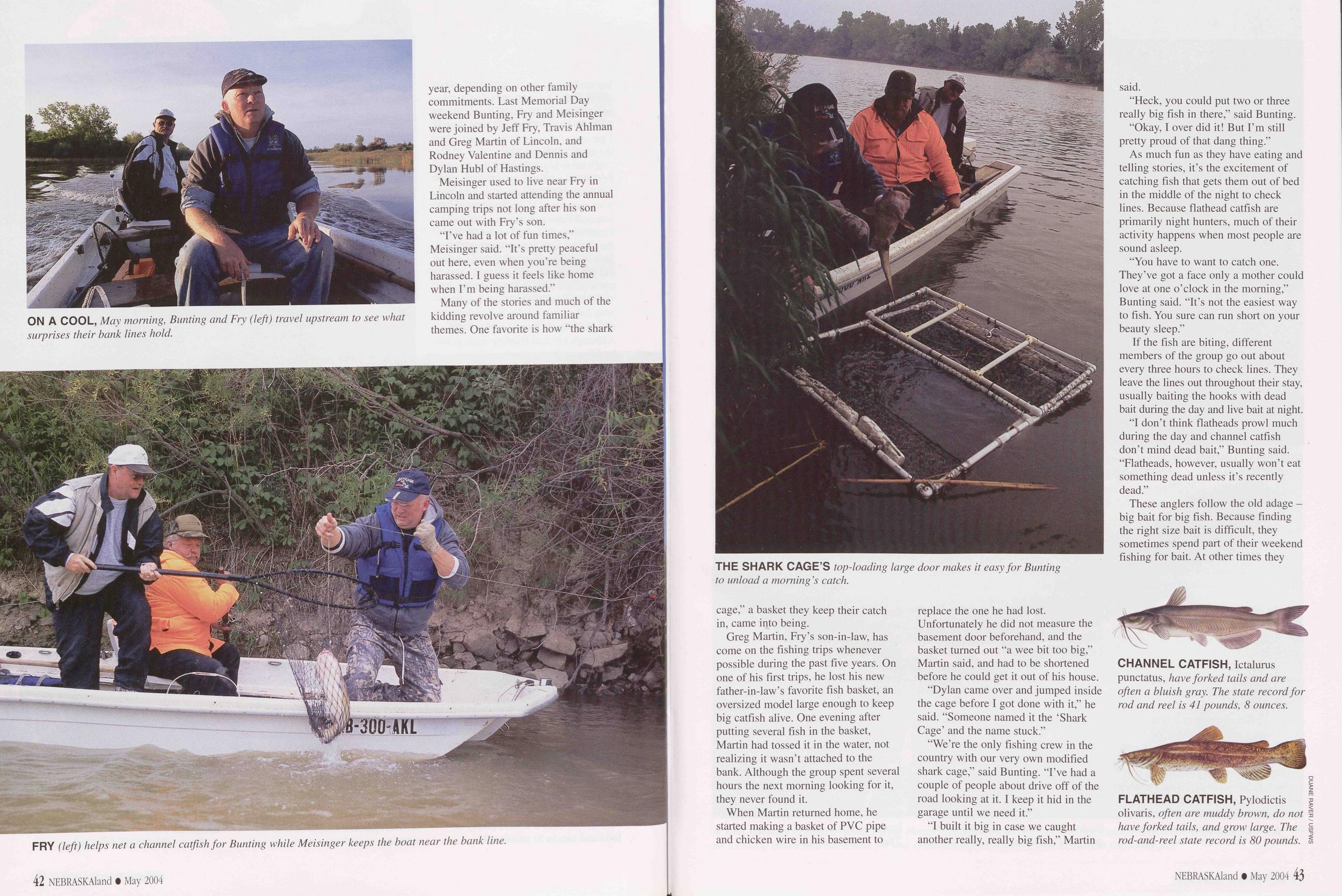
Meisinger used to live near Fry in Lincoln and started attending the annual camping trips not long after his son came out with Fry’s son.
"I’ve had a lot of fun times,” Meisinger said. “It’s pretty peaceful out here, even when you’re being harassed. I guess it feels like home when I’m being harassed.”
Many of the stories and much of the kidding revolve around familiar themes. One favorite is how “the shark surprises their bank lines hold.
Greg Martin, Fry’s son-in-law, has come on the fishing trips whenever possible during the past five years. On one of his first trips, he lost his new father-in-law’s favorite fish basket, an oversized model large enough to keep big catfish alive. One evening after putting several fish in the basket, Martin had tossed it in the water, not realizing it wasn’t attached to the bank. Although the group spent several hours the next morning looking for it, they never found it.
When Martin returned home, he started making a basket of PVC pipe and chicken wire in his basement to replace the one he had lost. Unfortunately he did not measure the basement door beforehand, and the basket turned out “a wee bit too big, Martin said, and had to be shortened before he could get it out of his house.
“Dylan came over and jumped inside the cage before I got done with it,” he said. “Someone named it the ‘Shark Cage’ and the name stuck.”
“We’re the only fishing crew in the country with our very own modified shark cage,” said Bunting. “I’ve had a couple of people about drive off of the road looking at it. I keep it hid in the garage until we need it.”
“I built it big in case we caught another really, really big fish,” Martin said.
"Heck, you could put two or three really big fish in there,” said Bunting.
“Okay, I over did it! But I’m still pretty proud of that dang thing.”
As much fun as they have eating and telling stories, it’s the excitement of catching fish that gets them out of bed in the middle of the night to check lines. Because flathead catfish are primarily night hunters, much of their activity happens when most people are sound asleep.
“You have to want to catch one. They’ve got a face only a mother could love at one o’clock in the morning,” Bunting said. “It’s not the easiest way to fish. You sure can run short on your beauty sleep.”
If the fish are biting, different members of the group go out about every three hours to check lines. They leave the lines out throughout their stay, usually baiting the hooks with dead bait during the day and live bait at night.
“I don’t think flatheads prowl much during the day and channel catfish don’t mind dead bait,” Bunting said. “Flatheads, however, usually won’t eat something dead unless it’s recently dead.”
These anglers follow the old adage - big bait for big fish. Because finding the right size bait is difficult, they sometimes spend part of their weekend fishing for bait. At other times they
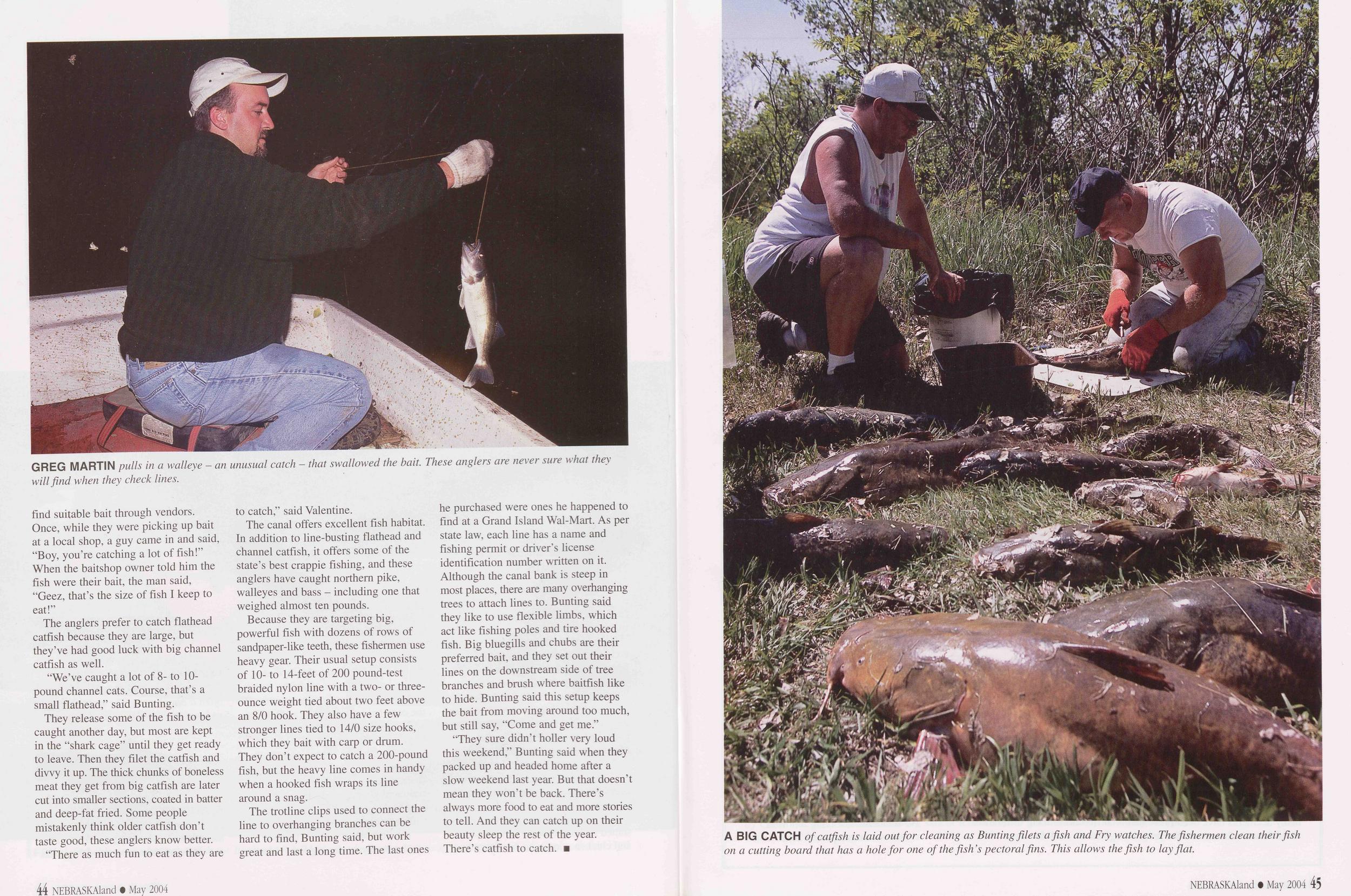
The anglers prefer to catch flathead catfish because they are large, but they’ve had good luck with big channel catfish as well.
“We’ve caught a lot of 8- to 10- pound channel cats. Course, that’s a small flathead,” said Bunting.
They release some of the fish to be caught another day, but most are kept in the “shark cage” until they get ready to leave. Then they filet the catfish and divvy it up. The thick chunks of boneless meat they get from big catfish are later cut into smaller sections, coated in batter and deep-fat fried. Some people mistakenly think older catfish don’t taste good, these anglers know better.
“There as much fun to eat as they are to catch,” said Valentine.
The canal offers excellent fish habitat. In addition to line-busting flathead and channel catfish, it offers some of the state’s best crappie fishing, and these anglers have caught northern pike, walleyes and bass - including one that weighed almost ten pounds.
Because they are targeting big, powerful fish with dozens of rows of sandpaper-like teeth, these fishermen use heavy gear. Their usual setup consists of 10- to 14-feet of 200 pound-test braided nylon line with a two- or three- ounce weight tied about two feet above an 8/0 hook. They also have a few stronger lines tied to 14/0 size hooks, which they bait with carp or drum. They don’t expect to catch a 200-pound fish, but the heavy line comes in handy when a hooked fish wraps its line around a snag.
The trotline clips used to connect the line to overhanging branches can be hard to find, Bunting said, but work great and last a long time. The last ones he purchased were ones he happened to find at a Grand Island Wal-Mart. As per state law, each line has a name and fishing permit or driver’s license identification number written on it. Although the canal bank is steep in most places, there are many overhanging trees to attach lines to. Bunting said they like to use flexible limbs, which act like fishing poles and tire hooked fish. Big bluegills and chubs are their preferred bait, and they set out their lines on the downstream side of tree branches and brush where baitfish like to hide. Bunting said this setup keeps the bait from moving around too much, but still say, “Come and get me.”
“They sure didn’t holler very loud this weekend,” Bunting said when they packed up and headed home after a slow weekend last year. But that doesn’t mean they won’t be back. There’s always more food to eat and more stories to tell. And they can catch up on their beauty sleep the rest of the year. There’s catfish to catch.
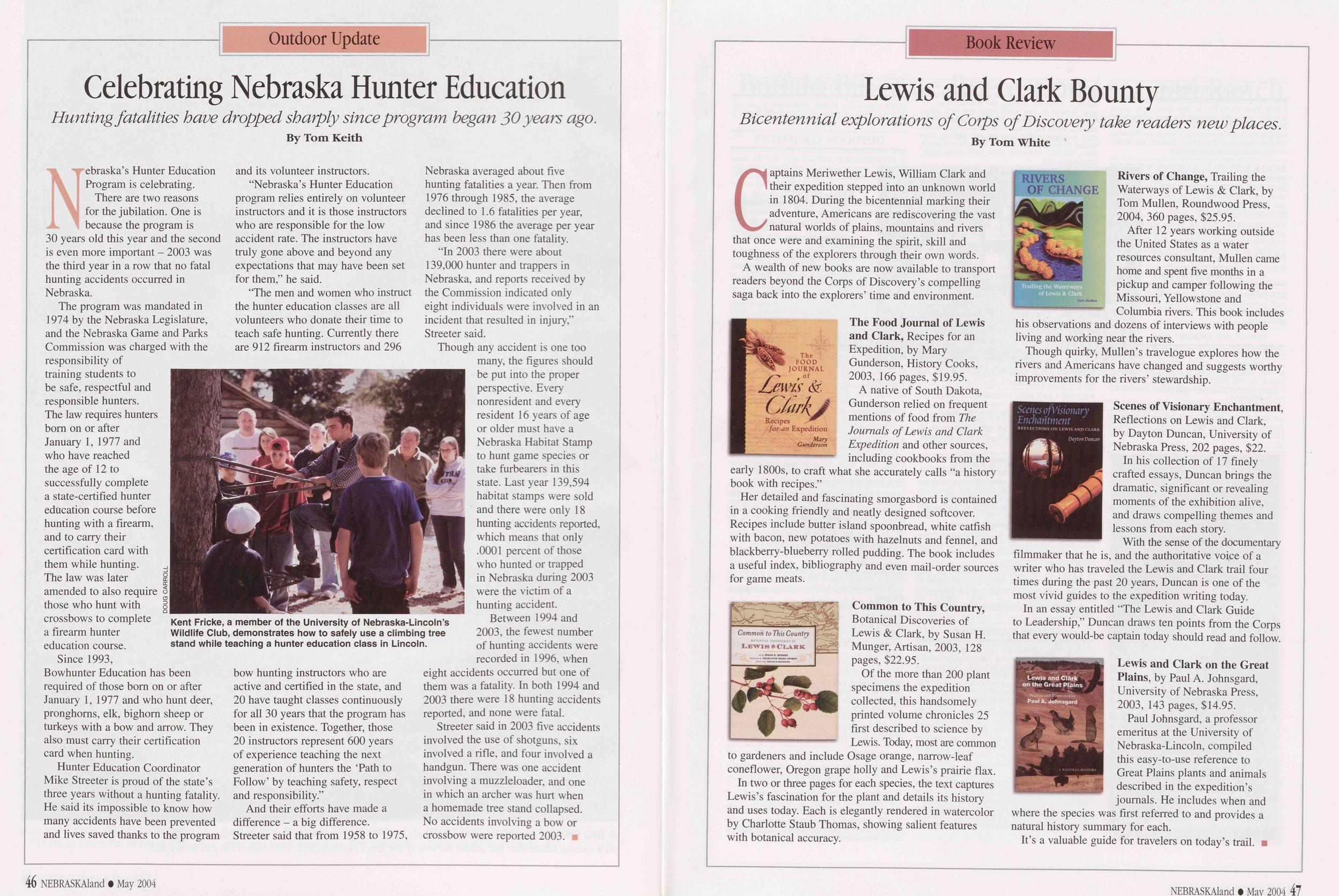
Nebraska’s Hunter Education Program is celebrating. There are two reasons for the jubilation. One is because the program is 30 years old this year and the second is even more important - 2003 was the third year in a row that no fatal hunting accidents occurred in Nebraska.
The program was mandated in 1974 by the Nebraska Legislature, and the Nebraska Game and Parks Commission was charged with the responsibility of training students to be safe, respectful and responsible hunters. The law requires hunters born on or after January 1, 1977 and who have reached the age of 12 to successfully complete a state-certified hunter education course before hunting with a firearm, and to carry their certification card with them while hunting. The law was later amended to also require those who hunt with crossbows to complete a firearm hunter education course.
Since 1993, Bowhunter Education has been required of those bom on or after January 1, 1977 and who hunt deer, pronghorns, elk, bighorn sheep or turkeys with a bow and arrow. They also must carry their certification card when hunting.
Hunter Education Coordinator Mike Streeter is proud of the state’s three years without a hunting fatality. He said its impossible to know how many accidents have been prevented and lives saved thanks to the program and its volunteer instructors.
“Nebraska’s Hunter Education program relies entirely on volunteer instructors and it is those instructors who are responsible for the low accident rate. The instructors have truly gone above and beyond any expectations that may have been set for them,” he said.
“The men and women who instruct the hunter education classes are all volunteers who donate their time to teach safe hunting. Currently there are 912 firearm instructors and 296
And their efforts have made a difference - a big difference. Streeter said that from 1958 to 1975, Nebraska averaged about five hunting fatalities a year. Then from 1976 through 1985, the average declined to 1.6 fatalities per year, and since 1986 the average per year has been less than one fatality.
“In 2003 there were about 139,000 hunter and trappers in Nebraska, and reports received by the Commission indicated only eight individuals were involved in an incident that resulted in injury,” Streeter said.
Though any accident is one too many, the figures should be put into the proper perspective. Every nonresident and every resident 16 years of age or older must have a Nebraska Habitat Stamp to hunt game species or take furbearers in this state. Last year 139,594 habitat stamps were sold and there were only 18 hunting accidents reported, which means that only .0001 percent of those who hunted or trapped in Nebraska during 2003 were the victim of a hunting accident.
Between 1994 and 2003, the fewest number of hunting accidents were recorded in 1996, when eight accidents occurred but one of them was a fatality. In both 1994 and 2003 there were 18 hunting accidents reported, and none were fatal. Streeter said in 2003 five accidents involved the use of shotguns, six involved a rifle, and four involved a handgun. There was one accident involving a muzzleloader, and one in which an archer was hurt when a homemade tree stand collapsed. No accidents involving a bow or crossbow were reported 2003.
Captains Meriwether Lewis, William Clark and their expedition stepped into an unknown world in 1804. During the bicentennial marking their adventure, Americans are rediscovering the vast natural worlds of plains, mountains and rivers that once were and examining the spirit, skill and toughness of the explorers through their own words. A wealth of new books are now available to transport readers beyond the Corps of Discovery’s compelling saga back into the explorers’ time and environment.
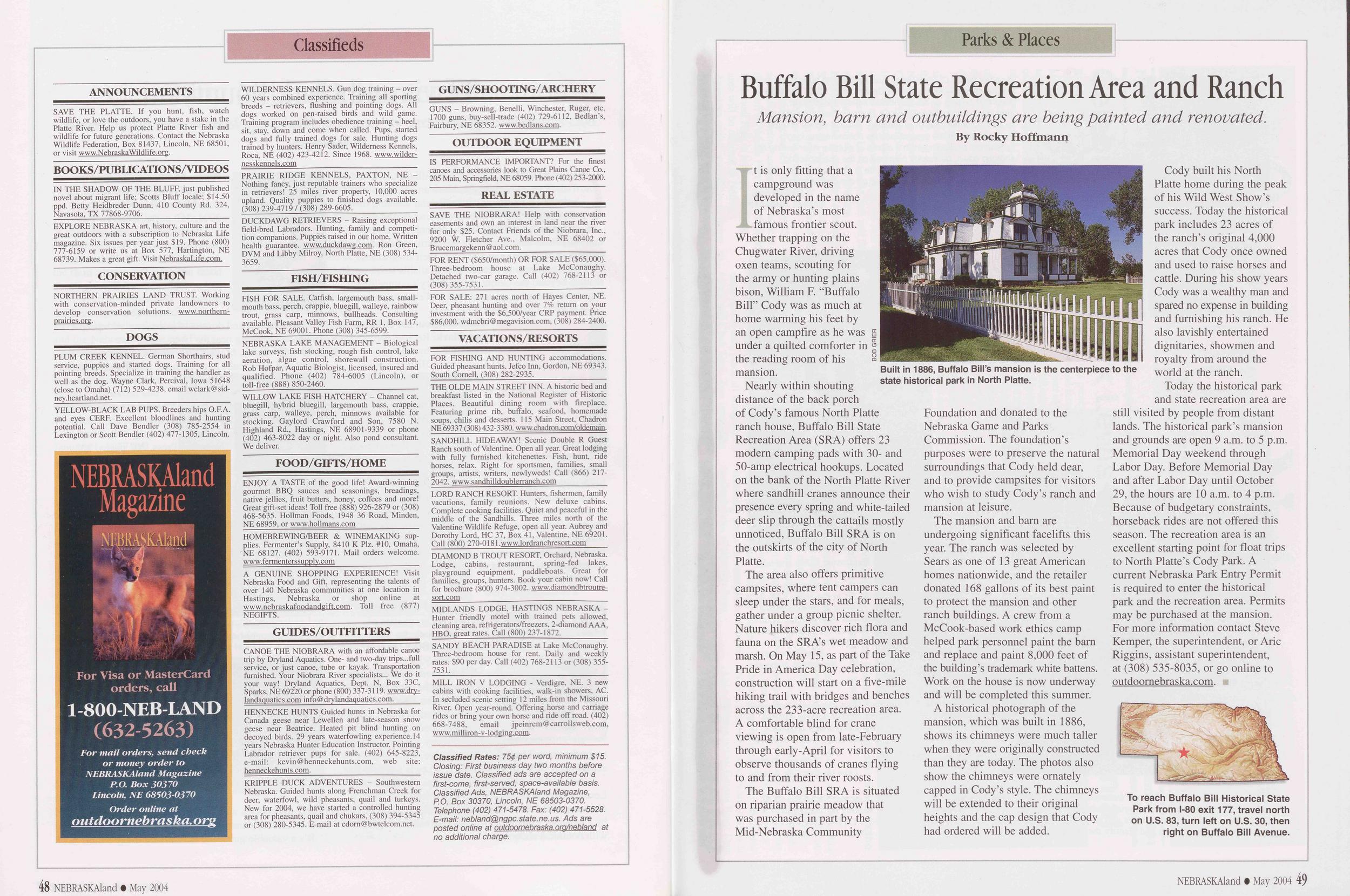
SAVE THE PLATTE. If you hunt, fish, watch wildlife, or love the outdoors, you have a stake in the Platte River. Help us protect Platte River fish and wildlife for future generations. Contact the Nebraska Wildlife Federation, Box 81437, Lincoln, NE 68501, or visit www.NebraskaWildlife.org.
BOOKS/PUBLICATIONS/VIDEOSIN THE SHADOW OF THE BLUFF, just published novel about migrant life; Scotts Bluff locale; $14.50 ppd. Betty Heidbreder Dunn, 410 County Rd. 324, Navasota, TX 77868-9706.
EXPLORE NEBRASKA art, history, culture and the great outdoors with a subscription to Nebraska Life magazine. Six issues per year just $19. Phone (800) 777-6159 or write us at Box 577, Hartington, NE 68739. Makes a great gift. Visit NebraskaLife.com.
CONSERVATIONNORTHERN PRAIRIES LAND TRUST. Working with conservation-minded private landowners to develop conservation solutions, www.northern- prairies.org.
DOGSPLUM CREEK KENNEL. German Shorthairs, stud service, puppies and started dogs. Training for all pointing breeds. Specialize in training the handler as well as the dog. Wayne Clark, Percival, Iowa 51648 (close to Omaha) (712) 529-4238, email wclark@sid- ney.heartland.net.
YELLOW-BLACK LAB PUPS. Breeders hips O.F.A. and eyes CERF. Excellent bloodlines and hunting potential. Call Dave Bendler (308) 785-2554 in Lexington or Scott Bendler (402) 477-1305, Lincoln.
NEBRASKAland MagazineFor Visa or MasterCard orders, call 1-800-NEB-LAND (632-5263)
For mail orders, send check or money order to NEBRASKAland Magazine P.O. Box 30370 Lincoln, NE 68503-0370 Order online at outdoornebraska. org
WILDERNESS KENNELS. Gun dog training - over 60 years combined experience. Training all sporting breeds - retrievers, flushing and pointing dogs. All dogs worked on pen-raised birds and wild game. Training program includes obedience training - heel, sit, stay, down and come when called. Pups, started dogs and fully trained dogs for sale. Hunting dogs trained by hunters. Henry Sader, Wilderness Kennels, Roca, NE (402) 423-4212. Since 1968. www.wilder- esskennels.com
PRAIRIE RIDGE KENNELS, PAXTON, NE - Nothing fancy, just reputable trainers who specialize in retrievers! 25 miles river property, 10,000 acres upland. Quality puppies to finished dogs available. (308) 239-4719 / (308) 289-6605.
DUCKDAWG RETRIEVERS - Raising exceptional field-bred Labradors. Hunting, family and competi- tion companions. Puppies raised in our home. Written health guarantee, www.duckdawg.com. Ron Green, DVM and Libby Milroy, North Platte, NE (308) 534- 3659.
FISH/FISHINGFISH FOR SALE. Catfish, largemouth bass, small- mouth bass, perch, crappie, bluegill, walleye, rainbow trout, grass carp, minnows, bullheads. Consulting available. Pleasant Valley Fish Farm, RR 1, Box 147, McCook, NE 69001. Phone (308) 345-6599.
NEBRASKA LAKE MANAGEMENT - Biological lake surveys, fish stocking, rough fish control, lake aeration, algae control, shorewall construction. Rob Hofpar, Aquatic Biologist, licensed, insured and qualified. Phone (402) 784-6005 (Lincoln), or toll-free (888) 850-2460.
WILLOW LAKE FISH HATCHERY - Channel cat, bluegill, hybrid bluegill, largemouth bass, crappie, grass carp, walleye, perch, minnows available for stocking. Gaylord Crawford and Son, 7580 N. Highland Rd., Hastings, NE 68901-9339 or phone (402) 463-8022 day or night. Also pond consultant. We deliver.
FOOD/GIFTS/HOMEENJOY A TASTE of the good life! Award-winning gourmet BBQ sauces and seasonings, breadings, native jellies, fruit butters, honey, coffees and more! Great gift-set ideas! Toll free (888) 926-2879 or (308) 468-5635. Hollman Foods, 1948 36 Road, Minden, NE 68959, or www.hollmans.com
HOMEBREWING/BEER & WINEMAKING sup- plies. Fermenter’s Supply, 8410 K Plz. #10, Omaha, NE 68127. (402) 593-9171. Mail orders welcome. www.fermenterssupplv.com
A GENUINE SHOPPING EXPERIENCE! Visit Nebraska Food and Gift, representing the talents of over 140 Nebraska communities at one location in Hastings, Nebraska or shop online at www.nebraskafoodandgift.com. Toll free (877) NEGIFTS.
GUIDES/OUTFITTERSCANOE THE NIOBRARA with an affordable canoe trip by Dryland Aquatics. One- and two-day trips...full service, or just canoe, tube or kayak. Transportation furnished. Your Niobrara River specialists... We do it your way! Dryland Aquatics, Dept. N, Box 33C, Sparks, NE 69220 or phone (800) 337-3119. www.drv- landaquatics.com info@drylandaquatics.com.
HENNECKE HUNTS Guided hunts in Nebraska for Canada geese near Lewellen and late-season snow geese near Beatrice. Heated pit blind hunting on decoyed birds. 29 years waterfowling experience. 14 years Nebraska Hunter Education Instructor. Pointing Labrador retriever pups for sale. (402) 645-8223, e-mail: kevin@henneckehunts.com, web site: henneckehunts.com.
KRIPPLE DUCK ADVENTURES - Southwestern Nebraska. Guided hunts along Frenchman Creek for deer, waterfowl, wild pheasants, quail and turkeys. New for 2004, we have started a controlled hunting area for pheasants, quail and chukars, (308) 394-5345 or (308) 280-5345. E-mail at cdom@bwtelcom.net.
GUNS/SHOOTING/ARCHERYGUNS - Browning, Benelli, Winchester, Ruger, etc. 1700 guns, buy-sell-trade (402) 729-6112, Bedlan’s, Fairbury, NE 68352. www.bedlans.com.
OUTDOOR EQUIPMENTIS PERFORMANCE IMPORTANT? For the finest canoes and accessories look to Great Plains Canoe Co., 205 Main, Springfield, NE 68059. Phone (402) 253-2000.
REAL ESTATESAVE THE NIOBRARA! Help with conservation easements and own an interest in land near the river for only $25. Contact Friends of the Niobrara, Inc., 9200 W. Fletcher Ave., Malcolm, NE 68402 or Brucemargekenn@aol.com.
FOR RENT ($650/month) OR FOR SALE ($65,000). Three-bedroom house at Lake McConaughy. Detached two-car garage. Call (402) 768-2113 or (308) 355-7531.
FOR SALE: 271 acres north of Hayes Center, NE. Deer, pheasant hunting and over 7% return on your investment with the $6,500/year CRP payment. Price $86,000. wdmcbri@megavision.com, (308) 284-2400.
VACATIONS/RESORTSFOR FISHING AND HUNTING accommodations. Guided pheasant hunts. Jefco Inn, Gordon, NE 69343. South Cornell, (308) 282-2935.
THE OLDE MAIN STREET INN. A historic bed and breakfast listed in the National Register of Historic Places. Beautiful dining room with fireplace. Featuring prime rib, buffalo, seafood, homemade soups, chilis and desserts. 115 Main Street, Chadron NE 69337 (308) 432-3380. www.chadron.com/oldemain.
SANDHILL HIDEAWAY! Scenic Double R Guest Ranch south of Valentine. Open all year. Great lodging with fully furnished kitchenettes. Fish, hunt, ride horses, relax. Right for sportsmen, families, small groups, artists, writers, newlyweds! Call (866) 217- 2042. www.sandhilldoublerranch.com
LORD RANCH RESORT. Hunters, fishermen, family vacations, family reunions. New deluxe cabins. Complete cooking facilities. Quiet and peaceful in the middle of the Sandhills. Three miles north of the Valentine Wildlife Refuge, open all year. Aubrey and Dorothy Lord, HC 37, Box 41, Valentine, NE 69201. Call (800) 270-0181.www.lordranchresort.com
DIAMOND B TROUT RESORT, Orchard, Nebraska. Lodge, cabins, restaurant, spring-fed lakes, playground equipment, paddleboats. Great for families, groups, hunters. Book your cabin now! Call for brochure (800) 974-3002. www.diamondbtroutre- sort.com
MIDLANDS LODGE, HASTINGS NEBRASKA - Hunter friendly motel with trained pets allowed, cleaning area, refrigerators/freezers, 2-diamond AAA, HBO, great rates. Call (800) 237-1872. SANDY BEACH PARADISE at Lake McConaughy. Three-bedroom house for rent. Daily and weekly rates. $90 per day. Call (402) 768-2113 or (308) 355- 7531.
MILL IRON V LODGING - Verdigre, NE. 3 new cabins with cooking facilities, walk-in showers, AC. In secluded scenic setting 12 miles from the Missouri River. Open year-round. Offering horse and carriage rides or bring your own horse and ride off road. (402) 668-7488, email jpeinrem@carrollsweb.com, www.milliron-v-lodging.com.
Classified Rates: 750 per word, minimum $15. Closing: First business day two months before issue date. Classified ads are accepted on a first-come, first-served, space-available basis. Classified Ads, NEBRASKAland Magazine, P.O. Box 30370, Lincoln, NE 68503-0370. Telephone (402) 471-5478. Fax: (402) 471-5528. E-mail: nebland@ngpc.state.ne.us. Ads are posted online at outdoornebraska. oro/nebland at no additional charge.
Parks & Places
Buffalo Bill State Recreation Area and Ranch
Mansion, barn and outbuildings are being painted and renovated.
By Rocky HoffmannIt is only fitting that a campground was developed in the name of Nebraska’s most famous frontier scout. Whether trapping on the Chugwater River, driving oxen teams, scouting for the army or hunting plains bison, William F. “Buffalo Bill” Cody was as much at home warming his feet by an open campfire as he was under a quilted comforter in the reading room of his mansion.
Nearly within shouting distance of the back porch of Cody’s famous North Platte ranch house, Buffalo Bill State Recreation Area (SRA) offers 23 modern camping pads with 30- and 50-amp electrical hookups. Located on the bank of the North Platte River where sandhill cranes announce their presence every spring and white-tailed deer slip through the cattails mostly unnoticed, Buffalo Bill SRA is on the outskirts of the city of North Platte.
The area also offers primitive campsites, where tent campers can sleep under the stars, and for meals, gather under a group picnic shelter. Nature hikers discover rich flora and fauna on the SRA’s wet meadow and marsh. On May 15, as part of the Take Pride in America Day celebration, construction will start on a five-mile hiking trail with bridges and benches across the 233-acre recreation area. A comfortable blind for crane viewing is open from late-February through early-April for visitors to observe thousands of cranes flying to and from their river roosts.
The Buffalo Bill SRA is situated on riparian prairie meadow that was purchased in part by the Mid-Nebraska Community
The mansion and barn are undergoing significant facelifts this year. The ranch was selected by Sears as one of 13 great American homes nationwide, and the retailer donated 168 gallons of its best paint to protect the mansion and other ranch buildings. A crew from a McCook-based work ethics camp helped park personnel paint the barn and replace and paint 8,000 feet of the building’s trademark white battens. Work on the house is now underway and will be completed this summer.
A historical photograph of the mansion, which was built in 1886, shows its chimneys were much taller when they were originally constructed than they are today. The photos also show the chimneys were ornately capped in Cody’s style. The chimneys will be extended to their original heights and the cap design that Cody had ordered will be added.
Cody built his North Platte home during the peak of his Wild West Show’s success. Today the historical park includes 23 acres of the ranch’s original 4,000 acres that Cody once owned and used to raise horses and cattle. During his show years Cody was a wealthy man and spared no expense in building and furnishing his ranch. He also lavishly entertained dignitaries, showmen and royalty from around the world at the ranch.
Today the historical park and state recreation area are still visited by people from distant lands. The historical park’s mansion and grounds are open 9 a.m. to 5 p.m. Memorial Day weekend through Labor Day. Before Memorial Day and after Labor Day until October 29, the hours are 10 a.m. to 4 p.m. Because of budgetary constraints, horseback rides are not offered this season. The recreation area is an excellent starting point for float trips to North Platte’s Cody Park. A current Nebraska Park Entry Permit is required to enter the historical park and the recreation area. Permits may be purchased at the mansion. For more information contact Steve Kemper, the superintendent, or Arie Riggins, assistant superintendent, at (308) 535-8035, or go online to outdoornebraska.com.
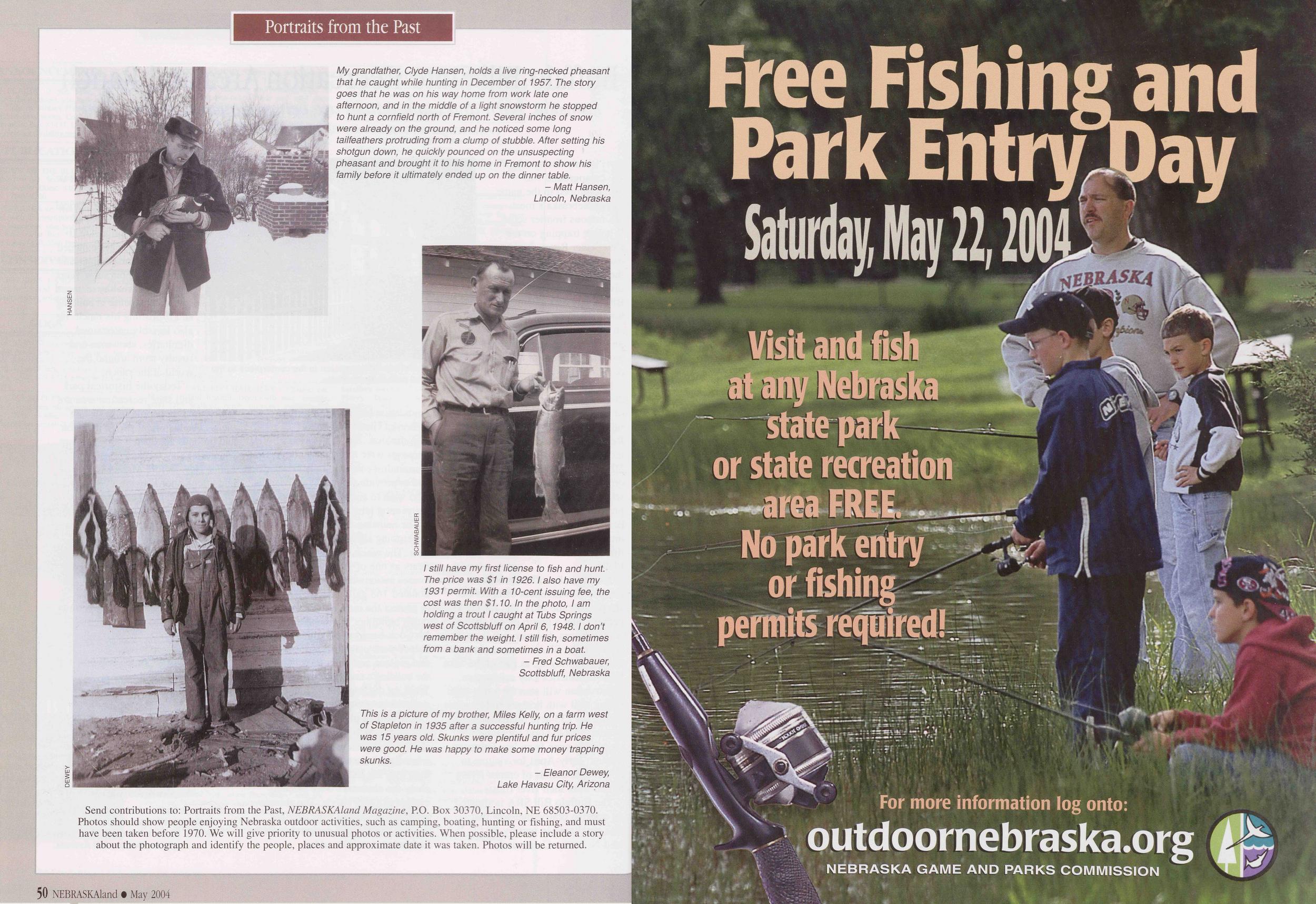
Send contributions to: Portraits from the Past, NEBRASKAland Magazine, P.O. Box 30370, Lincoln, NE 68503-0370. Photos should show people enjoying Nebraska outdoor activities, such as camping, boating, hunting or fishing, and must have been taken before 1970. We will give priority to unusual photos or activities. When possible, please include a story about the photograph and identify the people, places and approximate date it was taken. Photos will be returned.
50 NEBRASKAland • May 2004 Free Fishing and Park Entry Day Saturday, May 22,2004 Vist and fish at any Nebraska state park or state recreation are FREE No park entry or fishing permits required! For more information log onto: outdoornebraska.org NEBRASKA GAME AND PARKS COMMISSION
Position: 583 (19 views)