Volume 82, Issue 3, 2004
NEBRASKAland
Nebraska Game & Parks Commission April 2004 $2.50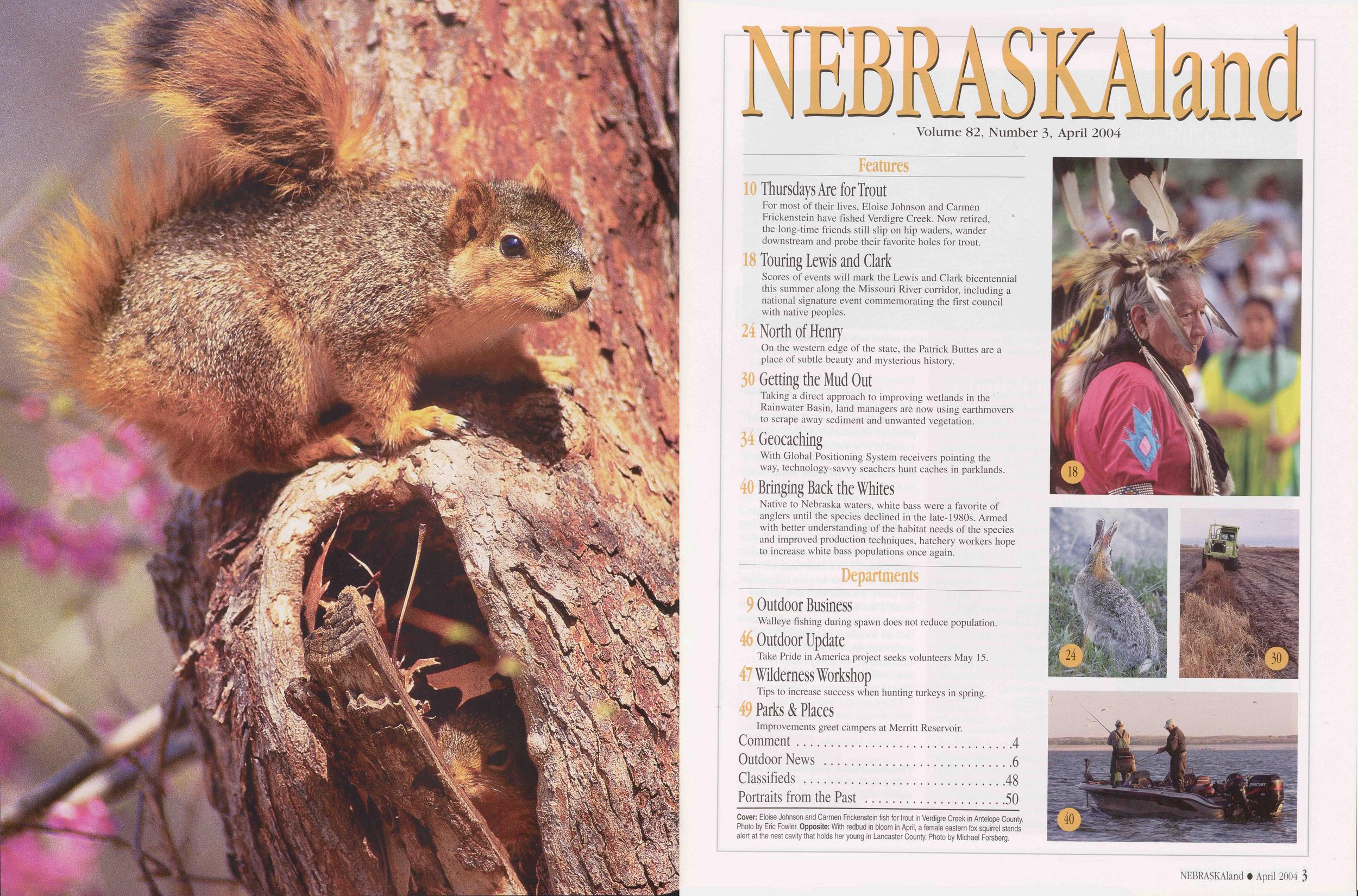
NEBRASKAland
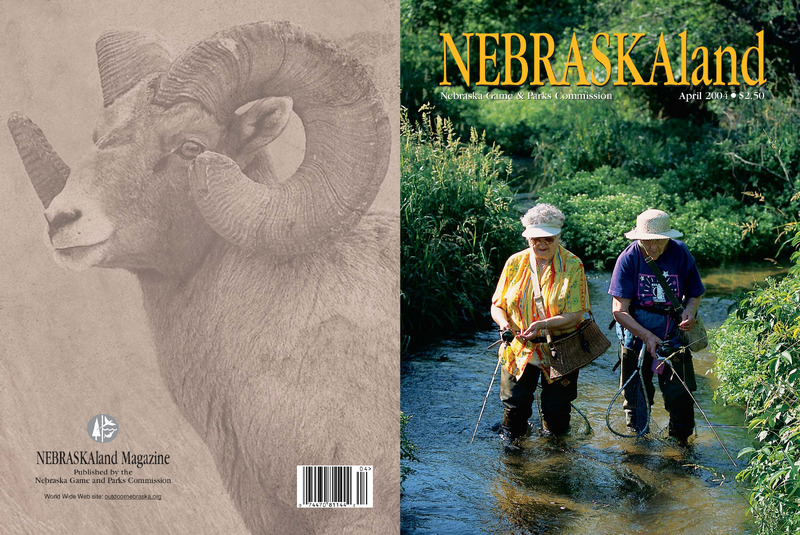
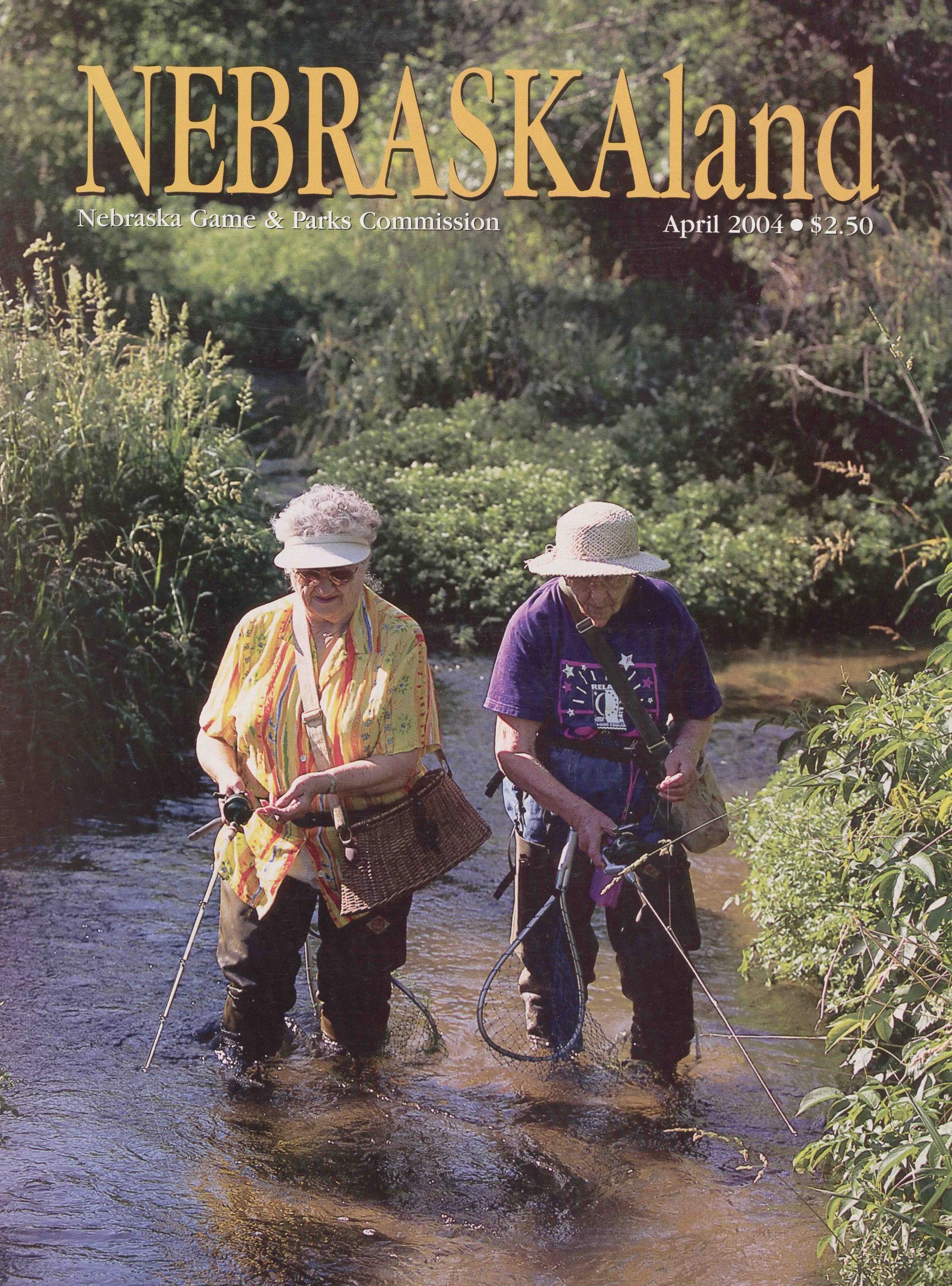
Volume 82, Number 3, April 2004 Features 10 Thursdays Are for Trout For most of their lives, Eloise Johnson and Carmen Frickenstein have fished Verdigre Creek. Now retired, the long-time friends still slip on hip waders, wander downstream and probe their favorite holes for trout. 18 Touring Lewis and Clark Scores of events will mark the Lewis and Clark bicentennial this summer along the Missouri River corridor, including a national signature event commemorating the first council with native peoples. 24 North of Henry On the western edge of the state, the Patrick Buttes are a place of subtle beauty and mysterious history. 30 Getting the Mud Out Taking a direct approach to improving wetlands in the Rainwater Basin, land managers are now using earthmovers to scrape away sediment and unwanted vegetation. 34 Geocaching With Global Positioning System receivers pointing the way, technology-savvy seachers hunt caches in parklands. Bringing Back the Whites Native to Nebraska waters, white bass were a favorite of anglers until the species declined in the late-1980s. Armed with better understanding of the habitat needs of the species and improved production techniques, hatchery workers hope to increase white bass populations once again. Departments Outdoor Business Walleye fishing during spawn does not reduce population. 46 Outdoor Update Take Pride in America project seeks volunteers May 15. Wilderness Workshop Tips to increase success when hunting turkeys in spring. 49 Parks & Places Improvements greet campers at Merritt Reservoir. Comment..........................................4 Outdoor News ....................................6 Classifieds ....................................48 Portraits from the Past ........................50 Cover: Eloise Johnson and Carmen Frickenstein fish for trout in Verdigre Creek in Antelope County. Photo by Eric Fowler. Opposite: With redbud in bloom in April, a female eastern fox squirrel stands alert at the nest cavity that holds her young in Lancaster County. Photo by Michael Forsberg.18
24
30
40
Comment
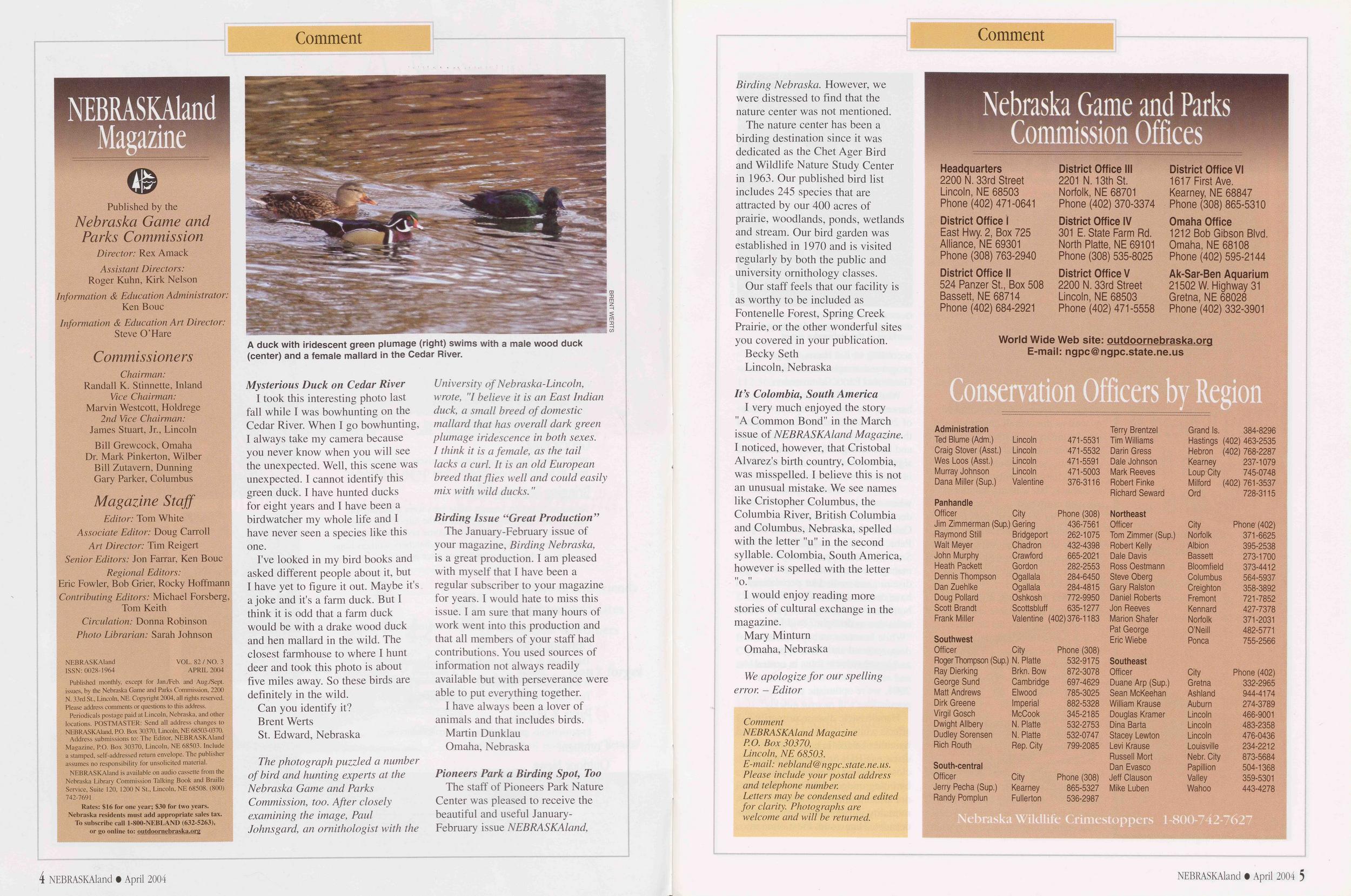
I took this interesting photo last fall while I was bowhunting on the Cedar River. When I go bowhunting, I always take my camera because you never know when you will see the unexpected. Well, this scene was unexpected. I cannot identify this green duck. I have hunted ducks for eight years and I have been a birdwatcher my whole life and I have never seen a species like this one.
I've looked in my bird books and asked different people about it, but I have yet to figure it out. Maybe it's a joke and it's a farm duck. But I think it is odd that a farm duck would be with a drake wood duck and hen mallard in the wild. The closest farmhouse to where I hunt deer and took this photo is about five miles away. So these birds are definitely in the wild.
Can you identify it?
Brent Werts St. Edward, NebraskaThe photograph puzzled a number of bird and hunting experts at the Nebraska Game and Parks Commission, too. After closely examining the image, Paul Johnsgard, an ornithologist with the University of Nebraska-Lincoln, wrote, "I believe it is an East Indian duck, a small breed of domestic mallard that has overall dark green plumage iridescence in both sexes. I think it is a female, as the tail lacks a curl. It is an old European breed that flies well and could easily mix with wild ducks."
Birding Issue "Great Production”The January-February issue of your magazine, Birding Nebraska, is a great production. I am pleased with myself that I have been a regular subscriber to your magazine for years. I would hate to miss this issue. I am sure that many hours of work went into this production and that all members of your staff had contributions. You used sources of information not always readily available but with perseverance were able to put everything together.
I have always been a lover of animals and that includes birds.
Martin Dunklau Omaha, Nebraska Pioneers Park a Birding Spot, TooThe staff of Pioneers Park Nature Center was pleased to receive the beautiful and useful January- February issue NEBRASKAland, 4 NEBRASKAland • April 2004 Birding Nebraska. However, we were distressed to find that the nature center was not mentioned.
Comment
The nature center has been a birding destination since it was dedicated as the Chet Ager Bird and Wildlife Nature Study Center in 1963. Our published bird list includes 245 species that are attracted by our 400 acres of prairie, woodlands, ponds, wetlands and stream. Our bird garden was established in 1970 and is visited regularly by both the public and university ornithology classes.
Our staff feels that our facility is as worthy to be included as Fontenelle Forest, Spring Creek Prairie, or the other wonderful sites you covered in your publication.
Becky Seth Lincoln, Nebraska It’s Colombia, South AmericaI very much enjoyed the story "A Common Bond" in the March issue of NEBRASKAland Magazine. I noticed, however, that Cristobal Alvarez's birth country, Colombia, was misspelled. I believe this is not an unusual mistake. We see names like Cristopher Columbus, the Columbia River, British Columbia and Columbus, Nebraska, spelled with the letter "u" in the second syllable. Colombia, South America, however is spelled with the letter "o."
I would enjoy reading more stories of cultural exchange in the magazine.
Mary Minturn Omaha, NebraskaWe apologize for our spelling error.
- Editor Comment NEBRASKAland Magazine P.O. Box 30370, Lincoln, NE 68503. E-mail: nebland@ ngpc. state, ne. us. Please include your postal address and telephone number. Letters may be condensed and edited for clarity. Photographs are welcome and will be returned. Nebraska Game and Parks Commission Offices 2200 N. 33rd Street Lincoln, NE 68503 Phone (402) 471-0641 District Office I East Hwy. 2, Box 725 Alliance, NE 69301 Phone (308) 763-2940 District Office II 524 Panzer St., Box 508 Bassett, NE 68714 Phone (402) 684-2921 District Office III 2201 N. 13th St. Norfolk, NE 68701 Phone (402) 370-3374 District Office IV 301 E. State Farm Rd. North Platte, NE 69101 Phone (308) 535-8025 District Office V 2200 N. 33rd Street Lincoln, NE 68503 Phone (402) 471-5558 District Office VI 1617 First Ave. Kearney, NE 68847 Phone (308) 865-5310 Omaha Office 1212 Bob Gibson Blvd. Omaha, NE 68108 Phone (402) 595-2144 Ak-Sar-Ben Aquarium 21502 W. Highway 31 Gretna, NE 68028 Phone (402) 332-3901 World Wide Web site: outdoornebraska.org E-mail: ngpc@ngpc.state.ne.us Conservation Officers by Region Administration Terry Brentzel Grand Is. 334-8296 Ted Blume (Adm.) Lincoln 471-5531 Tim Williams Hastings (402) 463-2535 Craig Stover (Asst.) Lincoln 471-5532 Darin Gress Hebron (402) 768-2287 Wes Loos (Asst.) Lincoln 471-5591 Dale Johnson Kearney 237-1079 Murray Johnson Lincoln 471-5003 Mark Reeves Loup City 745-0748 Dana Miller (Sup.) Valentine 376-3116 Robert Finke Milford (402) 761-3537 Richard Seward Ord 728-3115 Panhandle Officer City Phone (308) Northeast Jim Zimmerman (Sup.) Gering 436-7561 Officer City Phone (402) Raymond Still Bridgeport 262-1075 Tom Zimmer (Sup.) Norfolk 371-6625 Walt Meyer Chadron 432-4398 Robert Kelly Albion 395-2538 John Murphy Crawford 665-2021 Dale Davis Bassett 273-1700 Heath Packett Gordon 282-2553 Ross Oestmann Bloomfield I 373-4412 Dennis Thompson Ogallala 284-6450 Steve Oberg Columbus 564-5937 Dan Zuehlke Ogallala 284-4815 Gary Ralston Creighton 358-3892 Doug Pollard Oshkosh 772-9950 Daniel Roberts Fremont 721-7852 Scott Brandt Scottsbluff 635-1277 Jon Reeves Kennard 427-7378 Frank Miller Valentine (402)376-1183 Marion Shafer Norfolk 371-2031 Pat George O’Neill 482-5771 Southwest Officer City Phone (308) Eric Wiebe Ponca 755-2566 Roger Thompson (Sup.) N. Platte 532-9175 Southeast Ray Dierking Brkn. Bow 872-3078 Officer City Phone (402) George Sund Cambridge 697-4629 Duane Arp (Sup.) Gretna 332-2965 Matt Andrews Elwood 785-3025 Sean McKeehan Ashland 944-4174 Dirk Greene Imperial 882-5328 William Krause Auburn 274-3789 Virgil Gosch McCook 345-2185 Douglas Kramer Lincoln 466-9001 Dwight Allbery N. Platte 532-2753 Dina Barta Lincoln 483-2358 Dudley Sorensen N. Platte 532-0747 Stacey Lewton Lincoln 476-0436 Rich Routh Rep. City 799-2085 Levi Krause Louisville 234-2212 Russell Mort Nebr. City 873-5684 South-central Dan Evasco Papillion 504-1368 Officer City Phone (308) Jeff Clauson Valley 359-5301 Jerry Pecha (Sup.) Kearney 865-5327 Mike Luben Wahoo 443-4278 Randy Pomplun Fullerton 536-2987 Nebraska Wildlife Crimestoppers 1-800-742-7627 NEBRASKAland • April 2004 5
Outdoor News
2004 Nebraska Fishing Guide Fishing Regulations and Public WatersThe 2004 American Kennel Club National Pointing Breed Gun Dog Championships will be held at Branched Oak Wildlife Management Area northwest of Lincoln April 26 through May 5.
The event, sponsored by the Nebraska Field Trial Association, will draw up to 230 dogs and their trainers from across the country, and possibly a few from outside the United States. This is the third time the event has been held at the 880-acre dog-trial area located at Branched Oak.
Both retrieving and nonretrieving events will be open to ten breeds: German shorthaired pointer, German wirehaired pointer, Irish setter, vizsla, weimaraner, English setter, Gordon setter, English pointer, Brittany and pointing griffon. Awards will be given to the top dog in each breed, as well as the overall champion and the top amateur handler. Dogs will search for native and released pheasants, quail and chukars. Most dog handlers will work from horseback, but walking handlers also are permitted.
The event is open to dogs that have qualified in other AKC events, amateur field champions, open field champions and dogs that have placed in a recognized adult stake during the past two years.
Weather permitting, a gallery wagon will be available, allowing spectators to follow the action, which begins at 8 a.m. daily. For more information, contact Jean Armbrist at (402) 332-0777, Toot444@aol.com, or Tom Maneely at (402) 487-3328.
Disease and Drought Curb Deer Populations in WestNebraska deer hunters have enjoyed an abundance of deer and permits since 1997, harvesting at least 52,000 deer in each of the past seven years. That bounty might subside for a while,
While the 2003 Nebraska deer harvest was only slightly below that of 2002, recent harvest data indicates that the combined effects of drought and hemorrhagic disease have caused significant declines in deer numbers in several western deer units.
"Our best estimate is that white-tailed deer populations have declined 36 to 49 percent in Calamus East, Calamus West, Keya Paha, Loup East, Loup West, Plains, Sandhills and Upper Platte deer management units due to hemorrhagic disease, and mule deer populations have declined 42 to 45 percent in both the Frenchman and Upper Platte units due to drought,” said Hams. "While hunters can expect fewer deer, reduced antlerless opportunity and lower success rates in central and several western deer units in 2004, we’re optimistic that deer populations will recover quickly.”
Hemorrhagic disease primarily affects white-tailed deer and is caused by either epizootic hemorrhagic disease (EHD) or bluetongue virus, closely related diseases transmitted by biting midges. EHD, which does not affect humans, has caused mortality in Nebraska deer for many decades, Hams said, most often in 6 NEBRASKAland • April 2004 drought years. After a large outbreak of EHD, surviving deer often become immune to the virus and the population recovers quickly.
Sixty percent of Nebraska’s deer population is in the eastern third of the state, which has been largely unaffected by drought or EHD. Hams said nearly all residents and most nonresidents should be able to get a 2004 deer permit in the unit of their choice. He also noted that the trophy potential of Nebraska bucks continues to improve as the average age increases. Fifty-nine percent of the 2003 deer harvest was adult bucks, he said, and 66 percent of mule deer bucks and 59 percent of white-tailed bucks were at least 2 1/2 years old.
Total deer harvest for the 2003 seasons was 53,314 deer taken by 112,563 hunters. In 2002, 112,894 hunters took 53,624 deer. Firearm success in 2003 dropped one percent compared to 2002, with 82,541 firearm hunters harvesting 44,964 deer for a 54 percent success rate. Archery deer hunters matched 2002’s 28 percent success rate, with 14,074 archers taking 3,959 deer in 2003. After a record low 25 percent success rate for muzzleloaders in 2002, 15,948 hunters harvested 4,391 deer in 2003 for a 28 percent success.
Permit quotas and regulations for the 2004 deer season were set at the Commission’s March meeting in Lincoln. For information about the 2004 deer hunting seasons, check the 2004 Big Game Guide, available from permit vendors and Commission offices across the state and online at outdoornebraska.org.
USFWS Seeks Proposals for Conservation FundingThe U.S. Fish and Wildlife Service is seeking proposals for private lands conservation funding through its Private Stewardship Grants program. Approximately $7.1 million is available to support on-the-ground conservation efforts on private lands through these grants.
Reserve Your Fun Today
Visit our secure web site to quickly and conveniently purchase fishing, hunting and park permits online using your Visa or MasterCard.
Online permit purchase is safe, hassle-free and there is never a checkout line. Simply choose the permits you want, pay for them, download and print. And, you are on your way to Nebraska's great outdoors.
We will mail an annual adhesive park permit for your windshield. It's that easy.
outdoornebraska.org Nebraska Game and Parks Commission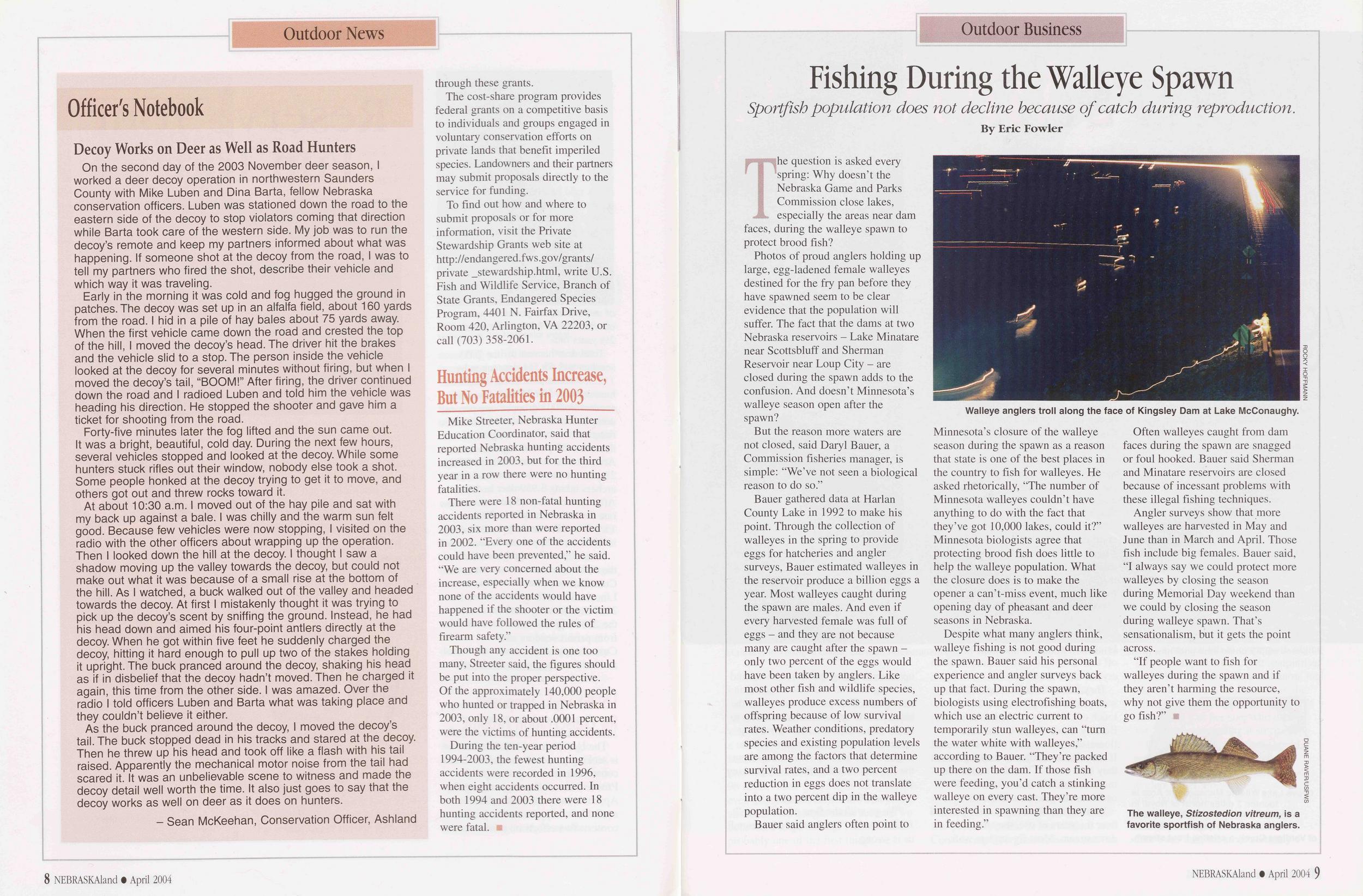
Outdoor News
Officer's NotebookDecoy Works on Deer as Well as Road Hunters
On the second day of the 2003 November deer season, I worked a deer decoy operation in northwestern Saunders County with Mike Luben and Dina Barta, fellow Nebraska conservation officers. Luben was stationed down the road to the eastern side of the decoy to stop violators coming that direction while Barta took care of the western side. My job was to run the decoy’s remote and keep my partners informed about what was happening. If someone shot at the decoy from the road, I was to tell my partners who fired the shot, describe their vehicle and which way it was traveling.
Early in the morning it was cold and fog hugged the ground in patches. The decoy was set up in an alfalfa field, about 160 yards from the road. I hid in a pile of hay bales about 75 yards away. When the first vehicle came down the road and crested the top of the hill, I moved the decoy’s head. The driver hit the brakes and the vehicle slid to a stop. The person inside the vehicle looked at the decoy for several minutes without firing, but when I moved the decoy’s tail, “BOOM!” After firing, the driver continued down the road and I radioed Luben and told him the vehicle was heading his direction. He stopped the shooter and gave him a ticket for shooting from the road.
Forty-five minutes later the fog lifted and the sun came out. It was a bright, beautiful, cold day. During the next few hours, several vehicles stopped and looked at the decoy. While some hunters stuck rifles out their window, nobody else took a shot. Some people honked at the decoy trying to get it to move, and others got out and threw rocks toward it.
At about 10:30 a m. I moved out of the hay pile and sat with my back up against a bale. I was chilly and the warm sun felt good. Because few vehicles were now stopping, I visited on the radio with the other officers about wrapping up the operation. Then I looked down the hill at the decoy. I thought I saw a shadow moving up the valley towards the decoy, but could not make out what it was because of a small rise at the bottom of the hill. As I watched, a buck walked out of the valley and headed towards the decoy. At first I mistakenly thought it was trying to pick up the decoy’s scent by sniffing the ground. Instead, he had his head down and aimed his four-point antlers directly at the decoy. When he got within five feet he suddenly charged the decoy, hitting it hard enough to pull up two of the stakes holding it upright. The buck pranced around the decoy, shaking his head as if in disbelief that the decoy hadn’t moved. Then he charged it again, this time from the other side. I was amazed. Over the radio I told officers Luben and Barta what was taking place and they couldn’t believe it either.
As the buck pranced around the decoy, I moved the decoy’s tail. The buck stopped dead in his tracks and stared at the decoy. Then he threw up his head and took off like a flash with his tail raised. Apparently the mechanical motor noise from the tail had scared it. It was an unbelievable scene to witness and made the decoy detail well worth the time. It also just goes to say that the decoy works as well on deer as it does on hunters.
- Sean McKeehan, Conservation Officer, AshlandThe cost-share program provides federal grants on a competitive basis to individuals and groups engaged in voluntary conservation efforts on private lands that benefit imperiled species. Landowners and their partners may submit proposals directly to the service for funding.
To find out how and where to submit proposals or for more information, visit the Private Stewardship Grants web site at http://endangered.fws.gov/grants/ private _stewardship.html, write U.S. Fish and Wildlife Service, Branch of State Grants, Endangered Species Program, 4401 N. Fairfax Drive, Room 420, Arlington, VA 22203, or call (703) 358-2061.
Hunting Accidents Increase, But No Fatalities in 2003Mike Streeter, Nebraska Hunter Education Coordinator, said that reported Nebraska hunting accidents increased in 2003, but for the third year in a row there were no hunting fatalities.
There were 18 non-fatal hunting accidents reported in Nebraska in 2003, six more than were reported in 2002. "Every one of the accidents could have been prevented,” he said. “We are very concerned about the increase, especially when we know none of the accidents would have happened if the shooter or the victim would have followed the rules of firearm safety.”
Though any accident is one too many, Streeter said, the figures should be put into the proper perspective. Of the approximately 140,000 people who hunted or trapped in Nebraska in 2003, only 18, or about .0001 percent, were the victims of hunting accidents.
During the ten-year period 1994-2003, the fewest hunting accidents were recorded in 1996, when eight accidents occurred. In both 1994 and 2003 there were 18 hunting accidents reported, and none were fatal.
8 NEBRASKAland • April 2004Outdoor Business
Fishing During the Walleye Spawn Sportfish population does not decline because of catch during reproduction. By Eric FowlerThe question is asked every spring: Why doesn’t the Nebraska Game and Parks Commission close lakes, especially the areas near dam faces, during the walleye spawn to protect brood fish?
Photos of proud anglers holding up large, egg-ladened female walleyes destined for the fry pan before they have spawned seem to be clear evidence that the population will suffer. The fact that the dams at two Nebraska reservoirs - Lake Minatare near Scottsbluff and Sherman Reservoir near Loup City - are closed during the spawn adds to the confusion. And doesn’t Minnesota’s walleye season open after the spawn?
But the reason more waters are not closed, said Daryl Bauer, a Commission fisheries manager, is simple: "We’ve not seen a biological reason to do so.”
Bauer gathered data at Harlan County Lake in 1992 to make his point. Through the collection of walleyes in the spring to provide eggs for hatcheries and angler surveys, Bauer estimated walleyes in the reservoir produce a billion eggs a year. Most walleyes caught during the spawn are males. And even if every harvested female was full of eggs - and they are not because many are caught after the spawn - only two percent of the eggs would have been taken by anglers. Like most other fish and wildlife species, walleyes produce excess numbers of offspring because of low survival rates. Weather conditions, predatory species and existing population levels are among the factors that determine survival rates, and a two percent reduction in eggs does not translate into a two percent dip in the walleye population.
Bauer said anglers often point to
Despite what many anglers think, walleye fishing is not good during the spawn. Bauer said his personal experience and angler surveys back up that fact. During the spawn, biologists using electrofishing boats, which use an electric current to temporarily stun walleyes, can "turn the water white with walleyes,” according to Bauer. "They’re packed up there on the dam. If those fish were feeding, you’d catch a stinking walleye on every cast. They’re more interested in spawning than they are in feeding.”
Often walleyes caught from dam faces during the spawn are snagged or foul hooked. Bauer said Sherman and Minatare reservoirs are closed because of incessant problems with these illegal fishing techniques.
Angler surveys show that more walleyes are harvested in May and June than in March and April. Those fish include big females. Bauer said, "I always say we could protect more walleyes by closing the season during Memorial Day weekend than we could by closing the season during walleye spawn. That’s sensationalism, but it gets the point across.
“If people want to fish for walleyes during the spawn and if they aren’t harming the resource, why not give them the opportunity to go fish?”
Thursday Are for Trout
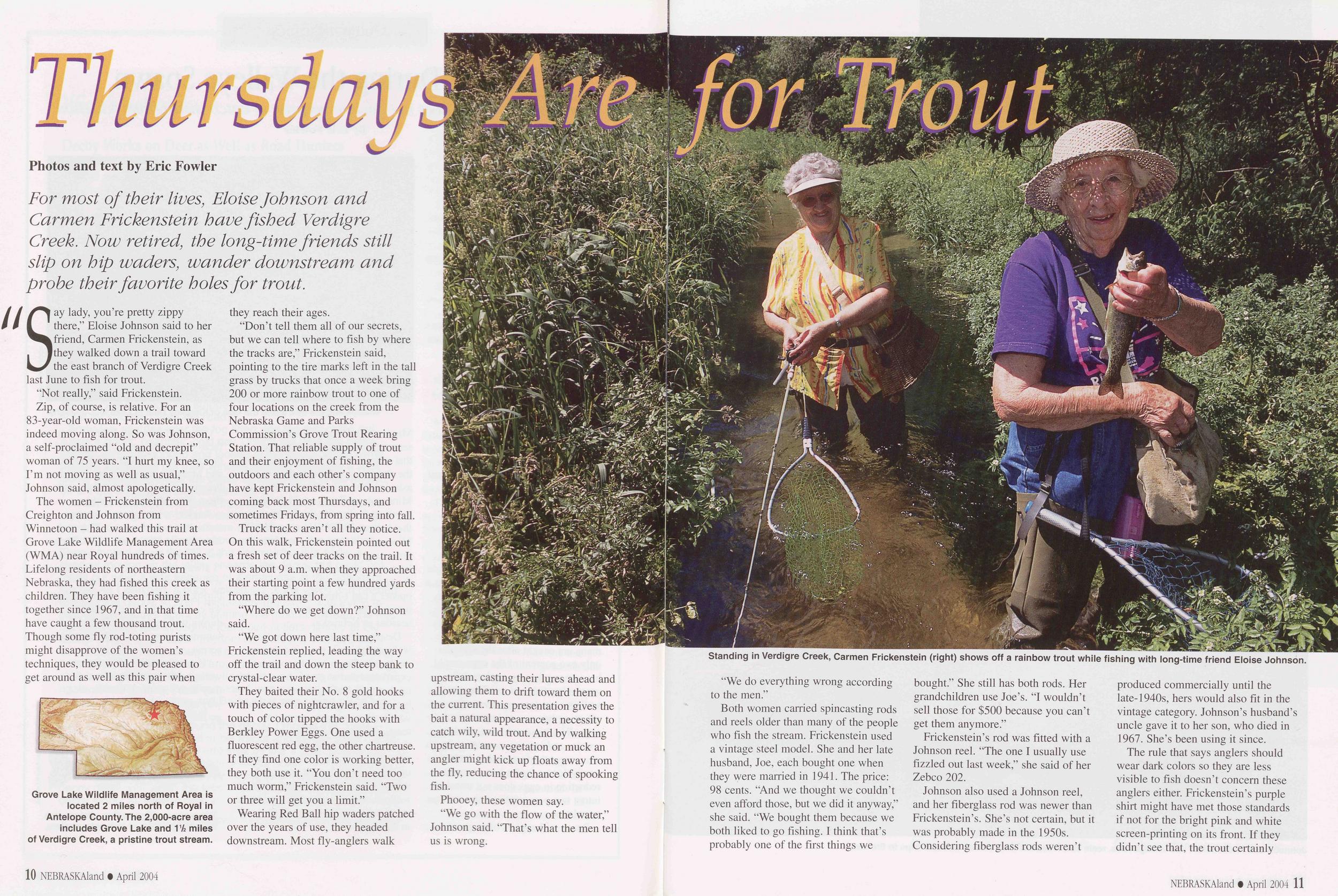
Photos and text by Eric Fowler For most of their lives, Eloise Johnson and Carmen Frickenstein have fished Verdigre Creek. Now retired, the long-time friends still slip on hip waders, wander downstream and probe their favorite holes for trout.Say lady, you’re pretty zippy there,” Eloise Johnson said to her friend, Carmen Frickenstein, as they walked down a trail toward the east branch of Verdigre Creek last June to fish for trout.
“Not really,” said Frickenstein. Zip, of course, is relative. For an 83-year-old woman, Frickenstein was indeed moving along. So was Johnson, a self-proclaimed "old and decrepit” woman of 75 years. "I hurt my knee, so I’m not moving as well as usual,” Johnson said, almost apologetically.
The women - Frickenstein from Creighton and Johnson from Winnetoon - had walked this trail at Grove Lake Wildlife Management Area (WMA) near Royal hundreds of times. Lifelong residents of northeastern Nebraska, they had fished this creek as children. They have been fishing it together since 1967, and in that time have caught a few thousand trout. Though some fly rod-toting purists might disapprove of the women’s techniques, they would be pleased to get around as well as this pair when
"Don’t tell them all of our secrets, but we can tell where to fish by where the tracks are,” Frickenstein said, pointing to the tire marks left in the tall grass by trucks that once a week bring 200 or more rainbow trout to one of four locations on the creek from the Nebraska Game and Parks Commission’s Grove Trout Rearing Station. That reliable supply of trout and their enjoyment of fishing, the outdoors and each other’s company have kept Frickenstein and Johnson coming back most Thursdays, and sometimes Fridays, from spring into fall.
Truck tracks aren’t all they notice. On this walk, Frickenstein pointed out a fresh set of deer tracks on the trail. It was about 9 a.m. when they approached their starting point a few hundred yards from the parking lot.
"Where do we get down?” Johnson said.
“We got down here last time,” Frickenstein replied, leading the way off the trail and down the steep bank to crystal-clear water.
They baited their No. 8 gold hooks with pieces of nightcrawler, and for a touch of color tipped the hooks with Berkley Power Eggs. One used a fluorescent red egg, the other chartreuse. If they find one color is working better, they both use it. “You don’t need too much worm,” Frickenstein said. “Two or three will get you a limit.”
Wearing Red Ball hip waders patched over the years of use, they headed downstream. Most fly-anglers walk upstream, casting their lures ahead and allowing them to drift toward them on the current. This presentation gives the bait a natural appearance, a necessity to catch wily, wild trout. And by walking upstream, any vegetation or muck an angler might kick up floats away from the fly, reducing the chance of spooking fish.
Phooey, these women say. “We go with the flow of the water,” Johnson said. “That’s what the men tell us is wrong.
“We do everything wrong according to the men.”
Both women carried spincasting rods and reels older than many of the people who fish the stream. Frickenstein used a vintage steel model. She and her late husband, Joe, each bought one when they were married in 1941. The price: 98 cents. “And we thought we couldn’t even afford those, but we did it anyway,” she said. “We bought them because we both liked to go fishing. I think that’s probably one of the first things we bought.” She still has both rods. Her grandchildren use Joe’s. “I wouldn’t sell those for $500 because you can’t get them anymore.”
Frickenstein’s rod was fitted with a Johnson reel. “The one I usually use fizzled out last week,” she said of her Zebco 202.
Johnson also used a Johnson reel, and her fiberglass rod was newer than Frickenstein’s. She’s not certain, but it was probably made in the 1950s. Considering fiberglass rods weren’t produced commercially until the late-1940s, hers would also fit in the vintage category. Johnson’s husband’s uncle gave it to her son, who died in 1967. She’s been using it since.
The rule that says anglers should
wear dark colors so they are less
visible to fish doesn’t concern these
anglers either. Frickenstein’s purple
shirt might have met those standards
if not for the bright pink and white
screen-printing on its front. If they
didn’t see that, the trout certainly
10 NEBRASKAland • April 2004
NEBRASKAland • April 2004 11
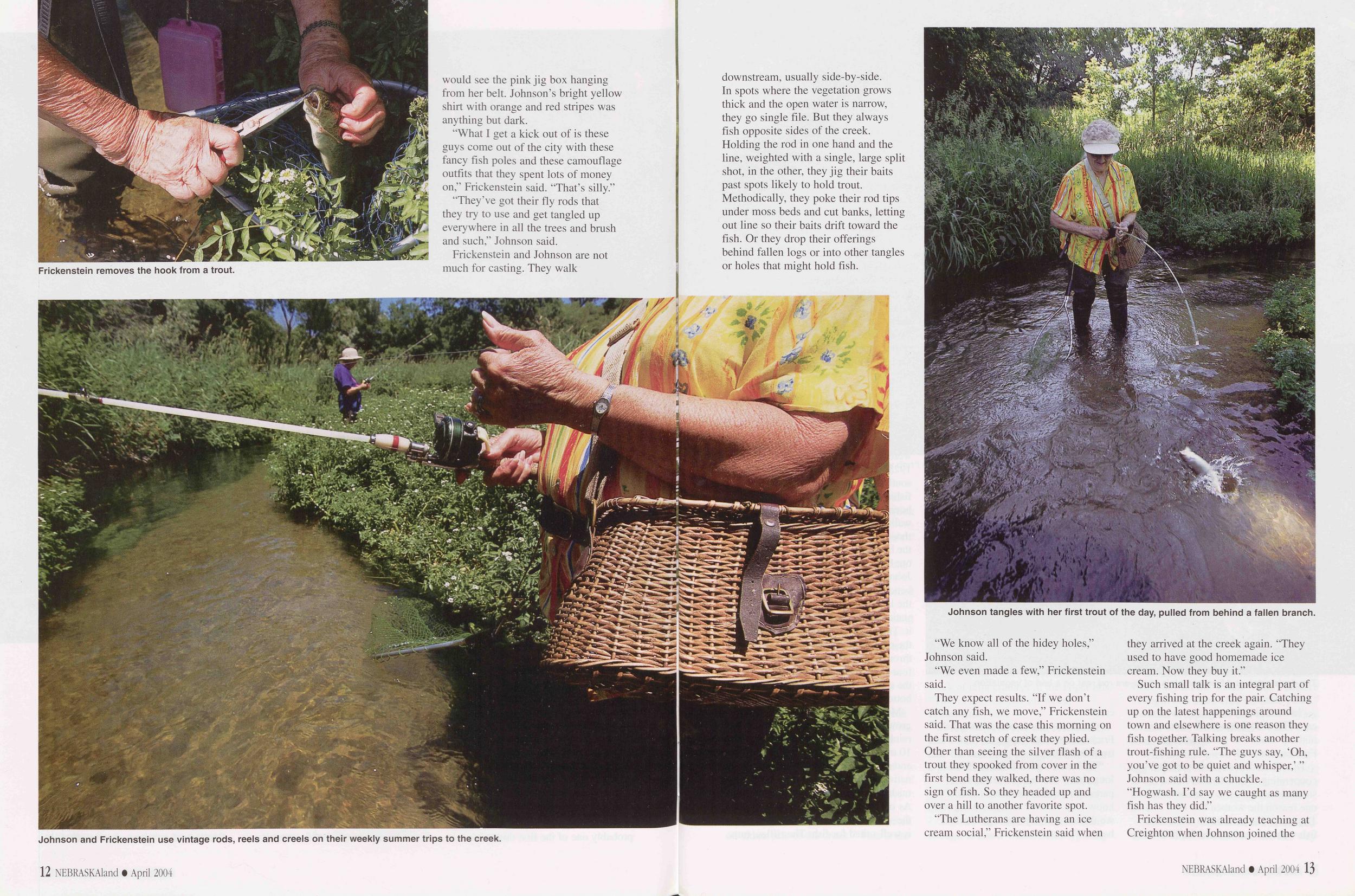
“What I get a kick out of is these guys come out of the city with these fancy fish poles and these camouflage outfits that they spent lots of money on,” Frickenstein said. “That’s silly.”
“They’ve got their fly rods that they try to use and get tangled up everywhere in all the trees and brush and such,” Johnson said.
Frickenstein and Johnson are not much for casting. They walk
"We know all of the hidey holes,” Johnson said.
"We even made a few,” Frickenstein said.
They expect results. “If we don’t catch any fish, we move,” Frickenstein said. That was the case this morning on the first stretch of creek they plied. Other than seeing the silver flash of a trout they spooked from cover in the first bend they walked, there was no sign of fish. So they headed up and over a hill to another favorite spot.
“The Lutherans are having an ice cream social,” Frickenstein said when they arrived at the creek again. “They used to have good homemade ice cream. Now they buy it.”
Such small talk is an integral part of every fishing trip for the pair. Catching up on the latest happenings around town and elsewhere is one reason they fish together. Talking breaks another trout-fishing rule. “The guys say, ‘Oh, you’ve got to be quiet and whisper,’ ” Johnson said with a chuckle. “Hogwash. I’d say we caught as many fish has they did.”
Frickenstein was already teaching at
Creighton when Johnson joined the
12 NEBRASKAland • April 2004
NEBRASKAland • April 2004 13
 staff in 1966. Frickenstein loved fishing
the creek. Her husband loved to fish,
but he preferred fishing for walleyes
from his boat. Looking for a partner,
she asked Johnson, who gladly accepted.
“The day school was out, we started,”
Frickenstein said. “We’d go every
week. We’d even go in the rain.”
staff in 1966. Frickenstein loved fishing
the creek. Her husband loved to fish,
but he preferred fishing for walleyes
from his boat. Looking for a partner,
she asked Johnson, who gladly accepted.
“The day school was out, we started,”
Frickenstein said. “We’d go every
week. We’d even go in the rain.”
“In town, everybody knew when it came Thursday, don’t call me to do nothing cause I’m going fishing,” Frickenstein said.
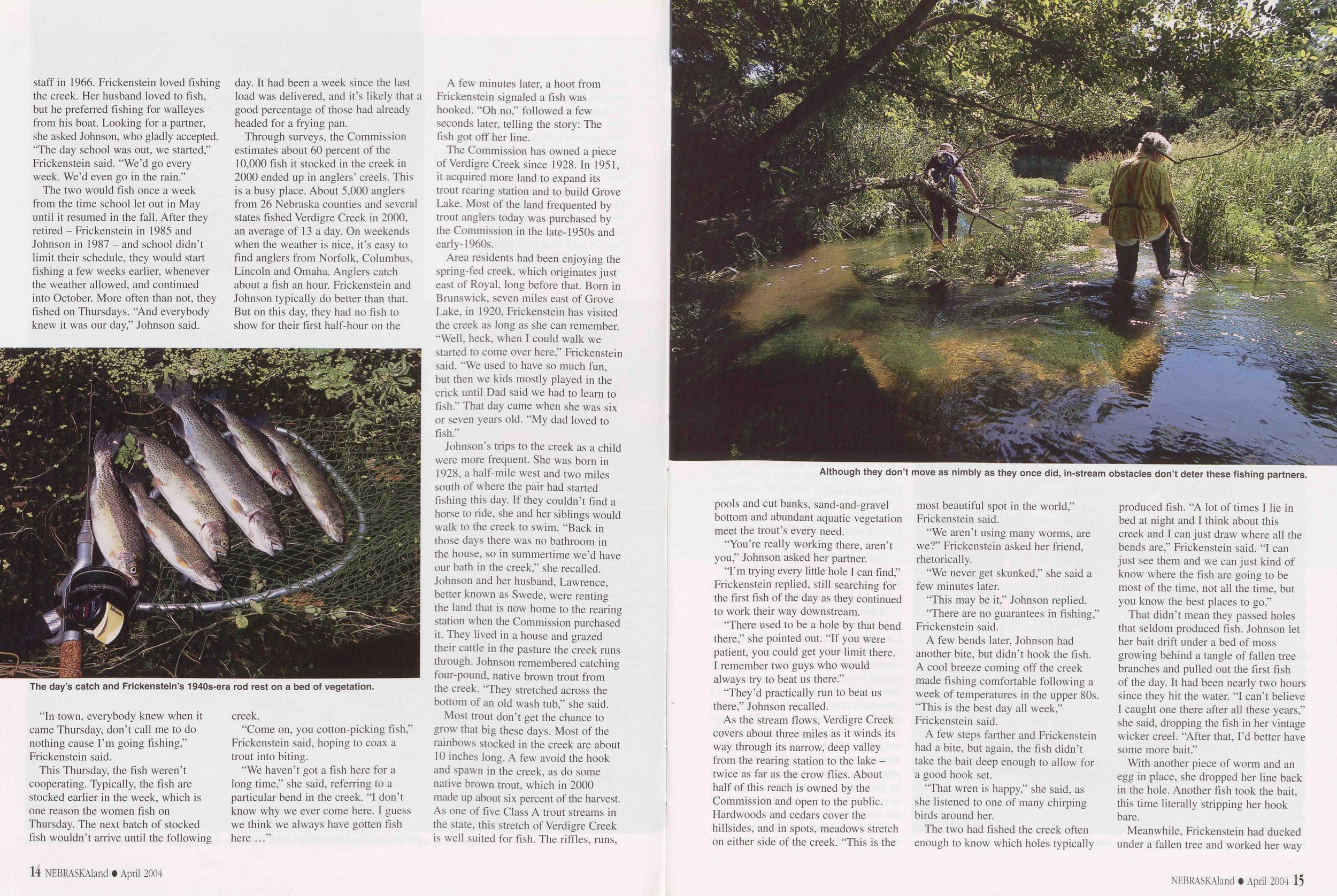
This Thursday, the fish weren’t cooperating. Typically, the fish are stocked earlier in the week, which is one reason the women fish on Thursday. The next batch of stocked fish wouldn’t arrive until the following day. It had been a week since the last load was delivered, and it’s likely that a good percentage of those had already headed for a frying pan.
Through surveys, the Commission estimates about 60 percent of the 10,000 fish it stocked in the creek in 2000 ended up in anglers’ creels. This is a busy place. About 5,000 anglers from 26 Nebraska counties and several states fished Verdigre Creek in 2000, an average of 13 a day. On weekends when the weather is nice, it’s easy to find anglers from Norfolk, Columbus, Lincoln and Omaha. Anglers catch about a fish an hour. Frickenstein and Johnson typically do better than that. But on this day, they had no fish to show for their first half-hour on the creek.
“Come on, you cotton-picking fish,” Frickenstein said, hoping to coax a trout into biting.
“We haven’t got a fish here for a long time,” she said, referring to a particular bend in the creek. “I don’t know why we ever come here. I guess we think we always have gotten fish here ...”
A few minutes later, a hoot from Frickenstein signaled a fish was hooked. “Oh no,” followed a few seconds later, telling the story: The fish got off her line.
The Commission has owned a piece of Verdigre Creek since 1928. In 1951, it acquired more land to expand its trout rearing station and to build Grove Lake. Most of the land frequented by trout anglers today was purchased by the Commission in the late-1950s and early-1960s.
Area residents had been enjoying the spring-fed creek, which originates just east of Royal, long before that. Born in Brunswick, seven miles east of Grove Lake, in 1920, Frickenstein has visited the creek as long as she can remember. “Well, heck, when I could walk we started to come over here,” Frickenstein said. “We used to have so much fun, but then we kids mostly played in the crick until Dad said we had to learn to fish.” That day came when she was six or seven years old. “My dad loved to fish.”
Johnson’s trips to the creek as a child were more frequent. She was born in 1928, a half-mile west and two miles south of where the pair had started fishing this day. If they couldn’t find a horse to ride, she and her siblings would walk to the creek to swim. “Back in those days there was no bathroom in the house, so in summertime we’d have our bath in the creek,” she recalled. Johnson and her husband, Lawrence, better known as Swede, were renting the land that is now home to the rearing station when the Commission purchased it. They lived in a house and grazed their cattle in the pasture the creek runs through. Johnson remembered catching four-pound, native brown trout from the creek. “They stretched across the bottom of an old wash tub,” she said.
Most trout don’t get the chance to grow that big these days. Most of the rainbows stocked in the creek are about 10 inches long. A few avoid the hook and spawn in the creek, as do some native brown trout, which in 2000 made up about six percent of the harvest. As one of five Class A trout streams in the state, this stretch of Verdigre Creek is well suited for fish. The riffles, runs,
“You’re really working there, aren’t you,” Johnson asked her partner.
“I’m trying every little hole I can find,” Frickenstein replied, still searching for the first fish of the day as they continued to work their way downstream.
“There used to be a hole by that bend there,” she pointed out. “If you were patient, you could get your limit there. I remember two guys who would always try to beat us there.”
“They’d practically run to beat us there,” Johnson recalled.
As the stream flows, Verdigre Creek covers about three miles as it winds its way through its narrow, deep valley from the rearing station to the lake - twice as far as the crow flies. About half of this reach is owned by the Commission and open to the public. Hardwoods and cedars cover the hillsides, and in spots, meadows stretch on either side of the creek. “This is the most beautiful spot in the world,” Frickenstein said.
“We aren’t using many worms, are we?” Frickenstein asked her friend, rhetorically.
“We never get skunked,” she said a few minutes later.
“This may be it,” Johnson replied. “There are no guarantees in fishing,” Frickenstein said.
A few bends later, Johnson had another bite, but didn’t hook the fish. A cool breeze coming off the creek made fishing comfortable following a week of temperatures in the upper 80s. “This is the best day all week,” Frickenstein said.
A few steps farther and Frickenstein had a bite, but again, the fish didn’t take the bait deep enough to allow for a good hook set.
“That wren is happy,” she said, as she listened to one of many chirping birds around her.
The two had fished the creek often enough to know which holes typically produced fish. “A lot of times I lie in bed at night and I think about this creek and I can just draw where all the bends are,” Frickenstein said. “I can just see them and we can just kind of know where the fish are going to be most of the time, not all the time, but you know the best places to go.”
That didn’t mean they passed holes that seldom produced fish. Johnson let her bait drift under a bed of moss growing behind a tangle of fallen tree branches and pulled out the first fish of the day. It had been nearly two hours since they hit the water. “I can’t believe I caught one there after all these years,” she said, dropping the fish in her vintage wicker creel. “After that, I’d better have some more bait.”
With another piece of worm and an egg in place, she dropped her line back in the hole. Another fish took the bait, this time literally stripping her hook bare.
Meanwhile, Frickenstein had ducked
under a fallen tree and worked her way
14 NEBRASKAland • April 2004
NEBRASKAland • April 2004 15
Johnson continued to ply the hole that produced her first fish and was rewarded with a second. "I was surprised to have one fish,” she exclaimed, "and now two.”
Unable to catch a third, Johnson caught up with her partner and they continued downstream. “I’m surprised we’re not hearing any cardinals,” Frickenstein said.
"Nature is a wonderful thing,” said Johnson.
At 11:30 a.m., Frickenstein landed another fish. "I’ve still got my first worm,” she said after removing the hook. "I’m going to try to get one more.”
"You’re being conservative, aren’t you?” Johnson said.
"If we run out, a lot of people in town tell me they’ve got plenty and they’ll give me some.”
Twenty minutes later, that worm produced a third fish.
“Did you get it in the moss?” Johnson asked.
"Right at the end,” Frickenstein replied, pointing to the downstream end of a long finger of moss in midstream. "You know they like it there.”
Around the next bend, she landed her fourth and biggest fish of the day - a 131/2 incher that had been in the creek for a while. "Well, I’ve got to start a second worm,” she said.
That fish would be the last of the day, and put Frickenstein up four to two on her friend. Not that they keep score. "We don’t care,” Frickenstein said. "I think it’s even.”
"One time she’ll catch more, and the next time I’ll catch more,” Johnson said.
"Remember the north side over there where the grass grew over the bank?” Johnson asked, pointing across the stream.
“That was always so good,” Frickenstein said.
They continued their small talk, about what they’d planted in their gardens and other things that kept them busy.
"I’m not making jelly, pickles or anything this year, are you?” Frickenstein said.
"No,” Johnson replied. "It doesn’t pay,” Frickenstein said.
When prompted, they told stories. Like the time they were chased by a rabid raccoon Johnson had awakened when she poked her rod under a cut bank. Or the time she confronted a man fishing directly below the rearing station, an area that is off limits to anglers.
"Eloise is braver than I am, and when we got over there she said, ‘Say sir, I think you’re fishing where you aren’t supposed to,’ ” Frickenstein said. "Boy he got mad ... I thought he was going to push us both in and hold us under the water.”
"Well, where he was fishing was right where it was posted that you weren’t supposed to fish,” Johnson said.
"He was having good luck, too,” Frickenstein said.
Their stories stretch to Minnesota, where the pair traveled each summer for nearly 20 years with their husbands to fish for walleyes. Johnson recalled a big walleye she caught and how the men in nearby cabins were impressed that a schoolteacher could catch such a fish. And they told about their days teaching in rural schools, where Frickenstein made $35 her first month on the job and Johnson $100. And how Johnson kept Frickenstein coming back after a battle with cancer in 1983.
"I just about died in November,” she said. “Man, I was sick. And Eloise, in the spring, kept saying, let’s go fishing, let’s go fishing. I never said anything, but boy, that summer, I could hardly hang in there. But I did. If it wouldn’t have been for her, I never would have stuck with it.
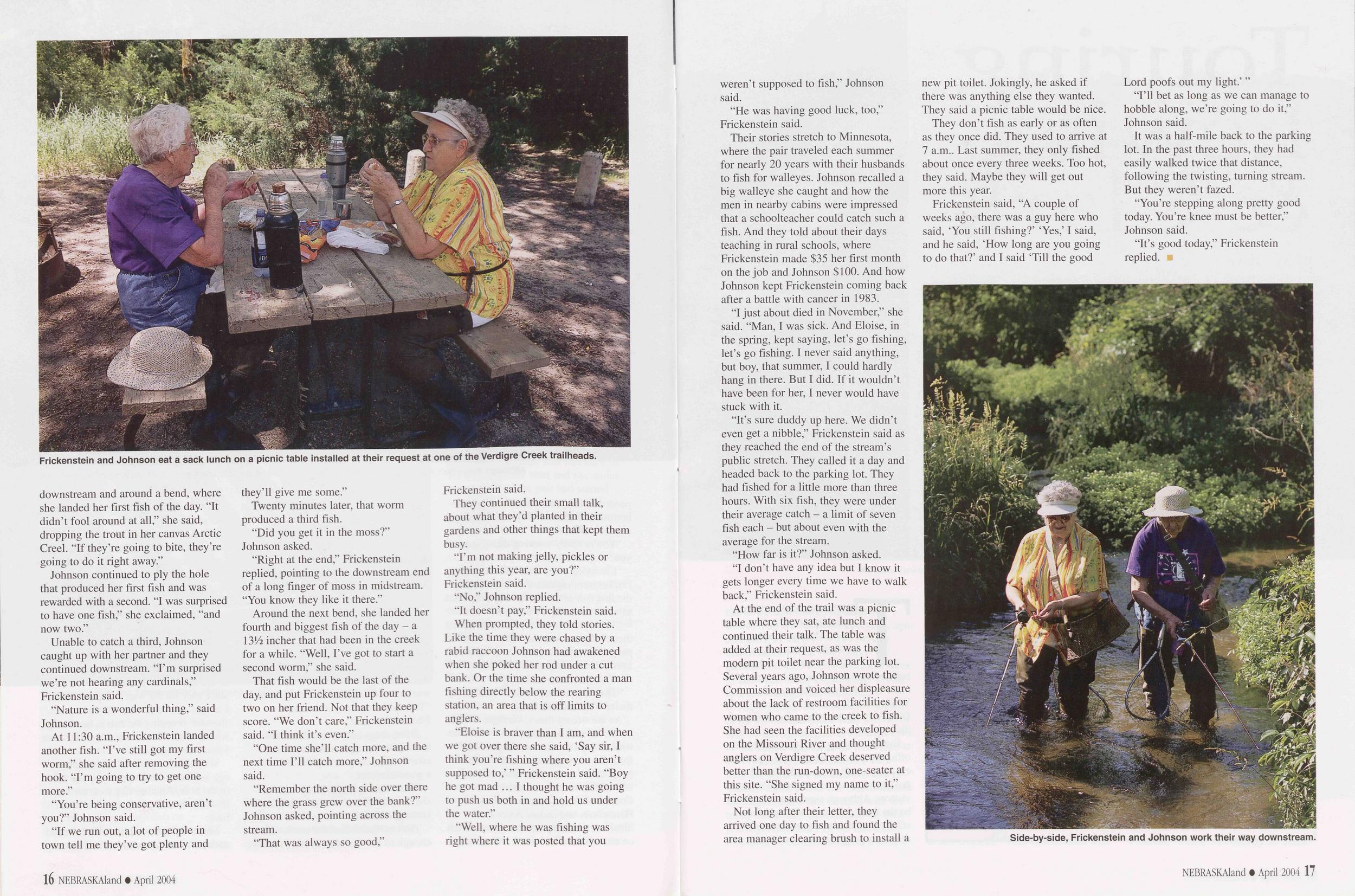
"It’s sure duddy up here. We didn’t even get a nibble,” Frickenstein said as they reached the end of the stream’s public stretch. They called it a day and headed back to the parking lot. They had fished for a little more than three hours. With six fish, they were under their average catch - a limit of seven fish each - but about even with the average for the stream.
"How far is it?” Johnson asked.
"I don’t have any idea but I know it gets longer every time we have to walk back,” Frickenstein said.
At the end of the trail was a picnic table where they sat, ate lunch and continued their talk. The table was added at their request, as was the modern pit toilet near the parking lot. Several years ago, Johnson wrote the Commission and voiced her displeasure about the lack of restroom facilities for women who came to the creek to fish. She had seen the facilities developed on the Missouri River and thought anglers on Verdigre Creek deserved better than the run-down, one-seater at this site. “She signed my name to it,” Frickenstein said.
Not long after their letter, they arrived one day to fish and found the area manager clearing brush to install a new pit toilet. Jokingly, he asked if there was anything else they wanted. They said a picnic table would be nice.
They don’t fish as early or as often as they once did. They used to arrive at 7 a.m.. Last summer, they only fished about once every three weeks. Too hot, they said. Maybe they will get out more this year.
Frickenstein said, "A couple of weeks ago, there was a guy here who said, ‘You still fishing?’ ‘Yes,’ I said, and he said, ‘How long are you going to do that?’ and I said ‘Till the good Lord poofs out my light.’ ”
“I’ll bet as long as we can manage to hobble along, we’re going to do it,” Johnson said.
It was a half-mile back to the parking lot. In the past three hours, they had easily walked twice that distance, following the twisting, turning stream. But they weren’t fazed.
“You’re stepping along pretty good today. You’re knee must be better,” Johnson said.
"It’s good today,” Frickenstein replied.
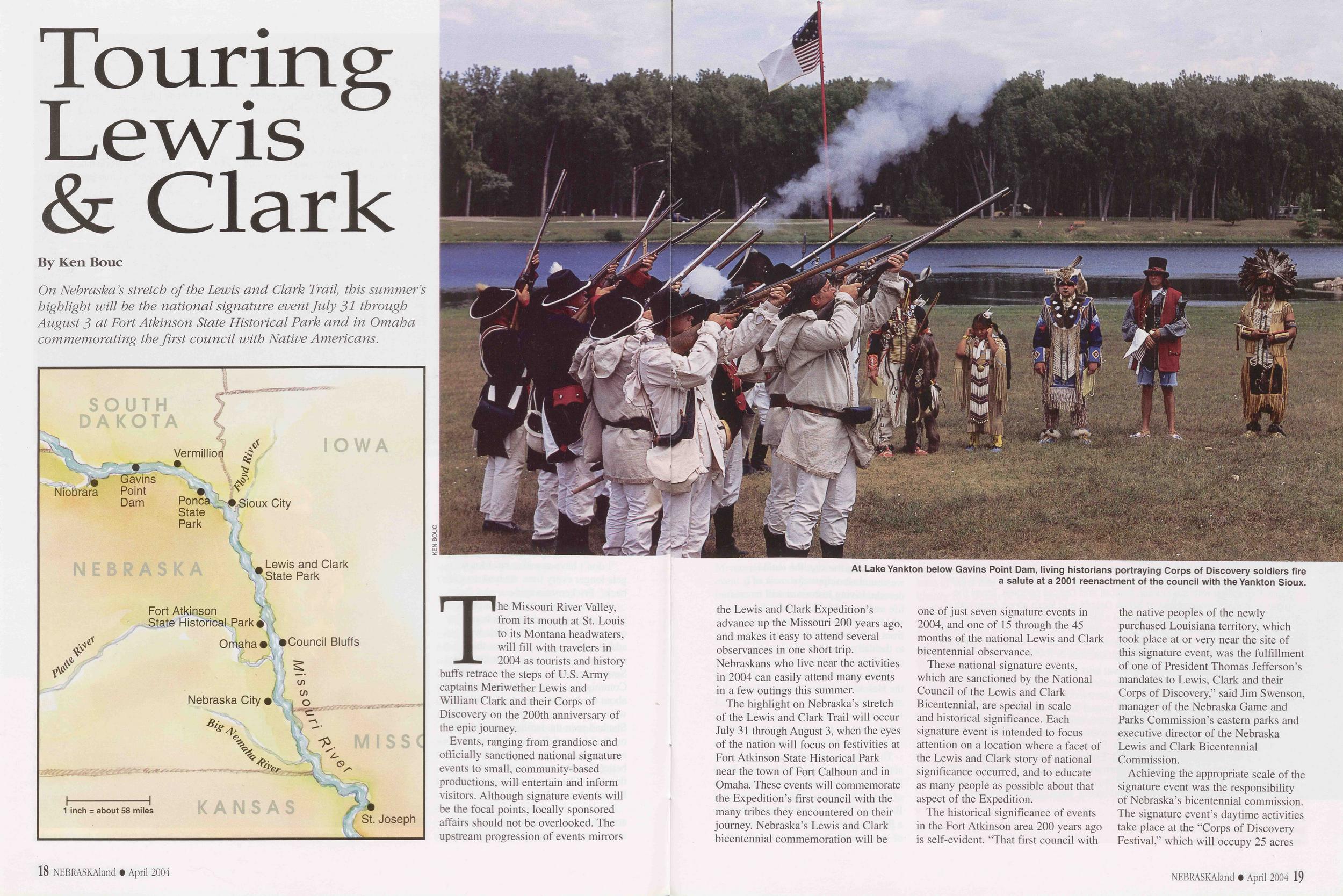
Touring Lewis & Clark
By Ken Bone On Nebraska’s stretch of the Lewis and Clark Trail, this summer’s highlight will be the national signature event July JI through August 3 at Fort Atkinson State Historical Park and in Omaha commemorating the first council with Native Americans.The Missouri River Valley, from its mouth at St. Louis to its Montana headwaters, will fill with travelers in 2004 as tourists and history buffs retrace the steps of U.S. Army captains Meriwether Lewis and William Clark and their Corps of Discovery on the 200th anniversary of the epic journey.
Events, ranging from grandiose and officially sanctioned national signature events to small, community-based productions, will entertain and inform visitors. Although signature events will be the focal points, locally sponsored affairs should not be overlooked. The upstream progression of events mirrors
The highlight on Nebraska’s stretch of the Lewis and Clark Trail will occur July 31 through August 3, when the eyes of the nation will focus on festivities at Fort Atkinson State Historical Park near the town of Fort Calhoun and in Omaha. These events will commemorate the Expedition’s first council with the many tribes they encountered on their journey. Nebraska’s Lewis and Clark bicentennial commemoration will be one of just seven signature events in 2004, and one of 15 through the 45 months of the national Lewis and Clark bicentennial observance.
These national signature events, which are sanctioned by the National Council of the Lewis and Clark Bicentennial, are special in scale and historical significance. Each signature event is intended to focus attention on a location where a facet of the Lewis and Clark story of national significance occurred, and to educate as many people as possible about that aspect of the Expedition.
The historical significance of events in the Fort Atkinson area 200 years ago is self-evident. "That first council with the native peoples of the newly purchased Louisiana territory, which took place at or very near the site of this signature event, was the fulfillment of one of President Thomas Jefferson’s mandates to Lewis, Clark and their Corps of Discovery,” said Jim Swenson, manager of the Nebraska Game and Parks Commission’s eastern parks and executive director of the Nebraska Lewis and Clark Bicentennial Commission.
Achieving the appropriate scale of the
signature event was the responsibility
of Nebraska’s bicentennial commission.
The signature event’s daytime activities
take place at the "Corps of Discovery
Festival,” which will occupy 25 acres
18 NEBRASKAland • April 2004
NEBRASKAland • April 2004 19
 at the foot of the bluff where Fort
Atkinson SHP is located. A natural
setting of meadow and trees, the site is
very near the probable channel of the
Missouri River in 1804 and a campsite
of Lewis and Clark. Across the road
from the festival will be 50 acres of
free parking.
at the foot of the bluff where Fort
Atkinson SHP is located. A natural
setting of meadow and trees, the site is
very near the probable channel of the
Missouri River in 1804 and a campsite
of Lewis and Clark. Across the road
from the festival will be 50 acres of
free parking.
Expedition’s Departure: Camp River DuBois, May 13-16, Lewis and Clark Historic Site, Hartford, Illinois. Opening Ceremonies at the Gateway International Raceway in Madison. Expedition Departure Day activities, May 14, at the Lewis and Clark State Historic Site include heritage crafts demonstrations, scientific presentations on flora and fauna found by the Expedition, and a performance by the U.S. Army Old Guard. May 15-16 events include powwows, reenactments, scholarly presentations, exhibits, foot and bicycle races, canoeing and Chautauqua events, www.lewisand- clarkillinois.ora: (618) 468-2288
St Charles: Preparations Complete, The Expedition Faces West, May 14-23, a nine-day national commemoration in St. Charles, Missouri. Replica Lewis and Clark keelboat and pirogues, manned by the Discovery Expeditions of St. Charles reenactors, arrive on May 15 from Camp River DuBois. Boats and crew will be accessible to visitors. Weekends include reveille and retreat ceremonies with more than 25 fife and drum corps and military units. Highlights include reenactment of Lewis and Clark’s encampment, interpreters in authentic 1804 dress, more than 60 booths offering crafts and foods, an American Indian encampment, and horse and carriage parades. Lewisandclarkstcharles.com: (800) 366-2427
Heart of America: A Journey Fourth, July 3-4, Kansas City, Missouri, and Atchison and Leavenworth, Kansas, commemorates the first Independence Day observance west of the Mississippi. Two blasts from the keelboat’s cannon near present-day Atchison, Kansas, will represent the Expedition’s festivities in 1804. The celebration features an air show, reading of the Declaration of Independence and fireworks displays over the Missouri River. The Kansas City area offers an extensive list of historical attractions, with commemorative activities lasting nearly three weeks, June 19-July 11. www.journey4th.ora: (800) 858-1749
First Tribal Council: July 31-August 3, Fort Calhoun and Omaha, Nebraska. Fort Atkinson State Historical Park near Fort Calhoun is the site of Lewis and Clark’s first council with native peoples, which will be dramatically re-created in evening performances in Omaha. A Lewis and Clark piano concerto by composer Philip Glass will be an integral part of evening performances. Daytime activities at Fort Atkinson SHP include living history demonstrations, American Indian cultural presentations, and interactive educational workshops. Iewisandclarkne.org; (800) 228-4307
Oceti Sakowin Experience: August 27-September 26, Chamberlain and Oacoma, South Dakota. Commemorate the bicentennial of the Lewis and Clark Expedition with the Lakota, Nakota and Dakota peoples. Travel the tribal lands and reservations of South Dakota and learn about American Indian experiences before, during and after the Lewis and Clark Expedition. The event kicks off August 27 in Chamberlain and Oacoma with the Native American Art Show and Auction. For event information, contact the Alliance of Tribal Tourism Advocates, www.attatribal.com or (605) 773-3301
Circle of Cultures: Time of Renewal and Exchange, October 22-31, Bismarck, North Dakota. This event celebrates the cordial welcome given the Lewis and Clark Expedition by the earthlodge peoples of the upper Missouri River and renews the bonds forged during the winter of 1804-05. Visitors will taste what the explorers tasted, see what they saw and hear what they heard. Circle of Cultures will showcase the thriving centuries-old trading “Mecca” of the northern Plains. Experience the high-tech Virtual Village of the Mandans at its unveiling. Enter replica earthlodges with Native American interpretation and demonstrations. Enjoy reenactors and scholars, including James P. Ronda, Clay Jenkinson, Tom Theissen, Dayton Duncan, Ray Wood, Amy Mossett and others, www.circleofcultures.com; (800) 767-3555
The festival will include a large area devoted to Native American topics, and another with living historians interpreting a Lewis and Clark campsite and a fur trade rendezvous, plus a replica of the Lewis and Clark keelboat. Other areas will be devoted to demonstrations, storytelling, reenactments and hands-on activities. A large educational tent will feature historians, authors and lecturers of national repute as experts on Lewis and Clark and western history. They include Gary E. Moulton of the University of Nebraska-Lincoln, editor of the 13-volume The Journals of the Lewis and Clark Expedition, authors James Ronda and Dayton Duncan, and lecturer Hal Stearns. “There’s all kinds of activities for families at the festival, and admission is free,” Swenson said.
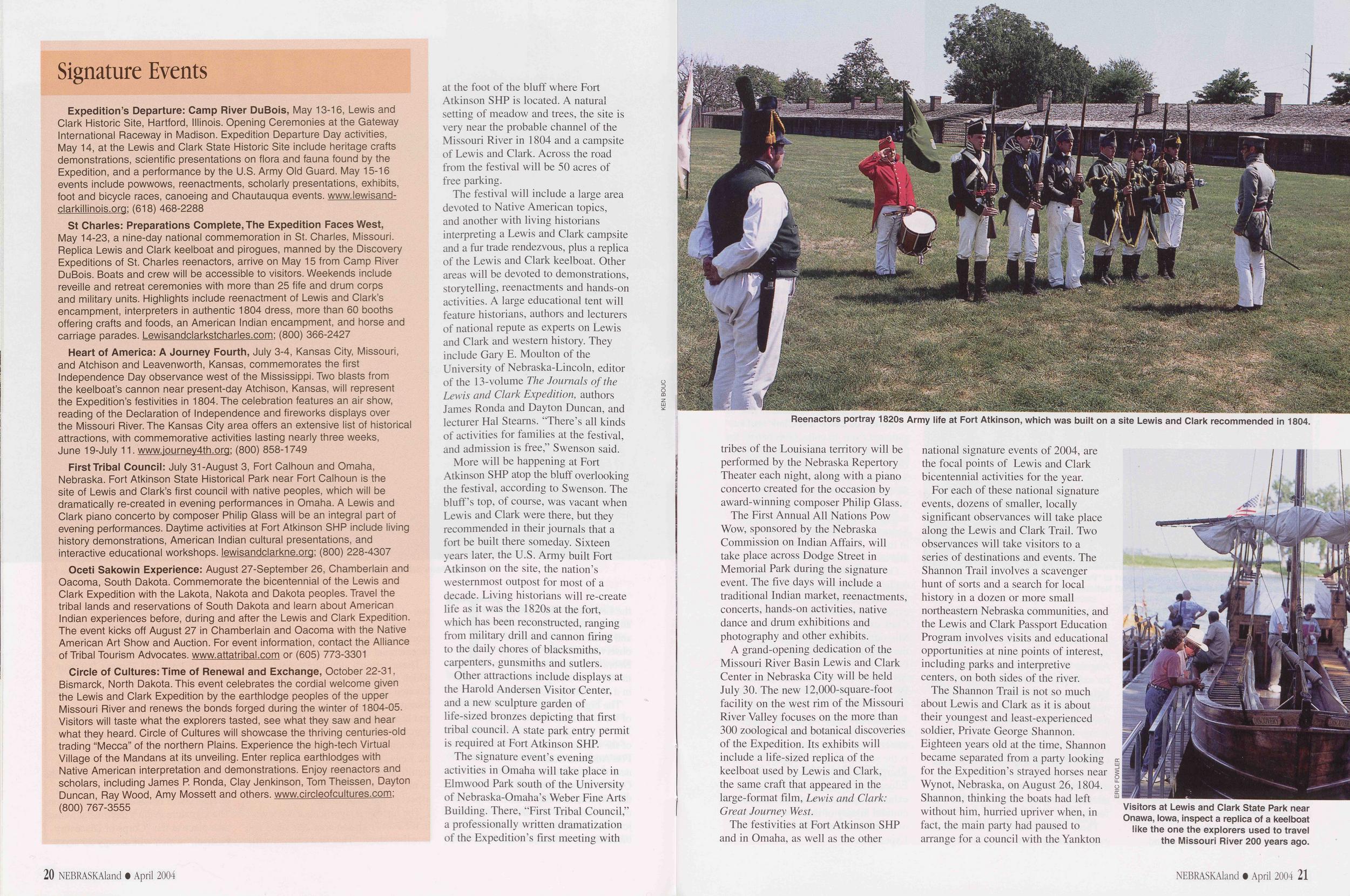
More will be happening at Fort Atkinson SHP atop the bluff overlooking the festival, according to Swenson. The bluff’s top, of course, was vacant when Lewis and Clark were there, but they recommended in their journals that a fort be built there someday. Sixteen years later, the U.S. Army built Fort Atkinson on the site, the nation’s westernmost outpost for most of a decade. Living historians will re-create life as it was the 1820s at the fort, which has been reconstructed, ranging from military drill and cannon firing to the daily chores of blacksmiths, carpenters, gunsmiths and sutlers.
Other attractions include displays at the Harold Andersen Visitor Center, and a new sculpture garden of life-sized bronzes depicting that first tribal council. A state park entry permit is required at Fort Atkinson SHP.
The signature event’s evening activities in Omaha will take place in Elmwood Park south of the University of Nebraska-Omaha’s Weber Fine Arts Building. There, “First Tribal Council,” a professionally written dramatization of the Expedition’s first meeting with
The First Annual All Nations Pow Wow, sponsored by the Nebraska Commission on Indian Affairs, will take place across Dodge Street in Memorial Park during the signature event. The five days will include a traditional Indian market, reenactments, concerts, hands-on activities, native dance and drum exhibitions and photography and other exhibits.
A grand-opening dedication of the Missouri River Basin Lewis and Clark Center in Nebraska City will be held July 30. The new 12,000-square-foot facility on the west rim of the Missouri River Valley focuses on the more than 300 zoological and botanical discoveries of the Expedition. Its exhibits will include a life-sized replica of the keelboat used by Lewis and Clark, the same craft that appeared in the large-format film, Lewis and Clark: Great Journey West.
The festivities at Fort Atkinson SHP and in Omaha, as well as the other national signature events of 2004, are the focal points of Lewis and Clark bicentennial activities for the year.
For each of these national signature events, dozens of smaller, locally significant observances will take place along the Lewis and Clark Trail. Two observances will take visitors to a series of destinations and events. The Shannon Trail involves a scavenger hunt of sorts and a search for local history in a dozen or more small northeastern Nebraska communities, and the Lewis and Clark Passport Education Program involves visits and educational opportunities at nine points of interest, including parks and interpretive centers, on both sides of the river.
The Shannon Trail is not so much about Lewis and Clark as it is about their youngest and least-experienced soldier, Private George Shannon. Eighteen years old at the time, Shannon became separated from a party looking for the Expedition’s strayed horses near Wynot, Nebraska, on August 26, 1804. Shannon, thinking the boats had left without him, hurried upriver when, in fact, the main party had paused to arrange for a council with the Yankton

Twelve chainsaw sculptures depict Shannon in the 16 communities on the Shannon Trail. Travelers who locate all 12 and obtain a “passport” stamp at each site earn a limited-edition print of Private Shannon. “A Tale of the Trail,” a dramatization about Shannon’s adventure, will be presented by the Shannon Trail organization at weekend celebrations in Verdigre, Crofton and Hartington. For information on the Shannon Trail and the performances, call (402) 667-6557.
Farther down the Missouri, in Nebraska and Iowa, the Lewis and Clark Passport Education Program features various demonstrations and activities each weekday morning and afternoon from June 14 through August 13. Activities on Mondays, for example, will begin at Brownville, Nebraska, where visitors will help set up an 1804 U.S. Army camp, then move on to Waubonsie State Park across the river in Iowa for afternoon programs on the fish of Lewis and Clark and cooking of the period. And so it goes, upriver through the week to South Sioux City for the Friday afternoon sessions. Call (712) 482-3029 for details.
There will be many single-destination events, among them living history activities and reenactments. Look for them at Lewis and Clark State Park near Onawa, Iowa, June 10-13 and again August 7-9, with the added attraction of replicas of Lewis and Clark’s keelboat and two pirogues. Other events include the White Catfish Living History Weekend July 23-25 at the Western Historic Trails Center in Council Bluffs, a living history encampment August 21-22 at the Sergeant Floyd Museum and Welcome Center in Sioux City, and a large gathering of living historians, Native American dancers and traders at Lake Yankton below Gavins Point Dam August 27-29.
These events are within easy reach of many Nebraskans, and those with an intense interest in Lewis and Clark should plan a visit to St. Louis. The Jefferson National Expansion Memorial, with the Gateway Arch and its excellent permanent and special exhibits, is a premiere attraction. The same is true of an exhibit of Lewis and Clark artifacts gathered from 40 collections across the country and on display at the Missouri Historical Society’s museum until September 6. Following its debut in St. Louis, “Lewis and Clark: The National Bicentennial Exhibition” will then go on a national tour through September, 2006. Two signature events in the St. Louis area in mid-May make that an attractive time for a visit.
Or, as an alternative to the crowds, traffic and fast pace of the city, consider Swenson’s suggestion. “If you want to experience something that Lewis and Clark experienced, check out the Missouri National Recreational River the runs from Gavins Point Dam to Ponca. For westbound travelers, it’s the first glimpse of the natural Missouri River that challenged Lewis and Clark for the first year-and-a-half of their westward adventure,” he said. Swenson noted that Ponca State Park lies at the eastern edge of that piece of river and is the site of the new Missouri National Recreational River Resource and Educational Center, with a gallery of exhibits explaining both the natural and cultural history of that river. Including, of course, the Lewis and Clark Expedition.
2004 Lewis and Clark Bicentennial Events Through April 18, “Adventures With Lewis and Clark,” Omaha Children’s Museum. (402) 342-6164 Through May 25, Lewis and Clark Study Group, each Tuesday, 9 to 11:30 a.m., free, Western Historic Trails Center, Council Bluffs, IA. Through July 31, Lewis and Clark tours, puppet shows, gallery walks, special programs, children’s programs, lectures; weekends; some advance reservations and fees required; National Frontier Trails Museum, Independence, MO. (816) 325-7575 Through September 6, “Lewis & Clark: The National Bicentennial Exhibition,” traveling exhibit of historic and ethnographic treasures, organized by Missouri Historical Society, debuts at the society’s museum in St. Louis. (314) 454-3150 April 1-June 9, “Lewis and Clark: Great Journey West,” large-format film, Lied Super Screen Theater at Hastings Museum. (800) 508-4629 April 1-August 29, “Plants of the Lewis and Clark Expedition” exhibit at Cass County Historical Museum. (402) 296-4770 April 21, Seminar, “I Wished for the Pencil of Salvator Rosa: The Artistic Legacy of Lewis and Clark.” Speaker: Joni Kinsey, Associate Professor of American Art History, University of Iowa; University of Nebraska-Lincoln Center for Great Plains Studies, 1155 Q St., Lincoln. (402) 472-3082 May 1-Oct 10, Fossils of the Lewis and Clark Expedition, Ashfall Fossil Beds State Historical Park, Royal, NE. (402) 893-2000 May 6, Heartland Storytelling Festival, Homestead National Monument, Beatrice, NE. (402) 223-3514 May 7-August 29, “Lewis and Clark on the Great Plains: The Natural History,” exhibit at Great Plains Art Collection, 1155 Q St., Lincoln, NE. (402) 472-6220 • May 8-August 29, “Lewis and Clark Celestial Navigation,” Omaha Children’s Museum, STARIab. (402) 342-6164. May 13-16, “Expedition’s Departure: Camp River DuBois,” National Signature Event, Lewis and Clark Historic Site, Hartford, IL. (618) 468-2288 May 14-23, “St Charles: Preparations Complete, The Expedition Faces West,” National Signature Event, St. Charles, MO. (800) 366-2427 May 26, “Lewis and Clark ... Through the Eyes of a Crew Member,” reenactment by Dale Clark, free, 7 p.m., Wayne State College, Wayne, NE. (402) 375-3135 June 1, 2004-June 1, 2006, “The Voyage of Discovery’s Dispatches: From the New America, 1803-1806,” exhibit at Boys Town Visitor Center, Omaha, NE. (402) 498-1140 June 3-5, “The Nature of Lewis and Clark on the Great Plains,” Center for Great Plains Studies annual symposium, fee and pre-registration required, Lied Conference Center at Arbor Day Farm, Nebraska City, NE. (402) 472-3082 June 10-13, “Lewis and Clark Festival,” reenactments, films, lectures, demonstrations, black powder shoot, Native American archery demonstration, replica keelboat and pirogues for viewing and rides, Lewis and Clark State Park, Onawa, I A. (712) 423-2829 June 26-27, “Lewis and Clark Trad’n Days,” Weston, MO. (888) 635-7457 June 30, “George Drouillard: Hunter, Interpreter ... for Lewis and Clark,” reenactment by Darrel Draper, free, 7 p.m., Wayne State College, Wayne, NE. (402) 375-3135 July 3-4, “Heart of America: A Journey Fourth,” National Signature Event, Atchison and Fort Leavenworth, KS, and Kansas City, MO. (800) 858-1749 July 10-October 3,: “Rivers, Eden’s Empires: Lewis and Clark and the Revealing of America,” Library of Congress traveling exhibit at Joslyn Art Museum, 24th and Dodge, Omaha, NE. (402) 342-3300 • July 9-13, “Great Plains Chautauqua,” historical figures of the Lewis and Clark-era re-created, music, lectures, workshops; Homestead National Monument and Beatrice, NE. (402) 223-3514 July 16-18, “A Tale of the Trail,” dramatization, ZCBJ Hall, Verdigre, NE. Contact (402) 667-6557 July 16-18, Shallow River Festival, Plattsmouth, NE (402) 296-6021 www.plattsmouthchamber.com July 22-25, “A Tale of the Trail,” dramatization, Crofton Auditorium, Crofton NE. Contact (402) 667-6557 July 23-25, “Lewis and Clark White Catfish Living History Weekend,” living history encampment, American Indian dancers, storytellers, children’s activities; Western Historic Trails Center, Council Bluffs, I A. (712) 366-4900 July 25-August 31, Lewis and Clark Art Exhibit, Washington County Museum, Fort Calhoun, NE. (402) 468-5740 July 27, “In the Footsteps of William Clark,” Missouri River cruise, River City Star, Omaha, NE. (402) 455-9990 July 30, Grand opening of Lewis and Clark Interpretive Trails & Visitors Center, Nebraska City, NE. (402) 873-4293 July 30-August 1, “A Tale of the Trail” dramatization, Skyion Ballroom, Hartington, NE. (402) 667-6557 July 30-August 1, “First Annual All Nations Veterans Commemoration and Pow Wow,” Memorial Veterans Park, 57th and Dodge, Omaha. (402) 471-3475 July 31-August 3, “First Tribal Council,” National Signature Event, Fort Atkinson State Historical Park near Fort Calhoun and Elmwood Park, Omaha, NE. (800) 228-4307) • July 31-August 3, Corps of Discovery II Keelboat Exhibit, Boyer Chute National Wildlife Refuge, Fort Calhoun NE. (402) 468-4313 August 1, “William Clark Birthday Party,” Washington County Museum, Fort Calhoun, NE. (402) 468-5740 August 5-8, “Pathways to the Past,” Burt County Museum Lewis and Clark Celebration and Tekamah’s 150th birthday; outdoor concert, street dance, speakers, car and truck show; Tekamah, NE. (402) 374-1749 August 7-9, “200th Anniversary of Lewis and Clark Encampment,” lecturers, reenactors, replica keelboat and pirogues for viewing and rides, Lewis and Clark State Park, Onawa, IA. (712) 423-2829 August 14, “Lewis and Clark Fish Camp II,” reenactment, speakers, fishing tournament; Crystal Cove Park, South Sioux City, NE. (800) 793-6327 • August 21-22, Sgt. Floyd 1804, Living History Encampment, Sgt. Floyd Museum & Welcome Center, Sioux City, IA. (712) 279-0198 August 21-22, “Elk Point Heritage Days,” rendezvous, traders, crafts, reenactment of election of Sgt. Gass, demonstrations, military encampment, buffalo stew dinner Saturday; Elk Point, SD. (605) 356-2164 or 356-3336 August 21-22, Lewis and Clark Festival and tours of Spirit Mound, W.H. Over Museum, Vermillion, SD. (800) 809-2071 August 23, “Sergeant Patrick Gass, Chief Carpenter: On the trail with Lewis and Clark,” readings by the author, Bill Kloefkorn, free, 7 p.m., Wayne State College, Wayne, NE. (402) 375-3135 • August 23-29, 200th Annual Harvest Dance, Omaha Tribal Reservation Sacred Grounds, Macy, NE. (402) 837-5391 • August 27-September 6, “Oceti Sakowin Experience,” National Signature Event, South Dakota Tribal Lands and Reservations, Chamberlain/Oacoma, SD. (605) 773-3301 August 27 - 29, “Lewis and Clark Festival,” reenactments, Native American dancing, traders; Gavins Point Dam/Lake Yankton, Yankton, SD and Crofton, NE. (402) 667-2546 1 September 3, “Dream of the Pacific,” Arts on the Green Performances, 7:30 p.m., The Rose Theater, Omaha. (402) 346-7372 September 5, “Dream of the Pacific,” Arts on the Green Performances, 2 p.m., The Rose Theater, Omaha. (402) 346-7372 September 20, “Medical Care on the Lewis and Clark Trail,” Bev Hinds, speaker; free, 7 p.m., Wayne State College, Wayne, NE. (402) 375-3135 September 24-26, Lewis and Clark Goosefest, Pierre, SD. (800) 962-2034 September 24-26, “Bad River Gathering,” reenactment of Lewis and Clark’s confrontation with Sioux, Fort Pierre, SD. (605) 223-7761 October 11, “Foods and Cooking from the Lewis and Clark Expedition,” Brad Tennant, speaker; free, 7 p.m., Wayne State College, Wayne, NE. (402) 375-3135 October 22-31, “Circle of Cultures: Time of Renewal and Exchange,” National Signature Event, Bismarck, ND. (800) 767-3555 November 8, ‘Technology, the Corp ... and the Indians,” Hal Stearns, speaker, free, 7 p.m., Wayne State College, Wayne, NE. (402) 375-3135 22 NEBRASKAland • April 2004 NEBRASKAland • April 2004 23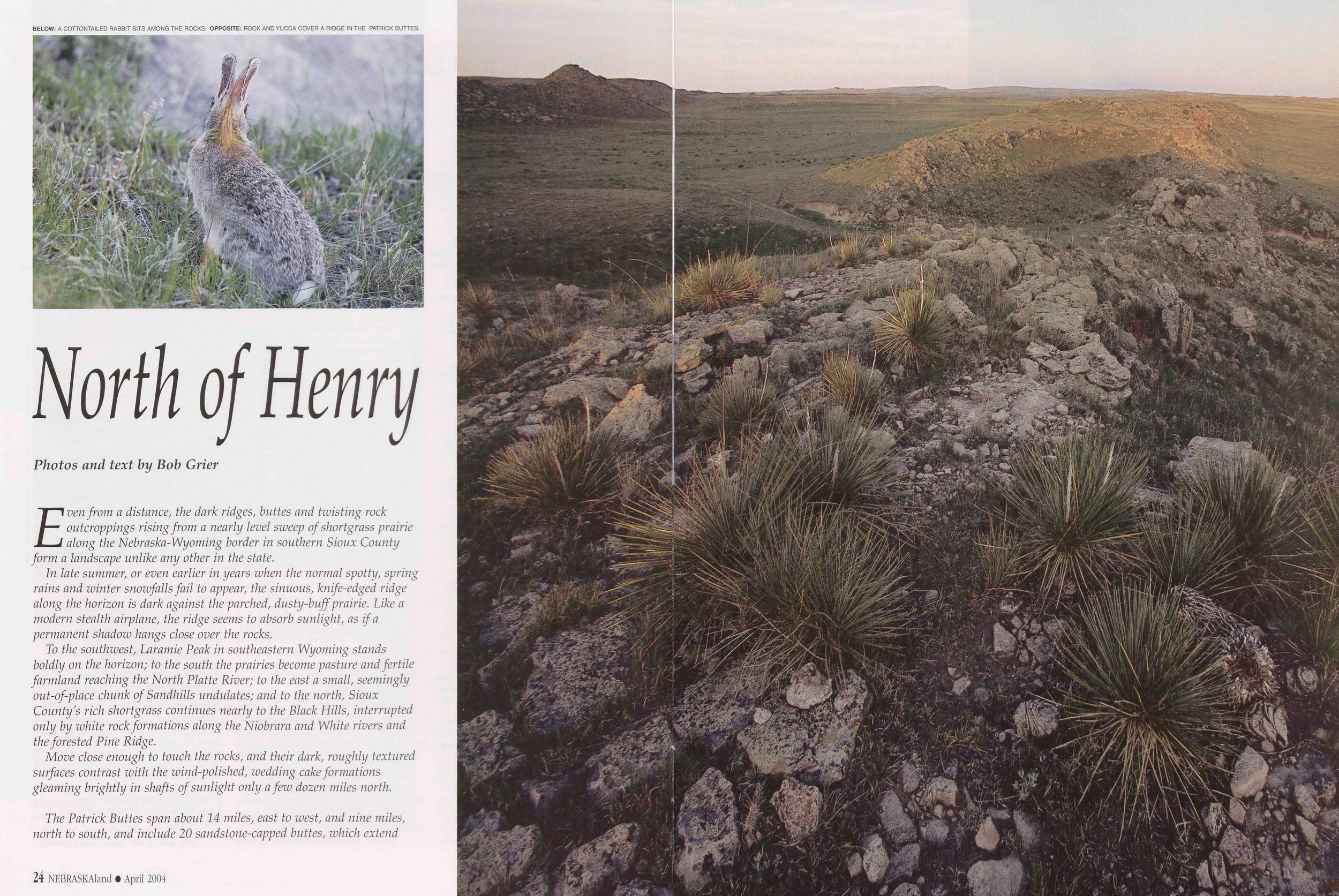
North of Henry
Photos and text by Bob GrierEven from a distance, the dark ridges, buttes and twisting rock outcroppings rising from a nearly level sweep of shortgrass prairie along the Nebraska-Wyoming border in southern Sioux County form a landscape unlike any other in the state.
In late summer, or even earlier in years when the normal spotty, spring rains and winter snowfalls fail to appear, the sinuous, knife-edged ridge along the horizon is dark against the parched, dusty-buff prairie. Like a modern stealth airplane, the ridge seems to absorb sunlight, as if a permanent shadow hangs close over the rocks.
To the southwest, Laramie Peak in southeastern Wyoming stands boldly on the horizon; to the south the prairies become pasture and fertile farmland reaching the North Platte River; to the east a small, seemingly out-of-place chunk of Sandhills undulates; and to the north, Sioux County's rich shortgrass continues nearly to the Black Hills, interrupted only by white rock formations along the Niobrara and White rivers and the forested Pine Ridge.
Move close enough to touch the rocks, and their dark, roughly textured surfaces contrast with the wind-polished, wedding cake formations gleaming brightly in shafts of sunlight only a few dozen miles north.
The Patrick Buttes span about 14 miles, east to west, and nine miles, north to south, and include 20 sandstone-capped buttes, which extend 24 NEBRASKAland • April 2004
Hunt's team has studied both the buttes' geology and paleontology during extended field trips since 1979 and will return later this year to begin the final phase of its fieldwork before compiling and publishing its findings.
In an early report to the National Geographic Society, which provided funding for the research, Hunt dated the sandstone caps on the Patrick Buttes to the early-to-middle Miocene, a period from 16 to 24 million years ago. The early report stated, "Fine to coarse but chiefly medium-grained, silica-cemented sandstone and pebble gravel are the most common lithologies, the gravel scattered throughout the section in lenses and stringers." The report also noted that the Patrick Buttes rest on exposed
The work of Hunt and his students has revealed the rocks are relatively young in geologic time, formed during alternating periods of deposition and erosion following the rise of mountain uplifts to the west.
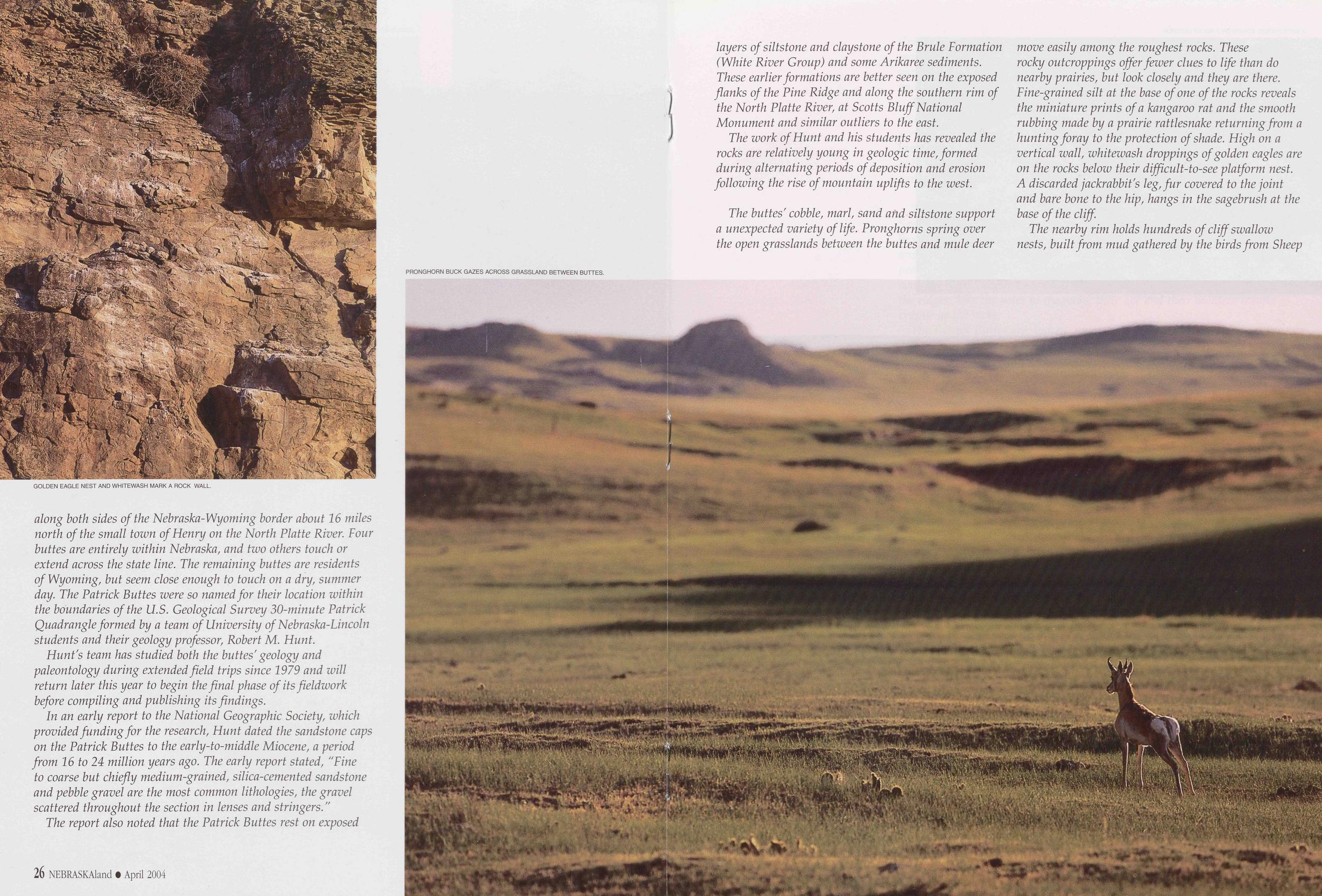
The buttes' cobble, marl, sand and siltstone support a unexpected variety of life. Pronghorns spring over the open grasslands between the buttes and mule deer move easily among the roughest rocks. These rocky outcroppings offer fewer clues to life than do nearby prairies, but look closely and they are there. Fine-grained silt at the base of one of the rocks reveals the miniature prints of a kangaroo rat and the smooth rubbing made by a prairie rattlesnake returning from a hunting foray to the protection of shade. High on a vertical wall, whitewash droppings of golden eagles are on the rocks below their difficult-to-see platform nest. A discarded jackrabbit's leg, fur covered to the joint and bare bone to the hip, hangs in the sagebrush at the base of the cliff.
The nearby rim holds hundreds of cliff swallow
nests, built from mud gathered by the birds from Sheep
26 NEBRASKAland • April 2004
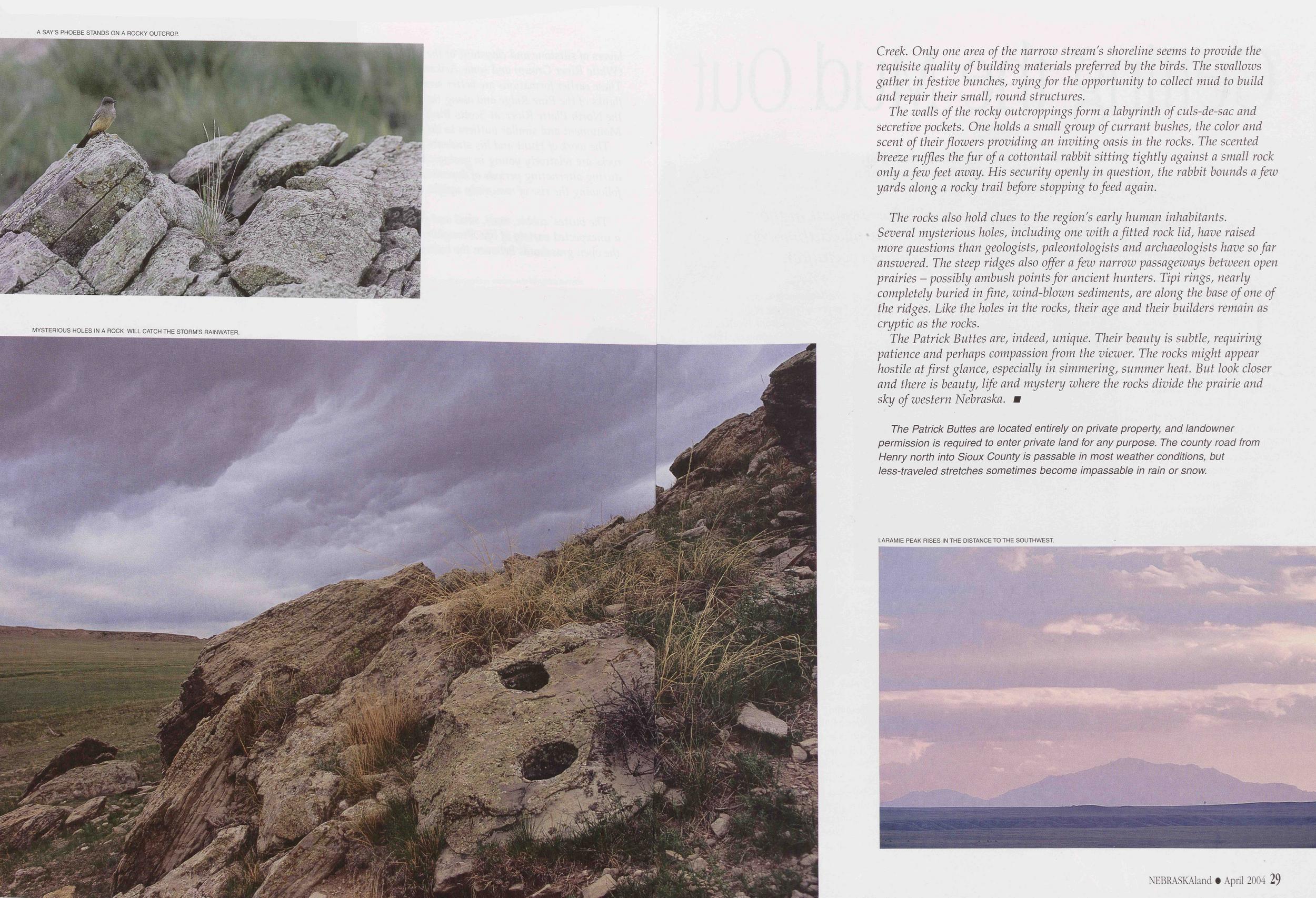
The walls of the rocky outcroppings form a labyrinth of culs-de-sac and secretive pockets. One holds a small group of currant bushes, the color and scent of their flowers providing an inviting oasis in the rocks. The scented breeze ruffles the fur of a cottontail rabbit sitting tightly against a small rock only a few feet away. His security openly in question, the rabbit bounds a few yards along a rocky trail before stopping to feed again.
The rocks also hold clues to the region's early human inhabitants. Several mysterious holes, including one with a fitted rock lid, have raised more questions than geologists, paleontologists and archaeologists have so far answered. The steep ridges also offer a few narrow passageways between open prairies - possibly ambush points for ancient hunters. Tipi rings, nearly completely buried in fine, wind-blown sediments, are along the base of one of the ridges. Like the holes in the rocks, their age and their builders remain as cryptic as the rocks.
The Patrick Buttes are, indeed, unique. Their beauty is subtle, requiring patience and perhaps compassion from the viewer. The rocks might appear hostile at first glance, especially in simmering, summer heat. But look closer and there is beauty, life and mystery where the rocks divide the prairie and sky of western Nebraska.
The Patrick Buttes are located entirely on private property, and landowner permission is required to enter private land for any purpose. The county road from Henry north into Sioux County is passable in most weather conditions, but less-traveled stretches sometimes become impassable in rain or snow.
Getting the Mud Out
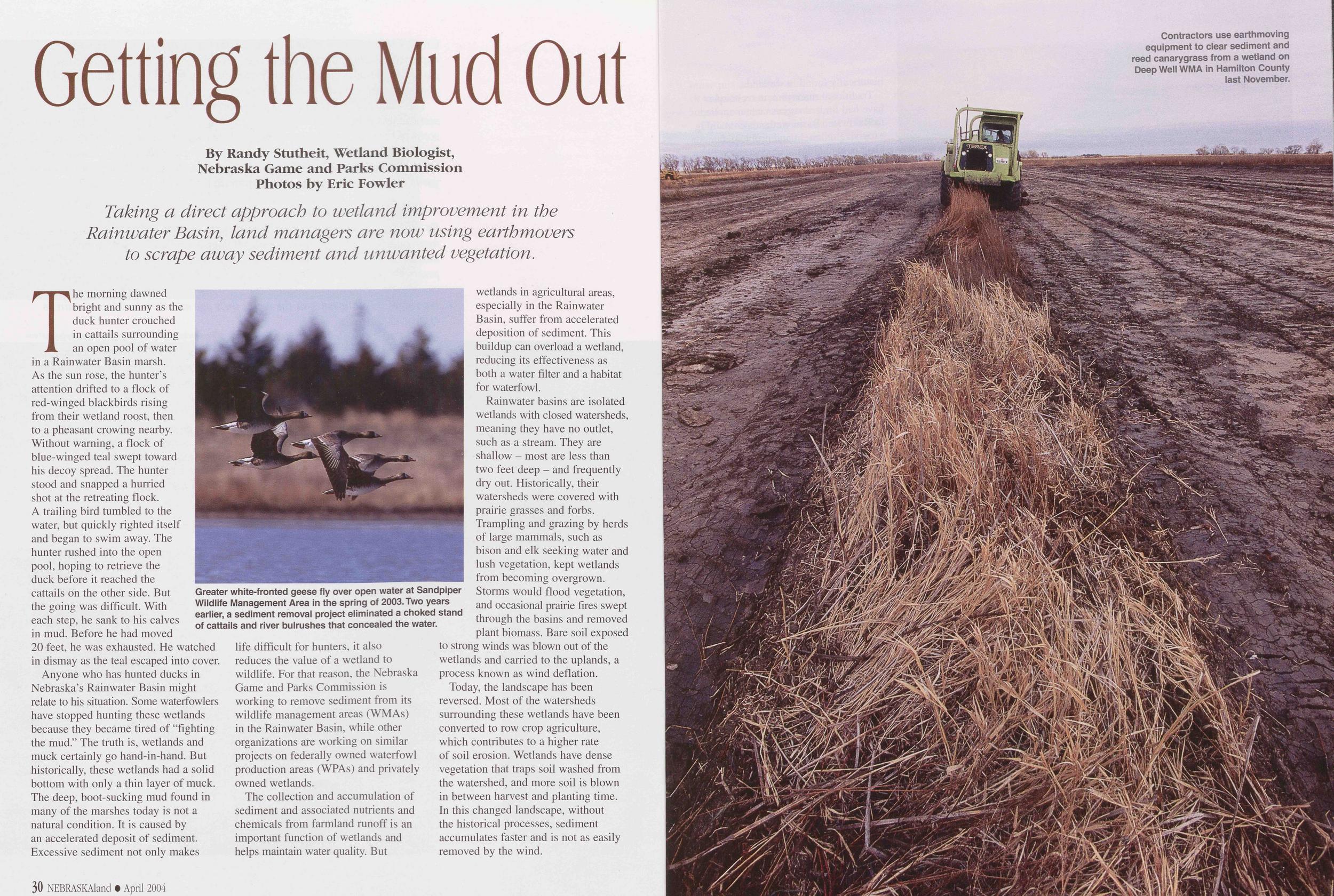
By Randy Stutheit, Wetland Biologist, Nebraska Game and Parks Commission Photos by Eric FowlerTaking a direct approach to wetland improvement in the Rainwater Basin, land managers are now using earthmovers to scrape away sediment and unwanted vegetation. The morning dawned bright and sunny as the duck hunter crouched in cattails surrounding an open pool of water in a Rainwater Basin marsh. As the sun rose, the hunter’s attention drifted to a flock of red-winged blackbirds rising from their wetland roost, then to a pheasant crowing nearby. Without warning, a flock of blue-winged teal swept toward his decoy spread. The hunter stood and snapped a hurried shot at the retreating flock. A trailing bird tumbled to the water, but quickly righted itself and began to swim away. The hunter rushed into the open pool, hoping to retrieve the duck before it reached the cattails on the other side. But the going was difficult. With each step, he sank to his calves in mud. Before he had moved 20 feet, he was exhausted. He watched in dismay as the teal escaped into cover.
Anyone who has hunted ducks in Nebraska’s Rainwater Basin might relate to his situation. Some waterfowlers have stopped hunting these wetlands because they became tired of “fighting the mud.” The truth is, wetlands and muck certainly go hand-in-hand. But historically, these wetlands had a solid bottom with only a thin layer of muck. The deep, boot-sucking mud found in many of the marshes today is not a natural condition. It is caused by an accelerated deposit of sediment. Excessive sediment not only makes
The collection and accumulation of sediment and associated nutrients and chemicals from farmland runoff is an important function of wetlands and helps maintain water quality. But wetlands in agricultural areas, especially in the Rainwater Basin, suffer from accelerated deposition of sediment. This buildup can overload a wetland, reducing its effectiveness as both a water filter and a habitat for waterfowl.
Rainwater basins are isolated wetlands with closed watersheds, meaning they have no outlet, such as a stream. They are shallow - most are less than two feet deep - and frequently dry out. Historically, their watersheds were covered with prairie grasses and forbs. Trampling and grazing by herds of large mammals, such as bison and elk seeking water and lush vegetation, kept wetlands from becoming overgrown. Storms would flood vegetation, and occasional prairie fires swept through the basins and removed plant biomass. Bare soil exposed to strong winds was blown out of the wetlands and carried to the uplands, a process known as wind deflation.
Today, the landscape has been reversed. Most of the watersheds surrounding these wetlands have been converted to row crop agriculture, which contributes to a higher rate of soil erosion. Wetlands have dense vegetation that traps soil washed from the watershed, and more soil is blown in between harvest and planting time. In this changed landscape, without the historical processes, sediment accumulates faster and is not as easily removed by the wind.
Sediment depths of up to 24 inches in some Rainwater Basin wetlands have caused increasing concern among wetland biologists. This sediment accumulation affects the wetland in several ways:
It reduces the water storage capacity of the wetland, causing water to “overflow” the edge of the hydric soils and seep away.
It acts like a sponge to absorb and hold water, making less available to wildlife and thus reducing the value of small precipitation events, and it eliminates wetland microtopography, altering historical flow paths of water within the wetland.
Excessive sediment also has a negative effect on plant communities within wetlands. Uncompacted sediment, which frequently remains saturated throughout the growing season, favors aggressive perennial vegetation such as river bulrush (.Scirpus fluviatilis) and hybrid cattail (Typha glauca). These species spread by rhizomes - underground stems from which both roots and shoots grow - and can quickly overwhelm and dominate more wildlife friendly plant communities. Another aggressive nonnative species, reed canary grass (Phalaris arundinacea), favors sediment as a growth medium. Reed canarygrass is a prolific seed producer, and once established, can spread rapidly in a sediment-laden basin both by rhizomes and seed. Thick stands of reed canarygrass, cattails or bulrushes provide little habitat for wildlife and displace the diverse plant communities historically found in wetlands.
Traditional management techniques have had limited success when applied to Rainwater Basin wetlands containing excessive sediment and problematic plant communities.
Inexpensive practices, such as grazing, mowing or prescribed burning, usually provide only temporary benefits. More aggressive approaches, such as disking, rototilling or using herbicides, provide longer-lasting benefits, but do not address the hydrologic problems caused by sediment.
Recently, the Commission, the U.S. Fish and Wildlife Service, and other resource agencies and organizations have taken a more direct approach to restoration and are now scraping sediment from the basins with earthmoving equipment.
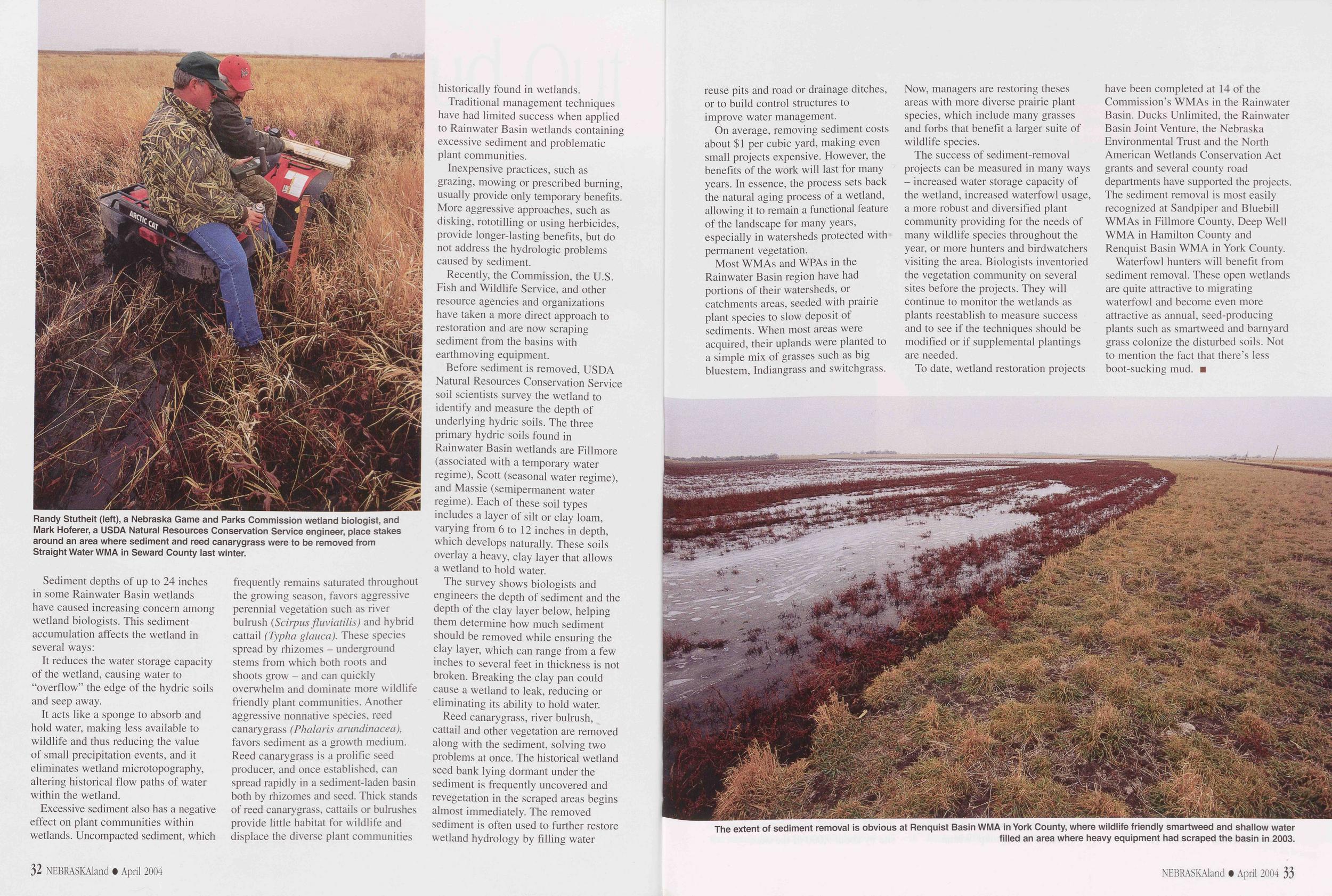
Before sediment is removed, USDA Natural Resources Conservation Service soil scientists survey the wetland to identify and measure the depth of underlying hydric soils. The three primary hydric soils found in Rainwater Basin wetlands are Fillmore (associated with a temporary water regime), Scott (seasonal water regime), and Massie (semipermanent water regime). Each of these soil types includes a layer of silt or clay loam, varying from 6 to 12 inches in depth, which develops naturally. These soils overlay a heavy, clay layer that allows a wetland to hold water.
The survey shows biologists and engineers the depth of sediment and the depth of the clay layer below, helping them determine how much sediment should be removed while ensuring the clay layer, which can range from a few inches to several feet in thickness is not broken. Breaking the clay pan could cause a wetland to leak, reducing or eliminating its ability to hold water.
Reed canarygrass, river bulrush, cattail and other vegetation are removed along with the sediment, solving two problems at once. The historical wetland seed bank lying dormant under the sediment is frequently uncovered and revegetation in the scraped areas begins almost immediately. The removed sediment is often used to further restore wetland hydrology by filling water reuse pits and road or drainage ditches, or to build control structures to improve water management.
On average, removing sediment costs about $1 per cubic yard, making even small projects expensive. However, the benefits of the work will last for many years. In essence, the process sets back the natural aging process of a wetland, allowing it to remain a functional feature of the landscape for many years, especially in watersheds protected with permanent vegetation.
Most WMAs and WPAs in the Rainwater Basin region have had portions of their watersheds, or catchments areas, seeded with prairie plant species to slow deposit of sediments. When most areas were acquired, their uplands were planted to a simple mix of grasses such as big bluestem, Indiangrass and switchgrass.
The success of sediment-removal projects can be measured in many ways increased water storage capacity of the wetland, increased waterfowl usage, a more robust and diversified plant community providing for the needs of many wildlife species throughout the year, or more hunters and birdwatchers visiting the area. Biologists inventoried the vegetation community on several sites before the projects. They will continue to monitor the wetlands as plants reestablish to measure success and to see if the techniques should be modified or if supplemental plantings are needed.
To date, wetland restoration projects have been completed at 14 of the Commission’s WMAs in the Rainwater Basin. Ducks Unlimited, the Rainwater Basin Joint Venture, the Nebraska Environmental Trust and the North American Wetlands Conservation Act grants and several county road departments have supported the projects. The sediment removal is most easily recognized at Sandpiper and Bluebill WMAs in Fillmore County, Deep Well WMA in Hamilton County and Renquist Basin WMA in York County.
Waterfowl hunters will benefit from sediment removal. These open wetlands are quite attractive to migrating waterfowl and become even more attractive as annual, seed-producing plants such as smartweed and barnyard grass colonize the disturbed soils. Not to mention the fact that there’s less boot-sucking mud.
32 NEBRASKAland • April 2004 NEBRASKAland • April 2004 33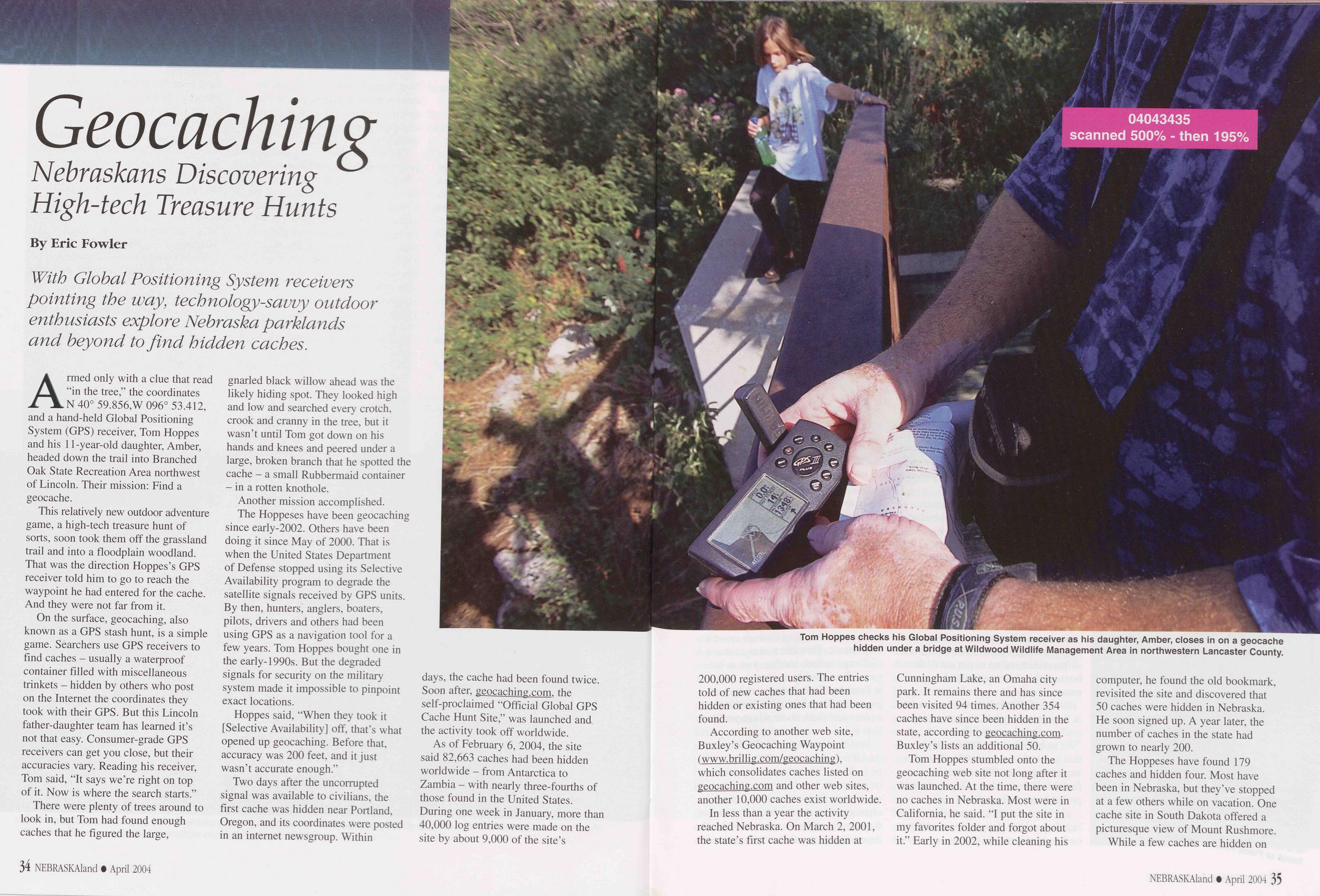
Geocaching
Nebraskans Discovering High-tech Treasure Hunts
By Eric FowlerWith Global Positioning System receivers pointing the way, technology-savvy outdoor enthusiasts explore Nebraska parklands and beyond to find hidden caches.
Armed only with a clue that read "in the tree,” the coordinates N 40° 59.856,W 096° 53.412, and a hand-held Global Positioning System (GPS) receiver, Tom Hoppes and his 11 -year-old daughter, Amber, headed down the trail into Branched Oak State Recreation Area northwest of Lincoln. Their mission: Find a geocache.
This relatively new outdoor adventure game, a high-tech treasure hunt of sorts, soon took them off the grassland trail and into a floodplain woodland. That was the direction Hoppes’s GPS receiver told him to go to reach the way point he had entered for the cache. And they were not far from it.
On the surface, geocaching, also known as a GPS stash hunt, is a simple game. Searchers use GPS receivers to find caches - usually a water-proof container filled with miscellaneous trinkets - hidden by others who post on the Internet the coordinates they took with their GPS. But this Lincoln father-daughter team has learned it’s not that easy. Consumer-grade GPS receivers can get you close, but their accuracies vary. Reading his receiver, Tom said, "It says we’re right on top of it. Now is where the search starts.”
There were plenty of trees around to look in, but Tom had found enough caches that he figured the large, gnarled black willow ahead was the likely hiding spot. They looked high and low and searched every crotch, crook and cranny in the tree, but it wasn’t until Tom got down on his hands and knees and peered under a large, broken branch that he spotted the cache - a small Rubbermaid container - in a rotten knothole.
Another mission accomplished.
The Hoppeses have been geocaching since early-2002. Others have been doing it since May of 2000. That is when the United States Department of Defense stopped using its Selective Availability program to degrade the satellite signals received by GPS units. By then, hunters, anglers, boaters, pilots, drivers and others had been using GPS as a navigation tool for a few years. Tom Hoppes bought one in the early-1990s. But the degraded signals for security on the military system made it impossible to pinpoint exact locations.
Hoppes said, "When they took it [Selective Availability] off, that’s what opened up geocaching. Before that, accuracy was 200 feet, and it just wasn’t accurate enough.”
Two days after the uncorrupted signal was available to civilians, the first cache was hidden near Portland, Oregon, and its coordinates were posted in an internet newsgroup. Within days, the cache had been found twice. Soon after, geocaching.com. the self-proclaimed "Official Global GPS Cache Hunt Site,” was launched and the activity took off worldwide.
As of February 6, 2004, the site said 82,663 caches had been hidden worldwide - from Antarctica to Zambia - with nearly three-fourths of those found in the United States. During one week in January, more than 40,000 log entries were made on the site by about 9,000 of the site’s
According to another web site, Buxley’s Geocaching Waypoint (www.brillig.com/geocaching). which consolidates caches listed on geocaching.com and other web sites, another 10,000 caches exist worldwide.
In less than a year the activity reached Nebraska. On March 2, 2001, the state’s first cache was hidden at Cunningham Lake, an Omaha city park. It remains there and has since been visited 94 times. Another 354 caches have since been hidden in the state, according to geocaching.com. Buxley’s lists an additional 50.
Tom Hoppes stumbled onto the geocaching web site not long after it was launched. At the time, there were no caches in Nebraska. Most were in California, he said. "I put the site in my favorites folder and forgot about it.” Early in 2002, while cleaning his computer, he found the old bookmark, revisited the site and discovered that 50 caches were hidden in Nebraska. He soon signed up. A year later, the number of caches in the state had grown to nearly 200.
The Hoppeses have found 179 caches and hidden four. Most have been in Nebraska, but they’ve stopped at a few others while on vacation. One cache site in South Dakota offered a picturesque view of Mount Rushmore.
While a few caches are hidden on
34 NEBRASKAland • April 2004
NEBRASKAland • April 2004 35
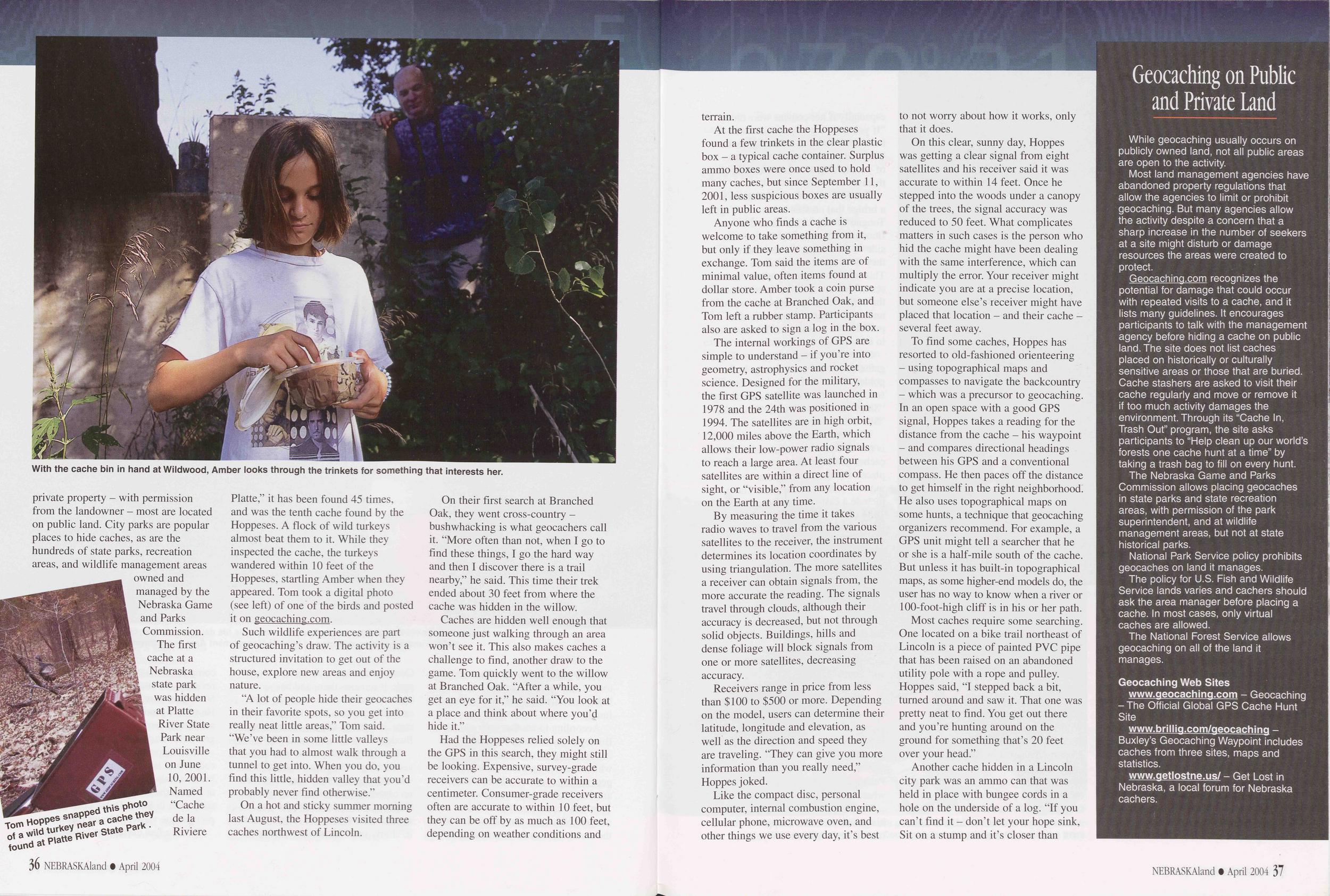
Such wildlife experiences are part of geocaching’s draw. The activity is a structured invitation to get out of the house, explore new areas and enjoy nature.
"A lot of people hide their geocaches in their favorite spots, so you get into really neat little areas,” Tom said. “We’ve been in some little valleys that you had to almost walk through a tunnel to get into. When you do, you find this little, hidden valley that you’d probably never find otherwise ”
On a hot and sticky summer morning last August, the Hoppeses visited three caches northwest of Lincoln.
On their first search at Branched Oak, they went cross-country - bushwhacking is what geocachers call it. “More often than not, when I go to find these things, I go the hard way and then I discover there is a trail nearby,” he said. This time their trek ended about 30 feet from where the cache was hidden in the willow.
Caches are hidden well enough that someone just walking through an area won’t see it. This also makes caches a challenge to find, another draw to the game. Tom quickly went to the willow at Branched Oak. “After a while, you get an eye for it,” he said. “You look at a place and think about where you’d hide it.”
Had the Hoppeses relied solely on the GPS in this search, they might still be looking. Expensive, survey-grade receivers can be accurate to within a centimeter. Consumer-grade receivers often are accurate to within 10 feet, but they can be off by as much as 100 feet, depending on weather conditions and terrain.
At the first cache the Hoppeses found a few trinkets in the clear plastic box - a typical cache container. Surplus ammo boxes were once used to hold many caches, but since September 11, 2001, less suspicious boxes are usually left in public areas.
Anyone who finds a cache is welcome to take something from it, but only if they leave something in exchange. Tom said the items are of minimal value, often items found at dollar store. Amber took a coin purse from the cache at Branched Oak, and Tom left a rubber stamp. Participants also are asked to sign a log in the box.
The internal workings of GPS are simple to understand - if you’re into geometry, astrophysics and rocket science. Designed for the military, the first GPS satellite was launched in 1978 and the 24th was positioned in 1994. The satellites are in high orbit, 12,000 miles above the Earth, which allows their low-power radio signals to reach a large area. At least four satellites are within a direct line of sight, or “visible,” from any location on the Earth at any time.
By measuring the time it takes radio waves to travel from the various satellites to the receiver, the instrument determines its location coordinates by using triangulation. The more satellites a receiver can obtain signals from, the more accurate the reading. The signals travel through clouds, although their accuracy is decreased, but not through solid objects. Buildings, hills and dense foliage will block signals from one or more satellites, decreasing accuracy.
Receivers range in price from less than $100 to $500 or more. Depending on the model, users can determine their latitude, longitude and elevation, as well as the direction and speed they are traveling. “They can give you more information than you really need,” Hoppes joked.
Like the compact disc, personal computer, internal combustion engine, cellular phone, microwave oven, and other things we use every day, it’s best to not worry about how it works, only that it does.
On this clear, sunny day, Hoppes was getting a clear signal from eight satellites and his receiver said it was accurate to within 14 feet. Once he stepped into the woods under a canopy of the trees, the signal accuracy was reduced to 50 feet. What complicates matters in such cases is the person who hid the cache might have been dealing with the same interference, which can multiply the error. Your receiver might indicate you are at a precise location, but someone else’s receiver might have placed that location - and their cache - several feet away.
To find some caches, Hoppes has resorted to old-fashioned orienteering - using topographical maps and compasses to navigate the backcountry - which was a precursor to geocaching. In an open space with a good GPS signal, Hoppes takes a reading for the distance from the cache - his waypoint - and compares directional headings between his GPS and a conventional compass. He then paces off the distance to get himself in the right neighborhood. He also uses topographical maps on some hunts, a technique that geocaching organizers recommend. For example, a GPS unit might tell a searcher that he or she is a half-mile south of the cache. But unless it has built-in topographical maps, as some higher-end models do, the user has no way to know when a river or 100-foot-high cliff is in his or her path.
Most caches require some searching. One located on a bike trail northeast of Lincoln is a piece of painted PVC pipe that has been raised on an abandoned utility pole with a rope and pulley. Hoppes said, “I stepped back a bit, turned around and saw it. That one was pretty neat to find. You get out there and you’re hunting around on the ground for something that’s 20 feet over your head.”
Another cache hidden in a Lincoln city park was an ammo can that was held in place with bungee cords in a hole on the underside of a log. “If you can’t find it - don’t let your hope sink, Sit on a stump and it’s closer than you think,” read the clue posted on geocaching.com.
Geocaching on Public and Private LandWhile geocaching usually occurs on publicly owned land, not all public areas are open to the activity.
Most land management agencies have abandoned property regulations that allow the agencies to limit or prohibit geocaching. But many agencies allow the activity despite a concern that a sharp increase in the number of seekers at a site might disturb or damage resources the areas were created to protect.
Geocachina.com recognizes the potential for damage that could occur with repeated visits to a cache, and it lists many guidelines. It encourages participants to talk with the management agency before hiding a cache on public land. The site does not list caches placed on historically or culturally sensitive areas or those that are buried. Cache stashers are asked to visit their cache regularly and move or remove it if too much activity damages the environment. Through its “Cache In, Trash Out” program, the site asks participants to “Help clean up our world’s forests one cache hunt at a time” by taking a trash bag to fill on every hunt.
The Nebraska Game and Parks Commission allows placing geocaches in state parks and state recreation areas, with permission of the park superintendent, and at wildlife management areas, but not at state historical parks.
National Park Service policy prohibits geocaches on land it manages. The policy for U.S. Fish and Wildlife Service lands varies and cachers should ask the area manager before placing a cache. In most cases, only virtual caches are allowed.
The National Forest Service allows geocaching on all of the land it manages.
Geocaching Web Siteswww.geocachinq.com - Geocaching -The Official Global GPS Cache Hunt Site www.brillia.com/aeocaching - Buxley’s Geocaching Waypoint includes caches from three sites, maps and statistics. www.aetlostne.us/ - Get Lost in Nebraska, a local forum for Nebraska cachers.
36 NEBRASKAland • April 2004 NEBRASKAland • April 2004 37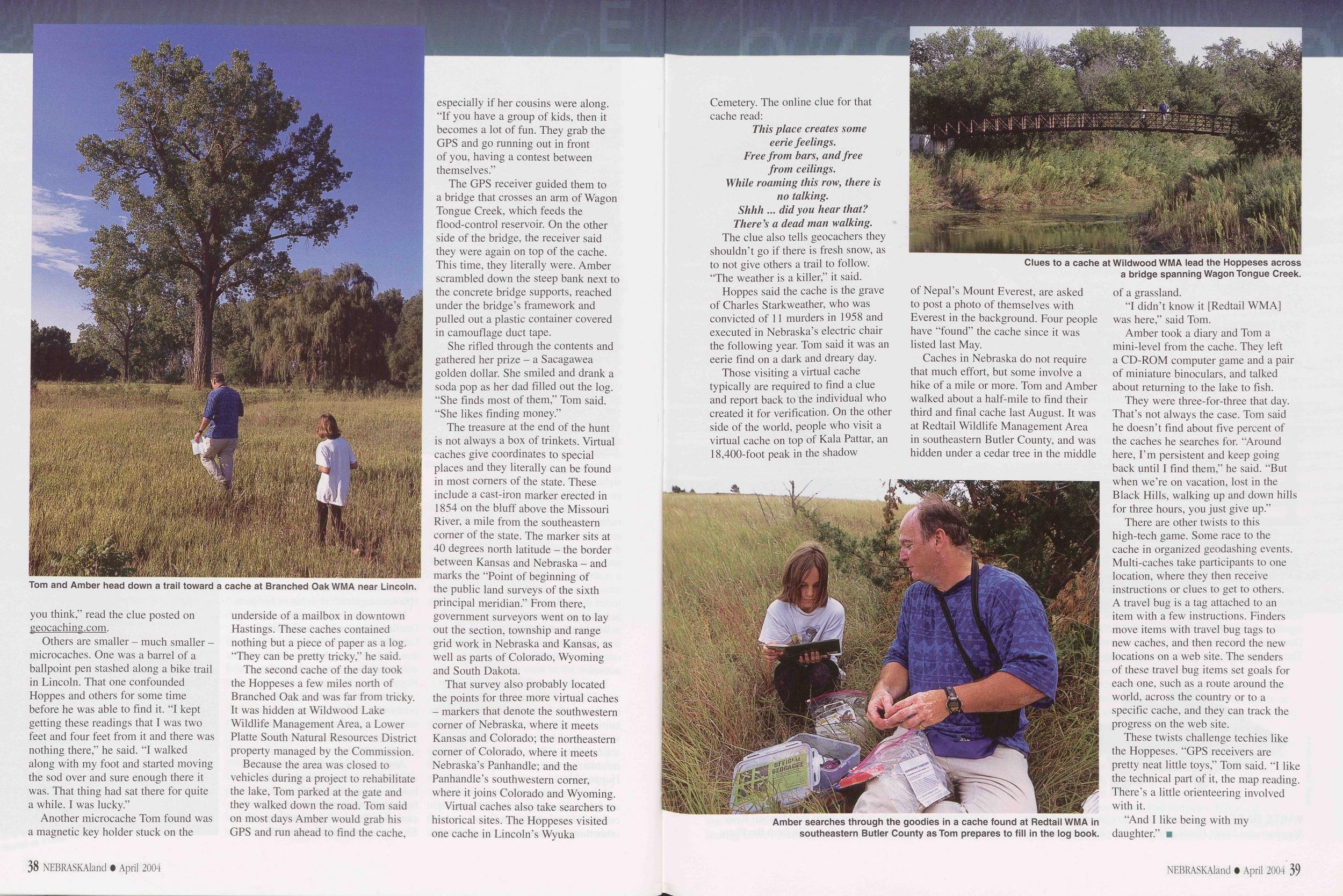
Others are smaller - much smaller - microcaches. One was a barrel of a ballpoint pen stashed along a bike trail in Lincoln. That one confounded Hoppes and others for some time before he was able to find it. “I kept getting these readings that I was two feet and four feet from it and there was nothing there,” he said. “I walked along with my foot and started moving the sod over and sure enough there it was. That thing had sat there for quite a while. I was lucky.”
Another microcache Tom found was a magnetic key holder stuck on the underside of a mailbox in downtown Hastings. These caches contained nothing but a piece of paper as a log. “They can be pretty tricky,” he said.
The second cache of the day took the Hoppeses a few miles north of Branched Oak and was far from tricky. It was hidden at Wildwood Lake Wildlife Management Area, a Lower Platte South Natural Resources District property managed by the Commission.
Because the area was closed to vehicles during a project to rehabilitate the lake, Tom parked at the gate and they walked down the road. Tom said on most days Amber would grab his GPS and run ahead to find the cache, especially if her cousins were along. “If you have a group of kids, then it becomes a lot of fun. They grab the GPS and go running out in front of you, having a contest between themselves.”
The GPS receiver guided them to a bridge that crosses an arm of Wagon Tongue Creek, which feeds the flood-control reservoir. On the other side of the bridge, the receiver said they were again on top of the cache. This time, they literally were. Amber scrambled down the steep bank next to the concrete bridge supports, reached under the bridge’s framework and pulled out a plastic container covered in camouflage duct tape.
She rifled through the contents and gathered her prize - a Sacagawea golden dollar. She smiled and drank a soda pop as her dad filled out the log. “She finds most of them,” Tom said. “She likes finding money.”
The treasure at the end of the hunt is not always a box of trinkets. Virtual caches give coordinates to special places and they literally can be found in most corners of the state. These include a cast-iron marker erected in 1854 on the bluff above the Missouri River, a mile from the southeastern corner of the state. The marker sits at 40 degrees north latitude - the border between Kansas and Nebraska - and marks the “Point of beginning of the public land surveys of the sixth principal meridian.” From there, government surveyors went on to lay out the section, township and range grid work in Nebraska and Kansas, as well as parts of Colorado, Wyoming and South Dakota.
That survey also probably located the points for three more virtual caches - markers that denote the southwestern comer of Nebraska, where it meets Kansas and Colorado; the northeastern corner of Colorado, where it meets Nebraska’s Panhandle; and the Panhandle’s southwestern corner,
where it joins Colorado and Wyoming. Virtual caches also take searchers to historical sites. The Hoppeses visited one cache in Lincoln’s Wyuka Cemetery. The online clue for that cache read:
This place creates some eerie feelings. Free from bars, and free from ceilings. While roaming this row, there is no talking. Shhh ... did you hear that? There’s a dead man walking.The clue also tells geocachers they shouldn’t go if there is fresh snow, as to not give others a trail to follow. "The weather is a killer,” it said.
Hoppes said the cache is the grave of Charles Starkweather, who was convicted of 11 murders in 1958 and executed in Nebraska’s electric chair the following year. Tom said it was an eerie find on a dark and dreary day.
Those visiting a virtual cache typically are required to find a clue and report back to the individual who created it for verification. On the other side of the world, people who visit a virtual cache on top of Kala Pattar, an 18,400-foot peak in the shadow
Caches in Nebraska do not require that much effort, but some involve a hike of a mile or more. Tom and Amber walked about a half-mile to find their third and final cache last August. It was at Redtail Wildlife Management Area in southeastern Butler County, and was hidden under a cedar tree in the middle of a grassland.
"I didn’t know it [Redtail WMA] was here,” said Tom.
Amber took a diary and Tom a mini-level from the cache. They left a CD-ROM computer game and a pair of miniature binoculars, and talked about returning to the lake to fish.
They were three-for-three that day. That’s not always the case. Tom said he doesn’t find about five percent of the caches he searches for. “Around here, I’m persistent and keep going back until I find them,” he said. “But when we’re on vacation, lost in the Black Hills, walking up and down hills for three hours, you just give up.”
There are other twists to this high-tech game. Some race to the cache in organized geodashing events. Multi-caches take participants to one location, where they then receive instructions or clues to get to others. A travel bug is a tag attached to an item with a few instructions. Finders move items with travel bug tags to new caches, and then record the new locations on a web site. The senders of these travel bug items set goals for each one, such as a route around the world, across the country or to a specific cache, and they can track the progress on the web site.
These twists challenge techies like the Hoppeses. “GPS receivers are pretty neat little toys,” Tom said. “I like the technical part of it, the map reading. There’s a little orienteering involved with it.
“And I like being with my daughter.”
38 NEBRASKAland • April 2004 NEBRASKAland • April 2004 39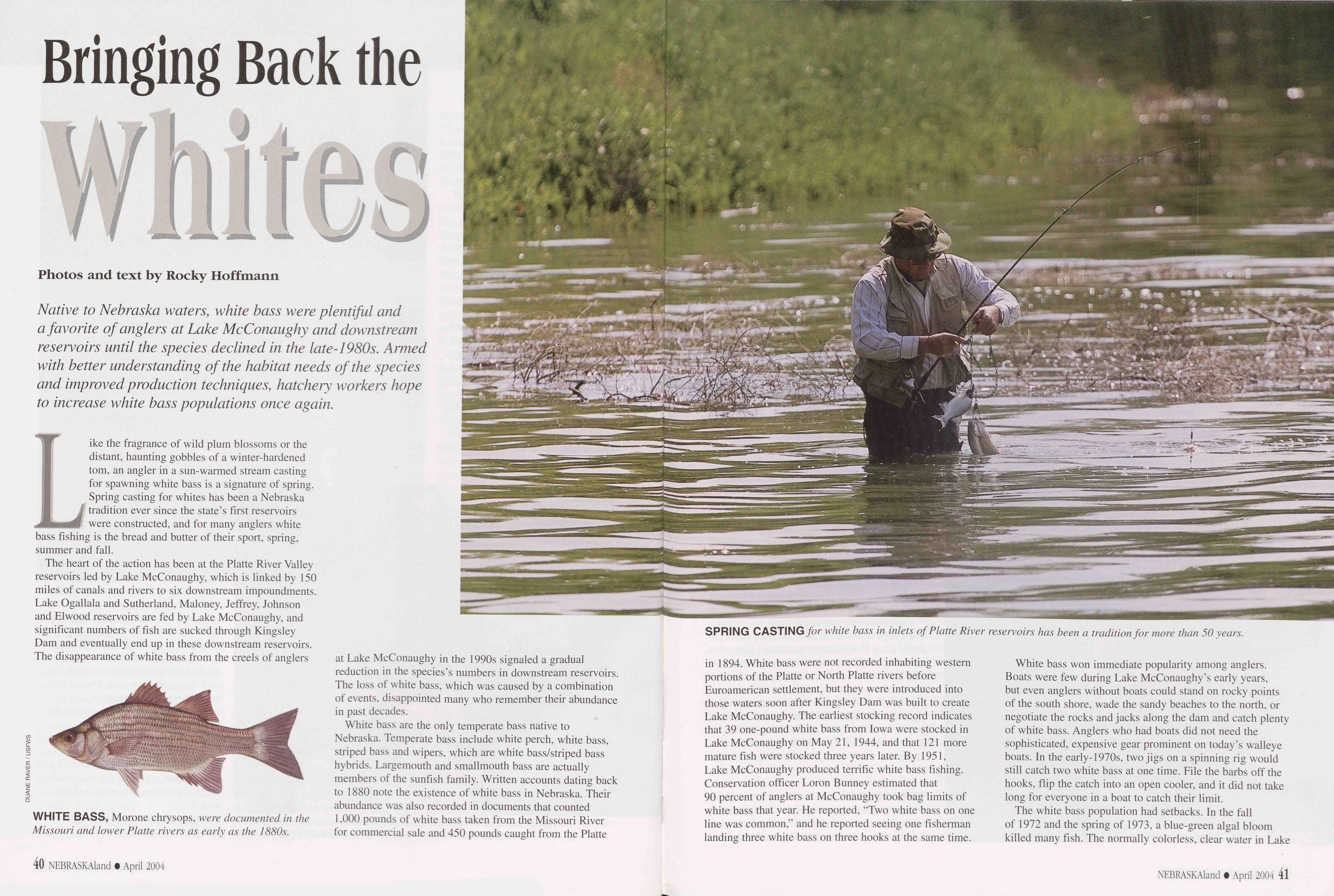
Bringing Back the Whites
Photos and text by Rocky HoffmannNative to Nebraska waters, white bass were plentiful and a favorite of anglers at Lake McConaughy and downstream reservoirs until the species declined in the late-1980s. Armed with better understanding of the habitat needs of the species and improved production techniques, hatchery workers hope to increase white bass populations once again.
Like the fragrance of wild plum blossoms or the distant, haunting gobbles of a winter-hardened tom, an angler in a sun-warmed stream casting for spawning white bass is a signature of spring. Spring casting for whites has been a Nebraska tradition ever since the state’s first reservoirs were constructed, and for many anglers white bass fishing is the bread and butter of their sport, spring, summer and fall.
The heart of the action has been at the Platte River Valley reservoirs led by Lake McConaughy, which is linked by 150 miles of canals and rivers to six downstream impoundments. Lake Ogallala and Sutherland, Maloney, Jeffrey, Johnson and Elwood reservoirs are fed by Lake McConaughy, and significant numbers of fish are sucked through Kingsley Dam and eventually end up in these downstream reservoirs. The disappearance of white bass from the creels of anglers
White bass are the only temperate bass native to Nebraska. Temperate bass include white perch, white bass, striped bass and wipers, which are white bass/striped bass hybrids. Largemouth and smallmouth bass are actually members of the sunfish family. Written accounts dating back to 1880 note the existence of white bass in Nebraska. Their abundance was also recorded in documents that counted 1,000 pounds of white bass taken from the Missouri River for commercial sale and 450 pounds caught from the Platte
White bass won immediate popularity among anglers. Boats were few during Lake McConaughy’s early years, but even anglers without boats could stand on rocky points of the south shore, wade the sandy beaches to the north, or negotiate the rocks and jacks along the dam and catch plenty of white bass. Anglers who had boats did not need the sophisticated, expensive gear prominent on today’s walleye boats. In the early-1970s, two jigs on a spinning rig would still catch two white bass at one time. File the barbs off the hooks, flip the catch into an open cooler, and it did not take long for everyone in a boat to catch their limit.
The white bass population had setbacks. In the fall
of 1972 and the spring of 1973, a blue-green algal bloom
killed many fish. The normally colorless, clear water in Lake
40 NEBRASKAland • April 2004
NEBRASKAland • April 2004 41
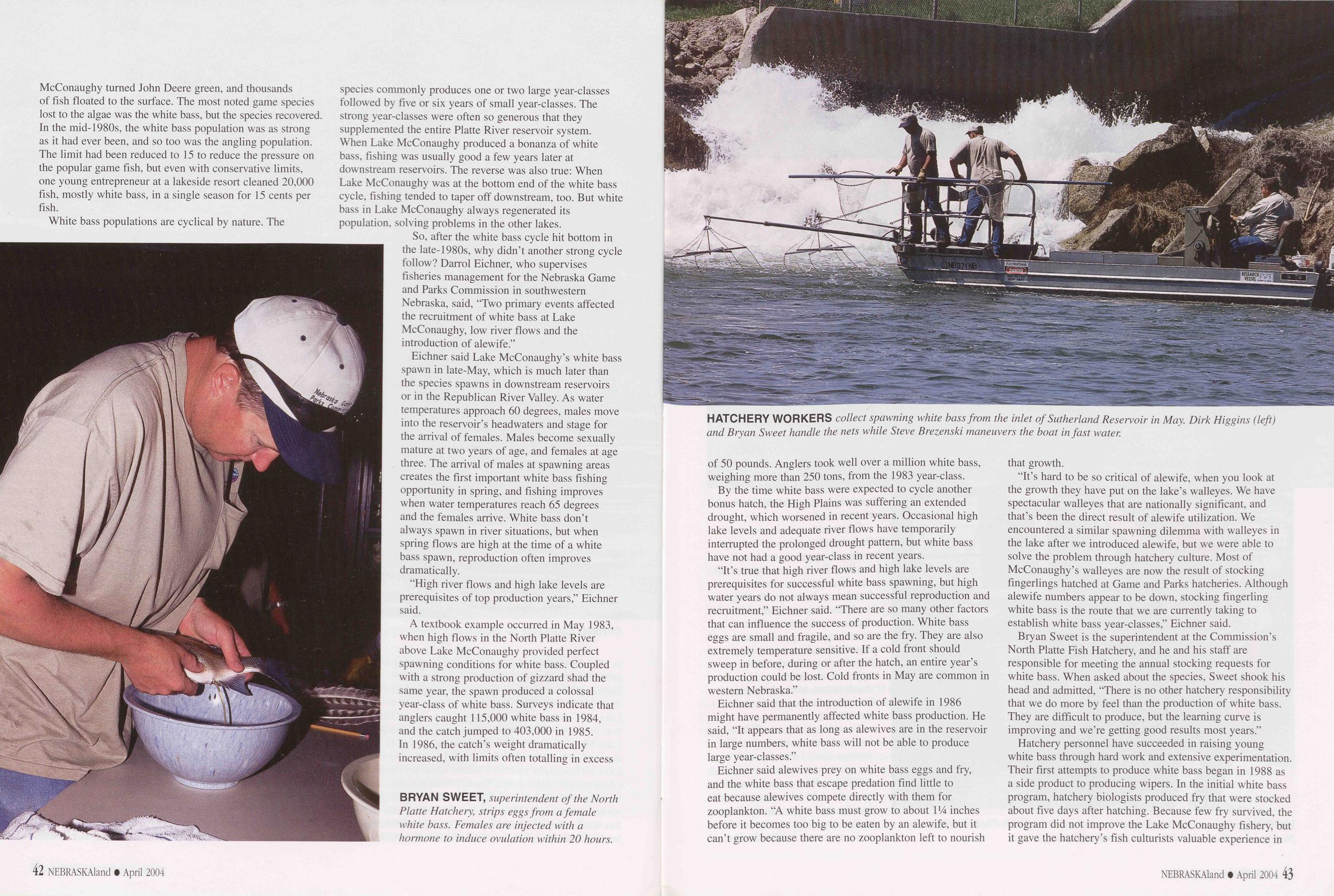 McConaughy turned John Deere green, and thousands
of fish floated to the surface. The most noted game species
lost to the algae was the white bass, but the species recovered.
In the mid-1980s, the white bass population was as strong
as it had ever been, and so too was the angling population.
The limit had been reduced to 15 to reduce the pressure on
the popular game fish, but even with conservative limits,
one young entrepreneur at a lakeside resort cleaned 20,000
fish, mostly white bass, in a single season for 15 cents per
fish.
McConaughy turned John Deere green, and thousands
of fish floated to the surface. The most noted game species
lost to the algae was the white bass, but the species recovered.
In the mid-1980s, the white bass population was as strong
as it had ever been, and so too was the angling population.
The limit had been reduced to 15 to reduce the pressure on
the popular game fish, but even with conservative limits,
one young entrepreneur at a lakeside resort cleaned 20,000
fish, mostly white bass, in a single season for 15 cents per
fish.
White bass populations are cyclical by nature. The species commonly produces one or two large year-classes followed by five or six years of small year-classes. The strong year-classes were often so generous that they supplemented the entire Platte River reservoir system. When Lake McConaughy produced a bonanza of white bass, fishing was usually good a few years later at downstream reservoirs. The reverse was also true: When Lake McConaughy was at the bottom end of the white bass cycle, fishing tended to taper off downstream, too. But white bass in Lake McConaughy always regenerated its population, solving problems in the other lakes.
So, after the white bass cycle hit bottom in the late-1980s, why didn’t another strong cycle follow? Darrol Eichner, who supervises fisheries management for the Nebraska Game and Parks Commission in southwestern Nebraska, said, “Two primary events affected the recruitment of white bass at Lake McConaughy, low river flows and the introduction of alewife.”
Eichner said Lake McConaughy’s white bass spawn in late-May, which is much later than the species spawns in downstream reservoirs or in the Republican River Valley. As water temperatures approach 60 degrees, males move into the reservoir’s headwaters and stage for the arrival of females. Males become sexually mature at two years of age, and females at age three. The arrival of males at spawning areas creates the first important white bass fishing opportunity in spring, and fishing improves when water temperatures reach 65 degrees and the females arrive. White bass don’t always spawn in river situations, but when spring flows are high at the time of a white bass spawn, reproduction often improves dramatically.
“High river flows and high lake levels are prerequisites of top production years,” Eichner said.
A textbook example occurred in May 1983, when high flows in the North Platte River above Lake McConaughy provided perfect spawning conditions for white bass. Coupled with a strong production of gizzard shad the same year, the spawn produced a colossal year-class of white bass. Surveys indicate that anglers caught 115,000 white bass in 1984, and the catch jumped to 403,000 in 1985. In 1986, the catch’s weight dramatically increased, with limits often totalling in excess
By the time white bass were expected to cycle another bonus hatch, the High Plains was suffering an extended drought, which worsened in recent years. Occasional high lake levels and adequate river flows have temporarily interrupted the prolonged drought pattern, but white bass have not had a good year-class in recent years.
“It’s true that high river flows and high lake levels are prerequisites for successful white bass spawning, but high water years do not always mean successful reproduction and recruitment,” Eichner said. “There are so many other factors that can influence the success of production. White bass eggs are small and fragile, and so are the fry. They are also extremely temperature sensitive. If a cold front should sweep in before, during or after the hatch, an entire year’s production could be lost. Cold fronts in May are common in western Nebraska.”
Eichner said that the introduction of alewife in 1986 might have permanently affected white bass production. He said, “It appears that as long as alewives are in the reservoir in large numbers, white bass will not be able to produce large year-classes.”
Eichner said alewives prey on white bass eggs and fry, and the white bass that escape predation find little to eat because alewives compete directly with them for zooplankton. “A white bass must grow to about P4 inches before it becomes too big to be eaten by an alewife, but it can’t grow because there are no zooplankton left to nourish that growth.
“It’s hard to be so critical of alewife, when you look at the growth they have put on the lake’s walleyes. We have spectacular walleyes that are nationally significant, and that’s been the direct result of alewife utilization. We encountered a similar spawning dilemma with walleyes in the lake after we introduced alewife, but we were able to solve the problem through hatchery culture. Most of McConaughy’s walleyes are now the result of stocking fingerlings hatched at Game and Parks hatcheries. Although alewife numbers appear to be down, stocking fingerling white bass is the route that we are currently taking to establish white bass year-classes,” Eichner said.
Bryan Sweet is the superintendent at the Commission’s North Platte Fish Hatchery, and he and his staff are responsible for meeting the annual stocking requests for white bass. When asked about the species, Sweet shook his head and admitted, “There is no other hatchery responsibility that we do more by feel than the production of white bass. They are difficult to produce, but the learning curve is improving and we’re getting good results most years.”
Hatchery personnel have succeeded in raising young
white bass through hard work and extensive experimentation.
Their first attempts to produce white bass began in 1988 as
a side product to producing wipers. In the initial white bass
program, hatchery biologists produced fry that were stocked
about five days after hatching. Because few fry survived, the
program did not improve the Lake McConaughy fishery, but
it gave the hatchery’s fish culturists valuable experience in
42 NEBRASKAland • April 2004
NEBRASKAland • April 2004 43
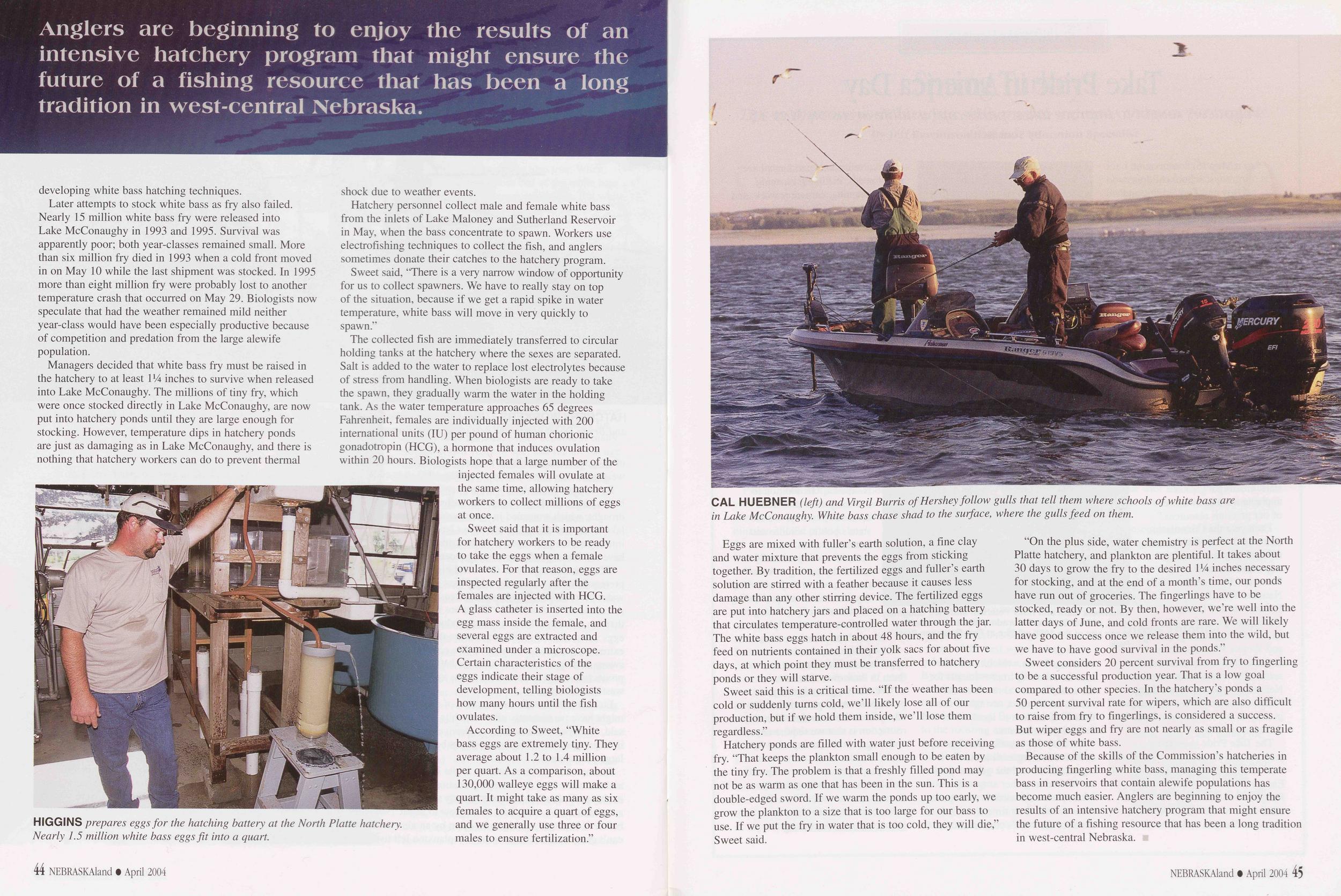 developing white bass hatching techniques.
Later attempts to stock white bass as fry also failed. Nearly 15 million white bass fry were released into Lake McConaughy in 1993 and 1995. Survival was apparently poor; both year-classes remained small. More than six million fry died in 1993 when a cold front moved in on May 10 while the last shipment was stocked. In 1995 more than eight million fry were probably lost to another temperature crash that occurred on May 29. Biologists now speculate that had the weather remained mild neither year-class would have been especially productive because of competition and predation from the large alewife population.
Managers decided that white bass fry must be raised in the hatchery to at least llA inches to survive when released into Lake McConaughy. The millions of tiny fry, which were once stocked directly in Lake McConaughy, are now put into hatchery ponds until they are large enough for stocking. However, temperature dips in hatchery ponds are just as damaging as in Lake McConaughy, and there is nothing that hatchery workers can do to prevent thermal HIGGINS prepares eggs for the hatching battery at the North Platte hatchery. Nearly 1.5 million white bass eggs fit into a quart. shock due to weather events.
Hatchery personnel collect male and female white bass from the inlets of Lake Maloney and Sutherland Reservoir in May, when the bass concentrate to spawn. Workers use electrofishing techniques to collect the fish, and anglers sometimes donate their catches to the hatchery program.
Sweet said, “There is a very narrow window of opportunity for us to collect spawners. We have to really stay on top of the situation, because if we get a rapid spike in water temperature, white bass will move in very quickly to spawn.”
The collected fish are immediately transferred to circular holding tanks at the hatchery where the sexes are separated. Salt is added to the water to replace lost electrolytes because of stress from handling. When biologists are ready to take the spawn, they gradually warm the water in the holding tank. As the water temperature approaches 65 degrees Fahrenheit, females are individually injected with 200 international units (IU) per pound of human chorionic gonadotropin (HCG), a hormone that induces ovulation within 20 hours. Biologists hope that a large number of the injected females will ovulate at the same time, allowing hatchery workers to collect millions of eggs at once.
Sweet said that it is important for hatchery workers to be ready to take the eggs when a female ovulates. For that reason, eggs are inspected regularly after the females are injected with HCG. A glass catheter is inserted into the egg mass inside the female, and several eggs are extracted and examined under a microscope. Certain characteristics of the eggs indicate their stage of development, telling biologists how many hours until the fish ovulates.
According to Sweet, “White bass eggs are extremely tiny. They average about 1.2 to 1.4 million per quart. As a comparison, about 130,000 walleye eggs will make a quart. It might take as many as six females to acquire a quart of eggs, and we generally use three or four males to ensure fertilization.”
Eggs are mixed with fuller’s earth solution, a fine clay and water mixture that prevents the eggs from sticking together. By tradition, the fertilized eggs and fuller’s earth solution are stirred with a feather because it causes less damage than any other stirring device. The fertilized eggs are put into hatchery jars and placed on a hatching battery that circulates temperature-controlled water through the jar. The white bass eggs hatch in about 48 hours, and the fry feed on nutrients contained in their yolk sacs for about five days, at which point they must be transferred to hatchery ponds or they will starve.
Sweet said this is a critical time. “If the weather has been cold or suddenly turns cold, we’ll likely lose all of our production, but if we hold them inside, we’ll lose them regardless.”
Hatchery ponds are filled with water just before receiving fry. “That keeps the plankton small enough to be eaten by the tiny fry. The problem is that a freshly filled pond may not be as warm as one that has been in the sun. This is a double-edged sword. If we warm the ponds up too early, we grow the plankton to a size that is too large for our bass to use. If we put the fry in water that is too cold, they will die,” Sweet said.
“On the plus side, water chemistry is perfect at the North Platte hatchery, and plankton are plentiful. It takes about 30 days to grow the fry to the desired llA inches necessary for stocking, and at the end of a month’s time, our ponds have run out of groceries. The fingerlings have to be stocked, ready or not. By then, however, we’re well into the latter days of June, and cold fronts are rare. We will likely have good success once we release them into the wild, but we have to have good survival in the ponds.”
Sweet considers 20 percent survival from fry to fingerling to be a successful production year. That is a low goal compared to other species. In the hatchery’s ponds a 50 percent survival rate for wipers, which are also difficult to raise from fry to fingerlings, is considered a success. But wiper eggs and fry are not nearly as small or as fragile as those of white bass.
Because of the skills of the Commission’s hatcheries in producing fingerling white bass, managing this temperate bass in reservoirs that contain alewife populations has become much easier. Anglers are beginning to enjoy the results of an intensive hatchery program that might ensure the future of a fishing resource that has been a long tradition in west-central Nebraska.
44 NEBRASKAland • April 2004 NEBRASKAland • April 2004 45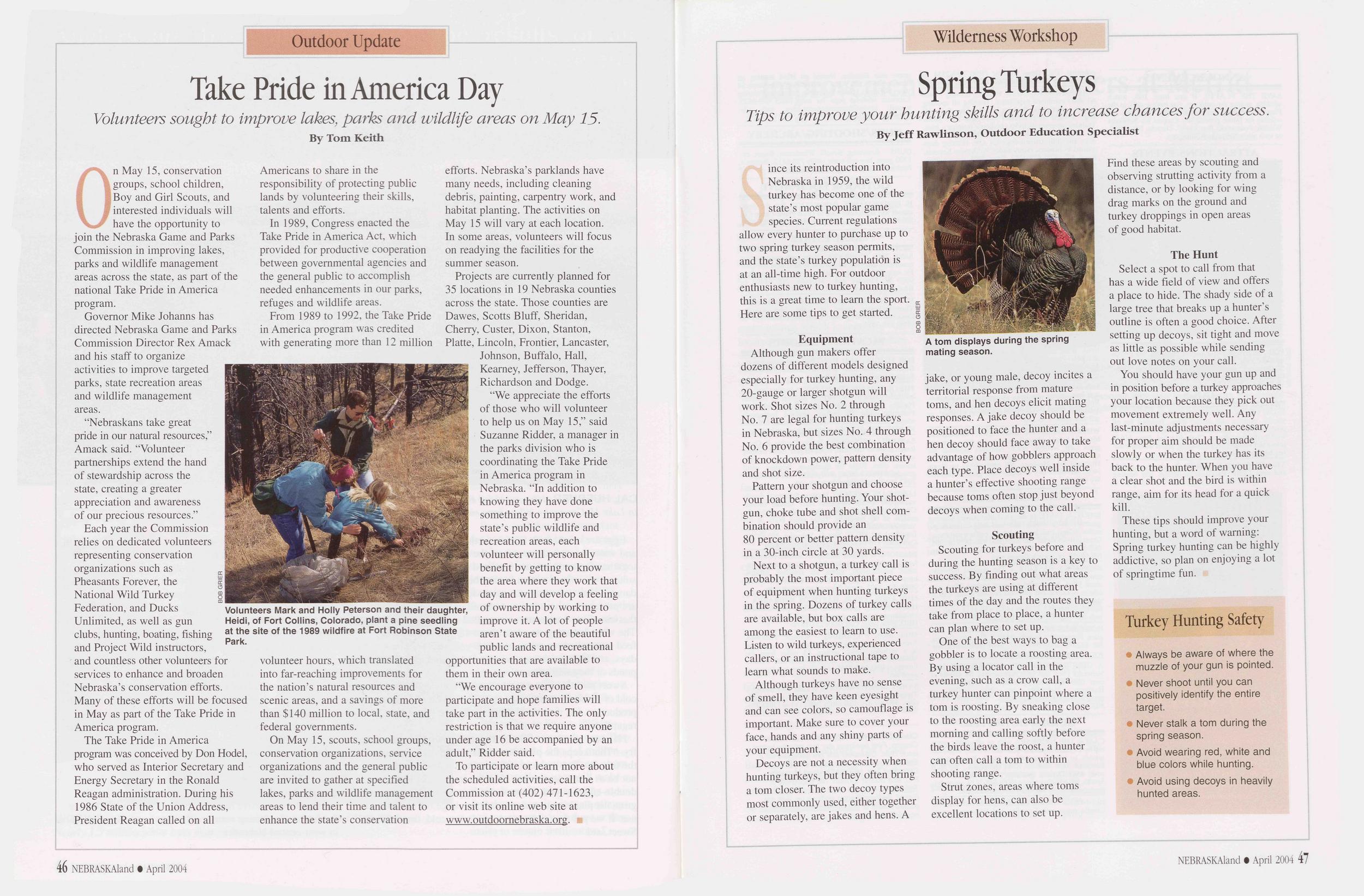
On May 15, conservation groups, school children, Boy and Girl Scouts, and interested individuals will have the opportunity to join the Nebraska Game and Parks Commission in improving lakes, parks and wildlife management areas across the state, as part of the national Take Pride in America program.
Governor Mike Johanns has directed Nebraska Game and Parks Commission Director Rex Amack and his staff to organize activities to improve targeted parks, state recreation areas and wildlife management areas.
“Nebraskans take great pride in our natural resources,” Amack said. “Volunteer partnerships extend the hand of stewardship across the state, creating a greater appreciation and awareness of our precious resources.”
Each year the Commission relies on dedicated volunteers representing conservation organizations such as a Pheasants Forever, the National Wild Turkey Federation, and Ducks Unlimited, as well as gun clubs, hunting, boating, fishing and Project Wild instructors, and countless other volunteers for services to enhance and broaden Nebraska’s conservation efforts. Many of these efforts will be focused in May as part of the Take Pride in America program.
The Take Pride in America program was conceived by Don Hodel, who served as Interior Secretary and Energy Secretary in the Ronald Reagan administration. During his 1986 State of the Union Address, President Reagan called on all Americans to share in the responsibility of protecting public lands by volunteering their skills, talents and efforts.
In 1989, Congress enacted the Take Pride in America Act, which provided for productive cooperation between governmental agencies and the general public to accomplish needed enhancements in our parks, refuges and wildlife areas.
From 1989 to 1992, the Take Pride in America program was credited with generating more than 12 million
On May 15, scouts, school groups, conservation organizations, service organizations and the general public are invited to gather at specified lakes, parks and wildlife management areas to lend their time and talent to enhance the state’s conservation efforts. Nebraska’s parklands have many needs, including cleaning debris, painting, carpentry work, and habitat planting. The activities on May 15 will vary at each location. In some areas, volunteers will focus on readying the facilities for the summer season.
Projects are currently planned for 35 locations in 19 Nebraska counties across the state. Those counties are Dawes, Scotts Bluff, Sheridan, Cherry, Custer, Dixon, Stanton, Platte, Lincoln, Frontier, Lancaster, Johnson, Buffalo, Hall, Kearney, Jefferson, Thayer, Richardson and Dodge.
“We appreciate the efforts of those who will volunteer to help us on May 15,” said Suzanne Ridder, a manager in the parks division who is coordinating the Take Pride in America program in Nebraska. “In addition to knowing they have done something to improve the state’s public wildlife and recreation areas, each volunteer will personally benefit by getting to know the area where they work that day and will develop a feeling of ownership by working to improve it. A lot of people aren’t aware of the beautiful public lands and recreational opportunities that are available to them in their own area.
“We encourage everyone to participate and hope families will take part in the activities. The only restriction is that we require anyone under age 16 be accompanied by an adult,” Ridder said.
To participate or learn more about the scheduled activities, call the Commission at (402) 471-1623, or visit its online web site at www.outdoornebraska.org.
Since its reintroduction into Nebraska in 1959, the wild turkey has become one of the state’s most popular game species. Current regulations allow every hunter to purchase up to two spring turkey season permits, and the state’s turkey population is at an all-time high. For outdoor enthusiasts new to turkey hunting, this is a great time to learn the sport. Here are some tips to get started.
EquipmentAlthough gun makers offer dozens of different models designed especially for turkey hunting, any 20-gauge or larger shotgun will work. Shot sizes No. 2 through No. 7 are legal for hunting turkeys in Nebraska, but sizes No. 4 through No. 6 provide the best combination of knockdown power, pattern density and shot size.
Pattern your shotgun and choose your load before hunting. Your shot- gun, choke tube and shot shell com- bination should provide an 80 percent or better pattern density in a 30-inch circle at 30 yards.
Next to a shotgun, a turkey call is probably the most important piece of equipment when hunting turkeys in the spring. Dozens of turkey calls are available, but box calls are among the easiest to learn to use. Listen to wild turkeys, experienced callers, or an instructional tape to learn what sounds to make.
Although turkeys have no sense of smell, they have keen eyesight and can see colors, so camouflage is important. Make sure to cover your face, hands and any shiny parts of your equipment.
Decoys are not a necessity when hunting turkeys, but they often bring a tom closer. The two decoy types most commonly used, either together or separately, are jakes and hens. A
Scouting for turkeys before and during the hunting season is a key to success. By finding out what areas the turkeys are using at different times of the day and the routes they take from place to place, a hunter can plan where to set up.
One of the best ways to bag a gobbler is to locate a roosting area. By using a locator call in the evening, such as a crow call, a turkey hunter can pinpoint where a tom is roosting. By sneaking close to the roosting area early the next morning and calling softly before the birds leave the roost, a hunter can often call a tom to within shooting range.
Strut zones, areas where toms display for hens, can also be excellent locations to set up. Find these areas by scouting and observing strutting activity from a distance, or by looking for wing drag marks on the ground and turkey droppings in open areas of good habitat.
The HuntSelect a spot to call from that has a wide field of view and offers a place to hide. The shady side of a large tree that breaks up a hunter’s outline is often a good choice. After setting up decoys, sit tight and move as little as possible while sending out love notes on your call.
You should have your gun up and in position before a turkey approaches your location because they pick out movement extremely well. Any last-minute adjustments necessary for proper aim should be made slowly or when the turkey has its back to the hunter. When you have a clear shot and the bird is within range, aim for its head for a quick kill.
These tips should improve your hunting, but a word of warning: Spring turkey hunting can be highly addictive, so plan on enjoying a lot of springtime fun.
Turkey Hunting SafetyAlways be aware of where the muzzle of your gun is pointed. Never shoot until you can positively identify the entire target. Never stalk a tom during the spring season. Avoid wearing red, white and blue colors while hunting. Avoid using decoys in heavily hunted areas.
46 NEBRASKAland • April 2004 NEBRASKAland • April 2004 47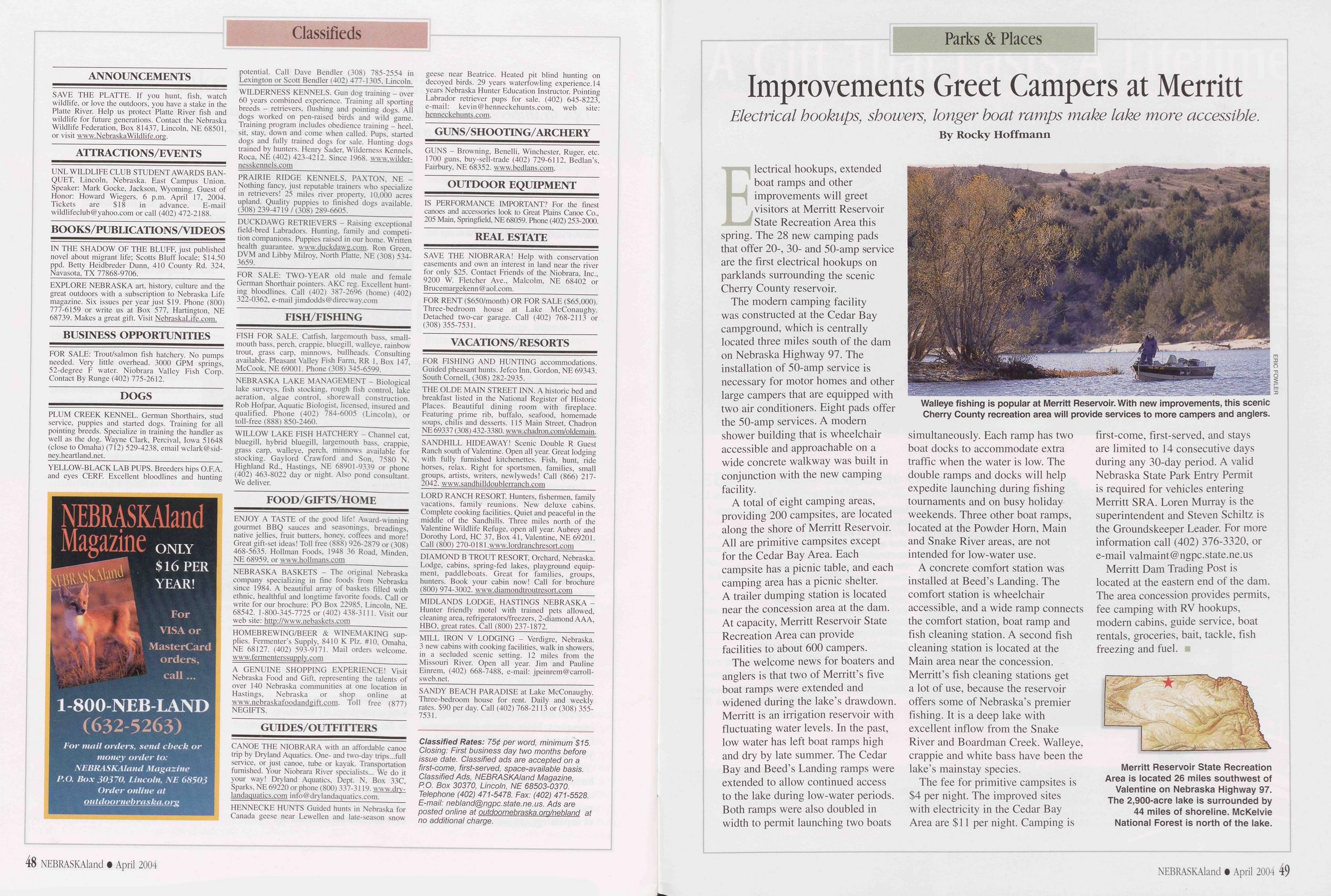
SAVE THE PLATTE. If you hunt, fish, watch wildlife, or love the outdoors, you have a stake in the Platte River. Help us protect Platte River fish and wildlife for future generations. Contact the Nebraska Wildlife Federation, Box 81437, Lincoln, NE 68501, or visit www.NebraskaWildlife.org.
ATTRACTIONS/EVENTSUNL WILDLIFE CLUB STUDENT AWARDS BANQUET, Lincoln, Nebraska. East Campus Union. Speaker: Mark Goeke, Jackson, Wyoming. Guest of Honor: Howard Wiegers. 6 p.m. April 17, 2004. Tickets are $18 in advance. E-mail wildlifeclub@yahoo.com or call (402) 472-2188.
BOOKS/PUBLICATIONS/VIDEOSIN THE SHADOW OF THE BLUFF, just published novel about migrant life; Scotts Bluff locale; $14.50 ppd. Betty Heidbreder Dunn, 410 County Rd. 324, Navasota, TX 77868-9706.
EXPLORE NEBRASKA art, history, culture and the great outdoors with a subscription to Nebraska Life magazine. Six issues per year just $19. Phone (800) 777-6159 or write us at Box 577, Hartington, NE 68739. Makes a great gift. Visit NebraskaLife.com.
BUSINESS OPPORTUNITIESFOR SALE: Trout/salmon fish hatchery. No pumps needed. Very little overhead. 3000 GPM springs, 52-degree F water. Niobrara Valley Fish Corp. Contact By Runge (402) 775-2612.
DOGSPLUM CREEK KENNEL. German Shorthairs, stud service, puppies and started dogs. Training for all pointing breeds. Specialize in training the handler as well as the dog. Wayne Clark, Percival, Iowa 51648 (close to Omaha) (712) 529-4238, email wclark@sid- ney.heartland.net.
YELLOW-BLACK LAB PUPS. Breeders hips O.F.A. and eyes CERF. Excellent bloodlines and hunting potential. Call Dave Bendler (308) 785-2554 in Lexington or Scott Bendler (402) 477-1305. Lincoln.
NEBRASKAland Magazine ONLY $16 PER YEAR! For VISA or Mastercard orders, call... 1-800-NEB-LAND (632-5263) For mail orders, send check or money order to: NEBRASKAland Magazine P.O. Box 30370, Lincoln, NE 68503 Order online at outdoornebraska.orgWILDERNESS KENNELS. Gun dog training - over 60 years combined experience. Training all sporting breeds - retrievers, flushing and pointing dogs. All dogs worked on pen-raised birds and wild game. Training program includes obedience training - heel, sit, stay, down and come when called. Pups, started dogs and fully trained dogs for sale. Hunting dogs trained by hunters. Henry Sader, Wilderness Kennels, Roca, NE (402) 423-4212. Since 1968. www.wilder- nesskennels. com
PRAIRIE RIDGE KENNELS, PAXTON, NE - Nothing fancy, just reputable trainers who specialize in retrievers! 25 miles river property, 10,000 acres upland. Quality puppies to finished dogs available. (308) 239-4719 / (308) 289-6605
DUCKDAWG RETRIEVERS - Raising exceptional field-bred Labradors. Hunting, family and competi- tion companions. Puppies raised in our home. Written health guarantee, www.duckdawg.com. Ron Green, DVM and Libby Milroy, North Platte, NE (308) 534- 3659.
FOR SALE: TWO-YEAR old male and female German Shorthair pointers. AKC reg. Excellent hunt- ing bloodlines. Call (402) 387-2696 (home) (402) 322-0362, e-mail jimdodds@direcway.com
FISH/FISHINGFISH FOR SALE. Catfish, largemouth bass, small- mouth bass, perch, crappie, bluegill, walleye, rainbow trout, grass carp, minnows, bullheads. Consulting available. Pleasant Valley Fish Farm, RR 1, Box 147, McCook, NE 69001. Phone (308) 345-6599.
NEBRASKA LAKE MANAGEMENT - Biological lake surveys, fish stocking, rough fish control, lake aeration, algae control, shorewall construction. Rob Hofpar, Aquatic Biologist, licensed, insured and qualified. Phone (402) 784-6005 (Lincoln), or toll-free (888) 850-2460.
WILLOW LAKE FISH HATCHERY - Channel cat, bluegill, hybrid bluegill, largemouth bass, crappie, grass carp, walleye, perch, minnows available for stocking. Gaylord Crawford and Son, 7580 N. Highland Rd., Hastings, NE 68901-9339 or phone (402) 463-8022 day or night. Also pond consultant. We deliver.
FOOD/GIFTS/HOMEENJOY A TASTE of the good life! Award-winning gourmet BBQ sauces and seasonings, breadings, native jellies, fruit butters, honey, coffees and more! Great gift-set ideas! Toll free (888) 926-2879 or (308) 468-5635. Hollman Foods, 1948 36 Road, Minden, NE 68959, or www.hollmans.com
NEBRASKA BASKETS - The original Nebraska company specializing in fine foods from Nebraska since 1984. A beautiful array of baskets filled with ethnic, healthful and longtime favorite foods. Call or write for our brochure: PO Box 22985, Lincoln, NE. 68542. 1-800-345-7725 or (402) 438-3111. Visit our web site: http://www.nebaskets.com
HOMEBREWING/BEER & WINEMAKING sup- plies. Fermenter’s Supply, 8410 K Plz. #10, Omaha, NE 68127. (402) 593-9171. Mail orders welcome. www.fermenterssupply.com
A GENUINE SHOPPING EXPERIENCE! Visit Nebraska Food and Gift, representing the talents of over 140 Nebraska communities at one location in Hastings, Nebraska or shop online at www.nebraskafoodandgift.com. Toll free (877) NEGIFTS.
GUIDES/OUTFITTERSCANOE THE NIOBRARA with an affordable canoe trip by Dryland Aquatics. One- and two-day trips...full service, or just canoe, tube or kayak. Transportation furnished. Your Niobrara River specialists... We do it your way! Dryland Aquatics, Dept. N, Box 33C, Sparks, NE 69220 or phone (800) 337-3119. www.drv- landaquatics.com info@drylandaquatics.com.
HENNECKE HUNTS Guided hunts in Nebraska for Canada geese near Lewellen and late-season snow geese near Beatrice. Heated pit blind hunting on decoyed birds. 29 years waterfowling experience. 14 years Nebraska Hunter Education Instructor. Pointing Labrador retriever pups for sale. (402) 645-8223, e-mail: kevin@henneckehunts.com, web site: henneckehunts.com.
GUNS/SHOOTING/ARCHERYGUNS - Browning, Benelli, Winchester, Ruger, etc. 1700 guns, buy-sell-trade (402) 729-6112, Bedlan’s, Fairbury, NE 68352. www.bedlans.com.
OUTDOOR EQUIPMENTIS PERFORMANCE IMPORTANT? For the finest canoes and accessories look to Great Plains Canoe Co., 205 Main, Springfield, NE 68059. Phone (402) 253-2000.
REAL ESTATESAVE THE NIOBRARA! Help with conservation easements and own an interest in land near the river for only $25. Contact Friends of the Niobrara, Inc., 9200 W. Fletcher Ave., Malcolm, NE 68402 or Brucemargekenn@aol.com.
FOR RENT ($650/month) OR FOR SALE ($65,000). Three-bedroom house at Lake McConaughy. Detached two-car garage. Call (402) 768-2113 or (308) 355-7531.
VACATIONS/RESORTSFOR FISHING AND HUNTING accommodations. Guided pheasant hunts. Jefco Inn, Gordon, NE 69343. South Cornell, (308) 282-2935.
THE OLDE MAIN STREET INN. A historic bed and breakfast listed in the National Register of Historic Places. Beautiful dining room with fireplace. Featuring prime rib, buffalo, seafood, homemade soups, chilis and desserts. 115 Main Street, Chadron NE 69337 (308) 432-3380. www.chadron.com/oldemain.
SANDHILL HIDEAWAY! Scenic Double R Guest Ranch south of Valentine. Open all year. Great lodging with fully furnished kitchenettes. Fish, hunt, ride horses, relax. Right for sportsmen, families, small groups, artists, writers, newlyweds! Call (866) 217- 2042. www.sandhilldoublerranch.com
LORD RANCH RESORT. Hunters, fishermen, family vacations, family reunions. New deluxe cabins. Complete cooking facilities. Quiet and peaceful in the middle of the Sandhills. Three miles north of the Valentine Wildlife Refuge, open all year. Aubrey and Dorothy Lord, HC 37, Box 41, Valentine, NE 69201. Call (800) 270-0181.www.lordranchresort.com
DIAMOND B TROUT RESORT, Orchard, Nebraska. Lodge, cabins, spring-fed lakes, playground equip- ment, paddleboats. Great for families, groups, hunters. Book your cabin now! Call for brochure (800) 974-3002. www.diamondtroutresort.com
MIDLANDS LODGE, HASTINGS NEBRASKA - Hunter friendly motel with trained pets allowed, cleaning area, refrigerators/freezers, 2-diamond AAA, HBO, great rates. Call (800) 237-1872,
MILL IRON V LODGING — Verdigre, Nebraska. 3 new cabins with cooking facilities, walk in showers, in a secluded scenic setting. 12 miles from the Missouri River. Open all year. Jim and Pauline Einrem, (402) 668-7488, e-mail: jpeinrem@carroll- sweb.net.
SANDY BEACH PARADISE at Lake McConaughy. Three-bedroom house for rent. Daily and weekly rates. $90 per day. Call (402) 768-2113 or (308) 355- 7531.
Classified Rates: 750 per word, minimum $15. Closing: First business day two months before issue date. Classified ads are accepted on a first-come, first-served, space-available basis. Classified Ads, NEBRASKAIand Magazine, P.O. Box 30370, Lincoln, NE 68503-0370. Telephone (402) 471-5478. Fax: (402) 471-5528. E-mail: nebland@ngpc.state.ne.us. Ads are posted online at outdoornebraska. ora/nebland at no additional charge.
Parks & Places
Improvements Greet Campers at Merritt
Electrical hookups, showers, longer boat ramps make lake more accessible.
By Rocky HoffmannElectrical hookups, extended boat ramps and other improvements will greet visitors at Merritt Reservoir State Recreation Area this spring. The 28 new camping pads that offer 20-, 30- and 50-amp service are the first electrical hookups on parklands surrounding the scenic Cherry County reservoir.
The modern camping facility was constructed at the Cedar Bay campground, which is centrally located three miles south of the dam on Nebraska Highway 97. The installation of 50-amp service is necessary for motor homes and other large campers that are equipped with two air conditioners. Eight pads offer the 50-amp services. A modern shower building that is wheelchair accessible and approachable on a wide concrete walkway was built in conjunction with the new camping facility.
A total of eight camping areas, providing 200 campsites, are located along the shore of Merritt Reservoir. All are primitive campsites except for the Cedar Bay Area. Each campsite has a picnic table, and each camping area has a picnic shelter. A trailer dumping station is located near the concession area at the dam. At capacity, Merritt Reservoir State Recreation Area can provide facilities to about 600 campers.
The welcome news for boaters and anglers is that two of Merritt’s five boat ramps were extended and widened during the lake’s drawdown. Merritt is an irrigation reservoir with fluctuating water levels. In the past, low water has left boat ramps high and dry by late summer. The Cedar Bay and Beed’s Landing ramps were extended to allow continued access to the lake during low-water periods. Both ramps were also doubled in width to permit launching two boats
A concrete comfort station was installed at Beed’s Landing. The comfort station is wheelchair accessible, and a wide ramp connects the comfort station, boat ramp and fish cleaning station. A second fish cleaning station is located at the Main area near the concession. Merritt’s fish cleaning stations get a lot of use, because the reservoir offers some of Nebraska’s premier fishing. It is a deep lake with excellent inflow from the Snake River and Boardman Creek. Walleye, crappie and white bass have been the lake’s mainstay species.
The fee for primitive campsites is $4 per night. The improved sites with electricity in the Cedar Bay Area are $ 11 per night. Camping is first-come, first-served, and stays are limited to 14 consecutive days during any 30-day period. A valid Nebraska State Park Entry Permit is required for vehicles entering Merritt SRA. Loren Murray is the superintendent and Steven Schiltz is the Groundskeeper Leader. For more information call (402) 376-3320, or e-mail valmaint@ngpc.state.ne.us
Merritt Dam Trading Post is located at the eastern end of the dam. The area concession provides permits, fee camping with RV hookups, modern cabins, guide service, boat rentals, groceries, bait, tackle, fish freezing and fuel.
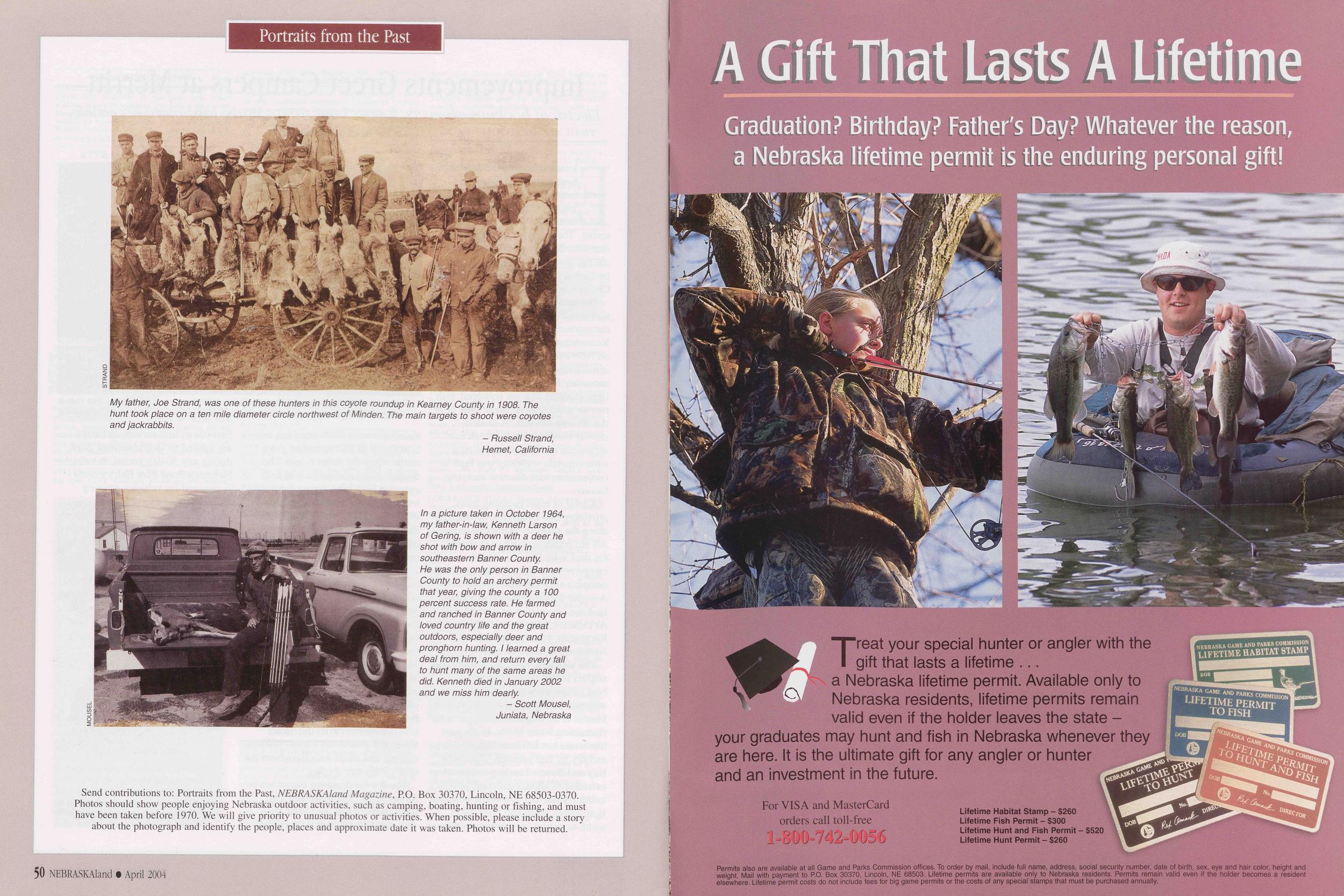
Send contributions to: Portraits from the Past, NEBRASKAland Magazine, P.O. Box 30370, Lincoln, NE 68503-0370. Photos should show people enjoying Nebraska outdoor activities, such as camping, boating, hunting or fishing, and must have been taken before 1970. We will give priority to unusual photos or activities. When possible, please include a story about the photograph and identify the people, places and approximate date it was taken. Photos will be returned.
50 NEBRASKAland • April 2004Graduation? Birthday? Father's Day? Whatever the reason, a Nebraska lifetime permit is the enduring personal gift!

Position: 737 (15 views)