Volume 82, Issue 2, 2004
NEBRASKAland
Nebraska Game & Parks Commission March 2003 $2.50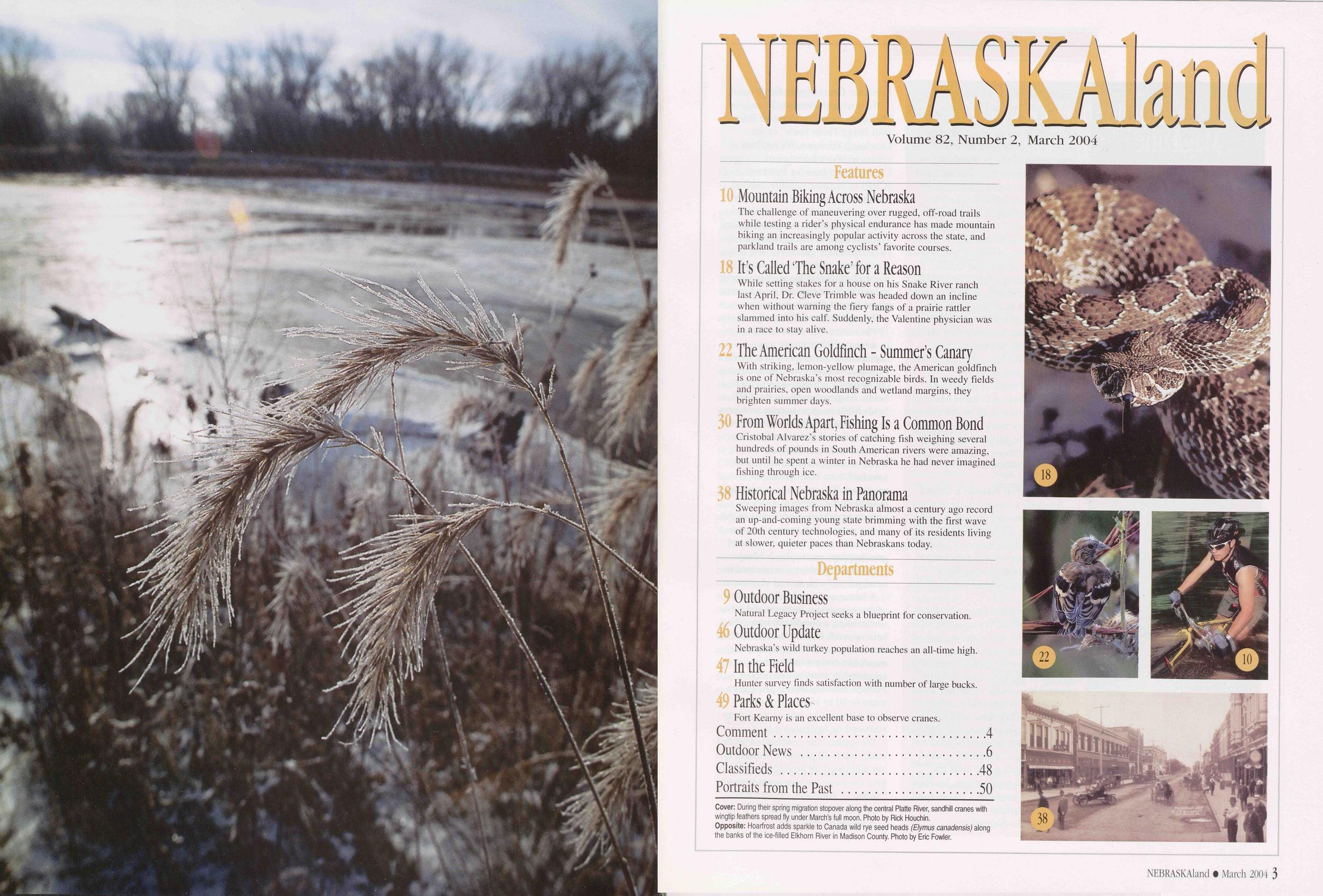
NEBRASKAland
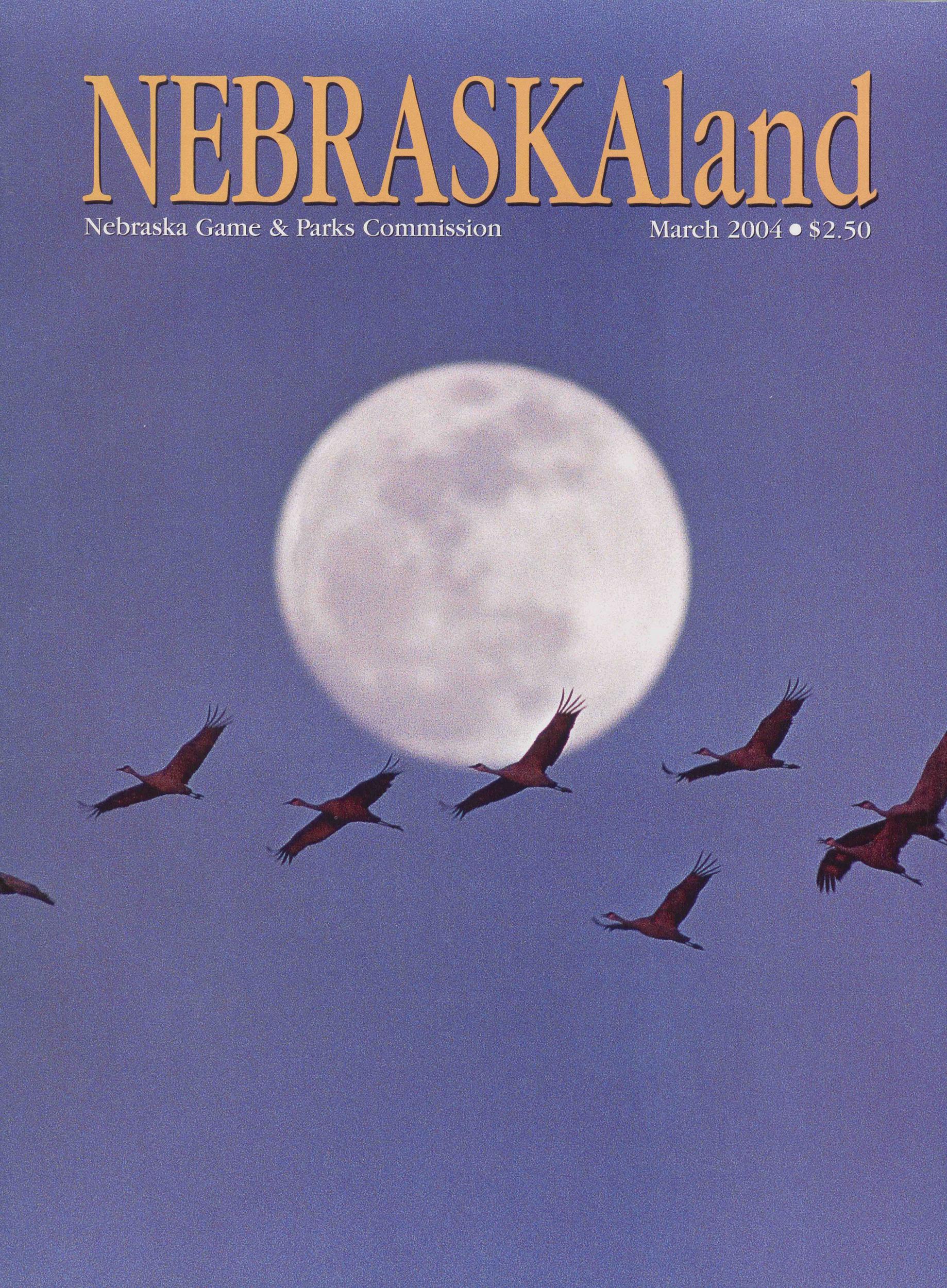
Volume 82, Number 2, March 2004 Features 10 Mountain Biking Across Nebraska The challenge of maneuvering over rugged, off-road trails while testing a rider’s physical endurance has made mountain biking an increasingly popular activity across the state, and parkland trails are among cyclists’ favorite courses. 18 It’s Called ‘The Snake’ for a Reason While setting stakes for a house on his Snake River ranch last April, Dr. Cleve Trimble was headed down an incline when without warning the fiery fangs of a prairie rattler slammed into his calf. Suddenly, the Valentine physician was in a race to stay alive. 22 The American Goldfinch - Summer’s Canary With striking, lemon-yellow plumage, the American goldfinch is one of Nebraska’s most recognizable birds. In weedy fields and prairies, open woodlands and wetland margins, they brighten summer days. 30 From Worlds Apart , Fishing Is a Common Bond Cristobal Alvarez’s stories of catching fish weighing several hundreds of pounds in South American rivers were amazing, but until he spent a winter in Nebraska he had never imagined fishing through ice. 38Historical Nebraska in Panorama Sweeping images from Nebraska almost a century ago record an up-and-coming young state brimming with the first wave of 20th century technologies, and many of its residents living at slower, quieter paces than Nebraskans today. Departments 9Outdoor Business Natural Legacy Project seeks a blueprint for conservation. 46Outdoor Update Nebraska’s wild turkey population reaches an all-time high. 47In the Field Hunter survey finds satisfaction with number of large bucks. 49Parks & Places Fort Kearny is an excellent base to observe cranes. Comment........................................4 Outdoor News ..................................6 Classifieds ..................................48 Portraits from the Past ......................50 Cover: During their spring migration stopover along the central Platte River, sandhill cranes with wingtip feathers spread fly under March’s full moon. Photo by Rick Houchin. Opposite: Hoarfrost adds sparkle to Canada wild rye seed heads (Elymus canadensis) along the banks of the ice-filled Elkhorn River in Madison County. Photo by Eric Fowler.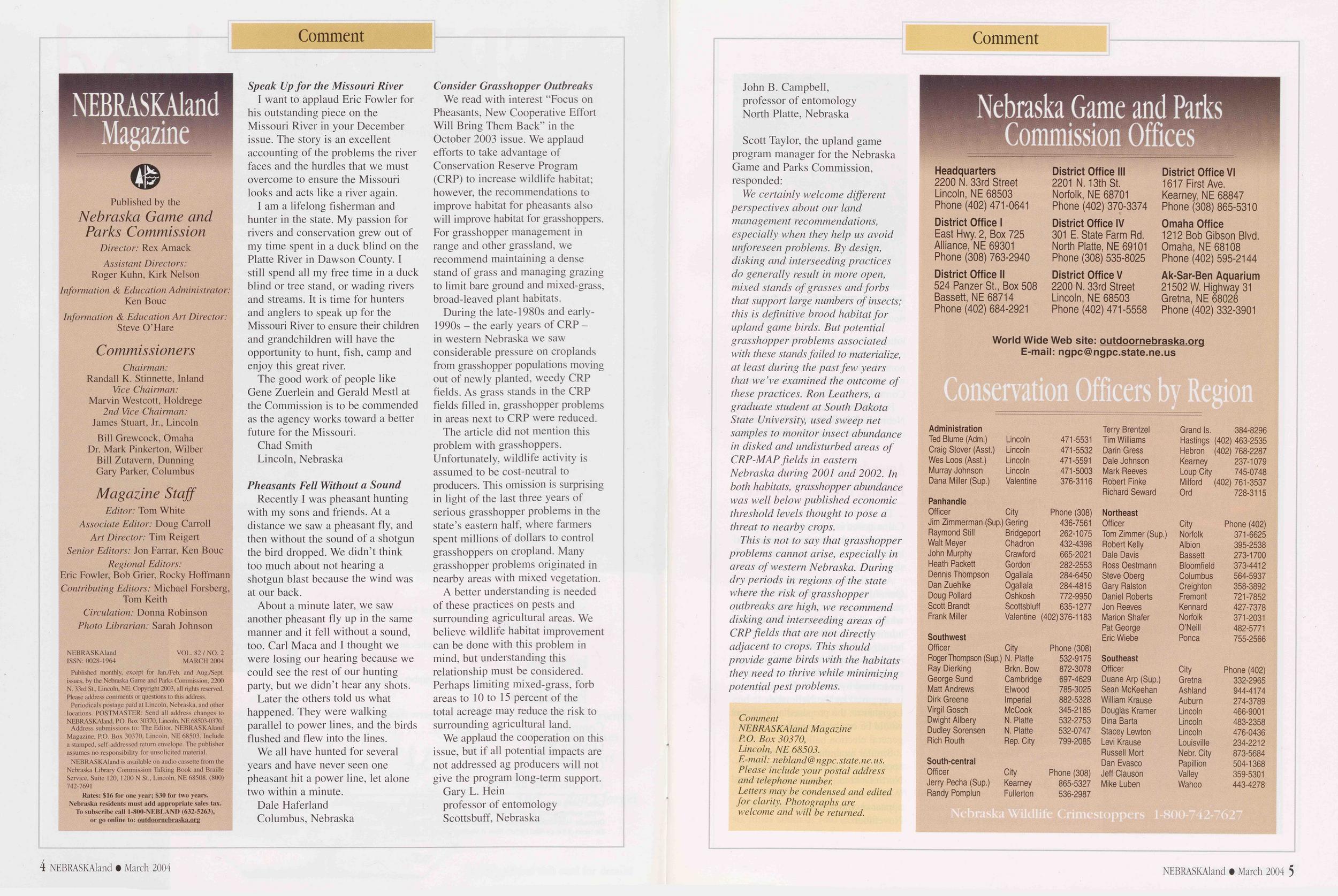
I want to applaud Eric Fowler for his outstanding piece on the Missouri River in your December issue. The story is an excellent accounting of the problems the river faces and the hurdles that we must overcome to ensure the Missouri looks and acts like a river again.
I am a lifelong fisherman and hunter in the state. My passion for rivers and conservation grew out of my time spent in a duck blind on the Platte River in Dawson County. I still spend all my free time in a duck blind or tree stand, or wading rivers and streams. It is time for hunters and anglers to speak up for the Missouri River to ensure their children and grandchildren will have the opportunity to hunt, fish, camp and enjoy this great river.
The good work of people like Gene Zuerlein and Gerald Mestl at the Commission is to be commended as the agency works toward a better future for the Missouri.
Chad Smith Lincoln, Nebraska Pheasants Fell Without a SoundRecently I was pheasant hunting with my sons and friends. At a distance we saw a pheasant fly, and then without the sound of a shotgun the bird dropped. We didn’t think too much about not hearing a shotgun blast because the wind was at our back.
About a minute later, we saw another pheasant fly up in the same manner and it fell without a sound, too. Carl Maca and I thought we were losing our hearing because we could see the rest of our hunting party, but we didn’t hear any shots.
Later the others told us what happened. They were walking parallel to power lines, and the birds flushed and flew into the lines. We all have hunted for several years and have never seen one pheasant hit a power line, let alone two within a minute.
Dale Haferland Columbus, Nebraska Consider Grasshopper OutbreaksWe read with interest "Focus on Pheasants, New Cooperative Effort Will Bring Them Back” in the October 2003 issue. We applaud efforts to take advantage of Conservation Reserve Program (CRP) to increase wildlife habitat; however, the recommendations to improve habitat for pheasants also will improve habitat for grasshoppers. For grasshopper management in range and other grassland, we recommend maintaining a dense stand of grass and managing grazing to limit bare ground and mixed-grass, broad-leaved plant habitats.
During the late-1980s and early- 1990s - the early years of CRP - in western Nebraska we saw considerable pressure on croplands from grasshopper populations moving out of newly planted, weedy CRP fields. As grass stands in the CRP fields filled in, grasshopper problems in areas next to CRP were reduced.
The article did not mention this problem with grasshoppers. Unfortunately, wildlife activity is assumed to be cost-neutral to producers. This omission is surprising in light of the last three years of serious grasshopper problems in the state’s eastern half, where farmers spent millions of dollars to control grasshoppers on cropland. Many grasshopper problems originated in nearby areas with mixed vegetation.
A better understanding is needed of these practices on pests and surrounding agricultural areas. We believe wildlife habitat improvement can be done with this problem in mind, but understanding this relationship must be considered. Perhaps limiting mixed-grass, forb areas to 10 to 15 percent of the total acreage may reduce the risk to surrounding agricultural land.
We applaud the cooperation on this issue, but if all potential impacts are not addressed ag producers will not give the program long-term support.
Gary L. Hein professor of entomology Scottsbuff, Nebraska 4 NEBRASKAland • March 2004 John B. Campbell, professor of entomology North Platte, NebraskaScott Taylor, the upland game program manager for the Nebraska Game and Parks Commission, responded:
We certainly welcome different perspectives about our land management recommendations, especially when they help us avoid unforeseen problems. By design, disking and interseeding practices do generally result in more open, mixed stands of grasses and forbs that support large numbers of insects; this is definitive brood habitat for upland game birds. But potential grasshopper problems associated with these stands failed to materialize, at least during the past few years that we’ve examined the outcome of these practices. Ron Leathers, a graduate student at South Dakota State University, used sweep net samples to monitor insect abundance in disked and undisturbed areas of CRP-MAP fields in eastern Nebraska during 2001 and 2002. In both habitats, grasshopper abundance was well below published economic threshold levels thought to pose a threat to nearby crops.
This is not to say that grasshopper problems cannot arise, especially in areas of western Nebraska. During dry periods in regions of the state where the risk of grasshopper outbreaks are high, we recommend disking and interseeding areas of CRP fields that are not directly adjacent to crops. This should provide game birds with the habitats they need to thrive while minimizing potential pest problems.
Comment NEBRASKAland Magazine P.O. Box 30370, Lincoln, NE 68503. E-mail: nebland@ ngpc. state, ne. us. Please include your postal address and telephone number. Letters may be condensed and edited for clarity. Photographs are welcome and will be returned. Nebraska Game and Parks Commission Offices Headquarters 2200 N. 33rd Street Lincoln, NE 68503 Phone (402) 471-0641 District Office I East Hwy. 2, Box 725 Alliance, NE 69301 Phone (308) 763-2940 District Office II 524 Panzer St., Box 508 Bassett, NE 68714 Phone (402) 684-2921 District Office ill 2201 N. 13th St. Norfolk, NE 68701 Phone (402) 370-3374 District Office IV 301 E. State Farm Rd. North Platte, NE 69101 Phone (308) 535-8025 District Office V 2200 N. 33rd Street Lincoln, NE 68503 Phone (402) 471-5558 District Office VI 1617 First Ave. Kearney, NE 68847 Phone (308) 865-5310 Omaha Office 1212 Bob Gibson Blvd. Omaha, NE 68108 Phone (402) 595-2144 Ak-Sar-Ben Aquarium 21502 W. Highway 31 Gretna, NE 68028 Phone (402) 332-3901 World Wide Web site: outdoornebraska.org E-mail: ngpc@ngpc.state.ne.us Conservation Officers by Region Administration Terry Brentzel Grand Is. 384-8296 Ted Blume (Adm.) Lincoln 471-5531 Tim Williams Hastings (402) 463-2535 Craig Stover (Asst.) Lincoln 471-5532 Darin Gress Hebron (402) 768-2287 Wes Loos (Asst.) Lincoln 471-5591 Dale Johnson Kearney 237-1079 Murray Johnson Lincoln 471-5003 Mark Reeves Loup City 745-0748 Dana Miller (Sup.) Valentine 376-3116 Robert Finke Milford (402) 761-3537 Richard Seward Ord 728-3115 Panhandle Officer City Phone (308) Northeast Jim Zimmerman (Sup.) Gering 436-7561 Officer City Phone (402) Raymond Still Bridgeport 262-1075 Tom Zimmer (Sup.) Norfolk 371-6625 Walt Meyer Chadron 432-4398 Robert Kelly Albion 395-2538 John Murphy Crawford 665-2021 Dale Davis Bassett 273-1700 Heath Packett Gordon 282-2553 Ross Oestmann Bloomfielc I 373-4412 Dennis Thompson Ogallala 284-6450 Steve Oberg Columbus 564-5937 Dan Zuehlke Ogallala 284-4815 Gary Ralston Creighton 358-3892 Doug Pollard Oshkosh 772-9950 Daniel Roberts Fremont 721-7852 Scott Brandt Scottsbluff 635-1277 Jon Reeves Kennard 427-7378 Frank Miller Valentine (402)376-1183 Marion Shafer Norfolk 371-2031 Pat George O’Neill 482-5771 Southwest Eric Wiebe Ponca 755-2566 Officer City Phone (308) Roger Thompson (Sup.) N. Platte 532-9175 Southeast Ray Dierking Brkn. Bow 872-3078 Officer City Phone (402) George Sund Cambridge 697-4629 Duane Arp (Sup.) Gretna 332-2965 Matt Andrews Elwood 785-3025 Sean McKeehan Ashland 944-4174 Dirk Greene Imperial 882-5328 William Krause Auburn 274-3789 Virgil Gosch McCook 345-2185 Douglas Kramer Lincoln 466-9001 Dwight Allbery N. Platte 532-2753 Dina Barta Lincoln 483-2358 Dudley Sorensen N. Platte 532-0747 Stacey Lewton Lincoln 476-0436 Rich Routh Rep. City 799-2085 Levi Krause Louisville 234-2212 Russell Mort Nebr. City 873-5684 South-central Dan Evasco Papillion 504-1368 Officer City Phone (308) Jeff Clauson Valley 359-5301 Jerry Pecha (Sup.) Kearney 865-5327 Mike Luben Wahoo 443-4278 Randy Pomplun Fullerton 536-2987 Nebraksa Wildlife Crimestoppers 1-800-742-7627 NEBRASKAland • March 2004 5
In January the Nebraska Game and Parks Commission set opening dates for the 2004 hunting seasons.
The fall archery turkey hunting season opens October 1 and the shotgun season starts October 23. The first application period for fall shotgun turkey hunting permits begins August 9, when residents may apply for a first permit. The second period begins September 13. On that date residents and nonresidents may apply for their first and/or second permits from those that remain.
The other season opening dates are: • Aug. 1 - Squirrel • Aug. 15 - Elk (Boyd Unit) • Aug. 20 - Pronghorn (Archery) • Sept. 1 - Cottontail Rabbit and Jackrabbit • Sept. 15 - Deer (Archery) • Sept. 18 - Grouse, Pronghorn (Muzzleloader) • Sept. 25 - Elk (Bordeaux, Hat Creek and Box Elder units) • Oct. 1 - Turkey (Archery) • Oct. 9 - Pronghorn (Rifle) • Oct. 23 - Turkey (Shotgun) • Nov. 6 - Pheasant, Quail, Partridge • Nov. 13 - Deer (Firearm) • Dec. 1 - Deer (Muzzleloader) Bighorn Sheep Lottery Winner Has Successfill HuntSteve Furley of Norfolk, the winner of Nebraska’s 2003 bighorn sheep lottery permit, harvested a large, full-curl bighorn ram in the Smiley Canyon area of Fort Robinson State Park in late-November.
During a two-day hunt Furley was accompanied by his father, Paul Furley of Norfolk, and Nebraska Game and Parks Commission biologists Dean Studnicka and Lon Lemmon. The ram was the ninth taken since Nebraska’s bighorn seasons began in 1998.
A lottery permit has been authorized for this year’s bighorn sheep season, November 27-December 19. The
For information, consult the 2004 Nebraska Big Game Guide or go online at www.outdoornebraska.org.
Amendment to Protect Fishing, Hunting ProposedThe Nebraska Game and Parks Commission is supporting a proposed constitutional amendment to protect hunting, fishing and trapping in the state.
At its January meeting, the Commission’s board unanimously passed a resolution endorsing LR4CA, which reads, "Fishing, trapping and hunting are a valued part of the heritage of the people and will be a right forever preserved for the people subject to reasonable restrictions as prescribed by law.” If the resolution is approved by the Nebraska Legislature, the proposed amendment would be on the November 2004 general election ballot.
Similar amendments have been approved in Alabama, Minnesota, North Dakota, Vermont, Virginia and Wisconsin. An amendment will appear on the ballot in Montana in November.
6 NEBRAKSAland • March 2004State Senator Ed Schrock of Elm Creek, one of 28 co-sponsors, introduced the resolution last year. It has broad support, but some senators do not want further additions to the state constitution.
The amendment was proposed by the Nebraska Sportsmen’s Foundation, a nonprofit group formed in 2002 to protect hunting, fishing, trapping and other outdoor activities through legislative action, public awareness and education. Mike Hutchinson, chairman of the 300-member group, said there is no current threat to hunting, fishing and trapping in Nebraska. "But, it could happen,” he said. "We’d rather be ahead of the game than try to play catch-up.”
The foundation will host a benefit dinner and auction to raise funds to support the amendment and other efforts March 23 at Wilderness Ridge Golf Club in Lincoln. For more information, contact Gregory Michl at P.O. Box 67064, Lincoln, 68506-7064, (402) 477-4453, or by e-mail at gm00356@alltel.net.
Antler-Scoring Workshop Scheduled on March 13An antler-scoring workshop will be held at Ak-Sar-Ben Aquarium Saturday, March 13. Official scorers will measure deer antlers for possible state citations or entry into the Boone and Crockett, Pope and Young, or Longhunter Society record books.
Beginning at 9 a.m., heads will be scored on a first-come, first-served basis. Darrell Feit, director of the aquarium, said that the scorers can measure any big-game animal that is brought in. The event is expected to end at about 4 p.m., depending on how many heads require scoring. Last year scorers measured 70 to 90 heads.
"It’s kind of a neat day,” Feit said. “It’s labor intensive, but the hunters appreciate it and you get to see a lot of nice heads.”
Ak-Sar-Ben Aquarium is located six miles south of 1-80 exit 432.
Reserve Your Fun Today BARIGHT LAKE AT MAHONEY STATE PARK Now You Can Buy Nebraska Park Permits Online Visit our secure web site to quickly and conveniently purchase fishing, hunting and park permits online using 2004Parkp°™ your Visa or MasterCard. Online permit purchase is safe, hassle-free and there is never a checkout line. Simply choose the permits you want, pay for them, download and print. And, you are on your way to Nebraska's great outdoors. We will send your permanent park permit in the mail. It's that easy. Nebraska Game and Parks Commission NEBRASKAland • March 2004 7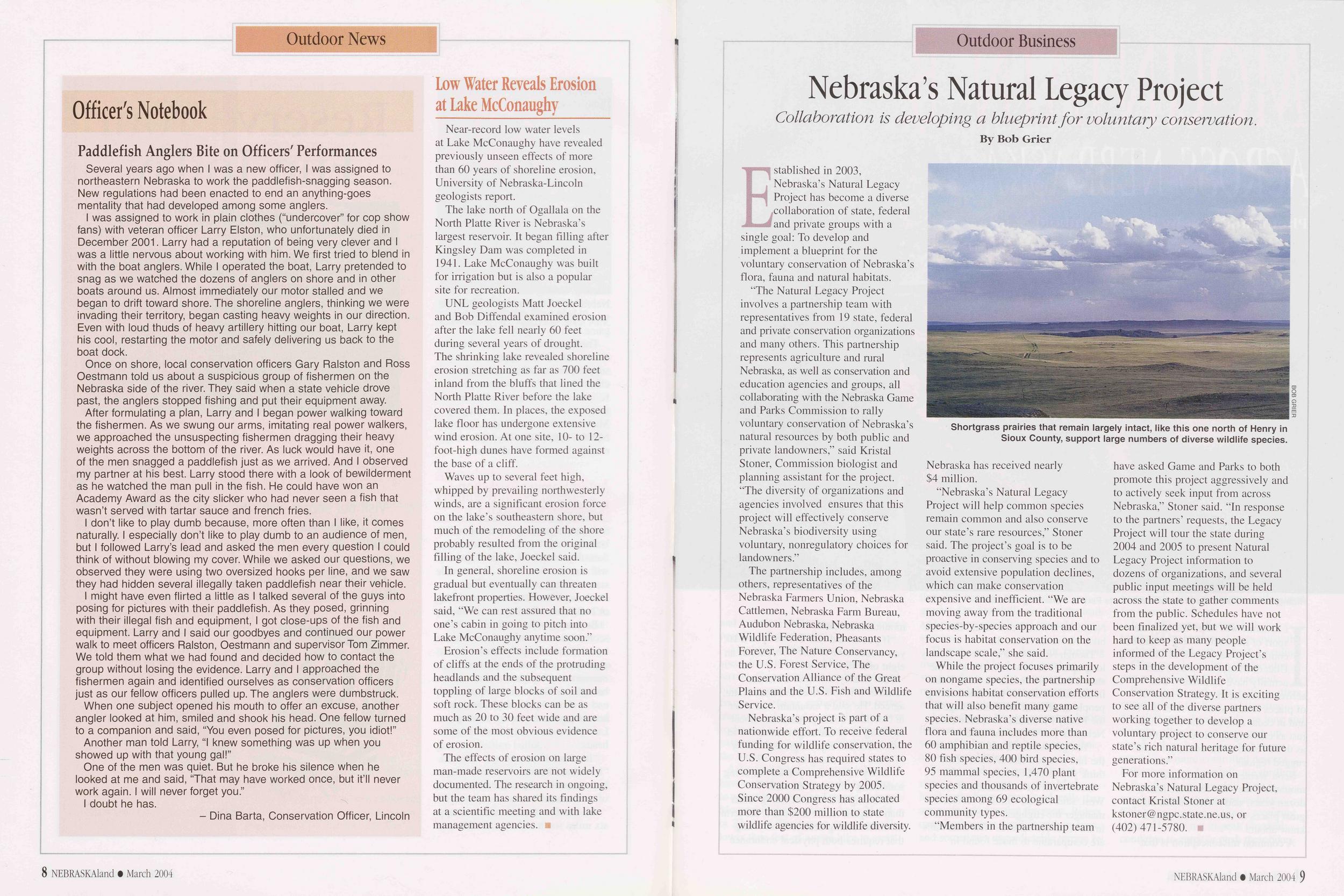
Several years ago when I was a new officer, I was assigned to northeastern Nebraska to work the paddlefish-snagging season. New regulations had been enacted to end an anything-goes mentality that had developed among some anglers.
I was assigned to work in plain clothes (“undercover” for cop show fans) with veteran officer Larry Elston, who unfortunately died in December 2001. Larry had a reputation of being very clever and I was a little nervous about working with him. We first tried to blend in with the boat anglers. While I operated the boat, Larry pretended to snag as we watched the dozens of anglers on shore and in other boats around us. Almost immediately our motor stalled and we began to drift toward shore. The shoreline anglers, thinking we were invading their territory, began casting heavy weights in our direction. Even with loud thuds of heavy artillery hitting our boat, Larry kept his cool, restarting the motor and safely delivering us back to the boat dock.
Once on shore, local conservation officers Gary Ralston and Ross Oestmann told us about a suspicious group of fishermen on the Nebraska side of the river. They said when a state vehicle drove past, the anglers stopped fishing and put their equipment away.
After formulating a plan, Larry and I began power walking toward the fishermen. As we swung our arms, imitating real power walkers, we approached the unsuspecting fishermen dragging their heavy weights across the bottom of the river. As luck would have it, one of the men snagged a paddlefish just as we arrived. And I observed my partner at his best. Larry stood there with a look of bewilderment as he watched the man pull in the fish. He could have won an Academy Award as the city slicker who had never seen a fish that wasn’t served with tartar sauce and french fries.
I don’t like to play dumb because, more often than I like, it comes naturally. I especially don’t like to play dumb to an audience of men, but I followed Larry’s lead and asked the men every question I could think of without blowing my cover. While we asked our questions, we observed they were using two oversized hooks per line, and we saw they had hidden several illegally taken paddlefish near their vehicle.
I might have even flirted a little as I talked several of the guys into posing for pictures with their paddlefish. As they posed, grinning with their illegal fish and equipment, I got close-ups of the fish and equipment. Larry and I said our goodbyes and continued our power walk to meet officers Ralston, Oestmann and supervisor Tom Zimmer. We told them what we had found and decided how to contact the group without losing the evidence. Larry and I approached the fishermen again and identified ourselves as conservation officers just as our fellow officers pulled up. The anglers were dumbstruck.
When one subject opened his mouth to offer an excuse, another angler looked at him, smiled and shook his head. One fellow turned to a companion and said, “You even posed for pictures, you idiot!”
Another man told Larry, “I knew something was up when you showed up with that young gal!”
One of the men was quiet. But he broke his silence when he looked at me and said, “That may have worked once, but it’ll never work again. I will never forget you.”
I doubt he has.
- Dina Barta, Conservation Officer, Lincoln Low Water Reveals Erosion at Lake McConaughyNear-record low water levels at Lake McConaughy have revealed previously unseen effects of more than 60 years of shoreline erosion, University of Nebraska-Lincoln geologists report.
The lake north of Ogallala on the North Platte River is Nebraska’s largest reservoir. It began filling after Kingsley Dam was completed in 1941. Lake McConaughy was built for irrigation but is also a popular site for recreation.
UNL geologists Matt Joeckel and Bob Diffendal examined erosion after the lake fell nearly 60 feet during several years of drought. The shrinking lake revealed shoreline erosion stretching as far as 700 feet inland from the bluffs that lined the North Platte River before the lake covered them. In places, the exposed lake floor has undergone extensive wind erosion. At one site, 10- to 12- foot-high dunes have formed against the base of a cliff.
Waves up to several feet high, whipped by prevailing northwesterly winds, are a significant erosion force on the lake’s southeastern shore, but much of the remodeling of the shore probably resulted from the original filling of the lake, Joeckel said.
In general, shoreline erosion is gradual but eventually can threaten lakefront properties. However, Joeckel said, “We can rest assured that no one’s cabin in going to pitch into Lake McConaughy anytime soon.”
Erosion’s effects include formation of cliffs at the ends of the protruding headlands and the subsequent toppling of large blocks of soil and soft rock. These blocks can be as much as 20 to 30 feet wide and are some of the most obvious evidence of erosion.
The effects of erosion on large man-made reservoirs are not widely documented. The research in ongoing, but the team has shared its findings at a scientific meeting and with lake management agencies.
8 NEBRASKAland • March 2004Nebraska’s Natural Legacy Project
Collaboration is developing a blueprint for voluntary conservation. By Bob GrierEstablished in 2003, Nebraska’s Natural Legacy Project has become a diverse collaboration of state, federal and private groups with a single goal: To develop and implement a blueprint for the voluntary conservation of Nebraska’s flora, fauna and natural habitats.
“The Natural Legacy Project involves a partnership team with representatives from 19 state, federal and private conservation organizations and many others. This partnership represents agriculture and rural Nebraska, as well as conservation and education agencies and groups, all collaborating with the Nebraska Game and Parks Commission to rally voluntary conservation of Nebraska’s natural resources by both public and private landowners,” said Kristal Stoner, Commission biologist and planning assistant for the project. “The diversity of organizations and agencies involved ensures that this project will effectively conserve Nebraska’s biodiversity using voluntary, nonregulatory choices for landowners.”
The partnership includes, among others, representatives of the Nebraska Farmers Union, Nebraska Cattlemen, Nebraska Farm Bureau, Audubon Nebraska, Nebraska Wildlife Federation, Pheasants Forever, The Nature Conservancy, the U.S. Forest Service, The Conservation Alliance of the Great Plains and the U.S. Fish and Wildlife Service.
Nebraska’s project is part of a nationwide effort. To receive federal funding for wildlife conservation, the U.S. Congress has required states to complete a Comprehensive Wildlife Conservation Strategy by 2005. Since 2000 Congress has allocated more than $200 million to state wildlife agencies for wildlife diversity.
“Nebraska’s Natural Legacy Project will help common species remain common and also conserve our state’s rare resources,” Stoner said. The project’s goal is to be proactive in conserving species and to avoid extensive population declines, which can make conservation expensive and inefficient. “We are moving away from the traditional species-by-species approach and our focus is habitat conservation on the landscape scale,” she said.
While the project focuses primarily on nongame species, the partnership envisions habitat conservation efforts that will also benefit many game species. Nebraska’s diverse native flora and fauna includes more than 60 amphibian and reptile species, 80 fish species, 400 bird species, 95 mammal species, 1,470 plant species and thousands of invertebrate species among 69 ecological community types.
“Members in the partnership team have asked Game and Parks to both promote this project aggressively and to actively seek input from across Nebraska,” Stoner said. “In response to the partners’ requests, the Legacy Project will tour the state during 2004 and 2005 to present Natural Legacy Project information to dozens of organizations, and several public input meetings will be held across the state to gather comments from the public. Schedules have not been finalized yet, but we will work hard to keep as many people informed of the Legacy Project’s steps in the development of the Comprehensive Wildlife Conservation Strategy. It is exciting to see all of the diverse partners working together to develop a voluntary project to conserve our state’s rich natural heritage for future generations.”
For more information on Nebraska’s Natural Legacy Project, contact Kristal Stoner at kstoner@ngpc.state.ne.us, or (402)471-5780.
NEBRASKAland • March 2004 9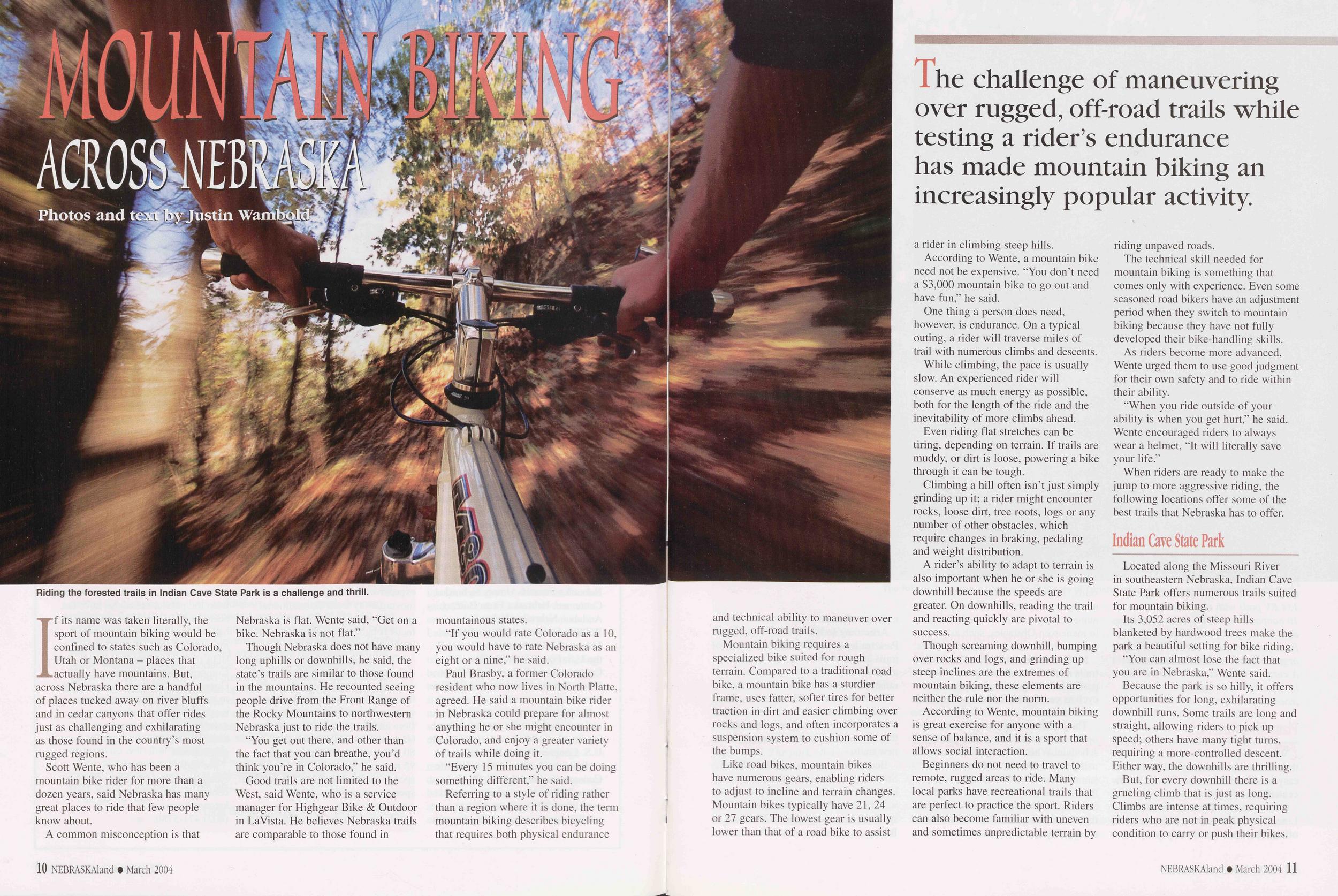
MOUNTAIN BIKING ACROSS NEBRASKA
Photos and text by Justin WamboldIf its name was taken literally, the sport of mountain biking would be confined to states such as Colorado, Utah or Montana - places that actually have mountains. But, across Nebraska there are a handful of places tucked away on river bluffs and in cedar canyons that offer rides just as challenging and exhilarating as those found in the country’s most rugged regions.
Scott Wente, who has been a mountain bike rider for more than a dozen years, said Nebraska has many great places to ride that few people know about.
A common misconception is that Nebraska is flat. Wente said, “Get on a bike. Nebraska is not flat.”
Though Nebraska does not have many long uphills or downhills, he said, the state’s trails are similar to those found in the mountains. He recounted seeing people drive from the Front Range of the Rocky Mountains to northwestern Nebraska just to ride the trails.
“You get out there, and other than the fact that you can breathe, you’d think you’re in Colorado,” he said.
Good trails are not limited to the West, said Wente, who is a service manager for Highgear Bike & Outdoor in La Vista. He believes Nebraska trails are comparable to those found in mountainous states.
“If you would rate Colorado as a 10, you would have to rate Nebraska as an eight or a nine,” he said.
Paul Brasby, a former Colorado resident who now lives in North Platte, agreed. He said a mountain bike rider in Nebraska could prepare for almost anything he or she might encounter in Colorado, and enjoy a greater variety of trails while doing it.
“Every 15 minutes you can be doing something different,” he said.
Referring to a style of riding rather than a region where it is done, the term mountain biking describes bicycling that requires both physical endurance 10 NEBRASKAland • March 2004 and technical ability to maneuver over rugged, off-road trails.
Mountain biking requires a specialized bike suited for rough terrain. Compared to a traditional road bike, a mountain bike has a sturdier frame, uses fatter, softer tires for better traction in dirt and easier climbing over rocks and logs, and often incorporates a suspension system to cushion some of the bumps.
Like road bikes, mountain bikes have numerous gears, enabling riders to adjust to incline and terrain changes. Mountain bikes typically have 21, 24 or 27 gears. The lowest gear is usually lower than that of a road bike to assist lhe challenge of maneuvering over rugged, off-road trails while testing a rider’s endurance has made mountain biking an increasingly popular activity. a rider in climbing steep hills.
The challenge of maneuvering over rugged, off-road trails while testing a rider's endurance has made mountain biking an increasingly popular activityAccording to Wente, a mountain bike need not be expensive. “You don’t need a $3,000 mountain bike to go out and have fun,” he said.
One thing a person does need, however, is endurance. On a typical outing, a rider will traverse miles of trail with numerous climbs and descents.
While climbing, the pace is usually slow. An experienced rider will conserve as much energy as possible, both for the length of the ride and the inevitability of more climbs ahead.
Even riding flat stretches can be tiring, depending on terrain. If trails are muddy, or dirt is loose, powering a bike through it can be tough.
Climbing a hill often isn’t just simply grinding up it; a rider might encounter rocks, loose dirt, tree roots, logs or any number of other obstacles, which require changes in braking, pedaling and weight distribution.
A rider’s ability to adapt to terrain is also important when he or she is going downhill because the speeds are greater. On downhills, reading the trail and reacting quickly are pivotal to success.
Though screaming downhill, bumping over rocks and logs, and grinding up steep inclines are the extremes of mountain biking, these elements are neither the rule nor the norm.
According to Wente, mountain biking is great exercise for anyone with a sense of balance, and it is a sport that allows social interaction.
Beginners do not need to travel to remote, rugged areas to ride. Many local parks have recreational trails that are perfect to practice the sport. Riders can also become familiar with uneven and sometimes unpredictable terrain by riding unpaved roads.
The technical skill needed for mountain biking is something that comes only with experience. Even some seasoned road bikers have an adjustment period when they switch to mountain biking because they have not fully developed their bike-handling skills.
As riders become more advanced, Wente urged them to use good judgment for their own safety and to ride within their ability.
“When you ride outside of your ability is when you get hurt,” he said. Wente encouraged riders to always wear a helmet, “It will literally save your life.”
When riders are ready to make the jump to more aggressive riding, the following locations offer some of the best trails that Nebraska has to offer.
Indian Cave State ParkLocated along the Missouri River in southeastern Nebraska, Indian Cave State Park offers numerous trails suited for mountain biking.
Its 3,052 acres of steep hills blanketed by hardwood trees make the park a beautiful setting for bike riding. “You can almost lose the fact that you are in Nebraska,” Wente said.
Because the park is so hilly, it offers opportunities for long, exhilarating downhill runs. Some trails are long and straight, allowing riders to pick up speed; others have many tight turns, requiring a more-controlled descent. Either way, the downhills are thrilling.
But, for every downhill there is a grueling climb that is just as long. Climbs are intense at times, requiring riders who are not in peak physical condition to carry or push their bikes.
NEBRASKAland • March 2004 11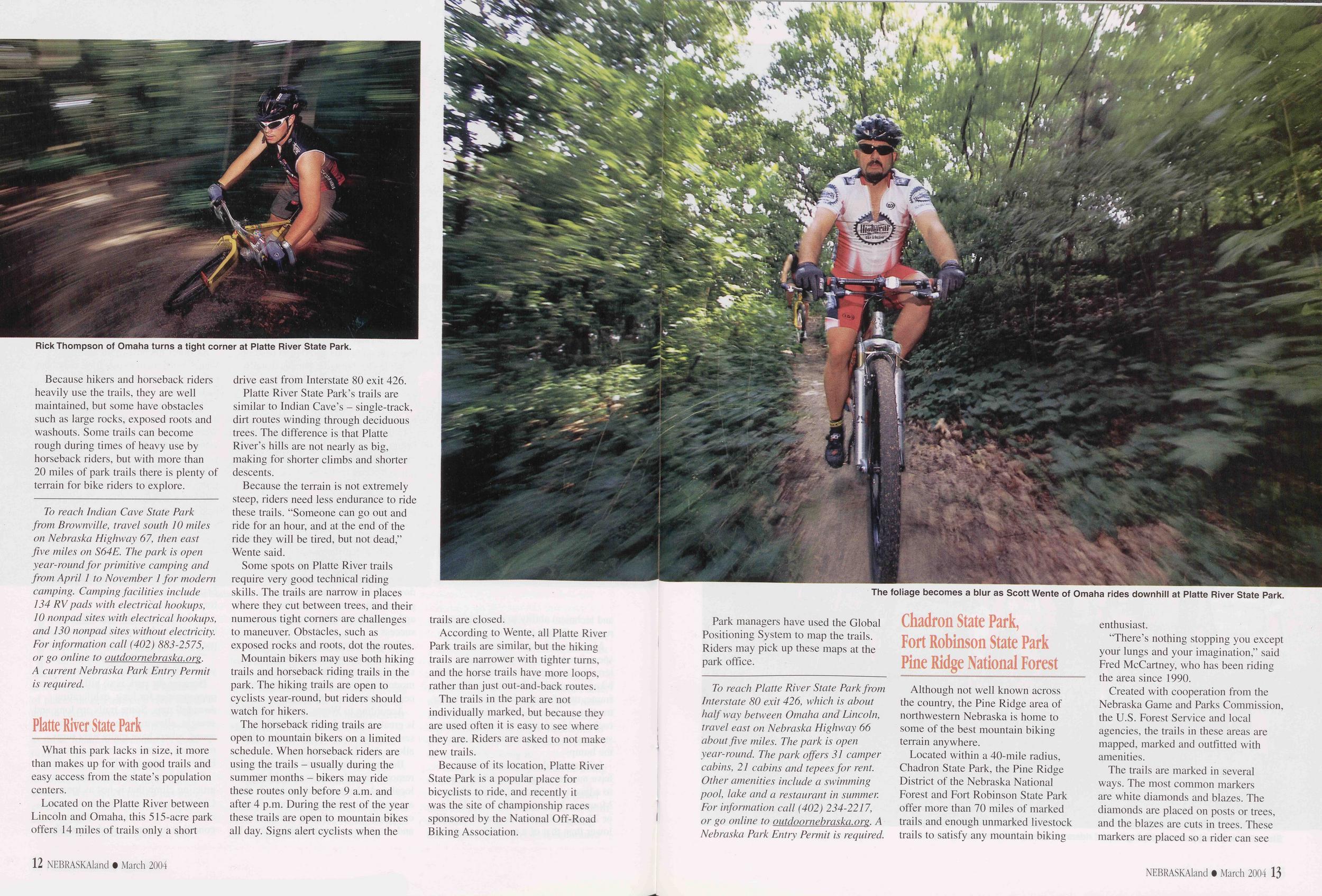
Because hikers and horseback riders heavily use the trails, they are well maintained, but some have obstacles such as large rocks, exposed roots and washouts. Some trails can become rough during times of heavy use by horseback riders, but with more than 20 miles of park trails there is plenty of terrain for bike riders to explore.
To reach Indian Cave State Park from Brownville, travel south 10 miles on Nebraska Highway 67, then east five miles on S64E. The park is open year-round for primitive camping and from April 1 to November 1 for modern camping. Camping facilities include 134 RVpads with electrical hookups, 10 nonpad sites with electrical hookups, and 130 nonpad sites without electricity. For information call (402) 883-2575, or go online to outdoornebraska. org. A current Nebraska Park Entry Permit is required.
Platte River State ParkWhat this park lacks in size, it more than makes up for with good trails and easy access from the state’s population centers.
Located on the Platte River between Lincoln and Omaha, this 515-acre park offers 14 miles of trails only a short 12 NEBRASKAland • March 2004 drive east from Interstate 80 exit 426.
Platte River State Park’s trails are similar to Indian Cave’s - single-track, dirt routes winding through deciduous trees. The difference is that Platte River’s hills are not nearly as big, making for shorter climbs and shorter descents.
Because the terrain is not extremely steep, riders need less endurance to ride these trails. “Someone can go out and ride for an hour, and at the end of the ride they will be tired, but not dead,” Wente said.
Some spots on Platte River trails require very good technical riding skills. The trails are narrow in places where they cut between trees, and their numerous tight corners are challenges to maneuver. Obstacles, such as exposed rocks and roots, dot the routes.
Mountain bikers may use both hiking trails and horseback riding trails in the park. The hiking trails are open to cyclists year-round, but riders should watch for hikers.
The horseback riding trails are open to mountain bikers on a limited schedule. When horseback riders are using the trails - usually during the summer months - bikers may ride these routes only before 9 a.m. and after 4 p.m. During the rest of the year these trails are open to mountain bikes all day. Signs alert cyclists when the trails are closed.
According to Wente, all Platte River Park trails are similar, but the hiking trails are narrower with tighter turns, and the horse trails have more loops, rather than just out-and-back routes.
The trails in the park are not individually marked, but because they are used often it is easy to see where they are. Riders are asked to not make new trails.
Because of its location, Platte River State Park is a popular place for bicyclists to ride, and recently it was the site of championship races sponsored by the National Off-Road Biking Association.
12 NEBRASKAland • March 2004Park managers have used the Global Positioning System to map the trails. Riders may pick up these maps at the park office.
To reach Platte River State Park from Interstate 80 exit 426, which is about halfway between Omaha and Lincoln, travel east on Nebraska Highway 66 about five miles. The park is open year-round. The park offers 31 camper cabins, 21 cabins and tepees for rent. Other amenities include a swimming pool, lake and a restaurant in summer. For information call (402) 234-2217, or go online to outdoornebraska. org. A Nebraska Park Entry Permit is required.
Chadron State Park, Fort Robinson State Park Pine Ridge National ForestAlthough not well known across the country, the Pine Ridge area of northwestern Nebraska is home to some of the best mountain biking terrain anywhere.
Located within a 40-mile radius, Chadron State Park, the Pine Ridge District of the Nebraska National Forest and Fort Robinson State Park offer more than 70 miles of marked trails and enough unmarked livestock trails to satisfy any mountain biking enthusiast.
“There’s nothing stopping you except your lungs and your imagination,” said Fred McCartney, who has been riding the area since 1990.
Created with cooperation from the Nebraska Game and Parks Commission, the U.S. Forest Service and local agencies, the trails in these areas are mapped, marked and outfitted with amenities.
The trails are marked in several
ways. The most common markers
are white diamonds and blazes. The
diamonds are placed on posts or trees,
and the blazes are cuts in trees. These
markers are placed so a rider can see
NEBRASKAland • March 2004 13
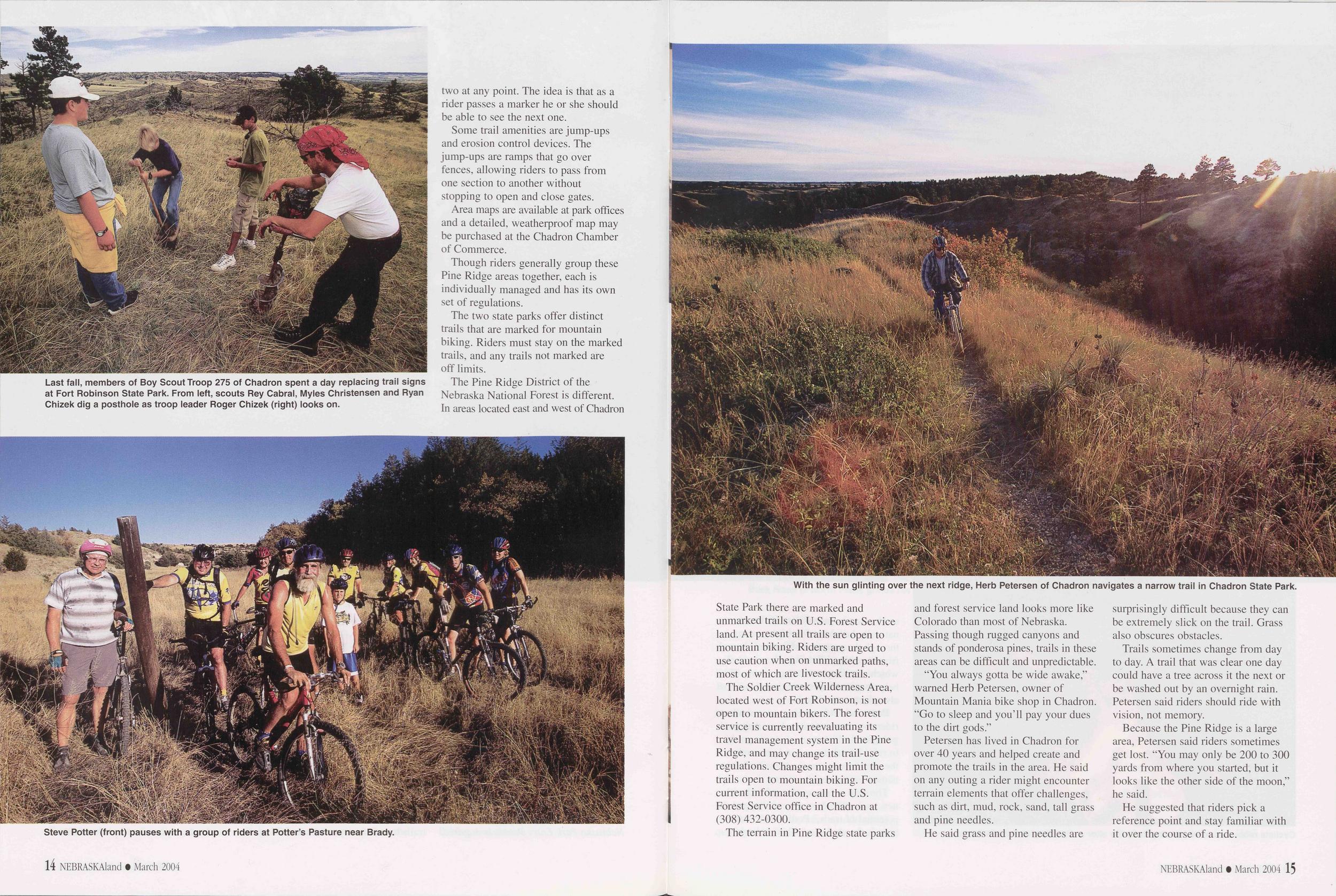
Some trail amenities are jump-ups and erosion control devices. The jump-ups are ramps that go over fences, allowing riders to pass from one section to another without stopping to open and close gates.
Area maps are available at park offices and a detailed, weatherproof map may be purchased at the Chadron Chamber of Commerce.
Though riders generally group these Pine Ridge areas together, each is individually managed and has its own set of regulations.
The two state parks offer distinct trails that are marked for mountain biking. Riders must stay on the marked trails, and any trails not marked are off limits.
The Pine Ridge District of the Nebraska National Forest is different. In areas located east and west of Chadron
The Soldier Creek Wilderness Area, located west of Fort Robinson, is not open to mountain bikers. The forest service is currently reevaluating its travel management system in the Pine Ridge, and may change its trail-use regulations. Changes might limit the trails open to mountain biking. For current information, call the U.S. Forest Service office in Chadron at (308) 432-0300.
The terrain in Pine Ridge state parks and forest service land looks more like Colorado than most of Nebraska. Passing though rugged canyons and stands of ponderosa pines, trails in these areas can be difficult and unpredictable.
“You always gotta be wide awake,” warned Herb Petersen, owner of Mountain Mania bike shop in Chadron. “Go to sleep and you’ll pay your dues to the dirt gods.”
Petersen has lived in Chadron for over 40 years and helped create and promote the trails in the area. He said on any outing a rider might encounter terrain elements that offer challenges, such as dirt, mud, rock, sand, tall grass and pine needles.
He said grass and pine needles are surprisingly difficult because they can be extremely slick on the trail. Grass also obscures obstacles.
Trails sometimes change from day to day. A trail that was clear one day could have a tree across it the next or be washed out by an overnight rain. Petersen said riders should ride with vision, not memory.
Because the Pine Ridge is a large area, Petersen said riders sometimes get lost. “You may only be 200 to 300 yards from where you started, but it looks like the other side of the moon,” he said.
He suggested that riders pick a reference point and stay familiar with it over the course of a ride.
NEBRASKAland • March 2004 15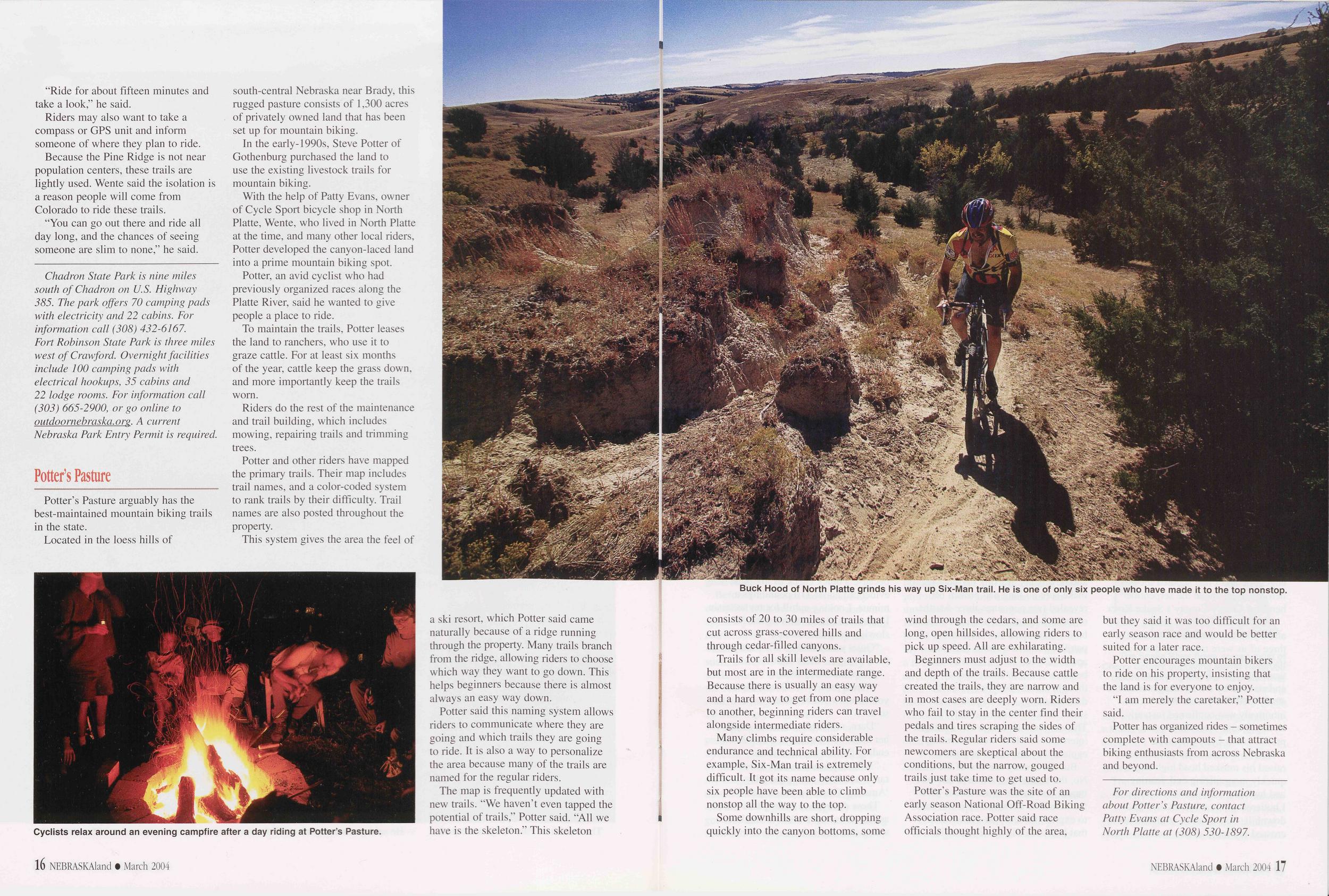
“Ride for about fifteen minutes and take a look,” he said.
Riders may also want to take a compass or GPS unit and inform someone of where they plan to ride.
Because the Pine Ridge is not near population centers, these trails are lightly used. Wente said the isolation is a reason people will come from Colorado to ride these trails.
“You can go out there and ride all day long, and the chances of seeing someone are slim to none,” he said.
Chadron State Park is nine miles south of Chadron on U.S. Highway 385. The park offers 70 camping pads with electricity and 22 cabins. For information call (308) 432-6167. Fort Robinson State Park is three miles west of Crawford. Overnight facilities include 100 camping pads with electrical hookups, 35 cabins and 22 lodge rooms. For information call (303) 665-2900, or go online to outdoornebraska. org. A current Nebraska Park Entry Permit is required.
Potter’s PasturePotter’s Pasture arguably has the best-maintained mountain biking trails in the state.
Located in the loess hills of
In the early-1990s, Steve Potter of Gothenburg purchased the land to use the existing livestock trails for mountain biking.
With the help of Patty Evans, owner of Cycle Sport bicycle shop in North Platte, Wente, who lived in North Platte at the time, and many other local riders, Potter developed the canyon-laced land into a prime mountain biking spot.
Potter, an avid cyclist who had previously organized races along the Platte River, said he wanted to give people a place to ride.
To maintain the trails, Potter leases the land to ranchers, who use it to graze cattle. For at least six months of the year, cattle keep the grass down, and more importantly keep the trails worn.
Riders do the rest of the maintenance and trail building, which includes mowing, repairing trails and trimming trees.
Potter and other riders have mapped the primary trails. Their map includes trail names, and a color-coded system to rank trails by their difficulty. Trail names are also posted throughout the property.
This system gives the area the feel of a ski resort, which Potter said came naturally because of a ridge running through the property. Many trails branch from the ridge, allowing riders to choose which way they want to go down. This helps beginners because there is almost always an easy way down.
Potter said this naming system allows riders to communicate where they are going and which trails they are going to ride. It is also a way to personalize the area because many of the trails are named for the regular riders.
The map is frequently updated with new trails. “We haven’t even tapped the potential of trails,” Potter said. “All we have is the skeleton.” This skeleton 16 NEBRASKAland • March 2004
Trails for all skill levels are available, but most are in the intermediate range. Because there is usually an easy way and a hard way to get from one place to another, beginning riders can travel alongside intermediate riders.
Many climbs require considerable endurance and technical ability. For example, Six-Man trail is extremely difficult. It got its name because only six people have been able to climb nonstop all the way to the top.
Some downhills are short, dropping quickly into the canyon bottoms, some wind through the cedars, and some are long, open hillsides, allowing riders to pick up speed. All are exhilarating.
Beginners must adjust to the width and depth of the trails. Because cattle created the trails, they are narrow and in most cases are deeply worn. Riders who fail to stay in the center find their pedals and tires scraping the sides of the trails. Regular riders said some newcomers are skeptical about the conditions, but the narrow, gouged trails just take time to get used to.
Potter’s Pasture was the site of an early season National Off-Road Biking Association race. Potter said race officials thought highly of the area, but they said it was too difficult for an early season race and would be better suited for a later race.
Potter encourages mountain bikers to ride on his property, insisting that the land is for everyone to enjoy. “I am merely the caretaker,” Potter said.
Potter has organized rides - sometimes complete with campouts - that attract biking enthusiasts from across Nebraska and beyond.
For directions and information about Potter’s Pasture, contact Patty Evans at Cycle Sport in North Platte at (308) 530-1897.
NEBRASKAland • March 2004 17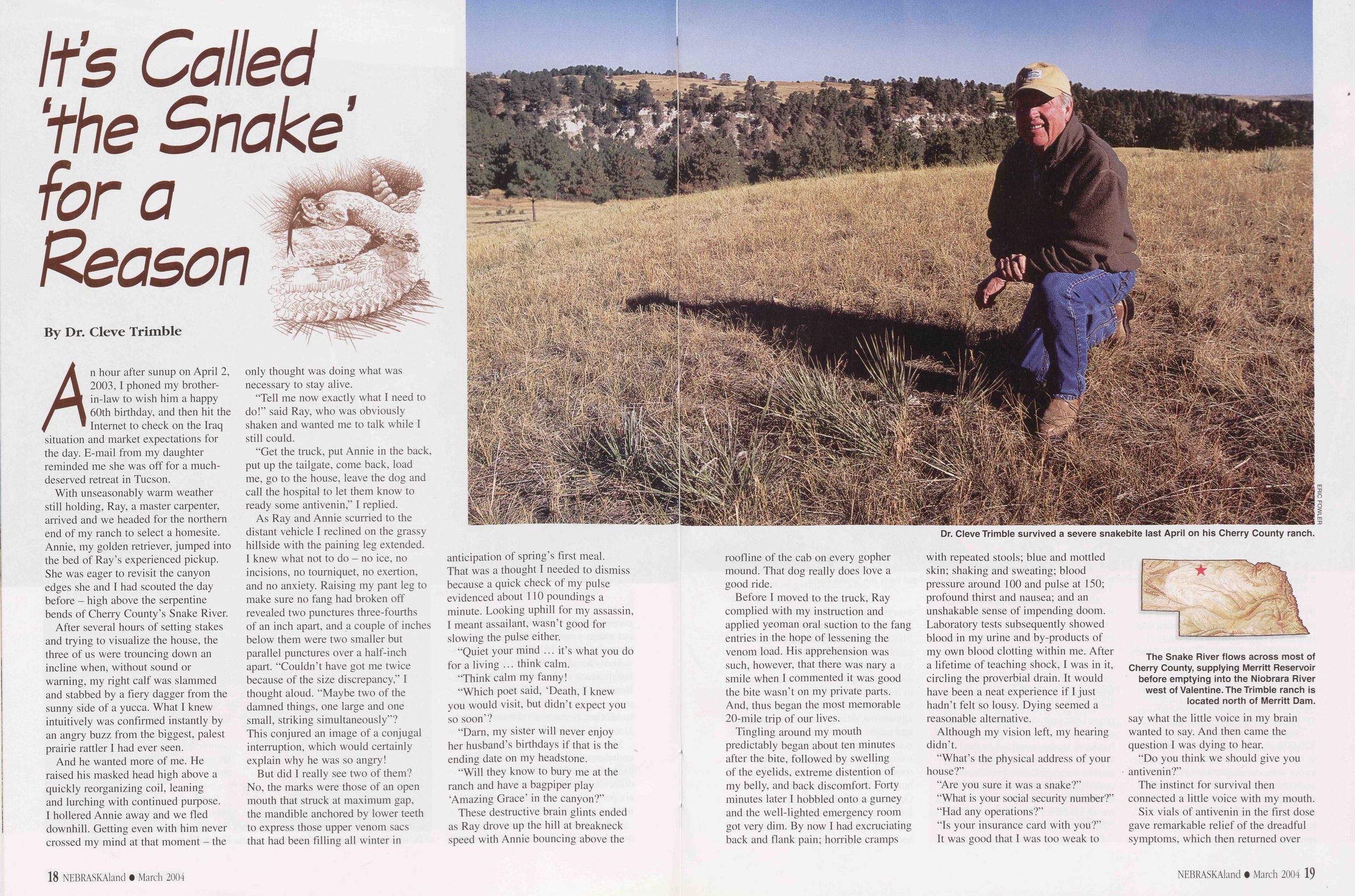
It’s Called the Snake for a Reason
By Dr. Cleve TrimbleAn hour after sunup on April 2, 2003, I phoned my brother- in-law to wish him a happy 60th birthday, and then hit the f ’ Internet to check on the Iraq situation and market expectations for the day. E-mail from my daughter reminded me she was off for a much- deserved retreat in Tucson.
With unseasonably warm weather still holding, Ray, a master carpenter, arrived and we headed for the northern end of my ranch to select a homesite. Annie, my golden retriever, jumped into the bed of Ray’s experienced pickup. She was eager to revisit the canyon edges she and I had scouted the day before - high above the serpentine bends of Cherry County’s Snake River.
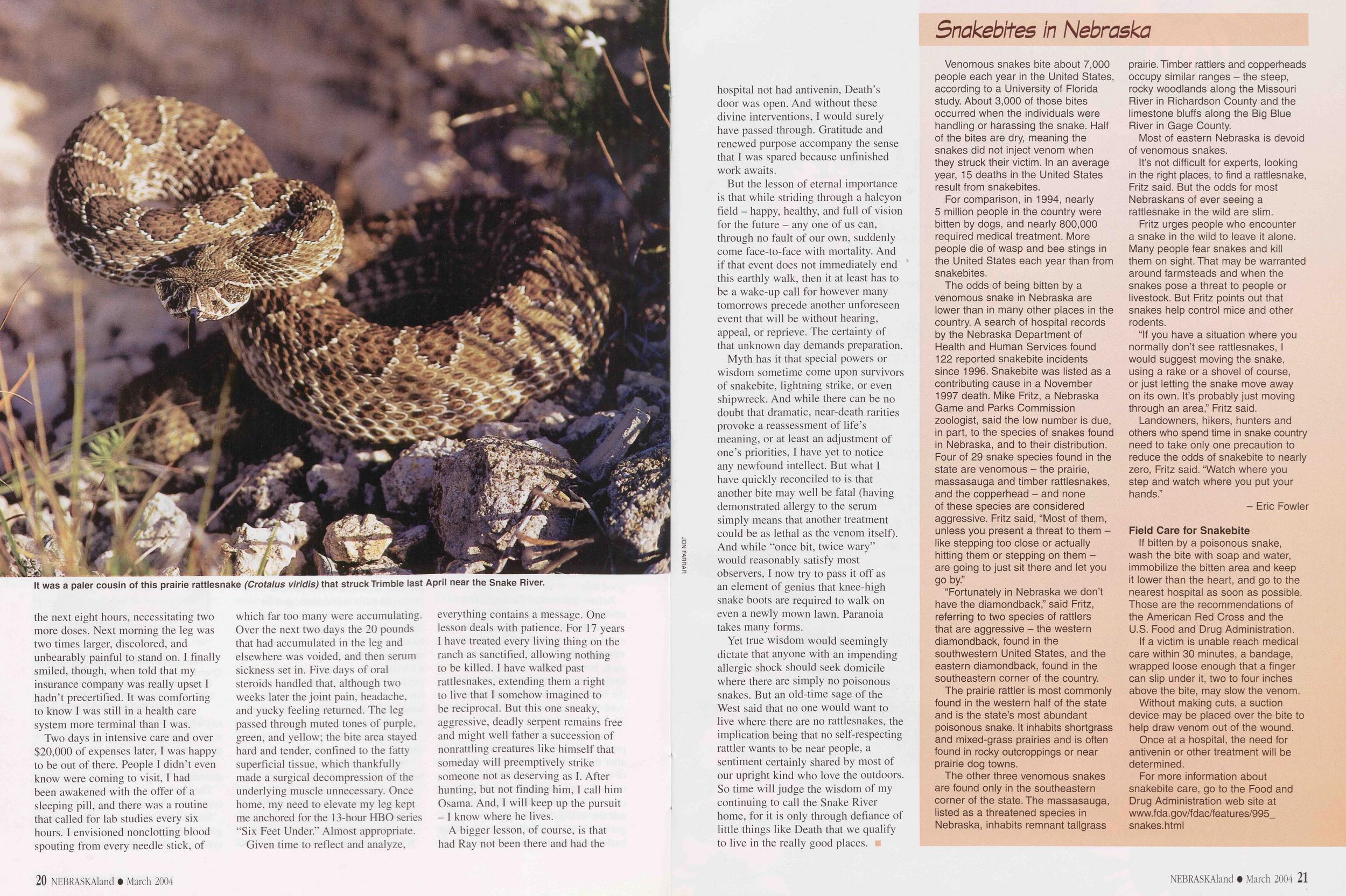
After several hours of setting stakes and trying to visualize the house, the three of us were trouncing down an incline when, without sound or warning, my right calf was slammed and stabbed by a fiery dagger from the sunny side of a yucca. What I knew intuitively was confirmed instantly by an angry buzz from the biggest, palest prairie rattler I had ever seen.
And he wanted more of me. He raised his masked head high above a quickly reorganizing coil, leaning and lurching with continued purpose. I hollered Annie away and we fled downhill. Getting even with him never crossed my mind at that moment - the only thought was doing what was necessary to stay alive.
“Tell me now exactly what I need to do!” said Ray, who was obviously shaken and wanted me to talk while I still could.
“Get the truck, put Annie in the back, put up the tailgate, come back, load me, go to the house, leave the dog and call the hospital to let them know to ready some antivenin,” I replied.
As Ray and Annie scurried to the distant vehicle I reclined on the grassy hillside with the paining leg extended. I knew what not to do - no ice, no incisions, no tourniquet, no exertion, and no anxiety. Raising my pant leg to make sure no fang had broken off revealed two punctures three-fourths of an inch apart, and a couple of inches below them were two smaller but parallel punctures over a half-inch apart. “Couldn’t have got me twice because of the size discrepancy,” I thought aloud. “Maybe two of the damned things, one large and one small, striking simultaneously”? This conjured an image of a conjugal interruption, which would certainly explain why he was so angry!
But did I really see two of them? No, the marks were those of an open mouth that struck at maximum gap, the mandible anchored by lower teeth to express those upper venom sacs that had been filling all winter in anticipation of spring’s first meal. That was a thought I needed to dismiss because a quick check of my pulse evidenced about 110 poundings a minute. Looking uphill for my assassin, I meant assailant, wasn’t good for slowing the pulse either.
“Quiet your mind ... it’s what you do for a living ... think calm. “Think calm my fanny! “Which poet said, ‘Death, I knew you would visit, but didn’t expect you so soon’?
“Darn, my sister will never enjoy her husband’s birthdays if that is the ending date on my headstone.
“Will they know to bury me at the ranch and have a bagpiper play ‘Amazing Grace’ in the canyon?”
These destructive brain glints ended as Ray drove up the hill at breakneck speed with Annie bouncing above the 18 NEBRASKAland • March 2004
Before I moved to the truck, Ray complied with my instruction and applied yeoman oral suction to the fang entries in the hope of lessening the venom load. His apprehension was such, however, that there was nary a smile when I commented it was good the bite wasn’t on my private parts. And, thus began the most memorable 20-mile trip of our lives.
Tingling around my mouth predictably began about ten minutes after the bite, followed by swelling of the eyelids, extreme distention of my belly, and back discomfort. Forty minutes later I hobbled onto a gurney and the well-lighted emergency room got very dim. By now I had excruciating back and flank pain; horrible cramps with repeated stools; blue and mottled skin; shaking and sweating; blood pressure around 100 and pulse at 150; profound thirst and nausea; and an unshakable sense of impending doom. Laboratory tests subsequently showed blood in my urine and by-products of my own blood clotting within me. After a lifetime of teaching shock, I was in it, circling the proverbial drain. It would have been a neat experience if I just hadn’t felt so lousy. Dying seemed a reasonable alternative.
Although my vision left, my hearing didn’t.
“What’s the physical address of your house?”
“Are you sure it was a snake?” “What is your social security number?” “Had any operations?” “Is your insurance card with you?”
It was good that I was too weak to
“Do you think we should give you antivenin?”
The instinct for survival then
connected a little voice with my mouth.
Six vials of antivenin in the first dose
gave remarkable relief of the dreadful
symptoms, which then returned over
NEBRASKAland • March 2004 19
Two days in intensive care and over $20,000 of expenses later, I was happy to be out of there. People I didn’t even know were coming to visit, I had been awakened with the offer of a sleeping pill, and there was a routine that called for lab studies every six hours. I envisioned nonclotting blood spouting from every needle stick, of which far too many were accumulating. Over the next two days the 20 pounds that had accumulated in the leg and elsewhere was voided, and then serum sickness set in. Five days of oral steroids handled that, although two weeks later the joint pain, headache, and yucky feeling returned. The leg passed through muted tones of purple, green, and yellow; the bite area stayed hard and tender, confined to the fatty superficial tissue, which thankfully made a surgical decompression of the underlying muscle unnecessary. Once home, my need to elevate my leg kept me anchored for the 13-hour HBO series “Six Feet Under.” Almost appropriate. Given time to reflect and analyze, everything contains a message. One lesson deals with patience. For 17 years I have treated every living thing on the ranch as sanctified, allowing nothing to be killed. I have walked past rattlesnakes, extending them a right to live that I somehow imagined to be reciprocal. But this one sneaky, aggressive, deadly serpent remains free and might well father a succession of nonrattling creatures like himself that someday will preemptively strike someone not as deserving as I. After hunting, but not finding him, I call him Osama. And, I will keep up the pursuit - I know where he lives.
A bigger lesson, of course, is that had Ray not been there and had the 20 NEBRASKAland • March 2004 hospital not had antivenin, Death’s door was open. And without these divine interventions, I would surely have passed through. Gratitude and renewed purpose accompany the sense that I was spared because unfinished work awaits.
But the lesson of eternal importance is that while striding through a halcyon field - happy, healthy, and full of vision for the future - any one of us can, through no fault of our own, suddenly come face-to-face with mortality. And if that event does not immediately end this earthly walk, then it at least has to be a wake-up call for however many tomorrows precede another unforeseen event that will be without hearing, appeal, or reprieve. The certainty of that unknown day demands preparation.
Myth has it that special powers or wisdom sometime come upon survivors of snakebite, lightning strike, or even shipwreck. And while there can be no doubt that dramatic, near-death rarities provoke a reassessment of life’s meaning, or at least an adjustment of one’s priorities, I have yet to notice any newfound intellect. But what I have quickly reconciled to is that another bite may well be fatal (having demonstrated allergy to the serum simply means that another treatment could be as lethal as the venom itself). And while “once bit, twice wary” would reasonably satisfy most observers, I now try to pass it off as an element of genius that knee-high snake boots are required to walk on even a newly mown lawn. Paranoia takes many forms.
Yet true wisdom would seemingly dictate that anyone with an impending allergic shock should seek domicile where there are simply no poisonous snakes. But an old-time sage of the West said that no one would want to live where there are no rattlesnakes, the implication being that no self-respecting rattler wants to be near people, a sentiment certainly shared by most of our upright kind who love the outdoors. So time will judge the wisdom of my continuing to call the Snake River home, for it is only through defiance of little things like Death that we qualify to live in the really good places.
Snakebites in NebraskaVenomous snakes bite about 7,000 people each year in the United States, according to a University of Florida study. About 3,000 of those bites occurred when the individuals were handling or harassing the snake. Half of the bites are dry, meaning the snakes did not inject venom when they struck their victim. In an average year, 15 deaths in the United States result from snakebites.
For comparison, in 1994, nearly 5 million people in the country were bitten by dogs, and nearly 800,000 required medical treatment. More people die of wasp and bee stings in the United States each year than from snakebites.
The odds of being bitten by a venomous snake in Nebraska are lower than in many other places in the country. A search of hospital records by the Nebraska Department of Health and Human Services found 122 reported snakebite incidents since 1996. Snakebite was listed as a contributing cause in a November 1997 death. Mike Fritz, a Nebraska Game and Parks Commission zoologist, said the low number is due, in part, to the species of snakes found in Nebraska, and to their distribution. Four of 29 snake species found in the state are venomous - the prairie, massasauga and timber rattlesnakes, and the copperhead - and none of these species are considered aggressive. Fritz said, “Most of them, unless you present a threat to them - like stepping too close or actually hitting them or stepping on them - are going to just sit there and let you go by.”
“Fortunately in Nebraska we don’t have the diamondback,” said Fritz, referring to two species of rattlers that are aggressive - the western diamondback, found in the southwestern United States, and the eastern diamondback, found in the southeastern corner of the country.
The prairie rattler is most commonly found in the western half of the state and is the state’s most abundant poisonous snake. It inhabits shortgrass and mixed-grass prairies and is often found in rocky outcroppings or near prairie dog towns.
The other three venomous snakes are found only in the southeastern corner of the state. The massasauga, listed as a threatened species in Nebraska, inhabits remnant tailgrass prairie. Timber rattlers and copperheads occupy similar ranges - the steep, rocky woodlands along the Missouri River in Richardson County and the limestone bluffs along the Big Blue River in Gage County.
Most of eastern Nebraska is devoid of venomous snakes.
It’s not difficult for experts, looking in the right places, to find a rattlesnake, Fritz said. But the odds for most Nebraskans of ever seeing a rattlesnake in the wild are slim.
Fritz urges people who encounter a snake in the wild to leave it alone. Many people fear snakes and kill them on sight. That may be warranted around farmsteads and when the snakes pose a threat to people or livestock. But Fritz points out that snakes help control mice and other rodents.
“If you have a situation where you normally don’t see rattlesnakes, I would suggest moving the snake, using a rake or a shovel of course, or just letting the snake move away on its own. It’s probably just moving through an area,” Fritz said.
Landowners, hikers, hunters and others who spend time in snake country need to take only one precaution to reduce the odds of snakebite to nearly zero, Fritz said. “Watch where you step and watch where you put your hands.”
- Eric Fowler Field Care for SnakebiteIf bitten by a poisonous snake, wash the bite with soap and water, immobilize the bitten area and keep it lower than the heart, and go to the nearest hospital as soon as possible. Those are the recommendations of the American Red Cross and the U.S. Food and Drug Administration.
If a victim is unable reach medical care within 30 minutes, a bandage, wrapped loose enough that a finger can slip under it, two to four inches above the bite, may slow the venom.
Without making cuts, a suction device may be placed over the bite to help draw venom out of the wound.
Once at a hospital, the need for antivenin or other treatment will be determined.
For more information about snakebite care, go to the Food and Drug Administration web site at www.fda.gov/fdac/features/995_ snakes.html
NEBRASKAland • March 2004 21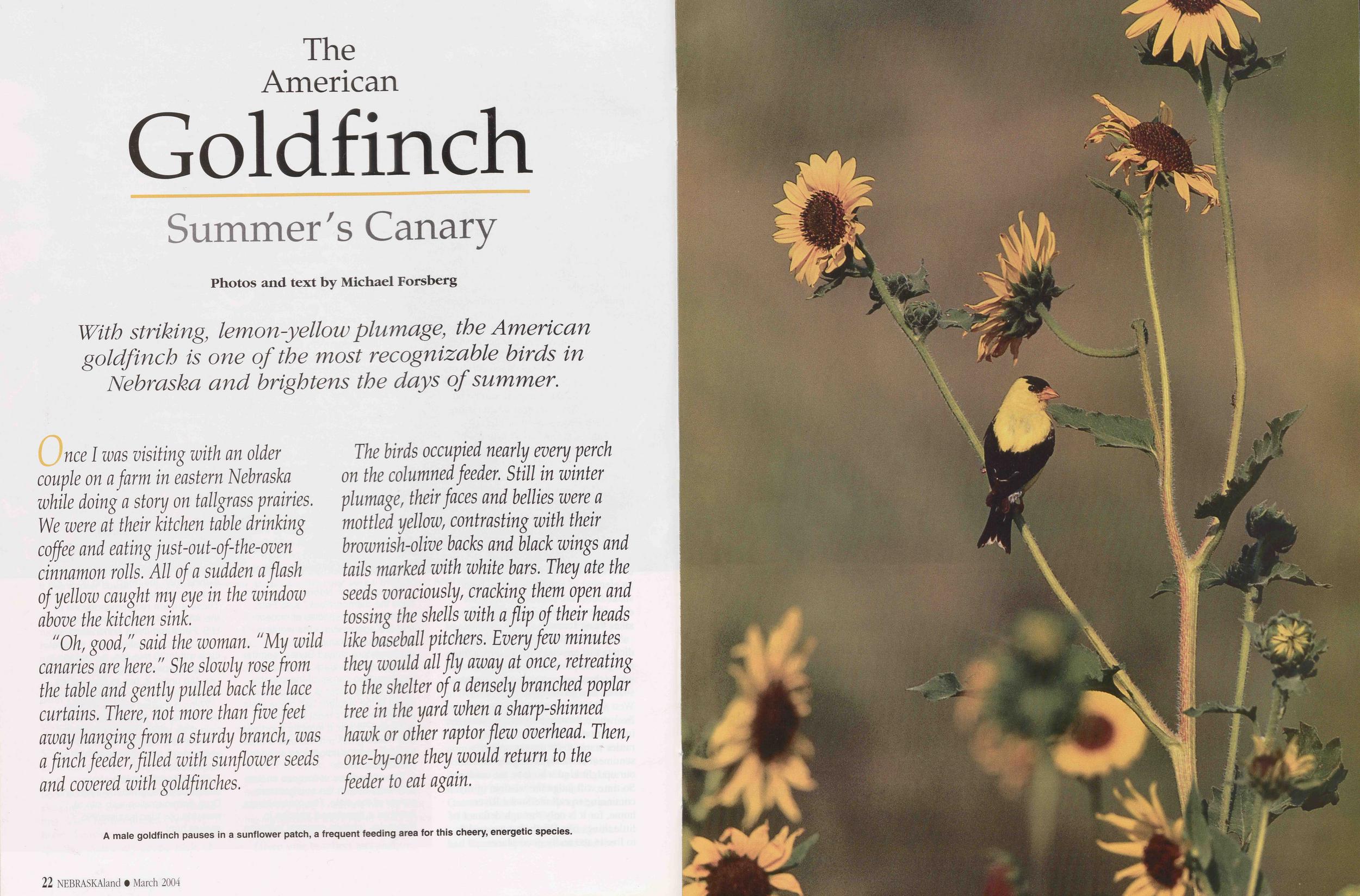
With striking, lemon-yellow plumage, the American goldfinch is one of the most recognizable birds in Nebraska and brightens the days of summer.
Once I was visiting with an older couple on a farm in eastern Nebraska while doing a story on tailgrass prairies. We were at their kitchen table drinking coffee and eating just-out-of-the-oven cinnamon rolls. All of a sudden a flash of yellow caught my eye in the window above the kitchen sink.
"Oh, good," said the woman. "My wild canaries are here." She slowly rose from the table and gently pulled back the lace curtains. There, not more than five feet away hanging from a sturdy branch, was a finch feeder, filled with sunflower seeds and covered with goldfinches.
The birds occupied nearly every perch on the columned feeder. Still in winter plumage, their faces and bellies were a mottled yellow, contrasting with their brownish-olive backs and black wings and tails marked with white bars. They ate the seeds voraciously, cracking them open and tossing the shells with a flip of their heads like baseball pitchers. Every few minutes they would all fly away at once, retreating to the shelter of a densely branched poplar tree in the yard when a sharp-shinned hawk or other raptor flew overhead. Then, one-by-one they would return to the feeder to eat again.
The Missis always wanted to have pet birds, but then we thought these required less upkeep and they were free/' her husband said with a chuckle. "When we put this feeder outside the window they found it within a couple weeks."
"We know it's spring when they arrive," she said as she slipped back to the table. "The males are a little pale in color now, but wait till summerI"
With its striking, lemon-yellow plumage, the American goldfinch is one of the most recognizable birds in Nebraska. Barely five inches long, it is one of the largest species in the finch family, which includes lesser goldfinches, pine siskens and redpolls. Its breeding range extends from the central and northern United States and into central Canada. In winter, its range extends into the Deep South and Mexico. But generally a goldfinch does not travel far from its breeding grounds. They are short-distance migrants, and if a winter is mild and food sources are abundant, they sometimes stay in an area year-round.
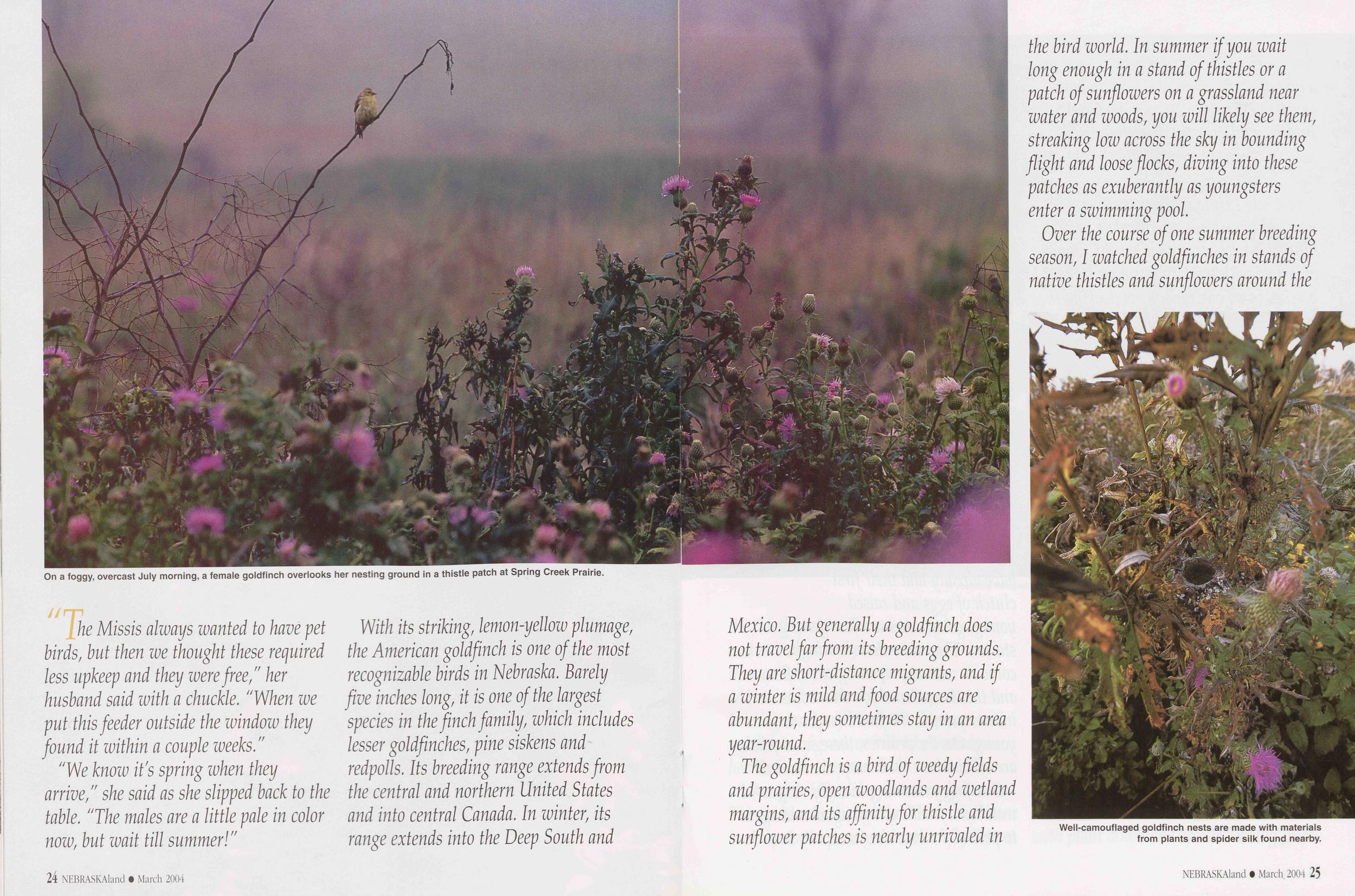
The goldfinch is a bird of weedy fields and prairies, open woodlands and wetland margins, and its affinity for thistle and sunflower patches is nearly unrivaled in 24 NEBRASKAland • March 2004 the bird world. In summer if you wait long enough in a stand of thistles or a patch of sunflowers on a grassland near water and woods, you will likely see them, streaking low across the sky in bounding flight and loose flocks, diving into these patches as exuberantly as youngsters enter a swimming pool.
Over the course of one summer breeding season, I watched goldfinches in stands of native thistles and sunflowers around the
 margin of a temporary pond bordered by
a mix of native grassland, wetland and
woodland. The site was Spring Creek
Prairie, a tallgrass prairie preserve in
eastern Nebraska near Denton.
margin of a temporary pond bordered by
a mix of native grassland, wetland and
woodland. The site was Spring Creek
Prairie, a tallgrass prairie preserve in
eastern Nebraska near Denton.
From late spring to early summer, I watched these birds court from a prairie hillside. Males, dressed in bright suits of yellow with black caps, sat on lookout perches in an oak canopy overlooking the pond. Then, suddenly they descended to chase duller-colored females in dizzying zigzag courses over the prairie. These courtship chases increased as the season progressed, and peaked during June.
In July the males who had established
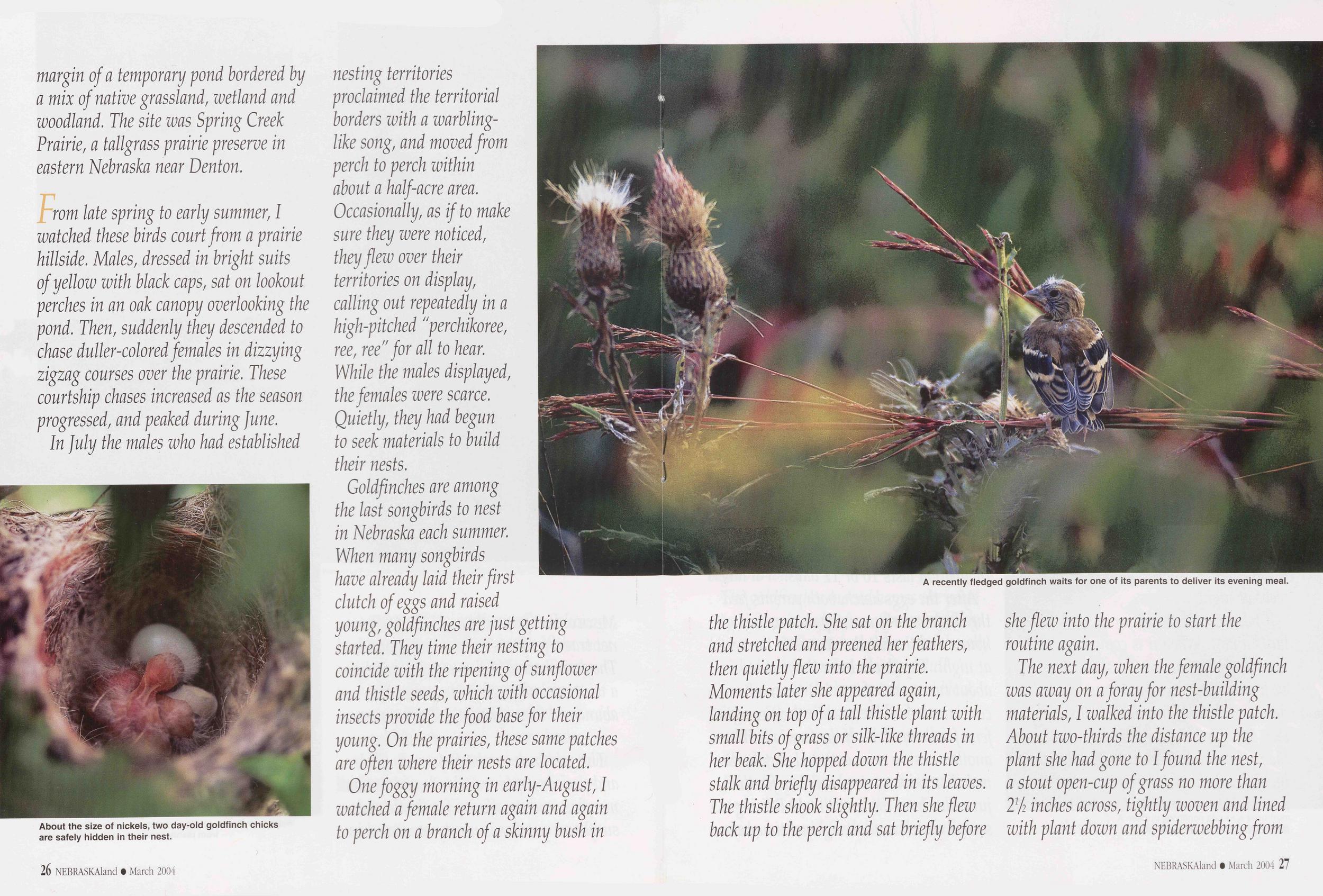
Goldfinches are among the last songbirds to nest in Nebraska each summer. When many songbirds have already laid their first clutch of eggs and raised young, goldfinches are just getting started. They time their nesting to coincide with the ripening of sunflower and thistle seeds, which with occasional insects provide the food base for their young. On the prairies, these same patches are often where their nests are located.
One foggy morning in early-August, I watched a female return again and again to perch on a branch of a skinny bush in 26 NEBRASKAland • March 2004
The next day, when the female goldfinch
was away on a foray for nest-building
materials, I walked into the thistle patch.
About two-thirds the distance up the
plant she had gone to I found the nest,
a stout open-cup of grass no more than
Th inches across, tightly woven and lined
with plant down and spiderwebbing from
NEBRASKAland • March 2004 27
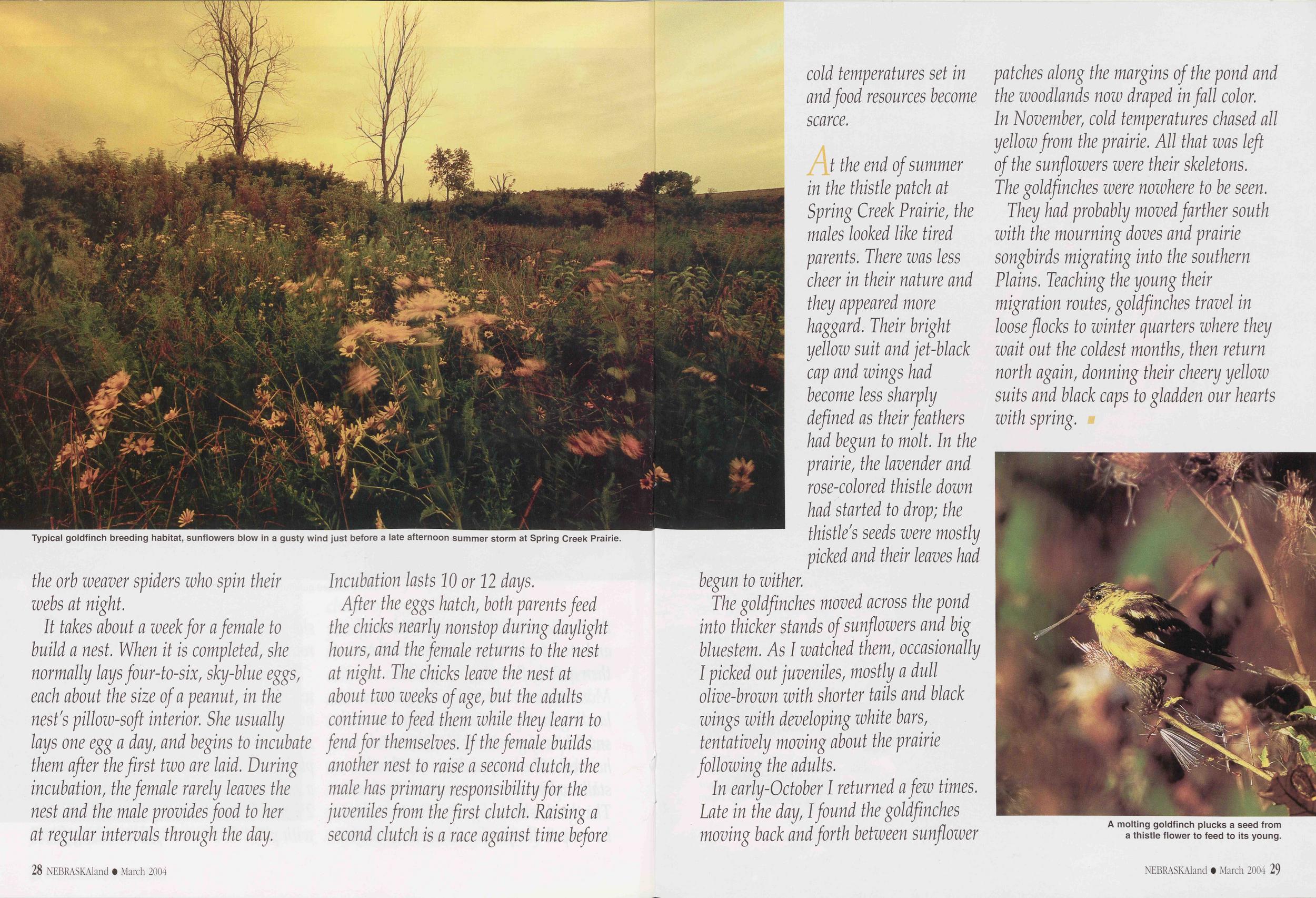
It takes about a week for a female to build a nest. When it is completed, she normally lays four-to-six, sky-blue eggs, each about the size of a peanut, in the nest's pillow-soft interior. She usually lays one egg a day, and begins to incubate them after the first two are laid. During incubation, the female rarely leaves the nest and the male provides food to her at regular intervals through the day. 28 NEBRASKMand • March 2004 Incubation lasts 10 or 12 days.
After the eggs hatch, both parents feed the chicks nearly nonstop during daylight hours, and the female returns to the nest at night. The chicks leave the nest at about two weeks of age, but the adults continue to feed them while they learn to fend for themselves. If the female builds another nest to raise a second clutch, the male has primary responsibility for the juveniles from the first clutch. Raising a second clutch is a race against time before cold temperatures set in and food resources become scarce.
At the end of summer in the thistle patch at Spring Creek Prairie, the males looked like tired parents. There was less cheer in their nature and they appeared more haggard. Their bright yellow suit and jet-black cap and wings had become less sharply defined as their feathers had begun to molt. In the prairie, the lavender and rose-colored thistle down had started to drop; the thistle's seeds were mostly picked and their leaves had begun to wither.
The goldfinches moved across the pond into thicker stands of sunflowers and big bluestem. As I watched them, occasionally I picked out juveniles, mostly a dull olive-brown with shorter tails and black wings with developing white bars, tentatively moving about the prairie following the adults.
In early-October I returned a few times. Late in the day, 1 found the goldfinches moving back and forth between sunflower patches along the margins of the pond and the woodlands now draped infall color. In November; cold temperatures chased all yellow from the prairie. All that was left of the sunflowers were their skeletons. The goldfinches were nowhere to be seen.
They had probably moved farther south with the mourning doves and prairie songbirds migrating into the southern Plains. Teaching the young their migration routes, goldfinches travel in loose flocks to winter quarters where they wait out the coldest months, then return north again, donning their cheery yellow suits and black caps to gladden our hearts with spring.
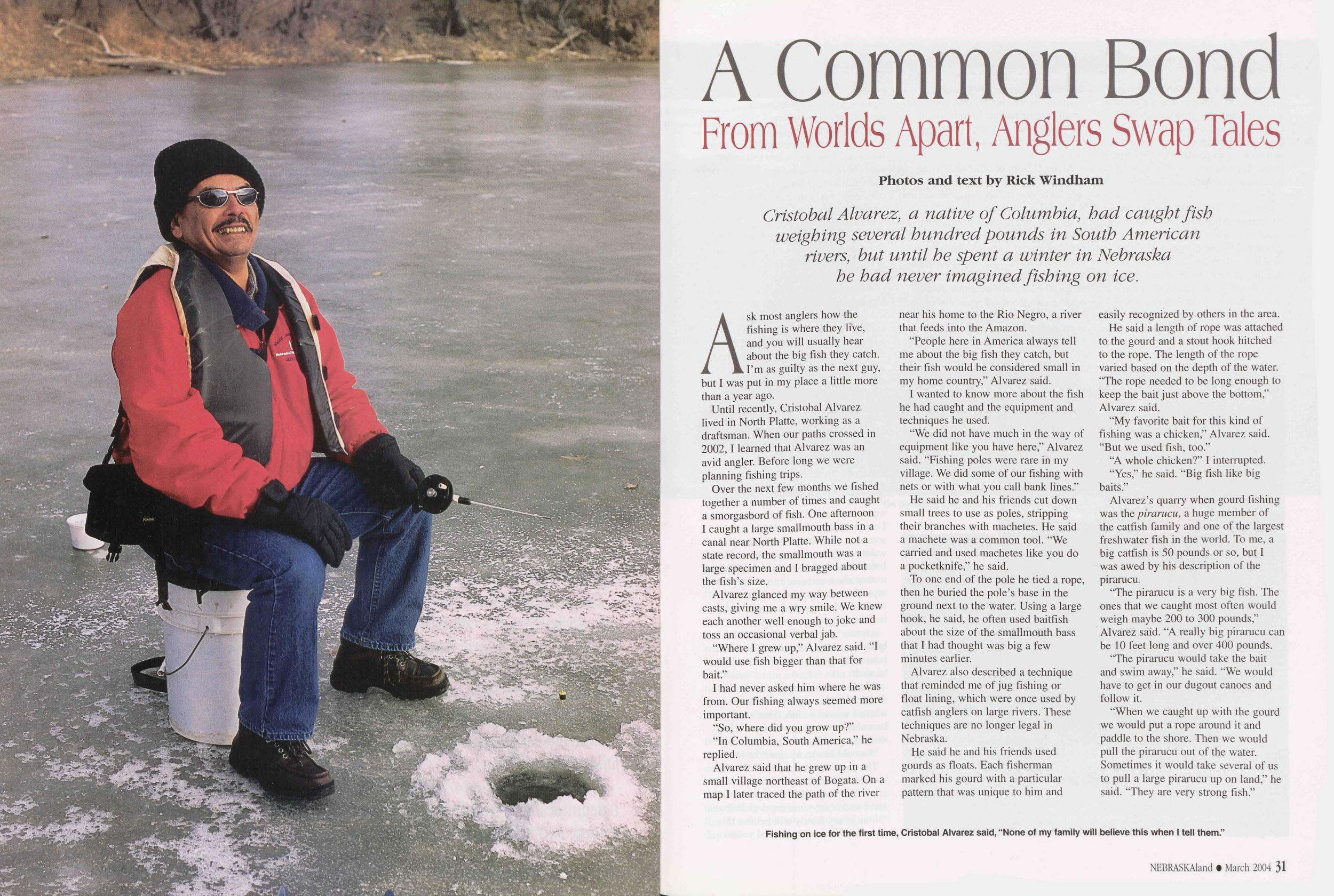
Cristobal Alvarez, a native of Columbia, bad caught fish weighing several hundred pounds in South American rivers, but until he spent a winter in Nebraska he had never imagined fishing on ice.
Ask most anglers how the fishing is where they live, and you will usually hear about the big fish they catch. I’m as guilty as the next guy, but I was put in my place a little more than a year ago.
Until recently, Cristobal Alvarez lived in North Platte, working as a draftsman. When our paths crossed in 2002,1 learned that Alvarez was an avid angler. Before long we were planning fishing trips.
Over the next few months we fished together a number of times and caught a smorgasbord of fish. One afternoon I caught a large smallmouth bass in a canal near North Platte. While not a state record, the smallmouth was a large specimen and I bragged about the fish’s size.
Alvarez glanced my way between casts, giving me a wry smile. We knew each another well enough to joke and toss an occasional verbal jab.
“Where I grew up,” Alvarez said. "I would use fish bigger than that for bait.”
I had never asked him where he was from. Our fishing always seemed more important.
“So, where did you grow up?” “In Columbia, South America,” he replied.
Alvarez said that he grew up in a small village northeast of Bogata. On a map I later traced the path of the river near his home to the Rio Negro, a river that feeds into the Amazon.
“People here in America always tell me about the big fish they catch, but their fish would be considered small in my home country,” Alvarez said.
I wanted to know more about the fish he had caught and the equipment and techniques he used.
“We did not have much in the way of equipment like you have here,” Alvarez said. “Fishing poles were rare in my village. We did some of our fishing with nets or with what you call bank lines.”
He said he and his friends cut down small trees to use as poles, stripping their branches with machetes. He said a machete was a common tool. “We carried and used machetes like you do a pocketknife,” he said.
To one end of the pole he tied a rope, then he buried the pole’s base in the ground next to the water. Using a large hook, he said, he often used baitfish about the size of the smallmouth bass that I had thought was big a few minutes earlier.
Alvarez also described a technique that reminded me of jug fishing or float lining, which were once used by catfish anglers on large rivers. These techniques are no longer legal in Nebraska.
He said he and his friends used gourds as floats. Each fisherman marked his gourd with a particular pattern that was unique to him and easily recognized by others in the area.
He said a length of rope was attached to the gourd and a stout hook hitched to the rope. The length of the rope varied based on the depth of the water. “The rope needed to be long enough to keep the bait just above the bottom,” Alvarez said.
“My favorite bait for this kind of fishing was a chicken,” Alvarez said. “But we used fish, too.”
“A whole chicken?” I interrupted. “Yes,” he said. “Big fish like big baits.”
Alvarez’s quarry when gourd fishing was the pirarucu, a huge member of the catfish family and one of the largest freshwater fish in the world. To me, a big catfish is 50 pounds or so, but I was awed by his description of the pirarucu.
“The pirarucu is a very big fish. The ones that we caught most often would weigh maybe 200 to 300 pounds,” Alvarez said. “A really big pirarucu can be 10 feet long and over 400 pounds. “The pirarucu would take the bait and swim away,” he said. “We would have to get in our dugout canoes and follow it.
“When we caught up with the gourd we would put a rope around it and paddle to the shore. Then we would pull the pirarucu out of the water. Sometimes it would take several of us to pull a large pirarucu up on land,” he said. “They are very strong fish.”
Fishing on ice for the first time, Cristobal Alvarez said, “None of my family will believe this when I tell them.” NEBRASKAland • March 2004 31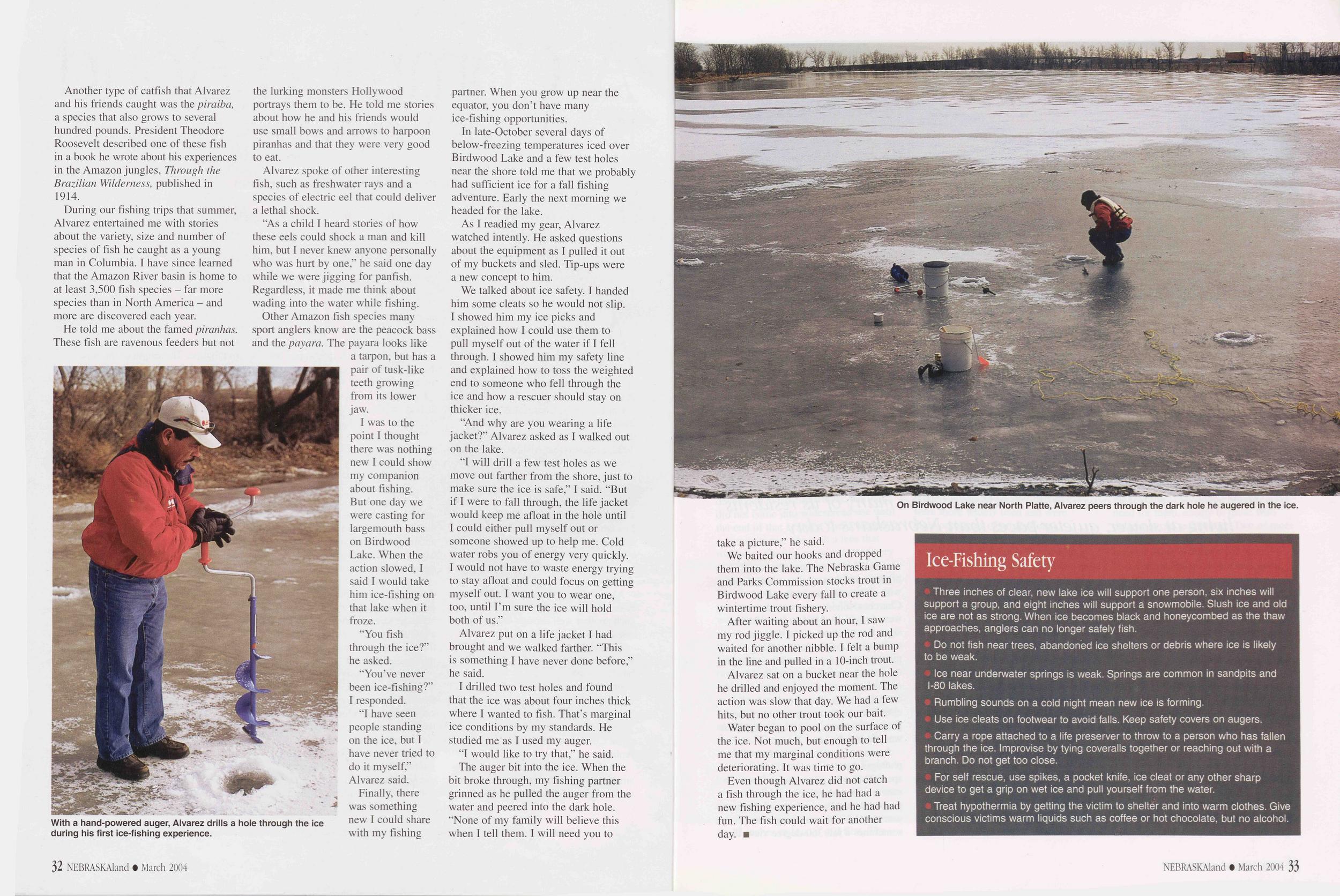
Another type of catfish that Alvarez and his friends caught was the piraiba, a species that also grows to several hundred pounds. President Theodore Roosevelt described one of these fish in a book he wrote about his experiences in the Amazon jungles, Through the Brazilian Wilderness, published in 1914.
During our fishing trips that summer, Alvarez entertained me with stories about the variety, size and number of species of fish he caught as a young man in Columbia. I have since learned that the Amazon River basin is home to at least 3,500 fish species - far more species than in North America - and more are discovered each year.
He told me about the famed piranhas. These fish are ravenous feeders but not
Alvarez spoke of other interesting fish, such as freshwater rays and a species of electric eel that could deliver a lethal shock.
"As a child I heard stories of how these eels could shock a man and kill him, but I never knew anyone personally who was hurt by one,” he said one day while we were jigging for panfish. Regardless, it made me think about wading into the water while fishing.
Other Amazon fish species many sport anglers know are the peacock bass and the payara. The payara looks like a tarpon, but has a pair of tusk-like teeth growing from its lower jaw.
I was to the point I thought there was nothing new I could show my companion about fishing. But one day we were casting for largemouth bass on Bird wood Lake. When the action slowed, I said I would take him ice-fishing on that lake when it froze.
"You fish through the ice?” he asked.
"You’ve never been ice-fishing?” I responded.
"I have seen people standing on the ice, but I have never tried to do it myself,” Alvarez said.
Finally, there was something new I could share with my fishing partner. When you grow up near the equator, you don’t have many ice-fishing opportunities.
In late-October several days of below-freezing temperatures iced over Bird wood Lake and a few test holes near the shore told me that we probably had sufficient ice for a fall fishing adventure. Early the next morning we headed for the lake.
As I readied my gear, Alvarez watched intently. He asked questions about the equipment as I pulled it out of my buckets and sled. Tip-ups were a new concept to him.
We talked about ice safety. I handed him some cleats so he would not slip. I showed him my ice picks and explained how I could use them to pull myself out of the water if I fell through. I showed him my safety line and explained how to toss the weighted end to someone who fell through the ice and how a rescuer should stay on thicker ice.
"And why are you wearing a life jacket?” Alvarez asked as I walked out on the lake.
"I will drill a few test holes as we move out farther from the shore, just to make sure the ice is safe,” I said. "But if I were to fall through, the life jacket would keep me afloat in the hole until I could either pull myself out or someone showed up to help me. Cold water robs you of energy very quickly. I would not have to waste energy trying to stay afloat and could focus on getting myself out. I want you to wear one, too, until I’m sure the ice will hold both of us.”
Alvarez put on a life jacket I had brought and we walked farther. "This is something I have never done before,” he said.
I drilled two test holes and found that the ice was about four inches thick where I wanted to fish. That’s marginal ice conditions by my standards. He studied me as I used my auger.
"I would like to try that,” he said.
The auger bit into the ice. When the bit broke through, my fishing partner grinned as he pulled the auger from the water and peered into the dark hole. "None of my family will believe this when I tell them. I will need you to 32 NEBRASKAland • March 2004
We baited our hooks and dropped them into the lake. The Nebraska Game and Parks Commission stocks trout in Bird wood Lake every fall to create a wintertime trout fishery.
After waiting about an hour, I saw my rod jiggle. I picked up the rod and waited for another nibble. I felt a bump in the line and pulled in a 10-inch trout.
Alvarez sat on a bucket near the hole he drilled and enjoyed the moment. The action was slow that day. We had a few hits, but no other trout took our bait.
Water began to pool on the surface of the ice. Not much, but enough to tell me that my marginal conditions were deteriorating. It was time to go.
Even though Alvarez did not catch a fish through the ice, he had had a new fishing experience, and he had had fun. The fish could wait for another day.
Ice-Fishing SafetyThree inches of clear, new lake ice will support one person, six inches will support a group, and eight inches will support a snowmobile. Slush ice and old ice are not as strong. When ice becomes black and honeycombed as the thaw approaches, anglers can no longer safely fish.
Do not fish near trees, abandoned ice shelters or debris where ice is likely to be weak.
Ice near underwater springs is weak. Springs are common in sandpits and 1-80 lakes.
Rumbling sounds on a cold night mean new ice is forming.
Use ice cleats on footwear to avoid falls. Keep safety covers on augers.
Carry a rope attached to a life preserver to throw to a person who has fallen through the ice. Improvise by tying coveralls together or reaching out with a branch. Do not get too close.
For self rescue, use spikes, a pocket knife, ice cleat or any other sharp device to get a grip on wet ice and pull yourself from the water.
Treat hypothermia by getting the victim to shelter and into warm clothes. Give conscious victims warm liquids such as coffee or hot chocolate, but no alcohol.
NEBRASKAland • March 2004 33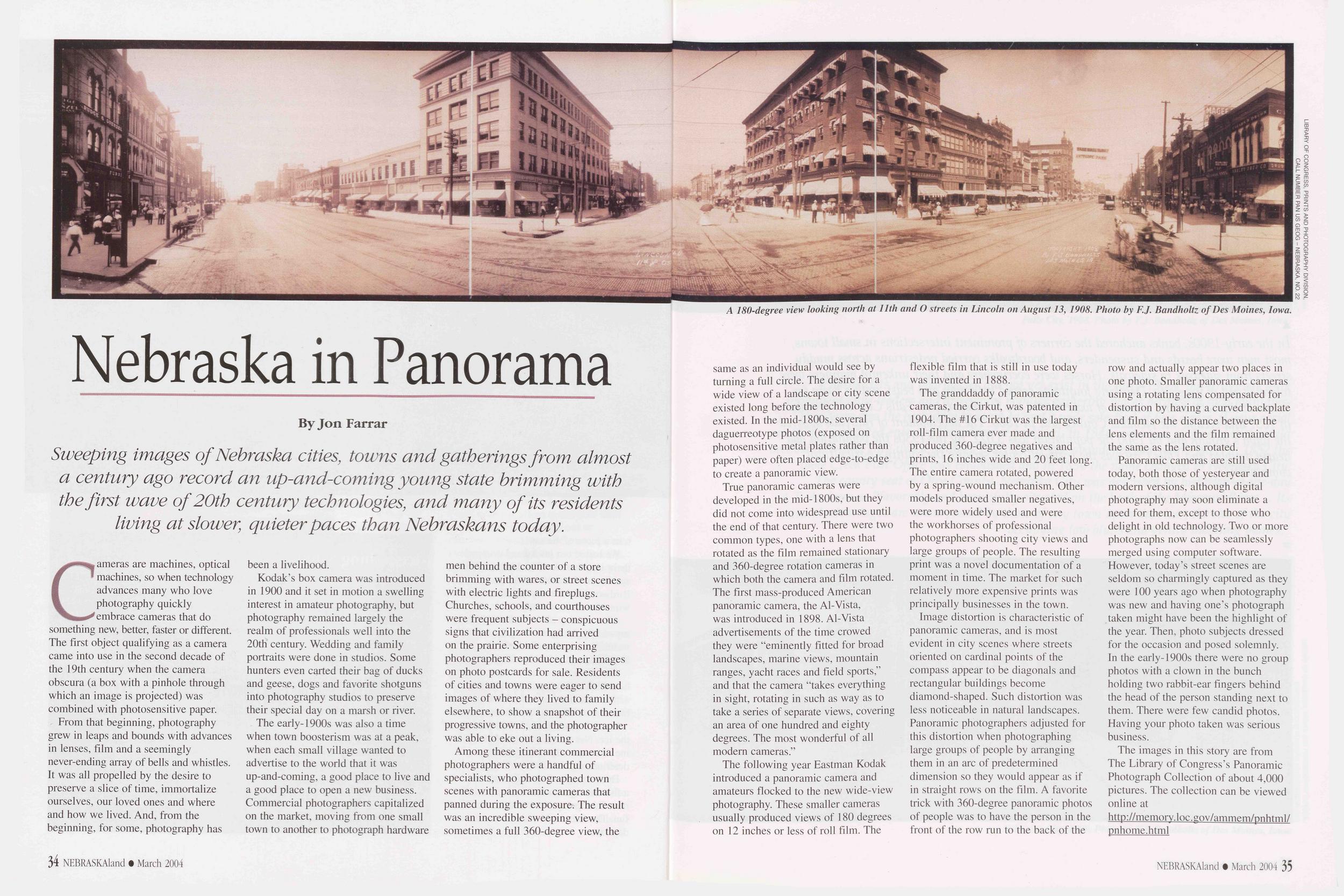
Sweeping images of Nebraska cities, towns and gatherings from almost a century ago record an up-and-coming young state brimming with the first wave of 20th century technologies, and many of its residents living at slower, quieter paces than Nebraskans today.
Cameras are machines, optical machines, so when technology advances many who love photography quickly embrace cameras that do something new, better, faster or different. The first object qualifying as a camera came into use in the second decade of the 19th century when the camera obscura (a box with a pinhole through which an image is projected) was combined with photosensitive paper.
From that beginning, photography grew in leaps and bounds with advances in lenses, film and a seemingly never-ending array of bells and whistles. It was all propelled by the desire to preserve a slice of time, immortalize ourselves, our loved ones and where and how we lived. And, from the beginning, for some, photography has been a livelihood.
Kodak’s box camera was introduced in 1900 and it set in motion a swelling interest in amateur photography, but photography remained largely the realm of professionals well into the 20th century. Wedding and family portraits were done in studios. Some hunters even carted their bag of ducks and geese, dogs and favorite shotguns into photography studios to preserve their special day on a marsh or river.
The early-1900s was also a time when town boosterism was at a peak, when each small village wanted to advertise to the world that it was up-and-coming, a good place to live and a good place to open a new business. Commercial photographers capitalized on the market, moving from one small town to another to photograph hardware men behind the counter of a store brimming with wares, or street scenes with electric lights and fireplugs. Churches, schools, and courthouses were frequent subjects - conspicuous signs that civilization had arrived on the prairie. Some enterprising photographers reproduced their images on photo postcards for sale. Residents of cities and towns were eager to send images of where they lived to family elsewhere, to show a snapshot of their progressive towns, and the photographer was able to eke out a living.
Among these itinerant commercial photographers were a handful of specialists, who photographed town scenes with panoramic cameras that panned during the exposure. The result was an incredible sweeping view, sometimes a full 360-degree view, the 34 NEBRASKAland • March 2004 same as an individual would see by turning a full circle. The desire for a wide view of a landscape or city scene existed long before the technology existed. In the mid-1800s, several daguerreotype photos (exposed on photosensitive metal plates rather than paper) were often placed edge-to-edge to create a panoramic view.
True panoramic cameras were developed in the mid-1800s, but they did not come into widespread use until the end of that century. There were two common types, one with a lens that rotated as the film remained stationary and 360-degree rotation cameras in which both the camera and film rotated. The first mass-produced American panoramic camera, the Al-Vista, was introduced in 1898. Al-Vista advertisements of the time crowed they were “eminently fitted for broad landscapes, marine views, mountain ranges, yacht races and field sports,” and that the camera “takes everything in sight, rotating in such as way as to take a series of separate views, covering an area of one hundred and eighty degrees. The most wonderful of all modern cameras.”
The following year Eastman Kodak introduced a panoramic camera and amateurs flocked to the new wide-view photography. These smaller cameras usually produced views of 180 degrees on 12 inches or less of roll film. The flexible film that is still in use today was invented in 1888.
The granddaddy of panoramic cameras, the Cirkut, was patented in 1904. The #16 Cirkut was the largest roll-film camera ever made and produced 360-degree negatives and prints, 16 inches wide and 20 feet long. The entire camera rotated, powered by a spring-wound mechanism. Other models produced smaller negatives, were more widely used and were the workhorses of professional photographers shooting city views and large groups of people. The resulting print was a novel documentation of a moment in time. The market for such relatively more expensive prints was principally businesses in the town.
Image distortion is characteristic of panoramic cameras, and is most evident in city scenes where streets oriented on cardinal points of the compass appear to be diagonals and rectangular buildings become diamond-shaped. Such distortion was less noticeable in natural landscapes. Panoramic photographers adjusted for this distortion when photographing large groups of people by arranging them in an arc of predetermined dimension so they would appear as if in straight rows on the film. A favorite trick with 360-degree panoramic photos of people was to have the person in the front of the row run to the back of the row and actually appear two places in one photo. Smaller panoramic cameras using a rotating lens compensated for distortion by having a curved backplate and film so the distance between the lens elements and the film remained the same as the lens rotated.
Panoramic cameras are still used today, both those of yesteryear and modern versions, although digital photography may soon eliminate a need for them, except to those who delight in old technology. Two or more photographs now can be seamlessly merged using computer software. However, today’s street scenes are seldom so charmingly captured as they were 100 years ago when photography was new and having one’s photograph taken might have been the highlight of the year. Then, photo subjects dressed for the occasion and posed solemnly. In the early-1900s there were no group photos with a clown in the bunch holding two rabbit-ear fingers behind the head of the person standing next to them. There were few candid photos. Having your photo taken was serious business.
The images in this story are from The Library of Congress’s Panoramic Photograph Collection of about 4,000 pictures. The collection can be viewed online at http ://memory. loc. gov/ammem/pnhtml/ pnhome.html
NEBRASKAland • March 2004 35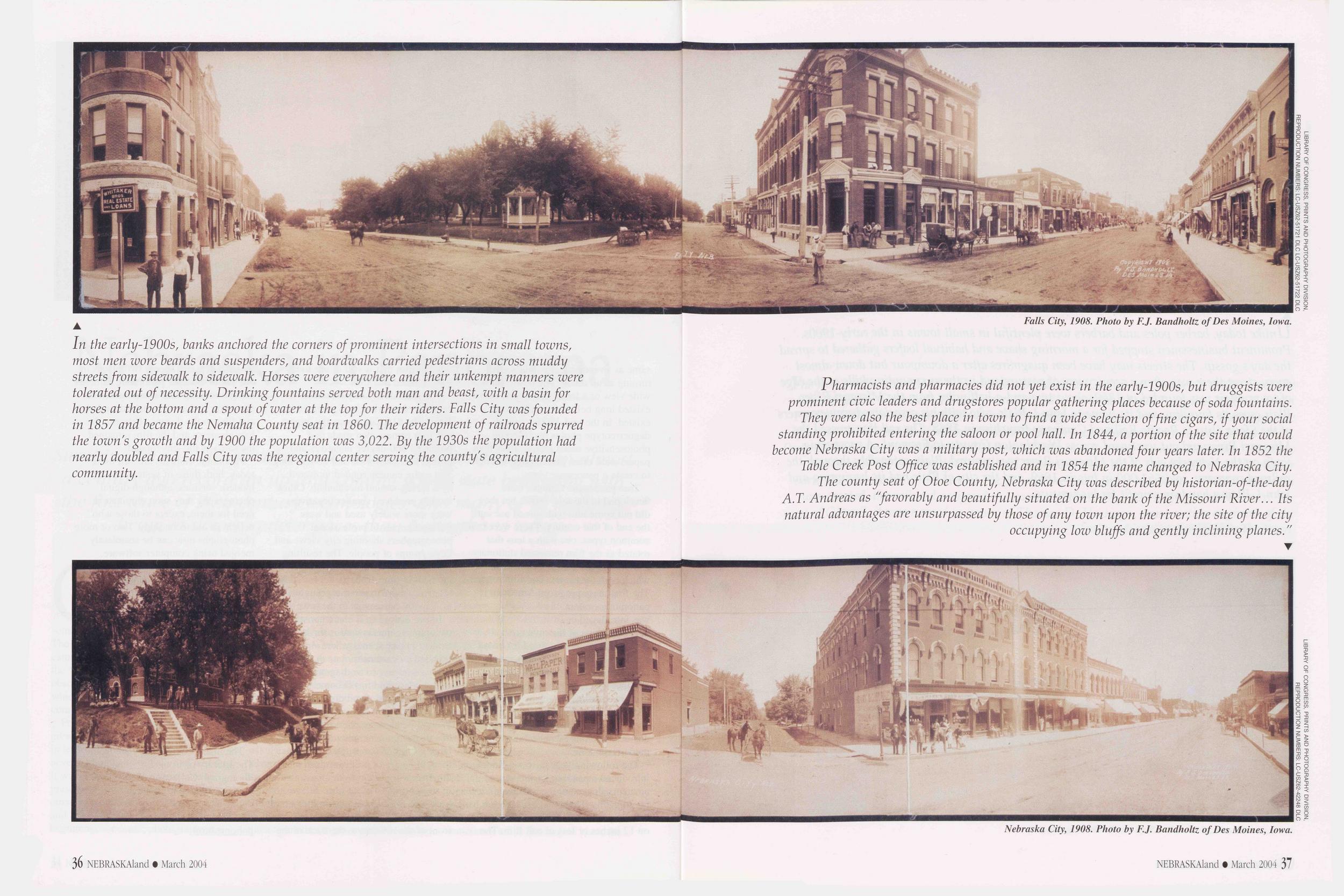
In the early-1900s, banks anchored the corners of prominent intersections in small towns, most men wore beards and suspenders, and boardwalks carried pedestrians across muddy streets from sidewalk to sidewalk. Horses were everywhere and their unkempt manners were tolerated out of necessity. Drinking fountains served both man and beast, with a basin for horses at the bottom and a spout of water at the top for their riders. Falls City was founded in 1857 and became the Nemaha County seat in 1860. The development of railroads spurred the town's growth and by 1900 the population was 3,022. By the 1930s the population had nearly doubled and Falls City was the regional center serving the county's agricultural community.
Pharmacists an pharmacies did not yet exist in the early-1900s, but druggists were prominent civic leaders and drugstores popular gathering places because of soda fountains. They were also the best place in town to find a wide selection of fine cigars, if your social standing prohibited entering the saloon or pool hall. In 1844, a portion of the site that would become Nebraska City was a military post, which was abandoned four years later. In 1852 the Table Creek Post Office was established and in 1854 the name changed to Nebraska City. The county seat of Otoe County, Nebraska City was described by historian-of-the-day A.T. Andreas as "favorably and beasutifully situated on the bank of the Missour River... Its by those of any town upon the river; the site of the city natural advantages are unsurpassed by those of any town upon the river; the site of the city occupying low bluffs and gently inclining planes."
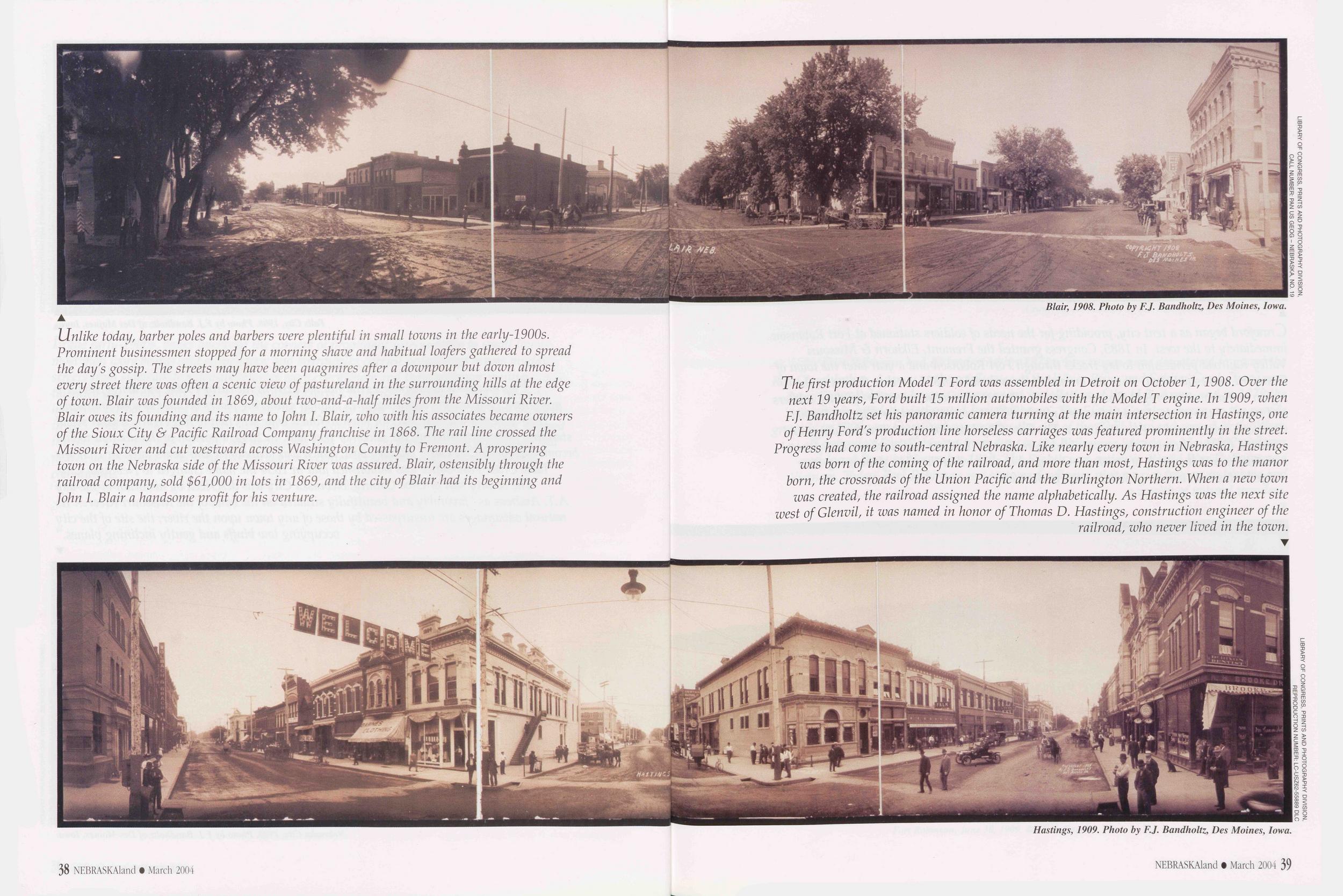
Unlike today, barber poles and barbers were plentiful in small towns in the early-1900s. Prominent businessmen stopped for a morning shave and habitual loafers gathered to spread the day's gossip. The streets may have been quagmires after a downpour but down almost every street there was often a scenic view of pastureland in the surrounding hills at the edge of town. Blair was founded in 1869, about two-and-a-half miles from the Missouri River. Blair owes its founding and its name to John I. Blair, who with his associates became owners of the Sioux City & Pacific Railroad Company franchise in 1868. The rail line crossed the Missouri River and cut westward across Washington County to Fremont. A prospering town on the Nebraska side of the Missouri River was assured. Blair, ostensibly through the railroad company, sold $61,000 in lots in 1869, and the city of Blair had its beginning and John I. Blair a handsome profit for his venture.
The first production Model T Ford was assembled in Detroit on October 1,1908. Over the next 19 years, Ford built 15 million automobiles with the Model T engine. In 1909, when F.J. Bandholtz set his panoramic camera turning at the main intersection in Hastings, one of Henry Ford's production line horseless carriages was featured prominently in the street. Progress had come to south-central Nebraska. Like nearly every town in Nebraska, Hastings was born of the coming of the railroad, and more than most, Hastings was to the manor born, the crossroads of the Union Pacific and the Burlington Northern. When a new town was created, the railroad assigned the name alphabetically. As Hastings was the next site west of Glenvil, it was named in honor of Thomas D. Hastings, construction engineer of the railroad, who never lived in the town.
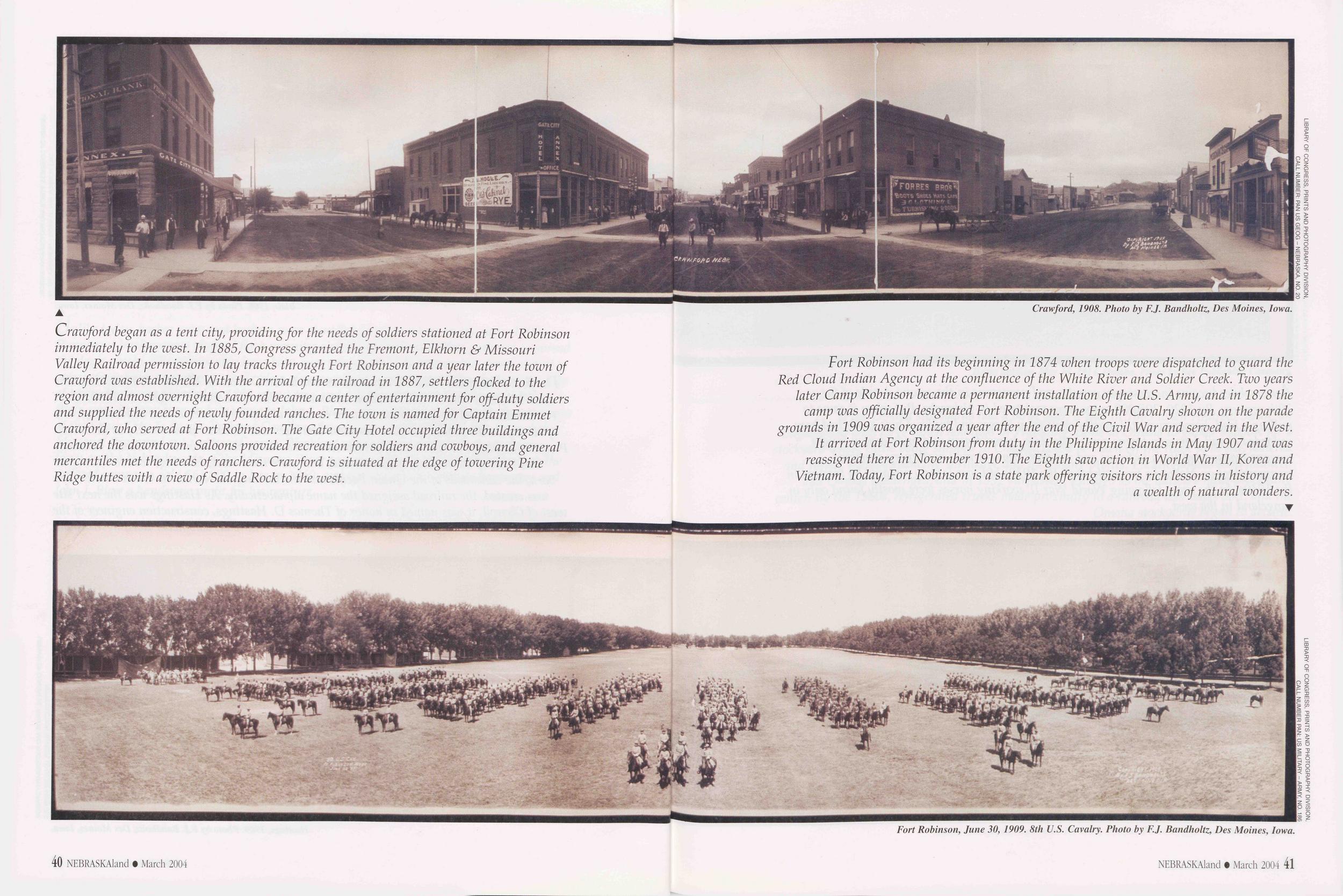
Crawford began as a tent city, providing for the needs of soldiers stationed at Fort Robinson immediately to the west. In 1885, Congress granted the Fremont, Elkhorn & Missouri Valley Railroad permission to lay tracks through Fort Robinson and a year later the town of Crawford was established. With the arrival of the railroad in 1887, settlers flocked to the region and almost overnight Crawford became a center of entertainment for off-duty soldiers and supplied the needs of newly founded ranches. The town is named for Captain Emmet Crawford, who served at Fort Robinson. The Gate City Hotel occupied three buildings and anchored the downtown. Saloons provided recreation for soldiers and cowboys, and general mercantiles met the needs of ranchers. Crawford is situated at the edge of towering Pine Ridge buttes with a view of Saddle Rock to the west.
Fort Robinson had its beginning in 1874 when troops were dispatched to guard the Red Cloud Indian Agency at the confluence of the White River and Soldier Creek. Two years later Camp Robinson became a permanent installation of the U.S. Army, and in 1878 the camp was officially designated Fort Robinson. The Eighth Cavalry shown on the parade grounds in 1909 was organized a year after the end of the Civil War and served in the West. It arrived at Fort Robinson from duty in the Philippine Islands in May 1907 and was reassigned there in November 1910. The Eighth saw action in World War II, Korea and Vietnam. Today, Fort Robinson is a state park offering visitors rich lessons in history and a wealth of natural wonders.
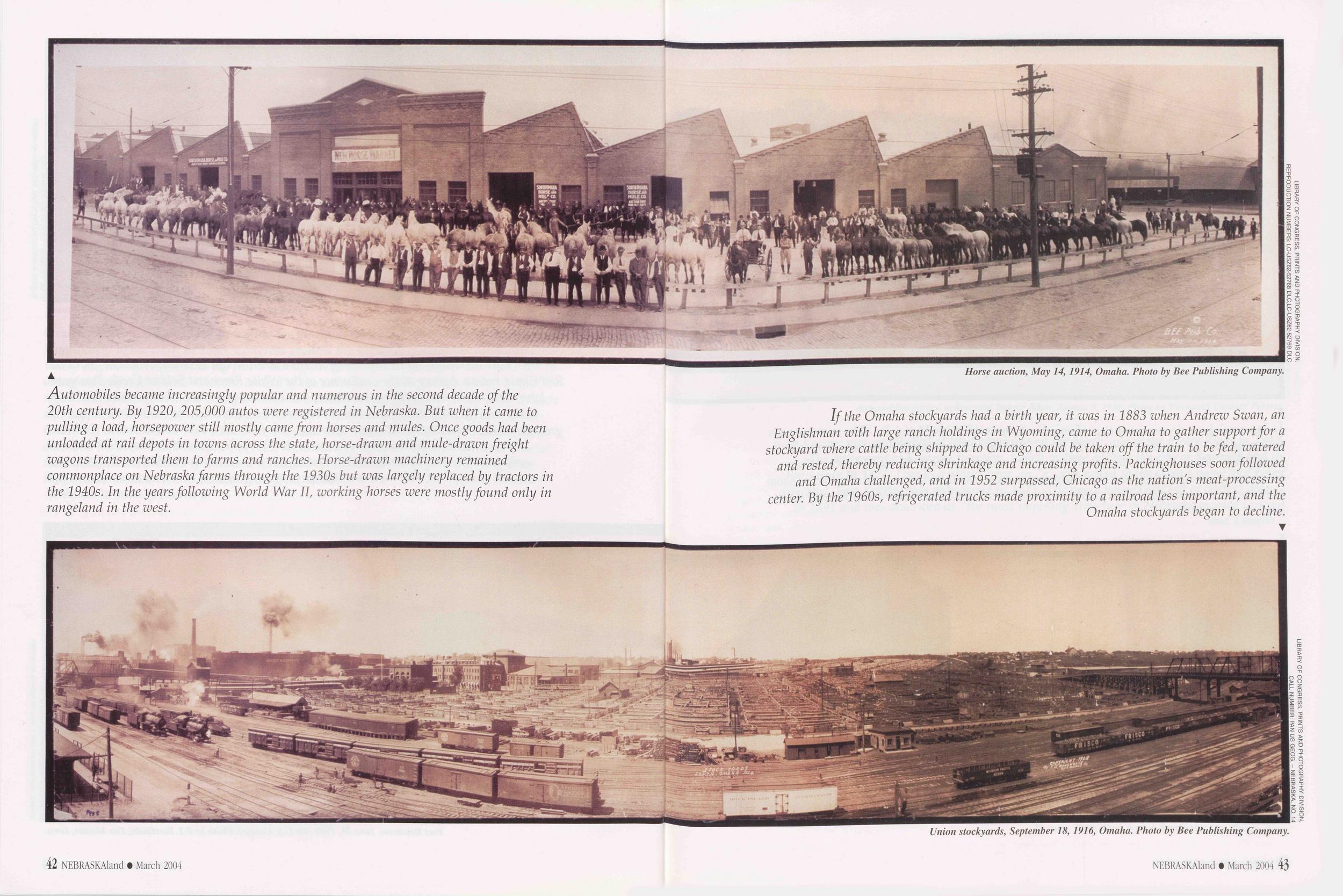
Automobiles became increasingly popular and numerous in the second decade of the 20th century. By 1920, 205,000 autos were registered in Nebraska. But when it came to pulling a load, horsepower still mostly came from horses and mules. Once goods had been unloaded at rail depots in towns across the state, horse-drawn and mule-drawn freight wagons transported them to farms and ranches. Horse-drawn machinery remained commonplace on Nebraska farms through the 1930s but was largely replaced by tractors in the 1940s. In the years following World War II, working horses were mostly found only in rangeland in the west.
If Omaha stockyards had a birth year, it waas in 1883 when Andrew Swan, an Englishman with large ranch holdings in Wyoming, came to Omaha to gather support for a stockyard where cattle being shipped to Chicago could be taken off the train to be fed, watered and rested, thereby reducing shrinkage and increasing profits. Packinghouses soon followed and Omaha challenged, and in 1952 surpassed, Chicago as the nation's meat-processing center. By the 1960s, refrigerated trucks made proximity to a railroad less important, and the Omaha stockyards began to decline.
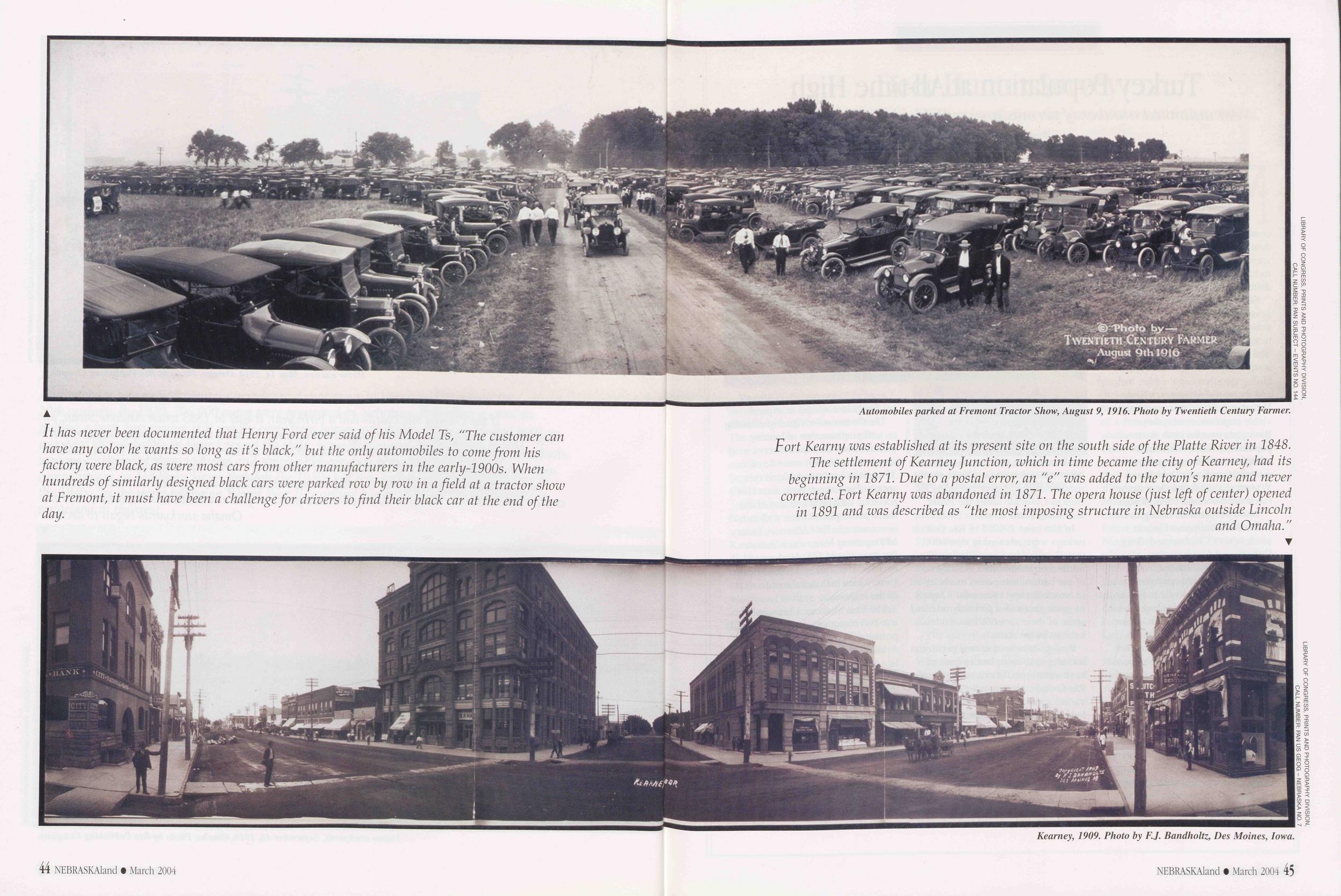
It has never been documented that Henry Ford ever said of his Model Ts, "The customer can have any color he wants so long as it's black," but the only automobiles to come from his factory were black, as were most cars from other manufacturers in the early-1900s. When hundreds of similarly designed black cars were parked row by row in afield at a tractor show at Fremont, it must have been a challenge for drivers to find their black car at the end of the day.
Fort Kearny was established at its present site on the south side of the Platte River in 1848. The settlement of Kearney Junction, which in time became the city of Kearney, had its beginning in 1871. Due to a postal error, an "e" was added to the town's name and never corrected. Fort Kearny was abandoned in 1871. The opera house (just left of center) opened in 1891 and was described as "the most imposing structure in Nebraska outside Lincoln and Omaha."
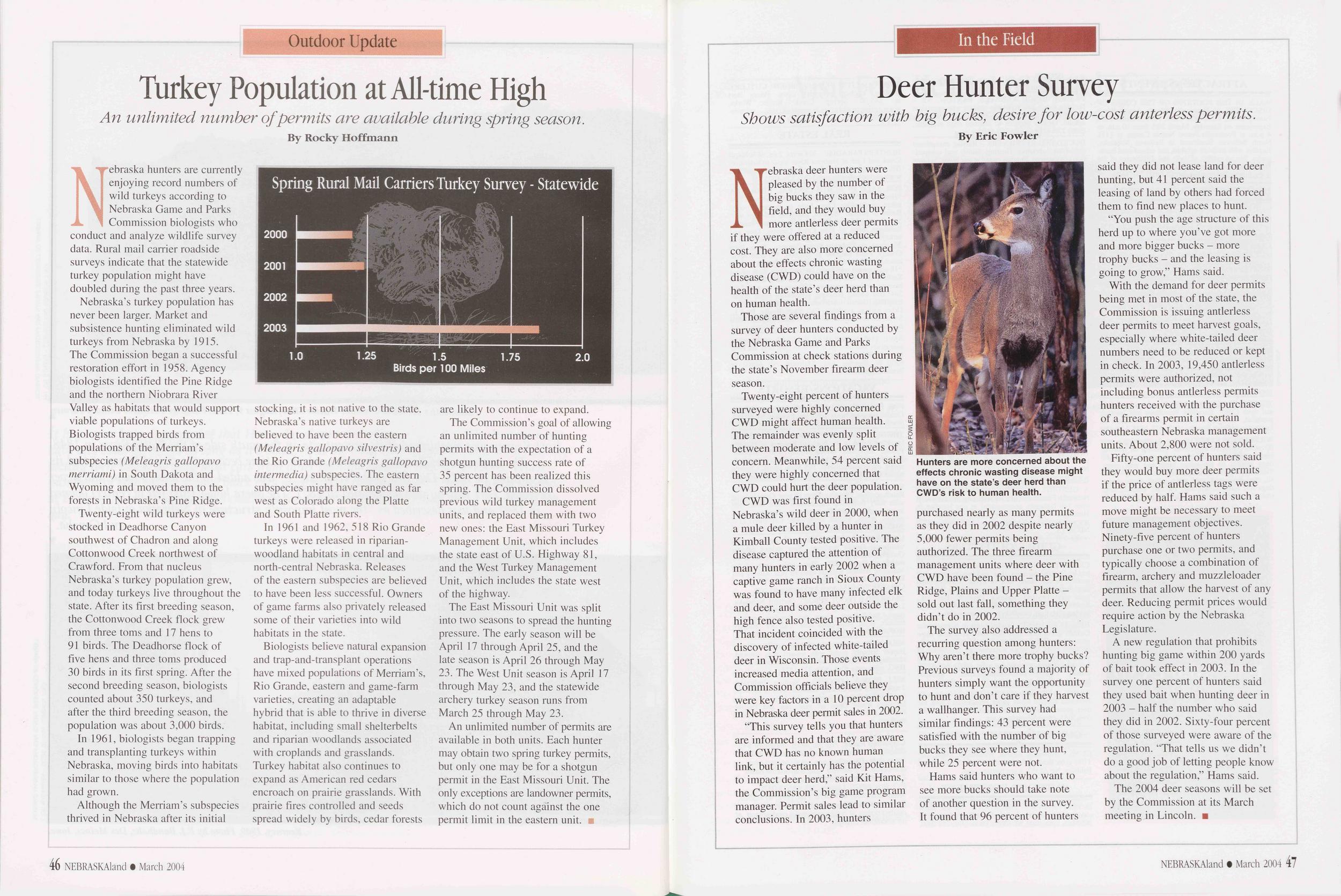
Outdoor Update
Turkey Population at All-time High
An unlimited number of permits are available during spring season. By Rocky HoffmannNebraska hunters are currently enjoying record numbers of wild turkeys according to Nebraska Game and Parks Commission biologists who conduct and analyze wildlife survey data. Rural mail carrier roadside surveys indicate that the statewide turkey population might have doubled during the past three years.
Nebraska’s turkey population has never been larger. Market and subsistence hunting eliminated wild turkeys from Nebraska by 1915. The Commission began a successful restoration effort in 1958. Agency biologists identified the Pine Ridge and the northern Niobrara River Valley as habitats that would support viable populations of turkeys. Biologists trapped birds from populations of the Merriam’s subspecies (Meleagris gallopavo merriami) in South Dakota and Wyoming and moved them to the forests in Nebraska’s Pine Ridge.
Twenty-eight wild turkeys were stocked in Deadhorse Canyon southwest of Chadron and along Cottonwood Creek northwest of Crawford. From that nucleus Nebraska’s turkey population grew, and today turkeys live throughout the state. After its first breeding season, the Cottonwood Creek flock grew from three toms and 17 hens to 91 birds. The Deadhorse flock of five hens and three toms produced 30 birds in its first spring. After the second breeding season, biologists counted about 350 turkeys, and after the third breeding season, the population was about 3,000 birds.
In 1961, biologists began trapping and transplanting turkeys within Nebraska, moving birds into habitats similar to those where the population had grown.
Although the Merriam’s subspecies thrived in Nebraska after its initial
In 1961 and 1962, 518 Rio Grande turkeys were released in riparian- woodland habitats in central and north-central Nebraska. Releases of the eastern subspecies are believed to have been less successful. Owners of game farms also privately released some of their varieties into wild habitats in the state.
Biologists believe natural expansion and trap-and-transplant operations have mixed populations of Merriam’s, Rio Grande, eastern and game-farm varieties, creating an adaptable hybrid that is able to thrive in diverse habitat, including small shelterbelts and riparian woodlands associated with croplands and grasslands. Turkey habitat also continues to expand as American red cedars encroach on prairie grasslands. With prairie fires controlled and seeds spread widely by birds, cedar forests are likely to continue to expand.
The Commission’s goal of allowing an unlimited number of hunting permits with the expectation of a shotgun hunting success rate of 35 percent has been realized this spring. The Commission dissolved previous wild turkey management units, and replaced them with two new ones: the East Missouri Turkey Management Unit, which includes the state east of U.S. Highway 81, and the West Turkey Management Unit, which includes the state west of the highway.
The East Missouri Unit was split into two seasons to spread the hunting pressure. The early season will be April 17 through April 25, and the late season is April 26 through May 23. The West Unit season is April 17 through May 23, and the statewide archery turkey season runs from March 25 through May 23.
An unlimited number of permits are available in both units. Each hunter may obtain two spring turkey permits, but only one may be for a shotgun permit in the East Missouri Unit. The only exceptions are landowner permits, which do not count against the one permit limit in the eastern unit.
46 NEBRASKAland • March 2004In the Field
Deer Hunter Survey
Shows satisfaction with big bucks, desire for low-cost anterless permits. By Eric FowlerNebraska deer hunters were pleased by the number of big bucks they saw in the field, and they would buy more antlerless deer permits if they were offered at a reduced cost. They are also more concerned about the effects chronic wasting disease (CWD) could have on the health of the state’s deer herd than on human health.
Those are several findings from a survey of deer hunters conducted by the Nebraska Game and Parks Commission at check stations during the state’s November firearm deer season.
Twenty-eight percent of hunters surveyed were highly concerned CWD might affect human health. The remainder was evenly split between moderate and low levels of concern. Meanwhile, 54 percent said they were highly concerned that CWD could hurt the deer population.
CWD was first found in Nebraska’s wild deer in 2000, when a mule deer killed by a hunter in Kimball County tested positive. The disease captured the attention of many hunters in early 2002 when a captive game ranch in Sioux County was found to have many infected elk and deer, and some deer outside the high fence also tested positive. That incident coincided with the discovery of infected white-tailed deer in Wisconsin. Those events increased media attention, and Commission officials believe they were key factors in a 10 percent drop in Nebraska deer permit sales in 2002.
“This survey tells you that hunters are informed and that they are aware that CWD has no known human link, but it certainly has the potential to impact deer herd,” said Kit Hams, the Commission’s big game program manager. Permit sales lead to similar conclusions. In 2003, hunters
The survey also addressed a recurring question among hunters: Why aren’t there more trophy bucks? Previous surveys found a majority of hunters simply want the opportunity to hunt and don’t care if they harvest a wallhanger. This survey had similar findings: 43 percent were satisfied with the number of big bucks they see where they hunt, while 25 percent were not.
Hams said hunters who want to see more bucks should take note of another question in the survey. It found that 96 percent of hunters said they did not lease land for deer hunting, but 41 percent said the leasing of land by others had forced them to find new places to hunt.
“You push the age structure of this herd up to where you’ve got more and more bigger bucks - more trophy bucks - and the leasing is going to grow,” Hams said.
With the demand for deer permits being met in most of the state, the Commission is issuing antlerless deer permits to meet harvest goals, especially where white-tailed deer numbers need to be reduced or kept in check. In 2003, 19,450 antlerless permits were authorized, not including bonus antlerless permits hunters received with the purchase of a firearms permit in certain southeastern Nebraska management units. About 2,800 were not sold.
Fifty-one percent of hunters said they would buy more deer permits if the price of antlerless tags were reduced by half. Hams said such a move might be necessary to meet future management objectives. Ninety-five percent of hunters purchase one or two permits, and typically choose a combination of firearm, archery and muzzleloader permits that allow the harvest of any deer. Reducing permit prices would require action by the Nebraska Legislature.
A new regulation that prohibits hunting big game within 200 yards of bait took effect in 2003. In the survey one percent of hunters said they used bait when hunting deer in 2003 - half the number who said they did in 2002. Sixty-four percent of those surveyed were aware of the regulation. “That tells us we didn’t do a good job of letting people know about the regulation,” Hams said. The 2004 deer seasons will be set by the Commission at its March meeting in Lincoln.
NEBRASKAland • March 2004 47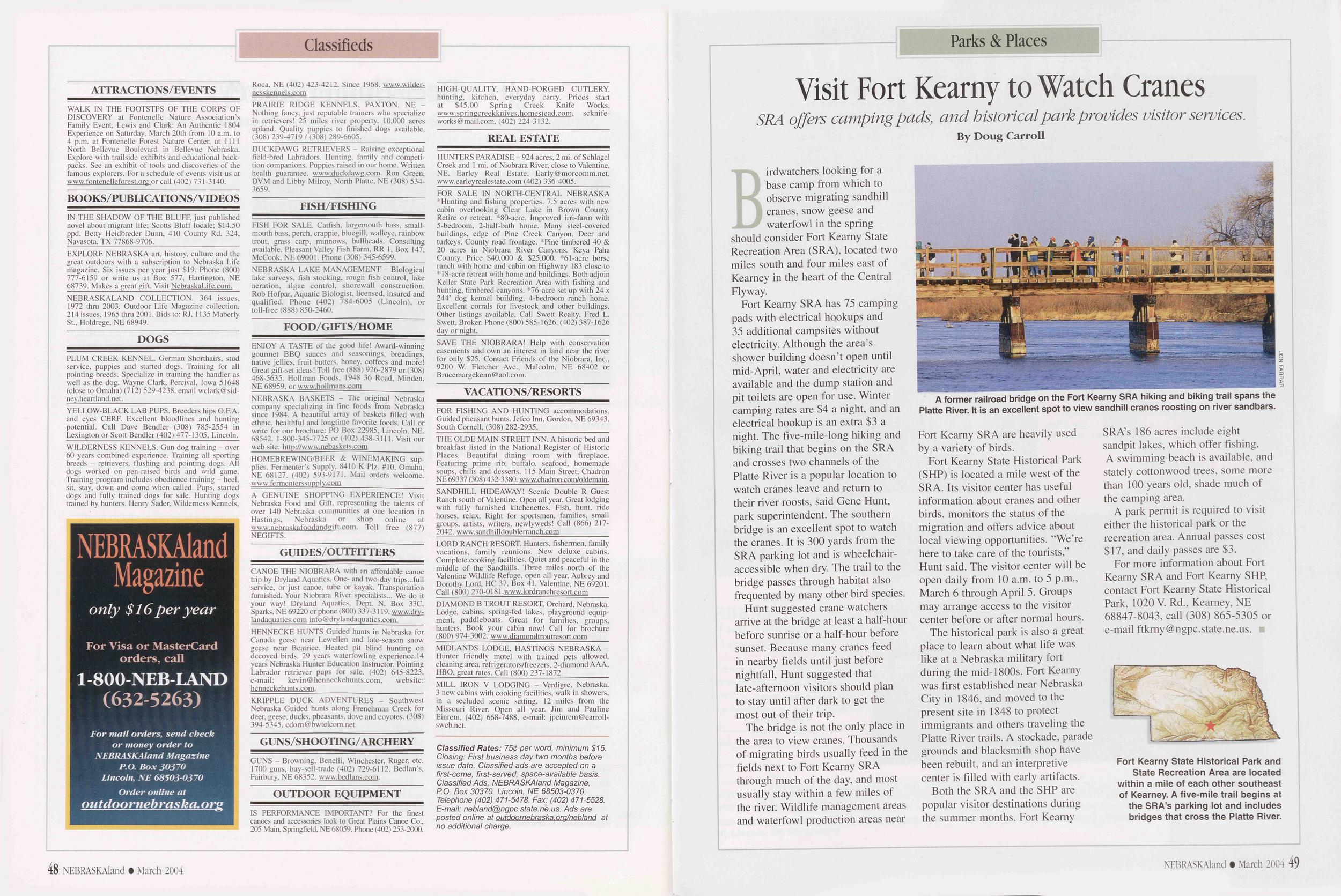
Classifieds
ATTRACTION S/EVENTSWALK IN THE FOOTSTPS OF THE CORPS OF DISCOVERY at Fontenelle Nature Association’s Family Event, Lewis and Clark: An Authentic 1804 Experience on Saturday, March 20th from 10 a.m. to 4 p.m. at Fontenelle Forest Nature Center, at 1111 North Bellevue Boulevard in Bellevue Nebraska. Explore with trailside exhibits and educational back- packs. See an exhibit of tools and discoveries of the famous explorers. For a schedule of events visit us at www.fontenelleforest.org or call (402) 731-3140.
BOOKS/PUBLICATIONS/VIDEOSIN THE SHADOW OF THE BLUFF, just published novel about migrant life; Scotts Bluff locale; $14.50 ppd. Betty Heidbreder Dunn, 410 County Rd. 324, Navasota. TX 77868-9706.
EXPLORE NEBRASKA art, history, culture and the great outdoors with a subscription to Nebraska Life magazine. Six issues per year just $19. Phone (800) 777-6159 or write us at Box 577, Hartington, NE 68739. Makes a great gift. Visit NebraskaLife.com.
NEBRASKALAND COLLECTION. 364 issues, 1972 thru 2003. Outdoor Life Magazine collection. 214 issues, 1965 thru 2001. Bids to: RJ, 1135 Maberly St., Holdrege, NE 68949.
DOGSPLUM CREEK KENNEL. German Shorthairs, stud service, puppies and started dogs. Training for all pointing breeds. Specialize in training the handler as well as the dog. Wayne Clark, Percival, Iowa 51648 (close to Omaha) (712) 529-4238, email wclark@sid- ney.heartland.net.
YELLOW-BLACK LAB PUPS. Breeders hips O.F.A. and eyes CERF. Excellent bloodlines and hunting potential. Call Dave Bendler (308) 785-2554 in Lexington or Scott Bendler (402) 477-1305, Lincoln.
WILDERNESS KENNELS. Gun dog training - over 60 years combined experience. Training all sporting breeds - retrievers, flushing and pointing dogs. All dogs worked on pen-raised birds and wild game. Training program includes obedience training - heel, sit, stay, down and come when called. Pups, started dogs and fully trained dogs for sale. Hunting dogs trained by hunters. Henry Sader, Wilderness Kennels,
PRAIRIE RIDGE KENNELS, PAXTON, NE - Nothing fancy, just reputable trainers who specialize in retrievers! 25 miles river property, 10,000 acres upland. Quality puppies to finished dogs available. (308) 239-4719 / (308) 289-6605.
DUCKDAWG RETRIEVERS - Raising exceptional field-bred Labradors. Hunting, family and competi- tion companions. Puppies raised in our home. Written health guarantee, www.duckdawg.com. Ron Green, DVM and Libby Milroy, North Platte, NE (308) 534- 3659.
FISH/FISHINGFISH FOR SALE. Catfish, largemouth bass, small- mouth bass, perch, crappie, bluegill, walleye, rainbow trout, grass carp, minnows, bullheads. Consulting available. Pleasant Valley Fish Farm, RR 1, Box 147, McCook, NE 6900L Phone (308) 345-6599.
NEBRASKA LAKE MANAGEMENT - Biological lake surveys, fish stocking, rough fish control, lake aeration, algae control, shorewall construction. Rob Hofpar. Aquatic Biologist, licensed, insured and qualified. Phone (402) 784-6005 (Lincoln), or toll-free (888) 850-2460.
FOOD/GIFTS/HOMEENJOY A TASTE of the good life! Award-winning gourmet BBQ sauces and seasonings, breadings, native jellies, fruit butters, honey, coffees and more! Great gift-set ideas! Toll free (888) 926-2879 or (308) 468-5635. Hollman Foods, 1948 36 Road, Minden, NE 68959, or www.hollmans.com
NEBRASKA BASKETS - The original Nebraska company specializing in fine foods from Nebraska since 1984. A beautiful array of baskets filled with ethnic, healthful and longtime favorite foods. Call or write for our brochure: PO Box 22985, Lincoln, NE. 68542. 1-800-345-7725 or (402) 438-3111. Visit our web site: http://www.nebaskets.com
HOMEBREWING/BEER & WINEMAKING sup- plies. Fermenter’s Supply. 8410 K Plz. #10, Omaha, NE 68127. (402) 593-9171. Mail orders welcome. www.fermenterssupplv.com
A GENUINE SHOPPING EXPERIENCE! Visit Nebraska Food and Gift, representing the talents of over 140 Nebraska communities at one location in Hastings, Nebraska or shop online at www.nebraskafoodandgift.com. Toll free (877) NEGIFTS.
GUIDES/OUTFITTERSCANOE THE NIOBRARA with an affordable canoe trip by Dryland Aquatics. One- and two-day trips...full service, or just canoe, tube or kayak. Transportation furnished. Your Niobrara River specialists... We do it your way! Dryland Aquatics, Dept. N, Box 33C, Sparks, NE 69220 or phone (800) 337-3119. www.drv- landaquatics.com info@drylandaquatics.com.
HENNECKE HUNTS Guided hunts in Nebraska for Canada geese near Lewellen and late-season snow geese near Beatrice. Heated pit blind hunting on decoyed birds. 29 years waterfowling experience. 14 years Nebraska Hunter Education Instructor. Pointing Labrador retriever pups for sale. (402) 645-8223, e-mail: kevin@henneckehunts.com, website: henneckehunts.com.
KRIPPLE DUCK ADVENTURES - Southwest Nebraska Guided hunts along Frenchman Creek for deer, geese, ducks, pheasants, dove and coyotes. (308) 394-5345, edorn@bwtelcom.net.
GUNS/SHOOTING/ARCHERYGUNS - Browning, Benelli. Winchester, Ruger, etc. 1700 guns, buy-sell-trade (402) 729-6112, Bedlan’s, Fairbury, NE 68352. www.bedlans.com.
OUTDOOR EQUIPMENTIS PERFORMANCE IMPORTANT? For the finest canoes and accessories look to Great Plains Canoe Co., 205 Main. Springfield, NE 68059. Phone (402) 253-2000.
HIGH-QUALITY, HAND-FORGED CUTLERY, hunting, kitchen, everyday carry. Prices start at $45.00 Spring Creek Knife Works, www.springcreekknives.homestead.com. scknife- works@mail.com, (402) 224-3132.
REAL ESTATEHUNTERS PARADISE - 924 acres, 2 mi. of Schlagel Creek and 1 mi. of Niobrara River, close to Valentine, NE. Earley Real Estate. Early@morcomm.net, www.earleyrealestate.com (402) 336-4005.
FOR SALE IN NORTH-CENTRAL NEBRASKA *Hunting and fishing properties. 7.5 acres with new cabin overlooking Clear Lake in Brown County. Retire or retreat. *80-acre. Improved irri-farm with 5-bedroom, 2-half-bath home. Many steel-covered buildings, edge of Pine Creek Canyon. Deer and turkeys. County road frontage. *Pine timbered 40 & 20 acres in Niobrara River Canyons. Keya Paha County. Price $40,000 & $25,000. *61-acre horse ranch with home and cabin on Highway 183 close to * 18-acre retreat with home and buildings. Both adjoin Keller State Park Recreation Area with fishing and hunting, timbered canyons. *76-acre set up with 24 x 244’ dog kennel building, 4-bedroom ranch home. Excellent corrals for livestock and other buildings. Other listings available. Call Swett Realty. Fred L. Swett, Broker. Phone (800) 585-1626. (402) 387-1626 day or night.
SAVE THE NIOBRARA! Help with conservation easements and own an interest in land near the river for only $25. Contact Friends of the Niobrara, Inc., 9200 W. Fletcher Ave., Malcolm, NE 68402 or Brucemargekenn @aol.com.
VACATIONS/RESORTSFOR FISHING AND HUNTING accommodations. Guided pheasant hunts. Jefco Inn, Gordon, NE 69343. South Cornell, (308) 282-2935.
THE OLDE MAIN STREET INN. A historic bed and breakfast listed in the National Register of Historic Places. Beautiful dining room with fireplace. Featuring prime rib, buffalo, seafood, homemade soups, chilis and desserts. 115 Main Street, Chadron NE 69337 (308) 432-3380. www.chadron.com/oldemain.
SANDHILL HIDEAWAY! Scenic Double R Guest Ranch south of Valentine. Open all year. Great lodging with fully furnished kitchenettes. Fish, hunt, ride horses, relax. Right for sportsmen, families, small groups, artists, writers, newlyweds! Call (866) 217- 2042. www.sandhilldoublerranch.com
LORD RANCH RESORT. Hunters, fishermen, family vacations, family reunions. New deluxe cabins. Complete cooking facilities. Quiet and peaceful in the middle of the Sandhills. Three miles north of the Valentine Wildlife Refuge, open all year. Aubrey and Dorothy Lord, HC 37, Box 41, Valentine, NE 69201. Call (800) 270-0181.www.lordranchresort.com
DIAMOND B TROUT RESORT, Orchard, Nebraska. Lodge, cabins, spring-fed lakes, playground equip- ment, paddleboats. Great for families, groups, hunters. Book your cabin now! Call for brochure (800) 974-3002. www.diamondtroutresort.com
MIDLANDS LODGE, HASTINGS NEBRASKA - Hunter friendly motel with trained pets allowed, cleaning area, refrigerators/freezers, 2-diamond AAA, HBO, great rates. Call (800) 237-1872.
MILL IRON V LODGING - Verdigre, Nebraska. 3 new cabins with cooking facilities, walk in showers, in a secluded scenic setting. 12 miles from the Missouri River. Open all year. Jim and Pauline Einrem, (402) 668-7488, e-mail: jpeinrem@carroll- sweb.net.
Classified Rates: 75¢ per word, minimum $15. Closing: First business day two months before issue date. Classified ads are accepted on a first-come, first-served, space-available basis. Classified Ads, NEBRASKAland Magazine, P.O. Box 30370, Lincoln, NE 68503-0370. Telephone (402) 471-5478. Fax: (402) 471-5528. E-mail: nebland@ngpc.state.ne.us. Ads are posted online at outdoornebraska. ora/nebland at no additional charge. 48 NEBRASKAland • March 2004Parks & Places
Visit Fort Kearny to Watch Cranes
SRA offers camping pads, and historical park provides visitor services. By Doug CarrollBirdwatchers looking for a base camp from which to observe migrating sandhill cranes, snow geese and waterfowl in the spring should consider Fort Kearny State Recreation Area (SRA), located two miles south and four miles east of Kearney in the heart of the Central Flyway.
Fort Kearny SRA has 75 camping pads with electrical hookups and 35 additional campsites without electricity. Although the area’s shower building doesn’t open until mid-April, water and electricity are available and the dump station and pit toilets are open for use. Winter camping rates are $4 a night, and an electrical hookup is an extra $3 a night. The five-mile-long hiking and biking trail that begins on the SRA and crosses two channels of the Platte River is a popular location to watch cranes leave and return to their river roosts, said Gene Hunt, park superintendent. The southern bridge is an excellent spot to watch the cranes. It is 300 yards from the SRA parking lot and is wheelchair- accessible when dry. The trail to the bridge passes through habitat also frequented by many other bird species.
Hunt suggested crane watchers arrive at the bridge at least a half-hour before sunrise or a half-hour before sunset. Because many cranes feed in nearby fields until just before nightfall, Hunt suggested that late-afternoon visitors should plan to stay until after dark to get the most out of their trip.
The bridge is not the only place in the area to view cranes. Thousands of migrating birds usually feed in the fields next to Fort Kearny SRA through much of the day, and most usually stay within a few miles of the river. Wildlife management areas and waterfowl production areas near
Fort Kearny State Historical Park (SHP) is located a mile west of the SRA. Its visitor center has useful information about cranes and other birds, monitors the status of the migration and offers advice about local viewing opportunities. “We’re here to take care of the tourists,” Hunt said. The visitor center will be open daily from 10 a.m. to 5 p.m., March 6 through April 5. Groups may arrange access to the visitor center before or after normal hours.
The historical park is also a great place to learn about what life was like at a Nebraska military fort during the mid-1800s. Fort Kearny was first established near Nebraska City in 1846, and moved to the present site in 1848 to protect immigrants and others traveling the Platte River trails. A stockade, parade grounds and blacksmith shop have been rebuilt, and an interpretive center is filled with early artifacts.
Both the SRA and the SHP are popular visitor destinations during the summer months. Fort Kearny SRA’s 186 acres include eight sandpit lakes, which offer fishing. A swimming beach is available, and stately cottonwood trees, some more than 100 years old, shade much of the camping area.
A park permit is required to visit either the historical park or the recreation area. Annual passes cost $17, and daily passes are $3.
For more information about Fort Kearny SRA and Fort Kearny SHP, contact Fort Kearny State Historical Park, 1020 V. Rd., Kearney, NE 68847-8043, call (308) 865-5305 or e-mail ftkrny@ngpc.state.ne.us.
Fort Kearny State Historical Park and State Recreation Area are located within a mile of each other southeast of Kearney. A five-mile trail begins at the SRA’s parking lot and includes bridges that cross the Platte River.
NEBRASKAland • March 2004 49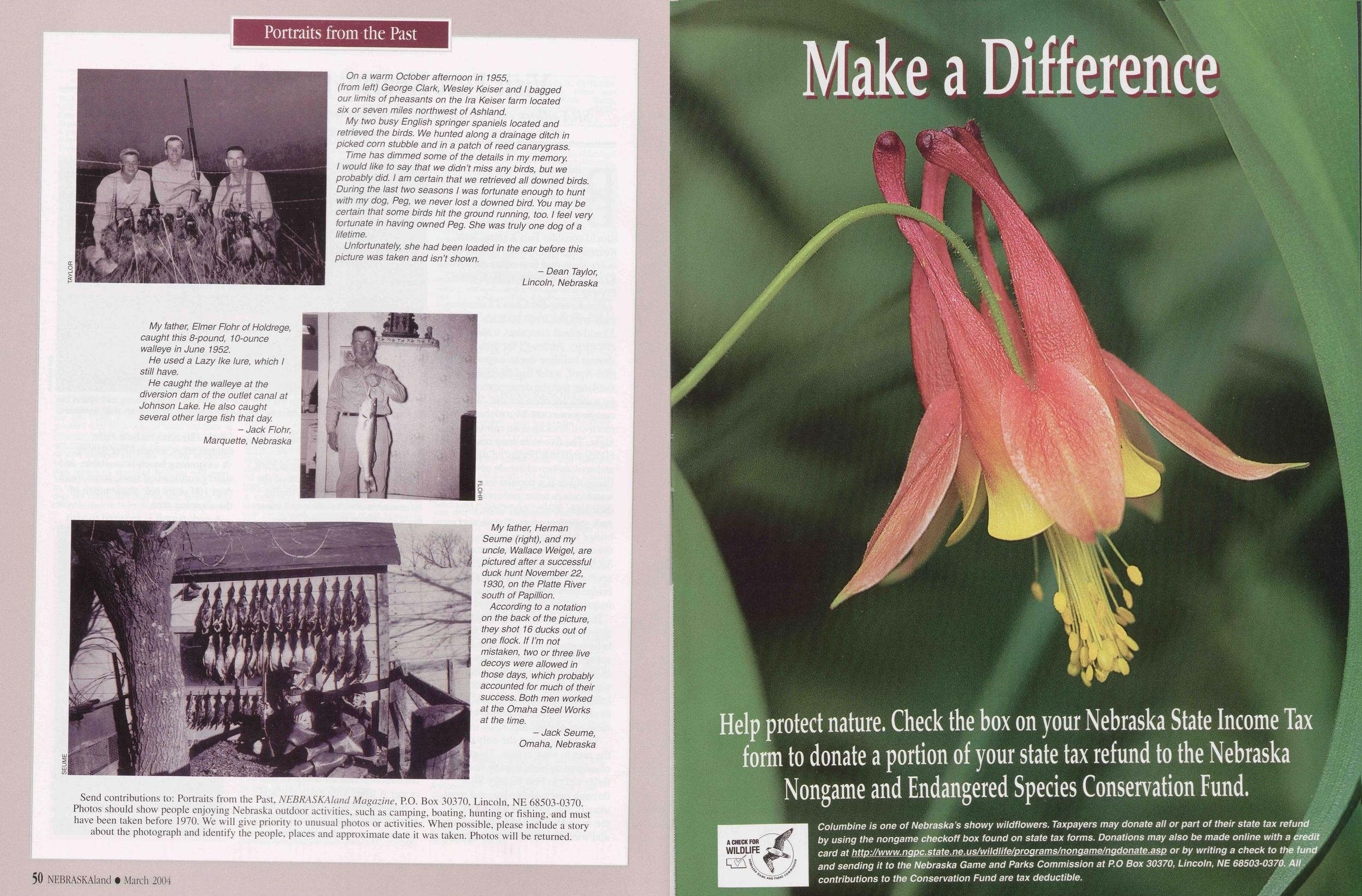
Portraits from the Past
On a warm October afternoon in 1955, (from left) George Clark, Wesley Keiser and I bagged our limits of pheasants on the Ira Keiser farm located six or seven miles northwest of Ashland.
My two busy English springer spaniels located and retrieved the birds. We hunted along a drainage ditch in picked corn stubble and in a patch of reed canarygrass.
Time has dimmed some of the details in my memory. I would like to say that we didn’t miss any birds, but we probably did. I am certain that we retrieved all downed birds. During the last two seasons I was fortunate enough to hunt with my dog, Peg, we never lost a downed bird. You may be certain that some birds hit the ground running, too. I feel very fortunate in having owned Peg. She was truly one dog of a lifetime.
Unfortunately, she had been loaded in the car before this picture was taken and isn’t shown.
- Dean Taylor, Lincoln, NebraskaMy father, Elmer Flohr of Holdrege, caught this 8-pound, 10-ounce walleye in June 1952.
He used a Lazy Ike lure, which I still have.
He caught the walleye at the diversion dam of the outlet canal at Johnson Lake. He also caught several other large fish that day.
- Jack Flohr, Marquette, NebraskaMy father, Herman Seume (right), and my uncle, Wallace Weigel, are pictured after a successful duck hunt November 22, 1930, on the Platte River south of Papillion.
According to a notation on the back of the picture, they shot 16 ducks out of one flock. If I’m not mistaken, two or three live decoys were allowed in those days, which probably accounted for much of their success. Both men worked at the Omaha Steel Works at the time.
- Jack Seume, Omaha, NebraskaSend contributions to: Portraits from the Past, NEBRASKAland Magazine, P.O. Box 30370, Lincoln, NE 68503-0370. Photos should show people enjoying Nebraska outdoor activities, such as camping, boating, hunting or fishing, and must have been taken before 1970. We will give priority to unusual photos or activities. When possible, please include a story about the photograph and identify the people, places and approximate date it was taken. Photos will be returned.
50 NEBRASKAland • March 2004
Position: 877 (8 views)