Volume 81, Issue 9, 2003
NEBRASKAland
Nebraska Game & Parks Commission November 2003 $2.50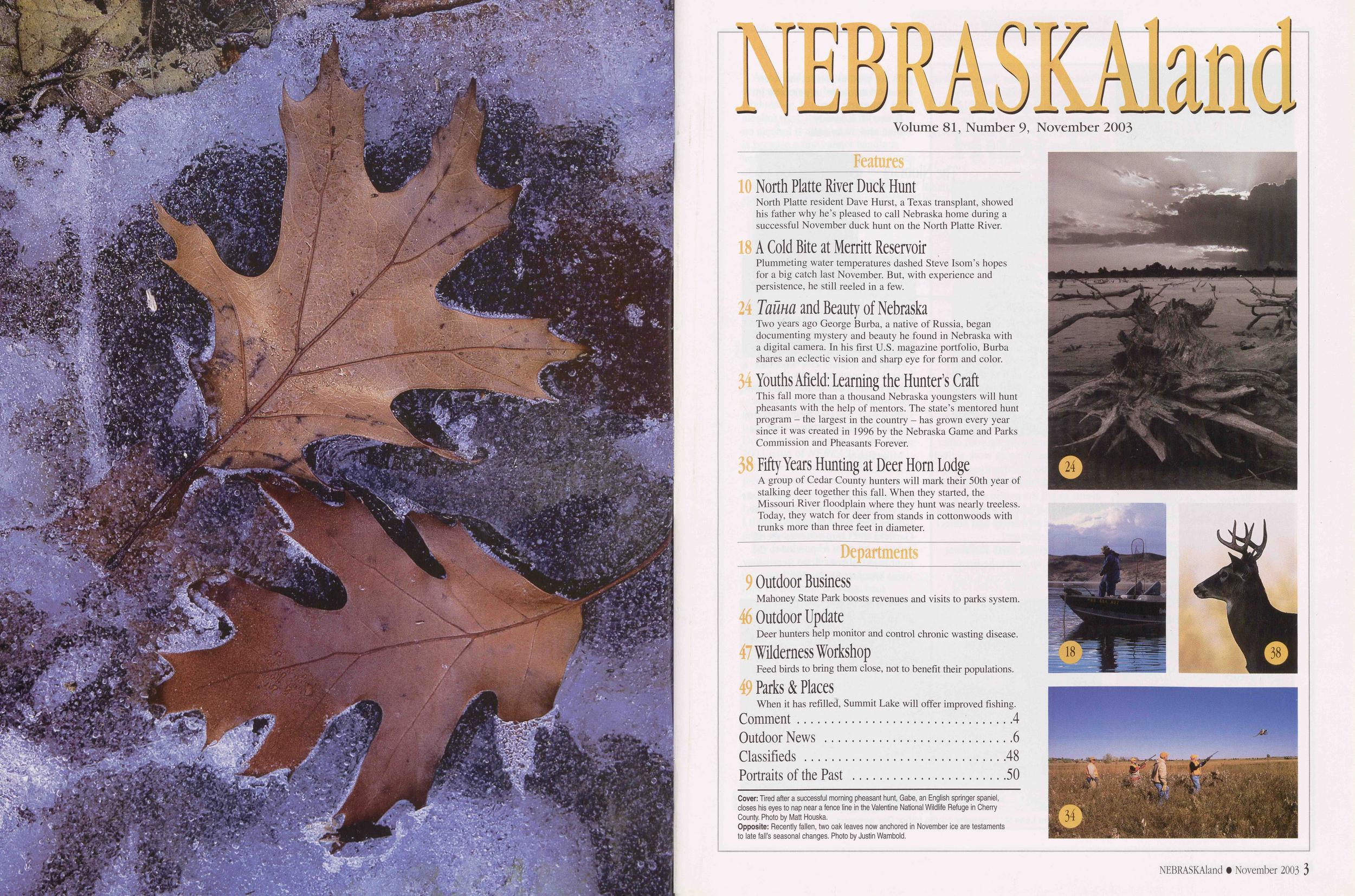
NEBRASKAland
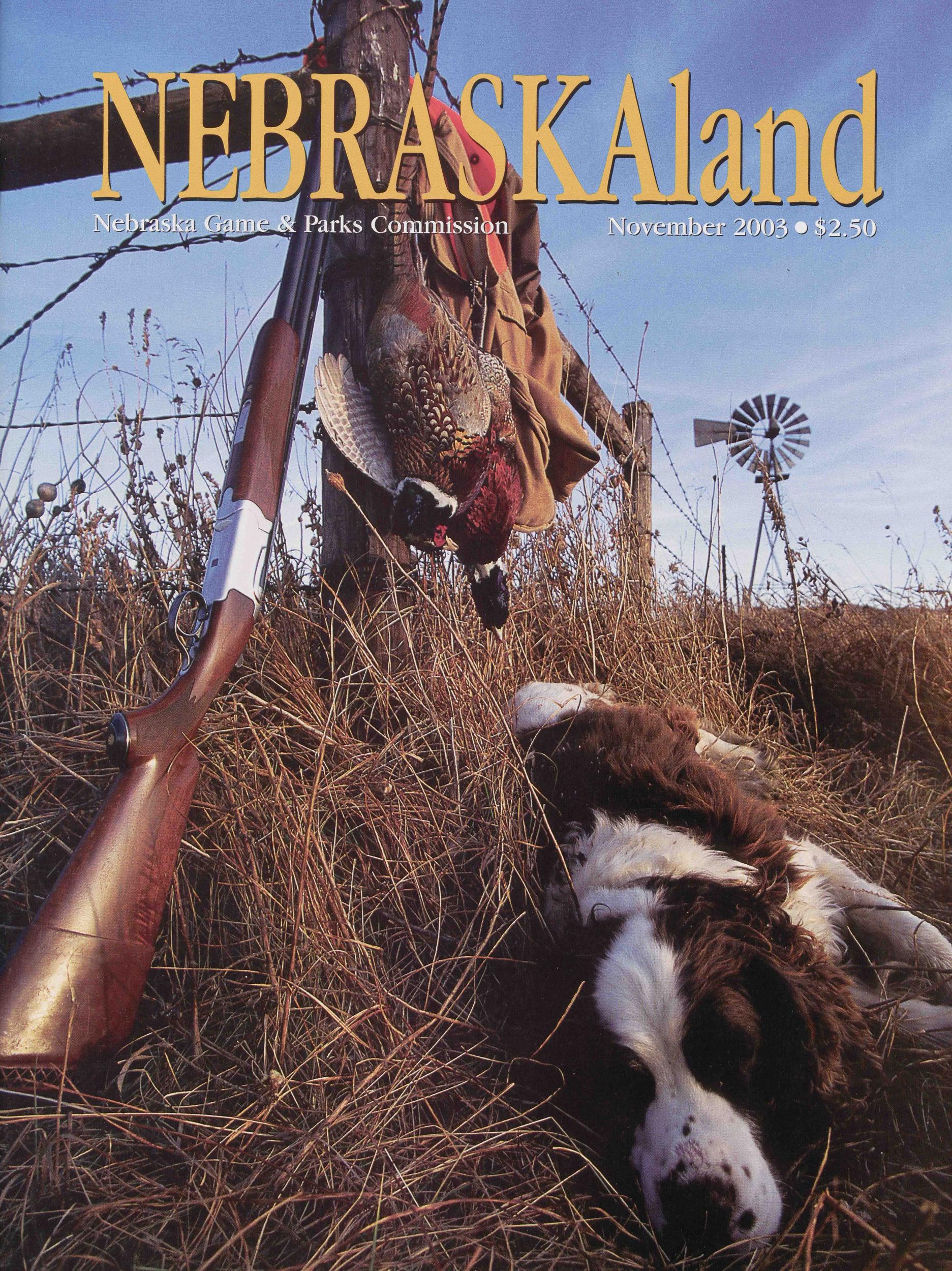
Volume 81, Number 9, November 2003 Features North Platte River Duck Hunt North Platte resident Dave Hurst, a Texas transplant, showed his father why he's pleased to call Nebraska home during a successful November duck hunt on the North Platte River. A Cold Bite at Merritt Reservoir Plummeting water temperatures dashed Steve Isom's hopes for a big catch last November. But, with experience and persistence, he still reeled in a few. Tama and Beauty of Nebraska Two years ago George Burba, a native of Russia, began documenting mystery and beauty he found in Nebraska with a digital camera. In his first U.S. magazine portfolio, Burba shares an eclectic vision and sharp eye for form and color. Youths Afield: Learning the Hunter's Craft This fall more than a thousand Nebraska youngsters will hunt pheasants with the help of mentors. The state's mentored hunt program - the largest in the country - has grown every year since it was created in 1996 by the Nebraska Game and Parks Commission and Pheasants Forever. 38 Fifty Years Hunting at Deer Horn Lodge A group of Cedar County hunters will mark their 50th year of stalking deer together this fall. When they started, the Missouri River floodplain where they hunt was nearly treeless. Today, they watch for deer from stands in cottonwoods with trunks more than three feet in diameter. Departments Outdoor Business Mahoney State Park boosts revenues and visits to parks system. ■ Outdoor Update Deer hunters help monitor and control chronic wasting disease. Wilderness Workshop Feed birds to bring them close, not to benefit their populations. Parks & Places When it has refilled, Summit Lake will offer improved fishing. Outdoor News ............................6 Classifieds 48 Portraits of the Past .......................50 Cover: Tired after a successful morning pheasant hunt, Gabe, an English springer spaniel, closes his eyes to nap near a fence line in the Valentine National Wildlife Refuge in Cherry County. Photo by Matt Houska. Opposite: Recently fallen, two oak leaves now anchored in November ice are testaments to late fall's seasonal changes. Photo by Justin Wambold.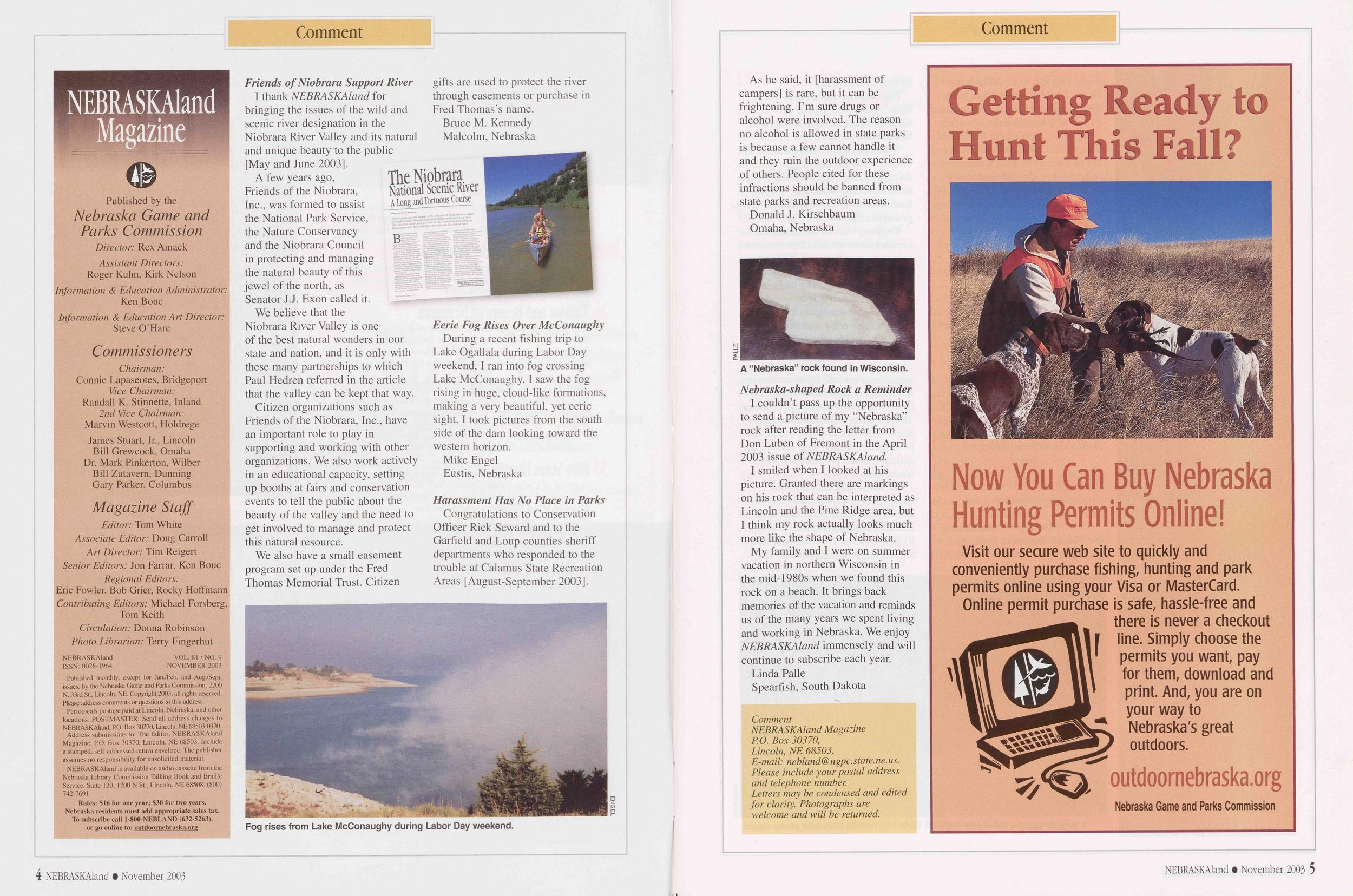 Comment
NEBRASKAland
Published by the
Nebraska Game and
Parks Commission
Director: Rex Amack
Assistant Director
Roger Kuhn, Kirk Nelson
Information & Education Administrator:
Ken Bouc
Information & Education Art Director:
Steve O'Hare
Commissioners
Chairman:
Connie Lapaseotes, Bridgeport
Vice Chairman:
Randall K. Stinnette, Inland
2nd Vice Chairman:
Marvin Westcott, Holdrege
-
James Stuart, Jr., Lincoln
Bill Grewcock, Omaha
Dr. Mark Pinkerton, Wilber
Bill Zutavern, Dunning
Gary Parker, Columbus
Magazine Staff
Editor: Tom White
Associate Editor: Doug Carroll
Art Director: Tim Reigert
Senior Editors: Jon Farrar. Ken Bouc
Regional Editors:
Eric Fowler, Bob Grier, Rocky Hoffmann
Contributing Editors: Michael Forsberg,
Tom Keith
Circulation: Donna Robinson
Photo Librarian: Terry Fingerhut
NEBRASKAland
ISSN: 0028-1964
VOL.81 /NO. 9
NOVEMBER 2002
Published monthly, except for Jan./Feb. and Aug./Sept.
issues, by the Nebraska Game and Parks Commission, 2200
N. 33rd St.. Lincoln. NE. Copyright 2003, till rights reserved.
Please address comments or questions to this address.
Periodicals postage paid at Lincoln, Nebraska, and other
locations. POSTMASTER: Send all address changes to
NEBRASKAland. P.O. Box 30370, Lincoln, NE 68303-0370.
Address submissions to: The Editor. NEBRASKAland
Magazine. P.O. Box 30370, Lincoln. NE 68503. Include
a stamped, sell-addressed return envelope. The publisher
assumes no responsibility for unsolicited material.
NEBRASKAland is available on audio cassette from the
Nebraska Library Commission Talking Book and Braille
Service, Suite lit). 1200 N St., Lincoln, NE 68508. (800)
742-7691
Rates: $16 for one year; $30 for two years.
Nebraska residents must add appropriate sales tax.
To subscribe call 1-800-NEBLAND (632-5263),
or go online to: outdoornebraska.org
Friends of Niobrara Support River
Comment
NEBRASKAland
Published by the
Nebraska Game and
Parks Commission
Director: Rex Amack
Assistant Director
Roger Kuhn, Kirk Nelson
Information & Education Administrator:
Ken Bouc
Information & Education Art Director:
Steve O'Hare
Commissioners
Chairman:
Connie Lapaseotes, Bridgeport
Vice Chairman:
Randall K. Stinnette, Inland
2nd Vice Chairman:
Marvin Westcott, Holdrege
-
James Stuart, Jr., Lincoln
Bill Grewcock, Omaha
Dr. Mark Pinkerton, Wilber
Bill Zutavern, Dunning
Gary Parker, Columbus
Magazine Staff
Editor: Tom White
Associate Editor: Doug Carroll
Art Director: Tim Reigert
Senior Editors: Jon Farrar. Ken Bouc
Regional Editors:
Eric Fowler, Bob Grier, Rocky Hoffmann
Contributing Editors: Michael Forsberg,
Tom Keith
Circulation: Donna Robinson
Photo Librarian: Terry Fingerhut
NEBRASKAland
ISSN: 0028-1964
VOL.81 /NO. 9
NOVEMBER 2002
Published monthly, except for Jan./Feb. and Aug./Sept.
issues, by the Nebraska Game and Parks Commission, 2200
N. 33rd St.. Lincoln. NE. Copyright 2003, till rights reserved.
Please address comments or questions to this address.
Periodicals postage paid at Lincoln, Nebraska, and other
locations. POSTMASTER: Send all address changes to
NEBRASKAland. P.O. Box 30370, Lincoln, NE 68303-0370.
Address submissions to: The Editor. NEBRASKAland
Magazine. P.O. Box 30370, Lincoln. NE 68503. Include
a stamped, sell-addressed return envelope. The publisher
assumes no responsibility for unsolicited material.
NEBRASKAland is available on audio cassette from the
Nebraska Library Commission Talking Book and Braille
Service, Suite lit). 1200 N St., Lincoln, NE 68508. (800)
742-7691
Rates: $16 for one year; $30 for two years.
Nebraska residents must add appropriate sales tax.
To subscribe call 1-800-NEBLAND (632-5263),
or go online to: outdoornebraska.org
Friends of Niobrara Support River
I thank NEBRASKAland for bringing the issues of the wild and scenic river designation in the Niobrara River Valley and its natural and unique beauty to the public [May and June 2003].
A few years ago, Friends of the Niobrara, National Scenic Rivet Inc., was formed to assist the National Park Service, the Nature Conservancy and the Niobrara Council in protecting and managing the natural beauty of this jewel of the north, as Senator J.J. Exon called it.
We believe that the Niobrara River Valley is one of the best natural wonders in our state and nation, and it is only with these many partnerships to which Paul Hedren referred in the article that the valley can be kept that way.
Citizen organizations such as Friends of the Niobrara, Inc., have an important role to play in supporting and working with other organizations. We also work actively in an educational capacity, setting up booths at fairs and conservation events to tell the public about the beauty of the valley and the need to get involved to manage and protect this natural resource.
We also have a small easement program set up under the Fred Thomas Memorial Trust. Citizen gifts are used to protect the river through easements or purchase in Fred Thomas's name.
Bruce M. Kennedy Malcolm, NebraskaDuring a recent fishing trip to Lake Ogallala during Labor Day weekend, I ran into fog crossing Lake McConaughy. I saw the fog rising in huge, cloud-like formations, making a very beautiful, yet eerie sight. I took pictures from the south side of the dam looking toward the western horizon.
Mike Engel Eustis, Nebraska Harassment Has No Place in ParksCongratulations to Conservation Officer Rick Seward and to the Garfield and Loup counties sheriff departments who responded to the trouble at Calamus State Recreation Areas [August-September 2003].
As he said, it [harassment of campers] is rare, but it can be frightening. I'm sure drugs or alcohol were involved. The reason no alcohol is allowed in state parks is because a few cannot handle it and they ruin the outdoor experience of others. People cited for these infractions should be banned from state parks and recreation areas.
Donald J. Kirschbaum Omaha, NebraskaI couldn't pass up the opportunity to send a picture of my "Nebraska" rock after reading the letter from Don Luben of Fremont in the April 2003 issue of NEBRASKAland.
I smiled when I looked at his picture. Granted there are markings on his rock that can be interpreted as Lincoln and the Pine Ridge area, but I think my rock actually looks much more like the shape of Nebraska.
My family and I were on summer vacation in northern Wisconsin in the mid-1980s when we found this rock on a beach. It brings back memories of the vacation and reminds us of the many years we spent living and working in Nebraska. We enjoy NEBRASKAland immensely and will continue to subscribe each year.
Linda Palle Spearfish, South Dakota Comment NEBRASKAland Magazine P.O.Box 30370, Lincoln, NE 68503. E-mail: nebland@ngpc. state, ne. us. Please include your postal address and telephone number. Letters may be condensed and edited for clarity. Photographs are welcome and will be returned. Getting Ready to Hunt This Fall? Now You Can Buy Bebraska Hunting Permits Online! Visit our secure web site to quickly and conveniently purchase fishing, hunting and park permits online using your Visa or MasterCard. Online permit purchase is safe, hassle-free and there is never a checkout line. Simply choose the permits you want, pay for them, download and print. And, you are on your way to Nebraska's great outdoors. Nebraska Game and Parks Commission NEBRASKAland • November 2003 5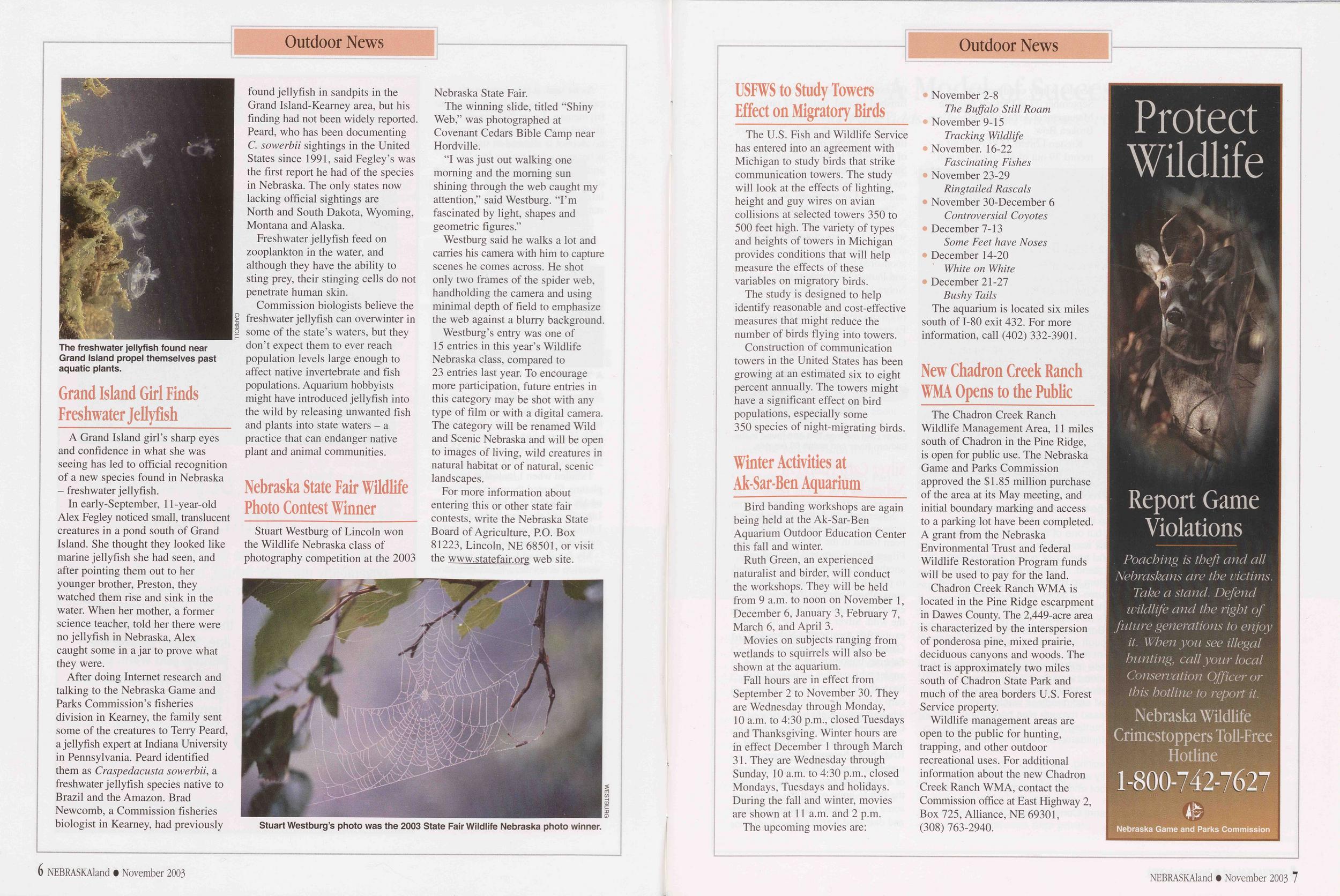
A Grand Island girl's sharp eyes and confidence in what she was seeing has led to official recognition of a new species found in Nebraska - freshwater jellyfish.
In early-September, 11-year-old Alex Fegley noticed small, translucent creatures in a pond south of Grand Island. She thought they looked like marine jellyfish she had seen, and after pointing them out to her younger brother, Preston, they watched them rise and sink in the water. When her mother, a former science teacher, told her there were no jellyfish in Nebraska, Alex caught some in a jar to prove what they were.
After doing Internet research and talking to the Nebraska Game and Parks Commission's fisheries division in Kearney, the family sent some of the creatures to Terry Peard, a jellyfish expert at Indiana University in Pennsylvania. Peard identified them as Craspedacusta sowerbii, a freshwater jellyfish species native to Brazil and the Amazon. Brad Newcomb, a Commission fisheries biologist in Kearney, had previously found jellyfish in sandpits in the Grand Island-Kearney area, but his finding had not been widely reported. Peard, who has been documenting C. sowerbii sightings in the United States since 1991, said Fegley's was the first report he had of the species in Nebraska. The only states now lacking official sightings are North and South Dakota, Wyoming, Montana and Alaska.
Freshwater jellyfish feed on zooplankton in the water, and although they have the ability to sting prey, their stinging cells do not penetrate human skin.
Commission biologists believe the freshwater jellyfish can overwinter in some of the state's waters, but they don't expect them to ever reach population levels large enough to affect native invertebrate and fish populations. Aquarium hobbyists might have introduced jellyfish into the wild by releasing unwanted fish and plants into state waters - a practice that can endanger native plant and animal communities.
Nebraska State Fair Wildlife Photo Contest WinnerStuart Westburg of Lincoln won the Wildlife Nebraska class of photography competition at the 2003 Nebraska State Fair.
The winning slide, titled "Shiny Web," was photographed at Covenant Cedars Bible Camp near Hordville.
"I was just out walking one morning and the morning sun shining through the web caught my attention," said Westburg. "I'm fascinated by light, shapes and geometric figures."
Westburg said he walks a lot and carries his camera with him to capture scenes he comes across. He shot only two frames of the spider web, handholding the camera and using minimal depth of field to emphasize the web against a blurry background.
Westburg's entry was one of 15 entries in this year's Wildlife Nebraska class, compared to 23 entries last year. To encourage more participation, future entries in this category may be shot with any type of film or with a digital camera. The category will be renamed Wild and Scenic Nebraska and will be open to images of living, wild creatures in natural habitat or of natural, scenic landscapes.
For more information about entering this or other state fair contests, write the Nebraska State Board of Agriculture, RO. Box 81223, Lincoln, NE 68501, or visit the www.statefair.org web site.
The U.S. Fish and Wildlife Service has entered into an agreement with Michigan to study birds that strike communication towers. The study will look at the effects of lighting, height and guy wires on avian collisions at selected towers 350 to 500 feet high. The variety of types and heights of towers in Michigan provides conditions that will help measure the effects of these variables on migratory birds.
The study is designed to help identify reasonable and cost-effective measures that might reduce the number of birds flying into towers.
Construction of communication towers in the United States has been growing at an estimated six to eight percent annually. The towers might have a significant effect on bird populations, especially some 350 species of night-migrating birds.
Winter Activities at Ak-Sar-Ben AquariumBird banding workshops are again being held at the Ak-Sar-Ben Aquarium Outdoor Education Center this fall and winter.
Ruth Green, an experienced naturalist and birder, will conduct the workshops. They will be held from 9 a.m. to noon on November 1, December 6, January 3, February 7, March 6, and April 3.
Movies on subjects ranging from wetlands to squirrels will also be shown at the aquarium.
Fall hours are in effect from September 2 to November 30. They are Wednesday through Monday, 10 a.m. to 4:30 p.m., closed Tuesdays and Thanksgiving. Winter hours are in effect December 1 through March 31. They are Wednesday through Sunday, 10 a.m. to 4:30 p.m., closed Mondays, Tuesdays and holidays. During the fall and winter, movies are shown at 11 a.m. and 2 p.m.
The upcoming movies are:
November 2-8 The Buffalo Still Roam * November 9-15 Tracking Wildlife November. 16-22 Fascinating Fishes November 23-29 Ringtailed Rascals * November 30-December 6 Controversial Coyotes December 7-13 Some Feet have Noses !& December 14-20 White on White * December 21-27 Bushy TailsThe aquarium is located six miles south of 1-80 exit 432. For more information, call (402) 332-3901.
New Chadron Creek Ranch WMA Opens to the PublicThe Chadron Creek Ranch Wildlife Management Area, 11 miles south of Chadron in the Pine Ridge, is open for public use. The Nebraska Game and Parks Commission approved the $1.85 million purchase of the area at its May meeting, and initial boundary marking and access to a parking lot have been completed. A grant from the Nebraska Environmental Trust and federal Wildlife Restoration Program funds will be used to pay for the land.
Chadron Creek Ranch WMA is located in the Pine Ridge escarpment in Dawes County. The 2,449-acre area is characterized by the interspersion of ponderosa pine, mixed prairie, deciduous canyons and woods. The tract is approximately two miles south of Chadron State Park and much of the area borders U.S. Forest Service property.
Wildlife management areas are open to the public for hunting, trapping, and other outdoor recreational uses. For additional information about the new Chadron Creek Ranch WMA, contact the Commission office at East Highway 2, Box 725, Alliance, NE 69301, (308) 763-2940.
Protect Wildlife Report Game Violations Poaching is theft and all Nebraskans are the victims. Take a stand. Defend wildlife and the right of future generations to enjoy it. When you see illegal Nebraska Midlife 1-800-742-7627 Nebraska Game and Parks Commission NEBRASKAland • November 2003 7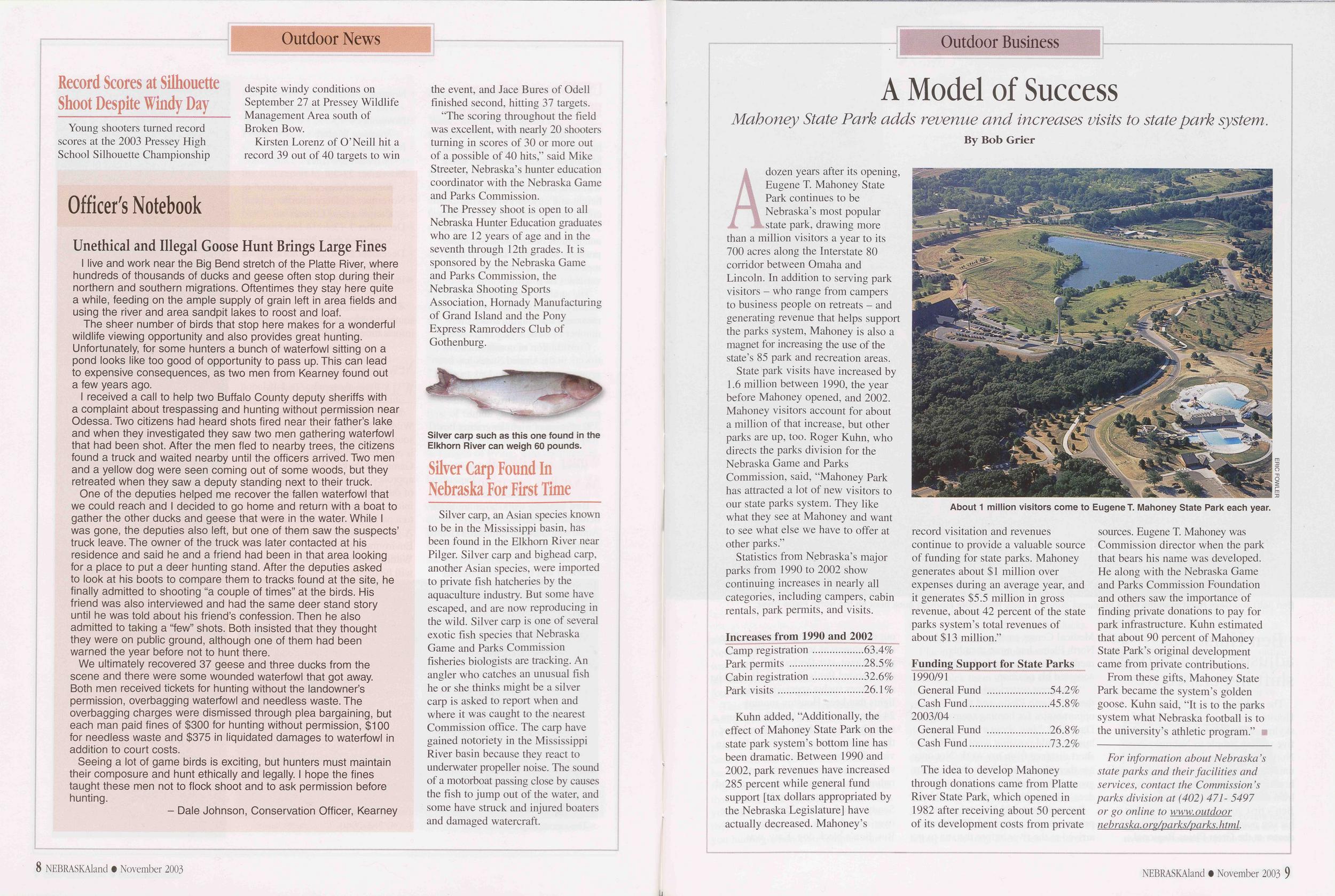 Outdoor News
Record Scores at Silhouette
Shoot Despite Windy Day
Outdoor News
Record Scores at Silhouette
Shoot Despite Windy Day
Young shooters turned record scores at the 2003 Pressey High School Silhouette Championship despite windy conditions on September 27 at Pressey Wildlife Management Area south of Broken Bow.
Kirsten Lorenz of O'Neill hit a record 39 out of 40 targets to win the event, and Jace Bures of Odell finished second, hitting 37 targets.
"The scoring throughout the field was excellent, with nearly 20 shooters turning in scores of 30 or more out of a possible of 40 hits," said Mike Streeter, Nebraska's hunter education coordinator with the Nebraska Game and Parks Commission.
The Pressey shoot is open to all Nebraska Hunter Education graduates who are 12 years of age and in the seventh through 12th grades. It is sponsored by the Nebraska Game and Parks Commission, the Nebraska Shooting Sports Association, Hornady Manufacturing of Grand Island and the Pony Express Ramrodders Club of Gothenburg.
I live and work near the Big Bend stretch of the Platte River, where hundreds of thousands of ducks and geese often stop during their northern and southern migrations. Oftentimes they stay here quite a while, feeding on the ample supply of grain left in area fields and using the river and area sandpit lakes to roost and loaf.
The sheer number of birds that stop here makes for a wonderful wildlife viewing opportunity and also provides great hunting. Unfortunately, for some hunters a bunch of waterfowl sitting on a pond looks like too good of opportunity to pass up. This can lead to expensive consequences, as two men from Kearney found out a few years ago.
I received a call to help two Buffalo County deputy sheriffs with a complaint about trespassing and hunting without permission near Odessa. Two citizens had heard shots fired near their father's lake and when they investigated they saw two men gathering waterfowl that had been shot. After the men fled to nearby trees, the citizens found a truck and waited nearby until the officers arrived. Two men and a yellow dog were seen coming out of some woods, but they retreated when they saw a deputy standing next to their truck.
One of the deputies helped me recover the fallen waterfowl that we could reach and I decided to go home and return with a boat to gather the other ducks and geese that were in the water. While I was gone, the deputies also left, but one of them saw the suspects' truck leave. The owner of the truck was later contacted at his residence and said he and a friend had been in that area looking for a place to put a deer hunting stand. After the deputies asked to look at his boots to compare them to tracks found at the site, he finally admitted to shooting "a couple of times" at the birds. His friend was also interviewed and had the same deer stand story until he was told about his friend's confession. Then he also admitted to taking a "few" shots. Both insisted that they thought they were on public ground, although one of them had been warned the year before not to hunt there.
We ultimately recovered 37 geese and three ducks from the scene and there were some wounded waterfowl that got away. Both men received tickets for hunting without the landowner's permission, overbagging waterfowl and needless waste. The overbagging charges were dismissed through plea bargaining, but each man paid fines of $300 for hunting without permission, $100 for needless waste and $375 in liquidated damages to waterfowl in addition to court costs.
Seeing a lot of game birds is exciting, but hunters must maintain their composure and hunt ethically and legally. I hope the fines taught these men not to flock shoot and to ask permission before hunting.
- Dale Johnson, Conservation Officer, Kearney Silver Carp Found In Nebraska For First TimeSilver carp, an Asian species known to be in the Mississippi basin, has been found in the Elkhorn River near Pilger. Silver carp and bighead carp, another Asian species, were imported to private fish hatcheries by the aquaculture industry. But some have escaped, and are now reproducing in the wild. Silver carp is one of several exotic fish species that Nebraska Game and Parks Commission fisheries biologists are tracking. An angler who catches an unusual fish he or she thinks might be a silver carp is asked to report when and where it was caught to the nearest Commission office. The carp have gained notoriety in the Mississippi River basin because they react to underwater propeller noise. The sound of a motorboat passing close by causes the fish to jump out of the water, and some have struck and injured boaters and damaged watercraft.
8 NEBRASKAland • November 2003Outdoor Business
A Model of Success
Mahoney State Park adds revenue and increases visits to state park system. By Bob GrierA dozen years after its opening, Eugene T. Mahoney State Park continues to be Nebraska's most popular state park, drawing more than a million visitors a year to its 700 acres along the Interstate 80 corridor between Omaha and Lincoln. In addition to serving park visitors - who range from campers to business people on retreats - and generating revenue that helps support the parks system, Mahoney is also a magnet for increasing the use of the state's 85 park and recreation areas.
State park visits have increased by 1.6 million between 1990, the year before Mahoney opened, and 2002. Mahoney visitors account for about a million of that increase, but other parks are up, too. Roger Kuhn, who directs the parks division for the Nebraska Game and Parks Commission, said, "Mahoney Park has attracted a lot of new visitors to our state parks system. They like what they see at Mahoney and want to see what else we have to offer at other parks."
Statistics from Nebraska's major parks from 1990 to 2002 show continuing increases in nearly all categories, including campers, cabin rentals, park permits, and visits.
Increases from 1990 and 2002 Camp registration..................63.4% Park permits ..........................28.5% Cabin registration..................32.6% Park visits..............................26.1%Kuhn added, "Additionally, the effect of Mahoney State Park on the state park system's bottom line has been dramatic. Between 1990 and 2002, park revenues have increased 285 percent while general fund support [tax dollars appropriated by the Nebraska Legislature] have actually decreased. Mahoney's record visitation and revenues continue to provide a valuable source of funding for state parks. Mahoney generates about $ 1 million over expenses during an average year, and it generates $5.5 million in gross revenue, about 42 percent of the state parks system's total revenues of about $13 million."
Funding Support for State Parks 1990/91 General Fund ......................54.2% Cash Fund............................45.8% 2003/04 General Fund ......................26.8% Cash Fund............................73.2%The idea to develop Mahoney through donations came from Platte River State Park, which opened in 1982 after receiving about 50 percent of its development costs from private sources. Eugene T. Mahoney was Commission director when the park that bears his name was developed. He along with the Nebraska Game and Parks Commission Foundation and others saw the importance of finding private donations to pay for park infrastructure. Kuhn estimated that about 90 percent of Mahoney State Park's original development came from private contributions.
From these gifts, Mahoney State Park became the system's golden goose. Kuhn said, "It is to the parks system what Nebraska football is to the university's athletic program."
For information about Nebraska's state parks and their facilities and services, contact the Commission's parks division at (402) 471- 5497 or go online to www, outdoor nebraska. org/parks/parks. html.
NEBRASKAland • November 2003 9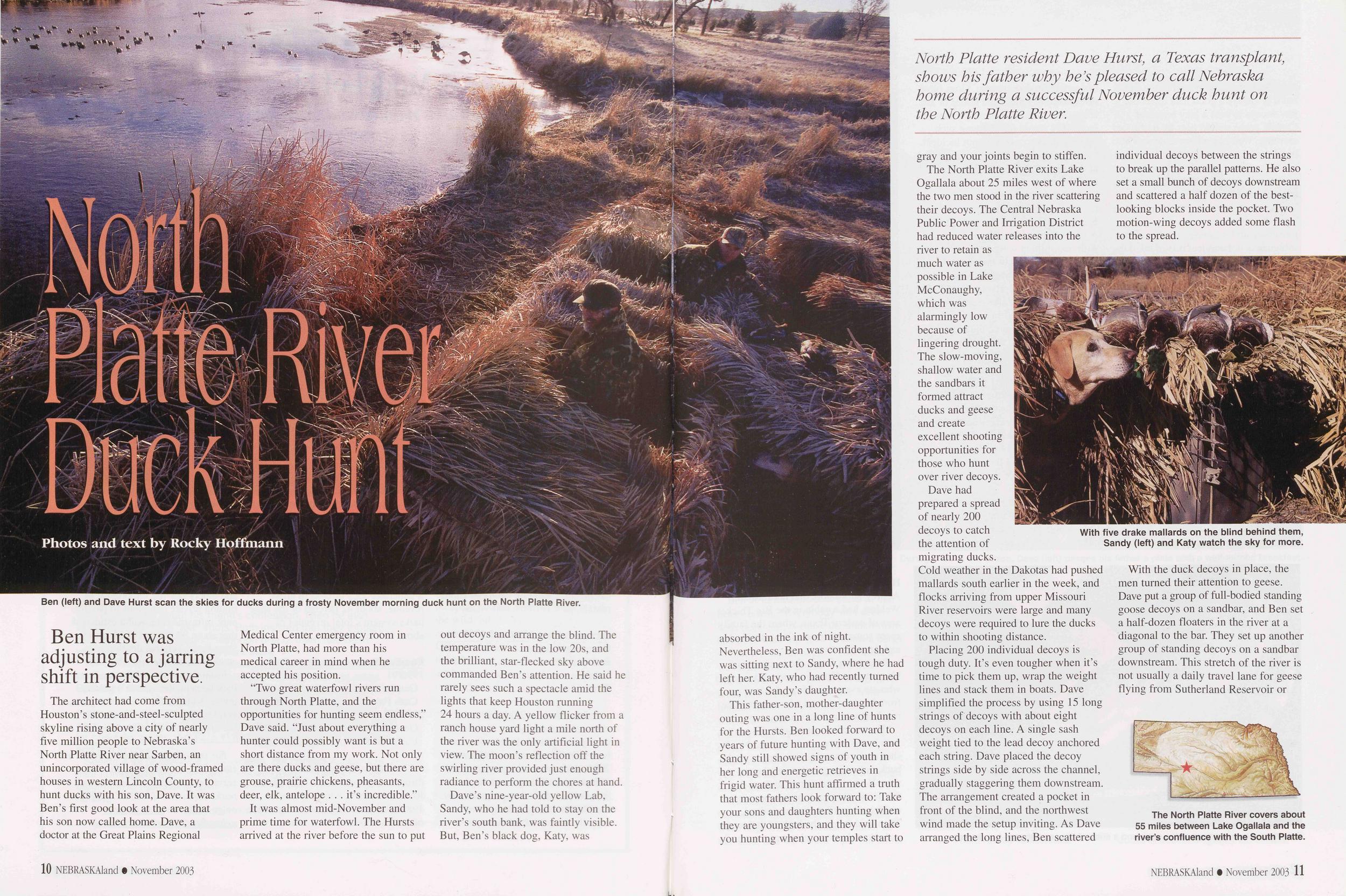
North Platte River Duck Hunt
Photos and text by Rocky HoffmannThe architect had come from Houston's stone-and-steel-sculpted skyline rising above a city of nearly five million people to Nebraska's North Platte River near Sarben, an unincorporated village of wood-framed houses in western Lincoln County, to hunt ducks with his son, Dave. It was Ben's first good look at the area that his son now called home. Dave, a doctor at the Great Plains Regional Medical Center emergency room in North Platte, had more than his medical career in mind when he accepted his position.
Two great waterfowl rivers run through North Platte, and the opportunities for hunting seem endless," Dave said. "Just about everything a hunter could possibly want is but a short distance from my work. Not only are there ducks and geese, but there are grouse, prairie chickens, pheasants, deer, elk, antelope . . . it's incredible."
It was almost mid-November and prime time for waterfowl. The Hursts arrived at the river before the sun to put out decoys and arrange the blind. The temperature was in the low 20s, and the brilliant, star-flecked sky above commanded Ben's attention. He said he rarely sees such a spectacle amid the lights that keep Houston running 24 hours a day. A yellow flicker from a ranch house yard light a mile north of the river was the only artificial light in view. The moon's reflection off the swirling river provided just enough radiance to perform the chores at hand.
Dave's nine-year-old yellow Lab, Sandy, who he had told to stay on the river's south bank, was faintly visible. But, Ben's black dog, Katy, was 10 NEBRASKAland • November 2003 absorbed in the ink of night. Nevertheless, Ben was confident she was sitting next to Sandy, where he had left her. Katy, who had recently turned four, was Sandy's daughter.
This father-son, mother-daughter outing was one in a long line of hunts for the Hursts. Ben looked forward to years of future hunting with Dave, and Sandy still showed signs of youth in her long and energetic retrieves in frigid water. This hunt affirmed a truth that most fathers look forward to: Take your sons and daughters hunting when they are youngsters, and they will take you hunting when your temples start to gray and your joints begin to stiffen.
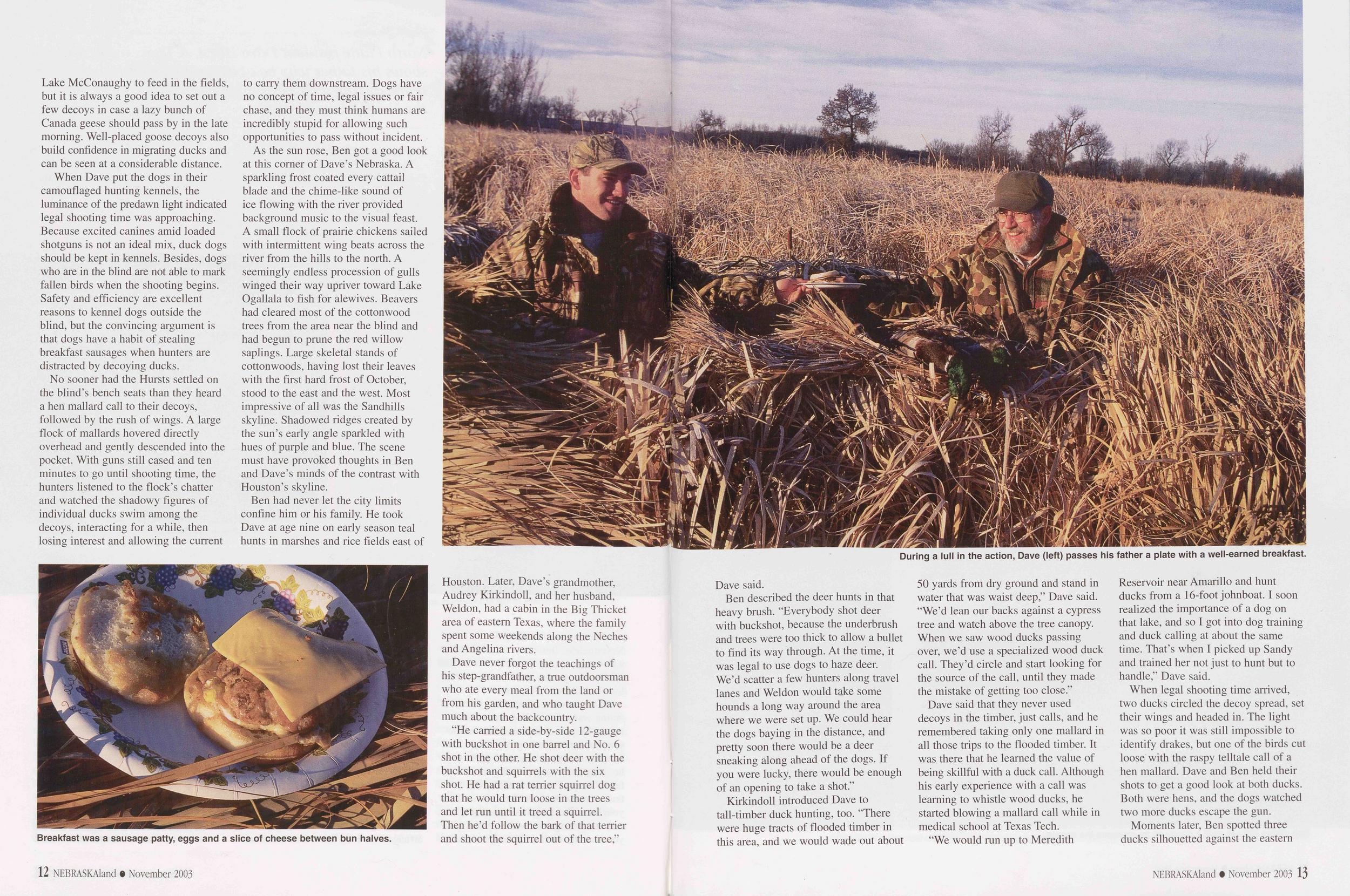
North Platte resident Dave Hurst, a Texas transplant, shows his father why he's pleased to call Nebraska home during a successful November duck hunt on the North Platte RiverThe North Platte River exits Lake Ogallala about 25 miles west of where the two men stood in the river scattering their decoys. The Central Nebraska Public Power and Irrigation District had reduced water releases into the river to retain as much water as possible in Lake McConaughy, which was alarmingly low because of lingering drought. The slow-moving, shallow water and the sandbars it formed attract ducks and geese and create excellent shooting opportunities for those who hunt over river decoys.
Dave had prepared a spread of nearly 200 decoys to catch the attention of migrating ducks. Cold weather in the Dakotas had pushed mallards south earlier in the week, and flocks arriving from upper Missouri River reservoirs were large and many decoys were required to lure the ducks to within shooting distance.
Placing 200 individual decoys is tough duty. It's even tougher when it's time to pick them up, wrap the weight lines and stack them in boats. Dave simplified the process by using 15 long strings of decoys with about eight decoys on each line. A single sash weight tied to the lead decoy anchored each string. Dave placed the decoy strings side by side across the channel, gradually staggering them downstream. The arrangement created a pocket in front of the blind, and the northwest wind made the setup inviting. As Dave arranged the long lines, Ben scattered individual decoys between the strings to break up the parallel patterns. He also set a small bunch of decoys downstream and scattered a half dozen of the best looking blocks inside the pocket. Two motion-wing decoys added some flash to the spread.
With the duck decoys in place, the
men turned their attention to geese.
Dave put a group of full-bodied standing
goose decoys on a sandbar, and Ben set
a half-dozen floaters in the river at a
diagonal to the bar. They set up another
group of standing decoys on a sandbar
downstream. This stretch of the river is
not usually a daily travel lane for geese
flying from Sutherland Reservoir or
NEBRASKAland • November 2003 11
 Lake McConaughy to feed in the fields,
but it is always a good idea to set out a
few decoys in case a lazy bunch of
Canada geese should pass by in the late
morning. Well-placed goose decoys also
build confidence in migrating ducks and
can be seen at a considerable distance.
Lake McConaughy to feed in the fields,
but it is always a good idea to set out a
few decoys in case a lazy bunch of
Canada geese should pass by in the late
morning. Well-placed goose decoys also
build confidence in migrating ducks and
can be seen at a considerable distance.
When Dave put the dogs in their camouflaged hunting kennels, the luminance of the predawn light indicated legal shooting time was approaching. Because excited canines amid loaded shotguns is not an ideal mix, duck dogs should be kept in kennels. Besides, dogs who are in the blind are not able to mark fallen birds when the shooting begins. Safety and efficiency are excellent reasons to kennel dogs outside the blind, but the convincing argument is that dogs have a habit of stealing breakfast sausages when hunters are distracted by decoying ducks.
No sooner had the Hursts settled on the blind's bench seats than they heard a hen mallard call to their decoys, followed by the rush of wings. A large flock of mallards hovered directly overhead and gently descended into the pocket. With guns still cased and ten minutes to go until shooting time, the hunters listened to the flock's chatter and watched the shadowy figures of individual ducks swim among the decoys, interacting for a while, then losing interest and allowing the current to carry them downstream. Dogs have no concept of time, legal issues or fair chase, and they must think humans are incredibly stupid for allowing such opportunities to pass without incident.
As the sun rose, Ben got a good look at this corner of Dave's Nebraska. A sparkling frost coated every cattail blade and the chime-like sound of ice flowing with the river provided background music to the visual feast. A small flock of prairie chickens sailed with intermittent wing beats across the river from the hills to the north. A seemingly endless procession of gulls winged their way upriver toward Lake Ogallala to fish for alewives. Beavers had cleared most of the cottonwood trees from the area near the blind and had begun to prune the red willow saplings. Large skeletal stands of cottonwoods, having lost their leaves with the first hard frost of October, stood to the east and the west. Most impressive of all was the Sandhills skyline. Shadowed ridges created by the sun's early angle sparkled with hues of purple and blue. The scene must have provoked thoughts in Ben and Dave's minds of the contrast with Houston's skyline.
Ben had never let the city limits confine him or his family. He took Dave at age nine on early season teal hunts in marshes and rice fields east of Houston. Later, Dave's grandmother, Audrey Kirkindoll, and her husband, Weldon, had a cabin in the Big Thicket area of eastern Texas, where the family spent some weekends along the Neches and Angelina rivers.
Dave never forgot the teachings of his step-grandfather, a true outdoorsman who ate every meal from the land or from his garden, and who taught Dave much about the backcountry.
"He carried a side-by-side 12-gauge with buckshot in one barrel and No. 6 shot in the other. He shot deer with the buckshot and squirrels with the six shot. He had a rat terrier squirrel dog that he would turn loose in the trees and let run until it treed a squirrel. Then he'd follow the bark of that terrier and shoot the squirrel out of the tree,"
Ben described the deer hunts in that heavy brush. "Everybody shot deer with buckshot, because the underbrush and trees were too thick to allow a bullet to find its way through. At the time, it was legal to use dogs to haze deer. We'd scatter a few hunters along travel lanes and Weldon would take some hounds a long way around the area where we were set up. We could hear the dogs baying in the distance, and pretty soon there would be a deer sneaking along ahead of the dogs. If you were lucky, there would be enough of an opening to take a shot."
Kirkindoll introduced Dave to tall-timber duck hunting, too. "There were huge tracts of flooded timber in this area, and we would wade out about 50 yards from dry ground and stand in water that was waist deep," Dave said. "We'd lean our backs against a cypress tree and watch above the tree canopy. When we saw wood ducks passing over, we'd use a specialized wood duck call. They'd circle and start looking for the source of the call, until they made the mistake of getting too close."
Dave said that they never used decoys in the timber, just calls, and he remembered taking only one mallard in all those trips to the flooded timber. It was there that he learned the value of being skillful with a duck call. Although his early experience with a call was learning to whistle wood ducks, he started blowing a mallard call while in medical school at Texas Tech.
"We would run up to Meredith Reservoir near Amarillo and hunt ducks from a 16-foot johnboat. I soon realized the importance of a dog on that lake, and so I got into dog training and duck calling at about the same time. That's when I picked up Sandy and trained her not just to hunt but to handle," Dave said.
When legal shooting time arrived, two ducks circled the decoy spread, set their wings and headed in. The light was so poor it was still impossible to identify drakes, but one of the birds cut loose with the raspy telltale call of a hen mallard. Dave and Ben held their shots to get a good look at both ducks. Both were hens, and the dogs watched two more ducks escape the gun.
Moments later, Ben spotted three
ducks silhouetted against the eastern
NEBRASKAland • November 2003 13
 sky. The dogs were already locked onto
the threesome before Dave tuned up the
call. His long and drawn-out hail call
turned them into the wind, and they
headed toward the decoys. As they
passed overhead, Dave chuckled a short
feed call and then gave them a series of
grunts that spun them around for the
final approach. As they set in over the
decoys, Ben's 12-gauge barked once
and Dave's pump did the same. The
two drakes from the flock spanked the
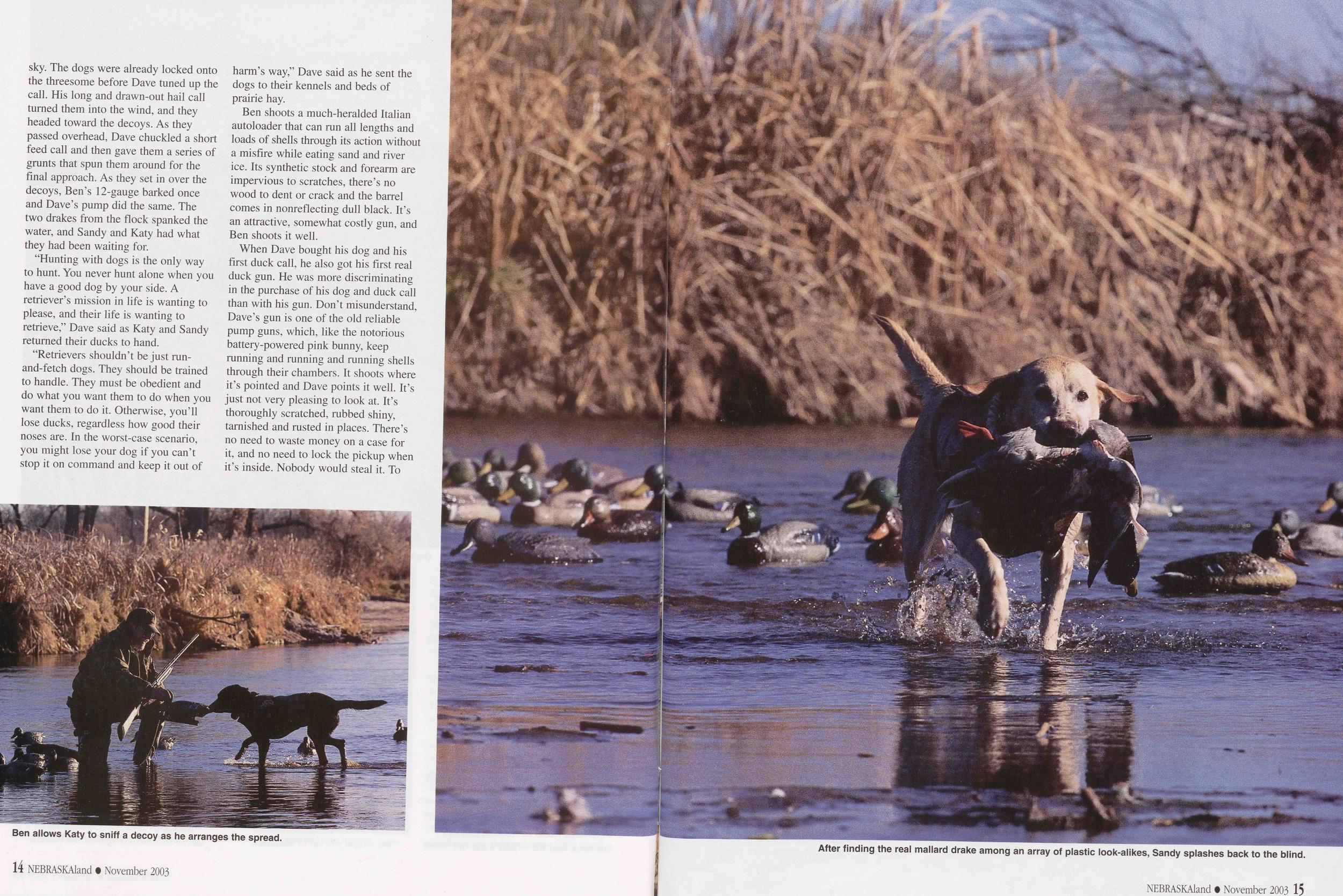
water, and Sandy and Katy had what
they had been waiting for.
sky. The dogs were already locked onto
the threesome before Dave tuned up the
call. His long and drawn-out hail call
turned them into the wind, and they
headed toward the decoys. As they
passed overhead, Dave chuckled a short
feed call and then gave them a series of
grunts that spun them around for the
final approach. As they set in over the
decoys, Ben's 12-gauge barked once
and Dave's pump did the same. The
two drakes from the flock spanked the
water, and Sandy and Katy had what
they had been waiting for.
"Hunting with dogs is the only way to hunt. You never hunt alone when you have a good dog by your side. A retriever's mission in life is wanting to please, and their life is wanting to retrieve," Dave said as Katy and Sandy returned their ducks to hand.
"Retrievers shouldn't be just run- and-fetch dogs. They should be trained to handle. They must be obedient and do what you want them to do when you want them to do it. Otherwise, you'll lose ducks, regardless how good their noses are. In the worst-case scenario, you might lose your dog if you can't stop it on command and keep it out of harm's way," Dave said as he sent the dogs to their kennels and beds of prairie hay.
Ben shoots a much-heralded Italian autoloader that can run all lengths and loads of shells through its action without a misfire while eating sand and river ice. Its synthetic stock and forearm are impervious to scratches, there's no wood to dent or crack and the barrel comes in nonreflecting dull black. It's an attractive, somewhat costly gun, and Ben shoots it well.
When Dave bought his dog and his first duck call, he also got his first real duck gun. He was more discriminating in the purchase of his dog and duck call than with his gun. Don't misunderstand, Dave's gun is one of the old reliable pump guns, which, like the notorious battery-powered pink bunny, keep running and running and running shells through their chambers. It shoots where it's pointed and Dave points it well. It's just not very pleasing to look at. It's thoroughly scratched, rubbed shiny, tarnished and rusted in places. There's no need to waste money on a case for it, and no need to lock the pickup when it's inside. Nobody would steal it. To
The coffee perked, and Dave poured his dad a smoldering cupful that steamed his glasses on the first sip and was only slightly warm on the second. Heat is a difficult property to retain in November on a riverbank in western Nebraska. Dave fired up the propane burner under the iron skillet and soon was burning some fresh pork sausage, bacon, and eggs, all of which he wedged between two slices of bread. As he handed the hefty breakfast sandwich to Ben, he reminded him of the real reason dogs are kept out of the blind.
A procession of gulls continued their westward advance upriver. Their contrasting white plumage against the brilliant blue sky was a pleasing pageantry of continuous motion. Occasionally, a gulfs movement caught out of the corner of an eye would cause one of the hunters to flinch as he thought for an instant that a duck had slipped in undetected. One time, one did. Caught up in conversation and complacent with the motion of gull wings, a lone drake sailed across the decoys, not 20 yards out, and continued flying up the channel. The dogs were again in total disbelief. Then, a half-mile or so to the west, the drake wheeled and came back for another look. Sandy fetched this drake to Dave's hand and forgave the boss for his original blunder.
By late morning a stiff breeze had picked up from the northwest, and eight Canada geese winged their way upriver. Pushing hard into the wind, they talked sparingly as they approached the decoys. This seemed like one of those sure things - a small family group, looking for a place to loaf, drink a little water and take in some river grit. Dave gave them a single call, and the lead goose responded. Dave talked, the lead goose talked, and the conversation continued as the flock came near. The full-bodied decoys looked enticing in the shallow, clear water, but what geese want and what hunters think geese want are not always the same. The flock never missed a beat as they passed beyond range over the decoys and never looked back.
If Dave and Ben had not taken the time to set out the goose decoys, they would have blamed themselves for months. They would have known, without a doubt, that those geese would have dropped their feet and tried to land amid the decoys without hesitation. Now, they could find something else to blame.
A lone drake, following the flock of geese, had second thoughts about flying with the larger birds and abandoned his escort mission. Doubling back, it circled the decoys several times. Finally, after a barrage of convincing calls, the drake committed to the blocks. This time Katy fetched the duck to Ben and returned to her kennel happy that she had been given the nod for this retrieve.
As is often the case on clear days, a flock of mallards suddenly appeared directly overhead. High-flying ducks are nearly impossible to see against a bright sky with no cloud cover, and often the hens in the flock are heard well before they are seen. The flock had committed to the decoys, or so it seemed, as their wings were cupped, and they dropped almost vertically toward the spread. But the wind played tricks on their approach, and the ducks circled behind the blind, cautiously looking over the situation. Dave grunted out a series of calls, and the flock wheeled around for another attempt. This time they were in range and moving fast when Dave decided to take them. Two shots and the flock was gone with the wind. One drake lay on a sandbar, and another drake was losing altitude towards a thick stand of rushes and willows nearly a quarter-mile to the west. Dave watched the bird glide in, and marked it with two reference points. He sent Sandy to retrieve the bird on the sandbar in front of the blind. Then, he brought Katy and Sandy to heel and headed in a direct line toward the distant downed bird.
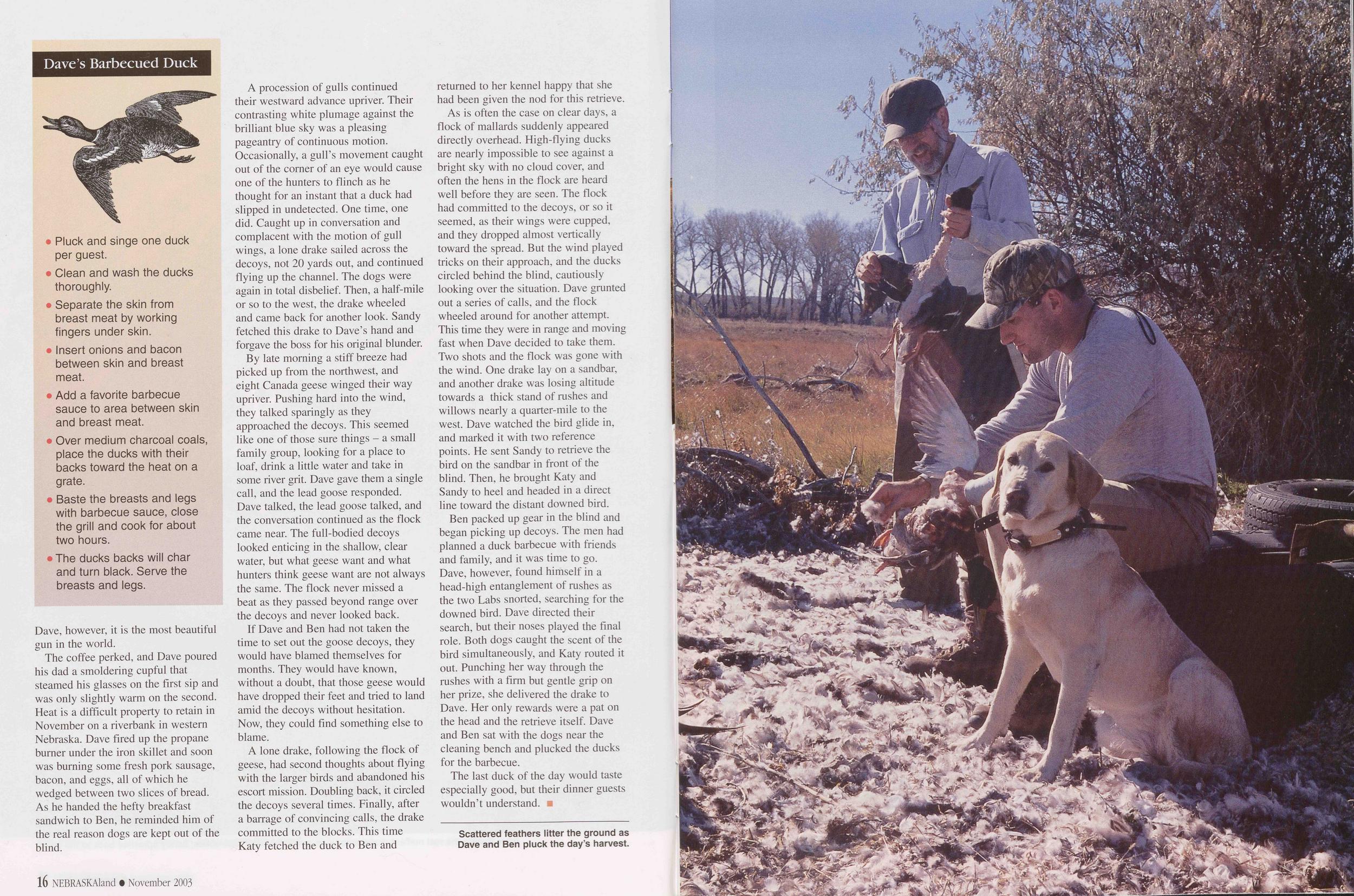
Ben packed up gear in the blind and began picking up decoys. The men had planned a duck barbecue with friends and family, and it was time to go. Dave, however, found himself in a head-high entanglement of rushes as the two Labs snorted, searching for the downed bird. Dave directed their search, but their noses played the final role. Both dogs caught the scent of the bird simultaneously, and Katy routed it out. Punching her way through the rushes with a firm but gentle grip on her prize, she delivered the drake to Dave. Her only rewards were a pat on the head and the retrieve itself. Dave and Ben sat with the dogs near the cleaning bench and plucked the ducks for the barbecue.
The last duck of the day would taste especially good, but their dinner guests wouldn't understand.
16 NEBRASKAland • November 2003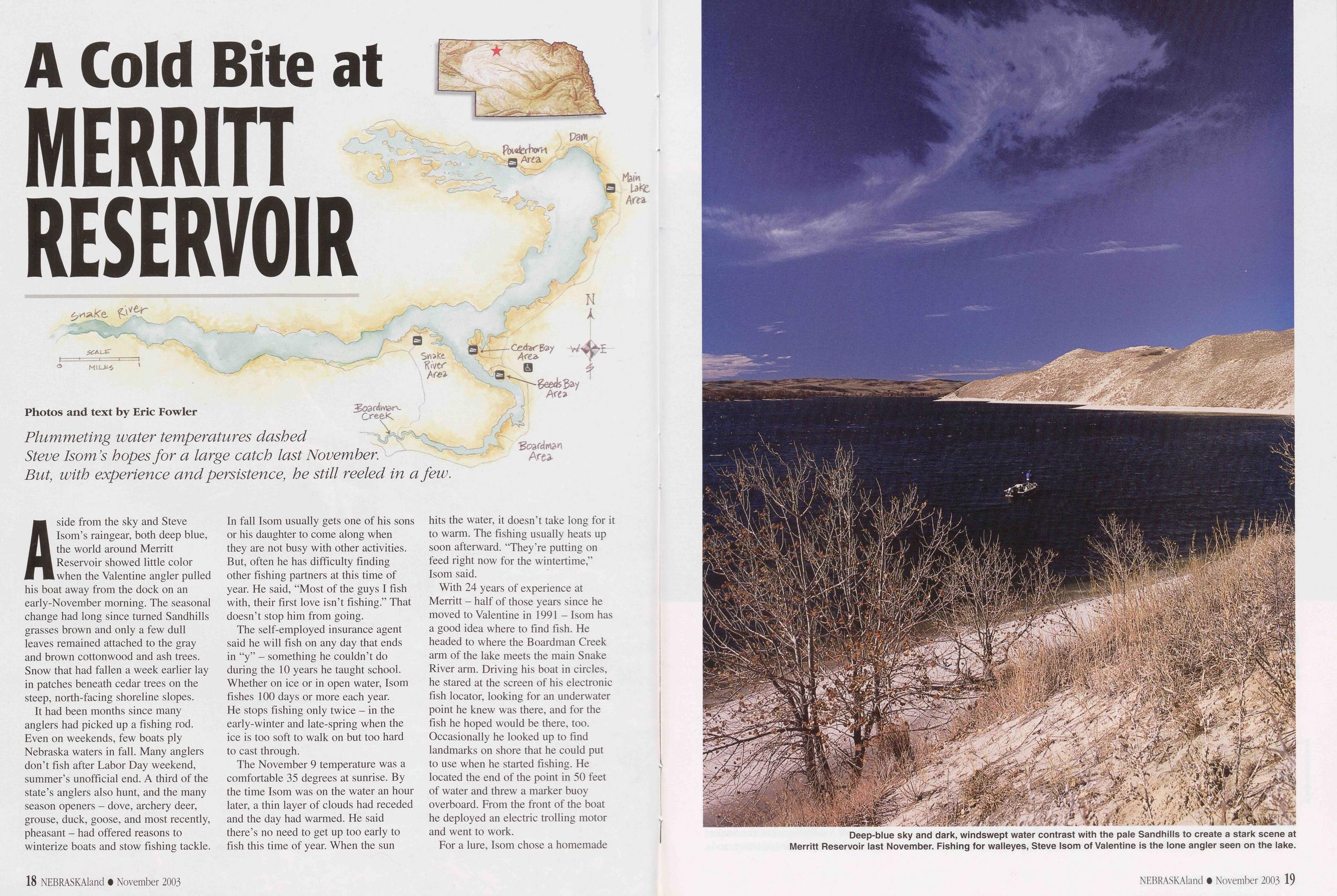
A Cold Bite at MERRITT RESERVOIR
Photos and text by Eric Fowler Plummeting water temperatures dashed Steve Isom's hopes for a large catch last November. But, with experience and persistence, he still reeled in a few.Aside from the sky and Steve Isom's raingear, both deep blue, the world around Merritt Reservoir showed little color when the Valentine angler pulled his boat away from the dock on an early-November morning. The seasonal change had long since turned Sandhills grasses brown and only a few dull leaves remained attached to the gray and brown cotton wood and ash trees. Snow that had fallen a week earlier lay in patches beneath cedar trees on the steep, north-facing shoreline slopes.
It had been months since many anglers had picked up a fishing rod. Even on weekends, few boats ply Nebraska waters in fall. Many anglers don't fish after Labor Day weekend, summer's unofficial end. A third of the state's anglers also hunt, and the many season openers - dove, archery deer, grouse, duck, goose, and most recently, pheasant - had offered reasons to winterize boats and stow fishing tackle. In fall Isom usually gets one of his sons or his daughter to come along when they are not busy with other activities. But, often he has difficulty finding other fishing partners at this time of year. He said, "Most of the guys I fish with, their first love isn't fishing." That doesn't stop him from going.
The self-employed insurance agent said he will fish on any day that ends in "y" - something he couldn't do during the 10 years he taught school. Whether on ice or in open water, Isom fishes 100 days or more each year. He stops fishing only twice - in the early-winter and late-spring when the ice is too soft to walk on but too hard to cast through.
The November 9 temperature was a comfortable 35 degrees at sunrise. By the time Isom was on the water an hour later, a thin layer of clouds had receded and the day had warmed. He said there's no need to get up too early to fish this time of year. When the sun hits the water, it doesn't take long for it to warm. The fishing usually heats up soon afterward. "They're putting on feed right now for the wintertime," Isom said.
With 24 years of experience at Merritt - half of those years since he moved to Valentine in 1991 - Isom has a good idea where to find fish. He headed to where the Boardman Creek arm of the lake meets the main Snake River arm. Driving his boat in circles, he stared at the screen of his electronic fish locator, looking for an underwater point he knew was there, and for the fish he hoped would be there, too. Occasionally he looked up to find landmarks on shore that he could put to use when he started fishing. He located the end of the point in 50 feet of water and threw a marker buoy overboard. From the front of the boat he deployed an electric trolling motor and went to work.
For a lure, Isom chose a homemade 18 NEBRASKAland • November 2003
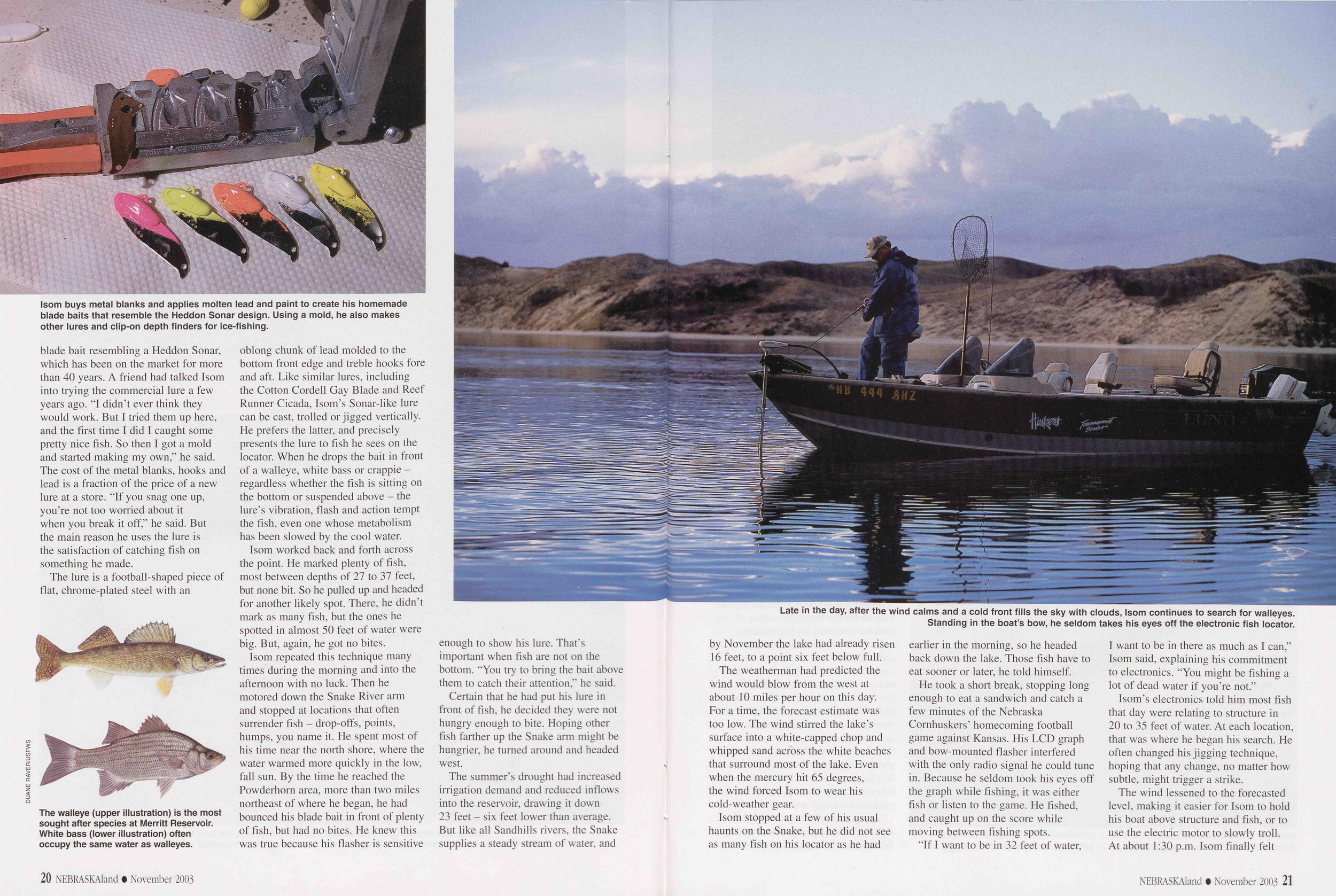
The lure is a football-shaped piece of flat, chrome-plated steel with an oblong chunk of lead molded to the bottom front edge and treble hooks fore and aft. Like similar lures, including the Cotton Cordell Gay Blade and Reef Runner Cicada, Isom's Sonar-like lure can be cast, trolled or jigged vertically. He prefers the latter, and precisely presents the lure to fish he sees on the locator. When he drops the bait in front of a walleye, white bass or crappie - regardless whether the fish is sitting on the bottom or suspended above - the lure's vibration, flash and action tempt the fish, even one whose metabolism has been slowed by the cool water.
Isom worked back and forth across the point. He marked plenty of fish, most between depths of 27 to 37 feet, but none bit. So he pulled up and headed for another likely spot. There, he didn't mark as many fish, but the ones he spotted in almost 50 feet of water were big. But, again, he got no bites.
Isom repeated this technique many times during the morning and into the afternoon with no luck. Then he motored down the Snake River arm and stopped at locations that often surrender fish - drop-offs, points, humps, you name it. He spent most of his time near the north shore, where the water warmed more quickly in the low, fall sun. By the time he reached the Powderhorn area, more than two miles northeast of where he began, he had bounced his blade bait in front of plenty of fish, but had no bites. He knew this was true because his flasher is sensitive enough to show his lure. That's important when fish are not on the bottom. "You try to bring the bait above them to catch their attention," he said.
Certain that he had put his lure in front of fish, he decided they were not hungry enough to bite. Hoping other fish farther up the Snake arm might be hungrier, he turned around and headed west.
The summer's drought had increased irrigation demand and reduced inflows into the reservoir, drawing it down 23 feet - six feet lower than average. But like all Sandhills rivers, the Snake supplies a steady stream of water, and 20 NEBRASKAland • November 2003
The weatherman had predicted the wind would blow from the west at about 10 miles per hour on this day. For a time, the forecast estimate was too low. The wind stirred the lake's surface into a white-capped chop and whipped sand across the white beaches that surround most of the lake. Even when the mercury hit 65 degrees, the wind forced Isom to wear his cold-weather gear.
Isom stopped at a few of his usual haunts on the Snake, but he did not see as many fish on his locator as he had earlier in the morning, so he headed back down the lake. Those fish have to eat sooner or later, he told himself.
He took a short break, stopping long enough to eat a sandwich and catch a few minutes of the Nebraska Cornhuskers' homecoming football game against Kansas. His LCD graph and bow-mounted flasher interfered with the only radio signal he could tune in. Because he seldom took his eyes off the graph while fishing, it was either fish or listen to the game. He fished, and caught up on the score while moving between fishing spots.
"If I want to be in 32 feet of water, I want to be in there as much as I can," Isom said, explaining his commitment to electronics. "You might be fishing a lot of dead water if you're not."
Isom's electronics told him most fish that day were relating to structure in 20 to 35 feet of water. At each location, that was where he began his search. He often changed his jigging technique, hoping that any change, no matter how subtle, might trigger a strike.
The wind lessened to the forecasted
level, making it easier for Isom to hold
his boat above structure and fish, or to
use the electric motor to slowly troll.
At about 1:30 p.m. Isom finally felt
NEBRASKAland • November 2003 21
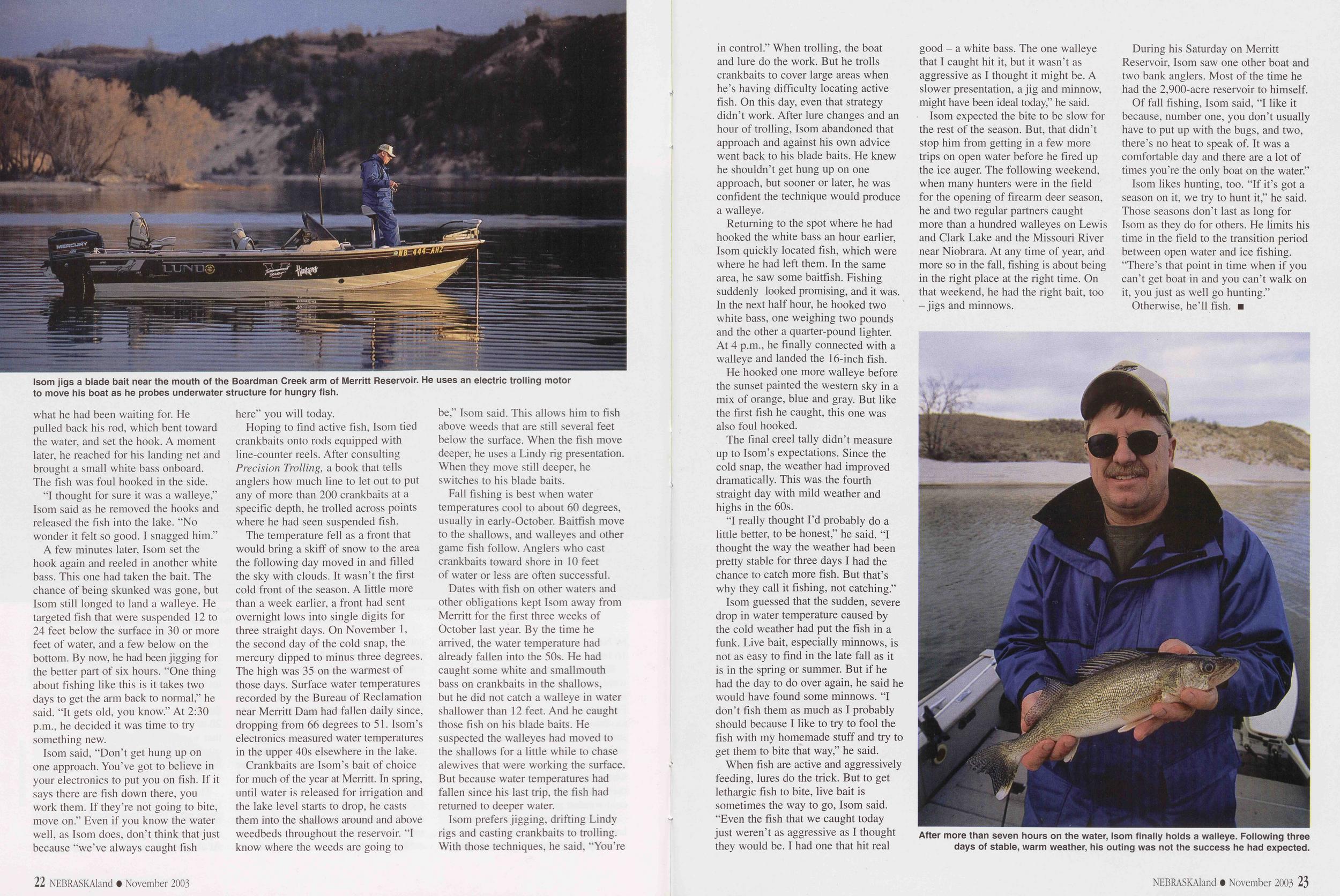
"I thought for sure it was a walleye," Isom said as he removed the hooks and released the fish into the lake. "No wonder it felt so good. I snagged him."
A few minutes later, Isom set the hook again and reeled in another white bass. This one had taken the bait. The chance of being skunked was gone, but Isom still longed to land a walleye. He targeted fish that were suspended 12 to 24 feet below the surface in 30 or more feet of water, and a few below on the bottom. By now, he had been jigging for the better part of six hours. "One thing about fishing like this is it takes two days to get the arm back to normal," he said. "It gets old, you know." At 2:30 p.m., he decided it was time to try something new.
Isom said, "Don't get hung up on one approach. You've got to believe in your electronics to put you on fish. If it says there are fish down there, you work them. If they're not going to bite, move on." Even if you know the water well, as Isom does, don't think that just because "we've always caught fish here" you will today.
Hoping to find active fish, Isom tied crankbaits onto rods equipped with line-counter reels. After consulting Precision Trolling, a book that tells anglers how much line to let out to put any of more than 200 crankbaits at a specific depth, he trolled across points where he had seen suspended fish.
The temperature fell as a front that would bring a skiff of snow to the area the following day moved in and filled the sky with clouds. It wasn't the first cold front of the season. A little more than a week earlier, a front had sent overnight lows into single digits for three straight days. On November 1, the second day of the cold snap, the mercury dipped to minus three degrees. The high was 35 on the warmest of those days. Surface water temperatures recorded by the Bureau of Reclamation near Merritt Dam had fallen daily since, dropping from 66 degrees to 51. Isom's electronics measured water temperatures in the upper 40s elsewhere in the lake.
Crankbaits are Isom's bait of choice for much of the year at Merritt. In spring, until water is released for irrigation and the lake level starts to drop, he casts them into the shallows around and above weedbeds throughout the reservoir. "I know where the weeds are going to be," Isom said. This allows him to fish above weeds that are still several feet below the surface. When the fish move deeper, he uses a Lindy rig presentation. When they move still deeper, he switches to his blade baits.
Fall fishing is best when water temperatures cool to about 60 degrees, usually in early-October. Baitfish move to the shallows, and walleyes and other game fish follow. Anglers who cast crankbaits toward shore in 10 feet of water or less are often successful.
Dates with fish on other waters and other obligations kept Isom away from Merritt for the first three weeks of October last year. By the time he arrived, the water temperature had already fallen into the 50s. He had caught some white and smallmouth bass on crankbaits in the shallows, but he did not catch a walleye in water shallower than 12 feet. And he caught those fish on his blade baits. He suspected the walleyes had moved to the shallows for a little while to chase alewives that were working the surface. But because water temperatures had fallen since his last trip, the fish had returned to deeper water.
Isom prefers jigging, drifting Lindy rigs and casting crankbaits to trolling. With those techniques, he said, "You're 22 NEBRASKAland • November 2003 in control." When trolling, the boat and lure do the work. But he trolls crankbaits to cover large areas when he's having difficulty locating active fish. On this day, even that strategy didn't work. After lure changes and an hour of trolling, Isom abandoned that approach and against his own advice went back to his blade baits. He knew he shouldn't get hung up on one approach, but sooner or later, he was confident the technique would produce a walleye.
Returning to the spot where he had hooked the white bass an hour earlier, Isom quickly located fish, which were where he had left them. In the same area, he saw some baitfish. Fishing suddenly looked promising, and it was. In the next half hour, he hooked two white bass, one weighing two pounds and the other a quarter-pound lighter. At 4 p.m., he finally connected with a walleye and landed the 16-inch fish.
He hooked one more walleye before the sunset painted the western sky in a mix of orange, blue and gray. But like the first fish he caught, this one was also foul hooked.
The final creel tally didn't measure up to Isom's expectations. Since the cold snap, the weather had improved dramatically. This was the fourth straight day with mild weather and highs in the 60s.
"I really thought I'd probably do a little better, to be honest," he said. "I thought the way the weather had been pretty stable for three days I had the chance to catch more fish. But that's why they call it fishing, not catching."
Isom guessed that the sudden, severe drop in water temperature caused by the cold weather had put the fish in a funk. Live bait, especially minnows, is not as easy to find in the late fall as it is in the spring or summer. But if he had the day to do over again, he said he would have found some minnows. "I don't fish them as much as I probably should because I like to try to fool the fish with my homemade stuff and try to get them to bite that way," he said.
When fish are active and aggressively feeding, lures do the trick. But to get lethargic fish to bite, live bait is sometimes the way to go, Isom said. "Even the fish that we caught today just weren't as aggressive as I thought they would be. I had one that hit real good - a white bass. The one walleye that I caught hit it, but it wasn't as aggressive as I thought it might be. A slower presentation, a jig and minnow, might have been ideal today," he said.
Isom expected the bite to be slow for the rest of the season. But, that didn't stop him from getting in a few more trips on open water before he fired up the ice auger. The following weekend, when many hunters were in the field for the opening of firearm deer season, he and two regular partners caught more than a hundred walleyes on Lewis and Clark Lake and the Missouri River near Niobrara. At any time of year, and more so in the fall, fishing is about being in the right place at the right time. On that weekend, he had the right bait, too -jigs and minnows.
During his Saturday on Merritt Reservoir, Isom saw one other boat and two bank anglers. Most of the time he had the 2,900-acre reservoir to himself.
Of fall fishing, Isom said, "I like it because, number one, you don't usually have to put up with the bugs, and two, there's no heat to speak of. It was a comfortable day and there are a lot of times you're the only boat on the water."
Isom likes hunting, too. "If it's got a season on it, we try to hunt it," he said. Those seasons don't last as long for Isom as they do for others. He limits his time in the field to the transition period between open water and ice fishing. There's that point in time when if you can't get boat in and you can't walk on it, you just as well go hunting."
Otherwise, he'll fish. ■
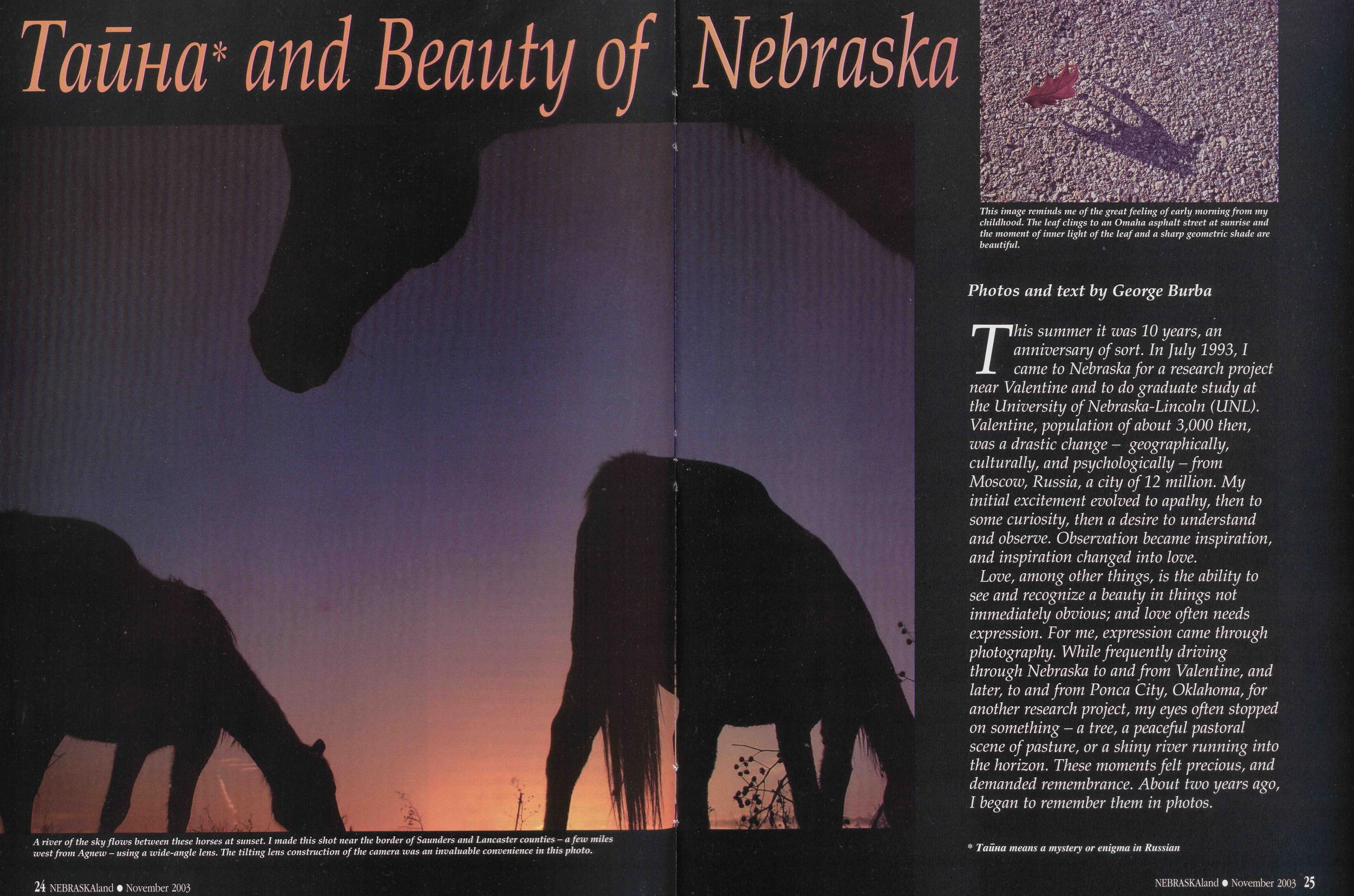
Taūha* and Beuaty of Nebraska
This summer it was 10 years, an anniversary of sort. In July 1993,1 came to Nebraska for a research project near Valentine and to do graduate study at the University of Nebraska-Lincoln (UNL). Valentine, population of about 3,000 then, was a drastic change - geographically, culturally, and psychologically -from Moscow, Russia, a city of 12 million. My initial excitement evolved to apathy, then to some curiosity, then a desire to understand and observe. Observation became inspiration, and inspiration changed into love.
Love, among other things, is the ability to see and recognize a beauty in things not immediately obvious; and love often needs expression. Lor me, expression came through photography. While frequently driving through Nebraska to and from Valentine, and later, to and from Ponca City, Oklahoma, for another research project, my eyes often stopped on something - a tree, a peaceful pastoral scene of pasture, or a shiny river running into the horizon. These moments felt precious, and demanded remembrance. About two years ago, I began to remember them in photos.
* Taūha means a mystery or enigma in Russian NEBRASKAland • November 2003 25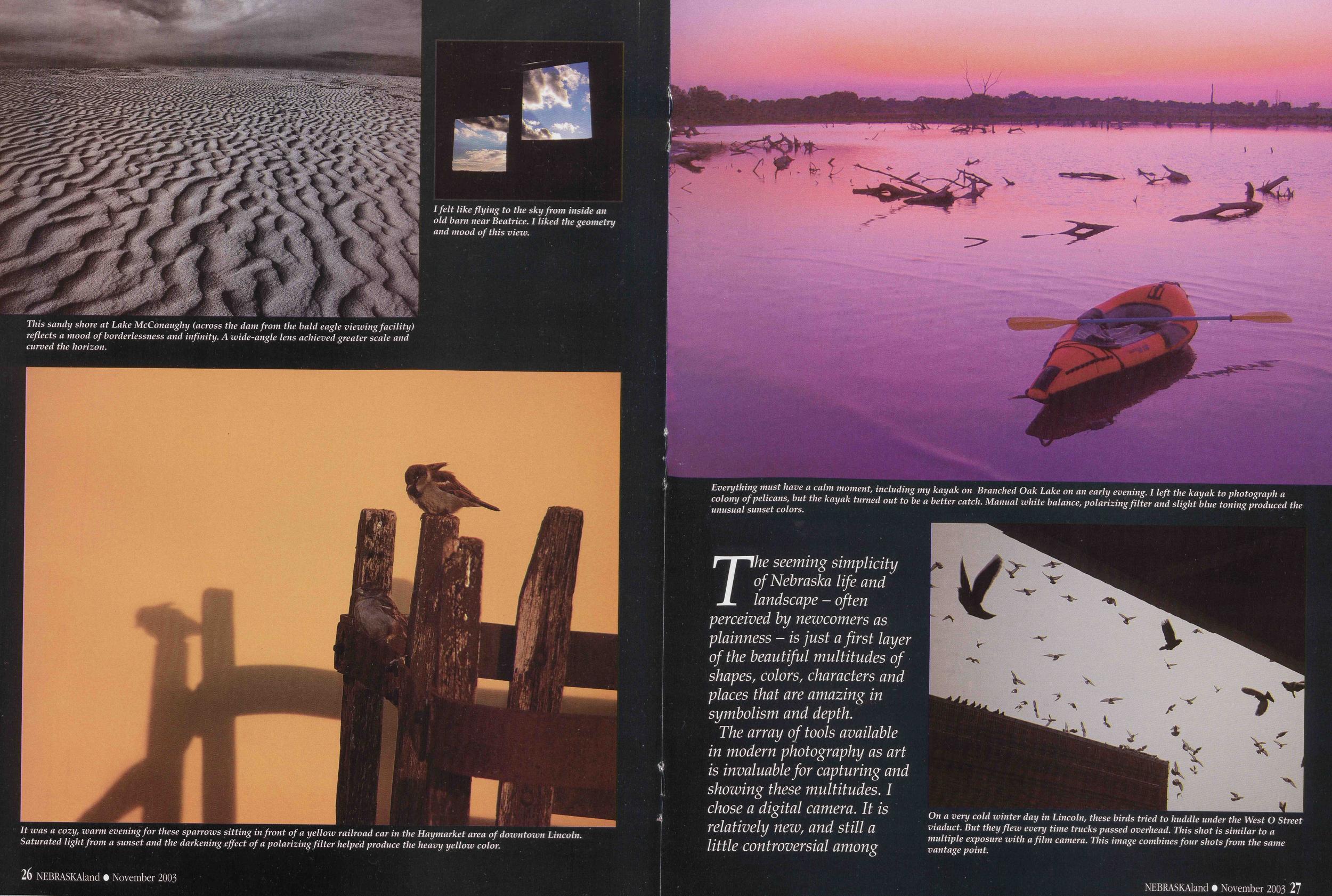
The seeming simplicity of Nebraska life and . landscape - often perceived by newcomers as plainness - is just a first layer of the beautiful multitudes of shapes, colors, characters and places that are amazing in symbolism and depth.
The array of tools available in modern photography as art is invaluable for capturing and showing these multitudes. I chose a digital camera. It is relatively new, and still a little controversial among
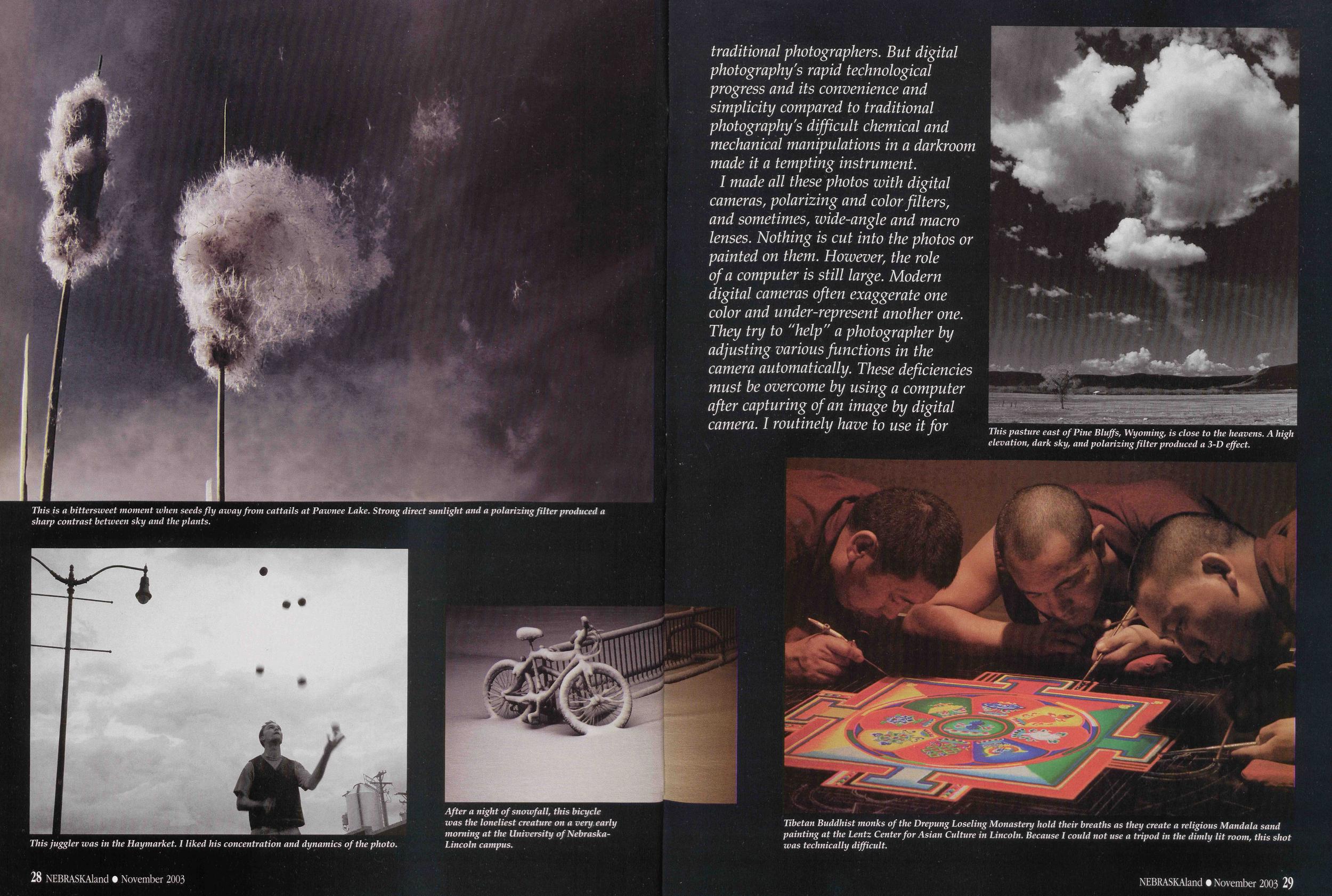
traditional photographers. But digital photography's rapid technological progress and its convenience and simplicity compared to traditional photography's difficult chemical and mechanical manipulations in a darkroom made it a tempting instrument.
I made all these photos with digital cameras, polarizing and color filters, and sometimes, wide-angle and macro lenses. Nothing is cut into the photos or painted on them. However, the role of a computer is still large. Modern digital cameras often exaggerate one color and under-represent another one. They try to "help" a photographer by adjusting various functions in the camera automatically. These deficiencies must be overcome by using a computer after capturing of an image by digital camera. I routinely have to use it for
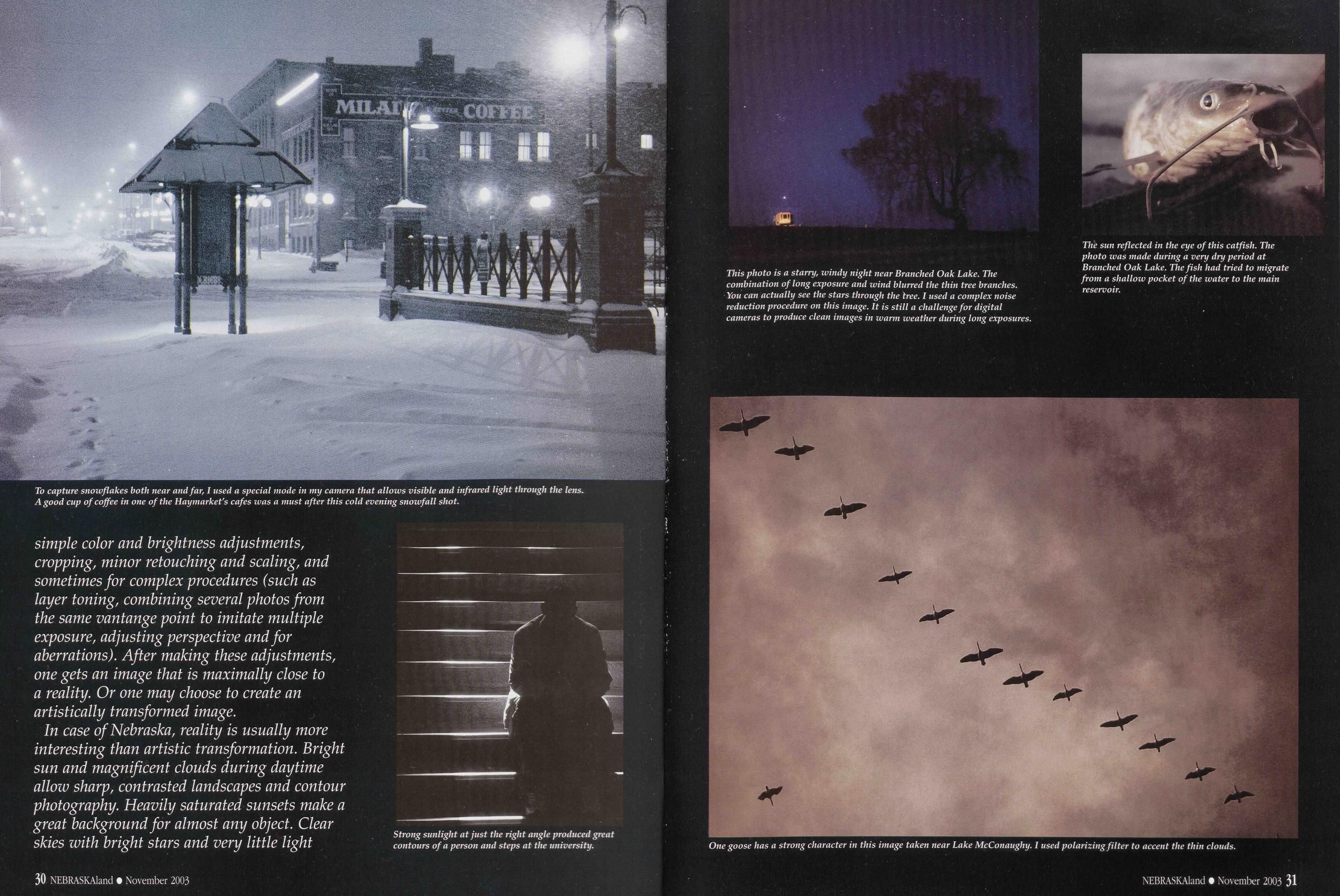
In case of Nebraska, reality is usually more interesting than artistic transformation. Bright sun and magnificent clouds during daytime allow sharp, contrasted landscapes and contour photography. Heavily saturated sunsets make a great background for almost any object. Clear skies with bright stars and very little light
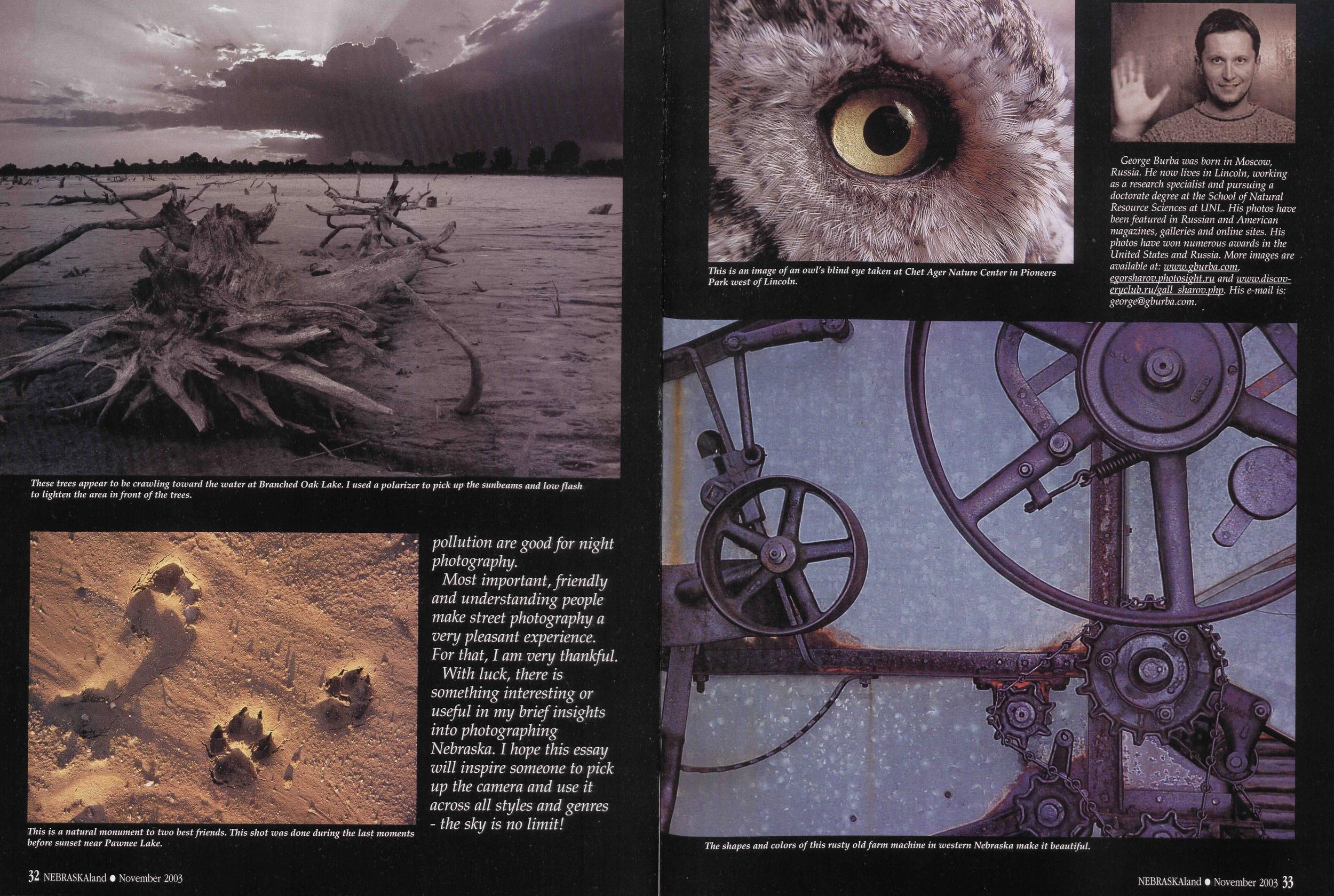
Most important, friendly and understanding people make street photography a very pleasant experience. For that, I am very thankful
With luck, there is something interesting or useful in my brief insights into photographing Nebraska. I hope this essay will inspire someone to pick up the camera and use it across all styles and genres - the sky is no limit!
32 NEBRASKAland • November 2003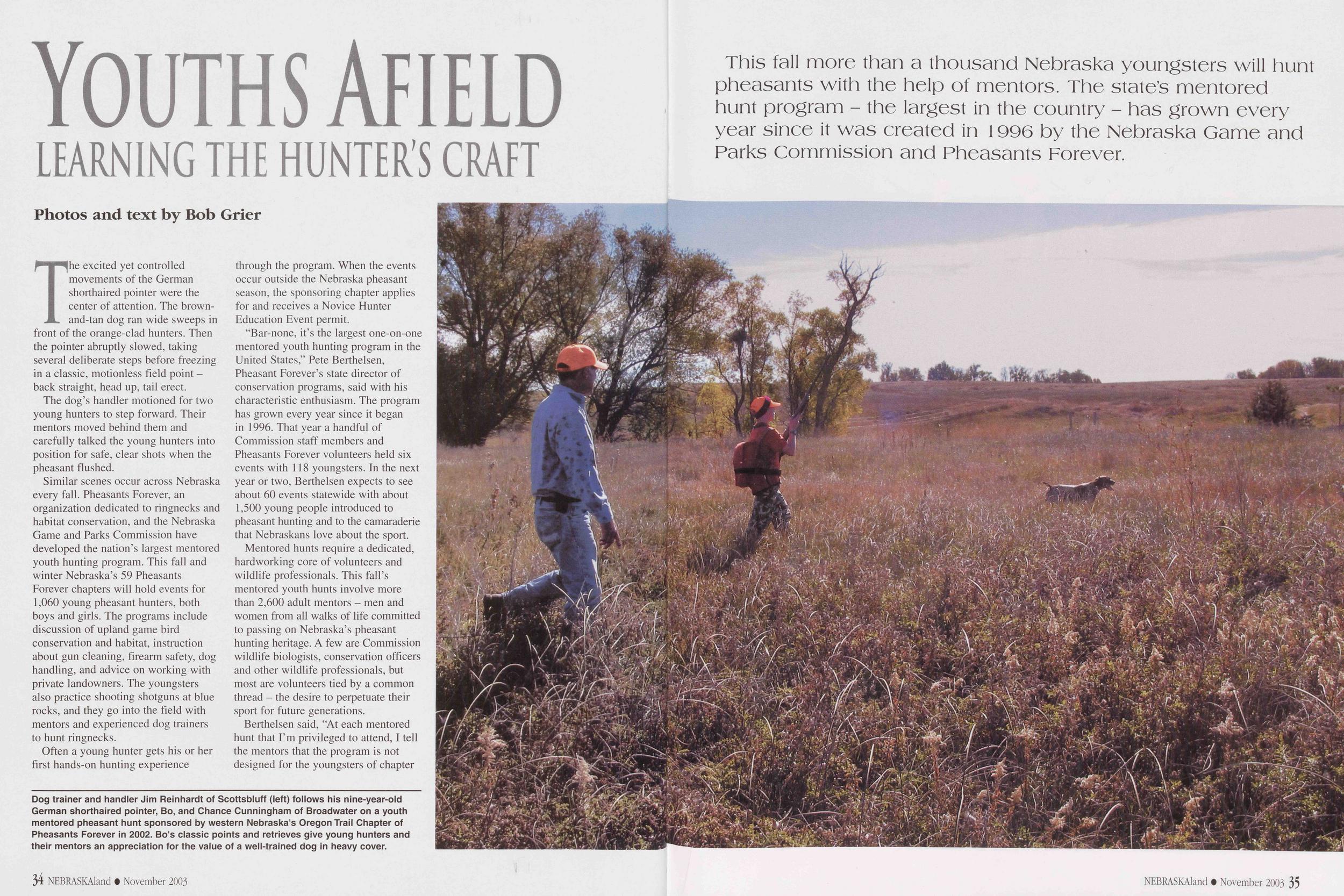
YOUTHS AFILED LEARNING THE HUNTER'S CRAFT
Photos and text by Bob GrierThe excited yet controlled movements of the German shorthaired pointer were the center of attention. The brown-and-tan dog ran wide sweeps in front of the orange-clad hunters. Then the pointer abruptly slowed, taking several deliberate steps before freezing in a classic, motionless field point back straight, head up, tail erect.
The dog's handler motioned for two young hunters to step forward. Their mentors moved behind them and carefully talked the young hunters into position for safe, clear shots when the pheasant flushed.
Similar scenes occur across Nebraska every fall. Pheasants Forever, an organization dedicated to ringnecks and habitat conservation, and the Nebraska Game and Parks Commission have developed the nation's largest mentored youth hunting program. This fall and winter Nebraska's 59 Pheasants Forever chapters will hold events for 1,060 young pheasant hunters, both boys and girls. The programs include discussion of upland game bird conservation and habitat, instruction about gun cleaning, firearm safety, dog handling, and advice on working with private landowners. The youngsters also practice shooting shotguns at blue rocks, and they go into the field with mentors and experienced dog trainers to hunt ringnecks.
Often a young hunter gets his or her first hands-on hunting experience through the program. When the events occur outside the Nebraska pheasant season, the sponsoring chapter applies for and receives a Novice Hunter Education Event permit.
"Bar-none, it's the largest one-on-one mentored youth hunting program in the United States," Pete Berthelsen, Pheasant Forever's state director of conservation programs, said with his characteristic enthusiasm. The program has grown every year since it began in 1996. That year a handful of Commission staff members and Pheasants Forever volunteers held six events with 118 youngsters. In the next year or two, Berthelsen expects to see about 60 events statewide with about 1,500 young people introduced to pheasant hunting and to the camaraderie that Nebraskans love about the sport.
Mentored hunts require a dedicated, hardworking core of volunteers and wildlife professionals. This fall's mentored youth hunts involve more than 2,600 adult mentors - men and women from all walks of life committed to passing on Nebraska's pheasant hunting heritage. A few are Commission wildlife biologists, conservation officers and other wildlife professionals, but most are volunteers tied by a common thread - the desire to perpetuate their sport for future generations.
Berthelsen said, "At each mentored hunt that I'm privileged to attend, I tell the mentors that the program is not designed for the youngsters of chapter members. The program is squarely aimed at youths who have an interest in hunting and who have gone through Nebraska's hunter education classes but lack the ability or opportunity to get out - young people from urban areas, those who live in single-parent homes, and those who don't have the strong ties to the land that earlier generations enjoyed.
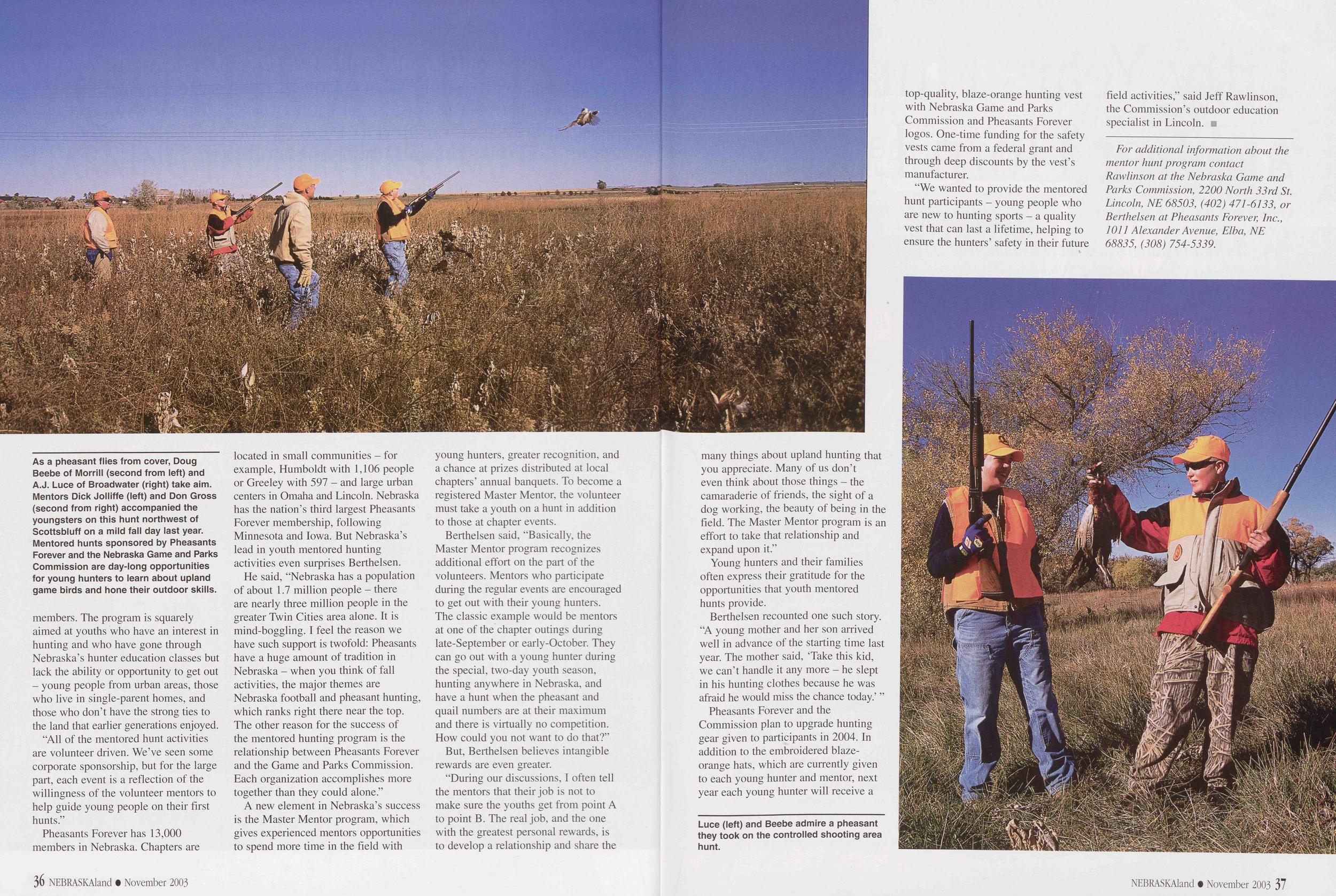
"All of the mentored hunt activities are volunteer driven. We've seen some corporate sponsorship, but for the large part, each event is a reflection of the willingness of the volunteer mentors to help guide young people on their first hunts."
Pheasants Forever has 13,000 members in Nebraska. Chapters are located in small communities - for example, Humboldt with 1,106 people or Greeley with 597 - and large urban centers in Omaha and Lincoln. Nebraska has the nation's third largest Pheasants Forever membership, following Minnesota and Iowa. But Nebraska's lead in youth mentored hunting activities even surprises Berthelsen.
He said, "Nebraska has a population of about 1.7 million people - there are nearly three million people in the greater Twin Cities area alone. It is mind-boggling. I feel the reason we have such support is twofold: Pheasants have a huge amount of tradition in Nebraska - when you think of fall activities, the major themes are Nebraska football and pheasant hunting, which ranks right there near the top. The other reason for the success of the mentored hunting program is the relationship between Pheasants Forever and the Game and Parks Commission. Each organization accomplishes more together than they could alone."
A new element in Nebraska's success is the Master Mentor program, which gives experienced mentors opportunities to spend more time in the field with young hunters, greater recognition, and a chance at prizes distributed at local chapters' annual banquets. To become a registered Master Mentor, the volunteer must take a youth on a hunt in addition to those at chapter events.
Berthelsen said, "Basically, the Master Mentor program recognizes additional effort on the part of the volunteers. Mentors who participate during the regular events are encouraged to get out with their young hunters. The classic example would be mentors at one of the chapter outings during late-September or early-October. They can go out with a young hunter during the special, two-day youth season, hunting anywhere in Nebraska, and have a hunt when the pheasant and quail numbers are at their maximum and there is virtually no competition. How could you not want to do that?"
But, Berthelsen believes intangible rewards are even greater.
"During our discussions, I often tell the mentors that their job is not to make sure the youths get from point A to point B. The real job, and the one with the greatest personal rewards, is to develop a relationship and share the 36 NEBRASKAland • November 2003 many things about upland hunting that you appreciate. Many of us don't even think about those things - the camaraderie of friends, the sight of a dog working, the beauty of being in the field. The Master Mentor program is an effort to take that relationship and expand upon it."
Young hunters and their families often express their gratitude for the opportunities that youth mentored hunts provide.
Berthelsen recounted one such story. "A young mother and her son arrived well in advance of the starting time last year. The mother said, 'Take this kid, we can't handle it any more - he slept in his hunting clothes because he was afraid he would miss the chance today.' "
Pheasants Forever and the Commission plan to upgrade hunting gear given to participants in 2004. In addition to the embroidered blaze- orange hats, which are currently given to each young hunter and mentor, next year each young hunter will receive a top-quality, blaze-orange hunting vest with Nebraska Game and Parks Commission and Pheasants Forever logos. One-time funding for the safety vests came from a federal grant and through deep discounts by the vest's manufacturer.
"We wanted to provide the mentored hunt participants - young people who are new to hunting sports - a quality vest that can last a lifetime, helping to ensure the hunters' safety in their future field activities," said Jeff Rawlinson, the Commission's outdoor education specialist in Lincoln.
For additional information about the mentor hunt program contact Rawlinson at the Nebraska Game and Parks Commission, 2200 North 33rd St. Lincoln, NE 68503, (402) 471-6133, or Berthelsen at Pheasants Forever, Inc., 1011 Alexander Avenue, Elba, NE 68835, (308) 754-5339.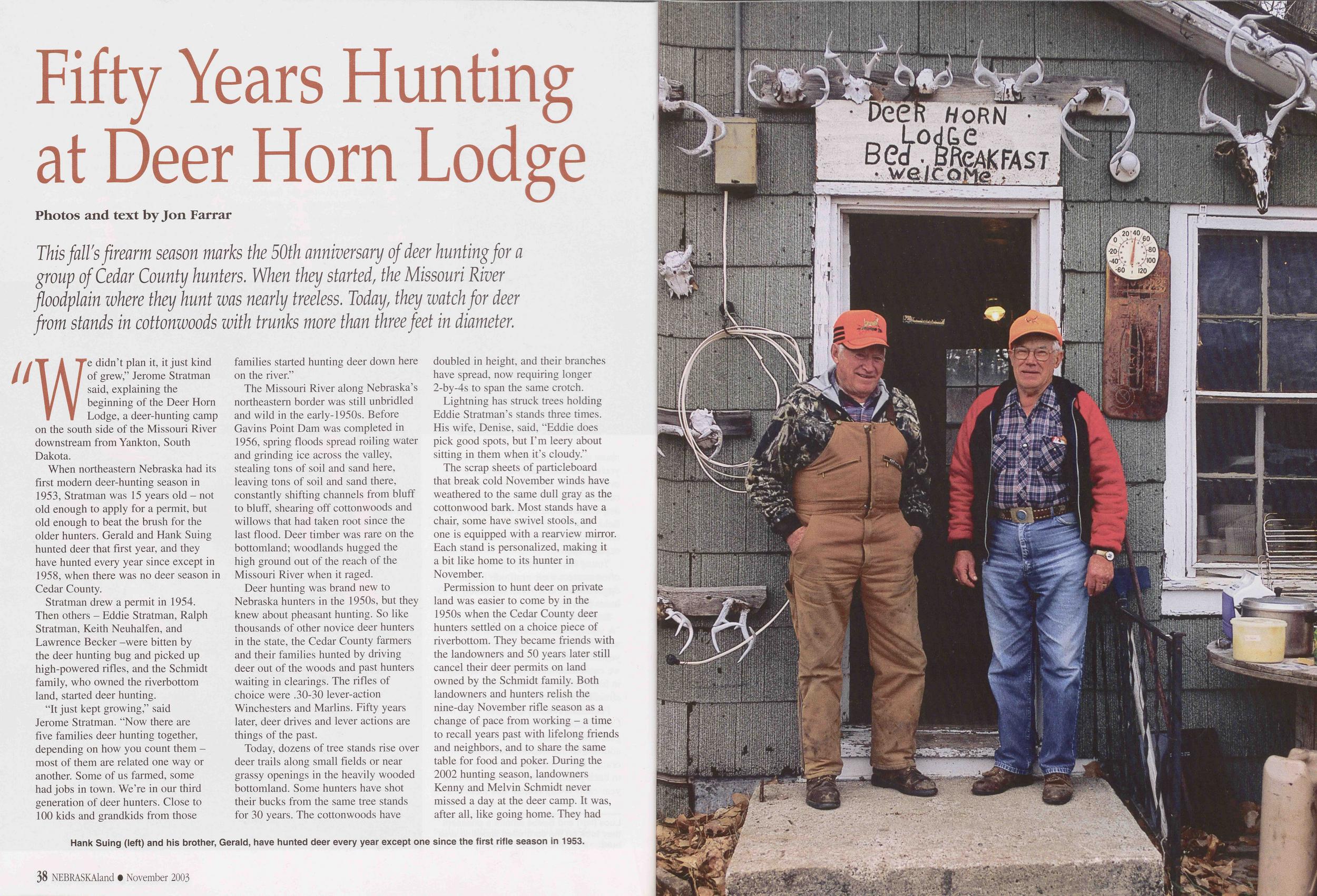
Fifty Years Hunting at Deer Horn Lodge
Photos and text by Jon Farrar This fall's firearm season marks the 50th anniversary of deer hunting for a group of Cedar County hunters. When they started, the Missouri River floodplain where they hunt was nearly treeless. Today, they watch for deer from stands in cottonwoods with trunks more than three feet in diameter."We didn't plan it, it just kind of grew," Jerome Stratman said, explaining the beginning of the Deer Horn Lodge, a deer-hunting camp on the south side of the Missouri River downstream from Yankton, South Dakota.
When northeastern Nebraska had its first modern deer-hunting season in 1953, Stratman was 15 years old - not old enough to apply for a permit, but old enough to beat the brush for the older hunters. Gerald and Hank Suing hunted deer that first year, and they have hunted every year since except in 1958, when there was no deer season in Cedar County.
Stratman drew a permit in 1954. Then others - Eddie Stratman, Ralph Stratman, Keith Neuhalfen, and Lawrence Becker -were bitten by the deer hunting bug and picked up high-powered rifles, and the Schmidt family, who owned the riverbottom land, started deer hunting.
"It just kept growing," said Jerome Stratman. "Now there are five families deer hunting together, depending on how you count them - most of them are related one way or another. Some of us farmed, some had jobs in town. We're in our third generation of deer hunters. Close to 100 kids and grandkids from those families started hunting deer down here on the river."
The Missouri River along Nebraska's northeastern border was still unbridled and wild in the early-1950s. Before Gavins Point Dam was completed in 1956, spring floods spread roiling water and grinding ice across the valley, stealing tons of soil and sand here, leaving tons of soil and sand there, constantly shifting channels from bluff to bluff, shearing off cottonwoods and willows that had taken root since the last flood. Deer timber was rare on the bottomland; woodlands hugged the high ground out of the reach of the Missouri River when it raged.
Deer hunting was brand new to Nebraska hunters in the 1950s, but they knew about pheasant hunting. So like thousands of other novice deer hunters in the state, the Cedar County farmers and their families hunted by driving deer out of the woods and past hunters waiting in clearings. The rifles of choice were .30-30 lever-action Winchesters and Marlins. Fifty years later, deer drives and lever actions are things of the past.
Today, dozens of tree stands rise over deer trails along small fields or near grassy openings in the heavily wooded bottomland. Some hunters have shot their bucks from the same tree stands for 30 years. The cottonwoods have doubled in height, and their branches have spread, now requiring longer 2-by-4s to span the same crotch.
Lightning has struck trees holding Eddie Stratman's stands three times. His wife, Denise, said, "Eddie does pick good spots, but I'm leery about sitting in them when it's cloudy."
The scrap sheets of particleboard that break cold November winds have weathered to the same dull gray as the cottonwood bark. Most stands have a chair, some have swivel stools, and one is equipped with a rearview mirror. Each stand is personalized, making it a bit like home to its hunter in November.
Permission to hunt deer on private land was easier to come by in the 1950s when the Cedar County deer hunters settled on a choice piece of riverbottom. They became friends with the landowners and 50 years later still cancel their deer permits on land owned by the Schmidt family. Both landowners and hunters relish the nine-day November rifle season as a change of pace from working - a time to recall years past with lifelong friends and neighbors, and to share the same table for food and poker. During the 2002 hunting season, landowners Kenny and Melvin Schmidt never missed a day at the deer camp. It was, after all, like going home. They had 38 NEBRASKAland • November 2003
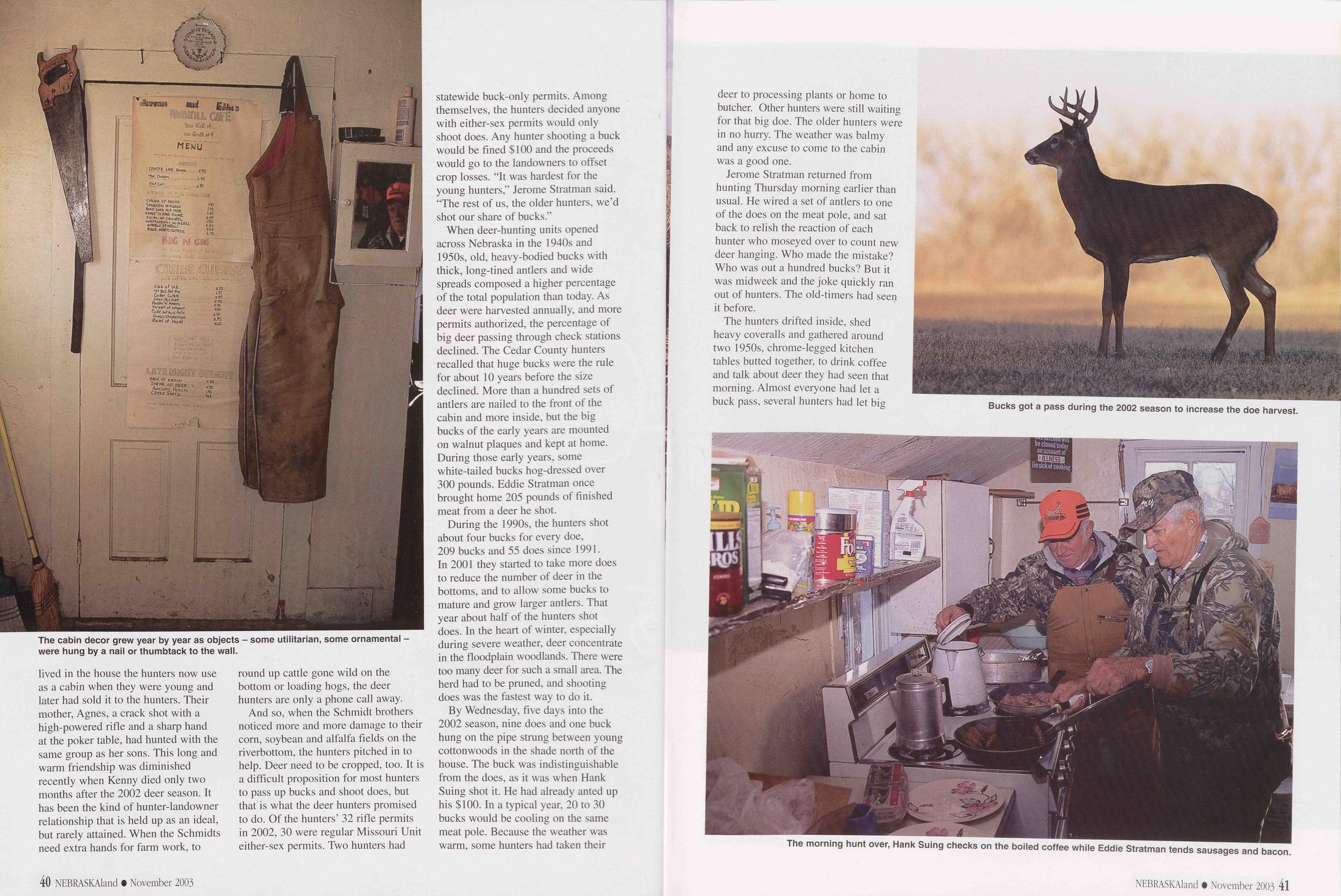
And so, when the Schmidt brothers noticed more and more damage to their corn, soybean and alfalfa fields on the river bottom, the hunters pitched in to help. Deer need to be cropped, too. It is a difficult proposition for most hunters to pass up bucks and shoot does, but that is what the deer hunters promised to do. Of the hunters' 32 rifle permits in 2002, 30 were regular Missouri Unit either-sex permits. Two hunters had statewide buck-only permits. Among themselves, the hunters decided anyone with either-sex permits would only shoot does. Any hunter shooting a buck would be fined $100 and the proceeds would go to the landowners to offset crop losses. "It was hardest for the young hunters," Jerome Stratman said. "The rest of us, the older hunters, we'd shot our share of bucks."
When deer-hunting units opened across Nebraska in the 1940s and 1950s, old, heavy-bodied bucks with thick, long-tined antlers and wide spreads composed a higher percentage of the total population than today. As deer were harvested annually, and more permits authorized, the percentage of big deer passing through check stations declined. The Cedar County hunters recalled that huge bucks were the rule for about 10 years before the size declined. More than a hundred sets of antlers are nailed to the front of the cabin and more inside, but the big bucks of the early years are mounted on walnut plaques and kept at home.
During those early years, some white-tailed bucks hog-dressed over 300 pounds. Eddie Stratman once brought home 205 pounds of finished meat from a deer he shot. During the 1990s, the hunters shot about four bucks for every doe, 209 bucks and 55 does since 1991. In 2001 they started to take more does to reduce the number of deer in the bottoms, and to allow some bucks to mature and grow larger antlers. That year about half of the hunters shot does. In the heart of winter, especially during severe weather, deer concentrate in the floodplain woodlands. There were too many deer for such a small area. The herd had to be pruned, and shooting does was the fastest way to do it.
By Wednesday, five days into the 2002 season, nine does and one buck hung on the pipe strung between young cottonwoods in the shade north of the house. The buck was indistinguishable from the does, as it was when Hank Suing shot it. He had already anted up his $100. In a typical year, 20 to 30 bucks would be cooling on the same meat pole. Because the weather was warm, some hunters had taken their 40 NEBRASKAland • November 2003 deer to processing plants or home to butcher. Other hunters were still waiting for that big doe. The older hunters were in no hurry. The weather was balmy and any excuse to come to the cabin was a good one.
Jerome Stratman returned from hunting Thursday morning earlier than usual. He wired a set of antlers to one of the does on the meat pole, and sat back to relish the reaction of each hunter who moseyed over to count new deer hanging. Who made the mistake? Who was out a hundred bucks? But it was midweek and the joke quickly ran out of hunters. The old-timers had seen it before.
The hunters drifted inside, shed heavy coveralls and gathered around two 1950s, chrome-legged kitchen tables butted together, to drink coffee and talk about deer they had seen that morning. Almost everyone had let a buck pass, several hunters had let big
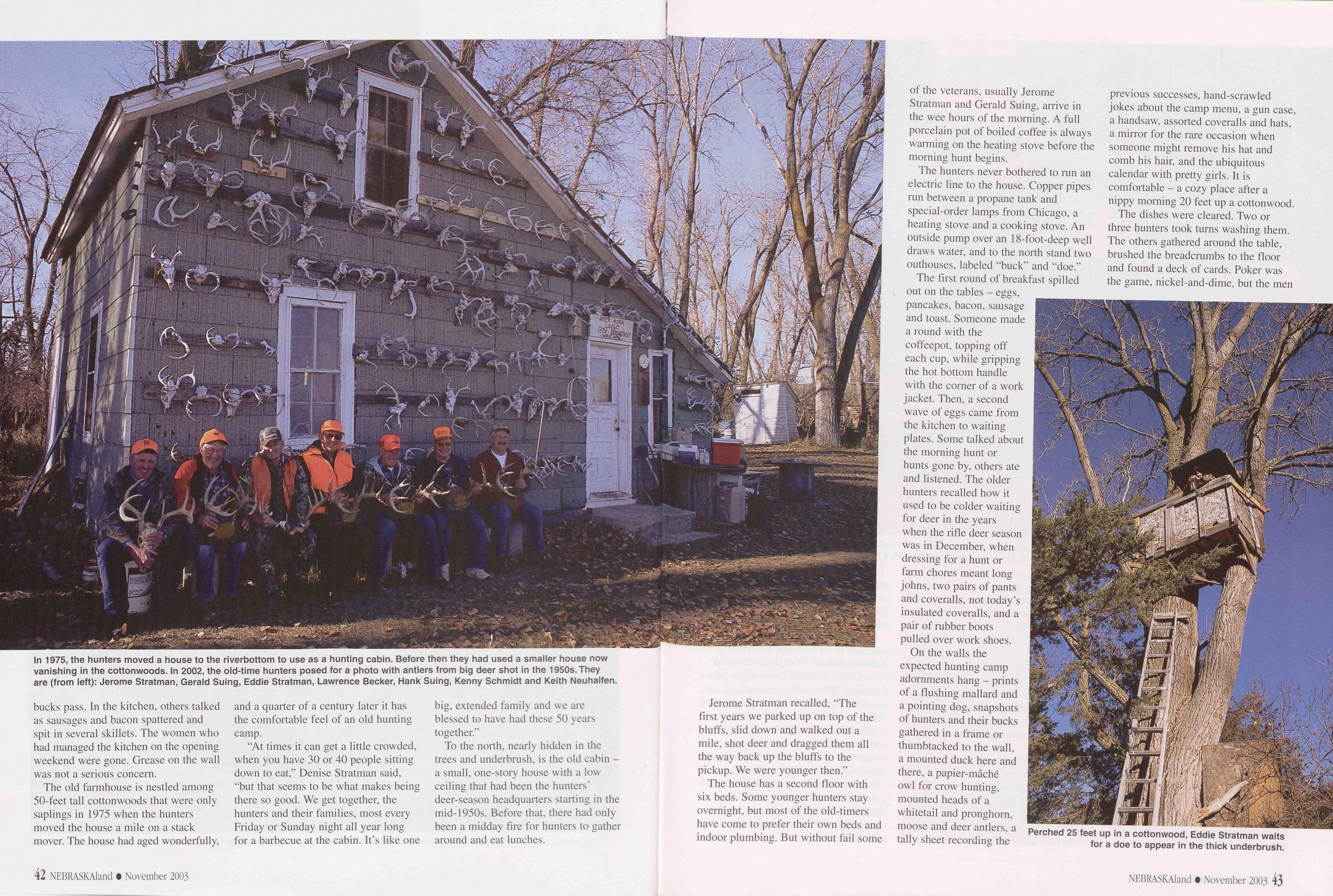
The old farmhouse is nestled among 50-feet tall cottonwoods that were only saplings in 1975 when the hunters moved the house a mile on a stack mover. The house had aged wonderfully, and a quarter of a century later it has the comfortable feel of an old hunting camp.
"At times it can get a little crowded, when you have 30 or 40 people sitting down to eat," Denise Stratman said, "but that seems to be what makes being there so good. We get together, the hunters and their families, most every Friday or Sunday night all year long for a barbecue at the cabin. It's like one big, extended family and we are blessed to have had these 50 years together."
To the north, nearly hidden in the trees and underbrush, is the old cabin - a small, one-story house with a low ceiling that had been the hunters' deer-season headquarters starting in the mid-1950s. Before that, there had only been a midday fire for hunters to gather around and eat lunches.
42 NEBRASKAland • November 2003Jerome Stratman recalled, "The first years we parked up on top of the bluffs, slid down and walked out a mile, shot deer and dragged them all the way back up the bluffs to the pickup. We were younger then."
The house has a second floor with six beds. Some younger hunters stay overnight, but most of the old-timers have come to prefer their own beds and indoor plumbing. But without fail some of the veterans, usually Jerome Stratman and Gerald Suing, arrive in the wee hours of the morning. A full porcelain pot of boiled coffee is always warming on the heating stove before the morning hunt begins.
The hunters never bothered to run an electric line to the house. Copper pipes run between a propane tank and special-order lamps from Chicago, a heating stove and a cooking stove. An outside pump over an 18-foot-deep well draws water, and to the north stand two outhouses, labeled "buck" and "doe."
The first round of breakfast spilled out on the tables - eggs, pancakes, bacon, sausage and toast. Someone made a round with the coffeepot, topping off each cup, while gripping the hot bottom handle with the corner of a work jacket. Then, a second wave of eggs came from the kitchen to waiting plates. Some talked about the morning hunt or hunts gone by, others ate and listened. The older hunters recalled how it used to be colder waiting for deer in the years when the rifle deer season was in December, when dressing for a hunt or farm chores meant long Johns, two pairs of pants and coveralls, not today's insulated coveralls, and a pair of rubber boots pulled over work shoes.
On the walls the expected hunting camp adornments hang - prints of a flushing mallard and a pointing dog, snapshots of hunters and their bucks gathered in a frame or thumbtacked to the wall, a mounted duck here and there, a papier-mache owl for crow hunting, mounted heads of a whitetail and pronghorn, moose and deer antlers, a tally sheet recording the previous successes, hand-scrawled jokes about the camp menu, a gun case, a handsaw, assorted coveralls and hats, a mirror for the rare occasion when someone might remove his hat and comb his hair, and the ubiquitous calendar with pretty girls. It is comfortable - a cozy place after a nippy morning 20 feet up a cottonwood.
The dishes were cleared. Two or three hunters took turns washing them. The others gathered around the table, brushed the breadcrumbs to the floor and found a deck of cards. Poker was the game, nickel-and-dime, but the men
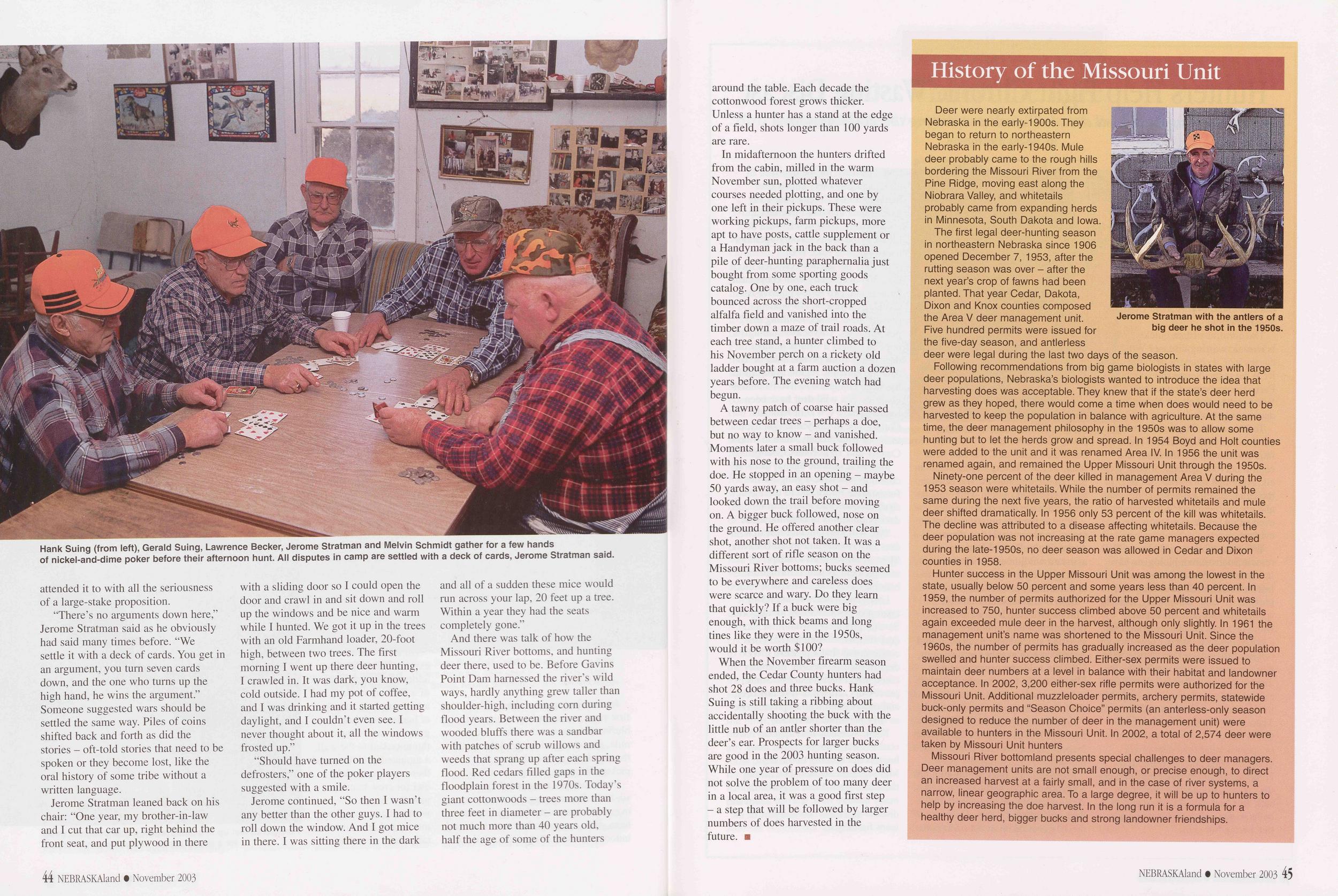
"There's no arguments down here," Jerome Stratman said as he obviously had said many times before. "We settle it with a deck of cards. You get in an argument, you turn seven cards down, and the one who turns up the high hand, he wins the argument." Someone suggested wars should be settled the same way. Piles of coins shifted back and forth as did the stories - oft-told stories that need to be spoken or they become lost, like the oral history of some tribe without a written language.
Jerome Stratman leaned back on his chair: "One year, my brother-in-law and I cut that car up, right behind the front seat, and put plywood in there with a sliding door so I could open the door and crawl in and sit down and roll up the windows and be nice and warm while I hunted. We got it up in the trees with an old Farmhand loader, 20-foot high, between two trees. The first morning I went up there deer hunting, I crawled in. It was dark, you know, cold outside. I had my pot of coffee, and I was drinking and it started getting daylight, and I couldn't even see. I never thought about it, all the windows frosted up."
"Should have turned on the defrosters," one of the poker players suggested with a smile.
Jerome continued, "So then I wasn't any better than the other guys. I had to roll down the window. And I got mice in there. I was sitting there in the dark and all of a sudden these mice would run across your lap, 20 feet up a tree. Within a year they had the seats completely gone."
And there was talk of how the Missouri River bottoms, and hunting deer there, used to be. Before Gavins Point Dam harnessed the river's wild ways, hardly anything grew taller than shoulder-high, including corn during flood years. Between the river and wooded bluffs there was a sandbar with patches of scrub willows and weeds that sprang up after each spring flood. Red cedars filled gaps in the floodplain forest in the 1970s. Today's giant cottonwoods - trees more than three feet in diameter - are probably not much more than 40 years old, half the age of some of the hunters 44 NEBRASKAland • November 2003 around the table. Each decade the cottonwood forest grows thicker. Unless a hunter has a stand at the edge of a field, shots longer than 100 yards are rare.
In midafternoon the hunters drifted from the cabin, milled in the warm November sun, plotted whatever courses needed plotting, and one by one left in their pickups. These were working pickups, farm pickups, more apt to have posts, cattle supplement or a Handyman jack in the back than a pile of deer-hunting paraphernalia just bought from some sporting goods catalog. One by one, each truck bounced across the short-cropped alfalfa field and vanished into the timber down a maze of trail roads. At each tree stand, a hunter climbed to his November perch on a rickety old ladder bought at a farm auction a dozen years before. The evening watch had begun.
A tawny patch of coarse hair passed between cedar trees - perhaps a doe, but no way to know - and vanished. Moments later a small buck followed with his nose to the ground, trailing the doe. He stopped in an opening - maybe 50 yards away, an easy shot - and looked down the trail before moving on. A bigger buck followed, nose on the ground. He offered another clear shot, another shot not taken. It was a different sort of rifle season on the Missouri River bottoms; bucks seemed to be everywhere and careless does were scarce and wary. Do they learn that quickly? If a buck were big enough, with thick beams and long tines like they were in the 1950s, would it be worth $100?
When the November firearm season ended, the Cedar County hunters had shot 28 does and three bucks. Hank Suing is still taking a ribbing about accidentally shooting the buck with the little nub of an antler shorter than the deer's ear. Prospects for larger bucks are good in the 2003 hunting season. While one year of pressure on does did not solve the problem of too many deer in a local area, it was a good first step - a step that will be followed by larger numbers of does harvested in the future, m
History of the Missouri UnitDeer were nearly extirpated from Nebraska in the early-1900s. They began to return to northeastern Nebraska in the early-1940s. Mule deer probably came to the rough hills bordering the Missouri River from the Pine Ridge, moving east along the Niobrara Valley, and whitetails probably came from expanding herds in Minnesota, South Dakota and Iowa.
The first legal deer-hunting season in northeastern Nebraska since 1906 opened December 7, 1953, after the rutting season was over - after the next year's crop of fawns had been planted. That year Cedar, Dakota, Dixon and Knox counties composed the Area V deer management unit. Five hundred permits were issued for the five-day season, and antlerless deer were legal during the last two days of the season.
Following recommendations from big game biologists in states with large deer populations, Nebraska's biologists wanted to introduce the idea that harvesting does was acceptable. They knew that if the state's deer herd grew as they hoped, there would come a time when does would need to be harvested to keep the population in balance with agriculture. At the same time, the deer management philosophy in the 1950s was to allow some hunting but to let the herds grow and spread. In 1954 Boyd and Holt counties were added to the unit and it was renamed Area IV. In 1956 the unit was renamed again, and remained the Upper Missouri Unit through the 1950s.
Ninety-one percent of the deer killed in management Area V during the 1953 season were whitetails. While the number of permits remained the same during the next five years, the ratio of harvested whitetails and mule deer shifted dramatically. In 1956 only 53 percent of the kill was whitetails. The decline was attributed to a disease affecting whitetails. Because the deer population was not increasing at the rate game managers expected during the late-1950s, no deer season was allowed in Cedar and Dixon counties in 1958.
Hunter success in the Upper Missouri Unit was among the lowest in the state, usually below 50 percent and some years less than 40 percent. In 1959, the number of permits authorized for the Upper Missouri Unit was increased to 750, hunter success climbed above 50 percent and whitetails again exceeded mule deer in the harvest, although only slightly. In 1961 the management unit's name was shortened to the Missouri Unit. Since the 1960s, the number of permits has gradually increased as the deer population swelled and hunter success climbed. Either-sex permits were issued to maintain deer numbers at a level in balance with their habitat and landowner acceptance. In 2002, 3,200 either-sex rifle permits were authorized for the Missouri Unit. Additional muzzleloader permits, archery permits, statewide buck-only permits and "Season Choice" permits (an anterless-only season designed to reduce the number of deer in the management unit) were available to hunters in the Missouri Unit. In 2002, a total of 2,574 deer were taken by Missouri Unit hunters
Missouri River bottomland presents special challenges to deer managers. Deer management units are not small enough, or precise enough, to direct an increased harvest at a fairly small, and in the case of river systems, a narrow, linear geographic area. To a large degree, it will be up to hunters to help by increasing the doe harvest. In the long run it is a formula for a healthy deer herd, bigger bucks and strong landowner friendships.
NEBRASKAland • November 2003 45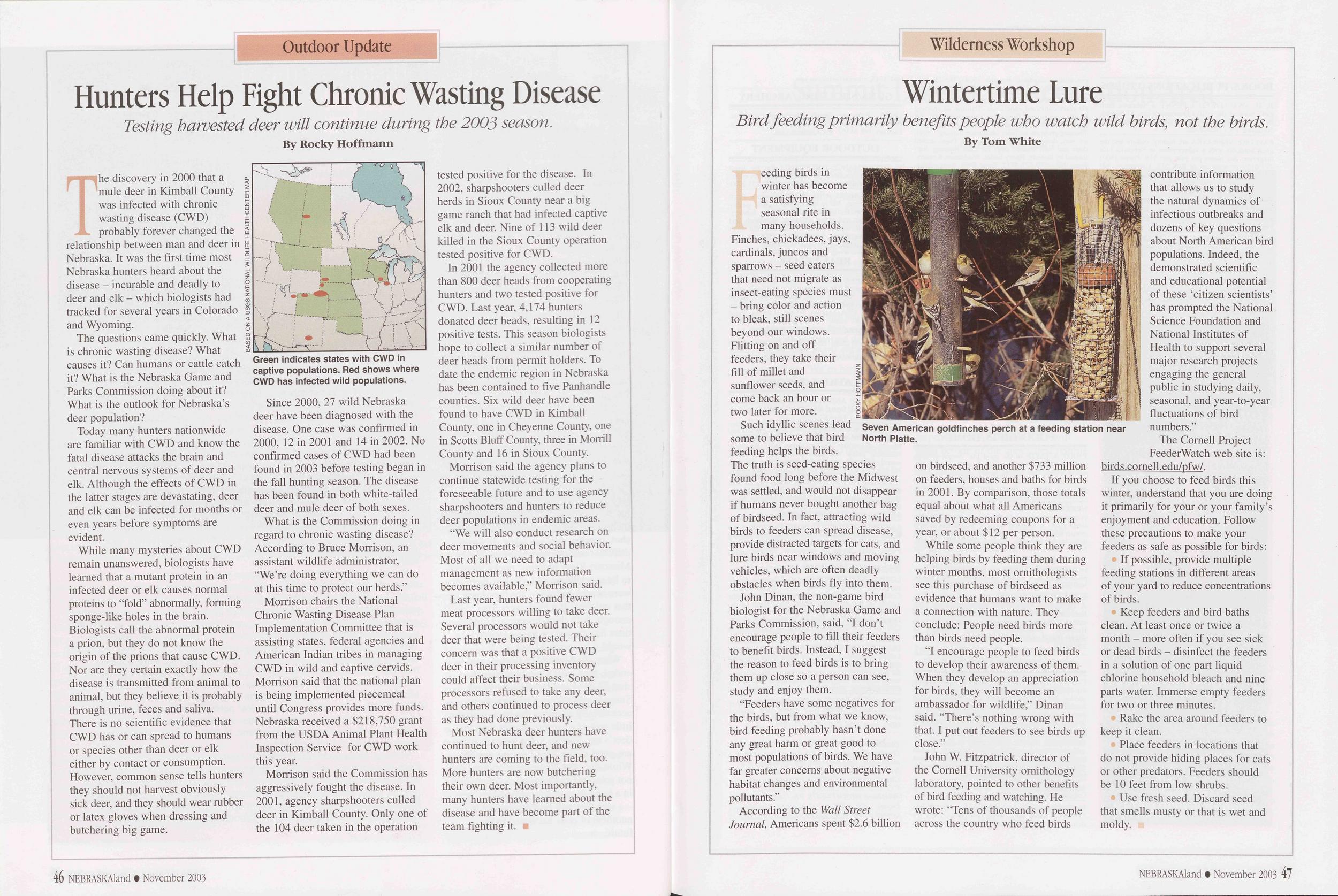
Outdoor Update
Hunters Help Fight Chronic Wasting Disease
Testing harvested deer will continue during the 2003 season. By Rocky HoffmannThe discovery in 2000 that a mule deer in Kimball County was infected with chronic wasting disease (CWD) probably forever changed the relationship between man and deer in Nebraska. It was the first time most Nebraska hunters heard about the disease - incurable and deadly to deer and elk - which biologists had tracked for several years in Colorado and Wyoming.
The questions came quickly. What is chronic wasting disease? What causes it? Can humans or cattle catch it? What is the Nebraska Game and Parks Commission doing about it? What is the outlook for Nebraska's deer population?
Today many hunters nationwide are familiar with CWD and know the fatal disease attacks the brain and central nervous systems of deer and elk. Although the effects of CWD in the latter stages are devastating, deer and elk can be infected for months or even years before symptoms are evident.
While many mysteries about CWD remain unanswered, biologists have learned that a mutant protein in an infected deer or elk causes normal proteins to 'Told" abnormally, forming sponge-like holes in the brain. Biologists call the abnormal protein a prion, but they do not know the origin of the prions that cause CWD. Nor are they certain exactly how the disease is transmitted from animal to animal, but they believe it is probably through urine, feces and saliva. There is no scientific evidence that CWD has or can spread to humans or species other than deer or elk either by contact or consumption. However, common sense tells hunters they should not harvest obviously sick deer, and they should wear rubber or latex gloves when dressing and butchering big game.
Since 2000, 27 wild Nebraska deer have been diagnosed with the disease. One case was confirmed in 2000, 12 in 2001 and 14 in 2002. No confirmed cases of CWD had been found in 2003 before testing began in the fall hunting season. The disease has been found in both white-tailed deer and mule deer of both sexes.
What is the Commission doing in regard to chronic wasting disease? According to Bruce Morrison, an assistant wildlife administrator, "We're doing everything we can do at this time to protect our herds."
Morrison chairs the National Chronic Wasting Disease Plan Implementation Committee that is assisting states, federal agencies and American Indian tribes in managing CWD in wild and captive cervids. Morrison said that the national plan is being implemented piecemeal until Congress provides more funds. Nebraska received a $218,750 grant from the USDA Animal Plant Health Inspection Service for CWD work this year.
Morrison said the Commission has aggressively fought the disease. In 2001, agency sharpshooters culled deer in Kimball County. Only one of the 104 deer taken in the operation tested positive for the disease. In 2002, sharpshooters culled deer herds in Sioux County near a big game ranch that had infected captive elk and deer. Nine of 113 wild deer killed in the Sioux County operation tested positive for CWD.
In 2001 the agency collected more than 800 deer heads from cooperating hunters and two tested positive for CWD. Last year, 4,174 hunters donated deer heads, resulting in 12 positive tests. This season biologists hope to collect a similar number of deer heads from permit holders. To date the endemic region in Nebraska has been contained to five Panhandle counties. Six wild deer have been found to have CWD in Kimball County, one in Cheyenne County, one in Scotts Bluff County, three in Morrill County and 16 in Sioux County.
Morrison said the agency plans to continue statewide testing for the foreseeable future and to use agency sharpshooters and hunters to reduce deer populations in endemic areas.
"We will also conduct research on deer movements and social behavior. Most of all we need to adapt management as new information becomes available," Morrison said.
Last year, hunters found fewer meat processors willing to take deer. Several processors would not take deer that were being tested. Their concern was that a positive CWD deer in their processing inventory could affect their business. Some processors refused to take any deer, and others continued to process deer as they had done previously.
Most Nebraska deer hunters have continued to hunt deer, and new hunters are coming to the field, too. More hunters are now butchering their own deer. Most importantly, many hunters have learned about the disease and have become part of the team fighting it. m
46 NEBRASKAland • November 2003Wilderness Workshop
Wintertime Lure
Bird feeding primarily benefits people who watch wild birds, not the birds. By Tom WhiteFeeding birds in winter has become a satisfying seasonal rite in many households. Finches, chickadees, jays, cardinals, juncos and sparrows - seed eaters that need not migrate as insect-eating species must - bring color and action to bleak, still scenes beyond our windows. Flitting on and off feeders, they take their fill of millet and sunflower seeds, and come back an hour or two later for more.
Such idyllic scenes lead some to believe that bird feeding helps the birds. The truth is seed-eating species found food long before the Midwest was settled, and would not disappear if humans never bought another bag of birdseed. In fact, attracting wild birds to feeders can spread disease, provide distracted targets for cats, and lure birds near windows and moving vehicles, which are often deadly obstacles when birds fly into them.
John Dinan, the non-game bird biologist for the Nebraska Game and Parks Commission, said, "I don't encourage people to fill their feeders to benefit birds. Instead, I suggest the reason to feed birds is to bring them up close so a person can see, study and enjoy them.
"Feeders have some negatives for the birds, but from what we know, bird feeding probably hasn't done any great harm or great good to most populations of birds. We have far greater concerns about negative habitat changes and environmental pollutants."
According to the Wall Street Journal Americans spent $2.6 billion on birdseed, and another $733 million on feeders, houses and baths for birds in 2001. By comparison, those totals equal about what all Americans saved by redeeming coupons for a year, or about $12 per person.
While some people think they are helping birds by feeding them during winter months, most ornithologists see this purchase of birdseed as evidence that humans want to make a connection with nature. They conclude: People need birds more than birds need people.
"I encourage people to feed birds to develop their awareness of them. When they develop an appreciation for birds, they will become an ambassador for wildlife," Dinan said. "There's nothing wrong with that. I put out feeders to see birds up close."
John W. Fitzpatrick, director of the Cornell University ornithology laboratory, pointed to other benefits of bird feeding and watching. He wrote: "Tens of thousands of people across the country who feed birds contribute information that allows us to study the natural dynamics of infectious outbreaks and dozens of key questions about North American bird populations. Indeed, the demonstrated scientific and educational potential of these 'citizen scientists' has prompted the National Science Foundation and National Institutes of Health to support several major research projects engaging the general public in studying daily, seasonal, and year-to-year fluctuations of bird numbers."
The Cornell Project FeederWatch web site is: birds.cornell.edu/pfw/.
If you choose to feed birds this winter, understand that you are doing it primarily for your or your family's enjoyment and education. Follow these precautions to make your feeders as safe as possible for birds:
« If possible, provide multiple feeding stations in different areas of your yard to reduce concentrations of birds.
Keep feeders and bird baths clean. At least once or twice a month - more often if you see sick or dead birds - disinfect the feeders in a solution of one part liquid chlorine household bleach and nine parts water. Immerse empty feeders for two or three minutes.
Rake the area around feeders to keep it clean.
Place feeders in locations that do not provide hiding places for cats or other predators. Feeders should be 10 feet from low shrubs.
* Use fresh seed. Discard seed that smells musty or that is wet and moldy.
NEBRASKAland • November 2003 47
Classifieds
BOOKS/PUBLICATIQNS/VIDEOSJU-JU SWALLOWED A PENNY, a Nebraska farm girl's book of the 1930's Depression Era. $7.50 ppd. Betty Heidbreder Dunn, 410 County Rd. 324, Navasota, TX 77868-9706._____________________
EXPLORE NEBRASKA art, history, culture and the great outdoors with a subscription to Nebraska Life magazine. Six issues per year just $19. Phone (800) 777-6159 or write us at Box 577, Hartington, NE 68739. Makes a great gift. Visit NebraskaLife.com.
____________DOGS____________VIZSLAS FOR SALE. Home of the Rebel Rousers. Rozanek Kennels, 781 Rd. D, Schuyler, NE 68661. Phone (402) 352-8769._________________________
PLUM CREEK KENNEL. German Shorthairs, stud service, puppies and started dogs. Training for all pointing breeds. Specialize in training the handler as well as the dog. Wayne Clark, Percival, Iowa 51648 (close to Omaha) (712) 529-4238, email wclark@sidney.heartland.net.
YELLOW-BLACK LAB PUPS. Breeders hips O.F.A. and eyes CERE Excellent bloodlines and hunting potential. Call Dave Bendler (308) 785-2554 in Lexington or Scott Bendler (402) 477-1305, Lincoln.
only $16per year For Visa or MasterCard orders, call l-800-NEBLAND (632-5263) For mail orders, send check or money order to NEBRASKAland Magazine P.O. Box 30370 Lincoln, NE 68503 0370 Order online at outdoornebraska.orgWILDERNESS KENNELS. Gun dog training - over 60 years combined experience. Training all sporting breeds - retrievers, flushing and pointing dogs. All dogs worked on pen-raised birds and wild game. Training program includes obedience training - heel, sit, stay, down and come when called. Pups, started dogs and fully trained dogs for sale. Hunting dogs trained by hunters. Henry Sader, Wilderness Kennels, Roca, NE (402) 423-4212. Since 1968. www.wildernesskennels.com
DUCKDAWG RETRIEVERS - Raising exceptional field-bred Labradors. Hunting, family and competition companions. Puppies raised in our home. Written health guarantee, www.duckdawg.com. Ron Green DVM and Libby Milroy, North Platte, NE (308) 534- 3659.
PRAIRIE RIDGE KENNELS, PAXTON, NE - Nothing fancy, just reputable trainers who specialize in retrievers! 25 miles river property, 10,000 acres upland. Quality puppies to finished dogs available. (308) 239-4719 / (308) 289-6605.________________
GERMAN SHORTHAIRED POINTER PUPPIES, AKC Registered, parents are great hunters. White and liver with ticking. Call evenings or leave message at (308) 269-2065.
FISH/FISHINGFISH FOR SALE. Catfish, largemouth bass, small- mouth bass, perch, crappie, bluegill, walleye, rainbow trout, grass carp, minnows, bullheads. Consulting available. Pleasant Valley Fish Farm, RR 1, Box 147, McCook, NE 69001. Phone (308) 345-6599._______
NEBRASKA LAKE MANAGEMENT - Biological lake surveys, fish stocking, rough fish control, lake aeration, algae control, shorewall construction. Rob Hofpar, Aquatic Biologist, licensed, insured and qualified. Phone (402) 784-6005 (Lincoln), or toll-free (888) 850-2460.
FOOD/GIFTS/HOMEENJOY A TASTE of the good life! Award-winning gourmet BBQ sauces and seasonings, breadings, native jellies, fruit butters, honey, coffees and more! Great gift-set ideas! Toll free (888) 926-2879 or (308) 468-5635. Hollman Foods, 1948 36 Road, Minden, NE 68959, or www.hollmans.com
NEBRASKA BASKETS - The original Nebraska company specializing in fine foods from Nebraska since 1984. A beautiful array of baskets filled with ethnic, healthful and longtime favorite foods. Call or write for our brochure: PO Box 22985, Lincoln, NE. 68542. 1-800-345-7725 or (402) 438-3111. Visit our web site: http://www.nebaskets.com
HOMEBREW1NG/BEER & WINEMAKING supplies. Fermenter's Supply, 8410 K Plz. #10, Omaha, NE 68127. (402) 593-9171. Mail orders welcome. www.fermenterssupply.com
A GENUINE SHOPPING EXPERIENCE! Visit Nebraska Food and Gift, representing the talents of over 140 Nebraska communities at one location in Hastings, Nebraska or shop online at www.nebraskafoodandgift.com. Toll free (877) NEGIFTS.
GUIDES/OUTFITTERSCANOE THE NIOBRARA with an affordable canoe trip by Dryland Aquatics. One- and two-day trips...full service, or just canoe, tube or kayak. Transportation furnished. Your Niobrara River specialists... We do it your way! Dryland Aquatics, Dept. N, Box 33C, Sparks, NE 69220 or phone (800) 337-3119. www.drylandaquatics.com info@drylandaquatics.com._______
HENNECKE HUNTS Guided hunts in Nebraska for mid-winter Canada and late-season snow geese. 26 years hunting experience, 13 years Nebraska Hunter Education instructor. (402) 645-8223, e-mail: kevin@henneckehunts.com, web site: henneckehunts.com____________
www.huntbunkerhill.com. "Most Unique Hunting Grounds in the Country"
KRIPPLE DUCK ADVENTURES - Southwest Nebraska Guided hunts along Frenchman Creek for deer, geese, ducks, pheasants, dove and coyotes. (308) 394-5345, cdorn@bwtelcom.net.
GUNS/SHOOTING/ARCHERYGUNS - Browning, Benelli, Winchester, Ruger. etc. 1700 guns, buy-sell-trade (402) 729-6112, Bedlan's, Fairbury, NE 68352. www.bedlans.com.
OUTDOOR EQUIPMENTIS PERFORMANCE IMPORTANT? For the finest canoes and accessories look to Great Plains Canoe Co., 205 Main, Springfield, NE 68059. Phone (402) 253-2000.
DECOYS, DUCKS AND MORE. Fowler's Point Decoys in Yutan, NE is making the highest quality wooden birds for gifts, decoration and hunting. Herons, ducks and geese, chickens, shorebirds and more are made for the shelf or to throw in the water and hunt over. Please call (402) 625-2500 or go to www.fowlerspoint.com to place your order.
_________REAL ESTATE_________HARLAN LAKE AREA LAND for sale - 640 + or - acres in view of lake rough-rolling land, tall grass scattered dry cropland fields, excellent deer, upland game, turkey, goose hunting, reserve/hunting lodge possibilities. USA land on 3 sides. Country Road Realty, 901 W. Main, Alma, NE, Dave Wolf (308) 928-3120. www.mls50.com/countryroad.htm._______
FOR SALE IN SOUTHEASTERN Nebraska - 180 acres more or less. Has excellent hunting, especially deer and mushrooms. For more details, call (402) 868-5915.
VACATIONS/RESORTSFOR FISHING AND HUNTING accommodations. Guided pheasant hunts. Jefco Inn, Gordon, NE 69343. South Cornell, (308) 282-2935.__________________
THE OLDE MAIN STREET INN. A historic bed and breakfast listed in the National Register of Historic Places. Beautiful dining room with fireplace. Featuring prime rib, buffalo, seafood, homemade soups, chilis and desserts. 115 Main Street, Chadron NE 69337 (308) 432-3380. www.chadron.conVoldeniain.
NEAR OMAHA ZOO, OVER 760 species, explore Rain Forest and Desert Dome, Aquarium, Penguins. Western Heritage Museum, hands-on Children's Museum, Naval Ships, Submarine. American Family Inn Motel. $46 single or double. (800) 253-2865._____________
SANDHILL HIDEAWAY! Scenic Double R Guest Ranch south of Valentine. Open all year. Great lodging with fully furnished kitchenettes. Fish, hunt, ride horses, relax. Right for sportsmen, families, small groups, artists, writers, newly weds! Call (866) 217-2042. www.sandhilldoublerranch.com____________
LORD RANCH RESORT. Hunters, fishermen, family vacations, family reunions. New deluxe cabins. Complete cooking facilities. Quiet and peaceful in the middle of the Sandhills. Three miles north of the Valentine Wildlife Refuge, open all year. Aubrey and Dorothy Lord, HC 37, Box 41, Valentine, NE 69201. Call (800) 270-0181.www.valentine-ne.com\Lord\ or www.lordranchresort.com______________________
DIAMOND B TROUT RESORT, Orchard, Nebraska Lodge, 3 cabins, 5 spring fed lakes, trout and other species, paddleboats, playground equipment. Great for family reunions or group getaways. Hunters welcome. Open all year. Call for brochure or reservations (800) 974-3002. www.diamondbtroutresort.com
MIDLANDS LODGE, HASTINGS NEBRASKA - Hunter friendly motel with trained pets allowed, cleaning area, refrigerators/freezers, 2-diamond AAA, HBO, great rates. Call (800) 237-1872.
Classified Rates: 750 per word, minimum $15. Closing: First business day two months before issue date. Classified ads are accepted on a first-come, first-served, space-available basis. Classified Ads, NEBRASKAland Magazine, P.O. Box 30370, Lincoln, NE 68503-0370. Telephone (402) 471-5478. Fax: (402) 471-5528. E-mail: nebland@ngpc. state.ne. us. Ads are posted online at outdoornebraska. org/nebland at no additional charge. 48 NEBRASKAland • November 2003Parks & Places
Summit Lake State Recreation Area
When 190-acre lake is full, it will offer quality fishing opportunities. By Doug CarrollLocated two miles west of Tekamah in the rolling hills of Burt County, Summit Lake State Recreation Area (SRA) offers a bit of everything for the outdoor-oriented visitor.
Camping and fishing has been limited since a renovation of the area's lake was completed in 2001, but activity is expected to pick up in 2004. "The lake is currently down about six feet - not high enough to use the boat ramps - so basically we're waiting for the lake to come back up," said Bob Eckdahl, area superintendent. "We're hoping to open for Memorial weekend next year."
Composed of 345 heavily wooded acres and 190 acres of water, Summit offers visitors opportunities to camp, fish and hike. The entrance to the camping area was changed when the lake was renovated. The new entrance on the north side of the area is four miles west of Tekamah and 1.6 miles south of Highway 32. Eckdahl said the area has 26 camping pads and 43 tent sites, including some that are accessible to visitors in wheelchairs. Drinking water and a dump station are available, but no campsites have electricity. Bur oak trees dominate the upland portion of the park and a mile-long hiking trail allows visitors to explore nature and enjoy the varied wildlife that live in the area. Two picnic shelters and additional tables and grills are available for day use. The park offers a playground, and when the lake is full, a swimming beach will be available.
Hunting is permitted at Summit SRA, and Eckdahl said the area has many deer, ducks, squirrels, rabbits and some turkeys. What will make Summit SRA an attractive destination for many visitors is its lake. Because of Aquatic Habitat Program improvements, Summit Lake will soon be one of the area's best fishing destinations. Early signs indicate a much-improved fishery.
"We've had real good water quality at Summit since the rehabilitation, and some of the channel catfish we stocked are already being caught," said Jeff Schuckman, district fisheries supervisor.
Six thousand fingerling bass and 74,000 bluegills were stocked soon after the lake was renovated. Since then, walleyes and channel catfish have been stocked twice. Bass, including some adult bass, have also been stocked again. Later the lake will be stocked with black crappies. By the summer of 2004, said Schuckman, the lake should offer good fishing for bluegills, catfish and bass, although few of the bass will have reached the 15-inch size limit yet.
Summit has two boat ramps and five boat docks available. The three boat docks on the south side of the lake are wheelchair accessible, and 13 fishing jetties have been added to the lake. The lake is open to all types of boats, but a five-mile-per-hour speed limit is in effect. In addition to the sediment-control dike and the jetties that were added to the lake, workers added brush piles to the lake's bottom to improve fish habitat.
"We've done a lot of work at Summit with habitat and fishing access," Schuckman said. "The shoreline fishing access has been greatly enhanced, and we anticipate it will be a pretty good fishing lake."
Portraits from the Past
This picture, taken in February 1942, shows my first enterprise in business. I stretched and dried these rabbit skins to prepare them for sale. I shipped them to Minnesota and received 19 cents per pound. It did not amount to many dollars. But, using a .22 Winchester pump-action rifle and bullets that cost 16 cents for a box of 50, I kept myself in business and had a lot of fun at the same time. I shot many of these rabbits on the run at 50 to 60 yards using long rifle hollow points.
The gun pictured is a Sears 16-gauge bolt action that was a high school graduation gift from my parents. After a few years I traded it for a used 12-gauge Remington #5 automatic. I enjoyed this gun and have had many guns since then. I still love to hunt, mostly ducks and geese.
- Sidney Paulsen, Minden, NebraskaDavid Johnson (left), myself [Frank Kelly], and John Reigert Jr., all of Lincoln, were photographed ,n the early-1960s after returning from a mule deer hunt north of Harrison. We worked at the Lincoln Journal and Star newspapers and drew for buddy permits We took these mule deer the opening weekend of the November season with Davids .270, my model 70 .30-06, and John's .30-06. John was a taxidermist and mounted the three deer heads.
Frank Kelley, Hickman, Nebraska
Position: 769 (14 views)