Volume 81, Issue 8, 2003
NEBRASKAland
Nebraska Game & Parks Commission October 2003 $2.50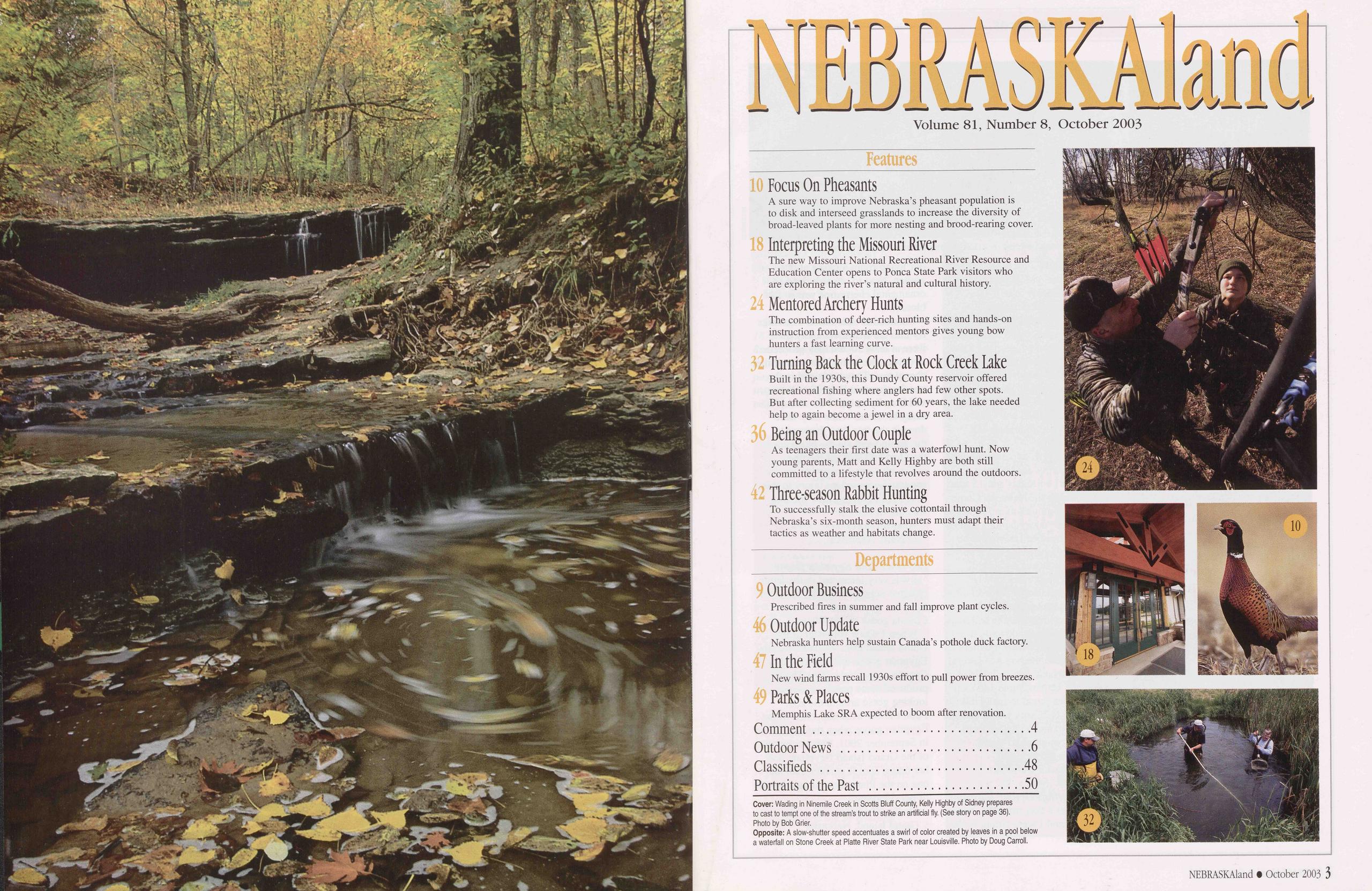
NEBRASKAland
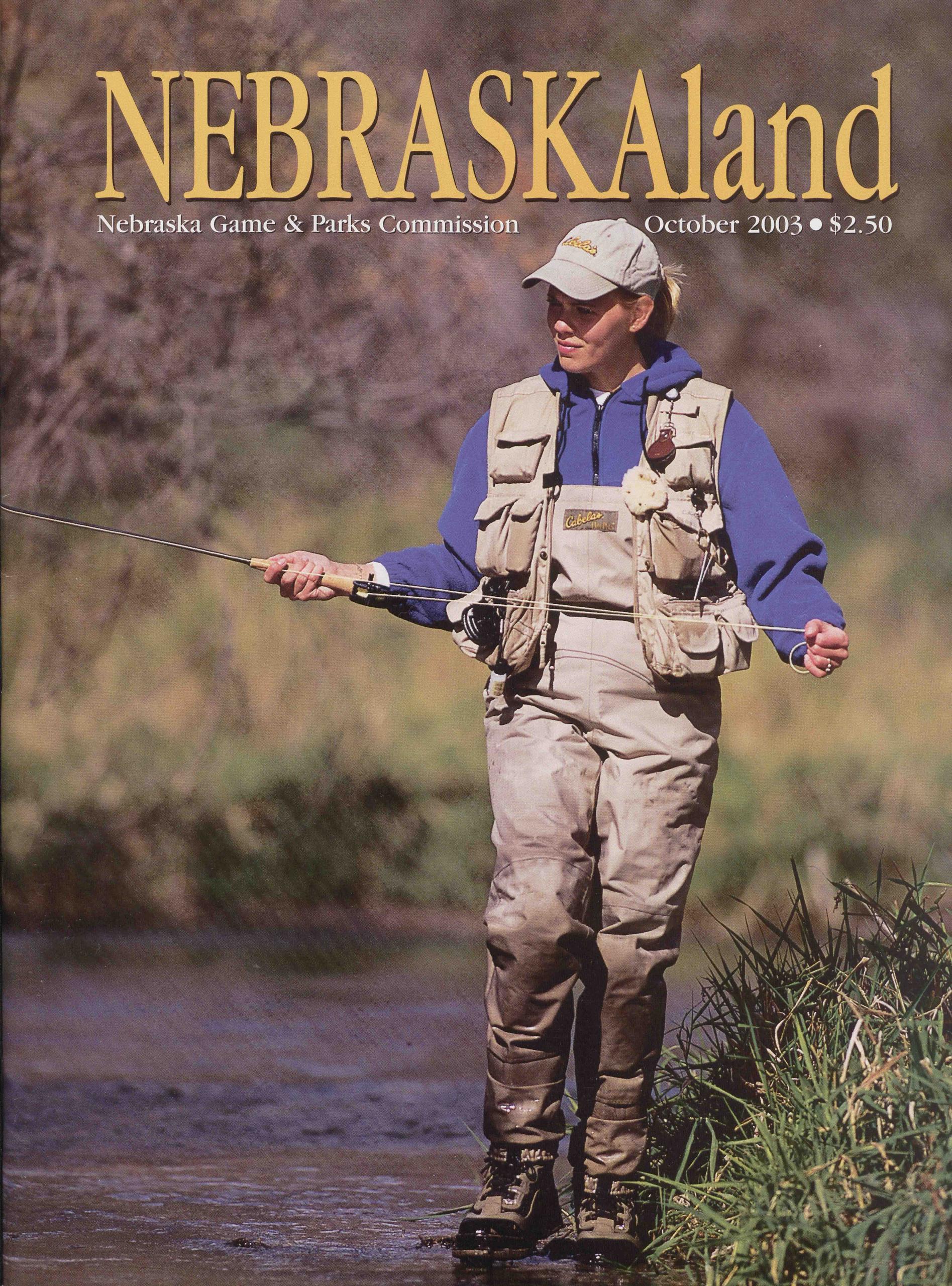
Volume 81, Number 8, October 2003 Features 10 Focus On Pheasants A sure way to improve Nebraska’s pheasant population is to disk and interseed grasslands to increase the diversity of broad-leaved plants for more nesting and brood-rearing cover. 18 Interpreting the Missouri River The new Missouri National Recreational River Resource and Education Center opens to Ponca State Park visitors who are exploring the river’s natural and cultural history. 24 Mentored Archery Hunts The combination of deer-rich hunting sites and hands-on instruction from experienced mentors gives young bow hunters a fast learning curve. 32 Turning Back the Clock at Rock Creek Lake Built in the 1930s, this Dundy County reservoir offered recreational fishing where anglers had few other spots. But after collecting sediment for 60 years, the lake needed help to again become a jewel in a dry area. 36 Being an Outdoor Couple As teenagers their first date was a waterfowl hunt. Now young parents, Matt and Kelly Highby are both still committed to a lifestyle that revolves around the outdoors. 42 Three-season Rabbit Hunting To successfully stalk the elusive cottontail through Nebraska’s six-month season, hunters must adapt their tactics as weather and habitats change. Departments 9 Outdoor Business Prescribed fires in summer and fall improve plant cycles. 46 Outdoor Update Nebraska hunters help sustain Canada’s pothole duck factory. 47 In the Field New wind farms recall 1930s effort to pull power from breezes. 49 Parks & Places Memphis Lake SRA expected to boom after renovation. Comment.....................................................4 Outdoor News .............................................6 Classifieds .................................................48 Portraits of the Past....................................50 Cover: Wading in Ninemile Creek in Scotts Bluff County, Kelly Highby of Sidney prepares to cast to tempt one of the stream’s trout to strike an artificial fly. (See story on page 36). Photo by Bob Grier. Opposite: A slow-shutter speed accentuates a swirl of color created by leaves in a pool below a waterfall on Stone Creek at Platte River State Park near Louisville. Photo by Doug Carroll.24
18
10
32
Comment
What a great article about Fort Hartsuff [July 2003]. The pictures were wonderful.
But I was disappointed that credit wasn’t given to Dr. and Mrs. Glen Auble, who worked long and hard to donate this land to the State of Nebraska. The Aubles began working to preserve this site in the early-1940s, and during World War II, they and another couple, Ben and Gladys Rose, purchased the ranch that included the site.
After obtaining sole ownership, the Auble family donated the Fort Hartsuff buildings and 15 acres around them to the Nebraska Game and Parks Commission in August 1960 with the understanding that the buildings would be restored to be attractive and interesting to the public.
Restoration began on a small budget, and progressed slowly. Under the direction of Roye Lindsay, the park superintendent, workers and volunteers restored the buildings, some of which were down to the foundation. The officers’ quarters house had been the home to several families and had been maintained.
Glen and Lillian Auble and their children were proud to make this donation so Nebraska would have a rebuilt fort to show visitors from around the country and world.
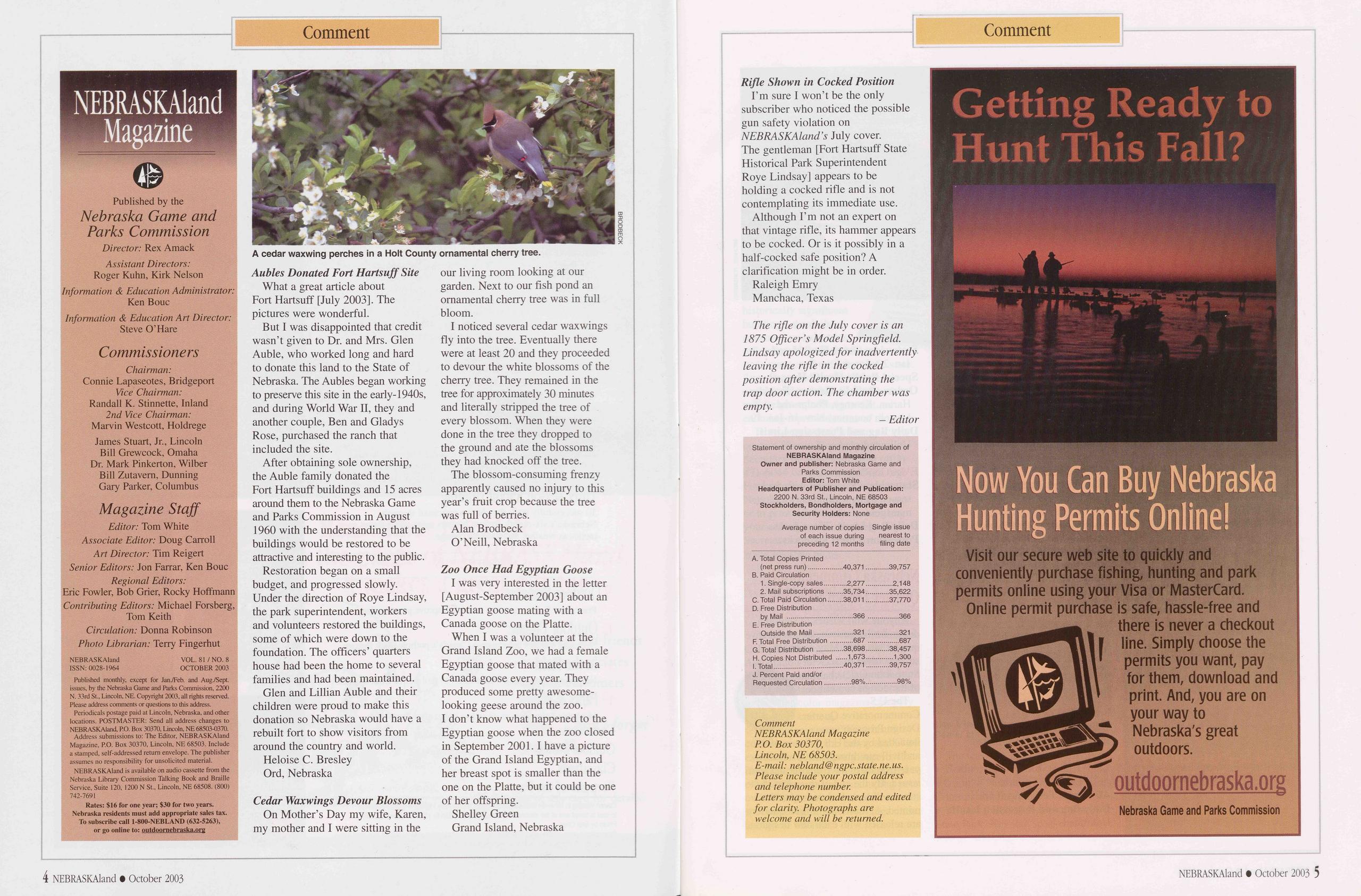
Heloise C. Bresley Ord, Nebraska Cedar Waxwings Devour BlossomsOn Mother’s Day my wife, Karen, my mother and I were sitting in the our living room looking at our garden. Next to our fish pond an ornamental cherry tree was in full bloom.
I noticed several cedar waxwings fly into the tree. Eventually there were at least 20 and they proceeded to devour the white blossoms of the cherry tree. They remained in the tree for approximately 30 minutes and literally stripped the tree of every blossom. When they were done in the tree they dropped to the ground and ate the blossoms they had knocked off the tree.
The blossom-consuming frenzy apparently caused no injury to this year’s fruit crop because the tree was full of berries.
Alan Brodbeck O’Neill, Nebraska Zoo Once Had Egyptian GooseI was very interested in the letter [August-September 2003] about an Egyptian goose mating with a Canada goose on the Platte.
When I was a volunteer at the Grand Island Zoo, we had a female Egyptian goose that mated with a Canada goose every year. They produced some pretty awesome- looking geese around the zoo. I don’t know what happened to the Egyptian goose when the zoo closed in September 2001. I have a picture of the Grand Island Egyptian, and her breast spot is smaller than the one on the Platte, but it could be one of her offspring.
Shelley Green Grand Island, Nebraska Rifle Shown in Cocked PositionI’m sure I won’t be the only subscriber who noticed the possible gun safety violation on NEBRASKAland"s July cover. The gentleman [Fort Hartsuff State Historical Park Superintendent Roye Lindsay] appears to be holding a cocked rifle and is not contemplating its immediate use.
Although I’m not an expert on that vintage rifle, its hammer appears to be cocked. Or is it possibly in a half-cocked safe position? A clarification might be in order.
Raleigh Emry Manchaca, TexasThe rifle on the July cover is an 1875 Officer’s Model Springfield. Lindsay apologized for inadvertently leaving the rifle in the cocked position after demonstrating the trap door action. The chamber was empty. - Editor
Statement of ownership and monthly circulation of NEBRASKAland MagazineOwner and publisher: Nebraska Game and Parks Commission Editor: Tom White Headquarters of Publisher and Publication: 2200 N. 33rd St., Lincoln, NE 68503 Stockholders, Bondholders, Mortgage and Security Holders: None
Average number of copies of each issue during preceding 12 months Single issue nearest to filing date
A. Total Copies Printed (net press run)...................40,371................39,757 B. Paid Circulation 1. Single-copy sales............2,277...................2,148 2. Mail subscriptions.........35,734..................35,622 C. Total Paid Circulation...38,011..................37,770 D. Free Distribution by Mail....................................366........................366 E. Free Distribution Outside the Mail.....................321........................321 F. Total Free Distribution.......687........................687 G. Total Distribution..........38,698...................38,457 H. Copies Not Distributed...1,673.....................1,300 I. Total...............................40,371...................39,757 J. Percent Paid and/or Requested Circulation...........98%......................98% Comment NEBRASKAland Magazine P.O. Box 30370, Lincoln, NE 68503. E-mail: nebland@ngpc.state.ne.us. Please include your postal address and telephone number. Letters may be condensed and edited for clarity. Photographs are welcome and will be returned. Getting Ready to Hunt This Fall? Now You Can Buy Nebraska Hunting Permits Online! Visit our secure web site to quickly and conveniently purchase fishing, hunting and park permits online using your Visa or MasterCard. Online permit purchase is safe, hassle-free and there is never a checkout line. Simply choose the permits you want, pay for them, download and print. And, you are on your way to Nebraska's great outdoors. outdoornebraska.org Nebraska Game and Parks Commission 4 NEBRASKAland • October 2003 NEBRASKAland • October 2003 5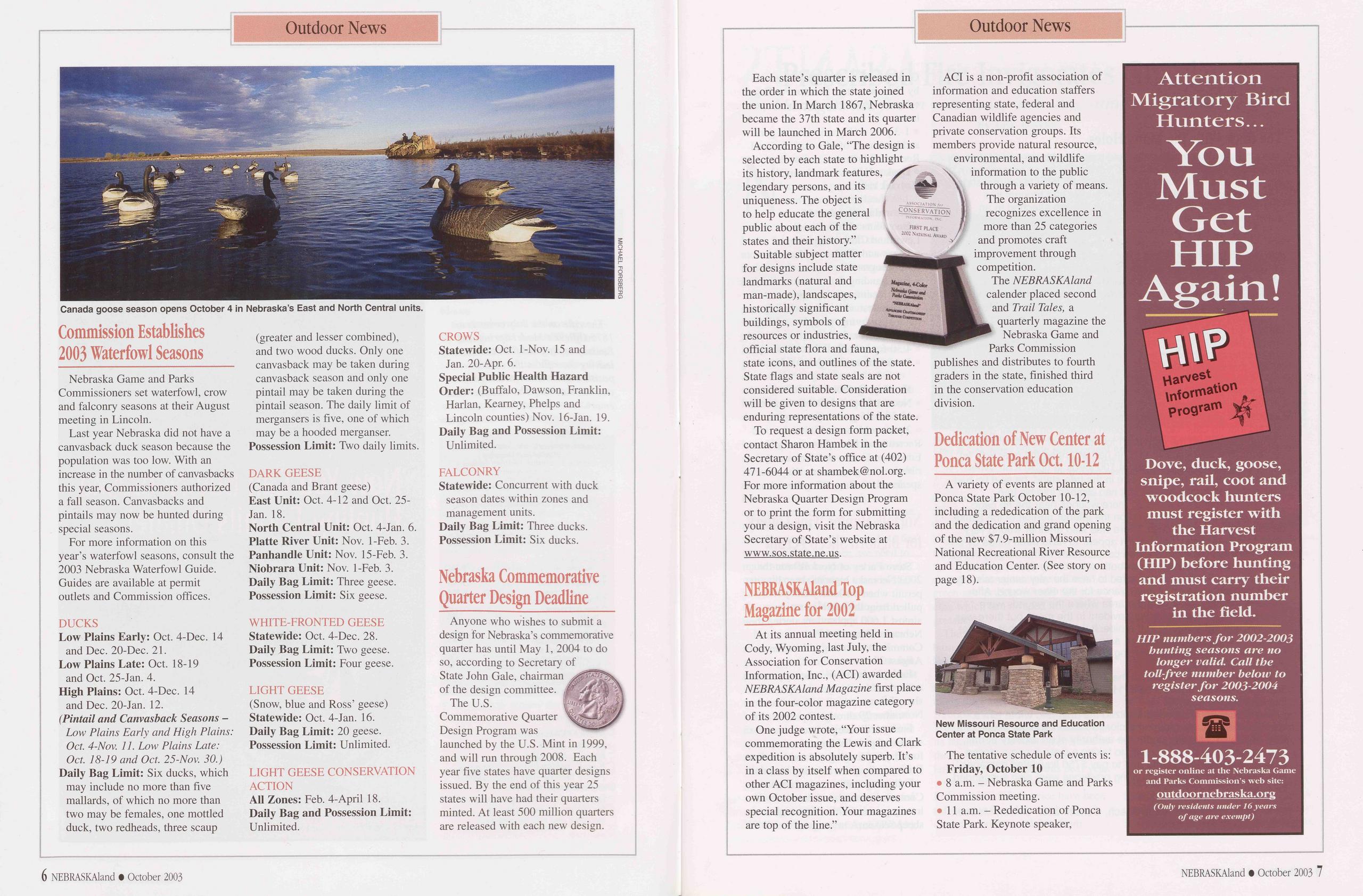
Outdoor News
Nebraska Game and Parks Commissioners set waterfowl, crow and falconry seasons at their August meeting in Lincoln.
Last year Nebraska did not have a canvasback duck season because the population was too low. With an increase in the number of canvasbacks this year, Commissioners authorized a fall season. Canvasbacks and pintails may now be hunted during special seasons.
For more information on this year’s waterfowl seasons, consult the 2003 Nebraska Waterfowl Guide. Guides are available at permit outlets and Commission offices.
DUCKS Low Plains Early: Oct. 4-Dec. 14 and Dec. 20-Dec. 21. Low Plains Late: Oct. 18-19 and Oct. 25-fan. 4. High Plains: Oct. 4-Dec. 14 and Dec. 20-Jan. 12. (Pintail and Canvasback Seasons - Low Plains Early and High Plains: Oct. 4-Nov. 11. Low Plains Late: Oct. 18-19 and Oct. 25-Nov. 30.) Daily Bag Limit: Six ducks, which may include no more than five mallards, of which no more than two may be females, one mottled duck, two redheads, three scaup (greater and lesser combined), and two wood ducks. Only one canvasback may be taken during canvasback season and only one pintail may be taken during the pintail season. The daily limit of mergansers is five, one of which may be a hooded merganser. Possession Limit: Two daily limits. DARK GEESE (Canada and Brant geese) East Unit: Oct. 4-12 and Oct. 25- Jan. 18. North Central Unit: Oct. 4-Jan. 6. Platte River Unit: Nov. 1-Feb. 3. Panhandle Unit: Nov. 15-Feb. 3. Niobrara Unit: Nov. 1-Feb. 3. Daily Bag Limit: Three geese. Possession Limit: Six geese. WHITE-FRONTED GEESE Statewide: Oct. 4-Dec. 28. Daily Bag Limit: Two geese. Possession Limit: Four geese. LIGHT GEESE (Snow, blue and Ross’ geese) Statewide: Oct. 4-Jan. 16. Daily Bag Limit: 20 geese. Possession Limit: Unlimited. LIGHT GEESE CONSERVATION ACTION All Zones: Feb. 4-April 18. Daily Bag and Possession Limit: Unlimited. CROWS Statewide: Oct. 1-Nov. 15 and Jan. 20-Apr. 6. Special Public Health Hazard Order: (Buffalo, Dawson, Franklin, Harlan, Kearney, Phelps and Lincoln counties) Nov. 16-Jan. 19. Daily Bag and Possession Limit: Unlimited. FALCONRY Statewide: Concurrent with duck season dates within zones and management units. Daily Bag Limit: Three ducks. Possession Limit: Six ducks. Nebraska Commemorative Quarter Design DeadlineAnyone who wishes to submit a design for Nebraska’s commemorative quarter has until May 1, 2004 to do so, according to Secretary of State John Gale, chairman of the design committee.
The U.S. Commemorative Quarter Design Program was launched by the U.S. Mint in 1999, and will run through 2008. Each year five states have quarter designs issued. By the end of this year 25 states will have had their quarters minted. At least 500 million quarters are released with each new design.
Each state’s quarter is released in the order in which the state joined the union. In March 1867, Nebraska became the 37th state and its quarter will be launched in March 2006.
According to Gale, “The design is selected by each state to highlight its history, landmark features, legendary persons, and its uniqueness. The object is to help educate the general public about each of the states and their history.”
Suitable subject matter for designs include state landmarks (natural and man-made), landscapes, historically significant buildings, symbols of resources or industries, official state flora and fauna, state icons, and outlines of the state. State flags and state seals are not considered suitable. Consideration will be given to designs that are enduring representations of the state.
To request a design form packet, contact Sharon Hambek in the Secretary of State’s office at (402) 471-6044 or at shambek@nol.org. For more information about the Nebraska Quarter Design Program or to print the form for submitting your a design, visit the Nebraska Secretary of State’s website at www.sos.state.ne.us.
NEBRASKAland Top Magazine for 2002At its annual meeting held in Cody, Wyoming, last July, the Association for Conservation Information, Inc., (ACI) awarded NEBRASKAland Magazine first place in the four-color magazine category of its 2002 contest.
One judge wrote, “Your issue commemorating the Lewis and Clark expedition is absolutely superb. It’s in a class by itself when compared to other ACI magazines, including your own October issue, and deserves special recognition. Your magazines are top of the line.”
ACI is a non-profit association of information and education staffers representing state, federal and Canadian wildlife agencies and private conservation groups. Its members provide natural resource, environmental, and wildlife information to the public through a variety of means. The organization recognizes excellence in more than 25 categories and promotes craft improvement through competition.
The NEBRASKAland calender placed second and Trail Tales, a quarterly magazine the Nebraska Game and Parks Commission publishes and distributes to fourth graders in the state, finished third in the conservation education division.
Dedication of New Center at Ponca State Park Oct. 10-12A variety of events are planned at Ponca State Park October 10-12, including a rededication of the park and the dedication and grand opening of the new $7.9-million Missouri National Recreational River Resource and Education Center. (See story on page 18).
The tentative schedule of events is: Friday, October 10 •8 a.m. - Nebraska Game and Parks Commission meeting. •11 a.m. - Rededication of Ponca State Park. Keynote speaker,
Attention Migratory Bird Hunters... You Must Get HIP Again!
Dove, duck, goose, snipe, rail, coot and woodcock hunters must register with the Harvest Information Program (HIP) before hunting and must carry their registration number in the field. HIP numbers for 2002-2003 bunting seasons are no longer valid. Call the toll-free number below to register for 2003-2004 seasons. 1-888-403-2473 or register online at the Nebraska Game and Parks Commission’s web site: outdoornebraska.org (Only residents under 16 years of age are exempt) 6 NEBRASKAland • October 2003 NEBRASKAland • October 2003 7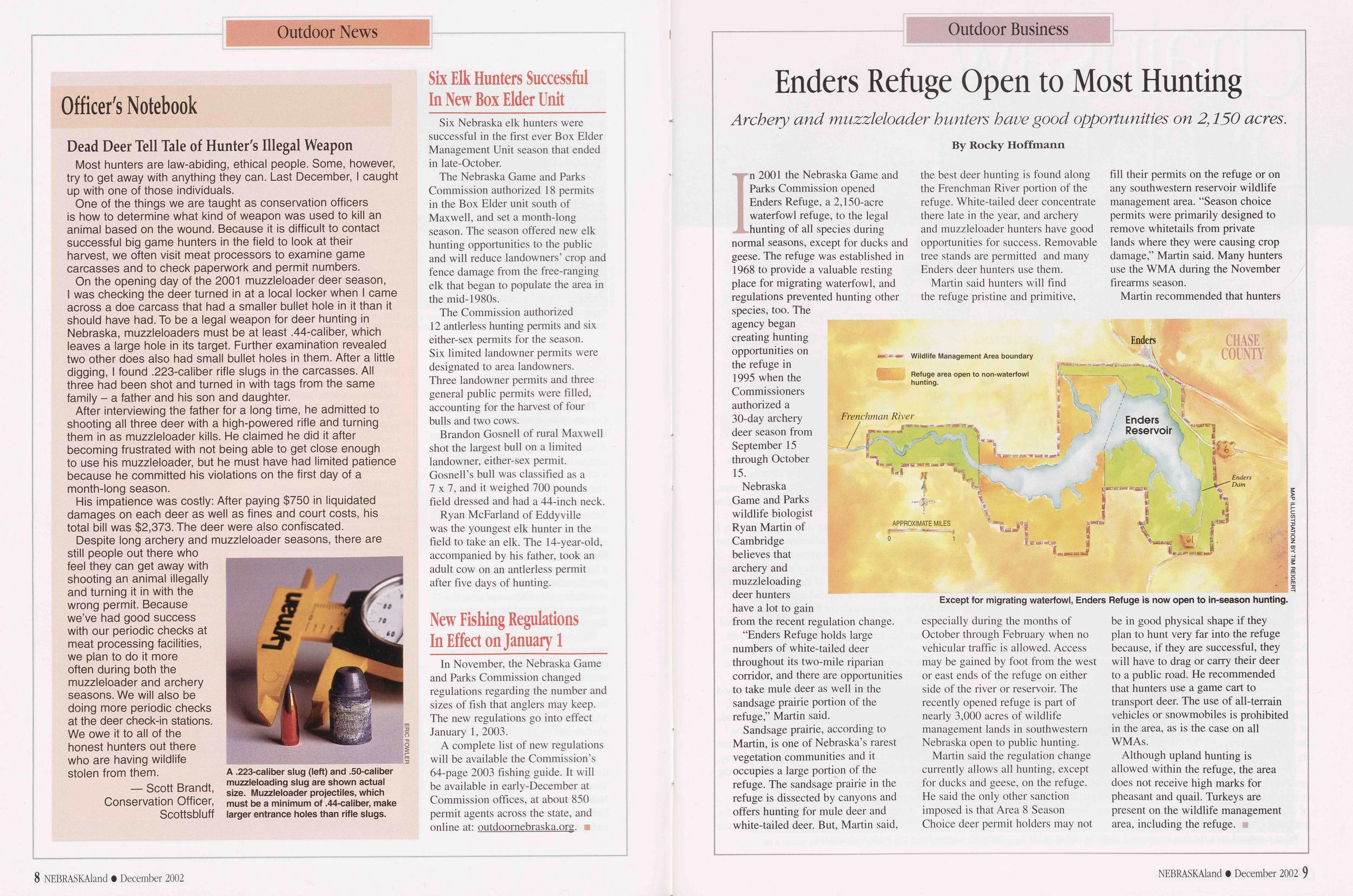
Last fall an anonymous caller told me a local hunter had taken a large buck with a firearm and then turned it in on an archery permit. The caller said he thought the deer was at a local taxidermy shop.
The taxidermist confirmed that the hunter had brought in a white-tailed buck with a deer check station tag attached to an antler, and he agreed to meet me at his business that afternoon.
When I called the local deer check station, I found the hunter had indeed turned in a deer under the authority of an archery permit. I met with the taxidermist and examined the deer’s head and cape. The hunter had brought the deer’s entire carcass to the taxidermist, who while skinning out the cape and cutting off the head, noticed a bullet hole in the shoulder area. When the taxidermist asked the hunter about the bullet hole, he said he had wounded the deer and after trailing it shot it with a .44-caliber handgun to put it down. The hunter told the taxidermist he had the handgun with him while bow hunting because he was afraid to get out of his tree stand after dark because of the coyotes in the area.
Later that evening a deputy sheriff and I contacted the hunter at his residence. I told him why we were there and he asked if he was going to be put in jail. When I told him we were just investigating and wanted to see the deer, he led me to the back of his pickup. I commented that the deer wasn’t very well protected from his pets, and he said that his cats had already been chewing on the rear quarters.
When I examined the carcass, I found a bullet hole in a front shoulder. The suspect said that he had wounded the deer with an arrow and then shot it from about 100 yards to finish it off. When asked if he had the pistol with him in the tree stand, he said he had it for protection from a bobcat that had climbed into his tree.
Further examination revealed more wounds near the rib cage. There was an arrow-like wound on the interior portion of the flanks on each side of the carcass. There was also another wound very close to one of these, but it didn’t appear to have been made by an arrow because the meat showed considerable hemorrhaging in this area. As I examined the hide on both sides of the deer, I noticed that the arrow-like wounds appeared to have the very center missing. There was also no sign of an entrance for the other wound. After skinning the hide away from the area where the wounds were located, both wounds were very evident in the meat, but there was still only one entry wound in the hide. It was apparent that a bullet had pierced the hide and that an arrow had been forced through the same hole in the hide, piercing the carcass in a different spot than the bullet had.
I asked the suspect to look at the wound as I lit it with my flashlight. “Tell me again,” I said. “How many times did you shoot this deer with a firearm?”
“Two times,” he responded. I seized the deer and wrote him a ticket for illegal hunting during a closed season and the taking of a deer shot with a firearm under the authority of an archery permit. The suspect later pleaded guilty to taking a deer during a closed season, was fined $200 and had to pay $750 liquidated damages and $32 in court costs. His hunting privileges were also suspended for a year.
-Virgil Gosch, Conservation Officer, McCookGovernor Mike Johanns, comments by Nebraska State Senator Pat Engel. •Noon - Public luncheon and open house. •1-3 p.m. - Hayrack tours of park and boat tours of Missouri National Recreational River. •Dusk - Hallowfest, Haunted Hayrack rides.
Saturday, October 11 •Boat tours of Missouri River with Lewis and Clark interpreters. •Lewis and Clark and Missouri River programs. •Bird banding demonstration. •Bird identification program. •Hallowfest activities, including pumpkin carving, pumpkin rolling contest and crafts. •4:30-6 p.m. - Buffalo chili feed. •Dusk: Haunted Hayrack rides.
Sunday, October 12 •Noon-1:30 p.m. - Public luncheon. •12:30-1:45 p.m. - Guest speakers. •2 p.m. - Missouri National Recreational River Resource and Education Center dedication and ribbon-cutting ceremony. Keynote speaker, U.S. Rep. Doug Bereuter.
Norfolk Hunter Wins Lottery for Bighorn Sheep PermitSteve Furley of Norfolk won the 2003 Nebraska bighorn sheep hunting permit when his lottery entry was pulled from the barrel containing almost 1,600 applications during the Nebraska Game and Parks Commission meeting in Lincoln on August 29.
Furley’s permit was the only one authorized for this year’s bighorn sheep season, which will run from November 29 through December 21.
Furley will receive free guide service, the use of horses and up to four days of lodging and meals at Fort Robinson State Park during his hunt.
Following staff recommendations, Commissioners also authorized one lottery permit for the 2004 bighorn sheep season.
Outdoor Business
Prescribed Fire Invigorates Grasslands Managers use fire in new ways, including summer and fall burns. By Eric FowlerNebraska Game and Parks Commission land managers have used prescribed fire to reinvigorate grasslands and eliminate or control invasive and exotic species for about 30 years. In the future, they hope to use fire more often, and in different ways, including burning in the summer and fall.
Fire recycles old vegetative growth, replenishes soil nutrients, stimulates new growth and increases plant diversity. Historically, lightning in summer and fall sparked most grassland fires. American Indians also set fire to grasslands in fall to attract buffalo and other game to the lush regrowth that followed a burn during the next growing season.
But, modern land managers have burned grasslands primarily in the spring, using fire to control exotic, invasive cool-season grasses such as smooth brome. They have learned, however, that burning only in the spring promotes the growth of some plants and stunts others, and that is not always good. "If we’re using fire as a natural occurrence, we need to make sure fire happens as it would naturally - at different times of the year,” said Tom Welstead, a Commission wildlife biologist in northeastern Nebraska.
Native warm-season grasses are most effectively burned at their growing peak in late summer or fall, promoting forbs. Fall is also the best season to control invasive deciduous trees and shrubs. Summer or fall burns might promote the growth of exotic cool-season grasses, but these species can be controlled by grazing cattle on the area following the bum. Biologists are also using grazing on grasslands burned in the spring.
Commission biologists conducted a burn in August at Wiseman Wildlife Management Area (WMA),
The Nature Conservancy has burned areas of the Niobrara Valley Preserve in summer and fall for about 10 years, and recently it began using the practice on some of its land along the Platte River in central Nebraska. The U.S. Fish and Wildlife Service conducts most of its burning in the Rainwater Basin in the spring, but plans to conduct late-summer and fall burns next year.
One reason the Commission and Fish and Wildlife Service have been reluctant to burn later in the year is concern about complaints from hunters. "We may have a little bit of public criticism when they head to the field to hunt and find there’s not as much cover there,” Welstead said. “We don’t like to do anything that takes away from hunting opportunities, but certainly there are going to be some lost opportunities.”
Like road construction, however, biologists believe the temporary inconvenience is worth the long-term benefits fire provides.
“In so many of our ecosystems, it’s such a good thing and it’s been excluded,” said Gerry Steinauer, a heritage specialist with the Commission. "Fire can do so many things, not only for biodiversity, but for range production as well. In this state, we have a lot of traditions that keep us from burning and public attitudes that are against fire. We have to be a lot more willing to accept fire because we need to use it a lot more in Nebraska.”
8 NEBRASKAland • October 2003 NEBRASKAland • October 2003 9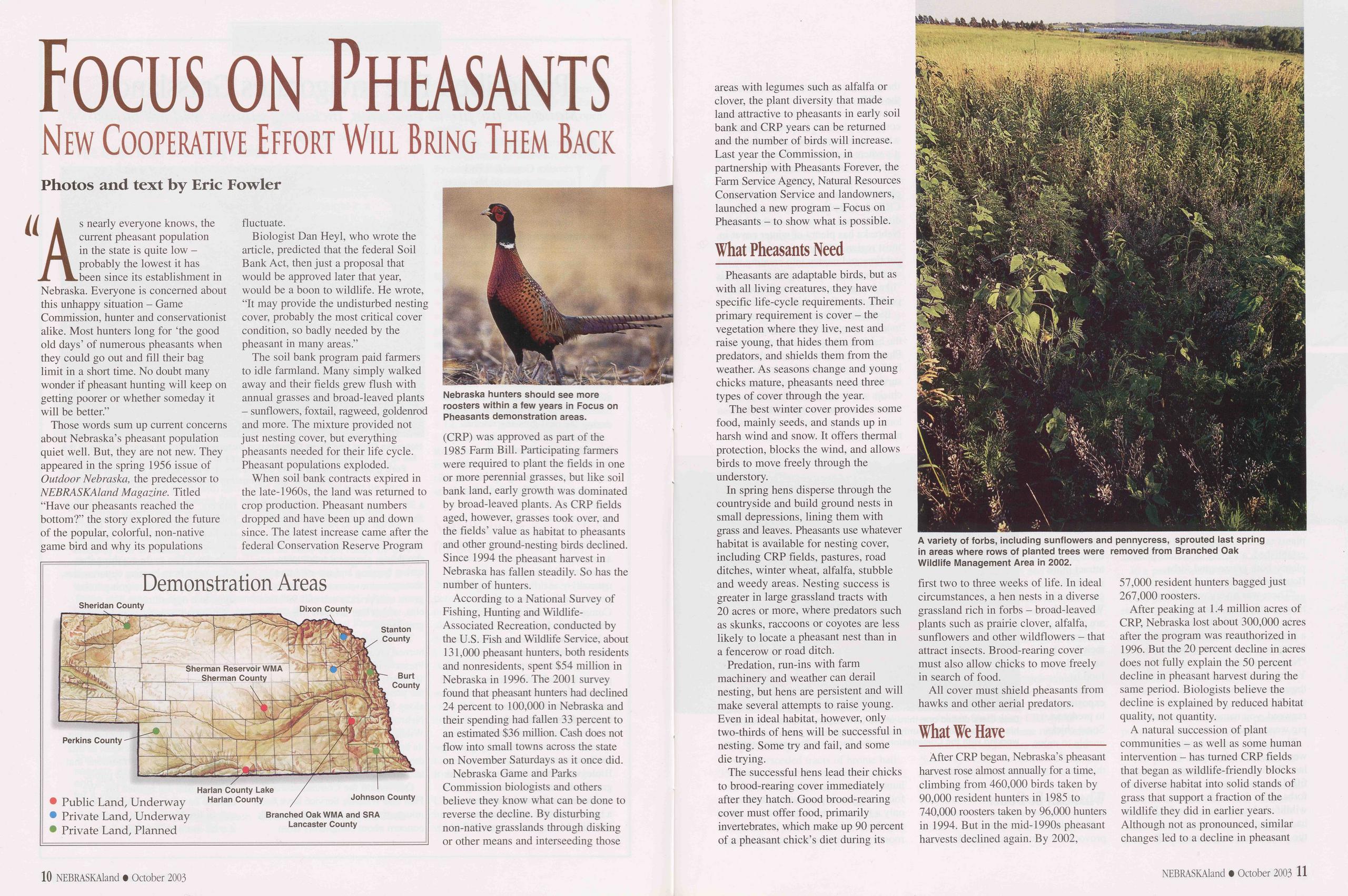
Focus on Pheasants
New Cooperative Effort Will Bring Them Back Photos and text by Eric FowlerAs nearly everyone knows, the current pheasant population in the state is quite low - probably the lowest it has been since its establishment in Nebraska. Everyone is concerned about this unhappy situation - Game Commission, hunter and conservationist alike. Most hunters long for ‘the good old days’ of numerous pheasants when they could go out and fill their bag limit in a short time. No doubt many wonder if pheasant hunting will keep on getting poorer or whether someday it will be better.”
Those words sum up current concerns about Nebraska’s pheasant population quiet well. But, they are not new. They appeared in the spring 1956 issue of Outdoor Nebraska, the predecessor to NEBRASKAland Magazine. Titled “Have our pheasants reached the bottom?” the story explored the future of the popular, colorful, non-native game bird and why its populations fluctuate.
Biologist Dan Heyl, who wrote the article, predicted that the federal Soil Bank Act, then just a proposal that would be approved later that year, would be a boon to wildlife. He wrote, "It may provide the undisturbed nesting cover, probably the most critical cover condition, so badly needed by the pheasant in many areas.”
The soil bank program paid farmers to idle farmland. Many simply walked away and their fields grew flush with annual grasses and broad-leaved plants - sunflowers, foxtail, ragweed, goldenrod and more. The mixture provided not just nesting cover, but everything pheasants needed for their life cycle. Pheasant populations exploded.
When soil bank contracts expired in the late-1960s, the land was returned to crop production. Pheasant numbers dropped and have been up and down since. The latest increase came after the federal Conservation Reserve Program
According to a National Survey of Fishing, Hunting and Wildlife- Associated Recreation, conducted by the U.S. Fish and Wildlife Service, about 131,000 pheasant hunters, both residents and nonresidents, spent $54 million in Nebraska in 1996. The 2001 survey found that pheasant hunters had declined 24 percent to 100,000 in Nebraska and their spending had fallen 33 percent to an estimated $36 million. Cash does not flow into small towns across the state on November Saturdays as it once did.
Nebraska Game and Parks Commission biologists and others believe they know what can be done to reverse the decline. By disturbing non-native grasslands through disking or other means and interseeding those areas with legumes such as alfalfa or clover, the plant diversity that made land attractive to pheasants in early soil bank and CRP years can be returned and the number of birds will increase. Last year the Commission, in partnership with Pheasants Forever, the Farm Service Agency, Natural Resources Conservation Service and landowners, launched a new program - Focus on Pheasants - to show what is possible.
What Pheasants NeedPheasants are adaptable birds, but as with all living creatures, they have specific life-cycle requirements. Their primary requirement is cover - the vegetation where they live, nest and raise young, that hides them from predators, and shields them from the weather. As seasons change and young chicks mature, pheasants need three types of cover through the year.
The best winter cover provides some food, mainly seeds, and stands up in harsh wind and snow. It offers thermal protection, blocks the wind, and allows birds to move freely through the understory.
In spring hens disperse through the countryside and build ground nests in small depressions, lining them with grass and leaves. Pheasants use whatever habitat is available for nesting cover, including CRP fields, pastures, road ditches, winter wheat, alfalfa, stubble and weedy areas. Nesting success is greater in large grassland tracts with 20 acres or more, where predators such as skunks, raccoons or coyotes are less likely to locate a pheasant nest than in a fencerow or road ditch.
Predation, run-ins with farm machinery and weather can derail nesting, but hens are persistent and will make several attempts to raise young. Even in ideal habitat, however, only two-thirds of hens will be successful in nesting. Some try and fail, and some die trying.
The successful hens lead their chicks to brood-rearing cover immediately after they hatch. Good brood-rearing cover must offer food, primarily invertebrates, which make up 90 percent of a pheasant chick’s diet during its
All cover must shield pheasants from hawks and other aerial predators.
What We HaveAfter CRP began, Nebraska’s pheasant harvest rose almost annually for a time, climbing from 460,000 birds taken by 90,000 resident hunters in 1985 to 740,000 roosters taken by 96,000 hunters in 1994. But in the mid-1990s pheasant harvests declined again. By 2002, 57,000 resident hunters bagged just 267,000 roosters.
After peaking at 1.4 million acres of CRP, Nebraska lost about 300,000 acres after the program was reauthorized in 1996. But the 20 percent decline in acres does not fully explain the 50 percent decline in pheasant harvest during the same period. Biologists believe the decline is explained by reduced habitat quality, not quantity.
A natural succession of plant communities - as well as some human intervention - has turned CRP fields that began as wildlife-friendly blocks of diverse habitat into solid stands of grass that support a fraction of the wildlife they did in earlier years. Although not as pronounced, similar changes led to a decline in pheasant 10 NEBRASKAland • October 2003 NEBRASKAland • October 2003 11 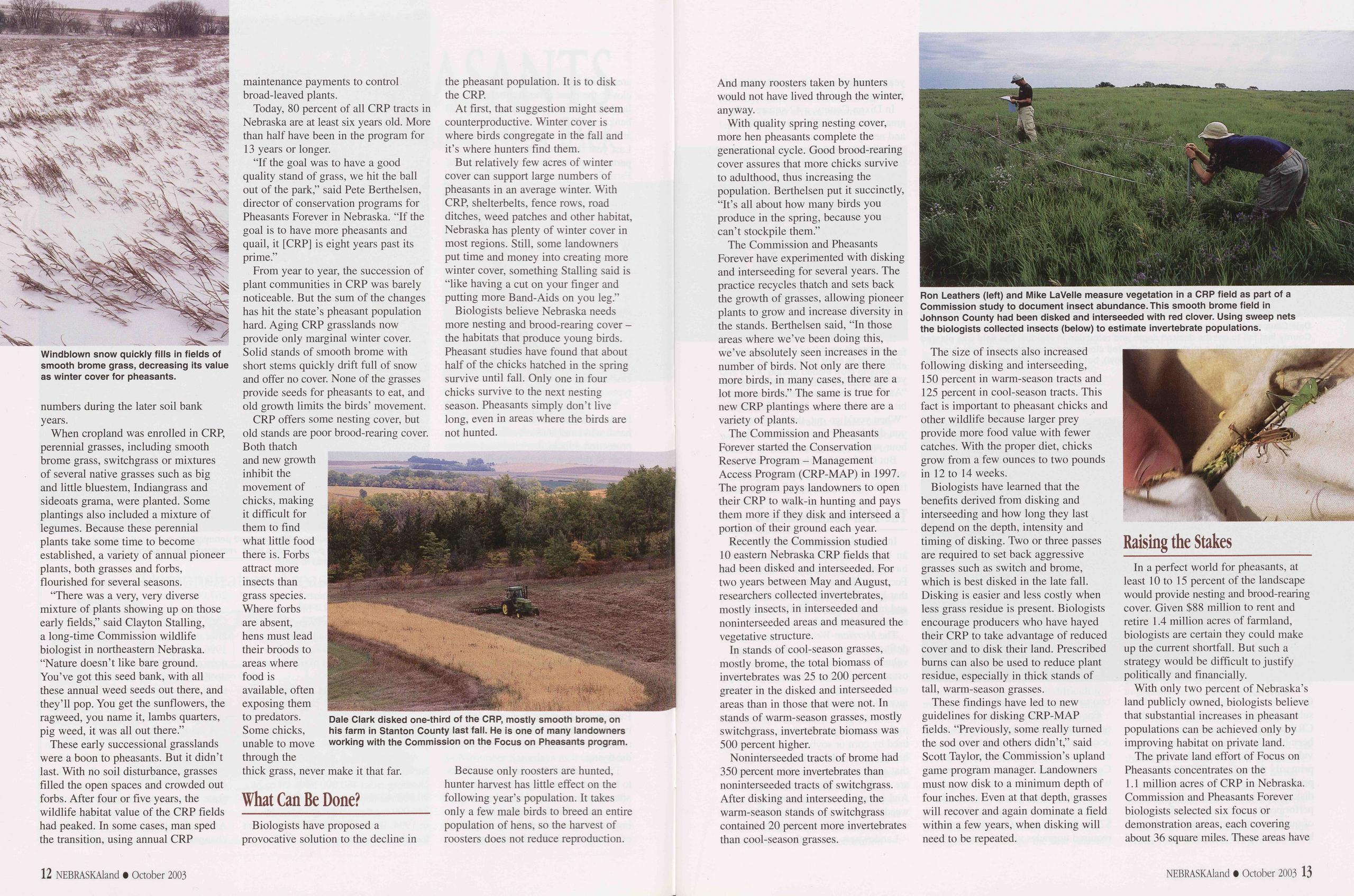
When cropland was enrolled in CRP, perennial grasses, including smooth brome grass, switchgrass or mixtures of several native grasses such as big and little bluestem, Indiangrass and sideoats grama, were planted. Some plantings also included a mixture of legumes. Because these perennial plants take some time to become established, a variety of annual pioneer plants, both grasses and forbs, flourished for several seasons.
“There was a very, very diverse mixture of plants showing up on those early fields,” said Clayton Stalling, a long-time Commission wildlife biologist in northeastern Nebraska. “Nature doesn’t like bare ground. You’ve got this seed bank, with all these annual weed seeds out there, and they’ll pop. You get the sunflowers, the ragweed, you name it, lambs quarters, pig weed, it was all out there.”
These early successions grasslands were a boon to pheasants. But it didn’t last. With no soil disturbance, grasses filled the open spaces and crowded out forbs. After four or five years, the wildlife habitat value of the CRP fields had peaked. In some cases, man sped the transition, using annual CRP maintenance payments to control broad-leaved plants.
Today, 80 percent of all CRP tracts in Nebraska are at least six years old. More than half have been in the program for 13 years or longer.
“If the goal was to have a good quality stand of grass, we hit the ball out of the park,” said Pete Berthelsen, director of conservation programs for Pheasants Forever in Nebraska. “If the goal is to have more pheasants and quail, it [CRP] is eight years past its prime.”
From year to year, the succession of plant communities in CRP was barely noticeable. But the sum of the changes has hit the state’s pheasant population hard. Aging CRP grasslands now provide only marginal winter cover. Solid stands of smooth brome with short stems quickly drift full of snow and offer no cover. None of the grasses provide seeds for pheasants to eat, and old growth limits the birds’ movement.
CRP offers some nesting cover, but old stands are poor brood-rearing cover. Both thatch and new growth inhibit the movement of chicks, making it difficult for them to find what little food there is. Forbs attract more insects than grass species. Where forbs are absent, hens must lead their broods to areas where food is available, often exposing them to predators. Some chicks, unable to move through the thick grass, never make it that far.
What Can Be Done?Biologists have proposed a provocative solution to the decline in the pheasant population. It is to disk the CRP.
At first, that suggestion might seem counterproductive. Winter cover is where birds congregate in the fall and it’s where hunters find them.
But relatively few acres of winter cover can support large numbers of pheasants in an average winter. With CRP, shelterbelts, fence rows, road ditches, weed patches and other habitat, Nebraska has plenty of winter cover in most regions. Still, some landowners put time and money into creating more winter cover, something Stalling said is “like having a cut on your finger and putting more Band-Aids on you leg.”
Biologists believe Nebraska needs more nesting and brood-rearing cover - the habitats that produce young birds. Pheasant studies have found that about half of the chicks hatched in the spring survive until fall. Only one in four chicks survive to the next nesting season. Pheasants simply don’t live long, even in areas where the birds are not hunted.
Because only roosters are hunted, hunter harvest has little effect on the following year’s population. It takes only a few male birds to breed an entire population of hens, so the harvest of roosters does not reduce reproduction. And many roosters taken by hunters would not have lived through the winter, anyway.
With quality spring nesting cover, more hen pheasants complete the generational cycle. Good brood-rearing cover assures that more chicks survive to adulthood, thus increasing the population. Berthelsen put it succinctly, “It’s all about how many birds you produce in the spring, because you can’t stockpile them.”
The Commission and Pheasants Forever have experimented with disking and interseeding for several years. The practice recycles thatch and sets back the growth of grasses, allowing pioneer plants to grow and increase diversity in the stands. Berthelsen said, “In those areas where we’ve been doing this, we’ve absolutely seen increases in the number of birds. Not only are there more birds, in many cases, there are a lot more birds.” The same is true for new CRP plantings where there are a variety of plants.
The Commission and Pheasants Forever started the Conservation Reserve Program - Management Access Program (CRP-MAP) in 1997. The program pays landowners to open their CRP to walk-in hunting and pays them more if they disk and interseed a portion of their ground each year.
Recently the Commission studied 10 eastern Nebraska CRP fields that had been disked and interseeded. For two years between May and August, researchers collected invertebrates, mostly insects, in interseeded and noninterseeded areas and measured the vegetative structure.
In stands of cool-season grasses, mostly brome, the total biomass of invertebrates was 25 to 200 percent greater in the disked and interseeded areas than in those that were not. In stands of warm-season grasses, mostly switchgrass, invertebrate biomass was 500 percent higher.
Noninterseeded tracts of brome had 350 percent more invertebrates than noninterseeded tracts of switchgrass. After disking and interseeding, the warm-season stands of switchgrass contained 20 percent more invertebrates than cool-season grasses.
The size of insects also increased following disking and interseeding, 150 percent in warm-season tracts and 125 percent in cool-season tracts. This fact is important to pheasant chicks and other wildlife because larger prey provide more food value with fewer catches. With the proper diet, chicks grow from a few ounces to two pounds in 12 to 14 weeks.
Biologists have learned that the benefits derived from disking and interseeding and how long they last depend on the depth, intensity and timing of disking. Two or three passes are required to set back aggressive grasses such as switch and brome, which is best disked in the late fall. Disking is easier and less costly when less grass residue is present. Biologists encourage producers who have hayed their CRP to take advantage of reduced cover and to disk their land. Prescribed burns can also be used to reduce plant residue, especially in thick stands of tall, warm-season grasses.
These findings have led to new guidelines for disking CRP-MAP fields. “Previously, some really turned the sod over and others didn’t,” said Scott Taylor, the Commission’s upland game program manager. Landowners must now disk to a minimum depth of four inches. Even at that depth, grasses will recover and again dominate a field within a few years, when disking will need to be repeated.
Raising the StakesIn a perfect world for pheasants, at least 10 to 15 percent of the landscape would provide nesting and brood-rearing cover. Given $88 million to rent and retire 1.4 million acres of farmland, biologists are certain they could make up the current shortfall. But such a strategy would be difficult to justify politically and financially.
With only two percent of Nebraska’s land publicly owned, biologists believe that substantial increases in pheasant populations can be achieved only by improving habitat on private land.
The private land effort of Focus on Pheasants concentrates on the 1.1 million acres of CRP in Nebraska. Commission and Pheasants Forever biologists selected six focus or demonstration areas, each covering about 36 square miles. These areas have 12 NEBRASKAland • October 2003 NEBRASKAland • October 2003 13 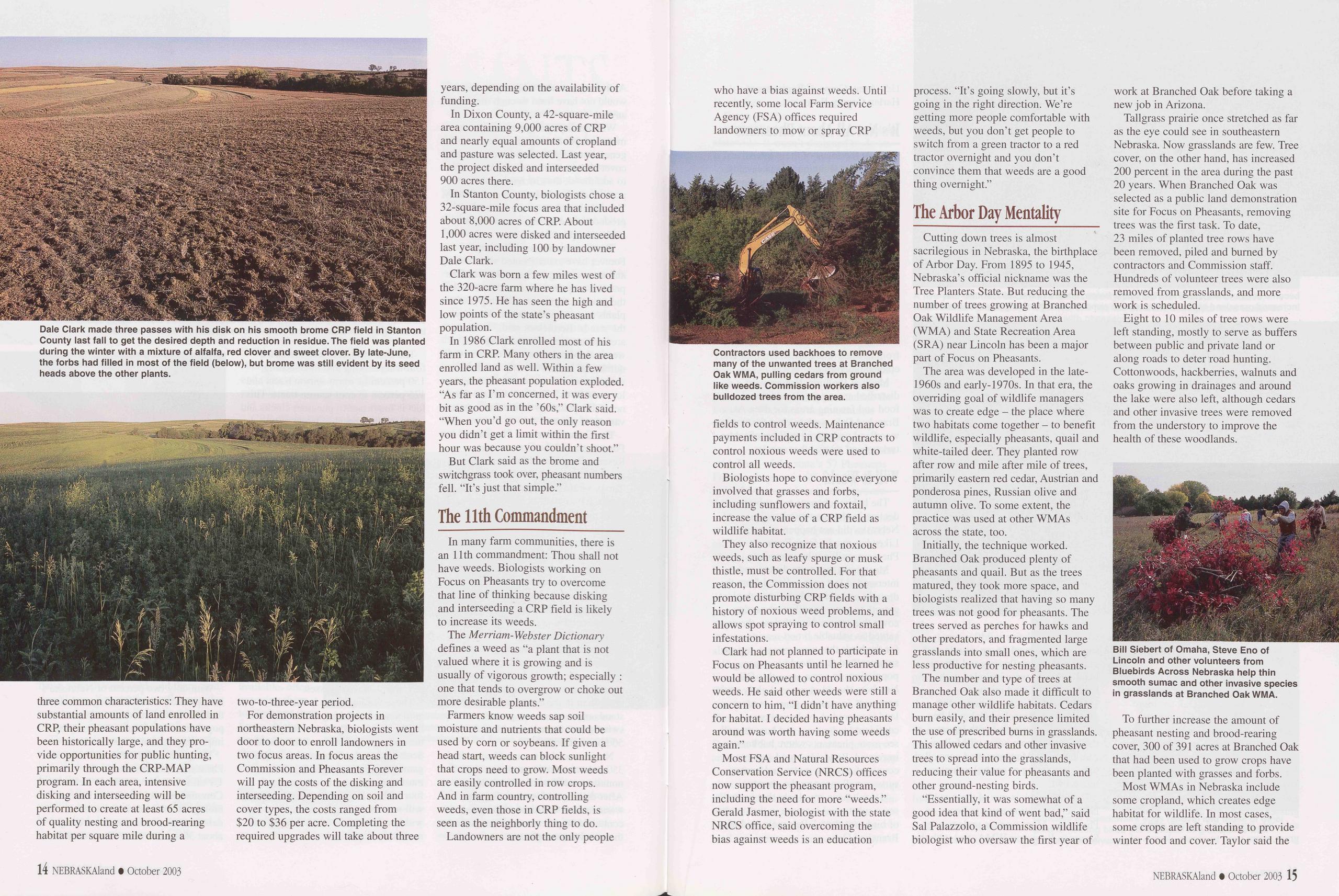
For demonstration projects in northeastern Nebraska, biologists went door to door to enroll landowners in two focus areas. In focus areas the Commission and Pheasants Forever will pay the costs of the disking and interseeding. Depending on soil and cover types, the costs ranged from $20 to $36 per acre. Completing the required upgrades will take about three years, depending on the availability of funding.
In Dixon County, a 42-square-mile area containing 9,000 acres of CRP and nearly equal amounts of cropland and pasture was selected. Last year, the project disked and interseeded 900 acres there.
In Stanton County, biologists chose a 32-square-mile focus area that included about 8,000 acres of CRP About 1,000 acres were disked and interseeded last year, including 100 by landowner Dale Clark.
Clark was born a few miles west of the 320-acre farm where he has lived since 1975. He has seen the high and low points of the state’s pheasant population.
In 1986 Clark enrolled most of his farm in CRP. Many others in the area enrolled land as well. Within a few years, the pheasant population exploded. "As far as I’m concerned, it was every bit as good as in the ’60s,” Clark said. "When you’d go out, the only reason you didn’t get a limit within the first hour was because you couldn’t shoot.”
But Clark said as the brome and switchgrass took over, pheasant numbers fell. “It’s just that simple.”
The 11th CommandmentIn many farm communities, there is an 11th commandment: Thou shall not have weeds. Biologists working on Focus on Pheasants try to overcome that line of thinking because disking and interseeding a CRP field is likely to increase its weeds.
The Merriam-Webster Dictionary defines a weed as “a plant that is not valued where it is growing and is usually of vigorous growth; especially : one that tends to overgrow or choke out more desirable plants.”
Farmers know weeds sap soil moisture and nutrients that could be used by corn or soybeans. If given a head start, weeds can block sunlight that crops need to grow. Most weeds are easily controlled in row crops. And in farm country, controlling weeds, even those in CRP fields, is seen as the neighborly thing to do.
Landowners are not the only people who have a bias against weeds. Until recently, some local Farm Service Agency (FSA) offices required landowners to mow or spray CRP
Biologists hope to convince everyone involved that grasses and forbs, including sunflowers and foxtail, increase the value of a CRP field as wildlife habitat.
They also recognize that noxious weeds, such as leafy spurge or musk thistle, must be controlled. For that reason, the Commission does not promote disturbing CRP fields with a history of noxious weed problems, and allows spot spraying to control small infestations.
Clark had not planned to participate in Focus on Pheasants until he learned he would be allowed to control noxious weeds. He said other weeds were still a concern to him, “I didn’t have anything for habitat. I decided having pheasants around was worth having some weeds again.”
Most FSA and Natural Resources Conservation Service (NRCS) offices now support the pheasant program, including the need for more “weeds.” Gerald Jasmer, biologist with the state NRCS office, said overcoming the bias against weeds is an education process. “It’s going slowly, but it’s going in the right direction. We’re getting more people comfortable with weeds, but you don’t get people to switch from a green tractor to a red tractor overnight and you don’t convince them that weeds are a good thing overnight.”
The Arbor Day MentalityCutting down trees is almost sacrilegious in Nebraska, the birthplace of Arbor Day. From 1895 to 1945, Nebraska’s official nickname was the Tree Planters State. But reducing the number of trees growing at Branched Oak Wildlife Management Area (WMA) and State Recreation Area (SRA) near Lincoln has been a major part of Focus on Pheasants.
The area was developed in the late- 1960s and early-1970s. In that era, the overriding goal of wildlife managers was to create edge - the place where two habitats come together - to benefit wildlife, especially pheasants, quail and white-tailed deer. They planted row after row and mile after mile of trees, primarily eastern red cedar, Austrian and ponderosa pines, Russian olive and autumn olive. To some extent, the practice was used at other WMAs across the state, too.
Initially, the technique worked. Branched Oak produced plenty of pheasants and quail. But as the trees matured, they took more space, and biologists realized that having so many trees was not good for pheasants. The trees served as perches for hawks and other predators, and fragmented large grasslands into small ones, which are less productive for nesting pheasants.
The number and type of trees at Branched Oak also made it difficult to manage other wildlife habitats. Cedars burn easily, and their presence limited the use of prescribed bums in grasslands. This allowed cedars and other invasive trees to spread into the grasslands, reducing their value for pheasants and other ground-nesting birds.
“Essentially, it was somewhat of a good idea that kind of went bad,” said Sal Palazzolo, a Commission wildlife biologist who oversaw the first year of work at Branched Oak before taking a new job in Arizona.
Tailgrass prairie once stretched as far as the eye could see in southeastern Nebraska. Now grasslands are few. Tree cover, on the other hand, has increased 200 percent in the area during the past 20 years. When Branched Oak was selected as a public land demonstration site for Focus on Pheasants, removing trees was the first task. To date, 23 miles of planted tree rows have been removed, piled and burned by contractors and Commission staff. Hundreds of volunteer trees were also removed from grasslands, and more work is scheduled.
Eight to 10 miles of tree rows were left standing, mostly to serve as buffers between public and private land or along roads to deter road hunting. Cottonwoods, hackberries, walnuts and oaks growing in drainages and around the lake were also left, although cedars and other invasive trees were removed from the understory to improve the health of these woodlands.
To further increase the amount of pheasant nesting and brood-rearing cover, 300 of 391 acres at Branched Oak that had been used to grow crops have been planted with grasses and forbs.
Most WMAs in Nebraska include some cropland, which creates edge habitat for wildlife. In most cases, some crops are left standing to provide winter food and cover. Taylor said the
14 NEBRASKAland • October 2003 NEBRASKAland • October 2003 15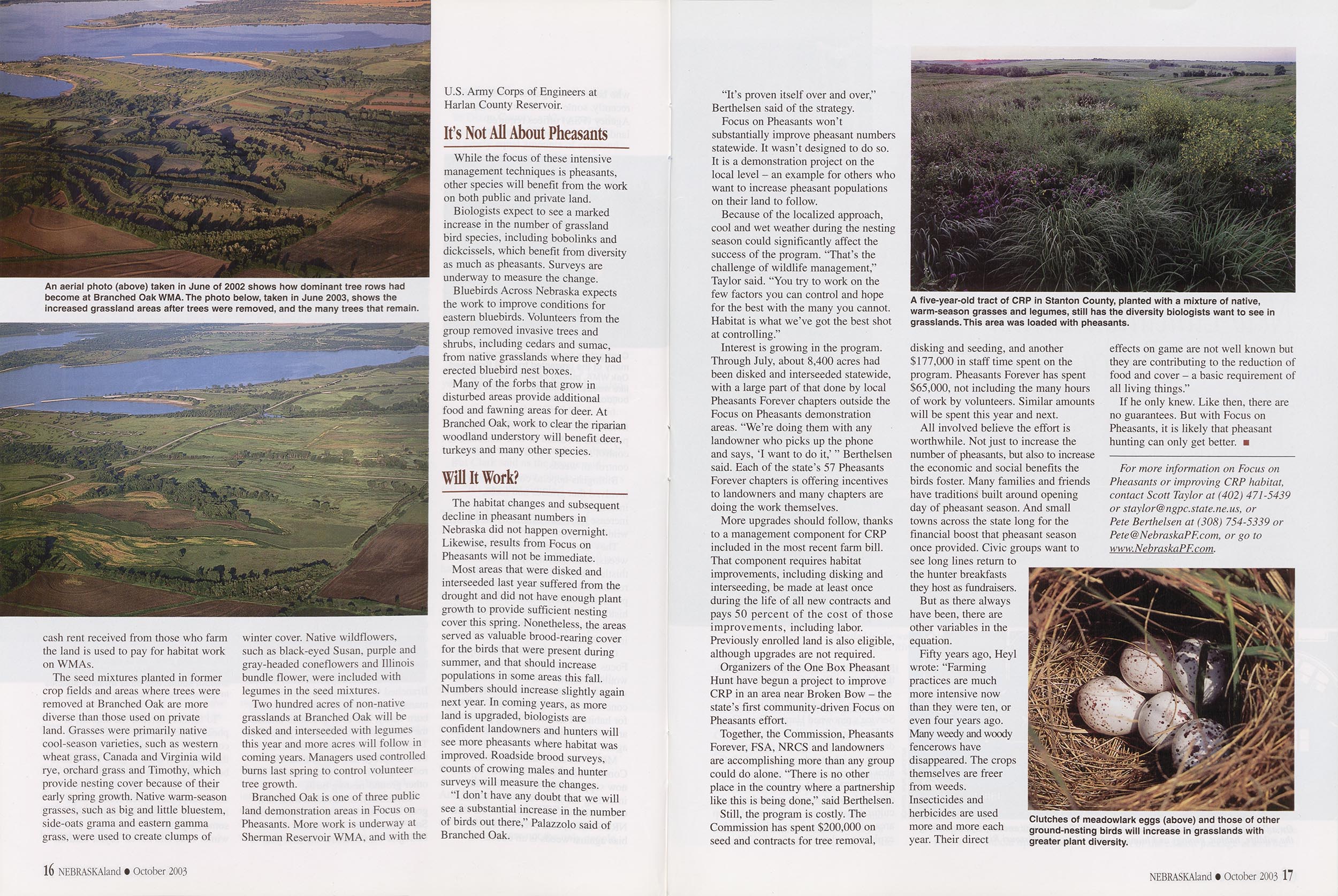
An aerial photo (above) taken in June of 2002 shows how dominant tree rows had become at Branched Oak WMA.The photo below, taken in June 2003, shows the increased grassland areas after trees were removed, and the many trees that remain.
cash rent received from those who farm the land is used to pay for habitat work on WMAs.
The seed mixtures planted in former crop fields and areas where trees were removed at Branched Oak are more diverse than those used on private land. Grasses were primarily native cool-season varieties, such as western wheat grass, Canada and Virginia wild rye, orchard grass and Timothy, which provide nesting cover because of their early spring growth. Native warm-season grasses, such as big and little bluestem, side-oats grama and eastern gamma grass, were used to create clumps of winter cover. Native wildflowers, such as black-eyed Susan, purple and gray-headed coneflowers and Illinois bundle flower, were included with legumes in the seed mixtures.
Two hundred acres of non-native grasslands at Branched Oak will be disked and inter seeded with legumes this year and more acres will follow in coming years. Managers used controlled burns last spring to control volunteer tree growth.
Branched Oak is one of three public land demonstration areas in Focus on Pheasants. More work is underway at Sherman Reservoir WMA, and with the U.S. Army Corps of Engineers at Harlan County Reservoir.
It’s Not All About PheasantsWhile the focus of these intensive management techniques is pheasants, other species will benefit from the work on both public and private land. Biologists expect to see a marked increase in the number of grassland bird species, including bobolinks and dickcissels, which benefit from diversity as much as pheasants. Surveys are underway to measure the change.
Bluebirds Across Nebraska expects the work to improve conditions for eastern bluebirds. Volunteers from the group removed invasive trees and shrubs, including cedars and sumac, from native grasslands where they had erected bluebird nest boxes.
Many of the forbs that grow in disturbed areas provide additional food and fawning areas for deer. At Branched Oak, work to clear the riparian woodland understory will benefit deer, turkeys and many other species.
Will It Work?The habitat changes and subsequent decline in pheasant numbers in Nebraska did not happen overnight. Likewise, results from Focus on Pheasants will not be immediate.
Most areas that were disked and interseeded last year suffered from the drought and did not have enough plant growth to provide sufficient nesting cover this spring. Nonetheless, the areas served as valuable brood-rearing cover for the birds that were present during summer, and that should increase populations in some areas this fall. Numbers should increase slightly again next year. In coming years, as more land is upgraded, biologists are confident landowners and hunters will see more pheasants where habitat was improved. Roadside brood surveys, counts of crowing males and hunter surveys will measure the changes.
"I don’t have any doubt that we will see a substantial increase in the number of birds out there,” Palazzolo said of Branched Oak.
"It’s proven itself over and over,” Berthelsen said of the strategy.
Focus on Pheasants won’t substantially improve pheasant numbers statewide. It wasn’t designed to do so. It is a demonstration project on the local level - an example for others who want to increase pheasant populations on their land to follow.
Because of the localized approach, cool and wet weather during the nesting season could significantly affect the success of the program. "That’s the challenge of wildlife management,” Taylor said. "You try to work on the few factors you can control and hope for the best with the many you cannot. Habitat is what we’ve got the best shot at controlling.”
Interest is growing in the program. Through July, about 8,400 acres had been disked and interseeded statewide, with a large part of that done by local Pheasants Forever chapters outside the Focus on Pheasants demonstration areas. "We’re doing them with any landowner who picks up the phone and says, T want to do it,’ ” Berthelsen said. Each of the state’s 57 Pheasants Forever chapters is offering incentives to landowners and many chapters are doing the work themselves.
More upgrades should follow, thanks to a management component for CRP included in the most recent farm bill. That component requires habitat improvements, including disking and interseeding, be made at least once during the life of all new contracts and pays 50 percent of the cost of those improvements, including labor. Previously enrolled land is also eligible, although upgrades are not required.
Organizers of the One Box Pheasant Hunt have begun a project to improve CRP in an area near Broken Bow - the state’s first community-driven Focus on Pheasants effort.
Together, the Commission, Pheasants Forever, FSA, NRCS and landowners are accomplishing more than any group could do alone. "There is no other place in the country where a partnership like this is being done,” said Berthelsen.
A five-year-old tract of CRP in Stanton County, planted with a mixture of native, warm-season grasses and legumes, still has the diversity biologists want to see in grasslands. This area was loaded with pheasants.
All involved believe the effort is worthwhile. Not just to increase the number of pheasants, but also to increase the economic and social benefits the birds foster. Many families and friends have traditions built around opening day of pheasant season. And small towns across the state long for the financial boost that pheasant season once provided. Civic groups want to see long lines return to the hunter breakfasts they host as fundraisers.
But as there always have been, there are other variables in the equation.
Fifty years ago, Heyl wrote: “Farming practices are much more intensive now than they were ten, or even four years ago. Many weedy and woody fencerows have disappeared. The crops themselves are freer from weeds. Insecticides and herbicides are used more and more each year. Their direct effects on game are not well known but they are contributing to the reduction of food and cover - a basic requirement of all living things.”
If he only knew. Like then, there are no guarantees. But with Focus on Pheasants, it is likely that pheasant hunting can only get better. ■
Clutches of meadowlark eggs (above) and those of other ground-nesting birds will increase in grasslands with greater plant diversity.
Interpreting the Missouri River
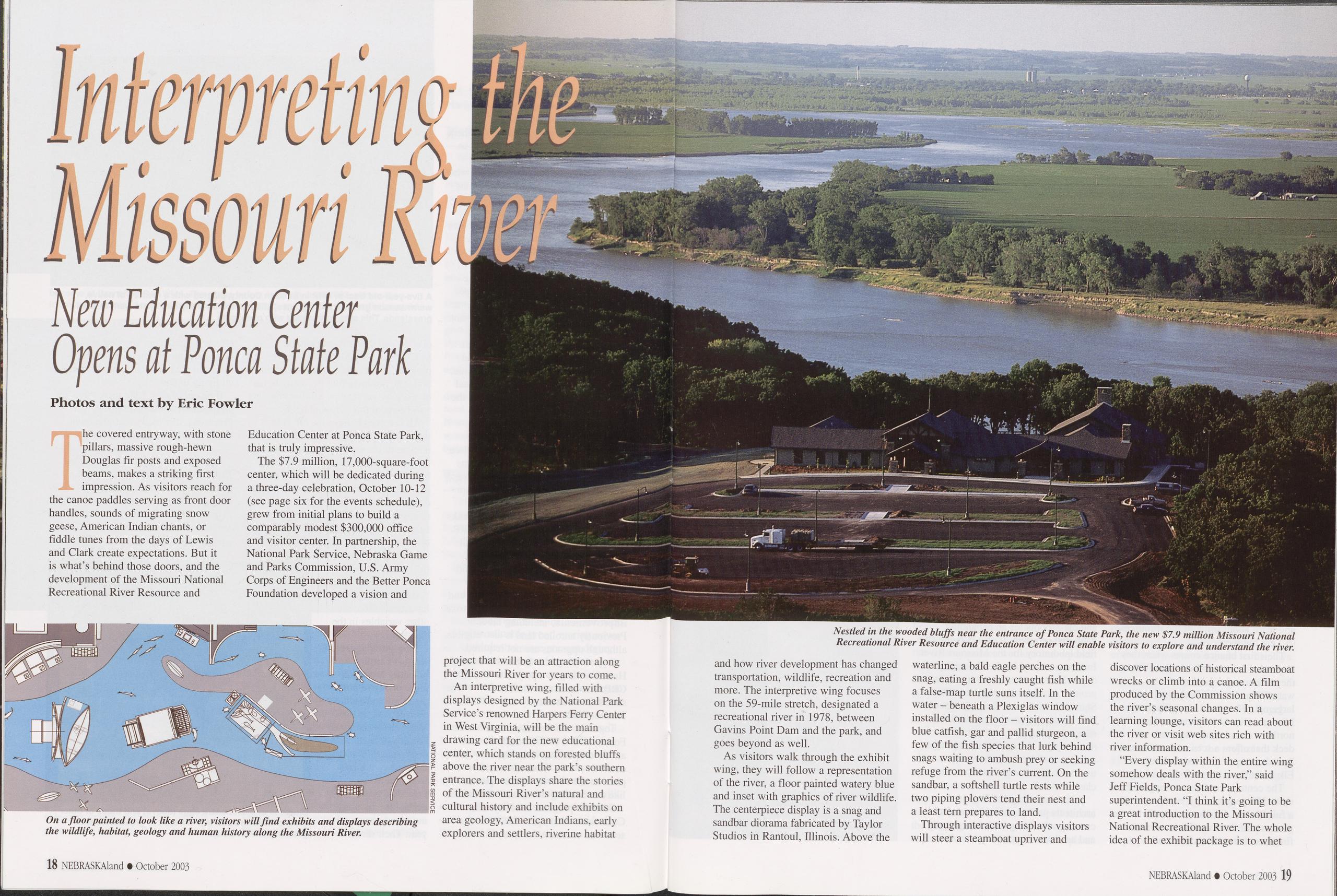
New Education Center Opens at Ponca State Park Photos and text by Eric FowlerThe covered entryway, with stone pillars, massive rough-hewn Douglas fir posts and exposed beams, makes a striking first impression. As visitors reach for the canoe paddles serving as front door handles, sounds of migrating snow geese, American Indian chants, or fiddle tunes from the days of Lewis and Clark create expectations. But it is what’s behind those doors, and the development of the Missouri National Recreational River Resource and
The $7.9 million, 17,000-square-foot center, which will be dedicated during a three-day celebration, October 10-12 (see page six for the events schedule), grew from initial plans to build a comparably modest $300,000 office and visitor center. In partnership, the National Park Service, Nebraska Game and Parks Commission, U.S. Army Corps of Engineers and the Better Ponca Foundation developed a vision and
An interpretive wing, filled with displays designed by the National Park Service’s renowned Harpers Ferry Center in West Virginia, will be the main drawing card for the new educational center, which stands on forested bluffs above the river near the park’s southern entrance. The displays share the stories of the Missouri River’s natural and cultural history and include exhibits on area geology, American Indians, early explorers and settlers, riverine habitat and how river development has changed transportation, wildlife, recreation and more. The interpretive wing focuses on the 59-mile stretch, designated a recreational river in 1978, between Gavins Point Dam and the park, and goes beyond as well.
As visitors walk through the exhibit wing, they will follow a representation of the river, a floor painted watery blue and inset with graphics of river wildlife. The centerpiece display is a snag and sandbar diorama fabricated by Taylor Studios in Rantoul, Illinois. Above the waterline, a bald eagle perches on the snag, eating a freshly caught fish while a false-map turtle suns itself. In the water - beneath a Plexiglas window installed on the floor - visitors will find blue catfish, gar and pallid sturgeon, a few of the fish species that lurk behind snags waiting to ambush prey or seeking refuge from the river’s current. On the sandbar, a softshell turtle rests while two piping plovers tend their nest and a least tern prepares to land.
Through interactive displays visitors will steer a steamboat upriver and discover locations of historical steamboat wrecks or climb into a canoe. A film produced by the Commission shows the river’s seasonal changes. In a learning lounge, visitors can read about the river or visit web sites rich with river information.
“Every display within the entire wing somehow deals with the river,” said Jeff Fields, Ponca State Park superintendent. "I think it’s going to be a great introduction to the Missouri National Recreational River. The whole idea of the exhibit package is to whet 18 NEBRASKAland • October 2003 NEBRASKAland • October 2003 19 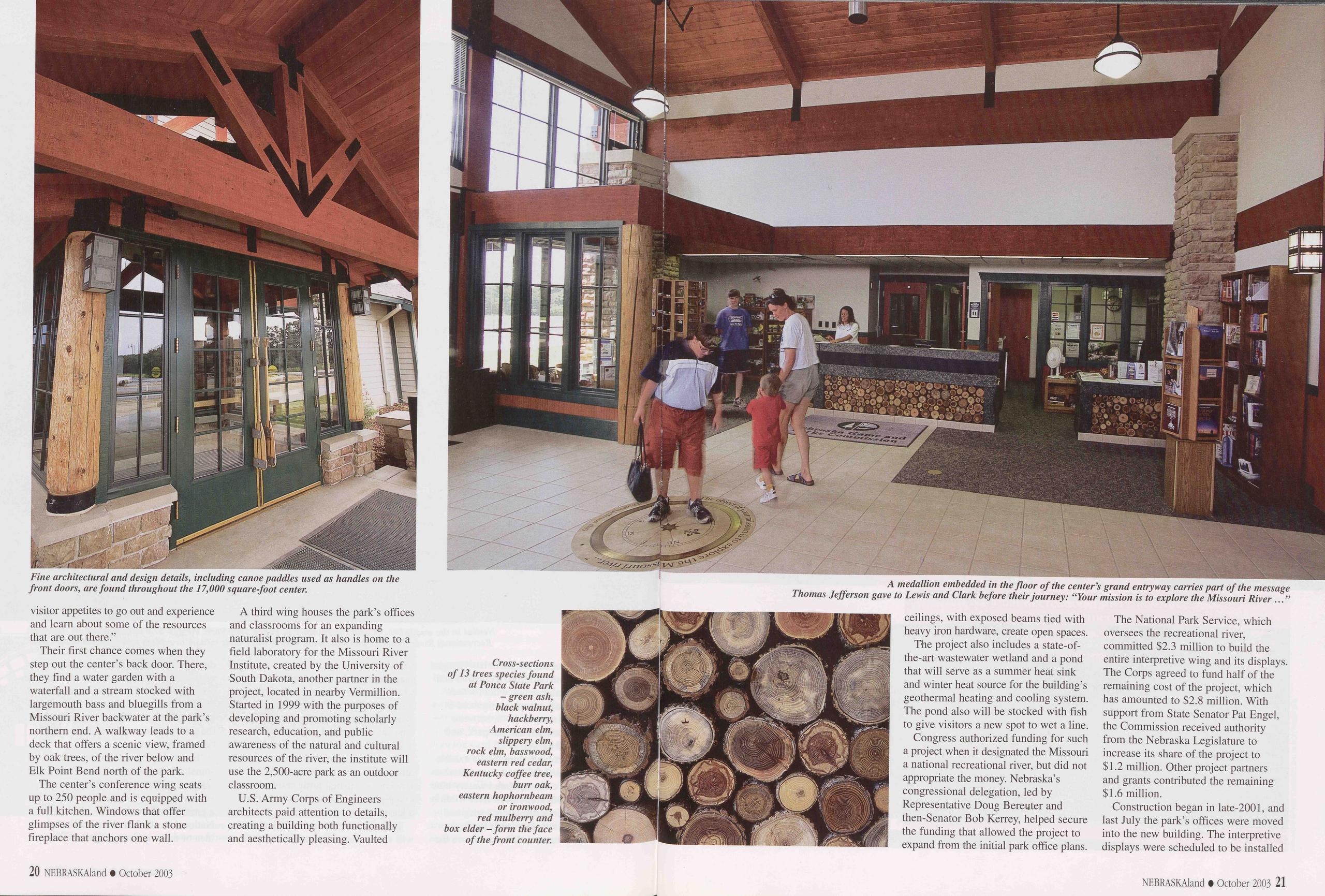
Their first chance comes when they step out the center’s back door. There, they find a water garden with a waterfall and a stream stocked with largemouth bass and bluegills from a Missouri River backwater at the park’s northern end. A walkway leads to a deck that offers a scenic view, framed by oak trees, of the river below and Elk Point Bend north of the park.
The center’s conference wing seats up to 250 people and is equipped with a full kitchen. Windows that offer glimpses of the river flank a stone fireplace that anchors one wall.
A third wing houses the park’s offices and classrooms for an expanding naturalist program. It also is home to a field laboratory for the Missouri River Institute, created by the University of South Dakota, another partner in the project, located in nearby Vermillion. Started in 1999 with the purposes of developing and promoting scholarly research, education, and public awareness of the natural and cultural resources of the river, the institute will use the 2,500-acre park as an outdoor classroom.
U.S. Army Corps of Engineers architects paid attention to details, creating a building both functionally and aesthetically pleasing. Vaulted
The project also includes a state-of- the-art wastewater wetland and a pond that will serve as a summer heat sink and winter heat source for the building’s geothermal heating and cooling system. The pond also will be stocked with fish to give visitors a new spot to wet a line.
Congress authorized funding for such a project when it designated the Missouri a national recreational river, but did not appropriate the money. Nebraska’s congressional delegation, led by Representative Doug Bereuter and then-Senator Bob Kerrey, helped secure the funding that allowed the project to expand from the initial park office plans.
The National Park Service, which oversees the recreational river, committed $2.3 million to build the entire interpretive wing and its displays. The Corps agreed to fund half of the remaining cost of the project, which has amounted to $2.8 million. With support from State Senator Pat Engel, the Commission received authority from the Nebraska Legislature to increase its share of the project to $1.2 million. Other project partners and grants contributed the remaining $1.6 million.
Construction began in late-2001, and last July the park’s offices were moved into the new building. The interpretive displays were scheduled to be installed 20 NEBRASKAland • October 2003 NEBRASKAland O October 2003 21 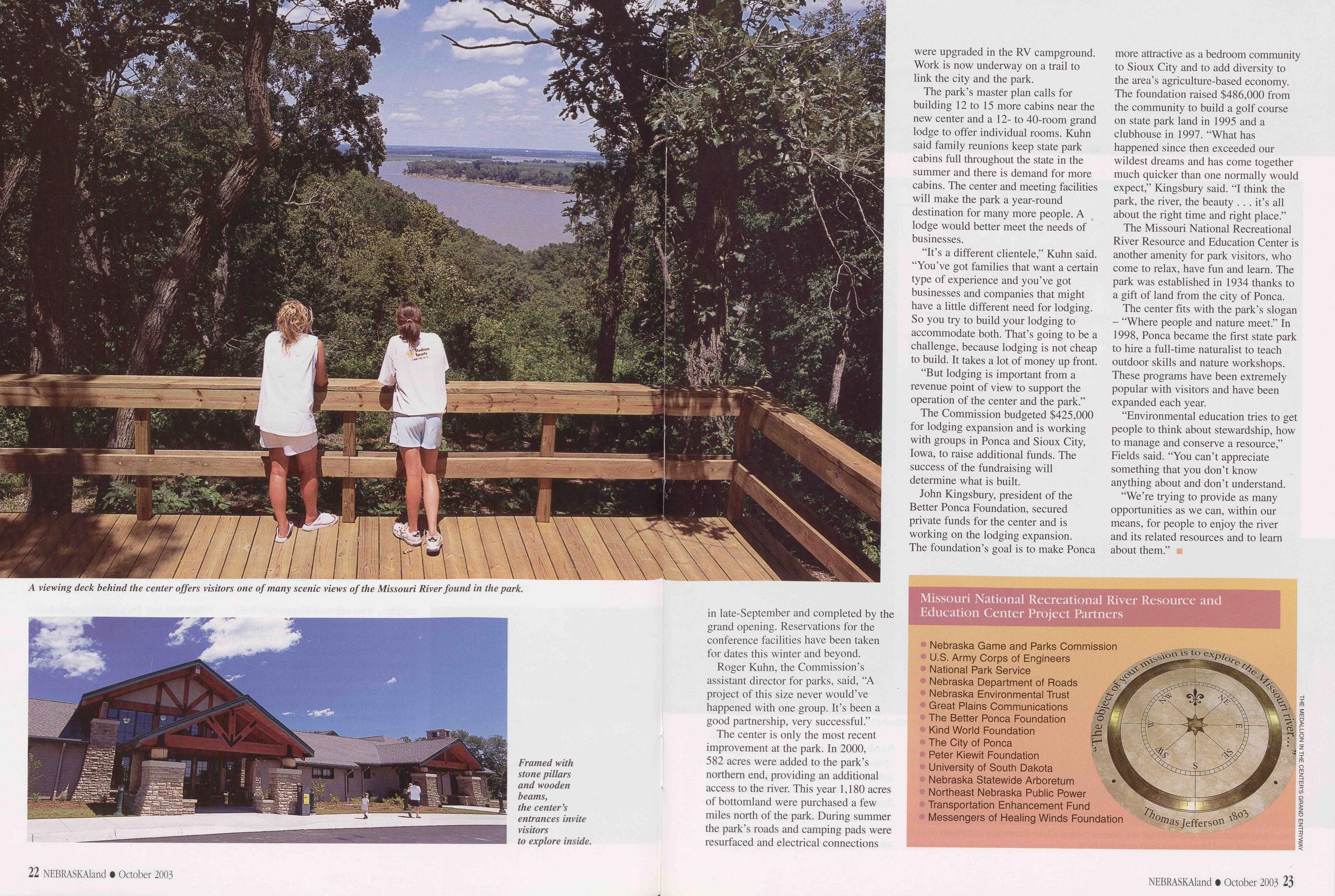
Roger Kuhn, the Commission’s assistant director for parks, said, “A project of this size never would’ve happened with one group. It’s been a good partnership, very successful.”
The center is only the most recent improvement at the park. In 2000, 582 acres were added to the park’s northern end, providing an additional access to the river. This year 1,180 acres of bottomland were purchased a few miles north of the park. During summer the park’s roads and camping pads were resurfaced and electrical connections were upgraded in the RV campground. Work is now underway on a trail to link the city and the park.
The park’s master plan calls for building 12 to 15 more cabins near the new center and a 12- to 40-room grand lodge to offer individual rooms. Kuhn said family reunions keep state park cabins full throughout the state in the summer and there is demand for more cabins. The center and meeting facilities will make the park a year-round destination for many more people. A lodge would better meet the needs of businesses.
"It’s a different clientele,” Kuhn said. “You’ve got families that want a certain type of experience and you’ve got businesses and companies that might have a little different need for lodging. So you try to build your lodging to accommodate both. That’s going to be a challenge, because lodging is not cheap to build. It takes a lot of money up front.
"But lodging is important from a revenue point of view to support the operation of the center and the park.”
The Commission budgeted $425,000 for lodging expansion and is working with groups in Ponca and Sioux City, Iowa, to raise additional funds. The success of the fundraising will determine what is built.
John Kingsbury, president of the Better Ponca Foundation, secured private funds for the center and is working on the lodging expansion. The foundation’s goal is to make Ponca more attractive as a bedroom community to Sioux City and to add diversity to the area’s agriculture-based economy. The foundation raised $486,000 from the community to build a golf course on state park land in 1995 and a clubhouse in 1997. "What has happened since then exceeded our wildest dreams and has come together much quicker than one normally would expect,” Kingsbury said. "I think the park, the river, the beauty ... it’s all about the right time and right place.”
The Missouri National Recreational River Resource and Education Center is another amenity for park visitors, who come to relax, have fun and learn. The park was established in 1934 thanks to a gift of land from the city of Ponca. The center fits with the park’s slogan - "Where people and nature meet.” In 1998, Ponca became the first state park to hire a full-time naturalist to teach outdoor skills and nature workshops. These programs have been extremely popular with visitors and have been expanded each year.
"Environmental education tries to get people to think about stewardship, how to manage and conserve a resource,” Fields said. "You can’t appreciate something that you don’t know anything about and don’t understand.
"We’re trying to provide as many opportunities as we can, within our means, for people to enjoy the river and its related resources and to learn about them.”
Mentored Archery Hunts
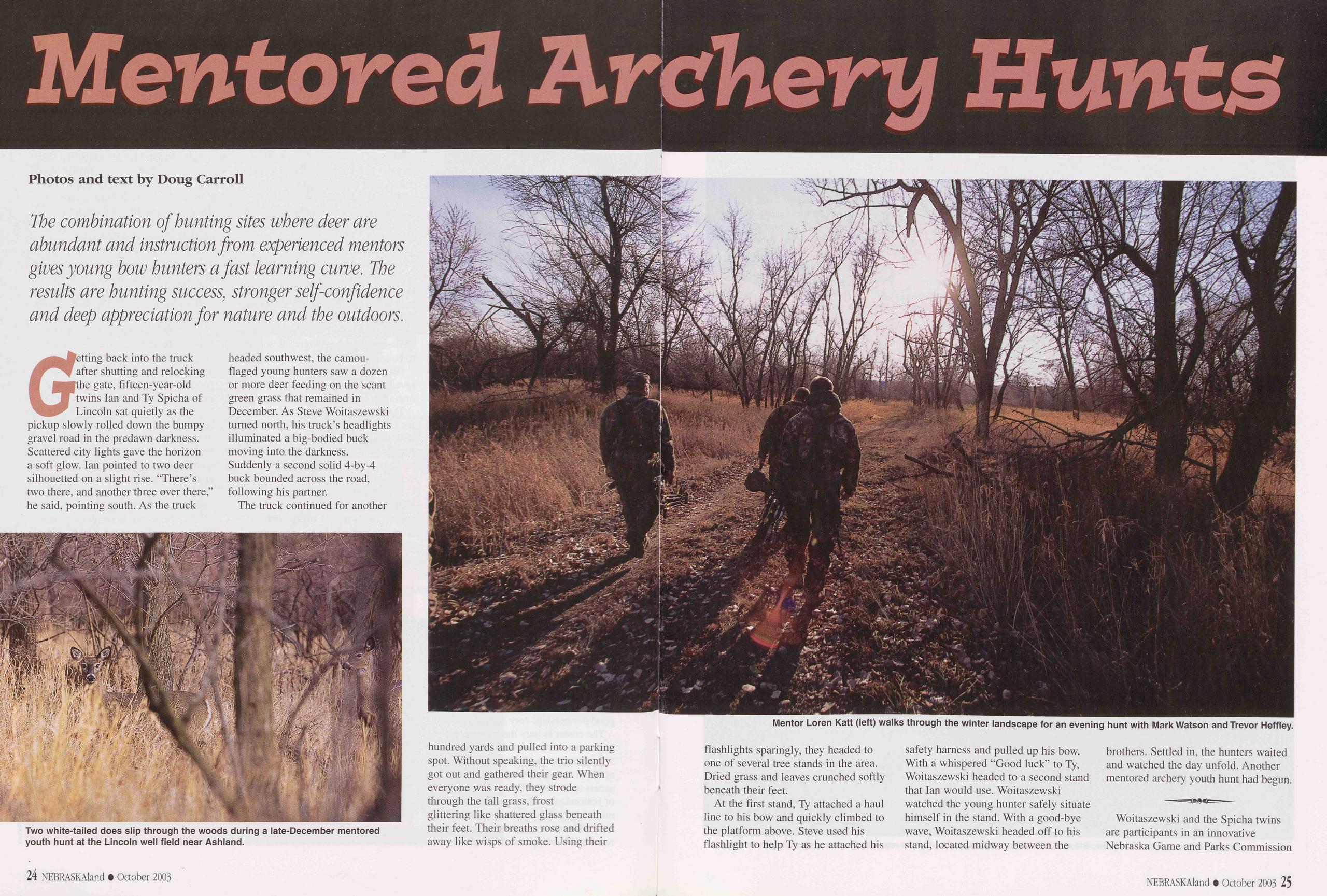
Photos and text by Doug Carroll The combination of bunting sites where deer are abundant and instruction from experienced mentors gives young bow hunters a fast learning curve. The results are hunting success, stronger self-confidence and deep appreciation for nature and the outdoors.Getting back into the truck after shutting and relocking the gate, fifteen-year-old twins Ian and Ty Spicha of Lincoln sat quietly as the pickup slowly rolled down the bumpy gravel road in the predawn darkness. Scattered city lights gave the horizon a soft glow. Ian pointed to two deer silhouetted on a slight rise. “There’s two there, and another three over there,” he said, pointing south. As the truck
The truck continued for another
At the first stand, Ty attached a haul line to his bow and quickly climbed to the platform above. Steve used his flashlight to help Ty as he attached his safety harness and pulled up his bow. With a whispered “Good luck” to Ty, Woitaszewski headed to a second stand that Ian would use. Woitaszewski watched the young hunter safely situate himself in the stand. With a good-bye wave, Woitaszewski headed off to his stand, located midway between the brothers. Settled in, the hunters waited and watched the day unfold. Another mentored archery youth hunt had begun.
Woitaszewski and the Spicha twins are participants in an innovative Nebraska Game and Parks Commission 24 NEBRASKAland • October 2003 NEBRASKAland • October 2003 25 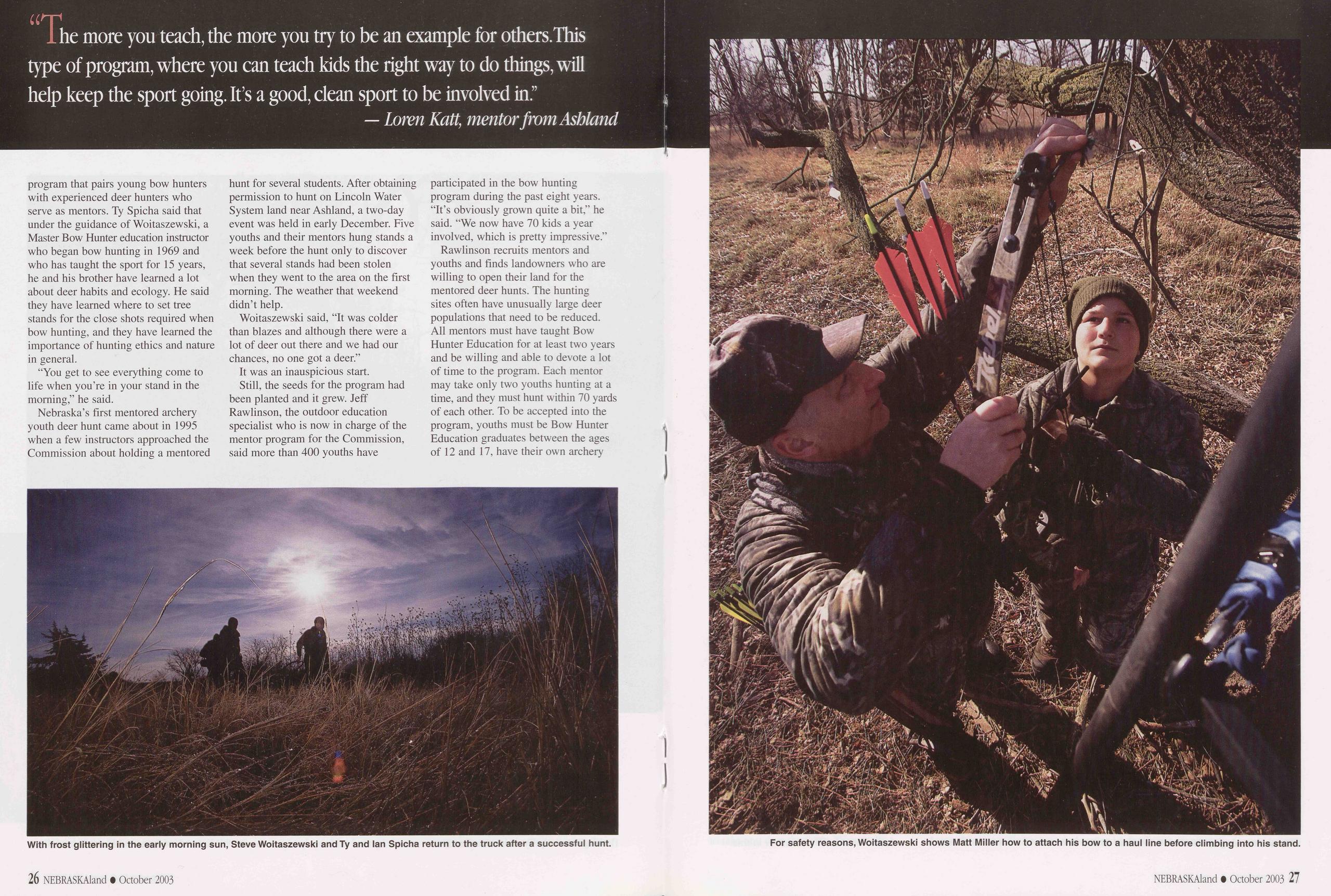 program that pairs young bow hunters with experienced deer hunters who serve as mentors. Ty Spicha said that under the guidance of Woitaszewski, a Master Bow Hunter education instructor who began bow hunting in 1969 and who has taught the sport for 15 years, he and his brother have learned a lot about deer habits and ecology. He said they have learned where to set tree stands for the close shots required when bow hunting, and they have learned the importance of hunting ethics and nature in general.
“You get to see everything come to life when you’re in your stand in the morning,” he said.
Nebraska’s first mentored archery youth deer hunt came about in 1995 when a few instructors approached the Commission about holding a mentored hunt for several students. After obtaining permission to hunt on Lincoln Water System land near Ashland, a two-day event was held in early December. Five youths and their mentors hung stands a week before the hunt only to discover that several stands had been stolen when they went to the area on the first morning. The weather that weekend didn’t help.
Woitaszewski said, "It was colder than blazes and although there were a lot of deer out there and we had our chances, no one got a deer.”
It was an inauspicious start.
Still, the seeds for the program had been planted and it grew. Jeff Rawlinson, the outdoor education specialist who is now in charge of the mentor program for the Commission, said more than 400 youths have participated in the bow hunting program during the past eight years. "It’s obviously grown quite a bit,” he said. "We now have 70 kids a year involved, which is pretty impressive.”
Rawlinson recruits mentors and youths and finds landowners who are willing to open their land for the mentored deer hunts. The hunting sites often have unusually large deer populations that need to be reduced. All mentors must have taught Bow Hunter Education for at least two years and be willing and able to devote a lot of time to the program. Each mentor may take only two youths hunting at a time, and they must hunt within 70 yards of each other. To be accepted into the program, youths must be Bow Hunter Education graduates between the ages of 12 and 17, have their own archery
When he first started hunting deer with a bow, Woitaszewski said, he got only one or two good chances each
Rawlinson agreed, “These kids are getting an education in one year that it takes many people five to six years to get.”
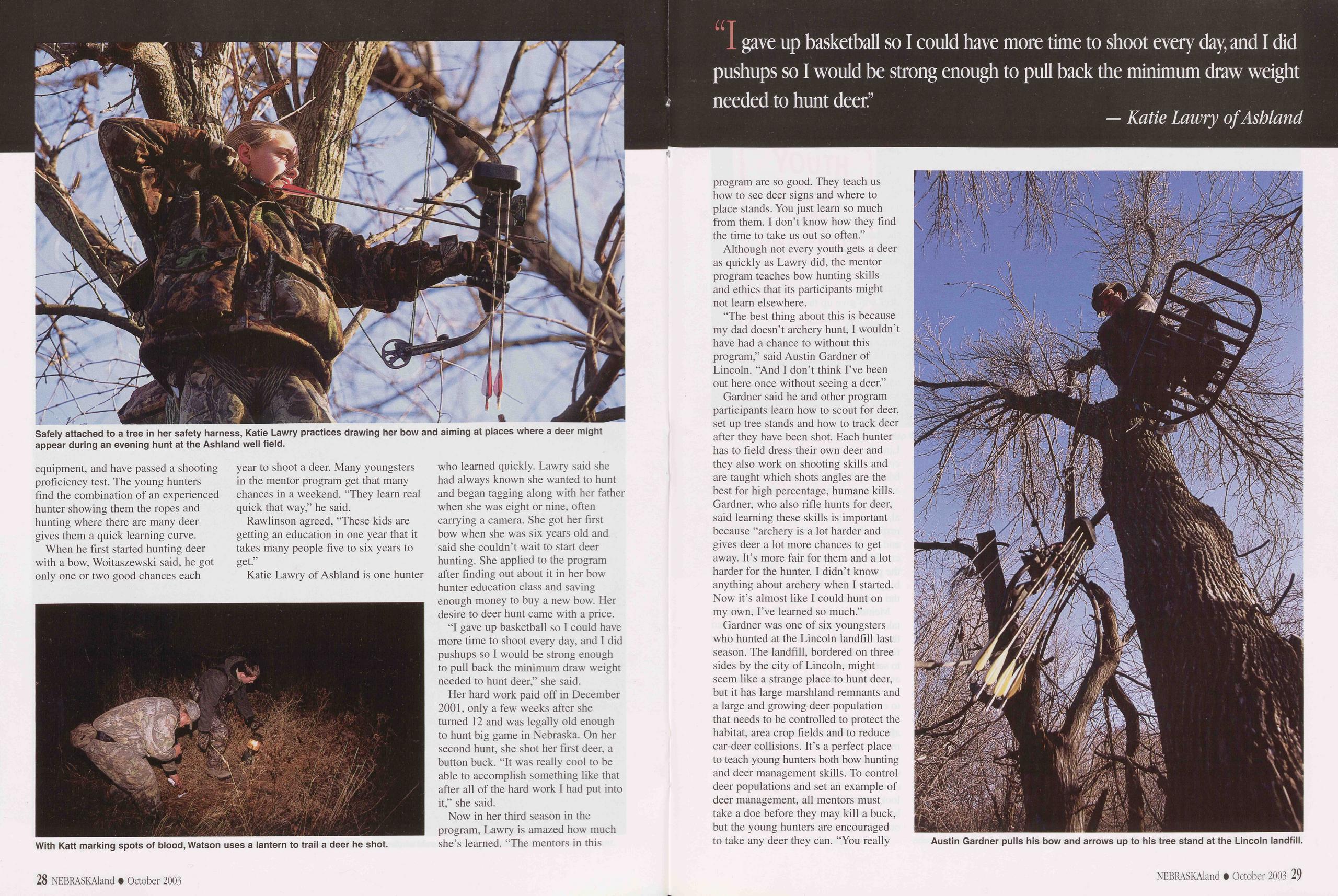
Katie Lawry of Ashland is one hunter who learned quickly. Lawry said she had always known she wanted to hunt and began tagging along with her father when she was eight or nine, often carrying a camera. She got her first bow when she was six years old and said she couldn’t wait to start deer hunting. She applied to the program after finding out about it in her bow hunter education class and saving enough money to buy a new bow. Her desire to deer hunt came with a price.
“I gave up basketball so I could have more time to shoot every day, and I did pushups so I would be strong enough to pull back the minimum draw weight needed to hunt deer,” she said.
Her hard work paid off in December 2001, only a few weeks after she turned 12 and was legally old enough to hunt big game in Nebraska. On her second hunt, she shot her first deer, a button buck. “It was really cool to be able to accomplish something like that after all of the hard work I had put into it,” she said.
Now in her third season in the program, Lawry is amazed how much she’s learned. “The mentors in this program are so good. They teach us how to see deer signs and where to place stands. You just learn so much from them. I don't know how they find the time to take us out so often."
"I gave up basketball so I could have more time to shoot every day and I did pushups so I would be strong enough to pull back the minimum draw weight needed to hunt deer.” -Katie Lawry of AshlandAlthough not every youth gets a deer as quickly as Lawry did, the mentor program teaches bow hunting skills and ethics that its participants might not learn elsewhere.
"The best thing about this is because my dad doesn't archery hunt, I wouldn't have had a chance to without this program," said Austin Gardner of Lincoln. "And I don't think I've been out here once without seeing a deer."
Gardner said he and other program participants learn how to scout for deer, set up tree stands and how to track deer after they have been shot. Each hunter has to field dress their own deer and they also work on shooting skills and are taught which shots angles are the best for high percentage, humane kills. Gardner, who also rifle hunts for deer, said learning these skills is important because “archery is a lot harder and gives deer a lot more chances to get away. It’s more fair for them and a lot harder for the hunter. I didn’t know anything about archery when I started. Now it’s almost like I could hunt on my own, I’ve learned so much.”
Gardner was one of six youngsters who hunted at the Lincoln landfill last season. The landfill, bordered on three sides by the city of Lincoln, might seem like a strange place to hunt deer, but it has large marshland remnants and a large and growing deer population that needs to be controlled to protect the habitat, area crop fields and to reduce car-deer collisions. It’s a perfect place to teach young hunters both bow hunting and deer management skills. To control deer populations and set an example of deer management, all mentors must take a doe before they may kill a buck, but the young hunters are encouraged to take any deer they can. “You really
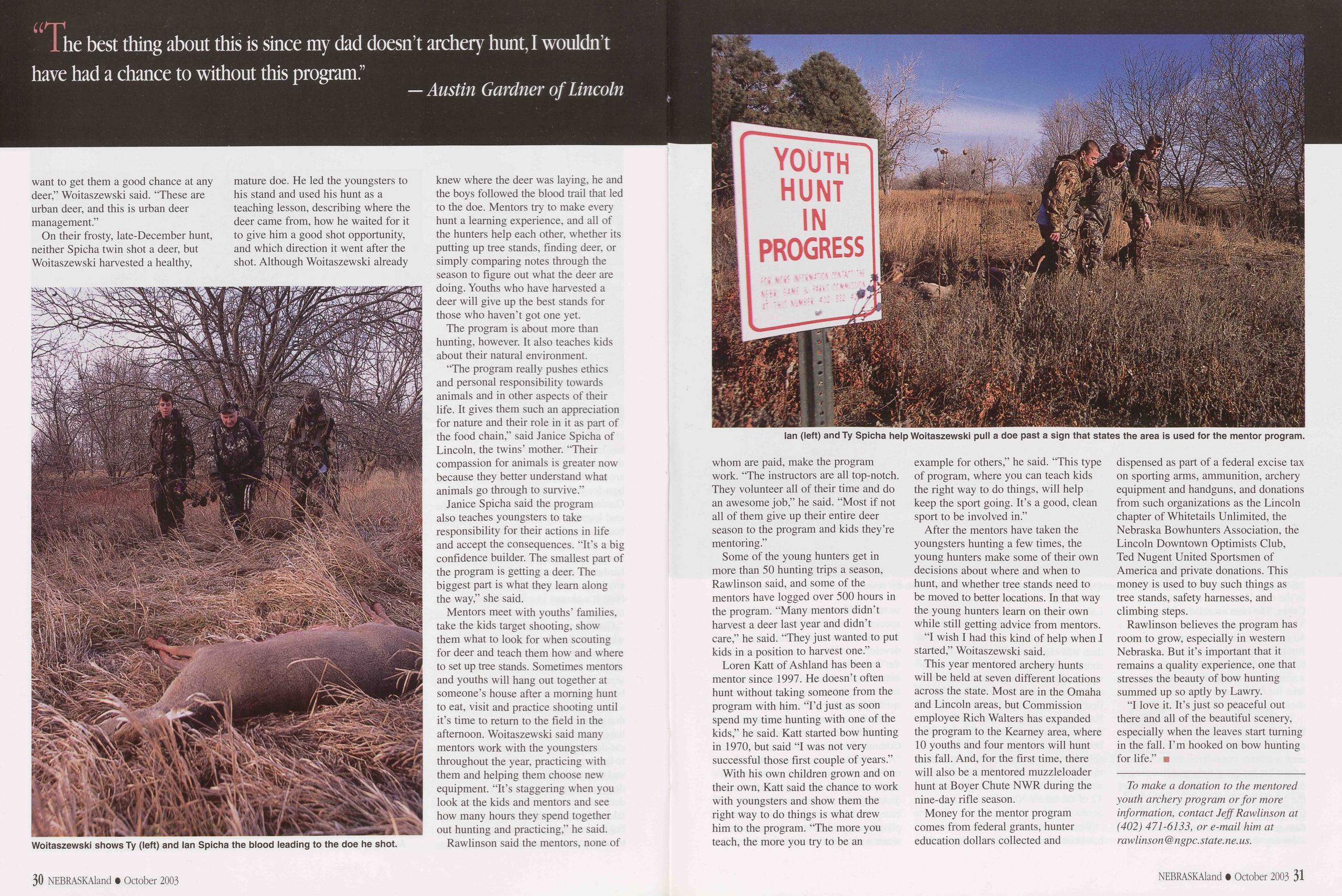 want to get them a good chance at any deer,” Woitaszewski said. “These are urban deer, and this is urban deer management.”
"The best thing about this is since my dad doesn’t archery hunt, I wouldn’t have had a chance to without this program.” -Austin Gardner of Lincoln
On their frosty, late-December hunt, neither Spicha twin shot a deer, but Woitaszewski harvested a healthy,
The program is about more than hunting, however. It also teaches kids about their natural environment.
"The program really pushes ethics and personal responsibility towards animals and in other aspects of their life. It gives them such an appreciation for nature and their role in it as part of the food chain,” said Janice Spicha of Lincoln, the twins’ mother. "Their compassion for animals is greater now because they better understand what animals go through to survive.”
Janice Spicha said the program also teaches youngsters to take responsibility for their actions in life and accept the consequences. "It’s a big confidence builder. The smallest part of the program is getting a deer. The biggest part is what they learn along the way,” she said.
Mentors meet with youths’ families, take the kids target shooting, show them what to look for when scouting for deer and teach them how and where to set up tree stands. Sometimes mentors and youths will hang out together at someone’s house after a morning hunt to eat, visit and practice shooting until it’s time to return to the field in the afternoon. Woitaszewski said many mentors work with the youngsters throughout the year, practicing with them and helping them choose new equipment. "It’s staggering when you look at the kids and mentors and see how many hours they spend together out hunting and practicing,” he said.
Rawlinson said the mentors, none of
Some of the young hunters get in more than 50 hunting trips a season, Rawlinson said, and some of the mentors have logged over 500 hours in the program. “Many mentors didn’t harvest a deer last year and didn’t care,” he said. "They just wanted to put kids in a position to harvest one.”
Loren Katt of Ashland has been a mentor since 1997. He doesn’t often hunt without taking someone from the program with him. “I’d just as soon spend my time hunting with one of the kids,” he said. Katt started bow hunting in 1970, but said "I was not very successful those first couple of years.”
With his own children grown and on their own, Katt said the chance to work with youngsters and show them the right way to do things is what drew him to the program. "The more you teach, the more you try to be an example for others,” he said. “This type of program, where you can teach kids the right way to do things, will help keep the sport going. It’s a good, clean sport to be involved in.”
After the mentors have taken the youngsters hunting a few times, the young hunters make some of their own decisions about where and when to hunt, and whether tree stands need to be moved to better locations. In that way the young hunters learn on their own while still getting advice from mentors.
"I wish I had this kind of help when J started,” Woitaszewski said.
This year mentored archery hunts will be held at seven different locations across the state. Most are in the Omaha and Lincoln areas, but Commission employee Rich Walters has expanded the program to the Kearney area, where 10 youths and four mentors will hunt this fall. And, for the first time, there will also be a mentored muzzleloader hunt at Boyer Chute NWR during the nine-day rifle season.
Money for the mentor program comes from federal grants, hunter education dollars collected and dispensed as part of a federal excise tax on sporting arms, ammunition, archery equipment and handguns, and donations from such organizations as the Lincoln chapter of Whitetails Unlimited, the Nebraska Bowhunters Association, the Lincoln Downtown Optimists Club, Ted Nugent United Sportsmen of America and private donations. This money is used to buy such things as tree stands, safety harnesses, and climbing steps.
Rawlinson believes the program has room to grow, especially in western Nebraska. But it’s important that it remains a quality experience, one that stresses the beauty of bow hunting summed up so aptly by Lawry.
“I love it. It’s just so peaceful out there and all of the beautiful scenery, especially when the leaves start turning in the fall. I’m hooked on bow hunting for life.”
To make a donation to the mentored youth archery program or for more information, contact Jeff Rawlinson at (402) 471-6133, or e-mail him at rawlinson@ngpc.state.ne.us.
30 NEBRASKAland • October 2003 NEBRASKAland • October 2003 31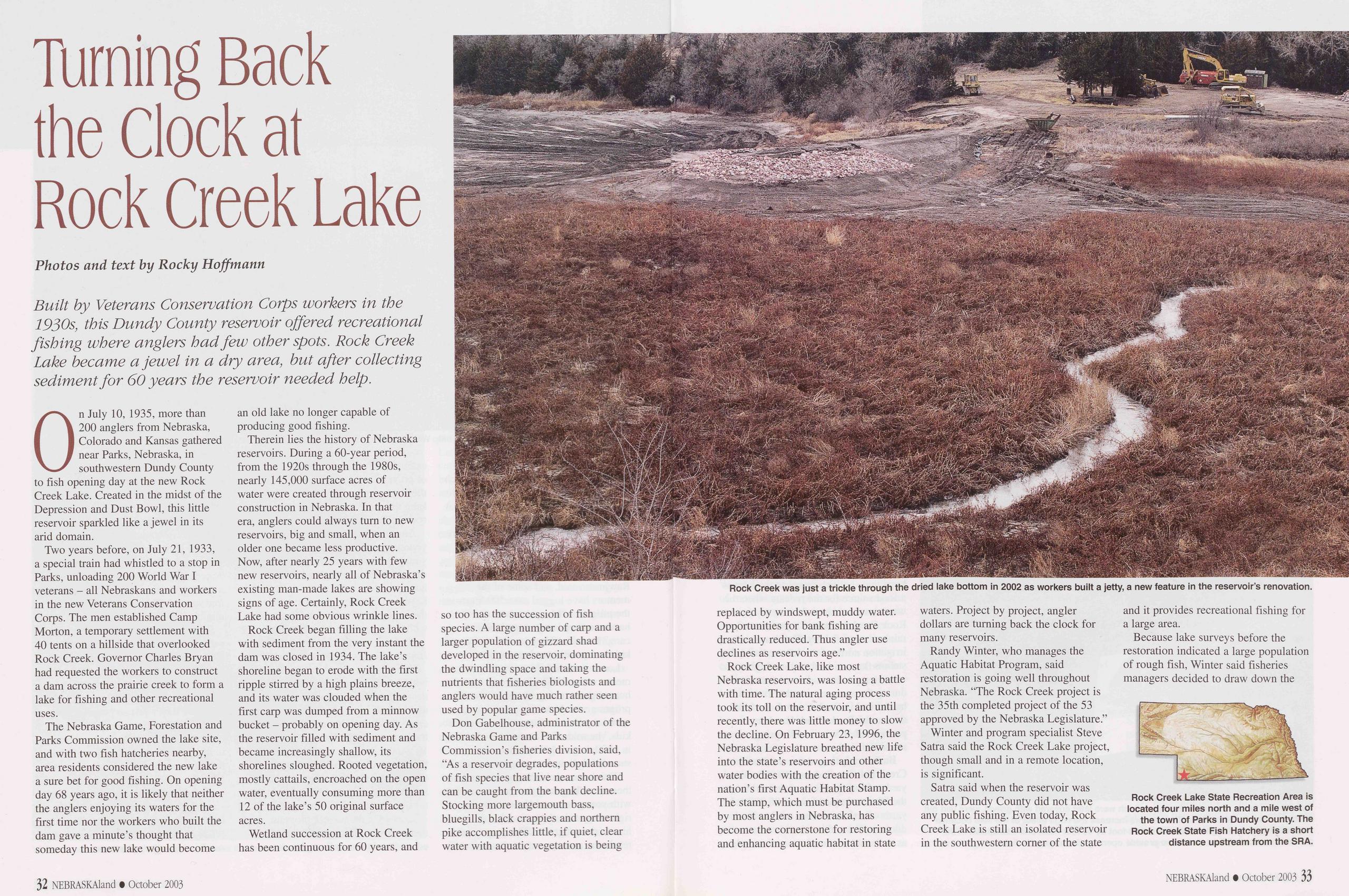
Turning Back the Clock at Rock Creek Lake
Photos and text by Rocky Hoffmann Built by Veterans Conservation Corps workers in the 1930s, this Dundy County reservoir offered recreational fishing where anglers had few other spots. Rock Creek Lake became a jewel in a dry area, but after collecting sediment for 60 years the reservoir needed help.On July 10, 1935, more than 200 anglers from Nebraska, Colorado and Kansas gathered near Parks, Nebraska, in southwestern Dundy County to fish opening day at the new Rock Creek Lake. Created in the midst of the Depression and Dust Bowl, this little reservoir sparkled like a jewel in its arid domain.
Two years before, on July 21, 1933, a special train had whistled to a stop in Parks, unloading 200 World War I veterans - all Nebraskans and workers in the new Veterans Conservation Corps. The men established Camp Morton, a temporary settlement with 40 tents on a hillside that overlooked Rock Creek. Governor Charles Bryan had requested the workers to construct a dam across the prairie creek to form a lake for fishing and other recreational uses.
The Nebraska Game, Forestation and Parks Commission owned the lake site, and with two fish hatcheries nearby, area residents considered the new lake a sure bet for good fishing. On opening day 68 years ago, it is likely that neither the anglers enjoying its waters for the first time nor the workers who built the dam gave a minute’s thought that someday this new lake would become an old lake no longer capable of producing good fishing.
Therein lies the history of Nebraska reservoirs. During a 60-year period, from the 1920s through the 1980s, nearly 145,000 surface acres of water were created through reservoir construction in Nebraska. In that era, anglers could always turn to new reservoirs, big and small, when an older one became less productive. Now, after nearly 25 years with few new reservoirs, nearly all of Nebraska’s existing man-made lakes are showing signs of age. Certainly, Rock Creek Lake had some obvious wrinkle lines.
Rock Creek began filling the lake with sediment from the very instant the dam was closed in 1934. The lake’s shoreline began to erode with the first ripple stirred by a high plains breeze, and its water was clouded when the first carp was dumped from a minnow bucket - probably on opening day. As the reservoir filled with sediment and became increasingly shallow, its shorelines sloughed. Rooted vegetation, mostly cattails, encroached on the open water, eventually consuming more than 12 of the lake’s 50 original surface acres.
Wetland succession at Rock Creek has been continuous for 60 years, and so too has the succession of fish species. A large number of carp and a larger population of gizzard shad developed in the reservoir, dominating the dwindling space and taking the nutrients that fisheries biologists and anglers would have much rather seen used by popular game species.
Don Gabelhouse, administrator of the Nebraska Game and Parks Commission’s fisheries division, said, "As a reservoir degrades, populations of fish species that live near shore and can be caught from the bank decline. Stocking more largemouth bass, bluegills, black crappies and northern pike accomplishes little, if quiet, clear water with aquatic vegetation is being
Rock Creek Lake, like most Nebraska reservoirs, was losing a battle with time. The natural aging process took its toll on the reservoir, and until recently, there was little money to slow the decline. On February 23, 1996, the Nebraska Legislature breathed new life into the state’s reservoirs and other water bodies with the creation of the nation’s first Aquatic Habitat Stamp. The stamp, which must be purchased by most anglers in Nebraska, has become the cornerstone for restoring and enhancing aquatic habitat in state waters. Project by project, angler dollars are turning back the clock for many reservoirs.
Randy Winter, who manages the Aquatic Habitat Program, said restoration is going well throughout Nebraska. "The Rock Creek project is the 35th completed project of the 53 approved by the Nebraska Legislature.”
Winter and program specialist Steve Satra said the Rock Creek Lake project, though small and in a remote location, is significant.
Satra said when the reservoir was created, Dundy County did not have any public fishing. Even today, Rock Creek Lake is still an isolated reservoir in the southwestern corner of the state and it provides recreational fishing for a large area.
Because lake surveys before the restoration indicated a large population of rough fish, Winter said fisheries managers decided to draw down the
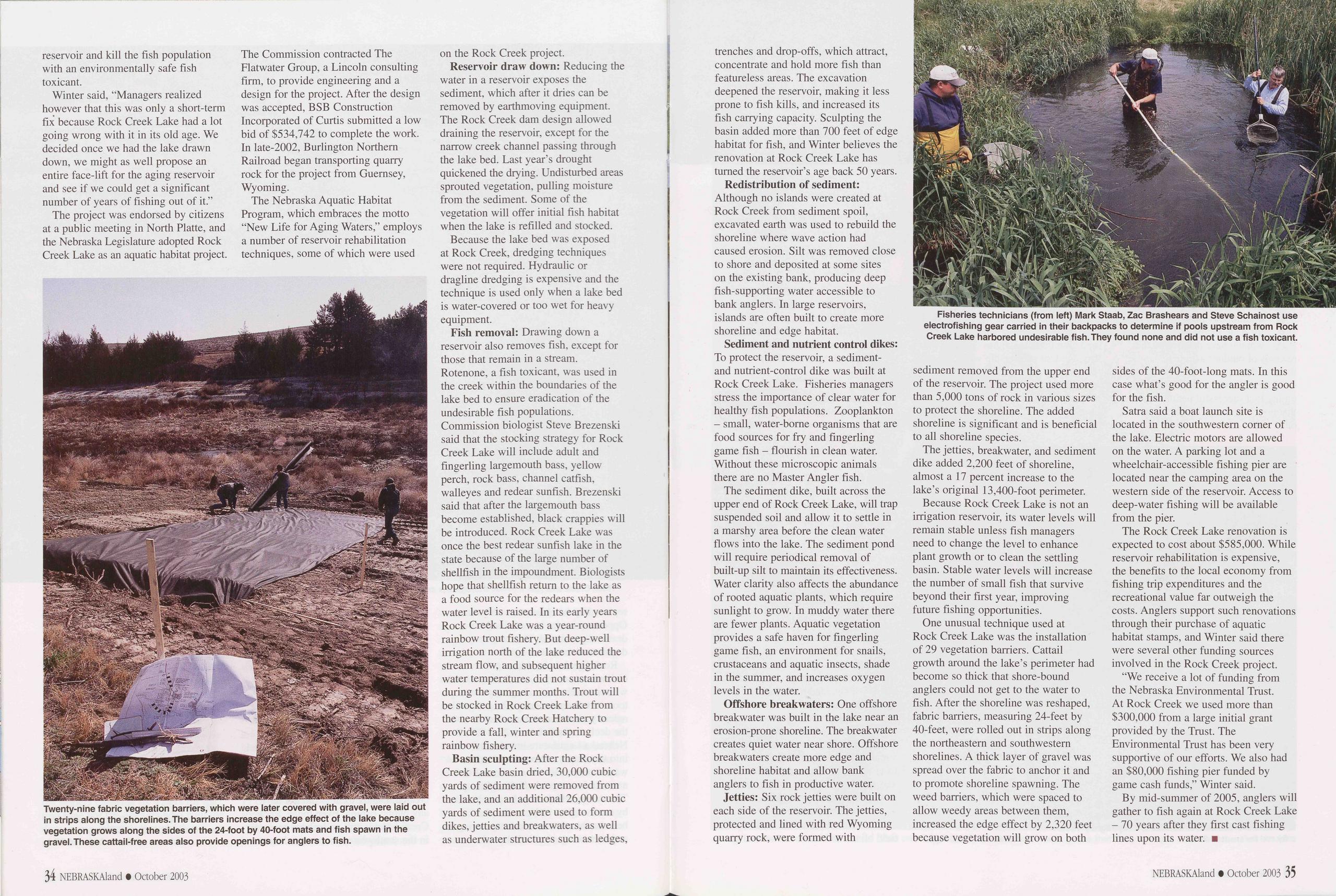 reservoir and kill the fish population with an environmentally safe fish toxicant.
Winter said, “Managers realized however that this was only a short-term fix because Rock Creek Lake had a lot going wrong with it in its old age. We decided once we had the lake drawn down, we might as well propose an entire face-lift for the aging reservoir and see if we could get a significant number of years of fishing out of it.”
The project was endorsed by citizens at a public meeting in North Platte, and the Nebraska Legislature adopted Rock Creek Lake as an aquatic habitat project.
The Nebraska Aquatic Habitat Program, which embraces the motto "New Life for Aging Waters,” employs a number of reservoir rehabilitation techniques, some of which were used on the Rock Creek project.
Reservoir draw down:Reducing the water in a reservoir exposes the sediment, which after it dries can be removed by earthmoving equipment. The Rock Creek dam design allowed draining the reservoir, except for the narrow creek channel passing through the lake bed. Last year’s drought quickened the drying. Undisturbed areas sprouted vegetation, pulling moisture from the sediment. Some of the vegetation will offer initial fish habitat when the lake is refilled and stocked. Because the lake bed was exposed at Rock Creek, dredging techniques were not required. Hydraulic or dragline dredging is expensive and the technique is used only when a lake bed is water-covered or too wet for heavy equipment.
Fish removal:Drawing down a reservoir also removes fish, except for those that remain in a stream. Rotenone, a fish toxicant, was used in the creek within the boundaries of the lake bed to ensure eradication of the undesirable fish populations. Commission biologist Steve Brezenski said that the stocking strategy for Rock Creek Lake will include adult and fingerling largemouth bass, yellow perch, rock bass, channel catfish, walleyes and redear sunfish. Brezenski said that after the largemouth bass become established, black crappies will be introduced. Rock Creek Lake was once the best redear sunfish lake in the state because of the large number of shellfish in the impoundment. Biologists hope that shellfish return to the lake as a food source for the redears when the water level is raised. In its early years Rock Creek Lake was a year-round rainbow trout fishery. But deep-well irrigation north of the lake reduced the stream flow, and subsequent higher water temperatures did not sustain trout during the summer months. Trout will be stocked in Rock Creek Lake from the nearby Rock Creek Hatchery to provide a fall, winter and spring rainbow fishery.
Basin sculpting:After the Rock Creek Lake basin dried, 30,000 cubic yards of sediment were removed from the lake, and an additional 26,000 cubic yards of sediment were used to form dikes, jetties and breakwaters, as well as underwater structures such as ledges, trenches and drop-offs, which attract, concentrate and hold more fish than featureless areas. The excavation deepened the reservoir, making it less prone to fish kills, and increased its fish carrying capacity. Sculpting the basin added more than 700 feet of edge habitat for fish, and Winter believes the renovation at Rock Creek Lake has turned the reservoir’s age back 50 years.
Redistribution of sediment:Although no islands were created at Rock Creek from sediment spoil, excavated earth was used to rebuild the shoreline where wave action had caused erosion. Silt was removed close to shore and deposited at some sites on the existing bank, producing deep fish-supporting water accessible to bank anglers. In large reservoirs, islands are often built to create more shoreline and edge habitat.
Sediment and nutrient control dikes:To protect the reservoir, a sediment- and nutrient-control dike was built at Rock Creek Lake. Fisheries managers stress the importance of clear water for healthy fish populations. Zooplankton - small, water-borne organisms that are food sources for fry and fingerling game fish - flourish in clean water. Without these microscopic animals there are no Master Angler fish. The sediment dike, built across the upper end of Rock Creek Lake, will trap suspended soil and allow it to settle in a marshy area before the clean water flows into the lake. The sediment pond will require periodical removal of built-up silt to maintain its effectiveness. Water clarity also affects the abundance of rooted aquatic plants, which require sunlight to grow. In muddy water there are fewer plants. Aquatic vegetation provides a safe haven for fingerling game fish, an environment for snails, crustaceans and aquatic insects, shade in the summer, and increases oxygen levels in the water.
Offshore breakwaters:One offshore breakwater was built in the lake near an erosion-prone shoreline. The breakwater creates quiet water near shore. Offshore breakwaters create more edge and shoreline habitat and allow bank anglers to fish in productive water.
Jetties:Six rock jetties were built on each side of the reservoir. The jetties, protected and lined with red Wyoming quarry rock, were formed with
The jetties, breakwater, and sediment dike added 2,200 feet of shoreline, almost a 17 percent increase to the lake’s original 13,400-foot perimeter.
Because Rock Creek Lake is not an irrigation reservoir, its water levels will remain stable unless fish managers need to change the level to enhance plant growth or to clean the settling basin. Stable water levels will increase the number of small fish that survive beyond their first year, improving future fishing opportunities.
One unusual technique used at Rock Creek Lake was the installation of 29 vegetation barriers. Cattail growth around the lake’s perimeter had become so thick that shore-bound anglers could not get to the water to fish. After the shoreline was reshaped, fabric barriers, measuring 24-feet by 40-feet, were rolled out in strips along the northeastern and southwestern shorelines. A thick layer of gravel was spread over the fabric to anchor it and to promote shoreline spawning. The weed barriers, which were spaced to allow weedy areas between them, increased the edge effect by 2,320 feet because vegetation will grow on both sides of the 40-foot-long mats. In this case what’s good for the angler is good for the fish.
Satra said a boat launch site is located in the southwestern comer of the lake. Electric motors are allowed on the water. A parking lot and a wheelchair-accessible fishing pier are located near the camping area on the western side of the reservoir. Access to deep-water fishing will be available from the pier.
The Rock Creek Lake renovation is expected to cost about $585,000. While reservoir rehabilitation is expensive, the benefits to the local economy from fishing trip expenditures and the recreational value far outweigh the costs. Anglers support such renovations through their purchase of aquatic habitat stamps, and Winter said there were several other funding sources involved in the Rock Creek project.
“We receive a lot of funding from the Nebraska Environmental Trust. At Rock Creek we used more than $300,000 from a large initial grant provided by the Trust. The Environmental Trust has been very supportive of our efforts. We also had an $80,000 fishing pier funded by game cash funds,” Winter said.
By mid-summer of 2005, anglers will gather to fish again at Rock Creek Lake -70 years after they first cast fishing lines upon its water.
34 NEBRASKAland • October 2003 NEBRASKAland • October 2003 35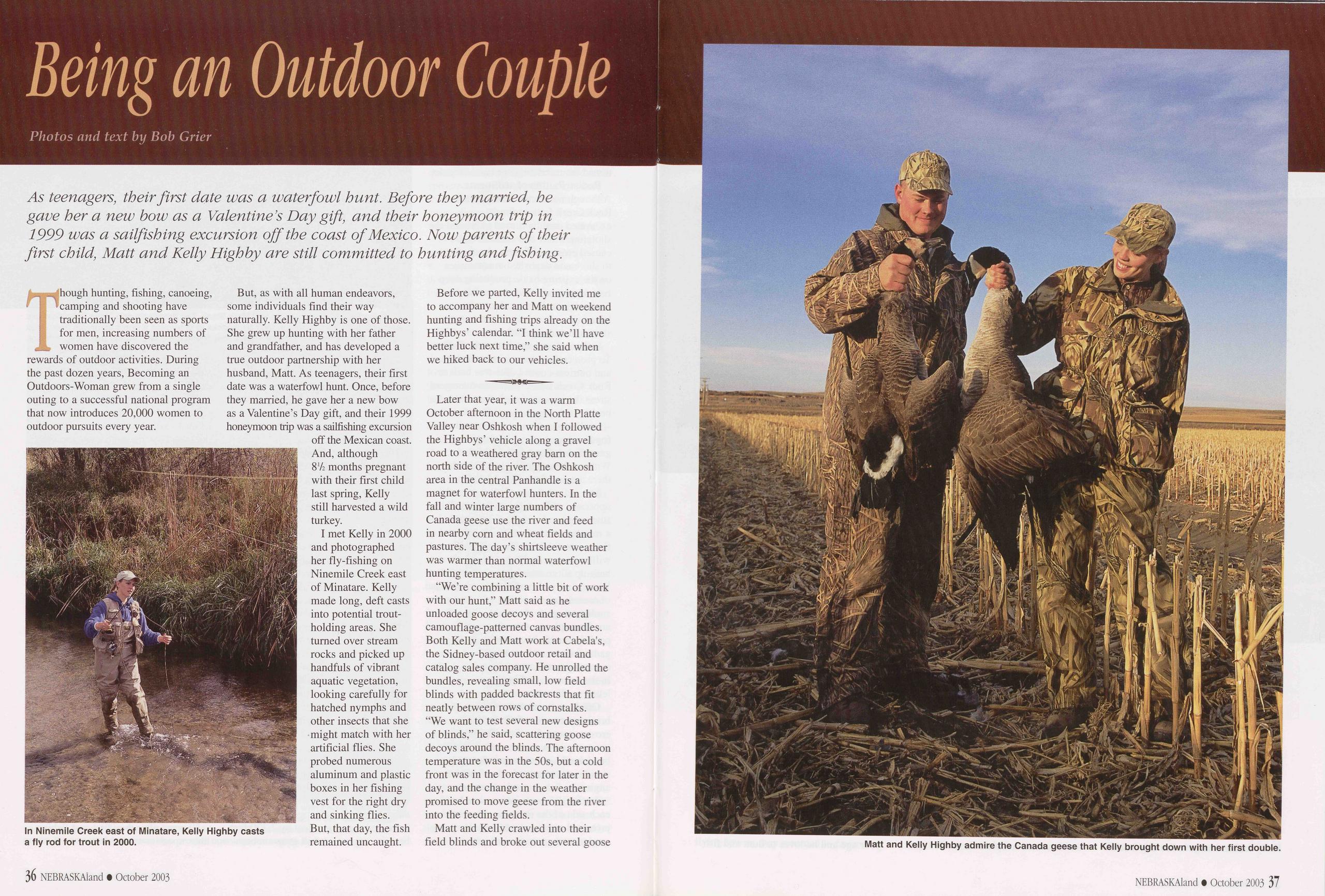
Being an Outdoor Couple
Photos and text by Bob Grier As teenagers, their first date was a waterfowl hunt. Before they married, he gave her a new bow as a Valentine’s Day gift, and their honeymoon trip in 1999 was a sailfishing excursion off the coast of Mexico. Now parents of their first child, Matt and Kelly Highby are still committed to hunting and fishing.Though hunting, fishing, canoeing, camping and shooting have traditionally been seen as sports for men, increasing numbers of women have discovered the rewards of outdoor activities. During the past dozen years, Becoming an Outdoors-Woman grew from a single outing to a successful national program that now introduces 20,000 women to outdoor pursuits every year.
But, as with all human endeavors, some individuals find their way naturally. Kelly Highby is one of those. She grew up hunting with her father and grandfather, and has developed a true outdoor partnership with her husband, Matt. As teenagers, their first date was a waterfowl hunt. Once, before they married, he gave her a new bow as a Valentine’s Day gift, and their 1999 honeymoon trip was a sailfishing excursion off the Mexican coast. And, although 872 months pregnant with their first child last spring, Kelly still harvested a wild turkey.
I met Kelly in 2000 and photographed her fly-fishing on Ninemile Creek east of Minatare. Kelly made long, deft casts into potential trout- holding areas. She turned over stream rocks and picked up handfuls of vibrant aquatic vegetation, looking carefully for hatched nymphs and other insects that she might match with her artificial flies. She probed numerous aluminum and plastic boxes in her fishing vest for the right dry and sinking flies. But, that day, the fish remained uncaught.
Before we parted, Kelly invited me to accompany her and Matt on weekend hunting and fishing trips already on the Highbys’ calendar. "I think we’ll have better luck next time,” she said when we hiked back to our vehicles.
Later that year, it was a warm October afternoon in the North Platte Valley near Oshkosh when I followed the Highbys’ vehicle along a gravel road to a weathered gray bam on the north side of the river. The Oshkosh area in the central Panhandle is a magnet for waterfowl hunters. In the fall and winter large numbers of Canada geese use the river and feed in nearby corn and wheat fields and pastures. The day’s shirtsleeve weather was warmer than normal waterfowl hunting temperatures.
“We’re combining a little bit of work with our hunt,” Matt said as he unloaded goose decoys and several camouflage-patterned canvas bundles. Both Kelly and Matt work at Cabela's, the Sidney-based outdoor retail and catalog sales company. He unrolled the bundles, revealing small, low field blinds with padded backrests that fit neatly between rows of cornstalks. “We want to test several new designs of blinds,” he said, scattering goose decoys around the blinds. The afternoon temperature was in the 50s, but a cold front was in the forecast for later in the day, and the change in the weather promised to move geese from the river into the feeding fields.
Matt and Kelly crawled into their field blinds and broke out several goose
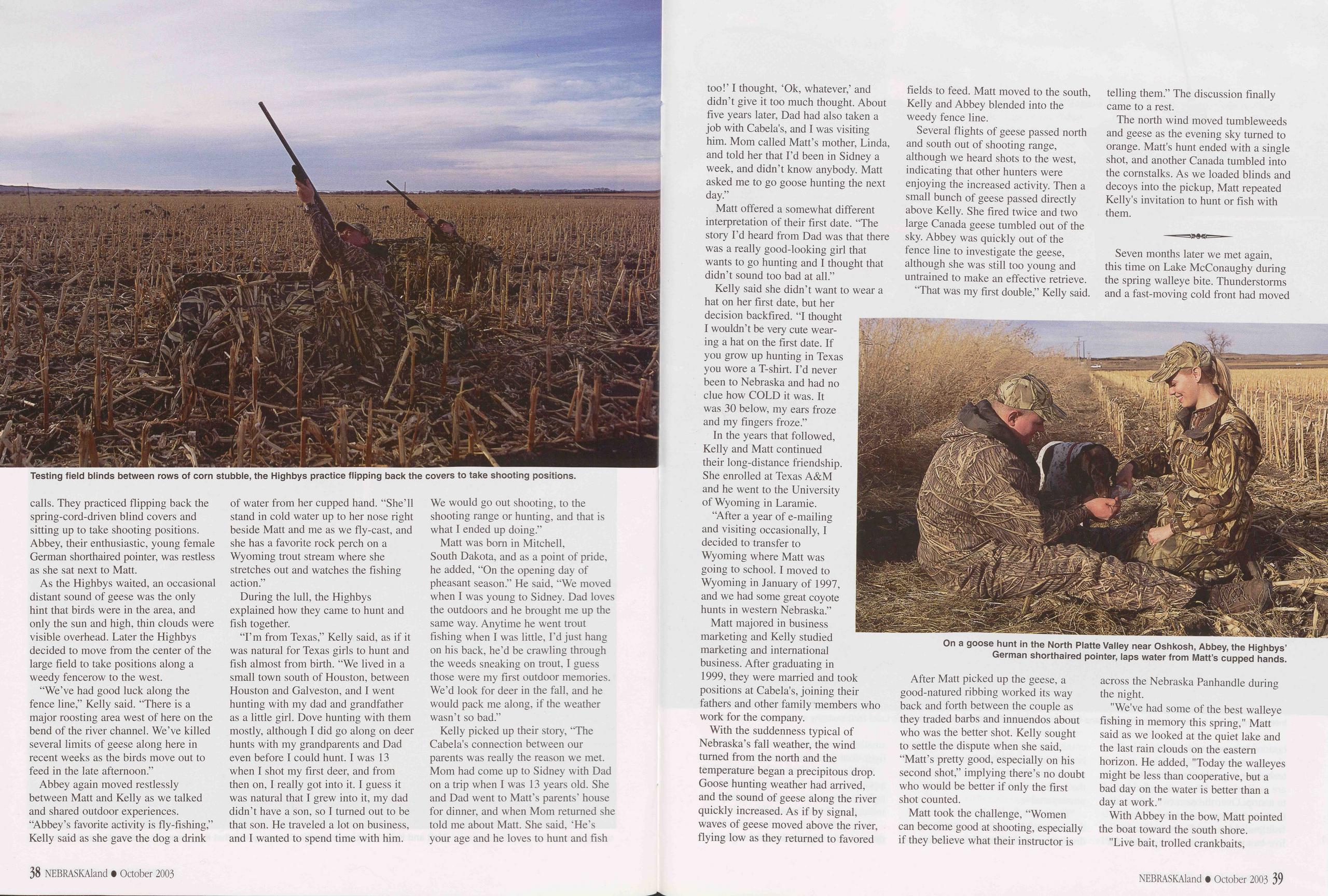
As the Highbys waited, an occasional distant sound of geese was the only hint that birds were in the area, and only the sun and high, thin clouds were visible overhead. Later the Highbys decided to move from the center of the large field to take positions along a weedy fencerow to the west.
“We’ve had good luck along the fence line,” Kelly said. “There is a major roosting area west of here on the bend of the river channel. We’ve killed several limits of geese along here in recent weeks as the birds move out to feed in the late afternoon.”
Abbey again moved restlessly between Matt and Kelly as we talked and shared outdoor experiences. “Abbey’s favorite activity is fly-fishing,” Kelly said as she gave the dog a drink of water from her cupped hand. “She’ll stand in cold water up to her nose right beside Matt and me as we fly-cast, and she has a favorite rock perch on a Wyoming trout stream where she stretches out and watches the fishing action.”
During the lull, the Highbys explained how they came to hunt and fish together.
“I’m from Texas,” Kelly said, as if it was natural for Texas girls to hunt and fish almost from birth. “We lived in a small town south of Houston, between Houston and Galveston, and I went hunting with my dad and grandfather as a little girl. Dove hunting with them mostly, although I did go along on deer hunts with my grandparents and Dad even before I could hunt. I was 13 when I shot my first deer, and from then on, I really got into it. I guess it was natural that I grew into it, my dad didn’t have a son, so I turned out to be that son. He traveled a lot on business, and I wanted to spend time with him. We would go out shooting, to the shooting range or hunting, and that is what I ended up doing.”
Matt was born in Mitchell, South Dakota, and as a point of pride, he added, “On the opening day of pheasant season.” He said, “We moved when I was young to Sidney. Dad loves the outdoors and he brought me up the same way. Anytime he went trout fishing when I was little, I’d just hang on his back, he’d be crawling through the weeds sneaking on trout, I guess those were my first outdoor memories. We’d look for deer in the fall, and he would pack me along, if the weather wasn’t so bad.”
Kelly picked up their story, “The Cabela's connection between our parents was really the reason we met. Mom had come up to Sidney with Dad on a trip when I was 13 years old. She and Dad went to Matt’s parents’ house for dinner, and when Mom returned she told me about Matt. She said, 'He’s your age and he loves to hunt and fish too!’ I thought, 'Ok, whatever,’ and didn’t give it too much thought. About five years later, Dad had also taken a job with Cabela's, and I was visiting him. Mom called Matt’s mother, Linda, and told her that I’d been in Sidney a week, and didn’t know anybody. Matt asked me to go goose hunting the next day.”
Matt offered a somewhat different interpretation of their first date. “The story I’d heard from Dad was that there was a really good-looking girl that wants to go hunting and I thought that didn’t sound too bad at all.”
Kelly said she didn’t want to wear a hat on her first date, but her decision backfired. “I thought I wouldn’t be very cute wear- ing a hat on the first date. If you grow up hunting in Texas you wore a T-shirt. I’d never been to Nebraska and had no clue how COLD it was. It was 30 below, my ears froze and my fingers froze.”
In the years that followed, Kelly and Matt continued their long-distance friendship. She enrolled at Texas A&M and he went to the University of Wyoming in Laramie.
“After a year of e-mailing and visiting occasionally, I decided to transfer to Wyoming where Matt was going to school. I moved to Wyoming in January of 1997, and we had some great coyote hunts in western Nebraska.”
Matt majored in business marketing and Kelly studied marketing and international business. After graduating in 1999, they were married and took positions at Cabela's, joining their fathers and other family members who work for the company.
With the suddenness typical of Nebraska’s fall weather, the wind turned from the north and the temperature began a precipitous drop. Goose hunting weather had arrived, and the sound of geese along the river quickly increased. As if by signal, waves of geese moved above the river, flying low as they returned to favored fields to feed. Matt moved to the south, Kelly and Abbey blended into the weedy fence line.
Several flights of geese passed north and south out of shooting range, although we heard shots to the west, indicating that other hunters were enjoying the increased activity. Then a small bunch of geese passed directly above Kelly. She fired twice and two large Canada geese tumbled out of the sky. Abbey was quickly out of the fence line to investigate the geese, although she was still too young and untrained to make an effective retrieve.
“That was my first double,” Kelly said.
After Matt picked up the geese, a good-natured ribbing worked its way back and forth between the couple as they traded barbs and innuendos about who was the better shot. Kelly sought to settle the dispute when she said, “Matt’s pretty good, especially on his second shot,” implying there’s no doubt who would be better if only the first shot counted.
Matt took the challenge, “Women can become good at shooting, especially if they believe what their instructor is telling them.” The discussion finally came to a rest.
The north wind moved tumbleweeds and geese as the evening sky turned to orange. Matt's hunt ended with a single shot, and another Canada tumbled into the cornstalks. As we loaded blinds and decoys into the pickup, Matt repeated Kelly's invitation to hunt or fish with them.
Seven months later we met again, this time on Lake McConaughy during the spring walleye bite. Thunderstorms and a fast-moving cold front had moved across the Nebraska Panhandle during the night.
"We've had some of the best walleye fishing in memory this spring," Matt said as we looked at the quiet lake and the last rain clouds on the eastern horizon. He added, "Today the walleyes might be less than cooperative, but a bad day on the water is better than a day at work."
With Abbey in the bow, Matt pointed the boat toward the south shore. "Live bait, trolled crankbaits, 38 NEBRASKAland • October 2003 NEBRASKAland • October 2003 39 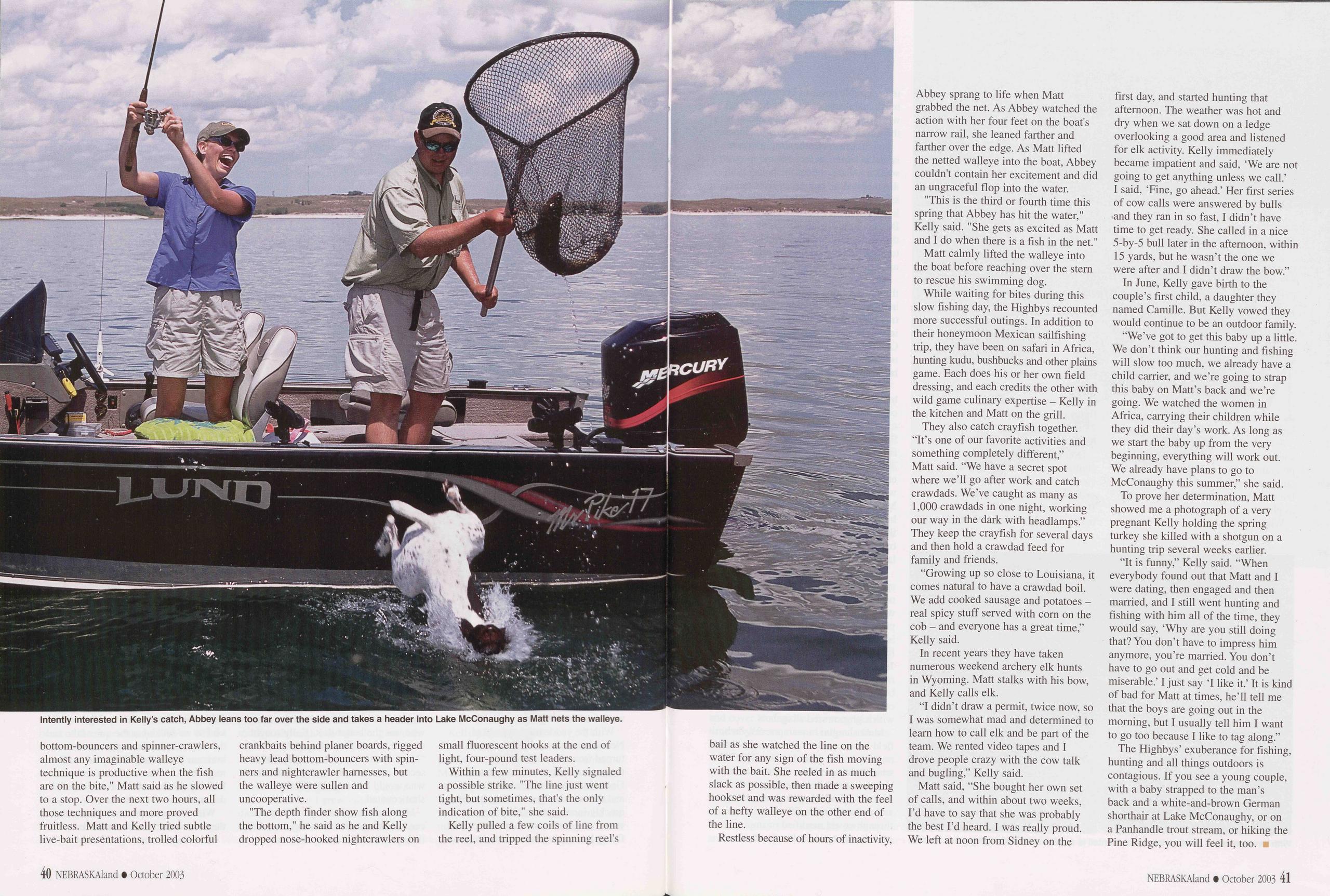
"The depth finder show fish along the bottom," he said as he and Kelly dropped nose-hooked nightcrawlers on small fluorescent hooks at the end of light, four-pound test leaders.
Within a few minutes, Kelly signaled a possible strike. "The line just went tight, but sometimes, that's the only indication of bite," she said.
Kelly pulled a few coils of line from the reel, and tripped the spinning reel's bail as she watched the line on the water for any sign of the fish moving with the bait. She reeled in as much slack as possible, then made a sweeping hookset and was rewarded with the feel of a hefty walleye on the other end of the line.
Restless because of hours of inactivity, Abbey sprang to life when Matt grabbed the net. As Abbey watched the action with her four feet on the boat's narrow rail, she leaned farther and farther over the edge. As Matt lifted the netted walleye into the boat, Abbey couldn't contain her excitement and did an ungraceful flop into the water.
"This is the third or fourth time this spring that Abbey has hit the water," Kelly said. "She gets as excited as Matt and I do when there is a fish in the net."
Matt calmly lifted the walleye into the boat before reaching over the stern to rescue his swimming dog.
While waiting for bites during this slow fishing day, the Highbys recounted more successful outings. In addition to their honeymoon Mexican sailfishing trip, they have been on safari in Africa, hunting kudu, bushbucks and other plains game. Each does his or her own field dressing, and each credits the other with wild game culinary expertise - Kelly in the kitchen and Matt on the grill.
They also catch crayfish together. “It’s one of our favorite activities and something completely different,” Matt said. "We have a secret spot where we’ll go after work and catch crawdads. We’ve caught as many as 1,000 crawdads in one night, working our way in the dark with headlamps.” They keep the crayfish for several days and then hold a crawdad feed for family and friends.
"Growing up so close to Louisiana, it comes natural to have a crawdad boil. We add cooked sausage and potatoes - real spicy stuff served with corn on the cob - and everyone has a great time,” Kelly said.
In recent years they have taken numerous weekend archery elk hunts in Wyoming. Matt stalks with his bow, and Kelly calls elk.
"I didn’t draw a permit, twice now, so I was somewhat mad and determined to learn how to call elk and be part of the team. We rented video tapes and I drove people crazy with the cow talk and bugling,” Kelly said.
Matt said, “She bought her own set of calls, and within about two weeks, I’d have to say that she was probably the best I’d heard. I was really proud. We left at noon from Sidney on the first day, and started hunting that afternoon. The weather was hot and dry when we sat down on a ledge overlooking a good area and listened for elk activity. Kelly immediately became impatient and said, ‘We are not going to get anything unless we call.’ I said, ‘Fine, go ahead.’ Her first series of cow calls were answered by bulls and they ran in so fast, I didn’t have time to get ready. She called in a nice 5-by-5 bull later in the afternoon, within 15 yards, but he wasn’t the one we were after and I didn’t draw the bow.”
In June, Kelly gave birth to the couple’s first child, a daughter they named Camille. But Kelly vowed they would continue to be an outdoor family.
"We’ve got to get this baby up a little. We don’t think our hunting and fishing will slow too much, we already have a child carrier, and we’re going to strap this baby on Matt’s back and we’re going. We watched the women in Africa, carrying their children while they did their day’s work. As long as we start the baby up from the very beginning, everything will work out. We already have plans to go to McConaughy this summer,” she said.
To prove her determination, Matt showed me a photograph of a very pregnant Kelly holding the spring turkey she killed with a shotgun on a hunting trip several weeks earlier.
"It is funny,” Kelly said. “When everybody found out that Matt and I were dating, then engaged and then married, and I still went hunting and fishing with him all of the time, they would say, ‘Why are you still doing that? You don’t have to impress him anymore, you’re married. You don’t have to go out and get cold and be miserable.’ I just say I like it.’ It is kind of bad for Matt at times, he’ll tell me that the boys are going out in the morning, but I usually tell him I want to go too because I like to tag along.”
The Highbys’ exuberance for fishing, hunting and all things outdoors is contagious. If you see a young couple, with a baby strapped to the man’s back and a white-and-brown German shorthair at Lake McConaughy, or on a Panhandle trout stream, or hiking the Pine Ridge, you will feel it, too.
40 NEBRASKAland • October 2003 NEBRASKAland • October 2003 41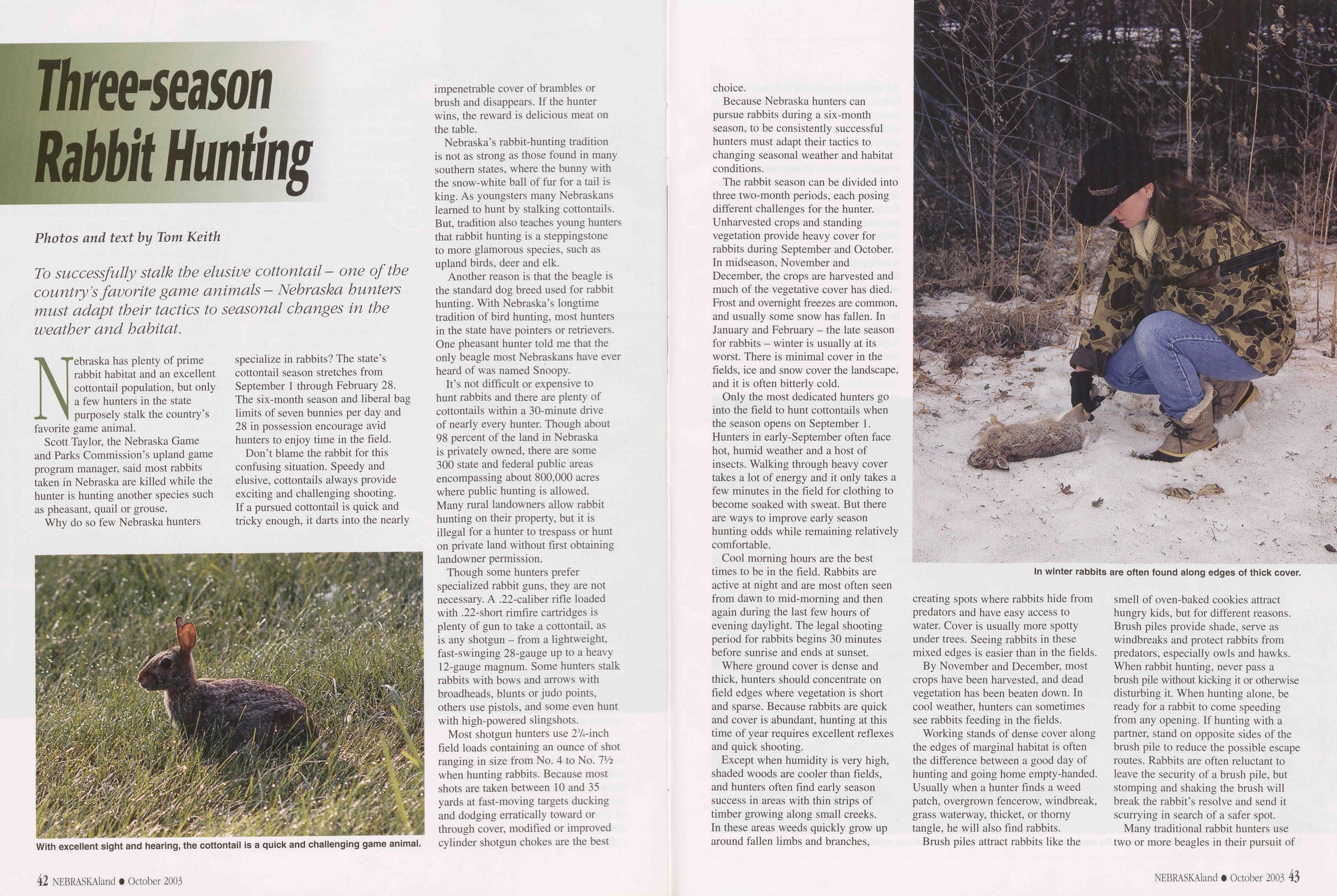
Three-season Rabbit Hunting
Photos and text by Tom Keith To successfully stalk the elusive cottontaill - one of the country’s favorite game animals - Nebraska hunters must adapt their tactics to seasonal changes in the weather and habitat.Nebraska has plenty of prime rabbit habitat and an excellent cottontail population, but only a few hunters in the state purposely stalk the country’s favorite game animal.
Scott Taylor, the Nebraska Game and Parks Commission’s upland game program manager, said most rabbits taken in Nebraska are killed while the hunter is hunting another species such as pheasant, quail or grouse.
Why do so few Nebraska hunters
Don’t blame the rabbit for this confusing situation. Speedy and elusive, cottontails always provide exciting and challenging shooting. If a pursued cottontail is quick and tricky enough, it darts into the nearly impenetrable cover of brambles or brush and disappears. If the hunter wins, the reward is delicious meat on the table.
Nebraska’s rabbit-hunting tradition is not as strong as those found in many southern states, where the bunny with the snow-white ball of fur for a tail is king. As youngsters many Nebraskans learned to hunt by stalking cottontails. But, tradition also teaches young hunters that rabbit hunting is a steppingstone to more glamorous species, such as upland birds, deer and elk.
Another reason is that the beagle is the standard dog breed used for rabbit hunting. With Nebraska’s longtime tradition of bird hunting, most hunters in the state have pointers or retrievers. One pheasant hunter told me that the only beagle most Nebraskans have ever heard of was named Snoopy.
It’s not difficult or expensive to hunt rabbits and there are plenty of cottontails within a 30-minute drive of nearly every hunter. Though about 98 percent of the land in Nebraska is privately owned, there are some 300 state and federal public areas encompassing about 800,000 acres where public hunting is allowed. Many rural landowners allow rabbit hunting on their property, but it is illegal for a hunter to trespass or hunt on private land without first obtaining landowner permission.
Though some hunters prefer specialized rabbit guns, they are not necessary. A .22-caliber rifle loaded with .22-short rimfire cartridges is plenty of gun to take a cottontail, as is any shotgun - from a lightweight, fast-swinging 28-gauge up to a heavy 12-gauge magnum. Some hunters stalk rabbits with bows and arrows with broadheads, blunts or judo points, others use pistols, and some even hunt with high-powered slingshots.
Most shotgun hunters use 2 3/4-inch field loads containing an ounce of shot ranging in size from No. 4 to No. 7 1/2 when hunting rabbits. Because most shots are taken between 10 and 35 yards at fast-moving targets ducking and dodging erratically toward or through cover, modified or improved cylinder shotgun chokes are the best choice.
Because Nebraska hunters can pursue rabbits during a six-month season, to be consistently successful hunters must adapt their tactics to changing seasonal weather and habitat conditions.
The rabbit season can be divided into three two-month periods, each posing different challenges for the hunter. Unharvested crops and standing vegetation provide heavy cover for rabbits during September and October. In midseason, November and December, the crops are harvested and much of the vegetative cover has died. Frost and overnight freezes are common, and usually some snow has fallen. In January and February - the late season for rabbits - winter is usually at its worst. There is minimal cover in the fields, ice and snow cover the landscape, and it is often bitterly cold.
Only the most dedicated hunters go into the field to hunt cottontails when the season opens on September 1. Hunters in early-September often face hot, humid weather and a host of insects. Walking through heavy cover takes a lot of energy and it only takes a few minutes in the field for clothing to become soaked with sweat. But there are ways to improve early season hunting odds while remaining relatively comfortable.
Cool morning hours are the best times to be in the field. Rabbits are active at night and are most often seen from dawn to mid-morning and then again during the last few hours of evening daylight. The legal shooting period for rabbits begins 30 minutes before sunrise and ends at sunset.
Where ground cover is dense and thick, hunters should concentrate on field edges where vegetation is short and sparse. Because rabbits are quick and cover is abundant, hunting at this time of year requires excellent reflexes and quick shooting.
Except when humidity is very high, shaded woods are cooler than fields, and hunters often find early season success in areas with thin strips of timber growing along small creeks. In these areas weeds quickly grow up around fallen limbs and branches,
By November and December, most crops have been harvested, and dead vegetation has been beaten down. In cool weather, hunters can sometimes see rabbits feeding in the fields.
Working stands of dense cover along the edges of marginal habitat is often the difference between a good day of hunting and going home empty-handed. Usually when a hunter finds a weed patch, overgrown fencerow, windbreak, grass waterway, thicket, or thorny tangle, he will also find rabbits.
Brush piles attract rabbits like the smell of oven-baked cookies attract hungry kids, but for different reasons. Brush piles provide shade, serve as windbreaks and protect rabbits from predators, especially owls and hawks. When rabbit hunting, never pass a brush pile without kicking it or otherwise disturbing it. When hunting alone, be ready for a rabbit to come speeding from any opening. If hunting with a partner, stand on opposite sides of the brush pile to reduce the possible escape routes. Rabbits are often reluctant to leave the security of a brush pile, but stomping and shaking the brush will break the rabbit’s resolve and send it scurrying in search of a safer spot.
Many traditional rabbit hunters use two or more beagles in their pursuit of 42 NEBRASKAland • October 2003 NEBRASKAland • October 2003 43 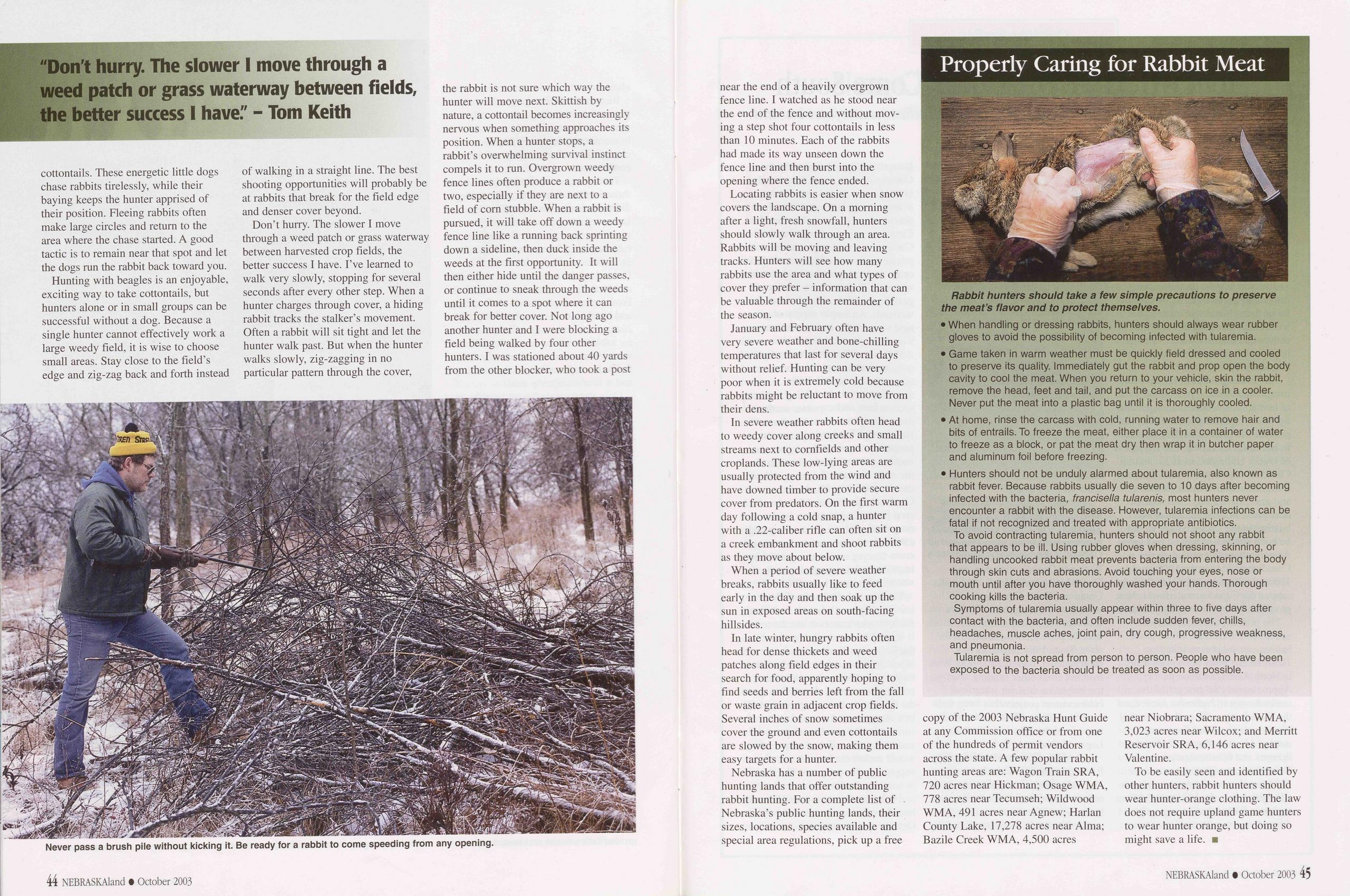 cottontails. These energetic little dogs chase rabbits tirelessly, while their baying keeps the hunter apprised of their position. Fleeing rabbits often make large circles and return to the area where the chase started. A good tactic is to remain near that spot and let the dogs run the rabbit back toward you.
Hunting with beagles is an enjoyable, exciting way to take cottontails, but hunters alone or in small groups can be successful without a dog. Because a single hunter cannot effectively work a large weedy field, it is wise to choose small areas. Stay close to the field’s edge and zig-zag back and forth instead
Don’t hurry. The slower I move through a weed patch or grass waterway between harvested crop fields, the better success I have. I’ve learned to walk very slowly, stopping for several seconds after every other step. When a hunter charges through cover, a hiding rabbit tracks the stalker’s movement. Often a rabbit will sit tight and let the hunter walk past. But when the hunter walks slowly, zig-zagging in no particular pattern through the cover, the rabbit is not sure which way the hunter will move next. Skittish by nature, a cottontail becomes increasingly nervous when something approaches its position. When a hunter stops, a rabbit’s overwhelming survival instinct compels it to run. Overgrown weedy fence lines often produce a rabbit or two, especially if they are next to a field of corn stubble. When a rabbit is pursued, it will take off down a weedy fence line like a running back sprinting down a sideline, then duck inside the weeds at the first opportunity. It will then either hide until the danger passes, or continue to sneak through the weeds until it comes to a spot where it can break for better cover. Not long ago another hunter and I were blocking a field being walked by four other hunters. I was stationed about 40 yards from the other blocker, who took a post near the end of a heavily overgrown fence line. I watched as he stood near the end of the fence and without mov- ing a step shot four cottontails in less than 10 minutes. Each of the rabbits had made its way unseen down the fence line and then burst into the opening where the fence ended.
Locating rabbits is easier when snow covers the landscape. On a morning after a light, fresh snowfall, hunters should slowly walk through an area. Rabbits will be moving and leaving tracks. Hunters will see how many rabbits use the area and what types of cover they prefer - information that can be valuable through the remainder of the season.
January and February often have very severe weather and bone-chilling temperatures that last for several days without relief. Hunting can be very poor when it is extremely cold because rabbits might be reluctant to move from their dens.
In severe weather rabbits often head to weedy cover along creeks and small streams next to cornfields and other croplands. These low-lying areas are usually protected from the wind and have downed timber to provide secure cover from predators. On the first warm day following a cold snap, a hunter with a .22-caliber rifle can often sit on a creek embankment and shoot rabbits as they move about below.
When a period of severe weather breaks, rabbits usually like to feed early in the day and then soak up the sun in exposed areas on south-facing hillsides.
In late winter, hungry rabbits often head for dense thickets and weed patches along field edges in their search for food, apparently hoping to find seeds and berries left from the fall or waste grain in adjacent crop fields. Several inches of snow sometimes cover the ground and even cottontails are slowed by the snow, making them easy targets for a hunter.
Nebraska has a number of public hunting lands that offer outstanding rabbit hunting. For a complete list of Nebraska’s public hunting lands, their sizes, locations, species available and special area regulations, pick up a free copy of the 2003 Nebraska Hunt Guide at any Commission office or from one of the hundreds of permit vendors across the state. A few popular rabbit hunting areas are: Wagon Train SRA, 720 acres near Hickman; Osage WMA, 778 acres near Tecumseh; Wildwood WMA, 491 acres near Agnew; Harlan County Lake, 17,278 acres near Alma; Bazile Creek WMA, 4,500 acres near Niobrara; Sacramento WMA, 3,023 acres near Wilcox; and Merritt Reservoir SRA, 6,146 acres near Valentine.
To be easily seen and identified by other hunters, rabbit hunters should wear hunter-orange clothing. The law does not require upland game hunters to wear hunter orange, but doing so might save a life.
Properly Caring for Rabbit Meat
Rabbit hunters should take a few simple precautions to preserve the meat's flavor and to protect themselves.When handling or dressing rabbits, hunters should always wear rubber gloves to avoid the possibility of becoming infected with tularemia.
Game taken in warm weather must be quickly field dressed and cooled to preserve its quality. Immediately gut the rabbit and prop open the body cavity to cool the meat. When you return to your vehicle, skin the rabbit, remove the head, feet and tail, and put the carcass on ice in a cooler. Never put the meat into a plastic bag until it is thoroughly cooled.
At home, rinse the carcass with cold, running water to remove hair and bits of entrails. To freeze the meat, either place it in a container of water to freeze as a block, or pat the meat dry then wrap it in butcher paper and aluminum foil before freezing.
Hunters should not be unduly alarmed about tularemia, also known as rabbit fever. Because rabbits usually die seven to 10 days after becoming infected with the bacteria, francisella tularenis, most hunters never encounter a rabbit with the disease. However, tularemia infections can be fatal if not recognized and treated with appropriate antibiotics.
To avoid contracting tularemia, hunters should not shoot any rabbit that appears to be ill. Using rubber gloves when dressing, skinning, or handling uncooked rabbit meat prevents bacteria from entering the body through skin cuts and abrasions. Avoid touching your eyes, nose or mouth until after you have thoroughly washed your hands. Thorough cooking kills the bacteria.
Symptoms of tularemia usually appear within three to five days after contact with the bacteria, and often include sudden fever, chills, headaches, muscle aches, joint pain, dry cough, progressive weakness, and pneumonia.
Tularemia is not spread from person to person. People who have been exposed to the bacteria should be treated as soon as possible.
44 NEBRASKAland • October 2003 NEBRASKAland • October 2003 45
During the early-1900s the Nebraska Legislature progressively limited the legal killing of resident game animals such as deer and prairie chickens, but stubbornly refused to significantly limit the harvest of migratory game birds. The argument against reducing bag limits and season lengths on shorebirds, ducks and geese was: "If we don’t shoot them, hunters in other states will.” Such parochial thinking nationwide ultimately led to federal intervention in the 1910s to conserve migratory birds.
The prolonged 1930s drought was instrumental in lengthening the view of hunters and wildlife management agencies, especially to the Canadian prairies where most of the ducks shot in Nebraska are raised. The formation of Ducks Unlimited in 1937, and its Canadian counterpart a year later, was recognition that without wetlands and grass-covered uplands where ducks nest in Canada, waterfowl hunting in the United States would be but a shadow of what it had been. As agriculture intensified on the Canadian prairies in the 1950s and 1960s, the importance of U.S. financial support for Canadian waterfowl habitat programs became increasingly evident.
The prairie-pothole country of south-central Canada, where prime habitat can support as many as 100 breeding pairs per square mile, is North America’s duck factory. Approximately 60 percent of the mallards shot in Nebraska come from the Canadian prairie-pothole country. In recognition of that fact, some money raised by the sale of hunting licenses and habitat stamps in Nebraska has migrated north since 1994 to enhance and restore uplands and wetlands in the Missouri Couteau region in Saskatchewan, a poorly drained region with numerous
Nebraska’s annual contributions have ranged between $25,000 and $140,000. The state’s contribution is matched with funds from Ducks Unlimited, the North American Wetlands Conservation Act, and Ducks Unlimited Canada. Nebraska Game and Parks Commission waterfowl biologist Mark Vrtiska said that $25,000 amounts to less than $ 1 per waterfowl hunter in the state. Since 1994 Nebraska has contributed a total of $563,000. With matches from other funding sources, the Nebraska total for waterfowl enhancement projects has been well over $1 million. Most of the money helps fund the Missouri Couteau Legacy Initiative.
Mike Hill, Conservation Programs Biologist with DU Canada, said that Nebraska funds are used primarily to enhance waterfowl habitat on private lands, although some is spent on wetland protection. Although lacking federal funding equivalent to the Conservation Reserve Program that in the United States pays landowners to return marginal agriculture land to perennial grass and forb cover, the Canadian program is similar. DU Canada enters into agreements with private landowners to protect, enhance or re-establish grassland habitat near wetlands. Puddle ducks nest in grasslands, often some distance from wetlands. An ample supply of grass near water is the key to maximum waterfowl production.
Hill said, "This program is directed at larger landscapes than most acquisition programs. With acquisitions you are buying a quarter section here and a quarter section there. Long-term that is important. But through habitat-improvement programs on private lands, we can improve more waterfowl habitat for the same amount of money, and we can do it quickly. Much of the Couteau region is used for cereal crop production but there is also rangeland, and we are working with cattlemen to use rotational grazing, cross-fencing and water systems to improve both range quality and waterfowl nesting habitat.”
Vrtiska said, "It is one of those habitat programs where it is difficult for Nebraska hunters to see the results. It is not like acquiring a wetland in the Rainwater Basin or on the Missouri River, where a Nebraska hunter can drive and see what they got for their money. But if they go to the Couteau in the spring, particularly in a wet year, and see wetlands surrounded by good nesting cover, and the number of ducks there, they would realize the importance of supporting this program. The ducks in southern Saskatchewan in June and July are the same ones Nebraska hunters will see over their decoys in October and November.”
People on the Plains have harnessed energy from wind for at least 200 years. Lewis and Clark occasionally used sails to propel their keelboat and pirogues on the Missouri River. Later, windmills dotted the prairie, lifting its groundwater and turning arid expanses into farms and ranches.
Dreams of developing Nebraska’s wind into a reliable, efficient and environmentally friendly electricity resource have taken significant steps forward during the past five years. Utility-scale wind-generation projects have anchored giant blades and turbines at four Nebraska sites, and last March, Edgar A. DeMeo, a consultant to the state’s energy office, offered an encouraging assessment. He wrote: “Nebraska’s wind-energy resources are substantial - among the best in the nation. They offer the potential for productive investments in excess of a billion dollars that can benefit the state’s economy - particularly in rural regions - and improve the quality of the natural environment for current and future generations.”
In some circumstances, DeMeo noted, wind power has reached cost parity with other forms of electricity generation, especially when environmental factors are considered. At the present, however, Nebraska has significantly less wind-generated electrical capacity than does Kansas, Colorado, Wyoming, Minnesota or Iowa. Nebraska produces about 14 megawatts of wind-generated electricity now, less than one percent of the state’s total output.
The largest operating wind farm in the state, located northwest of Kimball, came on line a year ago with seven turbine towers. A three-blade rotor with a diameter of 236 feet turns each of the 1.5 megawatt-hour turbines.
Nebraska Public Power District (NPPD) is taking bids to determine the cost of building a wind turbine facility near Ainsworth to generate 15, 30 or 50 megawatts of electricity. NPPD will evaluate the bids this fall to determine whether to proceed with a project.
If during the next 10 or 20 years wind-generated electricity takes hold in Nebraska, it will eclipse a curious but ultimately failed attempt to establish wind generators in the 1930s. In the late-1920s, rural homes were without electricity and were lighted with oil or kerosene lamps. Radio broadcasting, pushed by the development of the vacuum tube in World War I, swept the country as mass entertainment and became a window on the larger world. But radios required electricity. Dry cell batteries were prohibitively expensive, and rural residents had no efficient way to recharge storage batteries.
In Cherokee, Iowa, two brothers, John and Gerhard Albers, developed a wind generator, using a blade that looked like an airplane propeller, to recharge a six-volt battery. It worked so well that friends and neighbors asked the brothers to build wind generators for them. The Albers named their contraption "Wincharger.” Radio manufacturers, in particular Zenith, saw the potential and began marketing "farm radios” with discounts for Winchargers, which could be had for as little as $15. By 1938, the Wincharger Corporation of Sioux City, Iowa, which by then was owned by Zenith, had sold 750,000 small wind generators, many to rural residents of the Great Plains.
The success of the six-volt systems led to development of 32-volt wind generators, advertised at $69.95, to provide electricity to barns and an array of direct current 32-volt appliances, including toasters, coffee pots, shavers, cream separators and welders.
The Rural Electrification Administration (REA), launched in 1935 by the Roosevelt Administration, ultimately created hundreds of rural electric cooperatives to build power lines reaching virtually every household, offering cheap, reliable 110-volt service. The cottage wind-generator industry, which had brought radio broadcasts and lights to Plains farms in the 1930s, largely disappeared by 1950 when REA had completed wiring the countryside.
Fifty years later the wind might be blowing a new chapter of renewable energy into Nebraska.
46 NEBRASKAland • October 2003 NEBRASKAland • October 2003 47
JU-JU SWALLOWED A PENNY, a Nebraska farm girl’s book of the 1930’s Depression Era. $7.50 ppd. Betty Heidbreder Dunn, 410 County Rd. 324, Navasota, TX 77868-9706.
EXPLORE NEBRASKA art, history, culture and the great outdoors with a subscription to Nebraska Life magazine. Six issues per year just $19. Phone (800) 777-6159 or write us at Box 577, Hartington, NE 68739. Makes a great gift. Visit NebraskaLife.com.
DOGSVIZSLAS FOR SALE. Home of the Rebel Rousers. Rozanek Kennels, 781 Rd. D, Schuyler, NE 68661. Phone (402) 352-8769.
PLUM CREEK KENNEL. German Shorthairs, stud service, puppies and started dogs. Training for all pointing breeds. Specialize in training the handler as well as the dog. Wayne Clark, Percival, Iowa 51648 (close to Omaha) (712) 529-4238, email wclark@sid- ney.heartland.net.
YELLOW-BLACK LAB PUPS. Breeders hips O.F.A. and eyes CERF. Excellent bloodlines and hunting potential. Call Dave Bendler (308) 785-2554 in Lexington or Scott Bendler (402) 477-1305, Lincoln.
WILDERNESS KENNELS. Gun dog training - over 60 years combined experience. Training all sporting breeds - retrievers, flushing and pointing dogs. All dogs worked on pen-raised birds and wild game. Training program includes obedience training - heel, sit, stay, down and come when called. Pups, started dogs and fully trained dogs for sale. Hunting dogs trained by hunters. Henry Sader, Wilderness Kennels, Roca, NE (402) 423-4212. Since 1968. www.wilder- nesskennels.com
DUCKDAWG RETRIEVERS - Raising exceptional field-bred Labradors. Hunting, family and competi- tion companions. Puppies raised in our home. Written health guarantee, www.duckdawg.com. Ron Green DVM and Libby Milroy, North Platte, NE (308) 534- 3659.
PRAIRIE RIDGE KENNELS, PAXTON, NE - Nothing fancy, just reputable trainers who specialize in retrievers! 25 miles river property, 10,000 acres upland. Quality puppies to finished dogs available. (308) 239-4719 / (308) 289-6605.
FISH/FISHINGFISH FOR SALE. Catfish, largemouth bass, small- mouth bass, perch, crappie, bluegill, walleye, rainbow trout, grass carp, minnows, bullheads. Consulting available. Pleasant Valley Fish Farm, RR 1, Box 147, McCook, NE 69001. Phone (308) 345-6599.
NEBRASKA LAKE MANAGEMENT - Biological lake surveys, fish stocking, rough fish control, lake aeration, algae control, shorewall construction. Rob Hofpar, Aquatic Biologist, licensed, insured and qualified. Phone (402) 784-6005 (Lincoln), or toll-free (888) 850-2460,
WILLOW LAKE FISH HATCHERY - Channel cats, bluegills, hybrid bluegills, largemouth bass, crappies, grass carp, walleyes, perch, minnows available for stocking. Gaylord Crawford and Son, 7580 N. Highland Rd., Hastings, NE 68901-9339 or phone (402) 463-8022 or (402) 460-8200 day or night. Also pond consultant. We deliver.
FOOD/GIFTS/HOMEENJOY A TASTE of the good life! Award-winning gourmet BBQ sauces and seasonings, breadings, native jellies, fruit butters, honey, coffees and more! Great gift-set ideas! Toll free (888) 926-2879 or (308) 468-5635. Hollman Foods, 1948 36 Road, Minden, NE 68959, or www.hollmans.com
NEBRASKA BASKETS - The original Nebraska company specializing in fine foods from Nebraska since 1984. A beautiful array of baskets filled with ethnic, healthful and longtime favorite foods. Call or write for our brochure: PO Box 22985, Lincoln, NE. 68542. 1-800-345-7725 or (402) 438-3111. Visit our web site: http://www.nebaskets.com
HOMEBREWING/BEER & WINEMAKING sup- plies. Fermenter’s Supply, 8410 K Plz. #10, Omaha, NE 68127. (402) 593-9171. Mail orders welcome. www.fermenterssupply.com
A GENUINE SHOPPING EXPERIENCE! Visit Nebraska Food and Gift, representing the talents of over 140 Nebraska communities at one location in Hastings, Nebraska or shop online at www.nebraskafoodandgift.com. Toll free (877) NEGIFTS.
GUIDES/OUTFITTERSCANOE THE NIOBRARA with an affordable canoe trip by Dryland Aquatics. One- and two-day trips...full service, or just canoe, tube or kayak. Transportation furnished. Your Niobrara River specialists... We do it your way! Dryland Aquatics, Dept. N, Box 33C, Sparks, NE 69220 or phone (800) 337-3119. www.dry- landaquatics.com info@drylandaquatics.com.
HENNECKE HUNTS Guided hunts in Nebraska for mid-winter Canada and late-season snow geese. 26 years hunting experience, 13 years Nebraska Hunter Education instructor. (402) 645-8223, e-mail: kevin@hennecke- hunts.com, web site: henneckehunts.com
www.huntbunkerhill.com. “Most Unique Hunting Grounds in the Country”
KRIPPLE DUCK ADVENTURES - Southwest Nebraska Guided hunts along Frenchman Creek for deer, geese, ducks, pheasants, dove and coyotes. (308) 394-5345, cdom@bwtelcom.net.
GUNS/SHOOTING/ARCHERYGUNS - Browning, Benelli, Winchester, Ruger, etc. 1700 guns, buy-sell-trade (402) 729-6112, Bedlan’s, Fairbury, NE 68352. www.bedlans.com.
OUTDOOR EQUIPMENTIS PERFORMANCE IMPORTANT? For the finest canoes and accessories look to Great Plains Canoe Co., 205 Main, Springfield, NE 68059. Phone (402) 253-2000.
REAL ESTATEHARLAN LAKE AREA LAND for sale - 640 + or - acres in view of lake rough-rolling land, tall grass scattered dry cropland fields, excellent deer, upland game, turkey, goose hunting, reserve/hunting lodge possibilities. USA land on 3 sides. Country Road Realty, 901 W. Main, Alma, NE, Dave Wolf (308) 928-3120. www.mls50.com/countryroad.htm.
PLATTE RIVER RECREATION AT GOTHEN- BURG - excellent hunting, 4-wheel, horses-100 up to 826 acres; Snell Canyon-666 acres in Elk Country near North Platte; Medicine Creek Wildlife at Maywood on Medicine Creek. Agri Affiliates, Inc. (308) 534-9240, www.agriaffiliates.com
FOR SALE IN NORTH-CENTRAL NEBRASKA *Hunting and fishing properties. 7.5 acres with new home overlooking Clear Lake in Brown County. Retire or retreat. *160-acre improved ranch with live stream, tree groves. Deer and turkeys. Much of the land is hayable. County road frontage. * Pine-timbered 40 acres in Niobrara River canyons. Keya Paha County. Price $40,000. Other listings available. Call Swett Realty, Fred L. Swett, Broker. Phone (800) 585- 1626, (402) 387-1626 day or night.
VACATIONS/RESORTSFOR FISHING AND HUNTING accommodations. Guided pheasant hunts. Jefco Inn, Gordon, NE 69343. South Cornell, (308) 282-2935.
THE OLDE MAIN STREET INN. A historic bed and breakfast listed in the National Register of Historic Places. Beautiful dining room with fireplace. Featuring prime rib, buffalo, seafood, homemade soups, chilis and desserts. 115 Main Street, Chadron NE 69337 (308) 432-3380. www.chadron.com/oldemain.
NEAR OMAHA ZOO, OVER 760 species, explore Rain Forest and Desert Dome, Aquarium, Penguins. Western Heritage Museum, hands-on Children’s Museum, Naval Ships, Submarine. American Family Inn Motel. $46 single or double. (800) 253-2865.
SANDHILL HIDEAWAY! Scenic Double R Guest Ranch south of Valentine. Open all year. Great lodging with fully furnished kitchenettes. Fish, hunt, ride horses, relax. Right for sportsmen, families, small groups, artists, writers, newlyweds! Call (866) 217- 2042. www.sandhilldouhlerranch.com
LORD RANCH RESORT. Hunters, fishermen, family vacations, family reunions. New deluxe cabins. Complete cooking facilities. Quiet and peaceful in the middle of the Sandhills. Three miles north of the Valentine Wildlife Refuge, open all year. Aubrey and Dorothy Lord, HC 37, Box 41, Valentine, NE 69201. Call (800) 270-0181.www.valentine-ne.com\Lord\ or www.lordranchresort.com
DIAMOND B TROUT RESORT, Orchard, Nebraska Lodge, 3 cabins, 5 spring fed lakes, trout and other species, paddleboats, playground equipment. Great for family reunions or group getaways. Hunters wel- come. Open all year. Call for brochure or reservations (800) 974-3002. www.diamondbtroutresort.com
Classified Rates: 750 per word, minimum $15. Closing: First business day two months before issue date. Classified ads are accepted on a first-come, first-served, space-available basis. Classified Ads, NEBRASKAIand Magazine, P.O. Box 30370, Lincoln, NE 68503-0370. Telephone (402) 471-5478. Fax: (402) 471-5528. E-mail: nebland@ngpc.state.ne.us. Ads are posted online at outdoornebraska.ora/nebland at no additional charge.
Parks & Places
Memphis Lake State Recreation Area
Following lake renovation, fishing comeback expected to attract more visitors.
By Tom KeithMemphis Lake State Recreation Area, a 215- acre park located on the western edge of the village of Memphis, is a popular out-of-the-way family camping and fishing spot in Saunders County.
The park’s atmosphere is quiet and laid-back. Campsites are not designated and visitors may park their campers under a tree or pitch a tent in a comfortable spot. The area offers a trailer dump station, four picnic shelters, drinking water, 124 picnic tables - 15 of which are built to accommodate visitors in wheelchairs - 75 ground-level fire ring grills, 50 waist-high grills, a half-dozen pit toilets, and two play- grounds. The area’s concession stand sells food, permits and bait, and has paddleboats available for rental.
Jim Swenson, eastern regional manager of state parks, said Memphis SRA is very popular among people who enjoy primitive camping in a relaxing setting. Tent campers often stay at Memphis and visit nearby areas such as Eugene T. Mahoney State Park, which has limited space for primitive camping.
Memphis Lake has always been a popular fishing spot. A Nebraska Game and Parks Commission aquatic habitat rehabilitation project, completed in 2002, made significant improvements to the lake. The project included: deepening some areas of the lake by removing silt; constructing three jetties to reduce
Once known among anglers as primarily a carp lake, Memphis had its rough fish species removed during the rehabilitation project. Mark Porath, a Commission biologist, said the refilling lake has been restocked with largemouth bass, bluegills, channel catfish and redear sunfish. To help the Memphis Lake fishery get off to a good new start, anglers are now limited to 10 panfish (10 bluegills or 10 redear sunfish, or a total of 10 of the two species) and three catfish per day. To help increase the lake’s predator species population, regulations require anglers to immediately return all largemouth bass they catch to the lake.
The rehabilitation was funded by the Sportfish Restoration Program with matching funds from the Aquatic Habitat Fund, a grant from the Nebraska Environmental Trust, and proceeds from the sale of fishing permits. The total cost of the two-year project was $602,944.
Steve Satra, a Commission fisheries manager, said, “This project was unique in that if we hadn’t had the contractor we did, it would have been extremely difficult to complete the project on time and complete it as per our design. This project was a real challenge.”
Send contributions to: Portraits from the Past, NEBRASKAland Magazine, P.O. Box 30370, Lincoln, NE 68503-0370. Photos should show people enjoying Nebraska outdoor activities, such as camping, boating, hunting or fishing, and must have been taken before 1970. We will give priority to unusual photos or activities. When possible, please include a story about the photograph and identify the people, places and approximate date it was taken. Photos will be returned.
Position: 737 (15 views)