Volume 81, Issue 7, 2003
NEBRASKAland
Nebraska Game & Parks Commission August-September 2003 $2.50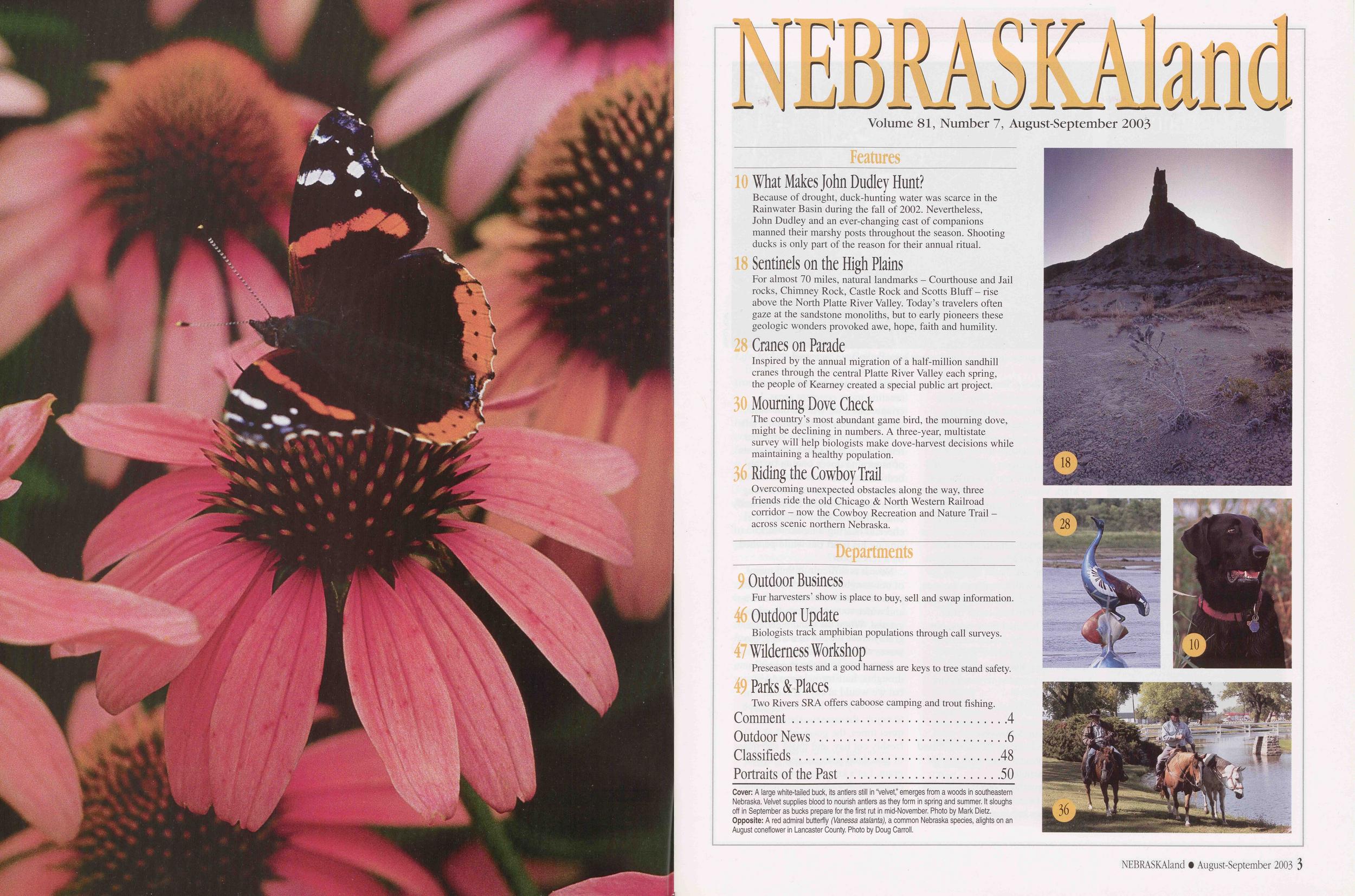
NEBRASKAland
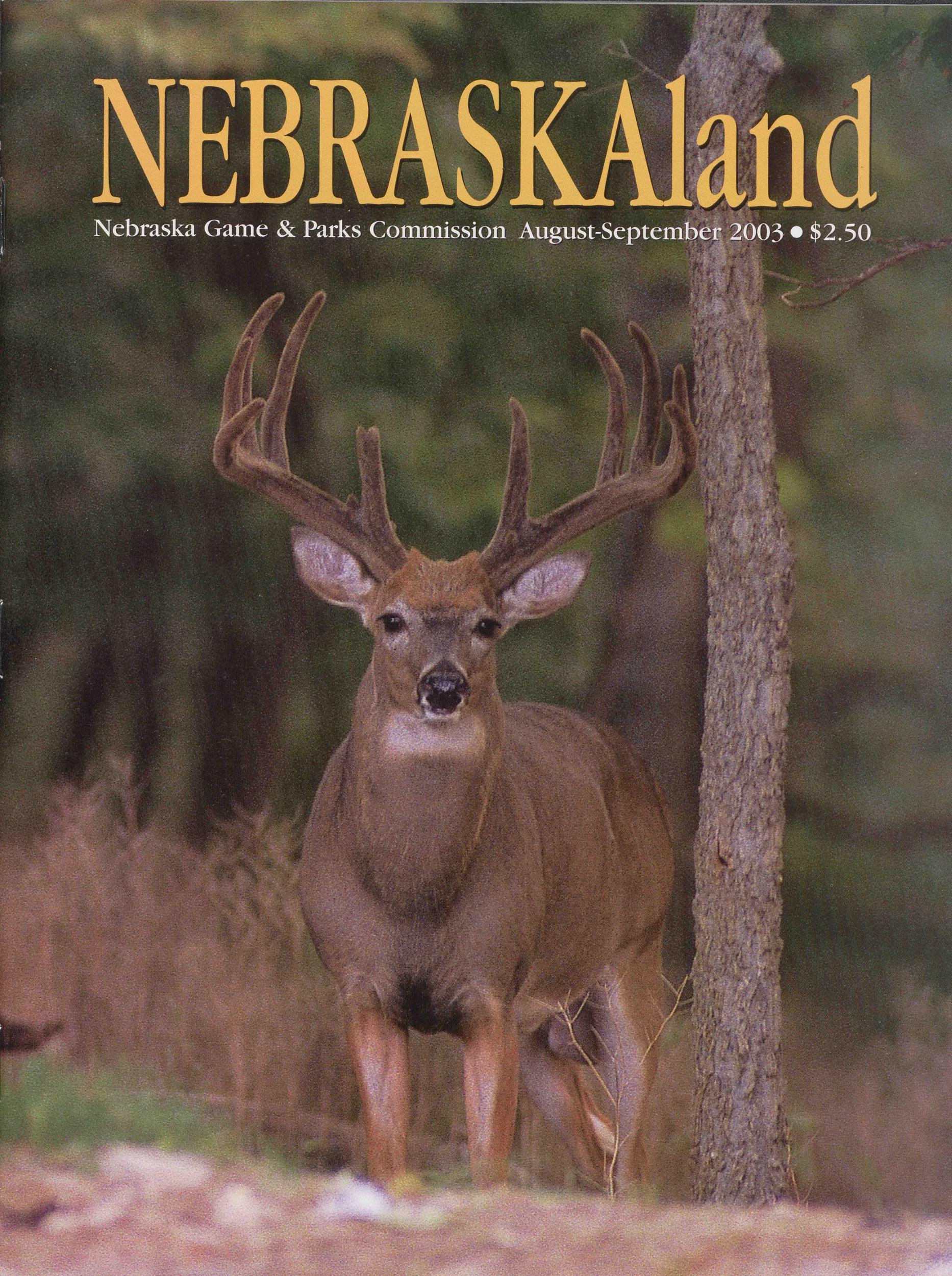
Volume 81, Number 7, August-September 2003 Features What Makes John Dudley Hunt? Because of drought, duck-hunting water was scarce in the Rainwater Basin during the fall of 2002. Nevertheless, John Dudley and an ever-changing cast of companions manned their marshy posts throughout the season. Shooting ducks is only part of the reason for their annual ritual. Sentinels on the High Plains For almost 70 miles, natural landmarks - Courthouse and Jail rocks, Chimney Rock, Castle Rock and Scotts Bluff - rise above the North Platte River Valley. Today's travelers often gaze at the sandstone monoliths, but to early pioneers these geologic wonders provoked awe, hope, faith and humility. Cranes on Parade Inspired by the annual migration of a half-million sandhill cranes through the central Platte River Valley each spring, the people of Kearney created a special public art project. Mourning Dove Check The country's most abundant game bird, the mourning dove, might be declining in numbers. A three-year, multistate survey will help biologists make dove-harvest decisions while maintaining a healthy population. Riding the Cowboy Trail Overcoming unexpected obstacles along the way, three friends ride the old Chicago & North Western Railroad corridor - now the Cowboy Recreation and Nature Trail - across scenic northern Nebraska. Departments Outdoor Business Fur harvesters' show is place to buy, sell and swap information. Outdoor Update Biologists track amphibian populations through call surveys. Wilderness Workshop Preseason tests and a good harness are keys to tree stand safety. . Parks & Places Two Rivers SRA offers caboose camping and trout fishing. V_^V/llllllv'llL »••••»..................•.......T" Outdoor News ............................6 Classifieds ..............................48 Portraits of the Past .......................50 Cover: A large white-tailed buck, its antlers still in "velvet," emerges from a woods in southeastern Nebraska. Velvet supplies blood to nourish antlers as they form in spring and summer. It sloughs off in September as bucks prepare for the first rut in mid-November. Photo by Mark Dietz. Opposite: A red admiral butterfly (Vanessa atalanta), a common Nebraska species, alights on an August coneflower in Lancaster County. Photo by Doug Carroll.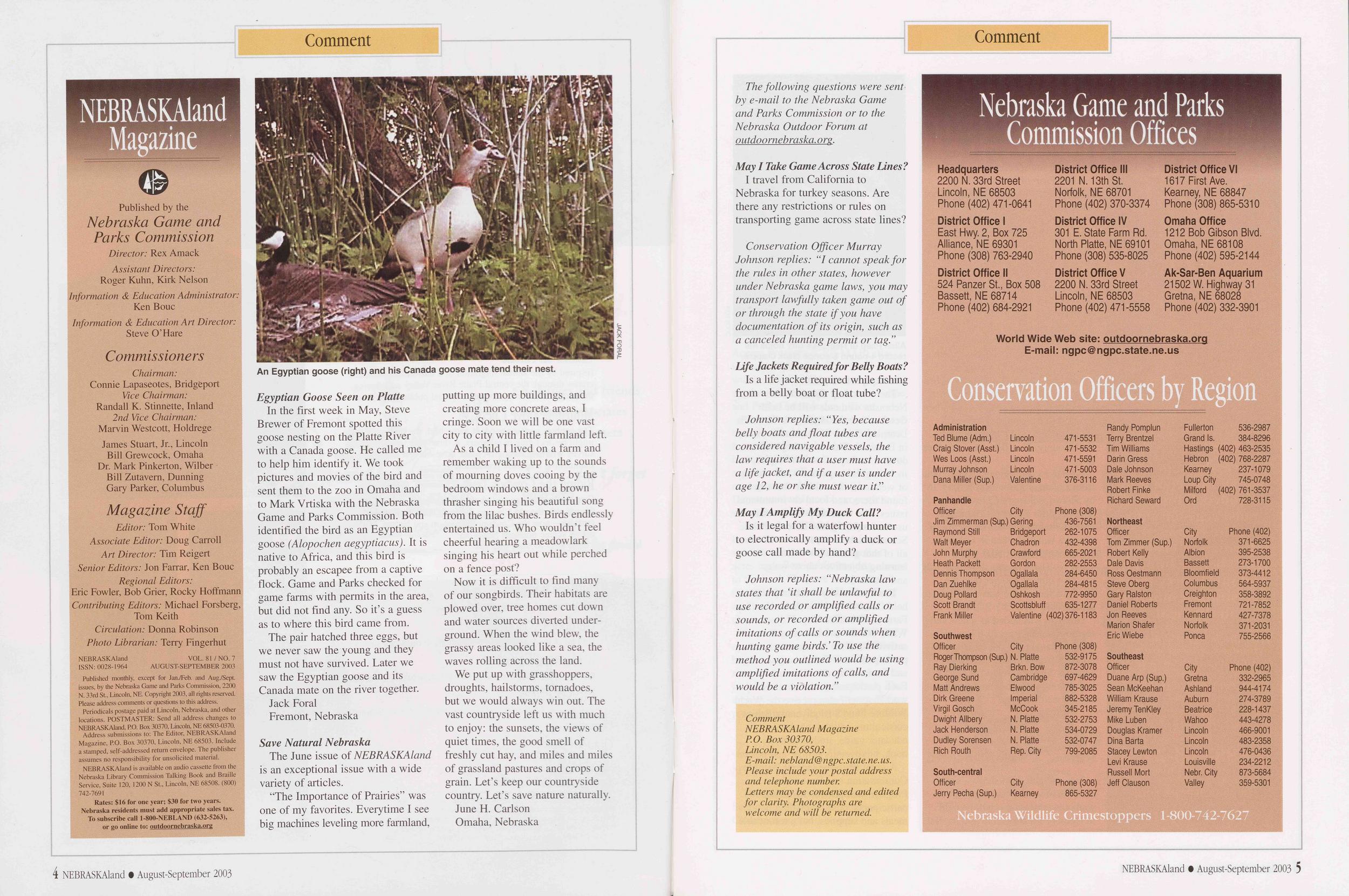 Comment
Published by the
Nebraska Game and
Parks Commission
Director: Rex Amack
Assistant Directors:
Roger Kuhn, Kirk Nelson
Information & Education Administrator:
Ken Bouc
Information & Education Art Director:
Steve O'Hare
Commissioners
Chairman:
Connie Lapaseotes, Bridgeport
Vice Chairman:
Randall K. Stinnette, Inland
2nd Vice Chairman:
Marvin Westcott, Holdrege
James Stuart, Jr., Lincoln
Bill Grewcock, Omaha
Dr. Mark Pinkerton, Wilber
Bill Zutavern, Dunning
Gary Parker, Columbus
Magazine Staff
Editor: Tom White
Associate Editor: Doug Carroll
Art Director: Tim Reigert
Senior Editors: Jon Farrar, Ken Bouc
Regional Editors:
Eric Fowler, Bob Grier, Rocky Hoffmann
Contributing Editors: Michael Forsberg,
Tom Keith
Circulation: Donna Robinson
Photo Librarian: Terry Fingerhut
NEBRASKAland
ISSN: 0028-1964
VOL, 81 /NO. 7
AUGUST-SEPTEMBER 2003
Published monthly, except for Jan./Feb. and Aug/Sept.
issues, by the Nebraska Game and Parks Commission, 2200
N. 33rd St., Lincoln, NE. Copyright 2003, all rights reserved.
Please address comments or questions to this address.
Periodicals postage paid at Lincoln, Nebraska, and other
locations. POSTMASTER: Send all address changes to
NEBRASKAland, P.O. Box 30370, Lincoln, NE 68503-0370.
Address submissions to: The Editor, NEBRASKAland
Magazine, P.O. Box 30370, Lincoln, NE 68503. Include
a stamped, self-addressed return envelope. The publisher
assumes no responsibility for unsolicited material.
NEBRASKAland is available on audio cassette from the
Nebraska Library Commission Talking Book and Braille
Service, Suite 120, 1200 N St., Lincoln, NE 68508. (800)
742-7691
Rates: $16 for one year; $30 for two years.
Nebraska residents must add appropriate sales tax.
To subscribe call 1-800-NEBLAND (632-5263),
or go online to: outdoornebraska.org
Comment
Published by the
Nebraska Game and
Parks Commission
Director: Rex Amack
Assistant Directors:
Roger Kuhn, Kirk Nelson
Information & Education Administrator:
Ken Bouc
Information & Education Art Director:
Steve O'Hare
Commissioners
Chairman:
Connie Lapaseotes, Bridgeport
Vice Chairman:
Randall K. Stinnette, Inland
2nd Vice Chairman:
Marvin Westcott, Holdrege
James Stuart, Jr., Lincoln
Bill Grewcock, Omaha
Dr. Mark Pinkerton, Wilber
Bill Zutavern, Dunning
Gary Parker, Columbus
Magazine Staff
Editor: Tom White
Associate Editor: Doug Carroll
Art Director: Tim Reigert
Senior Editors: Jon Farrar, Ken Bouc
Regional Editors:
Eric Fowler, Bob Grier, Rocky Hoffmann
Contributing Editors: Michael Forsberg,
Tom Keith
Circulation: Donna Robinson
Photo Librarian: Terry Fingerhut
NEBRASKAland
ISSN: 0028-1964
VOL, 81 /NO. 7
AUGUST-SEPTEMBER 2003
Published monthly, except for Jan./Feb. and Aug/Sept.
issues, by the Nebraska Game and Parks Commission, 2200
N. 33rd St., Lincoln, NE. Copyright 2003, all rights reserved.
Please address comments or questions to this address.
Periodicals postage paid at Lincoln, Nebraska, and other
locations. POSTMASTER: Send all address changes to
NEBRASKAland, P.O. Box 30370, Lincoln, NE 68503-0370.
Address submissions to: The Editor, NEBRASKAland
Magazine, P.O. Box 30370, Lincoln, NE 68503. Include
a stamped, self-addressed return envelope. The publisher
assumes no responsibility for unsolicited material.
NEBRASKAland is available on audio cassette from the
Nebraska Library Commission Talking Book and Braille
Service, Suite 120, 1200 N St., Lincoln, NE 68508. (800)
742-7691
Rates: $16 for one year; $30 for two years.
Nebraska residents must add appropriate sales tax.
To subscribe call 1-800-NEBLAND (632-5263),
or go online to: outdoornebraska.org
In the first week in May, Steve Brewer of Fremont spotted this goose nesting on the Platte River with a Canada goose. He called me to help him identify it. We took pictures and movies of the bird and sent them to the zoo in Omaha and to Mark Vrtiska with the Nebraska Game and Parks Commission. Both identified the bird as an Egyptian goose (Alopochen aegyptiacus). It is native to Africa, and this bird is probably an escapee from a captive flock. Game and Parks checked for game farms with permits in the area, but did not find any. So it's a guess as to where this bird came from.
The pair hatched three eggs, but we never saw the young and they must not have survived. Later we saw the Egyptian goose and its Canada mate on the river together.
Jack Foral Fremont, Nebraska Save Natural NebraskaThe June issue of NEBRASKAland is an exceptional issue with a wide variety of articles.
"The Importance of Prairies" was one of my favorites. Every time I see big machines leveling more faimland, putting up more buildings, and creating more concrete areas, I cringe. Soon we will be one vast city to city with little farmland left.
As a child I lived on a farm and remember waking up to the sounds of mourning doves cooing by the bedroom windows and a brown thrasher singing his beautiful song from the lilac bushes. Birds endlessly entertained us. Who wouldn't feel cheerful hearing a meadowlark singing his heart out while perched on a fence post?
Now it is difficult to find many of our songbirds. Their habitats are plowed over, tree homes cut down and water sources diverted underground. When the wind blew, the grassy areas looked like a sea, the waves rolling across the land.
We put up with grasshoppers, droughts, hailstorms, tornadoes, but we would always win out. The vast countryside left us with much to enjoy: the sunsets, the views of quiet times, the good smell of freshly cut hay, and miles and miles of grassland pastures and crops of grain. Let's keep our countryside country. Let's save nature naturally.
June H. Carlson Omaha, Nebraska 4 NEBRASKAland • August-September 2003 CommentThe following questions were sent by e-mail to the Nebraska Game and Parks Commission or to the Nebraska Outdoor Forum at outdoornebraska. org.
May I Take Game Across State Lines?I travel from California to Nebraska for turkey seasons. Are there any restrictions or rules on transporting game across state lines?
Conservation Officer Murray Johnson replies: "I cannot speak for the rules in other states, however under Nebraska game laws, you may transport lawfully taken game out of or through the state if you have documentation of its origin, such as a canceled hunting permit or tag."
Life Jackets Required for Belly Boats?Is a life jacket required while fishing from a belly boat or float tube?
Johnson replies: "Yes, because belly boats and float tubes are considered navigable vessels, the law requires that a user must have a life jacket, and if a user is under age 12, he or she must wear it."
May I Amplify My Duck Call?Is it legal for a waterfowl hunter to electronically amplify a duck or goose call made by hand?
Johnson replies: "Nebraska law states that 'it shall be unlawful to use recorded or amplified calls or sounds, or recorded or amplified imitations of calls or sounds when hunting game birds? To use the method you outlined would be using amplified imitations of calls, and would be a violation."
Comment NEBRASKAland Magazine P.O. Box 30370, Lincoln, NE 68503. E-mail: nebland@ ngpc. state, ne. us. Please include your postal address and telephone number. Letters may be condensed and edited for clarity. Photographs are welcome and will be returned. Nebraska Game and Parks Commission Offices Headquarters 2200 N. 33rd Street Lincoln, NE 68503 Phone (402) 471-0641 District Office I East Hwy. 2, Box 725 Alliance, NE 69301 Phone (308) 763-2940 District Office II 524 Panzer St., Box 508 Bassett, NE 68714 Phone (402) 684-2921 District Office III 2201 N. 13th St. Norfolk, NE 68701 Phone (402) 370-3374 District Office IV 301 E. State Farm Rd. North Platte, NE 69101 Phone (308) 535-8025 District Office V 2200 N. 33rd Street Lincoln, NE 68503 Phone (402) 471-5558 District Office VI 1617 First Ave. Kearney, NE 68847 Phone (308) 865-5310 Omaha Office 1212 Bob Gibson Blvd. Omaha, NE 68108 Phone (402) 595-2144 Ak-Sar-Ben Aquarium 21502 W. Highway 31 Gretna, NE 68028 Phone (402) 332-3901 World Wide Web site: outdoornebraska.org E-mail: ngpc@ngpc.state.ne.us Conservation Officers by Region Administration Ted Blume (Adm.) Craig Stover (Asst.) Wes Loos (Asst.) Murray Johnson Dana Miller (Sup.) Panhandle Officer Jim Zimmerman (Sup.) Raymond Still Walt Meyer John Murphy Heath Packett Dennis Thompson Dan Zuehlke Doug Pollard Scott Brandt Frank Miller Southwest Officer Roger Thompson (Sup.) Ray Dierking George Sund Matt Andrews Dirk Greene Virgil Gosch Dwight Allbery Jack Henderson Dudley Sorensen Rich Routh Lincoln Lincoln Lincoln Lincoln Valentine City Gering Bridgeport Chadron Crawford Gordon Ogallala Ogallala Oshkosh Scottsbluff Valentine 471-5531 471-5532 471-5591 471-5003 376-3116 Phone (308) 436-7561 262-1075 432-4398 665-2021 282-2553 284-6450 284-4815 772-9950 635-1277 (402)376-1183 City N. Platte Brkn. Bow Cambridge Elwood Imperial McCook N. Platte N. Platte N. Platte Rep. City South-central Officer City Jerry Pecha (Sup.) Kearney Phone (308) 532-9175 872-3078 697-4629 785-3025 882-5328 345-2185 532-2753 534-0729 532-0747 799-2085 Phone (308) 865-5327 Randy Pomplun Terry Brentzel Tim Williams Darin Gress Dale Johnson Mark Reeves Robert Finke Richard Seward Northeast Officer Tom Zimmer (Sup.) Robert Kelly Dale Davis Ross Oestmann Steve Oberg Gary Ralston Daniel Roberts Jon Reeves Marion Shafer Eric Wiebe Southeast Officer Duane Arp (Sup.) Sean McKeehan William Krause Jeremy TenKley MikeLuben Douglas Kramer Dina Barta Stacey Lewton Levi Krause Russell Mort Jeff Clauson Fullerton Grand Is. Hastings (402) Hebron (402) Kearney Loup City Milford (402) Ord 536-2987 384-8296 463-2535 768-2287 237-1079 745-0748 761-3537 728-3115 City Norfolk Albion Bassett Bloomfield Columbus Creighton Fremont Kennard Norfolk Ponca City Gretna Ashland Auburn Beatrice Wahoo Lincoln Lincoln Lincoln Louisville Nebr.City Valley Phone (402) 371-6625 395-2538 273-1700 373-4412 564-5937 358-3892 721-7852 427-7378 371-2031 755-2566 Phone 332- 944- 274- 228- 443- 466- 483- 476- 234- 873- 359- (40 2965 4174 3789 1437 4278 9001 2358 0436 2212 5684 5301 )2) NEBRASKAland • August-September 2003 5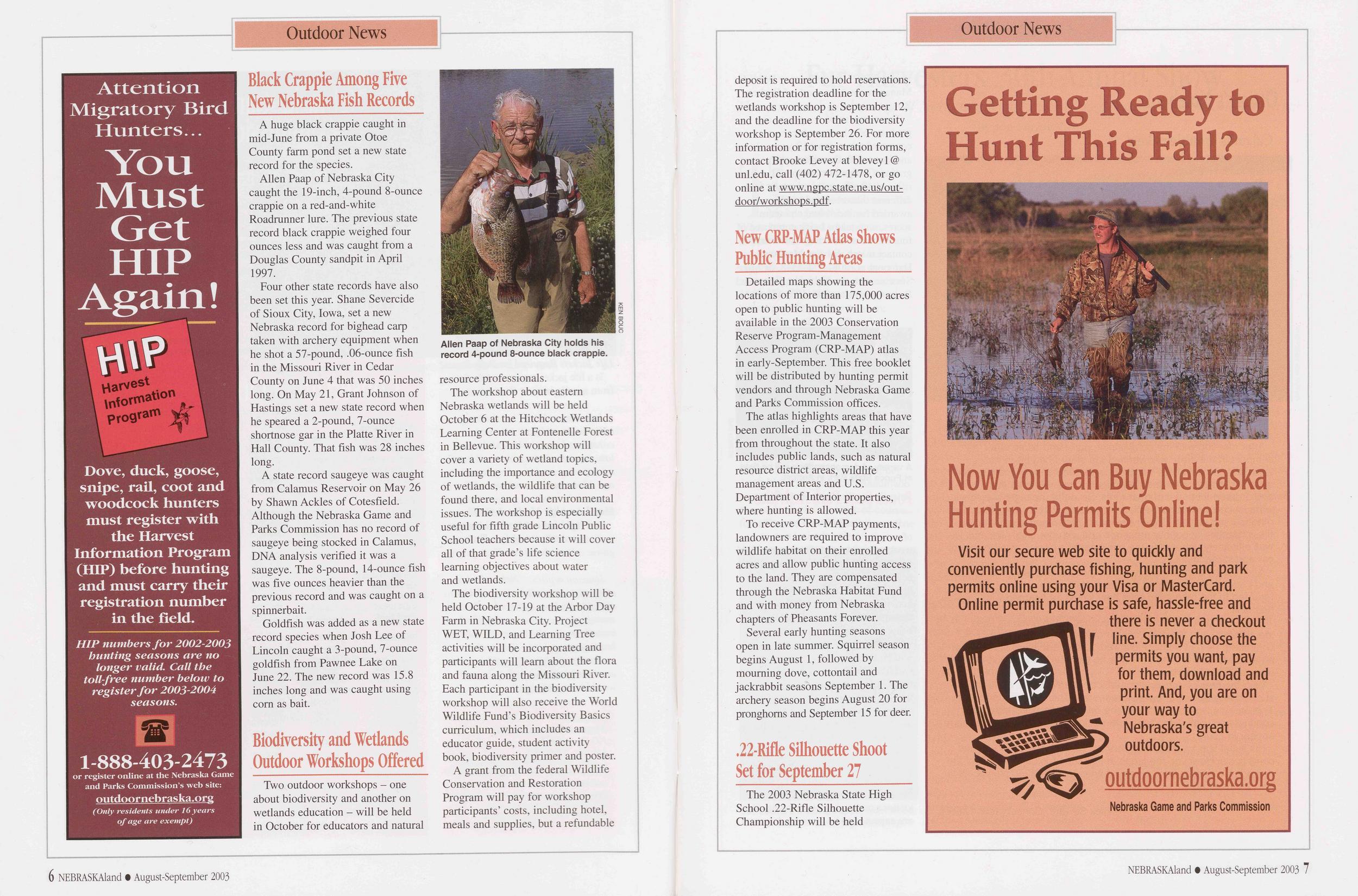
A huge black crappie caught in mid-June from a private Otoe County farm pond set a new state record for the species.
Allen Paap of Nebraska City caught the 19-inch, 4-pound 8-ounce crappie on a red-and-white Roadrunner lure. The previous state record black crappie weighed four ounces less and was caught from a Douglas County sandpit in April 1997.
Four other state records have also been set this year. Shane Severcide of Sioux City, Iowa, set a new Nebraska record for bighead carp taken with archery equipment when he shot a 57-pound, .06-ounce fish in the Missouri River in Cedar County on June 4 that was 50 inches long. On May 21, Grant Johnson of Hastings set a new state record when he speared a 2-pound, 7-ounce shortnose gar in the Platte River in Hall County. That fish was 28 inches long.
A state record saugeye was caught from Calamus Reservoir on May 26 by Shawn Ackles of Cotesfield. Although the Nebraska Game and Parks Commission has no record of saugeye being stocked in Calamus, DNA analysis verified it was a saugeye. The 8-pound, 14-ounce fish was five ounces heavier than the previous record and was caught on a spinnerbait.
Goldfish was added as a new state record species when Josh Lee of Lincoln caught a 3-pound, 7-ounce goldfish from Pawnee Lake on June 22. The new record was 15.8 inches long and was caught using corn as bait.
Biodiversity and Wetlands Outdoor Workshops OfferedTwo outdoor workshops - one about biodiversity and another on wetlands education - will be held in October for educators and natural resource professionals.
The workshop about eastern Nebraska wetlands will be held October 6 at the Hitchcock Wetlands Learning Center at Fontenelle Forest in Bellevue. This workshop will cover a variety of wetland topics, including the importance and ecology of wetlands, the wildlife that can be found there, and local environmental issues. The workshop is especially useful for fifth grade Lincoln Public School teachers because it will cover all of that grade's life science learning objectives about water and wetlands.
The biodiversity workshop will be held October 17-19 at the Arbor Day Farm in Nebraska City. Project WET, WILD, and Learning Tree activities will be incorporated and participants will learn about the flora and fauna along the Missouri River. Each participant in the biodiversity workshop will also receive the World Wildlife Fund's Biodiversity Basics curriculum, which includes an educator guide, student activity book, biodiversity primer and poster.
A grant from the federal Wildlife Conservation and Restoration Program will pay for workshop participants' costs, including hotel, meals and supplies, but a refundable deposit is required to hold reservations. The registration deadline for the wetlands workshop is September 12, and the deadline for the biodiversity workshop is September 26. For more information or for registration forms, contact Brooke Levey at bleveyl @ unl.edu, call (402) 472-1478, or go online at www.ngpc.state.ne.us/outdoor/workshops.pdf.
6 NEBRASKAland • August-September 2003 Outdoor News New CRP-MAP Atlas Shows Public Hunting AreasDetailed maps showing the locations of more than 175,000 acres open to public hunting will be available in the 2003 Conservation Reserve Program-Management Access Program (CRP-MAP) atlas in early-September. This free booklet will be distributed by hunting permit vendors and through Nebraska Game and Parks Commission offices.
The atlas highlights areas that have been enrolled in CRP-MAP this year from throughout the state. It also includes public lands, such as natural resource district areas, wildlife management areas and U.S. Department of Interior properties, where hunting is allowed.
To receive CRP-MAP payments, landowners are required to improve wildlife habitat on their enrolled acres and allow public hunting access to the land. They are compensated through the Nebraska Habitat Fund and with money from Nebraska chapters of Pheasants Forever.
Several early hunting seasons open in late summer. Squirrel season begins August 1, followed by mourning dove, cottontail and jackrabbit seasons September 1. The archery season begins August 20 for pronghorns and September 15 for deer.
.22-Rifle Silhouette Shoot Set for September 27The 2003 Nebraska State High School .22-Rifle Silhouette Championship will be held September 27 at the Pressey Wildlife Management Area south of Broken Bow.
Visit our secure web site to quickly and conveniently purchase fishing, hunting and park permits online using your Visa or MasterCard. Online permit purchase is safe, hassle-free and there is never a checkout line. Simply choose the permits you want, pay for them, download and print. And, you are on your way to Nebraska's great outdoors. outdoornebraska.org Nebraska Game and Parks Commission NEBRASKAland • August-September 2003 7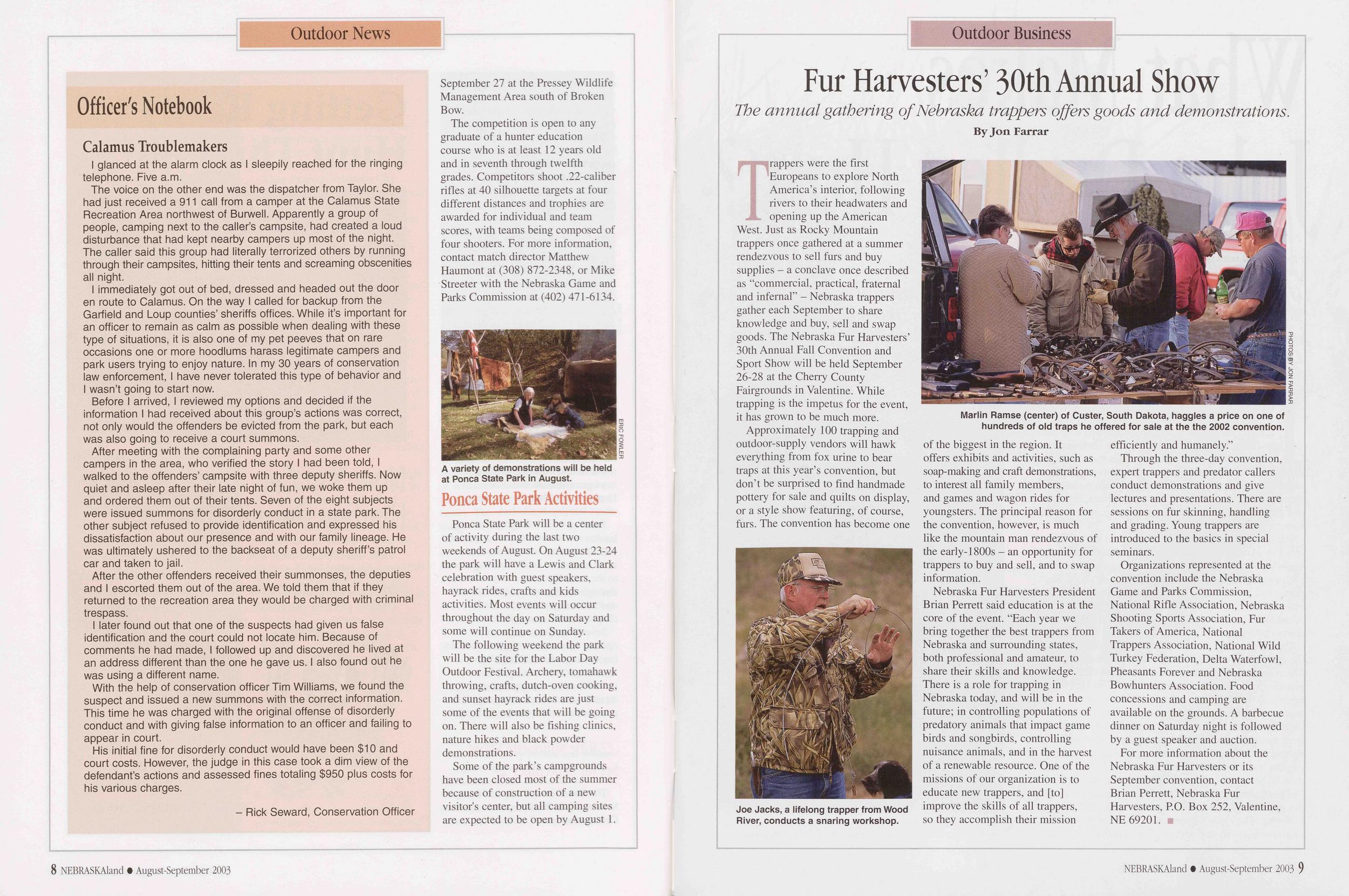 Outdoor News
Officer's Notebook
Calamus Troublemakers
Outdoor News
Officer's Notebook
Calamus Troublemakers
I glanced at the alarm clock as I sleepily reached for the ringing telephone. Five a.m.
The voice on the other end was the dispatcher from Taylor. She had just received a 911 call from a camper at the Calamus State Recreation Area northwest of Burwell. Apparently a group of people, camping next to the caller's campsite, had created a loud disturbance that had kept nearby campers up most of the night. The caller said this group had literally terrorized others by running through their campsites, hitting their tents and screaming obscenities all night.
I immediately got out of bed, dressed and headed out the door en route to Calamus. On the way I called for backup from the Garfield and Loup counties' sheriffs offices. While it's important for an officer to remain as calm as possible when dealing with these type of situations, it is also one of my pet peeves that on rare occasions one or more hoodlums harass legitimate campers and park users trying to enjoy nature. In my 30 years of conservation law enforcement, I have never tolerated this type of behavior and I wasn't going to start now.
Before I arrived, I reviewed my options and decided if the information I had received about this group's actions was correct, not only would the offenders be evicted from the park, but each was also going to receive a court summons.
After meeting with the complaining party and some other campers in the area, who verified the story I had been told, I walked to the offenders' campsite with three deputy sheriffs. Now quiet and asleep after their late night of fun, we woke them up and ordered them out of their tents. Seven of the eight subjects were issued summons for disorderly conduct in a state park. The other subject refused to provide identification and expressed his dissatisfaction about our presence and with our family lineage. He was ultimately ushered to the backseat of a deputy sheriff's patrol car and taken to jail.
After the other offenders received their summonses, the deputies and I escorted them out of the area. We told them that if they returned to the recreation area they would be charged with criminal trespass.
I later found out that one of the suspects had given us false identification and the court could not locate him. Because of comments he had made, I followed up and discovered he lived at an address different than the one he gave us. I also found out he was using a different name.
With the help of conservation officer Tim Williams, we found the suspect and issued a new summons with the correct information. This time he was charged with the original offense of disorderly conduct and with giving false information to an officer and failing to appear in court.
His initial fine for disorderly conduct would have been $10 and court costs. However, the judge in this case took a dim view of the defendant's actions and assessed fines totaling $950 plus costs for his various charges.
- Rick Seward, Conservation OfficerThe competition is open to any graduate of a hunter education course who is at least 12 years old and in seventh through twelfth grades. Competitors shoot .22-caliber rifles at 40 silhouette targets at four different distances and trophies are awarded for individual and team scores, with teams being composed of four shooters. For more information, contact match director Matthew Haumont at (308) 872-2348, or Mike Streeter with the Nebraska Game and Parks Commission at (402) 471-6134.
Ponca State Park will be a center of activity during the last two weekends of August. On August 23-24 the park will have a Lewis and Clark celebration with guest speakers, hayrack rides, crafts and kids activities. Most events will occur throughout the day on Saturday and some will continue on Sunday.
The following weekend the park will be the site for the Labor Day Outdoor Festival. Archery, tomahawk throwing, crafts, dutch-oven cooking, and sunset hayrack rides are just some of the events that will be going on. There will also be fishing clinics, nature hikes and black powder demonstrations.
Some of the park's campgrounds have been closed most of the summer because of construction of a new visitor's center, but all camping sites are expected to be open by August 1.
8 NEBRASKAland • August-September 2003Fur Harvesters' 30th Annual Show
Outdoor Business The annual gathering of Nebraska trappers offers goods and demonstrations. By Jon FarrarTrappers were the first Europeans to explore North America's interior, following rivers to their headwaters and opening up the American West. Just as Rocky Mountain trappers once gathered at a summer rendezvous to sell furs and buy supplies - a conclave once described as "commercial, practical, fraternal and infernal" - Nebraska trappers gather each September to share knowledge and buy, sell and swap goods. The Nebraska Fur Harvesters' 30th Annual Fall Convention and Sport Show will be held September 26-28 at the Cherry County Fairgrounds in Valentine. While trapping is the impetus for the event, it has grown to be much more.
Approximately 100 trapping and outdoor-supply vendors will hawk everything from fox urine to bear traps at this year's convention, but don't be surprised to find handmade pottery for sale and quilts on display, or a style show featuring, of course, furs. The convention has become one of the biggest in the region. It offers exhibits and activities, such as soap-making and craft demonstrations, to interest all family members, and games and wagon rides for youngsters. The principal reason for the convention, however, is much like the mountain man rendezvous of the early-1800s - an opportunity for trappers to buy and sell, and to swap information.
Nebraska Fur Harvesters President Brian Perrett said education is at the core of the event. "Each year we bring together the best trappers from Nebraska and surrounding states, both professional and amateur, to share their skills and knowledge. There is a role for trapping in Nebraska today, and will be in the future; in controlling populations of predatory animals that impact game birds and songbirds, controlling nuisance animals, and in the harvest of a renewable resource. One of the missions of our organization is to educate new trappers, and [to] improve the skills of all trappers, so they accomplish their mission efficiently and humanely."
Through the three-day convention, expert trappers and predator callers conduct demonstrations and give lectures and presentations. There are sessions on fur skinning, handling and grading. Young trappers are introduced to the basics in special seminars.
Organizations represented at the convention include the Nebraska Game and Parks Commission, National Rifle Association, Nebraska Shooting Sports Association, Fur Takers of America, National Trappers Association, National Wild Turkey Federation, Delta Waterfowl, Pheasants Forever and Nebraska Bowhunters Association. Food concessions and camping are available on the grounds. A barbecue dinner on Saturday night is followed by a guest speaker and auction.
For more information about the Nebraska Fur Harvesters or its September convention, contact Brian Perrett, Nebraska Fur Harvesters, P.O. Box 252, Valentine, NE 69201. «
NEBRASKAland • August-September 2003 9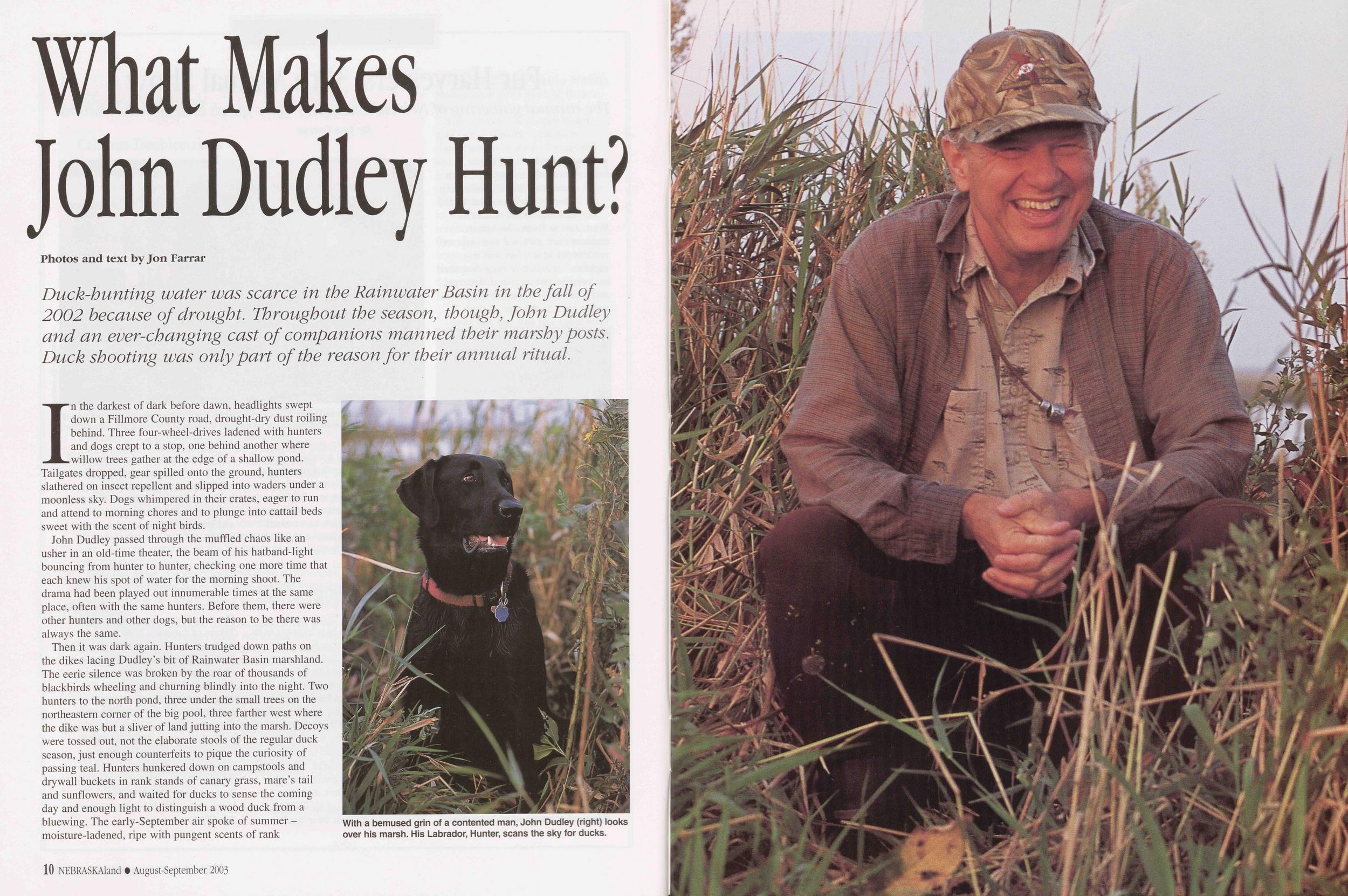
What Makes John Dudley Hunt?
Photos and text by Jon Farrar Duck-hunting water was scarce in the Rainwater Basin in the fall of 2002 because of drought. Throughout the season, though, John Dudley and an ever-changing cast of companions manned their marshy posts. Duck shooting was only part of the reason for their annual ritual.In the darkest of dark before dawn, headlights swept down a Fillmore County road, drought-dry dust roiling behind. Three four-wheel-drives ladened with hunters and dogs crept to a stop, one behind another where willow trees gather at the edge of a shallow pond. Tailgates dropped, gear spilled onto the ground, hunters slathered on insect repellent and slipped into waders under a moonless sky. Dogs whimpered in their crates, eager to run and attend to morning chores and to plunge into cattail beds sweet with the scent of night birds.
John Dudley passed through the muffled chaos like an usher in an old-time theater, the beam of his hatband-light bouncing from hunter to hunter, checking one more time that each knew his spot of water for the morning shoot. The drama had been played out innumerable times at the same place, often with the same hunters. Before them, there were other hunters and other dogs, but the reason to be there was always the same.
Then it was dark again. Hunters trudged down paths on the dikes lacing Dudley's bit of Rainwater Basin marshland. The eerie silence was broken by the roar of thousands of blackbirds wheeling and churning blindly into the night. Two hunters to the north pond, three under the small trees on the northeastern corner of the big pool, three farther west where the dike was but a sliver of land jutting into the marsh. Decoys were tossed out, not the elaborate stools of the regular duck season, just enough counterfeits to pique the curiosity of passing teal. Hunters hunkered down on campstools and drywall buckets in rank stands of canary grass, mare's tail and sunflowers, and waited for ducks to sense the coming day and enough light to distinguish a wood duck from a bluewing. The early-September air spoke of summer - moisture-ladened, ripe with pungent scents of rank vegetation and suspended dust.
But the opening day of the 2002 special teal season dawned unlike either of the two preceding it. The ducks were not in Fillmore County, in part because of protracted drought that hovered over the state through the summer. The shallow, clay pan marshes - even the largest, marshes that during wet years covered nearly two sections - were cracked earth and weeds. August downpours had been fickle, dropping five, six, seven inches of rain here, but none there, and even where thunderstorms had been generous they could not compensate for the blistering heat and desiccating winds. Dry land corn shriveled, waves of grasshoppers gnawed into irrigated fields, pastures were chewed down to raw earth. The number of Nebraska-reared blue-winged teal was a fraction of the young produced in wetter years.
But drought in Nebraska accounted for only part of the scarcity of early migrating ducks. The northern Great Plains sweltered through September, temperatures averaged 15 to 20 degrees warmer than normal. There were strings of 90-degree days, and back-to-back- to-back days with temperatures over 100 degrees. Even tender bluewings that scurry south at the first hint of frost lingered in the North. Those that pushed south on schedule, out of the Dakotas and southern Canada breeding grounds, found too few wetlands in the Rainwater Basin to tempt them to linger. The best duck waters were in low-lying ground where irrigation runoff gathered. Because of that, Dudley had water in his marsh, but without a push of teal from the north, without enough water in south-central Nebraska to attract and hold them, September teal hunting was destined to be poor. But for Dudley and his companions to not come to the marsh would be like tearing away a calendar page and pretending the month had never existed.
Light spread across the marsh and birds stirred. Enormous flocks of blackbirds rose like smoke and curled off over the fields to feed. A discordant squad of night herons winged ploddingly overhead, croaking their objection to the coming day. A sickle-billed ibis circled, as if searching for more of its kind. A rooster pheasant crowed, an unseen Canada goose called. Wood ducks, white-bellied and square-tailed, reconnoitered the marshland, and here and there teal careened over the open pools, but they were not interested in decoys, distracted, perhaps, by the scarcity of water and others of their kind. A red-orange orb slipped above the horizon and burned through the morning haze. It was an exquisite morning.
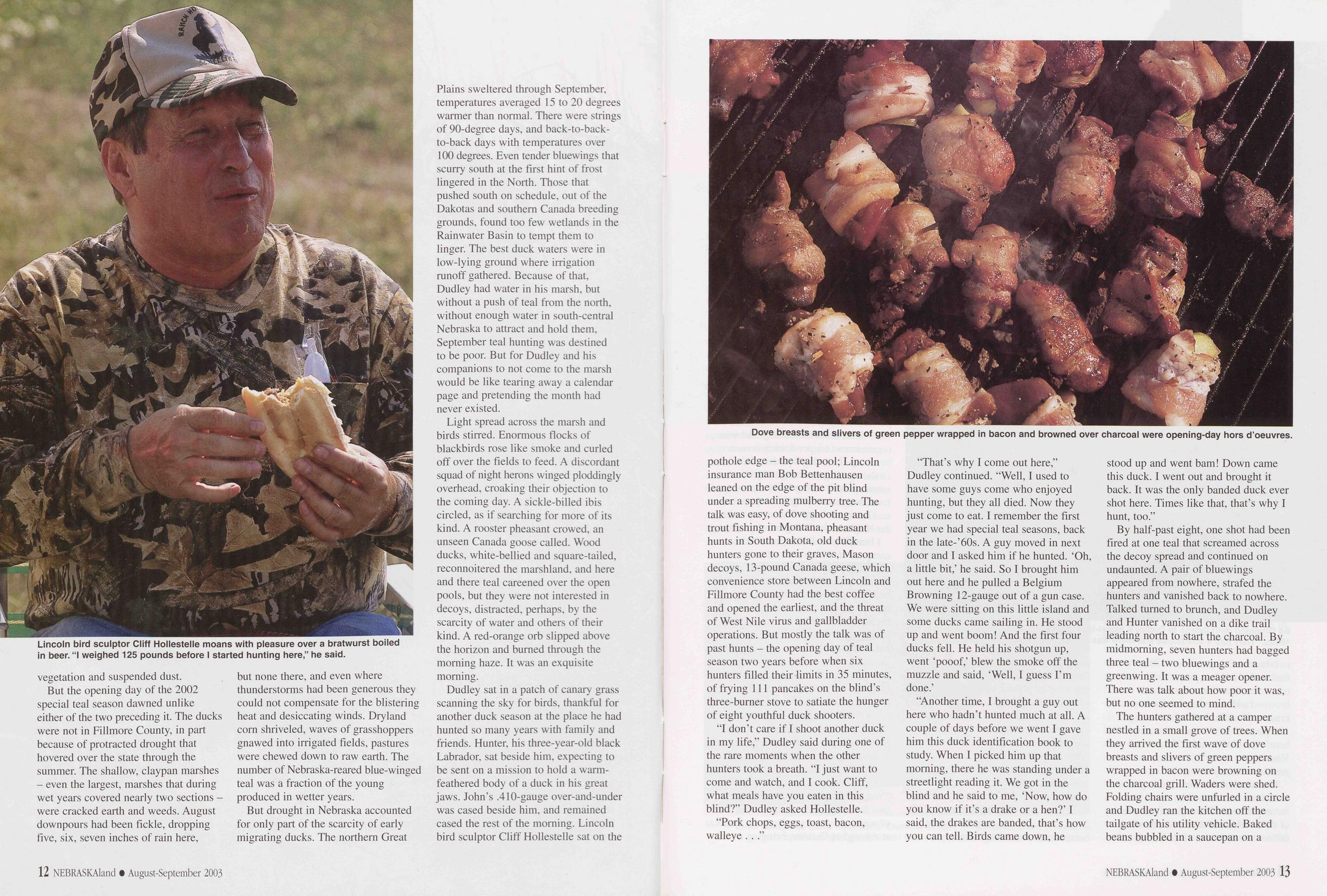
Dudley sat in a patch of canary grass scanning the sky for birds, thankful for another duck season at the place he had hunted so many years with family and friends. Hunter, his three-year-old black Labrador, sat beside him, expecting to be sent on a mission to hold a warm- feathered body of a duck in his great jaws. John's .410-gauge over-and-under was cased beside him, and remained cased the rest of the morning. Lincoln bird sculptor Cliff Hollestelle sat on the 12 NEBRASKAland • August-September 2003 pothole edge - the teal pool; Lincoln insurance man Bob Bettenhausen leaned on the edge of the pit blind under a spreading mulberry tree. The talk was easy, of dove shooting and trout fishing in Montana, pheasant hunts in South Dakota, old duck hunters gone to their graves, Mason decoys, 13-pound Canada geese, which convenience store between Lincoln and Fillmore County had the best coffee and opened the earliest, and the threat of West Nile virus and gallbladder operations. But mostly the talk was of past hunts - the opening day of teal season two years before when six hunters filled their limits in 35 minutes, of frying 111 pancakes on the blind's three-burner stove to satiate the hunger of eight youthful duck shooters.
"I don't care if I shoot another duck in my life," Dudley said during one of the rare moments when the other hunters took a breath. "I just want to come and watch, and I cook. Cliff, what meals have you eaten in this blind?" Dudley asked Hollestelle.
"Pork chops, eggs, toast, bacon, walleye ..."
"That's why I come out here," Dudley continued. "Well, I used to have some guys come who enjoyed hunting, but they all died. Now they just come to eat. I remember the first year we had special teal seasons, back in the late-'60s. A guy moved in next door and I asked him if he hunted. 'Oh, a little bit,' he said. So I brought him out here and he pulled a Belgium Browning 12-gauge out of a gun case. We were sitting on this little island and some ducks came sailing in. He stood up and went boom! And the first four ducks fell. He held his shotgun up, went 'pooof,' blew the smoke off the muzzle and said, 'Well, I guess I'm done.'
"Another time, I brought a guy out here who hadn't hunted much at all. A couple of days before we went I gave him this duck identification book to study. When I picked him up that morning, there he was standing under a streetlight reading it. We got in the blind and he said to me, 'Now, how do you know if it's a drake or a hen?' I said, the drakes are banded, that's how you can tell. Birds came down, he stood up and went bam! Down came this duck. I went out and brought it back. It was the only banded duck ever shot here. Times like that, that's why I hunt, too."
By half-past eight, one shot had been fired at one teal that screamed across the decoy spread and continued on undaunted. A pair of bluewings appeared from nowhere, strafed the hunters and vanished back to nowhere. Talked turned to brunch, and Dudley and Hunter vanished on a dike trail leading north to start the charcoal. By midmorning, seven hunters had bagged three teal - two bluewings and a greenwing. It was a meager opener. There was talk about how poor it was, but no one seemed to mind.
The hunters gathered at a camper
nestled in a small grove of trees. When
they arrived the first wave of dove
breasts and slivers of green peppers
wrapped in bacon were browning on
the charcoal grill. Waders were shed.
Folding chairs were unfurled in a circle
and Dudley ran the kitchen off the
tailgate of his utility vehicle. Baked
beans bubbled in a saucepan on a
NEBRASKAland • August-September 2003 13
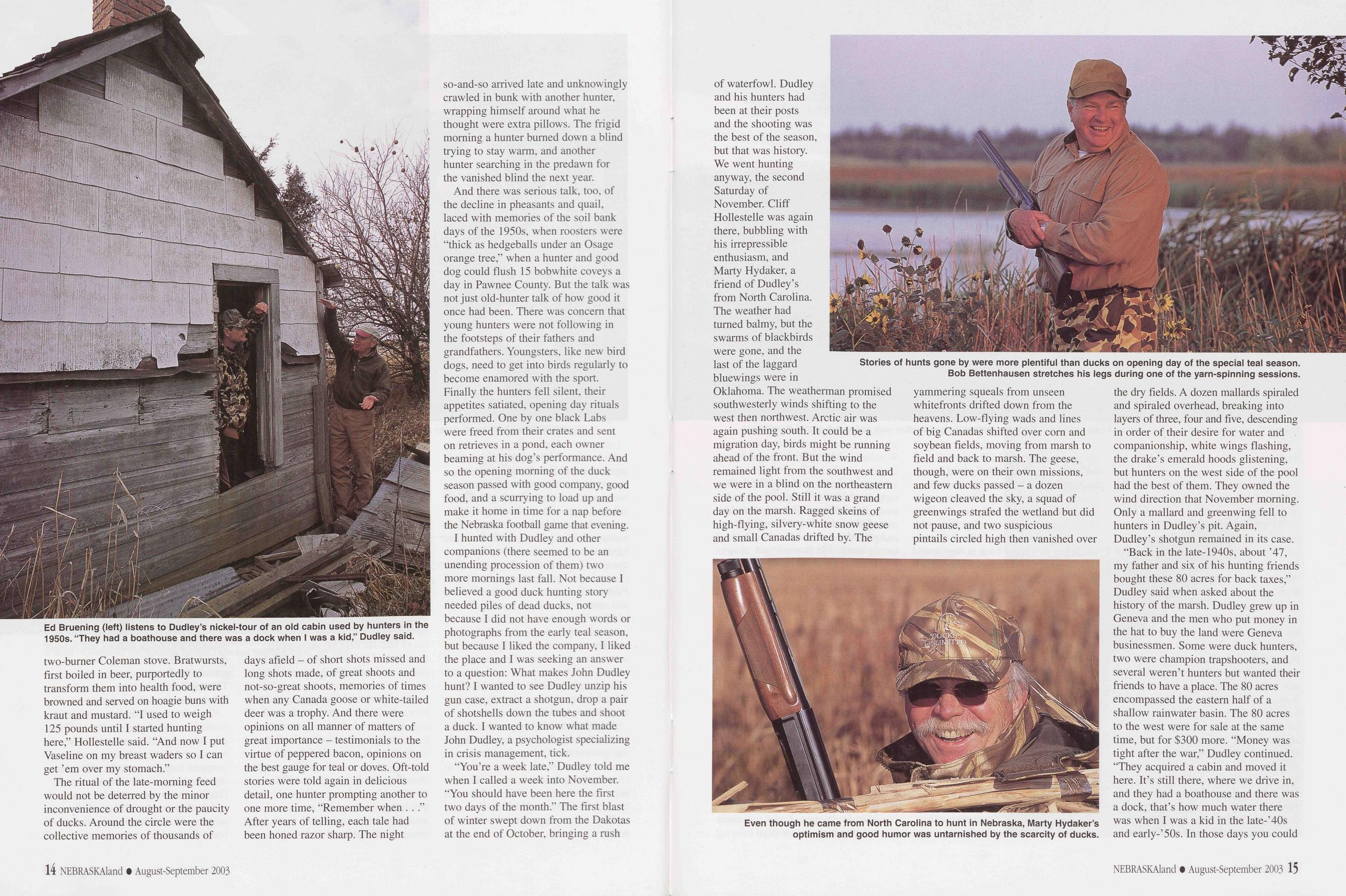 two-burner Coleman stove. Bratwursts,
first boiled in beer, purportedly to
transform them into health food, were
browned and served on hoagie buns with
kraut and mustard. "I used to weigh
125 pounds until I started hunting
here," Hollestelle said. "And now I put
Vaseline on my breast waders so I can
get 'em over my stomach."
two-burner Coleman stove. Bratwursts,
first boiled in beer, purportedly to
transform them into health food, were
browned and served on hoagie buns with
kraut and mustard. "I used to weigh
125 pounds until I started hunting
here," Hollestelle said. "And now I put
Vaseline on my breast waders so I can
get 'em over my stomach."
The ritual of the late-morning feed would not be deterred by the minor inconvenience of drought or the paucity of ducks. Around the circle were the collective memories of thousands of days afield - of short shots missed and long shots made, of great shoots and not-so-great shoots, memories of times when any Canada goose or white-tailed deer was a trophy. And there were opinions on all manner of matters of great importance - testimonials to the virtue of peppered bacon, opinions on the best gauge for teal or doves. Oft-told stories were told again in delicious detail, one hunter prompting another to one more time, "Remember when . . ." After years of telling, each tale had been honed razor sharp. The night so-and-so arrived late and unknowingly crawled in bunk with another hunter, wrapping himself around what he thought were extra pillows. The frigid morning a hunter burned down a blind trying to stay warm, and another hunter searching in the predawn for the vanished blind the next year.
And there was serious talk, too, of the decline in pheasants and quail, laced with memories of the soil bank days of the 1950s, when roosters were "thick as hedgeballs under an Osage orange tree," when a hunter and good dog could flush 15 bobwhite coveys a day in Pawnee County. But the talk was not just old-hunter talk of how good it once had been. There was concern that young hunters were not following in the footsteps of their fathers and grandfathers. Youngsters, like new bird dogs, need to get into birds regularly to become enamored with the sport. Finally the hunters fell silent, their appetites satiated, opening day rituals performed. One by one black Labs were freed from their crates and sent on retrieves in a pond, each owner beaming at his dog's performance. And so the opening morning of the duck season passed with good company, good food, and a scurrying to load up and make it home in time for a nap before the Nebraska football game that evening.
I hunted with Dudley and other companions (there seemed to be an unending procession of them) two more mornings last fall. Not because I believed a good duck hunting story needed piles of dead ducks, not because I did not have enough words or photographs from the early teal season, but because I liked the company, I liked the place and I was seeking an answer to a question: What makes John Dudley hunt? I wanted to see Dudley unzip his gun case, extract a shotgun, drop a pair of shotshells down the tubes and shoot a duck. I wanted to know what made John Dudley, a psychologist specializing in crisis management, tick.
"You're a week late," Dudley told me when I called a week into November. "You should have been here the first two days of the month." The first blast of winter swept down from the Dakotas at the end of October, bringing a rush 14 NEBRASKAland • August-September 2003 of waterfowl. Dudley and his hunters had been at their posts and the shooting was the best of the season, but that was history. We went hunting anyway, the second Saturday of November. Cliff Hollestelle was again there, bubbling with his irrepressible enthusiasm, and Marty Hydaker, a friend of Dudley's from North Carolina. The weather had turned balmy, but the swarms of blackbirds were gone, and the last of the laggard bluewings were in Oklahoma. The weatherman promised southwesterly winds shifting to the west then northwest. Arctic air was again pushing south. It could be a migration day, birds might be running ahead of the front. But the wind remained light from the southwest and we were in a blind on the northeastern side of the pool. Still it was a grand day on the marsh. Ragged skeins of high-flying, silvery-white snow geese and small Canadas drifted by. The yammering squeals from unseen whitefronts drifted down from the heavens. Low-flying wads and lines of big Canadas shifted over corn and soybean fields, moving from marsh to field and back to marsh. The geese, though, were on their own missions, and few ducks passed - a dozen wigeon cleaved the sky, a squad of greenwings strafed the wetland but did not pause, and two suspicious pintails circled high then vanished over the dry fields. A dozen mallards spiraled and spiraled overhead, breaking into layers of three, four and five, descending in order of their desire for water and companionship, white wings flashing, the drake's emerald hoods glistening, but hunters on the west side of the pool had the best of them. They owned the wind direction that November morning. Only a mallard and greenwing fell to hunters in Dudley's pit. Again, Dudley's shotgun remained in its case.
"Back in the late-1940s, about '47,
my father and six of his hunting friends
bought these 80 acres for back taxes,"
Dudley said when asked about the
history of the marsh. Dudley grew up in
Geneva and the men who put money in
the hat to buy the land were Geneva
businessmen. Some were duck hunters,
two were champion trapshooters, and
several weren't hunters but wanted their
friends to have a place. The 80 acres
encompassed the eastern half of a
shallow rainwater basin. The 80 acres
to the west were for sale at the same
time, but for $300 more. "Money was
tight after the war," Dudley continued.
They acquired a cabin and moved it
here. It's still there, where we drive in,
and they had a boathouse and there was
a dock, that's how much water there
was when I was a kid in the late-'40s
and early-'50s. In those days you could
NEBRASKAland • August-September 2003 15
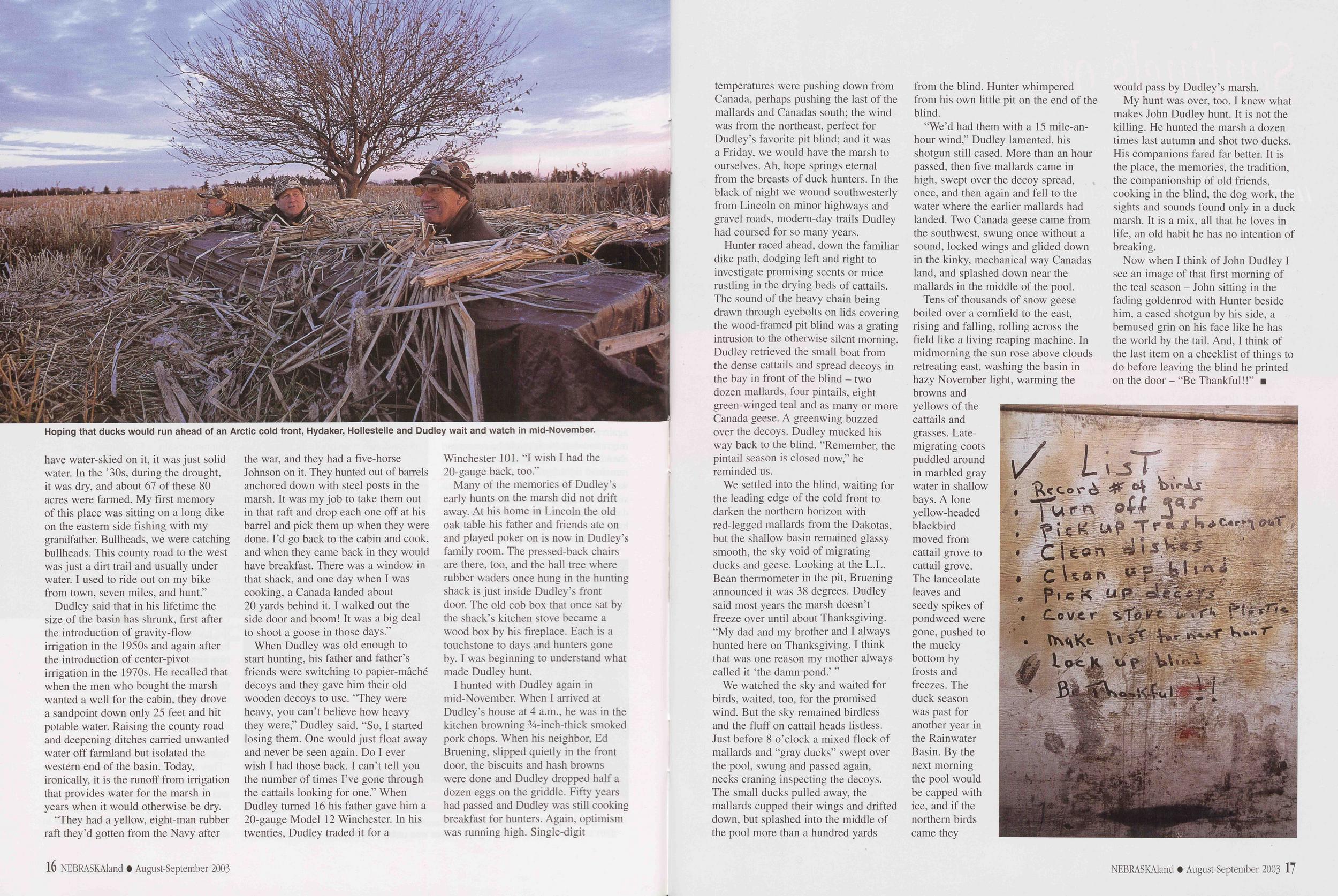
Dudley said that in his lifetime the size of the basin has shrunk, first after the introduction of gravity-flow irrigation in the 1950s and again after the introduction of center-pivot irrigation in the 1970s. He recalled that when the men who bought the marsh wanted a well for the cabin, they drove a sandpoint down only 25 feet and hit potable water. Raising the county road and deepening ditches carried unwanted water off farmland but isolated the western end of the basin. Today, ironically, it is the runoff from irrigation that provides water for the marsh in years when it would otherwise be dry.
"They had a yellow, eight-man rubber raft they'd gotten from the Navy after the war, and they had a five-horse Johnson on it. They hunted out of barrels anchored down with steel posts in the marsh. It was my job to take them out in that raft and drop each one off at his barrel and pick them up when they were done. I'd go back to the cabin and cook, and when they came back in they would have breakfast. There was a window in that shack, and one day when I was cooking, a Canada landed about 20 yards behind it. I walked out the side door and boom! It was a big deal to shoot a goose in those days."
When Dudley was old enough to start hunting, his father and father's friends were switching to papier-mache decoys and they gave him their old wooden decoys to use. "They were heavy, you can't believe how heavy they were," Dudley said. "So, I started losing them. One would just float away and never be seen again. Do I ever wish I had those back. I can't tell you the number of times I've gone through the cattails looking for one." When Dudley turned 16 his father gave him a 20-gauge Model 12 Winchester. In his twenties, Dudley traded it for a Winchester 101. "I wish I had the 20-gauge back, too."
Many of the memories of Dudley's early hunts on the marsh did not drift away. At his home in Lincoln the old oak table his father and friends ate on and played poker on is now in Dudley's family room. The pressed-back chairs are there, too, and the hall tree where rubber waders once hung in the hunting shack is just inside Dudley's front door. The old cob box that once sat by the shack's kitchen stove became a wood box by his fireplace. Each is a touchstone to days and hunters gone by. I was beginning to understand what made Dudley hunt.
I hunted with Dudley again in mid-November. When I arrived at Dudley's house at 4 a.m., he was in the kitchen browning 3A-inch-thick smoked pork chops. When his neighbor, Ed Bruening, slipped quietly in the front door, the biscuits and hash browns were done and Dudley dropped half a dozen eggs on the griddle. Fifty years had passed and Dudley was still cooking breakfast for hunters. Again, optimism was running high. Single-digit 16 NEBRASKAland t August-September 2003 temperatures were pushing down from Canada, perhaps pushing the last of the mallards and Canadas south; the wind was from the northeast, perfect for Dudley's favorite pit blind; and it was a Friday, we would have the marsh to ourselves. Ah, hope springs eternal from the breasts of duck hunters. In the black of night we wound southwesterly from Lincoln on minor highways and gravel roads, modern-day trails Dudley had coursed for so many years.
Hunter raced ahead, down the familiar dike path, dodging left and right to investigate promising scents or mice rustling in the drying beds of cattails. The sound of the heavy chain being drawn through eyebolts on lids covering the wood-framed pit blind was a grating intrusion to the otherwise silent morning. Dudley retrieved the small boat from the dense cattails and spread decoys in the bay in front of the blind - two dozen mallards, four pintails, eight green-winged teal and as many or more Canada geese. A greenwing buzzed over the decoys. Dudley mucked his way back to the blind. "Remember, the pintail season is closed now," he reminded us.
We settled into the blind, waiting for the leading edge of the cold front to darken the northern horizon with red-legged mallards from the Dakotas, but the shallow basin remained glassy smooth, the sky void of migrating ducks and geese. Looking at the L.L. Bean thermometer in the pit, Bruening announced it was 38 degrees. Dudley said most years the marsh doesn't freeze over until about Thanksgiving. "My dad and my brother and I always hunted here on Thanksgiving. I think that was one reason my mother always called it 'the damn pond.' "
We watched the sky and waited for birds, waited, too, for the promised wind. But the sky remained birdless and the fluff on cattail heads listless. Just before 8 o'clock a mixed flock of mallards and "gray ducks" swept over the pool, swung and passed again, necks craning inspecting the decoys. The small ducks pulled away, the mallards cupped their wings and drifted down, but splashed into the middle of the pool more than a hundred yards from the blind. Hunter whimpered from his own little pit on the end of the blind.
"We'd had them with a 15 mile-an-hour wind," Dudley lamented, his shotgun still cased. More than an hour passed, then five mallards came in high, swept over the decoy spread, once, and then again and fell to the water where the earlier mallards had landed. Two Canada geese came from the southwest, swung once without a sound, locked wings and glided down in the kinky, mechanical way Canadas land, and splashed down near the mallards in the middle of the pool.
Tens of thousands of snow geese boiled over a cornfield to the east, rising and falling, rolling across the field like a living reaping machine. In midmorning the sun rose above clouds retreating east, washing the basin in hazy November light, warming the browns and yellows of the cattails and grasses. Late migrating coots puddled around in marbled gray water in shallow bays. A lone yellow-headed blackbird moved from cattail grove to cattail grove. The lanceolate leaves and seedy spikes of pondweed were gone, pushed to the mucky bottom by frosts and freezes. The duck season was past for another year in the Rainwater Basin. By the next morning the pool would be capped with ice, and if the northern birds came they would pass by Dudley's marsh.
My hunt was over, too. I knew what makes John Dudley hunt. It is not the killing. He hunted the marsh a dozen times last autumn and shot two ducks. His companions fared far better. It is the place, the memories, the tradition, the companionship of old friends, cooking in the blind, the dog work, the sights and sounds found only in a duck marsh. It is a mix, all that he loves in life, an old habit he has no intention of breaking.
Now when I think of John Dudley I see an image of that first morning of the teal season - John sitting in the fading goldenrod with Hunter beside him, a cased shotgun by his side, a bemused grin on his face like he has the world by the tail. And, I think of the last item on a checklist of things to do before leaving the blind he printed on the door - "Be Thankful!!"
Sentinels on the High Plains
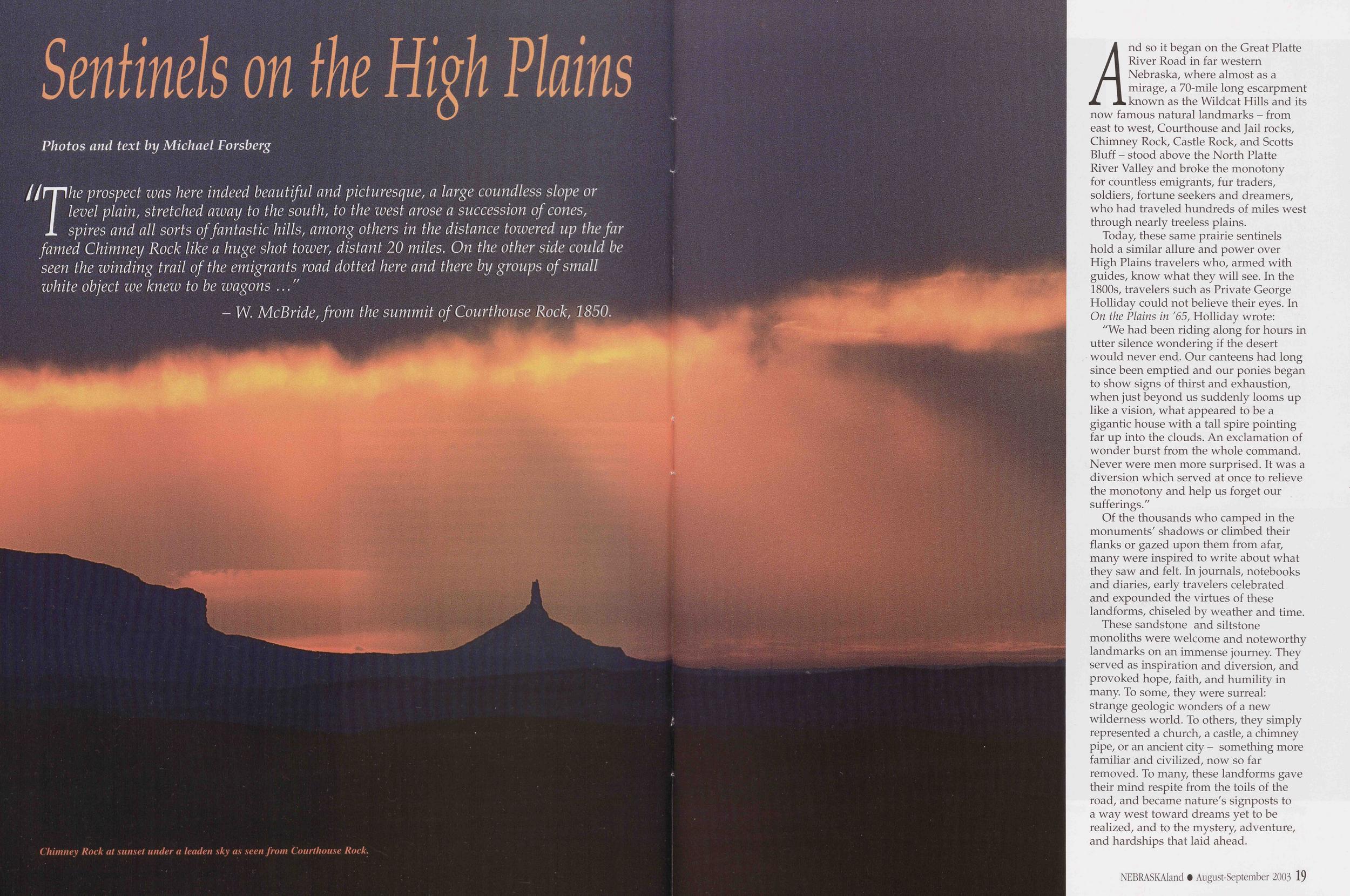
Photos and text by Michael Forsberg "The prospect was here indeed beautiful and picturesque, a large coundless slope or level plain, stretched away to the south, to the west arose a succession of cones, spires and all sorts of fantastic hills, among others in the distance towered up the far famed Chimney Rock like a huge shot tower, distant 20 miles. On the other side could be seen the winding trail of the emigrants road dotted here and there by groups of small white object we knew to be wagons ..." - W. McBride, from the summit of Courthouse Rock, 1850.And so it began on the Great Platte River Road in far western Nebraska, where almost as a mirage, a 70-mile long escarpment known as the Wildcat Hills and its now famous natural landmarks - from east to west, Courthouse and Jail rocks, Chimney Rock, Castle Rock, and Scotts Bluff - stood above the North Platte River Valley and broke the monotony for countless emigrants, fur traders, soldiers, fortune seekers and dreamers, who had traveled hundreds of miles west through nearly treeless plains.
Today, these same prairie sentinels hold a similar allure and power over High Plains travelers who, armed with guides, know what they will see. In the 1800s, travelers such as Private George Holliday could not believe their eyes. In On the Plains in '65, Holliday wrote:
"We had been riding along for hours in utter silence wondering if the desert would never end. Our canteens had long since been emptied and our ponies began to show signs of thirst and exhaustion, when just beyond us suddenly looms up like a vision, what appeared to be a gigantic house with a tall spire pointing far up into the clouds. An exclamation of wonder burst from the whole command. Never were men more surprised. It was a diversion which served at once to relieve the monotony and help us forget our sufferings."
Of the thousands who camped in the monuments' shadows or climbed their flanks or gazed upon them from afar, many were inspired to write about what they saw and felt. In journals, notebooks and diaries, early travelers celebrated and expounded the virtues of these landforms, chiseled by weather and time.
These sandstone and siltstone monoliths were welcome and noteworthy landmarks on an immense journey. They served as inspiration and diversion, and provoked hope, faith, and humility in many. To some, they were surreal: strange geologic wonders of a new wilderness world. To others, they simply represented a church, a castle, a cliimney pipe, or an ancient city - something more familiar and civilized, now so far removed. To many, these landforms gave their mind respite from the toils of the road, and became nature's signposts to a way west toward dreams yet to be realized, and to the mystery, adventure, and hardships that laid ahead.
NEBRASKAland • August-September 2003 19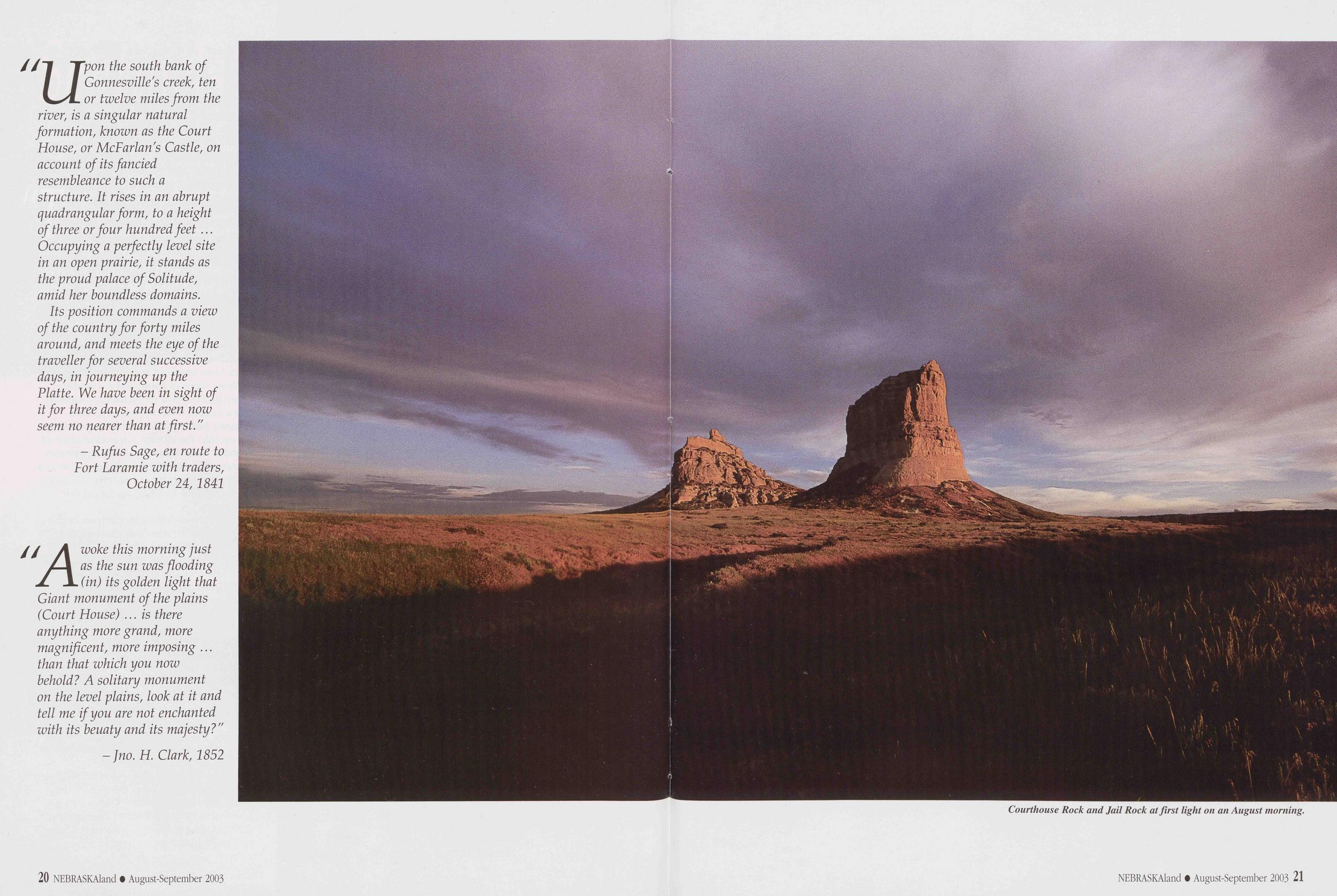
"Upon the south bank of Gonnesville's creek, ten or twelve miles from the river, is a singular natural formation, known as the Court House, or McFarlan's Castle, on account of its fancied resemblance to such a structure. It rises in an abrupt quadrangular form, to a height of three or four hundred feet ... Occupying a perfectly level site in an open prairie, it stands as the proud palace of Solitude, amid her boundless domains. Its position commands a view of the country for forty miles around, and meets the eye of the traveller for several successive days, in journeying up the Platte. We have been in sight of it for three days, and even now seem no nearer than at first."
- Rufus Sage, en route to Fort Laramie with traders, October 24,1841"Awoke this morning just as the sun was flooding (in) its golden light that Giant monument of the plains (Court House) ... is there anything more grand, more magnificent, more imposing ... than that which you now behold? A solitary monument on the level plains, look at it and tell me if you are not enchanted with its beuaty and its majesty?"
-Jno. H. Clark, 1852 20 NEBRASKAland • August-September 2003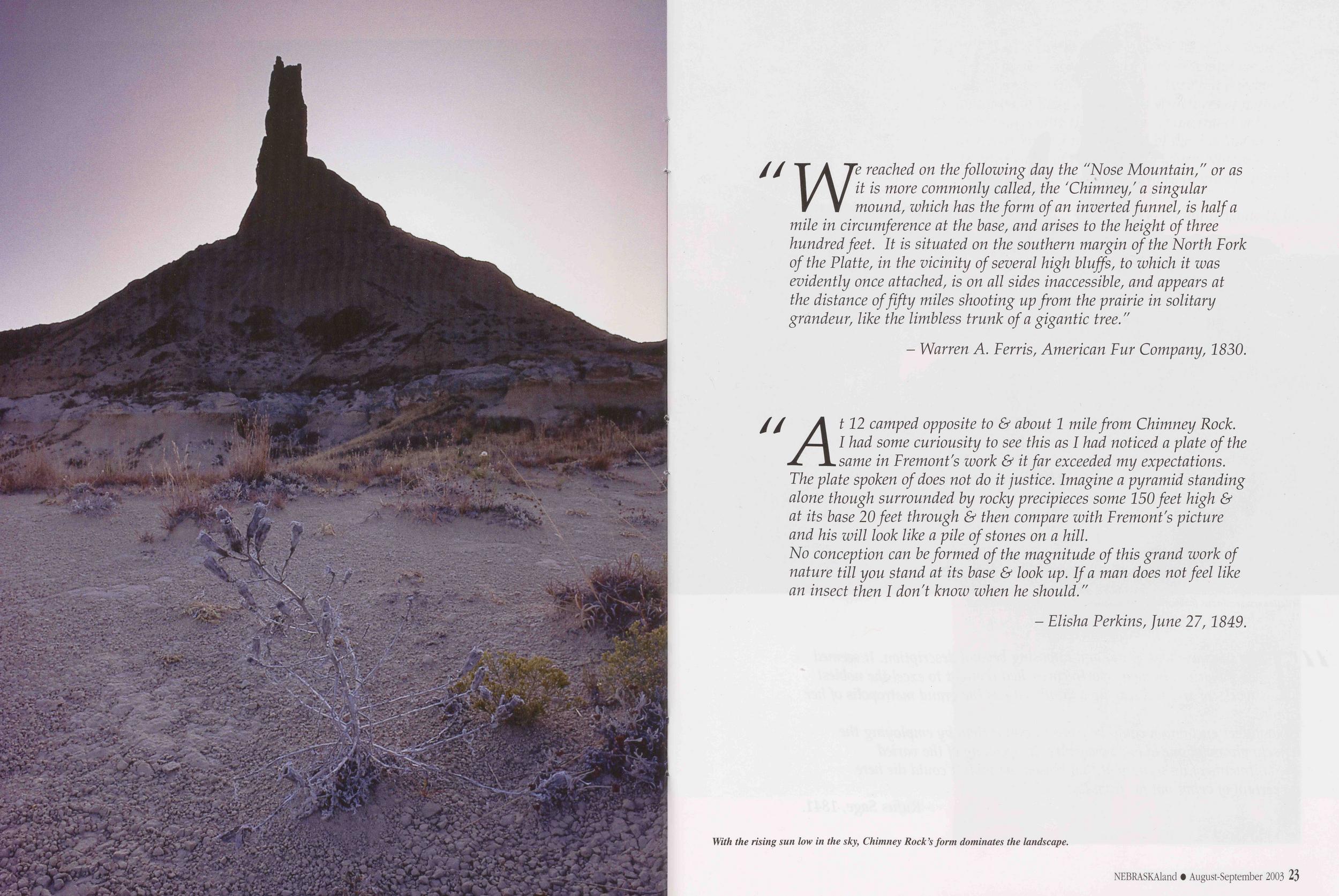
"We reached on the following day the "Nose Mountain," or as it is more commonly called, the 'Chimney,' a singular mound, which has the form of an inverted funnel, is half a mile in circumference at the base, and arises to the height of three hundred feet. It is situated on the southern margin of the North Fork of the Platte, in the vicinity of several high bluffs, to which it was evidently once attached, is on all sides inaccessible, and appears at the distance of fifty miles shooting up from the prairie in solitary grandeur, like the limbless trunk of a gigantic tree."
- Warren A. Ferris, American Fur Company, 1830."At 12 camped opposite to & about 1 mile from Chimney Rock. I had some curiosity to see this as I had noticed a plate of the same in Fremont's work & it far exceeded my expectations. The plate spoken of does not do it justice. Imagine a pyramid standing alone though surrounded by rocky precipices some 150 feet high & at its base 20 feet through & then compare with Fremont's picture and his will look like a pile of stones on a hill. No conception can be formed of the magnitude of this grand work of nature till you stand at its base & look up. If a man does not feel like an insect then I don't know when he should."
- Elisha Perkins, June 27,1849. NEBRASKAland • August-September 2003 23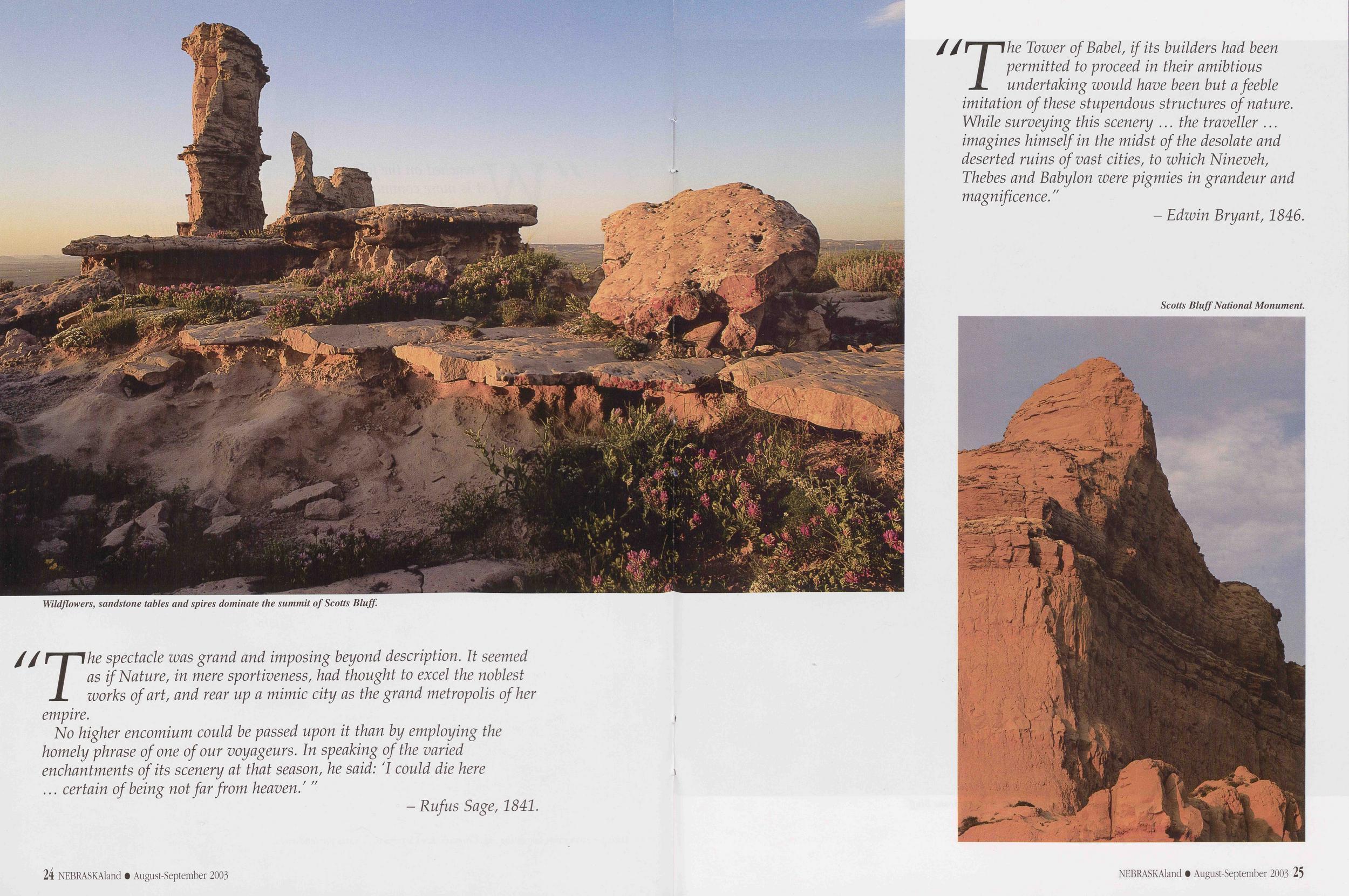
"The spectacle was grand and imposing beyond description. It seemed I as if Nature, in mere sportiveness, had thought to excel the noblest i works of art, and rear up a mimic city as the grand metropolis of her empire.
No higher encomium could be passed upon it than by employing the homely phrase of one of our voyageurs. In speaking of the varied enchantments of its scenery at that season, he said: I could die here ... certain of being not far from heaven/ "
- Rufus Sage, 1841. 24 NEBRASKAland • August-September 2003"The Tower of Babel, if its builders had been permitted to proceed in their ambitious undertaking would have been but a feeble imitation of these stupendous structures of nature. While surveying this scenery ... the traveller ... imagines himself in the midst of the desolate and deserted ruins of vast cities, to which Nineveh, Thebes and Babylon were pigmies in grandeur and magnificence."
- Edwin Bryant, 1846.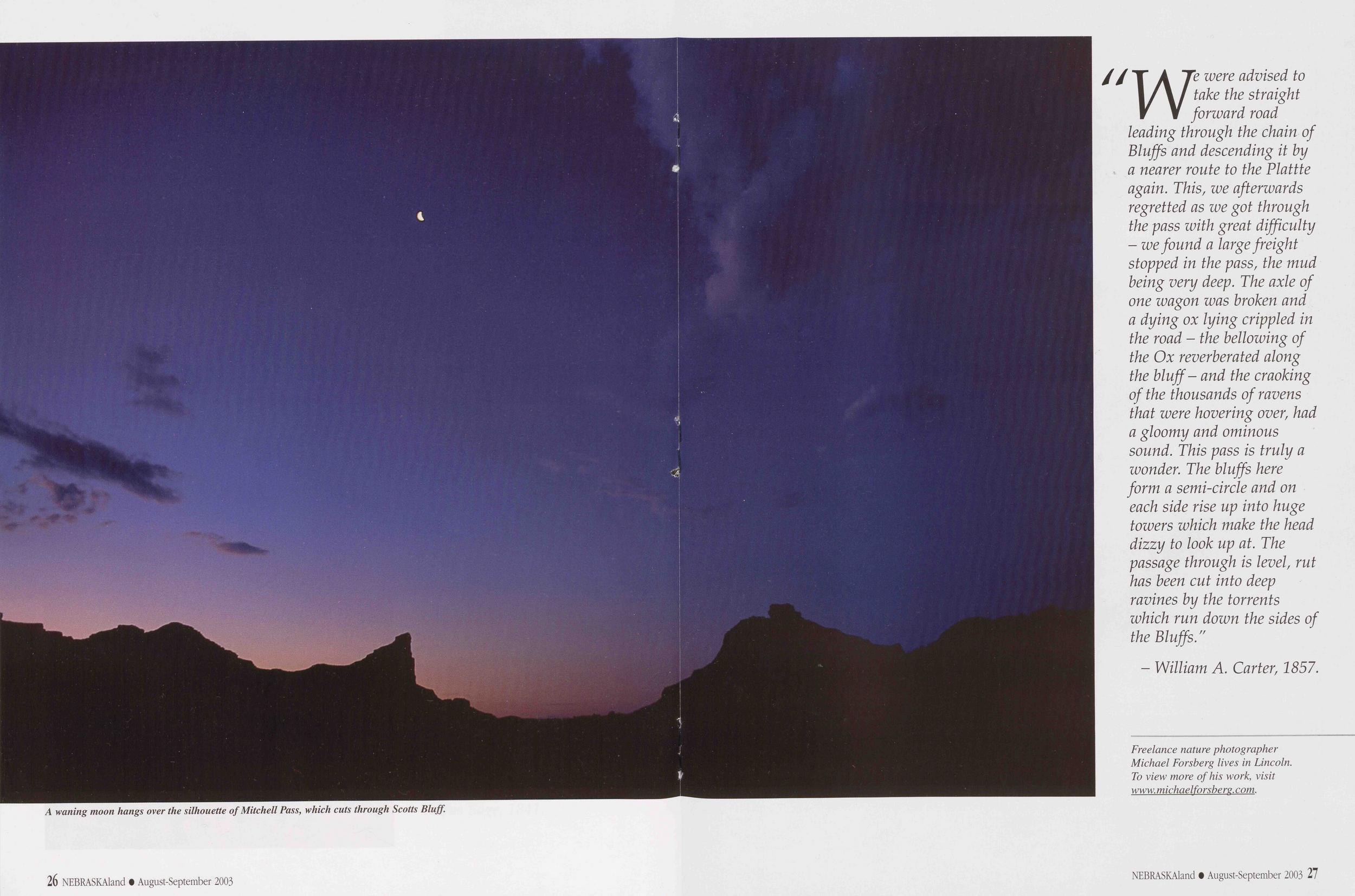
"We were advised to take the straight forward road leading through the chain of Bluffs and descending it by a nearer route to the Plattte again. This, we afterwards regretted as we got through the pass with great difficulty - we found a large freight stopped in the pass, the mud being very deep. The axle of one wagon was broken and a dying ox lying crippled in the road - the bellowing of the Ox reverberated along the bluff- and the craoking of the thousands of ravens that were hovering over, had a gloomy and ominous sound. This pass is truly a wonder. The bluffs here form a semi-circle and on each side rise up into huge towers which make the head dizzy to look up at. The passage through is level, rut has been cut into deep ravines by the torrents which run down the sides of the Bluffs."
- William A. Carter, 1857. Freelance nature photographer Michael Forsberg lives in Lincoln. To view more of his work, visit www, michaelforsberg. com. NEBRASKAland • August-September 2003 27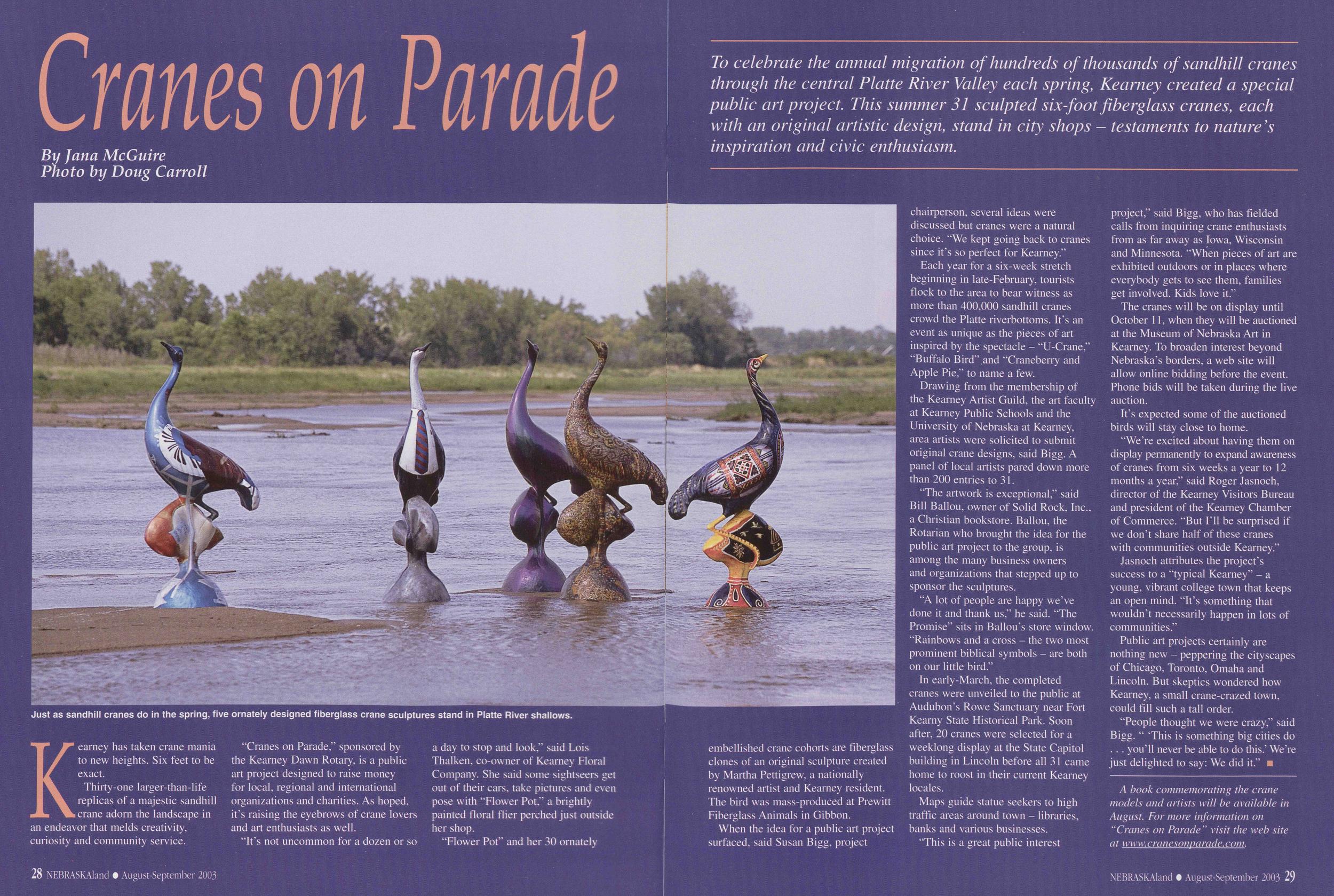
Cranes on Parade
To celebrate the annual migration of hundreds of thousands of sandhill cranes through the central Platte River Valley each spring, Kearney created a special public art project. This summer 31 sculpted six-foot fiberglass cranes, each with an original artistic design, stand in city shops - testaments to nature's inspiration and civic enthusiasm.Kearney has taken crane mania to new heights. Six feet to be exact.
Thirty-one larger-than-life replicas of a majestic sandhill k crane adorn the landscape in an endeavor that melds creativity, curiosity and community service.
"Cranes on Parade," sponsored by the Kearney Dawn Rotary, is a public art project designed to raise money for local, regional and international organizations and charities. As hoped, it's raisins the eyebrows of crane lovers and art enthusiasts as well.
"It's not uncommon for a dozen or so a day to stop and look." said Lois Thalken. co-owner of Kearney Floral Company. She said some sightseers get out of their cars, take pictures and even pose with "Flower Pot." a brightly painted floral flier perched just outside her shop.
"Flower Pot" and her 30 ornately 28 NEBRASKAland t August-September 2003 embellished crane cohorts are fiberglass clones of an original sculpture created by Martha Pettigrew, a nationally renowned artist and Kearney resident. The bird was mass-produced at Prewitt Fiberglass Animals in Gibbon.
When the idea for a public art project surfaced, said Susan Bigg, project chairperson, several ideas were discussed but cranes were a natural choice. "We kept going back to cranes since it's so perfect for Kearney."
Each year for a six-week stretch beginning in late-February, tourists flock to the area to bear witness as more than 400,000 sandhill cranes crowd the Platte riverbottoms. It's an event as unique as the pieces of art inspired by the spectacle - "U-Crane," "Buffalo Bird" and "Craneberry and Apple Pie," to name a few.
Drawing from the membership of the Kearney Artist Guild, the art faculty at Kearney Public Schools and the University of Nebraska at Kearney, area artists were solicited to submit original crane designs, said Bigg. A panel of local artists pared down more than 200 entries to 31.
"The artwork is exceptional," said Bill Ballou, owner of Solid Rock, Inc.. a Christian bookstore. Ballou, the Rotarian who brought the idea for the public art project to the group, is among the many business owners and organizations that stepped up to sponsor the sculptures.
"A lot of people are happy we've done it and thank us." he said. "The Promise" sits in Ballou's store window. "Rainbows and a cross - the two most prominent biblical symbols - are both on our little bird."
In early-March, the completed cranes were unveiled to the public at Audubon's Rowe Sanctuary near Fort Kearny State Historical Park. Soon after, 20 cranes were selected for a weeklong display at the State Capitol building in Lincoln before all 31 came home to roost in their current Kearney locales.
Maps guide statue seekers to high traffic areas around town - libraries, banks and various businesses.
"This is a great public interest project," said Bigg, who has fielded calls from inquiring crane enthusiasts from as far away as Iowa, Wisconsin and Minnesota. "When pieces of art are exhibited outdoors or in places where everybody gets to see them, families get involved. Kids love it."
The cranes will be on display until October 11, when they will be auctioned at the Museum of Nebraska At in Kearney. To broaden interest beyond Nebraska's borders, a web site will allow online bidding before the event. Phone bids will be taken during the live auction.
It's expected some of the auctioned birds will stay close to home.
"We're excited about having them on display permanently to expand awareness of cranes from six weeks a year to 12 months a year," said Roger Jasnoch, director of the Kearney Visitors Bureau and president of the Kearney Chamber of Commerce. "But I'll be surprised if we don't share half of these cranes with communities outside Kearney."
Jasnoch attributes the project's success to a "typical Kearney" - a young, vibrant college town that keeps an open mind. "It's something that wouldn't necessarily happen in lots of communities."
Public art projects certainly are nothing new - peppering the cityscapes of Chicago. Toronto, Omaha and Lincoln. But skeptics wondered how Kearney, a small crane-crazed town, could fill such a tall order.
"People thought we were crazy," said Bigg. " This is something big cities do .. . you'll never be able to do this." We're just delighted to say: We did it." m
A book commemorating the crane models and artists will be available in August. For more information on "Cranes on Parade" visit the web site at www. cranesonvarade. com. NEBRASKAland t August-Sepember 2003 29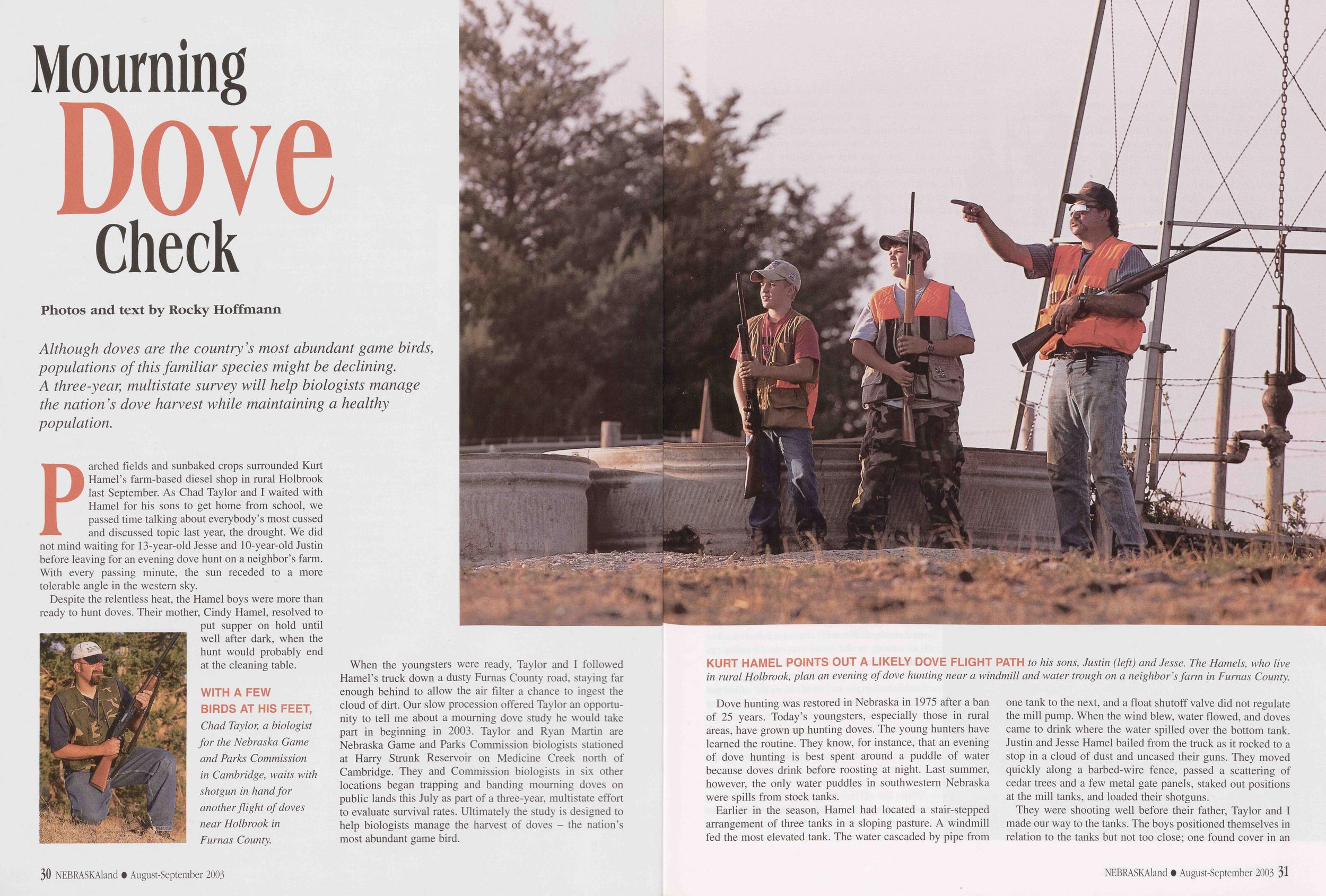
Mourning Dove Check
Photos and text by Rocky Hoffmann Although doves are the country's most abundant game birds, populations of this familiar species might be declining. A three-year, multistate survey will help biologists manage the nation's dove harvest while maintaining a healthy population.Parched fields and sunbaked crops surrounded Kurt Hamel's farm-based diesel shop in rural Holbrook last September. As Chad Taylor and I waited with Hamel for his sons to get home from school, we passed time talking about everybody's most cussed and discussed topic last year, the drought. We did not mind waiting for 13-year-old Jesse and 10-year-old Justin before leaving for an evening dove hunt on a neighbor's farm. With every passing minute, the sun receded to a more tolerable angle in the western sky.
Despite the relentless heat, the Hamel boys were more than ready to hunt doves. Their mother, Cindy Hamel, resolved to put supper on hold until well after dark, when the hunt would probably end at the cleaning table.
When the youngsters were ready, Taylor and I followed Hamel's truck down a dusty Furnas County road, staying far enough behind to allow the air filter a chance to ingest the cloud of dirt. Our slow procession offered Taylor an opportunity to tell me about a mourning dove study he would take part in beginning in 2003. Taylor and Ryan Martin are Nebraska Game and Parks Commission biologists stationed at Harry Strunk Reservoir on Medicine Creek north of Cambridge. They and Commission biologists in six other locations began trapping and banding mourning doves on public lands this July as part of a three-year, multistate effort to evaluate survival rates. Ultimately the study is designed to help biologists manage the harvest of doves - the nation's most abundant game bird.
30 NEBRASKAland • August-September 2003Dove hunting was restored in Nebraska in 1975 after a ban of 25 years. Today's youngsters, especially those in rural areas, have grown up hunting doves. The young hunters have learned the routine. They know, for instance, that an evening of dove hunting is best spent around a puddle of water because doves drink before roosting at night. Last summer, however, the only water puddles in southwestern Nebraska were spills from stock tanks.
Earlier in the season, Hamel had located a stair-stepped arrangement of three tanks in a sloping pasture. A windmill fed the most elevated tank. The water cascaded by pipe from one tank to the next, and a float shutoff valve did not regulate the mill pump. When the wind blew, water flowed, and doves came to drink where the water spilled over the bottom tank. Justin and Jesse Hamel bailed from the truck as it rocked to a stop in a cloud of dust and uncased their guns. They moved quickly along a barbed-wire fence, passed a scattering of cedar trees and a few metal gate panels, staked out positions at the mill tanks, and loaded their shotguns.
They were shooting well before their father, Taylor and I
made our way to the tanks. The boys positioned themselves in
relation to the tanks but not too close; one found cover in an
NEBRASKAland • August-September 2003 31
 irrigated cornfield and the other at a pasture fence. Kurt
Hamel took a stand near a battered clump of cattle-rubbed
cedars and Taylor moved into the pasture, where he stationed
himself next to a lone tree. Doves arrived at the overflow
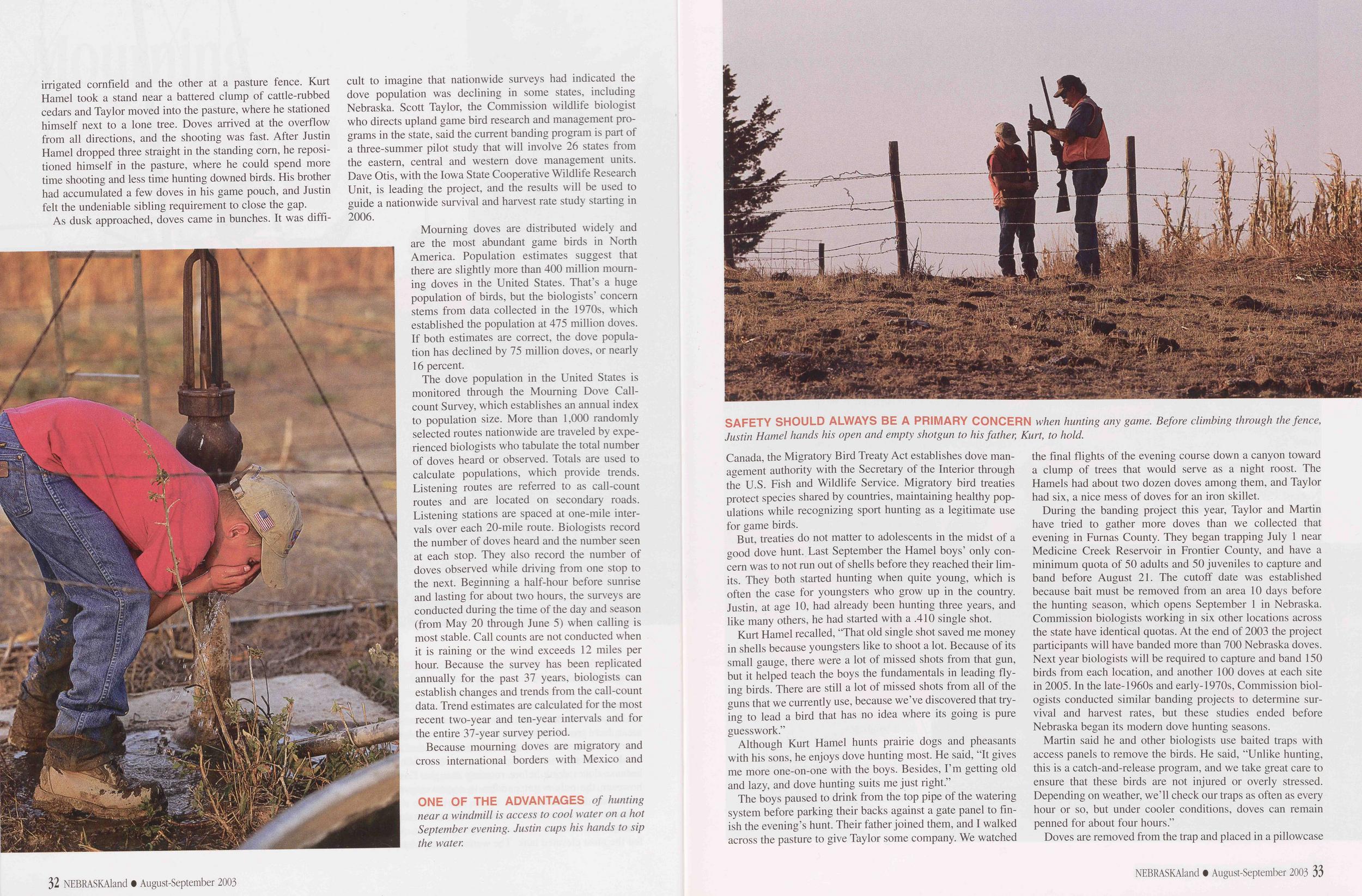
from all directions, and the shooting was fast. After Justin
Hamel dropped three straight in the standing corn, he
repositioned himself in the pasture, where he could spend more
time shooting and less time hunting downed birds. His brother
had accumulated a few doves in his game pouch, and Justin
felt the undeniable sibling requirement to close the gap.
irrigated cornfield and the other at a pasture fence. Kurt
Hamel took a stand near a battered clump of cattle-rubbed
cedars and Taylor moved into the pasture, where he stationed
himself next to a lone tree. Doves arrived at the overflow
from all directions, and the shooting was fast. After Justin
Hamel dropped three straight in the standing corn, he
repositioned himself in the pasture, where he could spend more
time shooting and less time hunting downed birds. His brother
had accumulated a few doves in his game pouch, and Justin
felt the undeniable sibling requirement to close the gap.
As dusk approached, doves came in bunches. It was difficult to imagine that nationwide surveys had indicated the dove population was declining in some states, including Nebraska. Scott Taylor, the Commission wildlife biologist who directs upland game bird research and management programs in the state, said the current banding program is part of a three-summer pilot study that will involve 26 states from the eastern, central and western dove management units. Dave Otis, with the Iowa State Cooperative Wildlife Research Unit, is leading the project, and the results will be used to guide a nationwide survival and harvest rate study starting in 2006.
Mourning doves are distributed widely and are the most abundant game birds in North America. Population estimates suggest that there are slightly more than 400 million mourning doves in the United States. That's a huge population of birds, but the biologists' concern stems from data collected in the 1970s, which established the population at 475 million doves. If both estimates are correct, the dove population has declined by 75 million doves, or nearly 16 percent.
The dove population in the United States is monitored through the Mourning Dove Call- count Survey, which establishes an annual index to population size. More than 1,000 randomly selected routes nationwide are traveled by experienced biologists who tabulate the total number of doves heard or observed. Totals are used to calculate populations, which provide trends. Listening routes are referred to as call-count routes and are located on secondary roads. Listening stations are spaced at one-mile intervals over each 20-mile route. Biologists record the number of doves heard and the number seen at each stop. They also record the number of doves observed while driving from one stop to the next. Beginning a half-hour before sunrise and lasting for about two hours, the surveys are conducted during the time of the day and season (from May 20 through June 5) when calling is most stable. Call counts are not conducted when it is raining or the wind exceeds 12 miles per hour. Because the survey has been replicated annually for the past 37 years, biologists can establish changes and trends from the call-count data. Trend estimates are calculated for the most recent two-year and ten-year intervals and for the entire 37-year survey period.
Because mourning doves are migratory and cross international borders with Mexico and
But, treaties do not matter to adolescents in the midst of a good dove hunt. Last September the Hamel boys' only concern was to not run out of shells before they reached their l imits. They both started hunting when quite young, which is often the case for youngsters who grow up in the country. Justin, at age 10, had already been hunting three years, and like many others, he had started with a .410 single shot.
Kurt Hamel recalled, "That old single shot saved me money in shells because youngsters like to shoot a lot. Because of its small gauge, there were a lot of missed shots from that gun, but it helped teach the boys the fundamentals in leading flying birds. There are still a lot of missed shots from all of the guns that we currently use, because we've discovered that trying to lead a bird that has no idea where its going is pure guesswork."
Although Kurt Hamel hunts prairie dogs and pheasants with his sons, he enjoys dove hunting most. He said, "It gives me more one-on-one with the boys. Besides, I'm getting old and lazy, and dove hunting suits me just right."
The boys paused to drink from the top pipe of the watering system before parking their backs against a gate panel to finish the evening's hunt. Their father joined them, and I walked across the pasture to give Taylor some company. We watched the final flights of the evening course down a canyon toward a clump of trees that would serve as a night roost. The Hamels had about two dozen doves among them, and Taylor had six, a nice mess of doves for an iron skillet.
During the banding project this year, Taylor and Martin have tried to gather more doves than we collected that evening in Furnas County. They began trapping July 1 near Medicine Creek Reservoir in Frontier County, and have a minimum quota of 50 adults and 50 juveniles to capture and band before August 21. The cutoff date was established because bait must be removed from an area 10 days before the hunting season, which opens September 1 in Nebraska. Commission biologists working in six other locations across the state have identical quotas. At the end of 2003 the project participants will have banded more than 700 Nebraska doves. Next year biologists will be required to capture and band 150 birds from each location, and another 100 doves at each site in 2005. In the late-1960s and early-1970s, Commission biologists conducted similar banding projects to determine survival and harvest rates, but these studies ended before Nebraska began its modern dove hunting seasons.
Martin said he and other biologists use baited traps with access panels to remove the birds. He said, "Unlike hunting, this is a catch-and-release program, and we take great care to ensure that these birds are not injured or overly stressed. Depending on weather, we'll check our traps as often as every hour or so, but under cooler conditions, doves can remain penned for about four hours."
Doves are removed from the trap and placed in a pillowcase
NEBRASKAland • August-September 2003 33
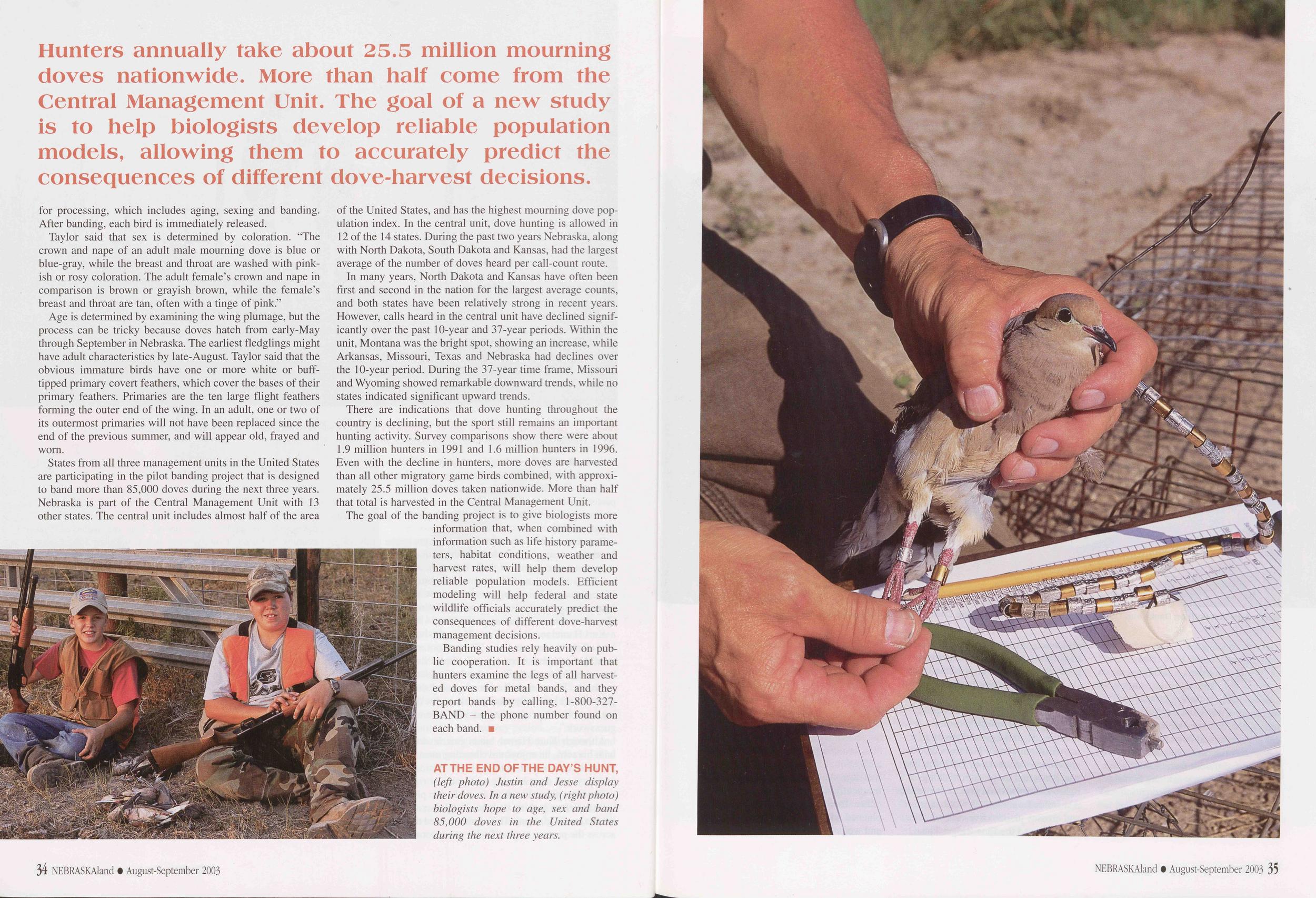 for processing, which includes aging, sexing and banding.
After banding, each bird is immediately released.
for processing, which includes aging, sexing and banding.
After banding, each bird is immediately released.
Taylor said that sex is determined by coloration. "The crown and nape of an adult male mourning dove is blue or blue-gray, while the breast and throat are washed with pinkish or rosy coloration. The adult female's crown and nape in comparison is brown or grayish brown, while the female's breast and throat are tan, often with a tinge of pink."
Age is determined by examining the wing plumage, but the process can be tricky because doves hatch from early-May through September in Nebraska. The earliest fledglings might have adult characteristics by late-August. Taylor said that the obvious immature birds have one or more white or buff- tipped primary covert feathers, which cover the bases of their primary feathers. Primaries are the ten large flight feathers forming the outer end of the wing. In an adult, one or two of its outermost primaries will not have been replaced since the end of the previous summer, and will appear old, frayed and worn.
States from all three management units in the United States are participating in the pilot banding project that is designed to band more than 85,000 doves during the next three years. Nebraska is part of the Central Management Unit with 13 other states. The central unit includes almost half of the area of the United States, and has the highest mourning dove population index. In the central unit, dove hunting is allowed in 12 of the 14 states. During the past two years Nebraska, along with North Dakota, South Dakota and Kansas, had the largest average of the number of doves heard per call-count route.
In many years, North Dakota and Kansas have often been first and second in the nation for the largest average counts, and both states have been relatively strong in recent years. However, calls heard in the central unit have declined significantly over the past 10-year and 37-year periods. Within the unit, Montana was the bright spot, showing an increase, while Arkansas, Missouri, Texas and Nebraska had declines over the 10-year period. During the 37-year time frame, Missouri and Wyoming showed remarkable downward trends, while no states indicated significant upward trends.
There are indications that dove hunting throughout the country is declining, but the sport still remains an important hunting activity. Survey comparisons show there were about 1.9 million hunters in 1991 and 1.6 million hunters in 1996. Even with the decline in hunters, more doves are harvested than all other migratory game birds combined, with approximately 25.5 million doves taken nationwide. More than half that total is harvested in the Central Management Unit.
The goal of the banding project is to give biologists more information that, when combined with information such as life history parameters, habitat conditions, weather and harvest rates, will help them develop reliable population models. Efficient modeling will help federal and state wildlife officials accurately predict the consequences of different dove-harvest management decisions.
Banding studies rely heavily on public cooperation. It is important that hunters examine the legs of all harvested doves for metal bands, and they report bands by calling, 1-800-327-BAND - the phone number found on each band, a
HORSEBACK ON THE COWBOY TRAIL
By Phil Richmond I proposed the idea - to ride about 100 miles along the old Chicago & North Western Railroad corridor- to two friends, and signed them on in a matter of minutes. Our trip went less smoothly, requiring several changes in plans along the way. But no obstacle could dampen our enthusiasm for the wild, scenic beauty we discovered along the historical route across northern Nebraska.As a kid, I enjoyed sitting in the back of my folks' sedan on family vacations, sipping sodas, staring at the landscape, and dreaming about what was just over the hill where the road didn't go. But the car never swerved from the beaten path, never took me over a hill that I dreamed must look different than those scarred by pavement. So a weeklong horseback trek down the Cowboy Recreation and Nature Trail was, in many ways, a chance to revisit childhood dreams. It was a chance to touch and feel my romantic notions about the old West - to sample what it feels like to move great distances the old-fashioned way, slowly, and to explore beyond the road.
I proposed the idea - to ride about 100 miles along the old Chicago & North Western Railroad corridor - to two friends, and signed them on in a matter of minutes. When the C&NW abandoned the tracks in 1992, the line was converted to the nation's longest rail-to-trail conversion project. It stretches 321 miles from Norfolk to Chadron, and crosses plains, river valleys, Sandhills and the Pine Ridge. The Nebraska Game and Parks Commission operates and maintains the trail.
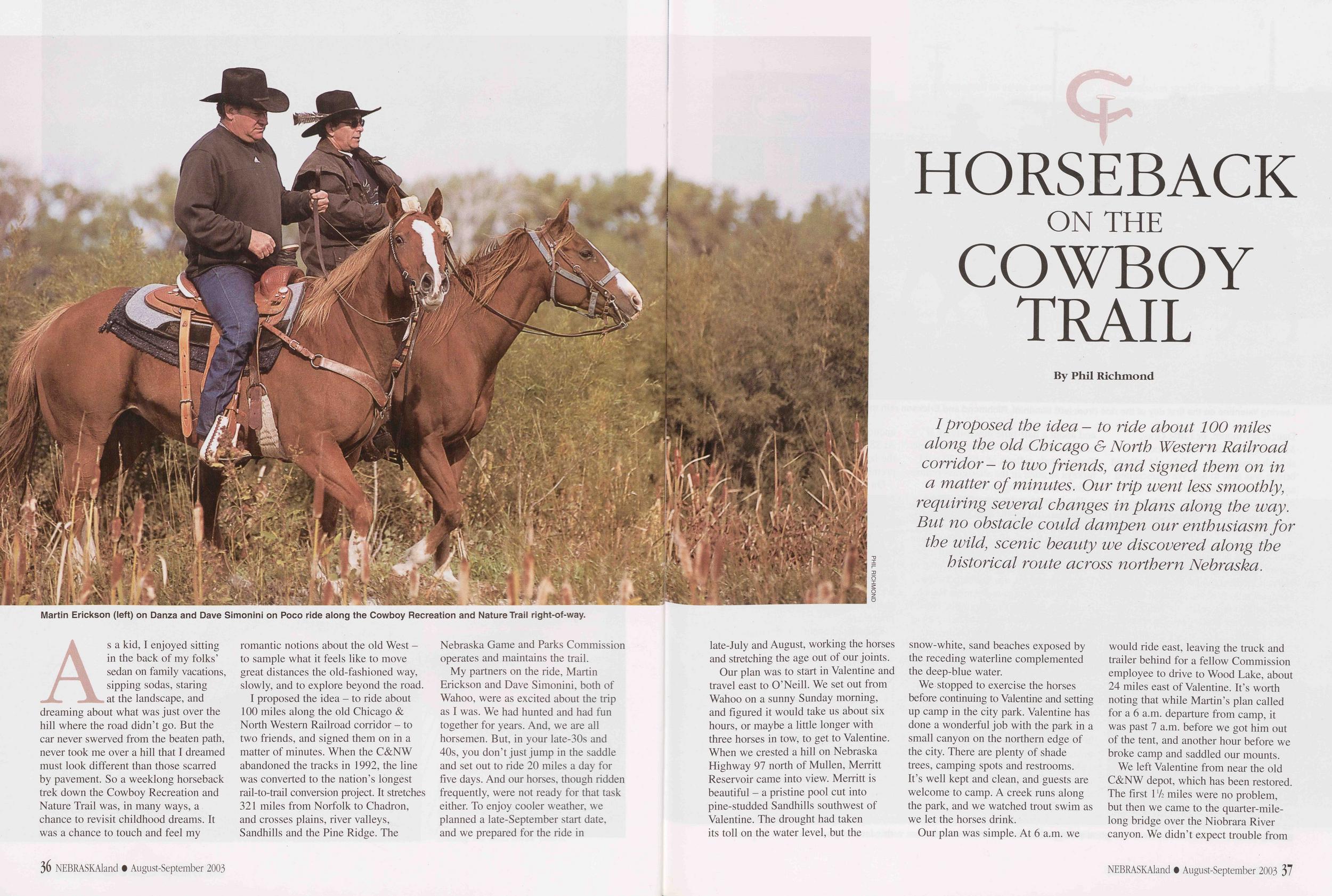
My partners on the ride, Martin Erickson and Dave Simonini, both of Wahoo, were as excited about the trip as I was. We had hunted and had fun together for years. And, we are all horsemen. But, in your late-30s and 40s, you don't just jump in the saddle and set out to ride 20 miles a day for five days. And our horses, though ridden frequently, were not ready for that task either. To enjoy cooler weather, we planned a late-September start date, and we prepared for the ride in 36 NEBRASKAland • August-September 2003 late-July and August, working the horses and stretching the age out of our joints.
Our plan was to start in Valentine and travel east to O'Neill. We set out from Wahoo on a sunny Sunday morning, and figured it would take us about six hours, or maybe a little longer with three horses in tow, to get to Valentine. When we crested a hill on Nebraska Highway 97 north of Mullen, Merritt Reservoir came into view. Merritt is beautiful - a pristine pool cut into pine-studded Sandhills southwest of Valentine. The drought had taken its toll on the water level, but the snow-white, sand beaches exposed by the receding waterline complemented the deep-blue water.
We stopped to exercise the horses before continuing to Valentine and setting up camp in the city park. Valentine has done a wonderful job with the park in a small canyon on the northern edge of the city. There are plenty of shade trees, camping spots and restrooms. It's well kept and clean, and guests are welcome to camp. A creek runs along the park, and we watched trout swim as we let the horses drink.
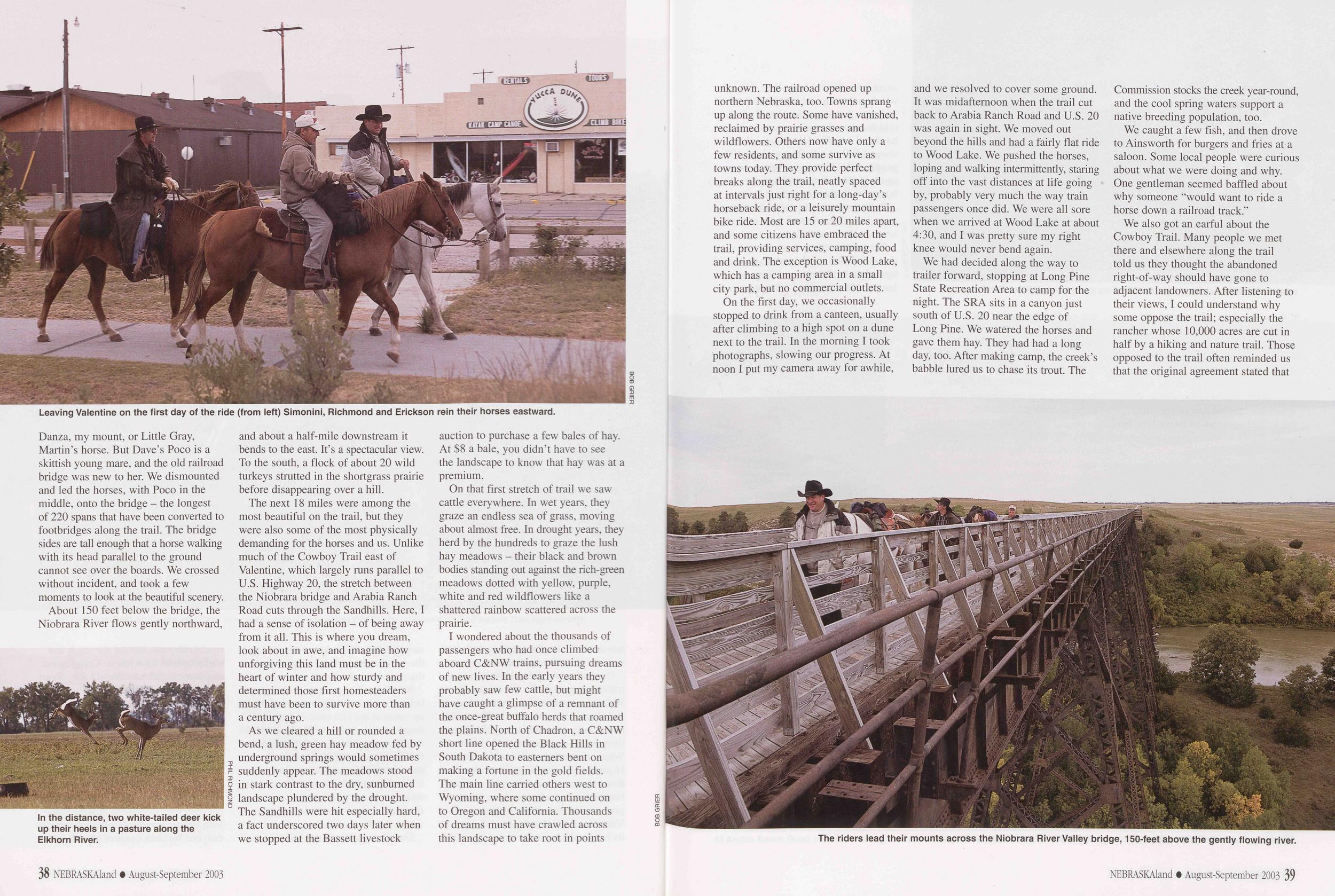
Our plan was simple. At 6 a.m. we would ride east, leaving the truck and trailer behind for a fellow Commission employee to drive to Wood Lake, about 24 miles east of Valentine. It's worth noting that while Martin's plan called for a 6 a.m. departure from camp, it was past 7 a.m. before we got him out of the tent, and another hour before we broke camp and saddled our mounts.
We left Valentine from near the old
C&NW depot, which has been restored.
The first 1 lk miles were no problem,
but then we came to the quarter-mile-long
bridge over the Niobrara River
canyon. We didn't expect trouble from
NEBRASKAland • August-September 2003 37
and about a half-mile downstream it bends to the east. It's a spectacular view. To the south, a flock of about 20 wild turkeys strutted in the shortgrass prairie before disappearing over a hill.
The next 18 miles were among the most beautiful on the trail, but they were also some of the most physically demanding for the horses and us. Unlike much of the Cowboy Trail east of Valentine, which largely runs parallel to U.S. Highway 20, the stretch between the Niobrara bridge and Arabia Ranch Road cuts through the Sandhills. Here, I had a sense of isolation - of being away from it all. This is where you dream, look about in awe, and imagine how unforgiving this land must be in the heart of winter and how sturdy and determined those first homesteaders must have been to survive more than a century ago.
As we cleared a hill or rounded a bend, a lush, green hay meadow fed by underground springs would sometimes suddenly appear. The meadows stood in stark contrast to the dry, sunburned landscape plundered by the drought. The Sandhills were hit especially hard, a fact underscored two days later when we stopped at the Bassett livestock auction to purchase a few bales of hay. At $8 a bale, you didn't have to see the landscape to know that hay was at a premium.
On that first stretch of trail we saw cattle everywhere. In wet years, they graze an endless sea of grass, moving about almost free. In drought years, they herd by the hundreds to graze the lush hay meadows - their black and brown bodies standing out against the rich-green meadows dotted with yellow, purple, white and red wildflowers like a shattered rainbow scattered across the prairie.
I wondered about the thousands of passengers who had once climbed aboard C&NW trains, pursuing dreams of new lives. In the early years they probably saw few cattle, but might have caught a glimpse of a remnant of the once-great buffalo herds that roamed the plains. North of Chadron, a C&NW short line opened the Black Hills in South Dakota to easterners bent on making a fortune in the gold fields. The main line carried others west to Wyoming, where some continued on to Oregon and California. Thousands of dreams must have crawled across this landscape to take root in points 38 NEBRASKAland • August-September 2003 unknown. The railroad opened up northern Nebraska, too. Towns sprang up along the route. Some have vanished, reclaimed by prairie grasses and wildflowers. Others now have only a few residents, and some survive as towns today. They provide perfect breaks along the trail, neatly spaced at intervals just right for a long-day's horseback ride, or a leisurely mountain bike ride. Most are 15 or 20 miles apart, and some citizens have embraced the trail, providing services, camping, food and drink. The exception is Wood Lake, which has a camping area in a small city park, but no commercial outlets.
On the first day, we occasionally stopped to drink from a canteen, usually after climbing to a high spot on a dune next to the trail. In the morning I took photographs, slowing our progress. At noon I put my camera away for awhile, and we resolved to cover some ground. It was midafternoon when the trail cut back to Arabia Ranch Road and U.S. 20 was again in sight. We moved out beyond the hills and had a fairly flat ride to Wood Lake. We pushed the horses, loping and walking intermittently, staring off into the vast distances at life going by, probably very much the way train passengers once did. We were all sore when we arrived at Wood Lake at about 4:30, and I was pretty sure my right knee would never bend again.
We had decided along the way to trailer forward, stopping at Long Pine State Recreation Area to camp for the night. The SRA sits in a canyon just south of U.S. 20 near the edge of Long Pine. We watered the horses and gave them hay. They had had a long day, too. After making camp, the creek's babble lured us to chase its trout. The Commission stocks the creek year-round, and the cool spring waters support a native breeding population, too.
We caught a few fish, and then drove to Ainsworth for burgers and fries at a saloon. Some local people were curious about what we were doing and why. One gentleman seemed baffled about why someone "would want to ride a horse down a railroad track."
We also got an earful about the Cowboy Trail. Many people we met there and elsewhere along the trail told us they thought the abandoned right-of-way should have gone to adjacent landowners. After listening to their views, I could understand why some oppose the trail; especially the rancher whose 10,000 acres are cut in half by a hiking and nature trail. Those opposed to the trail often reminded us that the original agreement stated that
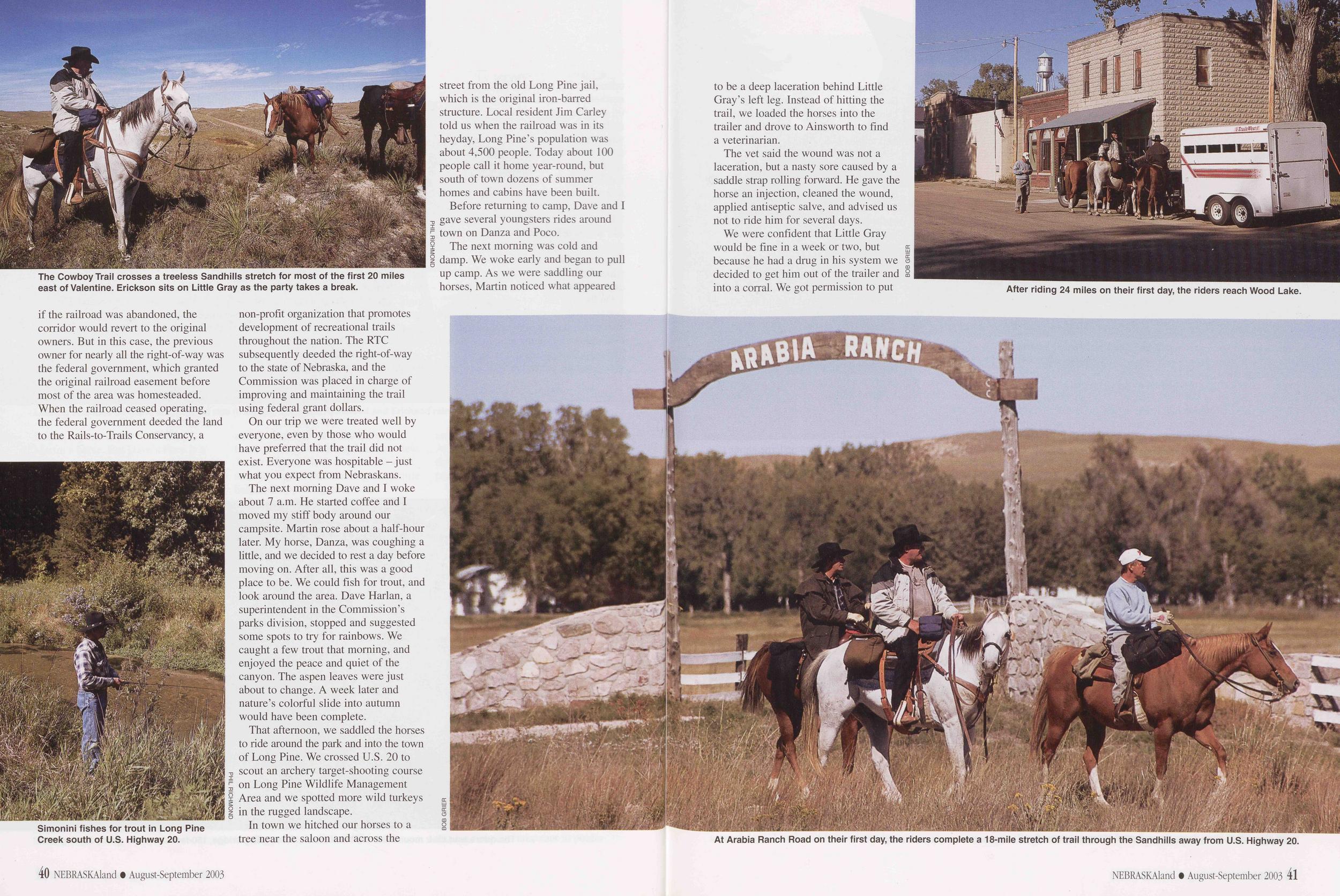
On our trip we were treated well by everyone, even by those who would have preferred that the trail did not exist. Everyone was hospitable -just what you expect from Nebraskans.
The next morning Dave and I woke about 7 a.m. He started coffee and I moved my stiff body around our campsite. Martin rose about a half-hour later. My horse, Danza, was coughing a little, and we decided to rest a day before moving on. After all, this was a good place to be. We could fish for trout, and look around the area. Dave Harlan, a superintendent in the Commission's parks division, stopped and suggested some spots to try for rainbows. We caught a few trout that morning, and enjoyed the peace and quiet of the canyon. The aspen leaves were just about to change. A week later and nature's colorful slide into autumn would have been complete.
That afternoon, we saddled the horses to ride around the park and into the town of Long Pine. We crossed U.S. 20 to scout an archery target-shooting course on Long Pine Wildlife Management Area and we spotted more wild turkeys in the rugged landscape.
In town we hitched our horses to a tree near the saloon and across the street from the old Long Pine jail, which is the original iron-barred structure. Local resident Jim Carley told us when the railroad was in its heyday, Long Pine's population was about 4,500 people. Today about 100 people call it home year-round, but south of town dozens of summer homes and cabins have been built.
Before returning to camp, Dave and I gave several youngsters rides around town on Danza and Poco.
The next morning was cold and damp. We woke early and began to pull up camp. As we were saddling our horses, Martin noticed what appeared 40 NEBRASKAland • August-September 2003 to be a deep laceration behind Little Gray's left leg. Instead of hitting the trail, we loaded the horses into the trailer and drove to Ainsworth to find a veterinarian.
The vet said the wound was not a laceration, but a nasty sore caused by a saddle strap rolling forward. He gave the horse an injection, cleaned the wound, applied antiseptic salve, and advised us not to ride him for several days.
We were confident that Little Gray would be fine in a week or two, but because he had a drug in his system we decided to get him out of the trailer and into a corral. We got permission to put
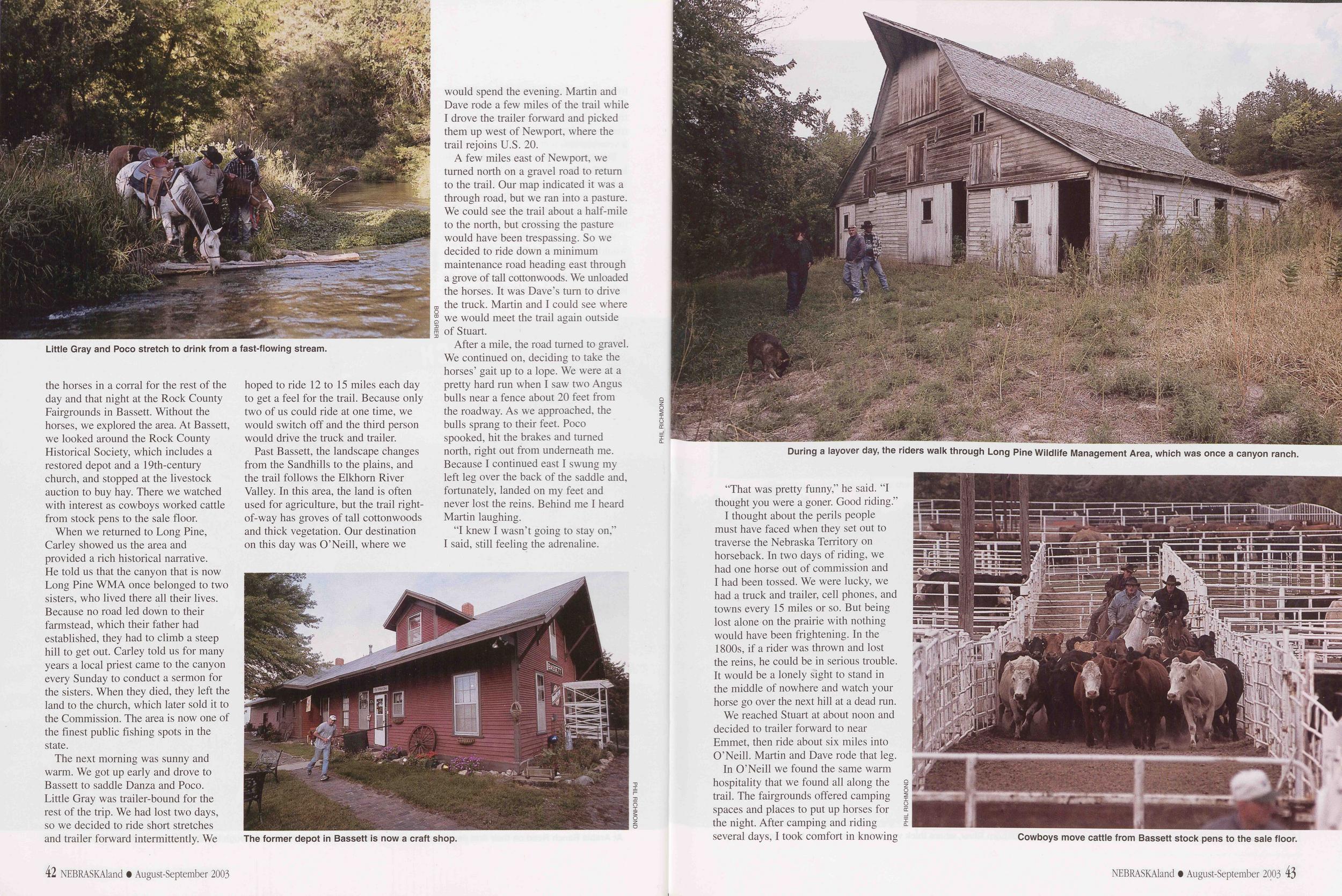
When we returned to Long Pine, Carley showed us the area and provided a rich historical narrative. He told us that the canyon that is now Long Pine WMA once belonged to two sisters, who lived there all their lives. Because no road led down to their farmstead, which their father had established, they had to climb a steep hill to get out. Carley told us for many years a local priest came to the canyon every Sunday to conduct a sermon for the sisters. When they died, they left the land to the church, which later sold it to the Commission. The area is now one of the finest public fishing spots in the state.
The next morning was sunny and warm. We got up early and drove to Bassett to saddle Danza and Poco. Little Gray was trailer-bound for the rest of the trip. We had lost two days, so we decided to ride short stretches and trailer forward intermittently. We hoped to ride 12 to 15 miles each day to get a feel for the trail. Because only two of us could ride at one time, we would switch off and the third person would drive the truck and trailer.
Past Bassett, the landscape changes from the Sandhills to the plains, and the trail follows the Elkhorn River Valley. In this area, the land is often used for agriculture, but the trail right-of-way has groves of tall cottonwoods and thick vegetation. Our destination on this day was O'Neill, where we would spend the evening. Martin and Dave rode a few miles of the trail while I drove the trailer forward and picked them up west of Newport, where the trail rejoins U.S. 20.
A few miles east of Newport, we turned north on a gravel road to return to the trail. Our map indicated it was a through road, but we ran into a pasture. We could see the trail about a half-mile to the north, but crossing the pasture would have been trespassing. So we decided to ride down a minimum maintenance road heading east through a grove of tall cottonwoods. We unloaded the horses. It was Dave's turn to drive the truck. Martin and I could see where we would meet the trail again outside m of Stuart.
"I knew I wasn't going to stay on," I said, still feeling the adrenaline.
The former depot in Bassett is now a craft shop. "That was pretty funny," he said. "I thought you were a goner. Good riding."
I thought about the perils people must have faced when they set out to traverse the Nebraska Territory on horseback. In two days of riding, we had one horse out of commission and I had been tossed. We were lucky, we had a truck and trailer, cell phones, and towns every 15 miles or so. But being lost alone on the prairie with nothing would have been frightening. In the 1800s, if a rider was thrown and lost the reins, he could be in serious trouble. It would be a lonely sight to stand in the middle of nowhere and watch your horse go over the next hill at a dead run.
We reached Stuart at about noon and decided to trailer forward to near Emmet, then ride about six miles into O'Neill. Martin and Dave rode that leg.
In O'Neill we found the same warm hospitality that we found all along the trail. The fairgrounds offered camping spaces and places to put up horses for the night. After camping and riding several days, I took comfort in knowing
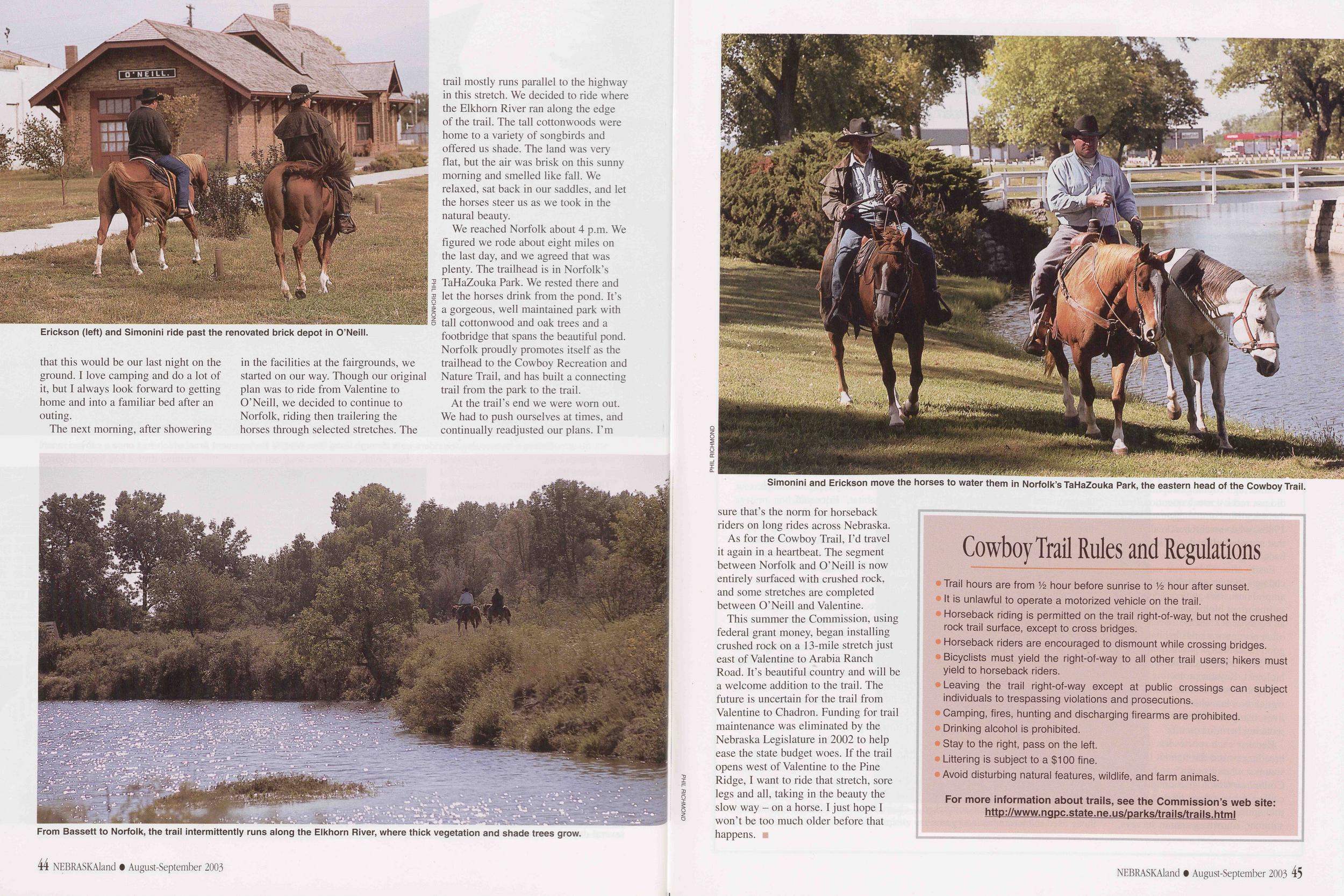
The next morning, after showering in the facilities at the fairgrounds, we started on our way. Though our original plan was to ride from Valentine to O'Neill, we decided to continue to Norfolk, riding then trailering the horses through selected stretches. The trail mostly runs parallel to the highway in this stretch. We decided to ride where the Elkhorn River ran along the edge of the trail. The tall cotton woods were home to a variety of songbirds and offered us shade. The land was very flat, but the air was brisk on this sunny morning and smelled like fall. We relaxed, sat back in our saddles, and let the horses steer us as we took in the natural beauty.
We reached Norfolk about 4 p.m. We figured we rode about eight miles on the last day, and we agreed that was plenty. The trailhead is in Norfolk's TaHaZouka Park. We rested there and let the horses drink from the pond. It's a gorgeous, well maintained park with tall cottonwood and oak trees and a footbridge that spans the beautiful pond. Norfolk proudly promotes itself as the trailhead to the Cowboy Recreation and Nature Trail, and has built a connecting trail from the park to the trail.
At the trail's end we were worn out. We had to push ourselves at times, and continually readjusted our plans. I'm
As for the Cowboy Trail, I'd travel it again in a heartbeat. The segment between Norfolk and O'Neill is now entirely surfaced with crushed rock, and some stretches are completed between O'Neill and Valentine.
This summer the Commission, using federal grant money, began installing crushed rock on a 13-mile stretch just east of Valentine to Arabia Ranch Road. It's beautiful country and will be a welcome addition to the trail. The future is uncertain for the trail from Valentine to Chadron. Funding for trail maintenance was eliminated by the Nebraska Legislature in 2002 to help ease the state budget woes. If the trail opens west of Valentine to the Pine Ridge, I want to ride that stretch, sore legs and all, taking in the beauty the slow way - on a horse. I just hope I won't be too much older before that happens, i
Cowboy Trail Rules and Regulations Trail hours are from Vz hour before sunrise to Vz hour after sunset. It is unlawful to operate a motorized vehicle on the trail. Horseback riding is permitted on the trail right-of-way, but not the crushed rock trail surface, except to cross bridges. Horseback riders are encouraged to dismount while crossing bridges. Bicyclists must yield the right-of-way to all other trail users; hikers must yield to horseback riders. Leaving the trail right-of-way except at public crossings can subject individuals to trespassing violations and prosecutions. Camping, fires, hunting and discharging firearms are prohibited. Drinking alcohol is prohibited. Stay to the right, pass on the left. Littering is subject to a $100 fine. Avoid disturbing natural features, wildlife, and farm animals. For more information about trails, see the Commission's web site: http://www.nqpc.state.ne.us/parks/trails/trails.html NEBRASKAland • August-September 2003 45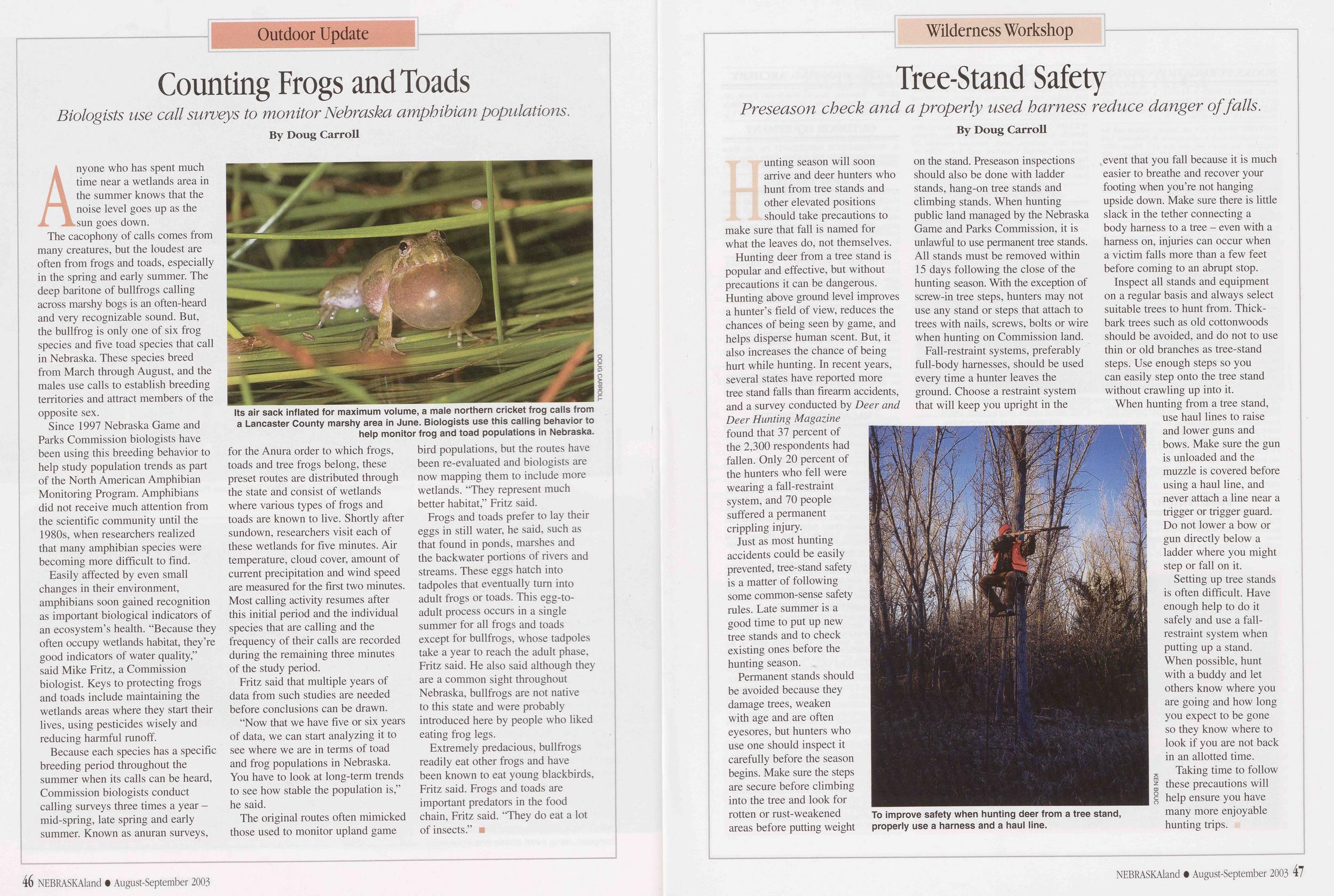
Outdoor Update
Counting Frogs and Toads
Biologists use call surveys to monitor Nebraska amphibian populations. By Doug CarrollAnyone who has spent much time near a wetlands area in the summer knows that the noise level goes up as the sun goes down.
The cacophony of calls comes from many creatures, but the loudest are often from frogs and toads, especially in the spring and early summer. The deep baritone of bullfrogs calling across marshy bogs is an often-heard and very recognizable sound. But, the bullfrog is only one of six frog species and five toad species that call in Nebraska. These species breed from March through August, and the males use calls to establish breeding territories and attract members of the opposite sex.
Since 1997 Nebraska Game and Parks Commission biologists have been using this breeding behavior to help study population trends as part of the North American Amphibian Monitoring Program. Amphibians did not receive much attention from the scientific community until the 1980s, when researchers realized that many amphibian species were becoming more difficult to find.
Easily affected by even small changes in their environment, amphibians soon gained recognition as important biological indicators of an ecosystem's health. "Because they often occupy wetlands habitat, they're good indicators of water quality," said Mike Fritz, a Commission biologist. Keys to protecting frogs and toads include maintaining the wetlands areas where they start their lives, using pesticides wisely and reducing harmful runoff.
Because each species has a specific breeding period throughout the summer when its calls can be heard, Commission biologists conduct calling surveys three times a year - mid-spring, late spring and early summer. Known as anuran surveys, for the Anura order to which frogs, toads and tree frogs belong, these preset routes are distributed through the state and consist of wetlands where various types of frogs and toads are known to live. Shortly after sundown, researchers visit each of these wetlands for five minutes. Air temperature, cloud cover, amount of current precipitation and wind speed are measured for the first two minutes. Most calling activity resumes after this initial period and the individual species that are calling and the frequency of their calls are recorded during the remaining three minutes of the study period.
Fritz said that multiple years of data from such studies are needed before conclusions can be drawn.
"Now that we have five or six years of data, we can start analyzing it to see where we are in terms of toad and frog populations in Nebraska. You have to look at long-term trends to see how stable the population is," he said.
The original routes often mimicked those used to monitor upland game bird populations, but the routes have been re-evaluated and biologists are now mapping them to include more wetlands. "They represent much better habitat," Fritz said.
Frogs and toads prefer to lay their eggs in still water, he said, such as that found in ponds, marshes and the backwater portions of rivers and streams. These eggs hatch into tadpoles that eventually turn into adult frogs or toads. This egg-to-adult process occurs in a single summer for all frogs and toads except for bullfrogs, whose tadpoles take a year to reach the adult phase, Fritz said. He also said although they are a common sight throughout Nebraska, bullfrogs are not native to this state and were probably introduced here by people who liked eating frog legs.
Extremely predacious, bullfrogs readily eat other frogs and have been known to eat young blackbirds, Fritz said. Frogs and toads are important predators in the food chain, Fritz said. "They do eat a lot of insects."
46 NEBRASKAland • August-September 2003Wilderness Workshop
Tree-Stand Safety
Preseason check and a properly used harness reduce danger of falls. By Doug CarrollHunting season will soon arrive and deer hunters who hunt from tree stands and other elevated positions should take precautions to make sure that fall is named for what the leaves do, not themselves.
Hunting deer from a tree stand is popular and effective, but without precautions it can be dangerous. Hunting above ground level improves a hunter's field of view, reduces the chances of being seen by game, and helps disperse human scent. But, it also increases the chance of being hurt while hunting. In recent years, several states have reported more tree stand falls than firearm accidents, and a survey conducted by Deer and Deer Hunting Magazine found that 37 percent of the 2,300 respondents had fallen. Only 20 percent of the hunters who fell were wearing a fall-restraint system, and 70 people suffered a permanent crippling injury.
Just as most hunting accidents could be easily prevented, tree-stand safety is a matter of following some common-sense safety rules. Late summer is a good time to put up new tree stands and to check existing ones before the hunting season.
Permanent stands should be avoided because they damage trees, weaken with age and are often eyesores, but hunters who use one should inspect it carefully before the season begins. Make sure the steps are secure before climbing into the tree and look for rotten or rust-weakened areas before putting weight on the stand. Preseason inspections should also be done with ladder stands, hang-on tree stands and climbing stands. When hunting public land managed by the Nebraska Game and Parks Commission, it is unlawful to use permanent tree stands. All stands must be removed within 15 days following the close of the hunting season. With the exception of screw-in tree steps, hunters may not use any stand or steps that attach to trees with nails, screws, bolts or wire when hunting on Commission land.
Fall-restraint systems, preferably full-body harnesses, should be used every time a hunter leaves the ground. Choose a restraint system that will keep you upright in the event that you fall because it is much easier to breathe and recover your footing when you're not hanging upside down. Make sure there is little slack in the tether connecting a body harness to a tree - even with a harness on, injuries can occur when a victim falls more than a few feet before coming to an abrupt stop.
Inspect all stands and equipment on a regular basis and always select suitable trees to hunt from. Thick bark trees such as old cottonwoods should be avoided, and do not to use thin or old branches as tree-stand steps. Use enough steps so you can easily step onto the tree stand without crawling up into it.
When hunting from a tree stand, use haul lines to raise and lower guns and bows. Make sure the gun is unloaded and the muzzle is covered before using a haul line, and never attach a line near a trigger or trigger guard. Do not lower a bow or gun directly below a ladder where you might step or fall on it.
Setting up tree stands is often difficult. Have enough help to do it safely and use a fall restraint system when putting up a stand. When possible, hunt with a buddy and let others know where you are going and how long you expect to be gone so they know where to look if you are not back in an allotted time.
Taking time to follow these precautions will help ensure you have many more enjoyable hunting trips.
NEBRASKAland • August-September 2003 47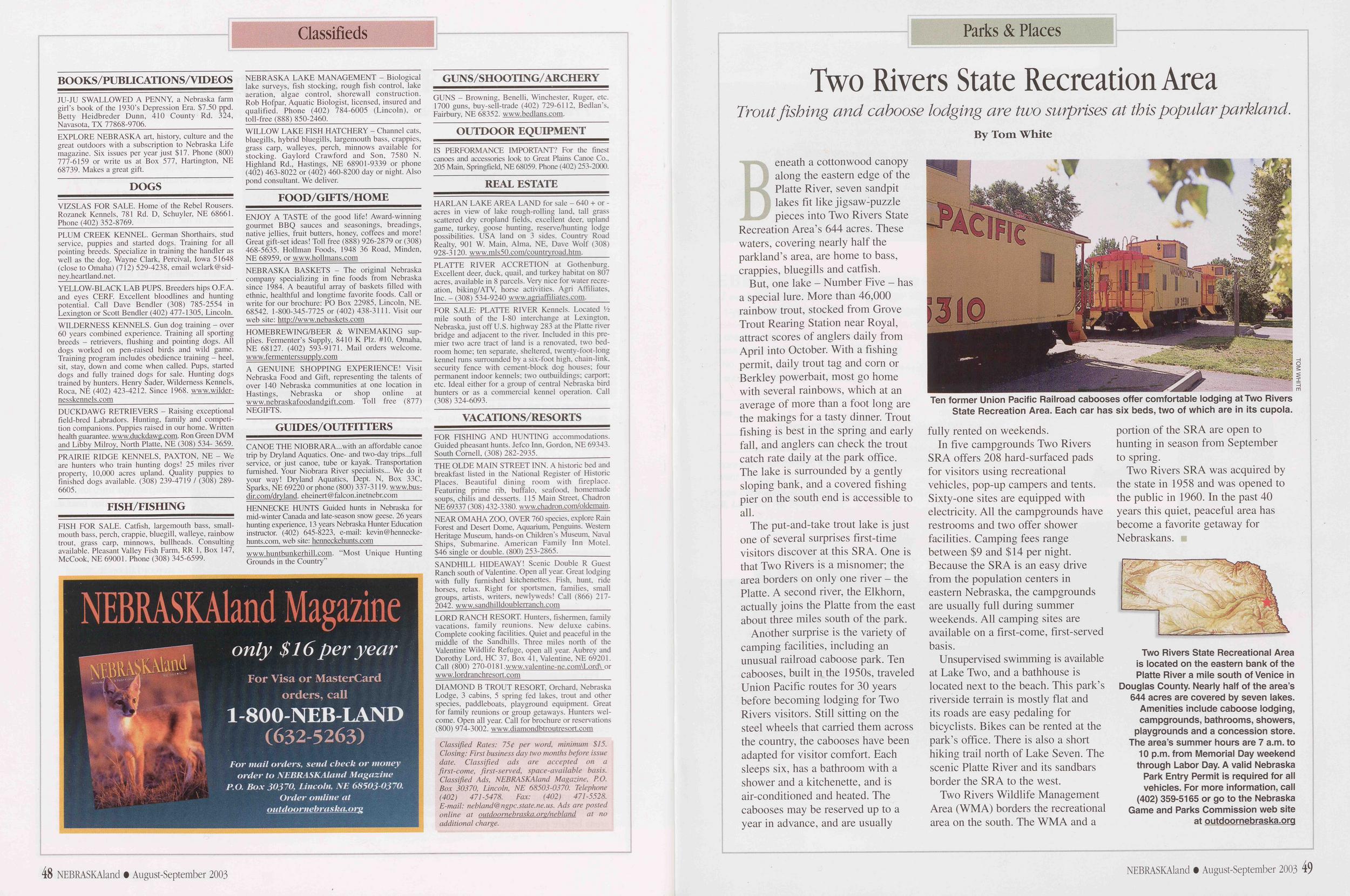
Classifieds
BOOKS/PUBLICATIONS/VIDEOSJU-JU SWALLOWED A PENNY, a Nebraska farm girl's book of the 1930's Depression Era. $7.50 ppd. Betty Heidbreder Dunn, 410 County Rd. 324, Navasota, TX 77868-9706.______________________
EXPLORE NEBRASKA art, history, culture and the great outdoors with a subscription to Nebraska Life magazine. Six issues per year just $17. Phone (800) 777-6159 or write us at Box 577, Hartington, NE 68739. Makes a great gift.
_____________DOGS_____________VIZSLAS FOR SALE. Home of the Rebel Rousers. Rozanek Kennels, 781 Rd. D, Schuyler, NE 68661. Phone (402) 352-8769._________________________
PLUM CREEK KENNEL. German Shorthairs, stud service, puppies and started dogs. Training for all pointing breeds. Specialize in training the handler as well as the dog. Wayne Clark, Percival, Iowa 51648 (close to Omaha) (712) 529-4238, email wclark@sid-ney.heartland.net.
YELLOW-BLACK LAB PUPS. Breeders hips O.F.A. and eyes CERE. Excellent bloodlines and hunting potential. Call Dave Bendler (308) 785-2554 in Lexington or Scott Bendler (402) 477-1305, Lincoln.
WILDERNESS KENNELS. Gun dog training - over 60 years combined experience. Training all sporting breeds - retrievers, flushing and pointing dogs. All dogs worked on pen-raised birds and wild game. Training program includes obedience training - heel, sit, stay, down and come when called. Pups, started dogs and fully trained dogs for sale. Hunting dogs trained by hunters. Henry Sader, Wilderness Kennels, Roca, NE (402) 423-4212. Since 1968. www.wildernesskennels.com
DUCKDAWG RETRIEVERS - Raising exceptional field-bred Labradors. Hunting, family and competition companions. Puppies raised in our home. Written health guarantee, www.duckdawg.com. Ron Green DVM and Libby Milroy, North Platte, NE (308) 534- 3659.
PRAIRIE RIDGE KENNELS, PAXTON, NE - We are hunters who train hunting dogs! 25 miles river property, 10,000 acres upland. Quality puppies to finished dogs available. (308) 239-4719 / (308) 289-6605.
_________FISH/FISHING_________FISH FOR SALE. Catfish, largemouth bass, smallmouth bass, perch, crappie, bluegill, walleye, rainbow trout, grass carp, minnows, bullheads. Consulting available. Pleasant Valley Fish Farm, RR 1, Box 147, McCook, NE 69001. Phone (308) 345-6599.
NEBRASKA LAKE MANAGEMENT - Biological lake surveys, fish stocking, rough fish control, lake aeration, algae control, shorewall construction. Rob Hofpar, Aquatic Biologist, licensed, insured and qualified. Phone (402) 784-6005 (Lincoln), or toll-free (888) 850-2460._______________________
WILLOW LAKE FISH HATCHERY - Channel cats, bluegills, hybrid bluegills, largemouth bass, crappies, grass carp, walleyes, perch, minnows available for stocking. Gaylord Crawford and Son, 7580 N. Highland Rd., Hastings, NE 68901-9339 or phone (402) 463-8022 or (402) 460-8200 day or night. Also pond consultant. We deliver.
FOOD/GIFTS/HOMEENJOY A TASTE of the good life! Award-winning gourmet BBQ sauces and seasonings, breadings, native jellies, fruit butters, honey, coffees and more! Great gift-set ideas! Toll free (888) 926-2879 or (308) 468-5635. Hollman Foods, 1948 36 Road, Minden, NE 68959, or www.hollmans.com
NEBRASKA BASKETS - The original Nebraska company specializing in fine foods from Nebraska since 1984. A beautiful array of baskets filled with ethnic, healthful and longtime favorite foods. Call or write for our brochure: PO Box 22985, Lincoln, NE. 68542. 1-800-345-7725 or (402) 438-3111. Visit our web site: http://www.nebaskets.com
HOMEBREWING/BEER & WINEMAKING sup- plies. Fermenter's Supply, 8410 K Plz. #10, Omaha, NE 68127. (402) 593-9171. Mail orders welcome. www.fermenterssupply.com
A GENUINE SHOPPING EXPERIENCE! Visit Nebraska Food and Gift, representing the talents of over 140 Nebraska communities at one location in Hastings, Nebraska or shop online at www.nebraskafoodandgift.com. Toll free (877) NEGIFTS.
GUIDES/OUTFITTERSCANOE THE NIOBRARA...with an affordable canoe trip by Dryland Aquatics. One- and two-day trips...full service, or just canoe, tube or kayak. Transportation furnished. Your Niobrara River specialists... We do it your way! Dryland Aquatics, Dept. N, Box 33C, Sparks, NE 69220 or phone (800) 337-3119. www.busdir.com/dryland. eheinert@falcon.inetnebr.com______
HT3NNECKE HUNTS Guided hunts in Nebraska for mid-winter Canada and late-season snow geese. 26 years hunting experience, 13 years Nebraska Hunter Education instructor. (402) 645-8223, e-mail: kevin@henneckehunts.com, web site: henneckehunts.com
www.huntbunkerhill.com. "Most Unique Hunting Grounds in the Country"
NEBRASKAland Magazine only $16 per year For Visa or Mastercard orders, call 1-800-NEB-LAND (632-5263) For mail orders, send check or money order to NEBRASKAland Magazine P.O. Box 30370, Lincoln, NE 68503-0370. Order online at outdoornebraska.org GUNS/SHOOTING/ARCHERYGUNS - Browning, Benelli, Winchester, Ruger, etc. 1700 guns, buy-sell-trade (402) 729-6112, Bedlan's, Fairbury, NE 68352. www.bedlans.com.
OUTDOOR EQUIPMENTIS PERFORMANCE PMPORTANT? For the finest canoes and accessories look to Great Plains Canoe Co., 205 Main, Springfield, NE 68059. Phone (402) 253-2000.
_________REAL ESTATE_________HARLAN LAKE AREA LAND for sale - 640 + or - acres in view of lake rough-rolling land, tall grass scattered dry cropland fields, excellent deer, upland game, turkey, goose hunting, reserve/hunting lodge possibilities. USA land on 3 sides. Country Road Realty, 901 W. Main, Alma, NE, Dave Wolf (308) 928-3120. www.mls50.com/countryroad.htm.
PLATTE RIVER ACCRETION at Gothenburg. Excellent deer, duck, quail, and turkey habitat on 807 acres, available in 8 parcels. Very nice for water recreation, biking/ATV, horse activities. Agri Affiliates, Inc. - (308) 534-9240 www.agriaffiliates.com.______
FOR SALE: PLATTE RIVER Kennels. Located Yi mile south of the 1-80 interchange at Lexington, Nebraska, just off U.S. highway 283 at the Platte river bridge and adjacent to the river. Included in this premier two acre tract of land is a renovated, two bedroom home; ten separate, sheltered, twenty-foot-long kennel runs surrounded by a six-foot high, chain-link, security fence with cement-block dog houses; four permanent indoor kennels; two outbuildings; carport; etc. Ideal either for a group of central Nebraska bird hunters or as a commercial kennel operation. Call (308) 324-6093.
VACATIONS/RESORTSFOR FISHING AND HUNTING accommodations. Guided pheasant hunts. Jefco Inn, Gordon, NE 69343. South Cornell, (308) 282-2935.__________________
THE OLDE MAIN STREET INN. A historic bed and breakfast listed in the National Register of Historic Places. Beautiful dining room with fireplace. Featuring prime rib, buffalo, seafood, homemade soups, chilis and desserts. 115 Main Street, Chadron NE 69337 (308) 432-3380. www.chadron.conVoldemain.
NEAR OMAHA ZOO, OVER 760 species, explore Rain Forest and Desert Dome, Aquarium, Penguins. Western Heritage Museum, hands-on Children's Museum, Naval Ships, Submarine. American Family Inn Motel. $46 single or double. (800) 253-2865._____________
SANDHILL HIDEAWAY! Scenic Double R Guest Ranch south of Valentine. Open all year. Great lodging with fully furnished kitchenettes. Fish, hunt, ride horses, relax. Right for sportsmen, families, small groups, artists, writers, newly weds! Call (866) 217-2042. www.sandhilldoublerranch.com_____________
LORD RANCH RESORT. Hunters, fishermen, family vacations, family reunions. New deluxe cabins. Complete cooking facilities. Quiet and peaceful in the middle of the Sandhills. Three miles north of the Valentine Wildlife Refuge, open all year. Aubrey and Dorothy Lord, HC 37, Box 41, Valentine, NE 69201. Call (800) 270-0181.www.valentine-ne.com\Lord\ or www.lordranchresort.com
DIAMOND B TROUT RESORT, Orchard, Nebraska Lodge, 3 cabins, 5 spring fed lakes, trout and other species, paddleboats, playground equipment. Great for family reunions or group getaways. Hunters welcome. Open all year. Call for brochure or reservations (800) 974-3002. www.diamondbtroutresort.com
Classified Rates: 75c£ per word, minimum $15. Closing: First business day two months before issue date. Classified ads are accepted on a first-come, first-served, space-available basis. Classified Ads, NEBRASKAland Magazine, RO. Box 30370, Lincoln, NE 68503-0370. Telephone (402) 471-5478. Fax: (402) 471-5528. E-mail: nebland@ngpc.state, ne. us. Ads are posted online at outdoornebraska.org/nebland at no additional charge. 48 NEBRASKAland • August-September 2003Parks & Places
Two Rivers State Recreation Area
Trout fishing and caboose lodging are two surprises at this popular parkland. By Tom WhiteBeneath a cottonwood canopy along the eastern edge of the Platte River, seven sandpit lakes fit like jigsaw-puzzle pieces into Two Rivers State Recreation Area's 644 acres. These waters, covering nearly half the parkland's area, are home to bass, crappies, bluegills and catfish.
But, one lake - Number Five - has a special lure. More than 46,000 rainbow trout, stocked from Grove Trout Rearing Station near Royal, attract scores of anglers daily from April into October. With a fishing permit, daily trout tag and corn or Berkley powerbait, most go home with several rainbows, which at an average of more than a foot long are the makings for a tasty dinner. Trout fishing is best in the spring and early fall, and anglers can check the trout catch rate daily at the park office. The lake is surrounded by a gently sloping bank, and a covered fishing pier on the south end is accessible to all.
The put-and-take trout lake is just one of several surprises first-time visitors discover at this SRA. One is that Two Rivers is a misnomer; the area borders on only one river - the Platte. A second river, the Elkhorn, actually joins the Platte from the east about three miles south of the park.
Another surprise is the variety of camping facilities, including an unusual railroad caboose park. Ten cabooses, built in the 1950s, traveled Union Pacific routes for 30 years before becoming lodging for Two Rivers visitors. Still sitting on the steel wheels that carried them across the country, the cabooses have been adapted for visitor comfort. Each sleeps six, has a bathroom with a shower and a kitchenette, and is air-conditioned and heated. The cabooses may be reserved up to a year in advance, and are usually fully rented on weekends.
In five campgrounds Two Rivers SRA offers 208 hard-surfaced pads for visitors using recreational vehicles, pop-up campers and tents. Sixty-one sites are equipped with electricity. All the campgrounds have restrooms and two offer shower facilities. Camping fees range between $9 and $14 per night. Because the SRA is an easy drive from the population centers in eastern Nebraska, the campgrounds are usually full during summer weekends. All camping sites are available on a first-come, first-served basis.
Unsupervised swimming is available at Lake Two, and a bathhouse is located next to the beach. This park's riverside terrain is mostly flat and its roads are easy pedaling for bicyclists. Bikes can be rented at the park's office. There is also a short hiking trail north of Lake Seven. The scenic Platte River and its sandbars border the SRA to the west.
Two Rivers Wildlife Management Area (WMA) borders the recreational area on the south. The WMA and a portion of the SRA are open to hunting in season from September to spring.
Two Rivers SRA was acquired by the state in 1958 and was opened to the public in 1960. In the past 40 years this quiet, peaceful area has become a favorite getaway for Nebraskans. n
Portraits from the Past
My newlywed parents (foreground) are shown in this photo, which is dated October 10, 1944. They are Leonard Kowalski of Loup City and Lillie Mae (Davis) Kowalski from Hammond, Louisiana. The man in the background is my grandfather, Andrew Kowalski, also of Loup City. My dad had been recently separated from the United States Army Air Force. In addition to bringing my mother home to meet his family, he also got in some quality hunting.
I am a new subscriber to your magazine and enjoy it as much or more than our Texas parks and wildlife magazine. I am planning to bring a friend to your wonderful state at the end of November to hunt pheasants, prairie chickens, and grouse for the first time.
- Randy Kowalski, Dallas, TexasMy dad, Mel Shaver, shows the result of a successful pheasant hunt in 1937. The kitty seems to be interested, too.
My father was an employee of the Nebraska State Highway Department and maintained roads in the Holdrege area.
- Verna Fischer Lewiston, Idaho
Position: 877 (8 views)