Volume 81, Issue 6, 2003
NEBRASKAland
Nebraska Game & Parks Commission July 2003 $2.50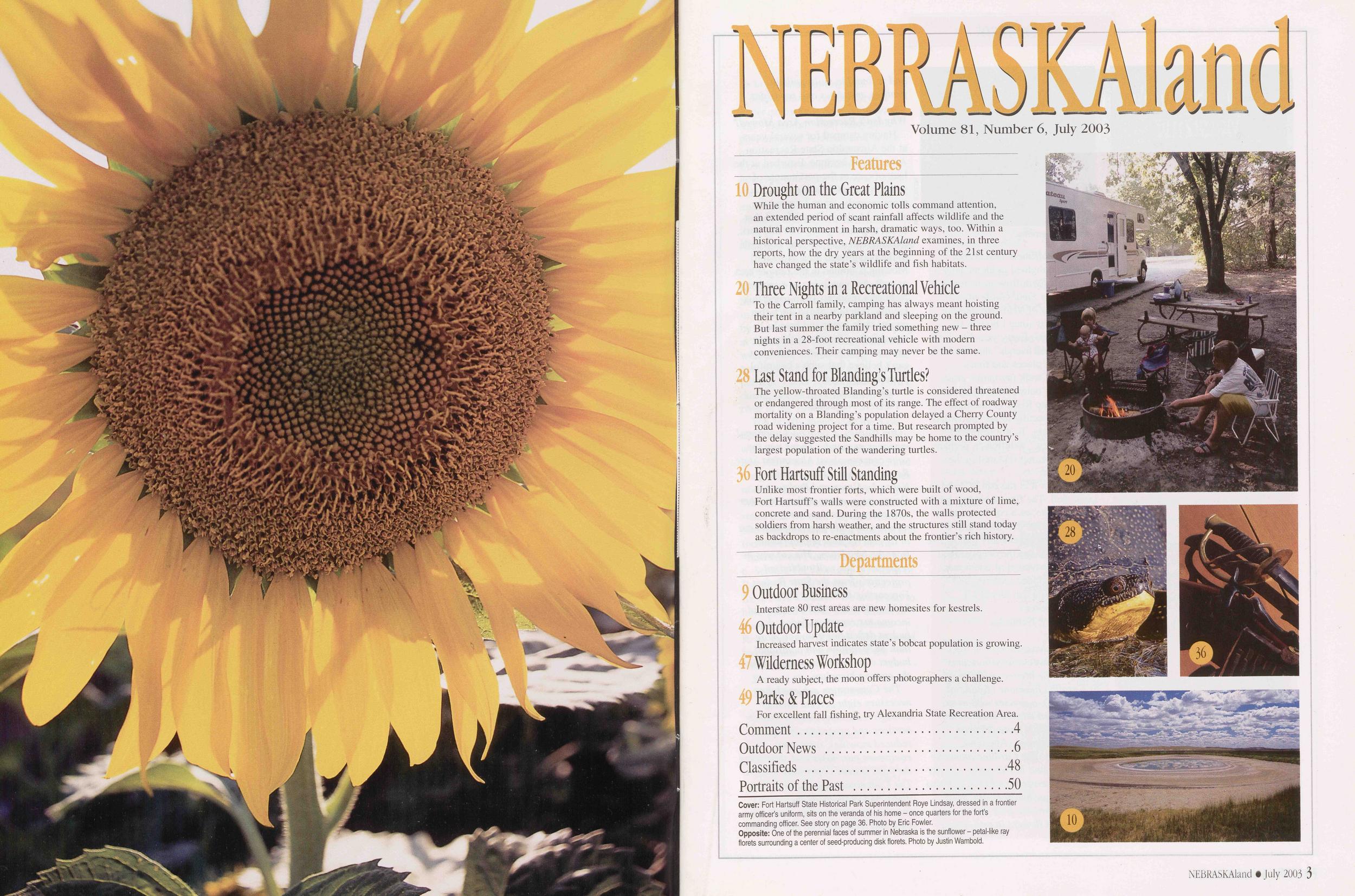
NEBRASKAland
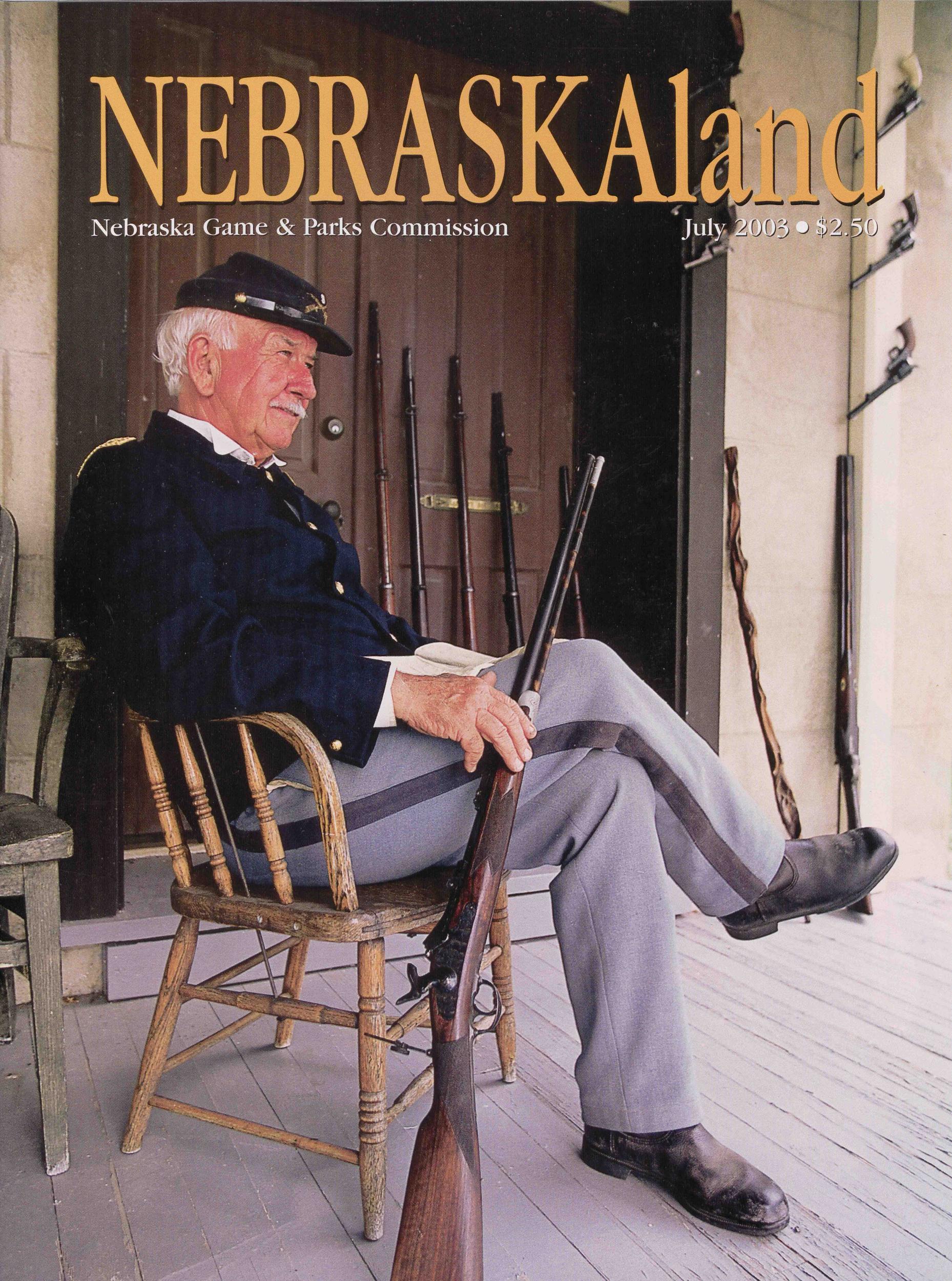
Volume 81, Number 6, July 2003 Features 10 Drought on the Great Plains While the human and economic tolls command attention, an extended period of scant rainfall affects wildlife and the natural environment in harsh, dramatic ways, too. Within a historical perspective, NEBRASKAland examines, in three reports, how the dry years at the beginning of the 21st century have changed the state's wildlife and fish habitats. 20 Three Nights in a Recreational Vehicle To the Carroll family, camping has always meant hoisting their tent in a nearby parkland and sleeping on the ground. But last summer the family tried something new - three nights in a 28-foot recreational vehicle with modern conveniences. Their camping may never be the same. 28 Last Stand for Blanding's Turtles? The yellow-throated Blanding's turtle is considered threatened or endangered through most of its range. The effect of roadway mortality on a Blanding's population delayed a Cherry County road widening project for a time. But research prompted by the delay suggested the Sandhills may be home to the country's largest population of the wandering turtles. Fort Hartsuff Still Standing Unlike most frontier forts, which were built of wood, 36 Fort Hartsuff's walls were constructed with a mixture of lime, concrete and sand. During the 1870s, the walls protected soldiers from harsh weather, and the structures still stand today as backdrops to re-enactments about the frontier's rich history. Departments 9 Outdoor Business Interstate 80 rest areas are new homesites for kestrels. 46 Outdoor Update Increased harvest indicates state's bobcat population is growing 47 Wilderness Workshop A ready subject, the moon offers photographers a challenge. 49 Parks & Places For excellent fall fishing, try Alexandria State Recreation Area. Comment............................—4 Outdoor News ............................6 Classifieds ..............................48 Portraits of the Past .......................50 Cover: Fort Hartsuff State Historical Park Superintendent Roye Lindsay, dressed in a frontier army officer's uniform, sits on the veranda of his home - once quarters for the fort's commanding officer. See story on page 36. Photo by Eric Fowler. Opposite: One of the perennial faces of summer in Nebraska is the sunflower - petal-like ray florets surrounding a center of seed-producing disk florets. Photo by Justin Wambold.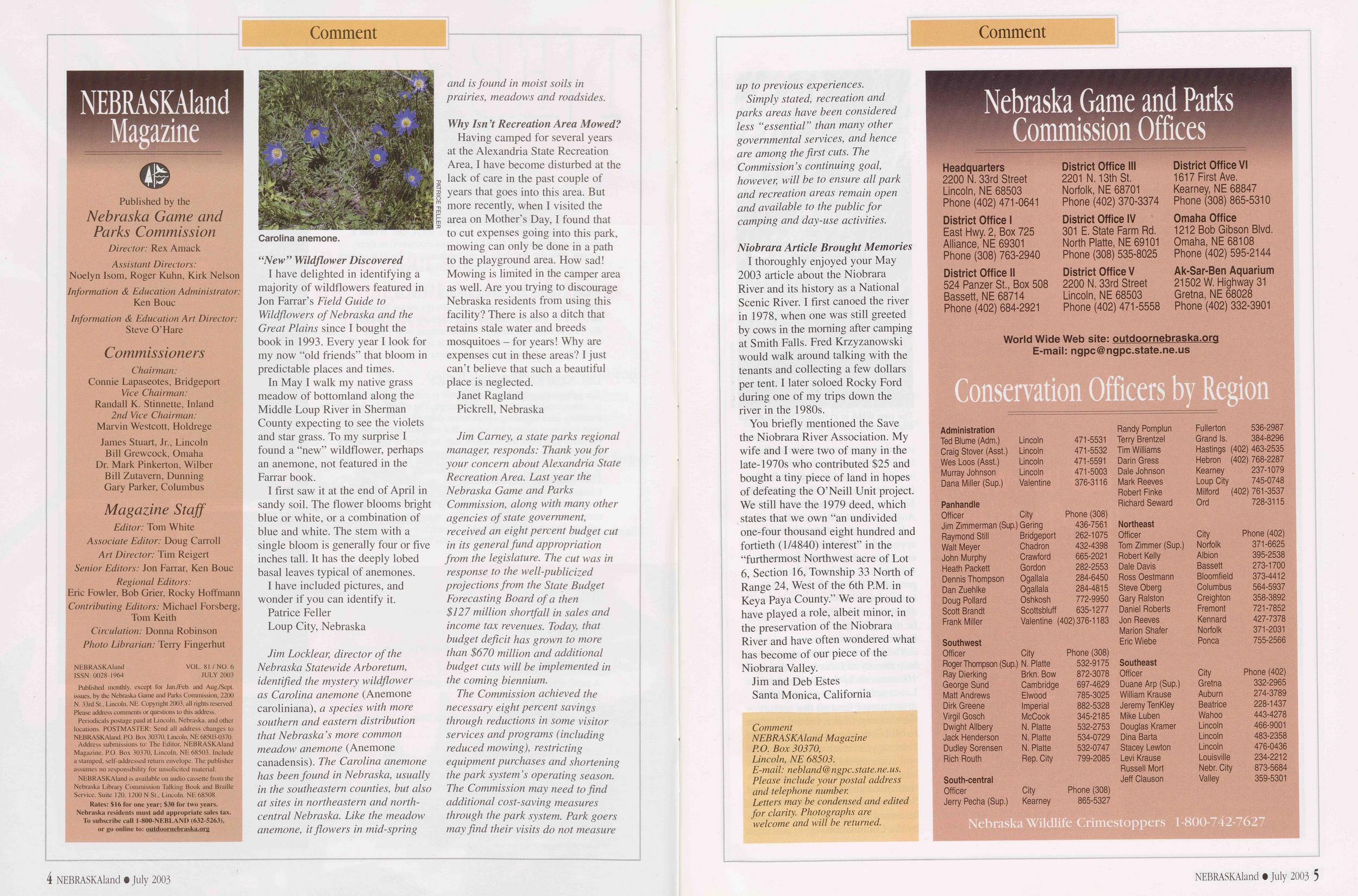 Comment NEBRASKAland Mazine Published by the Nebraska Game and Parks Commission Director: Rex Amack Assistant Directors: Noelyn Isom, Roger Kuhn, Kirk Nelson Information & Education Administrator: Ken Bouc Information & Education Art Director: Steve O'Hare Commissioners Chairman: Connie Lapaseotes, Bridgeport Vice Chairman: Randall K. Stinnette, Inland 2nd Vice Chairman: Marvin Westcott, Holdrege James Stuart, Jr., Lincoln Bill Grewcock, Omaha Dr. Mark Pinkerton, Wilber Bill Zutavern, Dunning Gary Parker, Columbus Magazine Staff Editor: Tom White Associate Editor: Doug Carroll Art Director: Tim Reigert Senior Editors: Jon Farrar, Ken Bouc Regional Editors: Eric Fowler, Bob Grier, Rocky Hoffmann Contributing Editors: Michael Forsberg, Tom Keith Circulation: Donna Robinson Photo Librarian: Terry Fingerhut NEBRASKAland ISSN: 0028-J964 VOL. 81 /NO. 6 JULY 2003 Published monthly, except for Jan./Feb. and Aug./Sept. issues, by the Nebraska Game and Paries Commission, 2200 N. 33rd St., Lincoln. NE. Copyright 2003, all rights reserved. Please address comments or questions to this address. Periodicals postage paid at Lincoln, Nebraska, and other locations. POSTMASTER: Send all address changes to NEBRASKAland, P.O. Box 30370, Lincoln, NE 68503-0370. Address submissions to: The Editor, NEBRASKAland Magazine. P.O. Box 30370, Lincoln, NE 68503. Include a stamped, self-addressed return envelope. The publisher assumes no responsibility for unsolicited material. NEBRASKAland is available on audio cassette from the Nebraska Library Commission Talking Book and Braille Service. Suite 120. 1200 N St.. Lincoln, NE 68508. Rates: $16 for one year; $30 for two years. Nebraska residents must add appropriate sales tax. To subscribe call 1-800-NEBLAND (632-5263), or go online to: outdoornebraska.org
I have delighted in identifying a majority of wildflowers featured in Jon Farrar's Field Guide to Wildflowers of Nebraska and the Great Plains since I bought the book in 1993. Every year I look for my now "old friends" that bloom in predictable places and times.
In May I walk my native grass meadow of bottomland along the Middle Loup River in Sherman County expecting to see the violets and star grass. To my surprise I found a "new" wildflower, perhaps an anemone, not featured in the Farrar book.
I first saw it at the end of April in sandy soil. The flower blooms bright blue or white, or a combination of blue and white. The stem with a single bloom is generally four or five inches tall. It has the deeply lobed basal leaves typical of anemones.
I have included pictures, and wonder if you can identify it.
Patrice Feller Loup City, NebraskaJim Locklear, director of the Nebraska Statewide Arboretum, identified the mystery wildflower as Carolina anemone (Anemone caroliniana), a species with more southern and eastern distribution that Nebraska's more common meadow anemone (Anemone canadensis). The Carolina anemone has been found in Nebraska, usually in the southeastern counties, but also at sites in northeastern and northcentral Nebraska. Like the meadow anemone, it flowers in mid-spring and is found in moist soils in prairies, meadows and roadsides.
Why Isn H Recreation Area Mowed?Having camped for several years at the Alexandria State Recreation Area, I have become disturbed at the lack of care in the past couple of years that goes into this area. But more recently, when I visited the area on Mother's Day, I found that to cut expenses going into this park, mowing can only be done in a path to the playground area. How sad! Mowing is limited in the camper area as well. Are you trying to discourage Nebraska residents from using this facility? There is also a ditch that retains stale water and breeds mosquitoes - for years! Why are expenses cut in these areas? I just can't believe that such a beautiful place is neglected.
Janet Ragland Pickrell, NebraskaJim Carney, a state parks regional manager, responds: Thank you for your concern about Alexandria State Recreation Area. Last year the Nebraska Game and Parks Commission, along with many other agencies of state government, received an eight percent budget cut in its general fund appropriation from the legislature. The cut was in response to the well-publicized projections from the State Budget Forecasting Board of a then $127 million shortfall in sales and income tax revenues. Today, that budget deficit has grown to more than $670 million and additional budget cuts will be implemented in the coming biennium.
The Commission achieved the necessary eight percent savings through reductions in some visitor services and programs (including reduced mowing), restricting equipment purchases and shortening the park system's operating season. The Commission may need to find additional cost-saving measures through the park system. Park goers may find their visits do not measure 4 NEBRASKAland • July 2003 up to previous experiences.
Simply stated, recreation and parks areas have been considered less "essential" than many other governmental services, and hence are among the first cuts. The Commission is continuing goal, however, will be to ensure all park and recreation areas remain open and available to the public for camping and day-use activities.
Niobrara Article Brought MemoriesI thoroughly enjoyed your May 2003 article about the Niobrara River and its history as a National Scenic River. I first canoed the river in 1978, when one was still greeted by cows in the morning after camping at Smith Falls. Fred Krzyzanowski would walk around talking with the tenants and collecting a few dollars per tent. I later soloed Rocky Ford during one of my trips down the river in the 1980s.
You briefly mentioned the Save the Niobrara River Association. My wife and I were two of many in the late-1970s who contributed $25 and bought a tiny piece of land in hopes of defeating the O'Neill Unit project. We still have the 1979 deed, which states that we own "an undivided one-four thousand eight hundred and fortieth (1/4840) interest" in the "furthermost Northwest acre of Lot 6, Section 16, Township 33 North of Range 24, West of the 6th P.M. in Keya Paya County." We are proud to have played a role, albeit minor, in the preservation of the Niobrara River and have often wondered what has become of our piece of the Niobrara Valley.
Jim and Deb Estes Santa Monica, California NEBRASKAland Magazine P.O. Box 30370, Lincoln, NE 68503. E-mail: nebland@ ngpe. state, ne. us. Please include your postal address and telephone number. Letters may be condensed and edited for clarity. Photographs are welcome and will be returned. Comment Nebraska Game and Parks Commission Offices Headquarters 2200 N. 33rd Street Lincoln, NE 68503 Phone (402) 471-0641 District Office I East Hwy. 2, Box 725 Alliance, NE 69301 Phone (308) 763-2940 District Office II 524 Panzer St., Box 508 Bassett, NE 68714 Phone (402) 684-2921 District Office III 2201 N. 13th St. Norfolk, NE 68701 Phone (402) 370-3374 District Office IV 301 E. State Farm Rd. North Platte, NE 69101 Phone (308) 535-8025 District Office V 2200 N. 33rd Street Lincoln, NE 68503 Phone (402) 471-5558 District Off ice VI 1617 First Ave. Kearney, NE 68847 Phone (308) 865-5310 Omaha Office 1212 Bob Gibson Blvd. Omaha, NE 68108 Phone (402) 595-2144 Ak-Sar-Ben Aquarium 21502 W. Highway 31 Gretna, NE 68028 Phone (402) 332-3901 World Wide Web site: outdoornebraska.org E-mail: ngpc@ngpc.state.ne.us Conservation Officers by Region Administration Ted Blume (Adm.) Craig Stover (Asst.) Wes Loos (Asst.) Murray Johnson Dana Miller (Sup.) Panhandle Officer Jim Zimmerman (Sup.) Raymond Still Walt Meyer John Murphy Heath Packett Dennis Thompson Dan Zuehlke Doug Pollard Scott Brandt Frank Miller Southwest Officer Roger Thompson (Sup.) Ray Dierking George Sund Matt Andrews Dirk Greene Virgil Gosch Dwight Allbery Jack Henderson Dudley Sorensen RichRouth Lincoln Lincoln Lincoln Lincoln Valentine City Gering Bridgeport Chadron Crawford Gordon Ogallala Ogallala Oshkosh Scottsbluff Valentine 471-5531 471-5532 471-5591 471-5003 376-3116 Phone (308) 436-7561 262-1075 432-4398 665-2021 282-2553 284-6450 284-4815 772-9950 635-1277 (402)376-1183 City N. Platte Brkn. Bow Cambridge Elwood Imperial McCook N. Platte N. Platte N. Platte Rep. City South-central Officer City Jerry Pecha (Sup.) Kearney .■ Phone (308) 532-9175 872-3078 697-4629 785-3025 882-5328 345-2185 532-2753 534-0729 532-0747 799-2085 Phone (308) 865-5327 Randy Pomplun Terry Brentzel Tim Williams Darin Gress Dale Johnson Mark Reeves Robert Finke Richard Seward Northeast Officer Tom Zimmer (Sup.) Robert Kelly Dale Davis Ross Oestmann Steve Oberg Gary Ralston Daniel Roberts Jon Reeves Marion Shafer Eric Wiebe Southeast Officer Duane Arp (Sup.) William Krause Jeremy TenKley Mike Luben Douglas Kramer Dina Barta Stacey Lewton Levi Krause Russell Mort Jeff Clauson Fullerton Grand Is. Hastings (402) Hebron (402) Kearney Loup City Milford (402) Ord 536-2987 384-8296 463-2535 768-2287 237-1079 745-0748 761-3537 728-3115 City Norfolk Albion Bassett Bloomfield Columbus Creighton Fremont Kennard Norfolk Ponca City Gretna Auburn Beatrice Wahoo Lincoln Lincoln Lincoln Louisville Nebr.City Valley Phone (402) 371-6625 395-2538 273-1700 373-4412 564-5937 358-3892 721-7852 427-7378 371-2031 755-2566 Phone (402) 332-2965 274-3789 228-1437 443-4278 466-9001 483-2358 476-0436 234-2212 873-5684 359-5301 Nebraska Wildlife Crimestoppers 1-800-742-7627 NEBRASKAland • July 2003 5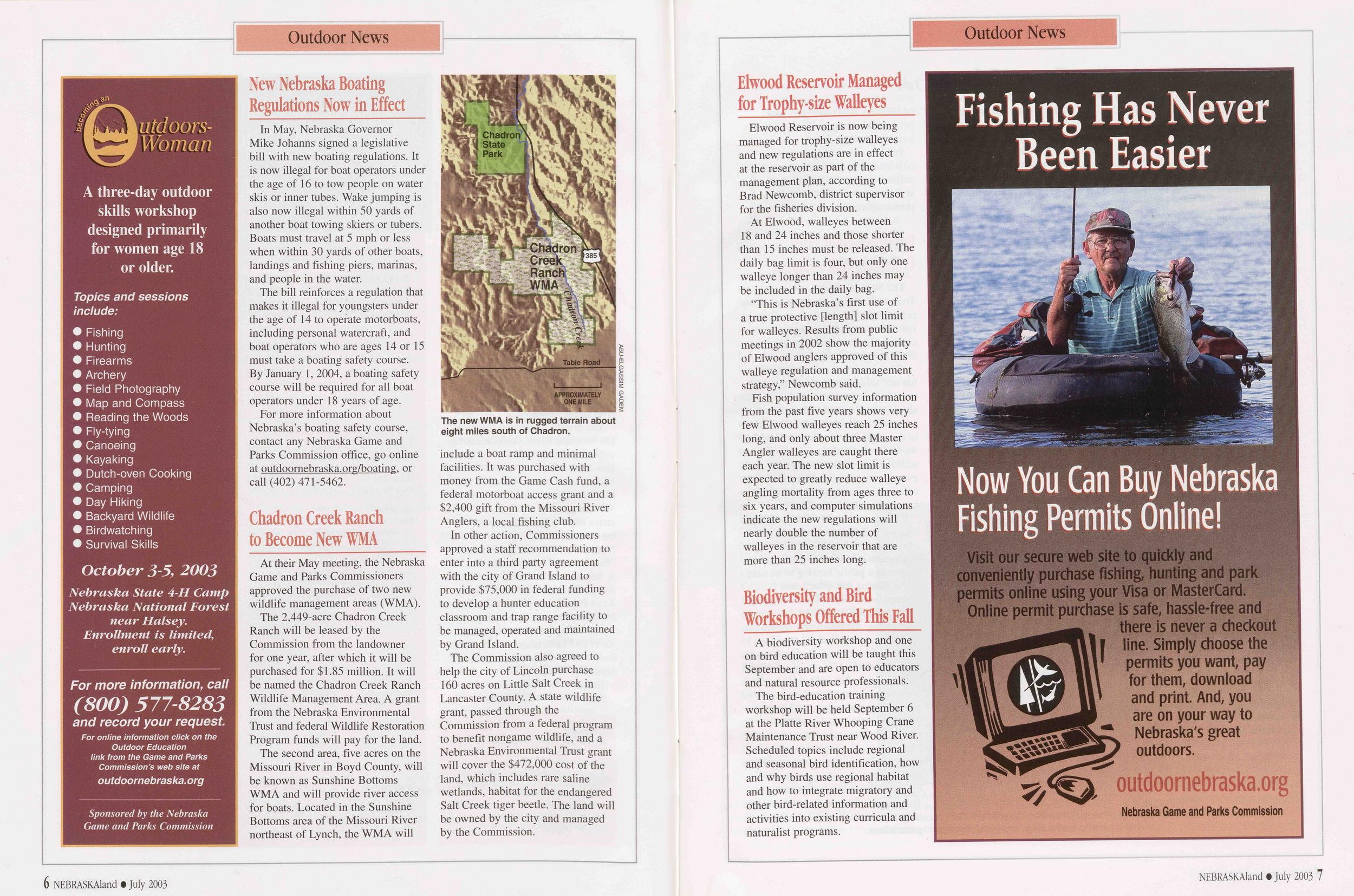
In May, Nebraska Governor Mike Johanns signed a legislative bill with new boating regulations. It is now illegal for boat operators under the age of 16 to tow people on water skis or inner tubes. Wake jumping is also now illegal within 50 yards of another boat towing skiers or tubers. Boats must travel at 5 mph or less when within 30 yards of other boats, landings and fishing piers, marinas, and people in the water.
The bill reinforces a regulation that makes it illegal for youngsters under the age of 14 to operate motorboats, including personal watercraft, and boat operators who are ages 14 or 15 must take a boating safety course. By January 1, 2004, a boating safety course will be required for all boat operators under 18 years of age.
For more information about Nebraska's boating safety course, contact any Nebraska Game and Parks Commission office, go online at outdoomebraska.org/boating, or call (402) 471-5462.
Chad on Creek Ranch to Become New WMAAt their May meeting, the Nebraska Game and Parks Commissioners approved the purchase of two new wildlife management areas (WMA).
The 2,449-acre Chadron Creek Ranch will be leased by the Commission from the landowner for one year, after which it will be purchased for $1.85 million. It will be named the Chadron Creek Ranch Wildlife Management Area. A grant from the Nebraska Environmental Tmst and federal Wildlife Restoration Program funds will pay for the land.
The second area, five acres on the Missouri River in Boyd County, will be known as Sunshine Bottoms WMA and will provide river access for boats. Located in the Sunshine Bottoms area of the Missouri River northeast of Lynch, the WMA will include a boat ramp and minimal facilities. It was purchased with money from the Game Cash fund, a federal motorboat access grant and a $2,400 gift from the Missouri River Anglers, a local fishing club.
In other action, Commissioners approved a staff recommendation to enter into a third party agreement with the city of Grand Island to provide $75,000 in federal funding to develop a hunter education classroom and trap range facility to be managed, operated and maintained by Grand Island.
The Commission also agreed to help the city of Lincoln purchase 160 acres on Little Salt Creek in Lancaster County. A state wildlife grant, passed through the Commission from a federal program to benefit nongame wildlife, and a Nebraska Environmental Trust grant will cover the $472,000 cost of the land, which includes rare saline wetlands, habitat for the endangered Salt Creek tiger beetle. The land will be owned by the city and managed by the Commission.
6 NEBRASKAland • July 2003 Outdoor News Elwood Reservoir Managed for Trophy-size WalleyesElwood Reservoir is now being managed for trophy-size walleyes and new regulations are in effect at the reservoir as part of the management plan, according to Brad Newcomb, district supervisor for the fisheries division.
At Elwood, walleyes between 18 and 24 inches and those shorter than 15 inches must be released. The daily bag limit is four, but only one walleye longer than 24 inches may be included in the daily bag.
"This is Nebraska's first use of a true protective [length] slot limit for walleyes. Results from public meetings in 2002 show the majority of Elwood anglers approved of this walleye regulation and management strategy," Newcomb said.
Fish population survey information from the past five years shows very few Elwood walleyes reach 25 inches long, and only about three Master Angler walleyes are caught there each year. The new slot limit is expected to greatly reduce walleye angling mortality from ages three to six years, and computer simulations indicate the new regulations will nearly double the number of walleyes in the reservoir that are more than 25 inches long.
Biodiversity and Bird Workshops Offered This FallA biodiversity workshop and one on bird education will be taught this September and are open to educators and natural resource professionals.
The bird-education training workshop will be held September 6 at the Platte River Whooping Crane Maintenance Trust near Wood River. Scheduled topics include regional and seasonal bird identification, how and why birds use regional habitat and how to integrate migratory and other bird-related information and activities into existing curricula and naturalist programs.
Fishing Has Never Been Easier Now You Can Buy Nebraska Fishing Permits Online! Visit our secure web site to quickly and conveniently purchase fishing; hunting and park lermits online using your Visa or MasterCard. Online permit purchase is safe, hassle-free and there is never a checkout line. Simply choose the permits you want, pay for them, download and print. And, you are on your way to Nebraska's great outdoors. Nebraska Game and Parks Commission NEBRASKAland • July 2003 7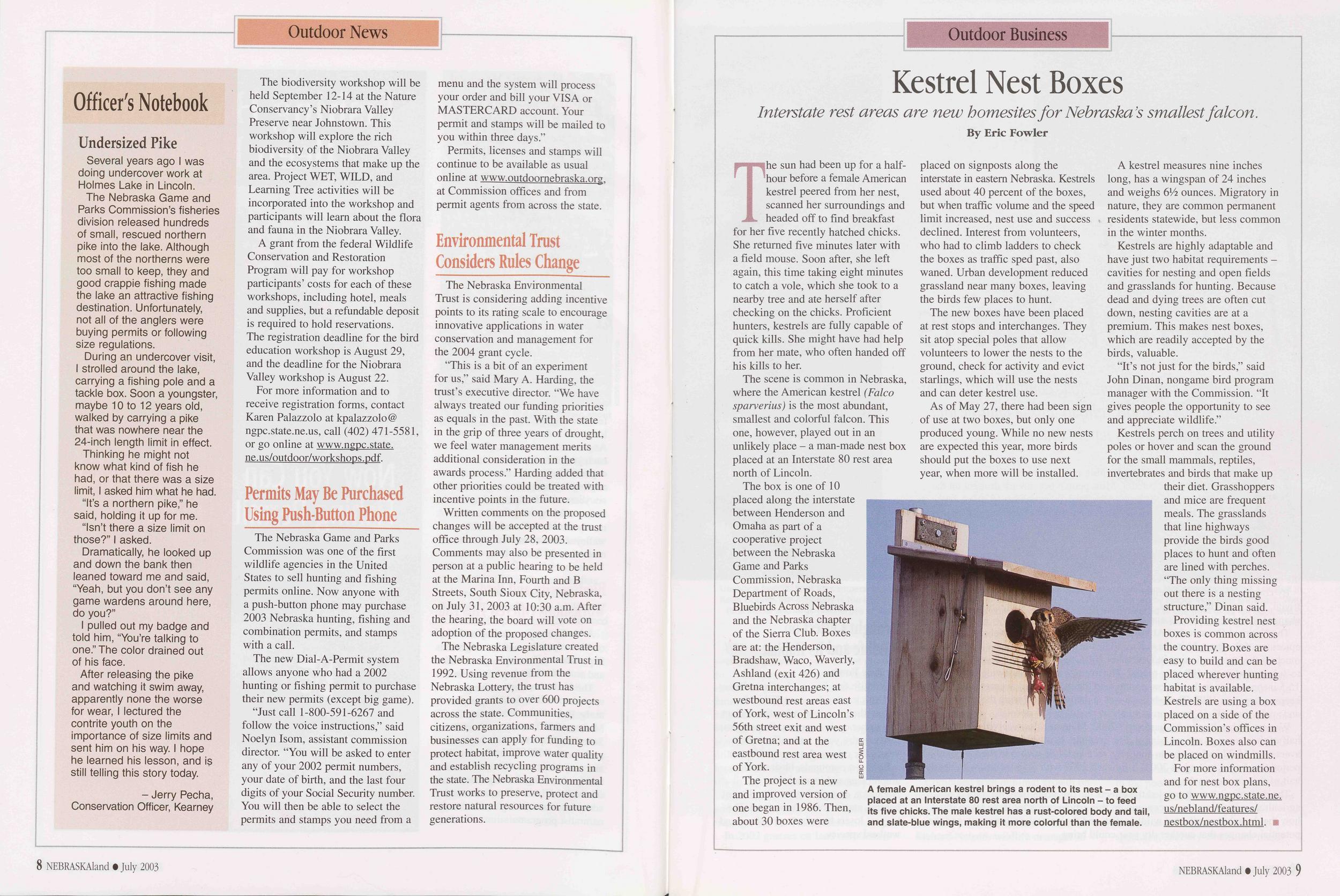 Outdoor News Officer's Notebook Undersized Pike
Several years ago I was doing undercover work at Holmes Lake in Lincoln.
The Nebraska Game and Parks Commission's fisheries division released hundreds of small, rescued northern pike into the lake. Although most of the northerns were too small to keep, they and good crappie fishing made the lake an attractive fishing destination. Unfortunately, not all of the anglers were buying permits or following size regulations.
During an undercover visit, I strolled around the lake, carrying a fishing pole and a tackle box. Soon a youngster, maybe 10 to 12 years old, walked by carrying a pike that was nowhere near the 24-inch length limit in effect.
Thinking he might not know what kind of fish he had, or that there was a size limit, I asked him what he had.
"It's a northern pike," he said, holding it up for me.
"Isn't there a size limit on those?" I asked.
Dramatically, he looked up and down the bank then leaned toward me and said, "Yeah, but you don't see any game wardens around here, do you?"
I pulled out my badge and told him, "You're talking to one." The color drained out of his face.
After releasing the pike and watching it swim away, apparently none the worse for wear, I lectured the contrite youth on the importance of size limits and sent him on his way. I hope he learned his lesson, and is still telling this story today.
- Jerry Pecha, Conservation Officer, KearneyThe biodiversity workshop will be held September 12-14 at the Nature Conservancy's Niobrara Valley Preserve near Johnstown. This workshop will explore the rich biodiversity of the Niobrara Valley and the ecosystems that make up the area. Project WET, WILD, and Learning Tree activities will be incorporated into the workshop and participants will learn about the flora and fauna in the Niobrara Valley.
A grant from the federal Wildlife Conservation and Restoration Program will pay for workshop participants' costs for each of these workshops, including hotel, meals and supplies, but a refundable deposit is required to hold reservations. The registration deadline for the bird education workshop is August 29, and the deadline for the Niobrara Valley workshop is August 22.
For more information and to receive registration forms, contact Karen Palazzolo at kpalazzolo® ngpc.state.ne.us, call (402) 471-5581, or go online at www.ngpc.state, ne. us/outdoor/workshops .pdf.
Permits May Be Purchased Using Push-Button PhoneThe Nebraska Game and Parks Commission was one of the first wildlife agencies in the United States to sell hunting and fishing permits online. Now anyone with a push-button phone may purchase 2003 Nebraska hunting, fishing and combination permits, and stamps with a call.
The new Dial-A-Permit system allows anyone who had a 2002 hunting or fishing permit to purchase their new permits (except big game).
"Just call 1-800-591-6267 and follow the voice instructions," said Noelyn Isom, assistant commission director. "You will be asked to enter any of your 2002 permit numbers, your date of birth, and the last four digits of your Social Security number. You will then be able to select the permits and stamps you need from a menu and the system will process your order and bill your VISA or MASTERCARD account. Your permit and stamps will be mailed to you within three days."
Permits, licenses and stamps will continue to be available as usual online at www.outdoornebraska.org. at Commission offices and from permit agents from across the state.
Environmental Trust Considers Rules ChangeThe Nebraska Environmental Trust is considering adding incentive points to its rating scale to encourage innovative applications in water conservation and management for the 2004 grant cycle.
"This is a bit of an experiment for us," said Mary A. Harding, the trust's executive director. "We have always treated our funding priorities as equals in the past. With the state in the grip of three years of drought, we feel water management merits additional consideration in the awards process." Harding added that other priorities could be treated with incentive points in the future.
Written comments on the proposed changes will be accepted at the trust office through July 28, 2003. Comments may also be presented in person at a public hearing to be held at the Marina Inn, Fourth and B Streets, South Sioux City, Nebraska, on July 31, 2003 at 10:30 a.m. After the hearing, the board will vote on adoption of the proposed changes.
The Nebraska Legislature created the Nebraska Environmental Trust in 1992. Using revenue from the Nebraska Lottery, the trust has provided grants to over 600 projects across the state. Communities, citizens, organizations, farmers and businesses can apply for funding to protect habitat, improve water quality and establish recycling programs in the state. The Nebraska Environmental Trust works to preserve, protect and restore natural resources for future generations.
8 NEBRASKAland • July 2003Kestrel Nest Boxes
Outdoor Business Interstate rest areas are new homesites for Nebraska's smallest falcon By Eric FowlerThe sun had been up for a half-hour before a female American kestrel peered from her nest, scanned her surroundings and headed off to find breakfast for her five recently hatched chicks. She returned five minutes later with a field mouse. Soon after, she left again, this time taking eight minutes to catch a vole, which she took to a nearby tree and ate herself after checking on the chicks. Proficient hunters, kestrels are fully capable of quick kills. She might have had help from her mate, who often handed off his kills to her.
The scene is common in Nebraska, where the American kestrel (Falco sparverius) is the most abundant, smallest and colorful falcon. This one, however, played out in an unlikely place - a man-made nest box placed at an Interstate 80 rest area north of Lincoln.
The box is one of 10 placed along the interstate between Henderson and Omaha as part of a cooperative project between the Nebraska Game and Parks Commission, Nebraska Department of Roads, Bluebirds Across Nebraska and the Nebraska chapter of the Sierra Club. Boxes are at: the Henderson, Bradshaw, Waco, Waverly, Ashland (exit 426) and Gretna interchanges; at westbound rest areas east of York, west of Lincoln's 56th street exit and west of Gretna; and at the eastbound rest area west of York.
The project is a new and improved version of one began in 1986. Then, about 30 boxes were placed on signposts along the interstate in eastern Nebraska. Kestrels used about 40 percent of the boxes, but when traffic volume and the speed limit increased, nest use and success declined. Interest from volunteers, who had to climb ladders to check the boxes as traffic sped past, also waned. Urban development reduced grassland near many boxes, leaving the birds few places to hunt.
The new boxes have been placed at rest stops and interchanges. They sit atop special poles that allow volunteers to lower the nests to the ground, check for activity and evict starlings, which will use the nests and can deter kestrel use.
As of May 27, there had been sign of use at two boxes, but only one produced young. While no new nests are expected this year, more birds should put the boxes to use next year, when more will be installed.
A kestrel measures nine inches long, has a wingspan of 24 inches and weighs 6V2 ounces. Migratory in nature, they are common permanent residents statewide, but less common in the winter months.
Kestrels are highly adaptable and have just two habitat requirements - cavities for nesting and open fields and grasslands for hunting. Because dead and dying trees are often cut down, nesting cavities are at a premium. This makes nest boxes, which are readily accepted by the birds, valuable.
"It's not just for the birds," said John Dinan, nongame bird program manager with the Commission. "It gives people the opportunity to see and appreciate wildlife."
Kestrels perch on trees and utility poles or hover and scan the ground for the small mammals, reptiles, invertebrates and birds that make up their diet. Grasshoppers and mice are frequent meals. The grasslands that line highways provide the birds good places to hunt and often are lined with perches. "The only thing missing out there is a nesting structure," Dinan said.
Providing kestrel nest boxes is common across the country. Boxes are easy to build and can be placed wherever hunting habitat is available. Kestrels are using a box placed on a side of the Commission's offices in Lincoln. Boxes also can be placed on windmills.
For more information and for nest box plans, go to www.ngpc.state.ne us/nebland/features/ nestbox/nestbox.html.
NEBRASKAland • July 2003 9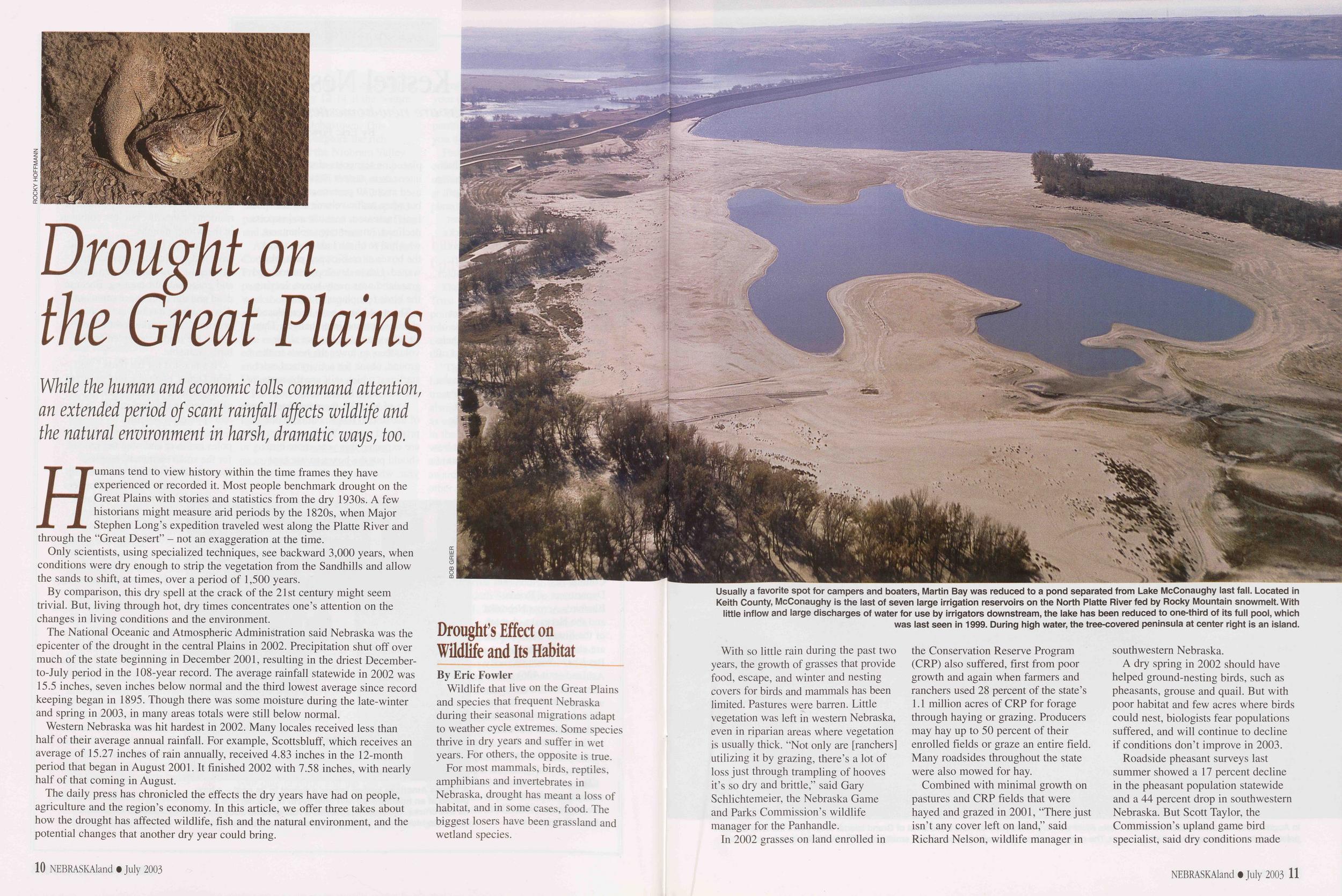
Drought on the Great Plains
While the human and economic tolls command attention, an extended period of scant rainfall affects wildlife and the natural environment in harsh, dramatic ways, too.Humans tend to view history within the time frames they have experienced or recorded it. Most people benchmark drought on the Great Plains with stories and statistics from the dry 1930s. A few historians might measure arid periods by the 1820s, when Major Stephen Long's expedition traveled west along the Platte River and through the "Great Desert" - not an exaggeration at the time.
Only scientists, using specialized techniques, see backward 3,000 years, when conditions were dry enough to strip the vegetation from the Sandhills and allow the sands to shift, at times, over a period of 1,500 years.
By comparison, this dry spell at the crack of the 21st century might seem trivial. But, living through hot, dry times concentrates one's attention on the changes in living conditions and the environment.
The National Oceanic and Atmospheric Administration said Nebraska was the epicenter of the drought in the central Plains in 2002. Precipitation shut off over much of the state beginning in December 2001, resulting in the driest December- to-July period in the 108-year record. The average rainfall statewide in 2002 was 15.5 inches, seven inches below normal and the third lowest average since record keeping began in 1895. Though there was some moisture during the late-winter and spring in 2003, in many areas totals were still below normal.
Western Nebraska was hit hardest in 2002. Many locales received less than half of their average annual rainfall. For example, Scottsbluff, which receives an average of 15.27 inches of rain annually, received 4.83 inches in the 12-month period that began in August 2001. It finished 2002 with 7.58 inches, with nearly half of that coming in August.
The daily press has chronicled the effects the dry years have had on people, agriculture and the region's economy. In this article, we offer three takes about how the drought has affected wildlife, fish and the natural environment, and the potential changes that another dry year could bring.
Drought's Effect on Wildlife and Its Habitat By Eric FowlerWildlife that live on the Great Plains and species that frequent Nebraska during their seasonal migrations adapt to weather cycle extremes. Some species thrive in dry years and suffer in wet years. For others, the opposite is true.
For most mammals, birds, reptiles, amphibians and invertebrates in Nebraska, drought has meant a loss of habitat, and in some cases, food. The biggest losers have been grassland and wetland species.
10 NEBRASKAland • July 2003With so little rain during the past two years, the growth of grasses that provide food, escape, and winter and nesting covers for birds and mammals has been limited. Pastures were barren. Little vegetation was left in western Nebraska, even in riparian areas where vegetation is usually thick. "Not only are [ranchers] utilizing it by grazing, there's a lot of loss just through trampling of hooves it's so dry and brittle," said Gary Schlichtemeier, the Nebraska Game and Parks Commission's wildlife manager for the Panhandle.
In 2002 grasses on land enrolled in the Conservation Reserve Program (CRP) also suffered, first from poor growth and again when farmers and ranchers used 28 percent of the state's 1.1 million acres of CRP for forage through haying or grazing. Producers may hay up to 50 percent of their enrolled fields or graze an entire field. Many roadsides throughout the state were also mowed for hay.
Combined with minimal growth on pastures and CRP fields that were hayed and grazed in 2001, "There just isn't any cover left on land," said Richard Nelson, wildlife manager in southwestern Nebraska.
A dry spring in 2002 should have helped ground-nesting birds, such as pheasants, grouse and quail. But with poor habitat and few acres where birds could nest, biologists fear populations suffered, and will continue to decline if conditions don't improve in 2003.
Roadside pheasant surveys last summer showed a 17 percent decline in the pheasant population statewide and a 44 percent drop in southwestern Nebraska. But Scott Taylor, the Commission's upland game bird specialist, said dry conditions made NEBRASKAland • July 2003 11 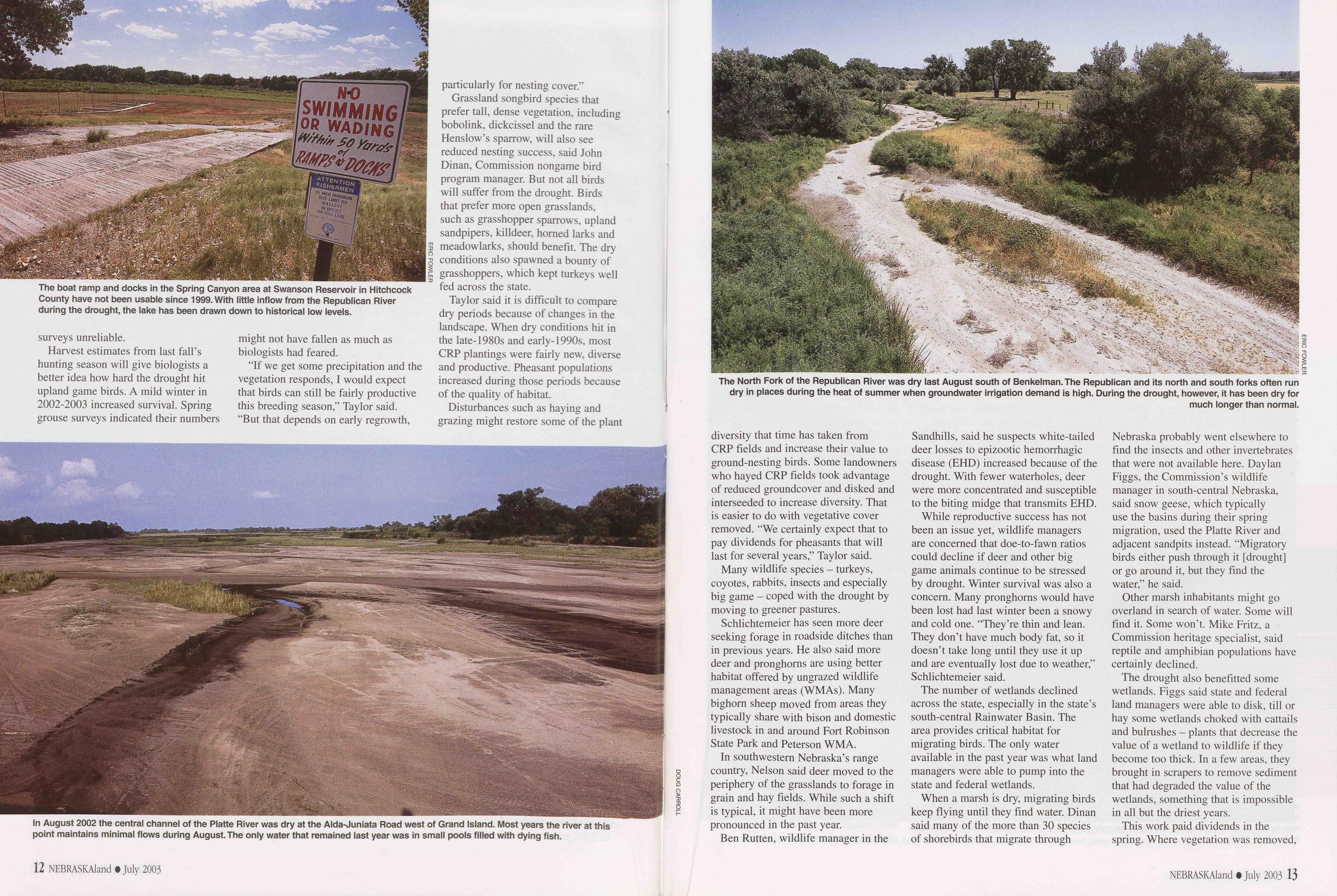
Harvest estimates from last fall's hunting season will give biologists a better idea how hard the drought hit upland game birds. A mild winter in 2002-2003 increased survival. Spring grouse surveys indicated their numbers might not have fallen as much as biologists had feared.
"If we get some precipitation and the vegetation responds, I would expect that birds can still be fairly productive this breeding season," Taylor said. "But that depends on early regrowth, particularly for nesting cover."
Grassland songbird species that prefer tall, dense vegetation, including bobolink, dickcissel and the rare Henslow's sparrow, will also see reduced nesting success, said John Dinan, Commission nongame bird program manager. But not all birds will suffer from the drought. Birds that prefer more open grasslands, such as grasshopper sparrows, upland sandpipers, killdeer, horned larks and meadowlarks, should benefit. The dry conditions also spawned a bounty of grasshoppers, which kept turkeys well fed across the state.
Taylor said it is difficult to compare dry periods because of changes in the landscape. When dry conditions hit in the late-1980s and early-1990s, most CRP plantings were fairly new, diverse and productive. Pheasant populations increased during those periods because of the quality of habitat.
Disturbances such as haying and grazing might restore some of the plant
Many wildlife species - turkeys, coyotes, rabbits, insects and especially big game - coped with the drought by moving to greener pastures.
Schlichtemeier has seen more deer seeking forage in roadside ditches than in previous years. He also said more deer and pronghorns are using better habitat offered by ungrazed wildlife management areas (WMAs). Many bighorn sheep moved from areas they typically share with bison and domestic livestock in and around Fort Robinson State Park and Peterson WMA.
In southwestern Nebraska's range country, Nelson said deer moved to the periphery of the grasslands to forage in grain and hay fields. While such a shift is typical, it might have been more pronounced in the past year.
Ben Rutten, wildlife manager in the Sandhills, said he suspects white-tailed deer losses to epizootic hemorrhagic disease (EHD) increased because of the drought. With fewer waterholes, deer were more concentrated and susceptible to the biting midge that transmits EHD.
While reproductive success has not been an issue yet, wildlife managers are concerned that doe-to-fawn ratios could decline if deer and other big game animals continue to be stressed by drought. Winter survival was also a concern. Many pronghorns would have been lost had last winter been a snowy and cold one. "They're thin and lean. They don't have much body fat, so it doesn't take long until they use it up and are eventually lost due to weather," Schlichtemeier said.
The number of wetlands declined across the state, especially in the state's south-central Rainwater Basin. The area provides critical habitat for migrating birds. The only water available in the past year was what land managers were able to pump into the state and federal wetlands.
When a marsh is dry, migrating birds keep flying until they find water. Dinan said many of the more than 30 species of shorebirds that migrate through Nebraska probably went elsewhere to find the insects and other invertebrates that were not available here. Daylan Figgs, the Commission's wildlife manager in south-central Nebraska, said snow geese, which typically use the basins during their spring migration, used the Platte River and adjacent sandpits instead. "Migratory birds either push through it [drought] or go around it, but they find the water," he said.
Other marsh inhabitants might go overland in search of water. Some will find it. Some won't. Mike Fritz, a Commission heritage specialist, said reptile and amphibian populations have certainly declined.
The drought also benefitted some wetlands. Figgs said state and federal land managers were able to disk, till or hay some wetlands choked with cattails and bulrushes - plants that decrease the value of a wetland to wildlife if they become too thick. In a few areas, they brought in scrapers to remove sediment that had degraded the value of the wetlands, something that is impossible in all but the driest years.
This work paid dividends in the spring. Where vegetation was removed, NEBRASKAland • July 2003 13
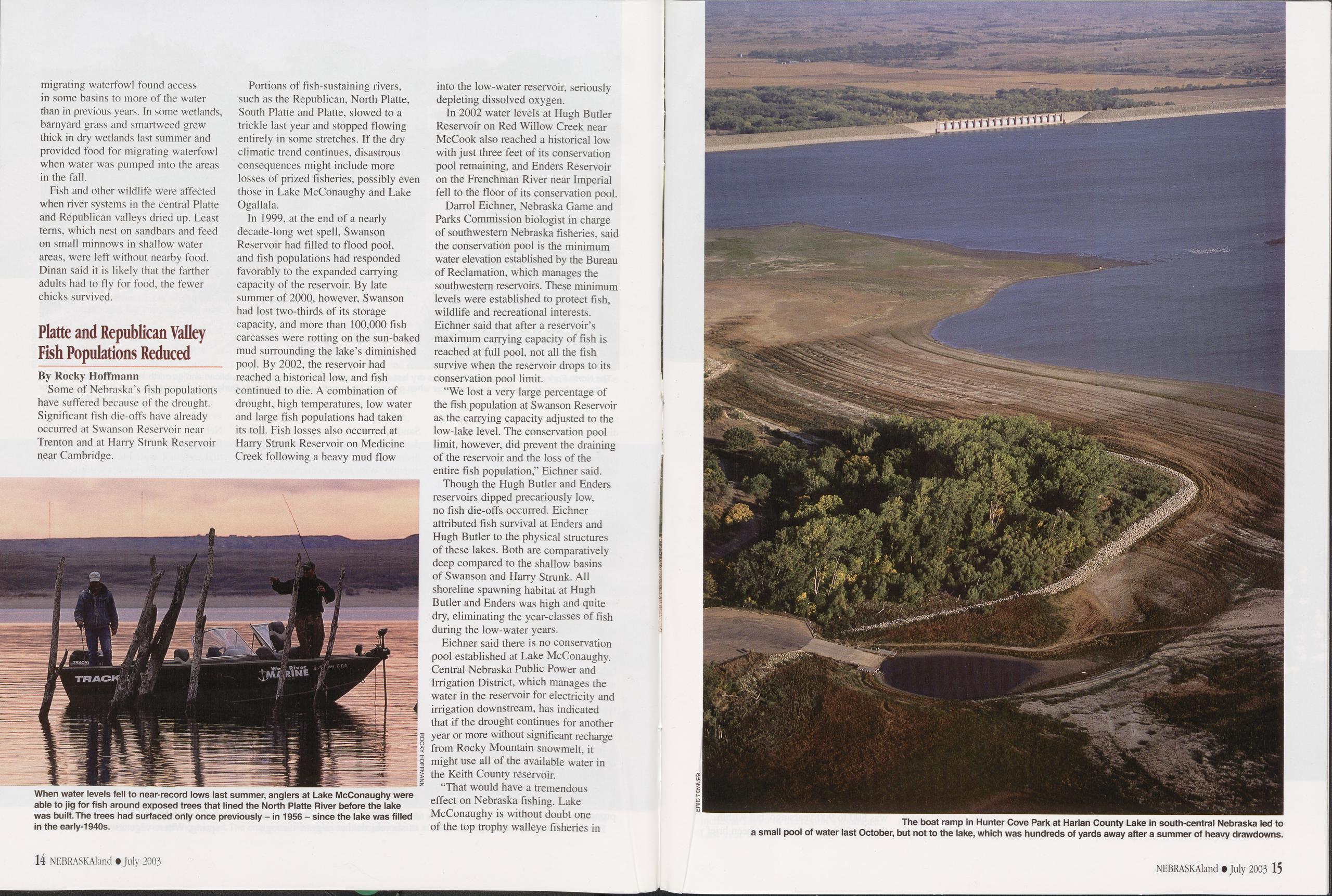
North America. The average size of walleyes caught there exceeds 19 inches and three pounds, and the walleye harvest in 2001 was about 85,000 fish. The trophy aspects of the fishery are equally impressive, as anglers have reported over 2,000 Master Angler-size walleyes from McConaughy since 1996," Eichner said.
If Lake McConaughy's fishery is lost, biologists estimate that returning it to its current status would take at least ten years under ideal conditions, and the financial loss would be in the millions of dollars in replacing the fish populations and loss of revenues from anglers on fishing trips.
How close is Lake McConaughy to losing its water? In 1999, the last high water mark was elevation 3264.6 feet above sea level, which provided a capacity of 1.6 million acre feet of water under a surface of 30,000 acres. In the fall of 2002, Lake McConaughy's surface elevation had plummeted more than 51 feet to 3213.4 feet above sea level, cutting the lake's capacity to a third and its surface to half of that in 1999.
"Forcing Lake McConaughy's fish population into a third of its original volume is a huge risk," Eichner said. "Especially with the higher temperatures usually associated with low water and the increase in nutrients from irrigation return flows, the threat of a blue-green algae bloom and subsequent fish kill is a valid concern."
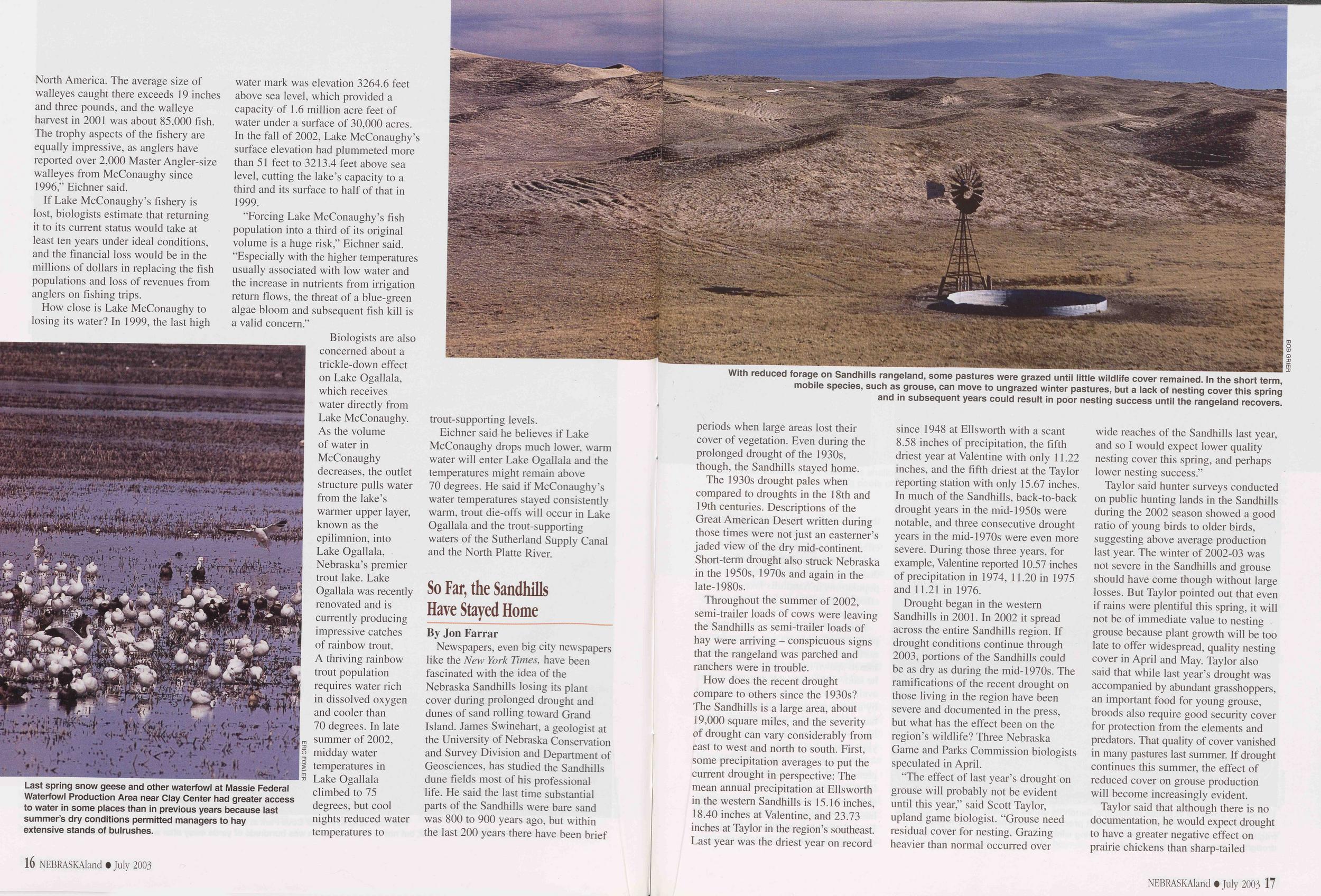
Biologists are also concerned about a trickle-down effect on Lake Ogallala, which receives water directly from Lake McConaughy. As the volume of water in McConaughy decreases, the outlet structure pulls water from the lake's warmer upper layer, known as the epilimnion, into Lake Ogallala, Nebraska's premier trout lake. Lake Ogallala was recently renovated and is currently producing impressive catches of rainbow trout. A thriving rainbow trout population requires water rich in dissolved oxygen and cooler than 70 degrees. In late summer of 2002, midday water temperatures in Lake Ogallala climbed to 75 degrees, but cool nights reduced water temperatures to trout-supporting levels.
Eichner said he believes if Lake McConaughy drops much lower, warm water will enter Lake Ogallala and the temperatures might remain above 70 degrees. He said if McConaughy's water temperatures stayed consistently warm, trout die-offs will occur in Lake Ogallala and the trout-supporting waters of the Sutherland Supply Canal and the North Platte River.
So Far, the Sandhills Have Stayed Home By Jon FarrarNewspapers, even big city newspapers like the New York Times, have been fascinated with the idea of the Nebraska Sandhills losing its plant cover during prolonged drought and dunes of sand rolling toward Grand Island. James Swinehart, a geologist at the University of Nebraska Conservation and Survey Division and Department of Geosciences, has studied the Sandhills dune fields most of his professional life. He said the last time substantial parts of the Sandhills were bare sand was 800 to 900 years ago, but within the last 200 years there have been brief 16 NEBRASKAland • July 2003
The 1930s drought pales when compared to droughts in the 18th and 19th centuries. Descriptions of the Great American Desert written during those times were not just an easterner's jaded view of the dry mid-continent. Short-term drought also struck Nebraska in the 1950s, 1970s and again in the late-1980s.
Throughout the summer of 2002, semi-trailer loads of cows were leaving the Sandhills as semi-trailer loads of hay were arriving - conspicuous signs that the rangeland was parched and ranchers were in trouble.
How does the recent drought compare to others since the 1930s? The Sandhills is a large area, about 19,000 square miles, and the severity of drought can vary considerably from east to west and north to south. First, some precipitation averages to put the current drought in perspective: The mean annual precipitation at Ellsworth in the western Sandhills is 15.16 inches, 18.40 inches at Valentine, and 23.73 inches at Taylor in the region's southeast. Last year was the driest year on record since 1948 at Ellsworth with a scant 8.58 inches of precipitation, the fifth driest year at Valentine with only 11.22 inches, and the fifth driest at the Taylor reporting station with only 15.67 inches. In much of the Sandhills, back-to-back drought years in the mid-1950s were notable, and three consecutive drought years in the mid-1970s were even more severe. During those three years, for example, Valentine reported 10.57 inches of precipitation in 1974, 11.20 in 1975 and 11.21 in 1976.
Drought began in the western Sandhills in 2001. In 2002 it spread across the entire Sandhills region. If drought conditions continue through 2003, portions of the Sandhills could be as dry as during the mid-1970s. The ramifications of the recent drought on those living in the region have been severe and documented in the press, but what has the effect been on the region's wildlife? Three Nebraska Game and Parks Commission biologists speculated in April.
"The effect of last year's drought on grouse will probably not be evident until this year," said Scott Taylor, upland game biologist. "Grouse need residual cover for nesting. Grazing heavier than normal occurred over wide reaches of the Sandhills last year, and so I would expect lower quality nesting cover this spring, and perhaps lower nesting success."
Taylor said hunter surveys conducted on public hunting lands in the Sandhills during the 2002 season showed a good ratio of young birds to older birds, suggesting above average production last year. The winter of 2002-03 was not severe in the Sandhills and grouse should have come though without large losses. But Taylor pointed out that even if rains were plentiful this spring, it will not be of immediate value to nesting grouse because plant growth will be too late to offer widespread, quality nesting cover in April and May. Taylor also said that while last year's drought was accompanied by abundant grasshoppers, an important food for young grouse, broods also require good security cover for protection from the elements and predators. That quality of cover vanished in many pastures last summer. If drought continues this summer, the effect of reduced cover on grouse production will become increasingly evident.
Taylor said that although there is no documentation, he would expect drought to have a greater negative effect on prairie chickens than sharp-tailed NEBRASKAland • July 2003 17 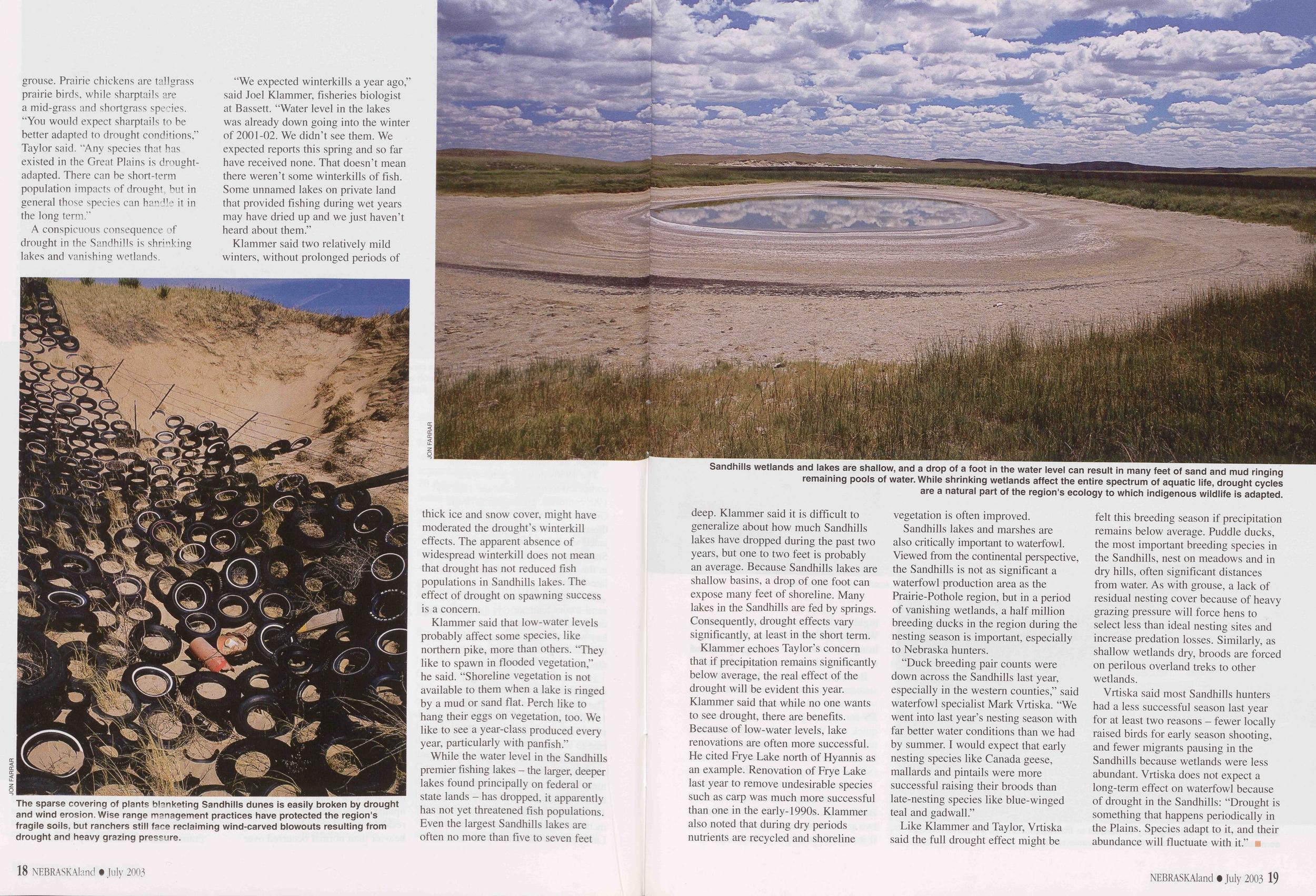 grouse. Prairie chickens are tallgrass prairie birds, while sharptails are a mid-grass and shortgrass species. "You would expect sharptails to be better adapted to drought conditions," Taylor said. "Any species that has existed in the Great Plains is drought-adapted. There can be short-term population impacts of drought, but in general those species can handle it in the long term."
A conspicuous consequence of drought in the Sandhills is shrinking lakes and vanishing wetlands.
"We expected winterkills a year ago," said Joel Klammer, fisheries biologist at Bassett. "Water level in the lakes was already down going into the winter of 2001-02. We didn't see them. We expected reports this spring and so far have received none. That doesn't mean there weren't some winterkills of fish. Some unnamed lakes on private land that provided fishing during wet years may have dried up and we just haven't heard about them."
Klammer said two relatively mild winters, without prolonged periods of thick ice and snow cover, might have moderated the drought's winterkill effects. The apparent absence of widespread winterkill does not mean that drought has not reduced fish populations in Sandhills lakes. The effect of drought on spawning success is a concern.
Klammer said that low-water levels probably affect some species, like northern pike, more than others. "They like to spawn in flooded vegetation," he said. "Shoreline vegetation is not available to them when a lake is ringed by a mud or sand flat. Perch like to hang their eggs on vegetation, too. We like to see a year-class produced every year, particularly with panfish."
While the water level in the Sandhills premier fishing lakes - the larger, deeper lakes found principally on federal or state lands - has dropped, it apparently has not yet threatened fish populations. Even the largest Sandhills lakes are often no more than five to seven feet 18 NEBRASKAland • July 2003
Klammer echoes Taylor's concern that if precipitation remains significantly below average, the real effect of the drought will be evident this year. Klammer said that while no one wants to see drought, there are benefits. Because of low-water levels, lake renovations are often more successful. He cited Frye Lake north of Hyannis as an example. Renovation of Frye Lake last year to remove undesirable species such as carp was much more successful than one in the early-1990s. Klammer also noted that during dry periods nutrients are recycled and shoreline vegetation is often improved.
Sandhills lakes and marshes are also critically important to waterfowl. Viewed from the continental perspective, the Sandhills is not as significant a waterfowl production area as the Prairie-Pothole region, but in a period of vanishing wetlands, a half million breeding ducks in the region during the nesting season is important, especially to Nebraska hunters.
"Duck breeding pair counts were down across the Sandhills last year, especially in the western counties," said waterfowl specialist Mark Vrtiska. "We went into last year's nesting season with far better water conditions than we had by summer. I would expect that early nesting species like Canada geese, mallards and pintails were more successful raising their broods than late-nesting species like blue-winged teal and gad wall."
Like Klammer and Taylor, Vrtiska said the full drought effect might be felt this breeding season if precipitation remains below average. Puddle ducks, the most important breeding species in the Sandhills, nest on meadows and in dry hills, often significant distances from water. As with grouse, a lack of residual nesting cover because of heavy grazing pressure will force hens to select less than ideal nesting sites and increase predation losses. Similarly, as shallow wetlands dry, broods are forced on perilous overland treks to other wetlands.
Vrtiska said most Sandhills hunters had a less successful season last year for at least two reasons - fewer locally raised birds for early season shooting, and fewer migrants pausing in the Sandhills because wetlands were less abundant. Vrtiska does not expect a long-term effect on waterfowl because of drought in the Sandhills: "Drought is something that happens periodically in the Plains. Species adapt to it, and their abundance will fluctuate with it."
NEBRASKAland • July 2003 19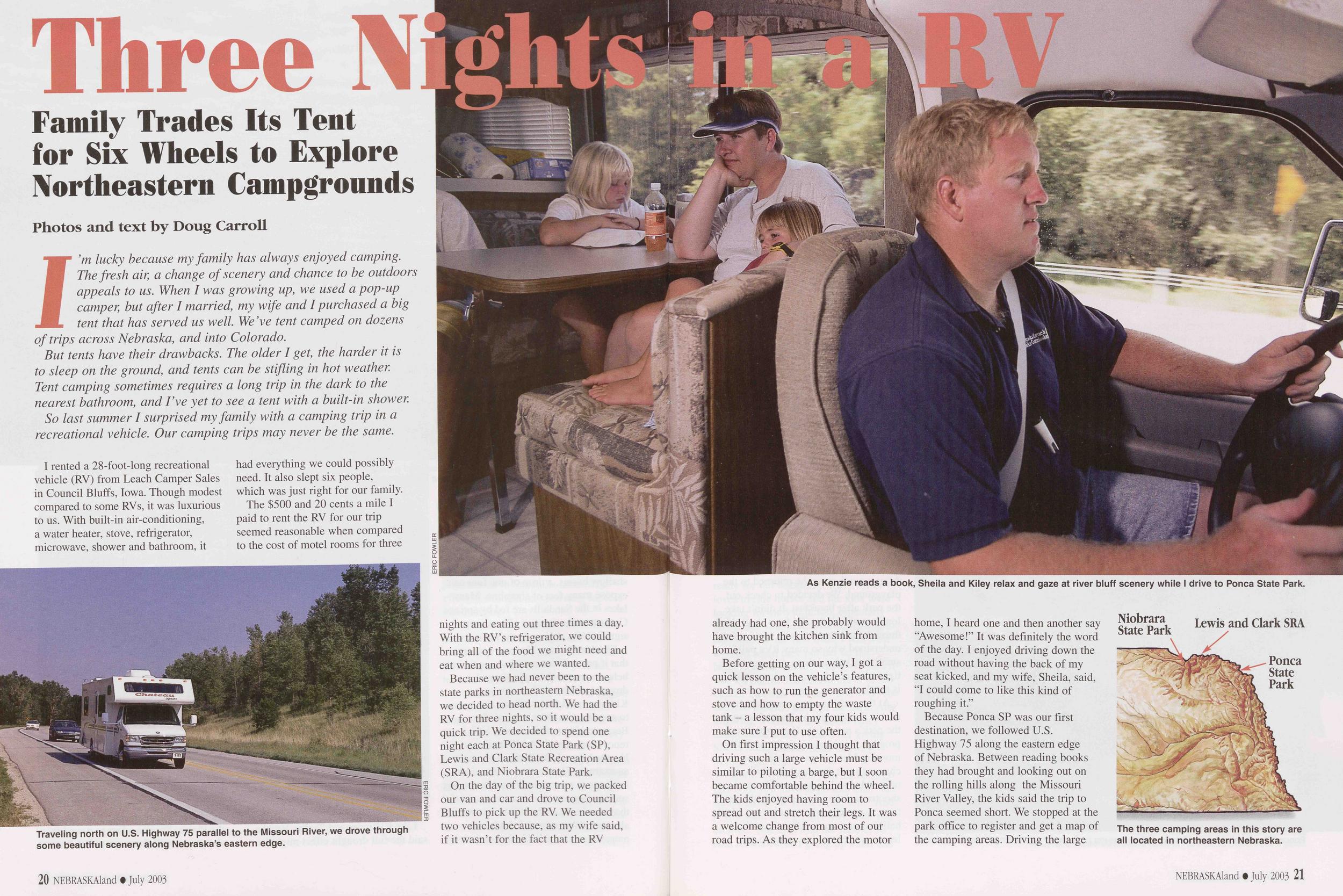
Three Nights in a RV
Family Trades Its Tent for Six Wheels to Explore Northeastern Campgrounds Photos and text by Doug CarrollI'm lucky because my family has always enjoyed camping. The fresh air, a change of scenery and chance to be outdoors appeals to us. When I was growing up, we used a pop-up camper, but after I married, my wife and I purchased a big tent that has served us well. We 've tent camped on dozens of trips across Nebraska, and into Colorado.
But tents have their drawbacks. The older I get, the harder it is to sleep on the ground, and tents can be stifling in hot weather. Tent camping sometimes requires a long trip in the dark to the nearest bathroom, and I've yet to see a tent with a built-in shower.
So last summer I surprised my family with a camping trip in a recreational vehicle. Our camping trips may never be the same.
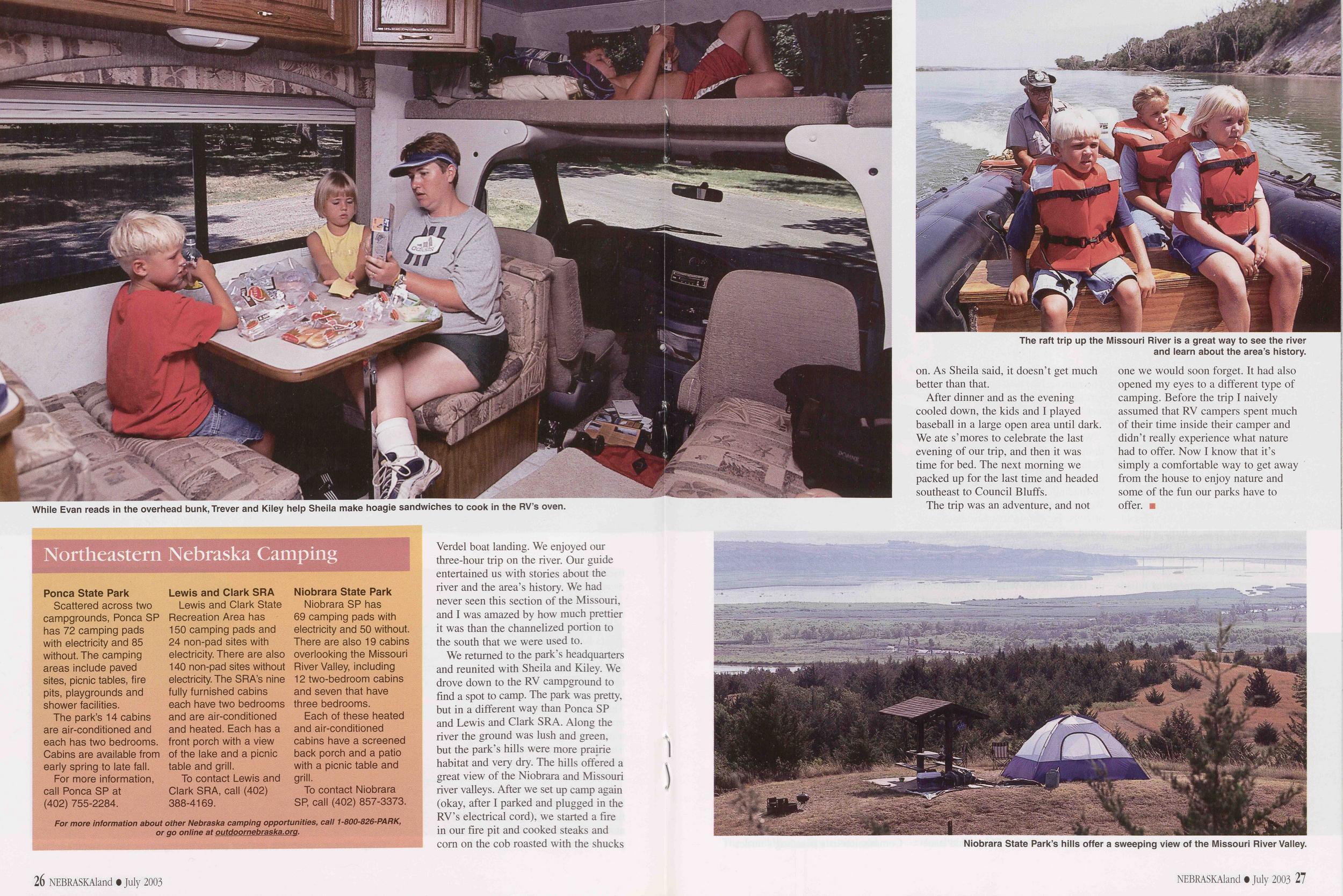
I rented a 28-foot-long recreational vehicle (RV) from Leach Camper Sales in Council Bluffs, Iowa. Though modest compared to some RVs, it was luxurious to us. With built-in air-conditioning, a water heater, stove, refrigerator, microwave, shower and bathroom, it had everything we could possibly need. It also slept six people, which was just right for our family.
The $500 and 20 cents a mile I paid to rent the RV for our trip seemed reasonable when compared to the cost of motel rooms for three nights and eating out three times a day. With the RVs refrigerator, we could bring all of the food we might need and eat when and where we wanted.
Because we had never been to the state parks in northeastern Nebraska, we decided to head north. We had the RV for three nights, so it would be a quick trip. We decided to spend one night each at Ponca State Park (SP), Lewis and Clark State Recreation Area (SRA), and Niobrara State Park.
On the day of the big trip, we packed our van and car and drove to Council Bluffs to pick up the RV. We needed two vehicles because, as my wife said, if it wasn't for the fact that the RV 20 NEBRASKAland • July 2003 already had one, she probably would have brought the kitchen sink from home.
Before getting on our way, I got a quick lesson on the vehicle's features, such as how to run the generator and stove and how to empty the waste tank - a lesson that my four kids would make sure I put to use often.
On first impression I thought that driving such a large vehicle must be similar to piloting a barge, but I soon became comfortable behind the wheel. The kids enjoyed having room to spread out and stretch their legs. It was a welcome change from most of our road trips. As they explored the motor home, I heard one and then another say 'Awesome!" It was definitely the word of the day. I enjoyed driving down the road without having the back of my seat kicked, and my wife, Sheila, said, "I could come to like this kind of roughing it."
Because Ponca SP was our first destination, we followed U.S. Highway 75 along the eastern edge of Nebraska. Between reading books they had brought and looking out on the rolling hills along the Missouri River Valley, the kids said the trip to Ponca seemed short. We stopped at the park office to register and get a map of the camping areas. Driving the large
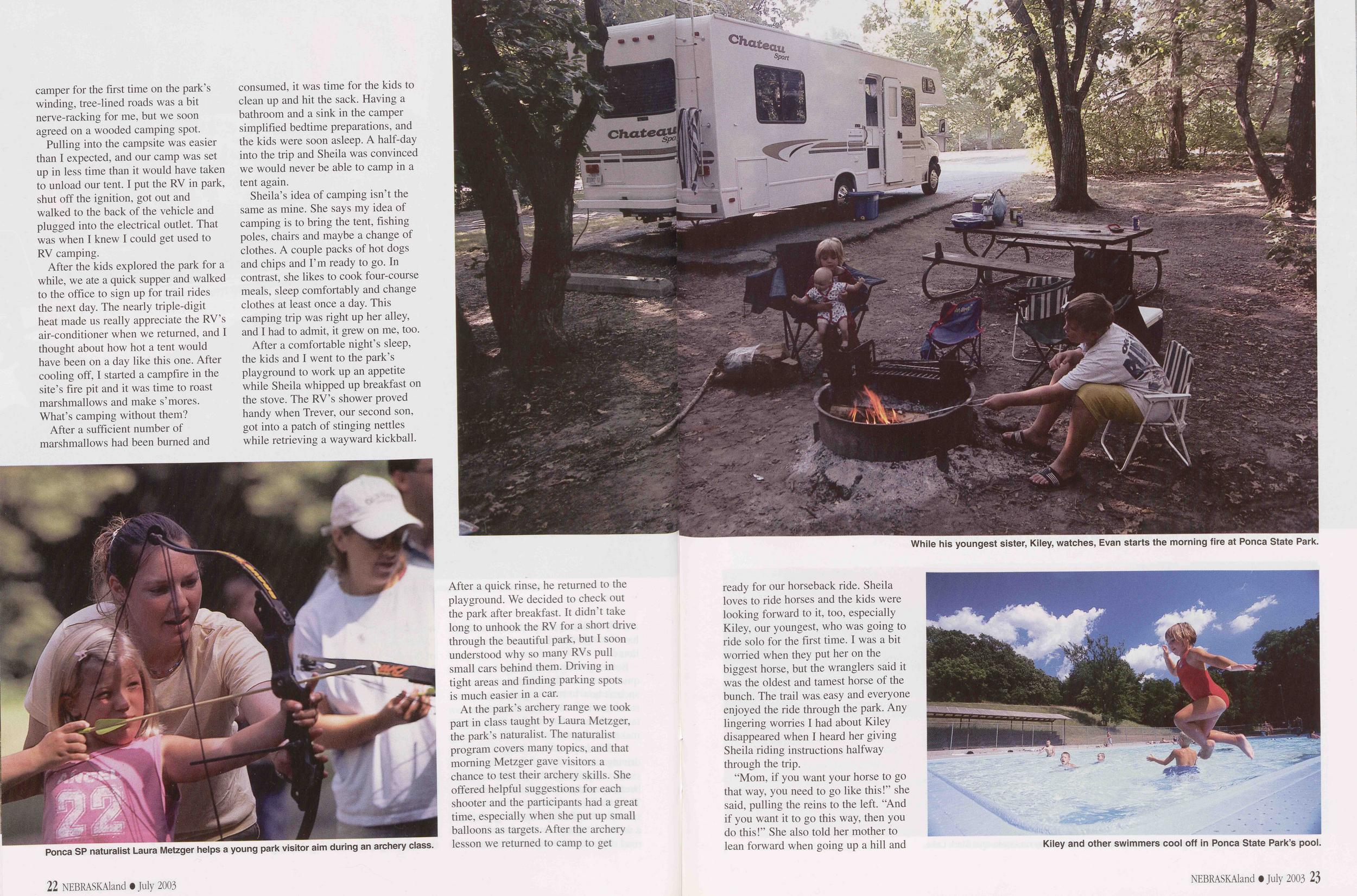 camper for the first time on the park's winding, tree-lined roads was a bit nerve-racking for me, but we soon agreed on a wooded camping spot.
Pulling into the campsite was easier than I expected, and our camp was set up in less time than it would have taken to unload our tent. I put the RV in park, shut off the ignition, got out and walked to the back of the vehicle and plugged into the electrical outlet. That was when I knew I could get used to RV camping.
After the kids explored the park for a while, we ate a quick supper and walked to the office to sign up for trail rides the next day. The nearly triple-digit heat made us really appreciate the RV's air-conditioner when we returned, and I thought about how hot a tent would have been on a day like this one. After cooling off, I started a campfire in the site's fire pit and it was time to roast marshmallows and make s'mores. What's camping without them?
After a sufficient number of marshmallows had been burned and consumed, it was time for the kids to clean up and hit the sack. Having a bathroom and a sink in the camper simplified bedtime preparations, and the kids were soon asleep. A half-day into the trip and Sheila was convinced we would never be able to camp in a tent again.
Sheila's idea of camping isn't the same as mine. She says my idea of camping is to bring the tent, fishing poles, chairs and maybe a change of clothes. A couple packs of hot dogs and chips and I'm ready to go. In contrast, she likes to cook four-course meals, sleep comfortably and change clothes at least once a day. This camping trip was right up her alley, and I had to admit, it grew on me, too.
After a comfortable night's sleep, the kids and I went to the park's playground to work up an appetite while Sheila whipped up breakfast on the stove. The RV's shower proved handy when Trever, our second son, got into a patch of stinging nettles while retrieving a wayward kickball. After a quick rinse, he returned to the playground. We decided to check out the park after breakfast. It didn't take long to unhook the RV for a short drive through the beautiful park, but I soon understood why so many RVs pull small cars behind them. Driving in tight areas and finding parking spots is much easier in a car.
At the park's archery range we took part in class taught by Laura Metzger, the park's naturalist. The naturalist program covers many topics, and that morning Metzger gave visitors a chance to test their archery skills. She offered helpful suggestions for each shooter and the participants had a great time, especially when she put up small balloons as targets. After the archery lesson we returned to camp to get 22 NEBRASKAland • July 2003
"Mom, if you want your horse to go that way, you need to go like this!" she said, pulling the reins to the left. "And if you want it to go this way, then you do this!" She also told her mother to lean forward when going up a hill and
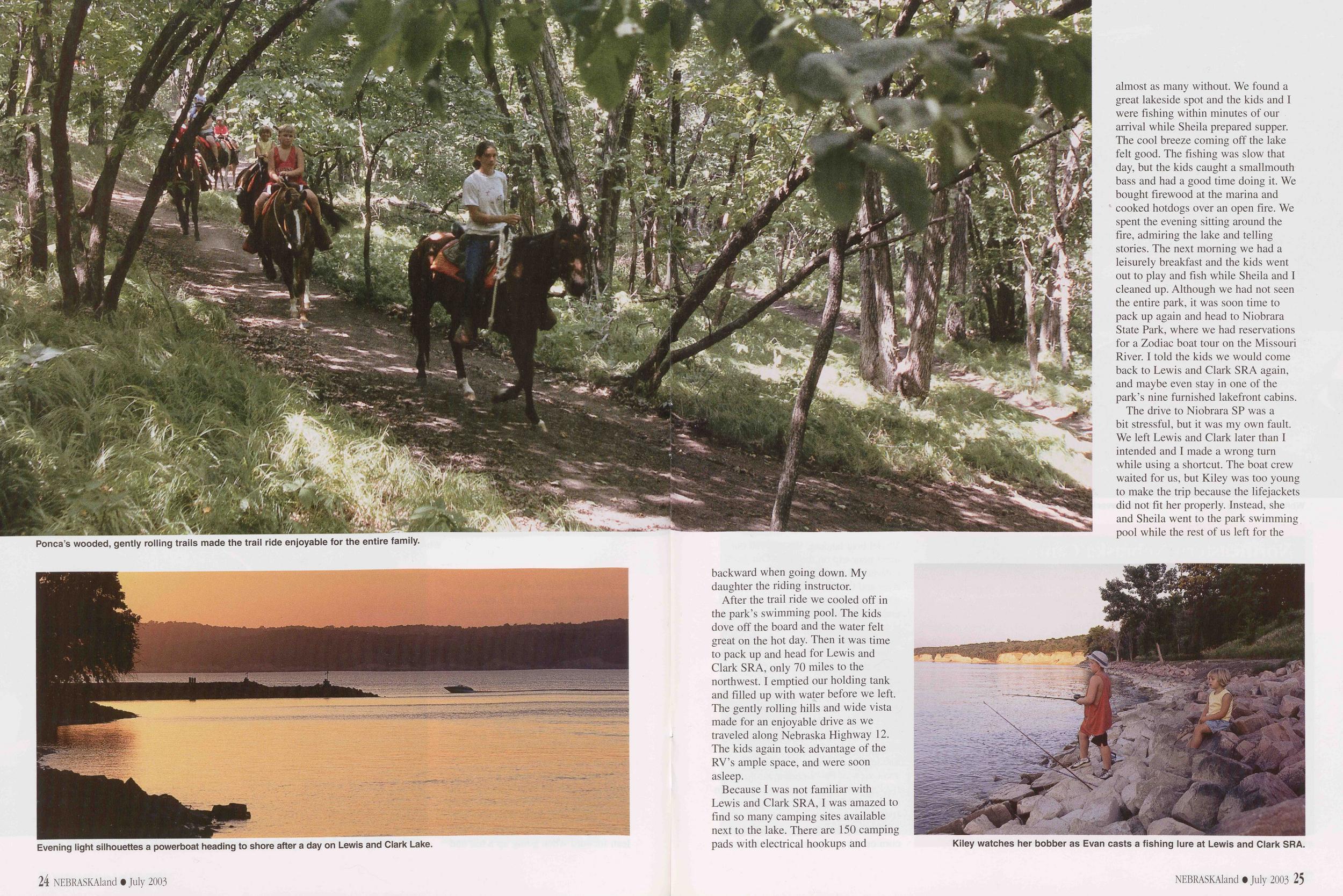
After the trail ride we cooled off in the park's swimming pool. The kids dove off the board and the water felt great on the hot day. Then it was time to pack up and head for Lewis and Clark SRA, only 70 miles to the northwest. I emptied our holding tank and filled up with water before we left. The gently rolling hills and wide vista made for an enjoyable drive as we traveled along Nebraska Highway 12. The kids again took advantage of the RV's ample space, and were soon asleep.
Because I was not familiar with Lewis and Clark SRA, I was amazed to find so many camping sites available next to the lake. There are 150 camping pads with electrical hookups and almost as many without. We found a great lakeside spot and the kids and I were fishing within minutes of our arrival while Sheila prepared supper. The cool breeze coming off the lake felt good. The fishing was slow that day, but the kids caught a smallmouth bass and had a good time doing it. We bought firewood at the marina and cooked hotdogs over an open fire. We spent the evening sitting around the fire, admiring the lake and telling stories. The next morning we had a leisurely breakfast and the kids went out to play and fish while Sheila and I cleaned up. Although we had not seen the entire park, it was soon time to pack up again and head to Niobrara State Park, where we had reservations for a Zodiac boat tour on the Missouri River. I told the kids we would come back to Lewis and Clark SRA again, and maybe even stay in one of the park's nine furnished lakefront cabins.
The drive to Niobrara SP was a bit stressful, but it was my own fault. We left Lewis and Clark later than I intended and I made a wrong turn while using a shortcut. The boat crew waited for us, but Kiley was too young to make the trip because the lifejackets did not fit her properly. Instead, she and Sheila went to the park swimming pool while the rest of us left for the
Northeastern Nebraska Camping Ponca State Park
Scattered across two campgrounds, Ponca SP has 72 camping pads with electricity and 85 without. The camping areas include paved sites, picnic tables, fire pits, playgrounds and shower facilities.
The park's 14 cabins are air-conditioned and each has two bedrooms. Cabins are available from early spring to late fall.
For more information, call Ponca SP at (402) 755-2284.
Lewis and Clark SRALewis and Clark State Recreation Area has 150 camping pads and 24 non-pad sites with electricity. There are also 140 non-pad sites without electricity. The SRA's nine fully furnished cabins each have two bedrooms and are air-conditioned and heated. Each has a front porch with a view of the lake and a picnic table and grill.
To contact Lewis and Clark SRA, call (402) 388-4169.
Niobrara State ParkNiobrara SP has 69 camping pads with electricity and 50 without. There are also 19 cabins overlooking the Missouri River Valley, including 12 two-bedroom cabins and seven that have three bedrooms.
Each of these heated and air-conditioned cabins have a screened back porch and a patio with a picnic table and grill.
To contact Niobrara SP, call (402) 857-3373.
For more information about other Nebraska camping opportunities, call 1-800-826-PARK, or go online at outdoornebraska.org.We returned to the park's headquarters and reunited with Sheila and Kiley. We drove down to the RV campground to find a spot to camp. The park was pretty, but in a different way than Ponca SP and Lewis and Clark SRA. Along the river the ground was lush and green, but the park's hills were more prairie habitat and very dry. The hills offered a great view of the Niobrara and Missouri river valleys. After we set up camp again (okay, after I parked and plugged in the RV's electrical cord), we started a fire in our fire pit and cooked steaks and corn on the cob roasted with the shucks 26 NEBRASKAland • July 2003
After dinner and as the evening cooled down, the kids and I played baseball in a large open area until dark. We ate s' mores to celebrate the last evening of our trip, and then it was time for bed. The next morning we packed up for the last time and headed southeast to Council Bluffs.
The trip was an adventure, and not one we would soon forget. It had also opened my eyes to a different type of camping. Before the trip I naively assumed that RV campers spent much of their time inside their camper and didn't really experience what nature had to offer. Now I know that it's simply a comfortable way to get away from the house to enjoy nature and some of the fun our parks have to offer,
Last Stand for Branding's Turtles?
Photos and text by Jon Farrar Considered threatened or endangered throughout most of their range, Blanding's turtles appear to be common in portions of Nebraska's Sandhills.It is a grotesque sight, a still living turtle crushed on the highway, fragments of shell ripped away, pulsating blood-red organs, the animal struggling to hold its head high, crushed legs moving but carrying it nowhere. Cars whiz by, the drivers' minds elsewhere. Gulls or crows will scavenge the remains, and if night falls before they finish their grisly work, raccoons or coyotes will. By morning nothing but a blood smear will be left on the highway. All traces of a 20-year-old turtle heavy with eggs, a turtle with another 30 years or more of future, vanished without a trace. It is a story as old as the wheel.
During the 1990s, segments of U.S. Highway 83 between Thedford and Valentine were widened and their relief was reduced as much as was practical. The narrow, two-lane highway with soft sand shoulders had grown rough and hazardous. Each year it carried more traffic. There had been fatalities.
Work on the 7.6-mile stretch passing through the Valentine National Wildlife Refuge was initially scheduled to begin in 1992, but construction was delayed by funding shifts and design changes. Work was rescheduled for the summer of 1999, but before scrapers and dozers could roll, western prairie fringed orchids (Platanthera praeclara) were found in the construction zone. The orchid is listed as threatened by both the U.S. Fish and Wildlife Service (USFWS) and the Nebraska Game and Parks Commission. The USFWS also raised questions about the highway's effect on wildlife crossing it, especially about Blanding's turtles (Emydoidea blandingii), designated by the USFWS as "a species of concern," implying it could be headed for threatened or endangered status.
The USFWS and the Commission were required by law to raise both issues, and the Nebraska Department of Roads (NDOR) was required to address them. The issues triggered a flurry of meetings in search of solutions, and construction was delayed until April 2001. Some Sandhills residents were outraged that a flower and a turtle stopped construction. The orchid issue was resolved by mitigation, NDOR acquiring private land with an existing orchid population and signing it over to the USFWS to protect, and by modifying the shoulder slope to avoid other populations on the refuge. The Blanding's turtle issue, however, was unlike any other that NDOR had encountered.
Turtle of ConcernThe Great Lakes region is the heart of the Blanding's turtle range, and north-central and northeastern Nebraska are on its western margin. Because of habitat loss and fragmentation, the species is classified as threatened or endangered in most states where it is found. In Canada the species was listed as threatened in 1973. In Nebraska the Commission lists Blanding's turtles 28 NEBRASKAland • July 2003
When the highway issue arose in 1999, population survey work on Blanding's turtles in Nebraska was piecemeal and based on relatively few collection records. Their distribution was considered widespread across northeastern and north-central Nebraska but their abundance was poorly documented. In other states, where Blanding's populations are much reduced and their habitat is crossed by roads, roadway mortality is the principal threat to their existence. Blanding's populations in eastern Nebraska likely face similar threats.
The Sandhills has few roads, and wetlands in the region are not in imminent danger of vanishing. Blanding's turtles are not exploited for food and they are not highly prized in the pet market because they are too large and active to be good aquarium pets. Because of these factors, biologists thought the future of Blanding's turtles in the Sandhills was relatively secure. But, without studies documenting their distribution and abundance, assumptions and perceptions were not adequate to answers questions of environmental law when Blanding's turtles became an issue in widening U.S. Highway 83.
In August 2000, the NDOR brought Jeffrey Lang, a professor at the University of North Dakota, to Cherry County to suggest modifications to the highway project to address Blanding's turtle concerns. Lang had conducted extensive Blanding's turtle research in Minnesota. His two-day survey along the highway revealed enough Blanding's shell fragments to suggest significant roadway mortality. "If you found that many fragments in New York state, they would probably close the highway," Lang said.
In an ideal world a study of the Valentine refuge's Blanding's turtles and highway design would have preceded construction several years. Lang's brief visit of the site was an eleventh hour attempt to fashion a compromise to allow construction to proceed. The NDOR already had plans to install fencing along several segments of the highway to funnel turtles through culverts under the road. Without extensive area knowledge or benefit of research, Lang recommended where fencing would be most useful and he suggested installing larger NEBRASKAland • July 2003 29 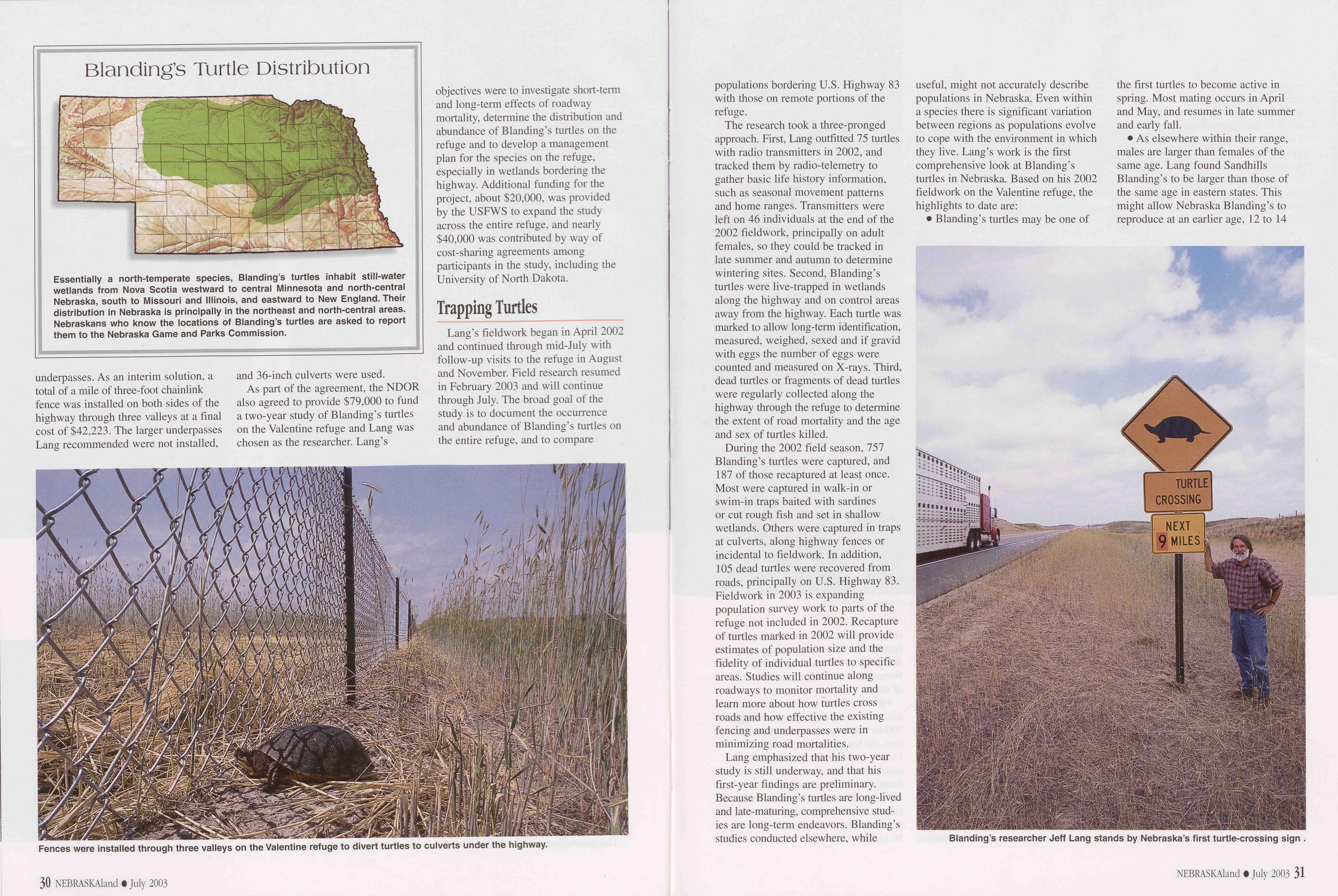
As part of the agreement, the NDOR also agreed to provide $79,000 to fund a two-year study of Blanding's turtles on the Valentine refuge and Lang was chosen as the researcher. Lang's objectives were to investigate short-term and long-term effects of roadway mortality, determine the distribution and abundance of Blanding's turtles on the refuge and to develop a management plan for the species on the refuge, especially in wetlands bordering the highway. Additional funding for the project, about $20,000, was provided by the USFWS to expand the study across the entire refuge, and nearly $40,000 was contributed by way of cost-sharing agreements among participants in the study, including the University of North Dakota.
Trapping TurtlesLang's fieldwork began in April 2002 and continued through mid-July with follow-up visits to the refuge in August and November. Field research resumed in February 2003 and will continue through July. The broad goal of the study is to document the occurrence and abundance of Blanding's turtles on the entire refuge, and to compare
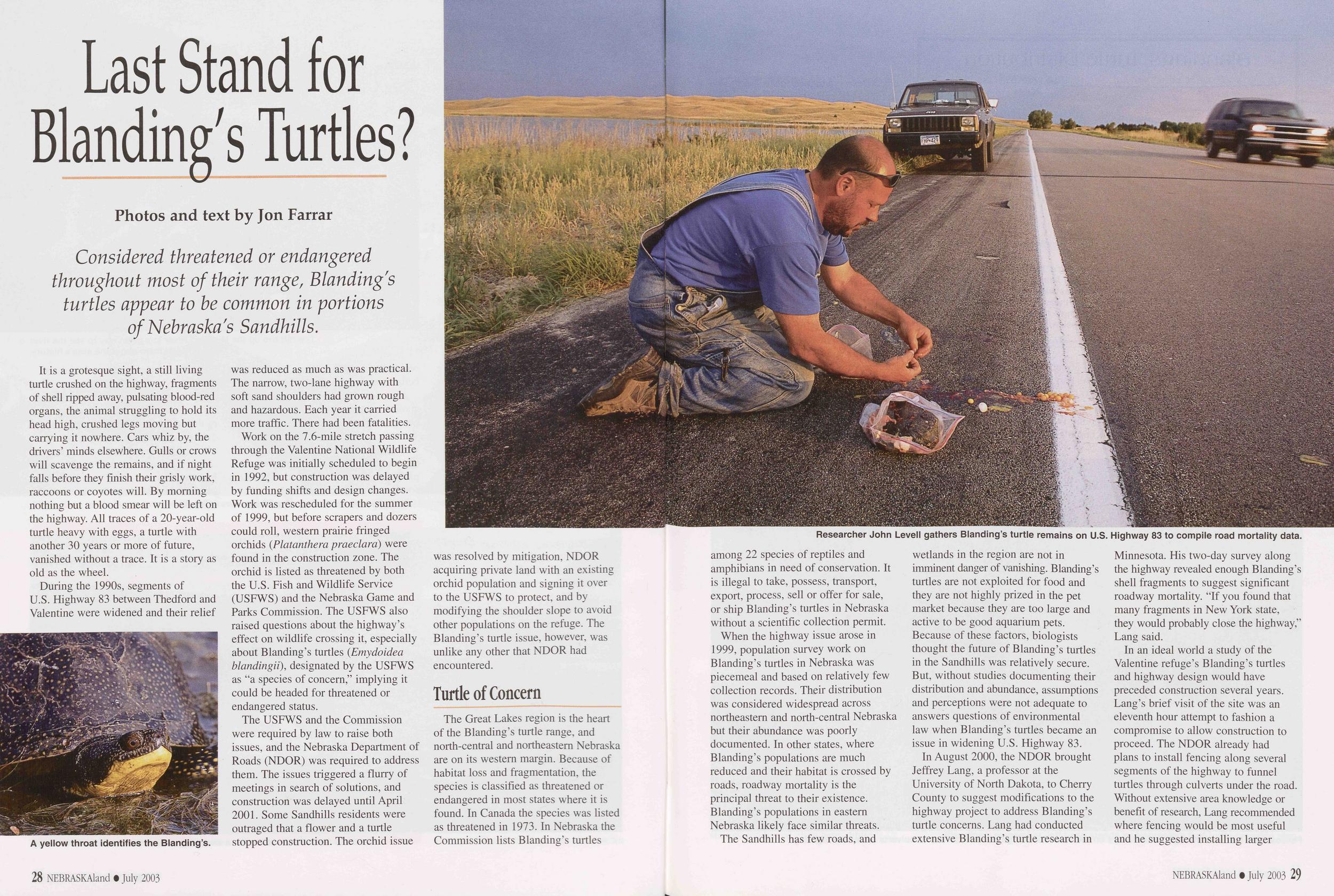
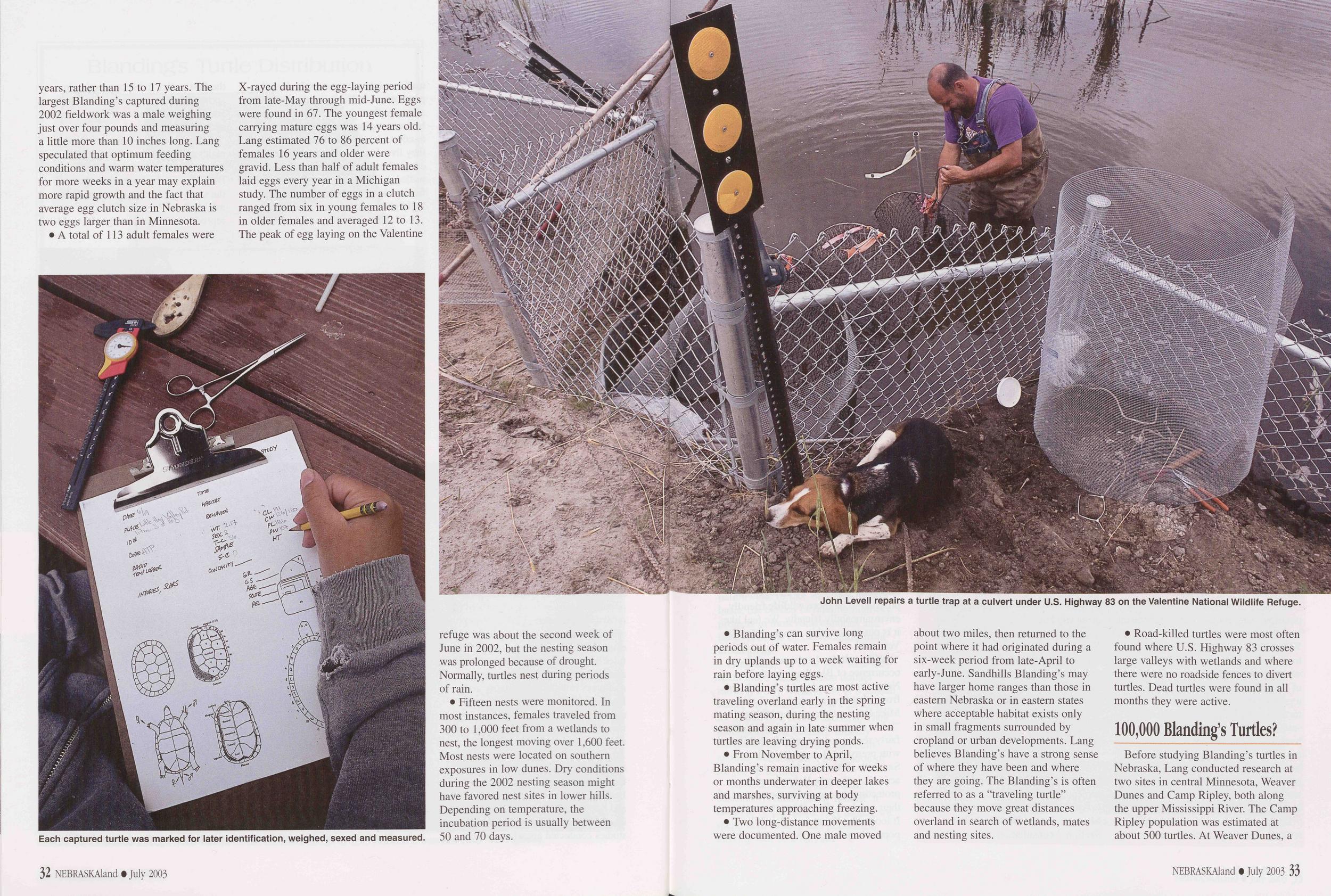
The research took a three-pronged approach. First, Lang outfitted 75 turtles with radio transmitters in 2002, and tracked them by radio-telemetry to gather basic life history information, such as seasonal movement patterns and home ranges. Transmitters were left on 46 individuals at the end of the 2002 fieldwork, principally on adult females, so they could be tracked in late summer and autumn to determine wintering sites. Second, Blanding's turtles were live-trapped in wetlands along the highway and on control areas away from the highway. Each turtle was marked to allow long-term identification, measured, weighed, sexed and if gravid with eggs the number of eggs were counted and measured on X-rays. Third, dead turtles or fragments of dead turtles were regularly collected along the highway through the refuge to determine the extent of road mortality and the age and sex of turtles killed.
During the 2002 field season, 757 Blanding's turtles were captured, and 187 of those recaptured at least once. Most were captured in walk-in or swim-in traps baited with sardines or cut rough fish and set in shallow wetlands. Others were captured in traps at culverts, along highway fences or incidental to fieldwork. In addition, 105 dead turtles were recovered from roads, principally on U.S. Highway 83. Fieldwork in 2003 is expanding population survey work to parts of the refuge not included in 2002. Recapture of turtles marked in 2002 will provide estimates of population size and the fidelity of individual turtles to specific areas. Studies will continue along roadways to monitor mortality and learn more about how turtles cross roads and how effective the existing fencing and underpasses were in minimizing road mortalities.
Lang emphasized that his two-year study is still underway, and that his first-year findings are preliminary. Because Blanding's turtles are long-lived and late-maturing, comprehensive stud- ies are long-term endeavors. Blanding's studies conducted elsewhere, while useful, might not accurately describe populations in Nebraska. Even within a species there is significant variation between regions as populations evolve to cope with the environment in which they live. Lang's work is the first comprehensive look at Blanding's turtles in Nebraska. Based on his 2002 fieldwork on the Valentine refuge, the highlights to date are:
• Blanding's turtles may be one of the first turtles to become active in spring. Most mating occurs in April and May, and resumes in late summer and early fall.
• As elsewhere within their range, males are larger than females of the same age. Lang found Sandhills Blanding's to be larger than those of the same age in eastern states. This might allow Nebraska Blanding's to reproduce at an earlier age, 12 to 14
 years, rather than 15 to 17 years. The largest Blanding's captured during 2002 fieldwork was a male weighing just over four pounds and measuring a little more than 10 inches long. Lang speculated that optimum feeding conditions and warm water temperatures for more weeks in a year may explain more rapid growth and the fact that average egg clutch size in Nebraska is two eggs larger than in Minnesota.
• A total of 113 adult females were X-rayed during the egg-laying period from late-May through mid-June. Eggs were found in 67. The youngest female carrying mature eggs was 14 years old. Lang estimated 76 to 86 percent of females 16 years and older were gravid. Less than half of adult females laid eggs every year in a Michigan study. The number of eggs in a clutch ranged from six in young females to 18 in older females and averaged 12 to 13. The peak of tgg laying on the Valentine refuge was about the second week of June in 2002, but the nesting season was prolonged because of drought. Normally, turtles nest during periods of rain.
• Fifteen nests were monitored. In most instances, females traveled from 300 to 1,000 feet from a wetlands to nest, the longest moving over 1,600 feet. Most nests were located on southern exposures in low dunes. Dry conditions during the 2002 nesting season might have favored nest sites in lower hills. Depending on temperature, the incubation period is usually between 50 and 70 days.
32 NEBRASKAland t July 2003• Blanding's can survive long periods out of water. Females remain in dry uplands up to a week waiting for rain before laying eggs.
• Blanding's turtles are most active traveling overland early in the spring mating season, during the nesting season and again in late summer when turtles are leaving drying ponds.
• From November to April, Blanding's remain inactive for weeks or months underwater in deeper lakes and marshes, surviving at body temperatures approaching freezing.
• Two long-distance movements were documented. One male moved about two miles, then returned to the point where it had originated during a six-week period from late-April to early-June. Sandhills Blanding's may have larger home ranges than those in eastern Nebraska or in eastern states where acceptable habitat exists only in small fragments surrounded by cropland or urban developments. Lang believes Blanding's have a strong sense of where they have been and where they are going. The Blanding's is often referred to as a "traveling turtle" because they move great distances overland in search of wetlands, mates and nesting sites.
• Road-killed turtles were most often found where U.S. Highway 83 crosses large valleys with wetlands and where there were no roadside fences to divert turtles. Dead turtles were found in all months they were active.
100,000 Blanding's Turtles?Before studying Blanding's turtles in Nebraska, Lang conducted research at two sites in central Minnesota, Weaver Dunes and Camp Ripley, both along the upper Mississippi River. The Camp Ripley population was estimated at about 500 turtles. At Weaver Dunes, a NEBRASKAland • July 2003 33 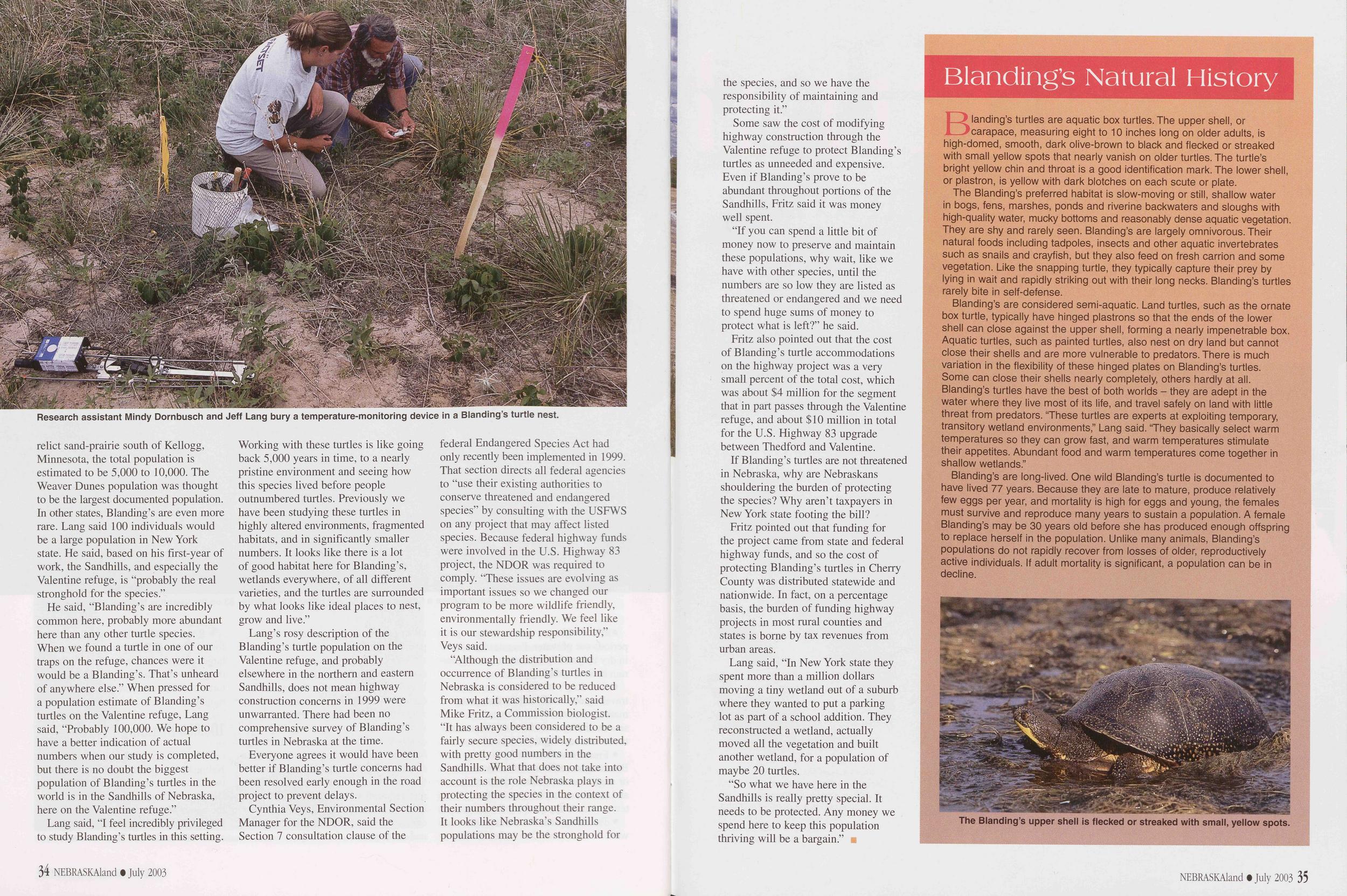
He said, "Blanding's are incredibly common here, probably more abundant here than any other turtle species. When we found a turtle in one of our traps on the refuge, chances were it would be a Blanding's. That's unheard of anywhere else." When pressed for a population estimate of Blanding's turtles on the Valentine refuge, Lang said, "Probably 100,000. We hope to have a better indication of actual numbers when our study is completed, but there is no doubt the biggest population of Blanding's turtles in the world is in the Sandhills of Nebraska, here on the Valentine refuge."
Lang said, "I feel incredibly privileged to study Blanding's turtles in this setting. Working with these turtles is like going back 5,000 years in time, to a nearly pristine environment and seeing how this species lived before people outnumbered turtles. Previously we have been studying these turtles in highly altered environments, fragmented habitats, and in significantly smaller numbers. It looks like there is a lot of good habitat here for Blanding's, wetlands everywhere, of all different varieties, and the turtles are surrounded by what looks like ideal places to nest, grow and live."
Lang's rosy description of the Blanding's turtle population on the Valentine refuge, and probably elsewhere in the northern and eastern Sandhills, does not mean highway construction concerns in 1999 were unwarranted. There had been no comprehensive survey of Blanding's turtles in Nebraska at the time.
Everyone agrees it would have been better if Blanding's turtle concerns had been resolved early enough in the road project to prevent delays.
Cynthia Veys, Environmental Section Manager for the NDOR, said the Section 7 consultation clause of the federal Endangered Species Act had only recently been implemented in 1999. That section directs all federal agencies to "use their existing authorities to conserve threatened and endangered species" by consulting with the USFWS on any project that may affect listed species. Because federal highway funds were involved in the U.S. Highway 83 project, the NDOR was required to comply. "These issues are evolving as important issues so we changed our program to be more wildlife friendly, environmentally friendly. We feel like it is our stewardship responsibility," Veys said.
"Although the distribution and occurrence of Blanding's turtles in Nebraska is considered to be reduced from what it was historically," said Mike Fritz, a Commission biologist. "It has always been considered to be a fairly secure species, widely distributed, with pretty good numbers in the Sandhills. What that does not take into account is the role Nebraska plays in protecting the species in the context of their numbers throughout their range. It looks like Nebraska's Sandhills populations may be the stronghold for 34 NEBRASKAland • July 2003 the species, and so we have the responsibility of maintaining and protecting it."
Some saw the cost of modifying highway construction through the Valentine refuge to protect Blanding's turtles as unneeded and expensive. Even if Blanding's prove to be abundant throughout portions of the Sandhills, Fritz said it was money well spent.
"If you can spend a little bit of money now to preserve and maintain these populations, why wait, like we have with other species, until the numbers are so low they are listed as threatened or endangered and we need to spend huge sums of money to protect what is left?" he said.
Fritz also pointed out that the cost of Blanding's turtle accommodations on the highway project was a very small percent of the total cost, which was about $4 million for the segment that in part passes through the Valentine refuge, and about $10 million in total for the U.S. Highway 83 upgrade between Thedford and Valentine.
If Blanding's turtles are not threatened in Nebraska, why are Nebraskans shouldering the burden of protecting the species? Why aren't taxpayers in New York state footing the bill?
Fritz pointed out that funding for the project came from state and federal highway funds, and so the cost of protecting Blanding's turtles in Cherry County was distributed statewide and nationwide. In fact, on a percentage basis, the burden of funding highway projects in most rural counties and states is borne by tax revenues from urban areas.
Lang said, "In New York state they spent more than a million dollars moving a tiny wetland out of a suburb where they wanted to put a parking lot as part of a school addition. They reconstructed a wetland, actually moved all the vegetation and built another wetland, for a population of maybe 20 turtles.
"So what we have here in the Sandhills is really pretty special. It needs to be protected. Any money we spend here to keep this population thriving will be a bargain."
Blanding's Natural HistoryBlanding's turtles are aquatic box turtles. The upper shell, or carapace, measuring eight to 10 inches long on older adults, is high-domed, smooth, dark olive-brown to black and flecked or streaked with small yellow spots that nearly vanish on older turtles. The turtle's bright yellow chin and throat is a good identification mark. The lower shell, or plastron, is yellow with dark blotches on each scute or plate.
The Blanding's preferred habitat is slow-moving or still, shallow water in bogs, fens, marshes, ponds and riverine backwaters and sloughs with high-quality water, mucky bottoms and reasonably dense aquatic vegetation. They are shy and rarely seen. Blanding's are largely omnivorous. Their natural foods including tadpoles, insects and other aquatic invertebrates such as snails and crayfish, but they also feed on fresh carrion and some vegetation. Like the snapping turtle, they typically capture their prey by lying in wait and rapidly striking out with their long necks. Blanding's turtles rarely bite in self-defense.
Blanding's are considered semi-aquatic. Land turtles, such as the ornate box turtle, typically have hinged plastrons so that the ends of the lower shell can close against the upper shell, forming a nearly impenetrable box. Aquatic turtles, such as painted turtles, also nest on dry land but cannot close their shells and are more vulnerable to predators. There is much variation in the flexibility of these hinged plates on Blanding's turtles. Some can close their shells nearly completely, others hardly at all. Blanding's turtles have the best of both worlds - they are adept in the water where they live most of its life, and travel safely on land with little threat from predators. "These turtles are experts at exploiting temporary, transitory wetland environments," Lang said. "They basically select warm temperatures so they can grow fast, and warm temperatures stimulate their appetites. Abundant food and warm temperatures come together in shallow wetlands."
Blanding's are long-lived. One wild Blanding's turtle is documented to have lived 77 years. Because they are late to mature, produce relatively few eggs per year, and mortality is high for eggs and young, the females must survive and reproduce many years to sustain a population. A female Blanding's may be 30 years old before she has produced enough offspring to replace herself in the population. Unlike many animals, Blanding's populations do not rapidly recover from losses of older, reproductively active individuals. If adult mortality is significant, a population can be in decline.
Fort Hartsuff
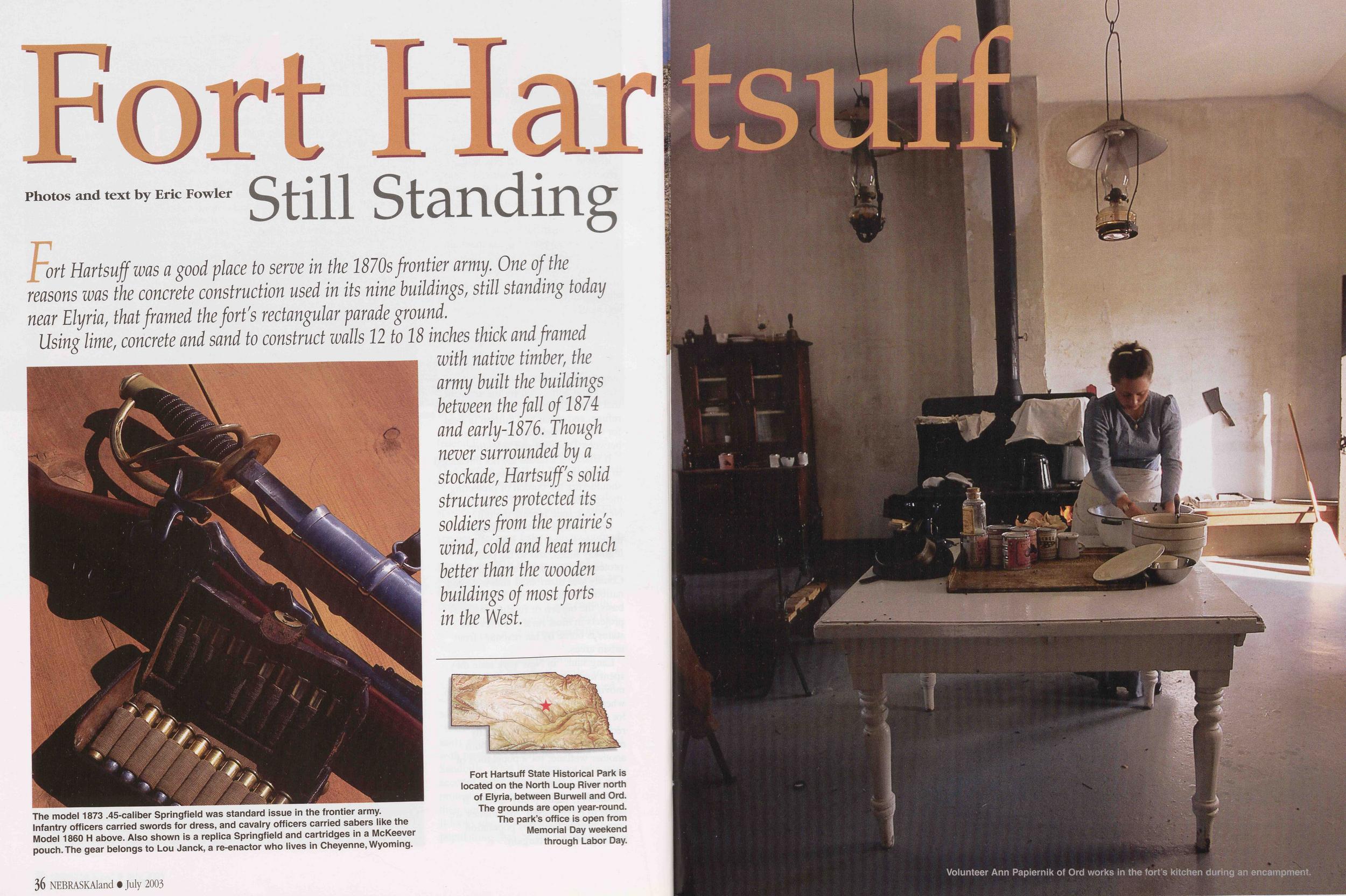
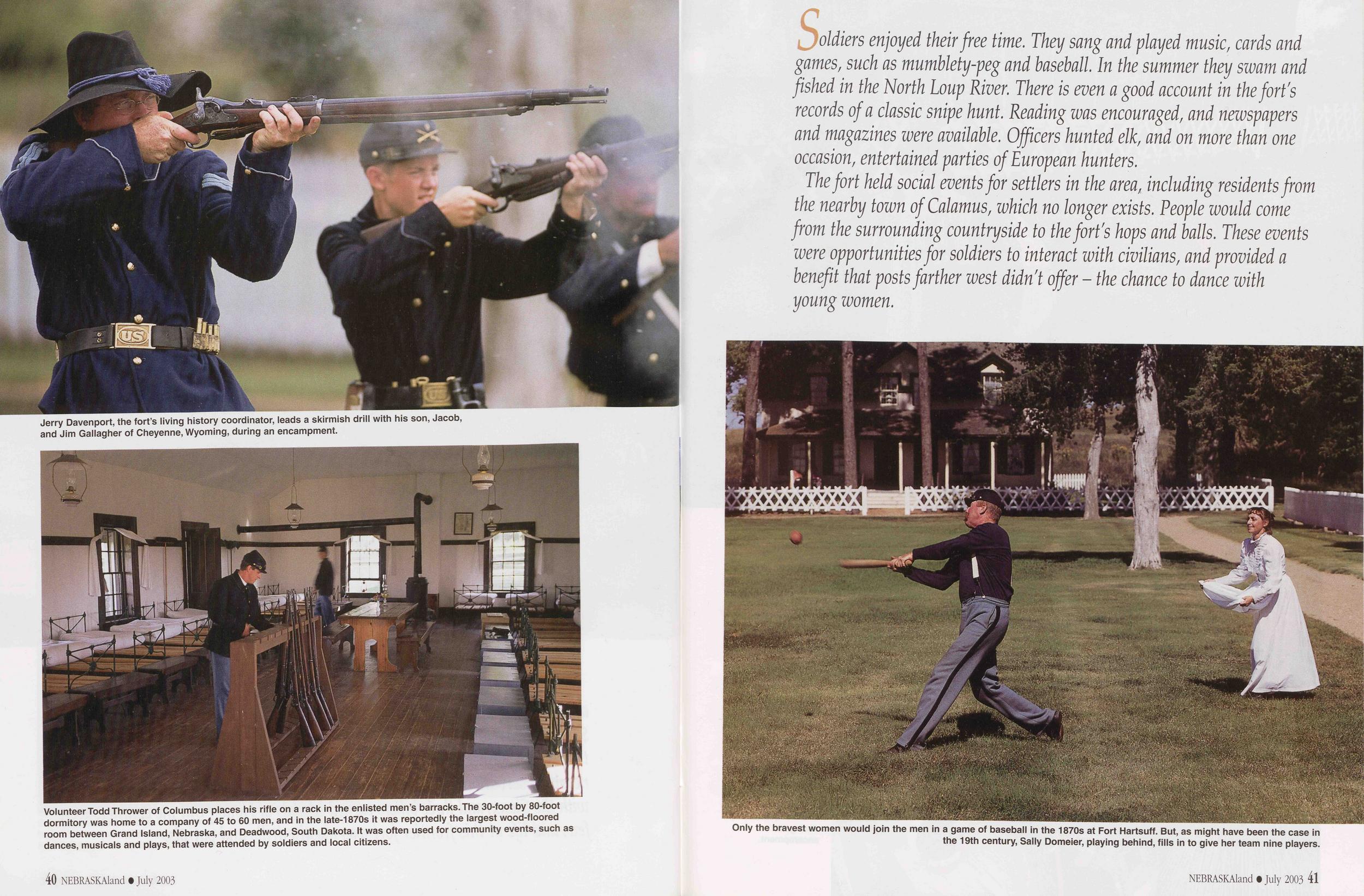
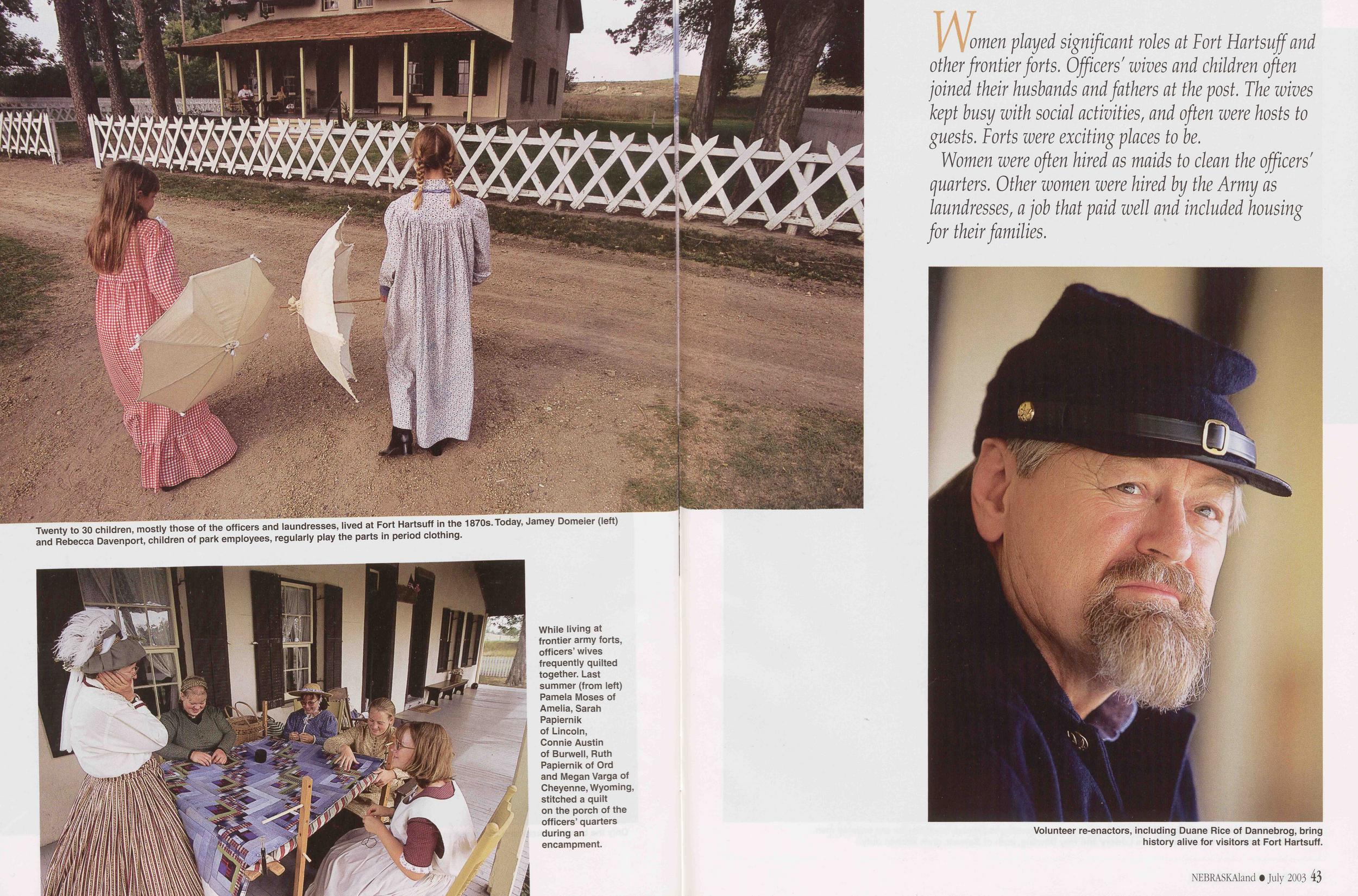
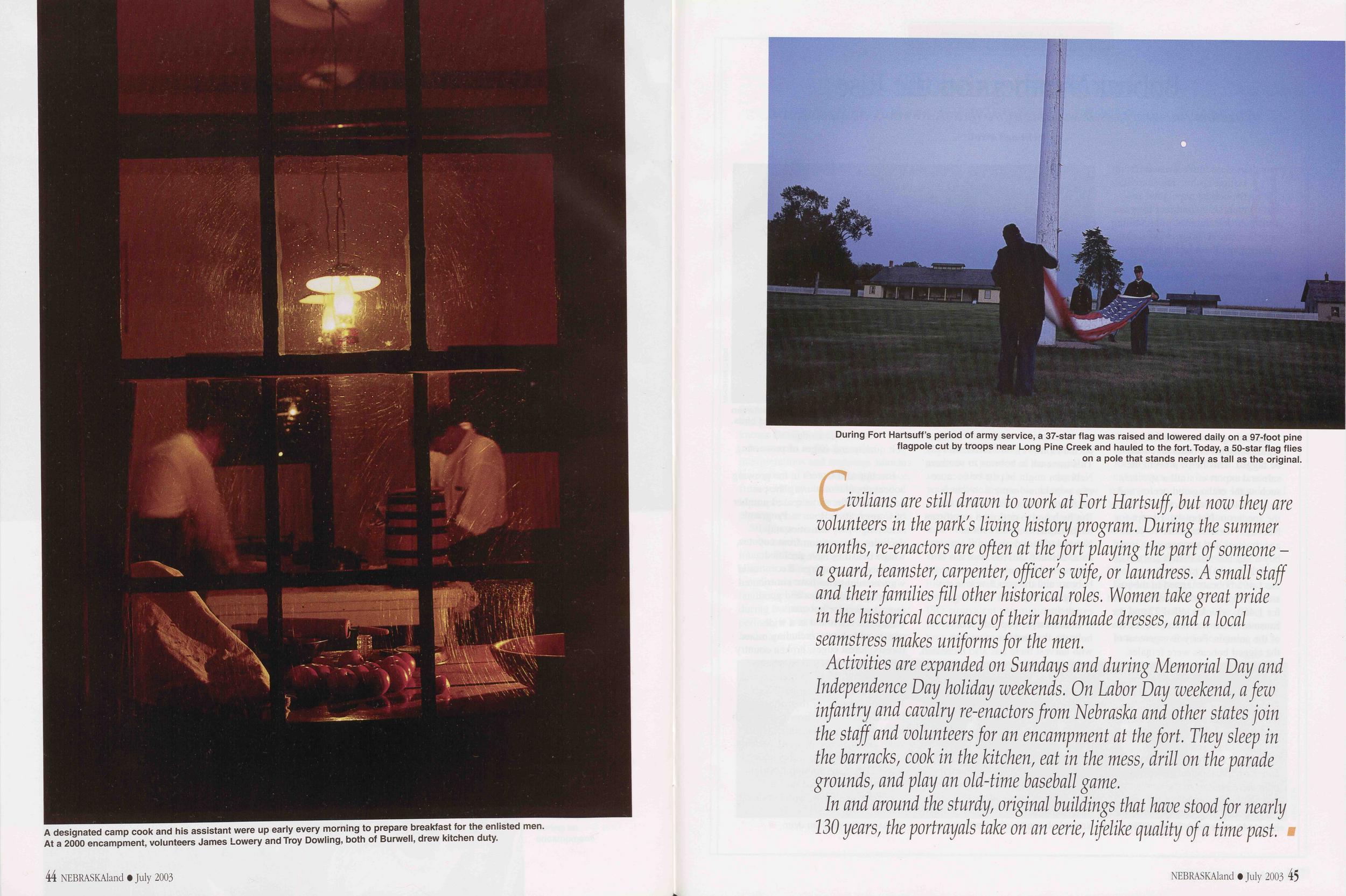
Photos and text by Eric Fowler Still Standing Fort Hartsuff was a good place to serve in the 1870s frontier army. One of the reasons was the concrete construction used in its nine buildings, still standing today near Elyria, that framed the fort's rectangular parade ground. Using lime, concrete and sand to construct walls 12 to 18 inches thick and framed with native timber, the army built the buildings between the fall of 1874 and early-1876. Though never surrounded by a stockade, Hartsuff's solid structures protected its soldiers from the prairie's wind, cold and heat much better than the wooden buildings of most forts in the West.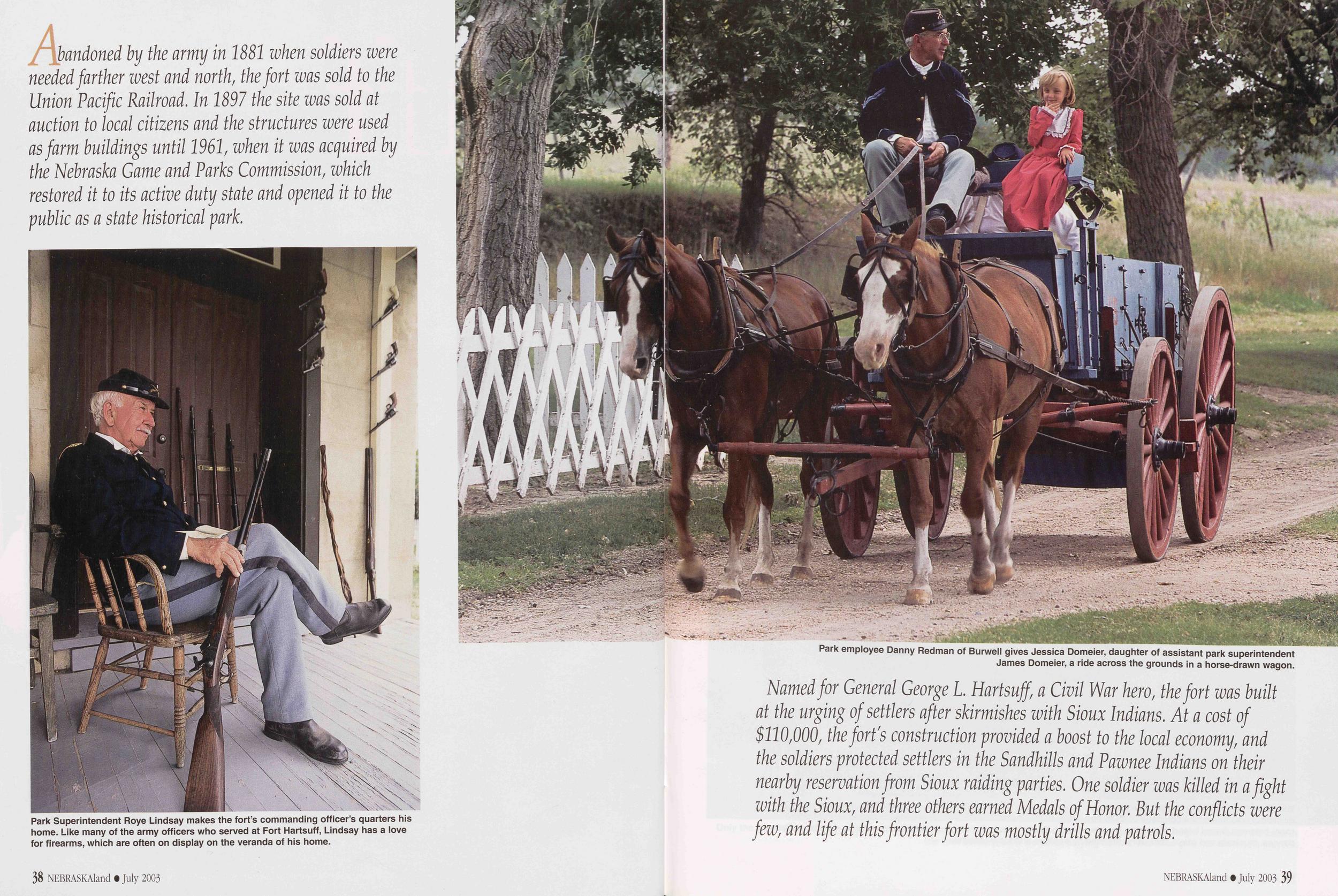 bandoned by the army in 1881 when soldiers were needed farther west and north, the fort was sold to the Union Pacific Railroad. In 1897 the site was sold at auction to local citizens and the structures were used as farm buildings until 1961, when it was acquired by the Nebraska Game and Parks Commission, which restored it to its active duty state and opened it to the public as a state historical park.
Outdoor Update
Bobcat Numbers on the Rise
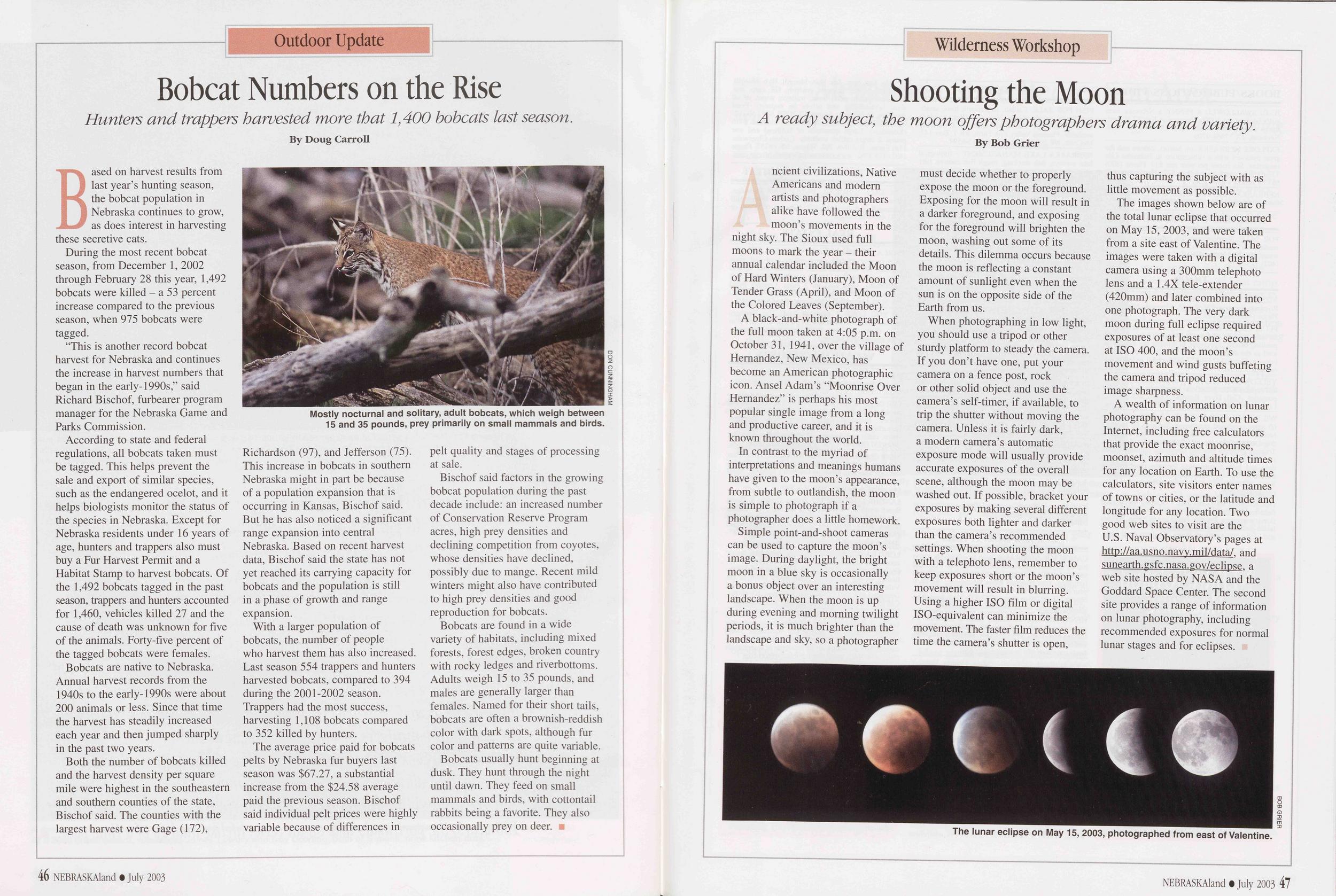
Hunters and trappers harvested more that 1,400 bobcats last season By Doug CarrollBased on harvest results from last year's hunting season, the bobcat population in Nebraska continues to grow, as does interest in harvesting these secretive cats.
During the most recent bobcat season, from December 1, 2002 through February 28 this year, 1,492 bobcats were killed - a 53 percent increase compared to the previous season, when 975 bobcats were tagged.
"This is another record bobcat harvest for Nebraska and continues the increase in harvest numbers that began in the early-1990s," said Richard Bischof, furbearer program manager for the Nebraska Game and Parks Commission.
According to state and federal regulations, all bobcats taken must be tagged. This helps prevent the sale and export of similar species, such as the endangered ocelot, and it helps biologists monitor the status of the species in Nebraska. Except for Nebraska residents under 16 years of age, hunters and trappers also must buy a Fur Harvest Permit and a Habitat Stamp to harvest bobcats. Of the 1,492 bobcats tagged in the past season, trappers and hunters accounted for 1,460, vehicles killed 27 and the cause of death was unknown for five of the animals. Forty-five percent of the tagged bobcats were females.
Bobcats are native to Nebraska. Annual harvest records from the 1940s to the early-1990s were about 200 animals or less. Since that time the harvest has steadily increased each year and then jumped sharply in the past two years.
Both the number of bobcats killed and the harvest density per square mile were highest in the southeastern and southern counties of the state, Bischof said. The counties with the largest harvest were Gage (172), Richardson (97), and Jefferson (75). This increase in bobcats in southern Nebraska might in part be because of a population expansion that is occurring in Kansas, Bischof said. But he has also noticed a significant range expansion into central Nebraska. Based on recent harvest data, Bischof said the state has not yet reached its carrying capacity for bobcats and the population is still in a phase of growth and range expansion.
With a larger population of bobcats, the number of people who harvest them has also increased. Last season 554 trappers and hunters harvested bobcats, compared to 394 during the 2001-2002 season. Trappers had the most success, harvesting 1,108 bobcats compared to 352 killed by hunters.
The average price paid for bobcats pelts by Nebraska fur buyers last season was $67.27, a substantial increase from the $24.58 average paid the previous season. Bischof said individual pelt prices were highly variable because of differences in pelt quality and stages of processing at sale.
Bischof said factors in the growing bobcat population during the past decade include: an increased number of Conservation Reserve Program acres, high prey densities and declining competition from coyotes, whose densities have declined, possibly due to mange. Recent mild winters might also have contributed to high prey densities and good reproduction for bobcats.
Bobcats are found in a wide variety of habitats, including mixed forests, forest edges, broken country with rocky ledges and riverbottoms. Adults weigh 15 to 35 pounds, and males are generally larger than females. Named for their short tails, bobcats are often a brownish-reddish color with dark spots, although fur color and patterns are quite variable.
Bobcats usually hunt beginning at dusk. They hunt through the night until dawn. They feed on small mammals and birds, with cottontail rabbits being a favorite. They also occasionally prey on deer.
46 NEBRASKAland • July 2003Wilderness Workshop
Shooting the Moon
A ready subject, the moon offers photographers drama and variety. By Bob GrierAncient civilizations, Native Americans and modern artists and photographers alike have followed the moon's movements in the night sky. The Sioux used full moons to mark the year - their annual calendar included the Moon of Hard Winters (January), Moon of Tender Grass (April), and Moon of the Colored Leaves (September).
A black-and-white photograph of the full moon taken at 4:05 p.m. on October 31, 1941, over the village of Hernandez, New Mexico, has become an American photographic icon. Ansel Adam's "Moonrise Over Hernandez" is perhaps his most popular single image from a long and productive career, and it is known throughout the world.
In contrast to the myriad of interpretations and meanings humans have given to the moon's appearance, from subtle to outlandish, the moon is simple to photograph if a photographer does a little homework.
Simple point-and-shoot cameras can be used to capture the moon's image. During daylight, the bright moon in a blue sky is occasionally a bonus object over an interesting landscape. When the moon is up during evening and morning twilight periods, it is much brighter than the landscape and sky, so a photographer must decide whether to properly expose the moon or the foreground. Exposing for the moon will result in a darker foreground, and exposing for the foreground will brighten the moon, washing out some of its details. This dilemma occurs because the moon is reflecting a constant amount of sunlight even when the sun is on the opposite side of the Earth from us.
When photographing in low light, you should use a tripod or other sturdy platform to steady the camera. If you don't have one, put your camera on a fence post, rock or other solid object and use the camera's self-timer, if available, to trip the shutter without moving the camera. Unless it is fairly dark, a modern camera's automatic exposure mode will usually provide accurate exposures of the overall scene, although the moon may be washed out. If possible, bracket your exposures by making several different exposures both lighter and darker than the camera's recommended settings. When shooting the moon with a telephoto lens, remember to keep exposures short or the moon's movement will result in blurring. Using a higher ISO film or digital ISO-equivalent can minimize the movement. The faster film reduces the time the camera's shutter is open, thus capturing the subject with as little movement as possible.
The images shown below are of the total lunar eclipse that occurred on May 15, 2003, and were taken from a site east of Valentine. The images were taken with a digital camera using a 300mm telephoto lens and a 1.4X tele-extender (420mm) and later combined into one photograph. The very dark moon during full eclipse required exposures of at least one second at ISO 400, and the moon's movement and wind gusts buffeting the camera and tripod reduced image sharpness.
A wealth of information on lunar photography can be found on the Internet, including free calculators that provide the exact moonrise, moonset, azimuth and altitude times for any location on Earth. To use the calculators, site visitors enter names of towns or cities, or the latitude and longitude for any location. Two good web sites to visit are the U.S. Naval Observatory's pages at http://aa.usno.navy.mil/data/. and sunearth.gsfc.nasa.gov/eclipse. a web site hosted by NASA and the Goddard Space Center. The second site provides a range of information on lunar photography, including recommended exposures for normal lunar stages and for eclipses.
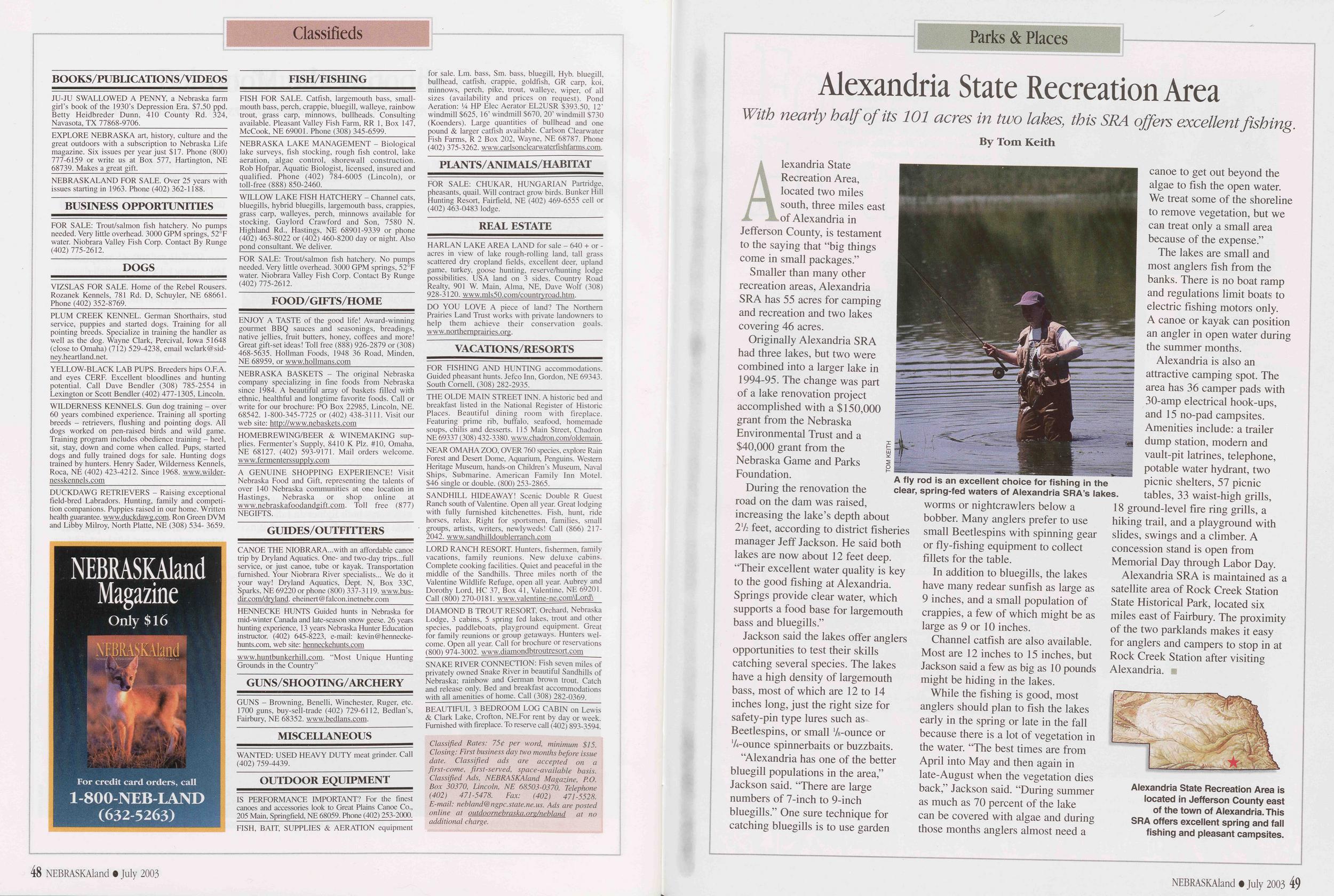
Classifieds
BOOKS/PUBLICATIONS/VIDEOSJU-JU SWALLOWED A PENNY, a Nebraska farm girl's book of the 1930's Depression Era. $7.50 ppd. Betty Heidbreder Dunn, 410 County Rd. 324, Navasota, TX 77868-9706._____________________
EXPLORE NEBRASKA art, history, culture and the great outdoors with a subscription to Nebraska Life magazine. Six issues per year just $17. Phone (800) 777-6159 or write us at Box 577, Hartington, NE 68739. Makes a great gift.
NEBRASKALAND FOR SALE. Over 25 years with issues starting in 1963. Phone (402) 362-1188.
BUSINESS OPPORTUNITIESFOR SALE: Trout/salmon fish hatchery. No pumps needed. Very little overhead. 3000 GPM springs, 52°F water. Niobrara Valley Fish Corp. Contact By Runge (402) 775-2612.
____________DOGS____________VIZSLAS FOR SALE. Home of the Rebel Rousers. Rozanek Kennels, 781 Rd. D, Schuyler, NE 68661. Phone (402) 352-8769._________________________
PLUM CREEK KENNEL. German Shorthairs, stud service, puppies and started dogs. Training for all pointing breeds. Specialize in training the handler as well as the dog. Wayne Clark, Percival, Iowa 51648 (close to Omaha) (712) 529-4238, email wclark@sidney.heartland.net.
YELLOW-BLACK LAB PUPS. Breeders hips O.F.A. and eyes CERE Excellent bloodlines and hunting potential. Call Dave Bendler (308) 785-2554 in Lexington or Scott Bendler (402) 477-1305, Lincoln.
WILDERNESS KENNELS. Gun dog training - over 60 years combined experience. Training all sporting breeds - retrievers, flushing and pointing dogs. All dogs worked on pen-raised birds and wild game. Training program includes obedience training - heel, sit, stay, down and come when called. Pups, started dogs and fully trained dogs for sale. Hunting dogs trained by hunters. Henry Sader, Wilderness Kennels, Roca, NE (402) 423-4212. Since 1968. www.wildernesskennels.com
DUCKDAWG RETRIEVERS - Raising exceptional field-bred Labradors. Hunting, family and competition companions. Puppies raised in our home. Written health guarantee, www.duckdawg.com. Ron Green DVM and Libby Milroy, North Platte, NE (308) 534- 3659.
FISH FOR SALE. Catfish, largemouth bass, smallmouth bass, perch, crappie, bluegill, walleye, rainbow trout, grass carp, minnows, bullheads. Consulting available. Pleasant Valley Fish Farm, RR 1, Box 147, McCook, NE 69001. Phone (308) 345-6599._______
NEBRASKA LAKE MANAGEMENT - Biological lake surveys, fish stocking, rough fish control, lake aeration, algae control, shorewall construction. Rob Hofpar, Aquatic Biologist, licensed, insured and qualified. Phone (402) 784-6005 (Lincoln), or toll-free (888) 850-2460._______________________
WILLOW LAKE FISH HATCHERY - Channel cats, bluegills, hybrid bluegills, largemouth bass, crappies, grass carp, walleyes, perch, minnows available for stocking. Gaylord Crawford and Son, 7580 N. Highland Rd., Hastings, NE 68901-9339 or phone (402) 463-8022 or (402) 460-8200 day or night. Also pond consultant. We deliver.
FOR SALE: Trout/salmon fish hatchery. No pumps needed. Very little overhead. 3000 GPM springs, 52°F water. Niobrara Valley Fish Corp. Contact By Runge (402)775-2612.
FOOD/GIFTS/HOMEENJOY A TASTE of the good life! Award-winning gourmet BBQ sauces and seasonings, breadings, native jellies, fruit butters, honey, coffees and more! Great gift-set ideas! Toll free (888) 926-2879 or (308) 468-5635. Hollman Foods, 1948 36 Road, Minden, NE 68959, or www.hollmans.com
NEBRASKA BASKETS - The original Nebraska company specializing in fine foods from Nebraska since 1984. A beautiful array of baskets filled with ethnic, healthful and longtime favorite foods. Call or write for our brochure: PO Box 22985, Lincoln, NE. 68542. 1-800-345-7725 or (402) 438-3111. Visit our web site: http://www.nebaskets.com
HOMEBREWING/BEER & WINEMAKING sup- plies. Fermenter's Supply, 8410 K Plz. #10, Omaha, NE 68127. (402) 593-9171. Mail orders welcome. www.fermenterssupply.com
A GENUINE SHOPPING EXPERIENCE! Visit Nebraska Food and Gift, representing the talents of over 140 Nebraska communities at one location in Hastings, Nebraska or shop online at www.nebraskafoodandgift.com. Toll free (877) NEGIFTS.
GUIDES/OUTFITTERSCANOE THE NIOBRARA...with an affordable canoe trip by Dryland Aquatics. One- and two-day trips...full service, or just canoe, tube or kayak. Transportation furnished. Your Niobrara River specialists... We do it your way! Dryland Aquatics, Dept. N, Box 33C, Sparks, NE 69220 or phone (800) 337-3119. www.busdir.com/dryland. eheinert@falcon.inetnebr.com
HENNECKE HUNTS Guided hunts in Nebraska for mid-winter Canada and late-season snow geese. 26 years hunting experience, 13 years Nebraska Hunter Education instructor. (402) 645-8223, e-mail: kevin@henneckehunts.com, web site: henneckehunts.com
www.huntbunkerhill.com. "Most Unique Hunting Grounds in the Country"
GUNS/SHOQTING/ARCHERYGUNS - Browning, Benelli, Winchester, Ruger, etc. 1700 guns, buy-sell-trade (402) 729-6112, Bedlan's, Fairbury, NE 68352. www.bedlans.com.
MISCELLANEOUSWANTED: USED HEAVY DUTY meat grinder. Call (402) 759-4439.
OUTDOOR EQUIPMENTIS PERFORMANCE IMPORTANT? For the finest canoes and accessories look to Great Plains Canoe Co., 205 Main, Springfield, NE 68059. Phone (402) 253-2000.
FISH, BAIT, SUPPLIES & AERATION equipment for sale. Lm. bass, Sm. bass, bluegill, Hyb. bluegill, bullhead, catfish, crappie, goldfish, GR carp, koi, minnows, perch, pike, trout, walleye, wiper, of all sizes (availability and prices on request). Pond Aeration: lA HP Elec Aerator EL2USR $393.50, 12' windmill $625, 16' windmill $670, 20' windmill $730 (Koenders). Large quantities of bullhead and one pound & larger catfish available. Carlson Clearwater Fish Farms, R 2 Box 202, Wayne, NE 68787. Phone (402) 375-3262. www.carlsonclearwaterfishfarms.com.
PLANTS/ANIMALS/HABITATFOR SALE: CHUKAR, HUNGARIAN Partridge, pheasants, quail. Will contract grow birds. Bunker Hill Hunting Resort, Fairfield, NE (402) 469-6555 cell or (402) 463-0483 lodge.
_________REAL ESTATE_________HARLAN LAKE AREA LAND for sale - 640 + or - acres in view of lake rough-rolling land, tall grass scattered dry cropland fields, excellent deer, upland game, turkey, goose hunting, reserve/hunting lodge possibilities. USA land on 3 sides. Country Road Realty, 901 W. Main, Alma, NE, Dave Wolf (308) 928-3120. www.mls50.com/countryroad.htm._______
DO YOU LOVE A piece of land? The Northern Prairies Land Trust works with private landowners to help them achieve their conservation goals. www.northernprairies.org.
VACATIONS/RESORTSFOR FISHING AND HUNTING accommodations. Guided pheasant hunts. Jefco Inn, Gordon, NE 69343. South Cornell, (308) 282-2935.__________________
THE OLDE MAIN STREET INN. A historic bed and breakfast listed in the National Register of Historic Places. Beautiful dining room with fireplace. Featuring prime rib, buffalo, seafood, homemade soups, chilis and desserts. 115 Main Street, Chadron NE 69337 (308) 432-3380. www.chadron.com/oldemain.
NEAR OMAHA ZOO, OVER 760 species, explore Rain Forest and Desert Dome, Aquarium, Penguins. Western Heritage Museum, hands-on Children's Museum, Naval Ships, Submarine. American Family Inn Motel. $46 single or double. (800) 253-2865._____________
SANDHILL HIDEAWAY! Scenic Double R Guest Ranch south of Valentine. Open all year. Great lodging with fully furnished kitchenettes. Fish, hunt, ride horses, relax. Right for sportsmen, families, small groups, artists, writers, newly weds! Call (866) 217-2042. www.sandhilldoublerranch.com____________
LORD RANCH RESORT. Hunters, fishermen, family vacations, family reunions. New deluxe cabins. Complete cooking facilities. Quiet and peaceful in the middle of the Sandhills. Three miles north of the Valentine Wildlife Refuge, open all year. Aubrey and Dorothy Lord, HC 37, Box 41, Valentine, NE 69201. Call (800) 270-0181. www.valentine-ne.com\Lord\
DIAMOND B TROUT RESORT, Orchard, Nebraska Lodge, 3 cabins, 5 spring fed lakes, trout and other species, paddleboats, playground equipment. Great for family reunions or group getaways. Hunters welcome. Open all year. Call for brochure or reservations (800) 974-3002. www Hiamondbtroutresort.com
SNAKE RIVER CONNECTION: Fish seven miles of privately owned Snake River in beautiful Sandhills of Nebraska; rainbow and German brown trout. Catch and release only. Bed and breakfast accommodations with all amenities of home. Call (308) 282-0369.
BEAUTIFUL 3 BEDROOM LOG CABIN on Lewis & Clark Lake, Crofton, NE.For rent by day or week. Furnished with fireplace. To reserve call (402) 893-3594.
Classified Rates: 75$ per word, minimum $15. Closing: First business day two months before issue date. Classified ads are accepted on a first-come, first-served, space-available basis. Classified Ads, NEBRASKAland Magazine, P.O. Box 30370, Lincoln, NE 68503-0370. Telephone (402) 471-5478. Fax: (402) 471-5528. E-mail: nebland@ngpc.state.ne.us. Ads are posted online at outdoornebraska. ors/nebland at no additional charge. 48 NEBRASKAland • July 2003Parks & Places
Alexandria State Recreation Area
With nearly half of its 101 acres in two lakes, this SRA offers excellent fishing. By Tom KeithAlexandria State Recreation Area, located two miles south, three miles east *of Alexandria in Jefferson County, is testament to the saying that "big things come in small packages."
Smaller than many other recreation areas, Alexandria SRA has 55 acres for camping and recreation and two lakes covering 46 acres.
Originally Alexandria SRA had three lakes, but two were combined into a larger lake in 1994-95. The change was part of a lake renovation project accomplished with a $150,000 grant from the Nebraska Environmental Trust and a $40,000 grant from the Nebraska Game and Parks Foundation.
During the renovation the road on the dam was raised, increasing the lake's depth about 2V2 feet, according to district fisheries manager Jeff Jackson. He said both lakes are now about 12 feet deep. "Their excellent water quality is key to the good fishing at Alexandria. Springs provide clear water, which supports a food base for largemouth bass and bluegills."
Jackson said the lakes offer anglers opportunities to test their skills catching several species. The lakes have a high density of largemouth bass, most of which are 12 to 14 inches long, just the right size for safety-pin type lures such as Beetlespins, or small V8-ounce or 74-ounce spinnerbaits or buzzbaits.
4 Alexandria has one of the better bluegill populations in the area," Jackson said. "There are large numbers of 7-inch to 9-inch bluegills." One sure technique for catching bluegills is to use garden worms or nightcrawlers below a bobber. Many anglers prefer to use small Beetlespins with spinning gear or fly-fishing equipment to collect fillets for the table.
In addition to bluegills, the lakes have many redear sunfish as large as 9 inches, and a small population of crappies, a few of which might be as large as 9 or 10 inches.
Channel catfish are also available. Most are 12 inches to 15 inches, but Jackson said a few as big as 10 pounds might be hiding in the lakes.
While the fishing is good, most anglers should plan to fish the lakes early in the spring or late in the fall because there is a lot of vegetation in the water. "The best times are from April into May and then again in late-August when the vegetation dies back," Jackson said. "During summer as much as 70 percent of the lake can be covered with algae and during those months anglers almost need a canoe to get out beyond the algae to fish the open water. We treat some of the shoreline to remove vegetation, but we can treat only a small area because of the expense."
The lakes are small and most anglers fish from the banks. There is no boat ramp and regulations limit boats to electric fishing motors only. A canoe or kayak can position an angler in open water during the summer months.
Alexandria is also an attractive camping spot. The area has 36 camper pads with 30-amp electrical hook-ups, and 15 no-pad campsites. Amenities include: a trailer dump station, modern and vault-pit latrines, telephone, potable water hydrant, two picnic shelters, 57 picnic tables, 33 waist-high grills, 18 ground-level fire ring grills, a hiking trail, and a playground with slides, swings and a climber. A concession stand is open from Memorial Day through Labor Day.
Alexandria SRA is maintained as a satellite area of Rock Creek Station State Historical Park, located six miles east of Fairbury. The proximity of the two parklands makes it easy for anglers and campers to stop in at Rock Creek Station after visiting Alexandria.
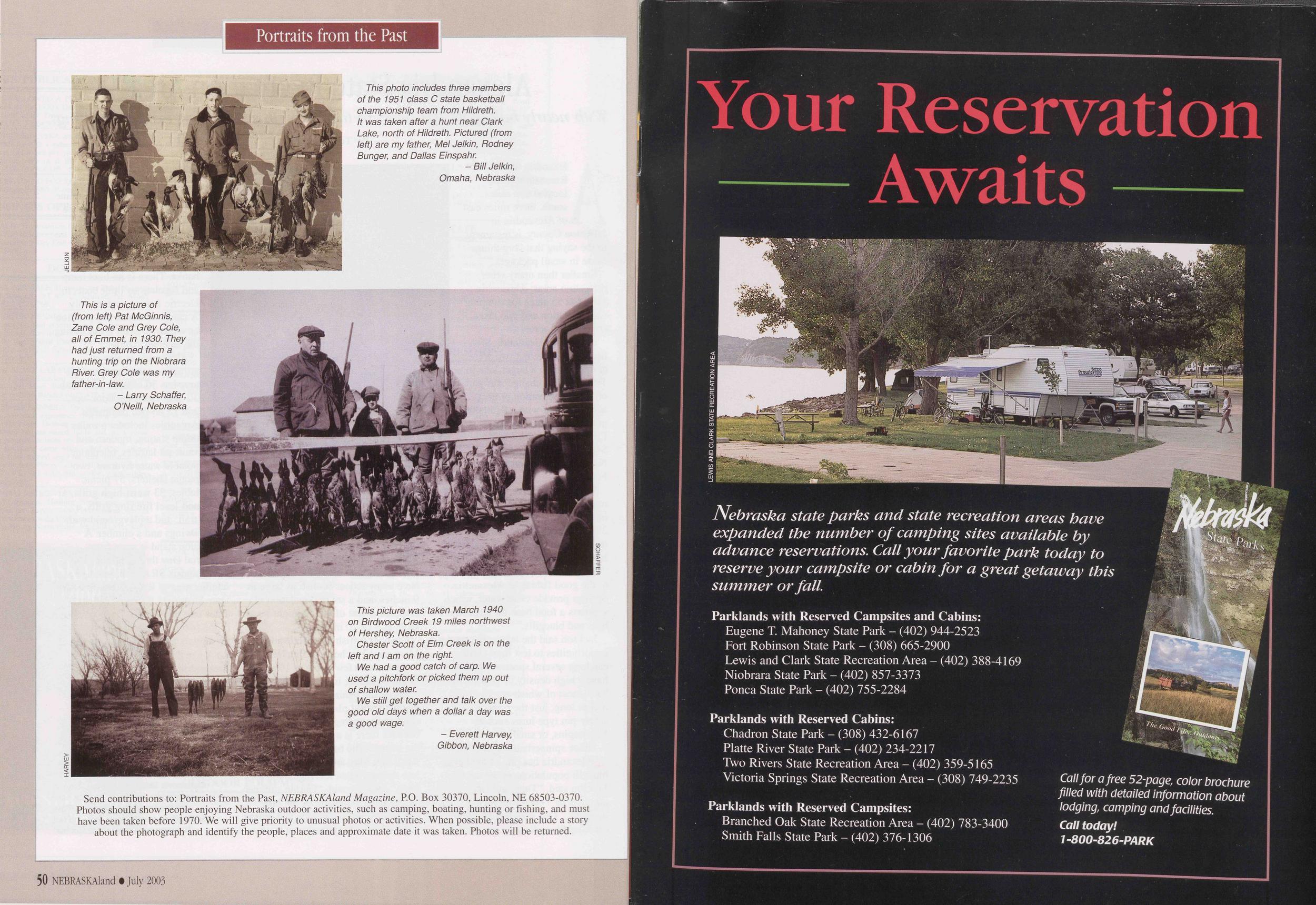
Portraits from the Past
Send contributions to: Portraits from the Past, NEBRASKAland Magazine, P.O. Box 30370, Lincoln, NE 68503-0370. Photos should show people enjoying Nebraska outdoor activities, such as camping, boating, hunting or fishing, and must have been taken before 1970. We will give priority to unusual photos or activities. When possible, please include a story about the photograph and identify the people, places and approximate date it was taken. Photos will be returned.
50 NEBRASKAland • July 2003Your Reservation Awaits

Position: 704 (16 views)