Volume 81, Issue 4, 2003
NEBRASKAland
Nebraska Game & Parks Commission May 2003 $2.50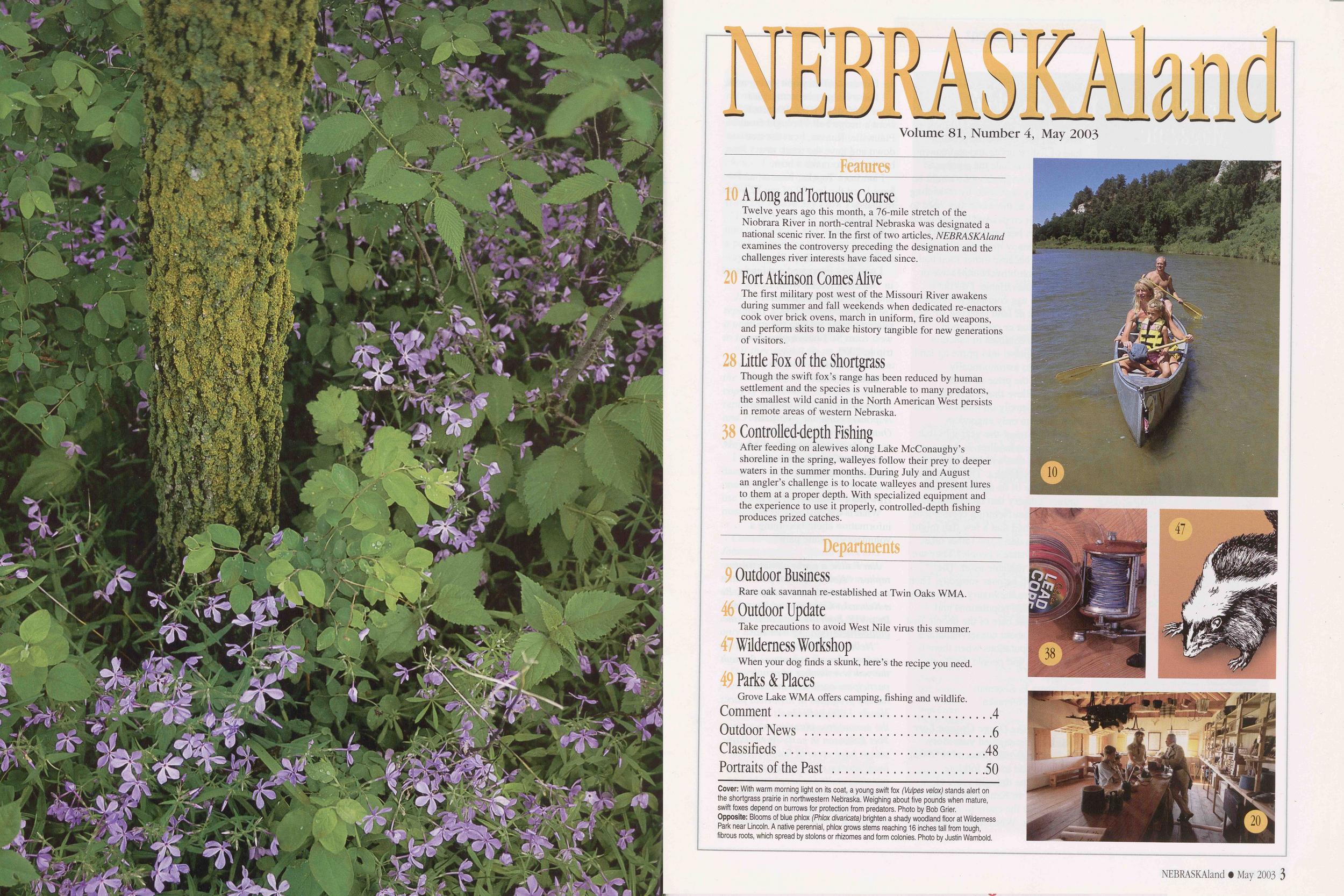
NEBRASKAland
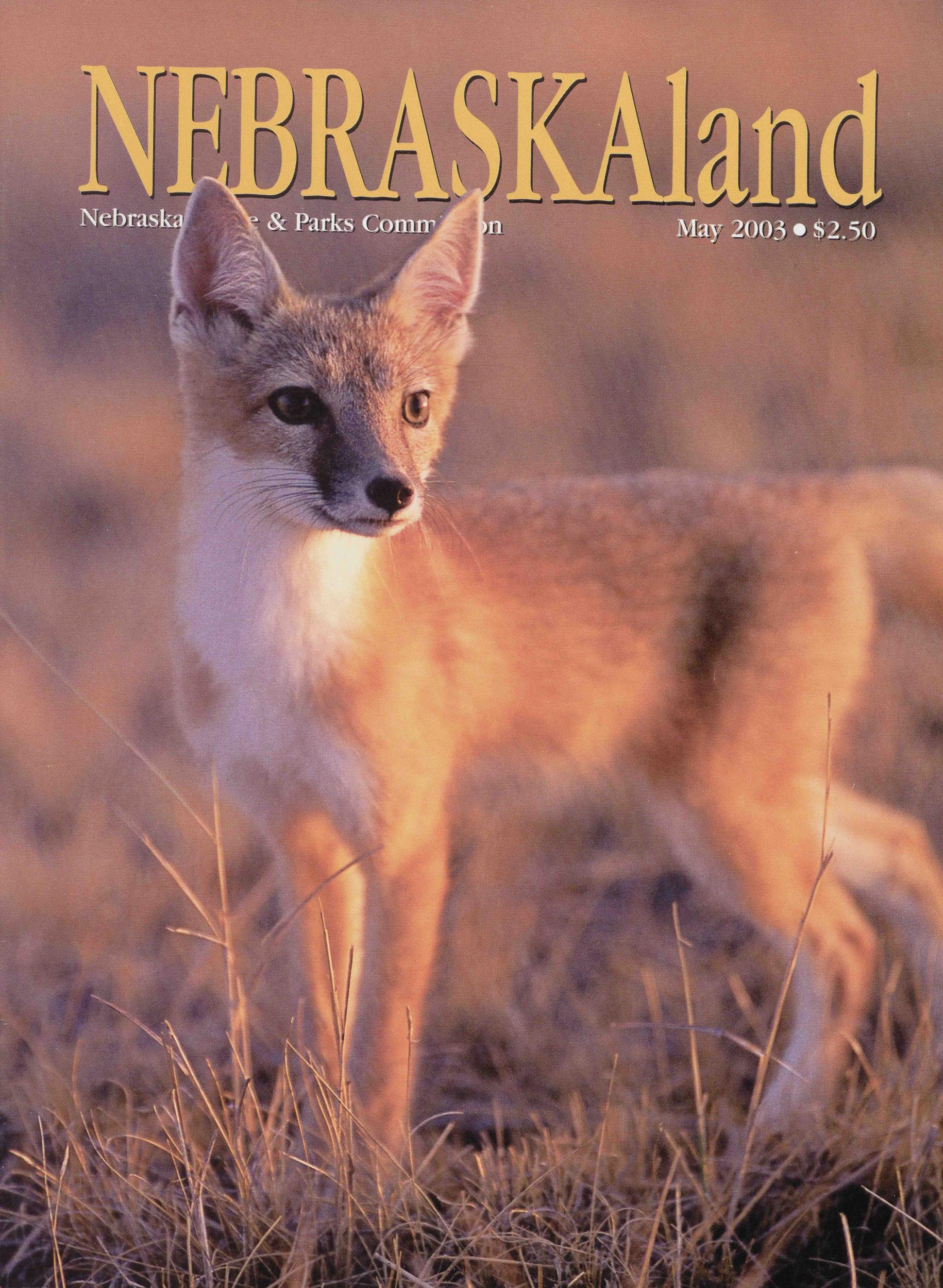
Volume 81, Number 4, May 2003 Features 10 A Long and Tortuous Course Twelve years ago this month, a 76-mile stretch of the Niobrara River in north-central Nebraska was designated a national scenic river. In the first of two articles, NEBRASKAland examines the controversy preceding the designation and the challenges river interests have faced since. 20 Fort Atkinson Comes Alive The first military post west of the Missouri River awakens during summer and fall weekends when dedicated re-enactors cook over brick ovens, march in uniform, fire old weapons, and perform skits to make history tangible for new generations of visitors. 28 Little Fox of the Shortgrass Though the swift fox's range has been reduced by human settlement and the species is vulnerable to many predators, the smallest wild canid in the North American West persists in remote areas of western Nebraska. 38 Controlled-depth Fishing After feeding on alewives along Lake McConaughy's shoreline in the spring, walleyes follow their prey to deeper waters in the summer months. During July and August an angler's challenge is to locate walleyes and present lures to them at a proper depth. With specialized equipment and the experience to use it properly, controlled-depth fishing produces prized catches. Departments Outdoor Business Rare oak savannah re-established at Twin Oaks WMA. Outdoor Update Take precautions to avoid West Nile virus this summer. Wilderness Workshop When your dog finds a skunk, here's the recipe you need. Parks & Places Grove Lake WMA offers camping, fishing and wildlife. Comment................................4 Outdoor News ............................6 Classifieds ..............................48 Portraits of the Past .......................50 Cover: With warm morning light on its coat, a young swift fox (Vulpes velox) stands alert on the shortgrass prairie in northwestern Nebraska. Weighing about five pounds when mature, swift foxes depend on burrows for protection from predators. Photo by Bob Grier. Opposite: Blooms of blue phlox (Phlox divahcata) brighten a shady woodland floor at Wilderness Park near Lincoln. A native perennial, phlox grows stems reaching 16 inches tall from tough, fibrous roots, which spread by stolons or rhizomes and form colonies. Photo by Justin Wambold.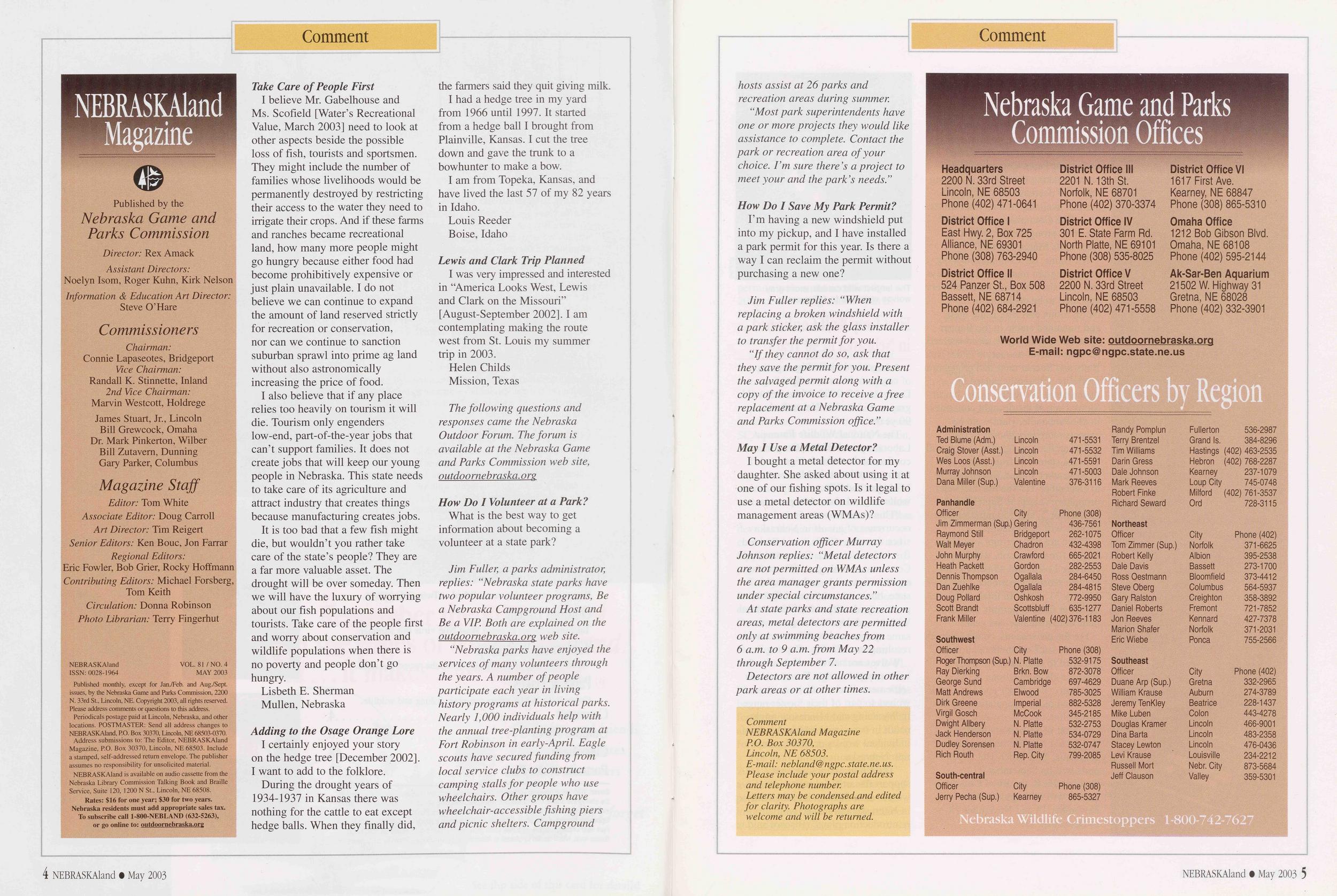 Comment
NEBRASKAland
azine
Published by the
Nebraska Game and
Parks Commission
Director: Rex Amack
Assistant Directors:
Noelyn Isom, Roger Kuhn, Kirk Nelson
Information & Education Art Director:
Steve O'Hare
Commissioners
Chairman:
Connie Lapaseotes, Bridgeport
Vice Chairman:
Randall K. Stinnette, Inland
2nd Vice Chairman:
Marvin Westcott, Holdrege
James Stuart, Jr., Lincoln
Bill Grewcock, Omaha
Dr. Mark Pinkerton, Wilber
Bill Zutavern, Dunning
Gary Parker, Columbus
Magazine Staff
Editor: Tom White
Associate Editor: Doug Carroll
Art Director: Tim Reigert
Senior Editors: Ken Bouc, Jon Farrar
Regional Editors:
Eric Fowler, Bob Grier, Rocky Hoffmann
Contributing Editors: Michael Forsberg,
Tom Keith
Circulation: Donna Robinson
Photo Librarian: Terry Fingerhut
NEBRASKAland
ISSN: 0028-1964
VOL. 81/NO. 4
MAY 2003
Published monthly, except for Jan./Feb. and Aug/Sept.
issues, by the Nebraska Game and Parks Commission, 2200
N. 33rd St., Lincoln, NE. Copyright 2003, all rights reserved.
Please address comments or questions to this address.
Periodicals postage paid at Lincoln, Nebraska, and other
locations. POSTMASTER: Send all address changes to
NEBRASKAland, P.O. Box 30370, Lincoln, NE 68503-0370.
Address submissions to: The Editor, NEBRASKAland
Magazine, P.O. Box 30370, Lincoln, NE 68503. Include
a stamped, self-addressed return envelope. The publisher
assumes no responsibility for unsolicited material.
NEBRASKAland is available on audio cassette from the
Nebraska Library Commission Talking Book and Braille
Service, Suite 120, 1200 N St., Lincoln, NE 68508.
Rates: $16 for one year; $30 for two years.
Nebraska residents must add appropriate sales tax.
To subscribe call 1-800-NEBLAND (632-5263),
or go online to: outdoornebraska.org
Take Care of People First
Comment
NEBRASKAland
azine
Published by the
Nebraska Game and
Parks Commission
Director: Rex Amack
Assistant Directors:
Noelyn Isom, Roger Kuhn, Kirk Nelson
Information & Education Art Director:
Steve O'Hare
Commissioners
Chairman:
Connie Lapaseotes, Bridgeport
Vice Chairman:
Randall K. Stinnette, Inland
2nd Vice Chairman:
Marvin Westcott, Holdrege
James Stuart, Jr., Lincoln
Bill Grewcock, Omaha
Dr. Mark Pinkerton, Wilber
Bill Zutavern, Dunning
Gary Parker, Columbus
Magazine Staff
Editor: Tom White
Associate Editor: Doug Carroll
Art Director: Tim Reigert
Senior Editors: Ken Bouc, Jon Farrar
Regional Editors:
Eric Fowler, Bob Grier, Rocky Hoffmann
Contributing Editors: Michael Forsberg,
Tom Keith
Circulation: Donna Robinson
Photo Librarian: Terry Fingerhut
NEBRASKAland
ISSN: 0028-1964
VOL. 81/NO. 4
MAY 2003
Published monthly, except for Jan./Feb. and Aug/Sept.
issues, by the Nebraska Game and Parks Commission, 2200
N. 33rd St., Lincoln, NE. Copyright 2003, all rights reserved.
Please address comments or questions to this address.
Periodicals postage paid at Lincoln, Nebraska, and other
locations. POSTMASTER: Send all address changes to
NEBRASKAland, P.O. Box 30370, Lincoln, NE 68503-0370.
Address submissions to: The Editor, NEBRASKAland
Magazine, P.O. Box 30370, Lincoln, NE 68503. Include
a stamped, self-addressed return envelope. The publisher
assumes no responsibility for unsolicited material.
NEBRASKAland is available on audio cassette from the
Nebraska Library Commission Talking Book and Braille
Service, Suite 120, 1200 N St., Lincoln, NE 68508.
Rates: $16 for one year; $30 for two years.
Nebraska residents must add appropriate sales tax.
To subscribe call 1-800-NEBLAND (632-5263),
or go online to: outdoornebraska.org
Take Care of People First
I believe Mr. Gabelhouse and Ms. Scofield [Water's Recreational Value, March 2003] need to look at other aspects beside the possible loss of fish, tourists and sportsmen. They might include the number of families whose livelihoods would be permanently destroyed by restricting their access to the water they need to irrigate their crops. And if these farms and ranches became recreational land, how many more people might go hungry because either food had become prohibitively expensive or just plain unavailable. I do not believe we can continue to expand the amount of land reserved strictly for recreation or conservation, nor can we continue to sanction suburban sprawl into prime ag land without also astronomically increasing the price of food.
I also believe that if any place relies too heavily on tourism it will die. Tourism only engenders low-end, part-of-the-year jobs that can't support families. It does not create jobs that will keep our young people in Nebraska. This state needs to take care of its agriculture and attract industry that creates things because manufacturing creates jobs.
It is too bad that a few fish might die, but wouldn't you rather take care of the state's people? They are a far more valuable asset. The drought will be over someday. Then we will have the luxury of worrying about our fish populations and tourists. Take care of the people first and worry about conservation and wildlife populations when there is no poverty and people don't go hungry.
Lisbeth E. Sherman Mullen, Nebraska Adding to the Osage Orange LoreI certainly enjoyed your story on the hedge tree [December 2002]. I want to add to the folklore.
During the drought years of 1934-1937 in Kansas there was nothing for the cattle to eat except hedge balls. When they finally did, the farmers said they quit giving milk.
I had a hedge tree in my yard from 1966 until 1997. It started from a hedge ball I brought from Plainville, Kansas. I cut the tree down and gave the trunk to a bowhunter to make a bow.
I am from Topeka, Kansas, and have lived the last 57 of my 82 years in Idaho.
Louis Reeder Boise, Idaho Lewis and Clark Trip PlannedI was very impressed and interested in "America Looks West, Lewis and Clark on the Missouri" [August-September 2002]. I am contemplating making the route west from St. Louis my summer trip in 2003.
Helen Childs Mission, TexasThe following questions and responses came the Nebraska Outdoor Forum. The forum is available at the Nebraska Game and Parks Commission web site, outdoornebraska.org
How Do I Volunteer at a Park?What is the best way to get information about becoming a volunteer at a state park?
Jim Fuller, a parks administrator, replies: "Nebraska state parks have two popular volunteer programs, Be a Nebraska Campground Host and Be a VIP. Both are explained on the outdoor nebraska. org web site.
"Nebraska parks have enjoyed the services of many volunteers through the years. A number of people participate each year in living history programs at historical parks. Nearly 1,000 individuals help with the annual tree-planting program at Fort Robinson in early-April. Eagle scouts have secured funding from local service clubs to construct camping stalls for people who use wheelchairs. Other groups have wheelchair-accessible fishing piers and picnic shelters. Campground 4 NEBRASKAland • May 2003 hosts assist at 26 parks and recreation areas during summer.
"Most park superintendents have one or more projects they would like assistance to complete. Contact the park or recreation area of your choice. Em sure there's a project to meet your and the park's needs."
How Do I Save My Park Permit?I'm having a new windshield put into my pickup, and I have installed a park permit for this year. Is there a way I can reclaim the permit without purchasing a new one?
Jim Fuller replies: "When replacing a broken windshield with a park sticker, ask the glass installer to transfer the permit for you.
"If they cannot do so, ask that they save the permit for you. Present the salvaged permit along with a copy of the invoice to receive a free replacement at a Nebraska Game and Parks Commission office."
May I Use a Metal Detector?I bought a metal detector for my daughter. She asked about using it at one of our fishing spots. Is it legal to use a metal detector on wildlife management areas (WMAs)?
Conservation officer Murray Johnson replies: "Metal detectors are not permitted on WMAs unless the area manager grants permission under special circumstances."
At state parks and state recreation areas, metal detectors are permitted only at swimming beaches from 6 a.m. to 9 a.m. from May 22 through September 7.
Detectors are not allowed in other park areas or at other times.
Comment NEBRASKAland Magazine P.O. Box 30370, Lincoln, NE 68503. E-mail: nebland@ngpc. state, ne. us. Please include your postal address and telephone number. Letters may be condensed and edited for clarity. Photographs are welcome and will be returned. Nebraska Game and Parks Commission Offices Headquarters 2200 N. 33rd Street Lincoln, NE 68503 Phone (402) 471-0641 District Office I East Hwy. 2, Box 725 Alliance, NE 69301 Phone (308) 763-2940 District Office II 524 Panzer St., Box 508 Bassett.NE 68714 Phone (402) 684-2921 District Office III 2201 N. 13th St. Norfolk, NE 68701 Phone (402) 370-3374 District Office IV 301 E. State Farm Rd. North Platte, NE 69101 Phone (308) 535-8025 District Office V 2200 N. 33rd Street Lincoln, NE 68503 Phone (402) 471-5558 District Office VI 1617 First Ave. Kearney, NE 68847 Phone (308) 865-5310 Omaha Office 1212 Bob Gibson Blvd. Omaha, NE 68108 Phone (402) 595-2144 Ak-Sar-Ben Aquarium 21502 W. Highway 31 Gretna, NE 68028 Phone (402) 332-3901 World Wide Web site: outdoornebraska.org E-mail: ngpc@ngpc.state.ne.us Conservation Officers by Region Administration Randy Pomplun Fullerton 536-2987 Ted Blume (Adm.) Lincoln 471-5531 Terry Brentzel Grand Is. 384-8296 Craig Stover (Asst.) Lincoln 471-5532 Tim Williams Hastings (402) 463-2535 Wes Loos (Asst.) Lincoln 471-5591 Darin Gress Hebron (402) 768-2287 Murray Johnson Lincoln 471-5003 Dale Johnson Kearney 237-1079 Dana Miller (Sup.) Valentine 376-3116 Mark Reeves Loup City 745-0748 Robert Finke Milford (402) 761-3537 Panhandle Richard Seward Ord 728-3115 Officer City Phone (308) Jim Zimmerman (Sup.) Gering 436-7561 Northeast Raymond Still Bridgeport 262-1075 Officer City Phone (402) Walt Meyer Chadron 432-4398 Tom Zimmer (Sup.)Norfolk 371-6625 John Murphy Crawford 665-2021 Robert Kelly Albion 395-2538 Heath Packett Gordon 282-2553 Dale Davis Bassett 273-1700 Dennis Thompson Ogallala 284-6450 Ross Oestmann Bloomfield 373-4412 Dan Zuehlke Ogallala 284-4815 Steve Oberg Columbus 564-5937 Doug Pollard Oshkosh 772-9950 Gary Ralston Creighton 358-3892 Scott Brandt Scottsbluff 635-1277 Daniel Roberts Fremont 721-7852 Frank Miller Valentine (402)376-1183 Jon Reeves Kennard 427-7378 Marion Shafer Norfolk 371-2031 Southwest Eric Wiebe Ponca 755-2566 Officer City Phone (308) Roger Thompson (Sup.) N. Platte 532-9175 Southeast Ray Dierking Brkn. Bow 872-3078 Officer City Phone (402) George Sund Cambridge 697-4629 Duane Arp (Sup.) Gretna 332-2965 Matt Andrews Elwood 785-3025 William Krause Auburn 274-3789 Dirk Greene Imperial 882-5328 Jeremy TenKley Beatrice 228-1437 Virgil Gosch McCook 345-2185 Mike Luben Colon 443-4278 Dwight Allbery N. Platte 532-2753 Douglas Kramer Lincoln 466-9001 Jack Henderson N. Platte 534-0729 Dina Barta Lincoln 483-2358 Dudley Sorensen N.Platte 532-0747 Stacey Lewton Lincoln 476-0436 RichRouth Rep. City 799-2085 Levi Krause Louisville 234-2212 Russell Mort Nebr. City 873-5684 South-centrai Jeff Clauson Valley 359-5301 Officer City Phone (308) Jerry Pecha (Sup.) Kearney 865-5327 NEBRASKAland • May 2003 5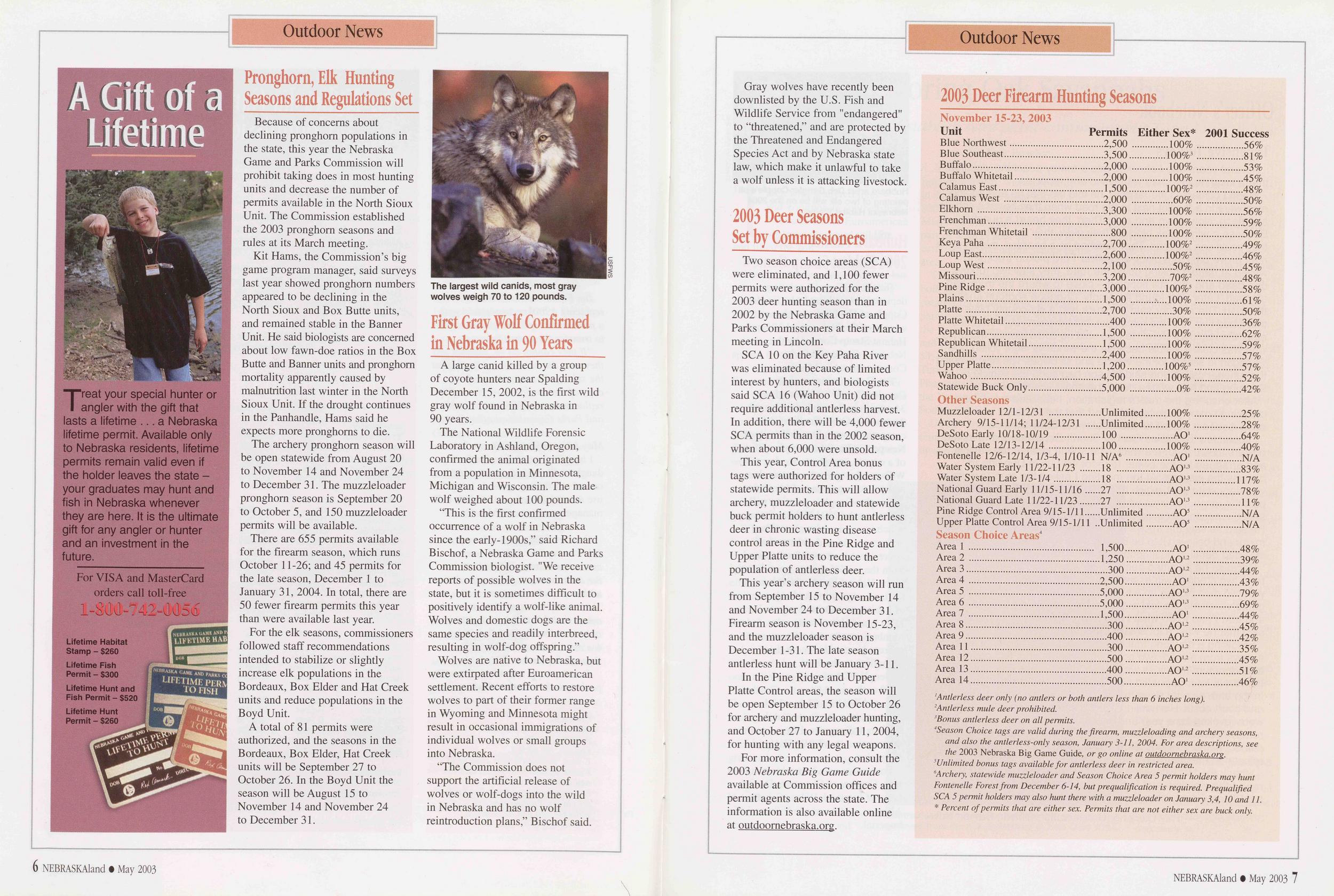
Outdoor News
A Gift of a Lifetime Treat your special hunter or angler with the gift that lasts a lifetime ... a Nebraska lifetime permit. Available only to Nebraska residents, lifetime permits remain valid even if the holder leaves the state - your graduates may hunt and fish in Nebraska whenever they are here. It is the ultimate gift for any angler or hunter and an investment in the future. For VISA and MasterCard orders call toll-free 5iTU ^o,uu ^"UVi Lifetime Habitat Stamp - $260 Lifetime Fish Permit - $300 Lifetime Hunt and Fish Permit - $520 Lifetime Hunt Permit - $260 Pronghorn, Elk Hunting Seasons and Regulations SetBecause of concerns about declining pronghorn populations in the state, this year the Nebraska Game and Parks Commission will prohibit taking does in most hunting units and decrease the number of permits available in the North Sioux Unit. The Commission established the 2003 pronghorn seasons and rules at its March meeting.
Kit Hams, the Commission's big game program manager, said surveys last year showed pronghorn numbers appeared to be declining in the North Sioux and Box Butte units, and remained stable in the Banner Unit. He said biologists are concerned about low fawn-doe ratios in the Box Butte and Banner units and pronghorn mortality apparently caused by malnutrition last winter in the North Sioux Unit. If the drought continues in the Panhandle, Hams said he expects more pronghorns to die.
The archery pronghorn season will be open statewide from August 20 to November 14 and November 24 to December 31. The muzzleloader pronghorn season is September 20 to October 5, and 150 muzzleloader permits will be available.
There are 655 permits available for the firearm season, which runs October 11-26; and 45 permits for the late season, December 1 to January 31, 2004. In total, there are 50 fewer firearm permits this year than were available last year.
For the elk seasons, commissioners followed staff recommendations intended to stabilize or slightly increase elk populations in the Bordeaux, Box Elder and Hat Creek units and reduce populations in the Boyd Unit.
A total of 81 permits were authorized, and the seasons in the Bordeaux, Box Elder, Hat Creek units will be September 27 to October 26. In the Boyd Unit the season will be August 15 to November 14 and November 24 to December 31.
A large canid killed by a group of coyote hunters near Spalding December 15, 2002, is the first wild gray wolf found in Nebraska in 90 years.
The National Wildlife Forensic Laboratory in Ashland, Oregon, confirmed the animal originated from a population in Minnesota, Michigan and Wisconsin. The male wolf weighed about 100 pounds.
"This is the first confirmed occurrence of a wolf in Nebraska since the early-1900s," said Richard Bischof, a Nebraska Game and Parks Commission biologist. "We receive reports of possible wolves in the state, but it is sometimes difficult to positively identify a wolf-like animal. Wolves and domestic dogs are the same species and readily interbreed, resulting in wolf-dog offspring."
Wolves are native to Nebraska, but were extirpated after Euroamerican settlement. Recent efforts to restore wolves to part of their former range in Wyoming and Minnesota might result in occasional immigrations of individual wolves or small groups into Nebraska.
"The Commission does not support the artificial release of wolves or wolf-dogs into the wild in Nebraska and has no wolf reintroduction plans," Bischof said. 6 NEBRASKAland • May 2003 Gray wolves have recently been down listed by the U.S. Fish and Wildlife Service from "endangered" to "threatened," and are protected by the Threatened and Endangered Species Act and by Nebraska state law, which make it unlawful to take a wolf unless it is attacking livestock.
2003 Deer Seasons Set by CommissionersTwo season choice areas (SCA) were eliminated, and 1,100 fewer permits were authorized for the 2003 deer hunting season than in 2002 by the Nebraska Game and Parks Commissioners at their March meeting in Lincoln.
SCA 10 on the Key Paha River was eliminated because of limited interest by hunters, and biologists said SCA 16 (Wahoo Unit) did not require additional antlerless harvest. In addition, there will be 4,000 fewer SCA permits than in the 2002 season, when about 6,000 were unsold.
This year, Control Area bonus tags were authorized for holders of statewide permits. This will allow archery, muzzleloader and statewide buck permit holders to hunt antlerless deer in chronic wasting disease control areas in the Pine Ridge and Upper Platte units to reduce the population of antlerless deer.
This year's archery season will run from September 15 to November 14 and November 24 to December 31. Firearm season is November 15-23, and the muzzleloader season is December 1-31. The late season antlerless hunt will be January 3-11.
In the Pine Ridge and Upper Platte Control areas, the season will be open September 15 to October 26 for archery and muzzleloader hunting, and October 27 to January 11, 2004, for hunting with any legal weapons.
For more information, consult the 2003 Nebraska Big Game Guide available at Commission offices and permit agents across the state. The information is also available online at outdoornebraska.org.
2003 Deer Firearm Hunting Seasons November 15-23, 2003 Unit Permits Blue Northwest....................................2,500 Blue Southeast......................................3,500 Buffalo..................................................2,000 Buffalo Whitetail..................................2,000 ..............100%..................45% Either Sex* 2001 Success .............100%..................56% ............100%3..................81% .............100%..................53% 100%2..................48% ...60%..................50% .100%..................56% .100%..................59% .100%..................50% 100%2..................49% 100%2..................46% ...50%..................45% ..70%2..................48% 100%5..................58% .100%..................61% ...30%..................50% .100%..................36% .100%..................62% Calamus East........................................1,500.......... Calamus West......................................2,000 ......... Elkhorn ................................................3,300 ......... Frenchman............................................3,000 ......... Frenchman Whitetail ..............................800 ......... Keya Paha............................................2,700........... Loup East..............................................2,600........... Loup West............................................2,100 .......... Missouri................................................3,200........... Pine Ridge............................................3,000........... Plains....................................................1,500 .......... Platte....................................................2,700 .......... Platte Whitetail........................................400 .......... Republican............................................1,500 .......... Republican Whitetail............................1,500 ..............100%..................59% Sandhills ..............................................2,400 ..............100%..................57% Upper Platte..........................................1,200..............100%5..................57% Wahoo..................................................4,500 ..............100%..................52% Statewide Buck Only............................5,000 ..................0%..................42% Other Seasons Muzzleloader 12/1-12/31 ....................Unlimited........100%..................25% Archery 9/15-11/14; 11/24-12/31 ......Unlimited........100%..................28% DeSoto Early 10/18-10/19 ..................100....................AO' ..................64% DeSotoLate 12/13-12/14....................100..................100%..................40% Fontenelle 12/6-12/14, 1/3-4, 1/10-11 N/A6 ..................AO1 ..................N/A Water System Early 11/22-11/23 ........18 ....................AO13..................83% Water System Late 1/3-1/4..................18....................AO13................117% National Guard Early 11/15-11/16......27 ....................AO13..................78% National Guard Late 11/22-11/23........27 ....................AO13..................11% Pine Ridge Control Area 9/15-1/11......Unlimited..........AO5 ..................N/A Upper Platte Control Area 9/15-1/11 ..Unlimited..........AO5 ..................N/A Season Choice Areas4 Area 1 ................................................ 1,500........... Area 2 ..................................................1,250.......... Area 3......................................................300.......... Area 4..................................................2,500........... Area 5 ..................................................5,000.......... Area 6 ..................................................5,000.......... Area 7 ..................................................1,500........... Area 8......................................................300........... Area 9......................................................400.......... Area 11....................................................300........... Area 12....................................................500........... Area 13....................................................400.......... Area 14....................................................500........... ..AO1 .AO12 .AO12 ..AO1 .AO13 .AO13 ..AO1 .AO12 .AO12 .AO12 .AO12 .AO12 ..AO1 48% 39% 44% 43% 79% 69% 44% 45% 42% 35% 45% 51% 46% 'Antlerless deer only (no antlers or both antlers less than 6 inches long). Antlerless mule deer prohibited. "Bonus antlerless deer on all permits. 4Season Choice tags are valid during the firearm, muzzleloading and archery seasons, and also the antlerless-only season, January 3-11, 2004. For area descriptions, see the 2003 Nebraska Big Game Guide, or go online at outdoornebraska.org. "Unlimited bonus tags available for antlerless deer in restricted area. "Archery, statewide muzzleloader and Season Choice Area 5 permit holders may hunt Fontenelle Forest from December 6-14, but prequalification is required. Prequalified SCA 5 permit holders may also hunt there with a muzzleloader on January 3,4, 10 and 11. Percent of permits that are either sex. Permits that are not either sex are buck only. NEBRASKAland • May 2003 7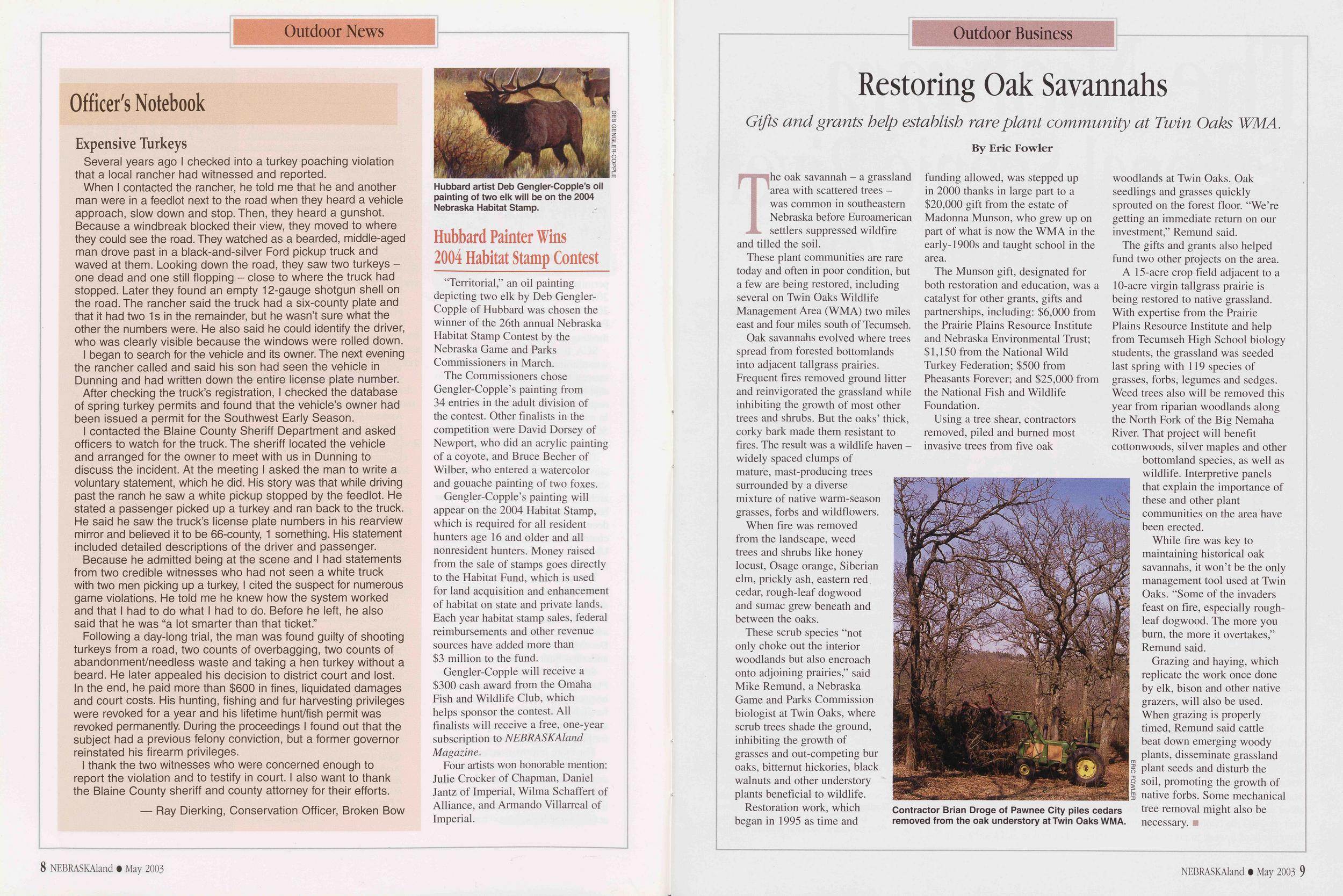 Outdoor News
Officer's Notebook
Expensive Turkeys
Outdoor News
Officer's Notebook
Expensive Turkeys
Several years ago I checked into a turkey poaching violation that a local rancher had witnessed and reported.
When I contacted the rancher, he told me that he and another man were in a feedlot next to the road when they heard a vehicle approach, slow down and stop. Then, they heard a gunshot. Because a windbreak blocked their view, they moved to where they could see the road. They watched as a bearded, middle-aged man drove past in a black-and-silver Ford pickup truck and waved at them. Looking down the road, they saw two turkeys - one dead and one still flopping - close to where the truck had stopped. Later they found an empty 12-gauge shotgun shell on the road. The rancher said the truck had a six-county plate and that it had two 1s in the remainder, but he wasn't sure what the other the numbers were. He also said he could identify the driver, who was clearly visible because the windows were rolled down.
I began to search for the vehicle and its owner. The next evening the rancher called and said his son had seen the vehicle in Dunning and had written down the entire license plate number.
After checking the truck's registration, I checked the database of spring turkey permits and found that the vehicle's owner had been issued a permit for the Southwest Early Season.
I contacted the Blaine County Sheriff Department and asked officers to watch for the truck. The sheriff located the vehicle and arranged for the owner to meet with us in Dunning to discuss the incident. At the meeting I asked the man to write a voluntary statement, which he did. His story was that while driving past the ranch he saw a white pickup stopped by the feedlot. He stated a passenger picked up a turkey and ran back to the truck. He said he saw the truck's license plate numbers in his rearview mirror and believed it to be 66-county, 1 something. His statement included detailed descriptions of the driver and passenger.
Because he admitted being at the scene and I had statements from two credible witnesses who had not seen a white truck with two men picking up a turkey, I cited the suspect for numerous game violations. He told me he knew how the system worked and that I had to do what I had to do. Before he left, he also said that he was "a lot smarter than that ticket."
Following a day-long trial, the man was found guilty of shooting turkeys from a road, two counts of over bagging, two counts of abandonment/needless waste and taking a hen turkey without a beard. He later appealed his decision to district court and lost. In the end, he paid more than $600 in fines, liquidated damages and court costs. His hunting, fishing and fur harvesting privileges were revoked for a year and his lifetime hunt/fish permit was revoked permanently. During the proceedings I found out that the subject had a previous felony conviction, but a former governor reinstated his firearm privileges.
I thank the two witnesses who were concerned enough to report the violation and to testify in court. I also want to thank the Blaine County sheriff and county attorney for their efforts.
— Ray Dierking, Conservation Officer, Broken BowTerritorial," an oil painting depicting two elk by Deb Gengler-Copple of Hubbard was chosen the winner of the 26th annual Nebraska Habitat Stamp Contest by the Nebraska Game and Parks Commissioners in March.
The Commissioners chose Gengler-Copple's painting from 34 entries in the adult division of the contest. Other finalists in the competition were David Dorsey of Newport, who did an acrylic painting of a coyote, and Bruce Becher of Wilber, who entered a watercolor and gouache painting of two foxes.
Gengler-Copple's painting will appear on the 2004 Habitat Stamp, which is required for all resident hunters age 16 and older and all nonresident hunters. Money raised from the sale of stamps goes directly to the Habitat Fund, which is used for land acquisition and enhancement of habitat on state and private lands. Each year habitat stamp sales, federal reimbursements and other revenue sources have added more than $3 million to the fund.
Gengler-Copple will receive a $300 cash award from the Omaha Fish and Wildlife Club, which helps sponsor the contest. All finalists will receive a free, one-year subscription to NEBRASKAland Magazine.
Four artists won honorable mention: Julie Crocker of Chapman, Daniel Jantz of Imperial, Wilma Schaffert of Alliance, and Armando Villarreal of Imperial.
8 NEBRASKAland • May 2003Outdoor Business
Restoring Oak Savannahs
Gifts and grants help establish rare plant community at Twin Oaks WMA By Eric FowlerThe oak savannah - a grassland area with scattered trees - was common in southeastern Nebraska before Euroamerican settlers suppressed wildfire and tilled the soil.
These plant communities are rare today and often in poor condition, but a few are being restored, including several on Twin Oaks Wildlife Management Area (WMA) two miles east and four miles south of Tecumseh.
Oak savannahs evolved where trees spread from forested bottomlands into adjacent tallgrass prairies. Frequent fires removed ground litter and reinvigorated the grassland while inhibiting the growth of most other trees and shrubs. But the oaks' thick, corky bark made them resistant to fires. The result was a wildlife haven - widely spaced clumps of mature, mast-producing trees surrounded by a diverse mixture of native warm-season grasses, forbs and wildflowers.
When fire was removed from the landscape, weed trees and shrubs like honey locust, Osage orange, Siberian elm, prickly ash, eastern red cedar, rough-leaf dogwood and sumac grew beneath and between the oaks.
These scrub species "not only choke out the interior woodlands but also encroach onto adjoining prairies," said Mike Remund, a Nebraska Game and Parks Commission biologist at Twin Oaks, where scrub trees shade the ground, inhibiting the growth of grasses and out-competing bur oaks, bitternut hickories, black walnuts and other understory plants beneficial to wildlife.
Restoration work, which began in 1995 as time and funding allowed, was stepped up in 2000 thanks in large part to a $20,000 gift from the estate of Madonna Munson, who grew up on part of what is now the WMA in the early-1900s and taught school in the area.
The Munson gift, designated for both restoration and education, was a catalyst for other grants, gifts and partnerships, including: $6,000 from the Prairie Plains Resource Institute and Nebraska Environmental Trust; $1,150 from the National Wild Turkey Federation; $500 from Pheasants Forever; and $25,000 from the National Fish and Wildlife Foundation.
Using a tree shear, contractors removed, piled and burned most invasive trees from five oak
The gifts and grants also helped fund two other projects on the area.
A 15-acre crop field adjacent to a 10-acre virgin tallgrass prairie is being restored to native grassland. With expertise from the Prairie Plains Resource Institute and help from Tecumseh High School biology students, the grassland was seeded last spring with 119 species of grasses, forbs, legumes and sedges. Weed trees also will be removed this year from riparian woodlands along the North Fork of the Big Nemaha River. That project will benefit cotton woods, silver maples and other bottomland species, as well as wildlife. Interpretive panels that explain the importance of these and other plant communities on the area have been erected.
While fire was key to maintaining historical oak savannahs, it won't be the only management tool used at Twin Oaks. "Some of the invaders feast on fire, especially rough leaf dogwood. The more you burn, the more it overtakes," Remund said.
Grazing and haying, which replicate the work once done by elk, bison and other native grazers, will also be used. When grazing is properly timed, Remund said cattle beat down emerging woody plants, disseminate grassland plant seeds and disturb the soil, promoting the growth of native forbs. Some mechanical tree removal might also be necessary.
NEBRASKAland • May 2003 9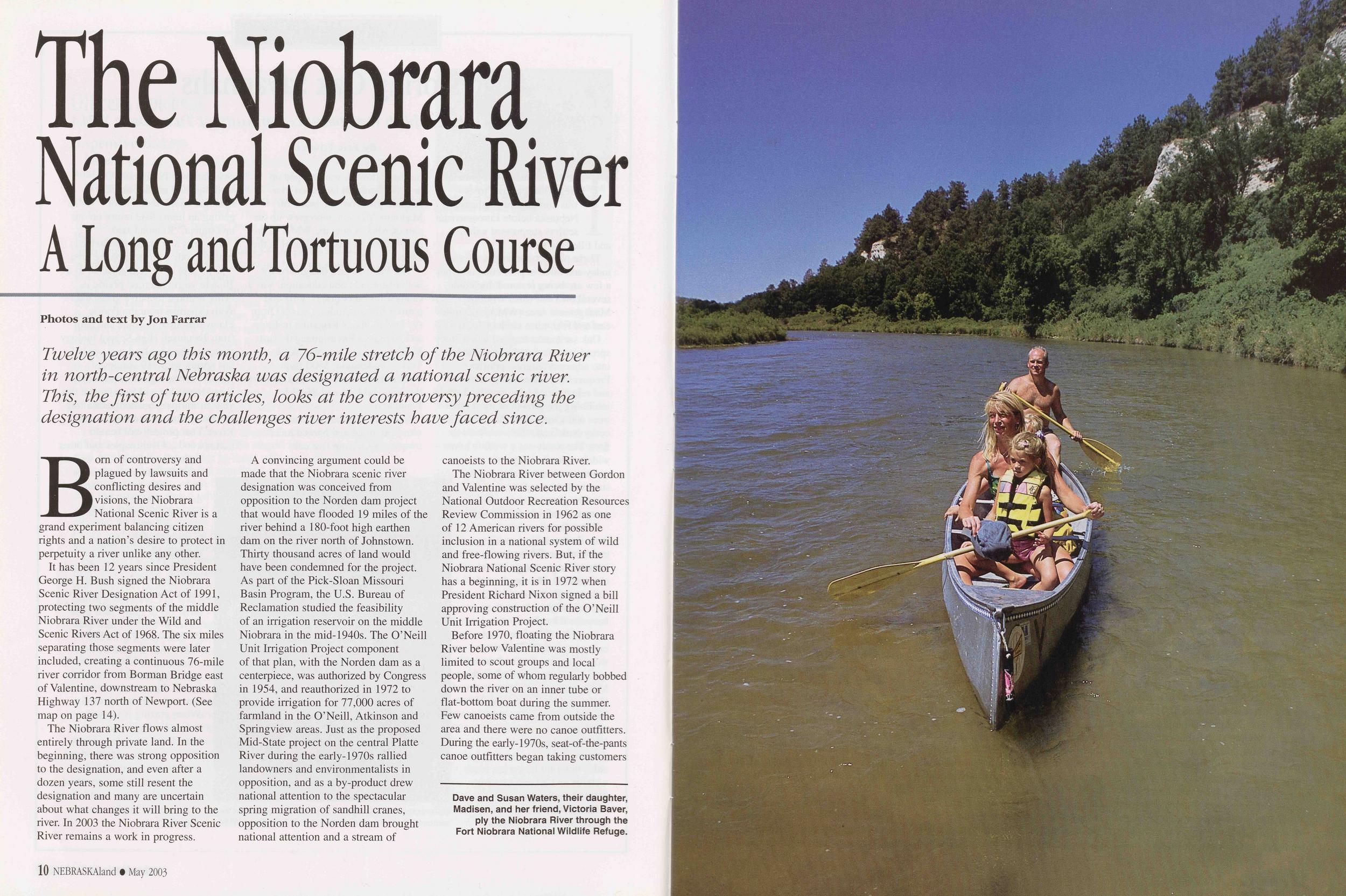
The Niobrara National Scenic River A Long and Tortuous Course
Photos and text by Jon Farrar Twelve years ago this month, a 76-mile stretch of the Niobrara River in north-central Nebraska was designated a national scenic river. This, the first of two articles, looks at the controversy preceding the designation and the challenges river interests have faced since.Born of controversy and plagued by lawsuits and conflicting desires and visions, the Niobrara National Scenic River is a grand experiment balancing citizen rights and a nation's desire to protect in perpetuity a river unlike any other.
It has been 12 years since President George H. Bush signed the Niobrara Scenic River Designation Act of 1991, protecting two segments of the middle Niobrara River under the Wild and Scenic Rivers Act of 1968. The six miles separating those segments were later included, creating a continuous 76-mile river corridor from Borman Bridge east of Valentine, downstream to Nebraska Highway 137 north of Newport. (See map on page 14).
The Niobrara River flows almost entirely through private land. In the beginning, there was strong opposition to the designation, and even after a dozen years, some still resent the designation and many are uncertain about what changes it will bring to the river. In 2003 the Niobrara River Scenic River remains a work in progress.
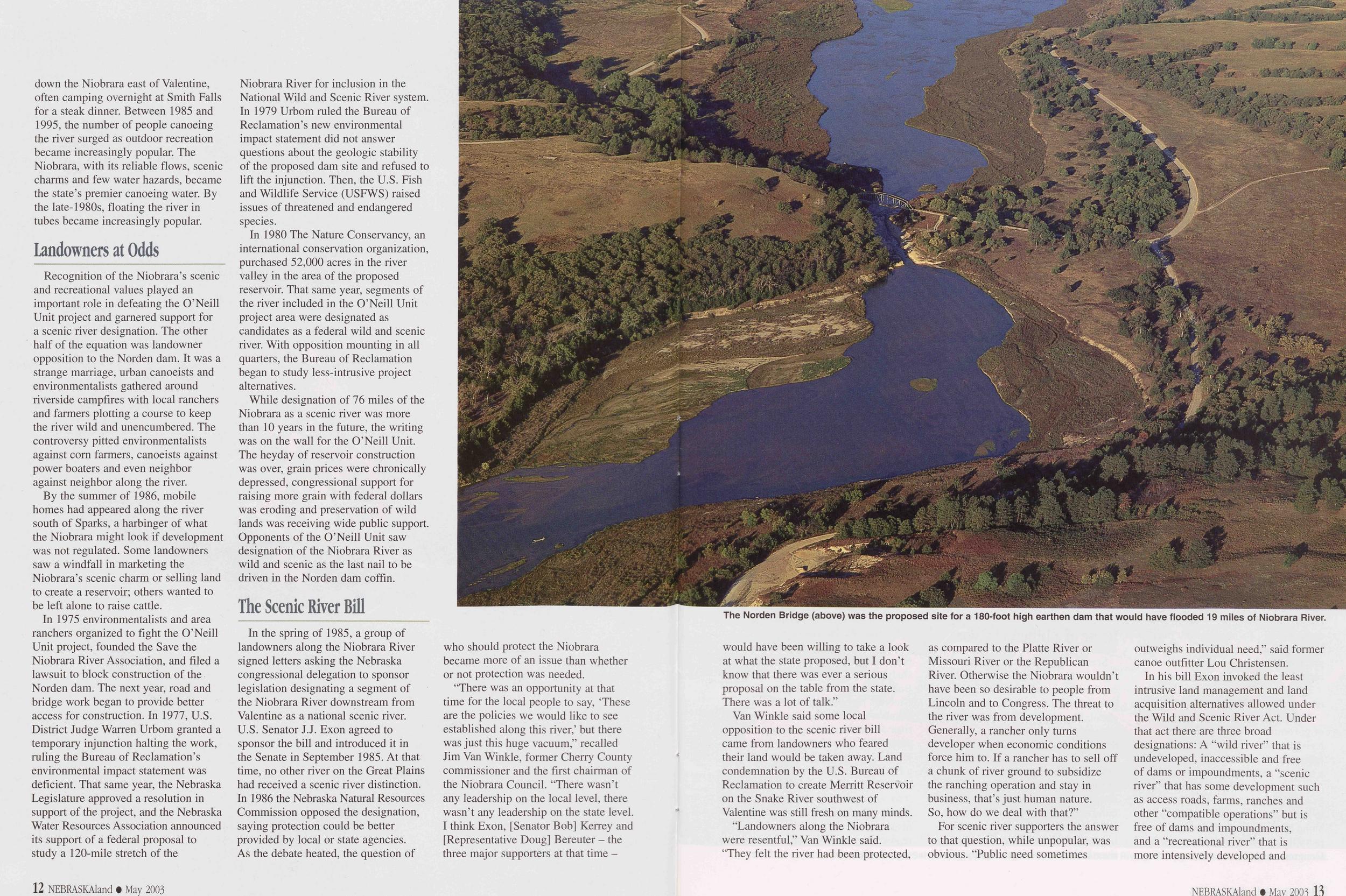
A convincing argument could be made that the Niobrara scenic river designation was conceived from opposition to the Norden dam project that would have flooded 19 miles of the river behind a 180-foot high earthen dam on the river north of Johnstown. Thirty thousand acres of land would have been condemned for the project. As part of the Pick-Sloan Missouri Basin Program, the U.S. Bureau of Reclamation studied the feasibility of an irrigation reservoir on the middle Niobrara in the mid-1940s. The O'Neill Unit Irrigation Project component of that plan, with the Norden dam as a centerpiece, was authorized by Congress in 1954, and reauthorized in 1972 to provide irrigation for 77,000 acres of farmland in the O'Neill, Atkinson and Spring view areas. Just as the proposed Mid-State project on the central Platte River during the early-1970s rallied landowners and environmentalists in opposition, and as a by-product drew national attention to the spectacular spring migration of sandhill cranes, opposition to the Norden dam brought national attention and a stream of canoeists to the Niobrara River.
The Niobrara River between Gordon and Valentine was selected by the National Outdoor Recreation Resources Review Commission in 1962 as one of 12 American rivers for possible inclusion in a national system of wild and free-flowing rivers. But, if the Niobrara National Scenic River story has a beginning, it is in 1972 when President Richard Nixon signed a bill approving construction of the O'Neill Unit Irrigation Project.
Before 1970, floating the Niobrara River below Valentine was mostly limited to scout groups and local people, some of whom regularly bobbed down the river on an inner tube or flat-bottom boat during the summer. Few canoeists came from outside the area and there were no canoe outfitters. During the early-1970s, seat-of-the-pants canoe outfitters began taking customers 10 NEBRASKAland • May 2003
 down the Niobrara east of Valentine,
often camping overnight at Smith Falls
for a steak dinner. Between 1985 and
1995, the number of people canoeing
the river surged as outdoor recreation
became increasingly popular. The
Niobrara, with its reliable flows, scenic
charms and few water hazards, became
the state's premier canoeing water. By
the late-1980s, floating the river in
tubes became increasingly popular.
Landowners at Odds
down the Niobrara east of Valentine,
often camping overnight at Smith Falls
for a steak dinner. Between 1985 and
1995, the number of people canoeing
the river surged as outdoor recreation
became increasingly popular. The
Niobrara, with its reliable flows, scenic
charms and few water hazards, became
the state's premier canoeing water. By
the late-1980s, floating the river in
tubes became increasingly popular.
Landowners at Odds
Recognition of the Niobrara's scenic and recreational values played an important role in defeating the O'Neill Unit project and garnered support for a scenic river designation. The other half of the equation was landowner opposition to the Norden dam. It was a strange marriage, urban canoeists and environmentalists gathered around riverside campfires with local ranchers and farmers plotting a course to keep the river wild and unencumbered. The controversy pitted environmentalists against corn farmers, canoeists against power boaters and even neighbor against neighbor along the river.
By the summer of 1986, mobile homes had appeared along the river south of Sparks, a harbinger of what the Niobrara might look if development was not regulated. Some landowners saw a windfall in marketing the Niobrara's scenic charm or selling land to create a reservoir; others wanted to be left alone to raise cattle.
In 1975 environmentalists and area ranchers organized to fight the O'Neill Unit project, founded the Save the Niobrara River Association, and filed a lawsuit to block construction of the Norden dam. The next year, road and bridge work began to provide better access for construction. In 1977, U.S. District Judge Warren Urbom granted a temporary injunction halting the work, ruling the Bureau of Reclamation's environmental impact statement was deficient. That same year, the Nebraska Legislature approved a resolution in support of the project, and the Nebraska Water Resources Association announced its support of a federal proposal to study a 120-mile stretch of the Niobrara River for inclusion in the National Wild and Scenic River system. In 1979 Urbom ruled the Bureau of Reclamation's new environmental impact statement did not answer questions about the geologic stability of the proposed dam site and refused to lift the injunction. Then, the U.S. Fish and Wildlife Service (USFWS) raised issues of threatened and endangered species.
In 1980 The Nature Conservancy, an international conservation organization, purchased 52,000 acres in the river valley in the area of the proposed reservoir. That same year, segments of the river included in the O'Neill Unit project area were designated as candidates as a federal wild and scenic river. With opposition mounting in all quarters, the Bureau of Reclamation began to study less-intrusive project alternatives.
While designation of 76 miles of the Niobrara as a scenic river was more than 10 years in the future, the writing was on the wall for the O'Neill Unit. The heyday of reservoir construction was over, grain prices were chronically depressed, congressional support for raising more grain with federal dollars was eroding and preservation of wild lands was receiving wide public support. Opponents of the O'Neill Unit saw designation of the Niobrara River as wild and scenic as the last nail to be driven in the Norden dam coffin.
The Scenic River BillIn the spring of 1985, a group of landowners along the Niobrara River signed letters asking the Nebraska congressional delegation to sponsor legislation designating a segment of the Niobrara River downstream from Valentine as a national scenic river. U.S. Senator J.J. Exon agreed to sponsor the bill and introduced it in the Senate in September 1985. At that time, no other river on the Great Plains had received a scenic river distinction. In 1986 the Nebraska Natural Resources Commission opposed the designation, saying protection could be better provided by local or state agencies. As the debate heated, the question of who should protect the Niobrara became more of an issue than whether or not protection was needed.
"There was an opportunity at that time for the local people to say, These are the policies we would like to see established along this river,' but there was just this huge vacuum," recalled Jim Van Winkle, former Cherry County commissioner and the first chairman of the Niobrara Council. "There wasn't any leadership on the local level, there wasn't any leadership on the state level. I think Exon, [Senator Bob] Kerrey and [Representative Doug] Bereuter - the three major supporters at that time - 12 NEBRASKAland • May 2003
Van Winkle said some local opposition to the scenic river bill came from landowners who feared their land would be taken away. Land condemnation by the U.S. Bureau of Reclamation to create Merritt Reservoir on the Snake River southwest of Valentine was still fresh on many minds.
"Landowners along the Niobrara were resentful," Van Winkle said. They felt the river had been protected, as compared to the Platte River or Missouri River or the Republican River. Otherwise the Niobrara wouldn't have been so desirable to people from Lincoln and to Congress. The threat to the river was from development. Generally, a rancher only turns developer when economic conditions force him to. If a rancher has to sell off a chunk of river ground to subsidize the ranching operation and stay in business, that's just human nature. So, how do we deal with that?"
For scenic river supporters the answer to that question, while unpopular, was obvious. "Public need sometimes outweighs individual need," said former canoe outfitter Lou Christensen.
In his bill Exon invoked the least
intrusive land management and land
acquisition alternatives allowed under
the Wild and Scenic River Act. Under
that act there are three broad
designations: A "wild river" that is
undeveloped, inaccessible and free
of dams or impoundments, a "scenic
river" that has some development such
as access roads, farms, ranches and
other "compatible operations" but is
free of dams and impoundments,
and a "recreational river" that is
more intensively developed and
NEBRASKAland • Mav 2003 13
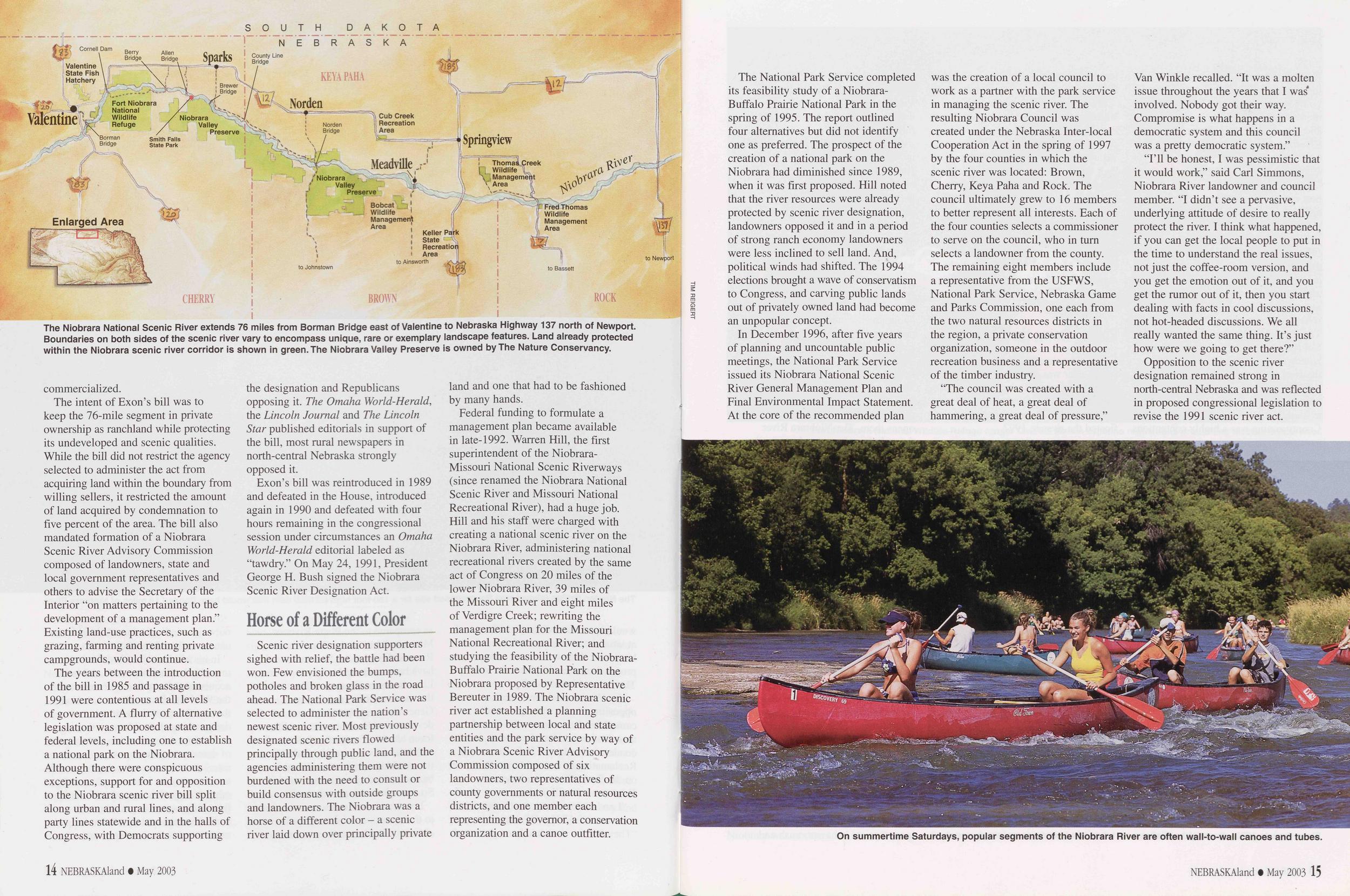
The intent of Exon's bill was to keep the 76-mile segment in private ownership as ranch land while protecting its undeveloped and scenic qualities. While the bill did not restrict the agency selected to administer the act from acquiring land within the boundary from willing sellers, it restricted the amount of land acquired by condemnation to five percent of the area. The bill also mandated formation of a Niobrara Scenic River Advisory Commission composed of landowners, state and local government representatives and others to advise the Secretary of the Interior "on matters pertaining to the development of a management plan." Existing land-use practices, such as grazing, farming and renting private campgrounds, would continue.
The years between the introduction of the bill in 1985 and passage in 1991 were contentious at all levels of government. A flurry of alternative legislation was proposed at state and federal levels, including one to establish a national park on the Niobrara. Although there were conspicuous exceptions, support for and opposition to the Niobrara scenic river bill split along urban and rural lines, and along party lines statewide and in the halls of Congress, with Democrats supporting the designation and Republicans opposing it. The Omaha World-Herald, the Lincoln Journal and The Lincoln Star published editorials in support of the bill, most rural newspapers in north-central Nebraska strongly opposed it.
Exon's bill was reintroduced in 1989 and defeated in the House, introduced again in 1990 and defeated with four hours remaining in the congressional session under circumstances an Omaha World-Herald editorial labeled as "tawdry." On May 24, 1991, President George H. Bush signed the Niobrara Scenic River Designation Act.
Horse of a Different ColorScenic river designation supporters sighed with relief, the battle had been won. Few envisioned the bumps, potholes and broken glass in the road ahead. The National Park Service was selected to administer the nation's newest scenic river. Most previously designated scenic rivers flowed principally through public land, and the agencies administering them were not burdened with the need to consult or build consensus with outside groups and landowners. The Niobrara was a horse of a different color - a scenic river laid down over principally private land and one that had to be fashioned by many hands.
Federal funding to formulate a management plan became available in late-1992. Warren Hill, the first superintendent of the Niobrara- Missouri National Scenic Riverways (since renamed the Niobrara National Scenic River and Missouri National Recreational River), had a huge job. Hill and his staff were charged with creating a national scenic river on the Niobrara River, administering national recreational rivers created by the same act of Congress on 20 miles of the lower Niobrara River, 39 miles of the Missouri River and eight miles of Verdigre Creek; rewriting the management plan for the Missouri National Recreational River; and studying the feasibility of the Niobrara- Buffalo Prairie National Park on the Niobrara proposed by Representative Bereuter in 1989. The Niobrara scenic river act established a planning partnership between local and state entities and the park service by way of a Niobrara Scenic River Advisory Commission composed of six landowners, two representatives of county governments or natural resources districts, and one member each representing the governor, a conservation organization and a canoe outfitter.
14 NEBRASKAland • May 2003The National Park Service completed its feasibility study of a Niobrara Buffalo Prairie National Park in the spring of 1995. The report outlined four alternatives but did not identify one as preferred. The prospect of the creation of a national park on the Niobrara had diminished since 1989, when it was first proposed. Hill noted that the river resources were already protected by scenic river designation, landowners opposed it and in a period of strong ranch economy landowners were less inclined to sell land. And, political winds had shifted. The 1994 elections brought a wave of conservatism to Congress, and carving public lands out of privately owned land had become an unpopular concept.
In December 1996, after five years of planning and uncountable public meetings, the National Park Service issued its Niobrara National Scenic River General Management Plan and Final Environmental Impact Statement. At the core of the recommended plan was the creation of a local council to work as a partner with the park service in managing the scenic river. The resulting Niobrara Council was created under the Nebraska Inter-local Cooperation Act in the spring of 1997 by the four counties in which the scenic river was located: Brown, Cherry, Keya Paha and Rock. The council ultimately grew to 16 members to better represent all interests. Each of the four counties selects a commissioner to serve on the council, who in turn selects a landowner from the county. The remaining eight members include a representative from the USFWS, National Park Service, Nebraska Game and Parks Commission, one each from the two natural resources districts in the region, a private conservation organization, someone in the outdoor recreation business and a representative of the timber industry.
"The council was created with a great deal of heat, a great deal of hammering, a great deal of pressure," Van Winkle recalled. "It was a molten issue throughout the years that I was* involved. Nobody got their way. Compromise is what happens in a democratic system and this council was a pretty democratic system."
"I'll be honest, I was pessimistic that it would work," said Carl Simmons, Niobrara River landowner and council member. "I didn't see a pervasive, underlying attitude of desire to really protect the river. I think what happened, if you can get the local people to put in the time to understand the real issues, not just the coffee-room version, and you get the emotion out of it, and you get the rumor out of it, then you start dealing with facts in cool discussions, not hot-headed discussions. We all really wanted the same thing. It's just how were we going to get there?"
Opposition to the scenic river designation remained strong in north-central Nebraska and was reflected in proposed congressional legislation to revise the 1991 scenic river act.
 Council members, though, recognized
the scenic river designation was not
going away. Bob Hilske, general
manager of the Middle Niobrara NRD
and chairman of the Niobrara Scenic
River Advisory Commission, cut to the
quick when quoted in a March 16,
1996 Omaha World-Herald article:
"I think the counties realize this is the
best opportunity to manage the river,
and if they don't cooperate, they're
going to end up with the federal
government doing the management."
Council members, though, recognized
the scenic river designation was not
going away. Bob Hilske, general
manager of the Middle Niobrara NRD
and chairman of the Niobrara Scenic
River Advisory Commission, cut to the
quick when quoted in a March 16,
1996 Omaha World-Herald article:
"I think the counties realize this is the
best opportunity to manage the river,
and if they don't cooperate, they're
going to end up with the federal
government doing the management."
There were stumbling blocks, such as differences of opinion over the composition of council membership and the fact that county wide zoning regulations complying with the scenic river designation were slow in coming. The keystone to success of the Niobrara Council would be the clout of county zoning to regulate development within the Niobrara corridor. However, by the summer of 1998, only two of the four counties in which the designated area existed had adopted zoning regulations. County zoning was a highly contentious issue, as contentious as the scenic river designation.
In February 1997, even before the Niobrara Council and the National Park Service formally entered into a cooperative agreement, a Niobrara Valley landowner sued the National Park Service, challenging the manner in which the scenic river boundaries had been drawn. In March 1998, the National Parks and Conservation Association and the American Canoe Association filed a lawsuit against the National Park Service for "allowing the Niobrara National Scenic River to be managed by a local council consisting of local landowners, business owners, and politicians."
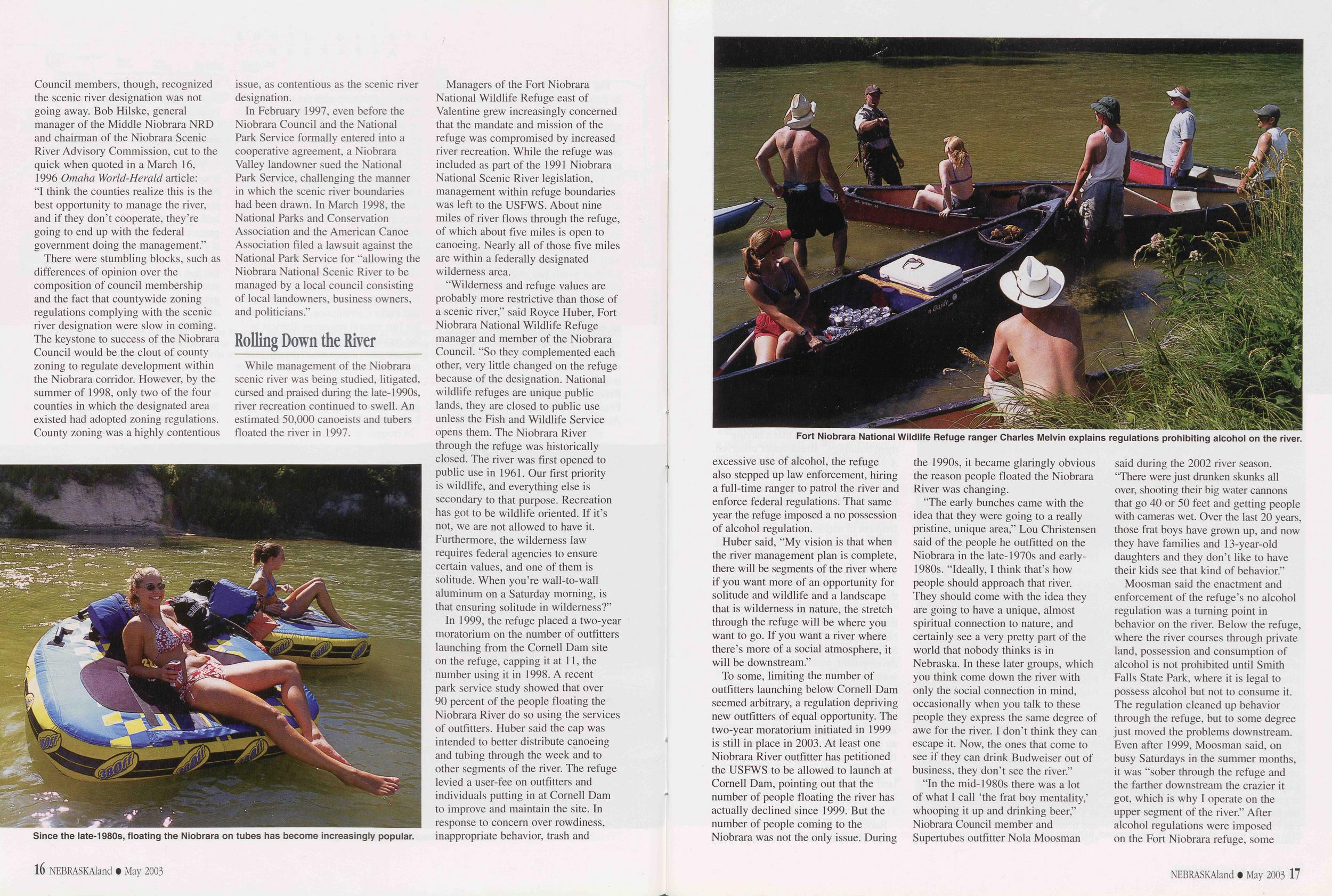
Rolling Down the RiverWhile management of the Niobrara scenic river was being studied, litigated, cursed and praised during the late-1990s, river recreation continued to swell. An estimated 50,000 canoeists and tubers floated the river in 1997.
Managers of the Fort Niobrara National Wildlife Refuge east of Valentine grew increasingly concerned that the mandate and mission of the refuge was compromised by increased river recreation. While the refuge was included as part of the 1991 Niobrara National Scenic River legislation, management within refuge boundaries was left to the USFWS. About nine miles of river flows through the refuge, of which about five miles is open to canoeing. Nearly all of those five miles are within a federally designated wilderness area.
'Wilderness and refuge values are probably more restrictive than those of a scenic river," said Royce Huber, Fort Niobrara National Wildlife Refuge manager and member of the Niobrara Council. "So they complemented each other, very little changed on the refuge because of the designation. National wildlife refuges are unique public lands, they are closed to public use unless the Fish and Wildlife Service opens them. The Niobrara River through the refuge was historically closed. The river was first opened to public use in 1961. Our first priority is wildlife, and everything else is secondary to that purpose. Recreation has got to be wildlife oriented. If it's not, we are not allowed to have it. Furthermore, the wilderness law requires federal agencies to ensure certain values, and one of them is solitude. When you're wall-to-wall aluminum on a Saturday morning, is that ensuring solitude in wilderness?"
In 1999, the refuge placed a two-year moratorium on the number of outfitters launching from the Cornell Dam site on the refuge, capping it at 11, the number using it in 1998. A recent park service study showed that over 90 percent of the people floating the Niobrara River do so using the services of outfitters. Huber said the cap was intended to better distribute canoeing and tubing through the week and to other segments of the river. The refuge levied a user-fee on outfitters and individuals putting in at Cornell Dam to improve and maintain the site. In response to concern over rowdiness, inappropriate behavior, trash and 16 NEBRASKAland • May 2003
Huber said, "My vision is that when the river management plan is complete, there will be segments of the river where if you want more of an opportunity for solitude and wildlife and a landscape that is wilderness in nature, the stretch through the refuge will be where you want to go. If you want a river where there's more of a social atmosphere, it will be downstream."
To some, limiting the number of outfitters launching below Cornell Dam seemed arbitrary, a regulation depriving new outfitters of equal opportunity. The two-year moratorium initiated in 1999 is still in place in 2003. At least one Niobrara River outfitter has petitioned the USFWS to be allowed to launch at Cornell Dam, pointing out that the number of people floating the river has actually declined since 1999. But the number of people coming to the Niobrara was not the only issue. During the 1990s, it became glaringly obvious the reason people floated the Niobrara River was changing.
'The early bunches came with the idea that they were going to a really pristine, unique area," Lou Christensen said of the people he outfitted on the Niobrara in the late-1970s and early - 1980s. "Ideally, I think that's how people should approach that river. They should come with the idea they are going to have a unique, almost spiritual connection to nature, and certainly see a very pretty part of the world that nobody thinks is in Nebraska. In these later groups, which you think come down the river with only the social connection in mind, occasionally when you talk to these people they express the same degree of awe for the river. I don't think they can escape it. Now, the ones that come to see if they can drink Budweiser out of business, they don't see the river."
"In the mid-1980s there was a lot of what I call 'the frat boy mentality,' whooping it up and drinking beer," Niobrara Council member and Supertubes outfitter Nola Moosman 16 NEBRASKAland • May 2003 said during the 2002 river season. "There were just drunken skunks all over, shooting their big water cannons that go 40 or 50 feet and getting people with cameras wet. Over the last 20 years, those frat boys have grown up, and now they have families and 13-year-old daughters and they don't like to have their kids see that kind of behavior."
Moosman said the enactment and
enforcement of the refuge's no alcohol
regulation was a turning point in
behavior on the river. Below the refuge,
where the river courses through private
land, possession and consumption of
alcohol is not prohibited until Smith
Falls State Park, where it is legal to
possess alcohol but not to consume it.
The regulation cleaned up behavior
through the refuge, but to some degree
just moved the problems downstream.
Even after 1999, Moosman said, on
busy Saturdays in the summer months,
it was "sober through the refuge and
the farther downstream the crazier it
got, which is why I operate on the
upper segment of the river." After
alcohol regulations were imposed
on the Fort Niobrara refuge, some
NEBRASKAland • May 2003 17
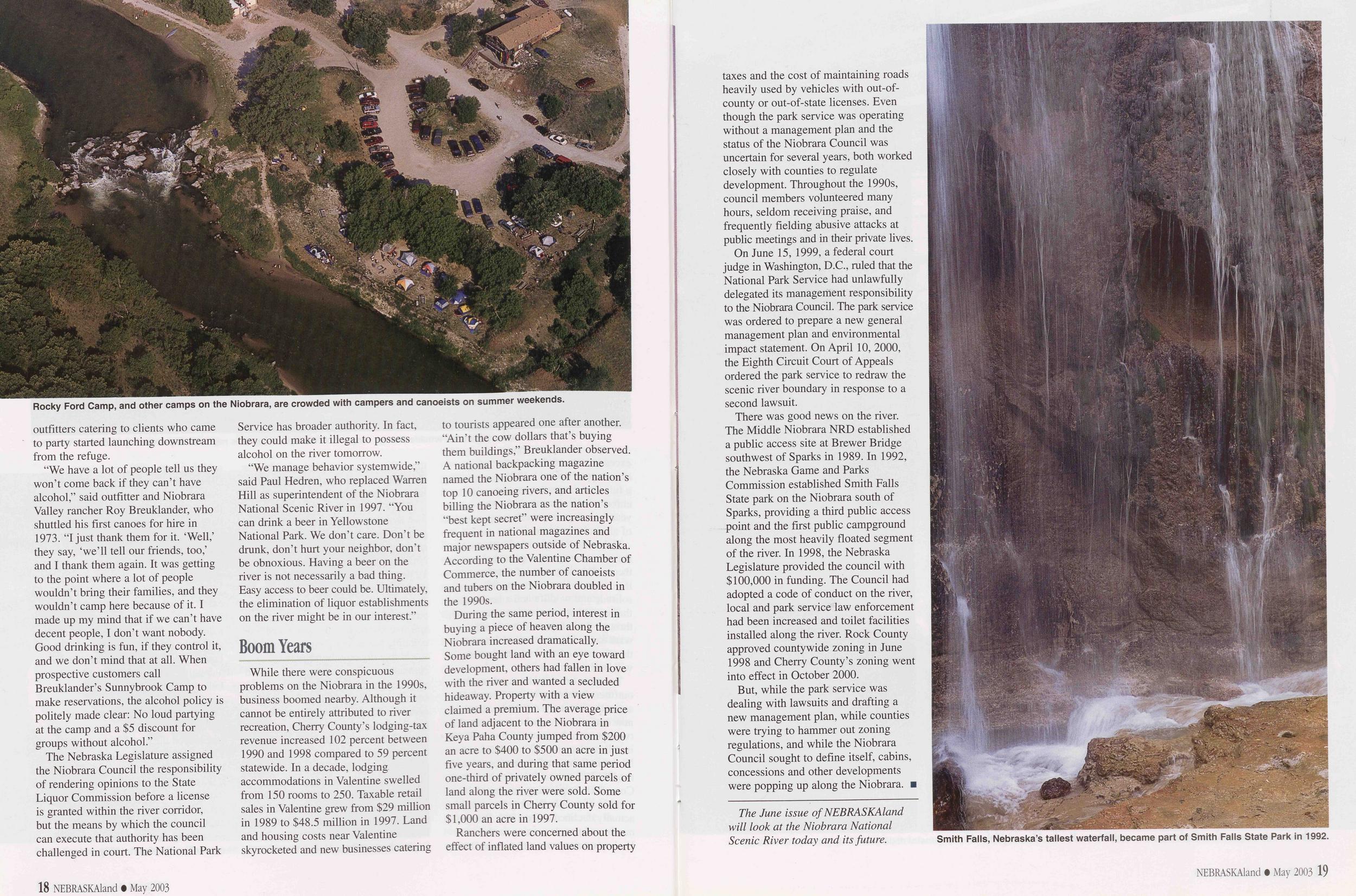
"We have a lot of people tell us they won't come back if they can't have alcohol," said outfitter and Niobrara Valley rancher Roy Breuklander, who shuttled his first canoes for hire in 1973. "I just thank them for it. 'Well,' they say, 'we'll tell our friends, too,' and I thank them again. It was getting to the point where a lot of people wouldn't bring their families, and they wouldn't camp here because of it. I made up my mind that if we can't have decent people, I don't want nobody. Good drinking is fun, if they control it, and we don't mind that at all. When prospective customers call Breuklander's Sunnybrook Camp to make reservations, the alcohol policy is politely made clear: No loud partying at the camp and a $5 discount for groups without alcohol."
The Nebraska Legislature assigned the Niobrara Council the responsibility of rendering opinions to the State Liquor Commission before a license is granted within the river corridor, but the means by which the council can execute that authority has been challenged in court. The National Park Service has broader authority. In fact, they could make it illegal to possess alcohol on the river tomorrow.
"We manage behavior systemwide," said Paul Hedren, who replaced Warren Hill as superintendent of the Niobrara National Scenic River in 1997. "You can drink a beer in Yellowstone National Park. We don't care. Don't be drunk, don't hurt your neighbor, don't be obnoxious. Having a beer on the river is not necessarily a bad thing. Easy access to beer could be. Ultimately, the elimination of liquor establishments on the river might be in our interest."
Boom YearsWhile there were conspicuous problems on the Niobrara in the 1990s, business boomed nearby. Although it cannot be entirely attributed to river recreation, Cherry County's lodging-tax revenue increased 102 percent between 1990 and 1998 compared to 59 percent statewide. In a decade, lodging accommodations in Valentine swelled from 150 rooms to 250. Taxable retail sales in Valentine grew from $29 million in 1989 to $48.5 million in 1997. Land and housing costs near Valentine skyrocketed and new businesses catering to tourists appeared one after another. "Ain't the cow dollars that's buying them buildings," Breuklander observed. A national backpacking magazine named the Niobrara one of the nation's top 10 canoeing rivers, and articles billing the Niobrara as the nation's "best kept secret" were increasingly frequent in national magazines and major newspapers outside of Nebraska. According to the Valentine Chamber of Commerce, the number of canoeists and tubers on the Niobrara doubled in the 1990s.
During the same period, interest in buying a piece of heaven along the Niobrara increased dramatically. Some bought land with an eye toward development, others had fallen in love with the river and wanted a secluded hideaway. Property with a view claimed a premium. The average price of land adjacent to the Niobrara in Keya Paha County jumped from $200 an acre to $400 to $500 an acre in just five years, and during that same period one-third of privately owned parcels of land along the river were sold. Some small parcels in Cherry County sold for $1,000 an acre in 1997.
Ranchers were concerned about the effect of inflated land values on property 18 NEBRASKAland • May 2003 taxes and the cost of maintaining roads heavily used by vehicles with out-of-county or out-of-state licenses. Even though the park service was operating without a management plan and the status of the Niobrara Council was uncertain for several years, both worked closely with counties to regulate development. Throughout the 1990s, council members volunteered many hours, seldom receiving praise, and frequently fielding abusive attacks at public meetings and in their private lives. On June 15, 1999, a federal court judge in Washington, D.C., ruled that the National Park Service had unlawfully delegated its management responsibility to the Niobrara Council. The park service was ordered to prepare a new general management plan and environmental impact statement. On April 10, 2000, the Eighth Circuit Court of Appeals ordered the park service to redraw the scenic river boundary in response to a second lawsuit.
There was good news on the river. The Middle Niobrara NRD established a public access site at Brewer Bridge southwest of Sparks in 1989. In 1992, the Nebraska Game and Parks Commission established Smith Falls State park on the Niobrara south of Sparks, providing a third public access point and the first public campground along the most heavily floated segment of the river. In 1998, the Nebraska Legislature provided the council with $100,000 in funding. The Council had adopted a code of conduct on the river, local and park service law enforcement had been increased and toilet facilities installed along the river. Rock County approved countywide zoning in June 1998 and Cherry County's zoning went into effect in October 2000.
But, while the park service was dealing with lawsuits and drafting a new management plan, while counties were trying to hammer out zoning regulations, and while the Niobrara Council sought to define itself, cabins, concessions and other developments were popping up along the Niobrara.
The June issue of NEBRASKAland will look at the Niobrara National Scenic River today and its future.
Fort Atkinson Comes Alive
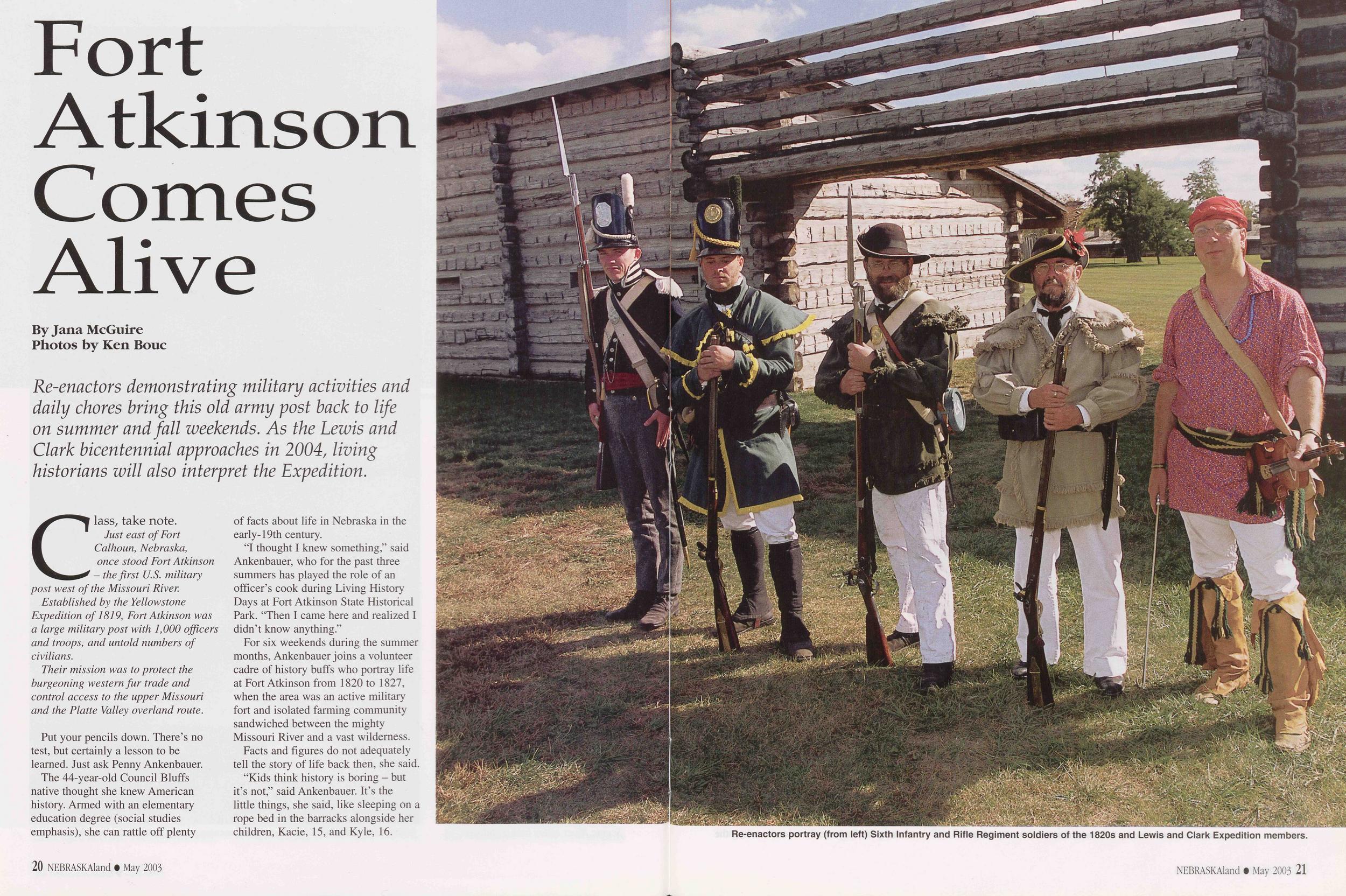
By Jana McGuire Photos by Ken Bouc Re-enactors demonstrating military activities and daily chores bring this old army post back to life on summer and fall weekends. As the Lewis and Clark bicentennial approaches in 2004, living historians will also interpret the Expedition.Class, take note. Just east of Fort Calhoun, Nebraska, once stood Fort Atkinson - the first U.S. military post west of the Missouri River. Established by the Yellowstone Expedition of 1819, Fort Atkinson was a large military post with 1,000 officers and troops, and untold numbers of civilians.
Their mission was to protect the burgeoning western fur trade and control access to the upper Missouri and the Platte Valley overland route.
Put your pencils down. There's no test, but certainly a lesson to be learned. Just ask Penny Ankenbauer.
The 44-year-old Council Bluffs native thought she knew American history. Armed with an elementary education degree (social studies emphasis), she can rattle off plenty of facts about life in Nebraska in the early-19th century.
"I thought I knew something," said Ankenbauer, who for the past three summers has played the role of an officer's cook during Living History Days at Fort Atkinson State Historical Park. "Then I came here and realized I didn't know anything."
For six weekends during the summer months, Ankenbauer joins a volunteer cadre of history buffs who portray life at Fort Atkinson from 1820 to 1827, when the area was an active military fort and isolated farming community sandwiched between the mighty Missouri River and a vast wilderness.
Facts and figures do not adequately tell the story of life back then, she said.
"Kids think history is boring - but it's not," said Ankenbauer. It's the little things, she said, like sleeping on a rope bed in the barracks alongside her children, Kacie, 15, and Kyle, 16. 20 NEBRASKAland • May 2003
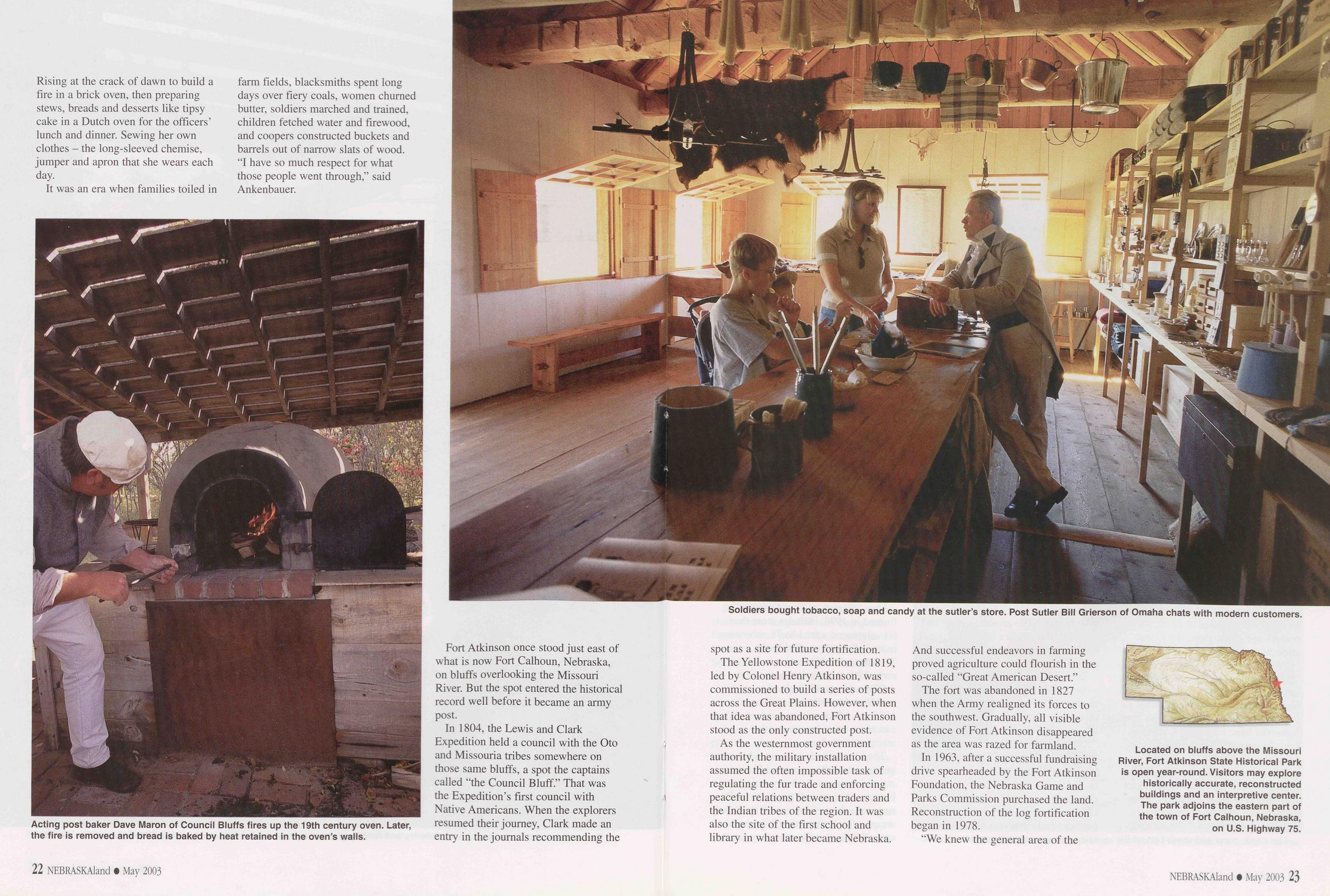 Rising at the crack of dawn to build a
fire in a brick oven, then preparing
stews, breads and desserts like tipsy
cake in a Dutch oven for the officers'
lunch and dinner. Sewing her own
clothes - the long-sleeved chemise,
jumper and apron that she wears each
day.
Rising at the crack of dawn to build a
fire in a brick oven, then preparing
stews, breads and desserts like tipsy
cake in a Dutch oven for the officers'
lunch and dinner. Sewing her own
clothes - the long-sleeved chemise,
jumper and apron that she wears each
day.
It was an era when families toiled in farm fields, blacksmiths spent long days over fiery coals, women churned butter, soldiers marched and trained, children fetched water and firewood, and coopers constructed buckets and barrels out of narrow slats of wood. "I have so much respect for what those people went through," said Ankenbauer.
Fort Atkinson once stood just east of what is now Fort Calhoun, Nebraska, on bluffs overlooking the Missouri River. But the spot entered the historical record well before it became an army post.
In 1804, the Lewis and Clark Expedition held a council with the Oto and Missouri tribes somewhere on those same bluffs, a spot the captains called "the Council Bluff." That was the Expedition's first council with Native Americans. When the explorers resumed their journey, Clark made an entry in the journals recommending the 22 NEBRASKAland • May 2003
The Yellowstone Expedition of 1819, led by Colonel Henry Atkinson, was commissioned to build a series of posts across the Great Plains. However, when that idea was abandoned, Fort Atkinson stood as the only constructed post.
As the westernmost government authority, the military installation assumed the often impossible task of regulating the fur trade and enforcing peaceful relations between traders and the Indian tribes of the region. It was also the site of the first school and library in what later became Nebraska. And successful endeavors in farming proved agriculture could flourish in the so-called "Great American Desert."
The fort was abandoned in 1827 when the Army realigned its forces to the southwest. Gradually, all visible evidence of Fort Atkinson disappeared as the area was razed for farmland.
In 1963, after a successful fundraising drive spearheaded by the Fort Atkinson Foundation, the Nebraska Game and Parks Commission purchased the land. Reconstruction of the log fortification began in 1978.
'We knew the general area of the
"You name it, they found it," he said. "In fact, one old gentleman used to pay local children if they came out and picked up buttons and other items." Many artifacts are now at the Nebraska State Historical Society in Lincoln or at the Washington County Museum.
Before reconstruction took place on the site, researchers determined exact locations of original buildings. Then the area was excavated "to recover everything underneath," Slader said.
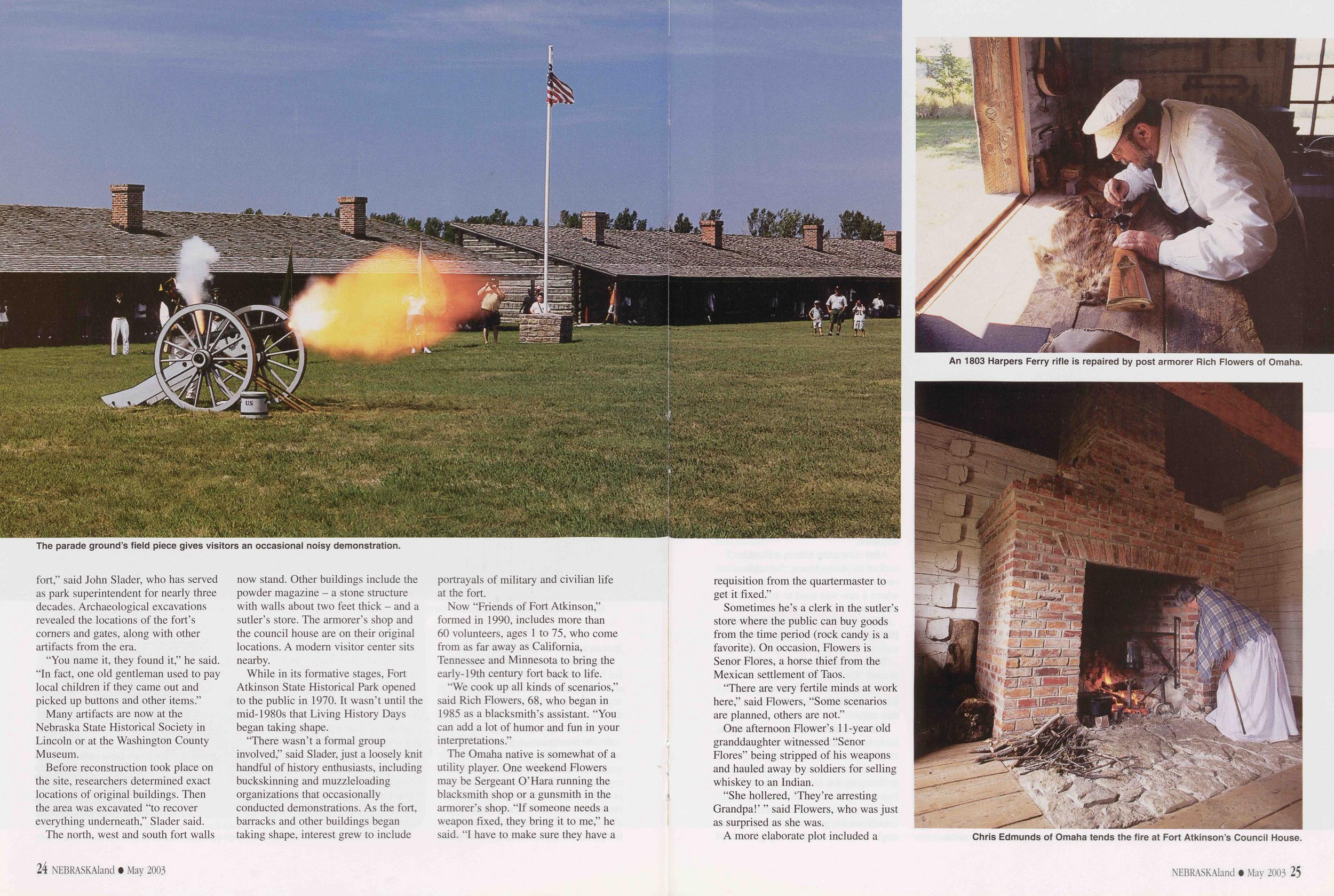
The north, west and south fort walls now stand. Other buildings include the powder magazine - a stone structure with walls about two feet thick - and a sutler's store. The armorer's shop and the council house are on their original locations. A modern visitor center sits nearby.
While in its formative stages, Fort Atkinson State Historical Park opened to the public in 1970. It wasn't until the mid-1980s that Living History Days began taking shape.
"There wasn't a formal group involved," said Slader, just a loosely knit handful of history enthusiasts, including buckskinning and muzzleloading organizations that occasionally conducted demonstrations. As the fort, barracks and other buildings began taking shape, interest grew to include portrayals of military and civilian life at the fort.
Now "Friends of Fort Atkinson," formed in 1990, includes more than 60 volunteers, ages 1 to 75, who come from as far away as California, Tennessee and Minnesota to bring the early-19th century fort back to life.
"We cook up all kinds of scenarios," said Rich Flowers, 68, who began in 1985 as a blacksmith's assistant. "You can add a lot of humor and fun in your interpretations."
The Omaha native is somewhat of a utility player. One weekend Flowers may be Sergeant O'Hara running the blacksmith shop or a gunsmith in the armorer's shop. "If someone needs a weapon fixed, they bring it to me," he said. "I have to make sure they have a 24 NEBRASKAland • May 2003 requisition from the quartermaster to get it fixed."
Sometimes he's a clerk in the sutler's store where the public can buy goods from the time period (rock candy is a favorite). On occasion, Flowers is Senor Flores, a horse thief from the Mexican settlement of Taos.
"There are very fertile minds at work here," said Flowers, "Some scenarios are planned, others are not."
One afternoon Flower's 11-year old granddaughter witnessed "Senor Flores" being stripped of his weapons and hauled away by soldiers for selling whiskey to an Indian.
"She hollered, 'They're arresting Grandpa!' ' said Flowers, who was just as surprised as she was.
A more elaborate plot included a
After wrapping him in a blanket soaked in phony blood, the soldiers rushed him to the surgeon's quarters where a saw was used to amputate the extremity.
"They were actually cutting through PVC pipe," said Penny, describing the realistic sounds of the staged trauma.
The surgeon then threw the blanket draped "leg" out the door.
"A couple little old ladies about fainted," said Flowers. "We only did that once."
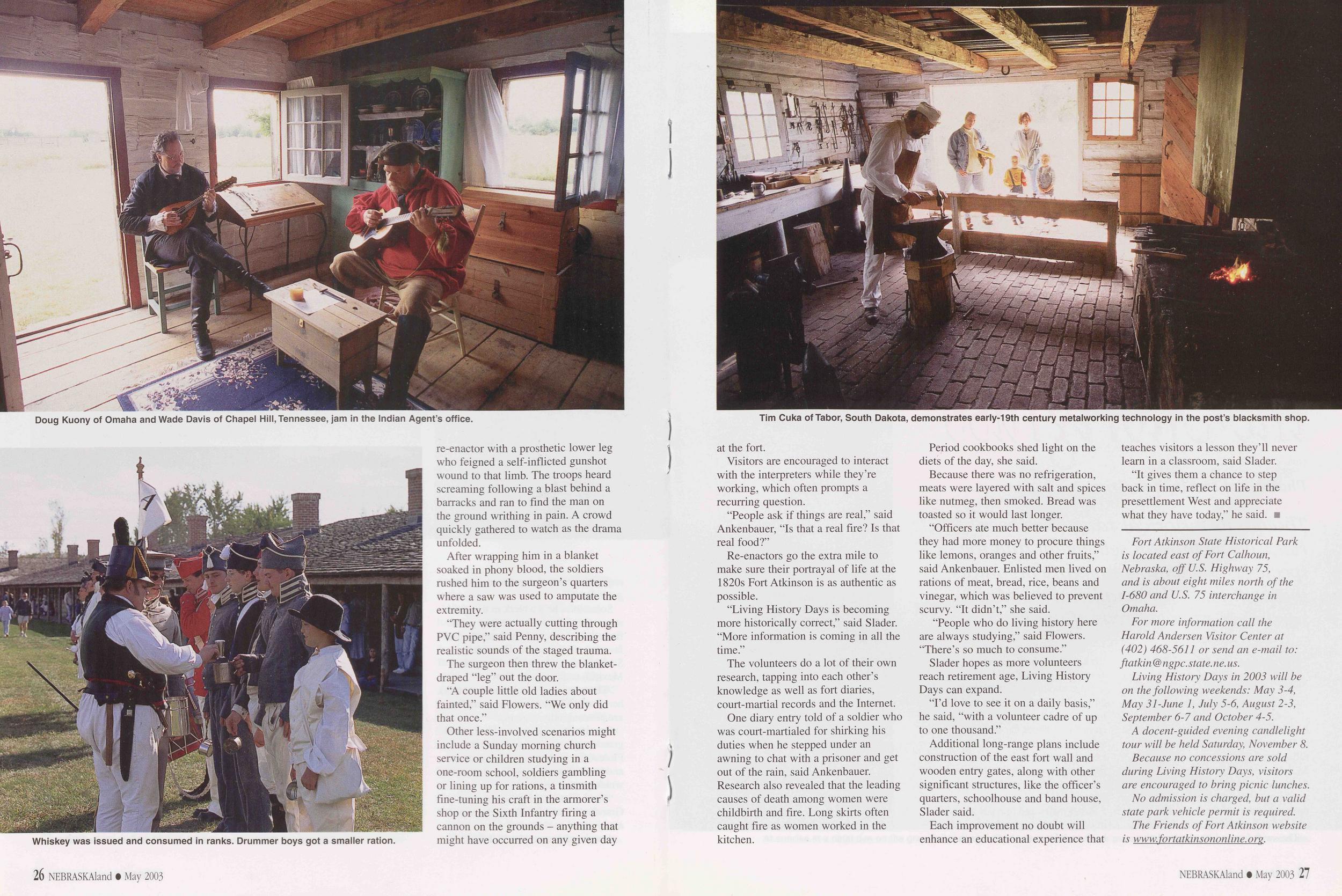
Other less-involved scenarios might include a Sunday morning church service or children studying in a one-room school, soldiers gambling or lining up for rations, a tinsmith fine-tuning his craft in the armorer's shop or the Sixth Infantry firing a cannon on the grounds - anything that might have occurred on any given day 26 NEBRASKAland • May 2003
Visitors are encouraged to interact with the interpreters while they're working, which often prompts a recurring question.
"People ask if things are real," said Ankenbauer, "Is that a real fire? Is that real food?"
Re-enactors go the extra mile to make sure their portrayal of life at the 1820s Fort Atkinson is as authentic as possible.
"Living History Days is becoming more historically correct," said Slader. "More information is coming in all the time."
The volunteers do a lot of their own research, tapping into each other's knowledge as well as fort diaries, court-martial records and the Internet.
One diary entry told of a soldier who was court-martialed for shirking his duties when he stepped under an awning to chat with a prisoner and get out of the rain, said Ankenbauer. Research also revealed that the leading causes of death among women were childbirth and fire. Long skirts often caught fire as women worked in the kitchen.
Period cookbooks shed light on the diets of the day, she said.
Because there was no refrigeration, meats were layered with salt and spices like nutmeg, then smoked. Bread was toasted so it would last longer.
"Officers ate much better because they had more money to procure things like lemons, oranges and other fruits," said Ankenbauer. Enlisted men lived on rations of meat, bread, rice, beans and vinegar, which was believed to prevent scurvy. "It didn't," she said.
"People who do living history here are always studying," said Flowers. "There's so much to consume."
Slader hopes as more volunteers reach retirement age, Living History Days can expand.
"I'd love to see it on a daily basis," he said, "with a volunteer cadre of up to one thousand."
Additional long-range plans include construction of the east fort wall and wooden entry gates, along with other significant structures, like the officer's quarters, schoolhouse and band house, Slader said.
Each improvement no doubt will enhance an educational experience that teaches visitors a lesson they'll never learn in a classroom, said Slader.
"It gives them a chance to step back in time, reflect on life in the presettlement West and appreciate what they have today," he said.
Fort Atkinson State Historical Park is located east of Fort Calhoun, Nebraska, off U.S. Highway 75, and is about eight miles north of the F680 and U.S. 75 interchange in Omaha.
For more information call the Harold Andersen Visitor Center at (402) 468-5611 or send an e-mail to: ftatkin @ ngpc. state, ne. us.
Living History Days in 2003 will be on the following weekends: May 3-4, May 31-June 1, July 5-6, August 2-3, September 6-7 and October 4-5.
A docent-guided evening candlelight tour will be held Saturday, November 8.
Because no concessions are sold during Living History Days, visitors are encouraged to bring picnic lunches.
No admission is charged, but a valid state park vehicle permit is required.
The Friends of Fort Atkinson website is www.fortatkinsononline.org.
NEBRASKAland • May 2003 27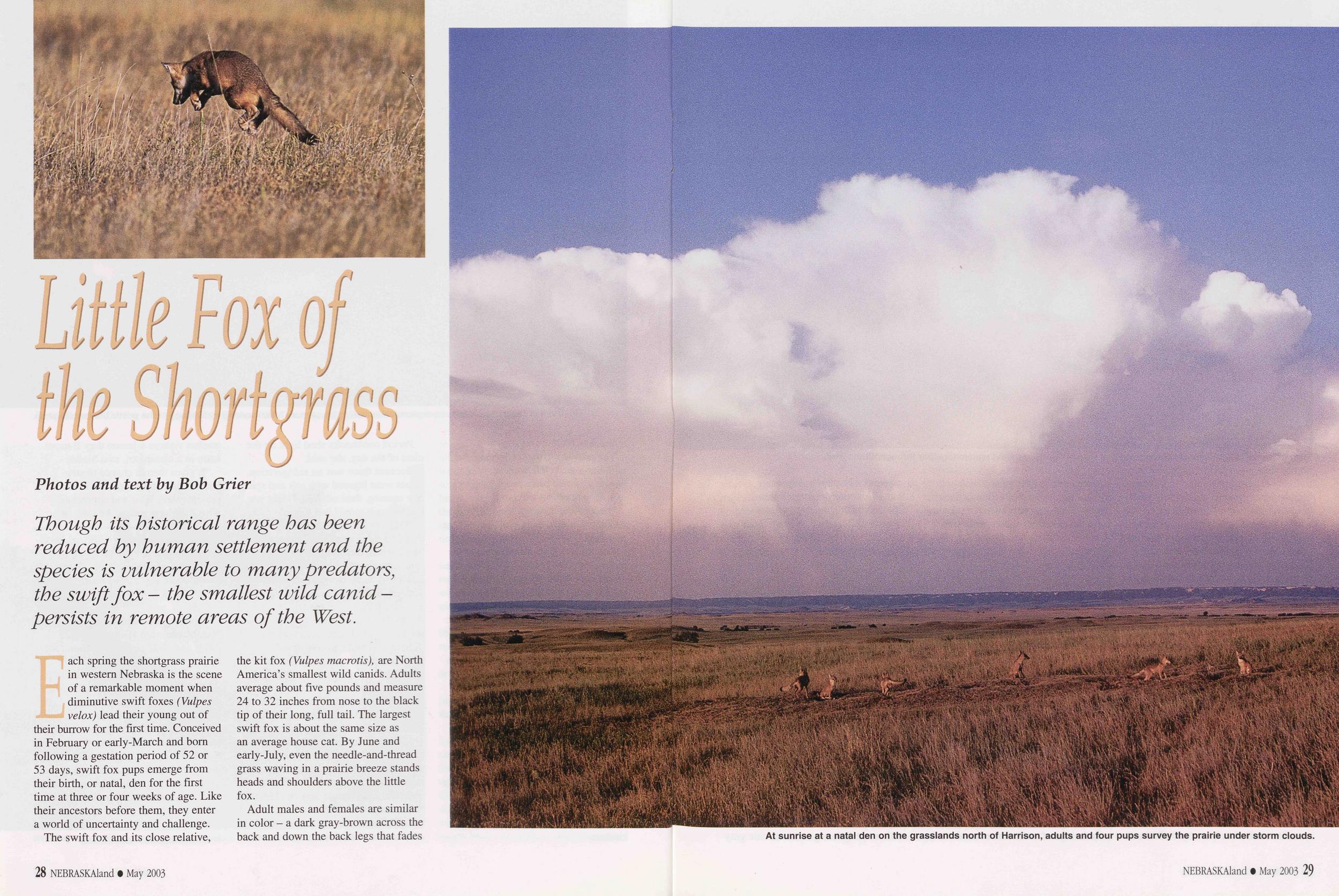
Little Fox of the Shortgrass
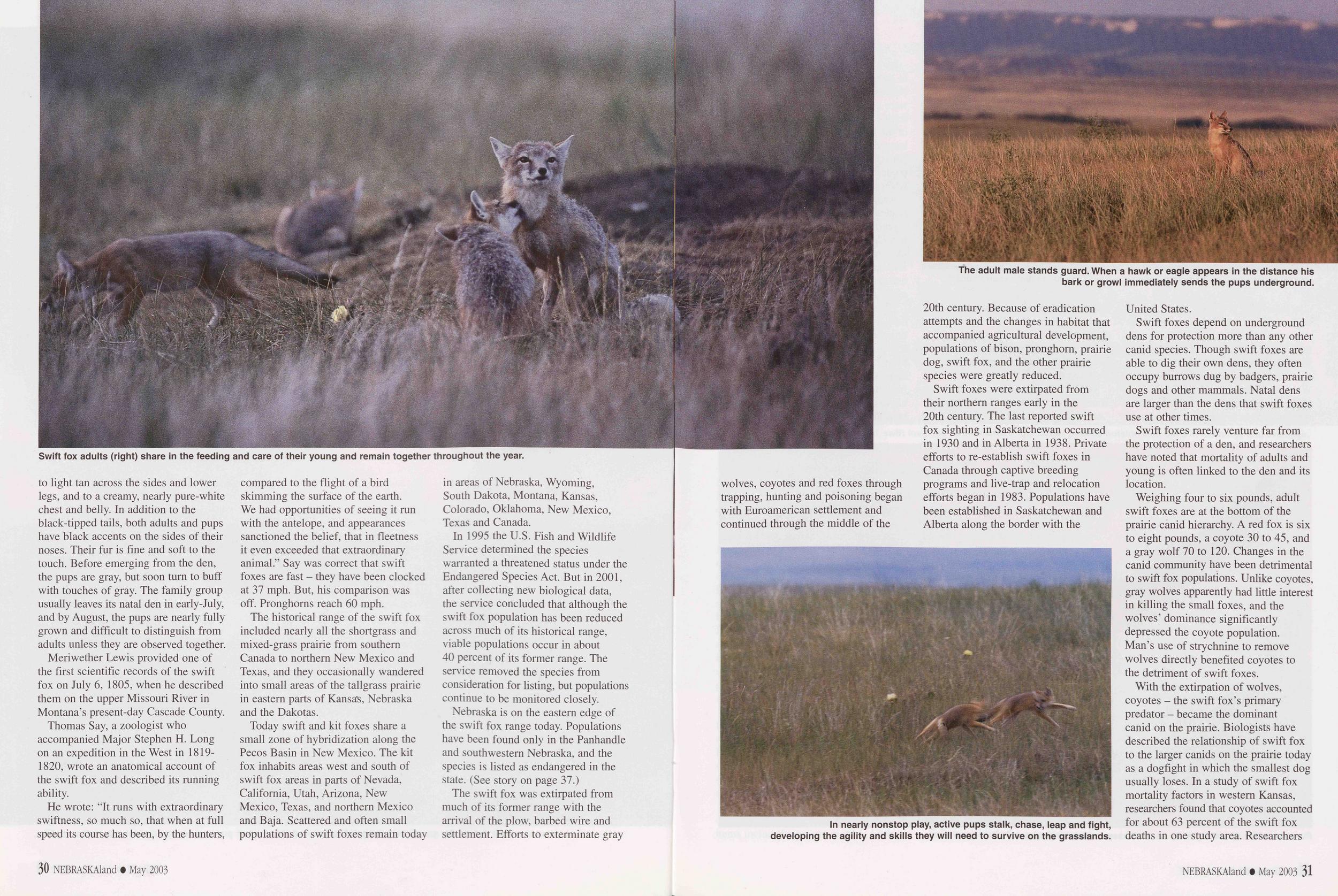
Photos and text by Bob Grier Though its historical range has been reduced by human settlement and the species is vulnerable to many predators, the swift fox - the smallest wild canid - persists in remote areas of the West.Each spring the shortgrass prairie in western Nebraska is the scene of a remarkable moment when diminutive swift foxes (Vulpes velox) lead their young out of their burrow for the first time. Conceived in February or early-March and born following a gestation period of 52 or 53 days, swift fox pups emerge from their birth, or natal, den for the first time at three or four weeks of age. Like their ancestors before them, they enter a world of uncertainty and challenge.
The swift fox and its close relative, the kit fox (Vulpes macrotis), are North America's smallest wild canids. Adults average about five pounds and measure 24 to 32 inches from nose to the black tip of their long, full tail. The largest swift fox is about the same size as an average house cat. By June and early-July, even the needle-and-thread grass waving in a prairie breeze stands heads and shoulders above the little fox.
Adult males and females are similar in color - a dark gray-brown across the back and down the back legs that fades 28 NEBRASKAland • May 2003
Meriwether Lewis provided one of the first scientific records of the swift fox on July 6, 1805, when he described them on the upper Missouri River in Montana's present-day Cascade County.
Thomas Say, a zoologist who accompanied Major Stephen H. Long on an expedition in the West in 1819-1820, wrote an anatomical account of the swift fox and described its running ability.
He wrote: "It runs with extraordinary swiftness, so much so, that when at full speed its course has been, by the hunters, compared to the flight of a bird skimming the surface of the earth. We had opportunities of seeing it run with the antelope, and appearances sanctioned the belief, that in fleetness it even exceeded that extraordinary animal." Say was correct that swift foxes are fast - they have been clocked at 37 mph. But, his comparison was off. Pronghorns reach 60 mph.
The historical range of the swift fox included nearly all the shortgrass and mixed-grass prairie from southern Canada to northern New Mexico and Texas, and they occasionally wandered into small areas of the tallgrass prairie in eastern parts of Kansa's, Nebraska and the Dakotas.
Today swift and kit foxes share a small zone of hybridization along the Pecos Basin in New Mexico. The kit fox inhabits areas west and south of swift fox areas in parts of Nevada, California, Utah, Arizona, New Mexico, Texas, and northern Mexico and Baja. Scattered and often small populations of swift foxes remain today in areas of Nebraska, Wyoming, South Dakota, Montana, Kansas, Colorado, Oklahoma, New Mexico, Texas and Canada.
In 1995 the U.S. Fish and Wildlife Service determined the species warranted a threatened status under the Endangered Species Act. But in 2001, after collecting new biological data, the service concluded that although the swift fox population has been reduced across much of its historical range, viable populations occur in about 40 percent of its former range. The service removed the species from consideration for listing, but populations continue to be monitored closely.
Nebraska is on the eastern edge of the swift fox range today. Populations have been found only in the Panhandle and southwestern Nebraska, and the species is listed as endangered in the state. (See story on page 37.)
The swift fox was extirpated from much of its former range with the arrival of the plow, barbed wire and settlement. Efforts to exterminate gray 30 NEBRASKAland • May 2003
Swift foxes were extirpated from their northern ranges early in the 20th century. The last reported swift fox sighting in Saskatchewan occurred in 1930 and in Alberta in 1938. Private efforts to re-establish swift foxes in Canada through captive breeding programs and live-trap and relocation efforts began in 1983. Populations have been established in Saskatchewan and Alberta along the border with the United States.
Swift foxes depend on underground dens for protection more than any other canid species. Though swift foxes are able to dig their own dens, they often occupy burrows dug by badgers, prairie dogs and other mammals. Natal dens are larger than the dens that swift foxes use at other times.
Swift foxes rarely venture far from the protection of a den, and researchers have noted that mortality of adults and young is often linked to the den and its location.
Weighing four to six pounds, adult swift foxes are at the bottom of the prairie canid hierarchy. A red fox is six to eight pounds, a coyote 30 to 45, and a gray wolf 70 to 120. Changes in the canid community have been detrimental to swift fox populations. Unlike coyotes, gray wolves apparently had little interest in killing the small foxes, and the wolves' dominance significantly depressed the coyote population. Man's use of strychnine to remove wolves directly benefited coyotes to the detriment of swift foxes.
With the extirpation of wolves,
coyotes - the swift fox's primary
predator - became the dominant
canid on the prairie. Biologists have
described the relationship of swift fox
to the larger canids on the prairie today
as a dogfight in which the smallest dog
usually loses. In a study of swift fox
mortality factors in western Kansas,
researchers found that coyotes accounted
for about 63 percent of the swift fox
deaths in one study area. Researchers
NEBRASKAland • May 2003 31
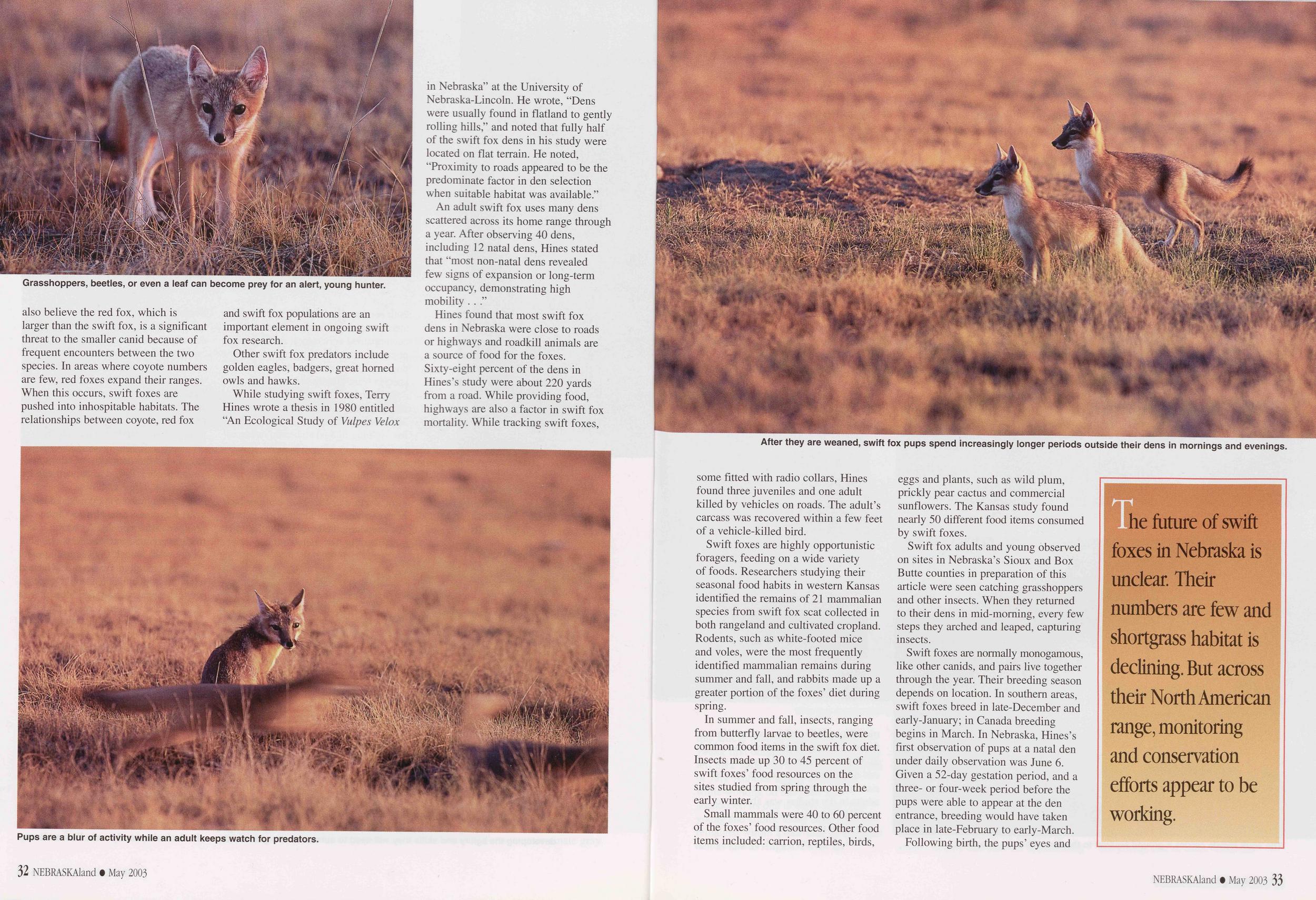
Other swift fox predators include golden eagles, badgers, great horned owls and hawks.
While studying swift foxes, Terry Hines wrote a thesis in 1980 entitled "An Ecological Study of Vulpes Velox in Nebraska" at the University of Nebraska-Lincoln. He wrote, "Dens were usually found in flatland to gently rolling hills," and noted that fully half of the swift fox dens in his study were located on flat terrain. He noted, "Proximity to roads appeared to be the predominate factor in den selection when suitable habitat was available."
An adult swift fox uses many dens scattered across its home range through a year. After observing 40 dens, including 12 natal dens, Hines stated that "most non-natal dens revealed few signs of expansion or long-term occupancy, demonstrating high mobility ..."
Hines found that most swift fox dens in Nebraska were close to roads or highways and roadkill animals are a source of food for the foxes. Sixty-eight percent of the dens in Hines's study were about 220 yards from a road. While providing food, highways are also a factor in swift fox mortality. While tracking swift foxes,
Swift foxes are highly opportunistic foragers, feeding on a wide variety of foods. Researchers studying their seasonal food habits in western Kansas identified the remains of 21 mammalian species from swift fox scat collected in both rangeland and cultivated cropland. Rodents, such as white-footed mice and voles, were the most frequently identified mammalian remains during summer and fall, and rabbits made up a greater portion of the foxes' diet during spring.
In summer and fall, insects, ranging from butterfly larvae to beetles, were common food items in the swift fox diet. Insects made up 30 to 45 percent of swift foxes' food resources on the sites studied from spring through the early winter.
Small mammals were 40 to 60 percent of the foxes' food resources. Other food items included: carrion, reptiles, birds, eggs and plants, such as wild plum, prickly pear cactus and commercial sunflowers. The Kansas study found nearly 50 different food items consumed by swift foxes.
Swift fox adults and young observed on sites in Nebraska's Sioux and Box Butte counties in preparation of this article were seen catching grasshoppers and other insects. When they returned to their dens in mid-morning, every few steps they arched and leaped, capturing insects.
Swift foxes are normally monogamous, like other canids, and pairs live together through the year. Their breeding season depends on location. In southern areas, swift foxes breed in late-December and early-January; in Canada breeding begins in March. In Nebraska, Hines's first observation of pups at a natal den under daily observation was June 6. Given a 52-day gestation period, and a three- or four-week period before the pups were able to appear at the den entrance, breeding would have taken place in late-February to early-March.
The future of swift foxes in Nebraska is unclear. Their numbers are few and shortgrass habitat is declining. But across their North American range, monitoring and conservation efforts appear to be working.Following birth, the pups' eyes and
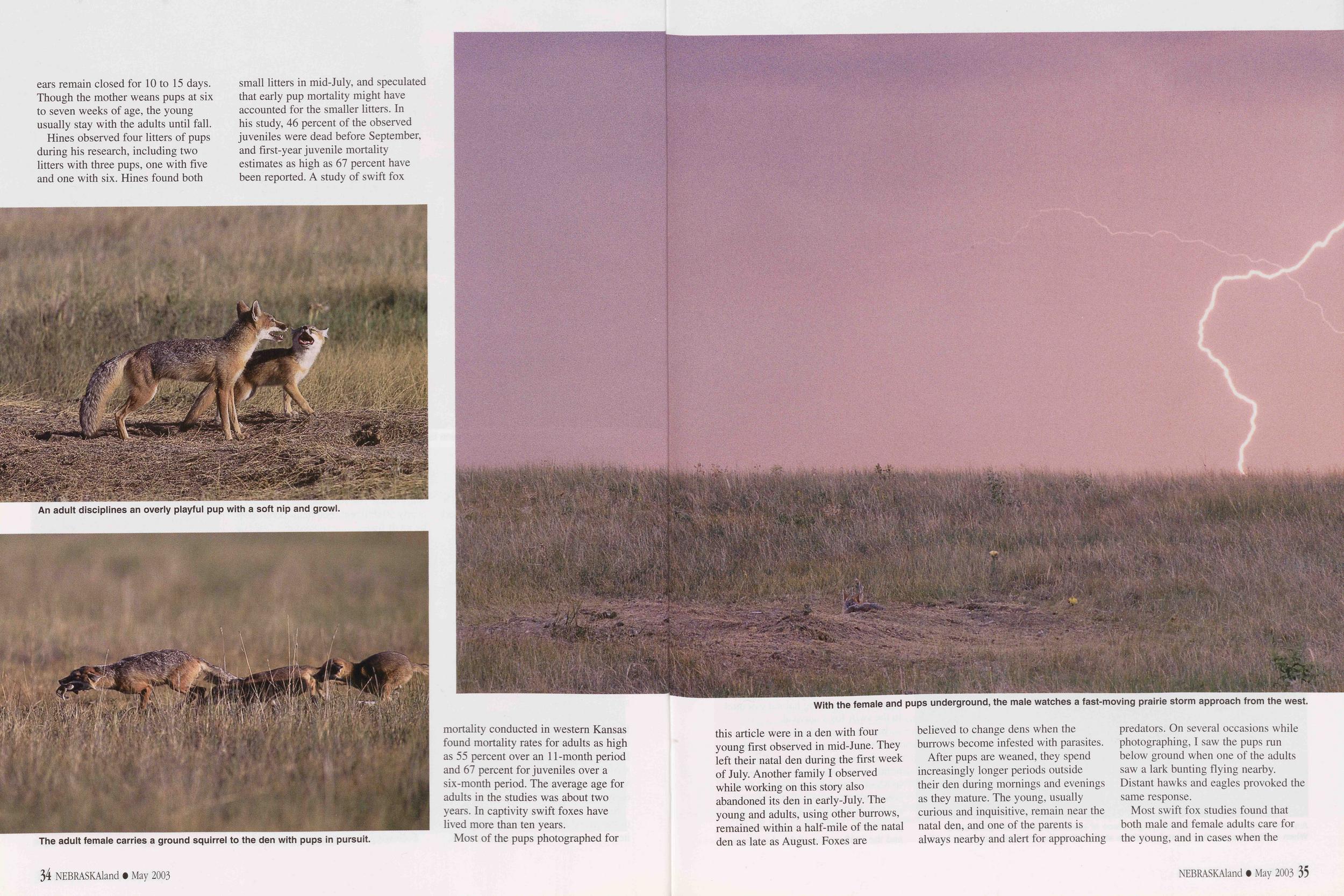 ears remain closed for 10 to 15 days.
Though the mother weans pups at six
to seven weeks of age, the young
usually stay with the adults until fall.
ears remain closed for 10 to 15 days.
Though the mother weans pups at six
to seven weeks of age, the young
usually stay with the adults until fall.
Hines observed four litters of pups during his research, including two litters with three pups, one with five and one with six. Hines found both small litters in mid-July, and speculated that early pup mortality might have accounted for the smaller litters. In his study, 46 percent of the observed juveniles were dead before September, and first-year juvenile mortality estimates as high as 67 percent have been reported. A study of swift fox
Most of the pups photographed for 34 NEBRASKAland • May 2003
After pups are weaned, they spend increasingly longer periods outside their den during mornings and evenings as they mature. The young, usually curious and inquisitive, remain near the natal den, and one of the parents is always nearby and alert for approaching predators. On several occasions while photographing, I saw the pups run below ground when one of the adults saw a lark bunting flying nearby. Distant hawks and eagles provoked the same response.
Most swift fox studies found that
both male and female adults care for
the young, and in cases when the
NEBRASKAland • May 2003 35
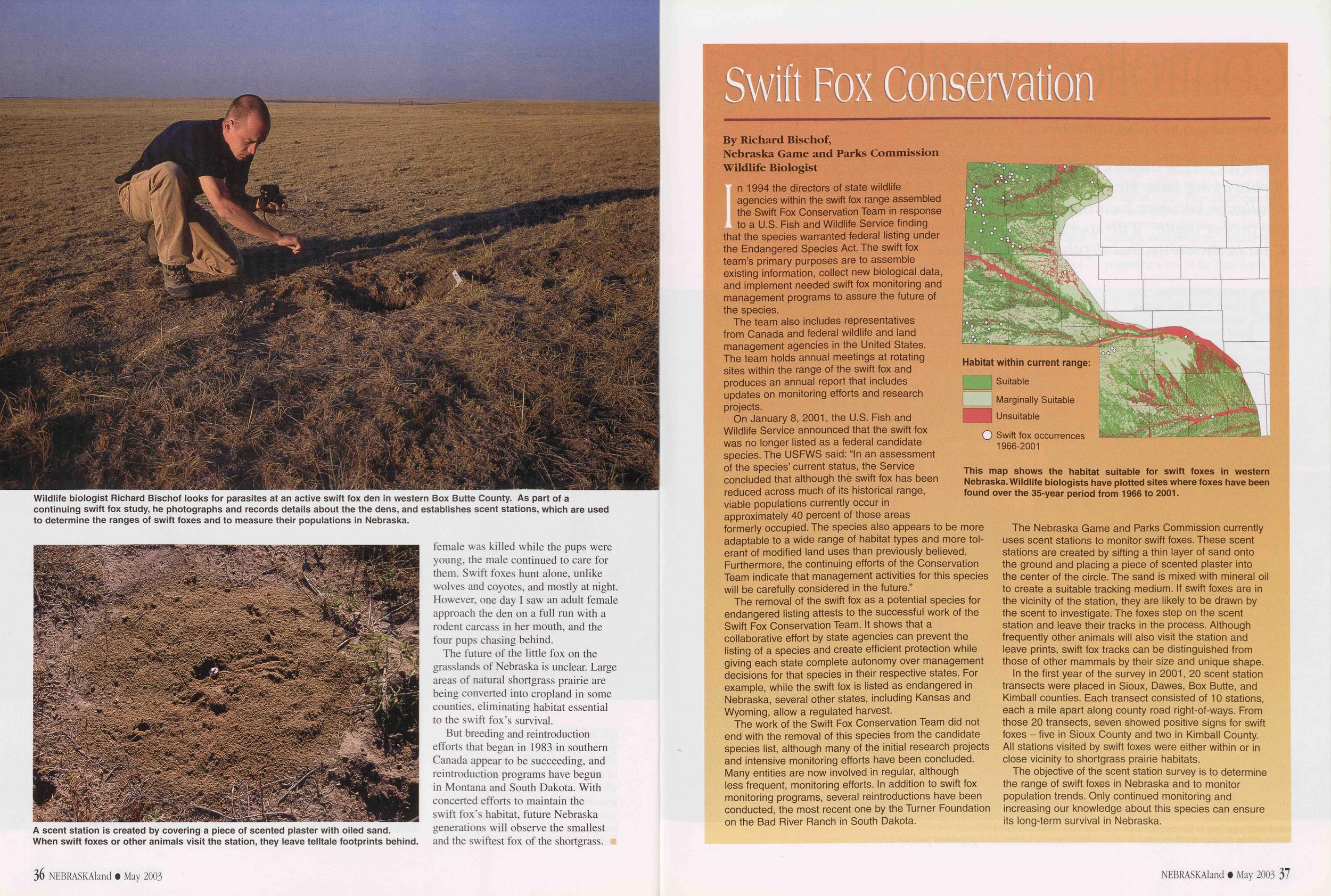
The future of the little fox on the grasslands of Nebraska is unclear. Large areas of natural shortgrass prairie are being converted into cropland in some counties, eliminating habitat essential to the swift fox's survival.
But breeding and reintroduction efforts that began in 1983 in southern Canada appear to be succeeding, and reintroduction programs have begun in Montana and South Dakota. With concerted efforts to maintain the swift fox's habitat, future Nebraska generations will observe the smallest and the swiftest fox of the shortgrass.
36 NEBRASKAland t May 2003 Swift Fox COnservation By Richard Bischof, Nebraska Game and Parks Commission Wildlife BiologistIn 1994 the directors of state wildlife agencies within the swift fox range assembled the Swift Fox Conservation Team in response to a U.S. Fish and Wildlife Service finding that the species warranted federal listing under the Endangered Species Act. The swift fox team's primary purposes are to assemble existing information, collect new biological data, and implement needed swift fox monitoring and management programs to assure the future of the species.
The team also includes representatives from Canada and federal wildlife and land management agencies in the United States. The team holds annual meetings at rotating sites within the range of the swift fox and produces an annual report that includes updates on monitoring efforts and research projects.
On January 8, 2001, the U.S. Fish and Wildlife Service announced that the swift fox was no longer listed as a federal candidate species. The USFWS said: "In an assessment of the species' current status, the Service concluded that although the swift fox has been reduced across much of its historical range, viable populations currently occur in approximately 40 percent of those areas formerly occupied. The species also appears to be more adaptable to a wide range of habitat types and more tolerant of modified land uses than previously believed. Furthermore, the continuing efforts of the Conservation Team indicate that management activities for this species will be carefully considered in the future."
The removal of the swift fox as a potential species for endangered listing attests to the successful work of the Swift Fox Conservation Team. It shows that a collaborative effort by state agencies can prevent the listing of a species and create efficient protection while giving each state complete autonomy over management decisions for that species in their respective states. For example, while the swift fox is listed as endangered in Nebraska, several other states, including Kansas and Wyoming, allow a regulated harvest.
The work of the Swift Fox Conservation Team did not end with the removal of this species from the candidate species list, although many of the initial research projects and intensive monitoring efforts have been concluded. Many entities are now involved in regular, although less frequent, monitoring efforts. In addition to swift fox monitoring programs, several reintroductions have been conducted, the most recent one by the Turner Foundation on the Bad River Ranch in South Dakota.
The Nebraska Game and Parks Commission currently uses scent stations to monitor swift foxes. These scent stations are created by sifting a thin layer of sand onto the ground and placing a piece of scented plaster into the center of the circle. The sand is mixed with mineral oil to create a suitable tracking medium. If swift foxes are in the vicinity of the station, they are likely to be drawn by the scent to investigate. The foxes step on the scent station and leave their tracks in the process. Although frequently other animals will also visit the station and leave prints, swift fox tracks can be distinguished from those of other mammals by their size and unique shape.
In the first year of the survey in 2001, 20 scent station transects were placed in Sioux, Dawes, Box Butte, and Kimball counties. Each transect consisted of 10 stations, each a mile apart along county road right-of-ways. From those 20 transects, seven showed positive signs for swift foxes - five in Sioux County and two in Kimball County. All stations visited by swift foxes were either within or in close vicinity to shortgrass prairie habitats.
The objective of the scent station survey is to determine the range of swift foxes in Nebraska and to monitor population trends. Only continued monitoring and increasing our knowledge about this species can ensure its long-term survival in Nebraska.
NEBRASKAland • May 2003 37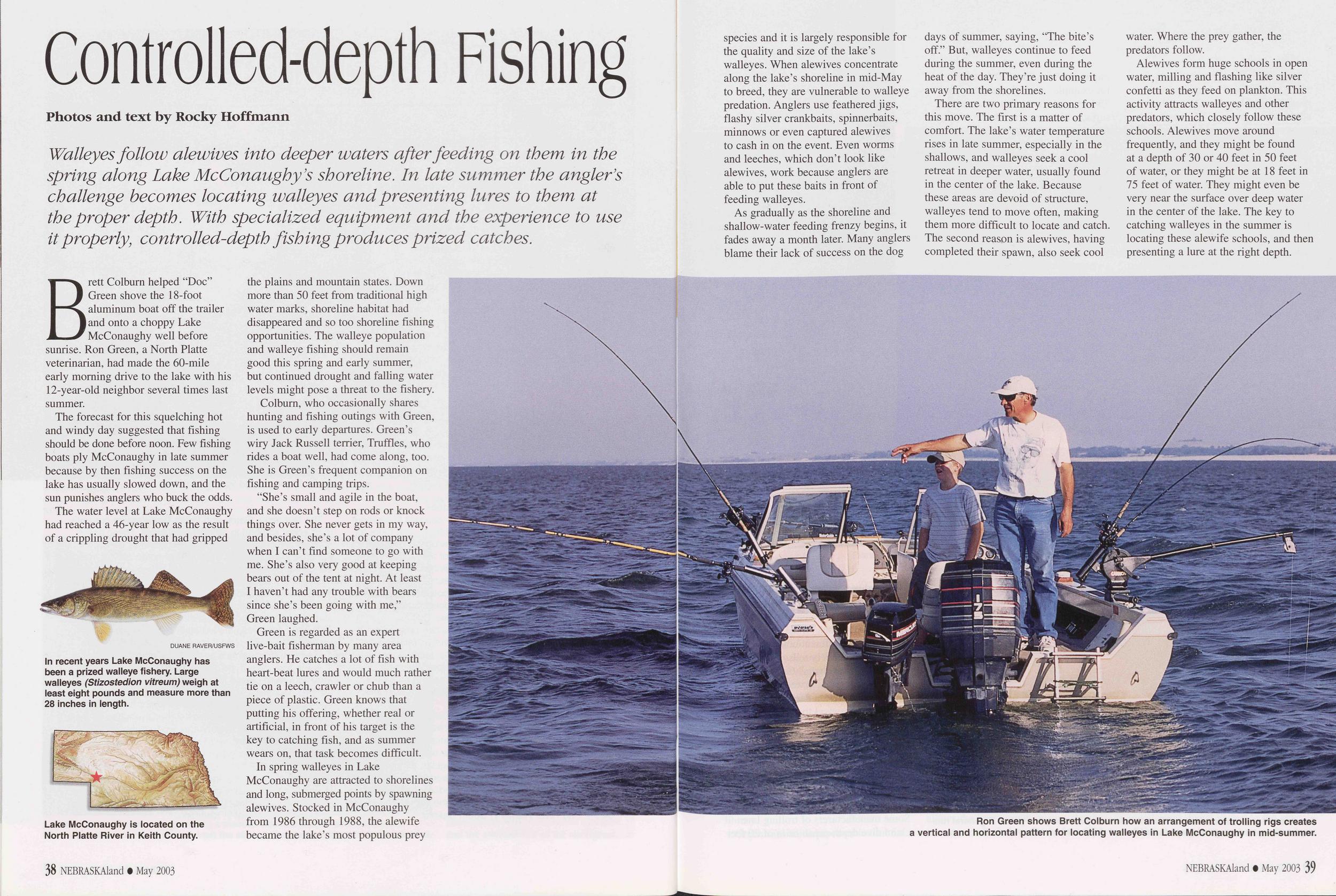
Controlled-depth Fishin
Photos and text by Rocky Hoffmann Walleyes follow alewives into deeper waters after feeding on them in the spring along Lake McConaughy's shoreline. In late summer the angler's challenge becomes locating walleyes and presenting lures to them at the proper depth. With specialized equipment and the experience to use it properly, controlled-depth fish ing produces prized catches.Brett Colburn helped "Doc" Green shove the 18-foot aluminum boat off the trailer and onto a choppy Lake McConaughy well before sunrise. Ron Green, a North Platte veterinarian, had made the 60-mile early morning drive to the lake with his 12-year-old neighbor several times last summer.
The forecast for this squelching hot and windy day suggested that fishing should be done before noon. Few fishing boats ply McConaughy in late summer because by then fishing success on the lake has usually slowed down, and the sun punishes anglers who buck the odds.
The water level at Lake McConaughy had reached a 46-year low as the result of a crippling drought that had gripped
Colburn, who occasionally shares hunting and fishing outings with Green, is used to early departures. Green's wiry Jack Russell terrier, Truffles, who rides a boat well, had come along, too. She is Green's frequent companion on fishing and camping trips.
"She's small and agile in the boat, and she doesn't step on rods or knock things over. She never gets in my way, and besides, she's a lot of company when I can't find someone to go with me. She's also very good at keeping bears out of the tent at night. At least I haven't had any trouble with bears since she's been going with me," Green laughed.
Green is regarded as an expert live-bait fisherman by many area anglers. He catches a lot of fish with heart-beat lures and would much rather tie on a leech, crawler or chub than a piece of plastic. Green knows that putting his offering, whether real or artificial, in front of his target is the key to catching fish, and as summer wears on, that task becomes difficult.
In spring walleyes in Lake McConaughy are attracted to shorelines and long, submerged points by spawning alewives. Stocked in McConaughy from 1986 through 1988, the alewife became the lake's most populous prey 38 NEBRASKAland • May 2003 species and it is largely responsible for the quality and size of the lake's walleyes. When alewives concentrate along the lake's shoreline in mid-May to breed, they are vulnerable to walleye predation. Anglers use feathered jigs, flashy silver crankbaits, spinnerbaits, minnows or even captured alewives to cash in on the event. Even worms and leeches, which don't look like alewives, work because anglers are able to put these baits in front of feeding walleyes.
As gradually as the shoreline and shallow-water feeding frenzy begins, it fades away a month later. Many anglers blame their lack of success on the dog days of summer, saying, "The bite's off." But, walleyes continue to feed during the summer, even during the heat of the day. They're just doing it away from the shorelines.
There are two primary reasons for this move. The first is a matter of comfort. The lake's water temperature rises in late summer, especially in the shallows, and walleyes seek a cool retreat in deeper water, usually found in the center of the lake. Because these areas are devoid of structure, walleyes tend to move often, making them more difficult to locate and catch. The second reason is alewives, having completed their spawn, also seek cool water. Where the prey gather, the predators follow.
Alewives form huge schools in open water, milling and flashing like silver confetti as they feed on plankton. This activity attracts walleyes and other predators, which closely follow these schools. Alewives move around frequently, and they might be found at a depth of 30 or 40 feet in 50 feet of water, or they might be at 18 feet in 75 feet of water. They might even be very near the surface over deep water in the center of the lake. The key to catching walleyes in the summer is locating these alewife schools, and then presenting a lure at the right depth.
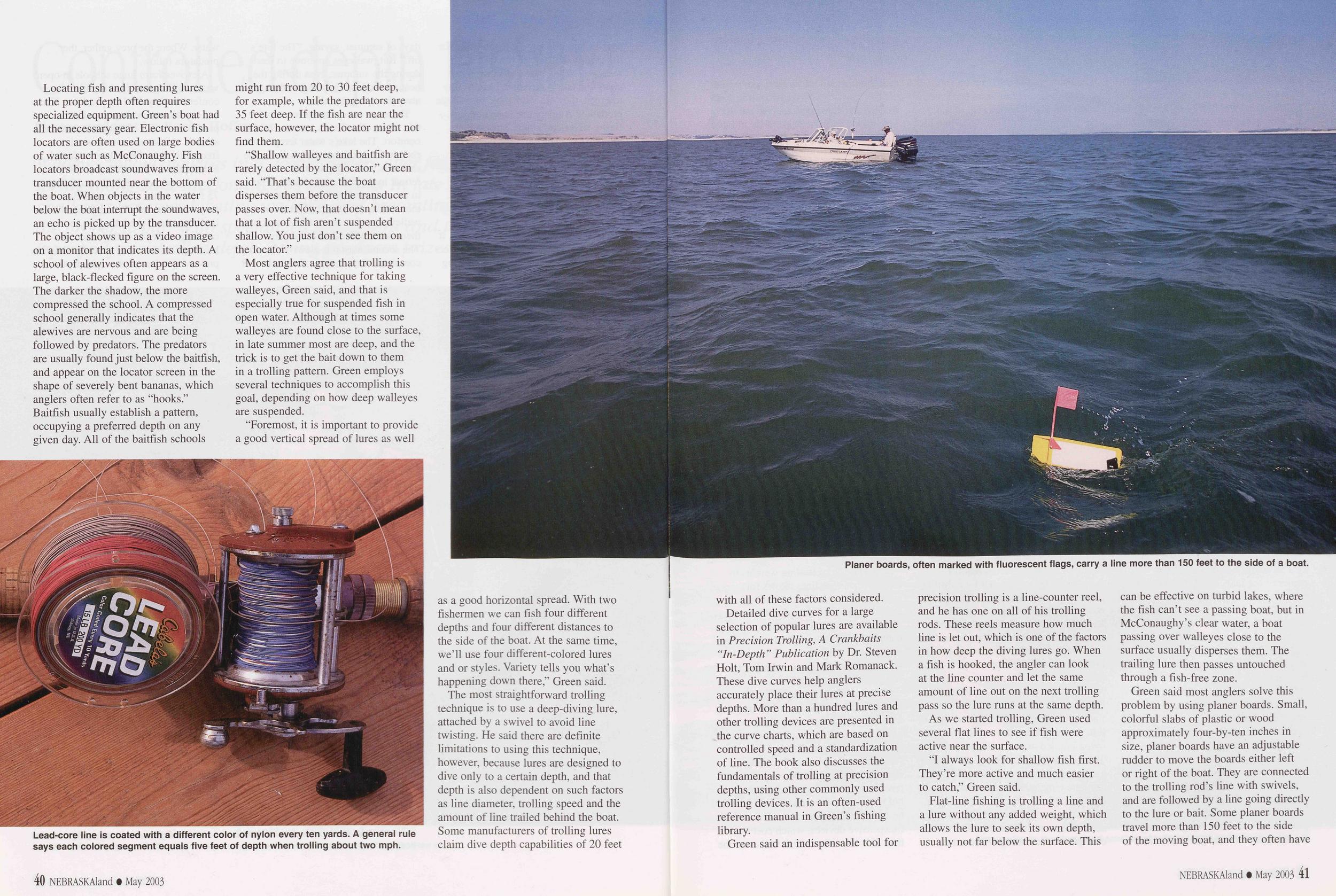
Locating fish and presenting lures at the proper depth often requires specialized equipment. Green's boat had all the necessary gear. Electronic fish locators are often used on large bodies of water such as McConaughy. Fish locators broadcast sound waves from a transducer mounted near the bottom of the boat. When objects in the water below the boat interrupt the soundwaves, an echo is picked up by the transducer. The object shows up as a video image on a monitor that indicates its depth. A school of alewives often appears as a large, black-flecked figure on the screen. The darker the shadow, the more compressed the school. A compressed school generally indicates that the alewives are nervous and are being followed by predators. The predators are usually found just below the baitfish, and appear on the locator screen in the shape of severely bent bananas, which anglers often refer to as "hooks." Baitfish usually establish a pattern, occupying a preferred depth on any given day. All of the baitfish schools might run from 20 to 30 feet deep, for example, while the predators are 35 feet deep. If the fish are near the surface, however, the locator might not find them.
"Shallow walleyes and baitfish are rarely detected by the locator," Green said. "That's because the boat disperses them before the transducer passes over. Now, that doesn't mean that a lot of fish aren't suspended shallow. You just don't see them on the locator."
Most anglers agree that trolling is a very effective technique for taking walleyes, Green said, and that is especially true for suspended fish in open water. Although at times some walleyes are found close to the surface, in late summer most are deep, and the trick is to get the bait down to them in a trolling pattern. Green employs several techniques to accomplish this goal, depending on how deep walleyes are suspended.
"Foremost, it is important to provide a good vertical spread of lures as well
The most straightforward trolling technique is to use a deep-diving lure, attached by a swivel to avoid line twisting. He said there are definite limitations to using this technique, however, because lures are designed to dive only to a certain depth, and that depth is also dependent on such factors as line diameter, trolling speed and the amount of line trailed behind the boat. Some manufacturers of trolling lures claim dive depth capabilities of 20 feet 40 NEBRASKAland t May 2003
Detailed dive curves for a large selection of popular lures are available in Precision Trolling, A Crankbaits (Tn-Depth " Publication by Dr. Steven Holt, Tom Irwin and Mark Romanack. These dive curves help anglers accurately place their lures at precise depths. More than a hundred lures and other trolling devices are presented in the curve charts, which are based on controlled speed and a standardization of line. The book also discusses the fundamentals of trolling at precision depths, using other commonly used trolling devices. It is an often-used reference manual in Green's fishing library.
Green said an indispensable tool for precision trolling is a line-counter reel, and he has one on all of his trolling rods. These reels measure how much line is let out, which is one of the factors in how deep the diving lures go. When a fish is hooked, the angler can look at the line counter and let the same amount of line out on the next trolling pass so the lure runs at the same depth.
As we started trolling, Green used several flat lines to see if fish were active near the surface.
"I always look for shallow fish first. They're more active and much easier to catch," Green said.
Flat-line fishing is trolling a line and a lure without any added weight, which allows the lure to seek its own depth, usually not far below the surface. This can be effective on turbid lakes, where the fish can't see a passing boat, but in McConaughy's clear water, a boat passing over walleyes close to the surface usually disperses them. The trailing lure then passes untouched through a fish-free zone.
Green said most anglers solve this
problem by using planer boards. Small,
colorful slabs of plastic or wood
approximately four-by-ten inches in
size, planer boards have an adjustable
rudder to move the boards either left
or right of the boat. They are connected
to the trolling rod's line with swivels,
and are followed by a line going directly
to the lure or bait. Some planer boards
travel more than 150 feet to the side
of the moving boat, and they often have
NEBRASKAland • May 2003 4l
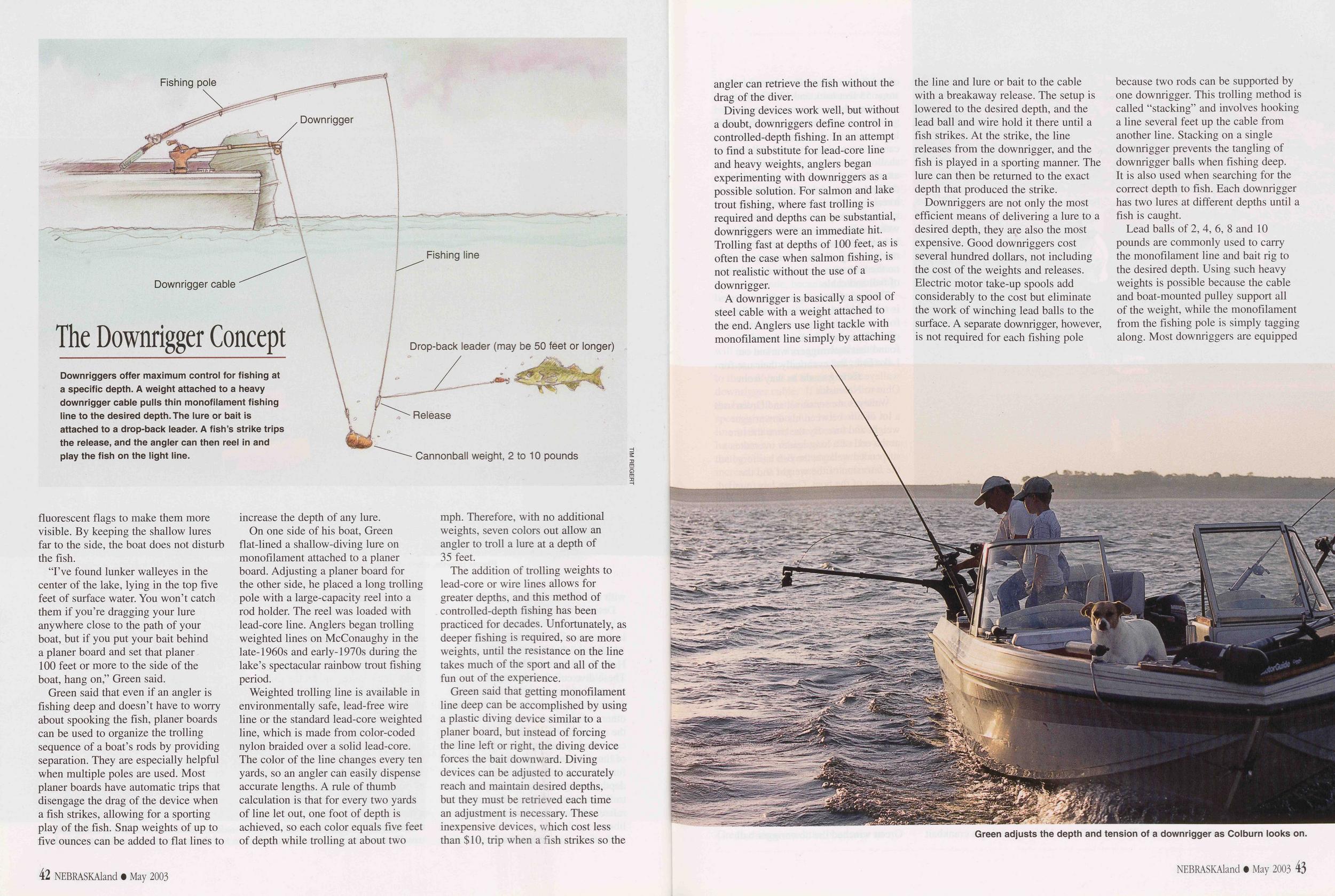
"I've found lunker walleyes in the center of the lake, lying in the top five feet of surface water. You won't catch them if you're dragging your lure anywhere close to the path of your boat, but if you put your bait behind a planer board and set that planer 100 feet or more to the side of the boat, hang on," Green said.
Green said that even if an angler is fishing deep and doesn't have to worry about spooking the fish, planer boards can be used to organize the trolling sequence of a boat's rods by providing separation. They are especially helpful when multiple poles are used. Most planer boards have automatic trips that disengage the drag of the device when a fish strikes, allowing for a sporting play of the fish. Snap weights of up to five ounces can be added to flat lines to increase the depth of any lure.
On one side of his boat, Green flat-lined a shallow-diving lure on monofilament attached to a planer board. Adjusting a planer board for the other side, he placed a long trolling pole with a large-capacity reel into a rod holder. The reel was loaded with lead-core line. Anglers began trolling weighted lines on McConaughy in the late-1960s and early-1970s during the lake's spectacular rainbow trout fishing period.
Weighted trolling line is available in environmentally safe, lead-free wire line or the standard lead-core weighted line, which is made from color-coded nylon braided over a solid lead-core. The color of the line changes every ten yards, so an angler can easily dispense accurate lengths. A rule of thumb calculation is that for every two yards of line let out, one foot of depth is achieved, so each color equals five feet of depth while trolling at about two mph. Therefore, with no additional weights, seven colors out allow an angler to troll a lure at a depth of 35 feet.
The addition of trolling weights to lead-core or wire lines allows for greater depths, and this method of controlled-depth fishing has been practiced for decades. Unfortunately, as deeper fishing is required, so are more weights, until the resistance on the line takes much of the sport and all of the fun out of the experience.
Green said that getting monofilament line deep can be accomplished by using a plastic diving device similar to a planer board, but instead of forcing the line left or right, the diving device forces the bait downward. Diving devices can be adjusted to accurately reach and maintain desired depths, but they must be retrieved each time an adjustment is necessary. These inexpensive devices, which cost less than $10, trip when a fish strikes so the 42 NEBRASKAland • May 2003 angler can retrieve the fish without the drag of the diver.
Diving devices work well, but without a doubt, downriggers define control in controlled-depth fishing. In an attempt to find a substitute for lead-core line and heavy weights, anglers began experimenting with downriggers as a possible solution. For salmon and lake trout fishing, where fast trolling is required and depths can be substantial, downriggers were an immediate hit. Trolling fast at depths of 100 feet, as is often the case when salmon fishing, is not realistic without the use of a downrigger.
A downrigger is basically a spool of steel cable with a weight attached to the end. Anglers use light tackle with monofilament line simply by attaching the line and lure or bait to the cable with a breakaway release. The setup is lowered to the desired depth, and the lead ball and wire hold it there until a fish strikes. At the strike, the line releases from the downrigger, and the fish is played in a sporting manner. The lure can then be returned to the exact depth that produced the strike.
Downriggers are not only the most efficient means of delivering a lure to a desired depth, they are also the most expensive. Good downriggers cost several hundred dollars, not including the cost of the weights and releases. Electric motor take-up spools add considerably to the cost but eliminate the work of winching lead balls to the surface. A separate downrigger, however, is not required for each fishing pole because two rods can be supported by one downrigger. This trolling method is called "stacking" and involves hooking a line several feet up the cable from another line. Stacking on a single downrigger prevents the tangling of downrigger balls when fishing deep. It is also used when searching for the correct depth to fish. Each downrigger has two lures at different depths until a fish is caught.
Lead balls of 2, 4, 6, 8 and 10 pounds are commonly used to carry the monofilament line and bait rig to the desired depth. Using such heavy weights is possible because the cable and boat-mounted pulley support all of the weight, while the monofilament from the fishing pole is simply tagging along. Most downriggers are equipped
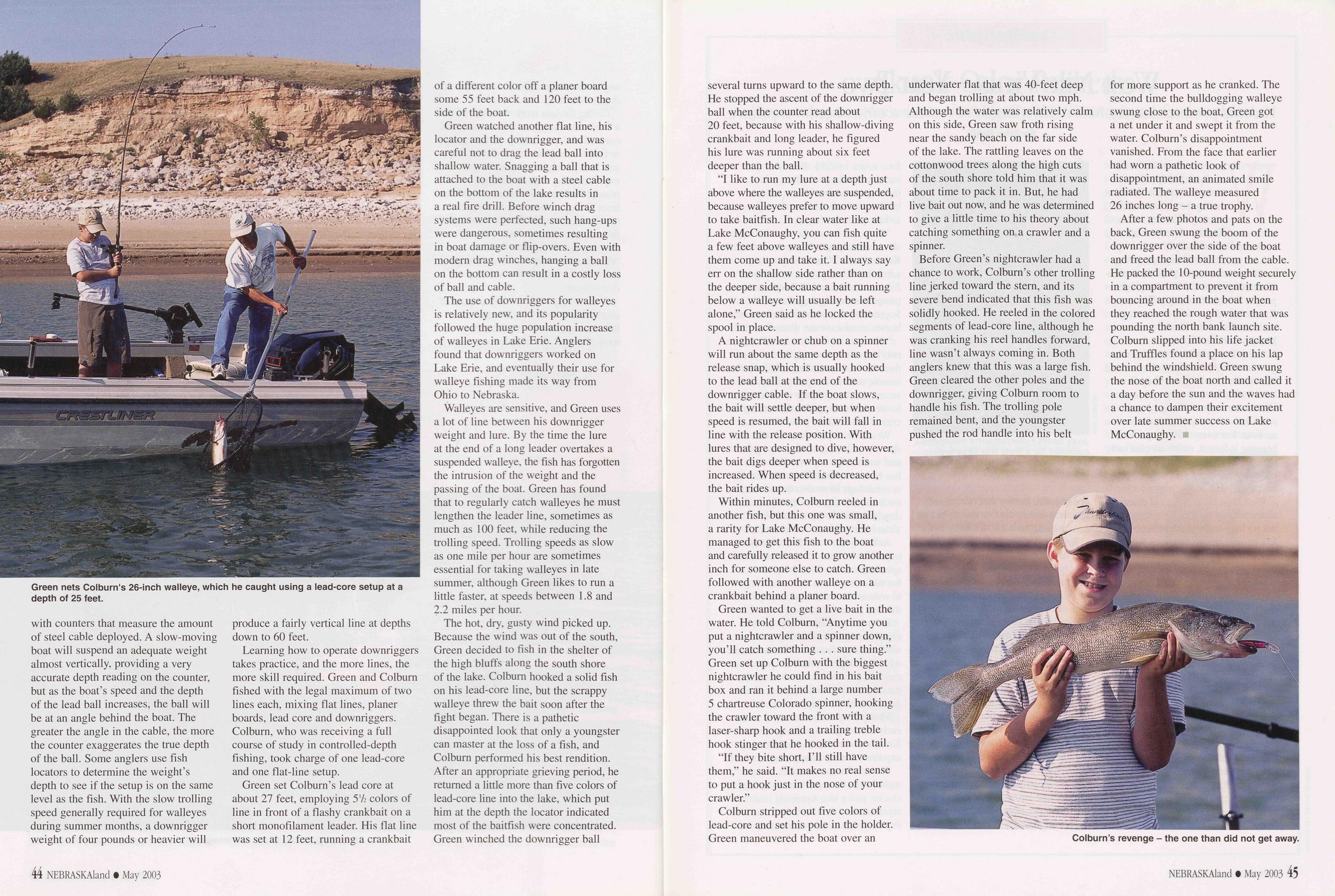
Learning how to operate downriggers takes practice, and the more lines, the more skill required. Green and Colburn fished with the legal maximum of two lines each, mixing flat lines, planer boards, lead core and downriggers. Colburn, who was receiving a full course of study in controlled-depth fishing, took charge of one lead-core and one flat-line setup.
Green set Colbum's lead core at about 27 feet, employing 572 colors of line in front of a flashy crankbait on a short monofilament leader. His flat line was set at 12 feet, running a crankbait of a different color off a planer board some 55 feet back and 120 feet to the side of the boat.
Green watched another flat line, his locator and the downrigger, and was careful not to drag the lead ball into shallow water. Snagging a ball that is attached to the boat with a steel cable on the bottom of the lake results in a real fire drill. Before winch drag systems were perfected, such hang-ups were dangerous, sometimes resulting in boat damage or flip-overs. Even with modern drag winches, hanging a ball on the bottom can result in a costly loss of ball and cable.
The use of downriggers for walleyes is relatively new, and its popularity followed the huge population increase of walleyes in Lake Erie. Anglers found that downriggers worked on Lake Erie, and eventually their use for walleye fishing made its way from Ohio to Nebraska.
Walleyes are sensitive, and Green uses a lot of line between his downrigger weight and lure. By the time the lure at the end of a long leader overtakes a suspended walleye, the fish has forgotten the intrusion of the weight and the passing of the boat. Green has found that to regularly catch walleyes he must lengthen the leader line, sometimes as much as 100 feet, while reducing the trolling speed. Trolling speeds as slow as one mile per hour are sometimes essential for taking walleyes in late summer, although Green likes to run a little faster, at speeds between 1.8 and 2.2 miles per hour.
The hot, dry, gusty wind picked up. Because the wind was out of the south, Green decided to fish in the shelter of the high bluffs along the south shore of the lake. Colburn hooked a solid fish on his lead-core line, but the scrappy walleye threw the bait soon after the fight began. There is a pathetic disappointed look that only a youngster can master at the loss of a fish, and Colburn performed his best rendition. After an appropriate grieving period, he returned a little more than five colors of lead-core line into the lake, which put him at the depth the locator indicated most of the baitfish were concentrated. Green winched the downrigger ball 44 NEBRASKAland • May 2003 several turns upward to the same depth. He stopped the ascent of the downrigger ball when the counter read about 20 feet, because with his shallow-diving crankbait and long leader, he figured his lure was running about six feet deeper than the ball.
"I like to run my lure at a depth just above where the walleyes are suspended, because walleyes prefer to move upward to take baitfish. In clear water like at Lake McConaughy, you can fish quite a few feet above walleyes and still have them come up and take it. I always say err on the shallow side rather than on the deeper side, because a bait running below a walleye will usually be left alone," Green said as he locked the spool in place.
A nightcrawler or chub on a spinner will run about the same depth as the release snap, which is usually hooked to the lead ball at the end of the downrigger cable. If the boat slows, the bait will settle deeper, but when speed is resumed, the bait will fall in line with the release position. With lures that are designed to dive, however, the bait digs deeper when speed is increased. When speed is decreased, the bait rides up.
Within minutes, Colburn reeled in another fish, but this one was small, a rarity for Lake McConaughy. He managed to get this fish to the boat and carefully released it to grow another inch for someone else to catch. Green followed with another walleye on a crankbait behind a planer board.
Green wanted to get a live bait in the water. He told Colburn, 'Anytime you put a nightcrawler and a spinner down, you'll catch something . . . sure thing." Green set up Colburn with the biggest nightcrawler he could find in his bait box and ran it behind a large number 5 chartreuse Colorado spinner, hooking the crawler toward the front with a laser-sharp hook and a trailing treble hook stinger that he hooked in the tail.
"If they bite short, I'll still have them," he said. "It makes no real sense to put a hook just in the nose of your crawler."
Colburn stripped out five colors of lead-core and set his pole in the holder. Green maneuvered the boat over an underwater flat that was 40-feet deep and began trolling at about two mph. Although the water was relatively calm on this side, Green saw froth rising near the sandy beach on the far side of the lake. The rattling leaves on the cottonwood trees along the high cuts of the south shore told him that it was about time to pack it in. But, he had live bait out now, and he was determined to give a little time to his theory about catching something on a crawler and a spinner.
Before Green's nightcrawler had a chance to work, Colbum's other trolling line jerked toward the stem, and its severe bend indicated that this fish was solidly hooked. He reeled in the colored segments of lead-core line, although he was cranking his reel handles forward, line wasn't always coming in. Both anglers knew that this was a large fish. Green cleared the other poles and the downrigger, giving Colburn room to handle his fish. The trolling pole remained bent, and the youngster pushed the rod handle into his belt for more support as he cranked. The second time the bulldogging walleye swung close to the boat, Green got a net under it and swept it from the water. Colbum's disappointment vanished. From the face that earlier had worn a pathetic look of disappointment, an animated smile radiated. The walleye measured 26 inches long - a true trophy.
After a few photos and pats on the back, Green swung the boom of the downrigger over the side of the boat and freed the lead ball from the cable. He packed the 10-pound weight securely in a compartment to prevent it from bouncing around in the boat when they reached the rough water that was pounding the north bank launch site. Colburn slipped into his life jacket and Truffles found a place on his lap behind the windshield. Green swung the nose of the boat north and called it a day before the sun and the waves had a chance to dampen their excitement over late summer success on Lake McConaughy.
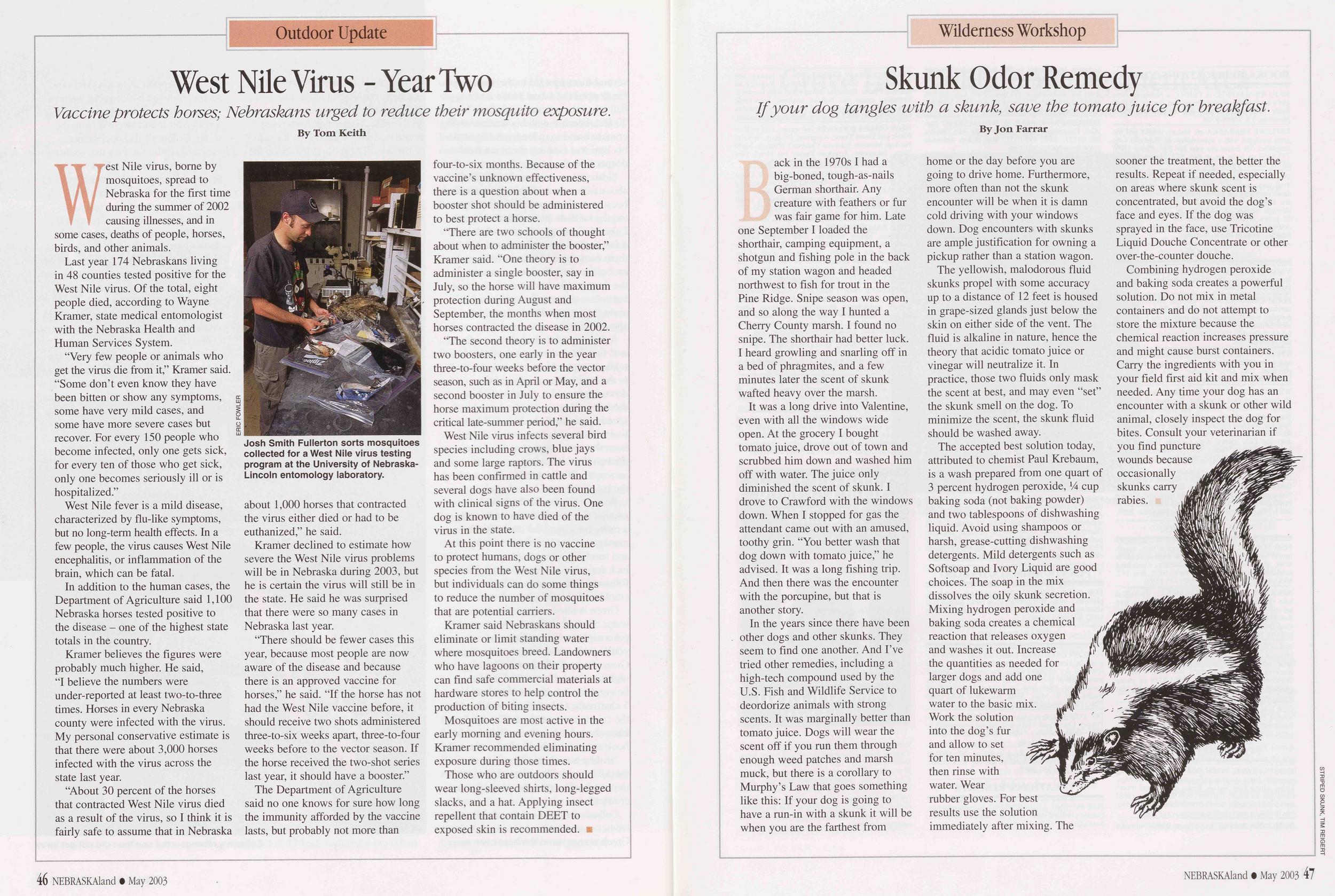
Outdoor Update
West Nile Virus - Year Two
Vaccine protects horses; Nebraskans urged to reduce their mosquito exposure. By Tom KeithWest Nile virus, borne by mosquitoes, spread to Nebraska for the first time during the summer of 2002 causing illnesses, and in some cases, deaths of people, horses, birds, and other animals.
Last year 174 Nebraskans living in 48 counties tested positive for the West Nile virus. Of the total, eight people died, according to Wayne Kramer, state medical entomologist with the Nebraska Health and Human Services System.
"Very few people or animals who get the virus die from it," Kramer said. "Some don't even know they have been bitten or show any symptoms, some have very mild cases, and some have more severe cases but recover. For every 150 people who become infected, only one gets sick, for every ten of those who get sick, only one becomes seriously ill or is hospitalized."
West Nile fever is a mild disease, characterized by flu-like symptoms, but no long-term health effects. In a few people, the virus causes West Nile encephalitis, or inflammation of the brain, which can be fatal.
In addition to the human cases, the Department of Agriculture said 1,100 Nebraska horses tested positive to the disease - one of the highest state totals in the country.
Kramer believes the figures were probably much higher. He said, "I believe the numbers were under-reported at least two-to-three times. Horses in every Nebraska county were infected with the virus. My personal conservative estimate is that there were about 3,000 horses infected with the virus across the state last year.
"About 30 percent of the horses that contracted West Nile virus died as a result of the virus, so I think it is fairly safe to assume that in Nebraska
Kramer declined to estimate how severe the West Nile virus problems will be in Nebraska during 2003, but he is certain the virus will still be in the state. He said he was surprised that there were so many cases in Nebraska last year.
"There should be fewer cases this year, because most people are now aware of the disease and because there is an approved vaccine for horses," he said. "If the horse has not had the West Nile vaccine before, it should receive two shots administered three-to-six weeks apart, three-to-four weeks before to the vector season. If the horse received the two-shot series last year, it should have a booster."
The Department of Agriculture said no one knows for sure how long the immunity afforded by the vaccine lasts, but probably not more than four-to-six months. Because of the vaccine's unknown effectiveness, there is a question about when a booster shot should be administered to best protect a horse.
"There are two schools of thought about when to administer the booster," Kramer said. "One theory is to administer a single booster, say in July, so the horse will have maximum protection during August and September, the months when most horses contracted the disease in 2002.
"The second theory is to administer two boosters, one early in the year three-to-four weeks before the vector season, such as in April or May, and a second booster in July to ensure the horse maximum protection during the critical late-summer period," he said.
West Nile virus infects several bird species including crows, blue jays and some large raptors. The virus has been confirmed in cattle and several dogs have also been found with clinical signs of the virus. One dog is known to have died of the virus in the state.
At this point there is no vaccine to protect humans, dogs or other species from the West Nile virus, but individuals can do some things to reduce the number of mosquitoes that are potential carriers.
Kramer said Nebraskans should eliminate or limit standing water where mosquitoes breed. Landowners who have lagoons on their property can find safe commercial materials at hardware stores to help control the production of biting insects.
Mosquitoes are most active in the early morning and evening hours. Kramer recommended eliminating exposure during those times.
Those who are outdoors should wear long-sleeved shirts, long-legged slacks, and a hat. Applying insect repellent that contain DEET to exposed skin is recommended.
46 NEBRASKAland • May 2003Wilderness Workshop
Skunk Odor Remedy
If your dog tangles with a skunk, save the tomato juice for breakfast. By Jon FarrarBack in the 1970s I had a big-boned, tough-as-nails German shorthair. Any creature with feathers or fur was fair game for him. Late one September I loaded the shorthair, camping equipment, a shotgun and fishing pole in the back of my station wagon and headed northwest to fish for trout in the Pine Ridge. Snipe season was open, and so along the way I hunted a Cherry County marsh. I found no snipe. The shorthair had better luck. I heard growling and snarling off in a bed of phragmites, and a few minutes later the scent of skunk wafted heavy over the marsh.
It was a long drive into Valentine, even with all the windows wide open. At the grocery I bought tomato juice, drove out of town and scrubbed him down and washed him off with water. The juice only diminished the scent of skunk. I drove to Crawford with the windows down. When I stopped for gas the attendant came out with an amused, toothy grin. "You better wash that dog down with tomato juice," he advised. It was a long fishing trip. And then there was the encounter with the porcupine, but that is another story.
In the years since there have been other dogs and other skunks. They seem to find one another. And I've tried other remedies, including a high-tech compound used by the U.S. Fish and Wildlife Service to deodorize animals with strong scents. It was marginally better than tomato juice. Dogs will wear the scent off if you run them through enough weed patches and marsh muck, but there is a corollary to Murphy's Law that goes something like this: If your dog is going to have a run-in with a skunk it will be when you are the farthest from home or the day before you are going to drive home. Furthermore, more often than not the skunk encounter will be when it is damn cold driving with your windows down. Dog encounters with skunks are ample justification for owning a pickup rather than a station wagon.
The yellowish, malodorous fluid skunks propel with some accuracy up to a distance of 12 feet is housed in grape-sized glands just below the skin on either side of the vent. The fluid is alkaline in nature, hence the theory that acidic tomato juice or vinegar will neutralize it. In practice, those two fluids only mask the scent at best, and may even "set" the skunk smell on the dog. To minimize the scent, the skunk fluid should be washed away.
The accepted best solution today, attributed to chemist Paul Krebaum, is a wash prepared from one quart of 3 percent hydrogen peroxide, !4 cup baking soda (not baking powder) and two tablespoons of dishwashing liquid. Avoid using shampoos or harsh, grease-cutting dishwashing detergents. Mild detergents such as Ivory Liquid are good choices. The soap in the mix dissolves the oily skunk secretion. Mixing hydrogen peroxide and baking soda creates a chemical reaction that releases oxygen and washes it out. Increase the quantities as needed for larger dogs and add one quart of lukewarm water to the basic mix. Work the solution into the dog's fur and allow to set for ten minutes, then rinse with water. Wear rubber gloves. For best results use the solution immediately after mixing. The sooner the treatment, the better the results. Repeat if needed, especially on areas where skunk scent is concentrated, but avoid the dog's face and eyes. If the dog was sprayed in the face, use Tricotine Liquid Douche Concentrate or other over-the-counter douche.
Combining hydrogen peroxide and baking soda creates a powerful solution. Do not mix in metal containers and do not attempt to store the mixture because the chemical reaction increases pressure and might cause burst containers. Carry the ingredients with you in your field first aid kit and mix when needed. Any time your dog has an encounter with a skunk or other wild animal, closely inspect the dog for bites. Consult your veterinarian if you find puncture wounds because occasionally skunks carry rabies.
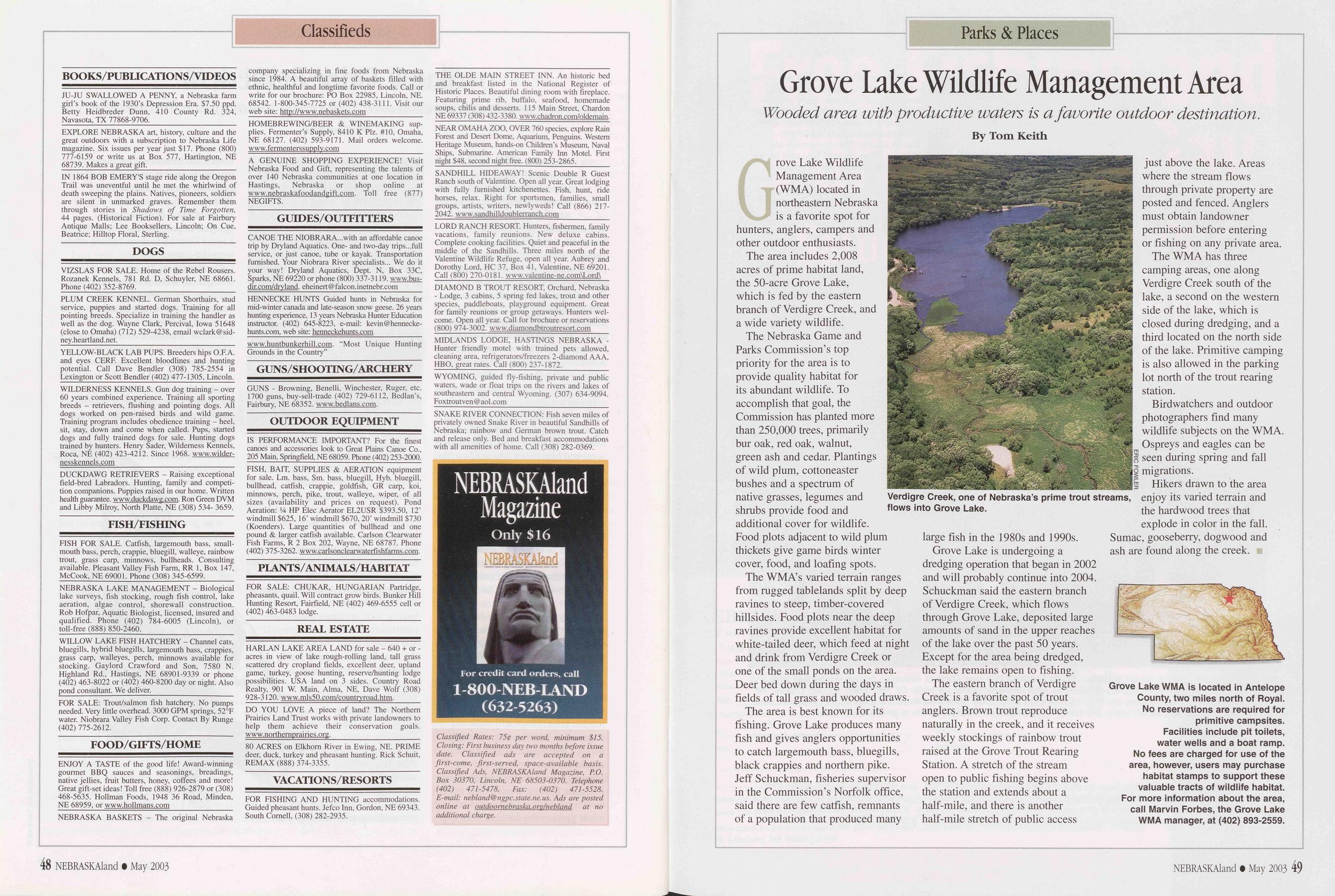
Classifieds
BOOKS/PUBLICATIQNS/VIPEOSJU-JU SWALLOWED A PENNY, a Nebraska farm girl's book of the 1930's Depression Era. $7.50 ppd. Betty Heidbreder Dunn, 410 County Rd. 324, Navasota, TX 77868-9706._____________________
EXPLORE NEBRASKA art, history, culture and the great outdoors with a subscription to Nebraska Life magazine. Six issues per year just $17. Phone (800) 777-6159 or write us at Box 577, Hartington, NE 68739. Makes a great gift.______________________
IN 1864 BOB EMERY'S stage ride along the Oregon Trail was uneventful until he met the whirlwind of death sweeping the plains. Natives, pioneers, soldiers are silent in unmarked graves. Remember them through stories in Shadows of Time Forgotten, 44 pages. (Historical Fiction). For sale at Fairbury Antique Malls; Lee Booksellers, Lincoln; On Cue, Beatrice; Hilltop Floral, Sterling.
_____________DOGS_____________VIZSLAS FOR SALE. Home of the Rebel Rousers. Rozanek Kennels, 781 Rd. D, Schuyler, NE 68661. Phone (402) 352-8769._________________________
PLUM CREEK KENNEL. German Shorthairs, stud service, puppies and started dogs. Training for all pointing breeds. Specialize in training the handler as well as the dog. Wayne Clark, Percival, Iowa 51648 (close to Omaha) (712) 529-4238, email wclark@sidney.heartland.net.
YELLOW-BLACK LAB PUPS. Breeders hips O.F.A. and eyes CERE Excellent bloodlines and hunting potential. Call Dave Bendler (308) 785-2554 in Lexington or Scott Bendler (402) 477-1305, Lincoln.
WILDERNESS KENNELS. Gun dog training - over 60 years combined experience. Training all sporting breeds - retrievers, flushing and pointing dogs. All dogs worked on pen-raised birds and wild game. Training program includes obedience training - heel, sit, stay, down and come when called. Pups, started dogs and fully trained dogs for sale. Hunting dogs trained by hunters. Henry Sader, Wilderness Kennels, Roca, NE (402) 423-4212. Since 1968. www.wildernesskennels.com
DUCKDAWG RETRIEVERS - Raising exceptional field-bred Labradors. Hunting, family and competition companions. Puppies raised in our home. Written health guarantee, www.duckdawg.com. Ron Green DVM and Libby Milroy, North Platte, NE (308) 534- 3659.
_________FISH/FISHING_________FISH FOR SALE. Catfish, largemouth bass, smallmouth bass, perch, crappie, bluegill, walleye, rainbow trout, grass carp, minnows, bullheads. Consulting available. Pleasant Valley Fish Farm, RR 1, Box 147, McCook, NE 69001. Phone (308) 345-6599._______
NEBRASKA LAKE MANAGEMENT - Biological lake surveys, fish stocking, rough fish control, lake aeration, algae control, shorewall construction. Rob Hofpar, Aquatic Biologist, licensed, insured and qualified. Phone (402) 784-6005 (Lincoln), or toll-free (888) 850-2460._______________________
WILLOW LAKE FISH HATCHERY - Channel cats, bluegills, hybrid bluegills, largemouth bass, crappies, grass carp, walleyes, perch, minnows available for stocking. Gaylord Crawford and Son, 7580 N. Highland Rd., Hastings, NE 68901-9339 or phone (402) 463-8022 or (402) 460-8200 day or night. Also pond consultant. We deliver.___________________
FOR SALE: Trout/salmon fish hatchery. No pumps needed. Very little overhead. 3000 GPM springs, 52°F water. Niobrara Valley Fish Corp. Contact By Runge (402) 775-2612.
FOOD/GIFTS/HOMEENJOY A TASTE of the good life! Award-winning gourmet BBQ sauces and seasonings, breadings, native jellies, fruit butters, honey, coffees and more! Great gift-set ideas! Toll free (888) 926-2879 or (308) 468-5635. Hollman Foods, 1948 36 Road, Minden, NE 68959, or www.hollmans.com
NEBRASKA BASKETS - The original Nebraska company specializing in fine foods from Nebraska since 1984. A beautiful array of baskets filled with ethnic, healthful and longtime favorite foods. Call or write for our brochure: PO Box 22985, Lincoln, NE. 68542. 1-800-345-7725 or (402) 438-3111. Visit our web site: http://www.nebaskets.com
HOMEBREWING/BEER & WINEMAKING sup- plies. Fermenter's Supply, 8410 K Plz. #10, Omaha, NE 68127. (402) 593-9171. Mail orders welcome. www.fermenterssupply.com
A GENUINE SHOPPING EXPERIENCE! Visit Nebraska Food and Gift, representing the talents of over 140 Nebraska communities at one location in Hastings, Nebraska or shop online at www.nebraskafoodandgift.com. Toll free (877) NEGIFTS.
GUIDES/OUTFITTERSCANOE THE NIOBRARA...with an affordable canoe trip by Dry land Aquatics. One- and two-day trips...full service, or just canoe, tube or kayak. Transportation furnished. Your Niobrara River specialists... We do it your way! Dry land Aquatics, Dept. N, Box 33C, Sparks, NE 69220 or phone (800) 337-3119. www.busdir.com/dryland. eheinert@falcon.inetnebr.com
HENNECKE HUNTS Guided hunts in Nebraska for mid-winter Canada and late-season snow geese. 26 years hunting experience, 13 years Nebraska Hunter Education instructor. (402) 645-8223, e-mail: kevin@henneckehunts.com, web site: henneckehunts.com
www.huntbunkerhill.com. "Most Unique Hunting Grounds in the Country"
GUNS/SHOOTING/ARCHERYGUNS - Browning, Benelli, Winchester, Ruger, etc. 1700 guns, buy-sell-trade (402) 729-6112, Bedlan's, Fairbury, NE 68352. www.bedlans.com.
OUTDOOR EQUIPMENTIS PERFORMANCE IMPORTANT? For the finest canoes and accessories look to Great Plains Canoe Co., 205 Main, Springfield, NE 68059. Phone (402) 253-2000.
FISH, BAIT, SUPPLIES & AERATION equipment for sale. Lm. bass, Sm. bass, bluegill, Hyb. bluegill, bullhead, catfish, crappie, goldfish, GR carp, koi, minnows, perch, pike, trout, walleye, wiper, of all sizes (availability and prices on request). Pond Aeration: V* HP Elec Aerator EL2USR $393.50, 12' windmill $625, 16' windmill $670, 20' windmill $730 (Koenders). Large quantities of bullhead and one pound & larger catfish available. Carlson Clearwater Fish Farms, R 2 Box 202, Wayne, NE 68787. Phone (402) 375-3262. www.carlsonclearwaterfishfarms.com.
PLANTS/ANIMALS/HABITATFOR SALE: CHUKAR, HUNGARIAN Partridge, pheasants, quail. Will contract grow birds. Bunker Hill Hunting Resort, Fairfield, NE (402) 469-6555 cell or (402) 463-0483 lodge.
REAL ESTATEHARLAN LAKE AREA LAND for sale - 640 + or - acres in view of lake rough-rolling land, tall grass scattered dry cropland fields, excellent deer, upland game, turkey, goose hunting, reserve/hunting lodge possibilities. USA land on 3 sides. Country Road Realty, 901 W. Main, Alma, NE, Dave Wolf (308) 928-3120. www.mls50.com/countryroad.htm.
DO YOU LOVE A piece of land? The Northern Prairies Land Trust works with private landowners to help them achieve their conservation goals. www, northernprairies. org.______________________
80 ACRES on Elkhorn River in Ewing, NE. PRIME deer, duck, turkey and pheasant hunting. Rick Schuit, REMAX (888) 374-3355.
VACATIONS/RESORTSFOR FISHING AND HUNTING accommodations. Guided pheasant hunts. Jefco Inn, Gordon, NE 69343. South Cornell, (308) 282-2935.
THE OLDE MAIN STREET INN. An historic bed and breakfast listed in the National Register of Historic Places. Beautiful dining room with fireplace. Featuring prime rib, buffalo, seafood, homemade soups, chilis and desserts. 115 Main Street, Chardon NE 69337 (308) 432-3380. www.chadron.com/oldemain.
NEAR OMAHA ZOO, OVER 760 species, explore Rain Forest and Desert Dome, Aquarium, Penguins. Western Heritage Museum, hands-on Children's Museum, Naval Ships, Submarine. American Family Inn Motel. First night $48, second night free. (800) 253-2865.________
SANDHILL HIDEAWAY! Scenic Double R Guest Ranch south of Valentine. Open all year. Great lodging with fully furnished kitchenettes. Fish, hunt, ride horses, relax. Right for sportsmen, families, small groups, artists, writers, newlyweds! Call (866) 217-2042. www.sandhilldoublerranch.com
LORD RANCH RESORT. Hunters, fishermen, family vacations, family reunions. New deluxe cabins. Complete cooking facilities. Quiet and peaceful in the middle of the Sandhills. Three miles north of the Valentine Wildlife Refuge, open all year. Aubrey and Dorothy Lord, HC 37, Box 41, Valentine, NE 69201. Call (800) 270-0181. www.valentine-ne.com\Lord\
DIAMOND B TROUT RESORT, Orchard, Nebraska - Lodge, 3 cabins, 5 spring fed lakes, trout and other species, paddle boats, playground equipment. Great for family reunions or group getaways. Hunters welcome. Open all year. Call for brochure or reservations (800) 974-3002. www.diamondbtroutresort.com
MIDLANDS LODGE, HASTINGS NEBRASKA - Hunter friendly motel with trained pets allowed, cleaning area, refrigerators/freezers 2-diamond AAA, HBO, great rates. Call (800) 237-1872.____________
WYOMING, guided fly-fishing, private and public waters, wade or float trips on the rivers and lakes of southeastern and central Wyoming. (307) 634-9094. Foxtroutven @ aol .com
SNAKE RIVER CONNECTION: Fish seven miles of privately owned Snake River in beautiful Sandhills of Nebraska; rainbow and German brown trout. Catch and release only. Bed and breakfast accommodations with all amenities of home. Call (308) 282-0369.
Parks & Places
Grove Lake Wildlife Management Area
Wooded area with productive waters is a favorite outdoor destination. By Tom KeithGrove Lake Wildlife Management Area (WMA) located in northeastern Nebraska is a favorite spot for hunters, anglers, campers and other outdoor enthusiasts.
The area includes 2,008 acres of prime habitat land, the 50-acre Grove Lake, which is fed by the eastern branch of Verdigre Creek, and a wide variety wildlife.
The Nebraska Game and Parks Commission's top priority for the area is to provide quality habitat for its abundant wildlife. To accomplish that goal, the Cornmission has planted more than 250,000 trees, primarily bur oak, red oak, walnut, green ash and cedar. Plantings of wild plum, cotton easter bushes and a spectrum of native grasses, legumes and shrubs provide food and additional cover for wildlife. Food plots adjacent to wild plum thickets give game birds winter cover, food, and loafing spots.
The WMA's varied terrain ranges from rugged tablelands split by deep ravines to steep, timber-covered hillsides. Food plots near the deep ravines provide excellent habitat for white-tailed deer, which feed at night and drink from Verdigre Creek or one of the small ponds on the area. Deer bed down during the days in fields of tall grass and wooded draws.
The area is best known for its fishing. Grove Lake produces many fish and gives anglers opportunities to catch largemouth bass, bluegills, black crappies and northern pike. Jeff Schuckman, fisheries supervisor in the Commission's Norfolk office, said there are few catfish, remnants of a population that produced many large fish in the 1980s and 1990s.
Grove Lake is undergoing a dredging operation that began in 2002 and will probably continue into 2004. Schuckman said the eastern branch of Verdigre Creek, which flows through Grove Lake, deposited large amounts of sand in the upper reaches of the lake over the past 50 years. Except for the area being dredged, the lake remains open to fishing.
The eastern branch of Verdigre Creek is a favorite spot of trout anglers. Brown trout reproduce naturally in the creek, and it receives weekly stockings of rainbow trout raised at the Grove Trout Rearing Station. A stretch of the stream open to public fishing begins above the station and extends about a half-mile, and there is another half-mile stretch of public access just above the lake. Areas where the stream flows through private property are posted and fenced. Anglers must obtain landowner permission before entering or fishing on any private area.
The WMA has three camping areas, one along Verdigre Creek south of the lake, a second on the western side of the lake, which is closed during dredging, and a third located on the north side of the lake. Primitive camping is also allowed in the parking lot north of the trout rearing station.
Birdwatchers and outdoor photographers find many wildlife subjects on the WMA. Ospreys and eagles can be 15 seen during spring and fall jo migrations.
Hikers drawn to the area enjoy its varied terrain and the hardwood trees that explode in color in the fall. Sumac, gooseberry, dogwood and ash are found along the creek.
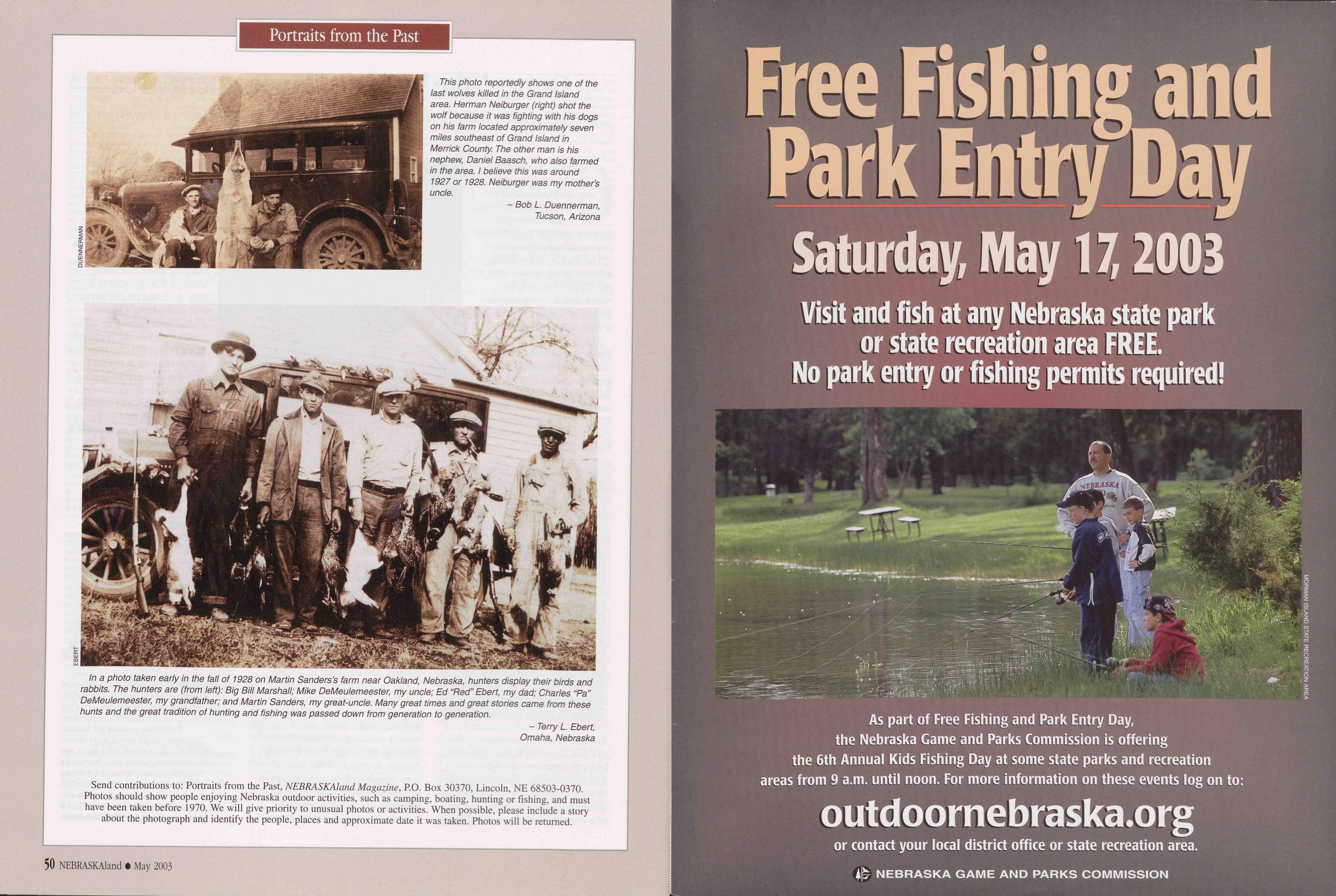
Portraits from the Past
This photo reportedly shows one of the last wolves killed in the Grand Island area. Herman Neiburger (right) shot the wolf because it was fighting with his dogs on his farm located approximately seven miles southeast of Grand Island in Merrick County. The other man is his nephew, Daniel Baasch, who also farmed in the area. I believe this was around 1927 or 1928. Neiburger was my mother's uncle.
- Bob L Duennerman, Tucson, ArizonaIn a photo taken early in the fall of 1928 on Martin Sanders's farm near Oakland, Nebraska, hunters display their birds and rabbits. The hunters are (from left): Big Bill Marshall; Mike DeMeulemeester, my uncle; Ed "Red" Ebert, my dad; Charles "Pa" DeMeulemeester, my grandfather; and Martin Sanders, my great-uncle. Many great times and great stories came from these hunts and the great tradition of hunting and fishing was passed down from generation to generation.
- Terry L. Ebert, Omaha, NebraskaSend contributions to: Portraits from the Past, NEBRASKAland Magazine, P.O. Box 30370, Lincoln, NE 68503-0370. Photos should show people enjoying Nebraska outdoor activities, such as camping, boating, hunting or fishing, and must have been taken before 1970. We will give priority to unusual photos or activities. When possible, please include a story about the photograph and identify the people, places and approximate date it was taken. Photos will be returned.
50 NEBRASKAland • May 2003 Free Fishing and Park Entry Day Saturday, May 17, 2003 Visit and fish at any Nebraska state park ion area FREE. A part of Free Fishing and Park Entry Day, the Nebraska Game and Parks Commission is offering the 6th Annual Kids Fishing Day at some state parks and recreation is from 9 a.m. until noon. For more information on these events log on to: or contact your local district office or state recreation area. NEBRASKA GAME AND PARKS COMMISSION
Position: 877 (8 views)