Volume 81, Issue 3, 2003
NEBRASKAland
Nebraska Game & Parks Commission April 2003 $2.50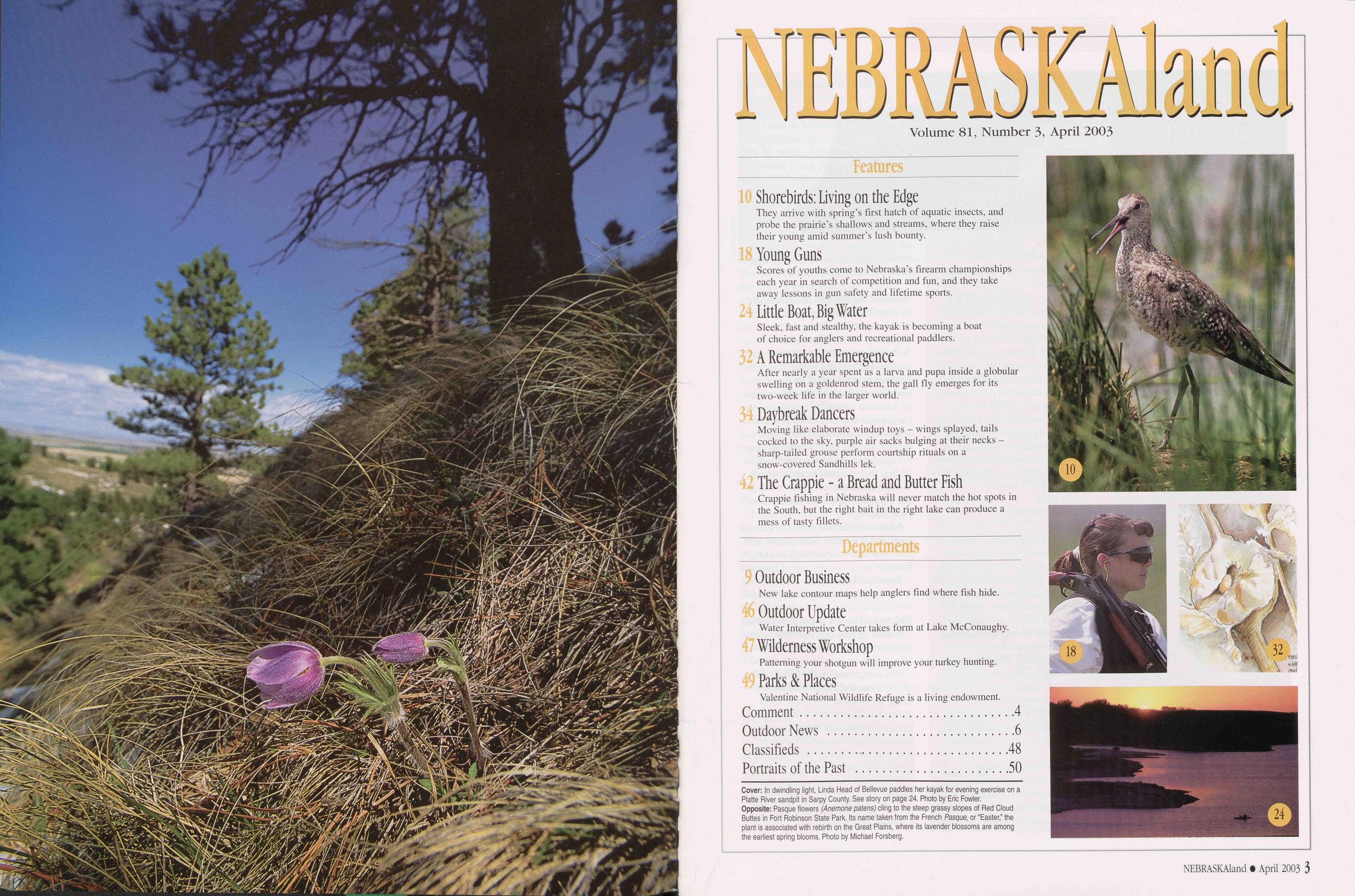
NEBRASKAland
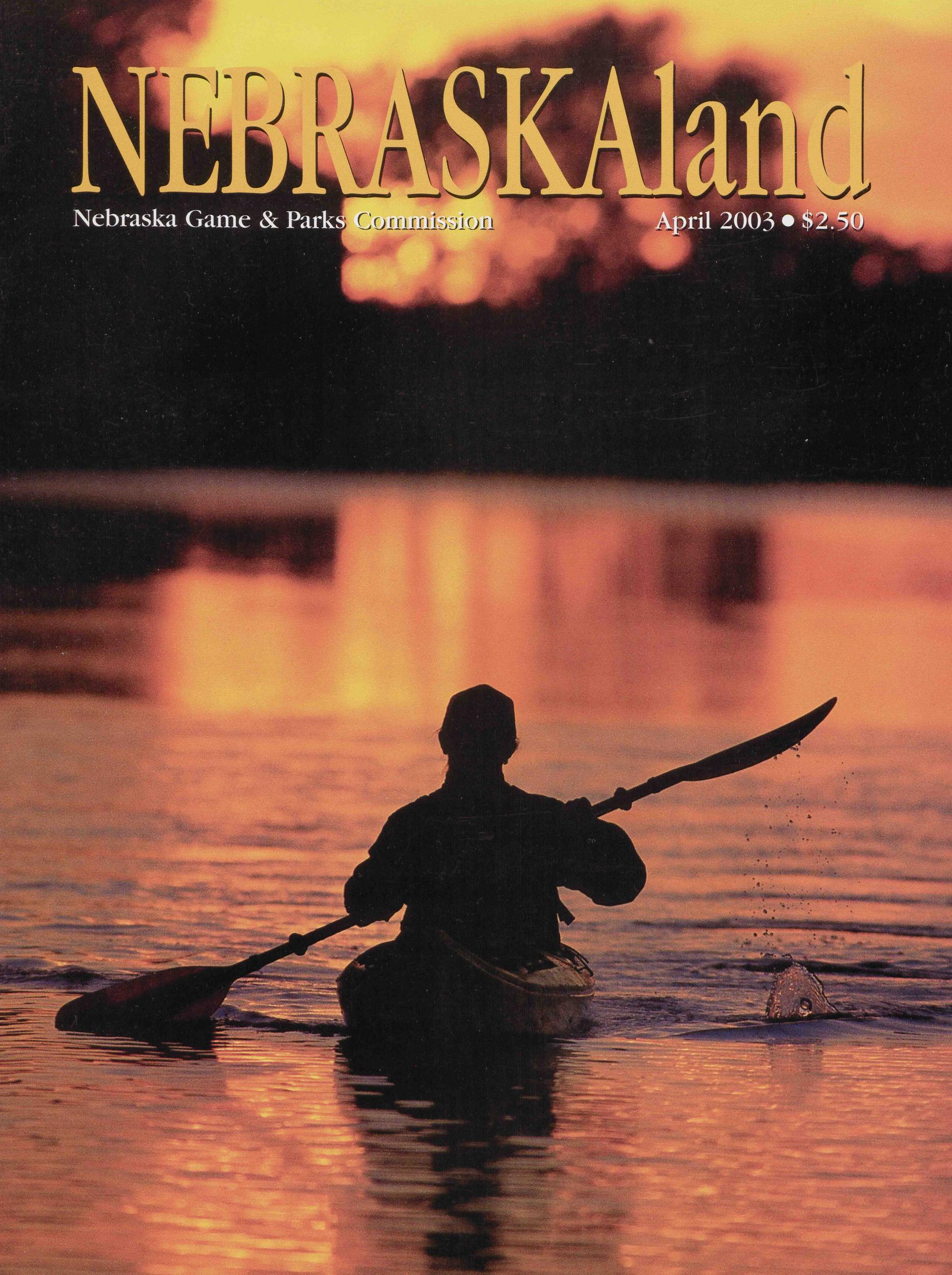
Volume 81, Number 3, April 2003 Features 10 Shorebirds: Living on the Edge They arrive with spring's first hatch of aquatic insects, and probe the prairie's shallows and streams, where they raise their young amid summer's lush bounty. 18 Young Guns Scores of youths come to Nebraska's firearm championships each year in search of competition and fun, and they take away lessons in gun safety and lifetime sports. 24 Little Boat, Big Water Sleek, fast and stealthy, the kayak is becoming a boat of choice for anglers and recreational paddlers. 32 A Remarkable Emergence After nearly a year spent as a larva and pupa inside a globular swelling on a goldenrod stem, the gall fly emerges for its two-week life in the larger world. 34 Daybreak Dancers Moving like elaborate windup toys - wings splayed, tails cocked to the sky, purple air sacks bulging at their necks sharp-tailed grouse perform courtship rituals on a snow-covered Sandhills lek. 42 The Crappie - a Bread and Butter Fish Crappie fishing in Nebraska will never match the hot spots in the South, but the right bait in the right lake can produce a mess of tasty fillets. Departments 9 Outdoor Business New lake contour maps help anglers find where fish hide. 46 Outdoor Update Water Interpretive Center takes form at Lake McConaughy. 47 Wilderness Workshop Patterning your shotgun will improve your turkey hunting. 49 Parks & Places Valentine National Wildlife Refuge is a living endowment. Outdoor News ............................6 Portraits of the Past ...................... .50 Cover: In dwindling light, Linda Head of Bellevue paddles her kayak for evening exercise on a Platte River sandpit in Sarpy County. See story on page 24. Photo by Eric Fowler. Opposite: Pasque flowers (Anemone patens) cling to the steep grassy slopes of Red Cloud Buttes in Fort Robinson State Park. Its name taken from the French Pasque, or "Easter," the plant is associated with rebirth on the Great Plains, where its lavender blossoms are among the earliest spring blooms. Photo by Michael Forsberg.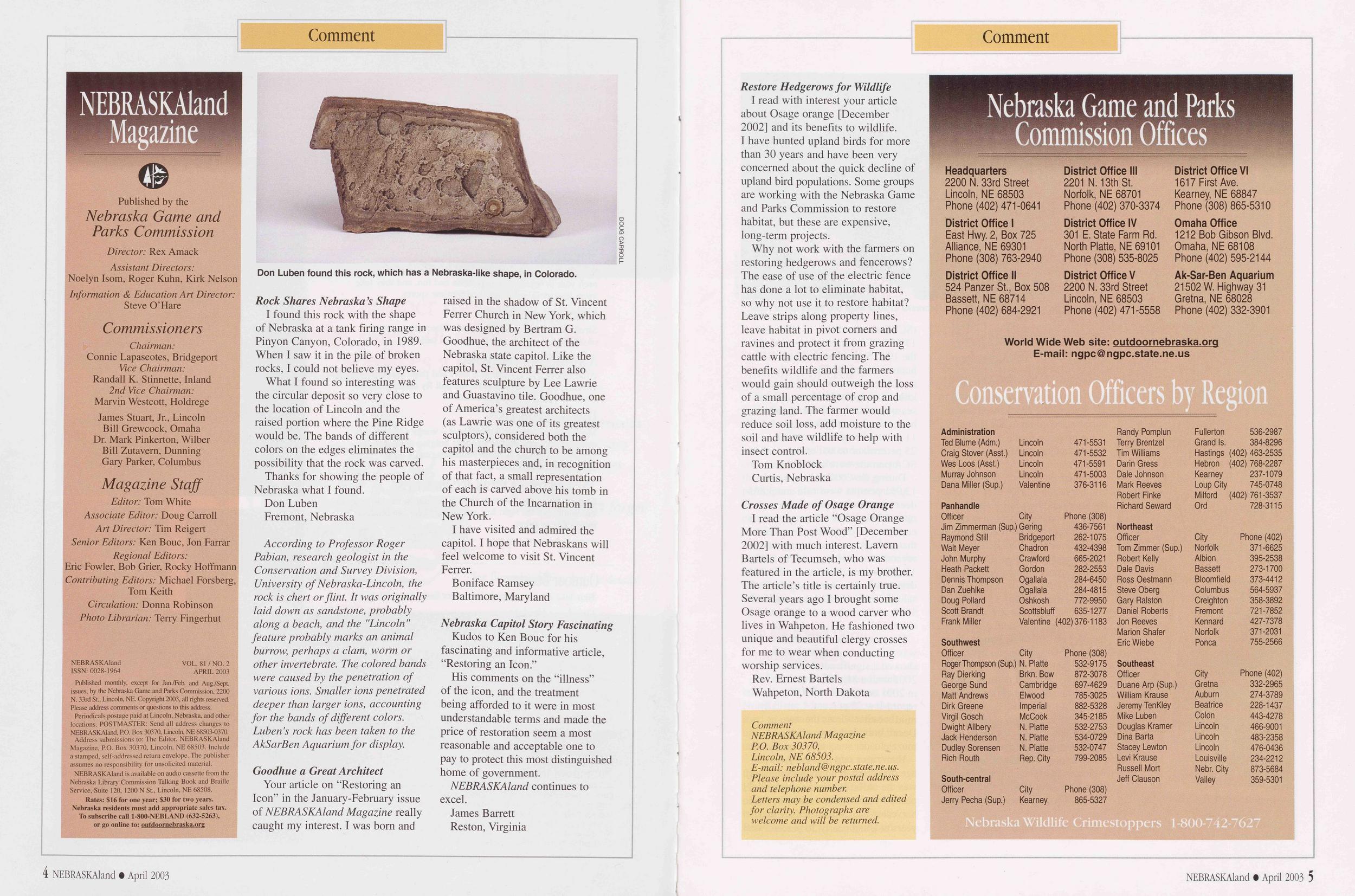 Comment
NEBRASKAland Mazine
Published by the
Nebraska Game and
Parks Commission
Director: Rex Amack
Assistant Directors:
Noelyn Isom, Roger Kuhn, Kirk Nelson
Information & Education Art Director:
Steve O'Hare
Commissioners
Chairman:
Connie Lapaseotes, Bridgeport
Vice Chairman:
Randall K. Stinnette, Inland
2nd Vice Chairman:
Marvin Westcott, Holdrege
James Stuart, Jr., Lincoln
Bill Grewcock, Omaha
Dr. Mark Pinkerton, Wilber
Bill Zutavern, Dunning
Gary Parker, Columbus
Magazine Staff
Editor: Tom White
Associate Editor: Doug Carroll
Art Director: Tim Reigert
Senior Editors: Ken Bouc, Jon Farrar
Regional Editors:
Eric Fowler, Bob Grier, Rocky Hoffmann
Contributing Editors: Michael Forsberg,
Tom Keith
Circulation: Donna Robinson
Photo Librarian: Terry Fingerhut
NEBRASKAland
ISSN: 0028-1964
VOL. 817 NO. 2
APRIL 2003
Published monthly, except for Jan./Feb. and Aug7Sept.
issues, by the Nebraska Game and Parks Commission, 2200
N. 33rd St., Lincoln, NE. Copyright 2003, all rights reserved.
Please address comments or questions to this address.
Periodicals postage paid at Lincoln, Nebraska, and other
locations. POSTMASTER; Send all address changes to
NEBRASKAland, P.O. Box 30370, Lincoln. NE 68503-0370.
Address submissions to: The Editor, NEBRASKAland
Magazine, P.O. Box 30370, Lincoln, NE 68503. Include
a stamped, self-addressed return envelope. The publisher
assumes no responsibility for unsolicited material.
NEBRASKAland is available on audio cassette from the
Nebraska Library Commission Talking Book and Braille
Service, Suite 120, 1200 N St., Lincoln, NE 68508.
Rates: $16 for one year; $30 for two years.
Nebraska residents must add appropriate sales tax.
To subscribe call 1-800-NEBLAND (632-5263),
or go online to: outdoornebraska.org
Comment
NEBRASKAland Mazine
Published by the
Nebraska Game and
Parks Commission
Director: Rex Amack
Assistant Directors:
Noelyn Isom, Roger Kuhn, Kirk Nelson
Information & Education Art Director:
Steve O'Hare
Commissioners
Chairman:
Connie Lapaseotes, Bridgeport
Vice Chairman:
Randall K. Stinnette, Inland
2nd Vice Chairman:
Marvin Westcott, Holdrege
James Stuart, Jr., Lincoln
Bill Grewcock, Omaha
Dr. Mark Pinkerton, Wilber
Bill Zutavern, Dunning
Gary Parker, Columbus
Magazine Staff
Editor: Tom White
Associate Editor: Doug Carroll
Art Director: Tim Reigert
Senior Editors: Ken Bouc, Jon Farrar
Regional Editors:
Eric Fowler, Bob Grier, Rocky Hoffmann
Contributing Editors: Michael Forsberg,
Tom Keith
Circulation: Donna Robinson
Photo Librarian: Terry Fingerhut
NEBRASKAland
ISSN: 0028-1964
VOL. 817 NO. 2
APRIL 2003
Published monthly, except for Jan./Feb. and Aug7Sept.
issues, by the Nebraska Game and Parks Commission, 2200
N. 33rd St., Lincoln, NE. Copyright 2003, all rights reserved.
Please address comments or questions to this address.
Periodicals postage paid at Lincoln, Nebraska, and other
locations. POSTMASTER; Send all address changes to
NEBRASKAland, P.O. Box 30370, Lincoln. NE 68503-0370.
Address submissions to: The Editor, NEBRASKAland
Magazine, P.O. Box 30370, Lincoln, NE 68503. Include
a stamped, self-addressed return envelope. The publisher
assumes no responsibility for unsolicited material.
NEBRASKAland is available on audio cassette from the
Nebraska Library Commission Talking Book and Braille
Service, Suite 120, 1200 N St., Lincoln, NE 68508.
Rates: $16 for one year; $30 for two years.
Nebraska residents must add appropriate sales tax.
To subscribe call 1-800-NEBLAND (632-5263),
or go online to: outdoornebraska.org
I found this rock with the shape of Nebraska at a tank firing range in Piny on Canyon, Colorado, in 1989. When I saw it in the pile of broken rocks, I could not believe my eyes.
What I found so interesting was the circular deposit so very close to the location of Lincoln and the raised portion where the Pine Ridge would be. The bands of different colors on the edges eliminates the possibility that the rock was carved.
Thanks for showing the people of Nebraska what I found.
Don Luben Fremont, NebraskaAccording to Professor Roger Fabian, research geologist in the Conservation and Survey Division, University of Nebraska-Lincoln, the rock is chert or flint. It was originally laid down as sandstone, probably along a beach, and the "Lincoln" feature probably marks an animal burrow, perhaps a clam, worm or other invertebrate. The colored bands were caused by the penetration of various ions. Smaller ions penetrated deeper than larger ions, accounting for the bands of different colors. Luben's rock has been taken to the AkSarBen Aquarium for display.
Goodhue a Great ArchitectYour article on "Restoring an Icon" in the January-February issue of NEBRASKAland Magazine really caught my interest. I was born and raised in the shadow of St. Vincent Ferrer Church in New York, which was designed by Bertram G. Goodhue, the architect of the Nebraska state capitol. Like the capitol, St. Vincent Ferrer also features sculpture by Lee Lawrie and Guastavino tile. Goodhue, one of America's greatest architects (as Lawrie was one of its greatest sculptors), considered both the capitol and the church to be among his masterpieces and, in recognition of that fact, a small representation of each is carved above his tomb in the Church of the Incarnation in New York.
I have visited and admired the capitol. I hope that Nebraskans will feel welcome to visit St. Vincent Ferrer.
Boniface Ramsey Baltimore, Maryland Nebraska Capitol Story FascinatingKudos to Ken Bouc for his fascinating and informative article, "Restoring an Icon."
His comments on the "illness" of the icon, and the treatment being afforded to it were in most understandable terms and made the price of restoration seem a most reasonable and acceptable one to pay to protect this most distinguished home of government.
NEBRASKAland continues to excel.
James Barrett Reston, Virginia 4 NEBRASKAland • April 2003 Comment Restore Hedgerows for WildlifeI read with interest your article about Osage orange [December 2002] and its benefits to wildlife. I have hunted upland birds for more than 30 years and have been very concerned about the quick decline of upland bird populations. Some groups are working with the Nebraska Game and Parks Commission to restore habitat, but these are expensive, long-term projects.
Why not work with the farmers on restoring hedgerows and fencerows? The ease of use of the electric fence has done a lot to eliminate habitat, so why not use it to restore habitat? Leave strips along property lines, leave habitat in pivot corners and ravines and protect it from grazing cattle with electric fencing. The benefits wildlife and the farmers would gain should outweigh the loss of a small percentage of crop and grazing land. The farmer would reduce soil loss, add moisture to the soil and have wildlife to help with insect control.
Tom Knoblock Curtis, Nebraska Crosses Made of Osage OrangeI read the article "Osage Orange More Than Post Wood" [December 2002] with much interest. Lavern B artels of Tecumseh, who was featured in the article, is my brother. The article's title is certainly true. Several years ago I brought some Osage orange to a wood carver who lives in Wahpeton. He fashioned two unique and beautiful clergy crosses for me to wear when conducting worship services.
Rev. Ernest Bartels Wahpeton, North Dakota Comment NEBRASKAland Magazine P.O.Box 30370, Lincoln, NE 68503. E-mail: nebland@ngpc.state.ne. us. Please include your postal address and telephone number. Letters may be condensed and edited for clarity. Photographs are welcome and will be returned. Nebraska Game and Parks Commission Offices Headquarters 2200 N. 33rd Street Lincoln, NE 68503 Phone (402) 471-0641 District Office I East Hwy. 2, Box 725 Alliance, NE 69301 Phone (308) 763-2940 District Office II 524 Panzer St., Box 508 Bassett, NE 68714 Phone (402) 684-2921 District Office III 2201 N. 13th St. Norfolk, NE 68701 Phone (402) 370-3374 District Office IV 301 E. State Farm Rd. North Platte, NE 69101 Phone (308) 535-8025 District Office V 2200 N. 33rd Street Lincoln, NE 68503 Phone (402) 471-5558 District Office VI 1617 First Ave. Kearney, NE 68847 Phone (308) 865-5310 Omaha Office 1212 Bob Gibson Blvd. Omaha, NE 68108 Phone (402) 595-2144 Ak-Sar-Ben Aquarium 21502 W. Highway 31 Gretna, NE 68028 Phone (402) 332-3901 World Wide Web site: outdoornebraska.org E-mail: ngpc@ngpc.state.ne.us Conservation Officers by Region Administration Randy Pomplun Fullerton 536-2987 Ted Blume (Adm.) Lincoln 471-5531 Terry Brentzel Grand Is. 384-8296 Craig Stover (Asst.) Lincoln 471-5532 Tim Williams Hastings (402) 463-2535 Wes Loos (Asst.) Lincoln 471-5591 Darin Gress Hebron (402) 768-2287 Murray Johnson Lincoln 471-5003 Dale Johnson Kearney 237-1079 Dana Miller (Sup.) Valentine 376-3116 Mark Reeves Loup City 745-0748 Robert Finke Milford (402) 761-3537 Panhandle Richard Seward Ord 728-3115 Officer City Phone (308) Jim Zimmerman (Sup.) Gering 436-7561 Northeast Raymond Still Bridgeport 262-1075 Officer City Phone (402) Walt Meyer Chadron 432-4398 Tom Zimmer (Sup.)Norfolk 371-6625 John Murphy Crawford 665-2021 Robert Kelly Albion 395-2538 Heath Packett Gordon 282-2553 Dale Davis Bassett 273-1700 Dennis Thompson Ogallala 284-6450 Ross Oestmann Bloomfield 373-4412 Dan Zuehlke Ogallala 284-4815 Steve Oberg Columbus 564-5937 Doug Pollard Oshkosh 772-9950 Gary Ralston Creighton 358-3892 Scott Brandt Scottsbluff 635-1277 Daniel Roberts Fremont 721-7852 Frank Miller Valentine (402)376-1183 Jon Reeves Kennard 427-7378 Marion Shafer Norfolk 371-2031 Southwest Eric Wiebe Ponca 755-2566 Officer City Phone (308) Roger Thompson (Sup.) N. Platte 532-9175 Southeast Ray Dierking Brkn. Bow 872-3078 Officer City Phone (402) George Sund Cambridge 697-4629 Duane Arp (Sup.) Gretna 332-2965 Matt Andrews Elwood 785-3025 William Krause Auburn 274-3789 Dirk Greene Imperial 882-5328 Jeremy TenKley Beatrice 228-1437 Virgil Gosch McCook 345-2185 Mike Luben Colon 443-4278 Dwight Allbery N. Platte 532-2753 Douglas Kramer Lincoln 466-9001 Jack Henderson N. Platte 534-0729 Dina Barta Lincoln 483-2358 Dudley Sorensen N. Platte 532-0747 Stacey Lewton Lincoln 476-0436 Rich Routh Rep. City 799-2085 Levi Krause Louisville 234-2212 Russell Mort Nebr. City 873-5684 South-central Jeff Clauson Valley 359-5301 Officer City Phone (308) Jerry Pecha (Sup.) Kearney 865-5327 Nebraska Wildlife Crimestoppers 1-800-742-7627 NEBRASKAland • April 2003 5
Outdoor News
2003 Nebraska Fishing Guide Make It Your First Catch Find public fishing areas and the current state regulations in a handy, free 62-page guide. Pick up your copy at any Nebraska Game and Parks office or go online.Despite a smaller harvest and a decline in permit sales compared to 2001, the 2002 deer season was a success according to Kit Hams, big game program manager for the Nebraska Game and Parks Commission.
Hunters purchased 112,894 permits and harvested 53,624 deer in 2002, the fourth-highest kill on record. Although both numbers were down about 10 percent from last year, the success rates for archery, Season Choice and November firearm hunters were comparable. "Bottom line - we had an excellent deer season," Hams said.
The decline in harvest was not unexpected, Hams said, given that the previous two deer seasons were "the best we've ever had in 50 years of deer hunting."
A total of 65,579 permits were sold for the November firearm season and 39,711 deer were harvested. This 54 percent success rate for firearm hunters was the same in 2001. At the end of the season, 509 permits were unsold, most of which were in the Upper Platte and Pine Ridge deer hunting units, where chronic wasting disease (CWD) has been found.
Six new Season Choice Areas (SCA) were available in 2002 and 17,572 SCA permits were sold. Of the 10,115 deer harvested by SCA hunters, November firearm hunters took 40 percent, and 41 percent were killed during the January antlerless season. Archery and muzzleloader hunters accounted for 8 and 11 percent respectively. About 25 percent, or 6,085, of the available SCA permits were not sold.
During the 2002 archery season, 13,951 permits were sold and 3,875 deer were harvested for a success rate of 28 percent. "This year was a continuation of the excellent success that archers have had during the past several years," Hams said. In 2001, 15,182 permits were sold and 4,141 deer were taken. Archery permit sales have declined every year since 1999, when a record 16,137 permits were sold.
Hams said muzzleloader success was the only hunting style that showed a significant decline over 2001 with a 31 percent success rate in 2001 compared to 2002's record-low 25 percent. Unusually mild weather across the state in December might have affected muzzleloader success, he said.
Hams also said that the average age of harvested bucks in Nebraska was the oldest it have been in the past 30 years. More than half of the harvested bucks were at least two years old, and nearly 20 percent were 6 NEBRASKAland • April 2003 three years old or older.
Few changes are expected for the 2003 deer season in deer management units, seasons or permit numbers, Hams said. The agency plans to continue liberal seasons for the reduction of deer herds in some areas, especially portions of the Panhandle. "With more than 10,000 unsold permits last year, it's obvious that we are meeting current hunter demand for permits in most areas," Hams said. The agency will also continue to encourage hunters to take antlerless deer. "It's very difficult to reduce deer herds or control the spread of CWD unless hunters are willing to harvest antlerless deer."
Outdoor Leadership Workshop OfferedThe Eastern Nebraska 4-H Center will offer an Outdoor Leadership Workshop June 6-7 at its facility south of Gretna. Designed for teachers, naturalists and others concerned about the environment, the two-day workshop will give participants hands-on experience in leading outdoor and conservation education programs while becoming certified to teach them.
Participants are encouraged to register at least two weeks before the event. The cost is $90, and some scholarships are available. For more information, call (402) 332-4496.
Bull Elk Killed Dor log Population StudyIn February, a 700-pound adult bull elk was killed southwest of North Platte when a part on the trap used to capture it malfunctioned, upsetting the trap and pinning the animal on its side.
Richard Nelson, who supervises the wildlife division in the North Platte area, said the accident occurred when biologists tried to trap some free-ranging elk in the Box Elder herd for a population study. Workers had checked the 4-foot-by-8-foot trap each morning and planned to fit captured elk with radio-tracking collars to learn about the herd's size, movements and health.
Reserve Your Fun Today Now You Can Buy Nebraska Park Permits Online! Visit our secure web site to quickly and conveniently purchase fishing, hunting and park permits online using your Visa or MasterCard. Online permit purchase is safe, hassle-free and there is never a checkout line. Simply choose the permits you want, pay for - them, download and print. I And, you are on your way to Nebraska's great outdoors. We will send your permanent park permit in the mail. It's that easy. Nebraska Game and Parks Commission NEBRASKAland • April 2003 7 Outdoor News
Officer's Notebook
Wild Cat Chase
Outdoor News
Officer's Notebook
Wild Cat Chase
Late one Saturday evening last December, the phone rang with a call about wildlife. Having been a conservation officer for 22 years, that in itself was not unusual. Conservation officers receive phone calls at all hours of the day and night, ranging from complaints about trespassers to requests to give wildlife presentations. This call, however, was different.
The deputy sheriff on the other end was calling to report a road-killed mountain lion and wanted to know if I would come take care of it. He assured me that it was indeed a mountain lion, so I left immediately, wanting to get to the scene before local television stations started climbing all over the story.
Because the location was nearly 30 miles from my home in Gretna, I had plenty of time to think about the situation. I was excited to see the animal because I had investigated many reported sightings that had turned out be different animals. This report of one laying dead on the road promised that I would finally see a mountain lion in Nebraska. Two deputies met me at my truck and led me to where laid a small, female ... bobcat.
As most people are aware, there has been a landslide of mountain lion sightings and complaints reported to the Nebraska Game and Parks Commission over the past several years. There has been such an increase in calls that I thought it was important to relay this story.
First, I want to make it clear that I do not discount any past sightings or future sightings, nor is it my intention to embarrass anyone. Solid evidence proves that there have been several mountain lions in the state during the past few years and I believe there may be a lion or two in the state right now. However, there aren't as many as are being reported, or the state would be overrun with mountain lions.
Understandably, most sightings are just glimpses of a "large cat" crossing the road, entering the timber, tall grass or cornfields. Few people have ever seen a mountain lion, or, as in this case, a bobcat. Unfamiliarity leads to rumors and mistaken sightings. Conservation officers and other Commission employees spend a lot of time responding to these sightings to collect any possible evidence to verify a mountain lion. Most times there is no evidence, or it leads to a large dog or bobcat. Some people dispute the evidence we find, and believe we are trying to cover up the fact that mountain lions are around. One ridiculous rumor even has the Commission stocking the large cats.
Returning home from the roadkill call, I wondered if people understand that we take all sightings very seriously and want to know if there is a mountain lion around. On the other hand, we also want citizens to know that in almost all cases there isn't and there is no reason not go out and enjoy the great outdoors. If you do see something you are confident was a mountain lion, preserve any tracks you find and call your nearest conservation officer or Commission office. You should also realize that you were lucky enough to see one of nature's most magnificent animals.
— Duane Arp, Conservation Officer, GretnaThe elk apparently entered the trap and tripped a spring-loaded door behind it. This type of trap is secured to the ground but contains springs that act as shock absorbers in the event that an animal crashes against the trap webbing. In this case, however, one of the springs malfunctioned and was bent, causing the trap to fall to one side and land on top of the animal. Elk, like other large animals, often quickly suffocate when restrained on their sides, Nelson said.
"It's an unfortunate accident," Nelson said. "But when you are dealing with any wild animal in a captive situation, accidents can and do occur. We received the trap from the Colorado Division of Wildlife and it was the same kind of trap they use every day out there. Sometimes these things happen and it's regrettable."
No Hunting Accident Fatalities in 2002__________For the second year in a row, Nebraska had no hunting fatalities, according to Nebraska Hunter Education Coordinator Mike Streeter.
There were 12 accidents reported in 2002, the same number as 2001. Six accidents involved shotguns, five rifles and one a handgun. The incidents involved people of a range of ages: Two of the shooters and three of the victims were 10-19 years old, two shooters were 20-29, one shooter and four victims were 30-39 years old, one shooter was between 40-49, one shooter and three victims were 50-59 years old and two victims were older than 60.
Over the past ten years, Nebraska has averaged 12 accidents each year, Streeter said, and all of them were preventable. "Hunting has been, and will continue to be, one of the safest sports," he said.
8 NEBRASKAland • April 2003Outdoor Business
Lake Mapping Aids Anglers
New contour maps of Nebraska lakes show structure where fish often hide. By Eric FowlerMost anglers know that fish often stay close to points, ledges, flats, humps, holes, old creek channels and other underwater structures in reservoirs. Finding this structure can be the difference between having fresh fish or hamburgers for dinner.
Anglers can use lake contour maps, which use a series of lines to depict depths, to find structure. Contour maps are now available for some lakes from the Nebraska Game and Parks Commission's web site at www.ngpc.state.ne.us/fish/fishguide/ FGmaps.html and at Commission offices across the state.
Technicians develop the maps by first walking the shoreline with survey-grade Global Positioning System (GPS) equipment. They then use a boat equipped with both sonar and GPS equipment and specialized computer software to map the lake bottom. Angler maps are one product of the Lake Mapping Program. Highly detailed bathymetric maps are also created that allow biologists to document and evaluate habitat changes in reservoirs for the Commission's Aquatic Habitat Program.
Contour maps are available from other sources, but most are based on land surveys completed before the lakes were built. Because of this, many maps don't reflect how lake bottoms look today.
"A lot of lakes have sedimentation and bank erosion problems and have changed quite a bit over time," said John Miller, the Commission's geodetic survey technician in charge of creating the maps.
Biologists are comparing the new maps Miller is creating to those based on earlier land surveys to assess the severity of sedimentation. They often use them to determine the most efficient ways to rehabilitate a lake, such as where to remove sediment, where to build jetties and islands and how much material will be needed to create these structures. The maps are also used to locate spots for new boat ramps that will be functional when water levels are low.
Bank and boat anglers use the maps to find areas likely to hold fish. "When a fisherman goes to new lake, he's basically fishing blind," Miller said. "These can basically point them to areas fish may be using to hide or where they feed."
A bank angler might cast as far as he or she can and still only have their bait in 2 or 3 feet of water - an area not likely to hold many fish. With a contour map, an angler would know that a former creek channel is within casting distance just 20 yards away, allowing them to fish structure and deeper water and improving their chances of catching fish.
Boat anglers often rely on high-tech depth finders and graphs to locate underwater structure. "A depth sounder just shows what is below the boat. You can't necessarily see how it relates to the rest of the lake's features," Miller said. By using electronics and contour maps, anglers "can go there with a boat and know that what they're seeing on their graph is part of a bigger feature."
Boat anglers who don't have depth finders can increase their odds with the maps. "You could be in the middle of a huge flat and have no way to tell that without having a map," Miller said.
Maps of 23 lakes are currently available on the Commission's web site, and four more will soon be available. Maps will be created and made available for additional lakes each year. Maps can be downloaded at no charge and viewed online or printed in either JPEG or PDF format. Printed versions of the maps are available at Commission offices.
NEBRASKAland • April 2003 9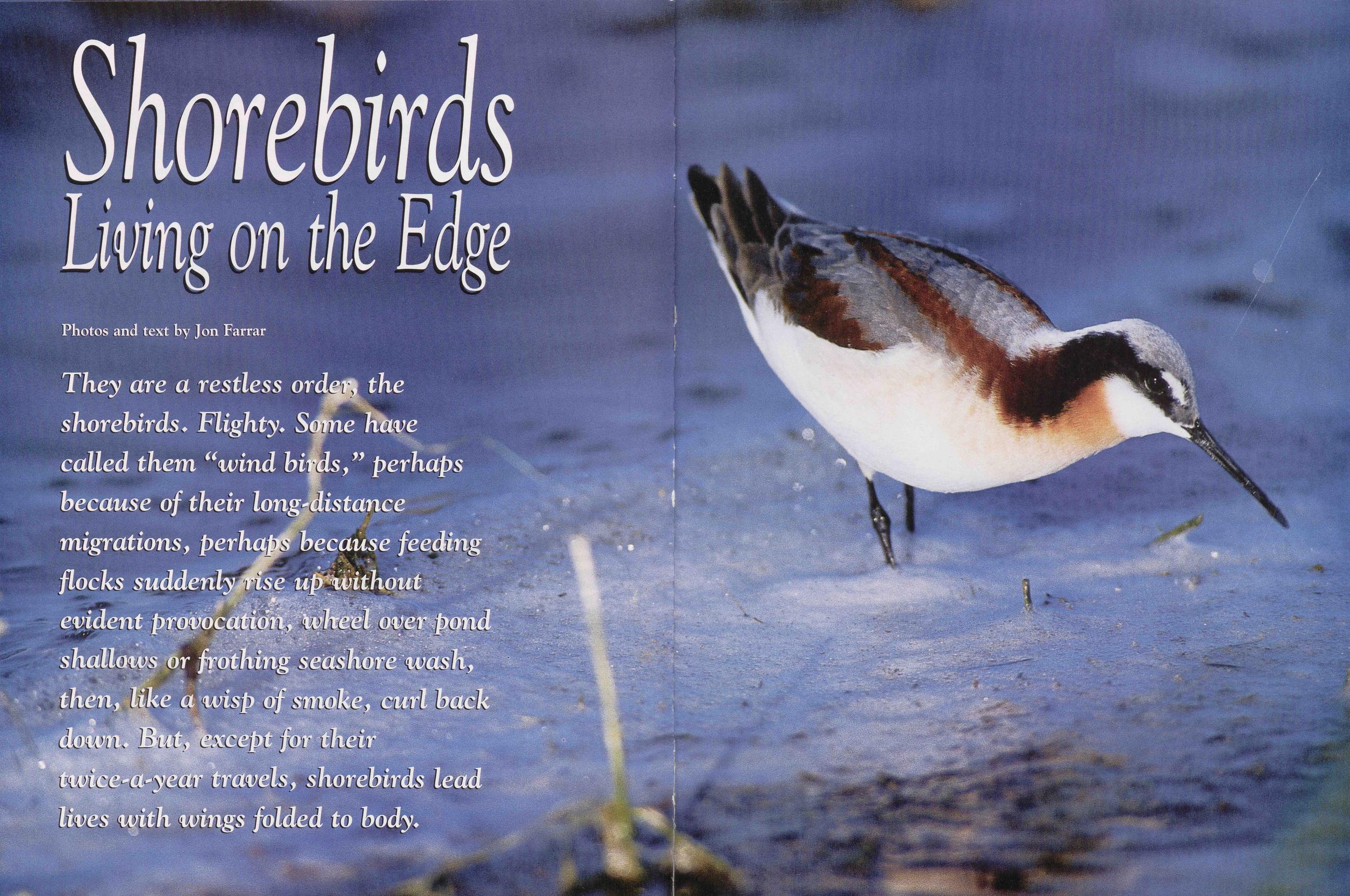
Shorebirds Living on the Edge
Photos and text by Jon Farrar They are a restless order, the shorebirds. Flighty. Some have called them "wind birds," perhaps because of their long-distance migrations, perhaps because feeding flocks suddenly rise up without evident provocations, wheel over pond shallows or frothing seashore wash, then, like a wisp of smoke, curl back down. But, except for their twice-a-year travels, shorebirds lead lives with wings folded to body.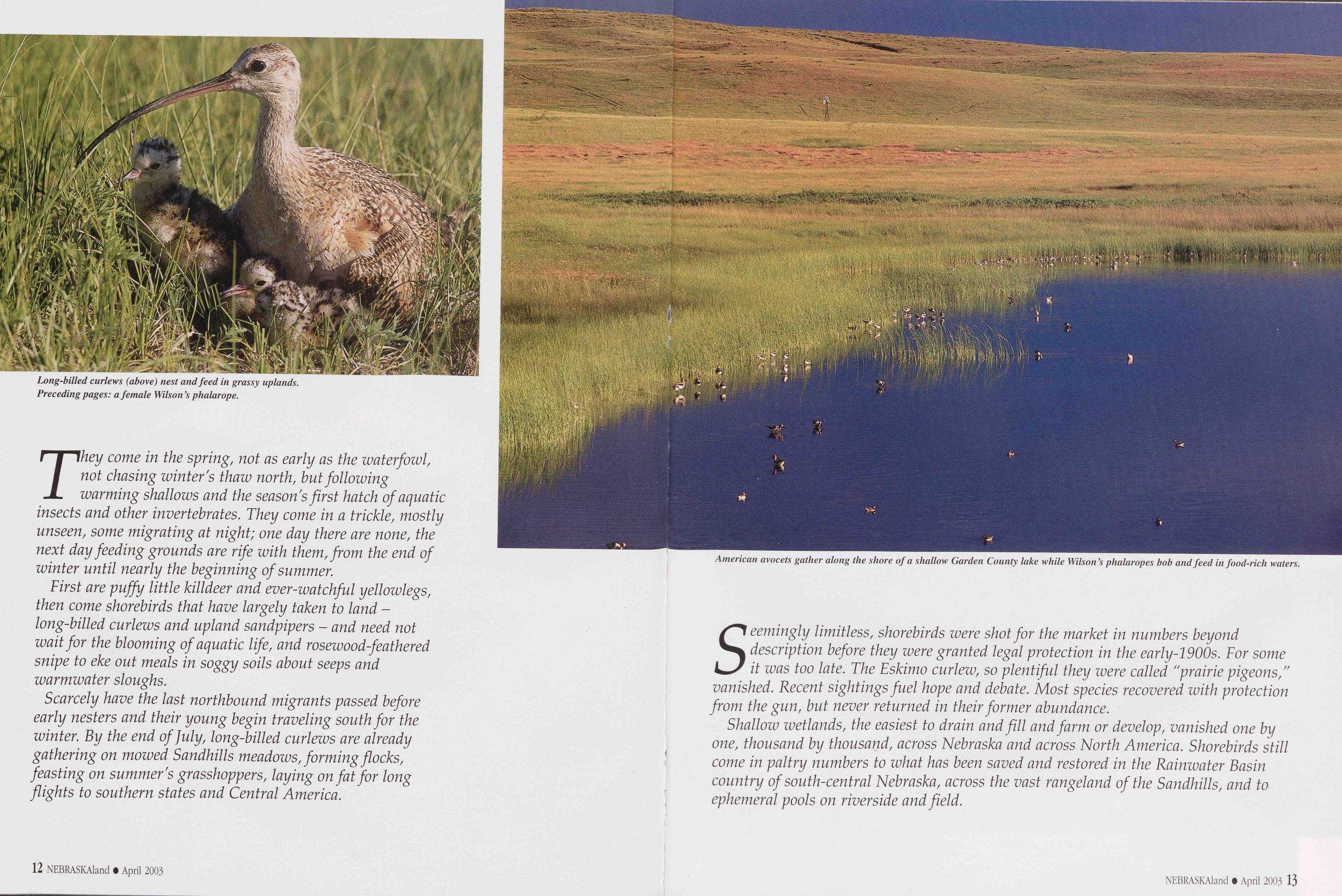
They come in the spring, not as early as the waterfowl, not chasing winter's thaw north, hut following warming shallows and the season s first hatch of aquatic insects and other invertebrates. They come in a trickle, mostly unseen, some migrating at night; one day there are none, the next day feeding grounds are rife with them, from the end of winter until nearly the beginning of summer.
First are puffy little killdeer and ever-watchful yellowlegs, then come shorebirds that have largely taken to land - long-billed curlews and upland sandpipers - and need not wait for the blooming of aquatic life, and rosewood-feathered snipe to eke out meals in soggy soils about seeps and warmwater sloughs.
Scarcely have the last northbound migrants passed before early nesters and their young begin traveling south for the winter. By the end of July, long-billed curlews are already gathering on mowed Sandhills meadows, forming flocks, feasting on summer's grasshoppers, laying on fat for long flights to southern states and Central America.
12 NEBRASKAland • April 2003Seemingly limitless, shorebirds were shot for the market in numbers beyond description before they were granted legal protection in the early-1900s. For some it was too late. The Eskimo curlew, so plentiful they were called "prairie pigeons," vanished. Recent sightings fuel hope and debate. Most species recovered with protection from the gun, but never returned in their former abundance.
Shallow wetlands, the easiest to drain and fill and farm or develop, vanished one by one, thousand by thousand, across Nebraska and across North America. Shorebirds still come in paltry numbers to what has been saved and restored in the Rainwater Basin country of south-central Nebraska, across the vast rangeland of the Sandhills, and to ephemeral pools on riverside and field.
NEBRASKAland • April 2003 13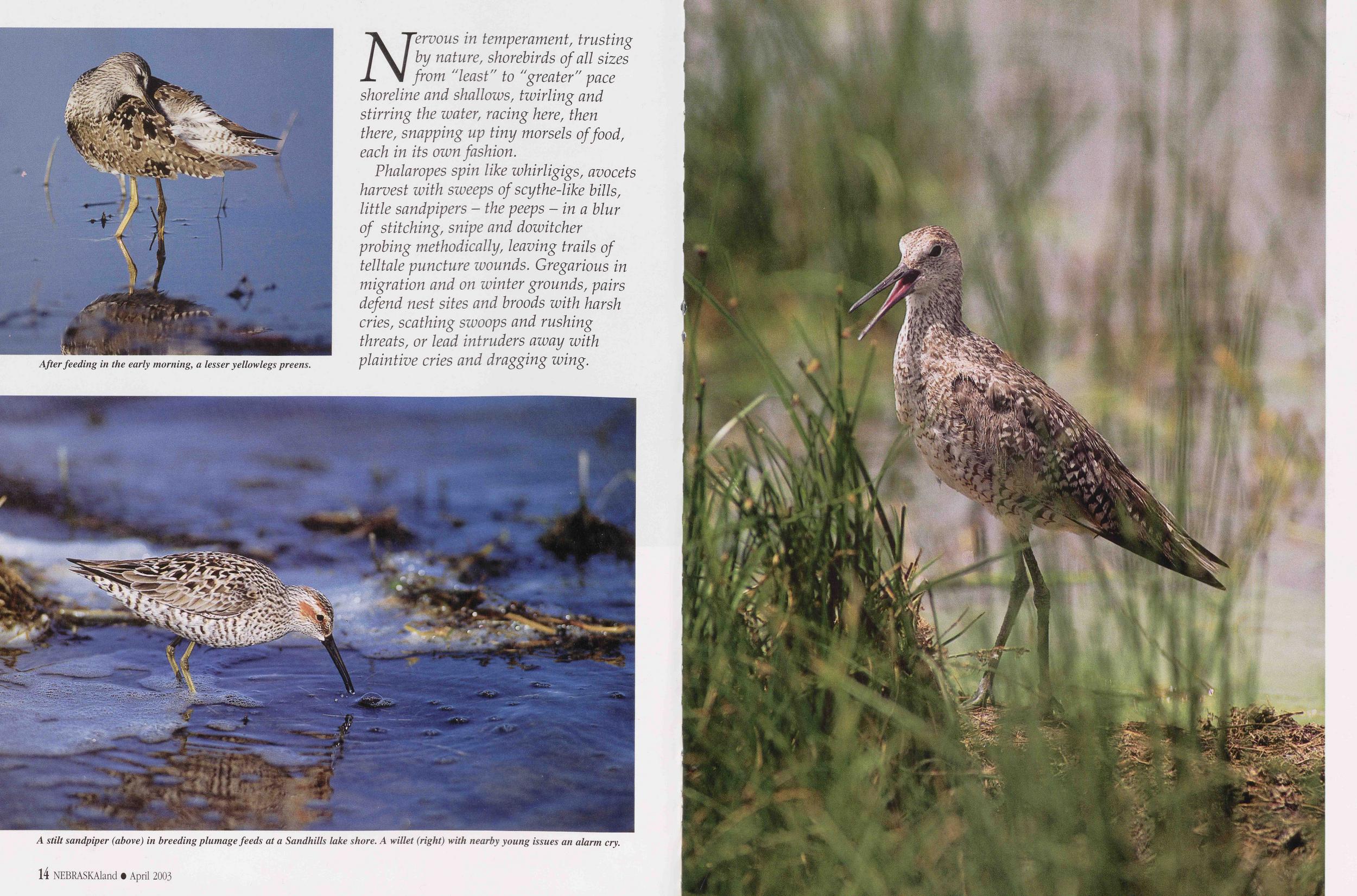
Nervous in temperament, trusting by nature, shorebirds of all sizes from "least" to "greater" pace shoreline and shallows, twirling and stirring the water, racing here, then there, snapping up tiny morsels of food, each in its own fashion.
Phalaropes spin like whirligigs, avocets harvest with sweeps of scythe-like bills, little sandpipers - the peeps - in a blur of stitching, snipe and dowitcher probing methodically, leaving trails of telltale puncture wounds. Gregarious in migration and on winter grounds, pairs defend nest sites and broods with harsh cries, scathing swoops and rushing threats, or lead intruders away with plaintive cries and dragging wing.
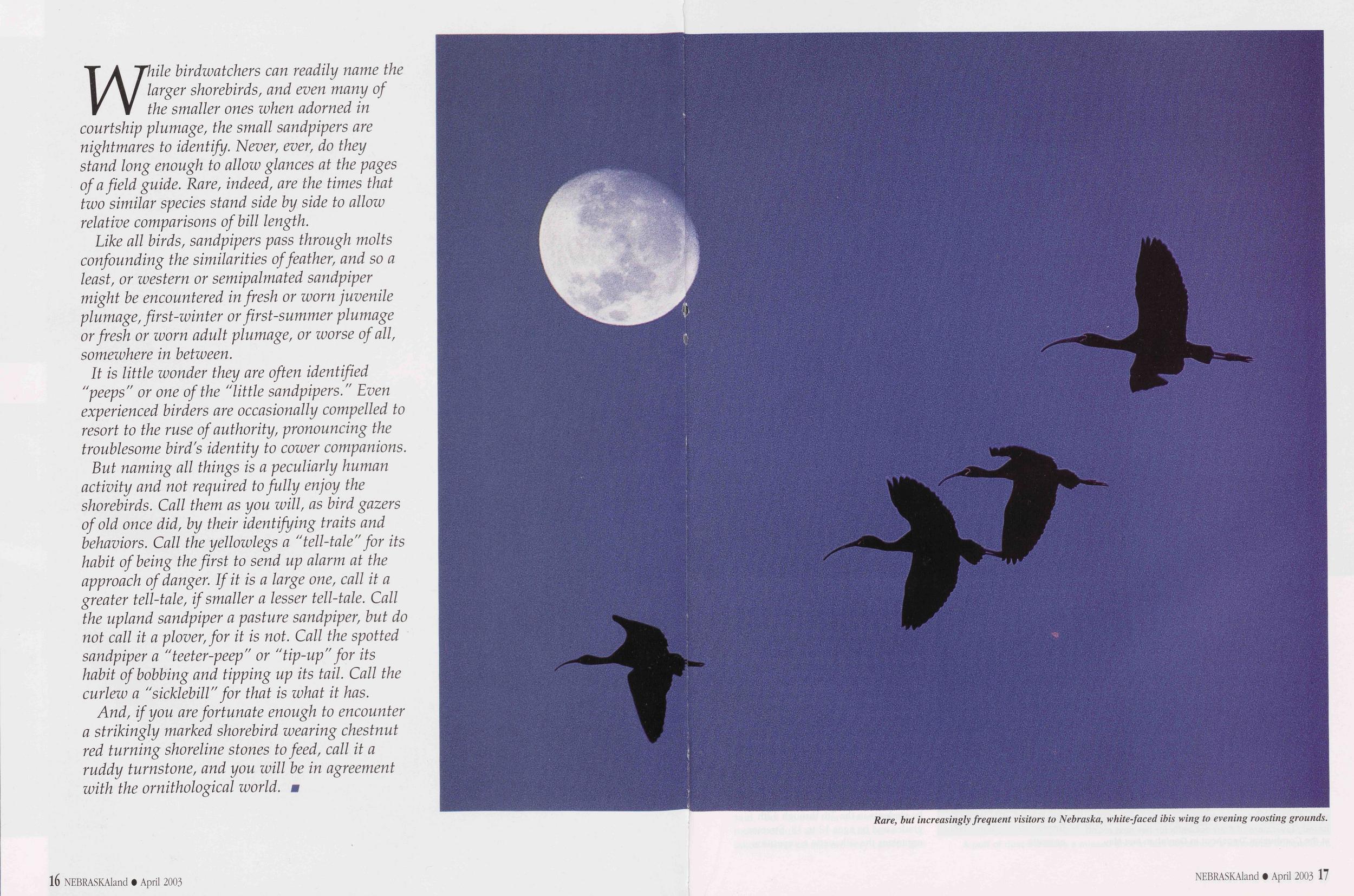
While birdwatchers can readily name the larger shorebirds, and even many of the smaller ones when adorned in courtship plumage, the small sandpipers are nightmares to identify. Never, ever, do they stand long enough to allow glances at the pages of a field guide. Rare, indeed, are the times that two similar species stand side by side to allow relative comparisons of bill length.
Like all birds, sandpipers pass through molts confounding the similarities of feather, and so a least, or western or semipalmated sandpiper might be encountered in fresh or worn juvenile plumage, first-winter or first-summer plumage or fresh or worn adult plumage, or worse of all, somewhere in between.
It is little wonder they are often identified "peeps" or one of the "little sandpipers." Even experienced birders are occasionally compelled to resort to the ruse of authority, pronouncing the troublesome bird's identity to cower companions.
But naming all things is a peculiarly human activity and not required to fully enjoy the shorebirds. Call them as you will, as bird gazers of old once did, by their identifying traits and behaviors. Call the yellowlegs a "tell-tale" for its habit of being the first to send up alarm at the approach of danger. If it is a large one, call it a greater tell-tale, if smaller a lesser tell-tale. Call the upland sandpiper a pasture sandpiper, but do not call it a plover, for it is not. Call the spotted sandpiper a "teeter-peep" or "tip-up" for its habit of bobbing and tipping up its tail. Call the curlew a "sicklebill" for that is what it has.
And, if you are fortunate enough to encounter a strikingly marked shorebird wearing chestnut red turning shoreline stones to feed, call it a ruddy turnstone, and you will be in agreement with the ornithological world.
16 NEBRASKAland • April 2003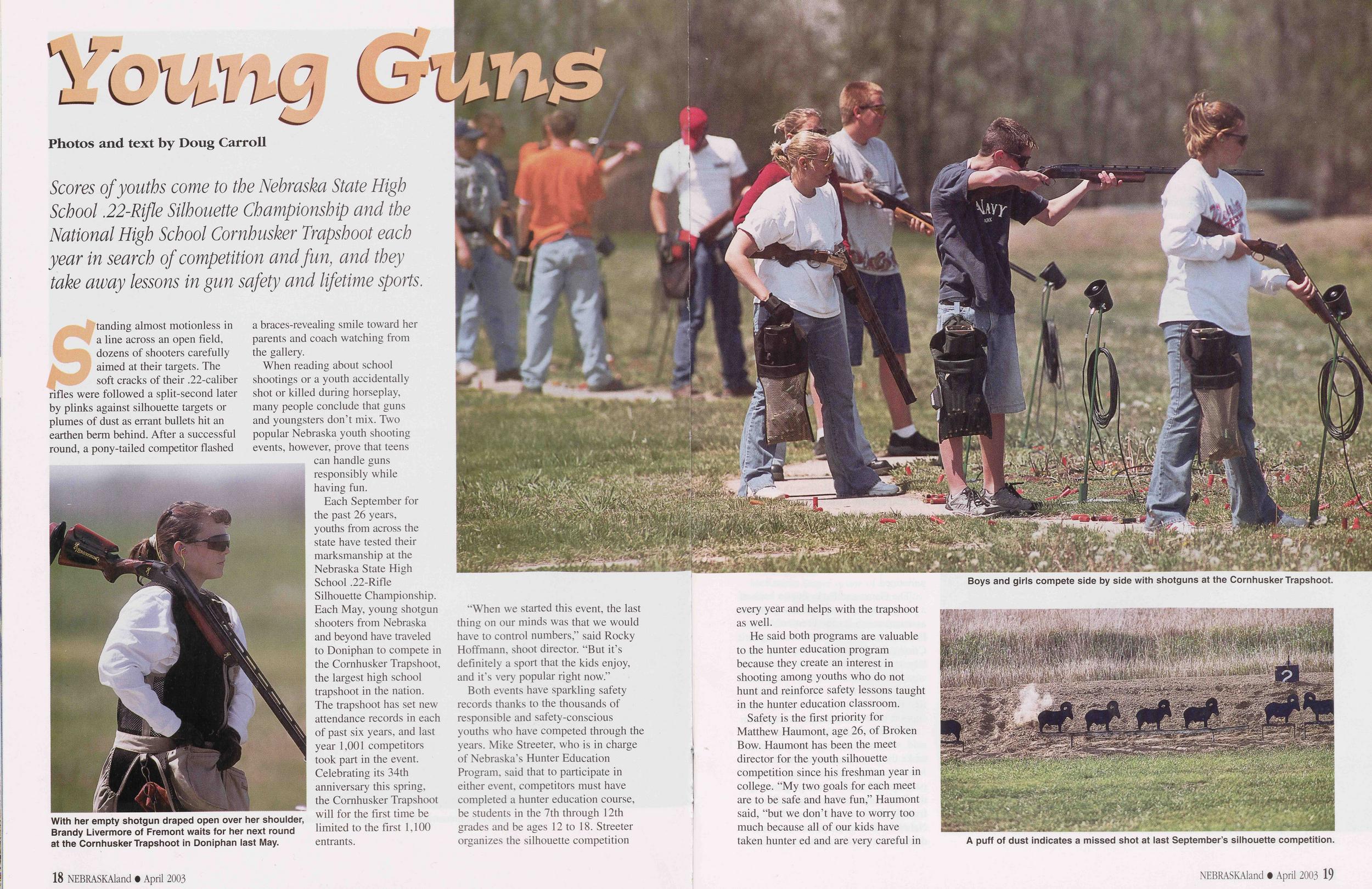
Young Guns
Photos and text by Doug Carroll Scores of youths come to the Nebraska State High School .22-Rifle Silhouette Championship and the National High School Cornhusker Traps hoot each year in search of competition and fun, and they take away lessons in gun safety and lifetime sports.standing almost motionless in a line across an open field, dozens of shooters carefully aimed at their targets. The soft cracks of their .22-caliber rifles were followed a split-second later by plinks against silhouette targets or plumes of dust as errant bullets hit an earthen berm behind. After a successful round, a pony-tailed competitor flashed
When reading about school shootings or a youth accidentally shot or killed during horseplay, many people conclude that guns and youngsters don't mix. Two popular Nebraska youth shooting events, however, prove that teens can handle guns responsibly while jj having fun.
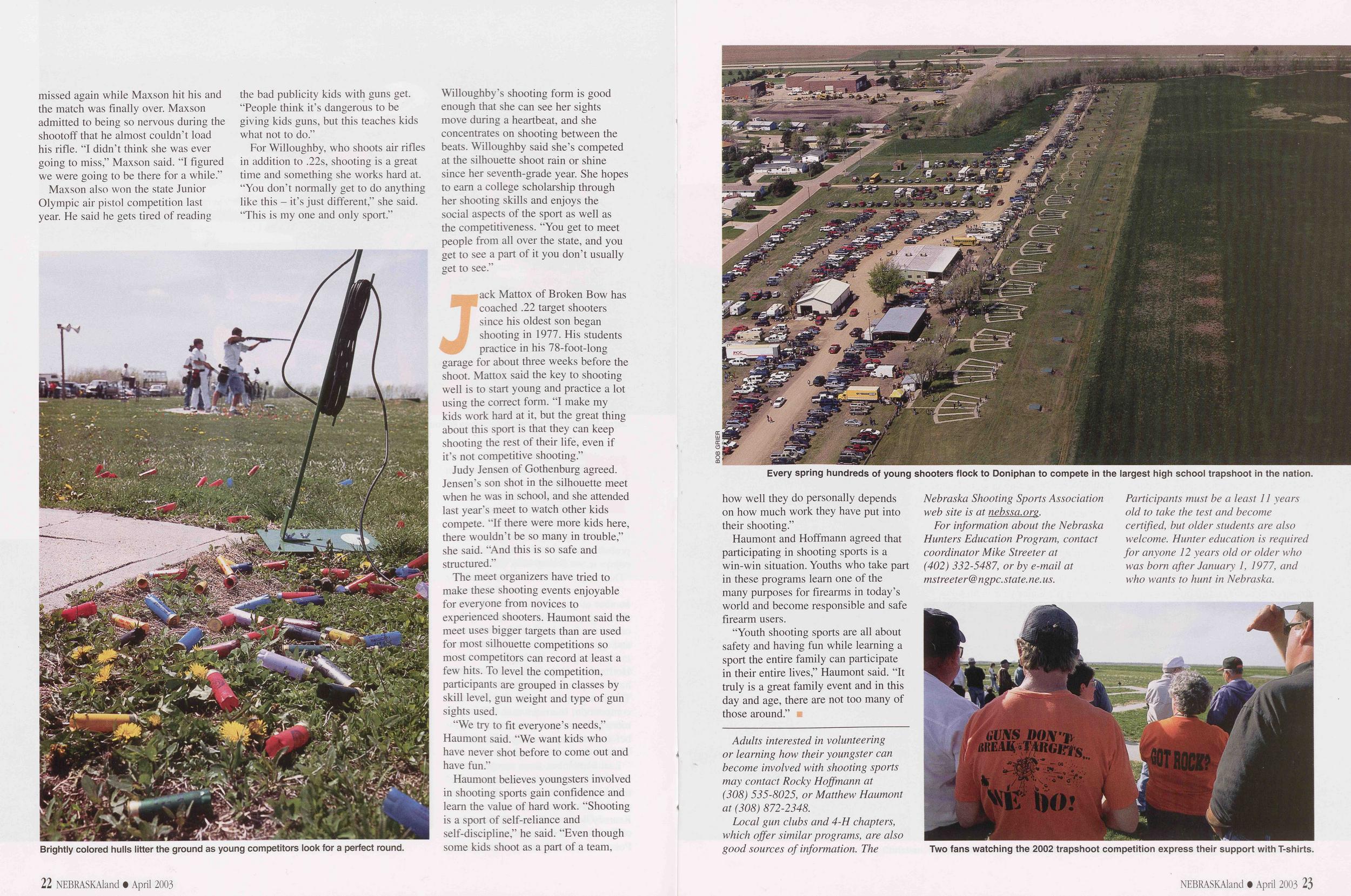
Each September for the past 26 years, youths from across the state have tested their marksmanship at the Nebraska State High School .22-Rifle Silhouette Championship. Each May, young shotgun shooters from Nebraska and beyond have traveled to Doniphan to compete in the Cornhusker Trapshoot, the largest high school trapshoot in the nation. The trapshoot has set new attendance records in each of past six years, and last year 1,001 competitors took part in the event. Celebrating its 34th anniversary this spring, the Cornhusker Trapshoot will for the first time be limited to the first 1,100 entrants.
"When we started this event, the last thing on our minds was that we would have to control numbers," said Rocky Hoffmann, shoot director. "But it's definitely a sport that the kids enjoy, and it's very popular right now."
Both events have sparkling safety records thanks to the thousands of responsible and safety-conscious youths who have competed through the years. Mike Streeter, who is in charge of Nebraska's Hunter Education Program, said that to participate in either event, competitors must have completed a hunter education course, be students in the 7th through 12th grades and be ages 12 to 18. Streeter organizes the silhouette competition 18 NEBRASKAland • April 2003
He said both programs are valuable to the hunter education program because they create an interest in shooting among youths who do not hunt and reinforce safety lessons taught in the hunter education classroom.
Safety is the first priority for Matthew Haumont, age 26, of Broken Bow. Haumont has been the meet director for the youth silhouette competition since his freshman year in college. "My two goals for each meet are to be safe and have fun," Haumont said, "but we don't have to worry too much because all of our kids have taken hunter ed and are very careful in
 the first place. We've got 70 or 80 kids
walking around here with guns and
they're responsible. We treat them like
adults and they act like adults."
the first place. We've got 70 or 80 kids
walking around here with guns and
they're responsible. We treat them like
adults and they act like adults."
Hoffmann, who has directed the Cornhusker for the Nebraska Game and Parks Commission for 29 years, said young shooters who participate in either shooting program and who have adult mentors become more responsible gun owners. "We don't see as many problems regarding ethics and safety with the kids going through our program," he said.
In addition to teaching gun safety and responsibility, Hoffmann said both shooting programs teach teens how to shoot properly. "We've had some tremendous shooters come out of the Cornhusker Shoot, such as Ellie Schad of North Platte and Brett Erickson of Elkhorn, both world-class competitors, he said.
Erickson shoots for the U.S. Army, and Schad for the U.S. Olympic team (see "A Top Gun - Ellie Schad," NEBRASKAland Jan-Feb 2003). Other shooters go on to compete in college or recreationally after they graduate from high school.
Both Hoffmann and Haumont believe the opportunity to shoot throughout their lifetime attracts many youths to the sport.
Haumont said, "You can compete in shooting sports your entire life and be competitive while having fun."
Although the Commission is a primary sponsor for both events, it receives generous support from volunteers, organizations and businesses to make them happen. The Commission co-sponsors the Cornhusker with the Nebraska Trapshooting Association (NTA), which owns the equipment and grounds where the event is held. The NTA provides volunteers, donates to the meet's trophy fund, and helps procure a grant each year from the American Trapshooting Hall of Fame for event expenses, Hoffmann said. For its part, the Commission promotes the meet, handles registration and runs the event. Nebraska conservation officers are on hand at both events to enforce safety rules and assist youngsters and coaches. The work doesn't go unnoticed.
"The Game and Parks does a heck of a job putting this on," said Jim Lettman, assistant coach for the Fremont teams. Fremont brought 11 teams to last year's Cornhusker Trapshoot - probably the largest number of competitors from one area. Fremont team members earned school athletic letters last year for the first time ever, but have to rely on the support of local businesses to compete.
At the silhouette shoot, Haumont said, area and Commission volunteers make the event a success. Hornady Manufacturing Company pays for the participants' lunch that is prepared by the Pony Express Ramrodders Club from Gothenburg every year. The Nebraska Shooting Sports Association donates the meet's trophies.
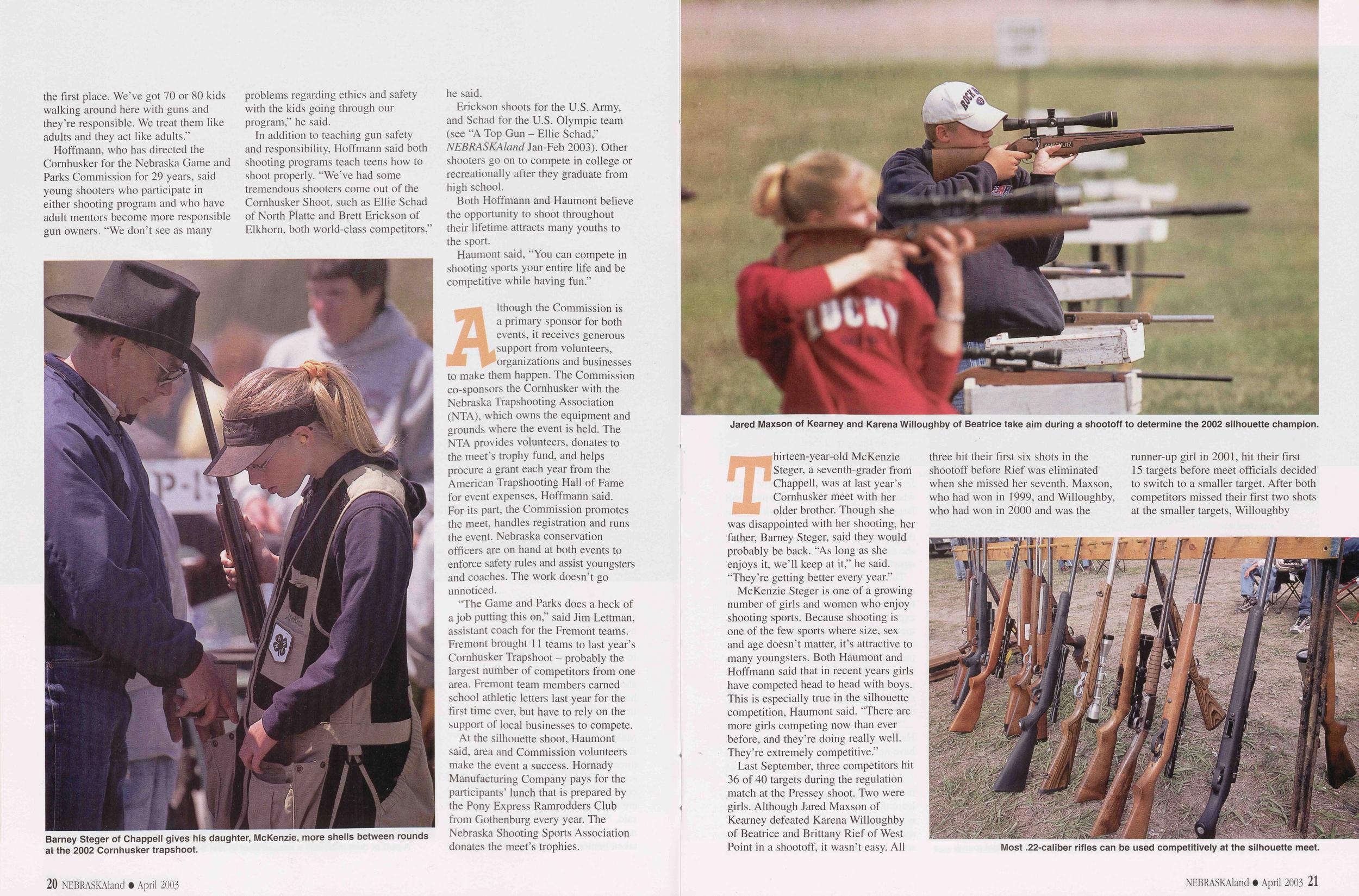
20 NEBRASKAland • April 2003Thirteen-year-old McKenzie Steger, a seventh-grader from Chappell, was at last year's Cornhusker meet with her older brother. Though she was disappointed with her shooting, her father, Barney Steger, said they would probably be back. "As long as she enjoys it, we'll keep at it," he said. "They're getting better every year."
McKenzie Steger is one of a growing number of girls and women who enjoy shooting sports. Because shooting is one of the few sports where size, sex and age doesn't matter, it's attractive to many youngsters. Both Haumont and Hoffmann said that in recent years girls have competed head to head with boys. This is especially true in the silhouette competition, Haumont said. "There are more girls competing now than ever before, and they're doing really well. They're extremely competitive."
Last September, three competitors hit 36 of 40 targets during the regulation match at the Pressey shoot. Two were girls. Although Jared Maxson of Kearney defeated Karena Willoughby of Beatrice and Brittany Rief of West Point in a shoot off, it wasn't easy. All three hit their first six shots in the shoot off before Rief was eliminated when she missed her seventh. Maxson, who had won in 1999, and Willoughby, who had won in 2000 and was the runner-up girl in 2001, hit their first 15 targets before meet officials decided to switch to a smaller target. After both competitors missed their first two shots at the smaller targets, Willoughby
 missed again while Maxson hit his and
the match was finally over. Maxson
admitted to being so nervous during the
shootoff that he almost couldn't load
his rifle. "I didn't think she was ever
going to miss," Maxson said. "I figured
we were going to be there for a while."
missed again while Maxson hit his and
the match was finally over. Maxson
admitted to being so nervous during the
shootoff that he almost couldn't load
his rifle. "I didn't think she was ever
going to miss," Maxson said. "I figured
we were going to be there for a while."
Maxson also won the state Junior Olympic air pistol competition last year. He said he gets tired of reading the bad publicity kids with guns get. "People think it's dangerous to be giving kids guns, but this teaches kids what not to do."
For Willoughby, who shoots air rifles in addition to .22s, shooting is a great time and something she works hard at. "You don't normally get to do anything like this - it's just different," she said. "This is my one and only sport."
Jack Mattox of Broken Bow has coached .22 target shooters since his oldest son began shooting in 1977. His students practice in his 78-foot-long garage for about three weeks before the shoot. Mattox said the key to shooting well is to start young and practice a lot using the correct form. "I make my kids work hard at it, but the great thing about this sport is that they can keep shooting the rest of their life, even if it's not competitive shooting."
Judy Jensen of Gothenburg agreed. Jensen's son shot in the silhouette meet when he was in school, and she attended last year's meet to watch other kids compete. "If there were more kids here, there wouldn't be so many in trouble," she said. "And this is so safe and structured."
The meet organizers have tried to make these shooting events enjoyable for everyone from novices to experienced shooters. Haumont said the meet uses bigger targets than are used for most silhouette competitions so most competitors can record at least a few hits. To level the competition, participants are grouped in classes by skill level, gun weight and type of gun sights used.
'We try to fit everyone's needs," Haumont said. "We want kids who have never shot before to come out and have fun."
Haumont believes youngsters involved in shooting sports gain confidence and learn the value of hard work. "Shooting is a sport of self-reliance and self-discipline," he said. "Even though some kids shoot as a part of a team, 22 NEBRASKAland • April 2003
Haumont and Hoffmann agreed that participating in shooting sports is a win-win situation. Youths who take part in these programs learn one of the many purposes for firearms in today's world and become responsible and safe firearm users.
"Youth shooting sports are all about safety and having fun while learning a sport the entire family can participate in their entire lives," Haumont said. "It truly is a great family event and in this day and age, there are not too many of those around."
Adults interested in volunteering or learning how their youngster can become involved with shooting sports may contact Rocky Hoffmann at (308) 535-8025, or Matthew Haumont at (308) 872-2348.
Local gun clubs and 4-H chapters, which offer similar programs, are also good sources of information. The Nebraska Shooting Sports Association web site is at nebssa.org.
For information about the Nebraska Hunters Education Program, contact coordinator Mike Streeter at (402) 332-5487, or by e-mail at mstreeter® ngpc. state, ne. us. Participants must be a least 11 years old to take the test and become certified, but older students are also welcome. Hunter education is required for anyone 12 years old or older who was born after January 1, 1977, and who wants to hunt in Nebraska.
Little Boat, Big Water
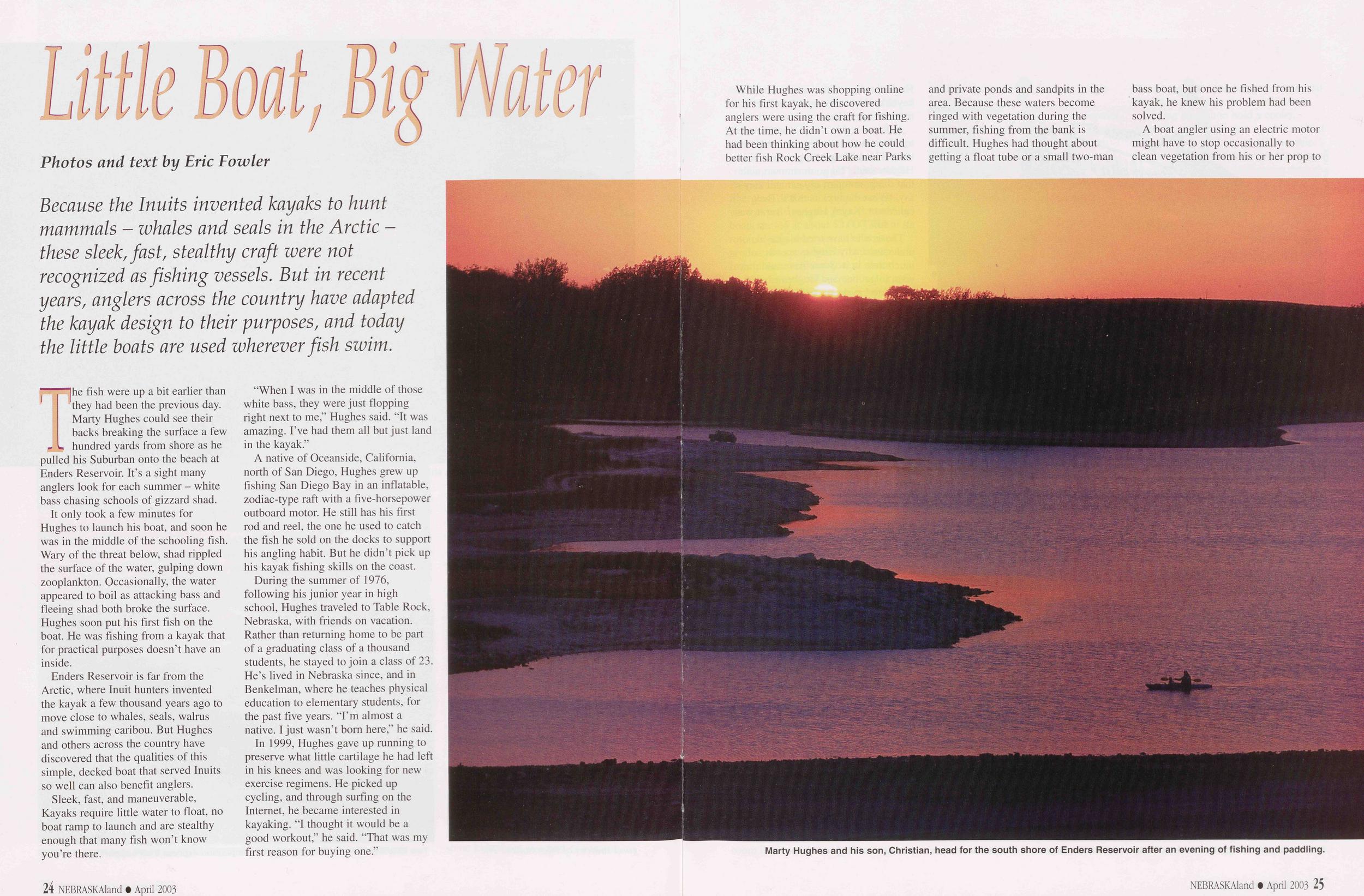
Photos and text by Eric Fowler Because the Inuits invented kayaks to hunt mammals - whales and seals in the Arctic - these sleek, fast, stealthy craft were not recognized as fishing vessels. But in recent years, anglers across the country have adapted the kayak design to their purposes, and today the little boats are used wherever fish swim.The fish were up a bit earlier than they had been the previous day. Marty Hughes could see their backs breaking the surface a few hundred yards from shore as he pulled his Suburban onto the beach at Enders Reservoir. It's a sight many anglers look for each summer - white bass chasing schools of gizzard shad.
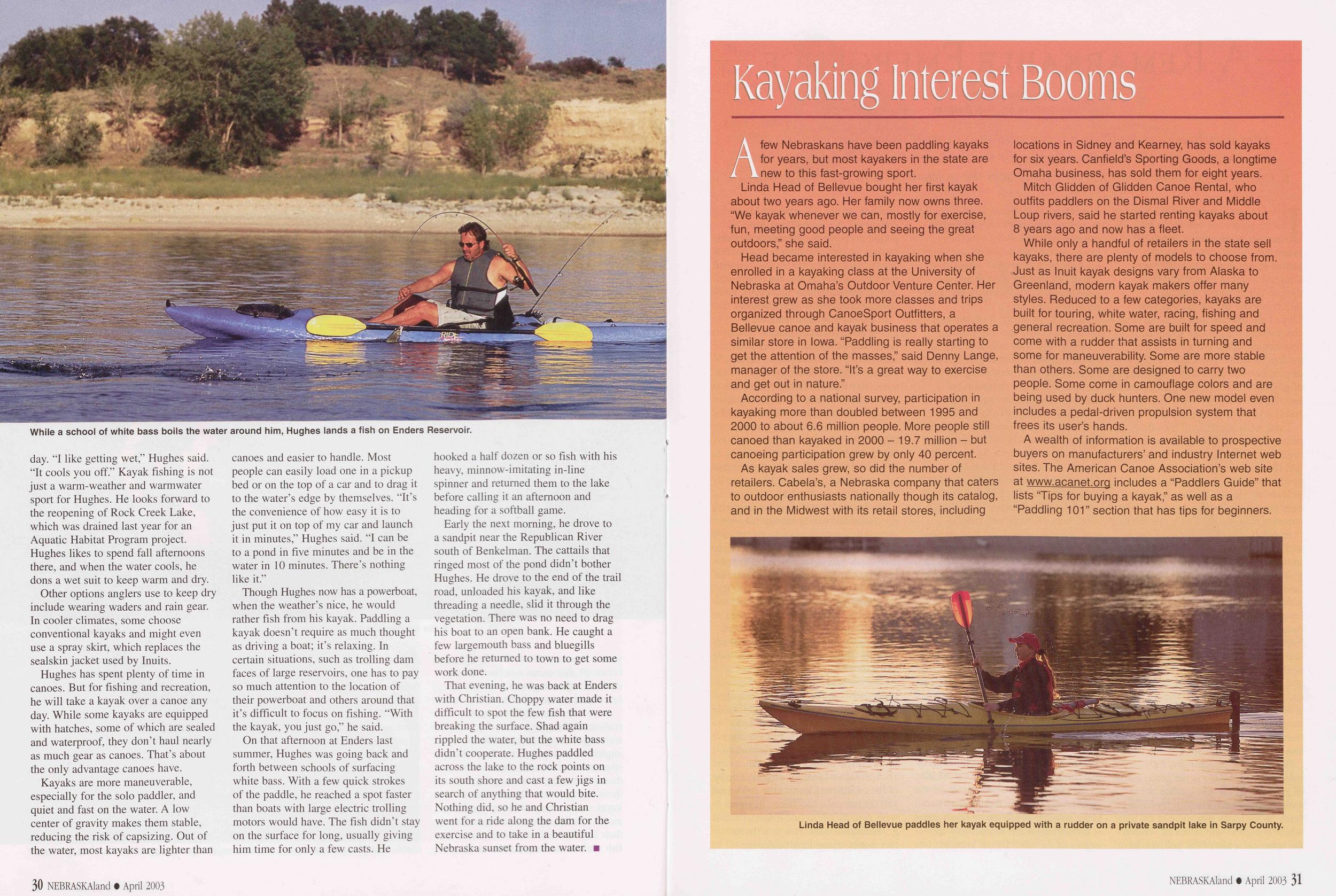
It only took a few minutes for Hughes to launch his boat, and soon he was in the middle of the schooling fish. Wary of the threat below, shad rippled the surface of the water, gulping down zooplankton. Occasionally, the water appeared to boil as attacking bass and fleeing shad both broke the surface. Hughes soon put his first fish on the boat. He was fishing from a kayak that for practical purposes doesn't have an inside.
Enders Reservoir is far from the Arctic, where Inuit hunters invented the kayak a few thousand years ago to move close to whales, seals, walrus and swimming caribou. But Hughes and others across the country have discovered that the qualities of this simple, decked boat that served Inuits so well can also benefit anglers.
Sleek, fast, and maneuverable, Kayaks require little water to float, no boat ramp to launch and are stealthy enough that many fish won't know you're there.
"When I was in the middle of those white bass, they were just flopping right next to me," Hughes said. "It was amazing. I've had them all but just land in the kayak."
A native of Oceanside, California, north of San Diego, Hughes grew up fishing San Diego Bay in an inflatable, zodiac-type raft with a five-horsepower outboard motor. He still has his first rod and reel, the one he used to catch the fish he sold on the docks to support his angling habit. But he didn't pick up his kayak fishing skills on the coast.
During the summer of 1976, following his junior year in high school, Hughes traveled to Table Rock, Nebraska, with friends on vacation. Rather than returning home to be part of a graduating class of a thousand students, he stayed to join a class of 23. He's lived in Nebraska since, and in Benkelman, where he teaches physical education to elementary students, for the past five years. "I'm almost a native. I just wasn't born here," he said.
In 1999, Hughes gave up running to preserve what little cartilage he had left in his knees and was looking for new exercise regimens. He picked up cycling, and through surfing on the Internet, he became interested in kayaking. "I thought it would be a good workout," he said. "That was my first reason for buying one."
24 NEBRASKAland t April 2003While Hughes was shopping online for his first kayak, he discovered anglers were using the craft for fishing. At the time, he didn't own a boat. He had been thinking about how he could better fish Rock Creek Lake near Parks and private ponds and sandpits in the area. Because these waters become ringed with vegetation during the summer, fishing from the bank is difficult. Hughes had thought about getting a float tube or a small two-man bass boat, but once he fished from his kayak, he knew his problem had been solved.
A boat angler using an electric motor might have to stop occasionally to clean vegetation from his or her prop to
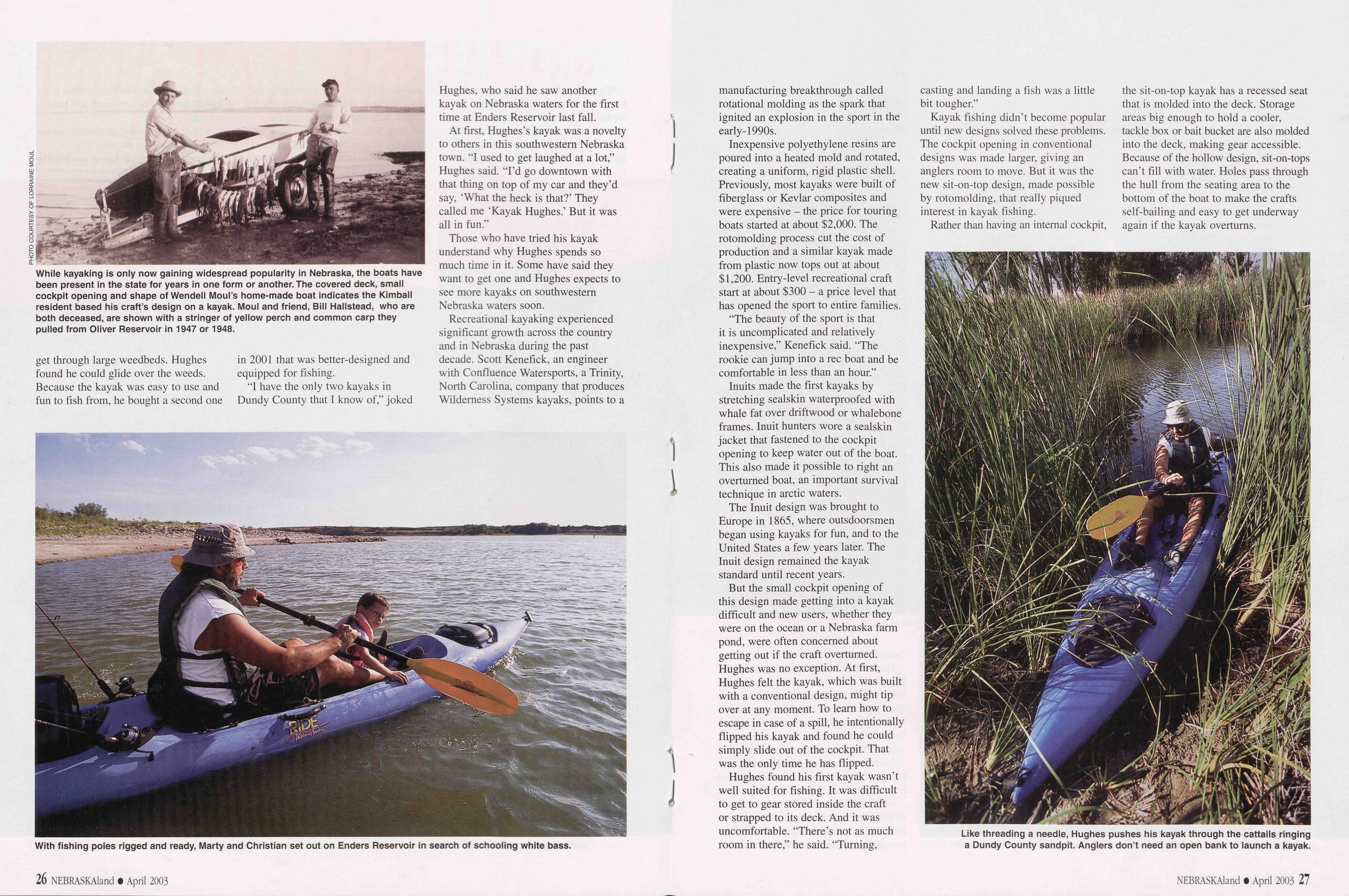
"I have the only two kayaks in Dundy County that I know of," joked Hughes, who said he saw another kayak on Nebraska waters for the first time at Enders Reservoir last fall.
At first, Hughes's kayak was a novelty to others in this southwestern Nebraska town. "I used to get laughed at a lot," Hughes said. "I'd go downtown with that thing on top of my car and they'd say, 'What the heck is that?' They called me 'Kayak Hughes.' But it was all in fun."
Those who have tried his kayak understand why Hughes spends so much time in it. Some have said they want to get one and Hughes expects to see more kayaks on southwestern Nebraska waters soon.
Recreational kayaking experienced significant growth across the country and in Nebraska during the past decade. Scott Kenefick, an engineer with Confluence Water sports, a Trinity, North Carolina, company that produces Wilderness Systems kayaks, points to a
Inexpensive polyethylene resins are poured into a heated mold and rotated, creating a uniform, rigid plastic shell. Previously, most kayaks were built of fiberglass or Kevlar composites and were expensive - the price for touring boats started at about $2,000. The rotomolding process cut the cost of production and a similar kayak made from plastic now tops out at about $1,200. Entry-level recreational craft start at about $300 - a price level that has opened the sport to entire families.
"The beauty of the sport is that it is uncomplicated and relatively inexpensive," Kenefick said. "The rookie can jump into a rec boat and be comfortable in less than an hour."
Inuits made the first kayaks by stretching sealskin waterproofed with whale fat over driftwood or whalebone frames. Inuit hunters wore a sealskin jacket that fastened to the cockpit opening to keep water out of the boat. This also made it possible to right an overturned boat, an important survival technique in arctic waters.
The Inuit design was brought to Europe in 1865, where outdoorsmen began using kayaks for fun, and to the United States a few years later. The Inuit design remained the kayak standard until recent years.
But the small cockpit opening of this design made getting into a kayak difficult and new users, whether they were on the ocean or a Nebraska farm pond, were often concerned about getting out if the craft overturned. Hughes was no exception. At first, Hughes felt the kayak, which was built with a conventional design, might tip over at any moment. To learn how to escape in case of a spill, he intentionally flipped his kayak and found he could simply slide out of the cockpit. That was the only time he has flipped.
Hughes found his first kayak wasn't well suited for fishing. It was difficult to get to gear stored inside the craft or strapped to its deck. And it was uncomfortable. "There's not as much room in there," he said. "Turning, casting and landing a fish was a little bit tougher."
Kayak fishing didn't become popular until new designs solved these problems. The cockpit opening in conventional designs was made larger, giving an anglers room to move. But it was the new sit-on-top design, made possible by rotomolding, that really piqued interest in kayak fishing.
Rather than having an internal cockpit, the sit-on-top kayak has a recessed seat that is molded into the deck. Storage areas big enough to hold a cooler, tackle box or bait bucket are also molded into the deck, making gear accessible. Because of the hollow design, sit-on-tops can't fill with water. Holes pass through the hull from the seating area to the bottom of the boat to make the crafts self-bailing and easy to get underway again if the kayak overturns.
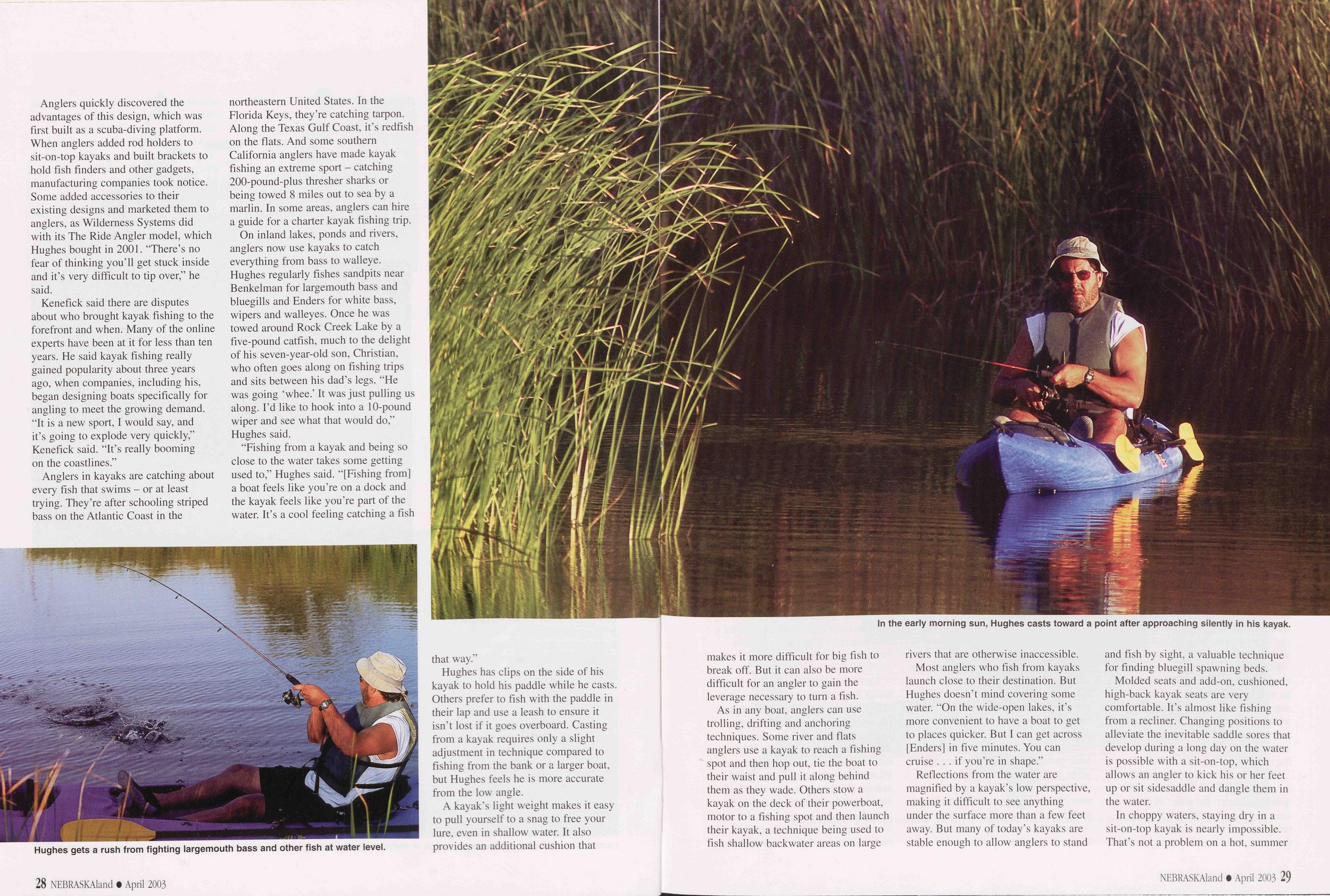
Anglers quickly discovered the advantages of this design, which was first built as a scuba-diving platform. When anglers added rod holders to sit-on-top kayaks and built brackets to hold fish finders and other gadgets, manufacturing companies took notice. Some added accessories to their existing designs and marketed them to anglers, as Wilderness Systems did with its The Ride Angler model, which Hughes bought in 2001. "There's no fear of thinking you'll get stuck inside and it's very difficult to tip over," he said.
Kenefick said there are disputes about who brought kayak fishing to the forefront and when. Many of the online experts have been at it for less than ten years. He said kayak fishing really gained popularity about three years ago, when companies, including his, began designing boats specifically for angling to meet the growing demand. "It is a new sport, I would say, and it's going to explode very quickly," Kenefick said. "It's really booming on the coastlines."
Anglers in kayaks are catching about every fish that swims - or at least trying. They're after schooling striped bass on the Atlantic Coast in the northeastern United States. In the Florida Keys, they're catching tarpon. Along the Texas Gulf Coast, it's redfish on the flats. And some southern California anglers have made kayak fishing an extreme sport - catching 200-pound-plus thresher sharks or being towed 8 miles out to sea by a marlin. In some areas, anglers can hire a guide for a charter kayak fishing trip.
On inland lakes, ponds and rivers, anglers now use kayaks to catch everything from bass to walleye. Hughes regularly fishes sandpits near Benkelman for largemouth bass and bluegills and Enders for white bass, wipers and walleyes. Once he was towed around Rock Creek Lake by a five-pound catfish, much to the delight of his seven-year-old son, Christian, who often goes along on fishing trips and sits between his dad's legs. "He was going 'whee.' It was just pulling us along. I'd like to hook into a 10-pound wiper and see what that would do," Hughes said.
"Fishing from a kayak and being so close to the water takes some getting used to," Hughes said. "[Fishing from] a boat feels like you're on a dock and the kayak feels like you're part of the water. It's a cool feeling catching a fish that way.
Hughes has clips on the side of his kayak to hold his paddle while he casts. Others prefer to fish with the paddle in their lap and use a leash to ensure it isn't lost if it goes overboard. Casting from a kayak requires only a slight adjustment in technique compared to fishing from the bank or a larger boat, but Hughes feels he is more accurate from the low angle.
A kayak's light weight makes it easy to pull yourself to a snag to free your lure, even in shallow water. It also provides an additional cushion that 28 NEBRASKAland • April 2003
As in any boat, anglers can use trolling, drifting and anchoring techniques. Some river and flats anglers use a kayak to reach a fishing spot and then hop out, tie the boat to their waist and pull it along behind them as they wade. Others stow a kayak on the deck of their powerboat, motor to a fishing spot and then launch their kayak, a technique being used to fish shallow backwater areas on large rivers that are otherwise inaccessible.
Most anglers who fish from kayaks launch close to their destination. But Hughes doesn't mind covering some water. "On the wide-open lakes, it's more convenient to have a boat to get to places quicker. But I can get across [Enders] in five minutes. You can cruise ... if you're in shape."
Reflections from the water are magnified by a kayak's low perspective, making it difficult to see anything under the surface more than a few feet away. But many of today's kayaks are stable enough to allow anglers to stand and fish by sight, a valuable technique for finding bluegill spawning beds.
Molded seats and add-on, cushioned, high-back kayak seats are very comfortable. It's almost like fishing from a recliner. Changing positions to alleviate the inevitable saddle sores that develop during a long day on the water is possible with a sit-on-top, which allows an angler to kick his or her feet up or sit sidesaddle and dangle them in the water.
In choppy waters, staying dry in a
sit-on-top kayak is nearly impossible.
That's not a problem on a hot, summer
NEBRASKAland • April 2003 29
Other options anglers use to keep dry include wearing waders and rain gear. In cooler climates, some choose conventional kayaks and might even use a spray skirt, which replaces the sealskin jacket used by Inuits.
Hughes has spent plenty of time in canoes. But for fishing and recreation, he will take a kayak over a canoe any day. While some kayaks are equipped with hatches, some of which are sealed and waterproof, they don't haul nearly as much gear as canoes. That's about the only advantage canoes have.
Kayaks are more maneuverable, especially for the solo paddler, and quiet and fast on the water. A low center of gravity makes them stable, reducing the risk of capsizing. Out of the water, most kayaks are lighter than 30 NEBRASKAland • April 2003 canoes and easier to handle. Most people can easily load one in a pickup bed or on the top of a car and to drag it to the water's edge by themselves. "It's the convenience of how easy it is to just put it on top of my car and launch it in minutes," Hughes said. "I can be to a pond in five minutes and be in the water in 10 minutes. There's nothing like it."
Though Hughes now has a powerboat, when the weather's nice, he would rather fish from his kayak. Paddling a kayak doesn't require as much thought as driving a boat; it's relaxing. In certain situations, such as trolling dam faces of large reservoirs, one has to pay so much attention to the location of their powerboat and others around that it's difficult to focus on fishing. "With the kayak, you just go," he said.
On that afternoon at Enders last summer, Hughes was going back and forth between schools of surfacing white bass. With a few quick strokes of the paddle, he reached a spot faster than boats with large electric trolling motors would have. The fish didn't stay on the surface for long, usually giving him time for only a few casts. He hooked a half dozen or so fish with his heavy, minnow-imitating in-line spinner and returned them to the lake before calling it an afternoon and heading for a Softball game.
Early the next morning, he drove to a sandpit near the Republican River south of Benkelman. The cattails that ringed most of the pond didn't bother Hughes. He drove to the end of the trail road, unloaded his kayak, and like threading a needle, slid it through the vegetation. There was no need to drag his boat to an open bank. He caught a few largemouth bass and bluegills before he returned to town to get some work done.
That evening, he was back at Enders with Christian. Choppy water made it difficult to spot the few fish that were breaking the surface. Shad again rippled the water, but the white bass didn't cooperate. Hughes paddled across the lake to the rock points on its south shore and cast a few jigs in search of anything that would bite. Nothing did, so he and Christian went for a ride along the dam for the exercise and to take in a beautiful Nebraska sunset from the water.
30 NEBRASKAland • April 2003 Kayaking Interest BoomsA few Nebraskans have been paddling kayaks for years, but most kayakers in the state are new to this fast-growing sport. Linda Head of Bellevue bought her first kayak about two years ago. Her family now owns three. "We kayak whenever we can, mostly for exercise, fun, meeting good people and seeing the great outdoors," she said.
Head became interested in kayaking when she enrolled in a kayaking class at the University of Nebraska at Omaha's Outdoor Venture Center. Her interest grew as she took more classes and trips organized through CanoeSport Outfitters, a Bellevue canoe and kayak business that operates a similar store in Iowa. "Paddling is really starting to get the attention of the masses," said Denny Lange, manager of the store. "It's a great way to exercise and get out in nature."
According to a national survey, participation in kayaking more than doubled between 1995 and 2000 to about 6.6 million people. More people still canoed than kayaked in 2000 - 19.7 million - but canoeing participation grew by only 40 percent.
As kayak sales grew, so did the number of retailers. Cabela's, a Nebraska company that caters to outdoor enthusiasts nationally though its catalog, and in the Midwest with its retail stores, including locations in Sidney and Kearney, has sold kayaks for six years. Canfield's Sporting Goods, a longtime Omaha business, has sold them for eight years.
Mitch Glidden of Glidden Canoe Rental, who outfits paddlers on the Dismal River and Middle Loup rivers, said he started renting kayaks about 8 years ago and now has a fleet.
While only a handful of retailers in the state sell kayaks, there are plenty of models to choose from. Just as Inuit kayak designs vary from Alaska to Greenland, modern kayak makers offer many styles. Reduced to a few categories, kayaks are built for touring, white water, racing, fishing and general recreation. Some are built for speed and come with a rudder that assists in turning and some for maneuverability. Some are more stable than others. Some are designed to carry two people. Some come in camouflage colors and are being used by duck hunters. One new model even includes a pedal-driven propulsion system that frees its user's hands.
A wealth of information is available to prospective buyers on manufacturers' and industry Internet web sites. The American Canoe Association's web site at www.acanet.org includes a "Paddlers Guide" that lists "Tips for buying a kayak," as well as a "Paddling 101" section that has tips for beginners.
A Remarkable Emergence
By Lisa Knopp Illustration by Tim Reigert After nearly a year spent as a larva and pupa inside a globular swelling of a goldenrod stem, the gallfly emerges for its two-week life in the larger world. I want to be there when the fly briefly sees the goldenrod and feels the breeze.It used to be that my favorite time to see goldenrod was in the late summer when wild or untended places are ablaze with the showy yellow spikes or pyramids. But now, I am just as taken by goldenrod in the late fall or winter when the inflorescences are tan-gray and dry. Then, I see globular swellings, the larval chambers of the goldenrod gall fly, a few feet above the ground on some goldenrod stems. Then, I see the field of goldenrod as more than just a field of goldenrod: It is a cluster of enclosed nests, cradles, wombs, each as solitary and insular as an anchorite's cell.
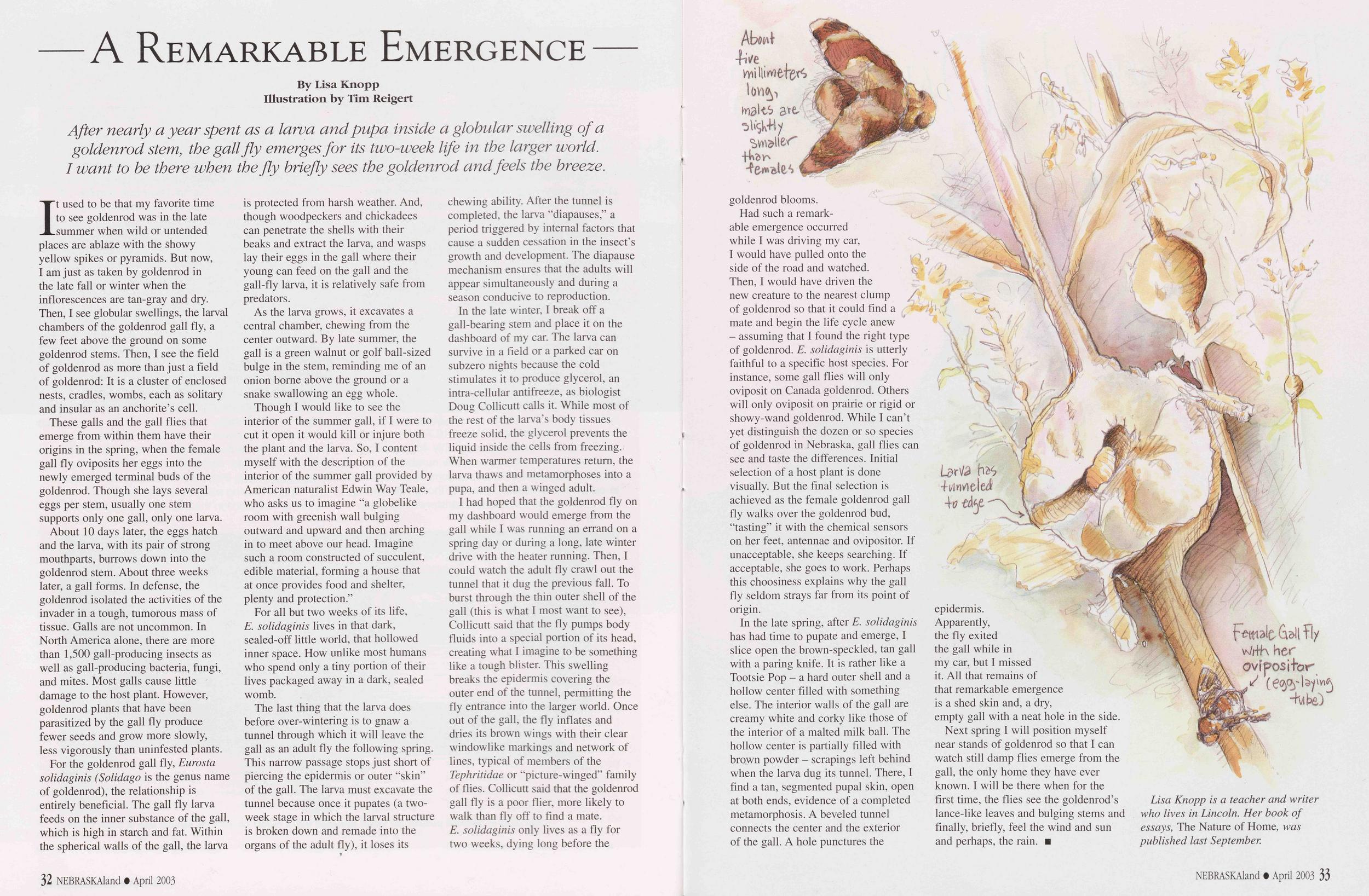
These galls and the gall flies that emerge from within them have their origins in the spring, when the female gall fly oviposits her eggs into the newly emerged terminal buds of the goldenrod. Though she lays several eggs per stem, usually one stem supports only one gall, only one larva.
About 10 days later, the eggs hatch and the larva, with its pair of strong mouthparts, burrows down into the goldenrod stem. About three weeks later, a gall forms. In defense, the goldenrod isolated the activities of the invader in a tough, tumorous mass of tissue. Galls are not uncommon. In North America alone, there are more than 1,500 gall-producing insects as well as gall-producing bacteria, fungi, and mites. Most galls cause little damage to the host plant. However, goldenrod plants that have been parasitized by the gall fly produce fewer seeds and grow more slowly, less vigorously than uninfested plants.
For the goldenrod gall fly, Eurosta solidaginis (Solidago is the genus name of goldenrod), the relationship is entirely beneficial. The gall fly larva feeds on the inner substance of the gall, which is high in starch and fat. Within the spherical walls of the gall, the larva is protected from harsh weather. And, though woodpeckers and chickadees can penetrate the shells with their beaks and extract the larva, and wasps lay their eggs in the gall where their young can feed on the gall and the gall-fly larva, it is relatively safe from predators.
As the larva grows, it excavates a central chamber, chewing from the center outward. By late summer, the gall is a green walnut or golf ball-sized bulge in the stem, reminding me of an onion borne above the ground or a snake swallowing an egg whole.
Though I would like to see the interior of the summer gall, if I were to cut it open it would kill or injure both the plant and the larva. So, I content myself with the description of the interior of the summer gall provided by American naturalist Edwin Way Teale, who asks us to imagine "a globelike room with greenish wall bulging outward and upward and then arching in to meet above our head. Imagine such a room constructed of succulent, edible material, forming a house that at once provides food and shelter, plenty and protection."
For all but two weeks of its life, E. solidaginis lives in that dark, sealed-off little world, that hollowed inner space. How unlike most humans who spend only a tiny portion of their lives packaged away in a dark, sealed womb.
The last thing that the larva does before over-wintering is to gnaw a tunnel through which it will leave the gall as an adult fly the following spring. This narrow passage stops just short of piercing the epidermis or outer "skin" of the gall. The larva must excavate the tunnel because once it pupates (a two-week stage in which the larval structure is broken down and remade into the organs of the adult fly), it loses its chewing ability. After the tunnel is completed, the larva "diapauses," a period triggered by internal factors that cause a sudden cessation in the insect's growth and development. The diapause mechanism ensures that the adults will appear simultaneously and during a season conducive to reproduction.
In the late winter, I break off a gall-bearing stem and place it on the dashboard of my car. The larva can survive in a field or a parked car on subzero nights because the cold stimulates it to produce glycerol, an intra-cellular antifreeze, as biologist Doug Collicutt calls it. While most of the rest of the larva's body tissues freeze solid, the glycerol prevents the liquid inside the cells from freezing. When warmer temperatures return, the larva thaws and metamorphoses into a pupa, and then a winged adult.
I had hoped that the goldenrod fly on my dashboard would emerge from the gall while I was running an errand on a spring day or during a long, late winter drive with the heater running. Then, I could watch the adult fly crawl out the tunnel that it dug the previous fall. To burst through the thin outer shell of the gall (this is what I most want to see), Collicutt said that the fly pumps body fluids into a special portion of its head, creating what I imagine to be something like a tough blister. This swelling breaks the epidermis covering the outer end of the tunnel, permitting the fly entrance into the larger world. Once out of the gall, the fly inflates and dries its brown wings with their clear window like markings and network of lines, typical of members of the Tephritidae or "picture-winged" family of flies. Collicutt said that the goldenrod gall fly is a poor flier, more likely to walk than fly off to find a mate. E. solidaginis only lives as a fly for two weeks, dying long before the 32 NEBRASKAland • April 2003 goldenrod blooms.
Had such a remarkable emergence occurred while I was driving my car, I would have pulled onto the side of the road and watched. Then, I would have driven the new creature to the nearest clump of goldenrod so that it could find a mate and begin the life cycle anew - assuming that I found the right type of goldenrod. E. solidaginis is utterly faithful to a specific host species. For instance, some gall flies will only oviposit on Canada goldenrod. Others will only oviposit on prairie or rigid or showy-wand goldenrod. While I can't yet distinguish the dozen or so species of goldenrod in Nebraska, gall flies can see and taste the differences. Initial selection of a host plant is done visually. But the final selection is achieved as the female goldenrod gall fly walks over the goldenrod bud, "tasting" it with the chemical sensors on her feet, antennae and ovipositor. If unacceptable, she keeps searching. If acceptable, she goes to work. Perhaps this choosiness explains why the gall fly seldom strays far from its point of origin.
In the late spring, after E. solidaginis has had time to pupate and emerge, I slice open the brown-speckled, tan gall with a paring knife. It is rather like a Tootsie Pop - a hard outer shell and a hollow center filled with something else. The interior walls of the gall are creamy white and corky like those of the interior of a malted milk ball. The hollow center is partially filled with brown powder - scrapings left behind when the larva dug its tunnel. There, I find a tan, segmented pupal skin, open at both ends, evidence of a completed metamorphosis. A beveled tunnel connects the center and the exterior of the gall. A hole punctures the epidermis. Apparently, the fly exited the gall while in my car, but I missed it. All that remains of that remarkable emergence is a shed skin and, a dry, empty gall with a neat hole in the side.
Next spring I will position myself near stands of goldenrod so that I can watch still damp flies emerge from the gall, the only home they have ever known. I will be there when for the first time, the flies see the goldenrod's lance-like leaves and bulging stems and finally, briefly, feel the wind and sun and perhaps, the rain.
Daybreak Dancers
Photos and text by Michael Forsberg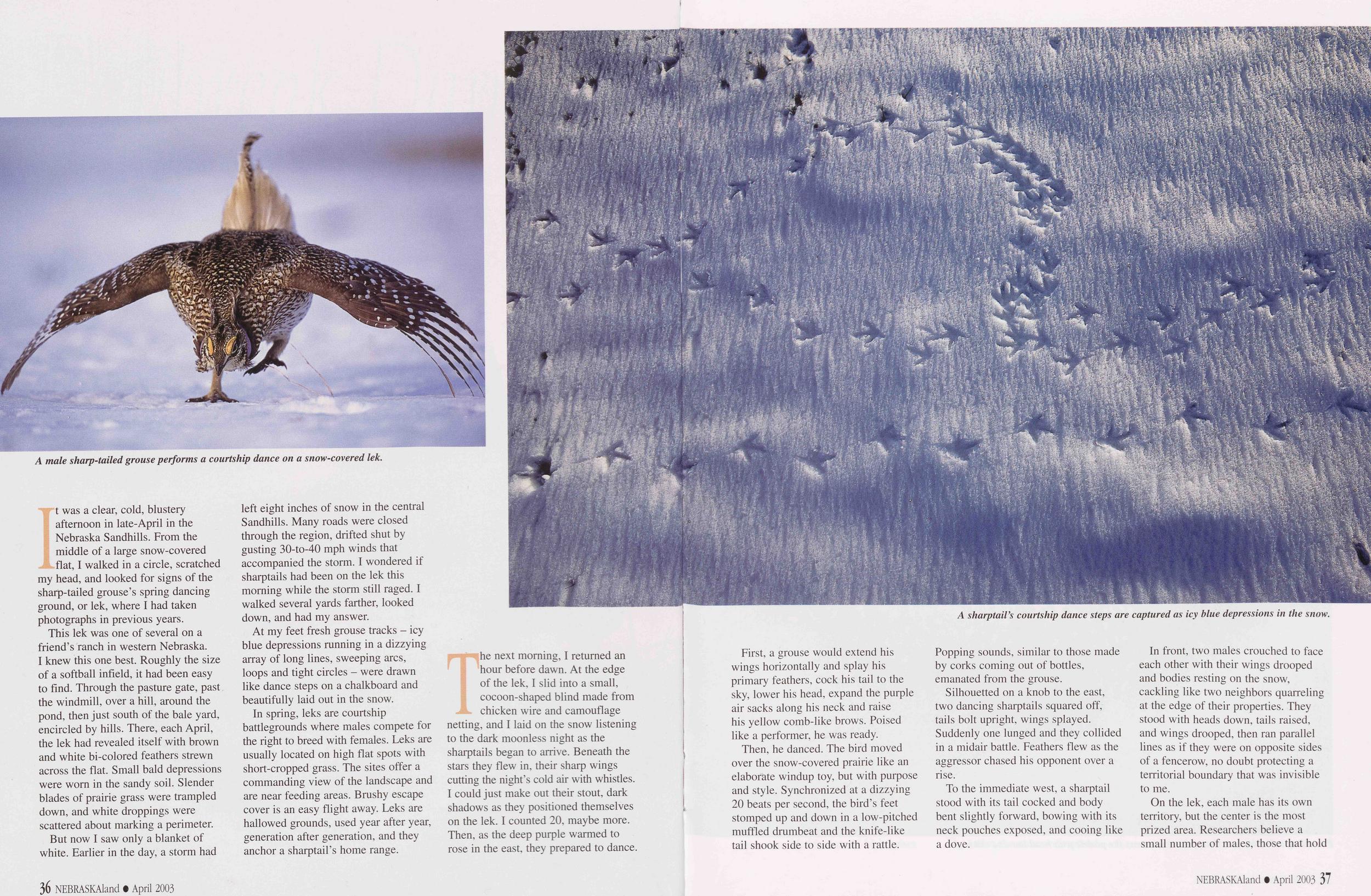
It was a clear, cold, blustery afternoon in late-April in the Nebraska Sandhills. From the middle of a large snow-covered .flat, I walked in a circle, scratched my head, and looked for signs of the sharp-tailed grouse's spring dancing ground, or lek, where I had taken photographs in previous years.
This lek was one of several on a friend's ranch in western Nebraska. I knew this one best. Roughly the size of a softball infield, it had been easy to find. Through the pasture gate, past the windmill, over a hill, around the pond, then just south of the bale yard, encircled by hills. There, each April, the lek had revealed itself with brown and white bi-colored feathers strewn across the flat. Small bald depressions were worn in the sandy soil. Slender blades of prairie grass were trampled down, and white droppings were scattered about marking a perimeter.
But now I saw only a blanket of white. Earlier in the day, a storm had left eight inches of snow in the central Sandhills. Many roads were closed through the region, drifted shut by gusting 30-to-40 mph winds that accompanied the storm. I wondered if sharptails had been on the lek this morning while the storm still raged. I walked several yards farther, looked down, and had my answer.
At my feet fresh grouse tracks - icy blue depressions running in a dizzying array of long lines, sweeping arcs, loops and tight circles - were drawn like dance steps on a chalkboard and beautifully laid out in the snow.
In spring, leks are courtship battlegrounds where males compete for the right to breed with females. Leks are usually located on high flat spots with short-cropped grass. The sites offer a commanding view of the landscape and are near feeding areas. Brushy escape cover is an easy flight away. Leks are hallowed grounds, used year after year, generation after generation, and they anchor a sharptail's home range.
The next morning, I returned an hour before dawn. At the edge of the lek, I slid into a small, cocoon-shaped blind made from chicken wire and camouflage netting, and I laid on the snow listening to the dark moonless night as the sharptails began to arrive. Beneath the stars they flew in, their sharp wings cutting the night's cold air with whistles. I could just make out their stout, dark shadows as they positioned themselves on the lek. I counted 20, maybe more. Then, as the deep purple warmed to rose in the east, they prepared to dance.
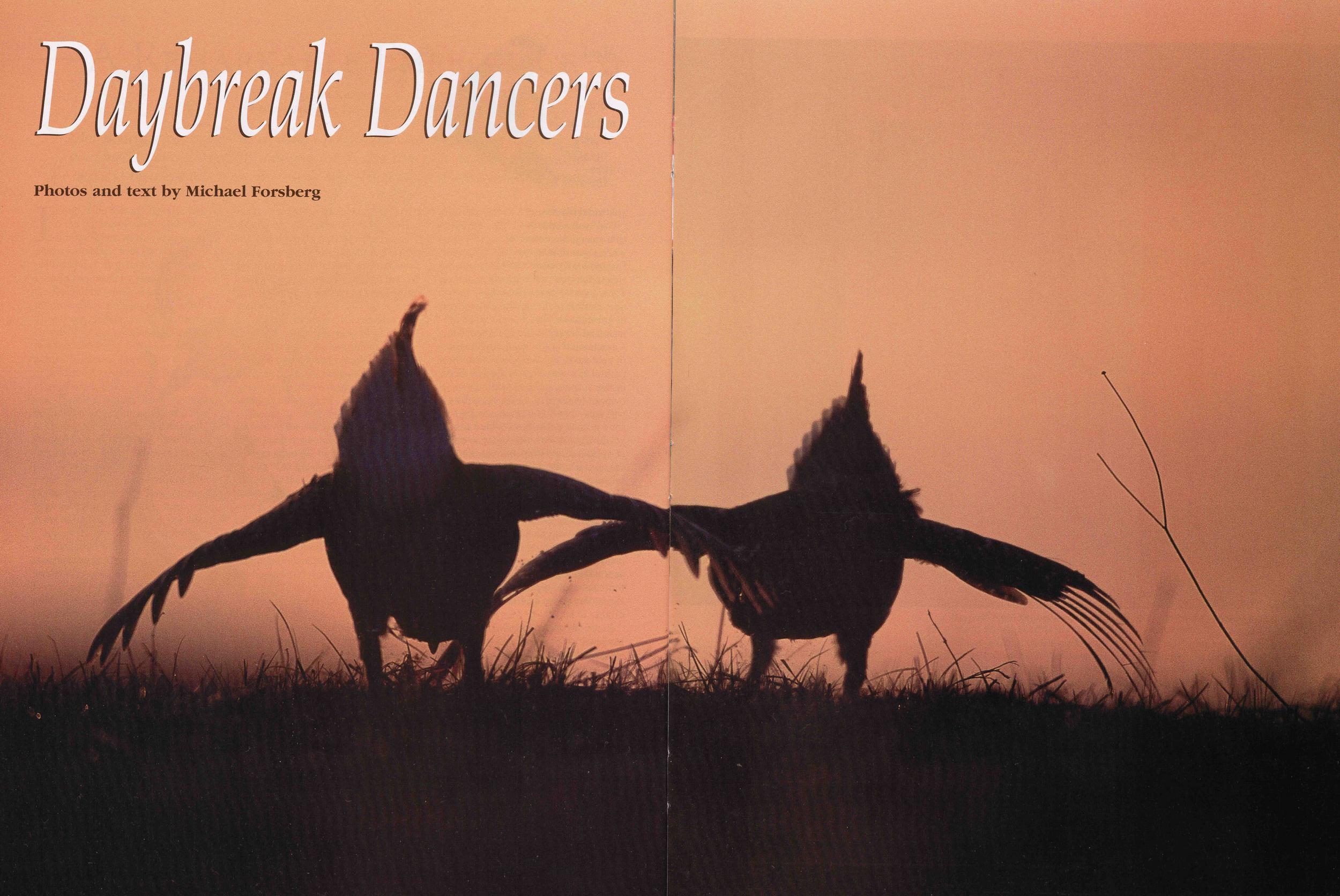
36 NEBRASKAland • April 2003First, a grouse would extend his wings horizontally and splay his primary feathers, cock his tail to the sky, lower his head, expand the purple air sacks along his neck and raise his yellow comb-like brows. Poised like a performer, he was ready.
Then, he danced. The bird moved over the snow-covered prairie like an elaborate windup toy, but with purpose and style. Synchronized at a dizzying 20 beats per second, the bird's feet stomped up and down in a low-pitched muffled drumbeat and the knife-like tail shook side to side with a rattle. Popping sounds, similar to those made by corks coming out of bottles, emanated from the grouse.
Silhouetted on a knob to the east, two dancing sharptails squared off, tails bolt upright, wings splayed. Suddenly one lunged and they collided in a midair battle. Feathers flew as the aggressor chased his opponent over a rise.
To the immediate west, a sharptail stood with its tail cocked and body bent slightly forward, bowing with its neck pouches exposed, and cooing like a dove.
In front, two males crouched to face each other with their wings drooped and bodies resting on the snow, cackling like two neighbors quarreling at the edge of their properties. They stood with heads down, tails raised, and wings drooped, then ran parallel lines as if they were on opposite sides of a fencerow, no doubt protecting a territorial boundary that was invisible to me.
On the lek, each male has its own
territory, but the center is the most
prized area. Researchers believe a
small number of males, those that hold
NEBRASKAland • April 2003 37
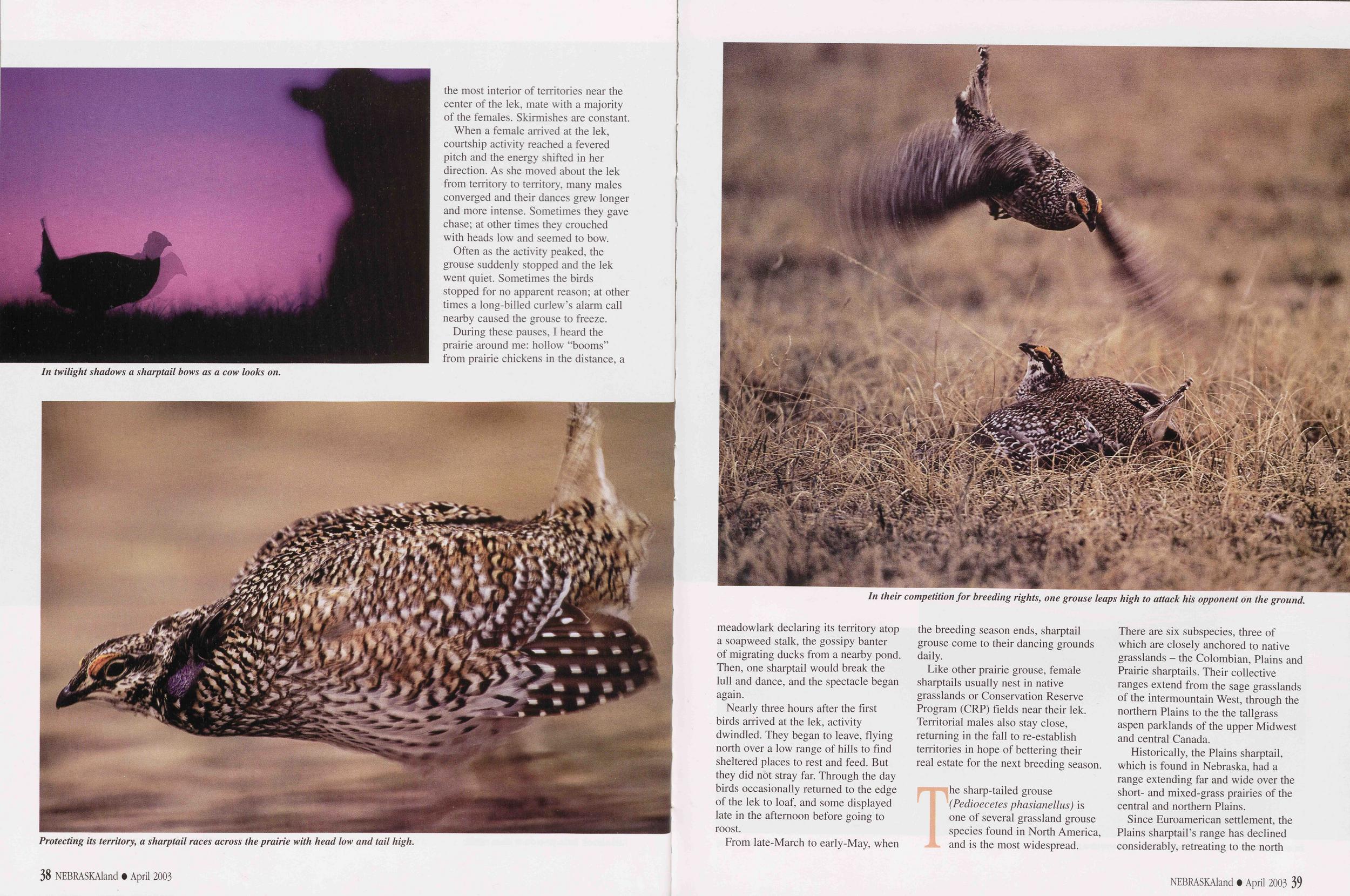
When a female arrived at the lek, courtship activity reached a fevered pitch and the energy shifted in her direction. As she moved about the lek from territory to territory, many males converged and their dances grew longer and more intense. Sometimes they gave chase; at other times they crouched with heads low and seemed to bow.
Often as the activity peaked, the grouse suddenly stopped and the lek went quiet. Sometimes the birds stopped for no apparent reason; at other times a long-billed curlew's alarm call nearby caused the grouse to freeze.
During these pauses, I heard the prairie around me: hollow "booms" from prairie chickens in the distance, a
Nearly three hours after the first birds arrived at the lek, activity dwindled. They began to leave, flying north over a low range of hills to find sheltered places to rest and feed. But they did not stray far. Through the day birds occasionally returned to the edge of the lek to loaf, and some displayed late in the afternoon before going to roost.
From late-March to early-May, when the breeding season ends, sharptail grouse come to their dancing grounds daily.
Like other prairie grouse, female sharptails usually nest in native grasslands or Conservation Reserve Program (CRP) fields near their lek. Territorial males also stay close, returning in the fall to re-establish territories in hope of bettering their real estate for the next breeding season.
The sharp-tailed grouse (Pedioecetes phasianellus) is one of several grassland grouse species found in North America, and is the most widespread. There are six subspecies, three of which are closely anchored to native grasslands - the Colombian, Plains and Prairie sharptails. Their collective ranges extend from the sage grasslands of the intermountain West, through the northern Plains to the the tallgrass aspen parklands of the upper Midwest and central Canada.
Historically, the Plains sharptail, which is found in Nebraska, had a range extending far and wide over the short- and mixed-grass prairies of the central and northern Plains.
Since Euroamerican settlement, the
Plains sharptail's range has declined
considerably, retreating to the north
NEBRASKAland • April 2003 39
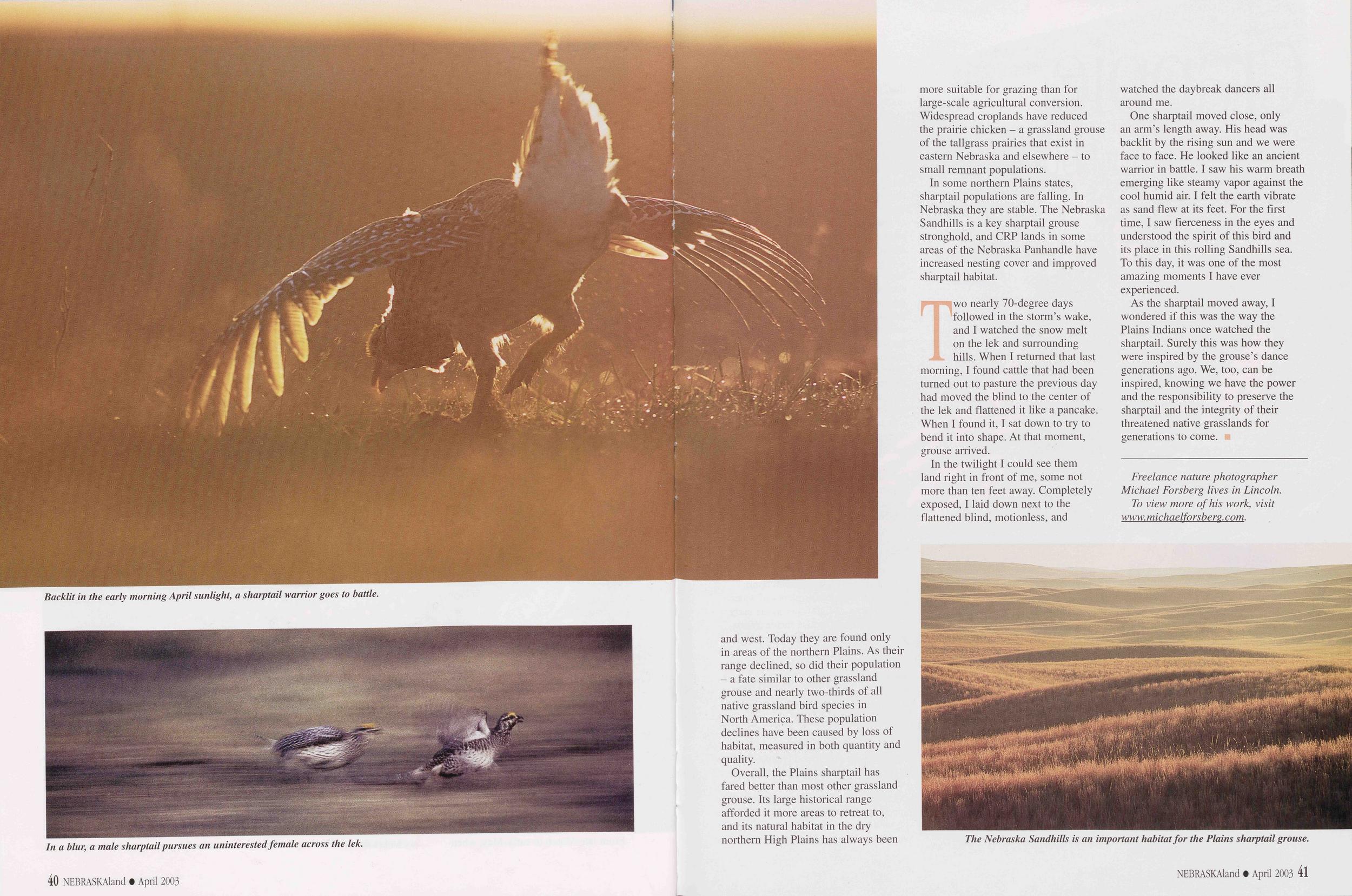
Overall, the Plains sharptail has fared better than most other grassland grouse. Its large historical range afforded it more areas to retreat to, and its natural habitat in the dry northern High Plains has always been more suitable for grazing than for large-scale agricultural conversion. Widespread croplands have reduced the prairie chicken - a grassland grouse of the tallgrass prairies that exist in eastern Nebraska and elsewhere - to small remnant populations.
In some northern Plains states, sharptail populations are falling. In Nebraska they are stable. The Nebraska Sandhills is a key sharptail grouse stronghold, and CRP lands in some areas of the Nebraska Panhandle have increased nesting cover and improved sharptail habitat.
Two nearly 70-degree days followed in the storm's wake, and I watched the snow melt on the lek and surrounding hills. When I returned that last morning, I found cattle that had been turned out to pasture the previous day had moved the blind to the center of the lek and flattened it like a pancake. When I found it, I sat down to try to bend it into shape. At that moment, grouse arrived.
In the twilight I could see them land right in front of me, some not more than ten feet away. Completely exposed, I laid down next to the flattened blind, motionless, and watched the daybreak dancers all around me.
One sharptail moved close, only an arm's length away. His head was backlit by the rising sun and we were face to face. He looked like an ancient warrior in battle. I saw his warm breath emerging like steamy vapor against the cool humid air. I felt the earth vibrate as sand flew at its feet. For the first time, I saw fierceness in the eyes and understood the spirit of this bird and its place in this rolling Sandhills sea. To this day, it was one of the most amazing moments I have ever experienced.
As the sharptail moved away, I wondered if this was the way the Plains Indians once watched the sharptail. Surely this was how they were inspired by the grouse's dance generations ago. We, too, can be inspired, knowing we have the power and the responsibility to preserve the sharptail and the integrity of their threatened native grasslands for generations to come.
Freelance nature photographer Michael Forsberg lives in Lincoln.
To view more of his work, visit www, michaelforsberg. com.
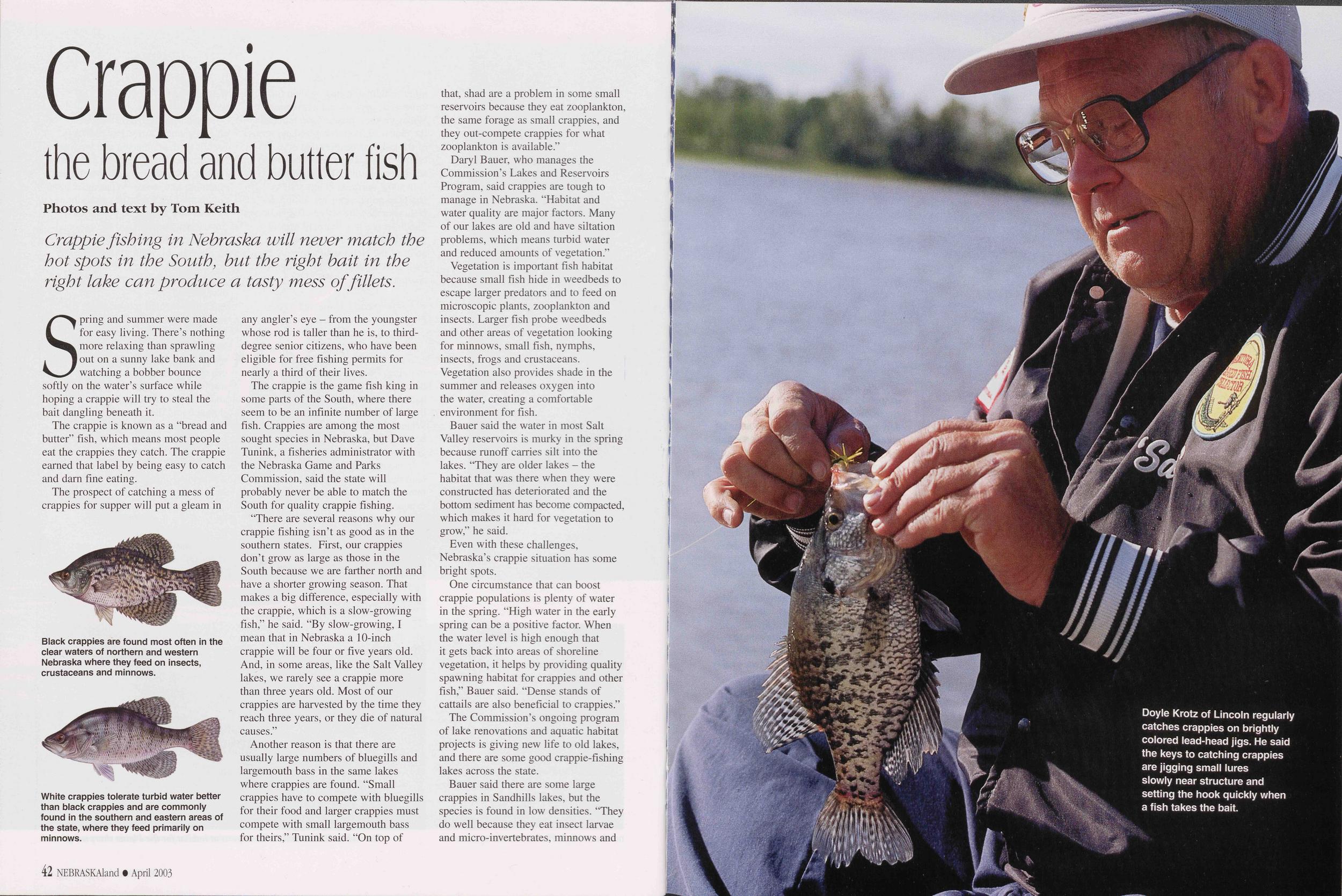
Crappie the bread and butter fish
Photos and text by Tom Keith Crappie fishing in Nebraska will never match the hot spots in the South, but the right bait in the right lake can produce a tasty mess of fillets.Spring and summer were made for easy living. There's nothing more relaxing than sprawling out on a sunny lake bank and watching a bobber bounce softly on the water's surface while hoping a crappie will try to steal the bait dangling beneath it.
The crappie is known as a "bread and butter" fish, which means most people eat the crappies they catch. The crappie earned that label by being easy to catch and darn fine eating.
The prospect of catching a mess of crappies for supper will put a gleam in
The crappie is the game fish king in some parts of the South, where there seem to be an infinite number of large fish. Crappies are among the most sought species in Nebraska, but Dave Tunink, a fisheries administrator with the Nebraska Game and Parks Commission, said the state will probably never be able to match the South for quality crappie fishing.
"There are several reasons why our crappie fishing isn't as good as in the southern states. First, our crappies don't grow as large as those in the South because we are farther north and have a shorter growing season. That makes a big difference, especially with the crappie, which is a slow-growing fish," he said. "By slow-growing, I mean that in Nebraska a 10-inch crappie will be four or five years old. And, in some areas, like the Salt Valley lakes, we rarely see a crappie more than three years old. Most of our crappies are harvested by the time they reach three years, or they die of natural causes."
Another reason is that there are usually large numbers of bluegills and largemouth bass in the same lakes where crappies are found. "Small crappies have to compete with bluegills for their food and larger crappies must compete with small largemouth bass for theirs," Tunink said. "On top of that, shad are a problem in some small reservoirs because they eat zooplankton, the same forage as small crappies, and they out-compete crappies for what zooplankton is available."
Daryl Bauer, who manages the Commission's Lakes and Reservoirs Program, said crappies are tough to manage in Nebraska. "Habitat and water quality are major factors. Many of our lakes are old and have siltation problems, which means turbid water and reduced amounts of vegetation."
Vegetation is important fish habitat because small fish hide in weedbeds to escape larger predators and to feed on microscopic plants, zooplankton and insects. Larger fish probe weedbeds and other areas of vegetation looking for minnows, small fish, nymphs, insects, frogs and crustaceans. Vegetation also provides shade in the summer and releases oxygen into the water, creating a comfortable environment for fish.
Bauer said the water in most Salt Valley reservoirs is murky in the spring because runoff carries silt into the lakes. "They are older lakes - the habitat that was there when they were constructed has deteriorated and the bottom sediment has become compacted, which makes it hard for vegetation to grow," he said.
Even with these challenges, Nebraska's crappie situation has some bright spots.
One circumstance that can boost crappie populations is plenty of water in the spring. "High water in the early spring can be a positive factor. When the water level is high enough that it gets back into areas of shoreline vegetation, it helps by providing quality spawning habitat for crappies and other fish," Bauer said. "Dense stands of cattails are also beneficial to crappies."
The Commission's ongoing program of lake renovations and aquatic habitat projects is giving new life to old lakes, and there are some good crappie-fishing lakes across the state.
Bauer said there are some large crappies in Sandhills lakes, but the species is found in low densities. "They do well because they eat insect larvae and micro-invertebrates, minnows and 42 NEBRASKAland • April 2003
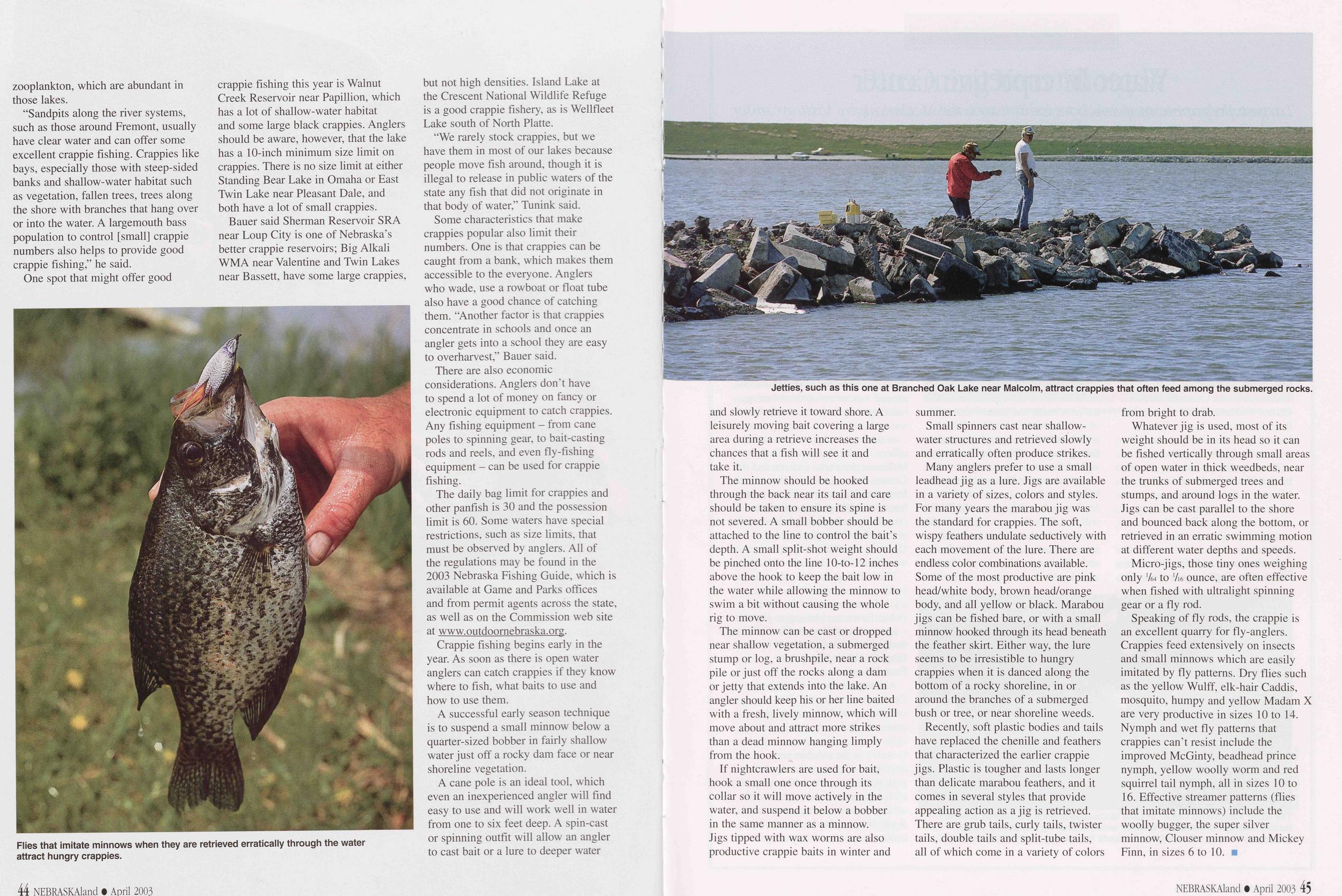 zooplankton, which are abundant in
those lakes.
zooplankton, which are abundant in
those lakes.
"Sandpits along the river systems, such as those around Fremont, usually have clear water and can offer some excellent crappie fishing. Crappies like bays, especially those with steep-sided banks and shallow-water habitat such as vegetation, fallen trees, trees along the shore with branches that hang over or into the water. A largemouth bass population to control [small] crappie numbers also helps to provide good crappie fishing," he said.
One spot that might offer good crappie fishing this year is Walnut Creek Reservoir near Papillion, which has a lot of shallow-water habitat and some large black crappies. Anglers should be aware, however, that the lake has a 10-inch minimum size limit on crappies. There is no size limit at either Standing Bear Lake in Omaha or East Twin Lake near Pleasant Dale, and both have a lot of small crappies.
Bauer said Sherman Reservoir SRA near Loup City is one of Nebraska's better crappie reservoirs; Big Alkali WMA near Valentine and Twin Lakes near Bassett, have some large crappies,
"We rarely stock crappies, but we have them in most of our lakes because people move fish around, though it is illegal to release in public waters of the state any fish that did not originate in that body of water," Tunink said.
Some characteristics that make crappies popular also limit their numbers. One is that crappies can be caught from a bank, which makes them accessible to the everyone. Anglers who wade, use a rowboat or float tube also have a good chance of catching them. "Another factor is that crappies concentrate in schools and once an angler gets into a school they are easy to over harvest," Bauer said.
There are also economic considerations. Anglers don't have to spend a lot of money on fancy or electronic equipment to catch crappies. Any fishing equipment - from cane poles to spinning gear, to bait-casting rods and reels, and even fly-fishing equipment - can be used for crappie fishing.
The daily bag limit for crappies and other panfish is 30 and the possession limit is 60. Some waters have special restrictions, such as size limits, that must be observed by anglers. All of the regulations may be found in the 2003 Nebraska Fishing Guide, which is available at Game and Parks offices and from permit agents across the state, as well as on the Commission web site at www.outdoornebraska.org.
Crappie fishing begins early in the year. As soon as there is open water anglers can catch crappies if they know where to fish, what baits to use and how to use them.
A successful early season technique is to suspend a small minnow below a quarter-sized bobber in fairly shallow water just off a rocky dam face or near shoreline vegetation.
A cane pole is an ideal tool, which even an inexperienced angler will find easy to use and will work well in water from one to six feet deep. A spin-cast or spinning outfit will allow an angler to cast bait or a lure to deeper water 44 NEBRASKAland • April 2003
The minnow should be hooked through the back near its tail and care should be taken to ensure its spine is not severed. A small bobber should be attached to the line to control the bait's depth. A small split-shot weight should be pinched onto the line 10-to-12 inches above the hook to keep the bait low in the water while allowing the minnow to swim a bit without causing the whole rig to move.
The minnow can be cast or dropped near shallow vegetation, a submerged stump or log, a brush pile, near a rock pile or just off the rocks along a dam or jetty that extends into the lake. An angler should keep his or her line baited with a fresh, lively minnow, which will move about and attract more strikes than a dead minnow hanging limply from the hook.
If nightcrawlers are used for bait, hook a small one once through its collar so it will move actively in the water, and suspend it below a bobber in the same manner as a minnow. Jigs tipped with wax worms are also productive crappie baits in winter and summer.
Small spinners cast near shallow- water structures and retrieved slowly and erratically often produce strikes.
Many anglers prefer to use a small lead head jig as a lure. Jigs are available in a variety of sizes, colors and styles. For many years the marabou jig was the standard for crappies. The soft, wispy feathers undulate seductively with each movement of the lure. There are endless color combinations available. Some of the most productive are pink head/white body, brown head/orange body, and all yellow or black. Marabou jigs can be fished bare, or with a small minnow hooked through its head beneath the feather skirt. Either way, the lure seems to be irresistible to hungry crappies when it is danced along the bottom of a rocky shoreline, in or around the branches of a submerged bush or tree, or near shoreline weeds.
Recently, soft plastic bodies and tails have replaced the chenille and feathers that characterized the earlier crappie jigs. Plastic is tougher and lasts longer than delicate marabou feathers, and it comes in several styles that provide appealing action as a jig is retrieved. There are grub tails, curly tails, twister tails, double tails and split-tube tails, all of which come in a variety of colors from bright to drab.
Whatever jig is used, most of its weight should be in its head so it can be fished vertically through small areas of open water in thick weed beds, near the trunks of submerged trees and stumps, and around logs in the water. Jigs can be cast parallel to the shore and bounced back along the bottom, or retrieved in an erratic swimming motion at different water depths and speeds.
Micro-jigs, those tiny ones weighing only llu to Vi6 ounce, are often effective when fished with ultralight spinning gear or a fly rod.
Speaking of fly rods, the crappie is an excellent quarry for fly-anglers. Crappies feed extensively on insects and small minnows which are easily imitated by fly patterns. Dry flies such as the yellow Wulff, elk-hair Caddis, mosquito, humpy and yellow Madam X are very productive in sizes 10 to 14. Nymph and wet fly patterns that crappies can't resist include the improved McGinty, bead head prince nymph, yellow woolly worm and red squirrel tail nymph, all in sizes 10 to 16. Effective streamer patterns (flies that imitate minnows) include the woolly bugger, the super silver minnow, Clouser minnow and Mickey Finn, in sizes 6 to 10.
NEBRASKAland • April 2003 45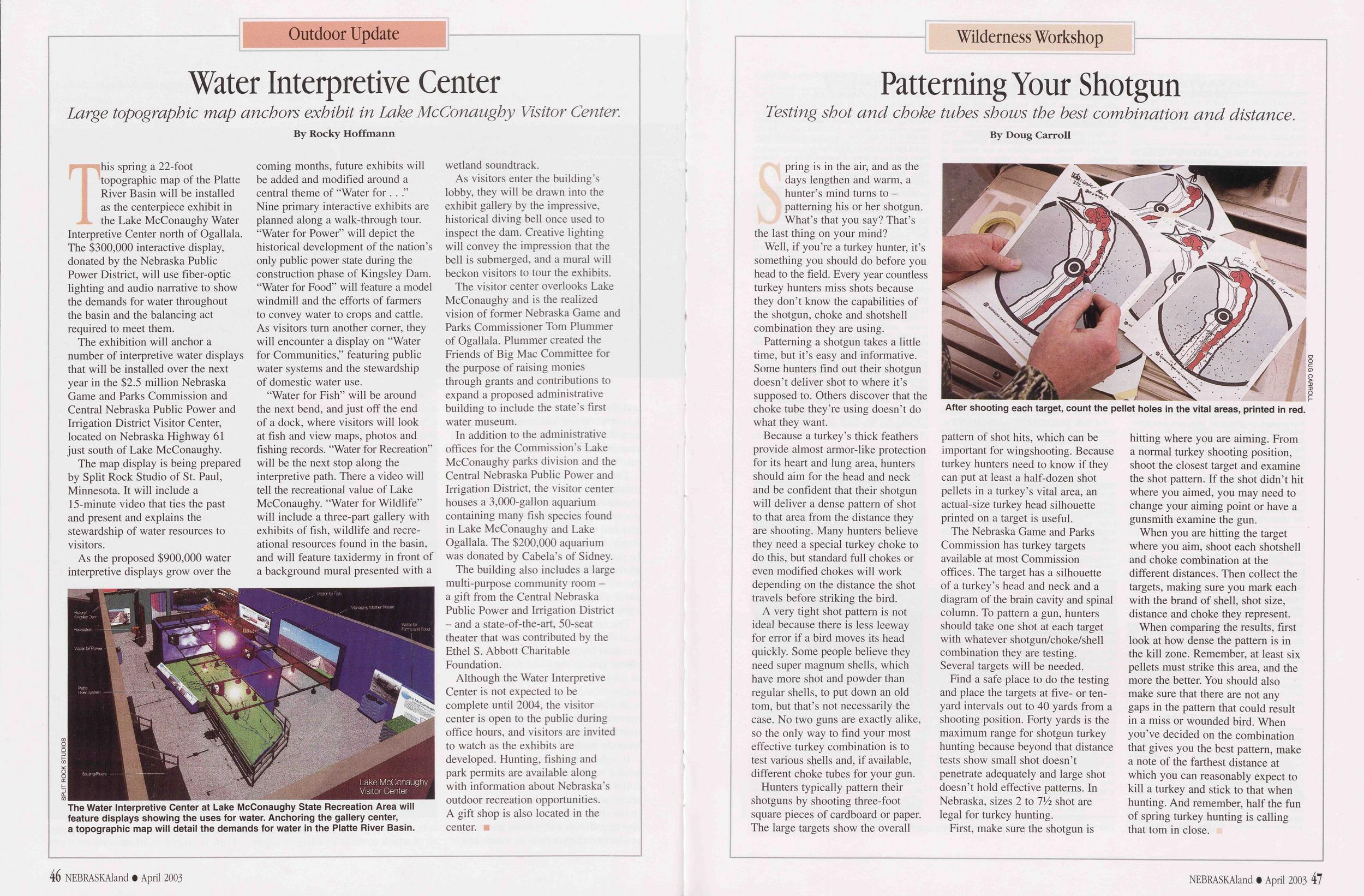
Outdoor Update
Water Interpretive Center
Large topographic map anchors exhibit in Lake McConaughy Visitor Center. By Rocky HoffmannThis spring a 22-foot topographic map of the Platte River Basin will be installed as the centerpiece exhibit in the Lake McConaughy Water Interpretive Center north of Ogallala. The $300,000 interactive display, donated by the Nebraska Public Power District, will use fiber-optic lighting and audio narrative to show the demands for water throughout the basin and the balancing act required to meet them.
The exhibition will anchor a number of interpretive water displays that will be installed over the next year in the $2.5 million Nebraska Game and Parks Commission and Central Nebraska Public Power and Irrigation District Visitor Center, located on Nebraska Highway 61 just south of Lake McConaughy.
The map display is being prepared by Split Rock Studio of St. Paul, Minnesota. It will include a 15-minute video that ties the past and present and explains the stewardship of water resources to visitors.
As the proposed $900,000 water interpretive displays grow over the coming months, future exhibits will be added and modified around a central theme of "Water for . . ." Nine primary interactive exhibits are planned along a walk-through tour. "Water for Power" will depict the historical development of the nation's only public power state during the construction phase of Kingsley Dam. "Water for Food" will feature a model windmill and the efforts of farmers to convey water to crops and cattle. As visitors turn another corner, they will encounter a display on "Water for Communities," featuring public water systems and the stewardship of domestic water use.
"Water for Fish" will be around the next bend, and just off the end of a dock, where visitors will look at fish and view maps, photos and fishing records. "Water for Recreation" will be the next stop along the interpretive path. There a video will tell the recreational value of Lake McConaughy. "Water for Wildlife" will include a three-part gallery with exhibits of fish, wildlife and recreational resources found in the basin, and will feature taxidermy in front of a background mural presented with a
As visitors enter the building's lobby, they will be drawn into the exhibit gallery by the impressive, historical diving bell once used to inspect the dam. Creative lighting will convey the impression that the bell is submerged, and a mural will beckon visitors to tour the exhibits.
The visitor center overlooks Lake McConaughy and is the realized vision of former Nebraska Game and Parks Commissioner Tom Plummer of Ogallala. Plummer created the Friends of Big Mac Committee for the purpose of raising monies through grants and contributions to expand a proposed administrative building to include the state's first water museum.
In addition to the administrative offices for the Commission's Lake McConaughy parks division and the Central Nebraska Public Power and Irrigation District, the visitor center houses a 3,000-gallon aquarium containing many fish species found in Lake McConaughy and Lake Ogallala. The $200,000 aquarium was donated by Cabela's of Sidney.
The building also includes a large multi-purpose community room - a gift from the Central Nebraska Public Power and Irrigation District - and a state-of-the-art, 50-seat theater that was contributed by the Ethel S. Abbott Charitable Foundation.
Although the Water Interpretive Center is not expected to be complete until 2004, the visitor center is open to the public during office hours, and visitors are invited to watch as the exhibits are developed. Hunting, fishing and park permits are available along with information about Nebraska's outdoor recreation opportunities. A gift shop is also located in the center.
46 NEBRASKAland • April 2003Wilderness Workshop
Patterning Your Shotgun
Testing shot and choke tubes shows the best combination and distance. By Doug CarrollSpring is in the air, and as the days lengthen and warm, a hunter's mind turns to - patterning his or her shotgun. What's that you say? That's the last thing on your mind?
Well, if you're a turkey hunter, it's something you should do before you head to the field. Every year countless turkey hunters miss shots because they don't know the capabilities of the shotgun, choke and shot shell combination they are using.
Patterning a shotgun takes a little time, but it's easy and informative. Some hunters find out their shotgun doesn't deliver shot to where it's supposed to. Others discover that the choke tube they're using doesn't do what they want.
Because a turkey's thick feathers provide almost armor-like protection for its heart and lung area, hunters should aim for the head and neck and be confident that their shotgun will deliver a dense pattern of shot to that area from the distance they are shooting. Many hunters believe they need a special turkey choke to do this, but standard full chokes or even modified chokes will work depending on the distance the shot travels before striking the bird.
A very tight shot pattern is not ideal because there is less leeway for error if a bird moves its head quickly. Some people believe they need super magnum shells, which have more shot and powder than regular shells, to put down an old torn, but that's not necessarily the case. No two guns are exactly alike, so the only way to find your most effective turkey combination is to test various shells and, if available, different choke tubes for your gun.
Hunters typically pattern their shotguns by shooting three-foot square pieces of cardboard or paper. The large targets show the overall
The Nebraska Game and Parks Commission has turkey targets available at most Commission offices. The target has a silhouette of a turkey's head and neck and a diagram of the brain cavity and spinal column. To pattern a gun, hunters should take one shot at each target with whatever shotgun/choke/shell combination they are testing. Several targets will be needed.
Find a safe place to do the testing and place the targets at five- or ten-yard intervals out to 40 yards from a shooting position. Forty yards is the maximum range for shotgun turkey hunting because beyond that distance tests show small shot doesn't penetrate adequately and large shot doesn't hold effective patterns. In Nebraska, sizes 2 to IV shot are legal for turkey hunting.
First, make sure the shotgun is hitting where you are aiming. From a normal turkey shooting position, shoot the closest target and examine the shot pattern. If the shot didn't hit where you aimed, you may need to change your aiming point or have a gunsmith examine the gun.
When you are hitting the target where you aim, shoot each shot shell and choke combination at the different distances. Then collect the targets, making sure you mark each with the brand of shell, shot size, distance and choke they represent.
When comparing the results, first look at how dense the pattern is in the kill zone. Remember, at least six pellets must strike this area, and the more the better. You should also make sure that there are not any gaps in the pattern that could result in a miss or wounded bird. When you've decided on the combination that gives you the best pattern, make a note of the farthest distance at which you can reasonably expect to kill a turkey and stick to that when hunting. And remember, half the fun of spring turkey hunting is calling that torn in close.
NEBRASKAland • April 2003 47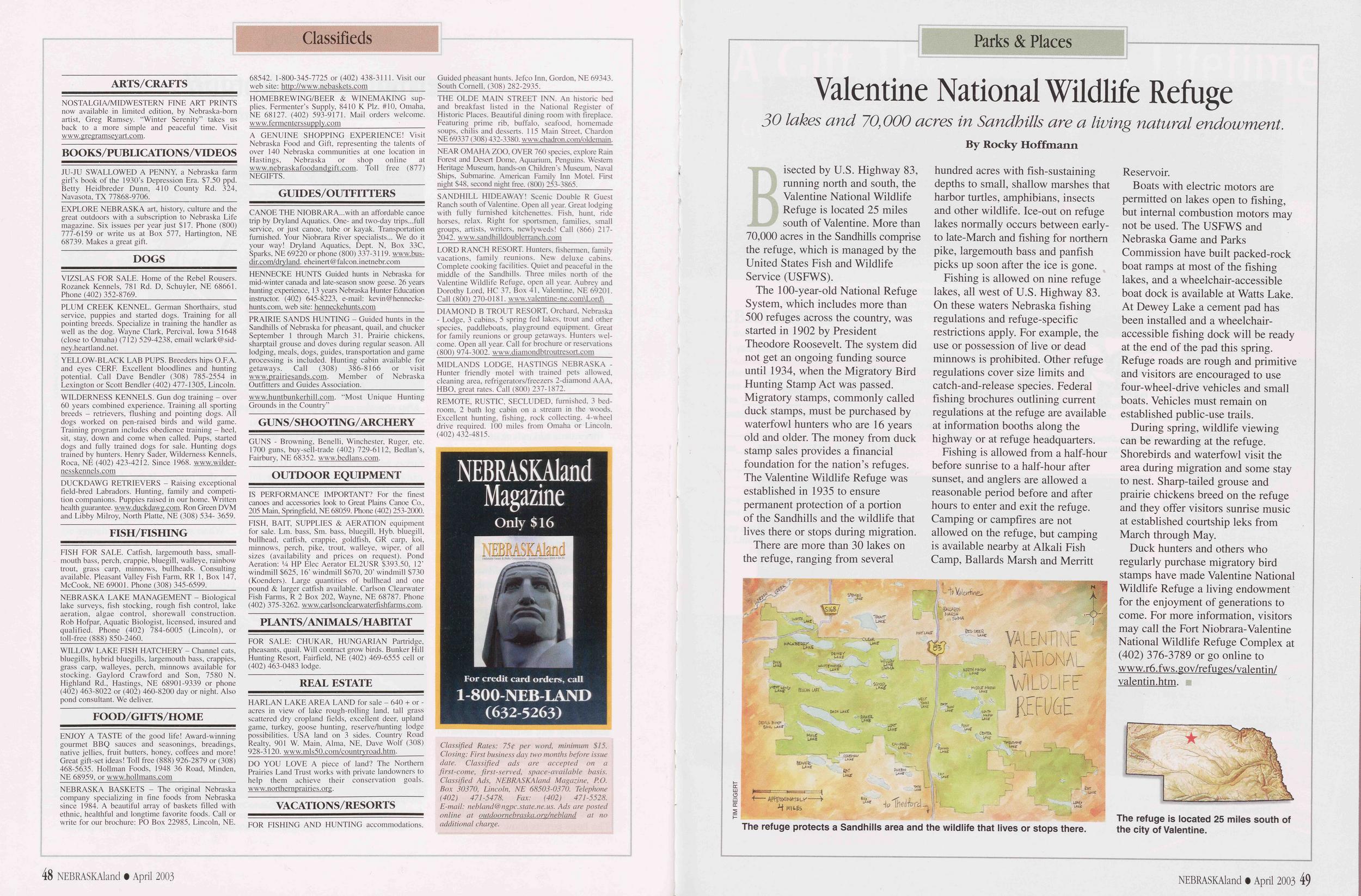
Classifieds
ARTS/CRAFTSNOSTALGIA/MIDWESTERN FINE ART PRINTS now available in limited edition, by Nebraska-born artist, Greg Ramsey. "Winter Serenity" takes us back to a more simple and peaceful time. Visit www.gregramseyart.com.
BOOKS/PUBLICATIONS/VIDEOSJU-JU SWALLOWED A PENNY, a Nebraska farm girl's book of the 1930's Depression Era. $7.50 ppd. Betty Heidbreder Dunn, 410 County Rd. 324, Navasota, TX 77868-9706._______________________
EXPLORE NEBRASKA art, history, culture and the great outdoors with a subscription to Nebraska Life magazine. Six issues per year just $17. Phone (800) 777-6159 or write us at Box 577, Hartington, NE 68739. Makes a great gift.
DOGSVIZSLAS FOR SALE. Home of the Rebel Rousers. Rozanek Kennels, 781 Rd. D, Schuyler, NE 68661. Phone (402) 352-8769.___________________________
PLUM CREEK KENNEL. German Shorthairs, stud service, puppies and started dogs. Training for all pointing breeds. Specialize in training the handler as well as the dog. Wayne Clark, Percival, Iowa 51648 (close to Omaha) (712) 529-4238, email wclark@sidney.heartland.net.
YELLOW-BLACK LAB PUPS. Breeders hips O.F.A. and eyes CERF. Excellent bloodlines and hunting potential. Call Dave Bendler (308) 785-2554 in Lexington or Scott Bendler (402) 477-1305, Lincoln.
WILDERNESS KENNELS. Gun dog training - over 60 years combined experience. Training all sporting breeds - retrievers, flushing and pointing dogs. All dogs worked on pen-raised birds and wild game. Training program includes obedience training - heel, sit, stay, down and come when called. Pups, started dogs and fully trained dogs for sale. Hunting dogs trained by hunters. Henry Sader, Wilderness Kennels, Roca, NE (402) 423-4212. Since 1968. www.wildernesskennels.com
DUCKDAWG RETRIEVERS - Raising exceptional field-bred Labradors. Hunting, family and competition companions. Puppies raised in our home. Written health guarantee, www.duckdawg.com. Ron Green DVM and Libby Milroy, North Platte, NE (308) 534- 3659.
FISH/FISHINGFISH FOR SALE. Catfish, largemouth bass, small- mouth bass, perch, crappie, bluegill, walleye, rainbow trout, grass carp, minnows, bullheads. Consulting available. Pleasant Valley Fish Farm, RR 1, Box 147, McCook, NE 69001. Phone (308) 345-6599.________
NEBRASKA LAKE MANAGEMENT - Biological lake surveys, fish stocking, rough fish control, lake aeration, algae control, shorewall construction. Rob Hofpar, Aquatic Biologist, licensed, insured and qualified. Phone (402) 784-6005 (Lincoln), or toll-free (888) 850-2460._________________________
WILLOW LAKE FISH HATCHERY - Channel cats, bluegills, hybrid bluegills, largemouth bass, crappies, grass carp, walleyes, perch, minnows available for stocking. Gaylord Crawford and Son, 7580 N. Highland Rd., Hastings, NE 68901-9339 or phone (402) 463-8022 or (402) 460-8200 day or night. Also pond consultant. We deliver.
FOOD/GIFTS/HQMEENJOY A TASTE of the good life! Award-winning gourmet BBQ sauces and seasonings, breadings, native jellies, fruit butters, honey, coffees and more! Great gift-set ideas! Toll free (888) 926-2879 or (308) 468-5635. Hollman Foods, 1948 36 Road, Minden, NE 68959, or www.hollmans.com
NEBRASKA BASKETS - The original Nebraska company specializing in fine foods from Nebraska since 1984. A beautiful array of baskets filled with ethnic, healthful and longtime favorite foods. Call or write for our brochure: PO Box 22985, Lincoln, NE. 68542. 1-800-345-7725 or (402) 438-3111. Visit our web site: http://www.nebaskets.com
HOMEBREWING/BEER & WINEMAKING supplies. Fermenter's Supply, 8410 K Plz. #10, Omaha, NE 68127. (402) 593-9171. Mail orders welcome. www.fermenterssupply.com________________
A GENUINE SHOPPING EXPERIENCE! Visit Nebraska Food and Gift, representing the talents of over 140 Nebraska communities at one location in Hastings, Nebraska or shop online at www.nebraskafoodandgift.com. Toll free (877) NEGIFTS.
GUIDES/OUTFITTERSCANOE THE NIOBRARA...with an affordable canoe trip by Dryland Aquatics. One- and two-day trips...full service, or just canoe, tube or kayak. Transportation furnished. Your Niobrara River specialists... We do it your way! Dryland Aquatics, Dept. N, Box 33C, Sparks, NE 69220 or phone (800) 337-3119. www.busdir.com/dryland. eheinert@falcon.inetnebr.com
HENNECKE HUNTS Guided hunts in Nebraska for mid-winter Canada and late-season snow geese. 26 years hunting experience, 13 years Nebraska Hunter Education instructor. (402) 645-8223, e-mail: kevin@henneckehunts.com, web site: henneckehunts.com
PRAIRIE SANDS HUNTING - Guided hunts in the Sandhills of Nebraska for pheasant, quail, and chucker September 1 through March 31. Prairie chickens, sharptail grouse and doves during regular season. All lodging, meals, dogs, guides, transportation and game processing is included. Hunting cabin available for getaways. Call (308) 386-8166 or visit www.prairiesands.com. Member of Nebraska Outfitters and Guides Association.
www.huntbunkerhill.com. "Most Unique Hunting Grounds in the Country"
GUNS/SHOOTING/ARCHERYGUNS - Browning, Benelli, Winchester, Ruger, etc. 1700 guns, buy-sell-trade (402) 729-6112, Bedlan's, Fairbury, NE 68352. www.bedlans.com.
OUTDOOR EQUIPMENTIS PERFORMANCE IMPORTANT? For the finest canoes and accessories look to Great Plains Canoe Co., 205 Main, Springfield, NE 68059. Phone (402) 253-2000.
FISH, BAIT, SUPPLIES & AERATION equipment for sale. Lm. bass, Sm. bass, bluegill, Hyb. bluegill, bullhead, catfish, crappie, goldfish, GR carp, koi, minnows, perch, pike, trout, walleye, wiper, of all sizes (availability and prices on request). Pond Aeration: V* HP Elec Aerator EL2USR $393.50, 12' windmill $625, 16' windmill $670, 20' windmill $730 (Koenders). Large quantities of bullhead and one pound & larger catfish available. Carlson Clearwater Fish Farms, R 2 Box 202, Wayne, NE 68787. Phone (402) 375-3262. www.carlsonclearwaterfishfaiTns.com.
PIANTS/ANIMALS/HABITATFOR SALE: CHUKAR, HUNGARIAN Partridge, pheasants, quail. Will contract grow birds. Bunker Hill Hunting Resort, Fairfield, NE (402) 469-6555 cell or (402) 463-0483 lodge.
REAL ESTATEHARLAN LAKE AREA LAND for sale - 640 + or - acres in view of lake rough-rolling land, tall grass scattered dry cropland fields, excellent deer, upland game, turkey, goose hunting, reserve/hunting lodge possibilities. USA land on 3 sides. Country Road Realty, 901 W. Main, Alma, NE, Dave Wolf (308) 928-3120. www.mls50.conVcountryroad.htrn._______
DO YOU LOVE A piece of land? The Northern Prairies Land Trust works with private landowners to help them achieve their conservation www.northernprairies.org. goals.
VACATIONS/RESORTSFOR FISHING AND HUNTING accommodations. Guided pheasant hunts. Jefco Inn, Gordon, NE 69343. South Cornell, (308) 282-2935.___________________
THE OLDE MAIN STREET INN. An historic bed and breakfast listed in the National Register of Historic Places. Beautiful dining room with fireplace. Featuring prime rib, buffalo, seafood, homemade soups, chilis and desserts. 115 Main Street. Chardon NE 69337 (308) 432-3380. www.chadron.com/oldemain.
NEAR OMAHA ZOO, OVER 760 species, explore Rain Forest and Desert Dome, Aquarium. Penguins. Western Heritage Museum, hands-on Children's Museum, Naval Ships, Submarine. American Family Inn Motel. First night $48, second night free. (800) 253-3865._________
SANDHILL HIDEAWAY! Scenic Double R Guest Ranch south of Valentine. Open all year. Great lodging with fully furnished kitchenettes. Fish, hunt, ride horses, relax. Right for sportsmen, families, small groups, artists, writers, newlyweds! Call (866) 217-2042. www.sandhilldoubleiTanch.com
LORD RANCH RESORT. Hunters, fishermen, family vacations, family reunions. New deluxe cabins. Complete cooking facilities. Quiet and peaceful in the middle of the Sandhills. Three miles north of the Valentine Wildlife Refuge, open all year. Aubrey and Dorothy Lord, HC 37, Box 41, Valentine, NE 69201. Call (800) 270-0181. www.valentine-ne.comVLord\
DIAMOND B TROUT RESORT, Orchard, Nebraska - Lodge, 3 cabins, 5 spring fed lakes, trout and other species, paddle boats, playground equipment. Great for family reunions or group getaways. Hunters welcome. Open all year. Call for brochure or reservations (800) 974-3002. www.diamondbtroutresortxom
MIDLANDS LODGE, HASTINGS NEBRASKA - Hunter friendly motel with trained pets allowed, cleaning area, refrigerators/freezers 2-diamond AAA. HBO, great rates. Call (800) 237-1872._____________
REMOTE. RUSTIC, SECLUDED, furnished. 3 bedroom, 2 bath log cabin on a stream in the woods. Excellent hunting, fishing, rock collecting. 4-wheel drive required. 100 miles from Omaha or Lincoln. (402)432-4815.
Classified Rates: 750 per word, minimum $15. Closing: First business day two months before issue date. Classified ads are accepted on a first-come, first-served, space-available basis. Classified Ads, NEBRASKAland Magazine, P.O. Box 30370, Lincoln, NE 68503-0370. Telephone (402) 471-5478. Fax: (402) 471-5528. E-mail: nebland@ngpc.state.ne.us. Ads are posted online at outdoornebraska.org/nebland at no additional charge.
48 NEBRASKAland • April 2003Parks & Places
Valentine National Wildlife Refuge
30 lakes and 70,000 acres in Sandhills are a living natural endowment. By Rocky HoffmannBisected by U.S. Highway 83, running north and south, the Valentine National Wildlife Refuge is located 25 miles south of Valentine. More than 70,000 acres in the Sandhills comprise the refuge, which is managed by the United States Fish and Wildlife Service (USFWS).
The 100-year-old National Refuge System, which includes more than 500 refuges across the country, was started in 1902 by President Theodore Roosevelt. The system did not get an ongoing funding source until 1934, when the Migratory Bird Hunting Stamp Act was passed. Migratory stamps, commonly called duck stamps, must be purchased by waterfowl hunters who are 16 years old and older. The money from duck stamp sales provides a financial foundation for the nation's refuges. The Valentine Wildlife Refuge was established in 1935 to ensure permanent protection of a portion of the Sandhills and the wildlife that lives there or stops during migration.
There are more than 30 lakes on the refuge, ranging from several hundred acres with fish-sustaining depths to small, shallow marshes that harbor turtles, amphibians, insects and other wildlife. Ice-out on refuge lakes normally occurs between early-to late-March and fishing for northern pike, largemouth bass and panfish picks up soon after the ice is gone.
Fishing is allowed on nine refuge lakes, all west of U.S. Highway 83. On these waters Nebraska fishing regulations and refuge-specific restrictions apply. For example, the use or possession of live or dead minnows is prohibited. Other refuge regulations cover size limits and catch-and-release species. Federal fishing brochures outlining current regulations at the refuge are available at information booths along the highway or at refuge headquarters.
Fishing is allowed from a half-hour before sunrise to a half-hour after sunset, and anglers are allowed a reasonable period before and after hours to enter and exit the refuge. Camping or campfires are not allowed on the refuge, but camping is available nearby at Alkali Fish Camp, Ballards Marsh and Merritt Reservoir.
Boats with electric motors are permitted on lakes open to fishing, but internal combustion motors may not be used. The USFWS and Nebraska Game and Parks Commission have built packed-rock boat ramps at most of the fishing lakes, and a wheelchair-accessible boat dock is available at Watts Lake. At Dewey Lake a cement pad has been installed and a wheelchair accessible fishing dock will be ready at the end of the pad this spring. Refuge roads are rough and primitive and visitors are encouraged to use four-wheel-drive vehicles and small boats. Vehicles must remain on established public-use trails.
During spring, wildlife viewing can be rewarding at the refuge. Shorebirds and waterfowl visit the area during migration and some stay to nest. Sharp-tailed grouse and prairie chickens breed on the refuge and they offer visitors sunrise music at established courtship leks from March through May.
Duck hunters and others who regularly purchase migratory bird stamps have made Valentine National Wildlife Refuge a living endowment for the enjoyment of generations to come. For more information, visitors may call the Fort Niobrara-Valentine National Wildlife Refuge Complex at (402) 376-3789 or go online to www.r6.fws.gov/refuges/va1entin/ valentin.htm.
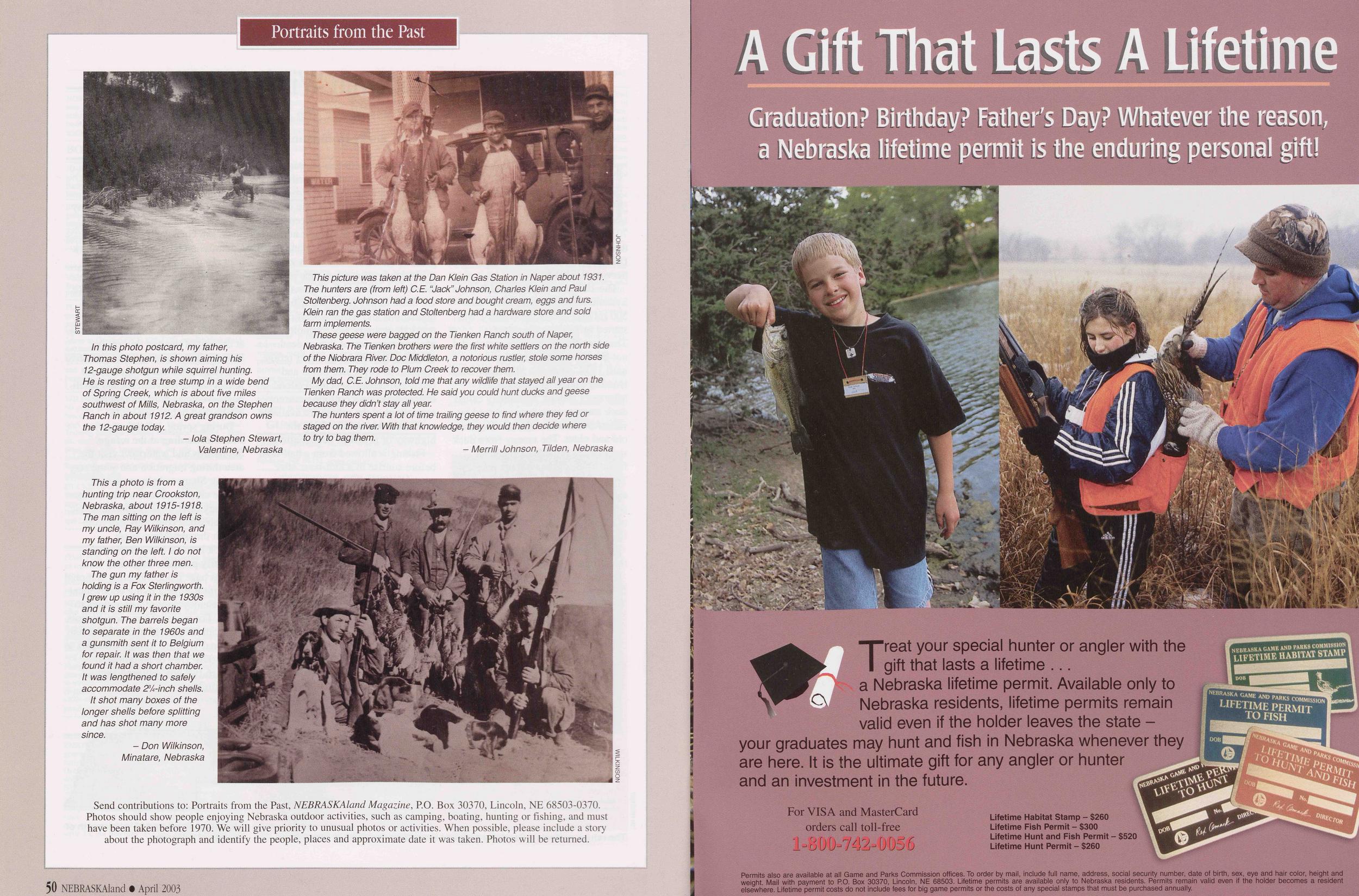
Portraits from the Past
In this photo postcard, my father, Thomas Stephen, is shown aiming his 12-gauge shotgun while squirrel hunting. He is resting on a tree stump in a wide bend of Spring Creek, which is about five miles southwest of Mills, Nebraska, on the Stephen Ranch in about 1912. A great grandson owns the 12-gauge today.
- lola Stephen Stewart, Valentine, NebraskaThis picture was taken at the Dan Klein Gas Station in Naper about 1931. The hunters are (from left) C.E. "Jack" Johnson, Charles Klein and Paul Stoltenberg. Johnson had a food store and bought cream, eggs and furs. Klein ran the gas station and Stoltenberg had a hardware store and sold farm implements.
These geese were bagged on the Tienken Ranch south of Naper, Nebraska. The Tienken brothers were the first white settlers on the north side of the Niobrara River. Doc Middleton, a notorious rustler, stole some horses from them. They rode to Plum Creek to recover them.
My dad, C.E. Johnson, told me that any wildlife that stayed all year on the Tienken Ranch was protected. He said you could hunt ducks and geese because they didn't stay all year.
The hunters spent a lot of time trailing geese to find where they fed or staged on the river. With that knowledge, they would then decide where to try to bag them.
- Merrill Johnson, Tilden, NebraskaThis a photo is from a hunting trip near Crookston, Nebraska, about 1915-1918. The man sitting on the left is my uncle, Ray Wilkinson, and my father, Ben Wilkinson, is standing on the left. I do not know the other three men.
The gun my father is holding is a Fox Sterlingworth. I grew up using it in the 1930s and it is still my favorite shotgun. The barrels began to separate in the 1960s and a gunsmith sent it to Belgium for repair. It was then that we found it had a short chamber. It was lengthened to safely accommodate 23A-inch shells.
It shot many boxes of the longer shells before splitting and has shot many more since.
- Don Wilkinson, Minatare, NebraskaSend contributions to: Portraits from the Past, NEBRASKAland Magazine, P.O. Box 30370, Lincoln, NE 68503-0370. Photos should show people enjoying Nebraska outdoor activities, such as camping, boating, hunting or fishing, and must have been taken before 1970. We will give priority to unusual photos or activities. When possible, please include a story about the photograph and identify the people, places and approximate date it was taken. Photos will be returned.
50 NEBRASKAland • April 2003 A Gift That Lasts A Lifetime Graduation? Birthday? Father's Day? Whatever the reason, a Nebraska lifetime permit is the enduring personal gift! treat your special hunter or angler with the gift that lasts a lifetime ... a Nebraska lifetime permit. Available only to Nebraska residents, lifetime permits remain valid even if the holder leaves the state - your graduates may hunt and fish in Nebraska whenever they are here. It is the ultimate gift for any angler or hunter and an investment in the future.
Position: 902 (6 views)