Volume 81, Issue 2, 2003
NEBRASKAland
Nebraska Game & Parks Commission March 2003 $2.50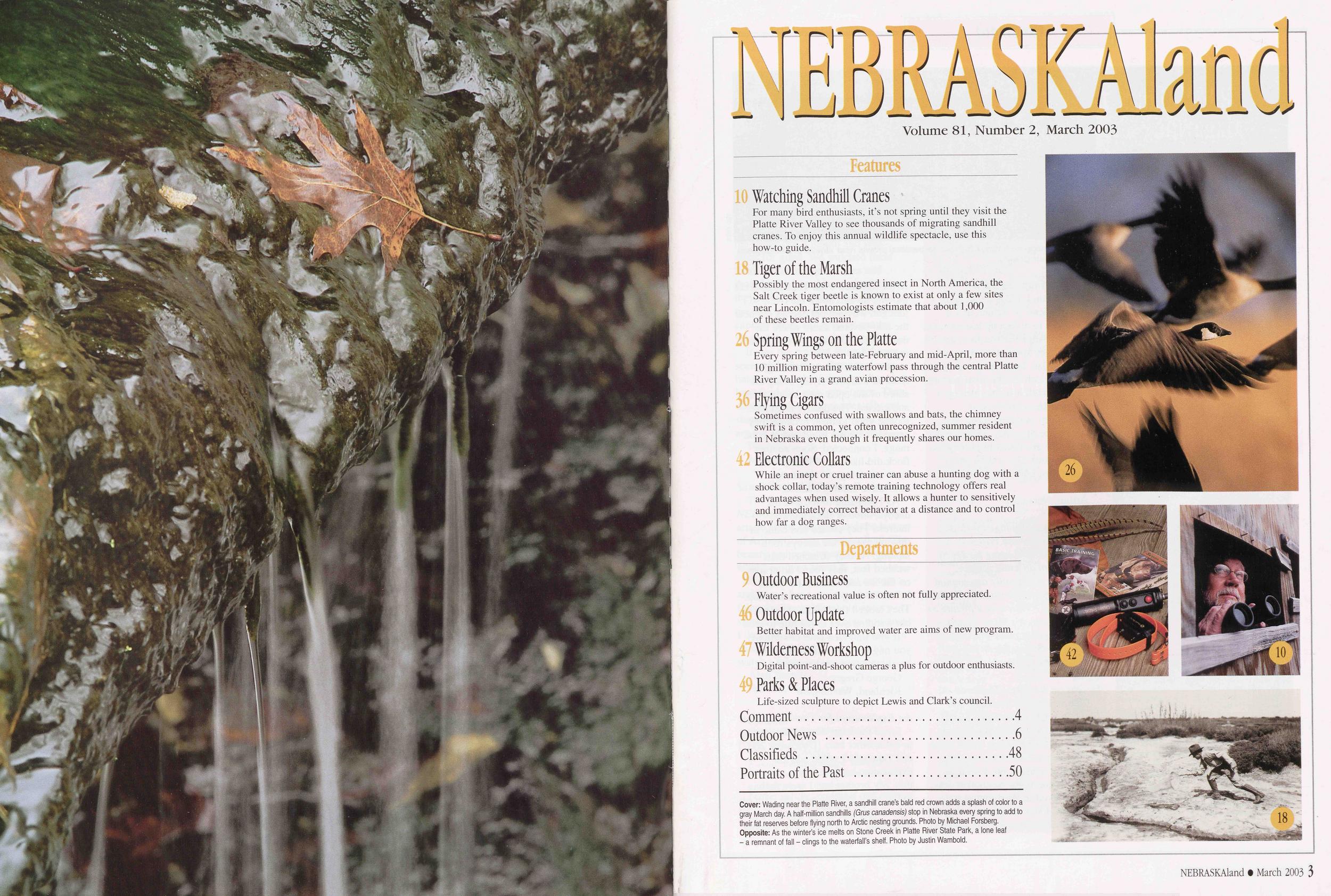
NEBRASKAland
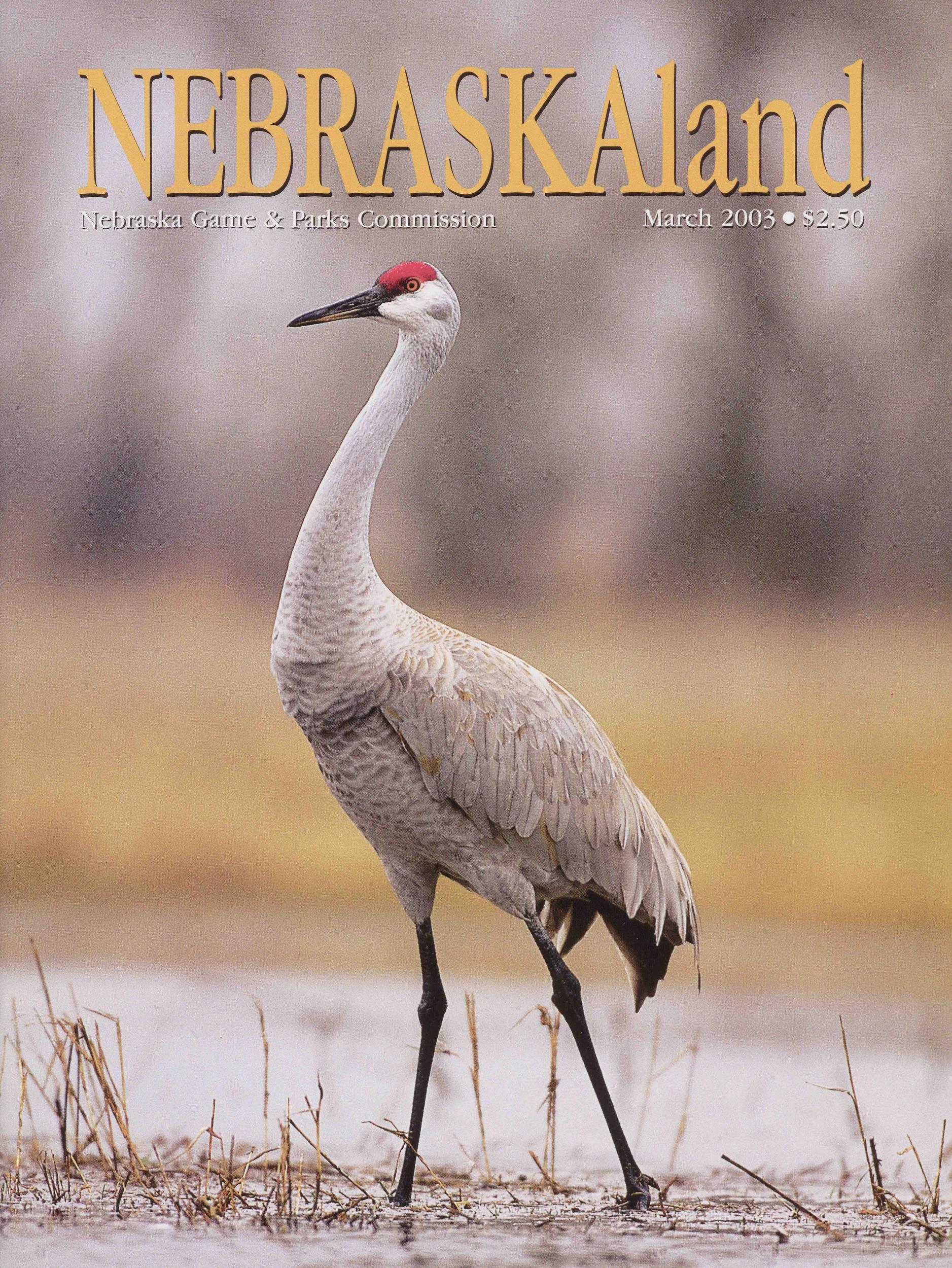
Volume 81, Number 2, March 2003 Features 10 Watching Sandhill Cranes For many bird enthusiasts, it's not spring until they visit the Platte River Valley to see thousands of migrating sandhill cranes. To enjoy this annual wildlife spectacle, use this how-to guide. 18 Tiger of the Marsh Possibly the most endangered insect in North America, the Salt Creek tiger beetle is known to exist at only a few sites near Lincoln. Entomologists estimate that about 1,000 of these beetles remain. 26 Spring Wings on the Platte Every spring between late-February and mid-April, more than 10 million migrating waterfowl pass through the central Platte River Valley in a grand avian procession. 36 Flying Cigars Sometimes confused with swallows and bats, the chimney swift is a common, yet often unrecognized, summer resident in Nebraska even though it frequently shares our homes. 42 Electronic Collars While an inept or cruel trainer can abuse a hunting dog with a shock collar, today's remote training technology offers real advantages when used wisely. It allows a hunter to sensitively and immediately correct behavior at a distance and to control how far a dog ranges. Departments 9 Outdoor Business Water's recreational value is often not fully appreciated. 46 Outdoor Update Better habitat and improved water are aims of new program. 47 Wilderness Workshop Digital point-and-shoot cameras a plus for outdoor enthusiasts. 49 Parks & Places Life-sized sculpture to depict Lewis and Clark's council. Comment ....................,,......4 Outdoor News ............................6 Classifieds ..............................48 Portraits of the Past .......................50 Cover: Wading near the Platte River, a sandhill crane's bald red crown adds a splash of color to a gray March day. A half-million sandhills (Grus canadensis) stop in Nebraska every spring to add to their fat reserves before flying north to Arctic nesting grounds. Photo by Michael Forsberg. Opposite: As the winter's ice melts on Stone Creek in Platte River State Park, a lone leaf - a remnant of fall - clings to the waterfall's shelf. Photo by Justin Wambold.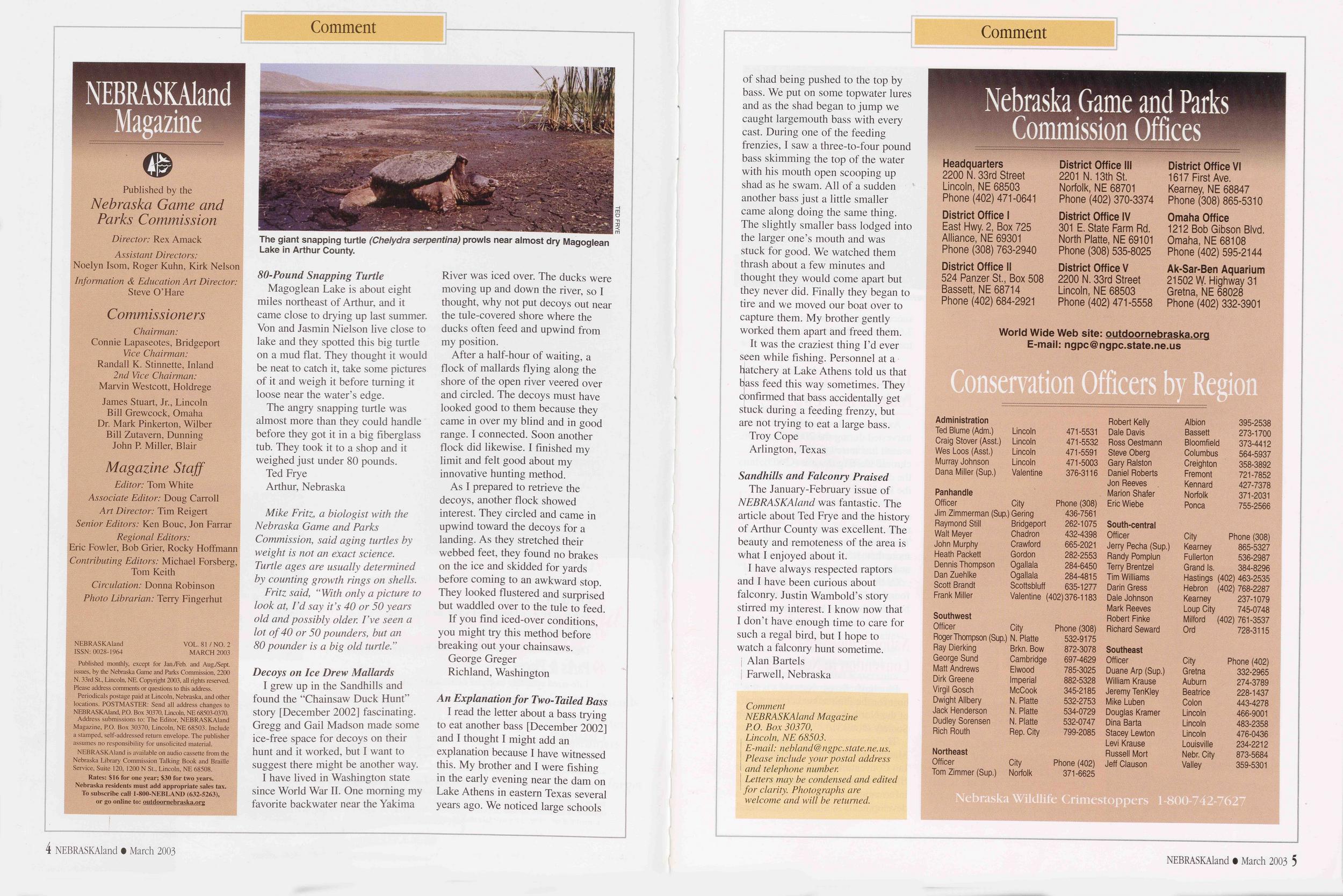 Comment
NEBRASKALand
Magazine
Published by the
Nebraska Game and
Parks Commission
Director: Rex Amack
Assistant Directors:
Noelyn Isom, Roger Kuhn, Kirk Nelson
Information & Education Art Director:
Steve O'Hare
Commissioners
Chairman:
Connie Lapaseotes, Bridgeport
Vice Chairman:
Randall K. Stinnette, Inland
2nd Vice Chairman:
Marvin Westcott, Holdrege
James Stuart, Jr., Lincoln
Bill Grewcock, Omaha
Dr. Mark Pinkerton, Wilber
Bill Zutavern, Dunning
John P. Miller, Blair
Magazine Staff
Editor: Tom White
Associate Editor: Doug Carroll
Art Director: Tim Reigert
Senior Editors: Ken Bouc, Jon Farrar
Regional Editors:
Eric Fowler, Bob Grier, Rocky Hoffmann
Contributing Editors: Michael Forsberg,
Tom Keith
Circulation: Donna Robinson
Photo Librarian: Terry Fingerhut
NEBRASKAIand
ISSN: 0028-1964
VOL.81 /NO. 2
MARCH 2003
Published monthly, except for Jan./Feb. and Aug./Sept.
issues, by the Nebraska Game and Parks Commission, 2200
N. 33rd St., Lincoln, NE. Copyright 2003, all rights reserved.
Please address comments or questions to this address.
Periodicals postage paid at Lincoln, Nebraska, and other
locations. POSTMASTER: Send all address changes to
NEBRASKAIand, P.O. Box 30370, Lincoln, NE 68503-0370.
Address submissions to: The Editor, NEBRASKAIand
Magazine, P.O. Box 30370, Lincoln, NE 68503. Include
a stamped, self-addressed return envelope. The publisher
assumes no responsibility for unsolicited material.
NEBRASKAIand is available on audio cassette from the
Nebraska Library Commission Talking Book and Braille
Service, Suite 120, 1200 N St., Lincoln, NE 68508.
Rates: $16 for one year; $30 for two years.
Nebraska residents must add appropriate sales tax.
To subscribe call 1-800-NEBLAND (632-5263),
or go online to: outdoornebraska.org
Comment
NEBRASKALand
Magazine
Published by the
Nebraska Game and
Parks Commission
Director: Rex Amack
Assistant Directors:
Noelyn Isom, Roger Kuhn, Kirk Nelson
Information & Education Art Director:
Steve O'Hare
Commissioners
Chairman:
Connie Lapaseotes, Bridgeport
Vice Chairman:
Randall K. Stinnette, Inland
2nd Vice Chairman:
Marvin Westcott, Holdrege
James Stuart, Jr., Lincoln
Bill Grewcock, Omaha
Dr. Mark Pinkerton, Wilber
Bill Zutavern, Dunning
John P. Miller, Blair
Magazine Staff
Editor: Tom White
Associate Editor: Doug Carroll
Art Director: Tim Reigert
Senior Editors: Ken Bouc, Jon Farrar
Regional Editors:
Eric Fowler, Bob Grier, Rocky Hoffmann
Contributing Editors: Michael Forsberg,
Tom Keith
Circulation: Donna Robinson
Photo Librarian: Terry Fingerhut
NEBRASKAIand
ISSN: 0028-1964
VOL.81 /NO. 2
MARCH 2003
Published monthly, except for Jan./Feb. and Aug./Sept.
issues, by the Nebraska Game and Parks Commission, 2200
N. 33rd St., Lincoln, NE. Copyright 2003, all rights reserved.
Please address comments or questions to this address.
Periodicals postage paid at Lincoln, Nebraska, and other
locations. POSTMASTER: Send all address changes to
NEBRASKAIand, P.O. Box 30370, Lincoln, NE 68503-0370.
Address submissions to: The Editor, NEBRASKAIand
Magazine, P.O. Box 30370, Lincoln, NE 68503. Include
a stamped, self-addressed return envelope. The publisher
assumes no responsibility for unsolicited material.
NEBRASKAIand is available on audio cassette from the
Nebraska Library Commission Talking Book and Braille
Service, Suite 120, 1200 N St., Lincoln, NE 68508.
Rates: $16 for one year; $30 for two years.
Nebraska residents must add appropriate sales tax.
To subscribe call 1-800-NEBLAND (632-5263),
or go online to: outdoornebraska.org
Magoglean Lake is about eight miles northeast of Arthur, and it came close to drying up last summer. Von and Jasmin Nielson live close to lake and they spotted this big turtle on a mud flat. They thought it would be neat to catch it, take some pictures of it and weigh it before turning it loose near the water's edge.
The angry snapping turtle was almost more than they could handle before they got it in a big fiberglass tub. They took it to a shop and it weighed just under 80 pounds.
Ted Frye Arthur, NebraskaMike Fritz, a biologist with the Nebraska Game and Parks Commission, said aging turtles by weight is not an exact science. Turtle ages are usually determined by counting growth rings on shells.
Fritz said, uWith only a picture to look at, Fd say it's 40 or 50 years old and possibly older. I've seen a lot of 40 or 50 pounders, but an 80 pounder is a big old turtle."
Decoys on Ice Drew MallardsI grew up in the Sandhills and found the "Chainsaw Duck Hunt" story [December 2002] fascinating. Gregg and Gail Madson made some ice-free space for decoys on their hunt and it worked, but I want to suggest there might be another way.
I have lived in Washington state since World War II. One morning my favorite backwater near the Yakima River was iced over. The ducks were moving up and down the river, so I thought, why not put decoys out near the tule-covered shore where the ducks often feed and upwind from my position.
After a half-hour of waiting, a flock of mallards flying along the shore of the open river veered over and circled. The decoys must have looked good to them because they came in over my blind and in good range. I connected. Soon another flock did likewise. I finished my limit and felt good about my innovative hunting method.
As I prepared to retrieve the decoys, another flock showed interest. They circled and came in upwind toward the decoys for a landing. As they stretched their webbed feet, they found no brakes on the ice and skidded for yards before coming to an awkward stop. They looked flustered and surprised but waddled over to the tule to feed.
If you find iced-over conditions, you might try this method before breaking out your chainsaws.
George Greger Richland, Washington An Explanation for Two-Tailed BassI read the letter about a bass trying to eat another bass [December 2002] and I thought I might add an explanation because I have witnessed this. My brother and I were fishing in the early evening near the dam on Lake Athens in eastern Texas several years ago. We noticed large schools 4 NEBRASKAland • March 2003 of shad being pushed to the top by bass. We put on some top water lures and as the shad began to jump we caught largemouth bass with every cast. During one of the feeding frenzies, I saw a three-to-four pound bass skimming the top of the water with his mouth open scooping up shad as he swam. All of a sudden another bass just a little smaller came along doing the same thing. The slightly smaller bass lodged into the larger one's mouth and was stuck for good. We watched them thrash about a few minutes and thought they would come apart but they never did. Finally they began to tire and we moved our boat over to capture them. My brother gently worked them apart and freed them.
It was the craziest thing I'd ever seen while fishing. Personnel at a hatchery at Lake Athens told us that bass feed this way sometimes. They confirmed that bass accidentally get stuck during a feeding frenzy, but are not trying to eat a large bass.
Troy Cope Arlington, Texas Sandhills and Falconry PraisedThe January-February issue of NEBRASKAIand was fantastic. The article about Ted Frye and the history of Arthur County was excellent. The beauty and remoteness of the area is what I enjoyed about it.
I have always respected raptors and I have been curious about falconry. Justin Wambold's story stirred my interest. I know now that I don't have enough time to care for such a regal bird, but I hope to watch a falconry hunt sometime.
Alan B artels Farwell, Nebraska Comment NEBRASKAland Magazine P.O. Box 30370, Lincoln, NE 68503. E-mail: nebland@ ngpc. state, ne. us. Please include your postal address and telephone number. Letters may be condensed and edited for clarity. Photographs are welcome and will be returned. Nebraska Game and Parks Commission Offices Headquarters 2200 N. 33rd Street Lincoln, NE 68503 Phone (402) 471-0641 District Office I East Hwy. 2, Box 725 Alliance, NE 69301 Phone (308) 763-2940 District Office II 524 Panzer St., Box 508 Bassett, NE 68714 Phone (402) 684-2921 District Office III 2201 N. 13th St. Norfolk, NE 68701 Phone (402) 370-3374 District Office IV 301 E. State Farm Rd. North Platte, NE 69101 Phone (308) 535-8025 District Office V 2200 N. 33rd Street Lincoln, NE 68503 Phone (402) 471-5558 District Office VI 1617 First Ave. Kearney, NE 68847 Phone (308) 865-5310 Omaha Office 1212 Bob Gibson Blvd. Omaha, NE 68108 Phone (402) 595-2144 Ak-Sar-Ben Aquarium 21502 W. Highway 31 Gretna, NE 68028 Phone (402) 332-3901 World Wide Web site: outdoornebraska.org E-mail: ngpc@ngpc.state.ne.us Conservation Officers by Region Administration Robert Kelly Albion 395-2538 Ted Blume (Adm.) Lincoln 471-5531 Dale Davis Bassett 273-1700 Craig Stover (Asst.) Lincoln 471-5532 Ross Oestmann Bloomfield 373-4412 Wes Loos (Asst.) Lincoln 471-5591 Steve Oberg Columbus 564-5937 Murray Johnson Lincoln 471-5003 Gary Ralston Creighton 358-3892 Dana Miller (Sup.) Valentine 376-3116 Daniel Roberts Fremont 721-7852 Jon Reeves Kennard 427-7378 Panhandle Marion Shafer Norfolk 371-2031 Officer City Phone (308) Eric Wiebe Ponca 755-2566 Jim Zimmerman (Sup.) Gering 436-7561 Raymond Still Bridgeport 262-1075 South-central Walt Meyer Chadron 432-4398 Officer City Phone (308) John Murphy Crawford 665-2021 Jerry Pecha (Sup.)Kearney 865-5327 Heath Packet! Gordon 282-2553 Randy Pomplun Fullerton 536-2987 Dennis Thompson Ogallala 284-6450 Terry Brentzel Grand Is. 384-8296 Dan Zuehlke Ogallala 284-4815 Tim Williams Hastings (402) 463-2535 Scott Brandt Scottsbluff 635-1277 Darin Gress Hebron 402 768-2287 Frank Miller Valentine (402)376-1183 Dale Johnson Kearney 237-1079 Mark Reeves Loup City 745-0748 Southwest Robert Finke Milford (402) 761-3537 Officer City Phone (308) Richard Seward Ord 728-3115 Roger Thompson (Sup.) N. Platte 532-9175 Ray Dierking Brkn. Bow 872-3078 Southeast George Sund Cambridge 697-4629 Officer City Phone (402) Matt Andrews Elwood 785-3025 Duane Arp (Sup.)Gretna 332-2965 Dirk Greene Imperial 882-5328 William Krause Auburn 274-3789 Virgil Gosch McCook 345-2185 Jeremy TenKley Beatrice 228-1437 Dwight Allbery N. Platte 532-2753 Mike Luben Colon 443-4278 Jack Henderson N. Platte 534-0729 Douglas Kramer Lincoln 466-9001 Dudley Sorensen N. Platte 532-0747 Dina Barta Lincoln 483-2358 Rich Routh Rep. City 799-2085 Stacey Lewton Lincoln 476-0436 Levi Krause Louisville 234-2212 Northeast Russell Mort Nebr. City 873-5684 Officer City Phone (402) Jeff Clauson Valley 359-5301 Tom Zimmer (Sup.)Norfolk 371-6625 Nebraska Wildlife Crimestoppers 1-800-742-7627 NEBRASKAland • March 2003 5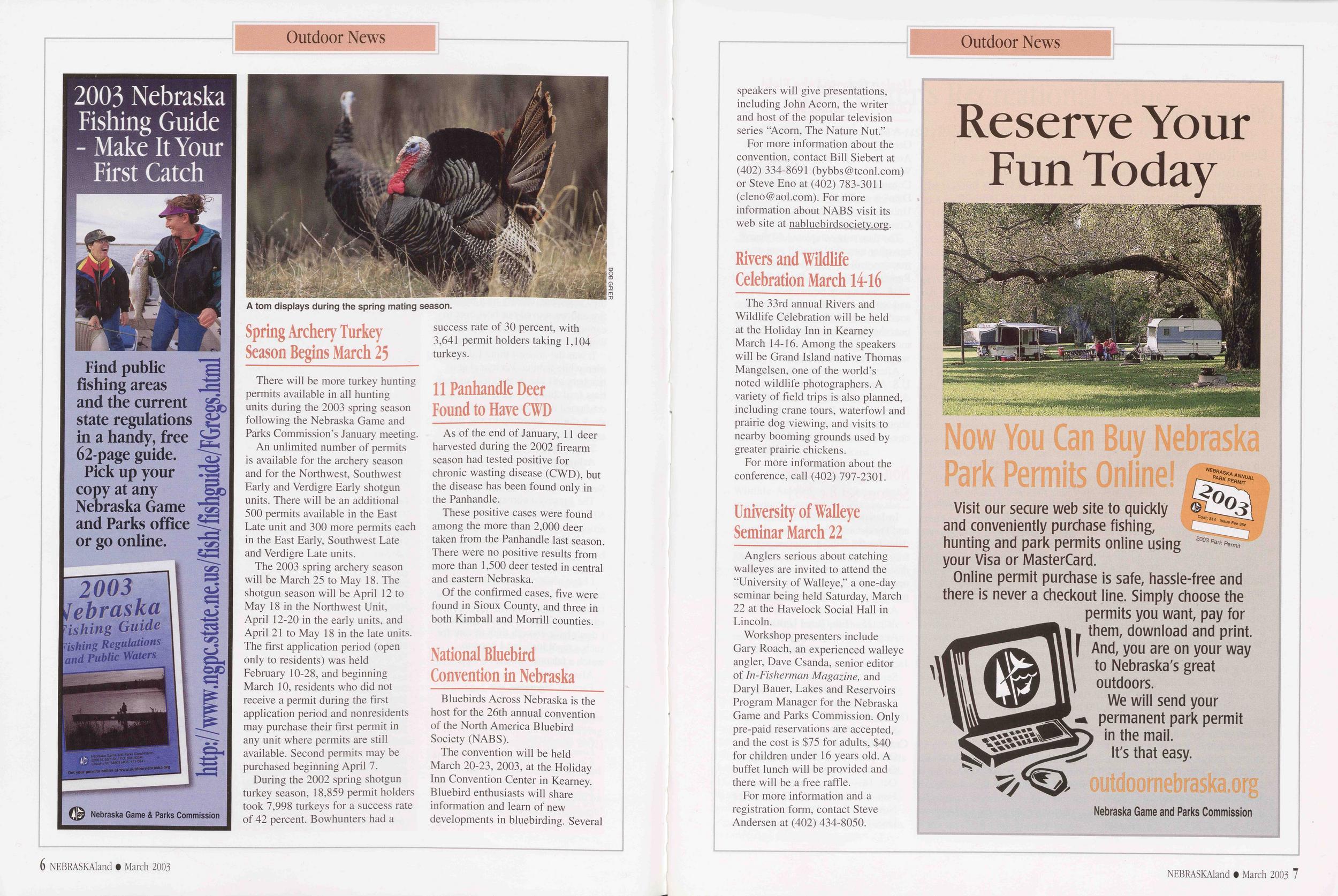
There will be more turkey hunting permits available in all hunting units during the 2003 spring season following the Nebraska Game and Parks Commission's January meeting.
An unlimited number of permits is available for the archery season and for the Northwest, Southwest Early and Verdigre Early shotgun units. There will be an additional 500 permits available in the East Late unit and 300 more permits each in the East Early, Southwest Late and Verdigre Late units.
The 2003 spring archery season will be March 25 to May 18. The shotgun season will be April 12 to May 18 in the Northwest Unit, April 12-20 in the early units, and April 21 to May 18 in the late units. The first application period (open only to residents) was held February 10-28, and beginning March 10, residents who did not receive a permit during the first application period and nonresidents may purchase their first permit in any unit where permits are still available. Second permits may be purchased beginning April 7.
During the 2002 spring shotgun turkey season, 18,859 permit holders took 7,998 turkeys for a success rate of 42 percent. Bowhunters had a success rate of 30 percent, with 3,641 permit holders taking 1,104 turkeys.
11 Panhandle Deer Found to Have CWDAs of the end of January, 11 deer harvested during the 2002 firearm season had tested positive for chronic wasting disease (CWD), but the disease has been found only in the Panhandle.
These positive cases were found among the more than 2,000 deer taken from the Panhandle last season. There were no positive results from more than 1,500 deer tested in central and eastern Nebraska.
Of the confirmed cases, five were found in Sioux County, and three in both Kimball and Morrill counties.
National Bluebird Convention in NebraskaBluebirds Across Nebraska is the host for the 26th annual convention of the North America Bluebird Society (NABS).
The convention will be held March 20-23, 2003, at the Holiday Inn Convention Center in Kearney. Bluebird enthusiasts will share information and learn of new developments in bluebirding. Several 6 NEBRASKAland • March 2003 speakers will give presentations, including John Acorn, the writer and host of the popular television series 'Acorn, The Nature Nut."
For more information about the convention, contact Bill Siebert at (402) 334-8691 (bybbs@tconl.com) or Steve Eno at (402) 783-3011 (cleno@aol.com). For more information about NABS visit its web site at nabluebirdsociety.org.
Rivers and Wildlife Celebration March 14-16The 33rd annual Rivers and Wildlife Celebration will be held at the Holiday Inn in Kearney March 14-16. Among the speakers will be Grand Island native Thomas Mangelsen, one of the world's noted wildlife photographers. A variety of field trips is also planned, including crane tours, waterfowl and prairie dog viewing, and visits to nearby booming grounds used by greater prairie chickens.
For more information about the conference, call (402) 797-2301.
University of Walleye Seminar March 22Anglers serious about catching walleyes are invited to attend the "University of Walleye," a one-day seminar being held Saturday, March 22 at the Havelock Social Hall in Lincoln.
Workshop presenters include Gary Roach, an experienced walleye angler, Dave Csanda, senior editor of In-Fisherman Magazine, and Daryl Bauer, Lakes and Reservoirs Program Manager for the Nebraska Game and Parks Commission. Only pre-paid reservations are accepted, and the cost is $75 for adults, $40 for children under 16 years old. A buffet lunch will be provided and there will be a free raffle.
For more information and a registration form, contact Steve Andersen at (402) 434-8050.
Reserve Your Fun Today ""fclflSM ^^ar Visit our secure web site to quickly and conveniently purchase fishing, hunting and park permits online using 2003 your Visa or MasterCard. Online permit purchase is safe, hassle-free and there is never a checkout line. Simply choose the permits you want, pay for - them, download and print. [ And, you are on your way mil I1M lit to Nebraska's great inn «f«a in outdoors We will send your permanent park permit in the mail. It's that easy. Nebraska Game and Parks Commission NEBRASKAland • March 2003 7 Outdoor News
Officer's Notebook
Deer Rodeo
Outdoor News
Officer's Notebook
Deer Rodeo
Shortly after I moved to the Cambridge area in 1977, a conservation officer at McCook called and asked for my help. The city park in McCook had a captive herd of mule deer on display at that time and a small fishing lure had somehow become hooked to a small buck's upper lip. Several visitors had seen the lure, which was brightly colored and similar to a Mepps spinner, and they called to ask that it be removed.
The deer were kept in a large pen enclosed by a six-foot tall chain-link fence that had two strands of barbed wire on top. A much smaller pen was connected to the larger one.
The herd included the little buck, a mature buck with a large set of antlers, and seven or eight other deer. Because a park maintenance worker told us the big buck was aggressive, we left it behind when we chased the other deer into the small pen. We soon learned he was not the only one we should have left.
Because the other officer had done some team roping and helped with cattle roundups and branding, I was supposed to chase the wounded deer close enough for him to rope. He had a lariat and I had small, 10- or 12-foot rope with a noose fashioned on one end with which we planned to tie the deer's feet while we removed the lure.
After he was unsuccessful in several roping attempts, we decided that I should try roping the deer. By now the deer were on to our plan. When he tried to chase them by me, they turned back. Trying to turn the herd, he tossed the noose on the small rope at the deer with the lure, accidentally catching it around the nose and between the antlers. When the rope tightened, the deer began to buck and bawl in fright and the other deer, except one, exploded like a covey of quail taking flight. Some crashed into the fence and jumped over it - luckily back into the large pen instead of the open park.
One adult doe, however, was behind the roper standing on her back legs and striking at him with her front feet. I yelled to warn him. I'm not sure if it was his bad knee or the sight of a six-foot- tall deer doing a good prizefighter imitation that caused him to drop the rope. The roped buck immediately ceased bawling and the doe dropped back to all fours. The roped deer crashed headfirst into the fence several times before calming down.
When the dust settled, we decided to remove the remaining deer from the pen except for the small buck. While doing so, I noticed the buck had lost the lure in one of his collisions, so that problem was solved. Now we just needed to remove the rope.
After allowing him calm down, I grabbed the rope and my partner slipped a knife under the noose and freed the deer. Afterward we decided we had been lucky. The lure had been removed, the deer was alive and still in the pen, and we had started early enough in the day that there weren't any spectators, which had been one of our main goals. All in all, it was just another day in the continuing on-the-job education of a Nebraska Conservation Officer.
- George Sund, Conservation Officer, Cambridge Harlan County Lake Field Guide Now AvailableA 61-page "Field Guide to the Geology of the Harlan County Lake Area, Harlan County, Nebraska - With a History of Events Leading to Construction of the Harlan County Dam" is available from the University of Nebraska-Lincoln's Conservation and Survey Division.
The dam was completed 50 years ago after torrential rainfall sent a massive wall of water down the Republican River on May 30-31 in 1935, devastating farms, buildings and homes, and killing 94 people in southwestern Nebraska. Many towns near the river were flooded, and more than 57,000 acres of farmland were damaged or destroyed.
After the catastrophic flood, the U.S. Army Corps of Engineers designed and built the Harlan County Dam and Lake. For more information about the guide, call (402) 472-7523, or e-mail csdsales@unl.edu.
Non-migratory Game Seasons Set for 2003In January the Nebraska Game and Parks Commission set opening dates for the 2003 hunting seasons for non-migratory species, including designating November 1 as the opening day of the pheasant, quail and partridge seasons. The other dates are:
Aug. 1 - Squirrel Aug. 15-Elk (Boyd Unit) Aug. 20 - Pronghorn (Archery) Sept. 1 - Cottontail Rabbit and Jackrabbit Sept. 13 - Grouse Sept. 15 - Deer (Archery) Sept. 20 - Pronghorn (Muzzleloader) Sept. 27 - Elk (Bordeaux, Hat Creek, Box Elder units) Oct. 1 - Turkey (Fall Archery) Oct. 11 - Pronghorn (Rifle) Oct. 18 - Turkey (Fall Shotgun) Nov. 1 - Pheasant, Quail, Partridge Nov 15 - Deer (Firearm) Dec. 1 - Deer (Muzzleloader) 8 NEBRASKAland • March 2003Water's Recreational Value
Drought and water-use decisions reduce Nebraska's fishing economy. By Rocky HoffmannLast winter, Don Gabelhouse, fisheries administrator for the Nebraska Game and Parks ^Commission, addressed the Governor's Water Task Force meeting in Lincoln. He was invited to talk about water's recreational value after one of the worst drought years in Nebraska history. The 2002 drought extended the dry conditions gripping the Plains, and should it continue through the coming summer, water recreation, including sport fishing at irrigation reservoirs, might suffer disastrous losses.
Gabelhouse said fishing is a therapeutic and soothing activity and a great way for families and friends to build social bonds. Fishing also has an impressive economic value of importance to all Nebraskans.
Gabelhouse cited the National Survey of Fishing, Hunting and Wildlife-Associated Recreation that is conducted every five years by the U.S. Fish and Wildlife Service. In 1996 the survey found that sport fishing generated $429 million for Nebraska's economy. In 2001, sport fishing's benefit to the state had dropped to $340 million. Gabelhouse said that much of the decline was the result of fewer "big ticket" items, such as boats, being purchased. The recession might have played a role in reduced spending, but he wondered if the drought was also responsible for the decline in boat sales.
Gabelhouse specifically addressed Lake McConaughy, Nebraska's largest reservoir, which saw drastic water level declines in 2001 because water was needed for irrigation. The drought in 2002 dropped water levels to near record lows. In 2001, he said, anglers at McConaughy spent $1.3 million on trip-related expenses, while harvesting 85,000 walleyes, weighing more than 227,000 pounds. The value of walleye harvested was $1.4 million.
He said that the replacement value of the walleye population that was present at the beginning of 2002 was about $10 million. But, he added, "If that population is lost to low water or other factors, we couldn't raise or buy walleye of the sizes needed to replace what is there, and it would actually take about 10 years to start over and rebuild the fishery, losing millions of dollars in fishing trip expenditures in the process."
Gabelhouse rhetorically asked the task force: "Could we lose it all in 2003? Yes! My biggest concern is that with most of the water coming into the lake being irrigation return flows, laden with phosphorous and nitrogen, a blue-green algae bloom and fish kill could occur."
Gabelhouse said the warmer water discharged from a smaller Lake McConaughy into Lake Ogallala could cause the loss of Nebraska's premier trout fishery. He said that trip-related expenditures to Lake Ogallala contribute $500,000 per year or more to the local economy. Gabelhouse also talked about Enders Reservoir near Imperial, where groundwater irrigation upstream has stymied inflows and ditch irrigation downstream has demanded much from this Frenchman River reservoir. Studies have shown that trip-related fishing expenditures are about $70,000 more per year when water levels are high than in low-water years.
"The difference between high- and low-water levels and what anglers contribute to the local economy places the value of the water for fishing at more than $30 per acre foot. That figure would go up considerably if all of the recreational values for that water were considered. With high water levels, fishing expenditures might reach $ 1 million per year at Enders, with much of that money coming from out of state," he said.
Gabelhouse cited five reasons why higher water levels in irrigation reservoirs would improve the fishing and the fishing economy.
• More pounds of fish and increased harvests because of larger reservoir volume and carrying capacity.
• Older and larger fish because of lower natural mortality and reduced flushing loss.
• Stronger and more consistent fish reproduction because of more stable habitat for juvenile fish.
• More largemouth bass, bluegills and crappies because of increased shallow water habitat.
• Better and easier access for anglers and boaters.
Gabelhouse said that he was not yet suggesting that the state shift its primary use of water from irrigation to recreation, but he did respectfully request the task force to do what it could to help facilitate a pilot project at Enders Reservoir. Gabelhouse said there are examples of improving the economy when the environment and recreational pursuits have been favored.
He thought this concept was unspeakable in Nebraska until he read in the November 8 Lincoln Journal- Star that Sandy Scofield, Director of UNL's Rural Development Initiative, said at the Agriculture at the Crossroads Conference that Nebraskans may want to look for ways to "convert even more land to recreation and conservation purposes and forget about agriculture, forget about the cattle business."
Gabelhouse concluded his talk with a rhetorical question: "The quality of fishing reflects the quality of life. Could the good life be even better?"
NEBRASKAland • March 2003 9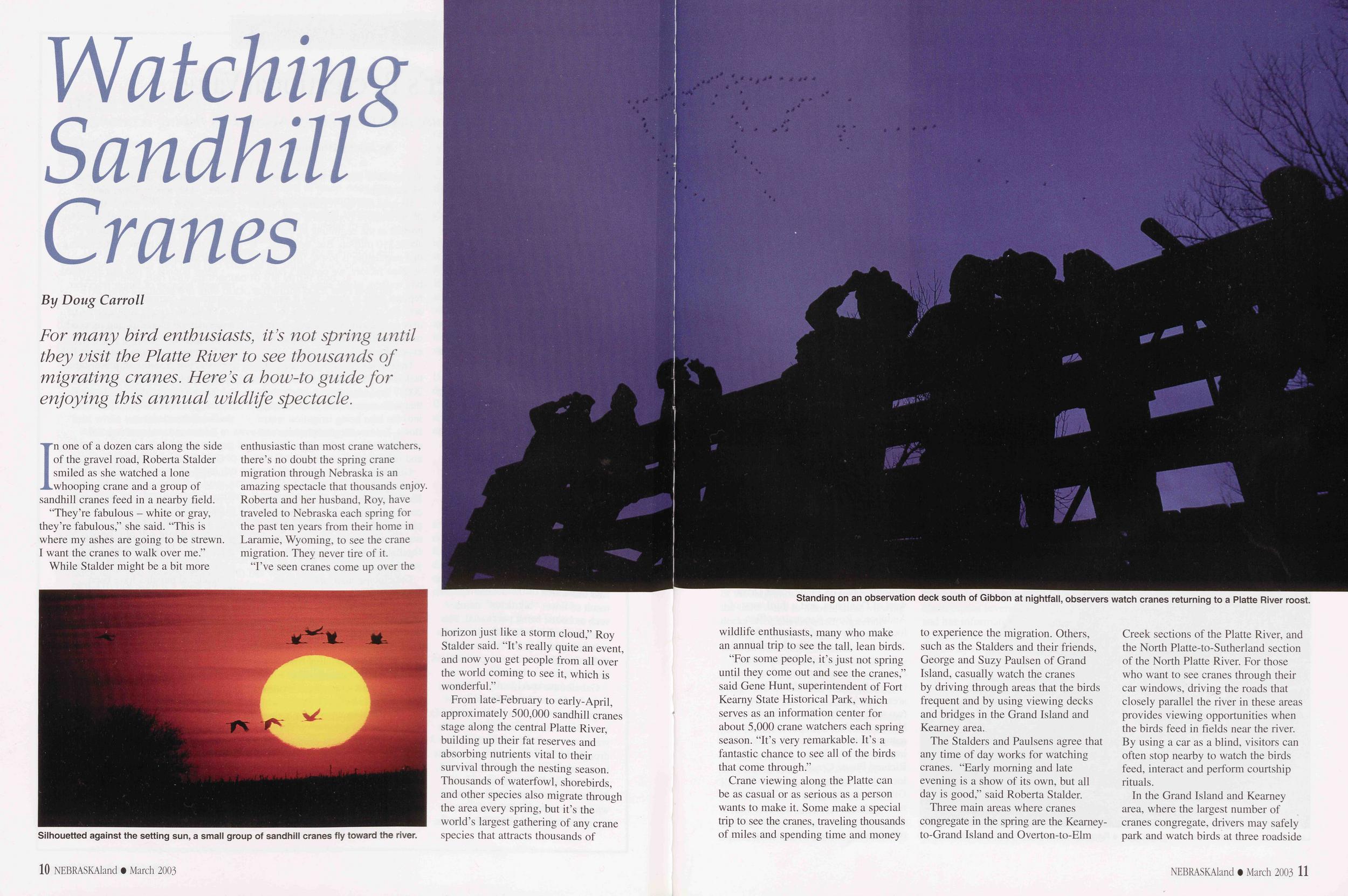
Watching Sandhill Cranes
By Doug Carroll For many bird enthusiasts, it's not spring until they visit the Platte River to see thousands of migrating cranes. Here's a how-to guide for enjoying this annual wildlife spectacle.In one of a dozen cars along the side of the gravel road, Roberta Stalder smiled as she watched a lone whooping crane and a group of sandhill cranes feed in a nearby field.
'They're fabulous - white or gray, they're fabulous," she said. "This is where my ashes are going to be strewn. I want the cranes to walk over me."
While Stalder might be a bit more enthusiastic than most crane watchers, there's no doubt the spring crane migration through Nebraska is an amazing spectacle that thousands enjoy. Roberta and her husband, Roy, have traveled to Nebraska each spring for the past ten years from their home in Laramie, Wyoming, to see the crane migration. They never tire of it.
"I've seen cranes come up over the horizon just like a storm cloud," Roy Stalder said. "It's really quite an event, and now you get people from all over the world coming to see it, which is wonderful."
From late-February to early-April, approximately 500,000 sandhill cranes stage along the central Platte River, building up their fat reserves and absorbing nutrients vital to their survival through the nesting season. Thousands of waterfowl, shorebirds, and other species also migrate through the area every spring, but it's the world's largest gathering of any crane species that attracts thousands of
"For some people, it's just not spring until they come out and see the cranes," said Gene Hunt, superintendent of Fort Kearny State Historical Park, which serves as an information center for about 5,000 crane watchers each spring season. "It's very remarkable. It's a fantastic chance to see all of the birds that come through."
Crane viewing along the Platte can be as casual or as serious as a person wants to make it. Some make a special trip to see the cranes, traveling thousands of miles and spending time and money to experience the migration. Others, such as the Stalders and their friends, George and Suzy Paulsen of Grand Island, casually watch the cranes by driving through areas that the birds frequent and by using viewing decks and bridges in the Grand Island and Kearney area.
The Stalders and Paulsens agree that any time of day works for watching cranes. "Early morning and late evening is a show of its own, but all day is good," said Roberta Stalder.
Three main areas where cranes congregate in the spring are the Kearney to-Grand Island and Overton-to-Elm Creek sections of the Platte River, and the North Platte-to-Sutherland section of the North Platte River. For those who want to see cranes through their car windows, driving the roads that closely parallel the river in these areas provides viewing opportunities when the birds feed in fields near the river. By using a car as a blind, visitors can often stop nearby to watch the birds feed, interact and perform courtship rituals.
In the Grand Island and Kearney
area, where the largest number of
cranes congregate, drivers may safely
park and watch birds at three roadside
NEBRASKAland • March 2003 11
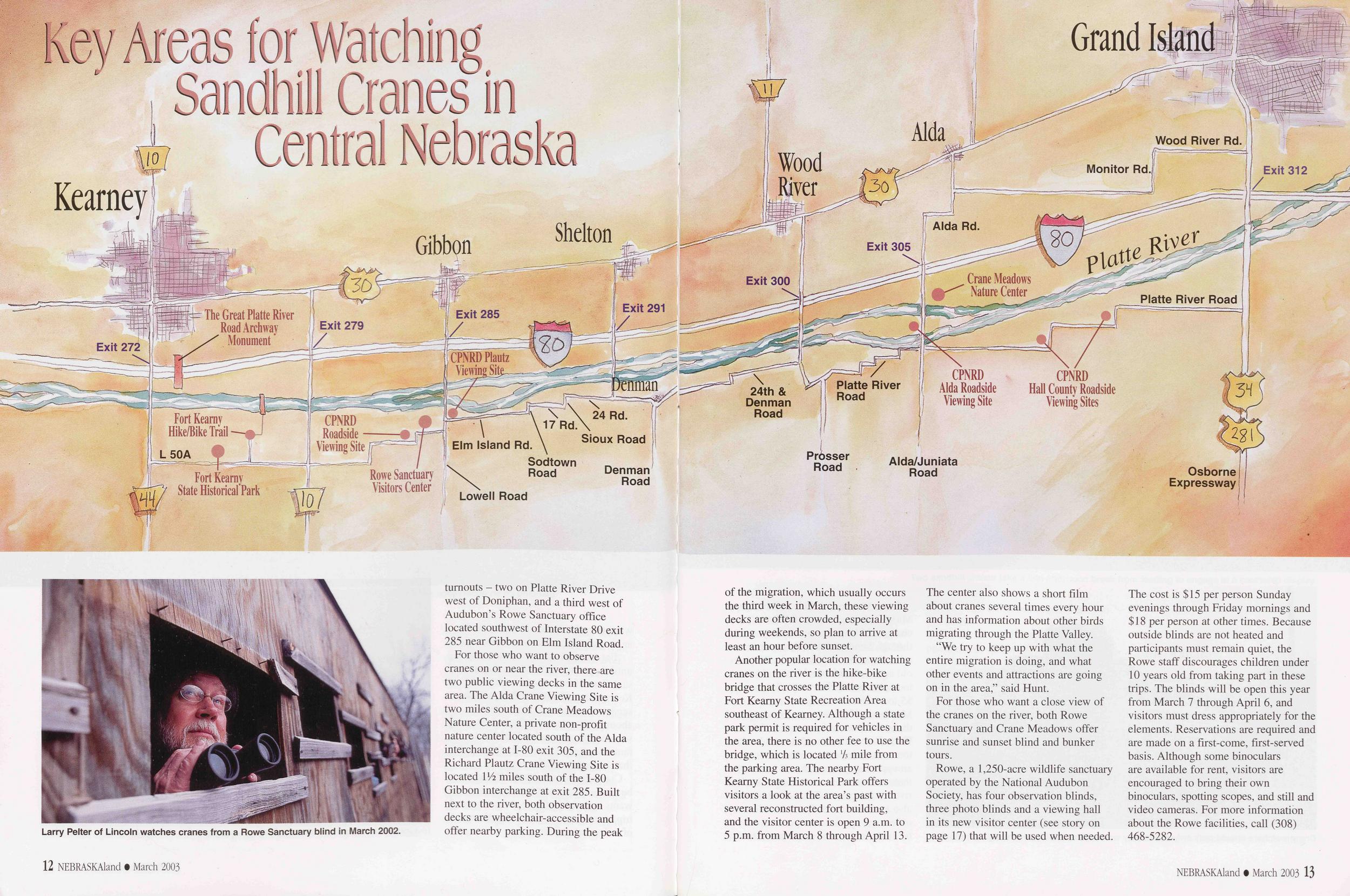
For those who want to observe cranes on or near the river, there are two public viewing decks in the same area. The Alda Crane Viewing Site is two miles south of Crane Meadows Nature Center, a private non-profit nature center located south of the Alda interchange at 1-80 exit 305, and the Richard Plautz Crane Viewing Site is located \xh miles south of the 1-80 Gibbon interchange at exit 285. Built next to the river, both observation decks are wheelchair-accessible and offer nearby parking. During the peak 12 NEBRASKAland • March 2003 of the migration, which usually occurs the third week in March, these viewing decks are often crowded, especially during weekends, so plan to arrive at least an hour before sunset.
Another popular location for watching cranes on the river is the hike-bike bridge that crosses the Platte River at Fort Kearny State Recreation Area southeast of Kearney. Although a state park permit is required for vehicles in the area, there is no other fee to use the bridge, which is located xi mile from the parking area. The nearby Fort Kearny State Historical Park offers visitors a look at the area's past with several reconstructed fort building, and the visitor center is open 9 a.m. to 5 p.m. from March 8 through April 13. The center also shows a short film about cranes several times every hour and has information about other birds migrating through the Platte Valley.
"We try to keep up with what the entire migration is doing, and what other events and attractions are going on in the area," said Hunt.
For those who want a close view of the cranes on the river, both Rowe Sanctuary and Crane Meadows offer sunrise and sunset blind and bunker tours.
Rowe, a 1,250-acre wildlife sanctuary operated by the National Audubon Society, has four observation blinds, three photo blinds and a viewing hall in its new visitor center (see story on page 17) that will be used when needed. The cost is $15 per person Sunday evenings through Friday mornings and $18 per person at other times. Because outside blinds are not heated and participants must remain quiet, the Rowe staff discourages children under 10 years old from taking part in these trips. The blinds will be open this year from March 7 through April 6, and visitors must dress appropriately for the elements. Reservations are required and are made on a first-come, first-served basis. Although some binoculars are available for rent, visitors are encouraged to bring their own binoculars, spotting scopes, and still and video cameras. For more information about the Rowe facilities, call (308) 468-5282.
NEBRASKAland • March 2003 13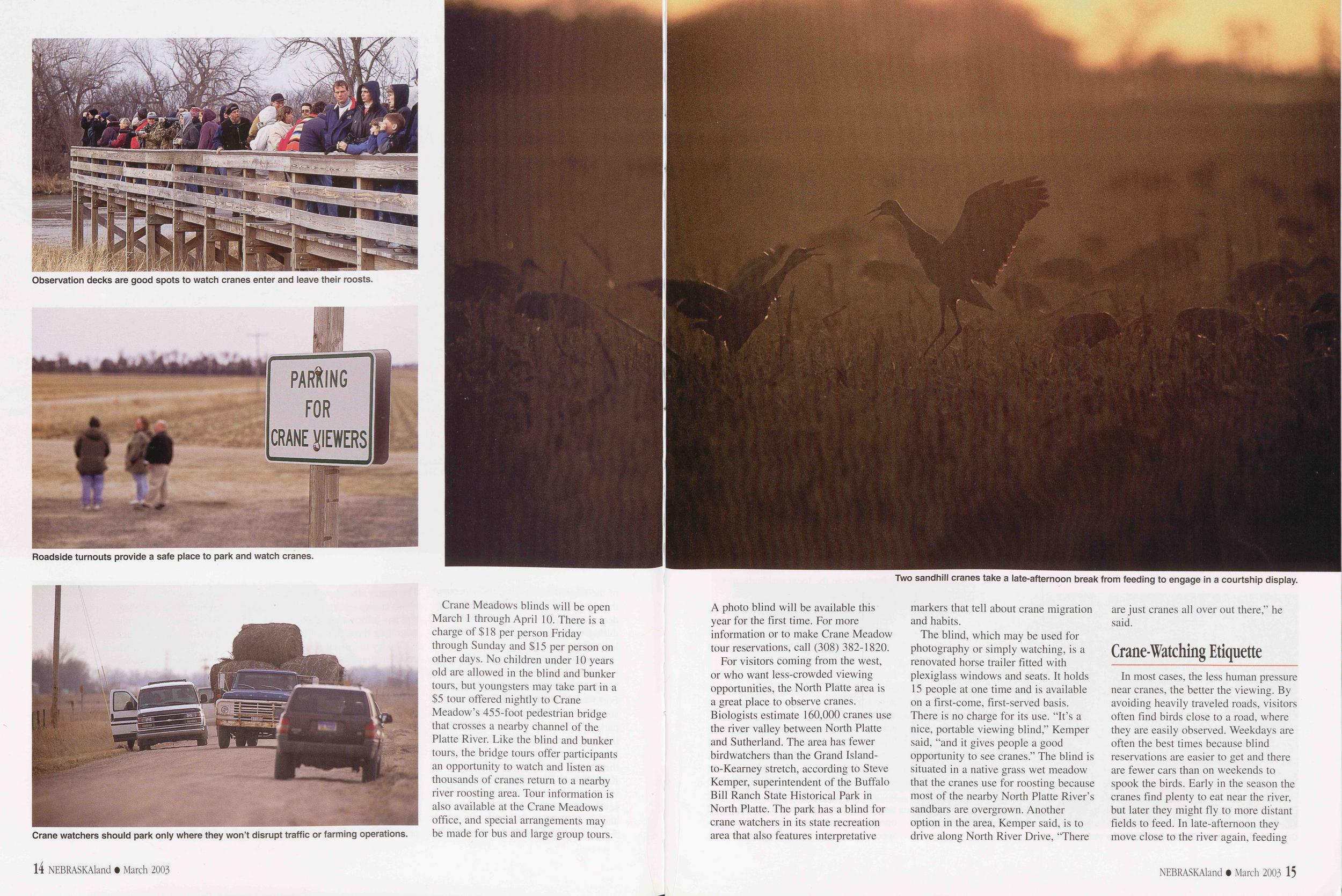
Crane Meadows blinds will be open March 1 through April 10. There is a charge of $ 18 per person Friday through Sunday and $15 per person on other days. No children under 10 years old are allowed in the blind and bunker tours, but youngsters may take part in a $5 tour offered nightly to Crane Meadow's 455-foot pedestrian bridge that crosses a nearby channel of the Platte River. Like the blind and bunker tours, the bridge tours offer participants an opportunity to watch and listen as thousands of cranes return to a nearby river roosting area. Tour information is also available at the Crane Meadows office, and special arrangements may be made for bus and large group tours. 14 NEBRASKAland • March 2003
For visitors coming from the west, or who want less-crowded viewing opportunities, the North Platte area is a great place to observe cranes. Biologists estimate 160,000 cranes use the river valley between North Platte and Sutherland. The area has fewer birdwatchers than the Grand Island to-Kearney stretch, according to Steve Kemper, superintendent of the Buffalo Bill Ranch State Historical Park in North Platte. The park has a blind for crane watchers in its state recreation area that also features interpretative markers that tell about crane migration and habits.
The blind, which may be used for photography or simply watching, is a renovated horse trailer fitted with plexiglass windows and seats. It holds 15 people at one time and is available on a first-come, first-served basis. There is no charge for its use. "It's a nice, portable viewing blind," Kemper said, "and it gives people a good opportunity to see cranes." The blind is situated in a native grass wet meadow that the cranes use for roosting because most of the nearby North Platte River's sandbars are overgrown. Another option in the area, Kemper said, is to drive along North River Drive, "There are just cranes all over out there," he said.
Crane-Watching EtiquetteIn most cases, the less human pressure
near cranes, the better the viewing. By
avoiding heavily traveled roads, visitors
often find birds close to a road, where
they are easily observed. Weekdays are
often the best times because blind
reservations are easier to get and there
are fewer cars than on weekends to
spook the birds. Early in the season the
cranes find plenty to eat near the river,
but later they might fly to more distant
fields to feed. In late-afternoon they
move close to the river again, feeding
NEBRASKAland • March 2003 15
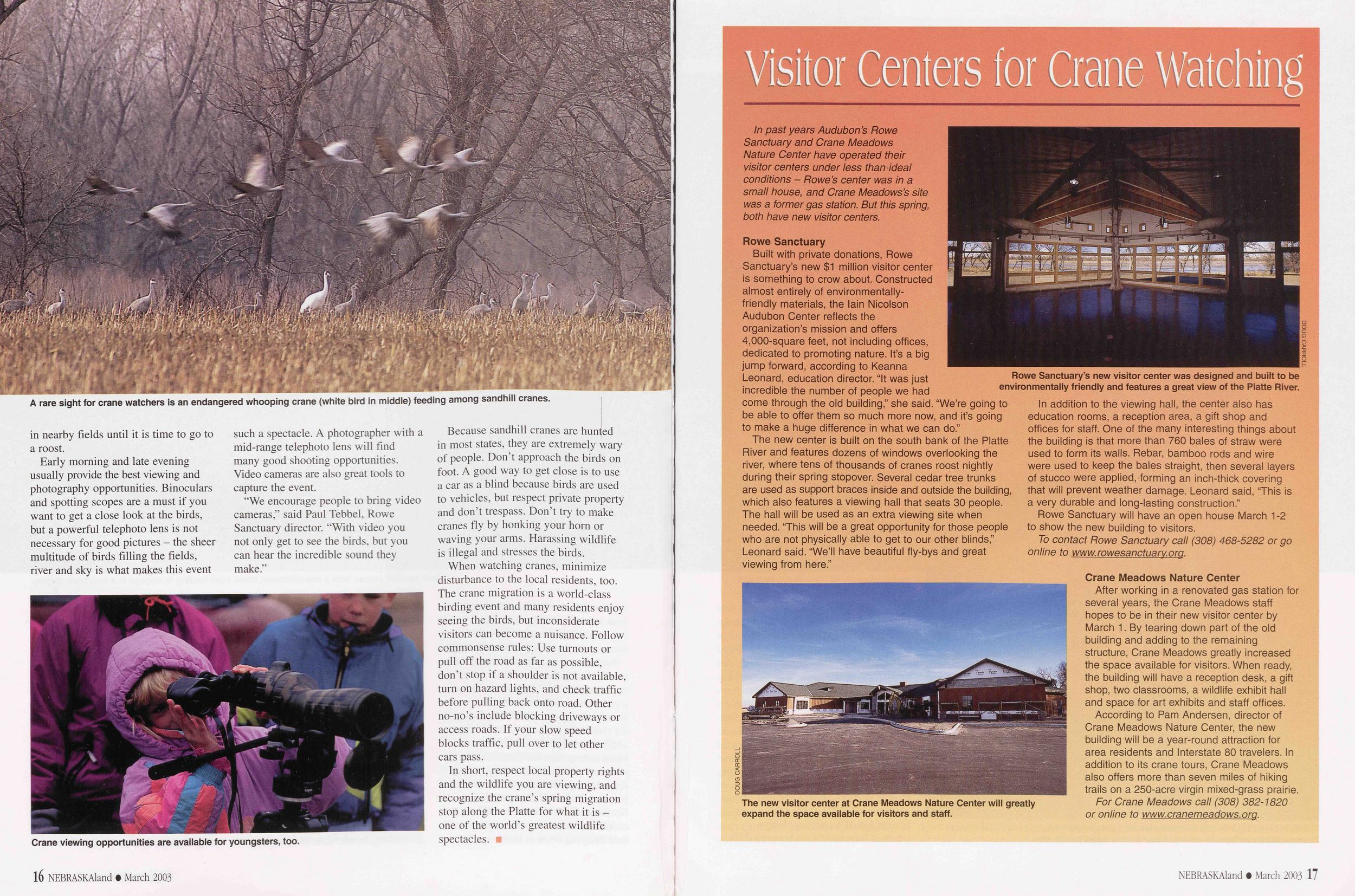
Early morning and late evening usually provide the best viewing and photography opportunities. Binoculars and spotting scopes are a must if you want to get a close look at the birds, but a powerful telephoto lens is not necessary for good pictures - the sheer multitude of birds filling the fields, river and sky is what makes this event such a spectacle. A photographer with a mid-range telephoto lens will find many good shooting opportunities. Video cameras are also great tools to capture the event.
"We encourage people to bring video cameras," said Paul Tebbel, Rowe Sanctuary director. "With video you not only get to see the birds, but you can hear the incredible sound they make."
Because sandhill cranes are hunted in most states, they are extremely wary of people. Don't approach the birds on foot. A good way to get close is to use a car as a blind because birds are used to vehicles, but respect private property and don't trespass. Don't try to make cranes fly by honking your horn or waving your arms. Harassing wildlife is illegal and stresses the birds.
When watching cranes, minimize disturbance to the local residents, too. The crane migration is a world-class birding event and many residents enjoy seeing the birds, but inconsiderate visitors can become a nuisance. Follow commonsense rules: Use turnouts or pull off the road as far as possible, don't stop if a shoulder is not available, turn on hazard lights, and check traffic before pulling back onto road. Other no-no's include blocking driveways or access roads. If your slow speed blocks traffic, pull over to let other cars pass.
In short, respect local property rights and the wildlife you are viewing, and recognize the crane's spring migration stop along the Platte for what it is - one of the world's greatest wildlife spectacles.
16 NEBRASKAland t March 2003 Visitor Centers for Crane WatchingIn past years Audubon's Rowe Sanctuary and Crane Meadows Nature Center have operated their visitor centers under less than ideal conditions - Rowe's center was in a small house, and Crane Meadows's site was a former gas station, But this spring, both have new visitor centers.
Built with private donations, Rowe Sanctuary's new $1 million visitor center is something to crow about. Constructed almost entirely of environmentally-= friendly materials, the lain Nicolson Audubon Center reflects the organization's mission and offers 4,000-square feet, not including offices, dedicated to promoting nature. It's a big jump forward, according to Keanna Leonard, education director. "It was just incredible the number of people we had come through the old building," she said. "We're going to be able to offer them so much more now, and it's going to make a huge difference in what we can do."
The new center is built on the south bank of the Platte River and features dozens of windows overlooking the river, where tens of thousands of cranes roost nightly during their spring stopover. Several cedar tree trunks are used as support braces inside and outside the building, which also features a viewing hall that seats 30 people. The hall will be used as an extra viewing site when needed. 'This will be a great opportunity for those people who are not physically able to get to our other blinds," Leonard said. "We'll have beautiful fly-bys and great viewing from here."
In addition to the viewing hall, the center also has education rooms, a reception area, a gift shop and offices for staff. One of the many interesting things about the building is that more than 760 bales of straw were used to form its walls. Rebar, bamboo rods and wire were used to keep the bales straight, then several layers of stucco were applied, forming an inch-thick covering that will prevent weather damage. Leonard said, 'This is a very durable and long-lasting construction."
Rowe Sanctuary will have an open house March 1 -2 to show the new building to visitors.
To contact Rowe Sanctuary call (308) 468-5282 or go online to www, rowesanctuary. org.
Crane Meadows Nature CenterAfter working in a renovated gas station for several years, the Crane Meadows staff hopes to be in their new visitor center by March 1. By tearing down part of the old building and adding to the remaining structure, Crane Meadows greatly increased the space available for visitors. When ready, the building will have a reception desk, a gift shop, two classrooms, a wildlife exhibit hall and space for art exhibits and staff offices.
According to Pam Andersen, director of Crane Meadows Nature Center, the new building will be a year-round attraction for area residents and Interstate 80 travelers. In addition to its crane tours, Crane Meadows also offers more than seven miles of hiking trails on a 250-acre virgin mixed-grass prairie.
For Crane Meadows call (308) 382-1820 or online to www.cranemeadows.org.
NEBRASKAland • March 2003 17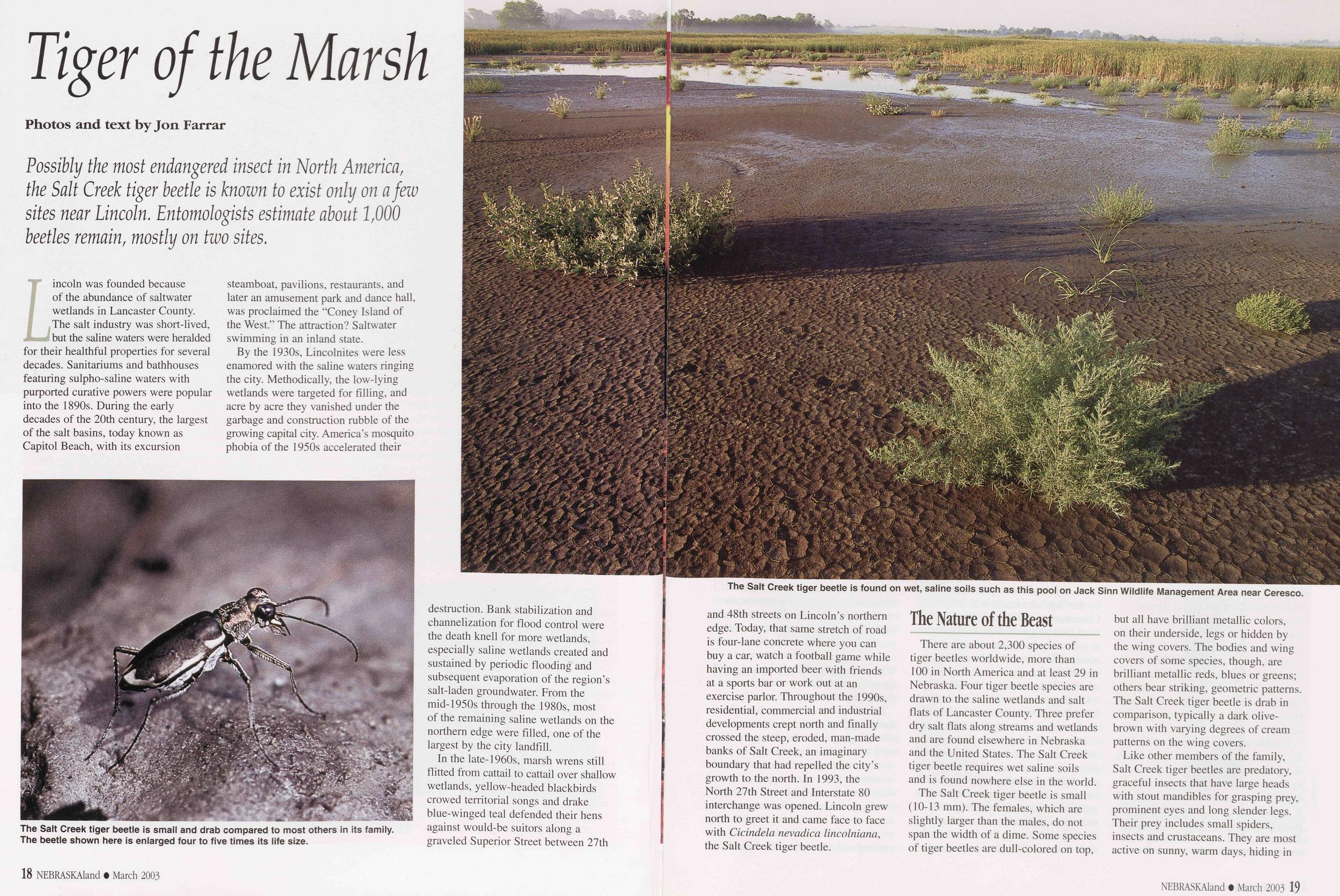
Tiger of the Marsh
Photos and text by Jon Farrar Possibly the most endangered insect in North America, the Salt Creek tiger beetle is known to exist only on a few sites near Lincoln. Entomologists estimate about 1,000 beetles remain, mostly on two sites.Lincoln was founded because of the abundance of saltwater wetlands in Lancaster County. The salt industry was short-lived, but the saline waters were heralded for their healthful properties for several decades. Sanitariums and bathhouses featuring sulpho-saline waters with purported curative powers were popular into the 1890s. During the early decades of the 20th century, the largest of the salt basins, today known as Capitol Beach, with its excursion steamboat, pavilions, restaurants, and later an amusement park and dance hall, was proclaimed the "Coney Island of the West." The attraction? Saltwater swimming in an inland state.
By the 1930s, Lincolnites were less enamored with the saline waters ringing the city. Methodically, the low-lying wetlands were targeted for filling, and acre by acre they vanished under the garbage and construction rubble of the growing capital city. America's mosquito phobia of the 1950s accelerated their
In the late-1960s, marsh wrens still flitted from cattail to cattail over shallow wetlands, yellow-headed blackbirds crowed territorial songs and drake blue-winged teal defended their hens against would-be suitors along a graveled Superior Street between 27th 18 NEBRASKAland • March 2003
There are about 2,300 species of tiger beetles worldwide, more than 100 in North America and at least 29 in Nebraska. Four tiger beetle species are drawn to the saline wetlands and salt flats of Lancaster County. Three prefer dry salt flats along streams and wetlands and are found elsewhere in Nebraska and the United States. The Salt Creek tiger beetle requires wet saline soils and is found nowhere else in the world.
The Salt Creek tiger beetle is small (10-13 mm). The females, which are slightly larger than the males, do not span the width of a dime. Some species of tiger beetles are dull-colored on top, but all have brilliant metallic colors, on their underside, legs or hidden by the wing covers. The bodies and wing covers of some species, though, are brilliant metallic reds, blues or greens; others bear striking, geometric patterns. The Salt Creek tiger beetle is drab in comparison, typically a dark olive-brown with varying degrees of cream patterns on the wing covers.
Like other members of the family,
Salt Creek tiger beetles are predatory,
graceful insects that have large heads
with stout mandibles for grasping prey,
prominent eyes and long slender legs.
Their prey includes small spiders,
insects and crustaceans. They are most
active on sunny, warm days, hiding in
NEBRASKAland • March 2003 19
The life history of the Salt Creek tiger beetle is not thoroughly understood. Because much of their lives are spent underground in the larval form, they are difficult to study. Until more research is completed, much must be inferred from closely related species. Work by University of Nebraska-Lincoln entomologists Steve Spomer and Bill Allgeier are only beginning to document the details. Allgeier completed the first year of a two-year study funded by the Nebraska Game and Parks Commission in 2002, developing a mark-and-recapture census technique to estimate populations, studying the species's life cycle, habitat preference (especially for egg laying), the effect of urban lights on behavior and attempting to raise the species in the lab. All of those aspects of study will continue during the 2003 field season.
This is what they know and suspect. Adults emerge from ground burrows from mid-June through July and the population peaks about two weeks after the first individuals appear. By August most adults have died. During their short lives, adults are occupied with feeding and mating. It is believed that both males and females mate multiple times and females lay eggs throughout their few weeks as adults. It is not known how many eggs a female Salt Creek tiger beetle produces a season, but Spomer and Allgeier speculate it might be about 50. The female deposits only one egg at one location by thrusting the tip of her abdomen in soft soils midway up muddy banks bordering saline wetlands and streams.
Allgeier observed that a female spends about 15 minutes depositing each egg. From observations in the lab, entomologists suspect that eggs are typically deposited at night. The larvae that emerge from the eggs are sedentary, prospering or perishing depending on how carefully the female selected the site. Spomer and Allgeier speculate the larvae mortality rate might be as high as 90 percent during the first larval stage because they are small and vulnerable to the elements and too few small prey pass within capture distance.
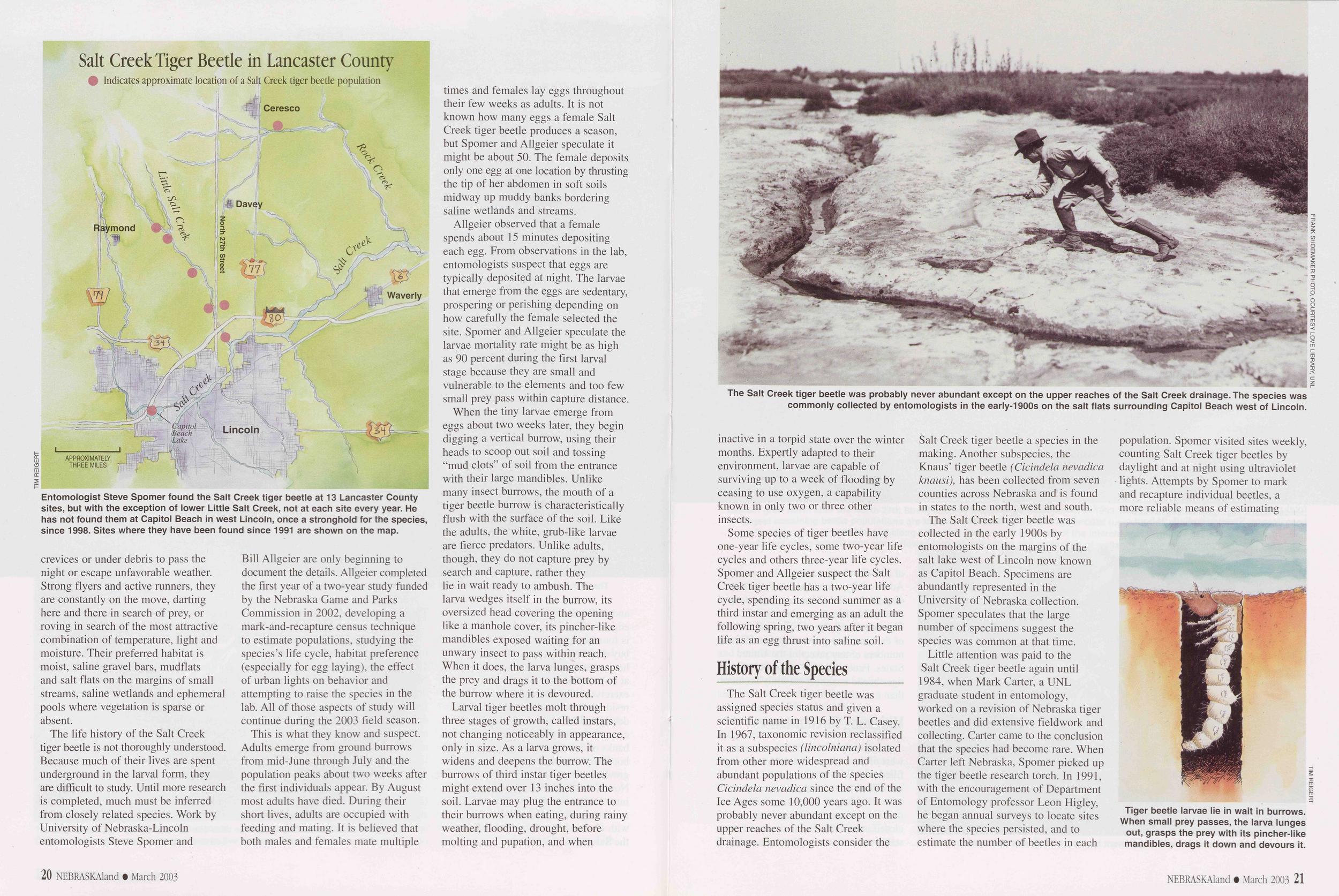
When the tiny larvae emerge from eggs about two weeks later, they begin digging a vertical burrow, using their heads to scoop out soil and tossing "mud clots" of soil from the entrance with their large mandibles. Unlike many insect burrows, the mouth of a tiger beetle burrow is characteristically flush with the surface of the soil. Like the adults, the white, grub-like larvae are fierce predators. Unlike adults, though, they do not capture prey by search and capture, rather they lie in wait ready to ambush. The larva wedges itself in the burrow, its oversized head covering the opening like a manhole cover, its pincher-like mandibles exposed waiting for an unwary insect to pass within reach. When it does, the larva lunges, grasps the prey and drags it to the bottom of the burrow where it is devoured.
Larval tiger beetles molt through three stages of growth, called instars, not changing noticeably in appearance, only in size. As a larva grows, it widens and deepens the burrow. The burrows of third instar tiger beetles might extend over 13 inches into the soil. Larvae may plug the entrance to their burrows when eating, during rainy weather, flooding, drought, before molting and pupation, and when 20 NEBRASKAland • March 2003
Some species of tiger beetles have one-year life cycles, some two-year life cycles and others three-year life cycles. Spomer and Allgeier suspect the Salt Creek tiger beetle has a two-year life cycle, spending its second summer as a third instar and emerging as an adult the following spring, two years after it began life as an egg thrust into saline soil.
History of the SpeciesThe Salt Creek tiger beetle was assigned species status and given a scientific name in 1916 by T. L. Casey. In 1967, taxonomic revision reclassified it as a subspecies (lincolniana) isolated from other more widespread and abundant populations of the species Cicindela nevadica since the end of the Ice Ages some 10,000 years ago. It was probably never abundant except on the upper reaches of the Salt Creek drainage. Entomologists consider the Salt Creek tiger beetle a species in the making. Another subspecies, the Knaus' tiger beetle (Cicindela nevadica knausi), has been collected from seven counties across Nebraska and is found in states to the north, west and south.
The Salt Creek tiger beetle was collected in the early 1900s by entomologists on the margins of the salt lake west of Lincoln now known as Capitol Beach. Specimens are abundantly represented in the University of Nebraska collection. Spomer speculates that the large number of specimens suggest the species was common at that time.
Little attention was paid to the Salt Creek tiger beetle again until 1984, when Mark Carter, a UNL graduate student in entomology, worked on a revision of Nebraska tiger beetles and did extensive fieldwork and collecting. Carter came to the conclusion that the species had become rare. When Carter left Nebraska, Spomer picked up the tiger beetle research torch. In 1991, with the encouragement of Department of Entomology professor Leon Higley, he began annual surveys to locate sites where the species persisted, and to estimate the number of beetles in each population. Spomer visited sites weekly, counting Salt Creek tiger beetles by daylight and at night using ultraviolet lights. Attempts by Spomer to mark and recapture individual beetles, a more reliable means of estimating
 populations, were unsuccessful because
the beetle's waxy wing coverings
repelled inks and paints. In 1992,
working under a one-year, U.S. Fish
and Wildlife Service (USFWS) grant,
Spomer also studied the beetle's habitat
preference and biology. When that report
was completed, Spomer and Higley
recommended to the USFWS that the
Salt Creek tiger beetle be listed under
the federal Endangered Species Act.
populations, were unsuccessful because
the beetle's waxy wing coverings
repelled inks and paints. In 1992,
working under a one-year, U.S. Fish
and Wildlife Service (USFWS) grant,
Spomer also studied the beetle's habitat
preference and biology. When that report
was completed, Spomer and Higley
recommended to the USFWS that the
Salt Creek tiger beetle be listed under
the federal Endangered Species Act.
Spomer located Salt Creek tiger beetles at only six sites near Lincoln in 1991. Since that time he has found them at 13 sites, but not at each site every year with the exception of one on the lower reaches of Little Salt Creek. His annual population estimates of the total number of all beetles on all sites has ranged from a low of 115 in 1993, to a high of 777 in 2002, averaging about 600 since 1995. Spomer has not found Salt Creek tiger beetles at Capitol Beach, once a stronghold for the species, since 1998. Cyclic variation in abundance of insect species is expected, and the addition of new sites and increasingly thorough searches probably contributed to higher counts in recent years, not that the species is prospering. When pressed for an estimate of the total number of Salt Creek tiger beetles in existence, Spomer replied, "About a thousand."
The Nebraska Game and Parks Commission added the Salt Creek tiger beetle to the state's threatened and endangered list in March 2000, along with saltwort, a rare plant found in Nebraska only on saline wetlands in northern Lancaster County and one site in Phelps County. Listing protected the beetle by requiring a review of projects that are conducted, funded or authorized by a state agency to ensure those projects do not jeopardize the species. Listing also makes it illegal to collect, kill or harm the species. Typically, rather than imposing regulations on landowners and other governmental entities, the Commission works with them to modify projects so they do not effect the species.
In October, 2001, the USFWS designated the Salt Creek tiger beetle as a candidate for the federal endangered species list, and in May, 2002 proposed the beetle for emergency listing as endangered.
Currently one tiger beetle species is classified as endangered under the federal Endangered Species Act. Two others are classified as threatened. At the time these species were listed, their estimated populations were at least ten times larger than the estimated number
As recently as the 1980s, wetlands west of downtown Lincoln were being filled with construction rubble. The city landfill on North 48th Street covered one of the largest remaining wetlands on Lincoln's north side, and was not closed until 1988. In the course of bank stabilization work in 1992, concrete 22 NEBRASKAland • March 2003
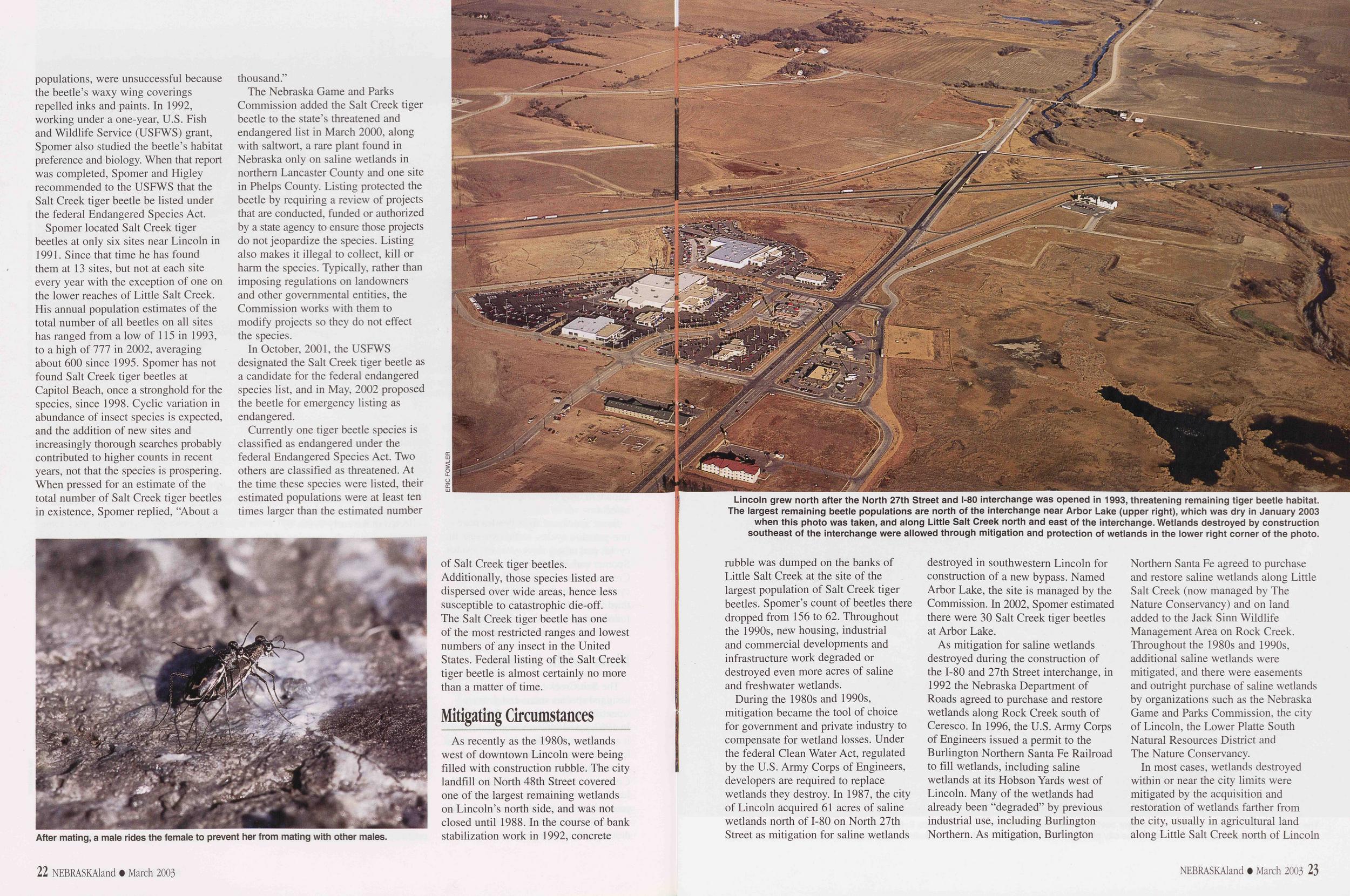
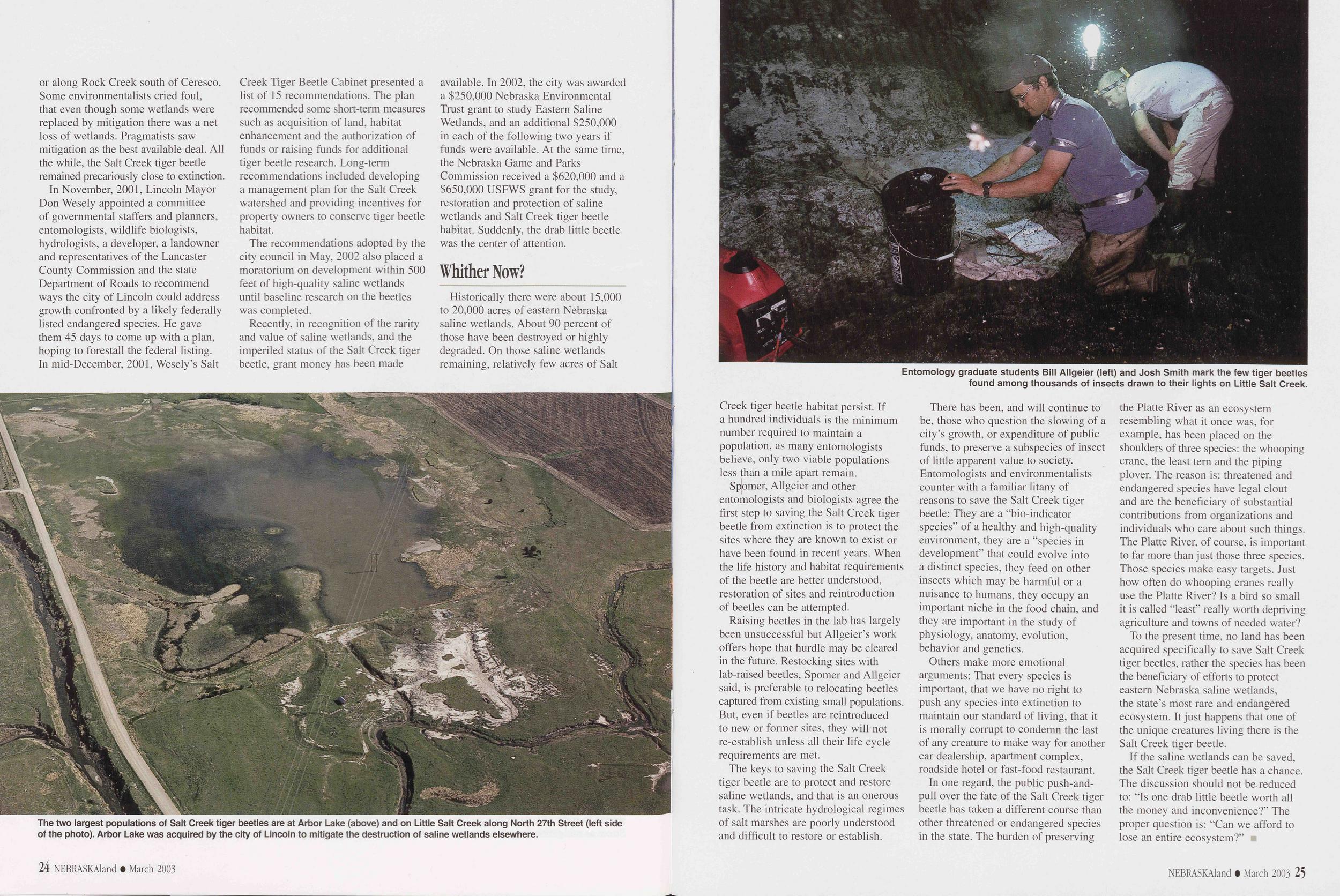
During the 1980s and 1990s, mitigation became the tool of choice for government and private industry to compensate for wetland losses. Under the federal Clean Water Act, regulated by the U.S. Army Corps of Engineers, developers are required to replace wetlands they destroy. In 1987, the city of Lincoln acquired 61 acres of saline wetlands north of 1-80 on North 27th Street as mitigation for saline wetlands destroyed in southwestern Lincoln for construction of a new bypass. Named Arbor Lake, the site is managed by the Commission. In 2002, Spomer estimated there were 30 Salt Creek tiger beetles at Arbor Lake.
As mitigation for saline wetlands destroyed during the construction of the 1-80 and 27th Street interchange, in 1992 the Nebraska Department of Roads agreed to purchase and restore wetlands along Rock Creek south of Ceresco. In 1996, the U.S. Army Corps of Engineers issued a permit to the Burlington Northern Santa Fe Railroad to fill wetlands, including saline wetlands at its Hobson Yards west of Lincoln. Many of the wetlands had already been "degraded" by previous industrial use, including Burlington Northern. As mitigation, Burlington Northern Santa Fe agreed to purchase and restore saline wetlands along Little Salt Creek (now managed by The Nature Conservancy) and on land added to the Jack Sinn Wildlife Management Area on Rock Creek. Throughout the 1980s and 1990s, additional saline wetlands were mitigated, and there were easements and outright purchase of saline wetlands by organizations such as the Nebraska Game and Parks Commission, the city of Lincoln, the Lower Platte South Natural Resources District and The Nature Conservancy.
In most cases, wetlands destroyed
within or near the city limits were
mitigated by the acquisition and
restoration of wetlands farther from
the city, usually in agricultural land
along Little Salt Creek north of Lincoln
NEBRASKAland • March 2003 23
 or along Rock Creek south of Ceresco.
Some environmentalists cried foul,
that even though some wetlands were
replaced by mitigation there was a net
loss of wetlands. Pragmatists saw
mitigation as the best available deal. All
the while, the Salt Creek tiger beetle
remained precariously close to extinction.
or along Rock Creek south of Ceresco.
Some environmentalists cried foul,
that even though some wetlands were
replaced by mitigation there was a net
loss of wetlands. Pragmatists saw
mitigation as the best available deal. All
the while, the Salt Creek tiger beetle
remained precariously close to extinction.
In November, 2001, Lincoln Mayor Don Wesely appointed a committee of governmental staffers and planners, entomologists, wildlife biologists, hydrologists, a developer, a landowner and representatives of the Lancaster County Commission and the state Department of Roads to recommend ways the city of Lincoln could address growth confronted by a likely federally listed endangered species. He gave them 45 days to come up with a plan, hoping to forestall the federal listing. In mid-December, 2001, Wesely's Salt Creek Tiger Beetle Cabinet presented a list of 15 recommendations. The plan recommended some short-term measures such as acquisition of land, habitat enhancement and the authorization of funds or raising funds for additional tiger beetle research. Long-term recommendations included developing a management plan for the Salt Creek watershed and providing incentives for property owners to conserve tiger beetle habitat.
The recommendations adopted by the city council in May, 2002 also placed a moratorium on development within 500 feet of high-quality saline wetlands until baseline research on the beetles was completed.
Recently, in recognition of the rarity and value of saline wetlands, and the imperiled status of the Salt Creek tiger beetle, grant money has been made available. In 2002, the city was awarded a $250,000 Nebraska Environmental Trust grant to study Eastern Saline Wetlands, and an additional $250,000 in each of the following two years if funds were available. At the same time, the Nebraska Game and Parks Commission received a $620,000 and a $650,000 USFWS grant for the study, restoration and protection of saline wetlands and Salt Creek tiger beetle habitat. Suddenly, the drab little beetle was the center of attention.
Whither Now? ________Historically there were about 15,000 to 20,000 acres of eastern Nebraska saline wetlands. About 90 percent of those have been destroyed or highly degraded. On those saline wetlands remaining, relatively few acres of Salt
Spomer, Allgeier and other entomologists and biologists agree the first step to saving the Salt Creek tiger beetle from extinction is to protect the sites where they are known to exist or have been found in recent years. When the life history and habitat requirements of the beetle are better understood, restoration of sites and reintroduction of beetles can be attempted.
Raising beetles in the lab has largely been unsuccessful but Allgeier's work offers hope that hurdle may be cleared in the future. Restocking sites with lab-raised beetles, Spomer and Allgeier said, is preferable to relocating beetles captured from existing small populations. But, even if beetles are reintroduced to new or former sites, they will not re-establish unless all their life cycle requirements are met.
The keys to saving the Salt Creek tiger beetle are to protect and restore saline wetlands, and that is an onerous task. The intricate hydrological regimes of salt marshes are poorly understood and difficult to restore or establish.
There has been, and will continue to be, those who question the slowing of a city's growth, or expenditure of public funds, to preserve a subspecies of insect of little apparent value to society. Entomologists and environmentalists counter with a familiar litany of reasons to save the Salt Creek tiger beetle: They are a "bio-indicator species" of a healthy and high-quality environment, they are a "species in development" that could evolve into a distinct species, they feed on other insects which may be harmful or a nuisance to humans, they occupy an important niche in the food chain, and they are important in the study of physiology, anatomy, evolution, behavior and genetics.
Others make more emotional arguments: That every species is important, that we have no right to push any species into extinction to maintain our standard of living, that it is morally corrupt to condemn the last of any creature to make way for another car dealership, apartment complex, roadside hotel or fast-food restaurant.
In one regard, the public push-and- pull over the fate of the Salt Creek tiger beetle has taken a different course than other threatened or endangered species in the state. The burden of preserving the Platte River as an ecosystem resembling what it once was, for example, has been placed on the shoulders of three species: the whooping crane, the least tern and the piping plover. The reason is: threatened and endangered species have legal clout and are the beneficiary of substantial contributions from organizations and individuals who care about such things. The Platte River, of course, is important to far more than just those three species. Those species make easy targets. Just how often do whooping cranes really use the Platte River? Is a bird so small it is called "least" really worth depriving agriculture and towns of needed water?
To the present time, no land has been acquired specifically to save Salt Creek tiger beetles, rather the species has been the beneficiary of efforts to protect eastern Nebraska saline wetlands, the state's most rare and endangered ecosystem. It just happens that one of the unique creatures living there is the Salt Creek tiger beetle.
If the saline wetlands can be saved, the Salt Creek tiger beetle has a chance. The discussion should not be reduced to: "Is one drab little beetle worth all the money and inconvenience?" The proper question is: "Can we afford to lose an entire ecosystem?"
NEBRASKAland • March 2003 25
Spring Wings on the Platte
Photos and text by Michael Forsber Every spring between late-February and mid-April more than 10 million migrating waterfowl and nearly a half-million cranes pass through the central Platte River Valley - the pinch in the hourglass of the Central Fly way. They create an avian procession on a grand scale found few other places in North America.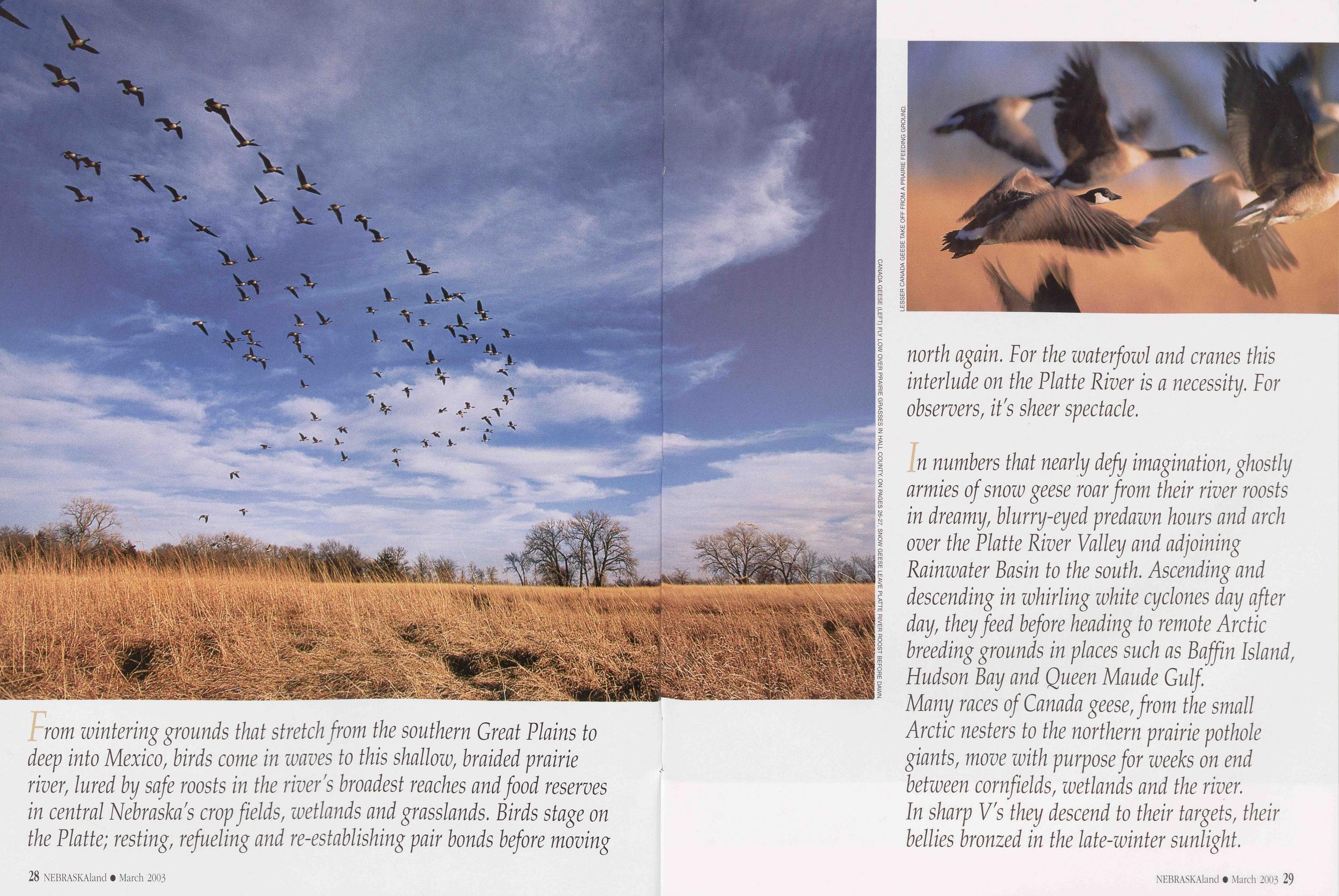
rom wintering grounds that stretch from the southern Great Plains to deep into Mexico, birds come in waves to this shallow, braided prairie river, lured by safe roosts in the river's broadest reaches and food reserves in central Nebraska's crop fields, wetlands and grasslands. Birds stage on the Platte; resting, refueling and re-establishing pair bonds before moving 28 NEBRASKAland • March 2003
In numbers that nearly defy imagination, ghostly armies of snow geese roar from their river roosts in dreamy, blurry-eyed predawn hours and arch over the Platte River Valley and adjoining Rainwater Basin to the south. Ascending and descending in whirling white cyclones day after day, they feed before heading to remote Arctic breeding grounds in places such as Baffin Island, Hudson Bay and Queen Maude Gulf. Many races of Canada geese, from the small Arctic nesters to the northern prairie pothole giants, move with purpose for weeks on end between cornfields, wetlands and the river. In sharp V's they descend to their targets, their bellies bronzed in the late-winter sunlight.
NEBRASKAland • March 2003 29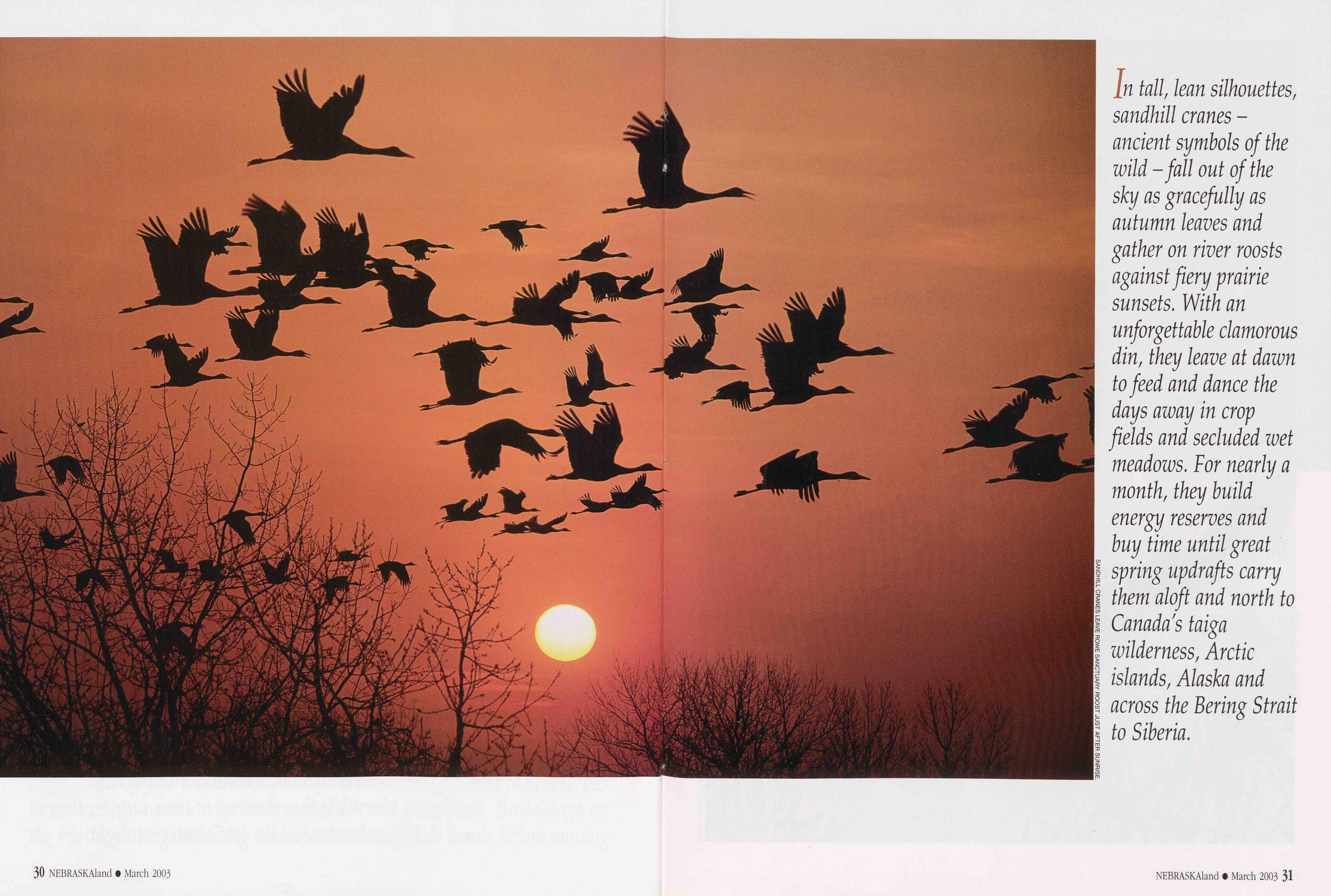
In tall, lean silhouettes, sandhill cranes - ancient symbols of the wild - fall out of the sky as gracefully as autumn leaves and gather on river roosts against fiery prairie sunsets. With an unforgettable clamorous din, they leave at dawn to feed and dance the days away in crop fields and secluded wet meadows. For nearly a month, they build energy reserves and buy time until great spring updrafts carry them aloft and north to Canada's taiga wilderness, Arctic islands, Alaska and across the Bering Strait to Siberia.
NEBRASKAland • March 2003 31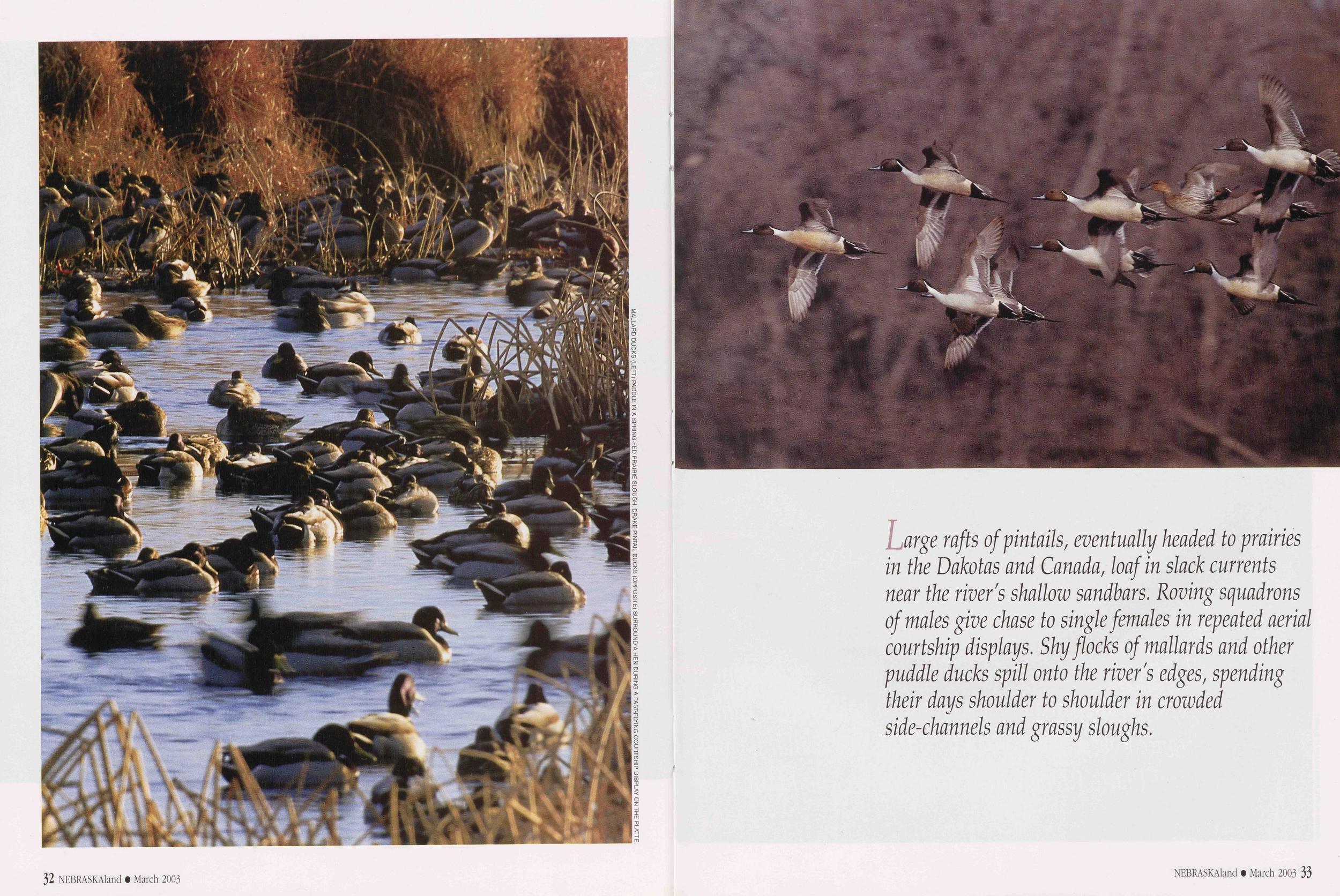
Large rafts of pintails, eventually headed to prairies in the Dakotas and Canada, loaf in slack currents near the river's shallow sandbars. Roving squadrons of males give chase to single females in repeated aerial courtship displays. Shy flocks of mallards and other puddle ducks spill onto the river's edges, spending their days shoulder to shoulder in crowded side-channels and grassy sloughs.
NEBRASKAland • March 2003 33
Finally, the grand procession of birds wanes. More than 80 percent of the world's sanhill cranes, three to six million snow geese on trheir way to the Arctic, a half-million Canada geese, 90 percent of the mid-continent's population of white-fronted geese, half the mid-contintent's mallards, and a myriad of raptors, shorebirds and songbirds pass through the central Platte River Valley each spring. The Platte River is both necessity and spectacle. There is no other place like it.
34 NEBRASKAland • March 2003 NEBRASKAland • March 2003 35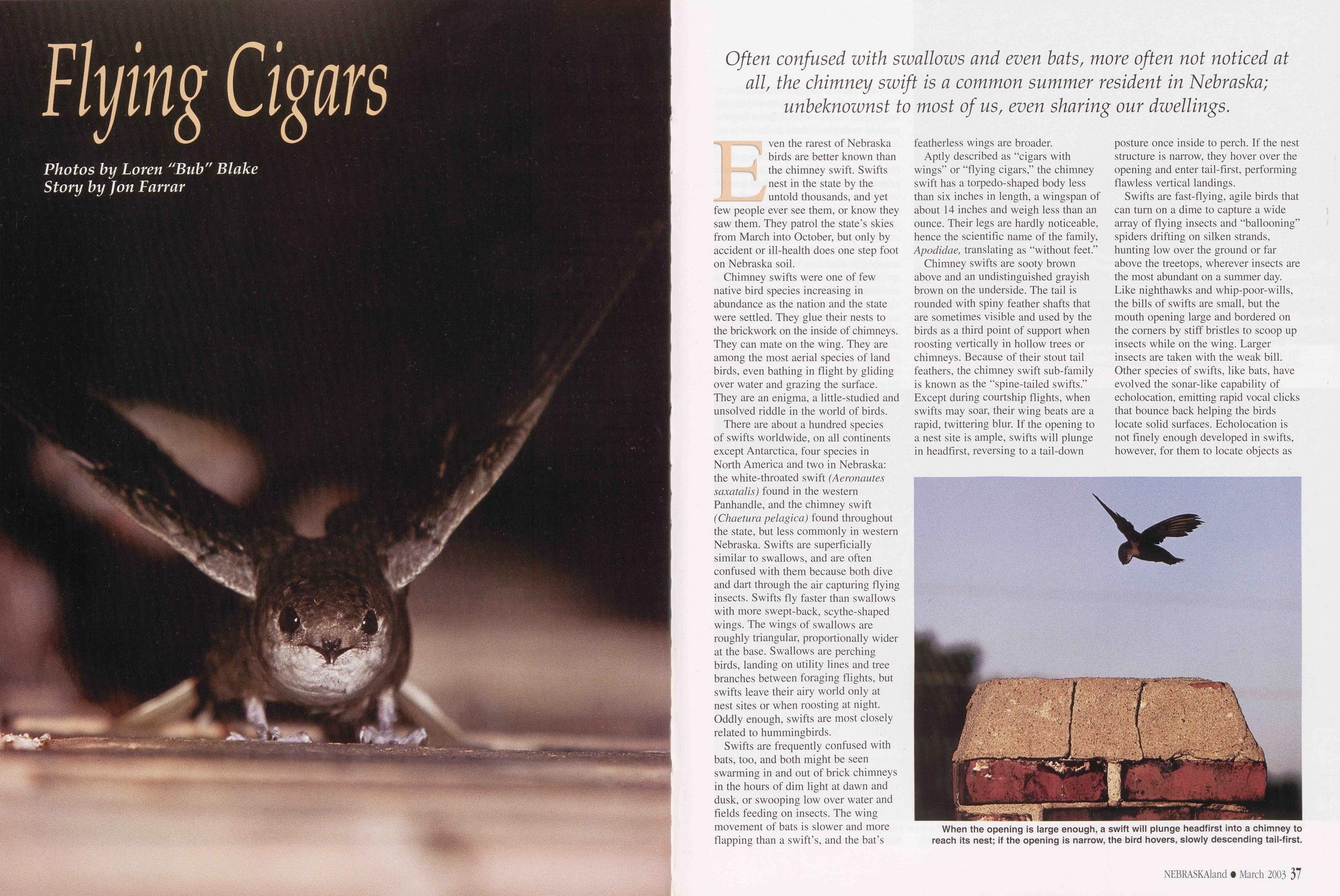
Flying Cigars
Photos by Loren ":Bub" Blake Story by Jon Farrar Often confused with swallows and even hats, more often not noticed at all, the chimney swift is a common summer resident in Nebraska; unbeknownst to most of us, even sharing our dwellings.Even the rarest of Nebraska birds are better known than the chimney swift. Swifts nest in the state by the untold thousands, and yet few people ever see them, or know they saw them. They patrol the state's skies from March into October, but only by accident or ill-health does one step foot on Nebraska soil.
Chimney swifts were one of few native bird species increasing in abundance as the nation and the state were settled. They glue their nests to the brickwork on the inside of chimneys. They can mate on the wing. They are among the most aerial species of land birds, even bathing in flight by gliding over water and grazing the surface. They are an enigma, a little-studied and unsolved riddle in the world of birds.
There are about a hundred species of swifts worldwide, on all continents except Antarctica, four species in North America and two in Nebraska: the white-throated swift (Aeronautes saxatalis) found in the western Panhandle, and the chimney swift (Chaetura pelagica) found throughout the state, but less commonly in western Nebraska. Swifts are superficially similar to swallows, and are often confused with them because both dive and dart through the air capturing flying insects. Swifts fly faster than swallows with more swept-back, scythe-shaped wings. The wings of swallows are roughly triangular, proportionally wider at the base. Swallows are perching birds, landing on utility lines and tree branches between foraging flights, but swifts leave their airy world only at nest sites or when roosting at night. Oddly enough, swifts are most closely related to hummingbirds.
Swifts are frequently confused with bats, too, and both might be seen swarming in and out of brick chimneys in the hours of dim light at dawn and dusk, or swooping low over water and fields feeding on insects. The wing movement of bats is slower and more flapping than a swift's, and the bat's featherless wings are broader.
Aptly described as "cigars with wings" or "flying cigars," the chimney swift has a torpedo-shaped body less than six inches in length, a wingspan of about 14 inches and weigh less than an ounce. Their legs are hardly noticeable, hence the scientific name of the family, Apodidae, translating as "without feet."
Chimney swifts are sooty brown above and an undistinguished grayish brown on the underside. The tail is rounded with spiny feather shafts that are sometimes visible and used by the birds as a third point of support when roosting vertically in hollow trees or chimneys. Because of their stout tail feathers, the chimney swift sub-family is known as the "spine-tailed swifts." Except during courtship flights, when swifts may soar, their wing beats are a rapid, twittering blur. If the opening to a nest site is ample, swifts will plunge in headfirst, reversing to a tail-down posture once inside to perch. If the nest structure is narrow, they hover over the opening and enter tail-first, performing flawless vertical landings.
Swifts are fast-flying, agile birds that can turn on a dime to capture a wide array of flying insects and "ballooning" spiders drifting on silken strands, hunting low over the ground or far above the treetops, wherever insects are the most abundant on a summer day. Like nighthawks and whip-poor-wills, the bills of swifts are small, but the mouth opening large and bordered on the corners by stiff bristles to scoop up insects while on the wing. Larger insects are taken with the weak bill. Other species of swifts, like bats, have evolved the sonar-like capability of echolocation, emitting rapid vocal clicks that bounce back helping the birds locate solid surfaces. Echolocation is not finely enough developed in swifts, however, for them to locate objects as
Swifts are foraging opportunists, capitalizing on swarming nuptial flights of ants, mayflies and termites. Like other aerial insectivores, swifts are occasionally faced with periods of cool, wet weather when insects are inactive. During times when food is scarce and temperatures low, chimney swifts enter a physiological torpor, roosting out of the weather, typically deep in their roosting structures, lowering their body temperature and oxygen consumption. When cool days are encountered during migration, swifts will huddle in large masses, sometimes three birds deep, to conserve body heat.
Before Europeans settlers came to North America, chimney swifts nested principally in hollow trees, abandoned woodpecker nest cavities and vertical crevices in rocks. As brick chimneys spread westward, so too did chimney swifts, expanding both in abundance and range. As would be expected, they are more common in urban areas than sparsely populated rural lands. In addition to chimneys, chimney swifts also nest in air vents, abandoned wells and cisterns, outhouses, silos, barns and other abandoned buildings - places where there are dark vertical crevices protected from the elements. Chimney swift numbers have declined in the past 20 years nationwide. Ornithologists speculate the principal cause is a reduction in nesting habitat as brick chimneys are replaced by narrow, sheet metal flues for furnaces and fireplaces, and the capping of previously open brick chimneys with wire mesh to exclude unwanted animals.
Chimney swifts winter in the upper Amazon basin of Peru, Ecuador, Chile and Brazil. During migration, flocks of chimney swifts might number in the thousands, swirling like tornadoes into large roosting sites at sundown. During summer months, flocks of unmated birds also roost communally, another reason they are sometimes confused with bats. During the nesting season, chimney swift pairs are usually solitary, although they are known to tolerate other, non-nesting swifts in the same chimney.
It is not surprising that chimney swifts court on the wing. Courtship flights begin about two weeks after their arrival on the breeding grounds, generally in mid- to late-April in Nebraska. Initial courtship flights are composed of four to seven individuals, careening and chasing through the air, with pairs-in-the-making frequently breaking away and then rejoining the group. Slowly the group breaks down, often into one female and two competing males, into an aerial display that 38 NEBRASKAland • March 2003 ornithologists call trio-flying, weaving through buildings and trees while issuing chipper calls, high-pitched notes issued so closely together as to produce a chattering, insect-like buzz. During such flights, the trio often climbs to greater heights than normal. As two-bird courtship flights become more common, "V-ing" is more often seen. During this unique aerial display the rear bird ceases flapping its wings, snaps them briskly up forming a deep V and glides. The front bird may also assume the posture and both slip into a curving, descending glide. This display continues through the nesting season and is believed to reaffirm pair bonds.
Once a pair is formed, the male typically entices the female to potential nesting sites, swooping down toward it, perhaps even landing to inspect it or indulge in ritualistic preening. So aerial is the chimney swift, that some copulations occur while the birds are in flight, although they are more common at the nest site during nest building.
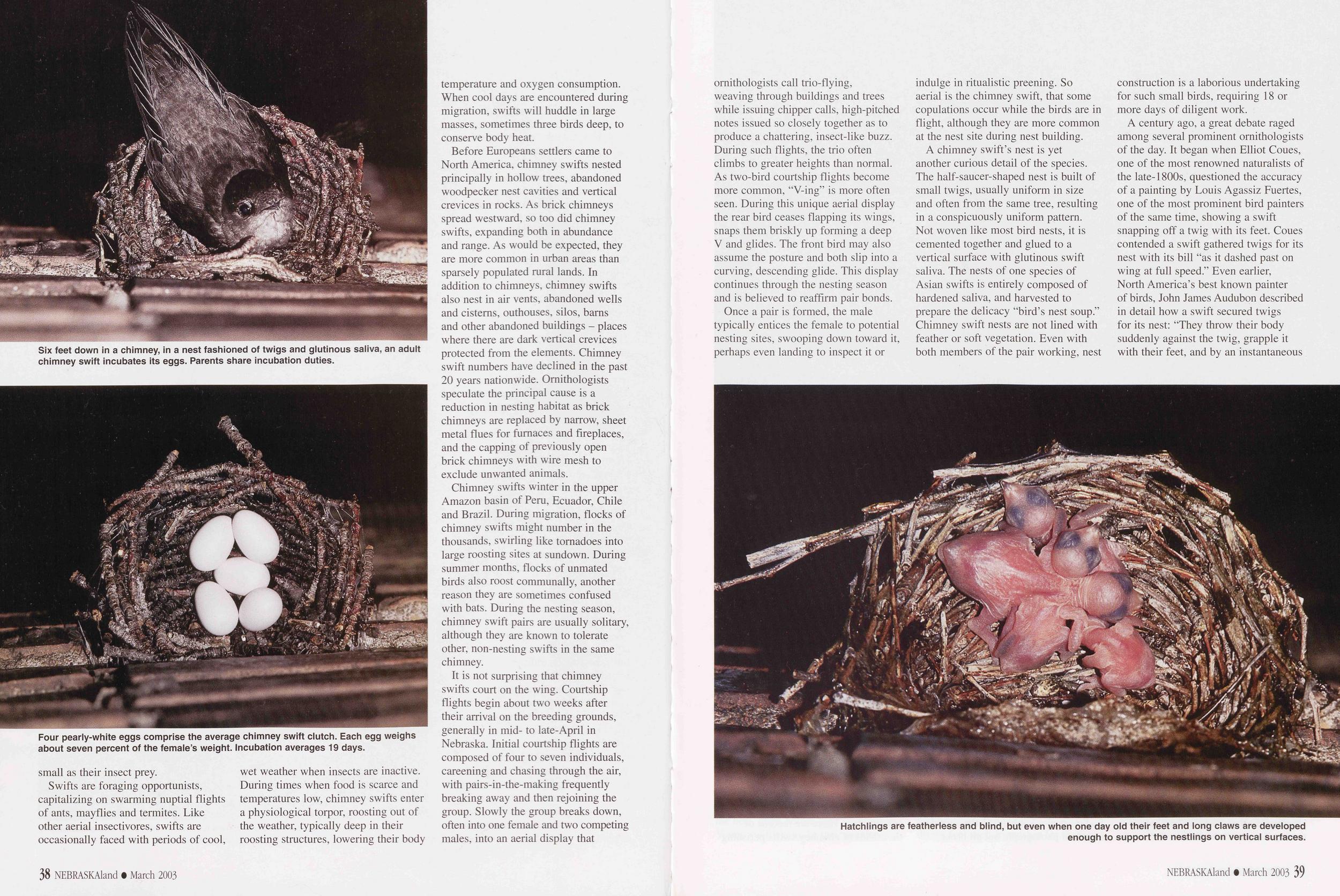
A chimney swift's nest is yet another curious detail of the species. The half-saucer-shaped nest is built of small twigs, usually uniform in size and often from the same tree, resulting in a conspicuously uniform pattern. Not woven like most bird nests, it is cemented together and glued to a vertical surface with glutinous swift saliva. The nests of one species of Asian swifts is entirely composed of hardened saliva, and harvested to prepare the delicacy "bird's nest soup." Chimney swift nests are not lined with feather or soft vegetation. Even with both members of the pair working, nest construction is a laborious undertaking for such small birds, requiring 18 or more days of diligent work.
A century ago, a great debate raged among several prominent ornithologists of the day. It began when Elliot Coues, one of the most renowned naturalists of the late-1800s, questioned the accuracy of a painting by Louis Agassiz Fuertes, one of the most prominent bird painters of the same time, showing a swift snapping off a twig with its feet. Coues contended a swift gathered twigs for its nest with its bill "as it dashed past on wing at full speed." Even earlier, North America's best known painter of birds, John James Audubon described in detail how a swift secured twigs for its nest: "They throw their body suddenly against the twig, grapple it with their feet, and by an instantaneous
Chimney swift nests may be built only a few feet down in the nesting structure, to more than 20 feet below the top. Loren "Bub" Blake, whose 40 NEBRASKAland • March 2003 photos illustrate these pages, searched the chimneys in his hometown of Chambers in southern Holt County for several years for a swift nest close enough to the opening to photograph. Time and again he found nests too deep for photos. When he narrowed his search to short chimneys he began to find nests close enough to the chimney mouth to photograph, but all broke loose and were destroyed before the eggs hatched or the young left the nest. In 2001, a pair built a nest six feet from the top of a chimney and successfully reared their young to flight. Natural mortality such as Blake observed is probably not uncommon, and when swifts roost communally it can be catastrophic. There are records of thousands of chimney swifts perishing 40 NEBRASKAland • March 2003 when fires were started under chimneys where large numbers of migrating swifts, or non-breeding summer residents, were roosting, and of birds dying when soot dislodged, suffocating birds.
Egg-laying begins even before the nest is complete. Old nests may be refurbished and used another year, if they persist, but other than those anchored above supporting structures, few last so long. An average chimney swift clutch is composed of four pearly-white eggs, each egg weighing about seven percent of the female's weight. Incubation is initiated when the next to the last egg is laid, and continues for an average of 19 days. Parents share incubation duties and the eggs are rarely left uncovered for long.
Hatchling swifts are featherless and their eyes closed. Vision is of little use to the young birds, but remaining in or near the nest is critical. When only one day old the nestlings' feet and long claws are developed enough to support them on vertical surfaces. Arthur Cleveland Bent, bird biographer of the early 1900s, in a time when biologists regularly ventured into the field and wrote more in their notebooks than numbers, described the hatchling as "a blind little naked thing, no bigger than your fingernail, lying in a frail cradle of sticks that overhangs a black 'drop into nothing.' "
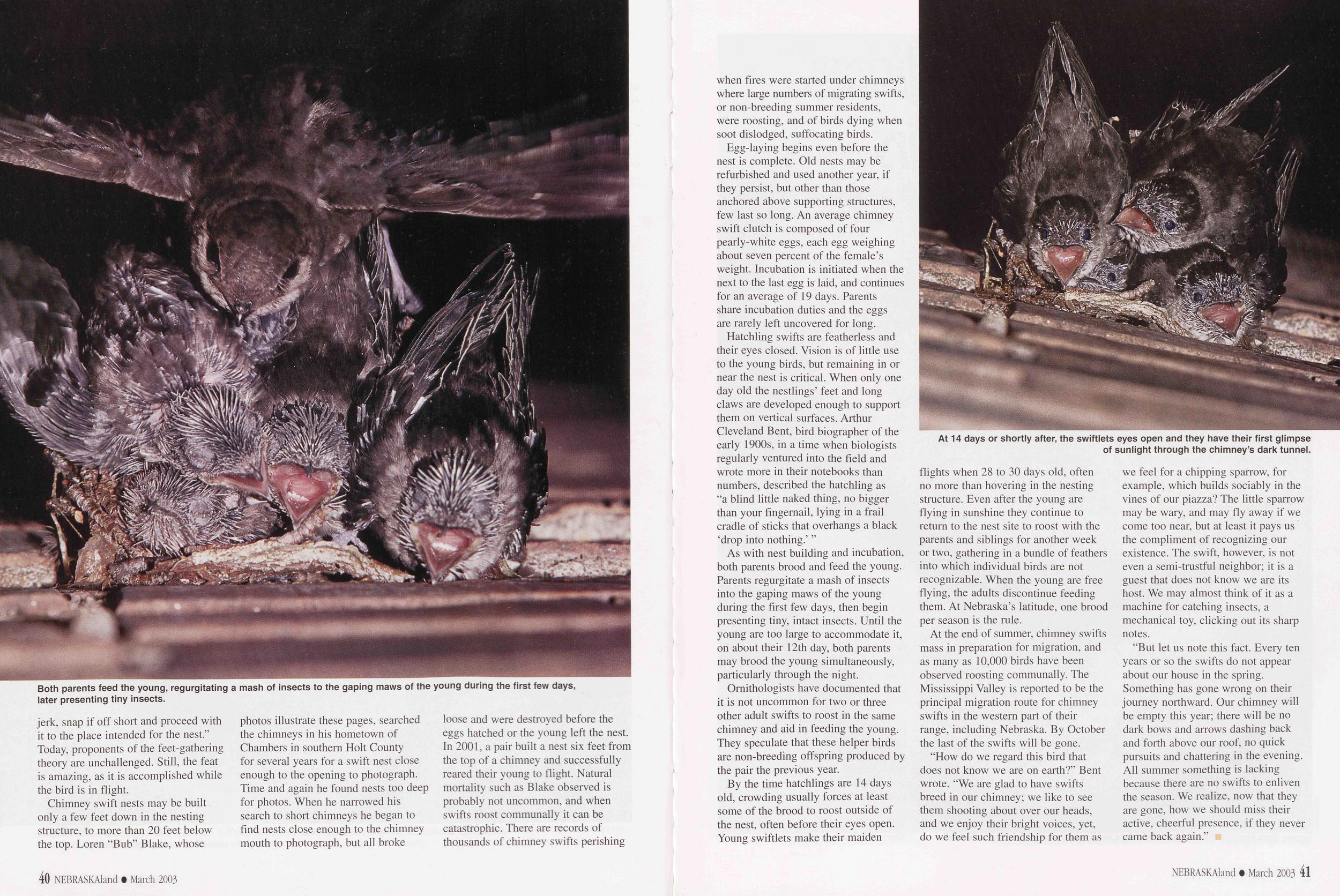
As with nest building and incubation, both parents brood and feed the young. Parents regurgitate a mash of insects into the gaping maws of the young during the first few days, then begin presenting tiny, intact insects. Until the young are too large to accommodate it, on about their 12th day, both parents may brood the young simultaneously, particularly through the night.
Ornithologists have documented that it is not uncommon for two or three other adult swifts to roost in the same chimney and aid in feeding the young. They speculate that these helper birds are non-breeding offspring produced by the pair the previous year.
By the time hatchlings are 14 days old, crowding usually forces at least some of the brood to roost outside of the nest, often before their eyes open. Young swiftlets make their maiden
At the end of summer, chimney swifts mass in preparation for migration, and as many as 10,000 birds have been observed roosting communally. The Mississippi Valley is reported to be the principal migration route for chimney swifts in the western part of their range, including Nebraska. By October the last of the swifts will be gone.
"How do we regard this bird that does not know we are on earth?" Bent wrote. "We are glad to have swifts breed in our chimney; we like to see them shooting about over our heads, and we enjoy their bright voices, yet, do we feel such friendship for them as we feel for a chipping sparrow, for example, which builds sociably in the vines of our piazza? The little sparrow may be wary, and may fly away if we come too near, but at least it pays us the compliment of recognizing our existence. The swift, however, is not even a semi-trustful neighbor; it is a guest that does not know we are its host. We may almost think of it as a machine for catching insects, a mechanical toy, clicking out its sharp notes.
"But let us note this fact. Every ten years or so the swifts do not appear about our house in the spring. Something has gone wrong on their journey northward. Our chimney will be empty this year; there will be no dark bows and arrows dashing back and forth above our roof, no quick pursuits and chattering in the evening. All summer something is lacking because there are no swifts to enliven the season. We realize, now that they are gone, how we should miss their active, cheerful presence, if they never came back again."
NEBRASKAland • March 2003 4l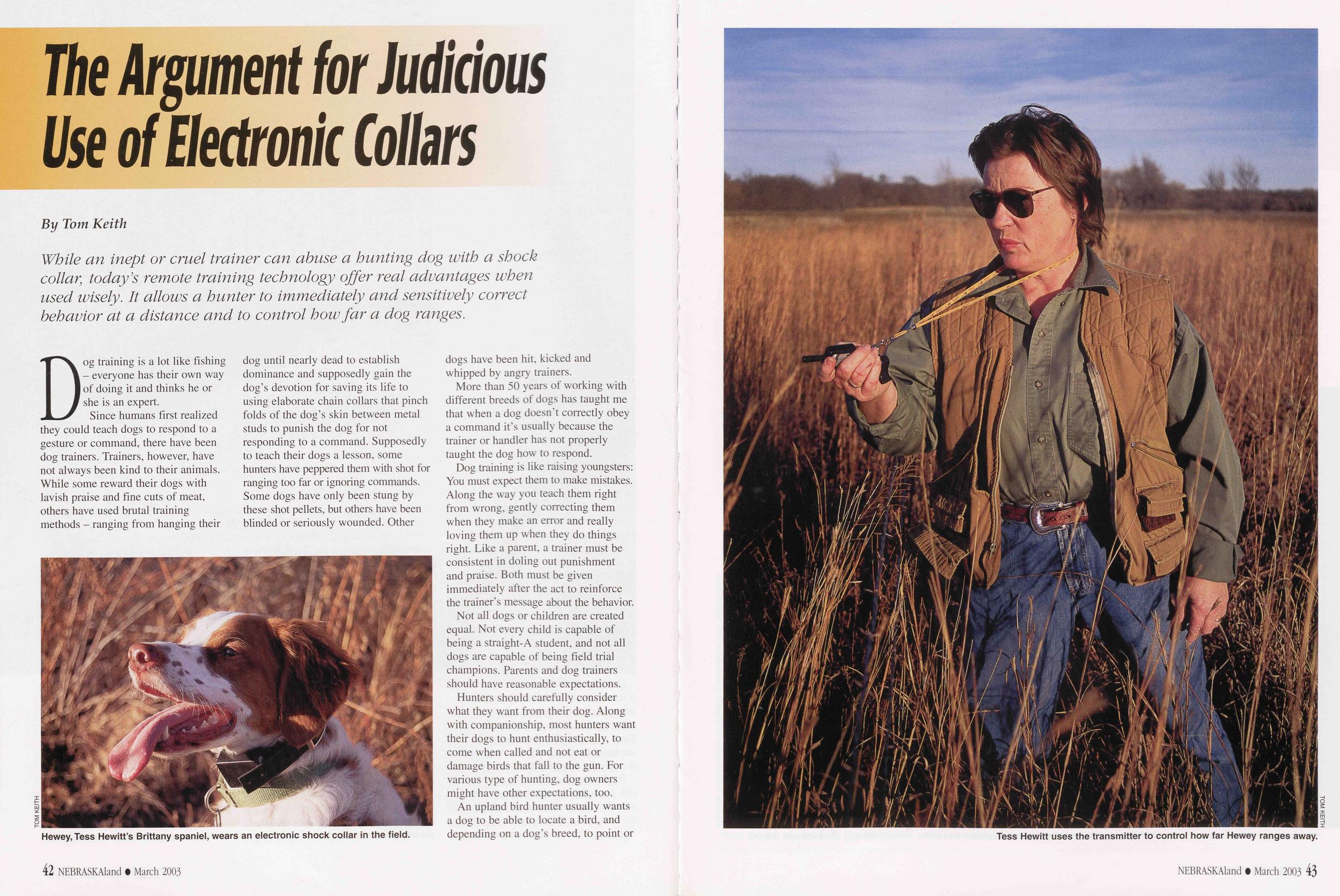
The Argument for Judicious Use of Electronic Collars
By Tom Keith While an inept or cruel trainer can abuse a hunting dog with a shock collar, today's remote training technology offer real advantages when used wisely. It allows a hunter to immediately and sensitively correct behavior at a distance and to control how far a dog ranges.Dog training is a lot like fishing - everyone has their own way of doing it and thinks he or she is an expert. Since humans first realized they could teach dogs to respond to a gesture or command, there have been dog trainers. Trainers, however, have not always been kind to their animals. While some reward their dogs with lavish praise and fine cuts of meat, others have used brutal training methods - ranging from hanging their dog until nearly dead to establish dominance and supposedly gain the dog's devotion for saving its life to using elaborate chain collars that pinch folds of the dog's skin between metal studs to punish the dog for not responding to a command. Supposedly to teach their dogs a lesson, some hunters have peppered them with shot for ranging too far or ignoring commands. Some dogs have only been stung by these shot pellets, but others have been blinded or seriously wounded. Other
More than 50 years of working with different breeds of dogs has taught me that when a dog doesn't correctly obey a command it's usually because the trainer or handler has not properly taught the dog how to respond.
Dog training is like raising youngsters: You must expect them to make mistakes. Along the way you teach them right from wrong, gently correcting them when they make an error and really loving them up when they do things right. Like a parent, a trainer must be consistent in doling out punishment and praise. Both must be given immediately after the act to reinforce the trainer's message about the behavior.
Not all dogs or children are created equal. Not every child is capable of being a straight-A student, and not all dogs are capable of being field trial champions. Parents and dog trainers should have reasonable expectations.
Hunters should carefully consider what they want from their dog. Along with companionship, most hunters want their dogs to hunt enthusiastically, to come when called and not eat or damage birds that fall to the gun. For various type of hunting, dog owners might have other expectations, too.
An upland bird hunter usually wants a dog to be able to locate a bird, and depending on a dog's breed, to point or 42 NEBRASKAland • March 2003
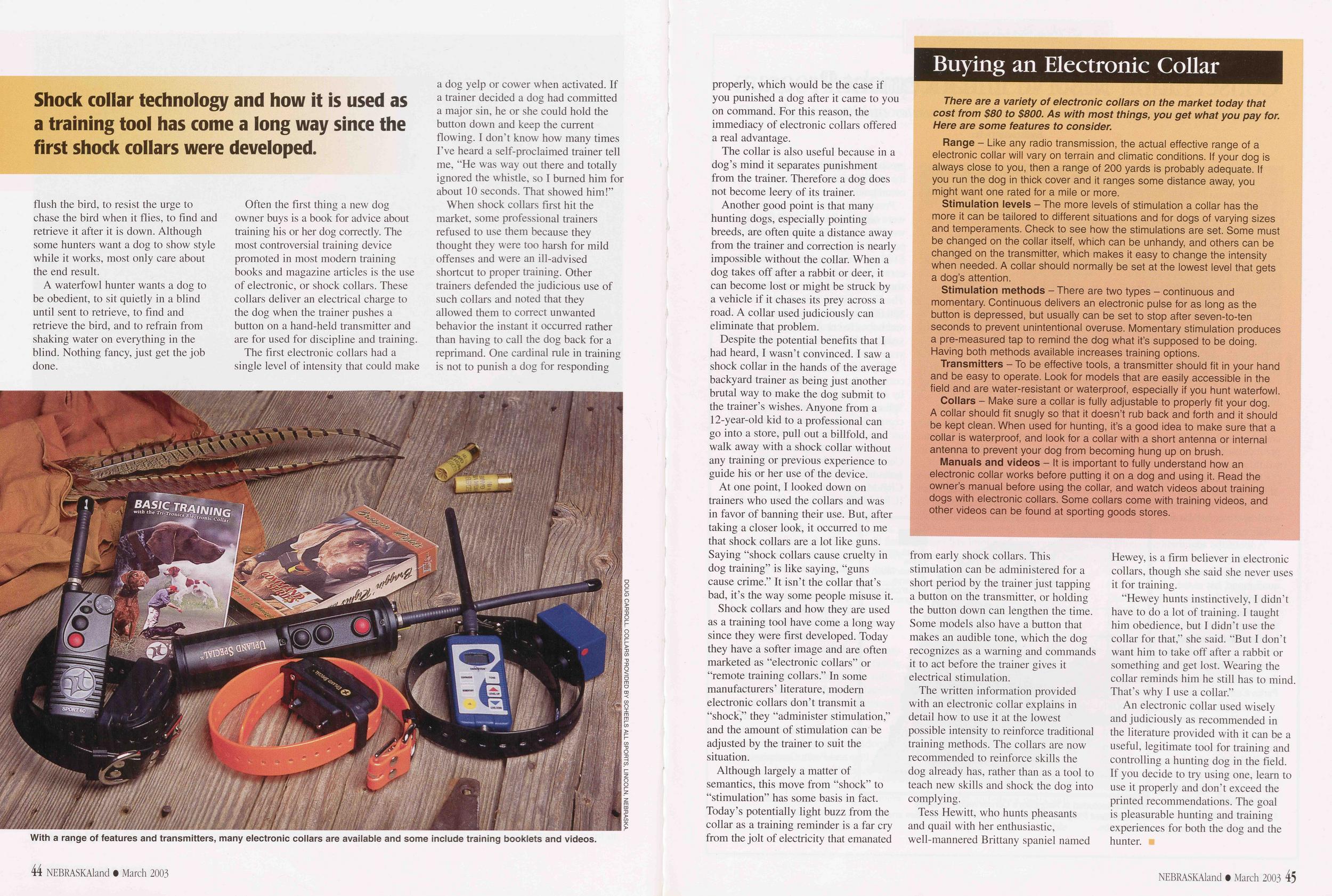 flush the bird, to resist the urge to
chase the bird when it flies, to find and
retrieve it after it is down. Although
some hunters want a dog to show style
while it works, most only care about
the end result.
Shock collar technology and how it is used as
a training tool has come a long way since the
first shock collars were developed.
flush the bird, to resist the urge to
chase the bird when it flies, to find and
retrieve it after it is down. Although
some hunters want a dog to show style
while it works, most only care about
the end result.
Shock collar technology and how it is used as
a training tool has come a long way since the
first shock collars were developed.
A waterfowl hunter wants a dog to be obedient, to sit quietly in a blind until sent to retrieve, to find and retrieve the bird, and to refrain from shaking water on everything in the blind. Nothing fancy, just get the job done.
Often the first thing a new dog owner buys is a book for advice about training his or her dog correctly. The most controversial training device promoted in most modern training books and magazine articles is the use of electronic, or shock collars. These collars deliver an electrical charge to the dog when the trainer pushes a button on a hand-held transmitter and are for used for discipline and training.
The first electronic collars had a single level of intensity that could make a dog yelp or cower when activated. If a trainer decided a dog had committed a major sin, he or she could hold the button down and keep the current flowing. I don't know how many times I've heard a self-proclaimed trainer tell me, "He was way out there and totally ignored the whistle, so I burned him for about 10 seconds. That showed him!"
When shock collars first hit the market, some professional trainers refused to use them because they thought they were too harsh for mild offenses and were an ill-advised shortcut to proper training. Other trainers defended the judicious use of such collars and noted that they allowed them to correct unwanted behavior the instant it occurred rather than having to call the dog back for a reprimand. One cardinal rule in training is not to punish a dog for responding
The collar is also useful because in a dog's mind it separates punishment from the trainer. Therefore a dog does not become leery of its trainer.
Another good point is that many hunting dogs, especially pointing breeds, are often quite a distance away from the trainer and correction is nearly impossible without the collar. When a dog takes off after a rabbit or deer, it can become lost or might be struck by a vehicle if it chases its prey across a road. A collar used judiciously can eliminate that problem.
Despite the potential benefits that I had heard, I wasn't convinced. I saw a shock collar in the hands of the average backyard trainer as being just another brutal way to make the dog submit to the trainer's wishes. Anyone from a 12-year-old kid to a professional can go into a store, pull out a billfold, and walk away with a shock collar without any training or previous experience to guide his or her use of the device.
At one point, I looked down on trainers who used the collars and was in favor of banning their use. But, after taking a closer look, it occurred to me that shock collars are a lot like guns. Saying "shock collars cause cruelty in dog training" is like saying, "guns cause crime." It isn't the collar that's bad, it's the way some people misuse it.
Shock collars and how they are used as a training tool have come a long way since they were first developed. Today they have a softer image and are often marketed as "electronic collars" or "remote training collars." In some manufacturers' literature, modern electronic collars don't transmit a "shock," they "administer stimulation," and the amount of stimulation can be adjusted by the trainer to suit the situation.
Although largely a matter of semantics, this move from "shock" to "stimulation" has some basis in fact. Today's potentially light buzz from the collar as a training reminder is a far cry from the jolt of electricity that emanated from early shock collars. This stimulation can be administered for a short period by the trainer just tapping a button on the transmitter, or holding the button down can lengthen the time. Some models also have a button that makes an audible tone, which the dog recognizes as a warning and commands it to act before the trainer gives it electrical stimulation.
Buying an Electronic CollarThere are a variety of electronic collars on the market today that cost from $80 to $800. As with most things, you get what you pay for. Here are some features to consider.
Range - Like any radio transmission, the actual effective range of a electronic collar will vary on terrain and climatic conditions. If your dog is always close to you, then a range of 200 yards is probably adequate. If you run the dog in thick cover and it ranges some distance away, you might want one rated for a mile or more.
Stimulation levels -The more levels of stimulation a collar has the more it can be tailored to different situations and for dogs of varying sizes and temperaments. Check to see how the stimulations are set. Some must be changed on the collar itself, which can be unhandy, and others can be changed on the transmitter, which makes it easy to change the intensity when needed. A collar should normally be set at the lowest level that gets a dog's attention.
Stimulation methods - There are two types - continuous and momentary. Continuous delivers an electronic pulse for as long as the burton is depressed, but usually can be set to stop after seven-to-ten seconds to prevent unintentional overuse. Momentary stimulation produces a pre-measured tap to remind the dog what it's supposed to be doing. Having both methods available increases training options.
Transmitters - To be effective tools, a transmitter should fit in your hand and be easy to operate. Look for models that are easily accessible in the field and are water-resistant or waterproof, especially if you hunt waterfowl.
Collars - Make sure a collar is fully adjustable to properly fit your dog. A collar should fit snugly so that it doesn't rub back and forth and it should be kept clean. When used for hunting, it's a good idea to make sure that a collar is waterproof, and look for a collar with a short antenna or internal antenna to prevent your dog from becoming hung up on brush.
Manuals and videos - It is important to fully understand how an electronic collar works before putting it on a dog and using it. Read the owner's manual before using the collar, and watch videos about training dogs with electronic collars. Some collars come with training videos, and other videos can be found at sporting goods stores.
The written information provided with an electronic collar explains in detail how to use it at the lowest possible intensity to reinforce traditional training methods. The collars are now recommended to reinforce skills the dog already has, rather than as a tool to teach new skills and shock the dog into complying.
Tess Hewitt, who hunts pheasants and quail with her enthusiastic, well-mannered Brittany spaniel named Hewey, is a firm believer in electronic collars, though she said she never uses it for training.
"Hewey hunts instinctively, I didn't have to do a lot of training. I taught him obedience, but I didn't use the collar for that," she said. "But I don't want him to take off after a rabbit or something and get lost. Wearing the collar reminds him he still has to mind. That's why I use a collar."
An electronic collar used wisely and judiciously as recommended in the literature provided with it can be a useful, legitimate tool for training and controlling a hunting dog in the field. If you decide to try using one, learn to use it properly and don't exceed the printed recommendations. The goal is pleasurable hunting and training experiences for both the dog and the hunter.
NEBRASKAland • March 2003 45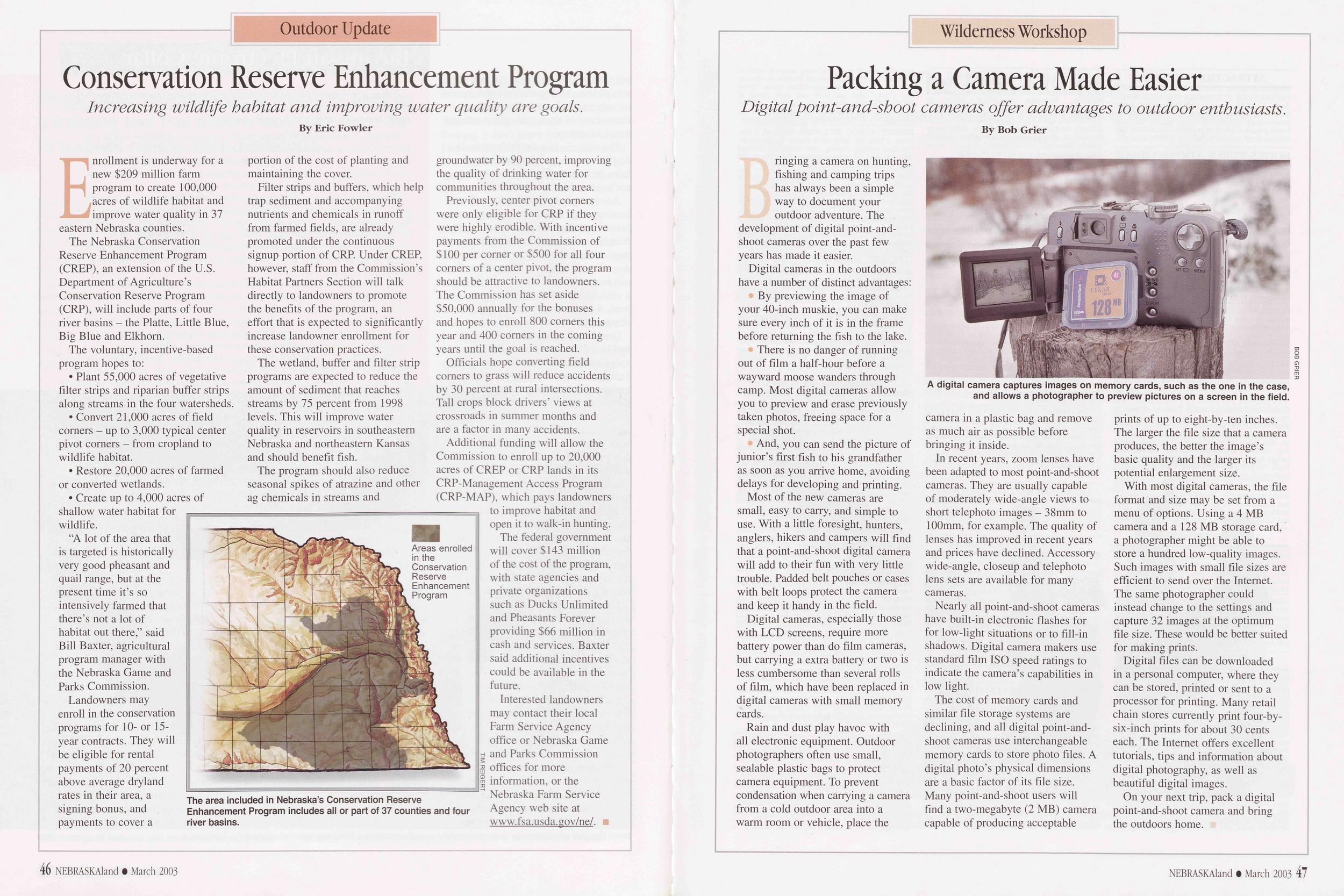
Outdoor Update
Conservation Reserve Enhancement Program
Increasing wildlife habitat and improving water quality are goals. By Eric FowlerEnrollment is underway for a new $209 million farm program to create 100,000 acres of wildlife habitat and improve water quality in 37 eastern Nebraska counties.
The Nebraska Conservation Reserve Enhancement Program (CREP), an extension of the U.S. Department of Agriculture's Conservation Reserve Program (CRP), will include parts of four river basins - the Platte, Little Blue, Big Blue and Elkhorn.
The voluntary, incentive-based program hopes to:
• Plant 55,000 acres of vegetative filter strips and riparian buffer strips along streams in the four watersheds
• Convert 21,000 acres of field corners - up to 3,000 typical center pivot corners - from cropland to wildlife habitat.
• Restore 20,000 acres of farmed or converted wetlands.
• Create up to 4,000 acres of shallow water habitat for wildlife.
"A lot of the area that is targeted is historically very good pheasant and quail range, but at the present time it's so intensively farmed that there's not a lot of habitat out there," said Bill Baxter, agricultural program manager with the Nebraska Game and Parks Commission.
Landowners may enroll in the conservation programs for 10- or 15-year contracts. They will be eligible for rental payments of 20 percent above average dry land rates in their area, a signing bonus, and payments to cover a portion of the cost of planting and maintaining the cover.
Filter strips and buffers, which help trap sediment and accompanying nutrients and chemicals in runoff from farmed fields, are already promoted under the continuous signup portion of CRP. Under CREP, however, staff from the Commission's Habitat Partners Section will talk directly to landowners to promote the benefits of the program, an effort that is expected to significantly increase landowner enrollment for these conservation practices.
The wetland, buffer and filter strip programs are expected to reduce the amount of sediment that reaches streams by 75 percent from 1998 levels. This will improve water quality in reservoirs in southeastern Nebraska and northeastern Kansas and should benefit fish.
The program should also reduce seasonal spikes of atrazine and other ag chemicals in streams and
Previously, center pivot corners were only eligible for CRP if they were highly erodible. With incentive payments from the Commission of $100 per corner or $500 for all four corners of a center pivot, the program should be attractive to landowners. The Commission has set aside $50,000 annually for the bonuses and hopes to enroll 800 corners this year and 400 corners in the coming years until the goal is reached.
Officials hope converting field corners to grass will reduce accidents by 30 percent at rural intersections. Tall crops block drivers' views at crossroads in summer months and are a factor in many accidents.
Additional funding will allow the Commission to enroll up to 20,000 acres of CREP or CRP lands in its CRP-Management Access Program (CRP-MAP), which pays landowners to improve habitat and open it to walk-in hunting.
The federal government will cover $143 million of the cost of the program, with state agencies and private organizations such as Ducks Unlimited and Pheasants Forever providing $66 million in cash and services. Baxter said additional incentives could be available in the future.
Interested landowners may contact their local Farm Service Agency office or Nebraska Game d and Parks Commission g offices for more | information, or the Nebraska Farm Service Agency web site at www.fsa.usda.gov/ne/.
46 NEBRASKAland • March 2003Wilderness Workshop
Packing a Camera Made Easier
Digital point-and-shoot cameras offer advantages to outdoor enthusiasts. By Bob GrierBringing a camera on hunting, fishing and camping trips has always been a simple way to document your outdoor adventure. The development of digital point-and-shoot cameras over the past few years has made it easier.
Digital cameras in the outdoors have a number of distinct advantages:
By previewing the image of your 40-inch muskie, you can make sure every inch of it is in the frame before returning the fish to the lake.
There is no danger of running out of film a half-hour before a wayward moose wanders through camp. Most digital cameras allow you to preview and erase previously taken photos, freeing space for a special shot.
And, you can send the picture of junior's first fish to his grandfather as soon as you arrive home, avoiding delays for developing and printing.
Most of the new cameras are small, easy to carry, and simple to use. With a little foresight, hunters, anglers, hikers and campers will find that a point-and-shoot digital camera will add to their fun with very little trouble. Padded belt pouches or cases with belt loops protect the camera and keep it handy in the field.
Digital cameras, especially those with LCD screens, require more battery power than do film cameras, but carrying a extra battery or two is less cumbersome than several rolls of film, which have been replaced in digital cameras with small memory cards.
Rain and dust play havoc with all electronic equipment. Outdoor photographers often use small, sealable plastic bags to protect camera equipment. To prevent condensation when carrying a camera from a cold outdoor area into a warm room or vehicle, place the camera in a plastic bag and remove as much air as possible before bringing it inside.
In recent years, zoom lenses have been adapted to most point-and-shoot cameras. They are usually capable of moderately wide-angle views to short telephoto images - 38mm to 100mm, for example. The quality of lenses has improved in recent years and prices have declined. Accessory wide-angle, closeup and telephoto lens sets are available for many cameras.
Nearly all point-and-shoot cameras have built-in electronic flashes for for low-light situations or to fill-in shadows. Digital camera makers use standard film ISO speed ratings to indicate the camera's capabilities in low light.
The cost of memory cards and similar file storage systems are declining, and all digital point-and-shoot cameras use interchangeable memory cards to store photo files. A digital photo's physical dimensions are a basic factor of its file size. Many point-and-shoot users will find a two-megabyte (2 MB) camera capable of producing acceptable prints of up to eight-by-ten inches. The larger the file size that a camera produces, the better the image's basic quality and the larger its potential enlargement size.
With most digital cameras, the file format and size may be set from a menu of options. Using a 4 MB camera and a 128 MB storage card, a photographer might be able to store a hundred low-quality images. Such images with small file sizes are efficient to send over the Internet. The same photographer could instead change to the settings and capture 32 images at the optimum file size. These would be better suited for making prints.
Digital files can be downloaded in a personal computer, where they can be stored, printed or sent to a processor for printing. Many retail chain stores currently print four-by-six-inch prints for about 30 cents each. The Internet offers excellent tutorials, tips and information about digital photography, as well as beautiful digital images.
On your next trip, pack a digital point-and-shoot camera and bring the outdoors home.
NEBRASKAland • March 2003 47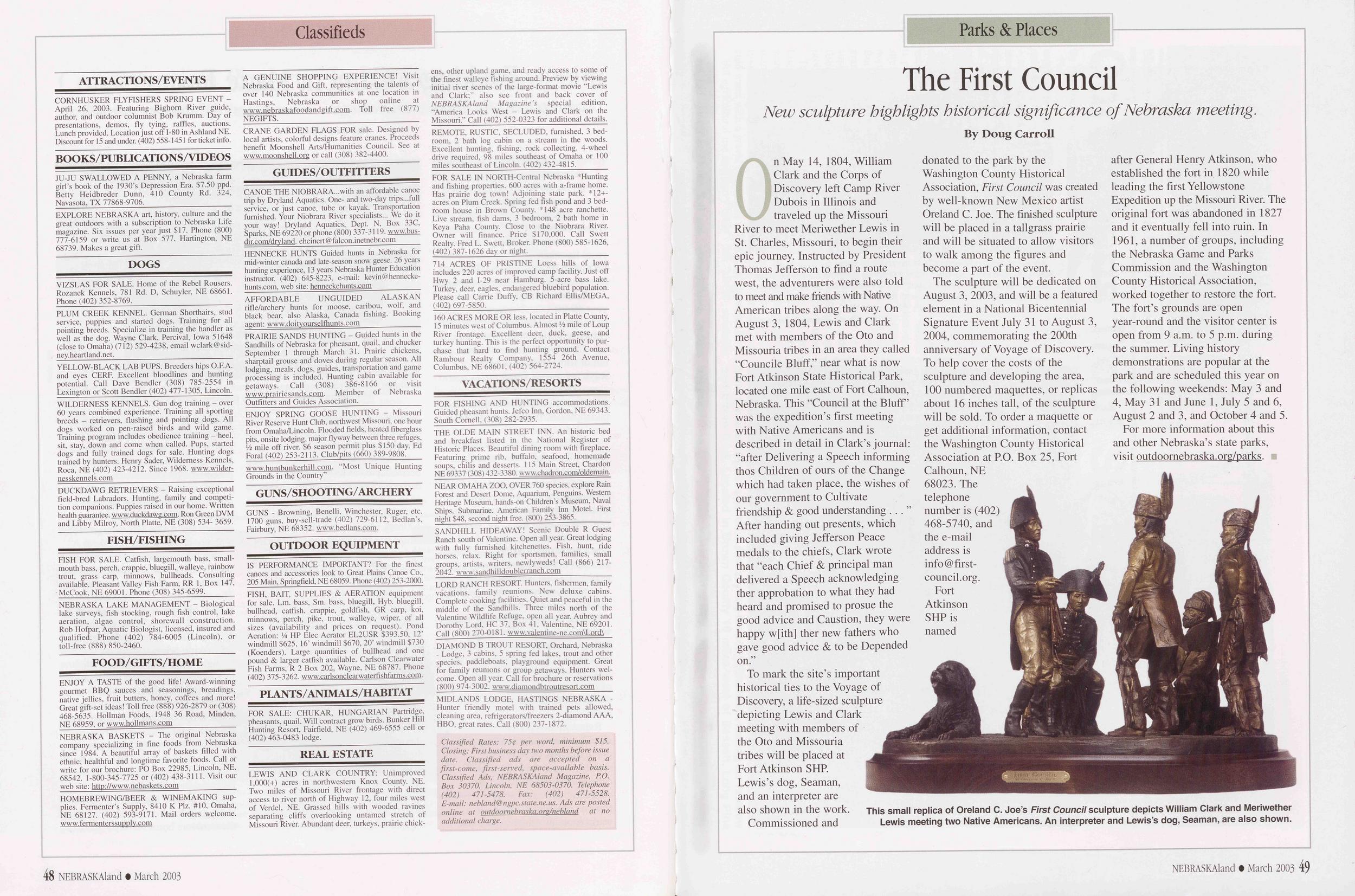
Classifieds
ATTRACTIONS/EVENTSCORNHUSKER FLYFISHERS SPRING EVENT - April 26, 2003. Featuring Bighorn River guide, author, and outdoor columnist Bob Krumm. Day of presentations, demos, fly tying, raffles, auctions. Lunch provided. Location just off 1-80 in Ashland NE. Discount for 15 and under. (402) 558-1451 for ticket info.
BOOKS/PUBLICATIQNS/VIDEOSJU-JU SWALLOWED A PENNY, a Nebraska farm girl's book of the 1930's Depression Era. $7.50 ppd. Betty Heidbreder Dunn, 410 County Rd. 324, Navasota, TX 77868-9706._____________________
EXPLORE NEBRASKA art, history, culture and the great outdoors with a subscription to Nebraska Life magazine. Six issues per year just $17. Phone (800) 777-6159 or write us at Box 577, Hartington, NE 68739. Makes a great gift.
_____________DOGS_____________VIZSLAS FOR SALE. Home of the Rebel Rousers. Rozanek Kennels, 781 Rd. D, Schuyler, NE 68661. Phone (402) 352-8769._________________________
PLUM CREEK KENNEL. German Shorthairs, stud service, puppies and started dogs. Training for all pointing breeds. Specialize in training the handler as well as the dog. Wayne Clark, Percival, Iowa 51648 (close to Omaha) (712) 529-4238, email wclark@sidney.heartland.net.
YELLOW-BLACK LAB PUPS. Breeders hips O.F.A. and eyes CERE Excellent bloodlines and hunting potential. Call Dave Bendler (308) 785-2554 in Lexington or Scott Bendler (402) 477-1305, Lincoln.
WILDERNESS KENNELS. Gun dog training - over 60 years combined experience. Training all sporting breeds - retrievers, flushing and pointing dogs. All dogs worked on pen-raised birds and wild game. Training program includes obedience training - heel, sit, stay, down and come when called. Pups, started dogs and fully trained dogs for sale. Hunting dogs trained by hunters. Henry Sader, Wilderness Kennels, Roca, NE (402) 423-4212. Since 1968. www.wildernesskennels.com
DUCKDAWG RETRIEVERS - Raising exceptional field-bred Labradors. Hunting, family and competition companions. Puppies raised in our home. Written health guarantee, www.duckdawg.com. Ron Green DVM and Libby Milroy, North Platte, NE (308) 534- 3659.
_________FISH/FISHING_________FISH FOR SALE. Catfish, largemouth bass, smallmouth bass, perch, crappie, bluegill, walleye, rainbow trout, grass carp, minnows, bullheads. Consulting available. Pleasant Valley Fish Farm, RR 1, Box 147, McCook, NE 69001. Phone (308) 345-6599._______
NEBRASKA LAKE MANAGEMENT - Biological lake surveys, fish stocking, rough fish control, lake aeration, algae control, shorewall construction. Rob Hofpar, Aquatic Biologist, licensed, insured and qualified. Phone (402) 784-6005 (Lincoln), or toll-free (888) 850-2460.
FOOD/GUTS/HOMEENJOY A TASTE of the good life! Award-winning gourmet BBQ sauces and seasonings, breadings, native jellies, fruit butters, honey, coffees and more! Great gift-set ideas! Toll free (888) 926-2879 or (308) 468-5635. Hollman Foods, 1948 36 Road, Minden, NE 68959, or www.hollmans.com________________
NEBRASKA BASKETS - The original Nebraska company specializing in fine foods from Nebraska since 1984. A beautiful array of baskets filled with ethnic, healthful and longtime favorite foods. Call or write for our brochure: PO Box 22985, Lincoln, NE. 68542. 1-800-345-7725 or (402) 438-3111. Visit our web site: http://www.nebaskets.com______________
HOMEBREWING/BEER & WINEMAKING sup- plies. Fermenter's Supply, 8410 K Plz. #10, Omaha, NE 68127. (402) 593-9171. Mail orders welcome. www.fermenterssupply.com
A GENUINE SHOPPING EXPERIENCE! Visit Nebraska Food and Gift, representing the talents of over 140 Nebraska communities at one location in Hastings, Nebraska or shop online at www.nebraskafoodandgift.com. Toll free (877) NEGIFTS.
CRANE GARDEN FLAGS FOR sale. Designed by local artists, colorful designs feature cranes. Proceeds benefit Moonshell Arts/Humanities Council. See at www.moonshell.org or call (308) 382-4400.
GUIDES/OUTFITTERSCANOE THE NIOBRARA...with an affordable canoe trip by Dry land Aquatics. One- and two-day trips...full service, or just canoe, tube or kayak. Transportation furnished. Your Niobrara River specialists... We do it your way! Dry land Aquatics, Dept. N, Box 33C, Sparks, NE 69220 or phone (800) 337-3119. www.busdir.com/dryland. eheinert@falcon.inetnebr.com______
HENNECKE HU1NTS Guided hunts in Nebraska for mid-winter Canada and late-season snow geese. 26 years hunting experience, 13 years Nebraska Hunter Education instructor. (402) 645-8223, e-mail: kevin@hennecke- hunts.com, web site: henneckehunts.com____________
AFFORDABLE UNGUIDED ALASKAN rifle/archery hunts for moose, caribou, wolf, and black bear, also Alaska, Canada fishing. Booking agent: www.doityourselfhunts.com_______________
PRAIRIE SANDS HUNTING - Guided hunts in the Sandhills of Nebraska for pheasant, quail, and chucker September 1 through March 31. Prairie chickens, sharptail grouse and doves during regular season. All lodging, meals, dogs, guides, transportation and game processing is included. Hunting cabin available for getaways. Call (308) 386-8166 or visit www.prairiesands.com. Member of Nebraska Outfitters and Guides Association.________________
ENJOY SPRING GOOSE HUNTING - Missouri River Reserve Hunt Club, northwest Missouri, one hour from Omaha/Lincoln. Flooded fields, heated fiberglass pits, onsite lodging, major flyway between three refuges, Vi mile off river. $6 season permit plus $150 day. Ed Foral (402) 253-2113. Club/pits (660) 389-9808.
www.huntbunkerhill.com. "Most Unique Hunting Grounds in the Country"
GUNS/SHOOTING/ARCHERYGUNS - Browning, Benelli, Winchester, Ruger, etc. 1700 guns, buy-sell-trade (402) 729-6112, Bedlan's, Fairbury, NE 68352. www.bedlans.com.
OUTDOOR EQUIPMENTIS PERFORMANCE IMPORTANT? For the finest canoes and accessories look to Great Plains Canoe Co., 205 Main, Springfield, NE 68059. Phone (402) 253-2000.
FISH, BAIT, SUPPLIES & AERATION equipment for sale. Lm. bass, Sm. bass, bluegill, Hyb. bluegill, bullhead, catfish, crappie, goldfish, GR carp, koi, minnows, perch, pike, trout, walleye, wiper, of all sizes (availability and prices on request). Pond Aeration: lA HP Elec Aerator EL2USR $393.50, 12' windmill $625, 16' windmill $670, 20' windmill $730 (Koenders). Large quantities of bullhead and one pound & larger catfish available. Carlson Clearwater Fish Farms, R 2 Box 202, Wayne, NE 68787. Phone (402) 375-3262. www.carlsonclearwaterfishfarms.com.
PLANTS/ANIMALS/HABITATFOR SALE: CHUKAR, HUNGARIAN Partridge, pheasants, quail. Will contract grow birds. Bunker Hill Hunting Resort, Fairfield, NE (402) 469-6555 cell or (402) 463-0483 lodge.
_________REAL ESTATE_________LEWIS AND CLARK COUNTRY: Unimproved 1,000(+) acres in northwestern Knox County. NE. Two miles of Missouri River frontage with direct access to river north of Highway 12, four miles west of Verdel, NE. Grassed hills with wooded ravines separating cliffs overlooking untamed stretch of Missouri River. Abundant deer, turkeys, prairie chickens, other upland game, and ready access to some of the finest walleye fishing around. Preview by viewing initial river scenes of the larse-format movie "Lewis and Clark;" also see front and back cover of NEBRASKAland Magazine's special edition, "America Looks West - Lewis and Clark on the Missouri." Call (402) 552-0323 for additional details.
REMOTE, RUSTIC. SECLUDED, furnished, 3 bedroom, 2 bath log cabin on a stream in the woods. Excellent hunting, fishing, rock collecting. 4-wheel drive required, 98 miles southeast of Omaha or 100 miles southeast of Lincoln. (402) 432-4815.
FOR SALE IN NORTH-Central Nebraska *Hunting and fishing properties. 600 acres with a-frame home. Has prairie dog town! Adjoining state park. 12+ acres on Plum Creek. Spring fed fish pond and 3 bedroom house in Brown County. * 148 acre ranchette. Live stream, fish dams, 3 bedroom, 2 bath home in Keya Paha County. Close to the Niobrara River. Owner will finance. Price $170,000. Call Swett Realty. Fred L. Swett. Broker. Phone (800) 585-1626, (402) 387-1626 day or night.____________________
714 ACRES OF PRISTINE Loess hills of Iowa includes 220 acres of improved camp facility. Just off Hwy 2 and 1-29 near Hamburg. 5-acre bass lake. Turkey, deer, eagles, endangered bluebird population. Please call Carrie Duffy. CB Richard Ellis/MEGA, (402) 697-5850.______________________________
160 ACRES MORE OR less, located in Platte County, 15 minutes west of Columbus. Almost Vi mile of Loup River frontage. Excellent deer, duck, geese, and turkey hunting. This is the perfect opportunity to purchase that hard to find hunting ground. Contact Rambour Realty Company. 1554 26th Avenue, Columbus, NE 68601. (402) 564-2724.
VACATIONS/RESORTSFOR FISHING AND HUNTING accommodations. Guided pheasant hunts. Jefco Inn. Gordon, NE 69343. South Cornell, (308) 282-2935.__________________
THE OLDE MAIN STREET INN. An historic bed and breakfast listed in the National Register of Historic Places. Beautiful dining room with fireplace. Featuring prime rib, buffalo, seafood, homemade soups, chilis and desserts. 115 Main Street, Chardon NE 69337 (308) 432-3380. www.chadron.com/oldemain.
NEAR OMAHA ZOO. OVER 760 species, explore Rain Forest and Desert Dome, Aquarium, Penguins. Western Heritage Museum, hands-on Children's Museum, Naval Ships, Submarine. American Family Inn Motel. First night $48, second night free. (800) 253-3865._________
SANDHILL HIDEAWAY! Scenic Double R Guest Ranch south of Valentine. Open all year. Great lodging with fully furnished kitchenettes. Fish, hunt, ride horses, relax. Right for sportsmen, families, small groups, artists, writers, newly weds! Call (866) 217-2042. www.sandhilldoubleiTanch.com_____________
LORD RANCH RESORT. Hunters, fishermen, family vacations, family reunions. New deluxe cabins. Complete cooking facilities. Quiet and peaceful in the middle of the Sandhills. Three miles north of the Valentine Wildlife Refuge, open all year. Aubrey and Dorothy Lord, HC 37, Box 41. Valentine, NE 69201. Call (800) 270-0181. www.valentine-ne.comVLord\
DIAMOND B TROUT RESORT. Orchard, Nebraska - Lodge, 3 cabins, 5 spring fed lakes, trout and other species, paddle boats. playground equipment. Great for family reunions or group getaways. Hunters welcome. Open all year. Call for brochure or reservations (800) 974-3002. yyww.diamondbtroutresort.com
MIDLANDS LODGE. HASTINGS NEBRASKA - Hunter friendly motel with trained pets allowed, cleaning area, refrigerators/freezers 2-diamond AAA, HBO, great rates. Call (800) 237-1872.
Classified Rates: 75$ per word, minimum $15. Closing: First business day two months before issue date. Classified ads are accepted on a first-come, first-served, space-available basis. Classified Ads, NEBRASKAland Magazine, P.O. Box 30370, Lincoln, NE 68503-0370. Telephone (402) 471-5478. Fax: (402) 471-5528. E-mail: nebland@ngpc.state.ne.us. Ads are posted online at outdoornebraska.org/nebland at no additional charge. 48 NEBRASKAland • March 2003Parks & Places
The First Council
New sculpture highlights historical significance of Nebraska meeting. By Doug CarrollOnMay 14, 1804, William Clark and the Corps of Discovery left Camp River Dubois in Illinois and traveled up the Missouri River to meet Meriwether Lewis in St. Charles, Missouri, to begin their epic journey. Instructed by President Thomas Jefferson to find a route west, the adventurers were also told to meet and make friends with Native American tribes along the way. On August 3, 1804, Lewis and Clark met with members of the Oto and Missouria tribes in an area they called "Councile Bluff," near what is now Fort Atkinson State Historical Park, located one mile east of Fort Calhoun, Nebraska. This "Council at the Bluff was the expedition's first meeting with Native Americans and is described in detail in Clark's journal: "after Delivering a Speech informing thos Children of ours of the Change which had taken place, the wishes of our government to Cultivate friendship & good understanding ..." After handing out presents, which included giving Jefferson Peace medals to the chiefs, Clark wrote that "each Chief & principal man delivered a Speech acknowledging their approbation to what they had heard and promised to prosue the good advice and Caution, they were happy w[ith] their new fathers who gave good advice & to be Depended on."
To mark the site's important historical ties to the Voyage of Discovery, a life-sized sculpture depicting Lewis and Clark meeting with members of the Oto and Missouria tribes will be placed at Fort Atkinson SHP. Lewis's dog, Seaman, and an interpreter are also shown in the work.
Commissioned and donated to the park by the Washington County Historical Association, First Council was created by well-known New Mexico artist Oreland C. Joe. The finished sculpture will be placed in a tallgrass prairie and will be situated to allow visitors to walk among the figures and become a part of the event.
The sculpture will be dedicated on August 3, 2003, and will be a featured element in a National Bicentennial Signature Event July 31 to August 3, 2004, commemorating the 200th anniversary of Voyage of Discovery. To help cover the costs of the sculpture and developing the area, 100 numbered maquettes, or replicas about 16 inches tall, of the sculpture will be sold. To order a maquette or get additional information, contact the Washington County Historical Association at RO. Box 25, Fort Calhoun, NE 68023. The telephone number is (402) 468-5740, and the e-mail address is info@first-council.org.
Fort Atkinson SHP is named after General Henry Atkinson, who established the fort in 1820 while leading the first Yellowstone Expedition up the Missouri River. The original fort was abandoned in 1827 and it eventually fell into ruin. In 1961, a number of groups, including the Nebraska Game and Parks Commission and the Washington County Historical Association, worked together to restore the fort. The fort's grounds are open year-round and the visitor center is open from 9 a.m. to 5 p.m. during the summer. Living history demonstrations are popular at the park and are scheduled this year on the following weekends: May 3 and 4, May 31 and June 1, July 5 and 6, August 2 and 3, and October 4 and 5.
For more information about this and other Nebraska's state parks, visit outdoornebraska.org/parks.
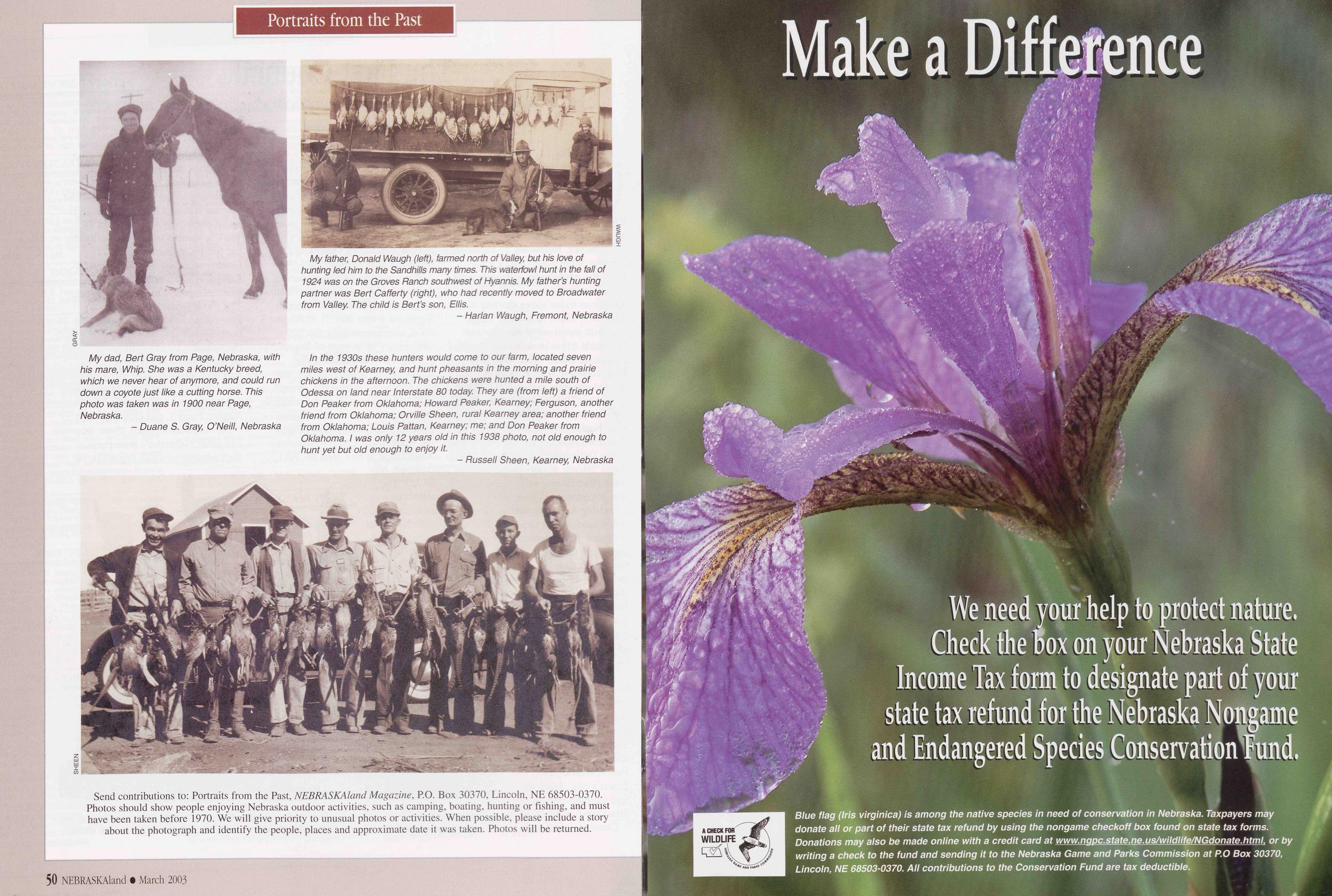
Portraits from the Past
My father, Donald Waugh (left), farmed north of Valley, but his love of hunting led him to the Sandhills many times. This waterfowl hunt in the fall of 1924 was on the Groves Ranch southwest of Hyannis. My father's hunting partner was Bert Cafferty (right), who had recently moved to Broadwater from Valley The child is Bert's son, Ellis.
- Harlan Waugh, Fremont, NebraskaMy dad, Bert Gray from Page, Nebraska, with his mare, Whip. She was a Kentucky breed, which we never hear of anymore, and could run down a coyote just like a cutting horse. This photo was taken was in 1900 near Page, Nebraska.
- Duane S. Gray, O'Neill, NebraskaIn the 1930s these hunters would come to our farm, located seven miles west of Kearney, and hunt pheasants in the morning and prairie chickens in the afternoon. The chickens were hunted a mile south of Odessa on land near Interstate 80 today. They are (from left) a friend of Don Peaker from Oklahoma; Howard Peaker, Kearney; Ferguson, another friend from Oklahoma; Orville Sheen, rural Kearney area; another friend from Oklahoma; Louis Pattan, Kearney; me; and Don Peaker from Oklahoma. I was only 12 years old in this 1938 photo, not old enough to hunt yet but old enough to enjoy it.
- Russell Sheen, Kearney, NebraskaSend contributions to: Portraits from the Past, NEBRASKAland Magazine, P.O. Box 30370, Lincoln, NE 68503-0370. Photos should show people enjoying Nebraska outdoor activities, such as camping, boating, hunting or fishing, and must have been taken before 1970. We will give priority to unusual photos or activities. When possible, please include a story about the photograph and identify the people, places and approximate date it was taken. Photos will be returned.
50 NEBRASKAland • March 2003
Position: 820 (12 views)