Volume 81, Issue 1, 2003
NEBRASKAland
Nebraska Game & Parks Commission January-February 2003 $2.50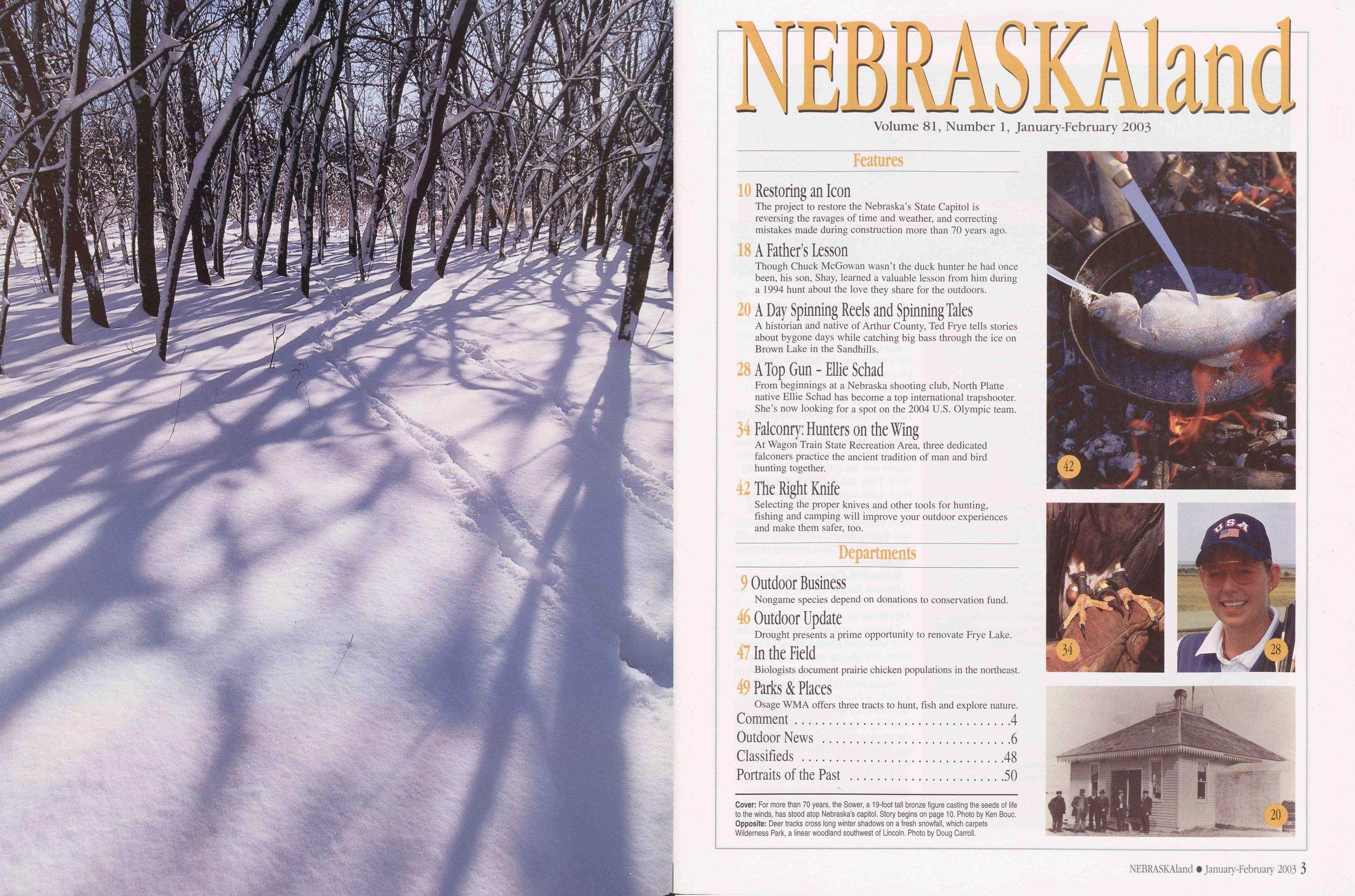
NEBRASKAland
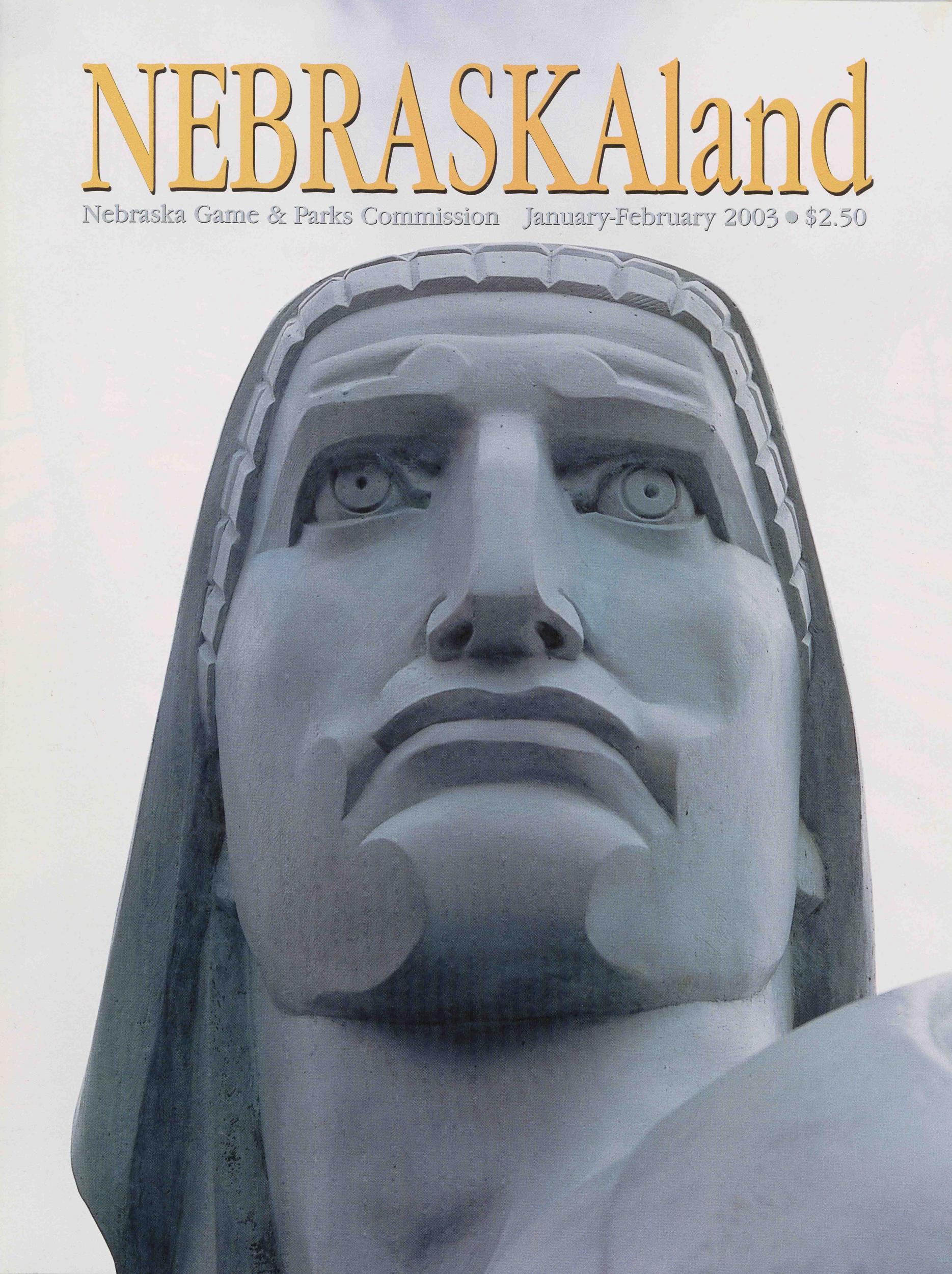
Volume 81, Number 1, January-February 2003 10 Features Restoring an Icon The project to restore the Nebraska's State Capitol is reversing the ravages of time and weather, and correcting mistakes made during construction more than 70 years ago. 18 A Father's Lesson Though Chuck McGowan wasn't the duck hunter he had once been, his son, Shay, learned a valuable lesson from him during a 1994 hunt about the love they share for the outdoors. 20 A Day Spinning Reels and Spinning Tales A historian and native of Arthur County, Ted Frye tells stories about bygone days while catching big bass through the ice on Brown Lake in the Sandhills. 28 A Top Gun - Ellie Schad From beginnings at a Nebraska shooting club, North Platte native Ellie Schad has become a top international trapshooter. She's now looking for a spot on the 2004 U.S. Olympic team. 34 Falconry: Hunters on the Wing At Wagon Train State Recreation Area, three dedicated falconers practice the ancient tradition of man and bird hunting together. 42 The Right Knife Selecting the proper knives and other tools for hunting, fishing and camping will improve your outdoor experiences and make them safer, too. Departments 9 Outdoor Business Nongame species depend on donations to conservation fund. Outdoor Update Drought presents a prime opportunity to renovate Frye Lake. 47 In the Field Biologists document prairie chicken populations in the northeast Parks & Places Osage WMA offers three tracts to hunt, fish and explore nature. Comment................................4 Outdoor News ............................6 Classifieds ..............................48 Portraits of the Past .......................50 Cover: For more than 70 years, the Sower, a 19-foot tall bronze figure casting the seeds of life to the winds, has stood atop Nebraska's capitol. Story begins on page 10. Photo by Ken Bouc. Opposite: Deer tracks cross long winter shadows on a fresh snowfall, which carpets Wilderness Park, a linear woodland southwest of Lincoln. Photo by Doug Carroll.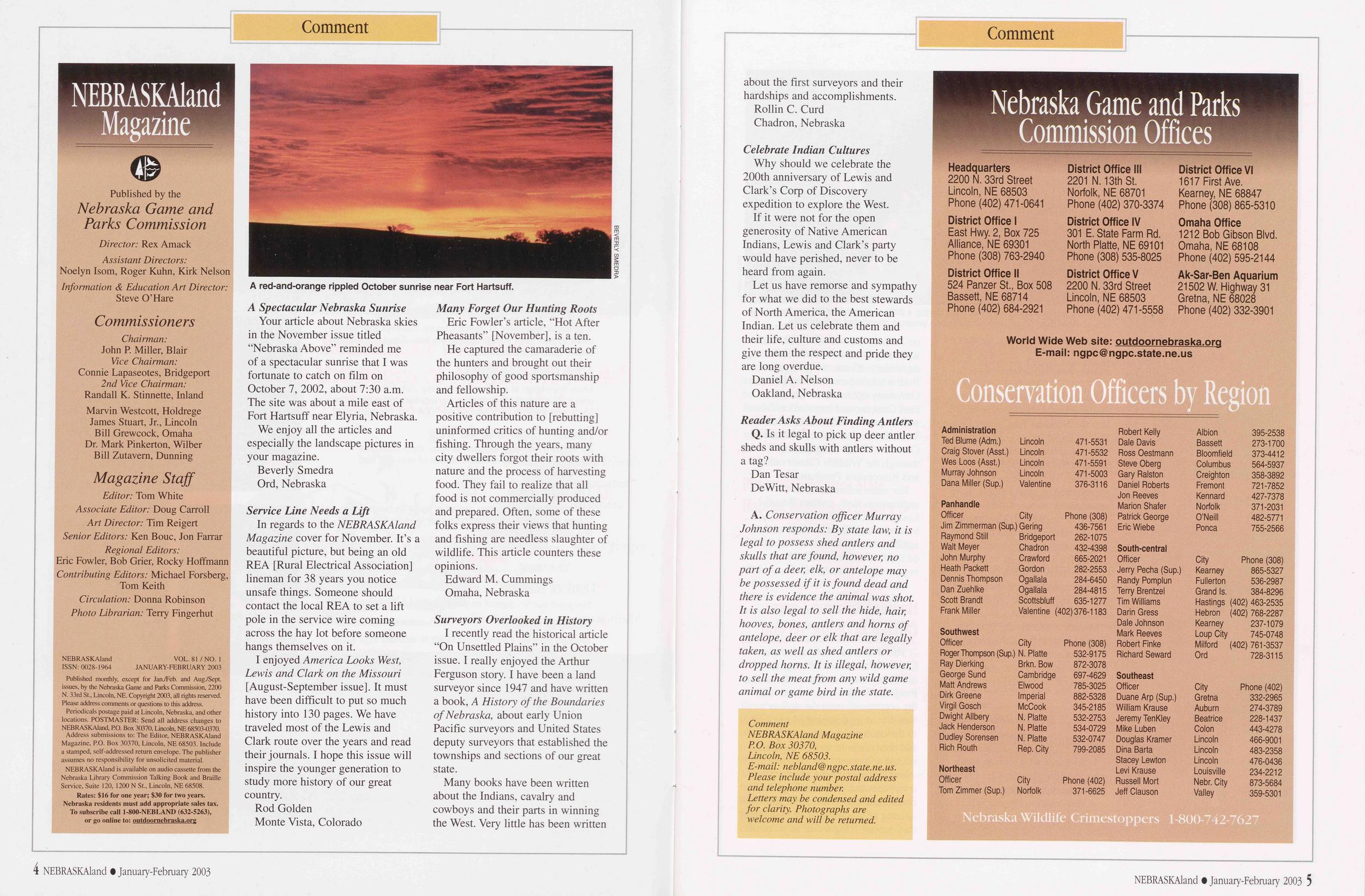 Comment
NEBRASKAland Mazine
Published by the
Nebraska Game and
Parks Commission
Director: Rex Amack
Assistant Directors:
Noelyn Isom, Roger Kuhn, Kirk Nelson
Information & Education Art Director:
Steve O'Hare
Commissioners
Chairman:
John P. Miller, Blair
Vice Chairman:
Connie Lapaseotes, Bridgeport
2nd Vice Chairman:
Randall K. Stinnette, Inland
Marvin Westcott, Holdrege
James Stuart, Jr., Lincoln
Bill Grewcock, Omaha
Dr. Mark Pinkerton, Wilber
Bill Zutavern, Dunning
Magazine Staff
Editor: Tom White
Associate Editor: Doug Carroll
Art Director: Tim Reigert
Senior Editors: Ken Bouc, Jon Farrar
Regional Editors:
Eric Fowler, Bob Grier, Rocky Hoffmann
Contributing Editors: Michael Forsberg,
Tom Keith
Circulation: Donna Robinson
Photo Librarian: Terry Fingerhut
NEBRASKAland
ISSN; 0028-1964
VOL. 81/NO. 1
JANUARY-FEBRUARY 2003
Published monthly, except for Jan./Feb. and Aug/Sept.
issues, by the Nebraska Game and Parks Commission, 2200
N. 33rd St., Lincoln, NE. Copyright 2003, all rights reserved.
Please address comments or questions to this address.
Periodicals postage paid at Lincoln, Nebraska, and other
locations. POSTMASTER: Send all address changes to
NEBRASKAland, P.O. Box 30370, Lincoln, NE 68503-0370.
Address submissions to: The Editor, NEBRASKAland
Magazine, P.O. Box 30370, Lincoln, NE 68503. Include
a stamped, self-addressed return envelope. The publisher
assumes no responsibility for unsolicited material.
NEBRASKAland is available on audio cassette from the
Nebraska Library Commission Talking Book and Braille
Service, Suite 120, 1200 N St., Lincoln, NE 68508.
Rates: $16 for one year; $30 for two years.
Nebraska residents must add appropriate sales tax.
To subscribe call 1-800-NEBLAND (632-5263),
or go online to: outdoornebraska.org
Comment
NEBRASKAland Mazine
Published by the
Nebraska Game and
Parks Commission
Director: Rex Amack
Assistant Directors:
Noelyn Isom, Roger Kuhn, Kirk Nelson
Information & Education Art Director:
Steve O'Hare
Commissioners
Chairman:
John P. Miller, Blair
Vice Chairman:
Connie Lapaseotes, Bridgeport
2nd Vice Chairman:
Randall K. Stinnette, Inland
Marvin Westcott, Holdrege
James Stuart, Jr., Lincoln
Bill Grewcock, Omaha
Dr. Mark Pinkerton, Wilber
Bill Zutavern, Dunning
Magazine Staff
Editor: Tom White
Associate Editor: Doug Carroll
Art Director: Tim Reigert
Senior Editors: Ken Bouc, Jon Farrar
Regional Editors:
Eric Fowler, Bob Grier, Rocky Hoffmann
Contributing Editors: Michael Forsberg,
Tom Keith
Circulation: Donna Robinson
Photo Librarian: Terry Fingerhut
NEBRASKAland
ISSN; 0028-1964
VOL. 81/NO. 1
JANUARY-FEBRUARY 2003
Published monthly, except for Jan./Feb. and Aug/Sept.
issues, by the Nebraska Game and Parks Commission, 2200
N. 33rd St., Lincoln, NE. Copyright 2003, all rights reserved.
Please address comments or questions to this address.
Periodicals postage paid at Lincoln, Nebraska, and other
locations. POSTMASTER: Send all address changes to
NEBRASKAland, P.O. Box 30370, Lincoln, NE 68503-0370.
Address submissions to: The Editor, NEBRASKAland
Magazine, P.O. Box 30370, Lincoln, NE 68503. Include
a stamped, self-addressed return envelope. The publisher
assumes no responsibility for unsolicited material.
NEBRASKAland is available on audio cassette from the
Nebraska Library Commission Talking Book and Braille
Service, Suite 120, 1200 N St., Lincoln, NE 68508.
Rates: $16 for one year; $30 for two years.
Nebraska residents must add appropriate sales tax.
To subscribe call 1-800-NEBLAND (632-5263),
or go online to: outdoornebraska.org
Your article about Nebraska skies in the November issue titled "Nebraska Above" reminded me of a spectacular sunrise that I was fortunate to catch on film on October 7, 2002, about 7:30 a.m. The site was about a mile east of Fort Hartsuff near Elyria, Nebraska.
We enjoy all the articles and especially the landscape pictures in your magazine.
Beverly Smedra Ord, Nebraska Service Line Needs a LiftIn regards to the NEBRASKAland Magazine cover for November. It's a beautiful picture, but being an old REA [Rural Electrical Association] lineman for 38 years you notice unsafe things. Someone should contact the local REA to set a lift pole in the service wire coming across the hay lot before someone hangs themselves on it.
I enjoyed America Looks West, Lewis and Clark on the Missouri [August-September issue]. It must have been difficult to put so much history into 130 pages. We have traveled most of the Lewis and Clark route over the years and read their journals. I hope this issue will inspire the younger generation to study more history of our great country.
Rod Golden Monte Vista, Colorado Many Forget Our Hunting RootsEric Fowler's article, "Hot After Pheasants" [November], is a ten.
He captured the camaraderie of the hunters and brought out their philosophy of good sportsmanship and fellowship.
Articles of this nature are a positive contribution to [rebutting] uninformed critics of hunting and/or fishing. Through the years, many city dwellers forgot their roots with nature and the process of harvesting food. They fail to realize that all food is not commercially produced and prepared. Often, some of these folks express their views that hunting and fishing are needless slaughter of wildlife. This article counters these opinions.
Edward M. Cummings Omaha, Nebraska Surveyors Overlooked in HistoryI recently read the historical article "On Unsettled Plains" in the October issue. I really enjoyed the Arthur Ferguson story. I have been a land surveyor since 1947 and have written a book, A History of the Boundaries of Nebraska, about early Union Pacific surveyors and United States deputy surveyors that established the townships and sections of our great state.
Many books have been written about the Indians, cavalry and cowboys and their parts in winning the West. Very little has been written about the first surveyors and their hardships and accomplishments.
Rollin C. Curd Chadron, Nebraska 4 NEBRASKAland • January-February 2003 Comment Celebrate Indian CulturesWhy should we celebrate the 200th anniversary of Lewis and Clark's Corp of Discovery expedition to explore the West.
If it were not for the open generosity of Native American Indians, Lewis and Clark's party would have perished, never to be heard from again.
Let us have remorse and sympathy for what we did to the best stewards of North America, the American Indian. Let us celebrate them and their life, culture and customs and give them the respect and pride they are long overdue.
Daniel A. Nelson Oakland, Nebraska Reader Asks About Finding AntlersQ. Is it legal to pick up deer antler sheds and skulls with antlers without a tag?
Dan Tesar DeWitt, NebraskaA. Conservation officer Murray Johnson responds: By state law, it is legal to possess shed antlers and skulls that are found, however, no part of a deer, elk, or antelope may be possessed if it is found dead and there is evidence the animal was shot. It is also legal to sell the hide, hair, hooves, bones, antlers and horns of antelope, deer or elk that are legally taken, as well as shed antlers or dropped horns. It is illegal, however, to sell the meat from any wild game animal or game bird in the state.
Comment NEBRASKAland Magazine P.O. Box 30370, Lincoln, NE 68503. E-mail: nebland@ngpc. state, ne. us. Please include your postal address and telephone number. Letters may be condensed and edited for clarity. Photographs are welcome and will be returned. Nebraska Game and Parks Commission Offices Headquarters 2200 N. 33rd Street Lincoln, NE 68503 Phone (402) 471-0641 District Office I East Hwy. 2, Box 725 Alliance, NE 69301 Phone (308) 763-2940 District Office II 524 Panzer St., Box 508 Bassett, NE 68714 Phone (402) 684-2921 District Office III 2201 N. 13th St. Norfolk, NE 68701 Phone (402) 370-3374 District Office IV 301 E. State Farm Rd. North Platte, NE 69101 Phone (308) 535-8025 District Office V 2200 N. 33rd Street Lincoln, NE 68503 Phone (402) 471-5558 District Off ice VI 1617 First Ave. Kearney, NE 68847 Phone (308) 865-5310 Omaha Office 1212 Bob Gibson Blvd. Omaha, NE 68108 Phone (402) 595-2144 Ak-Sar-Ben Aquarium 21502 W. Highway 31 Gretna, NE 68028 Phone (402) 332-3901 World Wide Web site: outdoornebraska.org E-mail: ngpc@ngpc.state.ne.us Conservation Officers by Region Administration Robert Kelly Albion 395-2538 Ted Blume (Adm.) Lincoln 471-5531 Dale Davis Bassett 273-1700 Craig Stover (Asst.) Lincoln 471-5532 Ross Oestmann Bloomfield 373-4412 Wes Loos (Asst.) Lincoln 471-5591 Steve Oberg Columbus 564-5937 Murray Johnson Lincoln 471-5003 Gary Ralston Creighton 358-3892 Dana Miller (Sup.) Valentine 376-3116 Daniel Roberts Fremont 721-7852 Jon Reeves Kennard 427-7378 Panhandle Marion Shafer Norfolk 371-2031 Officer City Phone (308) Patrick George O'Neill 482-5771 Jim Zimmerman (Sup.) Gering 436-7561 Eric Wiebe Ponca 755-2566 Raymond Still Bridgeport 262-1075 Walt Meyer Chadron 432-4398 South-central John Murphy Crawford 665-2021 Officer City Phone (308) Heath Packett Gordon 282-2553 Jerry Pecha (Sup.)Kearney 865-5327 Dennis Thompson Ogallala 284-6450 Randy Pomplun Fullerton 536-2987 Dan Zuehlke Ogallala 284-4815 Terry Brentzel Grand Is. 384-8296 Scott Brandt Scottsbluff 635-1277 Tim Williams Hastings (402) 463-2535 Frank Miller Valentine (402)376-1183 Darin Gress Hebron (402) 768-2287 Dale Johnson Kearney 237-1079 Southwest Mark Reeves Loup City 745-0748 Officer City Phone (308) Robert Finke Milford (402) 761-3537 Roger Thompson (Sup.) N. Platte 532-9175 Richard Seward Ord 728-3115 Ray Dierking Brkn. Bow 872-3078 George Sund Cambridge 697-4629 Southeast Matt Andrews Elwood 785-3025 Officer City Phone (402) Dirk Greene Imperial 882-5328 Duane Arp (Sup.)Gretna 332-2965 Virgil Gosch McCook 345-2185 William Krause Auburn 274-3789 Dwight Allbery N. Platte 532-2753 Jeremy TenKley Beatrice 228-1437 Jack Henderson N. Platte 534-0729 Mike Luben Colon 443-4278 Dudley Sorensen N. Platte 532-0747 Douglas Kramer Lincoln 466-9001 Rich Routh Rep. City 799-2085 Dina Barta Lincoln 483-2358 Stacey Lewton Lincoln 476-0436 Northeast Levi Krause Louisville 234-2212 Officer City Phone (402) Russell Mort Nebr. City 873-5684 Tom Zimmer (Sup.)Norfolk 371-6625 Jeff Clauson Valley 359-5301 NEBRASKAland • January-February 2003 5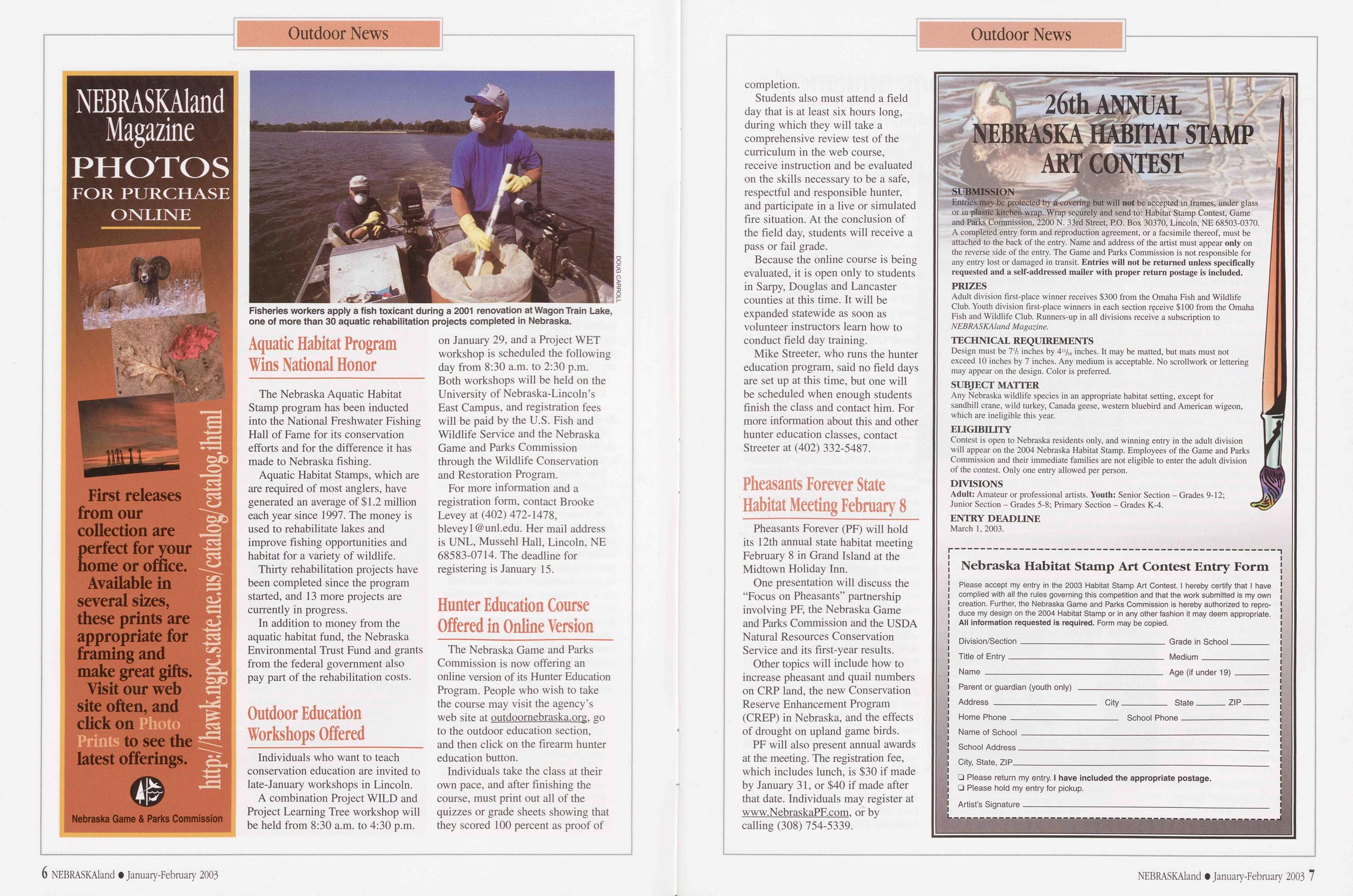
The Nebraska Aquatic Habitat Stamp program has been inducted into the National Freshwater Fishing Hall of Fame for its conservation efforts and for the difference it has made to Nebraska fishing.
Aquatic Habitat Stamps, which are are required of most anglers, have generated an average of $1.2 million each year since 1997. The money is used to rehabilitate lakes and improve fishing opportunities and habitat for a variety of wildlife.
Thirty rehabilitation projects have been completed since the program started, and 13 more projects are currently in progress.
In addition to money from the aquatic habitat fund, the Nebraska Environmental Trust Fund and grants from the federal government also pay part of the rehabilitation costs.
Outdoor Education Workshops OfferedIndividuals who want to teach conservation education are invited to late-January workshops in Lincoln.
A combination Project WILD and Project Learning Tree workshop will be held from 8:30 a.m. to 4:30 p.m. on January 29, and a Project WET workshop is scheduled the following day from 8:30 a.m. to 2:30 p.m. Both workshops will be held on the University of Nebraska-Lincoln's East Campus, and registration fees will be paid by the U.S. Fish and Wildlife Service and the Nebraska Game and Parks Commission through the Wildlife Conservation and Restoration Program.
For more information and a registration form, contact Brooke Levey at (402) 472-1478, bleveyl@unl.edu. Her mail address is UNL, Mussehl Hall, Lincoln, NE 68583-0714. The deadline for registering is January 15.
Hunter Education Course Offered in Online VersionThe Nebraska Game and Parks Commission is now offering an online version of its Hunter Education Program. People who wish to take the course may visit the agency's web site at outdoornebraska.org. go to the outdoor education section, and then click on the firearm hunter education button.
Individuals take the class at their own pace, and after finishing the course, must print out all of the quizzes or grade sheets showing that they scored 100 percent as proof of completion.
6 NEBRASKAland • January-February 2003 Outdoor NewsStudents also must attend a field day that is at least six hours long, during which they will take a comprehensive review test of the curriculum in the web course, receive instruction and be evaluated on the skills necessary to be a safe, respectful and responsible hunter, and participate in a live or simulated fire situation. At the conclusion of the field day, students will receive a pass or fail grade.
Because the online course is being evaluated, it is open only to students in Sarpy, Douglas and Lancaster counties at this time. It will be expanded statewide as soon as volunteer instructors learn how to conduct field day training.
Mike Streeter, who runs the hunter education program, said no field days are set up at this time, but one will be scheduled when enough students finish the class and contact him. For more information about this and other hunter education classes, contact Streeter at (402) 332-5487.
Pheasants Forever State Habitat Meeting February 8Pheasants Forever (PF) will hold its 12th annual state habitat meeting February 8 in Grand Island at the Midtown Holiday Inn.
One presentation will discuss the "Focus on Pheasants" partnership involving PF, the Nebraska Game and Parks Commission and the USDA Natural Resources Conservation Service and its first-year results.
Other topics will include how to increase pheasant and quail numbers on CRP land, the new Conservation Reserve Enhancement Program (CREP) in Nebraska, and the effects of drought on upland game birds.
PF will also present annual awards at the meeting. The registration fee, which includes lunch, is $30 if made by January 31, or $40 if made after that date. Individuals may register at www.NebraskaPF.com, or by calling (308) 754-5339.
26th ANNUAL NEBRASKA HABITAT STAMP SUBMISSION Entries may be protected by a covering but will hot be accepted in frames, under glass or in plastic kitchen wrap. Wrap securely and send to: Habitat Stamp Contest, Game and Parks Commission, 2200 N. 33rd Street, P.O. Box 30370, Lincoln, NE 68503-0370. A completed entry form and reproduction agreement, or a facsimile thereof, must be attached to the back of the entry. Name and address of the artist must appear only on the reverse side of the entry. The Game and Parks Commission is not responsible for any entry lost or damaged in transit. Entries will not be returned unless specifically requested and a self-addressed mailer with proper return postage is included. PRIZES Adult division first-place winner receives $300 from the Omaha Fish and Wildlife Club. Youth division first-place winners in each section receive $100 from the Omaha Fish and Wildlife Club. Runners-up in all divisions receive a subscription to NEBRASKAland Magazine. TECHNICAL REQUIREMENTS Design must be 772 inches by 4"/,6 inches. It may be matted, but mats must not exceed 10 inches by 7 inches. Any medium is acceptable. No scrollwork or lettering may appear on the design. Color is preferred. SUBJECT MATTER Any Nebraska wildlife species in an appropriate habitat setting, except for sandhill crane, wild turkey, Canada geese, western bluebird and American wigeon, which are ineligible this year. EUGIBILITY Contest is open to Nebraska residents only, and winning entry in the adult division will appear on the 2004 Nebraska Habitat Stamp. Employees of the Game and Parks Commission and their immediate families are not eligible to enter the adult division of the contest. Only one entry allowed per person. DIVISIONS Adult: Amateur or professional artists. Youth: Senior Section - Grades 9-12; Junior Section - Grades 5-8; Primary Section - Grades K-4. ENTRY DEADLINE March 1, 2003. Nebraska Habitat Stamp Art Contest Entry Form Please accept my entry in the 2003 Habitat Stamp Art Contest. I hereby certify that I have complied with all the rules governing this competition and that the work submitted is my own creation. Further, the Nebraska Game and Parks Commission is hereby authorized to reproduce my design on the 2004 Habitat Stamp or in any other fashion it may deem appropriate. All information requested is required. Form may be copied. Division/Section Title of Entry__ Name _______ Grade in School Medium______ Age (if under 19) Parent or guardian (youth only) Address __________________ City State ZIP Home Phone School Phone Name of School School Address. City, State, ZIP_ □ Please return my entry. I have included the appropriate postage. □ Please hold my entry for pickup. Artist's Signature___________________________________._____ _____ NEBRASKAland • January-February 2003 7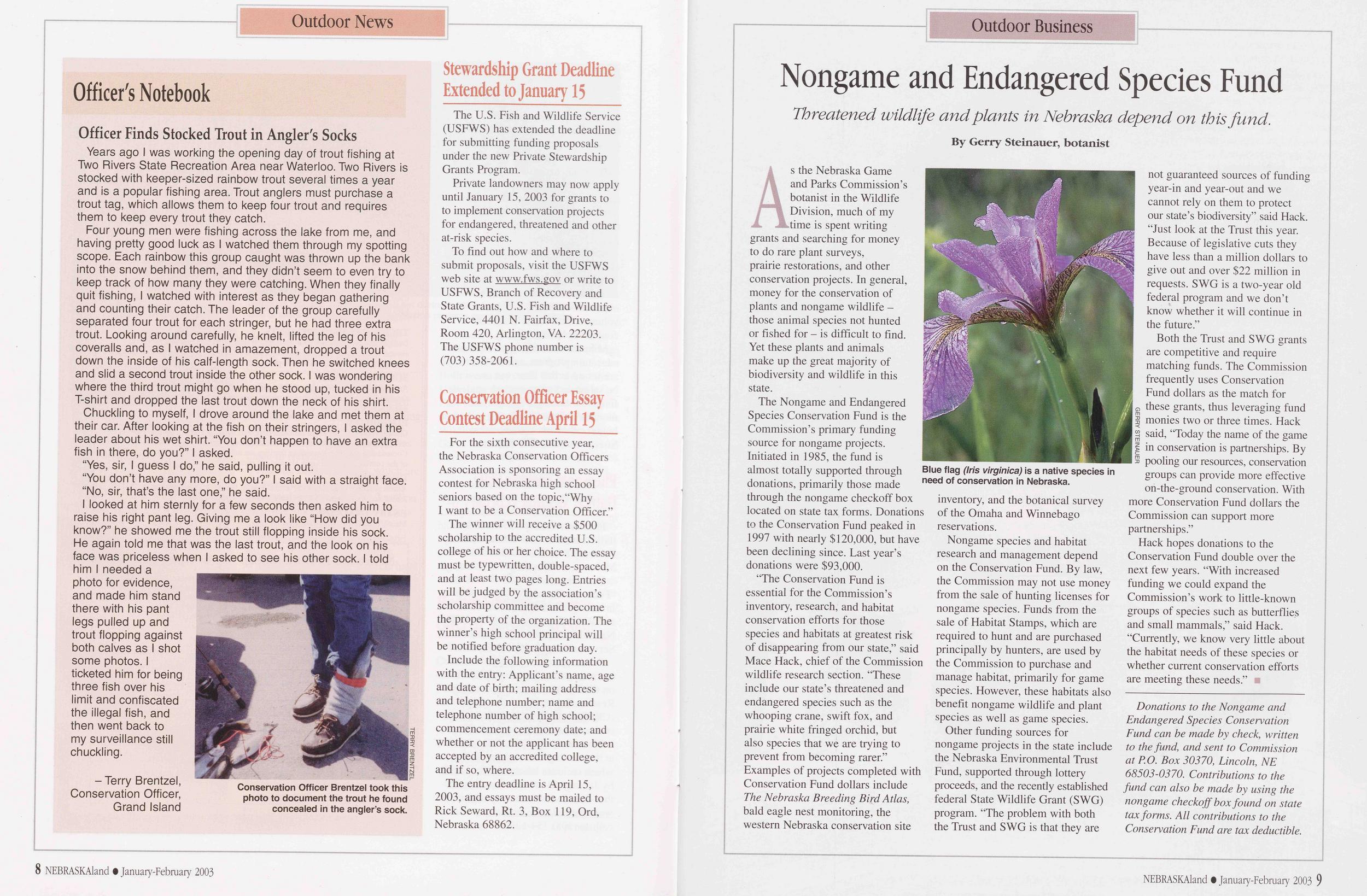 Outdoor News
Officer's Notebook
Officer Finds Stocked Trout in Angler's Socks
Outdoor News
Officer's Notebook
Officer Finds Stocked Trout in Angler's Socks
Years ago I was working the opening day of trout fishing at Two Rivers State Recreation Area near Waterloo. Two Rivers is stocked with keeper-sized rainbow trout several times a year and is a popular fishing area. Trout anglers must purchase a trout tag, which allows them to keep four trout and requires them to keep every trout they catch.
Four young men were fishing across the lake from me, and having pretty good luck as I watched them through my spotting scope. Each rainbow this group caught was thrown up the bank into the snow behind them, and they didn't seem to even try to keep track of how many they were catching. When they finally quit fishing, I watched with interest as they began gathering and counting their catch. The leader of the group carefully separated four trout for each stringer, but he had three extra trout. Looking around carefully, he knelt, lifted the leg of his coveralls and, as I watched in amazement, dropped a trout down the inside of his calf-length sock. Then he switched knees and slid a second trout inside the other sock. I was wondering where the third trout might go when he stood up, tucked in his T-shirt and dropped the last trout down the neck of his shirt.
Chuckling to myself, I drove around the lake and met them at their car. After looking at the fish on their stringers, I asked the leader about his wet shirt. "You don't happen to have an extra fish in there, do you?" I asked.
"Yes, sir, I guess I do," he said, pulling it out.
"You don't have any more, do you?" I said with a straight face.
"No, sir, that's the last one," he said.
I looked at him sternly for a few seconds then asked him to raise his right pant leg. Giving me a look like "How did you know?" he showed me the trout still flopping inside his sock. He again told me that was the last trout, and the look on his face was priceless when I asked to see his other sock. I told him I needed a photo for evidence, and made him stand there with his pant legs pulled up and trout flopping against both calves as I shot some photos. I ticketed him for being three fish over his limit and confiscated the illegal fish, and then went back to my surveillance still chuckling.
-Terry Brentzel, Conservation Officer, Grand IslandThe U.S. Fish and Wildlife Service (USFWS) has extended the deadline for submitting funding proposals under the new Private Stewardship Grants Program.
Private landowners may now apply until January 15, 2003 for grants to to implement conservation projects for endangered, threatened and other at-risk species.
To find out how and where to submit proposals, visit the USFWS web site at www.fws.gov or write to USFWS, Branch of Recovery and State Grants, U.S. Fish and Wildlife Service, 4401 N. Fairfax, Drive, Room 420, Arlington, VA. 22203. The USFWS phone number is (703) 358-2061.
Conservation Officer Essay Contest Deadline April 15For the sixth consecutive year, the Nebraska Conservation Officers Association is sponsoring an essay contest for Nebraska high school seniors based on the topic,"Why I want to be a Conservation Officer."
The winner will receive a $500 scholarship to the accredited U.S. college of his or her choice. The essay must be typewritten, double-spaced, and at least two pages long. Entries will be judged by the association's scholarship committee and become the property of the organization. The winner's high school principal will be notified before graduation day.
Include the following information with the entry: Applicant's name, age and date of birth; mailing address and telephone number; name and telephone number of high school; commencement ceremony date; and whether or not the applicant has been accepted by an accredited college, and if so, where.
The entry deadline is April 15, 2003, and essays must be mailed to Rick Seward, Rt. 3, Box 119, Ord, Nebraska 68862.
8 NEBRASKAland • January-February 2003 Outdoor BusinessNongame and Endangered Species Fund
Threatened wildlife and plants in Nebraska depend on this fund. By Gerry Steinauer, botanistAs the Nebraska Game and Parks Commission's botanist in the Wildlife Division, much of my dime is spent writing grants and searching for money to do rare plant surveys, prairie restorations, and other conservation projects. In general, money for the conservation of plants and nongame wildlife - those animal species not hunted or fished for - is difficult to find. Yet these plants and animals make up the great majority of biodiversity and wildlife in this state.
The Nongame and Endangered Species Conservation Fund is the Commission's primary funding source for nongame projects. Initiated in 1985, the fund is almost totally supported through donations, primarily those made through the nongame checkoff box located on state tax forms. Donations to the Conservation Fund peaked in 1997 with nearly $120,000, but have been declining since. Last year's donations were $93,000.
"The Conservation Fund is essential for the Commission's inventory, research, and habitat conservation efforts for those species and habitats at greatest risk of disappearing from our state," said Mace Hack, chief of the Commission wildlife research section. "These include our state's threatened and endangered species such as the whooping crane, swift fox, and prairie white fringed orchid, but also species that we are trying to prevent from becoming rarer." Examples of projects completed with Conservation Fund dollars include The Nebraska Breeding Bird Atlas, bald eagle nest monitoring, the western Nebraska conservation site inventory, and the botanical survey of the Omaha and Winnebago reservations.
Nongame species and habitat research and management depend on the Conservation Fund. By law, the Commission may not use money from the sale of hunting licenses for nongame species. Funds from the sale of Habitat Stamps, which are required to hunt and are purchased principally by hunters, are used by the Commission to purchase and manage habitat, primarily for game species. However, these habitats also benefit nongame wildlife and plant species as well as game species.
Other funding sources for nongame projects in the state include the Nebraska Environmental Trust Fund, supported through lottery proceeds, and the recently established federal State Wildlife Grant (SWG) program. "The problem with both the Trust and SWG is that they are not guaranteed sources of funding year-in and year-out and we cannot rely on them to protect our state's biodiversity" said Hack. "Just look at the Trust this year. Because of legislative cuts they have less than a million dollars to give out and over $22 million in requests. SWG is a two-year old federal program and we don't know whether it will continue in the future."
Both the Trust and SWG grants are competitive and require matching funds. The Commission frequently uses Conservation Fund dollars as the match for these grants, thus leveraging fund monies two or three times. Hack said, "Today the name of the game in conservation is partnerships. By 3 pooling our resources, conservation groups can provide more effective on-the-ground conservation. With more Conservation Fund dollars the Commission can support more partnerships."
Hack hopes donations to the Conservation Fund double over the next few years. "With increased funding we could expand the Commission's work to little-known groups of species such as butterflies and small mammals," said Hack. "Currently, we know very little about the habitat needs of these species or whether current conservation efforts are meeting these needs."
Donations to the Nongame and Endangered Species Conservation Fund can be made by check, written to the fund, and sent to Commission at P.O. Box 30370, Lincoln, NE 68503-0370. Contributions to the fund can also be made by using the nongame checkoff box found on state tax forms. All contributions to the Conservation Fund are tax deductible.
NEBRASKAland • January-February 2003 9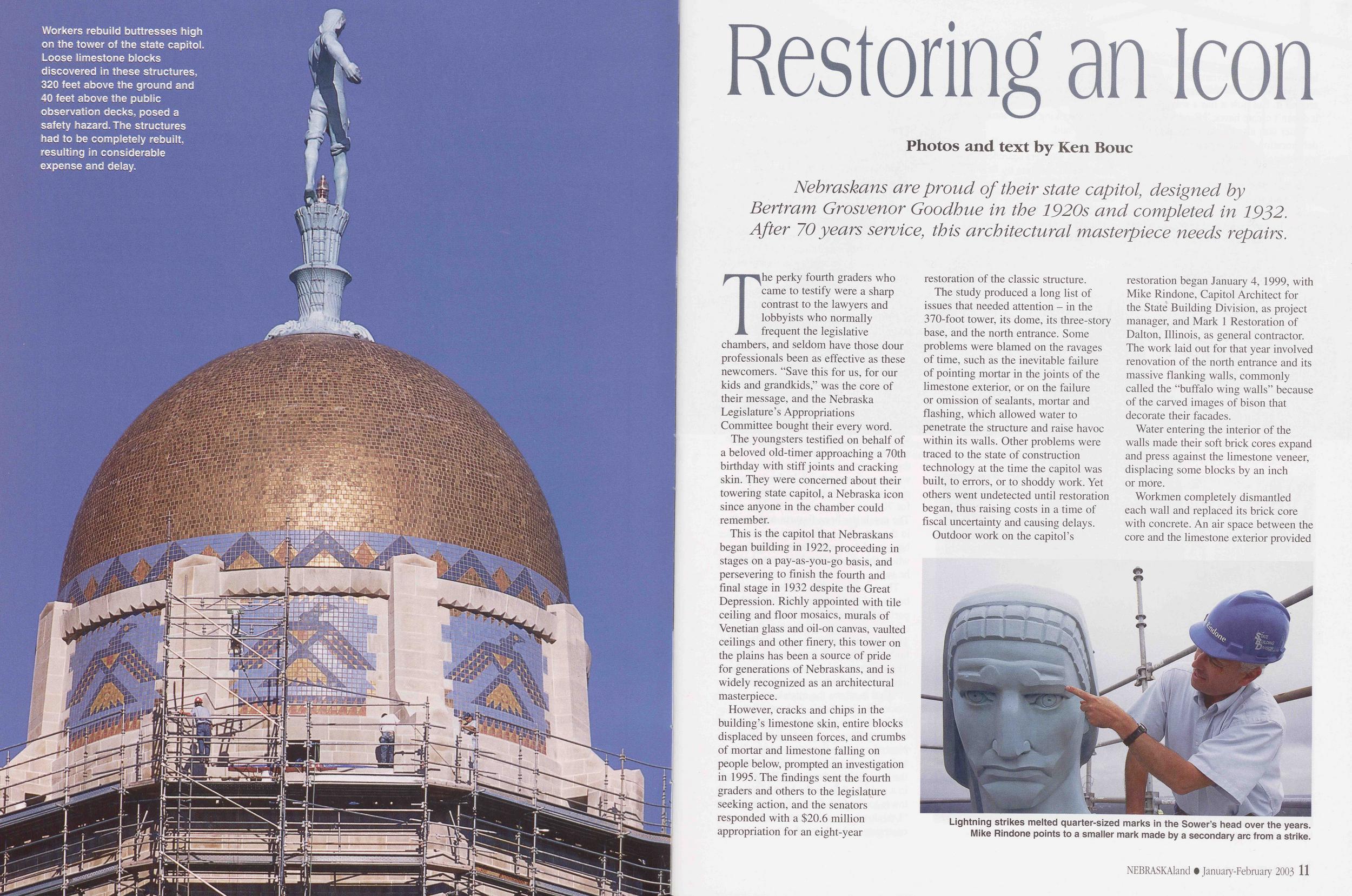
Restoring an Icon
Photos and text by Ken Bouc Nebraskans are proud of their state capitol, designed by Bertram Grosvenor Goodhue in the 1920s and completed in 1932. After 70 years service, this architectural masterpiece needs repairs.The perky fourth graders who came to testify were a sharp contrast to the lawyers and lobbyists who normally frequent the legislative chambers, and seldom have those dour professionals been as effective as these newcomers. "Save this for us, for our kids and grandkids," was the core of their message, and the Nebraska Legislature's Appropriations Committee bought their every word.
The youngsters testified on behalf of a beloved old-timer approaching a 70th birthday with stiff joints and cracking skin. They were concerned about their towering state capitol, a Nebraska icon since anyone in the chamber could remember.
This is the capitol that Nebraskans began building in 1922, proceeding in stages on a pay-as-you-go basis, and persevering to finish the fourth and final stage in 1932 despite the Great Depression. Richly appointed with tile ceiling and floor mosaics, murals of Venetian glass and oil-on canvas, vaulted ceilings and other finery, this tower on the plains has been a source of pride for generations of Nebraskans, and is widely recognized as an architectural masterpiece.
However, cracks and chips in the building's limestone skin, entire blocks displaced by unseen forces, and crumbs of mortar and limestone falling on people below, prompted an investigation in 1995. The findings sent the fourth graders and others to the legislature seeking action, and the senators responded with a $20.6 million appropriation for an eight-year restoration of the classic structure.
The study produced a long list of issues that needed attention - in the 370-foot tower, its dome, its three-story base, and the north entrance. Some problems were blamed on the ravages of time, such as the inevitable failure of pointing mortar in the joints of the limestone exterior, or on the failure or omission of sealants, mortar and flashing, which allowed water to penetrate the structure and raise havoc within its walls. Other problems were traced to the state of construction technology at the time the capitol was built, to errors, or to shoddy work. Yet others went undetected until restoration began, thus raising costs in a time of fiscal uncertainty and causing delays.
Outdoor work on the capitol's restoration began January 4, 1999, with Mike Rindone, Capitol Architect for the State Building Division, as project manager, and Mark 1 Restoration of Dalton, Illinois, as general contractor. The work laid out for that year involved renovation of the north entrance and its massive flanking walls, commonly called the "buffalo wing walls" because of the carved images of bison that decorate their facades.
Water entering the interior of the walls made their soft brick cores expand and press against the limestone veneer, displacing some blocks by an inch or more.
Workmen completely dismantled each wall and replaced its brick core with concrete. An air space between the core and the limestone exterior provided
 interior drainage. "Eventually, water
will get back in there. There's no way
around it. But now it has a way out, so
it doesn't create havoc," Rindone said.
interior drainage. "Eventually, water
will get back in there. There's no way
around it. But now it has a way out, so
it doesn't create havoc," Rindone said.
Water was also to blame for the deterioration of the concrete slab supporting the north stairs. To better understand the damage, the granite steps were removed, a hole was bored in the underlying concrete, and a small video camera was slipped into the void below. It showed a large space, as wide as the stairs and filled with a jumble of fallen timbers, the remains of the framework that supported forms when the slab was poured 70 years ago. "It was like looking down into the Titanic'' Rindone said.
Using a low-tech but effective technique, workers searched for deteriorated concrete by listening for hollow sounds as they dragged a heavy chain across the surface. They chiseled or ground away the bad concrete and replaced it, added waterproofing, then reinstalled the original granite steps.
The biggest problem revealed by the 1995 study, however, was a fundamental misunderstanding during the tower's construction that robbed it of flexibility and changed its distribution of weight in a way contrary to the building's design. Rindone said the capitol's tower is a skyscraper, fundamentally different from a traditional load-bearing building. A skyscraper's steel framework supports both its floors and the building's exterior masonry skin.
Rindone explained the importance of flexibility in the capitol's tower as it moves ever so slightly. "Consider the daily thermal extremes that we have in Nebraska. Every day as the sun comes up, the east side of the building warms, causing that side of the building to expand, while on the west side, the stone remains cold and contracts. The tower bends, compressing stone on the west side and pulling stone apart on the east. As the sun arches across the sky, the side of the building facing the sun warms and expands while the opposite side cools and shrinks . . . every day, for 70 years, like a corkscrew," he said. The result has been fissures and cracks in the masonry walls, more so near the bottom of the tower "because that's where the stresses are being resolved," he said.
The tower's design employed a steel beam and shelf angle assembly at the perimeter of each floor to support the exterior masonry wall for that floor. The stone and brick masonry walls were built after the steel frame was in place. The masonry was installed tight to the underside of the beam and shelf angle.
"That is where the mistake was made. The building's designers felt flexibility was needed in the tower masonry. They designed a joint that pierced only the limestone veneer but, unfortunately, did not continue through the brick behind the stone. This resulted in a rigid wall from the base of the tower to the 14th floor," Rindone said. "I think what you had was the new emerging technology of skyscraper 12 NEBRASKAland • January-February 2003
The solution appeared simple, but its execution was a monumental effort, requiring the entire construction season of 2000. At each of six floors in the tower, workers removed three courses (horizontal layers) of limestone and large quantities of brick to expose the face and underside of the perimeter beam and shelf angle. The steel was cleaned, coated and flashed with lead flashing to protect the steel and wall from water intrusion in the future.
New water-resistant bricks were laid back into the wall, and a Vs-inch "gap" was left between the bottom of the steel beam and shelf angle and the top of the new brick. The gap, called a soft joint, is filled with a neoprene pad that extends from the back of the wall to the front edge of the shelf angle. It provides flexibility for the tower and allows the masonry and steel to expand and contract. Each floor now supports only the weight of masonry surrounding that floor without supporting the weight of masonry on the floors above.
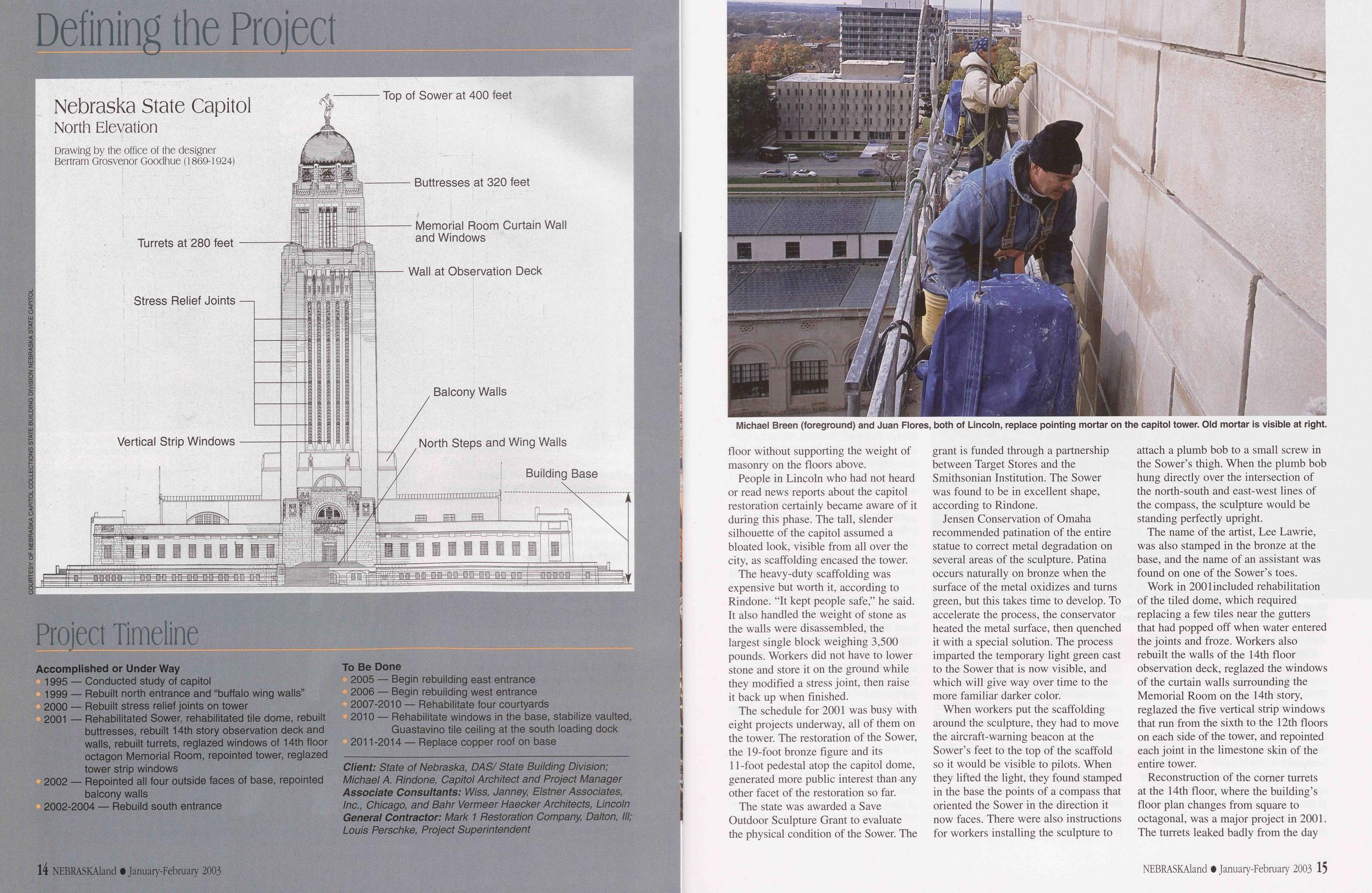 Defining the Project
People in Lincoln who had not heard or read news reports about the capitol restoration certainly became aware of it during this phase. The tall, slender silhouette of the capitol assumed a bloated look, visible from all over the city, as scaffolding encased the tower.
The heavy-duty scaffolding was expensive but worth it, according to Rindone. "It kept people safe," he said. It also handled the weight of stone as the walls were disassembled, the largest single block weighing 3,500 pounds. Workers did not have to lower stone and store it on the ground while they modified a stress joint, then raise it back up when finished.
The schedule for 2001 was busy with eight projects underway, all of them on the tower. The restoration of the Sower, the 19-foot bronze figure and its 11-foot pedestal atop the capitol dome, generated more public interest than any other facet of the restoration so far.
The state was awarded a Save Outdoor Sculpture Grant to evaluate the physical condition of the Sower. The grant is funded through a partnership between Target Stores and the Smithsonian Institution. The Sower was found to be in excellent shape, according to Rindone.
Jensen Conservation of Omaha recommended patination of the entire statue to correct metal degradation on several areas of the sculpture. Patina occurs naturally on bronze when the surface of the metal oxidizes and turns green, but this takes time to develop. To accelerate the process, the conservator heated the metal surface, then quenched it with a special solution. The process imparted the temporary light green cast to the Sower that is now visible, and which will give way over time to the more familiar darker color.
When workers put the scaffolding around the sculpture, they had to move the aircraft-warning beacon at the Sower's feet to the top of the scaffold so it would be visible to pilots. When they lifted the light, they found stamped in the base the points of a compass that oriented the Sower in the direction it now faces. There were also instructions for workers installing the sculpture to attach a plumb bob to a small screw in the Sower's thigh. When the plumb bob hung directly over the intersection of the north-south and east-west lines of the compass, the sculpture would be standing perfectly upright.
The name of the artist, Lee Lawrie, was also stamped in the bronze at the base, and the name of an assistant was found on one of the Sower's toes.
Work in 2001 included rehabilitation of the tiled dome, which required replacing a few tiles near the gutters that had popped off when water entered the joints and froze. Workers also rebuilt the walls of the 14th floor observation deck, reglazed the windows of the curtain walls surrounding the Memorial Room on the 14th story, reglazed the five vertical strip windows that run from the sixth to the 12th floors on each side of the tower, and repointed each joint in the limestone skin of the entire tower.
Reconstruction of the corner turrets
at the 14th floor, where the building's
floor plan changes from square to
octagonal, was a major project in 2001.
The turrets leaked badly from the day
NEBRASKAland • January-February 2003 15
Copper flashing beneath the capstones was meant to carry water away, but the copper was full of three-cornered tears. Rindone speculated that they were made by the large capstones as they were being installed. The corners of these 2000-pound stones were sharp, and acted as spears when a stone bumped into the copper.
"You have to consider circumstances at that time." Rindone said. "At 270 feet in the air . . . with very little scaffold to hang onto, it was a struggle to control these large stones being lowered on cables in gusty, strong winds . . . these stones went where they wanted to go."
The remedy involved removal of capstones and five courses of limestone veneer immediately below the capstones, and cutting back 12 inches of brick back-up to create an air space for water control. The remaining brick was then coated with stucco to create a smooth surface, to which a fully adhered rubber roofing membrane was attached. The membrane was covered with red rosin paper and topped with lead flashing before the wall and capstones were reinstalled.
These operations all went more or less according to plan. However, an unpleasant surprise at the buttresses cost more than three months delay and $1.7 million, which was funded by an additional appropriation (See photo on page 10.)
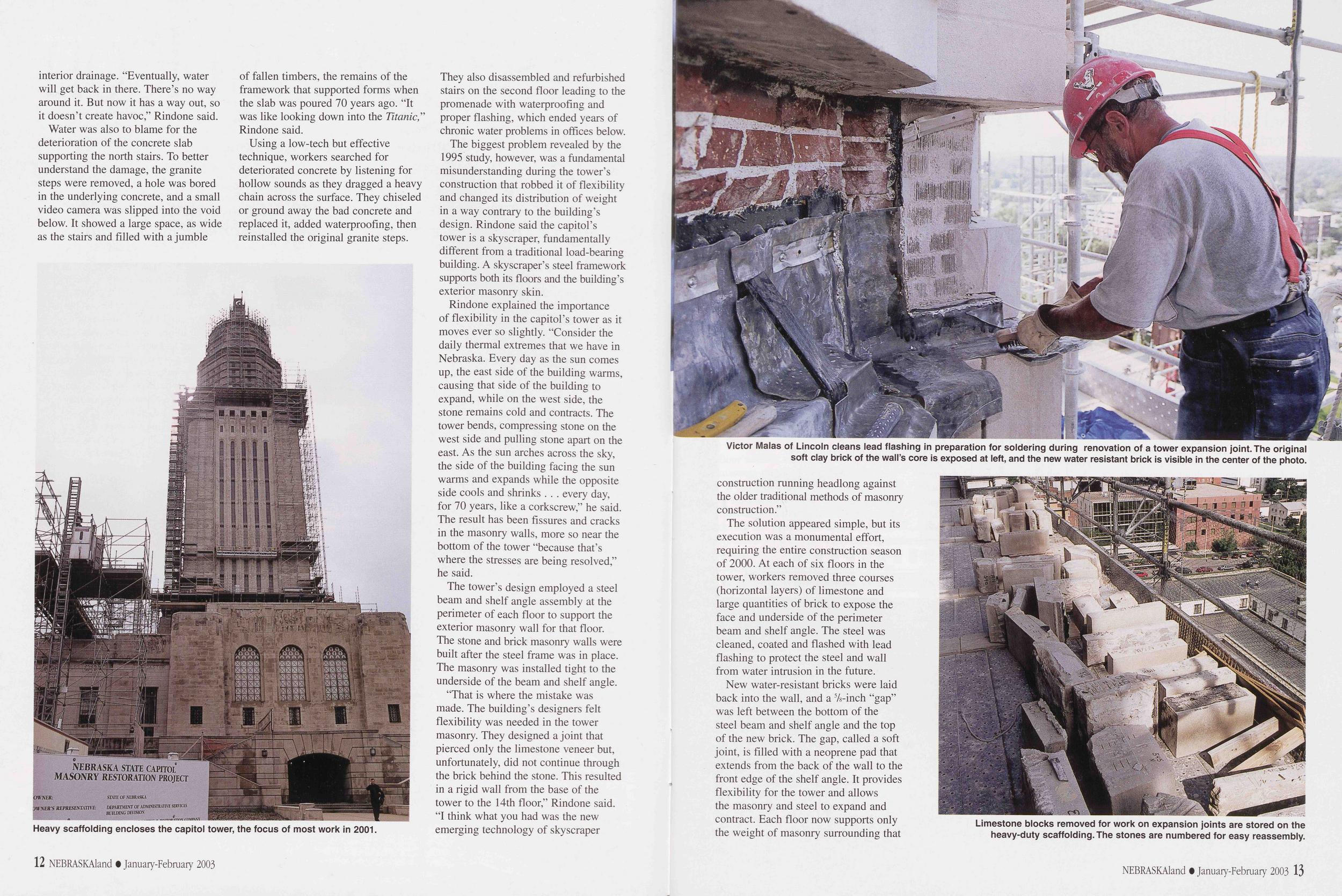
The buttresses are eight vertical masonry structures separating the tile "thunderbird panels" at the 18th floor, 320 feet above the ground. The original plan called for simply repointing the buttresses, but when workmen ground away the old pointing mortar they found they could move the stones. Limestone blocks were dangerously loose five courses down from the apex. "Those stones were directly above the 14th story observation deck, so there was a serious safety issue there ... the buttresses needed to be reconstructed and stabilized." Rindone said.
The scaffold on that part of the building was not designed to hold much stone, so the contractor fashioned a jib, a small crane, to move the stones to the 18th floor walkway. Workmen dismantled each buttress, replaced the soft brick core with concrete brick, and then reinstalled the limestone veneer. Each buttress was tied to its new core with bronze strips and bronze pins. "These things won't go anywhere anymore," Rindone said.
Work in 2002 included repointing of the fifth floor balcony walls, and repointing the outer walls of the three-story base. When workers ground out the old pointing mortar in the northeastern portion of the base, they found that the limestone veneer had been inappropriately installed. Instead of placing each stone on a full bed of setting mortar, the masons just troweled a few globs of mortar near the edges, leaving large voids under the center of the blocks.
The defect was hidden with pointing mortar, which eventually shrunk and cracked. Driving rain went through the old pointing mortar, through the voids, into the brick back-up and saturated and damaged interior plaster finishes. That was common throughout that part of the building, according to Rindone.
"The idea that this entire building was built perfectly is inaccurate. You 16 NEBRASKAland t January-February 2003 had some people who didn't do a good job and some people who did. In this particular case, whoever placed those stones in that area got away with doing marginal work," he said.
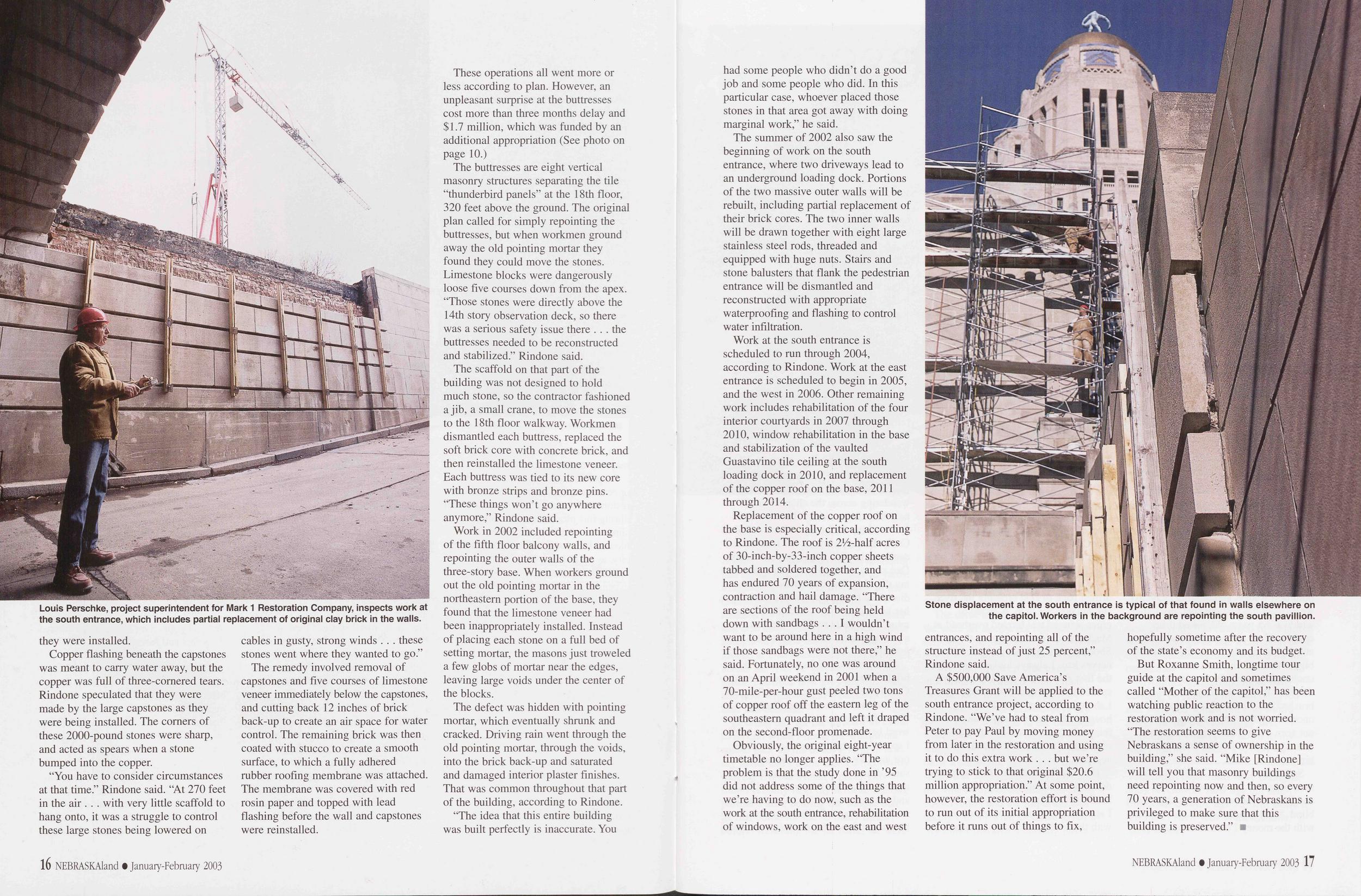
The summer of 2002 also saw the beginning of work on the south entrance, where two driveways lead to an underground loading dock. Portions of the two massive outer walls will be rebuilt, including partial replacement of their brick cores. The two inner walls will be drawn together with eight large stainless steel rods, threaded and equipped with huge nuts. Stairs and stone balusters that flank the pedestrian entrance will be dismantled and reconstructed with appropriate waterproofing and flashing to control water infiltration.
Work at the south entrance is scheduled to run through 2004, according to Rindone. Work at the east entrance is scheduled to begin in 2005, and the west in 2006. Other remaining work includes rehabilitation of the four interior courtyards in 2007 through 2010, window rehabilitation in the base and stabilization of the vaulted Guastavino tile ceiling at the south loading dock in 2010, and replacement of the copper roof on the base, 2011 through 2014.
Replacement of the copper roof on the base is especially critical, according to Rindone. The roof is 21/2-half acres of 30-inch-by-33-inch copper sheets tabbed and soldered together, and has endured 70 years of expansion, contraction and hail damage. "There are sections of the roof being held down with sandbags ... I wouldn't want to be around here in a high wind if those sandbags were not there," he said. Fortunately, no one was around on an April weekend in 2001 when a 70-mile-per-hour gust peeled two tons of copper roof off the eastern leg of the southeastern quadrant and left it draped on the second-floor promenade.
Obviously, the original eight-year timetable no longer applies. "The problem is that the study done in '95 did not address some of the things that we're having to do now, such as the work at the south entrance, rehabilitation of windows, work on the east and west
A $500,000 Save America's Treasures Grant will be applied to the south entrance project, according to Rindone. "We've had to steal from Peter to pay Paul by moving money from later in the restoration and using it to do this extra work . . . but we're trying to stick to that original $20.6 million appropriation." At some point, however, the restoration effort is bound to run out of its initial appropriation before it runs out of things to fix, hopefully sometime after the recovery of the state's economy and its budget.
But Roxanne Smith, longtime tour guide at the capitol and sometimes called "Mother of the capitol," has been watching public reaction to the restoration work and is not worried. "The restoration seems to give Nebraskans a sense of ownership in the building," she said. "Mike [Rindone] will tell you that masonry buildings need repointing now and then, so every 70 years, a generation of Nebraskans is privileged to make sure that this building is preserved."
NEBRASKAland t January-February 2003 17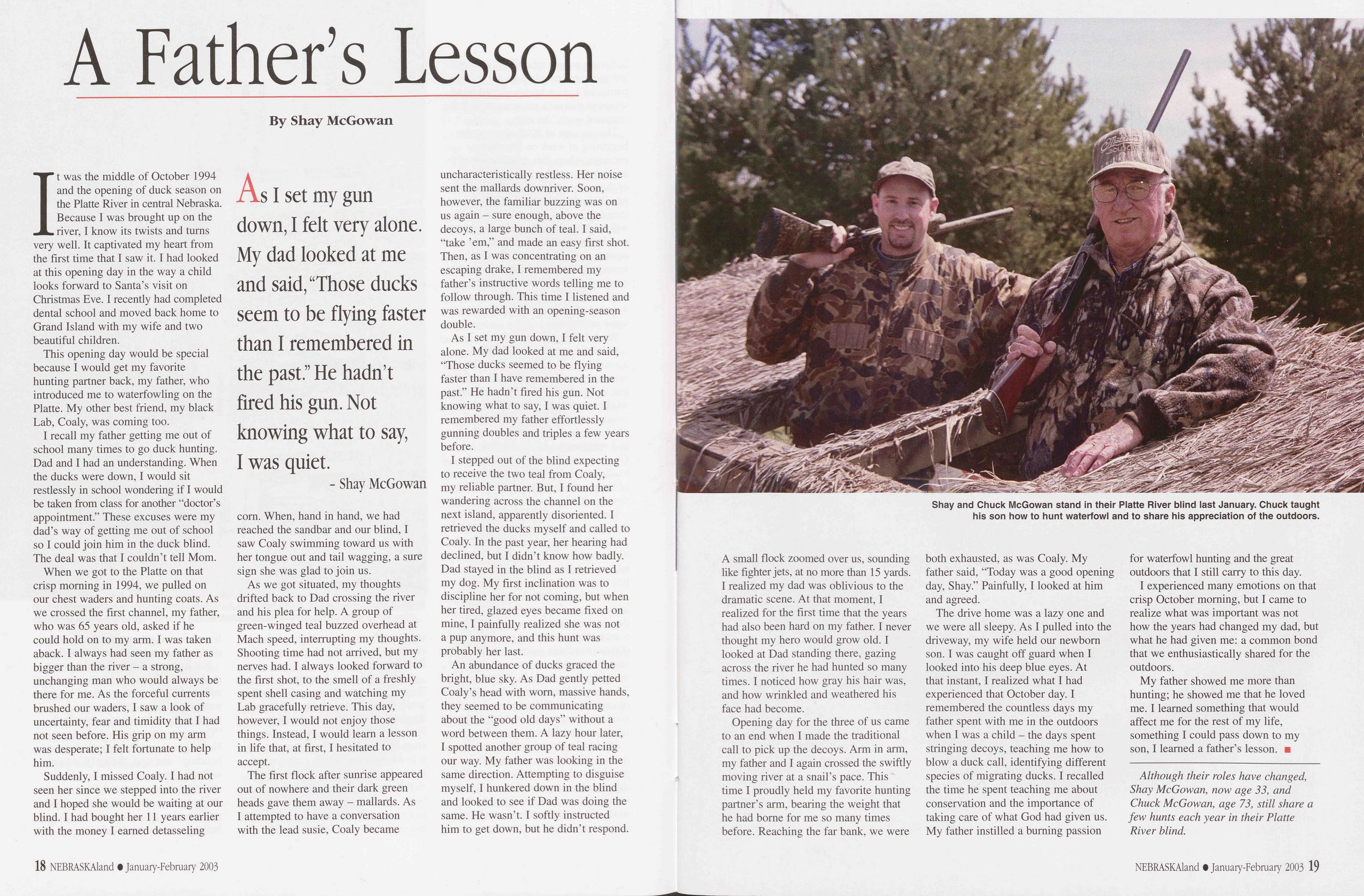
A Father's Lesson
By Shay McGowan As I set my gun down, I felt very alone. My dad looked at me and said, "Those ducks seem to be flying faster than I remembered in the past." He hadn't fired his gun. Not knowing what to say, I was quiet. - Shay McGowanIt was the middle of October 1994 and the opening of duck season on the Platte River in central Nebraska. Because I was brought up on the river, I know its twists and turns very well. It captivated my heart from the first time that I saw it. I had looked at this opening day in the way a child looks forward to Santa's visit on Christmas Eve. I recently had completed dental school and moved back home to Grand Island with my wife and two beautiful children.
This opening day would be special because I would get my favorite hunting partner back, my father, who introduced me to waterfowling on the Platte. My other best friend, my black Lab, Coaly, was coming too.
I recall my father getting me out of school many times to go duck hunting. Dad and I had an understanding. When the ducks were down, I would sit restlessly in school wondering if I would be taken from class for another "doctor's appointment." These excuses were my dad's way of getting me out of school so I could join him in the duck blind. The deal was that I couldn't tell Mom.
When we got to the Platte on that crisp morning in 1994, we pulled on our chest waders and hunting coats. As we crossed the first channel, my father, who was 65 years old, asked if he could hold on to my arm. I was taken aback. I always had seen my father as bigger than the river - a strong, unchanging man who would always be there for me. As the forceful currents brushed our waders, I saw a look of uncertainty, fear and timidity that I had not seen before. His grip on my arm was desperate; I felt fortunate to help him.
Suddenly, I missed Coaly. I had not seen her since we stepped into the river and I hoped she would be waiting at our blind. I had bought her 11 years earlier with the money I earned detasseling corn. When, hand in hand, we had reached the sandbar and our blind, I saw Coaly swimming toward us with her tongue out and tail wagging, a sure sign she was glad to join us.
As we got situated, my thoughts drifted back to Dad crossing the river and his plea for help. A group of green-winged teal buzzed overhead at Mach speed, interrupting my thoughts. Shooting time had not arrived, but my nerves had. I always looked forward to the first shot, to the smell of a freshly spent shell casing and watching my Lab gracefully retrieve. This day, however, I would not enjoy those things. Instead, I would learn a lesson in life that, at first, I hesitated to accept.
The first flock after sunrise appeared out of nowhere and their dark green heads gave them away - mallards. As I attempted to have a conversation with the lead susie, Coaly became uncharacteristically restless. Her noise sent the mallards downriver. Soon, however, the familiar buzzing was on us again - sure enough, above the decoys, a large bunch of teal. I said, "take 'em," and made an easy first shot. Then, as I was concentrating on an escaping drake, I remembered my father's instructive words telling me to follow through. This time I listened and was rewarded with an opening-season double.
As I set my gun down, I felt very alone. My dad looked at me and said, "Those ducks seemed to be flying faster than I have remembered in the past." He hadn't fired his gun. Not knowing what to say, I was quiet. I remembered my father effortlessly gunning doubles and triples a few years before.
I stepped out of the blind expecting to receive the two teal from Coaly, my reliable partner. But, I found her wandering across the channel on the next island, apparently disoriented. I retrieved the ducks myself and called to Coaly. In the past year, her hearing had declined, but I didn't know how badly. Dad stayed in the blind as I retrieved my dog. My first inclination was to discipline her for not coming, but when her tired, glazed eyes became fixed on mine, I painfully realized she was not a pup anymore, and this hunt was probably her last.
An abundance of ducks graced the bright, blue sky. As Dad gently petted Coaly's head with worn, massive hands, they seemed to be communicating about the "good old days" without a word between them. A lazy hour later, I spotted another group of teal racing our way. My father was looking in the same direction. Attempting to disguise myself, I hunkered down in the blind and looked to see if Dad was doing the same. He wasn't. I softly instructed him to get down, but he didn't respond. 18 NEBRASKAland • January-February 2003
Opening day for the three of us came to an end when I made the traditional call to pick up the decoys. Arm in arm, my father and I again crossed the swiftly moving river at a snail's pace. This time I proudly held my favorite hunting partner's arm, bearing the weight that he had borne for me so many times before. Reaching the far bank, we were both exhausted, as was Coaly. My father said, "Today was a good opening day, Shay." Painfully, I looked at him and agreed.
The drive home was a lazy one and we were all sleepy. As I pulled into the driveway, my wife held our newborn son. I was caught off guard when I looked into his deep blue eyes. At that instant, I realized what I had experienced that October day. I remembered the countless days my father spent with me in the outdoors when I was a child - the days spent stringing decoys, teaching me how to blow a duck call, identifying different species of migrating ducks. I recalled the time he spent teaching me about conservation and the importance of taking care of what God had given us. My father instilled a burning passion for waterfowl hunting and the great outdoors that I still carry to this day.
I experienced many emotions on that crisp October morning, but I came to realize what was important was not how the years had changed my dad, but what he had given me: a common bond that we enthusiastically shared for the outdoors.
My father showed me more than hunting; he showed me that he loved me. I learned something that would affect me for the rest of my life, something I could pass down to my son, I learned a father's lesson.
Although their roles have changed, Shay McGowan, now age 33, and Chuck McGowan, age 73, still share a few hunts each year in their Platte River blind.
NEBRASKAland • January-February 2003 19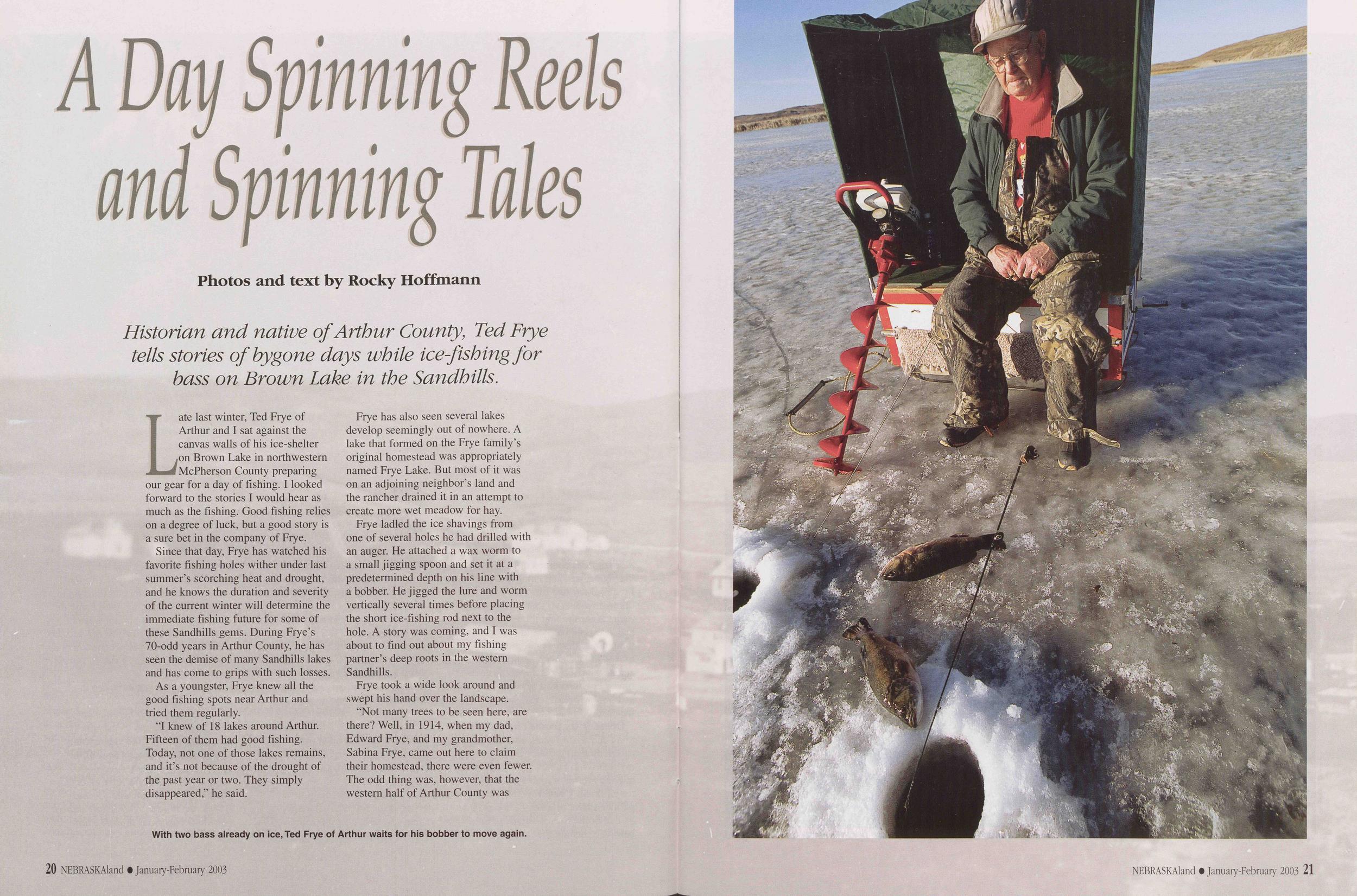
A Day Spinning Reels and Spinning Tales
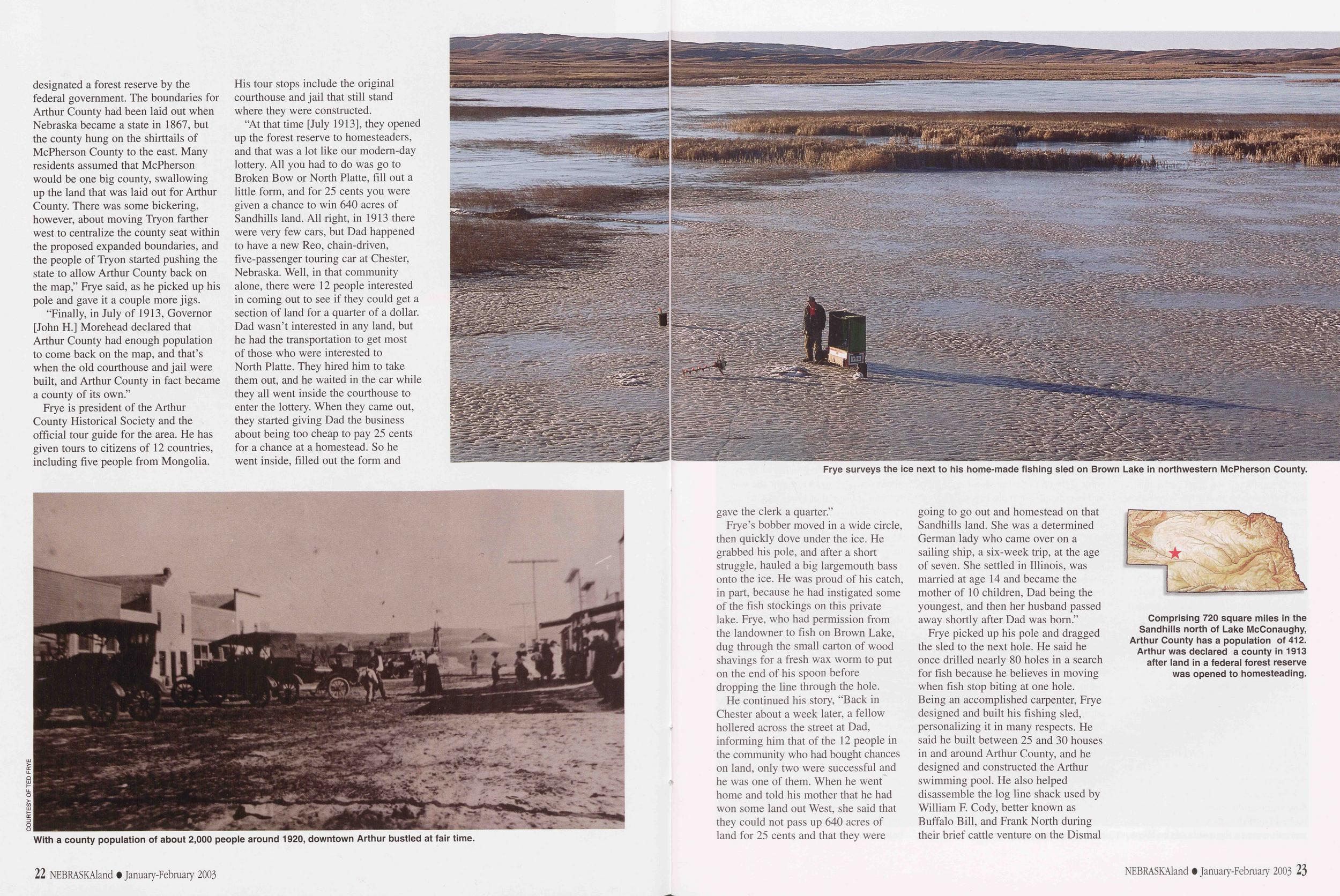
Photos and text by Rocky Hoffmann Historian and native of Arthur County, Ted Frye tells stories of bygone days while ice fishing for bass on Brown Lake in the Sandhills.Late last winter, Ted Frye of Arthur and I sat against the canvas walls of his ice-shelter ,on Brown Lake in northwestern McPherson County preparing our gear for a day of fishing. I looked forward to the stories I would hear as much as the fishing. Good fishing relies on a degree of luck, but a good story is a sure bet in the company of Frye.
Since that day, Frye has watched his favorite fishing holes wither under last summer's scorching heat and drought, and he knows the duration and severity of the current winter will determine the immediate fishing future for some of these Sandhills gems. During Frye's 70-odd years in Arthur County, he has seen the demise of many Sandhills lakes and has come to grips with such losses.
As a youngster, Frye knew all the good fishing spots near Arthur and tried them regularly.
"I knew of 18 lakes around Arthur. Fifteen of them had good fishing. Today, not one of those lakes remains, and it's not because of the drought of the past year or two. They simply disappeared," he said.
Frye has also seen several lakes develop seemingly out of nowhere. A lake that formed on the Frye family's original homestead was appropriately named Frye Lake. But most of it was on an adjoining neighbor's land and the rancher drained it in an attempt to create more wet meadow for hay.
Frye ladled the ice shavings from one of several holes he had drilled with an auger. He attached a wax worm to a small jigging spoon and set it at a predetermined depth on his line with a bobber. He jigged the lure and worm vertically several times before placing the short ice-fishing rod next to the hole. A story was coming, and I was about to find out about my fishing partner's deep roots in the western Sandhills.
Frye took a wide look around and swept his hand over the landscape.
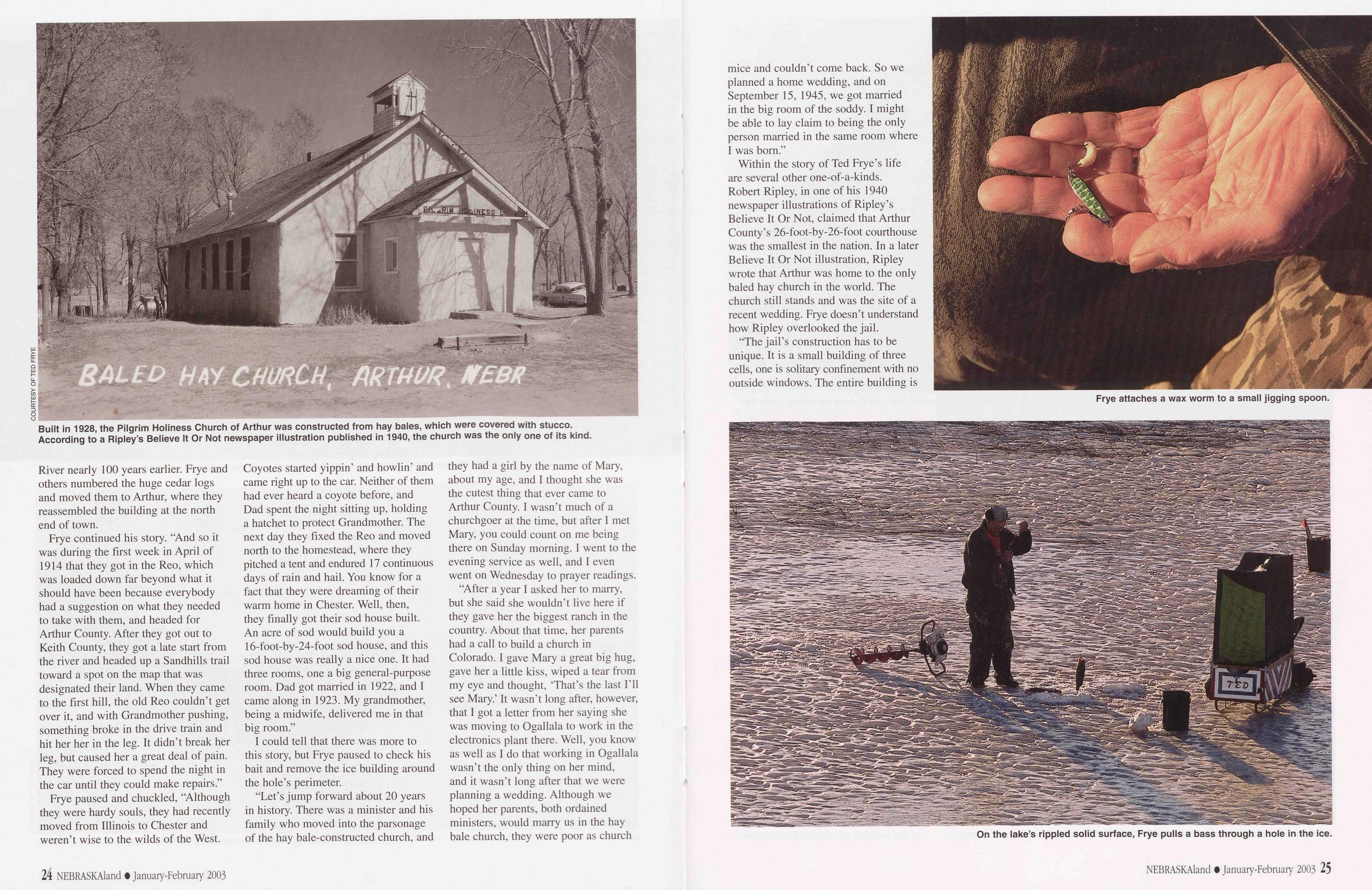
"Not many trees to be seen here, are there? Well, in 1914, when my dad, Edward Frye, and my grandmother, Sabina Frye, came out here to claim their homestead, there were even fewer. The odd thing was, however, that the western half of Arthur County was 20 NEBRASKAland • January-February 2003
 designated a forest reserve by the
federal government. The boundaries for
Arthur County had been laid out when
Nebraska became a state in 1867, but
the county hung on the shirttails of
McPherson County to the east. Many
residents assumed that McPherson
would be one big county, swallowing
up the land that was laid out for Arthur
County. There was some bickering,
however, about moving Tryon farther
west to centralize the county seat within
the proposed expanded boundaries, and
the people of Tryon started pushing the
state to allow Arthur County back on
the map," Frye said, as he picked up his
pole and gave it a couple more jigs.
designated a forest reserve by the
federal government. The boundaries for
Arthur County had been laid out when
Nebraska became a state in 1867, but
the county hung on the shirttails of
McPherson County to the east. Many
residents assumed that McPherson
would be one big county, swallowing
up the land that was laid out for Arthur
County. There was some bickering,
however, about moving Tryon farther
west to centralize the county seat within
the proposed expanded boundaries, and
the people of Tryon started pushing the
state to allow Arthur County back on
the map," Frye said, as he picked up his
pole and gave it a couple more jigs.
"Finally, in July of 1913, Governor [John H.] Morehead declared that Arthur County had enough population to come back on the map, and that's when the old courthouse and jail were built, and Arthur County in fact became a county of its own."
Frye is president of the Arthur County Historical Society and the official tour guide for the area. He has given tours to citizens of 12 countries, including five people from Mongolia. His tour stops include the original courthouse and jail that still stand where they were constructed.
"At that time [July 1913], they opened up the forest reserve to homesteaders, and that was a lot like our modern-day lottery. All you had to do was go to Broken Bow or North Platte, fill out a little form, and for 25 cents you were given a chance to win 640 acres of Sandhills land. All right, in 1913 there were very few cars, but Dad happened to have a new Reo, chain-driven, five-passenger touring car at Chester, Nebraska. Well, in that community alone, there were 12 people interested in coming out to see if they could get a section of land for a quarter of a dollar. Dad wasn't interested in any land, but he had the transportation to get most of those who were interested to North Platte. They hired him to take them out, and he waited in the car while they all went inside the courthouse to enter the lottery. When they came out, they started giving Dad the business about being too cheap to pay 25 cents for a chance at a homestead. So he went inside, filled out the form and
Frye's bobber moved in a wide circle, then quickly dove under the ice. He grabbed his pole, and after a short struggle, hauled a big largemouth bass onto the ice. He was proud of his catch, in part, because he had instigated some of the fish stockings on this private lake. Frye, who had permission from the landowner to fish on Brown Lake, dug through the small carton of wood shavings for a fresh wax worm to put on the end of his spoon before dropping the line through the hole.
He continued his story, "Back in Chester about a week later, a fellow hollered across the street at Dad, informing him that of the 12 people in the community who had bought chances on land, only two were successful and he was one of them. When he went home and told his mother that he had won some land out West, she said that they could not pass up 640 acres of land for 25 cents and that they were going to go out and homestead on that Sandhills land. She was a determined German lady who came over on a sailing ship, a six-week trip, at the age of seven. She settled in Illinois, was married at age 14 and became the mother of 10 children, Dad being the youngest, and then her husband passed away shortly after Dad was born."
Frye picked up his pole and dragged the sled to the next hole. He said he once drilled nearly 80 holes in a search for fish because he believes in moving when fish stop biting at one hole. Being an accomplished carpenter, Frye designed and built his fishing sled, personalizing it in many respects. He said he built between 25 and 30 houses in and around Arthur County, and he designed and constructed the Arthur swimming pool. He also helped disassemble the log line shack used by William F. Cody, better known as Buffalo Bill, and Frank North during their brief cattle venture on the Dismal
Frye continued his story. "And so it was during the first week in April of 1914 that they got in the Reo, which was loaded down far beyond what it should have been because everybody had a suggestion on what they needed to take with them, and headed for Arthur County. After they got out to Keith County, they got a late start from the river and headed up a Sandhills trail toward a spot on the map that was designated their land. When they came to the first hill, the old Reo couldn't get over it, and with Grandmother pushing, something broke in the drive train and hit her her in the leg. It didn't break her leg, but caused her a great deal of pain. They were forced to spend the night in the car until they could make repairs."
Frye paused and chuckled, "Although they were hardy souls, they had recently moved from Illinois to Chester and weren't wise to the wilds of the West. Coyotes started yippin' and howlin' and came right up to the car. Neither of them had ever heard a coyote before, and Dad spent the night sitting up, holding a hatchet to protect Grandmother. The next day they fixed the Reo and moved north to the homestead, where they pitched a tent and endured 17 continuous days of rain and hail. You know for a fact that they were dreaming of their warm home in Chester. Well, then, they finally got their sod house built. An acre of sod would build you a 16-foot-by-24-foot sod house, and this sod house was really a nice one. It had three rooms, one a big general-purpose room. Dad got married in 1922, and I came along in 1923. My grandmother, being a midwife, delivered me in that big room."
I could tell that there was more to this story, but Frye paused to check his bait and remove the ice building around the hole's perimeter.
"Let's jump forward about 20 years in history. There was a minister and his family who moved into the parsonage of the hay bale-constructed church, and they had a girl by the name of Mary, about my age, and I thought she was the cutest thing that ever came to Arthur County. I wasn't much of a churchgoer at the time, but after I met Mary, you could count on me being there on Sunday morning. I went to the evening service as well, and I even went on Wednesday to prayer readings.
"After a year I asked her to marry, but she said she wouldn't live here if they gave her the biggest ranch in the country. About that time, her parents had a call to build a church in Colorado. I gave Mary a great big hug, gave her a little kiss, wiped a tear from my eye and thought, 'That's the last I'll see Mary.' It wasn't long after, however, that I got a letter from her saying she was moving to Ogallala to work in the electronics plant there. Well, you know as well as I do that working in Ogallala wasn't the only thing on her mind, and it wasn't long after that we were planning a wedding. Although we hoped her parents, both ordained ministers, would marry us in the hay bale church, they were poor as church 24 NEBRASKAland • January-February 2003 mice and couldn't come back. So we planned a home wedding, and on September 15, 1945, we got married in the big room of the soddy. I might be able to lay claim to being the only person married in the same room where I was born."
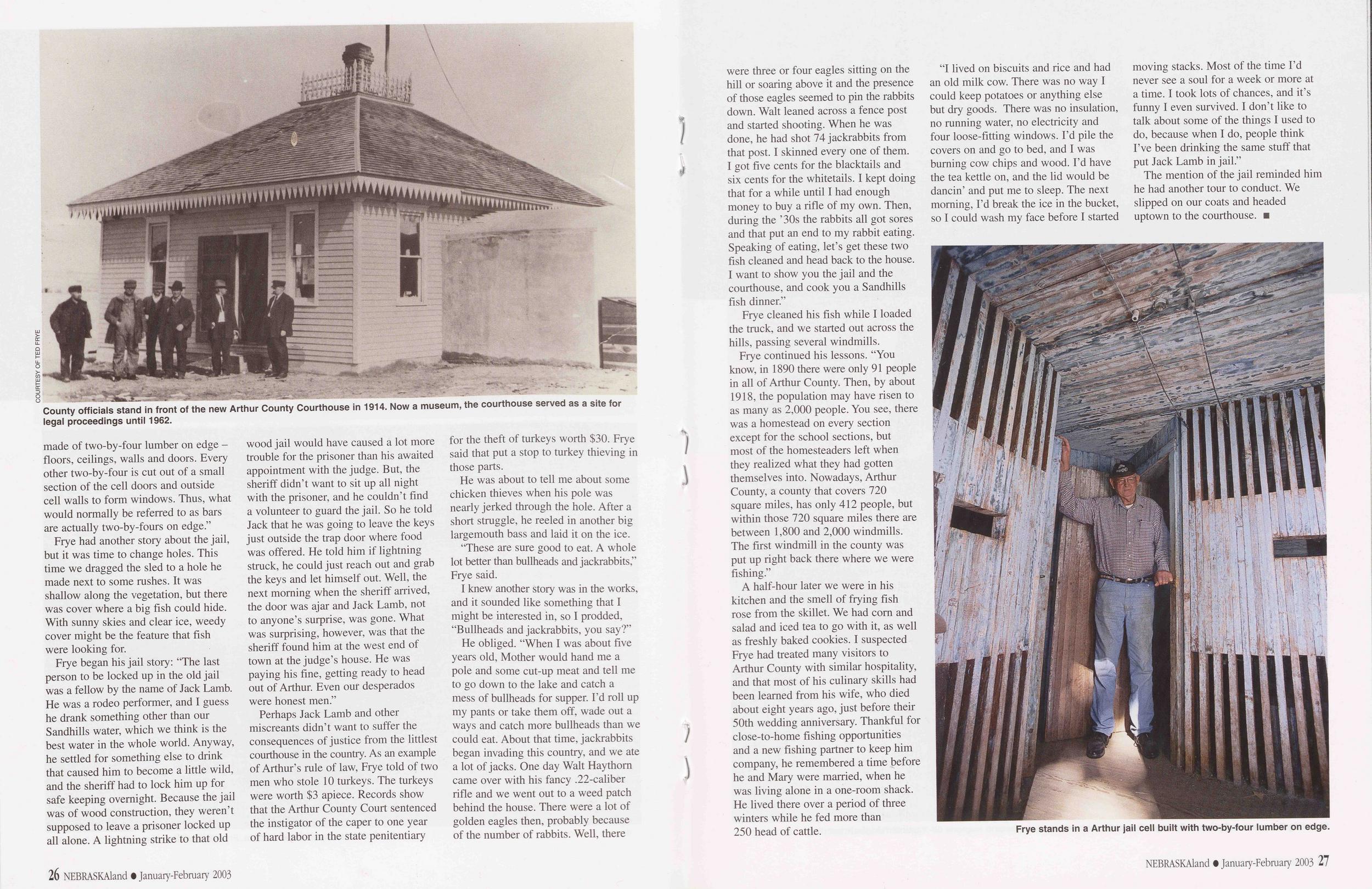
Within the story of Ted Frye's life are several other one-of-a-kinds. Robert Ripley, in one of his 1940 newspaper illustrations of Ripley's Believe It Or Not, claimed that Arthur County's 26-foot-by-26-foot courthouse was the smallest in the nation. In a later Believe It Or Not illustration, Ripley wrote that Arthur was home to the only baled hay church in the world. The church still stands and was the site of a recent wedding. Frye doesn't understand how Ripley overlooked the jail.
"The jail's construction has to be unique. It is a small building of three cells, one is solitary confinement with no outside windows. The entire building is
Frye had another story about the jail, but it was time to change holes. This time we dragged the sled to a hole he made next to some rushes. It was shallow along the vegetation, but there was cover where a big fish could hide. With sunny skies and clear ice, weedy cover might be the feature that fish were looking for.
Frye began his jail story: "The last person to be locked up in the old jail was a fellow by the name of Jack Lamb. He was a rodeo performer, and I guess he drank something other than our Sandhills water, which we think is the best water in the whole world. Anyway, he settled for something else to drink that caused him to become a little wild, and the sheriff had to lock him up for safe keeping overnight. Because the jail was of wood construction, they weren't supposed to leave a prisoner locked up all alone. A lightning strike to that old wood jail would have caused a lot more trouble for the prisoner than his awaited appointment with the judge. But, the sheriff didn't want to sit up all night with the prisoner, and he couldn't find a volunteer to guard the jail. So he told Jack that he was going to leave the keys just outside the trap door where food was offered. He told him if lightning struck, he could just reach out and grab the keys and let himself out. Well, the next morning when the sheriff arrived, the door was ajar and Jack Lamb, not to anyone's surprise, was gone. What was surprising, however, was that the sheriff found him at the west end of town at the judge's house. He was paying his fine, getting ready to head out of Arthur. Even our desperados were honest men."
Perhaps Jack Lamb and other miscreants didn't want to suffer the consequences of justice from the littlest courthouse in the country. As an example of Arthur's rule of law, Frye told of two men who stole 10 turkeys. The turkeys were worth $3 apiece. Records show that the Arthur County Court sentenced the instigator of the caper to one year of hard labor in the state penitentiary for the theft of turkeys worth $30. Frye said that put a stop to turkey thieving in those parts.
He was about to tell me about some chicken thieves when his pole was nearly jerked through the hole. After a short struggle, he reeled in another big largemouth bass and laid it on the ice.
"These are sure good to eat. A whole lot better than bullheads and jackrabbits," Frye said.
I knew another story was in the works, and it sounded like something that I might be interested in, so I prodded, "Bullheads and jackrabbits, you say?"
He obliged. "When I was about five years old, Mother would hand me a pole and some cut-up meat and tell me to go down to the lake and catch a mess of bullheads for supper. I'd roll up my pants or take them off, wade out a ways and catch more bullheads than we could eat. About that time, jackrabbits began invading this country, and we ate a lot of jacks. One day Walt Hay thorn came over with his fancy .22-caliber rifle and we went out to a weed patch behind the house. There were a lot of golden eagles then, probably because of the number of rabbits. Well, there 26 NEBRASKAland • January-February 2003 were three or four eagles sitting on the hill or soaring above it and the presence of those eagles seemed to pin the rabbits down. Walt leaned across a fence post and started shooting. When he was done, he had shot 74 jackrabbits from that post. I skinned every one of them. I got five cents for the black tails and six cents for the whitetails. I kept doing that for a while until I had enough money to buy a rifle of my own. Then, during the '30s the rabbits all got sores and that put an end to my rabbit eating. Speaking of eating, let's get these two fish cleaned and head back to the house. I want to show you the jail and the courthouse, and cook you a Sandhills fish dinner."
Frye cleaned his fish while I loaded the truck, and we started out across the hills, passing several windmills.
Frye continued his lessons. "You know, in 1890 there were only 91 people in all of Arthur County. Then, by about 1918, the population may have risen to as many as 2,000 people. You see, there was a homestead on every section except for the school sections, but most of the homesteaders left when they realized what they had gotten themselves into. Nowadays, Arthur County, a county that covers 720 square miles, has only 412 people, but within those 720 square miles there are between 1,800 and 2,000 windmills. The first windmill in the county was put up right back there where we were fishing."
A half-hour later we were in his kitchen and the smell of frying fish rose from the skillet. We had corn and salad and iced tea to go with it, as well as freshly baked cookies. I suspected Frye had treated many visitors to Arthur County with similar hospitality, and that most of his culinary skills had been learned from his wife, who died about eight years ago, just before their 50th wedding anniversary. Thankful for close-to-home fishing opportunities and a new fishing partner to keep him company, he remembered a time before he and Mary were married, when he was living alone in a one-room shack. He lived there over a period of three winters while he fed more than 250 head of cattle.
"I lived on biscuits and rice and had an old milk cow. There was no way I could keep potatoes or anything else but dry goods. There was no insulation, no running water, no electricity and four loose-fitting windows. I'd pile the covers on and go to bed, and I was burning cow chips and wood. I'd have the tea kettle on, and the lid would be dancin' and put me to sleep. The next morning, I'd break the ice in the bucket, so I could wash my face before I started moving stacks. Most of the time I'd never see a soul for a week or more at a time. I took lots of chances, and it's funny I even survived. I don't like to talk about some of the things I used to do, because when I do, people think I've been drinking the same stuff that put Jack Lamb in jail."
The mention of the jail reminded him he had another tour to conduct. We slipped on our coats and headed uptown to the courthouse.
A Top Gun — Ellie Schad
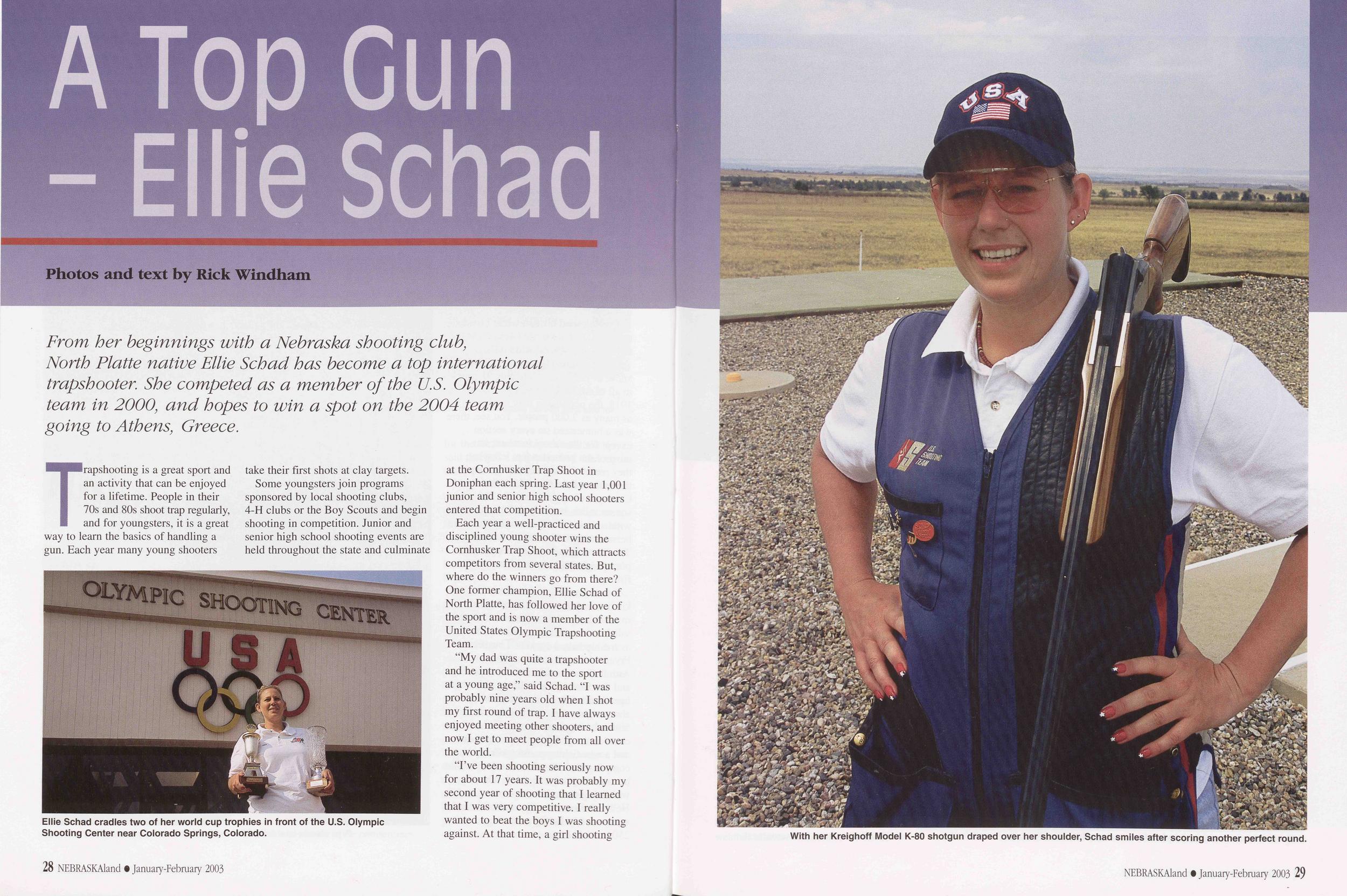
Photos and text by Rick Windham From her beginnings with a Nebraska shooting club, North Platte native Ellie Schad has become a top international trapshooter. She competed as a member of the U.S. Olympic team in 2000, and hopes to win a spot on the 2004 team going to Athens, Greece.Trapshooting is a great sport and an activity that can be enjoyed for a lifetime. People in their 70s and 80s shoot trap regularly, and for youngsters, it is a great way to learn the basics of handling a gun. Each year many young shooters take their first shots at clay targets.
Some youngsters join programs sponsored by local shooting clubs, 4-H clubs or the Boy Scouts and begin shooting in competition. Junior and senior high school shooting events are held throughout the state and culminate
Each year a well-practiced and disciplined young shooter wins the Cornhusker Trap Shoot, which attracts competitors from several states. But, where do the winners go from there? One former champion, Ellie Schad of North Platte, has followed her love of the sport and is now a member of the United States Olympic Trapshooting Team.
"My dad was quite a trapshooter and he introduced me to the sport at a young age," said Schad. "I was probably nine years old when I shot my first round of trap. I have always enjoyed meeting other shooters, and now I get to meet people from all over the world.
"I've been shooting seriously now for about 17 years. It was probably my second year of shooting that I learned that I was very competitive. I really wanted to beat the boys I was shooting against. At that time, a girl shooting 28 NEBRASKAland • January-February 2003
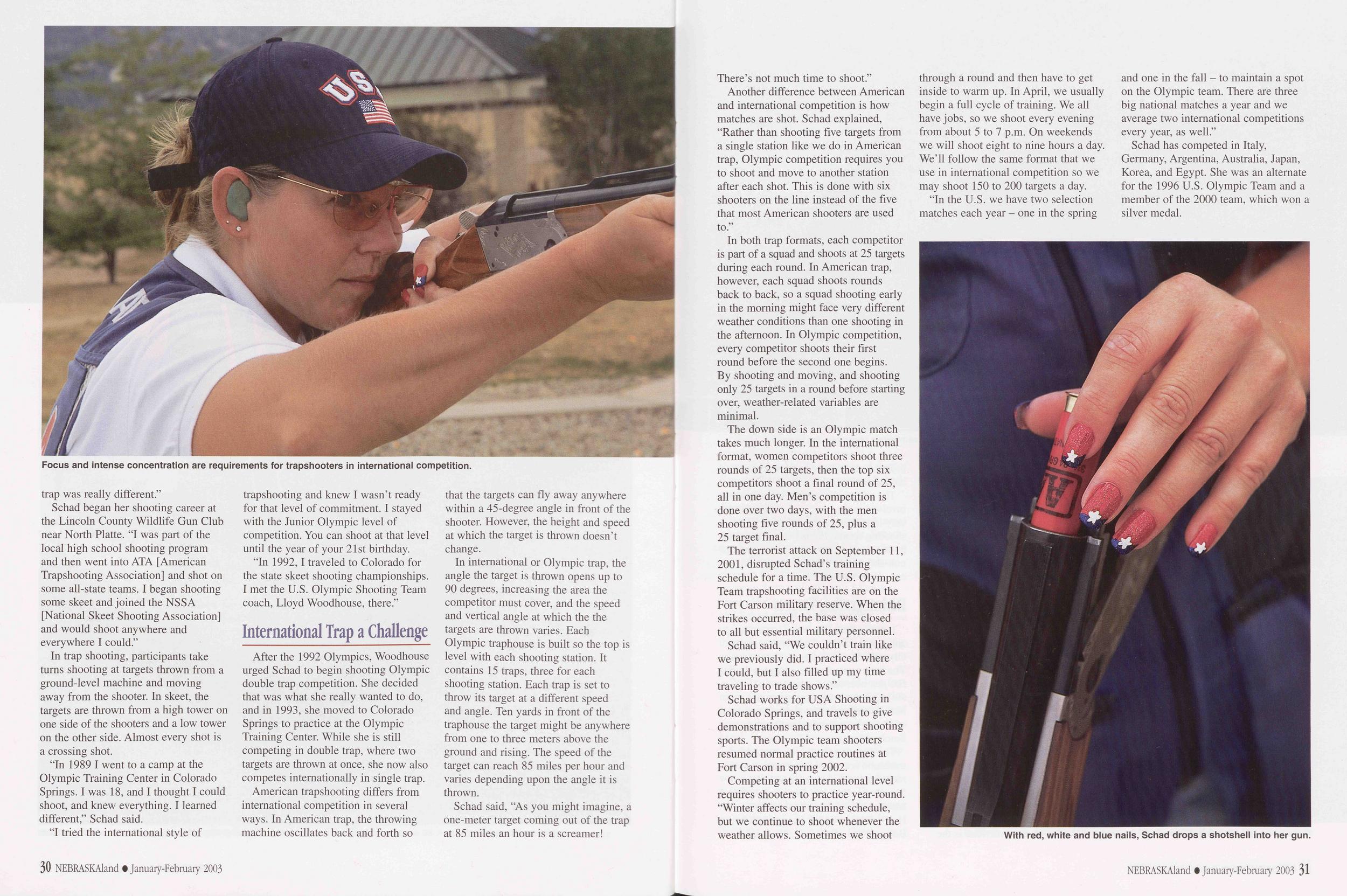
Schad began her shooting career at the Lincoln County Wildlife Gun Club near North Platte. "I was part of the local high school shooting program and then went into ATA [American Trapshooting Association] and shot on some all-state teams. I began shooting some skeet and joined the NSSA [National Skeet Shooting Association] and would shoot anywhere and everywhere I could."
In trap shooting, participants take turns shooting at targets thrown from a ground-level machine and moving away from the shooter. In skeet, the targets are thrown from a high tower on one side of the shooters and a low tower on the other side. Almost every shot is a crossing shot.
"In 1989 I went to a camp at the Olympic Training Center in Colorado Springs. I was 18, and I thought I could shoot, and knew everything. I learned different," Schad said.
"I tried the international style of trapshooting and knew I wasn't ready for that level of commitment. I stayed with the Junior Olympic level of competition. You can shoot at that level until the year of your 21st birthday.
"In 1992,1 traveled to Colorado for the state skeet shooting championships. I met the U.S. Olympic Shooting Team coach, Lloyd Woodhouse, there."
International Trap a ChallengeAfter the 1992 Olympics, Woodhouse urged Schad to begin shooting Olympic double trap competition. She decided that was what she really wanted to do, and in 1993, she moved to Colorado Springs to practice at the Olympic Training Center. While she is still competing in double trap, where two targets are thrown at once, she now also competes internationally in single trap.
American trapshooting differs from international competition in several ways. In American trap, the throwing machine oscillates back and forth so that the targets can fly away anywhere within a 45-degree angle in front of the shooter. However, the height and speed at which the target is thrown doesn't change.
In international or Olympic trap, the angle the target is thrown opens up to 90 degrees, increasing the area the competitor must cover, and the speed and vertical angle at which the the targets are thrown varies. Each Olympic traphouse is built so the top is level with each shooting station. It contains 15 traps, three for each shooting station. Each trap is set to throw its target at a different speed and angle. Ten yards in front of the traphouse the target might be anywhere from one to three meters above the ground and rising. The speed of the target can reach 85 miles per hour and varies depending upon the angle it is thrown.
Schad said, "As you might imagine, a one-meter target coming out of the trap at 85 miles an hour is a screamer! 30 NEBRASKAland • January-February 2003 There's not much time to shoot."
Another difference between American and international competition is how matches are shot. Schad explained, "Rather than shooting five targets from a single station like we do in American trap, Olympic competition requires you to shoot and move to another station after each shot. This is done with six shooters on the line instead of the five that most American shooters are used to."
In both trap formats, each competitor is part of a squad and shoots at 25 targets during each round. In American trap, however, each squad shoots rounds back to back, so a squad shooting early in the morning might face very different weather conditions than one shooting in the afternoon. In Olympic competition, every competitor shoots their first round before the second one begins. By shooting and moving, and shooting only 25 targets in a round before starting over, weather-related variables are minimal.
The down side is an Olympic match takes much longer. In the international format, women competitors shoot three rounds of 25 targets, then the top six competitors shoot a final round of 25, all in one day. Men's competition is done over two days, with the men shooting five rounds of 25, plus a 25 target final.
The terrorist attack on September 11, 2001, disrupted Schad's training schedule for a time. The U.S. Olympic Team trapshooting facilities are on the Fort Carson military reserve. When the strikes occurred, the base was closed to all but essential military personnel.
Schad said, "We couldn't train like we previously did. I practiced where I could, but I also filled up my time traveling to trade shows."
Schad works for USA Shooting in Colorado Springs, and travels to give demonstrations and to support shooting sports. The Olympic team shooters resumed normal practice routines at Fort Carson in spring 2002.
Competing at an international level requires shooters to practice year-round. "Winter affects our training schedule, but we continue to shoot whenever the weather allows. Sometimes we shoot through a round and then have to get inside to warm up. In April, we usually begin a full cycle of training. We all have jobs, so we shoot every evening from about 5 to 7 p.m. On weekends we will shoot eight to nine hours a day. We'll follow the same format that we use in international competition so we may shoot 150 to 200 targets a day.
"In the U.S. we have two selection matches each year - one in the spring and one in the fall - to maintain a spot on the Olympic team. There are three big national matches a year and we average two international competitions every year, as well."
Schad has competed in Italy, Germany, Argentina, Australia, Japan, Korea, and Egypt. She was an alternate for the 1996 U.S. Olympic Team and a member of the 2000 team, which won a silver medal.
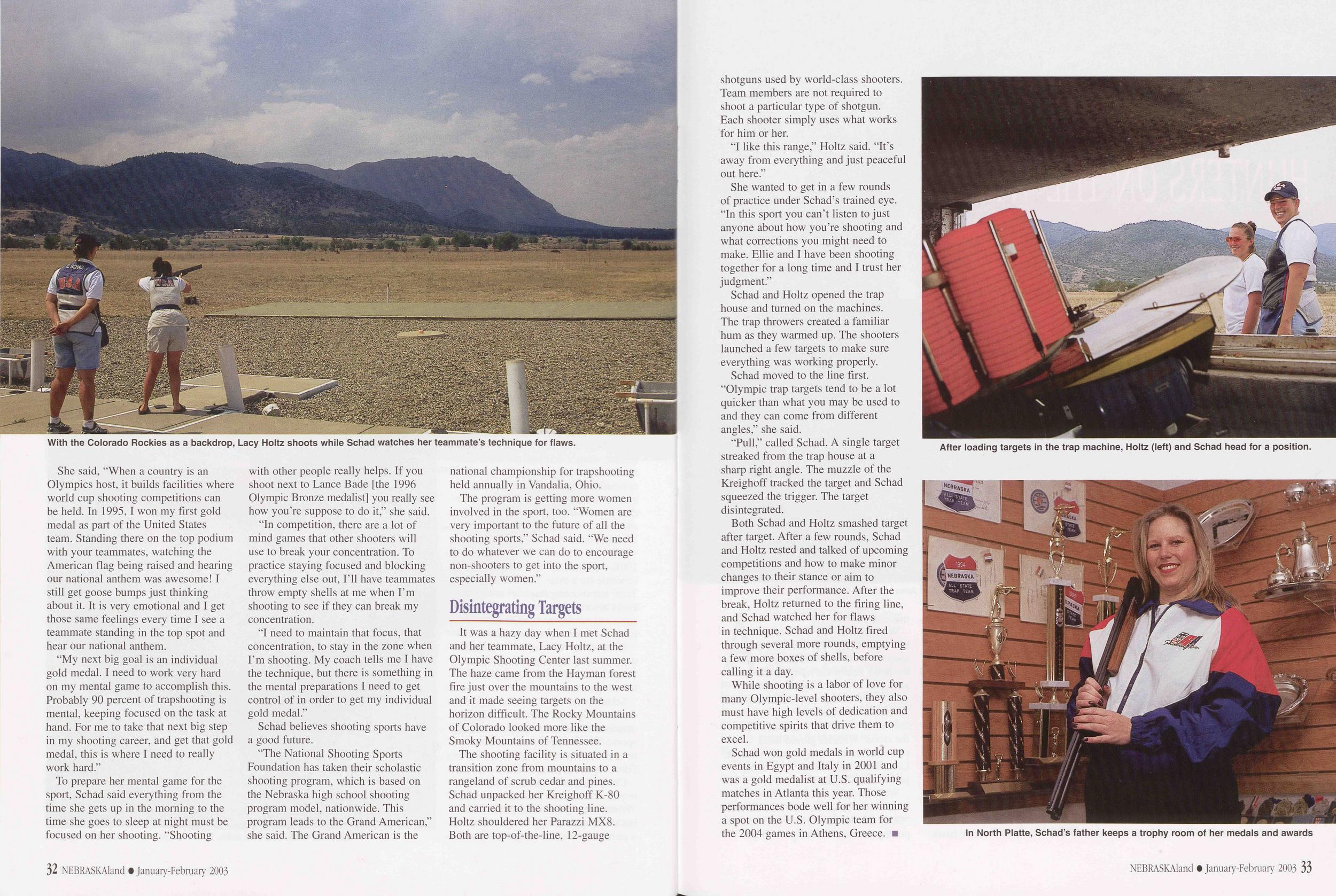
She said, "When a country is an Olympics host, it builds facilities where world cup shooting competitions can be held. In 1995,1 won my first gold medal as part of the United States team. Standing there on the top podium with your teammates, watching the American flag being raised and hearing our national anthem was awesome! I still get goose bumps just thinking about it. It is very emotional and I get those same feelings every time I see a teammate standing in the top spot and hear our national anthem.
"My next big goal is an individual gold medal. I need to work very hard on my mental game to accomplish this. Probably 90 percent of trapshooting is mental, keeping focused on the task at hand. For me to take that next big step in my shooting career, and get that gold medal, this is where I need to really work hard."
To prepare her mental game for the sport, Schad said everything from the time she gets up in the morning to the time she goes to sleep at night must be focused on her shooting. "Shooting with other people really helps. If you shoot next to Lance Bade [the 1996 Olympic Bronze medalist] you really see how you're suppose to do it," she said.
"In competition, there are a lot of mind games that other shooters will use to break your concentration. To practice staying focused and blocking everything else out, I'll have teammates throw empty shells at me when I'm shooting to see if they can break my concentration.
"I need to maintain that focus, that concentration, to stay in the zone when I'm shooting. My coach tells me I have the technique, but there is something in the mental preparations I need to get control of in order to get my individual gold medal."
Schad believes shooting sports have a good future.
"The National Shooting Sports Foundation has taken their scholastic shooting program, which is based on the Nebraska high school shooting program model, nationwide. This program leads to the Grand American," she said. The Grand American is the national championship for trapshooting held annually in Vandalia, Ohio.
The program is getting more women involved in the sport, too. "Women are very important to the future of all the shooting sports," Schad said. "We need to do whatever we can do to encourage non-shooters to get into the sport, especially women."
Disintegrating TargetsIt was a hazy day when I met Schad and her teammate, Lacy Holtz, at the Olympic Shooting Center last summer. The haze came from the Hayman forest fire just over the mountains to the west and it made seeing targets on the horizon difficult. The Rocky Mountains of Colorado looked more like the Smoky Mountains of Tennessee.
The shooting facility is situated in a transition zone from mountains to a rangeland of scrub cedar and pines. Schad unpacked her Kreighoff K-80 and carried it to the shooting line. Holtz shouldered her Parazzi MX8. Both are top-of-the-line, 12-gauge 32 NEBRASKAland • January-February 2003 shotguns used by world-class shooters. Team members are not required to shoot a particular type of shotgun. Each shooter simply uses what works for him or her.
"I like this range," Holtz said. "It's away from everything and just peaceful out here."
She wanted to get in a few rounds of practice under Schad's trained eye. "In this sport you can't listen to just anyone about how you're shooting and what corrections you might need to make. Ellie and I have been shooting together for a long time and I trust her judgment."
Schad and Holtz opened the trap house and turned on the machines. The trap throwers created a familiar hum as they warmed up. The shooters launched a few targets to make sure everything was working properly.
Schad moved to the line first. "Olympic trap targets tend to be a lot quicker than what you may be used to and they can come from different angles," she said.
"Pull," called Schad. A single target streaked from the trap house at a sharp right angle. The muzzle of the Kreighoff tracked the target and Schad squeezed the trigger. The target disintegrated.
Both Schad and Holtz smashed target after target. After a few rounds, Schad and Holtz rested and talked of upcoming competitions and how to make minor changes to their stance or aim to improve their performance. After the break, Holtz returned to the firing line, and Schad watched her for flaws in technique. Schad and Holtz fired through several more rounds, emptying a few more boxes of shells, before calling it a day.
While shooting is a labor of love for many Olympic-level shooters, they also must have high levels of dedication and competitive spirits that drive them to excel.
Schad won gold medals in world cup events in Egypt and Italy in 2001 and was a gold medalist at U.S. qualifying matches in Atlanta this year. Those performances bode well for her winning a spot on the U.S. Olympic team for the 2004 games in Athens, Greece.
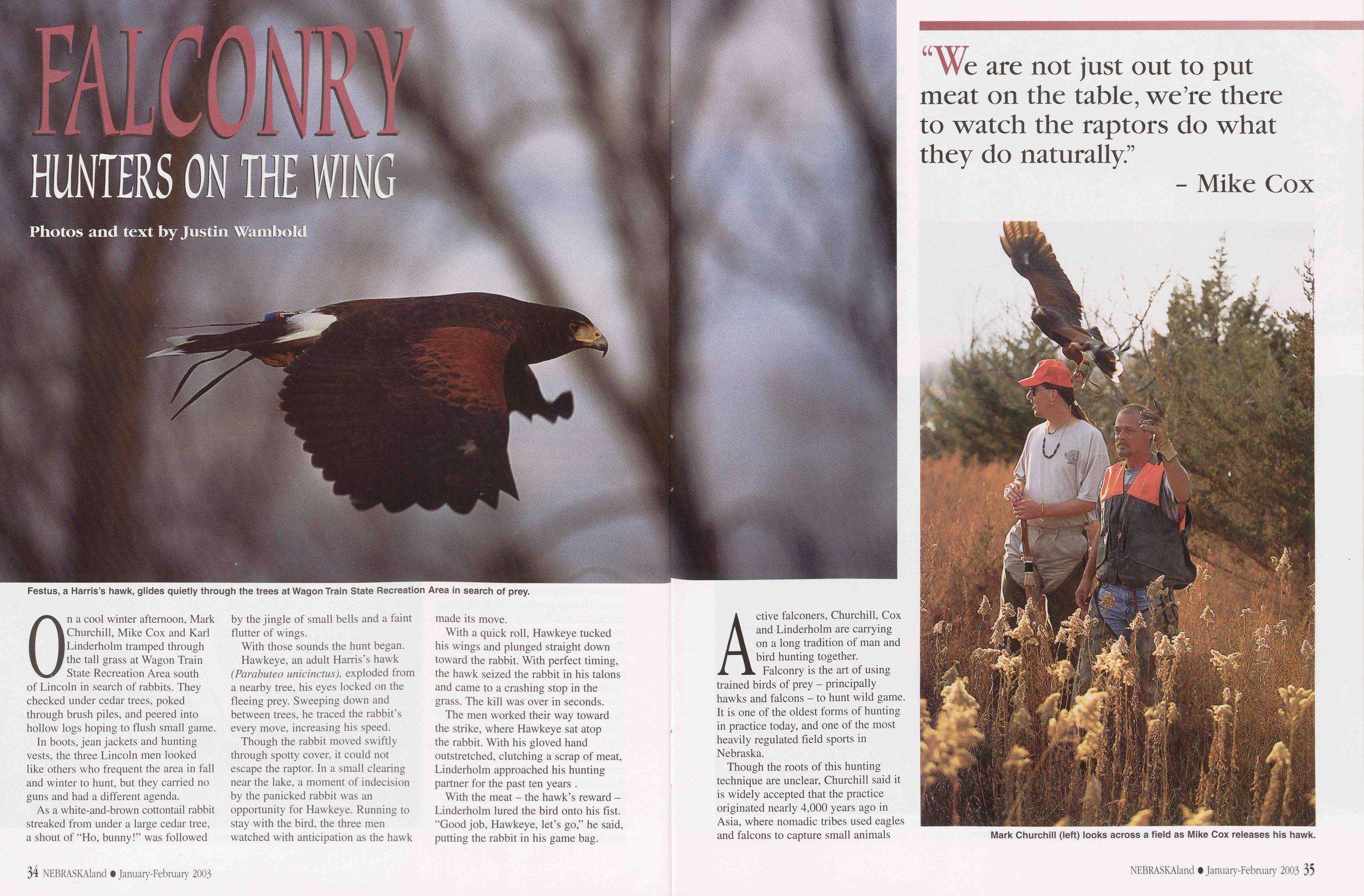
FALCONRY HUNTERS ON THE WING
Photos and text by Justin WamholdOn a cool winter afternoon, Mark Churchill, Mike Cox and Karl Linderholm tramped through the tall grass at Wagon Train State Recreation Area south of Lincoln in search of rabbits. They checked under cedar trees, poked through brush piles, and peered into hollow logs hoping to flush small game.
In boots, jean jackets and hunting vests, the three Lincoln men looked like others who frequent the area in fall and winter to hunt, but they carried no guns and had a different agenda.
As a white-and-brown cottontail rabbit streaked from under a large cedar tree, a shout of "Ho, bunny!" was followed by the jingle of small bells and a faint flutter of wings.
With those sounds the hunt began.
Hawkeye, an adult Harris's hawk (Parabuteo unicinctus), exploded from a nearby tree, his eyes locked on the fleeing prey. Sweeping down and between trees, he traced the rabbit's every move, increasing his speed.
Though the rabbit moved swiftly through spotty cover, it could not escape the raptor. In a small clearing near the lake, a moment of indecision by the panicked rabbit was an opportunity for Hawkeye. Running to stay with the bird, the three men watched with anticipation as the hawk made its move.
With a quick roll, Hawkeye tucked his wings and plunged straight down toward the rabbit. With perfect timing, the hawk seized the rabbit in his talons and came to a crashing stop in the grass. The kill was over in seconds.
The men worked their way toward the strike, where Hawkeye sat atop the rabbit. With his gloved hand outstretched, clutching a scrap of meat, Linderholm approached his hunting partner for the past ten years .
With the meat - the hawk's reward - Linderholm lured the bird onto his fist. "Good job, Hawkeye, let's go," he said, putting the rabbit in his game bag.
34 NEBRASKAland • January-February 2003 We are not just out to put meat on the table, we're there to watch the raptors do what they do naturally." - Mike CoxActive falconers, Churchill, Cox
and Linderholm are carrying
on a long tradition of man and
bird hunting together.
Falconry is the art of using
trained birds of prey - principally
hawks and falcons - to hunt wild game.
It is one of the oldest forms of hunting
in practice today, and one of the most
heavily regulated field sports in
Nebraska.Though the roots of this hunting
technique are unclear, Churchill said it
is widely accepted that the practice
originated nearly 4,000 years ago in
Asia, where nomadic tribes used eagles
and falcons to capture small animals
NEBRASKAland t January-February 2003 35
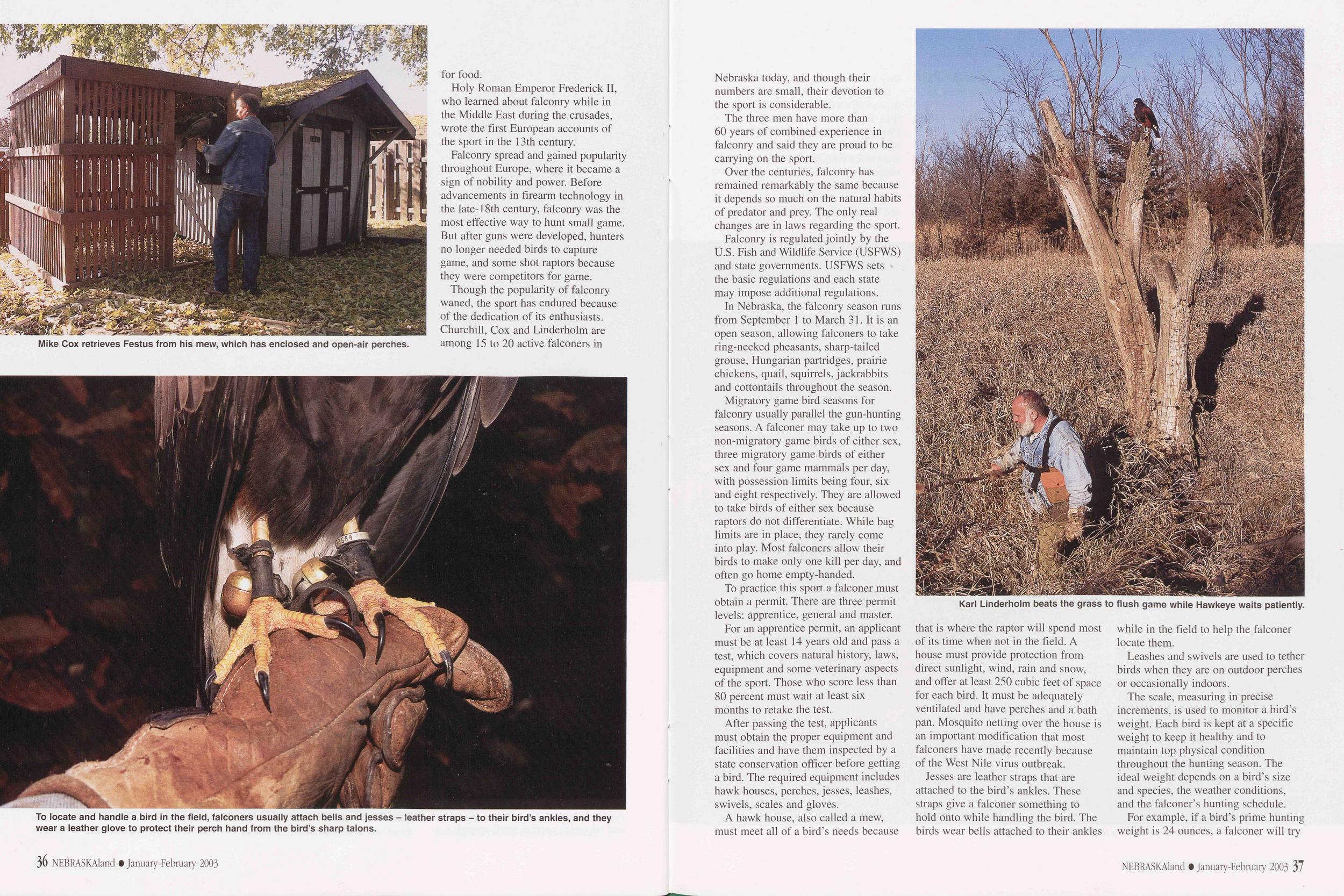
Holy Roman Emperor Frederick II, who learned about falconry while in the Middle East during the crusades, wrote the first European accounts of the sport in the 13th century.
Falconry spread and gained popularity throughout Europe, where it became a sign of nobility and power. Before advancements in firearm technology in the late-18th century, falconry was the most effective way to hunt small game. But after guns were developed, hunters no longer needed birds to capture game, and some shot raptors because they were competitors for game.
Though the popularity of falconry waned, the sport has endured because of the dedication of its enthusiasts. Churchill, Cox and Linderholm are among 15 to 20 active falconers in
The three men have more than 60 years of combined experience in falconry and said they are proud to be carrying on the sport.
Over the centuries, falconry has remained remarkably the same because it depends so much on the natural habits of predator and prey. The only real changes are in laws regarding the sport.
Falconry is regulated jointly by the U.S. Fish and Wildlife Service (USFWS) and state governments. USFWS sets the basic regulations and each state may impose additional regulations.
In Nebraska, the falconry season runs from September 1 to March 31. It is an open season, allowing falconers to take ring-necked pheasants, sharp-tailed grouse, Hungarian partridges, prairie chickens, quail, squirrels, jackrabbits and cottontails throughout the season.
Migratory game bird seasons for falconry usually parallel the gun-hunting seasons. A falconer may take up to two non-migratory game birds of either sex, three migratory game birds of either sex and four game mammals per day, with possession limits being four, six and eight respectively. They are allowed to take birds of either sex because raptors do not differentiate. While bag limits are in place, they rarely come into play. Most falconers allow their birds to make only one kill per day, and often go home empty-handed.
To practice this sport a falconer must obtain a permit. There are three permit levels: apprentice, general and master.
For an apprentice permit, an applicant must be at least 14 years old and pass a test, which covers natural history, laws, equipment and some veterinary aspects of the sport. Those who score less than 80 percent must wait at least six months to retake the test.
After passing the test, applicants must obtain the proper equipment and facilities and have them inspected by a state conservation officer before getting a bird. The required equipment includes hawk houses, perches, jesses, leashes, swivels, scales and gloves.
A hawk house, also called a mew, must meet all of a bird's needs because
Jesses are leather straps that are attached to the bird's ankles. These straps give a falconer something to hold onto while handling the bird. The birds wear bells attached to their ankles 36 NEBRASKAland • January-February 2003 while in the field to help the falconer locate them.
Leashes and swivels are used to tether birds when they are on outdoor perches or occasionally indoors.
The scale, measuring in precise increments, is used to monitor a bird's weight. Each bird is kept at a specific weight to keep it healthy and to maintain top physical condition throughout the hunting season. The ideal weight depends on a bird's size and species, the weather conditions, and the falconer's hunting schedule.
For example, if a bird's prime hunting
weight is 24 ounces, a falconer will try
NEBRASKAland • January-February 2003 37
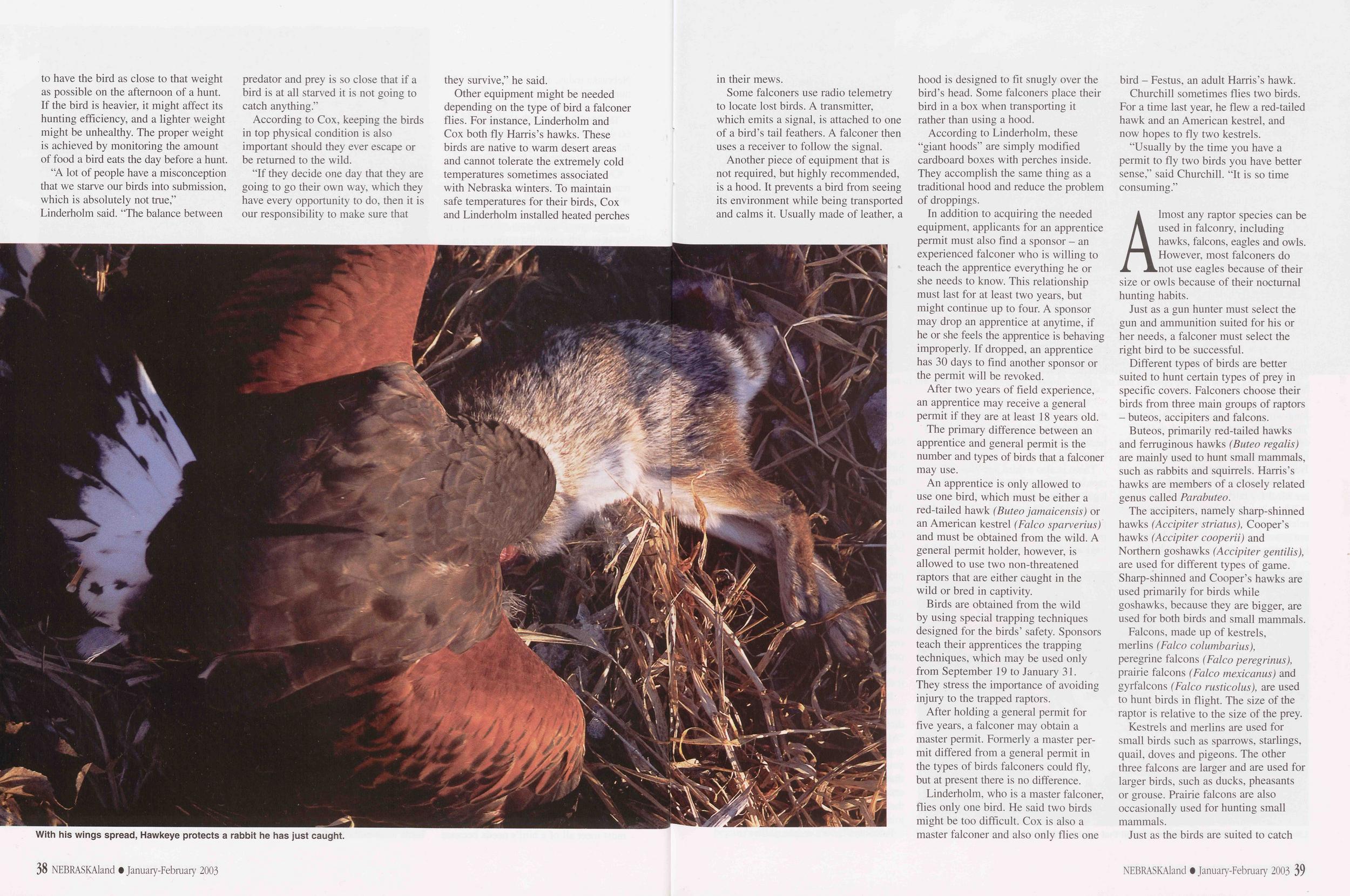 to have the bird as close to that weight
as possible on the afternoon of a hunt.
If the bird is heavier, it might affect its
hunting efficiency, and a lighter weight
might be unhealthy. The proper weight
is achieved by monitoring the amount
of food a bird eats the day before a hunt.
to have the bird as close to that weight
as possible on the afternoon of a hunt.
If the bird is heavier, it might affect its
hunting efficiency, and a lighter weight
might be unhealthy. The proper weight
is achieved by monitoring the amount
of food a bird eats the day before a hunt.
"A lot of people have a misconception that we starve our birds into submission, which is absolutely not true," Linderholm said. "The balance between predator and prey is so close that if a bird is at all starved it is not going to catch anything."
According to Cox, keeping the birds in top physical condition is also important should they ever escape or be returned to the wild.
"If they decide one day that they are going to go their own way, which they have every opportunity to do, then it is our responsibility to make sure that they survive," he said.
Other equipment might be needed depending on the type of bird a falconer flies. For instance, Linderholm and Cox both fly Harris's hawks. These birds are native to warm desert areas and cannot tolerate the extremely cold temperatures sometimes associated with Nebraska winters. To maintain safe temperatures for their birds, Cox and Linderholm installed heated perches
Some falconers use radio telemetry to locate lost birds. A transmitter, which emits a signal, is attached to one of a bird's tail feathers. A falconer then uses a receiver to follow the signal.
Another piece of equipment that is not required, but highly recommended, is a hood. It prevents a bird from seeing its environment while being transported and calms it. Usually made of leather, a With his wings spread, Hawkeye protects a rabbit he has just caught. hood is designed to fit snugly over the bird's head. Some falconers place their bird in a box when transporting it rather than using a hood.
According to Linderholm, these "giant hoods" are simply modified cardboard boxes with perches inside. They accomplish the same thing as a traditional hood and reduce the problem of droppings.
In addition to acquiring the needed equipment, applicants for an apprentice permit must also find a sponsor - an experienced falconer who is willing to teach the apprentice everything he or she needs to know. This relationship must last for at least two years, but might continue up to four. A sponsor may drop an apprentice at anytime, if he or she feels the apprentice is behaving improperly. If dropped, an apprentice has 30 days to find another sponsor or the permit will be revoked.
After two years of field experience, an apprentice may receive a general permit if they are at least 18 years old.
The primary difference between an apprentice and general permit is the number and types of birds that a falconer may use.
An apprentice is only allowed to use one bird, which must be either a red-tailed hawk (Buteo jamaicensis) or an American kestrel (Falco sparverius) and must be obtained from the wild. A general permit holder, however, is allowed to use two non-threatened raptors that are either caught in the wild or bred in captivity.
Birds are obtained from the wild by using special trapping techniques designed for the birds' safety. Sponsors teach their apprentices the trapping techniques, which may be used only from September 19 to January 31. They stress the importance of avoiding injury to the trapped raptors.
After holding a general permit for five years, a falconer may obtain a master permit. Formerly a master permit differed from a general permit in the types of birds falconers could fly, but at present there is no difference.
Linderholm, who is a master falconer, flies only one bird. He said two birds might be too difficult. Cox is also a master falconer and also only flies one bird - Festus, an adult Harris's hawk.
Churchill sometimes flies two birds. For a time last year, he flew a red-tailed hawk and an American kestrel, and now hopes to fly two kestrels.
"Usually by the time you have a permit to fly two birds you have better sense," said Churchill. "It is so time consuming."
Almost any raptor species can be used in falconry, including hawks, falcons, eagles and owls. However, most falconers do not use eagles because of their size or owls because of their nocturnal hunting habits.
Just as a gun hunter must select the gun and ammunition suited for his or her needs, a falconer must select the right bird to be successful.
Different types of birds are better suited to hunt certain types of prey in specific covers. Falconers choose their birds from three main groups of raptors - buteos, accipiters and falcons.
Buteos, primarily red-tailed hawks and ferruginous hawks (Buteo regalis) are mainly used to hunt small mammals, such as rabbits and squirrels. Harris's hawks are members of a closely related genus called Parabuteo.
The accipiters, namely sharp-shinned hawks (Accipiter striatus), Cooper's hawks (Accipiter cooperii) and Northern goshawks (Accipiter gentilis), are used for different types of game. Sharp-shinned and Cooper's hawks are used primarily for birds while goshawks, because they are bigger, are used for both birds and small mammals.
Falcons, made up of kestrels, merlins (Falco columbarius), peregrine falcons (Falco peregrinus), prairie falcons (Falco mexicanus) and gyrfalcons (Falco rusticolus), are used to hunt birds in flight. The size of the raptor is relative to the size of the prey.
Kestrels and merlins are used for small birds such as sparrows, starlings, quail, doves and pigeons. The other three falcons are larger and are used for larger birds, such as ducks, pheasants or grouse. Prairie falcons are also occasionally used for hunting small mammals.
Just as the birds are suited to catch
NEBRASKAland • January-February 2003 39
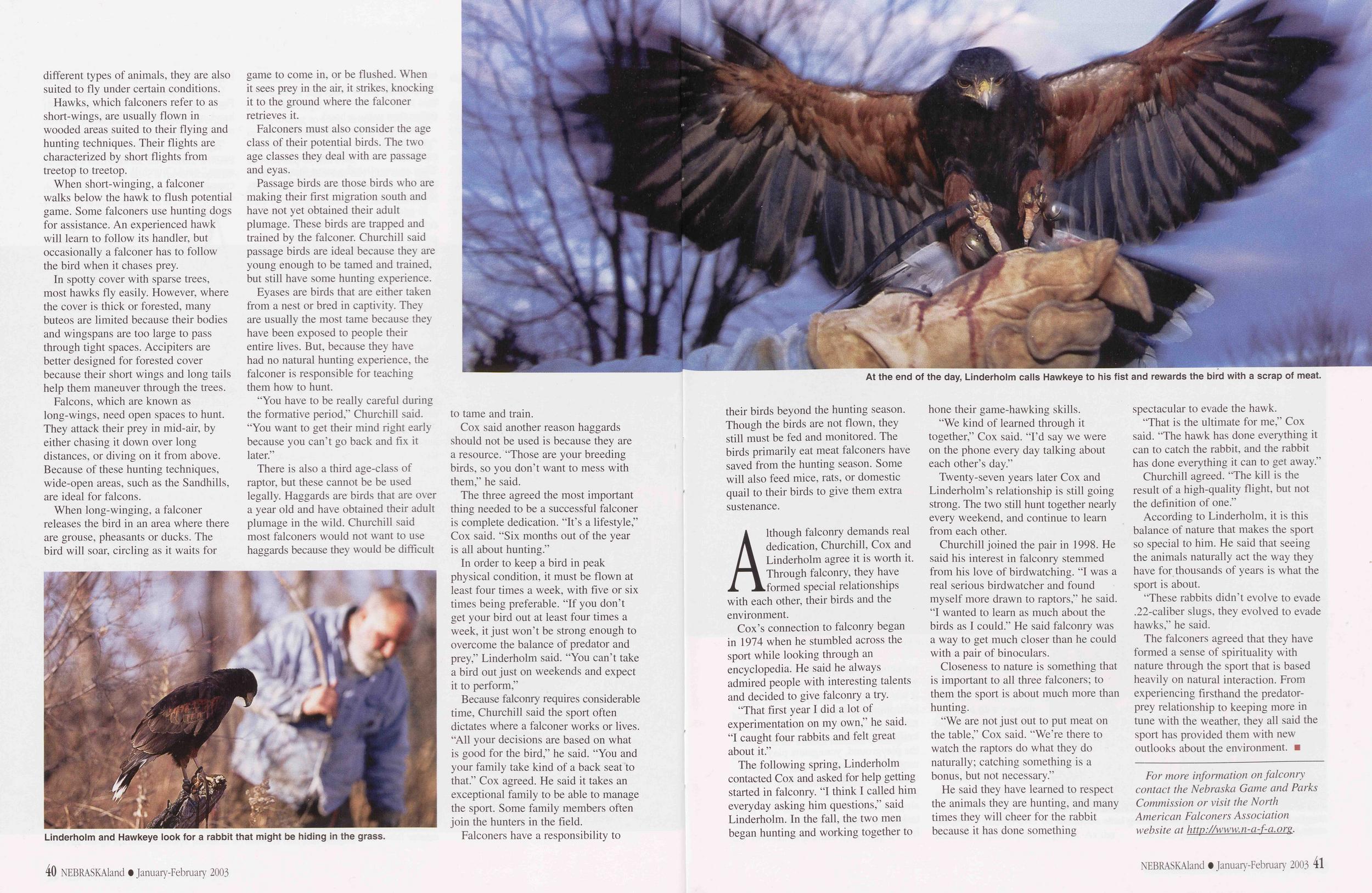 different types of animals, they are also
suited to fly under certain conditions.
different types of animals, they are also
suited to fly under certain conditions.
Hawks, which falconers refer to as short-wings, are usually flown in wooded areas suited to their flying and hunting techniques. Their flights are characterized by short flights from treetop to treetop.
When short-winging, a falconer walks below the hawk to flush potential game. Some falconers use hunting dogs for assistance. An experienced hawk will learn to follow its handler, but occasionally a falconer has to follow the bird when it chases prey.
In spotty cover with sparse trees, most hawks fly easily. However, where the cover is thick or forested, many buteos are limited because their bodies and wingspans are too large to pass through tight spaces. Accipiters are better designed for forested cover because their short wings and long tails help them maneuver through the trees.
Falcons, which are known as long-wings, need open spaces to hunt. They attack their prey in mid-air, by either chasing it down over long distances, or diving on it from above. Because of these hunting techniques, wide-open areas, such as the Sandhills, are ideal for falcons.
When long-winging, a falconer releases the bird in an area where there are grouse, pheasants or ducks. The bird will soar, circling as it waits for game to come in, or be flushed. When it sees prey in the air, it strikes, knocking it to the ground where the falconer retrieves it.
Falconers must also consider the age class of their potential birds. The two age classes they deal with are passage and eyas.
Passage birds are those birds who are making their first migration south and have not yet obtained their adult plumage. These birds are trapped and trained by the falconer. Churchill said passage birds are ideal because they are young enough to be tamed and trained, but still have some hunting experience.
Eyases are birds that are either taken from a nest or bred in captivity. They are usually the most tame because they have been exposed to people their entire lives. But, because they have had no natural hunting experience, the falconer is responsible for teaching them how to hunt.
"You have to be really careful during the formative period," Churchill said. "You want to get their mind right early because you can't go back and fix it later."
There is also a third age-class of raptor, but these cannot be be used legally. Haggards are birds that are over a year old and have obtained their adult plumage in the wild. Churchill said most falconers would not want to use haggards because they would be difficult
Cox said another reason haggards should not be used is because they are a resource. "Those are your breeding birds, so you don't want to mess with them," he said.
The three agreed the most important thing needed to be a successful falconer is complete dedication. "It's a lifestyle," Cox said. "Six months out of the year is all about hunting."
In order to keep a bird in peak physical condition, it must be flown at least four times a week, with five or six times being preferable. "If you don't get your bird out at least four times a week, it just won't be strong enough to overcome the balance of predator and prey," Linderholm said. "You can't take a bird out just on weekends and expect it to perform,"
Because falconry requires considerable time, Churchill said the sport often dictates where a falconer works or lives. "All your decisions are based on what is good for the bird," he said. "You and your family take kind of a back seat to that." Cox agreed. He said it takes an exceptional family to be able to manage the sport. Some family members often join the hunters in the field.
Falconers have a responsibility to 40 NEBRASKAland • January-February 2003
Although falconry demands real dedication, Churchill, Cox and Linderholm agree it is worth it. Through falconry, they have formed special relationships with each other, their birds and the environment.
Cox's connection to falconry began in 1974 when he stumbled across the sport while looking through an encyclopedia. He said he always admired people with interesting talents and decided to give falconry a try.
"That first year I did a lot of experimentation on my own," he said. "I caught four rabbits and felt great about it."
The following spring, Linderholm contacted Cox and asked for help getting started in falconry. "I think I called him everyday asking him questions," said Linderholm. In the fall, the two men began hunting and working together to hone their game-hawking skills.
"We kind of learned through it together," Cox said. "I'd say we were on the phone every day talking about each other's day."
Twenty-seven years later Cox and Linderholm's relationship is still going strong. The two still hunt together nearly every weekend, and continue to learn from each other.
Churchill joined the pair in 1998. He said his interest in falconry stemmed from his love of birdwatching. "I was a real serious birdwatcher and found myself more drawn to raptors," he said. "I wanted to learn as much about the birds as I could." He said falconry was a way to get much closer than he could with a pair of binoculars.
Closeness to nature is something that is important to all three falconers; to them the sport is about much more than hunting.
"We are not just out to put meat on the table," Cox said. "We're there to watch the raptors do what they do naturally; catching something is a bonus, but not necessary."
He said they have learned to respect the animals they are hunting, and many times they will cheer for the rabbit because it has done something spectacular to evade the hawk.
"That is the ultimate for me," Cox said. "The hawk has done everything it can to catch the rabbit, and the rabbit has done everything it can to get away."
Churchill agreed. "The kill is the result of a high-quality flight, but not the definition of one."
According to Linderholm, it is this balance of nature that makes the sport so special to him. He said that seeing the animals naturally act the way they have for thousands of years is what the sport is about.
"These rabbits didn't evolve to evade .22-caliber slugs, they evolved to evade hawks," he said.
The falconers agreed that they have formed a sense of spirituality with nature through the sport that is based heavily on natural interaction. From experiencing firsthand the predator-prey relationship to keeping more in tune with the weather, they all said the sport has provided them with new outlooks about the environment.
For more information on falconry contact the Nebraska Game and Parks Commission or visit the North American Falconers Association website at http://www.n-a-f-a.ors.
NEBRASKAland t January-February 2003 4l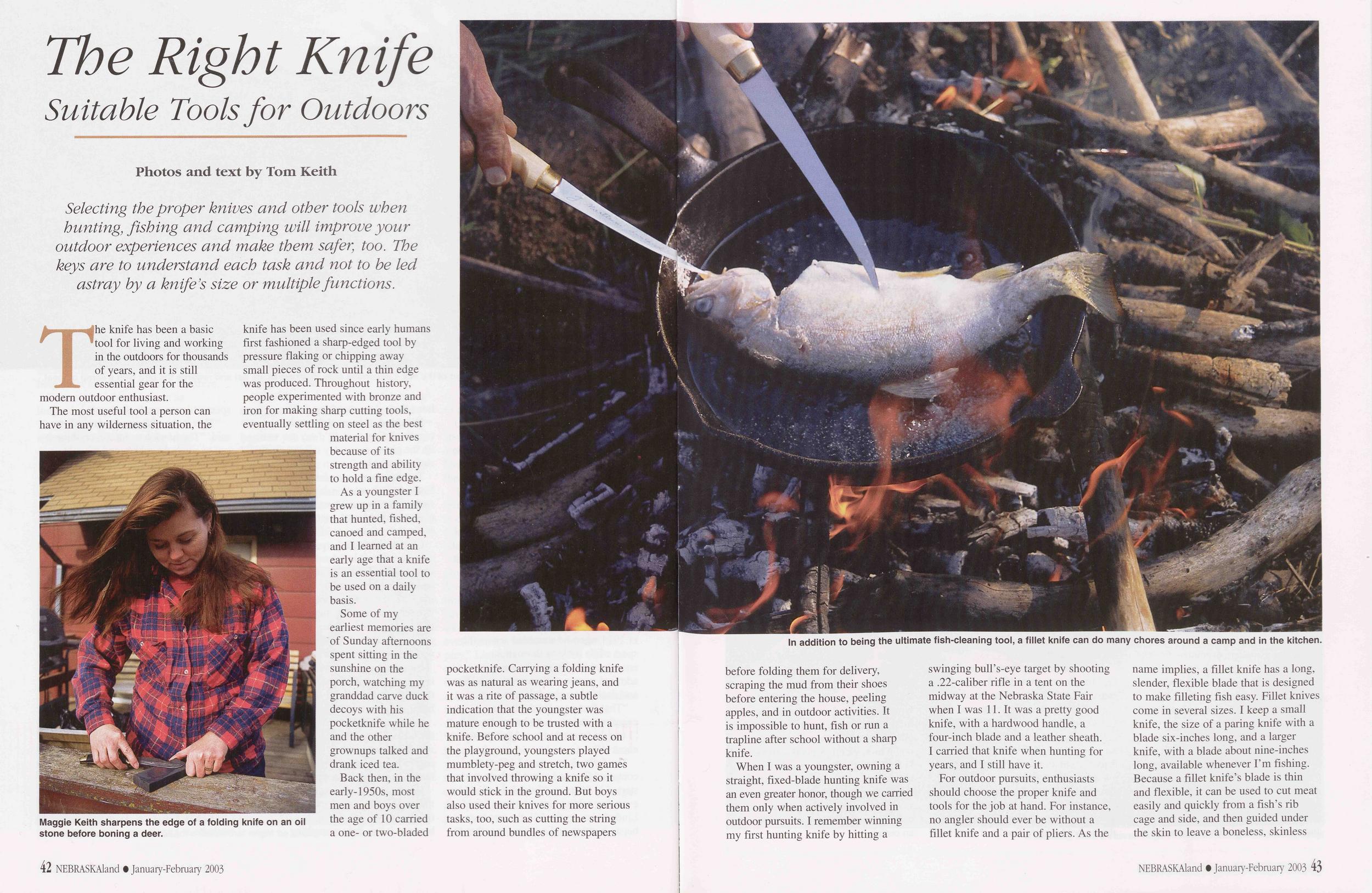
The Right Knife Suitable Tools for Outdoors
Photos and text by Tom Keith Selecting the proper knives and other tools when hunting, fishing and camping will improve your outdoor experiences and make them safer, too. The keys are to understand each task and not to be led astray by a knife's size or multiple functions.The knife has been a basic tool for living and working in the outdoors for thousands of years, and it is still essential gear for the modern outdoor enthusiast.
The most useful tool a person can have in any wilderness situation, the
As a youngster I grew up in a family that hunted, fished, canoed and camped, and I learned at an early age that a knife is an essential tool to be used on a daily basis.
Some of my earliest memories are of Sunday afternoons spent sitting in the sunshine on the porch, watching my granddad carve duck decoys with his pocketknife while he and the other grownups talked and drank iced tea.
Back then, in the early-1950s, most men and boys over the age of 10 carried a one- or two-bladed pocketknife. Carrying a folding knife was as natural as wearing jeans, and it was a rite of passage, a subtle indication that the youngster was mature enough to be trusted with a knife. Before school and at recess on the playground, youngsters played mumblety-peg and stretch, two games that involved throwing a knife so it would stick in the ground. But boys also used their knives for more serious tasks, too, such as cutting the string from around bundles of newspapers 42 NEBRASKAland t January-February 2003
When I was a youngster, owning a straight, fixed-blade hunting knife was an even greater honor, though we carried them only when actively involved in outdoor pursuits. I remember winning my first hunting knife by hitting a swinging bull's-eye target by shooting a .22-caliber rifle in a tent on the midway at the Nebraska State Fair when I was 11. It was a pretty good knife, with a hardwood handle, a four-inch blade and a leather sheath. I carried that knife when hunting for years, and I still have it.
For outdoor pursuits, enthusiasts
should choose the proper knife and
tools for the job at hand. For instance,
no angler should ever be without a
fillet knife and a pair of pliers. As the
name implies, a fillet knife has a long,
slender, flexible blade that is designed
to make filleting fish easy. Fillet knives
come in several sizes. I keep a small
knife, the size of a paring knife with a
blade six-inches long, and a larger
knife, with a blade about nine-inches
long, available whenever I'm fishing.
Because a fillet knife's blade is thin
and flexible, it can be used to cut meat
easily and quickly from a fish's rib
cage and side, and then guided under
the skin to leave a boneless, skinless
NEBRASKAland • January-February 2003 43
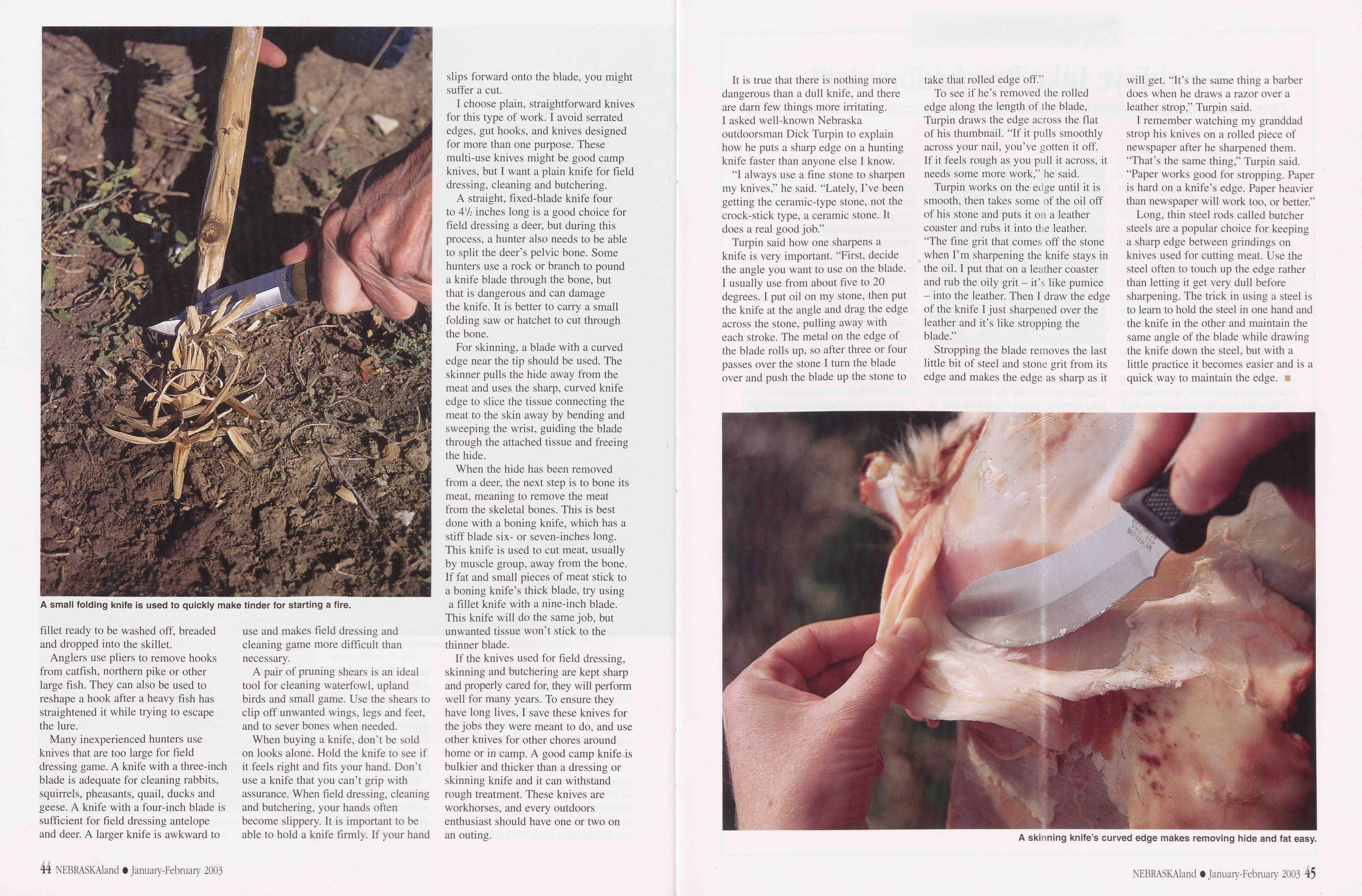
Anglers use pliers to remove hooks from catfish, northern pike or other large fish. They can also be used to reshape a hook after a heavy fish has straightened it while trying to escape the lure.
Many inexperienced hunters use knives that are too large for field dressing game. A knife with a three-inch blade is adequate for cleaning rabbits, squirrels, pheasants, quail, ducks and geese. A knife with a four-inch blade is sufficient for field dressing antelope and deer. A larger knife is awkward to use and makes field dressing and cleaning game more difficult than necessary.
Many inexperienced hunters use knives that are too large for field dressing game. A knife with a three-inch blade is adequate for cleaning rabbits, squirrels, pheasants, quail, ducks and geese. A knife with a four-inch blade is sufficient for field dressing antelope and deer. A larger knife is awkward to use and makes field dressing and cleaning game more difficult than necessary.
A pair of pruning shears is an ideal tool for cleaning waterfowl, upland birds and small game. Use the shears to clip off unwanted wings, legs and feet, and to sever bones when needed.
When buying a knife, don't be sold on looks alone. Hold the knife to see if it feels right and fits your hand. Don't use a knife that you can't grip with assurance. When field dressing, cleaning and butchering, your hands often become slippery. It is important to be able to hold a knife firmly. If your hand slips forward onto the blade, you might suffer a cut.
I choose plain, straightforward knives for this type of work. I avoid serrated edges, gut hooks, and knives designed for more than one purpose. These multi-use knives might be good camp knives, but I want a plain knife for field dressing, cleaning and butchering.
A straight, fixed-blade knife four to 4V2 inches long is a good choice for field dressing a deer, but during this process, a hunter also needs to be able to split the deer's pelvic bone. Some hunters use a rock or branch to pound a knife blade through the bone, but that is dangerous and can damage the knife. It is better to carry a small folding saw or hatchet to cut through the bone.
For skinning, a blade with a curved edge near the tip should be used. The skinner pulls the hide away from the meat and uses the sharp, curved knife edge to slice the tissue connecting the meat to the skin away by bending and sweeping the wrist, guiding the blade through the attached tissue and freeing the hide.
When the hide has been removed from a deer, the next step is to bone its meat, meaning to remove the meat from the skeletal bones. This is best done with a boning knife, which has a stiff blade six- or seven-inches long. This knife is used to cut meat, usually by muscle group, away from the bone. If fat and small pieces of meat stick to a boning knife's thick blade, try using a fillet knife with a nine-inch blade. This knife will do the same job, but unwanted tissue won't stick to the thinner blade.
If the knives used for field dressing, skinning and butchering are kept sharp and properly cared for, they will perform well for many years. To ensure they have long lives, I save these knives for the jobs they were meant to do, and use other knives for other chores around home or in camp. A good camp knife is bulkier and thicker than a dressing or skinning knife and it can withstand rough treatment. These knives are workhorses, and every outdoors enthusiast should have one or two on an outing.
44 NEBRASKAland • January-February 2003It is true that there is nothing more dangerous than a dull knife, and there are darn few things more irritating. I asked well-known Nebraska outdoorsman Dick Turpin to explain how he puts a sharp edge on a hunting knife faster than anyone else I know.
"I always use a fine stone to sharpen my knives," he said. "Lately, I've been getting the ceramic-type stone, not the crock-stick type, a ceramic stone. It does a real good job."
Turpin said how one sharpens a knife is very important. "First, decide the angle you want to use on the blade. I usually use from about five to 20 degrees. I put oil on my stone, then put the knife at the angle and drag the edge across the stone, pulling away with each stroke. The metal on the edge of the blade rolls up, so after three or four passes over the stone I turn the blade over and push the blade up the stone to take that rolled edge off."
To see if he's removed the rolled edge along the length of the blade, Turpin draws the edge across the flat of his thumbnail. "If it pulls smoothly across your nail, you've gotten it off. If it feels rough as you pull it across, it needs some more work," he said.
Turpin works on the edge until it is smooth, then takes some of the oil off of his stone and puts it on a leather coaster and rubs it into the leather. 'The fine grit that comes off the stone when I'm sharpening the knife stays in the oil. I put that on a leather coaster and rub the oily grit - it's like pumice - into the leather. Then I draw the edge of the knife I just sharpened over the leather and it's like stropping the blade."
Stropping the blade removes the last little bit of steel and stone grit from its edge and makes the edge as sharp as it will get. "It's the same thing a barber does when he draws a razor over a leather strop," Turpin said.
I remember watching my granddad strop his knives on a rolled piece of newspaper after he sharpened them. That's the same thing," Turpin said. Paper works good for stropping. Paper is hard on a knife's edge. Paper heavier than newspaper will work too, or better."
Long, thin steel rods called butcher steels are a popular choice for keeping a sharp edge between grindings on knives used for cutting meat. Use the steel often to touch up the edge rather than letting it get very dull before sharpening. The trick in using a steel is to learn to hold the steel in one hand and the knife in the other and maintain the same angle of the blade while drawing the knife down the steel, but with a little practice it becomes easier and is a quick way to maintain the edge.
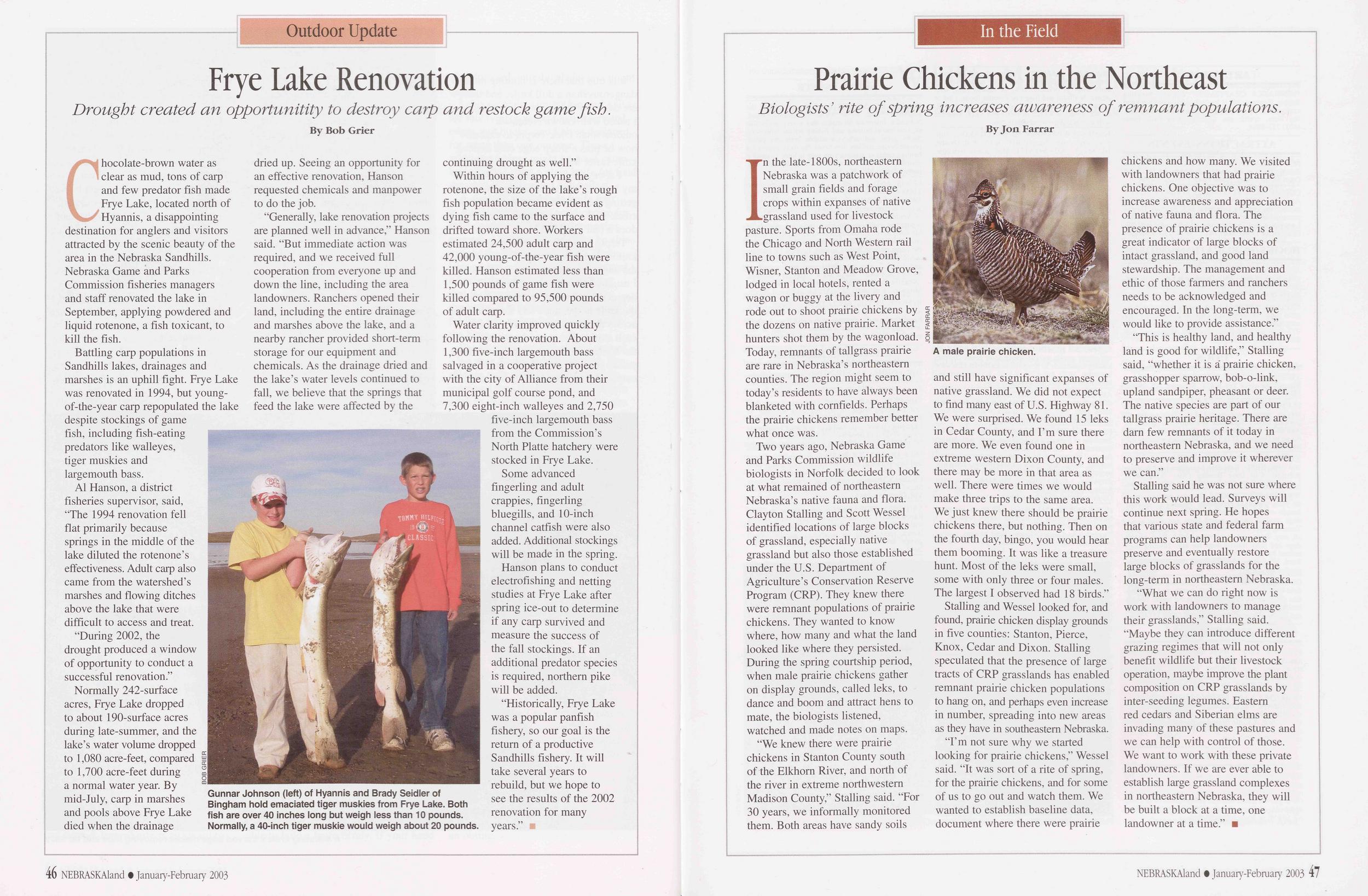
Outdoor Update
Frye Lake Renovation
Drought created an opportunity to destroy carp and restock game fish By Bob GrierChocolate-brown water as clear as mud, tons of carp and few predator fish made Frye Lake, located north of Hyannis, a disappointing destination for anglers and visitors attracted by the scenic beauty of the area in the Nebraska Sandhills. Nebraska Game and Parks Commission fisheries managers and staff renovated the lake in September, applying powdered and liquid rotenone, a fish toxicant, to kill the fish.
Battling carp populations in Sandhills lakes, drainages and marshes is an uphill fight. Frye Lake was renovated in 1994, but young-of-the-year carp repopulated the lake despite stockings of game fish, including fish-eating predators like walleyes, tiger muskies and largemouth bass.
Al Hanson, a district fisheries supervisor, said, "The 1994 renovation fell flat primarily because springs in the middle of the lake diluted the rotenone's effectiveness. Adult carp also came from the watershed's marshes and flowing ditches above the lake that were difficult to access and treat.
"During 2002, the drought produced a window of opportunity to conduct a successful renovation."
Normally 242-surface acres, Frye Lake dropped to about 190-surface acres during late-summer, and the lake's water volume dropped to 1,080 acre-feet, compared to 1,700 acre-feet during a normal water year. By mid-July, carp in marshes and pools above Frye Lake died when the drainagedried up. Seeing an opportunity for an effective renovation, Hanson requested chemicals and manpower to do the job.
"Generally, lake renovation projects are planned well in advance," Hanson said. "But immediate action was required, and we received full cooperation from everyone up and down the line, including the area landowners. Ranchers opened their land, including the entire drainage and marshes above the lake, and a nearby rancher provided short-term storage for our equipment and chemicals. As the drainage dried and the lake's water levels continued to fall, we believe that the springs that feed the lake were affected by the
Within hours of applying the rotenone, the size of the lake's rough fish population became evident as dying fish came to the surface and drifted toward shore. Workers estimated 24,500 adult carp and 42,000 young-of-the-year fish were killed. Hanson estimated less than 1,500 pounds of game fish were killed compared to 95,500 pounds of adult carp.
Water clarity improved quickly following the renovation. About 1,300 five-inch largemouth bass salvaged in a cooperative project with the city of Alliance from their municipal golf course pond, and 7,300 eight-inch walleyes and 2,750 five-inch largemouth bass from the Commission's North Platte hatchery were stocked in Frye Lake.
Some advanced fingerling and adult crappies, fingerling bluegills, and 10-inch channel catfish were also added. Additional stockings will be made in the spring.
Hanson plans to conduct electrofishing and netting studies at Frye Lake after spring ice-out to determine if any carp survived and measure the success of the fall stockings. If an additional predator species is required, northern pike will be added.
"Historically, Frye Lake was a popular panfish fishery, so our goal is the return of a productive Sandhills fishery. It will take several years to rebuild, but we hope to see the results of the 2002 renovation for many years."
46 NEBRASKAland • January-February 2003In the Field
Prairie Chickens in the Northeast
Biologists' rite of spring increases awareness of remnant populations. By Jon FarrarIn the late-1800s, northeastern Nebraska was a patchwork of small grain fields and forage crops within expanses of native grassland used for livestock pasture. Sports from Omaha rode the Chicago and North Western rail line to towns such as West Point, Wisner, Stanton and Meadow Grove, lodged in local hotels, rented a wagon or buggy at the livery and rode out to shoot prairie chickens by the dozens on native prairie. Market hunters shot them by the wagonload. Today, remnants of tallgrass prairie are rare in Nebraska's northeastern counties. The region might seem to today's residents to have always been blanketed with cornfields. Perhaps the prairie chickens remember better what once was.
Two years ago, Nebraska Game and Parks Commission wildlife biologists in Norfolk decided to look at what remained of northeastern Nebraska's native fauna and flora. Clayton Stalling and Scott Wessel identified locations of large blocks of grassland, especially native grassland but also those established under the U.S. Department of Agriculture's Conservation Reserve Program (CRP). They knew there were remnant populations of prairie chickens. They wanted to know where, how many and what the land looked like where they persisted. During the spring courtship period, when male prairie chickens gather on display grounds, called leks, to dance and boom and attract hens to mate, the biologists listened, watched and made notes on maps.
"We knew there were prairie chickens in Stanton County south of the Elkhorn River, and north of the river in extreme northwestern Madison County," Stalling said. "For 30 years, we informally monitored them. Both areas have sandy soils and still have significant expanses of native grassland. We did not expect to find many east of U.S. Highway 81. We were surprised. We found 15 leks in Cedar County, and I'm sure there are more. We even found one in extreme western Dixon County, and there may be more in that area as well. There were times we would make three trips to the same area. We just knew there should be prairie chickens there, but nothing. Then on the fourth day, bingo, you would hear them booming. It was like a treasure hunt. Most of the leks were small, some with only three or four males. The largest I observed had 18 birds."
Stalling and Wessel looked for, and found, prairie chicken display grounds in five counties: Stanton, Pierce, Knox, Cedar and Dixon. Stalling speculated that the presence of large tracts of CRP grasslands has enabled remnant prairie chicken populations to hang on, and perhaps even increase in number, spreading into new areas as they have in southeastern Nebraska.
"I'm not sure why we started looking for prairie chickens," Wessel said. "It was sort of a rite of spring, for the prairie chickens, and for some of us to go out and watch them. We wanted to establish baseline data, document where there were prairie chickens and how many. We visited with landowners that had prairie chickens. One objective was to increase awareness and appreciation of native fauna and flora. The presence of prairie chickens is a great indicator of large blocks of intact grassland, and good land stewardship. The management and ethic of those farmers and ranchers needs to be acknowledged and encouraged. In the long-term, we would like to provide assistance."
"This is healthy land, and healthy land is good for wildlife," Stalling said, "whether it is a" prairie chicken, grasshopper sparrow, bob-o-link, upland sandpiper, pheasant or deer. The native species are part of our tallgrass prairie heritage. There are darn few remnants of it today in northeastern Nebraska, and we need to preserve and improve it wherever we can."
Stalling said he was not sure where this work would lead. Surveys will continue next spring. He hopes that various state and federal farm programs can help landowners preserve and eventually restore large blocks of grasslands for the long-term in northeastern Nebraska.
"What we can do right now is work with landowners to manage their grasslands," Stalling said. "Maybe they can introduce different grazing regimes that will not only benefit wildlife but their livestock operation, maybe improve the plant composition on CRP grasslands by inter-seeding legumes. Eastern red cedars and Siberian elms are invading many of these pastures and we can help with control of those. We want to work with these private landowners. If we are ever able to establish large grassland complexes in northeastern Nebraska, they will be built a block at a time, one landowner at a time."
NEBRASKAland • January-February 2003 47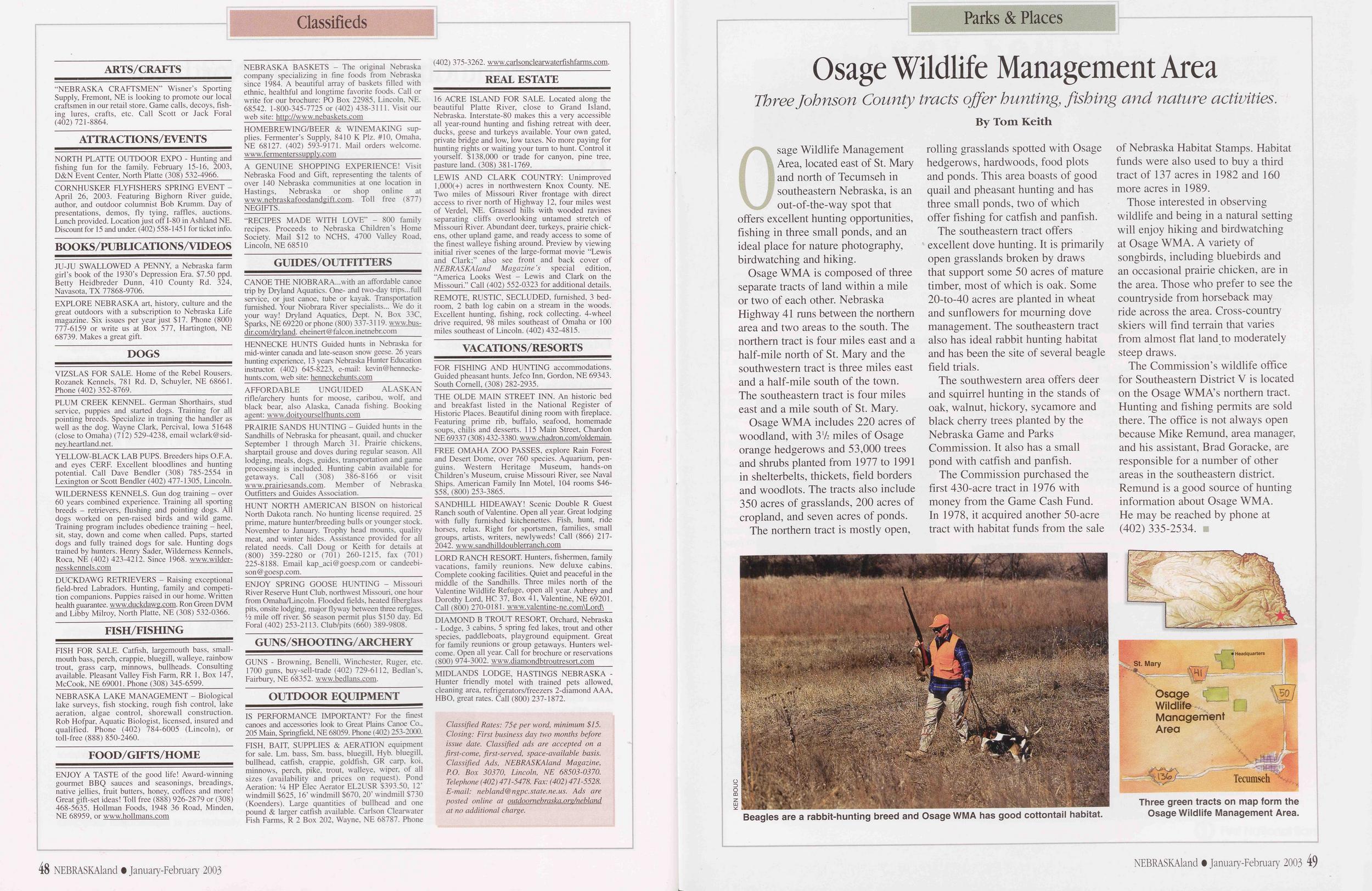
Classifieds
ARTS/CRAFTS"NEBRASKA CRAFTSMEN" Wisner's Sporting Supply, Fremont, NE is looking to promote our local craftsmen in our retail store. Game calls, decoys, fishing lures, crafts, etc. Call Scott or Jack Foral (402)721-8864.
ATTRACTIONS/EVENTSNORTH PLATTE OUTDOOR EXPO - Hunting and fishing fun for the family. February 15-16, 2003, D&N Event Center, North Platte (308) 532-4966.
CORNHUSKER FLYFISHERS SPRING EVENT - April 26, 2003. Featuring Bighorn River guide, author, and outdoor columnist Bob Krurnm. Day of presentations, demos, fly tying, raffles, auctions. Lunch provided. Location just off 1-80 in Ashland NE. Discount for 15 and under. (402) 558-1451 for ticket info.
BOOKS/PUBLICATIONS/VIDEQSJU-JU SWALLOWED A PENNY, a Nebraska farm girl's book of the 1930's Depression Era. $7.50 ppd. Betty Heidbreder Dunn, 410 County Rd. 324, Navasota, TX 77868-9706.______________________
EXPLORE NEBRASKA art, history, culture and the great outdoors with a subscription to Nebraska Life magazine. Six issues per year just $17. Phone (800) 777-6159 or write us at Box 577, Hartington, NE 68739. Makes a great gift.
DOGSVIZSLAS FOR SALE. Home of the Rebel Rousers. Rozanek Kennels, 781 Rd. D, Schuyler, NE 68661. Phone (402) 352-8769._________________________
PLUM CREEK KENNEL. German Shorthairs, stud service, puppies and started dogs. Training for all pointing breeds. Specialize in training the handler as well as the dog. Wayne Clark, Percival, Iowa 51648 (close to Omaha) (712) 529-4238, email wclark@sidney.heartland.net.
YELLOW-BLACK LAB PUPS. Breeders hips O.F.A. and eyes CERF. Excellent bloodlines and hunting potential. Call Dave Bendler (308) 785-2554 in Lexington or Scott Bendler (402) 477-1305, Lincoln.
WILDERNESS KENNELS. Gun dog training - over 60 years combined experience. Training all sporting breeds - retrievers, flushing and pointing dogs. All dogs worked on pen-raised birds and wild game. Training program includes obedience training - heel, sit, stay, down and come when called. Pups, started dogs and fully trained dogs for sale. Hunting dogs trained by hunters. Henry Sader, Wilderness Kennels, Roca, NE (402) 423-4212. Since 1968. www.wildernesskennels.com
DUCKDAWG RETRIEVERS - Raising exceptional field-bred Labradors. Hunting, family and competition companions. Puppies raised in our home. Written health guarantee, www.duckdawg.com. Ron Green DVM and Libby Milroy, North Platte, NE (308) 532-0366.
FISH/FISHINGFISH FOR SALE. Catfish, largemouth bass, smallmouth bass, perch, crappie, bluegill, walleye, rainbow trout, grass carp, minnows, bullheads. Consulting available. Pleasant Valley Fish Farm, RR 1, Box 147, McCook, NE 69001. Phone (308) 345-6599._______
NEBRASKA LAKE MANAGEMENT - Biological lake surveys, fish stocking, rough fish control, lake aeration, algae control, shorewall construction. Rob Hofpar, Aquatic Biologist, licensed, insured and qualified. Phone (402) 784-6005 (Lincoln), or toll-free (888) 850-2460.
FOOD/GIFTS/HOMEENJOY A TASTE of the good life! Award-winning gourmet BBQ sauces and seasonings, breadings, native jellies, fruit butters, honey, coffees and more! Great gift-set ideas! Toll free (888) 926-2879 or (308) 468-5635. Hollman Foods, 1948 36 Road, Minden, NE 68959, or www.hollmans.com
NEBRASKA BASKETS - The original Nebraska company specializing in fine foods from Nebraska since 1984. A beautiful array of baskets filled with ethnic, healthful and longtime favorite foods. Call or write for our brochure: PO Box 22985, Lincoln, NE. 68542. 1-800-345-7725 or (402) 438-3111. Visit our web site: http://www.nebaskets.com
HOMEBREWING/BEER & WINEMAKING supplies. Fermenter's Supply, 8410 K Plz. #10, Omaha, NE 68127. (402) 593-9171. Mail orders welcome. www.fermenterssupply.com
A GENUINE SHOPPING EXPERIENCE! Visit Nebraska Food and Gift, representing the talents of over 140 Nebraska communities at one location in Hastings, Nebraska or shop online at www.nebraskafoodandgift.com. Toll free (877) NEGIFTS.___________________________________
"RECIPES MADE WITH LOVE" - 800 family recipes. Proceeds to Nebraska Children's Home Society. Mail $12 to NCHS, 4700 Valley Road, Lincoln, NE 68510
GUTOES/OUTFITTERSCANOE THE NIOBRARA...with an affordable canoe trip by Dryland Aquatics. One- and two-day trips...full service, or just canoe, tube or kayak. Transportation furnished. Your Niobrara River specialists... We do it your way! Dryland Aquatics, Dept. N, Box 33C, Sparks, NE 69220 or phone (800) 337-3119. www.busdir.com/dryland. eheinert@falcon.inetnebr.com______
HENNECKE HJJNTS Guided hunts in Nebraska for mid-winter Canada and late-season snow geese. 26 years hunting experience, 13 years Nebraska Hunter Education instructor. (402) 645-8223, e-mail: kevin@henneckehunts.com, web site: henneckehunts.com____________
AFFORDABLE UNGUIDED ALASKAN rifle/archery hunts for moose, caribou, wolf, and black bear, also Alaska, Canada fishing. Booking agent: www.doityourselfhunts.com_______________
PRAIRIE SANDS HUNTING - Guided hunts in the Sandhills of Nebraska for pheasant, quail, and chucker September 1 through March 31. Prairie chickens, sharptail grouse and doves during regular season. All lodging, meals, dogs, guides, transportation and game processing is included. Hunting cabin available for getaways. Call (308) 386-8166 or visit www.prairiesands.com. Member of Nebraska Outfitters and Guides Association.________________
HUNT NORTH AMERICAN BISON on historical North Dakota ranch. No hunting license required. 25 prime, mature hunter/breeding bulls or younger stock. November to January. Trophy head mounts, quality meat, and winter hides. Assistance provided for all related needs. Call Doug or Keith for details at (800) 359-2280 or (701) 260-1215, fax (701) 225-8188. Email kap_aci@goesp.com or candeebison@goesp.com.
ENJOY SPRING GOOSE HUNTING - Missouri River Reserve Hunt Club, northwest Missouri, one hour from Omaha/Lincoln. Flooded fields, heated fiberglass pits, onsite lodging, major flyway between three refuges, Vi mile off river. $6 season permit plus $150 day. Ed Foral (402) 253-2113. Club/pits (660) 389-9808.
GUNS/SHOOTING/ARCHERYGUNS - Browning, Benelli, Winchester, Ruger, etc. 1700 guns, buy-sell-trade (402) 729-6112, Bedlan's, Fairbury, NE 68352. www.bedlans.com.
OUTDOOR EQUIPMENTIS PERFORMANCE IMPORTANT? For the finest canoes and accessories look to Great Plains Canoe Co., 205 Main, Spiingfield, NE 68059. Phone (402) 253-2000.
FISH, BAIT, SUPPLIES & AERATION equipment for sale. Lm. bass, Sm. bass, bluegill, Hyb. bluegill, bullhead, catfish, crappie, goldfish, GR carp, koi, minnows, perch, pike, trout, walleye, wiper, of all sizes (availability and prices on request). Pond Aeration: lA HP Elec Aerator EL2USR $393.50, 12' windmill $625, 16' windmill $670, 20' windmill $730 (Koenders). Large quantities of bullhead and one pound & larger catfish available. Carlson Clearwater Fish Farms, R 2 Box 202, Wayne, NE 68787. Phone (402) 375-3262. www.carlsonclearwaterfishfarms.com.
_________REAL ESTATE_________16 ACRE ISLAND FOR SALE. Located along the beautiful Platte River, close to Grand Island, Nebraska. Interstate-80 makes this a very accessible all year-round hunting and fishing retreat with deer, ducks, geese and turkeys available. Your own gated, private bridge and low, low taxes. No more paying for hunting rights or waiting your turn to hunt. Control it yourself. $138,000 or trade for canyon, pine tree, pasture land. (308) 381-1769.___________________
LEWIS AND CLARK COUNTRY: Unimproved 1,000(+) acres in northwestern Knox County. NE. Two miles of Missouri River frontage with direct access to river north of Highway 12, four miles west of Verdel, NE. Grassed hills with wooded ravines separating cliffs overlooking untamed stretch of Missouri River. Abundant deer, turkeys, prairie chickens, other upland game, and ready access to some of the finest walleye fishing around. Preview by viewing initial river scenes of the large-format movie "Lewis and Clark;" also see front and back cover of NEBRASKAland Magazine's special edition, "America Looks West - Lewis and Clark on the Missouri." Call (402) 552-0323 for additional details.
REMOTE, RUSTIC, SECLUDED, furnished, 3 bed- room, 2 bath log cabin on a stream in the woods. Excellent hunting, fishing, rock collecting. 4-wheel drive required, 98 miles southeast of Omaha or 100 miles southeast of Lincoln. (402) 432-4815.
VACATIONS/RESORTSFOR FISHING AND HUNTING accommodations. Guided pheasant hunts. Jefco Inn, Gordon, NE 69343. South Cornell, (308) 282-2935.__________________
THE OLDE MAIN STREET INN. An historic bed and breakfast listed in the National Register of Historic Places. Beautiful dining room with fireplace. Featuring prime rib, buffalo, seafood, homemade soups, chilis and desserts. 115 Main Street, Chardon NE 69337 (308) 432-3380. www.chadron.com/oldemain.
FREE OMAHA ZOO PASSES, explore Rain Forest and Desert Dome, over 760 species. Aquarium, penguins. Western Heritage Museum, hands-on Children's Museum, cruise Missouri River, see Naval Ships. American Family Inn Motel, 104 rooms $46-$58, (800) 253-3865.__________________________
SANDHILL HIDEAWAY! Scenic Double R Guest Ranch south of Valentine. Open all year. Great lodging with fully furnished kitchenettes. Fish, hunt, ride horses, relax. Right for sportsmen, families, small groups, artists, writers, newly weds! Call (866) 217-2042. www.sandhilldouhlerranch________________
LORD RANCH RESORT. Hunters, fishermen, family vacations, family reunions. New deluxe cabins. Complete cooking facilities. Quiet and peaceful in the middle of the Sandhills. Three miles north of the Valentine Wildlife Refuge, open all year. Aubrey and Dorothy Lord, HC 37, Box 41, Valentine, NE 69201. Call (800) 270-0181. www.valentine-ne.com\Loiri\_
DIAMOND B TROUT RESORT, Orchard, Nebraska - Lodge, 3 cabins, 5 spring fed lakes, trout and other species, paddleboats, playground equipment. Great for family reunions or group getaways. Hunters welcome. Open all year. Call for brochure or reservations (800) 974-3002. www.diamondbtroutresort.com
MIDLANDS LODGE, HASTINGS NEBRASKA - Hunter friendly motel with trained pets allowed, cleaning area, refrigerators/freezers 2-diamond AAA, HBO, great rates. Call (800) 237-1872.
Classified Rates: 75'0 per word, minimum $15. Closing: First business day two months before issue date. Classified ads are accepted on a first-come, first-served, space-available basis. Classified Ads, NEBRASKAland Magazine, P.O. Box 30370, Lincoln, NE 68503-0370. Telephone (402) 471-5478. Fax: (402) 471-5528. E-mail: nebland@ngpc. state.ne. us. Ads are posted online at outdoornebraska. org/nebland at no additional charge.
48 NEBRASKAland • January-February 2003Osage Wildlife Management Area
Three Johnson County tracts offer hunting, fishing and nature activities. By Tom KeithOsage Wildlife Management Area, located east of St. Mary and north of Tecumseh in southeastern Nebraska, is an out-of-the-way spot that offers excellent hunting opportunities, fishing in three small ponds, and an ideal place for nature photography, bird watching and hiking.
Osage WMA is composed of three separate tracts of land within a mile or two of each other. Nebraska Highway 41 runs between the northern area and two areas to the south. The northern tract is four miles east and a half-mile north of St. Mary and the southwestern tract is three miles east and a half-mile south of the town. The southeastern tract is four miles east and a mile south of St. Mary.
Osage WMA includes 220 acres of woodland, with 372 miles of Osage orange hedgerows and 53,000 trees and shrubs planted from 1977 to 1991 in shelterbelts, thickets, field borders and woodlots. The tracts also include 350 acres of grasslands, 200 acres of cropland, and seven acres of ponds.
The northern tract is mostly open, rolling grasslands spotted with Osage hedgerows, hardwoods, food plots and ponds. This area boasts of good quail and pheasant hunting and has three small ponds, two of which offer fishing for catfish and panfish.
The southeastern tract offers excellent dove hunting. It is primarily open grasslands broken by draws that support some 50 acres of mature timber, most of which is oak. Some 20-to-40 acres are planted in wheat and sunflowers for mourning dove management. The southeastern tract also has ideal rabbit hunting habitat and has been the site of several beagle field trials.
The southwestern area offers deer and squirrel hunting in the stands of oak, walnut, hickory, sycamore and black cherry trees planted by the Nebraska Game and Parks Commission. It also has a small pond with catfish and panfish.
The Commission purchased the first 430-acre tract in 1976 with money from the Game Cash Fund. In 1978, it acquired another 50-acre tract with habitat funds from the sale of Nebraska Habitat Stamps. Habitat funds were also used to buy a third tract of 137 acres in 1982 and 160 more acres in 1989.
Those interested in observing wildlife and being in a natural setting will enjoy hiking and bird watching at Osage WMA. A variety of songbirds, including bluebirds and an occasional prairie chicken, are in the area. Those who prefer to see the countryside from horseback may ride across the area. Cross-country skiers will find terrain that varies from almost flat land to moderately steep draws.
The Commission's wildlife office for Southeastern District V is located on the Osage WMA's northern tract. Hunting and fishing permits are sold there. The office is not always open because Mike Remund, area manager, and his assistant, Brad Goracke, are responsible for a number of other areas in the southeastern district. Remund is a good source of hunting information about Osage WMA. He may be reached by phone at (402)335-2534. «
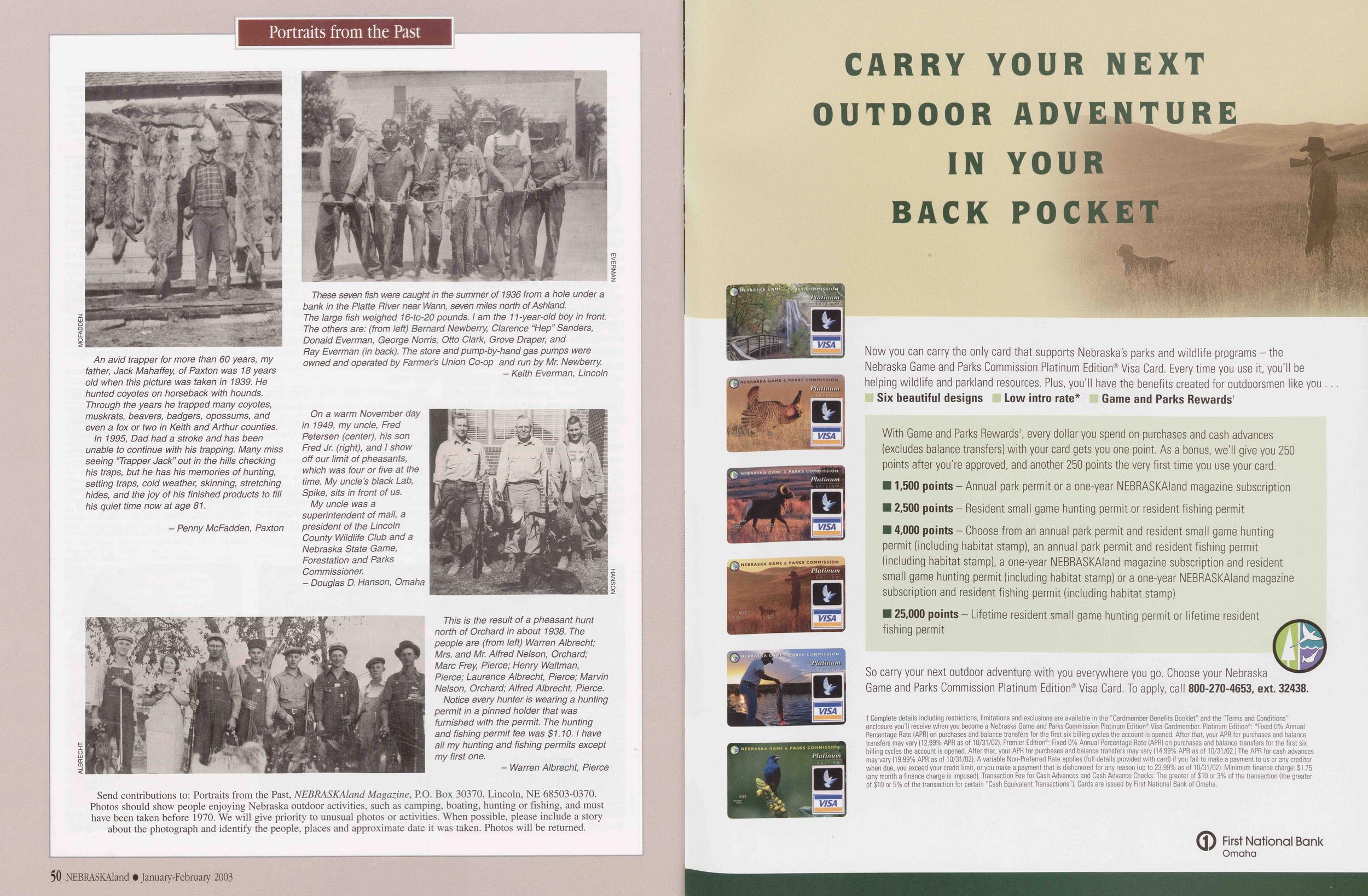
An avid trapper for more than 60 years, my father, Jack Mahaffey, of Paxton was 18 years old when this picture was taken in 1939. He hunted coyotes on horseback with hounds. Through the years he trapped many coyotes, muskrats, beavers, badgers, opossums, and even a fox or two in Keith and Arthur counties.
In 1995, Dad had a stroke and has been unable to continue with his trapping. Many miss seeing "Trapper Jack" out in the hills checking his traps, but he has his memories of hunting, setting traps, cold weather, skinning, stretching hides, and the joy of his finished products to fill his quiet time now at age 81.
- Penny McFadden, PaxtonThese seven fish were caught in the summer of 1936 from a hole under a bank in the Platte River near Wann, seven miies north of Ashland. The large fish weighed 16-to-20 pounds. I am the 11-year-old boy in front. The others are: (from left) Bernard Newberry, Clarence "Hep" Sanders, Donald Everman, George Norris, Otto Clark, Grove Draper, and Ray Everman (in back). The store and pump-by-hand gas pumps were owned and operated by Farmer's Union Co-op and run by Mr. Newberry.
- Keith Everman, LincolnOn a warm November day in 1949, my uncle, Fred Petersen (center), his son Fred Jr. (right), and I show off our limit of pheasants, which was four or five at the time. My uncle's black Lab, Spike, sits in front of us.
My uncle was a superintendent of mail, a president of the Lincoln County Wildlife Club and a Nebraska State Game, Forestation and Parks Commissioner.
- Douglas D. Hanson, OmahaThis is the result of a pheasant hunt north of Orchard in about 1938. The people are (from left) Warren Albrecht; Mrs. and Mr. Alfred Nelson, Orchard; Marc Frey, Pierce; Henry Waltman, Pierce; Laurence Albrecht, Pierce; Marvin Nelson, Orchard; Alfred Albrecht, Pierce.
Notice every hunter is wearing a hunting permit in a pinned holder that was furnished with the permit. The hunting and fishing permit fee was $1.10.1 have all my hunting and fishing permits except my first one.
- Warren Albrecht, PierceSend contributions to: Portraits from the Past, NEBRASKAland Magazine, P.O. Box 30370, Lincoln, NE 68503-0370. Photos should show people enjoying Nebraska outdoor activities, such as camping, boating, hunting or fishing, and must have been taken before 1970. We will give priority to unusual photos or activities. When possible, please include a story about the photograph and identify the people, places and approximate date it was taken. Photos will be returned.
Position: 842 (11 views)