Volume 80, Issue 10, 2002
NEBRASKAland
Nebraska Game & Parks Commission December 2002 $2.50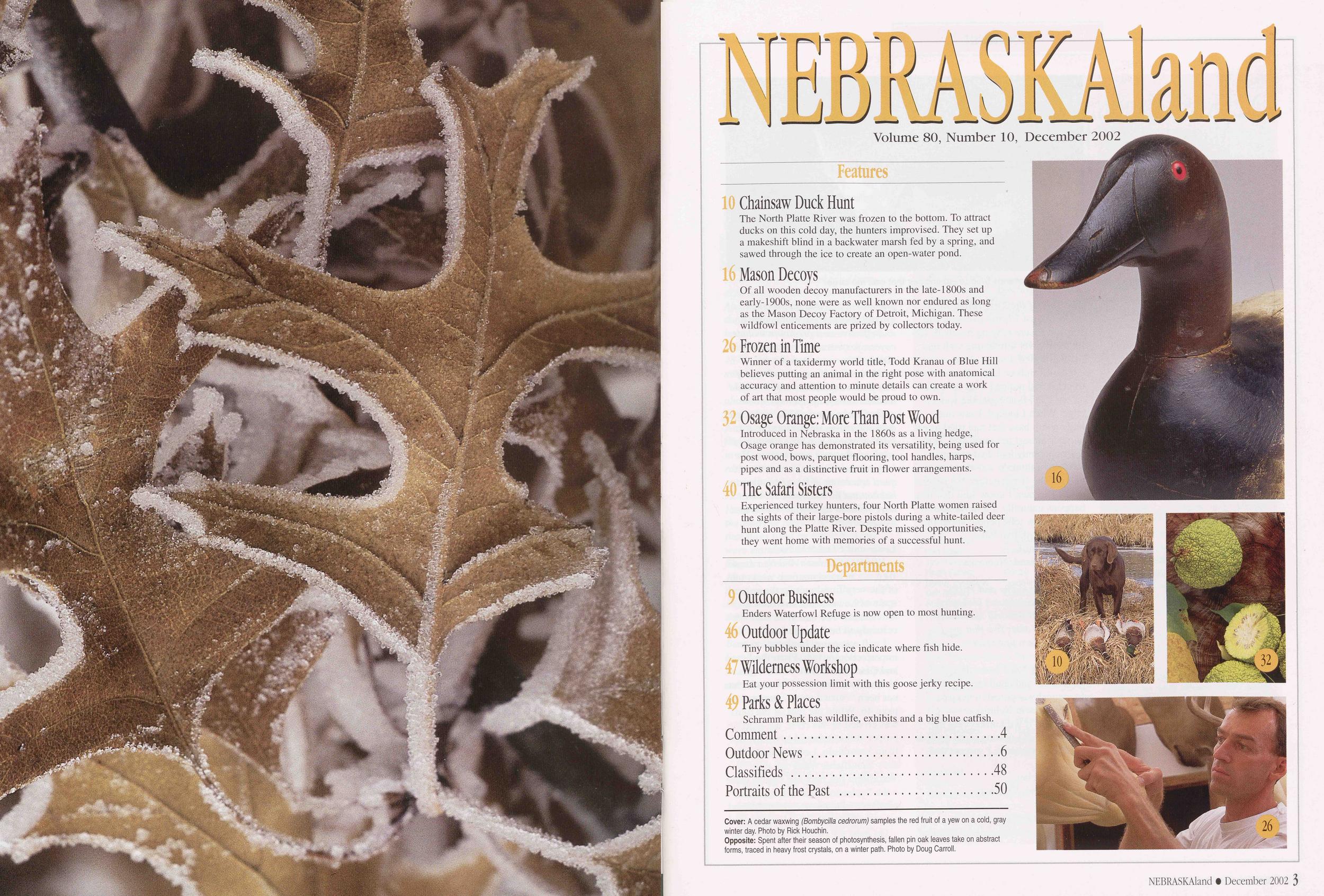
NEBRASKAland
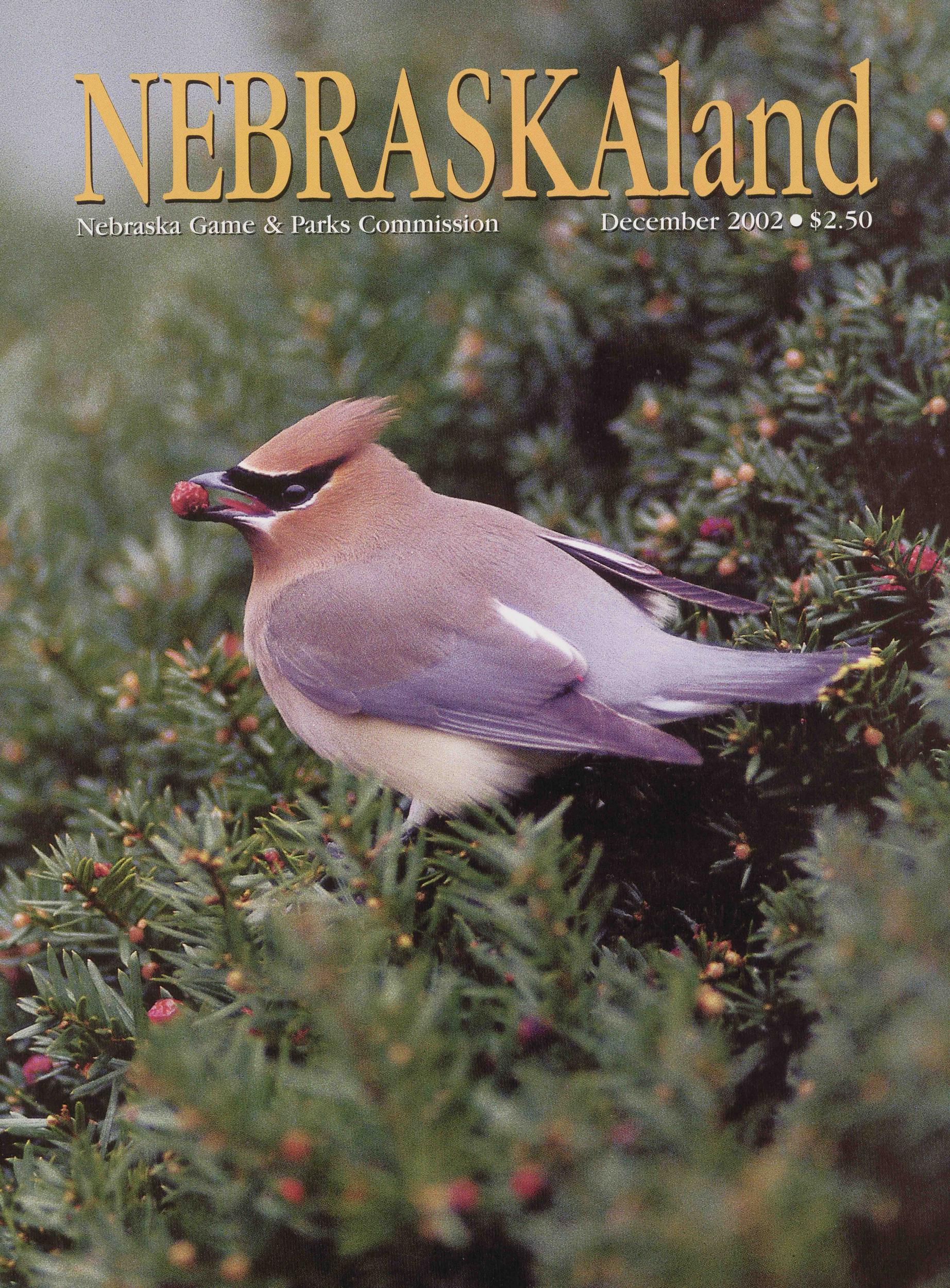
Volume 80, Number 10, December 2002 Features 10 Chainsaw Duck Hunt The North Platte River was frozen to the bottom. To attract ducks on this cold day, the hunters improvised. They set up a makeshift blind in a backwater marsh fed by a spring, and sawed through the ice to create an open-water pond. 16 Mason Decoys Of all wooden decoy manufacturers in the late-1800s and early-1900s, none were as well known nor endured as long as the Mason Decoy Factory of Detroit, Michigan. These wildfowl enticements are prized by collectors today. 26 Frozen in Time Winner of a taxidermy world title, Todd Kranau of Blue Hill believes putting an animal in the right pose with anatomical accuracy and attention to minute details can create a work of art that most people would be proud to own. 32 Osage Orange: More Than Post Wood Introduced in Nebraska in the 1860s as a living hedge, Osage orange has demonstrated its versatility, being used for post wood, bows, parquet flooring, tool handles, harps, pipes and as a distinctive fruit in flower arrangements. 40 The Safari Sisters Experienced turkey hunters, four North Platte women raised the sights of their large-bore pistols during a white-tailed deer hunt along the Platte River. Despite missed opportunities, they went home with memories of a successful hunt. Departments 9 Outdoor Business Enders Waterfowl Refuge is now open to most hunting. 46 Outdoor Update Tiny bubbles under the ice indicate where fish hide. 47 Wilderness Workshop Eat your possession limit with this goose jerky recipe. 49 Parks & Places Schramm Park has wildlife, exhibits and a big blue catfish. Comment.........................................4 Outdoor News ...................................6 Classifieds ...................................48 Portraits of the Past .........................50 Cover: A cedar waxwing (Bombycilla cedrorum) samples the red fruit of a yew on a cold, gray winter day. Photo by Rick Houchin. Opposite: Spent after their season of photosynthesis, fallen pin oak leaves take on abstract forms, traced in heavy frost crystals, on a winter path. Photo by Doug Carroll.16
10
32
26
Comment
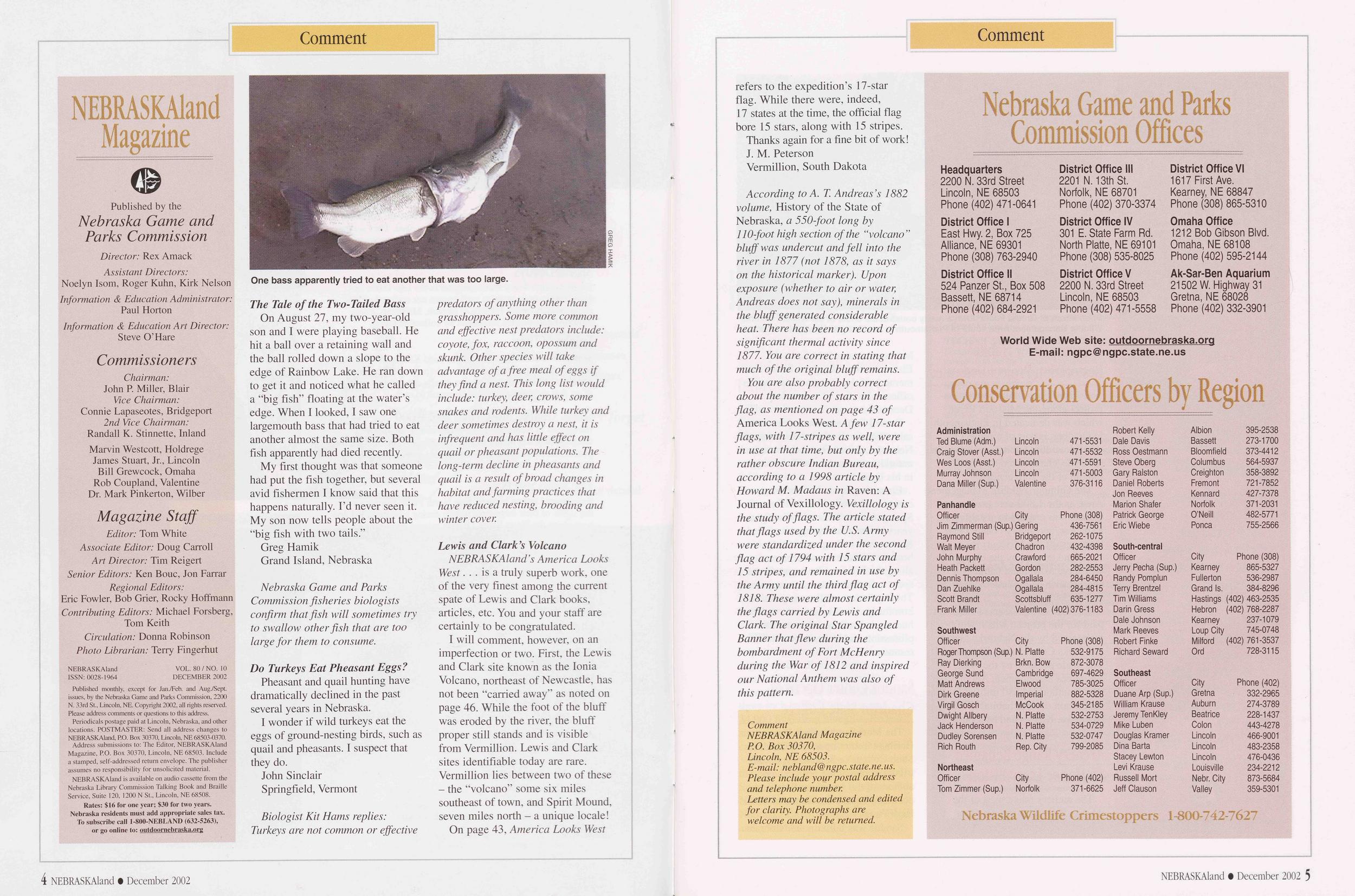
On August 27, my two-year-old son and I were playing baseball. He hit a ball over a retaining wall and the ball rolled down a slope to the edge of Rainbow Lake. He ran down to get it and noticed what he called a “big fish” floating at the water’s edge. When I looked, I saw one largemouth bass that had tried to eat another almost the same size. Both fish apparently had died recently.
My first thought was that someone had put the fish together, but several avid fishermen I know said that this happens naturally. I’d never seen it. My son now tells people about the “big fish with two tails.”
Greg Hamik Grand Island, NebraskaNebraska Game and Parks Commission fisheries biologists confirm that fish will sometimes try to swallow other fish that are too large for them to consume.
Do Turkeys Eat Pheasant Eggs?Pheasant and quail hunting have dramatically declined in the past several years in Nebraska.
I wonder if wild turkeys eat the eggs of ground-nesting birds, such as quail and pheasants. I suspect that they do.
John Sinclair Springfield, VermontBiologist Kit Hams replies: Turkeys are not common or effective predators of anything other than grasshoppers. Some more common and effective nest predators include: coyote, fox, raccoon, opossum and skunk. Other species will take advantage of a free meal of eggs if they find a nest. This long list would include: turkey, deer, crows, some snakes and rodents. While turkey and deer sometimes destroy a nest, it is infrequent and has little effect on quail or pheasant populations. The long-term decline in pheasants and quail is a result of broad changes in habitat and farming practices that have reduced nesting, brooding and winter cover.
Lewis and Clark’s VolcanoNEBRASKAland's America Looks West... is a truly superb work, one of the very finest among the current spate of Lewis and Clark books, articles, etc. You and your staff are certainly to be congratulated.
I will comment, however, on an imperfection or two. First, the Lewis and Clark site known as the Ionia Volcano, northeast of Newcastle, has not been “carried away” as noted on page 46. While the foot of the bluff was eroded by the river, the bluff proper still stands and is visible from Vermillion. Lewis and Clark sites identifiable today are rare. Vermillion lies between two of these - the “volcano” some six miles southeast of town, and Spirit Mound, seven miles north - a unique locale!
On page 43, America Looks West refers to the expedition’s 17-star flag. While there were, indeed, 17 states at the time, the official flag bore 15 stars, along with 15 stripes.
Thanks again for a fine bit of work!
J. M. Peterson Vermillion, South DakotaAccording to A. T. Andreas's 1882 volume, History of the State of Nebraska, a 550-foot long by 110-foot high section of the “volcano” bluff was undercut and fell into the river in 1877 (not 1878, as it says on the historical marker). Upon exposure (whether to air or water, Andreas does not say), minerals in the bluff generated considerable heat. There has been no record of significant thermal activity since 1877. You are correct in stating that much of the original bluff remains.
You are also probably correct about the number of stars in the flag, as mentioned on page 43 of America Looks West A few 17-star flags, with 17-stripes as well, were in use at that time, but only by the rather obscure Indian Bureau, according to a 1998 article by Howard M. Madaus in Raven: A Journal of Vexillology. Vexillology is the study of flags. The article stated that flags used by the U.S. Army were standardized under the second flag act of 1794 with 15 stars and 15 stripes, and remained in use by the Army until the third flag act of 1818. These were almost certainly the flags carried by Lewis and Clark. The original Star Spangled Banner that flew during the bombardment of Fort McHenry during the War of 1812 and inspired our National Anthem was also of this pattern.
Comment NEBRASKAland Magazine P.O. Box 30370, Lincoln, NE 68503. E-mail: nebland@ngpc.state.ne.us. Please include your postal address and telephone number. Letters may be condensed and edited for clarity. Photographs are welcome and will be returned. Nebraska Game and Parks Commission Offices Headquarters 2200 N. 33rd Street Lincoln, NE 68503 Phone (402) 471-0641 District Office I East Hwy. 2, Box 725 Alliance, NE 69301 Phone (308) 763-2940 District Office II 524 Panzer St., Box 508 Bassett, NE 68714 Phone (402) 684-2921 District Office III 2201 N. 13th St. Norfolk, NE 68701 Phone (402) 370-3374 District Office IV 301 E. State Farm Rd. North Platte, NE 69101 Phone (308) 535-8025 District Office V 2200 N. 33rd Street Lincoln, NE 68503 Phone (402) 471-5558 District Office VI 1617 First Ave. Kearney, NE 68847 Phone (308) 865-5310 Omaha Office 1212 Bob Gibson Blvd. Omaha, NE 68108 Phone (402) 595-2144 Ak-Sar-Ben Aquarium 21502 W. Highway 31 Gretna, NE 68028 Phone (402) 332-3901 World Wide Web site: outdoornebraska.org E-mail: ngpc@ngpc.state.ne.us Conservation Officers by Region Administration Robert kelly Albion 395-2538 Ted Blume (Adm.) Lincoln 471-5531 Dale Davis Bassett 273-1700 Craig Stover (Asst.) Lincoln 471-5532 Ross Oestmann Bloomfield 373-4412 Wes Loos (Asst.) Lincoln 471-5591 Steve Oberg Columbus 564-5937 Murray Johnson Lincoln 471-5003 Gary Ralston Creighton 358-3892 Dana Miller (Sup.) Valentine 376-3116 Daniel Roberts Fremont 721-7852 Jon Reeves Kennard 427-7378 Panhandle Marion Shafer Norfolk 371-2031 Officer City Phone (308) Patrick George O’Neill 482-5771 Jim Zimmerman (Sup.) Gering 436-7561 Eric Wiebe Ponca 755-2566 Raymond Still Bridgeport 262-1075 Walt Meyer Chadron 432-4398 South-central John Murphy Crawford 665-2021 Officer City Phone (308) Heath Packett Gordon 282-2553 Jerry Pecha (Sup.) Kearney 865-5327 Dennis Thompson Ogallala 284-6450 Randy Pomplun Fullerton 536-2987 Dan Zuehlke Ogallala 284-4815 Terry Brentzel Grand Is. 384-8296 Scott Brandt Scottsbluff 635-1277 Tim Williams Hastings (402) 463-2535 Frank Miller Valentine (402)376-1183 Darin Gress Hebron (402) 768-2287 Dale Johnson Kearney 237-1079 Southwest Mark Reeves Loup City 745-0748 Officer City Phone (308) Robert Finke Milford (402) 761-3537 Roger Thompson (Sup.) N. Platte 532-9175 Richard Seward Ord 728-3115 Ray Dierking Brkn. Bow 872-3078 George Sund Cambridge 697-4629 Southeast Matt Andrews Elwood 785-3025 Officer City Phone (402) Dirk Greene Imperial 882-5328 Duane Arp (Sup.) Gretna 332-2965 Virgil Gosch McCook 345-2185 William Krause Auburn 274-3789 Dwight Allbery N. Platte 532-2753 Jeremy TenKley Beatrice 228-1437 Jack Henderson N. Platte 534-0729 Mike Luben Colon 443-4278 Dudley Sorensen N. Platte 532-0747 Douglas Kramer Lincoln 466-9001 Rich Routh Rep. City 799-2085 Dina Barta Lincoln 483-2358 Stacey Lewton Lincoln 476-0436 Northeast Levi Krause Louisville 234-2212 Officer City Phone (402) Russell Mort Nebr. City 873-5684 Tom Zimmer (Sup.) Norfolk 371-6625 Jeff Clauson Valley 359-5301 Nebraska Wildlife Crimestoppers 1-800-742-7627 4 NEBRASKAland • December 2002 NEBRASKAland • December 2002 5
NEBRASKAland Magazine PHOTOS FOR PURCHASE ONLINE
First releases from our collection are perfect for your home or office. Available in several sizes, these prints are appropriate for framing and make great gifts. Visit our web site often, and click on Photo Prints to see the latest offerings.Nebraska Game & Parks Commissionhttp://hawk.ngpc.state.us/catalog/catalog.ihtmlOutdoor News
A $3 million habitat restoration project along the Missouri River, which was dedicated in Plattsmouth in October, is part of a project to rebuild wildlife habitat lost when the river was channelized during the middle of the 20th century.
The Gilmour Wildlife Management Area, as the 1,800-acre project was named, was created by establishing a shallow, secondary channel that branches off the Missouri River. An island created by the channel will serve as wetland habitat for species such as mollusks, muskrats and ducks.
The U.S. Army Corps of Engineers paid for the project, which will be maintained by the Nebraska Game and Parks Commission. The project was made possible by the Water Resources Development Act of 1986, which authorized $80 million for the restoration of river habitat in Iowa, Nebraska, Kansas and Missouri.
Archery Range Renamed To Honor Larry ElstonThe archery range west of the Ak-Sar-Ben Aquarium Outdoor Education Center in Sarpy County has been renamed the Larry D. Elston Archery Range to honor the memory of the veteran conservation officer who died of cancer last December.
Darrell Feit, aquarium director, said, “Elston also loved the youth of Nebraska, therefore it only seems natural to rename the archery range in his honor.”
Elston began his law enforcement career in October 1962 at Hays Springs, where he served for eight years before transferring to Plattsmouth in August 1968. He became a leader in enforcement along the Missouri River, where he spent countless hours on boat patrol. Those who knew Elston remember him for his positive attitude, sense of humor, dedication and love of the profession and Nebraska’s wildlife resources.
Sandoz Center Opens at Chadron State CollegeThe Mari Sandoz High Plains Heritage Center opened at Chadron State College in September, paying tribute to one of the best-known authors of the American West and documenting the development of the High Plains.
Sandoz was born on the Niobrara River south of Hay Springs in 1896, and moved to a homestead south of Gordon in 1911. She was buried there after her death in 1966. She gained fame with her first book, Old Jules, and went on to write 22 more works.
A historian, novelist and folklorist, Sandoz was called “the story catcher of the Plains,” and her writings about the landscape and people of the West captured the myths, legends and rituals of the region’s culture.
The 18,000-square-foot Heritage Center will preserve Sandoz’s works and serve as a repository for High Plains and American West archival materials and as a site for literary seminars and workshops.
Memphis Lake SRA Habitat Improvements CompleteThe Nebraska Game and Parks Commission restoration project at Memphis Lake State Recreation Area in Saunders County has been completed. The area, which includes a 48-acre lake, features a large campground shaded by mature trees.
Steve Satra of the Commission’s fisheries division, said the lake rehabilitation project included making the lake deeper, constructing breakwater jetties, one of which has a handicapped-accessible fishing pier, creating a habitat island, reclaiming shoreline, repairing the outlet structure, and building a new fish barrier on Silver Creek.
“We expect the rehabilitation will improve water quality and improve angler access. Rough fish were removed and we have partially restocked the lake with 8,200 three-inch largemouth bass and 34,000 fingerling bluegills. Redear sunfish and fingerling channel catfish will be introduced next year.”
Funding sources for the project at the popular SRA included: Federal Sport Fish Restoration Program, the Nebraska Aquatic Habitat Program, Nebraska Environmental Trust Fund and general tax funds.
26th ANNUAL NEBRASKA HABITAT STAMP ART CONTEST
SUBMISSION Entries may be protected by a covering but will not be accepted in frames, under glass or in plastic kitchen wrap. Wrap securely and send to: Habitat Stamp Contest, Game and Parks Commission, 2200 N. 33rd Street, P.O. Box 30370, Lincoln, NE 68503-0370. A completed entry form and reproduction agreement, or a facsimile thereof, must be attached to the back of the entry. Name and address of the artist must appear only on the reverse side of the entry. The Game and Parks Commission is not responsible for any entry lost or damaged in transit. Entries will not be returned unless specifically requested and a self-addressed mailer with proper return postage is included. PRIZES Adult division first-place winner receives $300 from the Omaha Fish and Wildlife Club. Youth division first-place winners in each section receive $100 from the Omaha Fish and Wildlife Club. Runners-up in all divisions receive a subscription to NEBRASKAland Magazine. TECHNICAL REQUIREMENTS Design must be 7 1/2 inches by 4 11/16 inches. It may be matted, but mats must not exceed 10 inches by 7 inches. Any medium is acceptable. No scrollwork or lettering may appear on the design. Color is preferred. SUBJECT MATTER Any Nebraska wildlife species in an appropriate habitat setting, except for sandhill crane, wild turkey, Canada geese, western bluebird and American wigeon, which are ineligible this year. ELIGIBILITY Contest is open to Nebraska residents only, and winning entry in the adult division will appear on the 2004 Nebraska Habitat Stamp. Employees of the Game and Parks Commission and their immediate families are not eligible to enter the adult division of the contest. Only one entry allowed per person. DIVISIONS Adult: Amateur or professional artists. Youth: Senior Section - Grades 9-12; Junior Section - Grades 5-8; Primary Section - Grades K-4. ENTRY DEADLINE March 1, 2003. Nebraska Habitat Stamp Art Contest Entry Form Please accept my entry in the 2003 Habitat Stamp Art Contest. I hereby certify that I have complied with all the rules governing this competition and that the work submitted is my own creation. Further, the Nebraska Game and Parks Commission is hereby authorized to repro- duce my design on the 2004 Habitat Stamp or in any other fashion it may deem appropriate. All information requested is required. Form may be copied. Division/Section Grade in School Title of Entry Medium Name Age (if under 19) Parent or guardian (youth only) Address, City, State, ZIP Home Phone School Phone Name of School School Address City, State, ZIP State Please return my entry. I have included the appropriate postage. Please hold my entry for pickup. Artist’s Signature 6 NEBRASKAland • December 2002 NEBRASKAland • December 2002 7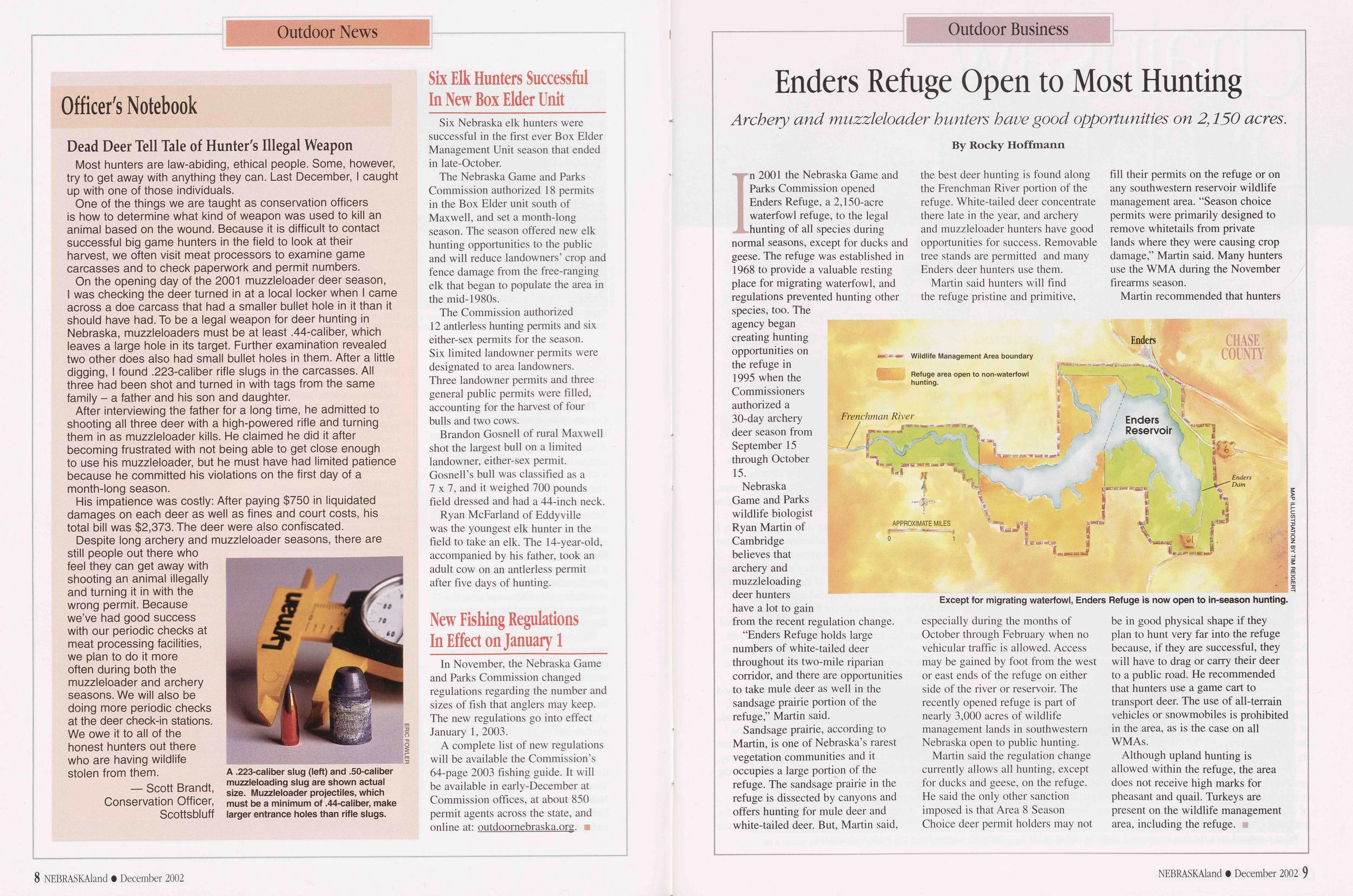
Outdoor News
Officer's Notebook Dead Deer Tell Tale of Hunter's Illegal WeaponMost hunters are law-abiding, ethical people. Some, however, try to get away with anything they can. Last December, I caught up with one of those individuals.
One of the things we are taught as conservation officers is how to determine what kind of weapon was used to kill an animal based on the wound. Because it is difficult to contact successful big game hunters in the field to look at their harvest, we often visit meat processors to examine game carcasses and to check paperwork and permit numbers.
On the opening day of the 2001 muzzleloader deer season, I was checking the deer turned in at a local locker when I came across a doe carcass that had a smaller bullet hole in it than it should have had. To be a legal weapon for deer hunting in Nebraska, muzzleloaders must be at least .44-caliber, which leaves a large hole in its target. Further examination revealed two other does also had small bullet holes in them. After a little digging, I found .223-caliber rifle slugs in the carcasses. All three had been shot and turned in with tags from the same family - a father and his son and daughter.
After interviewing the father for a long time, he admitted to shooting all three deer with a high-powered rifle and turning them in as muzzleloader kills. He claimed he did it after becoming frustrated with not being able to get close enough to use his muzzleloader, but he must have had limited patience because he committed his violations on the first day of a month-long season.
His impatience was costly: After paying $750 in liquidated damages on each deer as well as fines and court costs, his total bill was $2,373. The deer were also confiscated.
Despite long archery and muzzleloader seasons, there are still people out there who feel they can get away with shooting an animal illegally and turning it in with the wrong permit. Because we’ve had good success with our periodic checks at meat processing facilities, we plan to do it more often during both the muzzleloader and archery seasons. We will also be doing more periodic checks at the deer check-in stations. We owe it to all of the honest hunters out there who are having wildlife stolen from them.
- Scott Brandt, Conservation Officer, ScottsbluffSix Nebraska elk hunters were successful in the first ever Box Elder Management Unit season that ended in late-October.
The Nebraska Game and Parks Commission authorized 18 permits in the Box Elder unit south of Maxwell, and set a month-long season. The season offered new elk hunting opportunities to the public and will reduce landowners’ crop and fence damage from the free-ranging elk that began to populate the area in the mid-1980s.
The Commission authorized 12 antlerless hunting permits and six either-sex permits for the season. Six limited landowner permits were designated to area landowners. Three landowner permits and three general public permits were filled, accounting for the harvest of four bulls and two cows.
Brandon Gosnell of rural Maxwell shot the largest bull on a limited landowner, either-sex permit. Gosnell’s bull was classified as a 7x7, and it weighed 700 pounds field dressed and had a 44-inch neck.
Ryan McFarland of Eddyville was the youngest elk hunter in the field to take an elk. The 14-year-old, accompanied by his father, took an adult cow on an antlerless permit after five days of hunting.
New Fishing Regulations In Effect on January 1In November, the Nebraska Game and Parks Commission changed regulations regarding the number and sizes of fish that anglers may keep. The new regulations go into effect January 1, 2003.
A complete list of new regulations will be available the Commission’s 64-page 2003 fishing guide. It will be available in early-December at Commission offices, at about 850 permit agents across the state, and online at: outdoornebraska.org.
Outdoor Business
Enders Refuge Open to Most Hunting Archery and muzzleloader hunters have good opportunities on 2,150 acres. By Rocky HoffmannIn 2001 the Nebraska Game and Parks Commission opened Enders Refuge, a 2,150-acre waterfowl refuge, to the legal hunting of all species during normal seasons, except for ducks and geese. The refuge was established in 1968 to provide a valuable resting place for migrating waterfowl, and regulations prevented hunting other species, too. The agency began creating hunting opportunities on the refuge in 1995 when the Commissioners authorized a 30-day archery deer season from September 15 through October 15.
Nebraska Game and Parks wildlife biologist Ryan Martin of Cambridge believes that archery and muzzleloading deer hunters have a lot to gain from the recent regulation change.
“Enders Refuge holds large numbers of white-tailed deer throughout its two-mile riparian corridor, and there are opportunities to take mule deer as well in the sandsage prairie portion of the refuge,” Martin said.
Sandsage prairie, according to Martin, is one of Nebraska’s rarest vegetation communities and it occupies a large portion of the refuge. The sandsage prairie in the refuge is dissected by canyons and offers hunting for mule deer and white-tailed deer. But, Martin said, the best deer hunting is found along the Frenchman River portion of the refuge. White-tailed deer concentrate there late in the year, and archery and muzzleloader hunters have good opportunities for success. Removable tree stands are permitted and many Enders deer hunters use them.
Martin said hunters will find the refuge pristine and primitive,
Martin said the regulation change currently allows all hunting, except for ducks and geese, on the refuge. He said the only other sanction imposed is that Area 8 Season Choice deer permit holders may not fill their permits on the refuge or on any southwestern reservoir wildlife management area. “Season choice permits were primarily designed to remove whitetails from private lands where they were causing crop damage,” Martin said. Many hunters use the WMA during the November firearms season.
Martin recommended that hunters be in good physical shape if they plan to hunt very far into the refuge because, if they are successful, they will have to drag or carry their deer to a public road. He recommended that hunters use a game cart to transport deer. The use of all-terrain vehicles or snowmobiles is prohibited in the area, as is the case on all WMAs.
Although upland hunting is allowed within the refuge, the area does not receive high marks for pheasant and quail. Turkeys are present on the wildlife management area, including the refuge.
8 NEBRASKAland • December 2002 NEBRASKAland • December 2002 9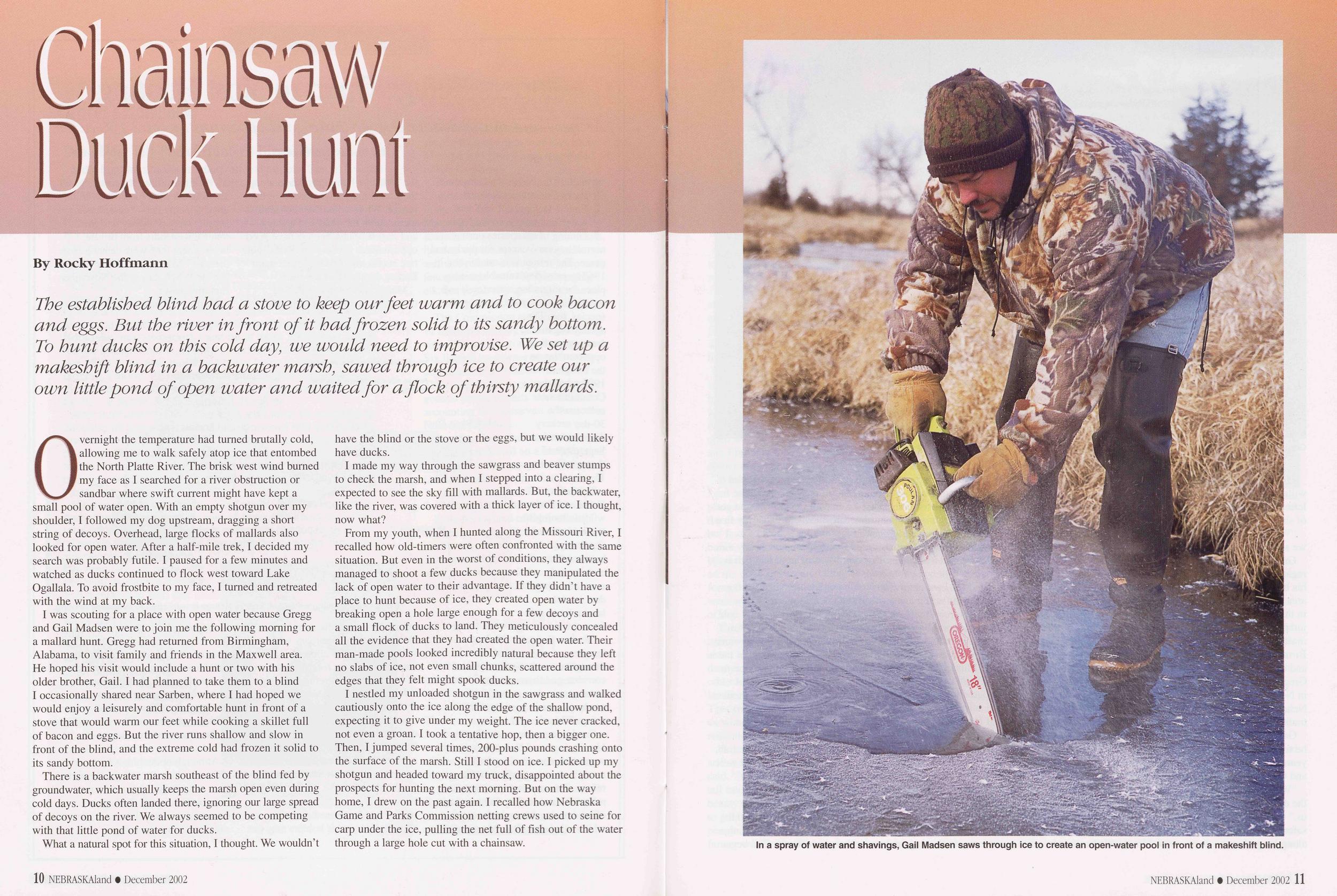
Chainsaw Duck Hunt
By Rocky Hoffmann The established blind had a stove to keep our feet warm and to cook bacon and eggs. But the river in front of it had frozen solid to its sandy bottom. To hunt ducks on this cold day, we would need to improvise. We set up a makeshift blind in a backwater marsh, sawed through ice to create our own little pond of open water and waited for a flock of thirsty mallards.Overnight the temperature had turned brutally cold, allowing me to walk safely atop ice that entombed the North Platte River. The brisk west wind burned my face as I searched for a river obstruction or sandbar where swift current might have kept a small pool of water open. With an empty shotgun over my shoulder, I followed my dog upstream, dragging a short string of decoys. Overhead, large flocks of mallards also looked for open water. After a half-mile trek, I decided my search was probably futile. I paused for a few minutes and watched as ducks continued to flock west toward Lake Ogallala. To avoid frostbite to my face, I turned and retreated with the wind at my back.
I was scouting for a place with open water because Gregg and Gail Madsen were to join me the following morning for a mallard hunt. Gregg had returned from Birmingham, Alabama, to visit family and friends in the Maxwell area. He hoped his visit would include a hunt or two with his older brother, Gail. I had planned to take them to a blind I occasionally shared near Sarben, where I had hoped we would enjoy a leisurely and comfortable hunt in front of a stove that would warm our feet while cooking a skillet full of bacon and eggs. But the river runs shallow and slow in front of the blind, and the extreme cold had frozen it solid to its sandy bottom.
There is a backwater marsh southeast of the blind fed by groundwater, which usually keeps the marsh open even during cold days. Ducks often landed there, ignoring our large spread of decoys on the river. We always seemed to be competing with that little pond of water for ducks.
What a natural spot for this situation, I thought. We wouldn’t have the blind or the stove or the eggs, but we would likely have ducks.
I made my way through the sawgrass and beaver stumps to check the marsh, and when I stepped into a clearing, I expected to see the sky fill with mallards. But, the backwater, like the river, was covered with a thick layer of ice. I thought, now what?
From my youth, when I hunted along the Missouri River, I recalled how old-timers were often confronted with the same situation. But even in the worst of conditions, they always managed to shoot a few ducks because they manipulated the lack of open water to their advantage. If they didn’t have a place to hunt because of ice, they created open water by breaking open a hole large enough for a few decoys and a small flock of ducks to land. They meticulously concealed all the evidence that they had created the open water. Their man-made pools looked incredibly natural because they left no slabs of ice, not even small chunks, scattered around the edges that they felt might spook ducks.
I nestled my unloaded shotgun in the sawgrass and walked cautiously onto the ice along the edge of the shallow pond, expecting it to give under my weight. The ice never cracked, not even a groan. I took a tentative hop, then a bigger one. Then, I jumped several times, 200-plus pounds crashing onto the surface of the marsh. Still I stood on ice. I picked up my shotgun and headed toward my truck, disappointed about the prospects for hunting the next morning. But on the way home, I drew on the past again. I recalled how Nebraska Game and Parks Commission netting crews used to seine for carp under the ice, pulling the net full of fish out of the water through a large hole cut with a chainsaw.
From home, I called Gregg and Gail to ask if they were willing to saw a hole in the ice, hide all the chunks of leftover ice and kneel in subzero temperatures in hopes of shooting at a duck or two.
“We’re in!” they quickly and enthusiastically replied, and we set a time to meet.
Gregg was anxious to hunt ducks with Gail again, regardless of the strings attached. Nine years younger than his brother, Gregg remembered growing up in the Maxwell area, and before he could drive, Gail would haul him around in their old farm truck from one icy stream to another to jump-shoot ducks. Gregg is now in his final year of a master’s degree program at Beeson Divinity School in Birmingham, and he plans to become an ordained pastor and educator. Though excited about his education and future, Gregg is far removed from the hunting he enjoyed as a kid in Nebraska. He hopes his calling will bring him back to Nebraska, where he can again enjoy rural life and its hunting traditions.
Gail is an educator in the Hershey school system, where he teaches math, coaches track and football and has several years experience in counseling. He treasures past hunts he and Gregg shared, and looked forward to this hunt.
“We probably hunted doves more than we did ducks, and the dove hunts were great learning experiences for both of us,” Gail said. “It taught us a lot about wing-shooting and safety, and prepared us for the duck hunts that would come along long after the doves moved south. We hunted almost every evening during the fall months, because the distance wasn’t far from school to home and to the canyons or the riverbottoms. I remember that I was with Gregg when he got his first deer. It was in the same canyon where I shot my first deer several years earlier, and it meant a lot to both of us. I remember that Gregg was very calm, took a good steady aim and squeezed the trigger. I’m sure I was more nervous than he was.”
The Madsens met me under a moonless, star-flecked sky that showed no hint of a rising sun the next morning. The weather forecast was on the money. It was cold - really cold - and I suspect each of us was privately reconsidering our commitment to this outing. I was fortunate to have two former Maxwell Wildcat football players along to carry some of the load. I handed a chainsaw to Gail and the can of gasoline to Gregg. We grabbed our shotguns, collected our dogs and prepared to head off through the frosted grass. With curious and suspicious glances from the Madsens, I removed two leaf rakes from the pickup bed and carried them over the shoulder opposite my gun.
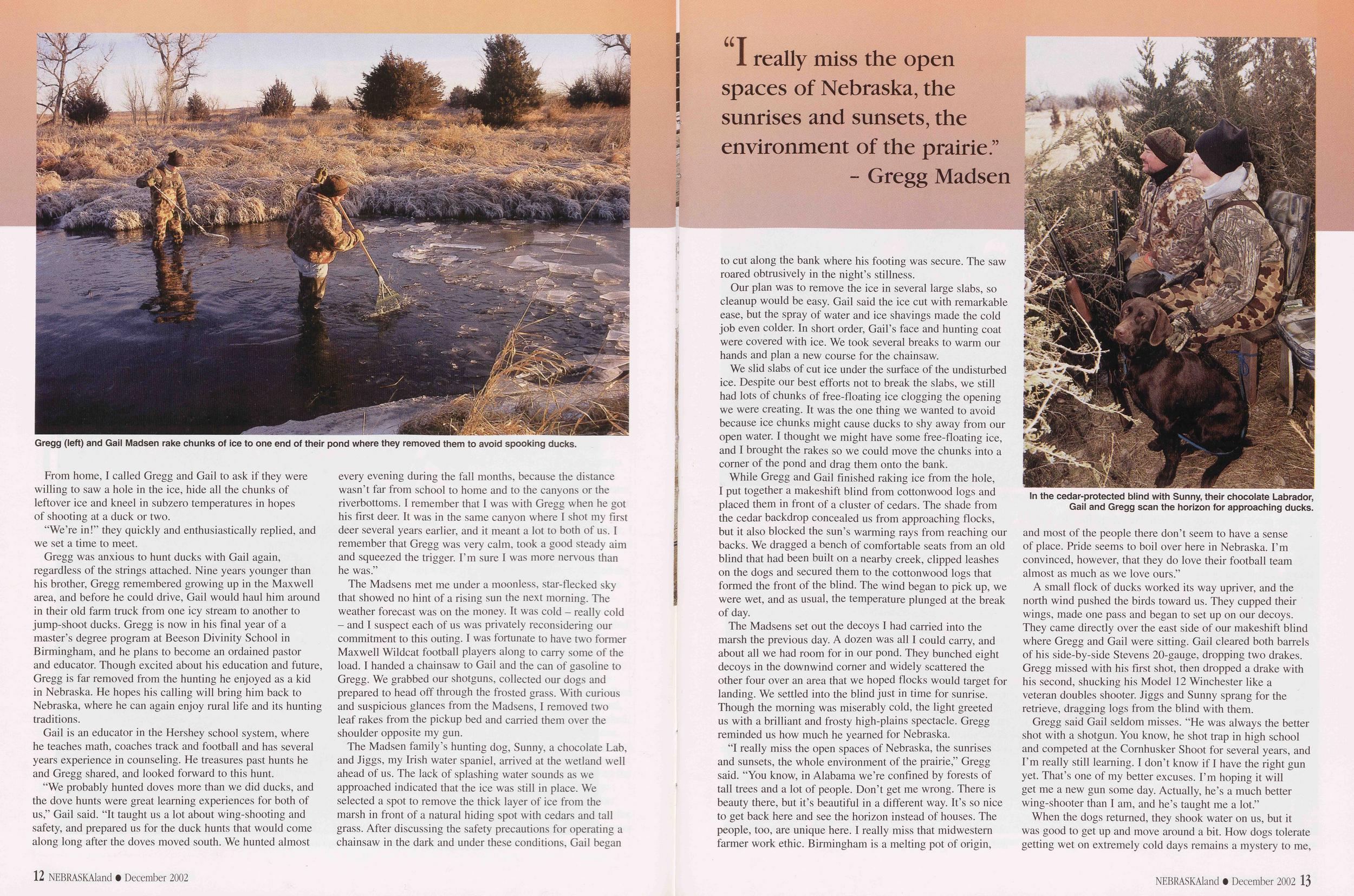
The Madsen family’s hunting dog, Sunny, a chocolate Lab, and Jiggs, my Irish water spaniel, arrived at the wetland well ahead of us. The lack of splashing water sounds as we approached indicated that the ice was still in place. We selected a spot to remove the thick layer of ice from the marsh in front of a natural hiding spot with cedars and tall grass. After discussing the safety precautions for operating a chainsaw in the dark and under these conditions, Gail began to cut along the bank where his footing was secure. The saw roared obtrusively in the night’s stillness.
I really miss the open spaces of Nebraska, the sunrises and sunsets, the environment of the prairie.” - Gregg MadsenOur plan was to remove the ice in several large slabs, so cleanup would be easy. Gail said the ice cut with remarkable ease, but the spray of water and ice shavings made the cold job even colder. In short order, Gail’s face and hunting coat were covered with ice. We took several breaks to warm our hands and plan a new course for the chainsaw.
We slid slabs of cut ice under the surface of the undisturbed ice. Despite our best efforts not to break the slabs, we still had lots of chunks of free-floating ice clogging the opening we were creating. It was the one thing we wanted to avoid because ice chunks might cause ducks to shy away from our open water. I thought we might have some free-floating ice, and I brought the rakes so we could move the chunks into a comer of the pond and drag them onto the bank.
While Gregg and Gail finished raking ice from the hole, I put together a makeshift blind from cottonwood logs and placed them in front of a cluster of cedars. The shade from the cedar backdrop concealed us from approaching flocks, but it also blocked the sun’s warming rays from reaching our backs. We dragged a bench of comfortable seats from an old blind that had been built on a nearby creek, clipped leashes on the dogs and secured them to the cottonwood logs that formed the front of the blind. The wind began to pick up, we were wet, and as usual, the temperature plunged at the break of day.
The Madsens set out the decoys I had carried into the marsh the previous day. A dozen was all I could carry, and about all we had room for in our pond. They bunched eight decoys in the downwind corner and widely scattered the other four over an area that we hoped flocks would target for landing. We settled into the blind just in time for sunrise. Though the morning was miserably cold, the light greeted us with a brilliant and frosty high-plains spectacle. Gregg reminded us how much he yearned for Nebraska.
“I really miss the open spaces of Nebraska, the sunrises and sunsets, the whole environment of the prairie,” Gregg said. “You know, in Alabama we’re confined by forests of tall trees and a lot of people. Don’t get me wrong. There is beauty there, but it’s beautiful in a different way. It’s so nice to get back here and see the horizon instead of houses. The people, too, are unique here. I really miss that midwestern farmer work ethic. Birmingham is a melting pot of origin,
A small flock of ducks worked its way upriver, and the north wind pushed the birds toward us. They cupped their wings, made one pass and began to set up on our decoys. They came directly over the east side of our makeshift blind where Gregg and Gail were sitting. Gail cleared both barrels of his side-by-side Stevens 20-gauge, dropping two drakes. Gregg missed with his first shot, then dropped a drake with his second, shucking his Model 12 Winchester like a veteran doubles shooter. Jiggs and Sunny sprang for the retrieve, dragging logs from the blind with them.
Gregg said Gail seldom misses. “He was always the better shot with a shotgun. You know, he shot trap in high school and competed at the Cornhusker Shoot for several years, and I’m really still learning. I don’t know if I have the right gun yet. That’s one of my better excuses. I’m hoping it will get me a new gun some day. Actually, he’s a much better wing-shooter than I am, and he’s taught me a lot.”
When the dogs returned, they shook water on us, but it
was good to get up and move around a bit. How dogs tolerate
getting wet on extremely cold days remains a mystery to me,
12 NEBRASKAland • December 2002
NEBRASKAland • December 2002 13
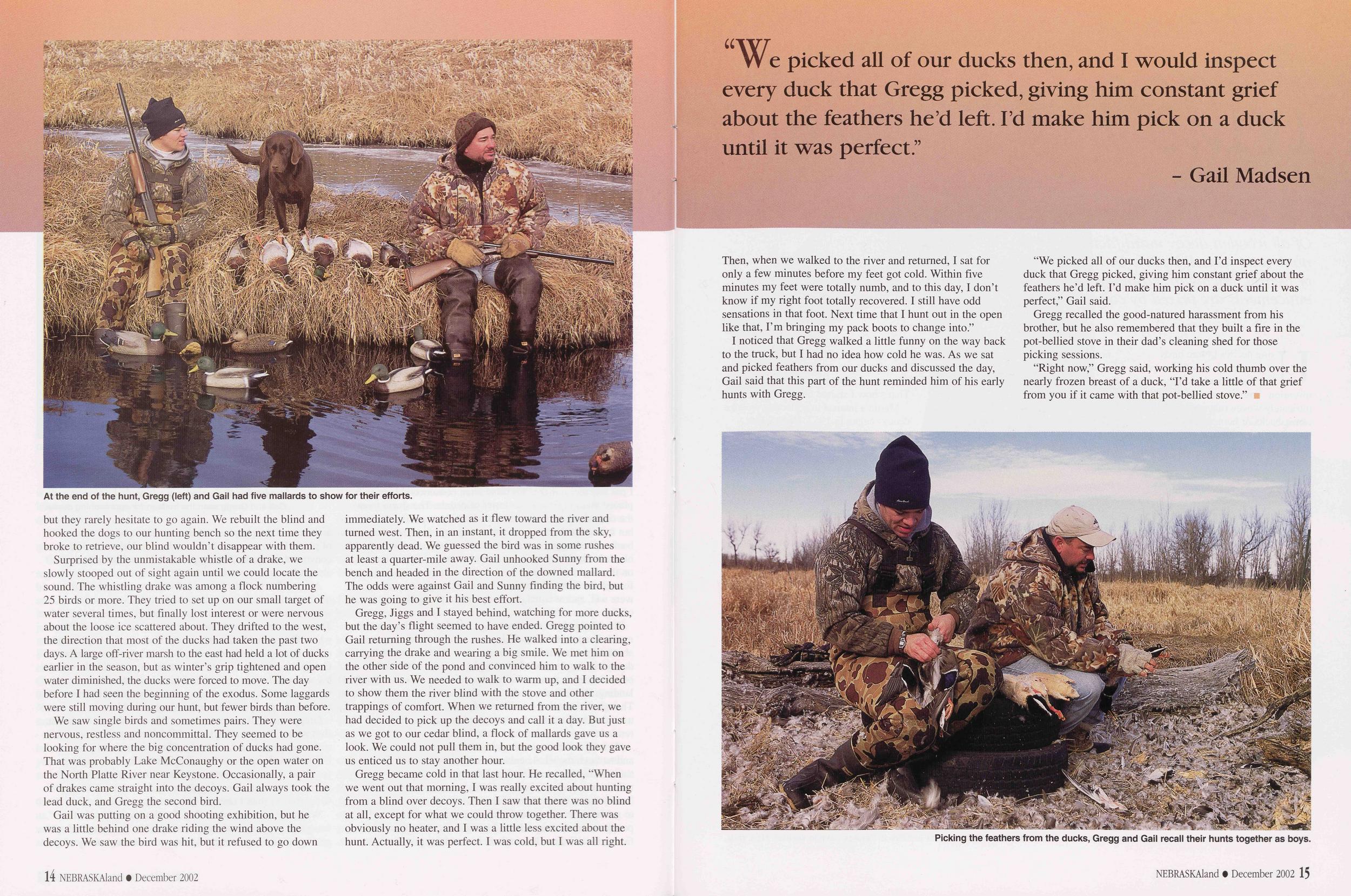
Surprised by the unmistakable whistle of a drake, we slowly stooped out of sight again until we could locate the sound. The whistling drake was among a flock numbering 25 birds or more. They tried to set up on our small target of water several times, but finally lost interest or were nervous about the loose ice scattered about. They drifted to the west, the direction that most of the ducks had taken the past two days. A large off-river marsh to the east had held a lot of ducks earlier in the season, but as winter’s grip tightened and open water diminished, the ducks were forced to move. The day before I had seen the beginning of the exodus. Some laggards were still moving during our hunt, but fewer birds than before.
We saw single birds and sometimes pairs. They were nervous, restless and noncommittal. They seemed to be looking for where the big concentration of ducks had gone. That was probably Lake McConaughy or the open water on the North Platte River near Keystone. Occasionally, a pair of drakes came straight into the decoys. Gail always took the lead duck, and Gregg the second bird.
Gail was putting on a good shooting exhibition, but he was a little behind one drake riding the wind above the decoys. We saw the bird was hit, but it refused to go down immediately. We watched as it flew toward the river and turned west. Then, in an instant, it dropped from the sky, apparently dead. We guessed the bird was in some rushes at least a quarter-mile away. Gail unhooked Sunny from the bench and headed in the direction of the downed mallard. The odds were against Gail and Sunny finding the bird, but he was going to give it his best effort.
Gregg, Jiggs and I stayed behind, watching for more ducks, but the day’s flight seemed to have ended. Gregg pointed to Gail returning through the rushes. He walked into a clearing, carrying the drake and wearing a big smile. We met him on the other side of the pond and convinced him to walk to the river with us. We needed to walk to warm up, and I decided to show them the river blind with the stove and other trappings of comfort. When we returned from the river, we had decided to pick up the decoys and call it a day. But just as we got to our cedar blind, a flock of mallards gave us a look. We could not pull them in, but the good look they gave us enticed us to stay another hour.
Gregg became cold in that last hour. He recalled, "When we went out that morning, I was really excited about hunting from a blind over decoys. Then I saw that there was no blind at all, except for what we could throw together. There was obviously no heater, and I was a little less excited about the hunt. Actually, it was perfect. I was cold, but I was all right. Then, when we walked to the river and returned, I sat for only a few minutes before my feet got cold. Within five minutes my feet were totally numb, and to this day, I don’t know if my right foot totally recovered. I still have odd sensations in that foot. Next time that I hunt out in the open like that, I’m bringing my pack boots to change into.”
“We picked all of our ducks then, and I would inspect every duck that Gregg picked, giving him constant grief about the feathers he’d left. I’d make him pick on a duck until it was perfect.” - Gail MadsenI noticed that Gregg walked a little funny on the way back to the truck, but I had no idea how cold he was. As we sat and picked feathers from our ducks and discussed the day, Gail said that this part of the hunt reminded him of his early hunts with Gregg.
"We picked all of our ducks then, and I’d inspect every duck that Gregg picked, giving him constant grief about the feathers he’d left. I’d make him pick on a duck until it was perfect,” Gail said.
Gregg recalled the good-natured harassment from his brother, but he also remembered that they built a fire in the pot-bellied stove in their dad’s cleaning shed for those picking sessions.
"Right now,” Gregg said, working his cold thumb over the nearly frozen breast of a duck, "I’d take a little of that grief from you if it came with that pot-bellied stove.”
14 NEBRASKAland • December 2002 NEBRASKAland • December 2002 15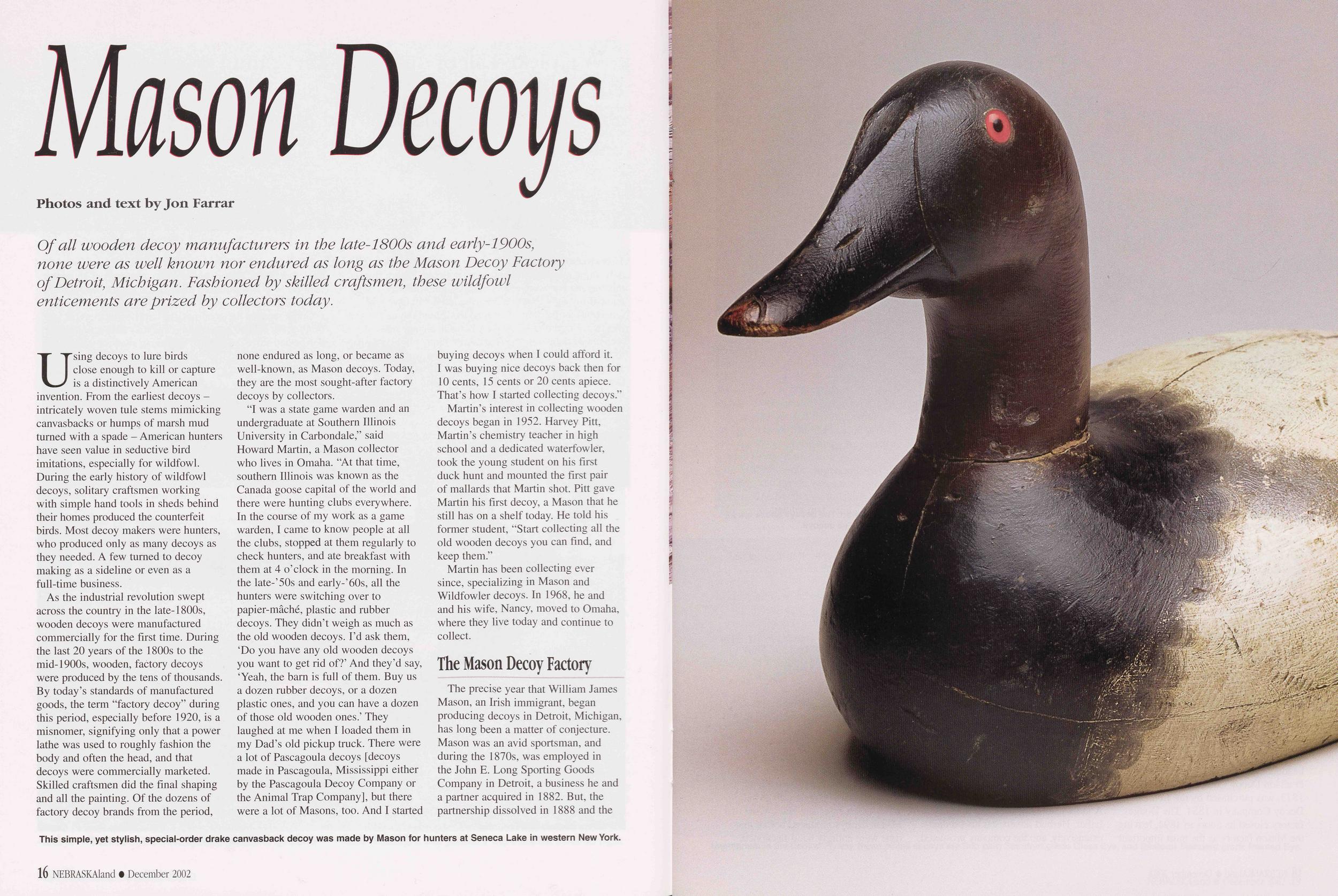
Mason Decoys
Photos and text by Jon Farrar Of all wooden decoy manufacturers in the late-1800s and early-1900s, none were as well known nor endured as long as the Mason Decoy Factory of Detroit, Michigan. Fashioned by skilled craftsmen, these wildfowl enticements are prized by collectors today.Using decoys to lure birds close enough to kill or capture is a distinctively American invention. From the earliest decoys - intricately woven tule stems mimicking canvasbacks or humps of marsh mud turned with a spade - American hunters have seen value in seductive bird imitations, especially for wildfowl. During the early history of wildfowl decoys, solitary craftsmen working with simple hand tools in sheds behind their homes produced the counterfeit birds. Most decoy makers were hunters, who produced only as many decoys as they needed. A few turned to decoy making as a sideline or even as a full-time business.
As the industrial revolution swept across the country in the late-1800s, wooden decoys were manufactured commercially for the first time. During the last 20 years of the 1800s to the mid-1900s, wooden, factory decoys were produced by the tens of thousands. By today’s standards of manufactured goods, the term "factory decoy” during this period, especially before 1920, is a misnomer, signifying only that a power lathe was used to roughly fashion the body and often the head, and that decoys were commercially marketed. Skilled craftsmen did the final shaping and all the painting. Of the dozens of factory decoy brands from the period, none endured as long, or became as well-known, as Mason decoys. Today, they are the most sought-after factory decoys by collectors.
“I was a state game warden and an undergraduate at Southern Illinois University in Carbondale,” said Howard Martin, a Mason collector who lives in Omaha. "At that time, southern Illinois was known as the Canada goose capital of the world and there were hunting clubs everywhere. In the course of my work as a game warden, I came to know people at all the clubs, stopped at them regularly to check hunters, and ate breakfast with them at 4 o’clock in the morning. In the late-’50s and early-’60s, all the hunters were switching over to papier-mache, plastic and rubber decoys. They didn’t weigh as much as the old wooden decoys. I’d ask them, ‘Do you have any old wooden decoys you want to get rid of?’ And they’d say, ‘Yeah, the barn is full of them. Buy us a dozen rubber decoys, or a dozen plastic ones, and you can have a dozen of those old wooden ones.’ They laughed at me when I loaded them in my Dad’s old pickup truck. There were a lot of Pascagoula decoys [decoys made in Pascagoula, Mississippi either by the Pascagoula Decoy Company or the Animal Trap Company], but there were a lot of Masons, too. And I started buying decoys when I could afford it. I was buying nice decoys back then for 10 cents, 15 cents or 20 cents apiece. That’s how I started collecting decoys.”
Martin’s interest in collecting wooden decoys began in 1952. Harvey Pitt, Martin’s chemistry teacher in high school and a dedicated waterfowler, took the young student on his first duck hunt and mounted the first pair of mallards that Martin shot. Pitt gave Martin his first decoy, a Mason that he still has on a shelf today. He told his former student, "Start collecting all the old wooden decoys you can find, and keep them.”
Martin has been collecting ever since, specializing in Mason and Wildfowler decoys. In 1968, he and and his wife, Nancy, moved to Omaha, where they live today and continue to collect.
The Mason Decoy FactoryThe precise year that William James Mason, an Irish immigrant, began producing decoys in Detroit, Michigan, has long been a matter of conjecture. Mason was an avid sportsman, and during the 1870s, was employed in the John E. Long Sporting Goods Company in Detroit, a business he and a partner acquired in 1882. But, the partnership dissolved in 1888 and the
Before Mason entered the business, two other well-known, but relatively short-lived, decoy makers had their headquarters in Detroit. The George Peterson Decoy Company, founded in 1873, was purchased by the J.N. Dodge Decoy Company in 1884. The Dodge factory closed its doors in 1894, leaving the Mason factory as the most important manufacturer of wooden decoys not only in the Detroit region, but also in the United States. Until Mason’s lathes and other equipment were sold to Pratt Manufacturing Company of Joliet, Illinois, in 1926, Mason decoys dominated the commercial wildfowl decoy market. William Mason’s son, Herbert, bore the primary responsibility for running the factory, sales and bookkeeping. William contributed principally as a decoy designer, conducting “field research” in nearby duck marshes. William died in 1905 of pneumonia, reportedly after lying in a marsh sketching ducks to improve the design of his decoys, and Herbert, also a waterfowl hunter, assumed sole responsibility for the family business. A more astute businessman than his father, Herbert advertised his products extensively, and the company prospered, rightfully billing itself as the “largest exclusive manufacturer of decoys in the world.”
Details of the workings of the Mason Decoy Factory have been sketchily pieced together in two books, Factory Decoys of Mason, Stevens, Dodge, and Peterson, 1980, by John and Shirley Delph; and Mason Decoys, A Complete Pictorial Guide, 1993, by Russ J. Goldberger and Alan G. Haid.
All Mason decoys were fashioned from high-quality cedar logs from northern Michigan. The ground floor of the Mason factory housed duplicating lathes, band saws and sanders. Both bodies and heads of decoys produced after 1903 were rough-turned on a tracing lathe with an overhead belt drive. Goldberger and Haid wrote that Mason decoys produced before that time were entirely hand-fashioned. Decoy bodies were finished on a belt-driven sander, the heads by hand. The hollow bodies, principally of Premier grade decoys, but of some special-order Challenge grades, were cut in two after rough shaping and drilled to make them lighter. The two halves were rejoined with white lead and finishing nails. Heads were then joined to the bodies with dowels and glue, and the blank decoys were packed in crates and send to the second floor of the building where they were painted. Mason used a distinctive spiral-pattern dowel to better secure the glue, which is a tell-tale feature of any Mason decoy, but only evident if the head is no longer tightly glued to the body.
The painting room housed three benches with an apprentice and senior painter at each. Great care was taken to achieve a perfect fit of head to body on Mason Premier grade decoys, but the fit was seldom perfect on lower grades and the gaps were filled with white lead putty to smooth the transition between the head and body. Apprentices applied a base primer coat of white lead, linseed oil and turpentine after the puttying, and the decoys were stored on racks to dry. According to Delphs, “The senior painter first painted the body with the correct plumage, let it dry, and then painted the head. The eyes were not added until after a decoy was painted, when holes were drilled, filled with a dab of putty, and the eye pressed into place, usually forcing a ring of putty to emerge around the glass eye and forming a ring.” An apprentice painter at the Mason factory worked a 10-hour day, six days a week and earned a dollar a day. They received no vacation time or sick leave.
When the final painting was dry, each decoy was balanced by floating it in a wash tub and adding a lead weight in the appropriate position on the bottom
Under Herbert Mason’s management, the Mason Decoy Factory flourished. Because the work was seasonal, he and a friend established a paint manufacturing business that became the largest supplier to Detroit's growing automobile industry, principally the Ford Motor Company. The high-quality paint endured in better condition and color on Mason decoys than on any other factory decoys. To employ workers year-round, the Mason factory
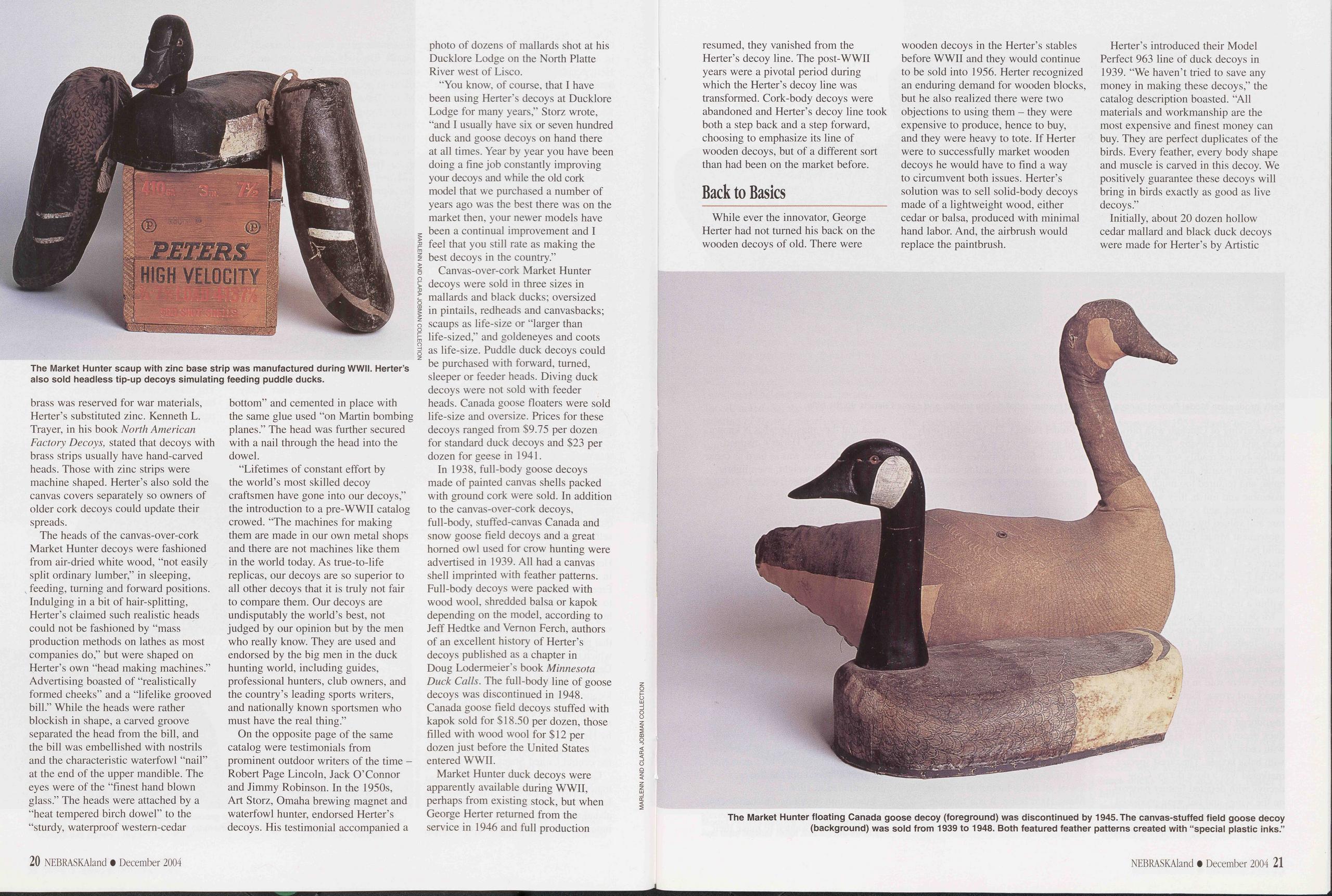
Before William Mason died, there were only two grades of Mason decoys, the Premier and the Challenge. Herbert added to the line, selling less-expensive grades affordable to the average hunter, and greatly expanded his market. The Mason Standard Grade had three types: No. 1 Glass Eye, No. 2 Tack Eye and No. 3 Painted Eye. Not only did the decoys’ eyes change with each step down in grade, but so did the quality of shaping and smoothing of the bodies and heads, and painted feather details became less elaborate.
The various Mason grades and special-order decoys have caused continuing confusion about classification and nomenclature. Martin and other collectors today typically refer to four grades: Premier, Challenge, Standard grade (including both No. 1 Glass Eye and the No. 2 Tack Eye decoys), and a fourth grade, the No. 4 Painted Eye. Additionally, the term “Detroit Grade” has been used as a synonym for No. 1 Glass Eye, Standard grade Mason decoys, and occasionally even more loosely for all Standard grade Masons. To further confound the beginner, collectors frequently refer to the No. 1 Glass Eye, Standard grade Mason decoy as a "3rd grade Mason.”
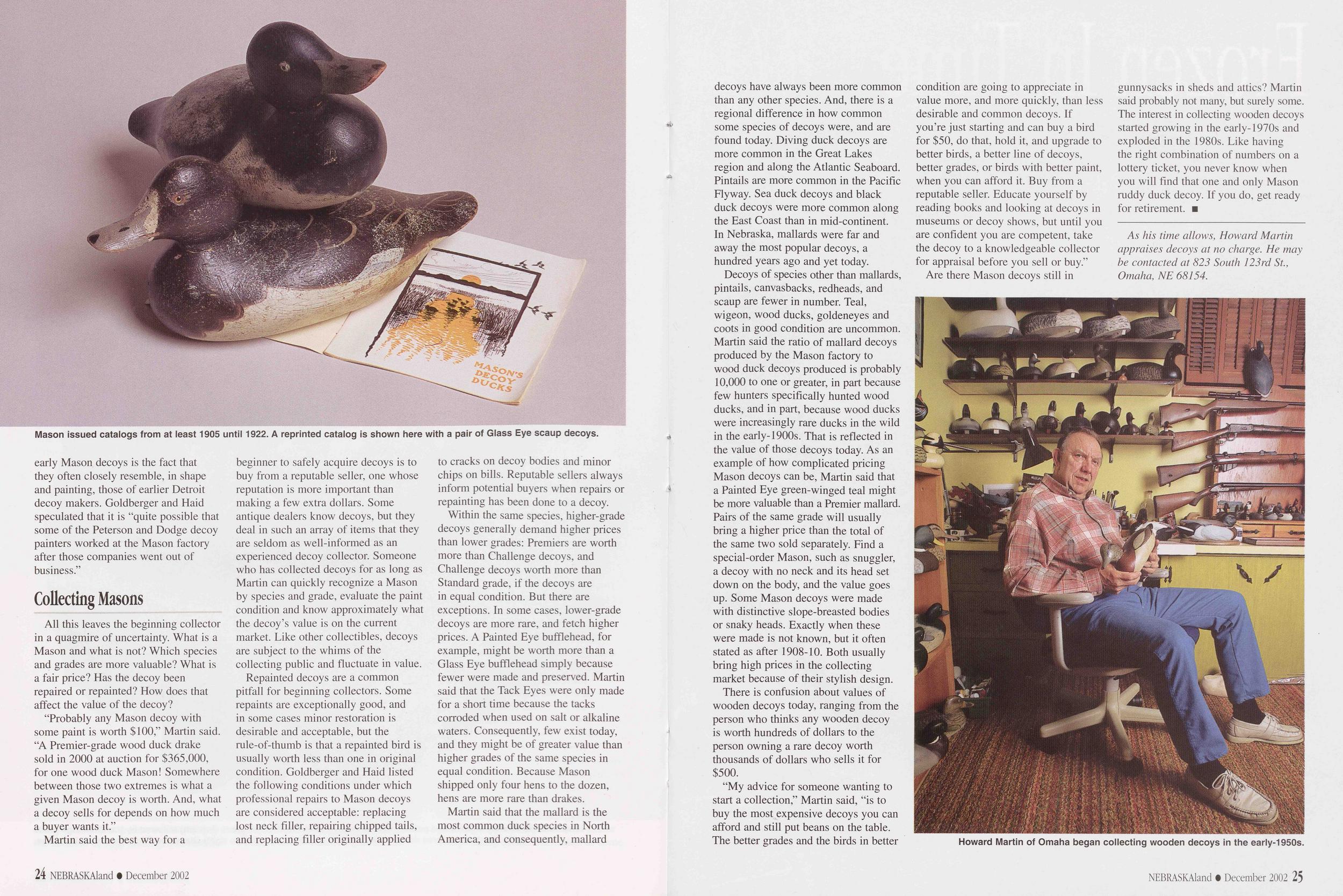
In 1905, a dozen Canada goose decoys sold for $18; Premier duck decoys sold for $12 a dozen; solid-body Challenge duck decoys for $6.50, hollow Challenge duck decoys for $8; Standard Glass Eye duck decoys for $5.50 a dozen; Standard Tack Eye for $4.75 a dozen and the Painted Eye duck decoys for $4 a dozen. Mason catalogs listing decoys available were issued from at least 1905 until 1922.
Identification of the grades is not difficult for collectors who have examined enough Mason decoys. The top-of-the-line Premier decoys have graceful bodies and heads and lavish painting, including feathering, stippling and speckling. A Premier was hollow, but solid-body decoys could be ordered, and were preferred by wildfowlers in big, choppy waters where the added weight increased stability. They were usually flat-bottomed with a distinctively carved notch above the top of the bill and a scored outline separating the bill from the rest of the head. The nostrils were cut into the wood, as was the "nail” at the end of the bill. High-quality German glass eyes with black pupils were used on the Premier grade. Paint was applied in circular swirls and unmistakably identifies a decoy from the Mason factory, but the swirls are not always conspicuous. Colors and feather patterns are typically blended, rather than applied as block patches as on less-expensive grades. Some Premier decoys were stamped "Premier” on the bottoms, but because water-soluble ink was used, the stamp is rarely found. "A Mason decoy with the original stamp on the bottom probably increases the value of the bird $100 to $150,” Martin said.
The Challenge grade, Mason’s second-best decoy offering, was similar to the Premier, slightly smaller, usually round-bottomed, solid-bodied unless special-ordered hollow, a carved line separating the bill from the rest of the head and separating the mandibles, carved nostrils and a painted "nail” at the end of the bill. Typically less time was spent achieving a good marriage between the head and body, and so more filler was often used than on Premiers. Paint was applied in swirled strokes as on Premiers, but simplified with less blending and in more blocky patterns. Some Mason Challenge decoys were stamped with their grade on the bottom but they are a rare find. Many Mason collectors, including Martin, prefer the Challenge decoys to Premiers because of their sleeker style and because they are more rare today.
After 1905, Standard grade decoys
were Mason’s most popular line
principally because of their lower price.
Mass-market retailers such as Sears
and Roebuck also sold Mason decoys.
20 NEBRASKAland • December 2002
NEBRASKAland • December 2002 21
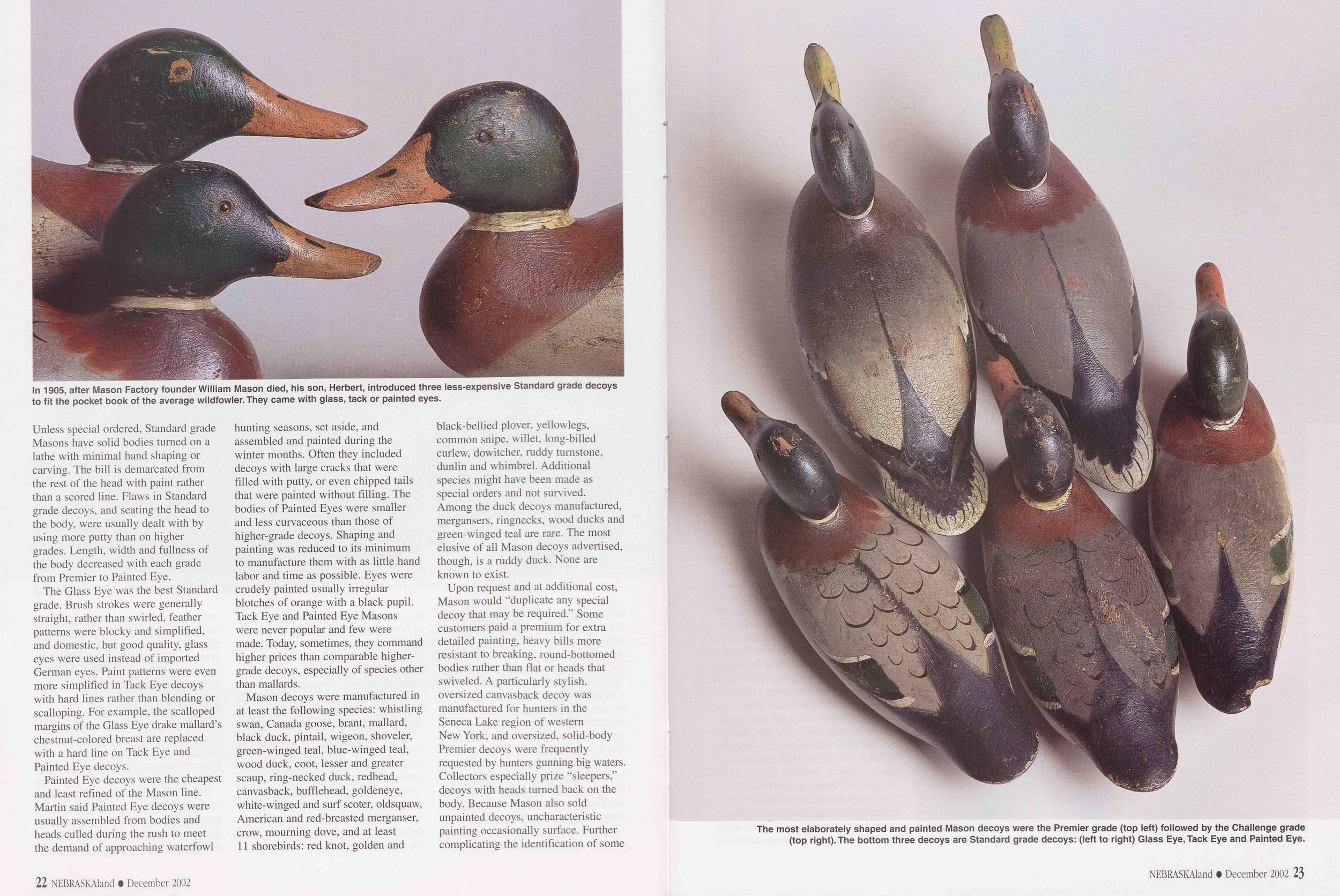
The Glass Eye was the best Standard grade. Brush strokes were generally straight, rather than swirled, feather patterns were blocky and simplified, and domestic, but good quality, glass eyes were used instead of imported German eyes. Paint patterns were even more simplified in Tack Eye decoys with hard lines rather than blending or scalloping. For example, the scalloped margins of the Glass Eye drake mallard’s chestnut-colored breast are replaced with a hard line on Tack Eye and Painted Eye decoys.
Painted Eye decoys were the cheapest and least refined of the Mason line. Martin said Painted Eye decoys were usually assembled from bodies and heads culled during the rush to meet the demand of approaching waterfowl hunting seasons, set aside, and assembled and painted during the winter months. Often they included decoys with large cracks that were filled with putty, or even chipped tails that were painted without filling. The bodies of Painted Eyes were smaller and less curvaceous than those of higher-grade decoys. Shaping and painting was reduced to its minimum to manufacture them with as little hand labor and time as possible. Eyes were crudely painted usually irregular blotches of orange with a black pupil. Tack Eye and Painted Eye Masons were never popular and few were made. Today, sometimes, they command higher prices than comparable higher- grade decoys, especially of species other than mallards.
Mason decoys were manufactured in at least the following species: whistling swan, Canada goose, brant, mallard, black duck, pintail, wigeon, shoveler, green-winged teal, blue-winged teal, wood duck, coot, lesser and greater scaup, ring-necked duck, redhead, canvasback, bufflehead, goldeneye, white-winged and surf scoter, oldsquaw, American and red-breasted merganser, crow, mourning dove, and at least 11 shorebirds: red knot, golden and black-bellied plover, yellowlegs, common snipe, willet, long-billed curlew, dowitcher, ruddy turnstone, dunlin and whimbrel. Additional species might have been made as special orders and not survived. Among the duck decoys manufactured, mergansers, ringnecks, wood ducks and green-winged teal are rare. The most elusive of all Mason decoys advertised, though, is a ruddy duck. None are known to exist.
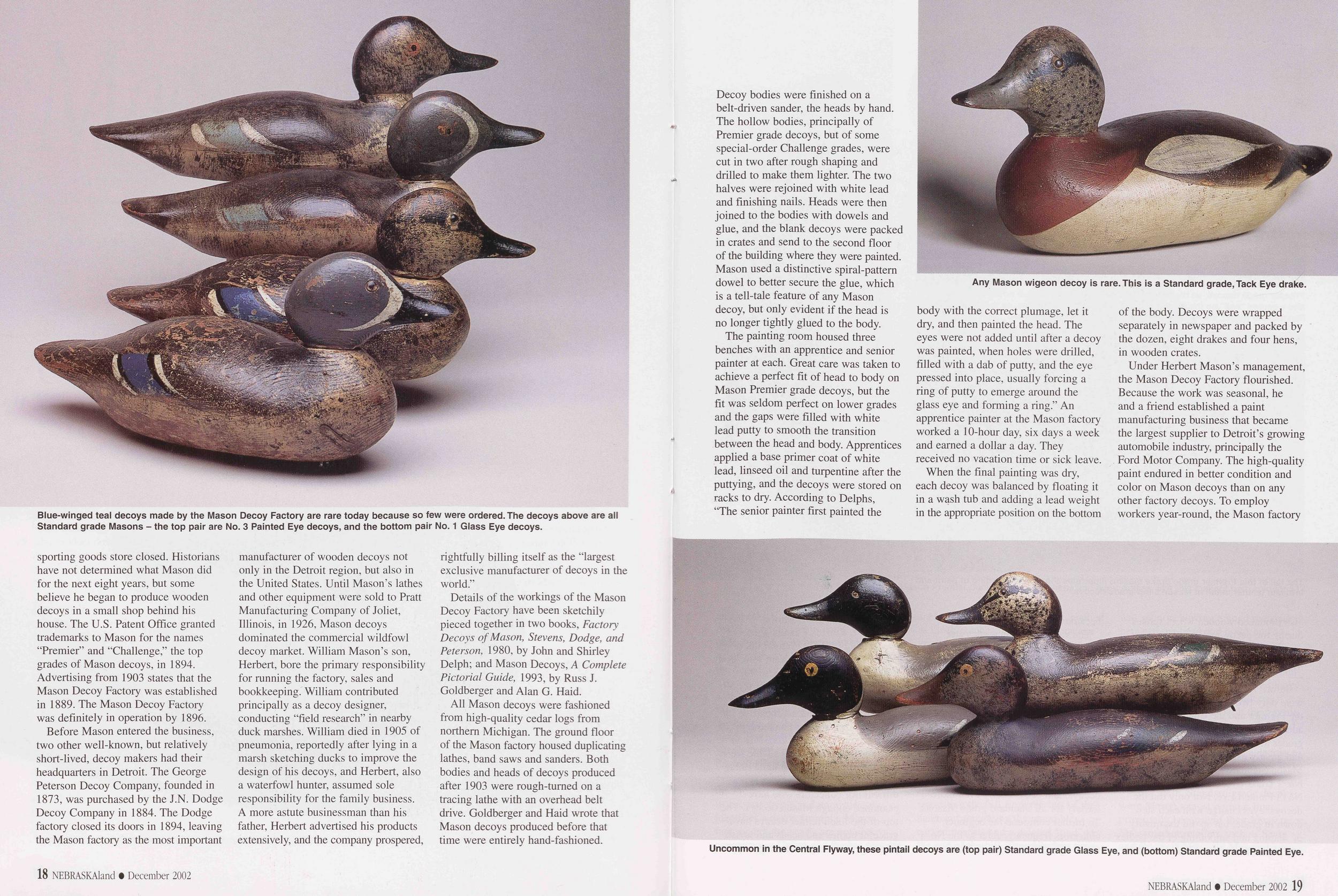
Upon request and at additional cost, Mason would “duplicate any special decoy that may be required.” Some customers paid a premium for extra detailed painting, heavy bills more resistant to breaking, round-bottomed bodies rather than flat or heads that swiveled. A particularly stylish, oversized canvasback decoy was manufactured for hunters in the Seneca Lake region of western New York, and oversized, solid-body Premier decoys were frequently requested by hunters gunning big waters. Collectors especially prize “sleepers,” decoys with heads turned back on the body. Because Mason also sold unpainted decoys, uncharacteristic painting occasionally surface. Further complicating the identification of some
All this leaves the beginning collector in a quagmire of uncertainty. What is a Mason and what is not? Which species and grades are more valuable? What is a fair price? Has the decoy been repaired or repainted? How does that affect the value of the decoy?
“Probably any Mason decoy with some paint is worth $100,” Martin said. “A Premier-grade wood duck drake sold in 2000 at auction for $365,000, for one wood duck Mason! Somewhere between those two extremes is what a given Mason decoy is worth. And, what a decoy sells for depends on how much a buyer wants it.”
Martin said the best way for a beginner to safely acquire decoys is to buy from a reputable seller, one whose reputation is more important than making a few extra dollars. Some antique dealers know decoys, but they deal in such an array of items that they are seldom as well-informed as an experienced decoy collector. Someone who has collected decoys for as long as Martin can quickly recognize a Mason by species and grade, evaluate the paint condition and know approximately what the decoy’s value is on the current market. Like other collectibles, decoys are subject to the whims of the collecting public and fluctuate in value.
Repainted decoys are a common pitfail for beginning collectors. Some repaints are exceptionally good, and in some cases minor restoration is desirable and acceptable, but the rule-of-thumb is that a repainted bird is usually worth less than one in original condition. Goldberger and Haid listed the following conditions under which professional repairs to Mason decoys are considered acceptable: replacing lost neck filler, repairing chipped tails, and replacing filler originally applied to cracks on decoy bodies and minor chips on bills. Reputable sellers always inform potential buyers when repairs or repainting has been done to a decoy.
Within the same species, higher-grade decoys generally demand higher prices than lower grades: Premiers are worth more than Challenge decoys, and Challenge decoys worth more than Standard grade, if the decoys are in equal condition. But there are exceptions. In some cases, lower-grade decoys are more rare, and fetch higher prices. A Painted Eye bufflehead, for example, might be worth more than a Glass Eye bufflehead simply because fewer were made and preserved. Martin said that the Tack Eyes were only made for a short time because the tacks corroded when used on salt or alkaline waters. Consequently, few exist today, and they might be of greater value than higher grades of the same species in equal condition. Because Mason shipped only four hens to the dozen, hens are more rare than drakes.
Martin said that the mallard is the most common duck species in North America, and consequently, mallard decoys have always been more common than any other species. And, there is a regional difference in how common some species of decoys were, and are found today. Diving duck decoys are more common in the Great Lakes region and along the Atlantic Seaboard. Pintails are more common in the Pacific Flyway. Sea duck decoys and black duck decoys were more common along the East Coast than in mid-continent. In Nebraska, mallards were far and away the most popular decoys, a hundred years ago and yet today.
Decoys of species other than mallards, pintails, canvasbacks, redheads, and scaup are fewer in number. Teal, wigeon, wood ducks, goldeneyes and coots in good condition are uncommon. Martin said the ratio of mallard decoys produced by the Mason factory to wood duck decoys produced is probably 10,000 to one or greater, in part because few hunters specifically hunted wood ducks, and in part, because wood ducks were increasingly rare ducks in the wild in the early-1900s. That is reflected in the value of those decoys today. As an example of how complicated pricing Mason decoys can be, Martin said that a Painted Eye green-winged teal might be more valuable than a Premier mallard. Pairs of the same grade will usually bring a higher price than the total of the same two sold separately. Find a special-order Mason, such as snuggler, a decoy with no neck and its head set down on the body, and the value goes up. Some Mason decoys were made with distinctive slope-breasted bodies or snaky heads. Exactly when these were made is not known, but it often stated as after 1908-10. Both usually bring high prices in the collecting market because of their stylish design.
There is confusion about values of wooden decoys today, ranging from the person who thinks any wooden decoy is worth hundreds of dollars to the person owning a rare decoy worth thousands of dollars who sells it for $500.
“My advice for someone wanting to start a collection,” Martin said, “is to buy the most expensive decoys you cai afford and still put beans on the table. The better grades and the birds in better
Are there Mason decoys still in gunny sacks in sheds and attics? Martin said probably not many, but surely some. The interest in collecting wooden decoys started growing in the early-1970s and exploded in the 1980s. Like having the right combination of numbers on a lottery ticket, you never know when you will find that one and only Mason ruddy duck decoy. If you do, get ready for retirement.
As his time allows, Howard Martin appraises decoys at no charge. He may be contacted at 823 South 123rd St., Omaha, NE 68154.
24 NEBRASKAland • December 2002 NEBRASKAland • December 2002 25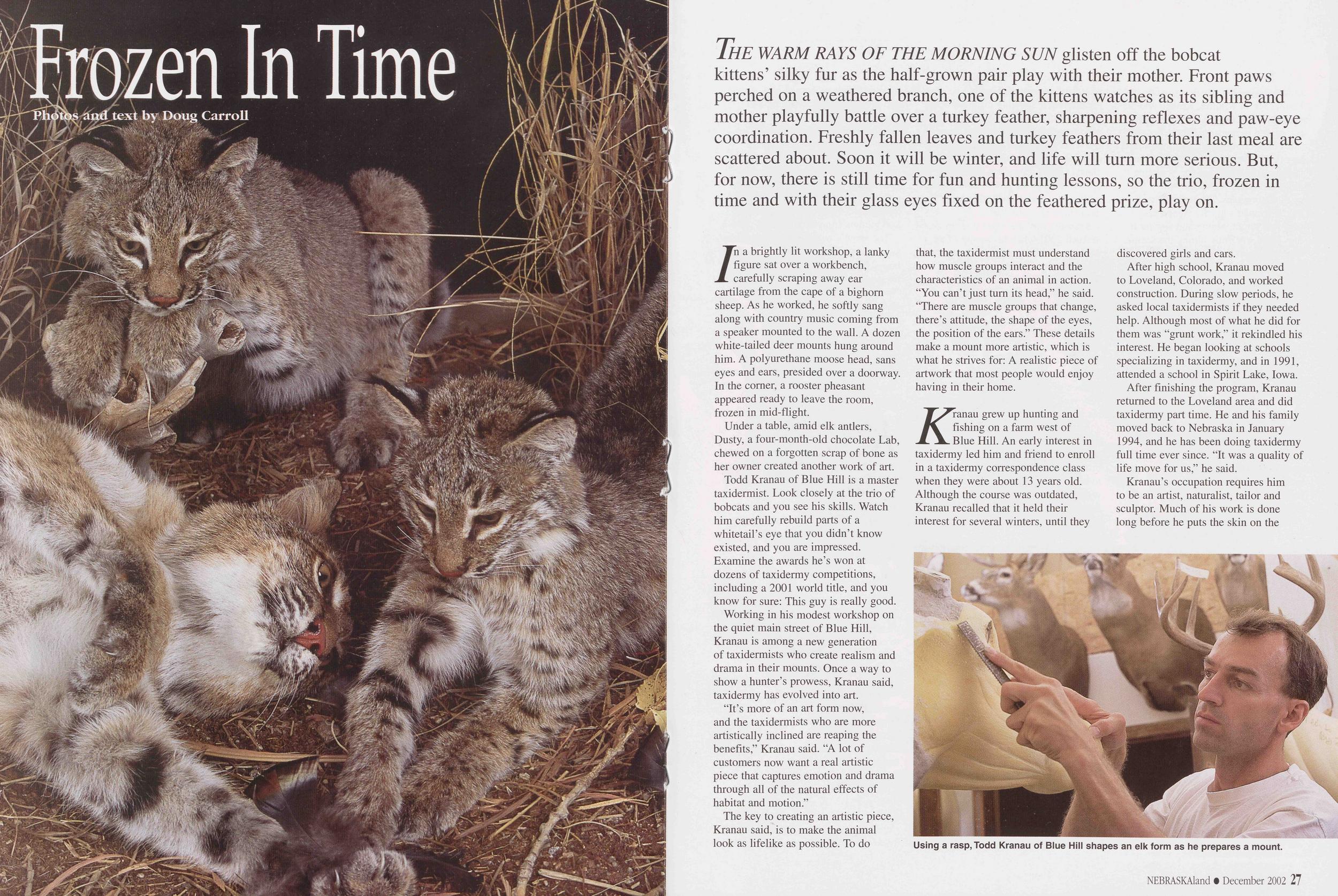
Frozen In Time
Photos and text by Doug Carroll THE WARM RAYS OF THE MORNING SUN glisten off the bobcat kittens’ silky fur as the half-grown pair play with their mother. Front paws perched on a weathered branch, one of the kittens watches as its sibling and mother playfully battle over a turkey feather, sharpening reflexes and paw-eye coordination. Freshly fallen leaves and turkey feathers from their last meal are scattered about. Soon it will be winter, and life will turn more serious. But, for now, there is still time for fun and hunting lessons, so the trio, frozen in time and with their glass eyes fixed on the feathered prize, play on.In a brightly lit workshop, a lanky figure sat over a workbench, carefully scraping away ear cartilage from the cape of a bighorn sheep. As he worked, he softly sang along with country music coming from a speaker mounted to the wall. A dozen white-tailed deer mounts hung around him. A polyurethane moose head, sans eyes and ears, presided over a doorway. In the corner, a rooster pheasant appeared ready to leave the room, frozen in mid-flight.
Under a table, amid elk antlers, Dusty, a four-month-old chocolate Lab, chewed on a forgotten scrap of bone as her owner created another work of art.
Todd Kranau of Blue Hill is a master taxidermist. Look closely at the trio of bobcats and you see his skills. Watch him carefully rebuild parts of a whitetail's eye that you didn’t know existed, and you are impressed. Examine the awards he’s won at dozens of taxidermy competitions, including a 2001 world title, and you know for sure: This guy is really good.
Working in his modest workshop on the quiet main street of Blue Hill, Kranau is among a new generation of taxidermists who create realism and drama in their mounts. Once a way to show a hunter’s prowess, Kranau said, taxidermy has evolved into art.
"It’s more of an art form now, and the taxidermists who are more artistically inclined are reaping the benefits,” Kranau said. "A lot of customers now want a real artistic piece that captures emotion and drama through all of the natural effects of habitat and motion.”
The key to creating an artistic piece, Kranau said, is to make the animal look as lifelike as possible. To do that, the taxidermist must understand how muscle groups interact and the characteristics of an animal in action. "You can’t just turn its head,” he said. "There are muscle groups that change, there’s attitude, the shape of the eyes, the position of the ears.” These details make a mount more artistic, which is what he strives for: A realistic piece of artwork that most people would enjoy having in their home.
Kranau grew up hunting and fishing on a farm west of Blue Hill. An early interest in taxidermy led him and friend to enroll in a taxidermy correspondence class when they were about 13 years old. Although the course was outdated, Kranau recalled that it held their interest for several winters, until they
After high school, Kranau moved to Loveland, Colorado, and worked construction. During slow periods, he asked local taxidermists if they needed help. Although most of what he did for them was "grunt work,” it rekindled his interest. He began looking at schools specializing in taxidermy, and in 1991, attended a school in Spirit Lake, Iowa.
After finishing the program, Kranau returned to the Loveland area and did taxidermy part time. He and his family moved back to Nebraska in January 1994, and he has been doing taxidermy full time ever since. "It was a quality of life move for us,” he said.
Kranau’s occupation requires him
to be an artist, naturalist, tailor and
sculptor. Much of his work is done
long before he puts the skin on the
NEBRASKAland • December 2002 27
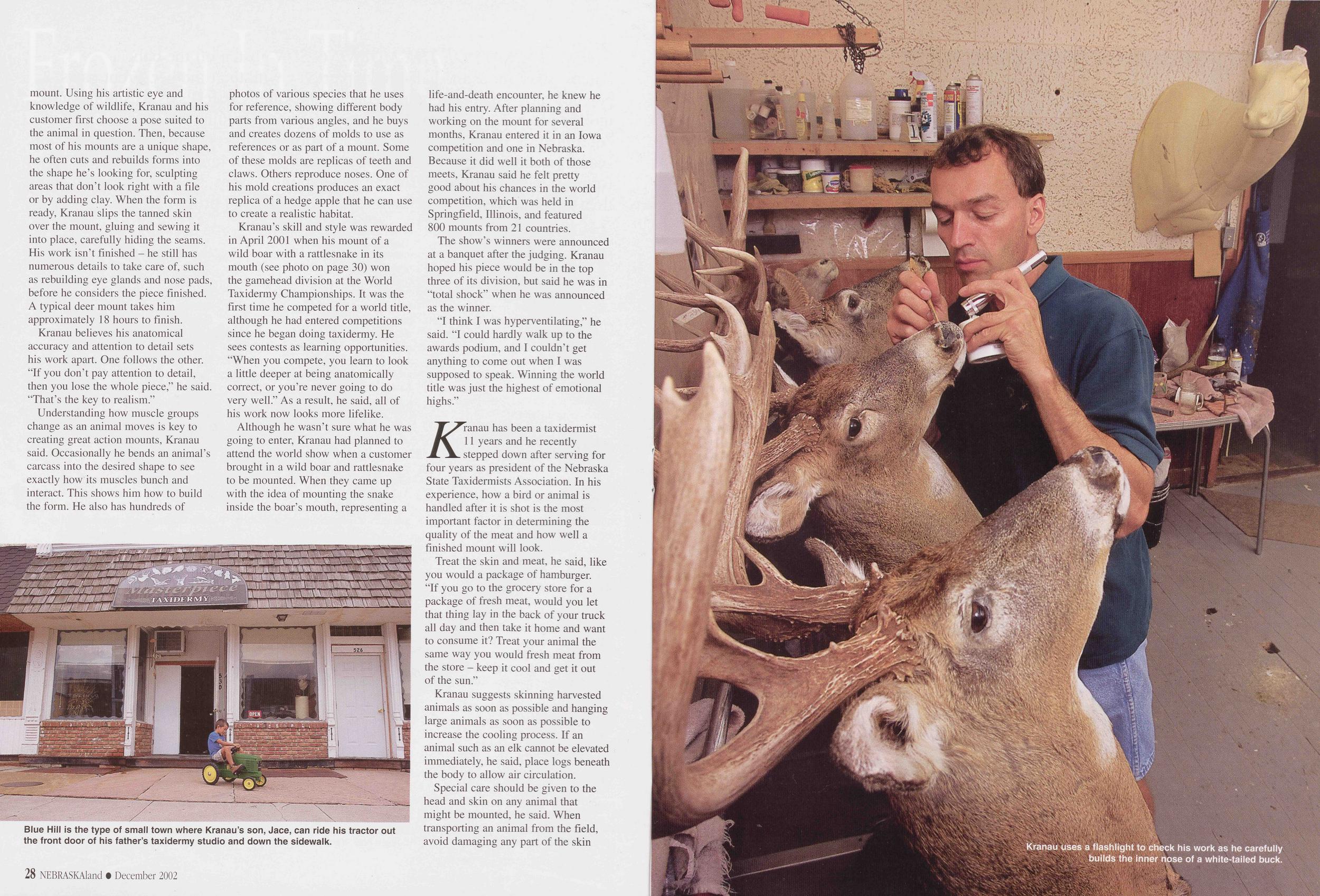 mount. Using his artistic eye and
knowledge of wildlife, Kranau and his
customer first choose a pose suited to
the animal in question. Then, because
most of his mounts are a unique shape,
he often cuts and rebuilds forms into
the shape he’s looking for, sculpting
areas that don’t look right with a file
or by adding clay. When the form is
ready, Kranau slips the tanned skin
over the mount, gluing and sewing it
into place, carefully hiding the seams.
His work isn’t finished - he still has
numerous details to take care of, such
as rebuilding eye glands and nose pads,
before he considers the piece finished.
A typical deer mount takes him
approximately 18 hours to finish.
mount. Using his artistic eye and
knowledge of wildlife, Kranau and his
customer first choose a pose suited to
the animal in question. Then, because
most of his mounts are a unique shape,
he often cuts and rebuilds forms into
the shape he’s looking for, sculpting
areas that don’t look right with a file
or by adding clay. When the form is
ready, Kranau slips the tanned skin
over the mount, gluing and sewing it
into place, carefully hiding the seams.
His work isn’t finished - he still has
numerous details to take care of, such
as rebuilding eye glands and nose pads,
before he considers the piece finished.
A typical deer mount takes him
approximately 18 hours to finish.
Kranau believes his anatomical accuracy and attention to detail sets his work apart. One follows the other. "If you don’t pay attention to detail, then you lose the whole piece,” he said. "That’s the key to realism.”
Understanding how muscle groups change as an animal moves is key to creating great action mounts, Kranau said. Occasionally he bends an animal’s carcass into the desired shape to see exactly how its muscles bunch and interact. This shows him how to build the form. He also has hundreds of
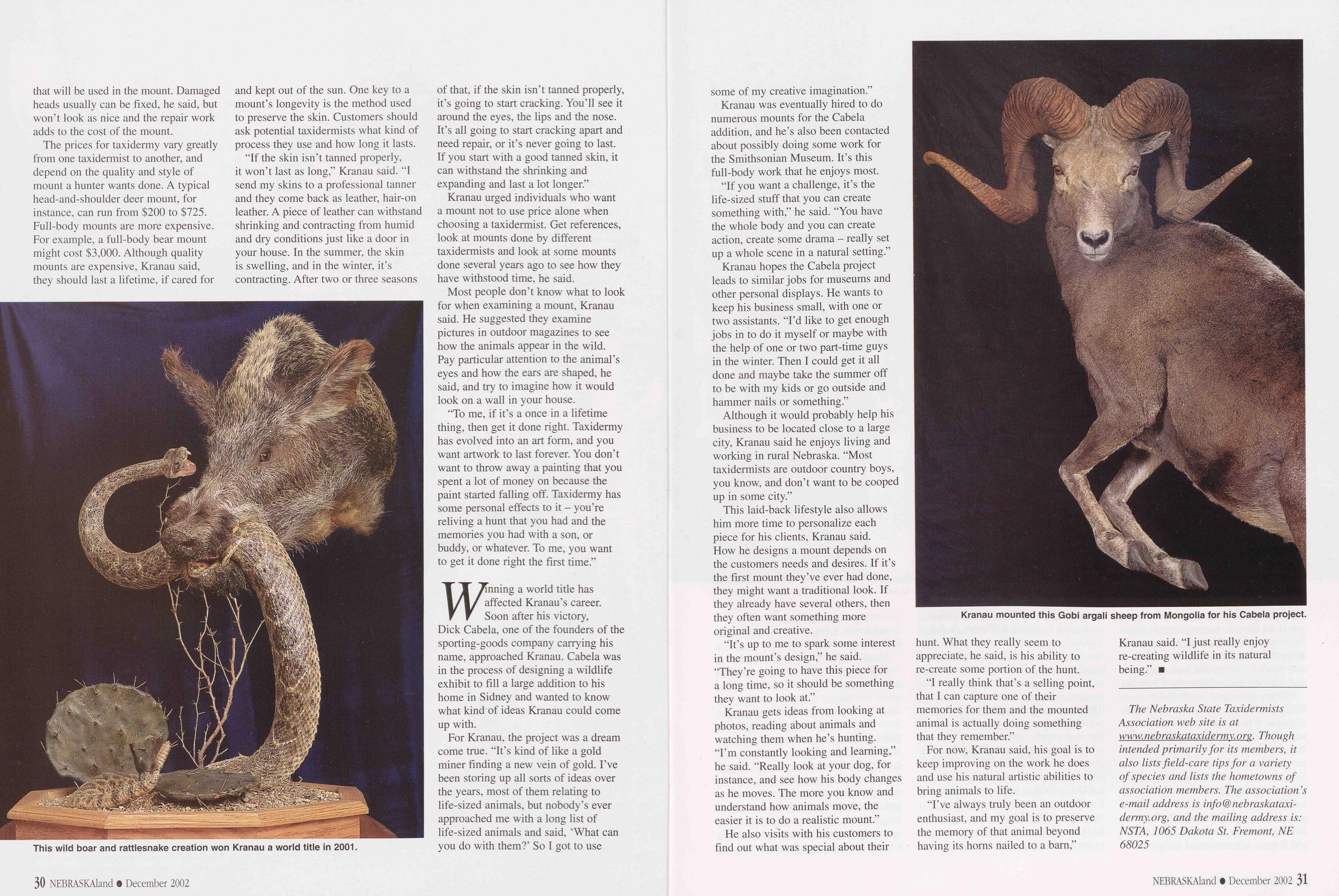
Kranau’s skill and style was rewarded in April 2001 when his mount of a wild boar with a rattlesnake in its mouth (see photo on page 30) won the gamehead division at the World Taxidermy Championships. It was the first time he competed for a world title, although he had entered competitions since he began doing taxidermy. He sees contests as learning opportunities. "When you compete, you learn to look a little deeper at being anatomically correct, or you’re never going to do very well.” As a result, he said, all of his work now looks more lifelike.
Although he wasn’t sure what he was going to enter, Kranau had planned to attend the world show when a customer brought in a wild boar and rattlesnake to be mounted. When they came up with the idea of mounting the snake inside the boar’s mouth, representing a life-and-death encounter, he knew he had his entry. After planning and working on the mount for several months, Kranau entered it in an Iowa competition and one in Nebraska. Because it did well it both of those meets, Kranau said he felt pretty good about his chances in the world competition, which was held in Springfield, Illinois, and featured 800 mounts from 21 countries.
The show’s winners were announced at a banquet after the judging. Kranau hoped his piece would be in the top three of its division, but said he was in "total shock” when he was announced as the winner.
"I think I was hyperventilating,” he said. "I could hardly walk up to the awards podium, and I couldn’t get anything to come out when I was supposed to speak. Winning the world title was just the highest of emotional highs.”
Kranau has been a taxidermist 11 years and he recently stepped down after serving for four years as president of the Nebraska State Taxidermists Association. In his experience, how a bird or animal is handled after it is shot is the most important factor in determining the quality of the meat and how well a finished mount will look.
Treat the skin and meat, he said, like you would a package of hamburger. "If you go to the grocery store for a package of fresh meat, would you let that thing lay in the back of your truck all day and then take it home and want to consume it? Treat your animal the same way you would fresh meat from the store - keep it cool and get it out of the sun.”
Kranau suggests skinning harvested animals as soon as possible and hanging large animals as soon as possible to increase the cooling process. If an animal such as an elk cannot be elevated immediately, he said, place logs beneath the body to allow air circulation.
Special care should be given to the head and skin on any animal that might be mounted, he said. When transporting an animal from the field, avoid damaging any part of the skin
 that will be used in the mount. Damaged
heads usually can be fixed, he said, but
won’t look as nice and the repair work
adds to the cost of the mount.
that will be used in the mount. Damaged
heads usually can be fixed, he said, but
won’t look as nice and the repair work
adds to the cost of the mount.
The prices for taxidermy vary greatly from one taxidermist to another, and depend on the quality and style of mount a hunter wants done. A typical head-and-shoulder deer mount, for instance, can run from $200 to $725. Full-body mounts are more expensive. For example, a full-body bear mount might cost $3,000. Although quality mounts are expensive, Kranau said, they should last a lifetime, if cared for
"If the skin isn’t tanned properly, it won’t last as long,” Kranau said. "I send my skins to a professional tanner and they come back as leather, hair-on leather. A piece of leather can withstand shrinking and contracting from humid and dry conditions just like a door in your house. In the summer, the skin is swelling, and in the winter, it’s contracting. After two or three seasons of that, if the skin isn’t tanned properly, it’s going to start cracking. You’ll see it around the eyes, the lips and the nose. It’s all going to start cracking apart and need repair, or it’s never going to last. If you start with a good tanned skin, it can withstand the shrinking and expanding and last a lot longer.”
Kranau urged individuals who want a mount not to use price alone when choosing a taxidermist. Get references, look at mounts done by different taxidermists and look at some mounts done several years ago to see how they have withstood time, he said.
Most people don’t know what to look for when examining a mount, Kranau said. He suggested they examine pictures in outdoor magazines to see how the animals appear in the wild. Pay particular attention to the animal’s eyes and how the ears are shaped, he said, and try to imagine how it would look on a wall in your house.
“To me, if it’s a once in a lifetime thing, then get it done right. Taxidermy has evolved into an art form, and you want artwork to last forever. You don’t want to throw away a painting that you spent a lot of money on because the paint started falling off. Taxidermy has some personal effects to it - you’re reliving a hunt that you had and the memories you had with a son, or buddy, or whatever. To me, you want to get it done right the first time.”
Winning a world title has affected Kranau’s career. Soon after his victory, Dick Cabela, one of the founders of the sporting-goods company carrying his name, approached Kranau. Cabela was in the process of designing a wildlife exhibit to fill a large addition to his home in Sidney and wanted to know what kind of ideas Kranau could come up with.
For Kranau, the project was a dream come true. "It’s kind of like a gold miner finding a new vein of gold. I’ve been storing up all sorts of ideas over the years, most of them relating to life-sized animals, but nobody’s ever approached me with a long list of life-sized animals and said, 'What can you do with them?’ So I got to use some of my creative imagination.”
Kranau was eventually hired to do numerous mounts for the Cabela addition, and he’s also been contacted about possibly doing some work for the Smithsonian Museum. It’s this full-body work that he enjoys most.
“If you want a challenge, it’s the life-sized stuff that you can create something with,” he said. "You have the whole body and you can create action, create some drama - really set up a whole scene in a natural setting.”
Kranau hopes the Cabela project leads to similar jobs for museums and other personal displays. He wants to keep his business small, with one or two assistants. "I’d like to get enough jobs in to do it myself or maybe with the help of one or two part-time guys in the winter. Then I could get it all done and maybe take the summer off to be with my kids or go outside and hammer nails or something.”
Although it would probably help his business to be located close to a large city, Kranau said he enjoys living and working in rural Nebraska. "Most taxidermists are outdoor country boys, you know, and don’t want to be cooped up in some city.”
This laid-back lifestyle also allows him more time to personalize each piece for his clients, Kranau said. How he designs a mount depends on the customers needs and desires. If it’s the first mount they’ve ever had done, they might want a traditional look. If they already have several others, then they often want something more original and creative.
"It’s up to me to spark some interest in the mount’s design,” he said. "They’re going to have this piece for a long time, so it should be something they want to look at.”
Kranau gets ideas from looking at photos, reading about animals and watching them when he’s hunting. “I’m constantly looking and learning,” he said. "Really look at your dog, for instance, and see how his body changes as he moves. The more you know and understand how animals move, the easier it is to do a realistic mount.”
He also visits with his customers to find out what was special about their
"I really think that’s a selling point, that I can capture one of their memories for them and the mounted animal is actually doing something that they remember.”
For now, Kranau said, his goal is to keep improving on the work he does and use his natural artistic abilities to bring animals to life.
"I’ve always truly been an outdoor enthusiast, and my goal is to preserve the memory of that animal beyond having its horns nailed to a barn,” Kranau said. "I just really enjoy re-creating wildlife in its natural being.”
The Nebraska State Taxidermists Association web site is at www. nebraskataxidermy.org. Though intended primarily for its members, it also lists field-care tips for a variety of species and lists the hometowns of association members. The association’s e-mail address is info@nebraskataxi- dermy.org, and the mailing address is: NSTA, 1065 Dakota St. Fremont, NE 68025
30 NEBRASKAland • December 2002 NEBRASKAland • December 2002 31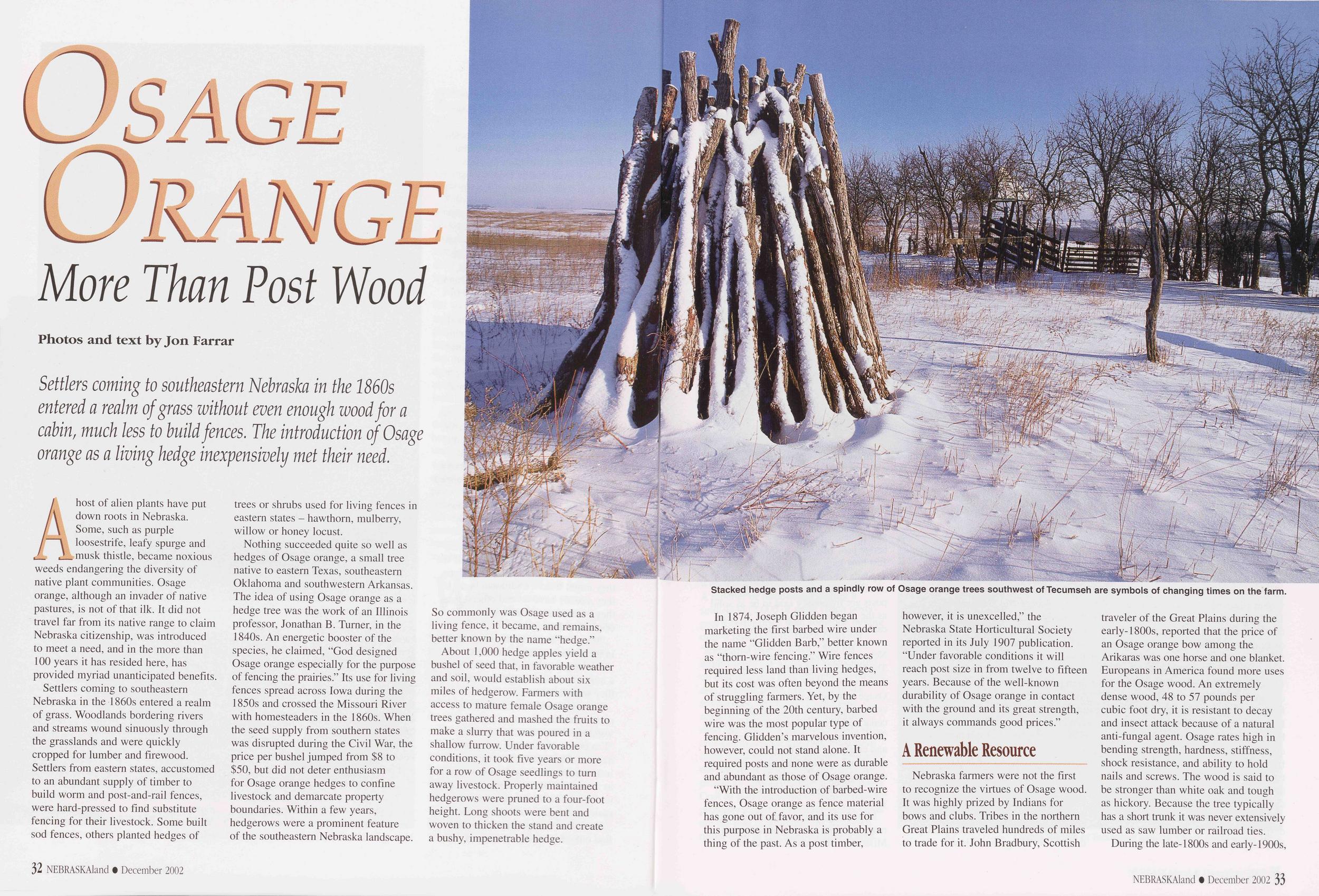
Osage Orange
More Than Post Wood Photos and text by Jon Farrar Settlers coming to southeastern Nebraska in the 1860s entered a realm of grass without even enough wood for a cabin, much less to build fences. The introduction of Osage orange as a living hedge inexpensively met their need.A host of alien plants have put down roots in Nebraska. Some, such as purple loosestrife, leafy spurge and musk thistle, became noxious weeds endangering the diversity of native plant communities. Osage orange, although an invader of native pastures, is not of that ilk. It did not travel far from its native range to claim Nebraska citizenship, was introduced to meet a need, and in the more than 100 years it has resided here, has provided myriad unanticipated benefits.
Settlers coming to southeastern Nebraska in the 1860s entered a realm of grass. Woodlands bordering rivers and streams wound sinuously through the grasslands and were quickly cropped for lumber and firewood. Settlers from eastern states, accustomed to an abundant supply of timber to build worm and post-and-rail fences, were hard-pressed to find substitute fencing for their livestock. Some built sod fences, others planted hedges of trees or shrubs used for living fences in eastern states - hawthorn, mulberry, willow or honey locust.
Nothing succeeded quite so well as hedges of Osage orange, a small tree native to eastern Texas, southeastern Oklahoma and southwestern Arkansas. The idea of using Osage orange as a hedge tree was the work of an Illinois professor, Jonathan B. Turner, in the 1840s. An energetic booster of the species, he claimed, “God designed Osage orange especially for the purpose of fencing the prairies.” Its use for living fences spread across Iowa during the 1850s and crossed the Missouri River with homesteaders in the 1860s. When the seed supply from southern states was disrupted during the Civil War, the price per bushel jumped from $8 to $50, but did not deter enthusiasm for Osage orange hedges to confine livestock and demarcate property boundaries. Within a few years, hedgerows were a prominent feature of the southeastern Nebraska landscape.
About 1,000 hedge apples yield a bushel of seed that, in favorable weather and soil, would establish about six miles of hedgerow. Farmers with access to mature female Osage orange trees gathered and mashed the fruits to make a slurry that was poured in a shallow furrow. Under favorable conditions, it took five years or more for a row of Osage seedlings to turn away livestock. Properly maintained hedgerows were pruned to a four-foot height. Long shoots were bent and woven to thicken the stand and create a bushy, impenetrable hedge.
In 1874, Joseph Glidden began marketing the first barbed wire under the name “Glidden Barb,” better known as “thorn-wire fencing.” Wire fences required less land than living hedges, but its cost was often beyond the means of struggling farmers. Yet, by the beginning of the 20th century, barbed wire was the most popular type of fencing. Glidden’s marvelous invention, however, could not stand alone. It required posts and none were as durable and abundant as those of Osage orange.
“With the introduction of barbed-wire fences, Osage orange as fence material has gone out of favor, and its use for this purpose in Nebraska is probably a thing of the past. As a post timber, however, it is unexcelled,” the Nebraska State Horticultural Society reported in its July 1907 publication. “Under favorable conditions it will reach post size in from twelve to fifteen years. Because of the well-known durability of Osage orange in contact with the ground and its great strength, it always commands good prices.”
A Renewable ResourceNebraska farmers were not the first to recognize the virtues of Osage wood. It was highly prized by Indians for bows and clubs. Tribes in the northern Great Plains traveled hundreds of miles to trade for it. John Bradbury, Scottish traveler of the Great Plains during the early-1800s, reported that the price of an Osage orange bow among the Arikaras was one horse and one blanket. Europeans in America found more uses for the Osage wood. An extremely dense wood, 48 to 57 pounds per cubic foot dry, it is resistant to decay and insect attack because of a natural anti-fungal agent. Osage rates high in bending strength, hardness, stiffness, shock resistance, and ability to hold nails and screws. The wood is said t be stronger than white oak and tom as hickory. Because the tree typical has a short trunk it was never extern used as saw lumber or railroad ties.
During the late-1800s and early-
32 NEBRASKAland • December 2002
NEBRASKAland • December 2002 33
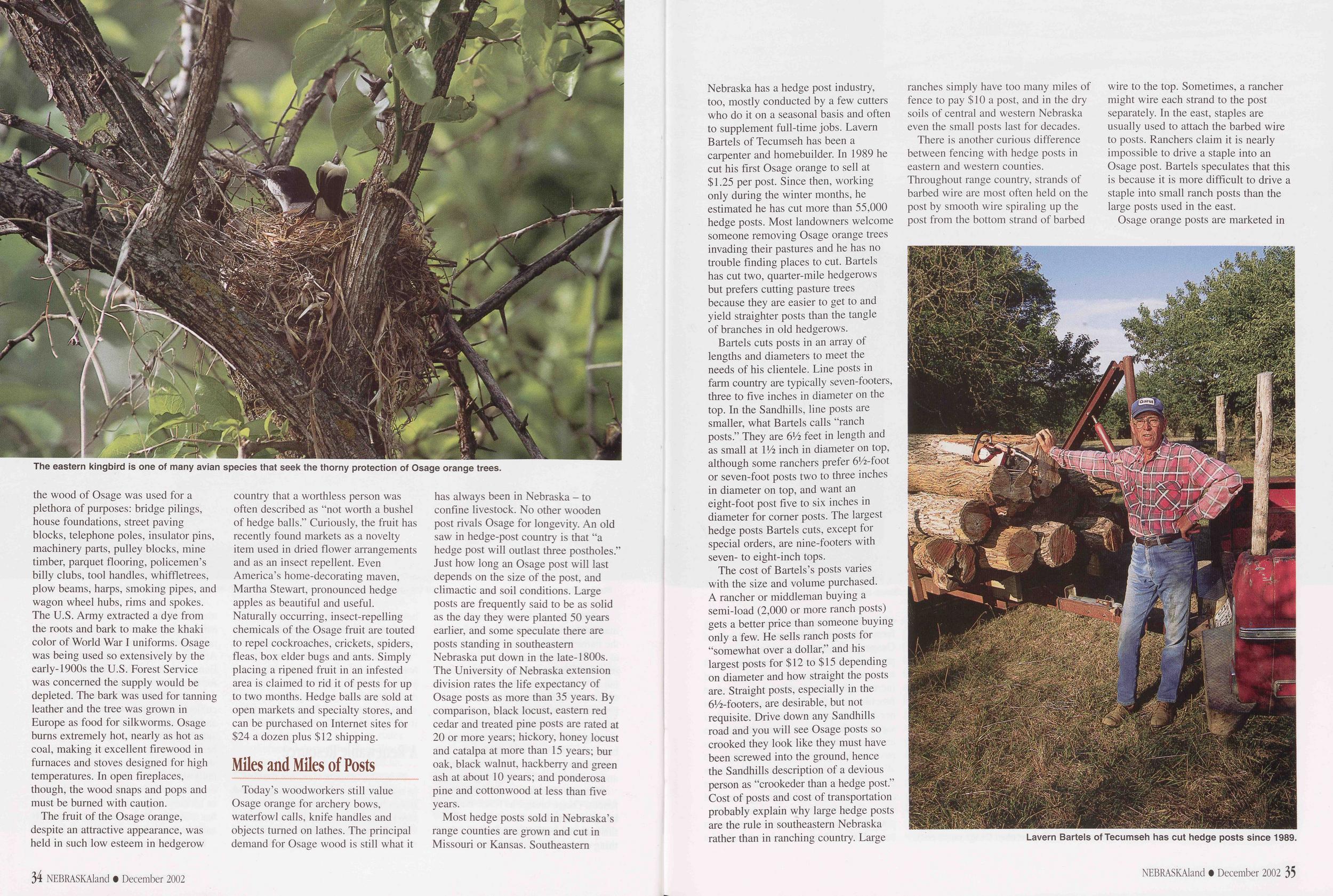
The fruit of the Osage orange, despite an attractive appearance, was held in such low esteem in hedgerow country that a worthless person was often described as "not worth a bushel of hedge balls.” Curiously, the fruit has recently found markets as a novelty item used in dried flower arrangements and as an insect repellent. Even America’s home-decorating maven, Martha Stewart, pronounced hedge apples as beautiful and useful. Naturally occurring, insect-repelling chemicals of the Osage fruit are touted to repel cockroaches, crickets, spiders, fleas, box elder bugs and ants. Simply placing a ripened fruit in an infested area is claimed to rid it of pests for up to two months. Hedge balls are sold at open markets and specialty stores, and can be purchased on Internet sites for $24 a dozen plus $12 shipping.
Miles and Miles of PostsToday’s woodworkers still value Osage orange for archery bows, waterfowl calls, knife handles and objects turned on lathes. The principal demand for Osage wood is still what it has always been in Nebraska - to confine livestock. No other wooden post rivals Osage for longevity. An old saw in hedge-post country is that "a hedge post will outlast three postholes.” Just how long an Osage post will last depends on the size of the post, and climactic and soil conditions. Large posts are frequently said to be as solid as the day they were planted 50 years earlier, and some speculate there are posts standing in southeastern Nebraska put down in the late-1800s. The University of Nebraska extension division rates the life expectancy of Osage posts as more than 35 years. By comparison, black locust, eastern red cedar and treated pine posts are rated at 20 or more years; hickory, honey locust and catalpa at more than 15 years; bur oak, black walnut, hackberry and green ash at about 10 years; and ponderosa pine and cottonwood at less than five years.
Most hedge posts sold in Nebraska’s range counties are grown and cut in Missouri or Kansas. Southeastern Nebraska has a hedge post industry, too, mostly conducted by a few cutters who do it on a seasonal basis and often to supplement full-time jobs. Lavern Bartels of Tecumseh has been a carpenter and homebuilder. In 1989 he cut his first Osage orange to sell at $1.25 per post. Since then, working only during the winter months, he estimated he has cut more than 55,000 hedge posts. Most landowners welcome someone removing Osage orange trees invading their pastures and he has no trouble finding places to cut. Bartels has cut two, quarter-mile hedgerows but prefers cutting pasture trees because they are easier to get to and yield straighter posts than the tangle of branches in old hedgerows.
Bartels cuts posts in an array of lengths and diameters to meet the needs of his clientele. Line posts in farm country are typically seven-footers, three to five inches in diameter on the top. In the Sandhills, line posts are smaller, what Bartels calls "ranch posts.” They are 6 1/2 feet in length and as small as 1 1/2 inch in diameter on top, although some ranchers prefer 6 1/2-foot or seven-foot posts two to three inches in diameter on top, and want an eight-foot post five to six inches in diameter for corner posts. The largest hedge posts Bartels cuts, except for special orders, are nine-footers with seven- to eight-inch tops.
The cost of Bartels’s posts varies with the size and volume purchased. A rancher or middleman buying a semi-load (2,000 or more ranch posts) gets a better price than someone buying only a few. He sells ranch posts for “somewhat over a dollar,” and his largest posts for $12 to $15 depending on diameter and how straight the posts are. Straight posts, especially in the 6 1/2-footers, are desirable, but not requisite. Drive down any Sandhills road and you will see Osage posts so crooked they look like they must have been screwed into the ground, hence the Sandhills description of a devious person as "crookeder than a hedge post.” Cost of posts and cost of transportation probably explain why large hedge posts are the rule in southeastern Nebraska rather than in ranching country. Large ranches simply have too many miles of fence to pay $10 a post, and in the dry soils of central and western Nebraska even the small posts last for decades.
There is another curious difference between fencing with hedge posts in eastern and western counties. Throughout range country, strands of barbed wire are most often held on the post by smooth wire spiraling up the post from the bottom strand of barbed
Osage orange posts are marketed in
34 NEBRASKAland • December 2002
NEBRASKAland • December 2002 35
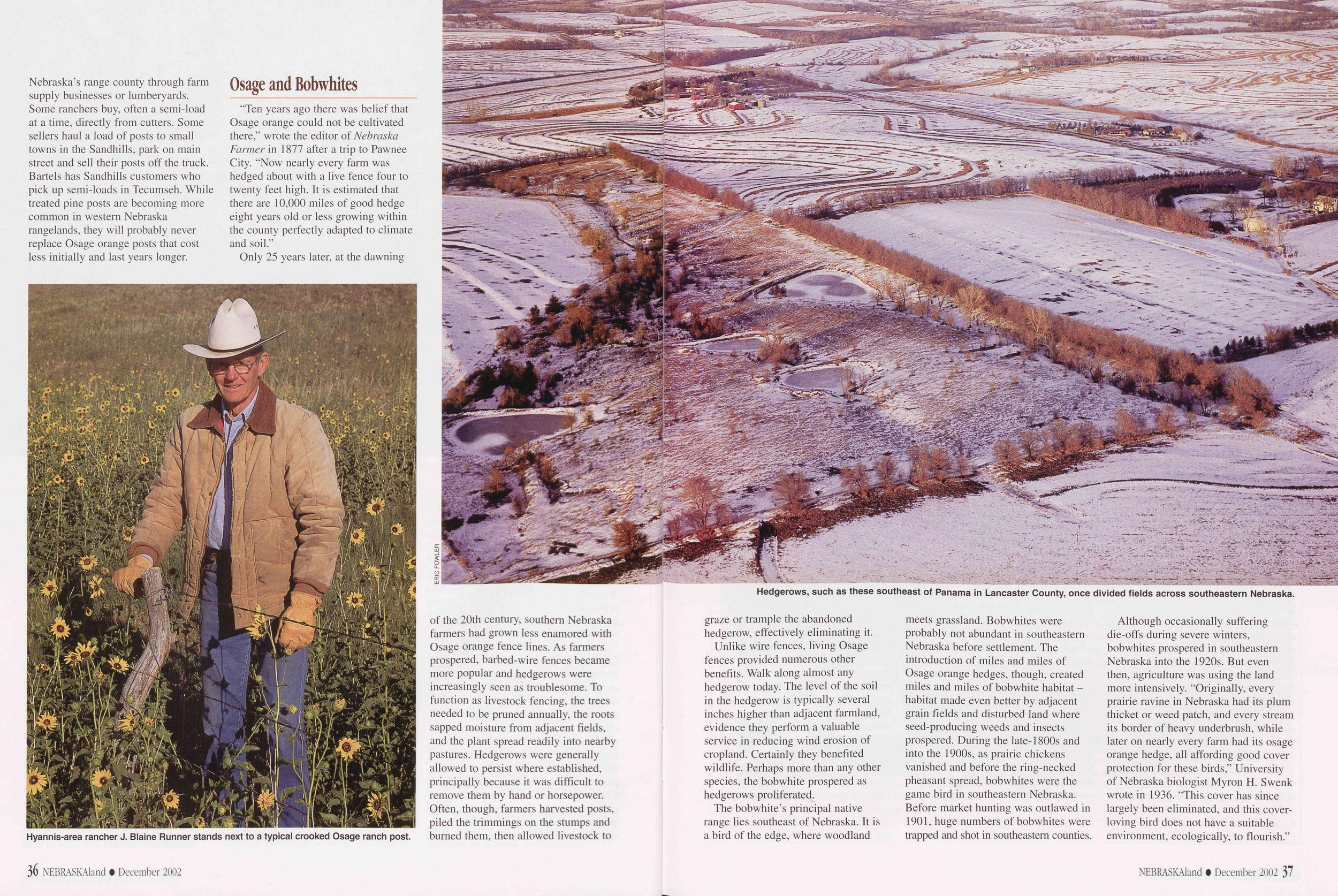 Nebraska’s range county through farm
supply businesses or lumberyards.
Some ranchers buy, often a semi-load
at a time, directly from cutters. Some
sellers haul a load of posts to small
towns in the Sandhills, park on main
street and sell their posts off the truck.
Bartels has Sandhills customers who
pick up semi-loads in Tecumseh. While
treated pine posts are becoming more
common in western Nebraska
rangelands, they will probably never
replace Osage orange posts that cost
less initially and last years longer.
Nebraska’s range county through farm
supply businesses or lumberyards.
Some ranchers buy, often a semi-load
at a time, directly from cutters. Some
sellers haul a load of posts to small
towns in the Sandhills, park on main
street and sell their posts off the truck.
Bartels has Sandhills customers who
pick up semi-loads in Tecumseh. While
treated pine posts are becoming more
common in western Nebraska
rangelands, they will probably never
replace Osage orange posts that cost
less initially and last years longer.
“Ten years ago there was belief that Osage orange could not be cultivated there,” wrote the editor of Nebraska Farmer in 1877 after a trip to Pawnee City. “Now nearly every farm was hedged about with a live fence four to twenty feet high. It is estimated that there are 10,000 miles of good hedge eight years old or less growing within the county perfectly adapted to climate and soil.”
Only 25 years later, at the dawning of the 20th century, southern Nebraska farmers had grown less enamored with Osage orange fence lines. As farmers prospered, barbed-wire fences became more popular and hedgerows were increasingly seen as troublesome. To function as livestock fencing, the trees needed to be pruned annually, the roots sapped moisture from adjacent fields, and the plant spread readily into nearby pastures. Hedgerows were generally allowed to persist where established, principally because it was difficult to remove them by hand or horsepower. Often, though, farmers harvested posts, piled the trimmings on the stumps and burned them, then allowed livestock to
Unlike wire fences, living Osage fences provided numerous other benefits. Walk along almost any hedgerow today. The level of the soil in the hedgerow is typically several inches higher than adjacent farmland, evidence they perform a valuable service in reducing wind erosion of cropland. Certainly they benefited wildlife. Perhaps more than any other species, the bobwhite prospered as hedgerows proliferated.
The bobwhite’s principal native range lies southeast of Nebraska. It is a bird of the edge, where woodland meets grassland. Bobwhites were probably not abundant in southeastern Nebraska before settlement. The introduction of miles and miles of Osage orange hedges, though, created miles and miles of bobwhite habitat - habitat made even better by adjacent grain fields and disturbed land where seed-producing weeds and insects prospered. During the late-1800s and into the 1900s, as prairie chickens vanished and before the ring-necked pheasant spread, bobwhites were the game bird in southeastern Nebraska. Before market hunting was outlawed in 1901, huge numbers of bob whites were trapped and shot in southeastern counties.
Although occasionally suffering die-offs during severe winters, bobwhites prospered in southeastern Nebraska into the 1920s. But even then, agriculture was using the land more intensively. “Originally, every prairie ravine in Nebraska had its plum thicket or weed patch, and every stream its border of heavy underbrush, while later on nearly every farm had its osage orange hedge, all affording good cover protection for these birds,” University of Nebraska biologist Myron H. Swenk wrote in 1936. “This cover has since largely been eliminated, and this cover- loving bird does not have a suitable environment, ecologically, to flourish.”
36 NEBRASKAland • December 2002 NEBRASKAland • December 2002 37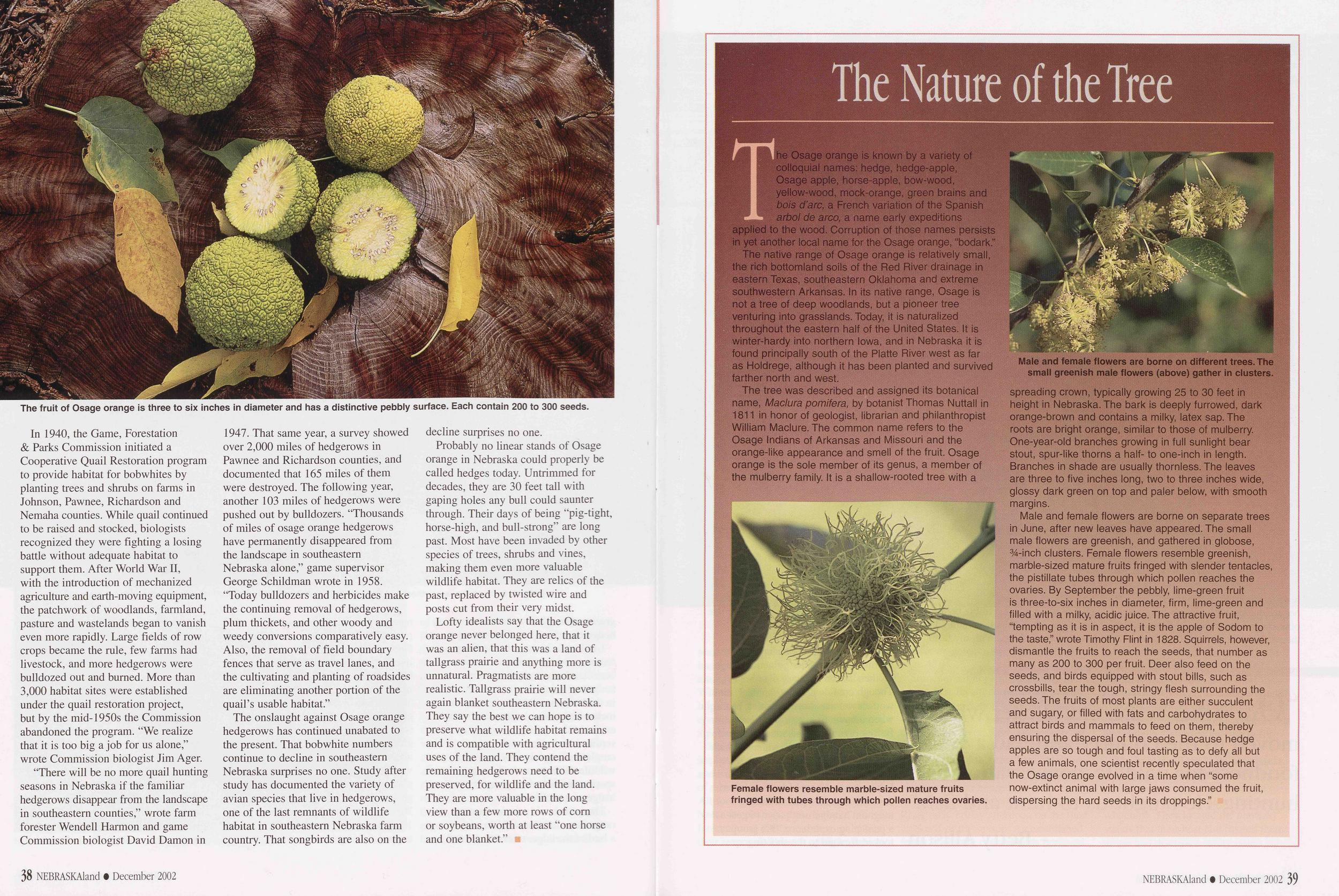
In 1940, the Game, Forestation & Parks Commission initiated a Cooperative Quail Restoration program to provide habitat for bobwhites by planting trees and shrubs on farms in Johnson, Pawnee, Richardson and Nemaha counties. While quail continued to be raised and stocked, biologists recognized they were fighting a losing battle without adequate habitat to support them. After World War II, with the introduction of mechanized agriculture and earth-moving equipment, the patch work of woodlands, farmland, pasture and wastelands began to vanish even more rapidly. Large fields of row crops became the rule, few farms had livestock, and more hedgerows were bulldozed out and burned. More than 3,000 habitat sites were established under the quail restoration project, but by the mid-1950s the Commission abandoned the program. "We realize that it is too big a job for us alone,” wrote Commission biologist Jim Ager.
"There will be no more quail hunting seasons in Nebraska if the familiar hedgerows disappear from the landscape in southeastern counties,” wrote farm forester Wendell Harmon and game Commission biologist David Damon in 1947. That same year, a survey showed over 2,000 miles of hedgerows in Pawnee and Richardson counties, and documented that 165 miles of them were destroyed. The following year, another 103 miles of hedgerows were pushed out by bulldozers. "Thousands of miles of osage orange hedgerows have permanently disappeared from the landscape in southeastern Nebraska alone,” game supervisor George Schildman wrote in 1958. "Today bulldozers and herbicides make the continuing removal of hedgerows, plum thickets, and other woody and weedy conversions comparatively easy. Also, the removal of field boundary fences that serve as travel lanes, and the cultivating and planting of roadsides are eliminating another portion of the quail’s usable habitat.”
The onslaught against Osage orange hedgerows has continued unabated to the present. That bobwhite numbers continue to decline in southeastern Nebraska surprises no one. Study after study has documented the variety of avian species that live in hedgerows, one of the last remnants of wildlife habitat in southeastern Nebraska farm country. That songbirds are also on the decline surprises no one.
Probably no linear stands of Osage orange in Nebraska could properly be called hedges today. Untrimmed for decades, they are 30 feet tall with gaping holes any bull could saunter through. Their days of being "pig-tight, horse-high, and bull-strong” are long past. Most have been invaded by other species of trees, shrubs and vines, making them even more valuable wildlife habitat. They are relics of the past, replaced by twisted wire and posts cut from their very midst.
Lofty idealists say that the Osage orange never belonged here, that it was an alien, that this was a land of tailgrass prairie and anything more is unnatural. Pragmatists are more realistic. Tailgrass prairie will never again blanket southeastern Nebraska. They say the best we can hope is to preserve what wildlife habitat remains and is compatible with agricultural uses of the land. They contend the remaining hedgerows need to be preserved, for wildlife and the land. They are more valuable in the long view than a few more rows of com or soybeans, worth at least "one horse and one blanket.”
The Nature of the Tree
The Osage orange is known by a variety of colloquial names: headge, hedge-apple, Osage apple, horse-apple, bow-wood, yellow-wood, mock-orange, green brains and bois d'arc, a French variation of the Spanish arbol de arco, a name early expeditions applied to the wood. Corruption of those names persists in yet another local name for the Osage orange, “bodark ”
The native range of Osage orange is relatively small, the rich bottomland soils of the Red River drainage in eastern Texas, southeastern Oklahoma and extreme southwestern Arkansas. In its native range, Osage is not a tree of deep woodlands, but a pioneer tree venturing into grasslands. Today, it is naturalized throughout the eastern half of the United States. It is winter-hardy into northern Iowa, and in Nebraska it is found principally south of the Platte River west as far as Holdrege, although it has been planted and survived farther north and west.
The tree was described and assigned its botanical name, Madura pomifera, by botanist Thomas Nuttall in 1811 in honor of geologist, librarian and philanthropist William Maclure. The common name refers to the Osage Indians of Arkansas and Missouri and the orange-like appearance and smell of the fruit. Osage orange is the sole member of its genus, a member of the mulberry family. It is a shallow-rooted tree with a
Male and female flowers are borne on separate trees in June, after new leaves have appeared. The small male flowers are greenish, and gathered in globose, 3/4-inch clusters. Female flowers resemble greenish, marble-sized mature fruits fringed with slender tentacles, the pistillate tubes through which pollen reaches the ovaries. By September the pebbly, lime-green fruit is three-to-six inches in diameter, firm, lime-green and filled with a milky, acidic juice. The attractive fruit, “tempting as it is in aspect, it is the apple of Sodom to the taste,” wrote Timothy Flint in 1828. Squirrels, however, dismantle the fruits to reach the seeds, that number as many as 200 to 300 per fruit. Deer also feed on the seeds, and birds equipped with stout bills, such as crossbills, tear the tough, stringy flesh surrounding the seeds. The fruits of most plants are either succulent and sugary, or filled with fats and carbohydrates to attract birds and mammals to feed on them, thereby ensuring the dispersal of the seeds. Because hedge apples are so tough and foul tasting as to defy all but a few animals, one scientist recently speculated that the Osage orange evolved in a time when “some now-extinct animal with large jaws consumed the fruit, dispersing the hard seeds in its droppings.”
38 NEBRASKAland • December 2002 NEBRASKAland • December 2002 39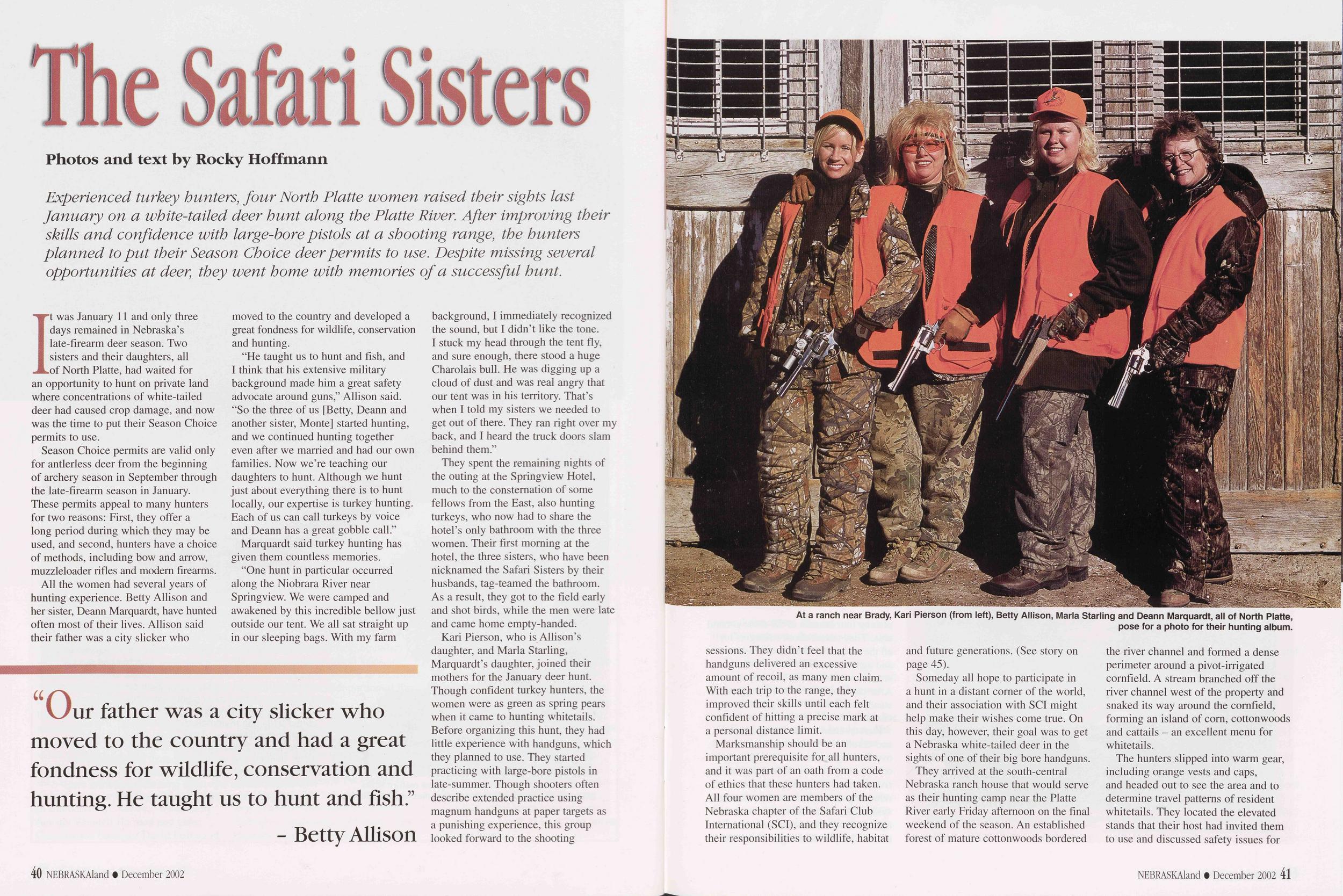
The Safari Sisters
Photos and text by Rocky Hoffmann Experienced turkey hunters, four North Platte women raised their sights last January on a white-tailed deer hunt along the Platte River. After improving their skills and confidence with large-bore pistols at a shooting range, the hunters planned to put their Season Choice deer permits to use. Despite missing several opportunities at deer, they went home with memories of a successful hunt.It was January 11 and only three days remained in Nebraska’s late-firearm deer season. Two sisters and their daughters, all of North Platte, had waited for an opportunity to hunt on private land where concentrations of white-tailed deer had caused crop damage, and now was the time to put their Season Choice permits to use.
Season Choice permits are valid only for antlerless deer from the beginning of archery season in September through the late-firearm season in January. These permits appeal to many hunters for two reasons: First, they offer a long period during which they may be used, and second, hunters have a choice of methods, including bow and arrow, muzzleloader rifles and modem firearms.
"Our father was a city slicker who moved to the country and had a great fondness for wildlife, conservation and hunting. He taught us to hunt and fish.” -Betty AllisonAll the women had several years of hunting experience. Betty Allison and her sister, Deann Marquardt, have hunted often most of their lives. Allison said their father was a city slicker who moved to the country and developed a great fondness for wildlife, conservation and hunting.
“He taught us to hunt and fish, and I think that his extensive military background made him a great safety advocate around guns,” Allison said. “So the three of us [Betty, Deann and another sister, Monte] started hunting, and we continued hunting together even after we married and had our own families. Now we’re teaching our daughters to hunt. Although we hunt just about everything there is to hunt locally, our expertise is turkey hunting. Each of us can call turkeys by voice and Deann has a great gobble call.”
Marquardt said turkey hunting has given them countless memories.
“One hunt in particular occurred along the Niobrara River near Springview. We were camped and awakened by this incredible bellow just outside our tent. We all sat straight up in our sleeping bags. With my farm background, I immediately recognized the sound, but I didn’t like the tone. I stuck my head through the tent fly, and sure enough, there stood a huge Charolais bull. He was digging up a cloud of dust and was real angry that our tent was in his territory. That’s when I told my sisters we needed to get out of there. They ran right over my back, and I heard the truck doors slam behind them.”
They spent the remaining nights of the outing at the Springview Hotel, much to the consternation of some fellows from the East, also hunting turkeys, who now had to share the hotel’s only bathroom with the three women. Their first morning at the hotel, the three sisters, who have been nicknamed the Safari Sisters by their husbands, tag-teamed the bathroom. As a result, they got to the field early and shot birds, while the men were late and came home empty-handed.
Kari Pierson, who is Allison’s daughter, and Marla Starling, Marquardt’s daughter, joined their mothers for the January deer hunt. Though confident turkey hunters, the women were as green as spring pears when it came to hunting whitetails. Before organizing this hunt, they had little experience with handguns, which they planned to use. They started practicing with large-bore pistols in late-summer. Though shooters often describe extended practice using magnum handguns at paper targets as a punishing experience, this group looked forward to the shooting
Marksmanship should be an important prerequisite for all hunters, and it was part of an oath from a code of ethics that these hunters had taken. All four women are members of the Nebraska chapter of the Safari Club International (SCI), and they recognize their responsibilities to wildlife, habitat and future generations. (See story on page 45).
Someday all hope to participate in a hunt in a distant corner of the world, and their association with SCI might help make their wishes come true. On this day, however, their goal was to get a Nebraska white-tailed deer in the sights of one of their big bore handguns.
They arrived at the south-central Nebraska ranch house that would serve as their hunting camp near the Platte River early Friday afternoon on the final weekend of the season. An established forest of mature cottonwoods bordered the river channel and formed a dense perimeter around a pivot-irrigated cornfield. A stream branched off the river channel west of the property and snaked its way around the cornfield, forming an island of corn, cottonwoods and cattails - an excellent menu for whitetails.
The hunters slipped into warm gear, including orange vests and caps, and headed out to see the area and to determine travel patterns of resident whitetails. They located the elevated stands that their host had invited them to use and discussed safety issues for
40 NEBRASKAland • December 2002 NEBRASKAland • December 2002 41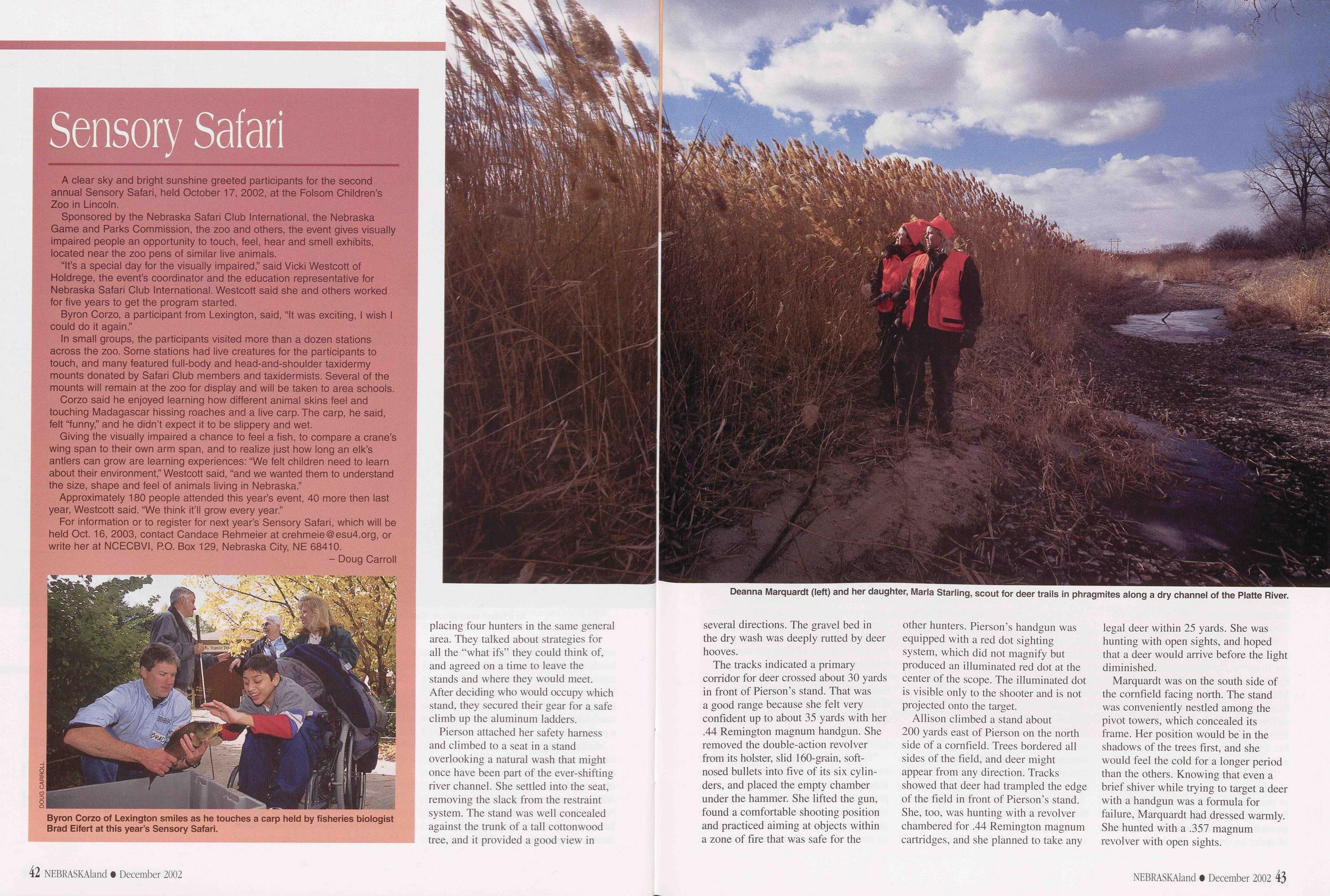 Sensory Safari
A clear sky and bright sunshine greeted participants for the second annual Sensory Safari, held October 17, 2002, at the Folsom Children’s Zoo in Lincoln.
Sponsored by the Nebraska Safari Club International, the Nebraska Game and Parks Commission, the zoo and others, the event gives visually impaired people an opportunity to touch, feel, hear and smell exhibits, located near the zoo pens of similar live animals.
“It’s a special day for the visually impaired,” said Vicki Westcott of Holdrege, the event’s coordinator and the education representative for Nebraska Safari Club International. Westcott said she and others worked for five years to get the program started.
Byron Corzo, a participant from Lexington, said, “It was exciting, I wish I could do it again.”
In small groups, the participants visited more than a dozen stations across the zoo. Some stations had live creatures for the participants to touch, and many featured full-body and head-and-shoulder taxidermy mounts donated by Safari Club members and taxidermists. Several of the mounts will remain at the zoo for display and will be taken to area schools.
Corzo said he enjoyed learning how different animal skins feel and touching Madagascar hissing roaches and a live carp. The carp, he said, felt “funny,” and he didn’t expect it to be slippery and wet.
Giving the visually impaired a chance to feel a fish, to compare a crane’s wing span to their own arm span, and to realize just how long an elk’s antlers can grow are learning experiences: “We felt children need to learn about their environment,” Westcott said, “and we wanted them to understand the size, shape and feel of animals living in Nebraska.”
Approximately 180 people attended this year’s event, 40 more then last year, Westcott said. “We think it’ll grow every year.”
For information or to register for next year’s Sensory Safari, which will be held Oct. 16, 2003, contact Candace Rehmeier at crehmeie@esu4.org, or write her at NCECBVI, P.O. Box 129, Nebraska City, NE 68410.
- Doug Carrollplacing four hunters in the same general area. They talked about strategies for all the “what ifs” they could think of, and agreed on a time to leave the stands and where they would meet. After deciding who would occupy which stand, they secured their gear for a safe climb up the aluminum ladders.
Pierson attached her safety harness and climbed to a seat in a stand overlooking a natural wash that might once have been part of the ever-shifting river channel. She settled into the seat, removing the slack from the restraint system. The stand was well concealed against the trunk of a tall cottonwood tree, and it provided a good view in several directions. The gravel bed in the dry wash was deeply rutted by deer hooves.
The tracks indicated a primary corridor for deer crossed about 30 yards in front of Pierson’s stand. That was a good range because she felt very confident up to about 35 yards with her .44 Remington magnum handgun. She removed the double-action revolver from its holster, slid 160-grain, soft- nosed bullets into five of its six cylin- ders, and placed the empty chamber under the hammer. She lifted the gun, found a comfortable shooting position and practiced aiming at objects within a zone of fire that was safe for the other hunters. Pierson’s handgun was equipped with a red dot sighting system, which did not magnify but produced an illuminated red dot at the center of the scope. The illuminated dot is visible only to the shooter and is not projected onto the target.
Allison climbed a stand about 200 yards east of Pierson on the north side of a cornfield. Trees bordered all sides of the field, and deer might appear from any direction. Tracks showed that deer had trampled the edge of the field in front of Pierson’s stand. She, too, was hunting with a revolver chambered for .44 Remington magnum cartridges, and she planned to take any legal deer within 25 yards. She was hunting with open sights, and hoped that a deer would arrive before the light diminished.
Marquardt was on the south side of the cornfield facing north. The stand was conveniently nestled among the pivot towers, which concealed its frame. Her position would be in the shadows of the trees first, and she would feel the cold for a longer period than the others. Knowing that even a brief shiver while trying to target a deer with a handgun was a formula for failure, Marquardt had dressed warmly. She hunted with a .357 magnum revolver with open sights.
42 NEBRASKAland • December 2002 NEBRASKAland • December 2002 43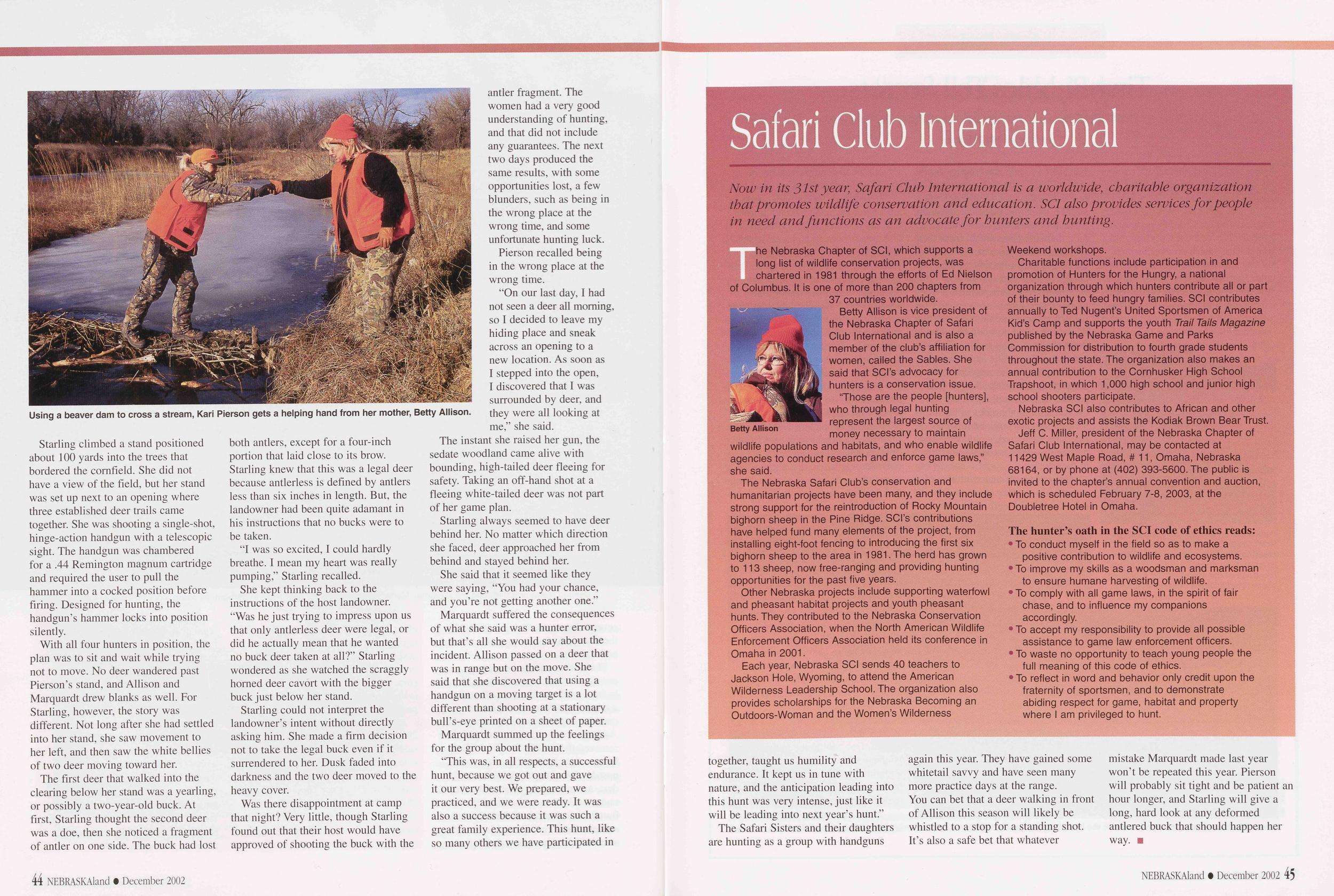
Starling climbed a stand positioned about 100 yards into the trees that bordered the cornfield. She did not have a view of the field, but her stand was set up next to an opening where three established deer trails came together. She was shooting a single-shot, hinge-action handgun with a telescopic sight. The handgun was chambered for a .44 Remington magnum cartridge and required the user to pull the hammer into a cocked position before firing. Designed for hunting, the handgun’s hammer locks into position silently.
With all four hunters in position, the plan was to sit and wait while trying not to move. No deer wandered past Pierson’s stand, and Allison and Marquardt drew blanks as well. For Starling, however, the story was different. Not long after she had settled into her stand, she saw movement to her left, and then saw the white bellies of two deer moving toward her.
The first deer that walked into the clearing below her stand was a yearling, or possibly a two-year-old buck. At first, Starling thought the second deer was a doe, then she noticed a fragment of antler on one side. The buck had lost both antlers, except for a four-inch portion that laid close to its brow. Starling knew that this was a legal deer because antlerless is defined by antlers less than six inches in length. But, the landowner had been quite adamant in his instructions that no bucks were to be taken.
"I was so excited, I could hardly breathe. I mean my heart was really pumping,” Starling recalled.
She kept thinking back to the instructions of the host landowner. “Was he just trying to impress upon us that only antlerless deer were legal, or did he actually mean that he wanted no buck deer taken at all?” Starling wondered as she watched the scraggly horned deer cavort with the bigger buck just below her stand.
Starling could not interpret the landowner’s intent without directly asking him. She made a firm decision not to take the legal buck even if it surrendered to her. Dusk faded into darkness and the two deer moved to the heavy cover.
Was there disappointment at camp that night? Very little, though Starling found out that their host would have approved of shooting the buck with the antler fragment. The women had a very good understanding of hunting, and that did not include any guarantees. The next two days produced the same results, with some opportunities lost, a few blunders, such as being in the wrong place at the wrong time, and some unfortunate hunting luck.
Pierson recalled being in the wrong place at the wrong time.
“On our last day, I had not seen a deer all morning, so I decided to leave my hiding place and sneak across an opening to a new location. As soon as I stepped into the open, I discovered that I was surrounded by deer, and they were all looking at me,” she said.
The instant she raised her gun, the sedate woodland came alive with bounding, high-tailed deer fleeing for safety. Taking an off-hand shot at a fleeing white-tailed deer was not part of her game plan.
Starling always seemed to have deer behind her. No matter which direction she faced, deer approached her from behind and stayed behind her.
She said that it seemed like they were saying, “You had your chance, and you’re not getting another one.”
Marquardt suffered the consequences of what she said was a hunter error, but that’s all she would say about the incident. Allison passed on a deer that was in range but on the move. She said that she discovered that using a handgun on a moving target is a lot different than shooting at a stationary bull’s-eye printed on a sheet of paper.
Marquardt summed up the feelings for the group about the hunt.
“This was, in all respects, a successful hunt, because we got out and gave it our very best. We prepared, we practiced, and we were ready. It was also a success because it was such a great family experience. This hunt, like so many others we have participated in
together, taught us humility and endurance. It kept us in tune with nature, and the anticipation leading into this hunt was very intense, just like it will be leading into next year’s hunt.”
The Safari Sisters and their daughters are hunting as a group with handguns again this year. They have gained some whitetail savvy and have seen many more practice days at the range. You can bet that a deer walking in front of Allison this season will likely be whistled to a stop for a standing shot. It’s also a safe bet that whatever mistake Marquardt made last year won’t be repeated this year. Pierson will probably sit tight and be patient an hour longer, and Starling will give a long, hard look at any deformed antlered buck that should happen her way.
Safari Club International Now in its 31st year, Safari Club International is a worldwide, charitable organization that promotes wildlife conservation and education. SCI also provides services for people in need and functions as an advocate for hunters and hunting.The Nebraska Chapter of SCI, which supports a long list of wildlife conservation projects, was chartered in 1981 through the efforts of Ed Nielson of Columbus. It is one of more than 200 chapters from 37 countries worldwide.
Betty Allison is vice president of the Nebraska Chapter of Safari Club International and is also a member of the club’s affiliation for women, called the Sables. She said that SCI’s advocacy for hunters is a conservation issue.
“Those are the people [hunters], who through legal hunting represent the largest source of money necessary to maintain wildlife populations and habitats, and who enable wildlife agencies to conduct research and enforce game laws,” she said.
The Nebraska Safari Club’s conservation and humanitarian projects have been many, and they include strong support for the reintroduction of Rocky Mountain bighorn sheep in the Pine Ridge. SCI’s contributions have helped fund many elements of the project, from installing eight-foot fencing to introducing the first six bighorn sheep to the area in 1981. The herd has grown to 113 sheep, now free-ranging and providing hunting opportunities for the past five years.
Other Nebraska projects include supporting waterfowl and pheasant habitat projects and youth pheasant hunts. They contributed to the Nebraska Conservation Officers Association, when the North American Wildlife Enforcement Officers Association held its conference in Omaha in 2001.
Each year, Nebraska SCI sends 40 teachers to Jackson Hole, Wyoming, to attend the American Wilderness Leadership School. The organization also provides scholarships for the Nebraska Becoming an Outdoors-Woman and the Women’s Wilderness Weekend workshops.
Charitable functions include participation in and promotion of Hunters for the Hungry, a national organization through which hunters contribute all or part of their bounty to feed hungry families. SCI contributes annually to Ted Nugent’s United Sportsmen of America Kid’s Camp and supports the youth Trail Tails Magazine published by the Nebraska Game and Parks Commission for distribution to fourth grade students throughout the state. The organization also makes an annual contribution to the Cornhusker High School Trapshoot, in which 1,000 high school and junior high school shooters participate.
Nebraska SCI also contributes to African and other exotic projects and assists the Kodiak Brown Bear Trust.
Jeff C. Miller, president of the Nebraska Chapter of Safari Club International, may be contacted at 11429 West Maple Road, #11, Omaha, Nebraska 68164, or by phone at (402) 393-5600. The public is invited to the chapter’s annual convention and auction, which is scheduled February 7-8, 2003, at the Doubletree Hotel in Omaha.
The hunter’s oath in the SCI code of ethics reads:
•To conduct myself in the field so as to make a positive contribution to wildlife and ecosystems. •To improve my skills as a woodsman and marksman to ensure humane harvesting of wildlife. •To comply with all game laws, in the spirit of fair chase, and to influence my companions accordingly. •To accept my responsibility to provide all possible assistance to game law enforcement officers. •To waste no opportunity to teach young people the full meaning of this code of ethics. •To reflect in word and behavior only credit upon the fraternity of sportsmen, and to demonstrate abiding respect for game, habitat and property where I am privileged to hunt. 44 NEBRASKAland • December 2002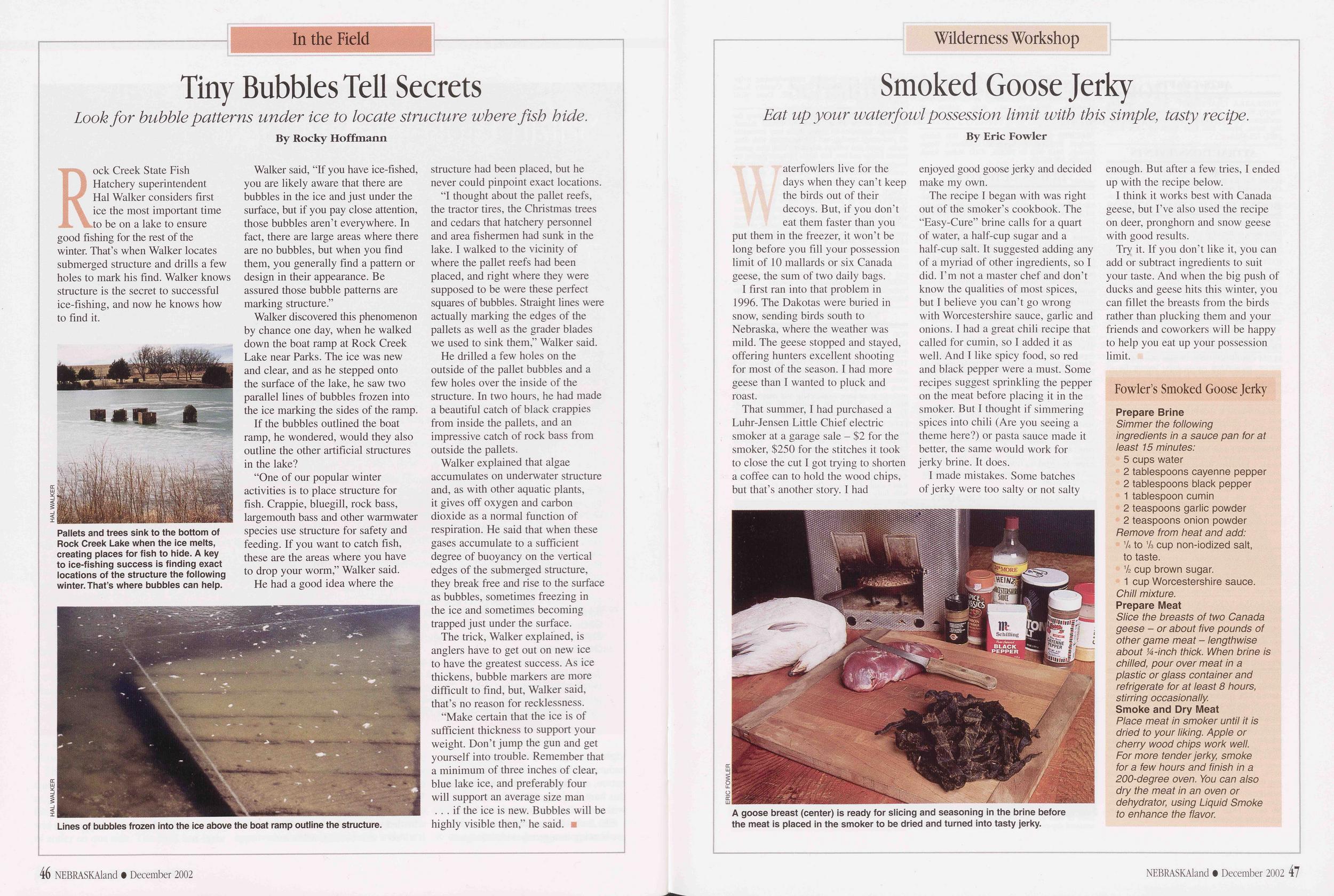
Rock Creek State Fish Hatchery superintendent Hal Walker considers first ice the most important time to be on a lake to ensure good fishing for the rest of the winter. That’s when Walker locates submerged structure and drills a few holes to mark his find. Walker knows structure is the secret to successful ice-fishing, and now he knows how to find it.
Walker said, "If you have ice-fished, you are likely aware that there are bubbles in the ice and just under the surface, but if you pay close attention, those bubbles aren’t everywhere. In fact, there are large areas where there are no bubbles, but when you find them, you generally find a pattern or design in their appearance. Be assured those bubble patterns are marking structure.”
Walker discovered this phenomenon by chance one day, when he walked down the boat ramp at Rock Creek Lake near Parks. The ice was new and clear, and as he stepped onto the surface of the lake, he saw two parallel lines of bubbles frozen into the ice marking the sides of the ramp. If the bubbles outlined the boat ramp, he wondered, would they also outline the other artificial structures in the lake?
"One of our popular winter activities is to place structure for fish. Crappie, bluegill, rock bass, largemouth bass and other warmwater species use structure for safety and feeding. If you want to catch fish, these are the areas where you have to drop your worm,” Walker said.
He had a good idea where the structure had been placed, but he never could pinpoint exact locations.
"I thought about the pallet reefs, the tractor tires, the Christmas trees and cedars that hatchery personnel and area fishermen had sunk in the lake. I walked to the vicinity of where the pallet reefs had been placed, and right where they were supposed to be were these perfect squares of bubbles. Straight lines were actually marking the edges of the pallets as well as the grader blades we used to sink them,” Walker said.
He drilled a few holes on the outside of the pallet bubbles and a few holes over the inside of the structure. In two hours, he had made a beautiful catch of black crappies from inside the pallets, and an impressive catch of rock bass from outside the pallets.
Walker explained that algae accumulates on underwater structure and, as with other aquatic plants, it gives off oxygen and carbon dioxide as a normal function of respiration. He said that when these gases accumulate to a sufficient degree of buoyancy on the vertical edges of the submerged structure, they break free and rise to the surface as bubbles, sometimes freezing in the ice and sometimes becoming trapped just under the surface.
The trick, Walker explained, is anglers have to get out on new ice to have the greatest success. As ice thickens, bubble markers are more difficult to find, but, Walker said, that’s no reason for recklessness.
“Make certain that the ice is of sufficient thickness to support your weight. Don’t jump the gun and get yourself into trouble. Remember that a minimum of three inches of clear, blue lake ice, and preferably four will support an average size man ... if the ice is new. Bubbles will be highly visible then,” he said.
Waterfowlers live for the days when they can’t keep the birds out of their decoys. But, if you don’t eat them faster than you put them in the freezer, it won’t be long before you fill your possession limit of 10 mallards or six Canada geese, the sum of two daily bags. I first ran into that problem in 1996. The Dakotas were buried in snow, sending birds south to Nebraska, where the weather was mild. The geese stopped and stayed, offering hunters excellent shooting for most of the season. I had more geese than I wanted to pluck and roast.
That summer, I had purchased a Luhr-Jensen Little Chief electric smoker at a garage sale - $2 for the smoker, $250 for the stitches it took to close the cut I got trying to shorten a coffee can to hold the wood chips, but that’s another story. I had
The recipe I began with was right out of the smoker’s cookbook. The “Easy-Cure” brine calls for a quart of water, a half-cup sugar and a half-cup salt. It suggested adding any of a myriad of other ingredients, so I did. I’m not a master chef and don’t know the qualities of most spices, but I believe you can’t go wrong with Worcestershire sauce, garlic and onions. I had a great chili recipe that called for cumin, so I added it as well. And I like spicy food, so red and black pepper were a must. Some recipes suggest sprinkling the pepper on the meat before placing it in the smoker. But I thought if simmering spices into chili (Are you seeing a theme here?) or pasta sauce made it better, the same would work for jerky brine. It does.
I made mistakes. Some batches of jerky were too salty or not salty enough. But after a few tries, I ended up with the recipe below.
I think it works best with Canada geese, but I’ve also used the recipe on deer, pronghorn and snow geese with good results.
Try it. If you don’t like it, you can add or subtract ingredients to suit your taste. And when the big push of ducks and geese hits this winter, you can fillet the breasts from the birds rather than plucking them and your friends and coworkers will be happy to help you eat up your possession limit.
Fowler’s Smoked Goose JerkyPrepare Brine Simmer the following ingredients in a sauce pan for at least 15 minutes:
5 cups water 2 tablespoons cayenne pepper 2 tablespoons black pepper 1 tablespoon cumin 2 teaspoons garlic powder 2 teaspoons onion powderRemove from heat and add:
1/4 to 1/3 cup non-iodized salt, to taste. 1/2 cup brown sugar. 1 cup Worcestershire sauce.Chill mixture.
Prepare Meat Slice the breasts of two Canada geese - or about five pounds of other game meat - lengthwise about 1/4-inch thick. When brine is chilled, pour over meat in a plastic or glass container and refrigerate for at least 8 hours, stirring occasionally.
Smoke and Dry Meat Place meat in smoker until it is dried to your liking. Apple or cherry wood chips work well. For more tender jerky, smoke for a few hours and finish in a 200-degree oven. You can also dry the meat in an oven or dehydrator, using Liquid Smoke to enhance the flavor.
46 NEBRASKAland • December 2002 NEBRASKAland • December 2002 47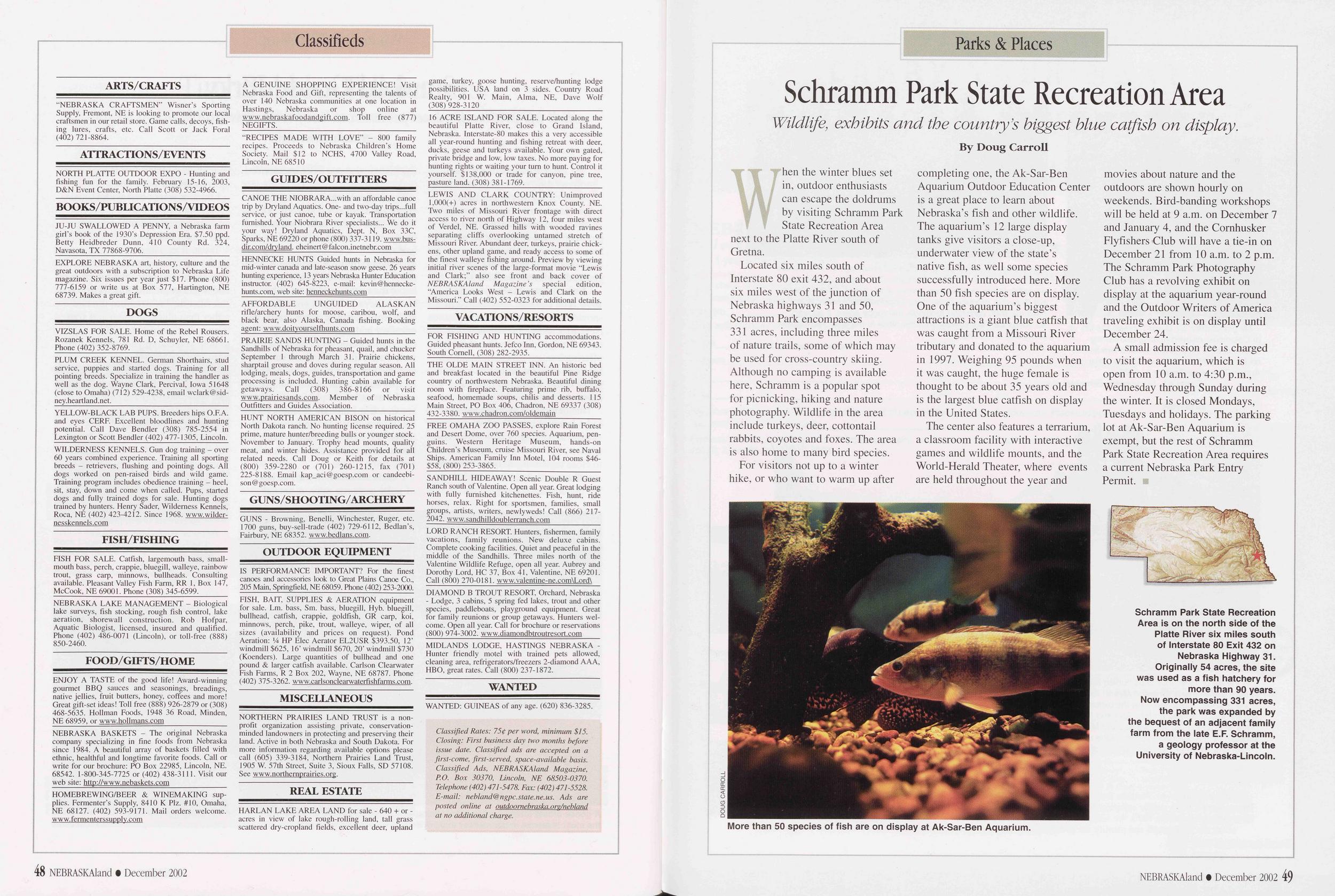
“NEBRASKA CRAFTSMEN” Wisner’s Sporting Supply, Fremont, NE is looking to promote our local craftsmen in our retail store. Game calls, decoys, fish- ing lures, crafts, etc. Call Scott or Jack Foral (402) 721-8864.
ATTRACTIONS/EVENTSNORTH PLATTE OUTDOOR EXPO - Hunting and fishing fun for the family. February 15-16, 2003, D&N Event Center, North Platte (308) 532-4966.
BOOKS/PUBLICATIONS/VIDEOSJU-JU SWALLOWED A PENNY, a Nebraska farm girl’s book of the 1930’s Depression Era. $7.50 ppd. Betty Heidbreder Dunn, 410 County Rd. 324, Navasota, TX 77868-9706.
EXPLORE NEBRASKA art, history, culture and the great outdoors with a subscription to Nebraska Life magazine. Six issues per year just $17. Phone (800) 777-6159 or write us at Box 577, Hartington, NE 68739. Makes a great gift.
DOGSVIZSLAS FOR SALE. Home of the Rebel Rousers. Rozanek Kennels, 781 Rd. D, Schuyler, NE 68661. Phone (402) 352-8769.
PLUM CREEK KENNEL. German Shorthairs, stud service, puppies and started dogs. Training for all pointing breeds. Specialize in training the handler as well as the dog. Wayne Clark, Percival, Iowa 51648 (close to Omaha) (712) 529-4238, email wclark@sid- ney.heartland.net.
YELLOW-BLACK LAB PUPS. Breeders hips O.F.A. and eyes CERF. Excellent bloodlines and hunting potential. Call Dave Bendler (308) 785-2554 in Lexington or Scott Bendler (402) 477-1305, Lincoln.
WILDERNESS KENNELS. Gun dog training - over 60 years combined experience. Training all sporting breeds - retrievers, flushing and pointing dogs. All dogs worked on pen-raised birds and wild game. Training program includes obedience training - heel, sit, stay, down and come when called. Pups, started dogs and fully trained dogs for sale. Hunting dogs trained by hunters. Henry Sader, Wilderness Kennels, Roca, NE (402) 423-4212. Since 1968. www.wilder- nesskennels.com
FISH/FISHINGFISH FOR SALE. Catfish, largemouth bass, small- mouth bass, perch, crappie, bluegill, walleye, rainbow trout, grass carp, minnows, bullheads. Consulting available. Pleasant Valley Fish Farm, RR 1, Box 147, McCook, NE 69001. Phone (308) 345-6599.
NEBRASKA LAKE MANAGEMENT - Biological lake surveys, fish stocking, rough fish control, lake aeration, shorewall construction. Rob Hofpar, Aquatic Biologist, licensed, insured and qualified. Phone (402) 486-0071 (Lincoln), or toll-free (888) 850-2460.
FOOD/GIFTS/HOMEENJOY A TASTE of the good life! Award-winning gourmet BBQ sauces and seasonings, breadings, native jellies, fruit butters, honey, coffees and more! Great gift-set ideas! Toll free (888) 926-2879 or (308) 468-5635. Hollman Foods, 1948 36 Road, Minden, NE 68959, or www.hollmans.com
NEBRASKA BASKETS - The original Nebraska company specializing in fine foods from Nebraska since 1984. A beautiful array of baskets filled with ethnic, healthful and longtime favorite foods. Call or write for our brochure: PO Box 22985, Lincoln, NE. 68542. 1-800-345-7725 or (402) 438-3111. Visit our web site: http://www.nebaskets.com
HOMEBREWING/BEER & WINEMAKING sup- plies. Fermenter’s Supply, 8410 K Plz. #10, Omaha, NE 68127. (402) 593-9171. Mail orders welcome. www.fermenterssupply.com
A GENUINE SHOPPING EXPERIENCE! Visit Nebraska Food and Gift, representing the talents of over 140 Nebraska communities at one location in Hastings, Nebraska or shop online at www.nebraskafoodandgift.com. Toll free (877) NEGIFTS.
“RECIPES MADE WITH LOVE” - 800 family recipes. Proceeds to Nebraska Children’s Home Society. Mail $12 to NCHS, 4700 Valley Road, Lincoln, NE 68510
GUIDES/OUTFITTERSCANOE THE NIOBRARA...with an affordable canoe trip by Dryland Aquatics. One- and two-day trips...full service, or just canoe, tube or kayak. Transportation furnished. Your Niobrara River specialists... We do it your way! Dryland Aquatics, Dept. N, Box 33C, Sparks, NE 69220 or phone (800) 337-3119. www.bus- dir.com/dryland. eheinert@falcon.inetnebr.com
HENNECKE HUNTS Guided hunts in Nebraska for mid-winter Canada and late-season snow geese. 26 years hunting experience, 13 years Nebraska Hunter Education instructor. (402) 645-8223, e-mail: kevin@hennecke- hunts.com, web site: henneckehunts.com
AFFORDABLE UNGUIDED ALASKAN rifle/archery hunts for moose, caribou, wolf, and black bear, also Alaska, Canada fishing. Booking agent: www.doityourselfhunts.com
PRAIRIE SANDS HUNTING - Guided hunts in the Sandhills of Nebraska for pheasant, quail, and chucker September 1 through March 31. Prairie chickens, sharptail grouse and doves during regular season. All lodging, meals, dogs, guides, transportation and game processing is included. Hunting cabin available for getaways. Call (308) 386-8166 or visit www.prairiesands.com. Member of Nebraska Outfitters and Guides Association.
HUNT NORTH AMERICAN BISON on historical North Dakota ranch. No hunting license required. 25 prime, mature hunter/breeding bulls or younger stock. November to January. Trophy head mounts, quality meat, and winter hides. Assistance provided for all related needs. Call Doug or Keith for details at (800) 359-2280 or (701) 260-1215, fax (701) 225-8188. Email kap_aci@goesp.com or candeebi- son@goesp.com.
GUNS/SHOOTING/ARCHERYGUNS - Browning, Benelli, Winchester, Ruger, etc. 1700 guns, buy-sell-trade (402) 729-6112, Bedlan’s, Fairbury, NE 68352. www.bedlans.com.
OUTDOOR EQUIPMENTIS PERFORMANCE IMPORTANT? For the finest canoes and accessories look to Great Plains Canoe Co., 205 Main, Springfield, NE 68059. Phone (402) 253-2000.
FISH, BAIT, SUPPLIES & AERATION equipment for sale. Lm. bass, Sm. bass, bluegill, Hyb. bluegill, bullhead, catfish, crappie, goldfish, GR carp, koi, minnows, perch, pike, trout, walleye, wiper, of all sizes (availability and prices on request). Pond Aeration: 1/4 HP Elec Aerator EL2USR $393.50, 12’ windmill $625, 16’ windmill $670, 20’ windmill $730 (Koenders). Large quantities of bullhead and one pound & larger catfish available. Carlson Clearwater Fish Farms, R 2 Box 202, Wayne, NE 68787. Phone (402) 375-3262. www.carlsonclearwaterfishfarms.com.
MISCELLANEOUSNORTHERN PRAIRIES LAND TRUST is a non- profit organization assisting private, conservation- minded landowners in protecting and preserving their land. Active in both Nebraska and South Dakota. For more information regarding available options please call (605) 339-3184, Northern Prairies Land Trust, 1905 W. 57th Street, Suite 3, Sioux Falls, SD 57108. See www.northernprairies.org.
REAL ESTATEHARLAN LAKE AREA LAND for sale - 640 + or - acres in view of lake rough-rolling land, tall grass scattered dry-cropland fields, excellent deer, upland game, turkey, goose hunting, reserve/hunting lodge possibilities. USA land on 3 sides. Country Road Realty, 901 W. Main, Alma, NE, Dave Wolf (308) 928-3120
16 ACRE ISLAND FOR SALE. Located along the beautiful Platte River, close to Grand Island, Nebraska. Interstate-80 makes this a very accessible all year-round hunting and fishing retreat with deer, ducks, geese and turkeys available. Your own gated, private bridge and low, low taxes. No more paying for hunting rights or waiting your turn to hunt. Control it yourself. $138,000 or trade for canyon, pine tree, pasture land. (308) 381-1769.
LEWIS AND CLARK COUNTRY: Unimproved l,000(+) acres in northwestern Knox County. NE. Two miles of Missouri River frontage with direct access to river north of Highway 12, four miles west of Verdel, NE. Grassed hills with wooded ravines separating cliffs overlooking untamed stretch of Missouri River. Abundant deer, turkeys, prairie chick- ens, other upland game, and ready access to some of the finest walleye fishing around. Preview by viewing initial river scenes of the large-format movie “Lewis and Clark;” also see front and back cover of NEBRASKAland Magazine’s special edition, “America Looks West - Lewis and Clark on the Missouri.” Call (402) 552-0323 for additional details.
VACATIONS/RESORTSFOR FISHING AND HUNTING accommodations. Guided pheasant hunts. Jefco Inn, Gordon, NE 69343. South Cornell, (308) 282-2935.
THE OLDE MAIN STREET INN. An historic bed and breakfast located in the beautiful Pine Ridge country of northwestern Nebraska. Beautiful dining room with fireplace. Featuring prime rib, buffalo, seafood, homemade soups, chilis and desserts. 115 Main Street, PO Box 406, Chadron, NE 69337 (308) 432-3380. www.chadron.com/oldemain
FREE OMAHA ZOO PASSES, explore Rain Forest and Desert Dome, over 760 species. Aquarium, pen- guins. Western Heritage Museum, hands-on Children’s Museum, cruise Missouri River, see Naval Ships. American Family Inn Motel, 104 rooms $46- $58, (800) 253-3865.
SANDHILL HIDEAWAY! Scenic Double R Guest Ranch south of Valentine. Open all year. Great lodging with fully furnished kitchenettes. Fish, hunt, ride horses, relax. Right for sportsmen, families, small groups, artists, writers, newlyweds! Call (866) 217- 2042. www.sandhilldoublerranch.com
LORD RANCH RESORT. Hunters, fishermen, family vacations, family reunions. New deluxe cabins. Complete cooking facilities. Quiet and peaceful in the middle of the Sandhills. Three miles north of the Valentine Wildlife Refuge, open all year. Aubrey and Dorothy Lord, HC 37, Box 41, Valentine, NE 69201. Call (800) 270-0181. www.valentine-ne.com\Lord\
DIAMOND B TROUT RESORT, Orchard, Nebraska - Lodge, 3 cabins, 5 spring fed lakes, trout and other species, paddleboats, playground equipment. Great for family reunions or group getaways. Hunters wel- come. Open all year. Call for brochure or reservations (800) 974-3002. www.diamondbtroutresort.com
MIDLANDS LODGE, HASTINGS NEBRASKA - Hunter friendly motel with trained pets allowed, cleaning area, refrigerators/freezers 2-diamond AAA, HBO, great rates. Call (800) 237-1872.
WANTEDWANTED: GUINEAS of any age. (620) 836-3285.
Classified Rates: 75$ per word, minimum $15. Closing: First business day two months before issue date. Classified ads are accepted on a first-come, first-served, space-available basis. Classified Ads, NEBRASKAland Magazine, P.O. Box 30370, Lincoln, NE 68503-0370. Telephone (402) 471-5478. Fax: (402)471-5528. E-mail: nebland@ngpc.state.ne.us. Ads are posted online at outdoornebraska.org/nebland at no additional charge.
Parks & Places
Schramm Park State Recreation Area
Wildlife, exhibits and the country’s biggest blue catfish on display.
By Doug CarrollWhen the winter blues set in, outdoor enthusiasts can escape the doldrums by visiting Schramm Park State Recreation Area next to the Platte River south of Gretna.
Located six miles south of Interstate 80 exit 432, and about six miles west of the junction of Nebraska highways 31 and 50, Schramm Park encompasses 331 acres, including three miles of nature trails, some of which may be used for cross-country skiing. Although no camping is available here, Schramm is a popular spot for picnicking, hiking and nature photography. Wildlife in the area include turkeys, deer, cottontail rabbits, coyotes and foxes. The area is also home to many bird species.
For visitors not up to a winter hike, or who want to warm up after completing one, the Ak-Sar-Ben Aquarium Outdoor Education Center is a great place to learn about Nebraska’s fish and other wildlife. The aquarium’s 12 large display tanks give visitors a close-up, underwater view of the state’s native fish, as well some species successfully introduced here. More than 50 fish species are on display. One of the aquarium’s biggest attractions is a giant blue catfish that was caught from a Missouri River tributary and donated to the aquarium in 1997. Weighing 95 pounds when it was caught, the huge female is thought to be about 35 years old and is the largest blue catfish on display in the United States.
The center also features a terrarium, a classroom facility with interactive games and wildlife mounts, and the World-Herald Theater, where events are held throughout the year and movies about nature and the outdoors are shown hourly on weekends. Bird-banding workshops will be held at 9 a.m. on December 7 and January 4, and the Cornhusker Flyfishers Club will have a tie-in on December 21 from 10 a.m. to 2 p.m. The Schramm Park Photography Club has a revolving exhibit on display at the aquarium year-round and the Outdoor Writers of America traveling exhibit is on display until December 24.
A small admission fee is charged to visit the aquarium, which is open from 10 a.m. to 4:30 p.m., Wednesday through Sunday during the winter. It is closed Mondays, Tuesdays and holidays. The parking lot at Ak-Sar-Ben Aquarium is exempt, but the rest of Schramm Park State Recreation Area requires a current Nebraska Park Entry Permit.
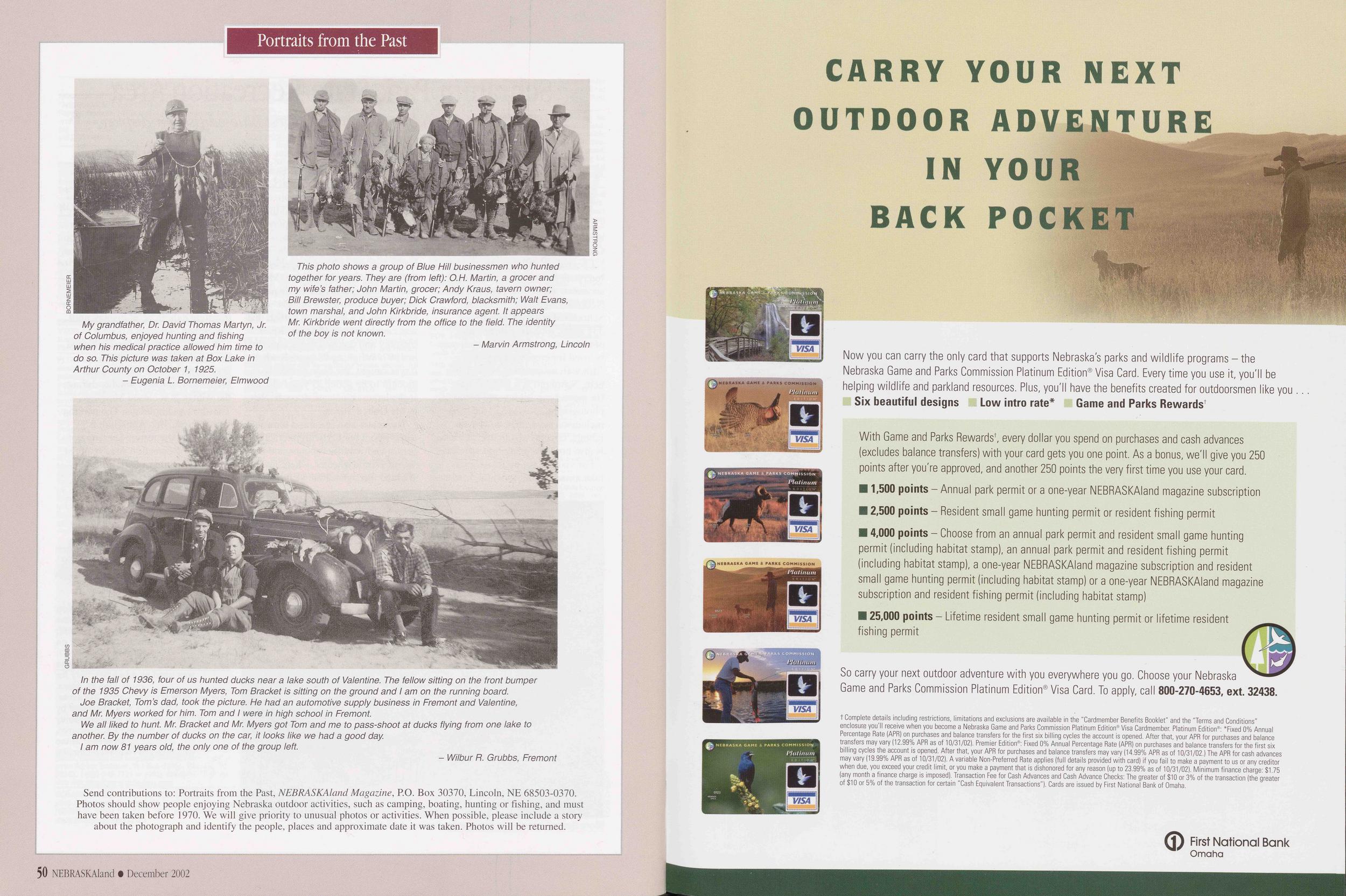
Send contributions to: Portraits from the Past, NEBRASKAland Magazine, P.O. Box 30370, Lincoln, NE 68503-0370. Photos should show people enjoying Nebraska outdoor activities, such as camping, boating, hunting or fishing, and must have been taken before 1970. We will give priority to unusual photos or activities. When possible, please include a story about the photograph and identify the people, places and approximate date it was taken. Photos will be returned.
Now you can carry the only card that supports Nebraska's parks and wildlife programs - the Nebraska Game and Parks Commission Platinum Edition® Visa Card. Everytime you use it, you'll be helping wildlife and parkland resources. Plus, you'll have the benefits created for outdoorsmen like you ...Six beautiful designs - Low intro rate - Game and Parks Rewards
With Game and Parks Rewards’, every dollar you spend on purchases and cash advances (excludes balance transfers) with your card gets you one point. As a bonus, we'll give you 250 points after you're approved, and another 250 points the very first time you use your card.
1,500 points - Annual park permit or a one-year NEBRASKAland magazine subscription 2,500 points - Resident small game hunting permit or resident fishing permit 4,000 points - Choose from an annual park permit and resident small game hunting permit (including habitat stamp), an annual park permit and resident fishing permit (including habitat stamp), a one-year NEBRASKAland magazine subscription and resident small game hunting permit (including habitat stamp) or a one-year NEBRASKAland magazine subscription and resident fishing permit (including habitat stamp) 25,000 points - Lifetime resident small game hunting permit or lifetime resident fishing permitSo carry your next outdoor adventure with you everywhere you go. Choose your Nebraska Game and Parks Commission Platinum Edition® Visa Card. To apply, call 800-270-4653, ext. 32438.
Complete details including restrictions, limitations and exclusions are available in the "Cardmember Benefits Booklet" and the "Terms and Conditions" enclosure you'll receive when you become a Nebraska Game and Parks Commission Platinum Edition® Visa Cardmember. Platinum Edition®: *Fixed 0% Annual Percentage Rate (APR) on purchases and balance transfers for the first six billing cycles the account is opened. After that, your APR for purchases and balance transfers may vary (12.99% APR as of 10/31/02). Premier Edition®: Fixed 0% Annual Percentage Rate (APR) on purchases and balance transfers for the first six billing cycles the account is opened. After that, your APR for purchases and balance transfers may vary (14.99% APR as of 10/31/02.) The APR for cash advances may vary (19.99% APR as of 10/31/02). A variable Non-Preferred Rate applies (full details provided with card) if you fail to make a payment to us or any creditor when due, you exceed your credit limit, or you make a payment that is dishonored for any reason (up to 23.99% as of 10/31/02). Minimum finance charge: $1.75 (any month a finance charge is imposed). Transaction Fee for Cash Advances and Cash Advance Checks: The greater of $10 or 3% of the transaction (the greater of $10 or 5% of the transaction for certain "Cash Equivalent Transactions"). Cards are issued by First National Bank of Omaha. First National Bank Omaha
50 NEBRASKAland • December 2002
Position: 820 (12 views)