Volume 80, Issue 9, 2002
NEBRASKAland
Nebraska Game & Parks Commission November 2002 • $2.50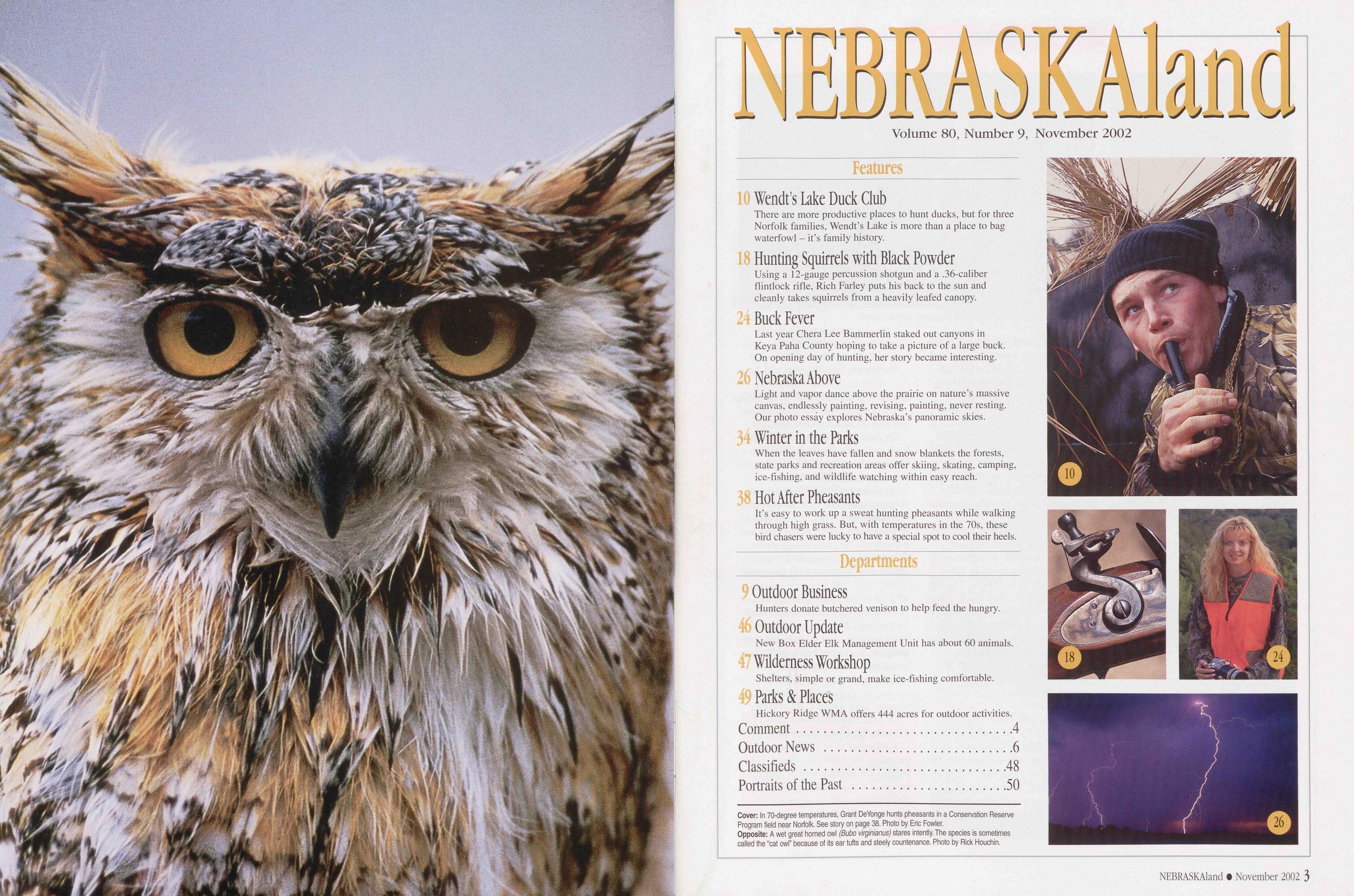
NEBRASKAland
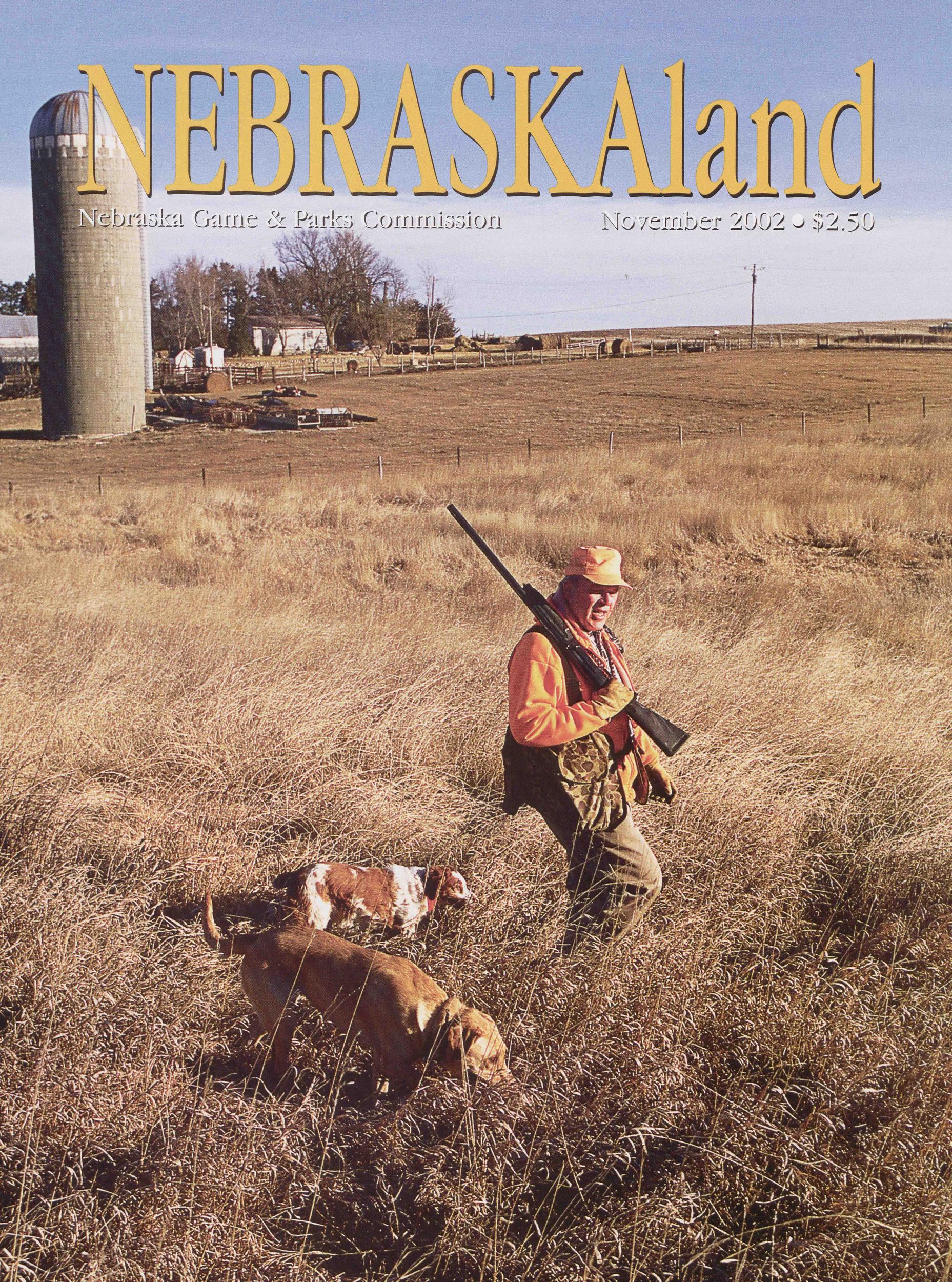
Volume 80, Number 9, November 2002 Features 10 Wendt’s Lake Duck Club There are more productive places to hunt ducks, but for three Norfolk families, Wendt’s Lake is more than a place to bag waterfowl - it’s family history. Hunting Squirrels with Black Powder Using a 12-gauge percussion shotgun and a .36-caliber flintlock rifle, Rich Farley puts his back to the sun and cleanly takes squirrels from a heavily leafed canopy. 24 Buck Fever Last year Chera Lee Bammerlin staked out canyons in Keya Paha County hoping to take a picture of a large buck. On opening day of hunting, her story became interesting. 26 Nebraska Above Light and vapor dance above the prairie on nature’s massive canvas, endlessly painting, revising, painting, never resting. Our photo essay explores Nebraska’s panoramic skies. Winter in the Parks When the leaves have fallen and snow blankets the forests, state parks and recreation areas offer skiing, skating, camping, ice-fishing, and wildlife watching within easy reach. 38 Hot After Pheasants It’s easy to work up a sweat hunting pheasants while walking through high grass. But, with temperatures in the 70s, these bird chasers were lucky to have a special spot to cool their heels. Departments 9 Outdoor Business Hunters donate butchered venison to help feed the hungry. 46 Outdoor Update New Box Elder Elk Management Unit has about 60 animals. Wilderness Workshop Shelters, simple or grand, make ice-fishing comfortable. Parks & Places Hickory Ridge WMA offers 444 acres for outdoor activities. Comment................................................4 Outdoor News ..........................................6 Classifieds ........................................ 48 Portraits of the Past ................................50 Cover: In 70-degree temperatures, Grant DeYonge hunts pheasants in a Conservation Reserve Program field near Norfolk. See story on page 38. Photo by Eric Fowler. Opposite: A wet great horned owl (Bubo virginianus) stares intently. The species is sometimes called the “cat owl” because of its ear tufts and steely countenance. Photo by Rick Houchin. Comment
NEBRASKAland Mazine
O
Published by the
Nebraska Game and
Parks Commission
Director: Rex Amack
Assistant Directors:
Noelyn Isom, Roger Kuhn, Kirk Nelson
Information & Education Administrator:
Paul Horton
Information & Education Art Director:
Steve O’Hare
Commissioners
Chairman:
John P. Miller, Blair
Vice Chairman:
Connie Lapaseotes, Bridgeport
2nd Vice Chairman:
Randall K. Stinnette, Inland
Marvin Westcott, Holdrege
James Stuart, Jr., Lincoln
Bill Grewcock, Omaha
Rob Coupland, Valentine
Mark Pinkerton, Wilber
Magazine Staff
Editor: Tom White
Associate Editor: Doug Carroll
Art Director: Tim Reigert
Senior Editors: Ken Bouc, Jon Farrar
Regional Editors:
Eric Fowler, Bob Grier, Rocky Hoffmann
Contributing Editors: Michael Forsberg,
Tom Keith
Circulation: Donna Robinson
Photo Librarian: Terry Fingerhut
NEBRASKAland VOL. 80 / NO. 9
ISSN: 0028-1964 NOVEMBER 2002
Published monthly, except for JanTFeb. and Aug./Sept.
issues, by the Nebraska Game and Parks Commission, 2200
N. 33rd St., Lincoln, NE. Copyright 2002, all rights reserved.
Please address comments or questions to this address.
Periodicals postage paid at Lincoln, Nebraska, and other
locations. POSTMASTER: Send all address changes to
NEBRASKAland, P.O. Box 30370, Lincoln, NE 68503-0370.
Address submissions to: The Editor, NEBRASKAland
Magazine, P.O. Box 30370, Lincoln, NE 68503. Include
a stamped, self-addressed return envelope. The publisher
assumes no responsibility for unsolicited material.
NEBRASKAland is available on audio cassette from the
Nebraska Library Commission Talking Book and Braille
Service, Suite 120, 1200 N St., Lincoln, NE 68508.
Rates: $16 for one year; $30 for two years.
Nebraska residents must add appropriate sales tax.
To subscribe call 1-800-NEBLAND (632-5263),
or go online to: outdoornebraska.org
Comment
NEBRASKAland Mazine
O
Published by the
Nebraska Game and
Parks Commission
Director: Rex Amack
Assistant Directors:
Noelyn Isom, Roger Kuhn, Kirk Nelson
Information & Education Administrator:
Paul Horton
Information & Education Art Director:
Steve O’Hare
Commissioners
Chairman:
John P. Miller, Blair
Vice Chairman:
Connie Lapaseotes, Bridgeport
2nd Vice Chairman:
Randall K. Stinnette, Inland
Marvin Westcott, Holdrege
James Stuart, Jr., Lincoln
Bill Grewcock, Omaha
Rob Coupland, Valentine
Mark Pinkerton, Wilber
Magazine Staff
Editor: Tom White
Associate Editor: Doug Carroll
Art Director: Tim Reigert
Senior Editors: Ken Bouc, Jon Farrar
Regional Editors:
Eric Fowler, Bob Grier, Rocky Hoffmann
Contributing Editors: Michael Forsberg,
Tom Keith
Circulation: Donna Robinson
Photo Librarian: Terry Fingerhut
NEBRASKAland VOL. 80 / NO. 9
ISSN: 0028-1964 NOVEMBER 2002
Published monthly, except for JanTFeb. and Aug./Sept.
issues, by the Nebraska Game and Parks Commission, 2200
N. 33rd St., Lincoln, NE. Copyright 2002, all rights reserved.
Please address comments or questions to this address.
Periodicals postage paid at Lincoln, Nebraska, and other
locations. POSTMASTER: Send all address changes to
NEBRASKAland, P.O. Box 30370, Lincoln, NE 68503-0370.
Address submissions to: The Editor, NEBRASKAland
Magazine, P.O. Box 30370, Lincoln, NE 68503. Include
a stamped, self-addressed return envelope. The publisher
assumes no responsibility for unsolicited material.
NEBRASKAland is available on audio cassette from the
Nebraska Library Commission Talking Book and Braille
Service, Suite 120, 1200 N St., Lincoln, NE 68508.
Rates: $16 for one year; $30 for two years.
Nebraska residents must add appropriate sales tax.
To subscribe call 1-800-NEBLAND (632-5263),
or go online to: outdoornebraska.org
I thought you would enjoy seeing a picture of one of the catfish my grandkids caught from our fishing ponds in Antelope County. Our daughter, Janet, and her husband, Dennis Ahl, bring sons, Jordan, 12, and Logan, 10, here several times each year. The kids have a lot of fun fishing. The boys usually catch some little bluegills to use for bait. They have caught some six- or seven-pound bass as well as several big channel catfish.
I really enjoy watching them fish. You hear a big scream and one grabs the pole while the other gets in the water to get ready to net whatever they have caught. The day I took this picture, they caught three big catfish, the largest was Master Angler size, 32 inches. Unless the fish is injured, everything they catch is released so they can have a chance to catch it again.
Randall “Doc” Pederson Royal, Nebraska Lewis and Clark Issue PraisedI have read the August-September issue of NEBRASKAland Magazine cover to cover. It is undoubtedly the best writing on Lewis and Clark I have ever read. Your magazine should win an award. The layout of photos and paintings is excellent. The magazine will definitely have a lasting place in my library.
James Reynolds Buchanan, Georgia Readers Ask About Archery HuntingQ: Is it legal to hunt geese and ducks with archery equipment?
Q: Last year I bought a recurve bow and some flu-flu arrows for pheasant hunting. Can I legally hunt doves with the same setup?
A: Conservation Officer Murray Johnson responds: “Licensed hunters may shoot any legal game animals in season, including game birds and waterfowl, with a bow and arrow. Doves and quail must be shot in flight, as is required with firearms.
“Hunters with a firearm permit may hunt deer, pronghorns and small game animals in season with a crossbow. They may also hunt non-migratory game birds, but may not hunt migratory birds such as doves and waterfowl with a crossbow”
Reader Asks About CWD TestingQ: Can I have my deer tested for Chronic Wasting Disease (CWD)?
A: As part of its CWD monitoring program, the Nebraska Game and Parks Commission will collect the heads of some harvested deer across the state this fall during the November firearm season, but its effort will be more intensive in the 4 NEBRASKAland O November 2002 Panhandle, the only area where the disease has been found in Nebraska.
Hunters in the Pine Ridge, Plains and Upper Platte firearm deer management units are asked to voluntarily submit their deer heads for testing.
Hunters can also submit deer taken in the Pine Ridge Control Area or Season Choice Area 15 during the firearm, muzzleloader, archery, or special season for testing.
In the remainder of the state, 100 deer harvested in each firearm deer management unit will be tested. Collections, also voluntary, will be made at Commission-staffed check stations.
“We don’t have any reason to believe, at this point, that we have CWD outside of the endemic area,” said Jim Douglas, head of the Commission’s wildlife division. “But we’re taking a few test samples to make sure we don’t have it.”
For a deer to be tested, a hunter must deliver it to a check station within 48 hours of its harvest.
There is currently no scientific evidence that CWD has or can spread to humans. The Commission understands, however, that some people not included in this testing program may want to have their animals tested. Labs in Lincoln, Fort Collins, Colorado, and Laramie, Wyoming, offer testing for $25. To have the testing done, individuals must first have the brain stem of the deer removed by a veterinarian.
Information about the procedure, including lab addresses and a list of participating veterinarians is available at deer check stations, Commission offices and the Commission’s web site at www.outdoornebraska.org.
CommentNEBRASKAland Magazine P.O. Box 30370, Lincoln, NE 68503. E-mail: nebland@ ngpc. state, ne. us. Please include your postal address and telephone number. Letters may be condensed and edited for clarity. Photographs are welcome and will be returned.
Nebraska Game and Parks Commission Offices Headquarters District Office III District Office VI 2200 N. 33rd Street 2201 N. 13th St. 1617 First Ave. Lincoln, NE 68503 Norfolk, NE 68701 Kearney, NE 68847 Phone (402) 471-0641 Phone (402) 370-3374 Phone (308) 865-5310 District Office 1 District Office IV Omaha Office East Hwy. 2, Box 725 301 E. State Farm Rd. 1212 Bob Gibson Blvd. Alliance, NE 69301 North Platte, NE 69101 Omaha, NE 68108 Phone (308) 763-2940 Phone (308) 535-8025 Phone (402) 595-2144 District Office II District Office V Ak-Sar-Ben Aquarium 524 Panzer St., Box 508 2200 N. 33rd Street 21502 W. Highway 31 Bassett, NE 68714 Lincoln, NE 68503 Gretna, NE 68028 Phone (402) 684-2921 Phone (402)471-5558 Phone (402) 332-3901 World Wide Web site: outdoornebraska.org E-mail: ngpc@ngpc.state.ne.us Conservation Officers by Region Administration Robert Kelly Albion 395-2538 Ted Blume (Adm.) Lincoln 471-5531 Dale Davis Bassett 273-1700 Craig Stover (Asst.) Lincoln 471-5532 Ross Oestmann Bloomfield 373-4412 Wes Loos (Asst.) Lincoln 471-5591 Steve Oberg Columbus 564-5937 Murray Johnson Lincoln 471-5003 Gary Ralston Creighton 358-3892 Dana Miller (Sup.) Valentine 376-3116 Daniel Roberts Fremont 721-7852 Jon Reeves Kennard 427-7378 Panhandle Marion Shafer Norfolk 371-2031 Officer City Phone (308) Patrick George O’Neill 482-5771 Jim Zimmerman (Sup.) Gering 436-7561 Eric Wiebe Ponca 755-2566 Raymond Still Bridgeport 262-1075 Walt Meyer Chadron 432-4398 South-central John Murphy Crawford 665-2021 Officer City Phone (308) Heath Packett Gordon 282-2553 Jerry Pecha (Sup.) Kearney 865-5327 Dennis Thompson Ogallala 284-6450 Randy Pomplun Fullerton 536-2987 Dan Zuehlke Ogallala 284-4815 Terry Brentzel Grand Is. 384-8296 Scott Brandt Scottsbluff 635-1277 Tim Williams Hastings (402) 463-2535 Frank Miller Valentine (402)376-1183 Darin Gress Hebron (402) 768-2287 Dale Johnson Kearney 237-1079 Southwest Mark Reeves Loup City 745-0748 Officer City Phone (308) Robert Finke Milford (402) 761-3537 Roger Thompson (Sup.) N. Platte 532-9175 Richard Seward Ord 728-3115 Ray Dierking Brkn. Bow 872-3078 George Sund Cambridge 697-4629 Southeast Matt Andrews Elwood 785-3025 Officer City Phone (402) Jack Henderson Gothenburg 537-7483 Duane Arp (Sup.) Gretna 332-2965 Dirk Greene Imperial 882-5328 William Krause Auburn 274-3769 Virgil Gosch McCook 345-2185 Jeremy TenKley Beatrice 228-1437 Dwight Allbery N. Platte 532-2753 Mike Luben Colon 443-4278 Dudley Sorensen N. Platte 532-0747 Douglas Kramer Lincoln 466-9001 Rich Routh Rep. City 799-2085 Dina Barta Lincoln 483-2358 Stacey Lewton Lincoln 476-0436 Northeast Levi Krause Louisville 234-2212 Officer City Phone (402) Russell Mort Nebr. City 873-5684 Tom Zimmer (Sup.) Norfolk 371-6625 Jeff Clauson Valley 359-5301 Nebraska Wildlife Crimestoppers 1-800-742-7627 NEBRASKAland • November 2002 5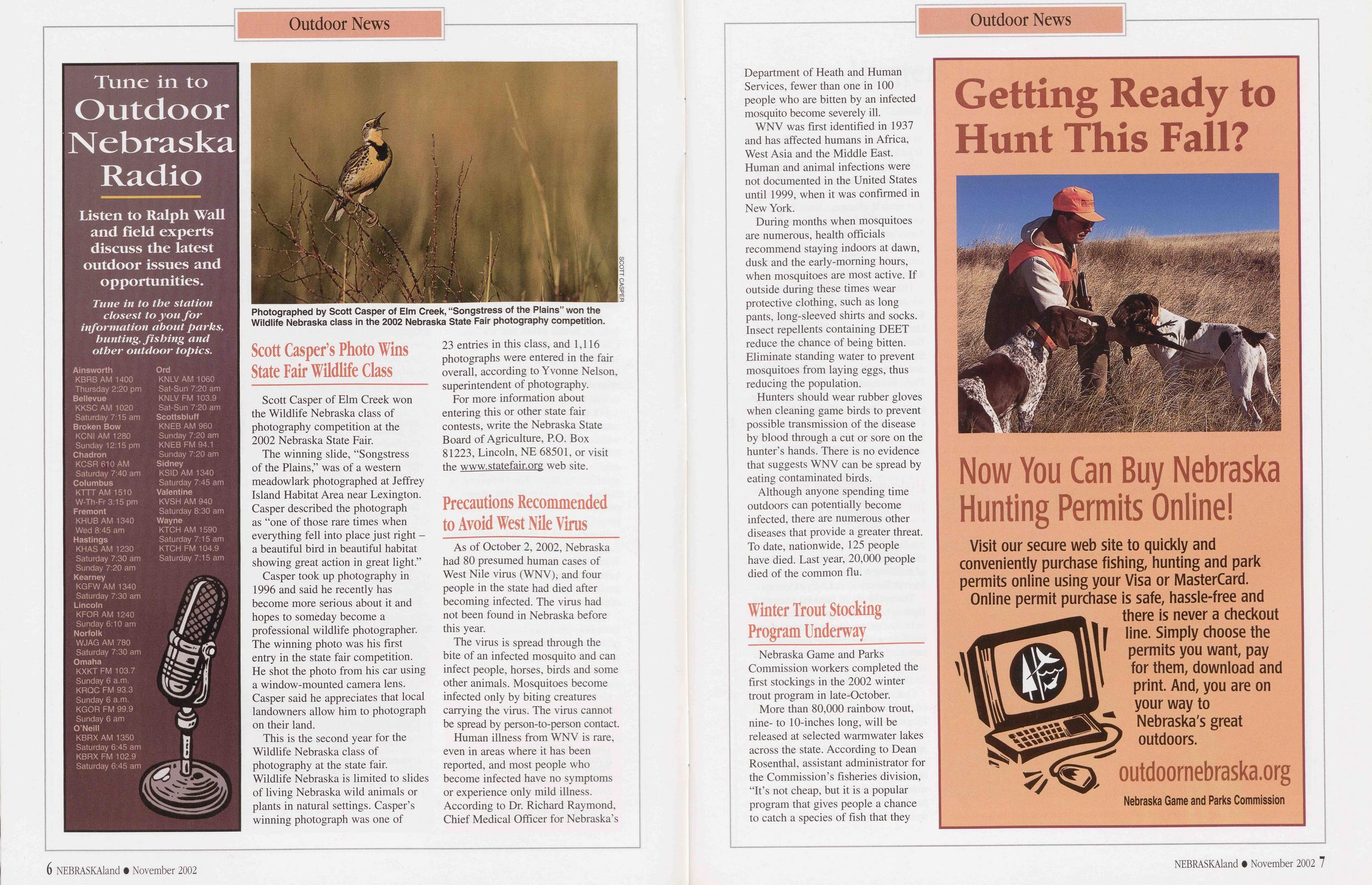
Scott Casper of Elm Creek won the Wildlife Nebraska class of photography competition at the 2002 Nebraska State Fair.
The winning slide, “Songstress of the Plains,” was of a western meadowlark photographed at Jeffrey Island Habitat Area near Lexington. Casper described the photograph as “one of those rare times when everything fell into place just right - a beautiful bird in beautiful habitat showing great action in great light.”
Casper took up photography in 1996 and said he recently has become more serious about it and hopes to someday become a professional wildlife photographer. The winning photo was his first entry in the state fair competition. He shot the photo from his car using a window-mounted camera lens. Casper said he appreciates that local landowners allow him to photograph on their land.
This is the second year for the Wildlife Nebraska class of photography at the state fair. Wildlife Nebraska is limited to slides of living Nebraska wild animals or plants in natural settings. Casper’s winning photograph was one of 23 entries in this class, and 1,116 photographs were entered in the fair overall, according to Yvonne Nelson, superintendent of photography.
For more information about entering this or other state fair contests, write the Nebraska State Board of Agriculture, P.O. Box 81223, Lincoln, NE 68501, or visit the www.statefair.org web site.
Precautions Recommended to Avoid West Nile VirusAs of October 2, 2002, Nebraska had 80 presumed human cases of West Nile virus (WNV), and four people in the state had died after becoming infected. The virus had not been found in Nebraska before this year.
The virus is spread through the bite of an infected mosquito and can infect people, horses, birds and some other animals. Mosquitoes become infected only by biting creatures carrying the virus. The virus cannot be spread by person-to-person contact.
Human illness from WNV is rare, even in areas where it has been reported, and most people who become infected have no symptoms or experience only mild illness. According to Dr. Richard Raymond, Chief Medical Officer for Nebraska’s 6 NEBRASKAland • November 2002 Department of Heath and Human Services, fewer than one in 100 people who are bitten by an infected mosquito become severely ill.
WNV was first identified in 1937 and has affected humans in Africa, West Asia and the Middle East. Human and animal infections were not documented in the United States until 1999, when it was confirmed in New York.
During months when mosquitoes are numerous, health officials recommend staying indoors at dawn, dusk and the early-morning hours, when mosquitoes are most active. If outside during these times wear protective clothing, such as long pants, long-sleeved shirts and socks. Insect repellents containing DEET reduce the chance of being bitten. Eliminate standing water to prevent mosquitoes from laying eggs, thus reducing the population.
Hunters should wear rubber gloves when cleaning game birds to prevent possible transmission of the disease by blood through a cut or sore on the hunter’s hands. There is no evidence that suggests WNV can be spread by eating contaminated birds.
Although anyone spending time outdoors can potentially become infected, there are numerous other diseases that provide a greater threat. To date, nationwide, 125 people have died. Last year, 20,000 people died of the common flu.
Getting Ready to Hunt This Fall? Now You Can Buy Nebraska Hunting Permits Online! Visit our secure web site to quickly and conveniently purchase fishing, hunting and park permits online using your Visa or MasterCard. Online permit purchase is safe, hassle-free and there is never a checkout line. Simply choose the permits you want, pay for them, download and print. And, you are on your way to Nebraska's great outdoors. outdoornebraska.org Nebraska Game and Parks Commission Winter Trout Stocking Program UnderwayNebraska Game and Parks Commission workers completed the first stockings in the 2002 winter trout program in late-October.
More than 80,000 rainbow trout,
nine- to 10-inches long, will be
released at selected warmwater lakes
across the state. According to Dean
Rosenthal, assistant administrator for
the Commission’s fisheries division,
“It’s not cheap, but it is a popular
program that gives people a chance
to catch a species of fish that they
NEBRASKAland • November 2002 7
 don’t normally catch.”
A coldwater species, trout survive in these warmwater lakes only in the winter.
Rosenthal said it costs about $ 1.25 to raise each released trout. The lakes selected for stocking are usually small in the hope that most of the released trout are eventually caught.
This year’s winter trout program has several changes: Towl Park in Omaha will be stocked for the first time, and in Lincoln, Holmes Lake will not be stocked because of renovation work. Instead, Bowling Lake will be stocked.
Other lakes to receive trout this winter are: US WEST Lake at Eugene T. Mahoney State Park, the Omaha-area lakes of Hitchcock, Benson and Standing Bear, Crystal Springs (Middle) in Fairbury, the east lake in Nebraska City’s Steinhart Park, Fremont Lake No. 5, Crystal Cove in South Sioux City, Grove Lake near Royal, Windmill No. 1 near Gibbon, Holdrege Park Lake in Holdrege, Birdwood near North Platte and Champion Mill near Imperial.
Officer's Notebook Bucks With Locked Antlers Get Help From OfficerAs a conservation officer, I spend a lot of time outdoors and see many things others don’t. Two years ago I was involved in an unusual event not once, but twice, within a short time.
Most of Nebraska has large populations of deer, and the south-central area where I work is no exception. There is plenty of cropland where deer can feed, and hunters take several trophy bucks every fall.
Late in 2000, Dave Hamik of Hastings called me about two bucks he had seen not far from my house. He had been on his way to his bow-hunting stand east of Hastings when he noticed two bucks in an open field. Realizing that it was the wrong time of day for deer to be in the middle of a field, he approached them and discovered their antlers were locked together.
In the fall, bucks often battle for dominance, pushing each other around with their antlers until they determine which one is stronger. Through these contests bucks determine a hierarchy and the more dominant bucks do most of the breeding. These battles are usually relatively painless, but sometimes they result in serious injury or even death to the deer. Occasionally, the antlers of the bucks become interlocked and they are not able to free themselves. When this happens, the bucks usually die from starvation, predation or injuries.
The hunter agreed to show me where the deer were so we could try to untangle them. Both bucks had 5-by-5 racks that most hunters would be proud to hang on their wall. Unfortunately, one was dead and the live buck wouldn’t allow us to get very close. I had hoped to rope the buck so we could hold it down and cut the antlers loose, but he was having no part of that plan. You could tell that he was tired, but he kept moving away from us, dragging the dead buck with him.
I decided that the only way to free the buck from the carcass of his rival was to shoot one of the antlers off the dead buck with a shotgun slug. I finally got close enough and at my shot, which shattered the antler, the freed buck took off.
Two weeks later to the day, I received a call about a similar situation from Troy Schmitz, a Webster County deputy sheriff. Road workers had noticed two bucks locked up near Nebraska Highway 136 between Red Cloud and Guide Rock.
When I arrived, the first thing I noticed was the size of the bucks. I thought the two earlier deer were large, but these two were huge. Both were alive and apparently hadn’t been hooked together very long because they still had plenty of energy. They actually jumped a fence together as we approached. I finally got close enough to take a shot at their antlers. At first, I thought I had missed, but then two of the antlers came free and the bucks ran side-by-side for a minute before separating completely and running away.
I had heard of deer getting locked up, but in my nine years as a conservation officer, these were the first two such cases that I was involved in.
- Tim Williams, Conservation Officer, Hastings Hydropower Plant Proposed for Merritt ReservoirAn application has been filed with the Federal Regulatory Commission (FERC) to determine the feasibility of building a hydropower plant at Merritt Reservoir in Cherry County.
The application, filed by Merritt Hydro, LLC, of Logan, Utah, indicates the project would involve building a powerhouse containing a two-megawatt turbine, a switchyard and approximately five miles of 25,000-volt transmission line.
One of the state’s premier fishing lakes, Merritt Reservoir is an irrigation impoundment created by damming the Snake River. The application says the facility would be built on the existing dam owned by the U.S. Bureau of Reclamation, and would operate in a run-of-the-river mode, meaning no additional water would be released for its operation.
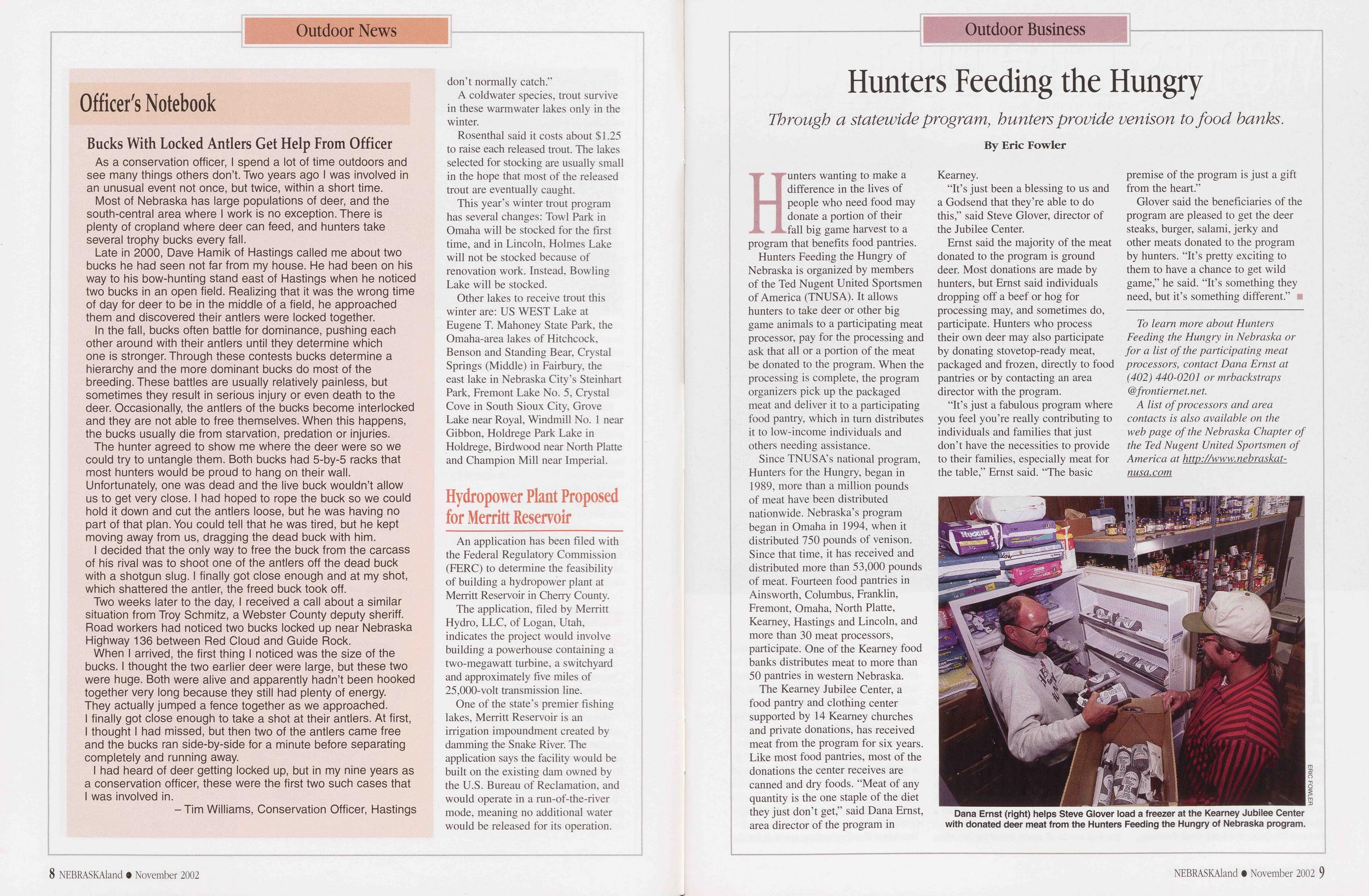
8 NEBRASKAland • November 2002 Outdoor Business Hunters Feeding the Hungry Through a statewide program, hunters provide venison to food hanks. By Eric FowlerHunters wanting to make a difference in the lives of people who need food may donate a portion of their fall big game harvest to a program that benefits food pantries. Hunters Feeding the Hungry of Nebraska is organized by members of the Ted Nugent United Sportsmen of America (TNUSA). It allows hunters to take deer or other big game animals to a participating meat processor, pay for the processing and ask that all or a portion of the meat be donated to the program. When the processing is complete, the program organizers pick up the packaged meat and deliver it to a participating food pantry, which in turn distributes it to low-income individuals and others needing assistance.
Since TNUSA’s national program, Hunters for the Hungry, began in 1989, more than a million pounds of meat have been distributed nationwide. Nebraska’s program began in Omaha in 1994, when it distributed 750 pounds of venison. Since that time, it has received and distributed more than 53,000 pounds of meat. Fourteen food pantries in Ainsworth, Columbus, Franklin, Fremont, Omaha, North Platte, Kearney, Hastings and Lincoln, and more than 30 meat processors, participate. One of the Kearney food banks distributes meat to more than 50 pantries in western Nebraska.
The Kearney Jubilee Center, a food pantry and clothing center supported by 14 Kearney churches and private donations, has received meat from the program for six years. Like most food pantries, most of the donations the center receives are canned and dry foods. "Meat of any quantity is the one staple of the diet they just don’t get,” said Dana Ernst, area director of the program in Kearney.
“It’s just been a blessing to us and a Godsend that they’re able to do this,” said Steve Glover, director of the Jubilee Center.
Ernst said the majority of the meat donated to the program is ground deer. Most donations are made by hunters, but Ernst said individuals dropping off a beef or hog for processing may, and sometimes do, participate. Hunters who process their own deer may also participate by donating stovetop-ready meat, packaged and frozen, directly to food pantries or by contacting an area director with the program.
"It’s just a fabulous program where you feel you’re really contributing to individuals and families that just don’t have the necessities to provide to their families, especially meat for the table,” Ernst said. "The basic premise of the program is just a gift from the heart.”
Glover said the beneficiaries of the program are pleased to get the deer steaks, burger, salami, jerky and other meats donated to the program by hunters. "It’s pretty exciting to them to have a chance to get wild game,” he said. "It’s something they need, but it’s something different.”
To learn more about Hunters Feeding the Hungry in Nebraska or for a list of the participating meat processors, contact Dana Ernst at (402) 440-0201 or mrbackstraps @frontiernet.net.
A list of processors and area contacts is also available on the web page of the Nebraska Chapter of the Ted Nugent United Sportsmen of America at http://www. nebraskat- nusa.com
NEBRASKAland • November 2002 9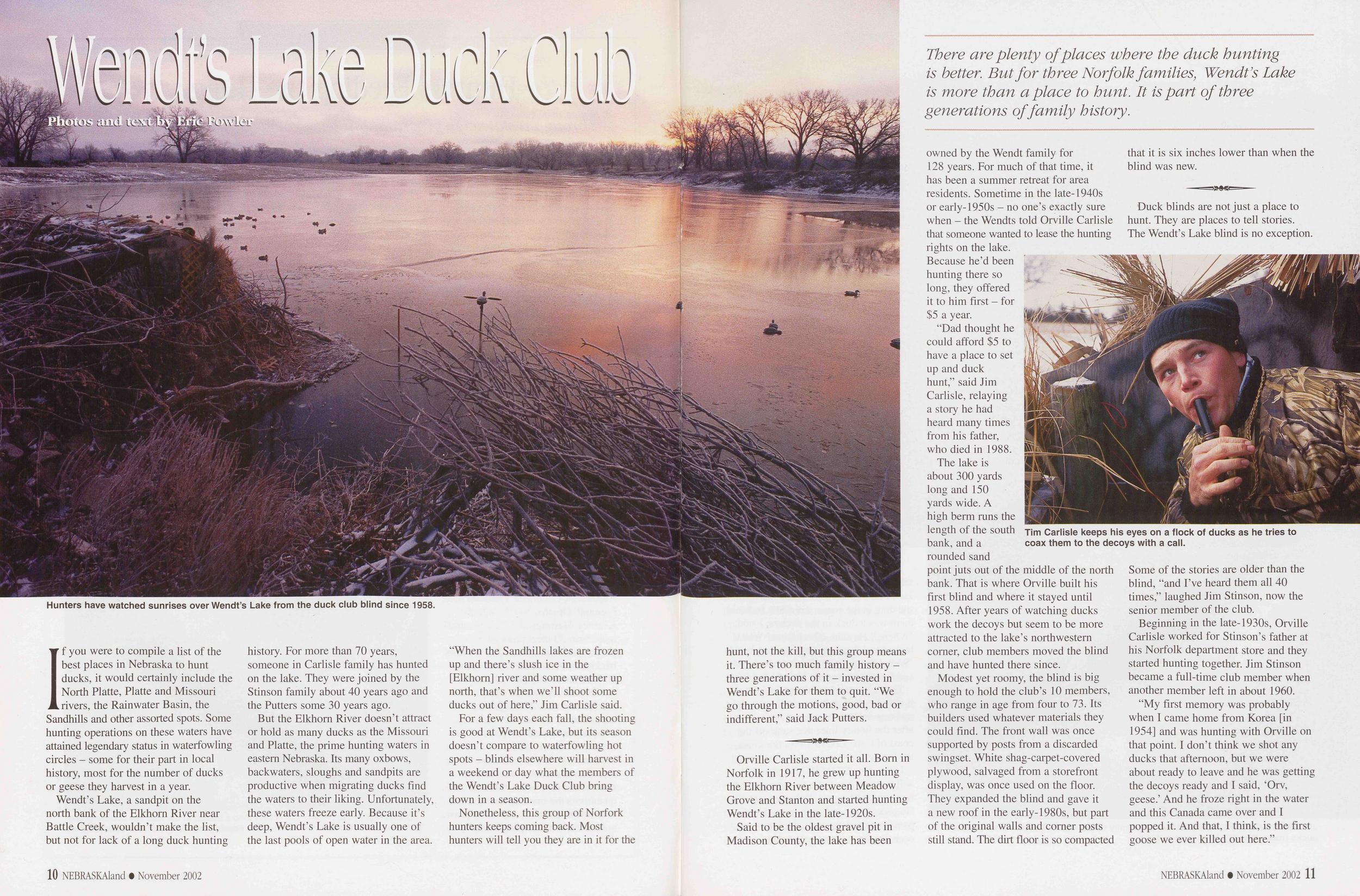
Wendt's Lake Duck Club
If you were to compile a list of the best places in Nebraska to hunt ducks, it would certainly include the North Platte, Platte and Missouri rivers, the Rainwater Basin, the Sandhills and other assorted spots. Some hunting operations on these waters have attained legendary status in waterfowling circles - some for their part in local history, most for the number of ducks or geese they harvest in a year.
Wendt’s Lake, a sandpit on the north bank of the Elkhorn River near Battle Creek, wouldn’t make the list, but not for lack of a long duck hunting history. For more than 70 years, someone in Carlisle family has hunted on the lake. They were joined by the Stinson family about 40 years ago and the Putters some 30 years ago.
But the Elkhorn River doesn’t attract or hold as many ducks as the Missouri and Platte, the prime hunting waters in eastern Nebraska. Its many oxbows, backwaters, sloughs and sandpits are productive when migrating ducks find the waters to their liking. Unfortunately, these waters freeze early. Because it’s deep, Wendt’s Lake is usually one of the last pools of open water in the area.
“When the Sandhills lakes are frozen up and there’s slush ice in the [Elkhorn] river and some weather up north, that’s when we’ll shoot some ducks out of here,” Jim Carlisle said.
For a few days each fall, the shooting is good at Wendt’s Lake, but its season doesn’t compare to waterfowling hot spots - blinds elsewhere will harvest in a weekend or day what the members of the Wendt’s Lake Duck Club bring down in a season.
Nonetheless, this group of Norfork hunters keeps coming back. Most hunters will tell you they are in it for the 10 NEBRASKAland • November 2002 hunt, not the kill, but this group means it. There’s too much family history - three generations of it - invested in Wendt’s Lake for them to quit. “We go through the motions, good, bad or indifferent,” said Jack Putters.
Orville Carlisle started it all. Born in Norfolk in 1917, he grew up hunting the Elkhorn River between Meadow Grove and Stanton and started hunting Wendt’s Lake in the late-1920s.
Said to be the oldest gravel pit in Madison County, the lake has been owned by the Wendt family for 128 years. For much of that time, it has been a summer retreat for area residents. Sometime in the late-1940s or early-1950s - no one’s exactly sure when - the Wendts told Orville Carlisle that someone wanted to lease the hunting rights on the lake. Because he’d been hunting there so long, they offered it to him first - for 85 a year.
“Dad thought he could afford $5 to have a place to set up and duck hunt,” said Jim Carlisle, relaying a story he had heard many times from his father, who died in 1988.
The lake is about 300 yards long and 150 yards wide. A high berm runs the length of the south bank, and a rounded sand point juts out of the middle of the north bank. That is where Orville built his first blind and where it stayed until 1958. After years of watching ducks work the decoys but seem to be more attracted to the lake’s northwestern corner, club members moved the blind and have hunted there since.
Modest yet roomy, the blind is big enough to hold the club’s 10 members, who range in age from four to 73. Its builders used whatever materials they could find. The front wall was once supported by posts from a discarded swingset. White shag-carpet-covered plywood, salvaged from a storefront display, was once used on the floor. They expanded the blind and gave it a new roof in the early-1980s, but part of the original walls and corner posts still stand. The dirt floor is so compacted that it is six inches lower than when the blind was new.
Duck blinds are not just a place to hunt. They are places to tell stories. The Wendt’s Lake blind is no exception.
Some of the stories are older than the blind, “and I’ve heard them all 40 times,” laughed Jim Stinson, now the senior member of the club.
Beginning in the late-1930s, Orville Carlisle worked for Stinson’s father at his Norfolk department store and they started hunting together. Jim Stinson became a full-time club member when another member left in about 1960.
“My first memory was probably when I came home from Korea [in 1954] and was hunting with Orville on that point. I don’t think we shot any ducks that afternoon, but we were about ready to leave and he was getting the decoys ready and I said, ‘Orv, geese.’ And he froze right in the water and this Canada came over and I popped it. And that, I think, is the first goose we ever killed out here.”
NEBRASKAland • November 2002 11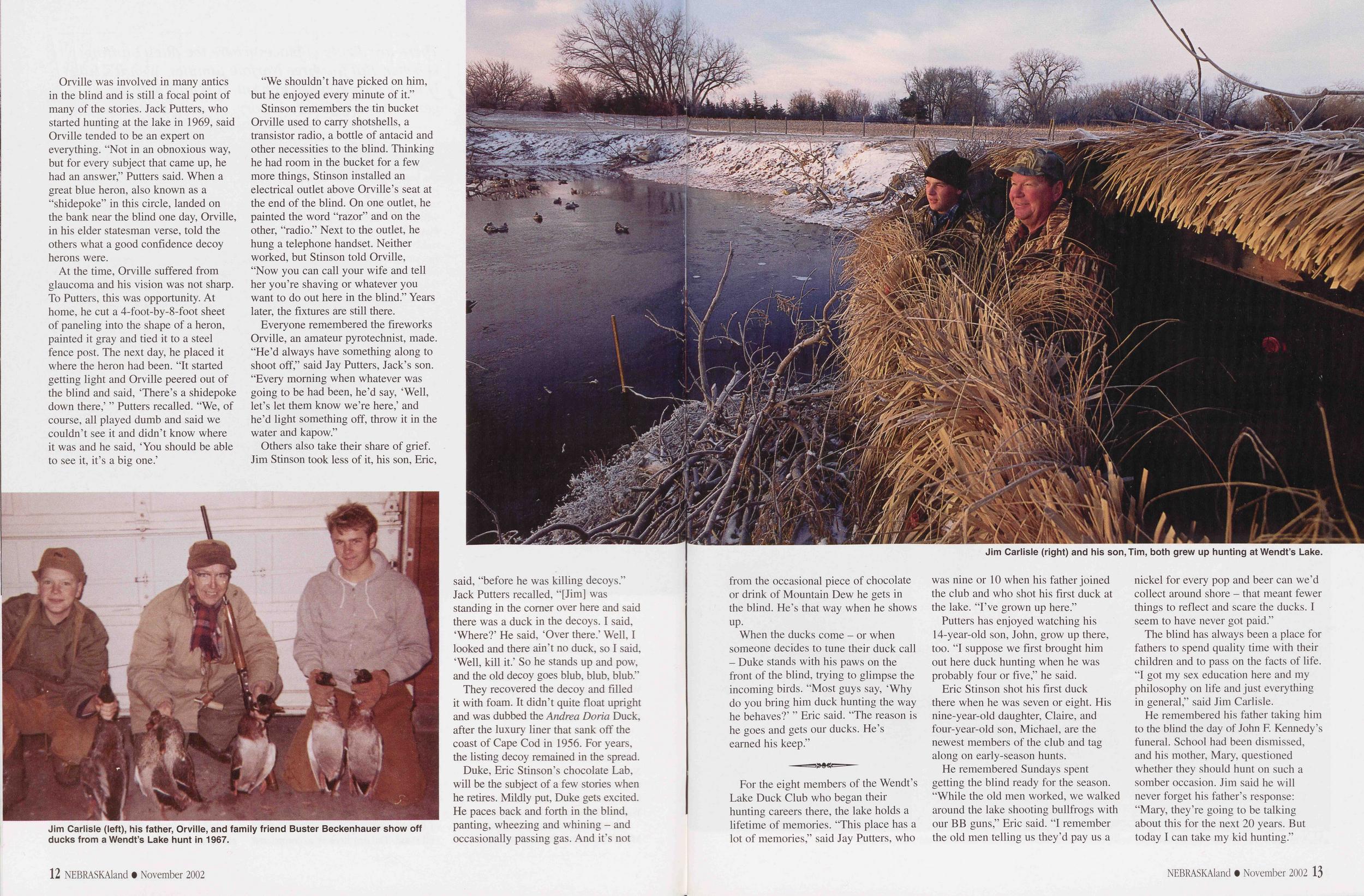
Orville was involved in many antics in the blind and is still a focal point of many of the stories. Jack Putters, who started hunting at the lake in 1969, said Orville tended to be an expert on everything. “Not in an obnoxious way, but for every subject that came up, he had an answer,” Putters said. When a great blue heron, also known as a “shidepoke” in this circle, landed on the bank near the blind one day, Orville, in his elder statesman verse, told the others what a good confidence decoy herons were.
At the time, Orville suffered from glaucoma and his vision was not sharp. To Putters, this was opportunity. At home, he cut a 4-foot-by-8-foot sheet of paneling into the shape of a heron, painted it gray and tied it to a steel fence post. The next day, he placed it where the heron had been. “It started getting light and Orville peered out of the blind and said, ‘There’s a shidepoke down there,’ ” Putters recalled. “We, of course, all played dumb and said we couldn’t see it and didn’t know where it was and he said, ‘You should be able to see it, it’s a big one.’
“We shouldn’t have picked on him, but he enjoyed every minute of it.”
Stinson remembers the tin bucket Orville used to carry shotshells, a transistor radio, a bottle of antacid and other necessities to the blind. Thinking he had room in the bucket for a few more things, Stinson installed an electrical outlet above Orville’s seat at the end of the blind. On one outlet, he painted the word “razor” and on the other, “radio.” Next to the outlet, he hung a telephone handset. Neither worked, but Stinson told Orville, “Now you can call your wife and tell her you’re shaving or whatever you want to do out here in the blind.” Years later, the fixtures are still there.
Everyone remembered the fireworks Orville, an amateur pyrotechnist, made. “He’d always have something along to shoot off,” said Jay Putters, Jack’s son. “Every morning when whatever was going to be had been, he’d say, ‘Well, let’s let them know we’re here,’ and he’d light something off, throw it in the water and kapow.”
Others also take their share of grief. Jim Stinson took less of it, his son, Eric, said, “before he was killing decoys.” Jack Putters recalled, “[Jim] was standing in the comer over here and said there was a duck in the decoys. I said, ‘Where?’ He said, ‘Over there.’ Well, I looked and there ain’t no duck, so I said, ‘Well, kill it.’ So he stands up and pow, and the old decoy goes blub, blub, blub.”
They recovered the decoy and filled it with foam. It didn’t quite float upright and was dubbed the Andrea Doria Duck, after the luxury liner that sank off the coast of Cape Cod in 1956. For years, the listing decoy remained in the spread.
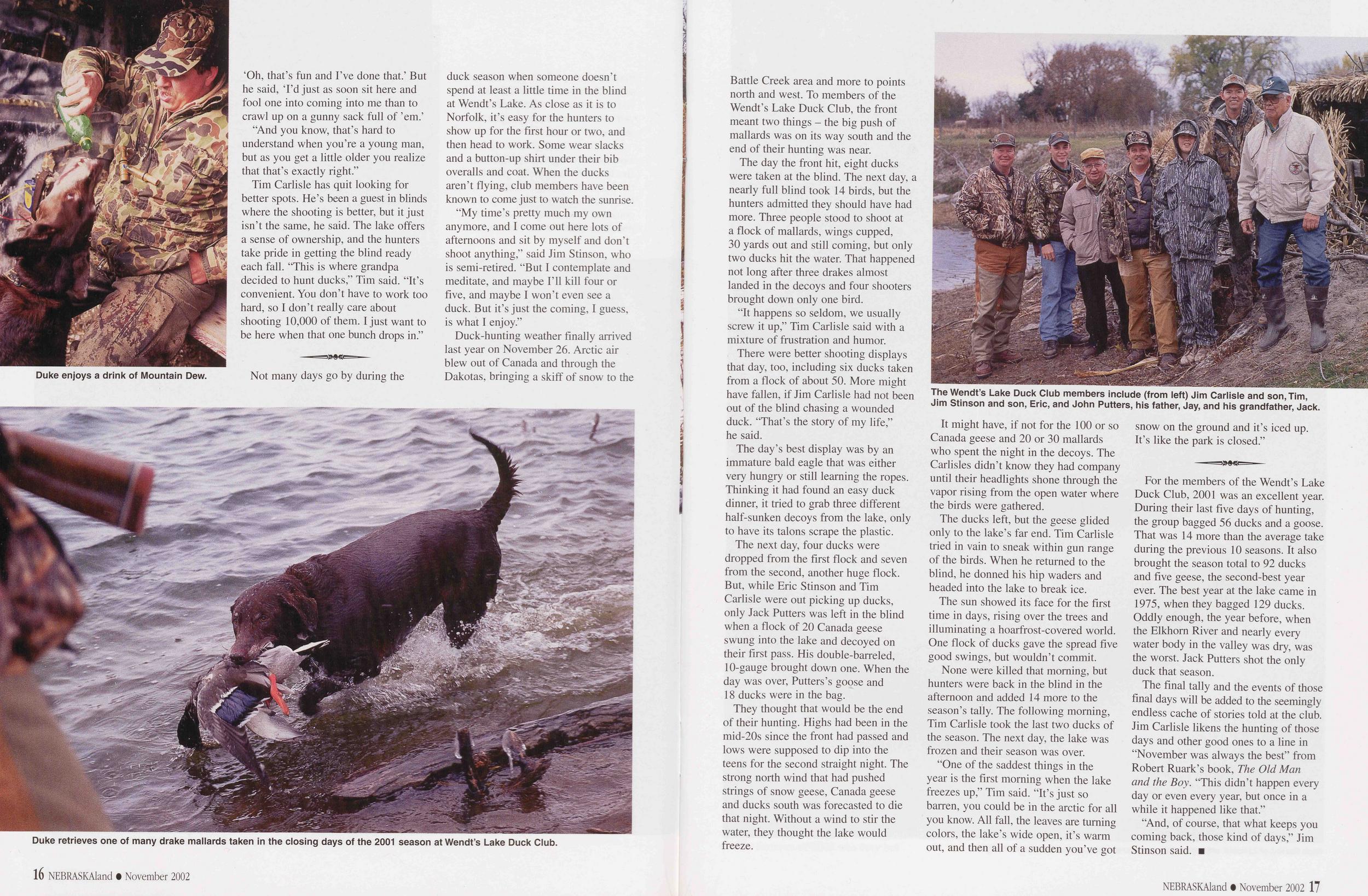
Duke, Eric Stinson’s chocolate Lab, will be the subject of a few stories when he retires. Mildly put, Duke gets excited. He paces back and forth in the blind, panting, wheezing and whining - and occasionally passing gas. And it’s not 12 NEBRASKAland • November 2002 from the occasional piece of chocolate or drink of Mountain Dew he gets in the blind. He’s that way when he shows up.
When the ducks come - or when someone decides to tune their duck call - Duke stands with his paws on the front of the blind, trying to glimpse the incoming birds. “Most guys say, ‘Why do you bring him duck hunting the way he behaves?’ ” Eric said. “The reason is he goes and gets our ducks. He’s earned his keep.”
For the eight members of the Wendt’s Lake Duck Club who began their hunting careers there, the lake holds a lifetime of memories. “This place has a lot of memories,” said Jay Putters, who was nine or 10 when his father joined the club and who shot his first duck at the lake. “I’ve grown up here.”
Putters has enjoyed watching his 14-year-old son, John, grow up there, too. “I suppose we first brought him out here duck hunting when he was probably four or five,” he said.
Eric Stinson shot his first duck there when he was seven or eight. His nine-year-old daughter, Claire, and four-year-old son, Michael, are the newest members of the club and tag along on early-season hunts.
He remembered Sundays spent getting the blind ready for the season. “While the old men worked, we walked around the lake shooting bullfrogs with our BB guns,” Eric said. “I remember the old men telling us they’d pay us a nickel for every pop and beer can we’d collect around shore - that meant fewer things to reflect and scare the ducks. I seem to have never got paid.”
The blind has always been a place for fathers to spend quality time with their children and to pass on the facts of life. “I got my sex education here and my philosophy on life and just everything in general,” said Jim Carlisle.
He remembered his father taking him to the blind the day of John F. Kennedy’s funeral. School had been dismissed, and his mother, Mary, questioned whether they should hunt on such a somber occasion. Jim said he will never forget his father’s response: “Mary, they’re going to be talking about this for the next 20 years. But today I can take my kid hunting.”
NEBRASKAland • November 2002 13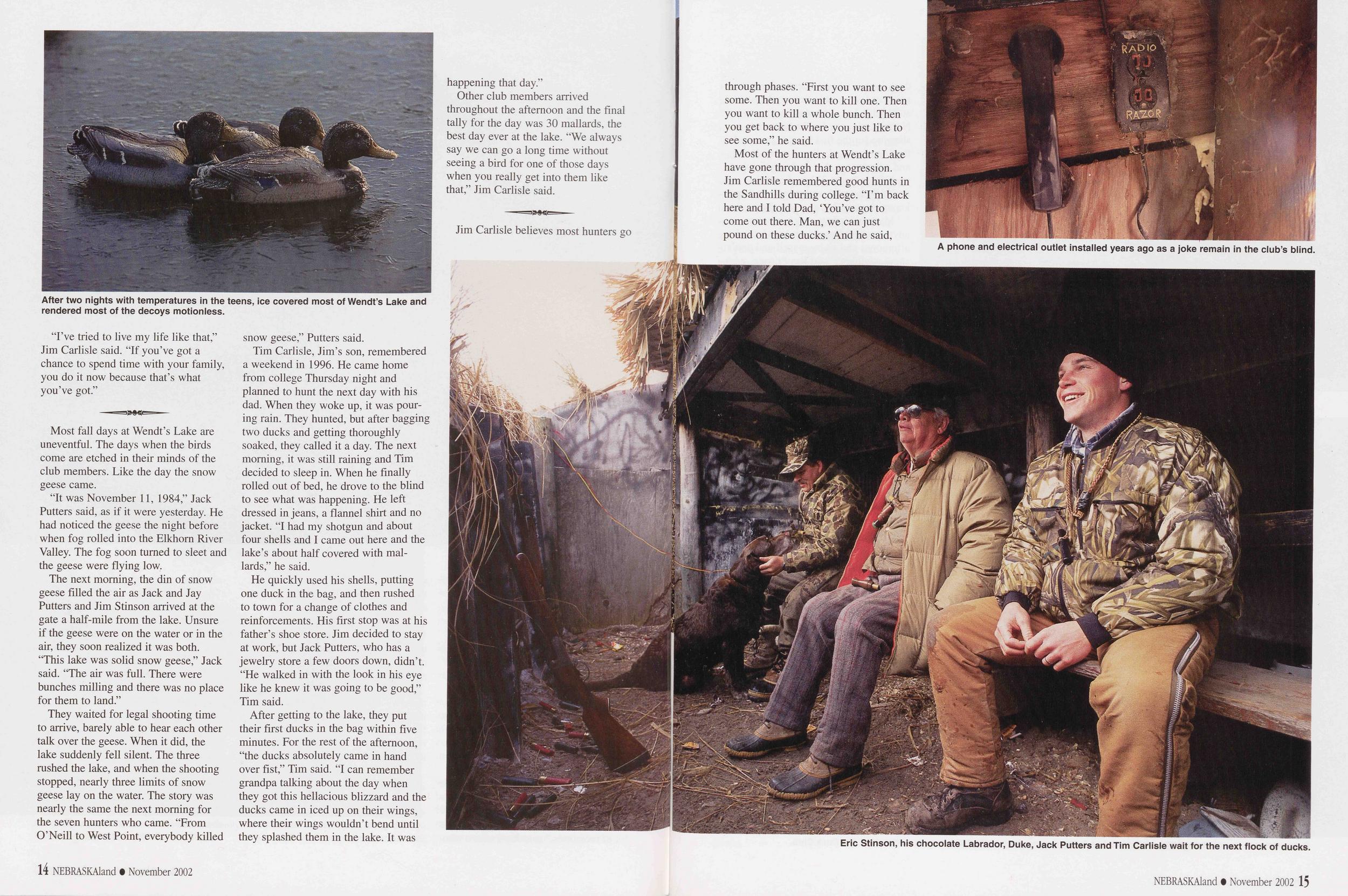
"I've tried to live my life like that,” Jim Carlisle said. "If you’ve got a chance to spend time with your family, you do it now because that’s what you’ve got.”
Most fall days at Wendt’s Lake are uneventful. The days when the birds come are etched in their minds of the club members. Like the day the snow geese came.
"It was November 11, 1984,” Jack Putters said, as if it were yesterday. He had noticed the geese the night before when fog rolled into the Elkhorn River Valley. The fog soon turned to sleet and the geese were flying low.
The next morning, the din of snow geese filled the air as Jack and Jay Putters and Jim Stinson arrived at the gate a half-mile from the lake. Unsure if the geese were on the water or in the air, they soon realized it was both. "This lake was solid snow geese,” Jack said. "The air was full. There were bunches milling and there was no place for them to land.”
They waited for legal shooting time to arrive, barely able to hear each other talk over the geese. When it did, the lake suddenly fell silent. The three rushed the lake, and when the shooting stopped, nearly three limits of snow geese lay on the water. The story was nearly the same the next morning for the seven hunters who came. "From O’Neill to West Point, everybody killed snow geese,” Putters said.
Tim Carlisle, Jim’s son, remembered a weekend in 1996. He came home from college Thursday night and planned to hunt the next day with his dad. When they woke up, it was pour- ing rain. They hunted, but after bagging two ducks and getting thoroughly soaked, they called it a day. The next morning, it was still raining and Tim decided to sleep in. When he finally rolled out of bed, he drove to the blind to see what was happening. He left dressed in jeans, a flannel shirt and no jacket. "I had my shotgun and about four shells and I came out here and the lake’s about half covered with mal- lards,” he said.
He quickly used his shells, putting one duck in the bag, and then rushed to town for a change of clothes and reinforcements. His first stop was at his father’s shoe store. Jim decided to stay at work, but Jack Putters, who has a jewelry store a few doors down, didn’t. "He walked in with the look in his eye like he knew it was going to be good,” Tim said.
After getting to the lake, they put their first ducks in the bag within five minutes. For the rest of the afternoon, “the ducks absolutely came in hand over fist,” Tim said. “I can remember grandpa talking about the day when they got this hellacious blizzard and the ducks came in iced up on their wings, where their wings wouldn’t bend until they splashed them in the lake. It was happening that day.”
Other club members arrived throughout the afternoon and the final tally for the day was 30 mallards, the best day ever at the lake. “We always say we can go a long time without seeing a bird for one of those days when you really get into them like that,” Jim Carlisle said.
Jim Carlisle believes most hunters go 14 NEBRASKAland • November 2002 through phases. “First you want to see some. Then you want to kill one. Then you want to kill a whole bunch. Then you get back to where you just like to see some,” he said.
Most of the hunters at Wendt’s Lake
have gone through that progression.
Jim Carlisle remembered good hunts in
the Sandhills during college. “I’m back
here and I told Dad, ‘You’ve got to
come out there. Man, we can just
pound on these ducks.’ And he said,
Jim Carlisle believes most hunters go
NEBRASKAland • November 2002 15
 ‘Oh, that’s fun and I’ve done that.’ But
he said, I’d just as soon sit here and
fool one into coming into me than to
crawl up on a gunny sack full of ’em.’
‘Oh, that’s fun and I’ve done that.’ But
he said, I’d just as soon sit here and
fool one into coming into me than to
crawl up on a gunny sack full of ’em.’
“And you know, that’s hard to understand when you’re a young man, but as you get a little older you realize that that’s exactly right.”
Tim Carlisle has quit looking for better spots. He’s been a guest in blinds where the shooting is better, but it just isn’t the same, he said. The lake offers a sense of ownership, and the hunters take pride in getting the blind ready each fall. “This is where grandpa decided to hunt ducks,” Tim said. “It’s convenient. You don’t have to work too hard, so I don’t really care about shooting 10,000 of them. I just want to be here when that one bunch drops in.”
Not many days go by during the duck season when someone doesn’t spend at least a little time in the blind at Wendt’s Lake. As close as it is to Norfolk, it’s easy for the hunters to show up for the first hour or two, and then head to work. Some wear slacks and a button-up shirt under their bib overalls and coat. When the ducks aren’t flying, club members have been known to come just to watch the sunrise.
“My time’s pretty much my own anymore, and I come out here lots of afternoons and sit by myself and don’t shoot anything,” said Jim Stinson, who is semi-retired. “But I contemplate and meditate, and maybe I’ll kill four or five, and maybe I won’t even see a duck. But it’s just the coming, I guess, is what I enjoy.”
Duck-hunting weather finally arrived last year on November 26. Arctic air blew out of Canada and through the Dakotas, bringing a skiff of snow to the Battle Creek area and more to points north and west. To members of the Wendt’s Lake Duck Club, the front meant two things - the big push of mallards was on its way south and the end of their hunting was near.
The day the front hit, eight ducks were taken at the blind. The next day, a nearly full blind took 14 birds, but the hunters admitted they should have had more. Three people stood to shoot at a flock of mallards, wings cupped, 30 yards out and still coming, but only two ducks hit the water. That happened not long after three drakes almost landed in the decoys and four shooters brought down only one bird.
“It happens so seldom, we usually screw it up,” Tim Carlisle said with a mixture of frustration and humor.
There were better shooting displays that day, too, including six ducks taken from a flock of about 50. More might have fallen, if Jim Carlisle had not been out of the blind chasing a wounded duck. “That’s the story of my life,” he said.
The day’s best display was by an immature bald eagle that was either very hungry or still learning the ropes. Thinking it had found an easy duck dinner, it tried to grab three different half-sunken decoys from the lake, only to have its talons scrape the plastic.
The next day, four ducks were dropped from the first flock and seven from the second, another huge flock. But, while Eric Stinson and Tim Carlisle were out picking up ducks, only Jack Putters was left in the blind when a flock of 20 Canada geese swung into the lake and decoyed on their first pass. His double-barreled, 10-gauge brought down one. When the day was over, Putters’s goose and 18 ducks were in the bag.
They thought that would be the end of their hunting. Highs had been in the mid-20s since the front had passed and lows were supposed to dip into the teens for the second straight night. The strong north wind that had pushed strings of snow geese, Canada geese and ducks south was forecasted to die that night. Without a wind to stir the water, they thought the lake would freeze.
It might have, if not for the 100 or so Canada geese and 20 or 30 mallards who spent the night in the decoys. The Carlisles didn’t know they had company until their headlights shone through the vapor rising from the open water where the birds were gathered.
The ducks left, but the geese glided only to the lake’s far end. Tim Carlisle tried in vain to sneak within gun range of the birds. When he returned to the blind, he donned his hip waders and headed into the lake to break ice.
The sun showed its face for the first time in days, rising over the trees and illuminating a hoarfrost-covered world. One flock of ducks gave the spread five good swings, but wouldn’t commit.
None were killed that morning, but hunters were back in the blind in the afternoon and added 14 more to the season’s tally. The following morning, Tim Carlisle took the last two ducks of the season. The next day, the lake was frozen and their season was over.
“One of the saddest things in the year is the first morning when the lake freezes up,” Tim said. “It’s just so barren, you could be in the arctic for all you know. All fall, the leaves are turning colors, the lake’s wide open, it’s warm out, and then all of a sudden you’ve got snow on the ground and it’s iced up. It’s like the park is closed.”
For the members of the Wendt’s Lake Duck Club, 2001 was an excellent year. During their last five days of hunting, the group bagged 56 ducks and a goose. That was 14 more than the average take during the previous 10 seasons. It also brought the season total to 92 ducks and five geese, the second-best year ever. The best year at the lake came in 1975, when they bagged 129 ducks. Oddly enough, the year before, when the Elkhorn River and nearly every water body in the valley was dry, was the worst. Jack Putters shot the only duck that season.
The final tally and the events of those final days will be added to the seemingly endless cache of stories told at the club. Jim Carlisle likens the hunting of those days and other good ones to a line in “November was always the best” from Robert Ruark’s book, The Old Man and the Boy. “This didn’t happen every day or even every year, but once in a while it happened like that.”
“And, of course, that what keeps you coming back, those kind of days,” Jim Stinson said. ■
17 NEBRASKAland • November 2002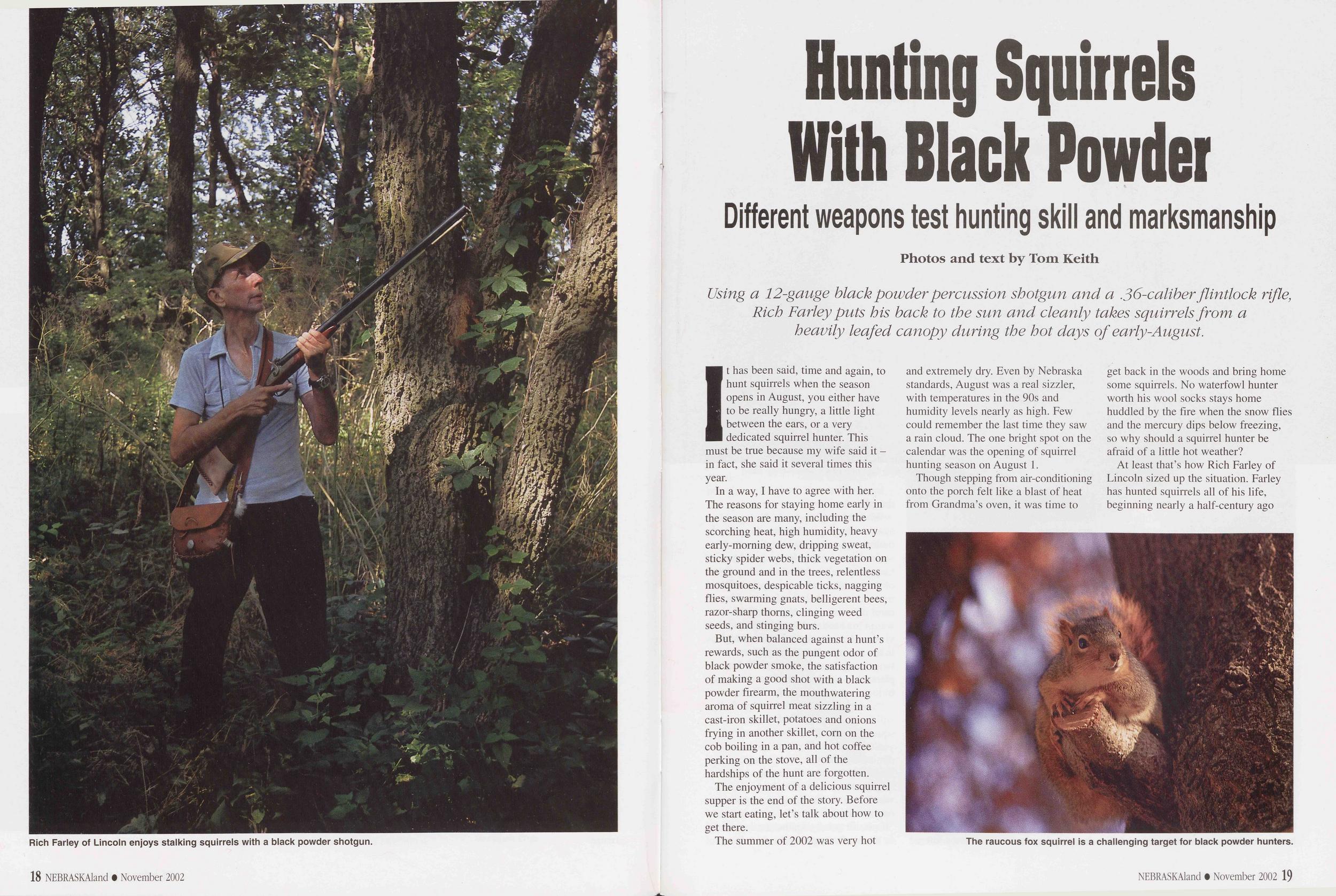
Hunting Squirrels With Black Powder
Different weapons test hunting skill and marksmanship Photos and text by Tom Keith Using a 12-gauge black powder percussion shotgun and a 36-caliberflintlock rifle, Rich Farley puts his back to the sun and cleanly takes squirrels from a heavily leafed canopy during the hot days of early-August.It has been said, time and again, to hunt squirrels when the season opens in August, you either have to be really hungry, a little light between the ears, or a very dedicated squirrel hunter. This must be true because my wife said it - in fact, she said it several times this year.
In a way, I have to agree with her. The reasons for staying home early in the season are many, including the scorching heat, high humidity, heavy early-morning dew, dripping sweat, sticky spider webs, thick vegetation on the ground and in the trees, relentless mosquitoes, despicable ticks, nagging flies, swarming gnats, belligerent bees, razor-sharp thorns, clinging weed seeds, and stinging burs.
But, when balanced against a hunt’s rewards, such as the pungent odor of black powder smoke, the satisfaction of making a good shot with a black powder firearm, the mouthwatering aroma of squirrel meat sizzling in a cast-iron skillet, potatoes and onions frying in another skillet, corn on the cob boiling in a pan, and hot coffee perking on the stove, all of the hardships of the hunt are forgotten.
The enjoyment of a delicious squirrel supper is the end of the story. Before we start eating, let’s talk about how to get there.
The summer of 2002 was very hot and extremely dry. Even by Nebraska standards, August was a real sizzler, with temperatures in the 90s and humidity levels nearly as high. Few could remember the last time they saw a rain cloud. The one bright spot on the calendar was the opening of squirrel hunting season on August 1.
Though stepping from air-conditioning onto the porch felt like a blast of heat from Grandma’s oven, it was time to get back in the woods and bring home some squirrels. No waterfowl hunter worth his wool socks stays home huddled by the fire when the snow flies and the mercury dips below freezing, so why should a squirrel hunter be afraid of a little hot weather?
At least that’s how Rich Farley of
Lincoln sized up the situation. Farley
has hunted squirrels all of his life,
beginning nearly a half-century ago
NEBRASKAland • November 2002 19
 when he was first old enough to tag
along with his dad and uncle while they
hunted the woods on his grandparents’
farm in northern Iowa. As a boy, he
carried his own .22 rifle and hunted
every chance. Squirrels were plentiful
and easily available, and Farley learned
the fine points of hunting through trial
and error. Squirrels and squirrel behavior
have not changed much during the past
50 or so years and neither have the best
tactics for taking a limit.
when he was first old enough to tag
along with his dad and uncle while they
hunted the woods on his grandparents’
farm in northern Iowa. As a boy, he
carried his own .22 rifle and hunted
every chance. Squirrels were plentiful
and easily available, and Farley learned
the fine points of hunting through trial
and error. Squirrels and squirrel behavior
have not changed much during the past
50 or so years and neither have the best
tactics for taking a limit.
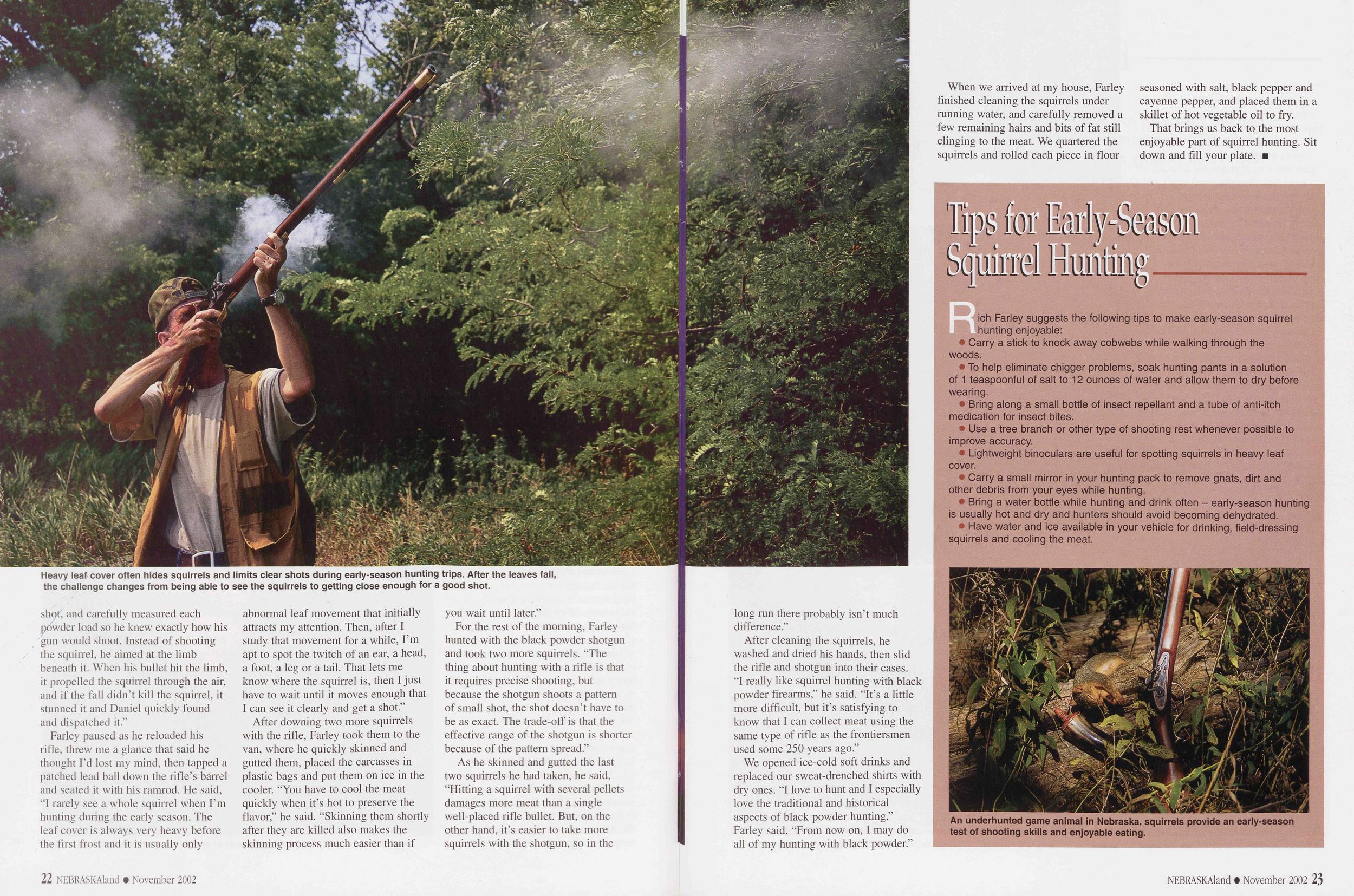
Farley still favors a .22 rifle for squirrel hunting, but recently he became interested in black powder firearms, especially flintlocks. He decided to do his squirrel hunting during the 2002 season with black powder weapons, and he chose a 12-gauge black powder percussion shotgun and a .36-caliber flintlock rifle to do the job. He realized using these weapons would test his hunting skills and marksmanship.
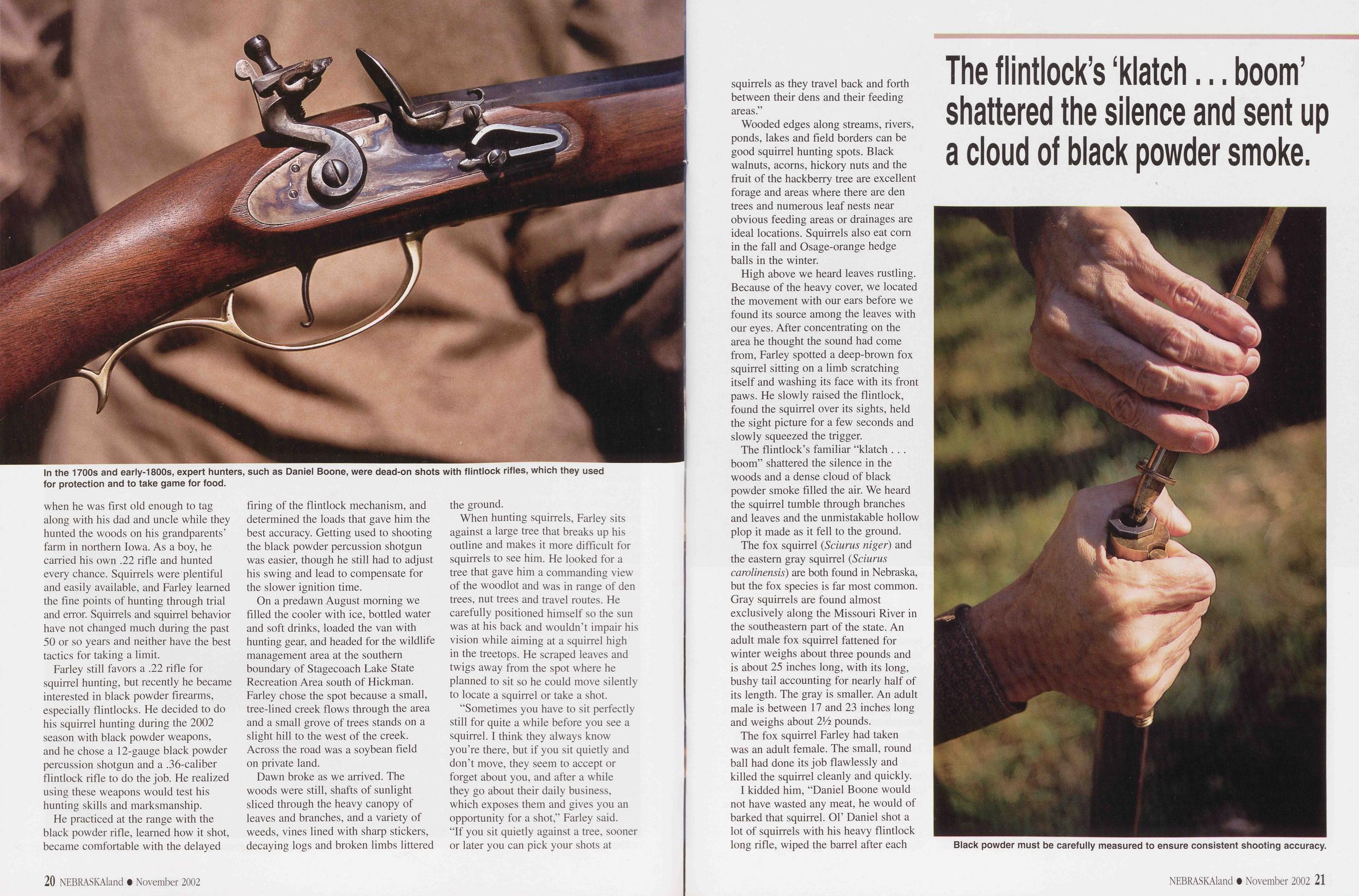
He practiced at the range with the black powder rifle, learned how it shot, became comfortable with the delayed firing of the flintlock mechanism, and determined the loads that gave him the best accuracy. Getting used to shooting the black powder percussion shotgun was easier, though he still had to adjust his swing and lead to compensate for the slower ignition time.
On a predawn August morning we filled the cooler with ice, bottled water and soft drinks, loaded the van with hunting gear, and headed for the wildlife management area at the southern boundary of Stagecoach Lake State Recreation Area south of Hickman. Farley chose the spot because a small, tree-lined creek flows through the area and a small grove of trees stands on a slight hill to the west of the creek. Across the road was a soybean field on private land.
Dawn broke as we arrived. The woods were still, shafts of sunlight sliced through the heavy canopy of leaves and branches, and a variety of weeds, vines lined with sharp stickers, decaying logs and broken limbs littered the ground.
When hunting squirrels, Farley sits against a large tree that breaks up his outline and makes it more difficult for squirrels to see him. He looked for a tree that gave him a commanding view of the woodlot and was in range of den trees, nut trees and travel routes. He carefully positioned himself so the sun was at his back and wouldn’t impair his vision while aiming at a squirrel high in the treetops. He scraped leaves and twigs away from the spot where he planned to sit so he could move silently to locate a squirrel or take a shot.
“Sometimes you have to sit perfectly still for quite a while before you see a squirrel. I think they always know you’re there, but if you sit quietly and don’t move, they seem to accept or forget about you, and after a while they go about their daily business, which exposes them and gives you an opportunity for a shot,” Farley said. “If you sit quietly against a tree, sooner or later you can pick your shots at 20 NEBRASKAland • November 2002 squirrels as they travel back and forth between their dens and their feeding areas.”
Wooded edges along streams, rivers, ponds, lakes and field borders can be good squirrel hunting spots. Black walnuts, acorns, hickory nuts and the fruit of the hackberry tree are excellent forage and areas where there are den trees and numerous leaf nests near obvious feeding areas or drainages are ideal locations. Squirrels also eat com in the fall and Osage-orange hedge balls in the winter.
High above we heard leaves rustling. Because of the heavy cover, we located the movement with our ears before we found its source among the leaves with our eyes. After concentrating on the area he thought the sound had come from, Farley spotted a deep-brown fox squirrel sitting on a limb scratching itself and washing its face with its front paws. He slowly raised the flintlock, found the squirrel over its sights, held the sight picture for a few seconds and slowly squeezed the trigger.
The flintlock’s familiar “klatch . . . boom” shattered the silence in the woods and a dense cloud of black powder smoke filled the air. We heard the squirrel tumble through branches and leaves and the unmistakable hollow plop it made as it fell to the ground.
The fox squirrel (.Sciurus niger) and the eastern gray squirrel (Sciurus carolinensis) are both found in Nebraska, but the fox species is far most common. Gray squirrels are found almost exclusively along the Missouri River in the southeastern part of the state. An adult male fox squirrel fattened for winter weighs about three pounds and is about 25 inches long, with its long, bushy tail accounting for nearly half of its length. The gray is smaller. An adult male is between 17 and 23 inches long and weighs about 2Yi pounds.
The fox squirrel Farley had taken was an adult female. The small, round ball had done its job flawlessly and killed the squirrel cleanly and quickly.
I kidded him, “Daniel Boone would
not have wasted any meat, he would of
barked that squirrel. 01’ Daniel shot a
lot of squirrels with his heavy flintlock
long rifle, wiped the barrel after each
The flintlock’s ‘klatch... doom'
shattered the silence and sent up
a cloud of black powder smoke.
NEBRASKAland • November 2002 21
 shot, and carefully measured each
pdwder load so he knew exactly how his
gun would shoot. Instead of shooting
the squirrel, he aimed at the limb
beneath it. When his bullet hit the limb,
it propelled the squirrel through the air,
and if the fall didn’t kill the squirrel, it
stunned it and Daniel quickly found
and dispatched it.”
shot, and carefully measured each
pdwder load so he knew exactly how his
gun would shoot. Instead of shooting
the squirrel, he aimed at the limb
beneath it. When his bullet hit the limb,
it propelled the squirrel through the air,
and if the fall didn’t kill the squirrel, it
stunned it and Daniel quickly found
and dispatched it.”
Farley paused as he reloaded his rifle, threw me a glance that said he thought I’d lost my mind, then tapped a patched lead ball down the rifle’s barrel and seated it with his ramrod. He said, "I rarely see a whole squirrel when I’m hunting during the early season. The leaf cover is always very heavy before the first frost and it is usually only abnormal leaf movement that initially attracts my attention. Then, after I study that movement for a while, I’m apt to spot the twitch of an ear, a head, a foot, a leg or a tail. That lets me know where the squirrel is, then I just have to wait until it moves enough that I can see it clearly and get a shot.”
After downing two more squirrels with the rifle, Farley took them to the van, where he quickly skinned and gutted them, placed the carcasses in plastic bags and put them on ice in the cooler. “You have to cool the meat quickly when it’s hot to preserve the flavor,” he said. “Skinning them shortly after they are killed also makes the skinning process much easier than if you wait until later.”
For the rest of the morning, Farley hunted with the black powder shotgun and took two more squirrels. “The thing about hunting with a rifle is that it requires precise shooting, but because the shotgun shoots a pattern of small shot, the shot doesn’t have to be as exact. The trade-off is that the effective range of the shotgun is shorter because of the pattern spread.”
As he skinned and gutted the last two squirrels he had taken, he said, “Hitting a squirrel with several pellets damages more meat than a single well-placed rifle bullet. But, on the other hand, it’s easier to take more squirrels with the shotgun, so in the 22 NEBRASKA land O November 2002 long run there probably isn’t much difference.”
After cleaning the squirrels, he washed and dried his hands, then slid the rifle and shotgun into their cases. “I really like squirrel hunting with black powder firearms,” he said. “It’s a little more difficult, but it’s satisfying to know that I can collect meat using the same type of rifle as the frontiersmen used some 250 years ago.”
We opened ice-cold soft drinks and replaced our sweat-drenched shirts with dry ones. “I love to hunt and I especially love the traditional and historical aspects of black powder hunting,” Farley said. “From now on, I may do all of my hunting with black powder.”
When we arrived at my house, Farley finished cleaning the squirrels under running water, and carefully removed a few remaining hairs and bits of fat still clinging to the meat. We quartered the squirrels and rolled each piece in flour seasoned with salt, black pepper and cayenne pepper, and placed them in a skillet of hot vegetable oil to fry.
That brings us back to the most enjoyable part of squirrel hunting. Sit down and fill your plate. ■
Tips for Early-Season Squirrel HuntingRich Farley suggests the following tips to make early-season squirrel hunting enjoyable:
Carry a stick to knock away cobwebs while walking through the woods.
To help eliminate chigger problems, soak hunting pants in a solution of 1 teaspoonful of salt to 12 ounces of water and allow them to dry before wearing.
• Bring along a small bottle of insect repellant and a tube of anti-itch medication for insect bites.
• Use a tree branch or other type of shooting rest whenever possible to improve accuracy.
Lightweight binoculars are useful for spotting squirrels in heavy leaf cover.
Carry a small mirror in your hunting pack to remove gnats, dirt and other debris from your eyes while hunting.
• Bring a water bottle while hunting and drink often - early-season hunting is usually hot and dry and hunters should avoid becoming dehydrated.
• Have water and ice available in your vehicle for drinking, field-dressing squirrels and cooling the meat.
Buck Fever
Last fall I decided to focus my long-term interest in photography on wildlife. With tips from my brother-in-law, I staked out canyons on our Key a Paha County ranch hoping to take a picture of the “big one. ”Nebraskans are familiar with the term “Husker fever.” But, “buck fever,” which infects thousands every year, is just as contagious. I had thought I was immune, but last deer season proved me wrong.
I have had a long-term interest in photography, and last fall I decided to focus on wildlife. Like many others, I wanted to spot a big buck, and I invested serious effort in doing so. My brother-in-law, Jason Orton, told me, “You’re a hunter, now - you just don’t have a gun.” Then, he introduced me to cover scent, which is designed to mask human odor from deer and smelled like Pine-Sol to me, and the wisdom found in wildlife magazine articles. One story listed 12 essential things every hunter should have when stalking prey. I had only one - a flashlight - but I didn’t let that get me down. I hit the stores and added the requisite hunter’s orange, a camouflage carryall, and yes, even the highly recommended cover scent to my kit.
I began my quest to take beautiful buck photos about three weeks before the start of deer season. While sitting at prime locations in the canyons of our family’s Keya Paha County ranch, I saw several large bucks and rolled through my fair share of film, but after three weeks of shooting, I still had not seen the big one I was hoping for. As the opening weekend of hunting season approached, I hoped to tag along with Jason and Bob Schieffer, my youngest sister’s fiance, for some real hunting photography. I am the oldest of three daughters in a ranch family. Dad taught my sisters, Chana and Alicia, and me how to hit tin cans at a decent range, but because we lack the killer instinct, we leave the hunting to the guys.
Opening day arrived. The radio station had regularly played the 30-point buck song for the past week, the men had plenty of ammunition, and their buck fevers were high. But, girls were not invited for their predawn patrol through the canyons. I was not really crushed. They left at 5:30 a.m., and, as it turned out, I didn’t miss much anyway. At about 9:30 a.m., the guys came to my house and over Pop Tarts and Cokes discussed their unsuccessful morning.
While hunting, however, they had spotted some cattle that we still needed to drive out of the canyons, and when my parents, Greg and Teresa Bammerlin, arrived we decided to bring in the cattle. In a caravan of three, four-wheel- drive pickups, we headed toward the tree-filled canyons. But, when we arrived, the cattle proved as elusive as the deer had been earlier.
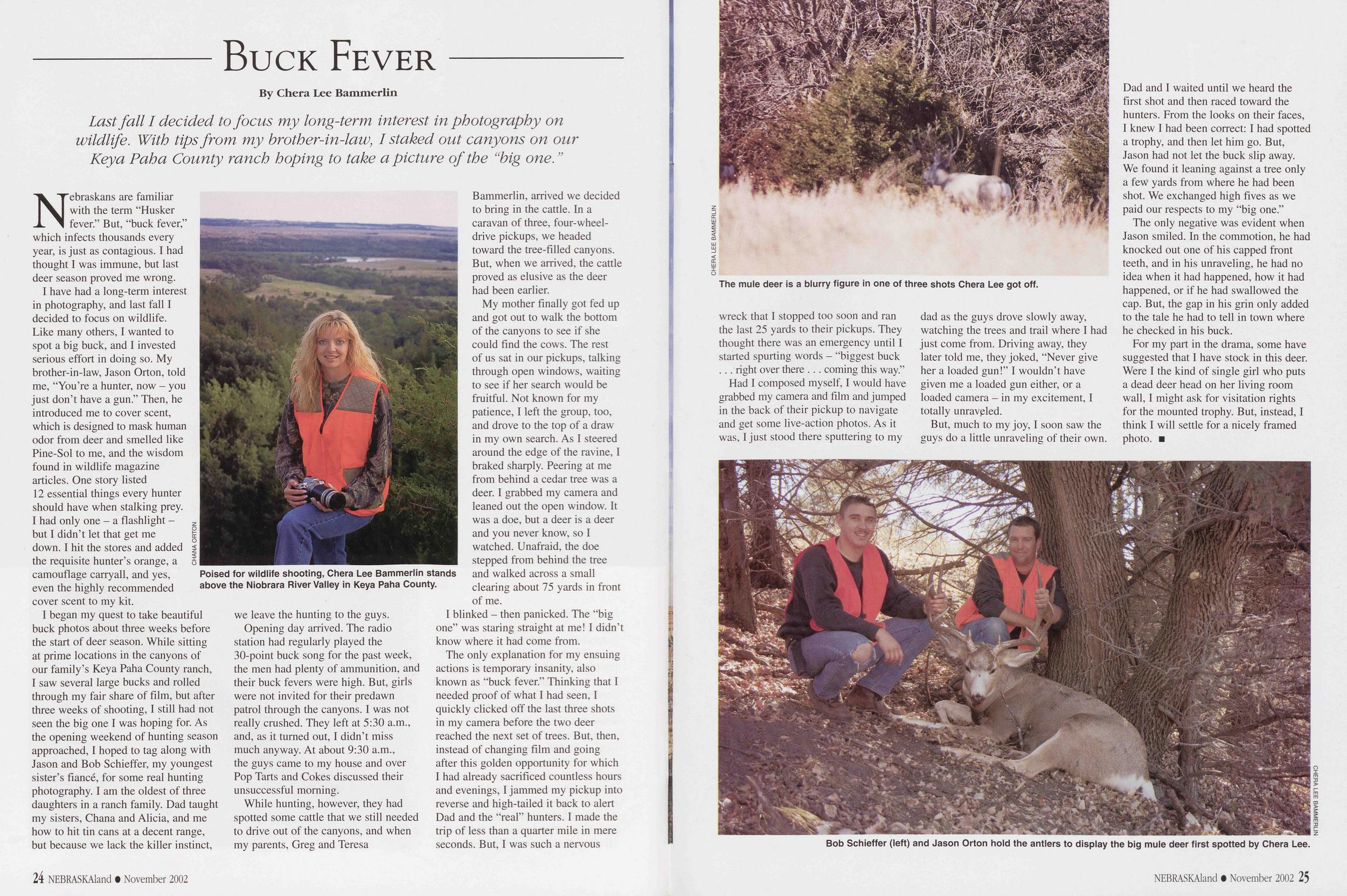
My mother finally got fed up and got out to walk the bottom of the canyons to see if she could find the cows. The rest of us sat in our pickups, talking through open windows, waiting to see if her search would be fruitful. Not known for my patience, I left the group, too, and drove to the top of a draw in my own search. As I steered around the edge of the ravine, I braked sharply. Peering at me from behind a cedar tree was a deer. I grabbed my camera and leaned out the open window. It was a doe, but a deer is a deer and you never know, so I watched. Unafraid, the doe stepped from behind the tree and walked across a small clearing about 75 yards in front of me.
CHERA LEE BAMMERLINI blinked - then panicked. The “big one” was staring straight at me! I didn’t know where it had come from.
The only explanation for my ensuing actions is temporary insanity, also known as “buck fever.” Thinking that I needed proof of what I had seen, I quickly clicked off the last three shots in my camera before the two deer reached the next set of trees. But, then, instead of changing film and going after this golden opportunity for which I had already sacrificed countless hours and evenings, I jammed my pickup into reverse and high-tailed it back to alert Dad and the “real” hunters. I made the trip of less than a quarter mile in mere seconds. But, I was such a nervous 24 NEBRASKAland • November 2002 wreck that I stopped too soon and ran the last 25 yards to their pickups. They thought there was an emergency until I started spurting words - “biggest buck .. . right over there .. . coming this way.”
Had I composed myself, I would have grabbed my camera and film and jumped in the back of their pickup to navigate and get some live-action photos. As it was, I just stood there sputtering to my dad as the guys drove slowly away, watching the trees and trail where I had just come from. Driving away, they later told me, they joked, “Never give her a loaded gun!” I wouldn’t have given me a loaded gun either, or a loaded camera - in my excitement, I totally unravpled.
But, much to my joy, I soon saw the guys do a little unraveling of their own. Dad and I waited until we heard the first shot and then raced toward the hunters. From the looks on their faces, I knew I had been correct: I had spotted a trophy, and then let him go. But, Jason had not let the buck slip away. We found it leaning against a tree only a few yards from where he had been shot. We exchanged high fives as we paid our respects to my “big one.”
The only negative was evident when Jason smiled. In the commotion, he had knocked out one of his capped front teeth, and in his unraveling, he had no idea when it had happened, how it had happened, or if he had swallowed the cap. But, the gap in his grin only added to the tale he had to tell in town where he checked in his buck.
For my part in the drama, some have suggested that I have stock in this deer. Were I the kind of single girl who puts a dead deer head on her living room wall, I might ask for visitation rights for the mounted trophy. But, instead, I think I will settle for a nicely framed photo. ■
Nebraska Abole
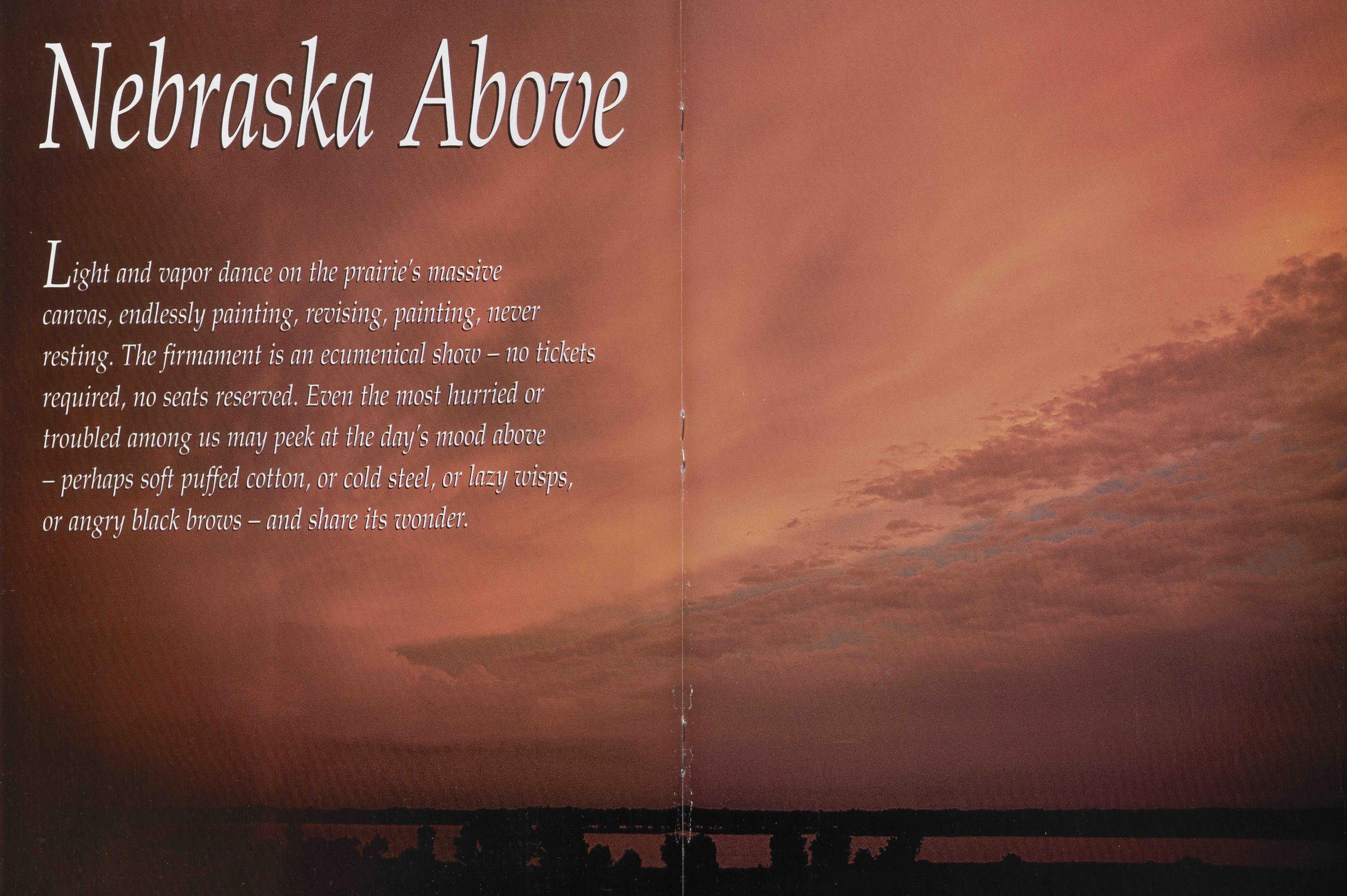
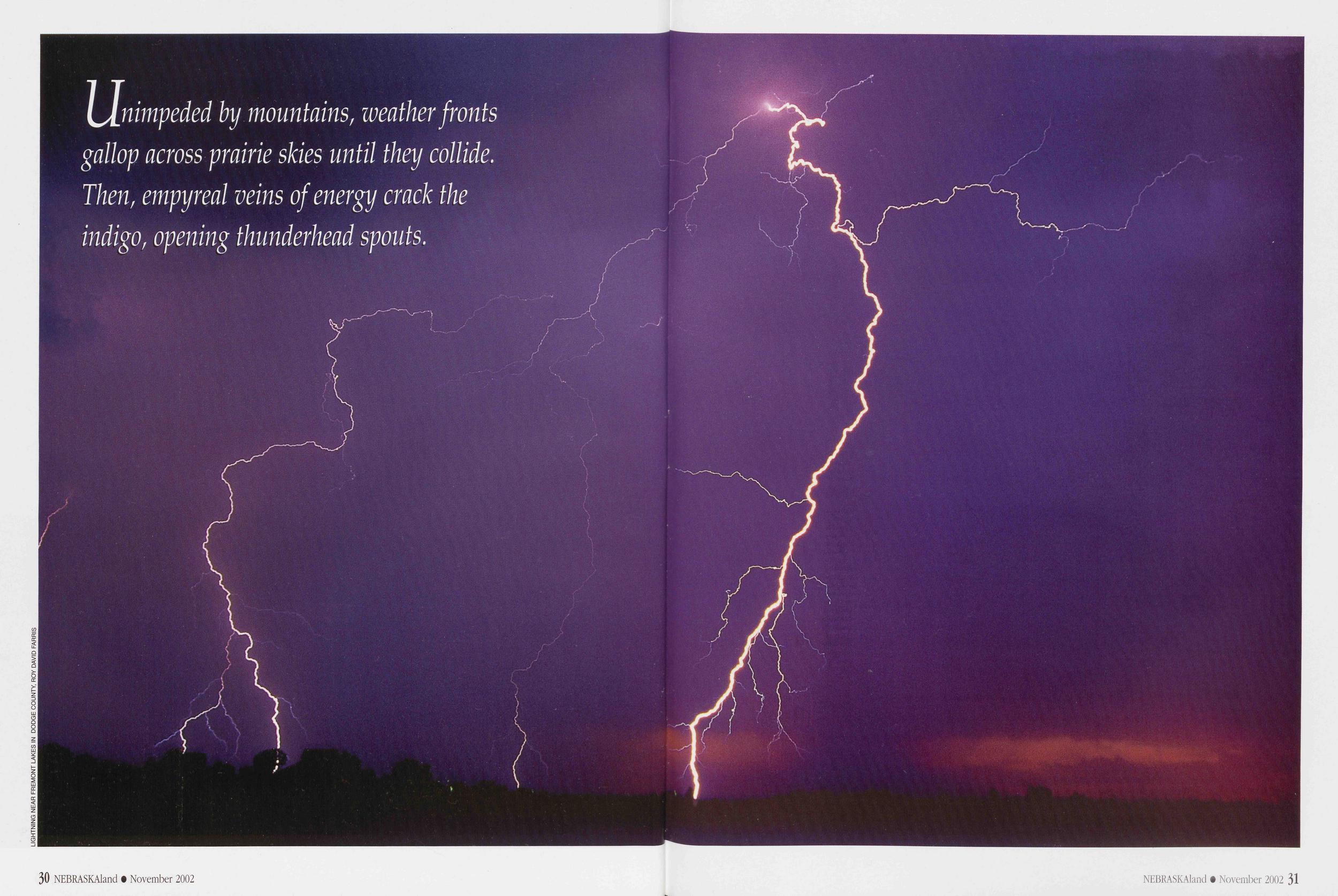
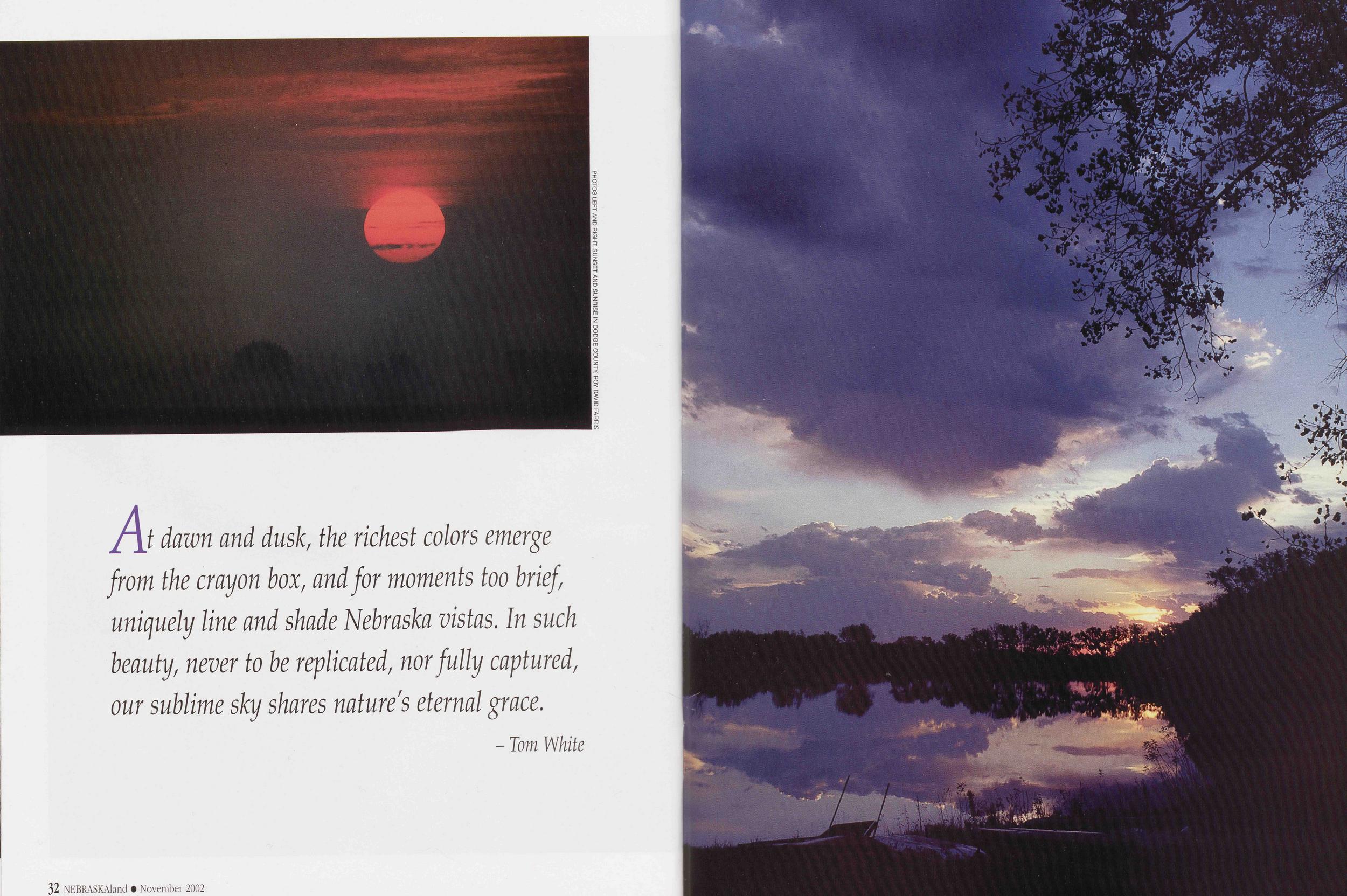
Light and vapor dance on the prairie's massive canvas, endlessly painting, revising, painting, never resting. The firmament is an ecumenical show - no tickets required, no seats reserved. Even the most hurried or troubled among us may peek at the day's mood above - perhaps soft puffed cotton, or cold steel, or lazy wisps, or angry black brows - and share its -wonder.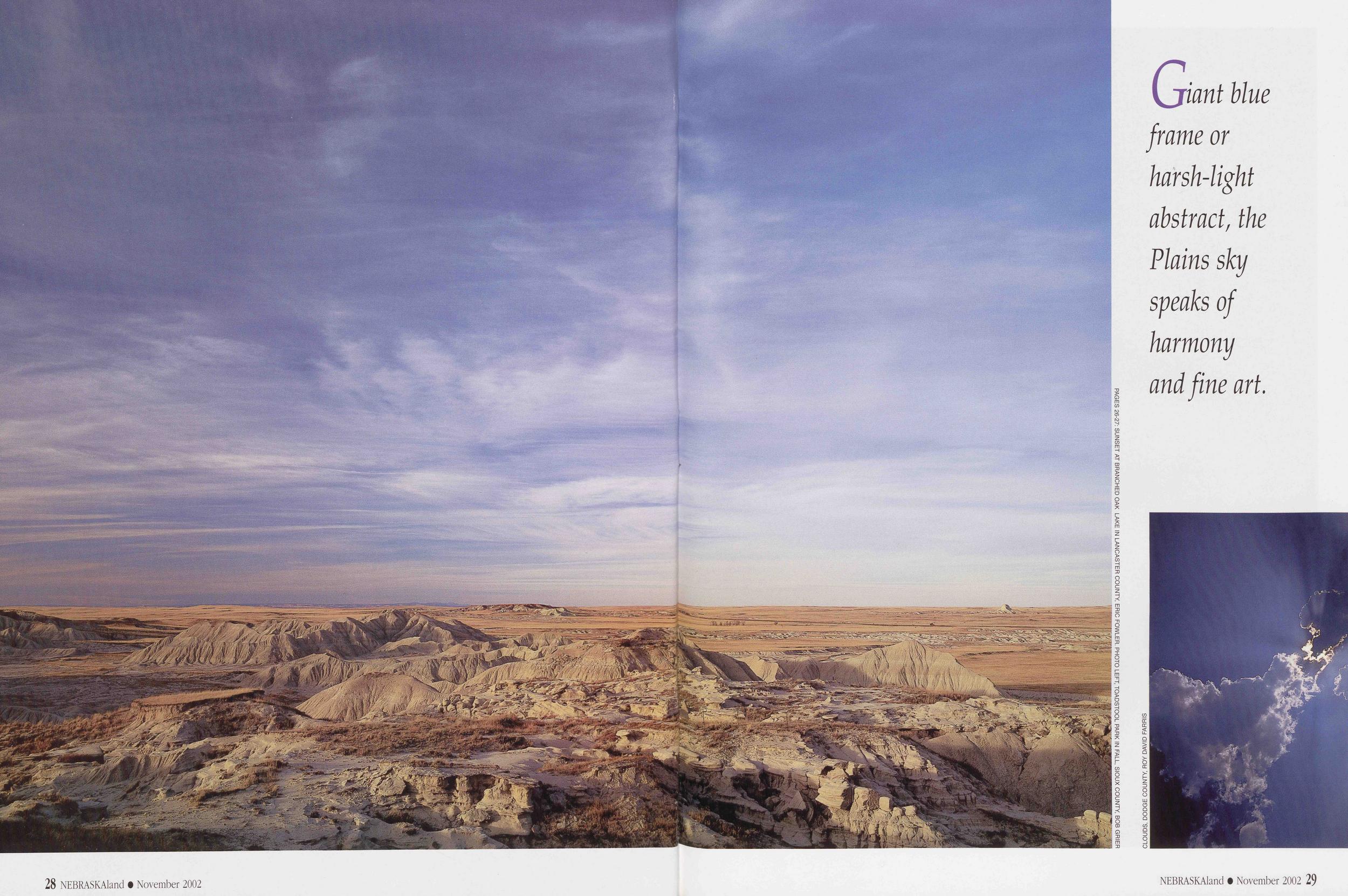 Giant blue
frame or
harsh-light
abstract, the
Plains sky
speaks of
harmony
and fine art.
28 NEBRASKAland • November 2002
NEBRASKAland • November 2002 29
Giant blue
frame or
harsh-light
abstract, the
Plains sky
speaks of
harmony
and fine art.
28 NEBRASKAland • November 2002
NEBRASKAland • November 2002 29
Winter in the Parks
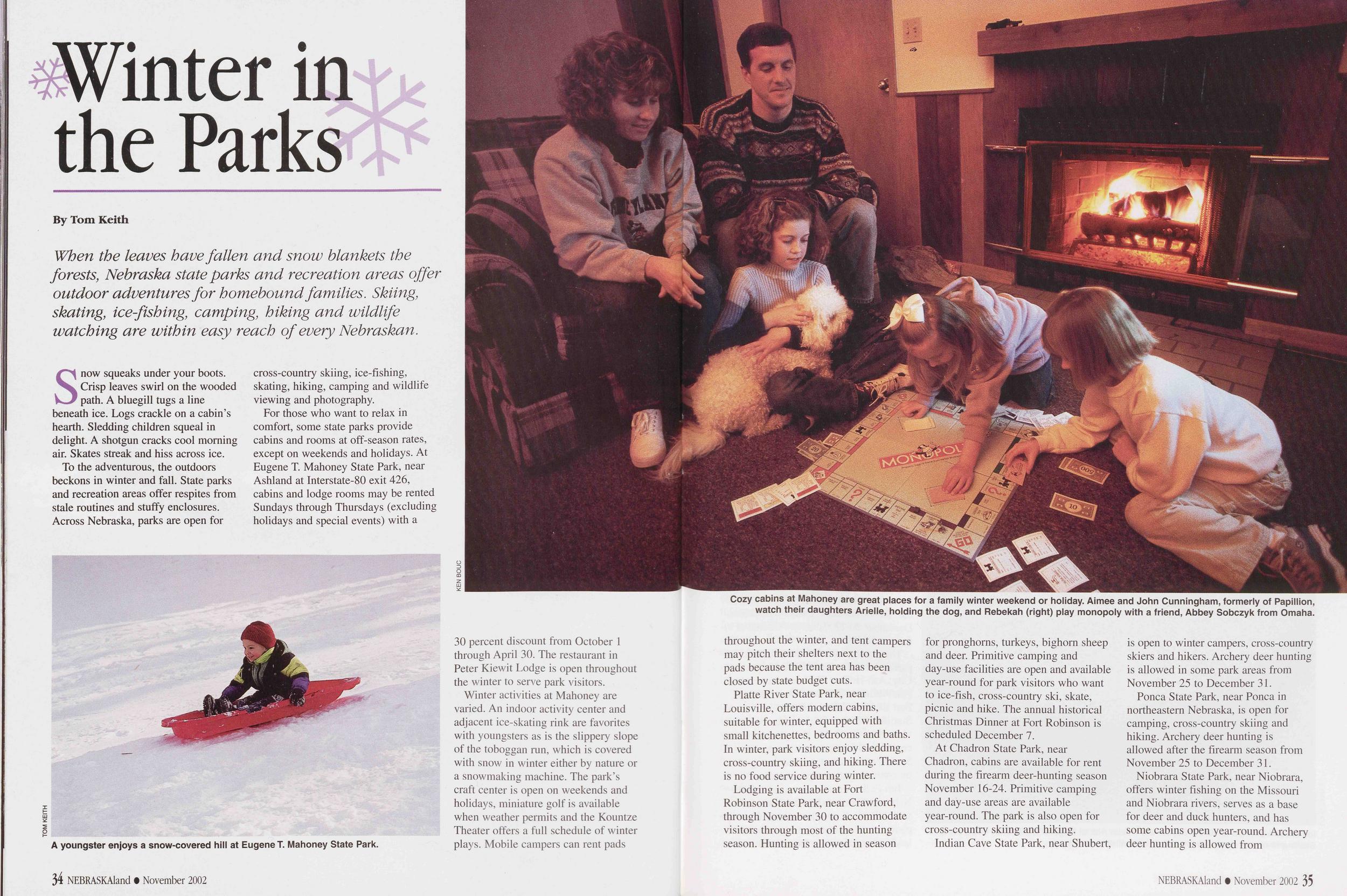
When the leaves have fallen and snow blankets the forests, Nebraska state parks and recreation areas offer outdoor adventures for homebound families. Skiing, skating, ice-fishing, camping, hiking and wildlife watching are within easy reach of every Nebraskan.Snow squeaks under your boots. Crisp leaves swirl on the wooded path. A bluegill tugs a line beneath ice. Logs crackle on a cabin’s hearth. Sledding children squeal in delight. A shotgun cracks cool morning air. Skates streak and hiss across ice.
To the adventurous, the outdoors beckons in winter and fall. State parks and recreation areas offer respites from stale routines and stuffy enclosures. Across Nebraska, parks are open for cross-country skiing, ice-fishing, skating, hiking, camping and wildlife viewing and photography.
TOM KEITHFor those who want to relax in comfort, some state parks provide cabins and rooms at off-season rates, except on weekends and holidays. At Eugene T. Mahoney State Park, near Ashland at Interstate-80 exit 426, cabins and lodge rooms may be rented Sundays through Thursdays (excluding holidays and special events) with a 30 percent discount from October 1 through April 30. The restaurant in Peter Kiewit Lodge is open throughout the winter to serve park visitors.
Winter activities at Mahoney are varied. An indoor activity center and adjacent ice-skating rink are favorites with youngsters as is the slippery slope of the toboggan run, which is covered with snow in winter either by nature or a snowmaking machine. The park’s craft center is open on weekends and holidays, miniature golf is available when weather permits and the Kountze Theater offers a full schedule of winter plays. Mobile campers can rent pads 34 NEBRASKAland • November 2002 throughout the winter, and tent campers may pitch their shelters next to the pads because the tent area has been closed by state budget cuts.
Platte River State Park, near Louisville, offers modem cabins, suitable for winter, equipped with small kitchenettes, bedrooms and baths. In winter, park visitors enjoy sledding, cross-country skiing, and hiking. There is no food service during winter.
Lodging is available at Fort Robinson State Park, near Crawford, through November 30 to accommodate visitors through most of the hunting season. Hunting is allowed in season for pronghorns, turkeys, bighorn sheep and deer. Primitive camping and day-use facilities are open and available year-round for park visitors who want to ice-fish, cross-country ski, skate, picnic and hike. The annual historical Christmas Dinner at Fort Robinson is scheduled December 7.
At Chadron State Park, near Chadron, cabins are available for rent during the firearm deer-hunting season November 16-24. Primitive camping and day-use areas are available year-round. The park is also open for cross-country skiing and hiking.
Indian Cave State Park, near Shubert, is open to winter campers, cross-country skiers and hikers. Archery deer hunting is allowed in some park areas from November 25 to December 31.
Ponca State Park, near Ponca in northeastern Nebraska, is open for camping, cross-country skiing and hiking. Archery deer hunting is allowed after the firearm season from November 25 to December 31.
Niobrara State Park, near Niobrara,
offers winter fishing on the Missouri
and Niobrara rivers, serves as a base
for deer and duck hunters, and has
some cabins open year-round. Archery
deer hunting is allowed from
NEBRASKAland • November 2002 35
 November 25 to December 31. The
park also offers trails for snowmobiling,
cross-country skiing and hiking.
Primitive camping and picnicking are
also available.
November 25 to December 31. The
park also offers trails for snowmobiling,
cross-country skiing and hiking.
Primitive camping and picnicking are
also available.
East of Niobrara, Lewis and Clark State Recreation Area, located near Crofton, offers cabins on Lewis and Clark Lake throughout the winter.
Victoria Springs State Recreation Area, near Anselmo, also has cabins available through the November firearm deer-hunting season.
The annual Christmas at the Ranch Celebration at Arthur Bowring Sandhills Ranch State Historical Park (SHP), near Merriman, is scheduled for December 8. The festivities include the 36 NEBRASKAland G November 2002 annual Christmas program and dinner. Buffalo Bill Ranch State Historical Park, near North Platte, is the site of the “Christmas at the Codys” celebration December 20-23. Tours are offered of the ranch house.
The grounds at other state historical parks, Arbor Lodge SHP, in Nebraska City; Ash Hollow SHP near Lewellen; Fort Atkinson SHP near Fort Calhoun; Fort Kearny SHP, and Rock Creek Station SHP near Fairbury, are open to visitors in the winter, though the visitor centers and facilities will be closed. Special group tours may be arranged by contacting area superintendents.
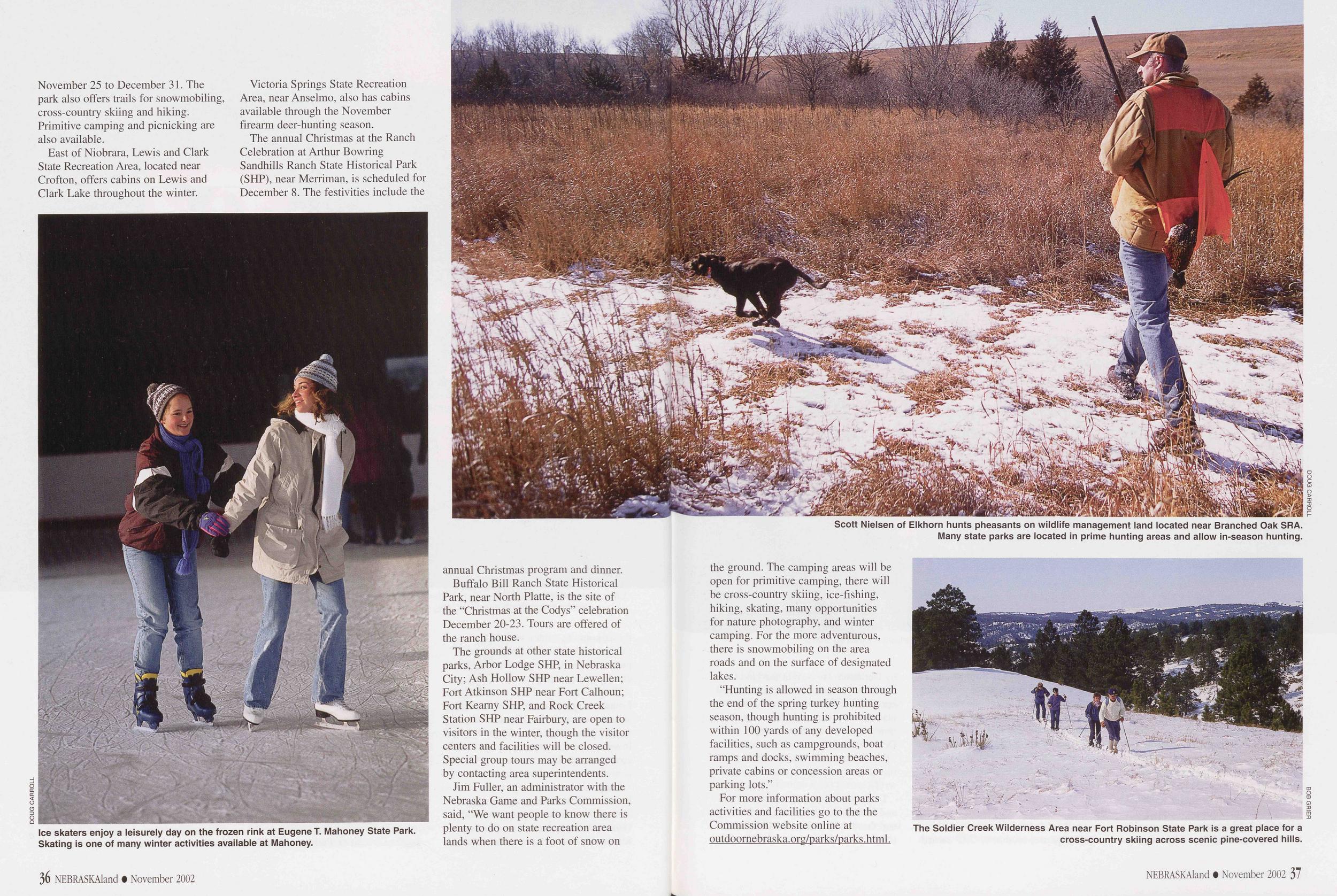
Jim Fuller, an administrator with the Nebraska Game and Parks Commission, said, “We want people to know there is plenty to do on state recreation area lands when there is a foot of snow on 36 NEBRASKAland G November 2002 the ground. The camping areas will be open for primitive camping, there will be cross-country skiing, ice-fishing, hiking, skating, many opportunities for nature photography, and winter camping. For the more adventurous, there is snowmobiling on the area roads and on the surface of designated lakes.
DOUG CARROLL“Hunting is allowed in season through the end of the spring turkey hunting season, though hunting is prohibited within 100 yards of any developed facilities, such as campgrounds, boat ramps and docks, swimming beaches, private cabins or concession areas or parking lots.”
For more information about parks activities and facilities go to the the Commission website online at outdoornebraska.org/parks/parks.html.
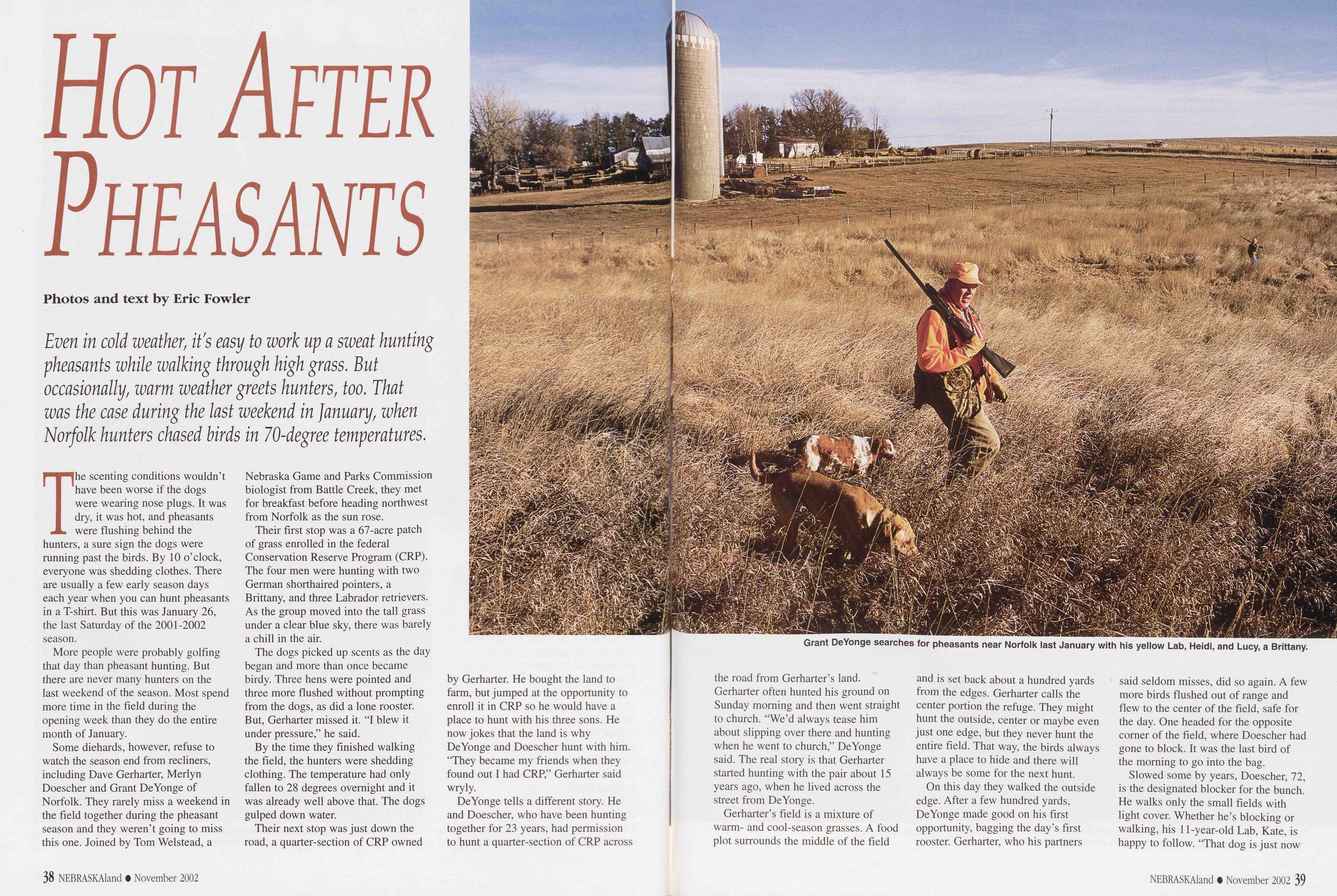
Hot After Pheasants
Even in cold weather, it's easy to work up a sweat hunting pheasants while walking through high grass. But occasionally, warm weather greets hunters, too. That was the case during the last weekend in January, when Norfolk hunters chased birds in 70-degree temperatures.The scenting conditions wouldn’t have been worse if the dogs were wearing nose plugs. It was dry, it was hot, and pheasants were flushing behind the hunters, a sure sign the dogs were running past the birds. By 10 o’clock, everyone was shedding clothes. There are usually a few early season days each year when you can hunt pheasants in a T-shirt. But this was January 26, the last Saturday of the 2001-2002 season.
More people were probably golfing that day than pheasant hunting. But there are never many hunters on the last weekend of the season. Most spend more time in the field during the opening week than they do the entire month of January.
Some diehards, however, refuse to watch the season end from recliners, including Dave Gerharter, Merlyn Doescher and Grant DeYonge of Norfolk. They rarely miss a weekend in the field together during the pheasant season and they weren’t going to miss this one. Joined by Tom Welstead, a Nebraska Game and Parks Commission biologist from Battle Creek, they met for breakfast before heading northwest from Norfolk as the sun rose.
Their first stop was a 67-acre patch of grass enrolled in the federal Conservation Reserve Program (CRP). The four men were hunting with two German shorthaired pointers, a Brittany, and three Labrador retrievers. As the group moved into the tall grass under a clear blue sky, there was barely a chill in the air.
The dogs picked up scents as the day began and more than once became birdy. Three hens were pointed and three more flushed without prompting from the dogs, as did a lone rooster. But, Gerharter missed it. "I blew it under pressure,” he said.
By the time they finished walking the field, the hunters were shedding clothing. The temperature had only fallen to 28 degrees overnight and it was already well above that. The dogs gulped down water.
Their next stop was just down the road, a quarter-section of CRP owned by Gerharter. He bought the land to farm, but jumped at the opportunity to enroll it in CRP so he would have a place to hunt with his three sons. He now jokes that the land is why DeYonge and Doescher hunt with him. "They became my friends when they found out I had CRP,” Gerharter said wryly.
DeYonge tells a different story. He and Doescher, who have been hunting together for 23 years, had permission to hunt a quarter-section of CRP across 38 NEBRASKAland • November 2002 the road from Gerharter’s land. Gerharter often hunted his ground on Sunday morning and then went straight to church. "We’d always tease him about slipping over there and hunting when he went to church,” DeYonge said. The real story is that Gerharter started hunting with the pair about 15 years ago, when he lived across the street from DeYonge.
Gerharter’s field is a mixture of warm- and cool-season grasses. A food plot surrounds the middle of the field and is set back about a hundred yards from the edges. Gerharter calls the center portion the refuge. They might hunt the outside, center or maybe even just one edge, but they never hunt the entire field. That way, the birds always have a place to hide and there will always be some for the next hunt.
On this day they walked the outside edge. After a few hundred yards, DeYonge made good on his first opportunity, bagging the day’s first rooster. Gerharter, who his partners said seldom misses, did so again. A few more birds flushed out of range and flew to the center of the field, safe for the day. One headed for the opposite corner of the field, where Doescher had gone to block. It was the last bird of the morning to go into the bag.
Slowed some by years, Doescher, 72,
is the designated blocker for the bunch.
He walks only the small fields with
light cover. Whether he’s blocking or
walking, his 11-year-old Lab, Kate, is
happy to follow. "That dog is just now
NEBRASKAland • November 2002 39
 hitting my speed,” he said with a laugh,
noting that Kate is slowing down, too.
hitting my speed,” he said with a laugh,
noting that Kate is slowing down, too.
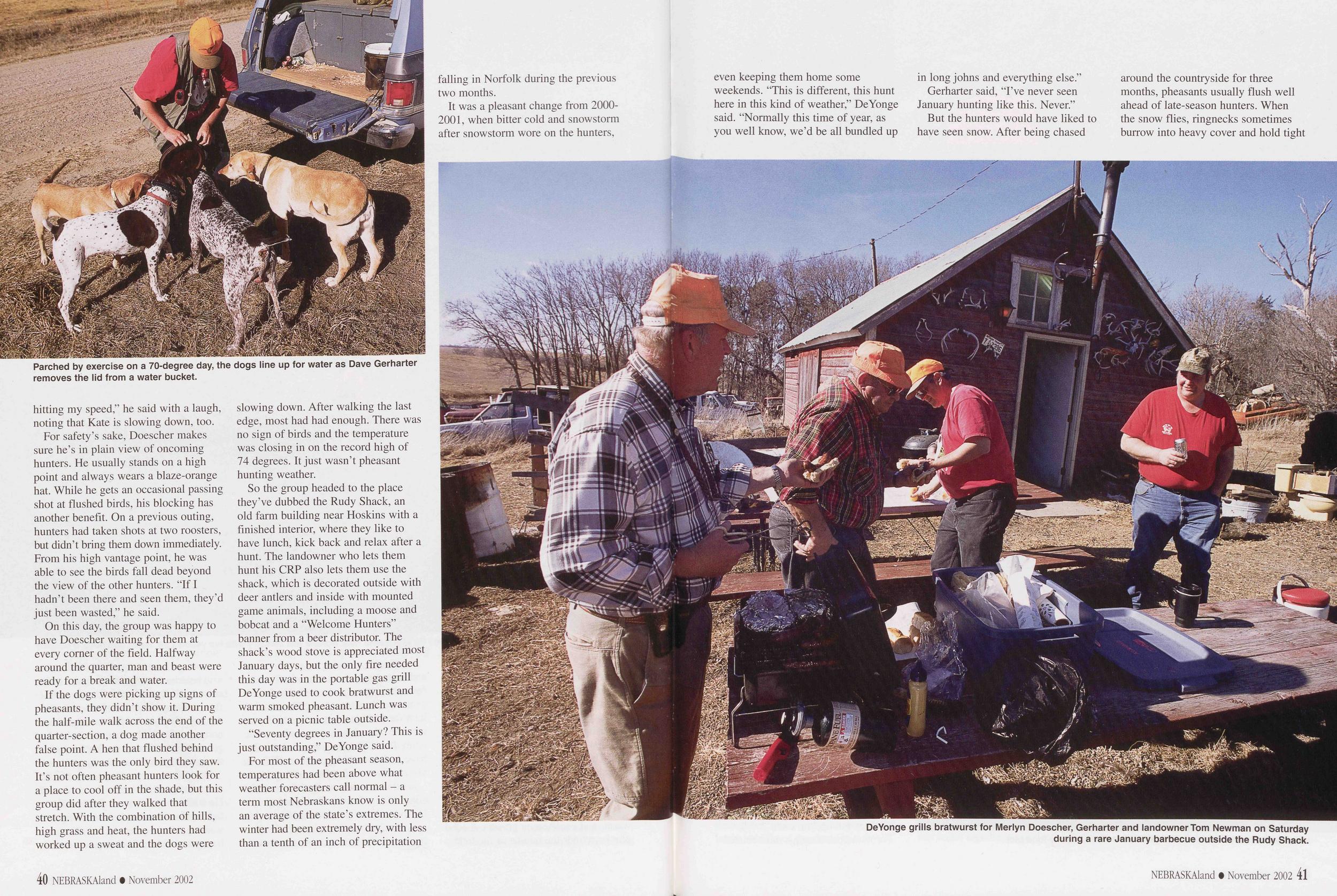
For safety’s sake, Doescher makes sure he’s in plain view of oncoming hunters. He usually stands on a high point and always wears a blaze-orange hat. While he gets an occasional passing shot at flushed birds, his blocking has another benefit. On a previous outing, hunters had taken shots at two roosters, but didn’t bring them down immediately. From his high vantage point, he was able to see the birds fall dead beyond the view of the other hunters. "If I hadn’t been there and seen them, they’d just been wasted,” he said. On this day, the group was happy to have Doescher waiting for them at every corner of the field. Halfway around the quarter, man and beast were ready for a break and water.
If the dogs were picking up signs of pheasants, they didn’t show it. During the half-mile walk across the end of the quarter-section, a dog made another false point. A hen that flushed behind the hunters was the only bird they saw. It’s not often pheasant hunters look for a place to cool off in the shade, but this group did after they walked that stretch. With the combination of hills, high grass and heat, the hunters had worked up a sweat and the dogs were slowing down. After walking the last edge, most had had enough. There was no sign of birds and the temperature was closing in on the record high of 74 degrees. It just wasn’t pheasant hunting weather.
So the group headed to the place they’ve dubbed the Rudy Shack, an old farm building near Hoskins with a finished interior, where they like to have lunch, kick back and relax after a hunt. The landowner who lets them hunt his CRP also lets them use the shack, which is decorated outside with deer antlers and inside with mounted game animals, including a moose and bobcat and a "Welcome Hunters” banner from a beer distributor. The shack’s wood stove is appreciated most January days, but the only fire needed this day was in the portable gas grill DeYonge used to cook bratwurst and warm smoked pheasant. Lunch was served on a picnic table outside.
“Seventy degrees in January? This is just outstanding,” DeYonge said.
For most of the pheasant season, temperatures had been above what weather forecasters call normal - a term most Nebraskans know is only an average of the state’s extremes. The winter had been extremely dry, with less than a tenth of an inch of precipitation falling in Norfolk during the previous two months.
It was a pleasant change from 2000- 2001, when bitter cold and snowstorm after snowstorm wore on the hunters, even keeping them home some weekends. "This is different, this hunt here in this kind of weather,” DeYonge said. "Normally this time of year, as you well know, we’d be all bundled up in long johns and everything else.”
Gerharter said, "I’ve never seen January hunting like this. Never.”
But the hunters would have liked to
have seen snow. After being chased
around the countryside for three
months, pheasants usually flush well
ahead of late-season hunters. When
the snow flies, ringnecks sometimes
burrow into heavy cover and hold tight
NEBRASKAland G November 2002 41
 for hunters and dogs.
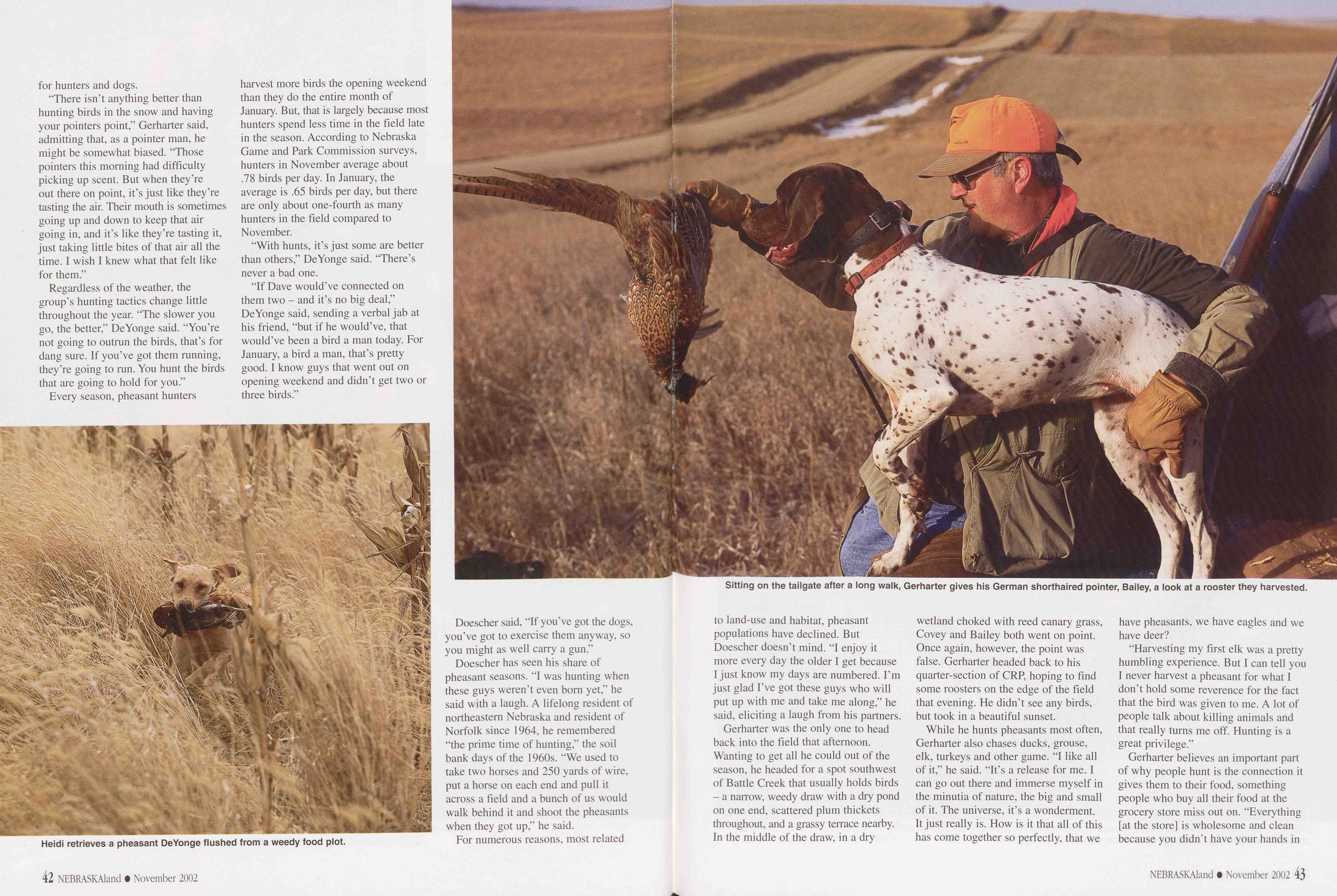
“There isn’t anything better than hunting birds in the snow and having your pointers point,” Gerharter said, admitting that, as a pointer man, he might be somewhat biased. “Those pointers this morning had difficulty picking up scent. But when they’re out there on point, it’s just like they’re tasting the air. Their mouth is sometimes going up and down to keep that air going in, and it’s like they’re tasting it, just taking little bites of that air all the time. I wish I knew what that felt like for them.”
Regardless of the weather, the group’s hunting tactics change little throughout the year. “The slower you go, the better,” DeYonge said. “You’re not going to outrun the birds, that’s for dang sure. If you’ve got them running, they’re going to run. You hunt the birds that are going to hold for you.”
Every season, pheasant hunters harvest more birds the opening weekend than they do the entire month of January. But, that is largely because most hunters spend less time in the field late in the season. According to Nebraska Game and Park Commission surveys, hunters in November average about .78 birds per day. In January, the average is .65 birds per day, but there are only about one-fourth as many hunters in the field compared to November.
“With hunts, it’s just some are better than others,” DeYonge said. “There’s never a bad one.
“If Dave would’ve connected on them two - and it’s no big deal,” DeYonge said, sending a verbal jab at his friend, “but if he would’ve, that would’ve been a bird a man today. For January, a bird a man, that’s pretty good. I know guys that went out on opening weekend and didn’t get two or three birds.”
Doescher said, “If you’ve got the dogs, you’ve got to exercise them anyway, so you might as well carry a gun.”
Doescher has seen his share of pheasant seasons. "I was hunting when these guys weren’t even born yet,” he said with a laugh. A lifelong resident of northeastern Nebraska and resident of Norfolk since 1964, he remembered “the prime time of hunting,” the soil bank days of the 1960s. “We used to take two horses and 250 yards of wire, put a horse on each end and pull it across a field and a bunch of us would walk behind it and shoot the pheasants when they got up,” he said.
For numerous reasons, most related 42 NEBRASKAland • November 2002 to land-use and habitat, pheasant populations have declined. But Doescher doesn’t mind. “I enjoy it more every day the older I get because I just know my days are numbered. I’m just glad I’ve got these guys who will put up with me and take me along,” he said, eliciting a laugh from his partners.
Gerharter was the only one to head back into the field that afternoon. Wanting to get all he could out of the season, he headed for a spot southwest of Battle Creek that usually holds birds - a narrow, weedy draw with a dry pond on one end, scattered plum thickets throughout, and a grassy terrace nearby. In the middle of the draw, in a dry wetland choked with reed canary grass, Covey and Bailey both went on point. Once again, however, the point was false. Gerharter headed back to his quarter-section of CRP, hoping to find some roosters on the edge of the field that evening. He didn’t see any birds, but took in a beautiful sunset.
While he hunts pheasants most often, Gerharter also chases ducks, grouse, elk, turkeys and other game. “I like all of it,” he said. “It’s a release for me. I can go out there and immerse myself in the minutia of nature, the big and small of it. The universe, it’s a wonderment. It just really is. How is it that all of this has come together so perfectly, that we have pheasants, we have eagles and we have deer?
“Harvesting my first elk was a pretty humbling experience. But I can tell you I never harvest a pheasant for what I don’t hold some reverence for the fact that the bird was given to me. A lot of people talk about killing animals and that really turns me off. Hunting is a great privilege.”
Gerharter believes an important part
of why people hunt is the connection it
gives them to their food, something
people who buy all their food at the
grocery store miss out on. “Everything
[at the store] is wholesome and clean
because you didn’t have your hands in
NEBRASKAland • November 2002 43
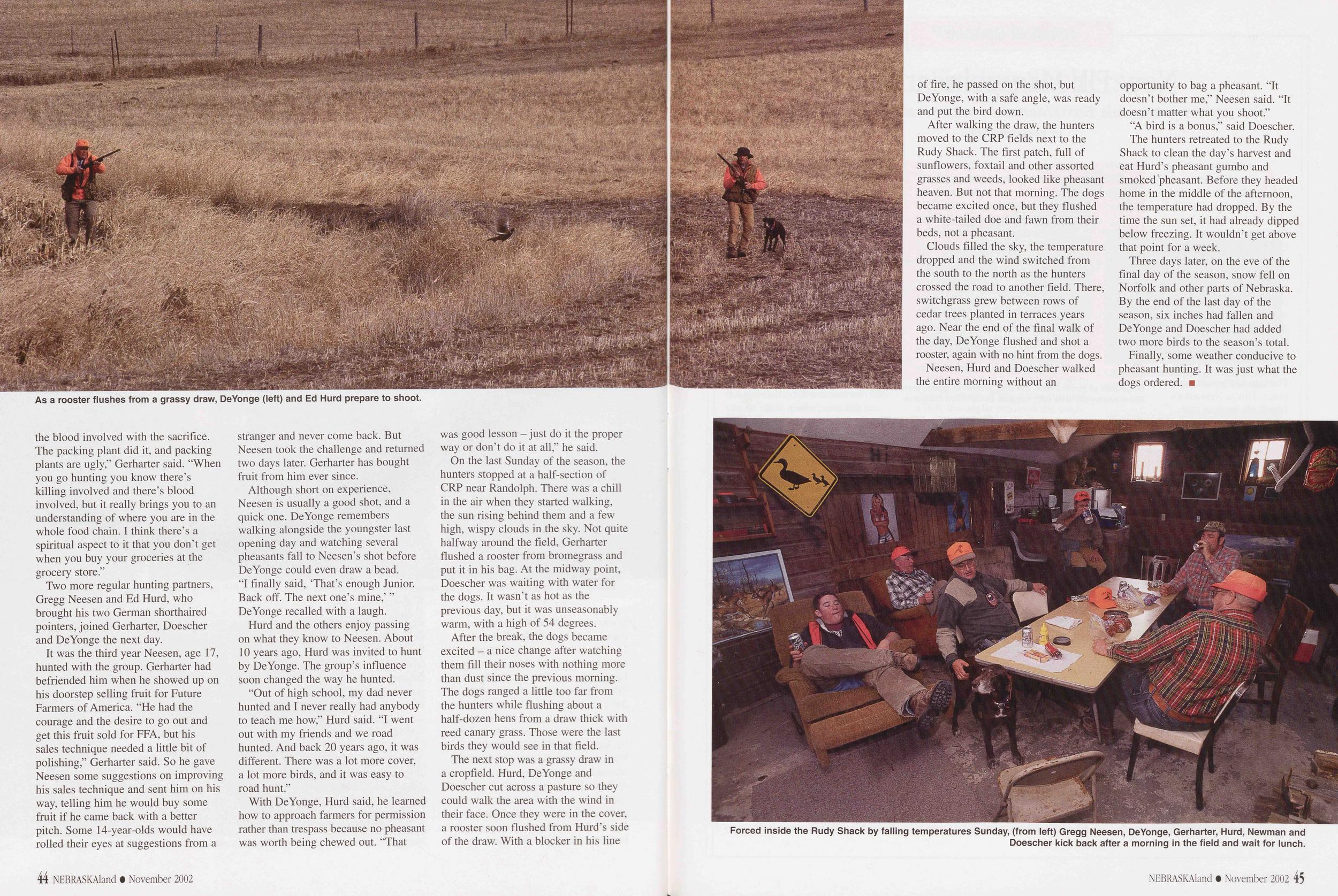 the blood involved with the sacrifice.
The packing plant did it, and packing
plants are ugly,” Gerharter said. "When
you go hunting you know there’s
killing involved and there’s blood
involved, but it really brings you to an
understanding of where you are in the
whole food chain. I think there’s a
spiritual aspect to it that you don’t get
when you buy your groceries at the
grocery store.”
the blood involved with the sacrifice.
The packing plant did it, and packing
plants are ugly,” Gerharter said. "When
you go hunting you know there’s
killing involved and there’s blood
involved, but it really brings you to an
understanding of where you are in the
whole food chain. I think there’s a
spiritual aspect to it that you don’t get
when you buy your groceries at the
grocery store.”
Two more regular hunting partners, Gregg Neesen and Ed Hurd, who brought his two German shorthaired pointers, joined Gerharter, Doescher and DeYonge the next day.
It was the third year Neesen, age 17, hunted with the group. Gerharter had befriended him when he showed up on his doorstep selling fruit for Future Farmers of America. "He had the courage and the desire to go out and get this fruit sold for FFA, but his sales technique needed a little bit of polishing,” Gerharter said. So he gave Neesen some suggestions on improving his sales technique and sent him on his way, telling him he would buy some fruit if he came back with a better pitch. Some 14-year-olds would have rolled their eyes at suggestions from a stranger and never come back. But Neesen took the challenge and returned two days later. Gerharter has bought fruit from him ever since.
Although short on experience, Neesen is usually a good shot, and a quick one. DeYonge remembers walking alongside the youngster last opening day and watching several pheasants fall to Neesen’s shot before DeYonge could even draw a bead. "I finally said, ‘That’s enough Junior. Back off. The next one’s mine,’ ” DeYonge recalled with a laugh.
Hurd and the others enjoy passing on what they know to Neesen. About 10 years ago, Hurd was invited to hunt by DeYonge. The group’s influence soon changed the way he hunted.
"Out of high school, my dad never hunted and I never really had anybody to teach me how,” Hurd said. "I went out with my friends and we road hunted. And back 20 years ago, it was different. There was a lot more cover, a lot more birds, and it was easy to road hunt.”
With DeYonge, Hurd said, he learned how to approach farmers for permission rather than trespass because no pheasant was worth being chewed out. "That was good lesson - just do it the proper way or don’t do it at all,” he said.
On the last Sunday of the season, the hunters stopped at a half-section of CRP near Randolph. There was a chill in the air when they started walking, the sun rising behind them and a few high, wispy clouds in the sky. Not quite halfway around the field, Gerharter flushed a rooster from bromegrass and put it in his bag. At the midway point, Doescher was waiting with water for the dogs. It wasn’t as hot as the previous day, but it was unseasonably warm, with a high of 54 degrees.
After the break, the dogs became excited - a nice change after watching them fill their noses with nothing more than dust since the previous morning. The dogs ranged a little too far from the hunters while flushing about a half-dozen hens from a draw thick with reed canary grass. Those were the last birds they would see in that field.
The next stop was a grassy draw in a cropfield. Hurd, DeYonge and Doescher cut across a pasture so they could walk the area with the wind in their face. Once they were in the cover, a rooster soon flushed from Hurd’s side of the draw. With a blocker in his line of fire, he passed on the shot, but DeYonge, with a safe angle, was ready and put the bird down.
After walking the draw, the hunters moved to the CRP fields next to the Rudy Shack. The first patch, full of sunflowers, foxtail and other assorted grasses and weeds, looked like pheasant heaven. But not that morning. The dogs became excited once, but they flushed a white-tailed doe and fawn from their beds, not a pheasant.
Clouds filled the sky, the temperature dropped and the wind switched from the south to the north as the hunters crossed the road to another field. There, switchgrass grew between rows of cedar trees planted in terraces years ago. Near the end of the final walk of the day, DeYonge flushed and shot a rooster, again with no hint from the dogs.
Neesen, Hurd and Doescher walked the entire morning without an opportunity to bag a pheasant. "It doesn’t bother me,” Neesen said. "It doesn’t matter what you shoot.”
"A bird is a bonus,” said Doescher.
The hunters retreated to the Rudy Shack to clean the day’s harvest and eat Hurd’s pheasant gumbo and smoked pheasant. Before they headed home in the middle of the afternoon, the temperature had dropped. By the time the sun set, it had already dipped below freezing. It wouldn’t get above that point for a week.
Three days later, on the eve of the final day of the season, snow fell on Norfolk and other parts of Nebraska. By the end of the last day of the season, six inches had fallen and DeYonge and Doescher had added two more birds to the season’s total.
Finally, some weather conducive to pheasant hunting. It was just what the dogs ordered. ■
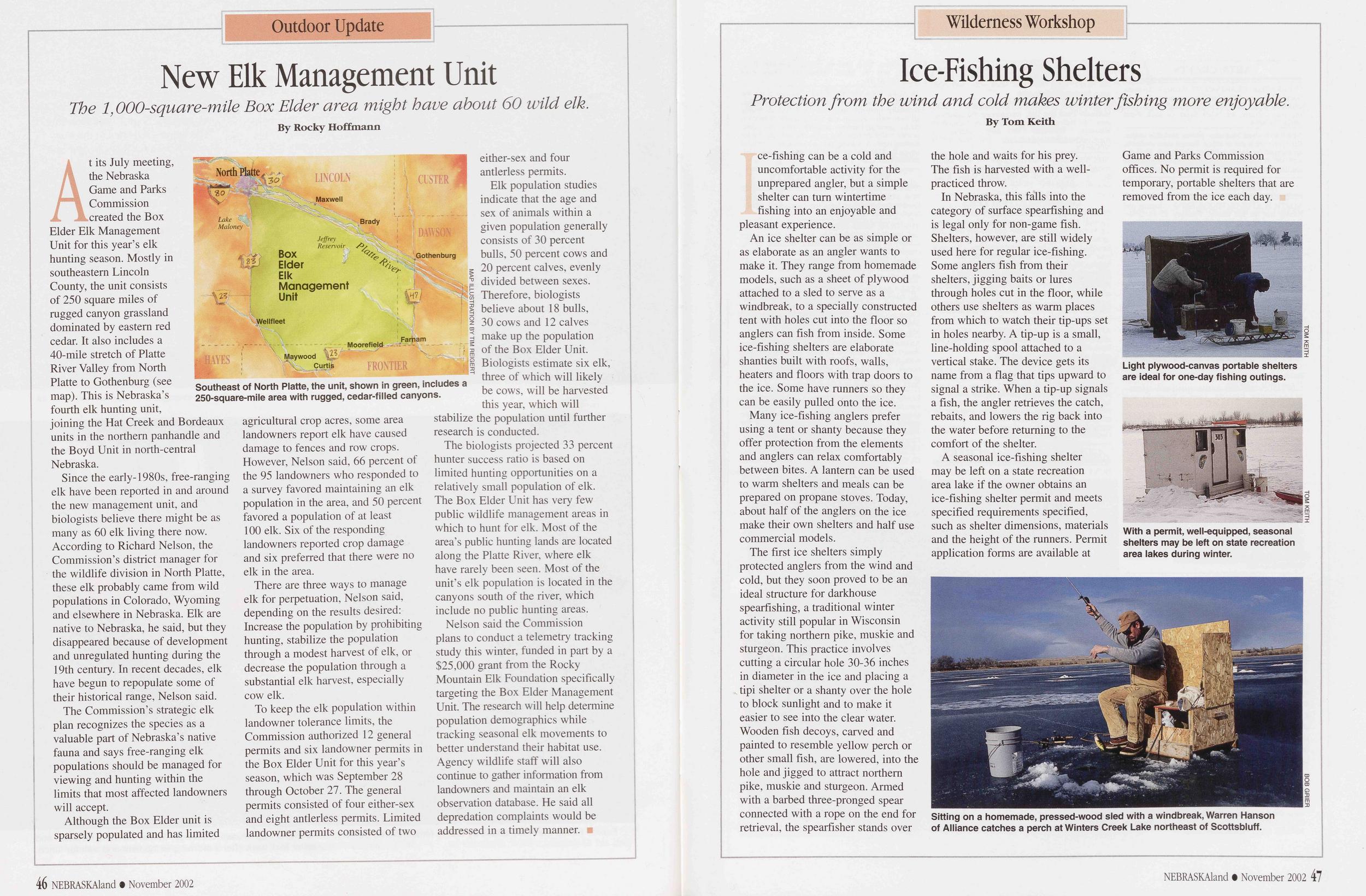
At its July meeting, the Nebraska Game and Parks Commission created the Box Elder Elk Management Unit for this year's elk hunting season. Mostly in southeastern Lincoln County, the unit consists of 250 square miles of rugged canyon grassland dominated by eastern red cedar. It also includes a 40-mile stretch of Platte River Valley from North Curtis Platte to Gothenburg (see map). This is Nebraska's fourth elk hunting unit, joining the Hat Creek and Bordeaux units in the northern panhandle and and the Boyd Unit in north-central Nebraska.
Since the early- 1980s, free-ranging elk have been reported in and around the new management unit, and biologists believe there might be as many as 60 elk living there now. According to Richard Nelson, the Commission's district manager for the wildlife division in North Platte, these elk probably came from wild populations in Colorado, Wyoming and elsewhere in Nebraska. Elk are native to Nebraska, he said, but they disappeared because of development and unregulated hunting during the 19th century. In recent decades, elk have begun to repopulate some of their historical range, Nelson said.
The Commission's strategic elk plan recognizes the species as a valuable part of Nebraska's native fauna and says free-ranging elk populations should be managed for viewing and hunting within the limits that most affected landowners will accept.
Although the Box Elder unit is sparsely populated and has limited goricultural crop acres. some area landowners report elk have caused damage to fences and row crops. However, Nelson said, 66 percent of the 95 landowners who responded to a survey favored maintaining an elk population in the area, and 50 percent favored a population of at least 100 elk. Six of the responding landowners reported crop damage and six preferred that there were no elk in the area.
There are three wavs to manage elk for perpetuation, Nelson said, depending on the results desired: Increase the population by prohibiting hunting, stabilize the population through a modest harvest of elk, or decrease the population through a substantial elk harvest, especially cow elk.
To keep the elk population within landowner tolerance limits, the Commission authorized 12 general permits and six landowner permits in the Box Elder Unit for this year's season, which was September 28 through October 27. The general permits consisted of four either-sex and eight antlerless permits. Limited landowner permits consisted of two either-sex and four antlerless permits.
Elk population studies indicate that the age and sex of animals within a given population generally consists of 30 percent bulls, 50 percent cows and 20 percent calves, evenly divided between sexes. Therefore, biologists believe about 18 bulls, 30 cows and 12 calves make up the population of the Box Elder Unit. Biologists estimate six elk, three of which will likely be cows, will be harvested this year, which will stabilize the population until further research is conducted.
The biologists projected 33 percent hunter success ratio is based on limited hunting opportunities on a relatively small population of elk. The Box Elder Unit has very few public wildlife management areas in which to hunt for elk. Most of the area's public hunting lands are located along the Platte River, where elk have rarely been seen. Most of the unit's elk population is located in the canyons south of the river, which include no public hunting areas.
Nelson said the Commission plans to conduct a telemetry tracking study this winter, funded in part by a $25,000 grant from the Rocky Mountain Elk Foundation specifically targeting the Box Elder Management Unit. The research will help determine population demographics while tracking seasonal elk movements to better understand their habitat use. Agency wildlife staff will also continue to gather information from landowners and maintain an elk observation database. He said all depredation complaints would be addressed in a timely manner.
46 NEBRASKAland • November 2002 Ice-Fishing Shelters Protection from the wind and cold makes winter fishing more enjoyable. By Tom KeithIce-fishing can be a cold and uncomfortable activity for the unprepared angler, but a simple shelter can turn wintertime fishing into an enjoyable and pleasant experience.
An ice shelter can be as simple or as elaborate as an angler wants to make it. They range from homemade models, such as a sheet of plywood attached to a sled to serve as a windbreak, to a specially constructed tent with holes cut into the floor so anglers can fish from inside. Some ice-fishing shelters are elaborate shanties built with roofs, walls, heaters and floors with trap doors to the ice. Some have runners so they can be easily pulled onto the ice.
Many ice-fishing anglers prefer using a tent or shanty because they offer protection from the elements and anglers can relax comfortably between bites. A lantern can be used to warm shelters and meals can be prepared on propane stoves. Today, about half of the anglers on the ice make their own shelters and half use commercial models.
The first ice shelters simply protected anglers from the wind and cold, but they soon proved to be an ideal structure for darkhouse spearfishing, a traditional winter activity still popular in Wisconsin for taking northern pike, muskie and sturgeon. This practice involves cutting a circular hole 30-36 inches in diameter in the ice and placing a tipi shelter or a shanty over the hole to block sunlight and to make it easier to see into the clear water. Wooden fish decoys, carved and painted to resemble yellow perch or other small fish, are lowered, into the hole and jigged to attract northern pike, muskie and sturgeon. Armed with a barbed three-pronged spear connected with a rope on the end for retrieval, the spearfisher stands over the hole and waits for his prey. The fish is harvested with a well- practiced throw.
In Nebraska, this falls into the category of surface spearfishing and is legal only for non-game fish. Shelters, however, are still widely used here for regular ice-fishing. Some anglers fish from their shelters, jigging baits or lures through holes cut in the floor, while others use shelters as warm places from which to watch their tip-ups set in holes nearby. A tip-up is a small, line-holding spool attached to a vertical stake. The device gets its name from a flag that tips upward to signal a strike. When a tip-up signals a fish, the angler retrieves the catch, rebaits, and lowers the rig back into the water before returning to the comfort of the shelter.
A seasonal ice-fishing shelter may be left on a state recreation area lake if the owner obtains an ice-fishing shelter permit and meets specified requirements specified, such as shelter dimensions, materials and the height of the runners. Permit application forms are available at Game and Parks Commission offices. No permit is required for temporary, portable shelters that are removed from the ice each day. With a permit, well-equipped, seasonal shelters may be left on state recreation area lakes during winter.
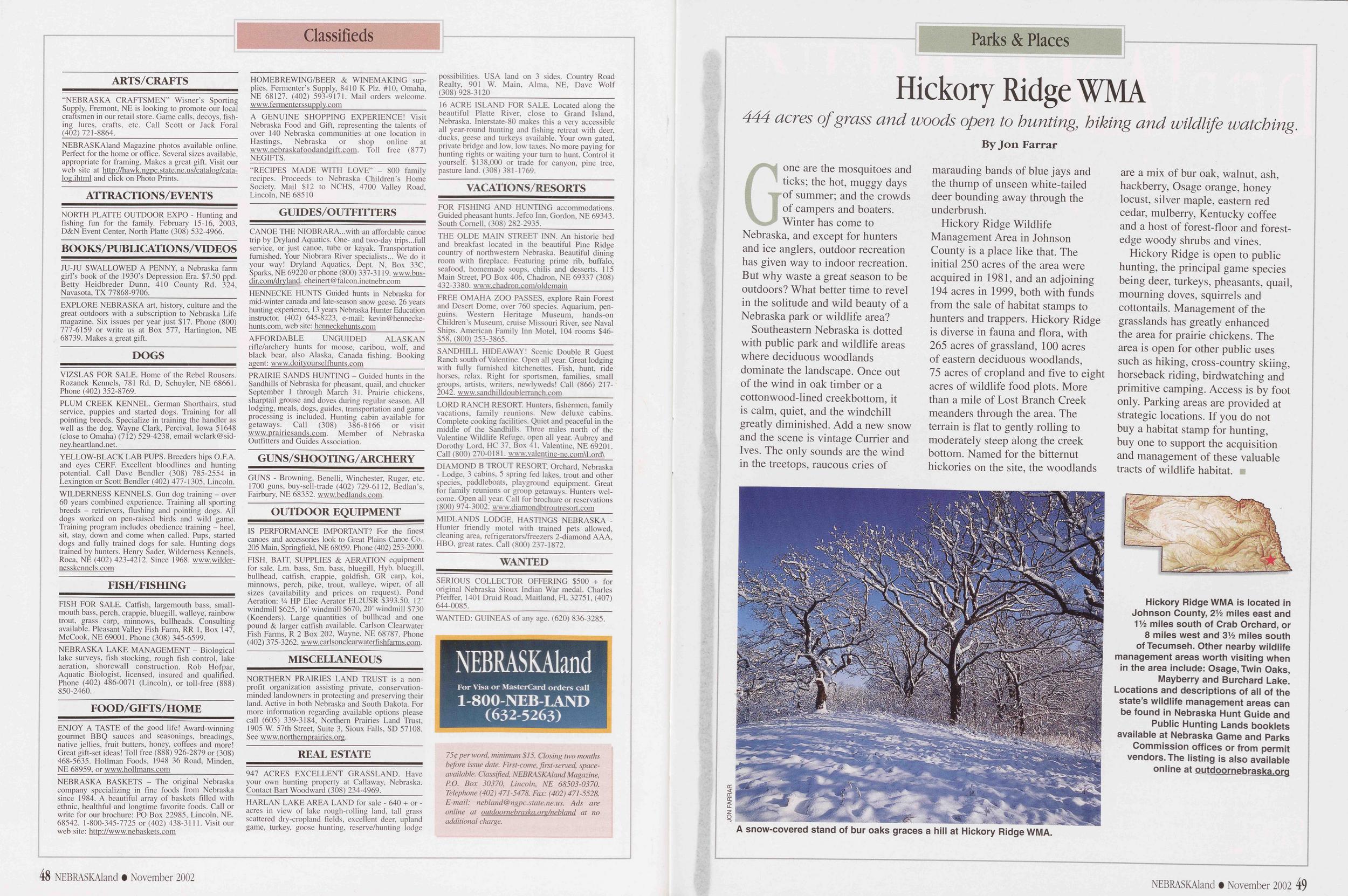
Classifieds
ARTS/CRAFTS“NEBRASKA CRAFTSMEN” Wisner’s Sporting Supply, Fremont, NE is looking to promote our local craftsmen in our retail store. Game calls, decoys, fish- ing lures, crafts, etc. Call Scott or Jack Foral (402) 721-8864,
NEBRASKAland Magazine photos available online. Perfect for the home or office. Several sizes available, appropriate for framing. Makes a great gift. Visit our web site at http://hawk.ngpc.state.ne.us/catalog/cata- log.ihtml and click on Photo Prints.
ATTRACTIONS/EVENTSNORTH PLATTE OUTDOOR EXPO - Hunting and fishing fun for the family. February 15-16, 2003, D&N Event Center, North Platte (308) 532-4966.
BOOKS/PUBLICATIONS/VIDEOSJU-JU SWALLOWED A PENNY, a Nebraska farm girl’s book of the 1930’s Depression Era. $7.50 ppd. Betty Heidbreder Dunn, 410 County Rd. 324, Navasota, TX 77868-9706.
EXPLORE NEBRASKA art, history, culture and the great outdoors with a subscription to Nebraska Life magazine. Six issues per year just $17. Phone (800) 777-6159 or write us at Box 577, Hartington, NE 68739. Makes a great gift.
DOGSVIZSLAS FOR SALE. Home of the Rebel Rousers. Rozanek Kennels, 781 Rd. D, Schuyler, NE 68661. Phone (402) 352-8769.
PLUM CREEK KENNEL. German Shorthairs, stud service, puppies and started dogs. Training for all pointing breeds. Specialize in training the handler as well as the dog. Wayne Clark, Percival, Iowa 51648 (close to Omaha) (712) 529-4238, email wclark@sid- ney.heartland.net.
YELLOW-BLACK LAB PUPS. Breeders hips O.F.A. and eyes CERF. Excellent bloodlines and hunting potential. Call Dave Bendler (308) 785-2554 in Lexington or Scott Bendler (402) 477-1305, Lincoln.
WILDERNESS KENNELS. Gun dog training - over 60 years combined experience. Training all sporting breeds - retrievers, flushing and pointing dogs. All dogs worked on pen-raised birds and wild game. Training program includes obedience training - heel, sit, stay, down and come when called. Pups, started dogs and fully trained dogs for sale. Hunting dogs trained by hunters. Henry Sader, Wilderness Kennels, Roca, NE (402) 423-4212. Since 1968. www.wilder- nesskennels.com
FISH/FISHINGFISH FOR SALE. Catfish, largemouth bass, small- mouth bass, perch, crappie, bluegill, walleye, rainbow trout, grass carp, minnows, bullheads. Consulting available. Pleasant Valley Fish Farm, RR 1, Box 147, McCook, NE 69001, Phone (308) 345-6599.
NEBRASKA LAKE MANAGEMENT - Biological lake surveys, fish stocking, rough fish control, lake aeration, shorewall construction. Rob Hofpar, Aquatic Biologist, licensed, insured and qualified. Phone (402) 486-0071 (Lincoln), or toll-free (888) 850-2460.
FOOD/GIFTS/HOMEENJOY A TASTE of the good life! Award-winning gourmet BBQ sauces and seasonings, breadings, native jellies, fruit butters, honey, coffees and more! Great gift-set ideas! Toll free (888) 926-2879 or (308) 468-5635. Hollman Foods, 1948 36 Road, Minden, NE 68959, or www.hollmans.com
NEBRASKA BASKETS - The original Nebraska company specializing in fine foods from Nebraska since 1984. A beautiful array of baskets filled with ethnic, healthful and longtime favorite foods. Call or write for our brochure: PO Box 22985, Lincoln, NE. 68542. 1-800-345-7725 or (402) 438-3111. Visit our web site: http://www.nebaskets.com
HOMEBREWING/BEER &WINEMAKING sup- plies. Fermenter’s Supply, 8410 K Plz. #10, Omaha, NE 68127. (402) 593-9171. Mail orders welcome. www.fermenterssupplv.com
A GENUINE SHOPPING EXPERIENCE! Visit Nebraska Food and Gift, representing the talents of over 140 Nebraska communities at one location in Hastings, Nebraska or shop online at www.nebraskafoodandgift.com. Toll free (877) NEGIFTS.
“RECIPES MADE WITH LOVE” - 800 family recipes. Proceeds to Nebraska Children’s Home Society. Mail $12 to NCHS, 4700 Valley Road, Lincoln, NE 68510
GUIDES/OUTFITTERSCANOE THE NIOBRARA...with an affordable canoe trip by Dryland Aquatics. One- and two-day trips...full service, or just canoe, tube or kayak. Transportation furnished. Your Niobrara River specialists... We do it your way! Dryland Aquatics, Dept. N, Box 33C, Sparks, NE 69220 or phone (800) 337-3119. www.bus- dir.com/drvland. eheinert@falcon.inetnebr.com
HENNECKE HUNTS Guided hunts in Nebraska for mid-winter Canada and late-season snow geese. 26 years hunting experience, 13 years Nebraska Hunter Education instructor. (402) 645-8223, e-mail: kevin@hennecke- hunts.com, web site: henneckehunts.com
AFFORDABLE UNGUIDED ALASKAN rifle/archery hunts for moose, caribou, wolf, and black bear, also Alaska, Canada fishing. Booking agent: www.doitvourselfhunts.com
PRAIRIE SANDS HUNTING - Guided hunts in the Sandhills of Nebraska for pheasant, quail, and chucker September 1 through March 31. Prairie chickens, sharptail grouse and doves during regular season. All lodging, meals, dogs, guides, transportation and game processing is included. Hunting cabin available for getaways. Call (308) 386-8166 or visit www.prairiesands.com. Member of Nebraska Outfitters and Guides Association.
GUNS/SHOOTING/ARCHERYGUNS - Browning, Benelli, Winchester, Ruger, etc. 1700 guns, buy-sell-trade (402) 729-6112, Bedlan’s, Fairbury, NE 68352. www.bedlands.com.
OUTDOOR EQUIPMENTIS PERFORMANCE IMPORTANT? For the finest canoes and accessories look to Great Plains Canoe Co., 205 Main, Springfield, NE 68059. Phone (402) 253-2000.
FISH, BAIT, SUPPLIES & AERATION equipment for sale. Lm. bass, Sm. bass, bluegill, Hyb. bluegill, bullhead, catfish, crappie, goldfish, GR carp, koi, minnows, perch, pike, trout, walleye, wiper, of all sizes (availability and prices on request). Pond Aeration: lA HP Elec Aerator EL2USR $393.50, 12’ windmill $625, 16’ windmill $670, 20’ windmill $730 (Koenders). Large quantities of bullhead and one pound &larger catfish available. Carlson Clearwater Fish Farms, R 2 Box 202, Wayne, NE 68787. Phone (402) 375-3262. www.carlsonclearwaterfishfarms.com.
MISCELLANEOUSNORTHERN PRAIRIES LAND TRUST is a non- profit organization assisting private, conservation- minded landowners in protecting and preserving their land. Active in both Nebraska and South Dakota. For more information regarding available options please call (605) 339-3184, Northern Prairies Land Trust, 1905 W. 57th Street, Suite 3, Sioux Falls, SD 57108. See www.northernprairies.org.
REAL ESTATE947 ACRES EXCELLENT GRASSLAND. Have your own hunting property at Callaway, Nebraska. Contact Bart Woodward (308) 234-4969.
HARLAN LAKE AREA LAND for sale - 640 + or - acres in view of lake rough-rolling land, tall grass scattered dry-cropland fields, excellent deer, upland game, turkey, goose hunting, reserve/hunting lodge possibilities. USA land on 3 sides. Country Road Realty, 901 W. Main, Alma, NE, Dave Wolf (308) 928-3120
16 ACRE ISLAND FOR SALE. Located along the beautiful Platte River, close to Grand Island, Nebraska. Interstate-80 makes this a very accessible all year-round hunting and fishing retreat with deer, ducks, geese and turkeys available. Your own gated, private bridge and low, low taxes. No more paying for hunting rights or waiting your turn to hunt. Control it yourself. $138,000 or trade for canyon, pine tree, pasture land. (308) 381-1769.
VACATIONS/RESORTSFOR FISHING AND HUNTING accommodations. Guided pheasant hunts. Jefco Inn, Gordon, NE 69343. South Cornell, (308) 282-2935.
THE OLDE MAIN STREET INN. An historic bed and breakfast located in the beautiful Pine Ridge country of northwestern Nebraska. Beautiful dining room with fireplace. Featuring prime rib, buffalo, seafood, homemade soups, chilis and desserts. 115 Main Street, PO Box 406, Chadron, NE 69337 (308) 432-3380. www.chadron.com/oldemain
FREE OMAHA ZOO PASSES, explore Rain Forest and Desert Dome, over 760 species. Aquarium, pen- guins. Western Heritage Museum, hands-on Children’s Museum, cruise Missouri River, see Naval Ships. American Family Inn Motel, 104 rooms $46- $58, (800) 253-3865.
SANDHILL HIDEAWAY! Scenic Double R Guest Ranch south of Valentine. Open all year. Great lodging with fully furnished kitchenettes. Fish, hunt, ride horses, relax. Right for sportsmen, families, small groups, artists, writers, newlyweds! Call (866) 217- 2042. www.sandhilldoublerranch.com
LORD RANCH RESORT. Hunters, fishermen, family vacations, family reunions. New deluxe cabins. Complete cooking facilities. Quiet and peaceful in the middle of the Sandhills. Three miles north of the Valentine Wildlife Refuge, open all year. Aubrey and Dorothy Lord, HC 37, Box 41, Valentine, NE 69201. Call (800) 270-0181. www.valentine-ne.com\Lord\
DIAMOND B TROUT RESORT, Orchard, Nebraska - Lodge, 3 cabins, 5 spring fed lakes, trout and other species, paddleboats, playground equipment. Great for family reunions or group getaways. Hunters wel- come. Open all year. Call for brochure or reservations (800) 974-3002. www.diamondbtroutresort.com
MIDLANDS LODGE, HASTINGS NEBRASKA - Hunter friendly motel with trained pets allowed, cleaning area, refrigerators/freezers 2-diamond AAA, HBO, great rates. Call (800) 237-1872.
WANTEDSERIOUS COLLECTOR OFFERING $500 + for original Nebraska Sioux Indian War medal. Charles Pfeiffer, 1401 Druid Road, Maitland, FL 32751, (407) 644-0085.
WANTED: GUINEAS of any age. (620) 836-3285.
NEBRASKAland For Visa or MasterCard orders call 1-800-NEB-LAND (632-5263)
751 per word, minimum $15. Closing two months before issue date. First-come, first-served, space- available. Classified, NEBRASKAland Magazine, P.O. Box 30370, Lincoln, NE 68503-0370. Telephone (402) 471-5478. Fax: (402) 471-5528. E-mail: nebland@ngpc.state.ne.us. Ads are online at outdoomebraska, ors/nebland at no additional charge.
48 NEBRASKAland • November 2002 Parks & Places Hickory Ridge WMA 444 acres of grass and woods open to bunting, hiking and wildlife watching. By Jon FarrarGone are the mosquitoes and ticks; the hot, muggy days of summer; and the crowds of campers and boaters. Winter has come to Nebraska, and except for hunters and ice anglers, outdoor recreation has given way to indoor recreation. But why waste a great season to be outdoors? What better time to revel in the solitude and wild beauty of a Nebraska park or wildlife area?
Southeastern Nebraska is dotted with public park and wildlife areas where deciduous woodlands dominate the landscape. Once out of the wind in oak timber or a cottonwood-lined creekbottom, it is calm, quiet, and the windchill greatly diminished. Add a new snow and the scene is vintage Currier and Ives. The only sounds are the wind in the treetops, raucous cries of marauding bands of bluejays and the thump of unseen white-tailed deer bounding away through the underbrush.
JON FARRARHickory Ridge Wildlife Management Area in Johnson County is a place like that. The initial 250 acres of the area were acquired in 1981, and an adjoining 194 acres in 1999, both with funds from the sale of habitat stamps to hunters and trappers. Hickory Ridge is diverse in fauna and flora, with 265 acres of grassland, 100 acres of eastern deciduous woodlands, 75 acres of cropland and five to eight acres of wildlife food plots. More than a mile of Lost Branch Creek meanders through the area. The terrain is flat to gently rolling to moderately steep along the creek bottom. Named for the bitternut hickories on the site, the woodlands are a mix of bur oak, walnut, ash, hackberry, Osage orange, honey locust, silver maple, eastern red cedar, mulberry, Kentucky coffee and a host of forest-floor and forest- edge woody shrubs and vines.
Hickory Ridge is open to public hunting, the principal game species being deer, turkeys, pheasants, quail, mourning doves, squirrels and cottontails. Management of the grasslands has greatly enhanced the area for prairie chickens. The area is open for other public uses such as hiking, cross-country skiing, horseback riding, birdwatching and primitive camping. Access is by foot only. Parking areas are provided at strategic locations. If you do not buy a habitat stamp for hunting, buy one to support the acquisition and management of these valuable tracts of wildlife habitat. «
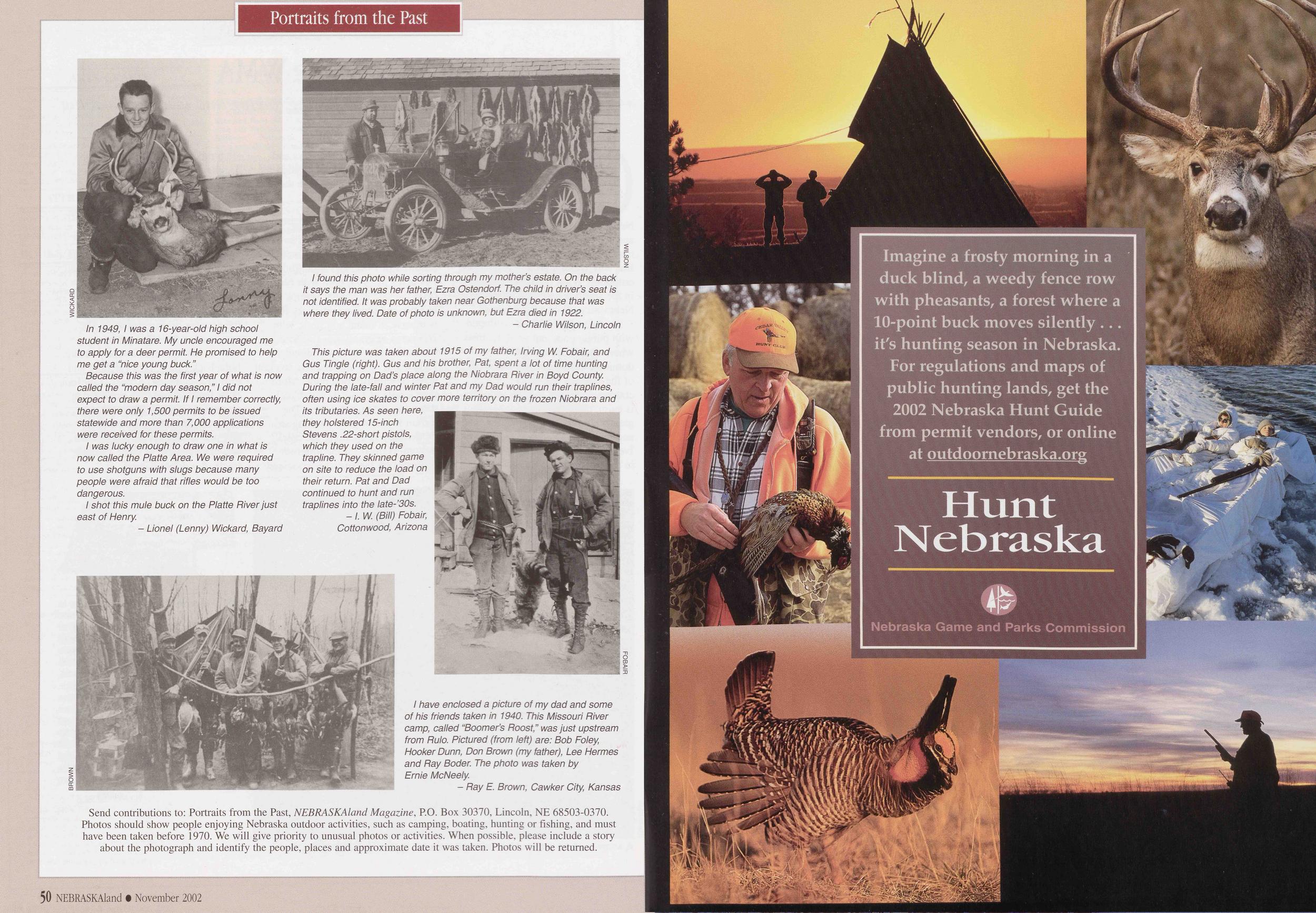
In 1949, I was a 16-year-old high school student in Minatare. My uncle encouraged me to apply for a deer permit. He promised to help me get a “nice young buck.”
Because this was the first year of what is now called the “modern day season,” I did not expect to draw a permit. If I remember correctly, there were only 1,500 permits to be issued statewide and more than 7,000 applications were received for these permits.
I was lucky enough to draw one in what is now called the Platte Area. We were required to use shotguns with slugs because many people were afraid that rifles would be too dangerous.
I shot this mule buck on the Platte River just east of Henry.
- Lionel (Lenny) Wickard, BayardI found this photo while sorting through my mother’s estate. On the back it says the man was her father, Ezra Ostendorf The child in driver’s seat is not identified. It was probably taken near Gothenburg because that was where they lived. Date of photo is unknown, but Ezra died in 1922.
- Charlie Wilson, LincolnThis picture was taken about 1915 of my father, Irving W. Fobair, and Gus Tingle (right). Gus and his brother, Pat, spent a lot of time hunting and trapping on Dad’s place along the Niobrara River in Boyd County. During the late-fall and winter Pat and my Dad would run their traplines, often using ice skates to cover more territory on the frozen Niobrara and its tributaries. As seen here, they bolstered 15-inch Stevens .22-short pistols, which they used on the trapline. They skinned game on site to reduce the load on their return. Pat and Dad continued to hunt and run traplines into the I ate-’30s.
- I. W. (Bill) Fobair, Cottonwood, ArizonaI have enclosed a picture of my dad and some of his friends taken in 1940. This Missouri River camp, called “Boomer’s Roost,” was just upstream from Rulo. Pictured (from left) are: Bob Foley, Hooker Dunn, Don Brown (my father), Lee Hermes and Ray Boder. The photo was taken by Ernie McNeely.
- Ray E. Brown, Cawker City, KansasSend contributions to: Portraits from the Past, NEBRASKAland Magazine, P.O. Box 30370, Lincoln, NE 68503-0370. Photos should show people enjoying Nebraska outdoor activities, such as camping, boating, hunting or fishing, and must have been taken before 1970. We will give priority to unusual photos or activities. When possible, please include a story about the photograph and identify the people, places and approximate date it was taken. Photos will be returned.
50 NEBRASKAland • November 2002 Nebraska Game and Parks Commission Hunt Nebraska Imagine a frosty morning in a duck blind, a weedy fence row with pheasants, a forest where a 10-point buck moves silently ... it's hunting season in Nebraska. For regulations and maps of public hunting lands, get the 2002 Nebraska Hunt Guide from permit vendors, or online at outdoornebraska.org
Position: 626 (18 views)