Volume 80, Issue 8, 2002
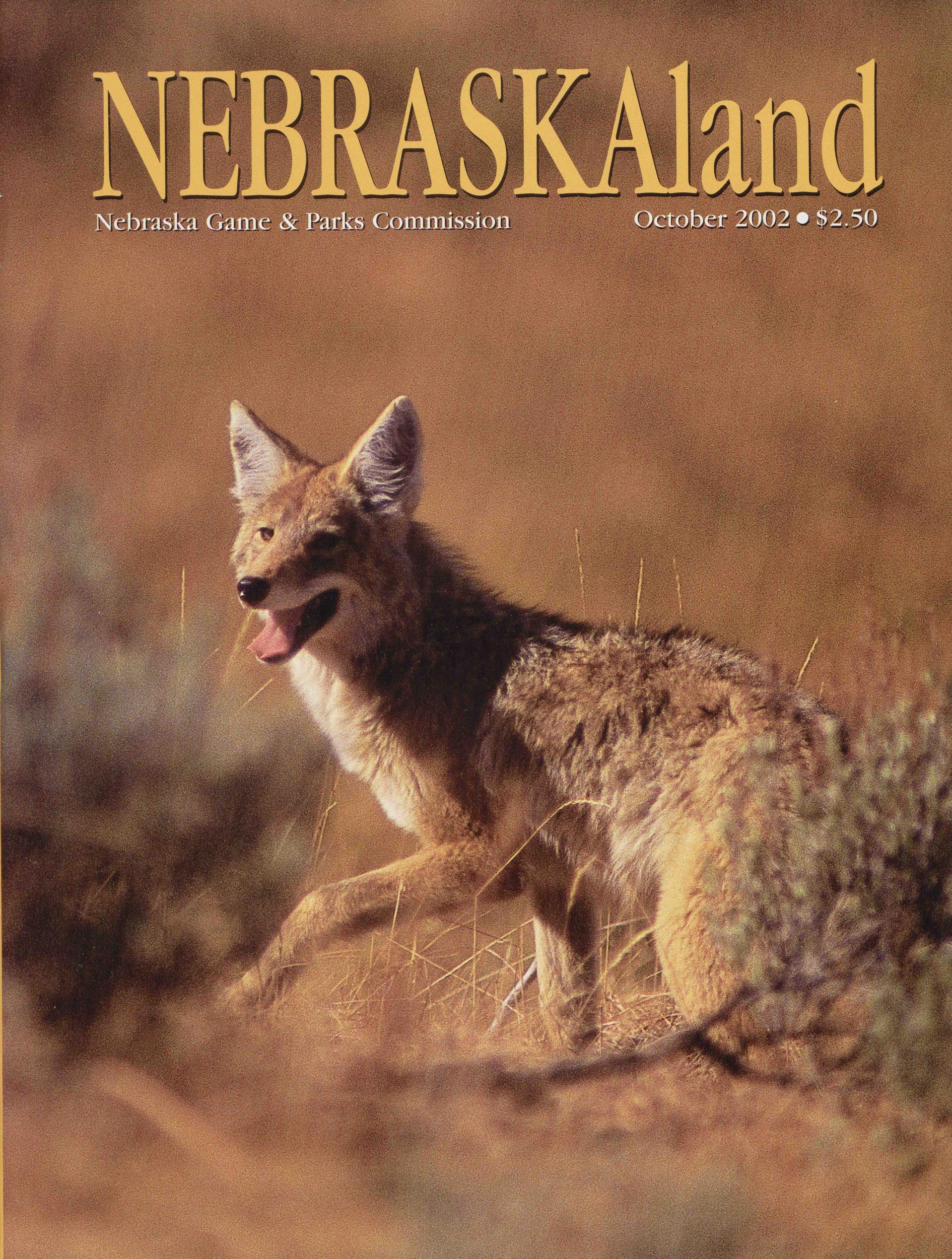
NEBRASKAland
Nebraska Game & Parks Commission October 2002 • $2.50
NEBRASKAland
Volume 80, Number 8, October 2002 Features 10 Ranch-style Duck Hunting Separated by 50 years in age, young John Harms and Dave Hintz became hunting and fishing buddies by chance. For almost 10 years they have shared blinds, decoy spreads and blustery mornings when ducks drift south from the Dakotas to the Sandhills. 18 On Unsettled Plains In 1865 Nebraska’s vast untouched prairie and wildlife bounty struck awe in railroad surveyor Arthur Ferguson. With stirring word-pictures jotted in leather-bound journals over two years, he captured scenes from the natural plains, as he put it, “just released from the hand of their maker.” 26 October on the Niobrara October rolls into the Niobrara River country on the edge of a snow squall, drawing a thin white veil over fine treasures of wine-stained bluffs, golden leaves, and liquid blue. 36 Gators of the Grassland Fossil records show three species of ancient alligators - each a new discovery when unearthed - made the area that is now Nebraska their home. These prehistoric crocodilians tell of a time with temperate climate. 38 A Learning Experience Under the wing of a master fly-fisherman, an unsure beginner learns how to cast a long rod and hook a few trout. Along the way she discovers the beauty and peace of this age-old sport. Departments Outdoor Business Through Make-A-Wish, Jesse Wamstad becomes a cowboy. In the Kitchen Recipes found in Storz cookbooks evoke a simpler time. 49 Parks & Places Fish habitat improved at Wagon Train State Recreation Area. Comment........................................4 Outdoor News ..................................6 Classifieds ..................................48 Portraits of the Past ........................50 Cover: Highlighted by the early morning sun, a coyote (canis latrans) pauses to check its backtrail as it heads to a bedding site in Sioux County. Photo by Rick Houchin. Opposite: Richly colored leaves convey the season, huddling on the ground against a moss-covered tree near the Platte River in Dodge County. Photo by Roy David Farris.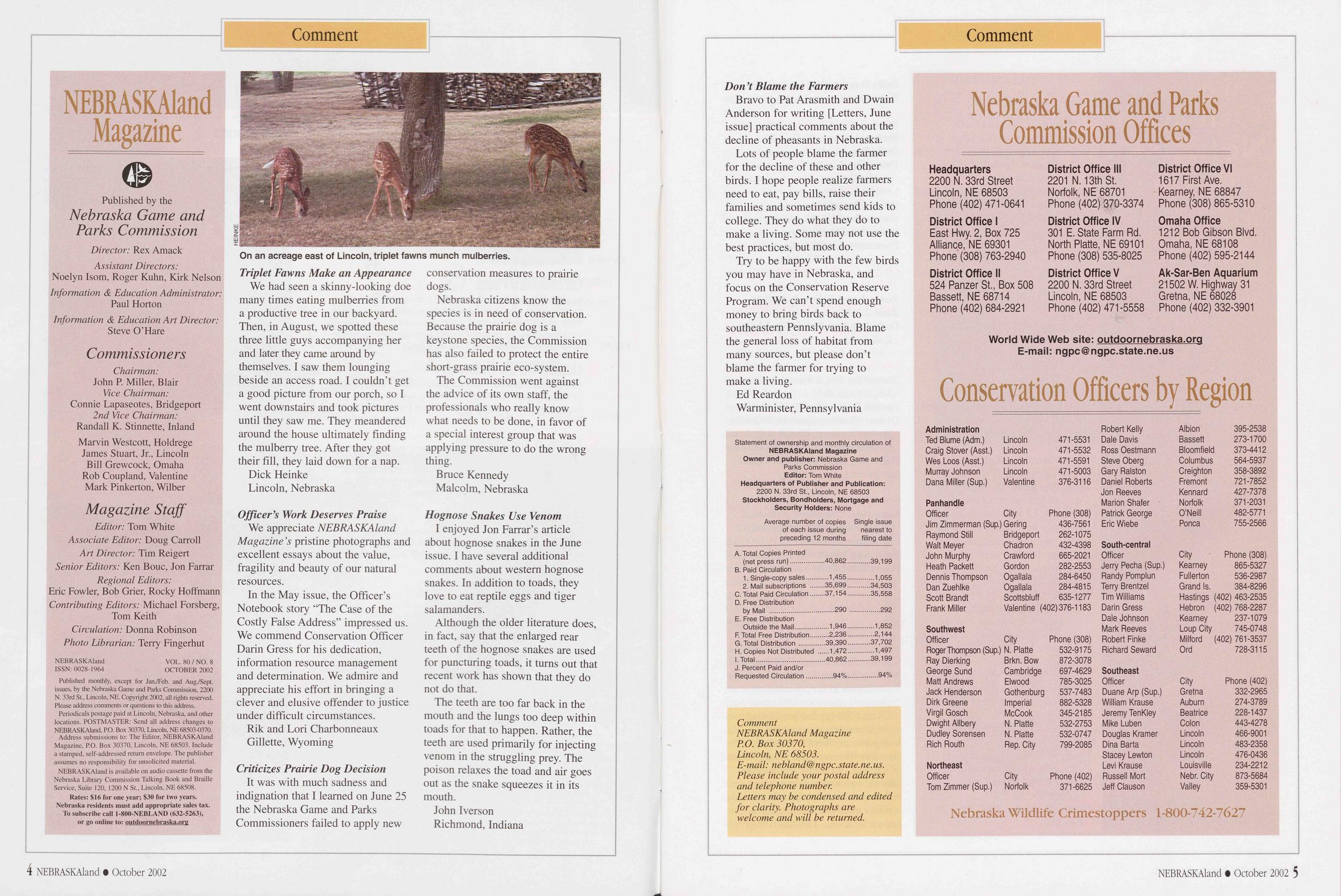 Comment
NEBRASKAland Mazine
NEBRASKAland
Magazine
Published by the
Nebraska Game and
Parks Commission
Director: Rex Amack
Assistant Directors:
Noelyn Isom, Roger Kuhn, Kirk Nelson
Information & Education Administrator:
Paul Horton
Information & Education Art Director:
Steve O’Hare
Commissioners
Chairman:
John P. Miller, Blair
Vice Chairman:
Connie Lapaseotes, Bridgeport
2nd Vice Chairman:
Randall K. Stinnette, Inland
Marvin Westcott, Holdrege
James Stuart, Jr., Lincoln
Bill Grewcock, Omaha
Rob Coupland, Valentine
Mark Pinkerton, Wilber
Magazine Staff
Editor: Tom White
Associate Editor: Doug Carroll
Art Director: Tim Reigert
Senior Editors: Ken Bouc, Jon Farrar
Regional Editors:
Eric Fowler, Bob Grier, Rocky Hoffmann
Contributing Editors: Michael Forsberg,
Tom Keith
Circulation: Donna Robinson
Photo Librarian: Terry Fingerhut
NEBRASKAland VOL. 80 / NO. 8
ISSN: 0028-1964 OCTOBER 2002
Published monthly, except for Jan./Feb. and Aug./Sept.
issues, by the Nebraska Game and Parks Commission, 2200
N. 33rd St., Lincoln, NE. Copyright 2002, all rights reserved.
Please address comments or questions to this address.
Periodicals postage paid at Lincoln, Nebraska, and other
locations. POSTMASTER: Send all address changes to
NEBRASKAland, P.O. Box 30370, Lincoln, NE 68503-0370.
Address submissions to: The Editor, NEBRASKAland
Magazine, P.O. Box 30370, Lincoln, NE 68503. Include
a stamped, self-addressed return envelope. The publisher
assumes no responsibility for unsolicited material.
NEBRASKAland is available on audio cassette from the
Nebraska Library Commission Talking Book and Braille
Service, Suite 120, 1200 N St., Lincoln, NE 68508.
Rates: $16 for one year; $30 for two years.
Nebraska residents must add appropriate sales tax.
To subscribe call 1-800-NEBLAND (632-5263),
or go online to: outdoornebraska.org
Comment
NEBRASKAland Mazine
NEBRASKAland
Magazine
Published by the
Nebraska Game and
Parks Commission
Director: Rex Amack
Assistant Directors:
Noelyn Isom, Roger Kuhn, Kirk Nelson
Information & Education Administrator:
Paul Horton
Information & Education Art Director:
Steve O’Hare
Commissioners
Chairman:
John P. Miller, Blair
Vice Chairman:
Connie Lapaseotes, Bridgeport
2nd Vice Chairman:
Randall K. Stinnette, Inland
Marvin Westcott, Holdrege
James Stuart, Jr., Lincoln
Bill Grewcock, Omaha
Rob Coupland, Valentine
Mark Pinkerton, Wilber
Magazine Staff
Editor: Tom White
Associate Editor: Doug Carroll
Art Director: Tim Reigert
Senior Editors: Ken Bouc, Jon Farrar
Regional Editors:
Eric Fowler, Bob Grier, Rocky Hoffmann
Contributing Editors: Michael Forsberg,
Tom Keith
Circulation: Donna Robinson
Photo Librarian: Terry Fingerhut
NEBRASKAland VOL. 80 / NO. 8
ISSN: 0028-1964 OCTOBER 2002
Published monthly, except for Jan./Feb. and Aug./Sept.
issues, by the Nebraska Game and Parks Commission, 2200
N. 33rd St., Lincoln, NE. Copyright 2002, all rights reserved.
Please address comments or questions to this address.
Periodicals postage paid at Lincoln, Nebraska, and other
locations. POSTMASTER: Send all address changes to
NEBRASKAland, P.O. Box 30370, Lincoln, NE 68503-0370.
Address submissions to: The Editor, NEBRASKAland
Magazine, P.O. Box 30370, Lincoln, NE 68503. Include
a stamped, self-addressed return envelope. The publisher
assumes no responsibility for unsolicited material.
NEBRASKAland is available on audio cassette from the
Nebraska Library Commission Talking Book and Braille
Service, Suite 120, 1200 N St., Lincoln, NE 68508.
Rates: $16 for one year; $30 for two years.
Nebraska residents must add appropriate sales tax.
To subscribe call 1-800-NEBLAND (632-5263),
or go online to: outdoornebraska.org
We had seen a skinny-looking doe many times eating mulberries from a productive tree in our backyard. Then, in August, we spotted these three little guys accompanying her and later they came around by themselves. I saw them lounging beside an access road. I couldn’t get a good picture from our porch, so I went downstairs and took pictures until they saw me. They meandered around the house ultimately finding the mulberry tree. After they got their fill, they laid down for a nap.
Dick Heinke Lincoln, Nebraska Officer's Work Deserves PraiseWe appreciate NEBRASKAland Magazine’s pristine photographs and excellent essays about the value, fragility and beauty of our natural resources.
In the May issue, the Officer’s Notebook story "The Case of the Costly False Address” impressed us. We commend Conservation Officer Darin Gress for his dedication, information resource management and determination. We admire and appreciate his effort in bringing a clever and elusive offender to justice under difficult circumstances.
Rik and Lori Charbonneaux Gillette, Wyoming Criticizes Prairie Dog DecisionIt was with much sadness and indignation that I learned on June 25 the Nebraska Game and Parks Commissioners failed to apply new conservation measures to prairie dogs.
Nebraska citizens know the species is in need of conservation. Because the prairie dog is a keystone species, the Commission has also failed to protect the entire short-grass prairie eco-system.
The Commission went against the advice of its own staff, the professionals who really know what needs to be done, in favor of a special interest group that was applying pressure to do the wrong thing.
Bruce Kennedy Malcolm, Nebraska Hognose Snakes Use VenomI enjoyed Jon Farrar’s article about hognose snakes in the June issue. I have several additional comments about western hognose snakes. In addition to toads, they love to eat reptile eggs and tiger salamanders.
Although the older literature does, in fact, say that the enlarged rear teeth of the hognose snakes are used for puncturing toads, it turns out that recent work has shown that they do not do that.
The teeth are too far back in the mouth and the lungs too deep within toads for that to happen. Rather, the teeth are used primarily for injecting venom in the struggling prey. The poison relaxes the toad and air goes out as the snake squeezes it in its mouth.
John Iverson Richmond, Indiana 4 NEBRASKAland • October 2002 Comment Don't Blame the FarmersBravo to Pat Arasmith and Dwain Anderson for writing [Letters, June issue] practical comments about the decline of pheasants in Nebraska.
Lots of people blame the farmer for the decline of these and other birds. I hope people realize farmers need to eat, pay bills, raise their families and sometimes send kids to college. They do what they do to make a living. Some may not use the best practices, but most do.
Try to be happy with the few birds you may have in Nebraska, and focus on the Conservation Reserve Program. We can’t spend enough money to bring birds back to southeastern Pennslyvania. Blame the general loss of habitat from many sources, but please don’t blame the farmer for trying to make a living.
Ed Reardon Warminister, Pennsylvania Nebraska Game and Parks Commission Offices Headquarters 2200 N. 33rd Street Lincoln, NE 68503 Phone (402) 471-0641 District Office I East Hwy. 2, Box 725 Alliance, NE 69301 Phone (308) 763-2940 District Office II 524 Panzer St., Box 508 Bassett, NE 68714 Phone (402) 684-2921 District Office III 2201 N. 13th St. Norfolk, NE 68701 Phone (402) 370-3374 District Office IV 301 E. State Farm Rd. North Platte, NE 69101 Phone (308) 535-8025 District Office V 2200 N. 33rd Street Lincoln, NE 68503 Phone (402) 471-5558 District Office VI 1617 First Ave. Kearney, NE 68847 Phone (308) 865-5310 Omaha Office 1212 Bob Gibson Blvd. Omaha, NE 68108 Phone (402) 595-2144 Ak-Sar-Ben Aquarium 21502 W. Highway 31 Gretna, NE 68028 Phone (402) 332-3901 World Wide Web site: outdoornebraska.org E-mail: ngpc@ngpc.state.ne.us Conservation Officers by Region Administration Robert Kelly Albion 395-2538 Ted Blume (Adm.) Lincoln 471-5531 Dale Davis Bassett 273-1700 Craig Stover (Asst.) Lincoln 471-5532 Ross Oestmann Bloomfield 373-4412 Wes Loos (Asst.) Lincoln 471-5591 Steve Oberg Columbus 564-5937 Murray Johnson Lincoln 471-5003 Gary Ralston Creighton 358-3892 Dana Miller (Sup.) Valentine 376-3116 Daniel Roberts Fremont 721-7852 Jon Reeves Kennard 427-7378 Panhandle Marion Shafer Norfolk 371-2031 Officer City Phone (308) Patrick George O’Neill 482-5771 Jim Zimmerman (Sup.) Gering 436-7561 Eric Wiebe Ponca 755-2566 Raymond Still Bridgeport 262-1075 Walt Meyer Chadron 432-4398 South-central John Murphy Crawford 665-2021 Officer City Phone (308) Heath Packett Gordon 282-2553 Jerry Pecha (Sup.) Kearney 865-5327 Dennis Thompson Ogallala 284-6450 Randy Pomplun Fullerton 536-2987 Dan Zuehlke Ogallala 284-4815 Terry Brentzel Grand Is. 384-8296 Scott Brandt Scottsbluff 635-1277 Tim Williams Hastings (402) 463-2535 Frank Miller Valentine (402)376-1183 Darin Gress Hebron (402) 768-2287 Dale Johnson Kearney 237-1079 Southwest Mark Reeves Loup City 745-0748 Officer City Phone (308) Robert Finke Milford (402) 761-3537 Roger Thompson (Sup.) N. Platte 532-9175 Richard Seward Ord 728-3115 Ray Dierking Brkn. Bow 872-3078 George Sund Cambridge 697-4629 Southeast Matt Andrews Elwood 785-3025 Officer City Phone (402) Jack Henderson Gothenburg 537-7483 Duane Arp (Sup.) Gretna 332-2965 Dirk Greene Imperial 882-5328 William Krause Auburn 274-3789 Virgil Gosch McCook 345-2185 Jeremy TenKley Beatrice 228-1437 Dwight Allbery N. Platte 532-2753 Mike Luben Colon 443-4278 Dudley Sorensen N. Platte 532-0747 Douglas Kramer Lincoln 466-9001 Rich Routh Rep. City 799-2085 Dina Barta Lincoln 483-2358 Stacey Lewton Lincoln 476-0436 Northeast Levi Krause Louisville 234-2212 Officer City Phone (402) Russell Mort Nebr. City 873-5684 Tom Zimmer (Sup.) Norfolk 371-6625 Jeff Clauson Valley 359-5301 Nebraska Wildlife Crimestoppers 1-800-742-7627 Statement of ownership and monthly circulation of NEBRASKAland Magazine Owner and publisher: Nebraska Game and Parks Commission Editor: Tom White Headquarters of Publisher and Publication: 2200 N. 33rd St., Lincoln, NE 68503 Stockholders, Bondholders, Mortgage and Security Holders: None Average number of copies of each issue during preceding 12 months Single issue nearest to filing date A. Total Copies Printed (net press run) ...40,862.. 39,199 B. Paid Circulation 1. Single-copy sales 1,455.. 1,055 2. Mail subscriptions ...35,699.. 34,503 C. Total Paid Circulation ...37,154.. 35,558 D. Free Distribution by Mail 290 . 292 E. Free Distribution Outside the Mail 1,946.. 1,852 F. Total Free Distribution 2,236.. 2,144 G. Total Distribution ...39,390.. 37,702 H. Copies Not Distributed . 1,472.. 1,497 I. Total ...40,862.. 39,199 J. Percent Paid and/or Requested Circulation 94%.. 94% Comment NEBRASKAland Magazine RO. Box 30370, Lincoln, NE 68503. E-mail: nebland@ ngpc. state, ne. us. Please include your postal address and telephone number. Letters may be condensed and edited for clarity. Photographs are welcome and will be returned. NEBRASKAland • October 2002 5
Nebraska Game and Parks Commissioners set this fall’s waterfowl, crow and falconry seasons at their August meeting in Lincoln.
As a result of below-normal populations of canvasback and pintail ducks, the commissioners closed the canvasback season and created short pintail seasons with a daily bag limit of one pintail. For more information on waterfowl seasons, consult the 2002 Nebraska Waterfowl Guide.
DUCKSLow Plains Early: Sept. 28-Oct. 6 and Oct. 12-Dec. 15.
Low Plains Late: Oct. 12-13 and Oct. 19-Dec. 29.
High Plains: Sept. 28-Dec. 8 and Dec. 13-Jan. 5.
Pintail Season - Low Plains Early: Sept. 28-Oct. 6 and Oct. 12-Nov. 10.
Pintail Season - Low Plains Late: Oct. 12-13 and Oct. 19-Nov. 24.
Pintail Season - High Plains: Sept. 28-Nov. 5.
Daily Bag Limit: Six ducks, which may include no more than five mallards, of which no more than two may be females, one mottled duck, two redheads, three scaup (greater and lesser combined), and two wood ducks. No canvasbacks may be taken, and only one pintail may be taken during the pintail season. The daily limit of mergansers is five, only one of which may be a hooded merganser.
Possession Limit: Two daily limits.
DARK GEESE (Canada and Brant geese)East Unit: Sept. 28-Oct. 13 and Nov. 2-Jan. 19.
North Central Unit: Sept. 28- Dec. 31.
Platte River Unit: Oct. 29-Jan. 31.
Panhandle Management Zone (within Platte River Unit): Nov. 9-Jan. 31.
North (Niobrara) Unit: Oct. 29- Jan. 31.
Daily Bag Limit: Three geese.
Possession Limit: Six geese.
WHITE-FRONTED GEESEStatewide: Sept. 28-Dec. 22. Daily Bag Limit: Two geese. Possession Limit: Four geese.
LIGHT GEESE (Snow, blue and Ross’ geese)Statewide: Sept. 28-Jan. 10. Daily Bag Limit: 20 geese. Possession Limit: Unlimited.
LIGHT GEESE CONSERVATION ACTIONZones 1 and 3: Feb. 1-April 13. Zone 2: Closed. Daily Bag and Possession Limit: Unlimited.
CROWSStatewide: Oct. 1-Nov. 15 and Jan. 19-Apr. 6. Special Public Health Hazard Order: (Buffalo, Dawson, Franklin, Harlan, Kearney, Phelps and Lincoln counties) Nov. 16-Jan. 18. Daily Bag and Possession Limit: Unlimited.
FALCONRYStatewide: Concurrent with duck season dates within zones and management units. Daily Bag Limit: Three ducks. Possession Limit: Six ducks.
New Lake Maps Available Showing Depths, ContoursThe Nebraska Game and Parks Commission’s fisheries division is working with the U.S. Bureau of Reclamation to survey some of Nebraska’s reservoirs and lakes.
Using GPS (global positioning system) receivers carried in backpacks, workers first collect shoreline information to get an outline of the lake. Then they transect the lake on a plotted course using a receiver on the boat and a depth sounder to collect information at known locations. The data is then 6 NEBRASKAland • October 2002 used in a drafting program to create a map of the lake’s contour and water depths.
These maps are used to design and evaluate Aquatic Habitat Program projects and to provide information to the public. As of late-August, 13 lakes have been mapped and may by viewed or downloaded as either JPG image files or as “zoomable” Adobe PDF files.
To view or download these maps, visit outdoornebraska.org. click on “Fishing” and look for the “Lake maps” link.
Commission Increased from Seven to Eight MembersThe number of Nebraska Game and Parks Commissioners was increased from seven to eight in August. Governor Mike Johanns has appointed Mark Pinkerton of Wilber as the District I representative and Jim Stuart, Jr. of Lincoln will serve as the District VIII representative.
Omahan Wins Bighorn Sheep Lottery PermitBradley Eriksen of Omaha won the 2002 Nebraska bighorn sheep lottery hunting permit when his entry was pulled from a metal barrel containing 1,838 applications during the Nebraska Game and Parks Commission meeting in Lincoln on August 23.
Eriksen’s permit was one of two authorized by the Commissioners for this year’s bighorn sheep season, which will run from November 30 through December 22. Last March, Bert Kizer of Woodstock, Georgia, purchased the other permit for $55,000 when it was auctioned off at the Safari Club International convention in Las Vegas, Nevada.
Ericksen and Kizer will receive free guide service, the use of horses and up to four days of lodging and meals at Fort Robinson State Park during their hunts.
Getting Ready to Hunt This Fall? Hunting Permits Online! Visit our secure web site to quickly and conveniently purchase fishing, hunting and park permits online using your Visa or MasterCard. Online permit purchase is safe, hassle-free and there is never a checkout line. Simply choose the permits you want, pay for them, download and print. And, you are on your way to Nebraska's great outdoors. outdoornebraska.org Nebraska Game and Parks Commission NEBRASKAland • October 2002 7 Outdoor News
Officer's Notebook
Citizen's Tip Helps Convict Owl Trapper
Outdoor News
Officer's Notebook
Citizen's Tip Helps Convict Owl Trapper
I received a call January 18, 2002, asking me to check on possible state and federal violations in Colfax County. A concerned party called Nebraska Wildlife Crimestoppers and said a rural Schuyler man was trapping owls and hawks on his land. The caller said there were live and dead raptors, including great horned and snowy owls, on the property, as well as the pole traps used to catch them.
I contacted Dan Roberts, a fellow conservation officer, and he agreed to accompany me to the man’s farm the next morning. Because the suspect raised game birds, which requires a state license that had not been updated recently, we had another reason to check out the farm.
As we drove down the lane, the owner was in the farmyard doing chores. I could tell he was nervous, and with good reason. Had I known exactly where to look, I could have seen some of the owls from my truck. We told him we were inspecting his facility as part of his game bird license. It didn’t take long to find evidence of his misdeeds. Traps were clearly visible atop nearby poles and I soon found live and dead owls.
When confronted with this evidence, the suspect immediately started reaching for straws. He claimed someone within the Nebraska Game and Parks Commission had told him it was legal to trap the birds. When pressed for this person’s name, or any written correspondence verifying his story, however, his memory dried up.
We seized five trap poles, nine horned owls and the body of a snowy owl. Before leaving, we told the subject we would review the case before deciding what charges to file. Five of the horned owls were injured but alive, so we sent them to Raptor Recovery Nebraska east of Lincoln to see if they could be rehabilitated. When I found out the suspect had a previous conviction for a similar offense, I decided he should face federal charges, and I contacted Mark Webb, an investigator with the U.S. Fish and Wildlife Service. Webb continued the investigation and later found out the man trapped a Cooper’s hawk after Roberts and I had already contacted him.
The man was ultimately charged with several violations of the Migratory Bird Treaty Act and pleaded guilty in federal court to two illegal possession counts, one of a hawk and one of an owl. He was fined $1,950, had to pay $20 in court costs and was put on probation for two years with the stipulation that he not hunt or associate with anyone hunting during that time.
The individual who called Nebraska Wildlife Crimestoppers received a $500 reward. I really have to thank the individual who cared enough about our natural resources to call us. Without the help, we never would have found out about this case.
- Steve Oberg, Conservation Officer, ColumbusAs of late-August, two of the owls and the Cooper’s hawk sent to Raptor Recovery Nebraska had healed and were released. The others were still recovering and may yet be released. The Nebraska Wildlife Crimestoppers number is 1-800-742-7627
HIP Registration RequiredMigratory bird hunters must register with the Harvest Information Program before they take to the field this fall. Last year’s registration is no longer valid and must be renewed.
This free registration is required of all migratory bird hunters except those Nebraska residents who are under 16 years old. Hunters must register in each state where they hunt migratory birds. The goal of this program is to help wildlife managers estimate the number of migratory birds harvested each year. This regulation includes doves, ducks, geese, snipe, rail, coots and woodcock.
To register online, visit the Commission’s web site at outdoornebraska.org and click on “Hunting,” then click on “Online HIP Registration.” To register by phone, call the HIP 24-hour, toll-free number. 1-888-403-2473.
Schramm Park ActivitiesThe Schramm Park Photography Club, which meets monthly at the park’s Ak-Sar-Ben Aquarium, will display a collection of church photos from October 1 through the end of December. The Outdoor Writers Association of America will also display photos at the aquarium from November 1 through December 31 from its most recent photo contest.
In addition to these exhibits, the aquarium will host bird-banding workshops for the sixth year this fall. Led by Ruth Green of Bellevue, a licensed bird-bander, the workshops are free and run from 9 a.m. to noon. Workshops will be held October 12, November 9, December 7, January 4, February 1, March 1 and April 5.
The Aquarium is located six miles south of I-80’s exit 432. For more information, call the aquarium at (402) 332-3901. The aquarium’s hours through December 1 are 10 a.m. to 4:30 p.m., Wednesday through Monday.
8 NEBRASKAland • October 2002 Outdoor Business Making a Wish Come True Jesse Wamstad becomes a cowboy at Fort Robinson State Park. By Bob GrierFive-year-old Jesse Wamstad’s favorite activity at Fort Robinson State Park is riding a brown-and-white paint horse named Hollywood on the trails along Soldier Creek and in the hills above the historic frontier fort. Jesse and his family visited the park in June after Jesse’s wish to “become a cowboy” was granted by the Make- A-Wish Foundation of Nebraska. Jesse’s trip was the foundation’s thousandth-granted wish since its incorporation in 1983.
Jesse and Hollywood, a gentle horse in the park’s trail-ride string, became regulars on the trails during the Wamstads’ stay. Though Jesse’s boots didn’t reach the saddle’s stirrups, he and the paint horse became a team. Park wranglers offering a helping hand or good- natured cowboy ribbing were invariably rewarded with the youngster’s bright, enthusiastic smile.
The Wamstad family includes Jesse’s parents, Kenneth and Carrie, and brothers and sisters, Clayton, 11, Mica, 9, Jaden, 7, Susanna, 3, and William, 37? months. They live in northeastern Nebraska near Carroll. During their weeklong stay at Fort Robinson, they enjoyed the park’s hayrack rides, campfire cookouts, wildlife tours, jeep rides and other activities.
Jesse was diagnosed with Wilms’ tumor, a relatively rare form of kidney cancer affecting children. For two years he underwent CAT scans, biopsies, surgery, chemotherapy, life-threatening infections, more surgery, and blood transfusions, primarily at Children’s Hospital in Omaha.
“Jesse handled everything thrown at him very well,” said Carrie Wamstad. “He’s strong willed, and seems to have a high tolerance for pain.
“It was while we were at Children’s Hospital that we became acquainted with the Make-A-Wish Foundation,” she said. “People can’t know how much stress falls on the families at Children’s Hospital and the similar facilities that provide care for life-threatening childhood diseases. At times, cancer-kids filled at least half of the ward. Jesse’s selection as the thousandth Make-A-Wish child was a momentous milestone for the Nebraska foundation, and we’ve been so very grateful for the opportunity for our family to participate.”
The mission of the Make-A-Wish Foundation is: “We grant the wishes of children with life-threatening illnesses to enrich the human experience with hope, strength and joy.” Make-A-Wish on the national level began with the wish of Chris Greicius of Arizona in 1980. Since 1983, the Nebraska Foundation has granted an average of 55 wishes each year.
Jesse’s trip to Fort Robinson was made possible through a generous grant from the ConAgra Foods Foundation, a major Make-A-Wish sponsor. Since his return from Fort Robinson, Jesse passed another milestone, his one-year, post- treatment checkup at Children’s Hospital.
“Jesse’s last chemo treatment ended on July 9, 2001,” said Kenneth Wamstad. “Since then he has had monthly blood draws and doctor checkups and quarterly CAT scans. Each checkup has been approached with growing apprehension as the day drew closer, and has joyfully passed when we heard the doctor say “still clear.” He had his one-year, post-treatment checkup in July, and will now have quarterly checkups, blood draws and CAT scans. The light at the end of the tunnel is growing bigger and brighter.” ■
NEBRASKAland • October 2002 9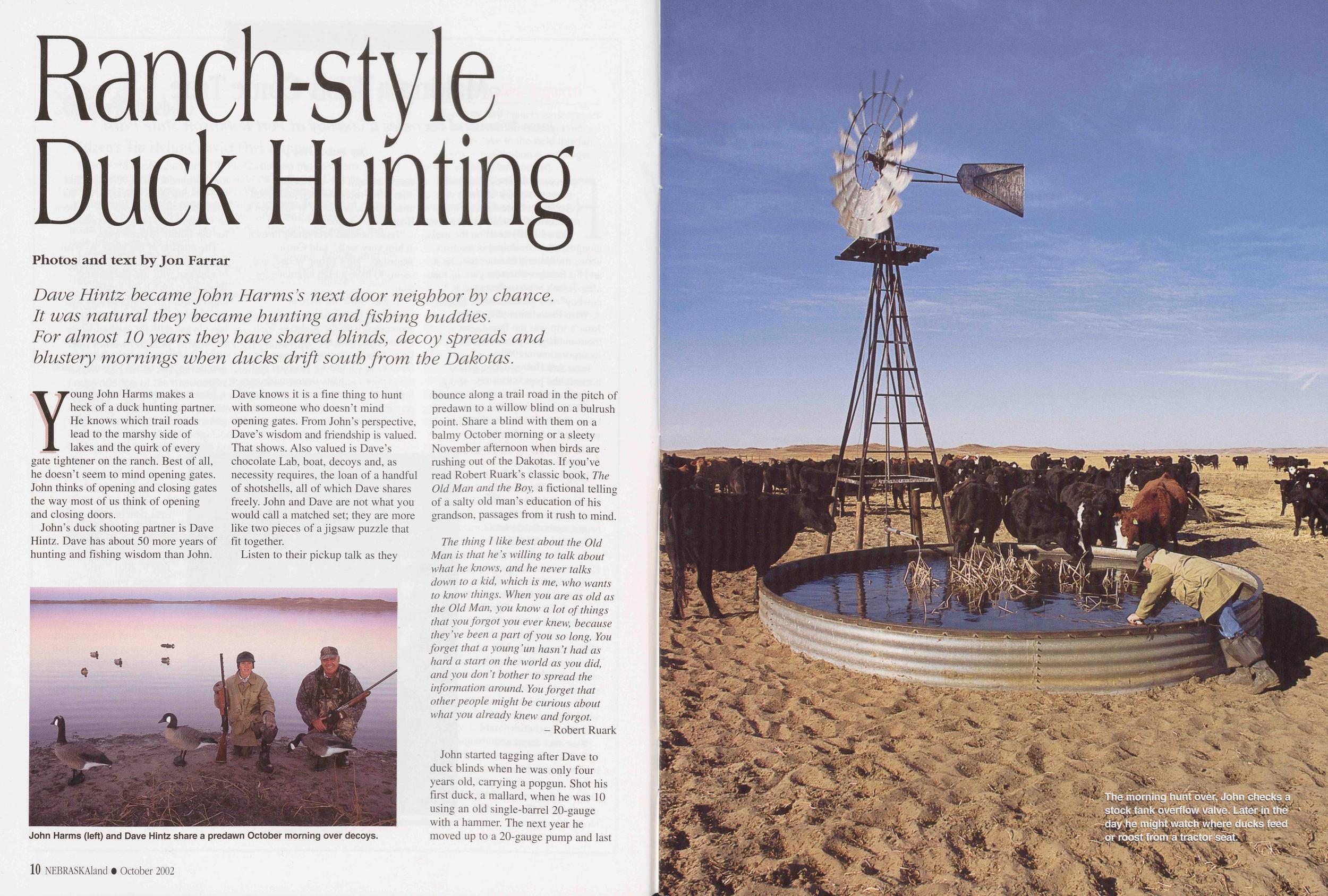
Ranch-style Duck Hunting
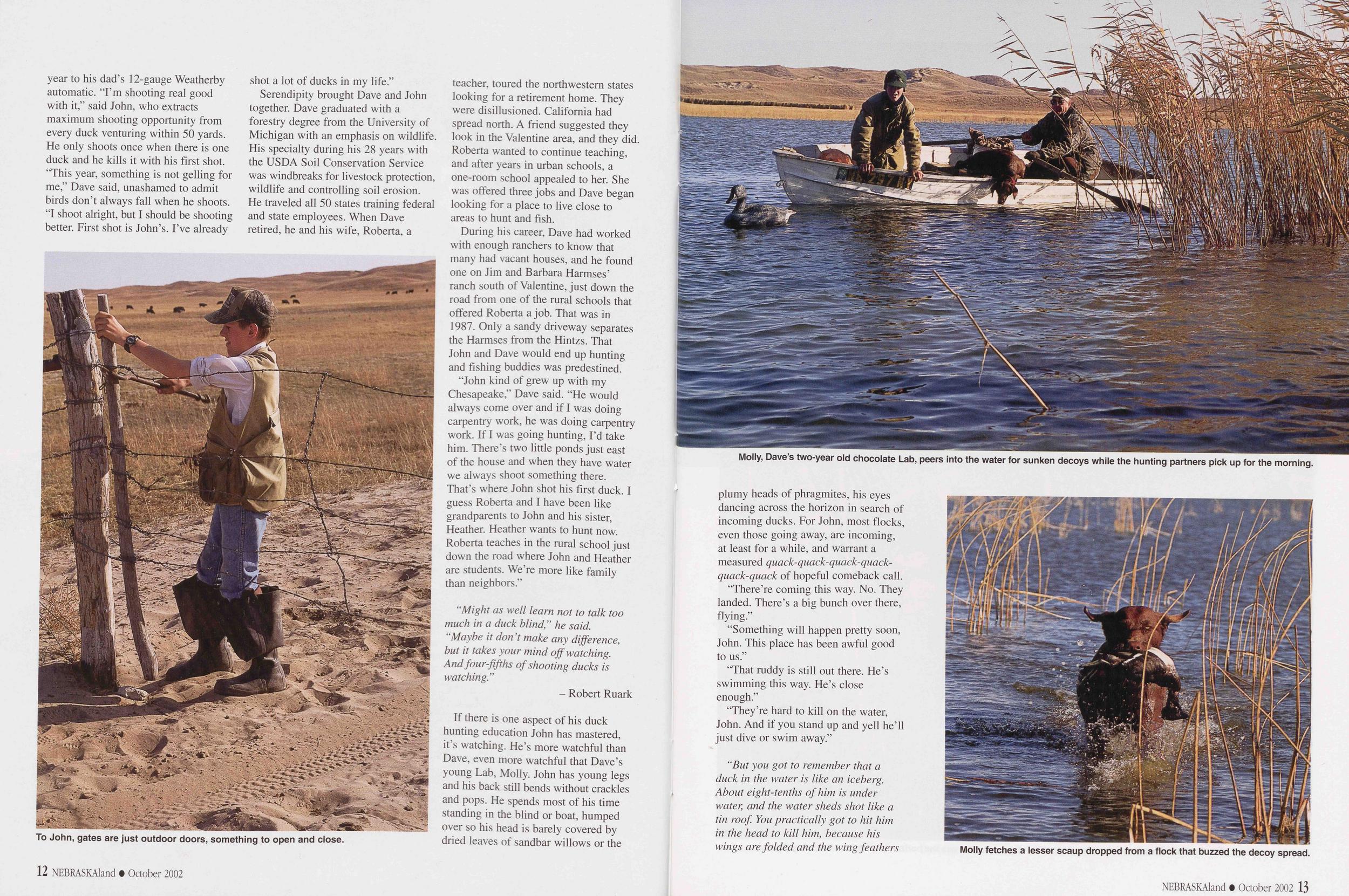
Dave Hintz became John Harms’s next door neighbor by chance. It was natural they became hunting and fishing buddies. For almost 10 years they have shared blinds, decoy spreads and blustery mornings when ducks drift south from the Dakotas.Young John Harms makes a heck of a duck hunting partner. He knows which trail roads lead to the marshy side of lakes and the quirk of every gate tightener on the ranch. Best of all, he doesn’t seem to mind opening gates. John thinks of opening and closing gates the way most of us think of opening and closing doors.
John’s duck shooting partner is Dave Hintz. Dave has about 50 more years of hunting and fishing wisdom than John. Dave knows it is a fine thing to hunt with someone who doesn’t mind opening gates. From John’s perspective, Dave’s wisdom and friendship is valued. That shows. Also valued is Dave’s chocolate Lab, boat, decoys and, as necessity requires, the loan of a handful of shotshells, all of which Dave shares freely. John and Dave are not what you would call a matched set; they are more like two pieces of a jigsaw puzzle that fit together.
Listen to their pickup talk as they bounce along a trail road in the pitch of predawn to a willow blind on a bulrush point. Share a blind with them on a balmy October morning or a sleety November afternoon when birds are rushing out of the Dakotas. If you’ve read Robert Ruark’s classic book, The Old Man and the Boy, a fictional telling of a salty old man’s education of his grandson, passages from it rush to mind.
The thing I like best about the Old Man is that he’s willing to talk about what he knows, and he never talks down to a kid, which is me, who wants to know things. When you are as old as the Old Man, you know a lot of things that you forgot you ever knew, because they've been a part of you so long. You forget that a young yun hasn 7 had as hard a start on the world as you did, and you don 7 bother to spread the information around. You forget that other people might be curious about what you already knew and forgot.
- Robert RuarkJohn started tagging after Dave to
duck blinds when he was only four
years old, carrying a popgun. Shot his
first duck, a mallard, when he was 10
using an old single-barrel 20-gauge
with a hammer. The next year he
moved up to a 20-gauge pump and last
10 NEBRASKAland • October 2002
 year to his dad’s 12-gauge Weatherby
automatic. "I’m shooting real good
with it,” said John, who extracts
maximum shooting opportunity from
every duck venturing within 50 yards.
He only shoots once when there is one
duck and he kills it with his first shot.
"This year, something is not gelling for
me,” Dave said, unashamed to admit
birds don’t always fall when he shoots.
“I shoot alright, but I should be shooting
better. First shot is John’s. I’ve already
shot a lot of ducks in my life.”
year to his dad’s 12-gauge Weatherby
automatic. "I’m shooting real good
with it,” said John, who extracts
maximum shooting opportunity from
every duck venturing within 50 yards.
He only shoots once when there is one
duck and he kills it with his first shot.
"This year, something is not gelling for
me,” Dave said, unashamed to admit
birds don’t always fall when he shoots.
“I shoot alright, but I should be shooting
better. First shot is John’s. I’ve already
shot a lot of ducks in my life.”
Serendipity brought Dave and John together. Dave graduated with a forestry degree from the University of Michigan with an emphasis on wildlife. His specialty during his 28 years with the USDA Soil Conservation Service was windbreaks for livestock protection, wildlife and controlling soil erosion. He traveled all 50 states training federal and state employees. When Dave retired, he and his wife, Roberta, a teacher, toured the northwestern states looking for a retirement home. They were disillusioned. California had spread north. A friend suggested they look in the Valentine area, and they did. Roberta wanted to continue teaching, and after years in urban schools, a one-room school appealed to her. She was offered three jobs and Dave began looking for a place to live close to areas to hunt and fish.
During his career, Dave had worked with enough ranchers to know that many had vacant houses, and he found one on Jim and Barbara Harmses’ ranch south of Valentine, just down the road from one of the rural schools that offered Roberta a job. That was in 1987. Only a sandy driveway separates the Harmses from the Hintzs. That John and Dave would end up hunting and fishing buddies was predestined.
"John kind of grew up with my Chesapeake,” Dave said. "He would always come over and if I was doing carpentry work, he was doing carpentry work. If I was going hunting, I’d take him. There’s two little ponds just east of the house and when they have water we always shoot something there. That’s where John shot his first duck. I guess Roberta and I have been like grandparents to John and his sister, Heather. Heather wants to hunt now. Roberta teaches in the rural school just down the road where John and Heather are students. We’re more like family than neighbors.”
“Might as well learn not to talk too much in a duck blind” he said. “Maybe it don 7 make any difference, but it takes your mind off watching. And four-fifths of shooting ducks is watching” - Robert RuarkIf there is one aspect of his duck hunting education John has mastered, it’s watching. He’s more watchful than Dave, even more watchful that Dave’s young Lab, Molly. John has young legs and his back still bends without crackles and pops. He spends most of his time standing in the blind or boat, humped over so his head is barely covered by dried leaves of sandbar willows or the 12 NEBRASKAland • October 2002 plumy heads of phragmites, his eyes dancing across the horizon in search of incoming ducks. For John, most flocks, even those going away, are incoming, at least for a while, and warrant a measured quack-quack-quack-quack- quack-quack of hopeful comeback call.
"There’re coming this way. No. They landed. There’s a big bunch over there, flying.”
“Something will happen pretty soon, John. This place has been awful good to us.”
"That ruddy is still out there. He’s swimming this way. He’s close enough.”
"They’re hard to kill on the water, John. And if you stand up and yell he’ll just dive or swim away.”
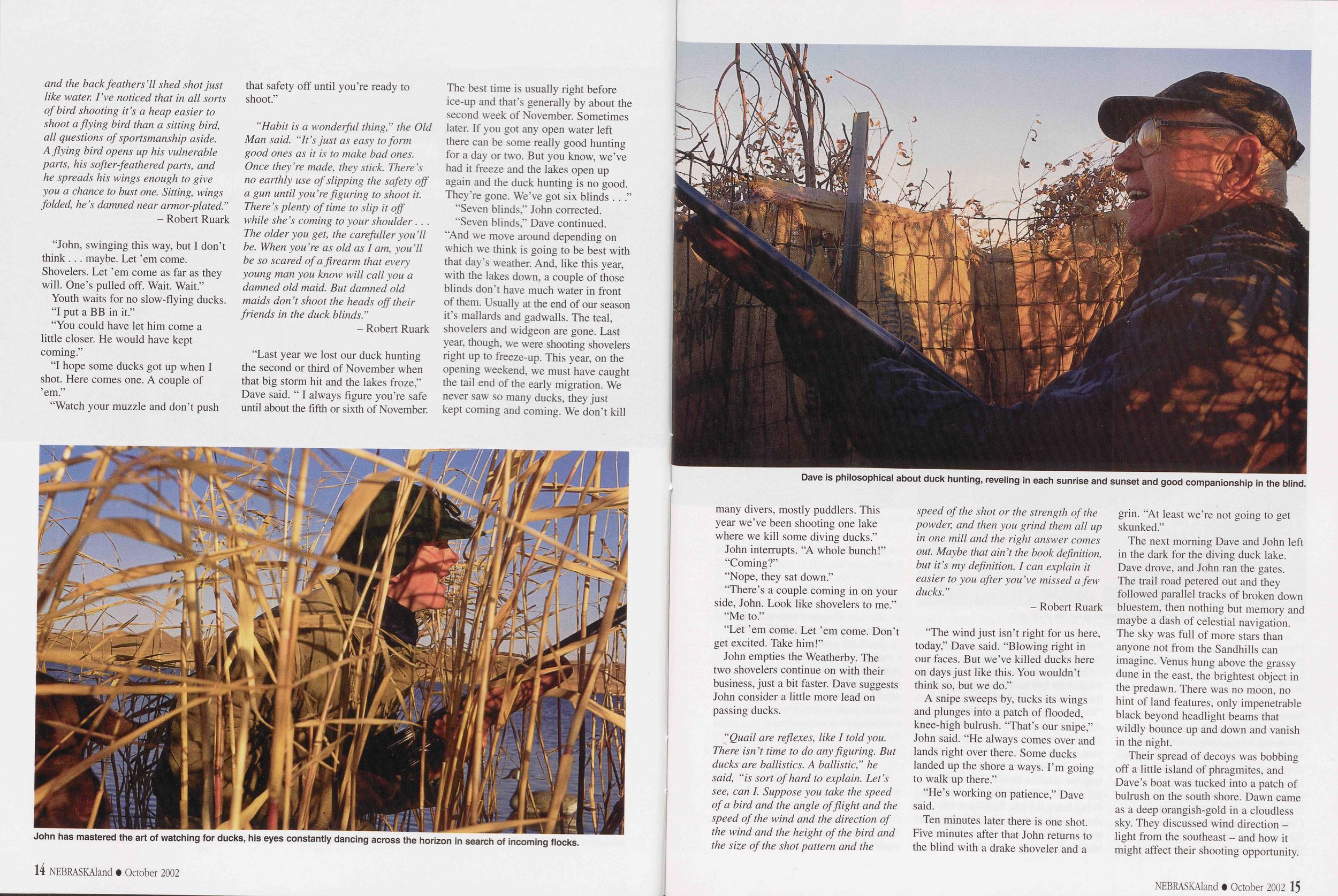 and the back feathers’ll shed shot just
like water. I’ve noticed that in all sorts
of bird shooting it’s a heap easier to
shoot a flying bird than a sitting bird,
all questions of sportsmanship aside.
A flying bird opens up his vulnerable
parts, his softer-feathered parts, and
he spreads his wings enough to give
you a chance to bust one. Sitting, wings
folded, he’s damned near armor-plated.”
- Robert Ruark
and the back feathers’ll shed shot just
like water. I’ve noticed that in all sorts
of bird shooting it’s a heap easier to
shoot a flying bird than a sitting bird,
all questions of sportsmanship aside.
A flying bird opens up his vulnerable
parts, his softer-feathered parts, and
he spreads his wings enough to give
you a chance to bust one. Sitting, wings
folded, he’s damned near armor-plated.”
- Robert Ruark
“John, swinging this way, but I don’t think . . . maybe. Ret ’em oome. Shovelers. Let ’em come as far as they will. One’s pulled off. Wait. Wait.”
Youth waits for no slow-flying ducks.
“I put a BB in it.”
“You could have let him come a little closer. He would have kept coming.”
“I hope some ducks got up when I shot. Here comes one. A couple of ’em.”
“Watch your muzzle and don’t push that safety off until you’re ready to shoot.”
“Last year we lost our duck hunting the second or third of November when that big storm hit and the lakes froze,” Dave said. “ I always figure you’re safe until about the fifth or sixth of November. The best time is usually right before ice-up and that’s generally by about the second week of November. Sometimes later. If you got any open water left there can be some really good hunting for a day or two. But you know, we’ve had it freeze and the lakes open up again and the duck hunting is no good. They’re gone. We’ve got six blinds . . .”
“Seven blinds,” John corrected.
“Seven blinds,” Dave continued. “And we move around depending on which we think is going to be best with that day’s weather. And, like this year, with the lakes down, a couple of those blinds don’t have much water in front of them. Usually at the end of our season it’s mallards and gad walls. The teal, shovelers and widgeon are gone. Last year, though, we were shooting shovelers right up to freeze-up. This year, on the opening weekend, we must have caught the tail end of the early migration. We never saw so many ducks, they just kept coming and coming. We don’t kill 14 NEBRASKAland • October 2002 many divers, mostly puddlers. This year we’ve been shooting one lake where we kill some diving ducks.”
John interrupts. “A whole bunch!”
“Coming?”
“Nope, they sat down.”
“There’s a couple coming in on your side, John. Look like shovelers to me.”
“Me too.”
“Let ’em come. Let ’em come. Don’t get excited. Take him!”
John empties the Weatherby. The two shovelers continue on with their business, just a bit faster. Dave suggests John consider a little more lead on passing ducks.
“Quail are reflexes, like I told you. There isn ’t time to do any figuring. But ducks are ballistics. A ballistic,” he said, “is sort of hard to explain. Let’s see, can I. Suppose you take the speed of a bird and the angle of flight and the speed of the wind and the direction of the wind and the height of the bird and the size of the shot pattern and the speed of the shot or the strength of the powder, and then you grind them all up in one mill and the right answer comes out. Maybe that ain ’t the book definition, but it’s my definition. I can explain it easier to you after you ’ve missed a few ducks.” - Robert Ruark“The wind just isn’t right for us here, today,” Dave said. “Blowing right in our faces. But we’ve killed ducks here on days just like this. You wouldn’t think so, but we do.”
A snipe sweeps by, tucks its wings and plunges into a patch of flooded, knee-high bulrush. “That’s our snipe,” John said. “He always comes over and lands right over there. Some ducks landed up the shore a ways. I’m going to walk up there.”
“He’s working on patience,” Dave said.
Ten minutes later there is one shot. Five minutes after that John returns to the blind with a drake shoveler and a grin. “At least we’re not going to get skunked.”
The next morning Dave and John left in the dark for the diving duck lake. Dave drove, and John ran the gates. The trail road petered out and they followed parallel tracks of broken down bluestem, then nothing but memory and maybe a dash of celestial navigation. The sky was full of more stars than anyone not from the Sandhills can imagine. Venus hung above the grassy dune in the east, the brightest object in the predawn. There was no moon, no hint of land features, only impenetrable black beyond headlight beams that wildly bounce up and down and vanish in the night.
Their spread of decoys was bobbing off a little island of phragmites, and Dave’s boat was tucked into a patch of bulrush on the south shore. Dawn came as a deep orangish-gold in a cloudless sky. They discussed wind direction - light from the southeast - and how it might affect their shooting opportunity.
NEBRASKAland • October 2002 15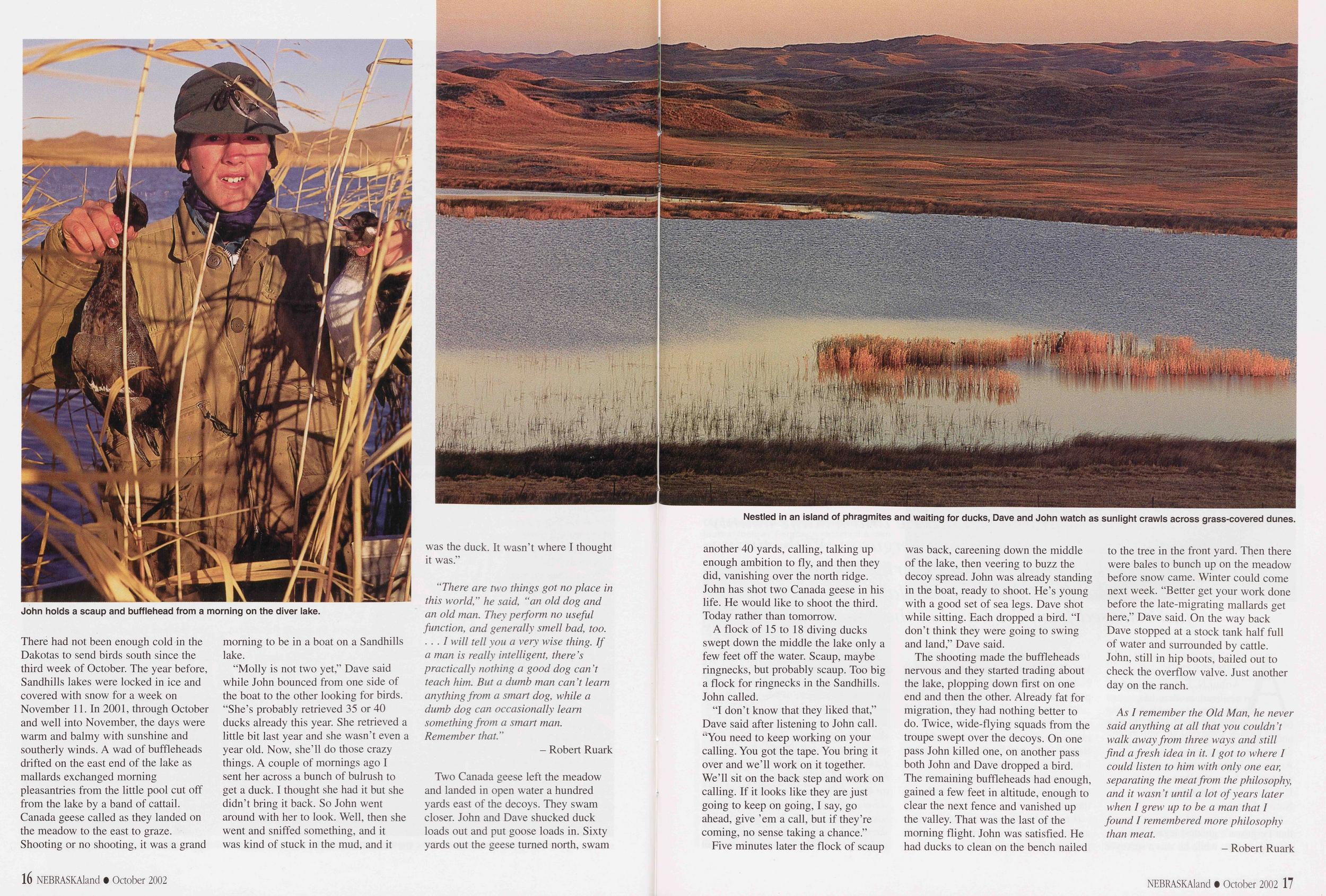
There had not been enough cold in the Dakotas to send birds south since the third week of October. The year before, Sandhills lakes were locked in ice and covered with snow for a week on November 11. In 2001, through October and well into November, the days were warm and balmy with sunshine and southerly winds. A wad of buffleheads drifted on the east end of the lake as mallards exchanged morning pleasantries from the little pool cut off from the lake by a band of cattail. Canada geese called as they landed on the meadow to the east to graze. Shooting or no shooting, it was a grand morning to be in a boat on a Sandhills lake.
“Molly is not two yet,” Dave said while John bounced from one side of the boat to the other looking for birds. "She's probably retrieved 35 or 40 ducks already this year. She retrieved a little bit last year and she wasn’t even a year old. Now, she’ll do those crazy things. A couple of mornings ago I sent her across a bunch of bulrush to get a duck. I thought she had it but she didn’t bring it back. So John went around with her to look. Well, then she went and sniffed something, and it was kind of stuck in the mud, and it was the duck. It wasn’t where I thought it was.”
“There are two things got no place in this world,” he said, “an old dog and an old man. They perform no useful function, and generally smell bad, too. ... I will tell you a very wise thing. If a man is really intelligent, there's practically nothing a good dog can 7 teach him. But a dumb man can 7 learn anything from a smart dog, while a dumb dog can occasionally learn something from a smart man. Remember that.” - Robert RuarkTwo Canada geese left the meadow and landed in open water a hundred yards east of the decoys. They swam closer. John and Dave shucked duck loads out and put goose loads in. Sixty yards out the geese turned north, swam 16 NEBRASKAland • October 2002 another 40 yards, calling, talking up enough ambition to fly, and then they did, vanishing over the north ridge. John has shot two Canada geese in his life. He would like to shoot the third. Today rather than tomorrow.
A flock of 15 to 18 diving ducks swept down the middle the lake only a few feet off the water. Scaup, maybe ringnecks, but probably scaup. Too big a flock for ringnecks in the Sandhills. John called.
"I don’t know that they liked that,” Dave said after listening to John call. "You need to keep working on your calling. You got the tape. You bring it over and we’ll work on it together. We’ll sit on the back step and work on calling. If it looks like they are just going to keep on going, I say, go ahead, give ’em a call, but if they’re coming, no sense taking a chance.”
Five minutes later the flock of scaup was back, careening down the middle of the lake, then veering to buzz the decoy spread. John was already standing in the boat, ready to shoot. He’s young with a good set of sea legs. Dave shot while sitting. Each dropped a bird. "I don’t think they were going to swing and land,” Dave said.
The shooting made the buffleheads nervous and they started trading about the lake, plopping down first on one end and then the other. Already fat for migration, they had nothing better to do. Twice, wide-flying squads from the troupe swept over the decoys. On one pass John killed one, on another pass both John and Dave dropped a bird. The remaining buffleheads had enough, gained a few feet in altitude, enough to clear the next fence and vanished up the valley. That was the last of the morning flight. John was satisfied. He had ducks to clean on the bench nailed to the tree in the front yard. Then there were bales to bunch up on the meadow before snow came. Winter could come next week. "Better get your work done before the late-migrating mallards get here,” Dave said. On the way back Dave stopped at a stock tank half full of water and surrounded by cattle. John, still in hip boots, bailed out to check the overflow valve. Just another day on the ranch.
As I remember the Old Man, he never said anything at all that you couldn 7 walk away from three ways and still find afresh idea in it. I got to where I could listen to him with only one ear, separating the meat from the philosophy, and it wasn't until a lot of years later when I grew up to be a man that I found I remembered more philosophy than meat. - Robert Ruark NEBRASKAland • October 2002 17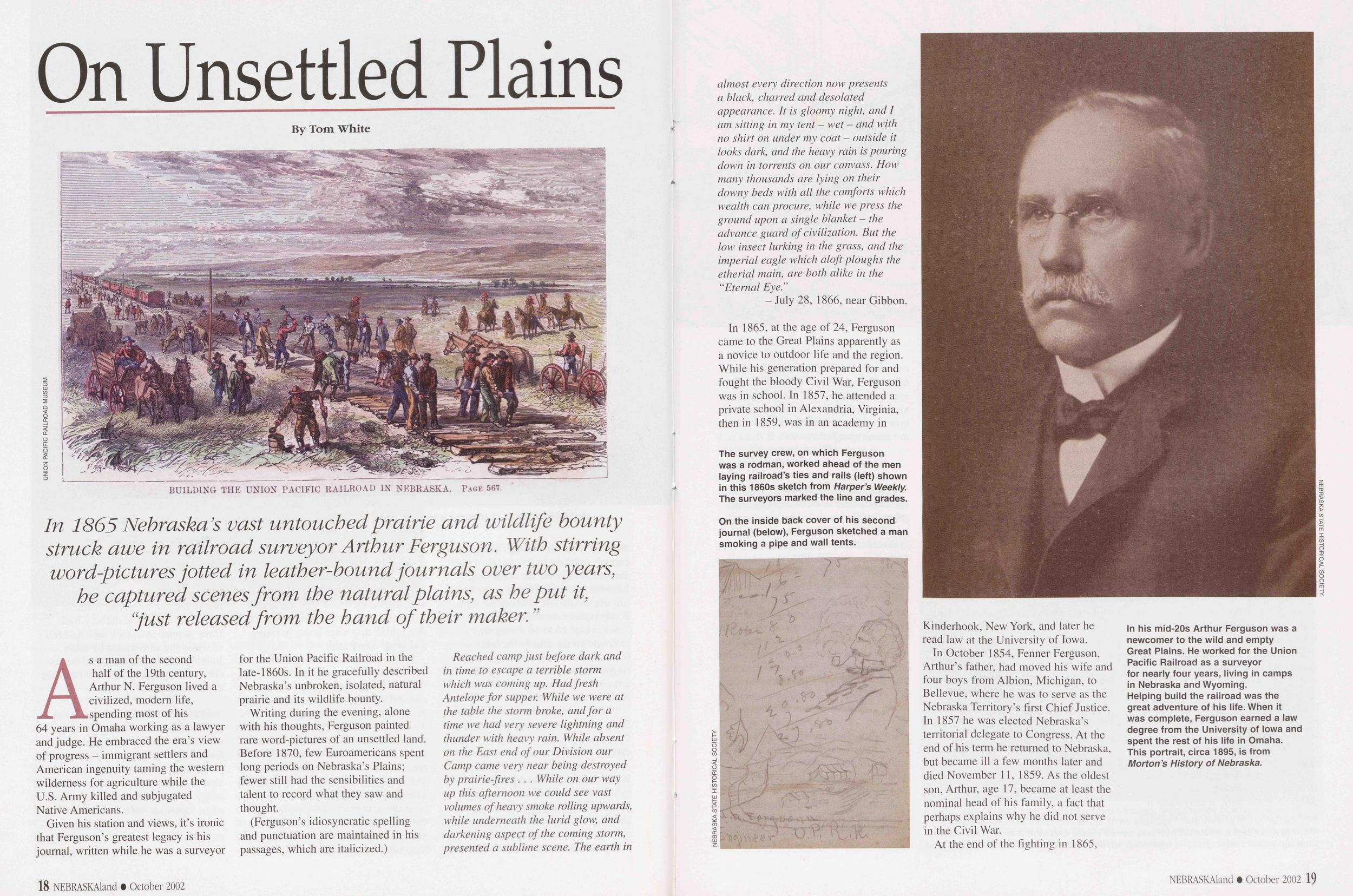
On Unsettled Plains
As a man of the second half of the 19th century, Arthur N. Ferguson lived a civilized, modern life, spending most of his 64 years in Omaha working as a lawyer and judge. He embraced the era’s view of progress - immigrant settlers and American ingenuity taming the western wilderness for agriculture while the U.S. Army killed and subjugated Native Americans.
Given his station and views, it’s ironic that Ferguson’s greatest legacy is his journal, written while he was a surveyor for the Union Pacific Railroad in the late-1860s. In it he gracefully described Nebraska’s unbroken, isolated, natural prairie and its wildlife bounty.
Writing during the evening, alone with his thoughts, Ferguson painted rare word-pictures of an unsettled land. Before 1870, few Euroamericans spent long periods on Nebraska’s Plains; fewer still had the sensibilities and talent to record what they saw and thought.
(Ferguson’s idiosyncratic spelling and punctuation are maintained in his passages, which are italicized.)
Reached camp just before dark and in time to escape a terrible storm which was coming up. Had fresh Antelope for supper. While we were at the table the storm broke, and for a time we had very severe lightning and thunder with heavy rain. While absent on the East end of our Division our Camp came very near being destroyed by prairie-fires . . . While on our way up this afternoon we could see vast volumes of heavy smoke rolling upwards, while underneath the lurid glow, and darkening aspect of the coming storm, presented a sublime scene. The earth in 18 NEBRASKAland • October 2002 almost every direction now presents a black, charred and desolated appearance. It is gloomy night, and I am sitting in my tent - wet - and with no shirt on under my coat - outside it looks dark, and the heavy rain is pouring down in torrents on our canvass. How many thousands are lying on their downy beds with all the comforts which wealth can procure, while we press the ground upon a single blanket - the advance guard of civilization. But the low insect lurking in the grass, and the imperial eagle which aloft ploughs the etherial main, are both alike in the “Eternal Eye.” - July 28, 1866, near Gibbon.In 1865, at the age of 24, Ferguson came to the Great Plains apparently as a novice to outdoor life and the region. While his generation prepared for and fought the bloody Civil War, Ferguson was in school. In 1857, he attended a private school in Alexandria, Virginia, then in 1859, was in an academy in Kinderhook, New York, and later he read law at the University of Iowa.
In October 1854, Fenner Ferguson, Arthur’s father, had moved his wife and four boys from Albion, Michigan, to Bellevue, where he was to serve as the Nebraska Territory’s first Chief Justice. In 1857 he was elected Nebraska’s territorial delegate to Congress. At the end of his term he returned to Nebraska, but became ill a few months later and died November 11, 1859. As the oldest son, Arthur, age 17, became at least the nominal head of his family, a fact that perhaps explains why he did not serve in the Civil War.
At the end of the fighting in 1865,
NEBRASKAland • October 2002 19
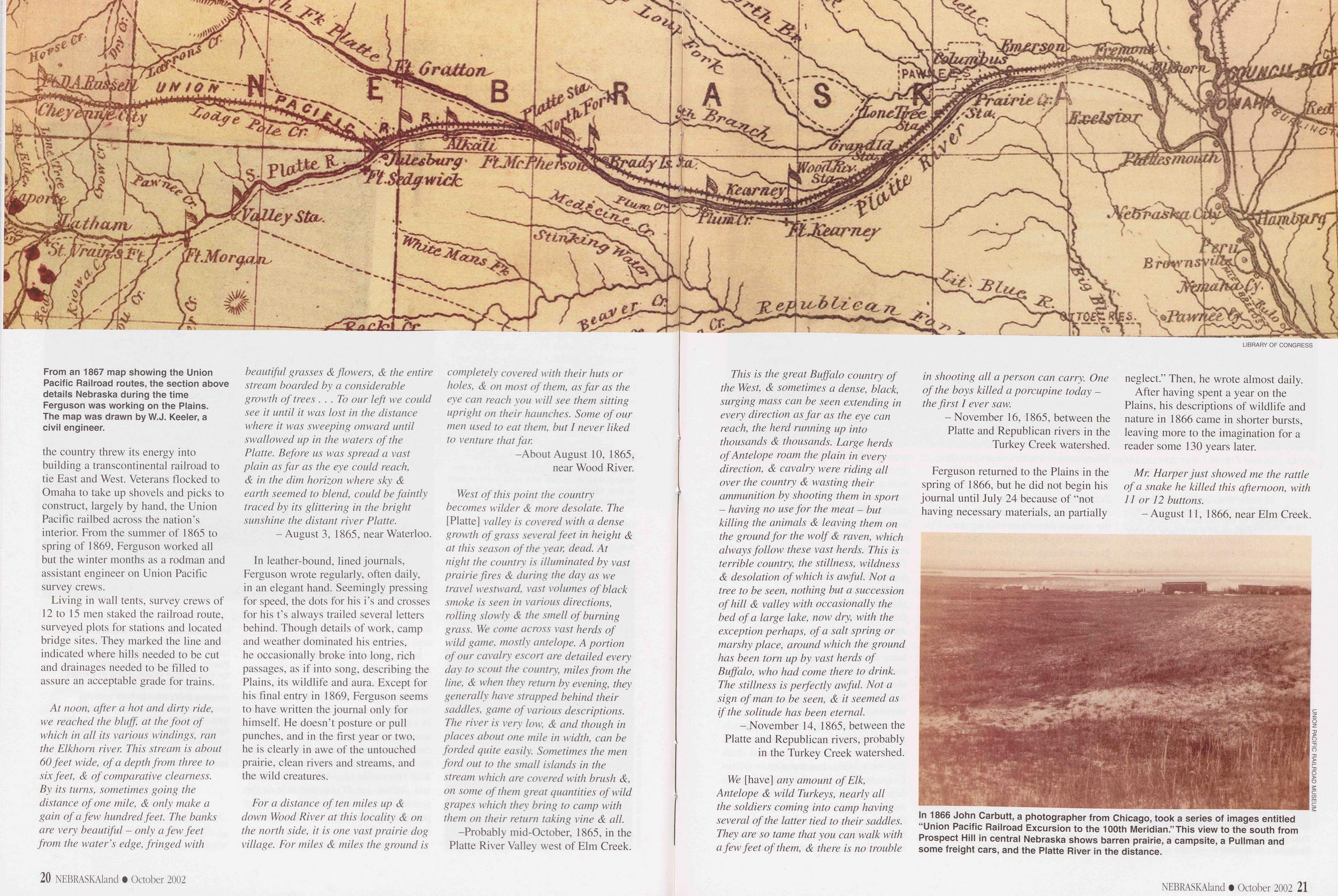 the country threw its energy into
building a transcontinental railroad to
tie East and West. Veterans flocked to
Omaha to take up shovels and picks to
construct, largely by hand, the Union
Pacific railbed across the nation’s
interior. From the summer of 1865 to
spring of 1869, Ferguson worked all
but the winter months as a rodman and
assistant engineer on Union Pacific
survey crews.
the country threw its energy into
building a transcontinental railroad to
tie East and West. Veterans flocked to
Omaha to take up shovels and picks to
construct, largely by hand, the Union
Pacific railbed across the nation’s
interior. From the summer of 1865 to
spring of 1869, Ferguson worked all
but the winter months as a rodman and
assistant engineer on Union Pacific
survey crews.
Living in wall tents, survey crews of 12 to 15 men staked the railroad route, surveyed plots for stations and located bridge sites. They marked the line and indicated where hills needed to be cut and drainages needed to be filled to assure an acceptable grade for trains.
At noon, after a hot and dirty ride, we reached the bluff, at the foot of which in all its various windings, ran the Elkhorn river. This stream is about 60 feet wide, of a depth from three to six feet, & of comparative clearness. By its turns, sometimes going the distance of one mile, & only make a gain of a few hundred feet. The banks are very beautiful - only a few feet from the water’s edge, fringed with beautiful grasses & flowers, & the entire stream boarded by a considerable growth of trees ... To our left we could see it until it was lost in the distance where it was sweeping onward until swallowed up in the waters of the Platte. Before us was spread a vast plain as far as the eye could reach, & in the dim horizon where sky& earth seemed to blend, could be faintly traced by its glittering in the bright sunshine the distant river Platte. - August 3, 1865, near Waterloo.In leather-bound, lined journals, Ferguson wrote regularly, often daily, in an elegant hand. Seemingly pressing for speed, the dots for his i’s and crosses for his t’s always trailed several letters behind. Though details of work, camp and weather dominated his entries, he occasionally broke into long, rich passages, as if into song, describing the Plains, its wildlife and aura. Except for his final entry in 1869, Ferguson seems to have written the journal only for himself. He doesn’t posture or pull punches, and in the first year or two, he is clearly in awe of the untouched prairie, clean rivers and streams, and the wild creatures.
For a distance of ten miles up & down Wood River at this locality & on the north side, it is one vast prairie dog village. For miles &miles the ground is completely covered with their huts or holes, &on most of them, as far as the eye can reach you will see them sitting upright on their haunches. Some of our men used to eat them, but I never liked to venture that far. -About August 10, 1865, near Wood River. West of this point the country becomes wilder & more desolate. The [Platte] valley is covered with a dense growth of grass several feet in height & at this season of the year, dead. At night the country is illuminated by vast prairie fires & during the day as we travel westward, vast volumes of black smoke is seen in various directions, rolling slowly & the smell of burning grass. We come across vast herds of wild game, mostly antelope. A portion of our cavalry escort are detailed every day to scout the country, miles from the line, & when they return by evening, they generally have strapped behind their saddles, game of various descriptions. The river is very low, & and though in places about one mile in width, can be forded quite easily. Sometimes the men ford out to the small islands in the stream which are covered with brush &, on some of them great quantities of wild grapes which they bring to camp with them on their return taking vine & all. -Probably mid-October, 1865, in the Platte River Valley west of Elm Creek. 20 NEBRASKAland • October 2002 This is the great Buffalo country of the West, & sometimes a dense, black, surging mass can be seen extending in every direction as far as the eye can reach, the herd running up into thousands & thousands. Large herds of Antelope roam the plain in every direction, & cavalry were riding all over the country & wasting their ammunition by shooting them in sport - having no use for the meat - but killing the animals & leaving them on the ground for the wolf & raven, which always follow these vast herds. This is terrible country, the stillness, wildness & desolation of which is awful. Not a tree to be seen, nothing but a succession of hill & valley with occasionally the bed of a large lake, now dry, with the exception perhaps, of a salt spring or marshy place, around which the ground has been torn up by vast herds of Buffalo, who had come there to drink. The stillness is perfectly awful. Not a sign of man to be seen, & it seemed as if the solitude has been eternal. - November 14, 1865, between the Platte and Republican rivers, probably in the Turkey Creek watershed. We [have] any amount of Elk, Antelope & wild Turkeys, nearly all the soldiers coming into camp having several of the latter tied to their saddles. They are so tame that you can walk with a few feet of them, & there is no trouble in shooting all a person can carry. One of the boys killed a porcupine today - the first I ever saw. - November 16, 1865, between the Platte and Republican rivers in the Turkey Creek watershed.Ferguson returned to the Plains in the spring of 1866, but he did not begin his journal until July 24 because of "not having necessary materials, an partially neglect.” Then, he wrote almost daily.
After having spent a year on the Plains, his descriptions of wildlife and nature in 1866 came in shorter bursts, leaving more to the imagination for a reader some 130 years later.
Mr. Harper just showed me the rattle of a snake he killed this afternoon, with 11 or 12 buttons. - August 11,1866, near Elm Creek. NEBRASKAland • October 2002 21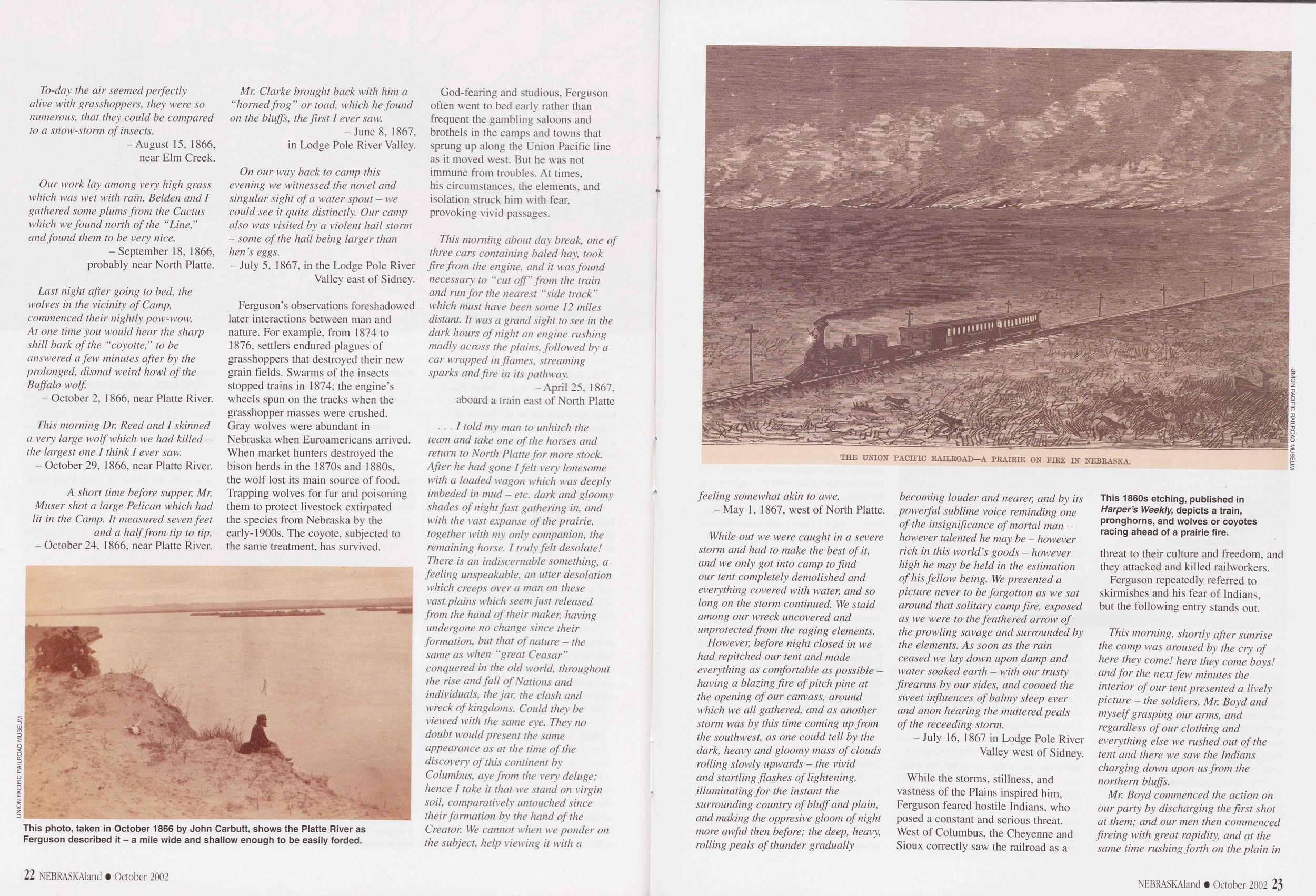 To-day the air seemed perfectly
alive with grasshoppers, they were so
numerous, that they could be compared
to a snow-storm of insects.
-August 15, 1866,
near Elm Creek.
Our work lay among very high grass
which was wet with rain. Belden and I
gathered some plums from the Cactus
which we found north of the “Line,”
and found them to be very nice.
- September 18, 1866,
probably near North Platte.
Last night after going to bed, the
wolves in the vicinity of Camp,
commenced their nightly pow-wow.
At one time you would hear the sharp
shill bark of the “coyotte,” to be
answered a few minutes after by the
prolonged, dismal weird howl of the
Buffalo wolf.
- October 2, 1866, near Platte River.
This morning Dr. Reed and I skinned
a very large wolf which we had killed -
the largest one I think I ever saw.
- October 29, 1866, near Platte River.
A short time before supper, Mr.
Muser shot a large Pelican which had
lit in the Camp. It measured seven feet
and a half from tip to tip.
- October 24, 1866, near Platte River.
To-day the air seemed perfectly
alive with grasshoppers, they were so
numerous, that they could be compared
to a snow-storm of insects.
-August 15, 1866,
near Elm Creek.
Our work lay among very high grass
which was wet with rain. Belden and I
gathered some plums from the Cactus
which we found north of the “Line,”
and found them to be very nice.
- September 18, 1866,
probably near North Platte.
Last night after going to bed, the
wolves in the vicinity of Camp,
commenced their nightly pow-wow.
At one time you would hear the sharp
shill bark of the “coyotte,” to be
answered a few minutes after by the
prolonged, dismal weird howl of the
Buffalo wolf.
- October 2, 1866, near Platte River.
This morning Dr. Reed and I skinned
a very large wolf which we had killed -
the largest one I think I ever saw.
- October 29, 1866, near Platte River.
A short time before supper, Mr.
Muser shot a large Pelican which had
lit in the Camp. It measured seven feet
and a half from tip to tip.
- October 24, 1866, near Platte River.
Ferguson’s observations foreshadowed later interactions between man and nature. For example, from 1874 to 1876, settlers endured plagues of grasshoppers that destroyed their new grain fields. Swarms of the insects stopped trains in 1874; the engine’s wheels spun on the tracks when the grasshopper masses were crushed. Gray wolves were abundant in Nebraska when Euroamericans arrived. When market hunters destroyed the bison herds in the 1870s and 1880s, the wolf lost its main source of food. Trapping wolves for fur and poisoning them to protect livestock extirpated the species from Nebraska by the early-1900s. The coyote, subjected to the same treatment, has survived.
God-fearing and studious, Ferguson often went to bed early rather than frequent the gambling saloons and brothels in the camps and towns that sprung up along the Union Pacific line as it moved west. But he was not immune from troubles. At times, his circumstances, the elements, and isolation struck him with fear, provoking vivid passages.
This morning about day break, one of three cars containing baled hay, took fire from the engine, and it was found necessary to “cut off” from the train and run for the nearest “side track” which must have been some 12 miles distant. It was a grand sight to see in the dark hours of night an engine rushing madly across the plains, followed by a car wrapped in flames, streaming sparks and fire in its pathway. -April 25, 1867, aboard a train east of North Platte ... I told my man to unhitch the team and take one of the horses and return to North Platte for more stock. After he had gone I felt very lonesome with a loaded wagon which was deeply imbeded in mud - etc. dark and gloomy shades of night fast gathering in, and with the vast expanse of the prairie, together with my only companion, the remaining horse. I truly felt desolate! There is an indiscernable something, a feeling unspeakable, an utter desolation which creeps over a man on these vast plains which seem just released from the hand of their maker, having undergone no change since their formation, but that of nature — the same as when “great Ceasar” conquered in the old world, throughout the rise and fall of Nations and individuals, the jar, the clash and wreck of kingdoms. Could they be viewed with the same eye. They no doubt would present the same appearance as at the time of the discovery of this continent by Columbus, aye from the very deluge; hence I take it that we stand on virgin soil, comparatively untouched since their formation by the hand of the Creator. We cannot when we ponder on the subject, help viewing it with a feeling somewhat akin to awe. 22 NEBRASKAland • October 2002 - May 1, 1867, west of North Platte.While the storms, stillness, and vastness of the Plains inspired him, Ferguson feared hostile Indians, who posed a constant and serious threat. West of Columbus, the Cheyenne and Sioux correctly saw the railroad as a threat to their culture and freedom, and they attacked and killed rail workers.
Ferguson repeatedly referred to skirmishes and his fear of Indians, but the following entry stands out.
This morning, shortly after sunrise the camp was aroused by the cry of here they come! here they come boys! and for the next few minutes the interior of our tent presented a lively picture - the soldiers, Mr. Boyd and myself grasping our arms, and regardless of our clothing and everything else we rushed out of the tent and there we saw the Indians charging down upon us from the northern bluffs. Mr. Boyd commenced the action on our party by discharging the first shot at them; and our men then commenced fireing with great rapidity, and at the same time rushing forth on the plain in NEBRASKAland • October 2002 23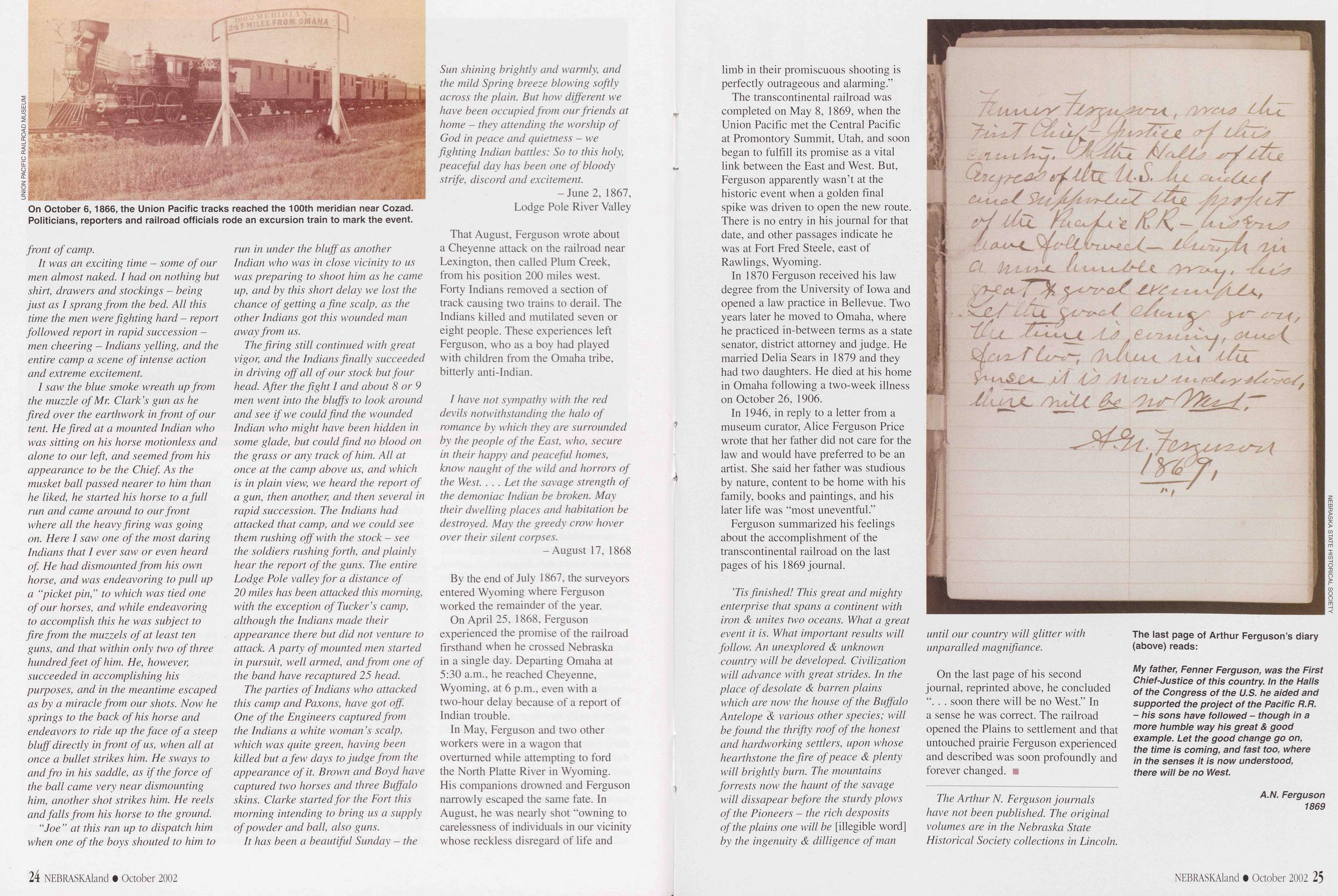 front of camp.
UNION PACIFIC RAILROAD MUSEUM
front of camp.
UNION PACIFIC RAILROAD MUSEUM
That August, Ferguson wrote about a Cheyenne attack on the railroad near Lexington, then called Plum Creek, from his position 200 miles west. Forty Indians removed a section of track causing two trains to derail. The Indians killed and mutilated seven or eight people. These experiences left Ferguson, who as a boy had played with children from the Omaha tribe, bitterly anti-Indian.
I have not sympathy with the red devils notwithstanding the halo of romance by which they are surrounded by the people of the East, who, secure in their happy and peaceful homes, know naught of the wild and horrors of the West. . . . Let the savage strength of the demoniac Indian be broken. May their dwelling places and habitation be destroyed. May the greedy crow hover over their silent corpses. -August 17, 1868By the end of July 1867, the surveyors entered Wyoming where Ferguson worked the remainder of the year.
On April 25, 1868, Ferguson experienced the promise of the railroad firsthand when he crossed Nebraska in a single day. Departing Omaha at 5:30 a.m., he reached Cheyenne, Wyoming, at 6 p.m., even with a two-hour delay because of a report of Indian trouble.
In May, Ferguson and two other workers were in a wagon that overturned while attempting to ford the North Platte River in Wyoming. His companions drowned and Ferguson narrowly escaped the same fate. In August, he was nearly shot “owning to carelessness of individuals in our vicinity whose reckless disregard of life and 24 NEBRASKAland • October 2002 limb in their promiscuous shooting is perfectly outrageous and alarming.”
The transcontinental railroad was completed on May 8, 1869, when the Union Pacific met the Central Pacific at Promontory Summit, Utah, and soon began to fulfill its promise as a vital link between the East and West. But, Ferguson apparently wasn’t at the historic event when a golden final spike was driven to open the new route. There is no entry in his journal for that date, and other passages indicate he was at Fort Fred Steele, east of Rawlings, Wyoming.
In 1870 Ferguson received his law degree from the University of Iowa and opened a law practice in Bellevue. Two years later he moved to Omaha, where he practiced in-between terms as a state senator, district attorney and judge. He married Delia Sears in 1879 and they had two daughters. He died at his home in Omaha following a two-week illness on October 26, 1906.
In 1946, in reply to a letter from a museum curator, Alice Ferguson Price wrote that her father did not care for the law and would have preferred to be an artist. She said her father was studious by nature, content to be home with his family, books and paintings, and his later life was “most uneventful.”
Ferguson summarized his feelings about the accomplishment of the transcontinental railroad on the last pages of his 1869 journal.
'Tis finished! This great and mighty enterprise that spans a continent with iron & unites two oceans. What a great event it is. What important results will follow. An unexplored & unknown country will be developed. Civilization will advance with great strides. In the place of desolate & barren plains which are now the house of the Buffalo Antelope & various other species; will be found the thrifty roof of the honest and hardworking settlers, upon whose hearthstone the fire of peace & plenty will brightly burn. The mountains forrests now the haunt of the savage will dissapear before the sturdy plows of the Pioneers - the rich desposits of the plains one will be [illegible word] by the ingenuity & dilligence of man until our country will glitter with unparalled magnifiance.On the last page of his second journal, reprinted above, he concluded “. . . soon there will be no West.” In a sense he was correct. The railroad opened the Plains to settlement and that untouched prairie Ferguson experienced and described was soon profoundly and forever changed. ■
The Arthur N. Ferguson journals have not been published. The original volumes are in the Nebraska State Historical Society collections in Lincoln.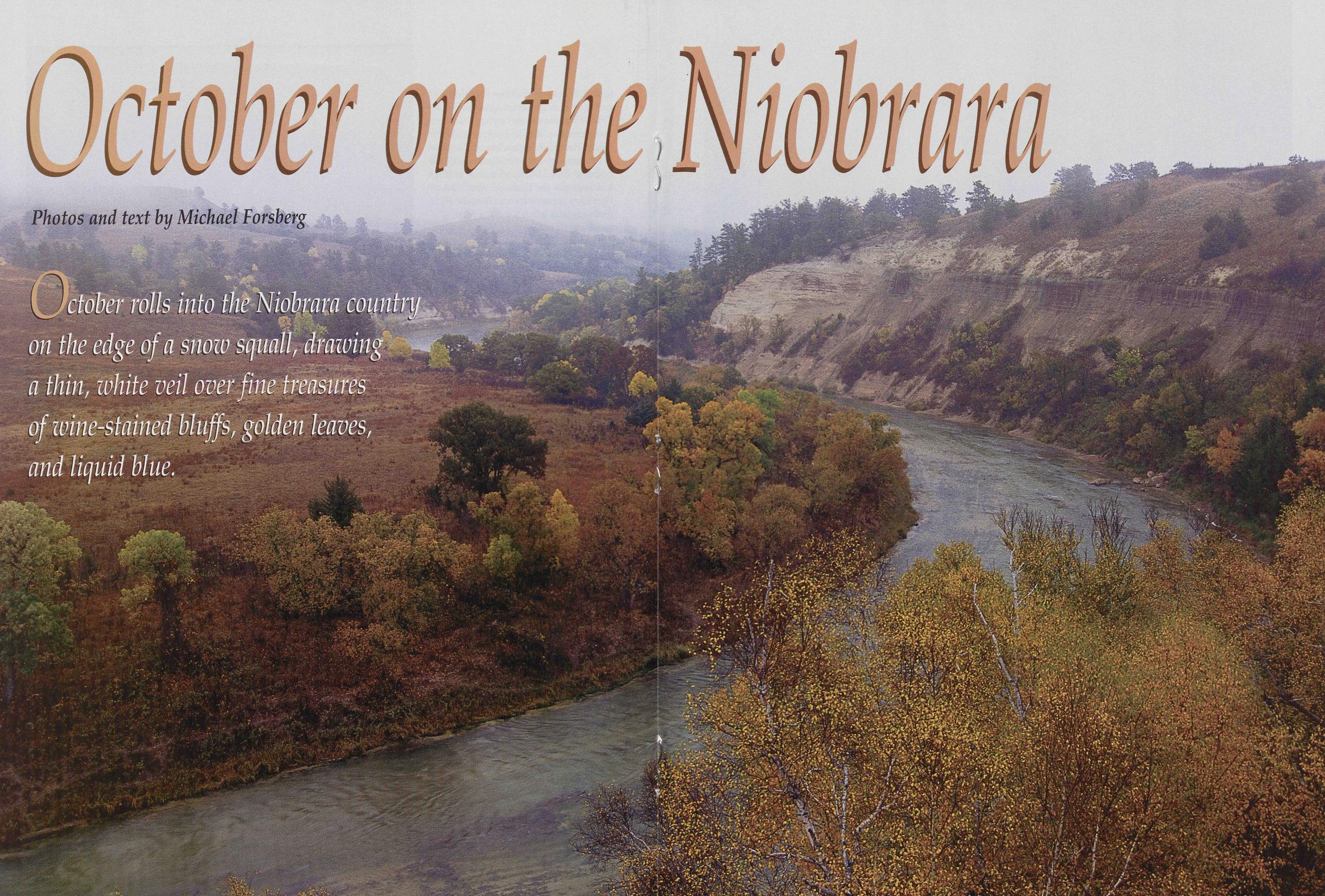
October on the Niobrara
October rolls into the’Niobrara country on the edge of a snow squall, drawing a thin, white veil over fine treasures of wine-stained bluffs, golden leaves, and liquid blue.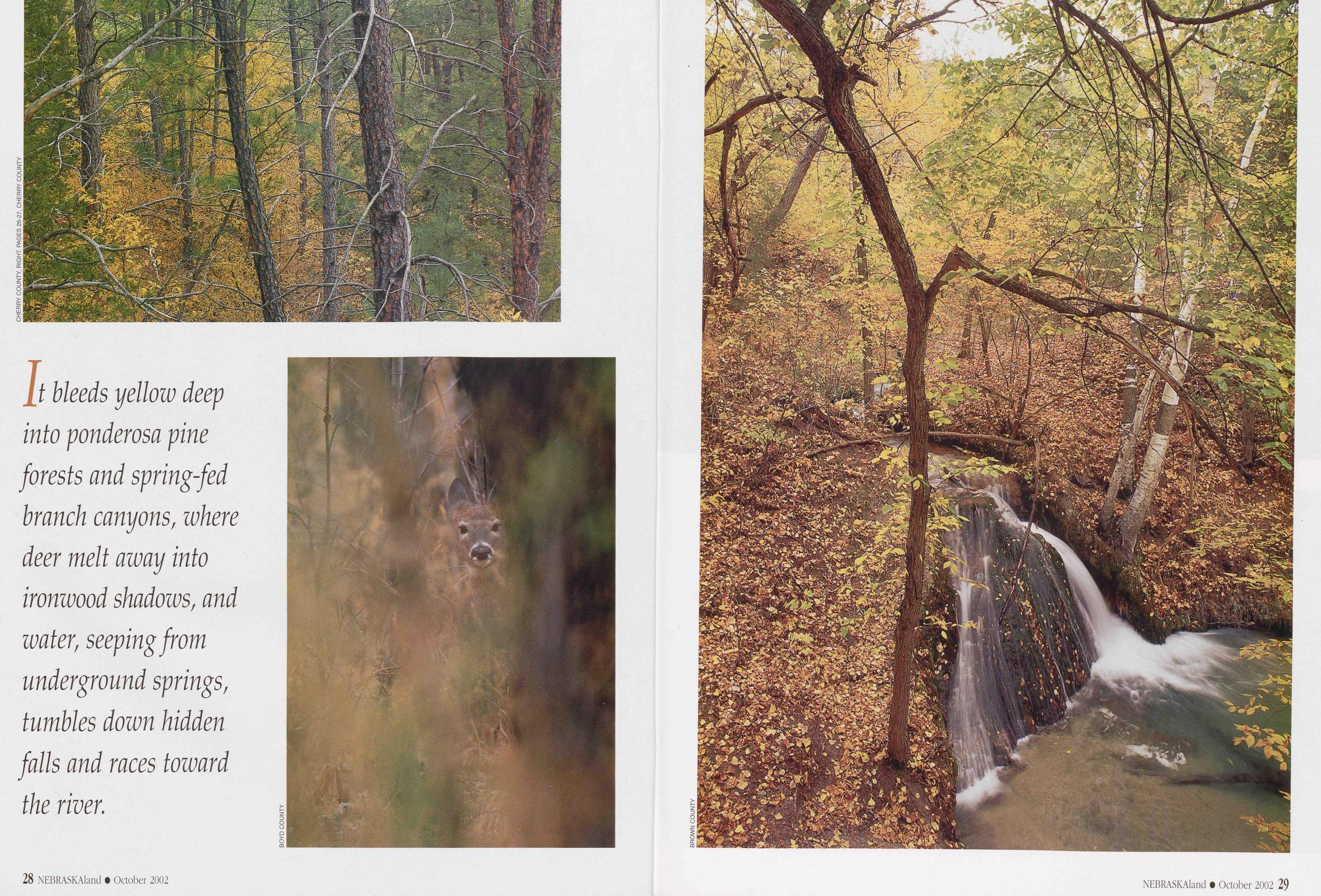 CHERRY COUNTY, RIGHT. PAGES 26-27, CHERRY COUNTY
It bleeds yellow deep
into ponderosa pine
forests and spring-fed
branch canyons, where
deer melt away into
ironwood shadows, and
coater, seeping from
underground springs,
tumbles down hidden
falls and races toward
the river.
28 NEBRASKAland • October 2002
NEBRASKAland • October 2002 29
CHERRY COUNTY, RIGHT. PAGES 26-27, CHERRY COUNTY
It bleeds yellow deep
into ponderosa pine
forests and spring-fed
branch canyons, where
deer melt away into
ironwood shadows, and
coater, seeping from
underground springs,
tumbles down hidden
falls and races toward
the river.
28 NEBRASKAland • October 2002
NEBRASKAland • October 2002 29
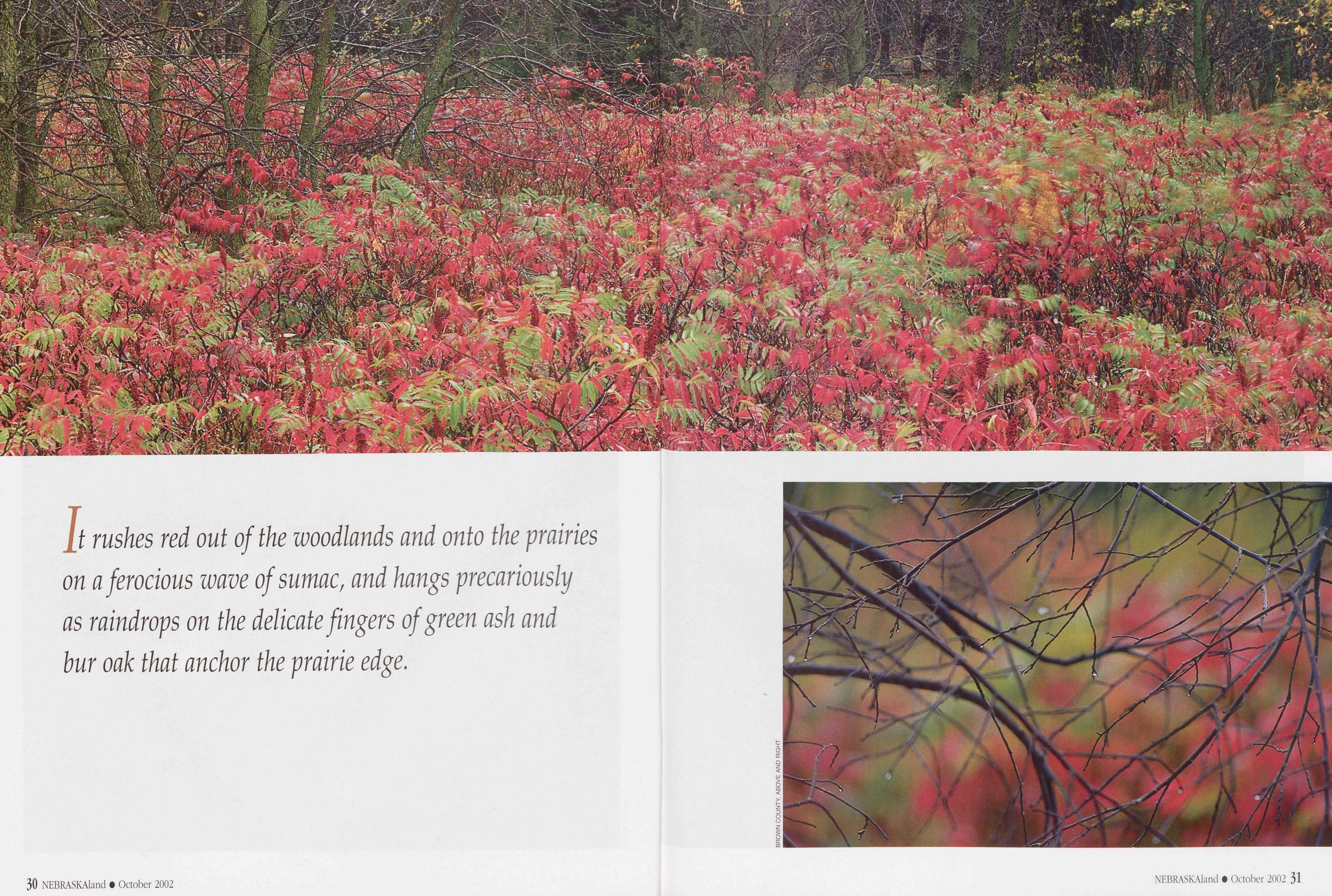 It rushes red out of the woodlands and onto the prairies
on a ferocious wave of sumac, and hangs precariously
as raindrops on the delicate fingers of green ash and
bur oak that anchor the prairie edge.
30 NEBRASKAland • October 2002
NEBRASKAland • October 2002 31
It rushes red out of the woodlands and onto the prairies
on a ferocious wave of sumac, and hangs precariously
as raindrops on the delicate fingers of green ash and
bur oak that anchor the prairie edge.
30 NEBRASKAland • October 2002
NEBRASKAland • October 2002 31
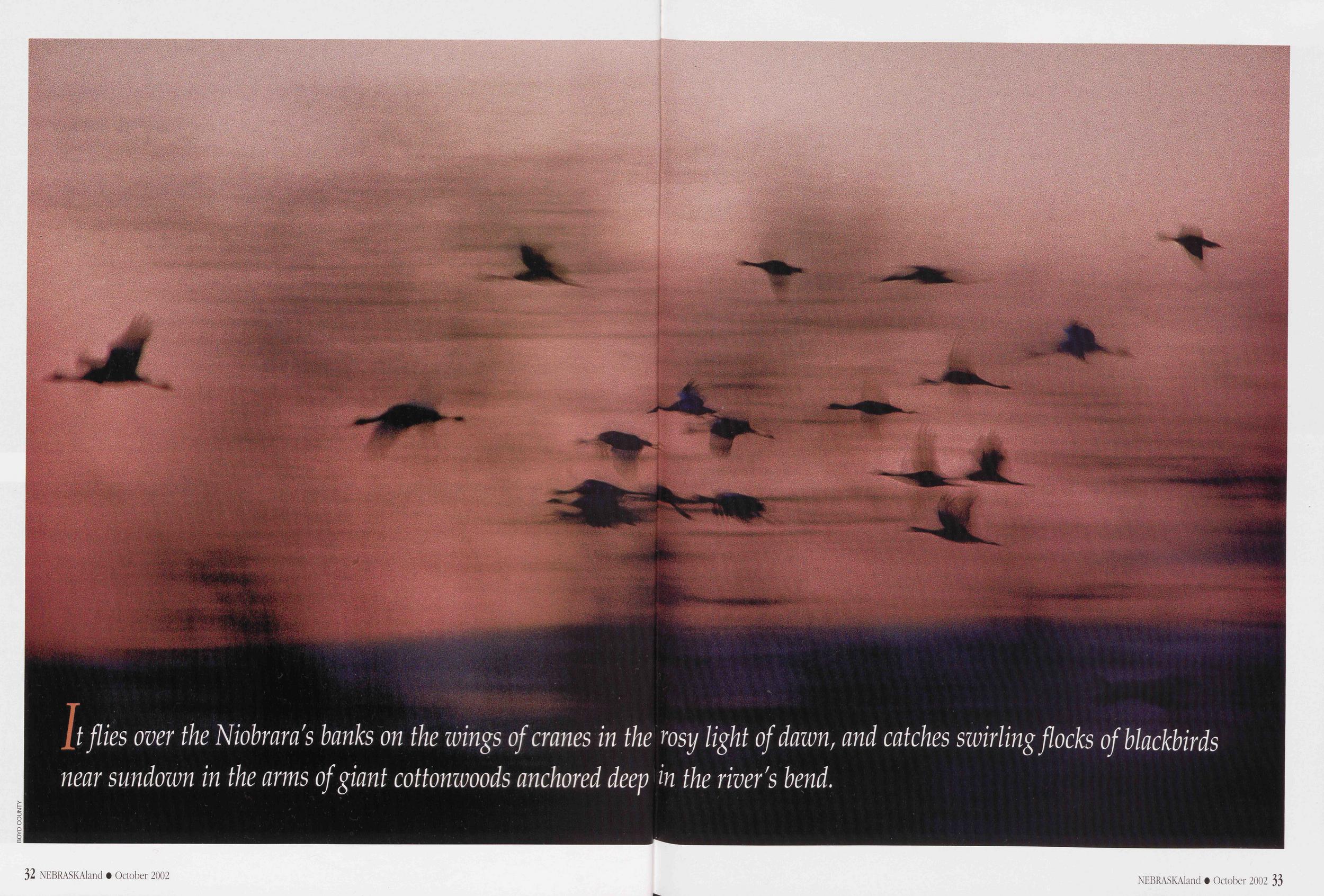
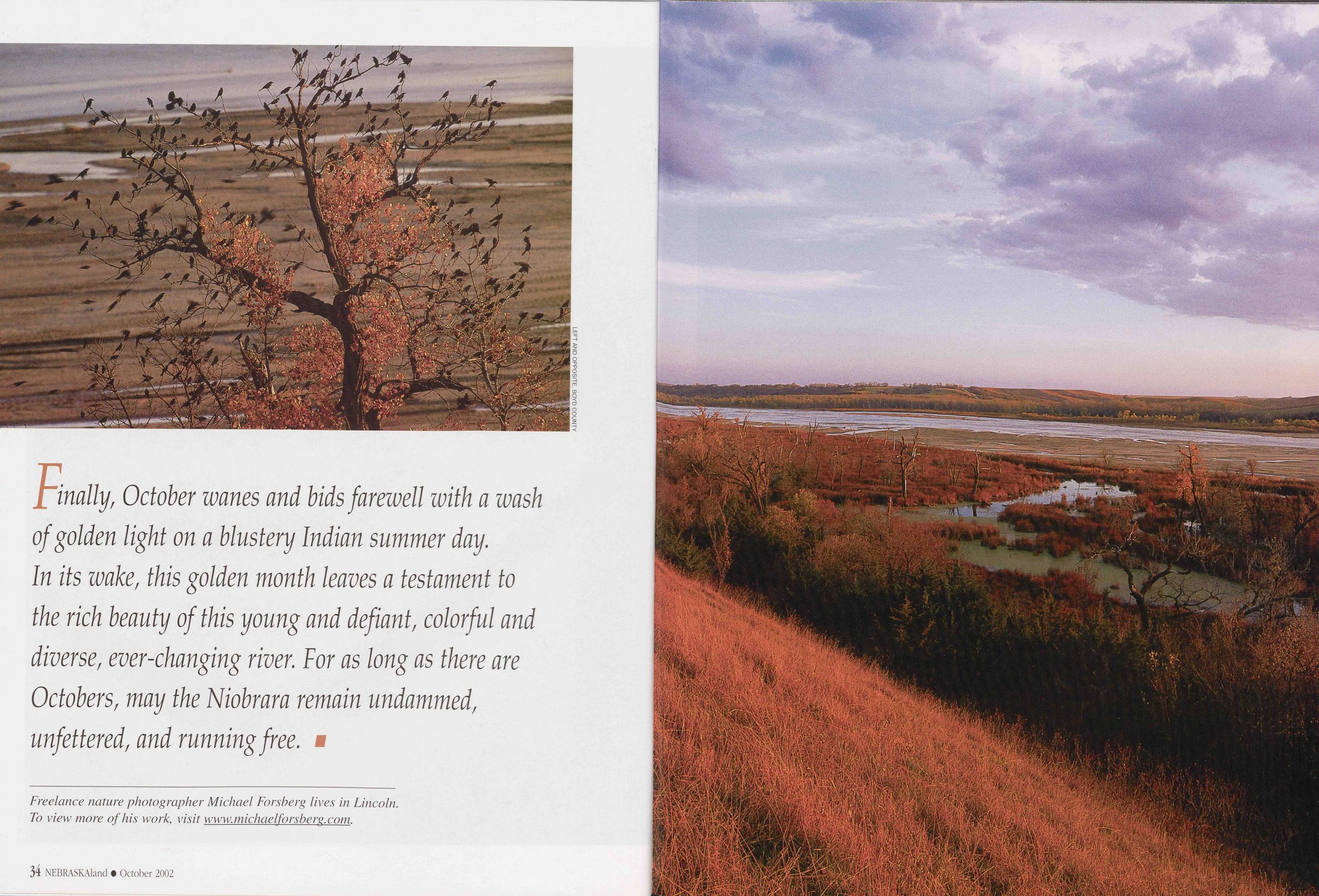 Finally, October wanes and bids farewell with a wash
of golden light on a blustery Indian summer day.
In its wake, this golden month leaves a testament to
the rich beauty of this young and defiant, colorful and
diverse, ever-changing river. For as long as there are
Octobers, may the Niobrara remain undammed,
unfettered, and running free. ■
Freelance nature photographer Michael Forsberg lives in Lincoln.
To view more of his work, visit www. michaelforsbers. com.
34 NEBRASKAland • October 2002
Finally, October wanes and bids farewell with a wash
of golden light on a blustery Indian summer day.
In its wake, this golden month leaves a testament to
the rich beauty of this young and defiant, colorful and
diverse, ever-changing river. For as long as there are
Octobers, may the Niobrara remain undammed,
unfettered, and running free. ■
Freelance nature photographer Michael Forsberg lives in Lincoln.
To view more of his work, visit www. michaelforsbers. com.
34 NEBRASKAland • October 2002
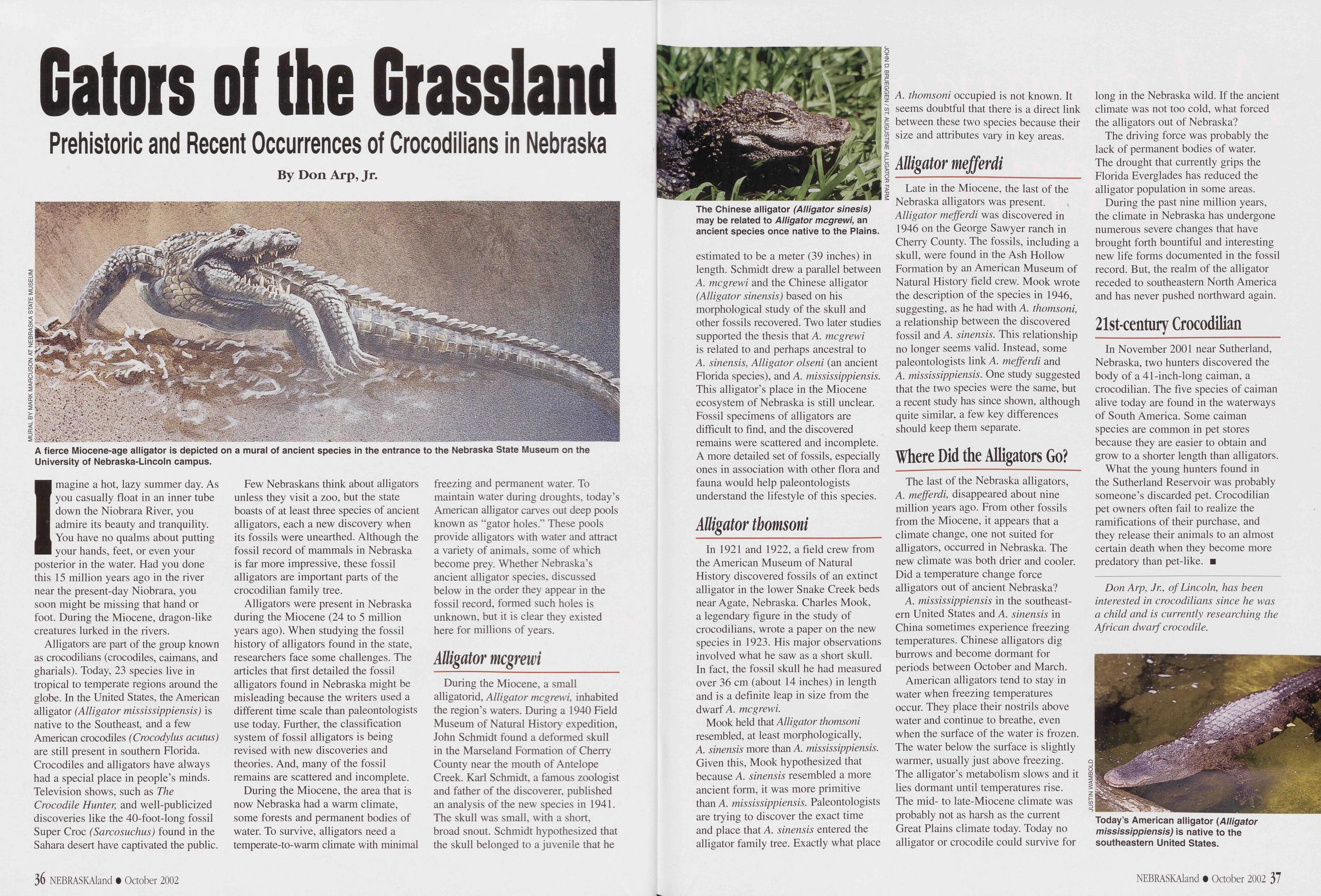
Imagine a hot, lazy summer day. As you casually float in an inner tube down the Niobrara River, you admire its beauty and tranquility. You have no qualms about putting your hands, feet, or even your posterior in the water. Had you done this 15 million years ago in the river near the present-day Niobrara, you soon might be missing that hand or foot. During the Miocene, dragon-like creatures lurked in the rivers.
Alligators are part of the group known as crocodilians (crocodiles, caimans, and gharials). Today, 23 species live in tropical to temperate regions around the globe. In the United States, the American alligator (Alligator mississippiensis) is native to the Southeast, and a few American crocodiles (Crocodylus acutus) are still present in southern Florida. Crocodiles and alligators have always had a special place in people’s minds. Television shows, such as The Crocodile Hunter, and well-publicized discoveries like the 40-foot-long fossil Super Croc (Sarcosuchus) found in the Sahara desert have captivated the public.
Few Nebraskans think about alligators unless they visit a zoo, but the state boasts of at least three species of ancient alligators, each a new discovery when its fossils were unearthed. Although the fossil record of mammals in Nebraska is far more impressive, these fossil alligators are important parts of the crocodilian family tree.
Alligators were present in Nebraska during the Miocene (24 to 5 million years ago). When studying the fossil history of alligators found in the state, researchers face some challenges. The articles that first detailed the fossil alligators found in Nebraska might be misleading because the writers used a different time scale than paleontologists use today. Further, the classification system of fossil alligators is being revised with new discoveries and theories. And, many of the fossil remains are scattered and incomplete.
During the Miocene, the area that is now Nebraska had a warm climate, some forests and permanent bodies of water. To survive, alligators need a temperate-to-warm climate with minimal freezing and permanent water. To maintain water during droughts, today’s American alligator carves out deep pools known as "gator holes.” These pools provide alligators with water and attract a variety of animals, some of which become prey. Whether Nebraska’s ancient alligator species, discussed below in the order they appear in the fossil record, formed such holes is unknown, but it is clear they existed here for millions of years.
Alligator mcgrewiDuring the Miocene, a small alligatorid, Alligator mcgrewi, inhabited the region’s waters. During a 1940 Field Museum of Natural History expedition, John Schmidt found a deformed skull in the Marseland Formation of Cherry County near the mouth of Antelope Creek. Karl Schmidt, a famous zoologist and father of the discoverer, published an analysis of the new species in 1941. The skull was small, with a short, broad snout. Schmidt hypothesized that the skull belonged to a juvenile that he 36 NEBRASKAland • October 2002 estimated to be a meter (39 inches) in length. Schmidt drew a parallel between A. mcgrewi and the Chinese alligator (Alligator sinensis) based on his morphological study of the skull and other fossils recovered. Two later studies supported the thesis that A. mcgrewi is related to and perhaps ancestral to A. sinensis, Alligator olseni (an ancient Florida species), and A. mississippiensis. This alligator’s place in the Miocene ecosystem of Nebraska is still unclear. Fossil specimens of alligators are difficult to find, and the discovered remains were scattered and incomplete. A more detailed set of fossils, especially ones in association with other flora and fauna would help paleontologists understand the lifestyle of this species.
In 1921 and 1922, a field crew from the American Museum of Natural History discovered fossils of an extinct alligator in the lower Snake Creek beds near Agate, Nebraska. Charles Mook, a legendary figure in the study of crocodilians, wrote a paper on the new species in 1923. His major observations involved what he saw as a short skull. In fact, the fossil skull he had measured over 36 cm (about 14 inches) in length and is a definite leap in size from the dwarf A. mcgrewi.
Mook held that Alligator thomsoni resembled, at least morphologically, A. sinensis more than A. mississippiensis. Given this, Mook hypothesized that because A. sinensis resembled a more ancient form, it was more primitive than A. mississippiensis. Paleontologists are trying to discover the exact time and place that A. sinensis entered the alligator family tree. Exactly what place A. thomsoni occupied is not known. It seems doubtful that there is a direct link between these two species because their size and attributes vary in key areas.
Alligator mefferdiLate in the Miocene, the last of the Nebraska alligators was present. Alligator mefferdi was discovered in 1946 on the George Sawyer ranch in Cherry County. The fossils, including a skull, were found in the Ash Hollow Formation by an American Museum of Natural History field crew. Mook wrote the description of the species in 1946, suggesting, as he had with A. thomsoni, a relationship between the discovered fossil and A. sinensis. This relationship no longer seems valid. Instead, some paleontologists link A. mefferdi and A. mississippiensis. One study suggested that the two species were the same, but a recent study has since shown, although quite similar, a few key differences should keep them separate.
Where Did the Alligators Go?The last of the Nebraska alligators, A. mefferdi, disappeared about nine million years ago. From other fossils from the Miocene, it appears that a climate change, one not suited for alligators, occurred in Nebraska. The new climate was both drier and cooler. Did a temperature change force alligators out of ancient Nebraska?
A. mississippiensis in the southeast- ern United States and A. sinensis in China sometimes experience freezing temperatures. Chinese alligators dig burrows and become dormant for periods between October and March.
American alligators tend to stay in water when freezing temperatures occur. They place their nostrils above water and continue to breathe, even when the surface of the water is frozen. The water below the surface is slightly warmer, usually just above freezing. The alligator’s metabolism slows and it lies dormant until temperatures rise. The mid- to late-Miocene climate was probably not as harsh as the current Great Plains climate today. Today no alligator or crocodile could survive for long in the Nebraska wild. If the ancient climate was not too cold, what forced the alligators out of Nebraska?
The driving force was probably the lack of permanent bodies of water. The drought that currently grips the Florida Everglades has reduced the alligator population in some areas.
During the past nine million years, the climate in Nebraska has undergone numerous severe changes that have brought forth bountiful and interesting new life forms documented in the fossil record. But, the realm of the alligator receded to southeastern North America and has never pushed northward again.
21st-century CrocodilianIn November 2001 near Sutherland, Nebraska, two hunters discovered the body of a 41-inch-long caiman, a crocodilian. The five species of caiman alive today are found in the waterways of South America. Some caiman species are common in pet stores because they are easier to obtain and grow to a shorter length than alligators.
What the young hunters found in the Sutherland Reservoir was probably someone’s discarded pet. Crocodilian pet owners often fail to realize the ramifications of their purchase, and they release their animals to an almost certain death when they become more predatory than pet-like. ■
Don Arp, Jr., of Lincoln, has been interested in crocodilians since he was a child and is currently researching the African dwarf crocodile.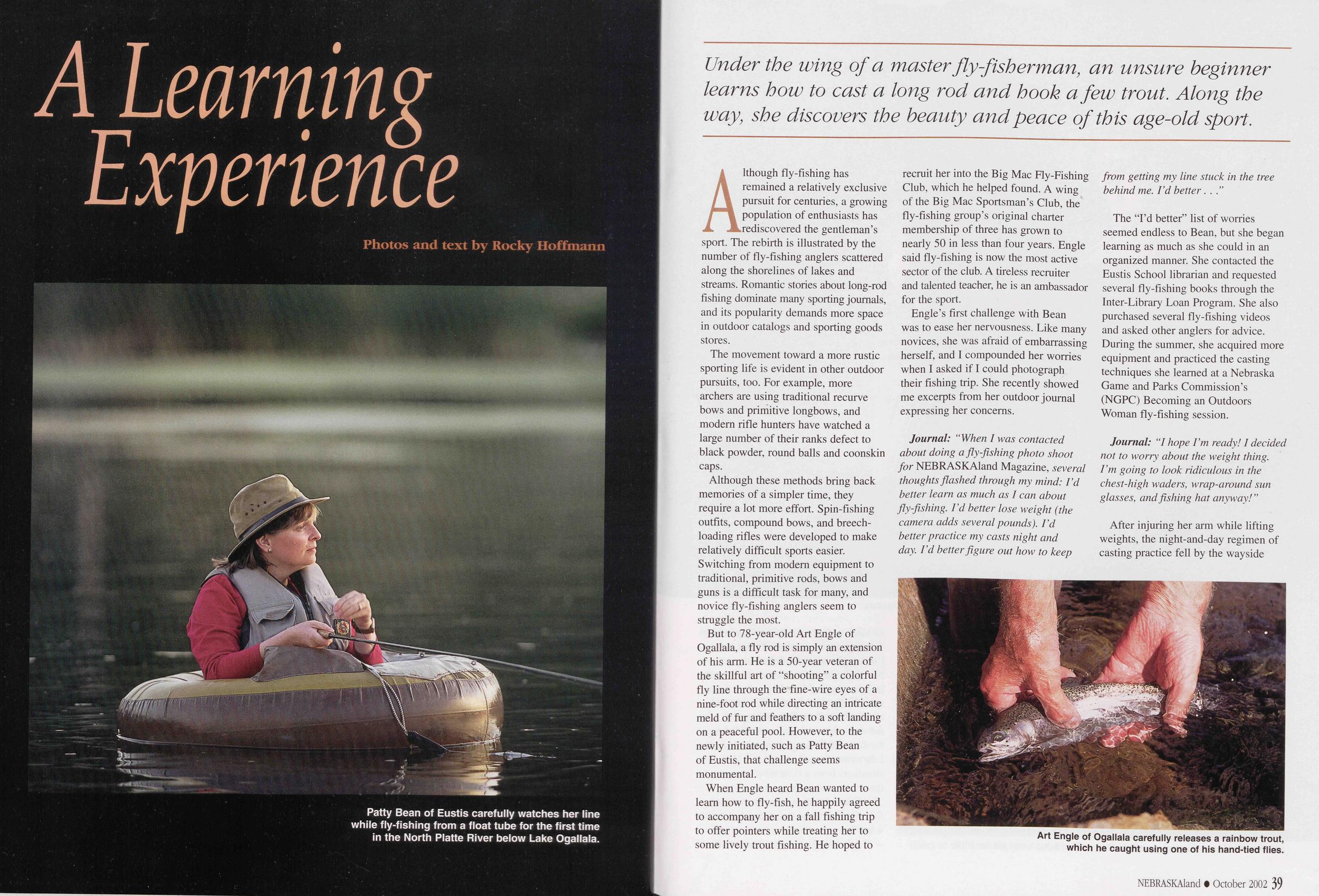
A Learning Experience
Although fly-fishing has remained a relatively exclusive pursuit for centuries, a growing population of enthusiasts has rediscovered the gentleman’s sport. The rebirth is illustrated by the number of fly-fishing anglers scattered along the shorelines of lakes and streams. Romantic stories about long-rod fishing dominate many sporting journals, and its popularity demands more space in outdoor catalogs and sporting goods stores.
The movement toward a more rustic sporting life is evident in other outdoor pursuits, too. For example, more archers are using traditional recurve bows and primitive longbows, and modern rifle hunters have watched a large number of their ranks defect to black powder, round balls and coonskin caps.
Although these methods bring back memories of a simpler time, they require a lot more effort. Spin-fishing outfits, compound bows, and breech- loading rifles were developed to make relatively difficult sports easier. Switching from modem equipment to traditional, primitive rods, bows and guns is a difficult task for many, and novice fly-fishing anglers seem to struggle the most.
But to 78-year-old Art Engle of Ogallala, a fly rod is simply an extension of his arm. He is a 50-year veteran of the skillful art of “shooting” a colorful fly line through the fine-wire eyes of a nine-foot rod while directing an intricate meld of fur and feathers to a soft landing on a peaceful pool. However, to the newly initiated, such as Patty Bean of Eustis, that challenge seems monumental.
When Engle heard Bean wanted to learn how to fly-fish, he happily agreed to accompany her on a fall fishing trip to offer pointers while treating her to some lively trout fishing. He hoped to recruit her into the Big Mac Fly-Fishing Club, which he helped found. A wing of the Big Mac Sportsman’s Club, the fly-fishing group’s original charter membership of three has grown to nearly 50 in less than four years. Engle said fly-fishing is now the most active sector of the club. A tireless recruiter and talented teacher, he is an ambassador for the sport.
Engle’s first challenge with Bean was to ease her nervousness. Like many novices, she was afraid of embarrassing herself, and I compounded her worries when I asked if I could photograph their fishing trip. She recently showed me excerpts from her outdoor journal expressing her concerns.
Journal: “ When I was contacted about doing a fly-fishing photo shoot for NEBRASKAland Magazine, several thoughts flashed through my mind: I’d better learn as much as I can about fly-fishing, rd better lose weight (the camera adds several pounds). I’d better practice my casts night and day. rd better figure out how to keep from getting my line stuck in the tree behind me. I'd better...The “I’d better” list of worries seemed endless to Bean, but she began learning as much as she could in an organized manner. She contacted the Eustis School librarian and requested several fly-fishing books through the Inter-Library Loan Program. She also purchased several fly-fishing videos and asked other anglers for advice. During the summer, she acquired more equipment and practiced the casting techniques she learned at a Nebraska Game and Parks Commission’s (NGPC) Becoming an Outdoors Woman fly-fishing session.
Journal: “I hope I’m ready! I decided not to worry about the weight thing. I’m going to look ridiculous in the chest-high waders, wrap-around sun glasses, and fishing hat anyway!”After injuring her arm while lifting
weights, the night-and-day regimen of
casting practice fell by the wayside
NEBRASKAland • October 2002 39
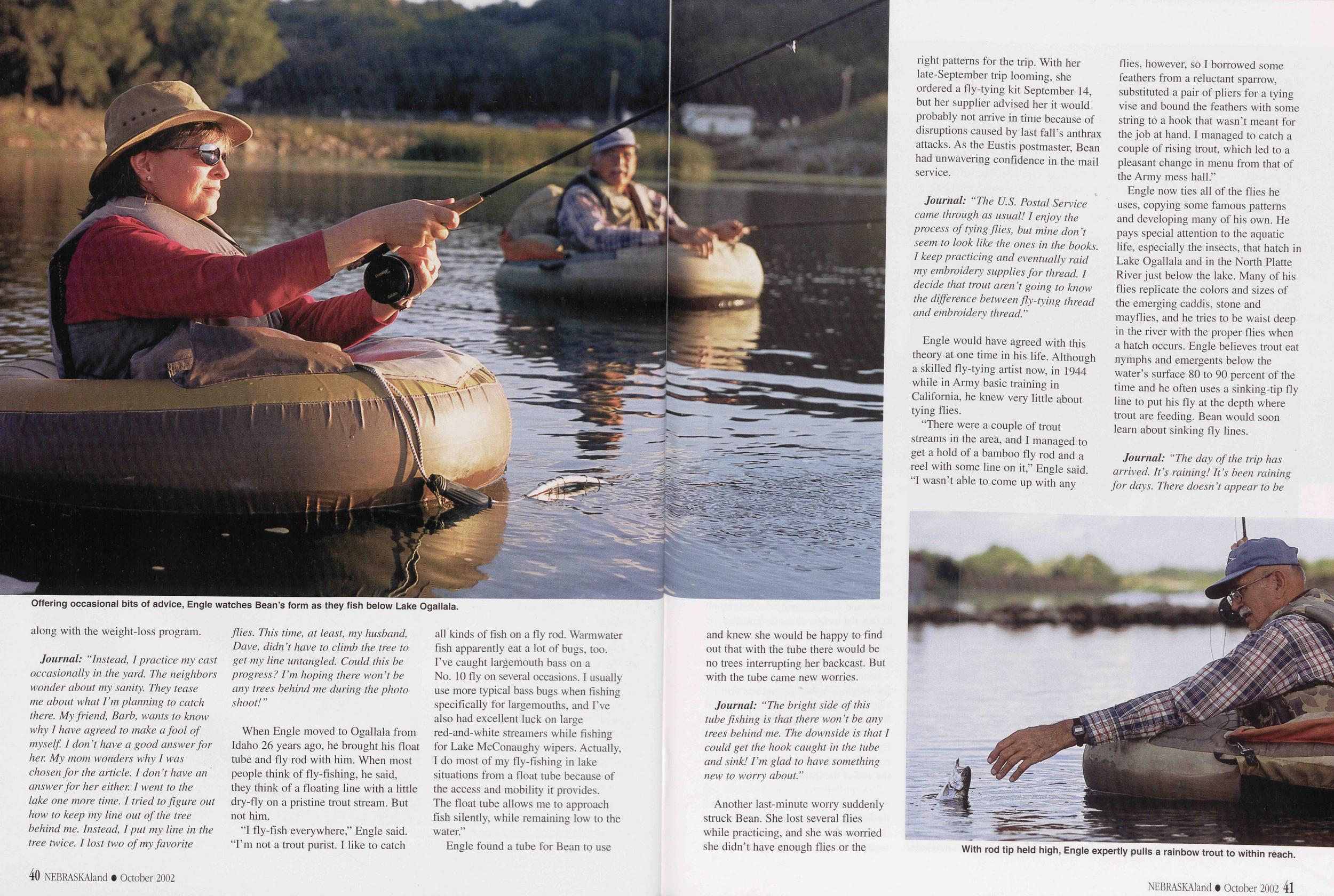 along with the weight-loss program.
When Engle moved to Ogallala from Idaho 26 years ago, he brought his float tube and fly rod with him. When most people think of fly-fishing, he said, they think of a floating line with a little dry-fly on a pristine trout stream. But not him.
"I fly-fish everywhere,” Engle said. “I’m not a trout purist. I like to catch all kinds of fish on a fly rod. Warm water fish apparently eat a lot of bugs, too. I’ve caught largemouth bass on a No. 10 fly on several occasions. I usually use more typical bass bugs when fishing specifically for largemouths, and I’ve also had excellent luck on large red-and-white streamers while fishing for Lake McConaughy wipers. Actually, I do most of my fly-fishing in lake situations from a float tube because of the access and mobility it provides. The float tube allows me to approach fish silently, while remaining low to the water.”
Engle found a tube for Bean to use 40 NEBRASKAland • October 2002 and knew she would be happy to find out that with the tube there would be no trees interrupting her backcast. But with the tube came new worries.
Journal: “The bright side of this tube fishing is that there won’t be any trees behind me. The downside is that I could get the hook caught in the tube and sink! I’m glad to have something new to worry about.”Another last-minute worry suddenly struck Bean. She lost several flies while practicing, and she was worried she didn’t have enough flies or the right patterns for the trip. With her late-September trip looming, she ordered a fly-tying kit September 14, but her supplier advised her it would probably not arrive in time because of disruptions caused by last fall’s anthrax attacks. As the Eustis postmaster, Bean had unwavering confidence in the mail service.
Journal: “The U.S. Postal Service came through as usual! I enjoy the process of tying flies, but mine don’t seem to look like the ones in the books. I keep practicing and eventually raid my embroidery supplies for thread. I decide that trout aren 7 going to know the difference between fly-tying thread and embroidery thread.”Engle would have agreed with this theory at one time in his life. Although a skilled fly-tying artist now, in 1944 while in Army basic training in California, he knew very little about tying flies.
“There were a couple of trout streams in the area, and I managed to get a hold of a bamboo fly rod and a reel with some line on it,” Engle said. “I wasn’t able to come up with any flies, however, so I borrowed some feathers from a reluctant sparrow, substituted a pair of pliers for a tying vise and bound the feathers with some string to a hook that wasn’t meant for the job at hand. I managed to catch a couple of rising trout, which led to a pleasant change in menu from that of the Army mess hall.”
Engle now ties all of the flies he uses, copying some famous patterns and developing many of his own. He pays special attention to the aquatic life, especially the insects, that hatch in Lake Ogallala and in the North Platte River just below the lake. Many of his flies replicate the colors and sizes of the emerging caddis, stone and mayflies, and he tries to be waist deep in the river with the proper flies when a hatch occurs. Engle believes trout eat nymphs and emergents below the water’s surface 80 to 90 percent of the time and he often uses a sinking-tip fly line to put his fly at the depth where trout are feeding. Bean would soon learn about sinking fly lines.
Journal: “The day of the trip has arrived. It’s raining! It’s been raining for days. There doesn 7 appear to be NEBRASKAland • October 2002 41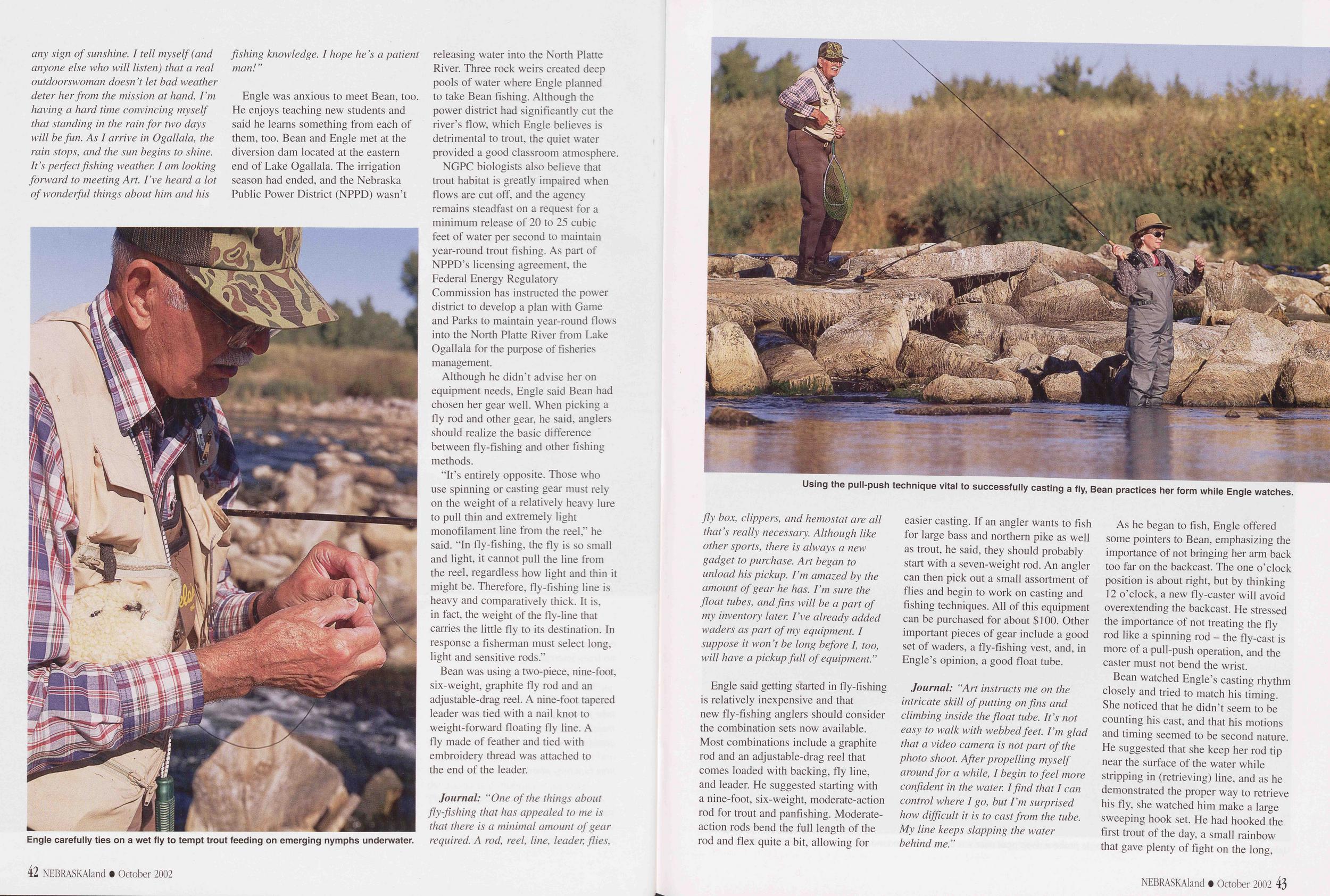 any sign of sunshine. I tell myself (and
anyone else who will listen) that a real
outdoorswoman doesn ’t let bad weather
deter her from the mission at hand. I’m
having a hard time convincing myself
that standing in the rain for two days
will be fun. As I arrive in Ogallala, the
rain stops, and the sun begins to shine.
It’s perfect fishing weather. lam looking
forward to meeting Art. I’ve heard a lot
of wonderful things about him and his
fishing knowledge. I hope he’s a patient
man! ”
any sign of sunshine. I tell myself (and
anyone else who will listen) that a real
outdoorswoman doesn ’t let bad weather
deter her from the mission at hand. I’m
having a hard time convincing myself
that standing in the rain for two days
will be fun. As I arrive in Ogallala, the
rain stops, and the sun begins to shine.
It’s perfect fishing weather. lam looking
forward to meeting Art. I’ve heard a lot
of wonderful things about him and his
fishing knowledge. I hope he’s a patient
man! ”
Engle was anxious to meet Bean, too. He enjoys teaching new students and said he learns something from each of them, too. Bean and Engle met at the diversion dam located at the eastern end of Lake Ogallala. The irrigation season had ended, and the Nebraska Public Power District (NPPD) wasn’t releasing water into the North Platte River. Three rock weirs created deep pools of water where Engle planned to take Bean fishing. Although the power district had significantly cut the river’s flow, which Engle believes is detrimental to trout, the quiet water provided a good classroom atmosphere.
NGPC biologists also believe that trout habitat is greatly impaired when flows are cut off, and the agency remains steadfast on a request for a minimum release of 20 to 25 cubic feet of water per second to maintain year-round trout fishing. As part of NPPD’s licensing agreement, the Federal Energy Regulatory Commission has instructed the power district to develop a plan with Game and Parks to maintain year-round flows into the North Platte River from Lake Ogallala for the purpose of fisheries management.
Although he didn’t advise her on equipment needs, Engle said Bean had chosen her gear well. When picking a fly rod and other gear, he said, anglers should realize the basic difference between fly-fishing and other fishing methods.
"It’s entirely opposite. Those who use spinning or casting gear must rely on the weight of a relatively heavy lure to pull thin and extremely light monofilament line from the reel,” he said. "In fly-fishing, the fly is so small and light, it cannot pull the line from the reel, regardless how light and thin it might be. Therefore, fly-fishing line is heavy and comparatively thick. It is, in fact, the weight of the fly-line that carries the little fly to its destination. In response a fisherman must select long, light and sensitive rods.”
Bean was using a two-piece, nine-foot, six-weight, graphite fly rod and an adjustable-drag reel. A nine-foot tapered leader was tied with a nail knot to weight-forward floating fly line. A fly made of feather and tied with embroidery thread was attached to the end of the leader.
Journal: “One of the things about fly-fishing that has appealed to me is that there is a minimal amount of gear required. A rod, reel, line, leader, flies, 42 NEBRASKAland • October 2002 fly box, clippers, and hemostat are all that’s really necessary. Although like other sports, there is always a new gadget to purchase. Art began to unload his pickup. I’m amazed by the amount of gear he has. I’m sure the float tubes, and fins will be a part of my inventory later. I’ve already added waders as part of my equipment. I suppose it won’t be long before I, too, will have a pickup full of equipment.”Engle said getting started in fly-fishing is relatively inexpensive and that new fly-fishing anglers should consider the combination sets now available. Most combinations include a graphite rod and an adjustable-drag reel that comes loaded with backing, fly line, and leader. He suggested starting with a nine-foot, six-weight, moderate-action rod for trout and panfishing. Moderate- action rods bend the full length of the rod and flex quite a bit, allowing for easier casting. If an angler wants to fish for large bass and northern pike as well as trout, he said, they should probably start with a seven-weight rod. An angler can then pick out a small assortment of flies and begin to work on casting and fishing techniques. All of this equipment can be purchased for about $100. Other important pieces of gear include a good set of waders, a fly-fishing vest, and, in Engle’s opinion, a good float tube.
Journal: i(Art instructs me on the intricate skill of putting on fins and climbing inside the float tube. It’s not easy to walk with webbed feet. I’m glad that a video camera is not part of the photo shoot. After propelling myself around for a while, I begin to feel more confident in the water. I find that I can control where I go, but I’m surprised how difficult it is to cast from the tube. My line keeps slapping the water behind me.”As he began to fish, Engle offered some pointers to Bean, emphasizing the importance of not bringing her arm back too far on the backcast. The one o’clock position is about right, but by thinking 12 o’clock, a new fly-caster will avoid overextending the backcast. He stressed the importance of not treating the fly rod like a spinning rod - the fly-cast is more of a pull-push operation, and the caster must not bend the wrist.
Bean watched Engle’s casting rhythm
closely and tried to match his timing.
She noticed that he didn’t seem to be
counting his cast, and that his motions
and timing seemed to be second nature.
He suggested that she keep her rod tip
near the surface of the water while
stripping in (retrieving) line, and as he
demonstrated the proper way to retrieve
his fly, she watched him make a large
sweeping hook set. He had hooked the
first trout of the day, a small rainbow
that gave plenty of fight on the long,
NEBRASKAland • October 2002 43
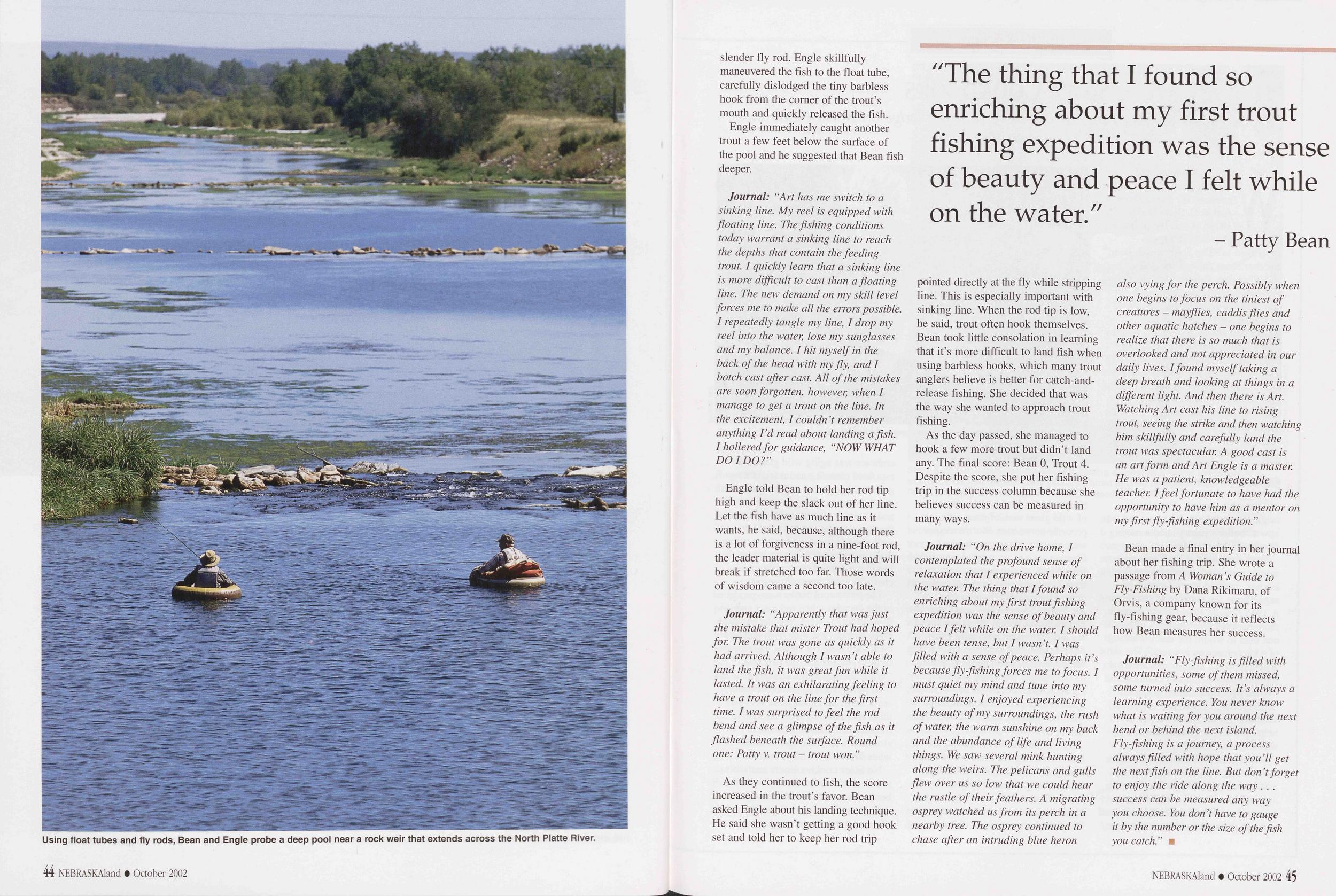 slender fly rod. Engle skillfully
maneuvered the fish to the float tube,
carefully dislodged the tiny barbless
hook from the corner of the trout’s
mouth and quickly released the fish.
slender fly rod. Engle skillfully
maneuvered the fish to the float tube,
carefully dislodged the tiny barbless
hook from the corner of the trout’s
mouth and quickly released the fish.
Engle immediately caught another trout a few feet below the surface of the pool and he suggested that Bean fish deeper.
Journal: “Art has me switch to a sinking line. My reel is equipped with floating line. The fishing conditions today warrant a sinking line to reach the depths that contain the feeding trout. I quickly learn that a sinking line is more difficult to cast than a floating line. The new demand on my skill level forces me to make all the errors possible. I repeatedly tangle my line, I drop my reel into the water, lose my sunglasses and my balance. I hit myself in the back of the head with my fly, and I botch cast after cast. All of the mistakes are soon forgotten, however, when I manage to get a trout on the line. In the excitement, I couldn’t remember anything Td read about landing a fish. I hollered for guidance, “NOW WHAT DO I DO?"Engle told Bean to hold her rod tip high and keep the slack out of her line. Let the fish have as much line as it wants, he said, because, although there is a lot of forgiveness in a nine-foot rod, the leader material is quite light and will break if stretched too far. Those words of wisdom came a second too late.
Journal: “Apparently that was just the mistake that mister Trout had hoped for. The trout was gone as quickly as it had arrived. Although I wasn ’t able to land the fish, it was great fun while it lasted. It was an exhilarating feeling to have a trout on the line for the first time. I was surprised to feel the rod bend and see a glimpse of the fish as it flashed beneath the surface. Round one: Patty v. trout - trout won.”As they continued to fish, the score increased in the trout’s favor. Bean asked Engle about his landing technique. He said she wasn’t getting a good hook set and told her to keep her rod trip pointed directly at the fly while stripping line. This is especially important with sinking line. When the rod tip is low, he said, trout often hook themselves. Bean took little consolation in learning that it’s more difficult to land fish when using barbless hooks, which many trout anglers believe is better for catch-and- release fishing. She decided that was the way she wanted to approach trout fishing.
As the day passed, she managed to hook a few more trout but didn’t land any. The final score: Bean 0, Trout 4. Despite the score, she put her fishing trip in the success column because she believes success can be measured in many ways.
Journal: “On the drive home, I contemplated the profound sense of relaxation that I experienced while on the water. The thing that I found so enriching about my first trout fishing expedition was the sense of beauty and peace I felt while on the water. I should have been tense, but I wasn’t. I was filled with a sense of peace. Perhaps it’s because fly-fishing forces me to focus. I must quiet my mind and tune into my surroundings. I enjoyed experiencing the beauty of my surroundings, the rush of water, the warm sunshine on my back and the abundance of life and living things. We saw several mink hunting along the weirs. The pelicans and gulls flew over us so low that we could hear the rustle of their feathers. A migrating osprey watched us from its perch in a nearby tree. The osprey continued to chase after an intruding blue heron also vying for the perch. Possibly when one begins to focus on the tiniest of creatures - mayflies, caddis flies and other aquatic hatches - one begins to realize that there is so much that is overlooked and not appreciated in our daily lives. I found myself taking a deep breath and looking at things in a different light. And then there is Art. Watching Art cast his line to rising trout, seeing the strike and then watching him skillfully and carefully land the trout was spectacular. A good cast is an art form and Art Engle is a master. He was a patient, knowledgeable teacher. I feel fortunate to have had the opportunity to have him as a mentor on my first fly-fishing expedition.” "The thing that I found so enriching about my first trout fishing expedition was the sense of beauty and peace I felt while on the water." - Patty BeanBean made a final entry in her journal about her fishing trip. She wrote a passage from A Woman’s Guide to Fly-Fishing by Dana Rikimaru, of Orvis, a company known for its fly-fishing gear, because it reflects how Bean measures her success.
Journal: “Fly-fishing is filled with opportunities, some of them missed, some turned into success. It’s always a learning experience. You never know what is waiting for you around the next bend or behind the next island. Fly-fishing is a journey, a process always filled with hope that you ’ll get the next fish on the line. But don’t forget to enjoy the ride along the way . . . success can be measured any way you choose. You don’t have to gauge it by the number or the size of the fish you catch.” NEBRASKAland O October 2002 45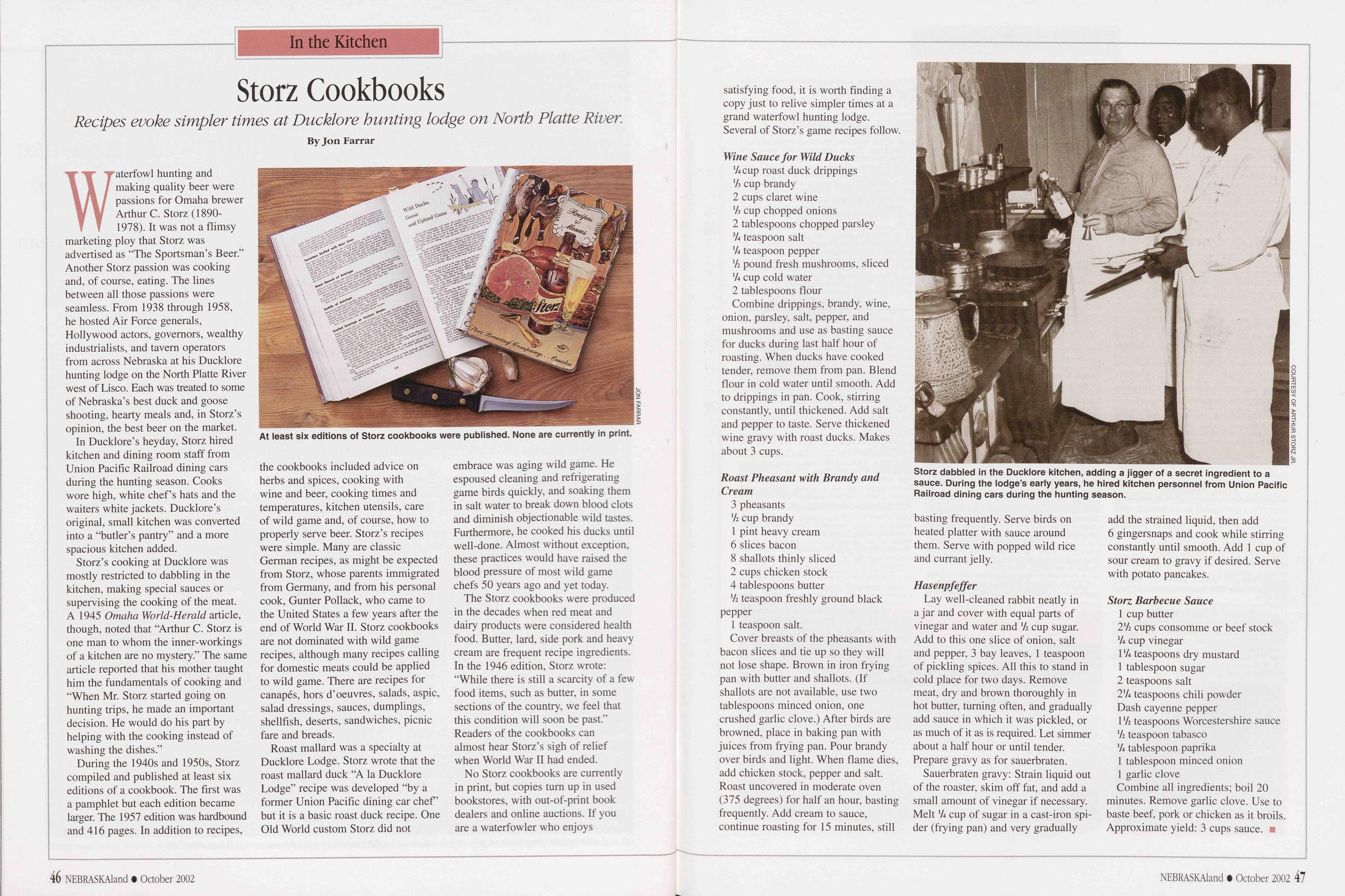
Waterfowl hunting and making quality beer were passions for Omaha brewer Arthur C. Storz (1890- 1978). It was not a flimsy marketing ploy that Storz was advertised as “The Sportsman’s Beer.” Another Storz passion was cooking and, of course, eating. The lines between all those passions were seamless. From 1938 through 1958, he hosted Air Force generals, Hollywood actors, governors, wealthy industrialists, and tavern operators from across Nebraska at his Ducklore hunting lodge on the North Platte River west of Lisco. Each was treated to some of Nebraska’s best duck and goose shooting, hearty meals and, in Storz’s opinion, the best beer on the market.
In Ducklore’s heyday, Storz hired kitchen and dining room staff from Union Pacific Railroad dining cars during the hunting season. Cooks wore high, white chef’s hats and the waiters white jackets. Ducklore’s original, small kitchen was converted into a “butler’s pantry” and a more spacious kitchen added.
Storz’s cooking at Ducklore was mostly restricted to dabbling in the kitchen, making special sauces or supervising the cooking of the meat. A 1945 Omaha World-Herald article, though, noted that “Arthur C. Storz is one man to whom the inner-workings of a kitchen are no mystery.” The same article reported that his mother taught him the fundamentals of cooking and “When Mr. Storz started going on hunting trips, he made an important decision. He would do his part by helping with the cooking instead of washing the dishes.”
During the 1940s and 1950s, Storz compiled and published at least six editions of a cookbook. The first was a pamphlet but each edition became larger. The 1957 edition was hardbound and 416 pages. In addition to recipes, the cookbooks included advice on herbs and spices, cooking with wine and beer, cooking times and temperatures, kitchen utensils, care of wild game and, of course, how to properly serve beer. Storz’s recipes were simple. Many are classic German recipes, as might be expected from Storz, whose parents immigrated from Germany, and from his personal cook, Gunter Pollack, who came to the United States a few years after the end of World War II. Storz cookbooks are not dominated with wild game recipes, although many recipes calling for domestic meats could be applied to wild game. There are recipes for canapes, hors d’oeuvres, salads, aspic, salad dressings, sauces, dumplings, shellfish, deserts, sandwiches, picnic fare and breads.
Roast mallard was a specialty at Ducklore Lodge. Storz wrote that the roast mallard duck “A la Ducklore Lodge” recipe was developed “by a former Union Pacific dining car chef’ but it is a basic roast duck recipe. One Old World custom Storz did not embrace was aging wild game. He espoused cleaning and refrigerating game birds quickly, and soaking them in salt water to break down blood clots and diminish objectionable wild tastes. Furthermore, he cooked his ducks until well-done. Almost without exception, these practices would have raised the blood pressure of most wild game chefs 50 years ago and yet today.
The Storz cookbooks were produced in the decades when red meat and dairy products were considered health food. Butter, lard, side pork and heavy cream are frequent recipe ingredients. In the 1946 edition, Storz wrote: “While there is still a scarcity of a few food items, such as butter, in some sections of the country, we feel that this condition will soon be past.” Readers of the cookbooks can almost hear Storz’s sigh of relief when World War II had ended.
No Storz cookbooks are currently in print, but copies turn up in used bookstores, with out-of-print book dealers and online auctions. If you are a waterfowler who enjoys 46 NEBRASKAland • October 2002 satisfying food, it is worth finding a copy just to relive simpler times at a grand waterfowl hunting lodge. Several of Storz’s game recipes follow.
Wine Sauce for Wild Ducks1/4 cup roast duck drippings 1/2 cup brandy 2 cups claret wine 1/3 cup chopped onions 2 tablespoons chopped parsley 3/4 teaspoon salt 3/4 teaspoon pepper 1/2 pound fresh mushrooms, sliced 1/2 cup cold water 2 tablespoons flour
Combine drippings, brandy, wine, onion, parsley, salt, pepper, and mushrooms and use as basting sauce for ducks during last half hour of roasting. When ducks have cooked tender, remove them from pan. Blend flour in cold water until smooth. Add to drippings in pan. Cook, stirring constantly, until thickened. Add salt and pepper to taste. Serve thickened wine gravy with roast ducks. Makes about 3 cups.
Roast Pheasant with Brandy and Cream3 pheasants 1/2 cup brandy 1 pint heavy cream 6 slices bacon 8 shallots thinly sliced 2 cups chicken stock 4 tablespoons butter 1/4 teaspoon freshly ground black pepper 1 teaspoon salt.
Cover breasts of the pheasants with bacon slices and tie up so they will not lose shape. Brown in iron frying pan with butter and shallots. (If shallots are not available, use two tablespoons minced onion, one crushed garlic clove.) After birds are browned, place in baking pan with juices from frying pan. Pour brandy over birds and light. When flame dies, add chicken stock, pepper and salt. Roast uncovered in moderate oven (375 degrees) for half an hour, basting frequently. Add cream to sauce, continue roasting for 15 minutes, still basting frequently. Serve birds on heated platter with sauce around them. Serve with popped wild rice and currant jelly.
Lay well-cleaned rabbit neatly in ajar and cover with equal parts of vinegar and water and 7> cup sugar. Add to this one slice of onion, salt and pepper, 3 bay leaves, 1 teaspoon of pickling spices. All this to stand in cold place for two days. Remove meat, dry and brown thoroughly in hot butter, turning often, and gradually add sauce in which it was pickled, or as much of it as is required. Let simmer about a half hour or until tender. Prepare gravy as for sauerbraten.
Sauerbraten gravy: Strain liquid out of the roaster, skim off fat, and add a small amount of vinegar if necessary. Melt 74 cup of sugar in a cast-iron spi- der (frying pan) and very gradually add the strained liquid, then add 6 gingersnaps and cook while stirring constantly until smooth. Add 1 cup of sour cream to gravy if desired. Serve with potato pancakes.
Storz, Barbecue Sauce1 cup butter 2 1/2 cups consomme or beef stock 1/4 cup vinegar 174 teaspoons dry mustard 1 tablespoon sugar 2 teaspoons salt 2 1/4 teaspoons chili powder Dash cayenne pepper 1 1/2teaspoons Worcestershire sauce 1/2 teaspoon tabasco 1/4 tablespoon paprika 1 tablespoon minced onion 1 garlic clove
Combine all ingredients; boil 20 minutes. Remove garlic clove. Use to baste beef, pork or chicken as it broils. Approximate yield: 3 cups sauce. ■
NEBRASKAland • October 2002 47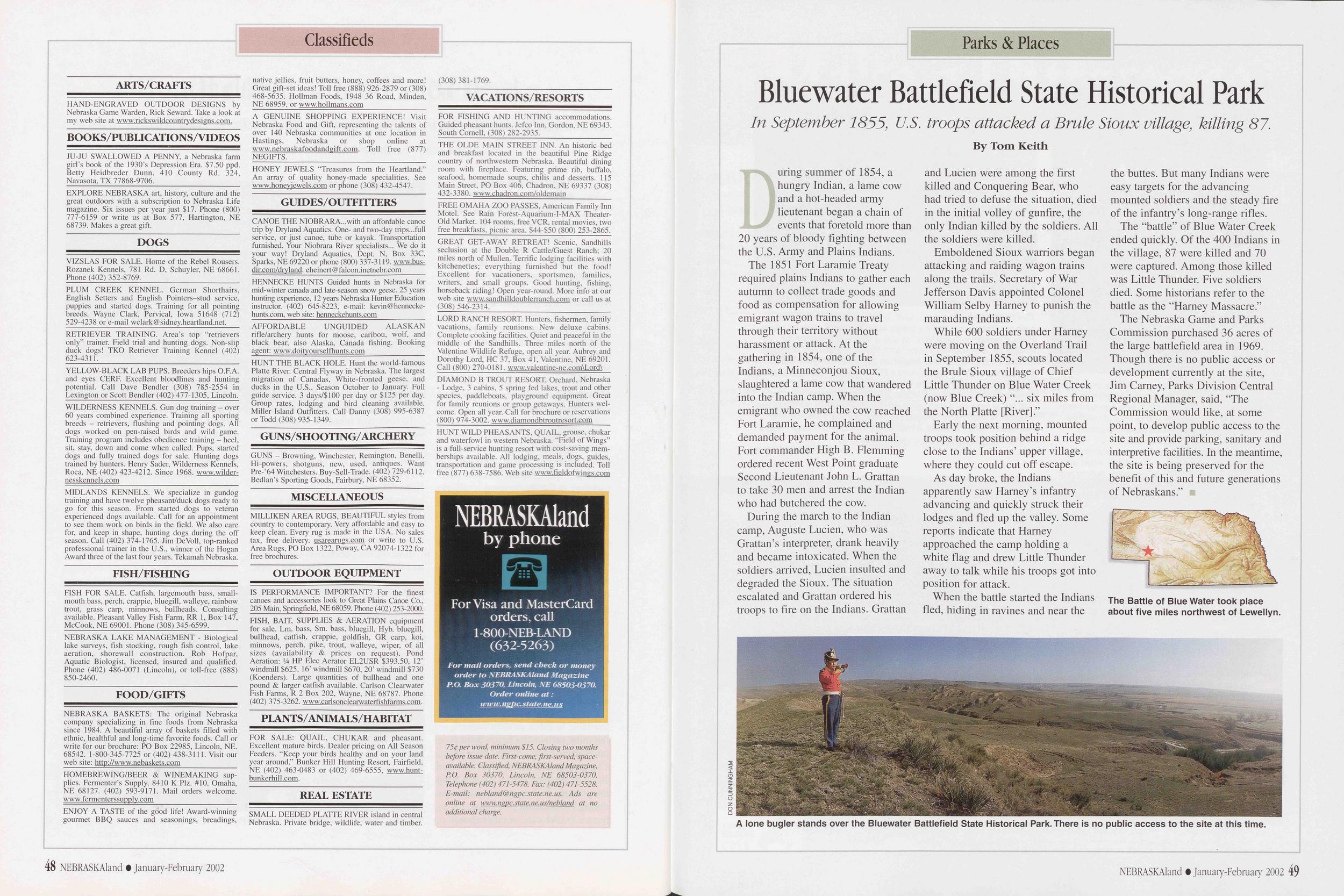
Classifieds
ARTS/CRAFTS“NEBRASKA CRAFTSMEN” Wisner’s Sporting Supply, Fremont, NE is looking to promote our local craftsmen in our retail store. Game calls, decoys, fish- ing lures, crafts, etc. Call Scott or Jack Foral (402) 721-8864.
BOOKS/PUBLICATIONS/VIDEOSJU-JU SWALLOWED A PENNY, a Nebraska farm girl’s book of the 1930’s Depression Era. $7.50 ppd. Betty Heidbreder Dunn, 410 County Rd. 324, Navasota, TX 77868-9706.
EXPLORE NEBRASKA art, history, culture and the great outdoors with a subscription to Nebraska Life magazine. Six issues per year just $17. Phone (800) 777-6159 or write us at Box 577, Hartington, NE 68739. Makes a great gift.
DOGSVIZSLAS FOR SALE. Home of the Rebel Rousers. Rozanek Kennels, 781 Rd. D, Schuyler, NE 68661. Phone (402) 352-8769.
PLUM CREEK KENNEL. German Shorthairs, stud service, puppies and started dogs. Training for all pointing breeds. Specialize in training the handler as well as the dog. Wayne Clark, Percival, Iowa 51648 (close to Omaha) (712) 529-4238, email wclark@sid- ney.heartland.net.
YELLOW-BLACK LAB PUPS. Breeders hips O.F.A. and eyes CERF. Excellent bloodlines and hunting potential. Call Dave Bendler (308) 785-2554 in Lexington or Scott Bendler (402) 477-1305, Lincoln.
WILDERNESS KENNELS. Gun dog training - over 60 years combined experience. Training all sporting breeds - retrievers, flushing and pointing dogs. All dogs worked on pen-raised birds and wild game. Training program includes obedience training - heel, sit, stay, down and come when called. Pups, started dogs and fully trained dogs for sale. Hunting dogs trained by hunters. Henry Sader, Wilderness Kennels, Roca, NE (402) 423-4212. Since 1968. www.wilder- nesskennels.com
FISH/FISHINGFISH FOR SALE. Catfish, largemouth bass, small- mouth bass, perch, crappie, bluegill, walleye, rainbow trout, grass carp, minnows, bullheads. Consulting available. Pleasant Valley Fish Farm, RR 1, Box 147, McCook, NE 69001. Phone (308) 345-6599.
NEBRASKA LAKE MANAGEMENT - Biological lake surveys, fish stocking, rough fish control, lake aeration, shorewall construction. Rob Hofpar, Aquatic Biologist, licensed, insured and qualified. Phone (402) 486-0071 (Lincoln), or toll-free (888) 850-2460.
FOOD/GIFTS/HOMEENJOY A TASTE of the good life! Award-winning gourmet BBQ sauces and seasonings, breadings, native jellies, fruit butters, honey, coffees and more! Great gift-set ideas! Toll free (888) 926-2879 or (308) 468-5635. Hollman Foods, 1948 36 Road, Minden, NE 68959, or www.hollmans.com
NEBRASKA BASKETS - The original Nebraska company specializing in fine foods from Nebraska since 1984. A beautiful array of baskets filled with ethnic, healthful and long-time favorite foods. Call or write for our brochure: PO Box 22985, Lincoln, NE. 68542. 1-800-345-7725 or (402) 438-3111. Visit our web site: http://www.nebaskets.com
HOMEBREWING/BEER & WINEMAKING sup- plies. Fermenter’s Supply, 8410 K Plz. #10, Omaha, NE 68127. (402) 593-9171. Mail orders welcome. www.fermenterssupplv.com
A GENUINE SHOPPING EXPERIENCE! Visit Nebraska Food and Gift, representing the talents of over 140 Nebraska communities at one location in Hastings, Nebraska or shop online at www.nebraskafoodandgift.com. Toll free (877) NEGIFTS.
“RECIPES MADE WITH LOVE” - 800 family recipes. Proceeds to Nebraska Children’s Home Society. Mail $12 to NCHS, 4700 Valley Road, Lincoln, NE 68510
MOUNTAIN HOME LOG FURNITURE located in downtown Waterloo, NE selling lodgepole pine furni- ture, Aspen Art rocker-gliders, antler chairs, antler chandeliers, dinnerware, and various decorative items to compliment the Lodge-look and Western style decor. Hours: Monday-Saturday 10 a.m. to 5 p.m., Sundays by appointment (402) 779-0166.
GUIDES/OUTFITTERSCANOE THE NIOBRARA...with an affordable canoe trip by Dryland Aquatics. One- and two-day trips...full service, or just canoe, tube or kayak. Transportation furnished. Your Niobrara River specialists... We do it your way! Dryland Aquatics, Dept. N, Box 33C, Sparks, NE 69220 or phone (800) 337-3119. www.bus- dir.com/drvland. eheinert@falcon.inetnebr.com
HENNECKE HUNTS Guided hunts in Nebraska for mid-winter Canada and late-season snow geese. 26 years hunting experience, 13 years Nebraska Hunter Education instructor. (402) 645-8223, e-mail: kevin@hennecke- hunts.com, web site: henneckehunts.com
AFFORDABLE UNGUIDED ALASKAN rifle/archery hunts for moose, caribou, wolf, and black bear, also Alaska, Canada fishing. Booking agent: www.doitvourselfhunts.com
PRAIRIE SANDS HUNTING - Guided hunts in the Sandhills of Nebraska for pheasant, quail, and chucker September 1 through March 31. Prairie chickens, sharptail grouse and doves during regular season. All lodging, meals, dogs, guides, transportation and game processing is included. Hunting cabin available for getaways. Call (308) 386-8166 or visit www.prairiesands.com. Member of Nebraska Outfitters and Guides Association.
GUNS/SHOOTING/ARCHERYGUNS - Browning, Benelli, Winchester, Ruger, etc. 1700 guns, buy-sell-trade (402) 729-6112, Bedlan’s, Fairbury, NE 68352. www.bedlands.com.
OUTDOOR EQUIPMENTIS PERFORMANCE IMPORTANT? For the finest canoes and accessories look to Great Plains Canoe Co., 205 Main, Springfield, NE 68059. Phone (402) 253-2000.
FISH, BAIT, SUPPLIES & AERATION equipment for sale. Lm. bass, Sm. bass, bluegill, Hyb. bluegill, bullhead, catfish, crappie, goldfish, GR carp, koi, minnows, perch, pike, trout, walleye, wiper, of all sizes (availability and prices on request). Pond Aeration: % HP Elec Aerator EL2USR $393.50, 12’ windmill $625, 16’ windmill $670, 20’ windmill $730 (Koenders). Large quantities of bullhead and one pound & larger catfish available. Carlson Clearwater Fish Farms, R 2 Box 202, Wayne, NE 68787. Phone (402) 375-3262. www.carlsonclearwaterfishfarms.com.
MISCELLANEOUSNORTHERN PRAIRIES LAND TRUST is a non- profit organization assisting private, conservation- minded landowners in protecting and preserving their land. Active in both Nebraska and South Dakota. For more information regarding available options please call (605) 339-3184, Northern Prairies Land Trust, 1905 W. 57th Street, Suite 3, Sioux Falls, SD 57108. See www.northemprairies.org.
REAL ESTATEFOR SALE NORTH-CENTRAL NEBRASKA * Hunting and fishing properties. 600 acres with A-frame home and 40’ x 50’ block shop building. Has prairie dog town, adjoining state park. * 12+ - acres on Plum Creek. Spring-fed fish pond and 3-bedroom house. All in Brown County. * 148-acre ranchette. Live stream. Fish dams, 3-bedroom, 2-bath home in Keya Paha County. Close to the Niobrara River. Other listings available. Call Swett Realty, Fred L. Swett, Broker. Phone (800) 585-1626, (402) 387-1626 day or night.
RESIDENTIAL LOTS AT THE CALAMUS. Building lots with a beautiful view of Calamus Lake and surrounding sandhills. Protective covenants in place. Thousands of tree plantings. For more informa- tion contact Ron Shonka, HC 79, Box 20D, Burwell, NE 68823, (308) 346-4338, email rshonka@con- rhusker.net. Web aggiesacres.20m.com
VACATIONS/RESORTSFOR FISHING AND HUNTING accommodations. Guided pheasant hunts. Jefco Inn, Gordon, NE 69343. South Cornell, (308) 282-2935.
THE OLDE MAIN STREET INN. An historic bed and breakfast located in the beautiful Pine Ridge country of northwestern Nebraska. Beautiful dining room with fireplace. Featuring prime rib, buffalo, seafood, homemade soups, chilis and desserts. 115 Main Street, PO Box 406, Chadron, NE 69337 (308) 432-3380. www.chadron.com/oldemain
FREE OMAHA ZOO PASSES, explore Rain Forest and Desert Dome, over 760 species. Aquarium, pen- quins. Western Heritage Museum, hands-on Children’s Museum, cruise Missouri River, see Naval Ships. American Family Inn Motel. 104 rooms $46- $58, (800) 253-3865.
SANDHILL HIDE-AWAY! Scenic Double R Guest Ranch south of Valentine. Open all year. Great lodging with fully furnished kitchenettes. Fish, hunt, ride horses, relax. Right for sportsmen, families, small groups, artists, writers, newlyweds! Call (866) 217- 2042. www.sandhilldoublerranch.com
LORD RANCH RESORT. Hunters, fishermen, family vacations, family reunions. New deluxe cabins. Complete cooking facilities. Quiet and peaceful in the middle of the Sandhills. Three miles north of the Valentine Wildlife Refuge, open all year. Aubrey and Dorothy Lord, HC 37, Box 41, Valentine, NE 69201. Call (800) 270-0181. www.valentine-ne.com\Lord\
DIAMOND B TROUT RESORT, Orchard, Nebraska - Lodge, 3 cabins, 5 spring fed lakes, trout and other species, paddleboats, playground equipment. Great for family reunions or group getaways. Hunters wel- come. Open all year. Call for brochure or reservations (800) 974-3002. www.diamondbtroutresort.com
MIDLANDS LODGE, HASTINGS NEBRASKA - Hunter friendly motel with trained pets allowed, cleaning area, refrigerators/freezers 2-diamond AAA, HBO, great rates. Call (800) 237-1872.
WANTEDSERIOUS COLLECTOR OFFERING $500 + for original Nebraska Sioux Indian War medal. Charles Pfeiffer, 1401 Druid Road, Maitland, FL 32751, (407) 644-0085.
WANTED: GUINEAS of any age. (620) 836-3285.
75$ per word, minimum $15. Closing two months before issue date. First-come, first-served, space- available. Classified, NEBRASKAland Magazine, P.O. Box 30370, Lincoln, NE 68503-0370. Telephone (402) 471-5478. Fax: (402) 471-5528. E-mail: nebland@ngpc.state.ne.us. Ads are online at outdoomebraska. org/nebland at no additional charge.
48 NEBRASKAland • October 2002 Parks & Places Wagon Train State Recreation Area Aquatic habitat project returns good water quality to a Salt Valley Lake. By Eric FowlerVisitors to Wagon Train State Recreation Area can see something not usually seen on lakes in the Salt Valley - the bottom.
The good water quality in the lake is the result of a $1.5 million Aquatic Habitat Program project that began with the draining of the lake in 1998 and was completed last year by the Nebraska Game and Parks Commission. That and 26 new camping pads with electrical hookups are getting good reviews from anglers and campers at this popular spot east of Hickman.
Like other flood-control reservoirs in eastern Nebraska, Wagon Train suffered from sedimentation problems. Built in 1962, the 315-acre lake lost 28 percent of its storage capacity because of sediment inflows and shoreline erosion. Carp and gizzard shad stirred the water, and the muddy conditions inhibited the growth of aquatic plants necessary for a quality fishery.
A two-stage sediment dike built across the upper end of the reservoir is expected to trap up to 60 percent of the incoming sediment and nutrients. New islands and jetties will reduce shoreline erosion.
ERIC FOWLERA modified outlet structure will allow fisheries biologists to lower the lake’s water level periodically to promote the growth of aquatic vegetation. The lake was held three feet below conservation pool this year. It will be raised to within a foot of full pool next year and filled in 2004 or 2005.
The project fell a year behind schedule in September 2001 when biologists were forced to kill off the fishery a second time after finding carp had re-entered the lake. Biologists believe if rough fish are kept out of the lake, the water quality should remain excellent. To prevent rough fish introductions, baitfish are not allowed.
The lake has been stocked with largemouth bass, bluegills, redear sunfish, walleyes, muskellunge and channel catfish and will eventually be stocked with crappies. The stocked largemouths were larger than normal. Anglers caught a few of those fish this summer and most are expected to reach 12 or 14 inches next year - well below the 21-inch length limit in place to maintain a quality fishery, but a good size for kids and others who enjoy catch- and-release fishing. Bluegills and redear sunfish should reach their 8-inch minimum in 2004 or 2005.
The results of the project are encouraging. Vegetation has grown in and around the lake and "the water clarity there is as good as any lake in our district,” said Keith Hurley, a fisheries biologists for the Commission’s southeastern district. "This lake was in desperate need of help. It once was a great fishery and hopefully we’re getting it there again.”
The lake has a 5 mph speed limit, making it attractive to anglers and campers looking for peace and quiet. Camping use dropped while the lake was drained and was back to normal last summer. Parks officials expect the campgrounds to be busier than ever when the fishery matures.
The park offers numerous picnic areas for campers or day use visitors. A swim beach will be open when the lake is near or at full pool.
Most of the area opens for hunting on the Tuesday after Labor Day. Hunters might find deer, waterfowl, pheasants, quail, doves, cottontail rabbits and squirrels in the area’s uplands, woods and wetlands.
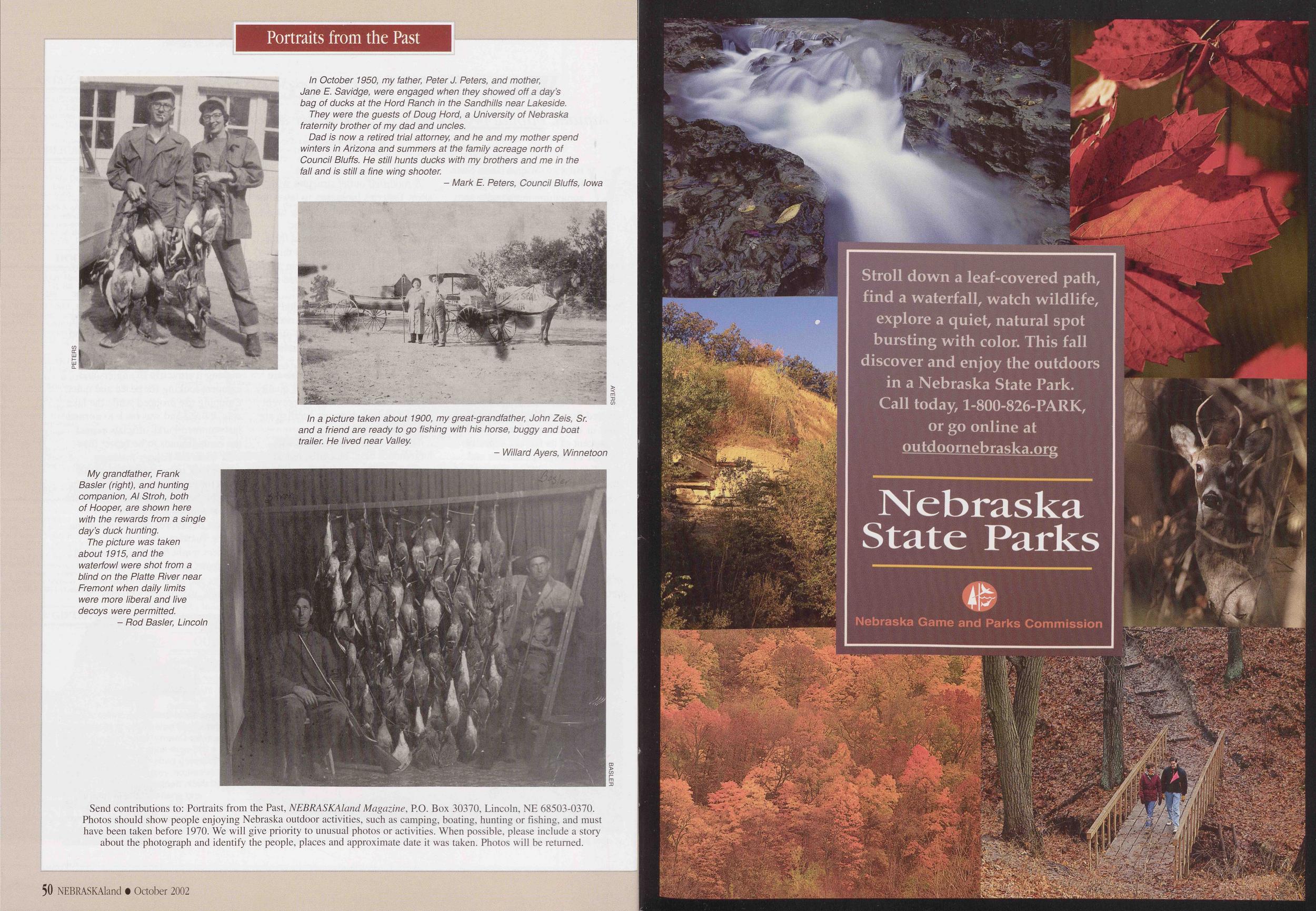
In October 1950, my father, Peter J. Peters, and mother, Jane E. Savidge, were engaged when they showed off a day’s bag of ducks at the Hord Ranch in the Sandhills near Lakeside.
They were the guests of Doug Hord, a University of Nebraska fraternity brother of my dad and uncles.
Dad is now a retired trial attorney, and he and my mother spend winters in Arizona and summers at the family acreage north of Council Bluffs. He still hunts ducks with my brothers and me in the fall and is still a fine wing shooter.
- Mark E. Peters, Council Bluffs, IowaIn a picture taken about 1900, my great-grandfather, John Zeis, Sr. and a friend are ready to go fishing with his horse, buggy and boat trailer. He lived near Valley.
- Willard Ayers, WinnetoonMy grandfather, Frank Basler (right), and hunting companion, Al Stroh, both of Hooper, are shown here with the rewards from a single day’s duck hunting. The picture was taken about 1915, and the waterfowl were shot from a blind on the Platte River near Fremont when daily limits were more liberal and live decoys were permitted.
- Rod Basler, LincolnSend contributions to: Portraits from the Past, NEBRASKAland Magazine, P.O. Box 30370, Lincoln, NE 68503-0370. Photos should show people enjoying Nebraska outdoor activities, such as camping, boating, hunting or fishing, and must have been taken before 1970. We will give priority to unusual photos or activities. When possible, please include a story about the photograph and identify the people, places and approximate date it was taken. Photos will be returned.
50 NEBRASKAland • October 2002 Nebraska Game and Parks Commission Nebraska State Parks Stroll down a leaf-covered path, find a waterfall, watch wildlife, explore a quiet, natural spot bursting with color. This fall discover and enjoy the outdoors in a Nebraska State Park. Call today, 1-800-826-PARK, or go online at Qutdoornebraska.org
Position: 704 (16 views)