Volume 80, Issue 6, 2002
NEBRASKAland
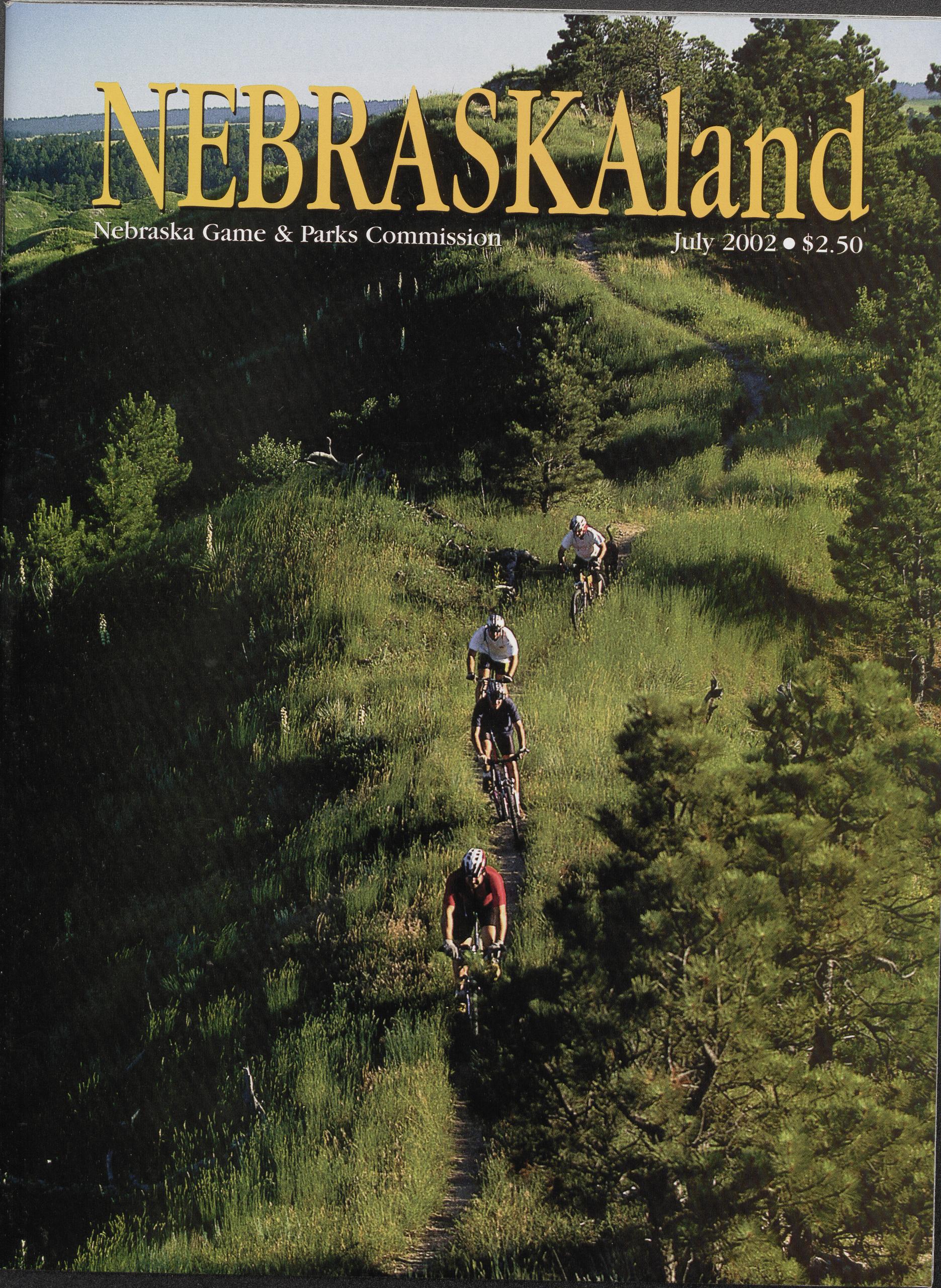
Nebraska Game & Parks Commission July 2002 $2.50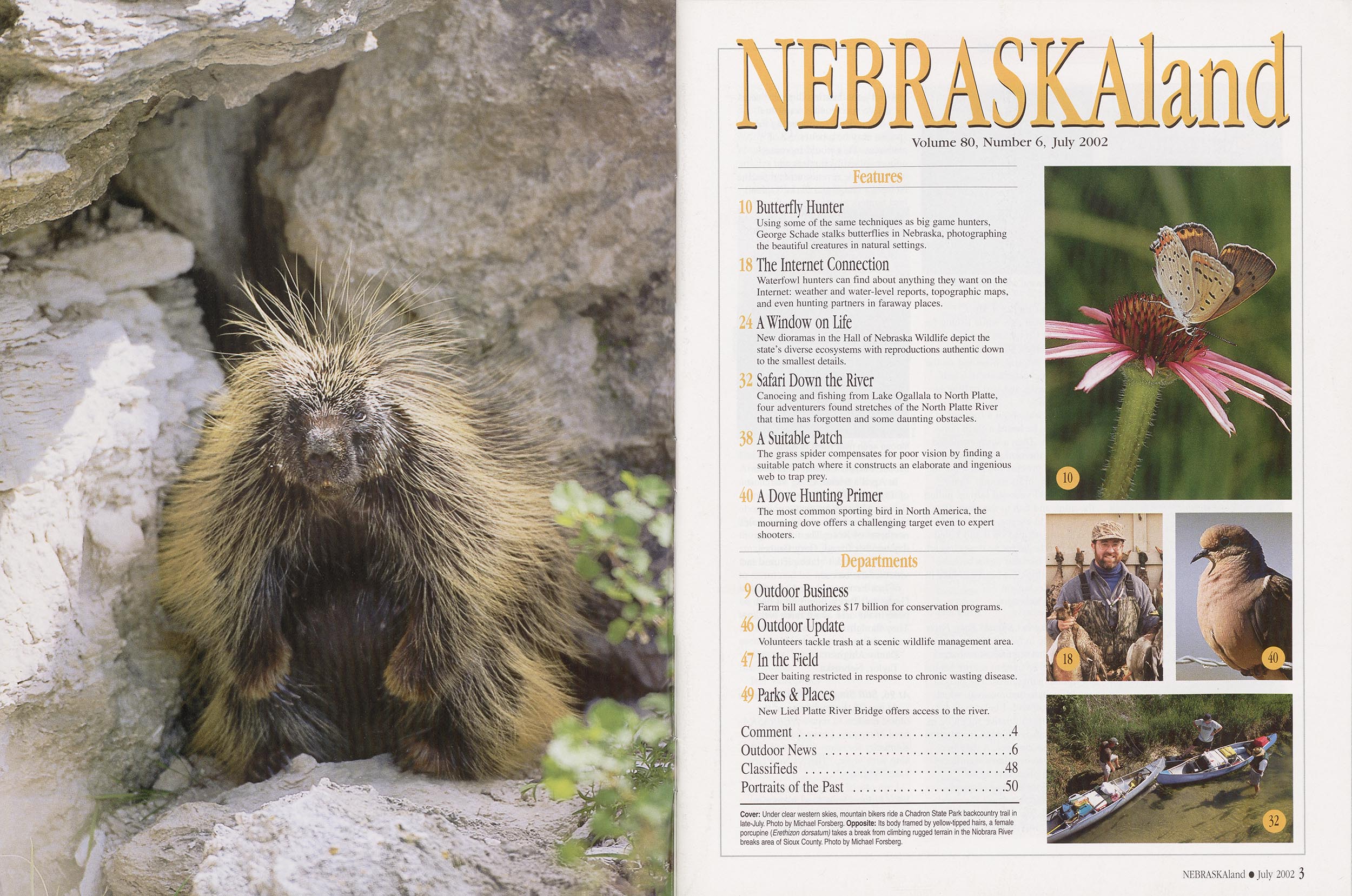
NEBRASKAland
Volume 80, Number 6, July 2002 Features10 Butterfly Hunter Using some of the same techniques as big game hunters, George Schade stalks butterflies in Nebraska, photographing the beautiful creatures in natural settings.
18 The Internet Connection Waterfowl hunters can find about anything they want on the Internet: weather and water-level reports, topographic maps, and even hunting partners in faraway places.
24 A Window on Life New dioramas in the Hall of Nebraska Wildlife depict the state’s diverse ecosystems with reproductions authentic down to the smallest details.
32 Safari Down the River Canoeing and fishing from Lake Ogallala to North Platte, four adventurers found stretches of the North Platte River that time has forgotten and some daunting obstacles.
38 A Suitable Patch The grass spider compensates for poor vision by finding a suitable patch where it constructs an elaborate and ingenious web to trap prey.
40 A Dove Hunting Primer The most common sporting bird in North America, the mourning dove offers a challenging target even to expert shooters.
9Outdoor Business Farm bill authorizes $17 billion for conservation programs.
46 Outdoor Update Volunteers tackle trash at a scenic wildlife management area.
47 In the Field Deer baiting restricted in response to chronic wasting disease.
49Parks & Places New Lied Platte River Bridge offers access to the river.
Comment 4Outdoor News 6
Classifieds 48
Portraits of the Past 50
NEBRASKAland Magazine
Published by the Nebraska Game and Parks Commission Director: Rex Amack Assistant Directors: Noelyn Isom Roger Kuhn Kirk Nelson Information & Education Administrator: Paul Horton Information & Education Art Director: Steve O’Hare Commissioners Chairman: John P. Miller, Blair Vice Chairman: Connie Lapaseotes, Bridgeport 2nd Vice Chairman: Randall K. Stinnette, Inland Marvin Westcott, Holdrege James Stuart, Jr., Lincoln Bill Grewcock, Omaha Rob Coupland, Valentine Magazine Staff Editor: Tom White Associate Editor: Doug Carroll Art Director: Tim Reigert Senior Editors: Ken Bouc, Jon Farrar Regional Editors: Eric Fowler, Bob Grier, Rocky Hoffmann Contributing Editors: Michael Forsberg, Tom Keith Circulation: Pat Frahm NEBRASKAland VOL. 80 / NO. 6 ISSN: 0028-1964 JULY 2002 Published monthly, except for Jan./Feb. and Aug./Sept. issues, by the Nebraska Game and Parks Commission, 2200 N. 33rd St., Lincoln, NE. Copyright 2002, all rights reserved. Please address comments or questions to this address. Periodicals postage paid at Lincoln, Nebraska, and other locations. POSTMASTER: Send all address changes to NEBRASKAland, P.O. Box 30370, Lincoln, NE 68503-0370. Address submissions to: The Editor, NEBRASKAland Magazine, P.O. Box 30370, Lincoln, NE 68503. Include a stamped, self-addressed return envelope. The publisher assumes no responsibility for unsolicited material. NEBRASKAland is available on audio cassette from the Nebraska Library Commission Talking Book and Braille Service, Suite 120, 1200 N St., Lincoln, NE 68508. Rates: $16 for one year; $30 for two years. To subscribe call 1 -800-NEBLAND (632-5263), or go online to: outdoornebraska.orgComment
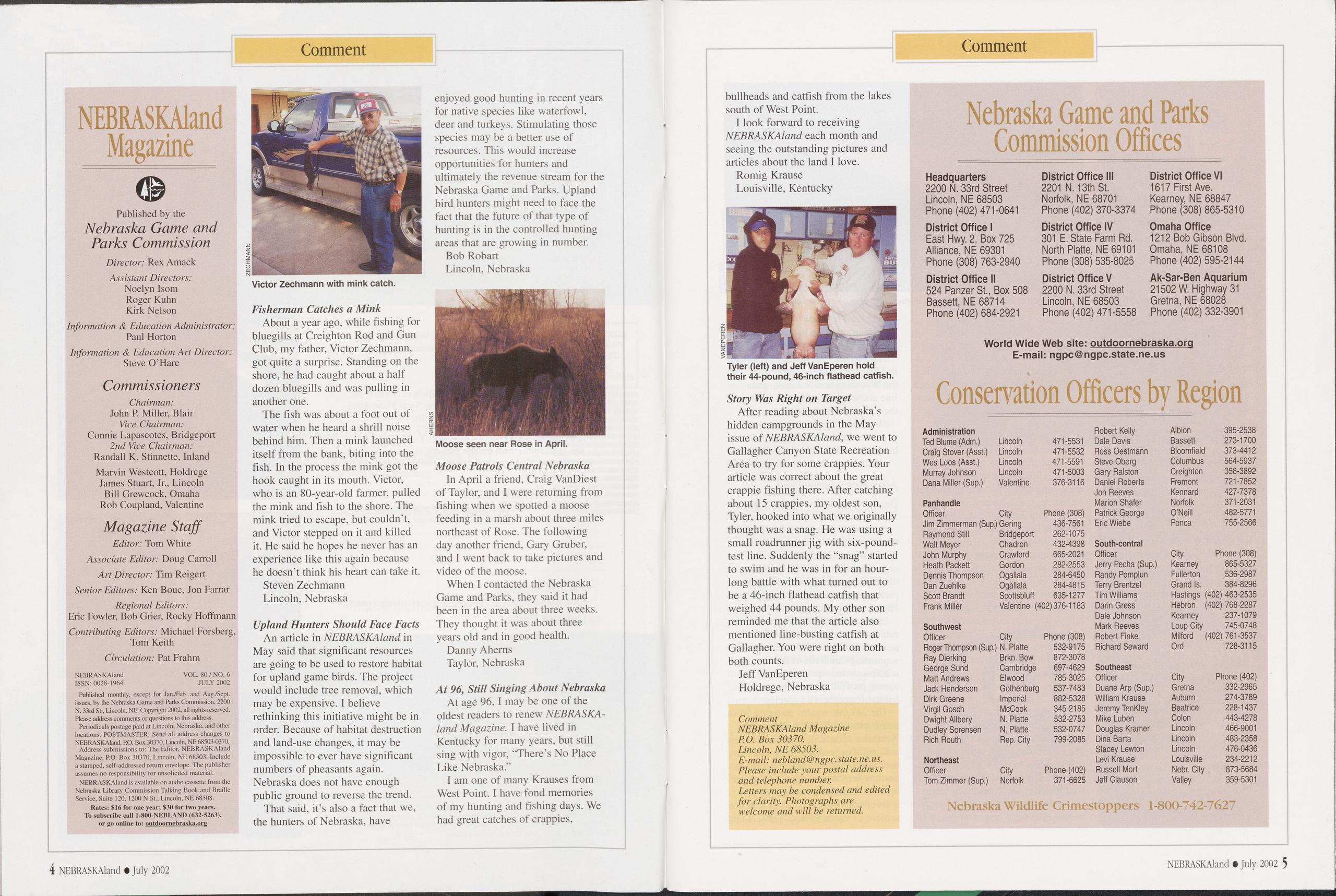
About a year ago, while fishing for bluegills at Creighton Rod and Gun Club, my father, Victor Zechmann, got quite a surprise. Standing on the shore, he had caught about a half dozen bluegills and was pulling in another one.
The fish was about a foot out of water when he heard a shrill noise behind him. Then a mink launched itself from the bank, biting into the fish. In the process the mink got the hook caught in its mouth. Victor, who is an 80-year-old farmer, pulled the mink and fish to the shore. The mink tried to escape, but couldn’t, and Victor stepped on it and killed it. He said he hopes he never has an experience like this again because he doesn’t think his heart can take it.
Steven ZechmannLincoln, Nebraska Upland Hunters Should Face Facts
An article in NEBRASKAland in May said that significant resources are going to be used to restore habitat for upland game birds. The project would include tree removal, which may be expensive. I believe rethinking this initiative might be in order. Because of habitat destruction and land-use changes, it may be impossible to ever have significant numbers of pheasants again. Nebraska does not have enough public ground to reverse the trend.
That said, it’s also a fact that we, the hunters of Nebraska, have enjoyed good hunting in recent years for native species like waterfowl, deer and turkeys. Stimulating those species may be a better use of resources. This would increase opportunities for hunters and ultimately the revenue stream for the Nebraska Game and Parks. Upland bird hunters might need to face the fact that the future of that type of hunting is in the controlled hunting areas that are growing in number.
Bob RobartLincoln, Nebraska
In April a friend, Craig VanDiest of Taylor, and I were returning from fishing when we spotted a moose feeding in a marsh about three miles northeast of Rose. The following day another friend, Gary Gruber, and I went back to take pictures and video of the moose.
When I contacted the Nebraska Game and Parks, they said it had been in the area about three weeks. They thought it was about three years old and in good health.
Danny AhernsTaylor, Nebraska At 96, Still Singing About Nebraska
At age 96, I may be one of the oldest readers to renew NEBRASKA- land Magazine. I have lived in Kentucky for many years, but still sing with vigor, “There’s No Place Like Nebraska.”
I am one of many Krauses from West Point. I have fond memories of my hunting and fishing days. We had great catches of crappies, bullheads and catfish from the lakes south of West Point. I look forward to receiving NEBRASKAland each month and seeing the outstanding pictures and articles about the land I love.
Romig KrauseLouisville, Kentucky
After reading about Nebraska’s hidden campgrounds in the May issue of NEBRASKAland, we went to Gallagher Canyon State Recreation Area to try for some crappies. Your article was correct about the great crappie fishing there. After catching about 15 crappies, my oldest son, Tyler, hooked into what we originally thought was a snag. He was using a small roadrunner jig with six-pound- test line. Suddenly the “snag” started to swim and he was in for an hour- long battle with what turned out to be a 46-inch flathead catfish that weighed 44 pounds. My other son reminded me that the article also mentioned line-busting catfish at Gallagher. You were right on both both counts.
Jeff VanEperenHoldrege, Nebraska Comment NEBRASKAland Magazine P.O. Box 30370, Lincoln, NE 68503. E-mail: nebland@ ngpc. state, ne. us. Please include your postal address and telephone number. Letters may be condensed and edited for clarity. Photographs are welcome and will be returned.
Nebraska Game and Parks Commission Offices
Headquarters 2200 N. 33rd Street Lincoln, NE 68503 Phone (402) 471-0641 District Office I East Hwy. 2, Box 725 Alliance, NE 69301 Phone (308) 763-2940 District Office II 524 Panzer St., Box 508 Bassett, NE 68714 Phone (402) 684-2921 District Office III 2201 N. 13th St. Norfolk, NE 68701 Phone (402) 370-3374 District Office IV 301 E. State Farm Rd. North Platte, NE 69101 Phone (308) 535-8025 District Office V 2200 N. 33rd Street Lincoln, NE 68503 Phone (402) 471-5558 District Office VI 1617 First Ave. Kearney, NE 68847 Phone (308) 865-5310 Omaha Office 1212 Bob Gibson Blvd. Omaha, NE 68108 Phone (402) 595-2144 Ak-Sar-Ben Aquarium 21502 W. Highway 31 Gretna, NE 68028 Phone (402) 332-3901 World Wide Web site: outdoornebraska.org E-mail: ngpc@ngpc.state.ne.us Conservation Officers by Region Administration Robert Kelly Albion 395-2538 Ted Blume (Adm.) Lincoln 471-5531 Dale Davis Bassett 273-1700 Craig Stover (Asst.) Lincoln 471-5532 Ross Oestmann Bloomfield 373-4412 Wes Loos (Asst.) Lincoln 471-5591 Steve Oberg Columbus 564-5937 Murray Johnson Lincoln 471-5003 Gary Ralston Creighton 358-3892 Dana Miller (Sup.) Valentine 376-3116 Daniel Roberts Fremont 721-7852 Jon Reeves Kennard 427-7378 Panhandle Marion Shafer Norfolk 371-2031 Officer City Phone (308) Patrick George O’Neill 482-5771 Jim Zimmerman (Sup.) Gering 436-7561 Eric Wiebe Ponca 755-2566 Raymond Still Bridgeport 262-1075 Walt Meyer Chadron 432-4398 South-central John Murphy Crawford 665-2021 Officer City Phone (308) Heath Packett Gordon 282-2553 Jerry Pecha (Sup.) Kearney 865-5327 Dennis Thompson Ogallala 284-6450 Randy Pomplun Fullerton 536-2987 Dan Zuehlke Ogallala 284-4815 Terry Brentzel Grand Is. 384-8296 Scott Brandt Scottsbluff 635-1277 Tim Williams Hastings (402) 463-2535 Frank Miller Valentine (402)376-1183 Darin Gress Hebron (402) 768-2287 Dale Johnson Kearney 237-1079 Southwest Mark Reeves Loup City 745-0748 Officer City Phone (308) Robert Finke Milford (402) 761-3537 Roger Thompson (Sup.) N. Platte 532-9175 Richard Seward Ord 728-3115 Ray Dierking Brkn. Bow 872-3078 George Sund Cambridge 697-4629 Southeast Matt Andrews Elwood 785-3025 Officer City Phone (402) Jack Henderson Gothenburg 537-7483 Duane Arp (Sup.) Gretna 332-2965 Dirk Greene Imperial 882-5328 William Krause Auburn 274-3789 Virgil Gosch McCook 345-2185 Jeremy Ten Kley Beatrice 228-1437 Dwight Allbery N. Platte 532-2753 Mike Luben Colon 443-4278 Dudley Sorensen N. Platte 532-0747 Douglas Kramer Lincoln 466-9OO1 Rich Routh Rep. City 799-2085 Dina Barta Lincoln 483-2358 Stacey Lewton Lincoln 476-0436 Northeast Levi Krause Louisville 234-2212 Officer City Phone (402) Russell Mort Nebr. City 873-5684 Tom Zimmer (Sup.) Norfolk 371-6625 Jeff Clauson Valley 359-5301 Nebraska Wildlife Crimestoppers 1-800-742-7627 4 NEBRASKAland • July 2002 NEBRASKAland • July 2002 5
Outdoors- Woman
A three-day outdoor skills workshop designed primarily for women 18 or older.
Topics and sessions include: • Fishing • Hunting • Firearms • Archery • Journaling • Map and Compass • Reading the Woods • Fly Tying • Canoeing • Dutch-oven Cooking • Day Hiking • Backyard Wildlife • Game and Fish Care and Cleaning October 4-6, 2002Nebraska State 4-H Camp Nebraska National Forest near Halsey. Enrollment is limited, enroll early.
For more information, call (800)577-8283 and record your request. For online information click on the Outdoor Education link from the Game and Parks Commission’s web site at outdoomebraska. org Sponsored by the Nebraska Game and Parks Commission and the National Shooting Sports Foundation
Outdoor News
Lake McConaughy visitors asking why the lake is so low this year need look no farther than the North Platte River in western Nebraska for answers.
The North Platte River, which feeds Big Mac, provided near-record low-water flows this spring. Tom Hayden, field office supervisor for the Nebraska Department of Natural Resources in Bridgeport, said, “There’s no doubt it’s a tough drought. There’s just no water in the mountains and there hasn’t been a lot of water entering the state.”
Officials at the United States Bureau of Reclamation told Hayden that there has only been one year in the past 67 when there was less inflow into Seminoe Reservoir, located near Sinclair, Wyoming. Seminoe is the source for most of the North Platte River’s water. “The April inflow into the system was only 54 percent of the 30-year average,” Hayden said.
The peak flow of the North Platte River typically occurs in mid-June, but Hayden thinks it had already occurred by the third week of May this year. On May 21, he drove west from Bridgeport checking creeks that feed the river and found they were unusually low for that time of year because the large irrigation canals in Wyoming that usually divert water were not doing so.
Hayden said the North Platte River in May was “basically bone dry” at the Wyoming and Nebraska state line and exceptionally low from there down to Lake McConaughy.
“If we don’t get some water this year or next, we’re going to be in a heap of trouble,” he said.
Ambitious Grasslands Project Includes NebraskaIn April, Bob Irvin, a director with the World Wildlife Fund (WWF), spoke in Lincoln about the organization’s vision for restoring the pre-Euroamerican settlement prairie ecosystem in the Northern High Plains.
Irvin said the WWF envisions establishing a grassland, over the next 50 years, of millions of acres supporting hundreds of thousands of wild bison and vast prairie dog towns, providing a prey base and habitat for other wild species.
The 247,000 square mile area of interest to the WWF stretches from Nebraska’s Sandhills to the northwest and includes western South Dakota and North Dakota, eastern Montana, northeastern Wyoming and southern areas of Saskatchewan and Alberta.
Irvin said the organization hopes to achieve its vision through partnerships with public and private landowners, local communities, public land managers, Native American tribes and other conservation organizations.
For more information, go online to www. worldwildlife. org.
Searchable Nebraska Trails Web Site Now AvailableA searchable database of trails found in Nebraska has been added to the Nebraska Game and Parks Commission’s web site. Users can search for hiking, biking, horseback riding, canoe and cross-country ski trails by region. Detailed information about each trail and the park where it is located is available. Up-to-date information about the Cowboy Recreation and Nature Trail, including a clickable map detailing each section, is also available.
To access this site, click on Nebraska Trails under the News and New section of the Commission’s web site at outdoornebraska.org. or go to http://www.ngpc.state.ne.us /parks/trails/trails.html.
Archery Hunt Program Pairs Youths and MentorsThe Nebraska Game and Parks Commission will again offer the popular Mentored Archery Youth Hunt this year, pairing young bow hunters with experienced bow hunter education instructors as they hunt deer on highly productive grounds.
This will be the seventh year for the program, said Jeff Rawlinson, outdoor education specialist, and it has grown every year. “We’ve gone from four or five kids being involved to 60 kids last year.
Mentored hunts will be available in the Omaha, Lincoln and Kearney areas this year. Youth ages 12 to 18 are eligible to apply. Applicants must have passed a bow hunter education course, have their own equipment and successfully complete a shooting test at different distances.
Getting Ready to Hunt This Fall?
Now You Can Buy Nebraska Hunting Permits Online! Visit our secure web site to quickly and conveniently purchase fishing, hunting and park permits online using your Visa or MasterCard. Online permit purchase is safe, hassle-free and there is never a checkout line. Simply choose the permits you want, pay for them, download and print. And, you are on your way to Nebraska's great outdoors. outdoornebraska.org Nebraska Game and Parks Commission
Officer's Notebook
Too Close for Comfort
In October 2001, I was asked to check out a complaint of ducks being shot after legal shooting hours at the western end of Lake McConaughy. Although famous for its fabulous Canada goose hunting, this area also has wonderful duck hunting. Most savvy duck hunters are able to take daily limits of mallards, green-winged teal and other ducks there in the fall.
I arrived at 4 p.m. and checked two archery deer hunters while patrolling the area. About five o’clock, I noticed two duck hunters hiding in some brush with a small spread of decoys floating in a North Platte River channel in front of them. I parked my truck and hiked to a location where I could watch them without being seen.
Although several thousand ducks and geese were feeding contentedly in the lake and river shallows, neither hunter took a shot before legal shooting hours ended at sundown. Four minutes later, the hunters called in a duck but missed it.
I was watching the pair with a spotting scope, but the darkening sky made it hard to see, so I moved closer and observed them call in a hen mallard, which one of them killed with one shot. This scene was repeated again five minutes later.
As I moved closer, the sky got darker and darker and the pair continued firing at the masses of waterfowl swarming overhead. I wrote on my hand, noting the time each new shot occurred. It was so dark I could see flames coming from the violators’ shotguns as they fired.
It was now a half-hour after sundown. The ducks flew low and as I hunkered behind a slight rise to watch the poachers now less than a hundred yards away, some teal buzzed by just feet above my head. Two shots came my way, so I dropped to my knees, putting on sunglasses to protect my eyes. Now I really couldn’t see.
When another shot ripped through a young cottonwood tree nearby, sending leaves, twigs and sand into the air, I had had enough. I fell to my belly and crawled to the complete protection of a nearby sandy rise. Mad at myself for getting so close and endangering my life, I stayed behind the rise as the hunters fired their last shots of the evening. After they gathered ducks and decoys and headed to their vehicle, I returned to my truck and met them coming out on the only road in the area. Their illegal bag consisted of one pintail hen, four green-winged teal, one drake mallard and seven mallard hens - resulting in an overbagging violation in addition to taking waterfowl during closed hours.
The men eventually paid nearly $900 in fines, damages and costs, which will hopefully dissuade them from doing it again. All game needs refuge and time to rest and feed. After sundown, waterfowl fly to their nighttime roosts very low and cannot easily spot danger. Hunting them at this time is not only illegal, it’s unethical. Waterfowl hunting purists hold these violators in the utmost contempt, as do the game wardens trying to catch them. At least one of these game wardens, however, now knows not to get too close as he observes these violations.
-Dan Evasco, Conservation Officer, OshkoshOutdoor News
Applications are available at local archery shops or by contacting the Ak-Sar-Ben Aquarium office at (402) 332-4204.
A black bear seen in mid-May near the small Panhandle town of Henry is the second confirmed Nebraska bear sighting in the past two years.
A different black bear was sighted near Harrisburg in Banner County in the fall of 2000. Gary Schlichtemeier, district manager for the Nebraska Game and Parks Commission, said, “We suspect both bears originated in Wyoming. Most of the states with black bear populations have reported increased sightings of bears primarily because of drought conditions in the high country and encroachment of people into traditional bear habitat.”
Once part of Nebraska’s native fauna, black bears were extirpated from the state by intensive predator removal practices and reduced habitat. The last confirmed black bear report in Nebraska was one killed in 1907 near Valentine. Through the years there have been bear reports, including one in Banner County in 1984, but none were verified until 2000.
Black bears are usually nocturnal and their diet consists primarily of berries, nuts, roots, insects, small mammals, eggs, carrion, garbage, and honey. They are protected by law in Nebraska and, while usually not aggressive, anyone who sees a black bear should avoid close contact with it and report the sighting to the nearest Commission office. ■
Outdoor Business
Farm Bill Includes Wildlife Programs
$17 billion authorized over six years for variety of conservation programs.
The new federal farm bill, ‘passed in May, includes $17 billion for conservation programs - good news for wildlife, fish and the environment in Nebraska and across the nation.
Several existing programs, including the Conservation Reserve Program (CRP) and Wetlands Reserve Program (WRP) received substantial increases in funding authority. The new bill also created new programs such as the Grassland Reserve Program, which will begin in 2003. It will improve and protect up to 2 million acres of pastureland and native prairie nationwide and might be a funding source to protect prairie dogs.
Bill Baxter, agricultural program manager with the Nebraska Game and Parks Commission, said Nebraska, where 97 percent of the land is privately owned, will benefit from the increased funding.
“From the standpoint of natural resources protection - meaning all of our natural resources, soil, water and wildlife - there’s no other program that even matches the conservation title of the farm bill in providing those benefits,” Baxter said.
A summary of the programs, funds authorized and changes follows:
Conservation Reserve Program ($1,517 billion authorized): CRP pays farmers to remove highly erodible land from production and plant it to grass. It provides more habitat, 1.1 million acres, in Nebraska than all state and federal public land (about 800,000 acres combined), making it one of the most important federal programs for wildlife. The new farm bill increased the acreage cap from 36.4 million acres to 39.2 million acres, which should help Nebraska return to its peak enrollment level of 1.4 million acres. The Farmable Wetlands pilot program was expanded to every state and to 1 million acres, and the minimum size expanded from 5 to 10 acres. Nebraska could enroll 100,000 acres in the next three years. The new bill also requires land to have been farmed for four of the previous six years before it can be enrolled in CRP and that participants develop a vegetation management plan, which could benefit upland bird species.
Wetlands Reserve Program ($1.5 billion authorized): WRP offers 30-year or permanent easements or cost-share agreements in exchange for restoration of wetlands and associated uplands. The new farm bill increases the national acreage cap from just over 1 million acres to 2.275 million acres, which should help clear up an application backlog. Currently, 25,000 acres are enrolled in Nebraska with another 12,000 acres pending.
Grasslands Reserve Program ($254 million authorized): A new program, GRP, will help fill a gap in conservation programs by protecting land that is already in grass. It will be open to restored, improved or natural grasslands through 10-, 15- or 20-year contracts or 30-year or permanent easements. Baxter said the 2 million-acre cap won’t meet the need, but the program should be a valuable tool to protect existing tracts of sandsage or tailgrass prairie and he hopes it will be expanded in the future. Because payments are limited to fair-market value, Baxter said the program won’t likely be a tool for preventing land from being developed.
Farmland Protection Program ($985 million authorized): Since 1996, FPP has provided $53.4 million to protect 108,000 acres from development and the subsequent loss of wildlife benefits. The new bill provides a 20-fold increase in funding and expands it to include grass and forest land.
Wildlife Habitat Incentives Program ($700 million authorized): WHIP provides cost-share payments to develop fish and wildlife habitat. About 102,000 acres were enrolled in Nebraska under the previous farm bill, but a backlog of projects has grown since the nationwide spending authority of $62.5 million was used to improve 1.6 million acres. Under the new bill, funding will increase to $85 million annually in 2005, 2006 and 2007.
Environmental Quality Incentives Program ($9 billion authorized): EQIP provides assistance in installing conservation practices that enhance soil, water, natural resources and wildlife on working land. Baxter said wildlife benefits have been minimal in Nebraska, but a large increase in funding and the elimination of priority areas could change that.
Ground and Surface Water Conservation Program ($600 million authorized): This new program will provide cost-share incentives and assistance for water conservation efforts such as better irrigation and ground water recharge.
Conservation Security Program ($2 billion authorized): This new program will pay farmers to maintain or increase stewardship practices on working land, including fish and wildlife habitat conservation, restoration and management.
Small Watershed Rehabilitation Program ($275 million authorized): This new program provides funding for the rehabilitation of aging small watershed impoundments. ■
8 NEBRASKAland • July 2002 NEBRASKAland • July 2002 9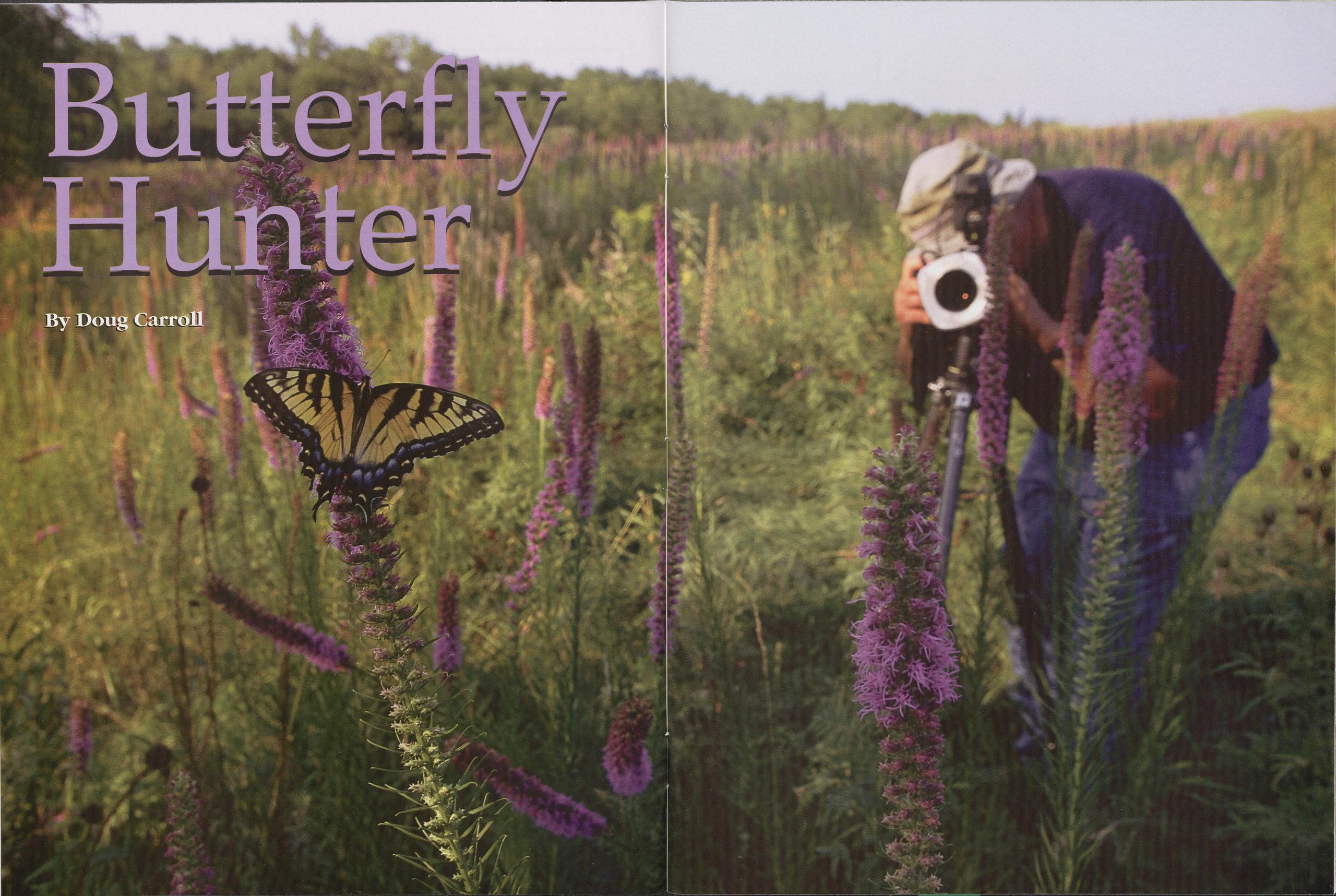
Butterfly Hunter
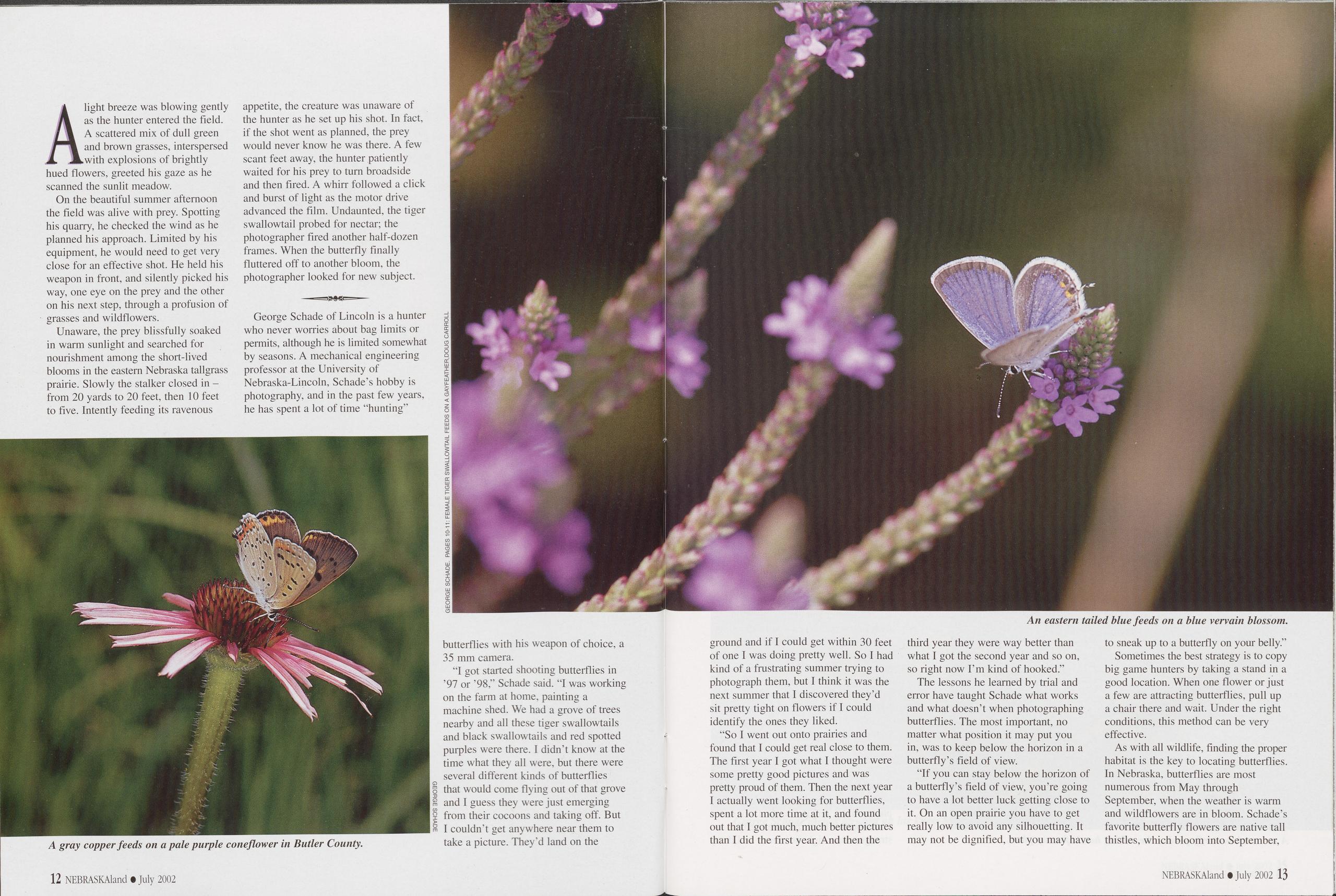
A light breeze was blowing gently as the hunter entered the field. A scattered mix of dull green and brown grasses, interspersed with explosions of brightly hued flowers, greeted his gaze as he scanned the sunlit meadow.
On the beautiful summer afternoon the field was alive with prey. Spotting his quarry, he checked the wind as he planned his approach. Limited by his equipment, he would need to get very close for an effective shot. He held his weapon in front, and silently picked his way, one eye on the prey and the other on his next step, through a profusion of grasses and wildflowers.
Unaware, the prey blissfully soaked in warm sunlight and searched for nourishment among the short-lived blooms in the eastern Nebraska tailgrass prairie. Slowly the stalker closed in - from 20 yards to 20 feet, then 10 feet to five. Intently feeding its ravenous
George Schade of Lincoln is a hunter who never worries about bag limits or permits, although he is limited somewhat by seasons. A mechanical engineering professor at the University of Nebraska-Lincoln, Schade’s hobby is photography, and in the past few years, he has spent a lot of time “hunting”
“I got started shooting butterflies in ’97 or ’98,” Schade said. "I was working on the farm at home, painting a machine shed. We had a grove of trees nearby and all these tiger swallowtails and black swallowtails and red spotted purples were there. I didn’t know at the time what they all were, but there were several different kinds of butterflies that would come flying out of that grove and I guess they were just emerging from their cocoons and taking off. But I couldn’t get anywhere near them to take a picture. They’d land on the ground and if I could get within 30 feet of one I was doing pretty well. So I had kind of a frustrating summer trying to photograph them, but I think it was the next summer that I discovered they’d sit pretty tight on flowers if I could identify the ones they liked.
"So I went out onto prairies and found that I could get real close to them. The first year I got what I thought were some pretty good pictures and was pretty proud of them. Then the next year I actually went looking for butterflies, spent a lot more time at it, and found out that I got much, much better pictures than I did the first year. And then the third year they were way better than what I got the second year and so on, so right now I’m kind of hooked.”
The lessons he learned by trial and error have taught Schade what works and what doesn’t when photographing butterflies. The most important, no matter what position it may put you in, was to keep below the horizon in a butterfly’s field of view.
"If you can stay below the horizon of a butterfly’s field of view, you’re going to have a lot better luck getting close to it. On an open prairie you have to get really low to avoid any silhouetting. It may not be dignified, but you may have to sneak up to a butterfly on your belly.” Sometimes the best strategy is to copy big game hunters by taking a stand in a good location. When one flower or just a few are attracting butterflies, pull up a chair there and wait. Under the right conditions, this method can be very effective.
As with all wildlife, finding the proper habitat is the key to locating butterflies. In Nebraska, butterflies are most numerous from May through September, when the weather is warm and wildflowers are in bloom. Schade’s favorite butterfly flowers are native tall thistles, which bloom into September,
12 NEBRASKAland • July 2002 NEBRASKAland • July 2002 13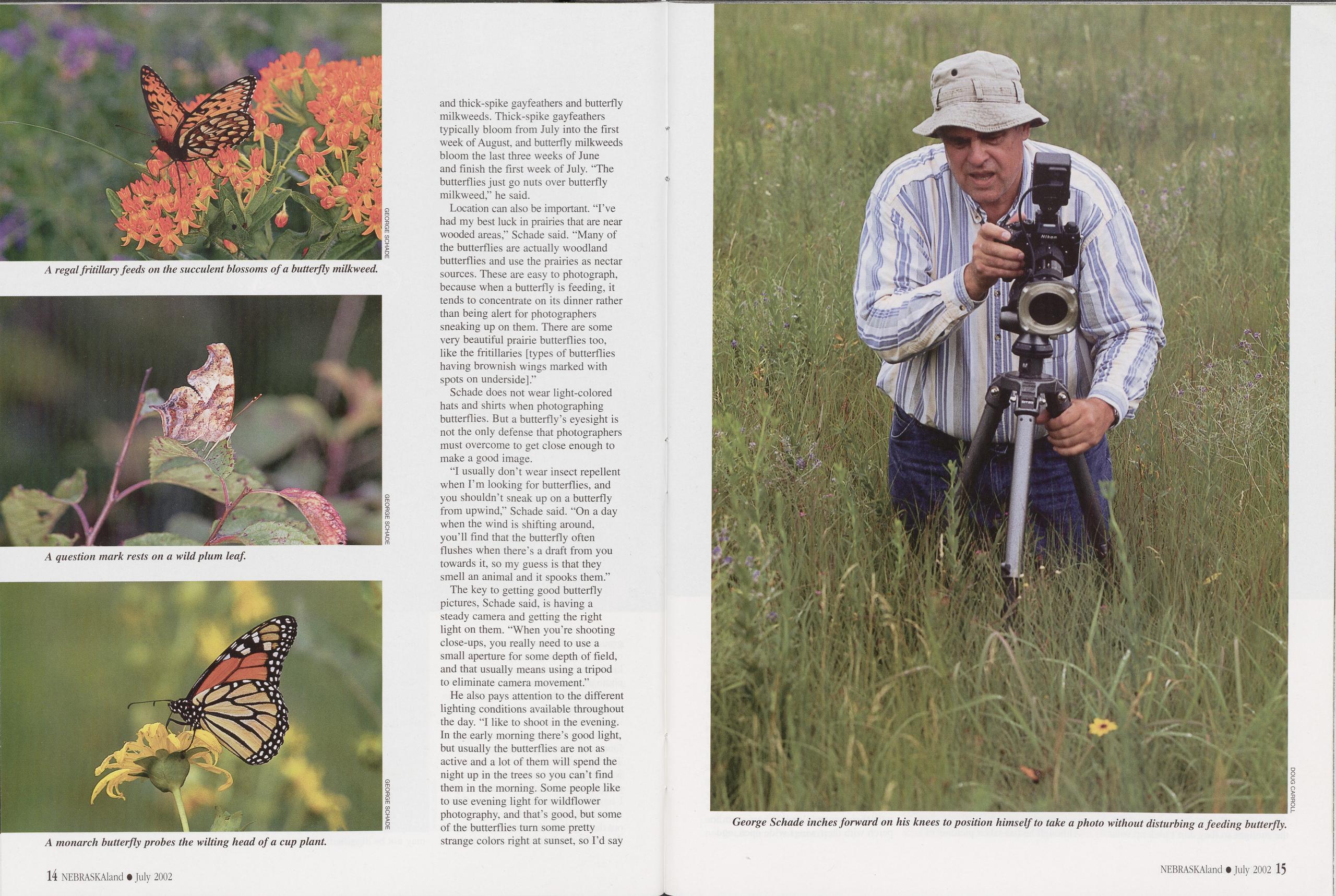
and thick-spike gayfeathers and butterfly milkweeds. Thick-spike gayfeathers typically bloom from July into the first week of August, and butterfly milkweeds bloom the last three weeks of June and finish the first week of July. “The butterflies just go nuts over butterfly milkweed,” he said.
Location can also be important. "I've had my best luck in prairies that are near wooded areas,” Schade said. "Many of the butterflies are actually woodland butterflies and use the prairies as nectar sources. These are easy to photograph, because when a butterfly is feeding, it tends to concentrate on its dinner rather than being alert for photographers sneaking up on them. There are some very beautiful prairie butterflies too, like the fritillaries [types of butterflies having brownish wings marked with spots on underside].”
Schade does not wear light-colored hats and shirts when photographing butterflies. But a butterfly’s eyesight is not the only defense that photographers must overcome to get close enough to make a good image.
"I usually don’t wear insect repellent when I’m looking for butterflies, and you shouldn’t sneak up on a butterfly from upwind,” Schade said. "On a day when the wind is shifting around, you’ll find that the butterfly often flushes when there’s a draft from you towards it, so my guess is that they smell an animal and it spooks them.”
The key to getting good butterfly pictures, Schade said, is having a steady camera and getting the right light on them. "When you’re shooting close-ups, you really need to use a small aperture for some depth of field, and that usually means using a tripod to eliminate camera movement.”
He also pays attention to the different lighting conditions available throughout the day. “I like to shoot in the evening. In the early morning there’s good light, but usually the butterflies are not as active and a lot of them will spend the night up in the trees so you can’t find them in the morning. Some people like to use evening light for wildflower photography, and that’s good, but some of the butterflies turn some pretty strange colors right at sunset, so I’d say
later afternoons and evening are about the best time.”
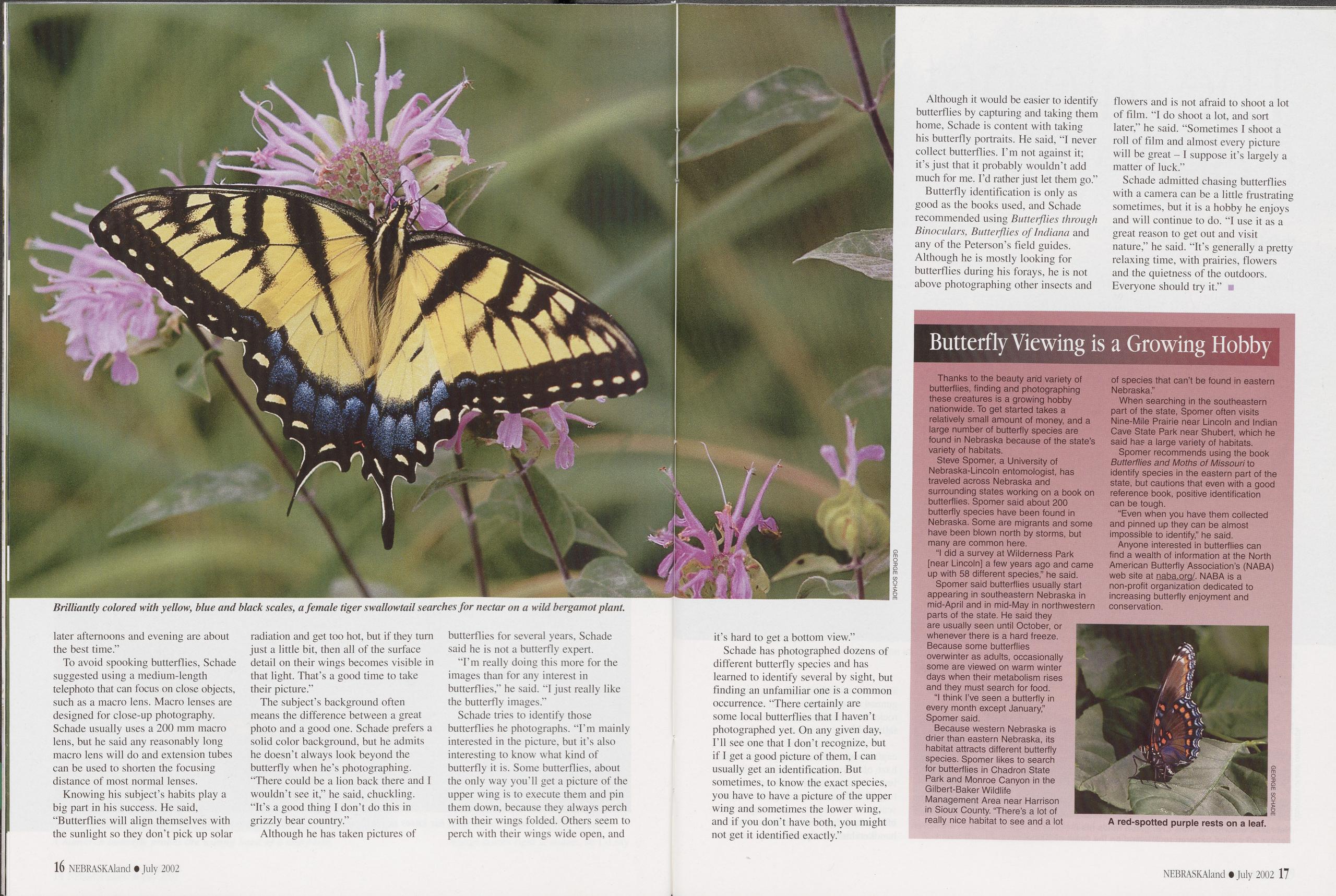
To avoid spooking butterflies, Schade suggested using a medium-length telephoto that can focus on close objects, such as a macro lens. Macro lenses are designed for close-up photography. Schade usually uses a 200 mm macro lens, but he said any reasonably long macro lens will do and extension tubes can be used to shorten the focusing distance of most normal lenses.
Knowing his subject’s habits play a big part in his success. He said, “Butterflies will align themselves with the sunlight so they don’t pick up solar radiation and get too hot, but if they turn just a little bit, then all of the surface detail on their wings becomes visible in that light. That’s a good time to take their picture.”
The subject’s background often means the difference between a great photo and a good one. Schade prefers a solid color background, but he admits he doesn’t always look beyond the butterfly when he’s photographing. “There could be a lion back there and I wouldn’t see it,” he said, chuckling. “It’s a good thing I don’t do this in grizzly bear country.”
Although he has taken pictures of butterflies for several years, Schade said he is not a butterfly expert.
“I’m really doing this more for the images than for any interest in butterflies,” he said. "I just really like the butterfly images.”
Schade tries to identify those butterflies he photographs. "I’m mainly interested in the picture, but it’s also interesting to know what kind of butterfly it is. Some butterflies, about the only way you’ll get a picture of the upper wing is to execute them and pin them down, because they always perch with their wings folded. Others seem to perch with their wings wide open, and it’s hard to get a bottom view.”
Schade has photographed dozens of different butterfly species and has learned to identify several by sight, but finding an unfamiliar one is a common occurrence. “There certainly are some local butterflies that I haven’t photographed yet. On any given day, I’ll see one that I don’t recognize, but if I get a good picture of them, I can usually get an identification. But sometimes, to know the exact species, you have to have a picture of the upper wing and sometimes the lower wing, and if you don’t have both, you might not get it identified exactly.”
Although it would be easier to identify butterflies by capturing and taking them home, Schade is content with taking his butterfly portraits. He said, "I never collect butterflies. I’m not against it; it’s just that it probably wouldn’t add much for me. I’d rather just let them go.”
Butterfly identification is only as good as the books used, and Schade recommended using Butterflies through Binoculars, Butterflies of Indiana and any of the Peterson’s field guides. Although he is mostly looking for butterflies during his forays, he is not above photographing other insects and flowers and is not afraid to shoot a lot of film. “I do shoot a lot, and sort later,” he said. “Sometimes I shoot a roll of film and almost every picture will be great - I suppose it’s largely a matter of luck.”
Schade admitted chasing butterflies with a camera can be a little frustrating sometimes, but it is a hobby he enjoys and will continue to do. “I use it as a great reason to get out and visit nature,” he said. "It’s generally a pretty relaxing time, with prairies, flowers and the quietness of the outdoors. Everyone should try it.” ■
Butterfly Viewin is a Growing Hobby
Butterfly Viewing is a Growing Hobby Thanks to the beauty and variety of butterflies, finding and photographing these creatures is a growing hobby nationwide. To get started takes a relatively small amount of money, and a large number of butterfly species are found in Nebraska because of the state’s variety of habitats.
Steve Spomer, a University of Nebraska-Lincoln entomologist, has traveled across Nebraska and surrounding states working on a book on butterflies. Spomer said about 200 butterfly species have been found in Nebraska. Some are migrants and some have been blown north by storms, but many are common here.
“I did a survey at Wilderness Park [near Lincoln] a few years ago and came up with 58 different species,” he said. Spomer said butterflies usually start appearing in southeastern Nebraska in midApril and in mid-May in northwestern parts of the state. He said they are usually seen until October, or whenever there is a hard freeze. Because some butterflies overwinter as adults, occasionally some are viewed on warm winter days when their metabolism rises and they must search for food.
“I think I've seen a butterfly in every month except January,” Spomer said.
Because western Nebraska is drier than eastern Nebraska, its habitat attracts different butterfly species. Spomer likes to search for butterflies in Chadron State Park and Monroe Canyon in the Gilbert-Baker Wildlife Management Area near Harrison in Sioux County. “There’s a lot of really nice habitat to see and a lot of species that can’t be found in eastern Nebraska.”
When searching in the southeastern part of the state, Spomer often visits Nine-Mile Prairie near Lincoln and Indian Cave State Park near Shubert, which he said has a large variety of habitats.
Spomer recommends using the book Butterflies and Moths of Missouri to identify species in the eastern part of the state, but cautions that even with a good reference book, positive identification can be tough.
“Even when you have them collected and pinned up they can be almost impossible to identify,” he said. Anyone interested in butterflies can find a wealth of information at the North American Butterfly Association’s (NABA) web site at naba.org/. NABA is a non-profit organization dedicated to increasing butterfly enjoyment and conservation.
The Internet Connection
Waterfowlers can find about anything they want on the Internet: weather and water level reports, heavy-duty swivels for decoy rigs, patterns for scull boats and cork decoys, aerial photos and topographic maps, and even hunting partners in faraway places
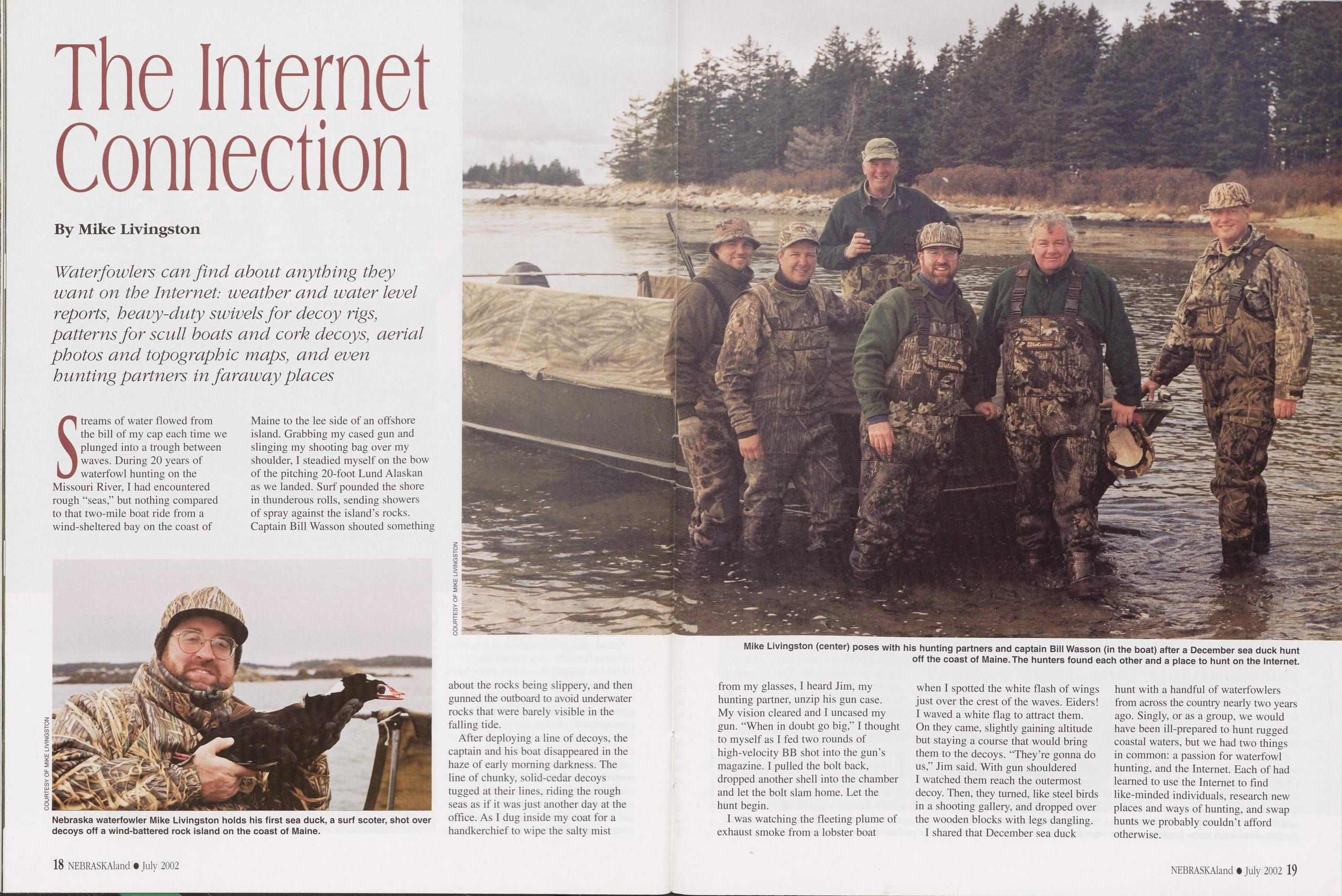
Streams of water flowed from the bill of my cap each time we plunged into a trough between waves. During 20 years of waterfowl hunting on the Missouri River, I had encountered rough “seas,” but nothing compared to that two-mile boat ride from a wind-sheltered bay on the coast of
After deploying a line of decoys, the captain and his boat disappeared in the haze of early morning darkness. The line of chunky, solid-cedar decoys tugged at their lines, riding the rough seas as if it was just another day at the office. As I dug inside my coat for a handkerchief to wipe the salty mist from my glasses, I heard Jim, my hunting partner, unzip his gun case. My vision cleared and I uncased my gun. “When in doubt go big,” I thought to myself as I fed two rounds of high-velocity BB shot into the gun’s magazine. I pulled the bolt back, dropped another shell into the chamber and let the bolt slam home. Let the hunt begin.
I was watching the fleeting plume of exhaust smoke from a lobster boat when I spotted the white flash of wings just over the crest of the waves. Eiders! I waved a white flag to attract them. On they came, slightly gaining altitude but staying a course that would bring them to the decoys. “They’re gonna do us,” Jim said. With gun shouldered I watched them reach the outermost decoy. Then, they turned, like steel birds in a shooting gallery, and dropped over the wooden blocks with legs dangling.
I shared that December sea duck hunt with a handful of waterfowlers from across the country nearly two years ago. Singly, or as a group, we would have been ill-prepared to hunt rugged coastal waters, but we had two things in common: a passion for waterfowl hunting, and the Internet. Each of had learned to use the Internet to find like-minded individuals, research new places and ways of hunting, and swap hunts we probably couldn’t afford otherwise.
18 NEBRASKAland • July 2002 NEBRASKAland • July 2002 19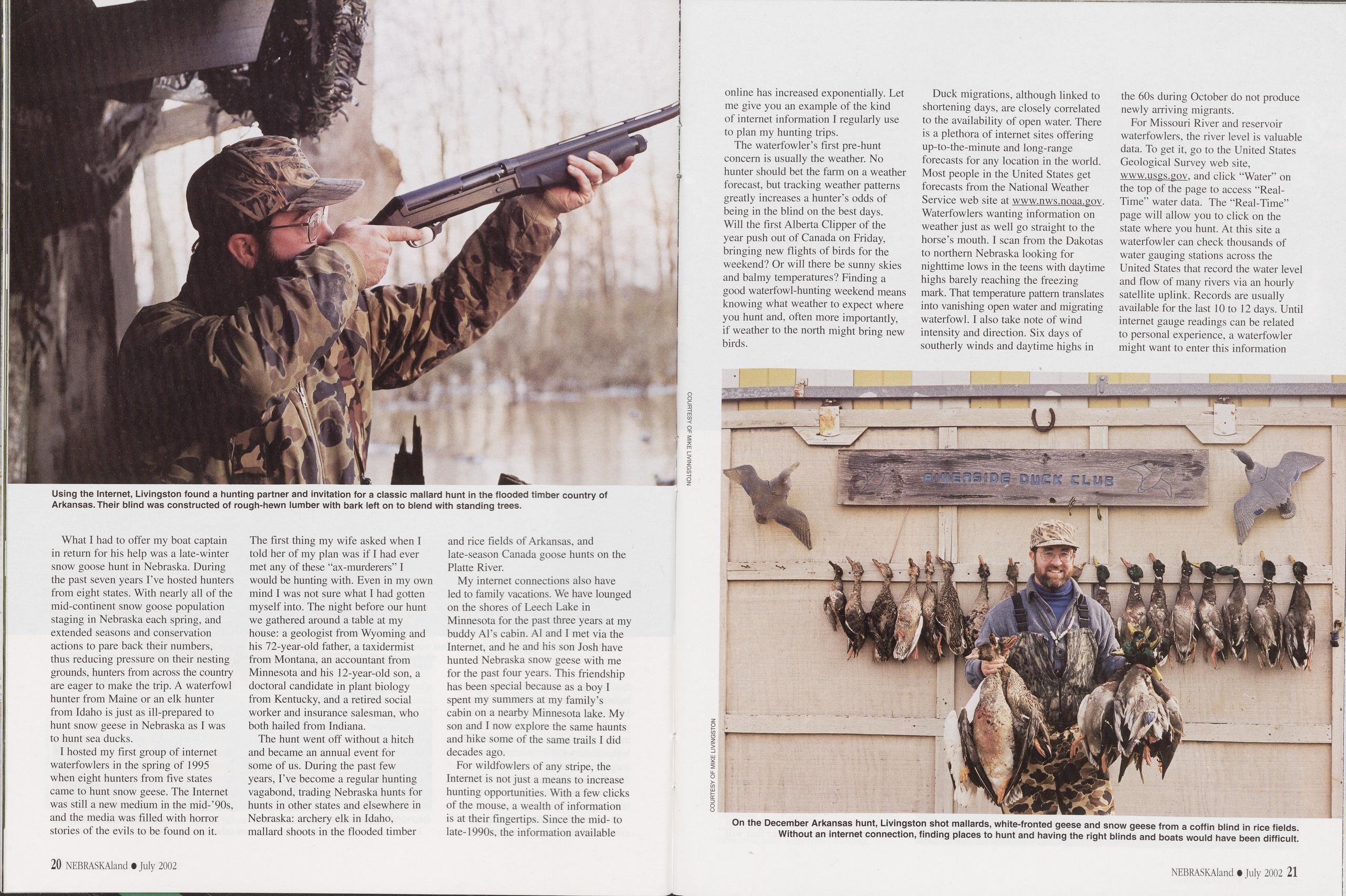
What I had to offer my boat captain in return for his help was a late-winter snow goose hunt in Nebraska. During the past seven years I’ve hosted hunters from eight states. With nearly all of the mid-continent snow goose population staging in Nebraska each spring, and extended seasons and conservation actions to pare back their numbers, thus reducing pressure on their nesting grounds, hunters from across the country are eager to make the trip. A waterfowl hunter from Maine or an elk hunter from Idaho is just as ill-prepared to hunt snow geese in Nebraska as I was to hunt sea ducks.
I hosted my first group of internet waterfowlers in the spring of 1995 when eight hunters from five states came to hunt snow geese. The Internet was still a new medium in the mid-’90s, and the media was filled with horror stories of the evils to be found on it. The first thing my wife asked when I told her of my plan was if I had ever met any of these “ax-murderers” I would be hunting with. Even in my own mind I was not sure what I had gotten myself into. The night before our hunt we gathered around a table at my house: a geologist from Wyoming and his 72-year-old father, a taxidermist from Montana, an accountant from Minnesota and his 12-y ear-old son, a doctoral candidate in plant biology from Kentucky, and a retired social worker and insurance salesman, who both hailed from Indiana.
The hunt went off without a hitch and became an annual event for some of us. During the past few years, I’ve become a regular hunting vagabond, trading Nebraska hunts for hunts in other states and elsewhere in Nebraska: archery elk in Idaho, mallard shoots in the flooded timber and rice fields of Arkansas, and late-season Canada goose hunts on the Platte River.
My internet connections also have led to family vacations. We have lounged on the shores of Leech Lake in Minnesota for the past three years at my buddy Al’s cabin. Al and I met via the Internet, and he and his son Josh have hunted Nebraska snow geese with me for the past four years. This friendship has been special because as a boy I spent my summers at my family’s cabin on a nearby Minnesota lake. My son and I now explore the same haunts and hike some of the same trails I did decades ago.
For wildfowlers of any stripe, the Internet is not just a means to increase hunting opportunities. With a few clicks of the mouse, a wealth of information is at their fingertips. Since the mid- to late-1990s, the information available online has increased exponentially. Let me give you an example of the kind of internet information I regularly use to plan my hunting trips.
The waterfowler’s first pre-hunt concern is usually the weather. No hunter should bet the farm on a weather forecast, but tracking weather patterns greatly increases a hunter’s odds of being in the blind on the best days. Will the first Alberta Clipper of the year push out of Canada on Friday, bringing new flights of birds for the weekend? Or will there be sunny skies and balmy temperatures? Finding a good waterfowl-hunting weekend means knowing what weather to expect where you hunt and, often more importantly, if weather to the north might bring new birds.
Duck migrations, although linked to shortening days, are closely correlated to the availability of open water. There is a plethora of internet sites offering up-to-the-minute and long-range forecasts for any location in the world. Most people in the United States get forecasts from the National Weather Service web site at www.nws.noaa.gov. Waterfowlers wanting information on weather just as well go straight to the horse’s mouth. I scan from the Dakotas to northern Nebraska looking for nighttime lows in the teens with daytime highs barely reaching the freezing mark. That temperature pattern translates into vanishing open water and migrating waterfowl. I also take note of wind intensity and direction. Six days of southerly winds and daytime highs in the 60s during October do not produce newly arriving migrants.
For Missouri River and reservoir waterfowlers, the river level is valuable data. To get it, go to the United States Geological Survey web site, www.usgs.gov. and click “Water” on the top of the page to access “Real- Time” water data. The “Real-Time” page will allow you to click on the state where you hunt. At this site a waterfowler can check thousands of water gauging stations across the United States that record the water level and flow of many rivers via an hourly satellite uplink. Records are usually available for the last 10 to 12 days. Until internet gauge readings can be related to personal experience, a waterfowler might want to enter this information
20 NEBRASKAland • July 2002 NEBRASKAland • July 2002 21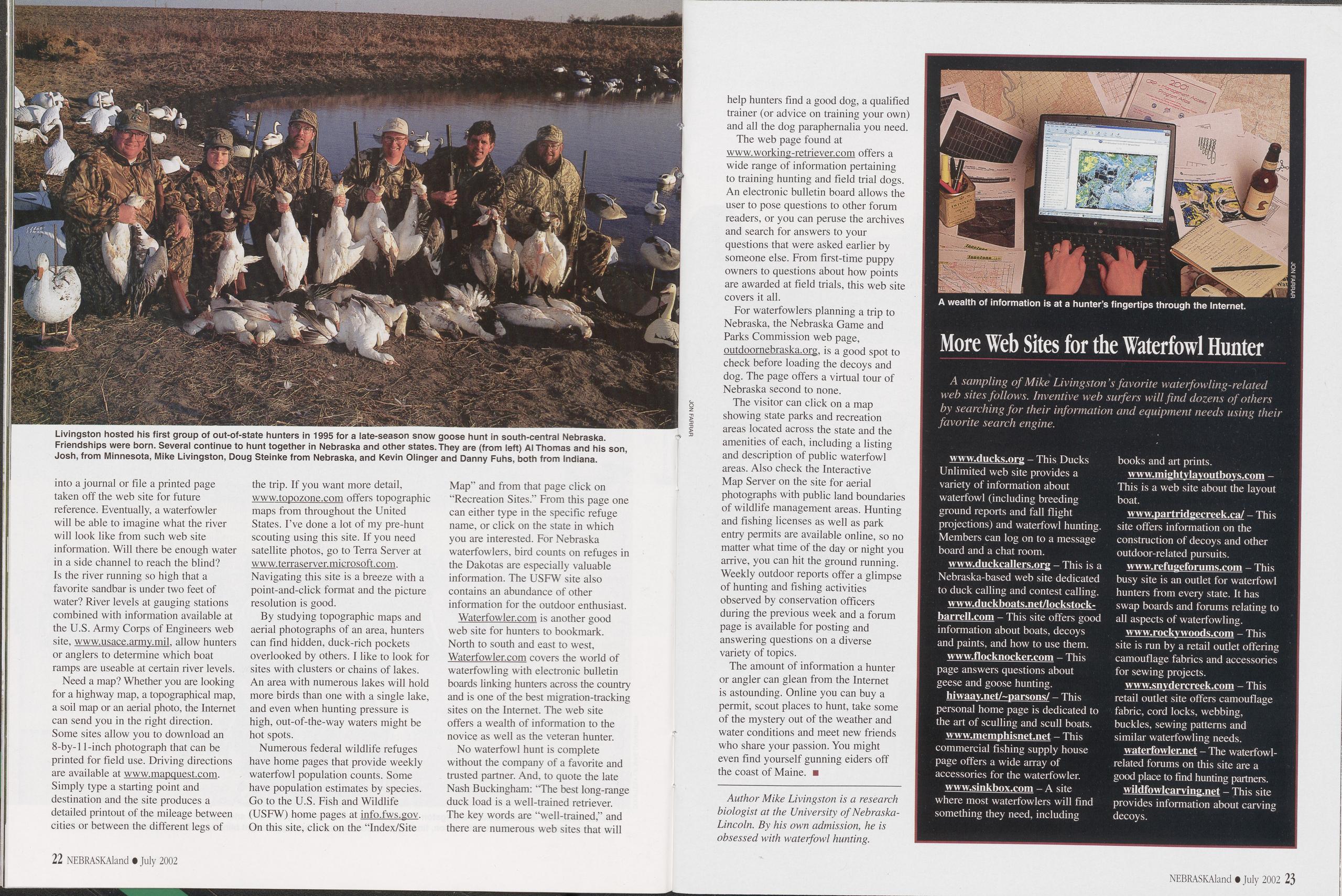
into a journal or file a printed page taken off the web site for future reference. Eventually, a waterfowler will be able to imagine what the river will look like from such web site information. Will there be enough water in a side channel to reach the blind? Is the river running so high that a favorite sandbar is under two feet of water? River levels at gauging stations combined with information available at the U.S. Army Corps of Engineers web site, www.usace.army.rniL allow hunters or anglers to determine which boat ramps are useable at certain river levels.
Need a map? Whether you are looking for a highway map, a topographical map, a soil map or an aerial photo, the Internet can send you in the right direction. Some sites allow you to download an 8-by-l 1-inch photograph that can be printed for field use. Driving directions are available at www.mapquest.com. Simply type a starting point and destination and the site produces a detailed printout of the mileage between cities or between the different legs of the trip. If you want more detail, www.topozone.com offers topographic maps from throughout the United States. I’ve done a lot of my pre-hunt scouting using this site. If you need satellite photos, go to Terra Server at www.terraserver.microsoft.com. Navigating this site is a breeze with a point-and-click format and the picture resolution is good.
By studying topographic maps and aerial photographs of an area, hunters can find hidden, duck-rich pockets overlooked by others. I like to look for sites with clusters or chains of lakes. An area with numerous lakes will hold more birds than one with a single lake, and even when hunting pressure is high, out-of-the-way waters might be hot spots.
Numerous federal wildlife refuges have home pages that provide weekly waterfowl population counts. Some have population estimates by species. Go to the U.S. Fish and Wildlife (USFW) home pages at info.fws.gov. On this site, click on the “Index/Site Map” and from that page click on “Recreation Sites.” From this page one can either type in the specific refuge name, or click on the state in which you are interested. For Nebraska waterfowlers, bird counts on refuges in the Dakotas are especially valuable information. The USFW site also contains an abundance of other information for the outdoor enthusiast.
Waterfowler.com is another good web site for hunters to bookmark. North to south and east to west, Waterfowler.com covers the world of waterfowling with electronic bulletin boards linking hunters across the country and is one of the best migration-tracking sites on the Internet. The web site offers a wealth of information to the novice as well as the veteran hunter.
No waterfowl hunt is complete without the company of a favorite and trusted partner. And, to quote the late Nash Buckingham: “The best long-range duck load is a well-trained retriever. The key words are “well-trained,” and there are numerous web sites that will help hunters find a good dog, a qualified trainer (or advice on training your own) and all the dog paraphernalia you need.
The web page found at www.working-retriever.com offers a wide range of information pertaining to training hunting and field trial dogs. An electronic bulletin board allows the user to pose questions to other forum readers, or you can peruse the archives and search for answers to your questions that were asked earlier by someone else. From first-time puppy owners to questions about how points are awarded at field trials, this web site covers it all.
For waterfowlers planning a trip to Nebraska, the Nebraska Game and Parks Commission web page, outdoornebraska.org. is a good spot to check before loading the decoys and dog. The page offers a virtual tour of Nebraska second to none.
The visitor can click on a map showing state parks and recreation areas located across the state and the amenities of each, including a listing and description of public waterfowl areas. Also check the Interactive Map Server on the site for aerial photographs with public land boundaries of wildlife management areas. Hunting and fishing licenses as well as park entry permits are available online, so no matter what time of the day or night you arrive, you can hit the ground running. Weekly outdoor reports offer a glimpse of hunting and fishing activities observed by conservation officers during the previous week and a forum page is available for posting and answering questions on a diverse variety of topics.
The amount of information a hunter or angler can glean from the Internet is astounding. Online you can buy a permit, scout places to hunt, take some of the mystery out of the weather and water conditions and meet new friends who share your passion. You might even find yourself gunning eiders off the coast of Maine. ■
More Web Sites for the Waterfowl Hunter
A sampling of Mike Livingston’s favorite waierfowling-related web sites follows. Inventive web surfers will find dozens of others by searching for their information and equipment needs using their favorite search engine.
www.ducks.org - This Ducks Unlimited web site provides a variety of information about waterfowl (including breeding ground reports and fall flight projections) and waterfowl hunting. Members can log on to a message board and a chat room.
www.duckcallers.org - This is a Nebraska-based web site dedicated to duck calling and contest calling.
www.duckboats.net/lockstock- barrell.com - This site offers good information about boats, decoys and paints, and how to use them.
www.flocknocker.com - This page answers questions about geese and goose hunting.
hiwaav.net/-parsons/ - This personal home page is dedicated to the art of sculling and scull boats.
www.memnhisnet.net - This commercial fishing supply house page offers a wide array of accessories for the waterfowler. www.sinkbox.com - A site where most waterfowlers will find something they need, including books and art prints.
www.mightvlavoutbovs.com - This is a web site about the layout boat.
www.partridgecreek.ca/ - This site offers information on the construction of decoys and other outdoor-related pursuits.
www.refugeforums.com - This busy site is an outlet for waterfowl hunters from every state. It has swap boards and forums relating to all aspects of waterfowling.
www.rockvwoods.com - This site is run by a retail outlet offering camouflage fabrics and accessories for sewing projects.
www.snydercreek.com - This retail outlet site offers camouflage fabric, cord locks, webbing, buckles, sewing patterns and similar waterfowling needs.
waterfowler.net - The waterfowl- related forums on this site are a good place to find hunting partners.
wildfowlcarving.net - This site provides information about carving decoys.
22 NEBRASKAland • July 2002 NEBRASKAland • July 2002 23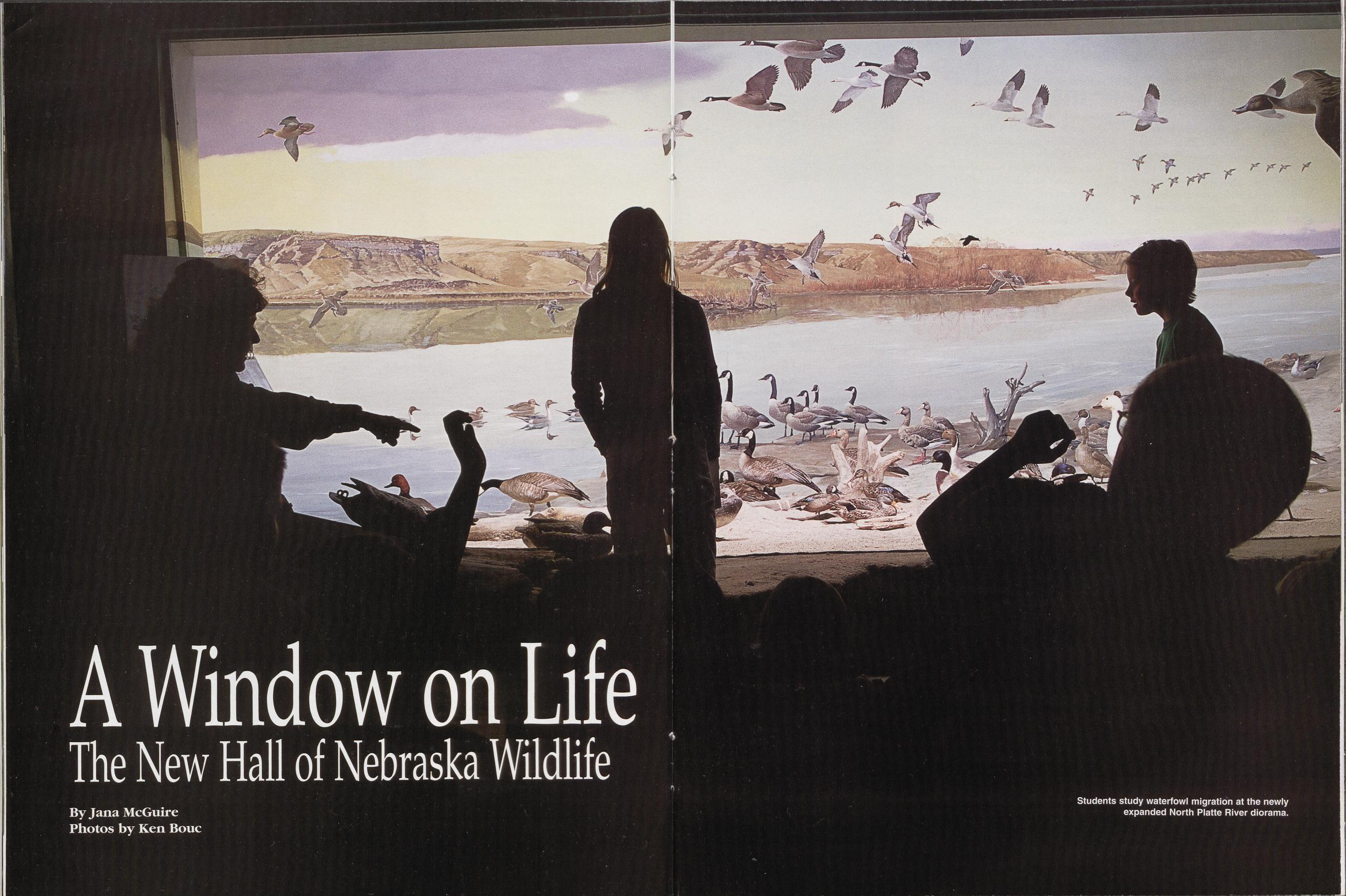
A Window on Life
The New Hall of Nebraska Wildlife
Since 1949, generations of Nebraskans have walked the curved Hall of Nebraska Wildlife in the basement of the University of Nebraska State Museum in Lincoln to peer through the glass at three-dimensional dioramas depicting the state’s diverse ecosystems. The re-creations are so lifelike it’s not unusual to see eager youngsters bump their foreheads on the windows as they walk toward a world they yearn to experience firsthand. Now they can.
The hall is undergoing a renovation that makes it possible for museum visitors to touch, hear and get up-close and personal with environments that previously they could only gaze at. The glass is still in place but the realistic landscapes and some of their inhabitants have been expanded beyond that boundary.
“We want more than just a window,” said Judy Diamond, associate director for public programs at the museum. “We want to put visitors right in the center of the environment and give them an opportunity to explore it much in the same way they would in the natural world.”
Through the work of the museum’s small crew and the expertise of outside consultants, three of the 16 dioramas have been fully renovated in the past seven years to incorporate new sights and sounds, which turn once-static displays into interactive habitats.
The expanded Wildcat Hills diorama, for example, features an extended landscape mimicking the rocky terrain of Banner County in western Nebraska. Not only can visitors pet a magpie perched on a bank, they can push a button to hear his call. Just across the way is another button cuing the sound of a rattlesnake that can be seen only by crouching down to look under a bench built into the side of a small hill.
The original bobcat stalking a pack rat remains intact inside the diorama. Nearby is a new skeletal re-creation of the animals’ poses.
“You explore environments and organisms in a much more diverse way, much like the opportunity afforded to scientists,” said Diamond.
Authenticity is key in re-creating Nebraska’s varied habitats. With each renovation, museum staff has teamed up with scientists, artists, fabricators, technical writers and graphic designers to create true-to-life environments (see story on page 30). From landscapes and animals to insects, plants and grasses, no detail is overlooked or forgotten. You’ll even find models of bison manure and goose droppings. If it’s in a represented ecosystem, it’s probably replicated in the Hall of Nebraska Wildlife.
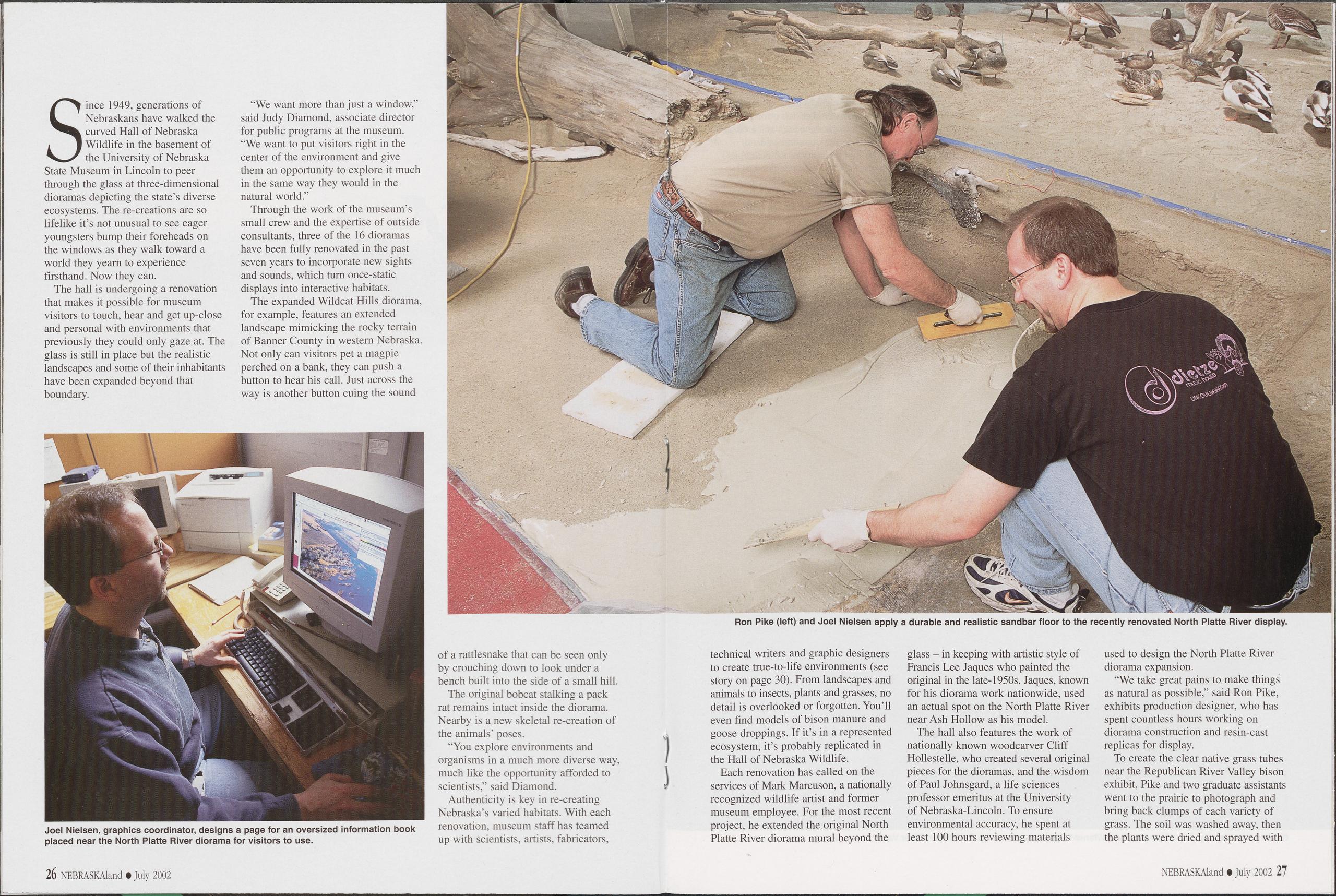
Each renovation has called on the services of Mark Marcuson, a nationally recognized wildlife artist and former museum employee. For the most recent project, he extended the original North Platte River diorama mural beyond the glass - in keeping with artistic style of Francis Lee Jaques who painted the original in the late-1950s. Jaques, known for his diorama work nationwide, used an actual spot on the North Platte River near Ash Hollow as his model.
The hall also features the work of nationally known woodcarver Cliff Hollestelle, who created several original pieces for the dioramas, and the wisdom of Paul Johnsgard, a life sciences professor emeritus at the University of Nebraska-Lincoln. To ensure environmental accuracy, he spent at least 100 hours reviewing materials used to design the North Platte River diorama expansion.
“We take great pains to make things as natural as possible,” said Ron Pike, exhibits production designer, who has spent countless hours working on diorama construction and resin-cast replicas for display.
To create the clear native grass tubes near the Republican River Valley bison exhibit, Pike and two graduate assistants went to the prairie to photograph and bring back clumps of each variety of grass. The soil was washed away, then the plants were dried and sprayed with
26 NEBRASKAland • July 2002 NEBRASKAland • July 2002 27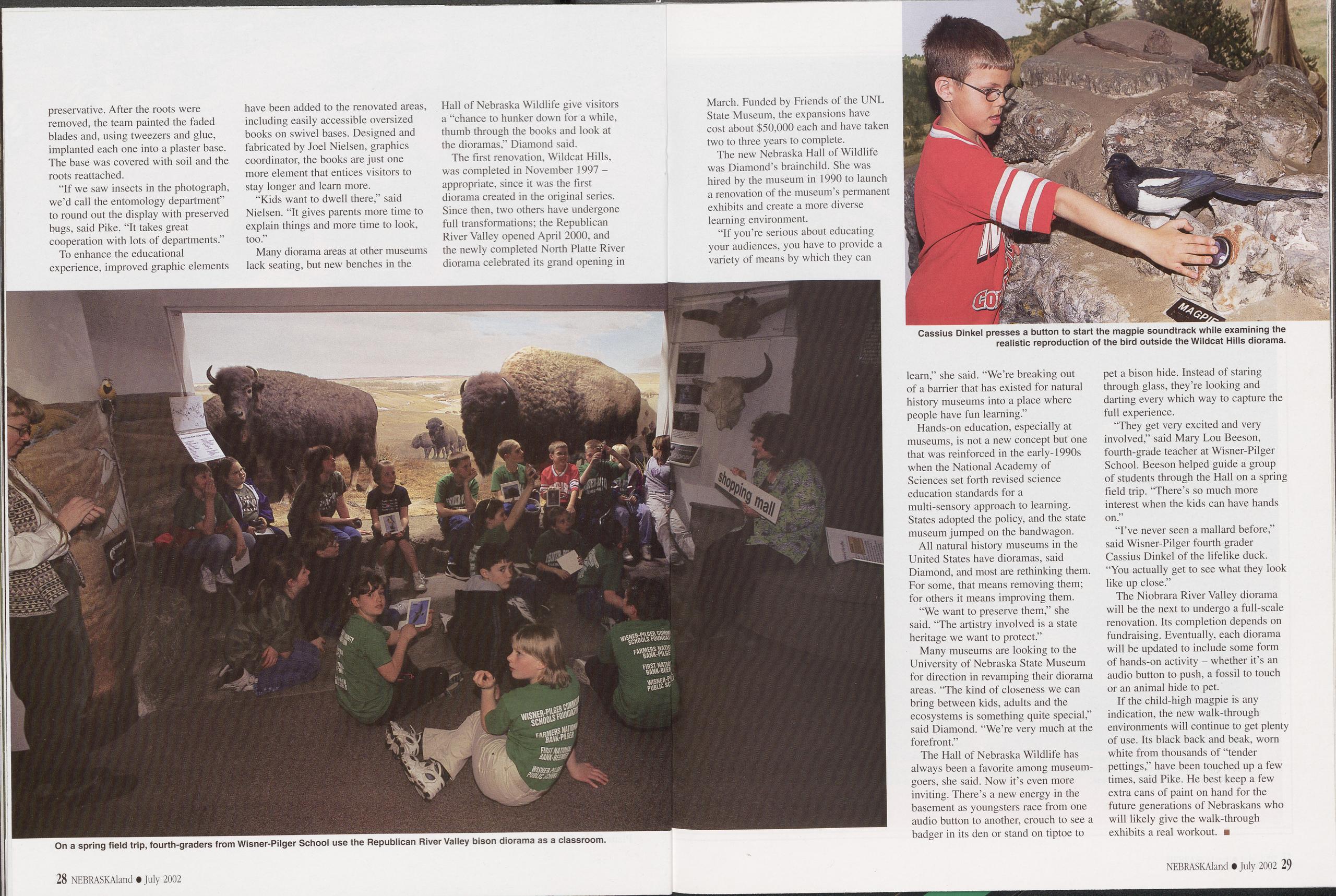
preservative. After the roots were removed, the team painted the faded blades and, using tweezers and glue, implanted each one into a plaster base. The base was covered with soil and the roots reattached.
"If we saw insects in the photograph, we’d call the entomology department” to round out the display with preserved bugs, said Pike. "It takes great cooperation with lots of departments.”
To enhance the educational experience, improved graphic elements On a spring field trip, fourth-graders from Wisner-Pilger School use the Republican River Valley bison diorama as a classroom. have been added to the renovated areas, including easily accessible oversized books on swivel bases. Designed and fabricated by Joel Nielsen, graphics coordinator, the books are just one more element that entices visitors to stay longer and learn more.
"Kids want to dwell there,” said Nielsen. "It gives parents more time to explain things and more time to look, too.”
Many diorama areas at other museums lack seating, but new benches in the Hall of Nebraska Wildlife give visitors a “chance to hunker down for a while, thumb through the books and look at the dioramas,” Diamond said.
The first renovation, Wildcat Hills, was completed in November 1997 - appropriate, since it was the first diorama created in the original series. Since then, two others have undergone full transformations; the Republican River Valley opened April 2000, and the newly completed North Platte River diorama celebrated its grand opening in March. Funded by Friends of the UNL State Museum, the expansions have cost about $50,000 each and have taken two to three years to complete.
The new Nebraska Hall of Wildlife was Diamond’s brainchild. She was hired by the museum in 1990 to launch a renovation of the museum’s permanent exhibits and create a more diverse learning environment.
"If you’re serious about educating your audiences, you have to provide a variety of means by which they can
Hands-on education, especially at museums, is not a new concept but one that was reinforced in the early-1990s when the National Academy of Sciences set forth revised science education standards for a multi-sensory approach to learning. States adopted the policy, and the state museum jumped on the bandwagon.
All natural history museums in the United States have dioramas, said Diamond, and most are rethinking them. For some, that means removing them; for others it means improving them.
"We want to preserve them,” she said. "The artistry involved is a state heritage we want to protect.”
Many museums are looking to the University of Nebraska State Museum for direction in revamping their diorama areas. "The kind of closeness we can bring between kids, adults and the ecosystems is something quite special,” said Diamond. "We’re very much at the forefront.”
The Hall of Nebraska Wildlife has always been a favorite among museum- goers, she said. Now it’s even more inviting. There’s a new energy in the basement as youngsters race from one audio button to another, crouch to see a badger in its den or stand on tiptoe to pet a bison hide. Instead of staring through glass, they’re looking and darting every which way to capture the full experience.
"They get very excited and very involved,” said Mary Lou Beeson, fourth-grade teacher at Wisner-Pilger School. Beeson helped guide a group of students through the Hall on a spring field trip. "There’s so much more interest when the kids can have hands on.”
“I’ve never seen a mallard before,” said Wisner-Pilger fourth grader Cassius Dinkel of the lifelike duck. “You actually get to see what they look like up close.”
The Niobrara River Valley diorama will be the next to undergo a full-scale renovation. Its completion depends on fundraising. Eventually, each diorama will be updated to include some form of hands-on activity - whether it’s an audio button to push, a fossil to touch or an animal hide to pet.
If the child-high magpie is any indication, the new walk-through environments will continue to get plenty of use. Its black back and beak, worn white from thousands of "tender pettings,” have been touched up a few times, said Pike. He best keep a few extra cans of paint on hand for the future generations of Nebraskans who will likely give the walk-through exhibits a real workout.
28 NEBRASKAland • July 2002 NEBRASKAland • July 2002 29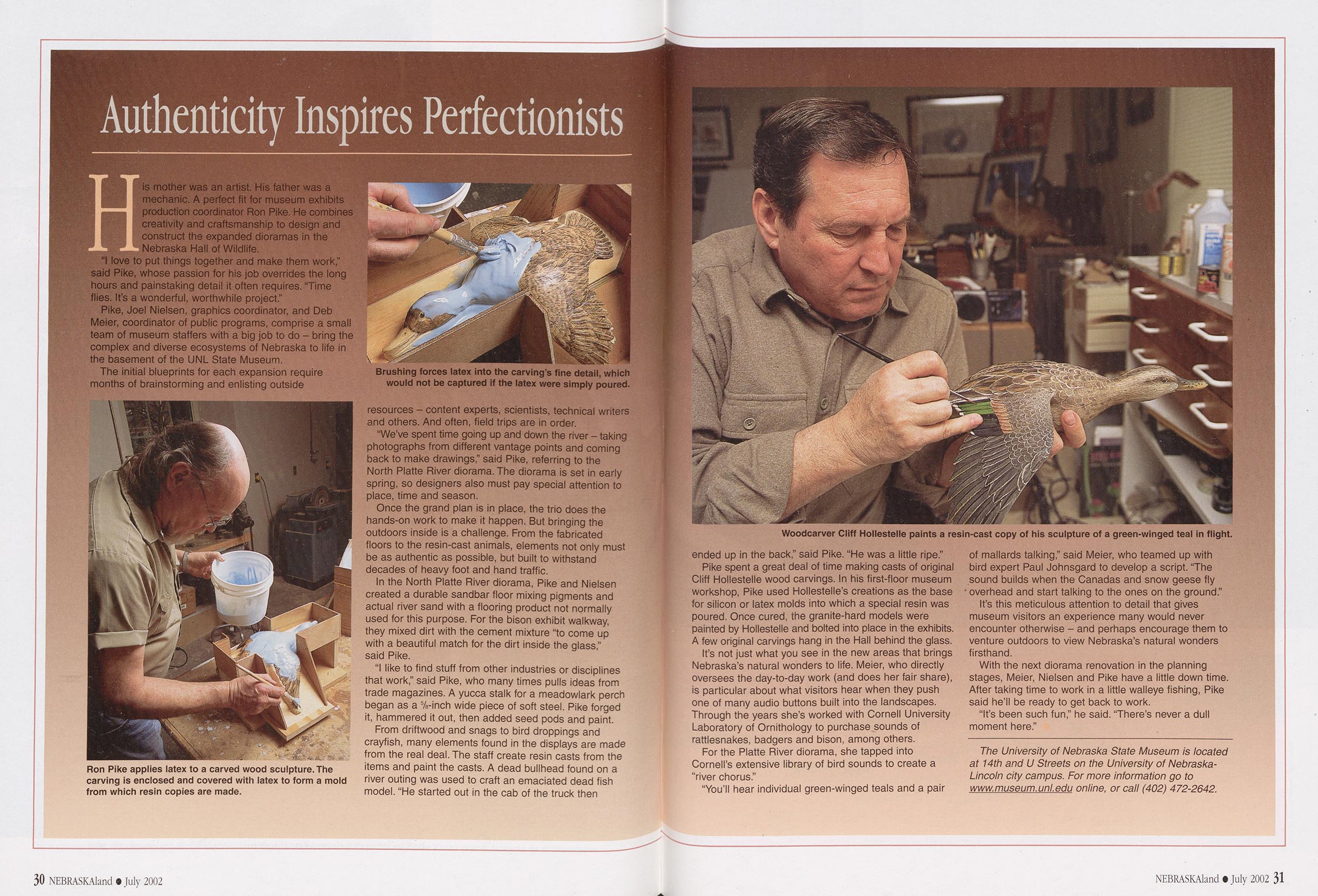
Authenticity Inspires Perfectionists
His mother was an artist. Hist father was a mechanic. A perfect fit for museum exhibits production coordinator Ron Pike. He combines creativity and craftsmanship to design and construct the expanded dioramas in the Nebraska Hall of Wildlife.
"I love to put things together and make them work," said Pike, whose passion for his job overrides the long hours and painstaking detail it often requires. "Time flies. It's a wonderful, worthwhile project."
Pike, Joel Nielsen, graphics coordinator, and Deb Meier, coordinator of public programs, comprise a small team of museum staffers with a big job to do -- bring the complex and diverse ecosystems of Nebraska to life in the basement of the UNL State Museum.
The initial blueprints for each expansion require months of brainstorming and enlisting outside
"We've spent time going up and down the river -- taking photographs from different vantage points and coming back to make drawings," said Pike, referring to the North Platte River diorama. The diorama is set in early spring, so designers also must pay special attention to place, time and season.
Once the grand plan is in place, the trio does the hands-on work to make it happen. But bringing the outdoors inside is a challenge. From the fabricated floors to the resin-case animals, elements not only must be as authentic as possible, but built to withstand decades of heavy foot and hand traffic.
In the North Platte River diorama, Pike and Nielsen created a durable sandbar floor mixing pigments and actual river sand with a flooring product not normally used for this purpose. For the bison exhibit walkway, they mixed dirt with the cement mixture "to come up with a beautiful match for the direct inside the glass," said Pike.
"I like the find stuff from other industries or disciplines that work," said Pike, who many times pulls ideas from trade magazines. A yucca stalk for a meadowlark perch began as a 5/8-inch wide piece of soft steel. Pike forged it, hammered it out, then added seed pods and paint.
From driftwood and snags to bird droppings and crayfish, may elements found in the displays are made from the real deal. The staff create resin casts from the items and paint the casts. A dead bullhead found on a river outing was used to craft an emaciated dead fish model. "He started out in the cab of the truck
Pike spent a great deal of time making casts of original Cliff Hollestelle wood carvings. In his first-floor museum workshop, Pike used Hollestelle's creations as the base for silicon or latex molds into which a special resin was poured. Once cured, the granite-hard models were painted by Hollestelle and bolted into place in the exhibits. A few original carvings hang in the Hall behind the glass.
It's not just what you see in the new areas that brings Nebraska's natural wonders to life. Meier, who directly oversees the day-to-day work (and does her fair share), is particular about what visitors hear when they push one of many audio buttons built into the landscapes. Through the years she's worked with Cornell University Laboratory of Ornithology to purchase sounds of rattlesnakes, badgers and bison, among others.
For the Platte River diorama, she tapped into Cornell's extensive library of bird sounds to create a "river chorus."
"You'll hear individual green-winged teals and a pair of mallards talking," said Meier, who teamed up with bird expert Paul Johnsgard to develop a script. "The sound builds when the Canadas and snow geese fly overhead and start talking to the ones on the ground."
It's this meticulous attention to detail that gives museum visitors an experience many would never encounter otherwise -- an perhaps encourage them to venture outdoors to view Nebraska's natural wonders firsthand.
With the next diorama renovation in the planning stages, Meier, Nielson and Pike have a little down time. After taking time to work in a little walleye fishing, Pike said he'll be ready to get back to work.
"It's been such fun," he said. "There's never a dull moment here."
The University of Nebraska State Museum is located at 14th and U Streets on the University of Nebraska-Lincoln city campus. For more information go to www.musuem.unl.edu online, or call (402) 472-2642.
30 NEBRASKAland • July 2002 NEBRASKAland • July 2002 31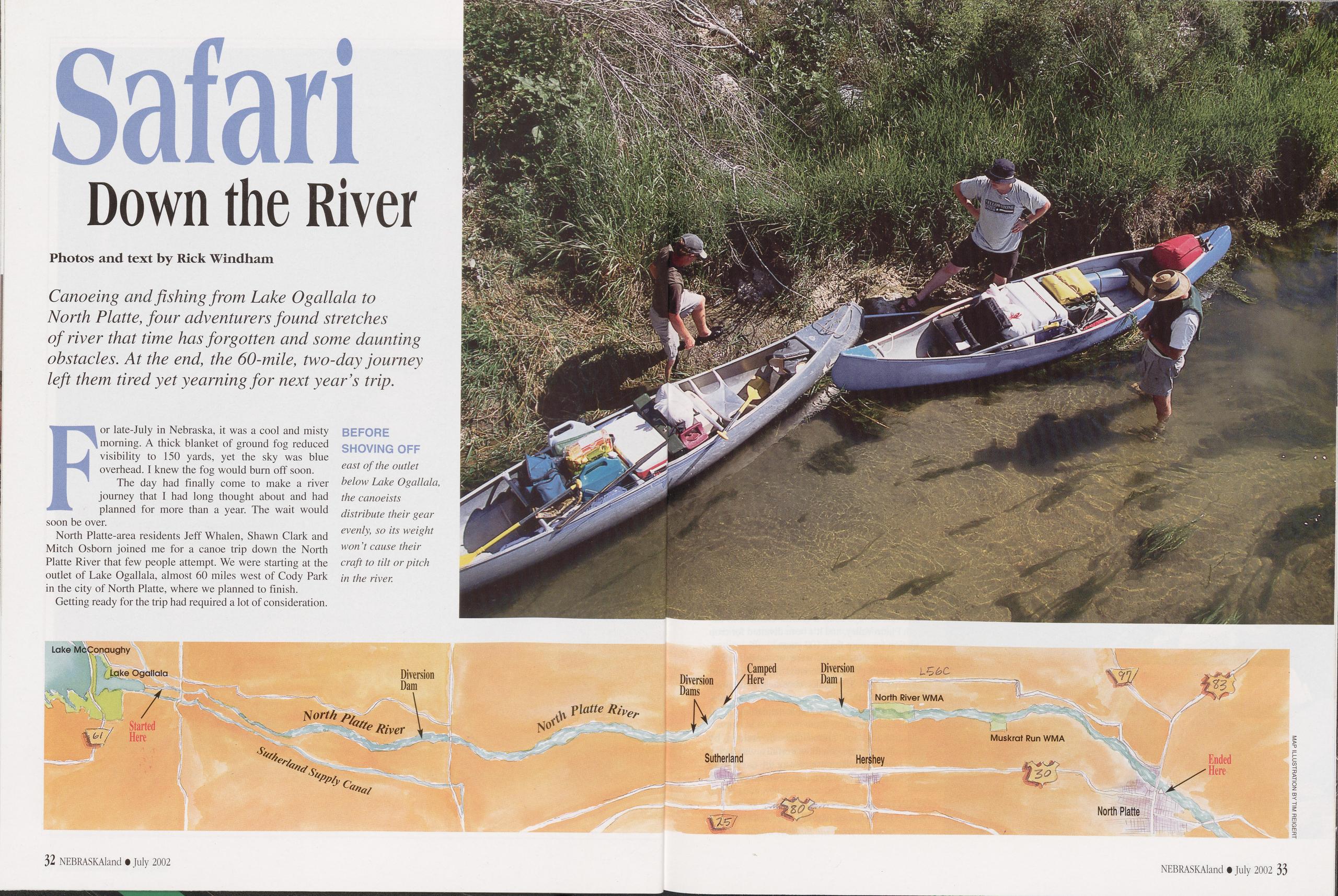
Safari Down the River
Canoeing and fishing from Lake Ogallala to North Platte, four adventurers found stretches of river that time has forgotten and some daunting obstacles. At the end, the 60-mile, two-day journey left them tired yet yearning for next year’s trip.
For late-July in Nebraska, it was a cool and misty morning. A thick blanket of ground fog reduced visibility to 150 yards, yet the sky was blue overhead. I knew the fog would burn off soon.
The day had finally come to make a river journey that I had long thought about and had planned for more than a year. The wait would soon be over.
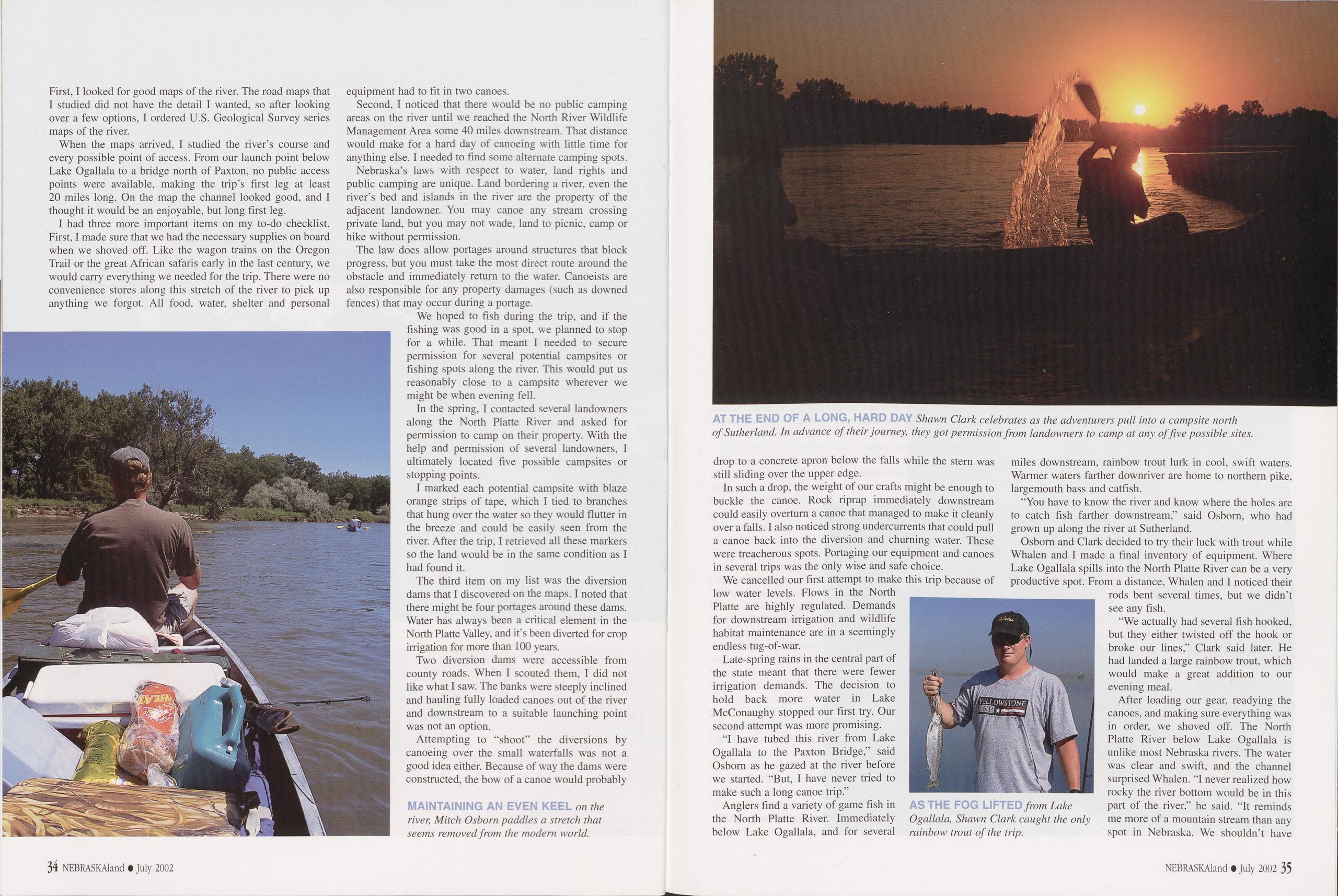
North Platte-area residents Jeff Whalen, Shawn Clark and Mitch Osborn joined me for a canoe trip down the North Platte River that few people attempt. We were starting at the outlet of Lake Ogallala, almost 60 miles west of Cody Park in the city of North Platte, where we planned to finish.
Getting ready for the trip had required a lot of consideration.
Lake McConaughy Lake Ogallala North River WMA Muskrat Run WMA Hershey Sutherland North Platte Ended Here
First, I looked for good maps of the river. The road maps that I studied did not have the detail I wanted, so after looking over a few options, I ordered U.S. Geological Survey series maps of the river.
When the maps arrived, I studied the river’s course and every possible point of access. From our launch point below Lake Ogallala to a bridge north of Paxton, no public access points were available, making the trip’s first leg at least 20 miles long. On the map the channel looked good, and I thought it would be an enjoyable, but long first leg.
I had three more important items on my to-do checklist. First, I made sure that we had the necessary supplies on board when we shoved off. Like the wagon trains on the Oregon Trail or the great African safaris early in the last century, we would carry everything we needed for the trip. There were no convenience stores along this stretch of the river to pick up anything we forgot. All food, water, shelter and personal equipment had to fit in two canoes.
Second, I noticed that there would be no public camping areas on the river until we reached the North River Wildlife Management Area some 40 miles downstream. That distance would make for a hard day of canoeing with little time for anything else. I needed to find some alternate camping spots. Nebraska’s laws with respect to water, land rights and public camping are unique. Land bordering a river, even the river’s bed and islands in the river are the property of the adjacent landowner. You may canoe any stream crossing private land, but you may not wade, land to picnic, camp or hike without permission.
The law does allow portages around structures that block progress, but you must take the most direct route around the obstacle and immediately return to the water. Canoeists are also responsible for any property damages (such as downed fences) that may occur during a portage.
We hoped to fish during the trip, and if the fishing was good in a spot, we planned to stop for a while. That meant I needed to secure permission for several potential campsites or fishing spots along the river. This would put us reasonably close to a campsite wherever we might be when evening fell.
In the spring, I contacted several landowners along the North Platte River and asked for permission to camp on their property. With the help and permission of several landowners, I ultimately located five possible campsites or stopping points.
I marked each potential campsite with blaze orange strips of tape, which I tied to branches that hung over the water so they would flutter in the breeze and could be easily seen from the river. After the trip, I retrieved all these markers so the land would be in the same condition as I had found it.
The third item on my list was the diversion dams that I discovered on the maps. I noted that there might be four portages around these dams. Water has always been a critical element in the North Platte Valley, and it’s been diverted for crop irrigation for more than 100 years.
Two diversion dams were accessible from county roads. When I scouted them, I did not like what I saw. The banks were steeply inclined and hauling fully loaded canoes out of the river and downstream to a suitable launching point was not an option.
Attempting to “shoot” the diversions by canoeing over the small waterfalls was not a good idea either. Because of way the dams were constructed, the bow of a canoe would probably
In such a drop, the weight of our crafts might be enough to buckle the canoe. Rock riprap immediately downstream could easily overturn a canoe that managed to make it cleanly over a falls. I also noticed strong undercurrents that could pull a canoe back into the diversion and churning water. These were treacherous spots. Portaging our equipment and canoes in several trips was the only wise and safe choice.
We cancelled our first attempt to make this trip because of low water levels. Flows in the North Platte are highly regulated. Demands for downstream irrigation and wildlife habitat maintenance are in a seemingly endless tug-of-war.
Late-spring rains in the central part of the state meant that there were fewer irrigation demands. The decision to hold back more water in Lake McConaughy stopped our first try. Our second attempt was more promising.
“I have tubed this river from Lake Ogallala to the Paxton Bridge,” said Osborn as he gazed at the river before we started. “But, I have never tried to make such a long canoe trip.”
Anglers find a variety of game fish in the North Platte River. Immediately below Lake Ogallala, and for several
“You have to know the river and know where the holes are to catch fish farther downstream,” said Osborn, who had grown up along the river at Sutherland.
Osborn and Clark decided to try their luck with trout while Whalen and I made a final inventory of equipment. Where Lake Ogallala spills into the North Platte River can be a very productive spot. From a distance, Whalen and I noticed their rods bent several times, but we didn’t see any fish.
“We actually had several fish hooked, but they either twisted off the hook or broke our lines,” Clark said later. He had landed a large rainbow trout, which would make a great addition to our evening meal.
After loading our gear, readying the canoes, and making sure everything was in order, we shoved off. The North Platte River below Lake Ogallala is unlike most Nebraska rivers. The water was clear and swift, and the channel surprised Whalen. “I never realized how rocky the river bottom would be in this part of the river,” he said. “It reminds me more of a mountain stream than any spot in Nebraska. We shouldn’t have
34 NEBRASKAland • July 2002 NEBRASKAland • July 2002 35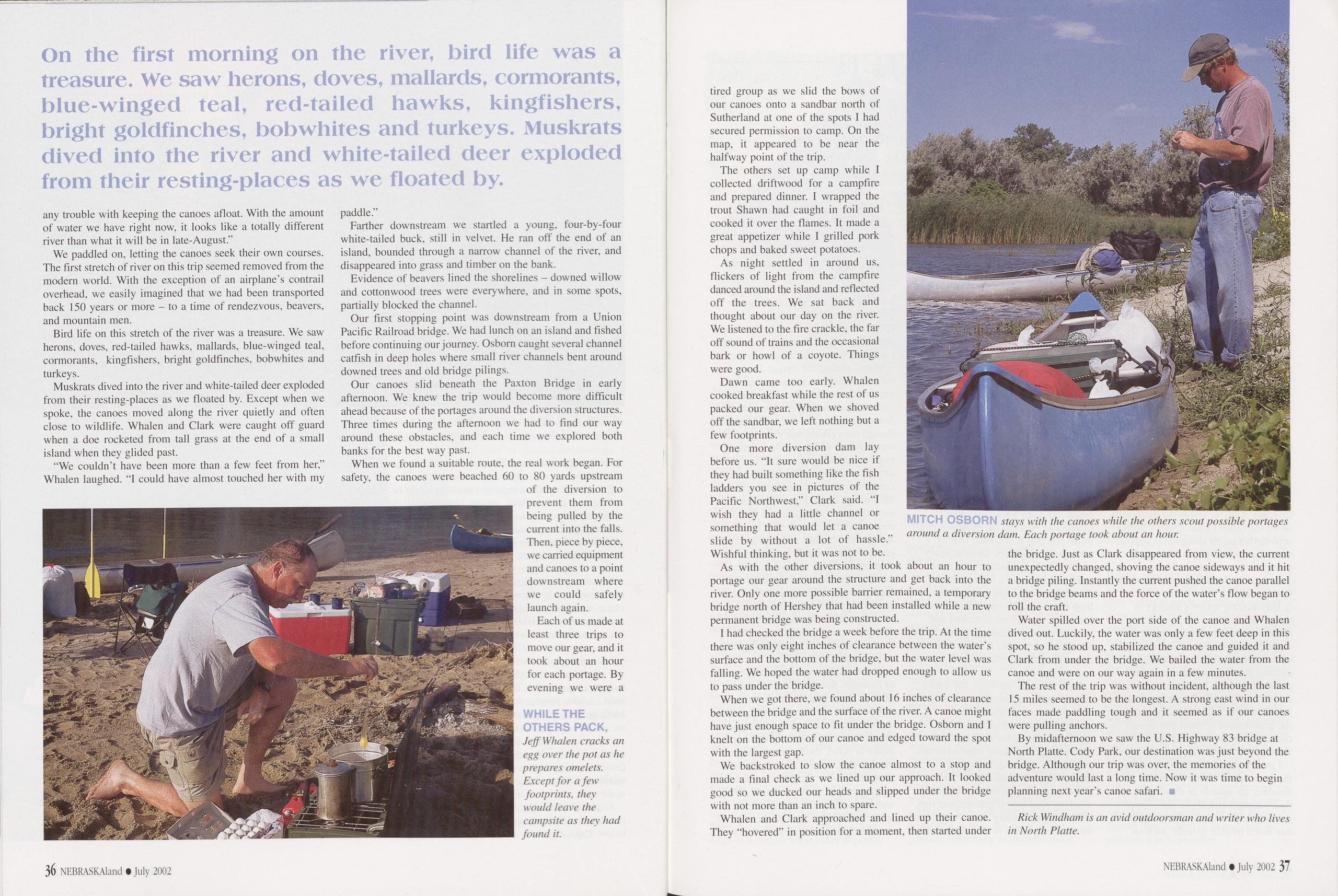 On the first morning on the river, bird life was a treasure. We saw herons, doves, mallards, cormorants, blue-winged teal, red-tailed hawks, kingfishers, bright goldfinches, bobwhites and turkeys. Muskrats dived into the river and white-tailed deer exploded from their resting-places as we floated by.
any trouble with keeping the canoes afloat. With the amount of water we have right now, it looks like a totally different river than what it will be in late-August.”
We paddled on, letting the canoes seek their own courses. The first stretch of river on this trip seemed removed from the modern world. With the exception of an airplane’s contrail overhead, we easily imagined that we had been transported back 150 years or more - to a time of rendezvous, beavers, and mountain men.
Bird life on this stretch of the river was a treasure. We saw herons, doves, red-tailed hawks, mallards, blue-winged teal, cormorants, kingfishers, bright goldfinches, bobwhites and turkeys.
Muskrats dived into the river and white-tailed deer exploded from their resting-places as we floated by. Except when we spoke, the canoes moved along the river quietly and often close to wildlife. Whalen and Clark were caught off guard when a doe rocketed from tall grass at the end of a small island when they glided past.
"We couldn’t have been more than a few feet from her,” Whalen laughed. "I could have almost touched her with my paddle.”
Farther downstream we startled a young, four-by-four white-tailed buck, still in velvet. He ran off the end of an island, bounded through a narrow channel of the river, and disappeared into grass and timber on the bank.
Evidence of beavers lined the shorelines - downed willow and cottonwood trees were everywhere, and in some spots, partially blocked the channel.
Our first stopping point was downstream from a Union Pacific Railroad bridge. We had lunch on an island and fished before continuing our journey. Osborn caught several channel catfish in deep holes where small river channels bent around downed trees and old bridge pilings.
Our canoes slid beneath the Paxton Bridge in early afternoon. We knew the trip would become more difficult ahead because of the portages around the diversion structures. Three times during the afternoon we had to find our way around these obstacles, and each time we explored both banks for the best way past.
When we found a suitable route, the real work began. For safety, the canoes were beached 60 to 80 yards upstream of the diversion to prevent them from being pulled by the current into the falls. Then, piece by piece, we carried equipment and canoes to a point downstream where we could safely launch again.
Each of us made at least three trips to move our gear, and it took about an hour for each portage. By evening we were a
The others set up camp while I collected driftwood for a campfire and prepared dinner. I wrapped the trout Shawn had caught in foil and cooked it over the flames. It made a great appetizer while I grilled pork chops and baked sweet potatoes.
As night settled in around us, flickers of light from the campfire danced around the island and reflected off the trees. We sat back and thought about our day on the river. We listened to the fire crackle, the far off sound of trains and the occasional bark or howl of a coyote. Things were good.
Dawn came too early. Whalen cooked breakfast while the rest of us packed our gear. When we shoved off the sandbar, we left nothing but a few footprints.
One more diversion dam lay before us. "It sure would be nice if they had built something like the fish ladders you see in pictures of the Pacific Northwest,” Clark said. "I wish they had a little channel or something that would let a canoe slide by without a lot of hassle.” Wishful thinking, but it was not to be.
As with the other diversions, it took portage our gear around the structure and get back into the river. Only one more possible barrier remained, a temporary bridge north of Hershey that had been installed while a new permanent bridge was being constructed.
I had checked the bridge a week before the trip. At the time there was only eight inches of clearance between the water’s surface and the bottom of the bridge, but the water level was falling. We hoped the water had dropped enough to allow us to pass under the bridge.
When we got there, we found about 16 inches of clearance between the bridge and the surface of the river. A canoe might have just enough space to fit under the bridge. Osborn and I knelt on the bottom of our canoe and edged toward the spot with the largest gap.
We backstroked to slow the canoe almost to a stop and made a final check as we lined up our approach. It looked good so we ducked our heads and slipped under the bridge with not more than an inch to spare.
Whalen and Clark approached and lined up their canoe. They "hovered” in position for a moment, then started under
Water spilled over the port side of the canoe and Whalen dived out. Luckily, the water was only a few feet deep in this spot, so he stood up, stabilized the canoe and guided it and Clark from under the bridge. We bailed the water from the canoe and were on our way again in a few minutes.
The rest of the trip was without incident, although the last 15 miles seemed to be the longest. A strong east wind in our faces made paddling tough and it seemed as if our canoes were pulling anchors.
By midafternoon we saw the U.S. Highway 83 bridge at North Platte. Cody Park, our destination was just beyond the bridge. Although our trip was over, the memories of the adventure would last a long time. Now it was time to begin planning next year’s canoe safari. ■
A Suitable Patch
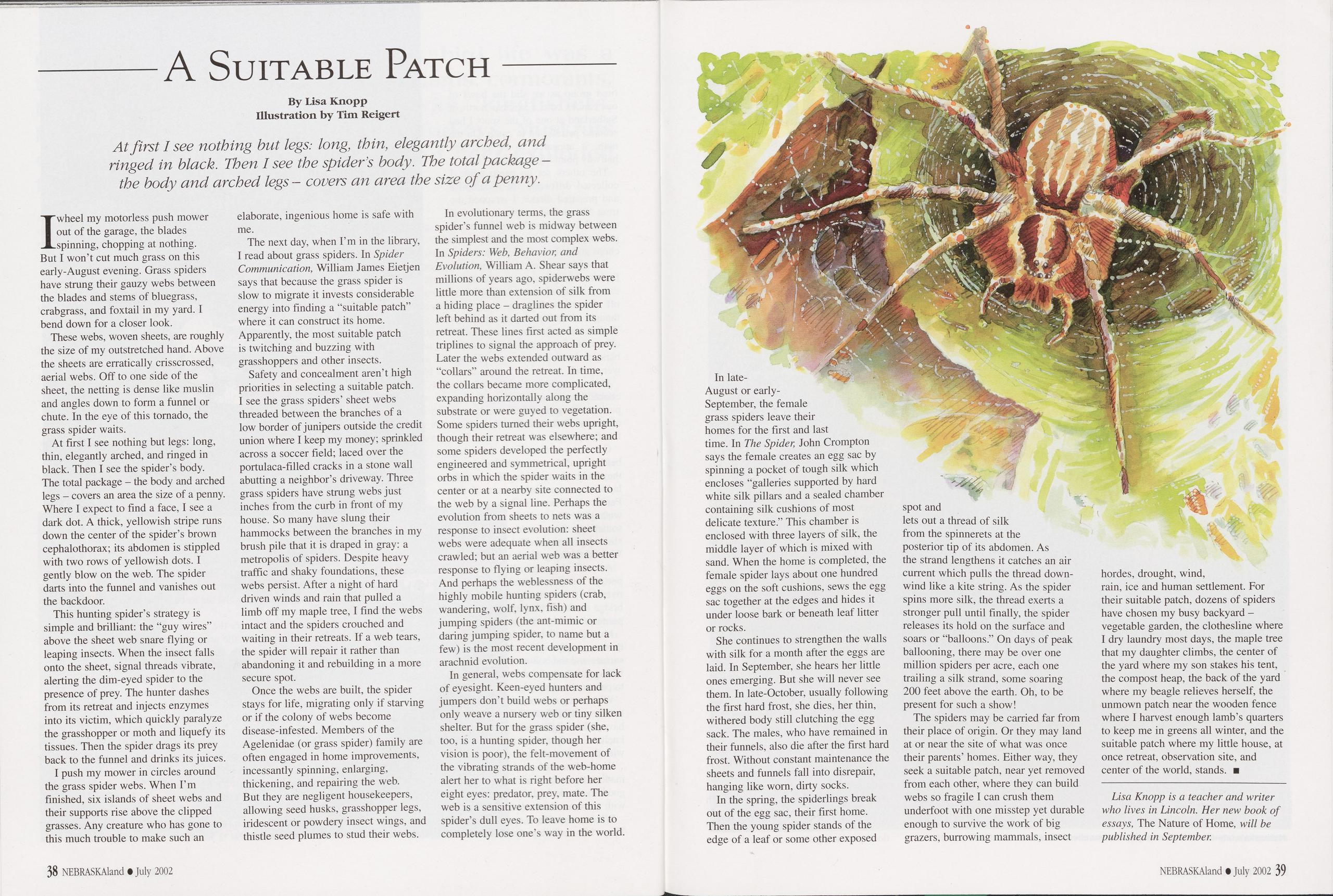
At first I see nothing but legs: long, thin, elegantly arched, and ringed in black. Then I see the spider’s body. The total package - the body and arched legs - covers an area the size of a penny.
I wheel my motorless push mower out of the garage, the blades spinning, chopping at nothing. But I won’t cut much grass on this early-August evening. Grass spiders have strung their gauzy webs between the blades and stems of bluegrass, crabgrass, and foxtail in my yard. I bend down for a closer look.
These webs, woven sheets, are roughly the size of my outstretched hand. Above the sheets are erratically crisscrossed, aerial webs. Off to one side of the sheet, the netting is dense like muslin and angles down to form a funnel or chute. In the eye of this tornado, the grass spider waits.
At first I see nothing but legs: long, thin, elegantly arched, and ringed in black. Then I see the spider’s body. The total package - the body and arched legs - covers an area the size of a penny. Where I expect to find a face, I see a dark dot. A thick, yellowish stripe runs down the center of the spider’s brown cephalothorax; its abdomen is stippled with two rows of yellowish dots. I gently blow on the web. The spider darts into the funnel and vanishes out the backdoor.
This hunting spider’s strategy is simple and brilliant: the "guy wires” above the sheet web snare flying or leaping insects. When the insect falls onto the sheet, signal threads vibrate, alerting the dim-eyed spider to the presence of prey. The hunter dashes from its retreat and injects enzymes into its victim, which quickly paralyze the grasshopper or moth and liquefy its tissues. Then the spider drags its prey back to the funnel and drinks its juices.
I push my mower in circles around the grass spider webs. When I’m finished, six islands of sheet webs and their supports rise above the clipped grasses. Any creature who has gone to this much trouble to make such an elaborate, ingenious home is safe with me.
The next day, when I’m in the library, I read about grass spiders. In Spider Communication, William James Eietjen says that because the grass spider is slow to migrate it invests considerable energy into finding a "suitable patch” where it can construct its home. Apparently, the most suitable patch is twitching and buzzing with grasshoppers and other insects.
Safety and concealment aren’t high priorities in selecting a suitable patch. I see the grass spiders’ sheet webs threaded between the branches of a low border of junipers outside the credit union where I keep my money; sprinkled across a soccer field; laced over the portulaca-filled cracks in a stone wall abutting a neighbor’s driveway. Three grass spiders have strung webs just inches from the curb in front of my house. So many have slung their hammocks between the branches in my brush pile that it is draped in gray: a metropolis of spiders. Despite heavy traffic and shaky foundations, these webs persist. After a night of hard driven winds and rain that pulled a limb off my maple tree, I find the webs intact and the spiders crouched and waiting in their retreats. If a web tears, the spider will repair it rather than abandoning it and rebuilding in a more secure spot.
Once the webs are built, the spider stays for life, migrating only if starving or if the colony of webs become disease-infested. Members of the Agelenidae (or grass spider) family are often engaged in home improvements, incessantly spinning, enlarging, thickening, and repairing the web. But they are negligent housekeepers, allowing seed husks, grasshopper legs, iridescent or powdery insect wings, and thistle seed plumes to stud their webs.
In evolutionary terms, the grass spider’s funnel web is midway between the simplest and the most complex webs. In Spiders: Web, Behavior, and Evolution, William A. Shear says that millions of years ago, spiderwebs were little more than extension of silk from a hiding place - draglines the spider left behind as it darted out from its retreat. These lines first acted as simple triplines to signal the approach of prey. Later the webs extended outward as "collars” around the retreat. In time, the collars became more complicated, expanding horizontally along the substrate or were guyed to vegetation. Some spiders turned their webs upright, though their retreat was elsewhere; and some spiders developed the perfectly engineered and symmetrical, upright orbs in which the spider waits in the center or at a nearby site connected to the web by a signal line. Perhaps the evolution from sheets to nets was a response to insect evolution: sheet webs were adequate when all insects crawled; but an aerial web was a better response to flying or leaping insects. And perhaps the weblessness of the highly mobile hunting spiders (crab, wandering, wolf, lynx, fish) and jumping spiders (the ant-mimic or daring jumping spider, to name but a few) is the most recent development in arachnid evolution.
In general, webs compensate for lack of eyesight. Keen-eyed hunters and jumpers don’t build webs or perhaps only weave a nursery web or tiny silken shelter. But for the grass spider (she, too, is a hunting spider, though her vision is poor), the felt-movement of the vibrating strands of the web-home alert her to what is right before her eight eyes: predator, prey, mate. The web is a sensitive extension of this spider’s dull eyes. To leave home is to completely lose one’s way in the world.
In late- August or early- September, the female grass spiders leave their homes for the first and last time. In The Spider, John Crompton says the female creates an egg sac by spinning a pocket of tough silk which encloses "galleries supported by hard white silk pillars and a sealed chamber containing silk cushions of most delicate texture.” This chamber is enclosed with three layers of silk, the middle layer of which is mixed with sand. When the home is completed, the female spider lays about one hundred eggs on the soft cushions, sews the egg sac together at the edges and hides it under loose bark or beneath leaf litter or rocks.
She continues to strengthen the walls with silk for a month after the eggs are laid. In September, she hears her little ones emerging. But she will never see them. In late-October, usually following the first hard frost, she dies, her thin, withered body still clutching the egg sack. The males, who have remained in their funnels, also die after the first hard frost. Without constant maintenance the sheets and funnels fall into disrepair, hanging like worn, dirty socks.
In the spring, the spiderlings break out of the egg sac, their first home. Then the young spider stands of the edge of a leaf or some other exposed spot and lets out a thread of silk from the spinnerets at the posterior tip of its abdomen. As the strand lengthens it catches an air current which pulls the thread down- wind like a kite string. As the spider spins more silk, the thread exerts a stronger pull until finally, the spider releases its hold on the surface and soars or "balloons.” On days of peak ballooning, there may be over one million spiders per acre, each one trailing a silk strand, some soaring 200 feet above the earth. Oh, to be present for such a show!
The spiders may be carried far from their place of origin. Or they may land at or near the site of what was once their parents’ homes. Either way, they seek a suitable patch, near yet removed from each other, where they can build webs so fragile I can crush them underfoot with one misstep yet durable enough to survive the work of big grazers, burrowing mammals, insect hordes, drought, wind, rain, ice and human settlement. For their suitable patch, dozens of spiders have chosen my busy backyard - vegetable garden, the clothesline where I dry laundry most days, the maple tree that my daughter climbs, the center of the yard where my son stakes his tent, the compost heap, the back of the yard where my beagle relieves herself, the unmown patch near the wooden fence where I harvest enough lamb’s quarters to keep me in greens all winter, and the suitable patch where my little house, at once retreat, observation site, and center of the world, stands. ■
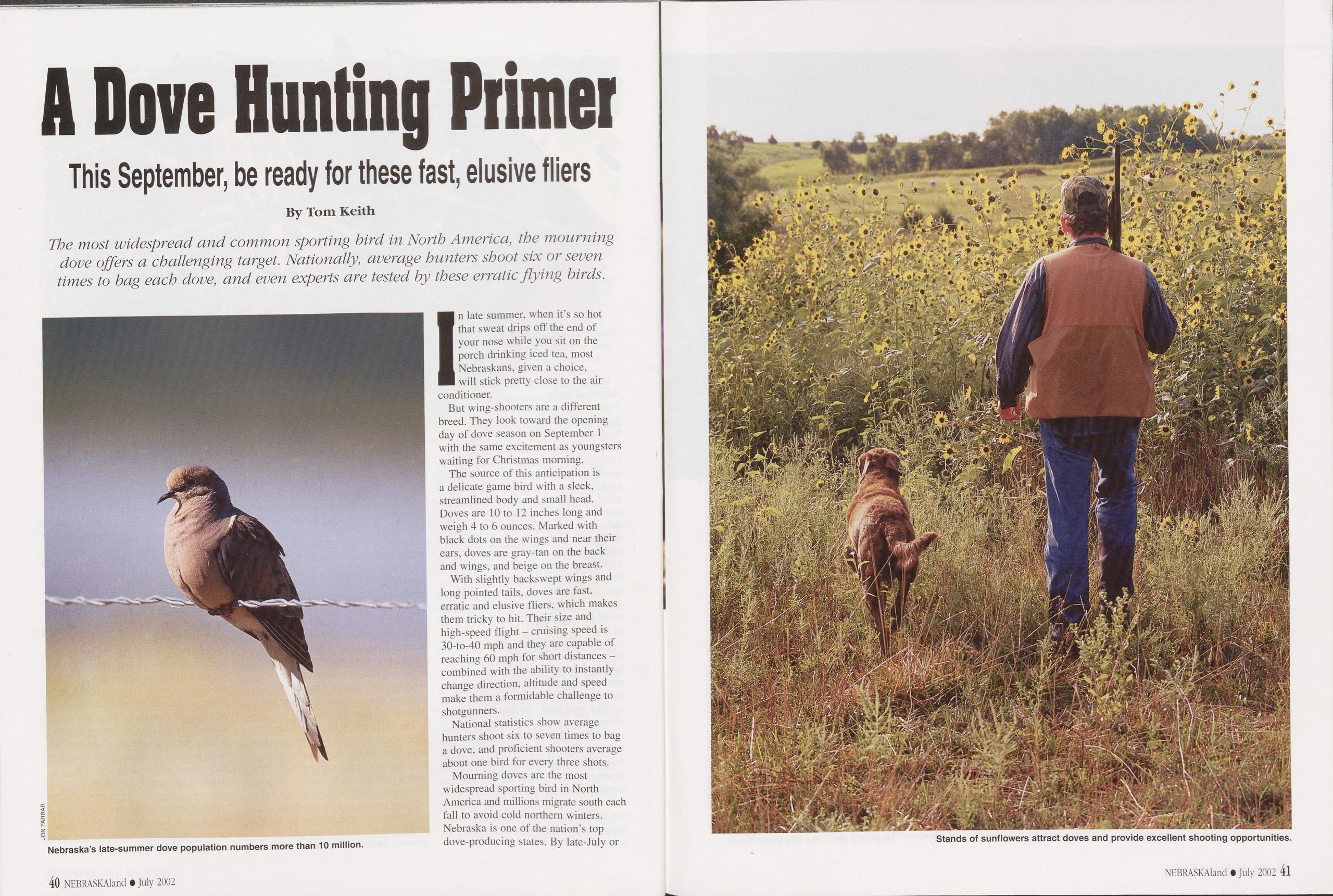
A Dove Hunting Primer
This September, be ready for these fast, elusive fliers
The most widespread and common sporting bird in North America, the mourning dove offers a challenging target. Nationally, average hunters shoot six or seven times to bag each dove, and even experts are tested by these erratic flying birds.In late summer, when it’s so hot that sweat drips off the end of your nose while you sit on the porch drinking iced tea, most Nebraskans, given a choice, will stick pretty close to the air conditioner.
But wing-shooters are a different breed. They look toward the opening day of dove season on September 1 with the same excitement as youngsters waiting for Christmas morning.
The source of this anticipation is a delicate game bird with a sleek, streamlined body and small head. Doves are 10 to 12 inches long and weigh 4 to 6 ounces. Marked with black dots on the wings and near their ears, doves are gray-tan on the back and wings, and beige on the breast.
With slightly backswept wings and long pointed tails, doves are fast, erratic and elusive fliers, which makes them tricky to hit. Their size and high-speed flight - cruising speed is 30-to-40 mph and they are capable of reaching 60 mph for short distances - combined with the ability to instantly change direction, altitude and speed make them a formidable challenge to shotgunners.
National statistics show average hunters shoot six to seven times to bag a dove, and proficient shooters average about one bird for every three shots. Mourning doves are the most widespread sporting bird in North America and millions migrate south each fall to avoid cold northern winters. Nebraska is one of the nation’s top dove-producing states. By late-July or
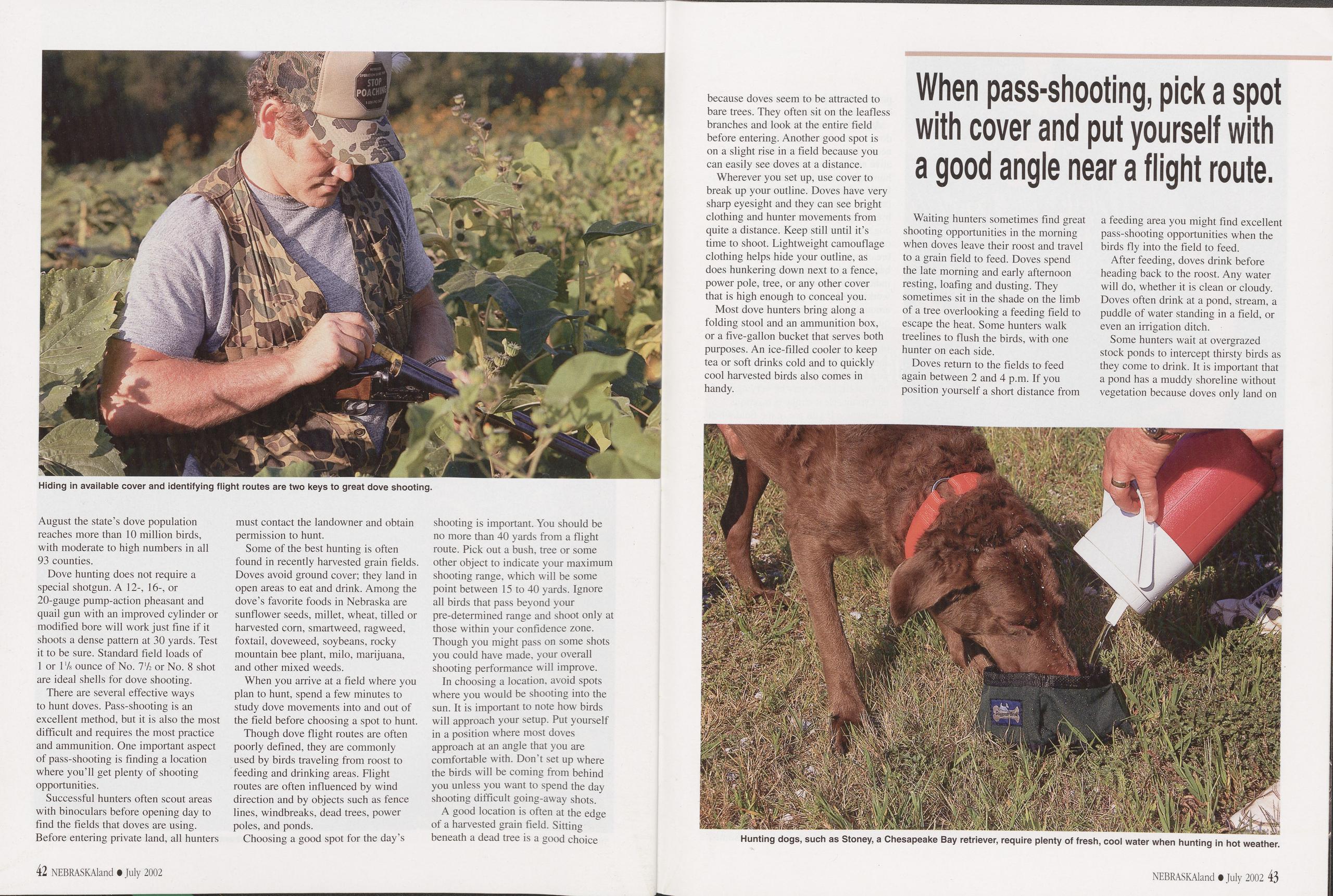
August the state’s dove population reaches more than 10 million birds, with moderate to high numbers in all 93 counties.
Dove hunting does not require a special shotgun. A 12-, 16-, or 20-gauge pump-action pheasant and quail gun with an improved cylinder or modified bore will work just fine if it shoots a dense pattern at 30 yards. Test it to be sure. Standard field loads of 1 or TA ounce of No. 7'A or No. 8 shot are ideal shells for dove shooting.
There are several effective ways to hunt doves. Pass-shooting is an excellent method, but it is also the most difficult and requires the most practice and ammunition. One important aspect of pass-shooting is finding a location where you’ll get plenty of shooting opportunities.
Successful hunters often scout areas with binoculars before opening day to find the fields that doves are using. Before entering private land, all hunters must contact the landowner and obtain permission to hunt.
Some of the best hunting is often found in recently harvested grain fields. Doves avoid ground cover; they land in open areas to eat and drink. Among the dove’s favorite foods in Nebraska are sunflower seeds, millet, wheat, tilled or harvested corn, smartweed, ragweed, foxtail, doveweed, soybeans, rocky mountain bee plant, milo, marijuana, and other mixed weeds.
When you arrive at a field where you plan to hunt, spend a few minutes to study dove movements into and out of the field before choosing a spot to hunt. Though dove flight routes are often poorly defined, they are commonly used by birds traveling from roost to feeding and drinking areas. Flight routes are often influenced by wind direction and by objects such as fence lines, windbreaks, dead trees, power poles, and ponds.
Choosing a good spot for the day’s shooting is important. You should be no more than 40 yards from a flight route. Pick out a bush, tree or some other object to indicate your maximum shooting range, which will be some point between 15 to 40 yards. Ignore all birds that pass beyond your pre-determined range and shoot only at those within your confidence zone. Though you might pass on some shots you could have made, your overall shooting performance will improve.
In choosing a location, avoid spots where you would be shooting into the sun. It is important to note how birds will approach your setup. Put yourself in a position where most doves approach at an angle that you are comfortable with. Don’t set up where the birds will be coming from behind you unless you want to spend the day shooting difficult going-away shots.
A good location is often at the edge of a harvested grain field. Sitting beneath a dead tree is a good choice because doves seem to be attracted to bare trees. They often sit on the leafless branches and look at the entire field before entering. Another good spot is on a slight rise in a field because you can easily see doves at a distance.
Wherever you set up, use cover to break up your outline. Doves have very sharp eyesight and they can see bright clothing and hunter movements from quite a distance. Keep still until it’s time to shoot. Lightweight camouflage clothing helps hide your outline, as does hunkering down next to a fence, power pole, tree, or any other cover that is high enough to conceal you.
Most dove hunters bring along a folding stool and an ammunition box, or a five-gallon bucket that serves both purposes. An ice-filled cooler to keep tea or soft drinks cold and to quickly cool harvested birds also comes in handy.
When pass-shooting, pick a spot with cover and put yourself with a good angle near a flight route. Waiting hunters sometimes find great shooting opportunities in the morning when doves leave their roost and travel to a grain field to feed. Doves spend the late morning and early afternoon resting, loafing and dusting. They sometimes sit in the shade on the limb of a tree overlooking a feeding field to escape the heat. Some hunters walk treelines to flush the birds, with one hunter on each side.
Doves return to the fields to feed again between 2 and 4 p.m. If you position yourself a short distance from a feeding area you might find excellent pass-shooting opportunities when the birds fly into the field to feed.
After feeding, doves drink before heading back to the roost. Any water will do, whether it is clean or cloudy. Doves often drink at a pond, stream, a puddle of water standing in a field, or even an irrigation ditch.
Some hunters wait at overgrazed stock ponds to intercept thirsty birds as they come to drink. It is important that a pond has a muddy shoreline without vegetation because doves only land on
42 NEBRASKAland • July 2002 NEBRASKAland • July 2002 43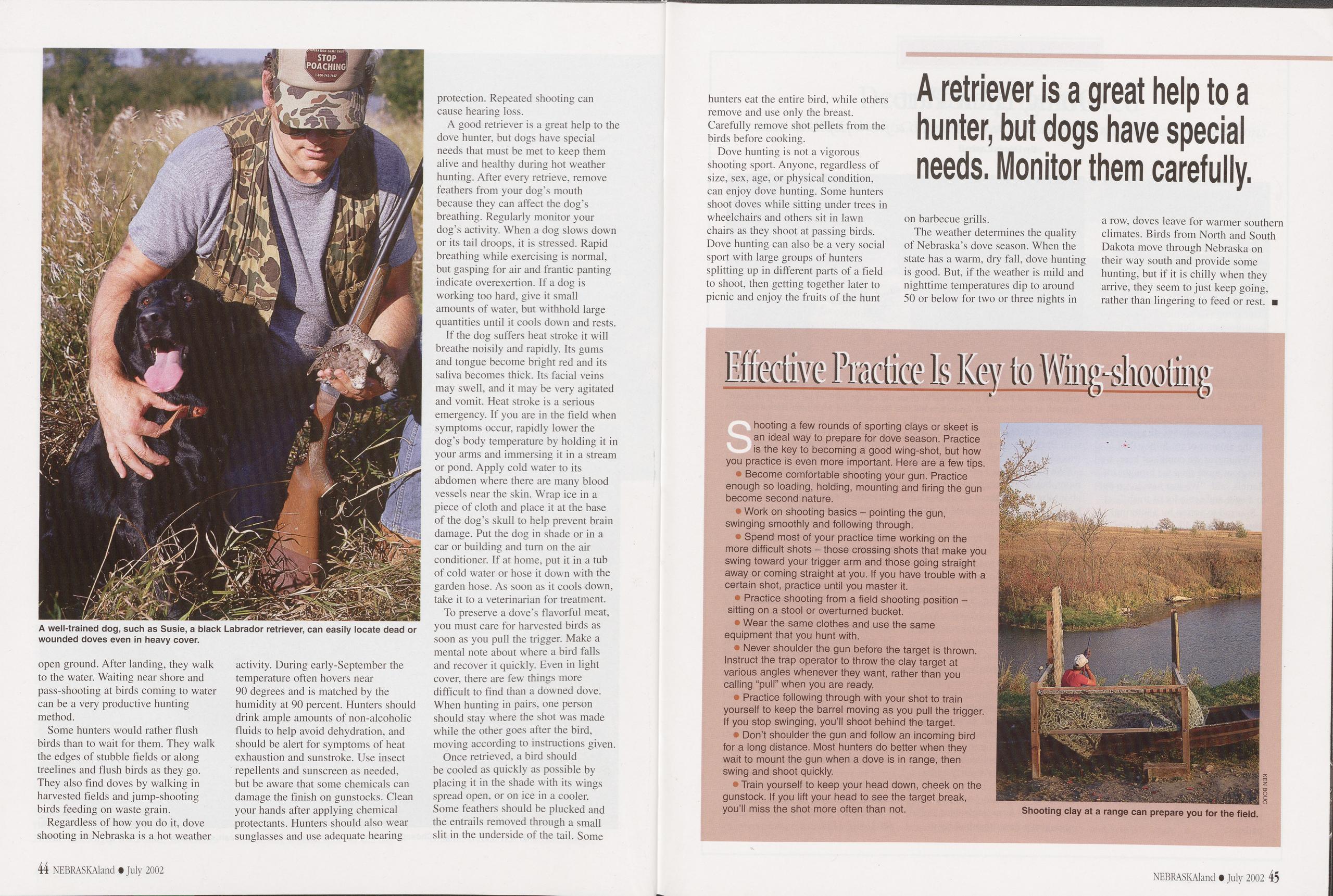
open ground. After landing, they walk to the water. Waiting near shore and pass-shooting at birds coming to water can be a very productive hunting method.
Some hunters would rather flush birds than to wait for them. They walk the edges of stubble fields or along treelines and flush birds as they go. They also find doves by walking in harvested fields and jump-shooting birds feeding on waste grain.
Regardless of how you do it, dove shooting in Nebraska is a hot weather activity. During early-September the temperature often hovers near 90 degrees and is matched by the humidity at 90 percent. Hunters should drink ample amounts of non-alcoholic fluids to help avoid dehydration, and should be alert for symptoms of heat exhaustion and sunstroke. Use insect repellents and sunscreen as needed, but be aware that some chemicals can damage the finish on gunstocks. Clean your hands after applying chemical protectants. Hunters should also wear sunglasses and use adequate hearing protection. Repeated shooting can cause hearing loss.
A good retriever is a great help to the dove hunter, but dogs have special needs that must be met to keep them alive and healthy during hot weather hunting. After every retrieve, remove feathers from your dog’s mouth because they can affect the dog’s breathing. Regularly monitor your dog’s activity. When a dog slows down or its tail droops, it is stressed. Rapid breathing while exercising is normal, but gasping for air and frantic panting indicate overexertion. If a dog is working too hard, give it small amounts of water, but withhold large quantities until it cools down and rests.
If the dog suffers heat stroke it will breathe noisily and rapidly. Its gums and tongue become bright red and its saliva becomes thick. Its facial veins may swell, and it may be very agitated and vomit. Heat stroke is a serious emergency. If you are in the field when symptoms occur, rapidly lower the dog’s body temperature by holding it in your arms and immersing it in a stream or pond. Apply cold water to its abdomen where there are many blood vessels near the skin. Wrap ice in a piece of cloth and place it at the base of the dog’s skull to help prevent brain damage. Put the dog in shade or in a car or building and turn on the air conditioner. If at home, put it in a tub of cold water or hose it down with the garden hose. As soon as it cools down, take it to a veterinarian for treatment.
To preserve a dove’s flavorful meat, you must care for harvested birds as soon as you pull the trigger. Make a mental note about where a bird falls and recover it quickly. Even in light cover, there are few things more difficult to find than a downed dove. When hunting in pairs, one person should stay where the shot was made while the other goes after the bird, moving according to instructions given.
Once retrieved, a bird should be cooled as quickly as possible by placing it in the shade with its wings spread open, or on ice in a cooler. Some feathers should be plucked and the entrails removed through a small slit in the underside of the tail. Some hunters eat the entire bird, while others remove and use only the breast. Carefully remove shot pellets from the birds before cooking.
Dove hunting is not a vigorous shooting sport. Anyone, regardless of size, sex, age, or physical condition, can enjoy dove hunting. Some hunters shoot doves while sitting under trees in wheelchairs and others sit in lawn chairs as they shoot at passing birds. Dove hunting can also be a very social sport with large groups of hunters splitting up in different parts of a field to shoot, then getting together later to picnic and enjoy the fruits of the hunt on barbecue grills.
A retriever is a great help to a hunter, but dogs have special needs. Monitor them carefully.The weather determines the quality of Nebraska’s dove season. When the state has a warm, dry fall, dove hunting is good. But, if the weather is mild and nighttime temperatures dip to around 50 or below for two or three nights in a row, doves leave for warmer southern climates. Birds from North and South Dakota move through Nebraska on their way south and provide some hunting, but if it is chilly when they arrive, they seem to just keep going, rather than lingering to feed or rest. ■
Effective Practice Is Key to Wing-shooting
Shooting a few rounds of sporting clays or skeet is an ideal way to prepare for dove season. Practice is the key to becoming a good wing-shot, but how you practice is even more important. Here are a few tips.
• Become comfortable shooting your gun. Practice enough so loading, holding, mounting and firing the gun become second nature.
• Work on shooting basics - pointing the gun, swinging smoothly and following through.
• Spend most of your practice time working on the more difficult shots - those crossing shots that make you swing toward your trigger arm and those going straight away or coming straight at you. If you have trouble with a certain shot, practice until you master it.
• Practice shooting from a field shooting position - sitting on a stool or overturned bucket. d Wear the same clothes and use the same equipment that you hunt with.
• Never shoulder the gun before the target is thrown. Instruct the trap operator to throw the clay target at various angles whenever they want, rather than you calling "pull" when you are ready.
• Practice following through with your shot to train yourself to keep the barrel moving as you pull the trigger. If you stop swinging, you’ll shoot behind the target.
• Don’t shoulder the gun and follow an incoming bird for a long distance. Most hunters do better when they wait to mount the gun when a dove is in range, then swing and shoot quickly.
• Train yourself to keep your head down, cheek on the gunstock. If you lift your head to see the target break, you’ll miss the shot more often than not.
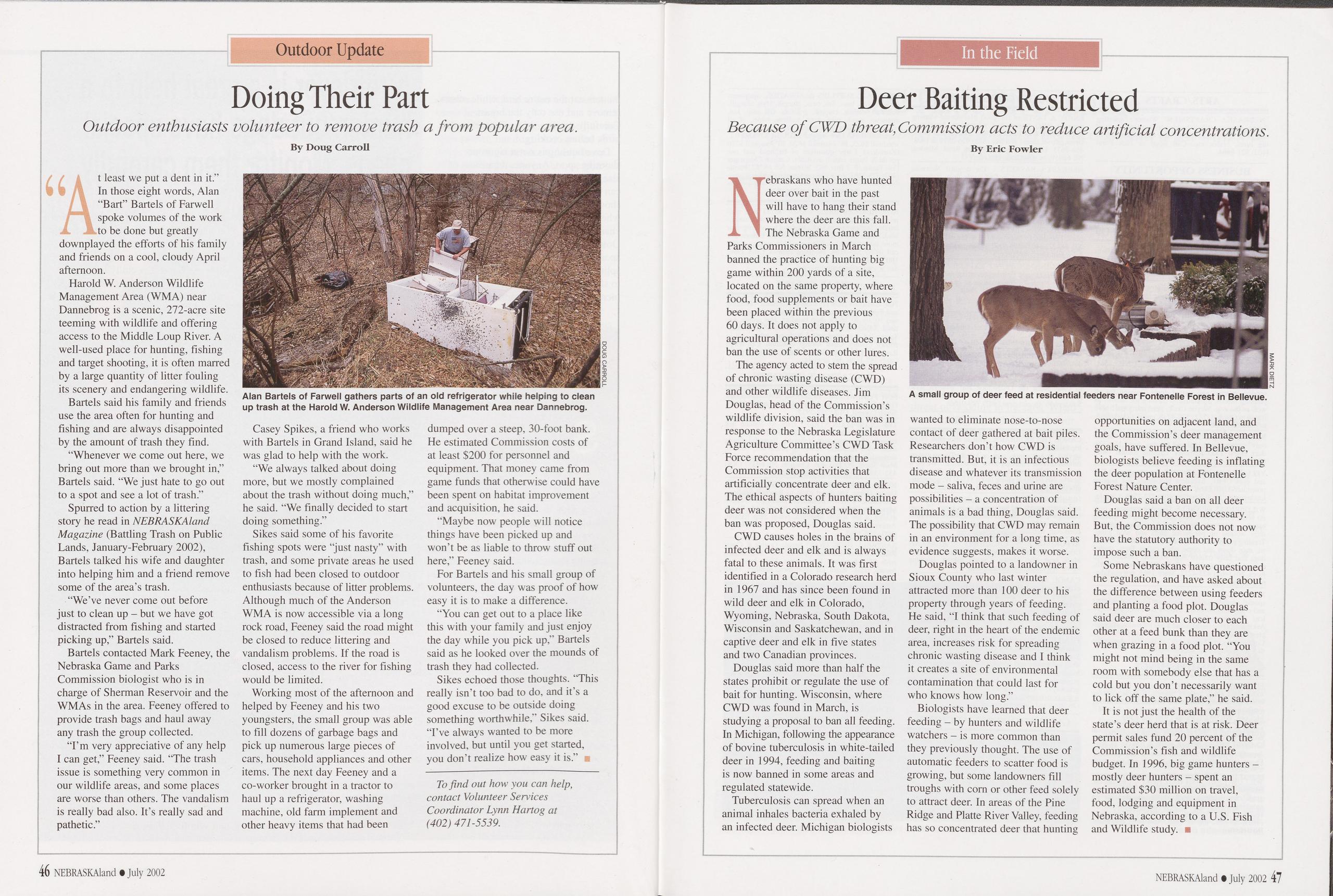
Outdoor Update
Doing Their Part
Outdoor enthusiasts volunteer to remove trash a from popular area.
At least we put a dent in it.” In those eight words, Alan “Bart” Bartels of Farwell spoke volumes of the work to be done but greatly downplayed the efforts of his family and friends on a cool, cloudy April afternoon.
Harold W. Anderson Wildlife Management Area (WMA) near Dannebrog is a scenic, 272-acre site teeming with wildlife and offering access to the Middle Loup River. A well-used place for hunting, fishing and target shooting, it is often marred by a large quantity of litter fouling its scenery and endangering wildlife.
Bartels said his family and friends use the area often for hunting and fishing and are always disappointed by the amount of trash they find.
“Whenever we come out here, we bring out more than we brought in,” Bartels said. “We just hate to go out to a spot and see a lot of trash.”
Spurred to action by a littering story he read in NEBRASKAland Magazine (Battling Trash on Public Lands, January-February 2002), Bartels talked his wife and daughter into helping him and a friend remove some of the area’s trash.
“We’ve never come out before just to clean up - but we have got distracted from fishing and started picking up,” Bartels said.
Bartels contacted Mark Feeney, the Nebraska Game and Parks Commission biologist who is in charge of Sherman Reservoir and the WMAs in the area. Feeney offered to provide trash bags and haul away any trash the group collected.
“I’m very appreciative of any help I can get,” Feeney said. “The trash issue is something very common in our wildlife areas, and some places are worse than others. The vandalism is really bad also. It’s really sad and pathetic.”
Casey Spikes, a friend who works with Bartels in Grand Island, said he was glad to help with the work.
“We always talked about doing more, but we mostly complained about the trash without doing much,” he said. “We finally decided to start doing something.”
Sikes said some of his favorite fishing spots were “just nasty” with trash, and some private areas he used to fish had been closed to outdoor enthusiasts because of litter problems. Although much of the Anderson WMA is now accessible via a long rock road, Feeney said the road might be closed to reduce littering and vandalism problems. If the road is closed, access to the river for fishing would be limited.
Working most of the afternoon and helped by Feeney and his two youngsters, the small group was able to fill dozens of garbage bags and pick up numerous large pieces of cars, household appliances and other items. The next day Feeney and a co-worker brought in a tractor to haul up a refrigerator, washing machine, old farm implement and other heavy items that had been dumped over a steep, 30-foot bank. He estimated Commission costs of at least $200 for personnel and equipment. That money came from game funds that otherwise could have been spent on habitat improvement and acquisition, he said.
“Maybe now people will notice things have been picked up and won’t be as liable to throw stuff out here,” Feeney said.
For Bartels and his small group of volunteers, the day was proof of how easy it is to make a difference.
“You can get out to a place like this with your family and just enjoy the day while you pick up,” Bartels said as he looked over the mounds of trash they had collected.
Sikes echoed those thoughts. “This really isn’t too bad to do, and it’s a good excuse to be outside doing something worthwhile,” Sikes said. “I’ve always wanted to be more involved, but until you get started, you don’t realize how easy it is.”
In the Field
Deer Baiting Restricted
Because of CWD threat, Commission acts to reduce artificial concentrations.
Nebraskans who have hunted deer over bait in the past will have to hang their stand where the deer are this fall. The Nebraska Game and Parks Commissioners in March banned the practice of hunting big game within 200 yards of a site, located on the same property, where food, food supplements or bait have been placed within the previous 60 days. It does not apply to agricultural operations and does not ban the use of scents or other lures.
The agency acted to stem the spread of chronic wasting disease (CWD) and other wildlife diseases. Jim Douglas, head of the Commission’s wildlife division, said the ban was in response to the Nebraska Legislature Agriculture Committee’s CWD Task Force recommendation that the Commission stop activities that artificially concentrate deer and elk. The ethical aspects of hunters baiting deer was not considered when the ban was proposed, Douglas said.
CWD causes holes in the brains of infected deer and elk and is always fatal to these animals. It was first identified in a Colorado research herd in 1967 and has since been found in wild deer and elk in Colorado, Wyoming, Nebraska, South Dakota, Wisconsin and Saskatchewan, and in captive deer and elk in five states and two Canadian provinces.
Douglas said more than half the states prohibit or regulate the use of bait for hunting. Wisconsin, where CWD was found in March, is studying a proposal to ban all feeding. In Michigan, following the appearance of bovine tuberculosis in white-tailed deer in 1994, feeding and baiting is now banned in some areas and regulated statewide.
Tuberculosis can spread when an animal inhales bacteria exhaled by an infected deer. Michigan biologists
Douglas pointed to a landowner in Sioux County who last winter attracted more than 100 deer to his property through years of feeding. He said, “I think that such feeding of deer, right in the heart of the endemic area, increases risk for spreading chronic wasting disease and I think it creates a site of environmental contamination that could last for who knows how long.”
Biologists have learned that deer feeding - by hunters and wildlife watchers - is more common than they previously thought. The use of automatic feeders to scatter food is growing, but some landowners fill troughs with corn or other feed solely to attract deer. In areas of the Pine Ridge and Platte River Valley, feeding has so concentrated deer that hunting opportunities on adjacent land, and the Commission’s deer management goals, have suffered. In Bellevue, biologists believe feeding is inflating the deer population at Fontenelle Forest Nature Center.
Douglas said a ban on all deer feeding might become necessary. But, the Commission does not now have the statutory authority to impose such a ban.
Some Nebraskans have questioned the regulation, and have asked about the difference between using feeders and planting a food plot. Douglas said deer are much closer to each other at a feed bunk than they are when grazing in a food plot. “You might not mind being in the same room with somebody else that has a cold but you don’t necessarily want to lick off the same plate,” he said.
It is not just the health of the state’s deer herd that is at risk. Deer permit sales fund 20 percent of the Commission’s fish and wildlife budget. In 1996, big game hunters - mostly deer hunters - spent an estimated $30 million on travel, food, lodging and equipment in Nebraska, according to a U.S. Fish and Wildlife study. ■
46 NEBRASKAland • July 2002 NEBRASKAland July 2002 47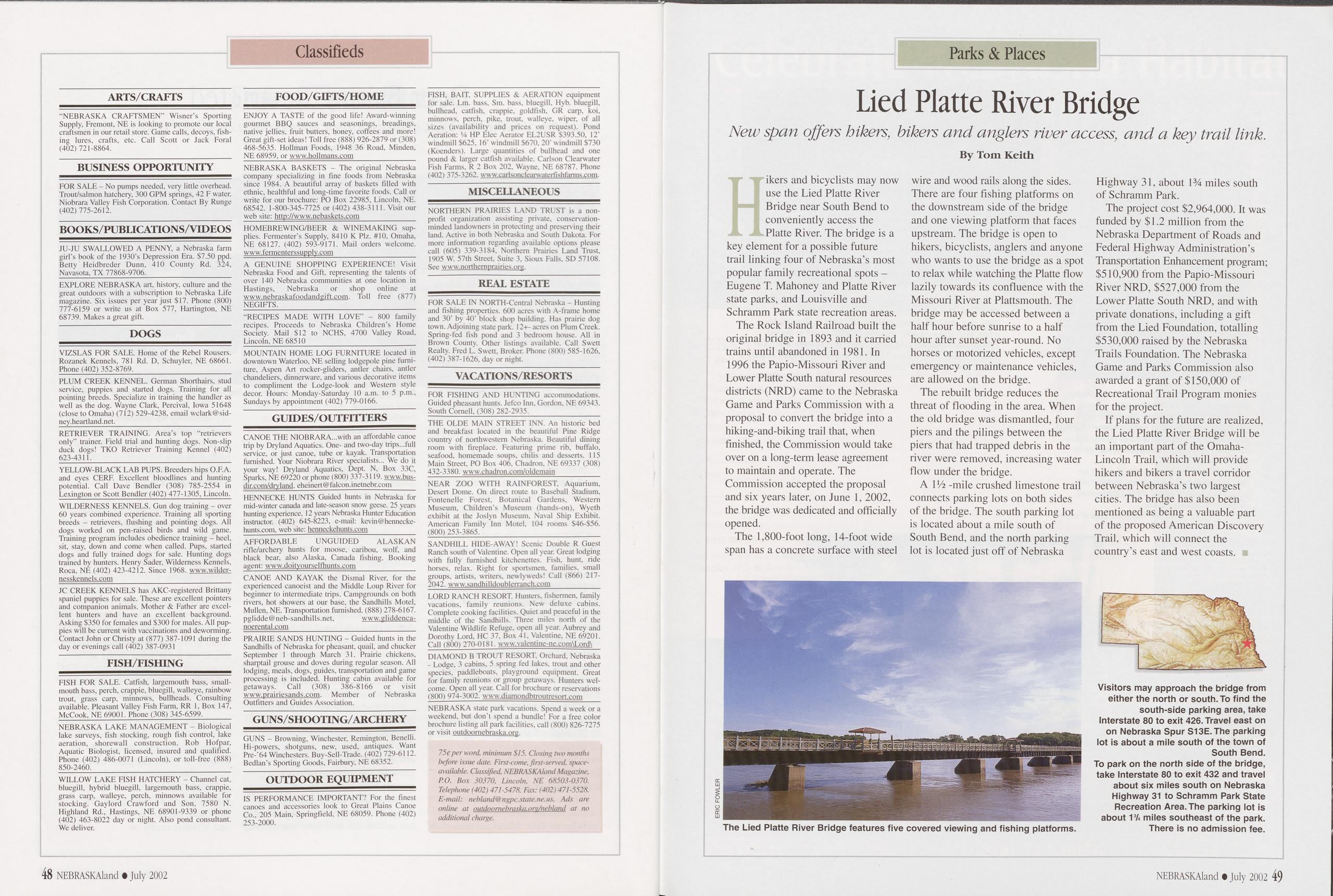
Classifieds
ARTS/CRAFTS“NEBRASKA CRAFTSMEN” Wisner’s Sporting Supply, Fremont, NE is looking to promote our local craftsmen in our retail store. Game calls, decoys, fish- ing lures, crafts, etc. Call Scott or Jack Foral (402) 721-8864.
BUSINESS OPPORTUNITYFOR SALE - No pumps needed, very little overhead. Trout/salmon hatchery, 300 GPM springs, 42 F water. Niobrara Valley Fish Corporation. Contact By Runge (402) 775-2612.
BOOKS/PUBLICATION S/VIDEOSJU-JU SWALLOWED A PENNY, a Nebraska farm girl’s book of the 1930’s Depression Era. $7.50 ppd. Betty Heidbreder Dunn, 410 County Rd. 324, Navasota, TX 77868-9706.
EXPLORE NEBRASKA art, history, culture and the great outdoors with a subscription to Nebraska Life magazine. Six issues per year just $17. Phone (800) 777-6159 or write us at Box 577, Hartington, NE 68739. Makes a great gift.
DOGSVIZSLAS FOR SALE. Home of the Rebel Rousers. Rozanek Kennels, 781 Rd. D, Schuyler, NE 68661. Phone (402) 352-8769.
PLUM CREEK KENNEL. German Shorthairs, stud service, puppies and started dogs. Training for all pointing breeds. Specialize in training the handler as well as the dog. Wayne Clark, Percival, Iowa 51648 (close to Omaha) (712) 529-4238, email wclark@sid- ney.heartland.net.
RETRIEVER TRAINING. Area’s top “retrievers only” trainer. Field trial and hunting dogs. Non-slip duck dogs! TKO Retriever Training Kennel (402) 623-4311.
YELLOW-BLACK LAB PUPS. Breeders hips O.F.A. and eyes CERF. Excellent bloodlines and hunting potential. Call Dave Bendler (308) 785-2554 in Lexington or Scott Bendler (402) 477-1305, Lincoln.
WILDERNESS KENNELS. Gun dog training - over 60 years combined experience. Training all sporting breeds - retrievers, flushing and pointing dogs. All dogs worked on pen-raised birds and wild game. Training program includes obedience training - heel, sit, stay, down and come when called. Pups, started dogs and fully trained dogs for sale. Hunting dogs trained by hunters. Henry Sader, Wilderness Kennels, Roca, NE (402) 423-4212. Since 1968. www.wilder- nesskennels.com
JC CREEK KENNELS has AKC-registered Brittany spaniel puppies for sale. These are excellent pointers and companion animals. Mother & Father are excel- lent hunters and have an excellent background. Asking $350 for females and $300 for males. All pup- pies will be current with vaccinations and deworming. Contact John or Christy at (877) 387-1091 during the day or evenings call (402) 387-0931
FISH/FISHINGFISH FOR SALE. Catfish, largemouth bass, small- mouth bass, perch, crappie, bluegill, walleye, rainbow trout, grass carp, minnows, bullheads. Consulting available. Pleasant Valley Fish Farm, RR 1, Box 147, McCook, NE 69001. Phone (308) 345-6599.
NEBRASKA LAKE MANAGEMENT - Biological lake surveys, fish stocking, rough fish control, lake aeration, shorewall construction. Rob Hofpar, Aquatic Biologist, licensed, insured and qualified. Phone (402) 486-0071 (Lincoln), or toll-free (888) 850-2460.
WILLOW LAKE FISH HATCHERY - Channel cat, bluegill, hybrid bluegill, largemouth bass, crappie, grass carp, walleye, perch, minnows available for stocking. Gaylord Crawford and Son, 7580 N. Highland Rd., Hastings, NE 68901-9339 or phone (402) 463-8022 day or night. Also pond consultant. We deliver.
FOOD/GIFTS/HOMEENJOY A TASTE of the good life! Award-winning gourmet BBQ sauces and seasonings, breadings, native jellies, fruit butters, honey, coffees and more! Great gift-set ideas! Toll free (888) 926-2879 or (308) 468-5635. Hollman Foods, 1948 36 Road, Minden, NE 68959, or www.hollmans.com
NEBRASKA BASKETS - The original Nebraska company specializing in fine foods from Nebraska since 1984. A beautiful array of baskets filled with ethnic, healthful and long-time favorite foods. Call or write for our brochure: PO Box 22985, Lincoln, NE. 68542. 1-800-345-7725 or (402) 438-3111. Visit our web site: http://www.nebaskets.com
HOMEBREWING/BEER & WINEMAKING sup- plies. Fermenter’s Supply, 8410 K Plz. #10, Omaha, NE 68127. (402) 593-9171. Mail orders welcome. www.fermenterssupply.com
A GENUINE SHOPPING EXPERIENCE! Visit Nebraska Food and Gift, representing the talents of over 140 Nebraska communities at one location in Hastings, Nebraska or shop online at www.nebraskafoodandgift.com. Toll free (877) NEGIFTS.
“RECIPES MADE WITH LOVE” - 800 family recipes. Proceeds to Nebraska Children’s Home Society. Mail $12 to NCHS, 4700 Valley Road, Lincoln, NE 68510
MOUNTAIN HOME LOG FURNITURE located in downtown Waterloo, NE selling lodgepole pine furni- ture, Aspen Art rocker-gliders, antler chairs, antler chandeliers, dinnerware, and various decorative items to compliment the Lodge-look and Western style decor. Hours: Monday-Saturday 10 a.m. to 5 p.m., Sundays by appointment (402) 779-0166.
GUIDES/OUTFITTERSCANOE THE NIOBRARA...with an affordable canoe trip by Dryland Aquatics. One- and two-day trips...full service, or just canoe, tube or kayak. Transportation furnished. Your Niobrara River specialists... We do it your way! Dryland Aquatics, Dept. N, Box 33C, Sparks, NE 69220 or phone (800) 337-3119. www.bus- dir.com/dryland. eheinert@falcon.inetnebr.com
HENNECKE HUNTS Guided hunts in Nebraska for mid-winter Canada and late-season snow geese. 25 years hunting experience, 12 years Nebraska Hunter Education instructor. (402) 645-8223, e-mail: kevin@hennecke- hunts.com, web site: henneckehunts.com
AFFORDABLE UNGUIDED ALASKAN rifle/archery hunts for moose, caribou, wolf, and black bear, also Alaska, Canada fishing. Booking agent: www.doitvourselfhunts.com
CANOE AND KAYAK the Dismal River, for the experienced canoeist and the Middle Loup River for beginner to intermediate trips. Campgrounds on both rivers, hot showers at our base, the Sandhills Motel, Mullen, NE. Transportation furnished. (888) 278-6167. pglidde@neb-sandhills.net, www.gliddenca- noerental.com
PRAIRIE SANDS HUNTING - Guided hunts in the Sandhills of Nebraska for pheasant, quail, and chucker September 1 through March 31. Prairie chickens, sharptail grouse and doves during regular season. All lodging, meals, dogs, guides, transportation and game processing is included. Hunting cabin available for getaways. Call (308) 386-8166 or visit www.prairiesands.com. Member of Nebraska Outfitters and Guides Association.
GUNS/SHOOTING/ARCHERYGUNS - Browning, Winchester, Remington, Benelli. Hi-powers, shotguns, new, used, antiques. Want Pre-’64 Winchesters. Buy-Sell-Trade. (402) 729-6112. Bedlan’s Sporting Goods, Fairbury, NE 68352.
OUTDOOR EQUIPMENTIS PERFORMANCE IMPORTANT? For the finest canoes and accessories look to Great Plains Canoe Co., 205 Main, Springfield, NE 68059. Phone (402) 253-2000.
FISH, BAIT, SUPPLIES & AERATION equipment for sale. Lm. bass, Sm. bass, bluegill, Hyb. bluegill, bullhead, catfish, crappie, goldfish, GR carp, koi, minnows, perch, pike, trout, walleye, wiper, of all sizes (availability and prices on request). Pond Aeration: 14 HP Elec Aerator EL2USR $393.50, 12’ windmill $625, 16’ windmill $670, 20’ windmill $730 (Koenders). Large quantities of bullhead and one pound & larger catfish available. Carlson Clearwater Fish Farms, R 2 Box 202, Wayne, NE 68787. Phone (402) 375-3262. www.carlsonclearwaterfishfarms.com.
MISCELLANEOUSNORTHERN PRAIRIES LAND TRUST is a non- profit organization assisting private, conservation- minded landowners in protecting and preserving their land. Active in both Nebraska and South Dakota. For more information regarding available options please call (605) 339-3184, Northern Prairies Land Trust, 1905 W. 57th Street, Suite 3, Sioux Falls, SD 57108. See www.northemprairies.org.
REAL ESTATEFOR SALE IN NORTH-Central Nebraska - Hunting and fishing properties. 600 acres with A-frame home and 30’ by 40’ block shop building. Has prairie dog town. Adjoining state park. 12+- acres on Plum Creek. Spring-fed fish pond and 3 bedroom house. All in Brown County. Other listings available. Call Swett Realty. Fred L. Swett, Broker. Phone (800) 585-1626, (402) 387-1626, day or night.
VACATIONS/RESORTSFOR FISHING AND HUNTING accommodations. Guided pheasant hunts. Jefco Inn, Gordon, NE 69343. South Cornell, (308) 282-2935.
THE OLDE MAIN STREET INN. An historic bed and breakfast located in the beautiful Pine Ridge country of northwestern Nebraska. Beautiful dining room with fireplace. Featuring prime rib, buffalo, seafood, homemade soups, chilis and desserts. 115 Main Street, PO Box 406, Chadron, NE 69337 (308) 432-3380. www.chadron.com/oldemain
NEAR ZOO WITH RAINFOREST. Aquarium, Desert Dome. On direct route to Baseball Stadium, Fontenelle Forest, Botanical Gardens, Western Museum, Children’s Museum (hands-on), Wyeth exhibit at the Joslyn Museum, Naval Ship Exhibit. American Family Inn Motel, 104 rooms $46-$56. (800) 253-3865.
SANDHILL HIDE-AWAY! Scenic Double R Guest Ranch south of Valentine. Open all year. Great lodging with fully furnished kitchenettes. Fish, hunt, ride horses, relax. Right for sportsmen, families, small groups, artists, writers, newlyweds! Call (866) 217- 2042. www.sandhilldoublerranch.com
LORD RANCH RESORT. Hunters, fishermen, family vacations, family reunions. New deluxe cabins. Complete cooking facilities. Quiet and peaceful in the middle of the Sandhills. Three miles north of the Valentine Wildlife Refuge, open all year. Aubrey and Dorothy Lord, HC 37, Box 41, Valentine, NE 69201. Call (800) 270-0181. www.valentine-ne.com\Lord\
DIAMOND B TROUT RESORT, Orchard, Nebraska - Lodge, 3 cabins, 5 spring fed lakes, trout and other species, paddleboats, playground equipment. Great for family reunions or group getaways. Hunters wel- come. Open all year. Call for brochure or reservations (800) 974-3002, www.diamondbtroutresort.com
NEBRASKA state park vacations. Spend a week or a weekend, but don’t spend a bundle! For a free color brochure listing all park facilities, call (800) 826-7275 or visit outdoomebraska.org.
75c per word, minimum $15. Closing two months before issue date. First-come, first-served, space- available. Classified, NEBRASKAland Magazine, P.O. Box 30370, Lincoln, NE 68503-0370. Telephone (402) 471-5478. Fax: (402) 471-5528. E-mail: nebland@ngpc.state.ne.us. Ads are online at outdoomebraska.org/nebland at no additional charge.
Parks & Places
Lied Platte River Bridge
New span offers hikers, bikers and anglers river access, and a key trail link.
Hikers and bicyclists may now use the Lied Platte River Bridge near South Bend to conveniently access the Platte River. The bridge is a key element for a possible future trail linking four of Nebraska’s most popular family recreational spots - Eugene T. Mahoney and Platte River state parks, and Louisville and Schramm Park state recreation areas.
The Rock Island Railroad built the original bridge in 1893 and it carried trains until abandoned in 1981. In 1996 the Papio-Missouri River and Lower Platte South natural resources districts (NRD) came to the Nebraska Game and Parks Commission with a proposal to convert the bridge into a hiking-and-biking trail that, when finished, the Commission would take over on a long-term lease agreement to maintain and operate. The Commission accepted the proposal and six years later, on June 1, 2002, the bridge was dedicated and officially opened.
The 1,800-foot long, 14-foot wide span has a concrete surface with steel
The rebuilt bridge reduces the threat of flooding in the area. When the old bridge was dismantled, four piers and the pilings between the piers that had trapped debris in the river were removed, increasing water flow under the bridge.
A Wi -mile crushed limestone trail connects parking lots on both sides of the bridge. The south parking lot is located about a mile south of South Bend, and the north parking lot is located just off of Nebraska Highway 31, about 13A miles south of Schramm Park.
The project cost $2,964,000. It was funded by $1.2 million from the Nebraska Department of Roads and Federal Highway Administration’s Transportation Enhancement program; $510,900 from the Papio-Missouri River NRD, $527,000 from the Lower Platte South NRD, and with private donations, including a gift from the Lied Foundation, totalling $530,000 raised by the Nebraska Trails Foundation. The Nebraska Game and Parks Commission also awarded a grant of $150,000 of Recreational Trail Program monies for the project.
If plans for the future are realized, the Lied Platte River Bridge will be an important part of the Omaha- Lincoln Trail, which will provide hikers and bikers a travel corridor between Nebraska’s two largest cities. The bridge has also been mentioned as being a valuable part of the proposed American Discovery Trail, which will connect the country’s east and west coasts.
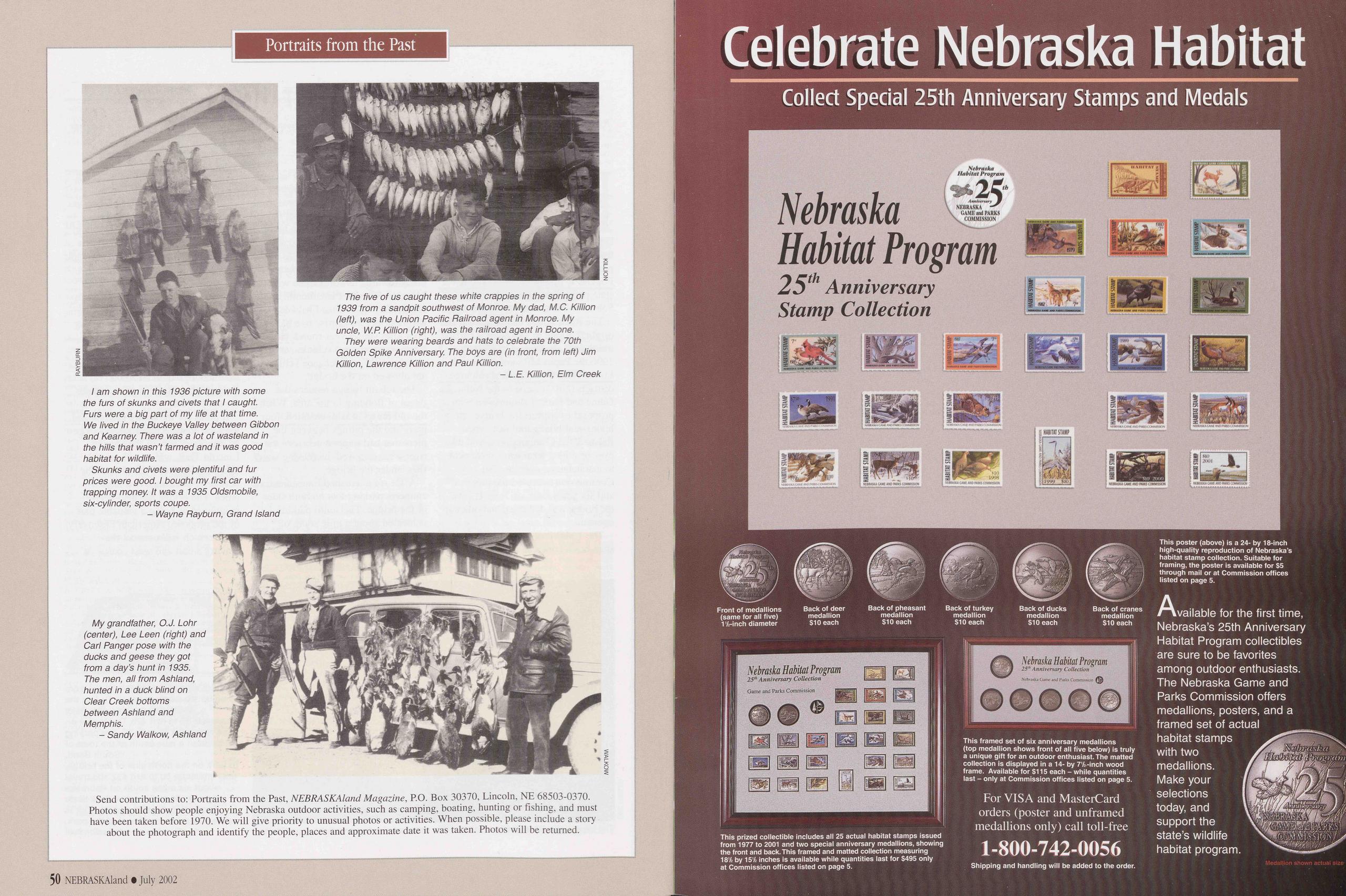
Portraits from the Past
Position: 467 (22 views)