Volume 80, Issue 5, 2002
NEBRASKAland
Nebraska Game & Parks Commission June 2002 • $2.50
NEBRASKAland
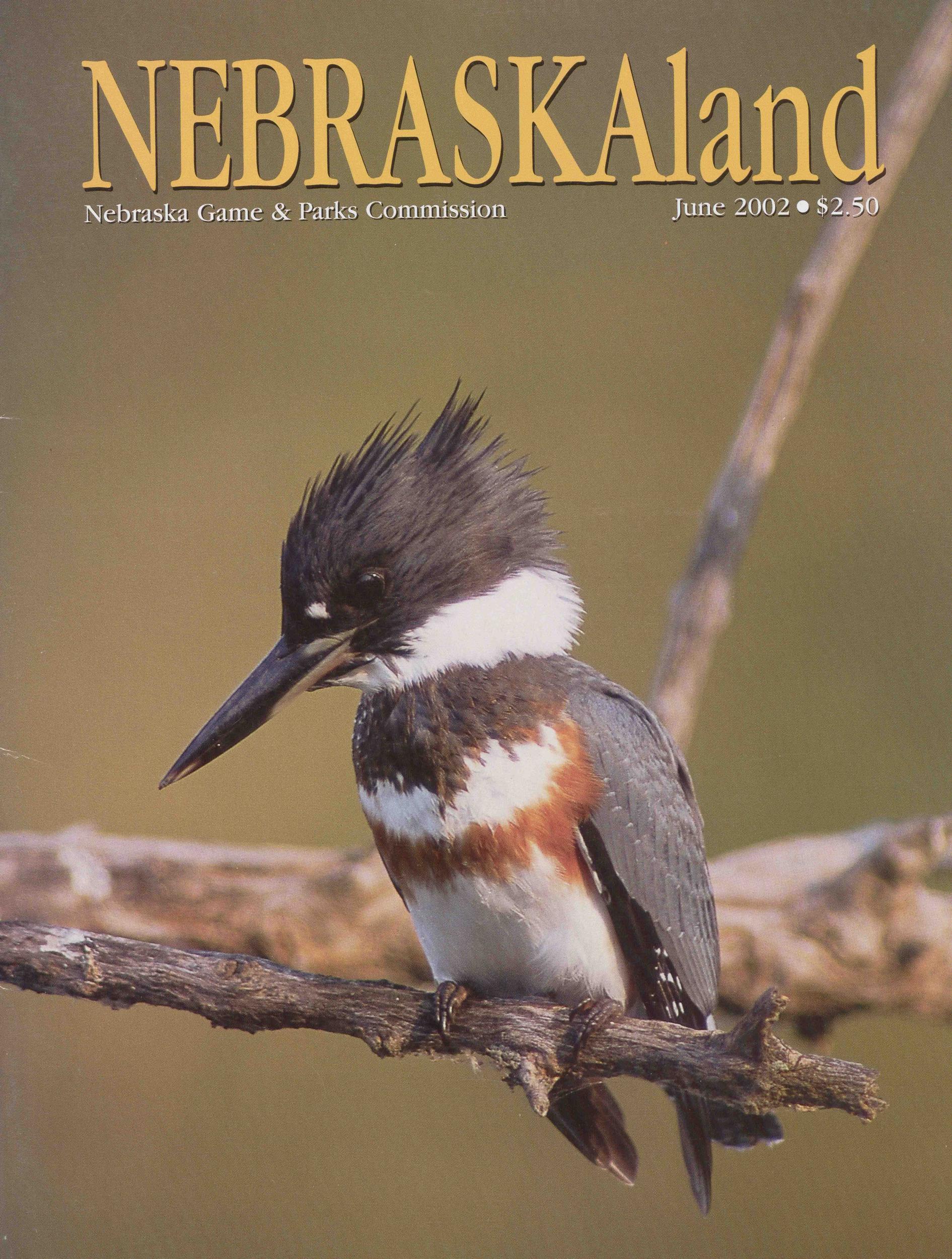
Volume 80, Number 5, June 2002 Features 10 The Meadowlark - Sweet Songster of the Plains With its yellow, sun-drenched breast and black U-shaped bib, the meadowlark stands out in a grassland like a maraschino cherry atop an ice-cream sundae. 18 Canoeing the Dismal River Cedars lurk around nearly every bend in the Dismal River’s 57-mile canoe trail in the heart of the Sandhills. It’s not a trip for inexperienced canoeists and kayakers. 22 The Exotic Menace Invasive exotic plants are one of the greatest threats to native biodiversity and a primary cause for threatened and endangered plant and animal species. Toad Hunter: The Gentle Hognose A specialist in feeding habits and a master of illusion to confound predators, the western hognose snake may huff and puff, hiss and rattle its tail, but it is a most-harmless creature. SOAR - Summer Orientation About Rivers An innovative summer day camp gives Nebraska youngsters a down-and-dirty, hands-on learning experience about nature in and around the central Platte River. 42 Whirling Disease in Nebraska Whirling disease, which causes devastating infections in small trout, was found in Nebraska last year. Fisheries biologists urge precautions to halt its spread. Departments Outdoor Business Once endangered, the bald eagle makes a remarkable recovery. Outdoor Update Nebraska mountain lion habits and occurrences are monitored. Parks & Places Historical barracks being rebuilt at Fort Robinson State Park. Comment........................................4 Outdoor News ..................................6 Classifieds ..................................48 Portraits of the Past ........................50 Cover: A female belted kingfisher (Ceryle alcyon) perches above a Branched Oak Lake backwater west of Raymond. From branches or hovering positions, kingfishers dive into waters for fish.The female is distinguished from the male by its rusty-colored breast band. Photo by Justin Wambold. Opposite: Black-eyed Susans (Rudbeckia hirta), self-seeding native biennials, grow widely along roads in eastern Nebraska. They flower from June to August. Photo by Justin Wambold.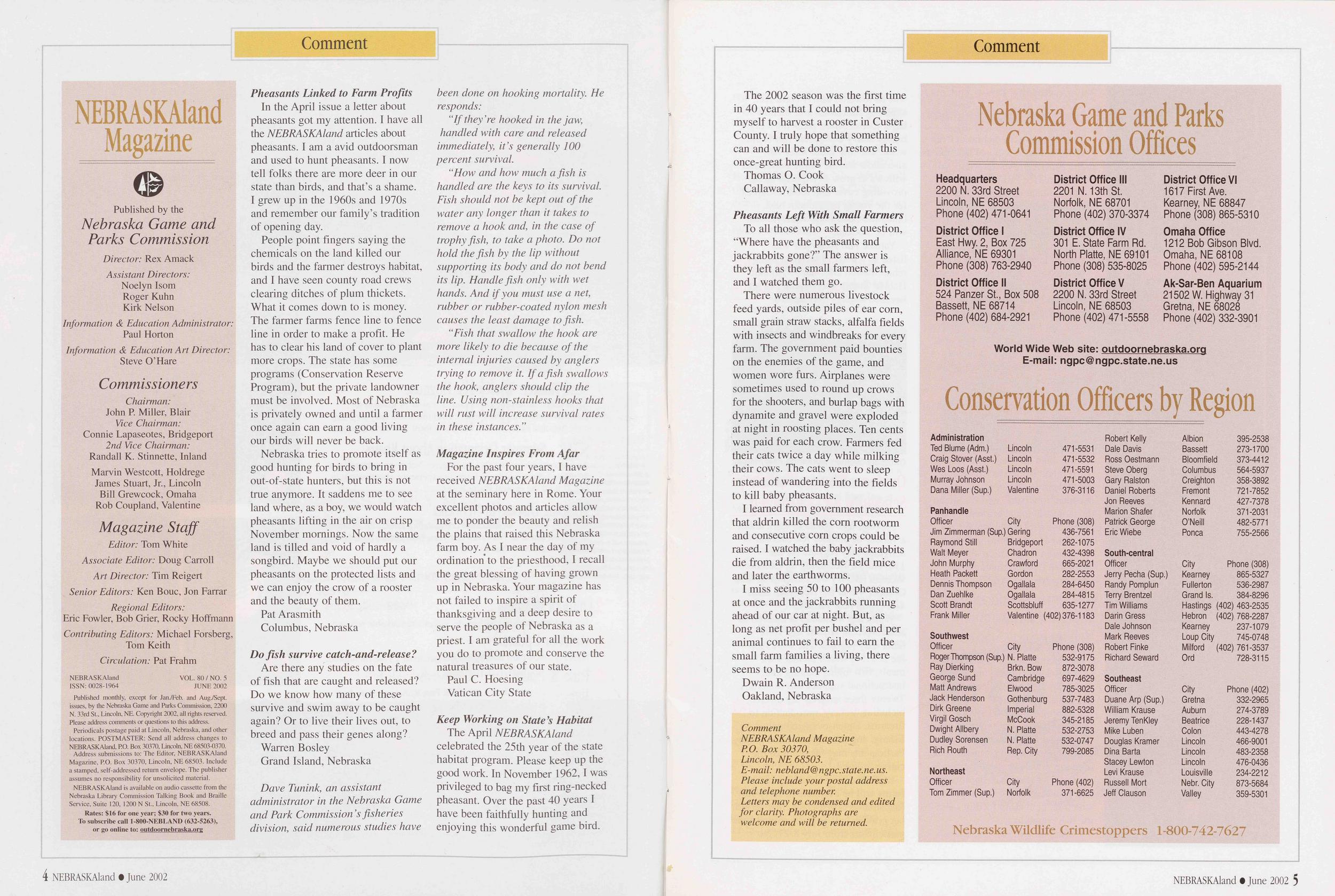 NEBRASKAland
ne
Published by the
Nebraska Game and
Parks Commission
Director: Rex Amack
Assistant Directors:
Noelyn Isom
Roger Kuhn
Kirk Nelson
Information & Education Administrator:
Paul Horton
Information & Education Art Director:
Steve O’Hare
Commissioners
Chairman:
John P. Miller, Blair
Vice Chairman:
Connie Lapaseotes, Bridgeport
2nd Vice Chairman:
Randall K. Stinnette, Inland
Marvin Westcott, Holdrege
James Stuart, Jr., Lincoln
Bill Grewcock, Omaha
Rob Coupland, Valentine
Magazine Staff
Editor: Tom White
Associate Editor: Doug Carroll
Art Director: Tim Reigert
Senior Editors: Ken Bouc, Jon Farrar
Regional Editors:
Eric Fowler, Bob Grier, Rocky Hoffmann
Contributing Editors: Michael Forsberg,
Tom Keith
Circulation: Pat Frahm
NEBRASKAland VOL. 80 / NO. 5
ISSN: 0028-1964 JUNE 2002
Published monthly, except for Jan./Feb. and Aug./Sept.
issues, by the Nebraska Game and Parks Commission, 2200
N. 33rd St., Lincoln, NE. Copyright 2002, all rights reserved.
Please address comments or questions to this address.
Periodicals postage paid at Lincoln, Nebraska, and other
locations. POSTMASTER: Send all address changes to
NEBRASKAland, P.O. Box 30370, Lincoln, NE 68503-0370.
Address submissions to: The Editor, NEBRASKAland
Magazine, P.O. Box 30370, Lincoln, NE 68503. Include
a stamped, self-addressed return envelope. The publisher
assumes no responsibility for unsolicited material.
NEBRASKAland is available on audio cassette from the
Nebraska Library Commission Talking Book and Braille
Service, Suite 120, 1200 N St., Lincoln, NE 68508.
Rates: $16 for one year; $30 for two years.
To subscribe call 1-800-NEBLAND (632-5263),
or go online to: outdoornebraska.org
Comment
Pheasants Linked to Farm Profits
NEBRASKAland
ne
Published by the
Nebraska Game and
Parks Commission
Director: Rex Amack
Assistant Directors:
Noelyn Isom
Roger Kuhn
Kirk Nelson
Information & Education Administrator:
Paul Horton
Information & Education Art Director:
Steve O’Hare
Commissioners
Chairman:
John P. Miller, Blair
Vice Chairman:
Connie Lapaseotes, Bridgeport
2nd Vice Chairman:
Randall K. Stinnette, Inland
Marvin Westcott, Holdrege
James Stuart, Jr., Lincoln
Bill Grewcock, Omaha
Rob Coupland, Valentine
Magazine Staff
Editor: Tom White
Associate Editor: Doug Carroll
Art Director: Tim Reigert
Senior Editors: Ken Bouc, Jon Farrar
Regional Editors:
Eric Fowler, Bob Grier, Rocky Hoffmann
Contributing Editors: Michael Forsberg,
Tom Keith
Circulation: Pat Frahm
NEBRASKAland VOL. 80 / NO. 5
ISSN: 0028-1964 JUNE 2002
Published monthly, except for Jan./Feb. and Aug./Sept.
issues, by the Nebraska Game and Parks Commission, 2200
N. 33rd St., Lincoln, NE. Copyright 2002, all rights reserved.
Please address comments or questions to this address.
Periodicals postage paid at Lincoln, Nebraska, and other
locations. POSTMASTER: Send all address changes to
NEBRASKAland, P.O. Box 30370, Lincoln, NE 68503-0370.
Address submissions to: The Editor, NEBRASKAland
Magazine, P.O. Box 30370, Lincoln, NE 68503. Include
a stamped, self-addressed return envelope. The publisher
assumes no responsibility for unsolicited material.
NEBRASKAland is available on audio cassette from the
Nebraska Library Commission Talking Book and Braille
Service, Suite 120, 1200 N St., Lincoln, NE 68508.
Rates: $16 for one year; $30 for two years.
To subscribe call 1-800-NEBLAND (632-5263),
or go online to: outdoornebraska.org
Comment
Pheasants Linked to Farm Profits
In the April issue a letter about pheasants got my attention. I have all the NEBRASKAland articles about pheasants. I am a avid outdoorsman and used to hunt pheasants. I now tell folks there are more deer in our state than birds, and that’s a shame. I grew up in the 1960s and 1970s and remember our family’s tradition of opening day.
People point fingers saying the chemicals on the land killed our birds and the farmer destroys habitat, and I have seen county road crews clearing ditches of plum thickets. What it comes down to is money. The farmer farms fence line to fence line in order to make a profit. He has to clear his land of cover to plant more crops. The state has some programs (Conservation Reserve Program), but the private landowner must be involved. Most of Nebraska is privately owned and until a farmer once again can earn a good living our birds will never be back.
Nebraska tries to promote itself as good hunting for birds to bring in out-of-state hunters, but this is not true anymore. It saddens me to see land where, as a boy, we would watch pheasants lifting in the air on crisp November mornings. Now the same land is tilled and void of hardly a songbird. Maybe we should put our pheasants on the protected lists and we can enjoy the crow of a rooster and the beauty of them.
Pat Arasmith Columbus, Nebraska Do fish survive catch-and-release?Are there any studies on the fate of fish that are caught and released? Do we know how many of these survive and swim away to be caught again? Or to live their lives out, to breed and pass their genes along?
Warren Bosley Grand Island, NebraskaDave Tunink, an assistant administrator in the Nebraska Game and Park Commission’s fisheries division, said numerous studies have been done on hooking mortality. He responds:
“If they’re hooked in the jaw, handled with care and released immediately, it’s generally 100 percent survival.
“How and how much a fish is handled are the keys to its survival. Fish should not be kept out of the water any longer than it takes to remove a hook and, in the case of trophy fish, to take a photo. Do not hold the fish by the lip without supporting its body and do not bend its lip. Handle fish only with wet hands. And if you must use a net, rubber or rubber-coated nylon mesh causes the least damage to fish.
“Fish that swallow the hook are more likely to die because of the internal injuries caused by anglers trying to remove it. If a fish swallows the hook, anglers should clip the line. Using non-stainless hooks that will rust will increase survival rates in these instances.”
Magazine Inspires From AfarFor the past four years, I have received NEBRASKAland Magazine at the seminary here in Rome. Your excellent photos and articles allow me to ponder the beauty and relish the plains that raised this Nebraska farm boy. As I near the day of my ordination to the priesthood, I recall the great blessing of having grown up in Nebraska. Your magazine has not failed to inspire a spirit of thanksgiving and a deep desire to serve the people of Nebraska as a priest. I am grateful for all the work you do to promote and conserve the natural treasures of our state.
Paul C. Hoesing Vatican City State Keep Working on State's HabitatThe April NEBRASKAland celebrated the 25th year of the state habitat program. Please keep up the good work. In November 1962,1 was privileged to bag my first ring-necked pheasant. Over the past 40 years I have been faithfully hunting and enjoying this wonderful game bird. 4 NEBRASKAland • June 2002 The 2002 season was the first time in 40 years that I could not bring myself to harvest a rooster in Custer County. I truly hope that something can and will be done to restore this once-great hunting bird.
Thomas O. Cook Callaway, Nebraska Comment Pheasants Left With Small FarmersTo all those who ask the question, “Where have the pheasants and jackrabbits gone?” The answer is they left as the small farmers left, and I watched them go.
There were numerous livestock feed yards, outside piles of ear corn, small grain straw stacks, alfalfa fields with insects and windbreaks for every farm. The government paid bounties on the enemies of the game, and women wore furs. Airplanes were sometimes used to round up crows for the shooters, and burlap bags with dynamite and gravel were exploded at night in roosting places. Ten cents was paid for each crow. Farmers fed their cats twice a day while milking their cows. The cats went to sleep instead of wandering into the fields to kill baby pheasants.
I learned from government research that aldrin killed the corn rootworm and consecutive corn crops could be raised. I watched the baby jackrabbits die from aldrin, then the field mice and later the earthworms.
I miss seeing 50 to 100 pheasants at once and the jackrabbits running ahead of our car at night. But, as long as net profit per bushel and per animal continues to fail to earn the small farm families a living, there seems to be no hope.
Dwain R. Anderson Oakland, Nebraska CommentNEBRASKAland Magazine P.O. Box 30370, Lincoln, NE 68503. E-mail: nebland@ ngpc. state, ne. us. Please include your postal address and telephone number. Letters may be condensed and edited for clarity. Photographs are welcome and will be returned.
Nebraska Game and Parks Commission Offices Headquarters 2200 N. 33rd Street Lincoln, NE 68503 Phone (402) 471-0641 District Office I East Hwy. 2, Box 725 Alliance, NE 69301 Phone (308) 763-2940 District Office II 524 Panzer St., Box 508 Bassett, NE 68714 Phone (402) 684-2921 District Office III 2201 N. 13th St. Norfolk, NE 68701 Phone (402) 370-3374 District Office IV 301 E. State Farm Rd. North Platte, NE 69101 Phone (308) 535-8025 District Office V 2200 N. 33rd Street Lincoln, NE 68503 Phone (402) 471-5558 District Office VI 1617 First Ave. Kearney, NE 68847 Phone (308) 865-5310 Omaha Office 1212 Bob Gibson Blvd. Omaha, NE 68108 Phone (402) 595-2144 Ak-Sar-Ben Aquarium 21502 W. Highway 31 Gretna, NE 68028 Phone (402) 332-3901 World Wide Web site: outdoornebraska.org E-mail: ngpc@ngpc.state.ne.us Conservation Officers by Region Administration Robert Kelly Albion 395-2538 Ted Blume (Adm.) Lincoln 471-5531 Dale Davis Bassett 273-1700 Craig Stover (Asst.) Lincoln 471-5532 Ross Oestmann Bloomfield I 373-4412 Wes Loos (Asst.) Lincoln 471-5591 Steve Oberg Columbus 564-5937 Murray Johnson Lincoln 471-5003 Gary Ralston Creighton 358-3892 Dana Miller (Sup.) Valentine 376-3116 Daniel Roberts Fremont 721-7852 Jon Reeves Kennard 427-7378 Panhandle Marion Shafer Norfolk 371-2031 Officer City Phone (308) Patrick George O’Neill 482-5771 Jim Zimmerman (Sup.) Gering 436-7561 Eric Wiebe Ponca 755-2566 Raymond Still Bridgeport 262-1075 Walt Meyer Chadron 432-4398 South-central John Murphy Crawford 665-2021 Officer City Phone (308) Heath Packett Gordon 282-2553 Jerry Pecha (Sup.) Kearney 865-5327 Dennis Thompson Ogallala 284-6450 Randy Pomplun Fullerton 536-2987 Dan Zuehlke Ogallala 284-4815 Terry Brentzel Grand Is. 384-8296 Scott Brandt Scottsbluff 635-1277 Tim Williams Hastings (402) 463-2535 Frank Miller Valentine (402)376-1183 Darin Gress Hebron (402) 768-2287 Dale Johnson Kearney 237-1079 Southwest Mark Reeves Loup City 745-0748 Officer City Phone (308) Robert Finke Milford (402) 761-3537 Roger Thompson (Sup.) N. Platte 532-9175 Richard Seward Ord 728-3115 Ray Dierking Brkn. Bow 872-3078 George Sund Cambridge 697-4629 Southeast Matt Andrews Elwood 785-3025 Officer City Phone (402) Jack Henderson Gothenburg 537-7483 Duane Arp (Sup.) Gretna 332-2965 Dirk Greene Imperial 882-5328 William Krause Auburn 274-3789 Virgil Gosch McCook 345-2185 Jeremy TenKley Beatrice 228-1437 Dwight Allbery N. Platte 532-2753 Mike Luben Colon 443-4278 Dudley Sorensen N. Platte 532-0747 Douglas Kramer Lincoln 466-9001 Rich Routh Rep. City 799-2085 Dina Barta Lincoln 483-2358 Stacey Lewton Lincoln 476-0436 Northeast Levi Krause Louisville 234-2212 Officer City Phone (402) Russell Mort Nebr. City 873-5684 Tom Zimmer (Sup.) Norfolk 371-6625 Jeff Clauson Valley 359-5301 Nebraska Wildlife Crimestoppers 1-800-742-7627 NEBRASKAland • June 2002 5
Two southeastern Nebraska trees have been named national champions in the American Forests’ National Champion Tree Program.
The national champion status identifies these trees as the largest of their species in the country. Tree circumference, height and crown spread are combined using a point system to determine a champion.
Nebraska’s state champion eastern cottonwood, located southeast of Seward, was named co-champion with an eastern cottonwood in Idaho. The Seward tree is 36 feet, 9 inches in circumference, 85 feet tall, and has an average crown spread of 107 feet. Eastern cottonwoods are the state tree in Nebraska.
A dwarf chinkapin oak in Richardson County is also a national champion. It measures 39 inches in circumference, is 25 feet tall, and has an average crown spread of 20 feet.
More than 80 species of trees are listed in the Nebraska Champion Tree Register. The program is designed to identify and recognize the largest living specimens of all native and the most common introduced tree species in Nebraska.
For more information about the champion tree program, contact Christine Meyer at (402) 472-9869.
Yankee Hill Aquatic Habitat Project StartedThe Nebraska Game and Parks Commission is improving aquatic habitat in Yankee Hill Reservoir southeast of Denton.
The project will construct sediment retention structures, repair shoreline erosion, increase water depth in the reservoir’s upper arms, improve water clarity and increase vegetation in the lake. Improvements will also be made to the outlet structure, boat ramp facilities and to the fish community.
During the project, water levels will be lowered nearly eight feet, exposing shorelines and shallow bays. Construction areas must dry before heavy equipment can begin work. The low water level will also allow weeds, cottonwoods and willows to grow in exposed areas, providing cover and food resources for the young largemouth bass, bluegills, catfish and walleyes that will be stocked.
Yankee Hill Reservoir was listed as a body of water needing rehabilitation after the $5 Aquatic Habitat Stamp was required of all licensed anglers over age 18.
Anyone who wants to learn about a variety of outdoor recreational activities may register for the 11th annual Becoming an Outdoors- Woman (BOW) workshop to be held October 4-6 at the Nebraska State 4-H Camp near Halsey.
While the workshop is tailored to adult women, anyone age 18 or older may register. The workshop fee is $155, which includes six meals, two nights lodging and instructional supplies and materials. Twenty-three subjects are offered, including archery, introduction to firearms, Dutch-oven cooking, fishing, dog training and photography. Participants may take four of the classes offered.
BOW brochures and registration forms will be available in early-July. Registration is first-come, first-served, but priority will be given to first-time participants from July 8-21. No 6 NEBRASKAland • June 2002 registrations will be accepted by telephone or fax. Some scholarships are available.
To receive mailings about the workshop, write BOW, Nebraska Game and Parks Commission, P.O. Box 30370, Lincoln, NE, 68503, call (402) 471-5482, (800) 577-8283, e-mail kapeller@ngpc.state.ne.us, or visit outdoornebraska.org/outdoor/ bow/woman.html.
Mitigation Project Closes Middle Decatur Bend WMAConstruction of the Tieville- Decatur Bend Missouri River Fish and Wildlife Mitigation Project is under way and will continue through December 31, 2003.
The affected area includes Nebraska Game and Parks Commission’s Middle Decatur Bend Wildlife Management Area in Burt County. Construction activities and safety require closure of the area until January 1, 2004.
This 3,148-acre project is one in a series involving the U.S. Army Corps of Engineers and four lower Missouri River basin states. Under Corps plans, mitigation projects acquire land from willing sellers to recover fish and wildlife habitats lost to Missouri River channelization.
The Tieville-Decatur Bend project is on the Missouri’s eastern bank, but also includes 1,949 acres in Nebraska, including Middle Decatur Bend WMA. When completed, the area will be jointly managed by Iowa Department of Natural Resources, the Commission and the Corps.
Two Youth Skills Camps Are Scheduled in JulyRegistration is open for the 2002 Outdoor Skills Camps in July. A joint venture between the Nebraska Game and Parks Commission and the Nebraska 4-H, these camps are open to youths 1 l-to-14 years old. Participants will be taught rifle, muzzleloader and shotgun basics. Other subjects include archery, canoeing, fishing and camping.
Getting Ready to Hunt This Fall? Now You Can Buy Nebraska Hunting Permits Online! Visit our secure web site to quickly and conveniently purchase fishing, hunting and park permits online using your Visa or MasterCard. Online permit purchase is safe, hassle-free and there is never a checkout line. Simply choose the permits you want, pay for them, download and print. And, you are on your way to Nebraska's great outdoors. outdoornebraska.org Nebraska Game and Parks Commission NEBRASKAland • June 2002 7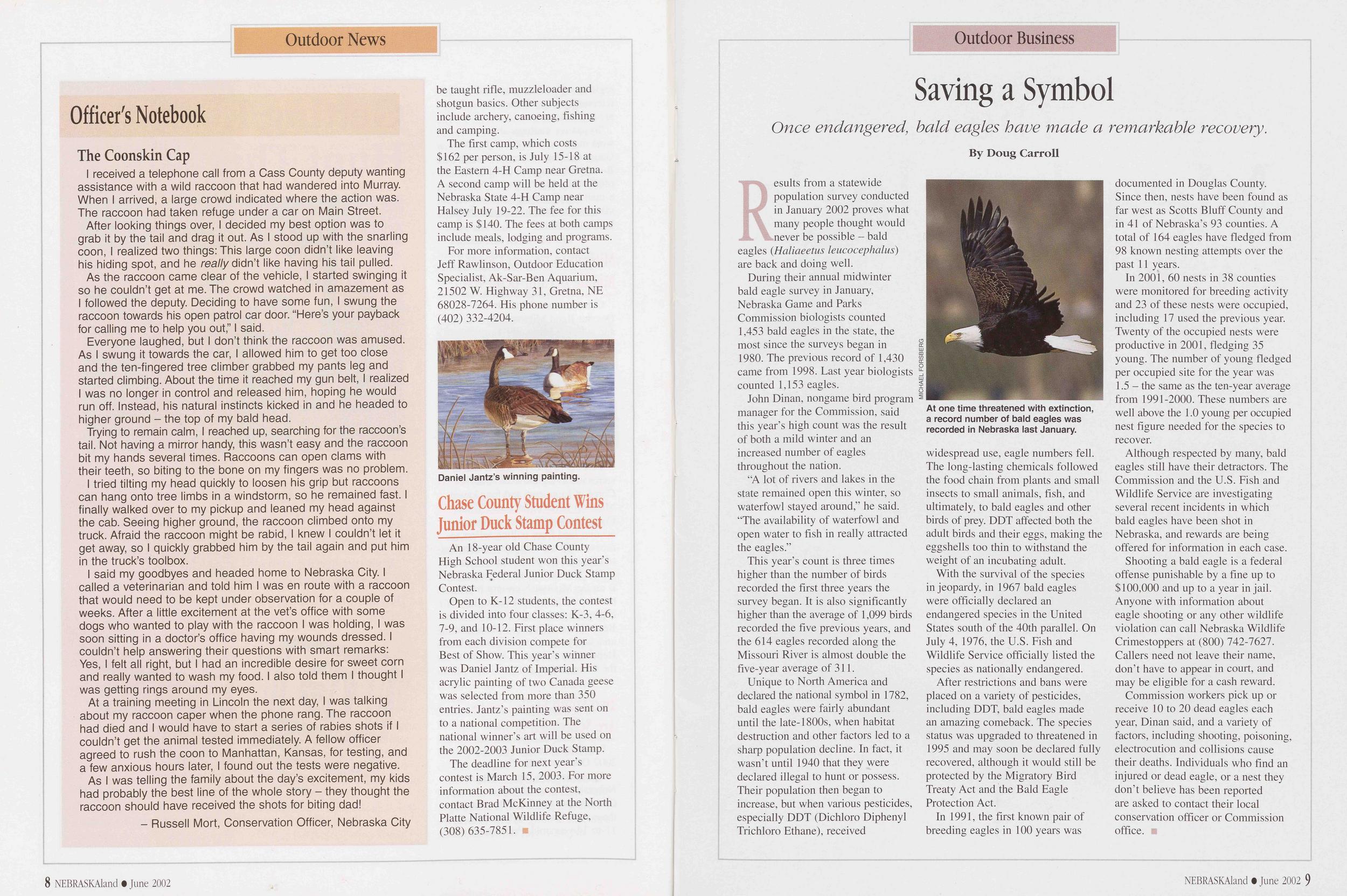 Outdoor News
Officer's Notebook
The Coonskin Cap
Outdoor News
Officer's Notebook
The Coonskin Cap
I received a telephone call from a Cass County deputy wanting assistance with a wild raccoon that had wandered into Murray. When I arrived, a large crowd indicated where the action was. The raccoon had taken refuge under a car on Main Street.
After looking things over, I decided my best option was to grab it by the tail and drag it out. As I stood up with the snarling coon, I realized two things: This large coon didn’t like leaving his hiding spot, and he really didn’t like having his tail pulled.
As the raccoon came clear of the vehicle, I started swinging it so he couldn’t get at me. The crowd watched in amazement as I followed the deputy. Deciding to have some fun, I swung the raccoon towards his open patrol car door. “Here’s your payback for calling me to help you out,” I said.
Everyone laughed, but I don’t think the raccoon was amused. As I swung it towards the car, I allowed him to get too close and the ten-fingered tree climber grabbed my pants leg and started climbing. About the time it reached my gun belt, I realized I was no longer in control and released him, hoping he would run off. Instead, his natural instincts kicked in and he headed to higher ground - the top of my bald head.
Trying to remain calm, I reached up, searching for the raccoon’s tail. Not having a mirror handy, this wasn’t easy and the raccoon bit my hands several times. Raccoons can open clams with their teeth, so biting to the bone on my fingers was no problem.
I tried tilting my head quickly to loosen his grip but raccoons can hang onto tree limbs in a windstorm, so he remained fast. I finally walked over to my pickup and leaned my head against the cab. Seeing higher ground, the raccoon climbed onto my truck. Afraid the raccoon might be rabid, I knew I couldn’t let it get away, so I quickly grabbed him by the tail again and put him in the truck’s toolbox.
I said my goodbyes and headed home to Nebraska City. I called a veterinarian and told him I was en route with a raccoon that would need to be kept under observation for a couple of weeks. After a little excitement at the vet’s office with some dogs who wanted to play with the raccoon I was holding, I was soon sitting in a doctor’s office having my wounds dressed. I couldn’t help answering their questions with smart remarks: Yes, I felt all right, but I had an incredible desire for sweet corn and really wanted to wash my food. I also told them I thought I was getting rings around my eyes.
At a training meeting in Lincoln the next day, I was talking about my raccoon caper when the phone rang. The raccoon had died and I would have to start a series of rabies shots if I couldn’t get the animal tested immediately. A fellow officer agreed to rush the coon to Manhattan, Kansas, for testing, and a few anxious hours later, I found out the tests were negative.
As I was telling the family about the day’s excitement, my kids had probably the best line of the whole story - they thought the raccoon should have received the shots for biting dad!
- Russell Mort, Conservation Officer, Nebraska CityThe first camp, which costs $162 per person, is July 15-18 at the Eastern 4-H Camp near Gretna. A second camp will be held at the Nebraska State 4-H Camp near Halsey July 19-22. The fee for this camp is $140. The fees at both camps include meals, lodging and programs.
For more information, contact Jeff Rawlinson, Outdoor Education Specialist, Ak-Sar-Ben Aquarium, 21502 W. Highway 31, Gretna, NE 68028-7264. His phone number is (402) 332-4204.
An 18-year old Chase County High School student won this year’s Nebraska Federal Junior Duck Stamp Contest.
Open to K-12 students, the contest is divided into four classes: K-3, 4-6, 7-9, and 10-12. First place winners from each division compete for Best of Show. This year’s winner was Daniel Jantz of Imperial. His acrylic painting of two Canada geese was selected from more than 350 entries. Jantz’s painting was sent on to a national competition. The national winner’s art will be used on the 2002-2003 Junior Duck Stamp.
The deadline for next year’s contest is March 15, 2003. For more information about the contest, contact Brad McKinney at the North Platte National Wildlife Refuge, (308) 635-7851.
8 NEBRASKAland • June 2002 Outdoor Business Saving a Symbol Once endangered, bald eagles have made a remarkable recovery. By Doug CarrollResults from a statewide population survey conducted in January 2002 proves what many people thought would never be possible - bald eagles (Haliaeetus leucocephalus) are back and doing well.
During their annual midwinter bald eagle survey in January, Nebraska Game and Parks Commission biologists counted 1,453 bald eagles in the state, the most since the surveys began in 1980. The previous record of 1,430 came from 1998. Last year biologists counted 1,153 eagles.
John Dinan, nongame bird program manager for the Commission, said this year’s high count was the result of both a mild winter and an increased number of eagles throughout the nation.
"A lot of rivers and lakes in the state remained open this winter, so waterfowl stayed around,” he said. "The availability of waterfowl and open water to fish in really attracted the eagles.”
This year’s count is three times higher than the number of birds recorded the first three years the survey began. It is also significantly higher than the average of 1,099 birds recorded the five previous years, and the 614 eagles recorded along the Missouri River is almost double the five-year average of 311.
Unique to North America and declared the national symbol in 1782, bald eagles were fairly abundant until the late-1800s, when habitat destruction and other factors led to a sharp population decline. In fact, it wasn’t until 1940 that they were declared illegal to hunt or possess. Their population then began to increase, but when various pesticides, especially DDT (Dichloro Diphenyl Trichloro Ethane), received widespread use, eagle numbers fell. The long-lasting chemicals followed the food chain from plants and small insects to small animals, fish, and ultimately, to bald eagles and other birds of prey. DDT affected both the adult birds and their eggs, making the eggshells too thin to withstand the weight of an incubating adult.
With the survival of the species in jeopardy, in 1967 bald eagles were officially declared an endangered species in the United States south of the 40th parallel. On July 4, 1976, the U.S. Fish and Wildlife Service officially listed the species as nationally endangered.
After restrictions and bans were placed on a variety of pesticides, including DDT, bald eagles made an amazing comeback. The species status was upgraded to threatened in 1995 and may soon be declared fully recovered, although it would still be protected by the Migratory Bird Treaty Act and the Bald Eagle Protection Act.
In 1991, the first known pair of breeding eagles in 100 years was documented in Douglas County. Since then, nests have been found as far west as Scotts Bluff County and in 41 of Nebraska’s 93 counties. A total of 164 eagles have fledged from 98 known nesting attempts over the past 11 years.
In 2001, 60 nests in 38 counties were monitored for breeding activity and 23 of these nests were occupied, including 17 used the previous year. Twenty of the occupied nests were productive in 2001, fledging 35 young. The number of young fledged per occupied site for the year was 1.5 - the same as the ten-year average from 1991-2000. These numbers are well above the 1.0 young per occupied nest figure needed for the species to recover.
Although respected by many, bald eagles still have their detractors. The Commission and the U.S. Fish and Wildlife Service are investigating several recent incidents in which bald eagles have been shot in Nebraska, and rewards are being offered for information in each case.
Shooting a bald eagle is a federal offense punishable by a fine up to $100,000 and up to a year in jail. Anyone with information about eagle shooting or any other wildlife violation can call Nebraska Wildlife Crimestoppers at (800) 742-7627. Callers need not leave their name, don’t have to appear in court, and may be eligible for a cash reward.
Commission workers pick up or receive 10 to 20 dead eagles each year, Dinan said, and a variety of factors, including shooting, poisoning, electrocution and collisions cause their deaths. Individuals who find an injured or dead eagle, or a nest they don’t believe has been reported are asked to contact their local conservation officer or Commission office.
NEBRASKAland • June 2002 9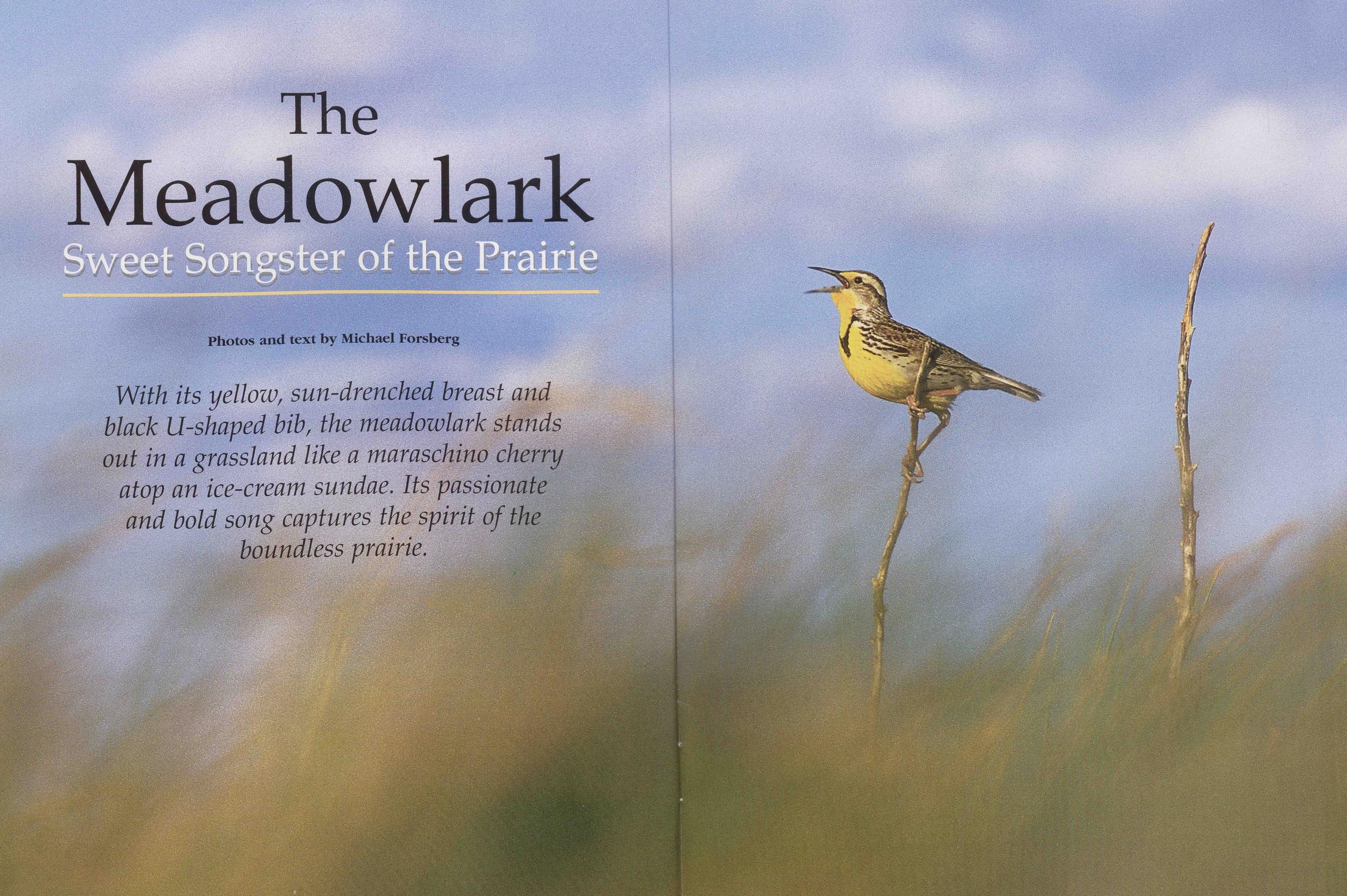
The Meadowlark
Sweet Songster of the Praire Photos and text by Michael Forsberg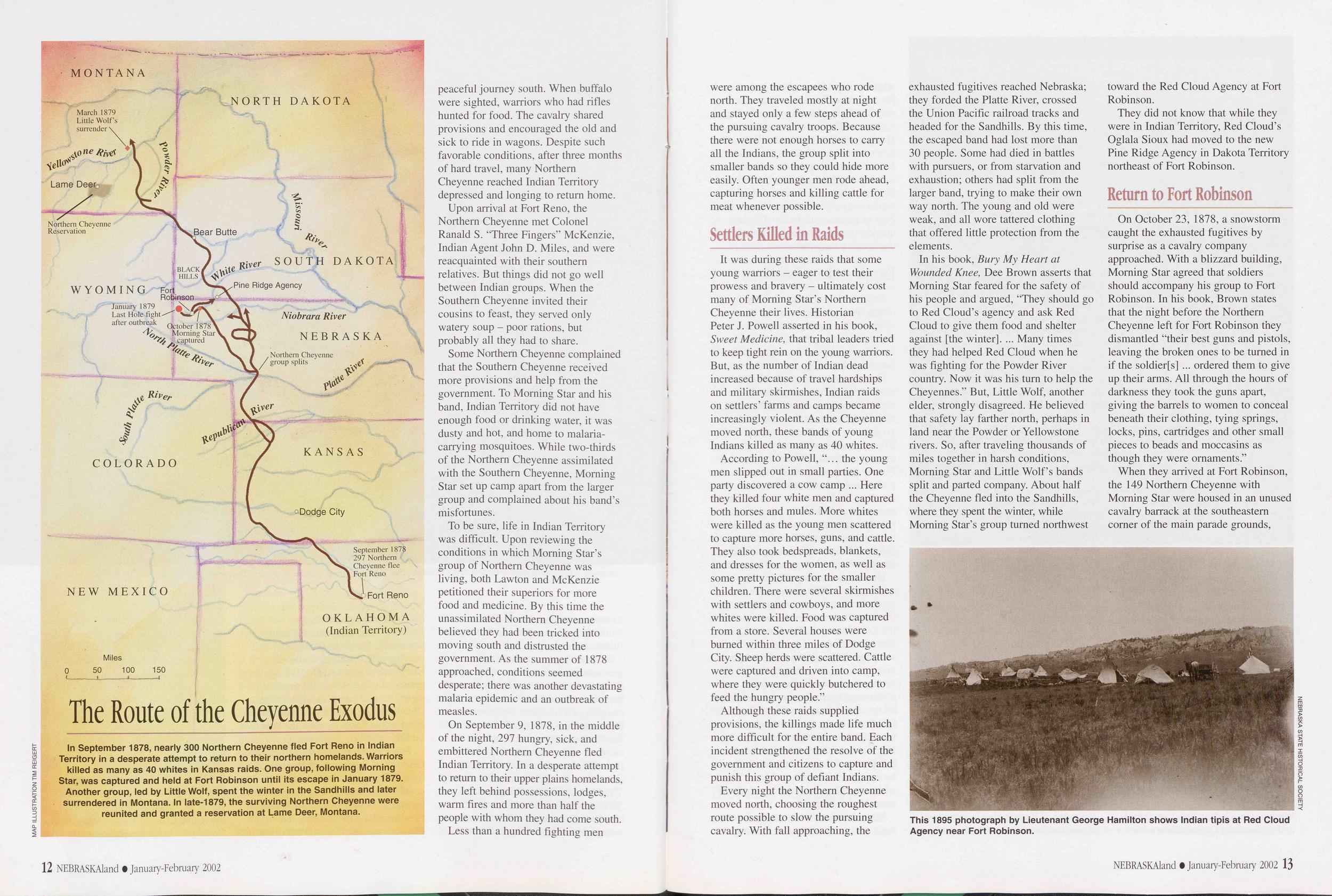
It was late spring in the Nebraska Sandhills. I sat comfortably on a green, grassy slope in the morning sun, watching a meadowlark hastily dart and dodge from yucca plant to fence post to yucca plant, connecting the dots that outlined the perimeter of his newly claimed territory. I thought early settlers must have acted similarly, racing exuberantly to mark boundaries of a promising piece of land before anyone else could claim it.
The meadowlark was always on alert, especially for intruding meadowlarks who tried to invade this treasured space. When one did so, the meadowlark let out a loud, irate chupp, then raced after the interloper with a fervor and speed usually reserved for raptors until the trespasser departed. Then, as if to proclaim victory, he flew to the highest perch in the territory and sang his cheerful song for all to hear. Without fail, neighboring meadowlarks answered in turn, proclaiming their territories as well. A hint of summer was in the air, meadowlarks had returned to the Sandhills, and their song was never so sweet.
With a yellow, sun-drenched breast and black U-shaped bib, the meadowlark stands out in a grassland like a maraschino cherry atop an ice-cream sundae. Its presence is both bold and brash. Its effect on humans is often soothing and sentimental. Except for the American robin, few other birds are so easily recognized, or regarded with such affection. Noted, early-20th century naturalist Cleveland Bent captured the bird’s soulfulness when he called the meadowlark and its passionate song "...the very spirit of the bound- less prairie.”
While the meadowlark is the most familiar grassland songbird species in the Great Plains, its history and relationships are full of surprises. Fossil evidence in several Plains states, including Nebraska, shows that meadowlarks date back nearly 10,000 years.
The name "meadowlark” is a bit of a misnomer. Though gifted singers, they actually are not larks, but members of the blackbird family, Emberizidae, with yellow-headed and red-winged blackbirds, assorted grackles and cowbirds.
There is not a single species of meadowlark, but two: The eastern meadowlark ('Sturnella magna), was found east of the Mississippi River and scientists originally thought it was the only meadowlark, and the western meadowlark (Sturnella neglecta).
12 NEBRASKAland • June 2002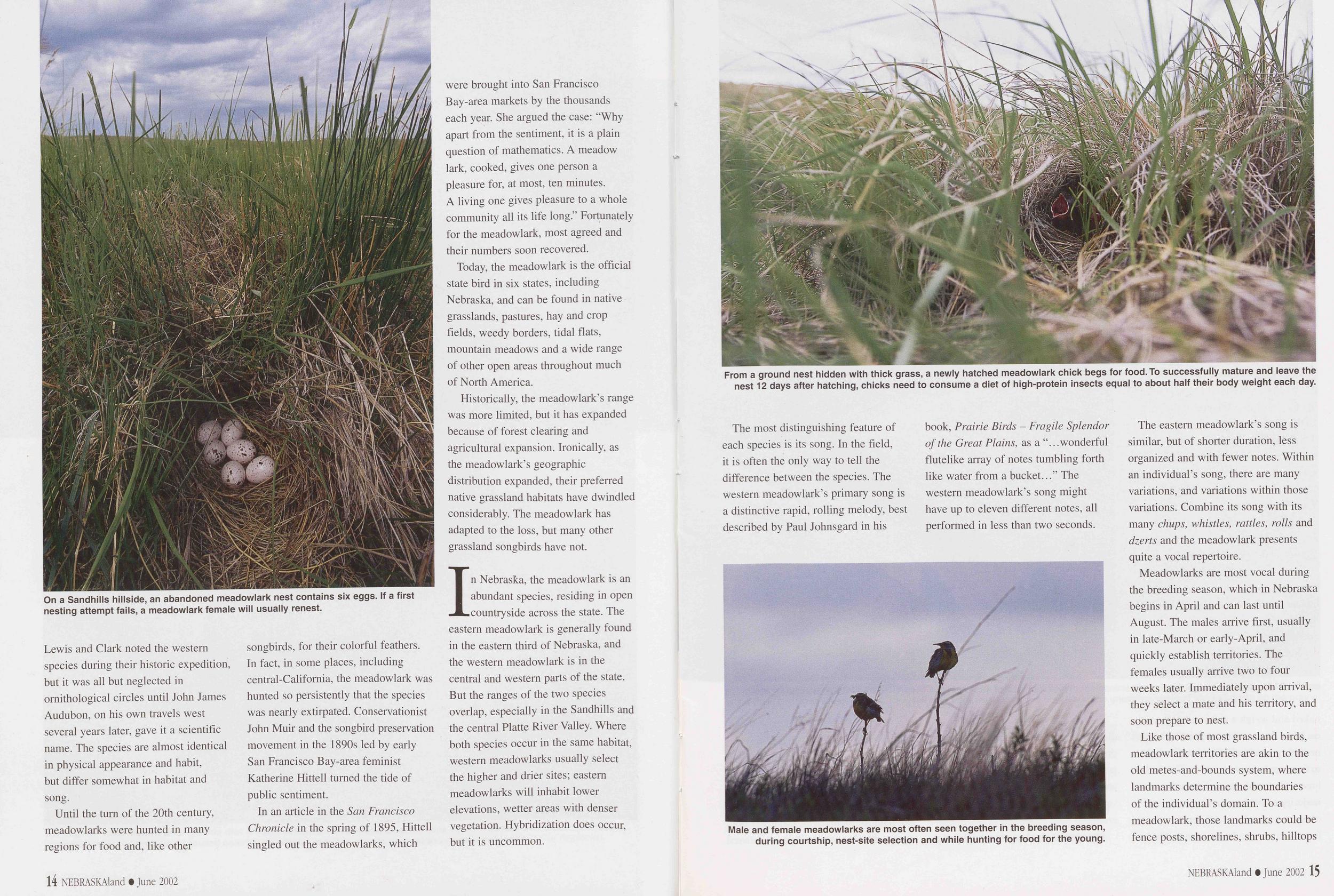
Lewis and Clark noted the western species during their historic expedition, but it was all but neglected in ornithological circles until John James Audubon, on his own travels west several years later, gave it a scientific name. The species are almost identical in physical appearance and habit, but differ somewhat in habitat and song.
Until the turn of the 20th century, meadowlarks were hunted in many regions for food and, like other songbirds, for their colorful feathers. In fact, in some places, including central-California, the meadowlark was hunted so persistently that the species was nearly extirpated. Conservationist John Muir and the songbird preservation movement in the 1890s led by early San Francisco Bay-area feminist Katherine Hittell turned the tide of public sentiment.
In an article in the San Francisco Chronicle in the spring of 1895, Hittell singled out the meadowlarks, which were brought into San Francisco Bay-area markets by the thousands each year. She argued the case: “Why apart from the sentiment, it is a plain question of mathematics. A meadow lark, cooked, gives one person a pleasure for, at most, ten minutes. A living one gives pleasure to a whole community all its life long.” Fortunately for the meadowlark, most agreed and their numbers soon recovered.
Today, the meadowlark is the official state bird in six states, including Nebraska, and can be found in native grasslands, pastures, hay and crop fields, weedy borders, tidal flats, mountain meadows and a wide range of other open areas throughout much of North America.
Historically, the meadowlark’s range was more limited, but it has expanded because of forest clearing and agricultural expansion. Ironically, as the meadowlark’s geographic distribution expanded, their preferred native grassland habitats have dwindled considerably. The meadowlark has adapted to the loss, but many other grassland songbirds have not.
In Nebraska, the meadowlark is an abundant species, residing in open countryside across the state. The eastern meadowlark is generally found in the eastern third of Nebraska, and the western meadowlark is in the central and western parts of the state. But the ranges of the two species overlap, especially in the Sandhills and the central Platte River Valley. Where both species occur in the same habitat, western meadowlarks usually select the higher and drier sites; eastern meadowlarks will inhabit lower elevations, wetter areas with denser vegetation. Hybridization does occur, but it is uncommon.
14 NEBRASKAland • June 2002The most distinguishing feature of each species is its song. In the field, it is often the only way to tell the difference between the species. The western meadowlark’s primary song is a distinctive rapid, rolling melody, best described by Paul Johnsgard in his book, Prairie Birds - Fragile Splendor of the Great Plains, as a “...wonderful flutelike array of notes tumbling forth like water from a bucket..The western meadowlark’s song might have up to eleven different notes, all performed in less than two seconds.
The eastern meadowlark’s song is similar, but of shorter duration, less organized and with fewer notes. Within an individual’s song, there are many variations, and variations within those variations. Combine its song with its many chups, whistles, rattles, rolls and dzerts and the meadowlark presents quite a vocal repertoire.
Meadowlarks are most vocal during the breeding season, which in Nebraska begins in April and can last until August. The males arrive first, usually in late-March or early-April, and quickly establish territories. The females usually arrive two to four weeks later. Immediately upon arrival, they select a mate and his territory, and soon prepare to nest.
Like those of most grassland birds,
meadowlark territories are akin to the
old metes-and-bounds system, where
landmarks determine the boundaries
of the individual’s domain. To a
meadowlark, those landmarks could be
fence posts, shorelines, shrubs, hilltops
NEBRASKAland • June 2002 15
 and things less conspicuous to human
observers. Generally, these territories
are three-to-five acres, and might
change shape and size throughout a
season.
and things less conspicuous to human
observers. Generally, these territories
are three-to-five acres, and might
change shape and size throughout a
season.
Females select only one male, but a male might be selected by more than one female. If that is the case, the male meadowlark will accommodate as many females in his territory as he can provide protection and food for during periods of nesting and rearing the young.
Meadowlark nests are built on the ground in grassy cover, sometimes in shallow depressions, and are constructed of dried grasses usually with arched domes and conspicuous runways leading in and out of the entrance of the nest. Both sexes might select a site, but the female gathers materials and builds the nest. Nest building usually takes about a week. When the nest is lined, the eggs are laid, one a day for successive days. The female will not begin incubating until the last egg is laid. Only the female incubates the eggs, while the male provides protection.
To nest successfully, meadowlarks must have the good fortune to avoid human disturbance, trampling by livestock, mowing or tilling of soil, predation by foxes, skunks, raccoons, coyotes, snakes and domestic dogs and cats. If successful, the young will hatch in 13 or 14 days.
At birth, the hatchlings are nearly naked and weigh a mere seven grams each. As long as they remain in the nest, they need half their body weight in food each day to survive. The female broods the nestlings and does the majority of feeding, but the male will often bring food and deliver it to the female to pass on to the young. The diet of young meadowlarks consists primarily of insects such as beetles, grasshoppers and spiders. In the fall and winter, the young shift to a more vegetarian diet of weed seeds and grains.
After hatching, the young will fledge and leave the nest in 12 days with strong legs and a fully feathered body. At 21 days, they are capable of sustained flight. They will remain dependent on their parents until they can fend for themselves, usually two weeks after leaving the nest.
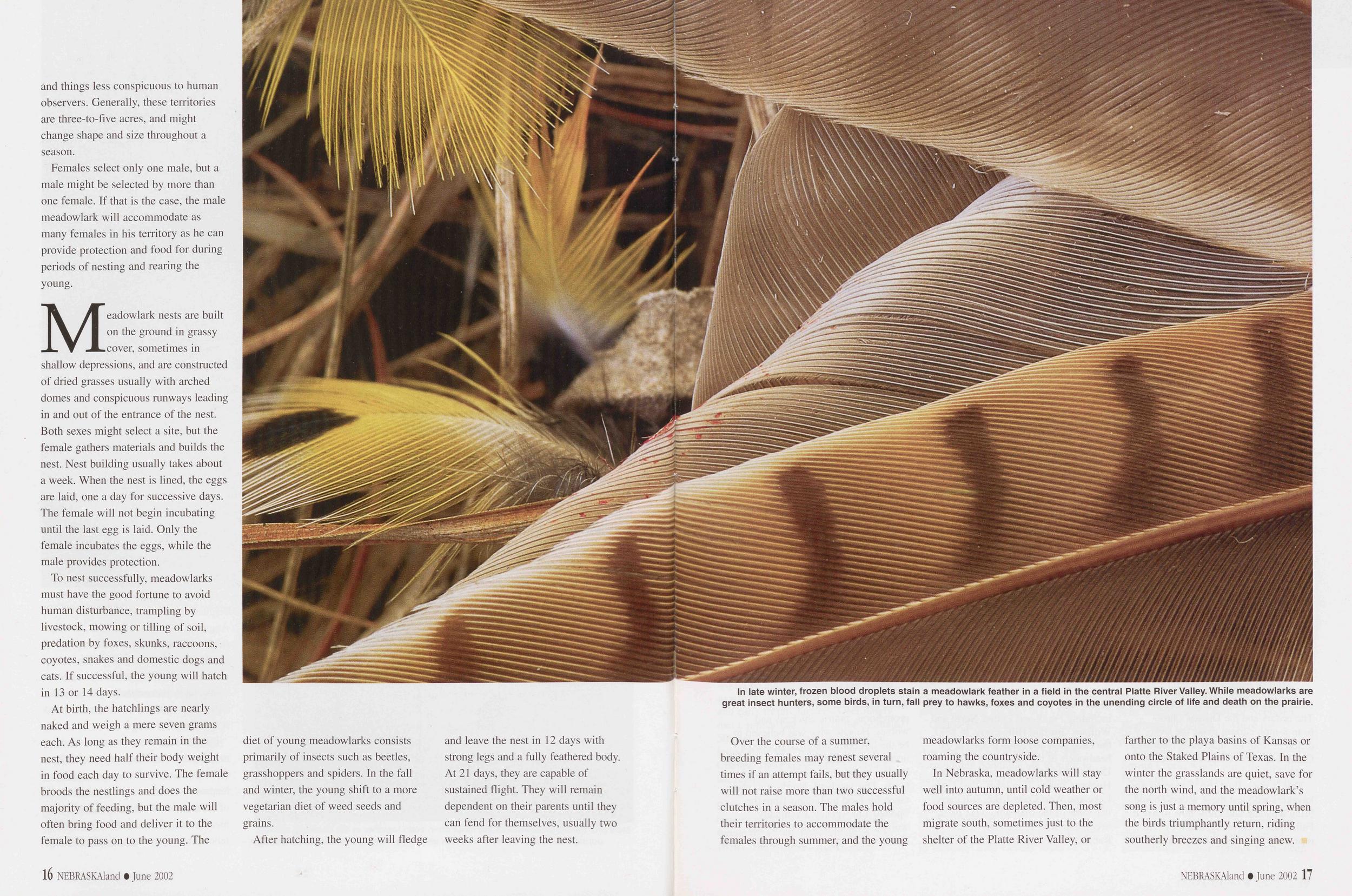
16 NEBRASKAland • June 2002Over the course of a summer, breeding females may renest several times if an attempt fails, but they usually will not raise more than two successful clutches in a season. The males hold their territories to accommodate the females through summer, and the young meadowlarks form loose companies, roaming the countryside.
In Nebraska, meadowlarks will stay well into autumn, until cold weather or food sources are depleted. Then, most migrate south, sometimes just to the shelter of the Platte River Valley, or farther to the playa basins of Kansas or onto the Staked Plains of Texas. In the winter the grasslands are quiet, save for the north wind, and the meadowlark’s song is just a memory until spring, when the birds triumphantly return, riding southerly breezes and singing anew.
NEBRASKAland • June 2002 17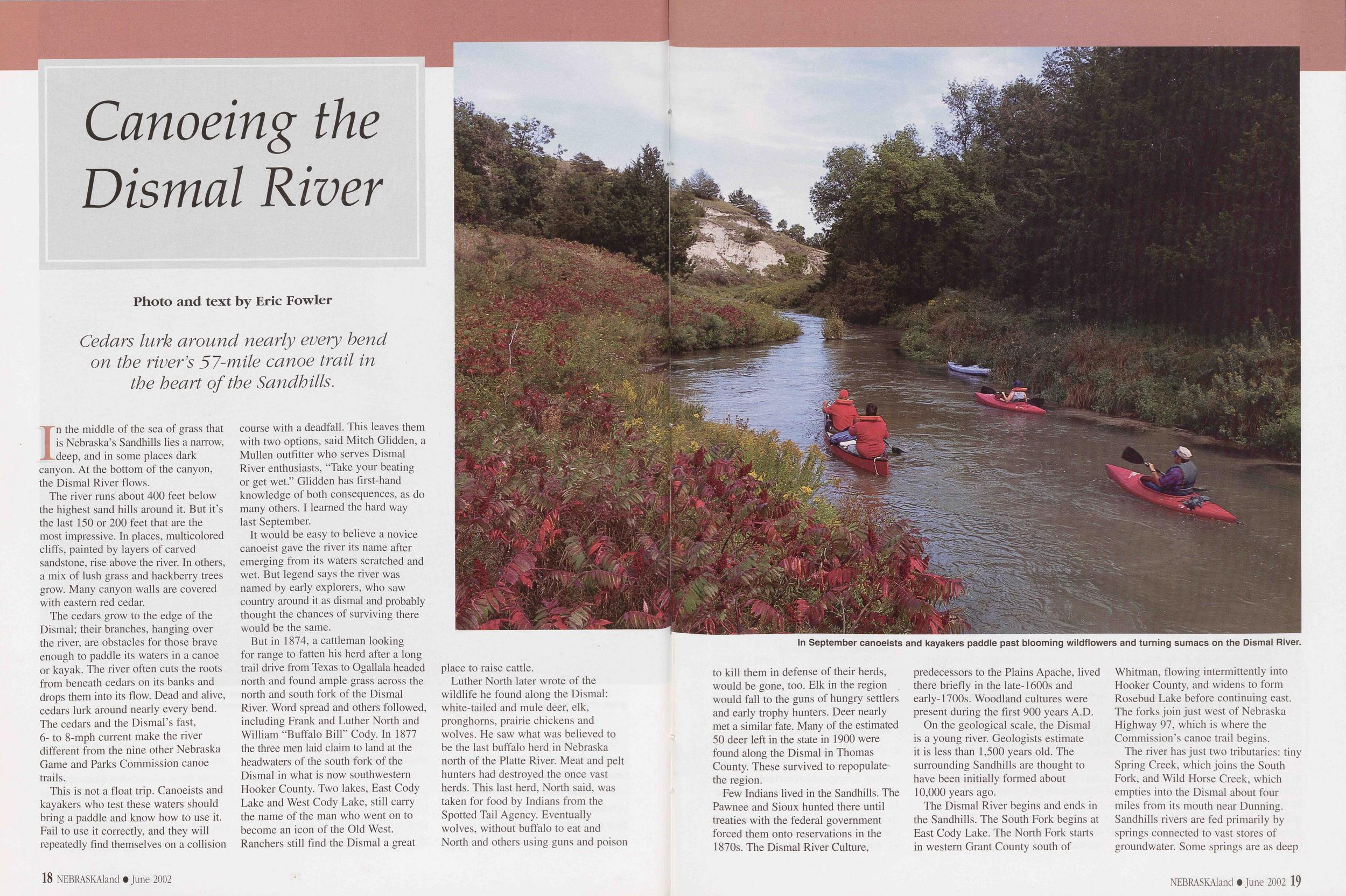
Canoeing the Dismal River
Cedars lurk around nearly every bend on the river’s 57-mile canoe trail in the heart of the Sandhills.In the middle of the sea of grass that is Nebraska’s Sandhills lies a narrow, deep, and in some places dark canyon. At the bottom of the canyon, the Dismal River flows.
The river runs about 400 feet below the highest sand hills around it. But it’s the last 150 or 200 feet that are the most impressive. In places, multicolored cliffs, painted by layers of carved sandstone, rise above the river. In others, a mix of lush grass and hackberry trees grow. Many canyon walls are covered with eastern red cedar.
The cedars grow to the edge of the Dismal; their branches, hanging over the river, are obstacles for those brave enough to paddle its waters in a canoe or kayak. The river often cuts the roots from beneath cedars on its banks and drops them into its flow. Dead and alive, cedars lurk around nearly every bend. The cedars and the Dismal’s fast, 6- to 8-mph current make the river different from the nine other Nebraska Game and Parks Commission canoe trails.
This is not a float trip. Canoeists and kayakers who test these waters should bring a paddle and know how to use it. Fail to use it correctly, and they will repeatedly find themselves on a collision course with a deadfall. This leaves them with two options, said Mitch Glidden, a Mullen outfitter who serves Dismal River enthusiasts, “Take your beating or get wet.” Glidden has first-hand knowledge of both consequences, as do many others. I learned the hard way last September.
It would be easy to believe a novice canoeist gave the river its name after emerging from its waters scratched and wet. But legend says the river was named by early explorers, who saw country around it as dismal and probably thought the chances of surviving there would be the same.
But in 1874, a cattleman looking for range to fatten his herd after a long trail drive from Texas to Ogallala headed north and found ample grass across the north and south fork of the Dismal River. Word spread and others followed, including Frank and Luther North and William “Buffalo Bill” Cody. In 1877 the three men laid claim to land at the headwaters of the south fork of the Dismal in what is now southwestern Hooker County. Two lakes, East Cody Lake and West Cody Lake, still carry the name of the man who went on to become an icon of the Old West. Ranchers still find the Dismal a great place to raise cattle.
Luther North later wrote of the wildlife he found along the Dismal: white-tailed and mule deer, elk, pronghorns, prairie chickens and wolves. He saw what was believed to be the last buffalo herd in Nebraska north of the Platte River. Meat and pelt hunters had destroyed the once vast herds. This last herd, North said, was taken for food by Indians from the Spotted Tail Agency. Eventually wolves, without buffalo to eat and North and others using guns and poison to kill them in defense of their herds, would be gone, too. Elk in the region would fall to the guns of hungry settlers and early trophy hunters. Deer nearly met a similar fate. Many of the estimated 50 deer left in the state in 1900 were found along the Dismal in Thomas County. These survived to repopulate the region.
18 NEBRASKAland • June 2002Few Indians lived in the Sandhills. The Pawnee and Sioux hunted there until treaties with the federal government forced them onto reservations in the 1870s. The Dismal River Culture, predecessors to the Plains Apache, lived there briefly in the late-1600s and early-1700s. Woodland cultures were present during the first 900 years A.D.
On the geological scale, the Dismal is a young river. Geologists estimate it is less than 1,500 years old. The surrounding Sandhills are thought to have been initially formed about 10,000 years ago.
The Dismal River begins and ends in the Sandhills. The South Fork begins at East Cody Lake. The North Fork starts in western Grant County south of Whitman, flowing intermittently into Hooker County, and widens to form Rosebud Lake before continuing east. The forks join just west of Nebraska Highway 97, which is where the Commission’s canoe trail begins.
The river has just two tributaries: tiny Spring Creek, which joins the South Fork, and Wild Horse Creek, which empties into the Dismal about four miles from its mouth near Dunning. Sandhills rivers are fed primarily by springs connected to vast stores of ground water. Some springs are as deep
NEBRASKAland • June 2002 19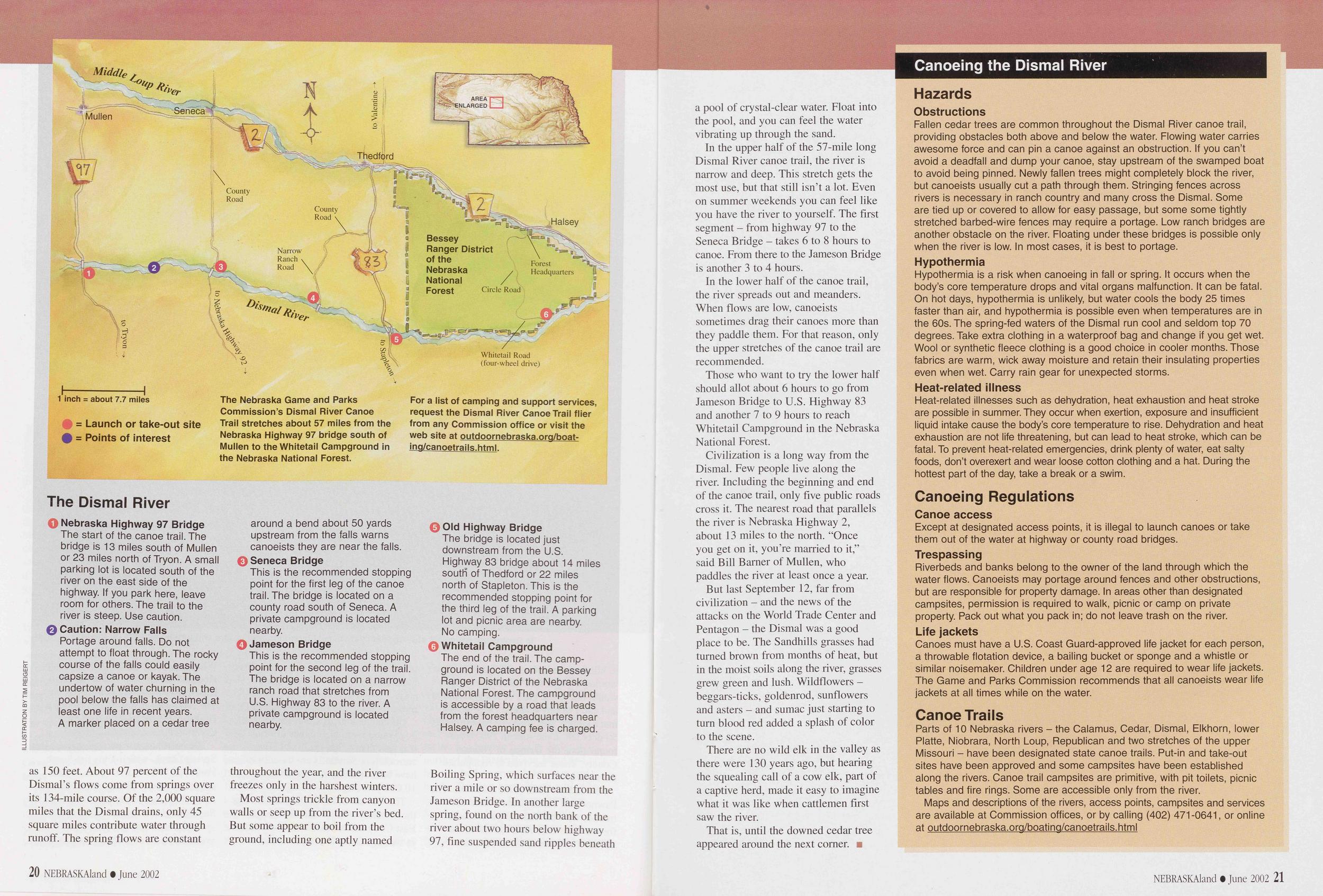
Boiling Spring, which surfaces near the river a mile or so downstream from the Jameson Bridge. In another large spring, found on the north bank of the river about two hours below highway 97, fine suspended sand ripples beneath 20 NEBRASKAland • June 2002 a pool of crystal-clear water. Float into the pool, and you can feel the water vibrating up through the sand.
In the upper half of the 57-mile long Dismal River canoe trail, the river is narrow and deep. This stretch gets the most use, but that still isn’t a lot. Even on summer weekends you can feel like you have the river to yourself. The first segment - from highway 97 to the Seneca Bridge - takes 6 to 8 hours to canoe. From there to the Jameson Bridge is another 3 to 4 hours.
In the lower half of the canoe trail, the river spreads out and meanders. When flows are low, canoeists sometimes drag their canoes more than they paddle them. For that reason, only the upper stretches of the canoe trail are recommended.
Those who want to try the lower half should allot about 6 hours to go from Jameson Bridge to U.S. Highway 83 and another 7 to 9 hours to reach Whitetail Campground in the Nebraska National Forest.
Civilization is a long way from the Dismal. Few people live along the river. Including the beginning and end of the canoe trail, only five public roads cross it. The nearest road that parallels the river is Nebraska Highway 2, about 13 miles to the north. "Once you get on it, you’re married to it,” said Bill Barner of Mullen, who paddles the river at least once a year.
But last September 12, far from civilization - and the news of the attacks on the World Trade Center and Pentagon - the Dismal was a good place to be. The Sandhills grasses had turned brown from months of heat, but in the moist soils along the river, grasses grew green and lush. Wildflowers - beggars-ticks, goldenrod, sunflowers and asters - and sumac just starting to turn blood red added a splash of color to the scene.
There are no wild elk in the valley as there were 130 years ago, but hearing the squealing call of a cow elk, part of a captive herd, made it easy to imagine what it was like when cattlemen first saw the river.
That is, until the downed cedar tree appeared around the next corner.
Canoeing the Dismal River Hazards ObstructionsFallen cedar trees are common throughout the Dismal River canoe trail, providing obstacles both above and below the water. Flowing water carries awesome force and can pin a canoe against an obstruction. If you can’t avoid a deadfall and dump your canoe, stay upstream of the swamped boat to avoid being pinned. Newly fallen trees might completely block the river, but canoeists usually cut a path through them. Stringing fences across rivers is necessary in ranch country and many cross the Dismal. Some are tied up or covered to allow for easy passage, but some some tightly stretched barbed-wire fences may require a portage. Low ranch bridges are another obstacle on the river. Floating under these bridges is possible only when the river is low. In most cases, it is best to portage.
HypothermiaHypothermia is a risk when canoeing in fall or spring. It occurs when the body’s core temperature drops and vital organs malfunction. It can be fatal. On hot days, hypothermia is unlikely, but water cools the body 25 times faster than air, and hypothermia is possible even when temperatures are in the 60s. The spring-fed waters of the Dismal run cool and seldom top 70 degrees. Take extra clothing in a waterproof bag and change if you get wet. Wool or synthetic fleece clothing is a good choice in cooler months. Those fabrics are warm, wick away moisture and retain their insulating properties even when wet. Carry rain gear for unexpected storms.
Heat-related illnessHeat-related illnesses such as dehydration, heat exhaustion and heat stroke are possible in summer. They occur when exertion, exposure and insufficient liquid intake cause the body’s core temperature to rise. Dehydration and heat exhaustion are not life threatening, but can lead to heat stroke, which can be fatal. To prevent heat-related emergencies, drink plenty of water, eat salty foods, don’t overexert and wear loose cotton clothing and a hat. During the hottest part of the day, take a break or a swim.
Canoeing Regulations Canoe accessExcept at designated access points, it is illegal to launch canoes or take them out of the water at highway or county road bridges.
TrespassingRiverbeds and banks belong to the owner of the land through which the water flows. Canoeists may portage around fences and other obstructions, but are responsible for property damage. In areas other than designated campsites, permission is required to walk, picnic or camp on private property. Pack out what you pack in; do not leave trash on the river.
Life jacketsCanoes must have a U.S. Coast Guard-approved life jacket for each person, a throwable flotation device, a bailing bucket or sponge and a whistle or similar noisemaker. Children under age 12 are required to wear life jackets. The Game and Parks Commission recommends that all canoeists wear life jackets at all times while on the water.
Canoe TrailsParts of 10 Nebraska rivers - the Calamus, Cedar, Dismal, Elkhorn, lower Platte, Niobrara, North Loup, Republican and two stretches of the upper Missouri - have been designated state canoe trails. Put-in and take-out sites have been approved and some campsites have been established along the rivers. Canoe trail campsites are primitive, with pit toilets, picnic tables and fire rings. Some are accessible only from the river.
Maps and descriptions of the rivers, access points, campsites and services are available at Commission offices, or by calling (402) 471-0641, or online at outdoornebraska.org/boatina/canoetrails.html
NEBRASKAland • June 2002 21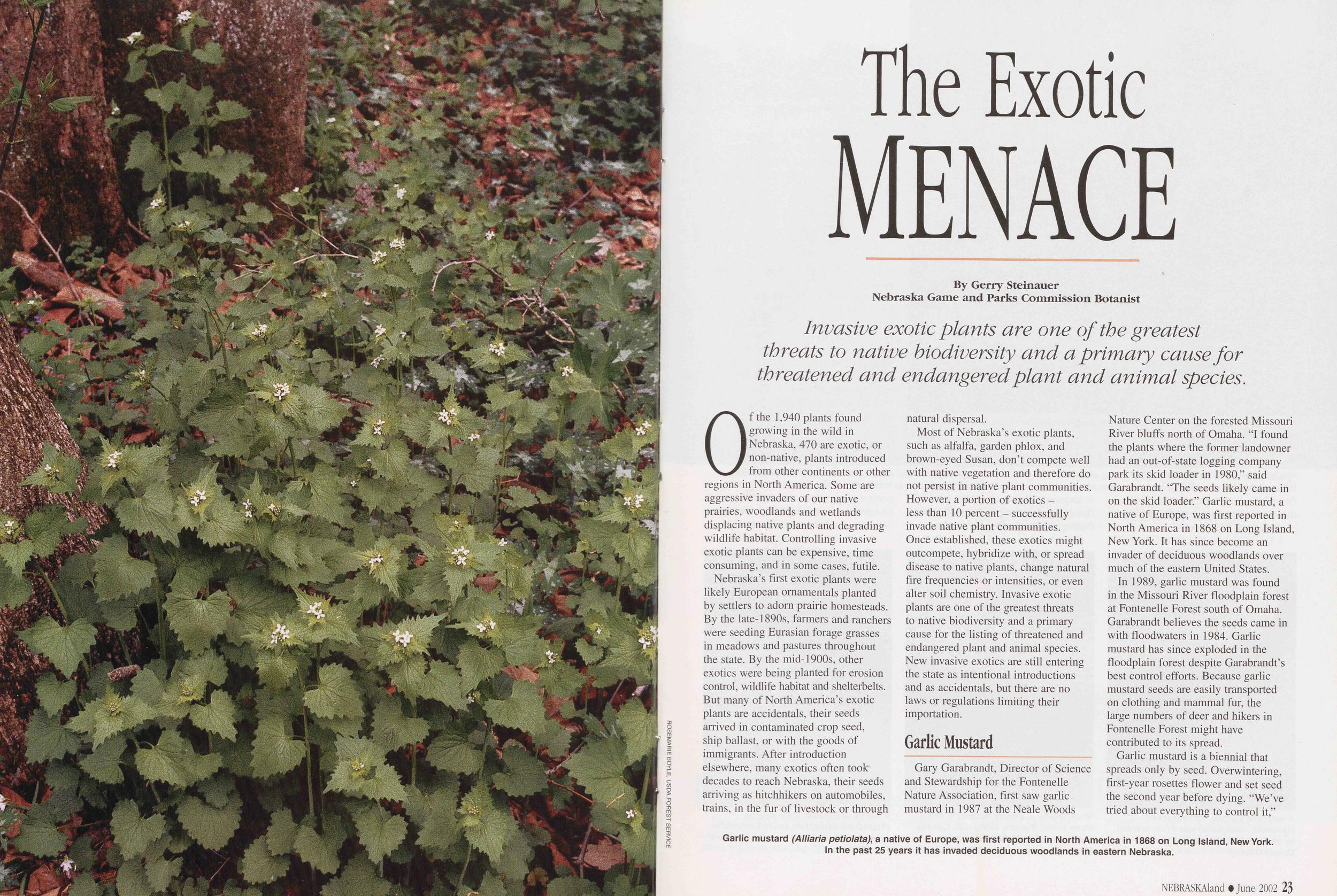
The Exotic MENACE
Invasive exotic plants are one of the greatest threats to native biodiversity and a primary cause for threatened and endangered plant and animal species.Of the 1,940 plants found growing in the wild in Nebraska, 470 are exotic, or non-native, plants introduced from other continents or other regions in North America. Some are aggressive invaders of our native prairies, woodlands and wetlands displacing native plants and degrading wildlife habitat. Controlling invasive exotic plants can be expensive, time consuming, and in some cases, futile.
Nebraska’s first exotic plants were likely European ornamentals planted by settlers to adorn prairie homesteads. By the late-1890s, farmers and ranchers were seeding Eurasian forage grasses in meadows and pastures throughout the state. By the mid-1900s, other exotics were being planted for erosion control, wildlife habitat and shelterbelts. But many of North America’s exotic plants are accidentals, their seeds arrived in contaminated crop seed, ship ballast, or with the goods of immigrants. After introduction elsewhere, many exotics often took decades to reach Nebraska, their seeds arriving as hitchhikers on automobiles, trains, in the fur of livestock or through natural dispersal.
Most of Nebraska’s exotic plants, such as alfalfa, garden phlox, and brown-eyed Susan, don’t compete well with native vegetation and therefore do not persist in native plant communities. However, a portion of exotics - less than 10 percent - successfully invade native plant communities. Once established, these exotics might outcompete, hybridize with, or spread disease to native plants, change natural fire frequencies or intensities, or even alter soil chemistry. Invasive exotic plants are one of the greatest threats to native biodiversity and a primary cause for the listing of threatened and endangered plant and animal species. New invasive exotics are still entering the state as intentional introductions and as accidentals, but there are no laws or regulations limiting their importation.
Garlic MustardGary Garabrandt, Director of Science and Stewardship for the Fontenelle Nature Association, first saw garlic mustard in 1987 at the Neale Woods Nature Center on the forested Missouri River bluffs north of Omaha. "I found the plants where the former landowner had an out-of-state logging company park its skid loader in 1980,” said Garabrandt. “The seeds likely came in on the skid loader.” Garlic mustard, a native of Europe, was first reported in North America in 1868 on Long Island, New York. It has since become an invader of deciduous woodlands over much of the eastern United States.
In 1989, garlic mustard was found in the Missouri River floodplain forest at Fontenelle Forest south of Omaha. Garabrandt believes the seeds came in with floodwaters in 1984. Garlic mustard has since exploded in the floodplain forest despite Garabrandt’s best control efforts. Because garlic mustard seeds are easily transported on clothing and mammal fur, the large numbers of deer and hikers in Fontenelle Forest might have contributed to its spread.
Garlic mustard is a biennial that
spreads only by seed. Overwintering,
first-year rosettes flower and set seed
the second year before dying. “We’ve
tried about everything to control it,”
NEBRASKAland • June 2002 23
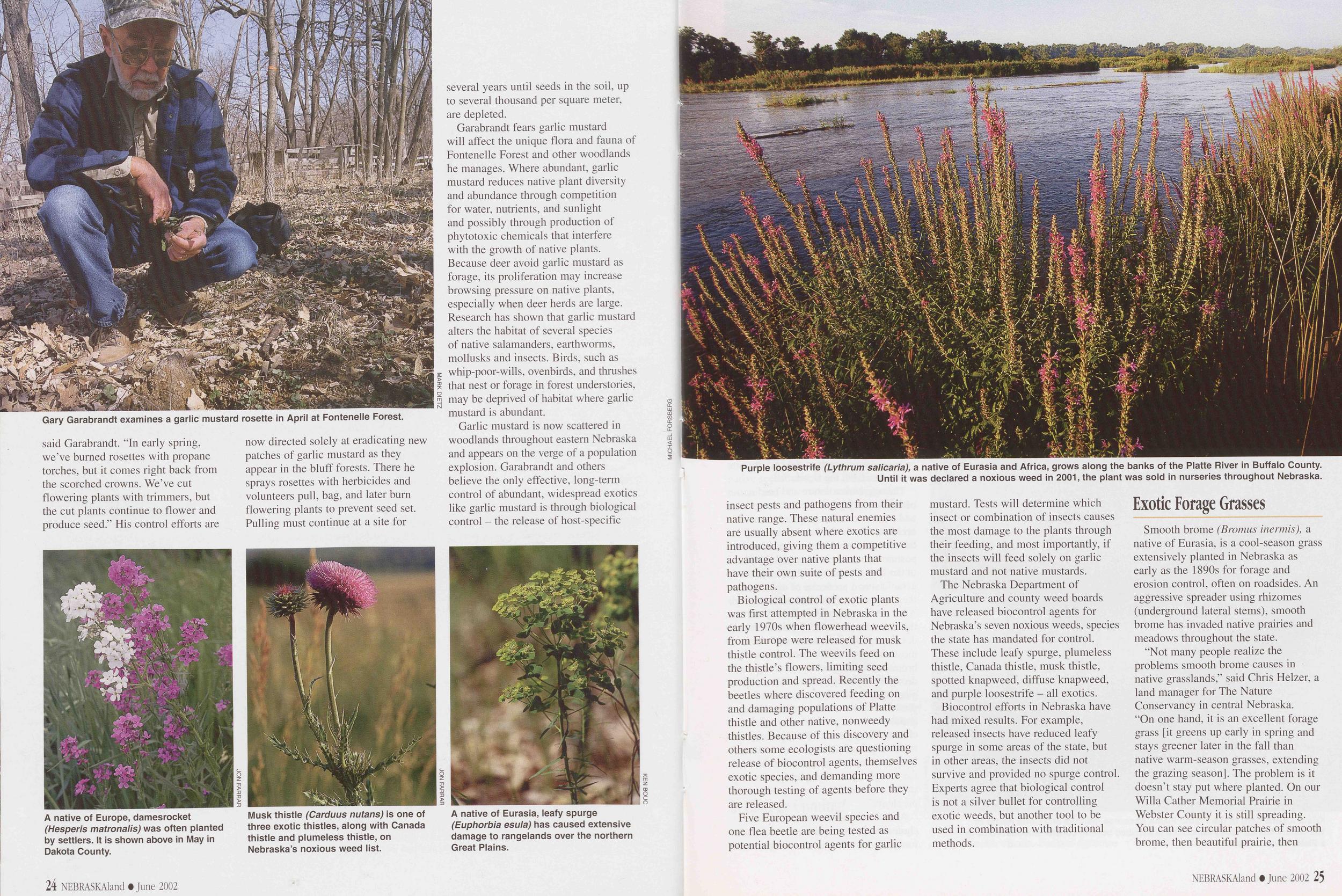 said Garabrandt. "In early spring,
we’ve burned rosettes with propane
torches, but it comes right back from
the scorched crowns. We’ve cut
flowering plants with trimmers, but
the cut plants continue to flower and
produce seed.” His control efforts are
now directed solely at eradicating new
patches of garlic mustard as they
appear in the bluff forests. There he
sprays rosettes with herbicides and
volunteers pull, bag, and later burn
flowering plants to prevent seed set.
Pulling must continue at a site for
several years until seeds in the soil, up
to several thousand per square meter,
are depleted.
said Garabrandt. "In early spring,
we’ve burned rosettes with propane
torches, but it comes right back from
the scorched crowns. We’ve cut
flowering plants with trimmers, but
the cut plants continue to flower and
produce seed.” His control efforts are
now directed solely at eradicating new
patches of garlic mustard as they
appear in the bluff forests. There he
sprays rosettes with herbicides and
volunteers pull, bag, and later burn
flowering plants to prevent seed set.
Pulling must continue at a site for
several years until seeds in the soil, up
to several thousand per square meter,
are depleted.
Garabrandt fears garlic mustard will affect the unique flora and fauna of Fontenelle Forest and other woodlands he manages. Where abundant, garlic mustard reduces native plant diversity and abundance through competition for water, nutrients, and sunlight and possibly through production of phytotoxic chemicals that interfere with the growth of native plants. Because deer avoid garlic mustard as forage, its proliferation may increase browsing pressure on native plants, especially when deer herds are large. Research has shown that garlic mustard alters the habitat of several species of native salamanders, earthworms, mollusks and insects. Birds, such as whip-poor-wills, ovenbirds, and thrushes that nest or forage in forest understories, may be deprived of habitat where garlic mustard is abundant.
Garlic mustard is now scattered in woodlands throughout eastern Nebraska and appears on the verge of a population explosion. Garabrandt and others believe the only effective, long-term control of abundant, widespread exotics like garlic mustard is through biological control - the release of host-specific 24 NEBRASKAland • June 2002 insect pests and pathogens from their native range. These natural enemies are usually absent where exotics are introduced, giving them a competitive advantage over native plants that have their own suite of pests and pathogens.
MICHAEL FORSBERGBiological control of exotic plants was first attempted in Nebraska in the early 1970s when flowerhead weevils, from Europe were released for musk thistle control. The weevils feed on the thistle’s flowers, limiting seed production and spread. Recently the beetles where discovered feeding on and damaging populations of Platte thistle and other native, nonweedy thistles. Because of this discovery and others some ecologists are questioning release of biocontrol agents, themselves exotic species, and demanding more thorough testing of agents before they are released.
Five European weevil species and one flea beetle are being tested as potential biocontrol agents for garlic mustard. Tests will determine which insect or combination of insects causes the most damage to the plants through their feeding, and most importantly, if the insects will feed solely on garlic mustard and not native mustards.
The Nebraska Department of Agriculture and county weed boards have released biocontrol agents for Nebraska’s seven noxious weeds, species the state has mandated for control. These include leafy spurge, plumeless thistle, Canada thistle, musk thistle, spotted knapweed, diffuse knapweed, and purple loosestrife - all exotics.
Biocontrol efforts in Nebraska have had mixed results. For example, released insects have reduced leafy spurge in some areas of the state, but in other areas, the insects did not survive and provided no spurge control. Experts agree that biological control is not a silver bullet for controlling exotic weeds, but another tool to be used in combination with traditional methods.
Exotic Forage GrassesSmooth brome (Bromus inermis), a native of Eurasia, is a cool-season grass extensively planted in Nebraska as early as the 1890s for forage and erosion control, often on roadsides. An aggressive spreader using rhizomes (underground lateral stems), smooth brome has invaded native prairies and meadows throughout the state.
"Not many people realize the
problems smooth brome causes in
native grasslands,” said Chris Helzer, a
land manager for The Nature
Conservancy in central Nebraska.
"On one hand, it is an excellent forage
grass [it greens up early in spring and
stays greener later in the fall than
native warm-season grasses, extending
the grazing season]. The problem is it
doesn’t stay put where planted. On our
Willa Gather Memorial Prairie in
Webster County it is still spreading.
You can see circular patches of smooth
brome, then beautiful prairie, then
NEBRASKAland • June 2002 25
 a circle of brome, and then more
beautiful prairie.”
a circle of brome, and then more
beautiful prairie.”
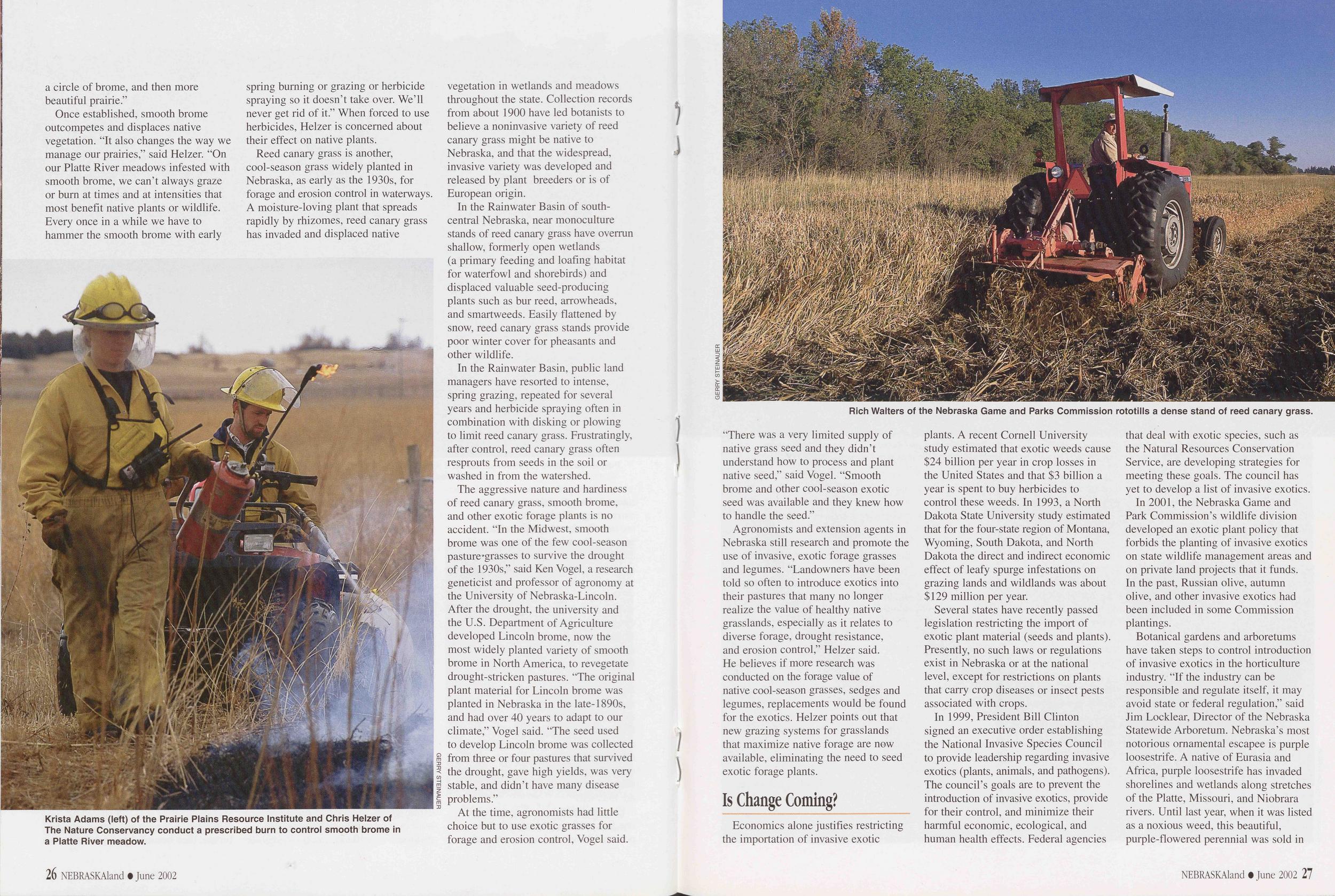
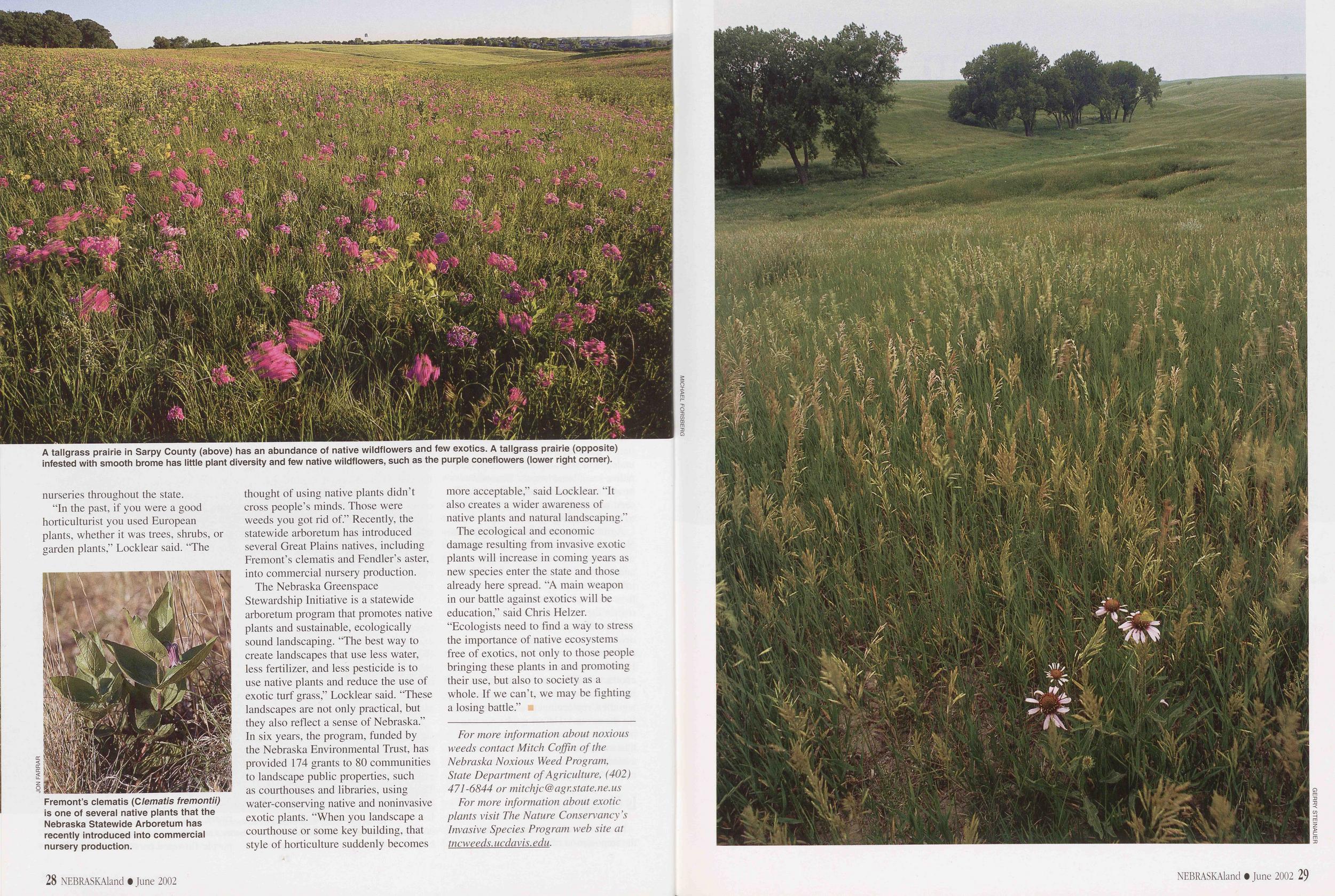
Once established, smooth brome outcompetes and displaces native vegetation. "It also changes the way we manage our prairies,” said Helzer. "On our Platte River meadows infested with smooth brome, we can’t always graze or burn at times and at intensities that most benefit native plants or wildlife. Every once in a while we have to hammer the smooth brome with early spring burning or grazing or herbicide spraying so it doesn’t take over. We’ll never get rid of it.” When forced to use herbicides, Helzer is concerned about their effect on native plants.
Reed canary grass is another, cool-season grass widely planted in Nebraska, as early as the 1930s, for forage and erosion control in waterways. A moisture-loving plant that spreads rapidly by rhizomes, reed canary grass has invaded and displaced native vegetation in wetlands and meadows throughout the state. Collection records from about 1900 have led botanists to believe a noninvasive variety of reed canary grass might be native to Nebraska, and that the widespread, invasive variety was developed and released by plant breeders or is of European origin.
In the Rainwater Basin of south- central Nebraska, near monoculture stands of reed canary grass have overrun shallow, formerly open wetlands (a primary feeding and loafing habitat for waterfowl and shorebirds) and displaced valuable seed-producing plants such as bur reed, arrowheads, and smart weeds. Easily flattened by snow, reed canary grass stands provide poor winter cover for pheasants and other wildlife.
In the Rainwater Basin, public land managers have resorted to intense, spring grazing, repeated for several years and herbicide spraying often in combination with disking or plowing to limit reed canary grass. Frustratingly, after control, reed canary grass often resprouts from seeds in the soil or washed in from the watershed.
The aggressive nature and hardiness of reed canary grass, smooth brome, and other exotic forage plants is no accident. "In the Midwest, smooth brome was one of the few cool-season pasture'grasses to survive the drought of the 1930s,” said Ken Vogel, a research geneticist and professor of agronomy at the University of Nebraska-Lincoln. After the drought, the university and the U.S. Department of Agriculture developed Lincoln brome, now the most widely planted variety of smooth brome in North America, to re vegetate drought-stricken pastures. "The original plant material for Lincoln brome was planted in Nebraska in the late-1890s, and had over 40 years to adapt to our climate,” Vogel said. "The seed used to develop Lincoln brome was collected from three or four pastures that survived the drought, gave high yields, was very stable, and didn’t have many disease problems.”
At the time, agronomists had little choice but to use exotic grasses for forage and erosion control, Vogel said. 26 NEBRASKAland • June 2002 "There was a very limited supply of native grass seed and they didn’t understand how to process and plant native seed,” said Vogel. "Smooth brome and other cool-season exotic seed was available and they knew how to handle the seed.”
GERRY STEINAUERAgronomists and extension agents in Nebraska still research and promote the use of invasive, exotic forage grasses and legumes. "Landowners have been told so often to introduce exotics into their pastures that many no longer realize the value of healthy native grasslands, especially as it relates to diverse forage, drought resistance, and erosion control,” Helzer said. He believes if more research was conducted on the forage value of native cool-season grasses, sedges and legumes, replacements would be found for the exotics. Helzer points out that new grazing systems for grasslands that maximize native forage are now available, eliminating the need to seed exotic forage plants.
Is Change Coming?Economics alone justifies restricting the importation of invasive exotic plants. A recent Cornell University study estimated that exotic weeds cause $24 billion per year in crop losses in the United States and that $3 billion a year is spent to buy herbicides to control these weeds. In 1993, a North Dakota State University study estimated that for the four-state region of Montana, Wyoming, South Dakota, and North Dakota the direct and indirect economic effect of leafy spurge infestations on grazing lands and wildlands was about $129 million per year.
Several states have recently passed legislation restricting the import of exotic plant material (seeds and plants). Presently, no such laws or regulations exist in Nebraska or at the national level, except for restrictions on plants that carry crop diseases or insect pests associated with crops.
In 1999, President Bill Clinton signed an executive order establishing the National Invasive Species Council to provide leadership regarding invasive exotics (plants, animals, and pathogens). The council’s goals are to prevent the introduction of invasive exotics, provide for their control, and minimize their harmful economic, ecological, and human health effects. Federal agencies that deal with exotic species, such as the Natural Resources Conservation Service, are developing strategies for meeting these goals. The council has yet to develop a list of invasive exotics.
In 2001, the Nebraska Game and Park Commission’s wildlife division developed an exotic plant policy that forbids the planting of invasive exotics on state wildlife management areas and on private land projects that it funds. In the past, Russian olive, autumn olive, and other invasive exotics had been included in some Commission plantings.
Botanical gardens and arboretums
have taken steps to control introduction
of invasive exotics in the horticulture
industry. "If the industry can be
responsible and regulate itself, it may
avoid state or federal regulation,” said
Jim Locklear, Director of the Nebraska
Statewide Arboretum. Nebraska’s most
notorious ornamental escapee is purple
loosestrife. A native of Eurasia and
Africa, purple loosestrife has invaded
shorelines and wetlands along stretches
of the Platte, Missouri, and Niobrara
rivers. Until last year, when it was listed
as a noxious weed, this beautiful,
purple-flowered perennial was sold in
NEBRASKAland • June 2002 27
 nurseries throughout the state.
"In the past, if you were a good horticulturist you used European plants, whether it was trees, shrubs, or garden plants,” Locklear said. "The thought of using native plants didn’t cross people’s minds. Those were weeds you got rid of.” Recently, the statewide arboretum has introduced several Great Plains natives, including Fremont’s clematis and Fendler’s aster, into commercial nursery production.
The Nebraska Greenspace Stewardship Initiative is a statewide arboretum program that promotes native plants and sustainable, ecologically sound landscaping. "The best way to create landscapes that use less water, less fertilizer, and less pesticide is to use native plants and reduce the use of exotic turf grass,” Locklear said. "These landscapes are not only practical, but they also reflect a sense of Nebraska.” In six years, the program, funded by the Nebraska Environmental Trust, has provided 174 grants to 80 communities to landscape public properties, such as courthouses and libraries, using water-conserving native and noninvasive exotic plants. "When you landscape a courthouse or some key building, that style of horticulture suddenly becomes more acceptable,” said Locklear. "It also creates a wider awareness of native plants and natural landscaping.”
The ecological and economic damage resulting from invasive exotic plants will increase in coming years as new species enter the state and those already here spread. "A main weapon in our battle against exotics will be education,” said Chris Helzer. “Ecologists need to find a way to stress the importance of native ecosystems free of exotics, not only to those people bringing these plants in and promoting their use, but also to society as a whole. If we can’t, we may be fighting a losing battle.”
For more information about noxious weeds contact Mitch Coffin of the Nebraska Noxious Weed Program, State Department of Agriculture, (402) 471-6844 or mitchjc@agr.state.ne.us For more information about exotic plants visit The Nature Conservancy’s Invasive Species Program web site at tncweeds. ucdavis. edu.
28 NEBRASKAland • June 2002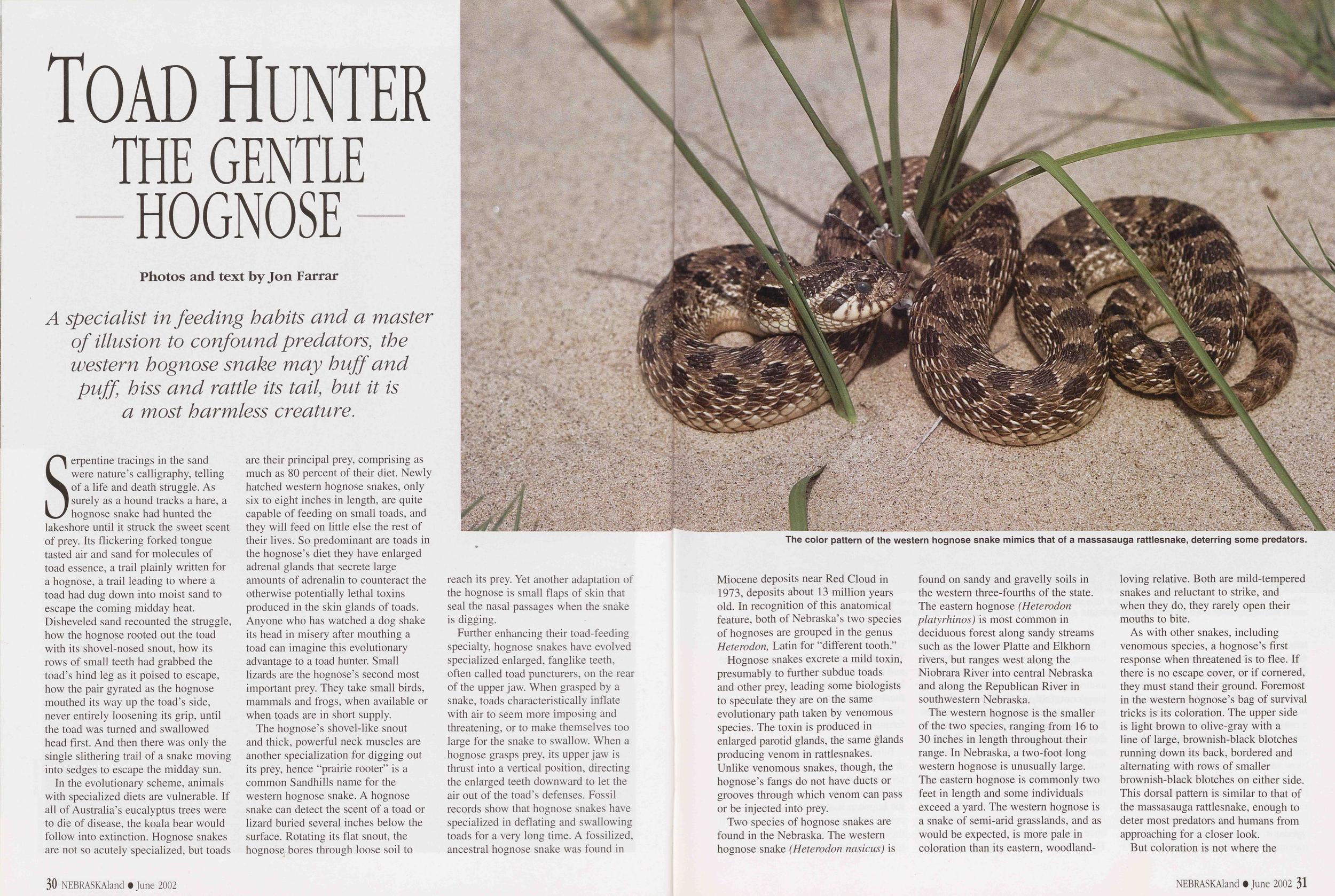
Toad Hunter THE GENTLE - HOGNOSE -
A specialist in feeding habits and a master of illusion to confound predators, the western hognose snake may huff and puff hiss and rattle its tail, but it is a most harmless creature.Serpentine tracings in the sand were nature’s calligraphy, telling of a life and death struggle. As surely as a hound tracks a hare, a hognose snake had hunted the lakeshore until it struck the sweet scent of prey. Its flickering forked tongue tasted air and sand for molecules of toad essence, a trail plainly written for a hognose, a trail leading to where a toad had dug down into moist sand to escape the coming midday heat. Disheveled sand recounted the struggle, how the hognose rooted out the toad with its shovel-nosed snout, how its rows of small teeth had grabbed the toad’s hind leg as it poised to escape, how the pair gyrated as the hognose mouthed its way up the toad’s side, never entirely loosening its grip, until the toad was turned and swallowed head first. And then there was only the single slithering trail of a snake moving into sedges to escape the midday sun.
In the evolutionary scheme, animals with specialized diets are vulnerable. If all of Australia’s eucalyptus trees were to die of disease, the koala bear would follow into extinction. Hognose snakes are not so acutely specialized, but toads are their principal prey, comprising as much as 80 percent of their diet. Newly hatched western hognose snakes, only six to eight inches in length, are quite capable of feeding on small toads, and they will feed on little else the rest of their lives. So predominant are toads in the hognose’s diet they have enlarged adrenal glands that secrete large amounts of adrenalin to counteract the otherwise potentially lethal toxins produced in the skin glands of toads. Anyone who has watched a dog shake its head in misery after mouthing a toad can imagine this evolutionary advantage to a toad hunter. Small lizards are the hognose’s second most important prey. They take small birds, mammals and frogs, when available or when toads are in short supply.
The hognose’s shovel-like snout and thick, powerful neck muscles are another specialization for digging out its prey, hence “prairie rooter” is a common Sandhills name for the western hognose snake. A hognose snake can detect the scent of a toad or lizard buried several inches below the surface. Rotating its flat snout, the hognose bores through loose soil to reach its prey. Yet another adaptation of the hognose is small flaps of skin that seal the nasal passages when the snake is digging.
Further enhancing their toad-feeding specialty, hognose snakes have evolved specialized enlarged, fanglike teeth, often called toad puncturers, on the rear of the upper jaw. When grasped by a snake, toads characteristically inflate with air to seem more imposing and threatening, or to make themselves too large for the snake to swallow. When a hognose grasps prey, its upper jaw is thrust into a vertical position, directing the enlarged teeth downward to let the air out of the toad’s defenses. Fossil records show that hognose snakes have specialized in deflating and swallowing toads for a very long time. A fossilized, ancestral hognose snake was found in 30 NEBRASKAland • June 2002 Miocene deposits near Red Cloud in 1973, deposits about 13 million years old. In recognition of this anatomical feature, both of Nebraska’s two species of hognoses are grouped in the genus Heterodon, Latin for “different tooth.”
Hognose snakes excrete a mild toxin, presumably to further subdue toads and other prey, leading some biologists to speculate they are on the same evolutionary path taken by venomous species. The toxin is produced in enlarged parotid glands, the same glands producing venom in rattlesnakes. Unlike venomous snakes, though, the hognose’s fangs do not have ducts or grooves through which venom can pass or be injected into prey.
Two species of hognose snakes are found in the Nebraska. The western hognose snake (Heterodon nasicus) is found on sandy and gravelly soils in the western three-fourths of the state. The eastern hognose (Heterodon platy rhinos) is most common in deciduous forest along sandy streams such as the lower Platte and Elkhorn rivers, but ranges west along the Niobrara River into central Nebraska and along the Republican River in southwestern Nebraska.
The western hognose is the smaller of the two species, ranging from 16 to 30 inches in length throughout their range. In Nebraska, a two-foot long western hognose is unusually large. The eastern hognose is commonly two feet in length and some individuals exceed a yard. The western hognose is a snake of semi-arid grasslands, and as would be expected, is more pale in coloration than its eastern, woodland- loving relative. Both are mild-tempered snakes and reluctant to strike, and when they do, they rarely open their mouths to bite.
As with other snakes, including venomous species, a hognose’s first response when threatened is to flee. If there is no escape cover, or if cornered, they must stand their ground. Foremost in the western hognose’s bag of survival tricks is its coloration. The upper side is light brown to olive-gray with a line of large, brownish-black blotches running down its back, bordered and alternating with rows of smaller brownish-black blotches on either side. This dorsal pattern is similar to that of the massasauga rattlesnake, enough to deter most predators and humans from approaching for a closer look.
But coloration is not where the
NEBRASKAland • June 2002 31
 western hognose’s rattlesnake mimicry
ends. When threatened, a hognose
flattens its head giving it more of the
triangular viper appearance, spreads its
ribs behind the head to form a cobra-like
hood, coils its tail and holds it high like
a rattlesnake, hisses loudly and strikes
out savagely. Such behavior has earned
the hognose colloquial names such as
blow snake, hissing adder, puff adder
and sand viper. Only the bullsnake
rivals the hognose in mimicking a
rattlesnake.
western hognose’s rattlesnake mimicry
ends. When threatened, a hognose
flattens its head giving it more of the
triangular viper appearance, spreads its
ribs behind the head to form a cobra-like
hood, coils its tail and holds it high like
a rattlesnake, hisses loudly and strikes
out savagely. Such behavior has earned
the hognose colloquial names such as
blow snake, hissing adder, puff adder
and sand viper. Only the bullsnake
rivals the hognose in mimicking a
rattlesnake.
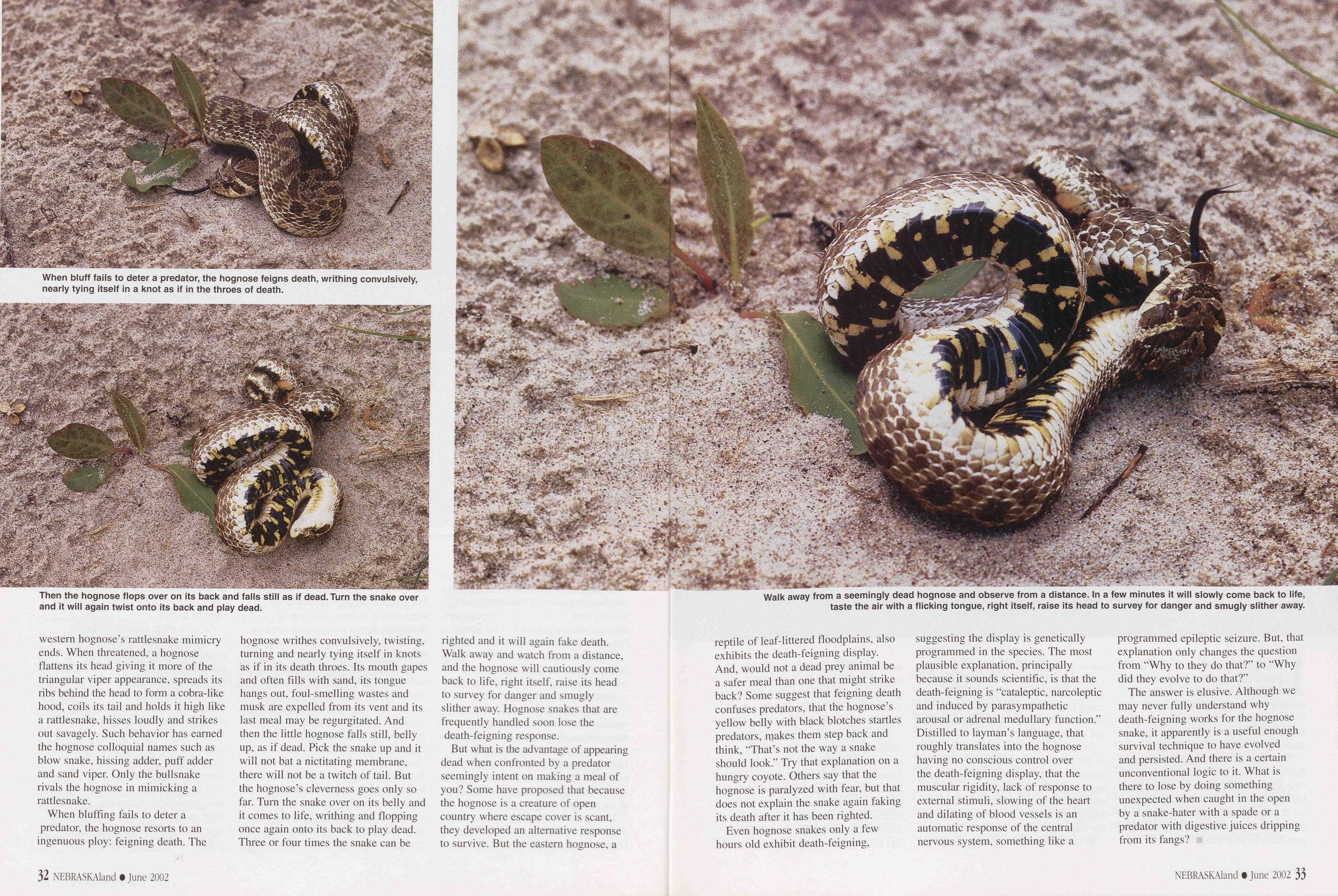
When bluffing fails to deter a predator, the hognose resorts to an ingenuous ploy: feigning death. The hognose writhes convulsively, twisting, turning and nearly tying itself in knots as if in its death throes. Its mouth gapes and often fills with sand, its tongue hangs out, foul-smelling wastes and musk are expelled from its vent and its last meal may be regurgitated. And then the little hognose falls still, belly up, as if dead. Pick the snake up and it will not bat a nictitating membrane, there will not be a twitch of tail. But the hognose’s cleverness goes only so far. Turn the snake over on its belly and it comes to life, writhing and flopping once again onto its back to play dead. Three or four times the snake can be righted and it will again fake death. Walk away and watch from a distance, and the hognose will cautiously come back to life, right itself, raise its head to survey for danger and smugly slither away. Hognose snakes that are frequently handled soon lose the death-feigning response.
But what is the advantage of appearing dead when confronted by a predator seemingly intent on making a meal of you? Some have proposed that because the hognose is a creature of open country where escape cover is scant, they developed an alternative response to survive. But the eastern hognose, a 32 NEBRASKAland • June 2002 reptile of leaf-littered floodplains, also exhibits the death-feigning display. And, would not a dead prey animal be a safer meal than one that might strike back? Some suggest that feigning death confuses predators, that the hognose’s yellow belly with black blotches startles predators, makes them step back and think, “That’s not the way a snake should look.” Try that explanation on a hungry coyote. Others say that the hognose is paralyzed with fear, but that does not explain the snake again faking its death after it has been righted.
Even hognose snakes only a few hours old exhibit death-feigning, suggesting the display is genetically programmed in the species. The most plausible explanation, principally because it sounds scientific, is that the death-feigning is “cataleptic, narcoleptic and induced by parasympathetic arousal or adrenal medullary function.” Distilled to layman’s language, that roughly translates into the hognose having no conscious control over the death-feigning display, that the muscular rigidity, lack of response to external stimuli, slowing of the heart and dilating of blood vessels is an automatic response of the central nervous system, something like a programmed epileptic seizure. But, that explanation only changes the question from “Why to they do that?” to “Why did they evolve to do that?”
The answer is elusive. Although we may never fully understand why death-feigning works for the hognose snake, it apparently is a useful enough survival technique to have evolved and persisted. And there is a certain unconventional logic to it. What is there to lose by doing something unexpected when caught in the open by a snake-hater with a spade or a predator with digestive juices dripping from its fangs?
NEBRASKAland • June 2002 33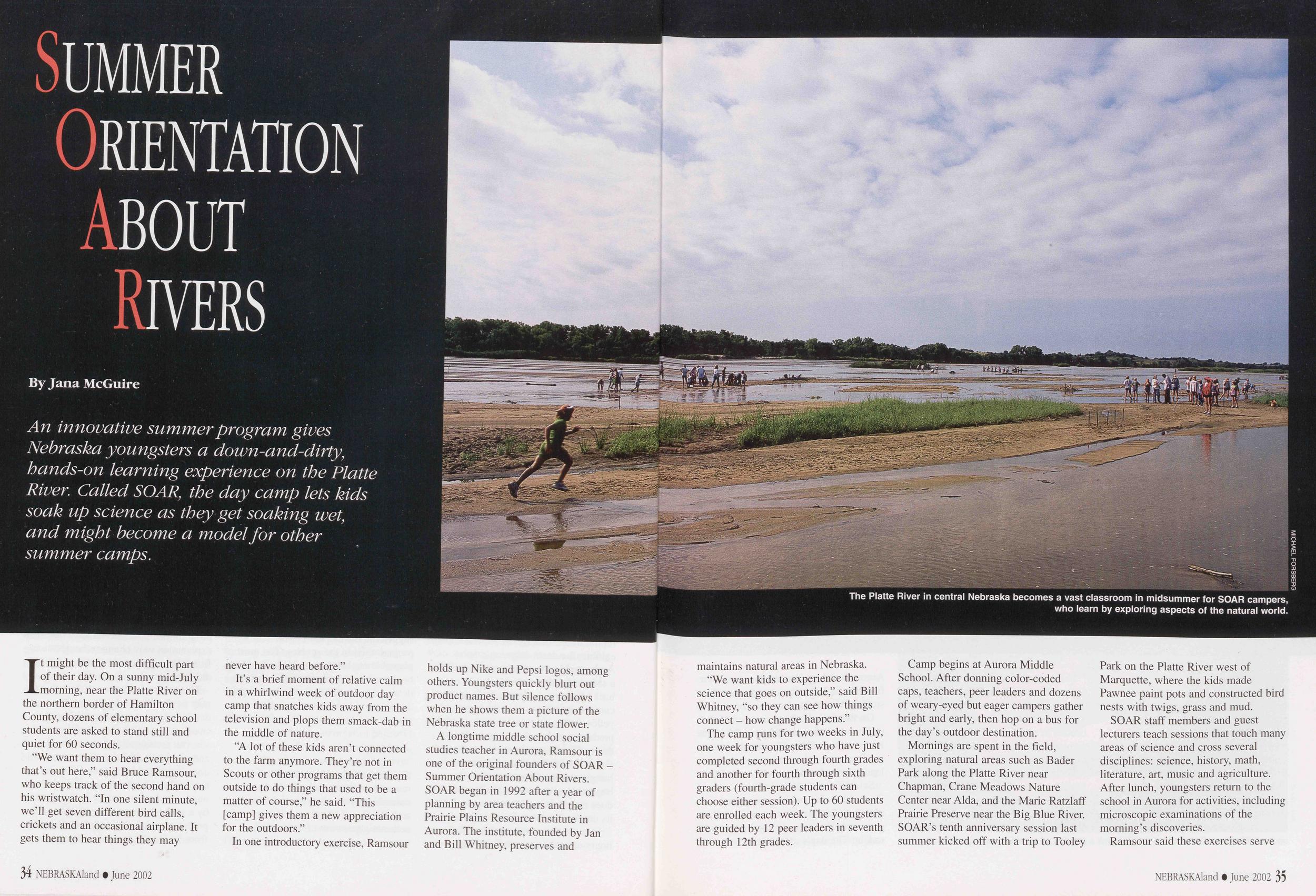
SUMMER Orientation About Rivers
An innovative summer program gives Nebraska youngsters a down-and-dirty, hands-on learning experience on the Platte River. Called SOAR, the day camp lets kids soak up science as they get soaking wet, and might become a model for other summer camps. MICHAEL FORSBERGIt might be the most difficult part of their day. On a sunny mid-July morning, near the Platte River on the northern border of Hamilton County, dozens of elementary school students are asked to stand still and quiet for 60 seconds.
“We want them to hear everything that’s out here,” said Bruce Ramsour, who keeps track of the second hand on his wristwatch. "In one silent minute, we’ll get seven different bird calls, crickets and an occasional airplane. It gets them to hear things they may never have heard before.”
It’s a brief moment of relative calm in a whirlwind week of outdoor day camp that snatches kids away from the television and plops them smack-dab in the middle of nature.
“A lot of these kids aren’t connected to the farm anymore. They’re not in Scouts or other programs that get them outside to do things that used to be a matter of course,” he said. "This [camp] gives them a new appreciation for the outdoors.”
In one introductory exercise, Ramsour holds up Nike and Pepsi logos, among others. Youngsters quickly blurt out product names. But silence follows when he shows them a picture of the Nebraska state tree or state flower.
A longtime middle school social studies teacher in Aurora, Ramsour is one of the original founders of SOAR - Summer Orientation About Rivers. SOAR began in 1992 after a year of planning by area teachers and the Prairie Plains Resource Institute in Aurora. The institute, founded by Jan and Bill Whitney, preserves and 34 NEBRASKAland • June 2002 maintains natural areas in Nebraska.
"We want kids to experience the science that goes on outside,” said Bill Whitney, "so they can see how things connect - how change happens.”
The camp runs for two weeks in July, one week for youngsters who have just completed second through fourth grades and another for fourth through sixth graders (fourth-grade students can choose either session). Up to 60 students are enrolled each week. The youngsters are guided by 12 peer leaders in seventh through 12th grades.
Camp begins at Aurora Middle School. After donning color-coded caps, teachers, peer leaders and dozens of weary-eyed but eager campers gather bright and early, then hop on a bus for the day’s outdoor destination.
Mornings are spent in the field, exploring natural areas such as Bader Park along the Platte River near Chapman, Crane Meadows Nature Center near Alda, and the Marie Ratzlaff Prairie Preserve near the Big Blue River. SOAR’s tenth anniversary session last summer kicked off with a trip to Tooley Park on the Platte River west of Marquette, where the kids made Pawnee paint pots and constructed bird nests with twigs, grass and mud.
SOAR staff members and guest lecturers teach sessions that touch many areas of science and cross several disciplines: science, history, math, literature, art, music and agriculture. After lunch, youngsters return to the school in Aurora for activities, including microscopic examinations of the morning’s discoveries.
Ramsour said these exercises serve
NEBRASKAland O June 2002 35
 many functions.
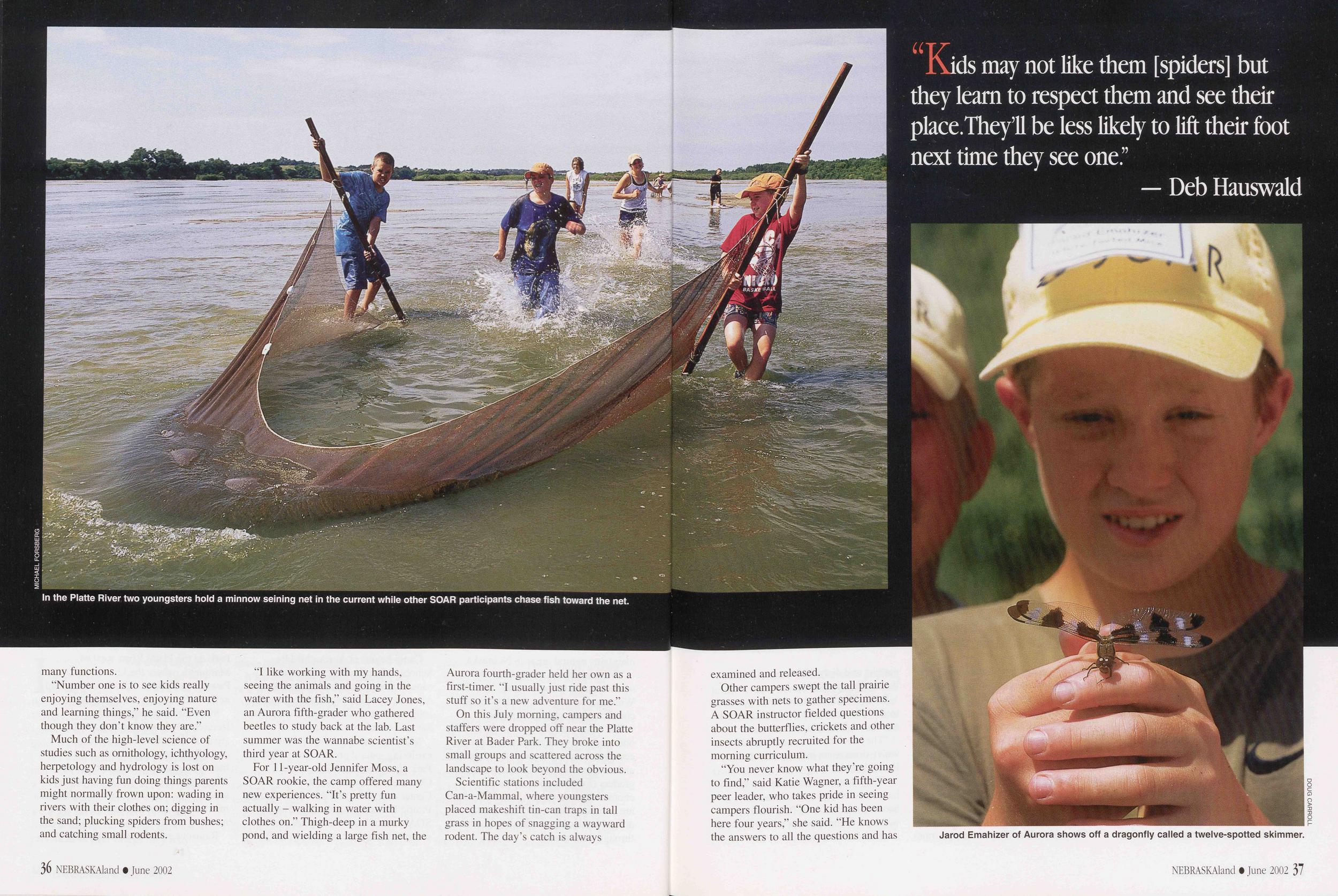
“Number one is to see kids really enjoying themselves, enjoying nature and learning things,” he said. “Even though they don’t know they are.”
Much of the high-level science of studies such as ornithology, ichthyology, herpetology and hydrology is lost on kids just having fun doing things parents might normally frown upon: wading in rivers with their clothes on; digging in the sand; plucking spiders from bushes; and catching small rodents.
“I like working with my hands, seeing the animals and going in the water with the fish,” said Lacey Jones, an Aurora fifth-grader who gathered beetles to study back at the lab. Last summer was the wannabe scientist’s third year at SOAR.
For 11-year-old Jennifer Moss, a SOAR rookie, the camp offered many new experiences. “It’s pretty fun actually - walking in water with clothes on.” Thigh-deep in a murky pond, and wielding a large fish net, the Aurora fourth-grader held her own as a first-timer. “I usually just ride past this stuff so it’s a new adventure for me.”
On this July morning, campers and staffers were dropped off near the Platte River at Bader Park. They broke into small groups and scattered across the landscape to look beyond the obvious.
Scientific stations included Can-a-Mammal, where youngsters placed makeshift tin-can traps in tall grass in hopes of snagging a wayward rodent. The day’s catch is always 36 NEBRASKAland • June 2002 examined and released.
Other campers swept the tall prairie grasses with nets to gather specimens. A SOAR instructor fielded questions about the butterflies, crickets and other insects abruptly recruited for the morning curriculum.
“You never know what they’re going
to find,” said Katie Wagner, a fifth-year
peer leader, who takes pride in seeing
campers flourish. “One kid has been
here four years,” she said. “He knows
the answers to all the questions and has
NEBRASKAland • June 2002 37
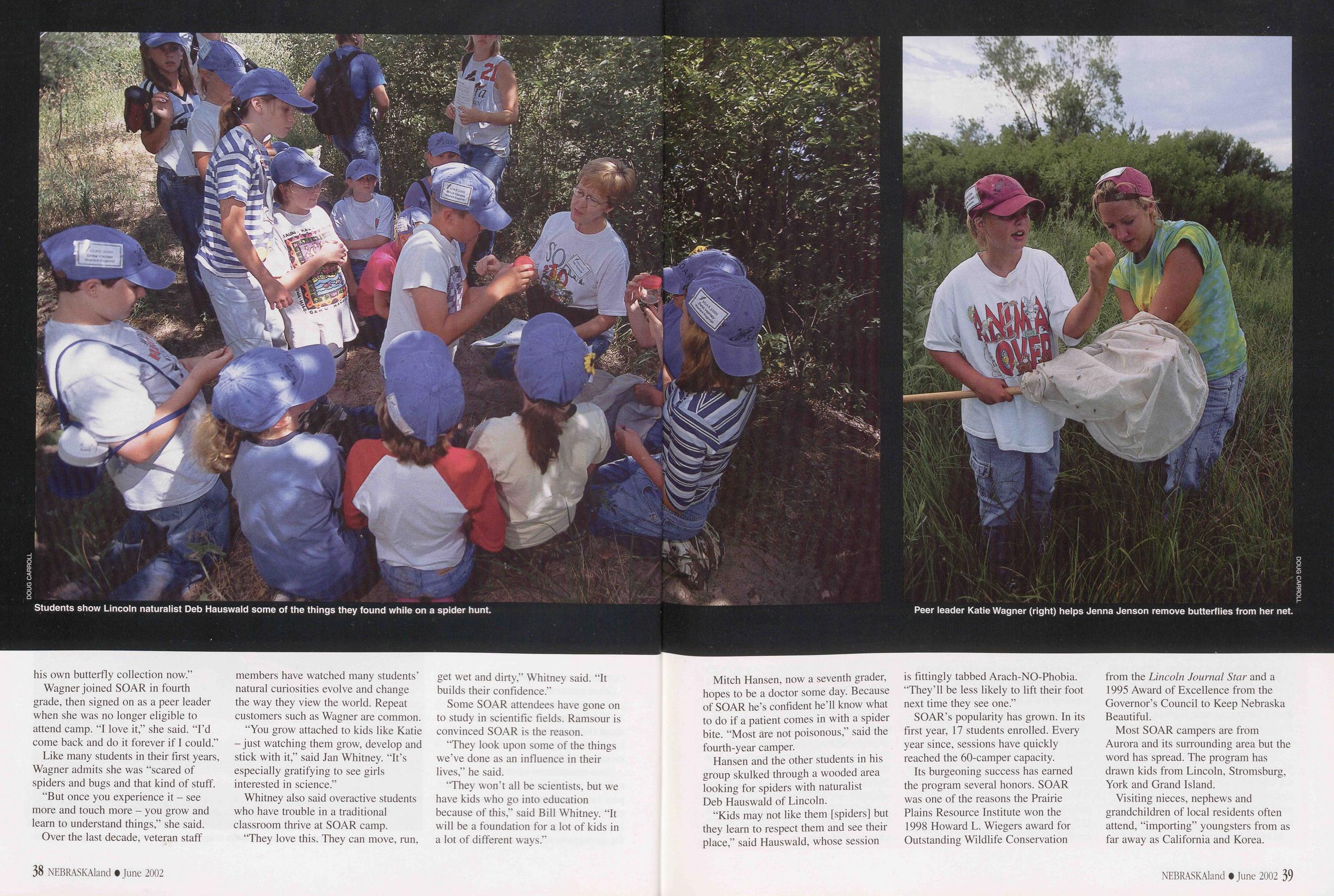 his own butterfly collection now.”
Wagner joined SOAR in fourth grade, then signed on as a peer leader when she was no longer eligible to attend camp. "I love it,” she said. “I’d come back and do it forever if I could.”
Like many students in their first years, Wagner admits she was “scared of spiders and bugs and that kind of stuff.
“But once you experience it - see more and touch more - you grow and learn to understand things,” she said.
Over the last decade, veteran staff members have watched many students’ natural curiosities evolve and change the way they view the world. Repeat customers such as Wagner are common.
“You grow attached to kids like Katie -just watching them grow, develop and stick with it,” said Jan Whitney. “It’s especially gratifying to see girls interested in science.”
Whitney also said overactive students who have trouble in a traditional classroom thrive at SOAR camp.
“They love this. They can move, run, get wet and dirty,” Whitney said. “It builds their confidence.”
Some SOAR attendees have gone on to study in scientific fields. Ramsour is convinced SOAR is the reason.
“They look upon some of the things we’ve done as an influence in their lives,” he said.
“They won’t all be scientists, but we have kids who go into education because of this,” said Bill Whitney. “It will be a foundation for a lot of kids in a lot of different ways.”
38 NEBRASKAland • June 2002Mitch Hansen, now a seventh grader, hopes to be a doctor some day. Because of SOAR he’s confident he’ll know what to do if a patient comes in with a spider bite. “Most are not poisonous,” said the fourth-year camper.
Hansen and the other students in his group skulked through a wooded area looking for spiders with naturalist Deb Hauswald of Lincoln.
“Kids may not like them [spiders] but they learn to respect them and see their place,” said Hauswald, whose session is fittingly tabbed Arach-NO-Phobia. “They’ll be less likely to lift their foot next time they see one.”
SOAR’s popularity has grown. In its first year, 17 students enrolled. Every year since, sessions have quickly reached the 60-camper capacity.
Its burgeoning success has earned the program several honors. SOAR was one of the reasons the Prairie Plains Resource Institute won the 1998 Howard L. Wiegers award for Outstanding Wildlife Conservation from the Lincoln Journal Star and a 1995 Award of Excellence from the Governor’s Council to Keep Nebraska Beautiful.
Most SOAR campers are from Aurora and its surrounding area but the word has spread. The program has drawn kids from Lincoln, Stromsburg, York and Grand Island.
Visiting nieces, nephews and grandchildren of local residents often attend, “importing” youngsters from as far away as California and Korea.
NEBRASKAland • June 2002 39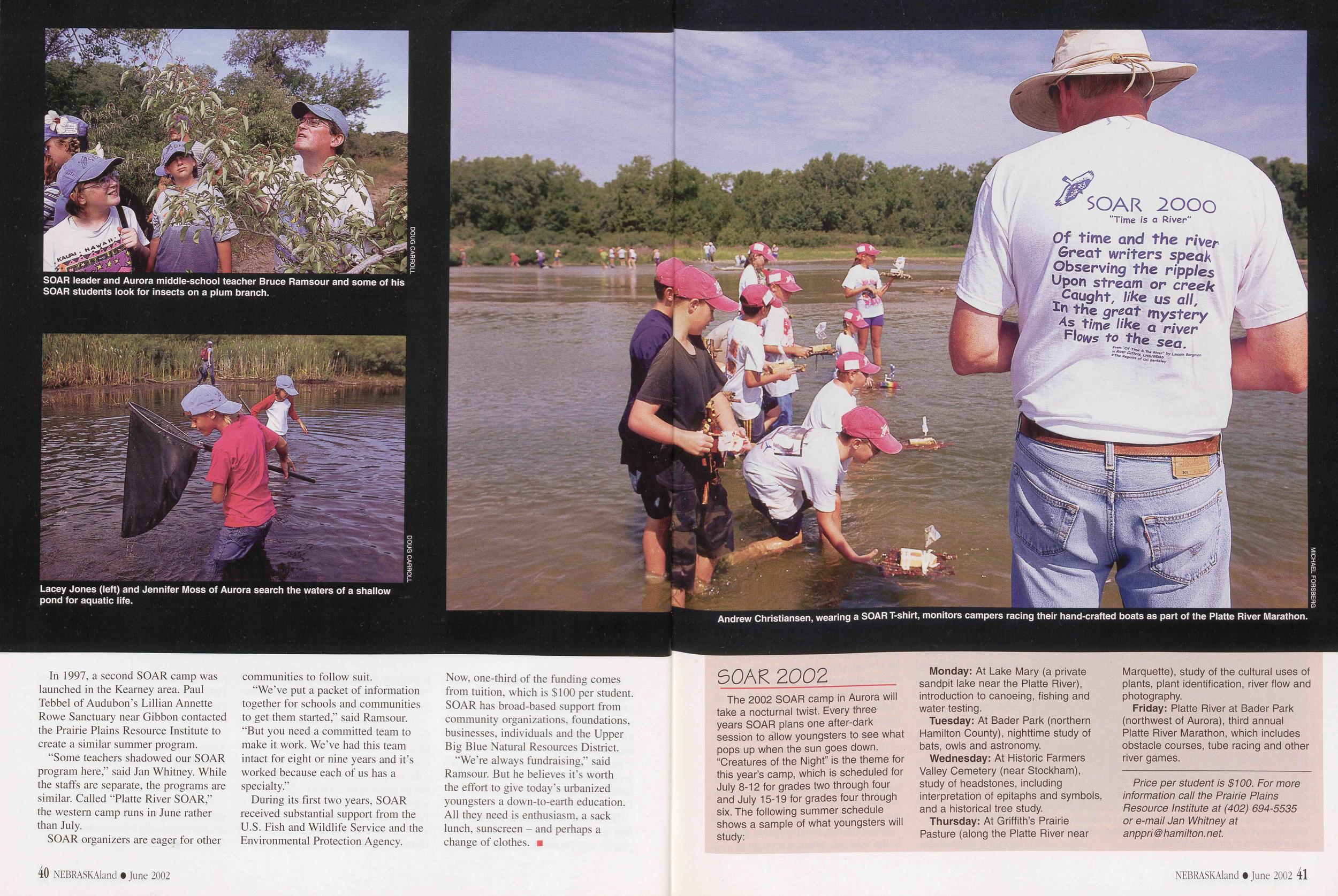
In 1997, a second SOAR camp was launched in the Kearney area. Paul Tebbel of Audubon’s Lillian Annette Rowe Sanctuary near Gibbon contacted the Prairie Plains Resource Institute to create a similar summer program.
"Some teachers shadowed our SOAR program here,” said Jan Whitney. While the staffs are separate, the programs are similar. Called “Platte River SOAR,” the western camp runs in June rather than July.
SOAR organizers are eager for other communities to follow suit.
"We’ve put a packet of information together for schools and communities to get them started,” said Ramsour. "But you need a committed team to make it work. We’ve had this team intact for eight or nine years and it’s worked because each of us has a specialty.”
During its first two years, SOAR received substantial support from the U.S. Fish and Wildlife Service and the Environmental Protection Agency. Now, one-third of the funding from tuition, which is $100 per student. SOAR has broad-based support from community organizations, foundations, businesses, individuals and the Upper Big Blue Natural Resources District.
"We’re always fundraising,” said Ramsour. But he believes it’s worth the effort to give today’s urbanized youngsters a down-to-earth education. All they need is enthusiasm, a sack lunch, sunscreen - and perhaps a change of clothes. ■
40 NEBRASKAland • June 2002 SOAK 2002The 2002 SOAR camp in Aurora will take a nocturnal twist. Every three years SOAR plans one after-dark session to allow youngsters to see what pops up when the sun goes down. “Creatures of the Night” is the theme for this year’s camp, which is scheduled for July 8-12 for grades two through four and July 15-19 for grades four through six. The following summer schedule shows a sample of what youngsters will study:
Monday: At Lake Mary (a private sandpit lake near the Platte River), introduction to canoeing, fishing and water testing.
Tuesday: At Bader Park (northern Hamilton County), nighttime study of bats, owls and astronomy.
Wednesday: At Historic Farmers Valley Cemetery (near Stockham), study of headstones, including interpretation of epitaphs and symbols, and a historical tree study.
Thursday: At Griffith’s Prairie Pasture (along the Platte River near Marquette), study of the cultural uses of plants, plant identification, river flow and photography.
Friday: Platte River at Bader Park (northwest of Aurora), third annual Platte River Marathon, which includes obstacle courses, tube racing and other river games.
Price per student is $100. For more information call the Prairie Plains Resource Institute at (402) 694-5535 or e-mail Jan Whitney at anppri @ hamilton. net.
NEBRASKAland • June 2002 41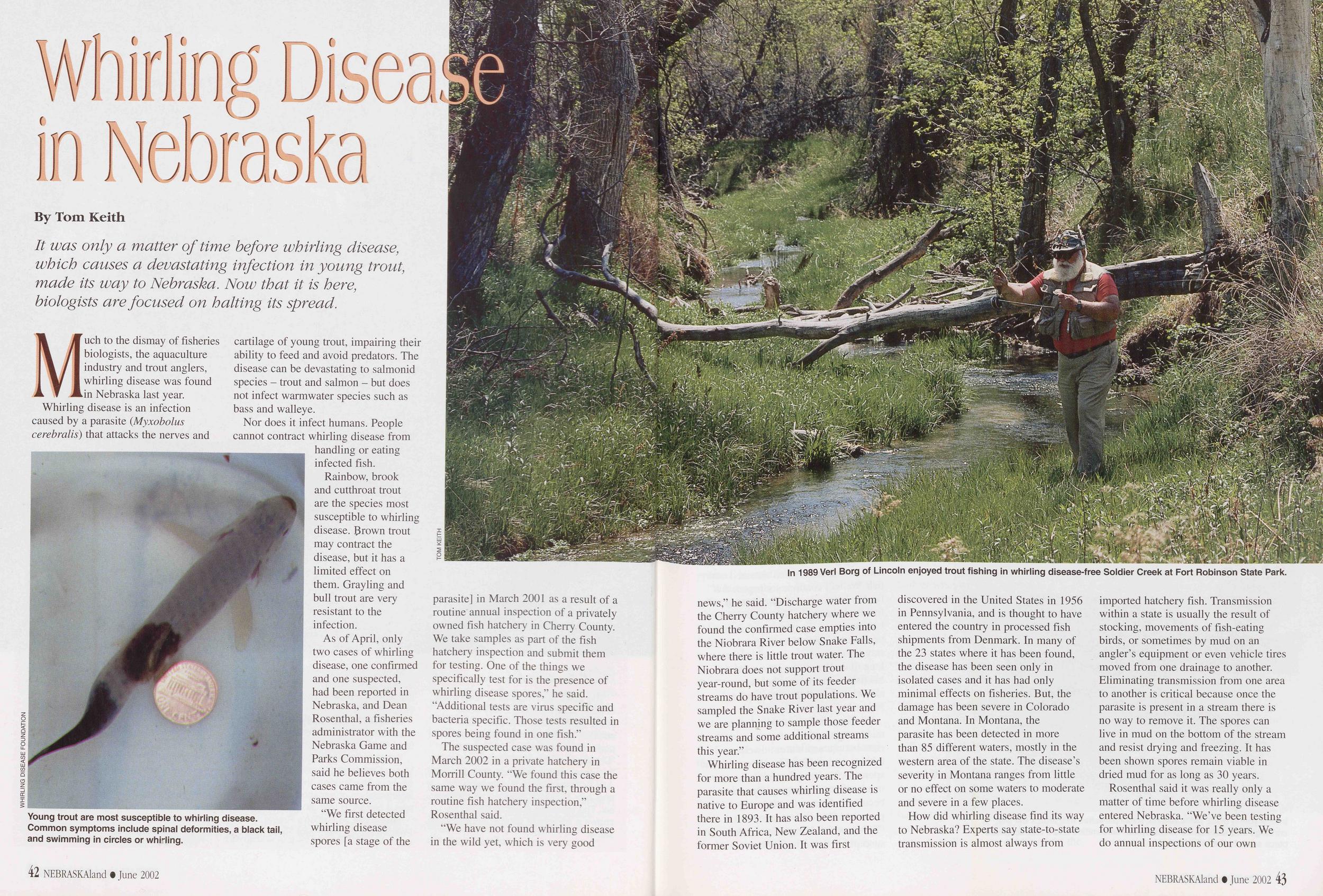
WHIRLING DISEASE IN NEBRASKA
It was only a matter of time before whirling disease, which causes a devastating infection in young trout, made its way to Nebraska. Now that it is here, biologists are focused on halting its spread.Much to the dismay of fisheries biologists, the aquaculture industry and trout anglers, whirling disease was found in Nebraska last year. Whirling disease is an infection caused by a parasite (.Myxobolus cerebralis) that attacks the nerves and cartilage of young trout, impairing their ability to feed and avoid predators. The disease can be devastating to salmonid species - trout and salmon - but does not infect warmwater species such as bass and walleye.
Nor does it infect humans. People cannot contract whirling disease from handling or eating infected fish. Rainbow, brook and cutthroat trout are the species most susceptible to whirling disease. Brown trout may contract the disease, but it has a limited effect on them. Grayling and bull trout are very resistant to the infection.
As of April, only two cases of whirling disease, one confirmed and one suspected, had been reported in Nebraska, and Dean Rosenthal, a fisheries administrator with the Nebraska Game and Parks Commission, said he believes both cases came from the same source.
“We first detected whirling disease spores [a stage of the parasite] in March 2001 as a result of a routine annual inspection of a privately owned fish hatchery in Cherry County. We take samples as part of the fish hatchery inspection and submit them for testing. One of the things we specifically test for is the presence of whirling disease spores,” he said. “Additional tests are virus specific and bacteria specific. Those tests resulted in spores being found in one fish.”
The suspected case was found in March 2002 in a private hatchery in Morrill County. “We found this case the same way we found the first, through a routine fish hatchery inspection,” Rosenthal said.
“We have not found whirling disease in the wild yet, which is very good 42 NEBRASKAland • June 2002 news,” he said. “Discharge water from the Cherry County hatchery where we found the confirmed case empties into the Niobrara River below Snake Falls, where there is little trout water. The Niobrara does not support trout year-round, but some of its feeder streams do have trout populations. We sampled the Snake River last year and we are planning to sample those feeder streams and some additional streams this year.”
Whirling disease has been recognized for more than a hundred years. The parasite that causes whirling disease is native to Europe and was identified there in 1893. It has also been reported in South Africa, New Zealand, and the former Soviet Union. It was first discovered in the United States in 1956 in Pennsylvania, and is thought to have entered the country in processed fish shipments from Denmark. In many of the 23 states where it has been found, the disease has been seen only in isolated cases and it has had only minimal effects on fisheries. But, the damage has been severe in Colorado and Montana. In Montana, the parasite has been detected in more than 85 different waters, mostly in the western area of the state. The disease’s severity in Montana ranges from little or no effect on some waters to moderate and severe in a few places.
How did whirling disease find its way to Nebraska? Experts say state-to-state transmission is almost always from imported hatchery fish. Transmission within a state is usually the result of stocking, movements of fish-eating birds, or sometimes by mud on an angler’s equipment or even vehicle tires moved from one drainage to another. Eliminating transmission from one area to another is critical because once the parasite is present in a stream there is no way to remove it. The spores can live in mud on the bottom of the stream and resist drying and freezing. It has been shown spores remain viable in dried mud for as long as 30 years.
Rosenthal said it was really only a
matter of time before whirling disease
entered Nebraska. “We’ve been testing
for whirling disease for 15 years. We
do annual inspections of our own
NEBRASKAland • June 2002 43
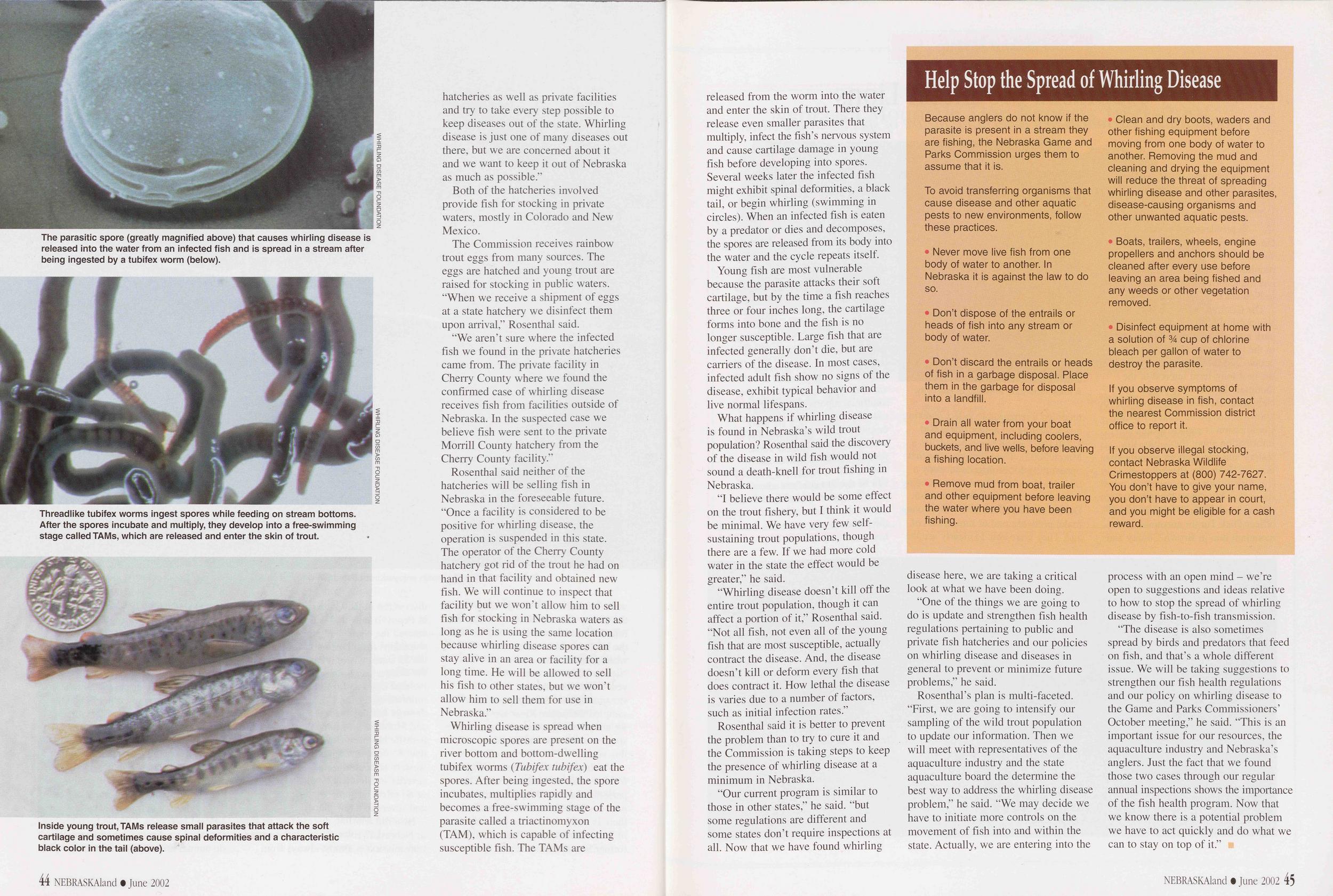 hatcheries as well as private facilities
and try to take every step possible to
keep diseases out of the state. Whirling
disease is just one of many diseases out
there, but we are concerned about it
and we want to keep it out of Nebraska
as much as possible.”
hatcheries as well as private facilities
and try to take every step possible to
keep diseases out of the state. Whirling
disease is just one of many diseases out
there, but we are concerned about it
and we want to keep it out of Nebraska
as much as possible.”
Both of the hatcheries involved provide fish for stocking in private waters, mostly in Colorado and New Mexico.
The Commission receives rainbow trout eggs from many sources. The eggs are hatched and young trout are raised for stocking in public waters. “When we receive a shipment of eggs at a state hatchery we disinfect them upon arrival,” Rosenthal said.
“We aren’t sure where the infected fish we found in the private hatcheries came from. The private facility in Cherry County where we found the confirmed case of whirling disease receives fish from facilities outside of Nebraska. In the suspected case we believe fish were sent to the private Morrill County hatchery from the Cherry County facility.”
Rosenthal said neither of the hatcheries will be selling fish in Nebraska in the foreseeable future. “Once a facility is considered to be positive for whirling disease, the operation is suspended in this state. The operator of the Cherry County hatchery got rid of the trout he had on hand in that facility and obtained new fish. We will continue to inspect that facility but we won’t allow him to sell fish for stocking in Nebraska waters as long as he is using the same location because whirling disease spores can stay alive in an area or facility for a long time. He will be allowed to sell his fish to other states, but we won’t allow him to sell them for use in Nebraska.”
Whirling disease is spread when microscopic spores are present on the river bottom and bottom-dwelling tubifex worms (Tubifex tubifex) eat the spores. After being ingested, the spore incubates, multiplies rapidly and becomes a free-swimming stage of the parasite called a triactinomyxon (TAM), which is capable of infecting susceptible fish. The TAMs are 44 NEBRASKAland • June 2002 released from the worm into the water and enter the skin of trout. There they release even smaller parasites that multiply, infect the fish’s nervous system and cause cartilage damage in young fish before developing into spores. Several weeks later the infected fish might exhibit spinal deformities, a black tail, or begin whirling (swimming in circles). When an infected fish is eaten by a predator or dies and decomposes, the spores are released from its body into the water and the cycle repeats itself.
Young fish are most vulnerable because the parasite attacks their soft cartilage, but by the time a fish reaches three or four inches long, the cartilage forms into bone and the fish is no longer susceptible. Large fish that are infected generally don’t die, but are carriers of the disease. In most cases, infected adult fish show no signs of the disease, exhibit typical behavior and live normal lifespans.
What happens if whirling disease is found in Nebraska’s wild trout population? Rosenthal said the discovery of the disease in wild fish would not sound a death-knell for trout fishing in Nebraska.
“I believe there would be some effect on the trout fishery, but I think it would be minimal. We have very few self- sustaining trout populations, though there are a few. If we had more cold water in the state the effect would be greater,” he said.
“Whirling disease doesn’t kill off the entire trout population, though it can affect a portion of it,” Rosenthal said. “Not all fish, not even all of the young fish that are most susceptible, actually contract the disease. And, the disease doesn’t kill or deform every fish that does contract it. How lethal the disease is varies due to a number of factors, such as initial infection rates.”
Rosenthal said it is better to prevent the problem than to try to cure it and the Commission is taking steps to keep the presence of whirling disease at a minimum in Nebraska.
“Our current program is similar to those in other states,” he said, “but some regulations are different and some states don’t require inspections at all. Now that we have found whirling disease here, we are taking a critical look at what we have been doing. “One of the things we are going to do is update and strengthen fish health regulations pertaining to public and private fish hatcheries and our policies on whirling disease and diseases in general to prevent or minimize future problems,” he said.
Rosenthal’s plan is multi-faceted. “First, we are going to intensify our sampling of the wild trout population to update our information. Then we will meet with representatives of the aquaculture industry and the state aquaculture board the determine the best way to address the whirling disease problem,” he said. “We may decide we have to initiate more controls on the movement of fish into and within the state. Actually, we are entering into the process with an open mind - we’re open to suggestions and ideas relative to how to stop the spread of whirling disease by fish-to-fish transmission.
“The disease is also sometimes spread by birds and predators that feed on fish, and that’s a whole different issue. We will be taking suggestions to strengthen our fish health regulations and our policy on whirling disease to the Game and Parks Commissioners’ October meeting,” he said. “This is an important issue for our resources, the aquaculture industry and Nebraska’s anglers. Just the fact that we found those two cases through our regular annual inspections shows the importance of the fish health program. Now that we know there is a potential problem we have to act quickly and do what we can to stay on top of it.”
Help Stop the Spread of Whirling DiseaseBecause anglers do not know if the parasite is present in a stream they are fishing, the Nebraska Game and Parks Commission urges them to assume that it is.
To avoid transferring organisms that cause disease and other aquatic pests to new environments, follow these practices.
• Never move live fish from one body of water to another. In Nebraska it is against the law to do so.
• Don’t dispose of the entrails or heads of fish into any stream or body of water.
• Don’t discard the entrails or heads of fish in a garbage disposal. Place them in the garbage for disposal into a landfill.
• Drain all water from your boat and equipment, including coolers, buckets, and live wells, before leaving a fishing location.
• Remove mud from boat, trailer and other equipment before leaving the water where you have been fishing.
• Clean and dry boots, waders and other fishing equipment before moving from one body of water to another. Removing the mud and cleaning and drying the equipment will reduce the threat of spreading whirling disease and other parasites, disease-causing organisms and other unwanted aquatic pests.
• Boats, trailers, wheels, engine propellers and anchors should be cleaned after every use before leaving an area being fished and any weeds or other vegetation removed.
Disinfect equipment at home with a solution of % cup of chlorine bleach per gallon of water to destroy the parasite.
If you observe symptoms of whirling disease in fish, contact the nearest Commission district office to report it.
If you observe illegal stocking, contact Nebraska Wildlife Crimestoppers at (800) 742-7627. You don’t have to give your name, you don’t have to appear in court, and you might be eligible for a cash reward.
NEBRASKAland • June 2002 45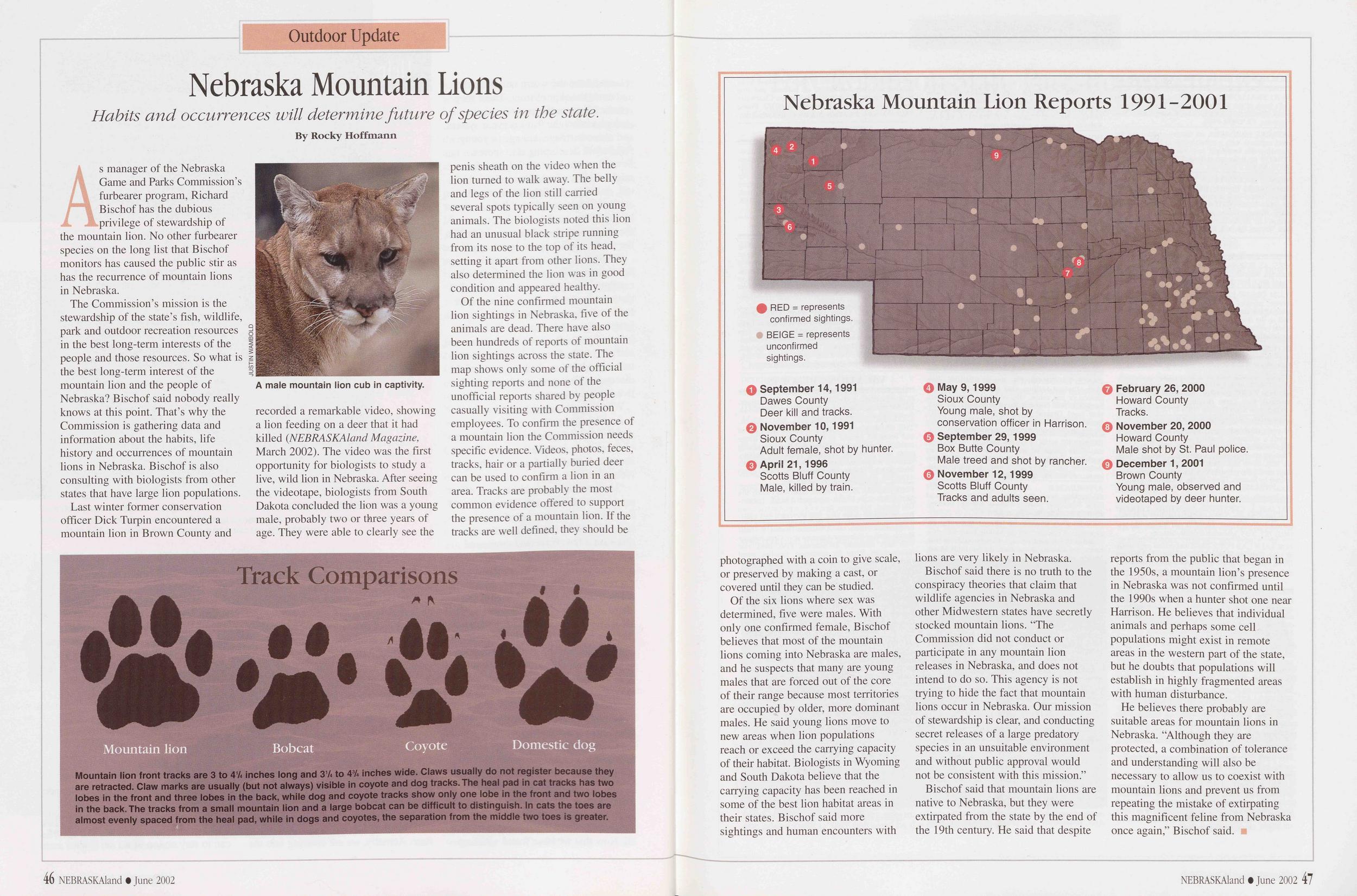
As manager of the Nebraska Game and Parks Commission’s furbearer program, Richard Bischof has the dubious privilege of stewardship of the mountain lion. No other furbearer species on the long list that Bischof monitors has caused the public stir as has the recurrence of mountain lions in Nebraska.
The Commission’s mission is the stewardship of the state’s fish, wildlife, park and outdoor recreation resources in the best long-term interests of the people and those resources. So what is the best long-term interest of the mountain lion and the people of Nebraska? Bischof said nobody really knows at this point. That’s why the Commission is gathering data and information about the habits, life history and occurrences of mountain lions in Nebraska. Bischof is also consulting with biologists from other states that have large lion populations.
Last winter former conservation officer Dick Turpin encountered a mountain lion in Brown County and recorded a remarkable video, showing a lion feeding on a deer that it had killed (NEBRASKAland Magazine, March 2002). The video was the first opportunity for biologists to study a live, wild lion in Nebraska. After seeing the videotape, biologists from South Dakota concluded the lion was a young male, probably two or three years of age. They were able to clearly see the penis sheath on the video when the lion turned to walk away. The belly and legs of the lion still carried several spots typically seen on young animals. The biologists noted this lion had an unusual black stripe running from its nose to the top of its head, setting it apart from other lions. They also determined the lion was in good condition and appeared healthy.
Of the nine confirmed mountain lion sightings in Nebraska, five of the animals are dead. There have also been hundreds of reports of mountain lion sightings across the state. The map shows only some of the official sighting reports and none of the unofficial reports shared by people casually visiting with Commission employees. To confirm the presence of a mountain lion the Commission needs specific evidence. Videos, photos, feces, tracks, hair or a partially buried deer can be used to confirm a lion in an area. Tracks are probably the most common evidence offered to support the presence of a mountain lion. If the tracks are well defined, they should be 46 NEBRASKAland • June 2002 photographed with a coin to give scale, or preserved by making a cast, or covered until they can be studied.
Of the six lions where sex was determined, five were males. With only one confirmed female, Bischof believes that most of the mountain lions coming into Nebraska are males, and he suspects that many are young males that are forced out of the core of their range because most territories are occupied by older, more dominant males. He said young lions move to new areas when lion populations reach or exceed the carrying capacity of their habitat. Biologists in Wyoming and South Dakota believe that the carrying capacity has been reached in some of the best lion habitat areas in their states. Bischof said more sightings and human encounters with lions are very likely in Nebraska.
Bischof said there is no truth to the conspiracy theories that claim that wildlife agencies in Nebraska and other Midwestern states have secretly stocked mountain lions. “The Commission did not conduct or participate in any mountain lion releases in Nebraska, and does not intend to do so. This agency is not trying to hide the fact that mountain lions occur in Nebraska. Our mission of stewardship is clear, and conducting secret releases of a large predatory species in an unsuitable environment and without public approval would not be consistent with this mission.”
Bischof said that mountain lions are native to Nebraska, but they were extirpated from the state by the end of the 19th century. He said that despite reports from the public that began in the 1950s, a mountain lion’s presence in Nebraska was not confirmed until the 1990s when a hunter shot one near Harrison. He believes that individual animals and perhaps some cell populations might exist in remote areas in the western part of the state, but he doubts that populations will establish in highly fragmented areas with human disturbance.
He believes there probably are suitable areas for mountain lions in Nebraska. “Although they are protected, a combination of tolerance and understanding will also be necessary to allow us to coexist with mountain lions and prevent us from repeating the mistake of extirpating this magnificent feline from Nebraska once again,” Bischof said. ■
NEBRASKAland • June 2002 47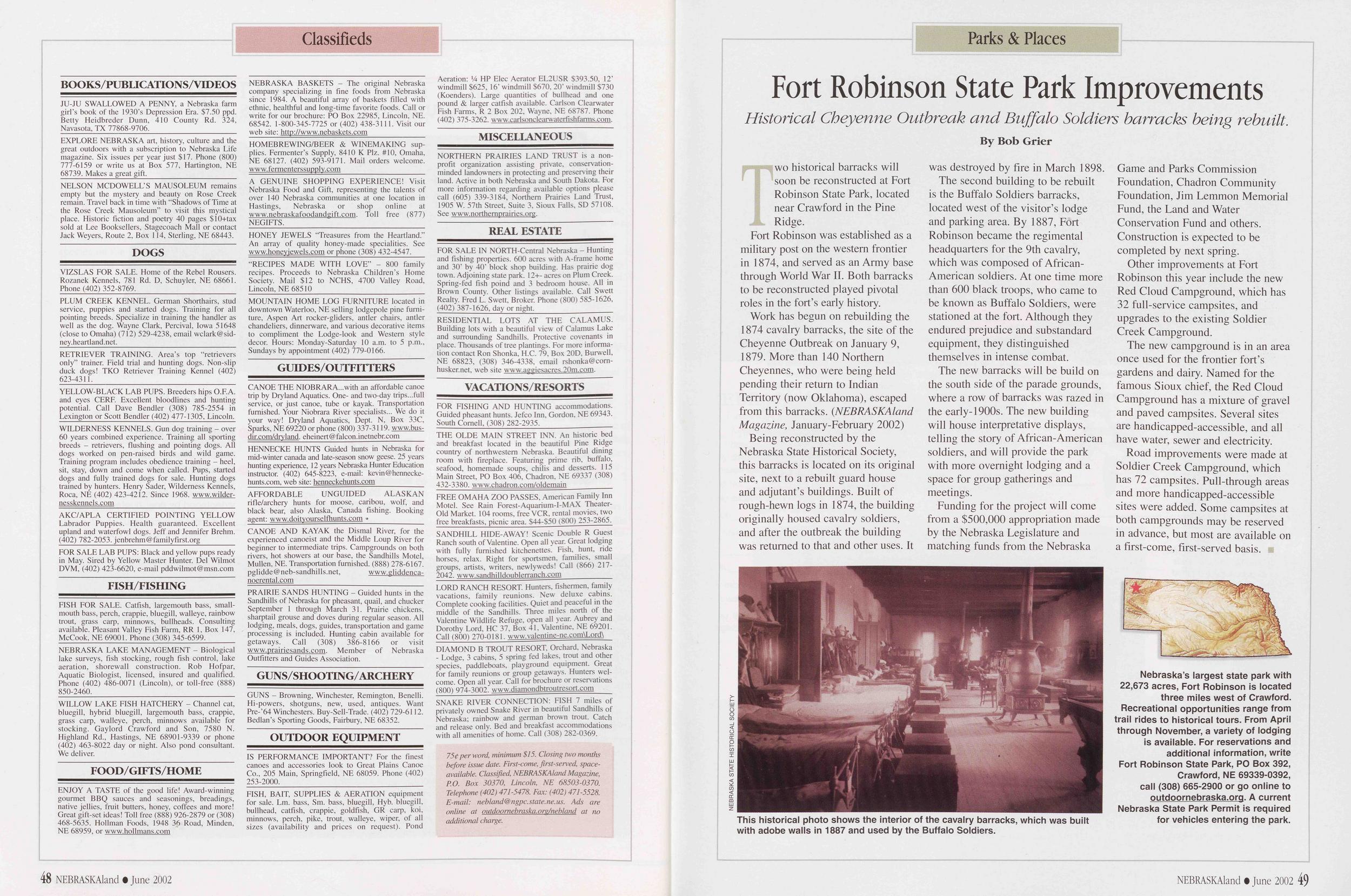
Classifieds
BOOKS/PUBLICATIONS/VIDEOSJU-JU SWALLOWED A PENNY, a Nebraska farm girl’s book of the 1930’s Depression Era. $7.50 ppd. Betty Heidbreder Dunn, 410 County Rd. 324, Navasota, TX 77868-9706.
EXPLORE NEBRASKA art, history, culture and the great outdoors with a subscription to Nebraska Life magazine. Six issues per year just $17. Phone (800) 777-6159 or write us at Box 577, Hartington, NE 68739. Makes a great gift.
NELSON MCDOWELL’S MAUSOLEUM remains empty but the mystery and beauty on Rose Creek remain. Travel back in time with “Shadows of Time at the Rose Creek Mausoleum” to visit this mystical place. Historic fiction and poetry 40 pages $10+tax sold at Lee Booksellers, Stagecoach Mall or contact Jack Weyers, Route 2, Box 114, Sterling, NE 68443.
DOGSVIZSLAS FOR SALE. Home of the Rebel Rousers. Rozanek Kennels, 781 Rd. D, Schuyler, NE 68661. Phone (402) 352-8769.
PLUM CREEK KENNEL. German Shorthairs, stud service, puppies and started dogs. Training for all pointing breeds. Specialize in training the handler as well as the dog. Wayne Clark, Percival, Iowa 51648 (close to Omaha) (712) 529-4238, email wclark@sid- ney.heartland.net.
RETRIEVER TRAINING. Area’s top “retrievers only” trainer. Field trial and hunting dogs. Non-slip duck dogs! TKO Retriever Training Kennel (402) 623-4311.
YELLOW-BLACK LAB PUPS. Breeders hips O.F.A. and eyes CERF. Excellent bloodlines and hunting potential. Call Dave Bendler (308) 785-2554 in Lexington or Scott Bendler (402) 477-1305, Lincoln.
WILDERNESS KENNELS. Gun dog training - over 60 years combined experience. Training all sporting breeds - retrievers, flushing and pointing dogs. All dogs worked on pen-raised birds and wild game. Training program includes obedience training - heel, sit, stay, down and come when called. Pups, started dogs and fully trained dogs for sale. Hunting dogs trained by hunters. Henry Sader, Wilderness Kennels, Roca, NE (402) 423-4212. Since 1968. www.wilder- nesskennels.com
AKC/APLA CERTIFIED POINTING YELLOW Labrador Puppies. Health guaranteed. Excellent upland and waterfowl dogs. Jeff and Jennifer Brehm. (402) 782-2053. jenbrehm@familyfirst.org FOR SALE LAB PUPS: Black and yellow pups ready in May. Sired by Yellow Master Hunter. Del Wilmot DVM, (402) 423-6620, e-mail pddwilmot@msn.com
FISH/FISHINGFISH FOR SALE. Catfish, largemouth bass, small- mouth bass, perch, crappie, bluegill, walleye, rainbow trout, grass carp, minnows, bullheads. Consulting available. Pleasant Valley Fish Farm, RR 1, Box 147, McCook, NE 69001. Phone (308) 345-6599.
NEBRASKA LAKE MANAGEMENT - Biological lake surveys, fish stocking, rough fish control, lake aeration, shorewall construction. Rob Hofpar, Aquatic Biologist, licensed, insured and qualified. Phone (402) 486-0071 (Lincoln), or toll-free (888) 850-2460.
WILLOW LAKE FISH HATCHERY - Channel cat, bluegill, hybrid bluegill, largemouth bass, crappie, grass carp, walleye, perch, minnows available for stocking. Gaylord Crawford and Son, 7580 N. Highland Rd., Hastings, NE 68901-9339 or phone (402) 463-8022 day or night. Also pond consultant. We deliver.
FOOD/GIFTS/HOMEENJOY A TASTE of the good life! Award-winning gourmet BBQ sauces and seasonings, breadings, native jellies, fruit butters, honey, coffees and more! Great gift-set ideas! Toll free (888) 926-2879 or (308) 468-5635. Hollman Foods, 1948 36 Road, Minden, NE 68959, or www.hollmans.com
NEBRASKA BASKETS - The original Nebraska company specializing in fine foods from Nebraska since 1984. A beautiful array of baskets filled with ethnic, healthful and long-time favorite foods. Call or write for our brochure: PO Box 22985, Lincoln, NE. 68542. 1-800-345-7725 or (402) 438-3111. Visit our web site: http://www.nebaskets.com
HOMEBREWING/BEER & WINEMAKING sup- plies. Fermenter’s Supply, 8410 K Plz. #10, Omaha, NE 68127. (402) 593-9171. Mail orders welcome. www.fermenterssupply.com
A GENUINE SHOPPING EXPERIENCE! Visit Nebraska Food and Gift, representing the talents of over 140 Nebraska communities at one location in Hastings, Nebraska or shop online at www.nebraskafoodandgift.com. Toll free (877) NEGIFTS.
HONEY JEWELS “Treasures from the Heartland.” An array of quality honey-made specialities. See www.honeyjewels.com or phone (308) 432-4547. “RECIPES MADE WITH LOVE” - 800 family recipes. Proceeds to Nebraska Children’s Home Society. Mail $12 to NCHS, 4700 Valley Road, Lincoln, NE 68510
MOUNTAIN HOME LOG FURNITURE located in downtown Waterloo, NE selling lodgepole pine furni- ture, Aspen Art rocker-gliders, antler chairs, antler chandeliers, dinnerware, and various decorative items to compliment the Lodge-look and Western style decor. Hours: Monday-Saturday 10 a.m. to 5 p.m., Sundays by appointment (402) 779-0166.
GUIDES/OUTFITTERSCANOE THE NIOBRARA...with an affordable canoe trip by Dryland Aquatics. One- and two-day trips...full service, or just canoe, tube or kayak. Transportation furnished. Your Niobrara River specialists... We do it your way! Dryland Aquatics, Dept. N, Box 33C, Sparks, NE 69220 or phone (800) 337-3119. www.bus- dir.com/dryland. eheinert@falcon.inetnebr.com
HENNECKE HUNTS Guided hunts in Nebraska for mid-winter Canada and late-season snow geese. 25 years hunting experience, 12 years Nebraska Hunter Education instructor. (402) 645-8223, e-mail: kevin@hennecke- hunts.com, web site: henneckehunts.com
AFFORDABLE UNGUIDED ALASKAN rifle/archery hunts for moose, caribou, wolf, and black bear, also Alaska, Canada fishing. Booking agent: www.doitvourselfhunts.com
CANOE AND KAYAK the Dismal River, for the experienced canoeist and the Middle Loup River for beginner to intermediate trips. Campgrounds on both rivers, hot showers at our base, the Sandhills Motel, Mullen, NE. Transportation furnished. (888) 278-6167. pglidde@neb-sandhills.net, www.gliddenca- noerental.com
PRAIRIE SANDS HUNTING - Guided hunts in the Sandhills of Nebraska for pheasant, quail, and chucker September 1 through March 31. Prairie chickens, sharptail grouse and doves during regular season. All lodging, meals, dogs, guides, transportation and game processing is included. Hunting cabin available for getaways. Call (308) 386-8166 or visit www.prairiesands.com. Member of Nebraska Outfitters and Guides Association.
GUNS/SHOOTING/ARCHERYGUNS - Browning, Winchester, Remington, Benelli. Hi-powers, shotguns, new, used, antiques. Want Pre-’64 Winchesters. Buy-Sell-Trade. (402) 729-6112. Bedlan’s Sporting Goods, Fairbury, NE 68352.
OUTDOOR EQUIPMENTIS PERFORMANCE IMPORTANT? For the finest canoes and accessories look to Great Plains Canoe Co., 205 Main, Springfield, NE 68059. Phone (402) 253-2000.
FISH, BAIT, SUPPLIES & AERATION equipment for sale. Lm. bass, Sm. bass, bluegill, Hyb. bluegill, bullhead, catfish, crappie, goldfish, GR carp, koi, minnows, perch, pike, trout, walleye, wiper, of all sizes (availability and prices on request). Pond Aeration: % HP Elec Aerator EL2USR $393.50, 12’ windmill $625, 16’ windmill $670, 20’ windmill $730 (Koenders). Large quantities of bullhead and one pound & larger catfish available. Carlson Clearwater Fish Farms, R 2 Box 202, Wayne, NE 68787. Phone (402) 375-3262. www.carlsonclearwaterfishfarms com
MISCELLANEOUSNORTHERN PRAIRIES LAND TRUST is a non- profit organization assisting private, conservation- minded landowners in protecting and preserving their land. Active in both Nebraska and South Dakota. For more information regarding available options please call (605) 339-3184, Northern Prairies Land Trust, 1905 W. 57th Street, Suite 3, Sioux Falls, SD 57108. See www.northemprairies.org.
REAL ESTATEFOR SALE IN NORTH-Central Nebraska - Hunting and fishing properties. 600 acres with A-frame home and 30’ by 40’ block shop building. Has prairie dog town. Adjoining state park. 12+- acres on Plum Creek. Spring-fed fish poind and 3 bedroom house. All in Brown County. Other listings available. Call Swett Realty. Fred L. Swett, Broker. Phone (800) 585-1626, (402) 387-1626, day or night.
RESIDENTIAL LOTS AT THE CALAMUS. Building lots with a beautiful view of Calamus Lake and surrounding Sandhills. Protective covenants in place. Thousands of tree plantings. For more informa- tion contact Ron Shonka, H.C. 79, Box 20D, Burwell, NE 68823, (308) 346-4338, email rshonka@corn- husker.net, web site www.aggiesacres.20m.com.
VACATIONS/RESORTSFOR FISHING AND HUNTING accommodations. Guided pheasant hunts. Jefco Inn, Gordon, NE 69343. South Cornell, (308) 282-2935.
THE OLDE MAIN STREET INN. An historic bed and breakfast located in the beautiful Pine Ridge country of northwestern Nebraska. Beautiful dining room with fireplace. Featuring prime rib, buffalo, seafood, homemade soups, chilis and desserts. 115 Main Street, PO Box 406, Chadron, NE 69337 (308) 432-3380. www.chadron.com/oldemain
FREE OMAHA ZOO PASSES, American Family Inn Motel. See Rain Forest-Aquarium-I-MAX Theater- Old Market. 104 rooms, free VCR, rental movies, two free breakfasts, picnic area. $44-$50 (800) 253-2865
SANDHILL HIDE-AWAY! Scenic Double R Guest Ranch south of Valentine. Open all year. Great lodging with fully furnished kitchenettes. Fish, hunt, ride horses, relax. Right for sportsmen, families, small groups, artists, writers, newlyweds! Call (866) 217- 2042. www.sandhilldouhlerranch.com
LORD RANCH RESORT. Hunters, fishermen, family vacations, family reunions. New deluxe cabins. Complete cooking facilities. Quiet and peaceful in the middle of the Sandhills. Three miles north of the Valentine Wildlife Refuge, open all year. Aubrey and Dorothy Lord, HC 37, Box 41, Valentine, NE 69201. Call (800) 270-0181. www.valentine-ne.com\Lord\
DIAMOND B TROUT RESORT, Orchard, Nebraska - Lodge, 3 cabins, 5 spring fed lakes, trout and other species, paddleboats, playground equipment. Great for family reunions or group getaways. Hunters wel- come. Open all year. Call for brochure or reservations (800) 974-3002. www.diamondbtroutresort.com
SNAKE RIVER CONNECTION: FISH 7 miles of privately owned Snake River in beautiful Sandhills of Nebraska; rainbow and german brown trout. Catch and release only. Bed and breakfast accommodations with all amenities of home. Call (308) 282-0369.
75 per word, minimum $15. Closing two months before issue date. First-come, first-served, space- available. Classified, NEBRASKAland Magazine, P.O. Box 30370, Lincoln, NE 68503-0370. Telephone (402) 471-5478. Fax: (402) 471-5528. E-mail: nebland@ngpc.state.ne.us. Ads are online at outdoomebraska. org/nebland at no additional charge. 48 NEBRASKAland • June 2002 Parks & Places Fort Robinson State Park Improvements Historical Cheyenne Outbreak and Buffalo Soldiers barracks being rebuilt. By Bob GrierTwo historical barracks will soon be reconstructed at Fort Robinson State Park, located near Crawford in the Pine Ridge.
Fort Robinson was established as a military post on the western frontier in 1874, and served as an Army base through World War II. Both barracks to be reconstructed played pivotal roles in the fort’s early history.
Work has begun on rebuilding the 1874 cavalry barracks, the site of the Cheyenne Outbreak on January 9, 1879. More than 140 Northern Cheyennes, who were being held pending their return to Indian Territory (now Oklahoma), escaped from this barracks. (NEBRASKAland Magazine, January-February 2002)
Being reconstructed by the Nebraska State Historical Society, this barracks is located on its original site, next to a rebuilt guard house and adjutant’s buildings. Built of rough-hewn logs in 1874, the building originally housed cavalry soldiers, and after the outbreak the building was returned to that and other uses. It was destroyed by fire in March 1898.
NEBRASKA STATE HISTORICAL SOCIETYThe second building to be rebuilt is the Buffalo Soldiers barracks, located west of the visitor’s lodge and parking area. By 1887, Fort Robinson became the regimental headquarters for the 9th cavalry, which was composed of African- American soldiers. At one time more than 600 black troops, who came to be known as Buffalo Soldiers, were stationed at the fort. Although they endured prejudice and substandard equipment, they distinguished themselves in intense combat.
The new barracks will be build on the south side of the parade grounds, where a row of barracks was razed in the early-1900s. The new building will house interpretative displays, telling the story of African-American soldiers, and will provide the park with more overnight lodging and a space for group gatherings and meetings.
Funding for the project will come from a $500,000 appropriation made by the Nebraska Legislature and matching funds from the Nebraska Game and Parks Commission Foundation, Chadron Community Foundation, Jim Lemmon Memorial Fund, the Land and Water Conservation Fund and others. Construction is expected to be completed by next spring.
Other improvements at Fort Robinson this year include the new Red Cloud Campground, which has 32 full-service campsites, and upgrades to the existing Soldier Creek Campground.
The new campground is in an area once used for the frontier fort’s gardens and dairy. Named for the famous Sioux chief, the Red Cloud Campground has a mixture of gravel and paved campsites. Several sites are handicapped-accessible, and all have water, sewer and electricity.
Road improvements were made at Soldier Creek Campground, which has 72 campsites. Pull-through areas and more handicapped-accessible sites were added. Some campsites at both campgrounds may be reserved in advance, but most are available on a first-come, first-served basis.
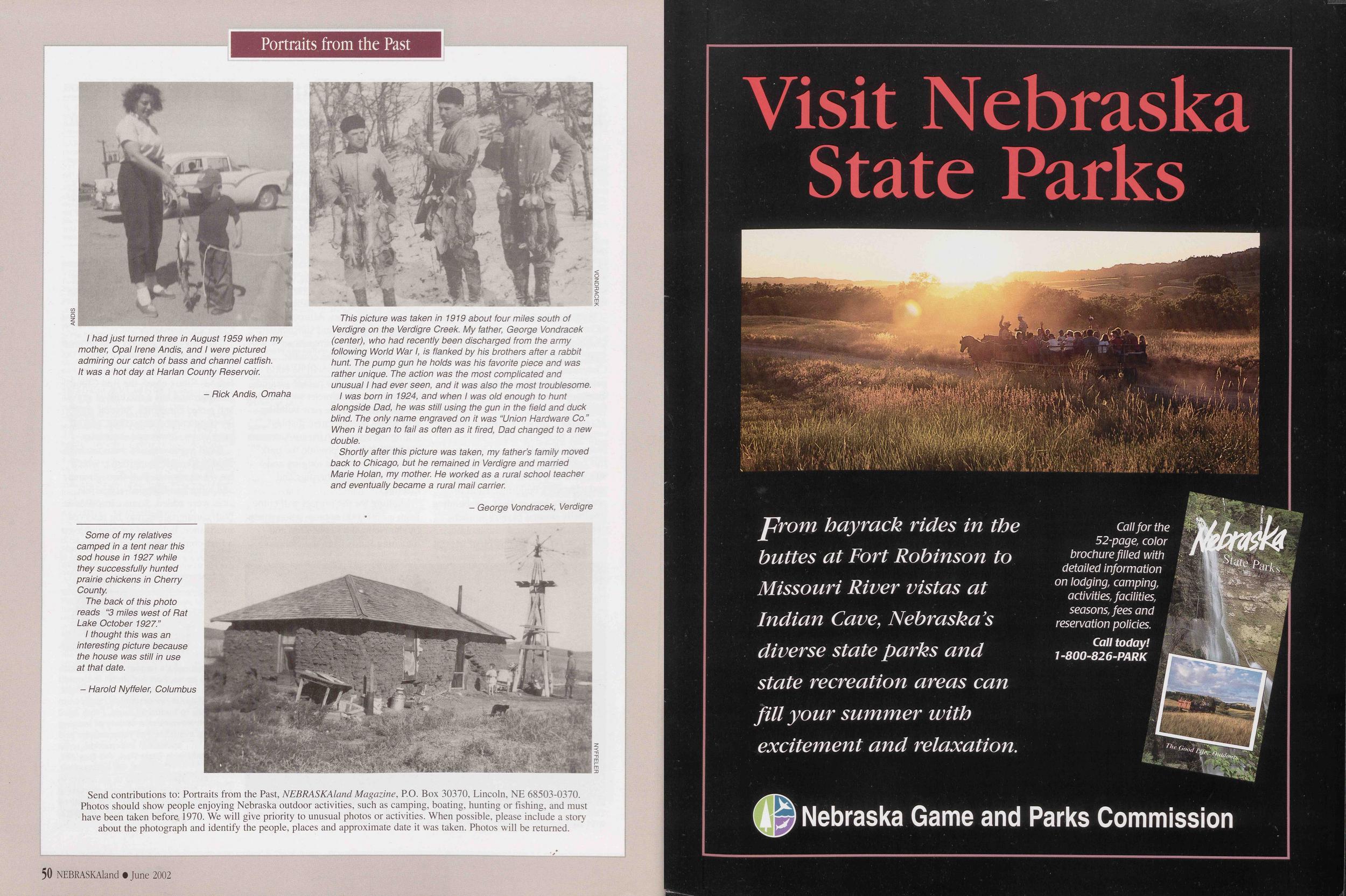
I had just turned three in August 1959 when my mother, Opal Irene Andis, and I were pictured admiring our catch of bass and channel catfish. It was a hot day at Harlan County Reservoir.
- Rick Andis, OmahaThis picture was taken in 1919 about four miles south of Verdigre on the Verdigre Creek. My father, George Vondracek (center), who had recently been discharged from the army following World War I, is flanked by his brothers after a rabbit hunt. The pump gun he holds was his favorite piece and was rather unique. The action was the most complicated and unusual I had ever seen, and it was also the most troublesome.
I was born in 1924, and when I was old enough to hunt alongside Dad, he was still using the gun in the field and duck blind. The only name engraved on it was “Union Hardware Co .” When it began to fail as often as it fired, Dad changed to a new double.
Shortly after this picture was taken, my father’s family moved back to Chicago, but he remained in Verdigre and married Marie Holan, my mother. He worked as a rural school teacher and eventually became a rural mail carrier.
- George Vondracek, VerdigreSome of my relatives camped in a tent near this sod house in 1927 while they successfully hunted prairie chickens in Cherry County.
The back of this photo reads “3 miles west of Rat Lake October 1927.” I thought this was an interesting picture because the house was still in use at that date.
- Harold Nyffeler, ColumbusSend contributions to: Portraits from the Past, NEBRASKAland Magazine, P.O. Box 30370, Lincoln, NE 68503-0370. Photos should show people enjoying Nebraska outdoor activities, such as camping, boating, hunting or fishing, and must have been taken before 1970. We will give priority to unusual photos or activities. When possible, please include a story about the photograph and identify the people, places and approximate date it was taken. Photos will be returned.
50 NEBRASKAland • June 2002
Position: 583 (19 views)