Volume 80, Issue 4, 2002
NEBRASKAland
Nebraska Game & Parks Commission May 2002 • $2.50
NEBRASKAland
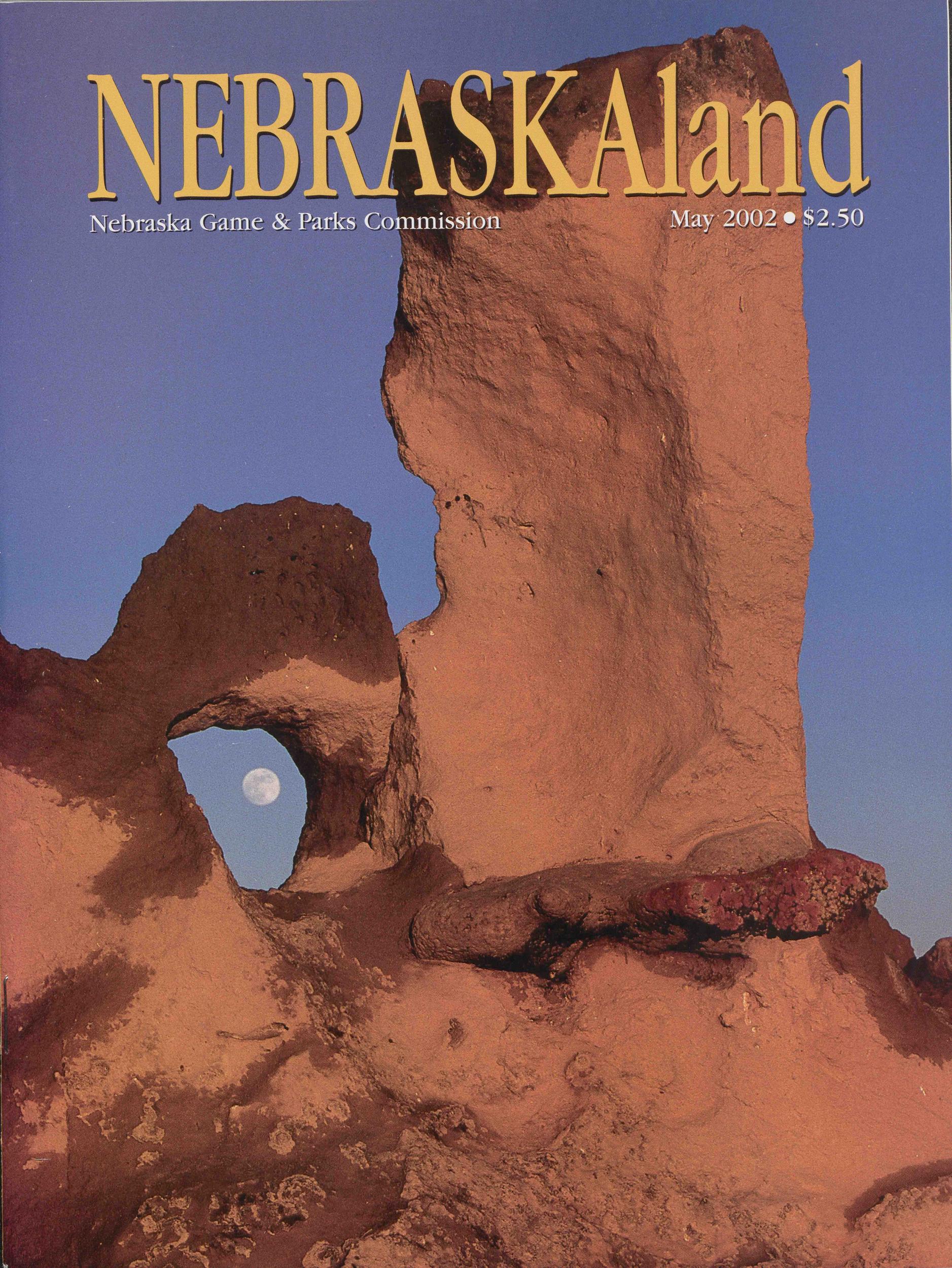
Volume 80, Number 4, May 2002 Features 10 Nebraska’s Hidden Campgrounds Nebraska has many small camping areas that provide a quiet, relaxed atmosphere. While some are remote and rugged, they are great spots for a getaway into nature. 18 An Invitation Accepted Twenty-two years after the first invitation, Rocky Hoffmann showed up on Roger Bowman’s doorstep, fishing pole in hand like a pup with a bone. 24 Where Earth Meets Sky On Nebraska’s western High Plains, a parade of life abounds. Kit foxes frolic, a badger digs, a prairie rattlesnake waits and curlews probe. The spirit and beauty of nature is alive. 34 Matching the Hatch to Catch Trout Fly-fishing anglers increase chances for success when they use artificial flies closely resembling insects fish feed on. Simple in theory, this strategy is more difficult in practice. 38 Pronghorn Mystery The pronghorn population in northwestern Nebraska has been static or declined at a time when biologists expected it to increase. To solve the mystery, they initiated a multi-year study. Departments 9 Outdoor Business Commission adopts new strategy to improve game bird habitat. 46 Wilderness Workshop Properly seasoned, Dutch ovens make camp cooking easy. 47 Outdoor Update Becoming familiar with bird species on state wildlife lands. 49 Parks & Places Once a resort, Yellowbanks WMA is now a site for wildlife. Comment........................................4 Outdoor News ..................................6 Classifieds ..................................48 Portraits of the Past ........................50 Cover: Framed by a rock formation in Sioux County, a full moon sets in warm early-morning light. Similar formations dot the landscape along the Niobrara River from Agate Fossil Beds National Monument west to Wyoming. Photo by Michael Forsberg. Opposite: One of two species of garter snakes common statewide in Nebraska, the red-sided garter snake (Thamnophis sirtalis) is most abundant near streams, ponds and marshes. Its principal foods are frogs, toads, salamanders, fish, tadpoles and earthworms. Its name comes from its striped pattern, which was similar to the fancy garters men once wore to support their stockings. Photo by Jon Farrar.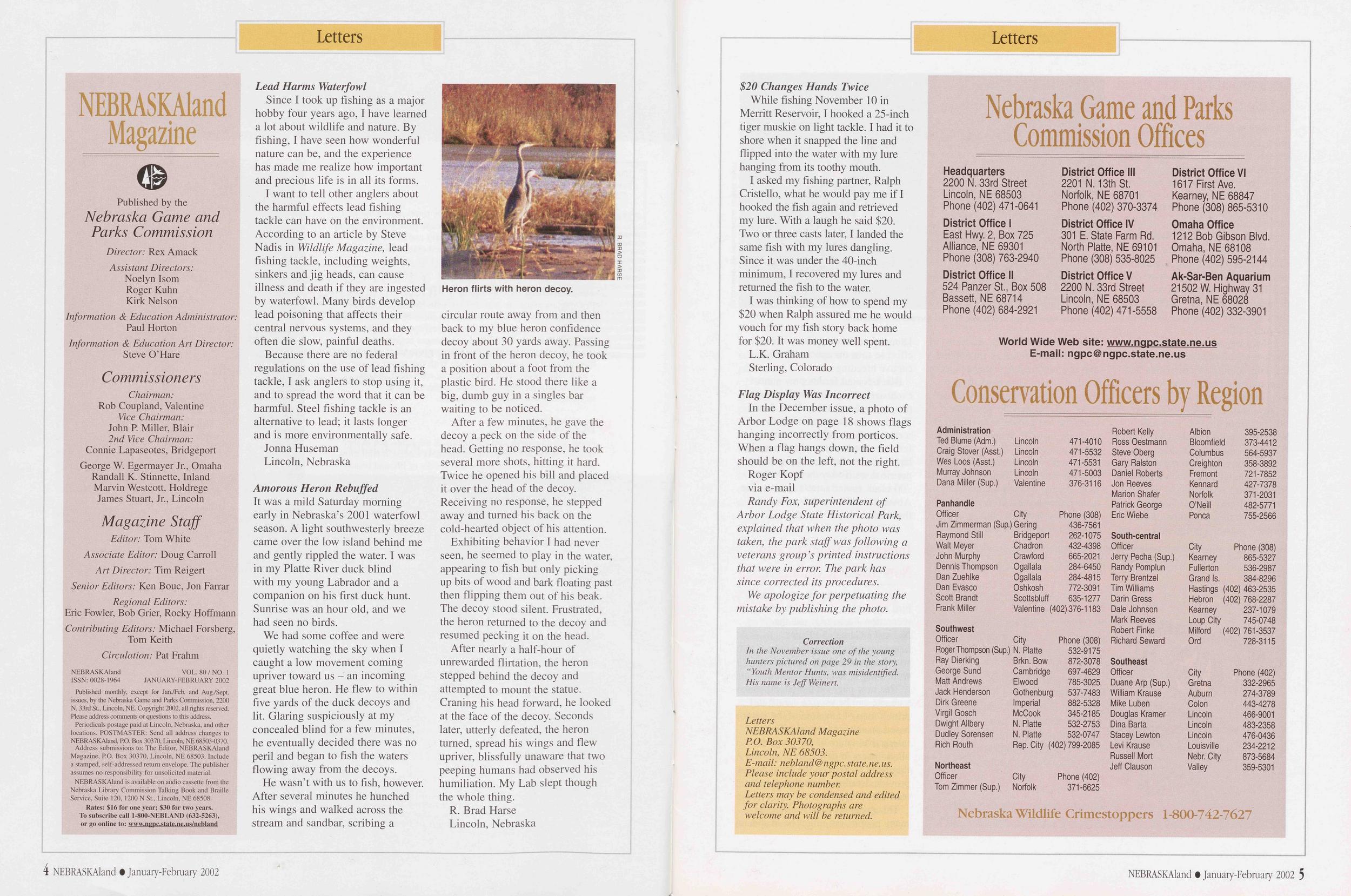 Comment
NEBRASKAland
Magazine
Published by the
Nebraska Game and
Parks Commission
Director: Rex Amack
Assistant Directors:
Noelyn Isom
Roger Kuhn
Kirk Nelson
Information & Education Administrator:
Paul Horton
Information & Education Art Director:
Steve O’Hare
Commissioners
Chairman:
John P. Miller, Blair
Vice Chairman:
Connie Lapaseotes, Bridgeport
2nd Vice Chairman:
Randall K. Stinnette, Inland
Marvin Westcott, Holdrege
James Stuart, Jr., Lincoln
Bill Grewcock, Omaha
Rob Coupland, Valentine
Magazine Staff
Editor: Tom White
Associate Editor: Doug Carroll
Art Director: Tim Reigert
Senior Editors: Ken Bouc, Jon Farrar
Regional Editors:
Eric Fowler, Bob Grier, Rocky Hoffmann
Contributing Editors: Michael Forsberg,
Tom Keith
Circulation: Pat Frahm
NEBRASKAland VOL. 80 / NO. 4
ISSN: 0028-1964 MAY 2002
Published monthly, except for Jan./Feb. and Aug./Sept.
issues, by the Nebraska Game and Parks Commission, 2200
N. 33rd St., Lincoln, NE. Copyright 2002, all rights reserved.
Please address comments or questions to this address.
Periodicals postage paid at Lincoln, Nebraska, and other
locations. POSTMASTER: Send all address changes to
NEBRASKAland, P.O. Box 30370, Lincoln, NE 68503-0370.
Address submissions to: The Editor, NEBRASKAland
Magazine, P.O. Box 30370, Lincoln, NE 68503. Include
a stamped, self-addressed return envelope. The publisher
assumes no responsibility for unsolicited material.
NEBRASKAland is available on audio cassette from the
Nebraska Library Commission Talking Book and Braille
Service, Suite 120, 1200 N St., Lincoln, NE 68508.
Rates: $16 for one year; $30 for two years.
To subscribe call 1-800-NEBLAND (632-5263),
or go online to: outdoornebraska.org
Comment
NEBRASKAland
Magazine
Published by the
Nebraska Game and
Parks Commission
Director: Rex Amack
Assistant Directors:
Noelyn Isom
Roger Kuhn
Kirk Nelson
Information & Education Administrator:
Paul Horton
Information & Education Art Director:
Steve O’Hare
Commissioners
Chairman:
John P. Miller, Blair
Vice Chairman:
Connie Lapaseotes, Bridgeport
2nd Vice Chairman:
Randall K. Stinnette, Inland
Marvin Westcott, Holdrege
James Stuart, Jr., Lincoln
Bill Grewcock, Omaha
Rob Coupland, Valentine
Magazine Staff
Editor: Tom White
Associate Editor: Doug Carroll
Art Director: Tim Reigert
Senior Editors: Ken Bouc, Jon Farrar
Regional Editors:
Eric Fowler, Bob Grier, Rocky Hoffmann
Contributing Editors: Michael Forsberg,
Tom Keith
Circulation: Pat Frahm
NEBRASKAland VOL. 80 / NO. 4
ISSN: 0028-1964 MAY 2002
Published monthly, except for Jan./Feb. and Aug./Sept.
issues, by the Nebraska Game and Parks Commission, 2200
N. 33rd St., Lincoln, NE. Copyright 2002, all rights reserved.
Please address comments or questions to this address.
Periodicals postage paid at Lincoln, Nebraska, and other
locations. POSTMASTER: Send all address changes to
NEBRASKAland, P.O. Box 30370, Lincoln, NE 68503-0370.
Address submissions to: The Editor, NEBRASKAland
Magazine, P.O. Box 30370, Lincoln, NE 68503. Include
a stamped, self-addressed return envelope. The publisher
assumes no responsibility for unsolicited material.
NEBRASKAland is available on audio cassette from the
Nebraska Library Commission Talking Book and Braille
Service, Suite 120, 1200 N St., Lincoln, NE 68508.
Rates: $16 for one year; $30 for two years.
To subscribe call 1-800-NEBLAND (632-5263),
or go online to: outdoornebraska.org
I was cleaning out some cedars in our timber one day when I noticed this pheasant was following the tractor back and forth. Because he continued to do it and even jumped up on a log I was pulling, I decided to get a camera. He followed me toward the house until he saw my dogs and then ran back toward the timber area.
When I came back, I sat down on the grass and the bird came up stretching and crowing to within four or five feet of me while I took pictures. I put out my arm and wiggled my fingers and he jumped on my arm and pecked at it. I brushed him off.
I noticed that he had a piece of light twine around one leg, and I wondered if he had been used to train dogs. It was sure strange behavior for a pheasant. I never saw him again after that day.
Jack Garrison DeWitt, Nebraska Removing Trash Wins SupportThe following series of excerpted comments were made on the Nebraska Outdoor Forum in March about a NEBRASKAland Magazine story concerning trash left in public areas. The individuals are identified by their online names. The forum is on the Commission web site, outdoornebraska. org.
BART: "The NEBRASKAland story [about trash on public lands] has been reprinted in some newspapers. I contacted the Commission about adopting an area to help clean it up. They will work with anyone who wants to help and can even provide trash bags.
"I want to encourage everyone who uses public lands to get involved.”
SUNDOG: "I agree with this concept. Packing out more than you come with is a great idea, and one we should pass on to our kids.
"Don’t laugh if you see an old, fat guy carrying a garbage sack this spring at your favorite public area. It could be me.”
GUITANGLER: "I always pack out more than I pack in. But, it’s not very far out. I usually walk to a can or dumpster about ten feet away.
“I’m amazed by people who don’t properly discard things. At Stagecoach Wildlife Management Area there are trash cans every 100 feet and dumpsters at every lot.”
BUCK JONES: "I agree with the comments about litter. My family enjoys canoeing and camping. It has gotten terrible. We try to pick up trash along the way. The Niobrara is one of the state’s nicest canoe rivers, and one of the worst for trash ”
SHOVEL BUCK: "Last fall, my son and I were sighting our muzzleloaders on state property north of Dannebrog. Someone had left a huge pile of trash.
"We searched a little and found names and addresses. I called the local sheriff and a deputy came out, took pictures and told us that he would take care of it. Less than a week later the trash was picked up by the woman who left it there. My son and I were happy with the fast action by the sheriff’s department.”
Where Do Funds Come From?BOONE: "NEBRASKAland [March 2002] gave a listing of funds approved for community outdoor recreation projects. Eight state projects totalling $526,000 were approved. Sixteen local projects 4 NEBRASKAland • May 2002 totaling $787,000 were approved.
"Does the funding for the Land and Water Conservation Fund (LWCF) come from the sale of permits and fees paid by Nebraska sportsmen and sportswomen? If this is where the funding is generated, should not the people who use the local projects be required to have the necessary state park permits?
"If this is not where the funding is derived, where is it generated?” Question posted March 9 on the Outdoor Forum
Jim Fuller, a parks administrator with the Nebraska Game and Parks Commission, responded:“The LWCF is a federally funded program. The money comes from off-shore oil and gas leases. The revenues are placed in a fund administrated by the National Park Service. The grants are available to communities and other political subdivisions on a 50/50 basis. The community or subdivision pays 50 percent of the project and the LWCF provides a 50 percent match.
The Commission serves only as the pass-through agency to process requests, review and approve projects and inspect projects for compliance with LWCF guidelines. No Commission cash funds are used to administer this program ”
CorrectionsOn page 43 of the April issue, a giant swallowtail butterfly was misidentified as a tiger swallowtail.
In a news brief on page 8 in the April issue, there was incorrect information regarding the Master Angler Awards. These awards are only available for fish caught using hook-and-line.
CommentNEBRASKAland Magazine P.O. Box 30370, Lincoln, NE 68503. E-mail: nebland@ ngpc. state, ne. us. Please include your postal address and telephone number. Letters may be condensed and edited for clarity. Photographs are welcome and will be returned.
Nebraska Game and Parks Commission Offices Headquarters 2200 N. 33rd Street Lincoln, NE 68503 Phone (402) 471-0641 District Office I East Hwy. 2, Box 725 Alliance, NE 69301 Phone (308) 763-2940 District Office II 524 Panzer St., Box 508 Bassett, NE 68714 Phone (402) 684-2921 District Office III 2201 N. 13th St. Norfolk, NE 68701 Phone (402) 370-3374 District Office IV 301 E. State Farm Rd. North Platte, NE 69101 Phone (308) 535-8025 District Office V 2200 N. 33rd Street Lincoln, NE 68503 Phone (402) 471-5558 District Office VI 1617 First Ave. Kearney, NE 68847 Phone (308) 865-5310 Omaha Office 1212 Bob Gibson Blvd. Omaha, NE 68108 Phone (402) 595-2144 Ak-Sar-Ben Aquarium 21502 W. Highway 31 Gretna, NE 68028 Phone (402) 332-3901 World Wide Web site: outdoornebraska.org E-mail: ngpc@ngpc.state.ne.us Conservation Officers by Region Administration Robert Kelly Albion 395-2538 Ted Blume (Adm.) Lincoln 471-5531 Dale Davis Bassett 273-1700 Craig Stover (Asst.) Lincoln 471-5532 Ross Oestmann Bloomfield 373-4412 Wes Loos (Asst.) Lincoln 471-5591 Steve Oberg Columbus 564-5937 Murray Johnson Lincoln 471-5003 Gary Ralston Creighton 358-3892 Dana Miller (Sup.) Valentine 376-3116 Daniel Roberts Fremont 721-7852 Jon Reeves Kennard 427-7378 Panhandle Marion Shafer Norfolk 371-2031 Officer City Phone (308) Patrick George O’Neill 482-5771 Jim Zimmerman (Sup.) Gering 436-7561 Eric Wiebe Ponca 755-2566 Raymond Still Bridgeport 262-1075 Walt Meyer Chadron 432-4398 South-central John Murphy Crawford 665-2021 Officer City Phone (308) Heath Packett Gordon 282-2553 Jerry Pecha (Sup.) Kearney 865-5327 Dennis Thompson Ogallala 284-6450 Randy Pomplun Fullerton 536-2987 Dan Zuehlke Ogallala 284-4815 Terry Brentzel Grand Is. 384-8296 Scott Brandt Scottsbluff 635-1277 Tim Williams Hastings (402) 463-2535 Frank Miller Valentine (402)376-1183 Darin Gress Hebron (402) 768-2287 Dale Johnson Kearney 237-1079 Southwest Mark Reeves Loup City 745-0748 Officer City Phone (308) Robert Finke Milford (402) 761-3537 Roger Thompson (Sup.) N. Platte 532-9175 Richard Seward Ord 728-3115 Ray Dierking Brkn. Bow 872-3078 George Sund Cambridge 697-4629 Southeast Matt Andrews Elwood 785-3025 Officer City Phone (402) Jack Henderson Gothenburg 537-7483 Duane Arp (Sup.) Gretna 332-2965 Dirk Greene Imperial 882-5328 William Krause Auburn 274-3789 Virgil Gosch McCook 345-2185 Jeremy TenKley Beatrice 228-1437 Dwight Allbery N. Platte 532-2753 Mike Luben Colon 443-4278 Dudley Sorensen N. Platte 532-0747 Douglas Kramer Lincoln 466-9001 Rich Routh Rep. City 799-2085 Dina Barta Lincoln 483-2358 Stacey Lewton Lincoln 476-0436 Northeast Levi Krause Louisville 234-2212 Officer City Phone (402) Russell Mort Nebr. City 873-5684 Tom Zimmer (Sup.) Norfolk 371-6625 Jeff Clauson Valley 359-5301 Nebraska Wildlife Crimestoppers 1-800-742-7627 NEBRASKAland • May 2002 5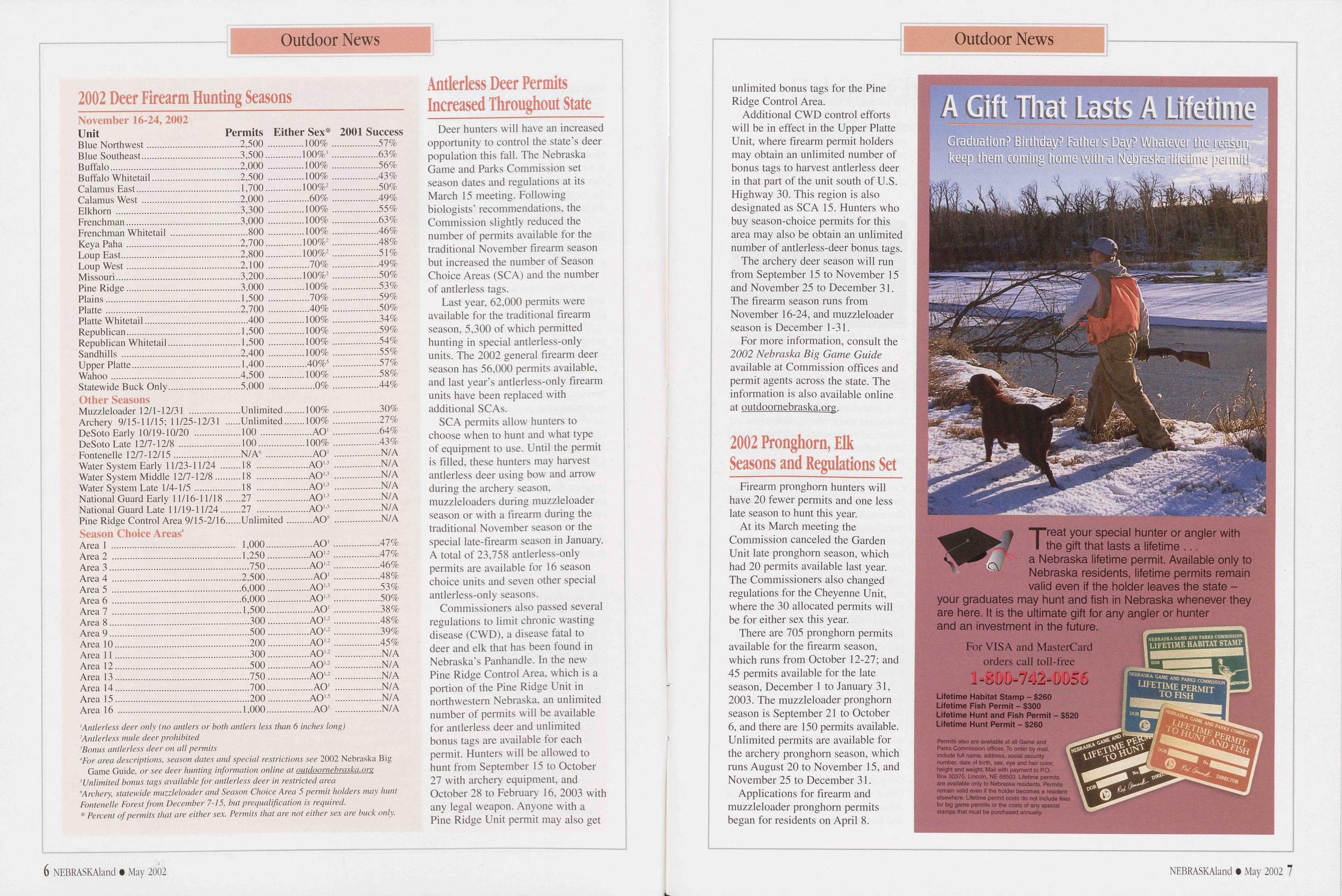
Antlerless deer only (no antlers or both antlers less than 6 inches long)
Antlerless mule deer prohibited
Bonus antlerless deer on all permits
For area descriptions, season dates and special restrictions see 2002 Nebraska Big Game Guide, or see deer hunting information online at outdoornebraska.org
Unlimited bonus tags available for antlerless deer in restricted area
Archery, statewide muzzleloader and Season Choice Area 5 permit holders may hunt Fontenelle Forest from December 7-15, but pre qualification is required.
* Percent of permits that are either sex. Permits that are not either sex are buck only.
Antlerless Deer PermitsIncreased Throughout State Deer hunters will have an increased opportunity to control the state’s deer population this fall. The Nebraska Game and Parks Commission set season dates and regulations at its March 15 meeting. Following biologists’ recommendations, the Commission slightly reduced the number of permits available for the traditional November firearm season but increased the number of Season Choice Areas (SCA) and the number of antlerless tags.
Last year, 62,000 permits were available for the traditional firearm season, 5,300 of which permitted hunting in special antlerless-only units. The 2002 general firearm deer season has 56,000 permits available, and last year’s antlerless-only firearm units have been replaced with additional SCAs.
SCA permits allow hunters to choose when to hunt and what type of equipment to use. Until the permit is filled, these hunters may harvest antlerless deer using bow and arrow during the archery season, muzzleloaders during muzzleloader season or with a firearm during the traditional November season or the special late-firearm season in January. A total of 23,758 antlerless-only permits are available for 16 season choice units and seven other special antlerless-only seasons.
Commissioners also passed several regulations to limit chronic wasting disease (CWD), a disease fatal to deer and elk that has been found in Nebraska’s Panhandle. In the new Pine Ridge Control Area, which is a portion of the Pine Ridge Unit in northwestern Nebraska, an unlimited number of permits will be available for antlerless deer and unlimited bonus tags are available for each permit. Hunters will be allowed to hunt from September 15 to October 27 with archery equipment, and October 28 to February 16, 2003 with any legal weapon. Anyone with a Pine Ridge Unit permit may also get 6 NEBRASKAland • May 2002 unlimited bonus tags for the Pine Ridge Control Area.
Additional CWD control efforts will be in effect in the Upper Platte Unit, where firearm permit holders may obtain an unlimited number of bonus tags to harvest antlerless deer in that part of the unit south of U.S. Highway 30. This region is also designated as SCA 15. Hunters who buy season-choice permits for this area may also be obtain an unlimited number of antlerless-deer bonus tags.
the archery deer season will run from September 15 to November 15 and November 25 to December 31. The firearm season runs from November 16-24, and muzzleloader season is December 1-31.
For more information, consult the 2002 Nebraska Big Game Guide available at Commission offices and permit agents across the state. The information is also available online at outdoornebraska.org.
2002 Pronghorn, Elk Seasons and Regulations SetFirearm pronghorn hunters will have 20 fewer permits and one less late season to hunt this year.
At its March meeting the Commission canceled the Garden Unit late pronghorn season, which had 20 permits available last year. The Commissioners also changed regulations for the Cheyenne Unit, where the 30 allocated permits will be for either sex this year.
There are 705 pronghorn permits available for the firearm season, which runs from October 12-27; and 45 permits available for the late season, December 1 to January 31, 2003. The muzzleloader pronghorn season is September 21 to October 6, and there are 150 permits available. Unlimited permits are available for the archery pronghorn season, which runs August 20 to November 15, and November 25 to December 31.
Applications for firearm and muzzleloader pronghorn permits began for residents on April 8.
A Gift That Lasts a Lifetime Graduation? Birthday? Father's Day? Whatever the reason, keep them coming home with a Nebraska lifetime permit! Treat your special hunter or angler with I the gift that lasts a lifetime ... a Nebraska lifetime permit. Available only to Nebraska residents, lifetime permits remain valid even if the holder leaves the state - uaiidii? Birthday? felher's Day? Whatever the reason, them coining home with a Nebraska Ihetime permit! your graduates may hunt and fish in Nebraska whenever they are here. It is the ultimate gift for any angler or hunter and an investment in the future. For VISA and MasterCard orders call toll-free Permits also are available at all Game and Parks Commission offices. To order by mail, / include full name, address, social security ’ number, date of birth, sex, eye and hair color, height and weight. Mail with payment to P.O. Box 30370, Lincoln, NE 68503. Lifetime permits are available only to Nebraska residents. Permits remain valid even if the holder becomes a resident elsewhere. Lifetime permit costs do not include fees for big game permits or the costs of any special stamps that must be purchased annually. Lifetime Habitat Stamp - $260 Lifetime Fish Permit - $300 Lifetime Hunt and Fish Permit - $520 Lifetime Hunt Permit - $260 NEBRASKAland • May 2002 7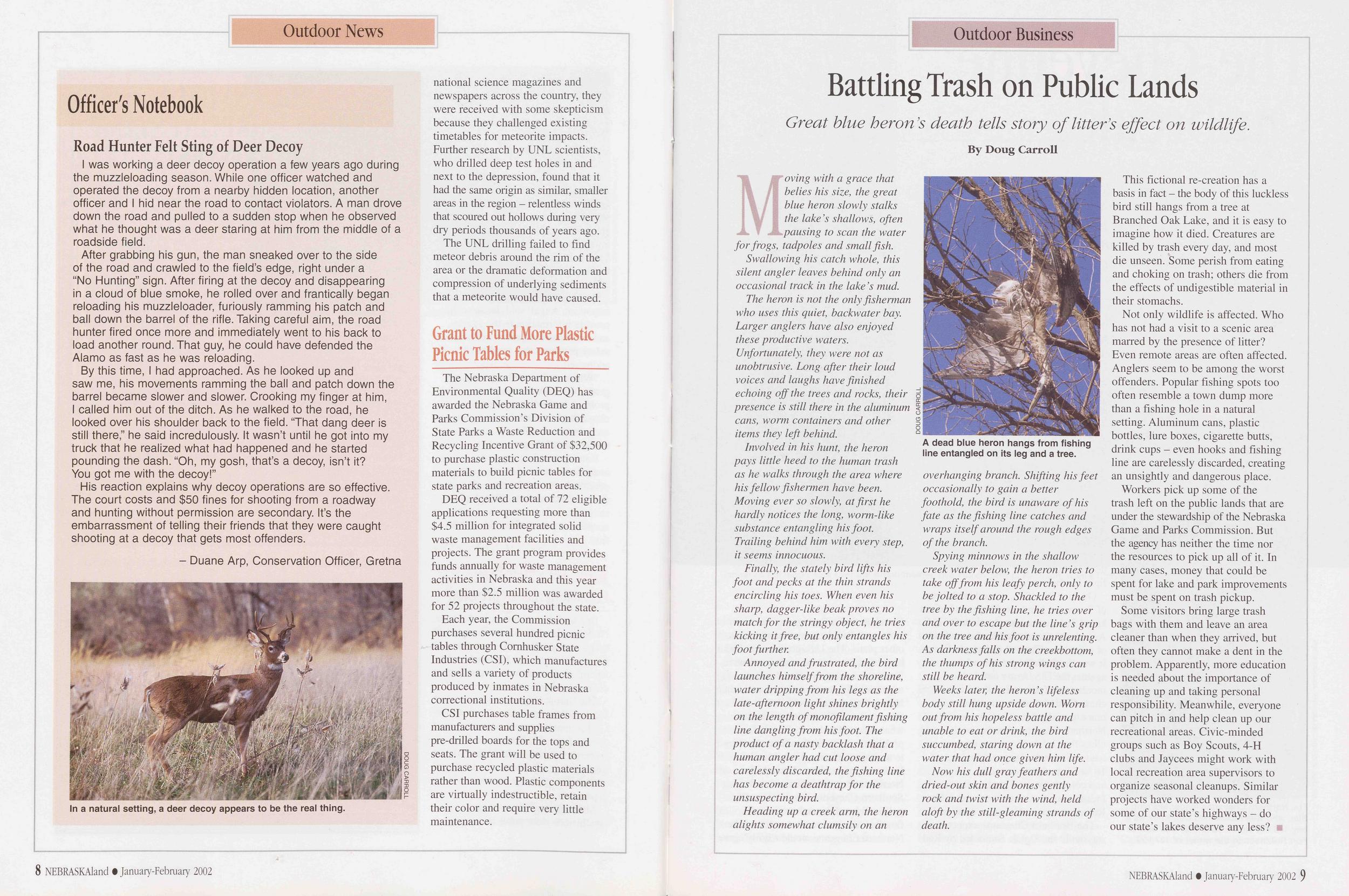 Outdoor News
Officer's Notebook
The Case of a Costly False Address
Outdoor News
Officer's Notebook
The Case of a Costly False Address
While on patrol in Fillmore County during the 2001 Light Goose Conservation Action, I noticed some hunters and a spread of goose decoys across a field. I stopped to make sure they had valid hunting permits, habitat and waterfowl stamps, and Harvest Information Program (HIP) numbers.
After verifying the permits and stamps, I checked their shells to make sure they were using non-toxic shot. The first shell I pulled out of one gun contained lead, which is illegal to use or carry when waterfowl hunting. The hunter said he must have left the shell in his hunting vest from pheasant season. I told him I was going to cite him for the violation. He and I walked back to my vehicle, where he handed me a Nebraska driver’s license to fill out the paperwork. After we were done, the hunter went back to his hunting and I resumed my patrol.
Two months later, while reviewing my citations, I noticed this violation had not been settled with the court. I called the phone number the hunter had provided, but it was not a valid number. I called information, but could not find anyone by that name.
Determined to get to the bottom of the matter, I did some research and found the hunter had purchased the permit in Douglas County two days before I cited him.
Checking with the post office, I discovered the hunter’s address had changed 314 months before we met. The postmaster gave me his new address, which was in South Dakota.
I presented the information to the Fillmore County Attorney, who decided to file additional charges. The hunter was now charged with possessing a resident permit although he was not a resident, false reporting to an officer, and failing to appear for a court arraignment date. He was also cited for obtaining a permit under false pretenses in Douglas County.
I contacted a U.S. Fish and Wildlife special agent, who hand delivered the citations to the hunter at his new home and got his signed receipt. I waited for the hunter to respond to these new charges, one of which required him to appear in court.
Several months passed without response. I contacted the local law enforcement center in the hunter’s area and obtained his phone number. After several months and numerous phone calls, I received a response and, in time, the fines were paid in full.
I have to wonder: Was the $45.50 the hunter saved by illegally obtaining a resident permit instead a non-resident permit worth the risk of being caught? The original citation for possession of lead shot did not require a court appearance and could have been disposed of by paying the $50 fine and $23 in court costs. But because he ignored the citation, the hunter ended up dealing with two separate bench warrants and paying $619 in court costs and fines, which included $50 for possession of lead shot, $75 for obtaining a permit under false pretenses, $75 for being a non-resident in possession of a resident permit, $250 for false reporting to an officer, and $100 for failure to appear for court arraignment.
- Darin Gress, Conservation Officer, HebronCommissioners also authorized 64 elk permits at the March meeting.
For more information, consult the 2002 Nebraska Big Game Guide available at Commission offices and permit agents across the state. The information is also available online at outdoomebraska.ors.
A gouache painting of a pair of American widgeons by Armando Villarreal of Imperial won the 25th annual Nebraska Habitat Stamp Contest.
The Nebraska Game and Parks Commissioners selected Villarreal’s painting from 34 entries in the adult division of the contest. Other finalists were Loren Goedeken of Hebron and David Dorsey of Newport. Villarreal has won the contest in three of the past four years.
Villarreal’s painting will appear on the 2003 Habitat Stamp, which is required for all resident hunters age 16 and older and all nonresident hunters. Money raised from stamp sales goes to the Habitat Fund, which is used to acquire land and enhance habitat on state and private lands.
Villarreal will receive a $200 cash award from the Omaha Fish and Wildlife Club, which helps sponsor the contest. Finalists receive free subscriptions to NEBRASKAland Magazine.
Four artists won honorable mention: Greg Holdren of Friend; Ghana Orton of Mills; Rodney H. Johns of Alliance, winner of the 2002 contest; and Bruce Becher of Wilber.
8 NEBRASKAland • May 2002 Habitat Changes to Help Pheasants Initiative will add broadleaf plants and reduce trees on grasslands. By Eric FowlerAn initiative to improve habitat for pheasants and other upland birds will focus on increasing plant diversity in public and private non-native grasslands. Nebraska Game and Parks Commission and Pheasants Forever biologists believe that is the best way to increase pheasant populations in a landscape dominated by large, intensively managed farms.
The initiative, which began this spring, will:
• Improve upland bird habitat on five-to-seven large public hunting areas through grassland management and tree removal.
• Work with landowners in six 16- to 36-square mile focus areas - two a year for three years - to improve habitat on land enrolled in the federal Conservation Reserve Program (CRP), including some enrolled in the Commission’s CRP-MAP program, which allows walk-in hunting and fishing.
• Work with the Natural Resources Conservation Service (NRCS) to promote similar management practices on land now enrolled in federal conservation programs, as well as any land enrolled in the future.
• Promote ways to increase the value of wheat stubble to pheasants.
CRP increased pheasant populations when the program began in 1985. When crop fields are retired and planted to grass, the diverse and weedy early growth includes foxtail, sunflowers, legumes and other plants. These early successions plant communities provide nesting, brood-rearing, escape and fall and winter cover for pheasants. The weedy plants attract insects and produce seeds, providing food for pheasant chicks and adult birds.
But after a few years, grasses crowd out the broadleaf plants and take over a field. That happened in Nebraska, where 80 percent of CRP stands are more than four years old and many are solid stands of brome or switchgrass. Scott Taylor, the Commission’s upland game biologist, said these fields provide escape cover and some nesting cover for pheasants, but little more. They attract few insects and produce few seeds with food value.
The initiative will use disking, burning and interseeding to upgrade existing stands of CRP and encourage early successions growth. Taylor said the Commission will work with the NRCS, which is interested in allowing these wildlife-friendly practices in CRP. It also will work with landowners and county weed boards to address concerns about noxious weed growth. “One of the big barriers we have to overcome is the social stigma associated with these [plant] communities,” Taylor said. That stigma, the aversion to not only noxious weeds but all weeds, has led to a decline in these valuable habitats.
Public non-native grasslands will also be disturbed to improve plant diversity. Some trees will be removed to open more land for pheasants. Taylor said removing trees is a tough choice, but pheasants, a grassland species, don’t need them to survive.
Studies have shown tall wheat stubble and changes in weed control timing can benefit both pheasants and farm income. The Southern Panhandle Habitat Partnership, a pilot program developed by the Commission, the South Platte Natural Resources District and Pheasants Forever, will pay farmers $1 to $5 per acre to implement these practices.
When developing the pheasant initiative, biologists chose to focus on the quality of habitat rather than quantity. Limited funding for state habitat programs makes it difficult to increase the quantity of habitat. But encouraging wildlife friendly practices on existing CRP could mean more pheasants across the state, and biologists feel the initiative, while localized in scope, will prove just that. ■
NEBRASKAland • May 2002 9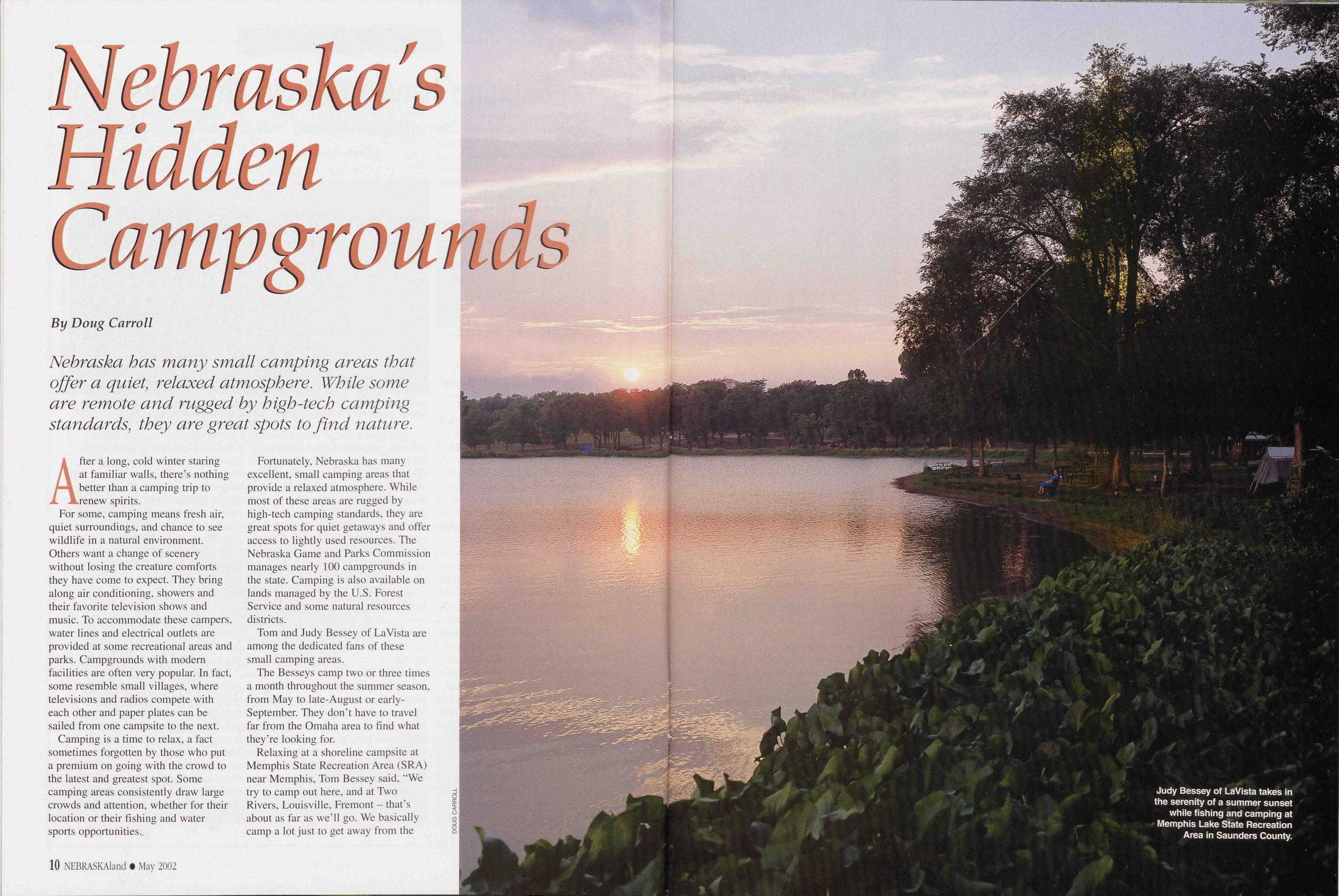
Nebraska's Hidden Campgrounds
Nebraska has many small camping areas that offer a quiet, relaxed atmosphere. While some are remote and rugged by high-tech camping standards, they are great spots to find nature.After a long, cold winter staring at familiar walls, there’s nothing better than a camping trip to renew spirits.
For some, camping means fresh air, quiet surroundings, and chance to see wildlife in a natural environment. Others want a change of scenery without losing the creature comforts they have come to expect. They bring along air conditioning, showers and their favorite television shows and music. To accommodate these campers, water lines and electrical outlets are provided at some recreational areas and parks. Campgrounds with modern facilities are often very popular. In fact, some resemble small villages, where televisions and radios compete with each other and paper plates can be sailed from one campsite to the next.
Camping is a time to relax, a fact sometimes forgotten by those who put a premium on going with the crowd to the latest and greatest spot. Some camping areas consistently draw large crowds and attention, whether for their location or their fishing and water sports opportunities.
Fortunately, Nebraska has many excellent, small camping areas that provide a relaxed atmosphere. While most of these areas are rugged by high-tech camping standards, they are great spots for quiet getaways and offer access to lightly used resources. The Nebraska Game and Parks Commission manages nearly 100 campgrounds in the state. Camping is also available on lands managed by the U.S. Forest Service and some natural resources districts.
Tom and Judy Bessey of LaVista are among the dedicated fans of these small camping areas.
The Besseys camp two or three times a month throughout the summer season, from May to late-August or early- September. They don’t have to travel far from the Omaha area to find what they’re looking for.
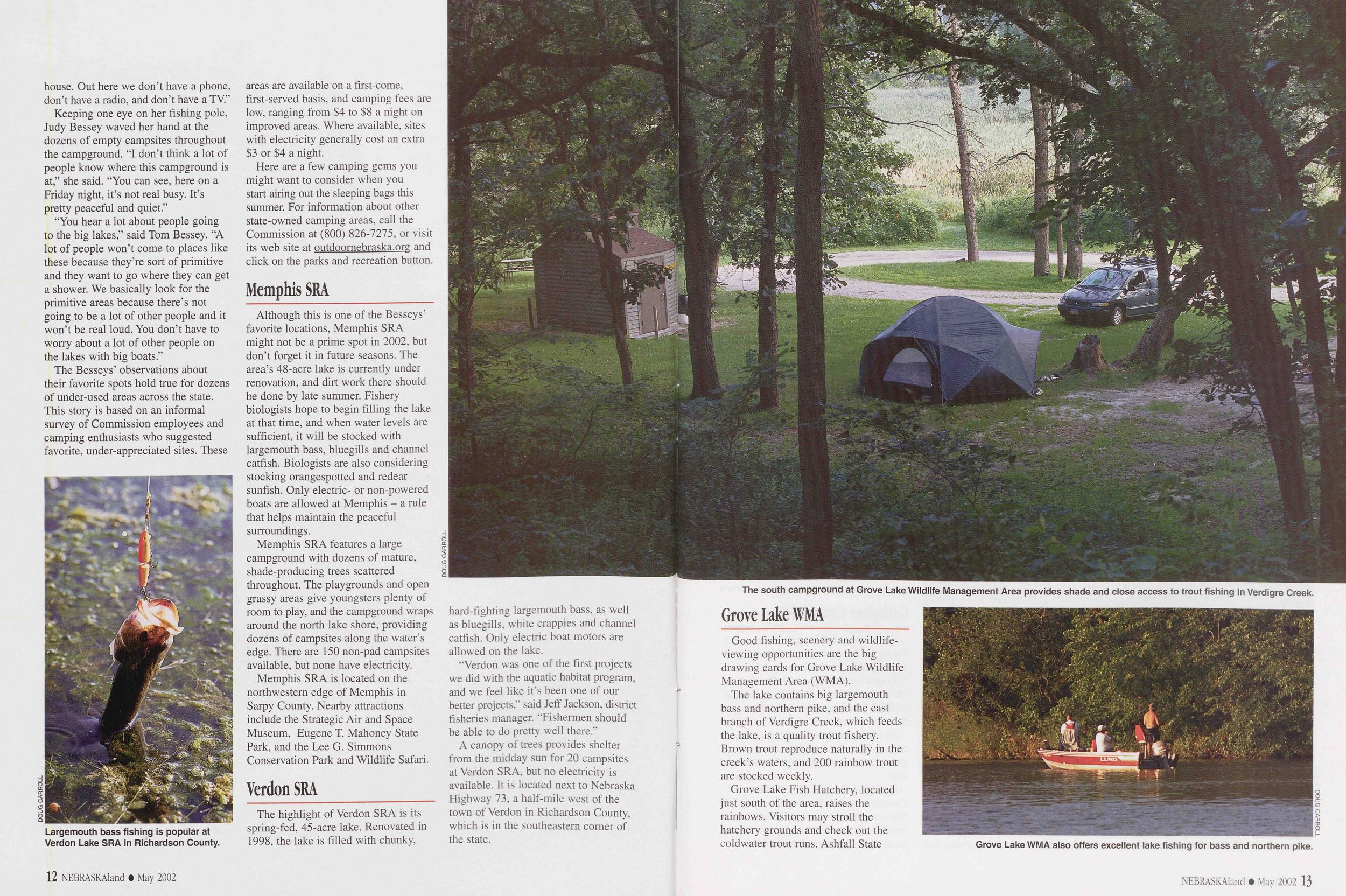
Relaxing at a shoreline campsite at Memphis State Recreation Area (SRA) near Memphis, Tom Bessey said, “We try to camp out here, and at Two Rivers, Louisville, Fremont - that’s about as far as we’ll go. We basically camp a lot just to get away from the 10 NEBRASKAland • May 2002
 house. Out here we don’t have a phone,
don’t have a radio, and don’t have a TV.”
house. Out here we don’t have a phone,
don’t have a radio, and don’t have a TV.”
Keeping one eye on her fishing pole, Judy Bessey waved her hand at the dozens of empty campsites throughout the campground. T don’t think a lot of people know where this campground is at,” she said. “You can see, here on a Friday night, it’s not real busy. It’s pretty peaceful and quiet.”
“You hear a lot about people going to the big lakes,” said Tom Bessey. “A lot of people won’t come to places like these because they’re sort of primitive and they want to go where they can get a shower. We basically look for the primitive areas because there’s not going to be a lot of other people and it won’t be real loud. You don’t have to worry about a lot of other people on the lakes with big boats.”
The Besseys’ observations about their favorite spots hold true for dozens of under-used areas across the state. This story is based on an informal survey of Commission employees and camping enthusiasts who suggested favorite, under-appreciated sites. These areas are available on a first-come, first-served basis, and camping fees are low, ranging from $4 to $8 a night on improved areas. Where available, sites with electricity generally cost an extra $3 or $4 a night.
DOUG CARROLLHere are a few camping gems you might want to consider when you start airing out the sleeping bags this summer. For information about other state-owned camping areas, call the Commission at (800) 826-7275, or visit its web site at outdoornebraska.org and click on the parks and recreation button.
Memphis SRAAlthough this is one of the Besseys’ favorite locations, Memphis SRA might not be a prime spot in 2002, but don’t forget it in future seasons. The area’s 48-acre lake is currently under renovation, and dirt work there should be done by late summer. Fishery biologists hope to begin filling the lake at that time, and when water levels are sufficient, it will be stocked with largemouth bass, bluegills and channel catfish. Biologists are also considering stocking orangespotted and redear sunfish. Only electric- or non-powered boats are allowed at Memphis - a rule that helps maintain the peaceful surroundings.
Memphis SRA features a large campground with dozens of mature, shade-producing trees scattered throughout. The playgrounds and open grassy areas give youngsters plenty of room to play, and the campground wraps around the north lake shore, providing dozens of campsites along the water’s edge. There are 150 non-pad campsites available, but none have electricity.
Memphis SRA is located on the northwestern edge of Memphis in Sarpy County. Nearby attractions include the Strategic Air and Space Museum, Eugene T. Mahoney State Park, and the Lee G. Simmons Conservation Park and Wildlife Safari.
Verdon SRAThe highlight of Verdon SRA is its spring-fed, 45-acre lake. Renovated in 1998, the lake is filled with chunky, hard-fighting largemouth bass, as well as bluegills, white crappies and channel catfish. Only electric boat motors are allowed on the lake.
“Verdon was one of the first projects we did with the aquatic habitat program, and we feel like it’s been one of our better projects,” said Jeff Jackson, district fisheries manager. “Fishermen should be able to do pretty well there.”
A canopy of trees provides shelter from the midday sun for 20 campsites at Verdon SRA, but no electricity is available. It is located next to Nebraska Highway 73, a half-mile west of the town of Verdon in Richardson County, which is in the southeastern corner of the state.
12 NEBRASKAland • May 2002Good fishing, scenery and wildlife- viewing opportunities are the big drawing cards for Grove Lake Wildlife Management Area (WMA).
The lake contains big largemouth bass and northern pike, and the east branch of Verdigre Creek, which feeds the lake, is a quality trout fishery. Brown trout reproduce naturally in the creek’s waters, and 200 rainbow trout are stocked weekly.
Grove Lake Fish Hatchery, located
just south of the area, raises the
rainbows. Visitors may stroll the
hatchery grounds and check out the
coldwater trout runs. Ashfall State
NEBRASKAland • May 2002 13
 Historical Park, an archaeological site
with outstanding exhibits, is about
five miles to the northwest.
Historical Park, an archaeological site
with outstanding exhibits, is about
five miles to the northwest.
Grove Lake WMA is located two miles north of Royal in Antelope County. No electrical hookups are provided, but toilets and drinking water are available. Some campsites are near the lake, and there is also a camping area next to the creek. A portion of the lake’s camping areas will be closed this summer as part of a lake renovation, but the north end of the lake and the creek will be open for fishing.
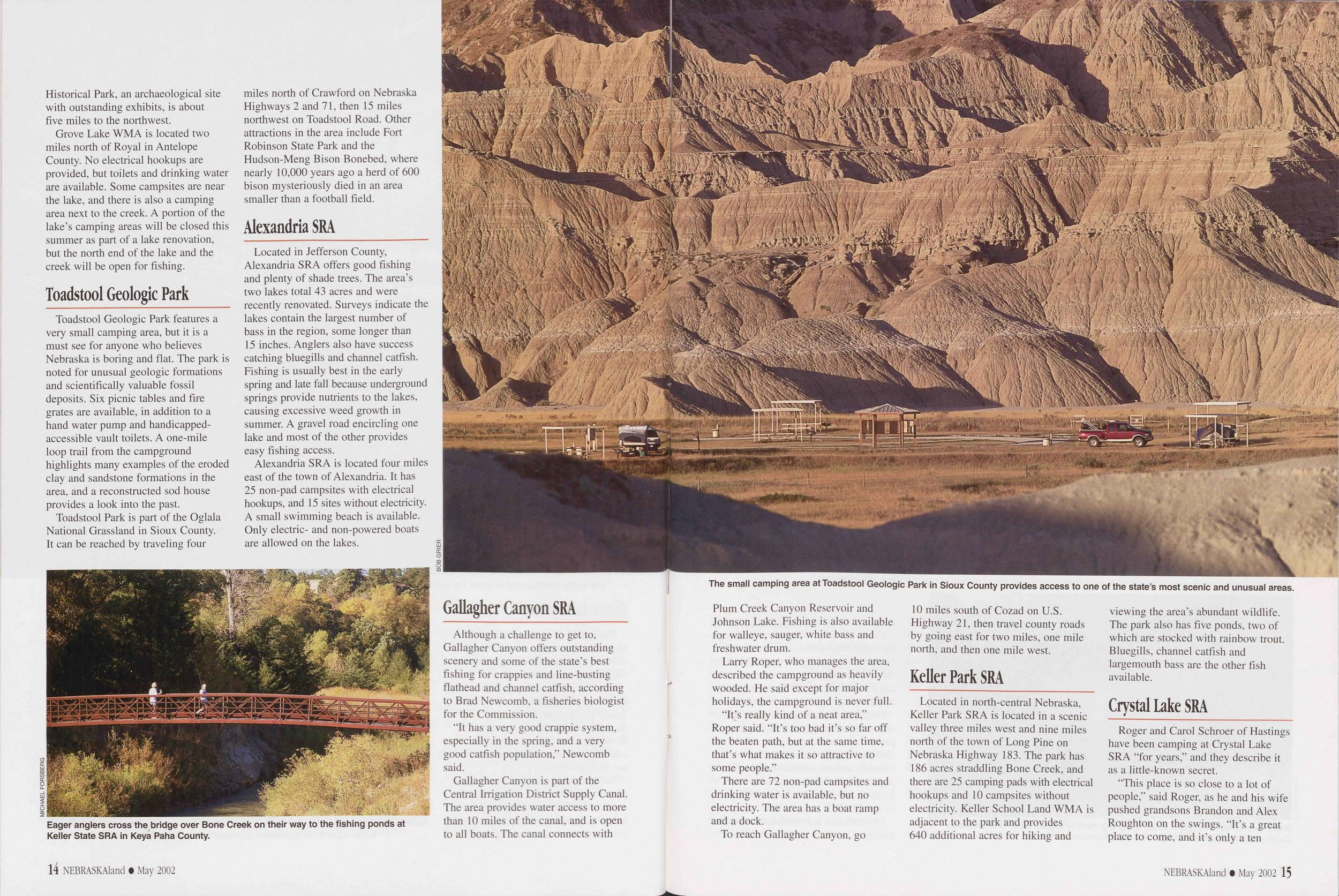
Toadstool Geologic ParkToadstool Geologic Park features a very small camping area, but it is a must see for anyone who believes Nebraska is boring and flat. The park is noted for unusual geologic formations and scientifically valuable fossil deposits. Six picnic tables and fire grates are available, in addition to a hand water pump and handicapped- accessible vault toilets. A one-mile loop trail from the campground highlights many examples of the eroded clay and sandstone formations in the area, and a reconstructed sod house provides a look into the past.
Toadstool Park is part of the Oglala National Grassland in Sioux County. It can be reached by traveling four miles north of Crawford on Nebraska Highways 2 and 71, then 15 miles northwest on Toadstool Road. Other attractions in the area include Fort Robinson State Park and the Hudson-Meng Bison Bonebed, where nearly 10,000 years ago a herd of 600 bison mysteriously died in an area smaller than a football field.
MICHAEL FORSBERGLocated in Jefferson County, Alexandria SRA offers good fishing and plenty of shade trees. The area’s two lakes total 43 acres and were recently renovated. Surveys indicate the lakes contain the largest number of bass in the region, some longer than 15 inches. Anglers also have success catching bluegills and channel catfish. Fishing is usually best in the early spring and late fall because underground springs provide nutrients to the lakes, causing excessive weed growth in summer. A gravel road encircling one lake and most of the other provides easy fishing access.
Alexandria SRA is located four miles east of the town of Alexandria. It has 25 non-pad campsites with electrical hookups, and 15 sites without electricity. A small swimming beach is available. Only electric- and non-powered boats are allowed on the lakes.
Gallagher Canyon SRAAlthough a challenge to get to, Gallagher Canyon offers outstanding scenery and some of the state’s best fishing for crappies and line-busting flathead and channel catfish, according to Brad Newcomb, a fisheries biologist for the Commission.
"It has a very good crappie system, especially in the spring, and a very good catfish population,” Newcomb said.
Gallagher Canyon is part of the Central Irrigation District Supply Canal. The area provides water access to more than 10 miles of the canal, and is open to all boats. The canal connects with 14 NEBRASKAland • May 2002 Plum Creek Canyon Reservoir and Johnson Lake. Fishing is also available for walleye, sauger, white bass and freshwater drum.
Larry Roper, who manages the area, described the campground as heavily wooded. He said except for major holidays, the campground is never full.
"It’s really kind of a neat area,” Roper said. "It’s too bad it’s so far off the beaten path, but at the same time, that’s what makes it so attractive to some people.”
There are 72 non-pad campsites and drinking water is available, but no electricity. The area has a boat ramp and a dock.
To reach Gallagher Canyon, go 10 miles south of Cozad on U.S. Highway 21, then travel county roads by going east for two miles, one mile north, and then one mile west.
Keller Park SRALocated in north-central Nebraska, Keller Park SRA is located in a scenic valley three miles west and nine miles north of the town of Long Pine on Nebraska Highway 183. The park has 186 acres straddling Bone Creek, and there are 25 camping pads with electrical hookups and 10 campsites without electricity. Keller School Land WMA is adjacent to the park and provides 640 additional acres for hiking and viewing the area’s abundant wildlife. The park also has five ponds, two of which are stocked with rainbow trout. Bluegills, channel catfish and largemouth bass are the other fish available.
Crystal take SRARoger and Carol Schroer of Hastings have been camping at Crystal Lake SRA "for years,” and they describe it as a little-known secret.
"This place is so close to a lot of
people,” said Roger, as he and his wife
pushed grandsons Brandon and Alex
Roughton on the swings. "It’s a great
place to come, and it’s only a ten
NEBRASKAland • May 2002 15
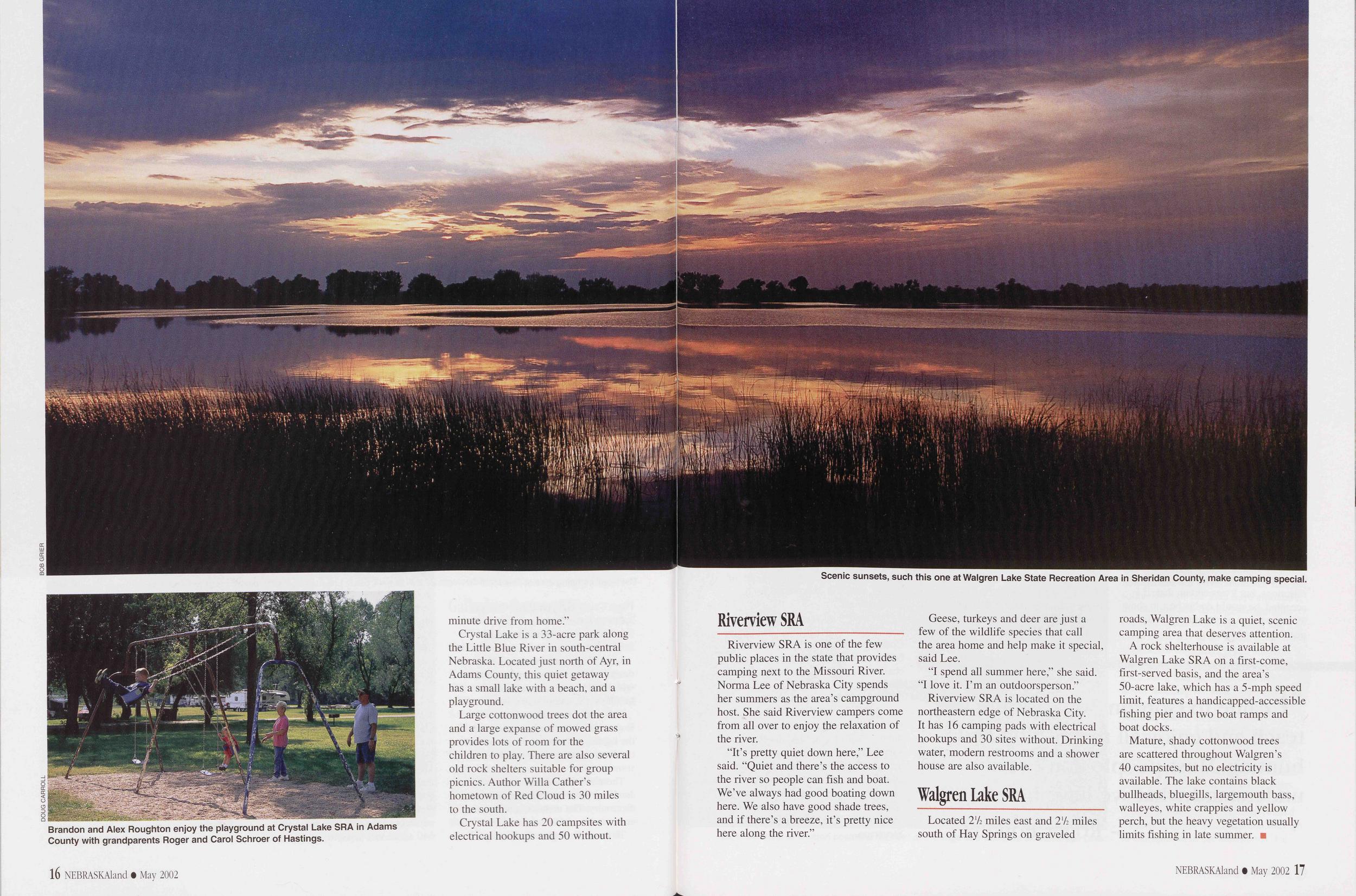 County with grandparents Roger and Carol Schroer of Hastings.
minute drive from home.”
County with grandparents Roger and Carol Schroer of Hastings.
minute drive from home.”
Crystal Lake is a 33-acre park along the Little Blue River in south-central Nebraska. Located just north of Ayr, in Adams County, this quiet getaway has a small lake with a beach, and a playground.
Large cottonwood trees dot the area and a large expanse of mowed grass provides lots of room for the children to play. There are also several old rock shelters suitable for group picnics. Author Willa Cather’s hometown of Red Cloud is 30 miles to the south.
Crystal Lake has 20 campsites with electrical hookups and 50 without.
Riverview SRA is one of the few public places in the state that provides camping next to the Missouri River. Norma Lee of Nebraska City spends her summers as the area’s campground host. She said Riverview campers come from all over to enjoy the relaxation of the river.
“It’s pretty quiet down here,” Lee said. “Quiet and there’s the access to the river so people can fish and boat. We’ve always had good boating down here. We also have good shade trees, and if there’s a breeze, it’s pretty nice here along the river.”
Geese, turkeys and deer are just a few of the wildlife species that call the area home and help make it special, said Lee.
“I spend all summer here,” she said. “I love it. I’m an outdoorsperson.” Riverview SRA is located on the northeastern edge of Nebraska City. It has 16 camping pads with electrical hookups and 30 sites without. Drinking water, modern restrooms and a shower house are also available.
Walgren Lake SRALocated 272 miles east and 27> miles south of Hay Springs on graveled roads, Walgren Lake is a quiet, scenic camping area that deserves attention.
A rock shelterhouse is available at Walgren Lake SRA on a first-come, first-served basis, and the area’s 50-acre lake, which has a 5-mph speed limit, features a handicapped-accessible fishing pier and two boat ramps and boat docks.
Mature, shady cottonwood trees are scattered throughout Walgren’s 40 campsites, but no electricity is available. The lake contains black bullheads, bluegills, largemouth bass, walleyes, white crappies and yellow perch, but the heavy vegetation usually limits fishing in late summer. ■
NEBRASKAland • May 2002 17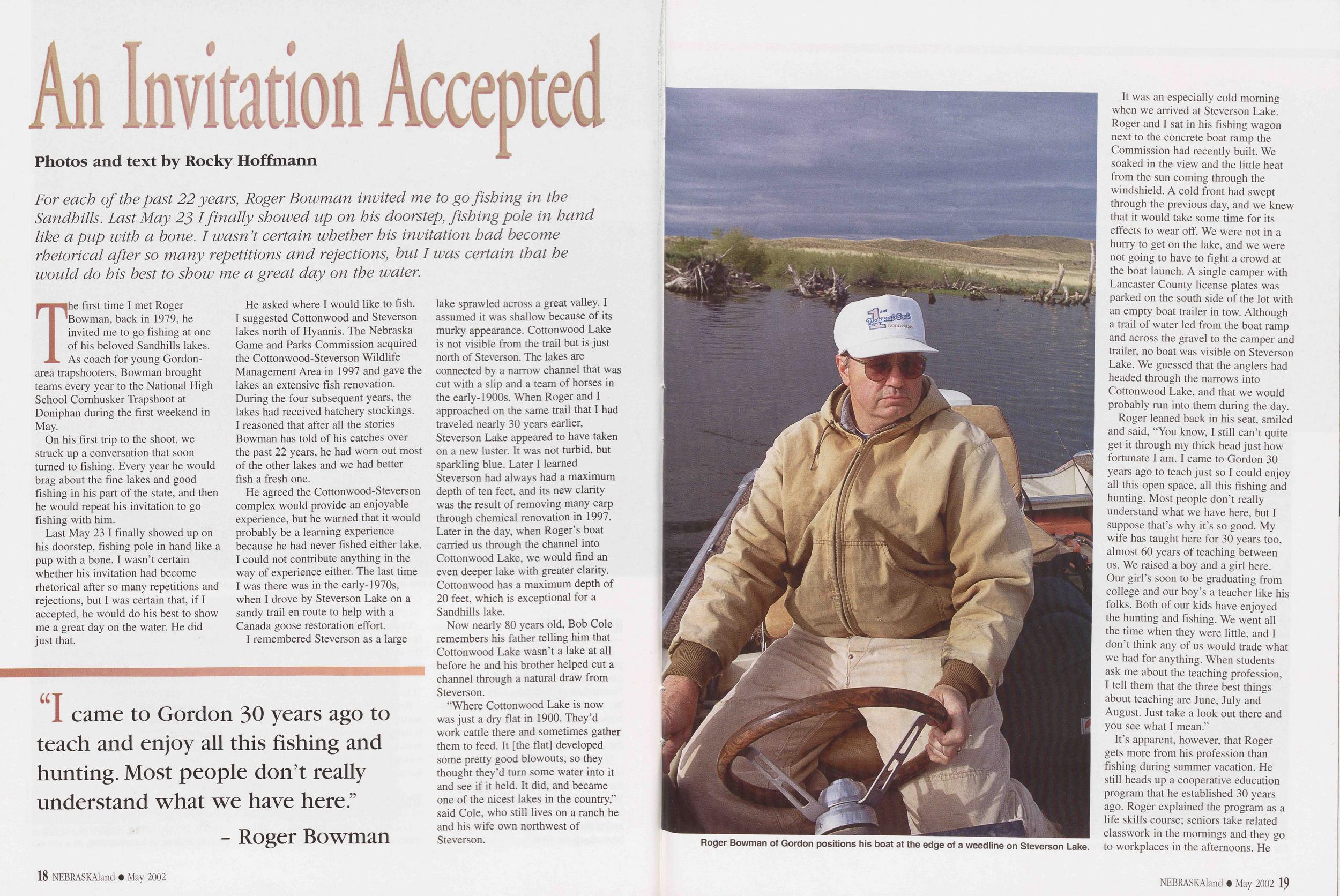
An Invitation Accepted
For each of the past 22 years, Roger Bowman invited me to go fishing in the Sandhills. Last May 231 finally showed up on his doorstep, fishing pole in hand like a pup with a bone. I wasn’t certain whether his invitation had become rhetorical after so many repetitions and rejections, but I was certain that he would do his best to show me a great day on the water.The first time I met Roger Bowman, back in 1979, he invited me to go fishing at one of his beloved Sandhills lakes. As coach for young Gordon- area trapshooters, Bowman brought teams every year to the National High School Cornhusker Trapshoot at Doniphan during the first weekend in May.
On his first trip to the shoot, we struck up a conversation that soon turned to fishing. Every year he would brag about the fine lakes and good fishing in his part of the state, and then he would repeat his invitation to go fishing with him.
Last May 23 I finally showed up on his doorstep, fishing pole in hand like a pup with a bone. I wasn’t certain whether his invitation had become rhetorical after so many repetitions and rejections, but I was certain that, if I accepted, he would do his best to show me a great day on the water. He did just that.
I came to Gordon 30 years ago to teach and enjoy all this fishing and hunting. Most people don’t really understand what we have here.” - Roger BowmanHe asked where I would like to fish. I suggested Cottonwood and Steverson lakes north of Hyannis. The Nebraska Game and Parks Commission acquired the Cottonwood-Steverson Wildlife Management Area in 1997 and gave the lakes an extensive fish renovation. During the four subsequent years, the lakes had received hatchery stockings. I reasoned that after all the stories Bowman has told of his catches over the past 22 years, he had worn out most of the other lakes and we had better fish a fresh one.
He agreed the Cottonwood-Steverson complex would provide an enjoyable experience, but he warned that it would probably be a learning experience because he had never fished either lake. I could not contribute anything in the way of experience either. The last time I was there was in the early-1970s, when I drove by Steverson Lake on a sandy trail en route to help with a Canada goose restoration effort.
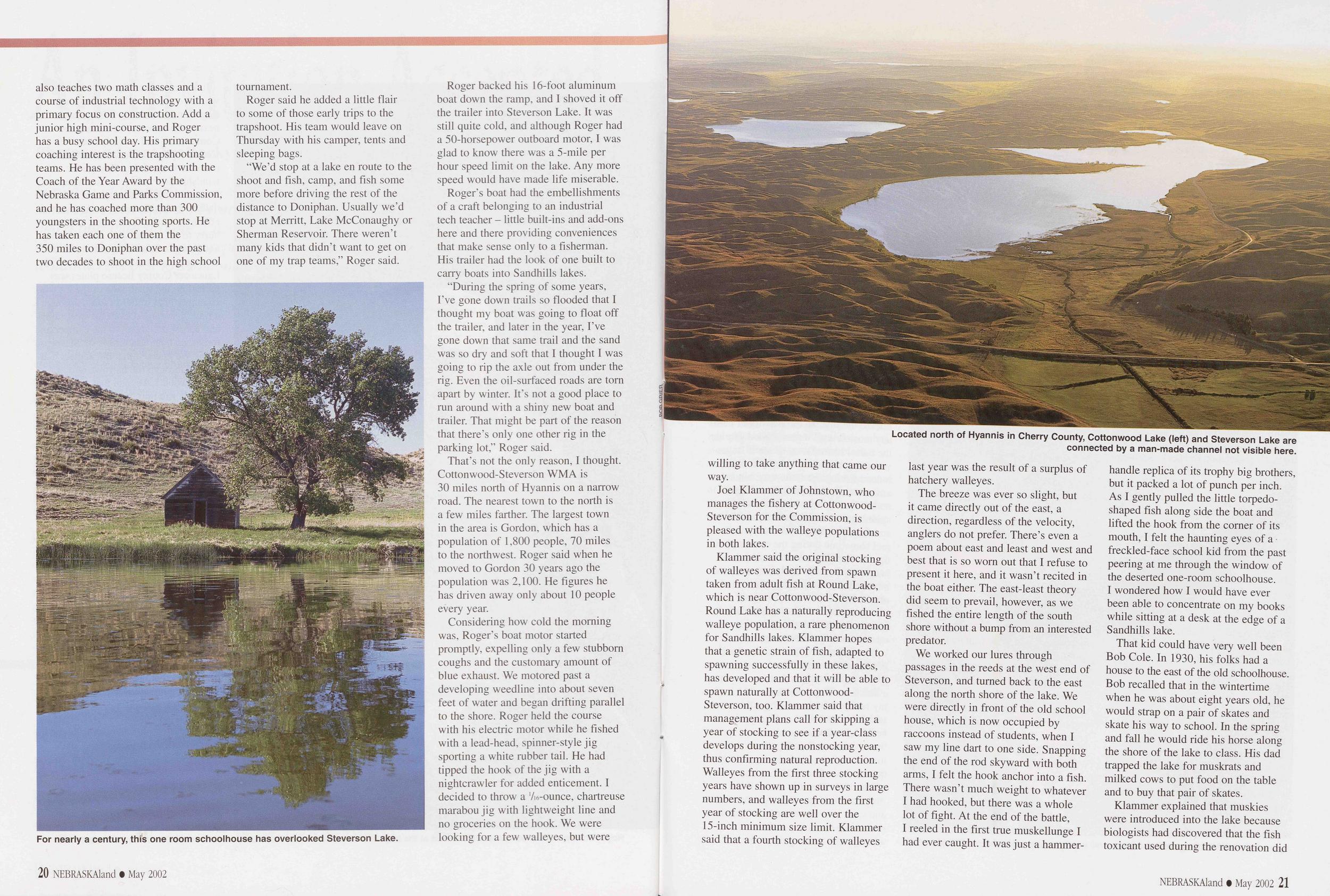
I remembered Steverson as a large lake sprawled across a great valley. I assumed it was shallow because of its murky appearance. Cottonwood Lake is not visible from the trail but is just north of Steverson. The lakes are connected by a narrow channel that was cut with a slip and a team of horses in the early-1900s. When Roger and I approached on the same trail that I had traveled nearly 30 years earlier, Steverson Lake appeared to have taken on a new luster. It was not turbid, but sparkling blue. Later I learned Steverson had always had a maximum depth of ten feet, and its new clarity was the result of removing many carp through chemical renovation in 1997. Later in the day, when Roger’s boat carried us through the channel into Cottonwood Lake, we would find an even deeper lake with greater clarity. Cottonwood has a maximum depth of 20 feet, which is exceptional for a Sandhills lake
Now nearly 80 years old, Bob Cole remembers his father telling him that Cottonwood Lake wasn’t a lake at all before he and his brother helped cut a channel through a natural draw from Steverson.
"Where Cottonwood Lake is now was just a dry flat in 1900. They’d work cattle there and sometimes gather them to feed. It [the flat] developed some pretty good blowouts, so they thought they’d turn some water into it and see if it held. It did, and became one of the nicest lakes in the country,” said Cole, who still lives on a ranch he and his wife own northwest of Steverson.
18 NEBRASKAland • May 2002It was an especially cold morning when we arrived at Steverson Lake. Roger and I sat in his fishing wagon next to the concrete boat ramp the Commission had recently built. We soaked in the view and the little heat from the sun coming through the windshield. A cold front had swept through the previous day, and we knew that it would take some time for its effects to wear off. We were not in a hurry to get on the lake, and we were not going to have to fight a crowd at the boat launch. A single camper with Lancaster County license plates was parked on the south side of the lot with an empty boat trailer in tow. Although a trail of water led from the boat ramp and across the gravel to the camper and trailer, no boat was visible on Steverson Lake. We guessed that the anglers had headed through the narrows into Cottonwood Lake, and that we would probably run into them during the day.
Roger leaned back in his seat, smiled and said, "You know, I still can’t quite get it through my thick head just how fortunate I am. I came to Gordon 30 years ago to teach just so I could enjoy all this open space, all this fishing and hunting. Most people don’t really understand what we have here, but I suppose that’s why it’s so good. My wife has taught here for 30 years too, almost 60 years of teaching between us. We raised a boy and a girl here. Our girl’s soon to be graduating from college and our boy’s a teacher like his folks. Both of our kids have enjoyed the hunting and fishing. We went all the time when they were little, and I don’t think any of us would trade what we had for anything. When students ask me about the teaching profession, I tell them that the three best things about teaching are June, July and August. Just take a look out there and you see what I mean.”
It’s apparent, however, that Roger
gets more from his profession than
fishing during summer vacation. He
still heads up a cooperative education
program that he established 30 years
ago. Roger explained the program as a
life skills course; seniors take related
classwork in the mornings and they go
to workplaces in the afternoons. He
NEBRASKAland • May 2002 19
 also teaches two math classes and a
course of industrial technology with a
primary focus on construction. Add a
junior high mini-course, and Roger
has a busy school day. His primary
coaching interest is the trapshooting
teams. He has been presented with the
Coach of the Year Award by the
Nebraska Game and Parks Commission,
and he has coached more than 300
youngsters in the shooting sports. He
has taken each one of them the
350 miles to Doniphan over the past
two decades to shoot in the high school
For nearly a century, this one room schoolhouse has overlooked Steverson Lake.
tournament.
also teaches two math classes and a
course of industrial technology with a
primary focus on construction. Add a
junior high mini-course, and Roger
has a busy school day. His primary
coaching interest is the trapshooting
teams. He has been presented with the
Coach of the Year Award by the
Nebraska Game and Parks Commission,
and he has coached more than 300
youngsters in the shooting sports. He
has taken each one of them the
350 miles to Doniphan over the past
two decades to shoot in the high school
For nearly a century, this one room schoolhouse has overlooked Steverson Lake.
tournament.
Roger said he added a little flair to some of those early trips to the trapshoot. His team would leave on Thursday with his camper, tents and sleeping bags.
“We’d stop at a lake en route to the shoot and fish, camp, and fish some more before driving the rest of the distance to Doniphan. Usually we’d stop at Merritt, Lake McConaughy or Sherman Reservoir. There weren’t many kids that didn’t want to get on one of my trap teams,” Roger said.
Roger backed his 16-foot aluminum boat down the ramp, and I shoved it off the trailer into Steverson Lake. It was still quite cold, and although Roger had a 50-horsepower outboard motor, I was glad to know there was a 5-mile per hour speed limit on the lake. Any more speed would have made life miserable.
Roger’s boat had the embellishments of a craft belonging to an industrial tech teacher - little built-ins and add-ons here and there providing conveniences that make sense only to a fisherman. His trailer had the look of one built to carry boats into Sandhills lakes.
“During the spring of some years, I’ve gone down trails so flooded that I thought my boat was going to float off the trailer, and later in the year, I’ve gone down that same trail and the sand was so dry and soft that I thought I was going to rip the axle out from under the rig. Even the oil-surfaced roads are torn apart by winter. It’s not a good place to run around with a shiny new boat and trailer. That might be part of the reason that there’s only one other rig in the parking lot,” Roger said.
That’s not the only reason, I thought. Cottonwood-Steverson WMA is 30 miles north of Hyannis on a narrow road. The nearest town to the north is a few miles farther. The largest town in the area is Gordon, which has a population of 1,800 people, 70 miles to the northwest. Roger said when he moved to Gordon 30 years ago the population was 2,100. He figures he has driven away only about 10 people every year.
Considering how cold the morning was, Roger’s boat motor started promptly, expelling only a few stubborn coughs and the customary amount of blue exhaust. We motored past a developing weedline into about seven feet of water and began drifting parallel to the shore. Roger held the course with his electric motor while he fished with a lead-head, spinner-style jig sporting a white rubber tail. He had tipped the hook of the jig with a nightcrawler for added enticement. I decided to throw a 7i6-ounce, chartreuse marabou jig with lightweight line and no groceries on the hook. We were looking for a few walleyes, but were 20 NEBRASKAland • May 2002 willing to take anything that came our way.
Joel Klammer of Johnstown, who manages the fishery at Cottonwood- Steverson for the Commission, is pleased with the walleye populations in both lakes.
Klammer said the original stocking of walleyes was derived from spawn taken from adult fish at Round Lake, which is near Cottonwood-Steverson. Round Lake has a naturally reproducing walleye population, a rare phenomenon for Sandhills lakes. Klammer hopes that a genetic strain of fish, adapted to spawning successfully in these lakes, has developed and that it will be able to spawn naturally at Cottonwood- Steverson, too. Klammer said that management plans call for skipping a year of stocking to see if a year-class develops during the nonstocking year, thus confirming natural reproduction. Walleyes from the first three stocking years have shown up in surveys in large numbers, and walleyes from the first year of stocking are well over the 15-inch minimum size limit. Klammer said that a fourth stocking of walleyes last year was the result of a surplus of hatchery walleyes.
The breeze was ever so slight, but it came directly out of the east, a direction, regardless of the velocity, anglers do not prefer. There’s even a poem about east and least and west and best that is so worn out that I refuse to present it here, and it wasn’t recited in the boat either. The east-least theory did seem to prevail, however, as we fished the entire length of the south shore without a bump from an interested predator.
We worked our lures through passages in the reeds at the west end of Steverson, and turned back to the east along the north shore of the lake. We were directly in front of the old school house, which is now occupied by raccoons instead of students, when I saw my line dart to one side. Snapping the end of the rod skyward with both arms, I felt the hook anchor into a fish. There wasn’t much weight to whatever I had hooked, but there was a whole lot of fight. At the end of the battle, I reeled in the first true muskellunge I had ever caught. It was just a hammer- handle replica of its trophy big brothers, but it packed a lot of punch per inch. As I gently pulled the little torpedo- shaped fish along side the boat and lifted the hook from the corner of its mouth, I felt the haunting eyes of a freckled-face school kid from the past peering at me through the window of the deserted one-room schoolhouse. I wondered how I would have ever been able to concentrate on my books while sitting at a desk at the edge of a Sandhills lake.
That kid could have very well been Bob Cole. In 1930, his folks had a house to the east of the old schoolhouse. Bob recalled that in the wintertime when he was about eight years old, he would strap on a pair of skates and skate his way to school. In the spring and fall he would ride his horse along the shore of the lake to class. His dad trapped the lake for muskrats and milked cows to put food on the table and to buy that pair of skates.
Klammer explained that muskies
were introduced into the lake because
biologists had discovered that the fish
toxicant used during the renovation did
NEBRASKAland • May 2002 21
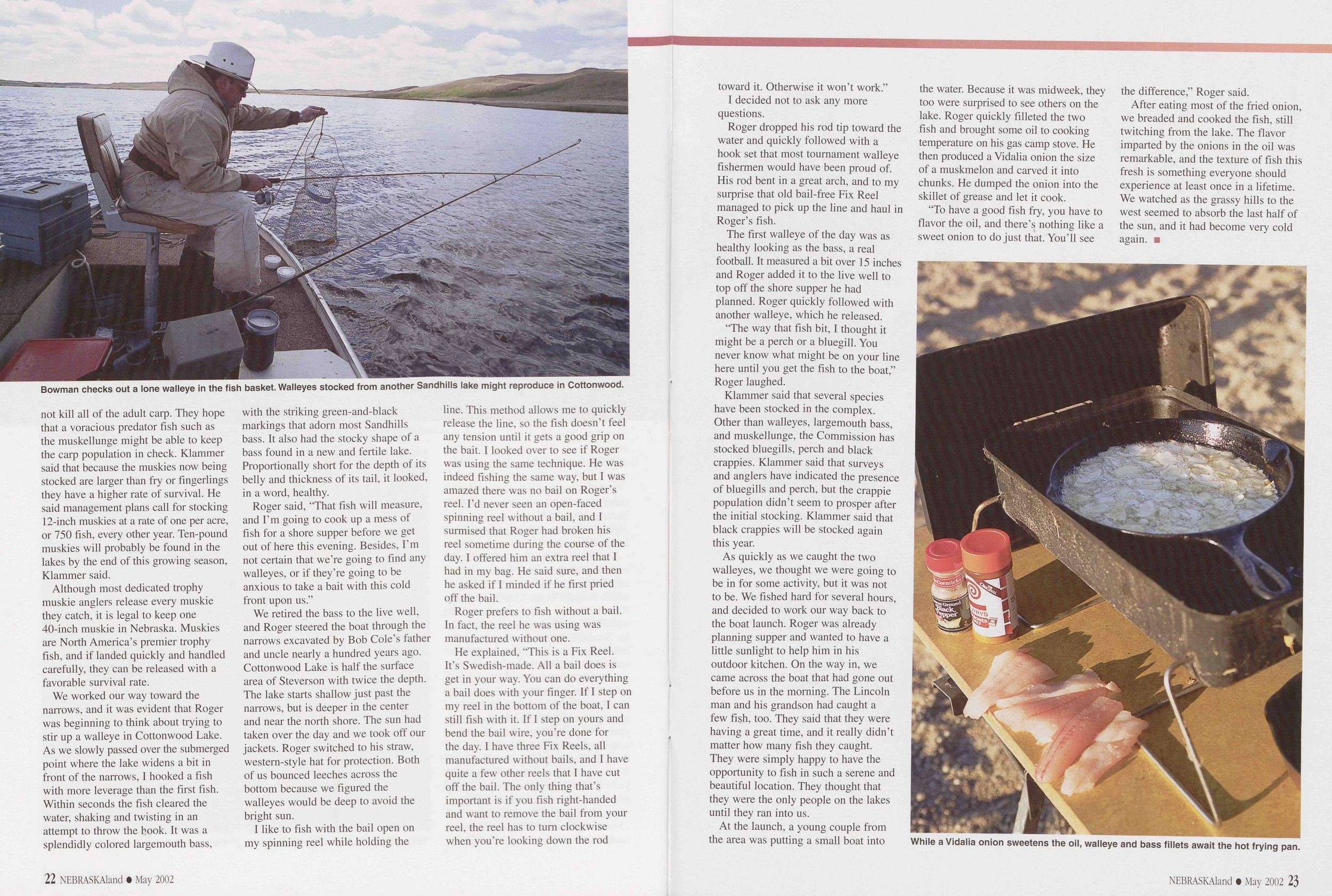 not kill all of the adult carp. They hope
that a voracious predator fish such as
the muskellunge might be able to keep
the carp population in check. Klammer
said that because the muskies now being
stocked are larger than fry or fingerlings
they have a higher rate of survival. He
said management plans call for stocking
12-inch muskies at a rate of one per acre,
or 750 fish, every other year. Ten-pound
muskies will probably be found in the
lakes by the end of this growing season,
Klammer said.
not kill all of the adult carp. They hope
that a voracious predator fish such as
the muskellunge might be able to keep
the carp population in check. Klammer
said that because the muskies now being
stocked are larger than fry or fingerlings
they have a higher rate of survival. He
said management plans call for stocking
12-inch muskies at a rate of one per acre,
or 750 fish, every other year. Ten-pound
muskies will probably be found in the
lakes by the end of this growing season,
Klammer said.
Although most dedicated trophy muskie anglers release every muskie they catch, it is legal to keep one 40-inch muskie in Nebraska. Muskies are North America’s premier trophy fish, and if landed quickly and handled carefully, they can be released with a favorable survival rate.
We worked our way toward the narrows, and it was evident that Roger was beginning to think about trying to stir up a walleye in Cottonwood Lake. As we slowly passed over the submerged point where the lake widens a bit in front of the narrows, I hooked a fish with more leverage than the first fish. Within seconds the fish cleared the water, shaking and twisting in an attempt to throw the book. It was a splendidly colored largemouth bass, with the striking green-and-black markings that adorn most Sandhills bass. It also had the stocky shape of a bass found in a new and fertile lake. Proportionally short for the depth of its belly and thickness of its tail, it looked, in a word, healthy.
Roger said, “That fish will measure, and I’m going to cook up a mess of fish for a shore supper before we get out of here this evening. Besides, I’m not certain that we’re going to find any walleyes, or if they’re going to be anxious to take a bait with this cold front upon us.”
We retired the bass to the live well, and Roger steered the boat through the narrows excavated by Bob Cole’s father and uncle nearly a hundred years ago. Cottonwood Lake is half the surface area of Steverson with twice the depth. The lake starts shallow just past the narrows, but is deeper in the center and near the north shore. The sun had taken over the day and we took off our jackets. Roger switched to his straw, western-style hat for protection. Both of us bounced leeches across the bottom because we figured the walleyes would be deep to avoid the bright sun.
I like to fish with the bail open on my spinning reel while holding the line. This method allows me to quickly release the line, so the fish doesn’t feel any tension until it gets a good grip on the bait. I looked over to see if Roger was using the same technique. He was indeed fishing the same way, but I was amazed there was no bail on Roger’s reel. I’d never seen an open-faced spinning reel without a bail, and I surmised that Roger had broken his reel sometime during the course of the day. I offered him an extra reel that I had in my bag. He said sure, and then he asked if I minded if he first pried off the bail.
Roger prefers to fish without a bail. In fact, the reel he was using was manufactured without one.
He explained, “This is a Fix Reel. It’s Swedish-made. All a bail does is get in your way. You can do everything a bail does with your finger. If I step on my reel in the bottom of the boat, I can still fish with it. If I step on yours and bend the bail wire, you’re done for the day. I have three Fix Reels, all manufactured without bails, and I have quite a few other reels that I have cut off the bail. The only thing that’s important is if you fish right-handed and want to remove the bail from your reel, the reel has to turn clockwise when you’re looking down the rod 22 NEBRASKAland • May 2002 toward it. Otherwise it won’t work.”
I decided not to ask any more questions.
Roger dropped his rod tip toward the water and quickly followed with a hook set that most tournament walleye fishermen would have been proud of. His rod bent in a great arch, and to my surprise that old bail-free Fix Reel managed to pick up the line and haul in Roger’s fish.
The first walleye of the day was as healthy looking as the bass, a real football. It measured a bit over 15 inches and Roger added it to the live well to top off the shore supper he had planned. Roger quickly followed with another walleye, which he released.
“The way that fish bit, I thought it might be a perch or a bluegill. You never know what might be on your line here until you get the fish to the boat,” Roger laughed.
Klammer said that several species have been stocked in the complex. Other than walleyes, largemouth bass, and muskellunge, the Commission has stocked bluegills, perch and black crappies. Klammer said that surveys and anglers have indicated the presence of bluegills and perch, but the crappie population didn’t seem to prosper after the initial stocking. Klammer said that black crappies will be stocked again this year.
As quickly as we caught the two walleyes, we thought we were going to be in for some activity, but it was not to be. We fished hard for several hours, and decided to work our way back to the boat launch. Roger was already planning supper and wanted to have a little sunlight to help him in his outdoor kitchen. On the way in, we came across the boat that had gone out before us in the morning. The Lincoln man and his grandson had caught a few fish, too. They said that they were having a great time, and it really didn’t matter how many fish they caught. They were simply happy to have the opportunity to fish in such a serene and beautiful location. They thought that they were the only people on the lakes until they ran into us.
At the launch, a young couple from the area was putting a small boat into the water. Because it was midweek, they too were surprised to see others on the lake. Roger quickly filleted the two fish and brought some oil to cooking temperature on his gas camp stove. He then produced a Vidalia onion the size of a muskmelon and carved it into chunks. He dumped the onion into the skillet of grease and let it cook.
“To have a good fish fry, you have to flavor the oil, and there’s nothing like a sweet onion to do just that. You’ll see the difference,” Roger said.
After eating most of the fried onion, we breaded and cooked the fish, still twitching from the lake. The flavor imparted by the onions in the oil was remarkable, and the texture of fish this fresh is something everyone should experience at least once in a lifetime. We watched as the grassy hills to the west seemed to absorb the last half of the sun, and it had become very cold again. ■
NEBRASKAland • May 2002 23
Where Earth Meets Sky
Imagine standing on the edge of a windswept ridge top in Nebraska's western High Plains, where a man's outstretched arms cannot begin to define the space. You are in a land of wedding cake buttes and treeless plains. A place where earth meets sky; where eagles soar; and dreamers dream. Imagine being here in the green hours of early summer, when cloud shadows race across the prairie like dark herds of bison, and westerly winds bathe your face with the faint smell of rain. Here on the shortgrass prairie, the show is both grand and subtle. Stand for only a moment, and you will see nothing; but stay for a day and a parade of life will abound.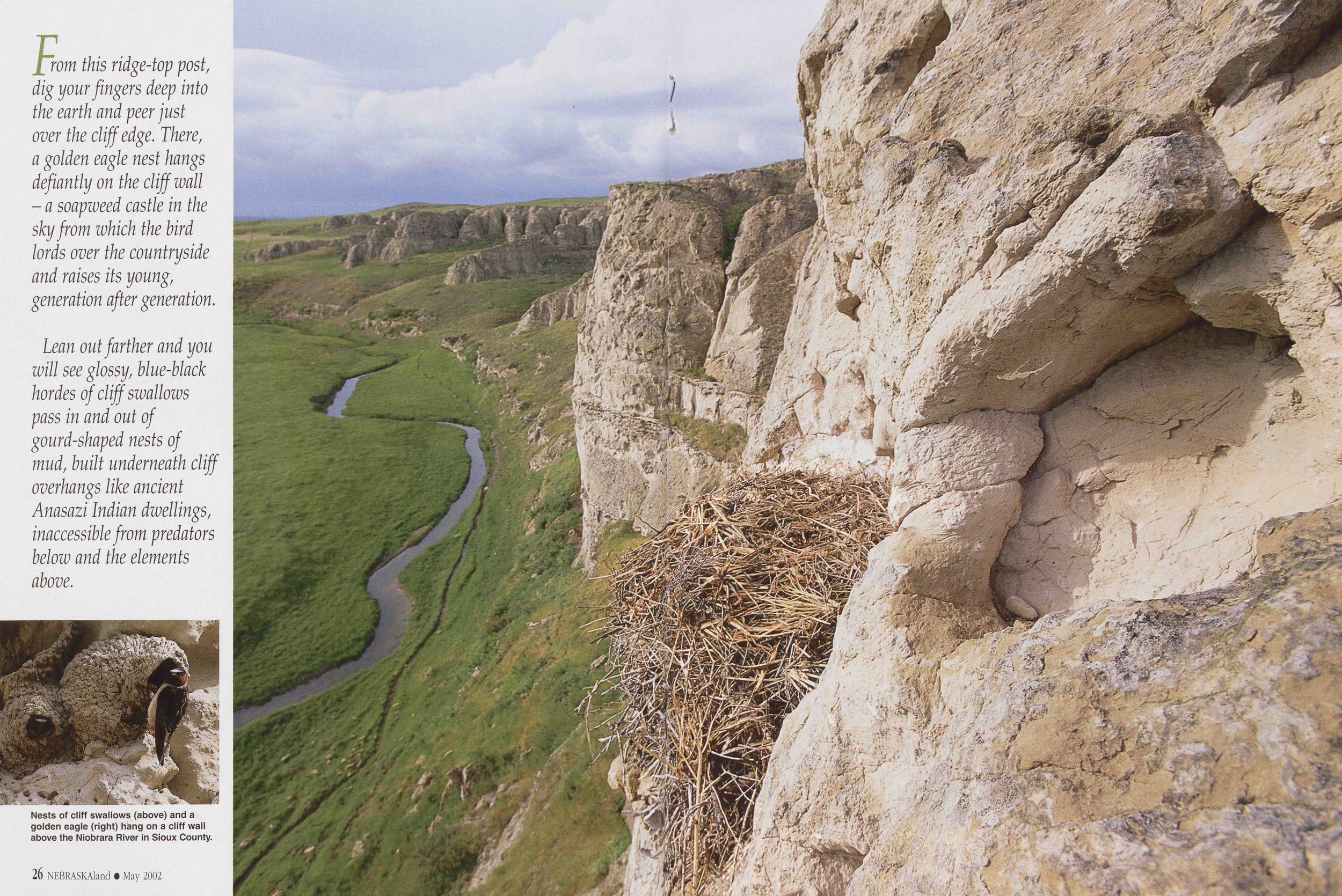 From this ridge-top post,
dig your fingers deep into
the earth and peer just
over the cliff edge. There,
a golden eagle nest hangs
defiantly on the cliff wall
- a soapweed castle in the
sky from which the bird
lords over the countryside
and raises its young,
generation after generation.
Lean out farther and you
will see glossy, blue-black
hordes of cliff swallows
pass in and out of
gourd-shaped nests of
mud, built underneath cliff
overhangs like ancient
Anasazi Indian dwellings,
inaccessible from predators
below and the elements
above.
From this ridge-top post,
dig your fingers deep into
the earth and peer just
over the cliff edge. There,
a golden eagle nest hangs
defiantly on the cliff wall
- a soapweed castle in the
sky from which the bird
lords over the countryside
and raises its young,
generation after generation.
Lean out farther and you
will see glossy, blue-black
hordes of cliff swallows
pass in and out of
gourd-shaped nests of
mud, built underneath cliff
overhangs like ancient
Anasazi Indian dwellings,
inaccessible from predators
below and the elements
above.
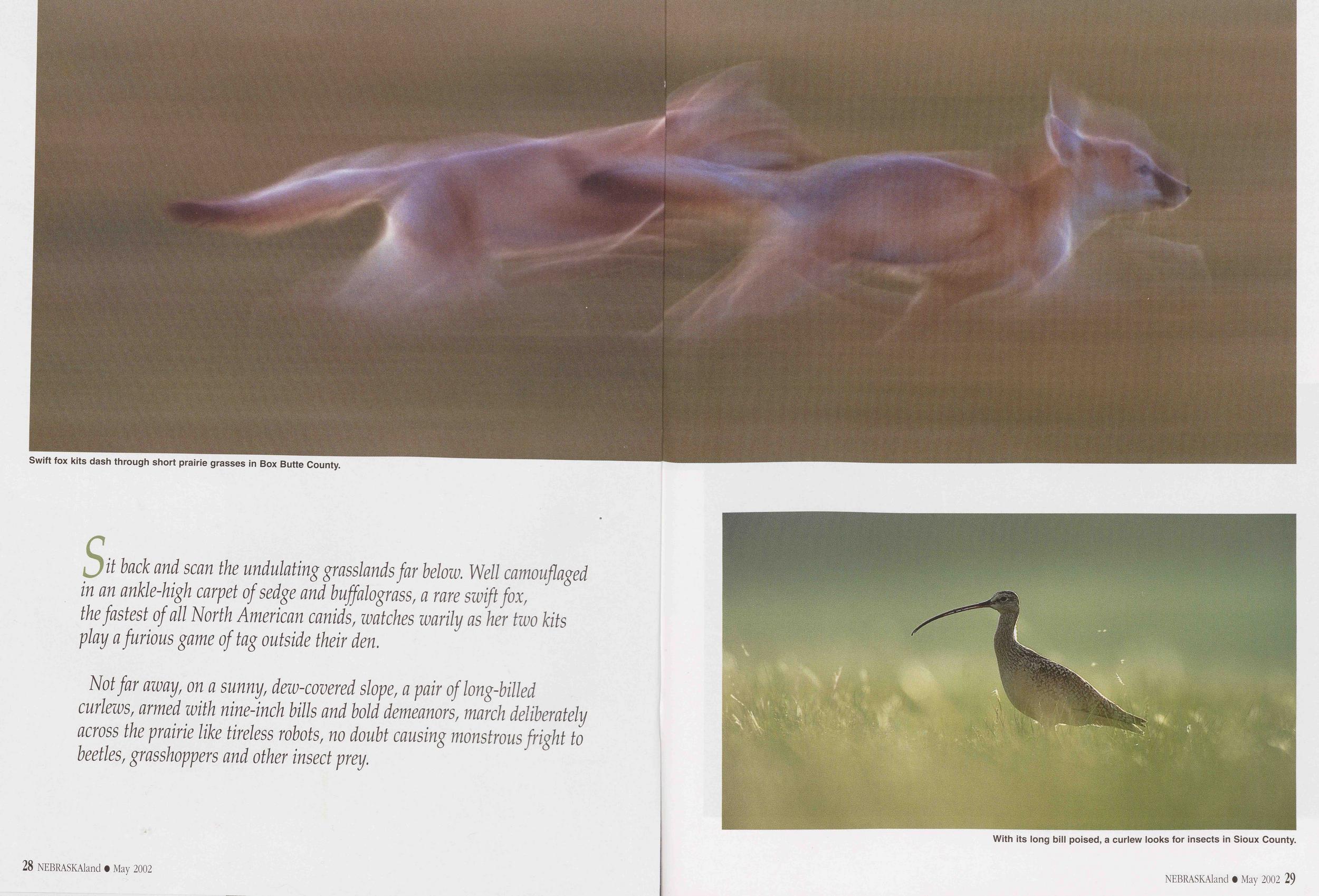
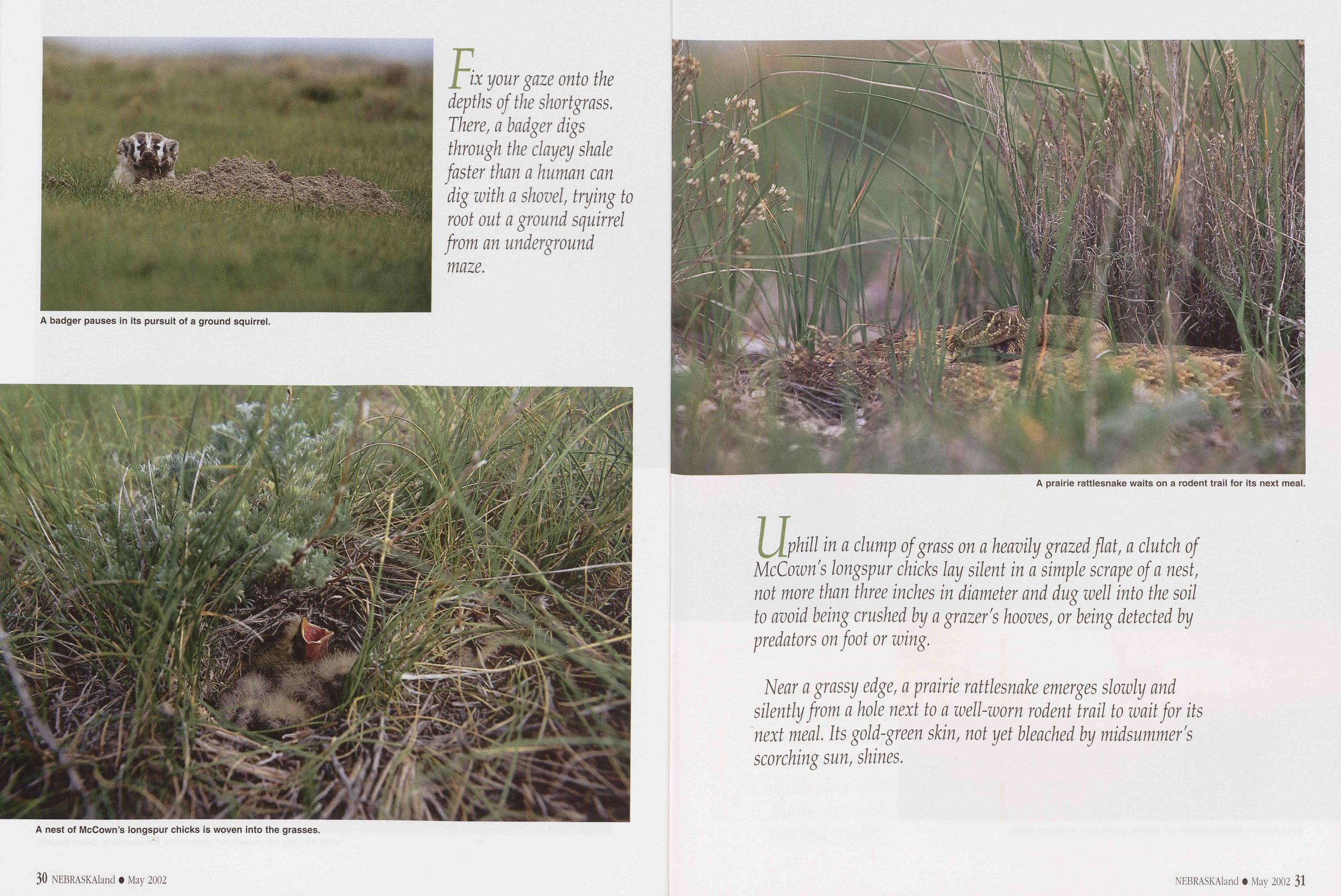
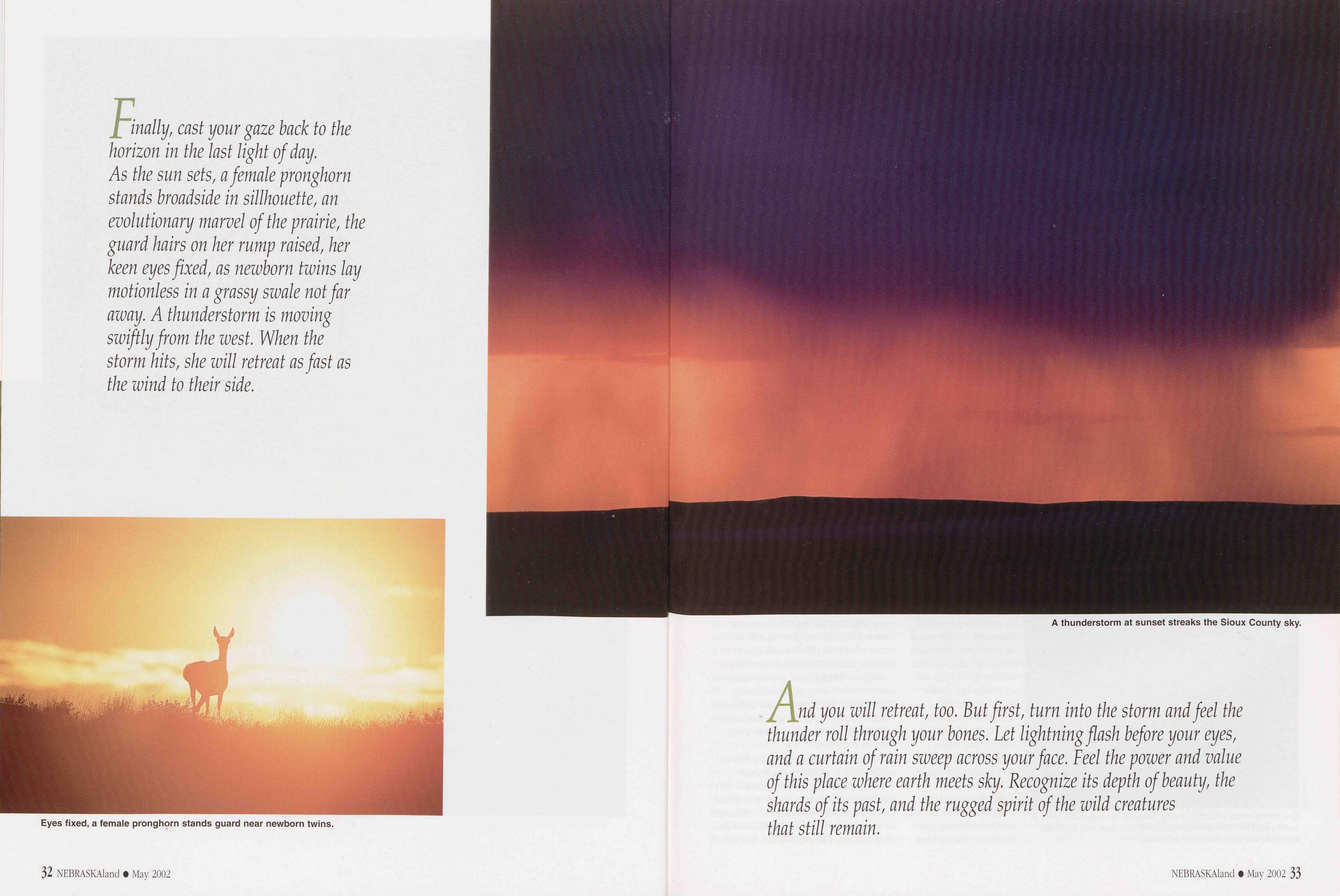 Finally, cast your gaze back to the
horizon in the last light of day.
As the sun sets, a female pronghorn
stands broadside in sillhouette, an
evolutionary marvel of the prairie, the
guard hairs on her rump raised, her
keen eyes fixed, as newborn twins lay
motionless in a grassy swale not far
away. A thunderstorm is moving
swiftly from the west. When the
storm hits, she will retreat as fast as
the wind to their side.
Finally, cast your gaze back to the
horizon in the last light of day.
As the sun sets, a female pronghorn
stands broadside in sillhouette, an
evolutionary marvel of the prairie, the
guard hairs on her rump raised, her
keen eyes fixed, as newborn twins lay
motionless in a grassy swale not far
away. A thunderstorm is moving
swiftly from the west. When the
storm hits, she will retreat as fast as
the wind to their side.
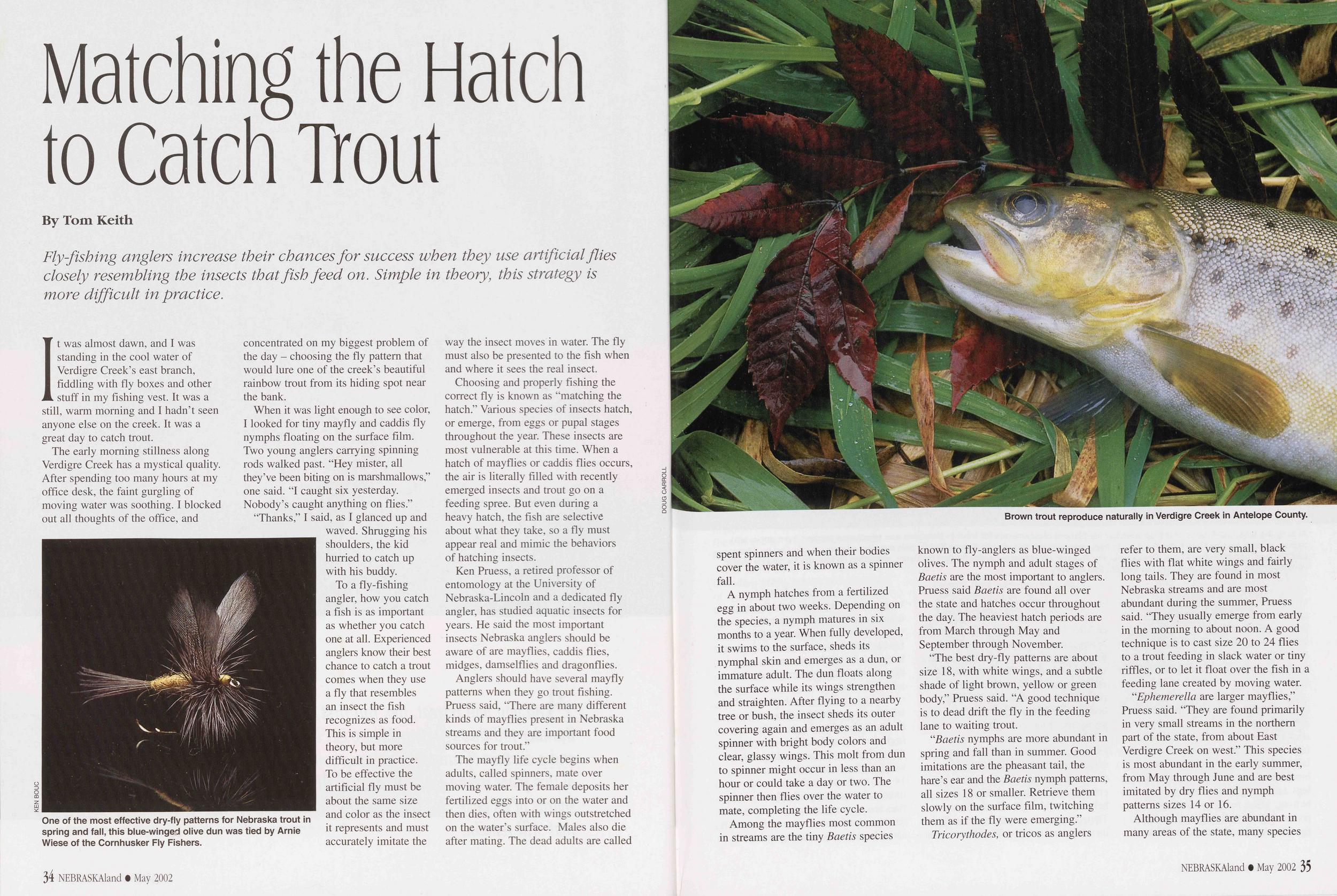
Matching the Hatch to Catch Trout
Fly-fishing anglers increase their chances for success when they use artificial flies closely resembling the insects that fish feed on. Simple in theory, this strategy is more difficult in practice.It was almost dawn, and I was standing in the cool water of Verdigre Creek’s east branch, fiddling with fly boxes and other stuff in my fishing vest. It was a still, warm morning and I hadn’t seen anyone else on the creek. It was a great day to catch trout.
The early morning stillness along Verdigre Creek has a mystical quality. After spending too many hours at my office desk, the faint gurgling of moving water was soothing. I blocked out all thoughts of the office, and concentrated on my biggest problem of the day - choosing the fly pattern that would lure one of the creek’s beautiful rainbow trout from its hiding spot near the bank.
KEN BOUCWhen it was light enough to see color, I looked for tiny mayfly and caddis fly nymphs floating on the surface film. Two young anglers carrying spinning rods walked past. “Hey mister, all they’ve been biting on is marshmallows,” one said. "I caught six yesterday. Nobody’s caught anything on flies.” “Thanks,” I said, as I glanced up and waved. Shrugging his shoulders, the kid hurried to catch up with his buddy.
To a fly-fishing angler, how you catch a fish is as important as whether you catch one at all. Experienced anglers know their best chance to catch a trout comes when they use a fly that resembles an insect the fish recognizes as food. This is simple in theory, but more difficult in practice. To be effective the artificial fly must be about the same size and color as the insect it represents and must accurately imitate the way the insect moves in water. The fly must also be presented to the fish when and where it sees the real insect.
Choosing and properly fishing the correct fly is known as “matching the hatch.” Various species of insects hatch, or emerge, from eggs or pupal stages throughout the year. These insects are most vulnerable at this time. When a hatch of mayflies or caddis flies occurs, the air is literally filled with recently emerged insects and trout go on a feeding spree. But even during a heavy hatch, the fish are selective about what they take, so a fly must appear real and mimic the behaviors of hatching insects.
Ken Pruess, a retired professor of entomology at the University of Nebraska-Lincoln and a dedicated fly angler, has studied aquatic insects for years. He said the most important insects Nebraska anglers should be aware of are mayflies, caddis flies, midges, damselflies and dragonflies.
Anglers should have several mayfly patterns when they go trout fishing. Pruess said, “There are many different kinds of mayflies present in Nebraska streams and they are important food sources for trout.”
The mayfly life cycle begins when adults, called spinners, mate over moving water. The female deposits her fertilized eggs into or on the water and then dies, often with wings outstretched on the water’s surface. Males also die after mating. The dead adults are called 34 NEBRASKAland • May 2002 spent spinners and when their bodies cover the water, it is known as a spinner fall.
DOUG CARROLLA nymph hatches from a fertilized egg in about two weeks. Depending on the species, a nymph matures in six months to a year. When fully developed, it swims to the surface, sheds its nymphal skin and emerges as a dun, or immature adult. The dun floats along the surface while its wings strengthen and straighten. After flying to a nearby tree or bush, the insect sheds its outer covering again and emerges as an adult spinner with bright body colors and clear, glassy wings. This molt from dun to spinner might occur in less than an hour or could take a day or two. The spinner then flies over the water to mate, completing the life cycle.
Among the mayflies most common in streams are the tiny Baetis species known to fly-anglers as blue-winged olives. The nymph and adult stages of Baetis are the most important to anglers. Pruess said Baetis are found all over the state and hatches occur throughout the day. The heaviest hatch periods are from March through May and September through November.
“The best dry-fly patterns are about size 18, with white wings, and a subtle shade of light brown, yellow or green body,” Pruess said. “A good technique is to dead drift the fly in the feeding lane to waiting trout.
“Baetis nymphs are more abundant in spring and fall than in summer. Good imitations are the pheasant tail, the hare’s ear and the Baetis nymph patterns, all sizes 18 or smaller. Retrieve them slowly on the surface film, twitching them as if the fly were emerging.”
Tricorythodes, or tricos as anglers refer to them, are very small, black flies with flat white wings and fairly long tails. They are found in most Nebraska streams and are most abundant during the summer, Pruess said. “They usually emerge from early in the morning to about noon. A good technique is to cast size 20 to 24 flies to a trout feeding in slack water or tiny riffles, or to let it float over the fish in a feeding lane created by moving water.
“Ephemerella are larger mayflies,” Pruess said. “They are found primarily in very small streams in the northern part of the state, from about East Verdigre Creek on west.” This species is most abundant in the early summer, from May through June and are best imitated by dry flies and nymph patterns sizes 14 or 16.
Although mayflies are abundant in
many areas of the state, many species
NEBRASKAland • May 2002 35
 of caddis flies are also important to
trout, and, therefore, to trout anglers.
Some anglers call caddis flies sedges,
and most are able to identify adult
caddis flies because they look like
small moths fluttering erratically above
the water.
of caddis flies are also important to
trout, and, therefore, to trout anglers.
Some anglers call caddis flies sedges,
and most are able to identify adult
caddis flies because they look like
small moths fluttering erratically above
the water.
The caddis fly has a four-stage life cycle, which begins when the female deposits eggs in the water. The eggs stick to structures such as rocks and fallen trees on the bottom of a creek or lake. When the tiny grublike larvae hatch two weeks later, they have six legs and scurry across the stream bottom, where rocks or other cover protects them from feeding fish. They feed on plants and carrion in the water and grow quickly.
Some species are well camouflaged and live on the underside of rocks and in aquatic vegetation. Others live in tiny holes and crevices, and like spiders, spin nets in which they catch food. Still other species build small cases of sand, pebbles or vegetation around their bodies, which provide camouflage and protection from feeding fish.
When the larva matures, it stops feeding and develops into the pupal stage. It remains dormant until the water temperature increases and then emerges, releasing gas bubbles that help it rise quickly to the surface. There it sheds its pupal shuck, unfolds its wings and quickly flies to terrestrial vegetation. A few days later the adults mature and become strong, rapid, erratic fliers. They mate, and the female returns to the stream to deposit her eggs. A female can mate two or three times in her two- or three-week adult life span.
Pruess said Hydropsyche caddis flies are very common throughout the state and both nymph and spinner forms are important to anglers. “The nymphs of this species can be imitated by lightly weighted brownish patterns in sizes 14 and 16. Some scud patterns also imitate the nymphs well. These caddis flies are most important from May through October and are usually most active in the early morning and late 36 NEBRASKAland • May 2002 evening. They are very common in northern Nebraska and along Elm Creek in Webster County.”
Pruess said, “Brachycentridae, the case-makers, are found in small streams such as Verdigre Creek. The adults are usually seen skittering around on the surface film, so a good way to imitate them is to cast a dry fly gently to the surface and gently twitch on the line to make it slide across the water.
“Helicopsychidae caddis flies are abundant in trout streams such as the Snake River below the falls. The emerging pupae are the most important stage for fish. They build a case that looks like a snail shell that adheres to the underside of rocks in the stream. They are fairly active and abundant all summer long. The pupal form is best fished by casting and letting the fly sink, then bringing it to the surface as if the insect is emerging and allowing it to float in the surface film.” Some anglers fish them dead-drift in fast streams, allowing the larva-imitating fly to bounce along the bottom.
“Midges are the most important insects in Nebraska for fly anglers to imitate, and are about the only insect food source in Lake Ogallala,” Pruess said. “Midges are small, and are most important as pupae. Larva-imitating flies should be weighted lightly and fished along the bottom of the stream.”
The pupal forms come in all colors, including grays, greens and all shades of red and brown. The pupa swims to the surface to emerge and stays a short time in the surface film. Fish generally take the pupae as they reach the surface. Dry fly patterns that imitate spinners and duns should be fished daintily in the surface film. Midges usually emerge from areas of open water in early mornings and late evenings during the summer, but hatches occur throughout the year, including winter, during warmer parts of the day.
Damselflies, though not an extremely important food source for Nebraska trout, are also consumed when the opportunity arises. Pruess said weighted damselfly-nymph patterns can be very effective in a variety of sizes from 10 to 16, especially during May, June and July. He suggested fishing the nymph patterns in very slow twitches. Adult dry-fly patterns can be fished around the edge of vegetation or other structure.
Dragonfly nymphs can sometimes be effective when pulled across mud on the bottom of a creek or stream.
“Dragonflies are not very important to anglers in Nebraska, though they can be found in both streams and ponds. Nymph patterns in sizes 8 or 10 are most effective and can be fished anytime during the day,” Pruess said. ■
Recommended Fly Patterns Mayflies - Baetidae Location - Statewide Hatch dates - March through May, September through November Recommended patterns - Blue-winged olive, dry fly, size 18; blue quill spinner, dry fly, size 18; little blue dun, dry fly, size 18; little slate-winged brown quill, dry fly, size 18; pheasant tail, nymph, size 16, bead head for weight; hare’s ear, nymph, 14-18, light to dark shades; Baetis, nymph, sizes 18-20 Mayflies - Tricorythidae often referred to as tricos Location - Statewide Hatch dates - June through August Recommended patterns - Tiny white-winged black, dry fly, sizes 20-22; female dark brown spinner, dry fly, sizes 22-24; hen-winged spinner, dry fly, sizes 22-24 Mayflies - Ephemerellidae Location - Northern Nebraska, East Verdigre Creek west to Wyoming border Hatch dates - May through June Recommended patterns - Pale evening dun, dry fly, size 16; pale evening spinner, dry fly, size 16; female Hendrickson, dry fly, sizes 14-16; male red quill, dry fly, sizes 14-16; pale morning dun, nymph, sizes 16-18; light Hendrickson, nymph, size 12; dark Hendrickson; nymph, sizes 14-16 Caddis flies - Hydropsychidae Location - Statewide Hatch dates - May through October Recommended Patterns - Elk hair caddis, dry fly, size 12; Goddard caddis, dry fly, size 12; tent-wing caddis, dry fly, 12-16, brown, dark olive, green body; olive brown caddis larva, size 16; brown and yellow deep sparkle pupa, sizes 14-16 Caddis flies - Brachycentridae Location - Verdigre Creek, other small streams. Hatch dates - May through June Recommended patterns - Bright green emergent sparkle pupa, sizes 14-16; brown and bright green emergent sparkle pupa, sizes 14-16; grannom, nymph, sizes 14-16; dark-cased caddis, nymph, size 14; brown and green diving caddis, wet fly, size 16; skittering caddis, dry fly, sizes 14-16 Caddis flies - Helicopsychidae Location - Snake River below falls, other trout streams Hatch dates - June through August Recommended patterns - Brown and yellow emergent sparkle pupa, size 16; brown and yellow deep sparkle pupa, size 16 Midges - Chironomidae Location - Statewide Hatch dates - Year-round Recommended patterns - Midge pupa, size 20 or smaller; poly or hen-winged spinner, size 20 or smaller; olive midge, dry fly, size 20 or smaller, also grays, browns, greens, reddish, brownish shades Damselflies - Odonata Location - Statewide Hatch dates - May through August Recommended patterns - Damsel nymph, size 12, green, bronze, brown; bogus damselfly nymph, size 14, green, bronze, brown Dragonflies - Odonata Location - Statewide Hatch dates - May through August Recommended patterns - Dragon booby fly, nymph, size 8, heavily weighted; peacock dragon, nymph, size 6, heavily weighted NEBRASKAland • May 2002 37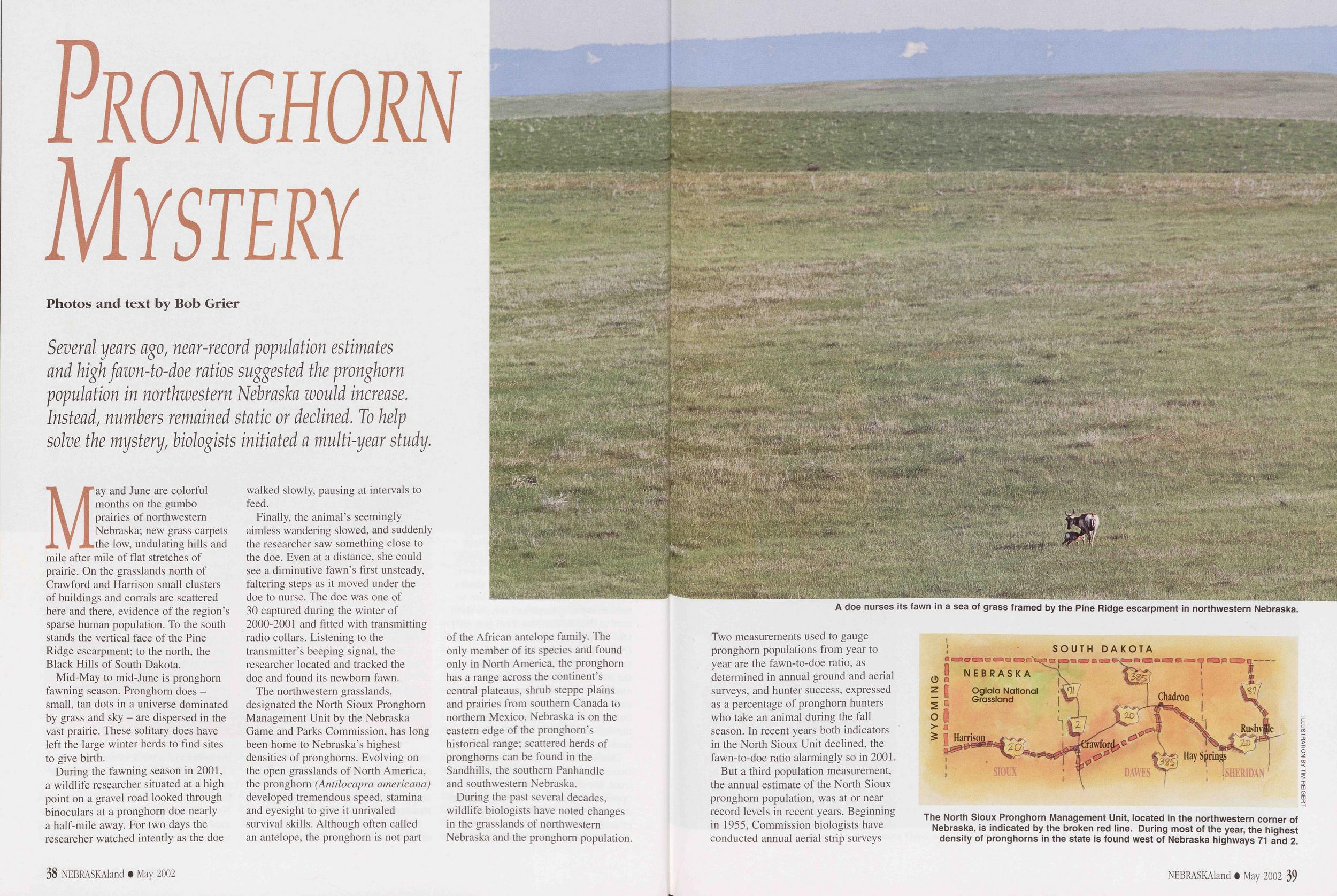
Pronghorn Mystery
Several years ago, near-record population estimates and high fawn-to-doe ratios suggested the pronghorn population in northwestern Nebraska would increase. Instead, numbers remained static or declined. To help solve the mystery, biologists initiated a multi-year study.May and June are colorful months on the gumbo prairies of northwestern Nebraska; new grass carpets the low, undulating hills and mile after mile of flat stretches of prairie. On the grasslands north of Crawford and Harrison small clusters of buildings and corrals are scattered here and there, evidence of the region’s sparse human population. To the south stands the vertical face of the Pine Ridge escarpment; to the north, the Black Hills of South Dakota.
Mid-May to mid-June is pronghorn fawning season. Pronghorn does - small, tan dots in a universe dominated by grass and sky - are dispersed in the vast prairie. These solitary does have left the large winter herds to find sites to give birth.
During the fawning season in 2001, a wildlife researcher situated at a high point on a gravel road looked through binoculars at a pronghorn doe nearly a half-mile away. For two days the researcher watched intently as the doe walked slowly, pausing at intervals to feed.
Finally, the animal’s seemingly aimless wandering slowed, and suddenly the researcher saw something close to the doe. Even at a distance, she could see a diminutive fawn’s first unsteady, faltering steps as it moved under the doe to nurse. The doe was one of 30 captured during the winter of 2000-2001 and fitted with transmitting radio collars. Listening to the transmitter’s beeping signal, the researcher located and tracked the doe and found its newborn fawn.
The northwestern grasslands, designated the North Sioux Pronghorn Management Unit by the Nebraska Game and Parks Commission, has long been home to Nebraska’s highest densities of pronghorns. Evolving on the open grasslands of North America, the pronghorn (Antilocapra americana) developed tremendous speed, stamina and eyesight to give it unrivaled survival skills. Although often called an antelope, the pronghorn is not part of the African antelope family. The only member of its species and found only in North America, the pronghorn has a range across the continent’s central plateaus, shrub steppe plains and prairies from southern Canada to northern Mexico. Nebraska is on the eastern edge of the pronghorn’s historical range; scattered herds of pronghorns can be found in the Sandhills, the southern Panhandle and southwestern Nebraska.
During the past several decades, wildlife biologists have noted changes in the grasslands of northwestern Nebraska and the pronghorn population. 38 NEBRASKAland • May 2002 Two measurements used to gauge pronghorn populations from year to year are the fawn-to-doe ratio, as determined in annual ground and aerial surveys, and hunter success, expressed as a percentage of pronghorn hunters who take an animal during the fall season. In recent years both indicators in the North Sioux Unit declined, the fawn-to-doe ratio alarmingly so in 2001.
But a third population measurement, the annual estimate of the North Sioux pronghorn population, was at or near record levels in recent years. Beginning in 1955, Commission biologists have conducted annual aerial strip surveys
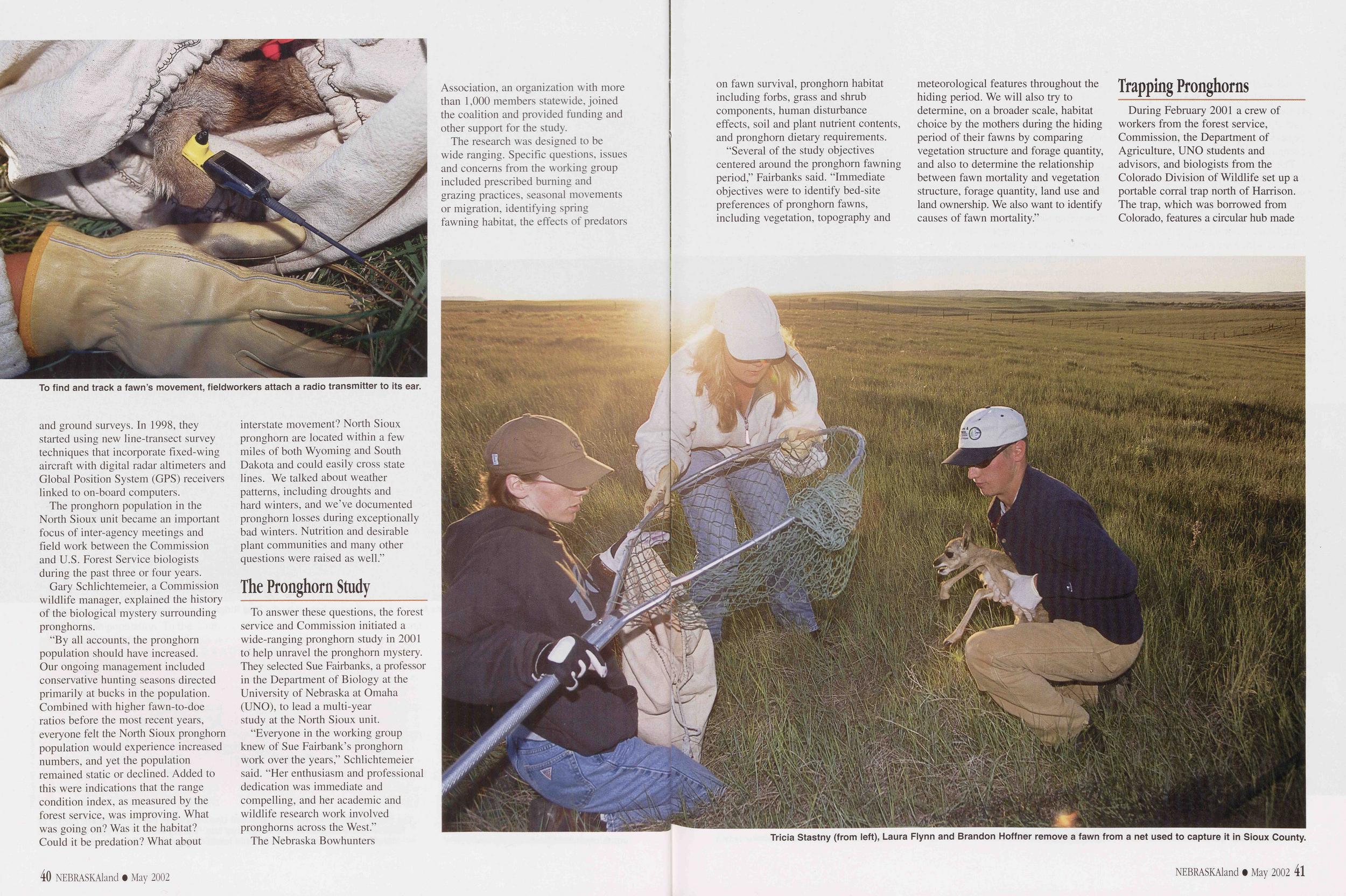 and ground surveys. In 1998, they
started using new line-transect survey
techniques that incorporate fixed-wing
aircraft with digital radar altimeters and
Global Position System (GPS) receivers
linked to on-board computers.
and ground surveys. In 1998, they
started using new line-transect survey
techniques that incorporate fixed-wing
aircraft with digital radar altimeters and
Global Position System (GPS) receivers
linked to on-board computers.
The pronghorn population in the North Sioux unit became an important focus of inter-agency meetings and field work between the Commission and U.S. Forest Service biologists during the past three or four years.
Gary Schlichtemeier, a Commission wildlife manager, explained the history of the biological mystery surrounding pronghorns.
“By all accounts, the pronghorn population should have increased. Our ongoing management included conservative hunting seasons directed primarily at bucks in the population. Combined with higher fawn-to-doe ratios before the most recent years, everyone felt the North Sioux pronghorn population would experience increased numbers, and yet the population remained static or declined. Added to this were indications that the range condition index, as measured by the forest service, was improving. What was going on? Was it the habitat? Could it be predation? What about interstate movement? North Sioux pronghorn are located within a few miles of both Wyoming and South Dakota and could easily cross state lines. We talked about weather patterns, including droughts and hard winters, and we’ve documented pronghorn losses during exceptionally bad winters. Nutrition and desirable plant communities and many other questions were raised as well.”
The Pronghorn StudyTo answer these questions, the forest service and Commission initiated a wide-ranging pronghorn study in 2001 to help unravel the pronghorn mystery. They selected Sue Fairbanks, a professor in the Department of Biology at the University of Nebraska at Omaha (UNO), to lead a multi-year study at the North Sioux unit.
“Everyone in the working group knew of Sue Fairbank’s pronghorn work over the years,” Schlichtemeier said. “Her enthusiasm and professional dedication was immediate and compelling, and her academic and wildlife research work involved pronghorns across the West.”
The Nebraska Bowhunters Association, an organization with more than 1,000 members statewide, joined the coalition and provided funding and other support for the study.
The research was designed to be wide ranging. Specific questions, issues and concerns from the working group included prescribed burning and grazing practices, seasonal movements or migration, identifying spring fawning habitat, the effects of predators 40 NEBRASKAland • May 2002 on fawn survival, pronghorn habitat including forbs, grass and shrub components, human disturbance effects, soil and plant nutrient contents, and pronghorn dietary requirements.
“Several of the study objectives centered around the pronghorn fawning period,” Fairbanks said. “Immediate objectives were to identify bed-site preferences of pronghorn fawns, including vegetation, topography and meteorological features throughout the hiding period. We will also try to determine, on a broader scale, habitat choice by the mothers during the hiding period of their fawns by comparing vegetation structure and forage quantity, and also to determine the relationship between fawn mortality and vegetation structure, forage quantity, land use and land ownership. We also want to identify causes of fawn mortality ”
Trapping PronghornsDuring February 2001 a crew of
workers from the forest service,
Commission, the Department of
Agriculture, UNO students and
advisors, and biologists from the
Colorado Division of Wildlife set up a
portable corral trap north of Harrison.
The trap, which was borrowed from
Colorado, features a circular hub made
NEBRASKAland • May 2002 41
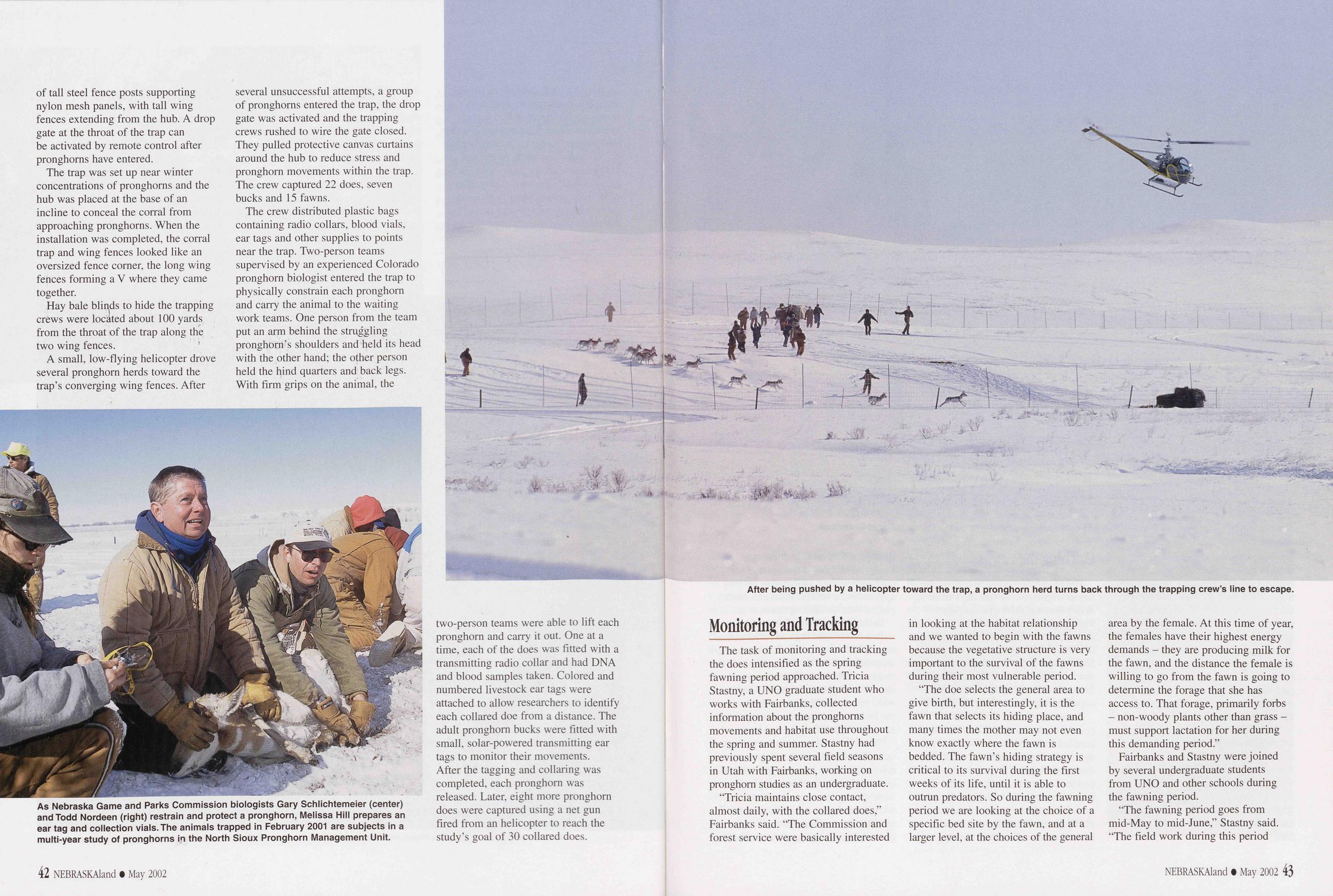 of tall steel fence posts supporting
nylon mesh panels, with tall wing
fences extending from the hub. A drop
gate at the throat of the trap can
be activated by remote control after
pronghorns have entered.
of tall steel fence posts supporting
nylon mesh panels, with tall wing
fences extending from the hub. A drop
gate at the throat of the trap can
be activated by remote control after
pronghorns have entered.
The trap was set up near winter concentrations of pronghorns and the hub was placed at the base of an incline to conceal the corral from approaching pronghorns. When the installation was completed, the corral trap and wing fences looked like an oversized fence corner, the long wing fences forming a V where they came together.
Hay bale blinds to hide the trapping crews were located about 100 yards from the throat of the trap along the two wing fences.
A small, low-flying helicopter drove several pronghorn herds toward the trap’s converging wing fences. After several unsuccessful attempts, a group of pronghorns entered the trap, the drop gate was activated and the trapping crews rushed to wire the gate closed. They pulled protective canvas curtains around the hub to reduce stress and pronghorn movements within the trap. The crew captured 22 does, seven bucks and 15 fawns.
The crew distributed plastic bags containing radio collars, blood vials, ear tags and other supplies to points near the trap. Two-person teams supervised by an experienced Colorado pronghorn biologist entered the trap to physically constrain each pronghorn and carry the animal to the waiting work teams. One person from the team put an arm behind the struggling pronghorn’s shoulders and held its head with the other hand; the other person held the hind quarters and back legs. With firm grips on the animal, the two-person teams were able to lift each pronghorn and carry it out. One at a time, each of the does was fitted with a transmitting radio collar and had DNA and blood samples taken. Colored and numbered livestock ear tags were attached to allow researchers to identify each collared doe from a distance. The adult pronghorn bucks were fitted with small, solar-powered transmitting ear tags to monitor their movements. After the tagging and collaring was completed, each pronghorn was released. Later, eight more pronghorn does were captured using a net gun fired from an helicopter to reach the study’s goal of 30 collared does.
The task of monitoring and tracking the does intensified as the spring fawning period approached. Tricia Stastny, a UNO graduate student who works with Fairbanks, collected information about the pronghorns movements and habitat use throughout the spring and summer. Stastny had previously spent several field seasons in Utah with Fairbanks, working on pronghorn studies as an undergraduate.
"Tricia maintains close contact, almost daily, with the collared does,” Fairbanks said. "The Commission and forest service were basically interested in looking at the habitat relationship and we wanted to begin with the fawns because the vegetative structure is very important to the survival of the fawns during their most vulnerable period.
"The doe selects the general area to give birth, but interestingly, it is the fawn that selects its hiding place, and many times the mother may not even know exactly where the fawn is bedded. The fawn’s hiding strategy is critical to its survival during the first weeks of its life, until it is able to outrun predators. So during the fawning period we are looking at the choice of a specific bed site by the fawn, and at a larger level, at the choices of the general area by the female. At this time of year, the females have their highest energy demands - they are producing milk for the fawn, and the distance the female is willing to go from the fawn is going to determine the forage that she has access to. That forage, primarily forbs - non-woody plants other than grass - must support lactation for her during this demanding period.”
Fairbanks and Stastny were joined by several undergraduate students from UNO and other schools during the fawning period.
"The fawning period goes from
mid-May to mid-June,” Stastny said.
"The field work during this period
NEBRASKAland • May 2002 43
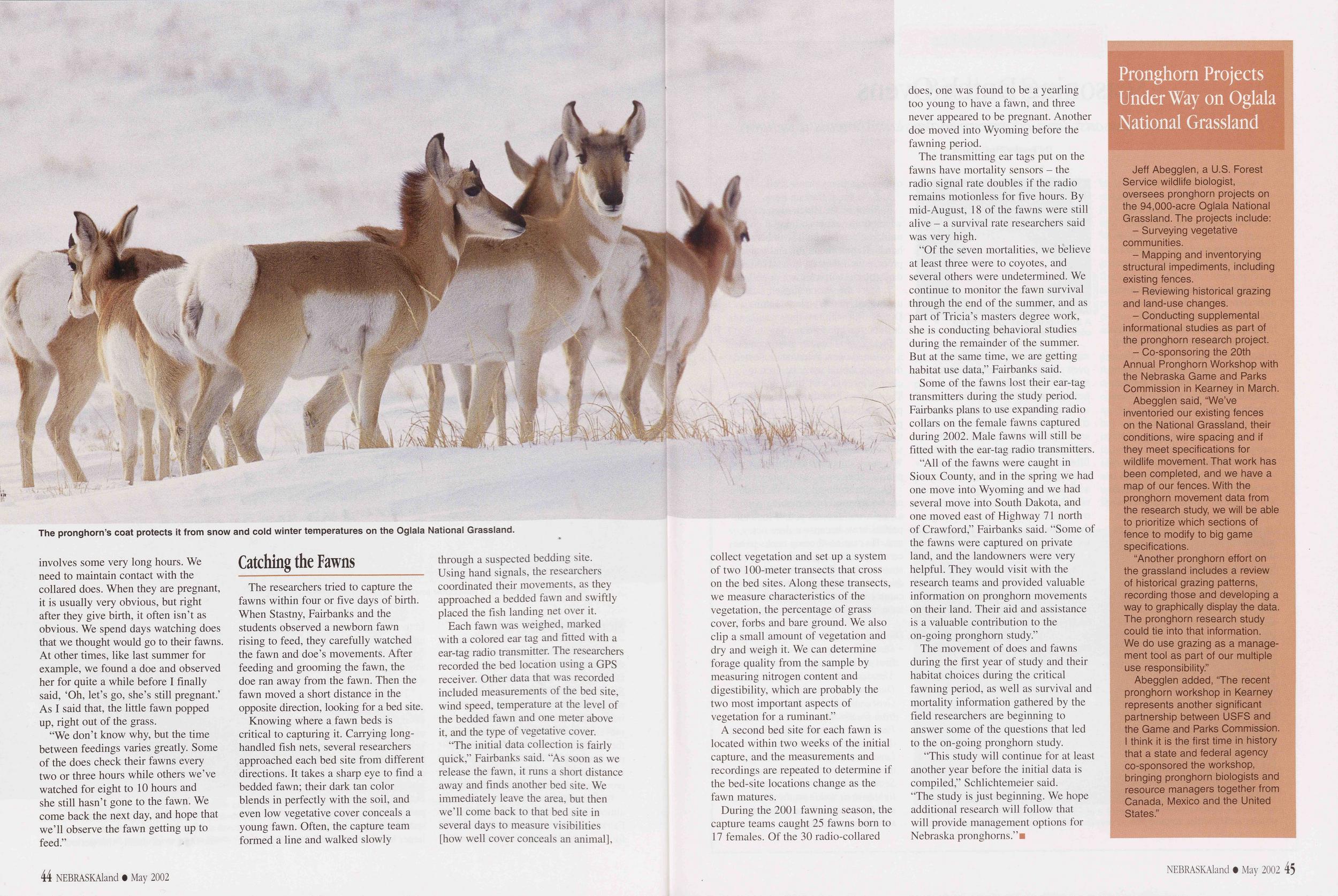 involves some very long hours. We
need to maintain contact with the
collared does. When they are pregnant,
it is usually very obvious, but right
after they give birth, it often isn’t as
obvious. We spend days watching does
that we thought would go to their fawns.
At other times, like last summer for
example, we found a doe and observed
her for quite a while before I finally
said, ‘Oh, let’s go, she’s still pregnant.’
As I said that, the little fawn popped
up, right out of the grass.
involves some very long hours. We
need to maintain contact with the
collared does. When they are pregnant,
it is usually very obvious, but right
after they give birth, it often isn’t as
obvious. We spend days watching does
that we thought would go to their fawns.
At other times, like last summer for
example, we found a doe and observed
her for quite a while before I finally
said, ‘Oh, let’s go, she’s still pregnant.’
As I said that, the little fawn popped
up, right out of the grass.
“We don’t know why, but the time between feedings varies greatly. Some of the does check their fawns every two or three hours while others we’ve watched for eight to 10 hours and she still hasn’t gone to the fawn. We come back the next day, and hope that we’ll observe the fawn getting up to feed.”
Catching the FawnsThe researchers tried to capture the fawns within four or five days of birth. When Stastny, Fairbanks and the students observed a newborn fawn rising to feed, they carefully watched the fawn and doe’s movements. After feeding and grooming the fawn, the doe ran away from the fawn. Then the fawn moved a short distance in the opposite direction, looking for a bed site.
Knowing where a fawn beds is critical to capturing it. Carrying long- handled fish nets, several researchers approached each bed site from different directions. It takes a sharp eye to find a bedded fawn; their dark tan color blends in perfectly with the soil, and even low vegetative cover conceals a young fawn. Often, the capture team formed a line and walked slowly through a suspected bedding site. Using hand signals, the researchers coordinated their movements, as they approached a bedded fawn and swiftly placed the fish landing net over it.
Each fawn was weighed, marked with a colored ear tag and fitted with a ear-tag radio transmitter. The researchers recorded the bed location using a GPS receiver. Other data that was recorded included measurements of the bed site, wind speed, temperature at the level of the bedded fawn and one meter above it, and the type of vegetative cover.
“The initial data collection is fairly quick,” Fairbanks said. “As soon as we release the fawn, it runs a short distance away and finds another bed site. We immediately leave the area, but then we’ll come back to that bed site in several days to measure visibilities [how well cover conceals an animal], 44 NEBRASKAland • May 2002 collect vegetation and set up a system of two 100-meter transects that cross on the bed sites. Along these transects, we measure characteristics of the vegetation, the percentage of grass cover, forbs and bare ground. We also clip a small amount of vegetation and dry and weigh it. We can determine forage quality from the sample by measuring nitrogen content and digestibility, which are probably the two most important aspects of vegetation for a ruminant.”
A second bed site for each fawn is located within two weeks of the initial capture, and the measurements and recordings are repeated to determine if the bed-site locations change as the fawn matures.
During the 2001 fawning season, the capture teams caught 25 fawns born to 17 females. Of the 30 radio-collared does, one was found to be a yearling too young to have a fawn, and three never appeared to be pregnant. Another doe moved into Wyoming before the fawning period.
The transmitting ear tags put on the fawns have mortality sensors - the radio signal rate doubles if the radio remains motionless for five hours. By mid-August, 18 of the fawns were still alive - a survival rate researchers said was very high.
“Of the seven mortalities, we believe at least three were to coyotes, and several others were undetermined. We continue to monitor the fawn survival through the end of the summer, and as part of Tricia’s masters degree work, she is conducting behavioral studies during the remainder of the summer. But at the same time, we are getting habitat use data,” Fairbanks said.
Some of the fawns lost their ear-tag transmitters during the study period. Fairbanks plans to use expanding radio collars on the female fawns captured during 2002. Male fawns will still be fitted with the ear-tag radio transmitters.
“All of the fawns were caught in Sioux County, and in the spring we had one move into Wyoming and we had several move into South Dakota, and one moved east of Highway 71 north of Crawford,” Fairbanks said. “Some of the fawns were captured on private land, and the landowners were very helpful. They would visit with the research teams and provided valuable information on pronghorn movements on their land. Their aid and assistance is a valuable contribution to the on-going pronghorn study.”
The movement of does and fawns during the first year of study and their habitat choices during the critical fawning period, as well as survival and mortality information gathered by the field researchers are beginning to answer some of the questions that led to the on-going pronghorn study.
“This study will continue for at least another year before the initial data is compiled,” Schlichtemeier said. “The study is just beginning. We hope additional research will follow that will provide management options for Nebraska pronghorns.”
Pronghorn Projects Under Way on Oglala National Grassland Jeff Abegglen, a U.S. Forest Service wildlife biologist, oversees pronghorn projects on the 94,000-acre Oglala National Grassland. The projects include: - Surveying vegetative communities. - Mapping and inventorying structural impediments, including existing fences. - Reviewing historical grazing and land-use changes. - Conducting supplemental informational studies as part of the pronghorn research project. - Co-sponsoring the 20th Annual Pronghorn Workshop with the Nebraska Game and Parks Commission in Kearney in March. Abegglen said, “We’ve inventoried our existing fences on the National Grassland, their conditions, wire spacing and if they meet specifications for wildlife movement. That work has been completed, and we have a map of our fences. With the pronghorn movement data from the research study, we will be able to prioritize which sections of fence to modify to big game specifications. “Another pronghorn effort on the grassland includes a review of historical grazing patterns, recording those and developing a way to graphically display the data. The pronghorn research study could tie into that information. We do use grazing as a manage- ment tool as part of our multiple use responsibility.” Abegglen added, “The recent pronghorn workshop in Kearney represents another significant partnership between USFS and the Game and Parks Commission. I think it is the first time in history that a state and federal agency co-sponsored the workshop, bringing pronghorn biologists and resource managers together from Canada, Mexico and the United States.” NEBRASKAland • May 2002 45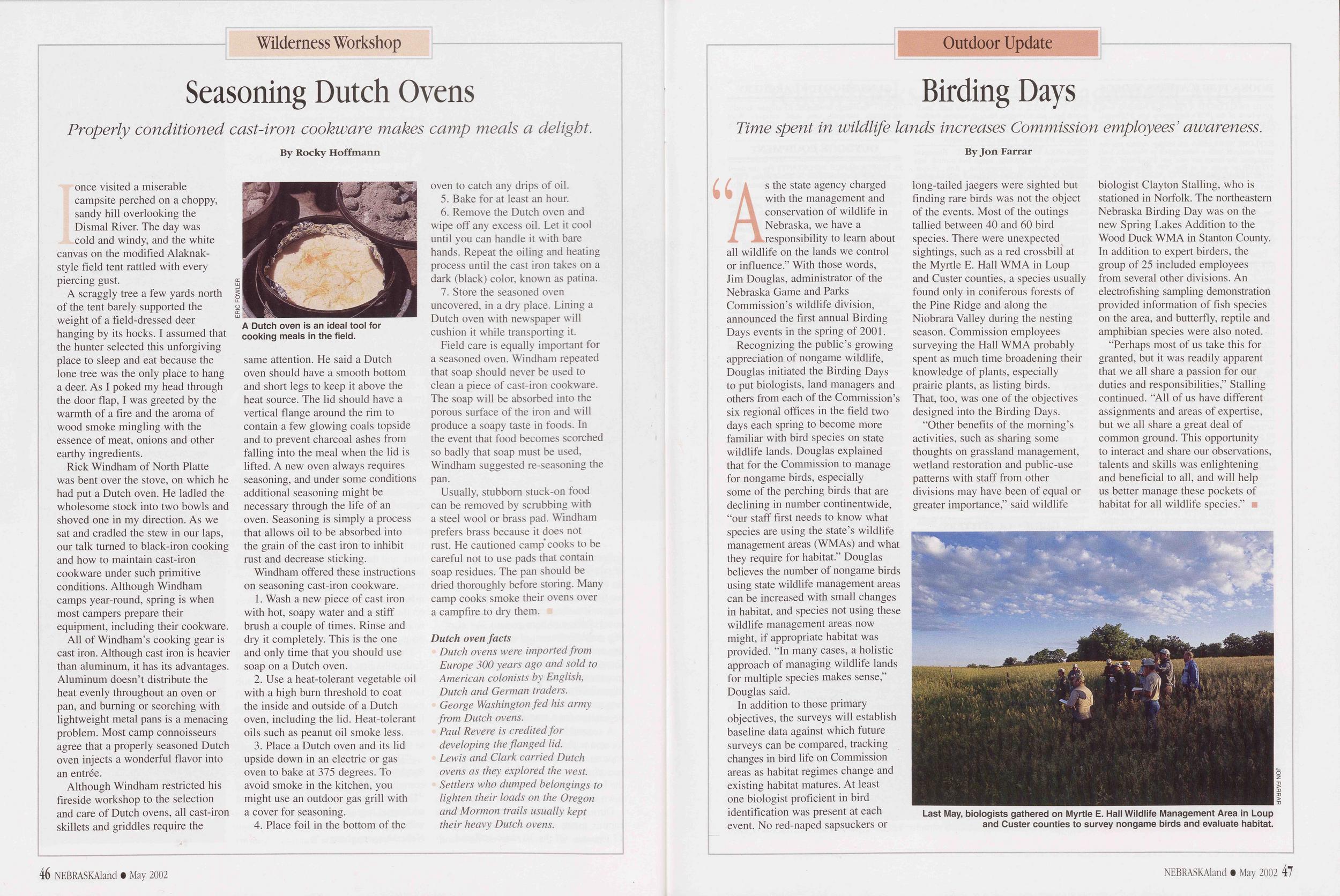
I once visited a miserable campsite perched on a choppy, sandy hill overlooking the Dismal River. The day was cold and windy, and the white canvas on the modified Alaknak- style field tent rattled with every piercing gust.
A scraggly tree a few yards north of the tent barely supported the weight of a field-dressed deer hanging by its hocks. I assumed that the hunter selected this unforgiving place to sleep and eat because the lone tree was the only place to hang a deer. As I poked my head through the door flap, I was greeted by the warmth of a fire and the aroma of wood smoke mingling with the essence of meat, onions and other earthy ingredients.
Rick Windham of North Platte was bent over the stove, on which he had put a Dutch oven. He ladled the wholesome stock into two bowls and shoved one in my direction. As we sat and cradled the stew in our laps, our talk turned to black-iron cooking and how to maintain cast-iron cookware under such primitive conditions. Although Windham camps year-round, spring is when most campers prepare their equipment, including their cookware.
All of Windham’s cooking gear is cast iron. Although cast iron is heavier than aluminum, it has its advantages. Aluminum doesn’t distribute the heat evenly throughout an oven or pan, and burning or scorching with lightweight metal pans is a menacing problem. Most camp connoisseurs agree that a properly seasoned Dutch oven injects a wonderful flavor into an entree.
Although Windham restricted his fireside workshop to the selection and care of Dutch ovens, all cast-iron skillets and griddles require the same attention. He said a Dutch oven should have a smooth bottom and short legs to keep it above the heat source. The lid should have a vertical flange around the rim to contain a few glowing coals topside and to prevent charcoal ashes from falling into the meal when the lid is lifted. A new oven always requires seasoning, and under some conditions additional seasoning might be necessary through the life of an oven. Seasoning is simply a process that allows oil to be absorbed into the grain of the cast iron to inhibit rust and decrease sticking.
Windham offered these instructions on seasoning cast-iron cookware.
1. Wash a new piece of cast iron with hot, soapy water and a stiff brush a couple of times. Rinse and dry it completely. This is the one and only time that you should use soap on a Dutch oven.
2. Use a heat-tolerant vegetable oil with a high burn threshold to coat the inside and outside of a Dutch oven, including the lid. Heat-tolerant oils such as peanut oil smoke less.
3. Place a Dutch oven and its lid upside down in an electric or gas oven to bake at 375 degrees. To avoid smoke in the kitchen, you might use an outdoor gas grill with a cover for seasoning.
4. Place foil in the bottom of the oven to catch any drips of oil.
5. Bake for at least an hour.
6. Remove the Dutch oven and wipe off any excess oil. Let it cool until you can handle it with bare hands. Repeat the oiling and heating process until the cast iron takes on a dark (black) color, known as patina.
7. Store the seasoned oven uncovered, in a dry place. Lining a Dutch oven with newspaper will cushion it while transporting it.
Field care is equally important for a seasoned oven. Windham repeated that soap should never be used to clean a piece of cast-iron cookware. The soap will be absorbed into the porous surface of the iron and will produce a soapy taste in foods. In the event that food becomes scorched so badly that soap must be used, Windham suggested re-seasoning the pan.
Usually, stubborn stuck-on food can be removed by scrubbing with a steel wool or brass pad. Windham prefers brass because it does not rust. He cautioned camp' cooks to be careful not to use pads that contain soap residues. The pan should be dried thoroughly before storing. Many camp cooks smoke their ovens over a campfire to dry them.
Dutch oven facts Dutch ovens were imported from Europe 300 years ago and sold to American colonists by English, Dutch and German traders. George Washington fed his army from Dutch ovens. Paul Revere is credited for developing the flanged lid. Lewis and Clark carried Dutch ovens as they explored the west. Settlers who dumped belongings to lighten their loads on the Oregon and Mormon trails usually kept their heavy Dutch ovens. 46 NEBRASKAland • May 2002 Outdoor Update Birding Days Time spent in wildlife lands increases Commission employees' awareness. By Jon FarrarAs the state agency charged with the management and conservation of wildlife in Nebraska, we have a responsibility to learn about all wildlife on the lands we control or influence.” With those words, Jim Douglas, administrator of the Nebraska Game and Parks Commission’s wildlife division, announced the first annual Birding Days events in the spring of 2001.
Recognizing the public’s growing appreciation of nongame wildlife, Douglas initiated the Birding Days to put biologists, land managers and others from each of the Commission’s six regional offices in the field two days each spring to become more familiar with bird species on state wildlife lands. Douglas explained that for the Commission to manage for nongame birds, especially some of the perching birds that are declining in number continentwide, "our staff first needs to know what species are using the state’s wildlife management areas (WMAs) and what they require for habitat.” Douglas believes the number of nongame birds using state wildlife management areas can be increased with small changes in habitat, and species not using these wildlife management areas now might, if appropriate habitat was provided. "In many cases, a holistic approach of managing wildlife lands for multiple species makes sense,” Douglas said.
In addition to those primary objectives, the surveys will establish baseline data against which future surveys can be compared, tracking changes in bird life on Commission areas as habitat regimes change and existing habitat matures. At least one biologist proficient in bird identification was present at each event. No red-naped sapsuckers or long-tailed jaegers were sighted but finding rare birds was not the object of the events. Most of the outings tallied between 40 and 60 bird species. There were unexpected sightings, such as a red crossbill at the Myrtle E. Hall WMA in Loup and Custer counties, a species usually found only in coniferous forests of the Pine Ridge and along the Niobrara Valley during the nesting season. Commission employees surveying the Hall WMA probably spent as much time broadening their knowledge of plants, especially prairie plants, as listing birds. That, too, was one of the objectives designed into the Birding Days.
"Other benefits of the morning’s activities, such as sharing some thoughts on grassland management, wetland restoration and public-use patterns with staff from other divisions may have been of equal or greater importance,” said wildlife biologist Clayton Stalling, who is stationed in Norfolk. The northeastern Nebraska Birding Day was on the new Spring Lakes Addition to the Wood Duck WMA in Stanton County. In addition to expert birders, the group of 25 included employees from several other divisions. An electrofishing sampling demonstration provided information of fish species on the area, and butterfly, reptile and amphibian species were also noted.
"Perhaps most of us take this for granted, but it was readily apparent that we all share a passion for our duties and responsibilities,” Stalling continued. "All of us have different assignments and areas of expertise, but we all share a great deal of common ground. This opportunity to interact and share our observations, talents and skills was enlightening and beneficial to all, and will help us better manage these pockets of habitat for all wildlife species.” ■
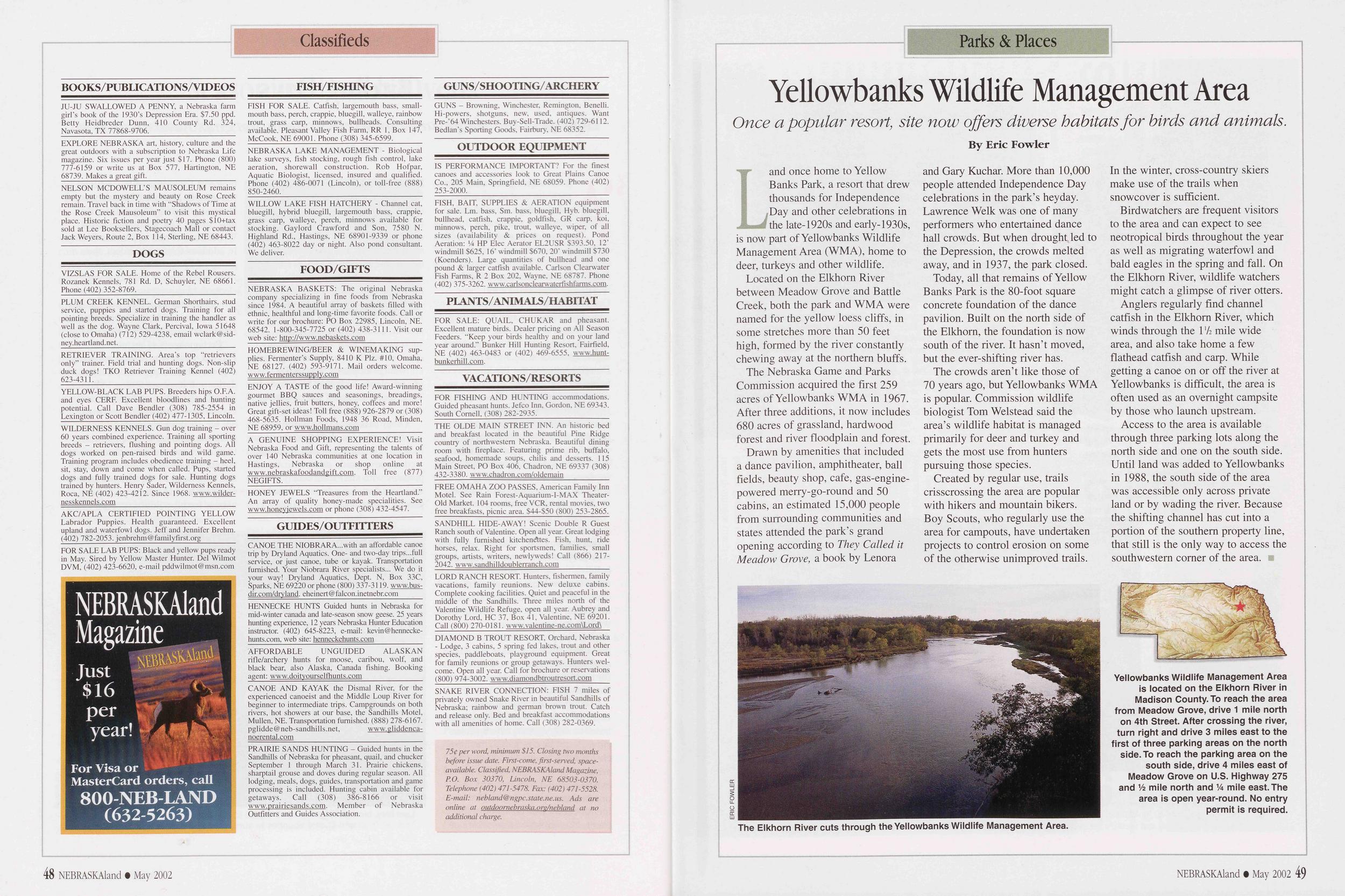
Classifieds
BOOKS/PUBLICATIONS/VIDEOSJU-JU SWALLOWED A PENNY, a Nebraska farm girl’s book of the 1930’s Depression Era. $7.50 ppd. Betty Heidbreder Dunn, 410 County Rd. 324, Navasota, TX 77868-9706.
EXPLORE NEBRASKA art, history, culture and the great outdoors with a subscription to Nebraska Life magazine. Six issues per year just $17. Phone (800) 777-6159 or write us at Box 577, Hartington, NE 68739. Makes a great gift.
NELSON MCDOWELL’S MAUSOLEUM remains empty but the mystery and beauty on Rose Creek remain. Travel back in time with “Shadows of Time at the Rose Creek Mausoleum” to visit this mystical place. Historic fiction and poetry 40 pages $10+tax sold at Lee Booksellers, Stagecoach Mall or contact Jack Weyers, Route 2, Box 114, Sterling, NE 68443.
DOGSVIZSLAS FOR SALE. Home of the Rebel Rousers. Rozanek Kennels, 781 Rd. D, Schuyler, NE 68661. Phone (402) 352-8769.
PLUM CREEK KENNEL. German Shorthairs, stud service, puppies and started dogs. Training for all pointing breeds. Specialize in training the handler as well as the dog. Wayne Clark, Percival, Iowa 51648 (close to Omaha) (712) 529-4238, email wclark@sid- ney.heartland.net.
RETRIEVER TRAINING. Area’s top “retrievers only” trainer. Field trial and hunting dogs. Non-slip duck dogs! TKO Retriever Training Kennel (402) 623-4311.
YELLOW-BLACK LAB PUPS. Breeders hips O.F.A. and eyes CERF. Excellent bloodlines and hunting potential. Call Dave Bendler (308) 785-2554 in Lexington or Scott Bendler (402) 477-1305, Lincoln.
WILDERNESS KENNELS. Gun dog training - over 60 years combined experience. Training all sporting breeds - retrievers, flushing and pointing dogs. All dogs worked on pen-raised birds and wild game. Training program includes obedience training - heel, sit, stay, down and come when called. Pups, started dogs and fully trained dogs for sale. Hunting dogs trained by hunters. Henry Sader, Wilderness Kennels, Roca, NE (402) 423-4212. Since 1968. www.wilder- esskennels.com
AKC/APLA CERTIFIED POINTING YELLOW Labrador Puppies. Health guaranteed. Excellent upland and waterfowl dogs. Jeff and Jennifer Brehm. (402) 782-2053. jenbrehm@familyfirst.org FOR SALE LAB PUPS: Black and yellow pups ready in May. Sired by Yellow Master Hunter. Del Wilmot DVM, (402) 423-6620, e-mail pddwilmot@msn.com
FISH/FISHINGFISH FOR SALE. Catfish, largemouth bass, small- mouth bass, perch, crappie, bluegill, walleye, rainbow trout, grass carp, minnows, bullheads. Consulting available. Pleasant Valley Fish Farm, RR 1, Box 147, McCook, NE 69001. Phone (308) 345-6599.
NEBRASKA LAKE MANAGEMENT - Biological lake surveys, fish stocking, rough fish control, lake aeration, shorewall construction. Rob Hofpar, Aquatic Biologist, licensed, insured and qualified. Phone (402) 486-0071 (Lincoln), or toll-free (888) 850-2460.
WILLOW LAKE FISH HATCHERY - Channel cat, bluegill, hybrid bluegill, largemouth bass, crappie, grass carp, walleye, perch, minnows available for stocking. Gaylord Crawford and Son, 7580 N. Highland Rd., Hastings, NE 68901-9339 or phone (402) 463-8022 day or night. Also pond consultant. We deliver.
FOOD/GIFTSNEBRASKA BASKETS: The original Nebraska company specializing in fine foods from Nebraska since 1984. A beautiful array of baskets filled with ethnic, healthful and long-time favorite foods. Call or write for our brochure: PO Box 22985, Lincoln, NE. 68542. 1-800-345-7725 or (402) 438-3111. Visit our web site: http://www.nebaskets.com
HOMEBREWING/BEER & WINEMAKING sup- plies. Fermenter’s Supply, 8410 K Plz. #10, Omaha, NE 68127. (402) 593-9171. Mail orders welcome. www.fermenterssupply.com
ENJOY A TASTE of the good life! Award-winning gourmet BBQ sauces and seasonings, breadings, native jellies, fruit butters, honey, coffees and more! Great gift-set ideas! Toll free (888) 926-2879 or (308) 468-5635. Hollman Foods, 1948 36 Road, Minden, NE 68959, or www.hollmans.com
A GENUINE SHOPPING EXPERIENCE! Visit Nebraska Food and Gift, representing the talents of over 140 Nebraska communities at one location in Hastings, Nebraska or shop online at www.nebraskafoodandgift.com. Toll free (877) NEGIFTS.
HONEY JEWELS “Treasures from the Heartland.” An array of quality honey-made specialities. See www.honeyjewels.com or phone (308) 432-4547.
GUIDES/OUTFITTERSCANOE THE NIOBRARA...with an affordable canoe trip by Dryland Aquatics. One- and two-day trips...full service, or just canoe, tube or kayak. Transportation furnished. Your Niobrara River specialists... We do it your way! Dryland Aquatics, Dept. N, Box 33C, Sparks, NE 69220 or phone (800) 337-3119. www.bus- dir.com/drvland. eheinert@falcon.inetnebr.com
HENNECKE HUNTS Guided hunts in Nebraska for mid-winter Canada and late-season snow geese. 25 years hunting experience, 12 years Nebraska Hunter Education instructor. (402) 645-8223, e-mail: kevin@hennecke- hunts.com, web site: henneckehunts.com
AFFORDABLE UNGUIDED ALASKAN rifle/archery hunts for moose, caribou, wolf, and black bear, also Alaska, Canada fishing. Booking agent: www.doityourselfhunts.com
CANOE AND KAYAK the Dismal River, for the experienced canoeist and the Middle Loup River for beginner to intermediate trips. Campgrounds on both rivers, hot showers at our base, the Sandhills Motel, Mullen, NE. Transportation furnished. (888) 278-6167. pglidde@neb-sandhills.net, www.gliddenca- noerental.com
PRAIRIE SANDS HUNTING - Guided hunts in the Sandhills of Nebraska for pheasant, quail, and chucker September 1 through March 31. Prairie chickens, sharptail grouse and doves during regular season. All lodging, meals, dogs, guides, transportation and game processing is included. Hunting cabin available for getaways. Call (308) 386-8166 or visit www.prairiesands.com. Member of Nebraska Outfitters and Guides Association.
GUNS/SHOOTING/ARCHERYGUNS - Browning, Winchester, Remington, Benelli. Hi-powers, shotguns, new, used, antiques. Want Pre-’64 Winchesters. Buy-Sell-Trade. (402) 729-6112. Bedlan’s Sporting Goods, Fairbury, NE 68352.
OUTDOOR EQUIPMENTIS PERFORMANCE IMPORTANT? For the finest canoes and accessories look to Great Plains Canoe Co., 205 Main, Springfield, NE 68059. Phone (402) 253-2000
FISH, BAIT, SUPPLIES & AERATION equipment for sale. Lm. bass, Sm. bass, bluegill. Hyb. bluegill, bullhead, catfish, crappie, goldfish, GR carp, koi, minnows, perch, pike, trout, walleye, wiper, of all sizes (availability & prices on request). Pond Aeration: % HP Elec Aerator EL2USR $393.50, 12’ windmill $625, 16’ windmill $670, 20’ windmill $730 (Koenders). Large quantities of bullhead and one pound & larger catfish available. Carlson Clearwater Fish Farms, R 2 Box 202, Wayne, NE 68787. Phone (402) 375-3262. www.carlsonclearwaterfishfarms.com.
PLANTS/ANIMALS/HABITATFOR SALE: QUAIL, CHUKAR and pheasant. Excellent mature birds. Dealer pricing on All Season Feeders. “Keep your birds healthy and on your land year around.” Bunker Hill Hunting Resort, Fairfield, NE (402) 463-0483 or (402) 469-6555, www.hunt- bunkerhill.com.
VACATIONS/RESORTSFOR FISHING AND HUNTING accommodations. Guided pheasant hunts. Jef co Inn, Gordon, NE 69343. South Cornell, (308) 282-2935
THE OLDE MAIN STREET INN. An historic bed and breakfast located in the beautiful Pine Ridge country of northwestern Nebraska. Beautiful dining room with fireplace. Featuring prime rib, buffalo, seafood, homemade soups, chilis and desserts. 115 Main Street, PO Box 406, Chadron, NE 69337 (308) 432-3380. www.chadron.com/oldemain
FREE OMAHA ZOO PASSES, American Family Inn Motel. See Rain Forest-Aquarium-I-MAX Theater- Old Market. 104 rooms, free VCR, rental movies, two free breakfasts, picnic area. $44-$50 (800) 253-2865.
SANDHILL HIDE-AWAY! Scenic Double R Guest Ranch south of Valentine. Open all year. Great lodging with fully furnished kitchenettes. Fish, hunt, ride horses, relax. Right for sportsmen, families, small groups, artists, writers, newlyweds! Call (866) 217- 2042. www.sandhilldoublerranch.com
LORD RANCH RESORT. Hunters, fishermen, family vacations, family reunions. New deluxe cabins. Complete cooking facilities. Quiet and peaceful in the middle of the Sandhills. Three miles north of the Valentine Wildlife Refuge, open all year. Aubrey and Dorothy Lord, HC 37, Box 41, Valentine, NE 69201. Call (800) 270-0181. www.valentine-ne.com\Lord\
DIAMOND B TROUT RESORT, Orchard, Nebraska - Lodge, 3 cabins, 5 spring fed lakes, trout and other species, paddleboats, playground equipment. Great for family reunions or group getaways. Hunters wel- come. Open all year. Call for brochure or reservations (800) 974-3002. www.diamondbtroutresort.com
SNAKE RIVER CONNECTION: FISH 7 miles of privately owned Snake River in beautiful Sandhills of Nebraska; rainbow and german brown trout. Catch and release only. Bed and breakfast accommodations with all amenities of home. Call (308) 282-0369.
75 per word, minimum $15. Closing two months before issue date. First-come, first-served, space- available. Classified, NEBRASKAland Magazine, P.O. Box 30370, Lincoln, NE 68503-0370. Telephone (402) 471-5478. Fax: (402) 471-5528. E-mail: nebland@ngpc.state.ne.us. Ads are online at outdoomebraska. org/nebland at no additional charge. 48 NEBRASKAland • May 2002 Parks & Places Yellowbanks Wildlife Management Area Once a popular resort, site now offers diverse habitats for birds and animals. By Eric FowlerLand once home to Yellow Banks Park, a resort that drew thousands for Independence Day and other celebrations in the late-1920s and early-1930s, is now part of Yellowbanks Wildlife Management Area (WMA), home to deer, turkeys and other wildlife.
Located on the Elkhorn River between Meadow Grove and Battle Creek, both the park and WMA were named for the yellow loess cliffs, in some stretches more than 50 feet high, formed by the river constantly chewing away at the northern bluffs.
The Nebraska Game and Parks Commission acquired the first 259 acres of Yellowbanks WMA in 1967. After three additions, it now includes 680 acres of grassland, hardwood forest and river floodplain and forest.
Drawn by amenities that included a dance pavilion, amphitheater, ball fields, beauty shop, cafe, gas-engine- powered merry-go-round and 50 cabins, an estimated 15,000 people from surrounding communities and states attended the park’s grand opening according to They Called it Meadow Grove, a book by Lenora and Gary Kuchar. More than 10,000 people attended Independence Day celebrations in the park’s heyday. Lawrence Welk was one of many performers who entertained dance hall crowds. But when drought led to the Depression, the crowds melted away, and in 1937, the park closed.
ERIC FOWLERToday, all that remains of Yellow Banks Park is the 80-foot square concrete foundation of the dance pavilion. Built on the north side of the Elkhorn, the foundation is now south of the river. It hasn’t moved, but the ever-shifting river has.
The crowds aren’t like those of 70 years ago, but Yellowbanks WMA is popular. Commission wildlife biologist Tom Welstead said the area’s wildlife habitat is managed primarily for deer and turkey and gets the most use from hunters pursuing those species.
Created by regular use, trails crisscrossing the area are popular with hikers and mountain bikers. Boy Scouts, who regularly use the area for campouts, have undertaken projects to control erosion on some of the otherwise unimproved trails.
In the winter, cross-country skiers make use of the trails when snowcover is sufficient.
Birdwatchers are frequent visitors to the area and can expect to see neotropical birds throughout the year as well as migrating waterfowl and bald eagles in the spring and fall. On the Elkhorn River, wildlife watchers might catch a glimpse of river otters.
Anglers regularly find channel catfish in the Elkhorn River, which winds through the 1 lh mile wide area, and also take home a few flathead catfish and carp. While getting a canoe on or off the river at Yellowbanks is difficult, the area is often used as an overnight campsite by those who launch upstream.
Access to the area is available through three parking lots along the north side and one on the south side. Until land was added to Yellowbanks in 1988, the south side of the area was accessible only across private land or by wading the river. Because the shifting channel has cut into a portion of the southern property line, that still is the only way to access the southwestern corner of the area. ■
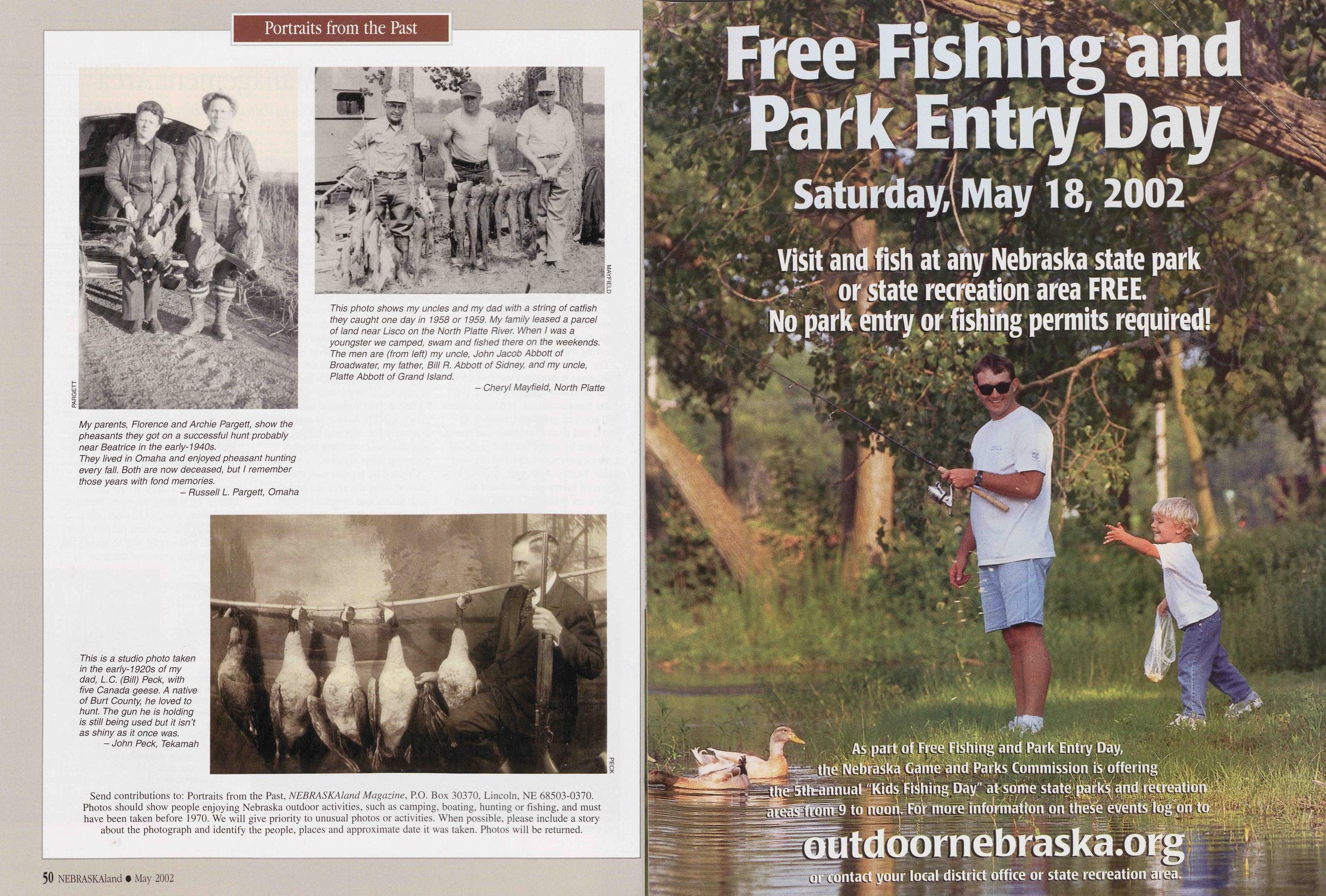
This photo shows my uncles and my dad with a string of catfish they caught one day in 1958 or 1959. My family leased a parcel of land near Lisco on the North Platte River. When I was a youngster we camped, swam and fished there on the weekends. The men are (from left) my uncle, John Jacob Abbott of Broadwater, my father, Bill P. Abbott of Sidney, and my uncle, Platte Abbott of Grand Island.
- Cheryl Mayfield, North PlatteMy parents, Florence and Archie Pargett, show the pheasants they got on a successful hunt probably near Beatrice in the early-1940s. They lived in Omaha and enjoyed pheasant hunting every fall. Both are now deceased, but I remember those years with fond memories.
- Pussell L. Pargett, OmahaThis is a studio photo taken in the early-1920s of my dad, L.C. (Bill) Peck, with five Canada geese. A native of Burt County, he loved to hunt. The gun he is holding is still being used but it isn’t as shiny as it once was.
- John Peck, TekamahSend contributions to: Portraits from the Past, NEBRASKAland Magazine, P.O. Box 30370, Lincoln, NE 68503-0370. Photos should show people enjoying Nebraska outdoor activities, such as camping, boating, hunting or fishing, and must have been taken before 1970. We will give priority to unusual photos or activities. When possible, please include a story about the photograph and identify the people, places and approximate date it was taken. Photos will be returned.
50 NEBRASKAland • May 2002 Free Fishing and Park Entry Day As part of Free fishing and Park Entry Day, Saturday,(May 18,2002 Visit and fish at any Nebraska state park or state recreation area FREE. No park entry or fishing permits required!
Position: 467 (22 views)