Volume 80, Issue 3, 2002
NEBRASKAland
Nebraska Game & Parks Commission April 2002 • $2.50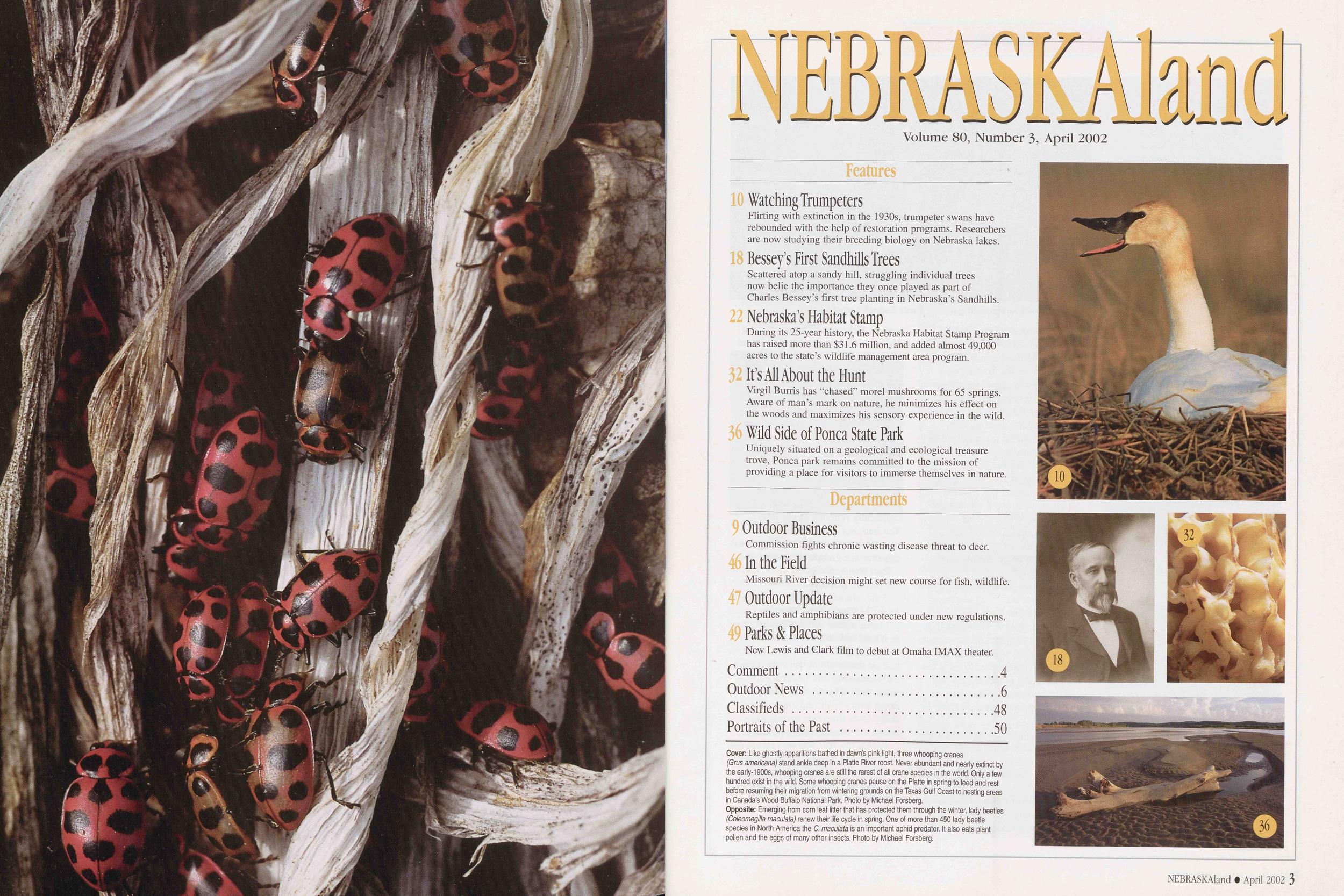
NEBRASKAland
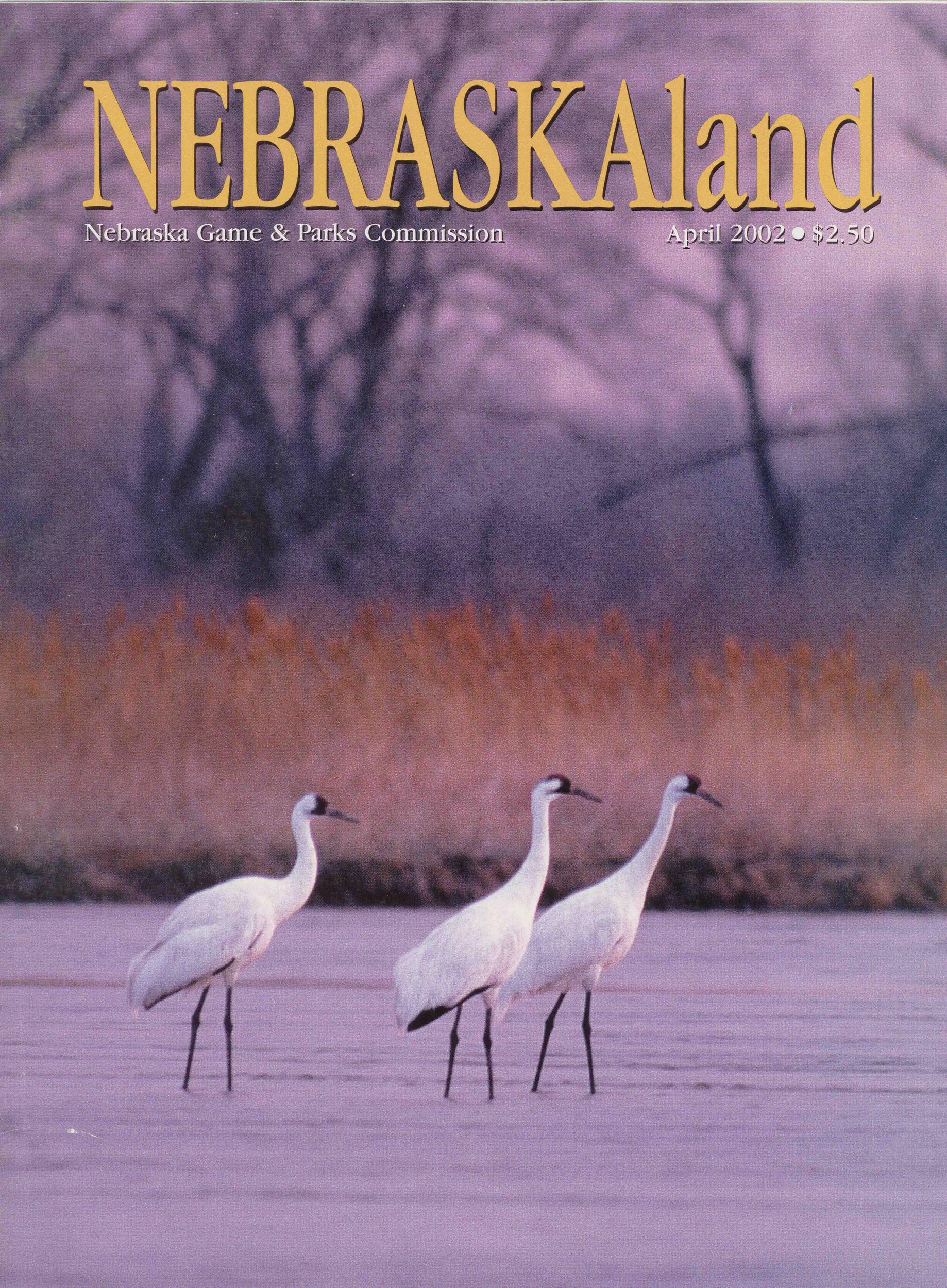
Volume 80, Number 3, April 2002 Features Watching Trumpeters Flirting with extinction in the 1930s, trumpeter swans have rebounded with the help of restoration programs. Researchers are now studying their breeding biology on Nebraska lakes. Bessey’s First Sandhills Trees Scattered atop a sandy hill, struggling individual trees now belie the importance they once played as part of Charles Bessey’s first tree planting in Nebraska’s Sandhills. Nebraska’s Habitat Stamp During its 25-year history, the Nebraska Habitat Stamp Program has raised more than $31.6 million, and added almost 49,000 acres to the state’s wildlife management area program. It’s All About the Hunt Virgil Burris has “chased” morel mushrooms for 65 springs. Aware of man’s mark on nature, he minimizes his effect on the woods and maximizes his sensory experience in the wild. Wild Side of Ponca State Park Uniquely situated on a geological and ecological treasure trove, Ponca park remains committed to the mission of providing a place for visitors to immerse themselves in nature. Departments 9 Outdoor Business Commission fights chronic wasting disease threat to deer. 46 In the Field Missouri River decision might set new course for fish, wildlife. 47 Outdoor Update Reptiles and amphibians are protected under new regulations. 49 Parks & Places New Lewis and Clark film to debut at Omaha IMAX theater. Comment........................................4 Outdoor News ..................................6 Classifieds ..................................48 Portraits of the Past ........................50 Cover: Like ghostly apparitions bathed in dawn’s pink light, three whooping cranes (Grus americana) stand ankle deep in a Platte River roost. Never abundant and nearly extinct by the early-1900s, whooping cranes are still the rarest of all crane species in the world. Only a few hundred exist in the wild. Some whooping cranes pause on the Platte in spring to feed and rest before resuming their migration from wintering grounds on the Texas Gulf Coast to nesting areas in Canada’s Wood Buffalo National Park. Photo by Michael Forsberg. Opposite: Emerging from corn leaf litter that has protected them through the winter, lady beetles (Coleomegilla maculata) renew their life cycle in spring. One of more than 450 lady beetle species in North America the C. maculata is an important aphid predator. It also eats plant pollen and the eggs of many other insects. Photo by Michael Forsberg.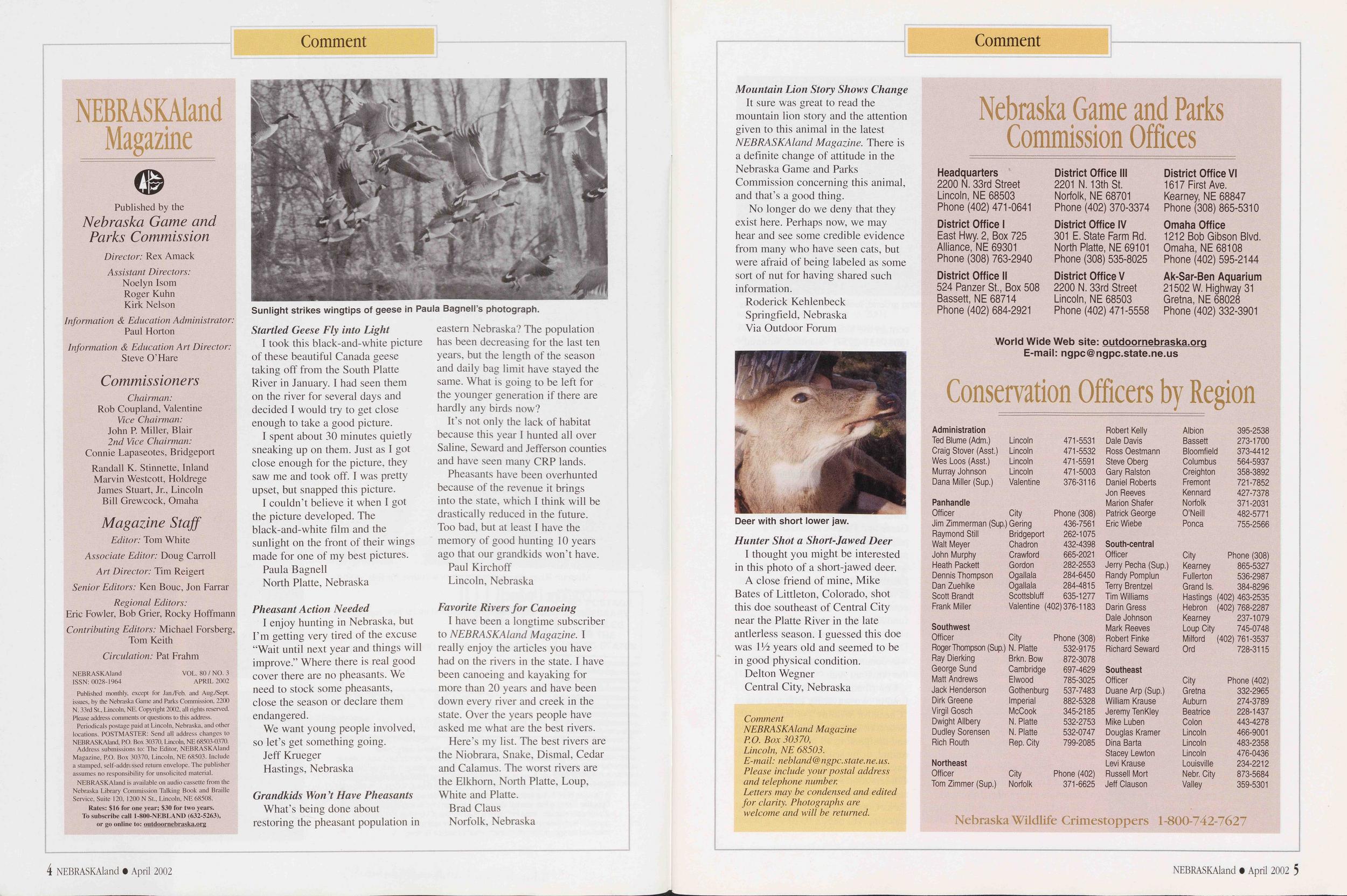 Comment NEBRASKAland Magazine Published by the Nebraska Game and Parks Commission Director: Rex Amack Assistant Directors: Noelyn Isom Roger Kuhn Kirk Nelson Information & Education Administrator: Paul Horton Information & Education Art Director: Steve O’Hare Commissioners Chairman: Rob Coupland, Valentine Vice Chairman: John P Miller, Blair 2nd Vice Chairman: Connie Lapaseotes, Bridgeport Randall K. Stinnette, Inland Marvin Westcott, Holdrege James Stuart, Jr., Lincoln Bill Grewcock, Omaha Magazine Staff Editor: Tom White Associate Editor: Doug Carroll Art Director: Tim Reigert Senior Editors: Ken Bouc, Jon Farrar Regional Editors: Eric Fowler, Bob Grier, Rocky Hoffmann Contributing Editors: Michael Forsberg, Tom Keith Circulation: Pat Frahm NEBRASKAland VOL. 80 / NO. 3 ISSN: 0028-1964 APRIL 2002 Published monthly, except for Jan./Feb. and Aug./Sept. issues, by the Nebraska Game and Parks Commission, 2200 N. 33rd St., Lincoln, NE. Copyright 2002, all rights reserved. Please address comments or questions to this address. Periodicals postage paid at Lincoln, Nebraska, and other locations. POSTMASTER: Send all address changes to NEBRASKAland, P.O. Box 30370, Lincoln, NE 68503-0370. Address submissions to: The Editor, NEBRASKAland Magazine, P.O. Box 30370, Lincoln, NE 68503. Include a stamped, self-addressed return envelope. The publisher assumes no responsibility for unsolicited material. NEBRASKAland is available on audio cassette from the Nebraska Library Commission Talking Book and Braille Service, Suite 120, 1200 N St., Lincoln, NE 68508. Rates: $16 for one year; $30 for two years. To subscribe call 1-800-NEBLAND (632-5263), or go online to: outdoornebraska.org
I took this black-and-white picture of these beautiful Canada geese taking off from the South Platte River in January. I had seen them on the river for several days and decided I would try to get close enough to take a good picture.
I spent about 30 minutes quietly sneaking up on them. Just as I got close enough for the picture, they saw me and took off. I was pretty upset, but snapped this picture.
I couldn’t believe it when I got the picture developed. The black-and-white film and the sunlight on the front of their wings made for one of my best pictures.
Paula Bagnell North Platte, Nebraska Pheasant Action NeededI enjoy hunting in Nebraska, but I’m getting very tired of the excuse “Wait until next year and things will improve.” Where there is real good cover there are no pheasants. We need to stock some pheasants, close the season or declare them endangered.
We want young people involved, so let’s get something going.
Jeff Krueger Hastings, Nebraska Grandkids Won’t Have PheasantsWhat’s being done about restoring the pheasant population in eastern Nebraska? The population has been decreasing for the last ten years, but the length of the season and daily bag limit have stayed the same. What is going to be left for the younger generation if there are hardly any birds now?
It’s not only the lack of habitat because this year I hunted all over Saline, Seward and Jefferson counties and have seen many CRP lands.
Pheasants have been overhunted because of the revenue it brings into the state, which I think will be drastically reduced in the future. Too bad, but at least I have the memory of good hunting 10 years ago that our grandkids won’t have.
Paul Kirchoff Lincoln, Nebraska Favorite Rivers for CanoeingI have been a longtime subscriber to NEBRASKAland Magazine. I really enjoy the articles you have had on the rivers in the state. I have been canoeing and kayaking for more than 20 years and have been down every river and creek in the state. Over the years people have asked me what are the best rivers.
Here’s my list. The best rivers are the Niobrara, Snake, Dismal, Cedar and Calamus. The worst rivers are the Elkhorn, North Platte, Loup, White and Platte.
Brad Claus Norfolk, Nebraska 4 NEBRASKAland • April 2002 Comment Mountain Lion Story Shows ChangeIt sure was great to read the mountain lion story and the attention given to this animal in the latest NEBRASKAland Magazine. There is a definite change of attitude in the Nebraska Game and Parks Commission concerning this animal, and that’s a good thing.
No longer do we deny that they exist here. Perhaps now, we may hear and see some credible evidence from many who have seen cats, but were afraid of being labeled as some sort of nut for having shared such information.
Roderick Kehlenbeck Springfield, Nebraska Via Outdoor ForumI thought you might be interested in this photo of a short-jawed deer.
A close friend of mine, Mike Bates of Littleton, Colorado, shot this doe southeast of Central City near the Platte River in the late antlerless season. I guessed this doe was D/2 years old and seemed to be in good physical condition.
Delton Wegner Central City, Nebraska Comment NEBRASKAland Magazine P.O. Box 30370, Lincoln, NE 68503. E-mail: nebland@ ngpe. state, ne. us. Please include your postal address and telephone number. Letters may be condensed and edited for clarity. Photographs are welcome and will be returned. Nebraska Game and Parks Commission Offices Headquarters 2200 N. 33rd Street Lincoln, NE 68503 Phone (402) 471-0641 District Office I East Hwy. 2, Box 725 Alliance, NE 69301 Phone (308) 763-2940 District Office II 524 Panzer St., Box 508 Bassett, NE 68714 Phone (402) 684-2921 District Office III 2201 N. 13th St. Norfolk, NE 68701 Phone (402) 370-3374 District Office IV 301 E. State Farm Rd. North Platte, NE 69101 Phone (308) 535-8025 District Office V 2200 N. 33rd Street Lincoln, NE 68503 Phone (402) 471-5558 District Office VI 1617 First Ave. Kearney, NE 68847 Phone (308) 865-5310 Omaha Office 1212 Bob Gibson Blvd. Omaha, NE 68108 Phone (402) 595-2144 Ak-Sar-Ben Aquarium 21502 W. Highway 31 Gretna, NE 68028 Phone (402) 332-3901 World Wide Web site: outdoornebraska.org E-mail: ngpc@ngpc.state.ne.us Conservation Officers by Region Administration Robert Kelly Albion 395-2538 Ted Blume (Adm.) Lincoln 471-5531 Dale Davis Bassett 273-1700 Craig Stover (Asst.) Lincoln 471-5532 Ross Oestmann Bloomfield I 373-4412 Wes Loos (Asst.) Lincoln 471-5591 Steve Oberg Columbus 564-5937 Murray Johnson Lincoln 471-5003 Gary Ralston Creighton 358-3892 Dana Miller (Sup.) Valentine 376-3116 Daniel Roberts Fremont 721-7852 Jon Reeves Kennard 427-7378 Panhandle Marion Shafer Norfolk 371-2031 Officer City Phone (308) Patrick George O’Neill 482-5771 Jim Zimmerman (Sup.) Gering 436-7561 Eric Wiebe Ponca 755-2566 Raymond Still Bridgeport 262-1075 Walt Meyer Chadron 432-4398 South-central John Murphy Crawford 665-2021 Officer City Phone (308) Heath Packett Gordon 282-2553 Jerry Pecha (Sup.) Kearney 865-5327 Dennis Thompson Ogallala 284-6450 Randy Pomplun Fullerton 536-2987 Dan Zuehlke Ogallala 284-4815 Terry Brentzel Grand Is. 384-8296 Scott Brandt Scottsbluff 635-1277 Tim Williams Hastings (402) 463-2535 Frank Miller Valentine (402)376-1183 Darin Gress Hebron (402) 768-2287 Dale Johnson Kearney 237-1079 Southwest Mark Reeves Loup City 745-0748 Officer City Phone (308) Robert Finke Milford (402) 761-3537 Roger Thompson (Sup.) N. Platte 532-9175 Richard Seward Ord 728-3115 Ray Dierking Brkn. Bow 872-3078 George Sund Cambridge 697-4629 Southeast Matt Andrews Elwood 785-3025 Officer City Phone (402) Jack Henderson Gothenburg 537-7483 Duane Arp (Sup.) Gretna 332-2965 Dirk Greene Imperial 882-5328 William Krause Auburn 274-3789 Virgil Gosch McCook 345-2185 Jeremy TenKley Beatrice 228-1437 Dwight Allbery N. Platte 532-2753 Mike Luben Colon 443-4278 Dudley Sorensen N. Platte 532-0747 Douglas Kramer Lincoln 466-9001 Rich Routh Rep. City 799-2085 Dina Barta Lincoln 483-2358 Stacey Lewton Lincoln 476-0436 Northeast Levi Krause Louisville 234-2212 Officer City Phone (402) Russell Mort Nebr. City 873-5684 Tom Zimmer (Sup.) Norfolk 371-6625 Jeff Clausen Valley 359-5301 Nebraska Wildlife Crimestoppers 1-800-742-7627 NEBRASKAland • April 2002 5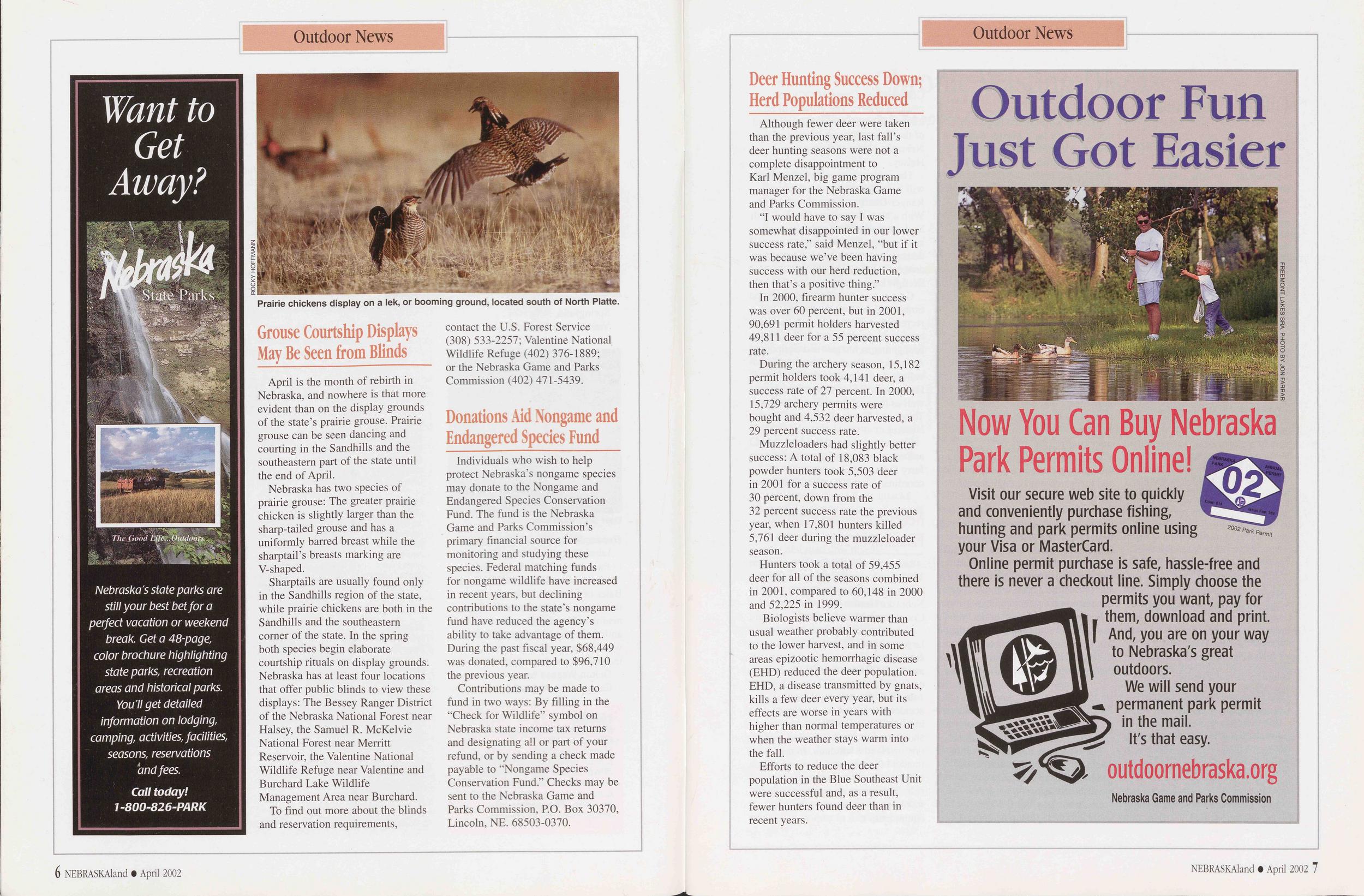
April is the month of rebirth in Nebraska, and nowhere is that more evident than on the display grounds of the state’s prairie grouse. Prairie grouse can be seen dancing and courting in the Sandhills and the southeastern part of the state until the end of April.
Nebraska has two species of prairie grouse: The greater prairie chicken is slightly larger than the sharp-tailed grouse and has a uniformly barred breast while the sharptail’s breasts marking are V-shaped.
Sharptails are usually found only in the Sandhills region of the state, while prairie chickens are both in the Sandhills and the southeastern corner of the state. In the spring both species begin elaborate courtship rituals on display grounds. Nebraska has at least four locations that offer public blinds to view these displays: The Bessey Ranger District of the Nebraska National Forest near Halsey, the Samuel R. McKelvie National Forest near Merritt Reservoir, the Valentine National Wildlife Refuge near Valentine and Burchard Lake Wildlife Management Area near Burchard.
To find out more about the blinds and reservation requirements, contact the U.S. Forest Service (308) 533-2257; Valentine National Wildlife Refuge (402) 376-1889; or the Nebraska Game and Parks Commission (402) 471-5439.
Donations Aid Nongame and Endangered Species FundIndividuals who wish to help protect Nebraska’s nongame species may donate to the Nongame and Endangered Species Conservation Fund. The fund is the Nebraska Game and Parks Commission’s primary financial source for monitoring and studying these species. Federal matching funds for nongame wildlife have increased in recent years, but declining contributions to the state’s nongame fund have reduced the agency’s ability to take advantage of them. During the past fiscal year, $68,449 was donated, compared to $96,710 the previous year.
Contributions may be made to fund in two ways: By filling in the “Check for Wildlife” symbol on Nebraska state income tax returns and designating all or part of your refund, or by sending a check made payable to “Nongame Species Conservation Fund.” Checks may be sent to the Nebraska Game and Parks Commission, P.O. Box 30370, Lincoln, NE. 68503-0370.
6 NEBRASKAland • April 2002 Outdoor News Deer Hunting Success Down; Herd Populations ReducedAlthough fewer deer were taken than the previous year, last fall’s deer hunting seasons were not a complete disappointment to Karl Menzel, big game program manager for the Nebraska Game and Parks Commission.
“I would have to say I was somewhat disappointed in our lower success rate,” said Menzel, “but if it was because we’ve been having success with our herd reduction, then that’s a positive thing.”
In 2000, firearm hunter success was over 60 percent, but in 2001, 90,691 permit holders harvested 49,811 deer for a 55 percent success rate.
During the archery season, 15,182 permit holders took 4,141 deer, a success rate of 27 percent. In 2000, 15,729 archery permits were bought and 4,532 deer harvested, a 29 percent success rate.
Muzzleloaders had slightly better success: A total of 18,083 black powder hunters took 5,503 deer in 2001 for a success rate of 30 percent, down from the 32 percent success rate the previous year, when 17,801 hunters killed 5,761 deer during the muzzleloader season.
Hunters took a total of 59,455 deer for all of the seasons combined in 2001, compared to 60,148 in 2000 and 52,225 in 1999.
Biologists believe warmer than usual weather probably contributed to the lower harvest, and in some areas epizootic hemorrhagic disease (EHD) reduced the deer population. EHD, a disease transmitted by gnats, kills a few deer every year, but its effects are worse in years with higher than normal temperatures or when the weather stays warm into the fall.
Efforts to reduce the deer population in the Blue Southeast Unit were successful and, as a result, fewer hunters found deer than in recent years.
Outdoor Fun Just Got Easier Now You Can Buy Nebraska Park Permits Online! Visit our secure web site to quickly and conveniently purchase fishing, hunting and park permits online using your Visa or MasterCard. Online permit purchase is safe, hassle-free and there is never a checkout line. Simply choose the permits you want, pay for them, download and print. And, you are on your way to Nebraska's great outdoors. We will send your permanent park permit in the mail. It's that easy. outdoornebraska.org Nebraska Game and Parks Commission NEBRASKAland • April 2002 7
During last spring’s turkey season, I received a call about a possible game violation in Keya Paha County. The caller said two men camping in Burton City Park had already shot more turkeys than their permits allowed, had left one in the field, and were still hunting at the time of the call.
I told the caller that I would investigate after finishing a permission-to-hunt dispute between a landowner and hunter. I headed to Burton with my husband, Frank, who is also a conservation officer. He joined me when I was unable to find a law enforcement officer in the Burton area who was available for backup.
When we arrived about 5 p.m. no one was at the campsite, but we noticed a bloody trash bag next to a picnic table. Inside we found parts of five turkeys, indicating the possibility of an overbagging violation. Frank and I decided to stick around and keep an eye on the camp. We passed time talking to a man living next to the park and swatting biting gnats trying to make a meal of us.
Nearly five hours later, the men returned. During questioning we discovered one hunter had two permits, but he had killed three gobblers without canceling any of his permits. The other man had continued to hunt after killing one turkey without tagging it. We confiscated the turkeys and permits and began writing tickets. Both men were charged with failure to cancel a permit, one was charged with overbagging, and the other was charged with hunting without a permit.
With the help of a concerned hunter and a little patience, these game violators forfeited their ill-gotten game and were fined $671. It made for a pretty expensive hunting trip.
- Dana Miller, Superintendent, Valentine How to Certify a State Record or Master Angler Award FishAnglers who catch a large fish might qualify for a Master Angler Award or even a state record. To qualify for either award, the fish must be caught from Nebraska waters in accordance with Nebraska fishing regulations. They may be caught by rod and reel, underwater spearfishing, surface spearing or archery, and must be played and landed by the award applicant.
To qualify for a Master Angler Award, the fish must meet either minimum weight or length standards for its species and there must be a witness. Only fish immediately released are eligible for awards based on length, and anglers who release Master Angler size fish will receive a “Catch-and-Release Master Angler” pin in addition to a certificate. Individuals may receive only one award based on weight per year for each species, but there is no limit on catch-and-release awards.
To qualify for state records, fish must be weighed on a certified scale and measured with a commercial measuring device while being witnessed by two people, one of whom must be a permanent employee of the Nebraska Game and Parks Commission. Each witness must also sign the application for the award and one clear photograph of the fish and one of the angler with the fish must accompany the application.
For more information about qualifying and applying for Master Angler awards and state records, see pages 56 and 57 in the 2002 Nebraska Fishing Guide.
Nebraska National Forest Celebrating CentennialThe Nebraska National Forest is celebrating its centennial in 2002, and has planned several events to mark the occasion.
On Arbor Day, April 26, volunteers will plant a Memorial Grove to recognize the Civilian Conservation Corps’ (CCC) tree planting efforts. The grove will be located near the Natick Campground of the Bessey Ranger District of the Nebraska National Forest near Halsey.
The centennial’s main celebration will be on June 15 at the Bessey Ranger District. “Honoring the Past With a New Century of Service” will be the theme of the speaking program, and the day will also feature historical demonstrations such as mule packing, crosscut sawing and old-fashioned firefighting equipment.
Other presentations will include timber and fuels management, recreational challenges and solutions, rangeland management, and wildland firefighting techniques and equipment. A barbecue, Smokey Bear hot air balloon and music by the Fiddlin’ Foresters will also be featured, as well as tours of Scott Fire Lookout Tower and Charles E. Bessey Tree Nursery.
For more information about these and other centennial events, contact Jerry Schumacher, centennial coordinator at (308) 432-0300.
Nebraska Had No Hunting Fatalities in 2001Last year was the first time since 1997 that Nebraska did not report a hunting fatality, according to Nebraska Hunter Education Coordinator Mike Streeter.
Nebraska usually does not have a large number of hunting fatalities; one in each of the past two years, and two in 1996 and 1998. There were no fatalities from 1992 through 1995.
In 2001 there were 12 hunting accidents reported that resulted in injuries. Five of these involved shotguns, five involved rifles, and one involved a handgun. In one incident the type of firearm was unknown, but is presumed to be a rifle. There were no accidents reported involving muzzleloaders or archery equipment. ■
8 NEBRASKAland • April 2002 Outdoor Business Chronic Wasting Disease New hunting unit proposed to control CWD in northwestern Nebraska. By Doug CarrollTo prevent a potentially devastating outbreak of chronic wasting disease (CWD) in Sioux County, biologists for the Nebraska Game and Parks Commission recommended the agency designate a new hunting unit in the Pine Ridge area that would have no limit on anterless deer harvest.
This unit, located in the extreme northwestern corner of the state, would cover an area about 25 miles by 35 miles. Biologists expect that reducing the deer population in the area will minimize or stop the spread of the disease. The disease was found in elk and deer on a private game ranch owned by Richard Edwards in northern Sioux County and last winter was found in nine wild deer killed near the ranch.
Chronic wasting disease is a transmissible spongiform encephalapathy that fatally attacks the central nervous system of cervids such as elk, white-tailed deer and mule deer. Although similar to scrapie and mad cow disease, research indicates CWD only affects cervids. The disease’s cause and mode of transmission are not known, and it has not been transmitted to humans. The disease was first identified in the late-1960s in research facilities in Colorado and Wyoming, and was found in the wild in 1981 in Colorado and 1986 in Wyoming.
Nebraska’s first case of the disease was found in a captive Cherry County elk in 1998. During fall 2000, a hunter in Kimball County killed a mule deer that was the state’s first wild animal found to have the disease. The Commission killed 104 deer in the southern Panhandle for testing, finding another positive mule deer in Kimball County.
During the 2001 firearm deer season, hunters voluntarily submitted more than 800 brain stems from western Nebraska deer for testing. All elk harvested in 2001 were also tested. Two deer tested positive - a third mule deer in Kimball County and a mule deer shot 12 miles southeast of Sidney in Cheyenne County. No wild elk have tested positive in Nebraska, but 12 captive elk have been found to have the disease - the elk from the Cherry County ranch, which has since tested clean, four elk in 2000 from a Cheyenne County ranch no longer in operation, and seven elk in 2000 and 2001 from the Edwards ranch.
The Edwards facility has caused biologists the most concern. In addition to the elk that had the disease, 36 of 83 whitetails from the ranch tested positive, and nine of 113 white-tailed and mule deer collected by Commission biologists from the area surrounding the ranch also had CWD. Four of the infected penned deer were six- to eight- month-old fawns - the youngest animals to ever test positive anywhere. Most of the wild deer that were found to have CWD came from the area closest to the ranch. No deer collected from an 11- to 20-mile area encircling the ranch were found to have the disease. The Commission also plans to test more deer from the Edwards ranch and surrounding area.
In response to this outbreak, the Commission banned importing, possessing, keeping in captivity or releasing to the wild mule deer for a period of five years, at which point the ban will be reviewed. Captive mule deer previously registered and their progeny may be kept, but only in the owner’s possession. Regulations were already in place preventing the ownership of whitetails and red deer, and Nebraska’s Department of Agriculture strictly regulates the importation of elk.
Examining the brain stems of dead animals has been the only way to detect the disease, but research is underway to develop a test for live animals. Until it is perfected, the few labs in the nation that do brain stem testing have a backlog of samples for testing. The University of Nebraska- Lincoln has received a grant to develop a testing lab, but it is not yet in operation.
The recent confirmation of CWD in a wild white-tailed deer shot in southern South Dakota and three shot in Wisconsin is further evidence that the disease has spread from the Colorado and Wyoming area. With hard work, luck, and the help of hunters and other wildlife enthusiasts, the Commission hopes to control or eliminate CWD in Nebraska. ■
NEBRASKAland • April 2002 9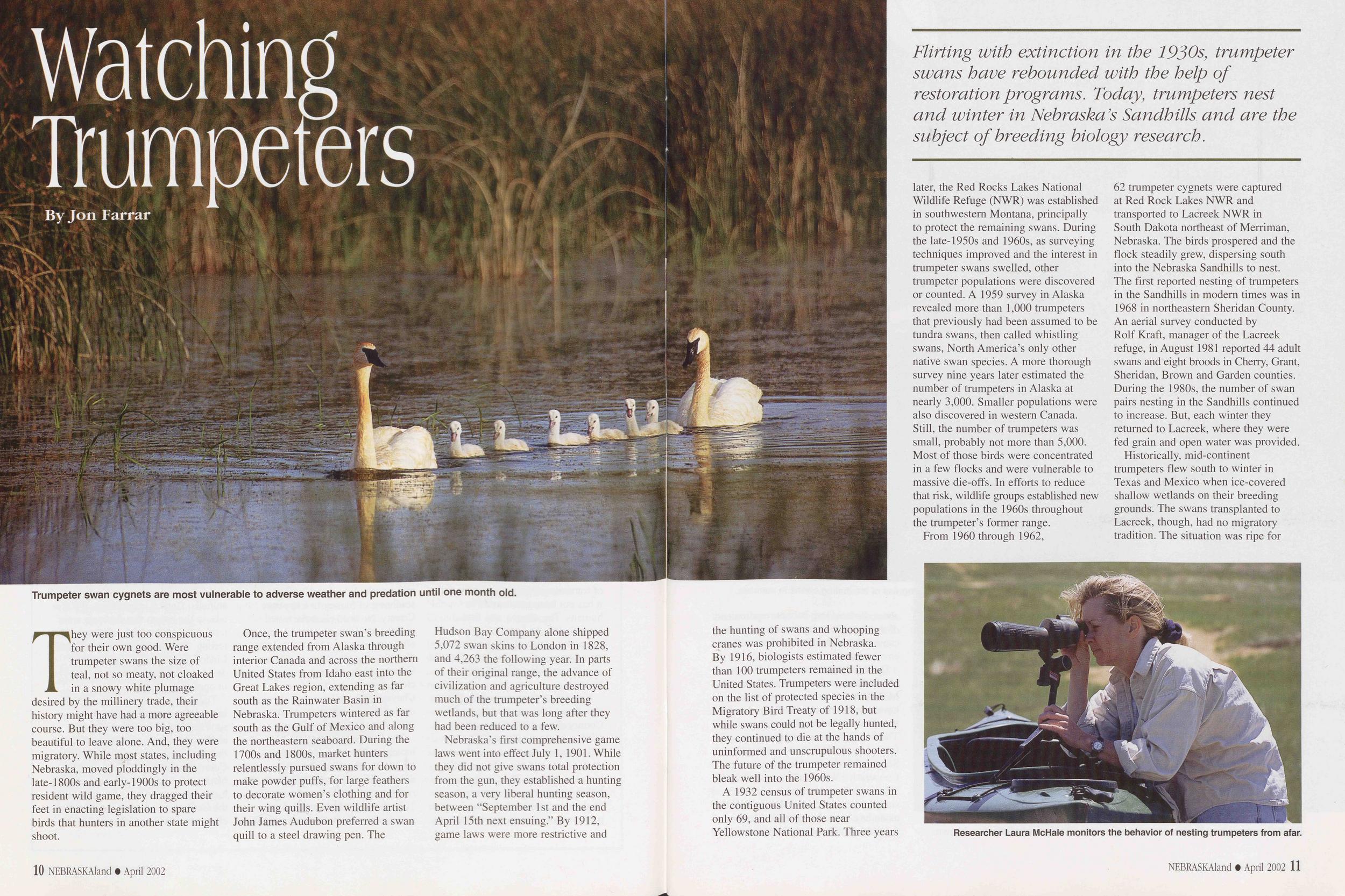
Watching Trumperers
They were just too conspicuous for their own good. Were trumpeter swans the size of teal, not so meaty, not cloaked in a snowy white plumage desired by the millinery trade, their history might have had a more agreeable course. But they were too big, too beautiful to leave alone. And, they were migratory. While most states, including Nebraska, moved ploddingly in the late-1800s and early-1900s to protect resident wild game, they dragged their feet in enacting legislation to spare birds that hunters in another state might shoot.
Once, the trumpeter swan’s breeding range extended from Alaska through interior Canada and across the northern United States from Idaho east into the Great Lakes region, extending as far south as the Rainwater Basin in Nebraska. Trumpeters wintered as far south as the Gulf of Mexico and along the northeastern seaboard. During the 1700s and 1800s, market hunters relentlessly pursued swans for down to make powder puffs, for large feathers to decorate women’s clothing and for their wing quills. Even wildlife artist John James Audubon preferred a swan quill to a steel drawing pen. The Hudson Bay Company alone shipped 5,072 swan skins to London in 1828, and 4,263 the following year. In parts of their original range, the advance of civilization and agriculture destroyed much of the trumpeter’s breeding wetlands, but that was long after they had been reduced to a few.
Nebraska’s first comprehensive game laws went into effect July 1, 1901. While they did not give swans total protection from the gun, they established a hunting season, a very liberal hunting season, between “September 1st and the end April 15th next ensuing.” By 1912, game laws were more restrictive and the hunting of swans and whooping cranes was prohibited in Nebraska. By 1916, biologists estimated fewer than 100 trumpeters remained in the United States. Trumpeters were included on the list of protected species in the Migratory Bird Treaty of 1918, but while swans could not be legally hunted, they continued to die at the hands of uninformed and unscrupulous shooters. The future of the trumpeter remained bleak well into the 1960s.
A 1932 census of trumpeter swans in the contiguous United States counted only 69, and all of those near Yellowstone National Park. Three years later, the Red Rocks Lakes National Wildlife Refuge (NWR) was established in southwestern Montana, principally to protect the remaining swans. During the late-1950s and 1960s, as surveying techniques improved and the interest in trumpeter swans swelled, other trumpeter populations were discovered or counted. A 1959 survey in Alaska revealed more than 1,000 trumpeters that previously had been assumed to be tundra swans, then called whistling swans, North America’s only other native swan species. A more thorough survey nine years later estimated the number of trumpeters in Alaska at nearly 3,000. Smaller populations were also discovered in western Canada. Still, the number of trumpeters was small, probably not more than 5,000. Most of those birds were concentrated in a few flocks and were vulnerable to massive die-offs. In efforts to reduce that risk, wildlife groups established new populations in the 1960s throughout the trumpeter’s former range.
From 1960 through 1962, 62 trumpeter cygnets were captured at Red Rock Lakes NWR and transported to Lacreek NWR in South Dakota northeast of Merriman, Nebraska. The birds prospered and the flock steadily grew, dispersing south into the Nebraska Sandhills to nest. The first reported nesting of trumpeters in the Sandhills in modern times was in 1968 in northeastern Sheridan County. An aerial survey conducted by Rolf Kraft, manager of the Lacreek refuge, in August 1981 reported 44 adult swans and eight broods in Cherry, Grant, Sheridan, Brown and Garden counties. During the 1980s, the number of swan pairs nesting in the Sandhills continued to increase. But, each winter they returned to Lacreek, where they were fed grain and open water was provided.
Historically, mid-continent trumpeters flew south to winter in Texas and Mexico when ice-covered shallow wetlands on their breeding grounds. The swans transplanted to Lacreek, though, had no migratory tradition. The situation was ripe for NEBRASKAland • April 2002 11 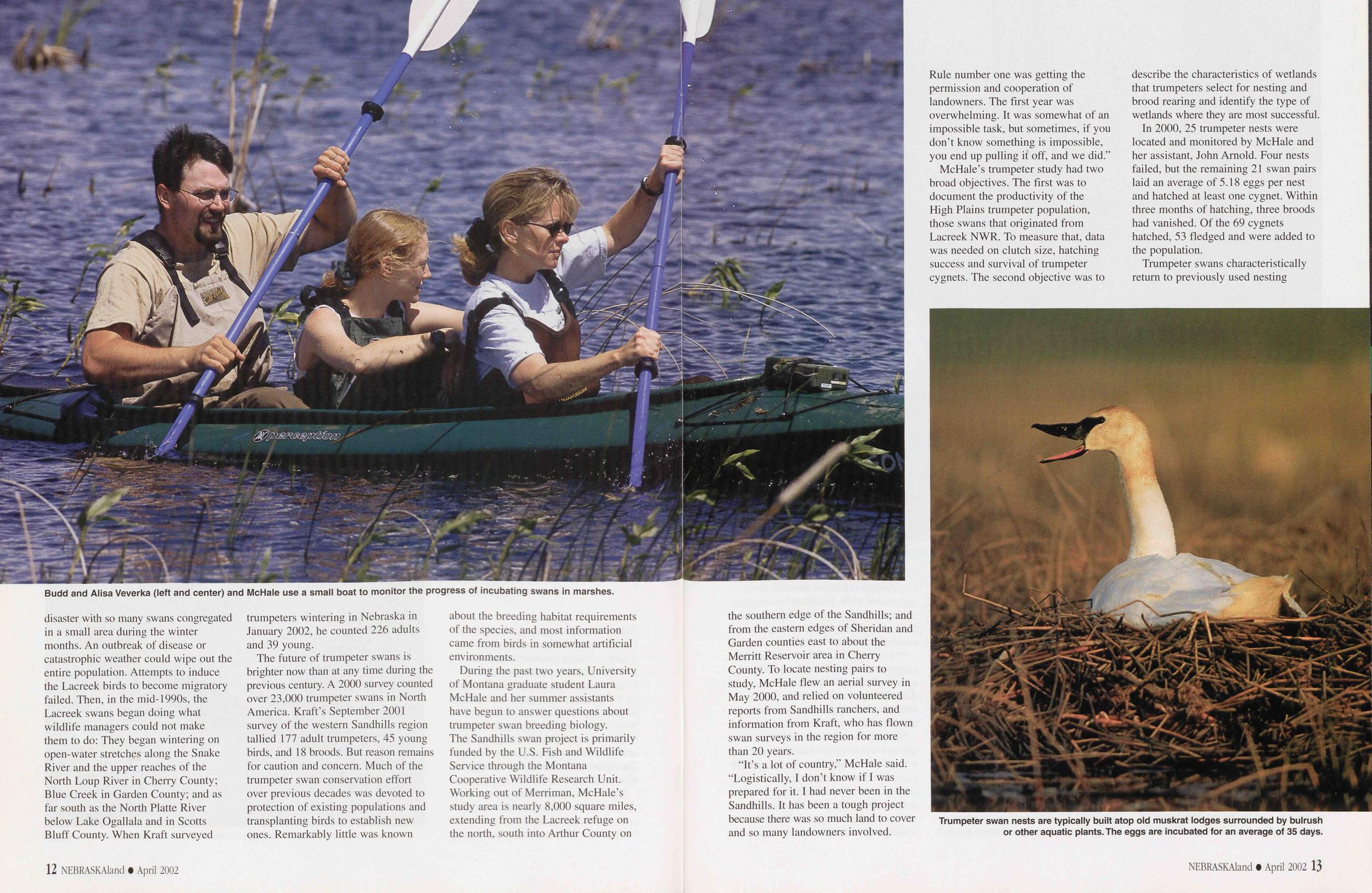
The future of trumpeter swans is brighter now than at any time during the previous century. A 2000 survey counted over 23,000 trumpeter swans in North America. Kraft’s September 2001 survey of the western Sandhills region tallied 177 adult trumpeters, 45 young birds, and 18 broods. But reason remains for caution and concern. Much of the trumpeter swan conservation effort over previous decades was devoted to protection of existing populations and transplanting birds to establish new ones. Remarkably little was known about the breeding habitat requirements of the species, and most information came from birds in somewhat artificial environments.
During the past two years, University of Montana graduate student Laura McHale and her summer assistants have begun to answer questions about trumpeter swan breeding biology. The Sandhills swan project is primarily funded by the U.S. Fish and Wildlife Service through the Montana Cooperative Wildlife Research Unit. Working out of Merriman, McHale’s study area is nearly 8,000 square miles, extending from the Lacreek refuge on the north, south into Arthur County on 12 NEBRASKAland • April 2002 the southern edge of the Sandhills; and from the eastern edges of Sheridan and Garden counties east to about the Merritt Reservoir area in Cherry County. To locate nesting pairs to study, McHale flew an aerial survey in May 2000, and relied on volunteered reports from Sandhills ranchers, and information from Kraft, who has flown swan surveys in the region for more than 20 years.
"It’s a lot of country,” McHale said. "Logistically, I don’t know if I was prepared for it. I had never been in the Sandhills. It has been a tough project because there was so much land to cover and so many landowners involved. Rule number one was getting the permission and cooperation of landowners. The first year was overwhelming. It was somewhat of an impossible task, but sometimes, if you don’t know something is impossible, you end up pulling it off, and we did.”
McHale’s trumpeter study had two broad objectives. The first was to document the productivity of the High Plains trumpeter population, those swans that originated from Lacreek NWR. To measure that, data was needed on clutch size, hatching success and survival of trumpeter cygnets. The second objective was to describe the characteristics of wetlands that trumpeters select for nesting and brood rearing and identify the type of wetlands where they are most successful.
In 2000, 25 trumpeter nests were located and monitored by McHale and her assistant, John Arnold. Four nests failed, but the remaining 21 swan pairs laid an average of 5.18 eggs per nest and hatched at least one cygnet. Within three months of hatching, three broods had vanished. Of the 69 cygnets hatched, 53 fledged and were added to the population.
Trumpeter swans characteristically return to previously used nesting NEBRASKAland • April 2002 13 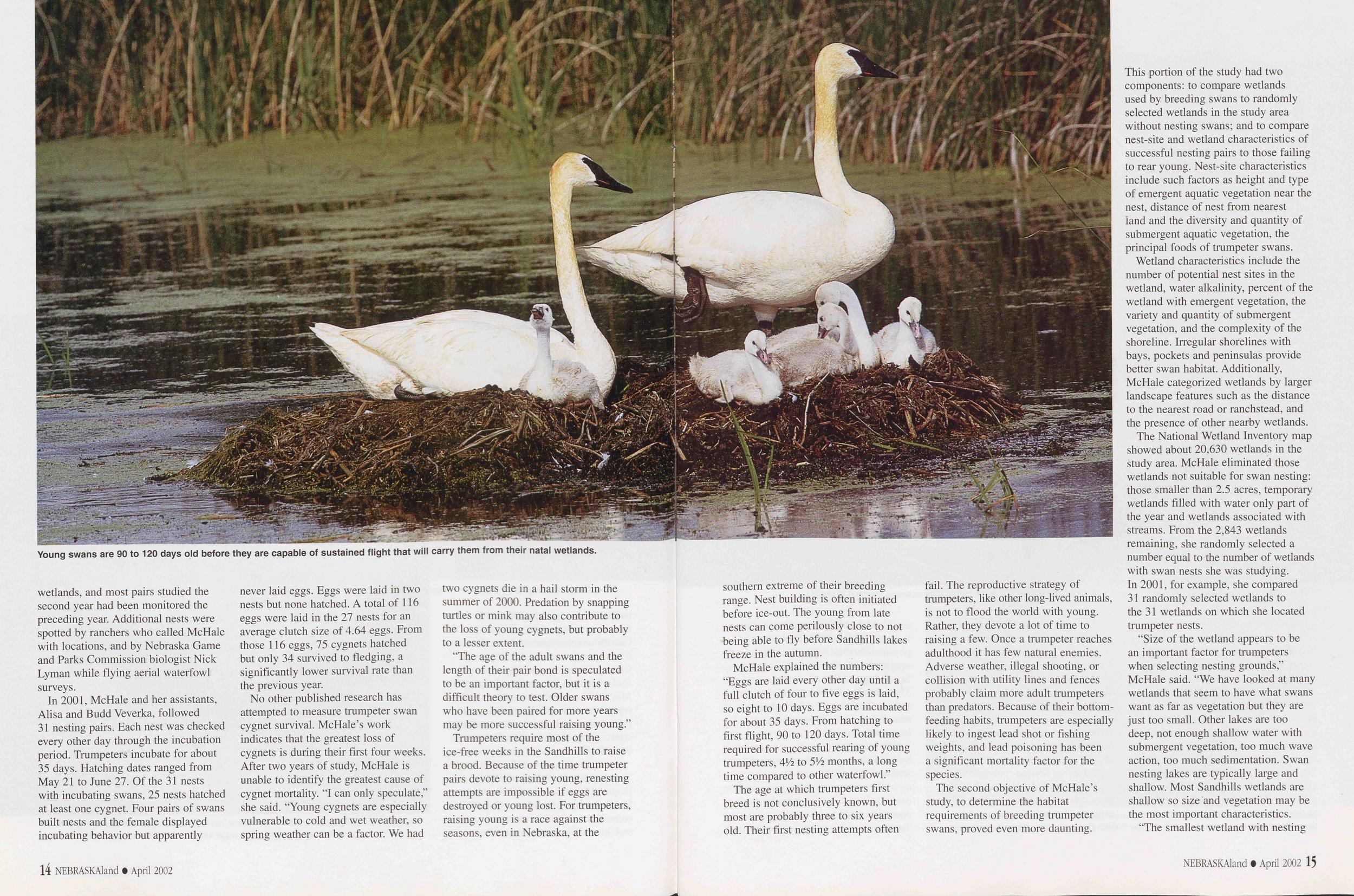
In 2001, McHale and her assistants, Alisa and Budd Veverka, followed 31 nesting pairs. Each nest was checked every other day through the incubation period. Trumpeters incubate for about 35 days. Hatching dates ranged from May 21 to June 27. Of the 31 nests with incubating swans, 25 nests hatched at least one cygnet. Four pairs of swans built nests and the female displayed incubating behavior but apparently never laid eggs. Eggs were laid in two nests but none hatched. A total of 116 eggs were laid in the 27 nests for an average clutch size of 4.64 eggs. From those 116 eggs, 75 cygnets hatched but only 34 survived to fledging, a significantly lower survival rate than the previous year.
No other published research has attempted to measure trumpeter swan cygnet survival. McHale’s work indicates that the greatest loss of cygnets is during their first four weeks. After two years of study, McHale is unable to identify the greatest cause of cygnet mortality. "1 can only speculate,” she said. “Young cygnets are especially vulnerable to cold and wet weather, so spring weather can be a factor. We had two cygnets die in a hail storm in the summer of 2000. Predation by snapping turtles or mink may also contribute to the loss of young cygnets, but probably to a lesser extent.
“The age of the adult swans and the length of their pair bond is speculated to be an important factor, but it is a difficult theory to test. Older swans who have been paired for more years may be more successful raising young.”
Trumpeters require most of the ice-free weeks in the Sandhills to raise a brood. Because of the time trumpeter pairs devote to raising young, renesting attempts are impossible if eggs are destroyed or young lost. For trumpeters, raising young is a race against the seasons, even in Nebraska, at the 14 NEBRASKAland • April 2002 southern extreme of their breeding range. Nest building is often initiated before ice-out. The young from late nests can come perilously close to not being able to fly before Sandhills lakes freeze in the autumn.
McHale explained the numbers: “Eggs are laid every other day until a full clutch of four to five eggs is laid, so eight to 10 days. Eggs are incubated for about 35 days. From hatching to first flight, 90 to 120 days. Total time required for successful rearing of young trumpeters, 41/? to 5Vi months, a long time compared to other waterfowl.”
The age at which trumpeters first breed is not conclusively known, but most are probably three to six years old. Their first nesting attempts often fail. The reproductive strategy of trumpeters, like other long-lived animals, is not to flood the world with young. Rather, they devote a lot of time to raising a few. Once a trumpeter reaches adulthood it has few natural enemies. Adverse weather, illegal shooting, or collision with utility lines and fences probably claim more adult trumpeters than predators. Because of their bottom- feeding habits, trumpeters are especially likely to ingest lead shot or fishing weights, and lead poisoning has been a significant mortality factor for the species.
The second objective of McHale’s study, to determine the habitat requirements of breeding trumpeter swans, proved even more daunting. This portion of the study had two components: to compare wetlands used by breeding swans to randomly selected wetlands in the study area without nesting swans; and to compare nest-site and wetland characteristics of successful nesting pairs to those failing to rear young. Nest-site characteristics include such factors as height and type of emergent aquatic vegetation near the nest, distance of nest from nearest land and the diversity and quantity of submergent aquatic vegetation, the principal foods of trumpeter swans.
Wetland characteristics include the number of potential nest sites in the wetland, water alkalinity, percent of the wetland with emergent vegetation, the variety and quantity of submergent vegetation, and the complexity of the shoreline. Irregular shorelines with bays, pockets and peninsulas provide better swan habitat. Additionally, McHale categorized wetlands by larger landscape features such as the distance to the nearest road or ranchstead, and the presence of other nearby wetlands.
The National Wetland Inventory map showed about 20,630 wetlands in the study area. McHale eliminated those wetlands not suitable for swan nesting: those smaller than 2.5 acres, temporary wetlands filled with water only part of the year and wetlands associated with streams. From the 2,843 wetlands remaining, she randomly selected a number equal to the number of wetlands with swan nests she was studying. In 2001, for example, she compared 31 randomly selected wetlands to the 31 wetlands on which she located trumpeter nests.
“Size of the wetland appears to be an important factor for trumpeters when selecting nesting grounds,” McHale said. “We have looked at many wetlands that seem to have what swans want as far as vegetation but they are just too small. Other lakes are too deep, not enough shallow water with submergent vegetation, too much wave action, too much sedimentation. Swan nesting lakes are typically large and shallow. Most Sandhills wetlands are shallow so size and vegetation may be the most important characteristics.
“The smallest wetland with nesting NEBRASKAland • April 2002 15 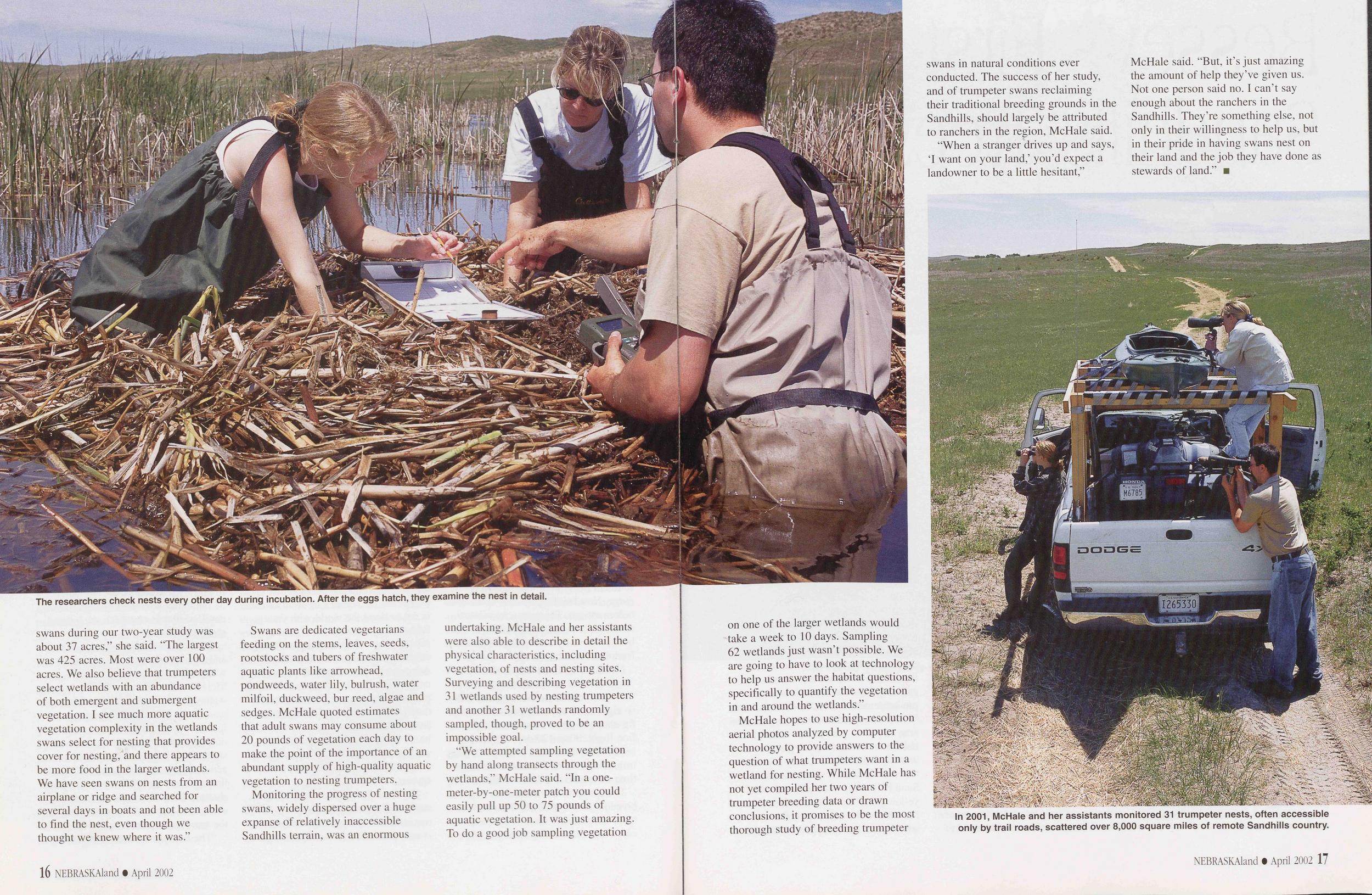
Swans are dedicated vegetarians feeding on the stems, leaves, seeds, rootstocks and tubers of freshwater aquatic plants like arrowhead, pondweeds, water lily, bulrush, water milfoil, duckweed, bur reed, algae and sedges. McHale quoted estimates that adult swans may consume about 20 pounds of vegetation each day to make the point of the importance of an abundant supply of high-quality aquatic vegetation to nesting trumpeters.
Monitoring the progress of nesting swans, widely dispersed over a huge expanse of relatively inaccessible Sandhills terrain, was an enormous undertaking. McHale and her assistants were also able to describe in detail the physical characteristics, including vegetation, of nests and nesting sites. Surveying and describing vegetation in 31 wetlands used by nesting trumpeters and another 31 wetlands randomly sampled, though, proved to be an impossible goal.
“We attempted sampling vegetation by hand along transects through the wetlands,” McHale said. “In a one- meter-by-one-meter patch you could easily pull up 50 to 75 pounds of aquatic vegetation. It was just amazing. To do a good job sampling vegetation on one of the larger wetlands would 16 NEBRASKAland • April 2002 take a week to 10 days. Sampling 62 wetlands just wasn’t possible. We are going to have to look at technology to help us answer the habitat questions, specifically to quantify the vegetation in and around the wetlands.”
McHale hopes to use high-resolution aerial photos analyzed by computer technology to provide answers to the question of what trumpeters want in a wetland for nesting. While McHale has not yet compiled her two years of trumpeter breeding data or drawn conclusions, it promises to be the most thorough study of breeding trumpeter swans in natural conditions ever conducted. The success of her study, and of trumpeter swans reclaiming their traditional breeding grounds in the Sandhills, should largely be attributed to ranchers in the region, McHale said.
“When a stranger drives up and says, ‘I want on your land,’ you’d expect a landowner to be a little hesitant,” McHale said. “But, it’s just amazing the amount of help they’ve given us. Not one person said no. I can’t say enough about the ranchers in the Sandhills. They’re something else, not only in their willingness to help us, but in their pride in having swans nest on their land and the job they have done as stewards of land.” ■
Bessey’s First Sandhills Trees
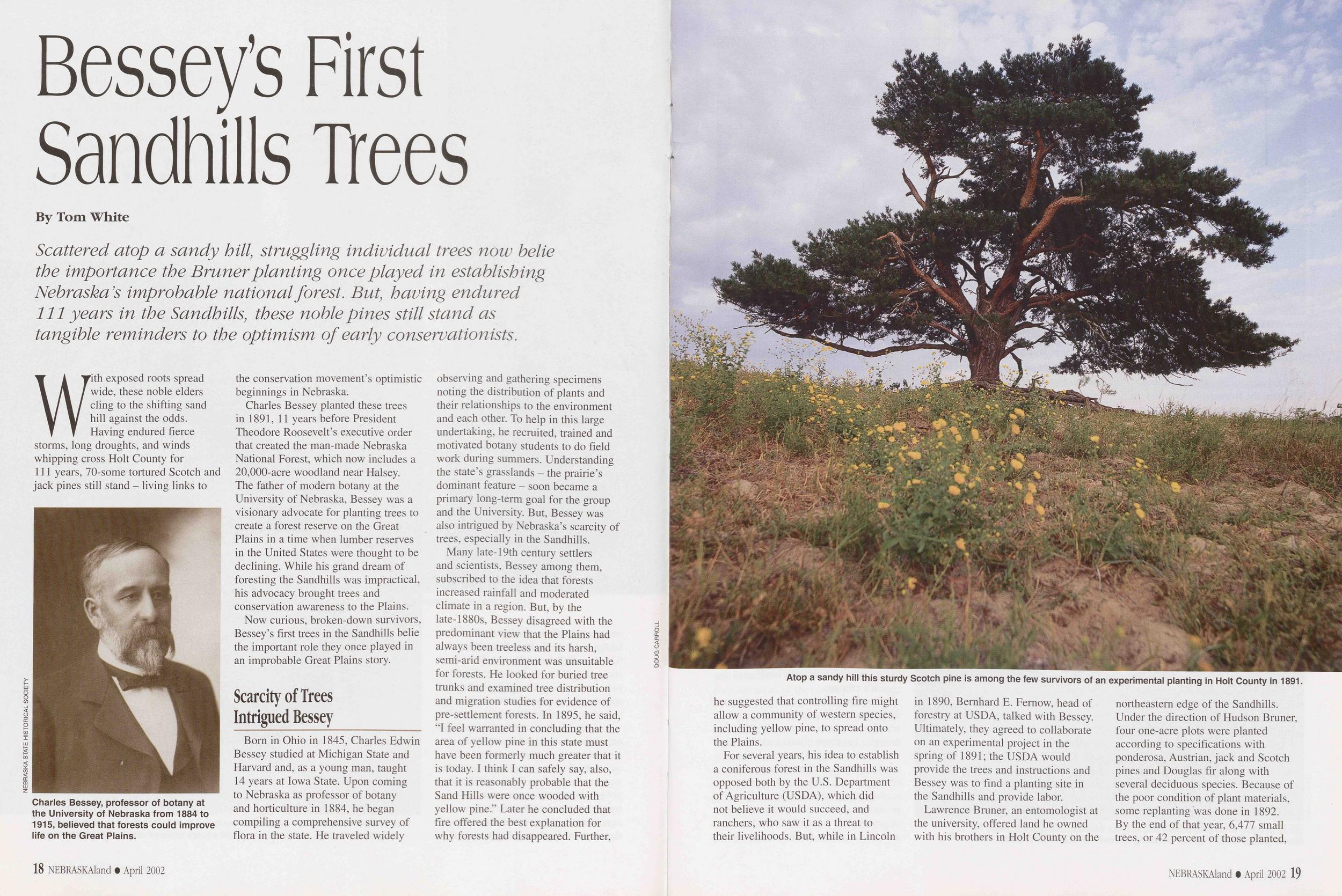
Scattered atop a sandy bill, struggling individual trees now belie the importance the Bruner planting once played in establishing Nebraska’s improbable national forest. But, having endured 111 years in the Sandhills, these noble pines still stand as tangible reminders to the optimism of early conservationists.With exposed roots spread wide, these noble elders cling to the shifting sand hill against the odds. Having endured fierce storms, long droughts, and winds whipping cross Holt County for 111 years, 70-some tortured Scotch and jack pines still stand - living links to the conservation movement’s optimistic beginnings in Nebraska.
NEBRASKA STATE HISTORICAL SOCIETYCharles Bessey planted these trees in 1891, 11 years before President Theodore Roosevelt’s executive order that created the man-made Nebraska National Forest, which now includes a 20,000-acre woodland near Halsey. The father of modern botany at the University of Nebraska, Bessey was a visionary advocate for planting trees to create a forest reserve on the Great Plains in a time when lumber reserves in the United States were thought to be declining. While his grand dream of foresting the Sandhills was impractical, his advocacy brought trees and conservation awareness to the Plains.
Now curious, broken-down survivors, Bessey’s first trees in the Sandhills belie the important role they once played in an improbable Great Plains story.
Scarcity of Trees Intrigued BesseyBorn in Ohio in 1845, Charles Edwin Bessey studied at Michigan State and Harvard and, as a young man, taught 14 years at Iowa State. Upon coming to Nebraska as professor of botany and horticulture in 1884, he began compiling a comprehensive survey of flora in the state. He traveled widely observing and gathering specimens noting the distribution of plants and their relationships to the environment and each other. To help in this large undertaking, he recruited, trained and motivated botany students to do field work during summers. Understanding the state’s grasslands - the prairie’s dominant feature - soon became a primary long-term goal for the group and the University. But, Bessey was also intrigued by Nebraska’s scarcity of trees, especially in the Sandhills.
Many late-19th century settlers and scientists, Bessey among them, subscribed to the idea that forests increased rainfall and moderated climate in a region. But, by the late-1880s, Bessey disagreed with the predominant view that the Plains had always been treeless and its harsh, semi-arid environment was unsuitable for forests. He looked for buried tree trunks and examined tree distribution and migration studies for evidence of pre-settlement forests. In 1895, he said, "I feel warranted in concluding that the area of yellow pine in this state must have been formerly much greater that it is today. I think I can safely say, also, that it is reasonably probable that the Sand Hills were once wooded with yellow pine.” Later he concluded that fire offered the best explanation for why forests had disappeared. Further, 18 NEBRASKAland • April 2002 he suggested that controlling fire might allow a community of western species, including yellow pine, to spread onto the Plains.
DOUG CARROLLFor several years, his idea to establish a coniferous forest in the Sandhills was opposed both by the U.S. Department of Agriculture (USDA), which did not believe it would succeed, and ranchers, who saw it as a threat to their livelihoods. But, while in Lincoln in 1890, Bernhard E. Fernow, head of forestry at USDA, talked with Bessey. Ultimately, they agreed to collaborate on an experimental project in the spring of 1891; the USDA would provide the trees and instructions and Bessey was to find a planting site in the Sandhills and provide labor.
Lawrence Bruner, an entomologist at the university, offered land he owned with his brothers in Holt County on the northeastern edge of the Sandhills. Under the direction of Hudson Bruner, four one-acre plots were planted according to specifications with ponderosa, Austrian, jack and Scotch pines and Douglas fir along with several deciduous species. Because of the poor condition of plant materials, some replanting was done in 1892. By the end of that year, 6,477 small trees, or 42 percent of those planted,
NEBRASKAland • April 2002 19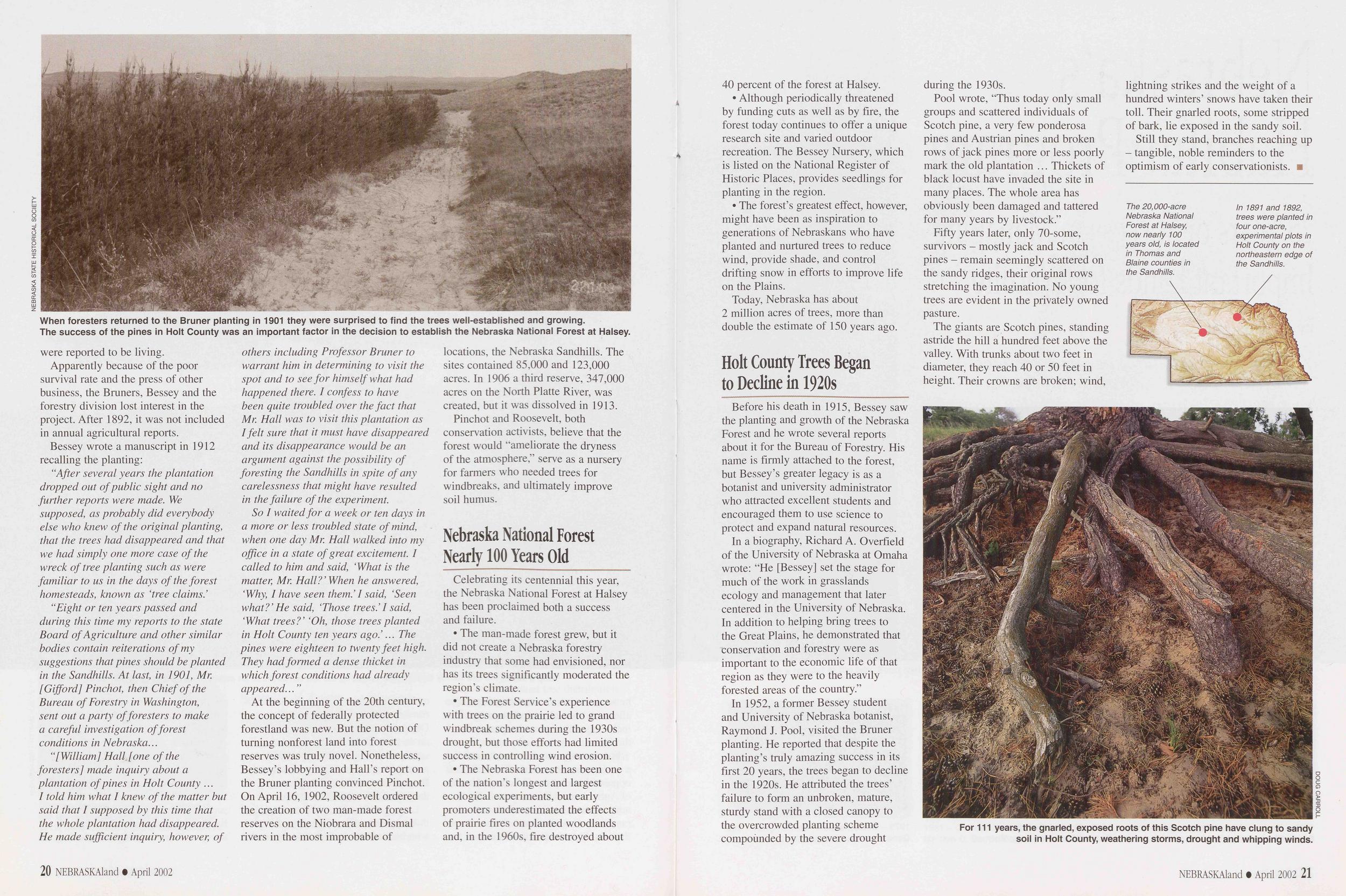 NEBRASKA STATE HISTORICAL SOCIETY
were reported to be living.
Apparently because of the poor survival rate and the press of other business, the Bruners, Bessey and the forestry division lost interest in the project. After 1892, it was not included in annual agricultural reports.
Bessey wrote a manuscript in 1912 recalling the planting:
“After several years the plantation dropped out of public sight and no further reports were made. We supposed, as probably did everybody else who knew of the original planting, that the trees had disappeared and that we had simply one more case of the wreck of tree planting such as were familiar to us in the days of the forest homesteads, known as ‘tree claims.’
“Eight or ten years passed and during this time my reports to the state Board of Agriculture and other similar bodies contain reiterations of my suggestions that pines should be planted in the Sandhills. At last, in 1901, Mr. [Gifford] Pinchot, then Chief of the Bureau of Forestry in Washington, sent out a party of foresters to make a careful investigation of forest conditions in Nebraska...
“[William] Hall [one of the foresters] made inquiry about a plantation of pines in Holt County ... I told him what I knew of the matter but said that I supposed by this time that the whole plantation had disappeared. He made sufficient inquiry, however, of others including Professor Bruner to warrant him in determining to visit the spot and to see for himself what had happened there. I confess to have been quite troubled over the fact that Mr. Hall was to visit this plantation as I felt sure that it must have disappeared and its disappearance would be an argument against the possibility of foresting the Sandhills in spite of any carelessness that might have resulted in the failure of the experiment.
So I waited for a week or ten days in a more or less troubled state of mind, when one day Mr. Hall walked into my office in a state of great excitement. I called to him and said, ‘What is the matter, Mr. Hall?’When he answered, ‘Why, I have seen them.’ I said, ‘Seen what? ’ He said, ‘Those trees.’ I said, ‘What trees?’ ‘Oh, those trees planted in Holt County ten years ago.’... The pines were eighteen to twenty feet high. They had formed a dense thicket in which forest conditions had already appeared... ”
At the beginning of the 20th century, the concept of federally protected forestland was new. But the notion of turning nonforest land into forest reserves was truly novel. Nonetheless, Bessey’s lobbying and Hall’s report on the Bruner planting convinced Pinchot. On April 16, 1902, Roosevelt ordered the creation of two man-made forest reserves on the Niobrara and Dismal rivers in the most improbable of locations, the Nebraska Sandhills. The sites contained 85,000 and 123,000 acres. In 1906 a third reserve, 347,000 acres on the North Platte River, was created, but it was dissolved in 1913.
Pinchot and Roosevelt, both conservation activists, believe that the forest would “ameliorate the dryness of the atmosphere,” serve as a nursery for farmers who needed trees for windbreaks, and ultimately improve soil humus.
Nebraska National Forest Nearly 100 Years OldCelebrating its centennial this year, the Nebraska National Forest at Halsey has been proclaimed both a success and failure.
• The man-made forest grew, but it did not create a Nebraska forestry industry that some had envisioned, nor has its trees significantly moderated the region’s climate.
• The Forest Service’s experience with trees on the prairie led to grand windbreak schemes during the 1930s drought, but those efforts had limited success in controlling wind erosion.
• The Nebraska Forest has been one of the nation’s longest and largest ecological experiments, but early promoters underestimated the effects of prairie fires on planted woodlands and, in the 1960s, fire destroyed about 20 NEBRASKAland • April 2002 40 percent of the forest at Halsey.
• Although periodically threatened by funding cuts as well as by fire, the forest today continues to offer a unique research site and varied outdoor recreation. The Bessey Nursery, which is listed on the National Register of Historic Places, provides seedlings for planting in the region.
• The forest’s greatest effect, however, might have been as inspiration to generations of Nebraskans who have planted and nurtured trees to reduce wind, provide shade, and control drifting snow in efforts to improve life on the Plains.
Today, Nebraska has about 2 million acres of trees, more than double the estimate of 150 years ago.
Holt County Trees Began to Decline in 1920sBefore his death in 1915, Bessey saw the planting and growth of the Nebraska Forest and he wrote several reports about it for the Bureau of Forestry. His name is firmly attached to the forest, but Bessey’s greater legacy is as a botanist and university administrator who attracted excellent students and encouraged them to use science to protect and expand natural resources.
In a biography, Richard A. Overfield of the University of Nebraska at Omaha wrote: “He [Bessey] set the stage for much of the work in grasslands ecology and management that later centered in the University of Nebraska. In addition to helping bring trees to the Great Plains, he demonstrated that conservation and forestry were as important to the economic life of that region as they were to the heavily forested areas of the country.”
In 1952, a former Bessey student and University of Nebraska botanist, Raymond J. Pool, visited the Bruner planting. He reported that despite the planting’s truly amazing success in its first 20 years, the trees began to decline in the 1920s. He attributed the trees’ failure to form an unbroken, mature, sturdy stand with a closed canopy to the overcrowded planting scheme compounded by the severe drought during the 1930s.
Pool wrote, “Thus today only small groups and scattered individuals of Scotch pine, a very few ponderosa pines and Austrian pines and broken rows of jack pines more or less poorly mark the old plantation ... Thickets of black locust have invaded the site in many places. The whole area has obviously been damaged and tattered for many years by livestock.”
Fifty years later, only 70-some, survivors - mostly jack and Scotch pines - remain seemingly scattered on the sandy ridges, their original rows stretching the imagination. No young trees are evident in the privately owned pasture.
The giants are Scotch pines, standing astride the hill a hundred feet above the valley. With trunks about two feet in diameter, they reach 40 or 50 feet in height. Their crowns are broken; wind, lightning strikes and the weight of a hundred winters’ snows have taken their toll. Their gnarled roots, some stripped of bark, lie exposed in the sandy soil.
Still they stand, branches reaching up - tangible, noble reminders to the optimism of early conservationists.
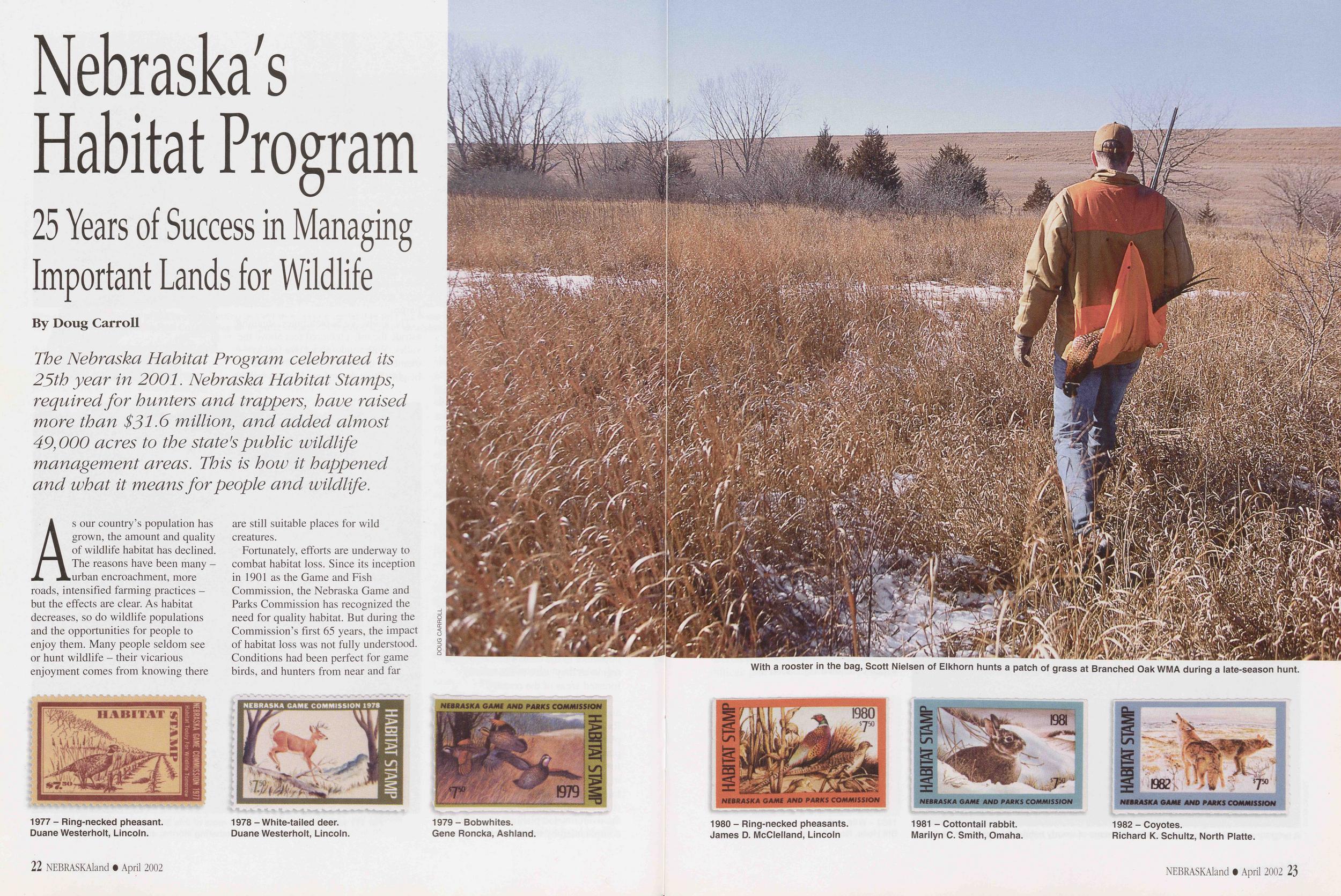
As our country’s population has grown, the amount and quality of wildlife habitat has declined. The reasons have been many - urban encroachment, more roads, intensified farming practices — but the effects are clear. As habitat decreases, so do wildlife populations and the opportunities for people to enjoy them. Many people seldom see or hunt wildlife — their vicarious enjoyment comes from knowing there are still suitable places for wild creatures.
Fortunately, efforts are underway to combat habitat loss. Since its inception in 1901 as the Game and Fish Commission, the Nebraska Game and Parks Commission has recognized the need for quality habitat. But during the Commission’s first 65 years, the impact of habitat loss was not fully understood. Conditions had been perfect for game birds, and hunters from near and far
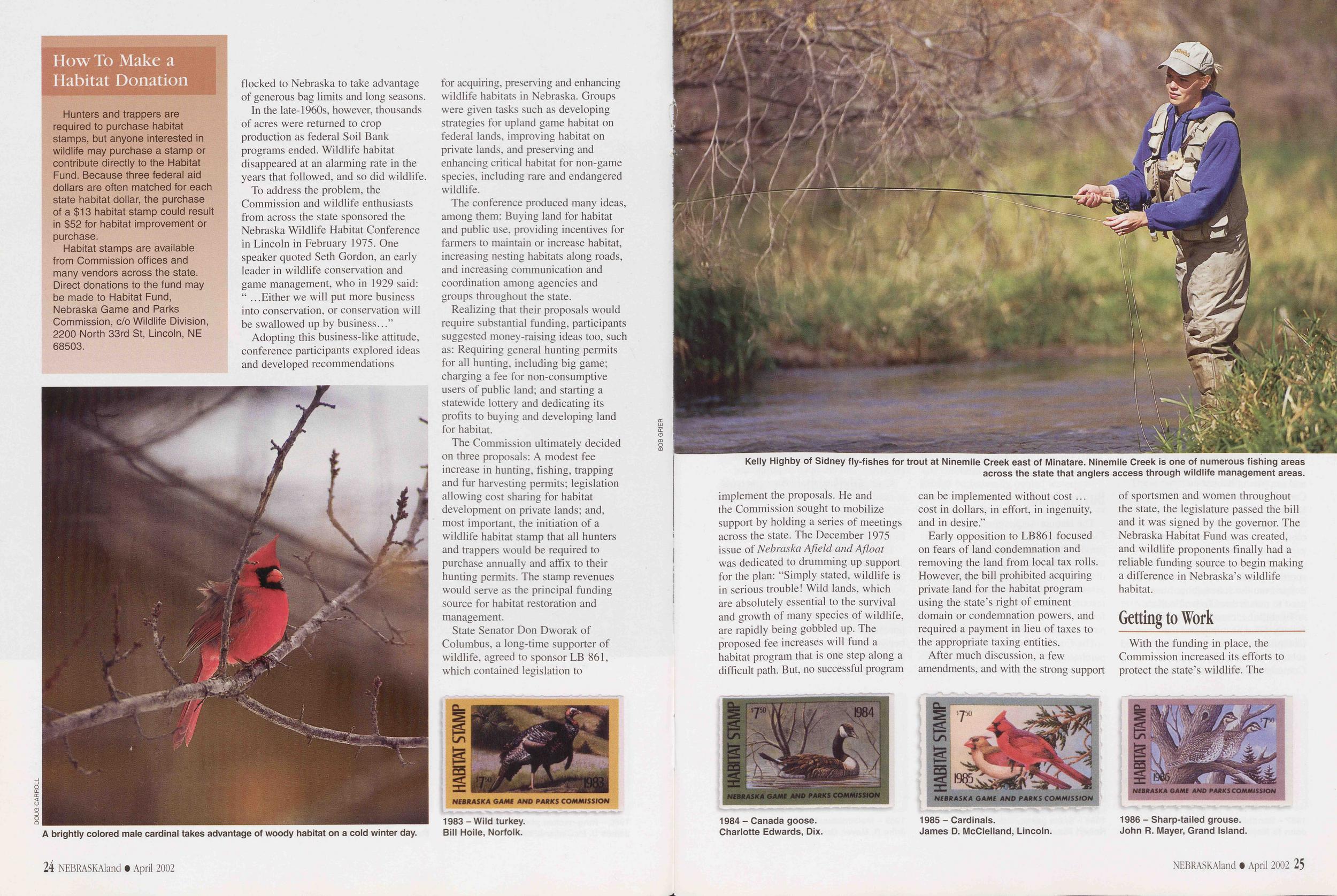 flocked to Nebraska to take advantage of generous bag limits and long seasons.
How to Make a Habitat Donation Hunters and trappers are required to purchase habitat stamps, but anyone interested in wildlife may purchase a stamp or contribute directly to the Habitat Fund. Because three federal aid dollars are often matched for each state habitat dollar, the purchase of a $13 habitat stamp could result in $52 for habitat improvement or purchase. Habitat stamps are available from Commission offices and many vendors across the state. Direct donations to the fund may be made to Habitat Fund, Nebraska Game and Parks Commission, c/o Wildlife Division, 2200 North 33rd St, Lincoln, NE 68503.
In the late-1960s, however, thousands of acres were returned to crop production as federal Soil Bank programs ended. Wildlife habitat disappeared at an alarming rate in the years that followed, and so did wildlife.
To address the problem, the Commission and wildlife enthusiasts from across the state sponsored the Nebraska Wildlife Habitat Conference in Lincoln in February 1975. One speaker quoted Seth Gordon, an early leader in wildlife conservation and game management, who in 1929 said: " .. .Either we will put more business into conservation, or conservation will be swallowed up by business...”
Adopting this business-like attitude, conference participants explored ideas and developed recommendations for acquiring, preserving and enhancing wildlife habitats in Nebraska. Groups were given tasks such as developing strategies for upland game habitat on federal lands, improving habitat on private lands, and preserving and enhancing critical habitat for non-game species, including rare and endangered wildlife.
DOUG CARROLLThe conference produced many ideas, among them: Buying land for habitat and public use, providing incentives for farmers to maintain or increase habitat, increasing nesting habitats along roads, and increasing communication and coordination among agencies and groups throughout the state.
Realizing that their proposals would require substantial funding, participants suggested money-raising ideas too, such as: Requiring general hunting permits for all hunting, including big game; charging a fee for non-consumptive users of public land; and starting a statewide lottery and dedicating its profits to buying and developing land for habitat.
The Commission ultimately decided on three proposals: A modest fee increase in hunting, fishing, trapping and fur harvesting permits; legislation allowing cost sharing for habitat development on private lands; and, most important, the initiation of a wildlife habitat stamp that all hunters and trappers would be required to purchase annually and affix to their hunting permits. The stamp revenues would serve as the principal funding source for habitat restoration and management.
State Senator Don Dworak of Columbus, a long-time supporter of wildlife, agreed to sponsor LB 861, which contained legislation to 24 NEBRASKAland • April 2002 implement the proposals. He and the Commission sought to mobilize support by holding a series of meetings across the state. The December 1975 issue of Nebraska Afield and Afloat was dedicated to drumming up support for the plan: “Simply stated, wildlife is in serious trouble! Wild lands, which are absolutely essential to the survival and growth of many species of wildlife, are rapidly being gobbled up. The proposed fee increases will fund a habitat program that is one step along a difficult path. But, no successful program can be implemented without cost ... cost in dollars, in effort, in ingenuity, and in desire.”
BOB GRIEREarly opposition to LB 861 focused on fears of land condemnation and removing the land from local tax rolls. However, the bill prohibited acquiring private land for the habitat program using the state’s right of eminent domain or condemnation powers, and required a payment in lieu of taxes to the appropriate taxing entities.
After much discussion, a few amendments, and with the strong support of sportsmen and women throughout the state, the legislature passed the bill and it was signed by the governor. The Nebraska Habitat Fund was created, and wildlife proponents finally had a reliable funding source to begin making a difference in Nebraska’s wildlife habitat.
Getting to WorkWith the funding in place, the Commission increased its efforts to protect the state’s wildlife. The
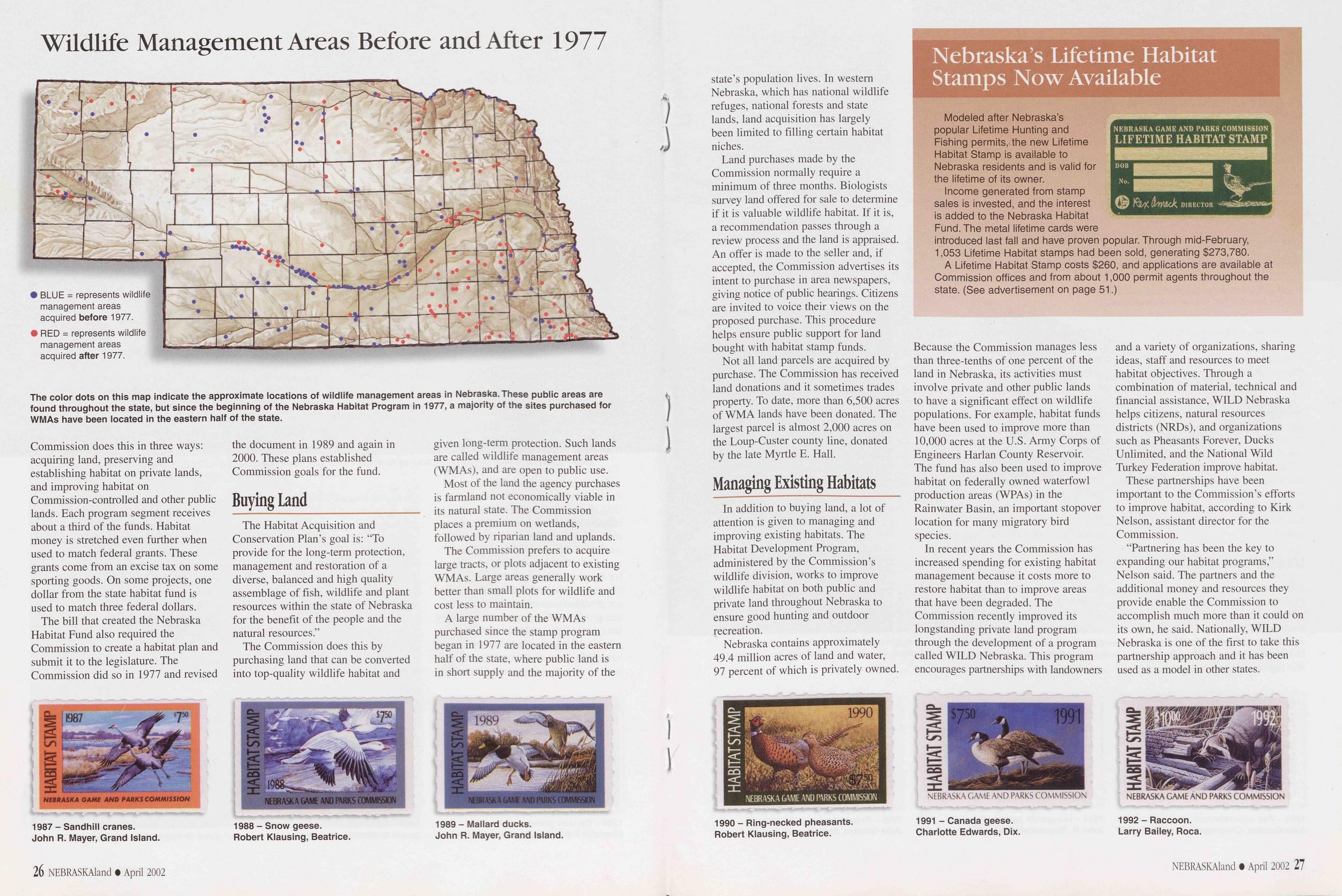
The bill that created the Nebraska Habitat Fund also required the Commission to create a habitat plan and submit it to the legislature. The Commission did so in 1977 and revised the document in 1989 and again in 2000. These plans established Commission goals for the fund.
Buying LandThe Habitat Acquisition and Conservation Plan’s goal is: "To provide for the long-term protection, management and restoration of a diverse, balanced and high quality assemblage of fish, wildlife and plant resources within the state of Nebraska for the benefit of the people and the natural resources.”
The Commission does this by purchasing land that can be converted into top-quality wildlife habitat and given long-term protection. Such lands are called wildlife management areas (WMAs), and are open to public use.
Most of the land the agency purchases is farmland not economically viable in its natural state. The Commission places a premium on wetlands, followed by riparian land and uplands.
The Commission prefers to acquire large tracts, or plots adjacent to existing WMAs. Large areas generally work better than small plots for wildlife and cost less to maintain.
A large number of the WMAs purchased since the stamp program began in 1977 are located in the eastern half of the state, where public land is in short supply and the majority of the
Land purchases made by the Commission normally require a minimum of three months. Biologists survey land offered for sale to determine if it is valuable wildlife habitat. If it is, a recommendation passes through a review process and the land is appraised. An offer is made to the seller and, if accepted, the Commission advertises its intent to purchase in area newspapers, giving notice of public hearings. Citizens are invited to voice their views on the proposed purchase. This procedure helps ensure public support for land bought with habitat stamp funds.
Not all land parcels are acquired by purchase. The Commission has received land donations and it sometimes trades property. To date, more than 6,500 acres of WMA lands have been donated. The largest parcel is almost 2,000 acres on the Loup-Custer county line, donated by the late Myrtle E. Hall.
Managing Existing HabitatsIn addition to buying land, a lot of attention is given to managing and improving existing habitats. The Habitat Development Program, administered by the Commission’s wildlife division, works to improve wildlife habitat on both public and private land throughout Nebraska to ensure good hunting and outdoor recreation.
Nebraska contains approximately 49.4 million acres of land and water, 97 percent of which is privately owned. Because the Commission manages less than three-tenths of one percent of the land in Nebraska, its activities must involve private and other public lands to have a significant effect on wildlife populations. For example, habitat funds have been used to improve more than 10,000 acres at the U.S. Army Corps of Engineers Harlan County Reservoir. The fund has also been used to improve habitat on federally owned waterfowl production areas (WPAs) in the Rainwater Basin, an important stopover location for many migratory bird species.
In recent years the Commission has increased spending for existing habitat management because it costs more to restore habitat than to improve areas that have been degraded. The Commission recently improved its longstanding private land program through the development of a program called WILD Nebraska. This program encourages partnerships with landowners and a variety of organizations, sharing ideas, staff and resources to meet habitat objectives. Through a combination of material, technical and financial assistance, WILD Nebraska helps citizens, natural resources districts (NRDs), and organizations such as Pheasants Forever, Ducks Unlimited, and the National Wild Turkey Federation improve habitat.
These partnerships have been important to the Commission’s efforts to improve habitat, according to Kirk Nelson, assistant director for the Commission.
“Partnering has been the key to expanding our habitat programs,” Nelson said. The partners and the additional money and resources they provide enable the Commission to accomplish much more than it could on its own, he said. Nationally, WILD Nebraska is one of the first to take this partnership approach and it has been used as a model in other states.
Nebraska’s Lifetime Habitat Stamps Now Available Modeled after Nebraska’s popular Lifetime Hunting and Fishing permits, the new Lifetime Habitat Stamp is available to Nebraska residents and is valid for the lifetime of its owner. Income generated from stamp sales is invested, and the interest is added to the Nebraska Habitat Fund. The metal lifetime cards were introduced last fall and have proven popular. Through mid-February, 1,053 Lifetime Habitat stamps had been sold, generating $273,780. A Lifetime Habitat Stamp costs $260, and applications are available at Commission offices and from about 1,000 permit agents throughout the state. (See advertisement on page 51.)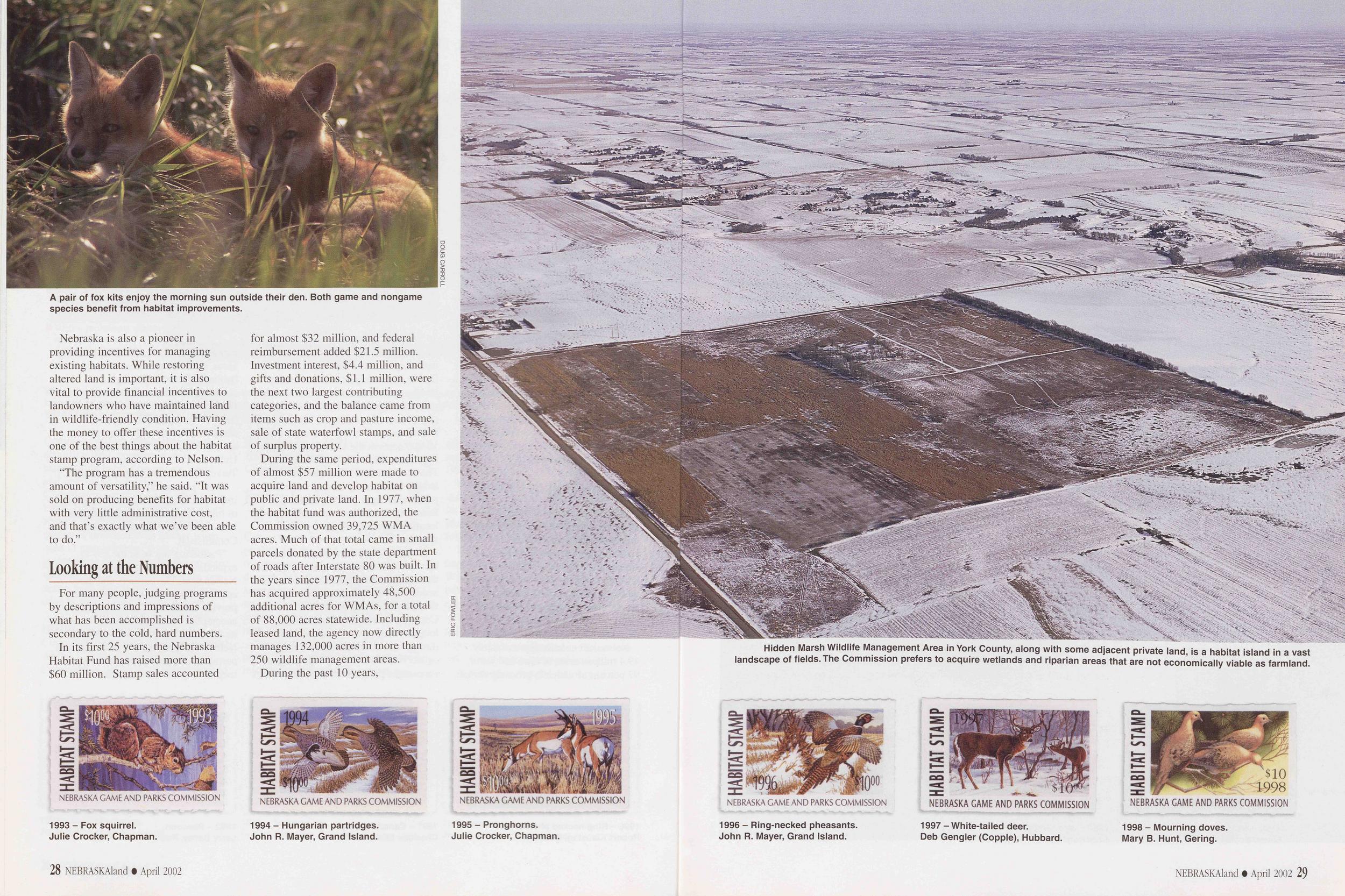
Nebraska is also a pioneer in providing incentives for managing existing habitats. While restoring altered land is important, it is also vital to provide financial incentives to landowners who have maintained land in wildlife-friendly condition. Having the money to offer these incentives is one of the best things about the habitat stamp program, according to Nelson.
“The program has a tremendous amount of versatility,” he said. "It was sold on producing benefits for habitat with very little administrative cost, and that’s exactly what we’ve been able to do.”
Looking at the NumbersFor many people, judging programs by descriptions and impressions of what has been accomplished is secondary to the cold, hard numbers.
In its first 25 years, the Nebraska Habitat Fund has raised more than $60 million. Stamp sales accounted for almost $32 million, and federal reimbursement added $21.5 million. Investment interest, $4.4 million, and gifts and donations, $1.1 million, were the next two largest contributing categories, and the balance came from items such as crop and pasture income, sale of state waterfowl stamps, and sale of surplus property.
During the same period, expenditures of almost $57 million were made to acquire land and develop habitat on public and private land. In 1977, when the habitat fund was authorized, the Commission owned 39,725 WMA acres. Much of that total came in small parcels donated by the state department of roads after Interstate 80 was built. In the years since 1977, the Commission has acquired approximately 48,500 additional acres for WMAs, for a total of 88,000 acres statewide. Including leased land, the agency now directly manages 132,000 acres in more than 250 wildlife management areas.
During the past 10 years,
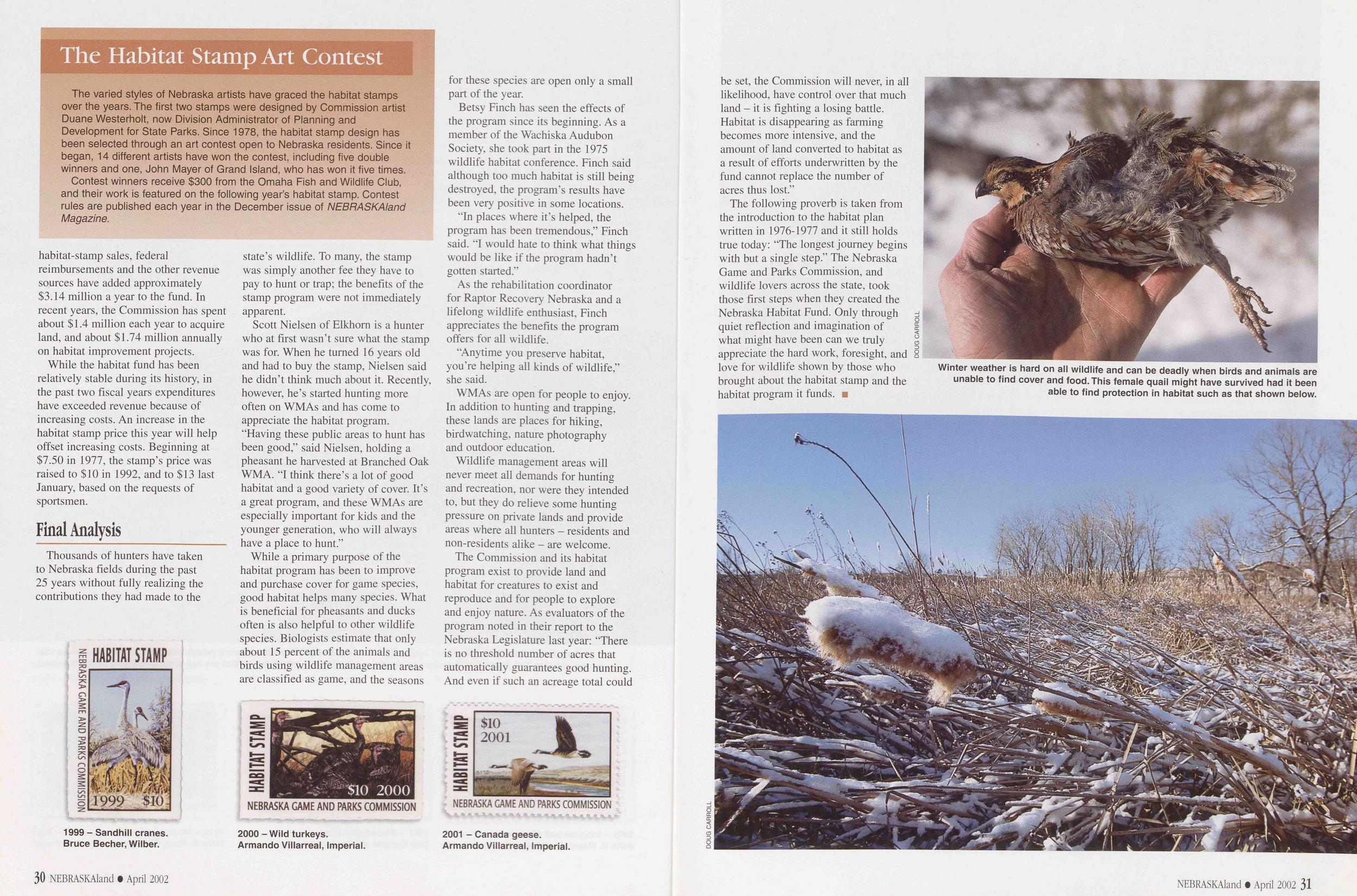 habitat-stamp sales, federal reimbursements and the other revenue sources have added approximately $3.14 million a year to the fund. In recent years, the Commission has spent about $1.4 million each year to acquire land, and about $1.74 million annually on habitat improvement projects.
The Habitat Stamp Art Contest The varied styles of Nebraska artists have graced the habitat stamps over the years. The first two stamps were designed by Commission artist Duane Westerholt, now Division Administrator of Planning and Development for State Parks. Since 1978, the habitat stamp design has been selected through an art contest open to Nebraska residents. Since it began, 14 different artists have won the contest, including five double winners and one, John Mayer of Grand Island, who has won it five times. Contest winners receive $300 from the Omaha Fish and Wildlife Club, and their work is featured on the following year’s habitat stamp. Contest rules are published each year in the December issue of NEBRASKAIand Magazine.
While the habitat fund has been relatively stable during its history, in the past two fiscal years expenditures have exceeded revenue because of increasing costs. An increase in the habitat stamp price this year will help offset increasing costs. Beginning at $7.50 in 1977, the stamp’s price was raised to $10 in 1992, and to $13 last January, based on the requests of sportsmen.
Final AnalysisThousands of hunters have taken to Nebraska fields during the past 25 years without fully realizing the contributions they had made to the state’s wildlife. To many, the stamp was simply another fee they have to pay to hunt or trap; the benefits of the stamp program were not immediately apparent.
Scott Nielsen of Elkhorn is a hunter who at first wasn’t sure what the stamp was for. When he turned 16 years old and had to buy the stamp, Nielsen said he didn’t think much about it. Recently, however, he’s started hunting more often on WMAs and has come to appreciate the habitat program. “Having these public areas to hunt has been good,” said Nielsen, holding a pheasant he harvested at Branched Oak WMA. “I think there’s a lot of good habitat and a good variety of cover. It’s a great program, and these WMAs are especially important for kids and the younger generation, who will always have a place to hunt.”
While a primary purpose of the habitat program has been to improve and purchase cover for game species, good habitat helps many species. What is beneficial for pheasants and ducks often is also helpful to other wildlife species. Biologists estimate that only about 15 percent of the animals and birds using wildlife management areas are classified as game, and the seasons for these species are open only a small part of the year.
Betsy Finch has seen the effects of the program since its beginning. As a member of the Wachiska Audubon Society, she took part in the 1975 wildlife habitat conference. Finch said although too much habitat is still being destroyed, the program’s results have been very positive in some locations.
“In places where it’s helped, the program has been tremendous,” Finch said. “I would hate to think what things would be like if the program hadn’t gotten started.”
As the rehabilitation coordinator for Raptor Recovery Nebraska and a lifelong wildlife enthusiast, Finch appreciates the benefits the program offers for all wildlife.
“Anytime you preserve habitat, you’re helping all kinds of wildlife,” she said.
WMAs are open for people to enjoy. In addition to hunting and trapping, these lands are places for hiking, birdwatching, nature photography and outdoor education.
Wildlife management areas will never meet all demands for hunting and recreation, nor were they intended to, but they do relieve some hunting pressure on private lands and provide areas where all hunters - residents and non-residents alike - are welcome.
The Commission and its habitat program exist to provide land and habitat for creatures to exist and reproduce and for people to explore and enjoy nature. As evaluators of the program noted in their report to the Nebraska Legislature last year: “There is no threshold number of acres that automatically guarantees good hunting. And even if such an acreage total could be set, the Commission will never, in all likelihood, have control over that much land - it is fighting a losing battle. Habitat is disappearing as farming becomes more intensive, and the amount of land converted to habitat as a result of efforts underwritten by the fund cannot replace the number of acres thus lost.”
The following proverb is taken from the introduction to the habitat plan written in 1976-1977 and it still holds true today: “The longest journey begins with but a single step.” The Nebraska Game and Parks Commission, and wildlife lovers across the state, took those first steps when they created the Nebraska Habitat Fund. Only through quiet reflection and imagination of what might have been can we truly appreciate the hard work, foresight, and love for wildlife shown by those who brought about the habitat stamp and the habitat program it funds. ■
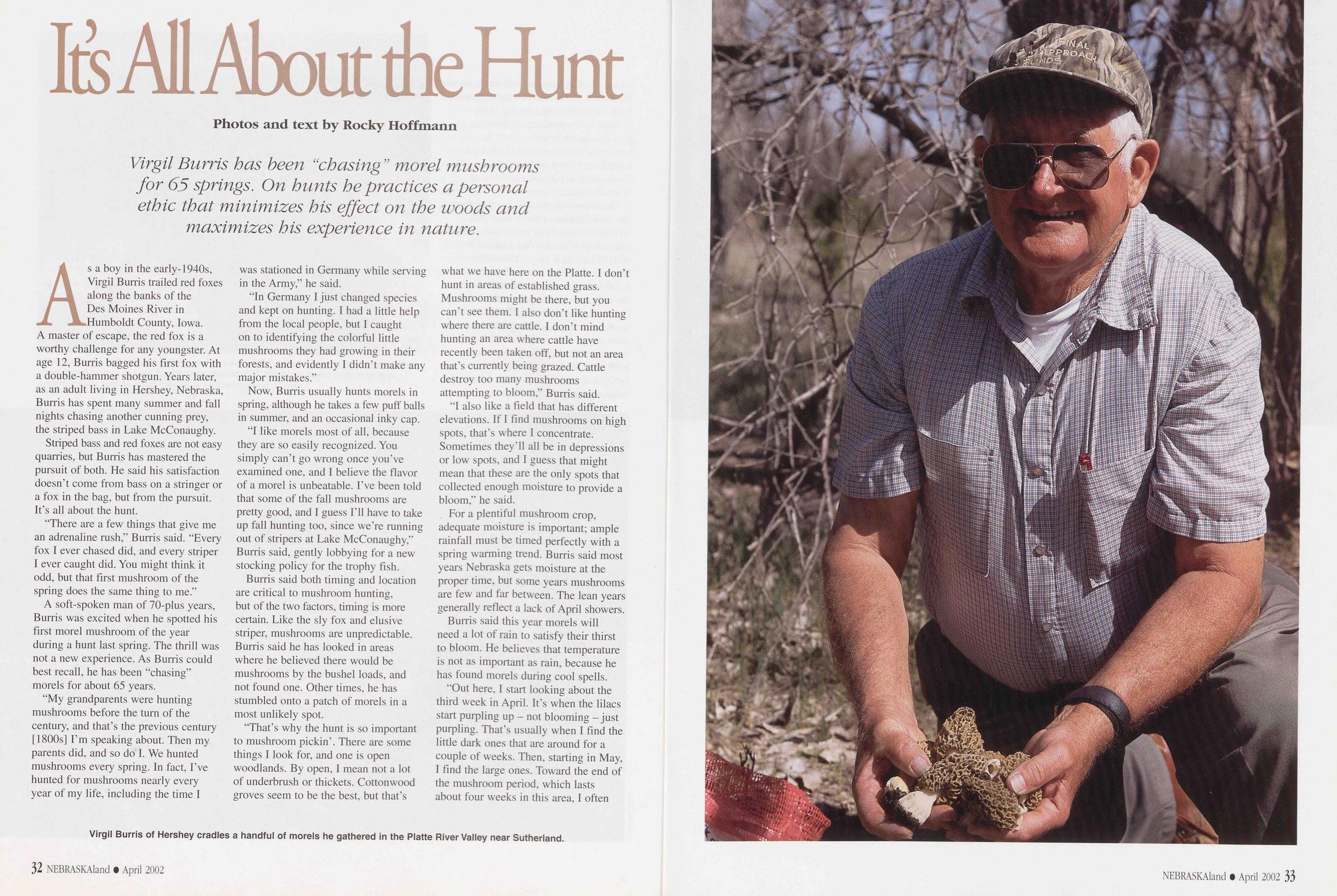
Its All About the Hunt
Virgil Burris has been “chasing” morel mushrooms for 65 springs. On hunts he practices a personal ethic that minimizes his effect on the woods and maximizes his experience in nature.As a boy in the early-1940s, Virgil Burris trailed red foxes along the banks of the Des Moines River in Humboldt County, Iowa. A master of escape, the red fox is a worthy challenge for any youngster. At age 12, Burris bagged his first fox with a double-hammer shotgun. Years later, as an adult living in Hershey, Nebraska, Burris has spent many summer and fall nights chasing another cunning prey, the striped bass in Lake McConaughy.
Striped bass and red foxes are not easy quarries, but Burris has mastered the pursuit of both. He said his satisfaction doesn’t come from bass on a stringer or a fox in the bag, but from the pursuit. It’s all about the hunt.
“There are a few things that give me an adrenaline rush,” Burris said. “Every fox I ever chased did, and every striper I ever caught did. You might think it odd, but that first mushroom of the spring does the same thing to me.”
A soft-spoken man of 70-plus years, Bums was excited when he spotted his first morel mushroom of the year during a hunt last spring. The thrill was not a new experience. As Burris could best recall, he has been “chasing” morels for about 65 years.
“My grandparents were hunting mushrooms before the turn of the century, and that’s the previous century [1800s] I’m speaking about. Then my parents did, and so do I. We hunted mushrooms every spring. In fact, I’ve hunted for mushrooms nearly every year of my life, including the time I was stationed in Germany while serving in the Army,” he said.
“In Germany I just changed species and kept on hunting. I had a little help from the local people, but I caught on to identifying the colorful little mushrooms they had growing in their forests, and evidently I didn’t make any major mistakes.”
Now, Burris usually hunts morels in spring, although he takes a few puff balls in summer, and an occasional inky cap.
“I like morels most of all, because they are so easily recognized. You simply can’t go wrong once you’ve examined one, and I believe the flavor of a morel is unbeatable. I’ve been told that some of the fall mushrooms are pretty good, and I guess I’ll have to take up fall hunting too, since we’re running out of stripers at Lake McConaughy,” Burris said, gently lobbying for a new stocking policy for the trophy fish.
Burris said both timing and location are critical to mushroom hunting, but of the two factors, timing is more certain. Like the sly fox and elusive striper, mushrooms are unpredictable. Burris said he has looked in areas where he believed there would be mushrooms by the bushel loads, and not found one. Other times, he has stumbled onto a patch of morels in a most unlikely spot.
“That’s why the hunt is so important to mushroom pickin’. There are some things I look for, and one is open woodlands. By open, I mean not a lot of underbrush or thickets. Cottonwood groves seem to be the best, but that’s what we have here on the Platte. I don’t hunt in areas of established grass. Mushrooms might be there, but you can’t see them. I also don’t like hunting where there are cattle. I don’t mind hunting an area where cattle have recently been taken off, but not an area that’s currently being grazed. Cattle destroy too many mushrooms attempting to bloom,” Burris said.
“I also like a field that has different elevations. If I find mushrooms on high spots, that’s where I concentrate. Sometimes they’ll all be in depressions or low spots, and I guess that might mean that these are the only spots that collected enough moisture to provide a bloom,” he said.
For a plentiful mushroom crop, adequate moisture is important; ample rainfall must be timed perfectly with a spring warming trend. Burris said most years Nebraska gets moisture at the proper time, but some years mushrooms are few and far between. The lean years generally reflect a lack of April showers.
Burris said this year morels will need a lot of rain to satisfy their thirst to bloom. He believes that temperature is not as important as rain, because he has found morels during cool spells.
“Out here, I start looking about the third week in April. It’s when the lilacs start purpling up - not blooming - just purpling. That’s usually when I find the little dark ones that are around for a couple of weeks. Then, starting in May, I find the large ones. Toward the end of the mushroom period, which lasts about four weeks in this area, I often 32 NEBRASKAland • April 2002
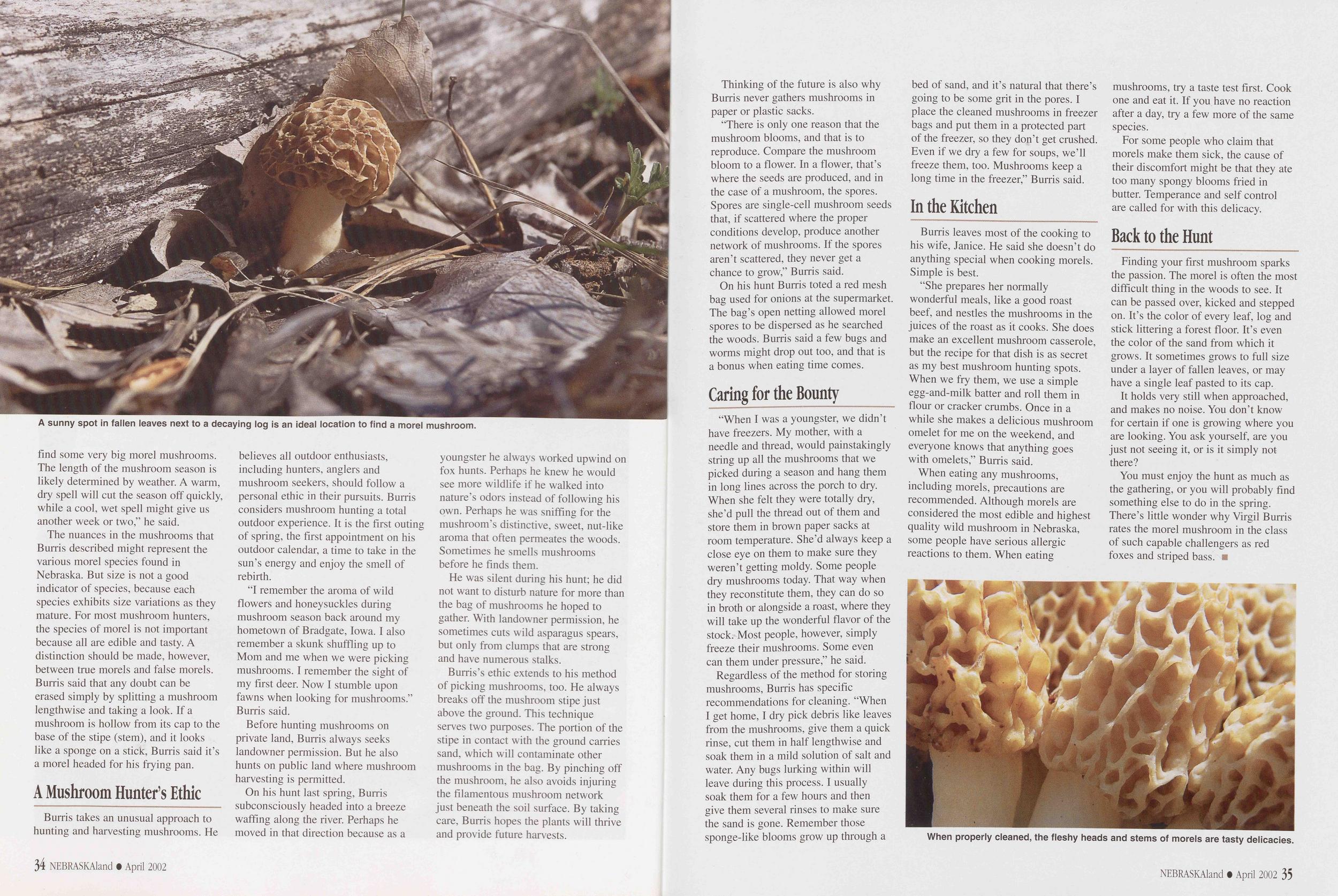
The nuances in the mushrooms that Burris described might represent the various morel species found in Nebraska. But size is not a good indicator of species, because each species exhibits size variations as they mature. For most mushroom hunters, the species of morel is not important because all are edible and tasty. A distinction should be made, however, between true morels and false morels. Burris said that any doubt can be erased simply by splitting a mushroom lengthwise and taking a look. If a mushroom is hollow from its cap to the base of the stipe (stem), and it looks like a sponge on a stick, Burris said it’s a morel headed for his frying pan.
A Mushroom Hunter’s EthicBurris takes an unusual approach to hunting and harvesting mushrooms. He believes all outdoor enthusiasts, including hunters, anglers and mushroom seekers, should follow a personal ethic in their pursuits. Burris considers mushroom hunting a total outdoor experience. It is the first outing of spring, the first appointment on his outdoor calendar, a time to take in the sun’s energy and enjoy the smell of rebirth.
"I remember the aroma of wild flowers and honeysuckles during mushroom season back around my hometown of Bradgate, Iowa. I also remember a skunk shuffling up to Mom and me when we were picking mushrooms. I remember the sight of my first deer. Now I stumble upon fawns when looking for mushrooms.” Burris said.
Before hunting mushrooms on private land, Burris always seeks landowner permission. But he also hunts on public land where mushroom harvesting is permitted.
On his hunt last spring, Burris subconsciously headed into a breeze waffing along the river. Perhaps he moved in that direction because as a youngster he always worked upwind on fox hunts. Perhaps he knew he would see more wildlife if he walked into nature’s odors instead of following his own. Perhaps he was sniffing for the mushroom’s distinctive, sweet, nut-like aroma that often permeates the woods. Sometimes he smells mushrooms before he finds them.
He was silent during his hunt; he did not want to disturb nature for more than the bag of mushrooms he hoped to gather. With landowner permission, he sometimes cuts wild asparagus spears, but only from clumps that are strong and have numerous stalks.
Burris’s ethic extends to his method of picking mushrooms, too. He always breaks off the mushroom stipe just above the ground. This technique serves two purposes. The portion of the stipe in contact with the ground carries sand, which will contaminate other mushrooms in the bag. By pinching off the mushroom, he also avoids injuring the filamentous mushroom network just beneath the soil surface. By taking care, Burris hopes the plants will thrive and provide future harvests.
34 NEBRASKAland • April 2002Thinking of the future is also why Burris never gathers mushrooms in paper or plastic sacks.
“There is only one reason that the mushroom blooms, and that is to reproduce. Compare the mushroom bloom to a flower. In a flower, that’s where the seeds are produced, and in the case of a mushroom, the spores. Spores are single-cell mushroom seeds that, if scattered where the proper conditions develop, produce another network of mushrooms. If the spores aren’t scattered, they never get a chance to grow,” Burris said.
On his hunt Burris toted a red mesh bag used for onions at the supermarket. The bag’s open netting allowed morel spores to be dispersed as he searched the woods. Burris said a few bugs and worms might drop out too, and that is a bonus when eating time comes.
Caring for the Bounty“When I was a youngster, we didn’t have freezers. My mother, with a needle and thread, would painstakingly string up all the mushrooms that we picked during a season and hang them in long lines across the porch to dry. When she felt they were totally dry, she’d pull the thread out of them and store them in brown paper sacks at room temperature. She’d always keep a close eye on them to make sure they weren’t getting moldy. Some people dry mushrooms today. That way when they reconstitute them, they can do so in broth or alongside a roast, where they will take up the wonderful flavor of the stock. Most people, however, simply freeze their mushrooms. Some even can them under pressure,” he said.
Regardless of the method for storing mushrooms, Burris has specific recommendations for cleaning. “When I get home, I dry pick debris like leaves from the mushrooms, give them a quick rinse, cut them in half lengthwise and soak them in a mild solution of salt and water. Any bugs lurking within will leave during this process. I usually soak them for a few hours and then give them several rinses to make sure the sand is gone. Remember those sponge-like blooms grow up through a bed of sand, and it’s natural that there’s going to be some grit in the pores. I place the cleaned mushrooms in freezer bags and put them in a protected part of the freezer, so they don’t get crushed. Even if we dry a few for soups, we’ll freeze them, too. Mushrooms keep a long time in the freezer,” Burris said.
In the KitchenBurris leaves most of the cooking to his wife, Janice. He said she doesn’t do anything special when cooking morels. Simple is best.
“She prepares her normally wonderful meals, like a good roast beef, and nestles the mushrooms in the juices of the roast as it cooks. She does make an excellent mushroom casserole, but the recipe for that dish is as secret as my best mushroom hunting spots. When we fry them, we use a simple egg-and-milk batter and roll them in flour or cracker crumbs. Once in a while she makes a delicious mushroom omelet for me on the weekend, and everyone knows that anything goes with omelets,” Burris said.
When eating any mushrooms, including morels, precautions are recommended. Although morels are considered the most edible and highest quality wild mushroom in Nebraska, some people have serious allergic reactions to them. When eating mushrooms, try a taste test first. Cook one and eat it. If you have no reaction after a day, try a few more of the same species.
For some people who claim that morels make them sick, the cause of their discomfort might be that they ate too many spongy blooms fried in butter. Temperance and self control are called for with this delicacy.
Back to the HuntFinding your first mushroom sparks the passion. The morel is often the most difficult thing in the woods to see. It can be passed over, kicked and stepped on. It’s the color of every leaf, log and stick littering a forest floor. It’s even the color of the sand from which it grows. It sometimes grows to full size under a layer of fallen leaves, or may have a single leaf pasted to its cap.
It holds very still when approached, and makes no noise. You don’t know for certain if one is growing where you are looking. You ask yourself, are you just not seeing it, or is it simply not there?
You must enjoy the hunt as much as the gathering, or you will probably find something else to do in the spring. There’s little wonder why Virgil Burris rates the morel mushroom in the class of such capable challengers as red foxes and striped bass. ■
NEBRASKAland • April 2002 35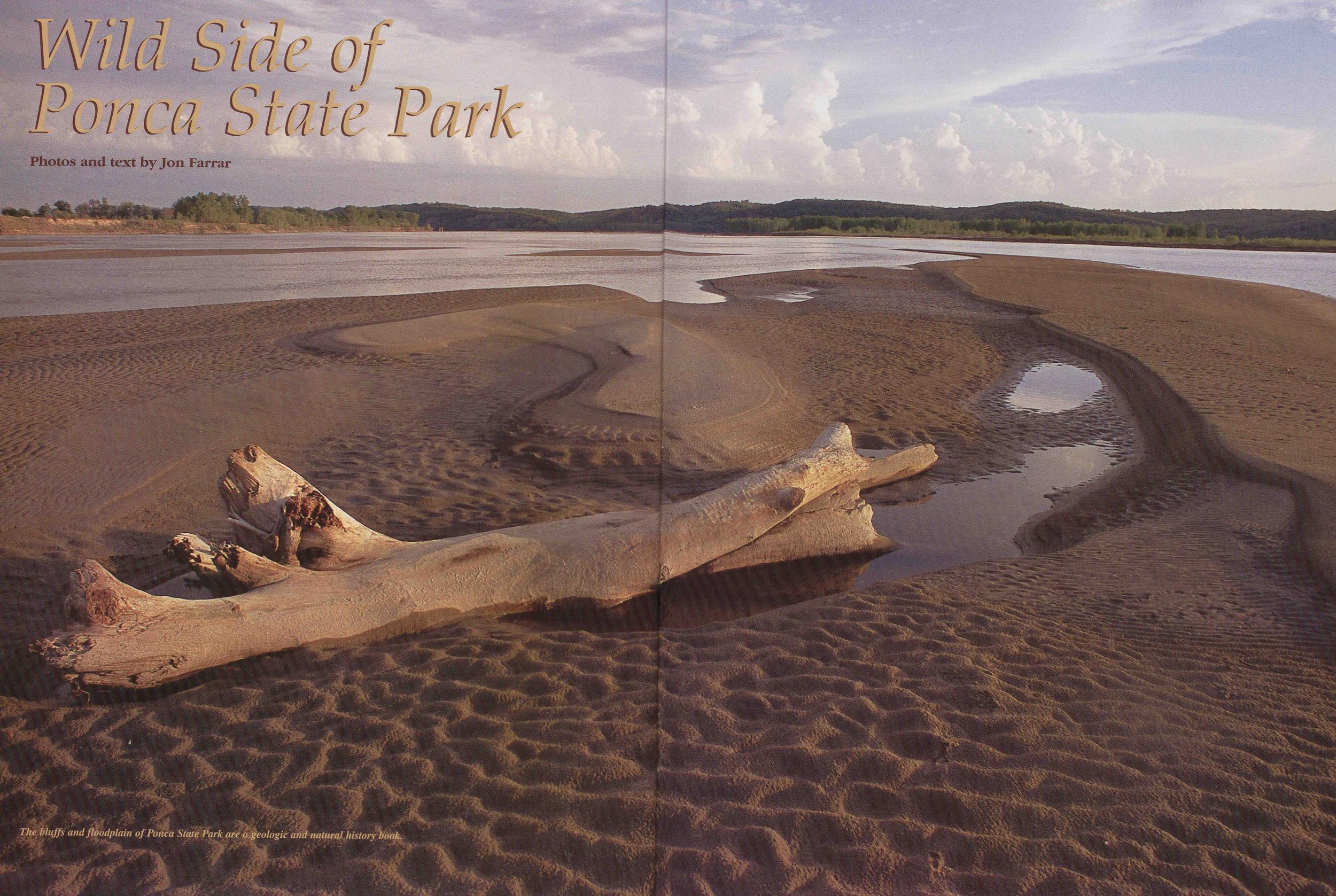
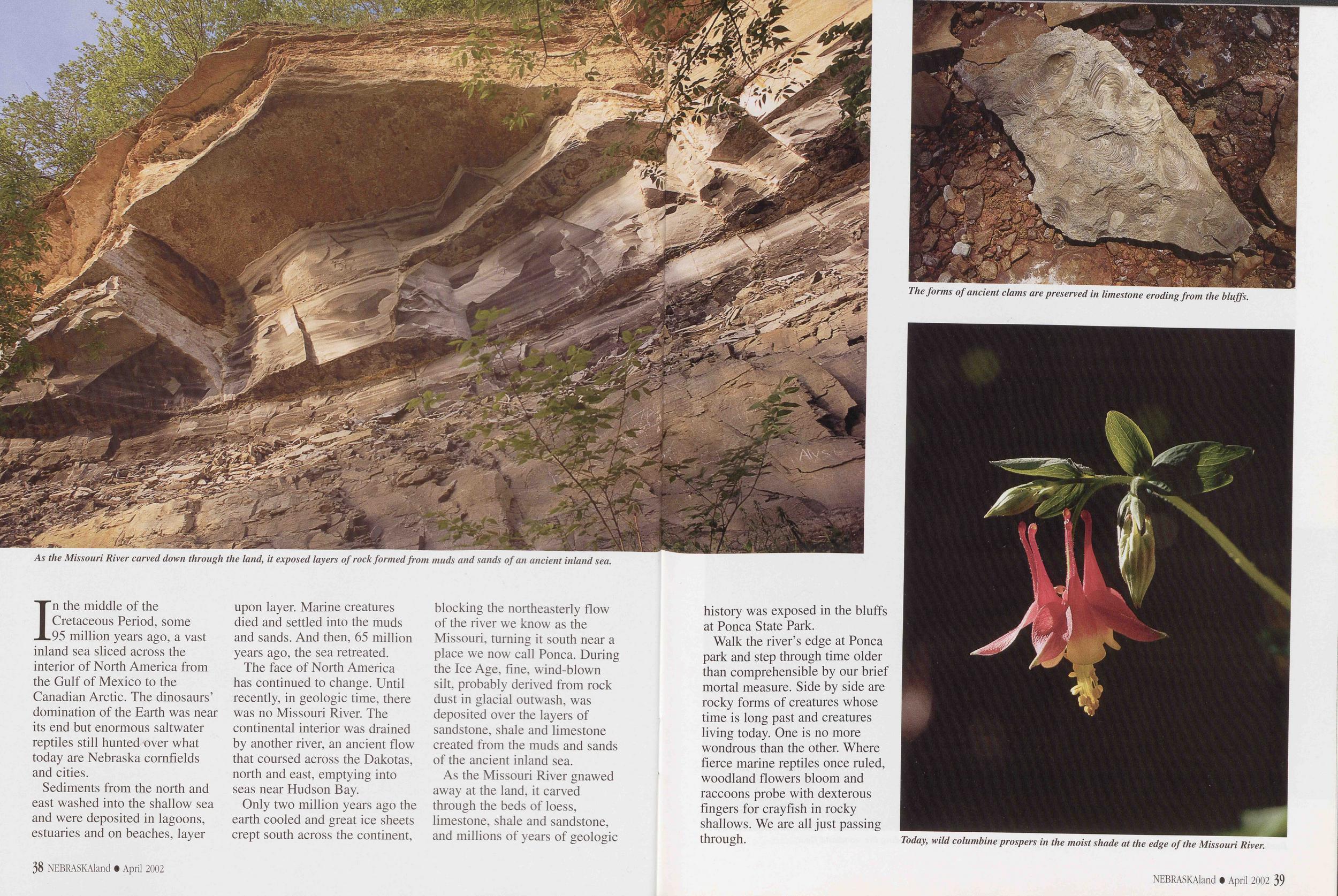
In the middle of the Cretaceous Period, some 95 million years ago, a vast inland sea sliced across the interior of North America from the Gulf of Mexico to the Canadian Arctic. The dinosaurs’ domination of the Earth was near its end but enormous saltwater reptiles still hunted over what today are Nebraska cornfields and cities.
Sediments from the north and east washed into the shallow sea and were deposited in lagoons, estuaries and on beaches, layer upon layer. Marine creatures died and settled into the muds and sands. And then, 65 million years ago, the sea retreated.
The face of North America has continued to change. Until recently, in geologic time, there was no Missouri River. The continental interior was drained by another river, an ancient flow that coursed across the Dakotas, north and east, emptying into seas near Hudson Bay.
Only two million years ago the earth cooled and great ice sheets crept south across the continent, blocking the northeasterly flow of the river we know as the Missouri, turning it south near a place we now call Ponca. During the Ice Age, fine, wind-blown silt, probably derived from rock dust in glacial outwash, was deposited over the layers of sandstone, shale and limestone created from the muds and sands of the ancient inland sea.
As the Missouri River gnawed away at the land, it carved through the beds of loess, limestone, shale and sandstone, and millions of years of geologic 38 NEBRASKA! and • April 2002 history was exposed in the bluffs at Ponca State Park.
Walk the river’s edge at Ponca park and step through time older than comprehensible by our brief mortal measure. Side by side are rocky forms of creatures whose time is long past and creatures living today. One is no more wondrous than the other. Where fierce marine reptiles once ruled, woodland flowers bloom and raccoons probe with dexterous fingers for crayfish in rocky shallows. We are all just passing through.
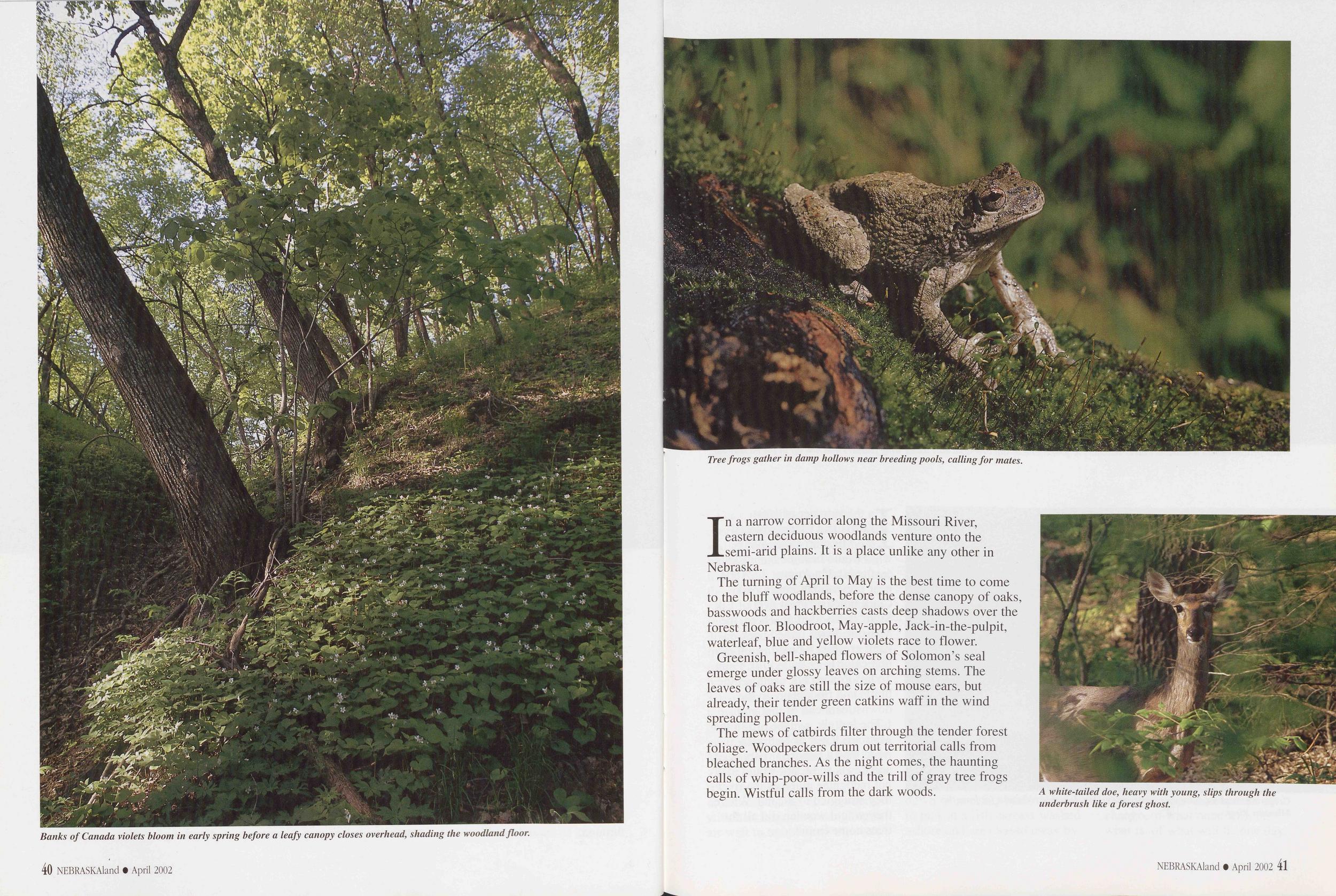
In a narrow corridor along the Missouri River, eastern deciduous woodlands venture onto the semi-arid plains. It is a place unlike any other in Nebraska.
The turning of April to May is the best time to come to the bluff woodlands, before the dense canopy of oaks, basswoods and hackberries casts deep shadows over the forest floor. Bloodroot, May-apple, Jack-in-the-pulpit, waterleaf, blue and yellow violets race to flower.
Greenish, bell-shaped flowers of Solomon’s seal emerge under glossy leaves on arching stems. The leaves of oaks are still the size of mouse ears, but already, their tender green catkins waff in the wind spreading pollen.
The mews of catbirds filter through the tender forest foliage. Woodpeckers drum out territorial calls from bleached branches. As the night comes, the haunting calls of whip-poor-wills and the trill of gray tree frogs begin. Wistful calls from the dark woods.
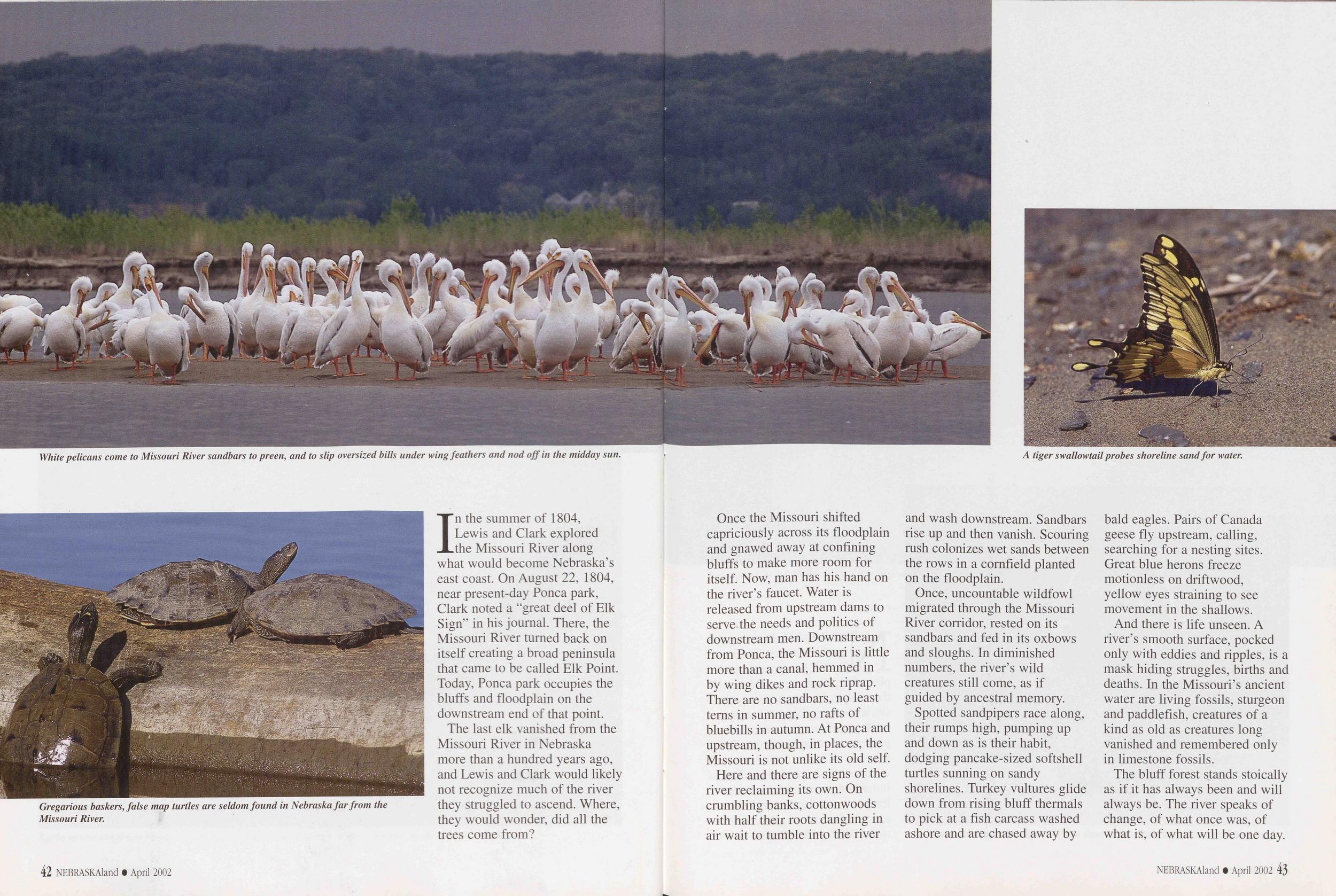
In the summer of 1804, Lewis and Clark explored the Missouri River along what would become Nebraska’s east coast. On August 22, 1804, near present-day Ponca park, Clark noted a “great deel of Elk Sign” in his journal. There, the Missouri River turned back on itself creating a broad peninsula that came to be called Elk Point. Today, Ponca park occupies the bluffs and floodplain on the downstream end of that point.
The last elk vanished from the Missouri River in Nebraska more than a hundred years ago, and Lewis and Clark would likely not recognize much of the river they struggled to ascend. Where, they would wonder, did all the trees come from?
42 NEBRASKAland • April 2002Once the Missouri shifted capriciously across its floodplain and gnawed away at confining bluffs to make more room for itself. Now, man has his hand on the river’s faucet. Water is released from upstream dams to serve the needs and politics of downstream men. Downstream from Ponca, the Missouri is little more than a canal, hemmed in by wing dikes and rock riprap. There are no sandbars, no least terns in summer, no rafts of bluebills in autumn. At Ponca and upstream, though, in places, the Missouri is not unlike its old self.
Here and there are signs of the river reclaiming its own. On crumbling banks, cottonwoods with half their roots dangling in air wait to tumble into the river and wash downstream. Sandbars rise up and then vanish. Scouring rush colonizes wet sands between the rows in a cornfield planted on the floodplain.
Once, uncountable wildfowl migrated through the Missouri River corridor, rested on its sandbars and fed in its oxbows and sloughs. In diminished numbers, the river’s wild creatures still come, as if guided by ancestral memory.
Spotted sandpipers race along, their rumps high, pumping up and down as is their habit, dodging pancake-sized softshell turtles sunning on sandy shorelines. Turkey vultures glide down from rising bluff thermals to pick at a fish carcass washed ashore and are chased away by bald eagles. Pairs of Canada geese fly upstream, calling, searching for a nesting sites. Great blue herons freeze motionless on driftwood, yellow eyes straining to see movement in the shallows.
And there is life unseen. A river’s smooth surface, pocked only with eddies and ripples, is a mask hiding struggles, births and deaths. In the Missouri’s ancient water are living fossils, sturgeon and paddlefish, creatures of a kind as old as creatures long vanished and remembered only in limestone fossils.
The bluff forest stands stoically as if it has always been and will always be. The river speaks of change, of what once was, of what is, of what will be one day.
NEBRASKAland • April 2002 42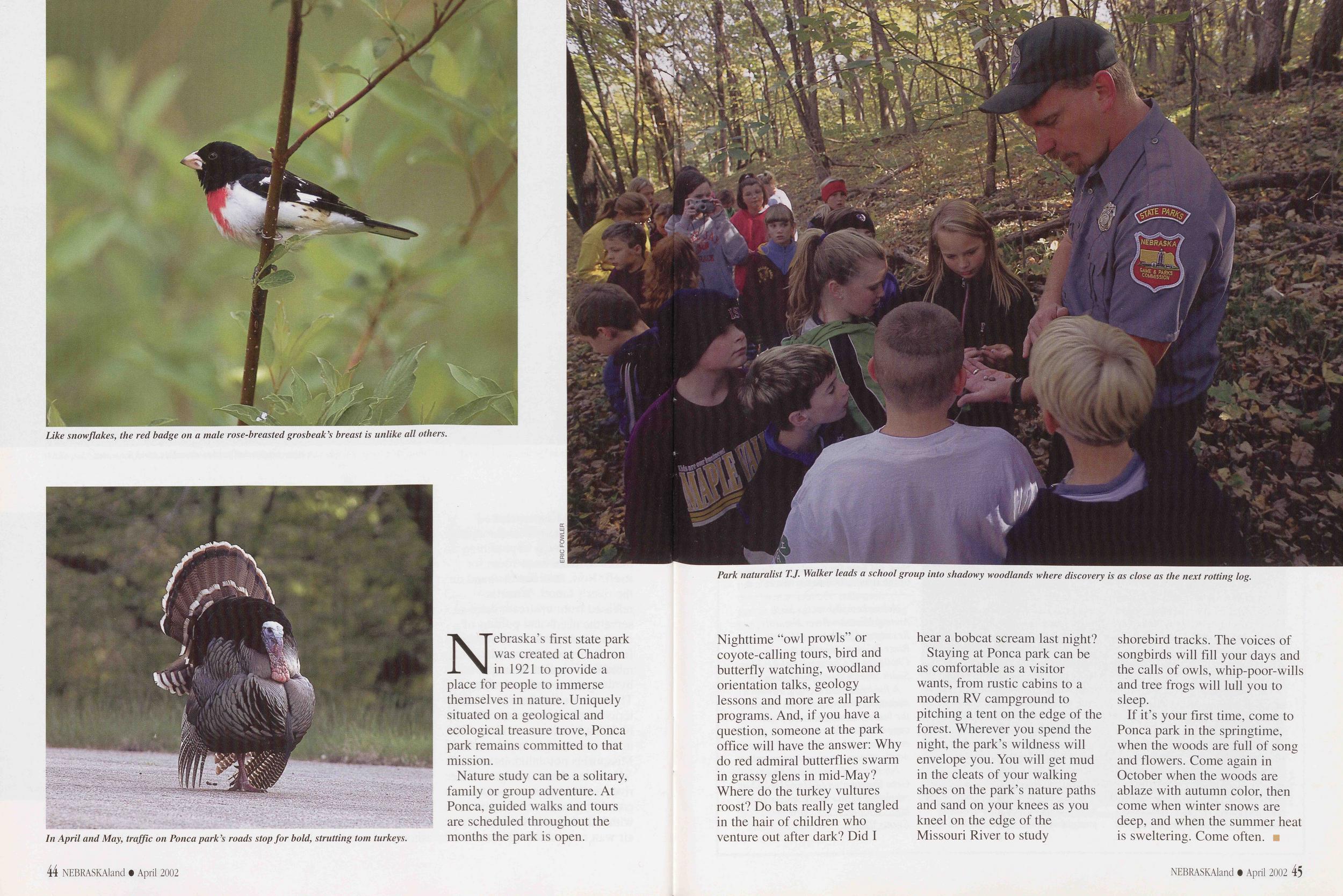
Nebraska’s first state park was created at Chadron in 1921 to provide a place for people to immerse themselves in nature. Uniquely situated on a geological and ecological treasure trove, Ponca park remains committed to that mission.
Nature study can be a solitary, family or group adventure. At Ponca, guided walks and tours are scheduled throughout the months the park is open.
Staying at Ponca park can be as comfortable as a visitor wants, from rustic cabins to a modern RV campground to pitching a tent on the edge of the forest. Wherever you spend the night, the park’s wildness will envelope you. You will get mud in the cleats of your walking shoes on the park’s nature paths and sand on your knees as you kneel on the edge of the Missouri River to study shorebird tracks. The voices of songbirds will fill your days and the calls of owls, whip-poor-wills and tree frogs will lull you to sleep.
If it’s your first time, come to Ponca park in the springtime, when the woods are full of song and flowers. Come again in October when the woods are ablaze with autumn color, then come when winter snows are deep, and when the summer heat is sweltering. Come often. ■
NEBRASKAland • April 2002 45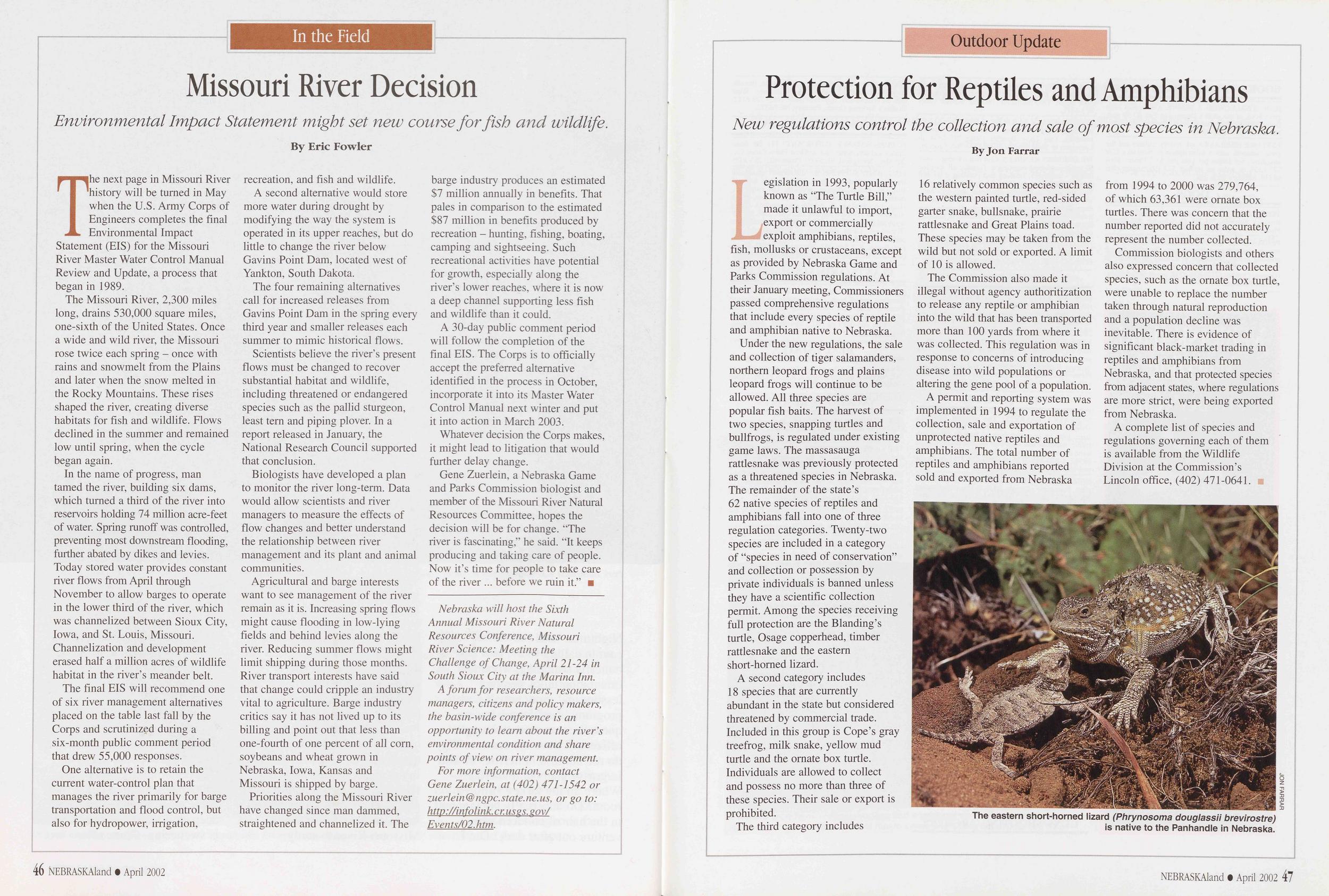
The next page in Missouri River history will be turned in May when the U.S. Army Corps of Engineers completes the final Environmental Impact Statement (EIS) for the Missouri River Master Water Control Manual Review and Update, a process that began in 1989.
The Missouri River, 2,300 miles long, drains 530,000 square miles, one-sixth of the United States. Once a wide and wild river, the Missouri rose twice each spring - once with rains and snowmelt from the Plains and later when the snow melted in the Rocky Mountains. These rises shaped the river, creating diverse habitats for fish and wildlife. Flows declined in the summer and remained low until spring, when the cycle began again.
In the name of progress, man tamed the river, building six dams, which turned a third of the river into reservoirs holding 74 million acre-feet of water. Spring runoff was controlled, preventing most downstream flooding, further abated by dikes and levies. Today stored water provides constant river flows from April through November to allow barges to operate in the lower third of the river, which was channelized between Sioux City, Iowa, and St. Louis, Missouri. Channelization and development erased half a million acres of wildlife habitat in the river’s meander belt.
The final EIS will recommend one of six river management alternatives placed on the table last fall by the Corps and scrutinized during a six-month public comment period that drew 55,000 responses.
One alternative is to retain the current water-control plan that manages the river primarily for barge transportation and flood control, but also for hydropower, irrigation, recreation, and fish and wildlife.
A second alternative would store more water during drought by modifying the way the system is operated in its upper reaches, but do little to change the river below Gavins Point Dam, located west of Yankton, South Dakota.
The four remaining alternatives call for increased releases from Gavins Point Dam in the spring every third year and smaller releases each summer to mimic historical flows.
Scientists believe the river’s present flows must be changed to recover substantial habitat and wildlife, including threatened or endangered species such as the pallid sturgeon, least tern and piping plover. In a report released in January, the National Research Council supported that conclusion.
Biologists have developed a plan to monitor the river long-term. Data would allow scientists and river managers to measure the effects of flow changes and better understand the relationship between river management and its plant and animal communities.
Agricultural and barge interests want to see management of the river remain as it is. Increasing spring flows might cause flooding in low-lying fields and behind levies along the river. Reducing summer flows might limit shipping during those months. River transport interests have said that change could cripple an industry vital to agriculture. Barge industry critics say it has not lived up to its billing and point out that less than one-fourth of one percent of all corn, soybeans and wheat grown in Nebraska, Iowa, Kansas and Missouri is shipped by barge.
Priorities along the Missouri River have changed since man dammed, straightened and channelized it. The barge industry produces an estimated $7 million annually in benefits. That pales in comparison to the estimated $87 million in benefits produced by recreation - hunting, fishing, boating, camping and sightseeing. Such recreational activities have potential for growth, especially along the river’s lower reaches, where it is now a deep channel supporting less fish and wildlife than it could.
A 30-day public comment period will follow the completion of the final EIS. The Corps is to officially accept the preferred alternative identified in the process in October, incorporate it into its Master Water Control Manual next winter and put it into action in March 2003.
Whatever decision the Corps makes, it might lead to litigation that would further delay change.
Gene Zuerlein, a Nebraska Game and Parks Commission biologist and member of the Missouri River Natural Resources Committee, hopes the decision will be for change. "The river is fascinating,” he said. "It keeps producing and taking care of people. Now it’s time for people to take care of the river ... before we ruin it.” ■
Nebraska will host the Sixth Annual Missouri River Natural Resources Conference, Missouri River Science: Meeting the Challenge of Change, April 21-24 in South Sioux City at the Marina Inn. A forum for researchers, resource managers, citizens and policy makers, the basin-wide conference is an opportunity to learn about the river’s environmental condition and share points of view on river management. For more information, contact Gene Zuerlein, at (402) 471-1542 or zuerlein@ngpc.state.ne.us, or go to: http: //infolink, cr usgs. gov/ EventsZ02.htm. 46 NEBRASKAland • April 2002 Outdoor Update Protection for Reptiles and Amphibians New regulations control the collection and sale of most species in Nebraska. By Jon FarrarLegislation in 1993, popularly known as "The Turtle Bill,” made it unlawful to import, .export or commercially exploit amphibians, reptiles, fish, mollusks or crustaceans, except as provided by Nebraska Game and Parks Commission regulations. At their January meeting, Commissioners passed comprehensive regulations that include every species of reptile and amphibian native to Nebraska.
Under the new regulations, the sale and collection of tiger salamanders, northern leopard frogs and plains leopard frogs will continue to be allowed. All three species are popular fish baits. The harvest of two species, snapping turtles and bullfrogs, is regulated under existing game laws. The massasauga rattlesnake was previously protected as a threatened species in Nebraska. The remainder of the state’s 62 native species of reptiles and amphibians fall into one of three regulation categories. Twenty-two species are included in a category of "species in need of conservation” and collection or possession by private individuals is banned unless they have a scientific collection permit. Among the species receiving full protection are the Blanding’s turtle, Osage copperhead, timber rattlesnake and the eastern short-horned lizard.
A second category includes 18 species that are currently abundant in the state but considered threatened by commercial trade. Included in this group is Cope’s gray treefrog, milk snake, yellow mud turtle and the ornate box turtle. Individuals are allowed to collect and possess no more than three of these species. Their sale or export is prohibited.
The third category includes 16 relatively common species such as the western painted turtle, red-sided garter snake, bullsnake, prairie rattlesnake and Great Plains toad. These species may be taken from the wild but not sold or exported. A limit of 10 is allowed.
The Commission also made it illegal without agency authoritization to release any reptile or amphibian into the wild that has been transported more than 100 yards from where it was collected. This regulation was in response to concerns of introducing disease into wild populations or altering the gene pool of a population.
A permit and reporting system was implemented in 1994 to regulate the collection, sale and exportation of unprotected native reptiles and amphibians. The total number of reptiles and amphibians reported sold and exported from Nebraska from 1994 to 2000 was 279,764, of which 63,361 were ornate box turtles. There was concern that the number reported did not accurately represent the number collected.
Commission biologists and others also expressed concern that collected species, such as the ornate box turtle, were unable to replace the number taken through natural reproduction and a population decline was inevitable. There is evidence of significant black-market trading in reptiles and amphibians from Nebraska, and that protected species from adjacent states, where regulations are more strict, were being exported from Nebraska.
A complete list of species and regulations governing each of them is available from the Wildlife Division at the Commission’s Lincoln office, (402) 471-0641.
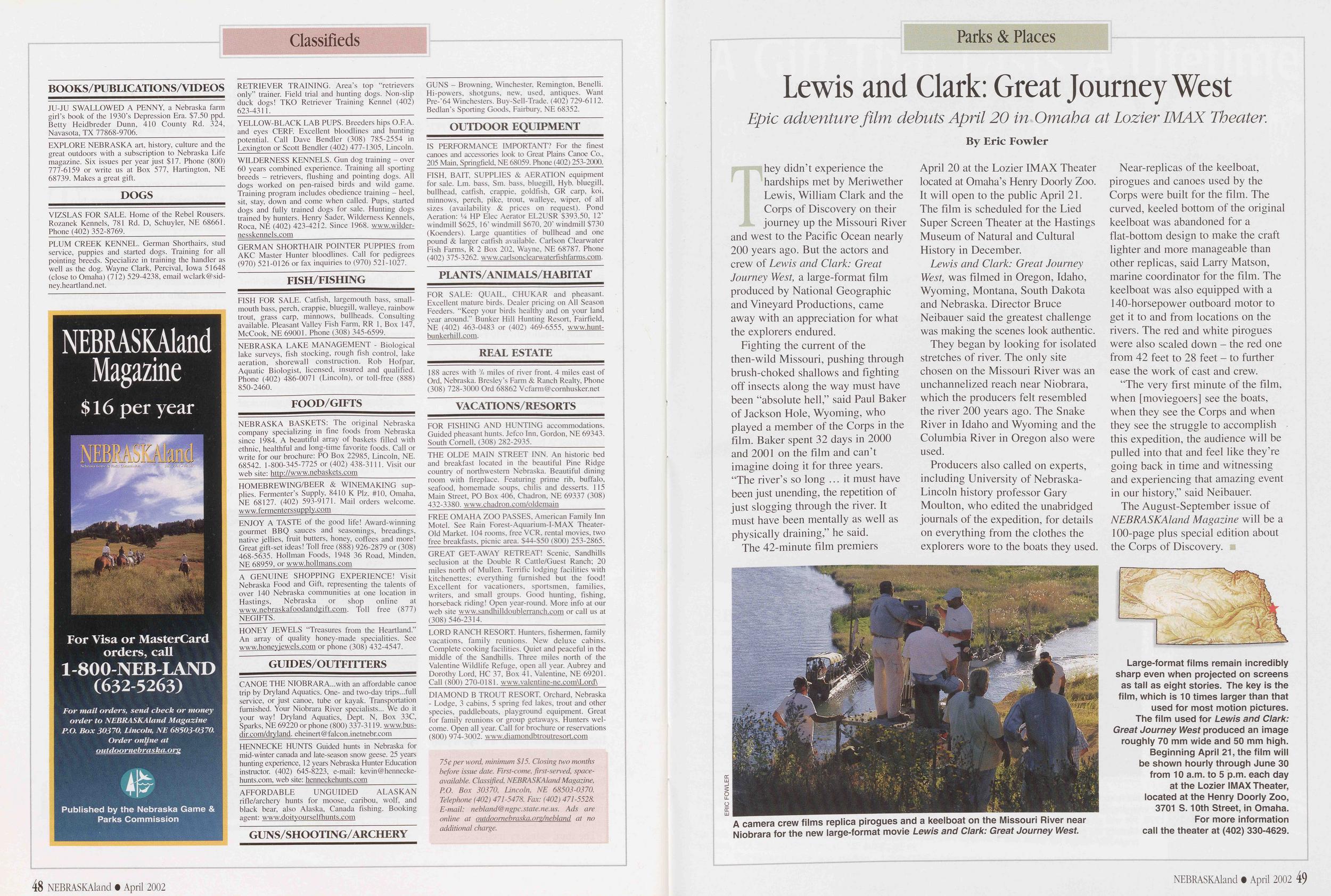
Classifieds
BOOKS/PUBLICATION S/VIDEOSJU-JU SWALLOWED A PENNY, a Nebraska farm girl’s book of the 1930’s Depression Era. $7.50 ppd. Betty Heidbreder Dunn, 410 County Rd. 324, Navasota, TX 77868-9706.
EXPLORE NEBRASKA art, history, culture and the great outdoors with a subscription to Nebraska Life magazine. Six issues per year just $17. Phone (800) 777-6159 or write us at Box 577, Hartington, NE 68739. Makes a great gift.
DOGSVIZSLAS FOR SALE. Home of the Rebel Rousers. Rozanek Kennels, 781 Rd. D, Schuyler, NE 68661. Phone (402) 352-8769.
PLUM CREEK KENNEL. German Shorthairs, stud service, puppies and started dogs. Training for all pointing breeds. Specialize in training the handler as well as the dog. Wayne Clark, Percival, Iowa 51648 (close to Omaha) (712) 529-4238, email wclark@sid- ney.heartland.net.
NEBRASKAland Magazine $16 per year For Visa or MasterCard orders, call 1-800-NEB-LAND (632-5263) For mail orders, send check or money order to NEBRASKAland Magazine P.O. Box 30370, Lincoln, NE 68503-0370. Order online at outdoornebraska. ors Published by the Nebraska Game & Parks CommissionRETRIEVER TRAINING. Area’s top “retrievers only” trainer. Field trial and hunting dogs. Non-slip duck dogs! TKO Retriever Training Kennel (402) 623-4311.
YELLOW-BLACK LAB PUPS. Breeders hips O.F.A. and eyes CERF. Excellent bloodlines and hunting potential. Call Dave Bendler (308) 785-2554 in Lexington or Scott Bendler (402) 477-1305, Lincoln.
WILDERNESS KENNELS. Gun dog training - over 60 years combined experience. Training all sporting breeds - retrievers, flushing and pointing dogs. All dogs worked on pen-raised birds and wild game. Training program includes obedience training - heel, sit, stay, down and come when called. Pups, started dogs and fully trained dogs for sale. Hunting dogs trained by hunters. Henry Sader, Wilderness Kennels, Roca, NE (402) 423-4212. Since 1968. www.wilder- nesskennels.com
GERMAN SHORTHAIR POINTER PUPPIES from AKC Master Hunter bloodlines. Call for pedigrees (970) 521-0126 or fax inquiries to (970) 521-1027.
FISH/FISHINGFISH FOR SALE. Catfish, largemouth bass, small- mouth bass, perch, crappie, bluegill, walleye, rainbow trout, grass carp, minnows, bullheads. Consulting available. Pleasant Valley Fish Farm, RR 1, Box 147, McCook, NE 69001. Phone (308) 345-6599.
NEBRASKA LAKE MANAGEMENT - Biological lake surveys, fish stocking, rough fish control, lake aeration, shorewall construction. Rob Hofpar, Aquatic Biologist, licensed, insured and qualified. Phone (402) 486-0071 (Lincoln), or toll-free (888) 850-2460.
FOOD/GIFTSNEBRASKA BASKETS: The original Nebraska company specializing in fine foods from Nebraska since 1984. A beautiful array of baskets filled with ethnic, healthful and long-time favorite foods. Call or write for our brochure: PO Box 22985, Lincoln, NE. 68542. 1-800-345-7725 or (402) 438-3111. Visit our web site: http://www.nebaskets.com
HOMEBREWING/BEER & WINEMAKING sup- plies. Fermenter’s Supply, 8410 K Plz. #10, Omaha, NE 68127. (402) 593-9171. Mail orders welcome. www.fermenterssupply.com
ENJOY A TASTE of the good life! Award-winning gourmet BBQ sauces and seasonings, breadings, native jellies, fruit butters, honey, coffees and more! Great gift-set ideas! Toll free (888) 926-2879 or (308) 468-5635. Hollman Foods, 1948 36 Road, Minden, NE 68959, or www.hollmans.com
A GENUINE SHOPPING EXPERIENCE! Visit Nebraska Food and Gift, representing the talents of over 140 Nebraska communities at one location in Hastings, Nebraska or shop online at www.nebraskafoodandgift.com. Toll free (877) NEGIFTS.
HONEY JEWELS “Treasures from the Heartland.” An array of quality honey-made specialities. See www.honeviewels.com or phone (308) 432-4547.
GUIDES/OUTFITTERSCANOE THE NIOBRARA...with an affordable canoe trip by Dryland Aquatics. One- and two-day trips...full service, or just canoe, tube or kayak. Transportation furnished. Your Niobrara River specialists... We do it your way! Dryland Aquatics, Dept. N, Box 33C, Sparks, NE 69220 or phone (800) 337-3119. www.bus- dir.com/drvland. eheinert@falcon.inetnebr.com
HENNECKE HUNTS Guided hunts in Nebraska for mid-winter Canada and late-season snow geese. 25 years hunting experience, 12 years Nebraska Hunter Education instructor. (402) 645-8223, e-mail: kevin@hennecke- hunts.com, web site: henneckehunts.com
AFFORDABLE UNGUIDED ALASKAN rifle/archery hunts for moose, caribou, wolf, and black bear, also Alaska, Canada fishing. Booking agent: www.doityourselfhunts.com
GUNS/SHOOTING/ARCHERYGUNS - Browning, Winchester. Remington, Benelli. Hi-powers, shotguns, new, used, antiques. Want Pre-’64 Winchesters. Buy-Sell-Trade. (402) 729-6112. Bedlan’s Sporting Goods, Fairbury, NE 68352.
OUTDOOR EQUIPMENTIS PERFORMANCE IMPORTANT? For the finest canoes and accessories look to Great Plains Canoe Co., 205 Main, Springfield, NE 68059. Phone (402) 253-2000,
FISH, BAIT, SUPPLIES & AERATION equipment for sale. Lm. bass, Sm. bass, bluegill, Hyb. bluegill, bullhead, catfish, crappie, goldfish, GR carp, koi, minnows, perch, pike, trout, walleye, wiper, of all sizes (availability & prices on request). Pond Aeration: lA HP Elec Aerator EL2USR $393.50, 12’ windmill $625, 16’ windmill $670, 20’ windmill $730 (Koenders). Large quantities of bullhead and one pound & larger catfish available. Carlson Clearwater Fish Farms, R 2 Box 202, Wayne, NE 68787. Phone (402) 375-3262. www.carlsonclearwaterfishfarms.com.
PLANTS/ANIMALS/HABITATFOR SALE: QUAIL, CHUKAR and pheasant. Excellent mature birds. Dealer pricing on All Season Feeders. “Keep your birds healthy and on your land year around.” Bunker Hill Hunting Resort, Fairfield, NE (402) 463-0483 or (402) 469-6555, www.hunt- bunkerhill.com.
REAL ESTATE188 acres with 34 miles of river front. 4 miles east of Ord, Nebraska. Bresley’s Farm &Ranch Realty, Phone (308) 728-3000 Ord 68862 Vcfarm@comhusker.net
VACATION S/RESORTSFOR FISHING AND HUNTING accommodations. Guided pheasant hunts. Jefco Inn, Gordon, NE 69343. South Cornell, (308) 282-2935.
THE OLDE MAIN STREET INN. An historic bed and breakfast located in the beautiful Pine Ridge country of northwestern Nebraska. Beautiful dining room with fireplace. Featuring prime rib, buffalo, seafood, homemade soups, chilis and desserts. 115 Main Street, PO Box 406, Chadron, NE 69337 (308) 432-3380. www.chadron.com/oldemain
FREE OMAHA ZOO PASSES, American Family Inn Motel. See Rain Forest-Aquarium-I-MAX Theater- Old Market. 104 rooms, free VCR, rental movies, two free breakfasts, picnic area. $44-$50 (800) 253-2865.
GREAT GET-AWAY RETREAT! Scenic, Sandhills seclusion at the Double R Cattle/Guest Ranch; 20 miles north of Mullen. Terrific lodging facilities with kitchenettes; everything furnished but the food! Excellent for vacationers, sportsmen, families, writers, and small groups. Good hunting, fishing, horseback riding! Open year-round. More info at our web site www.sandhilldoublerranch.com or call us at (308) 546-2314,
LORD RANCH RESORT. Hunters, fishermen, family vacations, family reunions. New deluxe cabins. Complete cooking facilities. Quiet and peaceful in the middle of the Sandhills. Three miles north of the Valentine Wildlife Refuge, open all year. Aubrey and Dorothy Lord, HC 37, Box 41. Valentine, NE 69201. Call (800) 270-0181. www.valentine-ne.com\Lord\
DIAMOND B TROUT RESORT, Orchard, Nebraska - Lodge, 3 cabins, 5 spring fed lakes, trout and other species, paddleboats, playground equipment. Great for family reunions or group getaways. Hunters wel- come. Open all year. Call for brochure or reservations (800) 974-3002. www.diamondbtroutresort.com
75 per word, minimum $15. Closing two months before issue date. First-come, first-served, space- available. Classified, NEBRASKAland Magazine, P.O. Box 30370, Lincoln, NE 68503-0370. Telephone (402) 471-5478. Fax: (402) 471-5528. E-mail: nebland@ngpc.state.ne.us. Ads are online at outdoornebraska. org/nebland at no additional charge. 48 NEBRASKAland • April 2002 Parks & Places Lewis and Clark: Great Journey West Epic adventure film debuts April 20 in Omaha at Lozier IMAX Theater. By Eric FowlerThey didn’t experience the hardships met by Meriwether Lewis, William Clark and the Corps of Discovery on their journey up the Missouri River and west to the Pacific Ocean nearly 200 years ago. But the actors and crew of Lewis and Clark: Great Journey West, a large-format film produced by National Geographic and Vineyard Productions, came away with an appreciation for what the explorers endured.
Fighting the current of the then-wild Missouri, pushing through brush-choked shallows and fighting off insects along the way must have been “absolute hell,” said Paul Baker of Jackson Hole, Wyoming, who played a member of the Corps in the film. Baker spent 32 days in 2000 and 2001 on the film and can’t imagine doing it for three years. “The river’s so long ... it must have been just unending, the repetition of just slogging through the river. It must have been mentally as well as physically draining,” he said.
The 42-minute film premiers April 20 at the Lozier IMAX Theater located at Omaha’s Henry Doorly Zoo. It will open to the public April 21. The film is scheduled for the Lied Super Screen Theater at the Hastings Museum of Natural and Cultural History in December.
Lewis and Clark: Great Journey West, was filmed in Oregon, Idaho, Wyoming, Montana, South Dakota and Nebraska. Director Bruce Neibauer said the greatest challenge was making the scenes look authentic.
They began by looking for isolated stretches of river. The only site chosen on the Missouri River was an unchannelized reach near Niobrara, which the producers felt resembled the river 200 years ago. The Snake River in Idaho and Wyoming and the Columbia River in Oregon also were used.
Producers also called on experts, including University of Nebraska- Lincoln history professor Gary Moulton, who edited the unabridged journals of the expedition, for details on everything from the clothes the explorers wore to the boats they used.
Near-replicas of the keelboat, pirogues and canoes used by the Corps were built for the film. The curved, keeled bottom of the original keelboat was abandoned for a flat-bottom design to make the craft lighter and more manageable than other replicas, said Larry Matson, marine coordinator for the film. The keelboat was also equipped with a 140-horsepower outboard motor to get it to and from locations on the rivers. The red and white pirogues were also scaled down - the red one from 42 feet to 28 feet - to further ease the work of cast and crew.
“The very first minute of the film, when [moviegoers] see the boats, when they see the Corps and when they see the struggle to accomplish this expedition, the audience will be pulled into that and feel like they’re going back in time and witnessing and experiencing that amazing event in our history,” said Neibauer.
The August-September issue of NEBRASKAland Magazine will be a 100-page plus special edition about the Corps of Discovery.
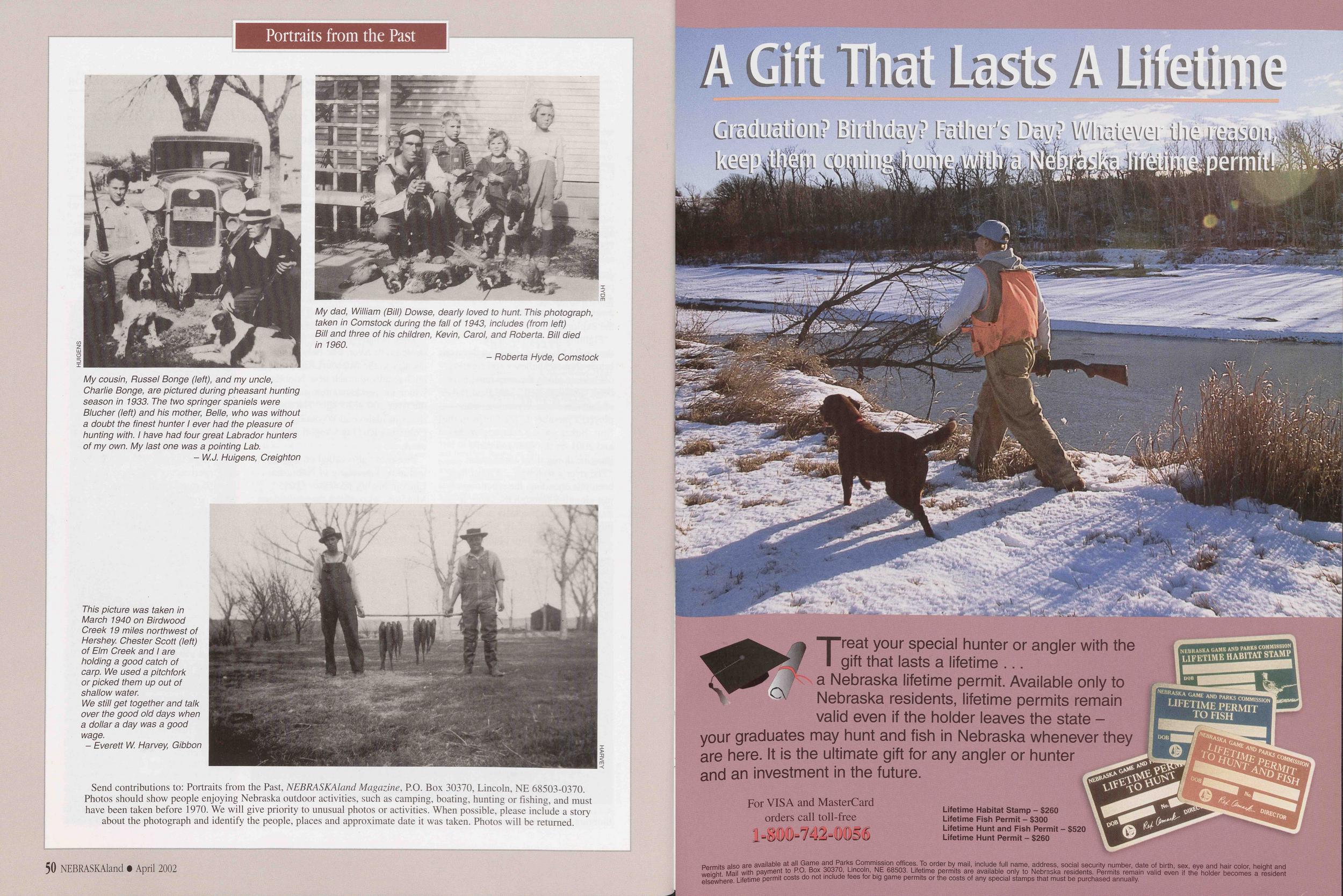
My dad, William (Bill) Dowse, dearly loved to hunt. This photograph, taken in Comstock during the fall of 1943, includes (from left) Bill and three of his children, Kevin, Carol, and Roberta. Bill died in 1960.
- Roberta Hyde, ComstockMy cousin, Russel Bonge (left), and my uncle, Charlie Bonge, are pictured during pheasant hunting season in 1933. The two springer spaniels were Blucher (left) and his mother, Belle, who was without a doubt the finest hunter I ever had the pleasure of hunting with. I have had four great Labrador hunters of my own. My last one was a pointing Lab.
-W.J. Huigens, CreightonThis picture was taken in March 1940 on Birdwood Creek 19 miles northwest of Hershey. Chester Scott (left) of Elm Creek and I are holding a good catch of carp. We used a pitchfork or picked them up out of shallow water. We still get together and talk over the good old days when a dollar a day was a good wage.
- Everett W. Harvey, GibbonSend contributions to: Portraits from the Past, NEBRASKAland Magazine, P.O. Box 30370, Lincoln, NE 68503-0370. Photos should show people enjoying Nebraska outdoor activities, such as camping, boating, hunting or fishing, and must have been taken before 1970. We will give priority to unusual photos or activities. When possible, please include a story about the photograph and identify the people, places and approximate date it was taken. Photos will be returned.
50 NEBRASKAland • April 2002 A Gift That Lasts A Lifetime Graduation? Birthday? Father's Dav? Whaever the reason keep them coming home with a Nebraska lifetime permit! Treat your special hunter or angler with the gift that lasts a lifetime ... a Nebraska lifetime permit. Available only to Nebraska residents, lifetime permits remain valid even if the holder leaves the state - your graduates may hunt and fish in Nebraska whenever they are here. It is the ultimate gift for any angler or hunter and an investment in the future. For VISA and MasterCard orders call toll-free Lifetime Habitat Stamp - $260 Lifetime Fish Permit - $300 Lifetime Hunt and Fish Permit - $520 Lifetime Hunt Permit - $260 COMMISSION Permits also are available at all Game and Parks Commission offices. To order by mail, include full name, address, social security number, date of birth, sex, eye and hair color, height and weight. Mail with payment to P.O. Box 30J70, Lincoln, NE 68503. Lifetime permits are available only to Nebraska residents. Permits remain valid even if the holder becomes a resident elsewhere. Lifetime permit costs do not include fees for big game permits or the costs of any special stamps that must be purchased annually.
Position: 252 (32 views)