Volume 80, Issue 2, 2002
Nebraskaland
Nebraska Game & Parks Commission March 2002 $2.50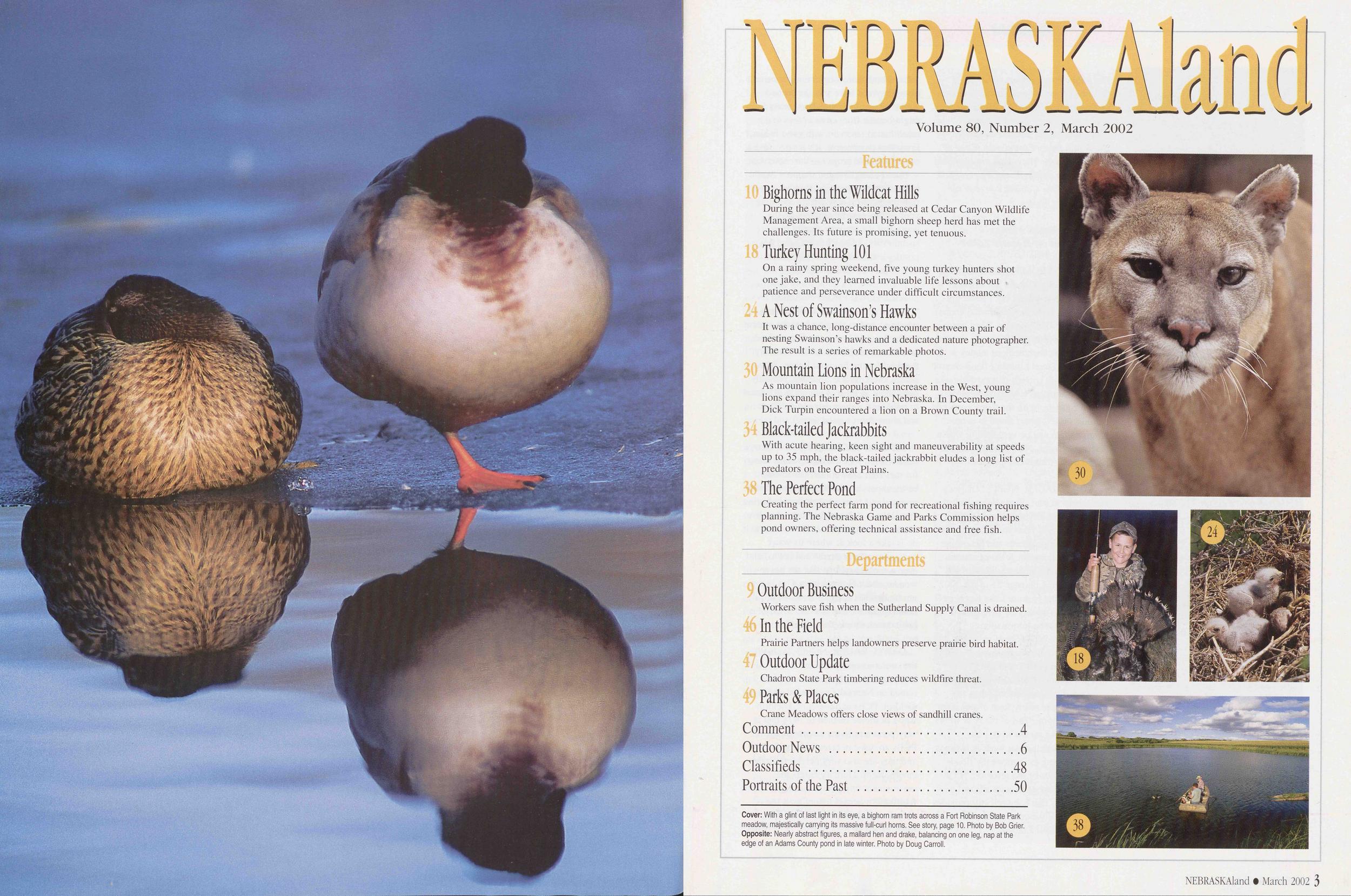
NEBRASKAland
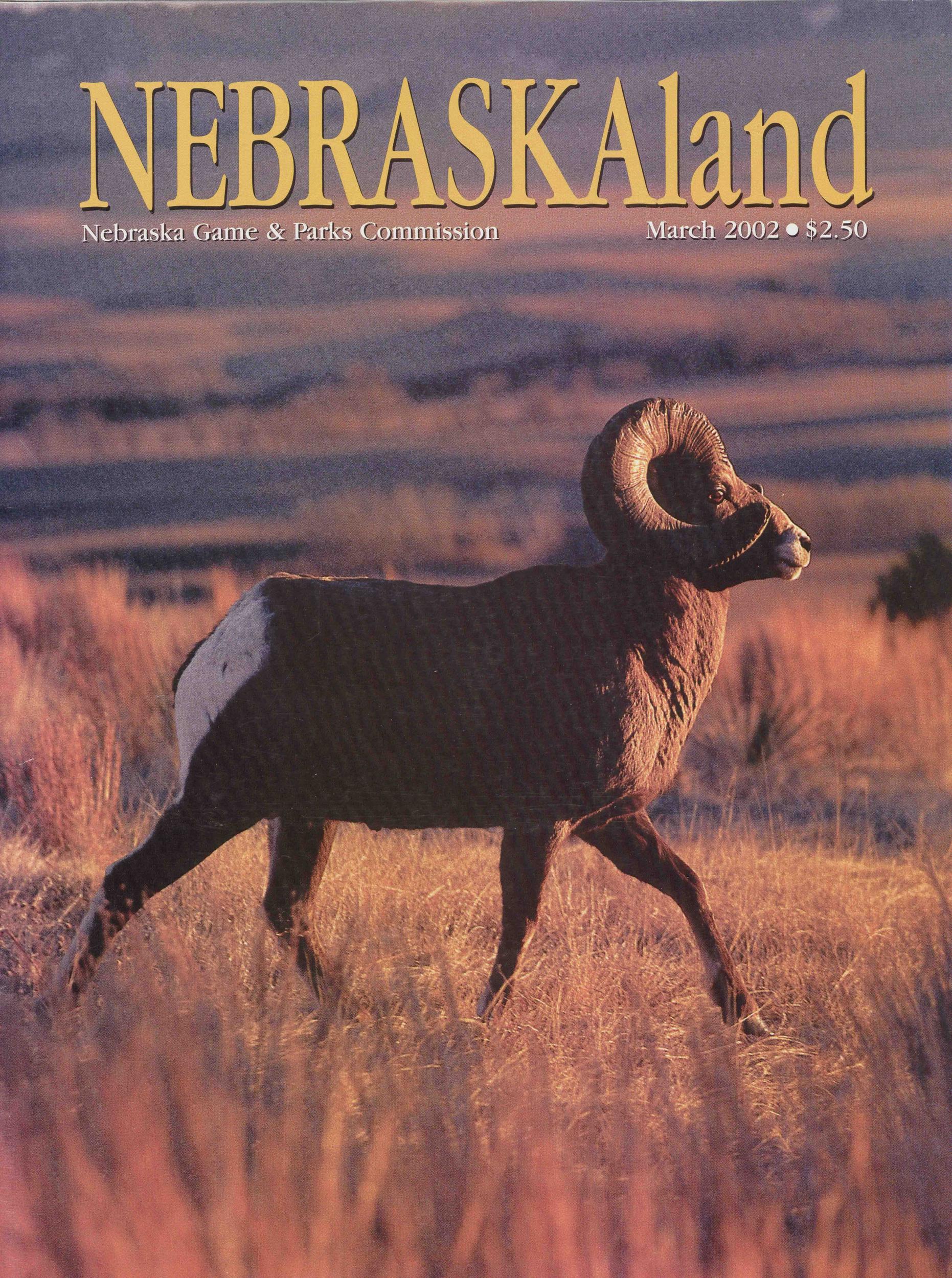
Volume 80, Number 2, March 2002 Features 10 Bighorns in the Wildcat Hills During the year since being released at Cedar Canyon Wildlife Management Area, a small bighorn sheep herd has met the challenges. Its future is promising, yet tenuous. 18 Turkey Hunting 101 On a rainy spring weekend, five young turkey hunters shot one jake, and they learned invaluable life lessons about , patience and perseverance under difficult circumstances. 24 A Nest of Swainson’s Hawks It was a chance, long-distance encounter between a pair of nesting Swainson’s hawks and a dedicated nature photographer. The result is a series of remarkable photos. 30 Mountain Lions in Nebraska As mountain lion populations increase in the West, young lions expand their ranges into Nebraska. In December, Dick Turpin encountered a lion on a Brown County trail. 34 Black-tailed Jackrabbits With acute hearing, keen sight and maneuverability at speeds up to 35 mph, the black-tailed jackrabbit eludes a long list of predators on the Great Plains. 38 The Perfect Pond Creating the perfect farm pond for recreational fishing requires planning. The Nebraska Game and Parks Commission helps pond owners, offering technical assistance and free fish. Departments Outdoor Business Workers save fish when the Sutherland Supply Canal is drained. In the Field Prairie Partners helps landowners preserve prairie bird habitat. Outdoor Update Chadron State Park timbering reduces wildfire threat. Parks – Places Crane Meadows offers close views of sandhill cranes. Comment........................................4 Outdoor News ..................................6 Classifieds ..................................48 Portraits of the Past ........................50 Cover: With a glint of last light in its eye, a bighorn ram trots across a Fort Robinson State Park meadow, majestically carrying its massive full-curl horns. See story, page 10. Photo by Bob Grier. Opposite: Nearly abstract figures, a mallard hen and drake, balancing on one leg, nap at the edge of an Adams County pond in late winter. Photo by Doug Carroll.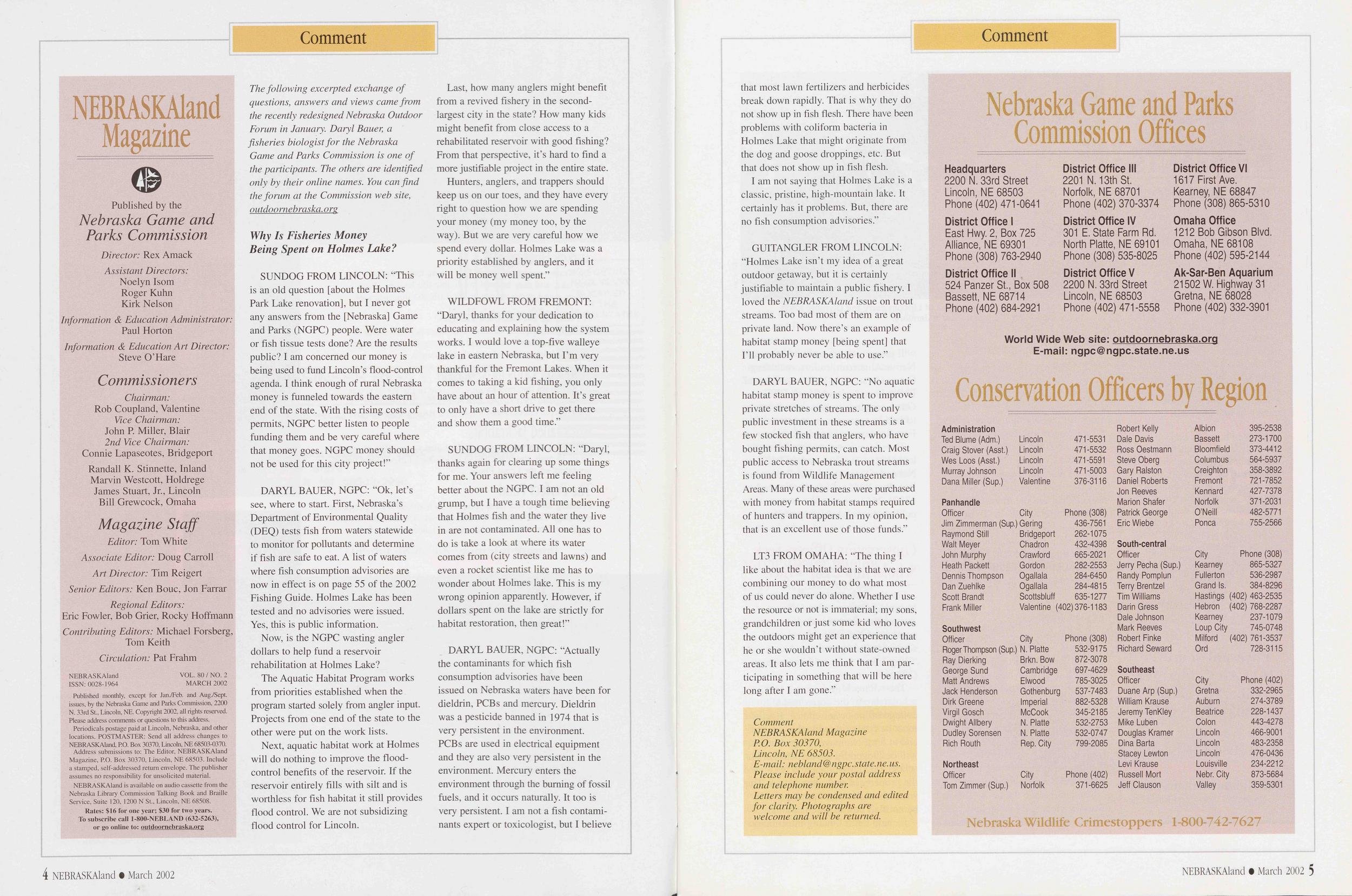
SUNDOG FROM LINCOLN: “This is an old question [about the Holmes Park Lake renovation], but I never got any answers from the [Nebraska] Game and Parks (NGPC) people. Were water or fish tissue tests done? Are the results public? I am concerned our money is being used to fund Lincoln’s flood-control agenda. I think enough of rural Nebraska money is funneled towards the eastern end of the state. With the rising costs of permits, NGPC better listen to people funding them and be very careful where that money goes. NGPC money should not be used for this city project!”
DARYL BAUER, NGPC: “Ok, let’s see, where to start. First, Nebraska’s Department of Environmental Quality (DEQ) tests fish from waters statewide to monitor for pollutants and determine if fish are safe to eat. A list of waters where fish consumption advisories are now in effect is on page 55 of the 2002 Fishing Guide. Holmes Lake has been tested and no advisories were issued. Yes, this is public information.
Now, is the NGPC wasting angler dollars to help fund a reservoir rehabilitation at Holmes Lake?
The Aquatic Habitat Program works from priorities established when the program started solely from angler input. Projects from one end of the state to the other were put on the work lists.
Next, aquatic habitat work at Holmes will do nothing to improve the flood- control benefits of the reservoir. If the reservoir entirely fills with silt and is worthless for fish habitat it still provides flood control. We are not subsidizing flood control for Lincoln.
Last, how many anglers might benefit from a revived fishery in the second- largest city in the state? How many kids might benefit from close access to a rehabilitated reservoir with good fishing? From that perspective, it’s hard to find a more justifiable project in the entire state.
Hunters, anglers, and trappers should keep us on our toes, and they have every right to question how we are spending your money (my money too, by the way). But we are very careful how we spend every dollar. Holmes Lake was a priority established by anglers, and it will be money well spent.”
WILDFOWL FROM FREMONT: “Daryl, thanks for your dedication to educating and explaining how the system works. I would love a top-five walleye lake in eastern Nebraska, but I’m very thankful for the Fremont Lakes. When it comes to taking a kid fishing, you only have about an hour of attention. It’s great to only have a short drive to get there and show them a good time.”
SUNDOG FROM LINCOLN: “Daryl, thanks again for clearing up some things for me. Your answers left me feeling better about the NGPC. I am not an old grump, but I have a tough time believing that Holmes fish and the water they live in are not contaminated. All one has to do is take a look at where its water comes from (city streets and lawns) and even a rocket scientist like me has to wonder about Holmes lake. This is my wrong opinion apparently. However, if dollars spent on the lake are strictly for habitat restoration, then great!”
DARYL BAUER, NGPC: “Actually the contaminants for which fish consumption advisories have been issued on Nebraska waters have been for dieldrin, PCBs and mercury. Dieldrin was a pesticide banned in 1974 that is very persistent in the environment. PCBs are used in electrical equipment and they are also very persistent in the environment. Mercury enters the environment through the burning of fossil fuels, and it occurs naturally. It too is very persistent. I am not a fish contami- nants expert or toxicologist, but I believe that most lawn fertilizers and herbicides break down rapidly. That is why they do not show up in fish flesh. There have been problems with coliform bacteria in Holmes Lake that might originate from the dog and goose droppings, etc. But that does not show up in fish flesh.
I am not saying that Holmes Lake is a classic, pristine, high-mountain lake. It certainly has it problems. But, there are no fish consumption advisories.”
4 NEBRASKAland • March 2002 CommentGUITANGLER FROM LINCOLN: “Holmes Lake isn’t my idea of a great outdoor getaway, but it is certainly justifiable to maintain a public fishery. I loved the NEBRASKAland issue on trout streams. Too bad most of them are on private land. Now there’s an example of habitat stamp money [being spent] that I’ll probably never be able to use.”
DARYL BAUER, NGPC: “No aquatic habitat stamp money is spent to improve private stretches of streams. The only public investment in these streams is a few stocked fish that anglers, who have bought fishing permits, can catch. Most public access to Nebraska trout streams is found from Wildlife Management Areas. Many of these areas were purchased with money from habitat stamps required of hunters and trappers. In my opinion, that is an excellent use of those funds.”
LT3 FROM OMAHA: “The thing I like about the habitat idea is that we are combining our money to do what most of us could never do alone. Whether I use the resource or not is immaterial; my sons, grandchildren or just some kid who loves the outdoors might get an experience that he or she wouldn’t without state-owned areas. It also lets me think that I am par- ticipating in something that will be here long after I am gone.”
Comment NEBRASKAland Magazine P.O. Box 30370, Lincoln, NE 68503. E-mail: neb land @ ngpc. state, ne. us. Please include your postal address and telephone number. Letters may be condensed and edited for clarity. Photographs are welcome and will be returned. Nebraska Game and Parks Commission Office Headquarters 2200 N. 33rd Street Lincoln, NE 68503 Phone (402) 471-0641 District Office I East Hwy. 2, Box 725 Alliance, NE 69301 Phone (308) 763-2940 District Office II 524 Panzer St., Box 508 Bassett, NE 68714 Phone (402) 684-2921 District Office III 2201 N. 13th St. Norfolk, NE 68701 Phone (402) 370-3374 District Office IV 301 E. State Farm Rd. North Platte, NE 69101 Phone (308) 535-8025 District Office V 2200 N. 33rd Street Lincoln, NE 68503 Phone (402) 471-5558 District Office VI 1617 First Ave. Kearney, NE 68847 Phone (308) 865-5310 Omaha Office 1212 Bob Gibson Blvd. Omaha, NE 68108 Phone (402) 595-2144 Ak-Sar-Ben Aquarium 21502 W. Highway 31 Gretna, NE 68028 Phone (402) 332-3901 World Wide Web site: outdoornebraska.org E-mail: ngpc@ngpc.state.ne.us Conservation Officers by Region Administration Ted Blume (Adm.) Lincoln 471-5531 Craig Stover (Asst.) Lincoln 471-5532 Wes Loos (Asst.) Lincoln 471-5591 Murray Johnson Lincoln 471-5003 Dana Miller (Sup.) Valentine 376-3116 Panhandle Officer City Phone (308) Jim Zimmerman (Sup.) Gering 436-7561 Raymond Still Bridgeport 262-1075 Walt Meyer Chadron 432-4398 John Murphy Crawford 665-2021 Heath Packett Gordon 282-2553 Dennis Thompson Ogallala 284-6450 DanZuehlke Ogallala 284-4815 Scott Brandt Scottsbluff 635-1277 Frank Miller Valentine (402) 376-1183 Southwest Officer City Phone (308) Roger Thompson (Sup.) N. Platte 532-9175 Ray Dierking Brkn. Bow 872-3078 George Sund Cambridge 697-4629 Matt Andrews Elwood 785-3025 Jack Henderson Gothenburg 537-7483 Dirk Greene Imperial 882-5328 Virgil Gosch McCook 345-2185 Dwight Allbery N. Platte 532-2753 Dudley Sorensen N. Platte 532-0747 Rich Routh Rep. City 799-2085 Northeast Officer City Phone (402) Tom Zimmer (Sup.) Norfolk 371-6625 Robert Kelly Albion 395-2538 Dale Davis Bassett 273-1700 RossOestmann Bloomfield 373-4412 Steve Oberg Columbus 564-5937 Gary Ralston Creighton 358-3892 Daniel Roberts Fremont 721-7852 Jon Reeves Kennard 427-7378 Marion Shafer Norfolk 371-2031 Patrick George O’Neill 482-5771 Eric Wiebe Ponca 755-2566 South-central Officer City Phone (308) Jerry Pecha (Sup.) Kearney 865-5327 Randy Pomplun Fullerton 536-2987 Terry Brentzel Grand Is. 384-8296 Tim Williams Hastings (402) 463-2535 Darin Gress Hebron (402) 768-2287 Dale Johnson Kearney 237-1079 Mark Reeves Loup City 745-0748 Robert Finke Milford (402) 761-3537 Richard Seward Ord 728-3115 Southeast Officer City Phone (402) Duane Arp (Sup.) Gretna 332-2965 William Krause Auburn 274-3789 Jeremy TenKley Beatrice 228-1437 Mike Luben Colon 443-4278 Douglas Kramer Lincoln 466-9001 Dina Barta Lincoln 483-2358 Stacey Lewton Lincoln 476-0436 Levi Krause Louisville 234-2212 Russell Mort Nebr. City 873-5684 Jeff Clauson Valley 359-5301 Nebraska Wildlife Crimestoppers 1-800-742-7627 NEBRASKAland • March 2002 5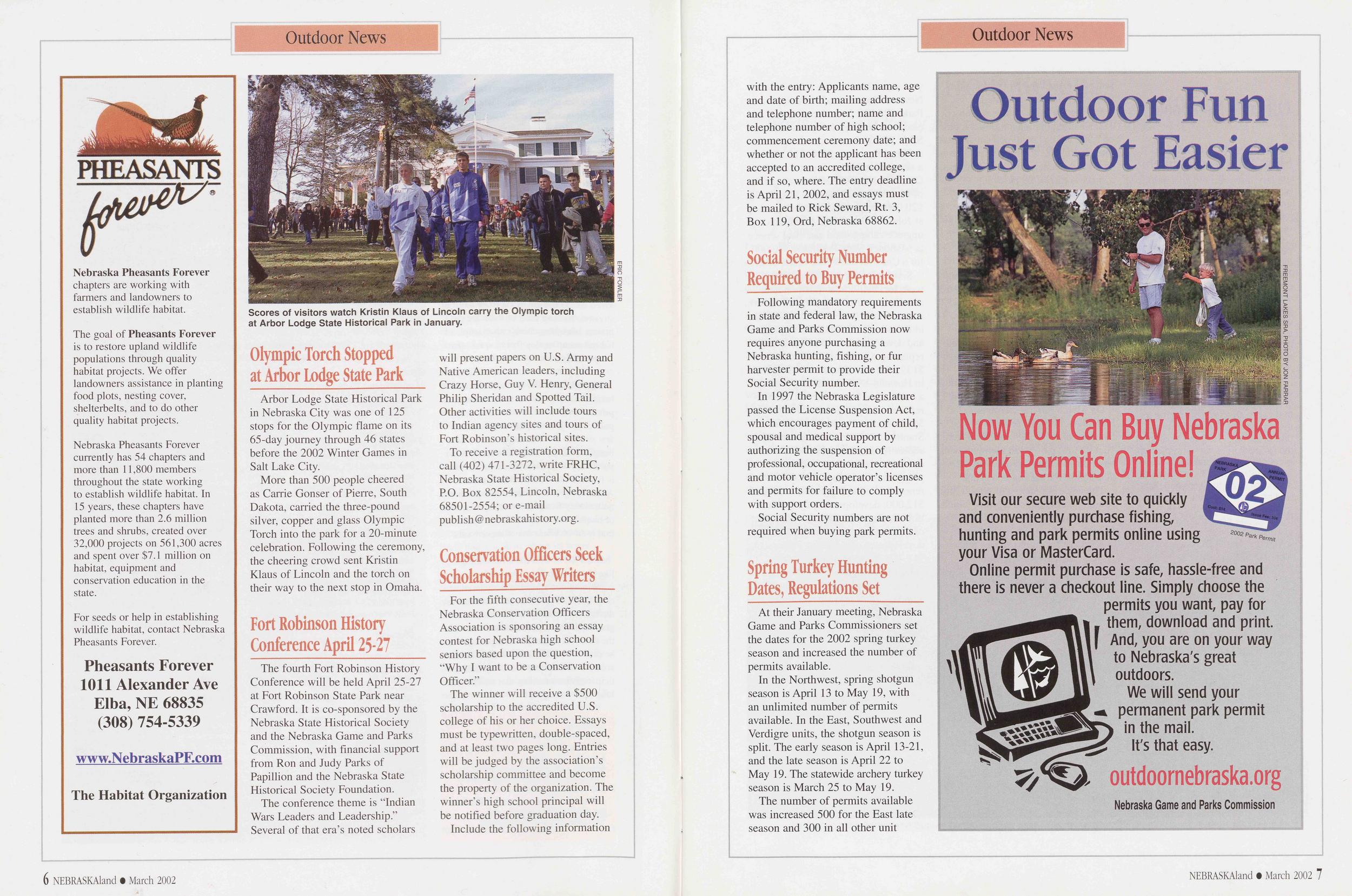
Nebraska Pheasants Forever chapters are working with farmers and landowners to establish wildlife habitat.
The goal of Pheasants Forever is to restore upland wildlife populations through quality habitat projects. We offer landowners assistance in planting food plots, nesting cover, shelterbelts, and to do other quality habitat projects.
Nebraska Pheasants Forever currently has 54 chapters and more than 11,800 members throughout the state working to establish wildlife habitat. In 15 years, these chapters have planted more than 2.6 million trees and shrubs, created over 32,000 projects on 561,300 acres and spent over $7.1 million on habitat, equipment and conservation education in the state.
For seeds or help in establishing wildlife habitat, contact Nebraska Pheasants Forever.
Pheasants Forever 1011 Alexander Ave Elba, NE 68835 (308) 754-5339 www.NebraskaPF.com The Habitat OrganizationArbor Lodge State Historical Park in Nebraska City was one of 125 stops for the Olympic flame on its 65-day journey through 46 states before the 2002 Winter Games in Salt Lake City.
More than 500 people cheered as Carrie Gonser of Pierre, South Dakota, carried the three-pound silver, copper and glass Olympic Torch into the park for a 20-minute celebration. Following the ceremony, the cheering crowd sent Kristin Klaus of Lincoln and the torch on their way to the next stop in Omaha.
Fort Robinson History Conference April 25-27The fourth Fort Robinson History Conference will be held April 25-27 at Fort Robinson State Park near Crawford. It is co-sponsored by the Nebraska State Historical Society and the Nebraska Game and Parks Commission, with financial support from Ron and Judy Parks of Papillion and the Nebraska State Historical Society Foundation.
The conference theme is “Indian Wars Leaders and Leadership.” Several of that era’s noted scholars will present papers on U.S. Army and Native American leaders, including Crazy Horse, Guy V. Henry, General Philip Sheridan and Spotted Tail. Other activities will include tours to Indian agency sites and tours of Fort Robinson’s historical sites.
To receive a registration form, call (402) 471-3272, write FRHC, Nebraska State Historical Society, P.O. Box 82554, Lincoln, Nebraska 68501-2554; or e-mail publish@nebraskahistory.org.
Conservation Officers Seek Scholarship Essay WritersFor the fifth consecutive year, the Nebraska Conservation Officers Association is sponsoring an essay contest for Nebraska high school seniors based upon the question, “Why I want to be a Conservation Officer.”
The winner will receive a $500 scholarship to the accredited U.S. college of his or her choice. Essays must be typewritten, double-spaced, and at least two pages long. Entries will be judged by the association’s scholarship committee and become the property of the organization. The winner’s high school principal will be notified before graduation day. 6 NEBRASKAland • March 2002 Include the following information with the entry: Applicants name, age and date of birth; mailing address and telephone number; name and telephone number of high school; commencement ceremony date; and whether or not the applicant has been accepted to an accredited college, and if so, where. The entry deadline is April 21, 2002, and essays must be mailed to Rick Seward, Rt. 3, Box 119, Ord, Nebraska 68862.
Outdoor News Outdoor Fun Just Got Easier Now You Can Buy Nebraska Park Permits Online! 002 Park Permit Visit our secure web site to quickly and conveniently purchase fishing, hunting and park permits online using your Visa or MasterCard. Online permit purchase is safe, hassle-free and there is never a checkout line. Simply choose the permits you want, pay for them, download and print. And, you are on your way to Nebraska's great outdoors. We will send your permanent park permit in the mail. It's that easy. outdoornebraska.org Nebraska Game and Parks Commission Social Security Number Required to Buy PermitsFollowing mandatory requirements in state and federal law, the Nebraska Game and Parks Commission now requires anyone purchasing a Nebraska hunting, fishing, or fur harvester permit to provide their Social Security number.
In 1997 the Nebraska Legislature passed the License Suspension Act, which encourages payment of child, spousal and medical support by authorizing the suspension of professional, occupational, recreational and motor vehicle operator’s licenses and permits for failure to comply with support orders.
Social Security numbers are not required when buying park permits.
Spring Turkey Hunting Dates, Regulations SetAt their January meeting, Nebraska Game and Parks Commissioners set the dates for the 2002 spring turkey season and increased the number of permits available.
In the Northwest, spring shotgun season is April 13 to May 19, with an unlimited number of permits available. In the East, Southwest and Verdigre units, the shotgun season is split. The early season is April 13-21, and the late season is April 22 to May 19. The statewide archery turkey season is March 25 to May 19.
The number of permits available was increased 500 for the East late season and 300 in all other unit
NEBRASKAland • March 2002 7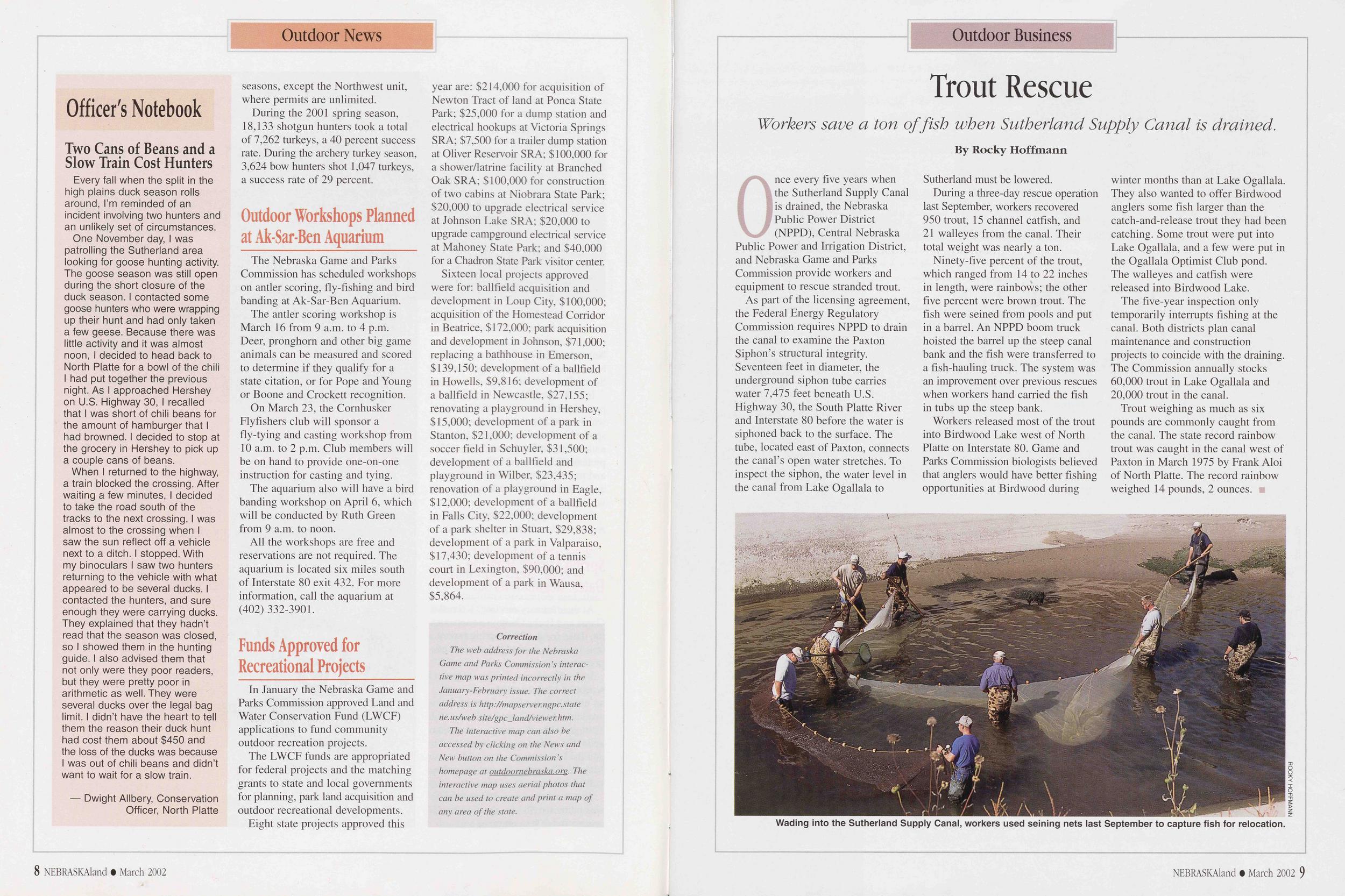
Every fall when the split in the high plains duck season rolls around, I’m reminded of an incident involving two hunters and an unlikely set of circumstances.
One November day, I was patrolling the Sutherland area looking for goose hunting activity. The goose season was still open during the short closure of the duck season. I contacted some goose hunters who were wrapping up their hunt and had only taken a few geese. Because there was little activity and it was almost noon, I decided to head back to North Platte for a bowl of the chili I had put together the previous night. As I approached Hershey on U.S. Highway 30, I recalled that I was short of chili beans for the amount of hamburger that I had browned. I decided to stop at the grocery in Hershey to pick up a couple cans of beans.
When I returned to the highway, a train blocked the crossing. After waiting a few minutes, I decided to take the road south of the tracks to the next crossing. I was almost to the crossing when I saw the sun reflect off a vehicle next to a ditch. I stopped. With my binoculars I saw two hunters returning to the vehicle with what appeared to be several ducks. I contacted the hunters, and sure enough they were carrying ducks. They explained that they hadn’t read that the season was closed, so I showed them in the hunting guide. I also advised them that not only were they poor readers, but they were pretty poor in arithmetic as well. They were several ducks over the legal bag limit. I didn’t have the heart to tell them the reason their duck hunt had cost them about $450 and the loss of the ducks was because I was out of chili beans and didn’t want to wait for a slow train.
Dwight Allbery, Conservation Officer, North Platteseasons, except the Northwest unit, where permits are unlimited.
During the 2001 spring season, 18,133 shotgun hunters took a total of 7,262 turkeys, a 40 percent success rate. During the archery turkey season, 3,624 bow hunters shot 1,047 turkeys, a success rate of 29 percent.
Outdoor Workshops Planned at Ak-Sar-Ben AquariumThe Nebraska Game and Parks Commission has scheduled workshops on antler scoring, fly-fishing and bird banding at Ak-Sar-Ben Aquarium.
The antler scoring workshop is March 16 from 9 a.m. to 4 p.m. Deer, pronghorn and other big game animals can be measured and scored to determine if they qualify for a state citation, or for Pope and Young or Boone and Crockett recognition.
On March 23, the Cornhusker Flyfishers club will sponsor a fly-tying and casting workshop from 10 a.m. to 2 p.m. Club members will be on hand to provide one-on-one instruction for casting and tying.
The aquarium also will have a bird banding workshop on April 6, which will be conducted by Ruth Green from 9 a.m. to noon.
All the workshops are free and reservations are not required. The aquarium is located six miles south of Interstate 80 exit 432. For more information, call the aquarium at (402) 332-3901.
Funds Approved for Recreational ProjectsIn January the Nebraska Game and Parks Commission approved Land and Water Conservation Fund (LWCF) applications to fund community outdoor recreation projects.
The LWCF funds are appropriated for federal projects and the matching grants to state and local governments for planning, park land acquisition and outdoor recreational developments.
Eight state projects approved this year are: $214,000 for acquisition of Newton Tract of land at Ponca State Park; $25,000 for a dump station and electrical hookups at Victoria Springs SRA; $7,500 for a trailer dump station at Oliver Reservoir SRA; $100,000 for a shower/latrine facility at Branched Oak SR A; $100,000 for construction of two cabins at Niobrara State Park; $20,000 to upgrade electrical service at Johnson Lake SRA; $20,000 to upgrade campground electrical service at Mahoney State Park; and $40,000 for a Chadron State Park visitor center.
Sixteen local projects approved were for: ballfield acquisition and development in Loup City, $100,000; acquisition of the Homestead Corridor in Beatrice, $172,000; park acquisition and development in Johnson, $71,000; replacing a bathhouse in Emerson, $139,150; development of a bailfield in Howells, $9,816; development of a ballfield in Newcastle, $27,155; renovating a playground in Hershey, $15,000; development of a park in Stanton, $21,000; development of a soccer field in Schuyler, $31,500; development of a ballfield and playground in Wilber, $23,435; renovation of a playground in Eagle, $12,000; development of a ballfield in Falls City, $22,000; development of a park shelter in Stuart, $29,838; development of a park in Valparaiso, $17,430; development of a tennis court in Lexington, $90,000; and development of a park in Wausa, $5,864.
Correction The web address for the Nebraska Game and Parks Commission’s interac- tive map was printed incorrectly in the January-February issue. The correct address is http://mapserver.ngpc.state ne. us/web site/gpcjland/viewer. htm. The interactive map can also be accessed by clicking on the News and New button on the Commission’s homepage at outdoomebraska. ors. The interactive map uses aerial photos that can be used to create and print a map of any area of the state. 8 NEBRASKAland • March 2002 Outdoor Business Trout Rescue Workers save a ton offish when Sutherland Supply Canal is drained. By Rocky HoffmannOnce every five years when the Sutherland Supply Canal is drained, the Nebraska Public Power District (NPPD), Central Nebraska Public Power and Irrigation District, and Nebraska Game and Parks Commission provide workers and equipment to rescue stranded trout.
As part of the licensing agreement, the Federal Energy Regulatory Commission requires NPPD to drain the canal to examine the Paxton Siphon’s structural integrity. Seventeen feet in diameter, the underground siphon tube carries water 7,475 feet beneath U.S. Highway 30, the South Platte River and Interstate 80 before the water is siphoned back to the surface. The tube, located east of Paxton, connects the canal’s open water stretches. To inspect the siphon, the water level in the canal from Lake Ogallala to Sutherland must be lowered.
During a three-day rescue operation last September, workers recovered 950 trout, 15 channel catfish, and 21 walleyes from the canal. Their total weight was nearly a ton.
Ninety-five percent of the trout, which ranged from 14 to 22 inches in length, were rainbows; the other five percent were brown trout. The fish were seined from pools and put in a barrel. An NPPD boom truck hoisted the barrel up the steep canal bank and the fish were transferred to a fish-hauling truck. The system was an improvement over previous rescues when workers hand carried the fish in tubs up the steep bank.
Workers released most of the trout into Bird wood Lake west of North Platte on Interstate 80. Game and Parks Commission biologists believed that anglers would have better fishing opportunities at Bird wood during winter months than at Lake Ogallala. They also wanted to offer Bird wood anglers some fish larger than the catch-and-release trout they had been catching. Some trout were put into Lake Ogallala, and a few were put in the Ogallala Optimist Club pond. The walleyes and catfish were released into Birdwood Lake.
The five-year inspection only temporarily interrupts fishing at the canal. Both districts plan canal maintenance and construction projects to coincide with the draining. The Commission annually stocks 60,000 trout in Lake Ogallala and 20,000 trout in the canal.
Trout weighing as much as six pounds are commonly caught from the canal. The state record rainbow trout was caught in the canal west of Paxton in March 1975 by Frank Aloi of North Platte. The record rainbow weighed 14 pounds, 2 ounces.
Bighorns in the Wildcats
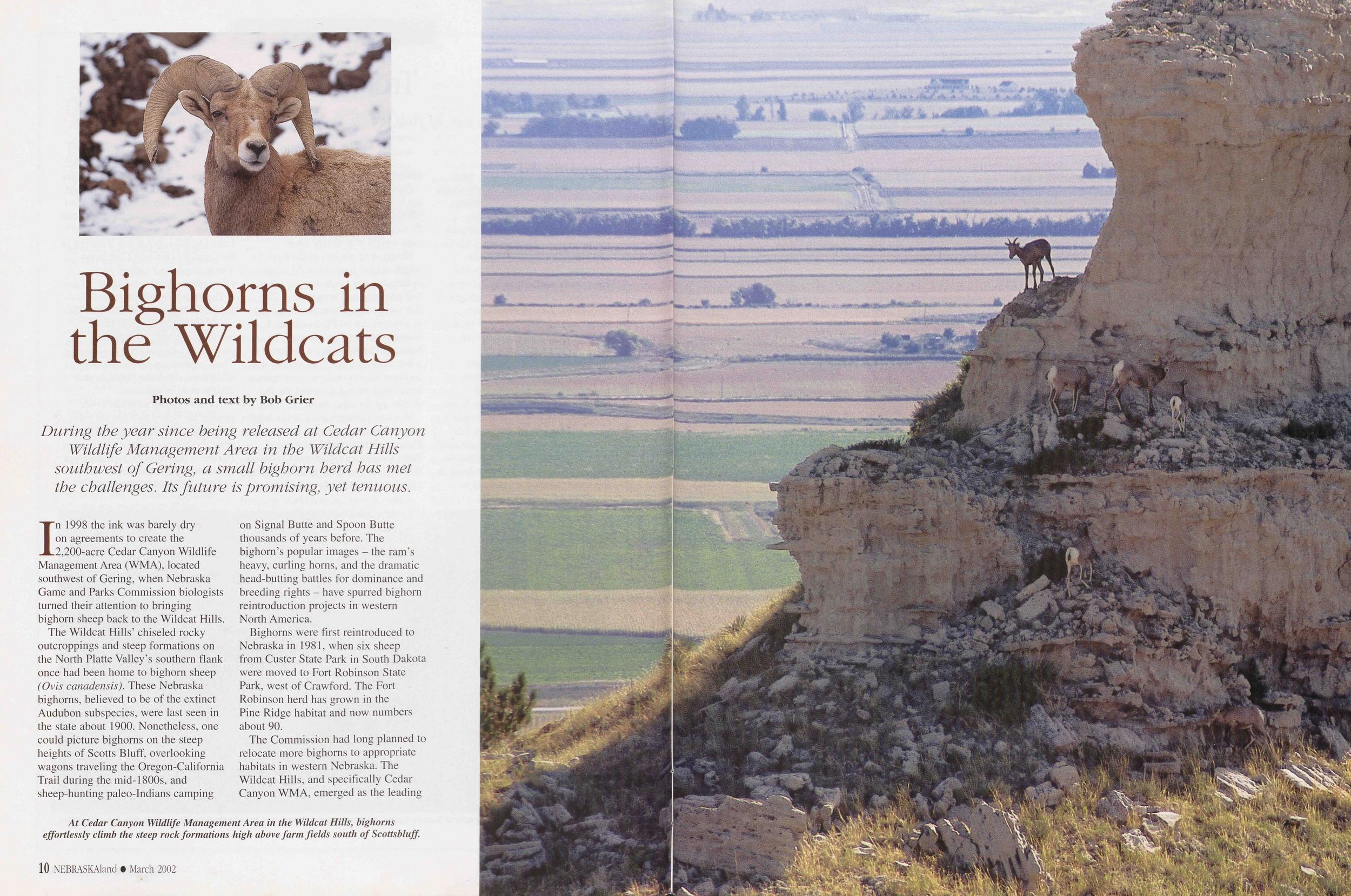
During the year since being released at Cedar Canyo Wildlife Management Area in the Wildcat Hills southwest of Gering, a small bighorn herd has met the challenges. Its future is promising, yet tenuous.In 1998 the ink was barely dry on agreements to create the 2,200-acre Cedar Canyon Wildlife Management Area (WMA), located southwest of Gering, when Nebraska Game and Parks Commission biologists turned their attention to bringing bighorn sheep back to the Wildcat Hills.
The Wildcat Hills’ chiseled rocky outcroppings and steep formations on the North Platte Valley’s southern flank once had been home to bighorn sheep (Ovis canadensis). These Nebraska bighorns, believed to be of the extinct Audubon subspecies, were last seen in the state about 1900. Nonetheless, one could picture bighorns on the steep heights of Scotts Bluff, overlooking wagons traveling the Oregon-California Trail during the mid-1800s, and sheep-hunting paleo-Indians camping on Signal Butte and Spoon Butte thousands of years before. The bighorn’s popular images - the ram’s heavy, curling horns, and the dramatic head-butting battles for dominance and breeding rights - have spurred bighorn reintroduction projects in western North America.
Bighorns were first reintroduced to Nebraska in 1981, when six sheep from Custer State Park in South Dakota were moved to Fort Robinson State Park, west of Crawford. The Fort Robinson herd has grown in the Pine Ridge habitat and now numbers about 90.
The Commission had long planned to relocate more bighorns to appropriate habitats in western Nebraska. The Wildcat Hills, and specifically Cedar Canyon WMA, emerged as the leading
site for the next bighorn restoration project. But, before reintroduction could proceed, numerous questions had to be resolved: Where were the possible sources for a new bighorn herd? Would area landowners and the public accept a herd? Could today’s Wildcat Hills escarpments sustain bighorns?
The process of answering habitat questions began soon after Cedar Canyon became a wildlife management area. In a study for the Commission, Kyle Forbes, a researcher for Terra Novellus Consulting in Santa Fe, New Mexico, evaluated the Wildcat Hills’ bighorn habitat in southern Scotts Bluff County, a small portion of western Morrill County and nearly all of Banner County. His assessment looked at the important habitat components for bighorns, including escape terrain that provides protection for ewes and lambs from predators, and the composition and abundance of vegetation used by the sheep. To examine terrain and other habitat features, Forbes used satellite imagery, computer modeling and fieldwork.
Wildcat Terrain Offers EscapeObserving the Fort Robinson herd’s activities in the Pine Ridge for nearly 20 years, Commission biologists had become familiar with bighorn seasonal movements and habitat requirements. The biologists recorded the terrain and vegetation that sheep used at different times in the year. For example, every May ewes moved to protected heights with narrow ledges for the lambing season.
With information from the Pine 12 NEBRASKAland • March 2002 Ridge herd observations and Forbes’ 1999 report on the Wildcat Hills, Gary Schlichtemeier, wildlife manager for the Commission in Alliance, described some important but often subtle differences of the two geologic formations:
"The Wildcat Hills are somewhat more arid, much more like the western slopes of the Rockies than the Pine Ridge, and the forested areas are generally more open and include more Rocky Mountain juniper, or red cedar and mountain mahogany, an important deer, elk and bighorn food and cover plant, especially during the winter. The Pine Ridge forest is predominately mature ponderosa pine.
"As far as the steep terrain needed for bighorn escape cover, lambing and nursery sites, we were initially somewhat surprised when we compared both regions. The Wildcat Hills appears to offer a higher density of rocky outcroppings, vertical cliffs and steep slopes that are critical for bighorn
The north side of Cedar Canyon WMA has a steep-edged plateau with ridges and rugged rock formations. These geological formations were carved by wind and water erosion from an alluvial sheet of gravel, sand and silt laid down as the Rocky Mountains rose about 60 million years ago.
The Commission’s wildlife managers organized public meetings with landowners and others to elicit their ideas and concerns about the bighorn sheep management plan. As the possibility of a bighorn release in the Wildcat Hills became more likely, Commission biologists visited neighboring landowners to hear their views and to answer questions. The public’s and landowners’ response was overwhelmingly favorable.
The usually slow process of obtaining bighorn sheep from the few states and Canadian provinces that have them was jump-started in February 2001 when the Colorado Division of Wildlife moved Nebraska’s request to the top of
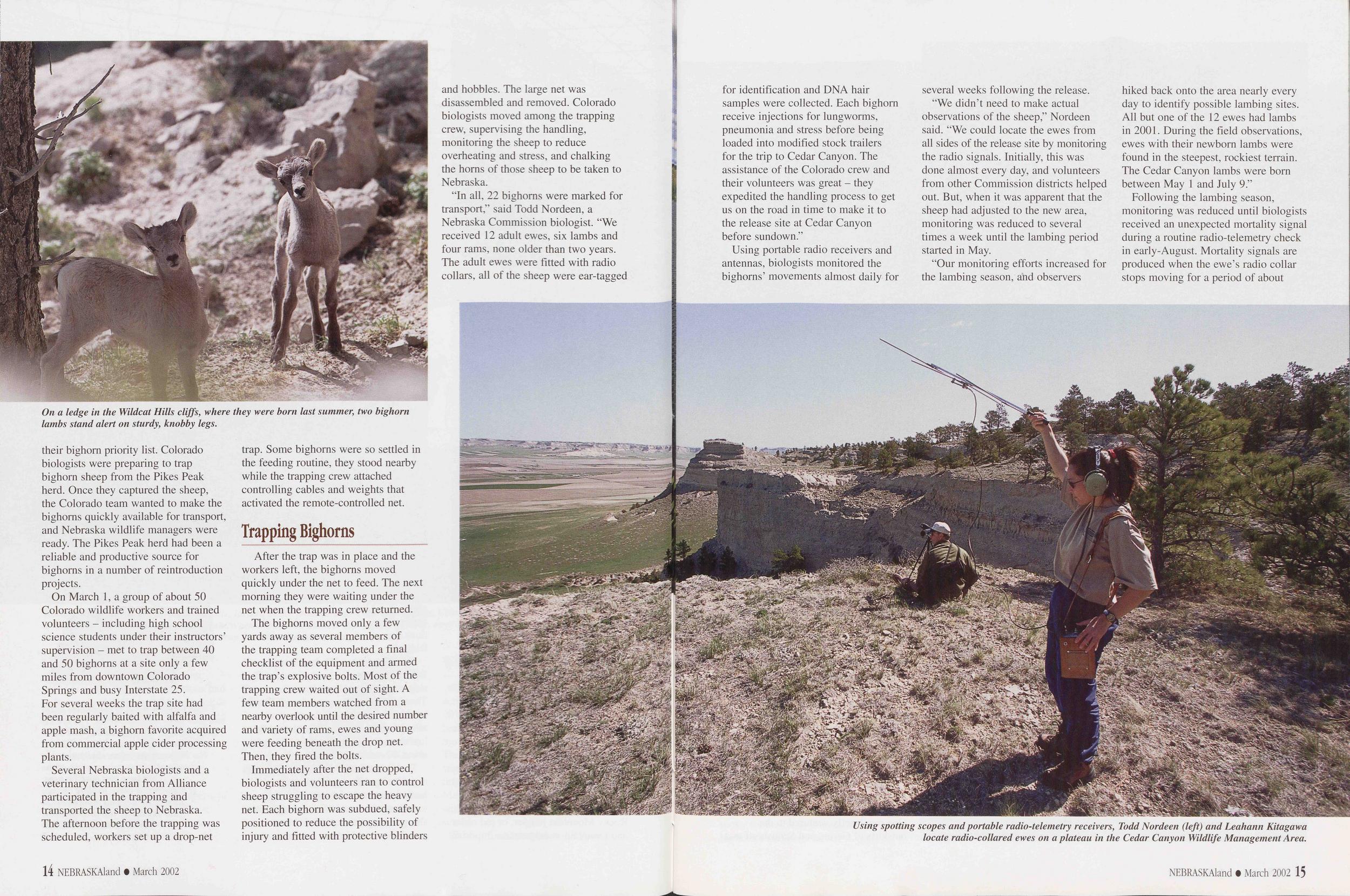
their bighorn priority list. Colorado biologists were preparing to trap bighorn sheep from the Pikes Peak herd. Once they captured the sheep, the Colorado team wanted to make the bighorns quickly available for transport, and Nebraska wildlife managers were ready. The Pikes Peak herd had been a reliable and productive source for bighorns in a number of reintroduction projects.
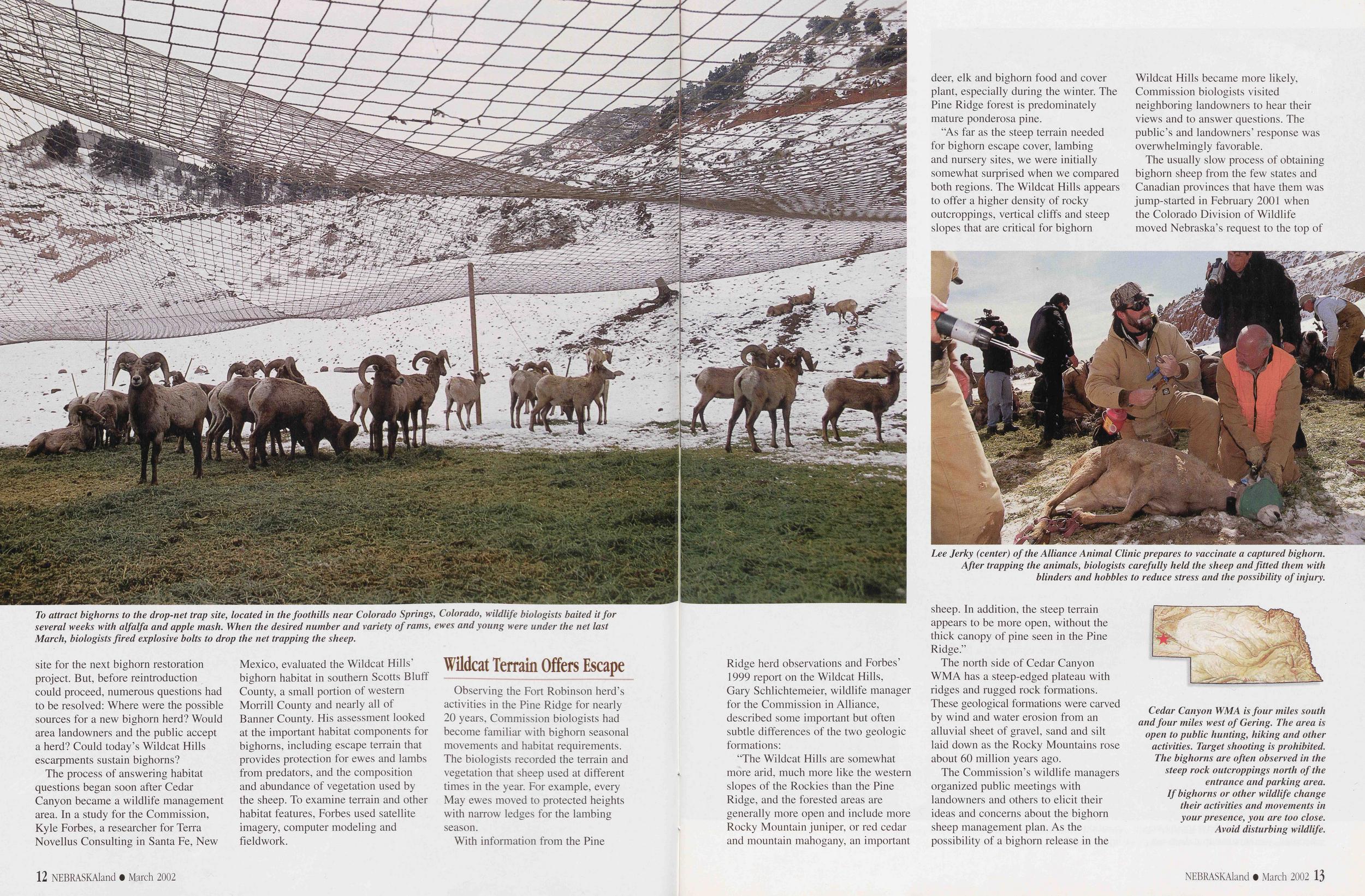
On March 1, a group of about 50 Colorado wildlife workers and trained volunteers - including high school science students under their instructors’ supervision - met to trap between 40 and 50 bighorns at a site only a few miles from downtown Colorado Springs and busy Interstate 25. For several weeks the trap site had been regularly baited with alfalfa and apple mash, a bighorn favorite acquired from commercial apple cider processing plants.
Several Nebraska biologists and a veterinary technician from Alliance participated in the trapping and transported the sheep to Nebraska. The afternoon before the trapping was scheduled, workers set up a drop-net trap. Some bighorns were so settled in the feeding routine, they stood nearby while the trapping crew attached controlling cables and weights that activated the remote-controlled net.
Trapping BighornsAfter the trap was in place and the workers left, the bighorns moved quickly under the net to feed. The next morning they were waiting under the net when the trapping crew returned.
The bighorns moved only a few yards away as several members of the trapping team completed a final checklist of the equipment and armed the trap’s explosive bolts. Most of the trapping crew waited out of sight. A few team members watched from a nearby overlook until the desired number and variety of rams, ewes and young were feeding beneath the drop net. Then, they fired the bolts.
Immediately after the net dropped, biologists and volunteers ran to control sheep struggling to escape the heavy net. Each bighorn was subdued, safely positioned to reduce the possibility of injury and fitted with protective blinders and hobbles. The large net was disassembled and removed. Colorado biologists moved among the trapping crew, supervising the handling, monitoring the sheep to reduce overheating and stress, and chalking the horns of those sheep to be taken to Nebraska.
"In all, 22 bighorns were marked for transport,” said Todd Nordeen, a Nebraska Commission biologist. “We received 12 adult ewes, six lambs and four rams, none older than two years. The adult ewes were fitted with radio collars, all of the sheep were ear-tagged 14 NEBRASKAland • March 2002 for identification and DNA hair samples were collected. Each bighorn receive injections for lungworms, pneumonia and stress before being loaded into modified stock trailers for the trip to Cedar Canyon. The assistance of the Colorado crew and their volunteers was great - they expedited the handling process to get us on the road in time to make it to the release site at Cedar Canyon before sundown.”
Using portable radio receivers and antennas, biologists monitored the bighorns’ movements almost daily for several weeks following the release.
“We didn’t need to make actual observations of the sheep,” Nordeen said. “We could locate the ewes from all sides of the release site by monitoring the radio signals. Initially, this was done almost every day, and volunteers from other Commission districts helped out. But, when it was apparent that the sheep had adjusted to the new area, monitoring was reduced to several times a week until the lambing period started in May.
“Our monitoring efforts increased for the lambing season, ahd observers hiked back onto the area nearly every day to identify possible lambing sites. All but one of the 12 ewes had lambs in 2001. During the field observations, ewes with their newborn lambs were found in the steepest, rockiest terrain. The Cedar Canyon lambs were born between May 1 and July 9.”
Following the lambing season, monitoring was reduced until biologists received an unexpected mortality signal during a routine radio-telemetry check in early-August. Mortality signals are produced when the ewe’s radio collar stops moving for a period of about
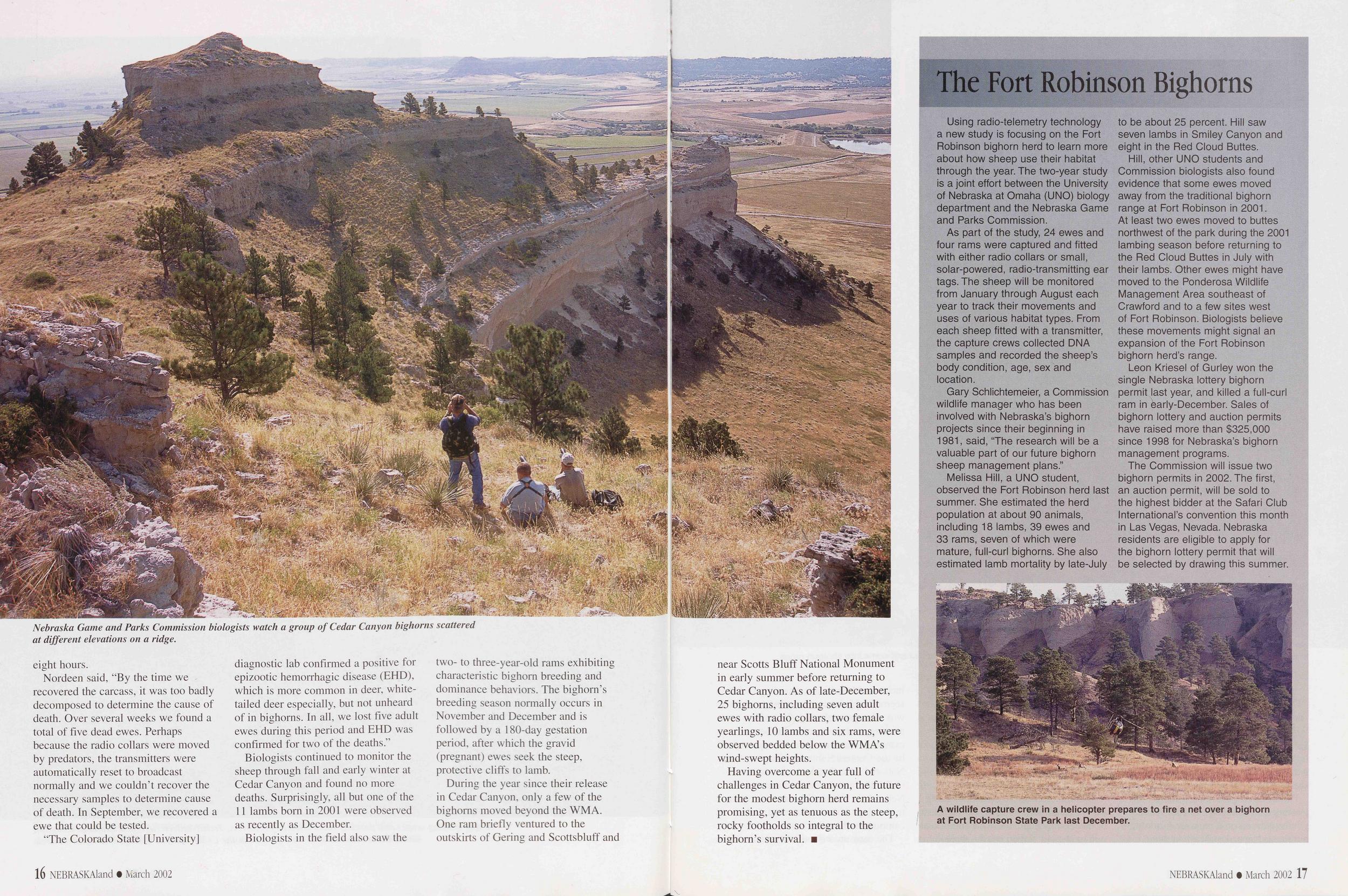
eight hours.
Nordeen said, “By the time we recovered the carcass, it was too badly decomposed to determine the cause of death. Over several weeks we found a total of five dead ewes. Perhaps because the radio collars were moved by predators, the transmitters were automatically reset to broadcast normally and we couldn’t recover the necessary samples to determine cause of death. In September, we recovered a ewe that could be tested.
“The Colorado State [University] diagnostic lab confirmed a positive for epizootic hemorrhagic disease (EHD), which is more common in deer, white- tailed deer especially, but not unheard of in bighorns. In all, we lost five adult ewes during this period and EHD was confirmed for two of the deaths.”
Biologists continued to monitor the sheep through fall and early winter at Cedar Canyon and found no more deaths. Surprisingly, all but one of the 11 lambs born in 2001 were observed as recently as December.
Biologists in the field also saw the two- to three-year-old rams exhibiting characteristic bighorn breeding and dominance behaviors. The bighorn’s breeding season normally occurs in November and December and is followed by a 180-day gestation period, after which the gravid (pregnant) ewes seek the steep, protective cliffs to lamb.
During the year since their release in Cedar Canyon, only a few of the bighorns moved beyond the WMA. One ram briefly ventured to the outskirts of Gering and Scottsbluff and 16 NEBRASKAland • March 2002 near Scotts Bluff National Monument in early summer before returning to Cedar Canyon. As of late-December, 25 bighorns, including seven adult ewes with radio collars, two female yearlings, 10 lambs and six rams, were observed bedded below the WMA’s wind-swept heights.
Having overcome a year full of challenges in Cedar Canyon, the future for the modest bighorn herd remains promising, yet as tenuous as the steep, rocky footholds so integral to the bighorn’s survival. ■
The Fort Robinson BighornsUsing radio-telemetry technology a new study is focusing on the Fort Robinson bighorn herd to learn more about how sheep use their habitat through the year. The two-year study is a joint effort between the University of Nebraska at Omaha (UNO) biology department and the Nebraska Game and Parks Commission.
As part of the study, 24 ewes and four rams were captured and fitted with either radio collars or small, solar-powered, radio-transmitting ear tags. The sheep will be monitored from January through August each year to track their movements and uses of various habitat types. From each sheep fitted with a transmitter, the capture crews collected DNA samples and recorded the sheep’s body condition, age, sex and location.
Gary Schlichtemeier, a Commission wildlife manager who has been involved with Nebraska’s bighorn projects since their beginning in 1981, said, “The research will be a valuable part of our future bighorn sheep management plans.”
Melissa Hill, a UNO student, observed the Fort Robinson herd last summer. She estimated the herd population at about 90 animals, including 18 lambs, 39 ewes and 33 rams, seven of which were mature, full-curl bighorns. She also estimated lamb mortality by late-July
Hill, other UNO students and Commission biologists also found evidence that some ewes moved away from the traditional bighorn range at Fort Robinson in 2001. At least two ewes moved to buttes northwest of the park during the 2001 lambing season before returning to the Red Cloud Buttes in July with their lambs. Other ewes might have moved to the Ponderosa Wildlife Management Area southeast of Crawford and to a few sites west of Fort Robinson. Biologists believe these movements might signal an expansion of the Fort Robinson bighorn herd’s range.
Leon Kriesel of Gurley won the single Nebraska lottery bighorn permit last year, and killed a full-curl ram in barly-December. Sales of bighorn lottery and auction permits have raised more than $325,000 since 1998 for Nebraska’s bighorn management programs.
The Commission will issue two bighorn permits in 2002. The first, an auction permit, will be sold to the highest bidder at the Safari Club International’s convention this month in Las Vegas, Nevada. Nebraska residents are eligible to apply for the bighorn lottery permit that will be selected by drawing this summer.
NEBRASKAland O March 2002 17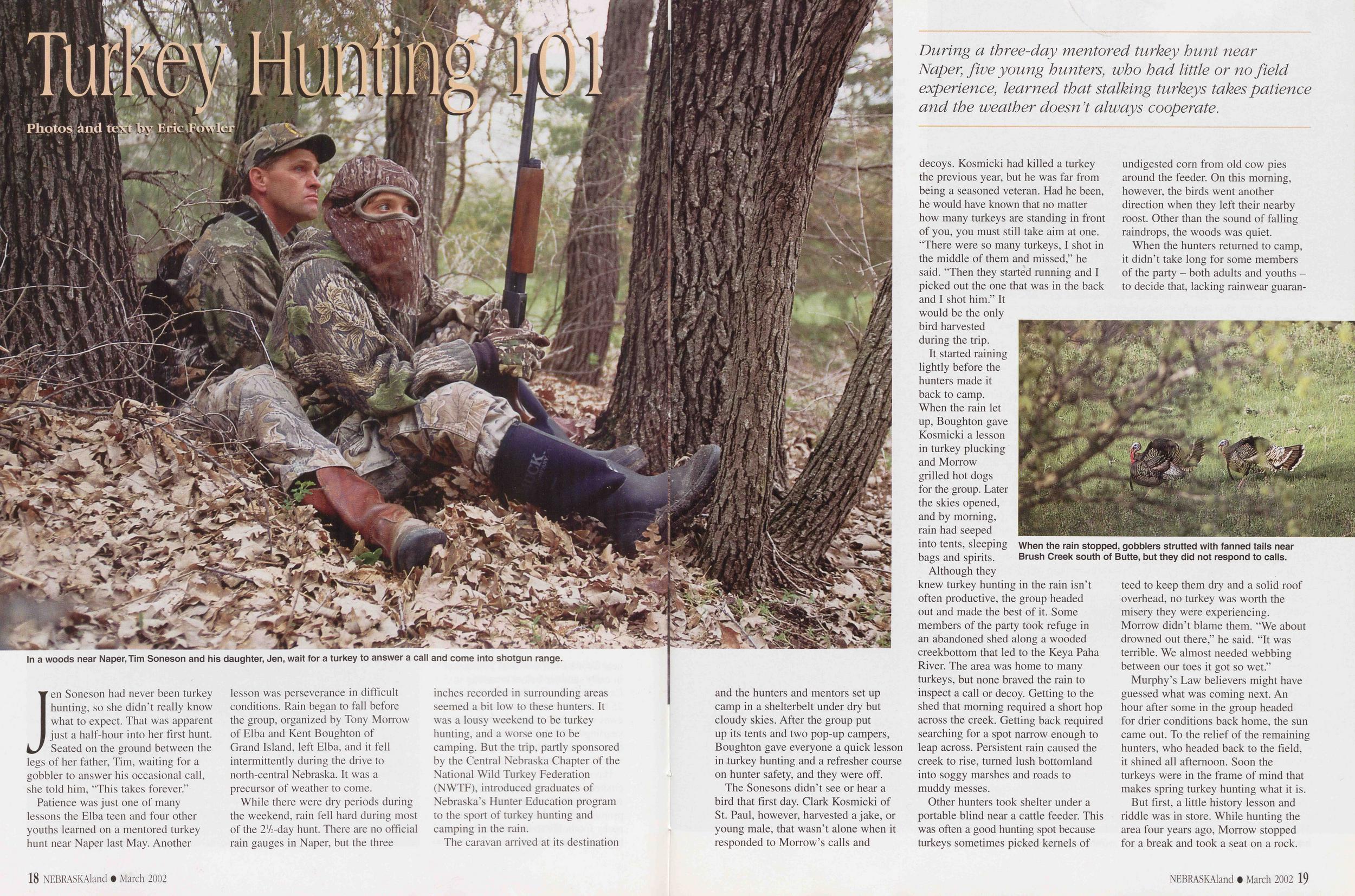
Turkey Hunting 101
During a three-day mentored turkey hunt near Naper, five young hunters, who had little or no field experience, learned that stalking turkeys takes patience and the weather doesn’t always cooperate. Photos and text by Eric FowlerJen Soneson had never been turkey hunting, so she didn’t really know what to expect. That was apparent just a half-hour into her first hunt. Seated on the ground between the legs of her father, Tim, waiting for a gobbler to answer his occasional call, she told him, “This takes forever.”
Patience was just one of many lessons the Elba teen and four other youths learned on a mentored turkey hunt near Naper last May. Another lesson was perseverance in difficult conditions. Rain began to fall before the group, organized by Tony Morrow of Elba and Kent Boughton of Grand Island, left Elba, and it fell intermittently during the drive to north-central Nebraska. It was a precursor of weather to come.
While there were dry periods during the weekend, rain fell hard during most of the 21A-day hunt. There are no official rain gauges in Naper, but the three inches recorded in surrounding areas seemed a bit low to these hunters. It was a lousy weekend to be turkey hunting, and a worse one to be camping. But the trip, partly sponsored by the Central Nebraska Chapter of the National Wild Turkey Federation (NWTF), introduced graduates of Nebraska’s Hunter Education program to the sport of turkey hunting and camping in the rain.
The caravan arrived at its destination 18 NEBRASKAland • March 2002 and the hunters and mentors set up camp in a shelterbelt under dry but cloudy skies. After the group put up its tents and two pop-up campers, Boughton gave everyone a quick lesson in turkey hunting and a refresher course on hunter safety, and they were off.
The Sonesons didn’t see or hear a bird that first day. Clark Kosmicki of St. Paul, however, harvested a jake, or young male, that wasn’t alone when it responded to Morrow’s calls and decoys. Kosmicki had killed a turkey the previous year, but he was far from being a seasoned veteran. Had he been, he would have known that no matter how many turkeys are standing in front of you, you must still take aim at one. “There were so many turkeys, I shot in the middle of them and missed,” he said. “Then they started running and I picked out the one that was in the back and I shot him.” It would be the only bird harvested during the trip. It started raining lightly before the hunters made it back to camp. When the rain let up, Boughton gave Kosmicki a lesson in turkey plucking and Morrow grilled hot dogs for the group. Later the skies opened, and by morning, rain had seeped into tents, sleeping bags and spirits.
Although they knew turkey hunting in the rain isn’t often productive, the group headed out and made the best of it. Some members of the party took refuge in an abandoned shed along a wooded creekbottom that led to the Keya Paha River. The area was home to many turkeys, but none braved the rain to inspect a call or decoy. Getting to the shed that morning required a short hop across the creek. Getting back required searching for a spot narrow enough to leap across. Persistent rain caused the creek to rise, turned lush bottomland into soggy marshes and roads to muddy messes.
Other hunters took shelter under a portable blind near a cattle feeder. This was often a good hunting spot because turkeys sometimes picked kernels of undigested corn from old cow pies around the feeder. On this morning, however, the birds went another direction when they left their nearby roost. Other than the sound of falling raindrops, the woods was quiet.
When the hunters returned to camp, it didn’t take long for some members of the party - both adults and youths - to decide that, lacking rainwear guaran-
Murphy’s Law believers might have guessed what was coming next. An hour after some in the group headed for drier conditions back home, the sun came out. To the relief of the remaining hunters, who headed back to the field, it shined all afternoon. Soon the turkeys were in the frame of mind that makes spring turkey hunting what it is.
But first, a little history lesson and riddle was in store. While hunting the area four years ago, Morrow stopped for a break and took a seat on a rock.
NEBRASKAland • March 2002 19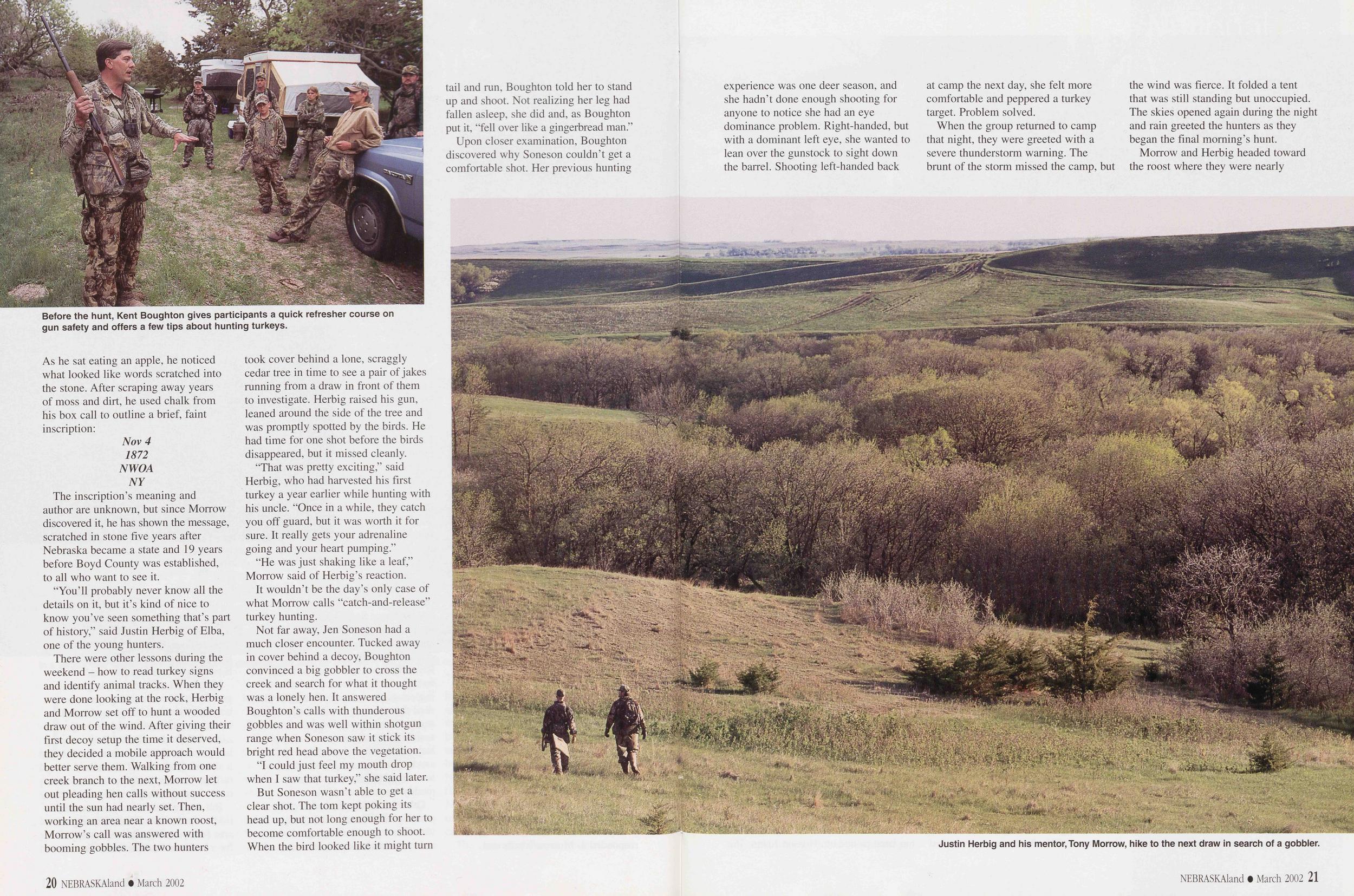
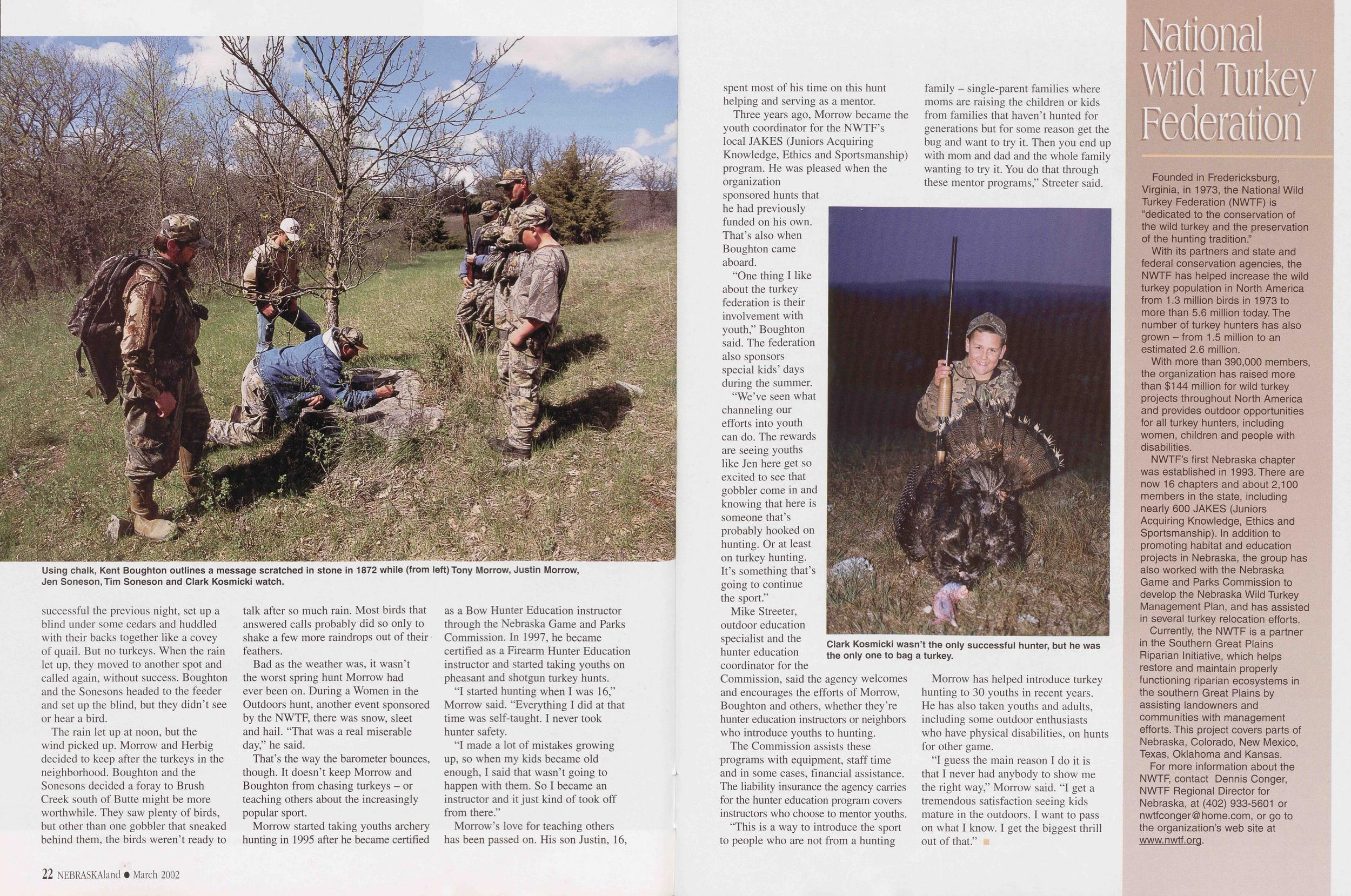
As he sat eating an apple, he noticed what looked like words scratched into the stone. After scraping away years of moss and dirt, he used chalk from his box call to outline a brief, faint inscription: Nov 4 1872 NWOA NY
The inscription’s meaning and author are unknown, but since Morrow discovered it, he has shown the message, scratched in stone five years after Nebraska became a state and 19 years before Boyd County was established, to all who want to see it.
“You’ll probably never know all the details on it, but it’s kind of nice to know you’ve seen something that’s part of history,” said Justin Herbig of Elba, one of the young hunters.
There were other lessons during the weekend - how to read turkey signs and identify animal tracks. When they were done looking at the rock, Herbig and Morrow set off to hunt a wooded draw out of the wind. After giving their first decoy setup the time it deserved, they decided a mobile approach would better serve them. Walking from one creek branch to the next, Morrow let out pleading hen calls without success until the sun had nearly set. Then, working an area near a known roost, Morrow’s call was answered with booming gobbles. The two hunters took cover behind a lone, scraggly cedar tree in time to see a pair of jakes running from a draw in front of them to investigate. Herbig raised his gun, leaned around the side of the tree and was promptly spotted by the birds. He had time for one shot before the birds disappeared, but it missed cleanly.
“That was pretty exciting,” said Herbig, who had harvested his first turkey a year earlier while hunting with his uncle. “Once in a while, they catch you off guard, but it was worth it for sure. It really gets your adrenaline going and your heart pumping.”
“He was just shaking like a leaf,” Morrow said of Herbig’s reaction. It wouldn’t be the day’s only case of what Morrow calls “catch-and-release” turkey hunting.
Not far away, Jen Soneson had a much closer encounter. Tucked away in cover behind a decoy, Boughton convinced a big gobbler to cross the creek and search for what it thought was a lonely hen. It answered Boughton’s calls with thunderous gobbles and was well within shotgun range when Soneson saw it stick its bright red head above the vegetation.
“I could just feel my mouth drop when I saw that turkey,” she said later.
But Soneson wasn’t able to get a clear shot. The tom kept poking its head up, but not long enough for her to become comfortable enough to shoot. When the bird looked like it might turn tail and run, Boughton told her to stand up and shoot. Not realizing her leg had fallen asleep, she did and, as Boughton put it, “fell over like a gingerbread man.”
Upon closer examination, Boughton discovered why Soneson couldn’t get a comfortable shot. Her previous hunting NEBRASKAland • March 2002 20 experience was one deer season, and she hadn’t done enough shooting for anyone to notice she had an eye dominance problem. Right-handed, but with a dominant left eye, she wanted to lean over the gunstock to sight down the barrel. Shooting left-handed back at camp the next day, she felt more comfortable and peppered a turkey target. Problem solved.
When the group returned to camp that night, they were greeted with a severe thunderstorm warning. The brunt of the storm missed the camp, but the wind was fierce. It folded a tent that was still standing but unoccupied. The skies opened again during the night and rain greeted the hunters as they began the final morning’s hunt.
Morrow and Herbig headed toward the roost where they were nearly
successful the previous night, set up a blind under some cedars and huddled with their backs together like a covey of quail. But no turkeys. When the rain let up, they moved to another spot and called again, without success. Boughton and the Sonesons headed to the feeder and set up the blind, but they didn’t see or hear a bird.
The rain let up at noon, but the wind picked up. Morrow and Herbig decided to keep after the turkeys in the neighborhood. Boughton and the Sonesons decided a foray to Brush Creek south of Butte might be more worthwhile. They saw plenty of birds, but other than one gobbler that sneaked behind them, the birds weren’t ready to talk after so much rain. Most birds that answered calls probably did so only to shake a few more raindrops out of their feathers.
Bad as the weather was, it wasn’t the worst spring hunt Morrow had ever been on. During a Women in the Outdoors hunt, another event sponsored by the NWTF, there was snow, sleet and hail. “That was a real miserable day,” he said.
That’s the way the barometer bounces, though. It doesn’t keep Morrow and Boughton from chasing turkeys - or teaching others about the increasingly popular sport.
Morrow started taking youths archery hunting in 1995 after he became certified as a Bow Hunter Education instructor through the Nebraska Game and Parks Commission. In 1997, he became certified as a Firearm Hunter Education instructor and started taking youths on pheasant and shotgun turkey hunts.
“I started hunting when I was 16,” Morrow said. “Everything I did at that time was self-taught. I never took hunter safety.
“I made a lot of mistakes growing up, so when my kids became old enough, I said that wasn’t going to happen with them. So I became an instructor and it just kind of took off from there.”
Morrow’s love for teaching others has been passed on. His son Justin, 16, 22 NEBRASKAland • March 2002 spent most of his time on this hunt helping and serving as a mentor.
Three years ago, Morrow became the youth coordinator for the NWTF’s local JAKES (Juniors Acquiring Knowledge, Ethics and Sportsmanship) program. He was pleased when the organization sponsored hunts that he had previously funded on his own. That’s also when Boughton came aboard.
“One thing I like about the turkey federation is their involvement with youth,” Boughton said. The federation also sponsors special kids’ days during the summer.
“We’ve seen what channeling our efforts into youth can do. The rewards are seeing youths like Jen here get so excited to see that gobbler come in and knowing that here is someone that’s probably hooked on hunting. Or at least on turkey hunting. It’s something that’s going to continue the sport.”
Mike Streeter, outdoor education specialist and the hunter education coordinator for the Commission, said the agency welcomes and encourages the efforts of Morrow, Boughton and others, whether they’re hunter education instructors or neighbors who introduce youths to hunting.
The Commission assists these programs with equipment, staff time and in some cases, financial assistance. The liability insurance the agency carries for the hunter education program covers instructors who choose to mentor youths.
“This is a way to introduce the sport to people who are not from a hunting family - single-parent families where moms are raising the children or kids from families that haven’t hunted for generations but for some reason get the bug and want to try it. Then you end up with mom and dad and the whole family wanting to try it. You do that through these mentor programs,” Streeter said.
Morrow has helped introduce turkey hunting to 30 youths in recent years. He has also taken youths and adults, including some outdoor enthusiasts who have physical disabilities, on hunts for other game.
“I guess the main reason I do it is that I never had anybody to show me the right way,” Morrow said. “I get a tremendous satisfaction seeing kids mature in the outdoors. I want to pass on what I know. I get the biggest thrill out of that.”
National Wild Turkey Federation Founded in Fredericksburg, Virginia, in 1973, the National Wild Turkey Federation (NWTF) is “dedicated to the conservation of the wild turkey and the preservation of the hunting tradition.” With its partners and state and federal conservation agencies, the NWTF has helped increase the wild turkey population in North America from 1.3 million birds in 1973 to more than 5.6 million today. The number of turkey hunters has also grown - from 1.5 million to an estimated 2.6 million. With more than 390,000 members, the organization has raised more than $144 million for wild turkey projects throughout North America and provides outdoor opportunities for all turkey hunters, including women, children and people with disabilities. NWTF’s first Nebraska chapter was established in 1993. There are now 16 chapters and about 2,100 members in the state, including nearly 600 JAKES (Juniors Acquiring Knowledge, Ethics and Sportsmanship). In addition to promoting habitat and education projects in Nebraska, the group has also worked with the Nebraska Game and Parks Commission to develop the Nebraska Wild Turkey Management Plan, and has assisted in several turkey relocation efforts. Currently, the NWTF is a partner in the Southern Great Plains Riparian Initiative, which helps restore and maintain properly functioning riparian ecosystems in the southern Great Plains by assisting landowners and communities with management efforts. This project covers parts of Nebraska, Colorado, New Mexico, Texas, Oklahoma and Kansas. For more information about the NWTF, contact Dennis Conger, NWTF Regional Director for Nebraska, at (402) 933-5601 or nwtfconger@home.com, or go to the organization’s web site at www.nwtf.org.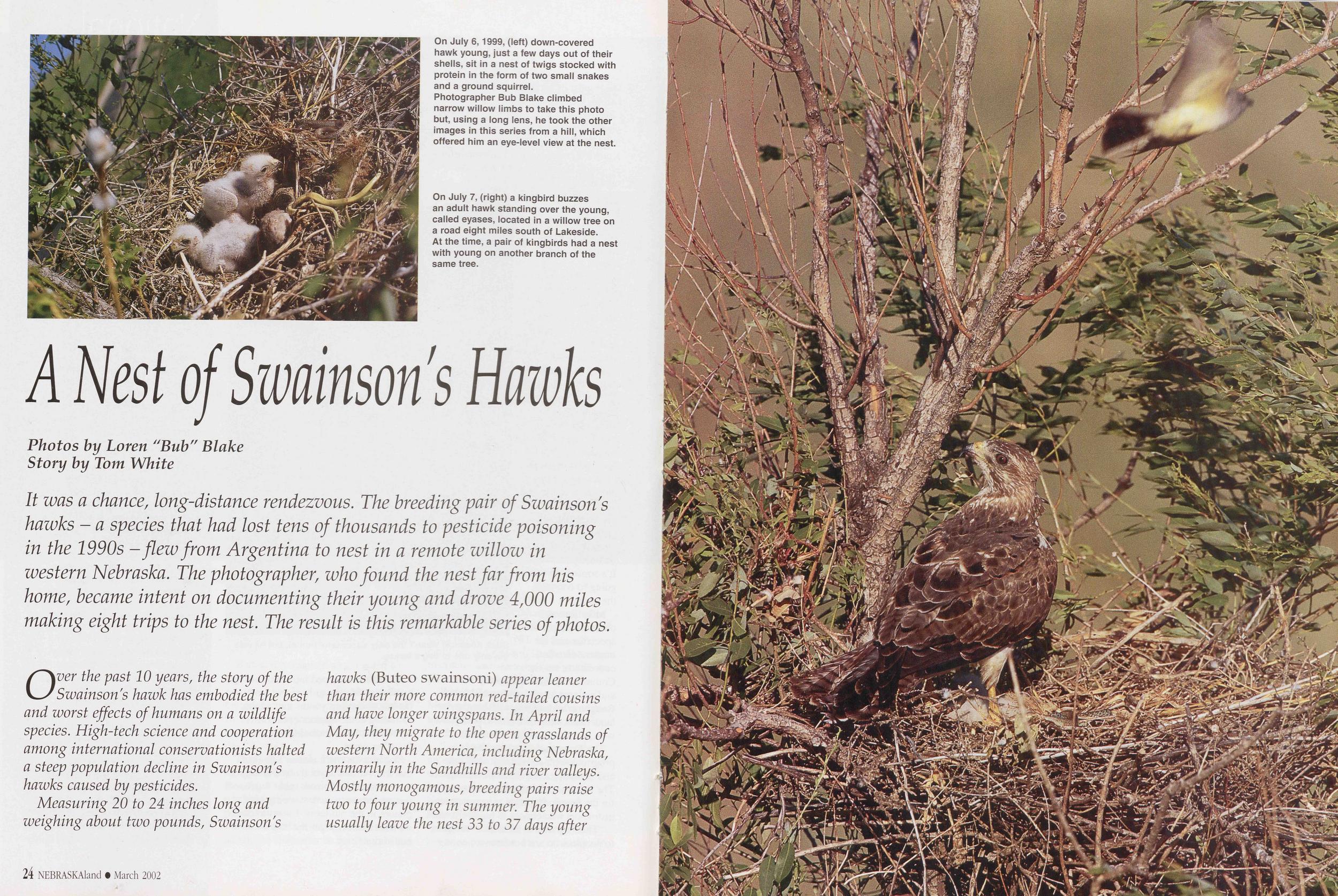
A M of Swainson's Hawks
Over the past 10 years, the story of the Swainson's hawk has embodied the best and worst effects of humans on a wildlife species. High-tech science and cooperation among international conservationists halted a steep population decline in Swainson's hawks caused by pesticides.
Measuring 20 to 24 inches long and weighing about two pounds, Swainson's hawks (Buteo swamsoni) appear leaner than their more common red-tailed cousins and have longer wingspans. In April and May, they migrate to the open grasslands of western North America, including Nebraska, primarily in the Sandhills and river valleys. Mostly monogamous, breeding pairs raise two to four young in summer. The young usually leave the nest 33 to 37 days after
24 NEBRASKAland • March 2002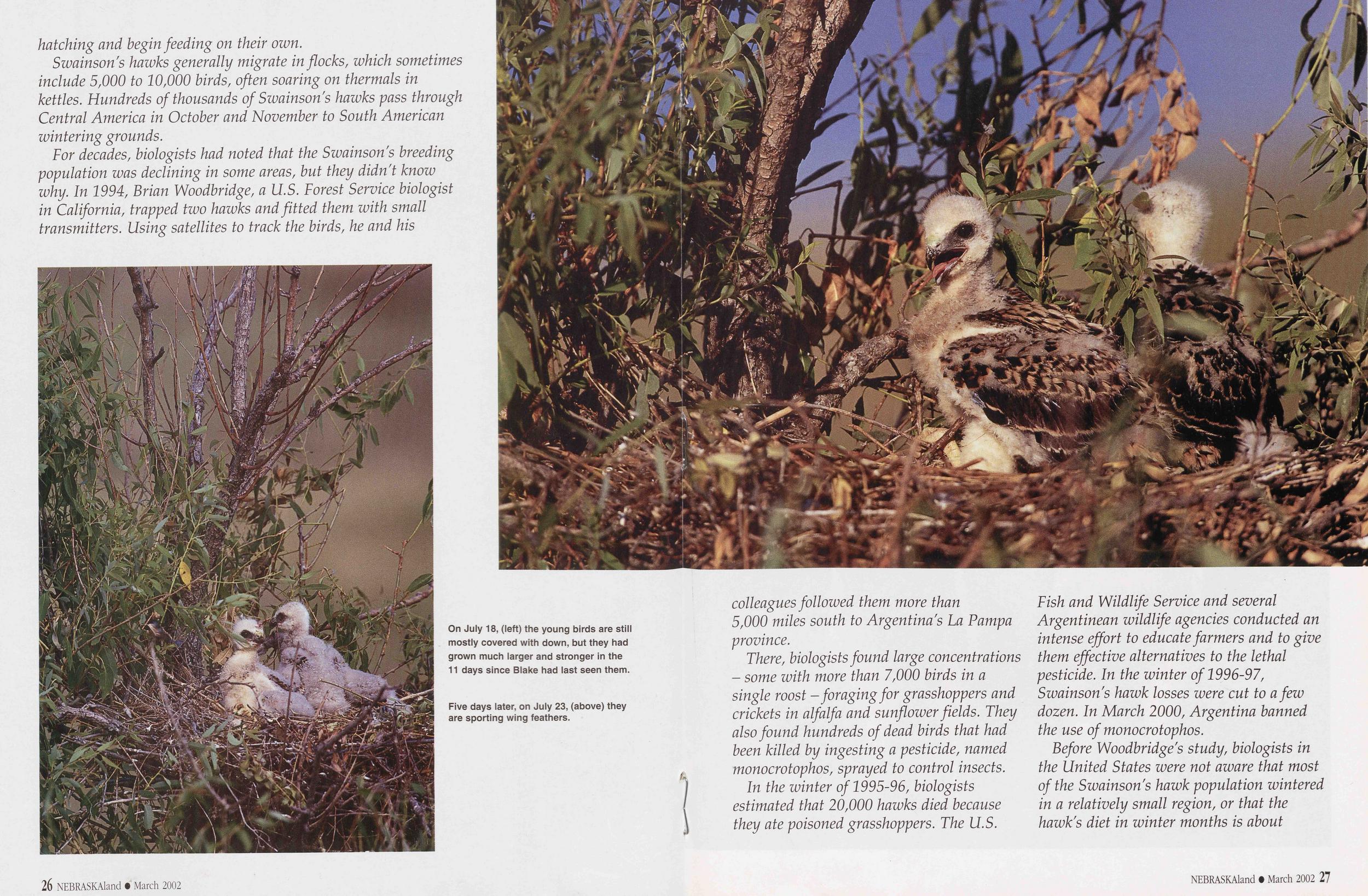
hatching and begin feeding on their own.
Swainson's hawks generally migrate in flocks, which sometimes include 5,000 to 10,000 birds, often soaring on thermals in kettles. Hundreds of thousands of Swainson's hawks pass through Central America in October and November to South American wintering grounds.
For decades, biologists had noted that the Swainson's breeding population was declining in some areas, but they didn't know why. In 1994, Brian Woodbridge, a U.S. Forest Service biologist in California, trapped two hawks and fitted them with small transmitters. Using satellites to track the birds, he and his 26 NEBRASKAland • March 2002 colleagues followed them more than 5,000 miles south to Argentina's La Pampa province.
There, biologists found large concentrations - some with more than 7,000 birds in a single roost - foraging for grasshoppers and crickets in alfalfa and sunflower fields. They also found hundreds of dead birds that had been killed by ingesting a pesticide, named monocrotophos, sprayed to control insects.
In the winter of 1995-96, biologists estimated that 20,000 hawks died because they ate poisoned grasshoppers. The U.S. Fish and Wildlife Service and several Argentinean wildlife agencies conducted an intense effort to educate farmers and to give them effective alternatives to the lethal pesticide. In the winter of 1996-97, Swainson's hawk losses were cut to a few dozen. In March 2000, Argentina banned the use of monocrotophos.
Before Woodbridge's study, biologists in the United States were not aware that most of the Swainson's hawk population wintered in a relatively small region, or that the hawk's diet in winter months is about
NEBRASKAland • March 2002 27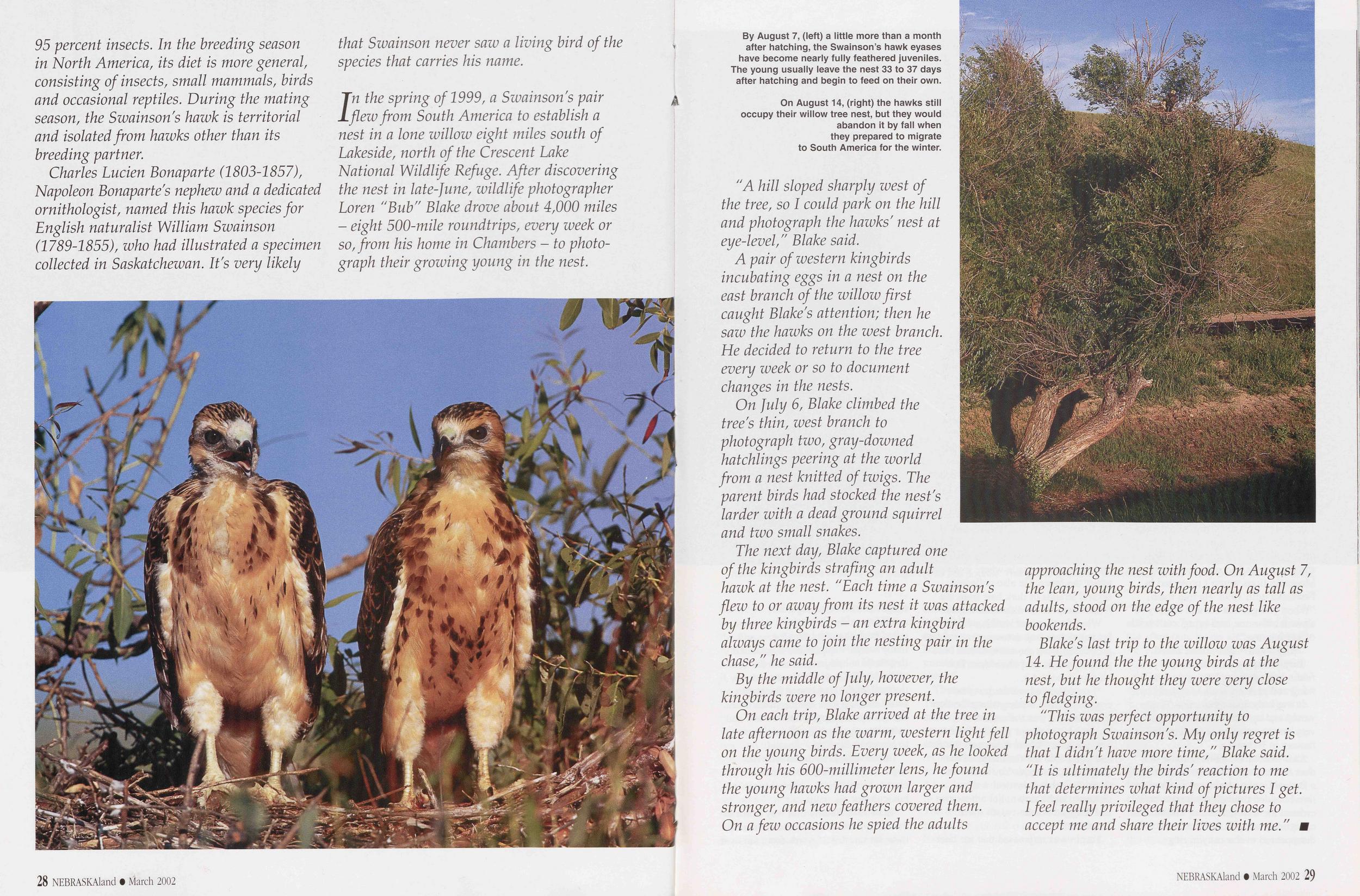
95 percent insects. In the breeding season in North America, its diet is more general, consisting of insects, small mammals, birds and occasional reptiles. During the mating season, the Swainson's hawk is territorial and isolated from hawks other than its breeding partner.
Charles Lucien Bonaparte (1803-1857), Napoleon Bonaparte's nephew and a dedicated ornithologist, named this hawk species for English naturalist William Swainson (1789-1855), who had illustrated a specimen collected in Saskatchewan. It's very likely that Swainson never saw a living bird of the , species that carries his name.
In the spring of 1999, a Swainson's pair JL flew from South America to establish a nest in a lone willow eight miles south of Lakeside, north of the Crescent Lake National Wildlife Refuge. After discovering the nest in late-June, wildlife photographer Loren "Bub" Blake drove about 4,000 miles - eight 500-mile roundtrips, every week or so, from his home in Chambers - to photo- graph their growing young in the nest.
28 NEBRASKAland • March 2002“A hill sloped sharply west of the tree, so I could park on the hill and photograph the hawks' nest at eye-level," Blake said.
A pair of western kingbirds incubating eggs in a nest on the east branch of the willow first caught Blake's attention; then he saw the hawks on the west branch. He decided to return to the tree every week or so to document changes in the nests.
On July 6, Blake climbed the tree's thin, west branch to photograph two, gray-downed hatchlings peering at the world from a nest knitted of twigs. The parent birds had stocked the nest's larder with a dead ground squirrel and two small snakes.
The next day, Blake captured one of the kingbirds strafing an adult hawk at the nest. "Each time a Swainson's flew to or away from its nest it was attacked by three kingbirds - an extra kingbird always came to join the nesting pair in the chase," he said.
By the middle of July, however, the kingbirds were no longer present.
On each trip, Blake arrived at the tree in late afternoon as the warm, western light fell on the young birds. Every week, as he looked through his 600-millimeter lens, he found the young hawks had grown larger and stronger, and new feathers covered them. On a few occasions he spied the adults approaching the nest with food. On August 7, the lean, young birds, then nearly as tall as adults, stood on the edge of the nest like bookends.
Blake's last trip to the willow was August 14. He found the the young birds at the nest, but he thought they were very close to fledging.
"This was perfect opportunity to photograph Swainson's. My only regret is that I didn't have more time," Blake said. "It is ultimately the birds' reaction to me that determines what kind of pictures I get. I feel really privileged that they chose to accept me and share their lives with me. ”
NEBRASKAland • March 2002 29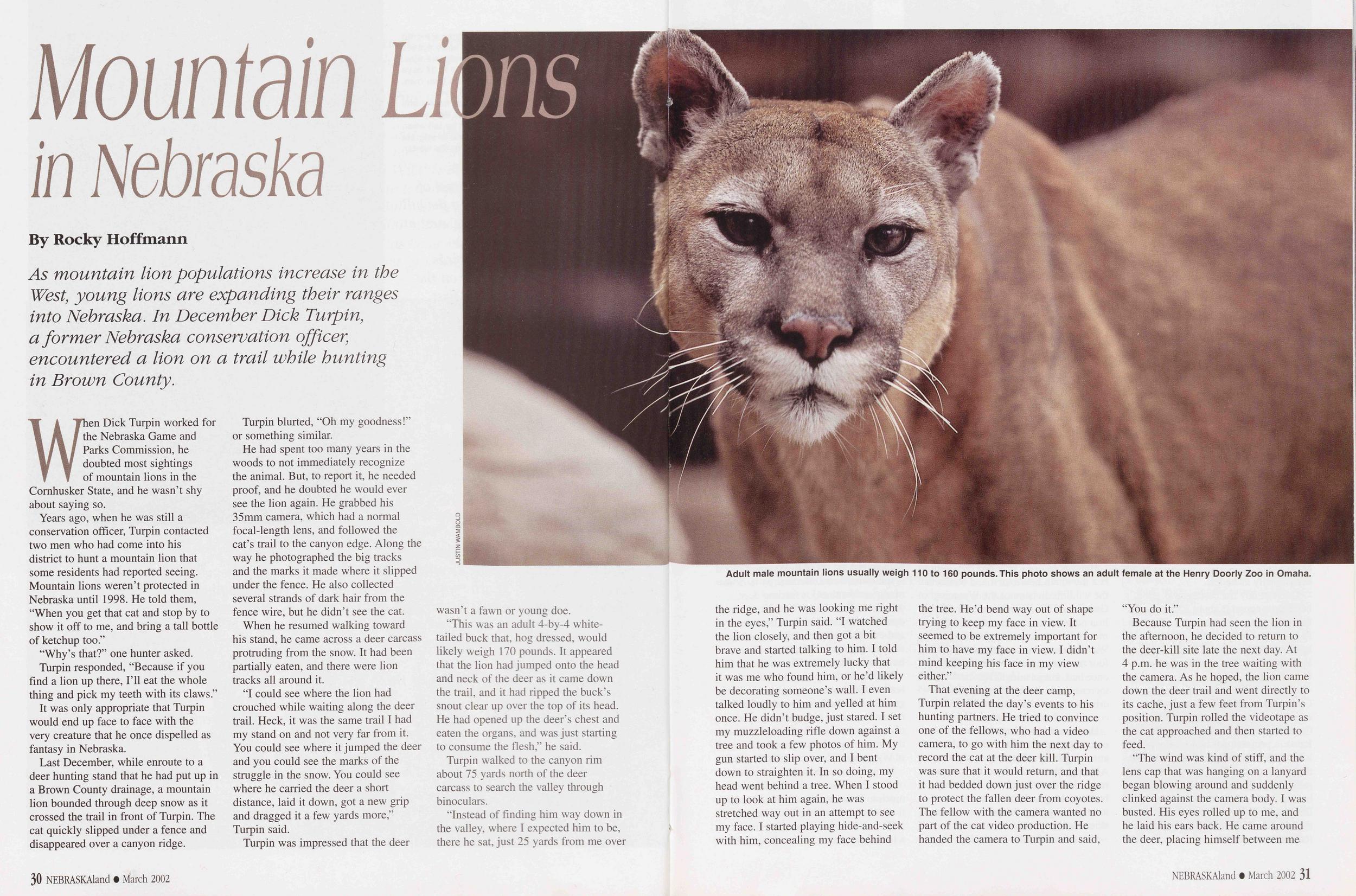
Mountain Lions in Nebraska
As mountain lion populations increase in the West, young lions are expanding their ranges into Nebraska. In December Dick Turpin, a former Nebraska conservation officer, encountered a lion on a trail while hunting in Brown County.When Dick Turpin worked for the Nebraska Game and Parks Commission, he doubted most sightings of mountain lions in the Comhusker State, and he wasn’t shy about saying so.
Years ago, when he was still a conservation officer, Turpin contacted two men who had come into his district to hunt a mountain lion that some residents had reported seeing.
“Why’s that?” one hunter asked.
Turpin responded, "Because if you find a lion up there, I’ll eat the whole thing and pick my teeth with its claws.”
It was only appropriate that Turpin would end up face to face with the very creature that he once dispelled as fantasy in Nebraska.
Last December, while enroute to a deer hunting stand that he had put up in a Brown County drainage, a mountain lion bounded through deep snow as it crossed the trail in front of Turpin. The cat quickly slipped under a fence and disappeared over a canyon ridge.
Turpin blurted, "Oh my goodness!” or something similar.
He had spent too many years in the woods to not immediately recognize the animal. But, to report it, he needed proof, and he doubted he would ever see the lion again. He grabbed his 35 mm camera, which had a normal focal-length lens, and followed the cat’s trail to the canyon edge. Along the way he photographed the big tracks and the marks it made where it slipped under the fence. He also collected several strands of dark hair from the fence wire, but he didn’t see the cat.
When he resumed walking toward his stand, he came across a deer carcass protruding from the snow. It had been partially eaten, and there were lion tracks all around it.
"I could see where the lion had crouched while waiting along the deer trail. Heck, it was the same trail I had my stand on and not very far from it. You could see where it jumped the deer and you could see the marks of the struggle in the snow. You could see where he carried the deer a short distance, laid it down, got a new grip and dragged it a few yards more,” Turpin said.
Turpin was impressed that the deer wasn’t a fawn or young doe.
"This was an adult 4-by-4 white- tailed buck that, hog dressed, would likely weigh 170 pounds. It appeared that the lion had jumped onto the head and neck of the deer as it came down the trail, and it had ripped the buck’s snout clear up over the top of its head. He had opened up the deer’s chest and eaten the organs, and was just starting to consume the flesh,” he said.
Turpin walked to the canyon rim about 75 yards north of the deer carcass to search the valley through binoculars.
"Instead of finding him way down in the valley, where I expected him to be, there he sat, just 25 yards from me over 30 NEBRASKAland • March 2002 the ridge, and he was looking me right in the eyes,” Turpin said. "I watched the lion closely, and then got a bit brave and started talking to him. I told him that he was extremely lucky that it was me who found him, or he’d likely be decorating someone’s wall. I even talked loudly to him and yelled at him once. He didn’t budge, just stared. I set my muzzleloading rifle down against a tree and took a few photos of him. My gun started to slip over, and I bent down to straighten it. In so doing, my head went behind a tree. When I stood up to look at him again, he was stretched way out in an attempt to see my face. I started playing hide-and-seek with him, concealing my face behind the tree. He’d bend way out of shape trying to keep my face in view. It seemed to be extremely important for him to have my face in view. I didn’t mind keeping his face in my view either.”
That evening at the deer camp, Turpin related the day’s events to his hunting partners. He tried to convince one of the fellows, who had a video camera, to go with him the next day to record the cat at the deer kill. Turpin was sure that it would return, and that it had bedded down just over the ridge to protect the fallen deer from coyotes. The fellow with the camera wanted no part of the cat video production. He handed the camera to Turpin and said, "You do it.”
Because Turpin had seen the lion in the afternoon, he decided to return to the deer-kill site late the next day. At 4 p.m. he was in the tree waiting with the camera. As he hoped, the lion came down the deer trail and went directly to its cache, just a few feet from Turpin’s position. Turpin rolled the videotape as the cat approached and then started to feed.
"The wind was kind of stiff, and the lens cap that was hanging on a lanyard began blowing around and suddenly clinked against the camera body. I was busted. His eyes rolled up to me, and he laid his ears back. He came around the deer, placing himself between me
NEBRASKAland • March 2002 31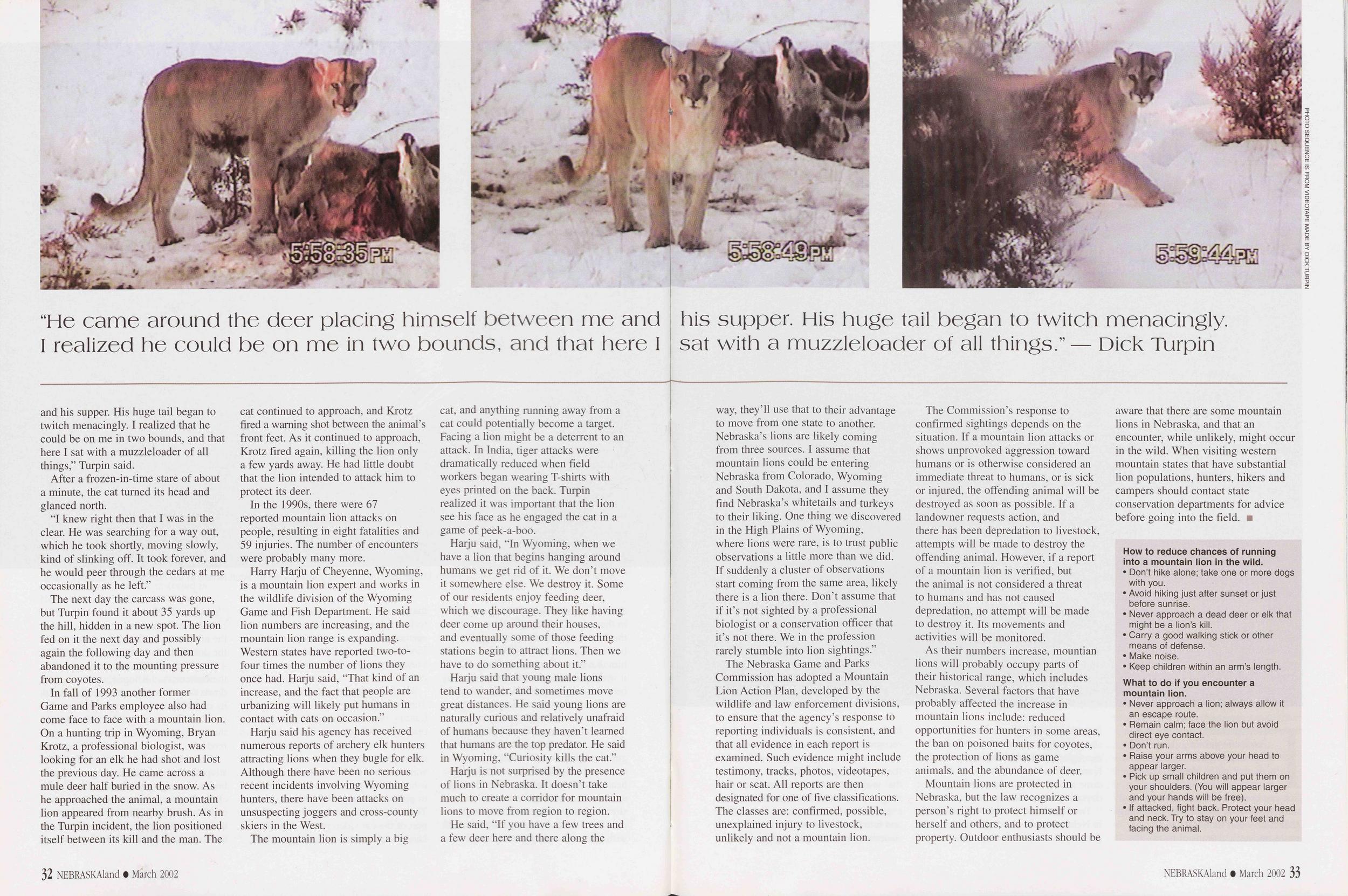
“He came around the deer placing himself between me and I realized he could be on me in two bounds, and that here 1 his supper. His huge tail began to twitch menacingly, sat with a muzzleloader of all things.” — Dick Turpin and his supper. His huge tail began to twitch menacingly. I realized that he could be on me in two bounds, and that here I sat with a muzzleloader of all things,” Turpin said.
After a frozen-in-time stare of about a minute, the cat turned its head and glanced north.
"I knew right then that I was in the clear. He was searching for a way out, which he took shortly, moving slowly, kind of slinking off. It took forever, and he would peer through the cedars at me occasionally as he left.”
The next day the carcass was gone, but Turpin found it about 35 yards up the hill, hidden in a new spot. The lion fed on it the next day and possibly again the following day and then abandoned it to the mounting pressure from coyotes.
In fall of 1993 another former Game and Parks employee also had come face to face with a mountain lion. On a hunting trip in Wyoming, Bryan Krotz, a professional biologist, was looking for an elk he had shot and lost the previous day. He came across a mule deer half buried in the snow. As he approached the animal, a mountain lion appeared from nearby brush. As in the Turpin incident, the lion positioned itself between its kill and the man. The cat continued to approach, and Krotz fired a warning shot between the animal’s front feet. As it continued to approach, Krotz fired again, killing the lion only a few yards away. He had little doubt that the lion intended to attack him to protect its deer.
In the 1990s, there were 67 reported mountain lion attacks on people, resulting in eight fatalities and 59 injuries. The number of encounters were probably many more.
Harry Harju of Cheyenne, Wyoming, is a mountain lion expert and works in the wildlife division of the Wyoming Game and Fish Department. He said lion numbers are increasing, and the mountain lion range is expanding. Western states have reported two-to- four times the number of lions they once had. Harju said, "That kind of an increase, and the fact that people are urbanizing will likely put humans in contact with cats on occasion.”
Harju said his agency has received numerous reports of archery elk hunters attracting lions when they bugle for elk. Although there have been no serious recent incidents involving Wyoming hunters, there have been attacks on unsuspecting joggers and cross-county skiers in the West.
The mountain lion is simply a big cat, and anything running away from a cat could potentially become a target. Facing a lion might be a deterrent to an attack. In India, tiger attacks were dramatically reduced when field workers began wearing T-shirts with eyes printed on the back. Turpin realized it was important that the lion see his face as he engaged the cat in a game of peek-a-boo.
Harju said, "In Wyoming, when we have a lion that begins hanging around humans we get rid of it. We don’t move it somewhere else. We destroy it. Some of our residents enjoy feeding deer, which we discourage. They like having deer come up around their houses, and eventually some of those feeding stations begin to attract lions. Then we have to do something about it.”
Harju said that young male lions tend to wander, and sometimes move great distances. He said young lions are naturally curious and relatively unafraid of humans because they haven’t learned that humans are the top predator. He said in Wyoming, "Curiosity kills the cat.”
Harju is not surprised by the presence of lions in Nebraska. It doesn’t take much to create a corridor for mountain lions to move from region to region.
He said, "If you have a few trees and a few deer here and there along the 32 NEBRASKAland • March 2002 way, they’ll use that to their advantage to move from one state to another. Nebraska’s lions are likely coming from three sources. I assume that mountain lions could be entering Nebraska from Colorado, Wyoming and South Dakota, and I assume they find Nebraska’s whitetails and turkeys to their liking. One thing we discovered in the High Plains of Wyoming, where lions were rare, is to trust public observations a little more than we did. If suddenly a cluster of observations start coming from the same area, likely there is a lion there. Don’t assume that if it’s not sighted by a professional biologist or a conservation officer that it’s not there. We in the profession rarely stumble into lion sightings.”
The Nebraska Game and Parks Commission has adopted a Mountain Lion Action Plan, developed by the wildlife and law enforcement divisions, to ensure that the agency’s response to reporting individuals is consistent, and that all evidence in each report is examined. Such evidence might include testimony, tracks, photos, videotapes, hair or scat. All reports are then designated for one of five classifications. The classes are: confirmed, possible, unexplained injury to livestock, unlikely and not a mountain lion.
The Commission’s response to confirmed sightings depends on the situation. If a mountain lion attacks or shows unprovoked aggression toward humans or is otherwise considered an immediate threat to humans, or is sick or injured, the offending animal will be destroyed as soon as possible. If a landowner requests action, and there has been depredation to livestock, attempts will be made to destroy the offending animal. However, if a report of a mountain lion is verified, but the animal is not considered a threat to humans and has not caused depredation, no attempt will be made to destroy it. Its movements and activities will be monitored.
As their numbers increase, mountian lions will probably occupy parts of their historical range, which includes Nebraska. Several factors that have probably affected the increase in mountain lions include: reduced opportunities for hunters in some areas, the ban on poisoned baits for coyotes, the protection of lions as game animals, and the abundance of deer.
Mountain lions are protected in Nebraska, but the law recognizes a person’s right to protect himself or herself and others, and to protect property. Outdoor enthusiasts should be aware that there are some mountain lions in Nebraska, and that an encounter, while unlikely, might occur in the wild. When visiting western mountain states that have substantial lion populations, hunters, hikers and campers should contact state conservation departments for advice before going into the field. ■
How to reduce chances of running into a mountain lion in the wild. • Don’t hike alone; take one or more dogs with you. • Avoid hiking just after sunset or just before sunrise. • Never approach a dead deer or elk that might be a lion’s kill. • Carry a good walking stick or other means of defense. • Make noise. • Keep children within an arm’s length. What to do if you encounter a mountain lion. • Never approach a lion; always allow it an escape route. • Remain calm; face the lion but avoid direct eye contact. • Don’t run. • Raise your arms above your head to appear larger. • Pick up small children and put them on your shoulders. (You will appear larger and your hands will be free). • If attacked, fight back. Protect your head and neck. Try to stay on your feet and facing the animal. NEBRASKAland • March 2002 33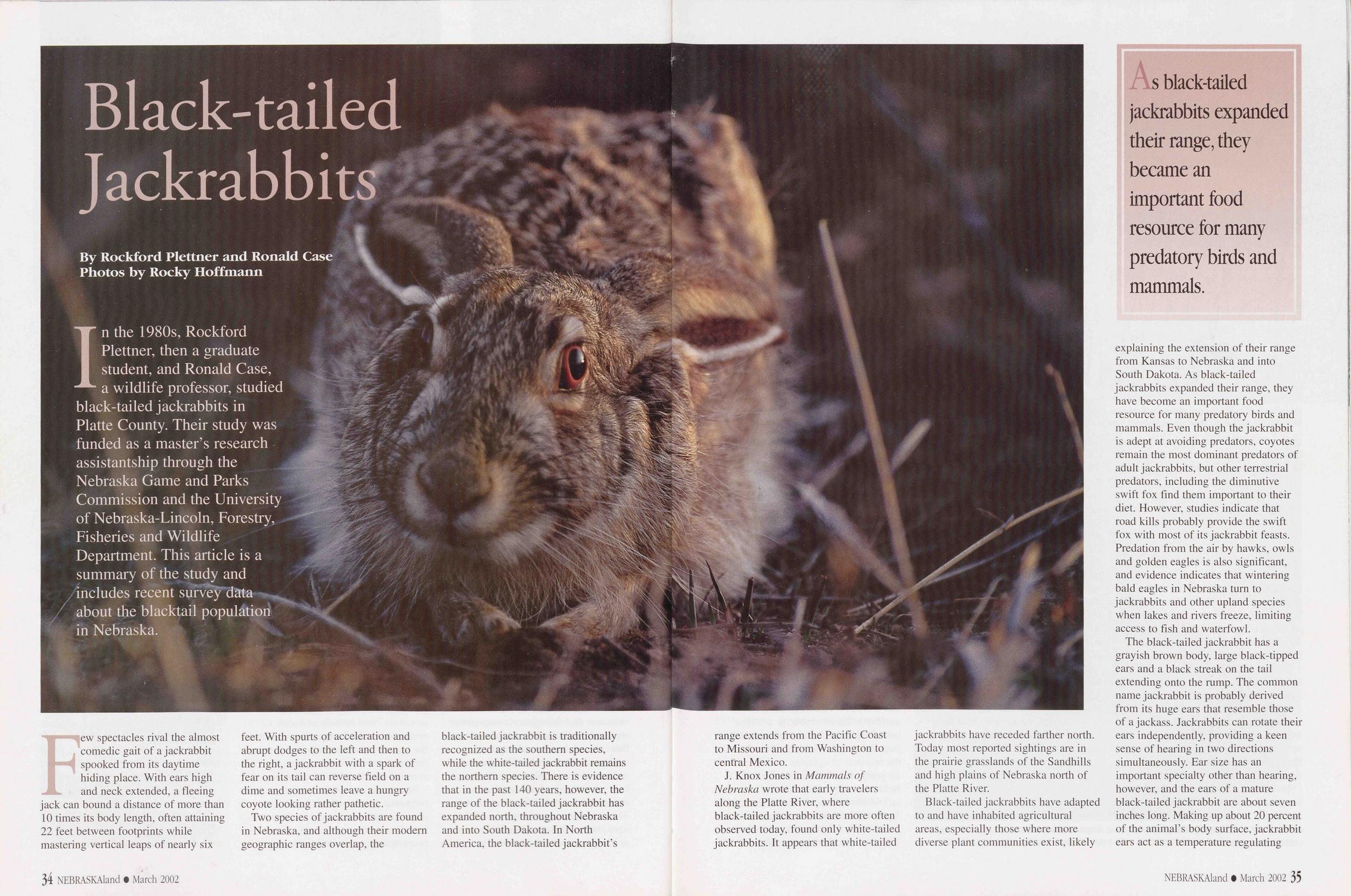
Black-tailed Jackrabbits
Few spectacles rival the almost comedic gait of a jackrabbit spooked from its daytime hiding place. With ears high and neck extended, a fleeing jack can bound a distance of more than 10 times its body length, often attaining 22 feet between footprints while mastering vertical leaps of nearly six feet. With spurts of acceleration and abrupt dodges to the left and then to the right, a jackrabbit with a spark of fear on its tail can reverse field on a dime and sometimes leave a hungry coyote looking rather pathetic.
Two species of jackrabbits are found in Nebraska, and although their modern geographic ranges overlap, the black-tailed jackrabbit is traditionally recognized as the southern species, while the white-tailed jackrabbit remains the northern species. There is evidence that in the past 140 years, however, the range of the black-tailed jackrabbit has expanded north, throughout Nebraska and into South Dakota. In North America, the black-tailed jackrabbit’s 34 NEBRASKAland • March 2002 range extends from the Pacific Coast to Missouri and from Washington to central Mexico.
J. Knox Jones in Mammals of Nebraska wrote that early travelers along the Platte River, where black-tailed jackrabbits are more often observed today, found only white-tailed jackrabbits. It appears that white-tailed jackrabbits have receded farther north. Today most reported sightings are in the prairie grasslands of the Sandhills and high plains of Nebraska north of the Platte River.
Black-tailed jackrabbits have adapted to and have inhabited agricultural areas, especially those where more diverse plant communities exist, likely explaining the extension of their range from Kansas to Nebraska and into South Dakota. As black-tailed jackrabbits expanded their range, they have become an important food resource for many predatory birds and mammals. Even though the jackrabbit is adept at avoiding predators, coyotes remain the most dominant predators of adult jackrabbits, but other terrestrial predators, including the diminutive swift fox find them important to their diet. However, studies indicate that road kills probably provide the swift fox with most of its jackrabbit feasts. Predation from the air by hawks, owls and golden eagles is also significant, and evidence indicates that wintering bald eagles in Nebraska turn to jackrabbits and other upland species when lakes and rivers freeze, limiting access to fish and waterfowl.
The black-tailed jackrabbit has a grayish brown body, large black-tipped ears and a black streak on the tail extending onto the rump. The common name jackrabbit is probably derived from its huge ears that resemble those of a jackass. Jackrabbits can rotate their ears independently, providing a keen sense of hearing in two directions simultaneously. Ear size has an important specialty other than hearing, however, and the ears of a mature black-tailed jackrabbit are about seven inches long. Making up about 20 percent of the animal’s body surface, jackrabbit ears act as a temperature regulating
NEBRASKAland • March 2002 35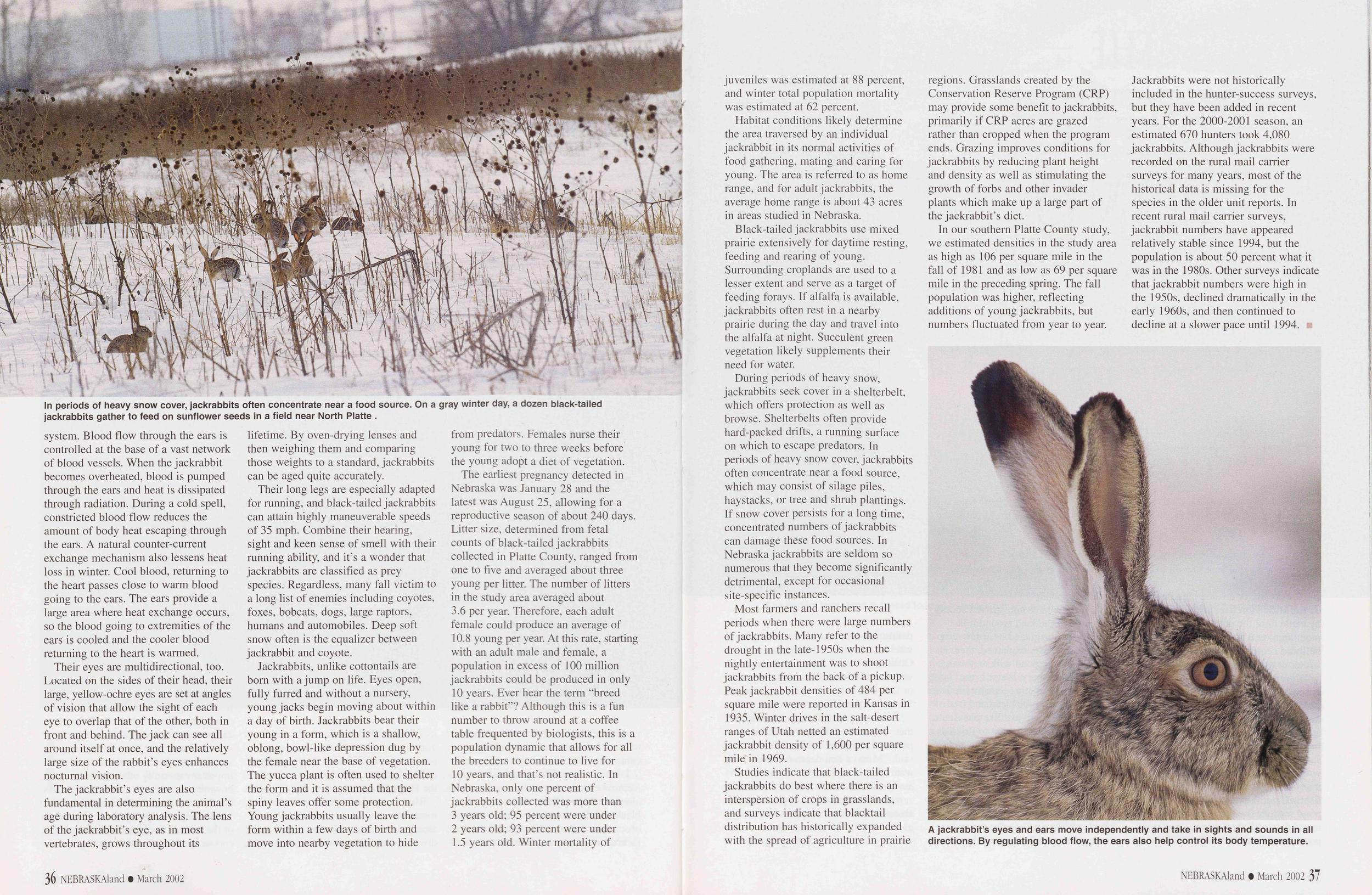
system. Blood flow through the ears is controlled at the base of a vast network of blood vessels. When the jackrabbit becomes overheated, blood is pumped through the ears and heat is dissipated through radiation. During a cold spell, constricted blood flow reduces the amount of body heat escaping through the ears. A natural counter-current exchange mechanism also lessens heat loss in winter. Cool blood, returning to the heart passes close to warm blood going to the ears. The ears provide a large area where heat exchange occurs, so the blood going to extremities of the ears is cooled and the cooler blood returning to the heart is warmed.
Their eyes are multidirectional, too. Located on the sides of their head, their large, yellow-ochre eyes are set at angles of vision that allow the sight of each eye to overlap that of the other, both in front and behind. The jack can see all around itself at once, and the relatively large size of the rabbit’s eyes enhances nocturnal vision.
The jackrabbit’s eyes are also fundamental in determining the animal’s age during laboratory analysis. The lens of the jackrabbit’s eye, as in most vertebrates, grows throughout its lifetime. By oven-drying lenses and then weighing them and comparing those weights to a standard, jackrabbits can be aged quite accurately.
Their long legs are especially adapted for running, and black-tailed jackrabbits can attain highly maneuverable speeds of 35 mph. Combine their hearing, sight and keen sense of smell with their running ability, and it’s a wonder that jackrabbits are classified as prey species. Regardless, many fall victim to a long list of enemies including coyotes, foxes, bobcats, dogs, large raptors, humans and automobiles. Deep soft snow often is the equalizer between jackrabbit and coyote.
Jackrabbits, unlike cottontails are born with a jump on life. Eyes open, fully furred and without a nursery, young jacks begin moving about within a day of birth. Jackrabbits bear their young in a form, which is a shallow, oblong, bowl-like depression dug by the female near the base of vegetation. The yucca plant is often used to shelter the form and it is assumed that the spiny leaves offer some protection. Young jackrabbits usually leave the form within a few days of birth and move into nearby vegetation to hide from predators. Females nurse their young for two to three weeks before the young adopt a diet of vegetation.
The earliest pregnancy detected in Nebraska was January 28 and the latest was August 25, allowing for a reproductive season of about 240 days. Litter size, determined from fetal counts of black-tailed jackrabbits collected in Platte County, ranged from one to five and averaged about three young per litter. The number of litters in the study area averaged about 3.6 per year. Therefore, each adult female could produce an average of 10.8 young per year. At this rate, starting with an adult male and female, a population in excess of 100 million jackrabbits could be produced in only 10 years. Ever hear the term "breed like a rabbit”? Although this is a fun number to throw around at a coffee table frequented by biologists, this is a population dynamic that allows for all the breeders to continue to live for 10 years, and that’s not realistic. In Nebraska, only one percent of jackrabbits collected was more than 3 years old; 95 percent were under 2 years old; 93 percent were under 1.5 years old. Winter mortality of 36 NEBRASKAland • March 2002 juveniles was estimated at 88 percent, and winter total population mortality was estimated at 62 percent.
Habitat conditions likely determine the area traversed by an individual jackrabbit in its normal activities of food gathering, mating and caring for young. The area is referred to as home range, and for adult jackrabbits, the average home range is about 43 acres in areas studied in Nebraska.
Black-tailed jackrabbits use mixed prairie extensively for daytime resting, feeding and rearing of young. Surrounding croplands are used to a lesser extent and serve as a target of feeding forays. If alfalfa is available, jackrabbits often rest in a nearby prairie during the day and travel into the alfalfa at night. Succulent green vegetation likely supplements their need for water.
During periods of heavy snow, jackrabbits seek cover in a shelterbelt, which offers protection as well as browse. Shelterbelts often provide hard-packed drifts, a running surface on which to escape predators. In periods of heavy snow cover, jackrabbits often concentrate near a food source, which may consist of silage piles, haystacks, or tree and shrub plantings. If snow cover persists for a long time, concentrated numbers of jackrabbits can damage these food sources. In Nebraska jackrabbits are seldom so numerous that they become significantly detrimental, except for occasional site-specific instances.
Most farmers and ranchers recall periods when there were large numbers of jackrabbits. Many refer to the drought in the late-1950s when the nightly entertainment was to shoot jackrabbits from the back of a pickup. Peak jackrabbit densities of 484 per square mile were reported in Kansas in 1935. Winter drives in the salt-desert ranges of Utah netted an estimated jackrabbit density of 1,600 per square mile in 1969.
Studies indicate that black-tailed jackrabbits do best where there is an interspersion of crops in grasslands, and surveys indicate that blacktail distribution has historically expanded with the spread of agriculture in prairie regions. Grasslands created by the Conservation Reserve Program (CRP) may provide some benefit to jackrabbits, primarily if CRP acres are grazed rather than cropped when the program ends. Grazing improves conditions for jackrabbits by reducing plant height and density as well as stimulating the growth of forbs and other invader plants which make up a large part of the jackrabbit’s diet.
In our southern Platte County study, we estimated densities in the study area as high as 106 per square mile in the fall of 1981 and as low as 69 per square mile in the preceding spring. The fall population was higher, reflecting additions of young jackrabbits, but numbers fluctuated from year to year.
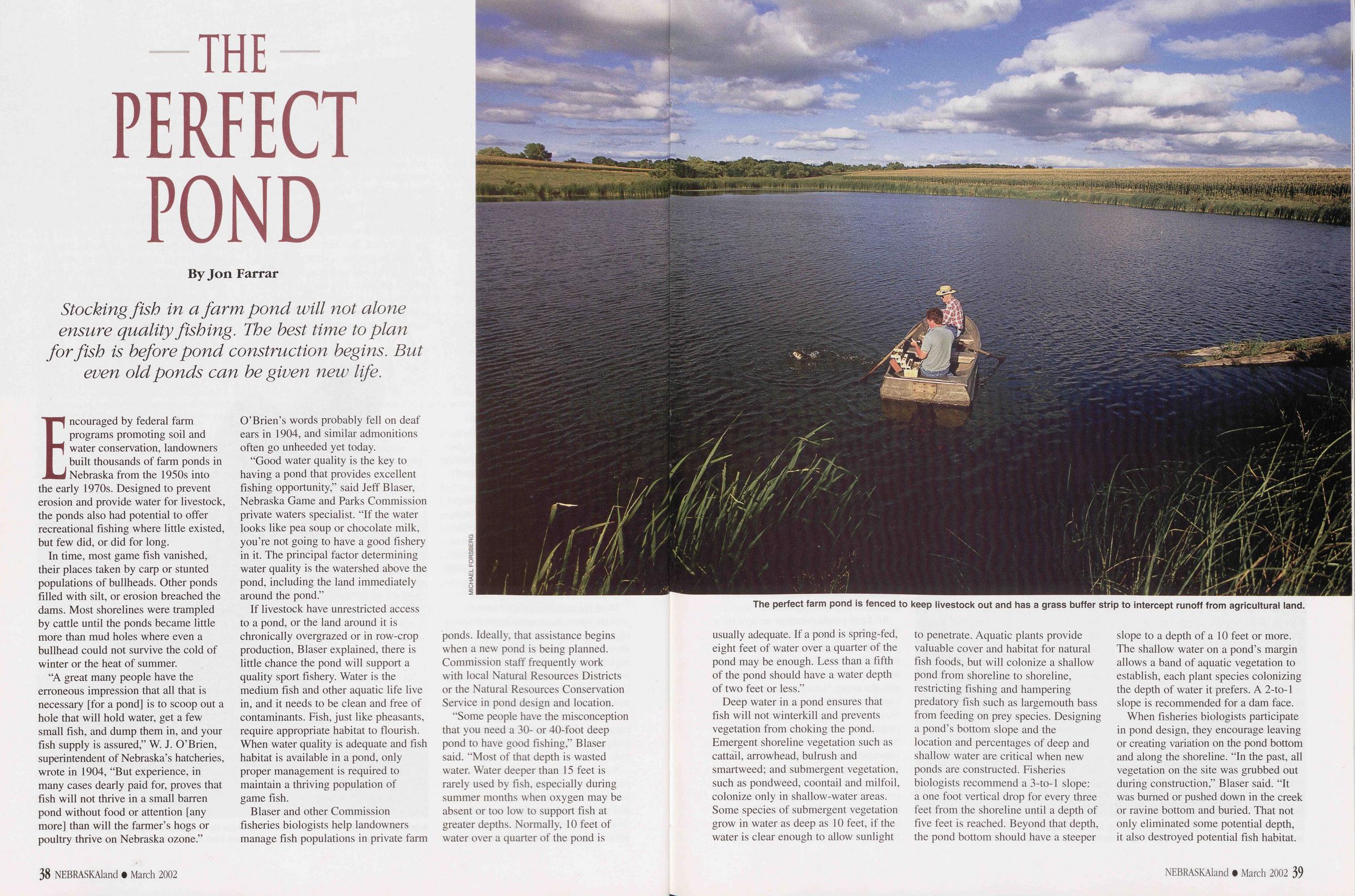
THE PERFECT POND
Stocking fish in a farm pond will not alone ensure quality fishing. The best time to plan for fish is before pond construction begins. But even old ponds can be given new life.Encouraged by federal farm programs promoting soil and water conservation, landowners built thousands of farm ponds in Nebraska from the 1950s into the early 1970s. Designed to prevent erosion and provide water for livestock, the ponds also had potential to offer recreational fishing where little existed, but few did, or did for long.
In time, most game fish vanished, their places taken by carp or stunted populations of bullheads. Other ponds filled with silt, or erosion breached the dams. Most shorelines were trampled by cattle until the ponds became little more than mud holes where even a bullhead could not survive the cold of winter or the heat of summer.
“A great many people have the erroneous impression that all that is necessary [for a pond] is to scoop out a hole that will hold water, get a few small fish, and dump them in, and your fish supply is assured,” W. J. O’Brien, superintendent of Nebraska’s hatcheries, wrote in 1904, "But experience, in many cases dearly paid for, proves that fish will not thrive in a small barren pond without food or attention [any more] than will the farmer’s hogs or poultry thrive on Nebraska ozone.” O’Brien’s words probably fell on deaf ears in 1904, and similar admonitions often go unheeded yet today.
"Good water quality is the key to having a pond that provides excellent fishing opportunity,” said Jeff Blaser, Nebraska Game and Parks Commission private waters specialist. "If the water looks like pea soup or chocolate milk, you’re not going to have a good fishery in it. The principal factor determining water quality is the watershed above the pond, including the land immediately around the pond.”
If livestock have unrestricted access to a pond, or the land around it is chronically overgrazed or in row-crop production, Blaser explained, there is little chance the pond will support a quality sport fishery. Water is the medium fish and other aquatic life live in, and it needs to be clean and free of contaminants. Fish, just like pheasants, require appropriate habitat to flourish. When water quality is adequate and fish habitat is available in a pond, only proper management is required to maintain a thriving population of game fish.
Blaser and other Commission fisheries biologists help landowners manage fish populations in private farm
"Some people have the misconception that you need a 30- or 40-foot deep pond to have good fishing,” Blaser said. "Most of that depth is wasted water. Water deeper than 15 feet is rarely used by fish, especially during summer months when oxygen may be absent or too low to support fish at greater depths. Normally, 10 feet of water over a quarter of the pond is 38 NEBRASKAland • March 2002 usually adequate. If a pond is spring-fed, eight feet of water over a quarter of the pond may be enough. Less than a fifth of the pond should have a water depth of two feet or less.”
Deep water in a pond ensures that fish will not winterkill and prevents vegetation from choking the pond. Emergent shoreline vegetation such as cattail, arrowhead, bulrush and smartweed; and submergent vegetation, such as pondweed, coontail and milfoil, colonize only in shallow-water areas. Some species of submergent vegetation grow in water as deep as 10 feet, if the water is clear enough to allow sunlight to penetrate. Aquatic plants provide valuable cover and habitat for natural fish foods, but will colonize a shallow pond from shoreline to shoreline, restricting fishing and hampering predatory fish such as largemouth bass from feeding on prey species. Designing a pond’s bottom slope and the location and percentages of deep and shallow water are critical when new ponds are constructed. Fisheries biologists recommend a 3-to-l slope: a one foot vertical drop for every three feet from the shoreline until a depth of five feet is reached. Beyond that depth, the pond bottom should have a steeper slope to a depth of a 10 feet or more. The shallow water on a pond’s margin allows a band of aquatic vegetation to establish, each plant species colonizing the depth of water it prefers. A 2-to-l slope is recommended for a dam face.
When fisheries biologists participate in pond design, they encourage leaving or creating variation on the pond bottom and along the shoreline. "In the past, all vegetation on the site was grubbed out during construction,” Blaser said. "It was burned or pushed down in the creek or ravine bottom and buried. That not only eliminated some potential depth, it also destroyed potential fish habitat.
NEBRASKAland • March 2002 39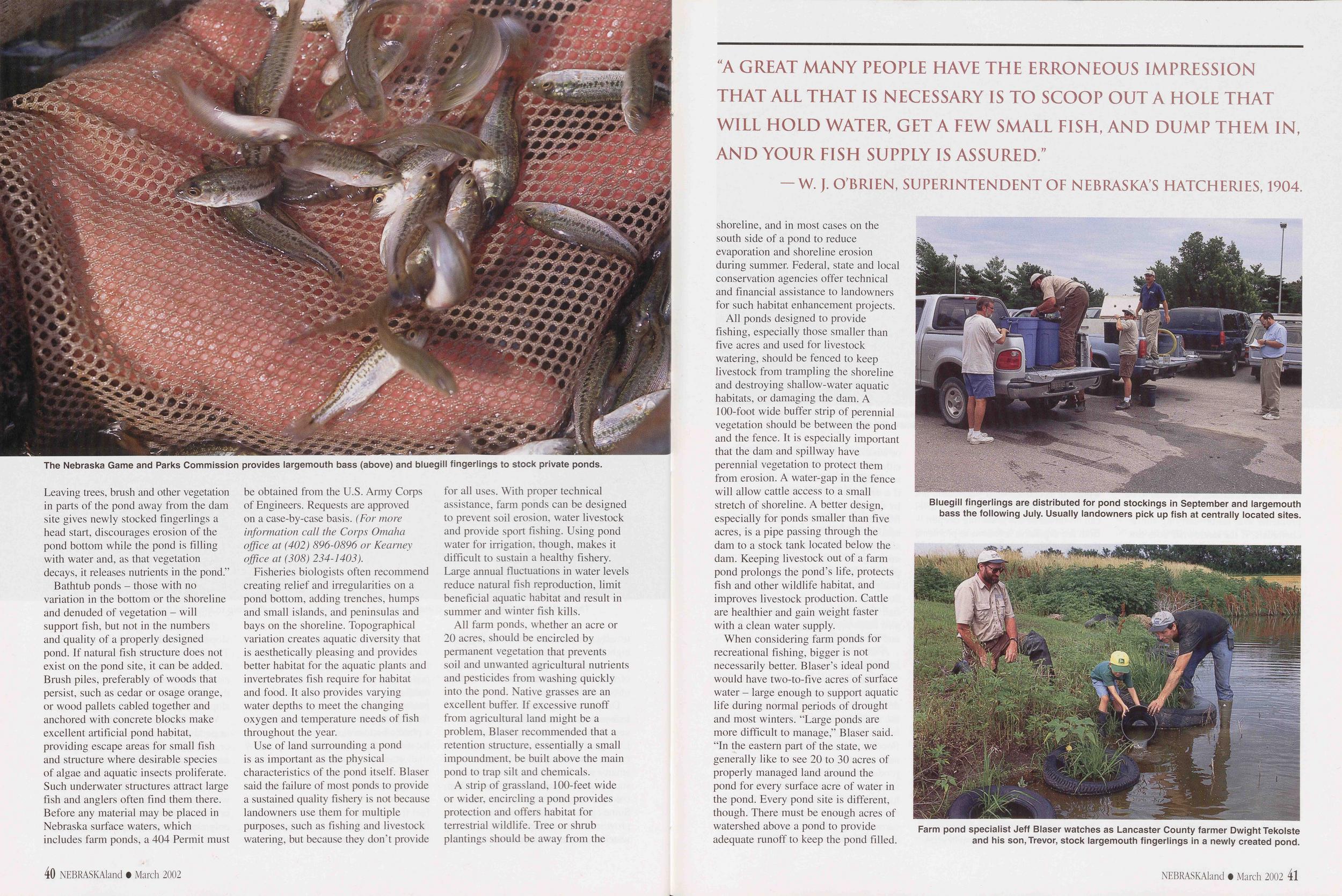
Leaving trees, brush and other vegetation in parts of the pond away from the dam site gives newly stocked fingerlings a head start, discourages erosion of the pond bottom while the pond is filling with water and, as that vegetation decays, it releases nutrients in the pond.”
Bathtub ponds - those with no variation in the bottom or the shoreline and denuded of vegetation - will support fish, but not in the numbers and quality of a properly designed pond. If natural fish structure does not exist on the pond site, it can be added. Brush piles, preferably of woods that persist, such as cedar or osage orange, or wood pallets cabled together and anchored with concrete blocks make excellent artificial pond habitat, providing escape areas for small fish and structure where desirable species of algae and aquatic insects proliferate. Such underwater structures attract large fish and anglers often find them there. Before any material may be placed in Nebraska surface waters, which includes farm ponds, a 404 Permit must be obtained from the U.S. Army Corps of Engineers. Requests are approved on a case-by-case basis. (For more information call the Corps Omaha office at (402) 896-0896 or Kearney office at (308) 234-1403).
Fisheries biologists often recommend creating relief and irregularities on a pond bottom, adding trenches, humps and small islands, and peninsulas and bays on the shoreline. Topographical variation creates aquatic diversity that is aesthetically pleasing and provides better habitat for the aquatic plants and invertebrates fish require for habitat and food. It also provides varying water depths to meet the changing oxygen and temperature needs of fish throughout the year.
Use of land surrounding a pond is as important as the physical characteristics of the pond itself. Blaser said the failure of most ponds to provide a sustained quality fishery is not because landowners use them for multiple purposes, such as fishing and livestock watering, but because they don’t provide for all uses. With proper technical assistance, farm ponds can be designed to prevent soil erosion, water livestock and provide sport fishing. Using pond water for irrigation, though, makes it difficult to sustain a healthy fishery. Large annual fluctuations in water levels reduce natural fish reproduction, limit beneficial aquatic habitat and result in summer and winter fish kills.
All farm ponds, whether an acre or 20 acres, should be encircled by permanent vegetation that prevents soil and unwanted agricultural nutrients and pesticides from washing quickly into the pond. Native grasses are an excellent buffer. If excessive runoff from agricultural land might be a problem, Blaser recommended that a retention structure, essentially a small impoundment, be built above the main pond to trap silt and chemicals.
A strip of grassland, 100-feet wide or wider, encircling a pond provides protection and offers habitat for terrestrial wildlife. Tree or shrub plantings should be away from the 40 NEBRASKAland • March 2002 shoreline, and in most cases on the south side of a pond to reduce evaporation and shoreline erosion during summer. Federal, state and local conservation agencies offer technical and financial assistance to landowners for such habitat enhancement projects.
"A GREAT MANY PEOPLE HAVE THE ERRONEOUS IMPRESSION THAT ALL THAT IS NECESSARY IS TO SCOOP OUT A HOLE THAT WILL HOLD WATER, GET A FEW SMALL FISH, AND DUMP THEM IN, AND YOUR FISH SUPPLY IS ASSURED.” — W. J. O'BRIEN, SUPERINTENDENT OF NEBRASKA’S HATCHERIES, 1904.All ponds designed to provide fishing, especially those smaller than five acres and used for livestock watering, should be fenced to keep livestock from trampling the shoreline and destroying shallow-water aquatic habitats, or damaging the dam. A 100-foot wide buffer strip of perennial vegetation should be between the pond and the fence. It is especially important that the dam and spillway have perennial vegetation to protect them from erosion. A water-gap in the fence will allow cattle access to a small stretch of shoreline. A better design, especially for ponds smaller than five acres, is a pipe passing through the dam to a stock tank located below the dam. Keeping livestock out of a farm pond prolongs the pond’s life, protects fish and other wildlife habitat, and improves livestock production. Cattle are healthier and gain weight faster with a clean water supply.
When considering farm ponds for recreational fishing, bigger is not necessarily better. Blaser’s ideal pond would have two-to-five acres of surface water - large enough to support aquatic life during normal periods of drought and most winters. "Large ponds are more difficult to manage,” Blaser said. "In the eastern part of the state, we generally like to see 20 to 30 acres of properly managed land around the pond for every surface acre of water in the pond. Every pond site is different, though. There must be enough acres of watershed above a pond to provide adequate runoff to keep the pond filled.
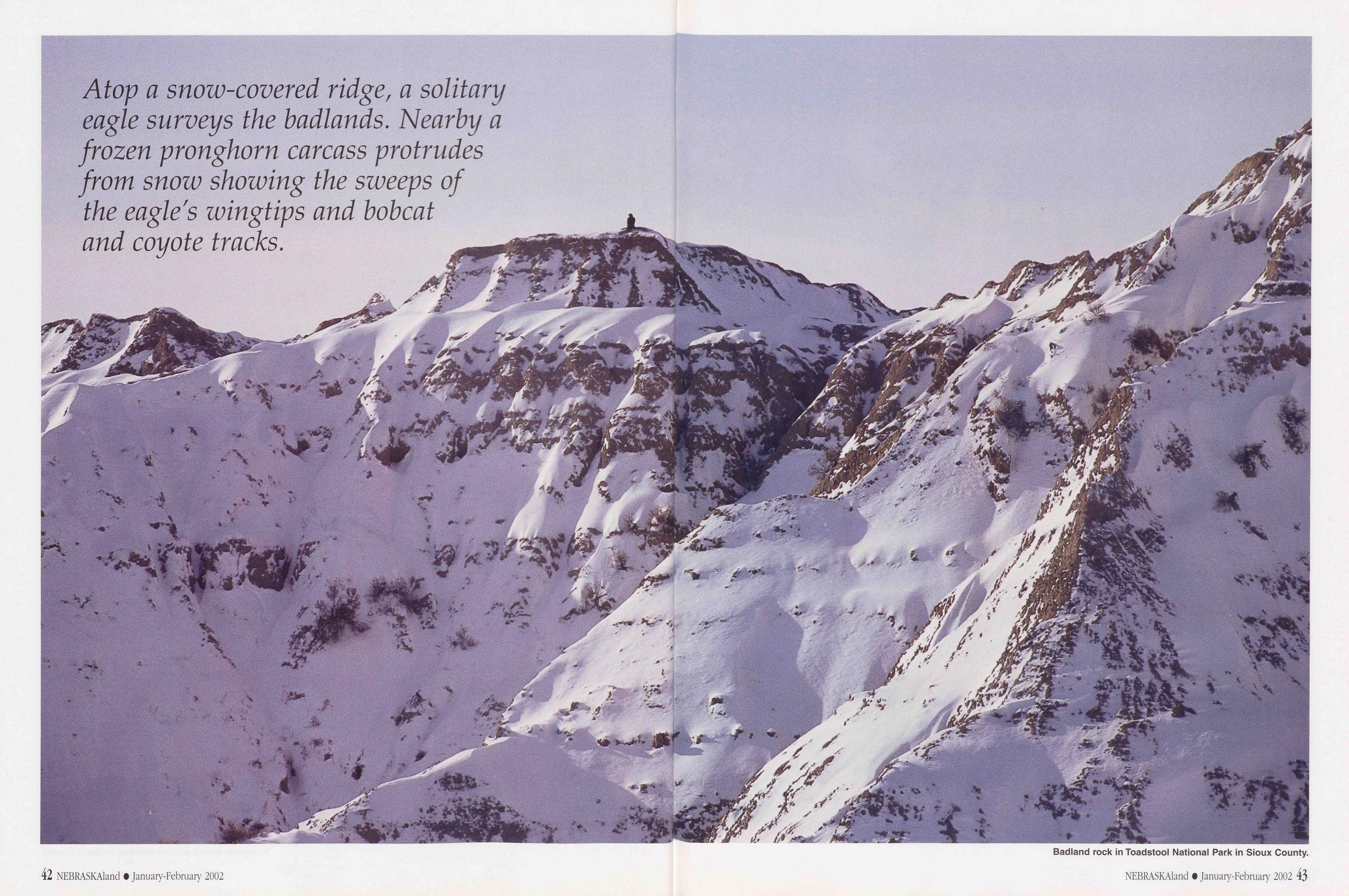
How much watershed is required varies across the state with precipitation and soil types. The larger the pond, the more land in the watershed that needs to be in permanent vegetation to prevent problems with runoff carrying silt or chemicals. If the landowner does not control enough land in the watershed above the pond he might be at the mercy of the neighbor’s land-use practices.”
While designing a new farm pond is ideal, most of Blaser’s work is with existing ponds that were constructed with little consideration for long-term fishing benefits. Such ponds are not lost causes. In many cases, fencing livestock out and creating a buffer strip of permanent vegetation around the pond solves common problems. Underwater fish habitat, and fish attractors to provide additional natural food and cover and concentrate fish for the benefit of anglers can be added. Some ponds that contain only carp or stunted bullhead populations will likely require killing of all fish as a first step in renovation. Stocking desirable fish species alone will not solve the problem of rough fish destroying aquatic vegetation and riling a pond’s bottom, resulting in unacceptable water clarity. If a pond has filled with silt to the point it is so shallow that fish are killed in winter, or is choked with vegetation, not much can be done unless the pond level can be raised or the pond dug deeper. Both are expensive solutions to problems that could have been prevented.
Aquatic vegetation on shorelines and growing from the bottom in shallow-water areas provides essential fish habitat. Blaser suggested allowing new ponds or ponds being restored to develop this vegetation naturally from on-site or nearby sources. If desirable aquatic vegetation does not colonize a pond after a year or two, it can be introduced by transplanting rootstocks of cattail, bulrush, arrowhead, pondweed, coontail and other aquatic plants from nearby waters. To minimize the chances of introducing undesirable plants or animals, the plants should be rinsed and closely inspected before being placed in the new pond.
Ideally, about 35 to 40 percent of a pond’s surface area should have some fish habitat underneath it, whether it is shallow-water aquatic vegetation or man-made habitat such as brush piles or bundles of pallets, which can be in either shallow or deep water. Blaser advised landowners not to be concerned if a new pond, or a pond drawn down by drought or for renovation, doesn’t fill quickly. Seeding the pond bed with small grains such as rye, oats, millet, or allowing weedy vegetation to colonize not only holds the bottom contours in place as the pond is filling, but provides ready-made habitat for phytoplankton, zooplankton, invertebrates and small fish. Decomposing vegetative material also helps settle suspended soil particles and creates cleaner water.
A water-control structure that permits intentional raising or lowering of the water level is a desirable feature. Periodically, a pond should be drawn down to allow vegetation to colonize the mudflats. The water level can then be raised incrementally over time, flooding the new shoreline vegetation and recreating the burst of biotic productiveness characteristic of newly filled ponds. At minimum, ponds should have a tube or culvert passing through the dam to allow excess water to be carried away without compromising the dam. A flow-around or spillway-type 42 NEBRASKAland • March 2002 overflow on one end of the dam is not desirable because, during times of heavy runoff, erosion might damage the dam and allow undesirable fish species to enter the pond.
The Commission provides fish for stocking in privately owned ponds. To be eligible for free fish from the Commission, Blaser or a district fisheries biologist must inspect a pond to ensure that it meets minimum requirements.
"If the pond is new and has no fish, or if it was just renovated and is of an adequate depth, we will provide bass and bluegill fingerlings,” Blaser said. "Occasionally, during severe drought, some ponds shrink down to such low levels that fish kills occur. If such ponds had a history of adequate water levels, they can be considered for stocking once they refill with water if they do not contain undesirable fish species.”
If an existing pond is filled with undesirable rough fish such as carp or bullheads, they must be renovated before state fish are stocked. In these cases rotenone, a restricted-use chemical pesticide, is used to kill all fish in the pond. Only certified applicators are allowed to purchase or apply rotenone. In many cases, Commission biologists will apply the chemical. Rotenone may be purchased at cost from the Commission. Or, a pond owner may hire a private company or individual certified to apply the chemical. A private fish management authorization permit and site inspection are required before any pond renovation may occur.
Blaser said that even renovation with rotenone doesn’t ensure a pond will have only desired species. If a pond’s water is ever connected with other waters, unwanted species might invade. In some cases, it might be necessary to treat the watershed above the pond. In renovated and stocked ponds, owners should guard against the unintentional introduction of rough fish from live-bait buckets or well-intended but misguided stocking of other species by anglers.
"Our primary stocking responsibility is on public waters,” Blaser said, “and we usually have enough largemouth bass and bluegill fingerlings to meet all private-water stocking requests. In cases where there are not enough fish to meet all demands, small ponds usually receive all fish requested. Large ponds will receive as many as can be provided.
"Although some preliminary analysis of stocking requests can be done by telephone, we usually have to do an on-site inspection to see if they meet state stocking criteria. The first step in this process is for the pond owner to request an application for fish stocking and a copy of the Commission’s policy for stocking private waters. The deadline for stocking requests is June 1, but the sooner a pond owner gets it to us, the more time we have to work with them developing proper habitat, and the better their chances of receiving fish.”
Ponds that are too shallow, with poor water quality, unlimited cattle access or eroded shorelines are not likely to qualify for state fish or support a desirable fish population. To qualify for stocking, a pond must have a water clarity of at least eight inches. Biologists measure water clarity by lowering a black-and-white patterned Secchi disk into the water. It must be clearly visible eight inches below the surface. The Commission does not provide fish for stockings in ponds
NEBRASKAland • March 2002 43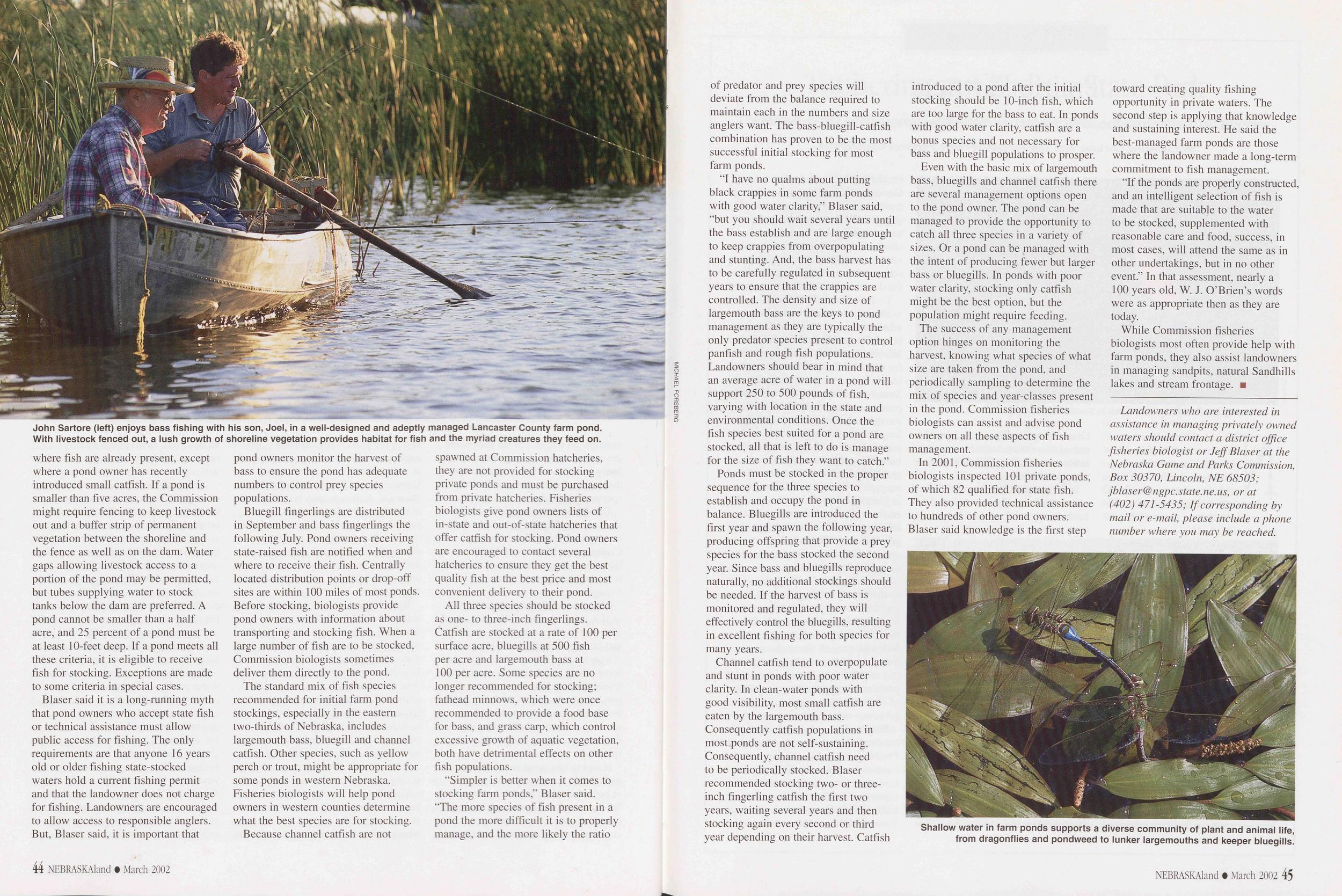
where fish are already present, except where a pond owner has recently introduced small catfish. If a pond is smaller than five acres, the Commission might require fencing to keep livestock out and a buffer strip of permanent vegetation between the shoreline and the fence as well as on the dam. Water gaps allowing livestock access to a portion of the pond may be permitted, but tubes supplying water to stock tanks below the dam are preferred. A pond cannot be smaller than a half acre, and 25 percent of a pond must be at least 10-feet deep. If a pond meets all these criteria, it is eligible to receive fish for stocking. Exceptions are made to some criteria in special cases.
Blaser said it is a long-running myth that pond owners who accept state fish or technical assistance must allow public access for fishing. The only requirements are that anyone 16 years old or older fishing state-stocked waters hold a current fishing permit and that the landowner does not charge for fishing. Landowners are encouraged to allow access to responsible anglers. But, Blaser said, it is important that pond owners monitor the harvest of bass to ensure the pond has adequate numbers to control prey species populations.
Bluegill fingerlings are distributed in September and bass fingerlings the following July. Pond owners receiving state-raised fish are notified when and where to receive their fish. Centrally located distribution points or drop-off sites are within 100 miles of most ponds. Before stocking, biologists provide pond owners with information about transporting and stocking fish. When a large number of fish are to be stocked, Commission biologists sometimes deliver them directly to the pond.
The standard mix of fish species recommended for initial farm pond stockings, especially in the eastern two-thirds of Nebraska, includes largemouth bass, bluegill and channel catfish. Other species, such as yellow perch or trout, might be appropriate for some ponds in western Nebraska. Fisheries biologists will help pond owners in western counties determine what the best species are for stocking.
Because channel catfish are not spawned at Commission hatcheries, they are not provided for stocking private ponds and must be purchased from private hatcheries. Fisheries biologists give pond owners lists of in-state and out-of-state hatcheries that offer catfish for stocking. Pond owners are encouraged to contact several hatcheries to ensure they get the best quality fish at the best price and most convenient delivery to their pond.
All three species should be stocked as one- to three-inch fingerlings. Catfish are stocked at a rate of 100 per surface acre, bluegills at 500 fish per acre and largemouth bass at 100 per acre. Some species are no longer recommended for stocking; fathead minnows, which were once recommended to provide a food base for bass, and grass carp, which control excessive growth of aquatic vegetation, both have detrimental effects on other fish populations.
“Simpler is better when it comes to stocking farm ponds,” Blaser said. “The more species of fish present in a pond the more difficult it is to properly manage, and the more likely the ratio 44 NEBRASKAland • March 2002 of predator and prey species will deviate from the balance required to maintain each in the numbers and size anglers want. The bass-bluegill-catfish combination has proven to be the most successful initial stocking for most farm ponds.
“I have no qualms about putting black crappies in some farm ponds with good water clarity,” Blaser said, “but you should wait several years until the bass establish and are large enough to keep crappies from overpopulating and stunting. And, the bass harvest has to be carefully regulated in subsequent years to ensure that the crappies are controlled. The density and size of largemouth bass are the keys to pond management as they are typically the only predator species present to control panfish and rough fish populations. Landowners should bear in mind that an average acre of water in a pond will support 250 to 500 pounds of fish, varying with location in the state and environmental conditions. Once the fish species best suited for a pond are stocked, all that is left to do is manage for the size of fish they want to catch.”
Ponds must be stocked in the proper sequence for the three species to establish and occupy the pond in balance. Bluegills are introduced the first year and spawn the following year, producing offspring that provide a prey species for the bass stocked the second year. Since bass and bluegills reproduce naturally, no additional stockings should be needed. If the harvest of bass is monitored and regulated, they will effectively control the bluegills, resulting in excellent fishing for both species for many years.
Channel catfish tend to overpopulate and stunt in ponds with poor water clarity. In clean-water ponds with good visibility, most small catfish are eaten by the largemouth bass. Consequently catfish populations in most ponds are not self-sustaining. Consequently, channel catfish need to be periodically stocked. Blaser recommended stocking two- or three- inch fingerling catfish the first two years, waiting several years and then stocking again every second or third year depending on their harvest. Catfish introduced to a pond after the initial stocking should be 10-inch fish, which are too large for the bass to eat. In ponds with good water clarity, catfish are a bonus species and not necessary for bass and bluegill populations to prosper.
Even with the basic mix of largemouth bass, bluegills and channel catfish there are several management options open to the pond owner. The pond can be managed to provide the opportunity to catch all three species in a variety of sizes. Or a pond can be managed with the intent of producing fewer but larger bass or bluegills. In ponds with poor water clarity, stocking only catfish might be the best option, but the population might require feeding.
The success of any management option hinges on monitoring the harvest, knowing what species of what size are taken from the pond, and periodically sampling to determine the mix of species and year-classes present in the pond. Commission fisheries biologists can assist and advise pond owners on all these aspects of fish management.
In 2001, Commission fisheries biologists inspected 101 private ponds, of which 82 qualified for state fish. They also provided technical assistance to hundreds of other pond owners. Blaser said knowledge is the first step toward creating quality fishing opportunity in private waters. The second step is applying that knowledge and sustaining interest. He said the best-managed farm ponds are those where the landowner made a long-term commitment to fish management.
“If the ponds are properly constructed, and an intelligent selection of fish is made that are suitable to the water to be stocked, supplemented with reasonable care and food, success, in most cases, will attend the same as in other undertakings, but in no other event.” In that assessment, nearly a 100 years old, W. J. O’Brien’s words were as appropriate then as they are today.
While Commission fisheries biologists most often provide help with farm ponds, they also assist landowners in managing sandpits, natural Sandhills lakes and stream frontage. ■
Landowners who are interested in assistance in managing privately owned waters should contact a district office fisheries biologist or Jeff Blaser at the Nebraska Game and Parks Commission, Box 30370, Lincoln, NE 68503; jblaser@ngpc.state.ne.us, or at (402) 471-5435; If corresponding by mail or e-mail, please include a phone number where you may be reached.
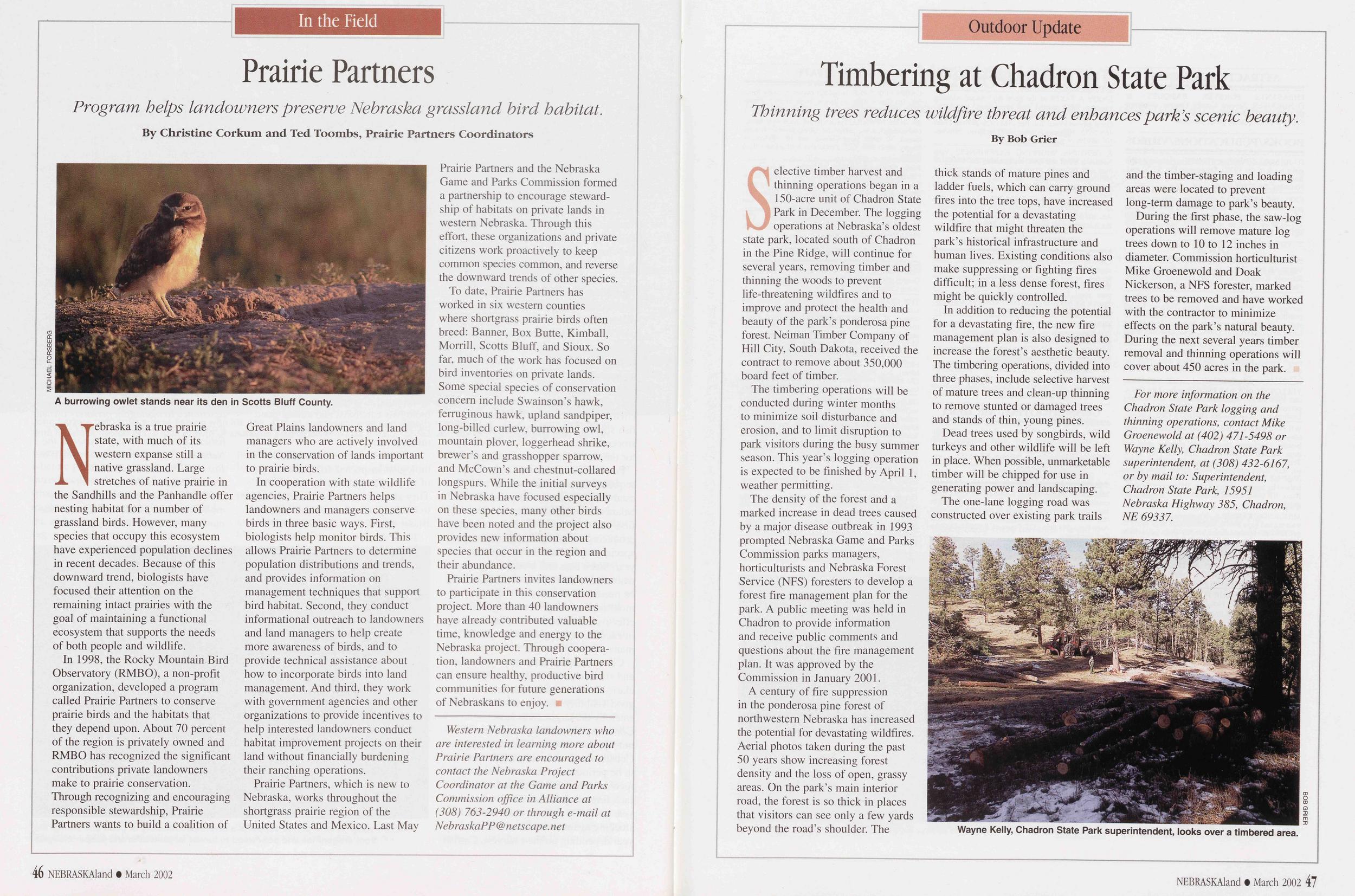
Nebraska is a true prairie state, with much of its western expanse still a native grassland. Large stretches of native prairie in the Sandhills and the Panhandle offer nesting habitat for a number of grassland birds. However, many species that occupy this ecosystem have experienced population declines in recent decades. Because of this downward trend, biologists have focused their attention on the remaining intact prairies with the goal of maintaining a functional ecosystem that supports the needs of both people and wildlife.
In 1998, the Rocky Mountain Bird Observatory (RMBO), a non-profit organization, developed a program called Prairie Partners to conserve prairie birds and the habitats that they depend upon. About 70 percent of the region is privately owned and RMBO has recognized the significant contributions private landowners make to prairie conservation. Through recognizing and encouraging responsible stewardship, Prairie Partners wants to build a coalition of Great Plains landowners and land managers who are actively involved in the conservation of lands important to prairie birds.
In cooperation with state wildlife agencies, Prairie Partners helps landowners and managers conserve birds in three basic ways. First, biologists help monitor birds. This allows Prairie Partners to determine population distributions and trends, and provides information on management techniques that support bird habitat. Second, they conduct informational outreach to landowners and land managers to help create more awareness of birds, and to provide technical assistance about how to incorporate birds into land management. And third, they work with government agencies and other organizations to provide incentives to help interested landowners conduct habitat improvement projects on their land without financially burdening their ranching operations.
Prairie Partners, which is new to Nebraska, works throughout the shortgrass prairie region of the United States and Mexico. Last May Prairie Partners and the Nebraska Game and Parks Commission formed a partnership to encourage steward- ship of habitats on private lands in western Nebraska. Through this effort, these organizations and private citizens work proactively to keep common species common, and reverse the downward trends of other species.
To date, Prairie Partners has worked in six western counties where shortgrass prairie birds often breed: Banner, Box Butte, Kimball, Morrill, Scotts Bluff, and Sioux. So far, much of the work has focused on bird inventories on private lands. Some special species of conservation concern include Swainson’s hawk, ferruginous hawk, upland sandpiper, long-billed curlew, burrowing owl, mountain plover, loggerhead shrike, brewer’s and grasshopper sparrow, and McCown’s and chestnut-collared longspurs. While the initial surveys in Nebraska have focused especially on these species, many other birds have been noted and the project also provides new information about species that occur in the region and their abundance.
Prairie Partners invites landowners to participate in this conservation project. More than 40 landowners have already contributed valuable time, knowledge and energy to the Nebraska project. Through coopera- tion, landowners and Prairie Partners can ensure healthy, productive bird communities for future generations of Nebraskans to enjoy. ■
Western Nebraska landowners who are interested in learning more about Prairie Partners are encouraged to contact the Nebraska Project Coordinator at the Game and Parks Commission office in Alliance at (308) 763-2940 or through e-mail at NebraskaPP@netscape.net
46 NEBRASKAland • March 2002 Outdoor Update Timbering at Chadron State Park Thinning trees reduces wildfire threat and enhances park’s scenic beauty. By Bob GrierSelective timber harvest and thinning operations began in a 150-acre unit of Chadron State Park in December. The logging operations at Nebraska’s oldest state park, located south of Chadron in the Pine Ridge, will continue for several years, removing timber and thinning the woods to prevent life-threatening wildfires and to improve and protect the health and beauty of the park’s ponderosa pine forest. Neiman Timber Company of Hill City, South Dakota, received the contract to remove about 350,000 board feet of timber.
The timbering operations will be conducted during winter months to minimize soil disturbance and erosion, and to limit disruption to park visitors during the busy summer season. This year’s logging operation is expected to be finished by April 1, weather permitting.
The density of the forest and a marked increase in dead trees caused by a major disease outbreak in 1993 prompted Nebraska Game and Parks Commission parks managers, horticulturists and Nebraska Forest Service (NFS) foresters to develop a forest fire management plan for the park. A public meeting was held in Chadron to provide information and receive public comments and questions about the fire management plan. It was approved by the Commission in January 2001.
A century of fire suppression in the ponderosa pine forest of northwestern Nebraska has increased the potential for devastating wildfires. Aerial photos taken during the past 50 years show increasing forest density and the loss of open, grassy areas. On the park’s main interior road, the forest is so thick in places that visitors can see only a few yards beyond the road’s shoulder. The thick stands of mature pines and ladder fuels, which can carry ground fires into the tree tops, have increased the potential for a devastating wildfire that might threaten the park’s historical infrastructure and human lives. Existing conditions also make suppressing or fighting fires difficult; in a less dense forest, fires might be quickly controlled.
In addition to reducing the potential for a devastating fire, the new fire management plan is also designed to increase the forest’s aesthetic beauty. The timbering operations, divided into three phases, include selective harvest of mature trees and clean-up thinning to remove stunted or damaged trees and stands of thin, young pines.
Dead trees used by songbirds, wild turkeys and other wildlife will be left in place. When possible, unmarketable timber will be chipped for use in generating power and landscaping.
The one-lane logging road was constructed over existing park trails and the timber-staging and loading areas were located to prevent long-term damage to park’s beauty.
During the first phase, the saw-log operations will remove mature log trees down to 10 to 12 inches in diameter. Commission horticulturist Mike Groenewold and Doak Nickerson, a NFS forester, marked trees to be removed and have worked with the contractor to minimize effects on the park’s natural beauty. During the next several years timber removal and thinning operations will cover about 450 acres in the park.
For more information on the Chadron State Park logging and thinning operations, contact Mike Groenewold at (402) 471-5498 or Wayne Kelly, Chadron State Park superintendent, at (308) 432-6167, or by mail to: Superintendent, Chadron State Park, 15951 Nebraska Highway 385, Chadron, NE 69337.
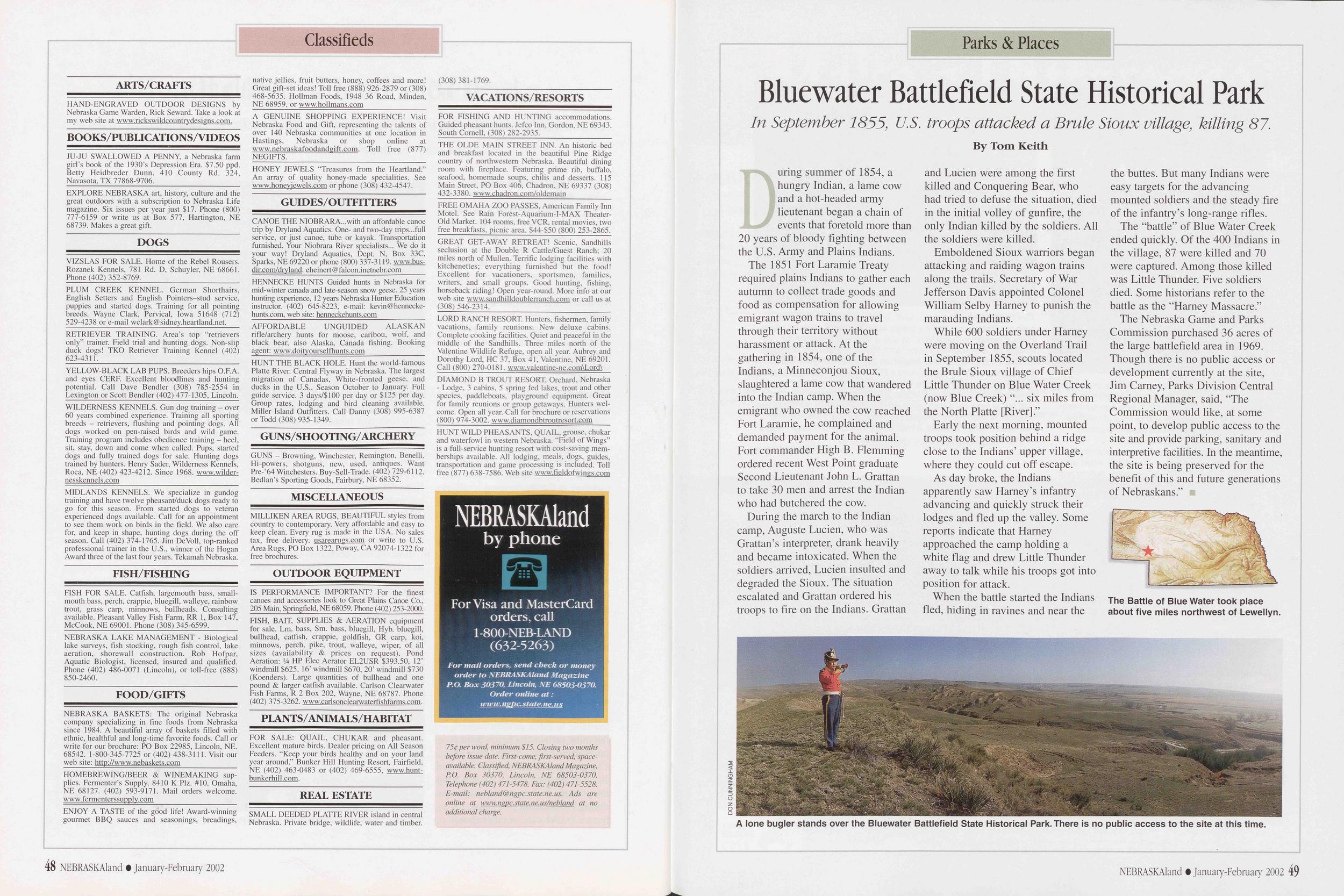
Classifieds
ATTRACTIONS/EVENTSPHEASANTS FOREVER BANQUET & FUNDRAISER, Seward County Chapter. Saturday, March 9, 2002, Seward County Ag Pavilion, Seward, NE. (402) 643-2248 or (402) 643-3046.
BOOKS/PUBLICATIONS/VIDEOSJU-JU SWALLOWED A PENNY, a Nebraska farm girl’s book of the 1930’s Depression Era. $7.50 ppd. Betty Heidbreder Dunn, 410 County Rd. 324, Navasota, TX 77868-9706.
EXPLORE NEBRASKA art, history, culture and the great outdoors with a subscription to Nebraska Life magazine. Six issues per year just $17. Phone (800) 777-6159 or write us at Box 577, Hartington, NE 68739. Makes a great gift.
DOGSVIZSLAS FOR SALE. Home of the Rebel Rousers. Rozanek Kennels, 781 Rd. D, Schuyler, NE 68661. Phone (402) 352-8769.
PLUM CREEK KENNEL. German Shorthairs, stud service, puppies and started dogs. Training for all pointing breeds. Specialize in training the handler as well as the dog. Wayne Clark, Percival, Iowa 51648 (close to Omaha) (712) 529-4238, email wclark@sid- ney.heartland.net.
RETRIEVER TRAINING. Area’s top “retrievers only” trainer. Field trial and hunting dogs. Non-slip duck dogs! TKO Retriever Training Kennel (402) 623-4311.
YELLOW-BLACK LAB PUPS. Breeders hips O.F.A. and eyes CERF. Excellent bloodlines and hunting potential. Call Dave Bendler (308) 785-2554 in Lexington or Scott Bendler (402) 477-1305, Lincoln.
WILDERNESS KENNELS. Gun dog training - over 60 years combined experience. Training all sporting breeds - retrievers, flushing and pointing dogs. All dogs worked on pen-raised birds and wild game. Training program includes obedience training - heel, sit, stay, down and come when called. Pups, started dogs and fully trained dogs for sale. Hunting dogs trained by hunters. Henry Sader, Wilderness Kennels, Roca, NE (402) 423-4212. Since 1968. www.wilder- nesskennels.com
MIDLANDS KENNELS. We specialize in gundog training and have twelve pheasant/duck dogs ready to go for this season. From started dogs to veteran experienced dogs available. Call for an appointment to see them work on birds in the field. We also care for, and keep in shape, hunting dogs during the off season. Call (402) 374-1765. Jim DeVoll, top-ranked professional trainer in the U.S., winner of the Hogan Award three of the last four years. Tekamah Nebraska.
GERMAN SHORTHAIR POINTER PUPPIES from AKC Master Hunter bloodlines. Call for pedigrees (970) 521-0126 or fax inquiries to (970) 521-1027.
FISH/FISHINGFISH FOR SALE. Catfish, largemouth bass, small- mouth bass, perch, crappie, bluegill, walleye, rainbow trout, grass carp, minnows, bullheads. Consulting available. Pleasant Valley Fish Farm, RR 1, Box 147, McCook, NE 69001. Phone (308) 345-6599.
NEBRASKA LAKE MANAGEMENT - Biological lake surveys, fish stocking, rough fish control, lake aeration, shorewall construction. Rob Hofpar, Aquatic Biologist, licensed, insured and qualified. Phone (402) 486-0071 (Lincoln), or toll-free (888) 850-2460.
FOOD/GIFTSNEBRASKA BASKETS: The original Nebraska company specializing in fine foods from Nebraska since 1984. A beautiful array of baskets filled with ethnic, healthful and long-time favorite foods. Call or write for our brochure: PO Box 22985, Lincoln, NE. 68542. 1-800-345-7725 or (402) 438-3111. Visit our web site: http://www.nebaskets.com
HOMEBREWING/BEER & WINEMAKING sup- plies. Fermenter’s Supply, 8410 K Plz. #10, Omaha, NE 68127. (402) 593-9171. Mail orders welcome. www.fermenterssupply.com
ENJOY A TASTE of the good life! Award-winning gourmet BBQ sauces and seasonings, breadings, native jellies, fruit butters, honey, coffees and more! Great gift-set ideas! Toll free (888) 926-2879 or (308) 468-5635. Hollman Foods, 1948 36 Road, Minden, NE 68959, or www.hollmans.com
A GENUINE SHOPPING EXPERIENCE! Visit Nebraska Food and Gift, representing the talents of over 140 Nebraska communities at one location in Hastings, Nebraska or shop online at www.nebraskafoodandgift.com. Toll free (877) NEGIFTS.
HONEY JEWELS “Treasures from the Heartland.” An array of quality honey-made specialities. See www.honevjewels.com or phone (308) 432-4547.
GUIDES/OUTFITTERSCANOE THE NIOBRARA...with an affordable canoe trip by Dryland Aquatics. One- and two-day trips...full service, or just canoe, tube or kayak. Transportation furnished. Your Niobrara River specialists... We do it your way! Dryland Aquatics, Dept. N, Box 33C, Sparks, NE 69220 or phone (800) 337-3119. www.hus- dir.com/dryland. eheinert@falcon.inetnebr.com
HENNECKE HUNTS Guided hunts in Nebraska for mid-winter Canada and late-season snow geese. 25 years hunting experience, 12 years Nebraska Hunter Education instructor. (402) 645-8223, e-mail: kevin@hennecke- hunts.com, web site: henneckehunts.com
AFFORDABLE UNGUIDED ALASKAN rifle/archery hunts for moose, caribou, wolf, and black bear, also Alaska, Canada fishing. Booking agent: www.doitvourselfhunts.com
GUNS/SHOOTING/ARCHERYGUNS - Browning, Winchester, Remington, Benelli. Hi-powers, shotguns, new, used, antiques. Want Pre-’64 Winchesters. Buy-Sell-Trade. (402) 729-6112. Bedlan’s Sporting Goods, Fairbury, NE 68352.
MISCELLANEOUSMILLIKEN AREA RUGS, BEAUTIFUL styles from country to contemporary. Very affordable and easy to keep clean. Every rug is made in the USA. No sales tax, free delivery, usarearugs.com or write to U.S. Area Rugs, PO Box 1322, Poway, CA 92074-1322 for free brochures.
HUNTER’S HEARTH PROPANE HEATER. The only heater built with the duck and goose hunter in mind. Heats a four-man blind on the ends as well as the center. A cooking surface and two warming sur- faces. 12 x 9 x 48, $295 plus shipping and handling. Donald V. Hardt, 180303 CR 34, Bayard, NE 69334. Phone (308) 783-1094. Email krazshrl@prairieweb.com
OUTDOOR EQUIPMENTIS PERFORMANCE IMPORTANT? For the finest canoes and accessories look to Great Plains Canoe Co., 205 Main, Springfield, NE 68059. Phone (402) 253-2000.
FISH, BAIT, SUPPLIES & AERATION equipment for sale. Lm. bass, Sm. bass, bluegill, Hyb. bluegill, bullhead, catfish, crappie, goldfish, GR carp, koi, minnows, perch, pike, trout, walleye, wiper, of all sizes (availability & prices on request). Pond Aeration: !4 HP Elec Aerator EL2USR $393.50, 12’ windmill $625, 16’ windmill $670, 20’ windmill $730 (Koenders). Large quantities of bullhead and one pound & larger catfish available. Carlson Clearwater Fish Farms, R 2 Box 202, Wayne, NE 68787. Phone (402) 375-3262. www.carlsonclearwaterfishfarms.com.
PLANTS/ANIMALS/HABITATFOR SALE: QUAIL, CHUKAR and pheasant. Excellent mature birds. Dealer pricing on All Season Feeders. “Keep your birds healthy and on your land year around.” Bunker Hill Hunting Resort, Fairfield, NE (402) 463-0483 or (402) 469-6555, www.hunt- bunkerhill.com.
REAL ESTATECABIN FOR SALE in hidden paradise, Long Pine, NE. On Pine Creek, a class A Trout Stream. Phone (402) 486-3707.
89- ACRE WOODED ISLAND and ranch style home, outbuildings, horse corral and fishing pond on 6 acres inland. 10 miles from Omaha, can be subdivided. Maury (402) 968-7627, Prudential Ambassador Real Estate.
FOR SALE, NORTH CENTRAL Nebraska - ^Hunting and fishing properties. 600 acres with a- frame home and 30 x 40 block shop building. Has prairie dog town. Adjoining state park. *Also 641 - acre Calamus River ranchette. *12+-acres on Plum Creek, spring fed fish pond and three bedroom house. All in Brown County. Other listings available. Call Swett Realty. Fred L. Swett, Broker. (800) 585-1626, (402) 387-1626 day or night.
VACATIONS/RESORTSFOR FISHING AND HUNTING accommodations. Guided pheasant hunts. Jefco Inn, Gordon, NE 69343. South Cornell, (308) 282-2935.
THE OLDE MAIN STREET INN. An historic bed and breakfast located in the beautiful Pine Ridge country of northwestern Nebraska. Beautiful dining room with fireplace. Featuring prime rib, buffalo, seafood, homemade soups, chilis and desserts. 115 Main Street, PO Box 406, Chadron, NE 69337 (308) 432-3380. www.chadron.com/oldemain
FREE OMAHA ZOO PASSES, American Family Inn Motel. See Rain Forest-Aquarium-l-MAX Theater- Old Market. 104 rooms, free VCR, rental movies, two free breakfasts, picnic area. $44-$50 (800) 253-2865. GREAT GET-AWAY RETREAT! Scenic, Sandhills seclusion at the Double R Cattle/Guest Ranch: 20 miles north of Mullen. Terrific lodging facilities with kitchenettes; everything furnished but the food! Excellent for vacationers, sportsmen, families, writers, and small groups. Good hunting, fishing, horseback riding! Open year-round. More info at our web site www.sandhilldoublerranch.com or call us at (308) 546-2314.
LORD RANCH RESORT. Hunters, fishermen, family vacations, family reunions. New deluxe cabins. Complete cooking facilities. Quiet and peaceful in the middle of the Sandhills. Three miles north of the Valentine Wildlife Refuge, open all year. Aubrey and Dorothy Lord, HC 37, Box 41, Valentine, NE 69201. Call (800) 270-0181. www.valentine-ne.com\Lord\
DIAMOND B TROUT RESORT, Orchard, Nebraska - Lodge, 3 cabins, 5 spring fed lakes, trout and other species, paddleboats, playground equipment. Great for family reunions or group getaways. Hunters wel- come. Open all year. Call for brochure or reservations (800) 974-3002. www.diamondbtroutresort.com
NEBRASKAland by phone For Visa and MasterCard orders, call 1-800-NEB-LAND (632-5263)75q per word, minimum $15. Closing two months before issue date. First-come, first-served, space- available. Classified NEBRASKAland Magazine, P.O. Box 30370, Lincoln, NE 68503-0370. Telephone (402) 471-5478. Fax: (402) 471-5528. E-mail: nebland@ngpc.state.ne.us. Ads are online at outdoomebraska.ore/nebland at no additional charge.
48 NEBRASKAland • March 2002 Parks & Places Crane Meadows Nature Center Tower and bridge are spectacular wildlife viewing sites in Platte River Valley By Doug CarrollA site that was once a gasoline station just west of Grand Island, at Interstate 80 exit 305, is now one of Nebraska’s premier wildlife-viewing areas.
Crane Meadows Nature Center was established in 1989 as a private, non-profit organization with a mission to provide outdoor education and recreation in the area. Through teaching about the area’s natural environment and by offering interactive programs, Crane Meadows increases awareness and appreciation of the Platte River Valley’s wildlife and habitat. In recent years, more than 20,000 people have visited the center, coming from throughout the state and country, and from many foreign countries.
Crane Meadows has seven miles of hiking trails located in its 250-acre virgin mixed-grass prairie, which is interspersed with areas of riparian forest. Bordered by a slough to the south and the north channel of the Platte River to the north, the center’s prairie is home to a variety of wildlife and plant species. A 20-foot high observation tower is next to a 455-foot long pedestrian bridge that spans the river and offers great views of the area. The former gas station, now an interpretive display center showing more than 50 wildlife species, is also the organization’s headquarters and gift shop, which specializes in crane and nature items.
DOUG CARROLLOpen year-round, Crane Meadows is especially popular during early spring, when one of the world’s greatest wildlife spectacles occurs along an 80-mile stretch of the Platte River Valley. Located at the heart North America’s Central Flyway, the valley is a stopping point for an estimated 500,000 sandhill cranes every spring along with millions of geese and other birds migrating north.
The Great Bend stretch of the Platte is a vital staging area for the cranes. Sandhills usually spend a month or more feeding in the area’s crop fields and wet meadows to build up their bodies’ fat reserves, which carry them through the early nesting period on breeding grounds in Canada, Alaska and Siberia. The Platte’s shallow, braided channels offer secure nighttime roosts.
Crane Meadows offers several crane-related activities, including sunrise and sunset bunker and blind viewing opportunities, evening bridge tours and self-guided driving tours. The organization will also make advanced arrangements for bus and large group tours.
Other programs offered throughout the year include fossil exploration, wildflower hikes, wet and wild camps that teach lessons about aquatic areas, butterfly appreciation sessions and astronomy trips. In addition to these short programs, Crane Meadows also offers daylong and weeklong summer camps for youngsters.
For more information about Crane Meadows' programs, fees and memberships, contact the center at info@cranemeadows.org, or visit the web site at www. cranemeadows, org. The mailing address is Crane Meadows Nature Center, 9325 S. Alda Road, Wood River, NE 68883.
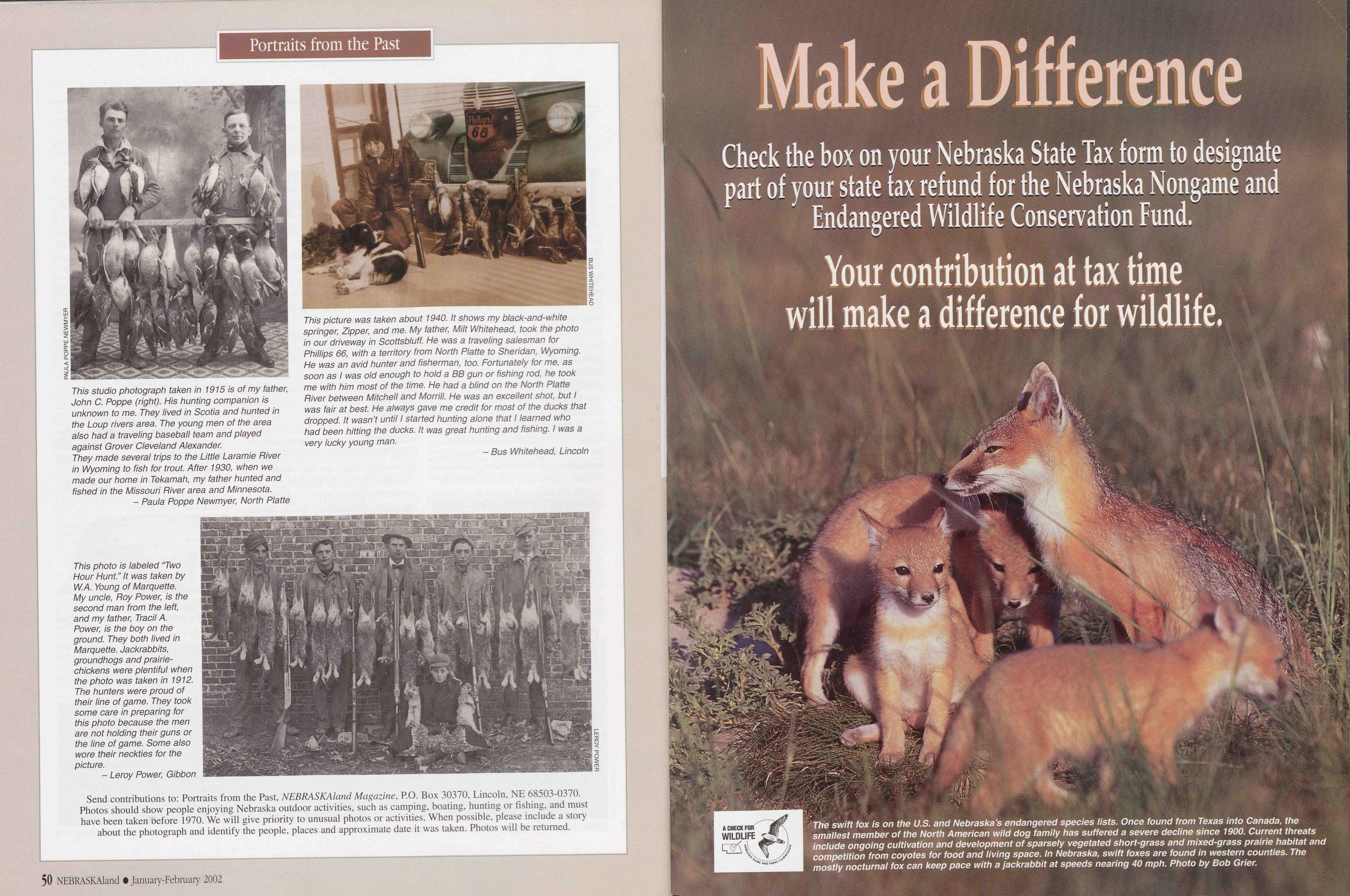
This photo is of my wife, Margaret Greger, holding a large carp we captured in June 1947. During spring break from the University of Nebraska, we were visiting the Holt County family ranch where I was born. Because the weather was a very rainy, water was meandering through the Sandhills depressions, low meadows and along road ditches. The area is drained by the Elkhorn River, about 15 miles to the northeast. Carp in the river seem to have an urge to seek new waters and will swim upstream as far as they can. While exploring the high water, my wife and I spotted several large carp in a flooded pasture. We captured this one to document the big fish event and to show friends at the university how we spent our spring vacation. My wife was raised in drier Banner County. Flooded ditches and pastures were entirely new to her.
- George Greger, Richland, WashingtonThis picture was taken in Phelps County in 1943. The people are (from left) Betty and Bob Best of Holdrege and Doris Eisenhart of Omaha. Bob Best and Doris’s husband, Charlie, who took this picture, enjoyed many pleasant weekends hunting pheasants in the fields throughout Phelps, Dawson, and Custer counties. Betty and Doris, who were good shots, stayed in Holdrege during the day and then joined their husbands for a final walk through the fields in the early evening.
- Michelle McCormick, HoldregeMy parents, Ray and Mabie Sutton (pictured), caught this string of bullheads, crappies, perch and bluegills with friends Henry and Mary Cordis near Thedford in 1921.1 was four years old and stood beside my father. I am now 83 years old.
- Glenn Sutton, SidneySend contributions to: Portraits from the Past, NEBRASKAland Magazine, P.O. Box 30370, Lincoln, NE 68503-0370. Photos should show people enjoying Nebraska outdoor activities, such as camping, boating, hunting or fishing, and must have been taken before 1970. We will give priority to unusual photos or activities. When possible, please include a story about the photograph and identify the people, places and approximate date it was taken. Photos will be returned.
50 NEBRASKAland • March 2002
Position: 798 (13 views)