Volume 80, Issue 1, 2002
NEBRASKAland
Nebraska Game & Parks Commission January-February 2002 • $2.50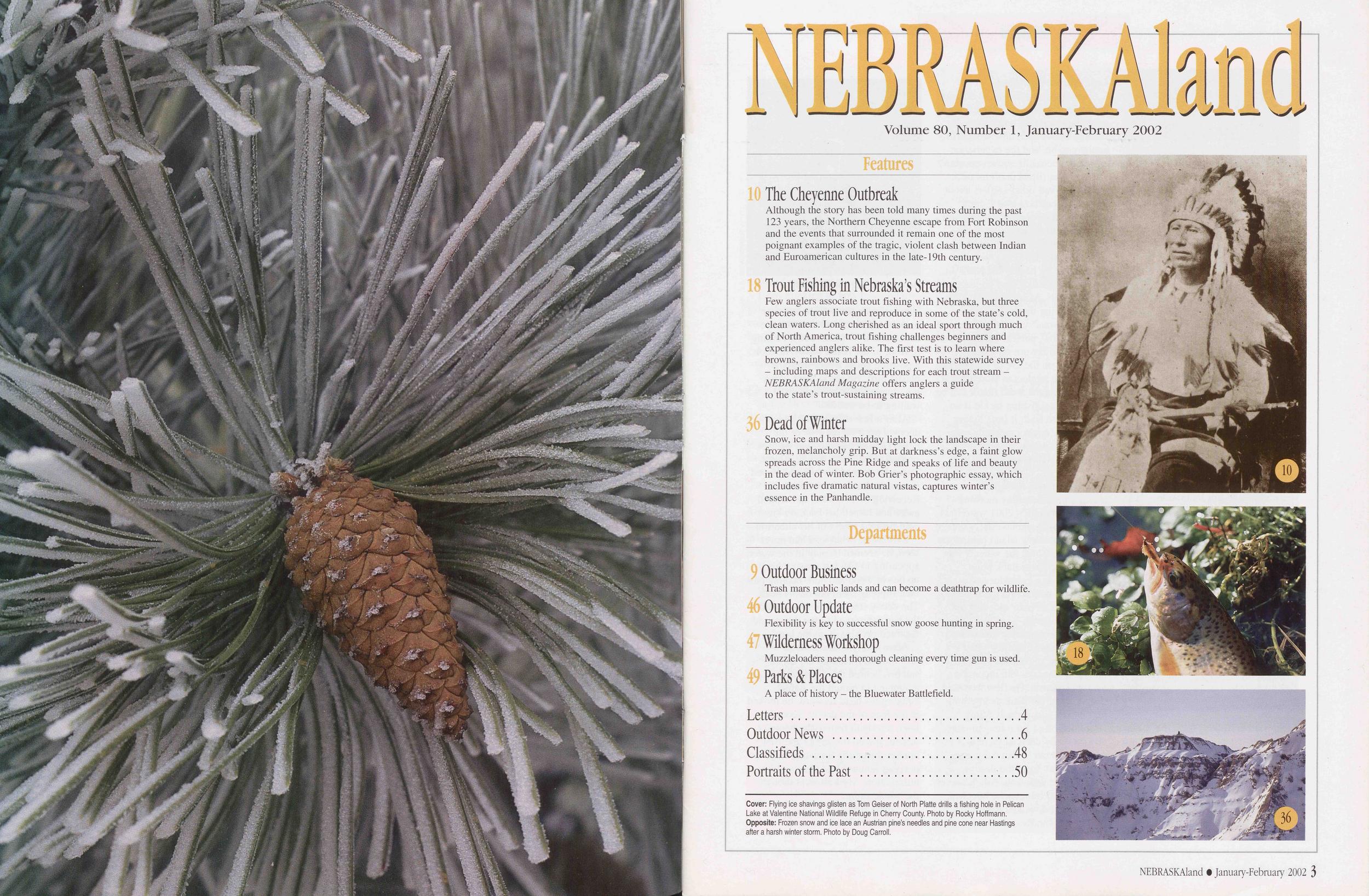
NEBRASKAland
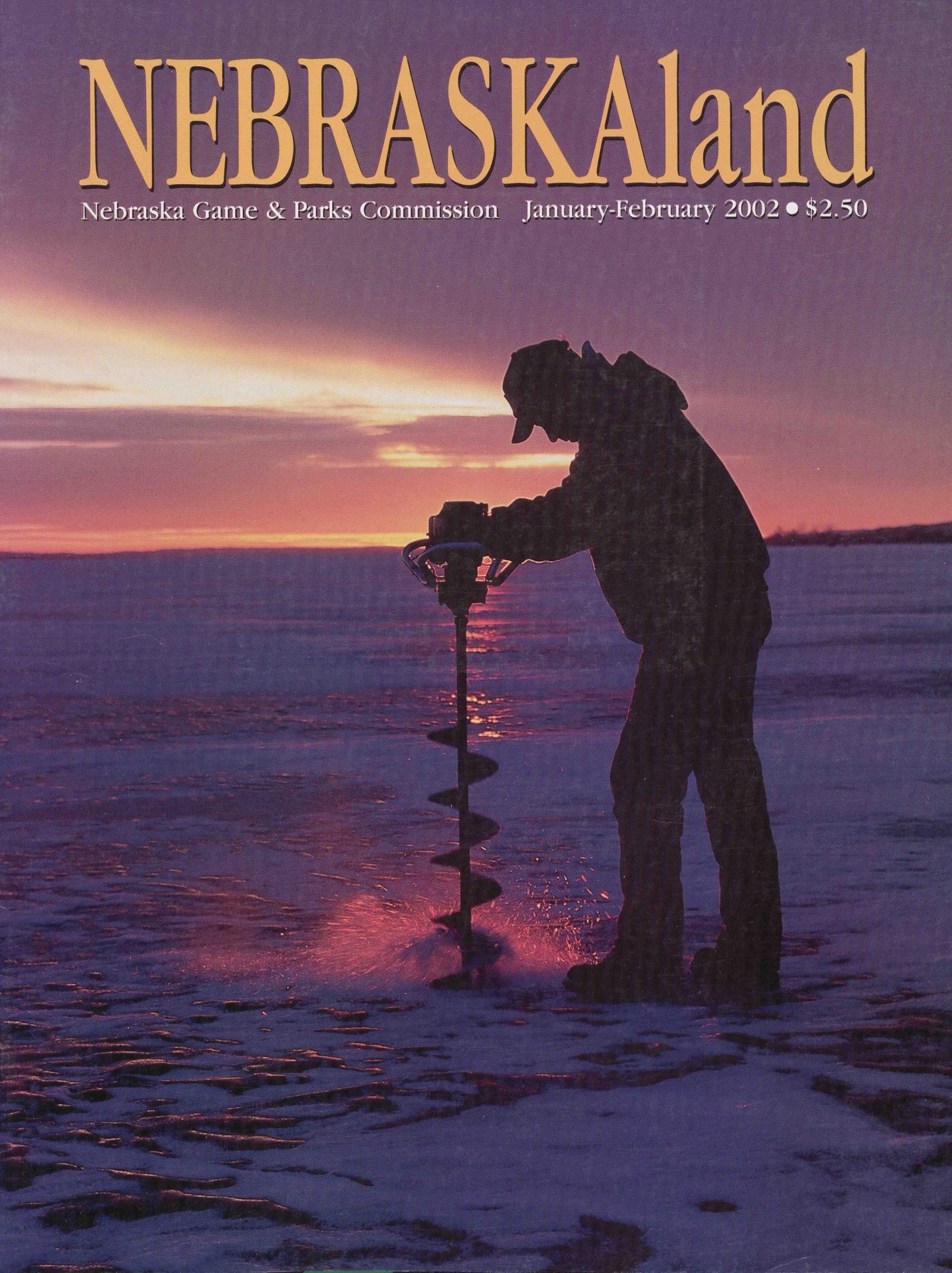
Volume 80, Number 1, January-February 2002 10 Features The Cheyenne Outbreak Although the story has been told many times during the past 123 years, the Northern Cheyenne escape from Fort Robinson and the events that surrounded it remain one of the most poignant examples of the tragic, violent clash between Indian and Euroamerican cultures in the late-19th century. 18 Trout Fishing in Nebraska’s Streams Few anglers associate trout fishing with Nebraska, but three species of trout live and reproduce in some of the state’s cold, clean waters. Long cherished as an ideal sport through much of North America, trout fishing challenges beginners and experienced anglers alike. The first test is to learn where browns, rainbows and brooks live. With this statewide survey - including maps and descriptions for each trout stream - NEBRASKAland Magazine offers anglers a guide to the state’s trout-sustaining streams. 36 Dead of Winter Snow, ice and harsh midday light lock the landscape in their frozen, melancholy grip. But at darkness’s edge, a faint glow spreads across the Pine Ridge and speaks of life and beauty in the dead of winter. Bob Grier’s photographic essay, which includes five dramatic natural vistas, captures winter’s essence in the Panhandle. Departments 9 Outdoor Business Trash mars public lands and can become a deathtrap for wildlife. 46 Outdoor Update Flexibility is key to successful snow goose hunting in spring. 47 Wilderness Workshop Muzzleloaders need thorough cleaning every time gun is used. 49 Parks & Places A place of history - the Bluewater Battlefield. Letters ..............................................4 Outdoor News .........................................6 Classifieds .........................................48 Portraits of the Past ........................... .50 Cover: Flying ice shavings glisten as Tom Geiser of North Platte drills a fishing hole in Pelican Lake at Valentine National Wildlife Refuge in Cherry County. Photo by Rocky Hoffmann. Opposite: Frozen snow and ice lace an Austrian pine’s needles and pine cone near Hastings after a harsh winter storm. Photo by Doug Carroll.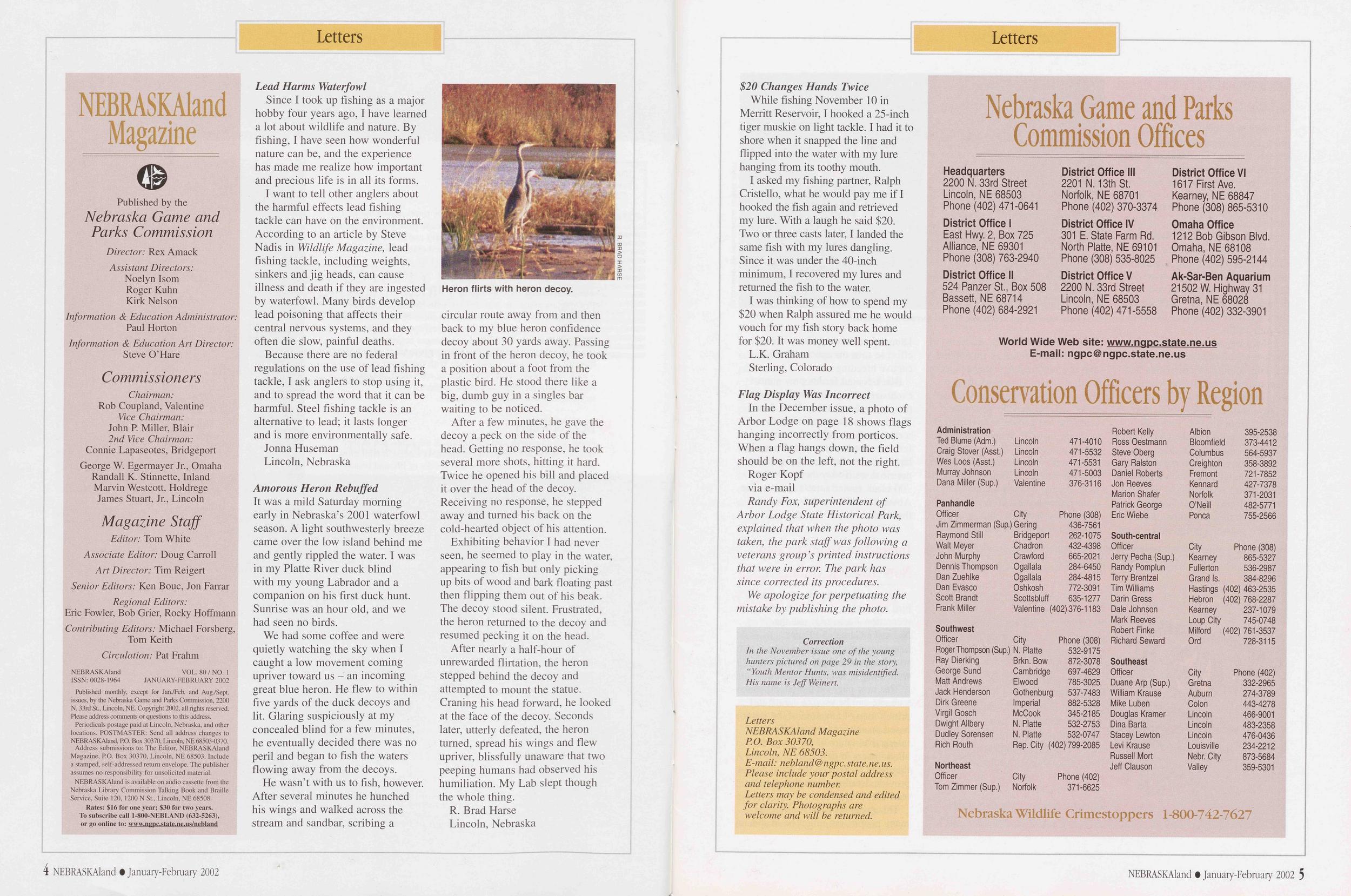 Letters
NEBRASKAland Mazine
Published by the
Nebraska Game and
Parks Commission
Director: Rex Amack
Assistant Directors:
Noelyn Isom
Roger Kuhn
Kirk Nelson
Information & Education Administrator:
Paul Horton
Information & Education Art Director:
Steve O’Hare
Commissioners
Chairman:
Rob Coupland, Valentine
Vice Chairman:
John P. Miller, Blair
2nd Vice Chairman:
Connie Lapaseotes, Bridgeport
George W. Egermayer Jr., Omaha
Randall K. Stinnette, Inland
Marvin Westcott, Holdrege
James Stuart, Jr., Lincoln
Magazine Staff
Editor: Tom White
Associate Editor: Doug Carroll
Art Director: Tim Reigert
Senior Editors: Ken Bouc, Jon Farrar
Regional Editors:
Eric Fowler, Bob Grier, Rocky Hoffmann
Contributing Editors: Michael Forsberg,
Tom Keith
Circulation: Pat Frahm
NEBRASKAland
VOL. 80 / NO. 1
ISSN: 0028-1964
JANUARY-FEBRUARY 2002
Published monthly, except for Jan./Feb. and Aug./Sept.
issues, by the Nebraska Game and Parks Commission, 2200
N. 33rd St., Lincoln, NE. Copyright 2002, all rights reserved.
Please address comments or questions to this address.
Periodicals postage paid at Lincoln, Nebraska, and other locations. POSTMASTER: Send
all address changes to
NEBRASKAland, P.O. Box 30370, Lincoln, NE 68503-0370.
Address submissions to: The Editor, NEBRASKAland
Magazine, P.O. Box 30370, Lincoln, NE 68503. Include
a stamped, self-addressed return envelope. The publisher
assumes no responsibility for unsolicited material.
NEBRASKAland is available on audio cassette from the
Nebraska Library Commission Talking Book and Braille
Service, Suite 120, 1200 N St., Lincoln, NE 68508.
Rates: $16 for one year; $30 for two years.
To subscribe call 1-800-NEBLAND (632-5263),
or go online to: www.ngpc.state.ne.us/nebland
Lead Harms Waterfowl
Letters
NEBRASKAland Mazine
Published by the
Nebraska Game and
Parks Commission
Director: Rex Amack
Assistant Directors:
Noelyn Isom
Roger Kuhn
Kirk Nelson
Information & Education Administrator:
Paul Horton
Information & Education Art Director:
Steve O’Hare
Commissioners
Chairman:
Rob Coupland, Valentine
Vice Chairman:
John P. Miller, Blair
2nd Vice Chairman:
Connie Lapaseotes, Bridgeport
George W. Egermayer Jr., Omaha
Randall K. Stinnette, Inland
Marvin Westcott, Holdrege
James Stuart, Jr., Lincoln
Magazine Staff
Editor: Tom White
Associate Editor: Doug Carroll
Art Director: Tim Reigert
Senior Editors: Ken Bouc, Jon Farrar
Regional Editors:
Eric Fowler, Bob Grier, Rocky Hoffmann
Contributing Editors: Michael Forsberg,
Tom Keith
Circulation: Pat Frahm
NEBRASKAland
VOL. 80 / NO. 1
ISSN: 0028-1964
JANUARY-FEBRUARY 2002
Published monthly, except for Jan./Feb. and Aug./Sept.
issues, by the Nebraska Game and Parks Commission, 2200
N. 33rd St., Lincoln, NE. Copyright 2002, all rights reserved.
Please address comments or questions to this address.
Periodicals postage paid at Lincoln, Nebraska, and other locations. POSTMASTER: Send
all address changes to
NEBRASKAland, P.O. Box 30370, Lincoln, NE 68503-0370.
Address submissions to: The Editor, NEBRASKAland
Magazine, P.O. Box 30370, Lincoln, NE 68503. Include
a stamped, self-addressed return envelope. The publisher
assumes no responsibility for unsolicited material.
NEBRASKAland is available on audio cassette from the
Nebraska Library Commission Talking Book and Braille
Service, Suite 120, 1200 N St., Lincoln, NE 68508.
Rates: $16 for one year; $30 for two years.
To subscribe call 1-800-NEBLAND (632-5263),
or go online to: www.ngpc.state.ne.us/nebland
Lead Harms Waterfowl
Since I took up fishing as a major hobby four years ago, I have learned a lot about wildlife and nature. By fishing, I have seen how wonderful nature can be, and the experience has made me realize how important and precious life is in all its forms.
I want to tell other anglers about the harmful effects lead fishing tackle can have on the environment. According to an article by Steve Nadis in Wildlife Magazine, lead fishing tackle, including weights, sinkers and jig heads, can cause illness and death if they are ingested by waterfowl. Many birds develop lead poisoning that affects their central nervous systems, and they often die slow, painful deaths.
Because there are no federal regulations on the use of lead fishing tackle, I ask anglers to stop using it, and to spread the word that it can be harmful. Steel fishing tackle is an alternative to lead; it lasts longer and is more environmentally safe.
Jonna Huseman Lincoln, Nebraska Amorous Heron RebuffedIt was a mild Saturday morning early in Nebraska’s 2001 waterfowl season. A light southwesterly breeze came over the low island behind me and gently rippled the water. I was in my Platte River duck blind with my young Labrador and a companion on his first duck hunt. Sunrise was an hour old, and we had seen no birds.
We had some coffee and were quietly watching the sky when I caught a low movement coming upriver toward us - an incoming great blue heron. He flew to within five yards of the duck decoys and lit. Glaring suspiciously at my concealed blind for a few minutes, he eventually decided there was no peril and began to fish the waters flowing away from the decoys.
He wasn’t with us to fish, however. After several minutes he hunched his wings and walked across the stream and sandbar, scribing a Heron flirts with heron decoy. circular route away from and then back to my blue heron confidence decoy about 30 yards away. Passing in front of the heron decoy, he took a position about a foot from the plastic bird. He stood there like a big, dumb guy in a singles bar waiting to be noticed.
After a few minutes, he gave the decoy a peck on the side of the head. Getting no response, he took several more shots, hitting it hard. Twice he opened his bill and placed it over the head of the decoy. Receiving no response, he stepped away and turned his back on the cold-hearted object of his attention.
Exhibiting behavior I had never seen, he seemed to play in the water, appearing to fish but only picking up bits of wood and bark floating past then flipping them out of his beak. The decoy stood silent. Frustrated, the heron returned to the decoy and resumed pecking it on the head.
After nearly a half-hour of unrewarded flirtation, the heron stepped behind the decoy and attempted to mount the statue. Craning his head forward, he looked at the face of the decoy. Seconds later, utterly defeated, the heron turned, spread his wings and flew upriver, blissfully unaware that two peeping humans had observed his humiliation. My Lab slept though the whole thing.
R. Brad Harse Lincoln, Nebraska $20 Changes Hands TwiceWhile fishing November 10 in Merritt Reservoir, I hooked a 25-inch tiger muskie on light tackle. I had it to shore when it snapped the line and flipped into the water with my lure hanging from its toothy mouth.
I asked my fishing partner, Ralph Cristello, what he would pay me if I hooked the fish again and retrieved my lure. With a laugh he said $20. Two or three casts later, I landed the same fish with my lures dangling. Since it was under the 40-inch minimum, I recovered my lures and returned the fish to the water.
I was thinking of how to spend my $20 when Ralph assured me he would vouch for my fish story back home for $20. It was money well spent.
L.K. Graham Sterling, Colorado Flag Display Was IncorrectIn the December issue, a photo of Arbor Lodge on page 18 shows flags hanging incorrectly from porticos. When a flag hangs down, the field should be on the left, not the right.
Roger Kopf via e-mailRandy Fox, superintendent of Arbor Lodge State Historical Park, explained that when the photo was taken, the park staff was following a veterans group’s printed instructions that were in error. The park has since corrected its procedures.
We apologize for perpetuating the mistake by publishing the photo.
Correction In the November issue one of the young hunters pictured on page 29 in the story, “Youth Mentor Hunts, was misidentified. His name is Jeff Weinert. Nebraska Game and Parks Commission Offices Headquarters 2200 N. 33rd Street Lincoln, NE 68503 Phone (402) 471-0641 District Office I East Hwy. 2, Box 725 Alliance, NE 69301 Phone (308) 763-2940 District Office II 524 Panzer St., Box 508 Bassett, NE 68714 Phone (402) 684-2921 World Wide Web site: www.napc.state.ne.us E-mail: ngpcGngpc.state.ne.us District Office III 2201 N. 13th St. Norfolk, NE 68701 Phone (402) 370-3374 District Office IV 301 E. State Farm Rd. North Platte, NE 69101 Phone (308) 535-8025 District Office V 2200 N. 33rd Street Lincoln, NE 68503 Phone (402) 471-5558 District Office VI 1617 First Ave. Kearney, NE 68847 Phone (308) 865-5310 Omaha Office 1212 Bob Gibson Blvd. Omaha, NE 68108 Phone (402) 595-2144 Ak-Sar-Ben Aquarium 21502 W. Highway 31 Gretna, NE 68028 Phone (402) 332-3901 Conservation Officers by Region Letters NEBRASKAland Magazine P.O. Box 30370, Lincoln, NE 68503. E-mail: nebland@ ngpc. state, ne. us. Please include your postal address and telephone number. Letters may be condensed and edited for clarity. Photographs are welcome and will be returned. Conservation Officers by Region Administration Robert Kelly Albion 395-2538 Ted Blume (Adm.) Lincoln 471-4010 Ross Oestmann Bloomfield 373-4412 Craig Stover (Asst.) Lincoln 471-5532 Steve Oberg Columbus 564-5937 Wes Loos (Asst.) Lincoln 471-5531 Gary Ralston Creighton 358-3892 Murray Johnson Lincoln 471-5003 Daniel Roberts Fremont 721-7852 Dana Miller (Sup.) Valentine 376-3116 Jon Reeves Kennard 427-7378 Marion Shafer Norfolk 371-2031 Panhandle Patrick George O’Neill 482-5771 Officer City Phone (308) Eric Wiebe Ponca 755-2566 Jim Zimmerman (Sup.) Gering 436-7561 Raymond Still Bridgeport 262-1075 South-central Walt Meyer Chadron 432-4398 Officer City Phone (308) John Murphy Crawford 665-2021 Jerry Pecha (Sup.) Kearney 865-5327 Dennis Thompson Ogallala 284-6450 Randy Pomplun Fullerton 536-2987 Dan Zuehlke Ogallala 284-4815 Terry Brentzel Grand Is. 384-8296 Dan Evasco Oshkosh 772-3091 Tim Williams Hastings (402) 463-2535 Scott Brandt Scottsbluff 635-1277 Darin Gress Hebron (402) 768-2287 Frank Miller Valentine (402)376-1183 Dale Johnson Kearney 237-1079 Mark Reeves Loup City 745-0748 Southwest Robert Finke Milford (402) 761-3537 Officer City Phone (308) Richard Seward Ord 728-3115 Roger Thompson (Sup.) N. Platte 532-9175 Ray Dierking Brkn. Bow 872-3078 Southeast George Sund Cambridge 697-4629 Officer City Phone (402) Matt Andrews Elwood 785-3025 Duane Arp (Sup.) Gretna 332-2965 Jack Henderson Gothenburg 537-7483 William Krause Auburn 274-3789 Dirk Greene Imperial 882-5328 Mike Luben Colon 443-4278 Virgil Gosch McCook 345-2185 Douglas Kramer Lincoln 466-9001 Dwight Allbery N. Platte 532-2753 Dina Barta Lincoln 483-2358 Dudley Sorensen N. Platte 532-0747 Stacey Lewton Lincoln 476-0436 Rich Routh Rep. City (402)799-2085 Levi Krause Louisville 234-2212 Russell Mort Nebr. City 873-5684 Northeast Jeff Clauson Valley 359-5301 Officer City Phone (402) Tom Zimmer (Sup.) Norfolk 371-6625 Nebraska Wildlife Crimestoppers 1-800-742-7627 NEBRASKAland • January-February 2002 5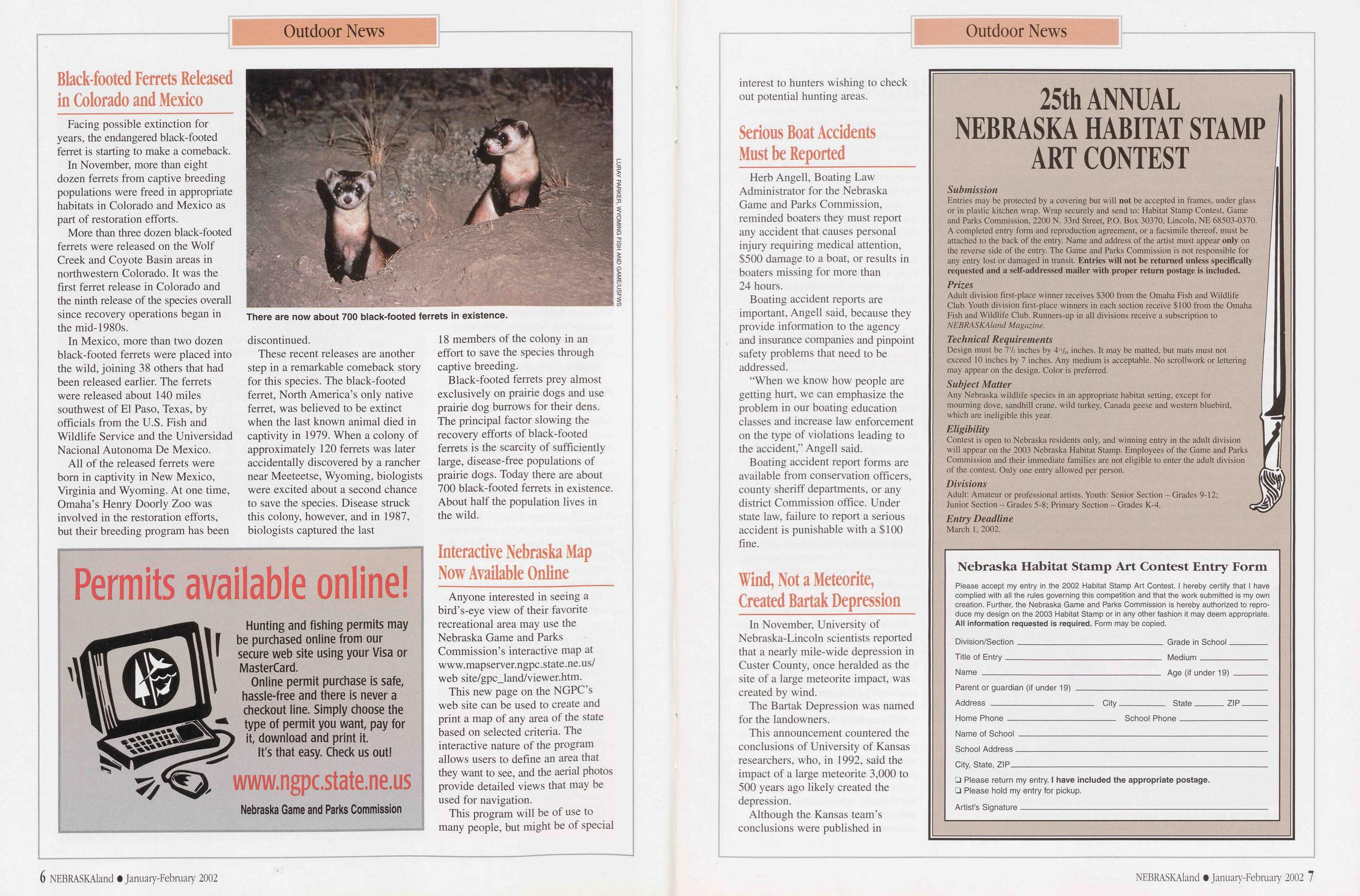
Facing possible extinction for years, the endangered black-footed ferret is starting to make a comeback. In November, more than eight dozen ferrets from captive breeding populations were freed in appropriate habitats in Colorado and Mexico as part of restoration efforts.
More than three dozen black-footed ferrets were released on the Wolf Creek and Coyote Basin areas in northwestern Colorado. It was the first ferret release in Colorado and the ninth release of the species overall since recovery operations began in the mid-1980s.
In Mexico, more than two dozen black-footed ferrets were placed into the wild, joining 38 others that had been released earlier. The ferrets were released about 140 miles southwest of El Paso, Texas, by officials from the U.S. Fish and Wildlife Service and the Universidad Nacional Autonoma De Mexico.
All of the released ferrets were born in captivity in New Mexico, Virginia and Wyoming. At one time, Omaha’s Henry Doorly Zoo was involved in the restoration efforts, but their breeding program has been discontinued.
Permits available online! Hunting and fishing permits may be purchased online from our secure web site using your Visa or MasterCard. Online permit purchase is safe, hassle-free and there is never a checkout line. Simply choose the type of permit you want, pay for it, download and print it. It's that easy. Check us out! www.ngpc.state.ne.us Nebraska Game and Parks CommissionThese recent releases are another step in a remarkable comeback story for this species. The black-footed ferret, North America’s only native ferret, was believed to be extinct when the last known animal died in captivity in 1979. When a colony of approximately 120 ferrets was later accidentally discovered by a rancher near Meeteetse, Wyoming, biologists were excited about a second chance to save the species. Disease struck this colony, however, and in 1987, biologists captured the last 18 members of the colony in an effort to save the species through captive breeding.
Black-footed ferrets prey almost exclusively on prairie dogs and use prairie dog burrows for their dens. The principal factor slowing the recovery efforts of black-footed ferrets is the scarcity of sufficiently large, disease-free populations of prairie dogs. Today there are about 700 black-footed ferrets in existence. About half the population lives in the wild.
Interactive Nebraska Map Now Available OnlineAnyone interested in seeing a bird’s-eye view of their favorite recreational area may use the Nebraska Game and Parks Commission’s interactive map at www.mapserver.ngpc.state.ne.us/ web site/gpc_land/viewer.htm.
This new page on the NGPC’s web site can be used to create and print a map of any area of the state based on selected criteria. The interactive nature of the program allows users to define an area that they want to see, and the aerial photos provide detailed views that may be used for navigation.
This program will be of use to many people, but might be of special interest to hunters wishing to check out potential hunting areas.
Serious Boat Accidents Must be ReportedHerb Angell, Boating Law Administrator for the Nebraska Game and Parks Commission, reminded boaters they must report any accident that causes personal injury requiring medical attention, $500 damage to a boat, or results in boaters missing for more than 24 hours.
Boating accident reports are important, Angell said, because they provide information to the agency and insurance companies and pinpoint safety problems that need to be addressed.
“When we know how people are getting hurt, we can emphasize the problem in our boating education classes and increase law enforcement on the type of violations leading to the accident,” Angell said.
Boating accident report forms are available from conservation officers, county sheriff departments, or any district Commission office. Under state law, failure to report a serious accident is punishable with a $100 fine.
Wind, Not a Meteorite, Created Bartak DepressionIn November, University of Nebraska-Lincoln scientists reported that a nearly mile-wide depression in Custer County, once heralded as the site of a large meteorite impact, was created by wind.
The Bartak Depression was named for the landowners.
This announcement countered the conclusions of University of Kansas researchers, who, in 1992, said the impact of a large meteorite 3,000 to 500 years ago likely created the depression.
Although the Kansas team’s conclusions were published in .....
25th ANNUAL NEBRASKA HABITAT STAMP ART CONTEST Submission Entries may be protected by a covering but will not be accepted in frames, under glass or in plastic kitchen wrap. Wrap securely and send to: Habitat Stamp Contest, Game and Parks Commission, 2200 N. 33rd Street, P.O. Box 30370, Lincoln, NE 68503-0370. A completed entry form and reproduction agreement, or a facsimile thereof, must be attached to the back of the entry. Name and address of the artist must appear only on the reverse side of the entry. The Game and Parks Commission is not responsible for any entry lost or damaged in transit. Entries will not be returned unless specifically requested and a self-addressed mailer with proper return postage is included. Prizes Adult division first-place winner receives $300 from the Omaha Fish and Wildlife i Club. Youth division first-place winners in each section receive $100 from the Omaha Fish and Wildlife Club. Runners-up in all divisions receive a subscription to NEBRASKAland Magazine. Technical Requirements Design must be Th inches by 4ll/,6 inches. It may be matted, but mats must not exceed 10 inches by 7 inches. Any medium is acceptable. No scrollwork or lettering may appear on the design. Color is preferred. Subject Matter Any Nebraska wildlife species in an appropriate habitat setting, except for mourning dove, sandhill crane, wild turkey, Canada geese and western bluebird, which are ineligible this year. Eligibility Contest is open to Nebraska residents only, and winning entry in the adult division will appear on the 2003 Nebraska Habitat Stamp. Employees of the Game and Parks Commission and their immediate families are not eligible to enter the adult division F of the contest. Only one entry allowed per person. /ft Divisions vs Adult: Amateur or professional artists. Youth: Senior Section - Grades 9-12; L Junior Section - Grades 5-8; Primary Section - Grades K-4. Entry Deadline March 1, 2002. Nebraska Habitat Stamp Art Contest Entry Form Please accept my entry in the 2002 Habitat Stamp Art Contest. I hereby certify that I have complied with all the rules governing this competition and that the work submitted is my own creation. Further, the Nebraska Game and Parks Commission is hereby authorized to repro- duce my design on the 2003 Habitat Stamp or in any other fashion it may deem appropriate. All information requested is required. Form may be copied. Division/Section Grade in School Title of Entry Medium Name_ Age (if under 19) Parent or guardian (if under 19) Address_ City State ZIP Home Phone School Phone Name of School School Address City, State, ZIP Please return my entry. I have included the appropriate postage. Please hold my entry for pickup. Artist’s Signature- 6 NEBRASKAland • January-February 2002 NEBRASKAland • January-February 2002 7 Outdoor News
Officer's Notebook
Outdoor News
Officer's Notebook
Road Hunter Felt Sting of Deer Decoy
I was working a deer decoy operation a few years ago during the muzzleloading season. While one officer watched and operated the decoy from a nearby hidden location, another officer and I hid near the road to contact violators. A man drove down the road and pulled to a sudden stop when he observed what he thought was a deer staring at him from the middle of a roadside field.
After grabbing his gun, the man sneaked over to the side of the road and crawled to the field’s edge, right under a “No Hunting” sign. After firing at the decoy and disappearing in a cloud of blue smoke, he rolled over and frantically began reloading his muzzleloader, furiously ramming his patch and ball down the barrel of the rifle. Taking careful aim, the road hunter fired once more and immediately went to his back to load another round. That guy, he could have defended the Alamo as fast as he was reloading.
By this time, I had approached. As he looked up and saw me, his movements ramming the ball and patch down the barrel became slower and slower. Crooking my finger at him, I called him out of the ditch. As he walked to the road, he looked over his shoulder back to the field. “That dang deer is still there,” he said incredulously. It wasn’t until he got into my truck that he realized what had happened and he started pounding the dash. “Oh, my gosh, that’s a decoy, isn’t it? You got me with the decoy!”
His reaction explains why decoy operations are so effective. The court costs and $50 fines for shooting from a roadway and hunting without permission are secondary. It’s the embarrassment of telling their friends that they were caught shooting at a decoy that gets most offenders.
- Duane Arp, Conservation Officer, Gretnanational science magazines and newspapers across the country, they were received with some skepticism because they challenged existing timetables for meteorite impacts. Further research by UNL scientists, who drilled deep test holes in and next to the depression, found that it had the same origin as similar, smaller areas in the region - relentless winds that scoured out hollows during very dry periods thousands of years ago.
The UNL drilling failed to find meteor debris around the rim of the area or the dramatic deformation and compression of underlying sediments that a meteorite would have caused.
Grant to Fund More Plastic Picnic Tables for ParksThe Nebraska Department of Environmental Quality (DEQ) has awarded the Nebraska Game and Parks Commission’s Division of State Parks a Waste Reduction and Recycling Incentive Grant of $32,500 to purchase plastic construction materials to build picnic tables for state parks and recreation areas.
DEQ received a total of 72 eligible applications requesting more than $4.5 million for integrated solid waste management facilities and projects. The grant program provides funds annually for waste management activities in Nebraska and this year more than $2.5 million was awarded for 52 projects throughout the state.
Each year, the Commission purchases several hundred picnic tables through Comhusker State Industries (CSI), which manufactures and sells a variety of products produced by inmates in Nebraska correctional institutions.
CSI purchases table frames from manufacturers and supplies pre-drilled boards for the tops and seats. The grant will be used to purchase recycled plastic materials rather than wood. Plastic components are virtually indestructible, retain their color and require very little maintenance.
8 NEBRASKAland • January-February 2002 Outdoor Business Battling Trash on Public Lands Great blue heron’s death tells story of litter’s effect on wildlife. By Doug CarrollMoving with a grace that belies his size, the great blue heron slowly stalks the lake’s shallows, often JL I Jkpausing to scan the water for frogs, tadpoles and small fish. Swallowing his catch whole, this silent angler leaves behind only an occasional track in the lake’s mud.
The heron is not the only fisherman who uses this quiet, backwater bay. Larger anglers have also enjoyed these productive waters. Unfortunately, they were not as unobtrusive. Long after their loud voices and laughs have finished echoing off the trees and rocks, their presence is still there in the aluminum cans, worm containers and other items they left behind.
Involved in his hunt, the heron pays little heed to the human trash as he walks through the area where his fellow fishermen have been. Moving ever so slowly, at first he hardly notices the long, worm-like substance entangling his foot. Trailing behind him with every step, it seems innocuous.
Finally, the stately bird lifts his foot and pecks at the thin strands encircling his toes. When even his sharp, dagger-like beak proves no match for the stringy object, he tries kicking it free, but only entangles his foot further.
Annoyed and frustrated, the bird launches himself from the shoreline, water dripping from his legs as the late-afternoon light shines brightly on the length of monofilament fishing line dangling from his foot. The product of a nasty backlash that a human angler had cut loose and carelessly discarded, the fishing line has become a deathtrap for the unsuspecting bird.
Heading up a creek arm, the heron alights somewhat clumsily on an
overhanging branch. Shifting his feet occasionally to gain a better foothold, the bird is unaware of his fate as the fishing line catches and wraps itself around the rough edges of the branch.
Spying minnows in the shallow creek water below, the heron tries to take off from his leafy perch, only to be jolted to a stop. Shackled to the tree by the fishing line, he tries over and over to escape but the line’s grip on the tree and his foot is unrelenting. As darkness falls on the creekbottom, the thumps of his strong wings can still be heard.
Weeks later, the heron’s lifeless body still hung upside down. Worn out from his hopeless battle and unable to eat or drink, the bird succumbed, staring down at the water that had once given him life.
Now his dull gray feathers and dried-out skin and bones gently rock and twist with the wind, held aloft by the still-gleaming strands of death.
This fictional re-creation has a basis in fact - the body of this luckless bird still hangs from a tree at Branched Oak Lake, and it is easy to imagine how it died. Creatures are killed by trash every day, and most die unseen. Some perish from eating and choking on trash; others die from the effects of undigestible material in their stomachs.
Not only wildlife is affected. Who has not had a visit to a scenic area marred by the presence of litter? Even remote areas are often affected. Anglers seem to be among the worst offenders. Popular fishing spots too often resemble a town dump more than a fishing hole in a natural setting. Aluminum cans, plastic bottles, lure boxes, cigarette butts, drink cups - even hooks and fishing line are carelessly discarded, creating an unsightly and dangerous place.
Workers pick up some of the trash left on the public lands that are under the stewardship of the Nebraska Game and Parks Commission. But the agency has neither the time nor the resources to pick up all of it. In many cases, money that could be spent for lake and park improvements must be spent on trash pickup.
Some visitors bring large trash bags with them and leave an area cleaner than when they arrived, but often they cannot make a dent in the problem. Apparently, more education is needed about the importance of cleaning up and taking personal responsibility. Meanwhile, everyone can pitch in and help clean up our recreational areas. Civic-minded groups such as Boy Scouts, 4-H clubs and Jaycees might work with local recreation area supervisors to organize seasonal cleanups. Similar projects have worked wonders for some of our state’s highways - do our state’s lakes deserve any less? ■
NEBRASKAland • January-February 2002 9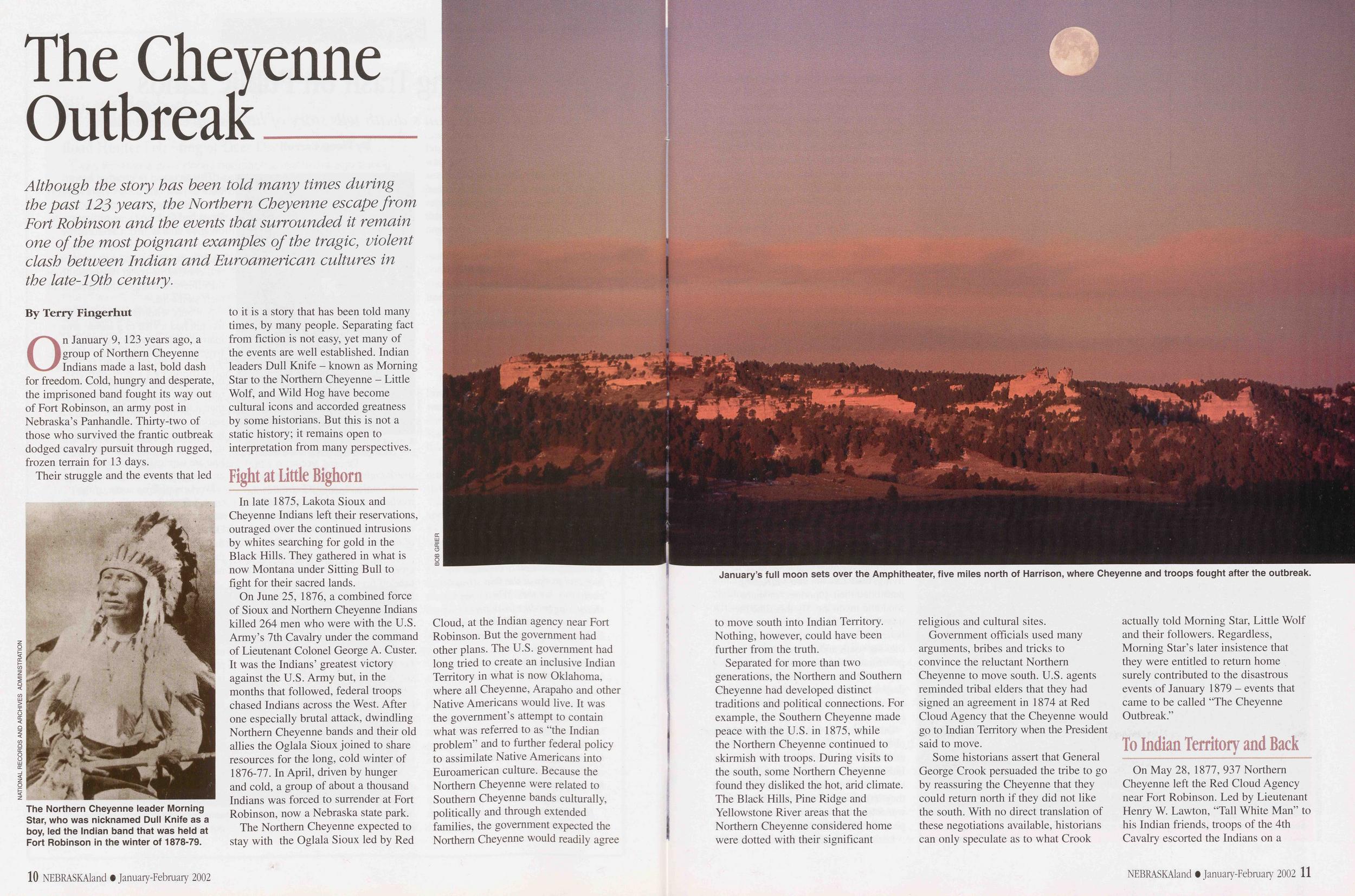
The Cheyenne Outbreak
Although the story has been told many times during the past 123 years, the Northern Cheyenne escape from Fort Robinson and the events that surrounded it remain one of the most poignant examples of the tragic, violent clash between Indian and Euroamerican cultures in the late-19th century. By Terry FingerhutOn January 9, 123 years ago, a group of Northern Cheyenne Indians made a last, bold dash for freedom. Cold, hungry and desperate, the imprisoned band fought its way out of Fort Robinson, an army post in Nebraska’s Panhandle. Thirty-two of those who survived the frantic outbreak dodged cavalry pursuit through rugged, frozen terrain for 13 days.
Their struggle and the events that led
NATIONAL RECORDS AND ARCHIVES ADMINISTRATIONto it is a story that has been told many times, by many people. Separating fact from fiction is not easy, yet many of the events are well established. Indian leaders Dull Knife - known as Morning Star to the Northern Cheyenne - Little Wolf, and Wild Hog have become cultural icons and accorded greatness by some historians. But this is not a static history; it remains open to interpretation from many perspectives.
Fight at Little BighornIn late 1875, Lakota Sioux and Cheyenne Indians left their reservations, outraged over the continued intrusions by whites searching for gold in the Black Hills. They gathered in what is now Montana under Sitting Bull to fight for their sacred lands.
On June 25, 1876, a combined force of Sioux and Northern Cheyenne Indians killed 264 men who were with the U.S. Army’s 7th Cavalry under the command of Lieutenant Colonel George A. Custer. It was the Indians’ greatest victory against the U.S. Army but, in the months that followed, federal troops chased Indians across the West. After one especially brutal attack, dwindling Northern Cheyenne bands and their old allies the Oglala Sioux joined to share resources for the long, cold winter of 1876-77. In April, driven by hunger and cold, a group of about a thousand Indians was forced to surrender at Fort Robinson, now a Nebraska state park.
The Northern Cheyenne expected to stay with the Oglala Sioux led by Red
Cloud, at the Indian agency near Fort Robinson. But the government had other plans. The U.S. government had long tried to create an inclusive Indian Territory in what is now Oklahoma, where all Cheyenne, Arapaho and other Native Americans would live. It was the government’s attempt to contain what was referred to as “the Indian problem” and to further federal policy to assimilate Native Americans into Euroamerican culture. Because the Northern Cheyenne were related to Southern Cheyenne bands culturally, politically and through extended families, the government expected the Northern Cheyenne would readily agree 10 NEBRASKAland • January-February 2002 to move south into Indian Territory. Nothing, however, could have been further from the truth.
Separated for more than two generations, the Northern and Southern Cheyenne had developed distinct traditions and political connections. For example, the Southern Cheyenne made peace with the U.S. in 1875, while the Northern Cheyenne continued to skirmish with troops. During visits to the south, some Northern Cheyenne found they disliked the hot, arid climate. The Black Hills, Pine Ridge and Yellowstone River areas that the Northern Cheyenne considered home were dotted with their significant religious and cultural sites.
Government officials used many arguments, bribes and tricks to convince the reluctant Northern Cheyenne to move south. U.S. agents reminded tribal elders that they had signed an agreement in 1874 at Red Cloud Agency that the Cheyenne would go to Indian Territory when the President said to move.
Some historians assert that General George Crook persuaded the tribe to go by reassuring the Cheyenne that they could return north if they did not like the south. With no direct translation of these negotiations available, historians can only speculate as to what Crook actually told Morning Star, Little Wolf and their followers. Regardless, Morning Star’s later insistence that they were entitled to return home surely contributed to the disastrous events of January 1879 - events that came to be called “The Cheyenne Outbreak.”
To Indian Territory and BackOn May 28, 1877, 937 Northern Cheyenne left the Red Cloud Agency near Fort Robinson. Led by Lieutenant Henry W. Lawton, “Tall White Man” to his Indian friends, troops of the 4th Cavalry escorted the Indians on a
NEBRASKAland • January-February 2002 11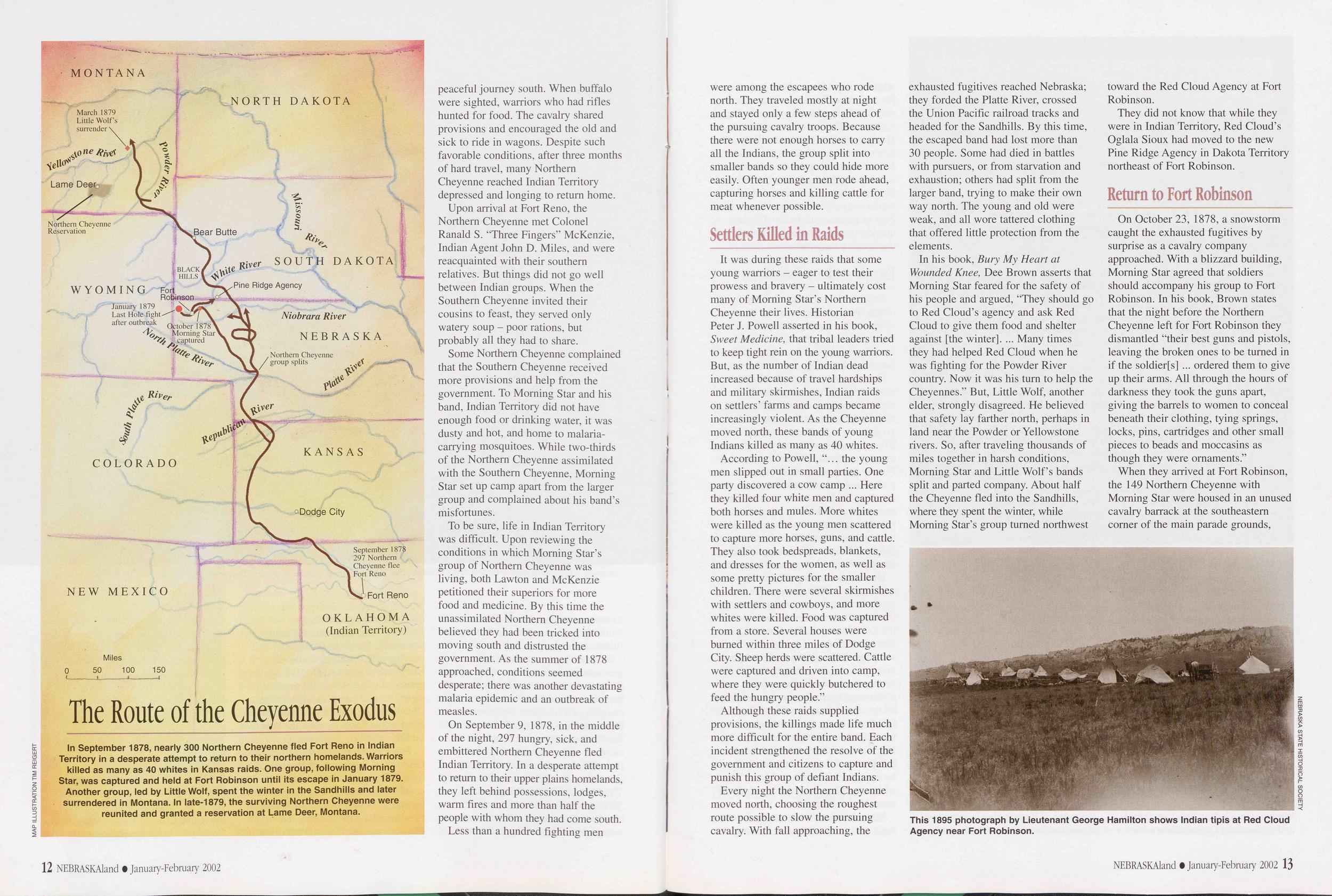
peaceful journey south. When buffalo were sighted, warriors who had rifles hunted for food. The cavalry shared provisions and encouraged the old and sick to ride in wagons. Despite such favorable conditions, after three months of hard travel, many Northern Cheyenne reached Indian Territory depressed and longing to return home.
Upon arrival at Fort Reno, the Northern Cheyenne met Colonel Ranald S. “Three Fingers” McKenzie, Indian Agent John D. Miles, and were reacquainted with their southern relatives. But things did not go well between Indian groups. When the Southern Cheyenne invited their cousins to feast, they served only watery soup - poor rations, but probably all they had to share.
Some Northern Cheyenne complained that the Southern Cheyenne received more provisions and help from the government. To Morning Star and his band, Indian Territory did not have enough food or drinking water, it was dusty and hot, and home to malaria- carrying mosquitoes. While two-thirds of the Northern Cheyenne assimilated with the Southern Cheyenne, Morning Star set up camp apart from the larger group and complained about his band’s misfortunes.
To be sure, life in Indian Territory was difficult. Upon reviewing the conditions in which Morning Star’s group of Northern Cheyenne was living, both Lawton and McKenzie petitioned their superiors for more food and medicine. By this time the unassimilated Northern Cheyenne believed they had been tricked into moving south and distrusted the government. As the summer of 1878 approached, conditions seemed desperate; there was another devastating malaria epidemic and an outbreak of measles.
On September 9, 1878, in the middle of the night, 297 hungry, sick, and embittered Northern Cheyenne fled Indian Territory. In a desperate attempt to return to their upper plains homelands, they left behind possessions, lodges, warm fires and more than half the people with whom they had come south.
Less than a hundred fighting men 12 NEBRASKAland • January-February 2002 were among the escapees who rode north. They traveled mostly at night and stayed only a few steps ahead of the pursuing cavalry troops. Because there were not enough horses to carry all the Indians, the group split into smaller bands so they could hide more easily. Often younger men rode ahead, capturing horses and killing cattle for meat whenever possible.
Settlers Killed in RaidsIt was during these raids that some young warriors - eager to test their prowess and bravery - ultimately cost many of Morning Star’s Northern Cheyenne their lives. Historian Peter J. Powell asserted in his book, Sweet Medicine, that tribal leaders tried to keep tight rein on the young warriors. But, as the number of Indian dead increased because of travel hardships and military skirmishes, Indian raids on settlers’ farms and camps became increasingly violent. As the Cheyenne moved north, these bands of young Indians killed as many as 40 whites.
According to Powell, "... the young men slipped out in small parties. One party discovered a cow camp ... Here they killed four white men and captured both horses and mules. More whites were killed as the young men scattered to capture more horses, guns, and cattle. They also took bedspreads, blankets, and dresses for the women, as well as some pretty pictures for the smaller children. There were several skirmishes with settlers and cowboys, and more whites were killed. Food was captured from a store. Several houses were burned within three miles of Dodge City. Sheep herds were scattered. Cattle were captured and driven into camp, where they were quickly butchered to feed the hungry people.”
Although these raids supplied provisions, the killings made life much more difficult for the entire band. Each incident strengthened the resolve of the government and citizens to capture and punish this group of defiant Indians.
Every night the Northern Cheyenne moved north, choosing the roughest route possible to slow the pursuing cavalry. With fall approaching, the exhausted fugitives reached Nebraska; they forded the Platte River, crossed the Union Pacific railroad tracks and headed for the Sandhills. By this time, the escaped band had lost more than 30 people. Some had died in battles with pursuers, or from starvation and exhaustion; others had split from the larger band, trying to make their own way north. The young and old were weak, and all wore tattered clothing that offered little protection from the elements.
In his book, Bury My Heart at Wounded Knee, Dee Brown asserts that Morning Star feared for the safety of his people and argued, "They should go to Red Cloud’s agency and ask Red Cloud to give them food and shelter against [the winter]. ... Many times they had helped Red Cloud when he was fighting for the Powder River country. Now it was his turn to help the Cheyennes.” But, Little Wolf, another elder, strongly disagreed. He believed that safety lay farther north, perhaps in land near the Powder or Yellowstone rivers. So, after traveling thousands of miles together in harsh conditions, Morning Star and Little Wolf’s bands split and parted company. About half the Cheyenne fled into the Sandhills, where they spent the winter, while Morning Star’s group turned northwest
They did not know that while they were in Indian Territory, Red Cloud’s Oglala Sioux had moved to the new Pine Ridge Agency in Dakota Territory northeast of Fort Robinson.
Return to Fort RobinsonOn October 23, 1878, a snowstorm caught the exhausted fugitives by surprise as a cavalry company approached. With a blizzard building, Morning Star agreed that soldiers should accompany his group to Fort Robinson. In his book, Brown states that the night before the Northern Cheyenne left for Fort Robinson they dismantled "their best guns and pistols, leaving the broken ones to be turned in if the soldier[s] ... ordered them to give up their arms. All through the hours of darkness they took the guns apart, giving the barrels to women to conceal beneath their clothing, tying springs, locks, pins, cartridges and other small pieces to beads and moccasins as though they were ornaments.”
When they arrived at Fort Robinson, the 149 Northern Cheyenne with Morning Star were housed in an unused cavalry barrack at the southeastern corner of the main parade grounds,
NEBRASKAland O January-February 2002 13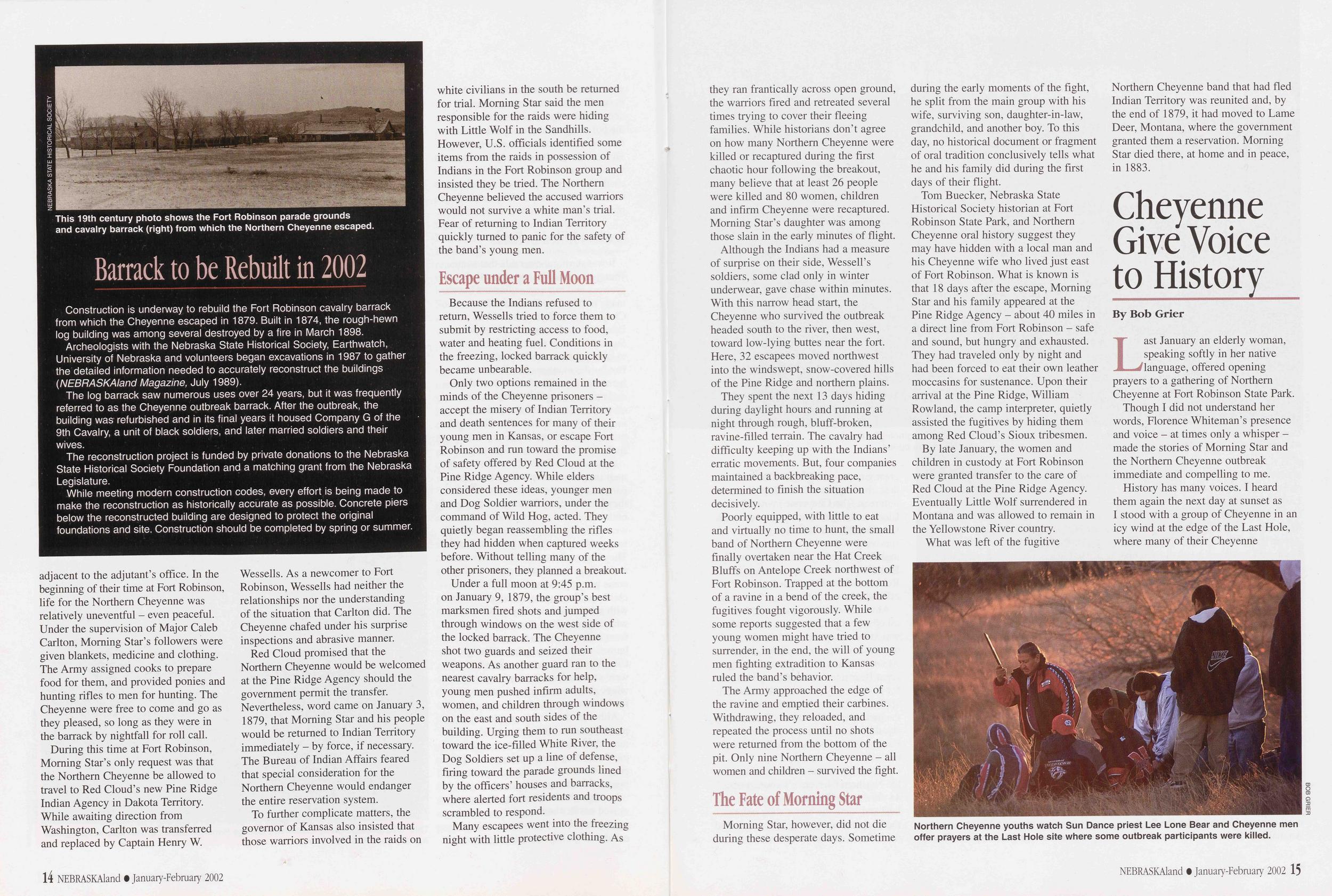
Construction is underway to rebuild the Fort Robinson cavalry barrack from which the Cheyenne escaped in 1879. Built in 1874, the rough-hewn log building was among several destroyed by a fire in March 1898. Archeologists with the Nebraska State Historical Society, Earthwatch, University of Nebraska and volunteers began excavations in 1987 to gather the detailed information needed to accurately reconstruct the buildings (NEBRASKAIand Magazine, July 1989).
The log barrack saw numerous uses over 24 years, but it was frequently referred to as the Cheyenne outbreak barrack. After the outbreak, the building was refurbished and in its final years it housed Company G of the 9th Cavalry, a unit of black soldiers, and later married soldiers and their wives.
The reconstruction project is funded by private donations to the Nebraska State Historical Society Foundation and a matching grant from the Nebraska Legislature.
While meeting modern construction codes, every effort is being made to make the reconstruction as historically accurate as possible. Concrete piers below the reconstructed building are designed to protect the original foundations and site. Construction should be completed by spring or summer.
adjacent to the adjutant’s office. In the beginning of their time at Fort Robinson, life for the Northern Cheyenne was relatively uneventful - even peaceful. Under the supervision of Major Caleb Carlton, Morning Star’s followers were given blankets, medicine and clothing. The Army assigned cooks to prepare food for them, and provided ponies and hunting rifles to men for hunting. The Cheyenne were free to come and go as they pleased, so long as they were in the barrack by nightfall for roll call.
During this time at Fort Robinson, Morning Star’s only request was that the Northern Cheyenne be allowed to travel to Red Cloud’s new Pine Ridge Indian Agency in Dakota Territory. While awaiting direction from Washington, Carlton was transferred and replaced by Captain Henry W. Wessells. As a newcomer to Fort Robinson, Wessells had neither the relationships nor the understanding of the situation that Carlton did. The Cheyenne chafed under his surprise inspections and abrasive manner.
Red Cloud promised that the Northern Cheyenne would be welcomed at the Pine Ridge Agency should the government permit the transfer. Nevertheless, word came on January 3, 1879, that Morning Star and his people would be returned to Indian Territory immediately - by force, if necessary. The Bureau of Indian Affairs feared that special consideration for the Northern Cheyenne would endanger the entire reservation system.
To further complicate matters, the governor of Kansas also insisted that those warriors involved in the raids on white civilians in the south be returned for trial. Morning Star said the men responsible for the raids were hiding with Little Wolf in the Sandhills. However, U.S. officials identified some items from the raids in possession of Indians in the Fort Robinson group and insisted they be tried. The Northern Cheyenne believed the accused warriors would not survive a white man’s trial. Fear of returning to Indian Territory quickly turned to panic for the safety of the band’s young men.
Escape under a Full MoonBecause the Indians refused to return, Wessells tried to force them to submit by restricting access to food, water and heating fuel. Conditions in the freezing, locked barrack quickly became unbearable.
Only two options remained in the minds of the Cheyenne prisoners - accept the misery of Indian Territory and death sentences for many of their young men in Kansas, or escape Fort Robinson and run toward the promise of safety offered by Red Cloud at the Pine Ridge Agency. While elders considered these ideas, younger men and Dog Soldier warriors, under the command of Wild Hog, acted. They quietly began reassembling the rifles they had hidden when captured weeks before. Without telling many of the other prisoners, they planned a breakout.
Under a full moon at 9:45 p.m. on January 9, 1879, the group’s best marksmen fired shots and jumped through windows on the west side of the locked barrack. The Cheyenne shot two guards and seized their weapons. As another guard ran to the nearest cavalry barracks for help, young men pushed infirm adults, women, and children through windows on the east and south sides of the building. Urging them to run southeast toward the ice-filled White River, the Dog Soldiers set up a line of defense, firing toward the parade grounds lined by the officers’ houses and barracks, where alerted fort residents and troops scrambled to respond.
Many escapees went into the freezing night with little protective clothing. As 14 NEBRASKAIand • January-February 2002 they ran frantically across open ground, the warriors fired and retreated several times trying to cover their fleeing families. While historians don’t agree on how many Northern Cheyenne were killed or recaptured during the first chaotic hour following the breakout, many believe that at least 26 people were killed and 80 women, children and infirm Cheyenne were recaptured. Morning Star’s daughter was among those slain in the early minutes of flight.
Although the Indians had a measure of surprise on their side, Wessell’s soldiers, some clad only in winter underwear, gave chase within minutes. With this narrow head start, the Cheyenne who survived the outbreak headed south to the river, then west, toward low-lying buttes near the fort. Here, 32 escapees moved northwest into the windswept, snow-covered hills of the Pine Ridge and northern plains.
They spent the next 13 days hiding during daylight hours and running at night through rough, bluff-broken, ravine-filled terrain. The cavalry had difficulty keeping up with the Indians’ erratic movements. But, four companies maintained a backbreaking pace, determined to finish the situation decisively.
Poorly equipped, with little to eat and virtually no time to hunt, the small band of Northern Cheyenne were finally overtaken near the Hat Creek Bluffs on Antelope Creek northwest of Fort Robinson. Trapped at the bottom of a ravine in a bend of the creek, the fugitives fought vigorously. While some reports suggested that a few young women might have tried to surrender, in the end, the will of young men fighting extradition to Kansas ruled the band’s behavior.
The Army approached the edge of the ravine and emptied their carbines. Withdrawing, they reloaded, and repeated the process until no shots were returned from the bottom of the pit. Only nine Northern Cheyenne - all women and children - survived the fight.
The Fate of Morning StarMorning Star, however, did not die during these desperate days. Sometime during the early moments of the fight, he split from the main group with his wife, surviving son, daughter-in-law, grandchild, and another boy. To this day, no historical document or fragment of oral tradition conclusively tells what he and his family did during the first days of their flight.
Tom Buecker, Nebraska State Historical Society historian at Fort Robinson State Park, and Northern Cheyenne oral history suggest they may have hidden with a local man and his Cheyenne wife who lived just east of Fort Robinson. What is known is that 18 days after the escape, Morning Star and his family appeared at the Pine Ridge Agency - about 40 miles in a direct line from Fort Robinson - safe and sound, but hungry and exhausted. They had traveled only by night and had been forced to eat their own leather moccasins for sustenance. Upon their arrival at the Pine Ridge, William Rowland, the camp interpreter, quietly assisted the fugitives by hiding them among Red Cloud’s Sioux tribesmen.
By late January, the women and children in custody at Fort Robinson were granted transfer to the care of Red Cloud at the Pine Ridge Agency. Eventually Little Wolf surrendered in Montana and was allowed to remain in the Yellowstone River country.
What was left of the fugitive Northern Cheyenne band that had fled Indian Territory was reunited and, by the end of 1879, it had moved to Lame Deer, Montana, where the government granted them a reservation. Morning Star died there, at home and in peace, in 1883.
Cheyenne Give Voice to History By Bob GrierLast January an elderly woman, speaking softly in her native language, offered opening prayers to a gathering of Northern Cheyenne at Fort Robinson State Park. Though I did not understand her words, Florence Whiteman’s presence and voice - at times only a whisper - made the stories of Morning Star and the Northern Cheyenne outbreak immediate and compelling to me.
History has many voices. I heard them again the next day at sunset as I stood with a group of Cheyenne in an icy wind at the edge of the Last Hole, where many of their Cheyenne
ancestors were killed 13 days after the outbreak. To the casual eye today, the Last Hole is a low depression in the bend of a gumbo prairie stream north of Harrison - an intermittent, and oth- erwise insignificant stream. But, to the Northern Cheyenne, it is hallowed and sacred land. I understood that vividly when I later looked at Little Finger Nail’s bullet-pierced ledger book that was recovered from his body at the site.
As the red sun dropped behind the distant ridges to the southwest, history’s voices spoke to us again. When the group gathered around the depression, Lee Lone Bear, a Sun Dance priest and Cheyenne tribal leader, knelt and offered prayers. Phillip Whiteman Jr. told the subdued gathering that "those who died here made it possible for us to have our homeland in the north.”
Northern Cheyenne youths from Lame Deer, Montana, traveled with tribal elders, educators and families to northwestern Nebraska for the Sixth Annual Fort Robinson Memorial 16 NEBRASKAland • January-February 2002 Outbreak Run January 4-9, 2001.
The five-day event included oral history sessions and visits to outbreak sites. The tour included the site where the chained and locked barracks stood and the escape route along the White River banks. The visitors stopped below the Cheyenne Buttes, chiseled heights that offered some escapees momentary protection. Visitors also followed the escape route north of Harrison and the scene of the final clashes, including sites the Cheyenne call the Amphitheater and Last Hole, where lives on both sides were lost.
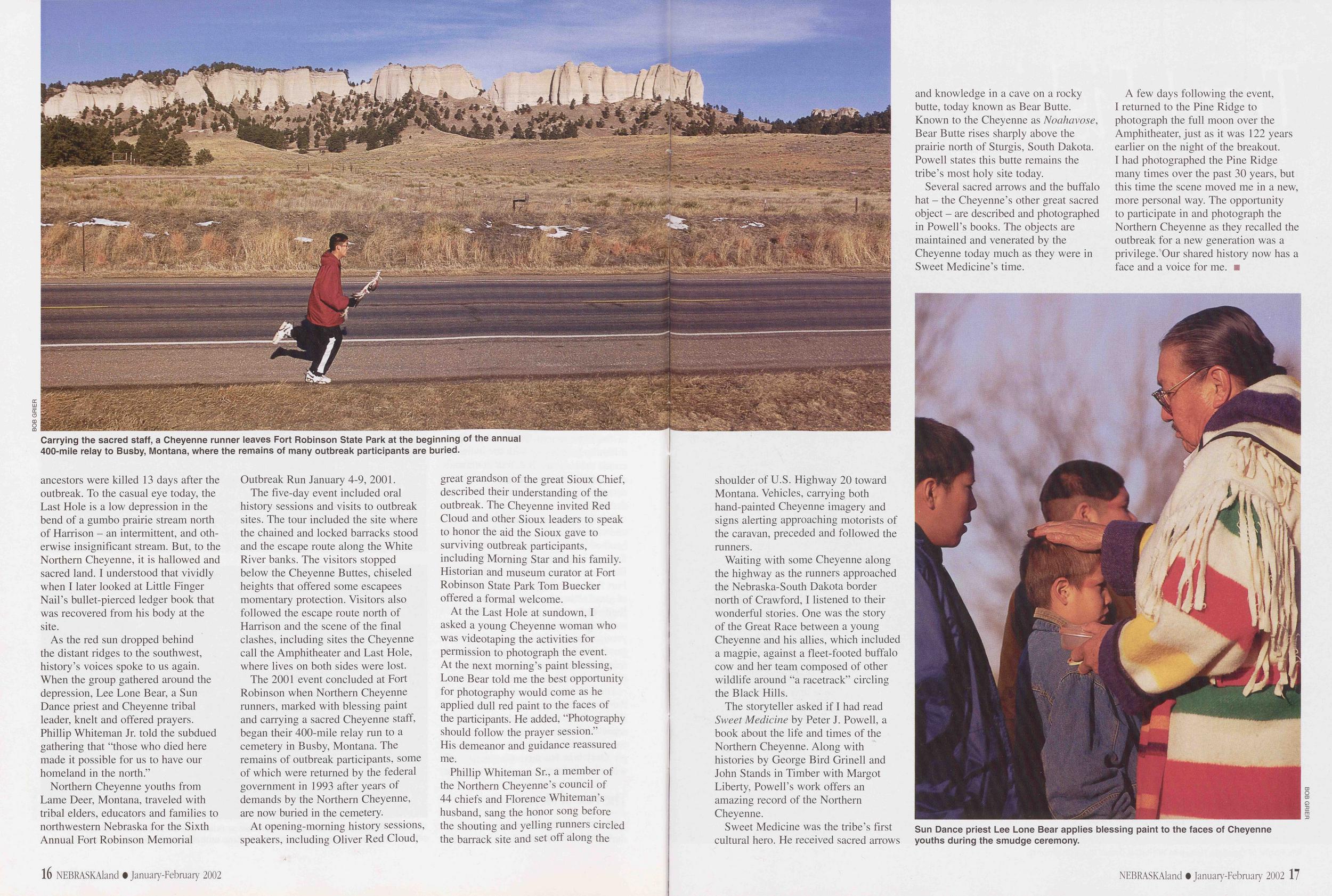
The 2001 event concluded at Fort Robinson when Northern Cheyenne runners, marked with blessing paint and carrying a sacred Cheyenne staff, began their 400-mile relay run to a cemetery in Busby, Montana. The remains of outbreak participants, some of which were returned by the federal government in 1993 after years of demands by the Northern Cheyenne, are now buried in the cemetery.
At opening-morning history sessions, speakers, including Oliver Red Cloud, great grandson of the great Sioux Chief, described their understanding of the outbreak. The Cheyenne invited Red Cloud and other Sioux leaders to speak to honor the aid the Sioux gave to surviving outbreak participants, including Morning Star and his family. Historian and museum curator at Fort Robinson State Park Tom Buecker offered a formal welcome.
At the Last Hole at sundown, I asked a young Cheyenne woman who was videotaping the activities for permission to photograph the event. At the next morning’s paint blessing, Lone Bear told me the best opportunity for photography would come as he applied dull red paint to the faces of the participants. He added, "Photography should follow the prayer session.” His demeanor and guidance reassured me.
Phillip Whiteman Sr., a member of the Northern Cheyenne’s council of 44 chiefs and Florence Whiteman’s husband, sang the honor song before the shouting and yelling runners circled the barrack site and set off along the shoulder of U.S. Highway 20 toward Montana. Vehicles, carrying both hand-painted Cheyenne imagery and signs alerting approaching motorists of the caravan, preceded and followed the runners.
Waiting with some Cheyenne along the highway as the runners approached the Nebraska-South Dakota border north of Crawford, I listened to their wonderful stories. One was the story of the Great Race between a young Cheyenne and his allies, which included a magpie, against a fleet-footed buffalo cow and her team composed of other wildlife around "a racetrack” circling the Black Hills.
The storyteller asked if I had read Sweet Medicine by Peter J. Powell, a book about the life and times of the Northern Cheyenne. Along with histories by George Bird Grinell and John Stands in Timber with Margot Liberty, Powell’s work offers an amazing record of the Northern Cheyenne.
Sweet Medicine was the tribe’s first cultural hero. He received sacred arrows and knowledge in a cave on a rocky butte, today known as Bear Butte. Known to the Cheyenne as Noahavose, Bear Butte rises sharply above the prairie north of Sturgis, South Dakota. Powell states this butte remains the tribe’s most holy site today.
Several sacred arrows and the buffalo hat - the Cheyenne’s other great sacred object - are described and photographed in Powell’s books. The objects are maintained and venerated by the Cheyenne today much as they were in Sweet Medicine’s time.
A few days following the event, I returned to the Pine Ridge to photograph the full moon over the Amphitheater, just as it was 122 years earlier on the night of the breakout. I had photographed the Pine Ridge many times over the past 30 years, but this time the scene moved me in a new, more personal way. The opportunity to participate in and photograph the Northern Cheyenne as they recalled the outbreak for a new generation was a privilege. Our shared history now has a face and a voice for me. ■
NEBRASKAland • January-February 2002 17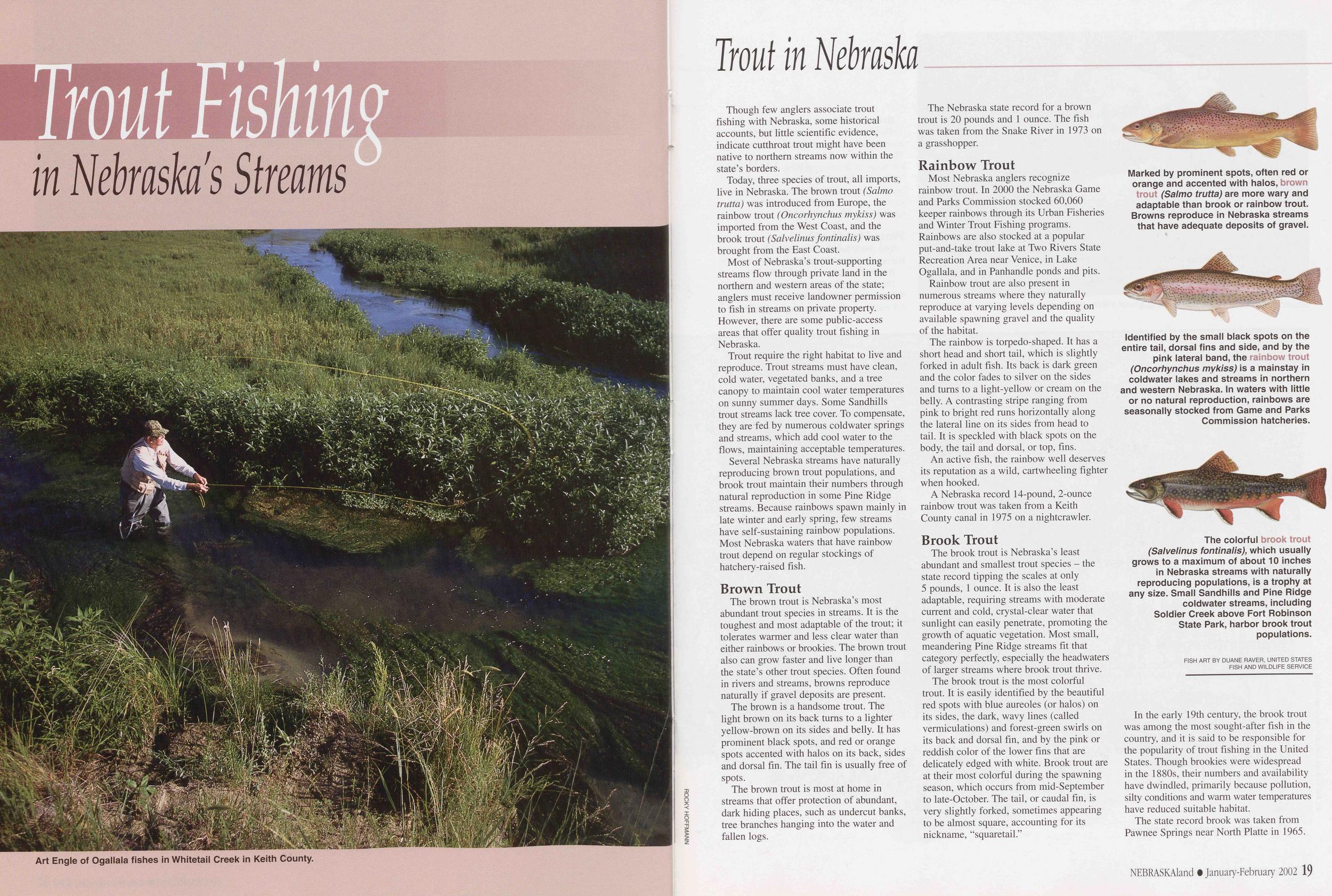
Though few anglers associate trout fishing with Nebraska, some historical accounts, but little scientific evidence, indicate cutthroat trout might have been native to northern streams now within the state’s borders.
Today, three species of trout, all imports, live in Nebraska. The brown trout (Salmo trutta) was introduced from Europe, the rainbow trout (Oncorhynchus mykiss) was imported from the West Coast, and the brook trout (Salvelinus fontinalis) was brought from the East Coast.
Most of Nebraska’s trout-supporting streams flow through private land in the northern and western areas of the state; anglers must receive landowner permission to fish in streams on private property. However, there are some public-access areas that offer quality trout fishing in Nebraska.
Trout require the right habitat to live and reproduce. Trout streams must have clean, cold water, vegetated banks, and a tree canopy to maintain cool water temperatures on sunny summer days. Some Sandhills trout streams lack tree cover. To compensate, they are fed by numerous coldwater springs and streams, which add cool water to the flows, maintaining acceptable temperatures.
Several Nebraska streams have naturally reproducing brown trout populations, and brook trout maintain their numbers through natural reproduction in some Pine Ridge streams. Because rainbows spawn mainly in late winter and early spring, few streams have self-sustaining rainbow populations. Most Nebraska waters that have rainbow trout depend on regular stockings of hatchery-raised fish.
Brown TroutThe brown trout is Nebraska’s most abundant trout species in streams. It is the toughest and most adaptable of the trout; it tolerates warmer and less clear water than either rainbows or brookies. The brown trout also can grow faster and live longer than the state’s other trout species. Often found in rivers and streams, browns reproduce naturally if gravel deposits are present.
The brown is a handsome trout. The light brown on its back turns to a lighter yellow-brown on its sides and belly. It has prominent black spots, and red or orange spots accented with halos on its back, sides and dorsal fin. The tail fin is usually free of spots.
The brown trout is most at home in streams that offer protection of abundant, dark hiding places, such as undercut banks, tree branches hanging into the water and fallen logs.
The Nebraska state record for a brown trout is 20 pounds and 1 ounce. The fish was taken from the Snake River in 1973 on a grasshopper.
Rainbow TroutMost Nebraska anglers recognize rainbow trout. In 2000 the Nebraska Game and Parks Commission stocked 60,060 keeper rainbows through its Urban Fisheries and Winter Trout Fishing programs. Rainbows are also stocked at a popular put-and-take trout lake at Two Rivers State Recreation Area near Venice, in Lake Ogallala, and in Panhandle ponds and pits.
Rainbow trout are also present in numerous streams where they naturally reproduce at varying levels depending on available spawning gravel and the quality of the habitat.
The rainbow is torpedo-shaped. It has a short head and short tail, which is slightly forked in adult fish. Its back is dark green and the color fades to silver on the sides and turns to a light-yellow or cream on the belly. A contrasting stripe ranging from pink to bright red runs horizontally along the lateral line on its sides from head to tail. It is speckled with black spots on the body, the tail and dorsal, or top, fins.
An active fish, the rainbow well deserves its reputation as a wild, cartwheeling fighter when hooked.
A Nebraska record 14-pound, 2-ounce rainbow trout was taken from a Keith County canal in 1975 on a nightcrawler.
Brook TroutThe brook trout is Nebraska’s least abundant and smallest trout species - the state record tipping the scales at only 5 pounds, 1 ounce. It is also the least adaptable, requiring streams with moderate current and cold, crystal-clear water that sunlight can easily penetrate, promoting the growth of aquatic vegetation. Most small, meandering Pine Ridge streams fit that category perfectly, especially the headwaters of larger streams where brook trout thrive.
The brook trout is the most colorful trout. It is easily identified by the beautiful red spots with blue aureoles (or halos) on its sides, the dark, wavy lines (called vermiculations) and forest-green swirls on its back and dorsal fin, and by the pink or reddish color of the lower fins that are delicately edged with white. Brook trout are at their most colorful during the spawning season, which occurs from mid-September to late-October. The tail, or caudal fin, is very slightly forked, sometimes appearing to be almost square, accounting for its nickname, “squaretail.”
In the early 19th century, the brook trout was among the most sought-after fish in the country, and it is said to be responsible for the popularity of trout fishing in the United States. Though brookies were widespread in the 1880s, their numbers and availability have dwindled, primarily because pollution, silty conditions and warm water temperatures have reduced suitable habitat.
The state record brook was taken from Pawnee Springs near North Platte in 1965.
NEBRASKAland • January-February 2002 19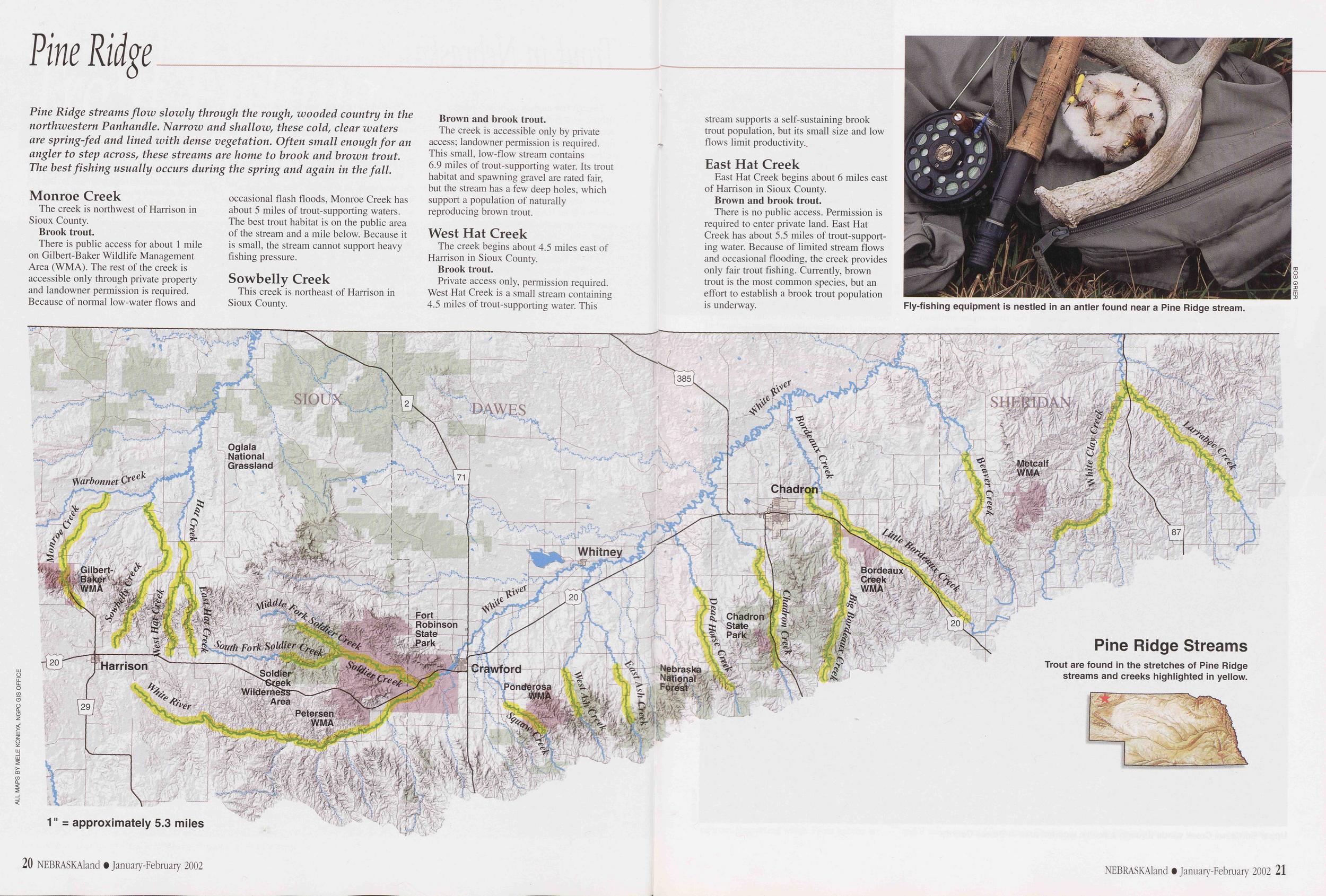
The creek is northwest of Harrison in Sioux County.
Brook trout.There is public access for about 1 mile on Gilbert-Baker Wildlife Management Area (WMA). The rest of the creek is accessible only through private property and landowner permission is required. Because of normal low-water flows and occasional flash floods, Monroe Creek has about 5 miles of trout-supporting waters. The best trout habitat is on the public area of the stream and a mile below. Because it is small, the stream cannot support heavy fishing pressure.
Sowbelly CreekThis creek is northeast of Harrison in Sioux County.
Brown and brook trout.The creek is accessible only by private access; landowner permission is required. This small, low-flow stream contains 6.9 miles of trout-supporting water. Its trout habitat and spawning gravel are rated fair, but the stream has a few deep holes, which support a population of naturally reproducing brown trout.
West Hat CreekThe creek begins about 4.5 miles east of Harrison in Sioux County.
Brook trout.Private access only, permission required. West Hat Creek is a small stream containing 4.5 miles of trout-supporting water. This 20 NEBRASKAland • January-February 2002 stream supports a self-sustaining brook trout population, but its small size and low flows limit productivity..
East Hat CreekEast Hat Creek begins about 6 miles east of Harrison in Sioux County.
Brown and brook trout.There is no public access. Permission is required to enter private land. East Hat Creek has about 5.5 miles of trout-support- ing water. Because of limited stream flows and occasional flooding, the creek provides only fair trout fishing. Currently, brown trout is the most common species, but an effort to establish a brook trout population is underway.
Trout are found in the stretches of Pine Ridge streams and creeks highlighted in yellow.
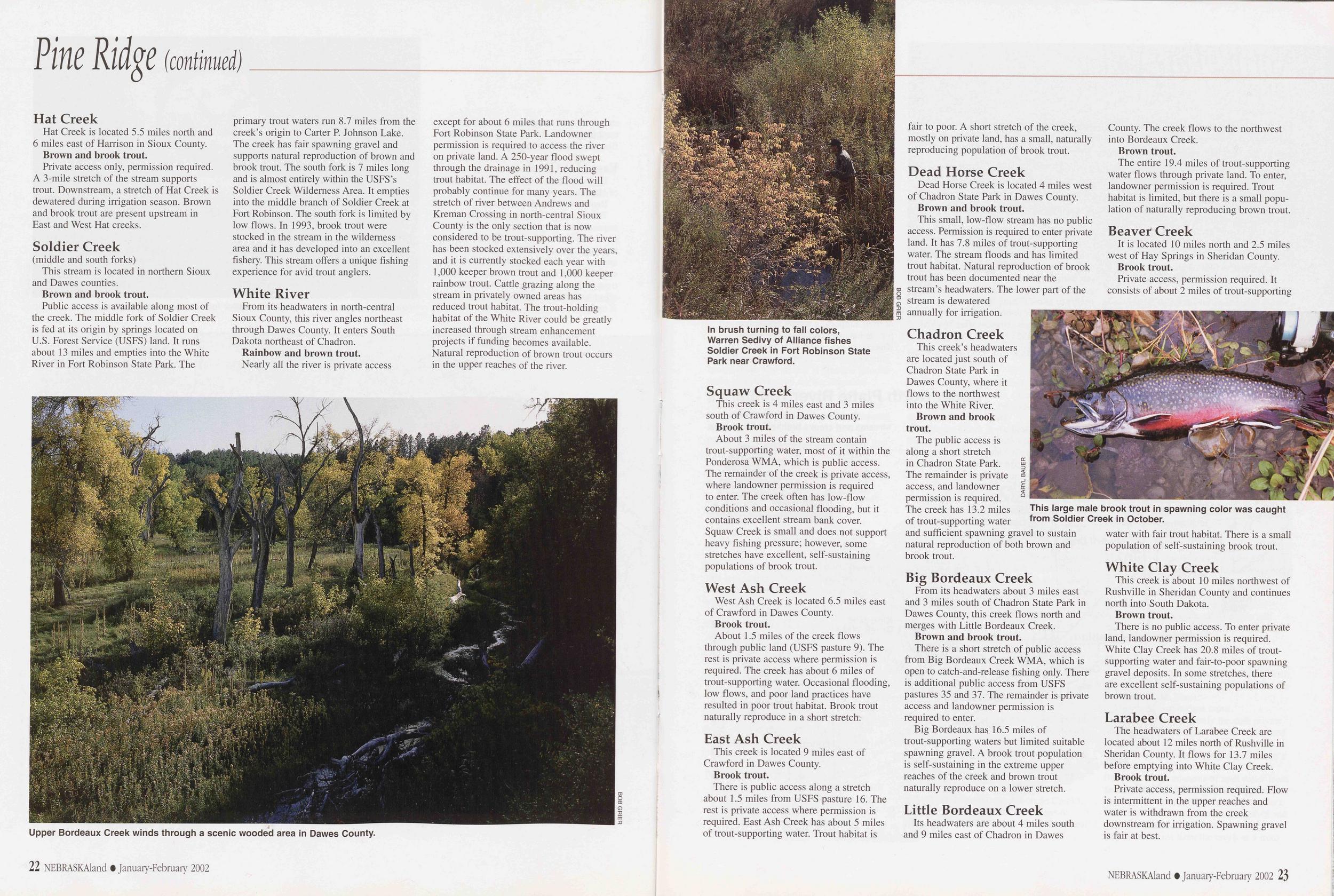
Pine Ridge (continued)
Hat CreekHat Creek is located 5.5 miles north and 6 miles east of Harrison in Sioux County.
Brown and brook trout.Private access only, permission required.
A 3-mile stretch of the stream supports trout. Downstream, a stretch of Hat Creek is dewatered during irrigation season. Brown and brook trout are present upstream in East and West Hat creeks.
Soldier Creek(middle and south forks)
This stream is located in northern Sioux and Dawes counties.
Brown and brook trout.Public access is available along most of the creek. The middle fork of Soldier Creek is fed at its origin by springs located on U.S. Forest Service (USFS) land. It runs about 13 miles and empties into the White River in Fort Robinson State Park. The
primary trout waters run 8.7 miles from the creek’s origin to Carter P. Johnson Lake. The creek has fair spawning gravel and supports natural reproduction of brown and brook trout. The south fork is 7 miles long and is almost entirely within the USFS’s Soldier Creek Wilderness Area. It empties into the middle branch of Soldier Creek at Fort Robinson. The south fork is limited by low flows. In 1993, brook trout were stocked in the stream in the wilderness area and it has developed into an excellent fishery. This stream offers a unique fishing experience for avid trout anglers.
White RiverFrom its headwaters in north-central Sioux County, this river angles northeast through Dawes County. It enters South Dakota northeast of Chadron.
Rainbow and brown trout.Nearly all the river is private access except for about 6 miles that runs through Fort Robinson State Park. Landowner permission is required to access the river on private land. A 250-year flood swept through the drainage in 1991, reducing trout habitat. The effect of the flood will probably continue for many years. The stretch of river between Andrews and Kreman Crossing in north-central Sioux County is the only section that is now considered to be trout-supporting. The river has been stocked extensively over the years, and it is currently stocked each year with 1,000 keeper brown trout and 1,000 keeper rainbow trout. Cattle grazing along the stream in privately owned areas has reduced trout habitat. The trout-holding habitat of the White River could be greatly increased through stream enhancement projects if funding becomes available. Natural reproduction of brown trout occurs in the upper reaches of the river.
22 NEBRASKAland • January-February 2002This creek is 4 miles east and 3 miles south of Crawford in Dawes County.
Brook trout.About 3 miles of the stream contain trout-supporting water, most of it within the Ponderosa WMA, which is public access. The remainder of the creek is private access, where landowner permission is required to enter. The creek often has low-flow conditions and occasional flooding, but it contains excellent stream bank cover. Squaw Creek is small and does not support heavy fishing pressure; however, some stretches have excellent, self-sustaining populations of brook trout.
West Ash CreekWest Ash Creek is located 6.5 miles east of Crawford in Dawes County.
Brook trout.About 1.5 miles of the creek flows through public land (USFS pasture 9). The rest is private access where permission is required. The creek has about 6 miles of trout-supporting water. Occasional flooding, low flows, and poor land practices have resulted in poor trout habitat. Brook trout naturally reproduce in a short stretch.
East Ash CreekThis creek is located 9 miles east of Crawford in Dawes County.
Brook trout.There is public access along a stretch about 1.5 miles from USFS pasture 16. The rest is private access where permission is required. East Ash Creek has about 5 miles of trout-supporting water. Trout habitat is fair to poor. A short stretch of the creek, mostly on private land, has a small, naturally reproducing population of brook trout.
Dead Horse CreekDead Horse Creek is located 4 miles west of Chadron State Park in Dawes County.
Brown and brook trout.This small, low-flow stream has no public access. Permission is required to enter private land. It has 7.8 miles of trout-supporting water. The stream floods and has limited trout habitat. Natural reproduction of brook trout has been documented near the stream’s headwaters. The lower part of the stream is dewatered annually for irrigation.
Chadron CreekThis creek’s headwaters are located just south of Chadron State Park in Dawes County, where it flows to the northwest into the White River.
Brown and brook trout.The public access is along a short stretch in Chadron State Park. The remainder is private access, and landowner permission is required. The creek has 13.2 miles of trout-supporting water and sufficient spawning gravel to sustain natural reproduction of both brown and brook trout.
Big Bordeaux CreekFrom its headwaters about 3 miles east and 3 miles south of Chadron State Park in Dawes County, this creek flows north and merges with Little Bordeaux Creek.
Brown and brook trout.There is a short stretch of public access from Big Bordeaux Creek WMA, which is open to catch-and-release fishing only. There is additional public access from USFS pastures 35 and 37. The remainder is private access and landowner permission is required to enter.
Big Bordeaux has 16.5 miles of trout-supporting waters but limited suitable spawning gravel. A brook trout population is self-sustaining in the extreme upper reaches of the creek and brown trout naturally reproduce on a lower stretch.
Little Bordeaux CreekIts headwaters are about 4 miles south and 9 miles east of Chadron in Dawes County. The creek flows to the northwest into Bordeaux Creek.
Brown trout.The entire 19.4 miles of trout-supporting water flows through private land. To enter, landowner permission is required. Trout habitat is limited, but there is a small popu- lation of naturally reproducing brown trout.
Beaver CreekIt is located 10 miles north and 2.5 miles west of Hay Springs in Sheridan County.
Brook trout.Private access, permission required. It consists of about 2 miles of trout-supporting
This creek is about 10 miles northwest of Rushville in Sheridan County and continues north into South Dakota.
Brown trout.There is no public access. To enter private land, landowner permission is required. White Clay Creek has 20.8 miles of trout- supporting water and fair-to-poor spawning gravel deposits. In some stretches, there are excellent self-sustaining populations of brown trout.
Larabee CreekThe headwaters of Larabee Creek are located about 12 miles north of Rushville in Sheridan County. It flows for 13.7 miles before emptying into White Clay Creek.
Brook trout.Private access, permission required. Flow is intermittent in the upper reaches and water is withdrawn from the creek downstream for irrigation. Spawning gravel is fair at best.
NEBRASKAland • January-February 2002 23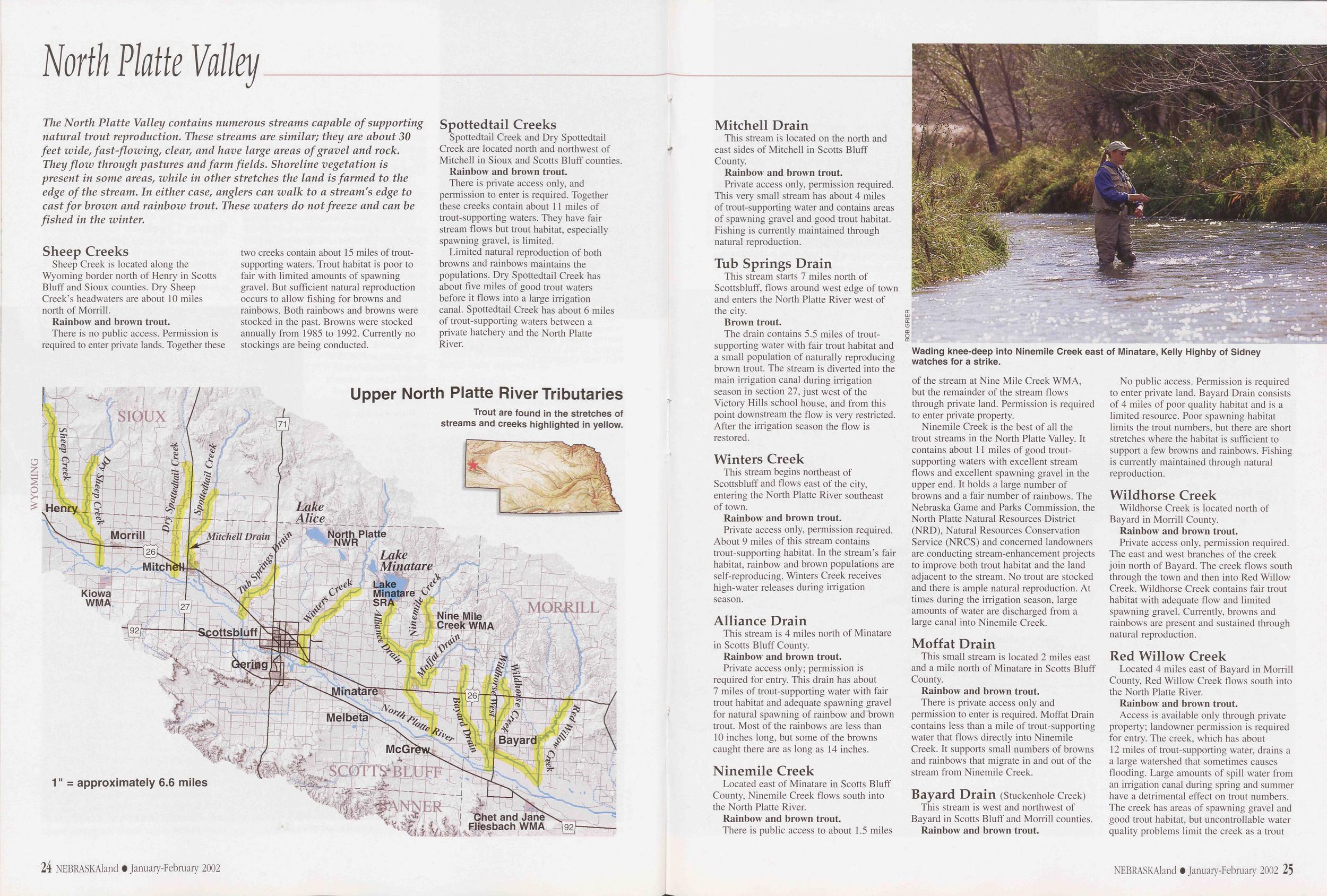
North Platte Valley
The North Platte Valley contains numerous streams capable of supporting natural trout reproduction. These streams are similar; they are about 30 feet wide, fast-flowing; clear, and have large areas of gravel and rock. They flow through pastures and farm fields. Shoreline vegetation is present in some areas, while in other stretches the land is farmed to the edge of the stream. In either case, anglers can walk to a stream's edge to cast for brown and rainbow trout. These waters do not freeze and can be fished in the winter. Sheep CreeksSheep Creek is located along the Wyoming border north of Henry in Scotts Bluff and Sioux counties. Dry Sheep Creek’s headwaters are about 10 miles north of Morrill.
Rainbow and brown trout.There is no public access. Permission is required to enter private lands. Together these two creeks contain about 15 miles of trout- supporting waters. Trout habitat is poor to fair with limited amounts of spawning gravel. But sufficient natural reproduction occurs to allow fishing for browns and rainbows. Both rainbows and browns were stocked in the past. Browns were stocked annually from 1985 to 1992. Currently no stockings are being conducted.
Spottedtail CreeksSpottedtail Creek and Dry Spottedtail Creek are located north and northwest of Mitchell in Sioux and Scotts Bluff counties.
Rainbow and brown trout.There is private access only, and permission to enter is required. Together these creeks contain about 11 miles of trout-supporting waters. They have fair stream flows but trout habitat, especially spawning gravel, is limited.
Limited natural reproduction of both browns and rainbows maintains the populations. Dry Spottedtail Creek has about five miles of good trout waters before it flows into a large irrigation canal. Spottedtail Creek has about 6 miles of trout-supporting waters between a private hatchery and the North Platte River.
This stream is located on the north and east sides of Mitchell in Scotts Bluff County.
Rainbow and brown trout.Private access only, permission required. This very small stream has about 4 miles of trout-supporting water and contains areas of spawning gravel and good trout habitat. Fishing is currently maintained through natural reproduction.
Tub Springs DrainThis stream starts 7 miles north of Scottsbluff, flows around west edge of town and enters the North Platte River west of the city.
Brown trout.The drain contains 5.5 miles of trout- supporting water with fair trout habitat and a small population of naturally reproducing brown trout. The stream is diverted into the main irrigation canal during irrigation season in section 27, just west of the Victory Hills school house, and from this point downstream the flow is very restricted. After the irrigation season the flow is restored.
Winters CreekThis stream begins northeast of Scottsbluff and flows east of the city, entering the North Platte River southeast of town.
Rainbow and brown trout.Private access only, permission required. About 9 miles of this stream contains trout-supporting habitat. In the stream’s fair habitat, rainbow and brown populations are self-reproducing. Winters Creek receives high-water releases during irrigation season.
Alliance DrainThis stream is 4 miles north of Minatare in Scotts Bluff County.
Rainbow and brown trout.Private access only; permission is required for entry. This drain has about 7 miles of trout-supporting water with fair trout habitat and adequate spawning gravel for natural spawning of rainbow and brown trout. Most of the rainbows are less than 10 inches long, but some of the browns caught there are as long as 14 inches.
Ninemile CreekLocated east of Minatare in Scotts Bluff County, Ninemile Creek flows south into the North Platte River.
Rainbow and brown trout.There is public access to about 1.5 miles
Ninemile Creek is the best of all the trout streams in the North Platte Valley. It contains about 11 miles of good trout- supporting waters with excellent stream flows and excellent spawning gravel in the upper end. It holds a large number of browns and a fair number of rainbows. The Nebraska Game and Parks Commission, the North Platte Natural Resources District (NRD), Natural Resources Conservation Service (NRCS) and concerned landowners are conducting stream-enhancement projects to improve both trout habitat and the land adjacent to the stream. No trout are stocked and there is ample natural reproduction. At times during the irrigation season, large amounts of water are discharged from a large canal into Ninemile Creek.
Moffat DrainThis small stream is located 2 miles east and a mile north of Minatare in Scotts Bluff County.
Rainbow and brown trout.There is private access only and permission to enter is required. Moffat Drain contains less than a mile of trout-supporting water that flows directly into Ninemile Creek. It supports small numbers of browns and rainbows that migrate in and out of the stream from Ninemile Creek.
Bayard Drain (Stuckenhole Creek)This stream is west and northwest of Bayard in Scotts Bluff and Morrill counties.
Rainbow and brown trout.No public access. Permission is required to enter private land. Bayard Drain consists of 4 miles of poor quality habitat and is a limited resource. Poor spawning habitat limits the trout numbers, but there are short stretches where the habitat is sufficient to support a few browns and rainbows. Fishing is currently maintained through natural reproduction.
Wildhorse CreekWildhorse Creek is located north of Bayard in Morrill County.
Rainbow and brown trout.Private access only, permission required. The east and west branches of the creek join north of Bayard. The creek flows south through the town and then into Red Willow Creek. Wildhorse Creek contains fair trout habitat with adequate flow and limited spawning gravel. Currently, browns and rainbows are present and sustained through natural reproduction.
Red Willow CreekLocated 4 miles east of Bayard in Morrill County, Red Willow Creek flows south into the North Platte River.
Rainbow and brown trout.Access is available only through private property; landowner permission is required for entry. The creek, which has about 12 miles of trout-supporting water, drains a a large watershed that sometimes causes flooding. Large amounts of spill water from an irrigation canal during spring and summer have a detrimental effect on trout numbers. The creek has areas of spawning gravel and good trout habitat, but uncontrollable water quality problems limit the creek as a trout
NEBRASKAland •January-February 2002 25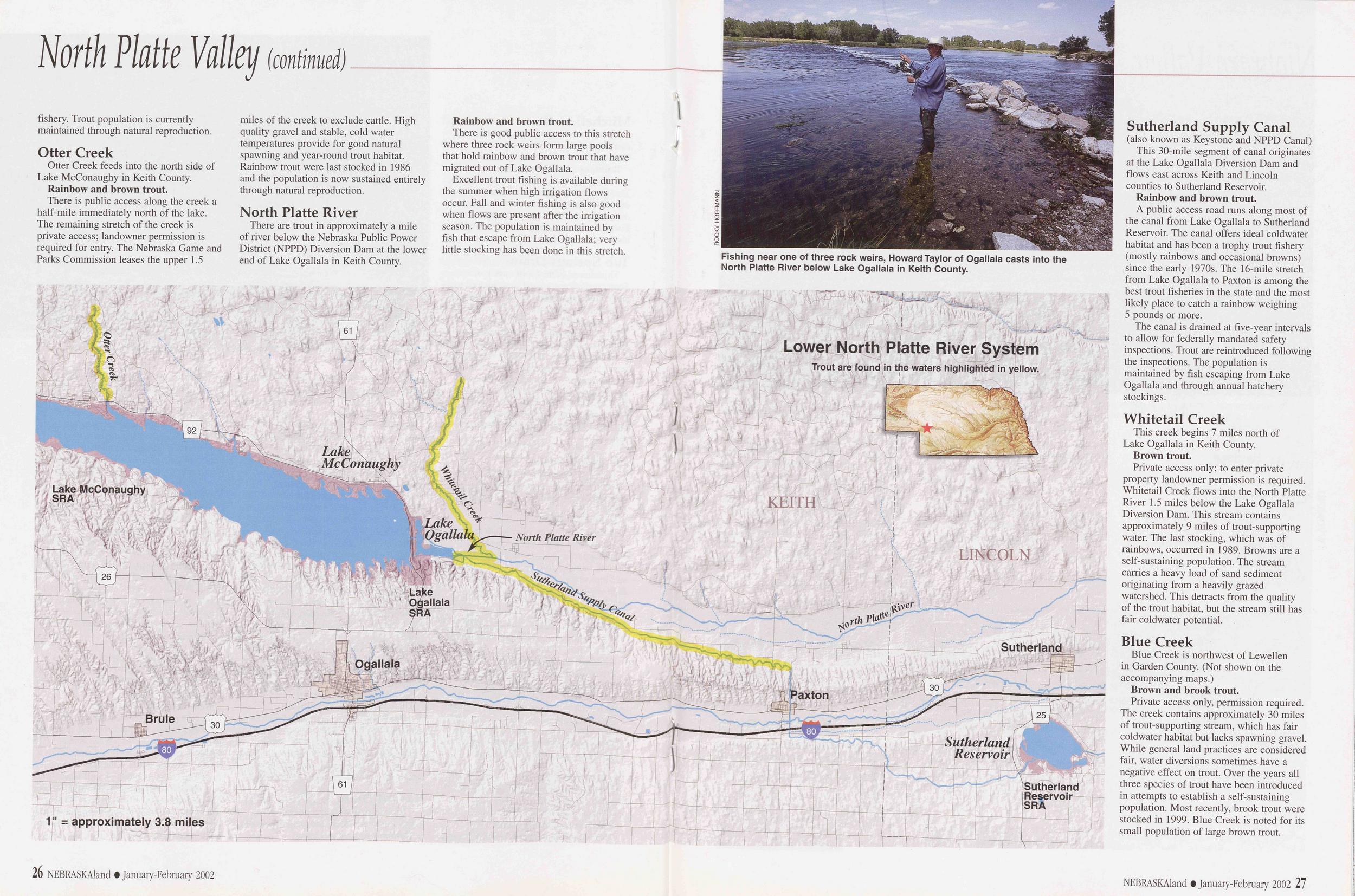
North Platte Valley (continued)
fishery. Trout population is currently maintained through natural reproduction.
Otter CreekOtter Creek feeds into the north side of Lake McConaughy in Keith County.
Rainbow and brown trout.There is public access along the creek a half-mile immediately north of the lake. The remaining stretch of the creek is private access; landowner permission is required for entry. The Nebraska Game and Parks Commission leases the upper 1.5 miles of the creek to exclude cattle. High quality gravel and stable, cold water temperatures provide for good natural spawning and year-round trout habitat. Rainbow trout were last stocked in 1986 and the population is now sustained entirely through natural reproduction.
North Platte RiverThere are trout in approximately a mile of river below the Nebraska Public Power District (NPPD) Diversion Dam at the lower end of Lake Ogallala in Keith County.
Rainbow and brown trout.There is good public access to this stretch where three rock weirs form large pools that hold rainbow and brown trout that have migrated out of Lake Ogallala.
Excellent trout fishing is available during the summer when high irrigation flows occur. Fall and winter fishing is also good when flows are present after the irrigation season. The population is maintained by fish that escape from Lake Ogallala; very little stocking has been done in this stretch.
26 NEBRASKAland • January-February 2002(also known as Keystone and NPPD Canal)
This 30-mile segment of canal originates at the Lake Ogallala Diversion Dam and flows east across Keith and Lincoln counties to Sutherland Reservoir.
Rainbow and brown trout.A public access road runs along most of the canal from Lake Ogallala to Sutherland Reservoir. The canal offers ideal coldwater habitat and has been a trophy trout fishery (mostly rainbows and occasional browns) since the early 1970s. The 16-mile stretch from Lake Ogallala to Paxton is among the best trout fisheries in the state and the most likely place to catch a rainbow weighing 5 pounds or more.
The canal is drained at five-year intervals to allow for federally mandated safety inspections. Trout are reintroduced following the inspections. The population is maintained by fish escaping from Lake Ogallala and through annual hatchery stockings.
Whitetail CreekThis creek begins 7 miles north of Lake Ogallala in Keith County.
Brown trout.Private access only; to enter private property landowner permission is required. Whitetail Creek flows into the North Platte River 1.5 miles below the Lake Ogallala Diversion Dam. This stream contains approximately 9 miles of trout-supporting water. The last stocking, which was of rainbows, occurred in 1989. Browns are a self-sustaining population. The stream carries a heavy load of sand sediment originating from a heavily grazed watershed. This detracts from the quality of the trout habitat, but the stream still has fair cold water potential.
Blue CreekBlue Creek is northwest of Lewellen in Garden County. (Not shown on the accompanying maps.)
Brown and brook trout.Private access only, permission required. The creek contains approximately 30 miles of trout-supporting stream, which has fair cold water habitat but lacks spawning gravel. While general land practices are considered fair, water diversions sometimes have a negative effect on trout. Over the years all three species of trout have been introduced in attempts to establish a self-sustaining population. Most recently, brook trout were stocked in 1999. Blue Creek is noted for its small population of large brown trout.
NEBRASKAland • January-February 2002 27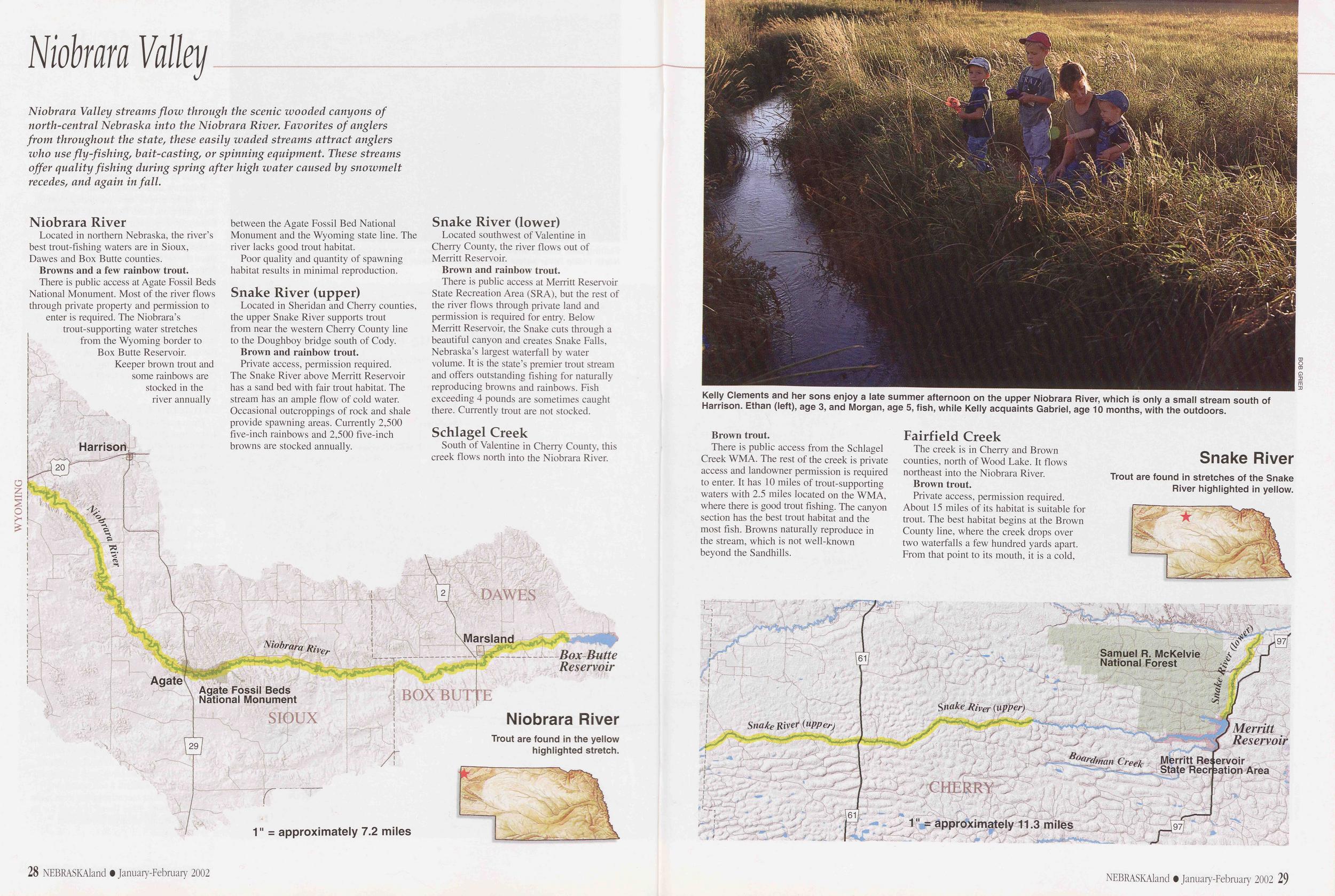
Niobrara Valley
Niobrara Valley streams flow through the scenic wooded canyons of north-central Nebraska into the Niobrara River. Favorites of anglers from throughout the state, these easily waded streams attract anglers who use fly-fishing; bait-casting, or spinning equipment. These streams offer quality fishing during spring after high water caused by snowmelt recedes, and again infall. Niobrara RiverLocated in northern Nebraska, the river’s best trout-fishing waters are in Sioux, Dawes and Box Butte counties.
Browns and a few rainbow trout.There is public access at Agate Fossil Beds National Monument. Most of the river flows through private property and permission to enter is required. The Niobrara’s trout-supporting water stretches from the Wyoming border to Box Butte Reservoir. Keeper brown trout and some rainbows are stocked in the river annually between the Agate Fossil Bed National Monument and the Wyoming state line. The river lacks good trout habitat.
Poor quality and quantity of spawning habitat results in minimal reproduction.
Snake River (lower)Located southwest of Valentine in Cherry County, the river flows out of Merritt Reservoir.
Brown and rainbow trout.There is public access at Merritt Reservoir State Recreation Area (SRA), but the rest of the river flows through private land and permission is required for entry. Below Merritt Reservoir, the Snake cuts through a beautiful canyon and creates Snake Falls, Nebraska’s largest waterfall by water volume. It is the state’s premier trout stream and offers outstanding fishing for naturally reproducing browns and rainbows. Fish exceeding 4 pounds are sometimes caught there. Currently trout are not stocked.
Snake River (upper)Located in Sheridan and Cherry counties, the upper Snake River supports trout from near the western Cherry County line to the Doughboy bridge south of Cody.
Brown and rainbow trout.Private access, permission required. The Snake River above Merritt Reservoir has a sand bed with fair trout habitat. The stream has an ample flow of cold water. Occasional outcroppings of rock and shale provide spawning areas. Currently 2,500 five-inch rainbows and 2,500 five-inch browns are stocked annually.
Schlagel CreekSouth of Valentine in Cherry County, this creek flows north into the Niobrara River.
There is public access from the Schlagel Creek WMA. The rest of the creek is private access and landowner permission is required to enter. It has 10 miles of trout-supporting waters with 2.5 miles located on the WMA, where there is good trout fishing. The canyon section has the best trout habitat and the most fish. Browns naturally reproduce in the stream, which is not well-known beyond the Sandhills.
Fairfield CreekThe creek is in Cherry and Brown counties, north of Wood Lake. It flows northeast into the Niobrara River.
Brown trout.Private access, permission required. About 15 miles of its habitat is suitable for trout. The best habitat begins at the Brown County line, where the creek drops over two waterfalls a few hundred yards apart. From that point to its mouth, it is a cold,
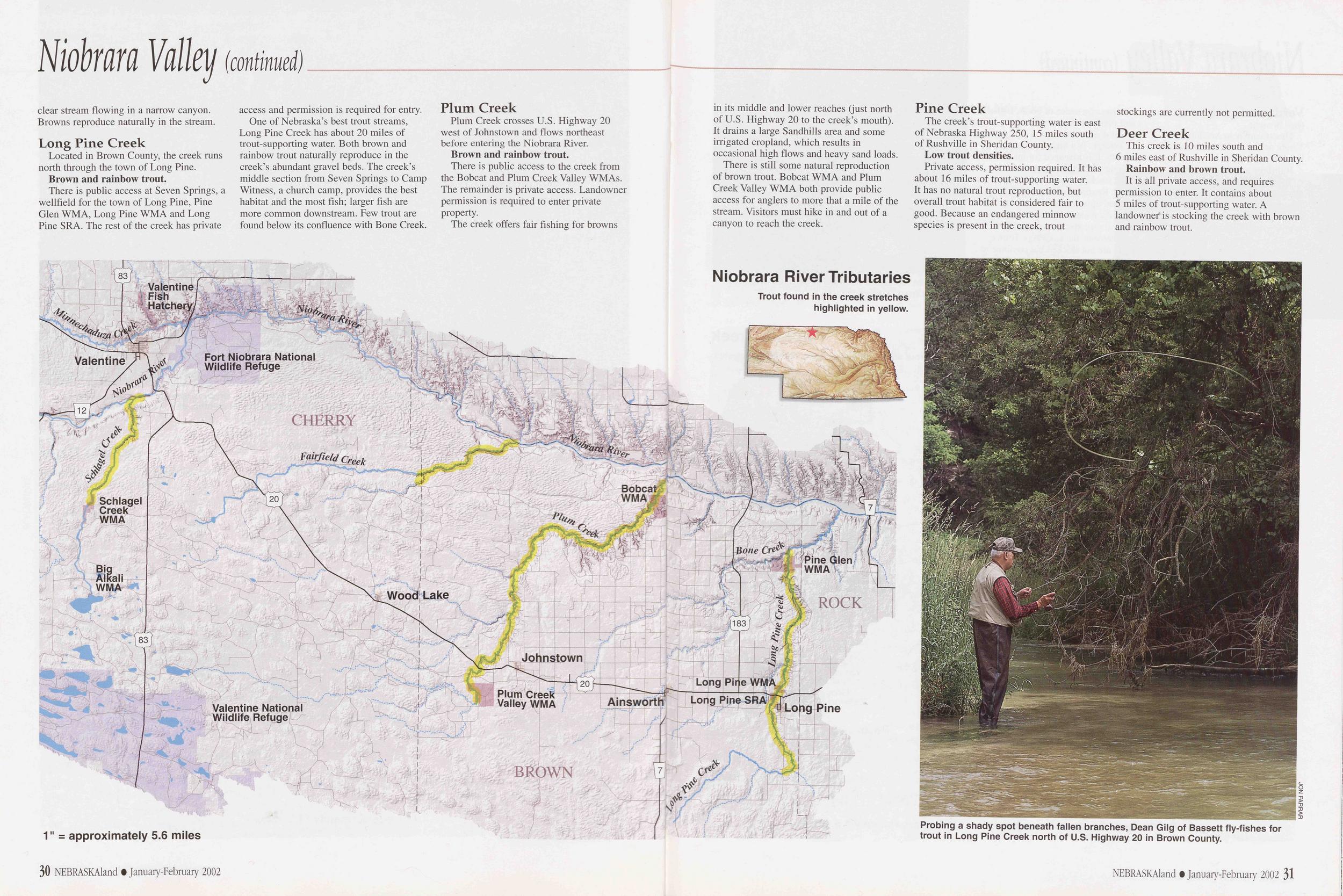
Niobrara Valley (continued)
clear stream flowing in a narrow canyon. Browns reproduce naturally in the stream.
Long Pine CreekLocated in Brown County, the creek runs north through the town of Long Pine.
Brown and rainbow trout.There is public access at Seven Springs, a wellfield for the town of Long Pine, Pine Glen WMA, Long Pine WMA and Long Pine SR A. The rest of the creek has private access and permission is required for entry.
One of Nebraska’s best trout streams, Long Pine Creek has about 20 miles of trout-supporting water. Both brown and rainbow trout naturally reproduce in the creek’s abundant gravel beds. The creek’s middle section from Seven Springs to Camp Witness, a church camp, provides the best habitat and the most fish; larger fish are more common downstream. Few trout are found below its confluence with Bone Creek.
Plum CreekPlum Creek crosses U.S. Highway 20 west of Johnstown and flows northeast before entering the Niobrara River.
Brown and rainbow trout.There is public access to the creek from the Bobcat and Plum Creek Valley WMAs. The remainder is private access. Landowner permission is required to enter private property.
The creek offers fair fishing for browns
in its middle and lower reaches (just north of U.S. Highway 20 to the creek’s mouth). It drains a large Sandhills area and some irrigated cropland, which results in occasional high flows and heavy sand loads.
There is still some natural reproduction of brown trout. Bobcat WMA and Plum Creek Valley WMA both provide public access for anglers to more that a mile of the stream. Visitors must hike in and out of a canyon to reach the creek.
Pine CreekThe creek’s trout-supporting water is east of Nebraska Highway 250, 15 miles south of Rushville in Sheridan County.
Low trout densities.Private access, permission required. It has about 16 miles of trout-supporting water. It has no natural trout reproduction, but overall trout habitat is considered fair to good. Because an endangered minnow species is present in the creek, trout stockings are currently not permitted.
Deer CreekThis creek is 10 miles south and 6 miles east of Rushville in Sheridan County.
Rainbow and brown trout.It is all private access, and requires permission to enter. It contains about 5 miles of trout-supporting water. A landowner' is stocking the creek with brown and rainbow trout.
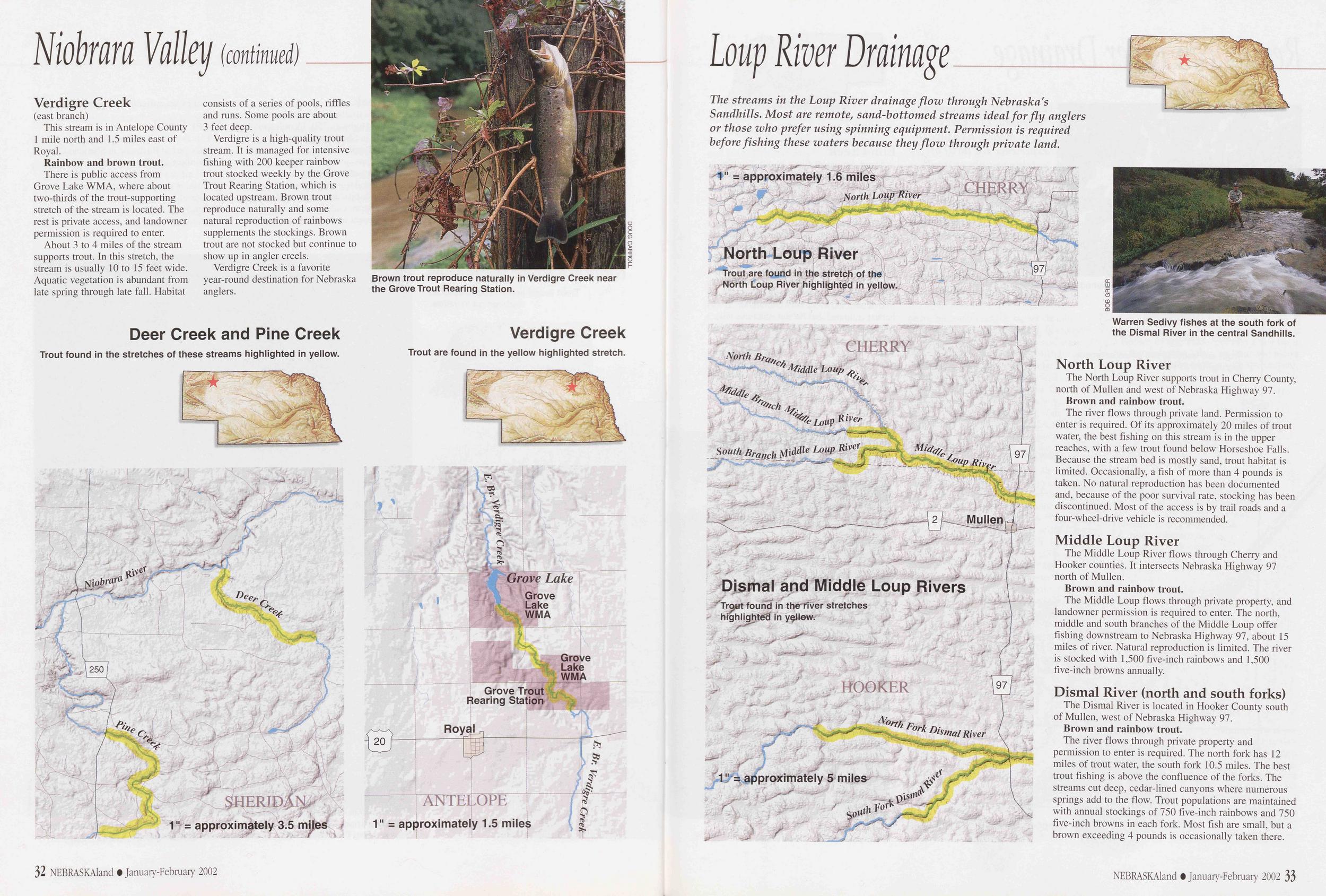
Niobrara Valley (continued)
Verdigre Creek(east branch)
This stream is in Antelope County 1 mile north and 1.5 miles east of Royal.
Rainbow and brown trout.There is public access from Grove Lake WMA, where about two-thirds of the trout-supporting stretch of the stream is located. The rest is private access, and landowner permission is required to enter.
About 3 to 4 miles of the stream supports trout. In this stretch, the stream is usually 10 to 15 feet wide. Aquatic vegetation is abundant from late spring through late fall. Habitat consists of a series of pools, riffles and runs. Some pools are about 3 feet deep.
Verdigre is a high-quality trout stream. It is managed for intensive fishing with 200 keeper rainbow trout stocked weekly by the Grove Trout Rearing Station, which is located upstream. Brown trout reproduce naturally and some natural reproduction of rainbows supplements the stockings. Brown trout are not stocked but continue to show up in angler creels.
Verdigre Creek is a favorite year-round destination for Nebraska anglers.
The North Loup River supports trout in Cherry County, north of Mullen and west of Nebraska Highway 97.
Brown and rainbow trout.The river flows through private land. Permission to enter is required. Of its approximately 20 miles of trout water, the best fishing on this stream is in the upper reaches, with a few trout found below Horseshoe Falls. Because the stream bed is mostly sand, trout habitat is limited. Occasionally, a fish of more than 4 pounds is taken. No natural reproduction has been documented and, because of the poor survival rate, stocking has been discontinued. Most of the access is by trail roads and a four-wheel-drive vehicle is recommended.
Middle Loup RiverThe Middle Loup River flows through Cherry and Hooker counties. It intersects Nebraska Highway 97 north of Mullen.
Brown and rainbow trout.The Middle Loup flows through private property, and landowner permission is required to enter. The north, middle and south branches of the Middle Loup offer fishing downstream to Nebraska Highway 97, about 15 miles of river. Natural reproduction is limited. The river is stocked with 1,500 five-inch rainbows and 1,500 five-inch browns annually.
Dismal River (north and south forks)The Dismal River is located in Hooker County south of Mullen, west of Nebraska Highway 97.
Brown and rainbow trout.The river flows through private property and permission to enter is required. The north fork has 12 miles of trout water, the south fork 10.5 miles. The be; trout fishing is above the confluence of the forks. The streams cut deep, cedar-lined canyons where numeroc springs add to the flow. Trout populations are maintai with annual stockings of 750 five-inch rainbows and five-inch browns in each fork. Most fish are small, bi brown exceeding 4 pounds is occasionally taken there.
NEBRASKAland • January-February 2002 33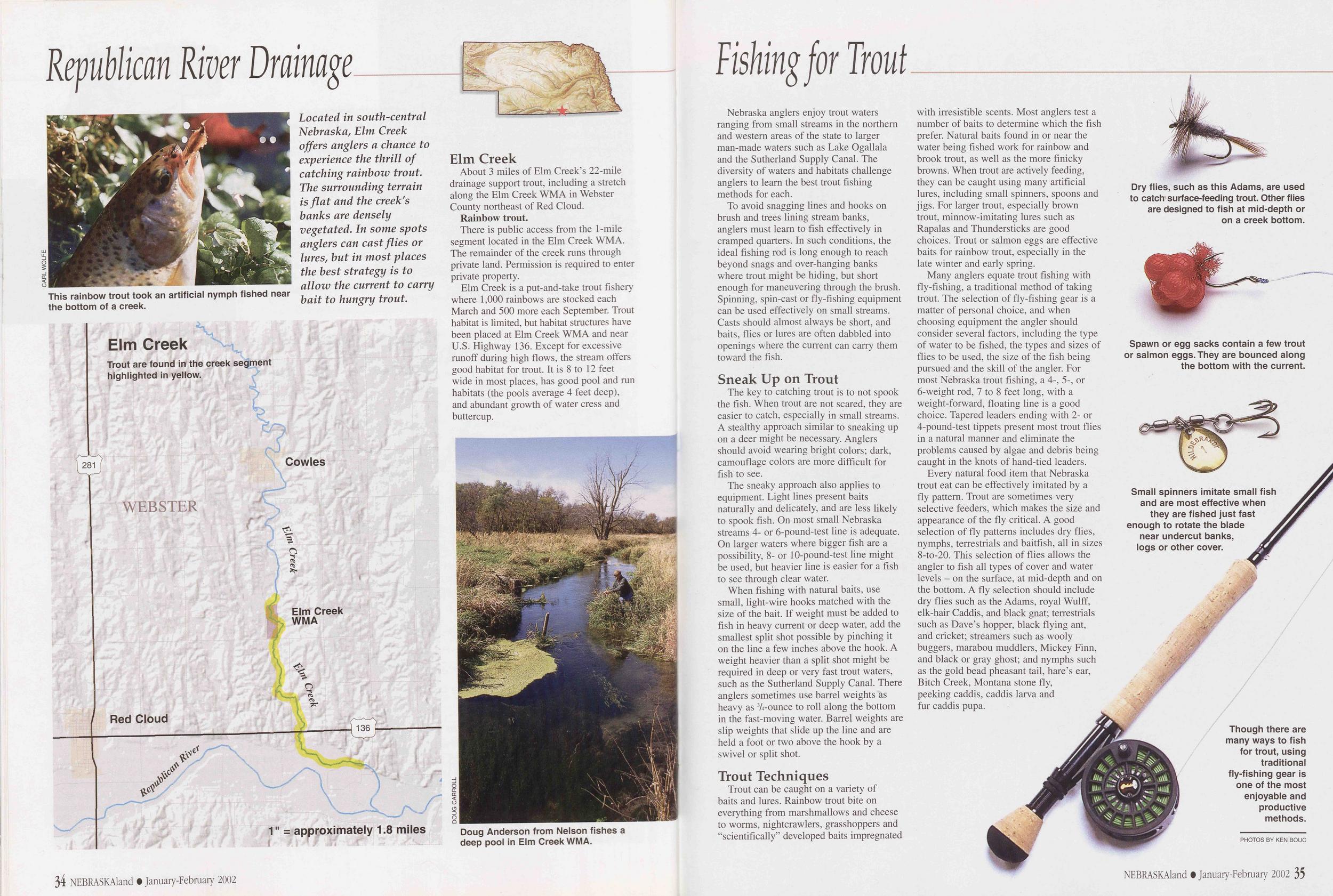
Republican River Drainage
CARL WOLFEAbout 3 miles of Elm Creek’s 22-mile drainage support trout, including a stretch along the Elm Creek WMA in Webster County northeast of Red Cloud.
Rainbow trout.There is public access from the 1-mile segment located in the Elm Creek WMA. The remainder of the creek runs through private land. Permission is required to enter private property.
Elm Creek is a put-and-take trout fishery where 1,000 rainbows are stocked each March and 500 more each September. Trout habitat is limited, but habitat structures have been placed at Elm Creek WMA and near U.S. Highway 136. Except for excessive runoff during high flows, the stream offers good habitat for trout. It is 8 to 12 feet wide in most places, has good pool and run habitats (the pools average 4 feet deep), and abundant growth of water cress and buttercup.
Nebraska anglers enjoy trout waters ranging from small streams in the northern and western areas of the state to larger man-made waters such as Lake Ogallala and the Sutherland Supply Canal. The diversity of waters and habitats challenge anglers to learn the best trout fishing methods for each.
To avoid snagging lines and hooks on brush and trees lining stream banks, anglers must learn to fish effectively in cramped quarters. In such conditions, the ideal fishing rod is long enough to reach beyond snags and over-hanging banks where trout might be hiding, but short enough for maneuvering through the brush. Spinning, spin-cast or fly-fishing equipment can be used effectively on small streams. Casts should almost always be short, and baits, flies or lures are often dabbled into openings where the current can carry them toward the fish.
Sneak Up on TroutThe key to catching trout is to not spook the fish. When trout are not scared, they are easier to catch, especially in small streams. A stealthy approach similar to sneaking up on a deer might be necessary. Anglers should avoid wearing bright colors; dark, camouflage colors are more difficult for fish to see.
The sneaky approach also applies to equipment. Light lines present baits naturally and delicately, and are less likely to spook fish. On most small Nebraska streams 4- or 6-pound-test line is adequate. On larger waters where bigger fish are a possibility, 8- or 10-pound-test line might be used, but heavier line is easier for a fish to see through clear water.
When fishing with natural baits, use small, light-wire hooks matched with the size of the bait. If weight must be added to fish in heavy current or deep water, add the smallest split shot possible by pinching it on the line a few inches above the hook. A weight heavier than a split shot might be required in deep or very fast trout waters, such as the Sutherland Supply Canal. There anglers sometimes use barrel weights as heavy as 3/4-ounce to roll along the bottom in the fast-moving water. Barrel weights are slip weights that slide up the line and are held a foot or two above the hook by a swivel or split shot.
Trout TechniquesTrout can be caught on a variety of baits and lures. Rainbow trout bite on everything from marshmallows and cheese to worms, nightcrawlers, grasshoppers and “scientifically” developed baits impregnated with irresistible scents. Most anglers test a number of baits to determine which the fish prefer. Natural baits found in or near the water being fished work for rainbow and brook trout, as well as the more finicky browns. When trout are actively feeding, they can be caught using many artificial lures, including small spinners, spoons and jigs. For larger trout, especially brown trout, minnow-imitating lures such as Rapalas and Thundersticks are good choices. Trout or salmon eggs are effective baits for rainbow trout, especially in the late winter and early spring.
Many anglers equate trout fishing with fly-fishing, a traditional method of taking trout. The selection of fly-fishing gear is a matter of personal choice, and when choosing equipment the angler should consider several factors, including the type of water to be fished, the types and sizes of flies to be used, the size of the fish being pursued and the skill of the angler. For most Nebraska trout fishing, a 4-, 5-, or 6-weight rod, 7 to 8 feet long, with a weight-forward, floating line is a good choice. Tapered leaders ending with 2- or 4-pound-test tippets present most trout flies in a natural manner and eliminate the problems caused by algae and debris being caught in the knots of hand-tied leaders.
Every natural food item that Nebraska trout eat can be effectively imitated by a fly pattern. Trout are sometimes very selective feeders, which makes the size and appearance of the fly critical. A good selection of fly patterns includes dry flies, nymphs, terrestrials and baitfish, all in sizes 8-to-20. This selection of flies allows the angler to fish all types of cover and water levels - on the surface, at mid-depth and on the bottom. A fly selection should include dry flies such as the Adams, royal Wulff, elk-hair Caddis, and black gnat; terrestrials such as Dave’s hopper, black flying ant, and cricket; streamers such as wooly buggers, marabou muddlers, Mickey Finn, and black or gray ghost; and nymphs such as the gold bead pheasant tail, hare’s ear, Bitch Creek, Montana stone fly, peeking caddis, caddis larva and fur caddis pupa.
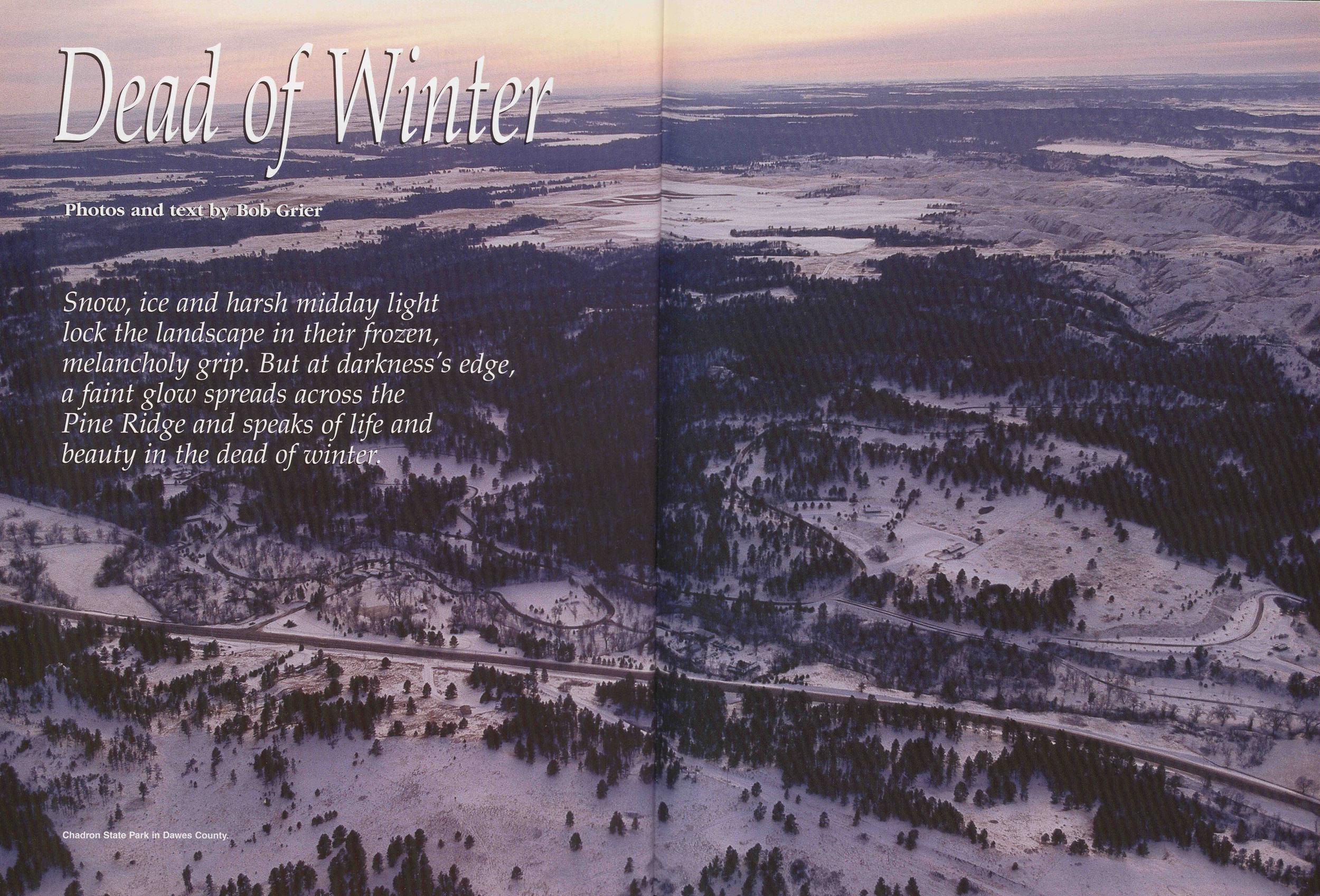
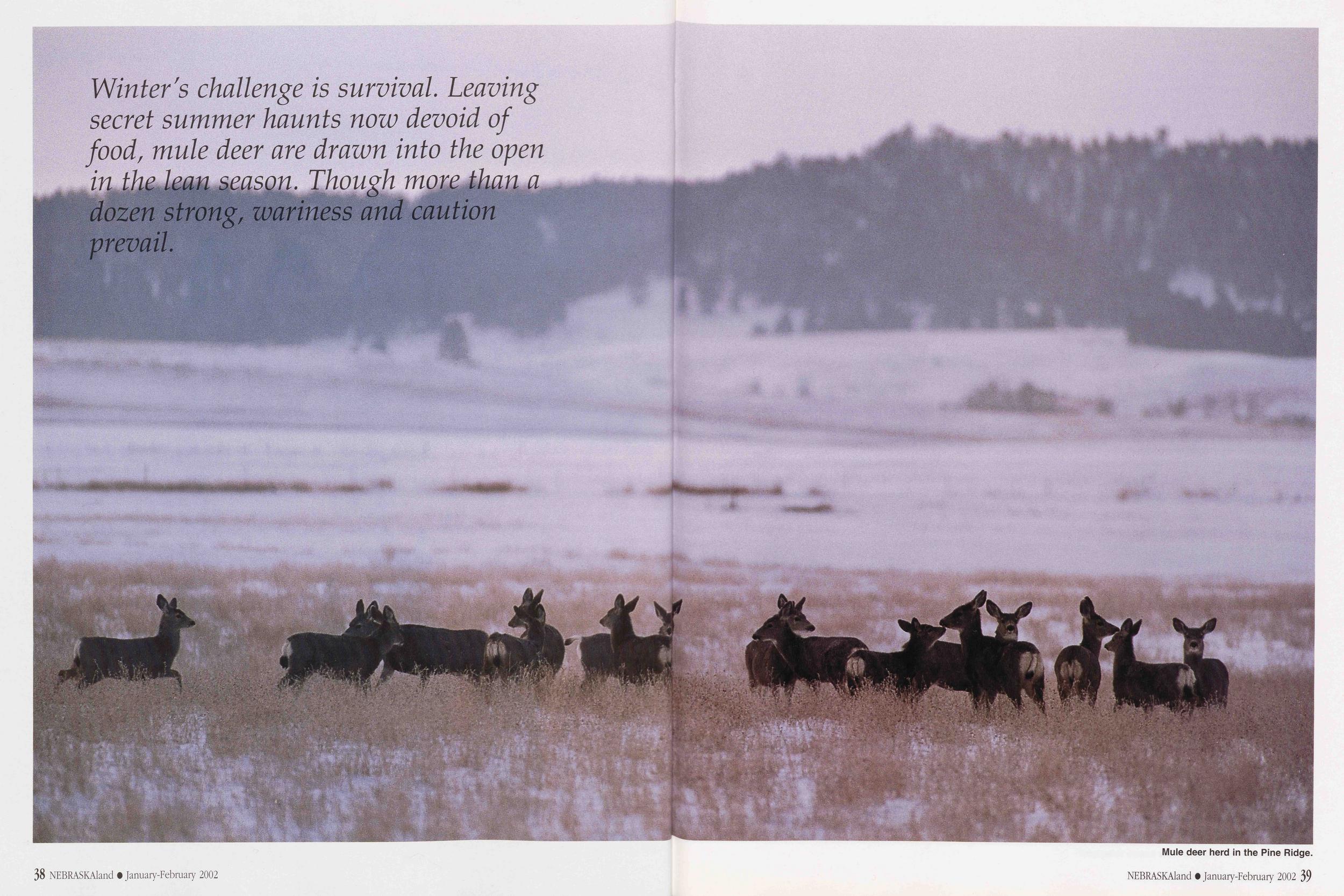
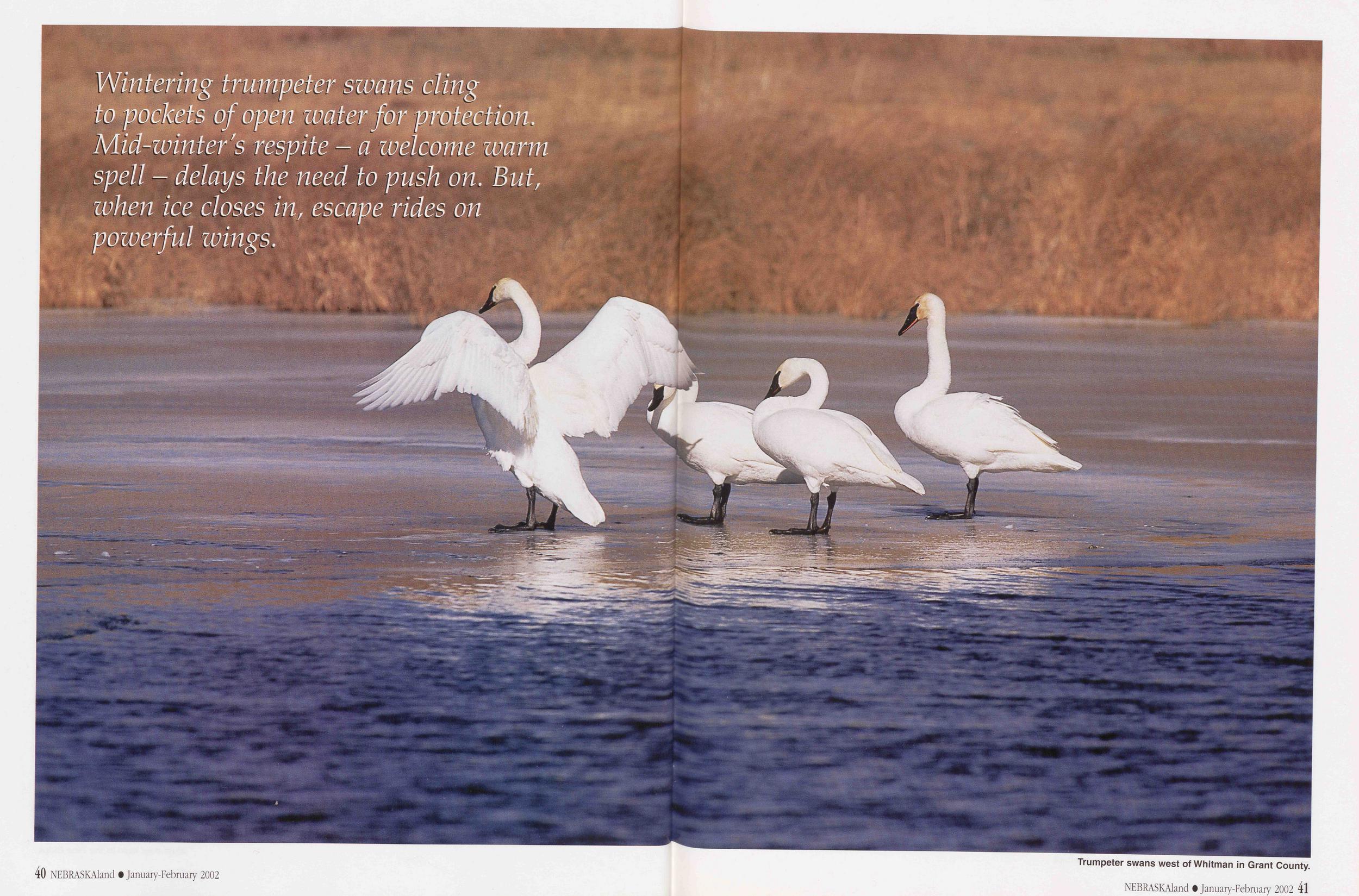
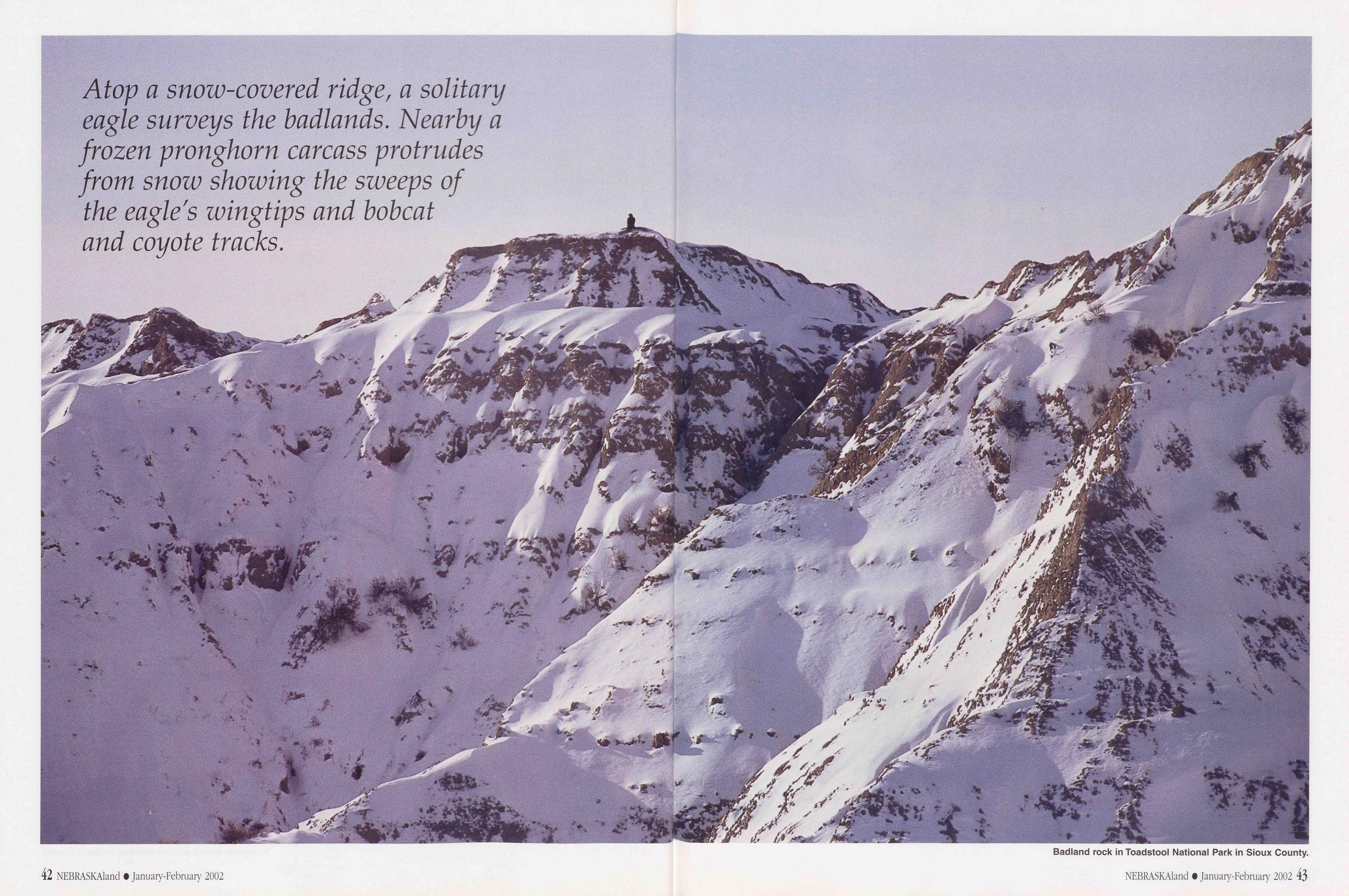
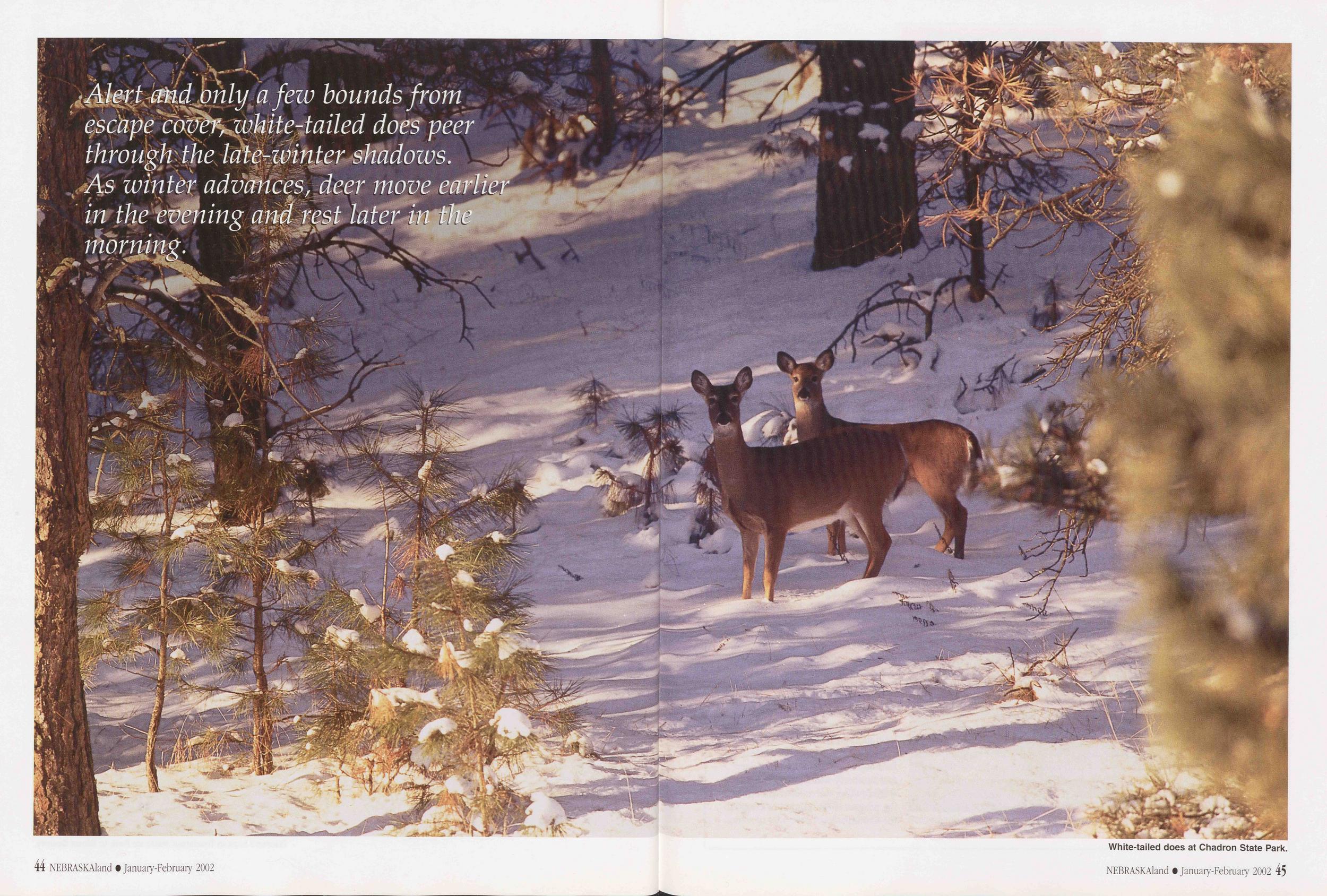
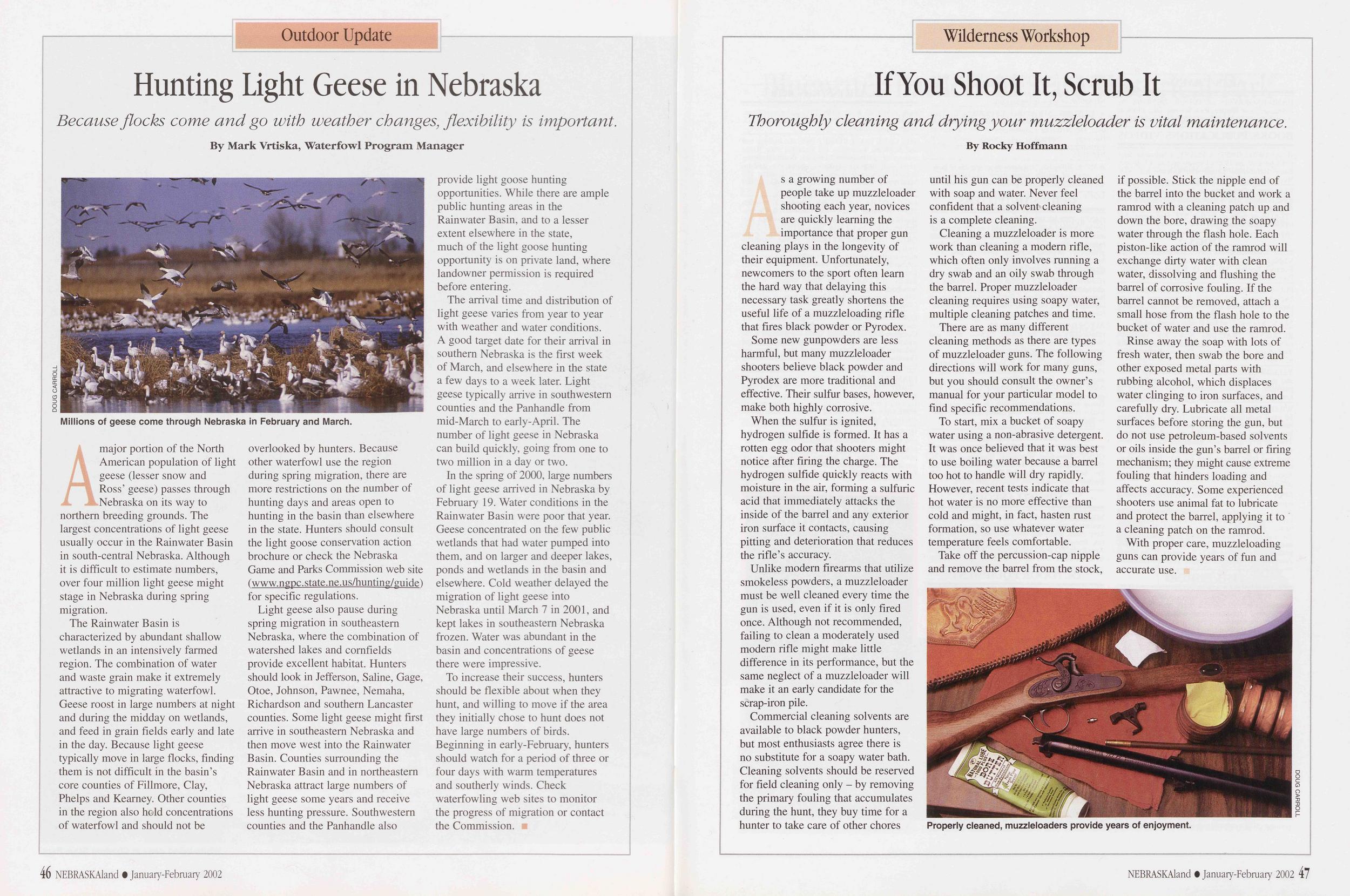
A major portion of the North American population of light geese (lesser snow and Ross’ geese) passes through Nebraska on its way to northern breeding grounds. The largest concentrations of light geese usually occur in the Rainwater Basin in south-central Nebraska. Although it is difficult to estimate numbers, over four million light geese might stage in Nebraska during spring migration.
The Rainwater Basin is characterized by abundant shallow wetlands in an intensively farmed region. The combination of water and waste grain make it extremely attractive to migrating waterfowl. Geese roost in large numbers at night and during the midday on wetlands, and feed in grain fields early and late in the day. Because light geese typically move in large flocks, finding them is not difficult in the basin’s core counties of Fillmore, Clay, Phelps and Kearney. Other counties in the region also hold concentrations of waterfowl and should not be overlooked by hunters. Because other waterfowl use the region during spring migration, there are more restrictions on the number of hunting days and areas open to hunting in the basin than elsewhere in the state. Hunters should consult the light goose conservation action brochure or check the Nebraska Game and Parks Commission web site (www.ngpc.state.ne.us/hunting/guidel for specific regulations.
Light geese also pause during spring migration in southeastern Nebraska, where the combination of watershed lakes and cornfields provide excellent habitat. Hunters should look in Jefferson, Saline, Gage, Otoe, Johnson, Pawnee, Nemaha, Richardson and southern Lancaster counties. Some light geese might first arrive in southeastern Nebraska and then move west into the Rainwater Basin. Counties surrounding the Rainwater Basin and in northeastern Nebraska attract large numbers of light geese some years and receive less hunting pressure. Southwestern counties and the Panhandle also provide light goose hunting opportunities. While there are ample public hunting areas in the Rainwater Basin, and to a lesser extent elsewhere in the state, much of the light goose hunting opportunity is on private land, where landowner permission is required before entering.
The arrival time and distribution of light geese varies from year to year with weather and water conditions. A good target date for their arrival in southern Nebraska is the first week of March, and elsewhere in the state a few days to a week later. Light geese typically arrive in southwestern counties and the Panhandle from mid-March to early-April. The number of light geese in Nebraska can build quickly, going from one to two million in a day or two.
In the spring of 2000, large numbers of light geese arrived in Nebraska by February 19. Water conditions in the Rainwater Basin were poor that year. Geese concentrated on the few public wetlands that had water pumped into them, and on larger and deeper lakes, ponds and wetlands in the basin and elsewhere. Cold weather delayed the migration of light geese into Nebraska until March 7 in 2001, and kept lakes in southeastern Nebraska frozen. Water was abundant in the basin and concentrations of geese there were impressive.
To increase their success, hunters should be flexible about when they hunt, and willing to move if the area they initially chose to hunt does not have large numbers of birds. Beginning in early-February, hunters should watch for a period of three or four days with warm temperatures and southerly winds. Check waterfowling web sites to monitor the progress of migration or contact the Commission. ■
46 NEBRASKAland • January-February 2002 Wilderness Workshop If You Shoot It, Scrub It Thoroughly cleaning and drying your muzzleloader is vital maintenance. By Rocky HoffmannAs a growing number of people take up muzzleloader shooting each year, novices are quickly learning the importance that proper gun cleaning plays in the longevity of their equipment. Unfortunately, newcomers to the sport often learn the hard way that delaying this necessary task greatly shortens the useful life of a muzzleloading rifle that fires black powder or Pyrodex.
Some new gunpowders are less harmful, but many muzzleloader shooters believe black powder and Pyrodex are more traditional and effective. Their sulfur bases, however, make both highly corrosive.
When the sulfur is ignited, hydrogen sulfide is formed. It has a rotten egg odor that shooters might notice after firing the charge. The hydrogen sulfide quickly reacts with moisture in the air, forming a sulfuric acid that immediately attacks the inside of the barrel and any exterior iron surface it contacts, causing pitting and deterioration that reduces the rifle’s accuracy.
Unlike modem firearms that utilize smokeless powders, a muzzleloader must be well cleaned every time the gun is used, even if it is only fired once. Although not recommended, failing to clean a moderately used modern rifle might make little difference in its performance, but the same neglect of a muzzleloader will make it an early candidate for the scrap-iron pile.
Commercial cleaning solvents are available to black powder hunters, but most enthusiasts agree there is no substitute for a soapy water bath. Cleaning solvents should be reserved for field cleaning only - by removing the primary fouling that accumulates during the hunt, they buy time for a hunter to take care of other chores until his gun can be properly cleaned with soap and water. Never feel confident that a solvent cleaning is a complete cleaning.
Cleaning a muzzleloader is more work than cleaning a modern rifle, which often only involves running a dry swab and an oily swab through the barrel. Proper muzzleloader cleaning requires using soapy water, multiple cleaning patches and time.
There are as many different cleaning methods as there are types of muzzleloader guns. The following directions will work for many guns, but you should consult the owner’s manual for your particular model to find specific recommendations.
To start, mix a bucket of soapy water using a non-abrasive detergent. It was once believed that it was best to use boiling water because a barrel too hot to handle will dry rapidly. However, recent tests indicate that hot water is no more effective than cold and might, in fact, hasten rust formation, so use whatever water temperature feels comfortable.
Take off the percussion-cap nipple and remove the barrel from the stock, if possible. Stick the nipple end of the barrel into the bucket and work a ramrod with a cleaning patch up and down the bore, drawing the soapy water through the flash hole. Each piston-like action of the ramrod will exchange dirty water with clean water, dissolving and flushing the barrel of corrosive fouling. If the barrel cannot be removed, attach a small hose from the flash hole to the bucket of water and use the ramrod.
Rinse away the soap with lots of fresh water, then swab the bore and other exposed metal parts with rubbing alcohol, which displaces water clinging to iron surfaces, and carefully dry. Lubricate all metal surfaces before storing the gun, but do not use petroleum-based solvents or oils inside the gun’s barrel or firing mechanism; they might cause extreme fouling that hinders loading and affects accuracy. Some experienced shooters use animal fat to lubricate and protect the barrel, applying it to a cleaning patch on the ramrod.
With proper care, muzzleloading guns can provide years of fun and accurate use.
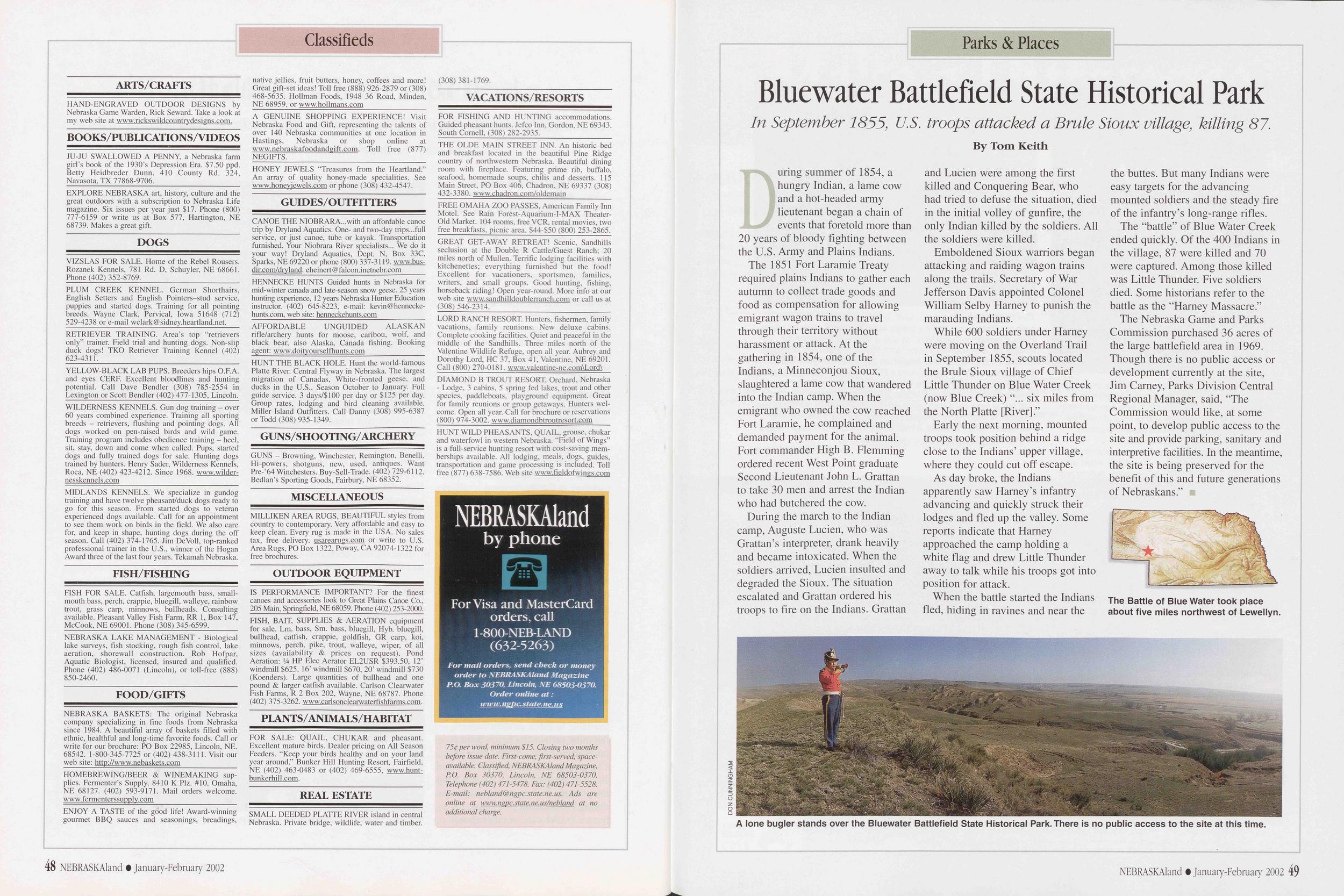
Classifieds
ARTS/CRAFTSHAND-ENGRAVED OUTDOOR DESIGNS by Nebraska Game Warden, Rick Seward. Take a look at my web site at www.rickswildcountrydesigns.com.
BOOKS/PUBLICATIONS/VIDEOSJU-JU SWALLOWED A PENNY, a Nebraska farm girl’s book of the 193O’s Depression Era. $7.50 ppd. Betty Heidbreder Dunn, 410 County Rd. 324, Navasota, TX 77868-9706.
EXPLORE NEBRASKA art, history, culture and the great outdoors with a subscription to Nebraska Life magazine. Six issues per year just $17. Phone (800) 777-6159 or write us at Box 577, Hartington, NE 68739. Makes a great gift.
DOGSVIZSLAS FOR SALE. Home of the Rebel Rousers. Rozanek Kennels, 781 Rd. D, Schuyler, NE 68661. Phone (402) 352-8769.
PLUM CREEK KENNEL. German Shorthairs, English Setters and English Pointers-stud service, puppies and started dogs. Training for all pointing breeds. Wayne Clark, Pervical, Iowa 51648 (712) 529-4238 or e-mail wclark@sidney.heartland.net.
RETRIEVER TRAINING. Area’s top “retrievers only” trainer. Field trial and hunting dogs. Non-slip duck dogs! TKO Retriever Training Kennel (402) 623-4311.
YELLOW-BLACK LAB PUPS. Breeders hips O.F.A. and eyes CERF. Excellent bloodlines and hunting potential. Call Dave Bendler (308) 785-2554 in Lexington or Scott Bendler (402) 477-1305, Lincoln.
WILDERNESS KENNELS. Gun dog training - over 60 years combined experience. Training all sporting breeds - retrievers, flushing and pointing dogs. All dogs worked on pen-raised birds and wild game. Training program includes obedience training - heel, sit, stay, down and come when called. Pups, started dogs and fully trained dogs for sale. Hunting dogs trained by hunters. Henry Sader, Wilderness Kennels, Roca, NE (402) 423-4212. Since 1968. www.wilder- nesskennels.com
MIDLANDS KENNELS. We specialize in gundog training and have twelve pheasant/duck dogs ready to go for this season. From started dogs to veteran experienced dogs available. Call for an appointment to see them work on birds in the field. We also care for, and keep in shape, hunting dogs during the off season. Call (402) 374-1765. Jim DeVoll, top-ranked professional trainer in the U.S., winner of the Hogan Award three of the last four years. Tekamah Nebraska.
FISH/FISHINGFISH FOR SALE. Catfish, largemouth bass, small- mouth bass, perch, crappie, bluegill, walleye, rainbow trout, grass carp, minnows, bullheads. Consulting available. Pleasant Valley Fish Farm, RR 1, Box 147, McCook, NE 69001. Phone (308) 345-6599.
NEBRASKA LAKE MANAGEMENT - Biological lake surveys, fish stocking, rough fish control, lake aeration, shorewall construction. Rob Hofpar, Aquatic Biologist, licensed, insured and qualified. Phone (402) 486-0071 (Lincoln), or toll-free (888) 850-2460.
FOOD/GIFTSNEBRASKA BASKETS: The original Nebraska company specializing in fine foods from Nebraska since 1984. A beautiful array of baskets filled with ethnic, healthful and long-time favorite foods. Call or write for our brochure: PO Box 22985, Lincoln, NE. 68542. 1-800-345-7725 or (402) 438-3111. Visit our web site: http://www.nebaskets.com
HOMEBREWING/BEER & WINEMAKING sup- plies. Fermenter’s Supply, 8410 K Plz. #10, Omaha, NE 68127. (402) 593-9171. Mail orders welcome. www.fermenterssupply.com
ENJOY A TASTE of the good life! Award-winning gourmet BBQ sauces and seasonings, breadings, native jellies, fruit butters, honey, coffees and more! Great gift-set ideas! Toll free (888) 926-2879 or (308) 468-5635. Hollman Foods, 1948 36 Road, Minden, NE 68959, or www.hollmans.com
A GENUINE SHOPPING EXPERIENCE! Visit Nebraska Food and Gift, representing the talents of over 140 Nebraska communities at one location in Hastings, Nebraska or shop online at www.nebraskafoodandgift.com. Toll free (877) NEGIFTS.
HONEY JEWELS “Treasures from the Heartland.” An array of quality honey-made specialities. See www.honeyjewels.com or phone (308) 432-4547.
GUIDES/OUTFITTERSCANOE THE NIOBRARA...with an affordable canoe trip by Dryland Aquatics. One- and two-day trips...full service, or just canoe, tube or kayak. Transportation furnished. Your Niobrara River specialists... We do it your way! Dryland Aquatics, Dept. N, Box 33C, Sparks, NE 69220 or phone (800) 337-3119. www.bus- dir.com/dryland. eheinert@falcon.inetnebr.com
HENNECKE HUNTS Guided hunts in Nebraska for mid-winter Canada and late-season snow geese. 25 years hunting experience, 12 years Nebraska Hunter Education instructor. (402) 645-8223, e-mail: kevin@hennecke- hunts.com, web site: henneckehunts.com
AFFORDABLE UNGUIDED ALASKAN rifle/archery hunts for moose, caribou, wolf, and black bear, also Alaska, Canada fishing. Booking agent: www.doitvourselfhunts.com
HUNT THE BLACK HOLE. Hunt the world-famous Platte River. Central Flyway in Nebraska. The largest migration of Canadas, White-fronted geese, and ducks in the U.S.. Season October to January. Full guide service. 3 days/$100 per day or $125 per day. Group rates, lodging and bird cleaning available. Miller Island Outfitters. Call Danny (308) 995-6387 or Todd (308) 935-1349.
GUNS/SHOOTING/ARCHERYGUNS - Browning, Winchester, Remington, Benelli. Hi-powers, shotguns, new, used, antiques. Want Pre-’64 Winchesters. Buy-Sell-Trade. (402) 729-6112. Bedlan’s Sporting Goods, Fairbury, NE 68352.
MISCELLANEOUSMILLIKEN AREA RUGS, BEAUTIFUL styles from country to contemporary. Very affordable and easy to keep clean. Every rug is made in the USA. No sales tax, free delivery, usarearugs.com or write to U.S. Area Rugs, PO Box 1322, Poway, CA 92074-1322 for free brochures.
OUTDOOR EQUIPMENTIS PERFORMANCE IMPORTANT? For the finest canoes and accessories look to Great Plains Canoe Co., 205 Main, Springfield, NE 68059. Phone (402) 253-2000.
FISH, BAIT, SUPPLIES & AERATION equipment for sale. Lm. bass, Sm. bass, bluegill, Hyb. bluegill, bullhead, catfish, crappie, goldfish, GR carp, koi, minnows, perch, pike, trout, walleye, wiper, of all sizes (availability & prices on request). Pond Aeration: % HP Elec Aerator EL2USR $393.50, 12’ windmill $625, 16’ windmill $670, 20’ windmill $730 (Koenders). Large quantities of bullhead and one pound & larger catfish available. Carlson Clearwater Fish Farms, R 2 Box 202, Wayne, NE 68787. Phone (402) 375-3262. www.carlsonclearwaterfishfarms.com.
PLANTS/ANIMALS/HABITATFOR SALE: QUAIL, CHUKAR and pheasant. Excellent mature birds. Dealer pricing on All Season Feeders. “Keep your birds healthy and on your land year around.” Bunker Hill Hunting Resort, Fairfield, NE (402) 463-0483 or (402) 469-6555, www.hunt- bunkerhill.com.
REAL ESTATESMALL DEEDED PLATTE RIVER island in central Nebraska. Private bridge, wildlife, water and timber. (308) 381-1769.
VACATIONS/RESORTSFOR FISHING AND HUNTING accommodations. Guided pheasant hunts. Jefco Inn, Gordon, NE 69343. South Cornell, (308) 282-2935.
THE OLDE MAIN STREET INN. An historic bed and breakfast located in the beautiful Pine Ridge country of northwestern Nebraska. Beautiful dining room with fireplace. Featuring prime rib, buffalo, seafood, homemade soups, chilis and desserts. 115 Main Street, PO Box 406, Chadron, NE 69337 (308) 432-3380. www.chadron.com/oldemain
FREE OMAHA ZOO PASSES, American Family Inn Motel. See Rain Forest-Aquarium-I-MAX Theater- Old Market. 104 rooms, free VCR, rental movies, two free breakfasts, picnic area. $44-$50 (800) 253-2865.
GREAT GET-AWAY RETREAT! Scenic, Sandhills seclusion at the Double R Cattle/Guest Ranch; 20 miles north of Mullen. Terrific lodging facilities with kitchenettes; everything furnished but the food! Excellent for vacationers, sportsmen, families, writers, and small groups. Good hunting, fishing, horseback riding! Open year-round. More info at our web site www.sandhilldoublerranch.com or call us at (308) 546-2314.
LORD RANCH RESORT. Hunters, fishermen, family vacations, family reunions. New deluxe cabins. Complete cooking facilities. Quiet and peaceful in the middle of the Sandhills. Three miles north of the Valentine Wildlife Refuge, open all year. Aubrey and Dorothy Lord, HC 37, Box 41, Valentine, NE 69201. Call (800) 270-0181. www.valentine-ne.com\Lord\
DIAMOND B TROUT RESORT, Orchard, Nebraska - Lodge, 3 cabins, 5 spring fed lakes, trout and other species, paddleboats, playground equipment. Great for family reunions or group getaways. Hunters wel- come. Open all year. Call for brochure or reservations (800) 974-3002. www.diamondbtroutresort.com
HUNT WILD PHEASANTS, QUAIL, grouse, chukar and waterfowl in western Nebraska. “Field of Wings” is a full-service hunting resort with cost-saving mem- berships available. All lodging, meals, dogs, guides, transportation and game processing is included. Toll free (877) 638-7586. Web site www.fieldofwings.com
NEBRASKAland by phone For Visa and MasterCard orders, call 1-800-NEB-LAND (632-5263) For mail orders, send check or money order to NEBRASKAland Magazine P.O. Box 30370, Lincoln, NE 68503-0370. Order online at: uuir, ngbc. state, ne. us75$ per word, minimum $15. Closing two months before issue date. First-come, first-served, space- available. Classified, NEBRASKAland Magazine, P.O. Box 30370, Lincoln, NE 68503-0370. Telephone (402) 471-5478. Fax: (402) 471-5528. E-mail: nebland@ngpc.state.ne.us. Ads are online at www.ngpc.state.ne.us/izebland at no additional charge.
48 NEBRASKAland • January-February 2002 Parks & Places Bluewater Battlefield State Historical Park In September 1855, U.S. troops attacked a Brule Sioux village, killing 87. By Tom KeithDuring summer of 1854, a hungry Indian, a lame cow and a hot-headed army lieutenant began a chain of events that foretold more than 20 years of bloody fighting between the U.S. Army and Plains Indians. The 1851 Fort Laramie Treaty required plains Indians to gather each autumn to collect trade goods and food as compensation for allowing emigrant wagon trains to travel through their territory without harassment or attack. At the gathering in 1854, one of the Indians, a Minneconjou Sioux, slaughtered a lame cow that wandered into the Indian camp. When the emigrant who owned the cow reached Fort Laramie, he complained and demanded payment for the animal. Fort commander High B. Flemming ordered recent West Point graduate Second Lieutenant John L. Grattan to take 30 men and arrest the Indian who had butchered the cow.
During the march to the Indian camp, Auguste Lucien, who was Grattan’s interpreter, drank heavily and became intoxicated. When the soldiers arrived, Lucien insulted and degraded the Sioux. The situation escalated and Grattan ordered his troops to fire on the Indians. Grattan and Lucien were among the first killed and Conquering Bear, who had tried to defuse the situation, died in the initial volley of gunfire, the only Indian killed by the soldiers. All the soldiers were killed.
Emboldened Sioux warriors began attacking and raiding wagon trains along the trails. Secretary of War Jefferson Davis appointed Colonel William Selby Harney to punish the marauding Indians.
While 600 soldiers under Harney were moving on the Overland Trail in September 1855, scouts located the Brule Sioux village of Chief Little Thunder on Blue Water Creek (now Blue Creek) "... six miles from the North Platte [River].”
Early the next morning, mounted troops took position behind a ridge close to the Indians’ upper village, where they could cut off escape.
As day broke, the Indians apparently saw Harney’s infantry advancing and quickly struck their lodges and fled up the valley. Some reports indicate that Harney approached the camp holding a white flag and drew Little Thunder away to talk while his troops got into position for attack.
When the battle started the Indians fled, hiding in ravines and near the the buttes. But many Indians were easy targets for the advancing mounted soldiers and the steady fire of the infantry’s long-range rifles.
The "battle” of Blue Water Creek ended quickly. Of the 400 Indians in the village, 87 were killed and 70 were captured. Among those killed was Little Thunder. Five soldiers died. Some historians refer to the battle as the "Harney Massacre.”
The Nebraska Game and Parks Commission purchased 36 acres of the large battlefield area in 1969. Though there is no public access or development currently at the site, Jim Carney, Parks Division Central Regional Manager, said, "The Commission would like, at some point, to develop public access to the site and provide parking, sanitary and interpretive facilities. In the meantime, the site is being preserved for the benefit of this and future generations of Nebraskans.”
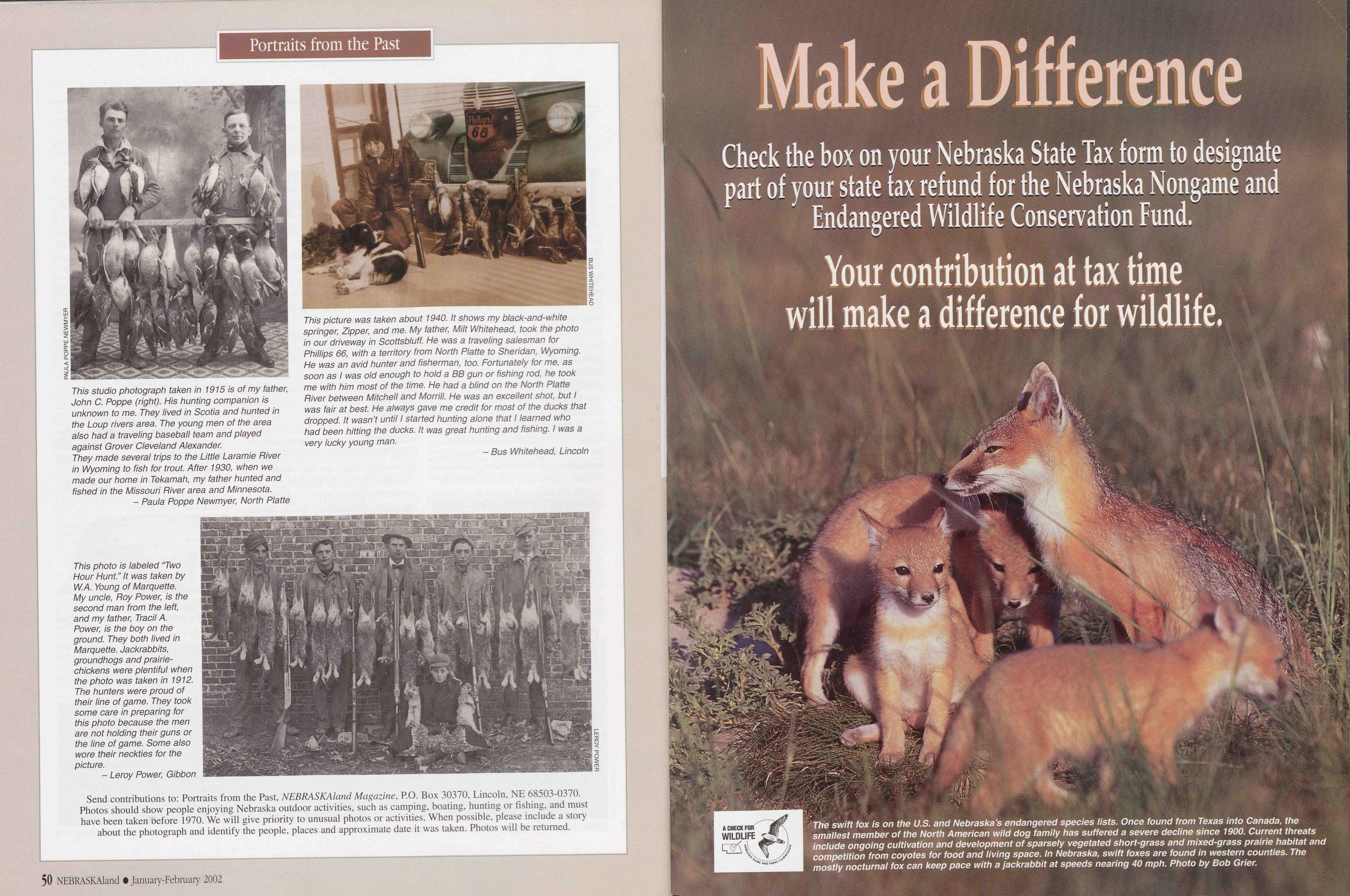
This studio photograph taken in 1915 is of my father, John C. Poppe (right). His hunting companion is unknown to me. They lived in Scotia and hunted in the Loup rivers area. The young men of the area also had a traveling baseball team and played against Grover Cleveland Alexander.
They made several trips to the Little Laramie River in Wyoming to fish for trout. After 1930, when we made our home in Tekamah, my father hunted and fished in the Missouri River area and Minnesota.
- Paula Poppe Newmyer, North PlatteThis picture was taken about 1940. It shows my black-and-white springer, Zipper, and me. My father, Milt Whitehead, took the photo in our driveway in Scottsbluff. He was a traveling salesman for Phillips 66, with a territory from North Platte to Sheridan, Wyoming. He was an avid hunter and fisherman, too. Fortunately for me, as soon as I was old enough to hold a BB gun or fishing rod, he took me with him most of the time. He had a blind on the North Platte River between Mitchell and Morrill. He was an excellent shot, but I was fair at best. He always gave me credit for most of the ducks that dropped. It wasn’t until I started hunting alone that I learned who had been hitting the ducks. It was great hunting and fishing. I was a very lucky young man.
- Bus Whitehead, LincolnThis photo is labeled “Two Hour Hunt.” It was taken by W.A. Young of Marquette. My uncle, Roy Power, is the second man from the left, and my father, Traci I A. Power, is the boy on the ground. They both lived in Marquette. Jackrabbits, groundhogs and prairie- chickens were plentiful when the photo was taken in 1912. The hunters were proud of their line of game. They took some care in preparing for this photo because the men are not holding their guns or the line of game. Some also wore their neckties for the picture.
- Leroy Power, GibbonSend contributions to: Portraits from the Past, NEBRASKAland Magazine, P.O. Box 30370, Lincoln, NE 68503-0370. Photos should show people enjoying Nebraska outdoor activities, such as camping, boating, hunting or fishing, and must have been taken before 1970. We will give priority to unusual photos or activities. When possible, please include a story about the photograph and identify the people, places and approximate date it was taken. Photos will be returned.
50 NEBRASKAland • January-February 2002
Position: 48 (172 views)