Volume 79, Issue 10, 2001
NEBRASKAland
Nebraska Game & Parks Commission December 2001 • $2.50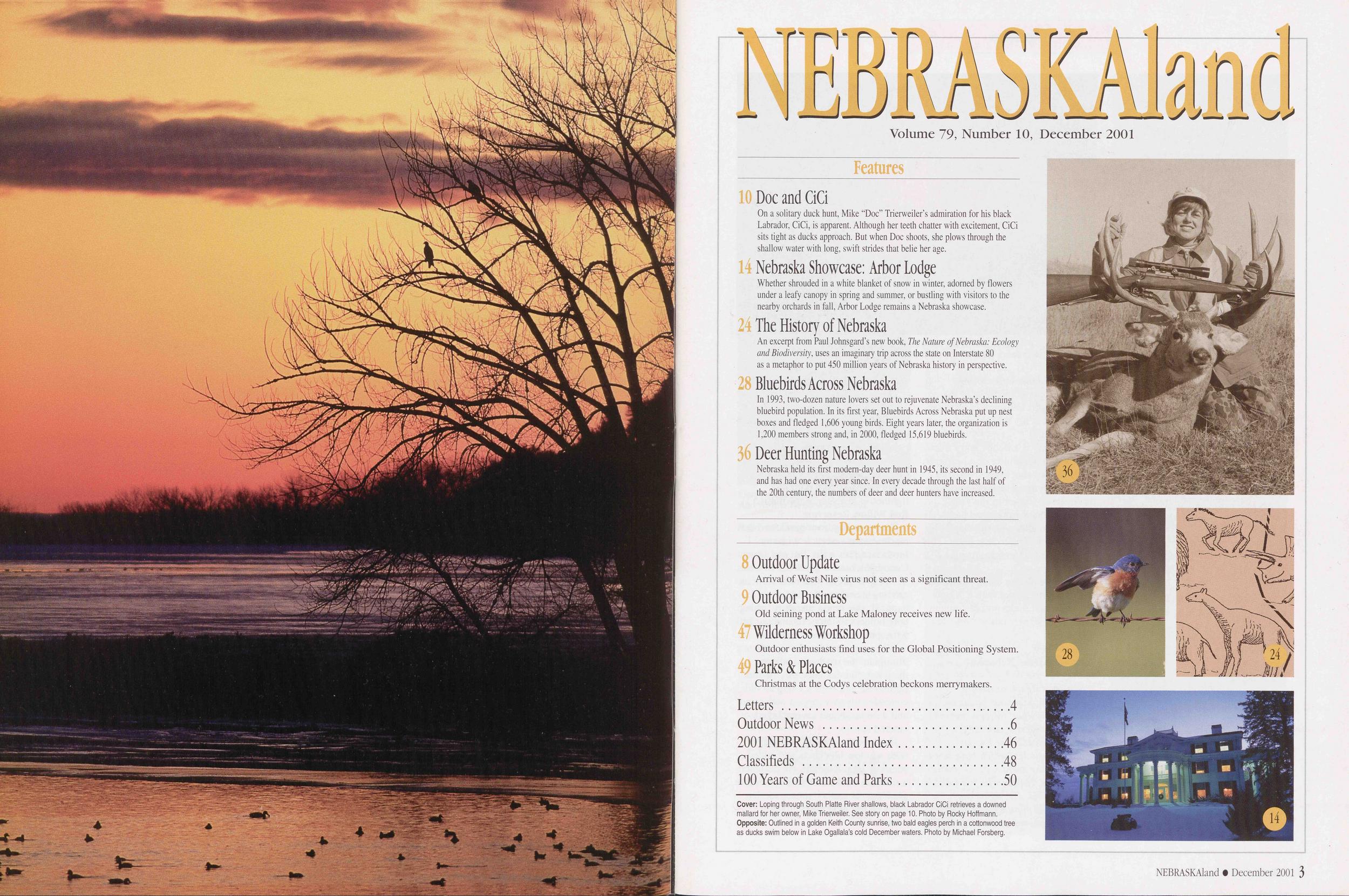
NEBRASKAland
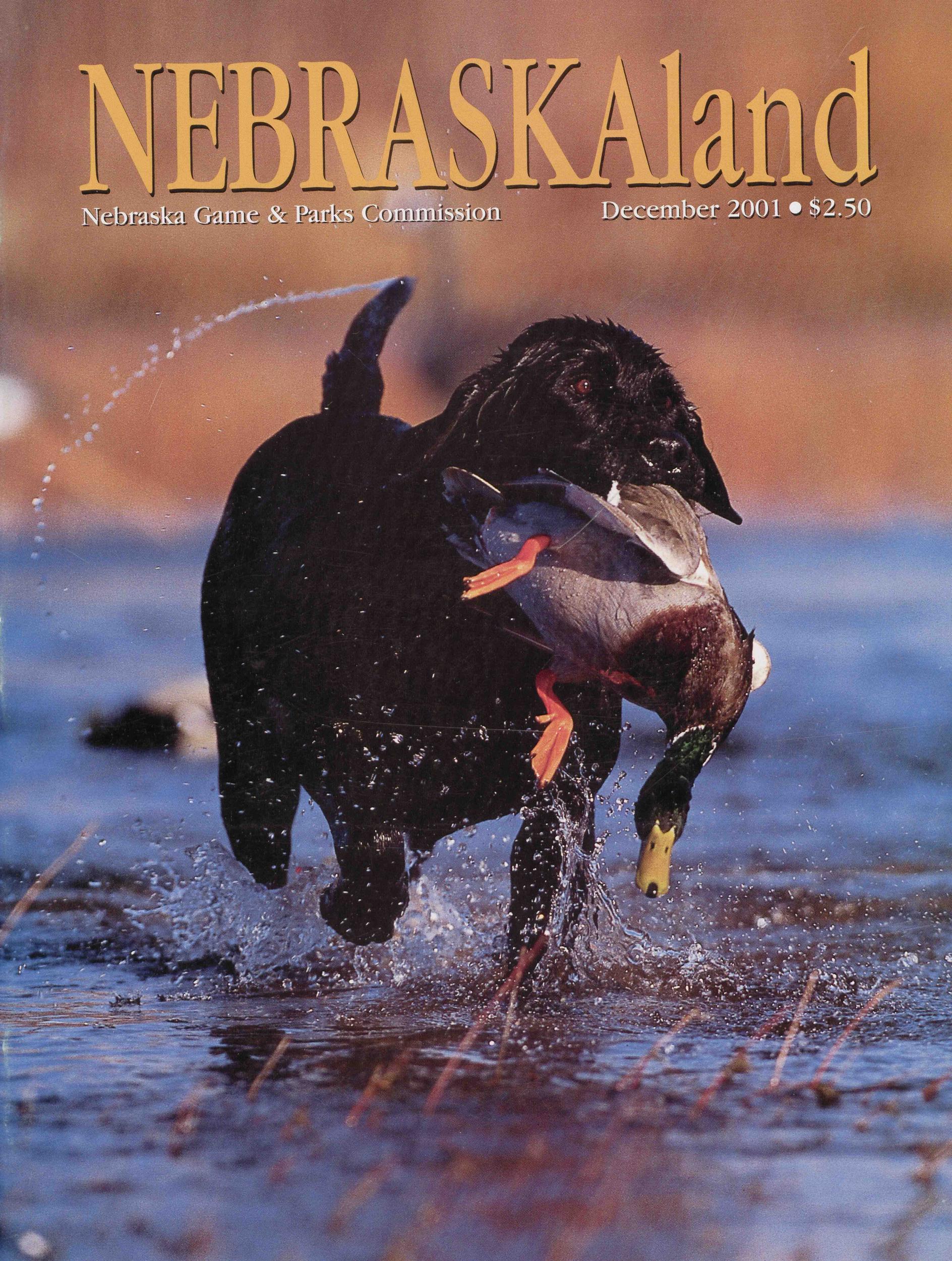
Volume 79, Number 10, December 2001 Doc and CiCi On a solitary duck hunt, Mike "Doc" Trierweiler's admiration for his black Labrador, CiCi, is apparent. Although her teeth chatter with excitement, CiCi sits tight as ducks approach. But when Doc shoots, she plows through the shallow water with long, swift strides that belie her age. Nebraska Showcase: Arbor Lodge Whether shrouded in a white blanket of snow in winter, adorned by flowers under a leafy canopy in spring and summer, or bustling with visitors to the nearby orchards in fall, Arbor Lodge remains a Nebraska showcase. The History of Nebraska An excerpt from Paul Johnsgard's new book, The Nature of Nebraska: Ecology and Biodiversity, uses an imaginary trip across the state on Interstate 80 as a metaphor to put 450 million years of Nebraska history in perspective. Bluebirds Across Nebraska In 1993, two-dozen nature lovers set out to rejuvenate Nebraska's declining bluebird population. In its first year, Bluebirds Across Nebraska put up nest boxes and fledged 1,606 young birds. Eight years later, the organization is 1,200 members strong and, in 2000, fledged 15,619 bluebirds. Deer Hunting Nebraska Nebraska held its first modern-day deer hunt in 1945, its second in 1949, and has had one every year since. In every decade through the last half of the 20th century, the numbers of deer and deer hunters have increased. Departments Outdoor Update Arrival of West Nile virus not seen as a significant threat. Outdoor Business Old seining pond at Lake Maloney receives new life. Wilderness Workshop Outdoor enthusiasts find uses for the Global Positioning System. Parks & Places Christmas at the Codys celebration beckons merrymakers. Letters 4 Outdoor News 6 2001 NEBRASKAland Index 46 100 Years of Game and Parks 50 Cover: Loping through South Platte River shallows, black Labrador CiCi retrieves a downed mallard for her owner, Mike Trierweiler. See story on page 10. Photo by Rocky Hoffmann. Opposite: Outlined in a golden Keith County sunrise, two bald eagles perch in a cottonwood tree as ducks swim below in Lake Ogallala's cold December waters. Photo by Michael Forsberg.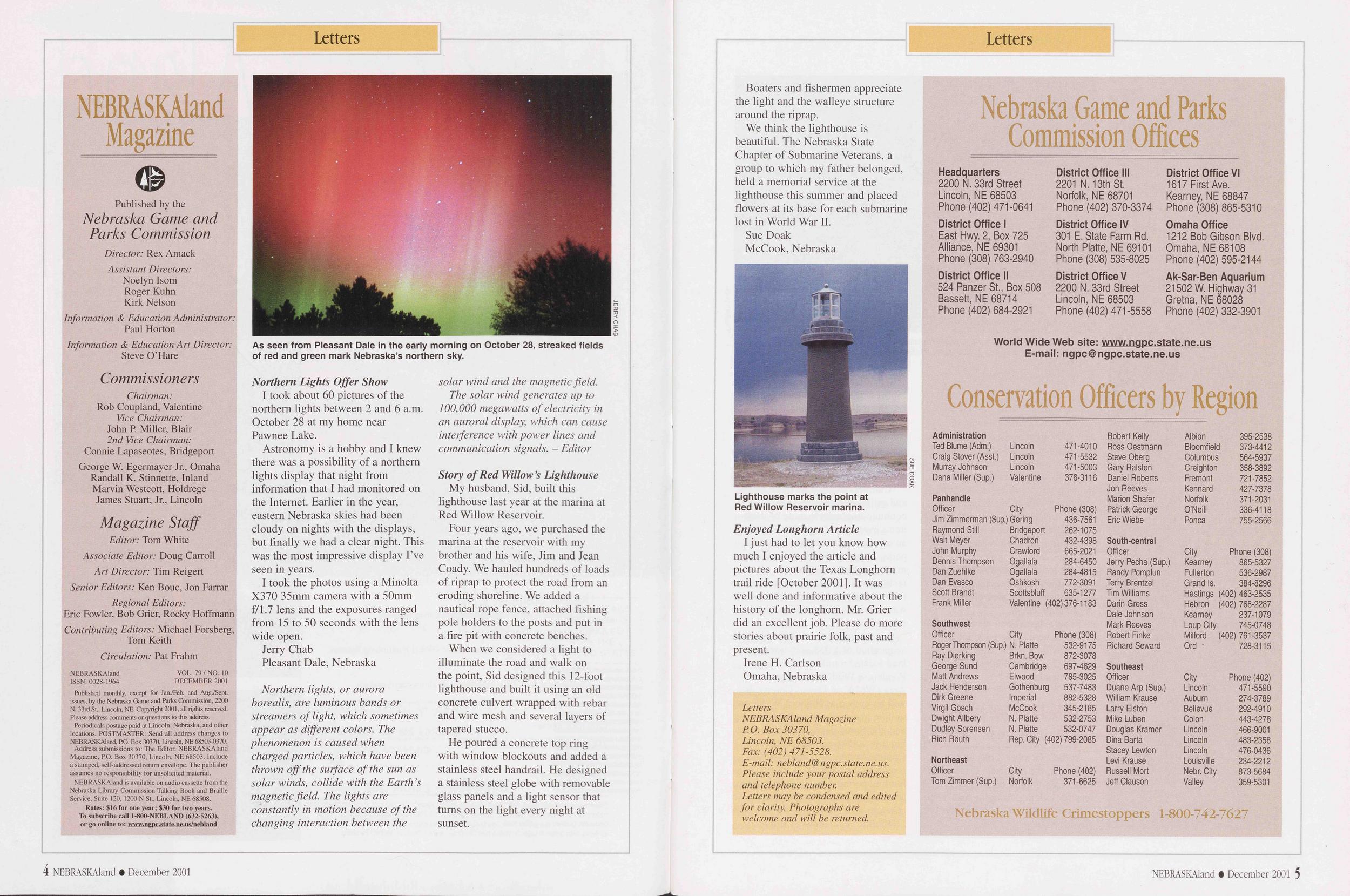 Letters
NEBRASKAland Mazine
Published by the
Nebraska Game and
Parks Commission
Director: Rex Amack
Assistant Directors:
Noelyn Isom
Roger Kuhn
Kirk Nelson
Information &Education Administrator:
Paul Horton
Information & Education Art Director:
Steve O'Hare
Commissioners
Chairman:
Rob Coupland, Valentine
Vice Chairman:
John P. Miller, Blair
2nd Vice Chairman:
Connie Lapaseotes, Bridgeport
George W. Egermayer Jr., Omaha
Randall K. Stinnette, Inland
Marvin Westcott, Holdrege
James Stuart, Jr., Lincoln
Magazine Staff
Editor: Tom White
Associate Editor: Doug Carroll
Art Director: Tim Reigert
Senior Editors: Ken Bouc, Jon Farrar
Regional Editors:
Eric Fowler, Bob Grier, Rocky Hoffmann
Contributing Editors: Michael Forsberg,
Tom Keith
Circulation: Pat Frahm
NEBRASKAland
ISSN: 0028-1964
VOL. 79 / NO. 10
DECEMBER 2001
Published monthly, except for JanVFeb. and Aug./Sept.
issues, by the Nebraska Game and Parks Commission, 2200
N. 33rd St., Lincoln, NE. Copyright 2001, all rights reserved.
Please address comments or questions to this address.
Periodicals postage paid at Lincoln, Nebraska, and other
locations. POSTMASTER: Send all address changes to
NEBRASKAland, P.O. Box 30370, Lincoln, NE 68503-0370.
Address submissions to: The Editor, NEBRASKAland
Magazine, P.O. Box 30370, Lincoln, NE 68503. Include
a stamped, self-addressed return envelope. The publisher
assumes no responsibility for unsolicited material.
NEBRASKAland is available on audio cassette from the
Nebraska Library Commission Talking Book and Braille
Service, Suite 120, 1200 N St., Lincoln, NE 68508.
Rates: $16 for one year; $30 for two years.
To subscribe call 1-800-NEBLAND (632-5263),
or go online to: www.ngpc.state.ne.us/nebland
Letters
NEBRASKAland Mazine
Published by the
Nebraska Game and
Parks Commission
Director: Rex Amack
Assistant Directors:
Noelyn Isom
Roger Kuhn
Kirk Nelson
Information &Education Administrator:
Paul Horton
Information & Education Art Director:
Steve O'Hare
Commissioners
Chairman:
Rob Coupland, Valentine
Vice Chairman:
John P. Miller, Blair
2nd Vice Chairman:
Connie Lapaseotes, Bridgeport
George W. Egermayer Jr., Omaha
Randall K. Stinnette, Inland
Marvin Westcott, Holdrege
James Stuart, Jr., Lincoln
Magazine Staff
Editor: Tom White
Associate Editor: Doug Carroll
Art Director: Tim Reigert
Senior Editors: Ken Bouc, Jon Farrar
Regional Editors:
Eric Fowler, Bob Grier, Rocky Hoffmann
Contributing Editors: Michael Forsberg,
Tom Keith
Circulation: Pat Frahm
NEBRASKAland
ISSN: 0028-1964
VOL. 79 / NO. 10
DECEMBER 2001
Published monthly, except for JanVFeb. and Aug./Sept.
issues, by the Nebraska Game and Parks Commission, 2200
N. 33rd St., Lincoln, NE. Copyright 2001, all rights reserved.
Please address comments or questions to this address.
Periodicals postage paid at Lincoln, Nebraska, and other
locations. POSTMASTER: Send all address changes to
NEBRASKAland, P.O. Box 30370, Lincoln, NE 68503-0370.
Address submissions to: The Editor, NEBRASKAland
Magazine, P.O. Box 30370, Lincoln, NE 68503. Include
a stamped, self-addressed return envelope. The publisher
assumes no responsibility for unsolicited material.
NEBRASKAland is available on audio cassette from the
Nebraska Library Commission Talking Book and Braille
Service, Suite 120, 1200 N St., Lincoln, NE 68508.
Rates: $16 for one year; $30 for two years.
To subscribe call 1-800-NEBLAND (632-5263),
or go online to: www.ngpc.state.ne.us/nebland
I took about 60 pictures of the northern lights between 2 and 6 a.m. October 28 at my home near Pawnee Lake.
Astronomy is a hobby and I knew there was a possibility of a northern lights display that night from information that I had monitored on the Internet. Earlier in the year, eastern Nebraska skies had been cloudy on nights with the displays, but finally we had a clear night. This was the most impressive display I've seen in years.
I took the photos using a Minolta X370 35mm camera with a 50mm f/1.7 lens and the exposures ranged from 15 to 50 seconds with the lens wide open.
Jerry Chab Pleasant Dale, NebraskaNorthern lights, or aurora borealis, are luminous bands or streamers of light, which sometimes appear as different colors. The phenomenon is caused when charged particles, which have been thrown off the surface of the sun as solar winds, collide with the Earth's magnetic field. The lights are constantly in motion because of the changing interaction between the solar wind and the magnetic field.
The solar wind generates up to 100,000 megawatts of electricity in an auroral display, which can cause interference with power lines and communication signals. - Editor
Story of Red Willow's LighthouseMy husband, Sid, built this lighthouse last year at the marina at Red Willow Reservoir.
Four years ago, we purchased the marina at the reservoir with my brother and his wife, Jim and Jean Coady. We hauled hundreds of loads of riprap to protect the road from an eroding shoreline. We added a nautical rope fence, attached fishing pole holders to the posts and put in a fire pit with concrete benches.
When we considered a light to illuminate the road and walk on the point, Sid designed this 12-foot lighthouse and built it using an old concrete culvert wrapped with rebar and wire mesh and several layers of tapered stucco.
He poured a concrete top ring with window blockouts and added a stainless steel handrail. He designed a stainless steel globe with removable glass panels and a light sensor that turns on the light every night at sunset.
Boaters and fishermen appreciate the light and the walleye structure around the riprap.
We think the lighthouse is beautiful. The Nebraska State Chapter of Submarine Veterans, a group to which my father belonged, held a memorial service at the lighthouse this summer and placed flowers at its base for each submarine lost in World War II.
Sue Doak McCook, NebraskaI just had to let you know how much I enjoyed the article and pictures about the Texas Longhorn trail ride [October 2001]. It was well done and informative about the history of the longhorn. Mr. Grier did an excellent job. Please do more stories about prairie folk, past and present.
Irene H. Carlson Omaha, NebraskaLetters NEBRASKAland Magazine RO. Box 30370, Lincoln, NE 68503. Fax: (402) 471-5528. E-mail: nebland@ngpc.state.ne.us. Please include your postal address and telephone number. Letters may be condensed and edited for clarity. Photographs are welcome and will be returned.
Nebraska Game and Parks Commission Offices Headquarters 2200 N. 33rd Street Lincoln, NE 68503 Phone (402) 471-0641 District Office I East Hwy. 2, Box 725 Alliance, NE 69301 Phone (308) 763-2940 District Office II 524 Panzer St., Box 508 Bassett, NE 68714 Phone (402) 684-2921 District Office III 2201 N. 13th St. Norfolk, NE 68701 Phone (402) 370-3374 District Office IV 301 E. State Farm Rd. North Platte, NE 69101 Phone (308) 535-8025 District Office V 2200 N. 33rd Street Lincoln, NE 68503 Phone (402) 471-5558 District Office VI 1617 First Ave. Kearney, NE 68847 Phone (308) 865-5310 Omaha Office 1212 Bob Gibson Blvd. Omaha, NE 68108 Phone (402) 595-2144 Ak-Sar-Ben Aquarium 21502 W. Highway 31 Gretna, NE 68028 Phone (402) 332-3901 World Wide Web site: www.ngpc.state.ne.us E-mail: ngpc@ngpc.state.ne.us Administration Ted Blume (Adm.) Craig Stover (Asst.) Murray Johnson Dana Miller (Sup.) Panhandle Officer Jim Zimmerman (Sup.) Raymond Still Walt Meyer John Murphy Dennis Thompson Dan Zuehlke Dan Evasco Scott Brandt Frank Miller Southwest Officer Roger Thompson (Sup.) Ray Dierking George Sund Matt Andrews Jack Henderson Dirk Greene Virgil Gosch . Dwight Allbery Dudley Sorensen Rich Routh Lincoln Lincoln Lincoln Valentine City Gering Bridgeport Chadron Crawford Ogallala Ogallala Oshkosh Scottsbluff Valentine 471-4010 471-5532 471-5003 376-3116 Phone (308) 436-7561 262-1075 432-4398 665-2021 284-6450 284-4815 772-3091 635-1277 (402)376-1183 City N. Platte Brkn. Bow Cambridge Elwood Gothenburg Imperial McCook N. Platte N. Platte Phone (308) 532-9175 872-3078 697-4629 785-3025 537-7483 882-5328 345-2185 532-2753 532-0747 Rep. City (402)799-2085 Northeast Officer City Tom Zimmer (Sup.) Norfolk Phone (402) 371-6625 Robert Kelly Ross Oestmann Steve Oberg Gary Ralston Daniel Roberts Jon Reeves Marion Shafer Patrick George Eric Wiebe South-central Officer Jerry Pecha (Sup.) Randy Pomplun Terry Brentzel Tim Williams Darin Gress Dale Johnson Mark Reeves Robert Finke Richard Seward Southeast Officer Duane Arp (Sup.) William Krause Larry Elston Mike Luben Douglas Kramer Dina Barta Stacey Lewton Levi Krause Russell Mort Jeff Clauson Albion Bloomfield Columbus Creighton Fremont Kennard Norfolk O'Neill Ponca 395-2538 373-4412 564-5937 358-3892 721-7852 427-7378 371-2031 336-4118 755-2566 City Kearney Fullerton Grand Is. Hastings Hebron Kearney Loup City Milford Ord - Phone (308) 865-5327 536-2987 384-8296 (402) 463-2535 (402) 768-2287 237-1079 745-0748 (402) 761-3537 728-3115 City Lincoln Auburn Bellevue Colon Lincoln Lincoln Lincoln Louisville Nebr. City Valley Phone (402) 471-5590 274-3789 292-4910 443-4278 466-9001 483-2358 476-0436 234-2212 873-5684 359-5301 NEBRASKAland • December 2001 5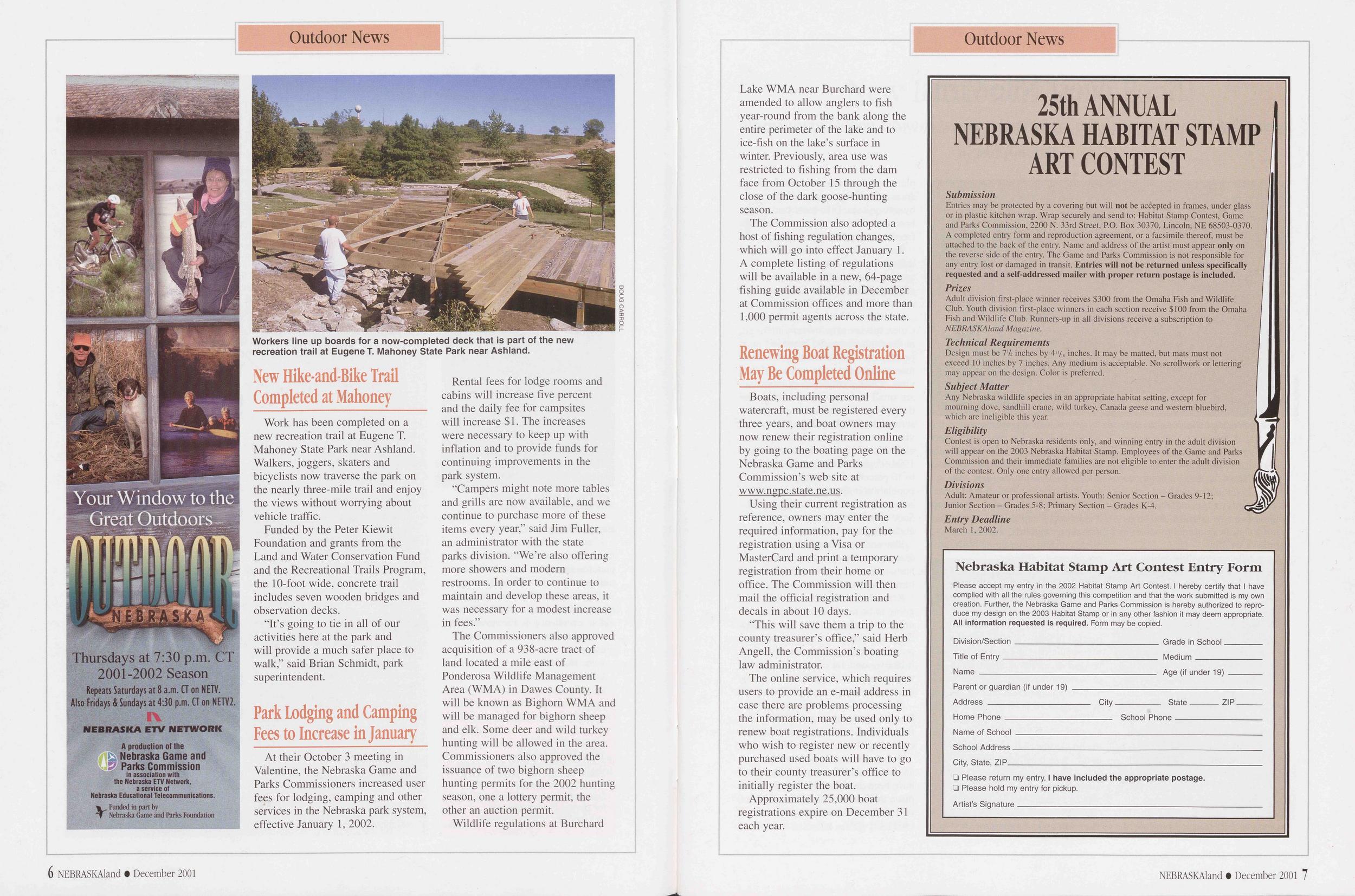
Work has been completed on a new recreation trail at Eugene T. Mahoney State Park near Ashland. Walkers, joggers, skaters and bicyclists now traverse the park on the nearly three-mile trail and enjoy the views without worrying about vehicle traffic.
Funded by the Peter Kiewit Foundation and grants from the Land and Water Conservation Fund and the Recreational Trails Program, the 10-foot wide, concrete trail includes seven wooden bridges and observation decks.
"It's going to tie in all of our activities here at the park and will provide a much safer place to walk," said Brian Schmidt, park superintendent.
Park Lodging and Camping Fees to Increase in JanuaryAt their October 3 meeting in Valentine, the Nebraska Game and Parks Commissioners increased user fees for lodging, camping and other services in the Nebraska park system, effective January 1, 2002.
Rental fees for lodge rooms and cabins will increase five percent and the daily fee for campsites will increase $1. The increases were necessary to keep up with inflation and to provide funds for continuing improvements in the park system.
"Campers might note more tables and grills are now available, and we continue to purchase more of these items every year," said Jim Fuller, an administrator with the state parks division. "We're also offering more showers and modern restrooms. In order to continue to maintain and develop these areas, it was necessary for a modest increase in fees."
The Commissioners also approved acquisition of a 938-acre tract of land located a mile east of Ponderosa Wildlife Management Area (WMA) in Dawes County. It will be known as Bighorn WMA and will be managed for bighorn sheep and elk. Some deer and wild turkey hunting will be allowed in the area. Commissioners also approved the issuance of two bighorn sheep hunting permits for the 2002 hunting season, one a lottery permit, the other an auction permit.
Wildlife regulations at Burchard Lake WMA near Burchard were amended to allow anglers to fish year-round from the bank along the entire perimeter of the lake and to ice-fish on the lake's surface in winter. Previously, area use was restricted to fishing from the dam face from October 15 through the close of the dark goose-hunting season.
The Commission also adopted a host of fishing regulation changes, which will go into effect January 1. A complete listing of regulations will be available in a new, 64-page fishing guide available in December at Commission offices and more than 1,000 permit agents across the state.
Renewing Boat Registration May Be Completed OnlineBoats, including personal watercraft, must be registered every three years, and boat owners may now renew their registration online by going to the boating page on the Nebraska Game and Parks Commission's web site at www.ngpc.state.ne.us.
Using their current registration as reference, owners may enter the required information, pay for the registration using a Visa or MasterCard and print a temporary registration from their home or office. The Commission will then mail the official registration and decals in about 10 days.
"This will save them a trip to the county treasurer's office," said Herb Angell, the Commission's boating law administrator.
The online service, which requires users to provide an e-mail address in case there are problems processing the information, may be used only to renew boat registrations. Individuals who wish to register new or recently purchased used boats will have to go to their county treasurer's office to initially register the boat.
Approximately 25,000 boat registrations expire on December 31 each year.
25th ANNUAL NEBRASKA HABITAT STAMP ART CONTEST Submission Entries may be protected by a covering but will not be accepted in frames, under glass or in plastic kitchen wrap. Wrap securely and send to: Habitat Stamp Contest, Game and Parks Commission, 2200 N. 33rd Street, P.O. Box 30370, Lincoln, NE 68503-0370. A completed entry form and reproduction agreement, or a facsimile thereof, must be attached to the back of the entry. Name and address of the artist must appear only on the reverse side of the entry. The Game and Parks Commission is not responsible for any entry lost or damaged in transit. Entries will not be returned unless specifically requested and a self-addressed mailer with proper return postage is included. Prizes Adult division first-place winner receives $300 from the Omaha Fish and Wildlife Club. Youth division first-place winners in each section receive $100 from the Omaha Fish and Wildlife Club. Runners-up in all divisions receive a subscription to NEBRASKAland Magazine. Technical Requirements Design must be 7 1/2" inches by 4" inches. It may be matted, but mats must not exceed 10 inches by 7 inches. Any medium is acceptable. No scrollwork or lettering may appear on the design. Color is preferred. Subject Matter Any Nebraska wildlife species in an appropriate habitat setting, except for mourning dove, sandhill crane, wild turkey, Canada geese and western bluebird, which are ineligible this year. Eligibility Contest is open to Nebraska residents only, and winning entry in the adult division will appear on the 2003 Nebraska Habitat Stamp. Employees of the Game and Parks Commission and their immediate families are not eligible to enter the adult division of the contest. Only one entry allowed per person. Divisions Adult: Amateur or professional artists. Youth: Senior Section - Grades 9-12; Junior Section - Grades 5-8; Primary Section - Grades K-4. Entry Deadline March 1,2002. Nebraska Habitat Stamp Art Contest Entry Form Please accept my entry in the 2002 Habitat Stamp Art Contest. I hereby certify that I have complied with all the rules governing this competition and that the work submitted is my own creation. Further, the Nebraska Game and Parks Commission is hereby authorized to reproduce my design on the 2003 Habitat Stamp or in any other fashion it may deem appropriate. All information requested is required. Form may be copied. Division/Section Title of Entry Name Grade in School Medium Age (if under 19) Parent or guardian (if under 19) Address City State ZIP Home Phone School Phone Name of School School Address. City, State, ZIP_ Please return my entry. I have included the appropriate postage. Please hold my entry for pickup. Artist's Signature NEBRASKAland • December 2001 7 Outdoor Update
West Nile Virus
Arrival of virus not seen as a significant threat to most people or animals.
By Eric Fowler
Outdoor Update
West Nile Virus
Arrival of virus not seen as a significant threat to most people or animals.
By Eric Fowler
A mosquito-borne virus expected to arrive in Nebraska next summer can be fatal to some humans, birds and mammals. But while it is a new concern, the virus is not a significant threat to most people or wildlife.
West Nile encephalitis, which is caused by a virus of the same name, was first isolated in Africa in 1937. The virus was found for the first time in the Western Hemisphere in 1999 in the New York City area. Since then, it has spread rapidly throughout the eastern United States. It was found in four states in 1999, 12 in 2000 and 27 this year, including Iowa in September and Missouri in October.
"I don't think there's any question that the virus is just going to go on across the rest of the country," said Wayne Kramer, state medical entomologist with the Nebraska Health and Human Services System.
The West Nile virus, which can cause inflammation of the brain, is primarily transmitted when mosquitoes bite infected birds. With subsequent bites, an infected mosquito can transmit the disease to another bird, animal or human. The virus circulates in the blood of an infected bird or mammal for a few days before it is killed by antibodies. Most birds, including songbirds, waterfowl, pheasants and other game birds, are not adversely affected.
Among humans, people over the age of 50 have the highest risk for serious illness, but even when the virus is present in an area, the chance of infection is low. Less than one percent of those infected will develop severe illnesses and just three to 15 percent of severe cases are fatal. As of November 1, there have been about 125 documented human cases of the disease and 10 deaths in the U.S.
The virus has been found in approximately 80 bird and eight mammal species. Birds in the corvidae family, which includes crows and blue jays, are most susceptible. Health officials are collecting dead crows, jays and other birds for testing to track the progression of the disease. They also collect mosquitoes and have placed sentinel flocks of chickens in areas where they might be bitten by mosquitoes. Like most birds, however, chickens show no ill effects from infection.
Raccons, dogs and cats can be infected by the virus. Of animal species, horses are the most severely affected, but an equine vaccine is now available.
Kramer said mosquitoes of the Culex species, which overwinter in the adult phase and breed in permanent water such as freshwater marshes, are the main carriers of the virus. Culex mosquito populations are small in the spring and build throughout the summer, making late summer and early fall the peak of the virus transmission season. Samples of Culex mosquitoes collected in 1994-95 showed they composed five to 10 percent of the mosquito population in the Omaha-Lincoln area and were most common in Scotts Bluff County, where they were about 27 percent of the population.
Researchers do not believe the disease can be transmitted between humans or from contact with infected birds or animals.
Kramer said, "It [the virus] is going to be everywhere. But it's not necessarily going to be a devastating thing. It's going to stop at some point and we'll just learn to live with it like we do a lot of other things. We want to educate the public, but we don't want to alarm people."
Nebraska Game and Parks Commission biologists will assist in the monitoring process next year by collecting birds for testing.
Next summer, Kramer asks that anyone who finds crows or jays that have been dead for less than 24 hours place the bird in a plastic bag, put it in their freezer and contact him at (402)471-0506.
Outdoor Business New Life for an Aging Pond More depth, better habitat will make former seining pond a fish havenFor decades, "No Fishing" signs surrounded the largest of the Nebraska Game and Parks seining crew's old holding ponds south of the inlet of Lake Maloney near North Platte. The signs were more a historical than current prohibition - the three ponds had silted in over the years, becoming shallow and depleted of fish. Discontinued in the early-1970s, the seining crew used to pull fish from Nebraska lakes and put them in the holding ponds before restocking them elsewhere or moving them to the aquarium at the Nebraska State Fair.
In the past there were some huge fish in the largest pond, but not recently. Almost eight acres, the shallow pond has been idle since the 1960s, providing little, if any, value to fish or anglers.
Traditionally, aging ponds and lakes like this one followed the order of natural succession: What was once a vibrant, fish-sustaining body of water gradually silts in, becoming smaller and shallower as time passes. Ultimately, the body of water becomes too shallow to support any fish species, and becomes a marsh - still providing some habitat for wildlife, but of no benefit to fishing enthusiasts.
Now, however, there is hope for old ponds like this one. Through the New Life for Aging Waters program, this pond was recently renovated, and up-to-date design work should offer good public fishing there in two or three years. The New Life for Aging Waters program is funded by Aquatic Habitat Stamp revenue. Since 1997, anglers 18 years old and older are required to purchase the $5 stamp, and this money is used to renovate fisheries that have declined. Additional money used for the project came from the Department of Environmental Quality and the Nebraska Environmental Trust, which oversees a portion of the proceeds from the Nebraska State Lottery.
According to Monte Madsen, fisheries supervisor for southwestern Nebraska, workers removed 25,000 cubic yards of dirt from the pond's base in August, deepening areas in the impoundment to more than 10 feet. "In doing so [excavating], we have not only greatly increased the carrying capacity of the pond for fish, we have also made it deep enough to carry fish through the winter months," Madsen said.
Although no renovation was done to the two other former holding ponds in the area, they will still hold water and serve as wetland areas for waterfowl and wading birds.
A new, 400-gallon-per-minute well will provide quality water to the renovated pond and prevent the intake of rough fish species such as carp and suckers. Three stone jetties have also been added to increase fish habitat and access for anglers. The area includes a no-barrier parking lot and the jetties are wheelchair accessible.
Extensive aquatic habitat, including large stumps and tree trunks, has been added to the pond. In addition, nearly three dozen artificial reefs were donated, transported and installed by Aquatat, a private, Ogallala-based company owned by Robert O'Dell. The company plans to market similar structures for use in private and public impoundments and is testing innovative features of these new structures.
The pond will be stocked next summer with largemouth bass, bluegills, crappies and channel catfish. The lake will probably be open only for bank and float-tube fishing. Special regulations for the area might include catch-and-release, special size limits, or reduced bag limits.
NEBRASKAland • December 2001 9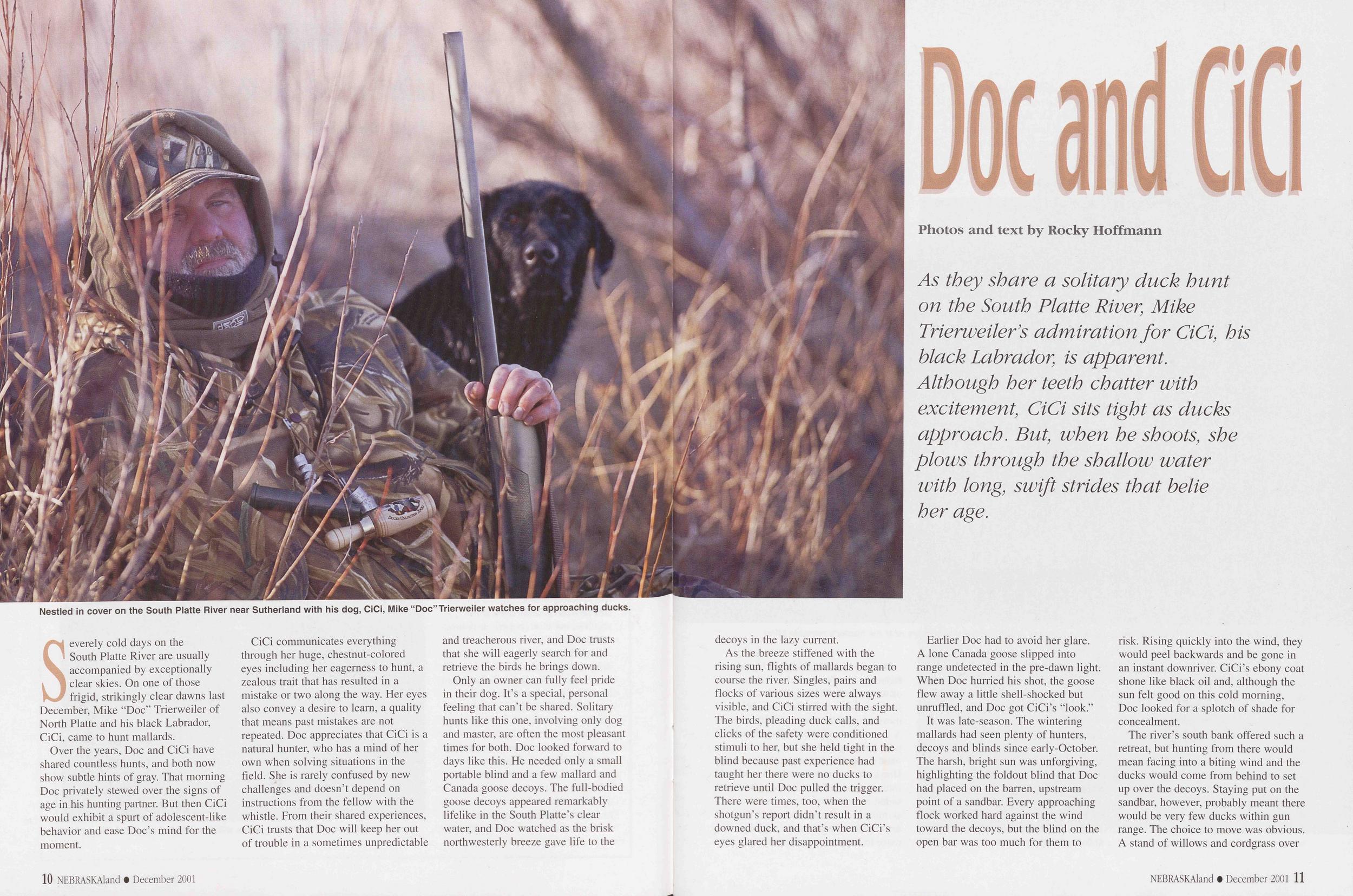
Doc and Cici
Photos and text by Rocky Hoffmann As they share a solitary duck hunt on the South Platte River, Mike Trierweiler's admiration for CiCi, his black Labrador, is apparent. Although her teeth chatter with excitement, CiCi sits tight as ducks approach. But, when he shoots, she plows through the shallow water with long, swift strides that belie her age.Severely cold days on the South Platte River are usually accompanied by exceptionally clear skies. On one of those frigid, strikingly clear dawns last December, Mike "Doc" Trierweiler of North Platte and his black Labrador, CiCi, came to hunt mallards.
Over the years, Doc and CiCi have shared countless hunts, and both now show subtle hints of gray. That morning Doc privately stewed over the signs of age in his hunting partner. But then CiCi would exhibit a spurt of adolescent-like behavior and ease Doc's mind for the moment.
CiCi communicates everything through her huge, chestnut-colored eyes including her eagerness to hunt, a zealous trait that has resulted in a mistake or two along the way. Her eyes also convey a desire to learn, a quality that means past mistakes are not repeated. Doc appreciates that CiCi is a natural hunter, who has a mind of her own when solving situations in the field. She is rarely confused by new challenges and doesn't depend on instructions from the fellow with the whistle. From their shared experiences, CiCi trusts that Doc will keep her out of trouble in a sometimes unpredictable and treacherous river, and Doc trusts that she will eagerly search for and retrieve the birds he brings down.
Only an owner can fully feel pride in their dog. It's a special, personal feeling that can't be shared. Solitary hunts like this one, involving only dog and master, are often the most pleasant times for both. Doc looked forward to days like this. He needed only a small portable blind and a few mallard and Canada goose decoys. The full-bodied goose decoys appeared remarkably lifelike in the South Platte's clear water, and Doc watched as the brisk northwesterly breeze gave life to the decoys in the lazy current.
As the breeze stiffened with the rising sun, flights of mallards began to course the river. Singles, pairs and flocks of various sizes were always visible, and CiCi stirred with the sight. The birds, pleading duck calls, and clicks of the safety were conditioned stimuli to her, but she held tight in the blind because past experience had taught her there were no ducks to retrieve until Doc pulled the trigger. There were times, too, when the shotgun's report didn't result in a downed duck, and that's when CiCi's eyes glared her disappointment.
Earlier Doc had to avoid her glare. A lone Canada goose slipped into range undetected in the pre-dawn light. When Doc hurried his shot, the goose flew away a little shell-shocked but unruffled, and Doc got CiCi's "look."
It was late-season. The wintering mallards had seen plenty of hunters, decoys and blinds since early-October. The harsh, bright sun was unforgiving, highlighting the foldout blind that Doc had placed on the barren, upstream point of a sandbar. Every approaching flock worked hard against the wind toward the decoys, but the blind on the open bar was too much for them to risk. Rising quickly into the wind, they would peel backwards and be gone in an instant downriver. CiCi's ebony coat shone like black oil and, although the sun felt good on this cold morning, Doc looked for a splotch of shade for concealment.
The river's south bank offered such a
retreat, but hunting from there would
mean facing into a biting wind and the
ducks would come from behind to set
up over the decoys. Staying put on the
sandbar, however, probably meant there
would be very few ducks within gun
range. The choice to move was obvious.
A stand of willows and cordgrass over
10 NEBRASKAland • December 2001
NEBRASKAland • December 2001 11
 a four-foot bank provided shade and
needed cover, and CiCi settled in next
to Doc.
a four-foot bank provided shade and
needed cover, and CiCi settled in next
to Doc.
The game began, and the experienced Lab knew the rules: Sit tight, hold still, try not to whine, but go ahead and let the teeth chatter with excitement when the ducks were coming. Hunters who prefer to have their dog outside of the blind when hunting know that control is absolutely necessary. A dog that bolts when ducks approach means fewer ducks in the game bag. CiCi seemed to realize the advantages of being outside the blind too; there she could watch the ducks approach the decoys and see what fell where before beginning her retrieves.
The air smelled fresh and cold to Doc; it smelled rich with mallard scent to CiCi. The sides of her nostrils pulsed as she inhaled the duck aroma that filled the air. Each flock that passed left a new treasure of smells. The taste of feathers was in her mouth, wet river sand had penetrated her coat, and her head was full of scent. She was absorbed with fowl.
Doc enjoyed watching her become focused - ears prepped for the sound of wings, nostrils pumping to detect scent, eyes sharp for the slightest movement and every muscle flexed. A fierce, excited shiver vibrated her pelt. Nothing escaped her now. It was a good thing, too, because this time when Doc took aim and shot, the duck didn't fold. Instead, it locked into a glide and sailed into the channel upstream. As it skimmed the water and landed, the drake held its head high, looking for a place to hide.
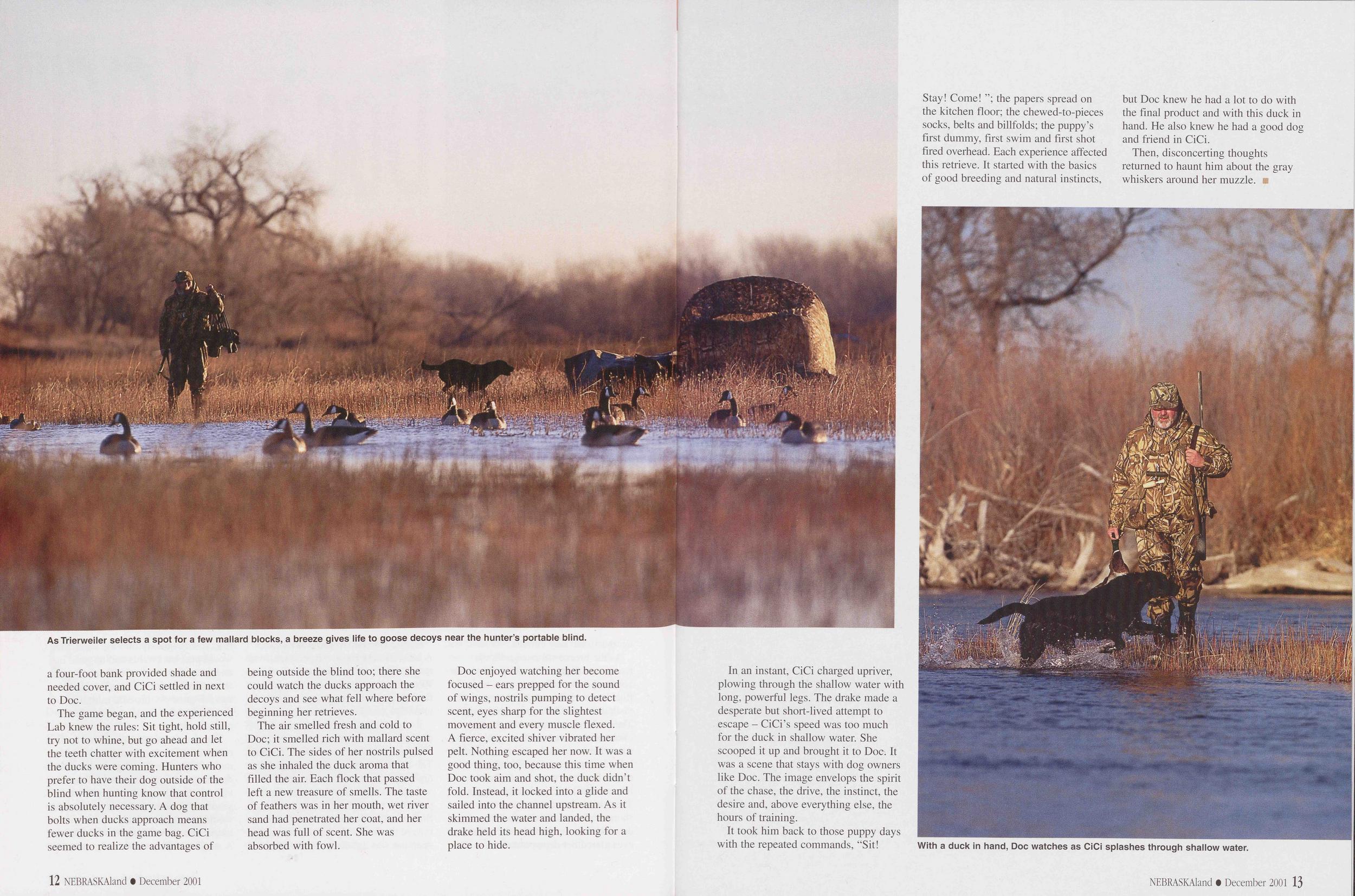
In an instant, CiCi charged upriver, plowing through the shallow water with long, powerful legs. The drake made a desperate but short-lived attempt to escape - CiCi's speed was too much for the duck in shallow water. She scooped it up and brought it to Doc. It was a scene that stays with dog owners like Doc. The image envelops the spirit of the chase, the drive, the instinct, the desire and, above everything else, the hours of training.
It took him back to those puppy days with the repeated commands, "Sit! With a duck in hand, Doc watches as CiCi splashes through shallow water. Stay! Come! "; the papers spread on the kitchen floor; the chewed-to-pieces socks, belts and billfolds; the puppy's first dummy, first swim and first shot fired overhead. Each experience affected this retrieve. It started with the basics of good breeding and natural instincts, but Doc knew he had a lot to do with the final product and with this duck in hand. He also knew he had a good dog and friend in CiCi.
Then, disconcerting thoughts returned to haunt him about the gray whiskers around her muzzle.
12 NEBRASKAland • December 2001 NEBRASKAland • December 2001 13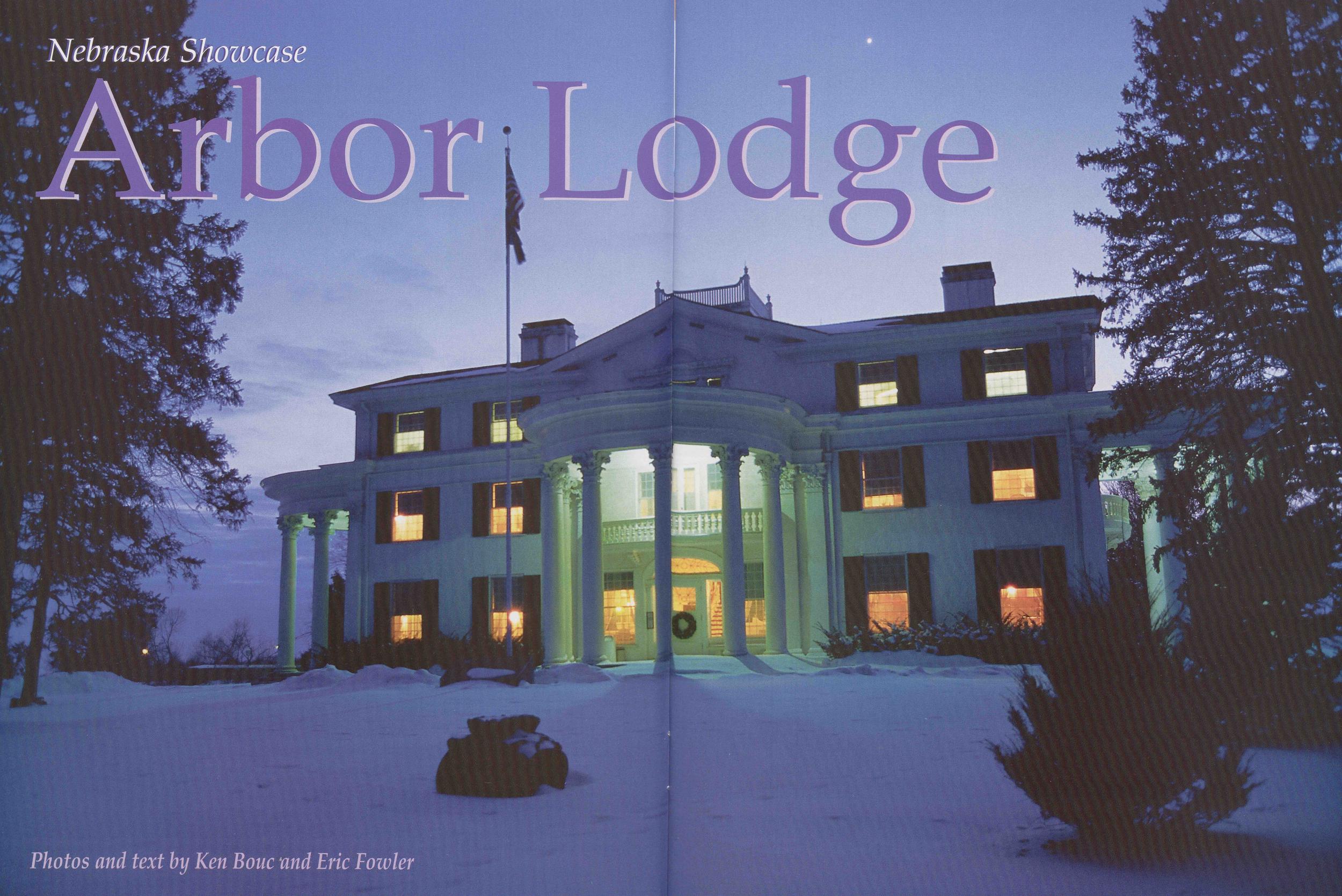
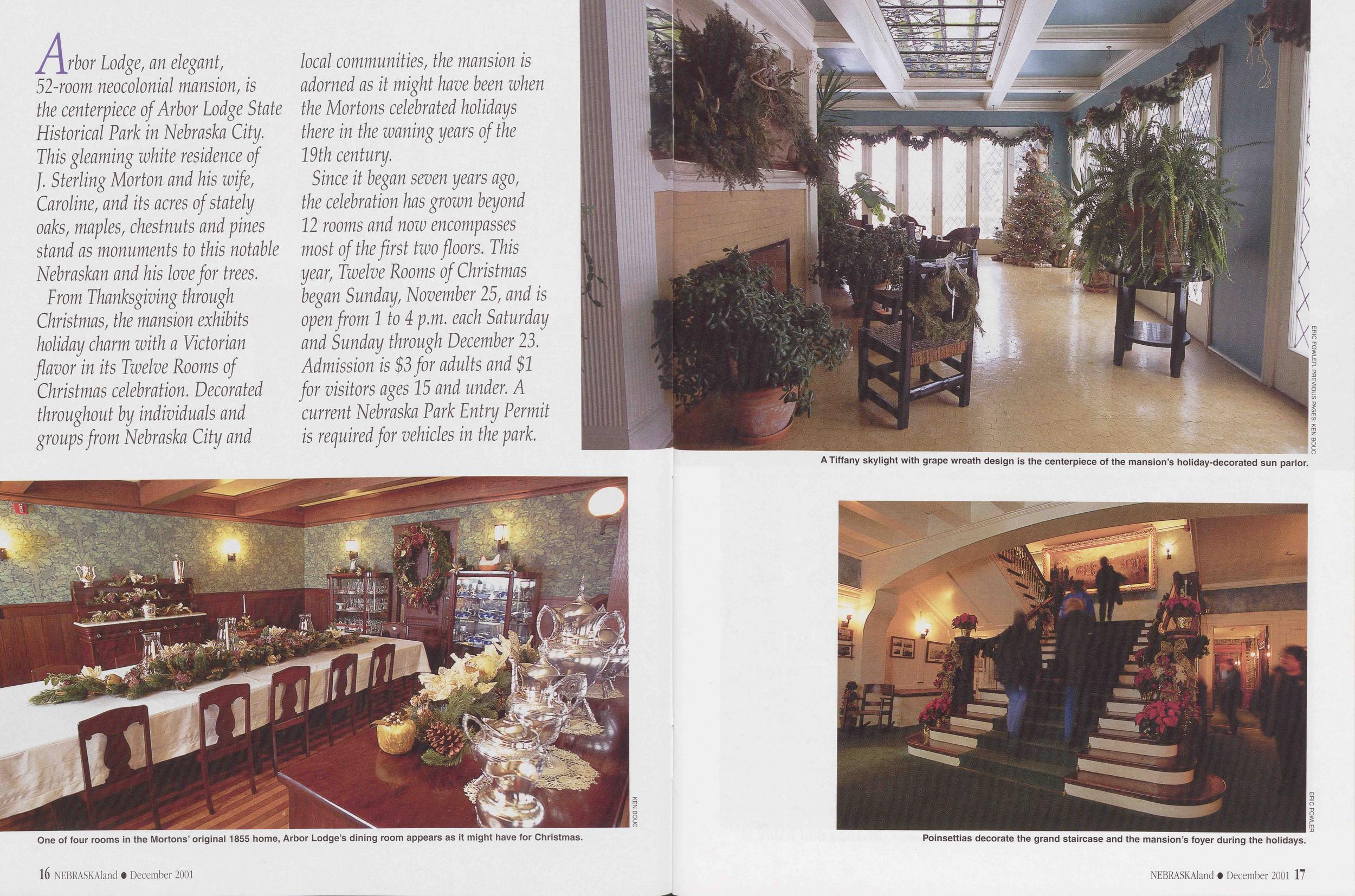
Arbor Lodge, an elegant, 52-room neocolonial mansion, is the centerpiece of Arbor Lodge State Historical Park in Nebraska City. This gleaming white residence of ]. Sterling Morton and his wife, Caroline, and its acres of stately oaks, maples, chestnuts and pines stand as monuments to this notable Nebraskan and his love for trees.
From Thanksgiving through Christmas, the mansion exhibits holiday charm with a Victorian flavor in its Twelve Rooms of Christmas celebration. Decorated throughout by individuals and groups from Nebraska City and local communities, the mansion is adorned as it might have been when the Mortons celebrated holidays there in the waning years of the 19th century.
Since it began seven years ago, the celebration has grown beyond 12 rooms and now encompasses most of the first two floors. This year, Twelve Rooms of Christmas began Sunday, November 25, and is open each Saturday and Sunday through December 23. Admission is $3 for adults and $1 for visitors ages 15 and under. A current Nebraska Park Entry Permit is required for vehicles in the park.
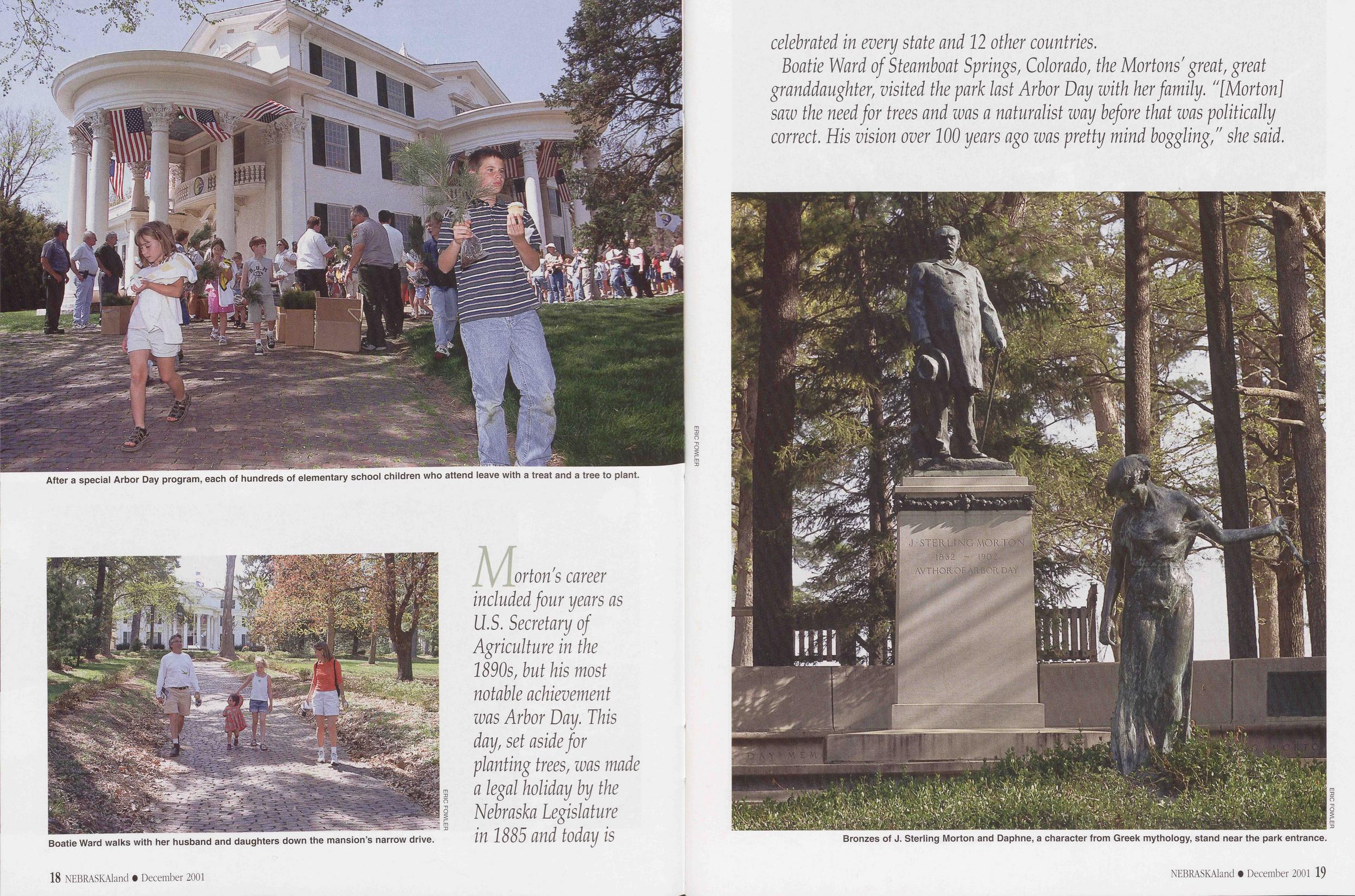
Morton's career included four years as U.S. Secretary of Agriculture in the 1890s, hut his most notable achievement was Arbor Day. This day, set aside for planting trees, was made a legal holiday by the Nebraska Legislature in 1885 and today is celebrated in every state and 12 other countries.
Boatie Ward of Steamboat Springs, Colorado, the Mortons' great, great granddaughter, visited the park last Arbor Day with her family. "[Mortonl saw the need for trees and was a naturalist way before that was politically correct. His vision over 100 years ago was pretty mind boggling," she said.
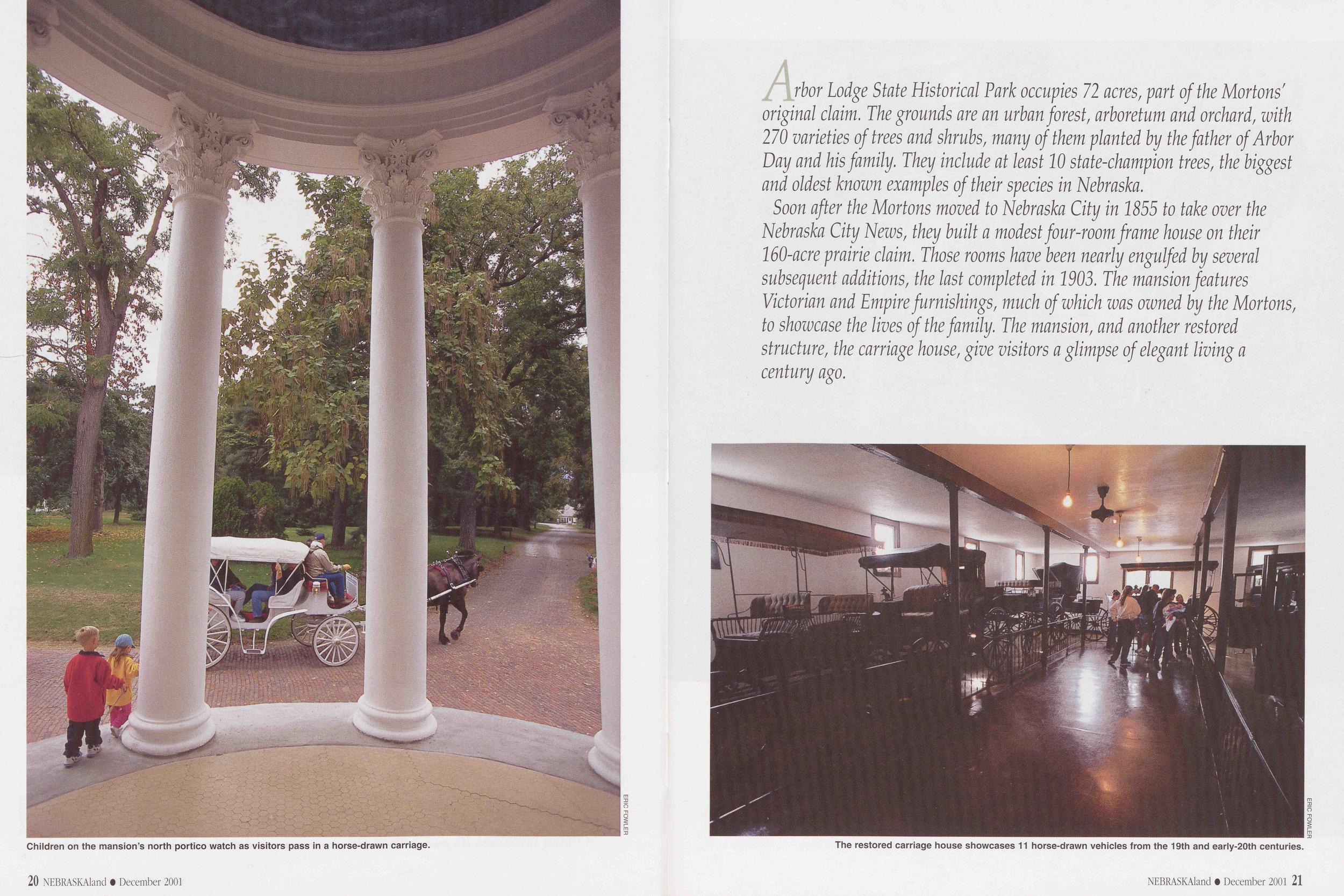
Arbor Lodge State Historical Park occupies 72 acres, part of the Mortons' original claim. The grounds are an urban forest, arboretum and orchard, with 270 varieties of trees and shrubs, many of them planted by the father of Arbor Day and his family. They include at least 10 state-champion trees, the biggest and oldest known examples of their species in Nebraska.
Soon after the Mortons moved to Nebraska City in 1855 to take over the Nebraska City News, they built a modest four-room frame house on their 160-acre prairie claim. Those rooms have been nearly engulfed by several subsequent additions, the last completed in 1903. The mansion features Victorian and Empire furnishings, much of which was owned by the Mortons, to showcase the lives of the family. The mansion, and another restored structure, the carriage house, give visitors a glimpse of elegant living a century ago.
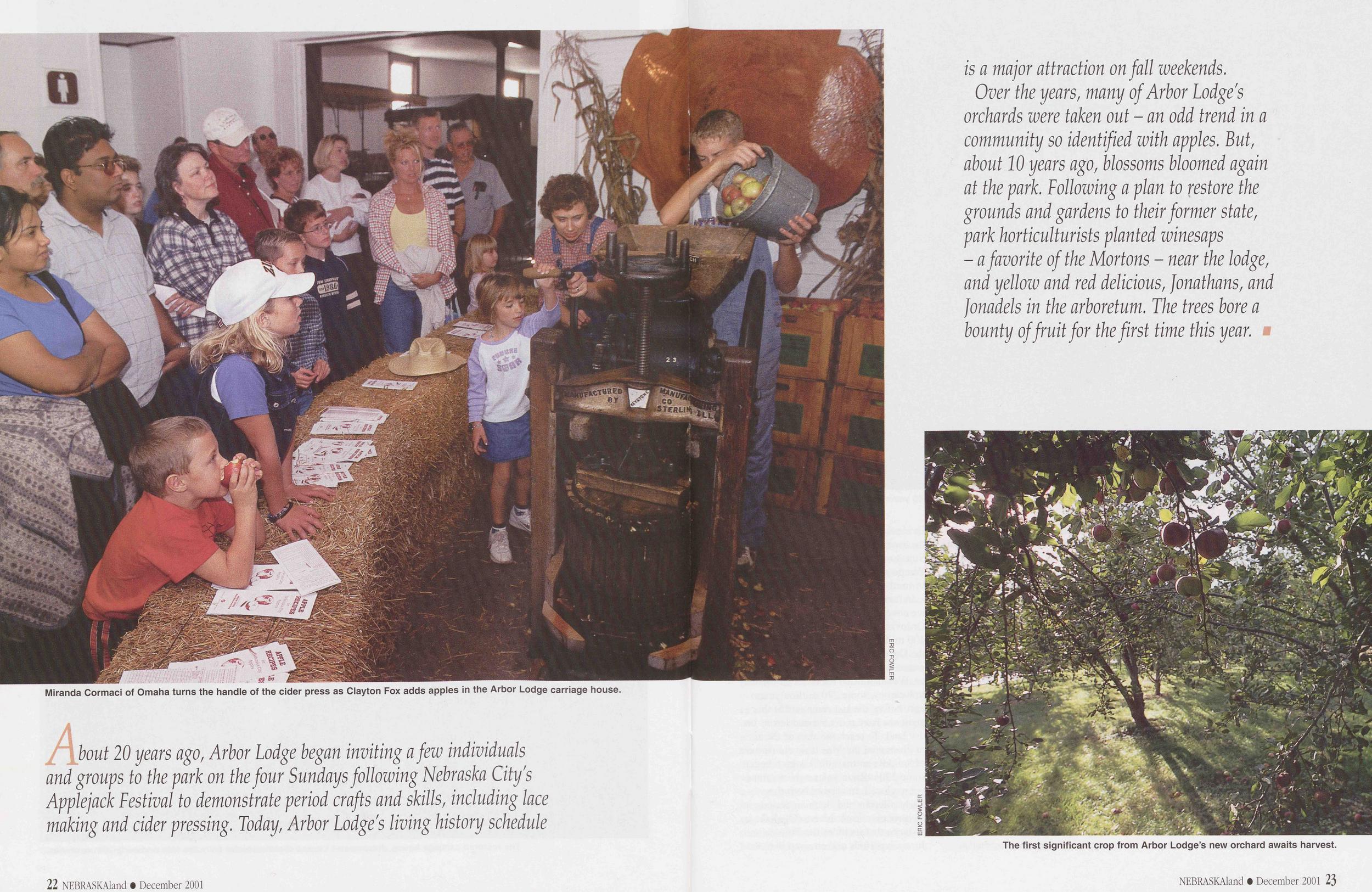
About 20 years ago, Arbor Lodge began inviting a few individuals and groups to the park on the four Sundays following Nebraska City's Applejack Festival to demonstrate period crafts and skills, including lace making and cider pressing. Today, Arbor Lodge's living history schedule is a major attraction onfall weekends.
Over the years, many of Arbor Lodge's orchards were taken out - an odd trend in a community so identified with apples. But, about 10 years ago, blossoms bloomed again at the park. Following a plan to restore the grounds and gardens to their former state, park horticulturists planted winesaps - a favorite of the Mortons - near the lodge, and yellow and red delicious, Jonathans, and Jonadels in the arboretum. The trees bore a bounty of fruit for the first time this year.
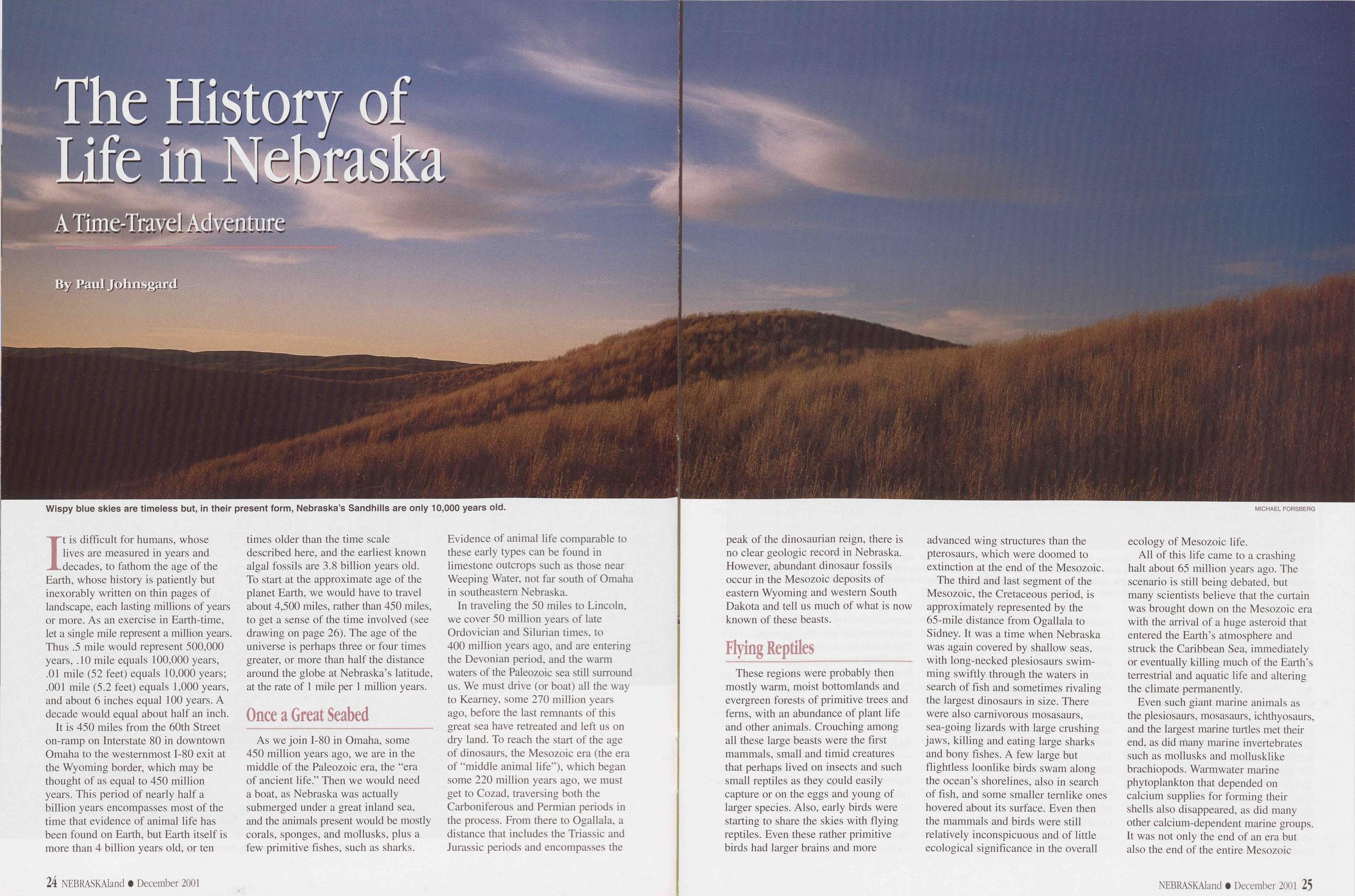
The History of Life in Nebraska
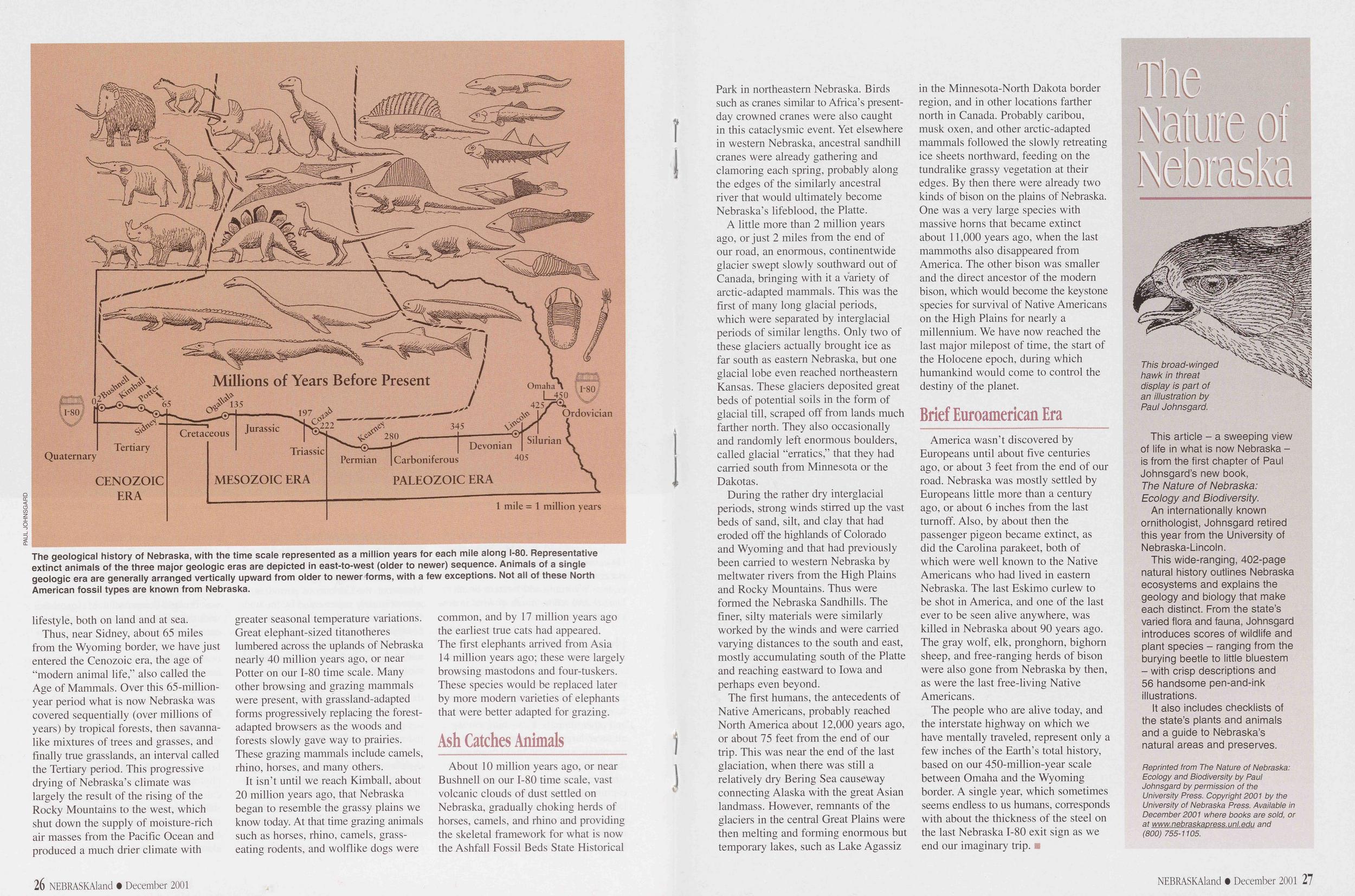
A Time-Travel AdventureIt is difficult for humans, whose lives are measured in years and decades, to fathom the age of the Earth, whose history is patiently but inexorably written on thin pages of landscape, each lasting millions of years or more. As an exercise in Earth-time, let a single mile represent a million years. Thus .5 mile would represent 500,000 years, .10 mile equals 100,000 years, .01 mile (52 feet) equals 10,000 years; .001 mile (5.2 feet) equals 1,000 years, and about 6 inches equal 100 years. A decade would equal about half an inch.
It is 450 miles from the 60th Street on-ramp on Interstate 80 in downtown Omaha to the westernmost 1-80 exit at the Wyoming border, which may be thought of as equal to 450 million years. This period of nearly half a billion years encompasses most of the time that evidence of animal life has been found on Earth, but Earth itself is more than 4 billion years old, or ten times older than the time scale described here, and the earliest known algal fossils are 3.8 billion years old. To start at the approximate age of the planet Earth, we would have to travel about 4,500 miles, rather than 450 miles, to get a sense of the time involved (see drawing on page 26). The age of the universe is perhaps three or four times greater, or more than half the distance around the globe at Nebraska's latitude at the rate of 1 mile per 1 million years.
Once a Great SeabedAs we join I-80 in Omaha, some 450 million years ago, we are in the middle of the Paleozoic era, the "era of ancient life." Then we would need a boat, as Nebraska was actually submerged under a great inland sea, and the animals present would be mostly corals, sponges, and mollusks, plus a few primitive fishes, such as sharks. Evidence of animal life comparable to these early types can be found in limestone outcrops such as those near Weeping Water, not far south of Omaha in southeastern Nebraska.
In traveling the 50 miles to Lincoln, we cover 50 million years of late Ordovician and Silurian times, to 400 million years ago, and are entering the Devonian period, and the warm waters of the Paleozoic sea still surround us. We must drive (or boat) all the way to Kearney, some 270 million years ago, before the last remnants of this great sea have retreated and left us on dry land. To reach the start of the age of dinosaurs, the Mesozoic era (the era of "middle animal life"), which began some 220 million years ago, we must get to Cozad, traversing both the Carboniferous and Permian periods in the process. From there to Ogallala, a distance that includes the Trias sic and Jurassic periods and encompasses the peak of the dinosaurian reign, there is no clear geologic record in Nebraska. However, abundant dinosaur fossils occur in the Mesozoic deposits of eastern Wyoming and western South Dakota and tell us much of what is now known of these beasts.
Flying ReptilesThese regions were probably then mostly warm, moist bottomlands and evergreen forests of primitive trees and ferns, with an abundance of plant life and other animals. Crouching among all these large beasts were the first mammals, small and timid creatures that perhaps lived on insects and such small reptiles as they could easily capture or on the eggs and young of larger species. Also, early birds were starting to share the skies with flying reptiles. Even these rather primitive birds had larger brains and more advanced wing structures than the pterosaurs, which were doomed to extinction at the end of the Mesozoic.
The third and last segment of the Mesozoic, the Cretaceous period, is approximately represented by the 65-mile distance from Ogallala to Sidney. It was a time when Nebraska was again covered by shallow seas, with long-necked plesiosaurs swim- ming swiftly through the waters in search of fish and sometimes rivaling the largest dinosaurs in size. There were also carnivorous mosasaurs, sea-going lizards with large crushing jaws, killing and eating large sharks and bony fishes. A few large but flightless loonlike birds swam along the ocean's shorelines, also in search of fish, and some smaller ternlike ones hovered about its surface. Even then the mammals and birds were still relatively inconspicuous and of little ecological significance in the overall ecology of Mesozoic life.
All of this life came to a crashing halt about 65 million years ago. The scenario is still being debated, but many scientists believe that the curtain was brought down on the Mesozoic era with the arrival of a huge asteroid that entered the Earth's atmosphere and struck the Caribbean Sea, immediately or eventually killing much of the Earth's terrestrial and aquatic life and altering the climate permanently.
Even such giant marine animals as
the plesiosaurs, mosasaurs, ichthyosaurs,
and the largest marine turtles met their
end, as did many marine invertebrates
such as mollusks and mollusklike
brachiopods. Warmwater marine
phytoplankton that depended on
calcium supplies for forming their
shells also disappeared, as did many
other calcium-dependent marine groups.
It was not only the end of an era but
also the end of the entire Mesozoic
NEBRASKAland • December 2001 25
 lifestyle, both on land and at sea.
Thus, near Sidney, about 65 miles from the Wyoming border, we have just entered the Cenozoic era, the age of "modern animal life," also called the Age of Mammals. Over this 65-million-year period what is now Nebraska was covered sequentially (over millions of years) by tropical forests, then savanna like mixtures of trees and grasses, and finally true grasslands, an interval called the Tertiary period. This progressive drying of Nebraska's climate was largely the result of the rising of the Rocky Mountains to the west, which shut down the supply of moisture-rich air masses from the Pacific Ocean and produced a much drier climate with greater seasonal temperature variations. Great elephant-sized titanotheres lumbered across the uplands of Nebraska nearly 40 million years ago, or near Potter on our I-80 time scale. Many other browsing and grazing mammals were present, with grassland-adapted forms progressively replacing the forest- adapted browsers as the woods and forests slowly gave way to prairies. These grazing mammals include camels, rhino, horses, and many others.
It isn't until we reach Kimball, about 20 million years ago, that Nebraska began to resemble the grassy plains we know today. At that time grazing animals such as horses, rhino, camels, grass eating rodents, and wolflike dogs were common, and by 17 million years ago the earliest true cats had appeared. The first elephants arrived from Asia 14 million years ago; these were largely browsing mastodons and four-tuskers. These species would be replaced later by more modern varieties of elephants that were better adapted for grazing.
Ash Catches AnimalsAbout 10 million years ago, or near Bushnell on our I-80 time scale, vast volcanic clouds of dust settled on Nebraska, gradually choking herds of horses, camels, and rhino and providing the skeletal framework for what is now the Ashfall Fossil Beds State Historical Park in northeastern Nebraska. Birds such as cranes similar to Africa's present- day crowned cranes were also caught in this cataclysmic event. Yet elsewhere in western Nebraska, ancestral sandhill cranes were already gathering and clamoring each spring, probably along the edges of the similarly ancestral river that would ultimately become Nebraska's lifeblood, the Platte.
A little more than 2 million years ago, or just 2 miles from the end of our road, an enormous, continent wide glacier swept slowly southward out of Canada, bringing with it a variety of arctic-adapted mammals. This was the first of many long glacial periods, which were separated by interglacial periods of similar lengths. Only two of these glaciers actually brought ice as far south as eastern Nebraska, but one glacial lobe even reached northeastern Kansas. These glaciers deposited great beds of potential soils in the form of glacial till, scraped off from lands much farther north. They also occasionally and randomly left enormous boulders, called glacial "erratics," that they had carried south from Minnesota or the Dakotas.
During the rather dry interglacial periods, strong winds stirred up the vast beds of sand, silt, and clay that had eroded off the highlands of Colorado and Wyoming and that had previously been carried to western Nebraska by meltwater rivers from the High Plains and Rocky Mountains. Thus were formed the Nebraska Sandhills. The finer, silty materials were similarly worked by the winds and were carried varying distances to the south and east, mostly accumulating south of the Platte and reaching eastward to Iowa and perhaps even beyond.
The first humans, the antecedents of Native Americans, probably reached North America about 12,000 years ago, or about 75 feet from the end of our trip. This was near the end of the last glaciation, when there was still a relatively dry Bering Sea causeway connecting Alaska with the great Asian landmass. However, remnants of the glaciers in the central Great Plains were then melting and forming enormous but temporary lakes, such as Lake Agassiz in the Minnesota-North Dakota border region, and in other locations farther north in Canada. Probably caribou, musk oxen, and other arctic-adapted mammals followed the slowly retreating ice sheets northward, feeding on the tundra like grassy vegetation at their edges. By then there were already two kinds of bison on the plains of Nebraska. One was a very large species with massive horns that became extinct about 11,000 years ago, when the last mammoths also disappeared from America. The other bison was smaller and the direct ancestor of the modern bison, which would become the keystone species for survival of Native Americans on the High Plains for nearly a millennium. We have now reached the last major milepost of time, the start of the Holocene epoch, during which humankind would come to control the destiny of the planet.
Brief Euroamerican EraAmerica wasn't discovered by Europeans until about five centuries ago, or about 3 feet from the end of our road. Nebraska was mostly settled by Europeans little more than a century ago, or about 6 inches from the last turnoff. Also, by about then the passenger pigeon became extinct, as did the Carolina parakeet, both of which were well known to the Native Americans who had lived in eastern Nebraska. The last Eskimo curlew to be shot in America, and one of the last ever to be seen alive anywhere, was killed in Nebraska about 90 years ago. The gray wolf, elk, pronghorn, bighorn sheep, and free-ranging herds of bison were also gone from Nebraska by then, as were the last free-living Native Americans.
The people who are alive today, and the interstate highway on which we have mentally traveled, represent only a few inches of the Earth's total history, based on our 450-million-year scale between Omaha and the Wyoming border. A single year, which sometimes seems endless to us humans, corresponds with about the thickness of the steel on the last Nebraska I-80 exit sign as we end our imaginary trip.
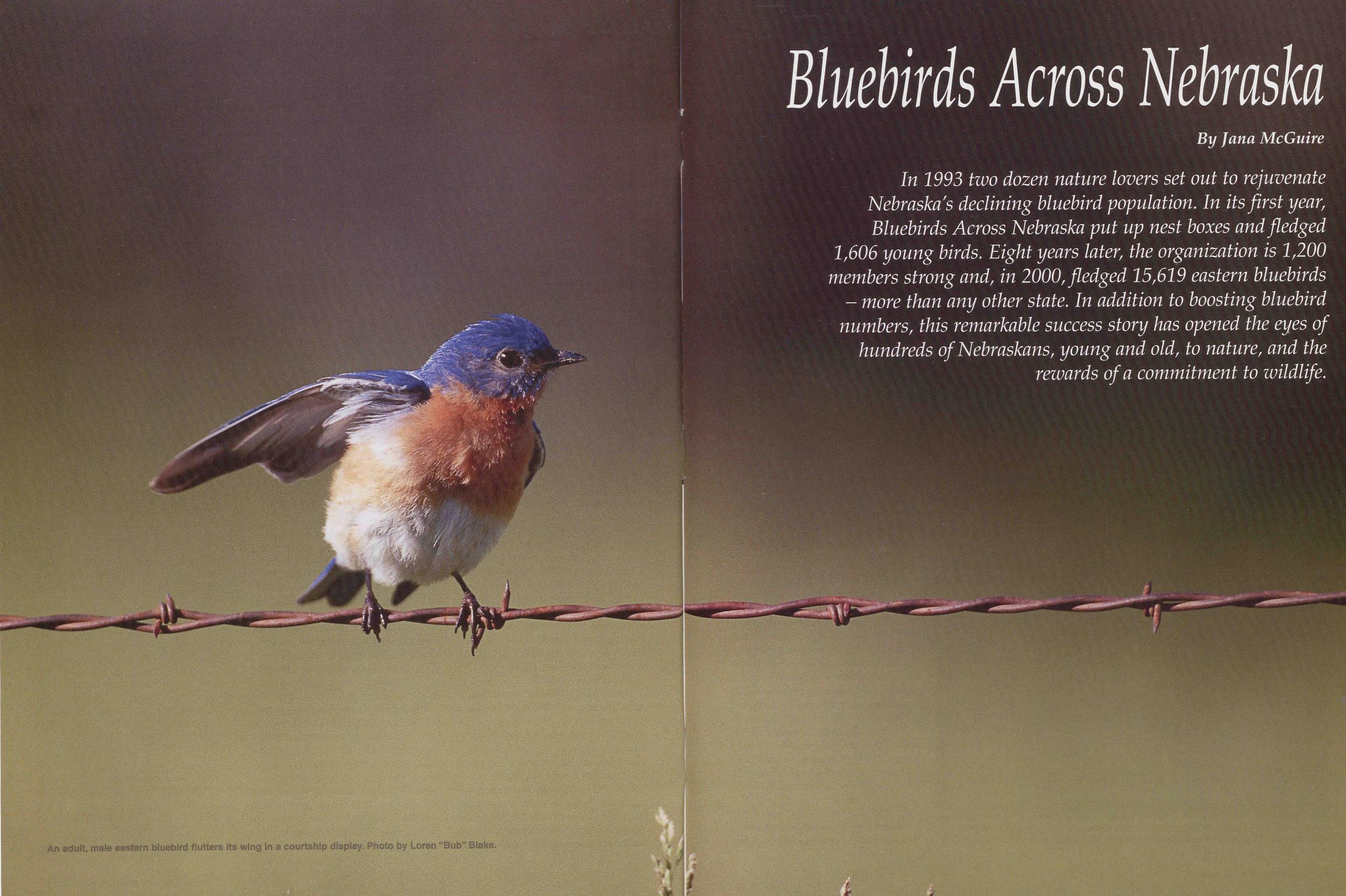
Bluebirds Across Nebraska
By Jana McGuire 1993 two dozen nature lovers set out to rejuvenate Nebraska's declining bluebird population. In its first year, Bluebirds Across Nebraska put up nest boxes and fledged 1,606 young birds. Eight years later, the organization is 1,200 members strong and, in 2000, fledged 15,619 eastern bluebirds - more than any other state. In addition to boosting bluebird numbers, this remarkable success story has opened the eyes of hundreds of Nebraskans, young and old, to nature, and the rewards of a commitment to wildlife.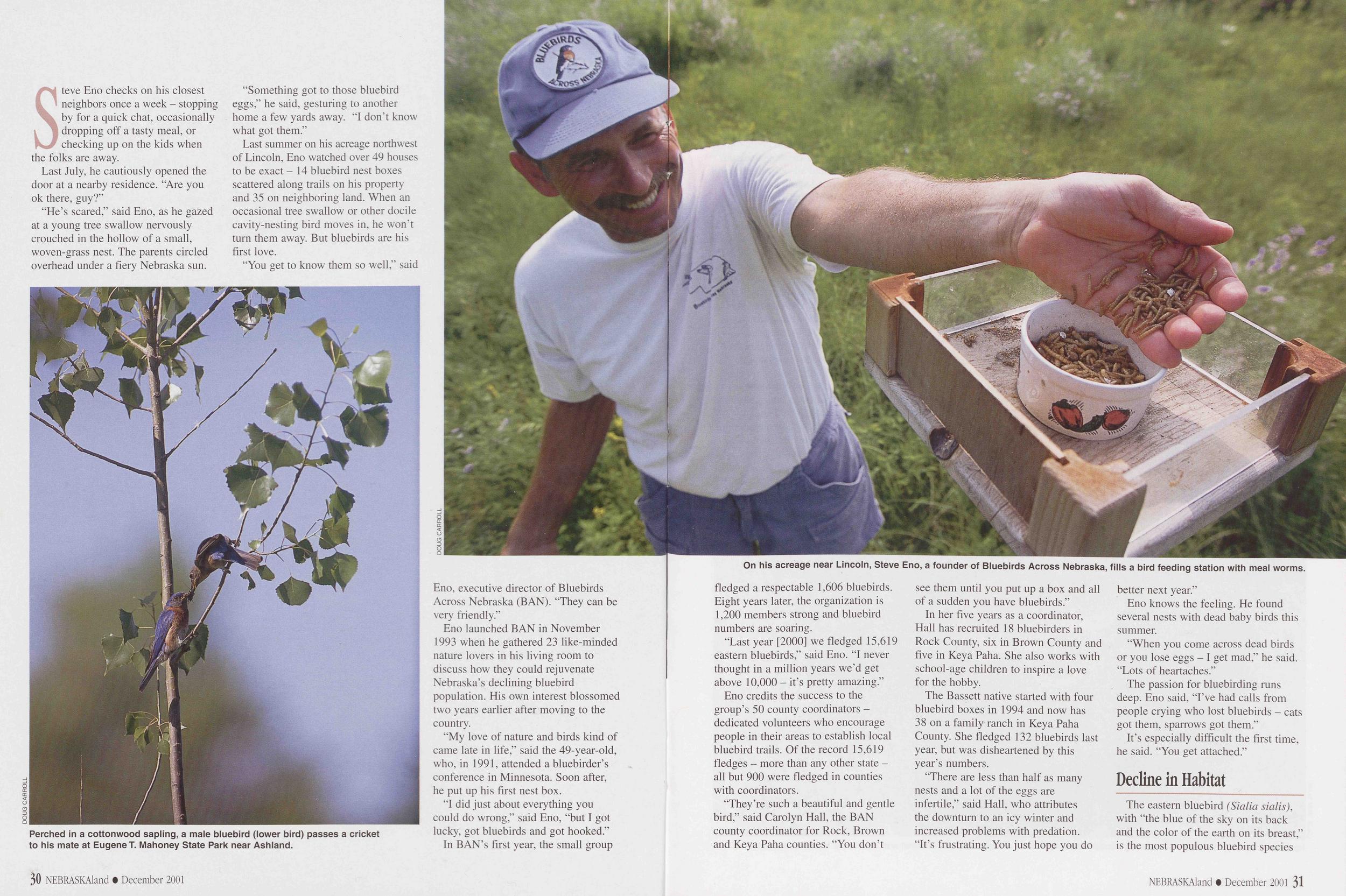
Steve Eno checks on his closest neighbors once a week - stopping by for a quick chat, occasionally dropping off a tasty meal, or checking up on the kids when the folks are away.
Last July, he cautiously opened the door at a nearby residence. "Are you ok there, guy?"
"He's scared," said Eno, as he gazed at a young tree swallow nervously crouched in the hollow of a small, woven-grass nest. The parents circled overhead under a fiery Nebraska sun.
"Something got to those bluebird eggs," he said, gesturing to another home a few yards away. "I don't know what got them."
Last summer on his acreage northwest of Lincoln, Eno watched over 49 houses to be exact - 14 bluebird nest boxes scattered along trails on his property and 35 on neighboring land. When an occasional tree swallow or other docile cavity-nesting bird moves in, he won't turn them away. But bluebirds are his first love.
"You get to know them so well," said Eno, executive director of Bluebirds Across Nebraska (BAN). "They can be very friendly."
Eno launched BAN in November 1993 when he gathered 23 like-minded nature lovers in his living room to discuss how they could rejuvenate Nebraska's declining bluebird population. His own interest blossomed two years earlier after moving to the country.
"My love of nature and birds kind of came late in life," said the 49-year-old, who, in 1991, attended a bluebirder's conference in Minnesota. Soon after, he put up his first nest box.
"I did just about everything you could do wrong," said Eno, "but I got lucky, got bluebirds and got hooked."
In BAN's first year, the small group On his acreage near Lincoln, Steve Eno, a founder of Bluebirds Across Nebraska, fills a bird feeding station with meal worms. fledged a respectable 1,606 bluebirds. Eight years later, the organization is 1,200 members strong and bluebird numbers are soaring.
"Last year [2000] we fledged 15,619 eastern bluebirds," said Eno. "I never thought in a million years we'd get above 10,000 - it's pretty amazing."
Eno credits the success to the group's 50 county coordinators - dedicated volunteers who encourage people in their areas to establish local bluebird trails. Of the record 15,619 fledges - more than any other state - all but 900 were fledged in counties with coordinators.
"They're such a beautiful and gentle bird," said Carolyn Hall, the BAN county coordinator for Rock, Brown and Keya Paha counties. "You don't see them until you put up a box and all of a sudden you have bluebirds."
In her five years as a coordinator, Hall has recruited 18 blue birders in Rock County, six in Brown County and five in Keya Paha. She also works with school-age children to inspire a love for the hobby.
The Bassett native started with four bluebird boxes in 1994 and now has 38 on a family ranch in Keya Paha County. She fledged 132 bluebirds last year, but was disheartened by this year's numbers.
"There are less than half as many nests and a lot of the eggs are infertile," said Hall, who attributes the downturn to an icy winter and increased problems with predation. "It's frustrating. You just hope you do better next year."
Eno knows the feeling. He found several nests with dead baby birds this summer.
"When you come across dead birds or you lose eggs - I get mad," he said. "Lots of heartaches."
The passion for bluebirding runs deep. Eno said, "I've had calls from people crying who lost bluebirds - cats got them, sparrows got them."
It's especially difficult the first time, he said. "You get attached."
Decline in HabitatThe eastern bluebird (Sialia sialis),
with "the blue of the sky on its back
and the color of the earth on its breast,"
is the most populous bluebird species
NEBRASKAland • December 2001 31
 in Nebraska and the United States, said
John Dinan, Nongame Bird Program
Manager for the Nebraska Game and
Parks Commission. It's found from
southern Canada to the Caribbean and
from the Great Plains to the eastern
seaboard.
in Nebraska and the United States, said
John Dinan, Nongame Bird Program
Manager for the Nebraska Game and
Parks Commission. It's found from
southern Canada to the Caribbean and
from the Great Plains to the eastern
seaboard.
A few mountain bluebirds (Sialia currucoides) also exist in Nebraska, but only in the western third of the state, said Dinan. As its name implies, this solid-blue and slightly larger species prefers higher mountain areas and more arid climates.
The bluebird and more than 400 other nongame species fall under Dinan's watch. Threatened and endangered birds are his priority. "I look at a species and say, 'What can we do to bring it back?' " He appreciates the help of groups such as BAN.
"It's not the government saying we need this, it's the people of the state speaking," said Dinan, who helped Eno launch the program. "BAN is one of the most active and enthusiastic groups of people I've seen - things couldn't have turned out better."
Bluebird populations in the United States and Canada began a steady decline in the early-1900s. A secondary- cavity nester, the bluebird relies on naturally occurring sites. But woodland edges that once provided nesting areas have been destroyed, and other natural habitats have been cleared for farmland. The increased use of dead timber, metal fence posts and pesticides also took a toll.
"The birds kind of took a beating," said Eno.
The introduction of the non-native house sparrow (formerly known as the English sparrow) in 1852 and European starlings in 1880 proved disastrous. These aggressive cavity dwellers spread quickly from the East, competing with bluebirds for prime habitat. Bluebirds, which once resided in towns and cities, were forced to rural areas. The house sparrow is especially hostile.
"It will destroy other birds' eggs and their young," said Dinan. The sparrow has been known to kill adult bluebirds in a nest box - and, in some cases, build a new nest on the carcass. Because they are too large for bluebird nest box entrances, starlings are more of a threat in a natural nest setting.
To thwart the bluebird's downward spiral, bird enthusiasts in many parts of the country began creating artificial houses and declared all-out war on house sparrows and starlings - birds that federal, and gradually, state statutes have declared "pests without protection."
This grassroots effort spurred the creation of two influential bluebird recovery groups in 1978 - the Bluebird Recovery Program of Minnesota (BBRP) and the North American Bluebird Society (NABS), founded in Maryland. Membership extends across the nation, into Canada, and even overseas. Bluebirds Across Nebraska is one of several state organizations affiliated with NABS.
'The opportunity for bluebirds to find nesting sites here is far greater now than historically," said Dinan. 'With thousands of boxes being put up by BAN, there's a good population in Nebraska - it's remarkable."
In open, short-grass areas, attracting bluebirds is easy."It's as simple as putting up a nest box," said Dinan. "You can see the results of your efforts pretty quickly."
Keeping them takes commitment. "We have a card that members sign pledging to monitor their nest boxes," said Eno. Once a week is ideal. BAN relies on members to keep accurate records. Without checking, there's no way to know how many bluebirds are nesting - or whether the houses have fallen prey to predators, parasites or are in need of repair.
Bluebirds quickly adapt to the disturbance of monitors. Often, but not always, the adults leave the nest when the box is opened - allowing careful inspection of the nest, eggs or young.
"Two years ago, I had a female that wouldn't get off the box," said Hall, who gingerly lifted her off the nest to check the eggs. "I finally said, 'Hey lady, it's been three weeks - I need to know what's going on in there.' "
When the weather turns cold and the supply of insects dwindles, most of Nebraska's bluebirds head south - spending the winter anywhere from southern Kansas to Texas.
"If we have a mild winter, you'll find bluebirds here," said Dinan. But, like their relative the robin, bluebirds move to food sources along river bottoms where trees provide persistent-type fruits such as cedar berries.
BAN members anxiously await the first sign of spring when bluebirds return - often to the area where they nested successfully before, and sometimes to the same nest box.
Bluebirds prefer tree-lined, open spaces and short grasses where insects are easily spotted. Mounting nest boxes at least five feet off the ground, and on a smooth post, keeps climbing predators at bay. Placing them in areas away from brushy habitat will discourage predatory wrens from moving in.
"Wrens are a protected species," said Eno. "You can't take out a completed wren nest."
In its simple, cup-shaped nest, a
Mahoney State Park is home to 58 bluebird nest boxes strategically located along four miles of hiking trails and near roads. Following reports of increased bluebird sightings in the area, Steve Eno, executive director of Bluebirds Across Nebraska, approached park managers in 1993 about establishing bluebird-nesting habitat.
A grant through the National Family Campers and RVer's Association has since made it possible to extend the bluebird trail and improve habitat to encourage nesting. BAN members regularly monitor the trail.
"I've been on a number of tours where you'll hear a sudden shout, 'Look, it's a bluebird!'" said Jim Swenson, East Region Parks Manager for the Game and Parks Commission and former superintendent at Mahoney. "Many visitors are from towns or bigger cities where typically, they don't see them."
Recently completed observation decks and viewing areas along a new 10-foot wide concrete walkway intersect a number of bluebird trails, which Swenson said are a valuable asset to the park. "It's a nice meld of parks and wildlife."
NEBRASKAland • December 2001 33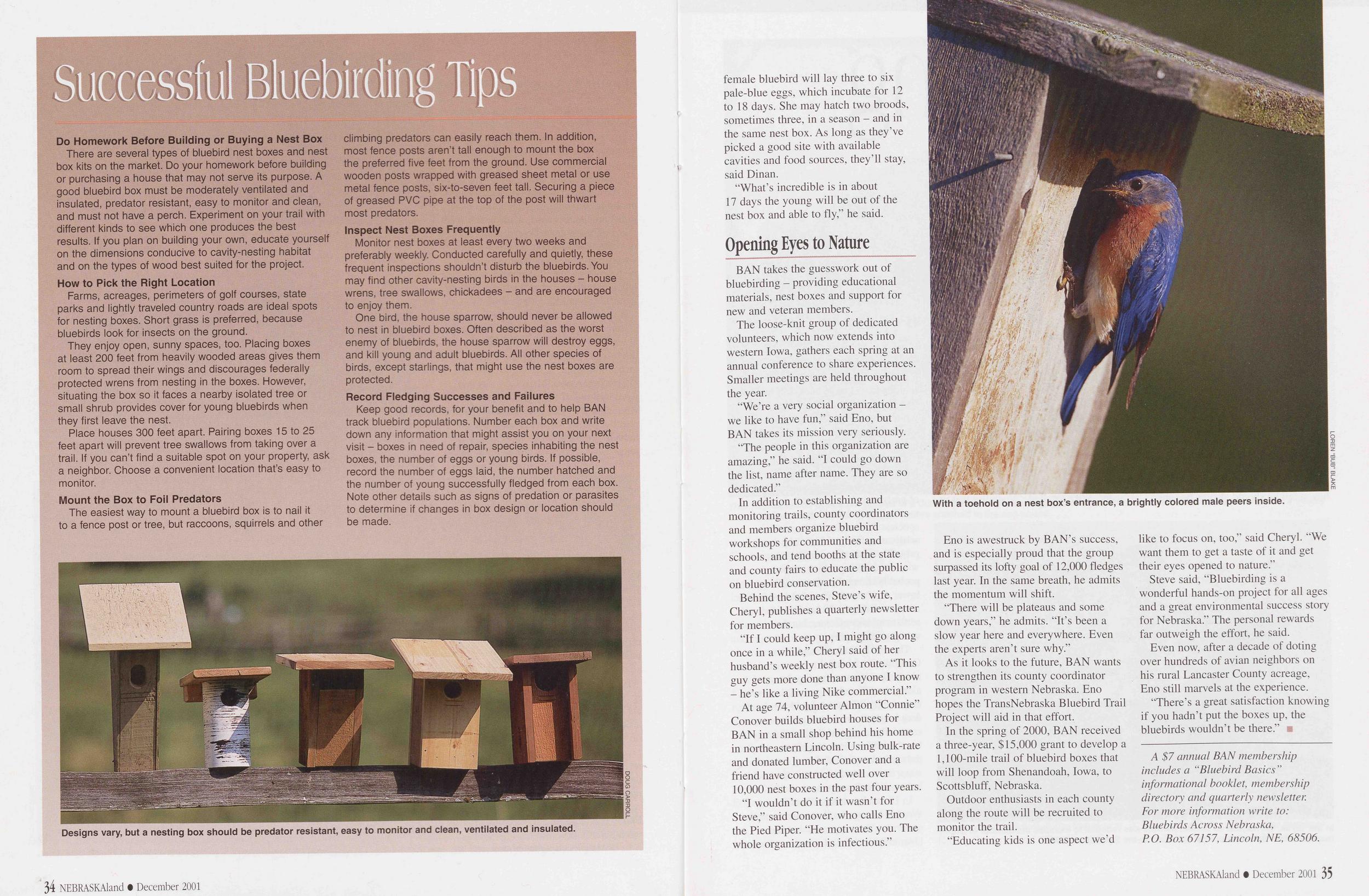 Successful Bluebirding Tips
Do Homework Before Building or Buying a Nest Box
Successful Bluebirding Tips
Do Homework Before Building or Buying a Nest Box
There are several types of bluebird nest boxes and nest box kits on the market. Do your homework before building or purchasing a house that may not serve its purpose. A good bluebird box must be moderately ventilated and insulated, predator resistant, easy to monitor and clean, and must not have a perch. Experiment on your trail with different kinds to see which one produces the best results. If you plan on building your own, educate yourself on the dimensions conducive to cavity-nesting habitat and on the types of wood best suited for the project.
How to Pick the Right LocationFarms, acreages, perimeters of golf courses, state parks and lightly traveled country roads are ideal spots for nesting boxes. Short grass is preferred, because bluebirds look for insects on the ground.
They enjoy open, sunny spaces, too. Placing boxes at least 200 feet from heavily wooded areas gives them room to spread their wings and discourages federally protected wrens from nesting in the boxes. However, situating the box so it faces a nearby isolated tree or small shrub provides cover for young bluebirds when they first leave the nest.
Place houses 300 feet apart. Pairing boxes 15 to 25 feet apart will prevent tree swallows from taking over a trail. If you can't find a suitable spot on your property, ask a neighbor. Choose a convenient location that's easy to monitor.
Mount the Box to Foil PredatorsThe easiest way to mount a bluebird box is to nail it to a fence post or tree, but raccoons, squirrels and other climbing predators can easily reach them. In addition, most fence posts aren't tall enough to mount the box the preferred five feet from the ground. Use commercial wooden posts wrapped with greased sheet metal or use metal fence posts, six-to-seven feet tall. Securing a piece of greased PMC pipe at the top of the post will thwart most predators.
Inspect Nest Boxes FrequentlyMonitor nest boxes at least every two weeks and preferably weekly. Conducted carefully and quietly, these frequent inspections shouldn't disturb the bluebirds. You may find other cavity-nesting birds in the houses - house wrens, tree swallows, chickadees - and are encouraged to enjoy them.
One bird, the house sparrow, should never be allowed to nest in bluebird boxes. Often described as the worst enemy of bluebirds, the house sparrow will destroy eggs, and kill young and adult bluebirds. All other species of birds, except starlings, that might use the nest boxes are protected.
Record Fledging Successes and FailuresKeep good records, for your benefit and to help BAN track bluebird populations. Number each box and write down any information that might assist you on your next visit - boxes in need of repair, species inhabiting the nest boxes, the number of eggs or young birds. If possible, record the number of eggs laid, the number hatched and the number of young successfully fledged from each box. Note other details such as signs of predation or parasites to determine if changes in box design or location should be made.
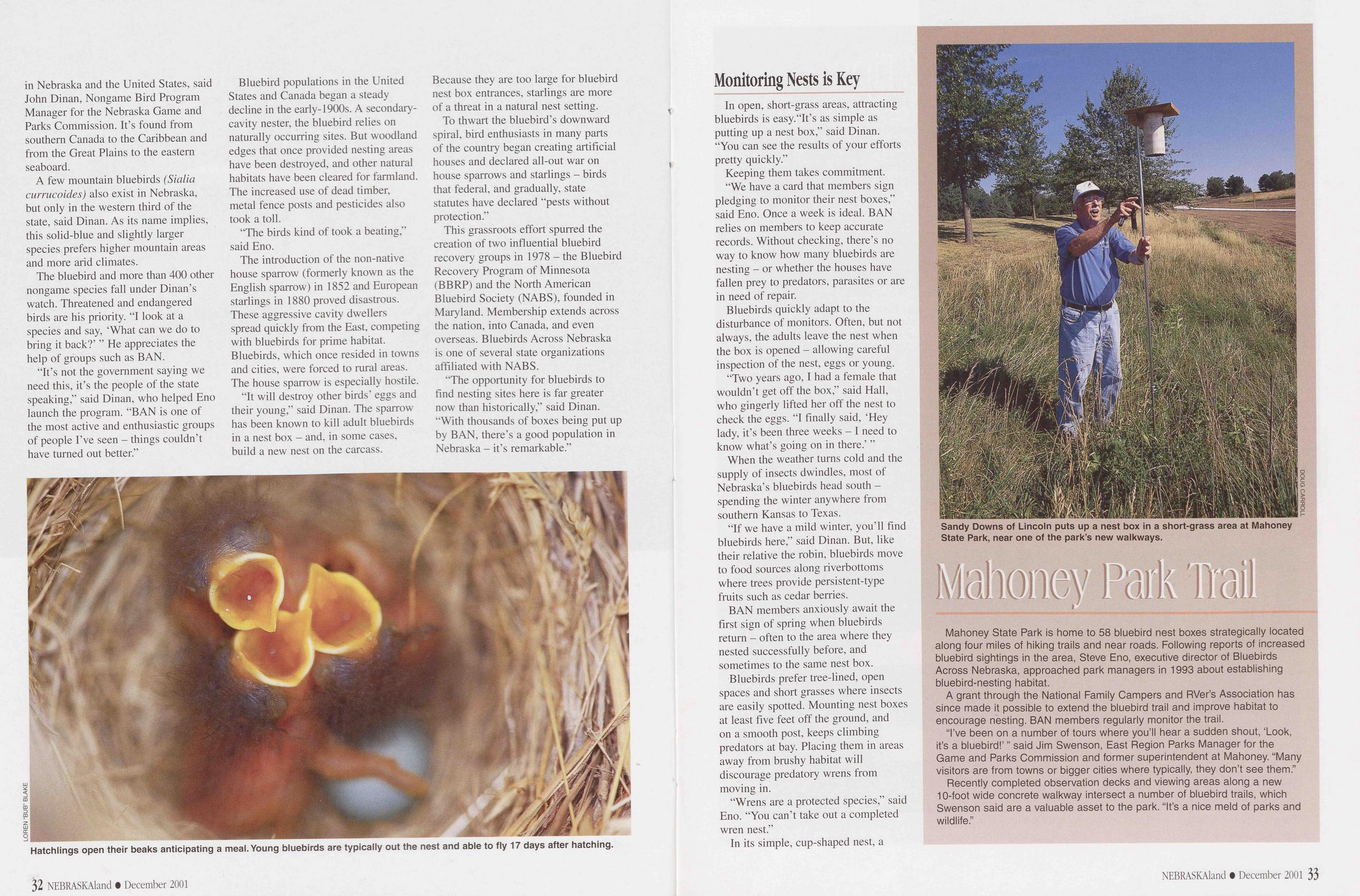
female bluebird will lay three to six pale-blue eggs, which incubate for 12 to 18 days. She may hatch two broods, sometimes three, in a season - and in the same nest box. As long as they've picked a good site with available cavities and food sources, they'll stay, said Dinan.
"What's incredible is in about 17 days the young will be out of the nest box and able to fly," he said.
Opening Eyes to NatureBAN takes the guesswork out of bluebirding - providing educational materials, nest boxes and support for new and veteran members.
The loose-knit group of dedicated volunteers, which now extends into western Iowa, gathers each spring at an annual conference to share experiences. Smaller meetings are held throughout the year.
"We're a very social organization - we like to have fun," said Eno, but BAN takes its mission very seriously.
"The people in this organization are amazing," he said. "I could go down the list, name after name. They are so dedicated."
In addition to establishing and monitoring trails, county coordinators and members organize bluebird workshops for communities and schools, and tend booths at the state and county fairs to educate the public on bluebird conservation.
Behind the scenes, Steve's wife, Cheryl, publishes a quarterly newsletter for members.
"If I could keep up, I might go along once in a while," Cheryl said of her husband's weekly nest box route. "This guy gets more done than anyone I know - he's like a living Nike commercial."
At age 74, volunteer Almon "Connie" Conover builds bluebird houses for BAN in a small shop behind his home in northeastern Lincoln. Using bulk-rate and donated lumber, Conover and a friend have constructed well over 10,000 nest boxes in the past four years.
"I wouldn't do it if it wasn't for Steve," said Conover, who calls Eno the Pied Piper. "He motivates you. The whole organization is infectious."
With a toehold on a nest box's entrance, a brightly colored male peers inside. Eno is awestruck by BAN's success, and is especially proud that the group surpassed its lofty goal of 12,000 fledges last year. In the same breath, he admits the momentum will shift.
There will be plateaus and some down years," he admits. "It's been a slow year here and everywhere. Even the experts aren't sure why."
As it looks to the future, BAN wants to strengthen its county coordinator program in western Nebraska. Eno hopes the TransNebraska Bluebird Trail Project will aid in that effort.
In the spring of 2000, BAN received a three-year, $15,000 grant to develop a 1,100-mile trail of bluebird boxes that will loop from Shenandoah, Iowa, to Scottsbluff, Nebraska.
Outdoor enthusiasts in each county along the route will be recruited to monitor the trail.
"Educating kids is one aspect we'd like to focus on, too," said Cheryl. "We want them to get a taste of it and get their eyes opened to nature."
Steve said, "Bluebirding is a wonderful hands-on project for all ages and a great environmental success story for Nebraska." The personal rewards far outweigh the effort, he said.
Even now, after a decade of doting over hundreds of avian neighbors on his rural Lancaster County acreage, Eno still marvels at the experience.
"There's a great satisfaction knowing if you hadn't put the boxes up, the bluebirds wouldn't be there."
A $7 annual BAN membership includes a "Bluebird Basics " informational booklet, membership directory and quarterly newsletter For more information write to: Bluebirds Across Nebraska, P.O. Box 67157, Lincoln, NE, 68506.
34 NEBRASKAland • December 2001 NEBRASKAland • December 2001 35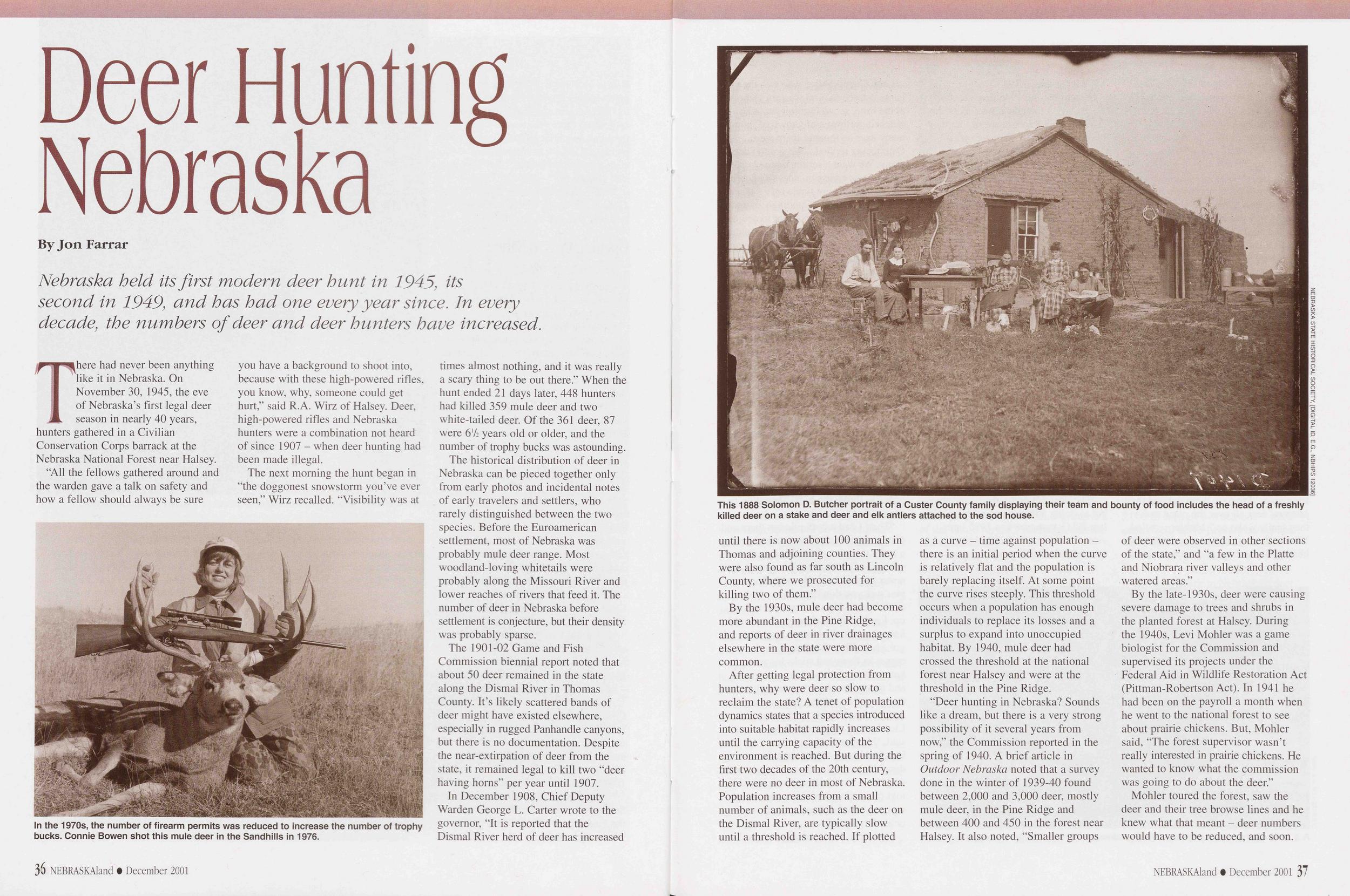
Deer Hunting Nebraska
By Jon Farrar Nebraska held its first modern deer hunt in 1945, its second in 1949, and has had one every year since. In every decade, the numbers of deer and deer hunters have increased.There had never been anything like it in Nebraska. On November 30, 1945, the eve of Nebraska's first legal deer season in nearly 40 years, hunters gathered in a Civilian Conservation Corps barrack at the Nebraska National Forest near Halsey.
"All the fellows gathered around and the warden gave a talk on safety and how a fellow should always be sure you have a background to shoot into, because with these high-powered rifles, you know, why, someone could get hurt," said R. A. Wirz of Halsey. Deer, high-powered rifles and Nebraska hunters were a combination not heard of since 1907 - when deer hunting had been made illegal.
The next morning the hunt began in "the doggonest snowstorm you've ever seen," Wirz recalled. "Visibility was at times almost nothing, and it was really a scary thing to be out there." When the hunt ended 21 days later, 448 hunters had killed 359 mule deer and two white-tailed deer. Of the 361 deer, 87 were 672 years old or older, and the number of trophy bucks was astounding.
The historical distribution of deer in Nebraska can be pieced together only from early photos and incidental notes of early travelers and settlers, who rarely distinguished between the two species. Before the Euroamerican settlement, most of Nebraska was probably mule deer range. Most woodland-loving whitetails were probably along the Missouri River and lower reaches of rivers that feed it. The number of deer in Nebraska before settlement is conjecture, but their density was probably sparse.
The 1901-02 Game and Fish Commission biennial report noted that about 50 deer remained in the state along the Dismal River in Thomas County. It's likely scattered bands of deer might have existed elsewhere, especially in rugged Panhandle canyons, but there is no documentation. Despite the near-extirpation of deer from the state, it remained legal to kill two "deer having horns" per year until 1907.
In December 1908, Chief Deputy Warden George L. Carter wrote to the governor, "It is reported that the Dismal River herd of deer has increased until there is now about 100 animals in Thomas and adjoining counties. They were also found as far south as Lincoln County, where we prosecuted for killing two of them."
By the 1930s, mule deer had become more abundant in the Pine Ridge, and reports of deer in river drainages elsewhere in the state were more common.
After getting legal protection from hunters, why were deer so slow to reclaim the state? A tenet of population dynamics states that a species introduced into suitable habitat rapidly increases until the carrying capacity of the environment is reached. But during the first two decades of the 20th century, there were no deer in most of Nebraska. Population increases from a small number of animals, such as the deer on the Dismal River, are typically slow until a threshold is reached. If plotted as a curve - time against population - there is an initial period when the curve is relatively flat and the population is barely replacing itself. At some point the curve rises steeply. This threshold occurs when a population has enough individuals to replace its losses and a surplus to expand into unoccupied habitat. By 1940, mule deer had crossed the threshold at the national forest near Halsey and were at the threshold in the Pine Ridge.
"Deer hunting in Nebraska? Sounds like a dream, but there is a very strong possibility of it several years from now," the Commission reported in the spring of 1940. A brief article in Outdoor Nebraska noted that a survey done in the winter of 1939-40 found between 2,000 and 3,000 deer, mostly mule deer, in the Pine Ridge and between 400 and 450 in the forest near Halsey. It also noted, "Smaller groups of deer were observed in other sections of the state," and "a few in the Platte and Niobrara river valleys and other watered areas."
By the late-1930s, deer were causing severe damage to trees and shrubs in the planted forest at Halsey. During the 1940s, Levi Mohler was a game biologist for the Commission and supervised its projects under the Lederal Aid in Wildlife Restoration Act (Pittman-Robertson Act). In 1941 he had been on the payroll a month when he went to the national forest to see about prairie chickens. But, Mohler said, "The forest supervisor wasn't really interested in prairie chickens. He wanted to know what the commission was going to do about the deer."
Mohler toured the forest, saw the deer and their tree browse lines and he knew what that meant - deer numbers would have to be reduced, and soon.
NEBRASKAland • December 2001 37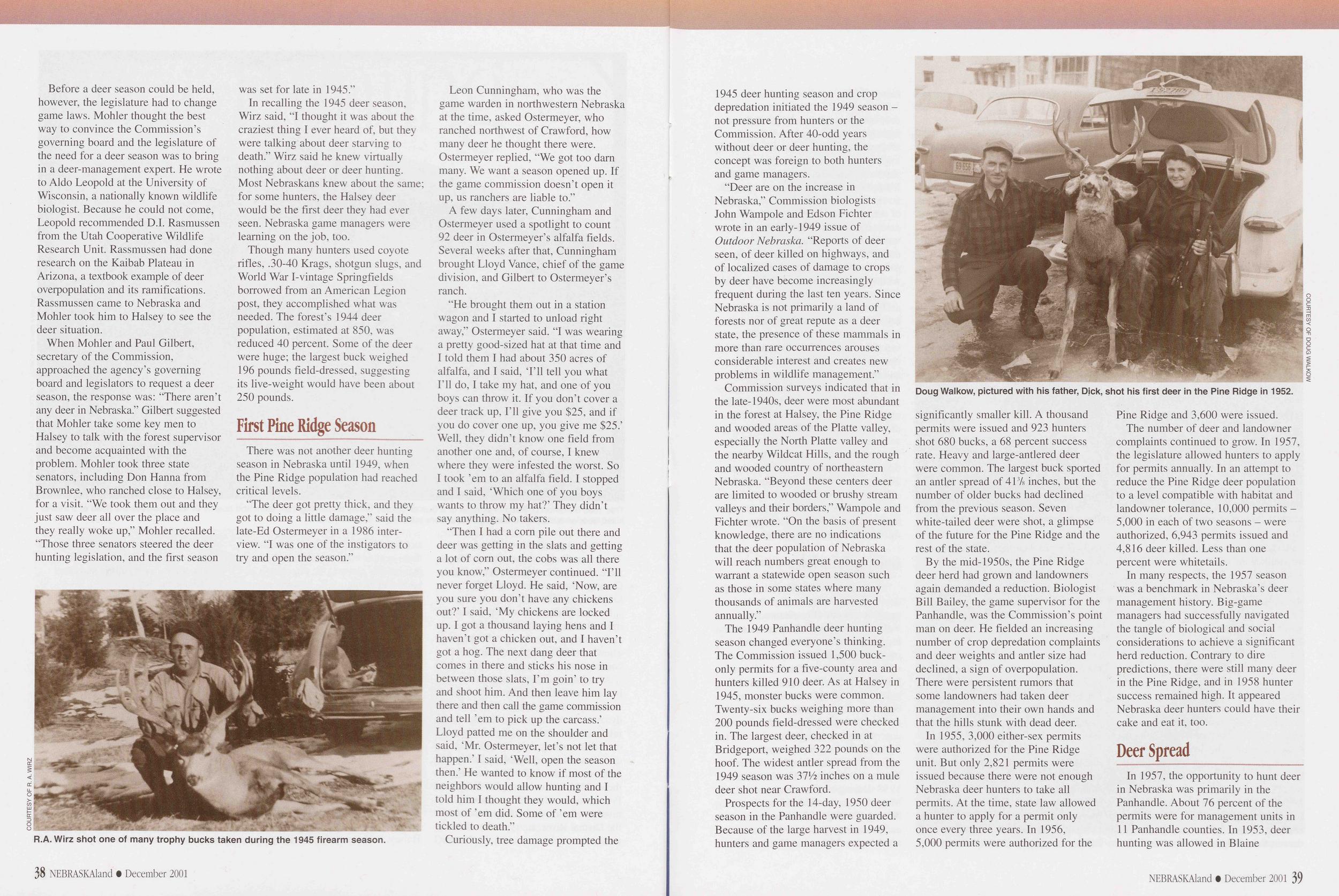
Before a deer season could be held, however, the legislature had to change game laws. Mohler thought the best way to convince the Commission's governing board and the legislature of the need for a deer season was to bring in a deer-management expert. He wrote to Aldo Leopold at the University of Wisconsin, a nationally known wildlife biologist. Because he could not come, Leopold recommended D.I. Rasmussen from the Utah Cooperative Wildlife Research Unit. Rassmussen had done research on the Kaibab Plateau in Arizona, a textbook example of deer overpopulation and its ramifications. Rassmussen came to Nebraska and Mohler took him to Halsey to see the deer situation.
When Mohler and Paul Gilbert, secretary of the Commission, approached the agency's governing board and legislators to request a deer season, the response was: "There aren't any deer in Nebraska." Gilbert suggested that Mohler take some key men to Halsey to talk with the forest supervisor and become acquainted with the problem. Mohler took three state senators, including Don Hanna from Brownlee, who ranched close to Halsey, for a visit. "We took them out and they just saw deer all over the place and they really woke up," Mohler recalled. Those three senators steered the deer hunting legislation, and the first season was set for late in 1945."
In recalling the 1945 deer season, Wirz said, "I thought it was about the craziest thing I ever heard of, but they were talking about deer starving to death." Wirz said he knew virtually nothing about deer or deer hunting. Most Nebraskans knew about the same; for some hunters, the Halsey deer would be the first deer they had ever seen. Nebraska game managers were learning on the job, too.
Though many hunters used coyote rifles, .30-40 Krags, shotgun slugs, and World War I-vintage Springfields borrowed from an American Legion post, they accomplished what was needed. The forest's 1944 deer population, estimated at 850, was reduced 40 percent. Some of the deer were huge; the largest buck weighed 196 pounds field-dressed, suggesting its live-weight would have been about 250 pounds.
First Pine Ridge SeasonThere was not another deer hunting season in Nebraska until 1949, when the Pine Ridge population had reached critical levels.
"The deer got pretty thick, and they got to doing a little damage," said the late-Ed Ostermeyer in a 1986 inter- view. "I was one of the instigators to try and open the season."
Leon Cunningham, who was the game warden in northwestern Nebraska at the time, asked Ostermeyer, who ranched northwest of Crawford, how many deer he thought there were. Ostermeyer replied, "We got too darn many. We want a season opened up. If the game commission doesn't open it up, us ranchers are liable to."
A few days later, Cunningham and Ostermeyer used a spotlight to count 92 deer in Ostermeyer's alfalfa fields. Several weeks after that, Cunningham brought Lloyd Vance, chief of the game division, and Gilbert to Ostermeyer's ranch.
"He brought them out in a station wagon and I started to unload right away," Ostermeyer said. "I was wearing a pretty good-sized hat at that time and I told them I had about 350 acres of alfalfa, and I said, Til tell you what I'll do, I take my hat, and one of you boys can throw it. If you don't cover a deer track up, I'll give you $25, and if you do cover one up, you give me $25.' Well, they didn't know one field from another one and, of course, I knew where they were infested the worst. So I took 'em to an alfalfa field. I stopped and I said, 'Which one of you boys wants to throw my hat?' They didn't say anything. No takers.
"Then I had a corn pile out there and deer was getting in the slats and getting a lot of corn out, the cobs was all there you know," Ostermeyer continued. "I'll never forget Lloyd. He said, 'Now, are you sure you don't have any chickens out?' I said, 'My chickens are locked up. I got a thousand laying hens and I haven't got a chicken out, and I haven't got a hog. The next dang deer that comes in there and sticks his nose in between those slats, I'm goin' to try and shoot him. And then leave him lay there and then call the game commission and tell 'em to pick up the carcass.' Lloyd patted me on the shoulder and said, 'Mr. Ostermeyer, let's not let that happen.' I said, 'Well, open the season then.' He wanted to know if most of the neighbors would allow hunting and I told him I thought they would, which most of 'em did. Some of 'em were tickled to death."
Curiously, tree damage prompted the 1945 deer hunting season and crop depredation initiated the 1949 season - not pressure from hunters or the Commission. After 40-odd years without deer or deer hunting, the concept was foreign to both hunters and game managers.
"Deer are on the increase in Nebraska," Commission biologists John Wampole and Edson Fichter wrote in an early-1949 issue of Outdoor Nebraska. "Reports of deer seen, of deer killed on highways, and of localized cases of damage to crops by deer have become increasingly frequent during the last ten years. Since Nebraska is not primarily a land of forests nor of great repute as a deer state, the presence of these mammals in more than rare occurrences arouses considerable interest and creates new problems in wildlife management."
Commission surveys indicated that in the late-1940s, deer were most abundant in the forest at Halsey, the Pine Ridge and wooded areas of the Platte valley, especially the North Platte valley and the nearby Wildcat Hills, and the rough and wooded country of northeastern Nebraska. "Beyond these centers deer are limited to wooded or brushy stream valleys and their borders," Wampole and Fichter wrote. "On the basis of present knowledge, there are no indications that the deer population of Nebraska will reach numbers great enough to warrant a statewide open season such as those in some states where many thousands of animals are harvested annually."
The 1949 Panhandle deer hunting season changed everyone's thinking. The Commission issued 1,500 buck- only permits for a five-county area and hunters killed 910 deer. As at Halsey in 1945, monster bucks were common. Twenty-six bucks weighing more than 200 pounds field-dressed were checked in. The largest deer, checked in at Bridgeport, weighed 322 pounds on the hoof. The widest antler spread from the 1949 season was 371/2 inches on a mule deer shot near Crawford.
Prospects for the 14-day, 1950 deer season in the Panhandle were guarded. Because of the large harvest in 1949, hunters and game managers expected a Doug Walkow, pictured with his father, Dick, shot his first deer in the Pine Ridge in 1952. significantly smaller kill. A thousand permits were issued and 923 hunters shot 680 bucks, a 68 percent success rate. Heavy and large-antlered deer were common. The largest buck sported an antler spread of 41 Vs inches, but the number of older bucks had declined from the previous season. Seven white-tailed deer were shot, a glimpse of the future for the Pine Ridge and the rest of the state.
By the mid-1950s, the Pine Ridge deer herd had grown and landowners again demanded a reduction. Biologist Bill Bailey, the game supervisor for the Panhandle, was the Commission's point man on deer. He fielded an increasing number of crop depredation complaints and deer weights and antler size had declined, a sign of overpopulation. There were persistent rumors that some landowners had taken deer management into their own hands and that the hills stunk with dead deer.
In 1955, 3,000 either-sex permits were authorized for the Pine Ridge unit. But only 2,821 permits were issued because there were not enough Nebraska deer hunters to take all permits. At the time, state law allowed a hunter to apply for a permit only once every three years. In 1956, 5,000 permits were authorized for the Pine Ridge and 3,600 were issued.
The number of deer and landowner complaints continued to grow. In 1957, the legislature allowed hunters to apply for permits annually. In an attempt to reduce the Pine Ridge deer population to a level compatible with habitat and landowner tolerance, 10,000 permits - 5,000 in each of two seasons - were authorized, 6,943 permits issued and 4,816 deer killed. Less than one percent were white tails.
In many respects, the 1957 season was a benchmark in Nebraska's deer management history. Big-game managers had successfully navigated the tangle of biological and social considerations to achieve a significant herd reduction. Contrary to dire predictions, there were still many deer in the Pine Ridge, and in 1958 hunter success remained high. It appeared Nebraska deer hunters could have their cake and eat it, too.
Deer SpreadIn 1957, the opportunity to hunt deer
in Nebraska was primarily in the
Panhandle. About 76 percent of the
permits were for management units in
11 Panhandle counties. In 1953, deer
hunting was allowed in Blaine
NEBRASKAland • December 2001 39
 and Thomas counties to again reduce
populations in and near the national
forest at Halsey. That year, firearm
seasons were also set in Cherry, Brown,
Rock, Keya Paha and Boyd counties,
and in counties along the Missouri
River as far east as Dakota County. In
1956, firearm units opened just south of
the northern tier of counties, and in
Keith and Lincoln counties in the west.
and Thomas counties to again reduce
populations in and near the national
forest at Halsey. That year, firearm
seasons were also set in Cherry, Brown,
Rock, Keya Paha and Boyd counties,
and in counties along the Missouri
River as far east as Dakota County. In
1956, firearm units opened just south of
the northern tier of counties, and in
Keith and Lincoln counties in the west.
Deer and deer hunting spread from the Panhandle eastward across northern Nebraska. A logical supposition is that deer, principally mule deer, spread eastward from the Pine Ridge along the Niobrara valley. But whitetails were an increasing percentage of the kill in northeastern counties during the mid- and late-1950s. In the Upper Missouri Unit (the tier of Missouri River counties from Holt eastward to Dakota), whitetails outnumbered mule deer in the 1959 harvest two to one. Only five years earlier, 100 mule deer were killed in that unit for every 78 whitetails. Where had the white-tailed deer come from?
A handful of whitetails were killed during Panhandle deer seasons in the early-1950s - progeny, perhaps, of whitetails ranging from the Black Hills in South Dakota, which was whitetail habitat. Whitetails were also present in the national forest at Halsey during the 1945 hunt, suggesting a few whitetails had been on the state's river systems for some time. The fact that southeastern and southern Nebraska were the last regions in the state to be reclaimed by deer suggests whitetails did not move in from Missouri, southwestern Iowa or Kansas. The most likely source of whitetails was from states north and east of Nebraska. Once they had moved to the Missouri River, they quickly expanded westward along major river drainages.
During the 50 or more years when deer were essentially absent, Nebraska had changed. Control of wildfires allowed woodlands to colonize formerly treeless stream valleys and woody shrubs to persist in canyons and gullies. Miles of shelterbelts had been planted across the state following the drought of the 1930s, and trees surrounded many farmsteads. While Nebraska was by no measure a forested state in the 1950s, the quilt-work of woods, pastures and fields provided more whitetail habitat than had been available 100 years earlier.
During the late-1950s, deer seasons followed the expansion of deer herds into regions where previously there were no deer. In 1958, firearm seasons opened in the southwestern counties and many central-Nebraska counties east of the Sandhills. The following year, counties in east-central Nebraska opened. The last deer management unit to open was the Blue Unit in southeastern Nebraska in 1961. Only 250 permits were issued for the 6,800-square-mile area and less than 20 percent of hunters were successful. In just 16 years, from the first deer hunt at Halsey in 1945 to the statewide hunt in 1961, Nebraska had become a full-blown deer hunting state.
Guiding Principles"Our management plan is to produce deer populations that will provide the greatest amount of recreation for Nebraska's big-game hunters over the longest period of time; and second, to maintain populations that are consistent with our many other land uses," wrote Bailey in 1958. Those principles still guide deer-management decisions in Nebraska. But as the number of deer and hunters spiraled upward, achieving deer-management objectives has become infinitely more complex.
Karl Menzel was hired by the Game, Forestation and Parks Commission in 1958. During his first three years, Menzel was stationed in Lincoln. Among his responsibilities was running early-morning quail survey routes in southeastern Nebraska. "I remember seeing one deer in three years," Menzel recalled.
In 1961, Menzel was transferred to Bassett and a year later named assistant project leader for big game. Through occasional title changes, he has been Nebraska's top deer biologist for nearly 40 years - the guiding hand on seasons and regulations and a walking encyclopedia of dates and numbers related to Nebraska deer management.
In 1961, the year before Menzel's big-game career began, 17 units were open to hunting during a five-day season. In 12 units permits were issued only for antlered deer, and in the other five units hunters were allowed to kill an antlerless deer only on the last day of the season. Statewide, 11,993 hunters killed 5,445 deer, a success rate of 45 percent. For every 36 whitetails killed, 100 mule deer were tagged. Archers had record success - 24.3 percent with 1,360 hunters killing 331 deer. Most of those statistics look very different as Menzel's big-game management career draws to a close.
Before 1962, most firearm deer seasons spanned five days. The season was increased to nine days in 1962 where it has remained since. Before 1961, all firearm permits were for bucks only, except for Pine Ridge Unit in years when a reduction in deer was necessary.
Buck-only permits are a management tool allowing maximum sport hunting while permitting deer numbers to increase. Because one buck will breed many does, a 50-50 sex ratio is not necessary for a deer population to grow. At the other end of the deer- management spectrum, antlerless-only permits are issued to reduce the population in an area. Between those extremes, there are variations to achieve different levels of herd expansion or reduction with any given number of permits in a management unit. Either sex permits provide hunter choice and management of population size. During the late-1950s and through most of the 1960s, three types of firearm deer permits were issued: buck-only, either-sex, and buck-only except on the last one or two days of the season.
Allowing hunters to take a doe on the last day of five-day seasons, or during the last two days of nine-day seasons, was designed to allow unsuccessful buck hunters to shoot a doe at the end of the season, and accomplish a measure of herd reduction. In practice, many hunters with unfilled tags on the last day or two of the season received more help shooting does than managers had counted on.
"We were contacted by a minister who requested that we change that regulation because during the nine-day seasons the last day was on a Sunday, and nobody showed up in church," Menzel said. "We recognized that we couldn't continue under that system because we were getting some fairly substantial kills of antlerless deer, 46 to 49 percent in some units. We quit issuing those permits in 1968 and started issuing a percentage of either- sex permits to get herd reduction. The kill could be more reliably predicted."
Measuring the PopulationTo manage a population of animals, whether it is range cattle or free-ranging deer, it is essential to know the number of animals in a specific area - their density. Cattlemen adjust their herd size to avoid overgrazing a specific range area. Deer managers need to know an area's deer density to prevent long-term habitat degradation, but they also must factor in crop damage, the number of deer-vehicle accidents and other sociological considerations. To do that, they must estimate deer populations - not a small undertaking with reclusive animals dispersed over 77,355 square miles.
During the early years, browse surveys, aerial surveys of river systems in winter, road-kill counts and landowner questionnaires were used to monitor deer population numbers. Some of those techniques are still used.
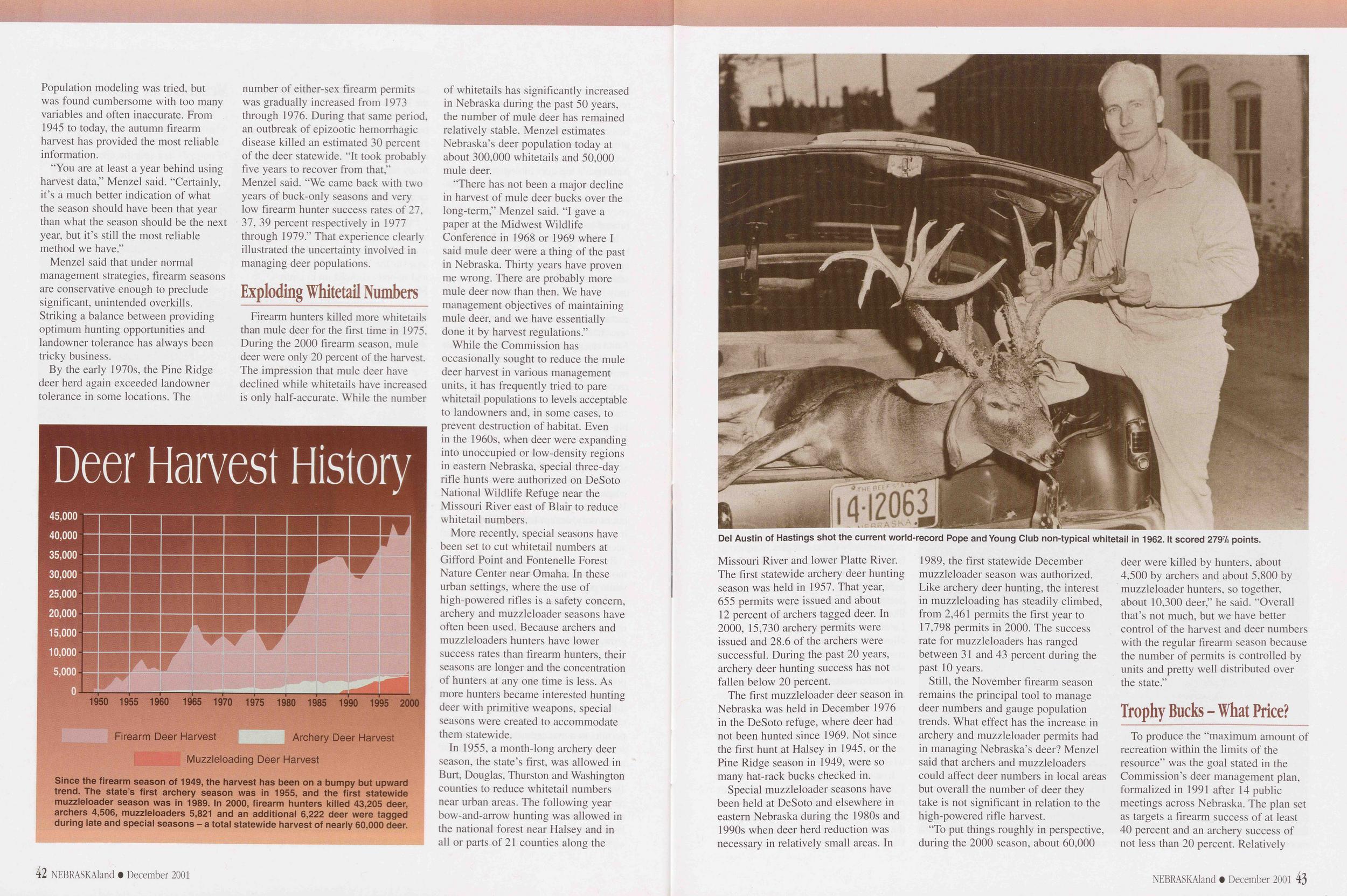
Population modeling was tried, but was found cumbersome with too many variables and often inaccurate. From 1945 to today, the autumn firearm harvest has provided the most reliable information.
'You are at least a year behind using harvest data," Menzel said. "Certainly, it's a much better indication of what the season should have been that year than what the season should be the next year, but it's still the most reliable method we have."
Menzel said that under normal management strategies, firearm seasons are conservative enough to preclude significant, unintended overkills. Striking a balance between providing optimum hunting opportunities and landowner tolerance has always been tricky business.
By the early 1970s, the Pine Ridge deer herd again exceeded landowner tolerance in some locations. The number of either-sex firearm permits was gradually increased from 1973 through 1976. During that same period, an outbreak of epizootic hemorrhagic disease killed an estimated 30 percent of the deer statewide. "It took probably five years to recover from that," Menzel said. "We came back with two years of buck-only seasons and very low firearm hunter success rates of 27, 37, 39 percent respectively in 1977 through 1979." That experience clearly illustrated the uncertainty involved in managing deer populations.
Exploding Whitetail NumbersFirearm hunters killed more whitetails than mule deer for the first time in 1975. During the 2000 firearm season, mule deer were only 20 percent of the harvest. The impression that mule deer have declined while whitetails have increased is only half-accurate. While the number of whitetails has significantly increased in Nebraska during the past 50 years, the number of mule deer has remained relatively stable. Menzel estimates Nebraska's deer population today at about 300,000 whitetails and 50,000 mule deer.
"There has not been a major decline in harvest of mule deer bucks over the long-term," Menzel said. "I gave a paper at the Midwest Wildlife Conference in 1968 or 1969 where I said mule deer were a thing of the past in Nebraska. Thirty years have proven me wrong. There are probably more mule deer now than then. We have management objectives of maintaining mule deer, and we have essentially done it by harvest regulations."
While the Commission has occasionally sought to reduce the mule deer harvest in various management units, it has frequently tried to pare whitetail populations to levels acceptable to landowners and, in some cases, to prevent destruction of habitat. Even in the 1960s, when deer were expanding into unoccupied or low-density regions in eastern Nebraska, special three-day rifle hunts were authorized on DeSoto National Wildlife Refuge near the Missouri River east of Blair to reduce whitetail numbers.
More recently, special seasons have been set to cut whitetail numbers at Gifford Point and Fontenelle Forest Nature Center near Omaha. In these urban settings, where the use of high-powered rifles is a safety concern, archery and muzzleloader seasons have often been used. Because archers and muzzleloaders hunters have lower success rates than firearm hunters, their seasons are longer and the concentration of hunters at any one time is less. As more hunters became interested hunting deer with primitive weapons, special seasons were created to accommodate them statewide.
In 1955, a month-long archery deer season, the state's first, was allowed in Burt, Douglas, Thurston and Washington counties to reduce whitetail numbers near urban areas. The following year bow-and-arrow hunting was allowed in the national forest near Halsey and in all or parts of 21 counties along the Missouri River and lower Platte River. The first statewide archery deer hunting season was held in 1957. That year, 655 permits were issued and about 12 percent of archers tagged deer. In 2000, 15,730 archery permits were issued and 28.6 of the archers were successful. During the past 20 years, archery deer hunting success has not fallen below 20 percent.
The first muzzleloader deer season in Nebraska was held in December 1976 in the DeSoto refuge, where deer had not been hunted since 1969. Not since the first hunt at Halsey in 1945, or the Pine Ridge season in 1949, were so many hat-rack bucks checked in.
Special muzzleloader seasons have been held at DeSoto and elsewhere in eastern Nebraska during the 1980s and 1990s when deer herd reduction was necessary in relatively small areas. In 1989, the first statewide December muzzleloader season was authorized. Like archery deer hunting, the interest in muzzleioading has steadily climbed, from 2,461 permits the first year to 17,798 permits in 2000. The success rate for muzzleloaders has ranged between 31 and 43 percent during the past 10 years.
Still, the November firearm season remains the principal tool to manage deer numbers and gauge population trends. What effect has the increase in archery and muzzleloader permits had in managing Nebraska's deer? Menzel said that archers and muzzleloaders could affect deer numbers in local areas but overall the number of deer they take is not significant in relation to the high-powered rifle harvest.
"To put things roughly in perspective, during the 2000 season, about 60,000 deer were killed by hunters, about 4,500 by archers and about 5,800 by muzzleloader hunters, so together, about 10,300 deer," he said. "Overall that's not much, but we have better control of the harvest and deer numbers with the regular firearm season because the number of permits is controlled by units and pretty well distributed over the state."
Trophy Bucks-What Price?To produce the "maximum amount of
recreation within the limits of the
resource" was the goal stated in the
Commission's deer management plan,
formalized in 1991 after 14 public
meetings across Nebraska. The plan set
as targets a firearm success of at least
40 percent and an archery success of
not less than 20 percent. Relatively
42 NEBRASKAland • December 2001
NEBRASKAland • December 2001 43
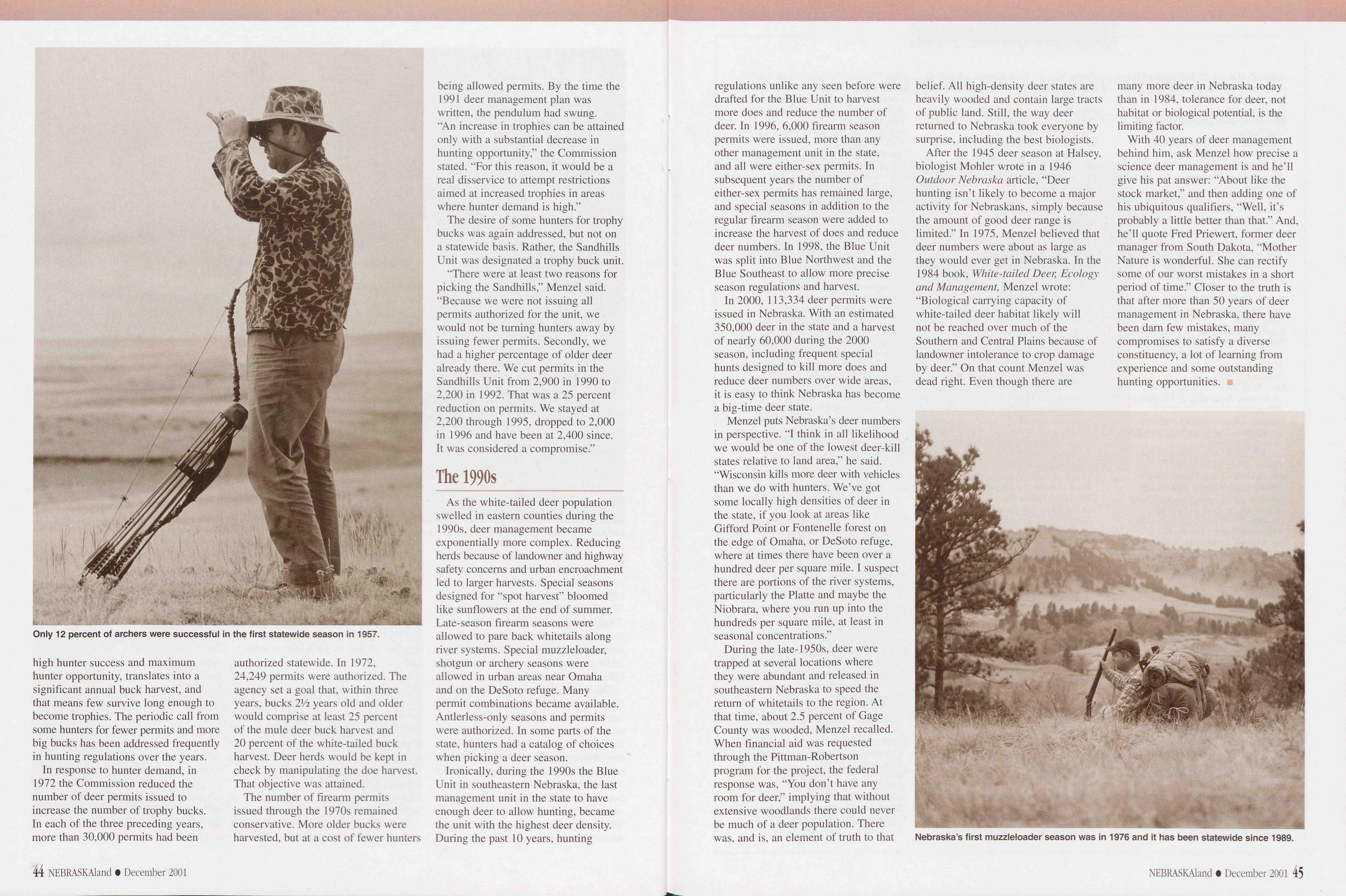 high hunter success and maximum
hunter opportunity, translates into a
significant annual buck harvest, and
that means few survive long enough to
become trophies. The periodic call from
some hunters for fewer permits and more
big bucks has been addressed frequently
in hunting regulations over the years.
high hunter success and maximum
hunter opportunity, translates into a
significant annual buck harvest, and
that means few survive long enough to
become trophies. The periodic call from
some hunters for fewer permits and more
big bucks has been addressed frequently
in hunting regulations over the years.
In response to hunter demand, in 1972 the Commission reduced the number of deer permits issued to increase the number of trophy bucks. In each of the three preceding years, more than 30,000 permits had been authorized statewide. In 1972, 24,249 permits were authorized. The agency set a goal that, within three years, bucks 2Vi years old and older would comprise at least 25 percent of the mule deer buck harvest and 20 percent of the white-tailed buck harvest. Deer herds would be kept in check by manipulating the doe harvest. That objective was attained.
The number of firearm permits issued through the 1970s remained conservative. More older bucks were harvested, but at a cost of fewer hunters being allowed permits. By the time the 1991 deer management plan was written, the pendulum had swung. "An increase in trophies can be attained only with a substantial decrease in hunting opportunity," the Commission stated. "For this reason, it would be a real disservice to attempt restrictions aimed at increased trophies in areas where hunter demand is high."
The desire of some hunters for trophy bucks was again addressed, but not on a statewide basis. Rather, the Sandhills Unit was designated a trophy buck unit.
"There were at least two reasons for picking the Sandhills," Menzel said. "'Because we were not issuing all permits authorized for the unit, we would not be turning hunters away by issuing fewer permits. Secondly, we had a higher percentage of older deer already there. We cut permits in the Sandhills Unit from 2,900 in 1990 to 2,200 in 1992. That was a 25 percent reduction on permits. We stayed at 2,200 through 1995, dropped to 2,000 in 1996 and have been at 2,400 since. It was considered a compromise."
The 1990sAs the white-tailed deer population swelled in eastern counties during the 1990s, deer management became exponentially more complex. Reducing herds because of landowner and highway safety concerns and urban encroachment led to larger harvests. Special seasons designed for "spot harvest" bloomed like sunflowers at the end of summer. Late-season firearm seasons were allowed to pare back whitetails along river systems. Special muzzleloader, shotgun or archery seasons were allowed in urban areas near Omaha and on the DeSoto refuge. Many permit combinations became available. Antlerless-only seasons and permits were authorized. In some parts of the state, hunters had a catalog of choices when picking a deer season.
Ironically, during the 1990s the Blue Unit in southeastern Nebraska, the last management unit in the state to have enough deer to allow hunting, became the unit with the highest deer density. During the past 10 years, hunting regulations unlike any seen before were drafted for the Blue Unit to harvest more does and reduce the number of deer. In 1996, 6,000 firearm season permits were issued, more than any other management unit in the state, and all were either-sex permits. In subsequent years the number of either-sex permits has remained large, and special seasons in addition to the regular firearm season were added to increase the harvest of does and reduce deer numbers. In 1998, the Blue Unit was split into Blue Northwest and the Blue Southeast to allow more precise season regulations and harvest.
In 2000, 113,334 deer permits were issued in Nebraska. With an estimated 350,000 deer in the state and a harvest of nearly 60,000 during the 2000 season, including frequent special hunts designed to kill more does and reduce deer numbers over wide areas, it is easy to think Nebraska has become a big-time deer state.
Menzel puts Nebraska's deer numbers in perspective. "I think in all likelihood we would be one of the lowest deer-kill states relative to land area," he said. "Wisconsin kills more deer with vehicles than we do with hunters. We've got some locally high densities of deer in the state, if you look at areas like Gifford Point or Fontenelle forest on the edge of Omaha, or DeSoto refuge, where at times there have been over a hundred deer per square mile. I suspect there are portions of the river systems, particularly the Platte and maybe the Niobrara, where you run up into the hundreds per square mile, at least in seasonal concentrations."
During the late-1950s, deer were trapped at several locations where they were abundant and released in southeastern Nebraska to speed the return of whitetails to the region. At that time, about 2.5 percent of Gage County was wooded, Menzel recalled. When financial aid was requested through the Pittman-Robertson program for the project, the federal response was, "You don't have any room for deer," implying that without extensive woodlands there could never be much of a deer population. There was, and is, an element of truth to that belief. All high-density deer states are heavily wooded and contain large tracts of public land. Still, the way deer returned to Nebraska took everyone by surprise, including the best biologists.
After the 1945 deer season at Halsey, biologist Mohler wrote in a 1946 Outdoor Nebraska article, "Deer hunting isn't likely to become a major activity for Nebraskans, simply because the amount of good deer range is limited." In 1975, Menzel believed that deer numbers were about as large as they would ever get in Nebraska. In the 1984 book, White-tailed Deer, Ecology and Management, Menzel wrote: "Biological carrying capacity of white-tailed deer habitat likely will not be reached over much of the Southern and Central Plains because of landowner intolerance to crop damage by deer." On that count Menzel was dead right. Even though there are many more deer in Nebraska today than in 1984, tolerance for deer, not habitat or biological potential, is the limiting factor.
With 40 years of deer management behind him, ask Menzel how precise a science deer management is and he'll give his pat answer: "About like the stock market," and then adding one of his ubiquitous qualifiers, "Well, it's probably a little better than that." And, he'll quote Fred Priewert, former deer manager from South Dakota, "Mother Nature is wonderful. She can rectify some of our worst mistakes in a short period of time." Closer to the truth is that after more than 50 years of deer management in Nebraska, there have been darn few mistakes, many compromises to satisfy a diverse constituency, a lot of learning from experience and some outstanding hunting opportunities.
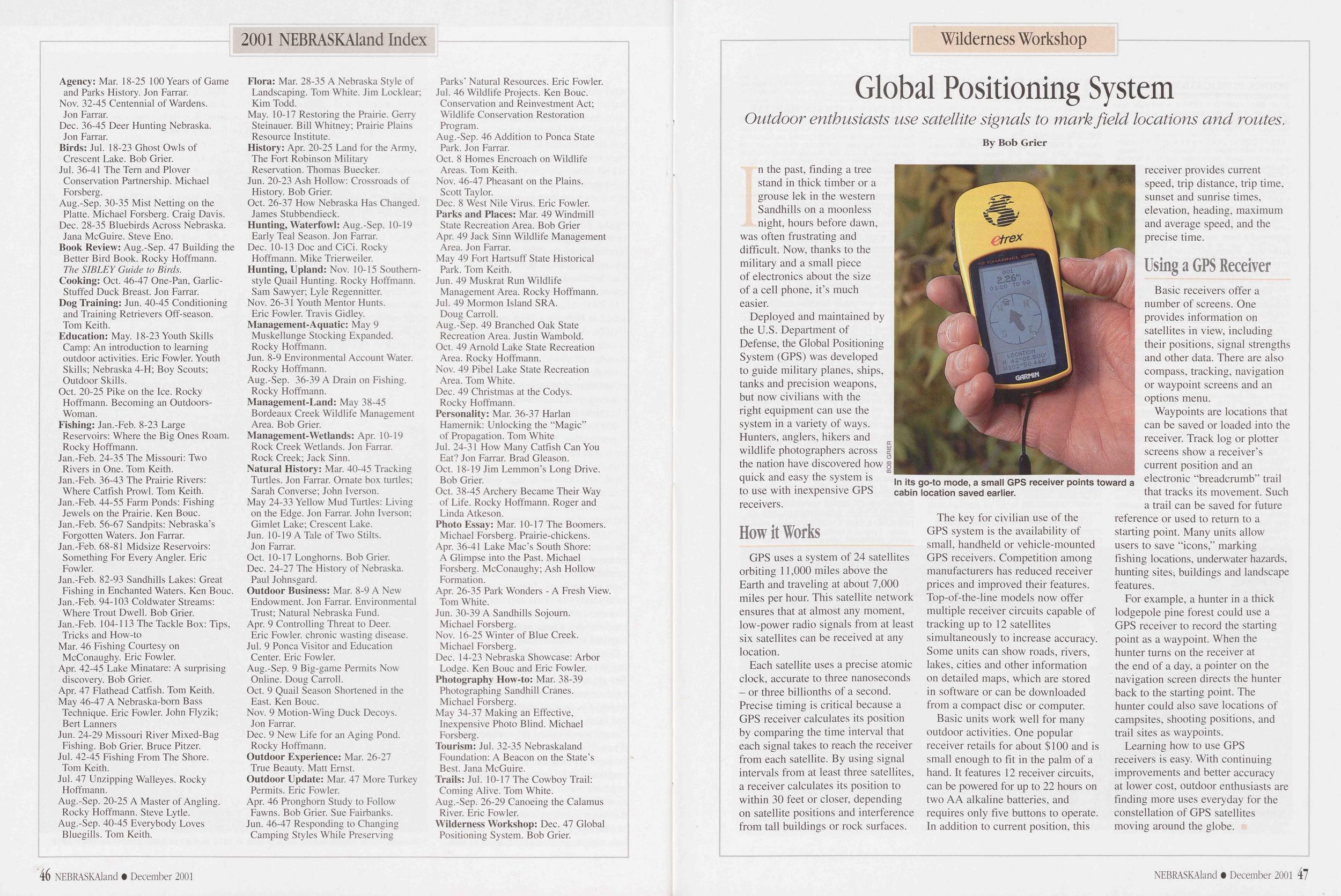
Agency: Mar. 18-25 100 Years of Game and Parks History. Jon Farrar. Nov. 32-45 Centennial of Wardens. Jon Farrar. Dec. 36-45 Deer Hunting Nebraska. Jon Farrar.
Birds: Jul. 18-23 Ghost Owls of Crescent Lake. Bob Grier. Jul. 36-41 The Tern and Plover Conservation Partnership. Michael Forsberg. Aug.-Sep. 30-35 Mist Netting on the Platte. Michael Forsberg. Craig Davis. Dec. 28-35 Bluebirds Across Nebraska. Jana McGuire. Steve Eno.
Book Review: Aug.-Sep. 47 Building the Better Bird Book. Rocky Hoffmann. The SIBLEY Guide to Birds.
Cooking: Oct. 46-47 One-Pan, Garlic Stuffed Duck Breast. Jon Farrar.
Dog Training: Jun. 40-45 Conditioning and Training Retrievers Off-season. Tom Keith.
Education: May. 18-23 Youth Skills Camp: An introduction to learning outdoor activities. Eric Fowler. Youth Skills; Nebraska 4-H; Boy Scouts; Outdoor Skills. Oct. 20-25 Pike on the Ice. Rocky Hoffmann. Becoming an Outdoors- Woman.
Fishing: Jan.-Feb. 8-23 Large Reservoirs: Where the Big Ones Roam. Rocky Hoffmann. Jan.-Feb. 24-35 The Missouri: Two Rivers in One. Tom Keith. Jan.-Feb. 36-43 The Prairie Rivers: Where Catfish Prowl. Tom Keith. Jan.-Feb. 44-55 Farm Ponds: Fishing Jewels on the Prairie. Ken Bouc. Jan.-Feb. 56-67 Sandpits: Nebraska's Forgotten Waters. Jon Farrar. Jan.-Feb. 68-81 Midsize Reservoirs: Something For Every Angler. Eric Fowler. Jan.-Feb. 82-93 Sandhills Lakes: Great Fishing in Enchanted Waters. Ken Bouc. Jan.-Feb. 94-103 Coldwater Streams: Where Trout Dwell. Bob Grier. Jan.-Feb. 104-113 The Tackle Box: Tips, Tricks and How-to Mar. 46 Fishing Courtesy on McConaughy. Eric Fowler. Apr. 42-45 Lake Minatare: A surprising discovery. Bob Grier. Apr. 47 Flathead Catfish. Tom Keith. May 46-47 A Nebraska-born Bass Technique. Eric Fowler. John Flyzik; Bert Lanners Jun. 24-29 Missouri River Mixed-Bag Fishing. Bob Grier. Bruce Pitzer. Jul. 42-45 Fishing From The Shore. Tom Keith. Jul. 47 Unzipping Walleyes. Rocky Hoffmann. Aug.-Sep. 20-25 A Master of Angling. Rocky Hoffmann. Steve Lytle. Aug.-Sep. 40-45 Everybody Loves Bluegills. Tom Keith.
Flora: Mar. 28-35 A Nebraska Style of Landscaping. Tom White. Jim Locklear; Kim Todd. May. 10-17 Restoring the Prairie. Gerry Steinauer. Bill Whitney; Prairie Plains Resource Institute.
History: Apr. 20-25 Land for the Army, The Fort Robinson Military Reservation. Thomas Buecker. Jun. 20-23 Ash Hollow: Crossroads of History. Bob Grier. Oct. 26-37 How Nebraska Has Changed. James Stubbendieck.
Hunting, Waterfowl: Aug.-Sep. 10-19 Early Teal Season. Jon Farrar. Dec. 10-13 Doc and CiCi. Rocky Hoffmann. Mike Trierweiler.
Hunting, Upland: Nov. 10-15 Southern style Quail Hunting. Rocky Hoffmann. Sam Sawyer; Lyle Regennitter. Nov. 26-31 Youth Mentor Hunts. Eric Fowler. Travis Gidley.
Management-Aquatic: May 9 Muskellunge Stocking Expanded. Rocky Hoffmann. Jun. 8-9 Environmental Account Water. Rocky Hoffmann. Aug.-Sep. 36-39 A Drain on Fishing. Rocky Hoffmann.
Management-Land: May 38-45 Bordeaux Creek Wildlife Management Area. Bob Grier.
Management-Wetlands: Apr. 10-19 Rock Creek Wetlands. Jon Farrar. Rock Creek; Jack Sinn.
Natural History: Mar. 40-45 Tracking Turtles. Jon Farrar. Ornate box turtles; Sarah Converse; John Iverson. May 24-33 Yellow Mud Turtles: Living on the Edge. Jon Farrar. John Iverson; Gimlet Lake; Crescent Lake. Jun. 10-19 A Tale of Two Stilts. Jon Farrar. Oct. 10-17 Longhorns. Bob Grier. Dec. 24-27 The History of Nebraska. Paul Johnsgard.
Outdoor Business: Mar. 8-9 A New Endowment. Jon Farrar. Environmental Trust; Natural Nebraska Fund. Apr. 9 Controlling Threat to Deer. Eric Fowler, chronic wasting disease. Jul. 9 Ponca Visitor and Education Center. Eric Fowler. Aug.-Sep. 9 Big-game Permits Now Online. Doug Carroll. Oct. 9 Quail Season Shortened in the East. Ken Bouc. Nov. 9 Motion-Wing Duck Decoys. Jon Farrar. Dec. 9 New Life for an Aging Pond. Rocky Hoffmann.
Outdoor Experience: Mar. 26-27 True Beauty. Matt Ernst.
Outdoor Update: Mar. 47 More Turkey Permits. Eric Fowler. Apr. 46 Pronghorn Study to Follow Fawns. Bob Grier. Sue Fairbanks. Jun. 46-47 Responding to Changing Camping Styles While Preserving Parks' Natural Resources. Eric Fowler. Jul. 46 Wildlife Projects. Ken Bouc. Conservation and Reinvestment Act; Wildlife Conservation Restoration Program. Aug.-Sep. 46 Addition to Ponca State Park. Jon Farrar. Oct. 8 Homes Encroach on Wildlife Areas. Tom Keith. Nov. 46-47 Pheasant on the Plains. Scott Taylor. Dec. 8 West Nile Virus. Eric Fowler.
Parks and Places: Mar. 49 Windmill State Recreation Area. Bob Grier Apr. 49 Jack Sinn Wildlife Management Area. Jon Farrar. May 49 Fort Hartsuff State Historical Park. Tom Keith. Jun. 49 Muskrat Run Wildlife Management Area. Rocky Hoffmann. Jul. 49 Mormon Island SRA. Doug Carroll. Aug.-Sep. 49 Branched Oak State Recreation Area. Justin Wambold. Oct. 49 Arnold Lake State Recreation Area. Rocky Hoffmann. Nov. 49 Pibel Lake State Recreation Area. Tom White. Dec. 49 Christmas at the Codys. Rocky Hoffmann.
Personality: Mar. 36-37 Harlan Hamernik: Unlocking the "Magic" of Propagation. Tom White Jul. 24-31 How Many Catfish Can You Eat? Jon Farrar. Brad Gleason. Oct. 18-19 Jim Lemmon's Long Drive. Bob Grier. Oct. 38-45 Archery Became Their Way of Life. Rocky Hoffmann. Roger and Linda Atkeson.
Photo Essay: Mar. 10-17 The Boomers. Michael Forsberg. Prairie-chickens. Apr. 36-41 Lake Mac's South Shore: A Glimpse into the Past. Michael Forsberg. McConaughy; Ash Hollow Formation. Apr. 26-35 Park Wonders - A Fresh View Tom White. Jun. 30-39 A Sandhills Sojourn. Michael Forsberg. Nov. 16-25 Winter of Blue Creek. Michael Forsberg. Dec. 14-23 Nebraska Showcase: Arbor Lodge. Ken Bouc and Eric Fowler. Photography How-to: Mar. 38-39 Photographing Sandhill Cranes. Michael Forsberg. May 34-37 Making an Effective, Inexpensive Photo Blind. Michael Forsberg.
Tourism: Jul. 32-35 Nebraskaland Foundation: A Beacon on the State's Best. Jana McGuire.
Trails: Jul. 10-17 The Cowboy Trail: Coming Alive. Tom White. Aug.-Sep. 26-29 Canoeing the Calamus River. Eric Fowler.
Wilderness Workshop: Dec. 47 Global Positioning System. Bob Grier.
Wilderness Workshop Global Positioning System Outdoor enthusiasts use satellite signals to mark field locations and routes. By Bob GrierIn the past, finding a tree stand in thick timber or a grouse lek in the western Sandhills on a moonless night, hours before dawn, was often frustrating and difficult. Now, thanks to the military and a small piece of electronics about the size of a cell phone, it's much easier.
Deployed and maintained by the U.S. Department of Defense, the Global Positioning System (GPS) was developed to guide military planes, ships, tanks and precision weapons, but now civilians with the right equipment can use the system in a variety of ways. Hunters, anglers, hikers and wildlife photographers across the nation have discovered how quick and easy the system is to use with inexpensive GPS receivers.
How it WorksGPS uses a system of 24 satellites orbiting 11,000 miles above the Earth and traveling at about 7,000 miles per hour. This satellite network ensures that at almost any moment, low-power radio signals from at least six satellites can be received at any location.
Each satellite uses a precise atomic clock, accurate to three nanoseconds - or three billionths of a second. Precise timing is critical because a GPS receiver calculates its position by comparing the time interval that each signal takes to reach the receiver from each satellite. By using signal intervals from at least three satellites, a receiver calculates its position to within 30 feet or closer, depending on satellite positions and interference from tall buildings or rock surfaces.
The key for civilian use of the GPS system is the availability of small, handheld or vehicle-mounted GPS receivers. Competition among manufacturers has reduced receiver prices and improved their features. Top-of-the-line models now offer multiple receiver circuits capable of tracking up to 12 satellites simultaneously to increase accuracy. Some units can show roads, rivers, lakes, cities and other information on detailed maps, which are stored in software or can be downloaded from a compact disc or computer.
Basic units work well for many outdoor activities. One popular receiver retails for about $100 and is small enough to fit in the palm of a hand. It features 12 receiver circuits, can be powered for up to 22 hours on two A A alkaline batteries, and requires only five buttons to operate. In addition to current position, this receiver provides current speed, trip distance, trip time, sunset and sunrise times, elevation, heading, maximum and average speed, and the precise time.
Using a GPS ReceiverBasic receivers offer a number of screens. One provides information on satellites in view, including their positions, signal strengths and other data. There are also compass, tracking, navigation or waypoint screens and an options menu.
Waypoints are locations that can be saved or loaded into the receiver. Track log or plotter screens show a receiver's current position and an electronic "breadcrumb" trail that tracks its movement. Such a trail can be saved for future reference or used to return to a starting point. Many units allow users to save "icons," marking fishing locations, underwater hazards, hunting sites, buildings and landscape features.
For example, a hunter in a thick lodgepole pine forest could use a GPS receiver to record the starting point as a waypoint. When the hunter turns on the receiver at the end of a day, a pointer on the navigation screen directs the hunter back to the starting point. The hunter could also save locations of campsites, shooting positions, and trail sites as waypoints.
Learning how to use GPS receivers is easy. With continuing improvements and better accuracy at lower cost, outdoor enthusiasts are finding more uses everyday for the constellation of GPS satellites moving around the globe.
NEBRASKAland • December 2001 47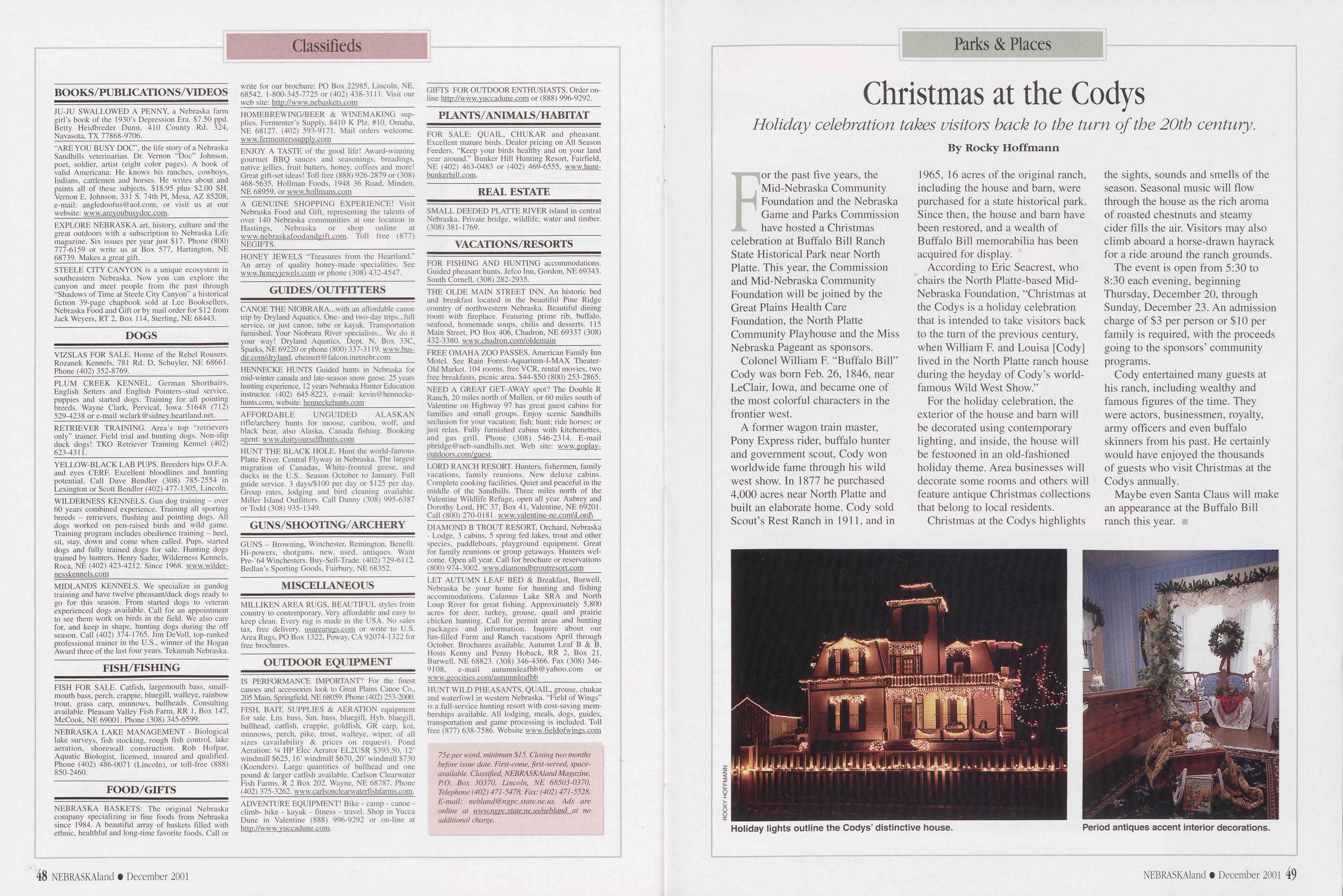
Classifieds
BOOKS/PUBLICATIONS/VIDEOSJU-JU SWALLOWED A PENNY, a Nebraska farm girl's book of the 1930's Depression Era. $7.50 ppd. Betty Heidbreder Dunn, 410 County Rd. 324, Navasota, TX 77868-9706.
'ARE YOU BUSY DOC", the life story of a Nebraska Sandhills veterinarian. Dr. Vernon "Doc" Johnson, poet, soldier, artist (eight color pages). A book of valid Americana: He knows his ranches, cowboys, Indians, cattlemen and horses. He writes about and paints all of these subjects. $18.95 plus $2.00 SH. Vernon E. Johnson, 331 S. 74th PI, Mesa, AZ 85208, e-mail: angledoofus@aol.com, or visit us at our website: www.areyoubusydoc.com.
EXPLORE NEBRASKA art, history, culture and the great outdoors with a subscription to Nebraska Life magazine. Six issues per year just $17. Phone (800) 777-6159 or write us at Box 577, Hartington, NE 68739. Makes a great gift.
STEELE CITY CANYON is a unique ecosystem in southeastern Nebraska. Now you can explore the canyon and meet people from the past through "Shadows of Time at Steele City Canyon" a historical fiction 39-page chapbook sold at Lee Booksellers, Nebraska Food and Gift or by mail order for $ 12 from Jack Weyers, RT 2, Box 114, Sterling, NE 68443.
DOGSVIZSLAS FOR SALE. Home of the Rebel Rousers. Rozanek Kennels, 781 Rd. D, Schuyler, NE 68661. Phone (402) 352-8769.
PLUM CREEK KENNEL. German Shorthairs, English Setters and English Pointers-stud service, puppies and started dogs. Training for all pointing breeds. Wayne Clark, Pervical, Iowa 51648 (712) 529-4238 or e-mail wclark@sidney.heartland.net.
RETRIEVER TRAINING. Area's top "retrievers only" trainer. Field trial and hunting dogs. Non-slip duck dogs! TKO Retriever Training Kennel (402) 623-4311.
YELLOW-BLACK LAB PUPS. Breeders hips O.F.A. and eyes CERE Excellent bloodlines and hunting potential. Call Dave Bendler (308)785-2554 in Lexington or Scott Bendler (402)477-1305, Lincoln.
WILDERNESS KENNELS. Gun dog training - over 60 years combined experience. Training all sporting breeds - retrievers, flushing and pointing dogs. All dogs worked on pen-raised birds and wild game. Training program includes obedience training - heel, sit, stay, down and come when called. Pups, started dogs and fully trained dogs for sale. Hunting dogs trained by hunters. Henry Sader, Wilderness Kennels, Roca, NE (402)423-4212. Since 1968. www.wildernesskennels.com
MIDLANDS KENNELS. We specialize in gundog training and have twelve pheasant/duck dogs ready to go for this season. From started dogs to veteran experienced dogs available. Call for an appointment to see them work on birds in the field. We also care for, and keep in shape, hunting dogs during the off season. Call (402)374-1765. Jim DeVoll, top-ranked professional trainer in the U.S., winner of the Hogan Award three of the last four years. Tekamah Nebraska.
FISH/FISHINGFISH FOR SALE. Catfish, largemouth bass, smallmouth bass, perch, crappie, bluegill, walleye, rainbow trout, grass carp, minnows, bullheads. Consulting available. Pleasant Valley Fish Farm, RR 1, Box 147, McCook, NE 69001. Phone (308) 345-6599.
NEBRASKA LAKE MANAGEMENT - Biological lake surveys, fish stocking, rough fish control, lake aeration, shorewall construction. Rob Hofpar, Aquatic Biologist, licensed, insured and qualified. Phone (402)486-0071 (Lincoln), or toll-free (888) 850-2460.
FOOD/GIFTSNEBRASKA BASKETS: The original Nebraska company specializing in fine foods from Nebraska since 1984. A beautiful array of baskets filled with ethnic, healthful and long-time favorite foods. Call or write for our brochure: PO Box 22985, Lincoln, NE. 68542. 1-800-345-7725 or (402)438-3111. Visit our web site: http://www.nebaskets.com
HOMEBREWING/BEER & WINEMAKING sup- plies. Fermenter's Supply, 8410 K Plz. #10. Omaha, NE 68127. (402)593-9171. Mail orders welcome. www.fermenterssupply.com
ENJOY A TASTE of the good life! Award-winning gourmet BBQ sauces and seasonings, breadings. native jellies, fruit butters, honey, coffees and more! Great gift-set ideas! Toll free (888) 926-2879 or (308) 468-5635. Hollman Foods, 1948 36 Road, Minden, NE 68959, or www.hollmans.com
A GENUINE SHOPPING EXPERIENCE! Visit Nebraska Food and Gift, representing the talents of over 140 Nebraska communities at one location in Hastings, Nebraska or shop online at www.nebraskafoodandgift.com. Toll free (877) NEGIFTS.
HONEY JEWELS "Treasures from the Heartland." An array of quality honey-made specialities. See www.honeyjewels.com or phone (308) 432-4547.
GUIDES/OUTFITTERSCANOE THE NIOBRARA...with an affordable canoe trip by Dryland Aquatics. One- and two-day trips...full service, or just canoe, tube or kayak. Transportation furnished. Your Niobrara River specialists... We do it your way! Dryland Aquatics, Dept. N, Box 33C. Sparks, NE 69220 or phone (800) 337-3119. www.busdir.com/dryland eheinert@falcon.inetnebr.com
HENNECKE HUNTS Guided hunts in Nebraska for mid-winter Canada and late-season snow geese. 25 years hunting experience, 12 years Nebraska Hunter Education instructor. (402) 645-8223, e-mail: kevin@henneckehunts.com, website: henneckehunts.com
AFFORDABLE UNGUIDED ALASKAN rifle/archery hunts for moose, caribou, wolf, and black bear, also Alaska, Canada fishing. Booking agent: www.doityourselfhunts.com
HUNT THE BLACK HOLE. Hunt the world-famous Platte River. Central Flyway in Nebraska. The largest migration of Canadas, White-fronted geese, and ducks in the U.S.. Season October to January. Full guide service. 3 days/$ 100 per day or $ 125 per day. Group rates, lodging and bird cleaning available. Miller Island Outfitters. Call Danny (308) 995-6387 or Todd (308) 935-1349.
GUNS/SHQQTING/ARCHERYGUNS - Browning, Winchester, Remington, Benelli. Hi-powers, shotguns, new. used, antiques. Want Pre-'64 Winchesters. Buy-Sell-Trade. (402) 729-6112. Bedlan's Sporting Goods, Fairbury, NE 68352.
MISCELLANEOUSMILLIKEN AREA RUGS, BEAUTIFUL styles from country to contemporary. Very affordable and easy to keep clean. Every rug is made in the USA. No sales tax, free delivery, usarearugs.com or write to U.S. Area Rugs, PO Box 1322, Poway, CA 92074-1322 for free brochures.
OUTDOOR EQUIPMENTIS PERFORMANCE IMPORTANT? For the finest canoes and accessories look to Great Plains Canoe Co.. 205 Main, Springfield, NE 68059. Phone (402) 253-2000.
FISH, BAIT, SUPPLIES & AERATION equipment for sale. Lm. bass, Sm. bass, bluegill, Hyb. bluegill, bullhead, catfish, crappie, goldfish, GR carp, koi, minnows, perch, pike, trout, walleye, wiper, of all sizes (availability & prices on request). Pond Aeration: V* HP Elec Aerator EL2USR $393.50, 12' windmill $625, 16' windmill $670, 20' windmill $730 (Koenders). Large quantities of bullhead and one pound & larger catfish available. Carlson Clearwater Fish Farms, R 2 Box 202, Wayne, NE 68787. Phone (402) 375-3262. www.carlsonclearwaterfishfanns.com.
ADVENTURE EQUIPMENT! Bike - camp - canoe - climb- hike - kayak - fitness - travel. Shop in Yucca Dune in Valentine (888) 996-9292 or on-line at http://www.yuccadune.com.
GIFTS FOR OUTDOOR ENTHUSIASTS. Order on- line http://www.yuccadune.com or (888) 996-9292.
PLANTS/ANIMALS/HABITATFOR SALE: QUAIL, CHUKAR and pheasant. Excellent mature birds. Dealer pricing on All Season Feeders. "Keep your birds healthy and on your land year around." Bunker Hill Hunting Resort, Fairfield, NE (402) 463-0483 or (402) 469-6555, www.huntbunkerhill.com.
REAL ESTATESMALL DEEDED PLATTE RIVER island in central Nebraska. Private bridge, wildlife, water and timber. (308) 381-1769.
VACATIONS/RESORTSFOR FISHING AND HUNTING accommodations. Guided pheasant hunts. Jefco Inn, Gordon, NE 69343. South Cornell, (308) 282-2935.
THE OLDE MAIN STREET INN. An historic bed and breakfast located in the beautiful Pine Ridge country of northwestern Nebraska. Beautiful dining room with fireplace. Featuring prime rib, buffalo, seafood, homemade soups, chilis and desserts. 115 Main Street, PO Box 406, Chadron, NE 69337 (308) 432-3380. www.chadron.com/oldemain
FREE OMAHA ZOO PASSES, American Family Inn Motel. See Rain Forest-Aquarium-I-MAX Theater- Old Market. 104 rooms, free VCR, rental movies, two free breakfasts, picnic area. $44-$50 (800) 253-2865.
NEED A GREAT GET-AWAY spot? The Double R Ranch, 20 miles north of Mullen, or 60 miles south of Valentine on Highway 97 has great guest cabins for families and small groups. Enjoy scenic Sandhills seclusion for your vacation; fish; hunt; ride horses; or just relax. Fully furnished cabins with kitchenettes, and gas grill. Phone (308) 546-2314. E-mail pbridge@neb-sandhills.net. Web site: www.goplayoutdoors.com/guest.
LORD RANCH RESORT. Hunters, fishermen, family vacations, family reunions. New deluxe cabins. Complete cooking facilities. Quiet and peaceful in the middle of the Sandhills. Three miles north of the Valentine Wildlife Refuge, open all year. Aubrey and Dorothy Lord, HC 37, Box 41, Valentine, NE 69201. Call (800) 270-0181. www.valentine-ne.com\Lord\
DIAMOND B TROUT RESORT, Orchard, Nebraska - Lodge, 3 cabins, 5 spring fed lakes, trout and other species, paddle boats, playground equipment. Great for family reunions or group getaways. Hunters welcome. Open all year. Call for brochure or reservations (800) 974-3002. www.diamondbtroutresort.com
LET AUTUMN LEAF BED & Breakfast, Burwell, Nebraska be your home for hunting and fishing accommodations. Calamus Lake SRA and North Loup River for great fishing. Approximately 5,800 acres for deer, turkey, grouse, quail and prairie chicken hunting. Call for permit areas and hunting packages and information. Inquire about our fun-filled Farm and Ranch vacations April through October. Brochures available. Autumn Leaf B & B, Hosts Kenny and Penny Hoback, RR 2, Box 21, Burwell, NE 68823. (308) 346-4366. Fax (308) 346-9108, e-mail autumnleafbb@yahoo.com or www.geocities.com/autumnleafbb
HUNT WILD PHEASANTS, QUAIL, grouse, chukar and waterfowl in western Nebraska. "Field of Wings" is a full-service hunting resort with cost-saving memberships available. All lodging, meals, dogs, guides, transportation and game processing is included. Toll free (877) 638-7586. Website www.fieldofwings.com 75$ perword, minimum $J5. Closing two months before issue date. First-come, first-served, space- available. Classified, NEBRASKAland Magazine, P.O. Box 30370, Lincoln, NE 68503-0370. Telephone (402) 471-5478. Fax: (402) 471-5528. E-mail: nebland@ngpc.state.ne.us. Ads are online at www.ngpe.state.ne.us/nebland at no additional charge.
Parks & Places Christmas at the Codys Holiday celebration takes visitors back to the turn of the 20th century.For the past five years, the Mid-Nebraska Community Foundation and the Nebraska Game and Parks Commission have hosted a Christmas celebration at Buffalo Bill Ranch State Historical Park near North Platte. This year, the Commission and Mid-Nebraska Community Foundation will be joined by the Great Plains Health Care Foundation, the North Platte Community Playhouse and the Miss Nebraska Pageant as sponsors.
Colonel William F. "Buffalo Bill" Cody was born Feb. 26, 1846, near LeClair, Iowa, and became one of the most colorful characters in the frontier west.
A former wagon train master, Pony Express rider, buffalo hunter and government scout, Cody won worldwide fame through his wild west show. In 1877 he purchased 4,000 acres near North Platte and built an elaborate home. Cody sold Scout's Rest Ranch in 1911, and in 1965, 16 acres of the original ranch, including the house and barn, were purchased for a state historical park. Since then, the house and barn have been restored, and a wealth of Buffalo Bill memorabilia has been acquired for display.
According to Eric Seacrest, who chairs the North Platte-based Mid-Nebraska Foundation, "Christmas at the Codys is a holiday celebration that is intended to take visitors back to the turn of the previous century, when William F. and Louisa [Cody] lived in the North Platte ranch house during the heyday of Cody's world famous Wild West Show."
For the holiday celebration, the exterior of the house and barn will be decorated using contemporary lighting, and inside, the house will be festooned in an old-fashioned holiday theme. Area businesses will decorate some rooms and others will feature antique Christmas collections that belong to local residents.
Christmas at the Codys highlights the sights, sounds and smells of the season. Seasonal music will flow through the house as the rich aroma of roasted chestnuts and steamy cider fills the air. Visitors may also climb aboard a horse-drawn hayrack for a ride around the ranch grounds.
The event is open from 5:30 to 8:30 each evening, beginning Thursday, December 20, through Sunday, December 23. An admission charge of $3 per person or $10 per family is required, with the proceeds going to the sponsors' community programs.
Cody entertained many guests at his ranch, including wealthy and famous figures of the time. They were actors, businessmen, royalty, army officers and even buffalo skinners from his past. He certainly would have enjoyed the thousands of guests who visit Christmas at the Codys annually.
Maybe even Santa Claus will make an appearance at the Buffalo Bill ranch this year.
NEBRASKAland • December 2001 49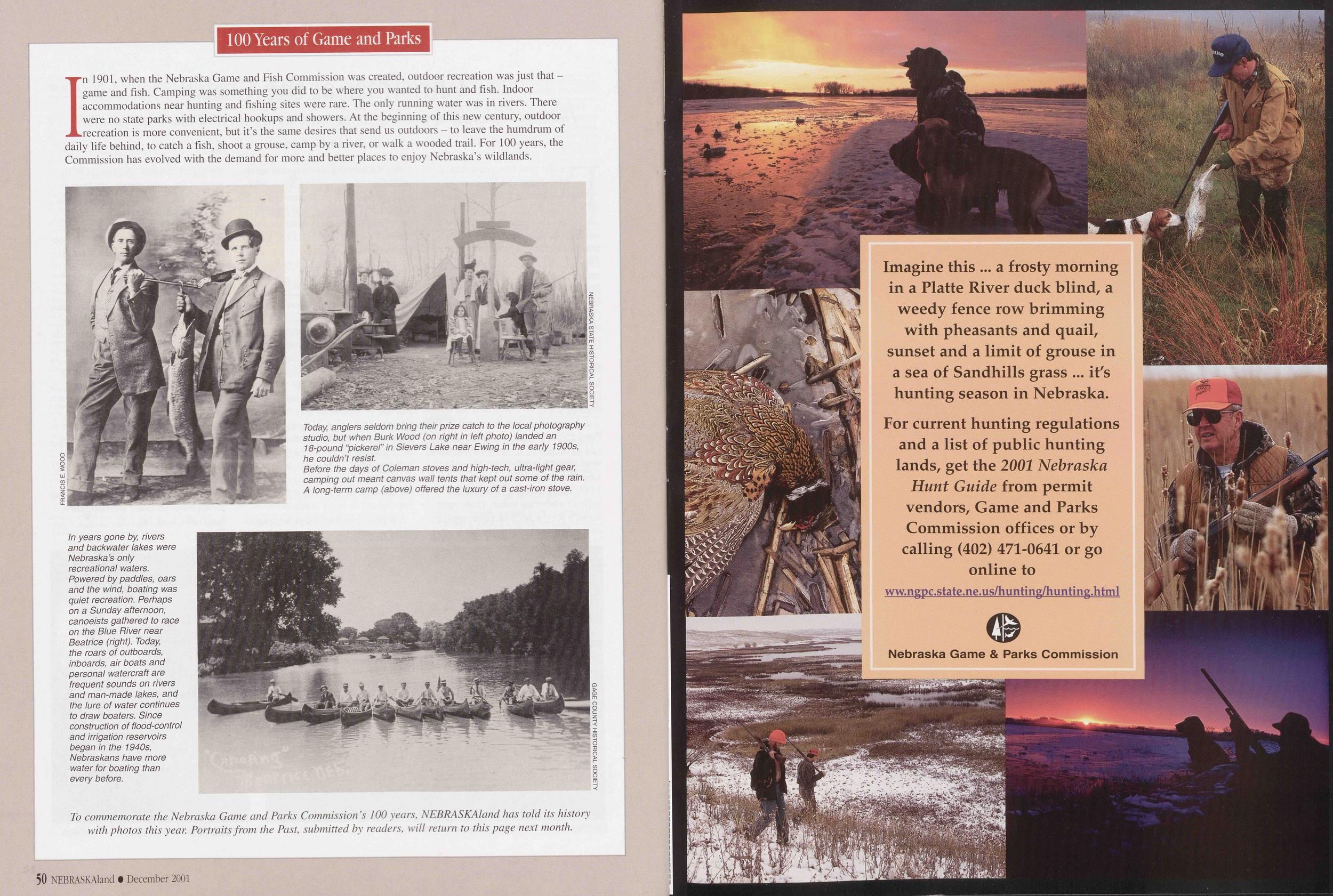
In 1901, when the Nebraska Game and Fish Commission was created, outdoor recreation was just that - game and fish. Camping was something you did to be where you wanted to hunt and fish. Indoor accommodations near hunting and fishing sites were rare. The only running water was in rivers. There were no state parks with electrical hookups and showers. At the beginning of this new century, outdoor recreation is more convenient, but it's the same desires that send us outdoors - to leave the humdrum of daily life behind, to catch a fish, shoot a grouse, camp by a river, or walk a wooded trail. For 100 years, the Commission has evolved with the demand for more and better places to enjoy Nebraska's wild lands.
Today, anglers seldom bring their prize catch to the local photography studio, but when Burk Wood (on right in left photo) landed an 18-pound "pickerel" in Sievers Lake near Ewing in the early 1900s, he couldn't resist Before the days of Coleman stoves and high-tech, ultra-light gear, camping out meant canvas wall tents that kept out some of the rain. A long-term camp (above) offered the luxury of a cast-iron stove.
In years gone by, rivers and backwater lakes were Nebraska's only recreational waters. Powered by paddles, oars and the wind, boating was quiet recreation. Perhaps on a Sunday afternoon, canoeists gathered to race on the Blue River near Beatrice (right). Today, the roars of outboards, inboards, air boats and personal watercraft are frequent sounds on rivers and man-made lakes, and the lure of water continues to draw boaters. Since construction of flood-control and irrigation reservoirs began in the 1940s, Nebraskans have more water for boating than every before.
To commemorate the Nebraska Game and Parks Commission's 100 years, NEBRASKAland has told its history with photos this year. Portraits from the Past, submitted by readers, will return to this page next month.
Imagine this ... a frosty morning in a Platte River duck blind, a weedy fence row brimming with pheasants and quail, sunset and a limit of grouse in a sea of Sandhills grass ... it's hunting season in Nebraska. For current hunting regulations and a list of public hunting lands, get the 2001 Nebraska Hunt Guide from permit vendors, Game and Parks Commission offices or by calling (402) 471-0641 or go online to ww.ngpc.state.ne.us/hunting/hunting.htm1 Nebraska Game & Parks Commission
Position: 583 (19 views)