Volume 79, Issue 9, 2001
NEBRASKAland
Nebraska Game & Parks Commission November 2001 $2.50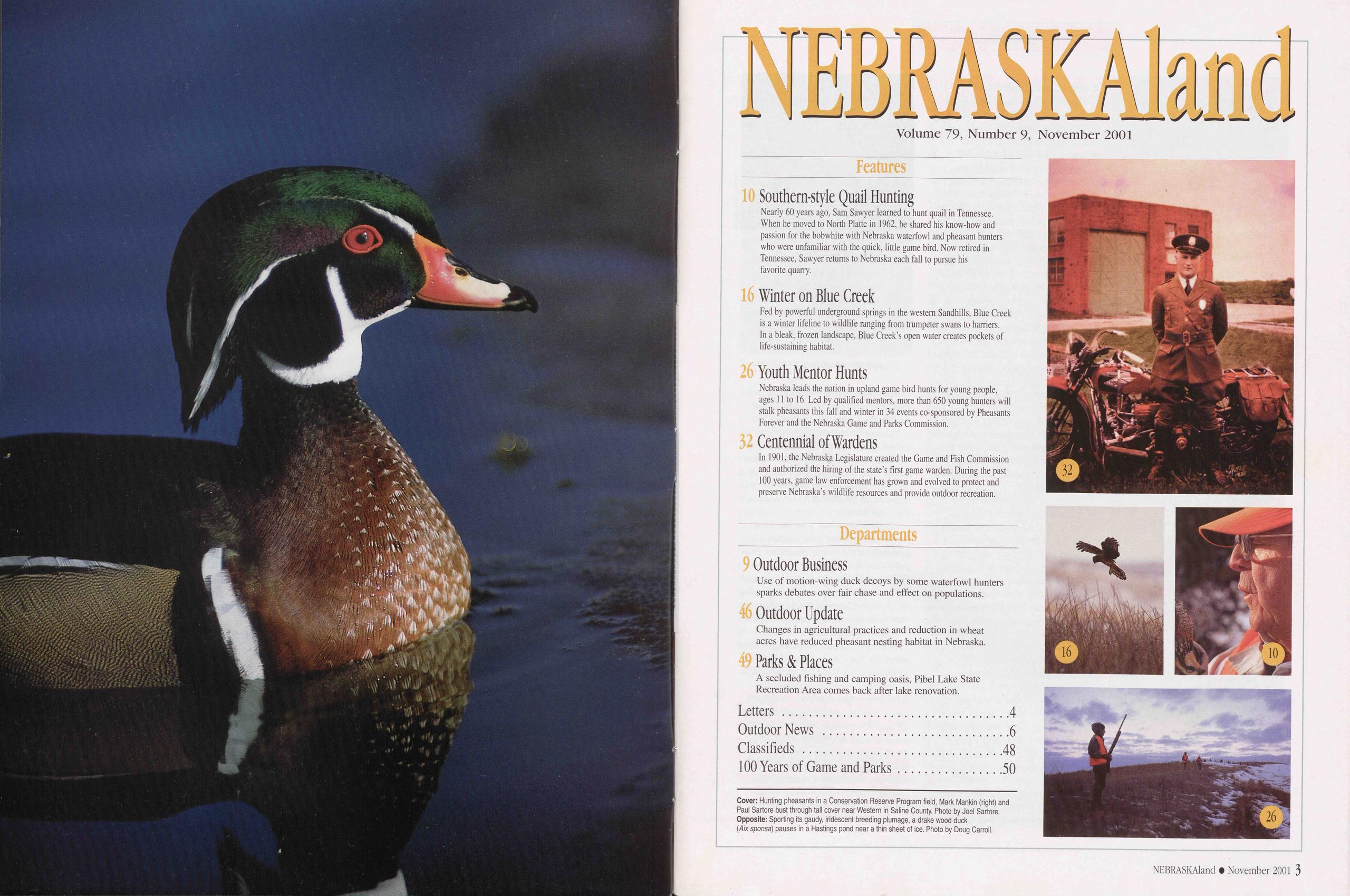
NEBRASKAland
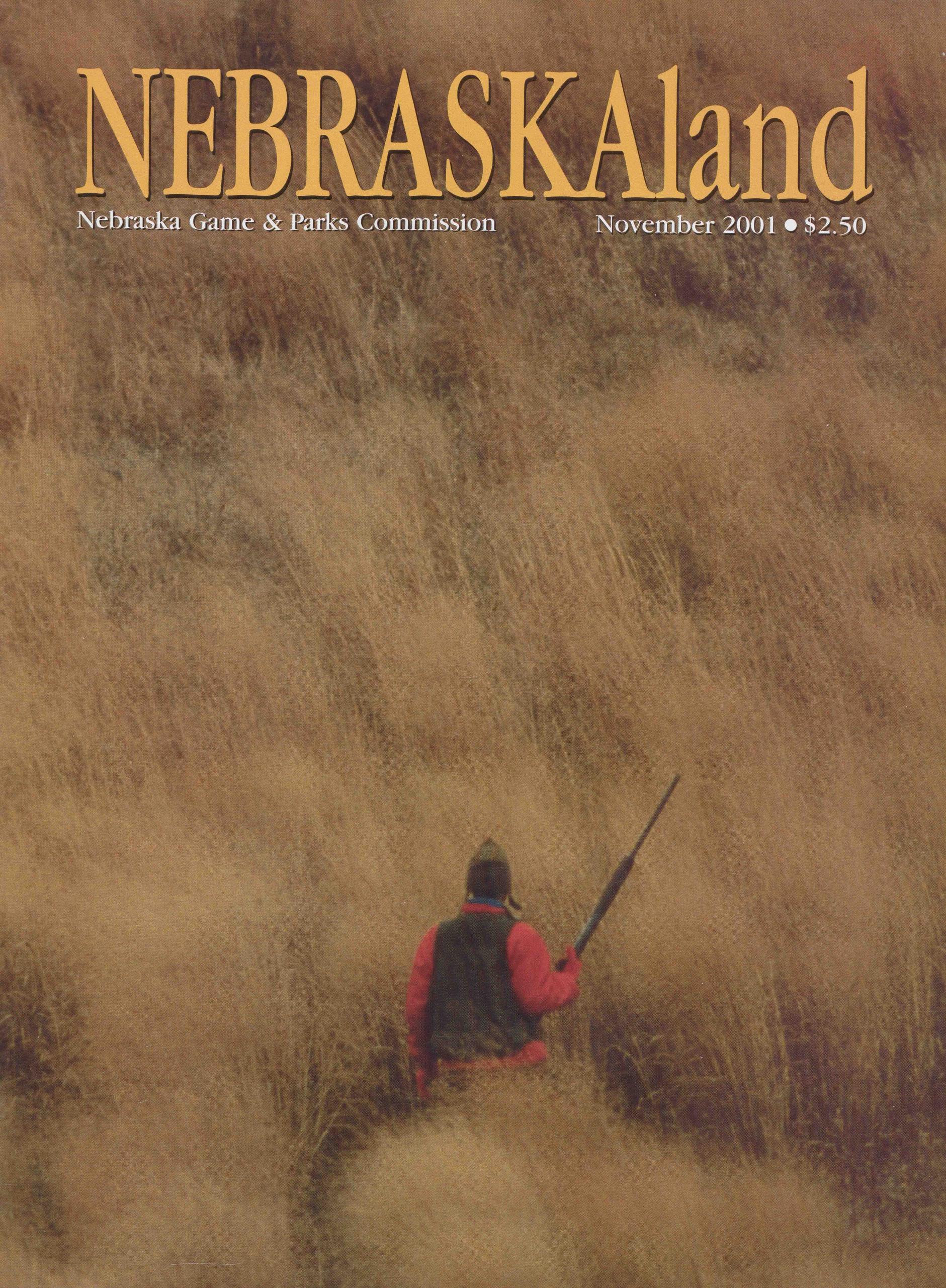
Volume 79, Number 9, November 2001 Features 10 Southern-style Quail Hunting Nearly 60 years ago, Sam Sawyer learned to hunt quail in Tennessee. When he moved to North Platte in 1962, he shared his know-how and passion for the bobwhite with Nebraska waterfowl and pheasant hunters who were unfamiliar with the quick, little game bird. Now retired in Tennessee, Sawyer returns to Nebraska each fall to pursue his favorite quarry. 16 Winter on Blue Creek Fed by powerful underground springs in the western Sandhills, Blue Creek is a winter lifeline to wildlife ranging from trumpeter swans to harriers. In a bleak, frozen landscape, Blue Creek’s open water creates pockets of life-sustaining habitat. 26 Youth Mentor Hunts Nebraska leads the nation in upland game bird hunts for young people, ages 11 to 16. Led by qualified mentors, more than 650 young hunters will stalk pheasants this fall and winter in 34 events co-sponsored by Pheasants Forever and the Nebraska Game and Parks Commission. 32 Centennial of Wardens In 1901, the Nebraska Legislature created the Game and Fish Commission and authorized the hiring of the state’s first game warden. During the past 100 years, game law enforcement has grown and evolved to protect and preserve Nebraska’s wildlife resources and provide outdoor recreation. Departments 9 Outdoor Business Use of motion-wing duck decoys by some waterfowl hunters sparks debates over fair chase and effect on populations. 46 Outdoor Update Changes in agricultural practices and reduction in wheat acres have reduced pheasant nesting habitat in Nebraska. 49 Parks & Places A secluded fishing and camping oasis, Pibel Lake State Recreation Area comes back after lake renovation. Letters .........................................4 Outdoor News ....................................6 Classifieds ....................................48 100 Years of Game and Parks.....................50 Cover: Hunting pheasants in a Conservation Reserve Program field, Mark Mankin (right) and Paul Sartore bust through tall cover near Western in Saline County. Photo by Joel Sartore. Opposite: Sporting its gaudy, iridescent breeding plumage, a drake wood duck (Aix sponsa) pauses in a Hastings pond near a thin sheet of ice. Photo by Doug Carroll.32
16
10
26
Letters
A Bobcat and Turkey TaleMy wife, Gay, and I have long been interested in Nebraska’s wildlife (the kind with four feet). Living beside the Platte River in central Nebraska has provided us with many unusual and bizarre occurrences. Just about the time one thinks that he or she has seen it all, some other force of nature exposes itself in an unforeseen fashion.
During the past three or four years we have noticed a substantial increase in the wild turkey population. We have done our best to encourage their presence and have watched as chicks have grown to become adults. Our cat, Mister Mister, has become an observer too, after being intimidated by several large toms. Both the turkeys and the cat seem to have an unspoken, mutual understanding.
In September, three hens were jostling with each other while I worked in the yard. This was not unusual. But this time they appeared more irritated with each other as they noisily feinted and flew, clucked and retreated. I paid some, but little, heed.
Later they moved near a grove of cedars, their favorite dusting location, and 1 heard more frantic behavior. A few minutes later, I glanced into the yard and saw what seemed to be my cat with a turkey in tow. I was upset and hastily charged in that direction. Another hen followed closely behind, noisily making her feelings known. Soon the hen and I were within a few feet of each other, barking our dismay at the cat. At this point, the hen obviously knew who the good guy was.
Seconds later, I took a closer look and discovered that it was not my cat, but a bobcat. I clapped several times, hoping he might drop the bird, but this fellow had a prize and he was not about to release it. He raced to the trees, pulling the turkey.
I may page through some back issues of NEBRASKAland to do some research about this seldom-
The remaining hen disappeared after her roosting and dusting locations were desecrated by a feline with a funny-looking tail.
Roy DeMars Wood River, NebraskaRichard Bischof, a wildlife biologist with the Nebraska Game and Parks Commission, writes:
“Congratulations on joining a growing number of Nebraskans who have observed bobcats (Lynx rufus) in the wild. Increasing sightings of this fascinating feline reflect its population growth in Nebraska over the past decade.
“Bobcat densities seem to have increased especially in southern and southeastern parts of the state. The growth of the Conservation Reserve Program and associated habitat, an increasing abundance of prey, and mild winters during the past decade may have contributed to this rebound.
“Many people do not realize bobcats are significantly larger than domestic cats. Bobcats are capable of killing deer, a fact that changes a common perception that they are little more than domestic cats with spots. Adults usually weigh between 15 and 35 pounds, but some large males weigh more than 60 pounds. Despite the bobcat’s ability to overcome large prey, cottontail rabbits constitute its main food source in Nebraska. Other small mammals, birds and even reptiles complete their diet.
“The bobcat’s breeding season usually peaks in late-winter and one to five young are born approximately two months later. Although kittens are weaned at two months of age, they stay with their mother until their first fall and sometimes longer.”
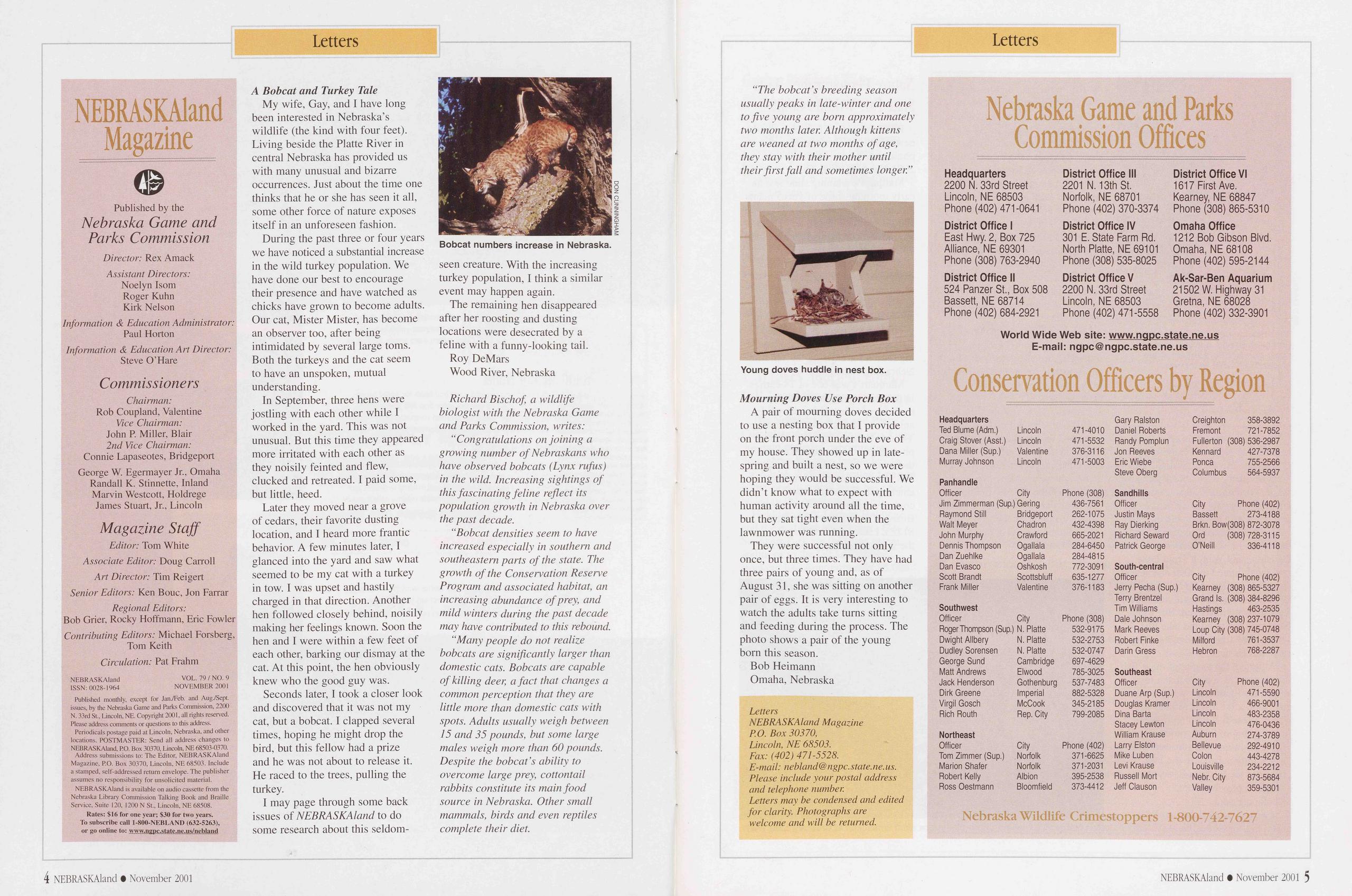
A pair of mourning doves decided to use a nesting box that I provide on the front porch under the eve of my house. They showed up in late- spring and built a nest, so we were hoping they would be successful. We didn’t know what to expect with human activity around all the time, but they sat tight even when the lawnmower was running.
They were successful not only once, but three times. They have had three pairs of young and, as of August 31, she was sitting on another pair of eggs. It is very interesting to watch the adults take turns sitting and feeding during the process. The photo shows a pair of the young born this season.
Bob Heimann Omaha, Nebraska Letters NEBRASKAland Magazine RO. Box 30370, Lincoln, NE 68503. Fax: (402) 471-5528. E-mail: nebland@ngpc. state, ne. us. Please include your postal address and telephone number. Letters may be condensed and edited for clarity. Photographs are welcome and will be returned. Nebraska Game and Parks Commission Offices Headquarters 2200 N. 33rd Street Lincoln, NE 68503 Phone (402) 471-0641 District Office 1 East Hwy. 2, Box 725 Alliance, NE 69301 Phone (308) 763-2940 District Office II 524 Panzer St., Box 508 Bassett, NE 68714 Phone (402) 684-2921 District Office III 2201 N. 13th St. Norfolk, NE 68701 Phone (402) 370-3374 District Office IV 301 E. State Farm Rd. North Platte, NE 69101 Phone (308) 535-8025 District Office V 2200 N. 33rd Street Lincoln, NE 68503 Phone (402) 471-5558 District Office VI 1617 First Ave. Kearney, NE 68847 Phone (308) 865-5310 Omaha Office 1212 Bob Gibson Blvd. Omaha, NE 68108 Phone (402) 595-2144 Ak-Sar-Ben Aquarium 21502 W. Highway 31 Gretna, NE 68028 Phone (402) 332-3901 World Wide Web site: www.ngpc.state.ne.us E-mail: ngpc@ngpc.state.ne.us Conservation Officers by Region Headquarters Gary Ralston Creighton 358-3892 Ted Blume (Adm.) Lincoln 471-4010 Daniel Roberts Fremont 721-7852 Craig Stover (Asst.) Lincoln 471-5532 Randy Pomplun Fullerton (308) 536-2987 Dana Miller (Sup.) Valentine 376-3116 Jon Reeves Kennard 427-7378 Murray Johnson Lincoln 471-5003 Eric Wiebe Ponca 755-2566 Steve Oberg Columbus 564-5937 Panhandle Officer City Phone (308) Sandhills Jim Zimmerman (Sup.) Gering 436-7561 Officer City Phone (402) Raymond Still Bridgeport 262-1075 Justin Mays Bassett 273-4188 Walt Meyer Chadron 432-4398 Ray Dierking Brkn. Bow(308) 872-3078 John Murphy Crawford 665-2021 Richard Seward Ord (308) 728-3115 Dennis Thompson Ogallala 284-6450 Patrick George O’Neill 336-4118 Dan Zuehlke Ogallala 284-4815 Dan Evasco Oshkosh 772-3091 South-central Scott Brandt Scottsbluff 635-1277 Officer City Phone (402) Frank Miller Valentine 376-1183 Jerry Pecha (Sup.) Kearney (308) 865-5327 Terry Brentzel Grand Is. (308) 384-8296 Southwest Tim Williams Hastings 463-2535 Officer City Phone (308) Dale Johnson Kearney (308) 237-1079 Roger Thompson (Sup.) N. Platte 532-9175 Mark Reeves Loup City (308) 745-0748 Dwight Allbery N. Platte 532-2753 Robert Finke Milford 761-3537 Dudley Sorensen N. Platte 532-0747 Darin Gress Hebron 768-2287 George Sund Cambridge 697-4629 Matt Andrews Elwood 785-3025 Southeast Jack Henderson Gothenburg 537-7483 Officer City Phone (402) Dirk Greene Imperial 882-5328 Duane Arp (Sup.) Lincoln 471-5590 Virgil Gosch McCook 345-2185 Douglas Kramer Lincoln 466-9001 Rich Routh Rep. City 799-2085 Dina Barta Lincoln 483-2358 Stacey Lewton Lincoln 476-0436 Northeast William Krause Auburn 274-3789 Officer City Phone (402) Larry Elston Bellevue 292-4910 Tom Zimmer (Sup.) Norfolk 371-6625 Mike Luben Colon 443-4278 Marion Shafer Norfolk 371-2031 Levi Krause Louisville 234-2212 Robert Kelly Albion 395-2538 Russell Mort Nebr. City 873-5684 Ross Oestmann Bloomfield 373-4412 Jeff Clauson Valley 359-5301 Nebraska Wildlife Crimestoppers 1-800-742-7627 4 NEBRASKAland • November 2001 NEBRASKAland • November 2001 5
Outdoor News
With the cooperation of area landowners, Nebraska Game and Park Commission fisheries biologists are confident that a second renovation of Wagon Train Lake, located south of Hickman, was successful and quality fishing should be available in 2002.
Don Gabelhouse, administrator of the Commission’s Fisheries Division, said Wagon Train Lake was rehabilitated in 2000 and several sport fish species, including fingerling largemouth bass, bluegill and redear sunfish, were restocked. But when biologists surveyed the lake this spring, they found lots of yearling carp in their nets.
“Although the source of these fish is unknown, it appears that a few adult carp found their way into the lake soon after it was refilled with water. These fish then reproduced in the spring of 2000, producing abundant young that survived in large numbers because the lake contained no predator fish large enough to prey on them,” Gabelhouse said.
To have a good fishery at Wagon Train, biologists decided to kill all the fish in the lake and restock. But first they had to destroy carp in the watershed upstream to avoid reinfesting the lake.
With the permission of area landowners, in September biologists applied rotenone to private ponds and streams in the watershed that contained carp, as well as the lake itself. The affected ponds will be restocked with largemouth bass, bluegills and channel catfish.
Extensive design work during the initial renovation should slow sedimentation of the lake, and several features were added to improve fishing opportunities and fish habitat.
“Good fish habitat includes aquatic vegetation, which is important because it provides food and substrate for insects that serve as food to young sport fish,” Gabelhouse said.
Largemouth bass, bluegills, redear sunfish and channel catfish will be restocked in the lake, including some fish large enough to prey on any subsequent carp reproduction that might occur. More predator species will be stocked in 2002.
Money generated from Nebraska’s Aquatic Habitat Stamp funded the lake rehabilitation program at Wagon Train Lake.
Ron Marquart of Lincoln won the new Wildlife Nebraska class of photography competition at the 2001 Nebraska State Fair.
Marquart’s winning slide was an early morning scene of yucca plants blooming at Crescent Lake National Wildlife Refuge last June. “This was the most yucca plants I’ve ever seen - it was amazing,” he said.
An amateur photographer who enjoys photographing nature, Marquart said this was the first time he had entered the state fair competition. Having the chance to get one of his pictures published in NEBRASKAland Magazine was a big reason for entering the Wildlife Nebraska competition.
Marquart’s was one of 18 entries in the new class, which was limited to slides of living Nebraska wild animals or plants in natural settings. Yvonne Nelson, superintendent of photography at the state fair, said there were 980 photography exhibits this year. For information about entering this or other state fair contests, write the Nebraska State Board of Agriculture, P.O. Box 81223, Lincoln, NE 68501, or visit the www.statefair.org website.
Gurley Resident Wins Bighorn Lottery PermitLeon T. Kriesel of Gurley won the 2001 Nebraska bighorn sheep lottery hunting permit when Nebraska Game and Parks Commission Chairman Rob Coupland drew his entry from a barrel containing 886 applications.
In addition to the opportunity to hunt a bighorn sheep in Nebraska’s Panhandle during this year’s December 1-23 season, Kriesel will also receive free guide service for the hunt.
Last year’s lottery permit winner, Andrew J. Sommer of Waverly, took a full-curl ram in the Pine Ridge near Fort Robinson State Park.
Two Lakes Added to Popular Fall Trout Stocking ProgramThe Nebraska Game and Parks Commission’s winter trout stocking program provides opportunities throughout the state for anglers to catch trout without traveling far from home, and two new lakes have been added to the program this year.
Holdrege Park Lake in Holdrege, and the east lake in Nebraska City’s Steinhart Park are the most recent additions to the fall and winter stocking list. Approximately 80,000 rainbow trout, 9 to 10 inches long, will be released through January at selected warmwater lakes across the state. Because trout are a coldwater species that can survive year-round in only a few of Nebraska’s streams and reservoirs, most Nebraskans seldom have a chance to catch them. Because these waters won’t support trout when temperatures rise next spring, the number of trout stocked in an area is tied to fishing pressure.
“Our goal is to get 80 percent of the fish that we release caught,” said Dave Tunink, assistant fisheries administrator. “It costs about $1.25 to $1.50 to raise each fish, and we just can’t let them go to waste.”
Other lakes which will be stocked
25th ANNUAL NEBRASKA HABITAT STAMP ART CONTEST
Submission Entries may be protected by a covering but will not be accepted in frames, under glass or in plastic kitchen wrap. Wrap securely and send to: Habitat Stamp Contest, Game and Parks Commission, 2200 N. 33rd Street, P.O. Box 30370, Lincoln, NE 68503-0370. A completed entry form and reproduction agreement, or a facsimile thereof, must be attached to the back of the entry. Name and address of the artist must appear only on the reverse side of the entry. The Game and Parks Commission is not responsible for any entry lost or damaged in transit. Entries will not be returned unless specifically requested and a self-addressed mailer with proper return postage is included. Prizes Adult division first-place winner receives $300 from the Omaha Fish and Wildlife Club. Youth division first-place winners in each section receive $100 from the Omaha Fish and Wildlife Club. Runners-up in all divisions receive a subscription to NEBRASKAland Magazine. Technical Requirements Design must be 7 1/2 inches by 4 11/16 inches. It may be matted, but mats must not exceed 10 inches by 7 inches. Any medium is acceptable. No scrollwork or lettering may appear on the design. Color is preferred. Subject Matter Any Nebraska wildlife species in an appropriate habitat setting, except for mourning dove, sandhill crane, wild turkey, Canada geese and western bluebird, which are ineligible this year. Eligibility Contest is open to Nebraska residents only, and winning entry in the adult division will appear on the 2003 Nebraska Habitat Stamp. Employees of the Game and Parks Commission and their immediate families are not eligible to enter the adult division of the contest. Only one entry allowed per person. Divisions Adult: Amateur or professional artists. Youth: Senior Section - Grades 9-12; Junior Section - Grades 5-8; Primary Section - Grades K-4. Entry Deadline March 1, 2002. Nebraska Habitat Stamp Art Contest Entry Form Please accept my entry in the 2002 Habitat Stamp Art Contest. I hereby certify that I have complied with all the rules governing this competition and that the work submitted is my own creation. Further, the Nebraska Game and Parks Commission is hereby authorized to repro- duce my design on the 2003 Habitat Stamp or in any other fashion it may deem appropriate. All information requested is required. Form may be copied. Division/Section___Grade in School___ Title of Entry___Medium___ Name___Age (if under 19)___ Parent or guardian (if under 19)___ Address___City___ State___ZIP___ Home Phone___School Phone___ Name of School___ School Address___ City, State, ZIP___ Please return my entry. I have included the appropriate postage. Please hold my entry for pickup. Artist’s Signature___ 6 NEBRASKAland • November 2001 NEBRASKAland • November 2001 7
Outdoor News
with trout include Fremont Lake No. 5, Grove Lake near Royal, Crystal Cove in South Sioux City, Birdwood near North Platte, Champion Mill near Imperial, Crystal Springs (Middle) in Fairbury, Holmes Lake in Lincoln, Windmill No. 1 near Gibbon, U S WEST Lake at Mahoney State Park, and Benson, Hitchcock, and Standing Bear lakes in Omaha.
Platte River Partnership to Conserve GrasslandsThe Nebraska Game and Parks Commission and The Nature Conservancy announced a new partnership in September to conserve habitat along the Platte River in south-central Nebraska.
The Platte River Habitat Restoration and Management Partnership will promote conservation and stewardship of the Platte Valley’s grasslands.
Wet meadows and grasslands along the Platte River provide important habitat for sandhill cranes, grasshopper sparrows, wild turkeys and nearly 300 other species of birds. These native grasslands also provide an important source of forage to the area’s cattle producers. Despite their value, more than three-fourths of these native Platte Valley grasslands have been lost. Many of the remaining grasslands have deteriorated because of poor management and invasion of non-native plants.
The Commission and The Nature Conservancy will hire a grassland coordinator later this fall. This individual will seek input from the region’s cattle producers and develop strategies for protecting, restoring, and better managing native grasslands.
For more information, contact either Mark Humpert at the Nebraska Game and Parks Commission’s Kearney office, (308) 865-5308, mhumpert@ngpc.state.ne.us, or Brent Lathrop of The Nature Conservancy, (402) 694-4191, blathrop@tnc.org.
Your Window to the Great Outdoors
OUTDOOR NEBRASKA Thursdays at 7:30 p.m. CT Repeats Saturdays at 8 a.m. CT on NETV. Also Fridays & Sundays at 4:30 p.m. CT on NETV2. NEBRASKA ETV NETWORK A production of the Nebraska Game and Parks Commission in association with the Nebraska ETV Network, a service of Nebraska Educational Telecommunications. Funded in part by Nebraska Game and Parks FoundationOutdoor Business
Motion-wing Duck Decoys “Flying” decoys spark debates over fair chase and effect on populations. By Jon FarrarNot since the banning of live decoys in 1935, or lead shot in 1985, has there been such heated debate in the waterfowl hunting fraternity. Today, the question is whether motion-wing decoys are too effective. The battery-powered, spinning-wing decoys definitely help fool wild ducks, but are they an unfair advantage?
Preliminary results from studies in Kansas, Missouri and California suggest that the use of “flying” decoys mounted on stakes in traditional spreads of floating decoys may boost success by as much as three times. The critical question is: Are waterfowlers killing significantly more ducks with motion-wing decoys than without them? And, more importantly, are they killing enough to influence future seasons? Throw talk of infringement of personal rights and of the hunter who just shelled out $150 or more for one of the robo-decoys into the fray, and the temperature of the debate grows red hot. The states of Washington and Pennsylvania have banned their use, and California has instituted a partial ban. Others, including Nebraska, are taking a long look at the issue before acting.
“There are two basic issues involved,” said Mark Vrtiska, Nebraska Game and Parks Commission waterfowl specialist. “The biological aspect of motion- wing decoys is the one we will be looking at the hardest, but some believe the question of whether they violate the spirit of fair chase also deserves consideration.
“The framework within which Nebraska waterfowl seasons are set is guided by the U.S. Fish and Wildlife Service under the Adaptive Harvest Management (AHM) process,” Vrtiska explained. “If the motion-wing decoys are significantly increasing harvest rates of ducks, the AHM process brings the harvest back in line with annual waterfowl production by shortening season lengths and reducing bag limits. That concerns us, and it concerns many waterfowl hunters. At this point we just don’t know enough to say whether they are having that magnitude of impact.”
The second issue in the use of motion-wing decoys centers on concerns that they do not meet traditional standards of fair chase. The use of electronic calls during regular waterfowl hunting seasons is an example of a technology that was judged to fall short of fair chase standards. But are motorized decoys less ethical than electronic fish finders? Here the debate leaves the realm of science and enters a gray zone of tradition and personal opinion. Still, it is an important aspect of hunting that needs to be weighed.
Commission biologists did preliminary work last year to assess
“Motion-wing decoys are not magic,” Vrtiska said. “You can’t put one up in the parking lot and expect to shoot ducks over it. There are days they don’t work, days when shooting would probably be just as good without them, and days when they give hunters an edge. At this time we just don’t know what effect they are having on the duck harvest.”
8 NEBRASKAland • November 2001 NEBRASKAland • November 2001 9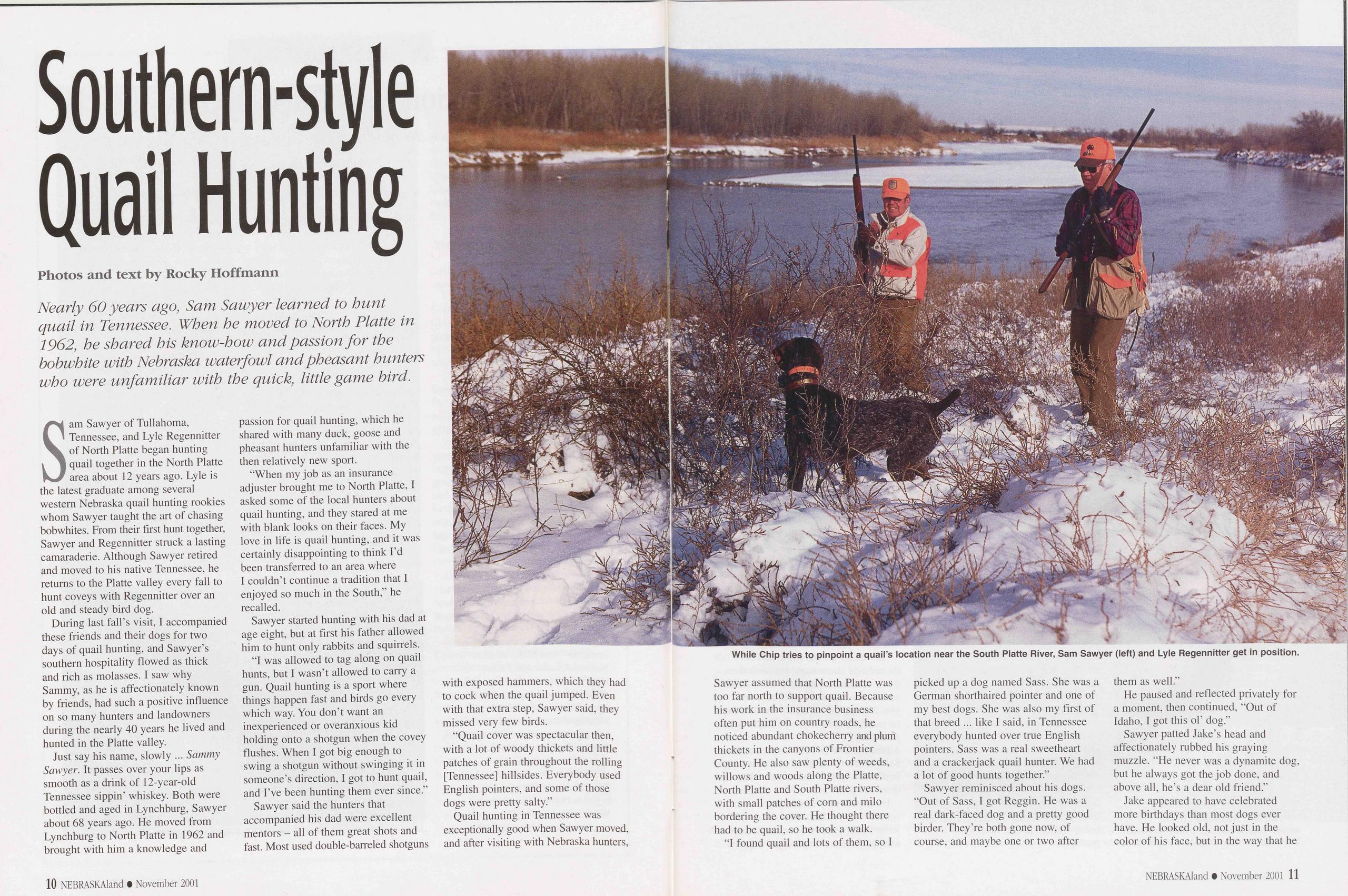
Southern-style Quail Hunting
Photos and text by Rocky Hoffmann Nearly 60 years ago, Sam Sawyer learned to bunt quail in Tennessee. When be moved to North Platte in 1962, he shared his know-how and passion for the bobwhite with Nebraska waterfowl and pheasant hunters who were unfamiliar with the quick, little game bird.Sam Sawyer of Tullahoma, Tennessee, and Lyle Regennitter of North Platte began hunting quail together in the North Platte area about 12 years ago. Lyle is the latest graduate among several western Nebraska quail hunting rookies whom Sawyer taught the art of chasing bob whites. From their first hunt together, Sawyer and Regennitter struck a lasting camaraderie. Although Sawyer retired and moved to his native Tennessee, he returns to the Platte valley every fall to hunt coveys with Regennitter over an old and steady bird dog.
During last fall’s visit, I accompanied these friends and their dogs for two days of quail hunting, and Sawyer’s southern hospitality flowed as thick and rich as molasses. I saw why Sammy, as he is affectionately known by friends, had such a positive influence on so many hunters and landowners during the nearly 40 years he lived and hunted in the Platte valley.
Just say his name, slowly ... Sammy Sawyer. It passes over your lips as smooth as a drink of 12-year-old Tennessee sippin’ whiskey. Both were bottled and aged in Lynchburg, Sawyer about 68 years ago. He moved from Lynchburg to North Platte in 1962 and brought with him a knowledge and passion for quail hunting, which he shared with many duck, goose and pheasant hunters unfamiliar with the then relatively new sport.
“When my job as an insurance adjuster brought me to North Platte, I asked some of the local hunters about quail hunting, and they stared at me with blank looks on their faces. My love in life is quail hunting, and it was certainly disappointing to think I’d been transferred to an area where I couldn’t continue a tradition that I enjoyed so much in the South,” he recalled.
Sawyer started hunting with his dad at age eight, but at first his father allowed him to hunt only rabbits and squirrels.
"I was allowed to tag along on quail hunts, but I wasn’t allowed to carry a gun. Quail hunting is a sport where things happen fast and birds go every which way. You don’t want an inexperienced or overanxious kid holding onto a shotgun when the covey flushes. When I got big enough to swing a shotgun without swinging it in someone’s direction, I got to hunt quail, and I’ve been hunting them ever since.”
Sawyer said the hunters that accompanied his dad were excellent mentors - all of them great shots and fast. Most used double-barreled shotguns
“Quail cover was spectacular then, with a lot of woody thickets and little patches of grain throughout the rolling [Tennessee] hillsides. Everybody used English pointers, and some of those dogs were pretty salty.”
Quail hunting in Tennessee was exceptionally good when Sawyer moved, and after visiting with Nebraska hunters, Sawyer assumed that North Platte was too far north to support quail. Because his work in the insurance business often put him on country roads, he noticed abundant chokecherry and plum thickets in the canyons of Frontier County. He also saw plenty of weeds, willows and woods along the Platte, North Platte and South Platte rivers, with small patches of corn and milo bordering the cover. He thought there had to be quail, so he took a walk.
“I found quail and lots of them, so I picked up a dog named Sass. She was a German shorthaired pointer and one of my best dogs. She was also my first of that breed ... like I said, in Tennessee everybody hunted over true English pointers. Sass was a real sweetheart and a crackerjack quail hunter. We had a lot of good hunts together.”
Sawyer reminisced about his dogs. “Out of Sass, I got Reggin. He was a real dark-faced dog and a pretty good birder. They’re both gone now, of course, and maybe one or two after them as well.”
He paused and reflected privately for a moment, then continued, “Out of Idaho, I got this ol’ dog.”
Sawyer patted Jake’s head and affectionately rubbed his graying muzzle. “He never was a dynamite dog, but he always got the job done, and above all, he’s a dear old friend.”
Jake appeared to have celebrated
more birthdays than most dogs ever
have. He looked old, not just in the
color of his face, but in the way that he
10 NEBRASKAland • November 2001
NEBRASKAland • November 2001 11
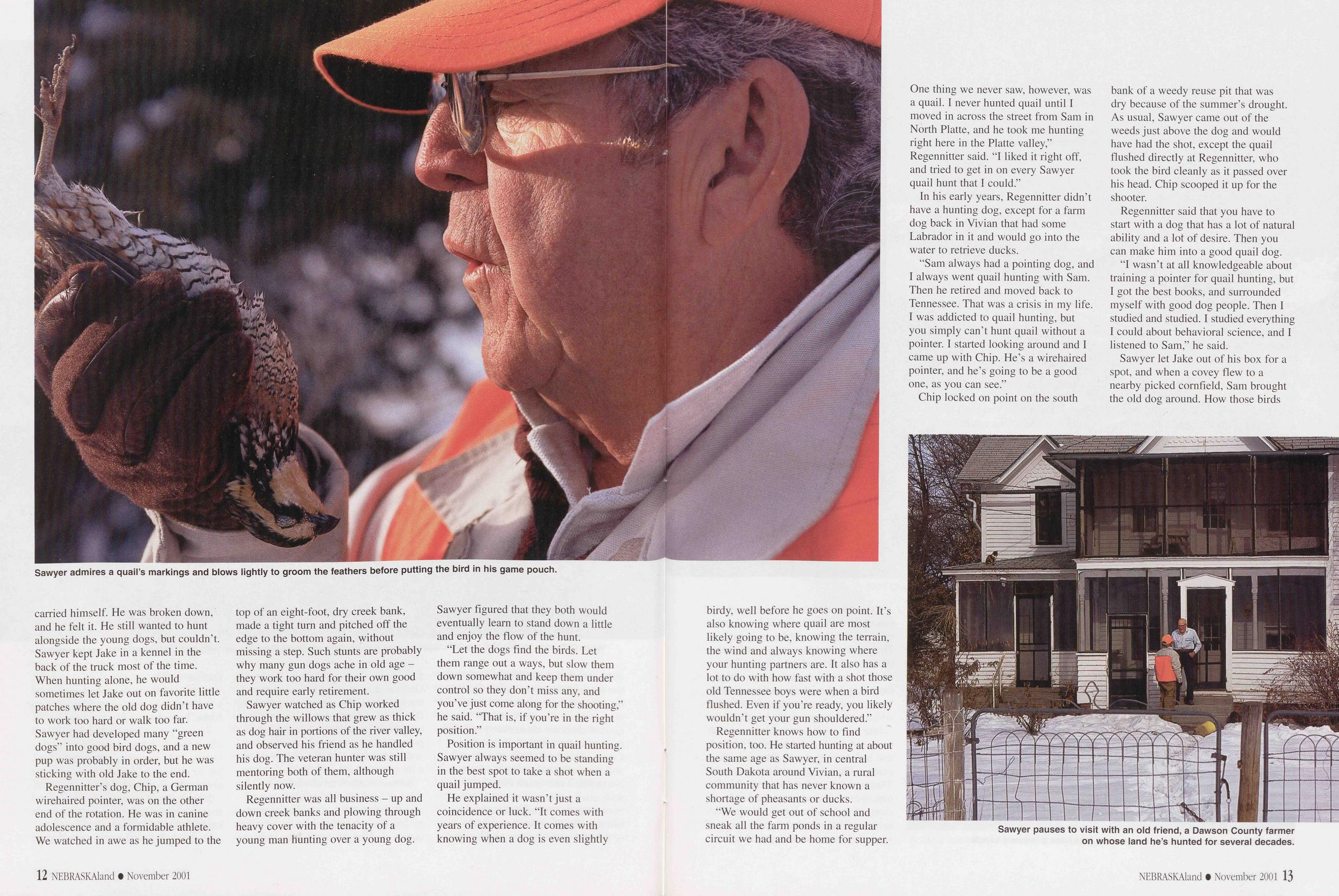
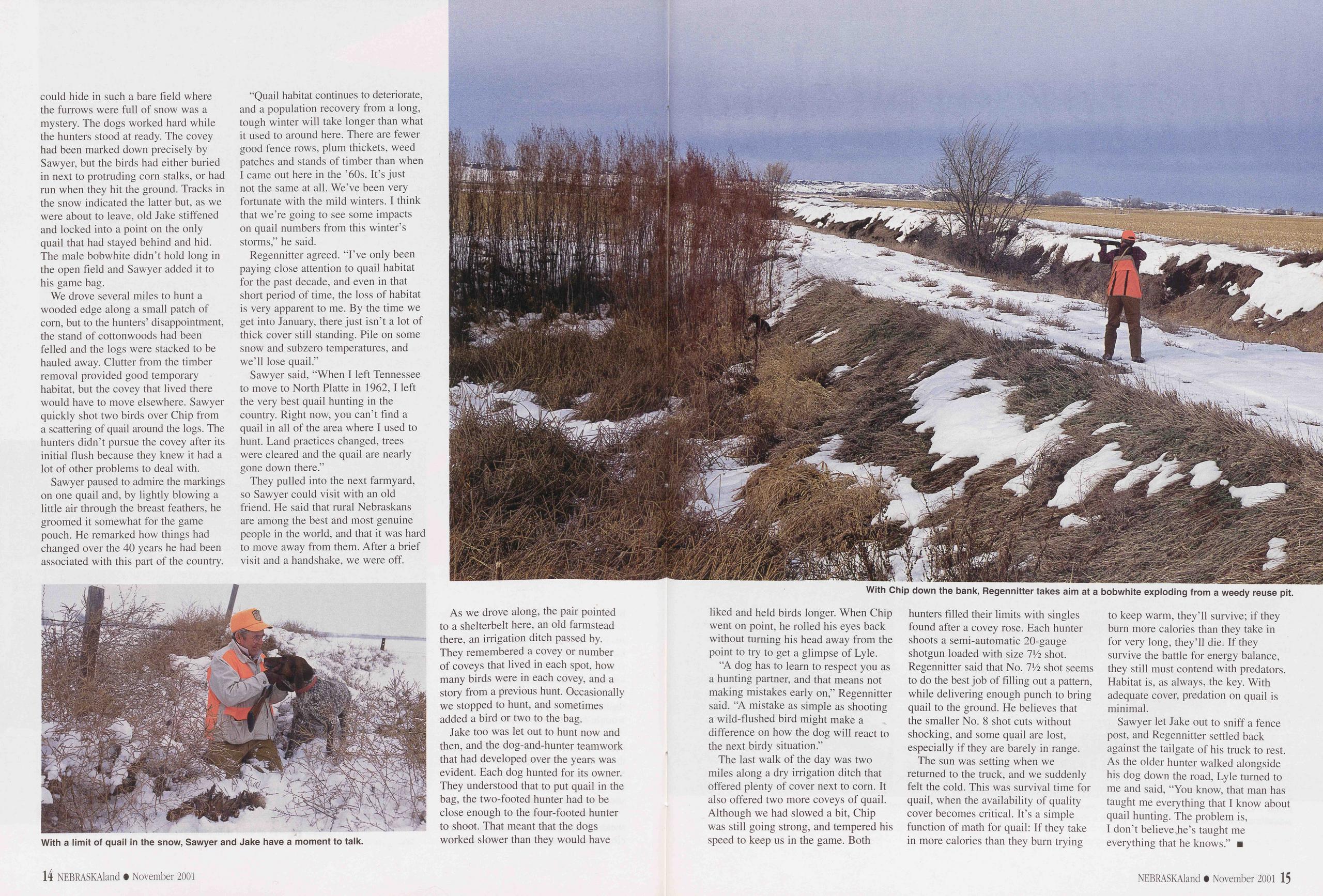
Regennitter’s dog, Chip, a German wirehaired pointer, was on the other end of the rotation. He was in canine adolescence and a formidable athlete. We watched in awe as he jumped to the top of an eight-foot, dry creek bank, made a tight turn and pitched off the edge to the bottom again, without missing a step. Such stunts are probably why many gun dogs ache in old age - they work too hard for their own good and require early retirement.
Sawyer watched as Chip worked through the willows that grew as thick as dog hair in portions of the river valley, and observed his friend as he handled his dog. The veteran hunter was still mentoring both of them, although silently now.
Regennitter was all business - up and down creek banks and plowing through heavy cover with the tenacity of a young man hunting over a young dog. Sawyer figured that they both would eventually learn to stand down a little and enjoy the flow of the hunt.
“Let the dogs find the birds. Let them range out a ways, but slow them down somewhat and keep them under control so they don’t miss any, and you’ve just come along for the shooting,” he said. "That is, if you’re in the right position.”
Position is important in quail hunting. Sawyer always seemed to be standing in the best spot to take a shot when a quail jumped.
He explained it wasn’t just a coincidence or luck. "It comes with years of experience. It comes with knowing when a dog is even slightly birdy, well before he goes on point. It’s also knowing where quail are most likely going to be, knowing the terrain, the wind and always knowing where your hunting partners are. It also has a lot to do with how fast with a shot those old Tennessee boys were when a bird flushed. Even if you’re ready, you likely wouldn’t get your gun shouldered.”
Regennitter knows how to find position, too. He started hunting at about the same age as Sawyer, in central South Dakota around Vivian, a rural community that has never known a shortage of pheasants or ducks.
"We would get out of school and sneak all the farm ponds in a regular circuit we had and be home for supper. One thing we never saw, however, was a quail. I never hunted quail until I moved in across the street from Sam in North Platte, and he took me hunting right here in the Platte valley,” Regennitter said. “I liked it right off, and tried to get in on every Sawyer quail hunt that I could.”
In his early years, Regennitter didn’t have a hunting dog, except for a farm dog back in Vivian that had some Labrador in it and would go into the water to retrieve ducks.
"Sam always had a pointing dog, and I always went quail hunting with Sam. Then he retired and moved back to Tennessee. That was a crisis in my life. I was addicted to quail hunting, but you simply can’t hunt quail without a pointer. I started looking around and I came up with Chip. He’s a wirehaired pointer, and he’s going to be a good one, as you can see.”
Chip locked on point on the south
Regennitter said that you have to start with a dog that has a lot of natural ability and a lot of desire. Then you can make him into a good quail dog.
"I wasn’t at all knowledgeable about training a pointer for quail hunting, but I got the best books, and surrounded myself with good dog people. Then I studied and studied. I studied everything I could about behavioral science, and I listened to Sam,” he said.
Sawyer let Jake out of his box for a
spot, and when a covey flew to a
nearby picked cornfield, Sam brought
the old dog around. How those birds
12 NEBRASKAland • November 2001
NEBRASKAland • November 2001 13
 could hide in such a bare field where
the furrows were full of snow was a
mystery. The dogs worked hard while
the hunters stood at ready. The covey
had been marked down precisely by
Sawyer, but the birds had either buried
in next to protruding corn stalks, or had
run when they hit the ground. Tracks in
the snow indicated the latter but, as we
were about to leave, old Jake stiffened
and locked into a point on the only
quail that had stayed behind and hid.
The male bobwhite didn’t hold long in
the open field and Sawyer added it to
his game bag.
could hide in such a bare field where
the furrows were full of snow was a
mystery. The dogs worked hard while
the hunters stood at ready. The covey
had been marked down precisely by
Sawyer, but the birds had either buried
in next to protruding corn stalks, or had
run when they hit the ground. Tracks in
the snow indicated the latter but, as we
were about to leave, old Jake stiffened
and locked into a point on the only
quail that had stayed behind and hid.
The male bobwhite didn’t hold long in
the open field and Sawyer added it to
his game bag.
We drove several miles to hunt a wooded edge along a small patch of corn, but to the hunters’ disappointment, the stand of cottonwoods had been felled and the logs were stacked to be hauled away. Clutter from the timber removal provided good temporary habitat, but the covey that lived there would have to move elsewhere. Sawyer quickly shot two birds over Chip from a scattering of quail around the logs. The hunters didn’t pursue the covey after its initial flush because they knew it had a lot of other problems to deal with.
Sawyer paused to admire the markings on one quail and, by lightly blowing a little air through the breast feathers, he groomed it somewhat for the game pouch. He remarked how things had changed over the 40 years he had been associated with this part of the country.
“Quail habitat continues to deteriorate, and a population recovery from a long, tough winter will take longer than what it used to around here. There are fewer good fence rows, plum thickets, weed patches and stands of timber than when I came out here in the ’60s. It’s just not the same at all. We’ve been very fortunate with the mild winters. I think that we’re going to see some impacts on quail numbers from this winter’s storms,” he said.
Regennitter agreed. “I’ve only been paying close attention to quail habitat for the past decade, and even in that short period of time, the loss of habitat is very apparent to me. By the time we get into January, there just isn’t a lot of thick cover still standing. Pile on some snow and subzero temperatures, and we’ll lose quail.”
Sawyer said, “When I left Tennessee to move to North Platte in 1962,1 left the very best quail hunting in the country. Right now, you can’t find a quail in all of the area where I used to hunt. Land practices changed, trees were cleared and the quail are nearly gone down there.”
They pulled into the next farmyard, so Sawyer could visit with an old friend. He said that rural Nebraskans are among the best and most genuine people in the world, and that it was hard to move away from them. After a brief visit and a handshake, we were off.
As we drove along, the pair pointed to a shelterbelt here, an old farmstead there, an irrigation ditch passed by. They remembered a covey or number of coveys that lived in each spot, how many birds were in each covey, and a story from a previous hunt. Occasionally we stopped to hunt, and sometimes added a bird or two to the bag.
Jake too was let out to hunt now and then, and the dog-and-hunter teamwork that had developed over the years was evident. Each dog hunted for its owner. They understood that to put quail in the bag, the two-footed hunter had to be close enough to the four-footed hunter to shoot. That meant that the dogs worked slower than they would have liked and held birds longer. When Chip went on point, he rolled his eyes back without turning his head away from the point to try to get a glimpse of Lyle.
“A dog has to learn to respect you as a hunting partner, and that means not making mistakes early on,” Regennitter said. “A mistake as simple as shooting a wild-flushed bird might make a difference on how the dog will react to the next birdy situation.”
The last walk of the day was two miles along a dry irrigation ditch that offered plenty of cover next to corn. It also offered two more coveys of quail. Although we had slowed a bit, Chip was still going strong, and tempered his speed to keep us in the game. Both hunters filled their limits with singles found after a covey rose. Each hunter shoots a semi-automatic 20-gauge shotgun loaded with size lYi shot. Regennitter said that No. 7?Vi shot seems to do the best job of filling out a pattern, while delivering enough punch to bring quail to the ground. He believes that the smaller No. 8 shot cuts without shocking, and some quail are lost, especially if they are barely in range.
The sun was setting when we returned to the truck, and we suddenly felt the cold. This was survival time for quail, when the availability of quality cover becomes critical. It’s a simple function of math for quail: If they take in more calories than they burn trying to keep warm, they’ll survive; if they burn more calories than they take in for very long, they’ll die. If they survive the battle for energy balance, they still must contend with predators. Habitat is, as always, the key. With adequate cover, predation on quail is minimal.
Sawyer let Jake out to sniff a fence post, and Regennitter settled back against the tailgate of his truck to rest. As the older hunter walked alongside his dog down the road, Lyle turned to me and said, “You know, that man has taught me everything that I know about quail hunting. The problem is, I don’t believe Tie’s taught me everything that he knows.”
14 NEBRASKAland - November 2001 NEBRASKAland • November 2001 15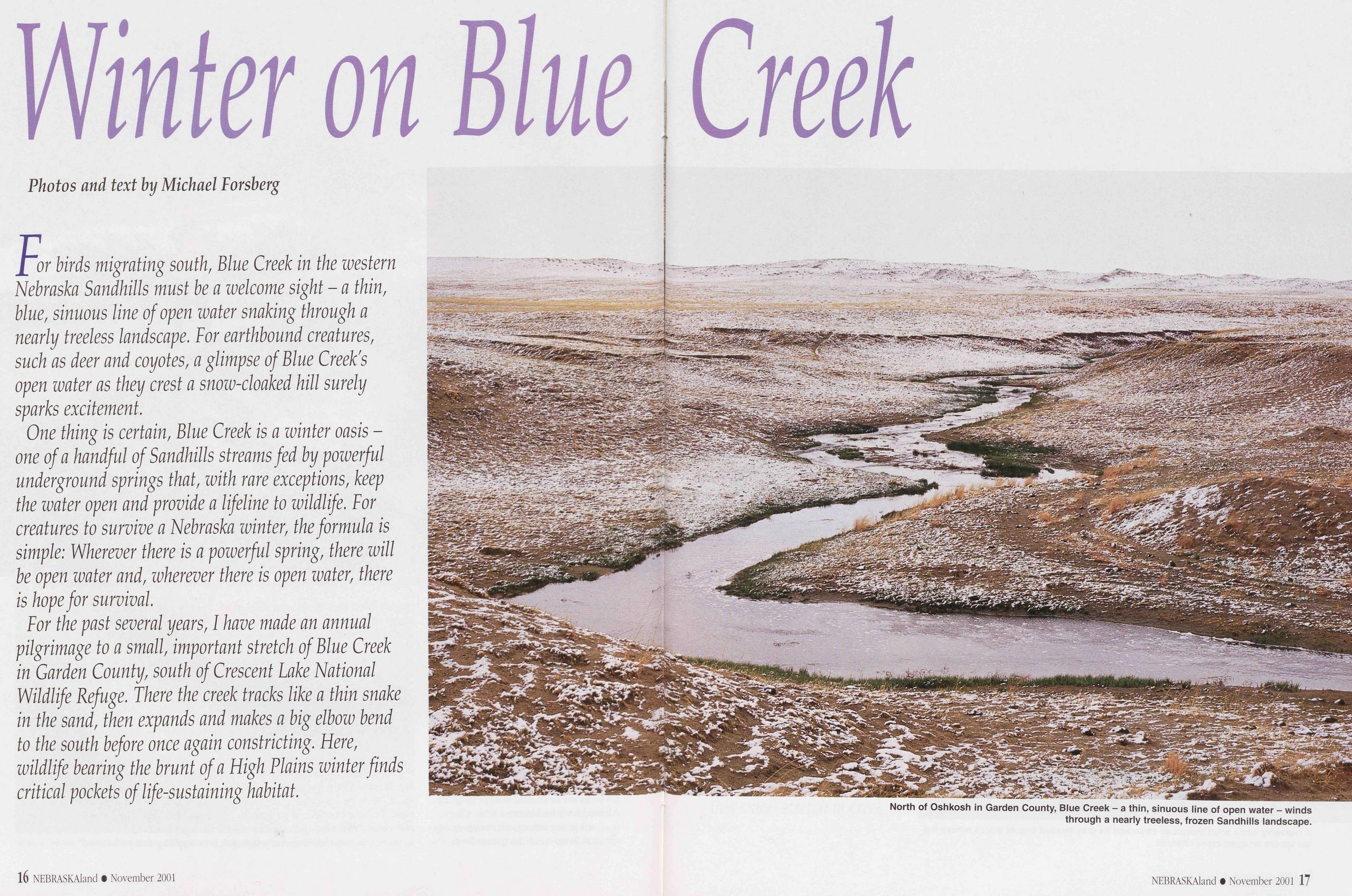
Winter on Blue Creek
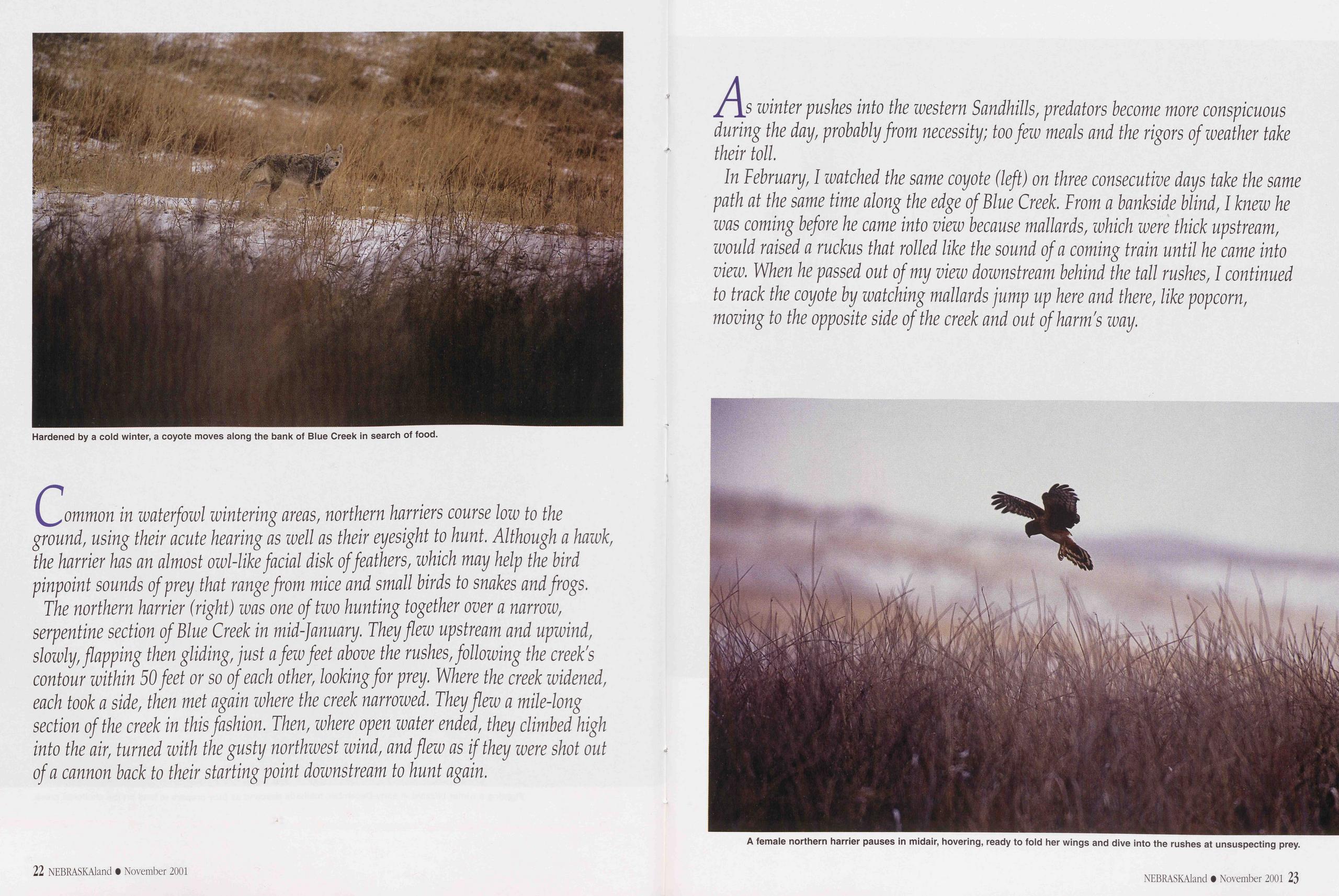
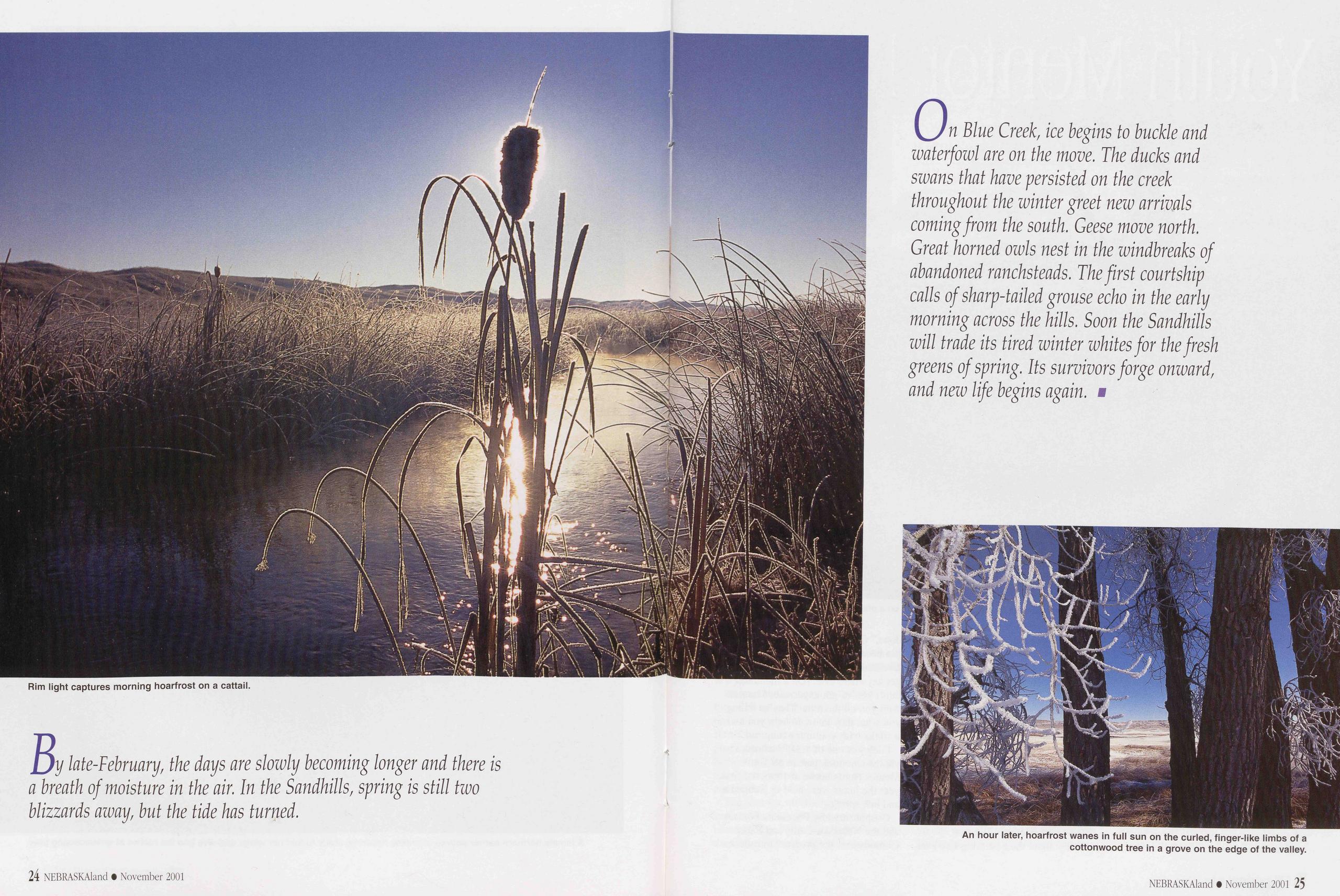
Photos and text by Michael Forsberg For birds migrating south, Blue Creek in the western Nebraska Sandhills must be a welcome sight - a thin, blue, sinuous line of open water snaking through a nearly treeless landscape. For earthbound creatures, such as deer and coyotes, a glimpse of Blue Creek's open water as they crest a snow-cloaked hill surely sparks excitement. One thing is certain, Blue Creek is a winter oasis - one of a handful of Sandhills streams fed by powerful underground springs that, with rare exceptions, keep the water open and provide a lifeline to wildlife. For creatures to survive a Nebraska winter, the formula is simple: Wherever there is a powerful spring, there will be open water and, wherever there is open water, there is hope for survival. For the past several years, I have made an annual pilgrimage to a small, important stretch of Blue Creek in Garden County, south of Crescent Lake National Wildlife Refuge. There the creek tracks like a thin snake in the sand, then expands and makes a big elbow bend to the south before once again constricting. Here, wildlife bearing the brunt of a High Plains winter finds critical pockets of life-sustaining habitat.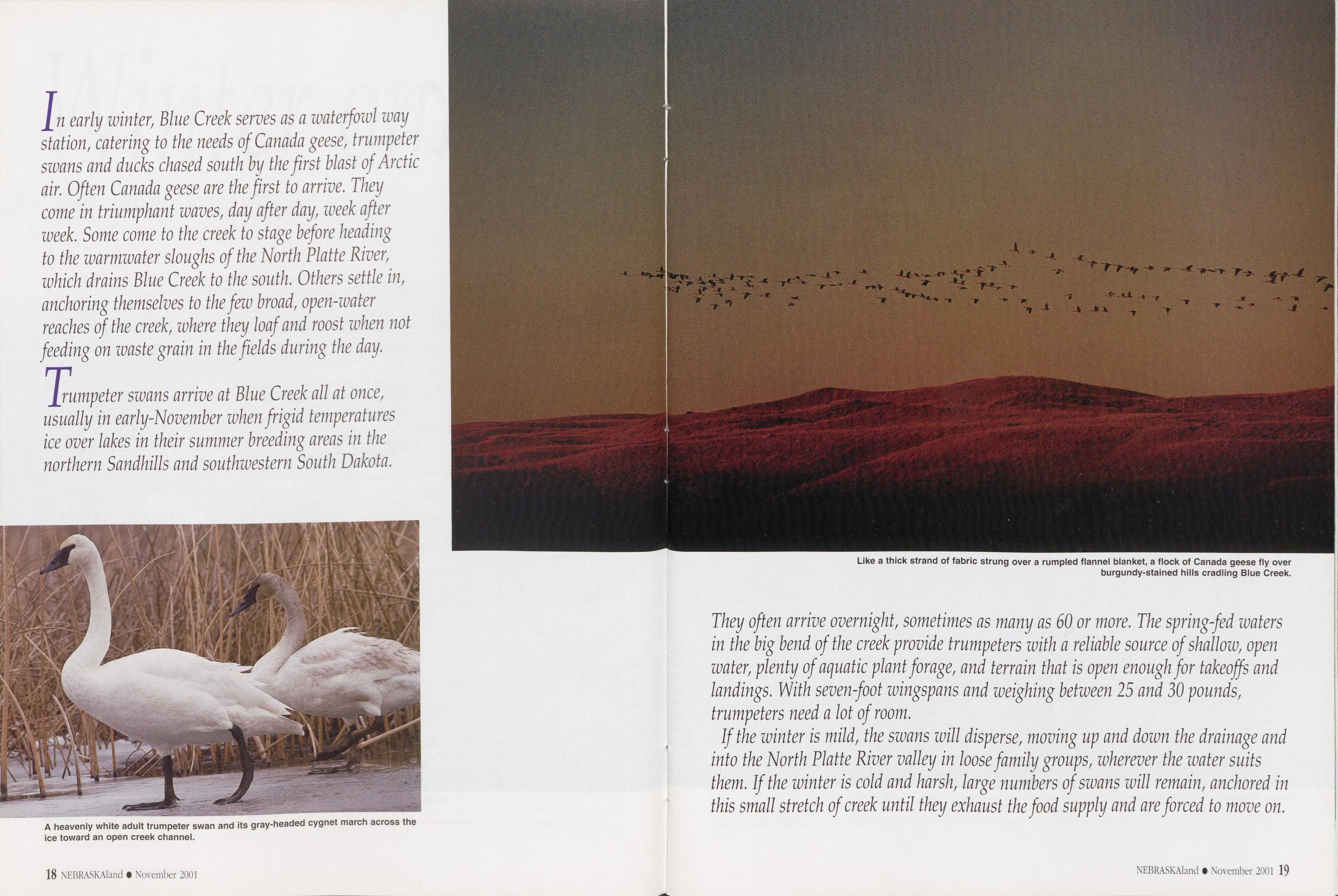
In early winter; Blue Creek serves as a waterfowl way station, catering to the needs of Canada geese, trumpeter swans and ducks chased south by the first blast of Arctic air. Often Canada geese are the first to arrive. They come in triumphant waves, day after day, week after week. Some come to the creek to stage before heading to the warmwater sloughs of the North Platte River, which drains Blue Creek to the south. Others settle in, anchoring themselves to the few broad, open-water reaches of the creek, where they loaf and roost when not feeding on waste grain in the fields during the day.
Trumpeter swans arrive at Blue Creek all at once, usually in early-November when frigid temperatures ice over lakes in their summer breeding areas in the northern Sandhills and southwestern South Dakota.
A heavenly white adult trumpeter swan and its gray-headed cygnet march across the ice toward an open creek channel.
Like a thick strand of fabric strung over a rumpled flannel blanket, a flock of Canada geese fly over burgundy-stained hills cradling Blue Creek.
They often arrive overnight, sometimes as many as 60 or more. The spring-fed waters in the big bend of the creek provide trumpeters with a reliable source of shallow, open water, plenty of aquatic plant forage, and terrain that is open enough for takeoffs and landings. With seven-foot wingspans and weighing between 25 and 30 pounds, trumpeters need a lot of room.
If the winter is mild, the swans will disperse, moving up and down the drainage and into the North Platte River valley in loose family groups, wherever the water suits them. If the winter is cold and harsh, large numbers of swans will remain, anchored in this small stretch ofcreek until they exhaust the food supply and are forced to move on.
18 NEBRASKAland • November 2001 NEBRASKAland • November 2001 19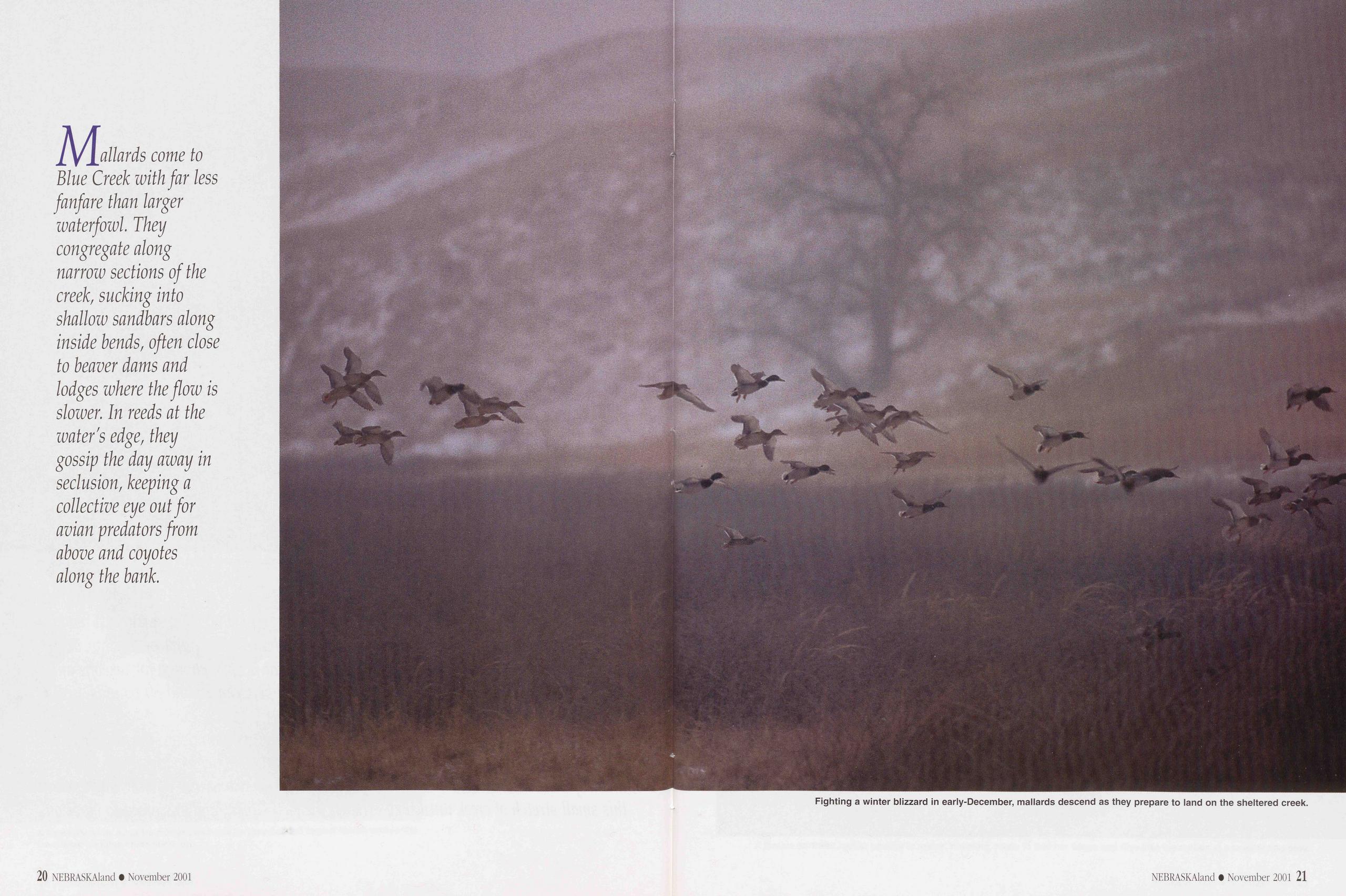 Mallards come to
Blue Creek with far less
fanfare than larger
waterfowl. They
congregate along
narrow sections of the
creek, sucking into
shallow sandbars along
inside bends, often close
to beaver dams and
lodges where the flow is
slower. In reeds at the
water's edge, they
gossip the day away in
seclusion, keeping a
collective eye out for
avian predators from
above and coyotes
along the bank.
Mallards come to
Blue Creek with far less
fanfare than larger
waterfowl. They
congregate along
narrow sections of the
creek, sucking into
shallow sandbars along
inside bends, often close
to beaver dams and
lodges where the flow is
slower. In reeds at the
water's edge, they
gossip the day away in
seclusion, keeping a
collective eye out for
avian predators from
above and coyotes
along the bank.
Youth Mentor Hunts
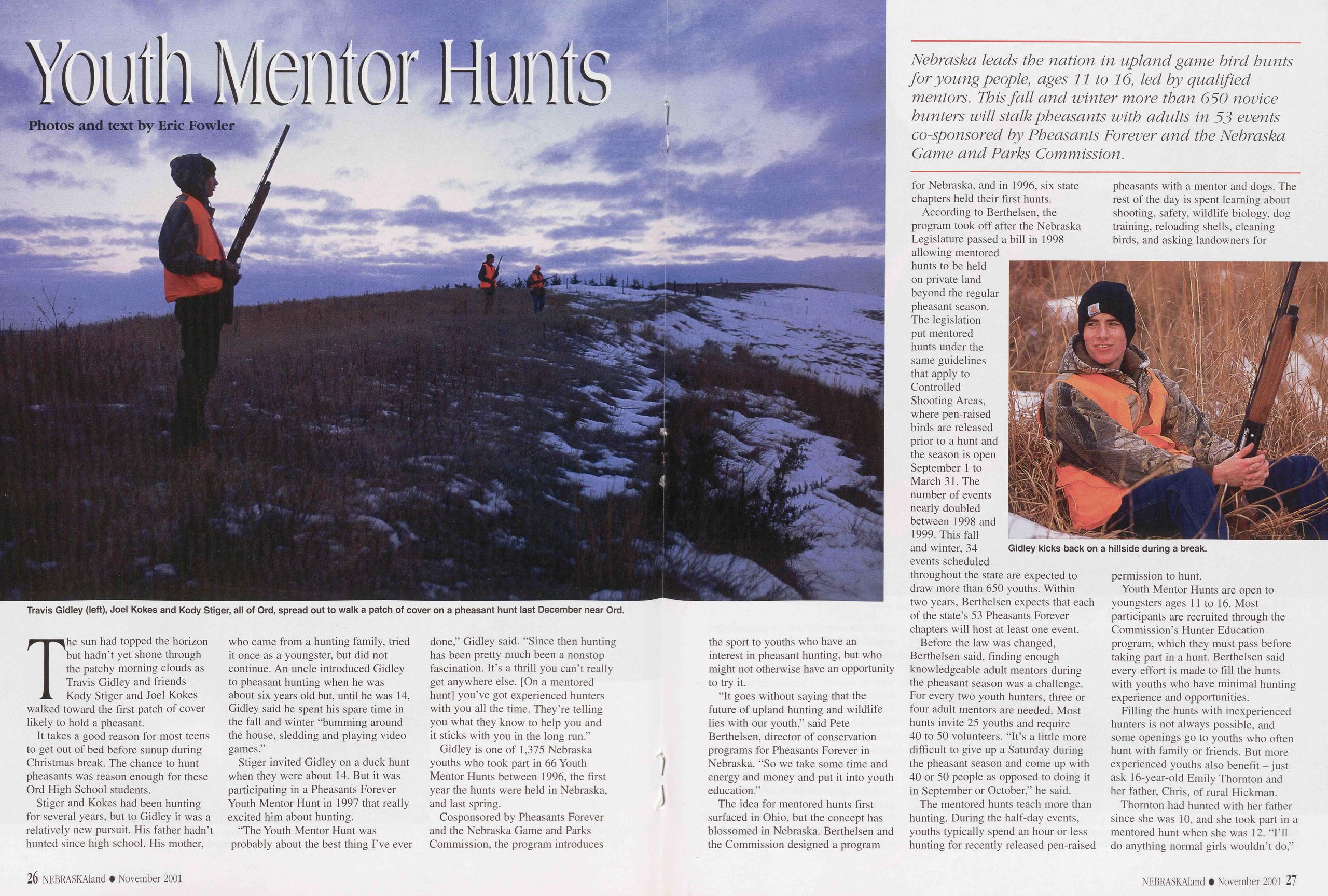
Photos and text by Eric FowlerThe sun had topped the horizon but hadn’t yet shone through the patchy morning clouds as Travis Gidley and friends Kody Stiger and Joel Kokes walked toward the first patch of cover likely to hold a pheasant.
It takes a good reason for most teens to get out of bed before sunup during Christmas break. The chance to hunt pheasants was reason enough for these Ord High School students.
Stiger and Kokes had been hunting for several years, but to Gidley it was a relatively new pursuit. His father hadn’t hunted since high school. His mother, who came from a hunting family, tried it once as a youngster, but did not continue. An uncle introduced Gidley to pheasant hunting when he was about six years old but, until he was 14, Gidley said he spent his spare time in the fall and winter “bumming around the house, sledding and playing video games.”
Stiger invited Gidley on a duck hunt when they were about 14. But it was participating in a Pheasants Forever Youth Mentor Hunt in 1997 that really excited turn about hunting.
“The Youth Mentor Hunt was probably about the best thing I’ve ever done,” Gidley said. “Since then hunting has been pretty much been a nonstop fascination. It’s a thrill you can’t really get anywhere else. [On a mentored hunt] you’ve got experienced hunters with you all the time. They’re telling you what they know to help you and it sticks with you in the long run.”
Gidley is one of 1,375 Nebraska youths who took part in 66 Youth Mentor Hunts between 1996, the first year the hunts were held in Nebraska, and last spring.
Cosponsored by Pheasants Forever and the Nebraska Game and Parks Commission, the program introduces the sport to youths who have an interest in pheasant hunting, but who might not otherwise have an opportunity to try it.
“It goes without saying that the future of upland hunting and wildlife lies with our youth,” said Pete Berthelsen, director of conservation programs for Pheasants Forever in Nebraska. “So we take some time and energy and money and put it into youth education.”
The idea for mentored hunts first surfaced in Ohio, but the concept has blossomed in Nebraska. Berthelsen and the Commission designed a program for Nebraska, and in 1996, six state chapters held their first hunts.
According to Berthelsen, the program took off after the Nebraska Legislature passed a bill in 1998 allowing mentored hunts to be held on private land beyond the regular pheasant season. The legislation put mentored hunts under the same guidelines that apply to Controlled Shooting Areas, where pen-raised birds are released prior to a hunt and the season is open September 1 to March 31. The number of events nearly doubled between 1998 and 1999. This fall and winter, 34 events scheduled throughout the state are expected to draw more than 650 youths. Within two years, Berthelsen expects that each of the state’s 53 Pheasants Forever chapters will host at least one event.
Before the law was changed, Berthelsen said, finding enough knowledgeable adult mentors during the pheasant season was a challenge. For every two youth hunters, three or four adult mentors are needed. Most hunts invite 25 youths and require 40 to 50 volunteers. “It’s a little more difficult to give up a Saturday during the pheasant season and come up with 40 or 50 people as opposed to doing it in September or October,” he said.
The mentored hunts teach more than hunting. During the half-day events, youths typically spend an hour or less hunting for recently released pen-raised pheasants with a mentor and dogs. The rest of the day is spent learning about shooting, safety, wildlife biology, dog training, reloading shells, cleaning birds, and asking landowners for
Youth Mentor Hunts are open to youngsters ages 11 to 16. Most participants are recruited through the Commission’s Hunter Education program, which they must pass before taking part in a hunt. Berthelsen said every effort is made to fill the hunts with youths who have minimal hunting experience and opportunities.
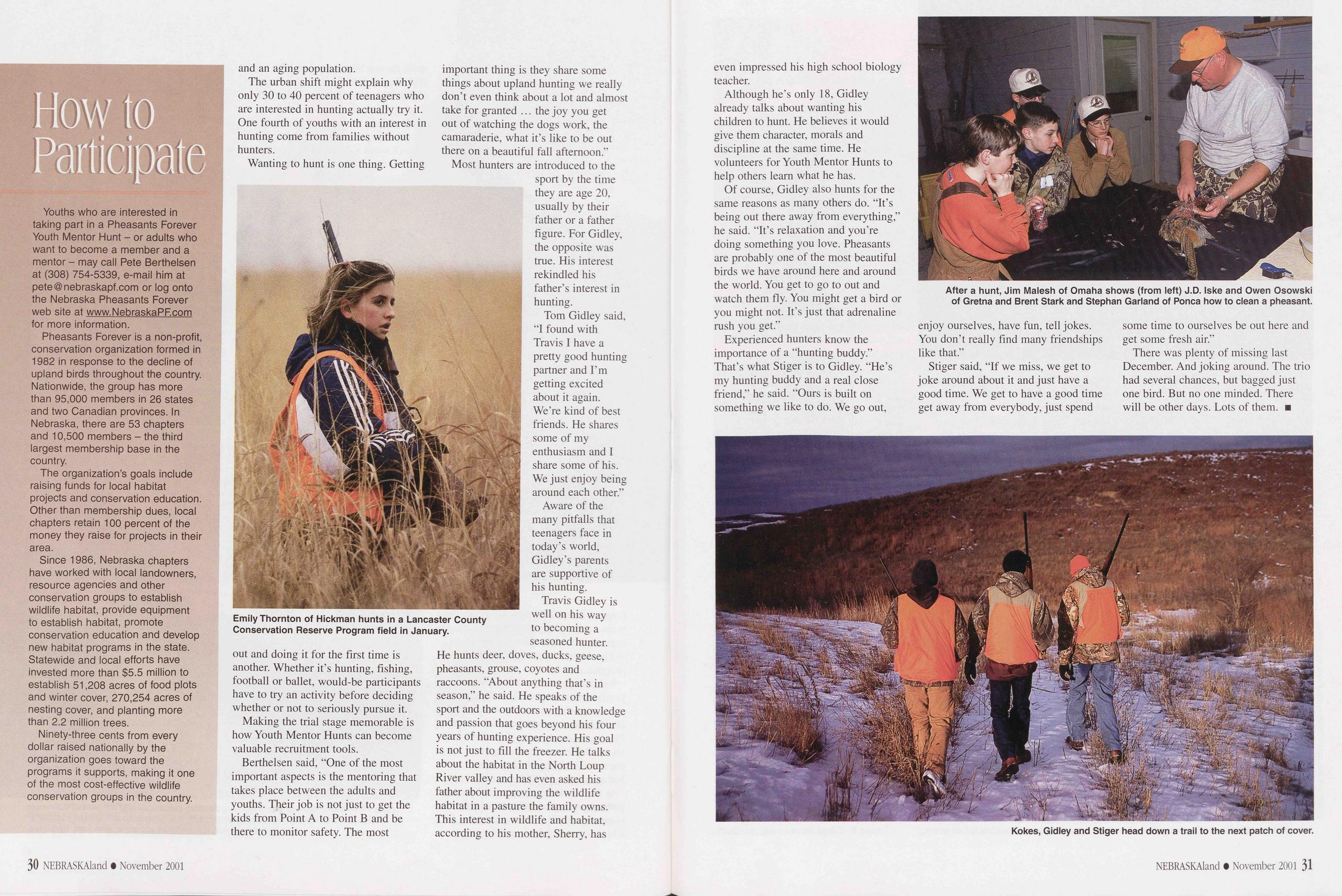
Filling the hunts with inexperienced hunters is not always possible, and some openings go to youths who often hunt with family or friends. But more experienced youths also benefit - just ask 16-year-old Emily Thornton and her father, Chris, of rural Hickman.
Thornton had hunted with her father
since she was 10, and she took part in a
mentored hunt when she was 12. “I’ll
do anything normal girls wouldn’t do,”
26 NEBRASKAland • November 2001
NEBRASKAland • November 2001 27
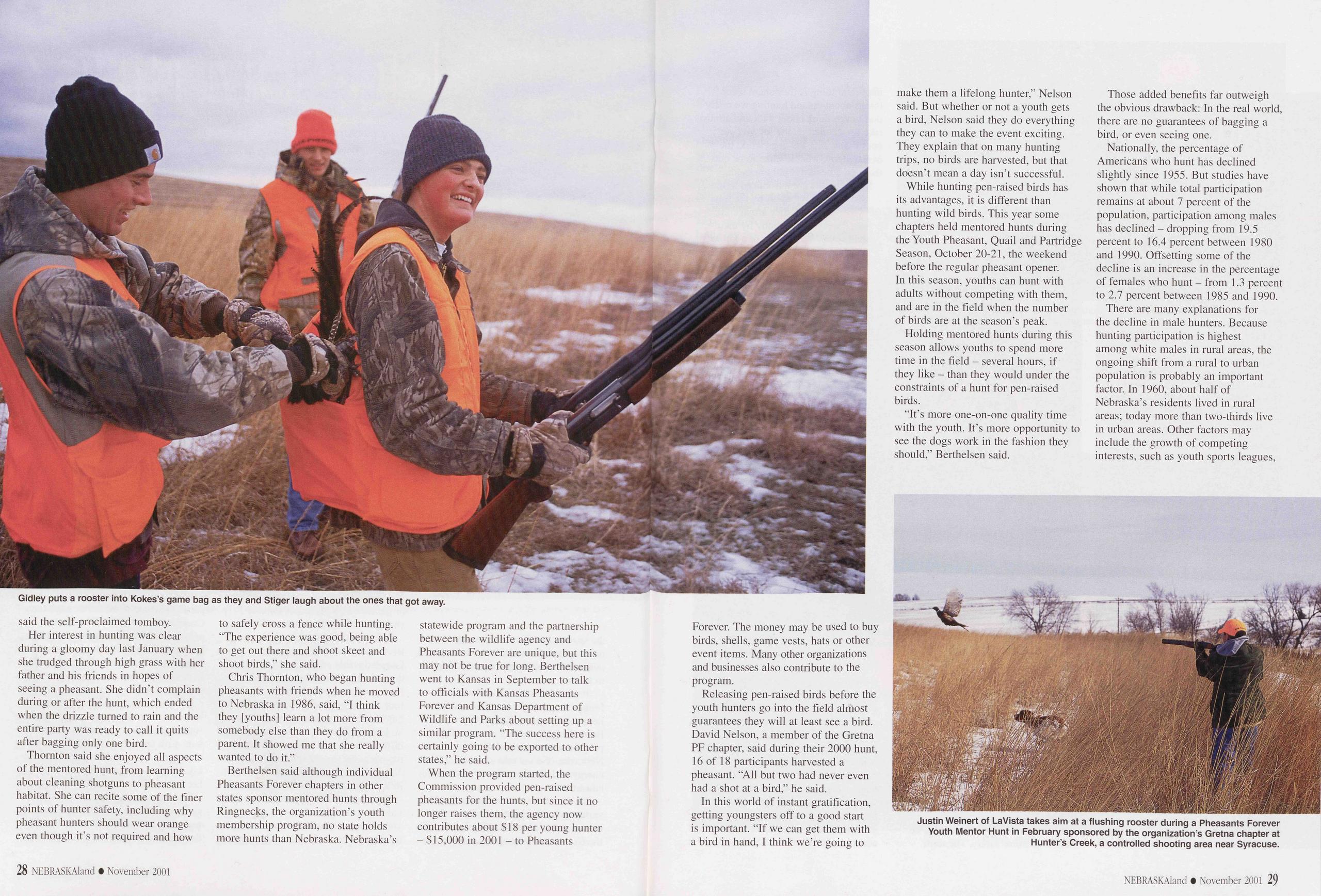
Her interest in hunting was clear during a gloomy day last January when she trudged through high grass with her father and his friends in hopes of seeing a pheasant. She didn’t complain during or after the hunt, which ended when the drizzle turned to rain and the entire party was ready to call it quits after bagging only one bird.
Thornton said she enjoyed all aspects of the mentored hunt, from learning about cleaning shotguns to pheasant habitat. She can recite some of the finer points of hunter safety, including why pheasant hunters should wear orange even though it’s not required and how to safely cross a fence while hunting. "The experience was good, being able to get out there and shoot skeet and shoot birds,” she said.
Chris Thornton, who began hunting pheasants with friends when he moved to Nebraska in 1986, said, "I think they [youths] learn a lot more from somebody else than they do from a parent. It showed me that she really wanted to do it.”
Berthelsen said although individual Pheasants Forever chapters in other states sponsor mentored hunts through Ringnecks, the organization’s youth membership program, no state holds more hunts than Nebraska. Nebraska’s statewide program and the partnership between the wildlife agency and Pheasants Forever are unique, but this may not be true for long. Berthelsen went to Kansas in September to talk to officials with Kansas Pheasants Forever and Kansas Department of Wildlife and Parks about setting up a similar program. "The success here is certainly going to be exported to other states,” he said.
When the program started, the Commission provided pen-raised pheasants for the hunts, but since it no longer raises them, the agency now contributes about $18 per young hunter - $15,000 in 2001 - to Pheasants Forever. The money may be used to buy birds, shells, game vests, hats or other event items. Many other organizations and businesses also contribute to the program.
Releasing pen-raised birds before the youth hunters go into the field almost guarantees they will at least see a bird. David Nelson, a member of the Gretna PF chapter, said during their 2000 hunt, 16 of 18 participants harvested a pheasant. "All but two had never even had a shot at a bird,” he said.
In this world of instant gratification, getting youngsters off to a good start is important. “If we can get them with a bird in hand, I think we’re going to make them a lifelong hunter,” Nelson said. But whether or not a youth gets a bird, Nelson said they do everything they can to make the event exciting. They explain that on many hunting trips, no birds are harvested, but that doesn’t mean a day isn’t successful.
While hunting pen-raised birds has its advantages, it is different than hunting wild birds. This year some chapters held mentored hunts during the Youth Pheasant, Quail and Partridge Season, October 20-21, the weekend before the regular pheasant opener. In this season, youths can hunt with adults without competing with them, and are in the field when the number of birds are at the season’s peak.
Holding mentored hunts during this season allows youths to spend more time in the field - several hours, if they like - than they would under the constraints of a hunt for pen-raised birds.
"It’s more one-on-one quality time with the youth. It’s more opportunity to see the dogs work in the fashion they should,” Berthelsen said.
Those added benefits far outweigh the obvious drawback: In the real world, there are no guarantees of bagging a bird, or even seeing one.
Nationally, the percentage of Americans who hunt has declined slightly since 1955. But studies have shown that while total participation remains at about 7 percent of the population, participation among males has declined - dropping from 19.5 percent to 16.4 percent between 1980 and 1990. Offsetting some of the decline is an increase in the percentage of females who hunt - from 1.3 percent to 2.7 percent between 1985 and 1990.
There are many explanations for
the decline in male hunters. Because
hunting participation is highest
among white males in rural areas, the
ongoing shift from a rural to urban
population is probably an important
factor. In 1960, about half of
Nebraska’s residents lived in rural
areas; today more than two-thirds live
in urban areas. Other factors may
include the growth of competing
interests, such as youth sports leagues,
28 NEBRASKAland • November 2001
NEBRASKAland • November 2001 29
 and an aging population.
The urban shift might explain why only 30 to 40 percent of teenagers who are interested in hunting actually try it. One fourth of youths with an interest in hunting come from families without hunters.
Wanting to hunt is one thing. Getting
Making the trial stage memorable is how Youth Mentor Hunts can become valuable recruitment tools.
Berthelsen said, "One of the most important aspects is the mentoring that takes place between the adults and youths. Their job is not just to get the kids from Point A to Point B and be there to monitor safety. The most important thing is they share some things about upland hunting we really don’t even think about a lot and almost take for granted ... the joy you get out of watching the dogs work, the camaraderie, what it’s like to be out there on a beautiful fall afternoon.”
Most hunters are introduced to the sport by the time they are age 20, usually by their father or a father figure. For Gidley, the opposite was true. His interest rekindled his father’s interest in hunting.
Tom Gidley said, "I found with Travis I have a pretty good hunting partner and I’m getting excited about it again. We’re kind of best friends. He shares some of my enthusiasm and I share some of his. We just enjoy being around each other.”
Aware of the many pitfalls that teenagers face in today’s world, Gidley’s parents are supportive of his hunting.
Travis Gidley is well on his way to becoming a seasoned hunter. He hunts deer, doves, ducks, geese, pheasants, grouse, coyotes and raccoons. "About anything that’s in season,” he said. He speaks of the sport and the outdoors with a knowledge and passion that goes beyond his four years of hunting experience. His goal is not just to fill the freezer. He talks about the habitat in the North Loup River valley and has even asked his father about improving the wildlife habitat in a pasture the family owns. This interest in wildlife and habitat, according to his mother, Sherry, has even impressed his high school biology teacher.
Although he’s only 18, Gidley already talks about wanting his children to hunt. He believes it would give them character, morals and discipline at the same time. He volunteers for Youth Mentor Hunts to help others learn what he has.
Of course, Gidley also hunts for the same reasons as many others do. "It’s being out there away from everything,” he said. "It’s relaxation and you’re doing something you love. Pheasants are probably one of the most beautiful birds we have around here and around the world. You get to go to out and watch them fly. You might get a bird or you might not. It’s just that adrenaline rush you get.”
Experienced hunters know the importance of a "hunting buddy.” That’s what Stiger is to Gidley. "He’s my hunting buddy and a real close friend,” he said. “Ours is built on something we like to do. We go out,
Stiger said, “If we miss, we get to joke around about it and just have a good time. We get to have a good time get away from everybody, just spend some time to ourselves be out here and get some fresh air.”
There was plenty of missing last December. And joking around. The trio had several chances, but bagged just one bird. But no one minded. There will be other days. Lots of them.
How to ParticipateYouths who are interested in taking part in a Pheasants Forever Youth Mentor Hunt - or adults who want to become a member and a mentor - may call Pete Berthelsen at (308) 754-5339, e-mail him at pete@nebraskapf.com or log onto the Nebraska Pheasants Forever web site at www.NebraskaPF.com for more information.
Pheasants Forever is a non-profit, conservation organization formed in 1982 in response to the decline of upland birds throughout the country. Nationwide, the group has more than 95,000 members in 26 states and two Canadian provinces. In Nebraska, there are 53 chapters and 10,500 members - the third largest membership base in the country.
The organization’s goals include raising funds for local habitat projects and conservation education. Other than membership dues, local chapters retain 100 percent of the money they raise for projects in their area.
Since 1986, Nebraska chapters have worked with local landowners, resource agencies and other conservation groups to establish wildlife habitat, provide equipment to establish habitat, promote conservation education and develop new habitat programs in the state. Statewide and local efforts have invested more than $5.5 million to establish 51,208 acres of food plots and winter cover, 270,254 acres of nesting cover, and planting more than 2.2 million trees.
Ninety-three cents from every dollar raised nationally by the organization goes toward the programs it supports, making it one of the most cost-effective wildlife conservation groups in the country.
30 NEBRASKAland • November 2001 NEBRASKAland • November 2001 31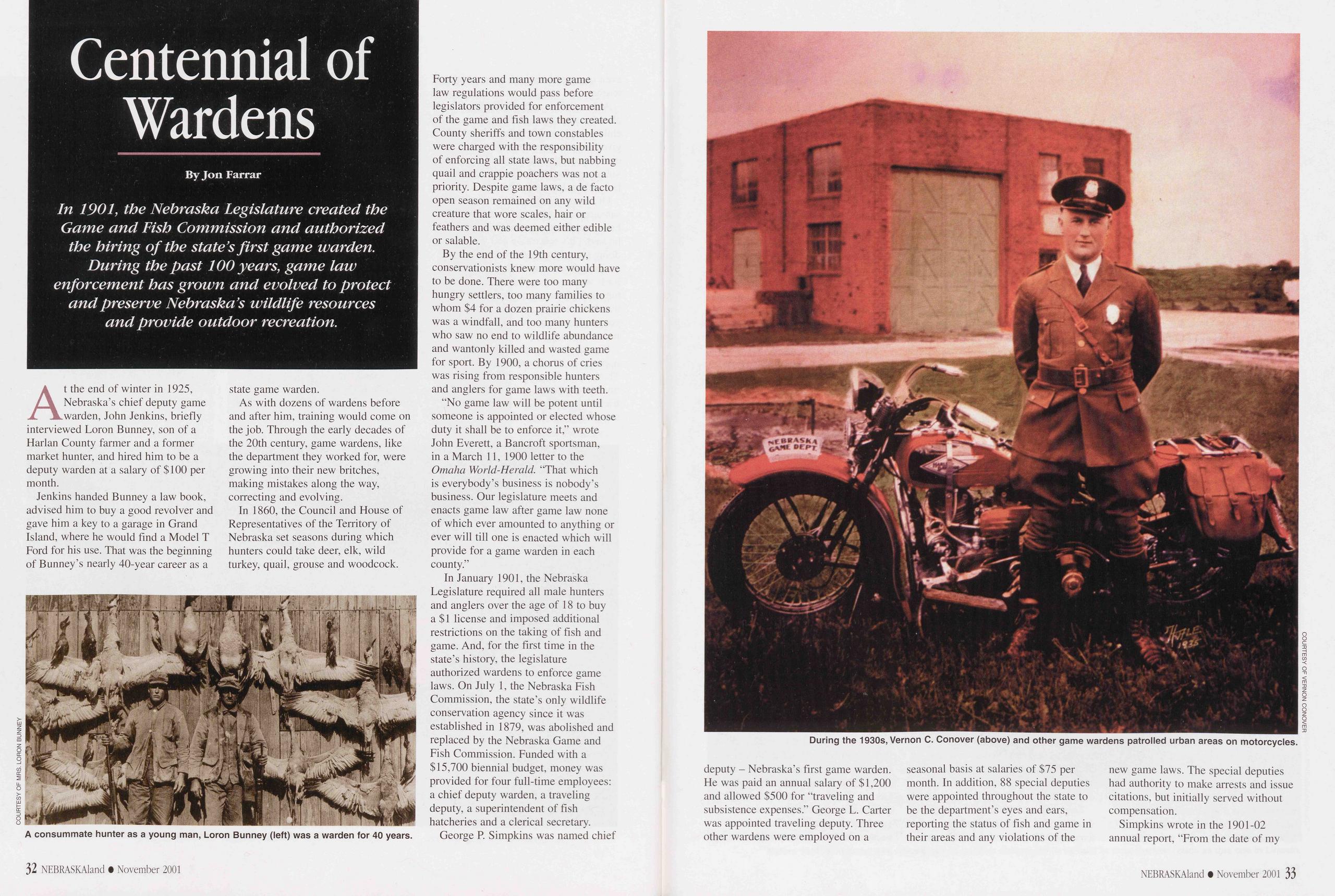
Centennial of Wardens
By Jon Farrar In 1901, the Nebraska Legislature created the Game and Fish Commission and authorized the hiring of the state’s first game warden. During the past 100 years, game law enforcement has grown and evolved to protect and preserve Nebraska’s wildlife resources and provide outdoor recreation.At the end of winter in 1925, Nebraska’s chief deputy game warden, John Jenkins, briefly interviewed Loron Bunney, son of a Harlan County farmer and a former market hunter, and hired him to be a deputy warden at a salary of $100 per month.
Jenkins handed Bunney a law book, advised him to buy a good revolver and gave him a key to a garage in Grand Island, where he would find a Model T Ford for his use. That was the beginning of Bunney’s nearly 40-year career as a
As with dozens of wardens before and after him, training would come on the job. Through the early decades of the 20th century, game wardens, like the department they worked for, were growing into their new britches, making mistakes along the way, correcting and evolving.
In 1860, the Council and House of Representatives of the Territory of Nebraska set seasons during which hunters could take deer, elk, wild turkey, quail, grouse and woodcock. Forty years and many more game law regulations would pass before legislators provided for enforcement of the game and fish laws they created. County sheriffs and town constables were charged with the responsibility of enforcing all state laws, but nabbing quail and crappie poachers was not a priority. Despite game laws, a de facto open season remained on any wild creature that wore scales, hair or feathers and was deemed either edible or salable.
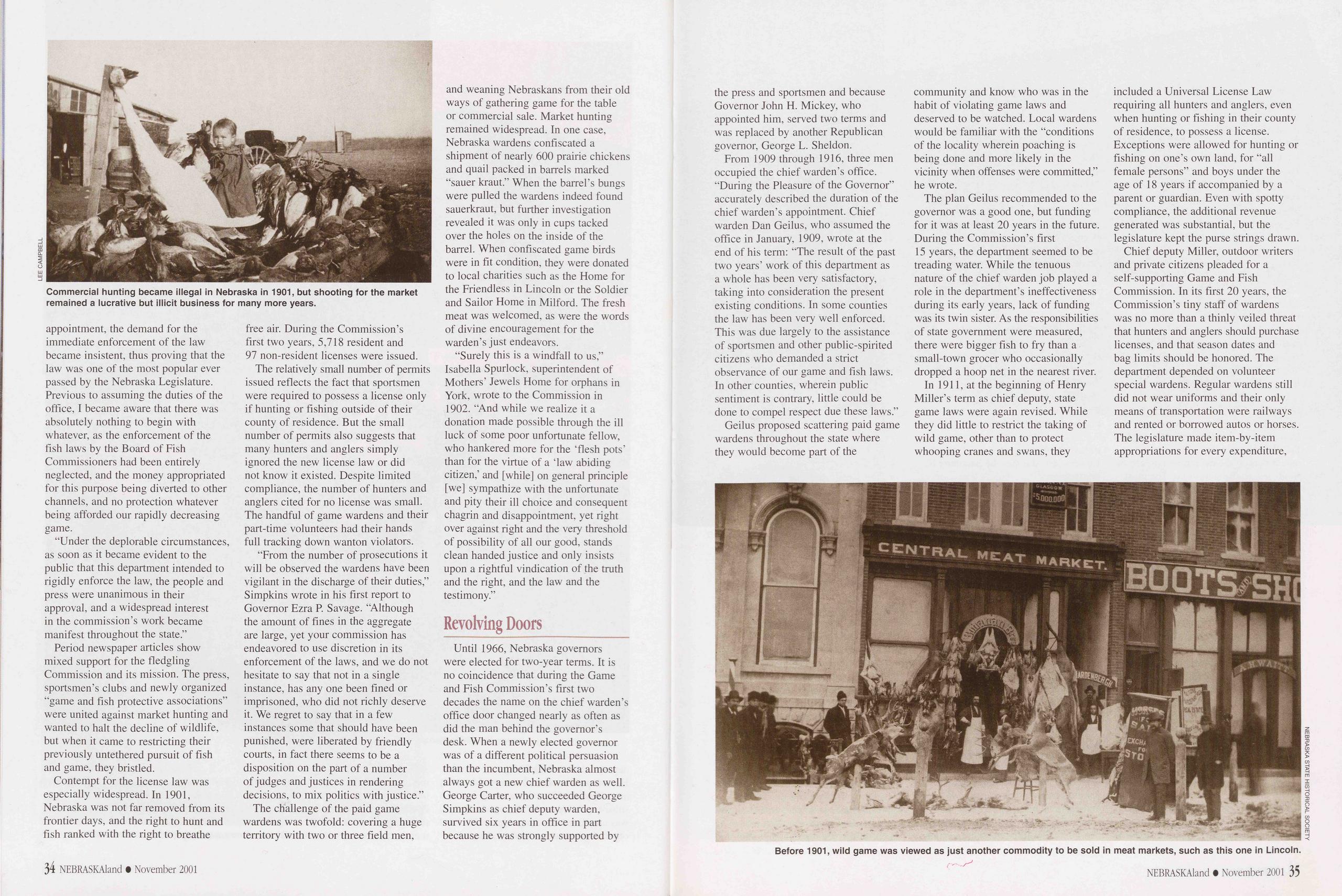
By the end of the 19th century, conservationists knew more would have to be done. There were too many hungry settlers, too many families to whom $4 for a dozen prairie chickens was a windfall, and too many hunters who saw no end to wildlife abundance and wantonly killed and wasted game for sport. By 1900, a chorus of cries was rising from responsible hunters and anglers for game laws with teeth.
"No game law will be potent until someone is appointed or elected whose duty it shall be to enforce it,” wrote John Everett, a Bancroft sportsman, in a March 11, 1900 letter to the Omaha World-Herald. "That which is everybody’s business is nobody’s business. Our legislature meets and enacts game law after game law none of which ever amounted to anything or ever will till one is enacted which will provide for a game warden in each county.”
In January 1901, the Nebraska Legislature required all male hunters and anglers over the age of 18 to buy a $ 1 license and imposed additional restrictions on the taking of fish and game. And, for the first time in the state’s history, the legislature authorized wardens to enforce game laws. On July 1, the Nebraska Fish Commission, the state’s only wildlife conservation agency since it was established in 1879, was abolished and replaced by the Nebraska Game and Fish Commission. Funded with a $15,700 biennial budget, money was provided for four full-time employees: a chief deputy warden, a traveling deputy, a superintendent of fish hatcheries and a clerical secretary.
George P. Simpkins was named chief
Simpkins wrote in the 1901-02
annual report, "From the date of my
32 NEBRASKAland • November 2001
NEBRASKAland • November 2001 33
“Under the deplorable circumstances, as soon as it became evident to the public that this department intended to rigidly enforce the law, the people and press were unanimous in their approval, and a widespread interest in the commission’s work became manifest throughout the state.”
Period newspaper articles show mixed support for the fledgling Commission and its mission. The press, sportsmen’s clubs and newly organized “game and fish protective associations” were united against market hunting and wanted to halt the decline of wildlife, but when it came to restricting their previously untethered pursuit of fish and game, they bristled.
Contempt for the license law was especially widespread. In 1901, Nebraska was not far removed from its frontier days, and the right to hunt and fish ranked with the right to breathe free air. During the Commission’s first two years, 5,718 resident and 97 non-resident licenses were issued.
The relatively small number of permits issued reflects the fact that sportsmen were required to possess a license only if hunting or fishing outside of their county of residence. But the small number of permits also suggests that many hunters and anglers simply ignored the new license law or did not know it existed. Despite limited compliance, the number of hunters and anglers cited for no license was small. The handful of game wardens and their part-time volunteers had their hands full tracking down wanton violators.
“From the number of prosecutions it will be observed the wardens have been vigilant in the discharge of their duties,” Simpkins wrote in his first report to Governor Ezra P. Savage. “Although the amount of fines in the aggregate are large, yet your commission has endeavored to use discretion in its enforcement of the laws, and we do not hesitate to say that not in a single instance, has any one been fined or imprisoned, who did not richly deserve it. We regret to say that in a few instances some that should have been punished, were liberated by friendly courts, in fact there seems to be a disposition on the part of a number of judges and justices in rendering decisions, to mix politics with justice.”
The challenge of the paid game wardens was twofold: covering a huge territory with two or three field men, and weaning Nebraskans from their old ways of gathering game for the table or commercial sale. Market hunting remained widespread. In one case, Nebraska wardens confiscated a shipment of nearly 600 prairie chickens and quail packed in barrels marked “sauer kraut.” When the barrel’s bungs were pulled the wardens indeed found sauerkraut, but further investigation revealed it was only in cups tacked over the holes on the inside of the barrel. When confiscated game birds were in fit condition, they were donated to local charities such as the Home for the Friendless in Lincoln or the Soldier and Sailor Home in Milford. The fresh meat was welcomed, as were the words of divine encouragement for the warden’s just endeavors.
“Surely this is a windfall to us,” Isabella Spurlock, superintendent of Mothers’ Jewels Home for orphans in York, wrote to the Commission in 1902. “And while we realize it a donation made possible through the ill luck of some poor unfortunate fellow, who hankered more for the ‘flesh pots’ than for the virtue of a ‘law abiding citizen,’ and [while] on general principle [we] sympathize with the unfortunate and pity their ill choice and consequent chagrin and disappointment, yet right over against right and the very threshold of possibility of all our good, stands clean handed justice and only insists upon a rightful vindication of the truth and the right, and the law and the testimony.”
Revolving DoorsUntil 1966, Nebraska governors were elected for two-year terms. It is no coincidence that during the Game and Fish Commission’s first two decades the name on the chief warden’s office door changed nearly as often as did the man behind the governor’s desk. When a newly elected governor was of a different political persuasion than the incumbent, Nebraska almost always got a new chief warden as well. George Carter, who succeeded George Simpkins as chief deputy warden, survived six years in office in part because he was strongly supported by the press and sportsmen and because Governor John H. Mickey, who appointed him, served two terms and was replaced by another Republican governor, George L. Sheldon.
From 1909 through 1916, three men occupied the chief warden’s office. “During the Pleasure of the Governor” accurately described the duration of the chief warden’s appointment. Chief warden Dan Geilus, who assumed the office in January, 1909, wrote at the end of his term: “The result of the past two years’ work of this department as a whole has been very satisfactory, taking into consideration the present existing conditions. In some counties the law has been very well enforced. This was due largely to the assistance of sportsmen and other public-spirited citizens who demanded a strict observance of our game and fish laws. In other counties, wherein public sentiment is contrary, little could be done to compel respect due these laws.”
Geilus proposed scattering paid game wardens throughout the state where they would become part of the
The plan Geilus recommended to the governor was a good one, but funding for it was at least 20 years in the future. During the Commission’s first 15 years, the department seemed to be treading water. While the tenuous nature of the chief warden job played a role in the department’s ineffectiveness during its early years, lack of funding was its twin sister. As the responsibilities of state government were measured, there were bigger fish to fry than a small-town grocer who occasionally dropped a hoop net in the nearest river.
In 1911, at the beginning of Henry Miller’s term as chief deputy, state game laws were again revised. While they did little to restrict the taking of wild game, other than to protect whooping cranes and swans, they included a Universal License Law requiring all hunters and anglers, even when hunting or fishing in their county of residence, to possess a license. Exceptions were allowed for hunting or fishing on one’s own land, for “all female persons” and boys under the age of 18 years if accompanied by a parent or guardian. Even with spotty compliance, the additional revenue generated was substantial, but the legislature kept the purse strings drawn.
Chief deputy Miller, outdoor writers
and private citizens pleaded for a
self-supporting Game and Fish
Commission. In its first 20 years, the
Commission’s tiny staff of wardens
was no more than a thinly veiled threat
that hunters and anglers should purchase
licenses, and that season dates and
bag limits should be honored. The
department depended on volunteer
special wardens. Regular wardens still
did not wear uniforms and their only
means of transportation were railways
and rented or borrowed autos or horses.
The legislature made item-by-item
appropriations for every expenditure,
34 NEBRASKAland • November 2001
NEBRASKAland • November 2001 35
 from fish eggs to hiring more wardens.
A flurry of state statutes related to the taking of fish and game were passed by the Nebraska Legislature and the U.S. Congress from 1910 to 1920, but enforcement remained spotty. Fines for violations were hefty, up to $500 for dynamiting fish or $300 for killing deer, antelope or beaver, but the odds of being arrested were infinitesimal. Passage of the Migratory Waterfowl Act by Congress in 1913, among other provisions, prohibited spring waterfowl hunting. The law was immediately challenged in court, and until the Migratory Bird Treaty was signed in 1918, it was unclear if state game wardens could legally enforce federal laws that did not immediately conform with state statutes. Spring duck and goose shooting was immensely popular, and the laws prohibiting it were largely ignored in parts of the state.
Gust Rutenbeck became chief warden in January 1913, and little changed during his four years at the helm of the Commission. If the two biennial reports that Rutenbeck penned are an accurate assessment of the department, a lack of funds forced the status quo. The most blunt request for adequate funding for the Commission came not from Rutenbeck but from W.J. O’Brien, who was deputy fish commissioner.
“Practically every state in the Union turns the money derived from these licenses into a State Fish and Game Fund,” O’Brien wrote. “Nebraska alone turns this money into the State School Fund, and the officers of this department are compelled every two years to go before the legislature and ask for meager support for this Commission, when for the past four years it has practically paid into the State Treasury two dollars for every one drawn out. While this department has virtually been trying to make a ‘silk purse out of a sow’s ear,’ some misguided people have been wondering why we have not a more efficient game warden’s department.”
G-men in Hip BootsIn January 1917, Democratic governor Keith Neville appointed George G. Kosters of Niobrara as head of the Commission. He would become one of the state’s most prominent and popular chief deputy wardens. In addition to vigorously enforcing game laws, Kosters was a consummate player at the table of politics. A dedicated sportsman, Kosters quickly won over hunters, anglers and newspapermen.
Kosters began his term with three deputies, but occasionally had enough money in the budget to hire special deputies as required. Once he unleashed 20 wardens to crack down on the killing of young grouse in the Sandhills before the hunting season opened. With political acumen and swelling public support for enforcing game laws, Kosters incrementally increased the number of wardens.
On August 2, 1919, just as Kosters was whipping his little department into shape, the Nebraska Legislature dissolved the Game and Fish Commission and put its personnel and responsibilities in a division of the newly created state Department of Agriculture. Rather than answering directly to the governor, chief warden Kosters served under the Secretary of Agriculture.
In all regards, fish and game was a bad fit in the department of agriculture. Men who had been deputy game wardens found themselves in the “inspection and control” division, classified the same as men who sniffed through rail cars of potatoes and were never shot at in the line of duty.
Lengthy annual reports from the Commission, once bristling with details of achievements and plans for the future, were reduced to two or three pages of rote accounting. In the same sentence extolling the benefits of furnishing hunting and fishing for the public is the suggestion that more abundant wild fowl and fish “will be a source of food supply as well,” inferring that for accounting purposes, grouse and trout were little different than corn and cattle.
Some good came of the years in the Department of Agriculture. Deputy wardens were equipped with Ford cars and camping outfits, “traveling their territory and camping where night overtook them,” the 1921-22 biennial
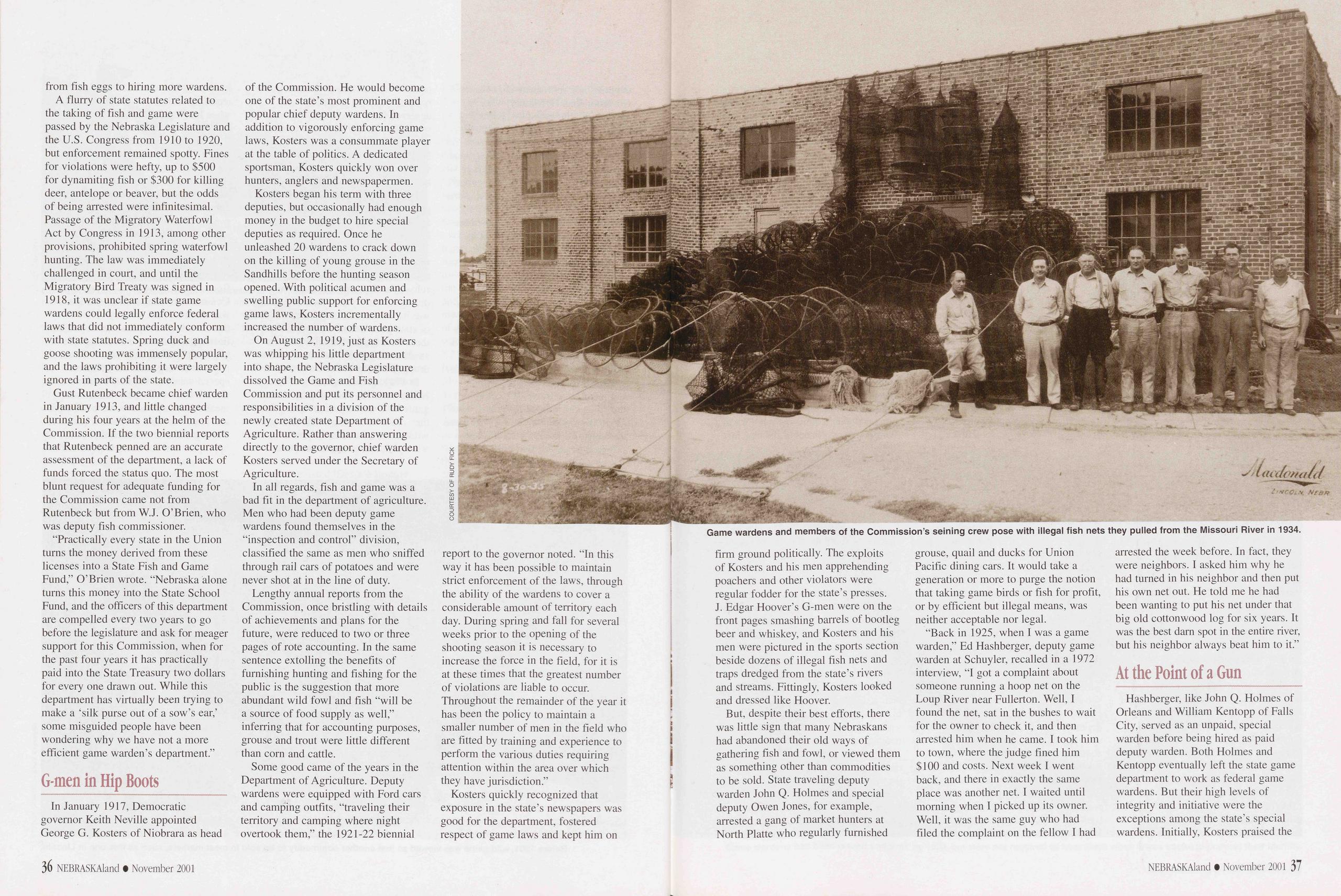
Kosters quickly recognized that exposure in the state’s newspapers was good for the department, fostered respect of game laws and kept him on firm ground politically. The exploits of Kosters and his men apprehending poachers and other violators were regular fodder for the state’s presses. J. Edgar Hoover’s G-men were on the front pages smashing barrels of bootleg beer and whiskey, and Kosters and his men were pictured in the sports section beside dozens of illegal fish nets and traps dredged from the state’s rivers and streams. Fittingly, Kosters looked and dressed like Hoover.
But, despite their best efforts, there was little sign that many Nebraskans had abandoned their old ways of gathering fish and fowl, or viewed them as something other than commodities to be sold. State traveling deputy warden John Q. Holmes and special deputy Owen Jones, for example, arrested a gang of market hunters at North Platte who regularly furnished grouse, quail and ducks for Union Pacific dining cars. It would take a generation or more to purge the notion that taking game birds or fish for profit, or by efficient but illegal means, was neither acceptable nor legal.
“Back in 1925, when I was a game warden,” Ed Hashberger, deputy game warden at Schuyler, recalled in a 1972 interview, “I got a complaint about someone running a hoop net on the Loup River near Fullerton. Well, I found the net, sat in the bushes to wait for the owner to check it, and then arrested him when he came. I took him to town, where the judge fined him $100 and costs. Next week I went back, and there in exactly the same place was another net. I waited until morning when I picked up its owner. Well, it was the same guy who had filed the complaint on the fellow I had arrested the week before. In fact, they were neighbors. I asked him why he had turned in his neighbor and then put his own net out. He told me he had been wanting to put his net under that big old cottonwood log for six years. It was the best darn spot in the entire river, but his neighbor always beat him to it.”
At the Point of a GunHashberger, like John Q. Holmes of
Orleans and William Kentopp of Falls
City, served as an unpaid, special
warden before being hired as paid
deputy warden. Both Holmes and
Kentopp eventually left the state game
department to work as federal game
wardens. But their high levels of
integrity and initiative were the
exceptions among the state’s special
wardens. Initially, Kosters praised the
36 NEBRASKAland • November 2001
NEBRASKAland • November 2001 37
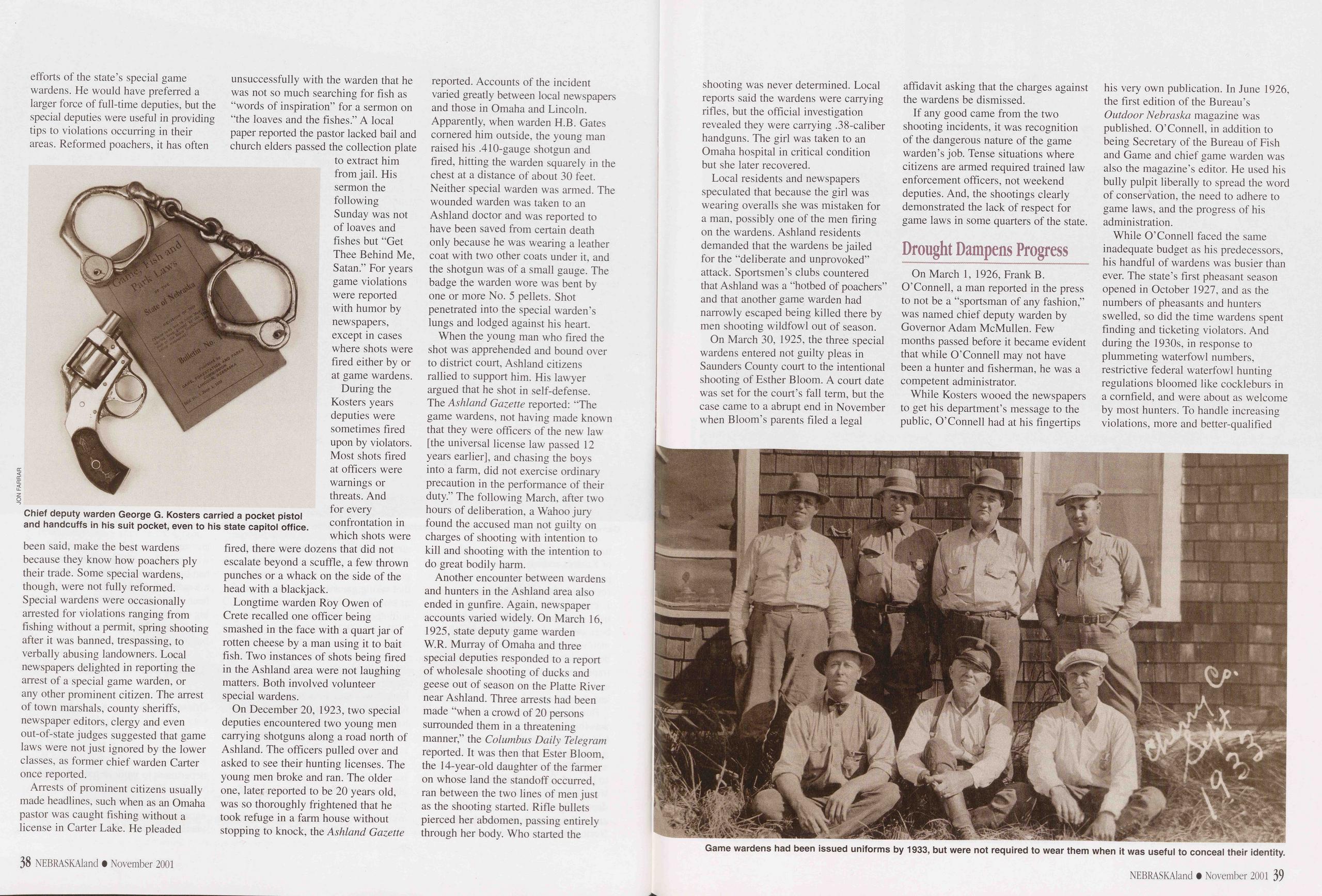 efforts of the state’s special game
wardens. He would have preferred a
larger force of full-time deputies, but the
special deputies were useful in providing
tips to violations occurring in their
areas. Reformed poachers, it has often
efforts of the state’s special game
wardens. He would have preferred a
larger force of full-time deputies, but the
special deputies were useful in providing
tips to violations occurring in their
areas. Reformed poachers, it has often
Arrests of prominent citizens usually made headlines, such when as an Omaha pastor was caught fishing without a license in Carter Lake. He pleaded unsuccessfully with the warden that he was not so much searching for fish as "words of inspiration” for a sermon on "the loaves and the fishes.” A local paper reported the pastor lacked bail and church elders passed the collection plate to extract him from jail. His sermon the following Sunday was not of loaves and fishes but “Get Thee Behind Me, Satan.” For years game violations were reported with humor by newspapers, except in cases where shots were fired either by or at game wardens.
During the Kosters years deputies were sometimes fired upon by violators. Most shots fired at officers were warnings or threats. And for every confrontation in which shots were fired, there were dozens that did not escalate beyond a scuffle, a few thrown punches or a whack on the side of the head with a blackjack.
Longtime warden Roy Owen of Crete recalled one officer being smashed in the face with a quart jar of rotten cheese by a man using it to bait fish. Two instances of shots being fired in the Ashland area were not laughing matters. Both involved volunteer special wardens.
On December 20, 1923, two special deputies encountered two young men carrying shotguns along a road north of Ashland. The officers pulled over and asked to see their hunting licenses. The young men broke and ran. The older one, later reported to be 20 years old, was so thoroughly frightened that he took refuge in a farm house without stopping to knock, the Ashland Gazette reported. Accounts of the incident varied greatly between local newspapers and those in Omaha and Lincoln. Apparently, when warden H.B. Gates cornered him outside, the young man raised his .410-gauge shotgun and fired, hitting the warden squarely in the chest at a distance of about 30 feet. Neither special warden was armed. The wounded warden was taken to an Ashland doctor and was reported to have been saved from certain death only because he was wearing a leather coat with two other coats under it, and the shotgun was of a small gauge. The badge the warden wore was bent by one or more No. 5 pellets. Shot penetrated into the special warden’s lungs and lodged against his heart.
When the young man who fired the shot was apprehended and bound over to district court, Ashland citizens rallied to support him. His lawyer argued that he shot in self-defense. The Ashland Gazette reported: “The game wardens, not having made known that they were officers of the new law [the universal license law passed 12 years earlier], and chasing the boys into a farm, did not exercise ordinary precaution in the performance of their duty.” The following March, after two hours of deliberation, a Wahoo jury found the accused man not guilty on charges of shooting with intention to kill and shooting with the intention to do great bodily harm.
Another encounter between wardens and hunters in the Ashland area also ended in gunfire. Again, newspaper accounts varied widely. On March 16, 1925, state deputy game warden W.R. Murray of Omaha and three special deputies responded to a report of wholesale shooting of ducks and geese out of season on the Platte River near Ashland. Three arrests had been made “when a crowd of 20 persons surrounded them in a threatening manner,” the Columbus Daily Telegram reported. It was then that Ester Bloom, the 14-year-old daughter of the farmer on whose land the standoff occurred, ran between the two lines of men just as the shooting started. Rifle bullets pierced her abdomen, passing entirely through her body. Who started the shooting was never determined. Local reports said the wardens were carrying rifles, but the official investigation revealed they were carrying .38-caliber handguns. The girl was taken to an Omaha hospital in critical condition but she later recovered.
Local residents and newspapers speculated that because the girl was wearing overalls she was mistaken for a man, possibly one of the men firing on the wardens. Ashland residents demanded that the wardens be jailed for the “deliberate and unprovoked” attack. Sportsmen’s clubs countered that Ashland was a “hotbed of poachers” and that another game warden had narrowly escaped being killed there by men shooting wildfowl out of season.
On March 30, 1925, the three special wardens entered not guilty pleas in Saunders County court to the intentional shooting of Esther Bloom. A court date was set for the court’s fall term, but the case came to a abrupt end in November when Bloom’s parents filed a legal
If any good came from the two shooting incidents, it was recognition of the dangerous nature of the game warden’s job. Tense situations where citizens are armed required trained law enforcement officers, not weekend deputies. And, the shootings clearly demonstrated the lack of respect for game laws in some quarters of the state.
Drought Dampens ProgressOn March 1, 1926, Frank B. O’Connell, a man reported in the press to not be a “sportsman of any fashion,” was named chief deputy warden by Governor Adam McMullen. Few months passed before it became evident that while O’Connell may not have been a hunter and fisherman, he was a competent administrator.
While Kosters wooed the newspapers to get his department’s message to the public, O’Connell had at his fingertips his very own publication. In June 1926, the first edition of the Bureau’s Outdoor Nebraska magazine was published. O’Connell, in addition to being Secretary of the Bureau of Fish and Game and chief game warden was also the magazine’s editor. He used his bully pulpit liberally to spread the word of conservation, the need to adhere to game laws, and the progress of his administration.
While O’Connell faced the same
inadequate budget as his predecessors,
his handful of wardens was busier than
ever. The state’s first pheasant season
opened in October 1927, and as the
numbers of pheasants and hunters
swelled, so did the time wardens spent
finding and ticketing violators. And
during the 1930s, in response to
plummeting waterfowl numbers,
restrictive federal waterfowl hunting
regulations bloomed like cockleburs in
a cornfield, and were about as welcome
by most hunters. To handle increasing
violations, more and better-qualified
38 NEBRASKAland • November 2001
NEBRASKAland • November 2001 39
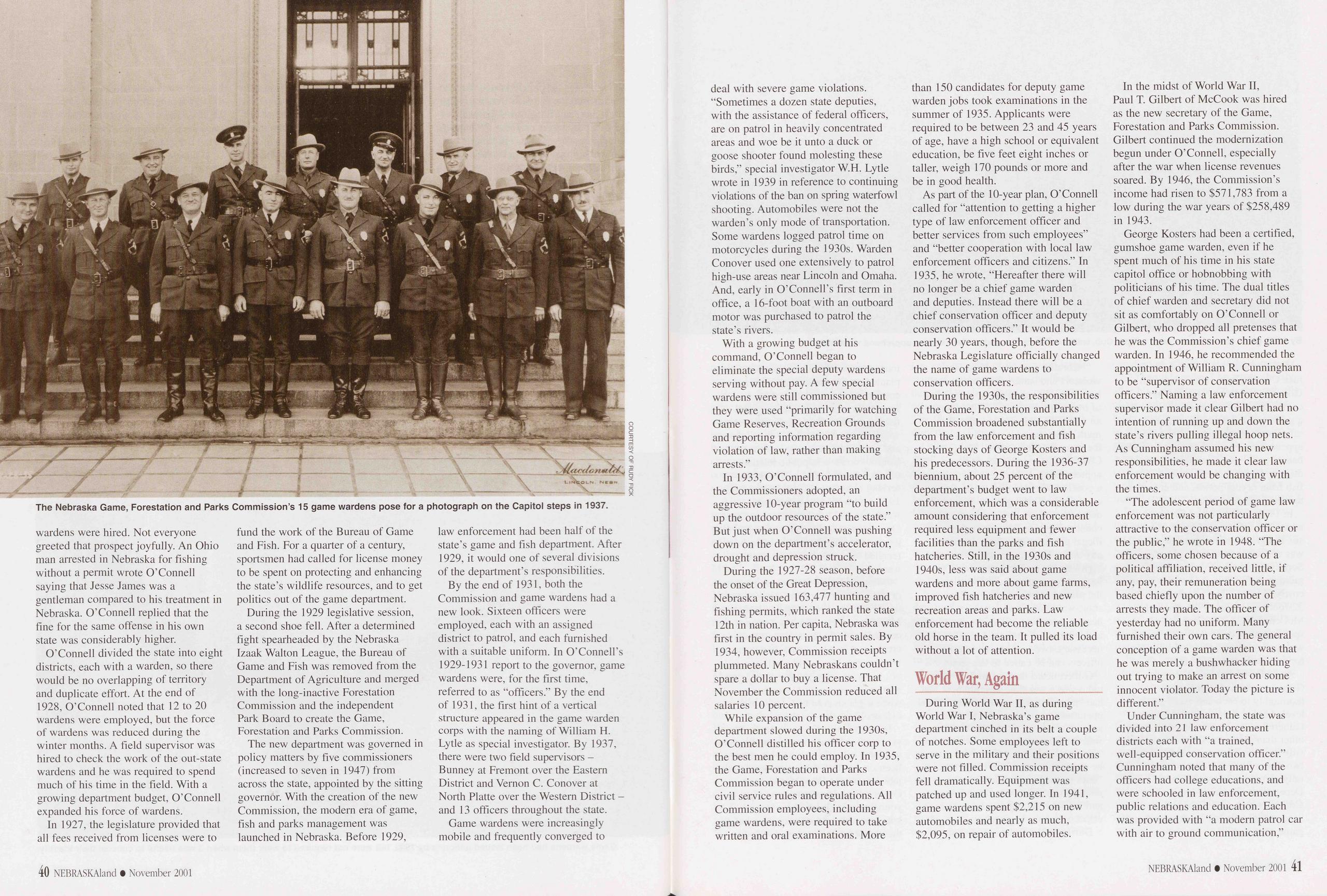
O’Connell divided the state into eight districts, each with a warden, so there would be no overlapping of territory and duplicate effort. At the end of 1928, O’Connell noted that 12 to 20 wardens were employed, but the force of wardens was reduced during the winter months. A field supervisor was hired to check the work of the out-state wardens and he was required to spend much of his time in the field. With a growing department budget, O’Connell expanded his force of wardens.
In 1927, the legislature provided that all fees received from licenses were to fund the work of the Bureau of Game and Fish. For a quarter of a century, sportsmen had called for license money to be spent on protecting and enhancing the state’s wildlife resources, and to get politics out of the game department.
During the 1929 legislative session, a second shoe fell. After a determined fight spearheaded by the Nebraska Izaak Walton League, the Bureau of Game and Fish was removed from the Department of Agriculture and merged with the long-inactive Forestation Commission and the independent Park Board to create the Game, Forestation and Parks Commission.
The new department was governed in policy matters by five commissioners (increased to seven in 1947) from across the state, appointed by the sitting governor. With the creation of the new Commission, the modern era of game, fish and parks management was launched in Nebraska. Before 1929, law enforcement had been half of the state’s game and fish department. After 1929, it would one of several divisions of the department’s responsibilities.
By the end of 1931, both the Commission and game wardens had a new look. Sixteen officers were employed, each with an assigned district to patrol, and each furnished with a suitable uniform. In O’Connell’s 1929-1931 report to the governor, game wardens were, for the first time, referred to as “officers.” By the end of 1931, the first hint of a vertical structure appeared in the game warden corps with the naming of William H. Lytle as special investigator. By 1937, there were two field supervisors - Bunney at Fremont over the Eastern District and Vernon C. Conover at North Platte over the Western District - and 13 officers throughout the state.
Game wardens were increasingly mobile and frequently converged to deal with severe game violations. “Sometimes a dozen state deputies, with the assistance of federal officers, are on patrol in heavily concentrated areas and woe be it unto a duck or goose shooter found molesting these birds,” special investigator W.H. Lytle wrote in 1939 in reference to continuing violations of the ban on spring waterfowl shooting. Automobiles were not the warden’s only mode of transportation. Some wardens logged patrol time on motorcycles during the 1930s. Warden Conover used one extensively to patrol high-use areas near Lincoln and Omaha. And, early in O’Connell’s first term in office, a 16-foot boat with an outboard motor was purchased to patrol the state’s rivers.
With a growing budget at his command, O’Connell began to eliminate the special deputy wardens serving without pay. A few special wardens were still commissioned but they were used “primarily for watching Game Reserves, Recreation Grounds and reporting information regarding violation of law, rather than making arrests.”
In 1933, O’Connell formulated, and the Commissioners adopted, an aggressive 10-year program “to build up the outdoor resources of the state.” But just when O’Connell was pushing down on the department’s accelerator, drought and depression struck.
During the 1927-28 season, before the onset of the Great Depression, Nebraska issued 163,477 hunting and fishing permits, which ranked the state 12th in nation. Per capita, Nebraska was first in the country in permit sales. By 1934, however, Commission receipts plummeted. Many Nebraskans couldn’t spare a dollar to buy a license. That November the Commission reduced all salaries 10 percent.
While expansion of the game department slowed during the 1930s, O’Connell distilled his officer corp to the best men he could employ. In 1935, the Game, Forestation and Parks Commission began to operate under civil service rules and regulations. All Commission employees, including game wardens, were required to take written and oral examinations. More than 150 candidates for deputy game warden jobs took examinations in the summer of 1935. Applicants were required to be between 23 and 45 years of age, have a high school or equivalent education, be five feet eight inches or taller, weigh 170 pounds or more and be in good health.
As part of the 10-year plan, O’Connell called for “attention to getting a higher type of law enforcement officer and better services from such employees” and “better cooperation with local law enforcement officers and citizens.” In 1935, he wrote, “Hereafter there will no longer be a chief game warden and deputies. Instead there will be a chief conservation officer and deputy conservation officers.” It would be nearly 30 years, though, before the Nebraska Legislature officially changed the name of game wardens to conservation officers.
During the 1930s, the responsibilities of the Game, Forestation and Parks Commission broadened substantially from the law enforcement and fish stocking days of George Kosters and his predecessors. During the 1936-37 biennium, about 25 percent of the department’s budget went to law enforcement, which was a considerable amount considering that enforcement required less equipment and fewer facilities than the parks and fish hatcheries. Still, in the 1930s and 1940s, less was said about game wardens and more about game farms, improved fish hatcheries and new recreation areas and parks. Law enforcement had become the reliable old horse in the team. It pulled its load without a lot of attention.
World War, AgainDuring World War II, as during World War I, Nebraska’s game department cinched in its belt a couple of notches. Some employees left to serve in the military and their positions were not filled. Commission receipts fell dramatically. Equipment was patched up and used longer. In 1941, game wardens spent $2,215 on new automobiles and nearly as much, $2,095, on repair of automobiles.
In the midst of World War II, Paul T. Gilbert of McCook was hired as the new secretary of the Game, Forestation and Parks Commission. Gilbert continued the modernization begun under O’Connell, especially after the war when license revenues soared. By 1946, the Commission’s income had risen to $571,783 from a low during the war years of $258,489 in 1943.
George Kosters had been a certified, gumshoe game warden, even if he spent much of his time in his state capitol office or hobnobbing with politicians of his time. The dual titles of chief warden and secretary did not sit as comfortably on O’Connell or Gilbert, who dropped all pretenses that he was the Commission’s chief game warden. In 1946, he recommended the appointment of William R. Cunningham to be “supervisor of conservation officers.” Naming a law enforcement supervisor made it clear Gilbert had no intention of running up and down the state’s rivers pulling illegal hoop nets. As Cunningham assumed his new responsibilities, he made it clear law enforcement would be changing with the times.
“The adolescent period of game law enforcement was not particularly attractive to the conservation officer or the public,” he wrote in 1948. “The officers, some chosen because of a political affiliation, received little, if any, pay, their remuneration being based chiefly upon the number of arrests they made. The officer of yesterday had no uniform. Many furnished their own cars. The general conception of a game warden was that he was merely a bushwhacker hiding out trying to make an arrest on some innocent violator. Today the picture is different.”
Under Cunningham, the state was divided into 21 law enforcement districts each with “a trained, well-equipped conservation officer.” Cunningham noted that many of the officers had college educations, and were schooled in law enforcement, public relations and education. Each was provided with “a modern patrol car with air to ground communication,”
40 NEBRASKAland • November 2001 NEBRASKAland • November 2001 41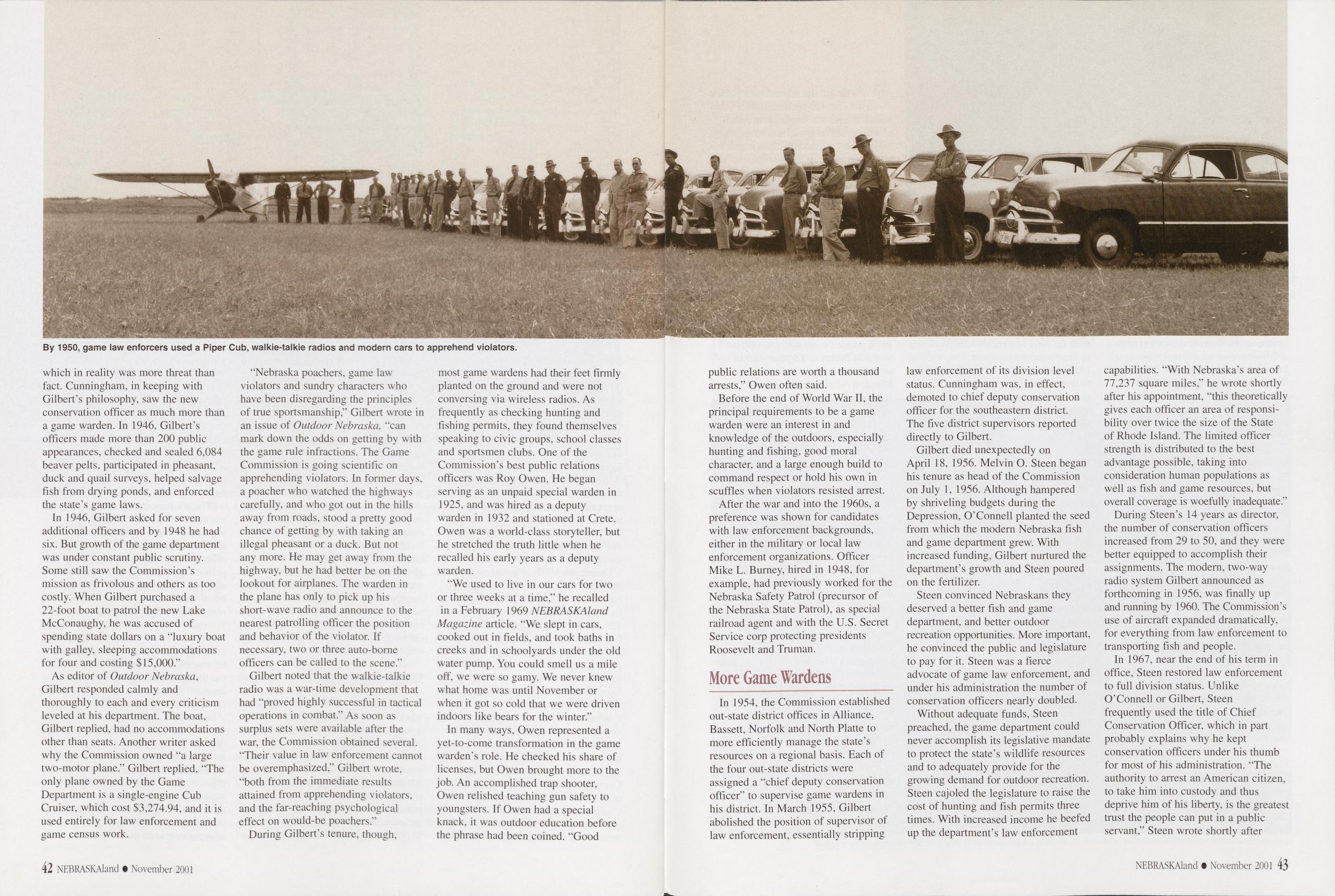
By 1950, game law enforcers used a Piper Cub, walkie-talkie radios and modern cars to apprehend violators.
which in reality was more threat than fact. Cunningham, in keeping with Gilbert’s philosophy, saw the new conservation officer as much more than a game warden. In 1946, Gilbert’s officers made more than 200 public appearances, checked and sealed 6,084 beaver pelts, participated in pheasant, duck and quail surveys, helped salvage fish from drying ponds, and enforced the state’s game laws.
In 1946, Gilbert asked for seven additional officers and by 1948 he had six. But growth of the game department was under constant public scrutiny. Some still saw the Commission’s mission as frivolous and others as too costly. When Gilbert purchased a 22-foot boat to patrol the new Lake McConaughy, he was accused of spending state dollars on a “luxury boat with galley, sleeping accommodations for four and costing $15,000.”
As editor of Outdoor Nebraska, Gilbert responded calmly and thoroughly to each and every criticism leveled at his department. The boat, Gilbert replied, had no accommodations other than seats. Another writer asked why the Commission owned “a large two-motor plane.” Gilbert replied, “The only plane owned by the Game Department is a single-engine Cub Cruiser, which cost $3,274.94, and it is used entirely for law enforcement and game census work.
“Nebraska poachers, game law violators and sundry characters who have been disregarding the principles of true sportsmanship,” Gilbert wrote in an issue of Outdoor Nebraska, "can mark down the odds on getting by with the game rule infractions. The Game Commission is going scientific on apprehending violators. In former days, a poacher who watched the highways carefully, and who got out in the hills away from roads, stood a pretty good chance of getting by with taking an illegal pheasant or a duck. But not any more. He may get away from the highway, but he had better be on the lookout for airplanes. The warden in the plane has only to pick up his short-wave radio and announce to the nearest patrolling officer the position and behavior of the violator. If necessary, two or three auto-borne officers can be called to the scene.”
Gilbert noted that the walkie-talkie radio was a war-time development that had “proved highly successful in tactical operations in combat.” As soon as surplus sets were available after the war, the Commission obtained several. “Their value in law enforcement cannot be overemphasized,” Gilbert wrote, “both from the immediate results attained from apprehending violators, and the far-reaching psychological effect on would-be poachers.”
During Gilbert’s tenure, though, most game wardens had their feet firmly planted on the ground and were not conversing via wireless radios. As frequently as checking hunting and fishing permits, they found themselves speaking to civic groups, school classes and sportsmen clubs. One of the Commission’s best public relations officers was Roy Owen. He began serving as an unpaid special warden in 1925, and was hired as a deputy warden in 1932 and stationed at Crete. Owen was a world-class storyteller, but he stretched the truth little when he recalled his early years as a deputy warden.
“We used to live in our cars for two or three weeks at a time,” he recalled in a February 1969 NEBRASKAland Magazine article. “We slept in cars, cooked out in fields, and took baths in creeks and in schoolyards under the old water pump. You could smell us a mile off, we were so gamy. We never knew what home was until November or when it got so cold that we were driven indoors like bears for the winter.”
In many ways, Owen represented a yet-to-come transformation in the game warden’s role. He checked his share of licenses, but Owen brought more to the job. An accomplished trap shooter, Owen relished teaching gun safety to youngsters. If Owen had a special knack, it was outdoor education before the phrase had been coined. “Good public relations are worth a thousand arrests,” Owen often said.
Before the end of World War II, the principal requirements to be a game warden were an interest in and knowledge of the outdoors, especially hunting and fishing, good moral character, and a large enough build to command respect or hold his own in scuffles when violators resisted arrest.
After the war and into the 1960s, a preference was shown for candidates with law enforcement backgrounds, either in the military or local law enforcement organizations. Officer Mike L. Burney, hired in 1948, for example, had previously worked for the Nebraska Safety Patrol (precursor of the Nebraska State Patrol), as special railroad agent and with the U.S. Secret Service corp protecting presidents Roosevelt and Truman.
More Game Wardens In 1954, the Commission established out-state district offices in Alliance, Bassett, Norfolk and North Platte to more efficiently manage the state’s resources on a regional basis. Each of the four out-state districts were assigned a “chief deputy conservation officer” to supervise game wardens in his district. In March 1955, Gilbert abolished the position of supervisor of law enforcement, essentially stripping law enforcement of its division level status. Cunningham was, in effect, demoted to chief deputy conservation officer for the southeastern district. The five district supervisors reported directly to Gilbert. Gilbert died unexpectedly on April 18, 1956. Melvin O. Steen began his tenure as head of the Commission on July 1, 1956. Although hampered by shriveling budgets during the Depression, O’Connell planted the seed from which the modern Nebraska fish and game department grew. With increased funding, Gilbert nurtured the department’s growth and Steen poured on the fertilizer. Steen convinced Nebraskans they deserved a better fish and game department, and better outdoor recreation opportunities. More important, he convinced the public and legislature to pay for it. Steen was a fierce advocate of game law enforcement, and under his administration the number of conservation officers nearly doubled. Without adequate funds, Steen preached, the game department could never accomplish its legislative mandate to protect the state’s wildlife resources and to adequately provide for the growing demand for outdoor recreation. Steen cajoled the legislature to raise the cost of hunting and fish permits three times. With increased income he beefed up the department’s law enforcement capabilities. “With Nebraska’s area of 77,237 square miles,” he wrote shortly after his appointment, “this theoretically gives each officer an area of responsi- bility over twice the size of the State of Rhode Island. The limited officer strength is distributed to the best advantage possible, taking into consideration human populations as well as fish and game resources, but overall coverage is woefully inadequate.” During Steen’s 14 years as director, the number of conservation officers increased from 29 to 50, and they were better equipped to accomplish their assignments. The modern, two-way radio system Gilbert announced as forthcoming in 1956, was finally up and running by 1960. The Commission’s use of aircraft expanded dramatically, for everything from law enforcement to transporting fish and people.In 1967, near the end of his term in office, Steen restored law enforcement to full division status. Unlike O’Connell or Gilbert, Steen frequently used the title of Chief Conservation Officer, which in part probably explains why he kept conservation officers under his thumb for most of his administration. “The authority to arrest an American citizen, to take him into custody and thus deprive him of his liberty, is the greatest trust the people can put in a public servant,” Steen wrote shortly after
42 NEBRASKAland • November 2001 NEBRASKAland • November 2001 43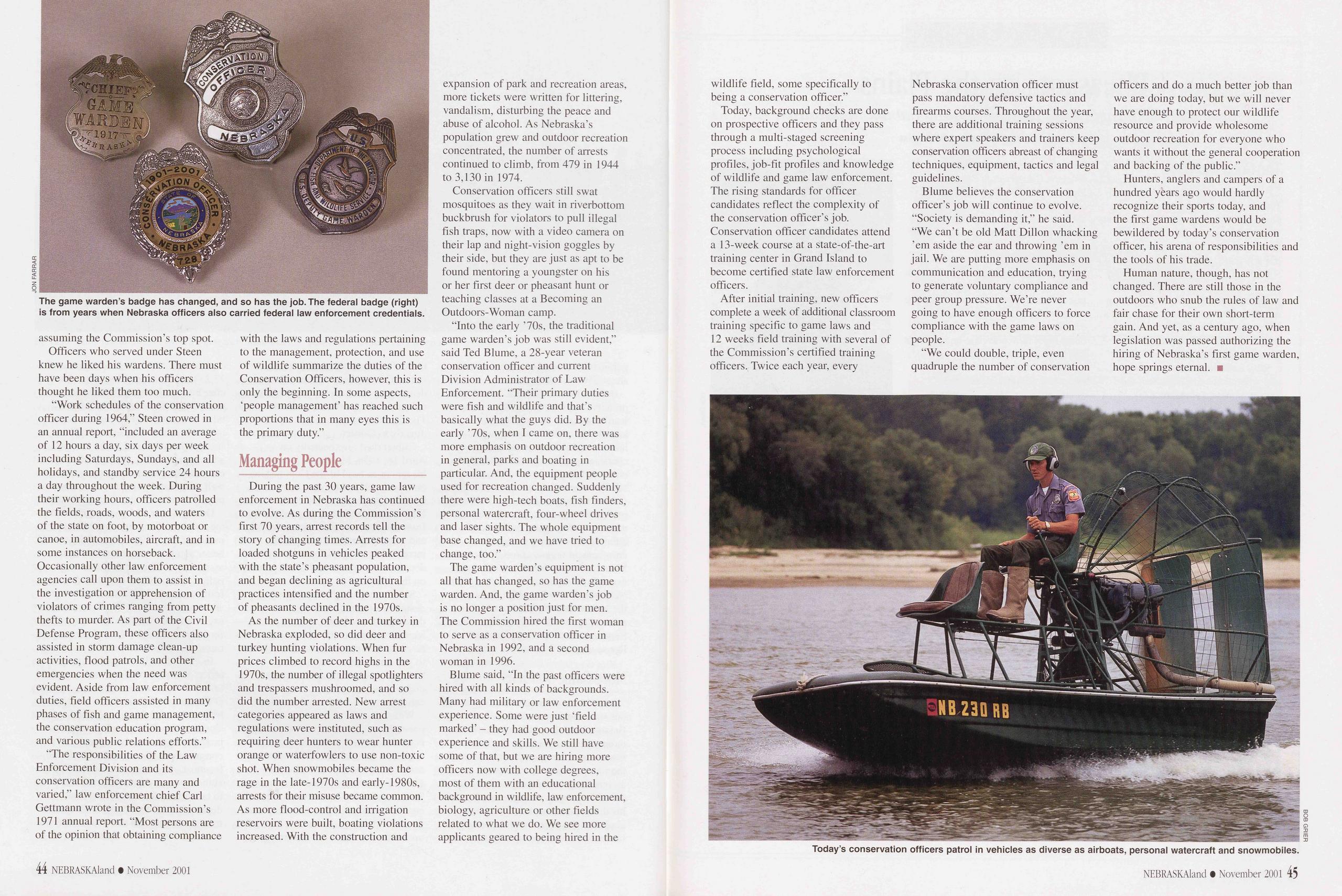
assuming the Commission’s top spot.
Officers who served under Steen knew he liked his wardens. There must have been days when his officers thought he liked them too much.
“Work schedules of the conservation officer during 1964,” Steen crowed in an annual report, “included an average of 12 hours a day, six days per week including Saturdays, Sundays, and all holidays, and standby service 24 hours a day throughout the week. During their working hours, officers patrolled the fields, roads, woods, and waters of the state on foot, by motorboat or canoe, in automobiles, aircraft, and in some instances on horseback. Occasionally other law enforcement agencies call upon them to assist in the investigation or apprehension of violators of crimes ranging from petty thefts to murder. As part of the Civil Defense Program, these officers also assisted in storm damage clean-up activities, flood patrols, and other emergencies when the need was evident. Aside from law enforcement duties, field officers assisted in many phases of fish and game management, the conservation education program, and various public relations efforts.”
“The responsibilities of the Law Enforcement Division and its conservation officers are many and varied,” law enforcement chief Carl Gettmann wrote in the Commission’s 1971 annual report. “Most persons are of the opinion that obtaining compliance with the laws and regulations pertaining to the management, protection, and use of wildlife summarize the duties of the Conservation Officers, however, this is only the beginning. In some aspects, ‘people management’ has reached such proportions that in many eyes this is the primary duty.”
Managing PeopleDuring the past 30 years, game law enforcement in Nebraska has continued to evolve. As during the Commission’s first 70 years, arrest records tell the story of changing times. Arrests for loaded shotguns in vehicles peaked with the state’s pheasant population, and began declining as agricultural practices intensified and the number of pheasants declined in the 1970s.
As the number of deer and turkey in Nebraska exploded, so did deer and turkey hunting violations. When fur prices climbed to record highs in the 1970s, the number of illegal spotlighters and trespassers mushroomed, and so did the number arrested. New arrest categories appeared as laws and regulations were instituted, such as requiring deer hunters to wear hunter orange or waterfowlers to use non-toxic shot. When snowmobiles became the rage in the late-1970s and early-1980s, arrests for their misuse became common. As more flood-control and irrigation reservoirs were built, boating violations increased. With the construction and expansion of park and recreation areas, more tickets were written for littering, vandalism, disturbing the peace and abuse of alcohol. As Nebraska’s population grew and outdoor recreation concentrated, the number of arrests continued to climb, from 479 in 1944 to 3,130 in 1974.
Conservation officers still swat mosquitoes as they wait in riverbottom buckbrush for violators to pull illegal fish traps, now with a video camera on their lap and night-vision goggles by their side, but they are just as apt to be found mentoring a youngster on his or her first deer or pheasant hunt or teaching classes at a Becoming an Outdoors-Woman camp.
“Into the early ’70s, the traditional game warden’s job was still evident,” said Ted Blume, a 28-year veteran conservation officer and current Division Administrator of Law Enforcement. “Their primary duties were fish and wildlife and that’s basically what the guys did. By the early ’70s, when I came on, there was more emphasis on outdoor recreation in general, parks and boating in particular. And, the equipment people used for recreation changed. Suddenly there were high-tech boats, fish finders, personal watercraft, four-wheel drives and laser sights. The whole equipment base changed, and we have tried to change, too.”
The game warden’s equipment is not all that has changed, so has the game warden. And, the game warden’s job is no longer a position just for men. The Commission hired the first woman to serve as a conservation officer in Nebraska in 1992, and a second woman in 1996.
Blume said, “In the past officers were hired with all kinds of backgrounds. Many had military or law enforcement experience. Some were just ‘field marked’ - they had good outdoor experience and skills. We still have some of that, but we are hiring more officers now with college degrees, most of them with an educational background in wildlife, law enforcement, biology, agriculture or other fields related to what we do. We see more applicants geared to being hired in the wildlife field, some specifically to being a conservation officer.”
Today, background checks are done on prospective officers and they pass through a multi-staged screening process including psychological profiles, job-fit profiles and knowledge of wildlife and game law enforcement. The rising standards for officer candidates reflect the complexity of the conservation officer’s job. Conservation officer candidates attend a 13-week course at a state-of-the-art training center in Grand Island to become certified state law enforcement officers.
After initial training, new officers complete a week of additional classroom training specific to game laws and 12 weeks field training with several of the Commission’s certified training officers. Twice each year, every
Blume believes the conservation officer’s job will continue to evolve. “Society is demanding it,” he said. “We can’t be old Matt Dillon whacking ’em aside the ear and throwing ’em in jail. We are putting more emphasis on communication and education, trying to generate voluntary compliance and peer group pressure. We’re never going to have enough officers to force compliance with the game laws on people.
“We could double, triple, even quadruple the number of conservation officers and do a much better job than we are doing today, but we will never have enough to protect our wildlife resource and provide wholesome outdoor recreation for everyone who wants it without the general cooperation and backing of the public.”
Hunters, anglers and campers of a hundred years ago would hardly recognize their sports today, and the first game wardens would be bewildered by today’s conservation officer, his arena of responsibilities and the tools of his trade.
Human nature, though, has not changed. There are still those in the outdoors who snub the rules of law and fair chase for their own short-term gain. And yet, as a century ago, when legislation was passed authorizing the hiring of Nebraska’s first game warden, hope springs eternal.
44 NEBRASKAland • November 2001 NEBRASKAland • November 2001 45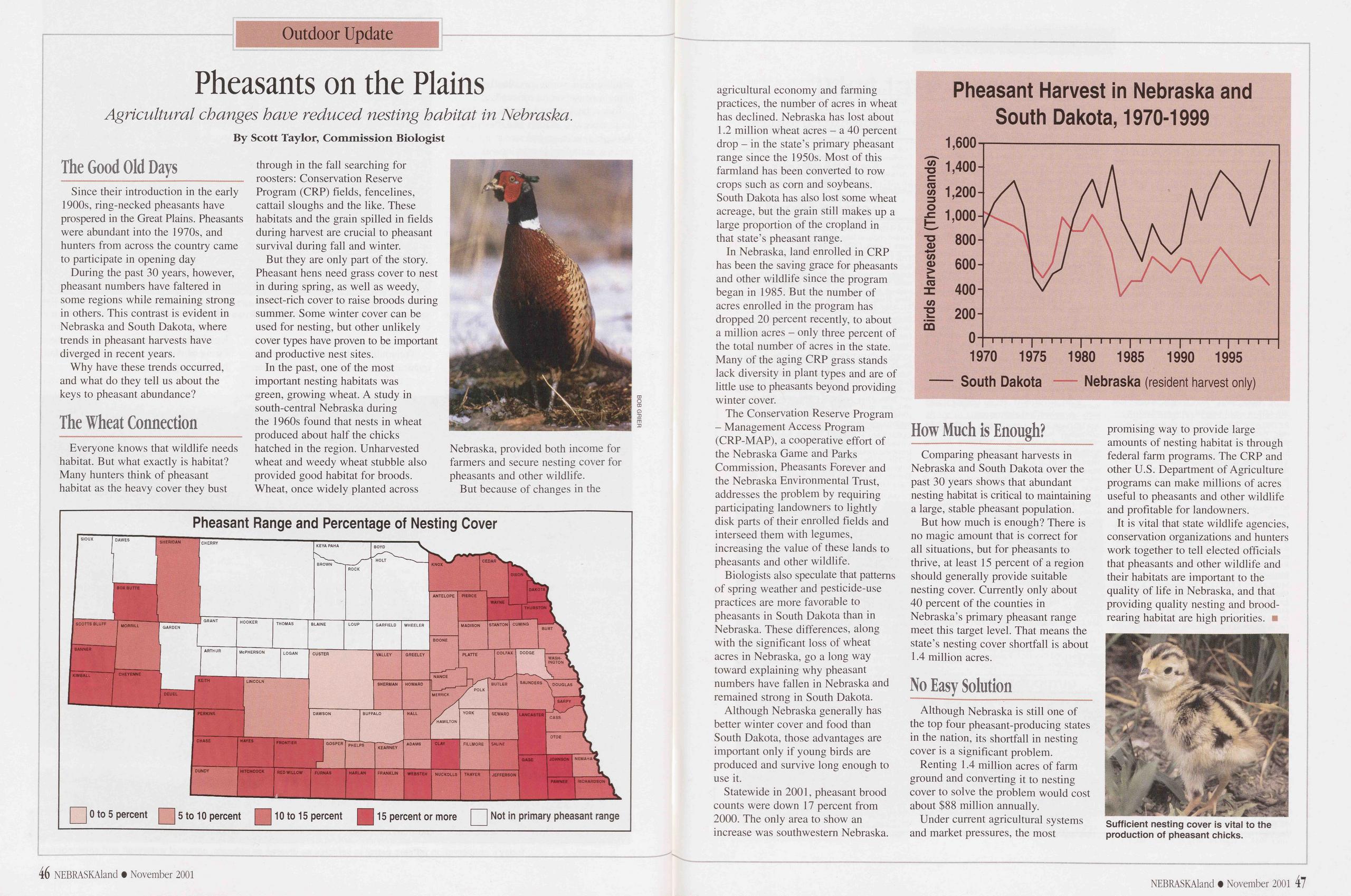
Since their introduction in the early 1900s, ring-necked pheasants have prospered in the Great Plains. Pheasants were abundant into the 1970s, and hunters from across the country came to participate in opening day
During the past 30 years, however, pheasant numbers have faltered in some regions while remaining strong in others. This contrast is evident in Nebraska and South Dakota, where trends in pheasant harvests have diverged in recent years.
Why have these trends occurred, and what do they tell us about the keys to pheasant abundance?
The Wheat ConnectionEveryone knows that wildlife needs habitat. But what exactly is habitat? Many hunters think of pheasant habitat as the heavy cover they bust through in the fall searching for roosters: Conservation Reserve Program (CRP) fields, fencelines, cattail sloughs and the like. These habitats and the grain spilled in fields during harvest are crucial to pheasant survival during fall and winter.
But they are only part of the story. Pheasant hens need grass cover to nest in during spring, as well as weedy, insect-rich cover to raise broods during summer. Some winter cover can be used for nesting, but other unlikely cover types have proven to be important and productive nest sites.
In the past, one of the most important nesting habitats was green, growing wheat. A study in south-central Nebraska during the 1960s found that nests in wheat produced about half the chicks hatched in the region. Unharvested wheat and weedy wheat stubble also provided good habitat for broods. Wheat, once widely planted across
But because of changes in the agricultural economy and farming practices, the number of acres in wheat has declined. Nebraska has lost about 1.2 million wheat acres - a 40 percent drop - in the state’s primary pheasant range since the 1950s. Most of this farmland has been converted to row crops such as corn and soybeans. South Dakota has also lost some wheat acreage, but the grain still makes up a large proportion of the cropland in that state’s pheasant range.
In Nebraska, land enrolled in CRP has been the saving grace for pheasants and other wildlife since the program began in 1985. But the number of acres enrolled in the program has dropped 20 percent recently, to about a million acres - only three percent of the total number of acres in the state. Many of the aging CRP grass stands lack diversity in plant types and are of little use to pheasants beyond providing winter cover.
The Conservation Reserve Program - Management Access Program (CRP-MAP), a cooperative effort of the Nebraska Game and Parks Commission, Pheasants Forever and the Nebraska Environmental Trust, addresses the problem by requiring participating landowners to lightly disk parts of their enrolled fields and interseed them with legumes, increasing the value of these lands to pheasants and other wildlife.
Biologists also speculate that patterns of spring weather and pesticide-use practices are more favorable to pheasants in South Dakota than in Nebraska. These differences, along with the significant loss of wheat acres in Nebraska, go a long way toward explaining why pheasant numbers have fallen in Nebraska and remained strong in South Dakota.
Although Nebraska generally has better winter cover and food than South Dakota, those advantages are important only if young birds are produced and survive long enough to use it.
Statewide in 2001, pheasant brood counts were down 17 percent from 2000. The only area to show an increase was southwestern Nebraska.
How Much is Enough?Comparing pheasant harvests in Nebraska and South Dakota over the past 30 years shows that abundant nesting habitat is critical to maintaining a large, stable pheasant population.
But how much is enough? There is no magic amount that is correct for all situations, but for pheasants to thrive, at least 15 percent of a region should generally provide suitable nesting cover. Currently only about 40 percent of the counties in Nebraska’s primary pheasant range meet this target level. That means the state’s nesting cover shortfall is about 1.4 million acres.
No Easy SolutionAlthough Nebraska is still one of the top four pheasant-producing states in the nation, its shortfall in nesting cover is a significant problem.
Renting 1.4 million acres of farm ground and converting it to nesting cover to solve the problem would cost about $88 million annually.
Under current agricultural systems and market pressures, the most promising way to provide large amounts of nesting habitat is through federal farm programs. The CRP and other U.S. Department of Agriculture programs can make millions of acres useful to pheasants and other wildlife and profitable for landowners.
It is vital that state wildlife agencies, conservation organizations and hunters work together to tell elected officials that pheasants and other wildlife and their habitats are important to the quality of life in Nebraska, and that providing quality nesting and brood- rearing habitat are high priorities.
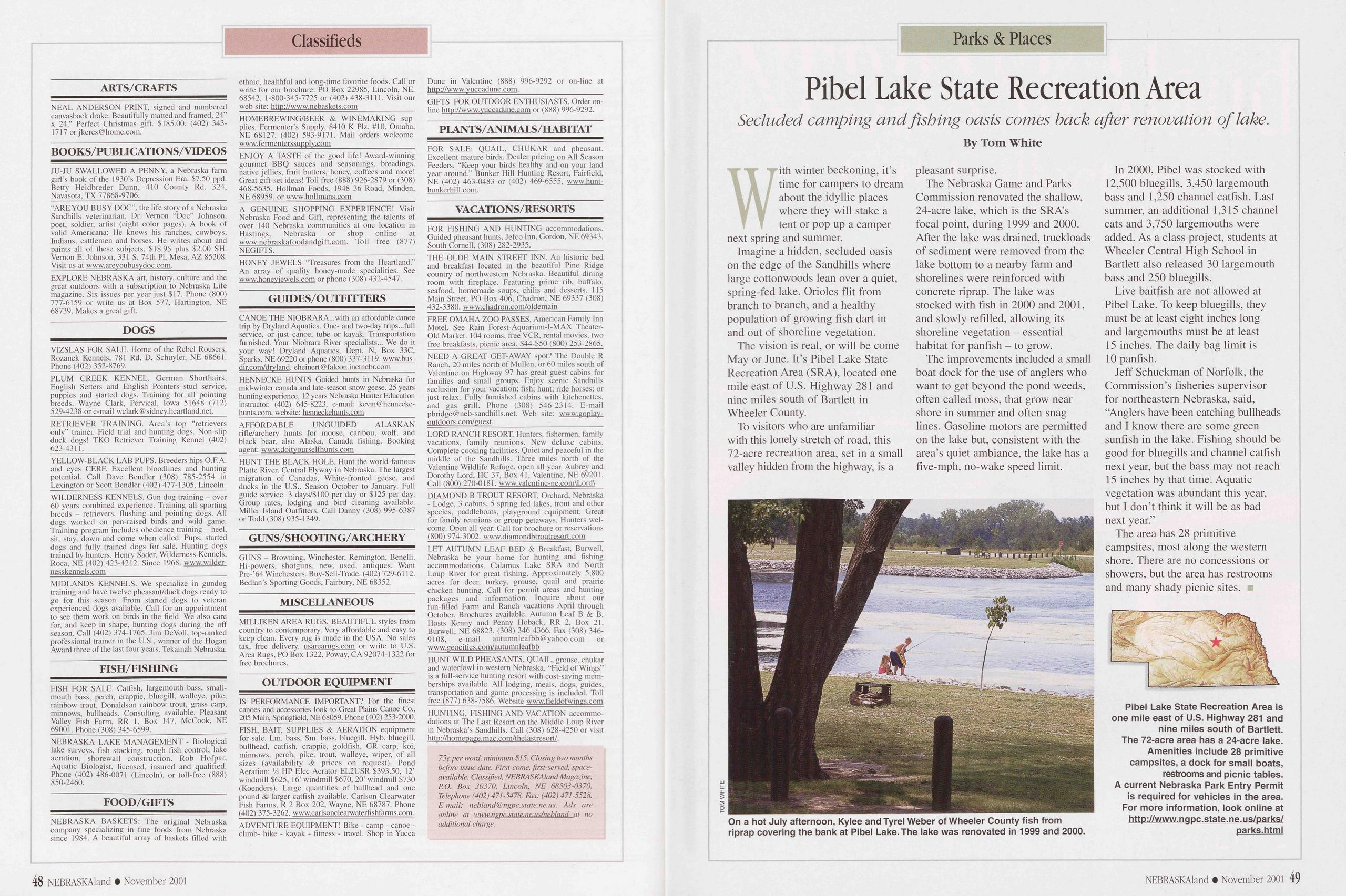
NEAL ANDERSON PRINT, signed and numbered canvasback drake. Beautifully matted and framed, 24” x 24.” Perfect Christmas gift. $185.00. (402) 343- 1717 or jkeres@home.com.
BOOKS/PUBLICATIONS/VIDEOSJU-JU SWALLOWED A PENNY, a Nebraska farm girl’s book of the 193O’s Depression Era. $7.50 ppd. Betty Heidbreder Dunn, 410 County Rd. 324, Navasota, TX 77868-9706.
ARE YOU BUSY DOC”, the life story of a Nebraska Sandhills veterinarian. Dr. Vernon "Doc” Johnson, poet, soldier, artist (eight color pages). A book of valid Americana: He knows his ranches, cowboys, Indians, cattlemen and horses. He writes about and paints all of these subjects. $18.95 plus $2.00 SH. Vernon E. Johnson, 331 S. 74th Pl, Mesa, AZ 85208. Visit us at www.areyoubusydoc.com.
EXPLORE NEBRASKA art, history, culture and the great outdoors with a subscription to Nebraska Life magazine. Six issues per year just $17. Phone (800) 777-6159 or write us at Box 577, Hartington, NE 68739. Makes a great gift.
DOGSVIZSLAS FOR SALE. Home of the Rebel Rousers. Rozanek Kennels, 781 Rd. D, Schuyler, NE 68661. Phone (402) 352-8769.
PLUM CREEK KENNEL. German Shorthairs, English Setters and English Pointers-stud service, puppies and started dogs. Training for all pointing breeds. Wayne Clark, Pervical, Iowa 51648 (712) 529-4238 or e-mail wclark@sidney.heartland.net.
RETRIEVER TRAINING. Area’s top “retrievers only” trainer. Field trial and hunting dogs. Non-slip duck dogs! TKO Retriever Training Kennel (402) 623-4311.
YELLOW-BLACK LAB PUPS. Breeders hips O.F.A. and eyes CERF. Excellent bloodlines and hunting potential. Call Dave Bendler (308) 785-2554 in Lexington or Scott Bendler (402) 477-1305, Lincoln.
WILDERNESS KENNELS. Gun dog training — over 60 years combined experience. Training all sporting breeds — retrievers, flushing and pointing dogs. All dogs worked on pen-raised birds and wild game. Training program includes obedience training - heel, sit, stay, down and come when called. Pups, started dogs and fully trained dogs for sale. Hunting dogs trained by hunters. Henry Sader, Wilderness Kennels, Roca, NE (402) 423-4212. Since 1968. www.wilder- nesskennels.com
MIDLANDS KENNELS. We specialize in gundog training and have twelve pheasant/duck dogs ready to go for this season. From started dogs to veteran experienced dogs available. Call for an appointment to see them work on birds in the field. We also care for, and keep in shape, hunting dogs during the off season. Call (402) 374-1765. Jim DeVoll, top-ranked professional trainer in the U.S., winner of the Hogan Award three of the last four years. Tekamah Nebraska.
FISH/FISHINGFISH FOR SALE. Catfish, largemouth bass, small- mouth bass, perch, crappie, bluegill, walleye, pike, rainbow trout, Donaldson rainbow trout, grass carp, minnows, bullheads. Consulting available. Pleasant Valley Fish Farm, RR 1, Box 147, McCook, NE 69001. Phone (308) 345-6599.
NEBRASKA LAKE MANAGEMENT - Biological lake surveys, fish stocking, rough fish control, lake aeration, shorewall construction. Rob Hofpar, Aquatic Biologist, licensed, insured and qualified. Phone (402) 486-0071 (Lincoln), or toll-free (888) 850-2460.
FOOD/GIFTSNEBRASKA BASKETS: The original Nebraska company specializing in fine foods from Nebraska since 1984. A beautiful array of baskets filled with ethnic, healthful and long-time favorite foods. Call or write for our brochure: PO Box 22985, Lincoln, NE. 68542. 1-800-345-7725 or (402) 438-3111. Visit our web site: http://www.nebaskets.com
HOMEBREWING/BEER & WINEMAKING sup- plies. Fermenter’s Supply, 8410 K Plz. #10, Omaha, NE 68127. (402) 593-9171. Mail orders welcome. www.fermenterssupply.com
ENJOY A TASTE of the good life! Award-winning gourmet BBQ sauces and seasonings, breadings, native jellies, fruit butters, honey, coffees and more! Great gift-set ideas! Toll free (888) 926-2879 or (308) 468-5635. Hollman Foods, 1948 36 Road, Minden, NE 68959, or www.hollmans.com
A GENUINE SHOPPING EXPERIENCE! Visit Nebraska Food and Gift, representing the talents of over 140 Nebraska communities at one location in Hastings, Nebraska or shop online at www.nebraskafoodandgift.com. Toll free (877) NEGIFTS.
HONEY JEWELS “Treasures from the Heartland.” An array of quality honey-made specialities. See www.honeyjewels.com or phone (308) 432-4547.
GUIDES/OUTFITTERSCANOE THE NIOBRARA...with an affordable canoe trip by Dryland Aquatics. One- and two-day trips...full service, or just canoe, tube or kayak. Transportation furnished. Your Niobrara River specialists... We do it your way! Dryland Aquatics, Dept. N, Box 33C, Sparks, NE 69220 or phone (800) 337-3119. www.bus- dir.com/dryland. eheinert@falcon.inetnebr.com
HENNECKE HUNTS Guided hunts in Nebraska for mid-winter Canada and late-season snow geese. 25 years hunting experience, 12 years Nebraska Hunter Education instructor. (402) 645-8223, e-mail: kevin@hennecke- hunts.com, website: henneckehunts.com
AFFORDABLE UNGUIDED ALASKAN rifle/archery hunts for moose, caribou, wolf, and black bear, also Alaska, Canada fishing. Booking agent: www.doityourselfhunts.com
HUNT THE BLACK HOLE. Hunt the world-famous Platte River. Central Flyway in Nebraska. The largest migration of Canadas, White-fronted geese, and ducks in the U.S.. Season October to January. Full guide service. 3 days/$100 per day or $125 per day. Group rates, lodging and bird cleaning available. Miller Island Outfitters. Call Danny (308) 995-6387 or Todd (308) 935-1349.
GUNS/SHOOTING/ARCHERYGUNS - Browning, Winchester, Remington, Benelli. Hi-powers, shotguns, new, used, antiques. Want Pre-’64 Winchesters. Buy-Sell-Trade. (402) 729-6112. Bedlan’s Sporting Goods, Fairbury, NE 68352.
MISCELLANEOUSMILLIKEN AREA RUGS, BEAUTIFUL styles from country to contemporary. Very affordable and easy to keep clean. Every rug is made in the USA. No sales tax, free delivery, usarearugs.com or write to U.S. Area Rugs, PO Box 1322, Poway, CA 92074-1322 for free brochures.
OUTDOOR EQUIPMENTIS PERFORMANCE IMPORTANT? For the finest canoes and accessories look to Great Plains Canoe Co., 205 Main, Springfield, NE 68059. Phone (402) 253-2000.
FISH. BAIT, SUPPLIES & AERATION equipment for sale. Lm. bass, Sm. bass, bluegill, Hyb. bluegill, bullhead, catfish, crappie, goldfish, GR carp, koi, minnows, perch, pike, trout, walleye, wiper, of all sizes (availability & prices on request). Pond Aeration: 1/4 HP Elec Aerator EL2USR $393.50, 12’ windmill $625, 16’ windmill $670, 20’ windmill $730 (Koenders). Large quantities of bullhead and one pound & larger catfish available. Carlson Clearwater Fish Farms, R 2 Box 202, Wayne, NE 68787. Phone (402) 375-3262. www.carlsonclearwaterfishfarms.com.
ADVENTURE EQUIPMENT! Bike - camp - canoe - climb- hike - kayak - fitness - travel. Shop in Yucca Dune in Valentine (888) 996-9292 or on-line at http://www.yuccadune.com.
GIFTS FOR OUTDOOR ENTHUSIASTS. Order on- line http://www.yuccadune.com or (888) 996-9292.
PLANTS/ANIMALS/HABITATFOR SALE: QUAIL, CHUKAR and pheasant. Excellent mature birds. Dealer pricing on All Season Feeders. “Keep your birds healthy and on your land year around.” Bunker Hill Hunting Resort, Fairfield, NE (402) 463-0483 or (402) 469-6555, www.hunt- bunkerhill.com.
VACATIONS/RESORTSFOR FISHING AND HUNTING accommodations. Guided pheasant hunts. Jefco Inn, Gordon, NE 69343. South Cornell, (308) 282-2935.
THE OLDE MAIN STREET INN. An historic bed and breakfast located in the beautiful Pine Ridge country of northwestern Nebraska. Beautiful dining room with fireplace. Featuring prime rib, buffalo, seafood, homemade soups, chilis and desserts. 115 Main Street, PO Box 406, Chadron, NE 69337 (308) 432-3380. www.chadron.com/oldemain
FREE OMAHA ZOO PASSES, American Family Inn Motel. See Rain Forest-Aquarium-I-MAX Theater- Old Market. 104 rooms, free VCR, rental movies, two free breakfasts, picnic area. $44-$50 (800) 253-2865.
NEED A GREAT GET-AWAY spot? The Double R Ranch, 20 miles north of Mullen, or 60 miles south of Valentine on Highway 97 has great guest cabins for families and small groups. Enjoy scenic Sandhills seclusion for your vacation; fish; hunt; ride horses; or just relax. Fully furnished cabins with kitchenettes, and gas grill. Phone (308) 546-2314. E-mail pbridge@neb-sandhills.net. Web site: www.goplay- outdoors.com/guest.
LORD RANCH RESORT. Hunters, fishermen, family vacations, family reunions. New deluxe cabins. Complete cooking facilities. Quiet and peaceful in the middle of the Sandhills. Three miles north of the Valentine Wildlife Refuge, open all year. Aubrey and Dorothy Lord, HC 37, Box 41, Valentine, NE 69201. Call (800) 270-0181. www.valentine-ne.com\Lord\
DIAMOND B TROUT RESORT, Orchard, Nebraska - Lodge, 3 cabins, 5 spring fed lakes, trout and other species, paddleboats, playground equipment. Great for family reunions or group getaways. Hunters wel- come. Open all year. Call for brochure or reservations (800) 974-3002, www.diamondbtroutresort.com
LET AUTUMN LEAF BED & Breakfast, Burwell, Nebraska be your home for hunting and fishing accommodations. Calamus Lake SRA and North Loup River for great fishing. Approximately 5,800 acres for deer, turkey, grouse, quail and prairie chicken hunting. Call for permit areas and hunting packages and information. Inquire about our fun-filled Farm and Ranch vacations April through October. Brochures available. Autumn Leaf B & B. Hosts Kenny and Penny Hoback, RR 2, Box 21, Burwell, NE 68823. (308) 346-4366. Fax (308) 346- 9108, e-mail autumnleafbb@yahoo.com or www.geocities.com/autumnleafbb
HUNT WILD PHEASANTS, QUAIL, grouse, chukar and waterfowl in western Nebraska. “Field of Wings” is a full-service hunting resort with cost-saving mem- berships available. All lodging, meals, dogs, guides, transportation and game processing is included. Toll free (877) 638-7586, Website www.fieldofwings.com
HUNTING, FISHING AND VACATION accommo- dations at The Last Resort on the Middle Loup River in Nebraska’s Sandhills. Call (308) 628-4250 or visit http://homepage.mac. com/thelastresort/.
75¢ per word, minimum $15. Closing two months before issue date. First-come, first-served, space- available. Classified, NEBRASKAland Magazine, P.O. Box 30370, Lincoln, NE 68503-0370. Telephone (402) 471-5478. Fax: (402) 471-5528. E-mail: nebland@ngpc.state.ne. us. Ads are online at www.ngpc.state.ne.us/nebland at no additional charge.
Parks & Places
Pibel Lake State Recreation Area
Secluded camping and fishing oasis comes back after renovation of lake.
By Tom WhiteWith winter beckoning, it’s time for campers to dream about the idyllic places where they will stake a tent or pop up a camper next spring and summer.
Imagine a hidden, secluded oasis on the edge of the Sandhills where large cottonwoods lean over a quiet, spring-fed lake. Orioles flit from branch to branch, and a healthy population of growing fish dart in and out of shoreline vegetation.
The vision is real, or will be come May or June. It’s Pibel Lake State Recreation Area (SRA), located one mile east of U.S. Highway 281 and nine miles south of Bartlett in Wheeler County.
To visitors who are unfamiliar with this lonely stretch of road, this 72-acre recreation area, set in a small valley hidden from the highway, is a pleasant surprise.
The Nebraska Game and Parks Commission renovated the shallow, 24-acre lake, which is the SRA’s focal point, during 1999 and 2000. After the lake was drained, truckloads of sediment were removed from the lake bottom to a nearby farm and shorelines were reinforced with concrete riprap. The lake was stocked with fish in 2000 and 2001, and slowly refilled, allowing its shoreline vegetation - essential habitat for panfish - to grow.
The improvements included a small boat dock for the use of anglers who want to get beyond the pond weeds, often called moss, that grow near shore in summer and often snag lines. Gasoline motors are permitted on the lake but, consistent with the area’s quiet ambiance, the lake has a five-mph, no-wake speed limit.
In 2000, Pibel was stocked with 12,500 bluegills, 3,450 largemouth bass and 1,150 channel catfish. Last summer, an additional 1,315 channel cats and 3,750 largemouths were added. As a class project, students at Wheeler Central High School in Bartlett also released 30 largemouth bass and 250 bluegills.
Live baitfish are not allowed at Pibel Lake. To keep bluegills, they must be at least eight inches long and largemouths must be at least 15 inches. The daily bag limit is 10 panfish.
Jeff Schuckman of Norfolk, the Commission’s fisheries supervisor for northeastern Nebraska, said, “Anglers have been catching bullheads and I know there are some green sunfish in the lake. Fishing should be good for bluegills and channel catfish next year, but the bass may not reach 15 inches by that time. Aquatic vegetation was abundant this year, but I don’t think it will be as bad next year.”
The area has 28 primitive campsites, most along the western shore. There are no concessions or showers, but the area has restrooms and many shady picnic sites.
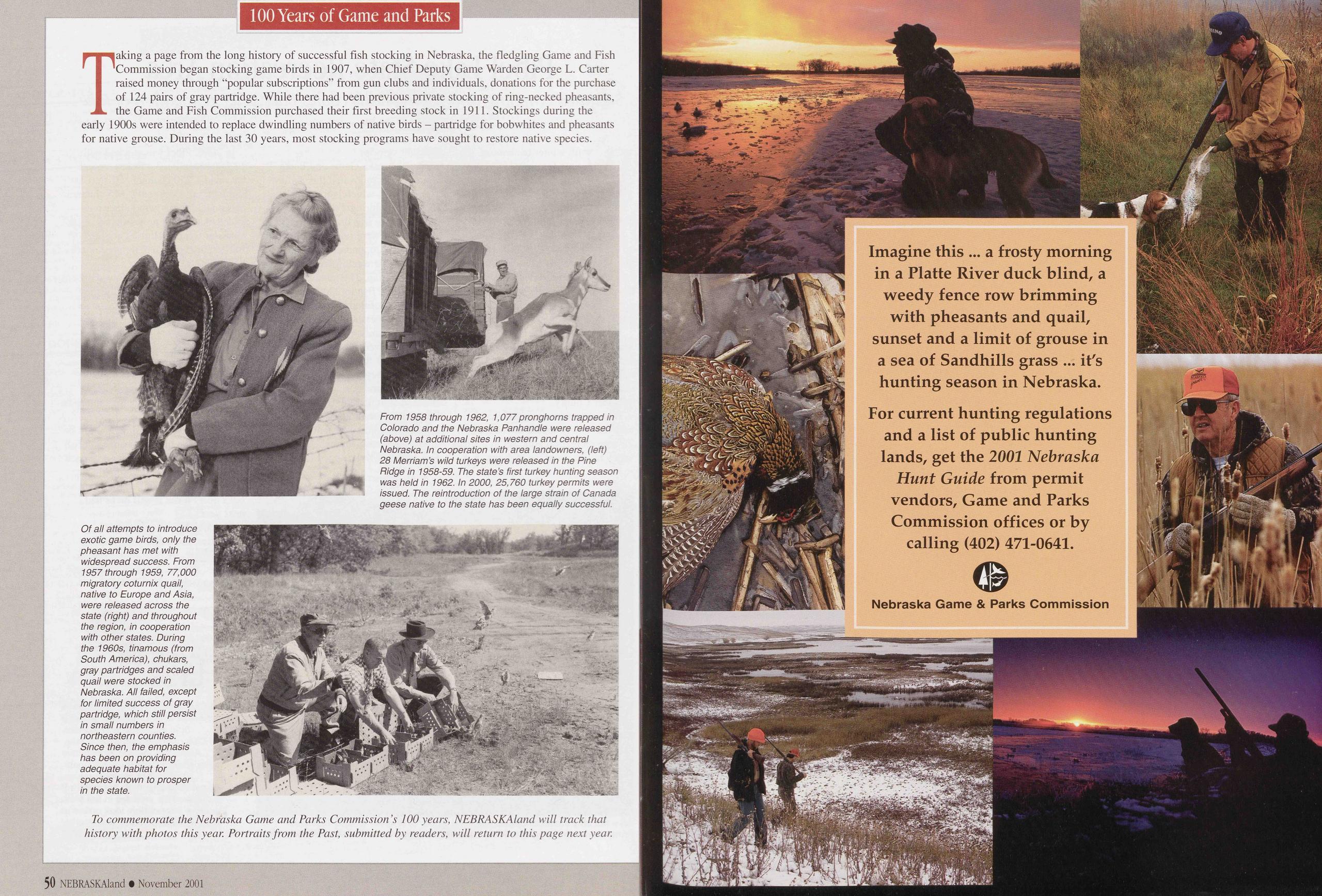
Taking a page from the long history of successful fish stocking in Nebraska, the fledgling Game and Fish Commission began stocking game birds in 1907, when Chief Deputy Game Warden George L. Carter raised money through “popular subscriptions” from gun clubs and individuals, donations for the purchase of 124 pairs of gray partridge. While there had been previous private stocking of ring-necked pheasants, the Game and Fish Commission purchased their first breeding stock in 1911. Stockings during the early 1900s were intended to replace dwindling numbers of native birds - partridge for bobwhites and pheasants for native grouse. During the last 30 years, most stocking programs have sought to restore native species.
To commemorate the Nebraska Game and Parks Commission's 100 years, NEBRASKAland will track that history with photos this year. Portraits from the Past, submitted by readers, will return to this page next year.
Position: 467 (22 views)