Volume 79, Issue 8, 2001
NEBRASKAland
Nebraska Game & Parks Commission October 2001 $2.50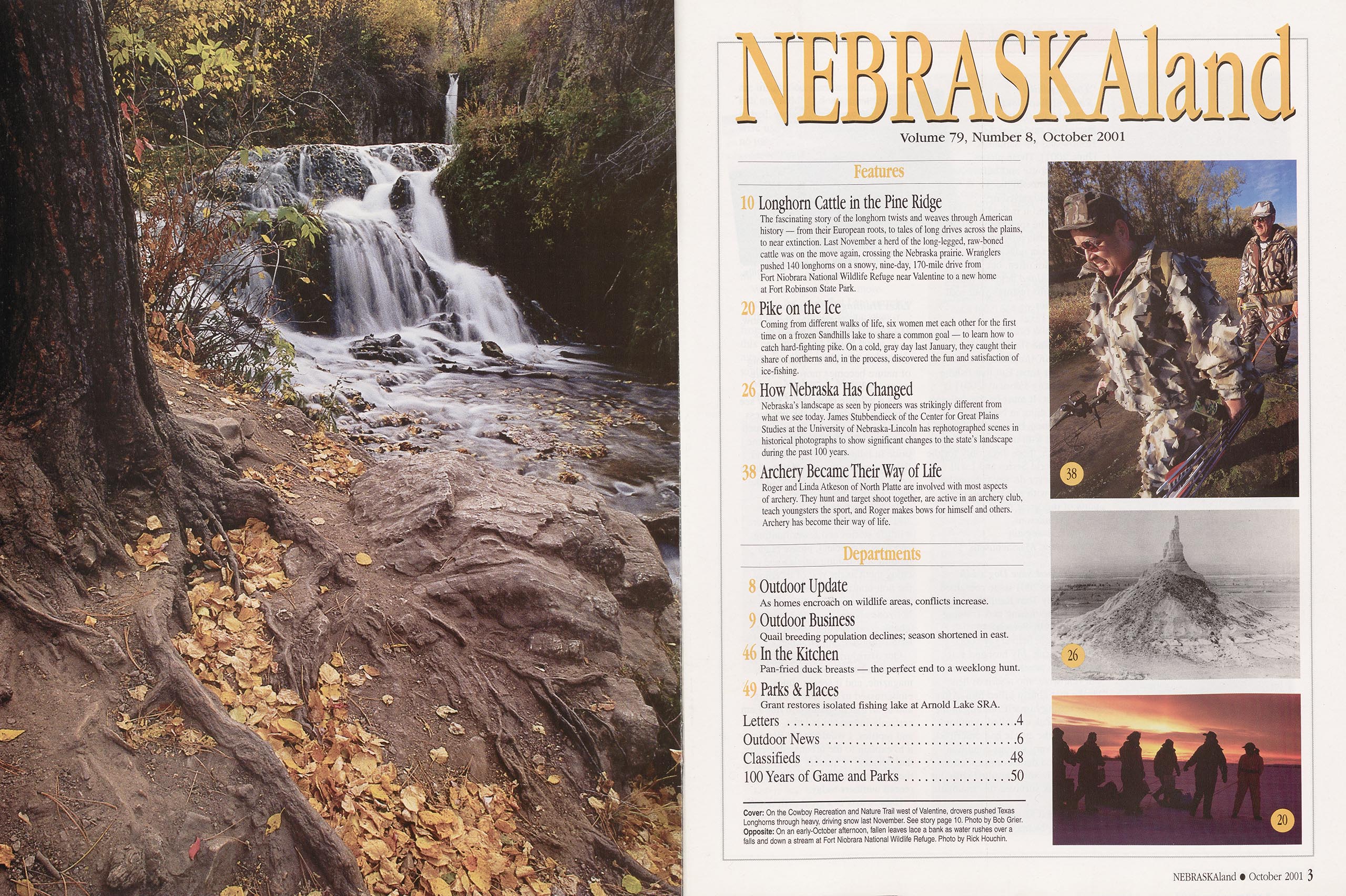
NEBRASKAland
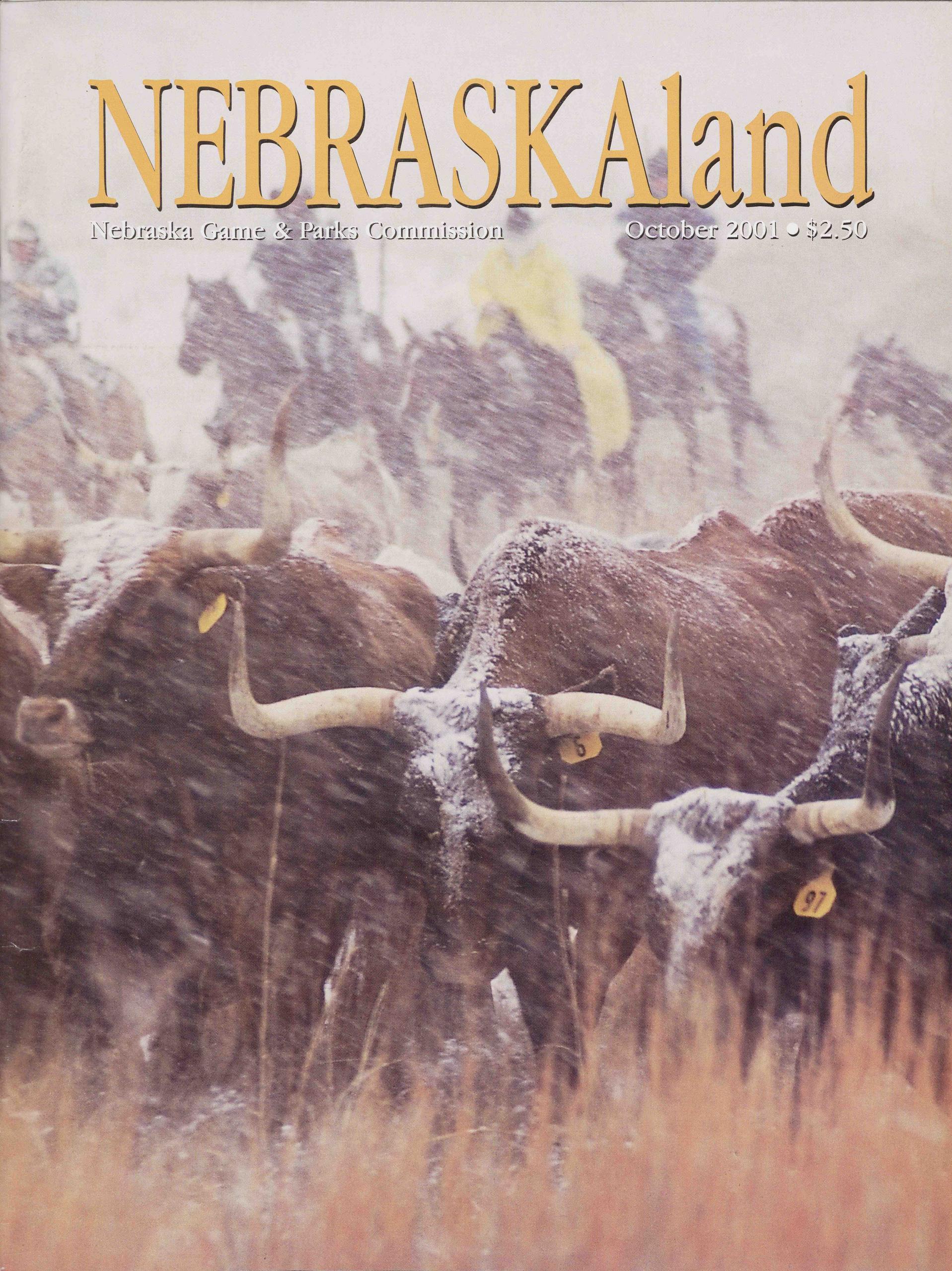
Volume 79, Number 8, October 2001 Features 10 Longhorn Cattle in the Pine Ridge The fascinating story of the longhorn twists and weaves through American history — from their European roots, to tales of long drives across the plains, to near extinction. Last November a herd of the long-legged, raw-boned cattle was on the move again, crossing the Nebraska prairie. Wranglers pushed 140 longhorns on a snowy, nine-day, 170-mile drive from Fort Niobrara National Wildlife Refuge near Valentine to a new home at Fort Robinson State Park. 20 Pike on the Ice Coming from different walks of life, six women met each other for the first time on a frozen Sandhills lake to share a common goal — to learn how to catch hard-fighting pike. On a cold, gray day last January, they caught their share of northerns and, in the process, discovered the fun and satisfaction of ice-fishing. 26 How Nebraska Has Changed Nebraska’s landscape as seen by pioneers was strikingly different from what we see today. James Stubbendieck of the Center for Great Plains Studies at the University of Nebraska-Lincoln has rephotographed scenes in historical photographs to show significant changes to the state’s landscape during the past 100 years. 38 Archery Became Their Way of Life Roger and Linda Atkeson of North Platte are involved with most aspects of archery. They hunt and target shoot together, are active in an archery club, teach youngsters the sport, and Roger makes bows for himself and others. Archery has become their way of life. Departments 8 Outdoor Update As homes encroach on wildlife areas, conflicts increase. 9 Outdoor Business Quail breeding population declines; season shortened in east. 46 In the Kitchen Pan-fried duck breasts — the perfect end to a weeklong hunt. 49 Parks & Places Grant restores isolated fishing lake at Arnold Lake SRA. Letters .........................................4 Outdoor News ....................................6 Classifieds ....................................48 100 Years of Game and Parks.....................50 Cover: On the Cowboy Recreation and Nature Trail west of Valentine, drovers pushed Texas Longhorns through heavy, driving snow last November. See story page 10. Photo by Bob Grier. Opposite: On an early-October afternoon, fallen leaves lace a bank as water rushes over a falls and down a stream at Fort Niobrara National Wildlife Refuge. Photo by Rick Houchin.38
26
20
Letters
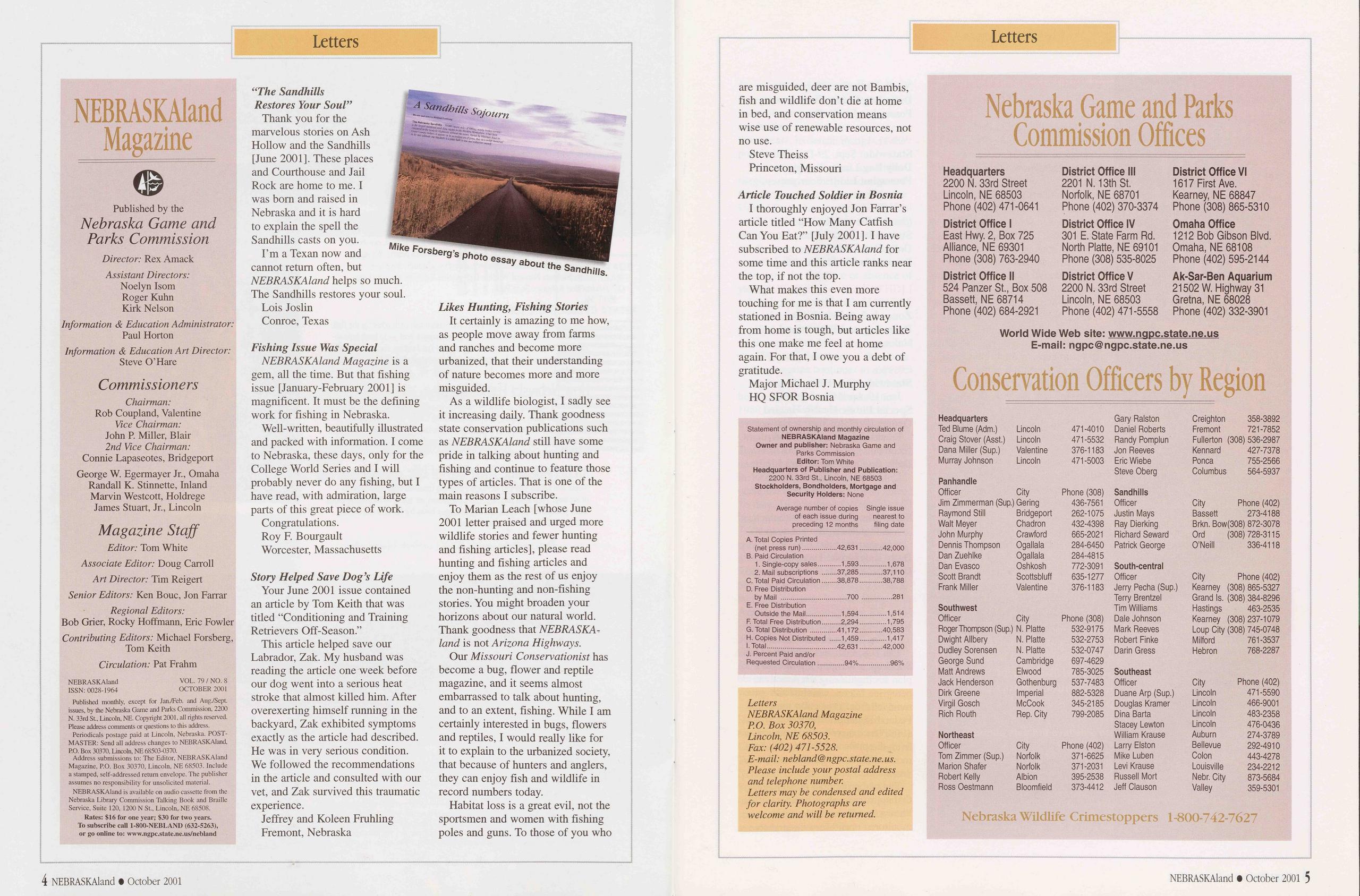
“The Sandhills Restores Your Soul”Thank you for the marvelous stories on Ash Hollow and the Sandhills [June 2001]. These places and Courthouse and Jail Rock are home to me. I was born and raised in Nebraska and it is hard to explain the spell the Sandhills casts on you.
I’m a Texan now and cannot return often, but NEBRASKAland helps so much. The Sandhills restores your soul.
Lois Joslin Conroe, TexasNEBRASKAland Magazine is a gem, all the time. But that fishing issue [January-February 2001] is magnificent. It must be the defining work for fishing in Nebraska.
Well-written, beautifully illustrated and packed with information. I come to Nebraska, these days, only for the College World Series and I will probably never do any fishing, but I have read, with admiration, large parts of this great piece of work.
Congratulations.
Roy F. Bourgault Worcester, Massachusetts Story Helped Save Dog’s LifeYour June 2001 issue contained an article by Tom Keith that was titled “Conditioning and Training Retrievers Off-Season.”
This article helped save our Labrador, Zak. My husband was reading the article one week before our dog went into a serious heat stroke that almost killed him. After overexerting himself running in the backyard, Zak exhibited symptoms exactly as the article had described. He was in very serious condition. We followed the recommendations in the article and consulted with our vet, and Zak survived this traumatic experience.
Jeffrey and Koleen Fruhling Fremont, Nebraska Likes Hunting, Fishing StoriesIt certainly is amazing to me how, as people move away from farms and ranches and become more urbanized, that their understanding of nature becomes more and more misguided.
As a wildlife biologist, I sadly see it increasing daily. Thank goodness state conservation publications such as NEBRASKAland still have some pride in talking about hunting and fishing and continue to feature those types of articles. That is one of the main reasons I subscribe.
To Marian Leach [whose June 2001 letter praised and urged more wildlife stories and fewer hunting and fishing articles], please read hunting and fishing articles and enjoy them as the rest of us enjoy the non-hunting and non-fishing stories. You might broaden your horizons about our natural world. Thank goodness that NEBRASKA- land is not Arizona Highways.
Our Missouri Conservationist has become a bug, flower and reptile magazine, and it seems almost embarrassed to talk about hunting, and to an extent, fishing. While I am certainly interested in bugs, flowers and reptiles, I would really like for it to explain to the urbanized society, that because of hunters and anglers, they can enjoy fish and wildlife in record numbers today.
Habitat loss is a great evil, not the sportsmen and women with fishing poles and guns. To those of you who are misguided, deer are not Bambis, fish and wildlife don’t die at home in bed, and conservation means wise use of renewable resources, not no use.
Steve Theiss Princeton, Missouri Article Touched Soldier in BosniaI thoroughly enjoyed Jon Farrar’s article titled "How Many Catfish Can You Eat?” [July 2001]. I have subscribed to NEBRASKAland for some time and this article ranks near the top, if not the top.
What makes this even more touching for me is that I am currently stationed in Bosnia. Being away from home is tough, but articles like this one make me feel at home again. For that, I owe you a debt of gratitude.
Major Michael J. Murphy HQ SFOR BosniaStatement of ownership and monthly circulation of NEBRASKAland Magazine Owner and publisher: Nebraska Game and Parks Commission Editor: Tom White Headquarters of Publisher and Publication: 2200 N. 33rd St., Lincoln, NE 68503 Stockholders, Bondholders, Mortgage and Security Holders: None
Average number of copies of each issue during preceding 12 months
Single issue nearest to filing date
A. Total Copies Printed (net press run).............42,631...............42,000 B. Paid Circulation 1. Single-copy sales.............................................1,593.................1,678 2. Mail subscriptions...........................................37,285...............37,110 C. Total Paid Circulation.....................................38,878...............38,788 D. Free Distribution by Mail.......................................................................700....................281 E. Free Distribution Outside the Mail......................................................1,594................1,514 F. Total Free Distribution........................................2,294................1,795 G. Total Distribution..............................................41,172...............40,583 H. Copies Not Distributed.......................................1,459.................1,417 1. Total..................................................................42,631...............42,000 J. Percent Paid and/or Requested Circulation...............................................94%...................96% Letters NEBRASKAland Magazine RO. Box 30370, Lincoln, NE 68503. Fax: (402) 471-5528. E-mail: nebland@ ngpc. state, ne. us. Please include your postal address and telephone number. Letters may be condensed and edited for clarity. Photographs are welcome and will be returned. Nebraska Game and Parks Commission Offices Headquarters 2200 N. 33rd Street Lincoln, NE 68503 Phone (402) 471-0641 District Office 1 East Hwy. 2, Box 725 Alliance, NE 69301 Phone (308) 763-2940 District Office II 524 Panzer St., Box 508 Bassett, NE 68714 Phone (402) 684-2921 District Office III 2201 N. 13th St. Norfolk, NE 68701 Phone (402) 370-3374 District Office IV 301 E. State Farm Rd North Platte, NE 69101 Phone (308) 535-8025 District Office V 2200 N. 33rd Street Lincoln, NE 68503 Phone (402) 471-5558 District Office VI 1617 First Ave. Kearney, NE 68847 Phone (308) 865-5310 Omaha Office 1212 Bob Gibson Blvd. Omaha, NE 68108 Phone (402) 595-2144 Ak-Sar-Ben Aquarium 21502 W. Highway 31 Gretna, NE 68028 Phone (402) 332-3901 World Wide Web site: www.ngpc.state.ne.us E-mail: ngpc@ngpc.state.ne.us Conservation Officers by Region Headquarters Gary Ralston Creighton 358-3892 Ted Blume (Adm.) Lincoln 471-4010 Daniel Roberts Fremont 721-7852 Craig Stover (Asst.) Lincoln 471-5532 Randy Pomplun Fullerton (308) 536-2987 Dana Miller (Sup.) Valentine 376-1183 Jon Reeves Kennard 427-7378 Murray Johnson Lincoln 471-5003 Eric Wiebe Ponca 755-2566 Steve Oberg Columbus 564-5937 Panhandle Officer City Phone (308) Sandhills Jim Zimmerman (Sup.) Gering 436-7561 Officer City Phone (402) Raymond Still Bridgeport 262-1075 Justin Mays Bassett 273-4188 Walt Meyer Chadron 432-4398 Ray Dierking Brkn. Bow(308) 872-3078 John Murphy Crawford 665-2021 Richard Seward Ord (308) 728-3115 Dennis Thompson Ogallala 284-6450 Patrick George O’Neill 336-4118 Dan Zuehlke Ogallala 284-4815 Dan Evasco Oshkosh 772-3091 South-central Scott Brandt Scottsbluff 635-1277 Officer City Phone (402) Frank Miller Valentine 376-1183 Jerry Pecha (Sup.) Kearney (308) 865-5327 Terry Brentzel Grand Is. (308) 384-8296 Southwest Tim Williams Hastings 463-2535 Officer City Phone (308) Dale Johnson Kearney (308) 237-1079 Roger Thompson (Sup.) N. Platte 532-9175 Mark Reeves Loup City (308) 745-0748 Dwight Allbery N. Platte 532-2753 Robert Finke Milford 761-3537 Dudley Sorensen N. Platte 532-0747 Darin Gress Hebron 768-2287 George Sund Cambridge 697-4629 Matt Andrews Elwood 785-3025 Southeast Jack Henderson Gothenburg 537-7483 Officer City Phone (402) Dirk Greene Imperial 882-5328 Duane Arp (Sup.) Lincoln 471-5590 Virgil Gosch McCook 345-2185 Douglas Kramer Lincoln 466-9001 Rich Routh Rep. City 799-2085 Dina Barta Lincoln 483-2358 Stacey Lewton Lincoln 476-0436 Northeast William Krause Auburn 274-3789 Officer City Phone (402) Larry Elston Bellevue 292-4910 Tom Zimmer (Sup.) Norfolk 371-6625 Mike Luben Colon 443-4278 Marion Shafer Norfolk 371-2031 Levi Krause Louisville 234-2212 Robert Kelly Albion 395-2538 Russell Mort Nebr. City 873-5684 Ross Oestmann Bloomfield 373-4412 Jeff Clauson Valley 359-5301 Nebraska Wildlife Crimestoppers 1-800-742-7627 4 NEBRASKAland • October 2001 NEBRASKAland • October 2001 5
Attention Migratory Bird Hunters... You Must Get HIP Again!
Dove, duck, goose, snipe, rail, coot and woodcock hunters must register with the Harvest Information Program (HIP) before hunting and must carry their registration number in the field. HIP numbers for 2000-2001 hunting seasons are no longer valid. Call the toll-free number below to register for 2001-2002 seasons. 1-888-403-2473 or register online at the Nebraska Game and Parks Commission’s web site: www.ngpc.state.ne.us (Only residents under 16 years of age are exempt)Outdoor News
Commission Establishes 2001 Waterfowl SeasonsNebraska Game and Parks Commissioners made only a few changes to the 2001 waterfowl hunting regulations at their August meeting.
Duck hunters will see two changes for this year’s duck seasons: The duck zones in south-central and southeastern Nebraska have been modified somewhat, and canvasback ducks will have their own, shorter season this fall to reduce the hunting pressure on this species.
For more information on waterfowl seasons and regulations, including a map of the new duck zones, consult the 2001 Nebraska Waterfowl Guide, now available, or the Light Goose Conservation Action guide, which will be available in December.
DUCKSLow Plains Early: Sept. 29-Dec. 9 and Dec. 15-16. Low Plains Late: Oct. 13-14 and Oct. 20-Dec. 30. High Plains: Sept. 29-Dec. 9 and Dec. 14-Jan. 6. Canvasback Season: Oct. 20- Nov. 13. Daily Bag Limit: Six ducks, which may include no more that five mallards (of which no more than two can be females), one mottled duck, one pintail, one canvasback, (in season), two wood ducks, two redheads, and three scaup (greater and lesser combined). Possession Limit: Two daily limits.
COOTSSeason: Concurrent with duck season dates. Daily Bag Limit: 15. Possession Limit: 30.
DARK GEESE(Canada and Brant geese) East Unit: Sept. 29-30 and Oct. 13-Jan. 13. North Central Unit: Sept. 29- Jan. 1. Platte River Unit: Oct. 27-Jan. 29. North Unit: Oct. 27-Jan. 29. Daily Bag Limit: Three geese. Possession Limit: Six geese.
WHITE-FRONTED GEESEStatewide: Sept. 29-Dec. 23. Daily Bag Limit: Two geese. Possession Limit: Four geese.
LIGHT GEESE(Snow, blue and Ross’ geese) Statewide: Sept. 29-Jan. 11. Daily Bag Limit: 20 geese. Possession Limit: Unlimited.
LIGHT GEESE - CONSERVATION ACTIONZones 1, 2, 3: Feb. 2-April 14. Daily Bag and Possession Limit: Unlimited.
CROWSStatewide: Oct. 1-Nov. 15 and Jan. 19-April 6. Special Public Health Hazard Order: (Buffalo, Phelps, Harlan, Franklin, Kearney and Dawson counties) Nov. 16-Jan. 18. Daily Bag and Possession Limit: Unlimited.
FALCONRYStatewide: Concurrent with duck season dates within zones and management units. Daily Bag Limit: Three ducks. Possession Limit: Six ducks.
U.S. FWS Releases Peregrine Monitoring PlanThe U.S. Fish and Wildlife Service has released a proposed plan for monitoring the American peregrine falcon, which was removed from protection under the Federal Endangered Species Act in 1999. Once a species is removed from the protected list, it must be monitored for a minimum of five years.
The peregrine plan recommends that approximately 20 percent of the known breeding population be monitored once every three years for at least five generations. Peregrines mature at about three years of age, so the plan proposes conducting five surveys, once every three years, to detect changes in the population.
Because the peregrine is a wide- ranging species, the plan designates five geographical regions within the United States for surveys. Each area would be visited twice - once during late courtship, egg laying or incubation, to verify the presence of a nesting pair; and a second visit to determine the presence or absence of young.
Monitoring would include the collection of information on population trends and nesting success. At the end of each monitoring period the FWS will determine if the status of the peregrine continues to improve.
A peregrine recovery project has been underway in Nebraska since 1988, when captive-bom chicks were released from the Mutual of Omaha building and Woodmen Tower in Omaha. The first attempted nesting at the Woodmen Tower was in 1992, and the site has been occupied every nesting season since. To date, 19 peregrine falcons have been successfully reared at the site.
The pair currently nesting there consists of Zeus, a seven-year-old male raised on a building in Rochester, New York., and Amelia, a two-year-old female fledged from a building in Cedar Rapids, Iowa. Amelia appeared in Omaha too late last year to nest, but she and Zeus bonded, and both remained in Omaha through the winter - a first for this normally migratory species - before successfully raising three young this summer.
Recovery efforts in Nebraska have largely been funded through money raised through the Nongame Wildlife Check-off on Nebraska State Income Tax Form, which goes into the Nebraska Nongame and Endangered Species Conservation Fund and is used to provide money for critical conservation programs for nongame and endangered wildlife.
Ready for Hunting? Don't Forget Your Permit!
Hunting and fishing permits are available at all Nebraska Game and Parks Commission offices and from sporting goods stores, outfitters, bait shops and many other vendors throughout the state. For more information call (402) 471-0641. See page 2 of the NEBRASKAland Gift Collection section in the back of this magazine for a permit order form and fee schedule. Permits also are available on the Commission's website: www.ngpc.state.ne.us Nebraska Game and Parks Commission 6 NEBRASKAland • October 2001 NEBRASKAland • October 2001 7
Outdoor Update
Homes Encroach on Wildlife Areas Commission asks for set-back zones to protect bunting and wildlife. By Tom KeithUrbanization - turning natural areas, range and farms into human habitation - is growing and, in some areas, becoming a threat to wildlife and recreation opportunities on Nebraska’s public lands.
Nebraska law states: It is illegal to hunt or trap wild birds or mammals within 200 yards of an inhabited dwelling, occupied building or livestock feedlot, except that the owner, tenant or operator or their guests may hunt or trap within the 200-yard area with the owner’s, tenant’s or operator’s permission.
Another state law requires resident hunters and trappers 16 years of age or older and all nonresidents to purchase a current habitat stamp to hunt game species or trap furbearers in Nebraska. The money from habitat stamp sales is used to buy and manage public hunting lands.
When new homes or facilities encroach on established wildlife management areas (WMAs), the 200-yard restriction often overlaps the public land and reduces the area available for hunting and trapping. In some cases, safety concerns raised by new residents who have moved near WMAs have restricted hunting, trapping and target shooting on entire areas that were purchased earlier with habitat stamp funds.
At the heart of the problem is the desire of more people to escape cities and live in a more rural, less crowded environment. Because of misconcep- tions about wildlife management areas, prospective homeowners often consider adjacent property desirable.
Bruce Morrison, assistant administrator of the Nebraska Game and Parks Commission’s Wildlife Division, said some prospective homeowners erroneously believe a WMA is a refuge where hunting and
People who share lakeside property with Canada geese must deal with the birds’ abundant waste. Rural residents also have problem wildlife neighbors: Raccoons and opossums are frequent unwanted visitors that eat commercial foods put out for horses, dogs and cats, raid garbage cans and bird feeders, and foul porches, decks and patios; rabbits and deer feed on trees and in gardens; coyotes, hawks and owls harass and sometimes kill pets.
About 1.7 percent of the state is public land available for non-urban outdoor recreation. These lands offer the opportunity to enjoy wildlife in their natural habitats. Those opportunities are threatened when residential development encroaches, and sometimes contaminates wild natural habitats.
In July, the Game and Parks Commission made it unlawful to carry or possess firearms, or take or disturb wild birds or wild mammals at Kea Lake and Bufflehead wildlife management areas in Buffalo County because of safety concerns raised by adjacent developments. In March 2000, in response to the concerns of residents of a new residential area next to the Pawnee Lake State Recreation Area, the Commissioners prohibited the discharge of rim-fire or center-fire rifles or handguns for any purpose at the SRA. Restrictions pertaining to hunting or firearms are in place on 21 other WMAs across the state.
Earlier this year, the Commission adopted a resolution requesting and encouraging state, county and city governing bodies to enact zoning restrictions that prohibit building within 200 yards of any Commission- owned or -controlled property designated as a wildlife management area or other public area open to hunting. They also asked urban planners and developers to consider set-aside or set-back zones around developments to protect the integrity of nearby WMAs.
Outdoor Business
Quail Season Shortened in East Biologists see need to build and protect breeding population. By Ken BoucAgainst a background of steadily declining quail hunter success since the 1950s, and a five-year slide in the whistle count survey of the breeding population, Nebraska Game and Parks Commission biologists in charge of drafting this year’s hunting regulations were faced with another factor - the effects of last winter, when a long run of blizzards, snowstorms and persistent snow cover killed half of the breeding population.
Following staff recommendations, the Commission split the state into two quail units and closed the season east of U.S. Highway 281 on December 31, a month earlier than in previous years. It is a strategy based on bobwhite biology and is aimed directly at bolstering the critical spring breeding population.
If hunters are perplexed by the shorter season in eastern Nebraska, perhaps it’s because they are getting their pheasant biology mixed up with their quail biology, according to Scott Taylor, the Game and Parks Commission’s upland game specialist.
"Most hunters are well aware that the number of roosters we shoot in the fall has no bearing on the following year’s pheasant population. But pheasant and quail populations react differently to hunting, and many hunters don’t realize that. The fall harvest of bobwhites can affect the size of the next year’s breeding population,” Taylor said.
Research in other states suggests that the two most important factors determining hunting’s effect on the quail breeding population are the harvest rate (the percentage of the total population taken) and the timing of the harvest.
Taylor consulted a study from southern Illinois based on field data gathered from 1954 through 1979. Applying computer modeling to the 26 years of data, Illinois biologists were able to simulate various season lengths and dates, documenting the effect of hunting on fall and winter mortality. Their findings showed that as the fall quail harvest approached and passed 30 percent of the population, the effect on the next year’s breeding population became more pronounced.
"We don’t know what our harvest rate is,” Taylor said. "If we are in a low-harvest situation, well below 30 percent of the population, we would have an exceedingly small effect on the breeding population no matter what we did. But if we have a high quail harvest, somewhere around 30 percent or higher, we stand to gain significantly from this shorter season.”
Nebraska’s quail season west of Highway 281 was left unchanged because biologists believe the harvest rate there is lower than in the east.
The Commission is considering a harvest study of its own, but for now
The modeling done with the Illinois data also showed that early season harvest has less effect on the following year’s breeding population than a late season.
“That’s probably because a late season takes ‘survivors’ - the tough birds that have learned how to avoid the perils of the wild,” Taylor said.
Building and protecting the quail breeding population has become increasingly important in Nebraska in recent years because of a decline in quail productivity - the ability of the population to replenish itself. In the years prior to 1987, juvenile birds nearly always made up at least 80 percent of the harvest. For more than half of the seasons since 1987, the harvest has been less than 80 percent juvenile birds.
“It’s obvious that we have to concentrate on the breeding population. If each hen’s production of chicks is low, we need as many birds out there trying as we can possibly get,” Taylor said.
8 NEBRASKAland • October 2001 NEBRASKAland • October 2001 9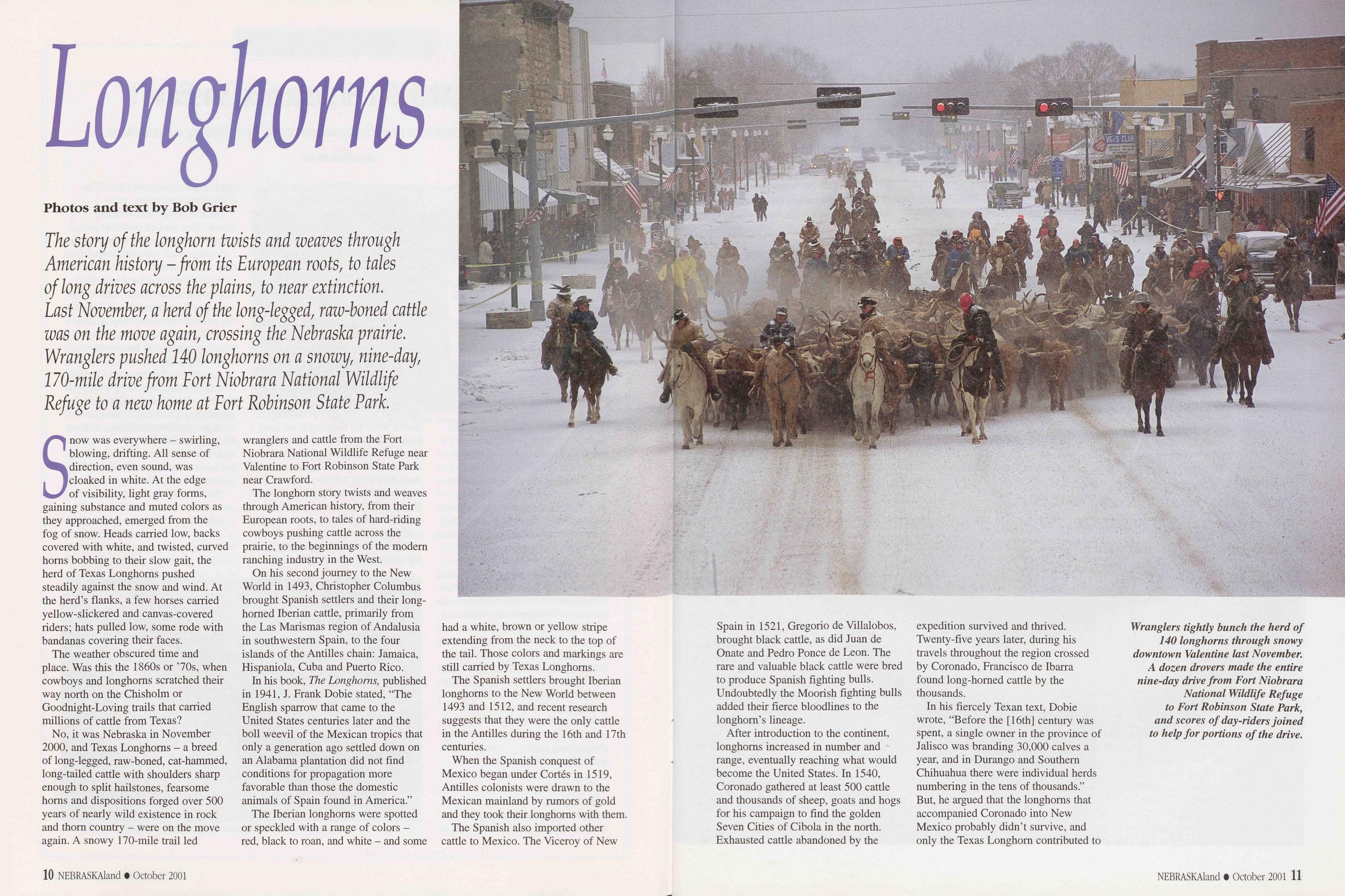
Longhorns
Photos and text by Bob Grier The story of the longhorn twists and weaves through American history -from its European roots, to tales of long drives across the plains, to near extinction. Last November; a herd of the long-legged, raw-boned cattle was on the move again, crossing the Nebraska prairie. Wranglers pushed 140 longhorns on a snowy, nine-day, 170-mile drive from Fort Niobrara National Wildlife Refuge to a new home at Fort Robinson State Park.Snow was everywhere - swirling, blowing, drifting. All sense of direction, even sound, was cloaked in white. At the edge of visibility, light gray forms, gaining substance and muted colors as they approached, emerged from the fog of snow. Heads carried low, backs covered with white, and twisted, curved horns bobbing to their slow gait, the herd of Texas Longhorns pushed steadily against the snow and wind. At the herd’s flanks, a few horses carried yellow-slickered and canvas-covered riders; hats pulled low, some rode with bandanas covering their faces.
The weather obscured time and place. Was this the 1860s or ’70s, when cowboys and longhorns scratched their way north on the Chisholm or Goodnight-Loving trails that carried millions of cattle from Texas?
No, it was Nebraska in November 2000, and Texas Longhorns - a breed of long-legged, raw-boned, cat-hammed, long-tailed cattle with shoulders sharp enough to split hailstones, fearsome horns and dispositions forged over 500 years of nearly wild existence in rock and thorn country - were on the move again. A snowy 170-mile trail led wranglers and cattle from the Fort Niobrara National Wildlife Refuge near Valentine to Fort Robinson State Park near Crawford.
The longhorn story twists and weaves through American history, from their European roots, to tales of hard-riding cowboys pushing cattle across the prairie, to the beginnings of the modem ranching industry in the West.
On his second journey to the New World in 1493, Christopher Columbus brought Spanish settlers and their long- homed Iberian cattle, primarily from the Las Marismas region of Andalusia in southwestern Spain, to the four islands of the Antilles chain: Jamaica, Hispaniola, Cuba and Puerto Rico.
In his book, The Longhorns, published in 1941, J. Frank Dobie stated, "The English sparrow that came to the United States centuries later and the boll weevil of the Mexican tropics that only a generation ago settled down on an Alabama plantation did not find conditions for propagation more favorable than those the domestic animals of Spain found in America.”
The Iberian longhorns were spotted or speckled with a range of colors - red, black to roan, and white - and some had a white, brown or yellow stripe extending from the neck to the top of the tail. Those colors and markings are still carried by Texas Longhorns.
The Spanish settlers brought Iberian longhorns to the New World between 1493 and 1512, and recent research suggests that they were the only cattle in the Antilles during the 16th and 17th centuries.
When the Spanish conquest of Mexico began under Cortes in 1519, Antilles colonists were drawn to the Mexican mainland by rumors of gold and they took their longhorns with them.
The Spanish also imported other cattle to Mexico. The Viceroy of New Spain in 1521, Gregorio de Villalobos, brought black cattle, as did Juan de Onate and Pedro Ponce de Leon. The rare and valuable black cattle were bred to produce Spanish fighting bulls. Undoubtedly the Moorish fighting bulls added their fierce bloodlines to the longhorn’s lineage.
After introduction to the continent, longhorns increased in number and range, eventually reaching what would become the United States. In 1540, Coronado gathered at least 500 cattle and thousands of sheep, goats and hogs for his campaign to find the golden Seven Cities of Cibola in the north. Exhausted cattle abandoned by the expedition survived and thrived. Twenty-five years later, during his travels throughout the region crossed by Coronado, Francisco de Ibarra found long-homed cattle by the thousands.
In his fiercely Texan text, Dobie wrote, “Before the [16th] century was spent, a single owner in the province of Jalisco was branding 30,000 calves a year, and in Durango and Southern Chihuahua there were individual herds numbering in the tens of thousands.” But, he argued that the longhorns that accompanied Coronado into New Mexico probably didn’t survive, and only the Texas Longhorn contributed to
But longhorns moved into California, too. Franciscan missionaries brought longhorns to their a chain of missions in Texas and California in the 1700s and the semi-wild and wild cattle continued to expand their numbers in the harsh, new lands.
Dobie noted that by 1716, two men reported seeing "wild cattle lost by the Spaniards on their first expedition into Texas” in the thick underbrush of the Trinity River bottoms. By the middle of the 18th century, hunting wild bull was an established sport in Texas and was considered more challenging that bison hunting. Others estimated that by 1860, four to six million wild longhorn cattle were in Texas.
Although the longhorn population didn’t grow as rapidly in California as it did in Texas, cattle became the first major industry on the West Coast.
In 1821, the year the newly independent Mexican government finally defeated Spain, California missions estimated their herds contained 396,000 longhorns. By 1850, an estimated 500,000 longhorns were in four California counties: Los Angeles, Santa Barbara, San Bernardino and Ventura.
In 1837, founders of the Oregon Territory, under Ewing Young, sailed to San Francisco, bought 729 longhorns and drove them north to Oregon - perhaps one of the West’s first long trail drives.
In his 1840 book, Two Years Before the Mast, Richard Henry Dana chronicled the early development of the j longhorn industry. Yankee Clippers, trading ships that plied the West Coast, filled their holds with cattle hides and tallow for the British and New England leather, candle and soap industries. Without refrigeration, beef was only a minor by-product. Each trading vessel, when full, carried 40,000 hides, and one account estimated, that between 1800 to 1848, more than five million hides were exported.
With the discovery of gold in 1849 and the accompanying rush of fortune seekers into California, a new market for beef opened. Longhorn numbers fell rapidly with the demand and, in the 1850s, cattle were imported, including longhorns trailed from Texas.
Severe droughts in 1856 and 1864 killed much of the longhorn population in southern California, and the breed disappeared from the state several decades before the the Texas Longhorn was threatened with extinction.
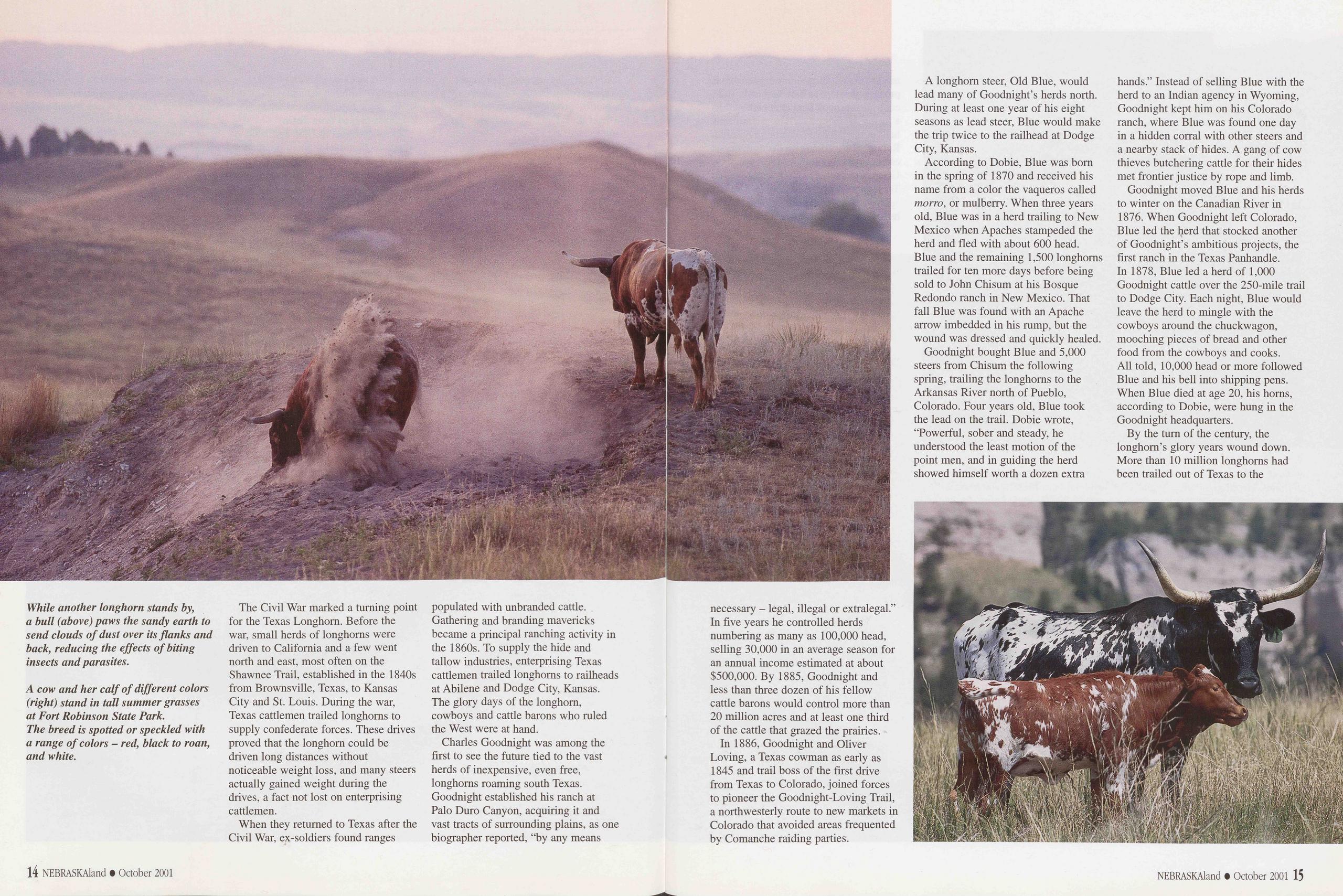
The Civil War marked a turning point for the Texas Longhorn. Before the war, small herds of longhorns were driven to California and a few went north and east, most often on the Shawnee Trail, established in the 1840s from Brownsville, Texas, to Kansas City and St. Louis. During the war, Texas cattlemen trailed longhorns to supply confederate forces. These drives proved that the longhorn could be driven long distances without noticeable weight loss, and many steers actually gained weight during the drives, a fact not lost on enterprising cattlemen.
When they returned to Texas after the Civil War, ex-soldiers found ranges populated with unbranded cattle. Gathering and branding mavericks became a principal ranching activity in the 1860s. To supply the hide and tallow industries, enterprising Texas cattlemen trailed longhorns to railheads at Abilene and Dodge City, Kansas. The glory days of the longhorn, cowboys and cattle barons who ruled the West were at hand.
Charles Goodnight was among the first to see the future tied to the vast herds of inexpensive, even free, longhorns roaming south Texas. Goodnight established his ranch at Palo Duro Canyon, acquiring it and vast tracts of surrounding plains, as one biographer reported, "by any means necessary - legal, illegal or extralegal.” In five years he controlled herds numbering as many as 100,000 head, selling 30,000 in an average season for an annual income estimated at about $500,000. By 1885, Goodnight and less than three dozen of his fellow cattle barons would control more than 20 million acres and at least one third of the cattle that grazed the prairies.
In 1886, Goodnight and Oliver Loving, a Texas cowman as early as 1845 and trail boss of the first drive from Texas to Colorado, joined forces to pioneer the Goodnight-Loving Trail, a northwesterly route to new markets in Colorado that avoided areas frequented by Comanche raiding parties.
A longhorn steer, Old Blue, would lead many of Goodnight’s herds north. During at least one year of his eight seasons as lead steer, Blue would make the trip twice to the railhead at Dodge City, Kansas.
According to Dobie, Blue was bom in the spring of 1870 and received his name from a color the vaqueros called morro, or mulberry. When three years old, Blue was in a herd trailing to New Mexico when Apaches stampeded the herd and fled with about 600 head. Blue and the remaining 1,500 longhorns trailed for ten more days before being sold to John Chisum at his Bosque Redondo ranch in New Mexico. That fall Blue was found with an Apache arrow imbedded in his rump, but the wound was dressed and quickly healed.
Goodnight bought Blue and 5,000 steers from Chisum the following spring, trailing the longhorns to the Arkansas River north of Pueblo, Colorado. Four years old, Blue took the lead on the trail. Dobie wrote, "Powerful, sober and steady, he understood the least motion of the point men, and in guiding the herd showed himself worth a dozen extra hands.” Instead of selling Blue with the herd to an Indian agency in Wyoming, Goodnight kept him on his Colorado ranch, where Blue was found one day in a hidden corral with other steers and a nearby stack of hides. A gang of cow thieves butchering cattle for their hides met frontier justice by rope and limb.
Goodnight moved Blue and his herds to winter on the Canadian River in 1876. When Goodnight left Colorado, Blue led the herd that stocked another of Goodnight’s ambitious projects, the first ranch in the Texas Panhandle. In 1878, Blue led a herd of 1,000 Goodnight cattle over the 250-mile trail to Dodge City. Each night, Blue would leave the herd to mingle with the cowboys around the chuckwagon, mooching pieces of bread and other food from the cowboys and cooks. All told, 10,000 head or more followed Blue and his bell into shipping pens. When Blue died at age 20, his horns, according to Dobie, were hung in the Goodnight headquarters.
By the turn of the century, the
longhorn’s glory years wound down.
More than 10 million longhorns had
been trailed out of Texas to the
14 NEBRASKAland • October 2001
NEBRASKAland • October 2001 15
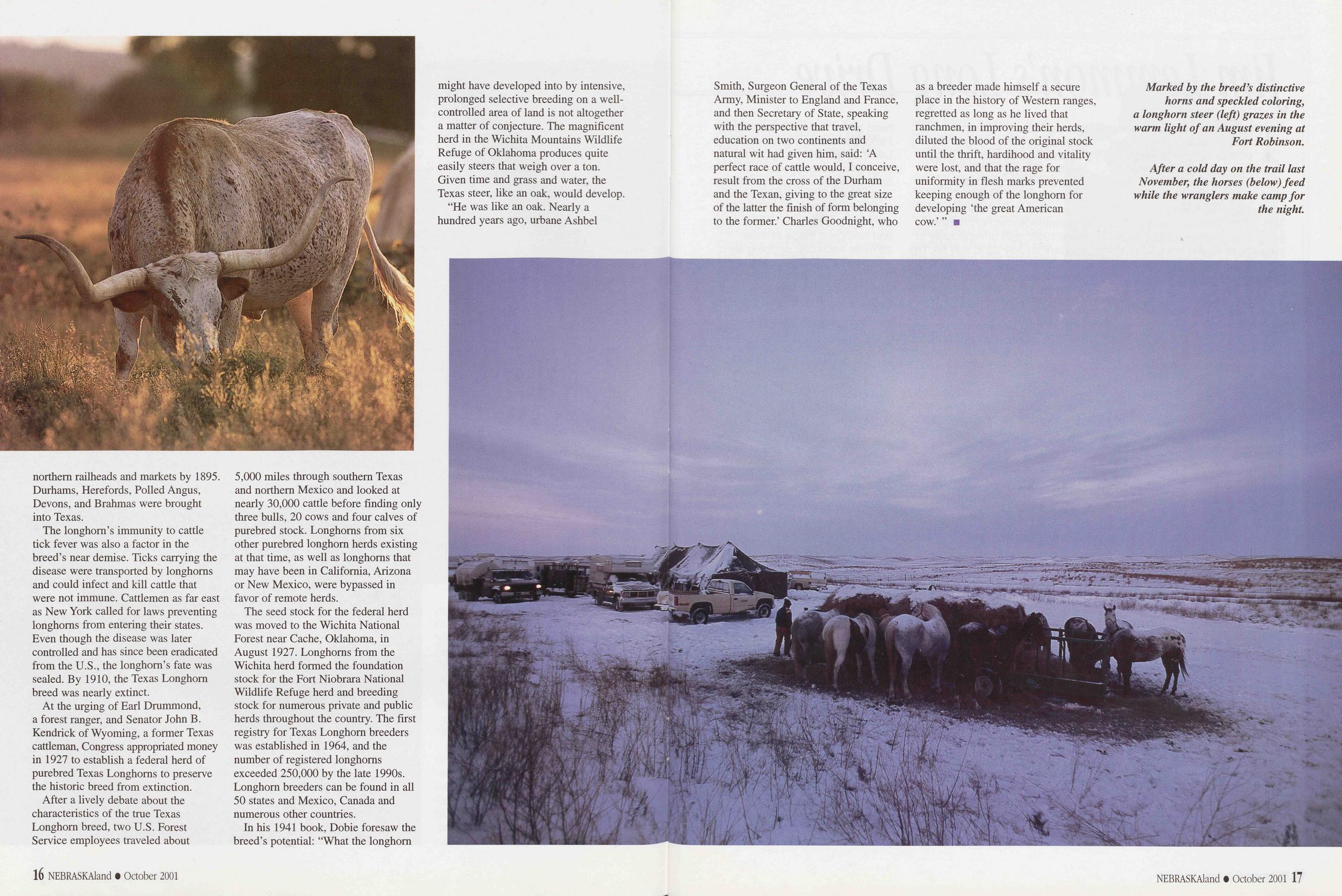 northern railheads and markets by 1895.
Durhams, Herefords, Polled Angus,
Devons, and Brahmas were brought
into Texas.
northern railheads and markets by 1895.
Durhams, Herefords, Polled Angus,
Devons, and Brahmas were brought
into Texas.
The longhorn’s immunity to cattle tick fever was also a factor in the breed’s near demise. Ticks carrying the disease were transported by longhorns and could infect and kill cattle that were not immune. Cattlemen as far east as New York called for laws preventing longhorns from entering their states. Even though the disease was later controlled and has since been eradicated from the U.S., the longhorn’s fate was sealed. By 1910, the Texas Longhorn breed was nearly extinct.
At the urging of Earl Drummond, a forest ranger, and Senator John B. Kendrick of Wyoming, a former Texas cattleman, Congress appropriated money in 1927 to establish a federal herd of purebred Texas Longhorns to preserve the historic breed from extinction.
After a lively debate about the characteristics of the true Texas Longhorn breed, two U.S. Forest Service employees traveled about 5,000 miles through southern Texas and northern Mexico and looked at nearly 30,000 cattle before finding only three bulls, 20 cows and four calves of purebred stock. Longhorns from six other purebred longhorn herds existing at that time, as well as longhorns that may have been in California, Arizona or New Mexico, were bypassed in favor of remote herds.
The seed stock for the federal herd was moved to the Wichita National Forest near Cache, Oklahoma, in August 1927. Longhorns from the Wichita herd formed the foundation stock for the Fort Niobrara National Wildlife Refuge herd and breeding stock for numerous private and public herds throughout the country. The first registry for Texas Longhorn breeders was established in 1964, and the number of registered longhorns exceeded 250,000 by the late 1990s. Longhorn breeders can be found in all 50 states and Mexico, Canada and numerous other countries.
In his 1941 book, Dobie foresaw the breed’s potential: “What the longhorn might have developed into by intensive, prolonged selective breeding on a well- controlled area of land is not altogether a matter of conjecture. The magnificent herd in the Wichita Mountains Wildlife Refuge of Oklahoma produces quite easily steers that weigh over a ton. Given time and grass and water, the Texas steer, like an oak, would develop.
“He was like an oak. Nearly a hundred years ago, urbane Ashbel Smith, Surgeon General of the Texas Army, Minister to England and France, and then Secretary of State, speaking with the perspective that travel, education on two continents and natural wit had given him, said: ‘A perfect race of cattle would, I conceive, result from the cross of the Durham and the Texan, giving to the great size of the latter the finish of form belonging to the former.’ Charles Goodnight, who as a breeder made himself a secure place in the history of Western ranges, regretted as long as he lived that ranchmen, in improving their herds, diluted the blood of the original stock until the thrift, hardihood and vitality were lost, and that the rage for uniformity in flesh marks prevented keeping enough of the longhorn for developing ‘the great American cow.’ ”
Jim Lemmon’s Long Drive
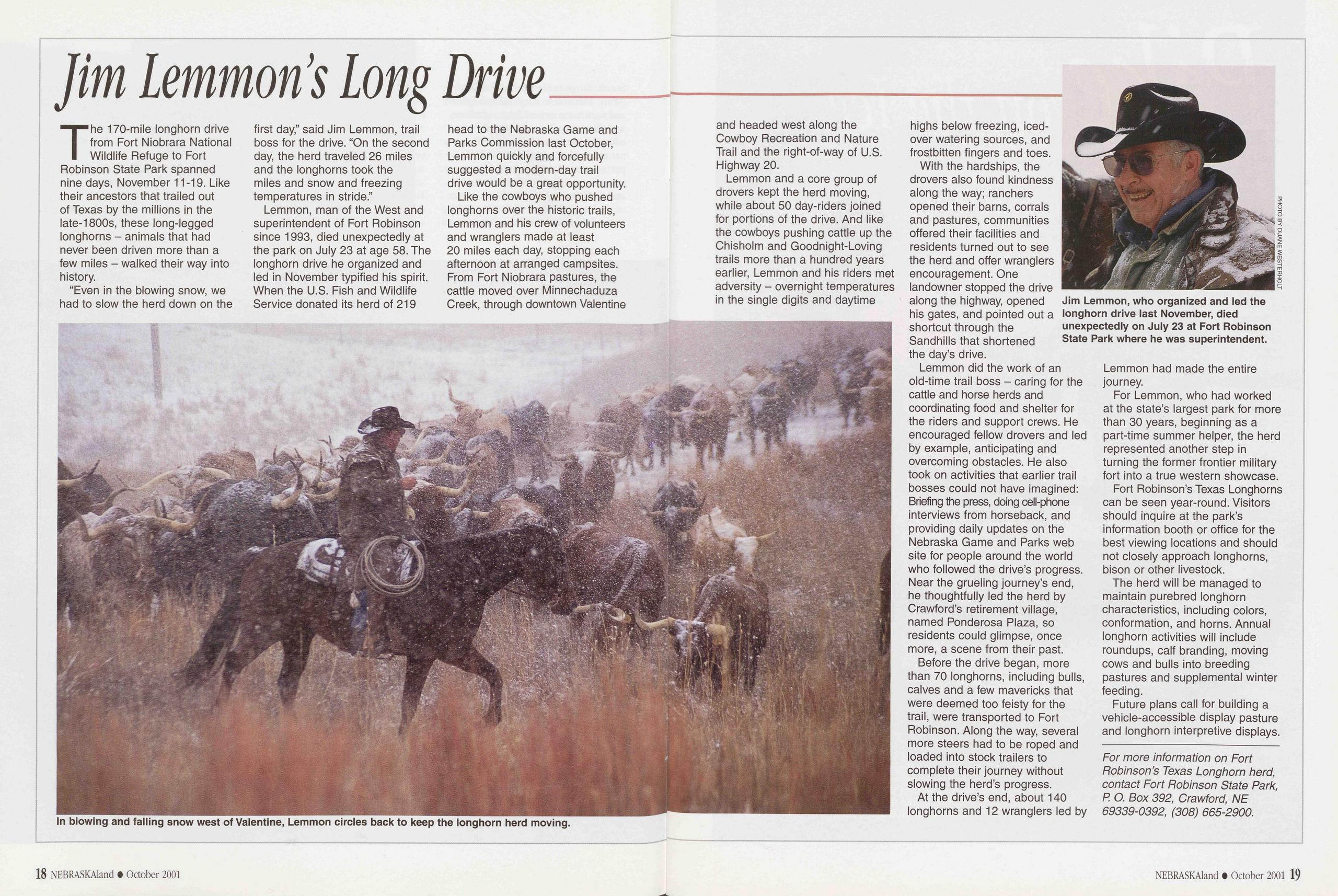
The 170-mile longhorn drive from Fort Niobrara National Wildlife Refuge to Fort Robinson State Park spanned nine days, November 11-19. Like their ancestors that trailed out of Texas by the millions in the late-1800s, these long-legged longhorns - animals that had never been driven more than a few miles - walked their way into history.
“Even in the blowing snow, we had to slow the herd down on the
Lemmon, man of the West and superintendent of Fort Robinson since 1993, died unexpectedly at the park on July 23 at age 58. The longhorn drive he organized and led in November typified his spirit. When the U.S. Fish and Wildlife Service donated its herd of 219 head to the Nebraska Game and Parks Commission last October, Lemmon quickly and forcefully suggested a modern-day trail drive would be a great opportunity.
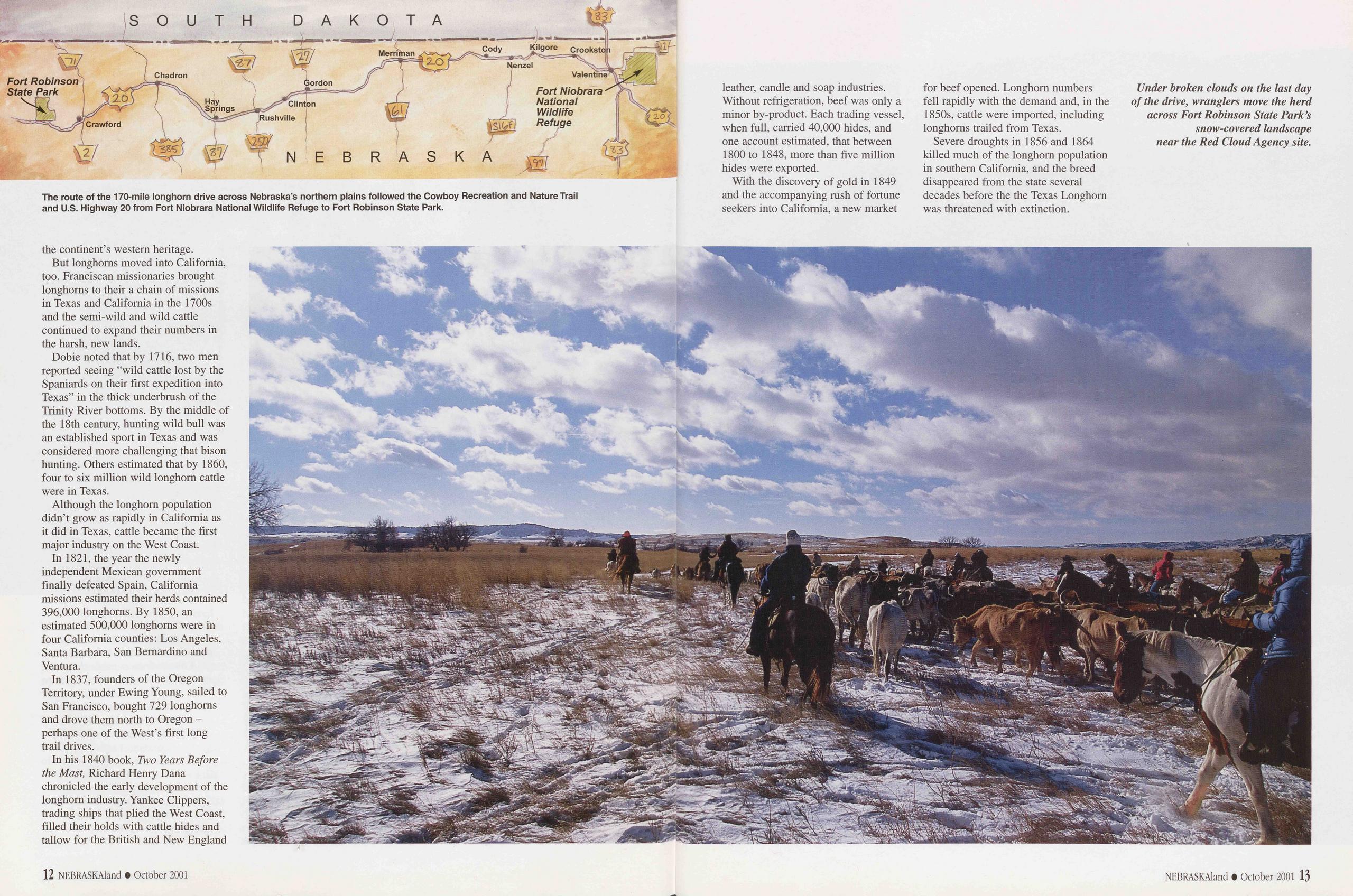
Like the cowboys who pushed longhorns over the historic trails, Lemmon and his crew of volunteers and wranglers made at least 20 miles each day, stopping each afternoon at arranged campsites. From Fort Niobrara pastures, the cattle moved over Minnechaduza Creek, through downtown Valentine and headed west along the Cowboy Recreation and Nature Trail and the right-of-way of U.S. Highway 20.
Lemmon and a core group of drovers kept the herd moving, while about 50 day-riders joined for portions of the drive. And like the cowboys pushing cattle up the Chisholm and Goodnight-Loving trails more than a hundred years earlier, Lemmon and his riders met adversity - overnight temperatures in the single digits and daytime highs below freezing, iced- over watering sources, and frostbitten fingers and toes.
With the hardships, the drovers also found kindness along the way; ranchers opened their barns, corrals and pastures, communities offered their facilities and residents turned out to see the herd and offer wranglers encouragement. One landowner stopped the drive along the highway, opened his gates, and pointed out a shortcut through the Sandhills that shortened the day’s drive.
Lemmon did the work of an old-time trail boss - caring for the cattle and horse herds and coordinating food and shelter for the riders and support crews. He encouraged fellow drovers and led by example, anticipating and overcoming obstacles. He also took on activities that earlier trail bosses could not have imagined: Briefing the press, doing cell-phone interviews from horseback, and providing daily updates on the Nebraska Game and Parks web site for people around the world who followed the drive’s progress. Near the grueling journey’s end, he thoughtfully led the herd by Crawford’s retirement village, named Ponderosa Plaza, so residents could glimpse, once more, a scene from their past.
Before the drive began, more than 70 longhorns, including bulls, calves and a few mavericks that were deemed too feisty for the trail, were transported to Fort Robinson. Along the way, several more steers had to be roped and loaded into stock trailers to complete their journey without slowing the herd’s progress.
At the drive’s end, about 140 longhorns and 12 wranglers led by Lemmon had made the entire journey.
For Lemmon, who had worked at the state’s largest park for more than 30 years, beginning as a part-time summer helper, the herd represented another step in turning the former frontier military fort into a true western showcase.
Fort Robinson’s Texas Longhorns can be seen year-round. Visitors should inquire at the park’s information booth or office for the best viewing locations and should not closely approach longhorns, bison or other livestock.
The herd will be managed to maintain purebred longhorn characteristics, including colors, conformation, and horns. Annual longhorn activities will include roundups, calf branding, moving cows and bulls into breeding pastures and supplemental winter feeding.
Future plans call for building a vehicle-accessible display pasture and longhorn interpretive displays.
For more information on Fort Robinson’s Texas Longhorn herd, contact Fort Robinson State Park, P. O. Box 392, Crawford, NE 69339-0392, (308) 665-2900.
18 NEBRASKAland • October 2001 NEBRASKAland • October 2001 19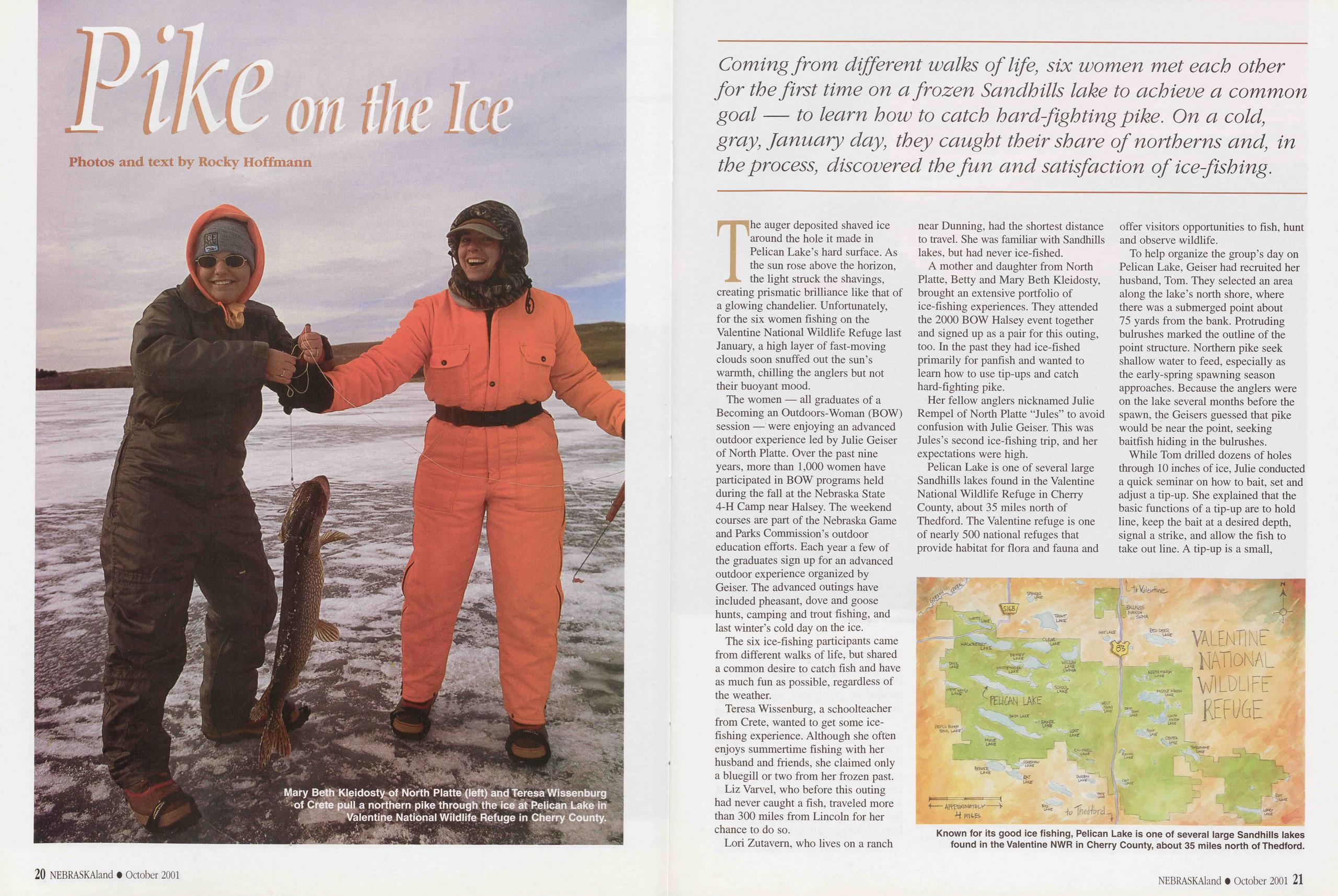
Pike on the Ice
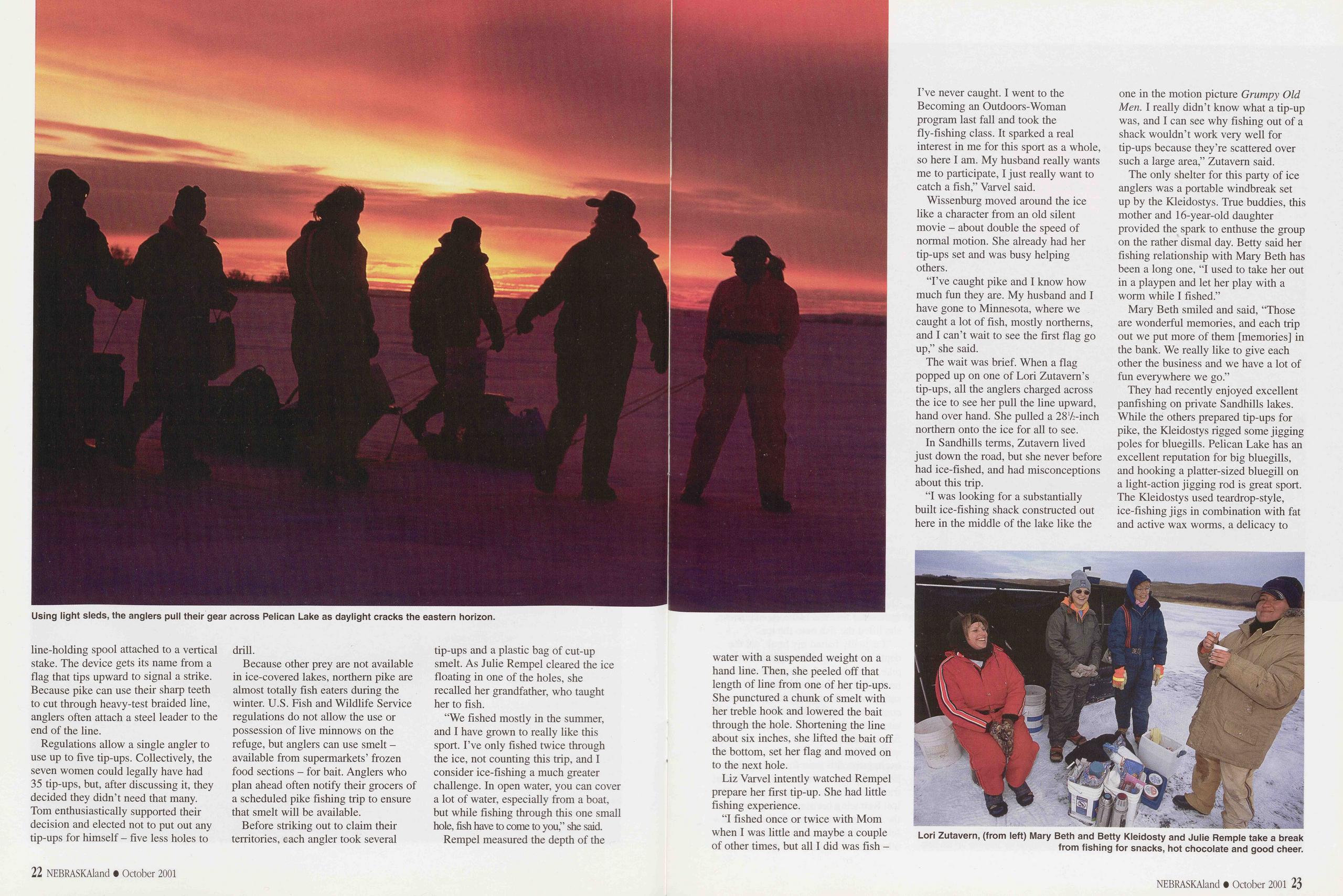
Photos and text by Rocky HoffmannThe auger deposited shaved ice around the hole it made in Pelican Lake’s hard surface. As the sun rose above the horizon, the light struck the shavings, creating prismatic brilliance like that of a glowing chandelier. Unfortunately, for the six women fishing on the Valentine National Wildlife Refuge last January, a high layer of fast-moving clouds soon snuffed out the sun’s warmth, chilling the anglers but not their buoyant mood.
The women — all graduates of a Becoming an Outdoors-Woman (BOW) session — were enjoying an advanced outdoor experience led by Julie Geiser of North Platte. Over the past nine years, more than 1,000 women have participated in BOW programs held during the fall at the Nebraska State 4-H Camp near Halsey. The weekend courses are part of the Nebraska Game and Parks Commission’s outdoor education efforts. Each year a few of the graduates sign up for an advanced outdoor experience organized by Geiser. The advanced outings have included pheasant, dove and goose hunts, camping and trout fishing, and last winter’s cold day on the ice.
The six ice-fishing participants came from different walks of life, but shared a common desire to catch fish and have as much fun as possible, regardless of the weather.
Teresa Wissenburg, a schoolteacher from Crete, wanted to get some ice- fishing experience. Although she often enjoys summertime fishing with her husband and friends, she claimed only a bluegill or two from her frozen past.
Liz Varvel, who before this outing had never caught a fish, traveled more than 300 miles from Lincoln for her chance to do so.
Lori Zutavern, who lives on a ranch near Dunning, had the shortest distance to travel. She was familiar with Sandhills lakes, but had never ice-fished.
A mother and daughter from North Platte, Betty and Mary Beth Kleidosty, brought an extensive portfolio of ice-fishing experiences. They attended the 2000 BOW Halsey event together and signed up as a pair for this outing, too. In the past they had ice-fished primarily for panfish and wanted to learn how to use tip-ups and catch hard-fighting pike.
Her fellow anglers nicknamed Julie Rempel of North Platte “Jules” to avoid confusion with Julie Geiser. This was Jules’s second ice-fishing trip, and her expectations were high.
Pelican Lake is one of several large Sandhills lakes found in the Valentine National Wildlife Refuge in Cherry County, about 35 miles north of Thedford. The Valentine refuge is one of nearly 500 national refuges that provide habitat for flora and fauna and
To help organize the group’s day on Pelican Lake, Geiser had recruited her husband, Tom. They selected an area along the lake’s north shore, where there was a submerged point about 75 yards from the bank. Protruding bulrushes marked the outline of the point structure. Northern pike seek shallow water to feed, especially as the early-spring spawning season approaches. Because the anglers were on the lake several months before the spawn, the Geisers guessed that pike would be near the point, seeking baitfish hiding in the bulrushes.
While Tom drilled dozens of holes
through 10 inches of ice, Julie conducted
a quick seminar on how to bait, set and
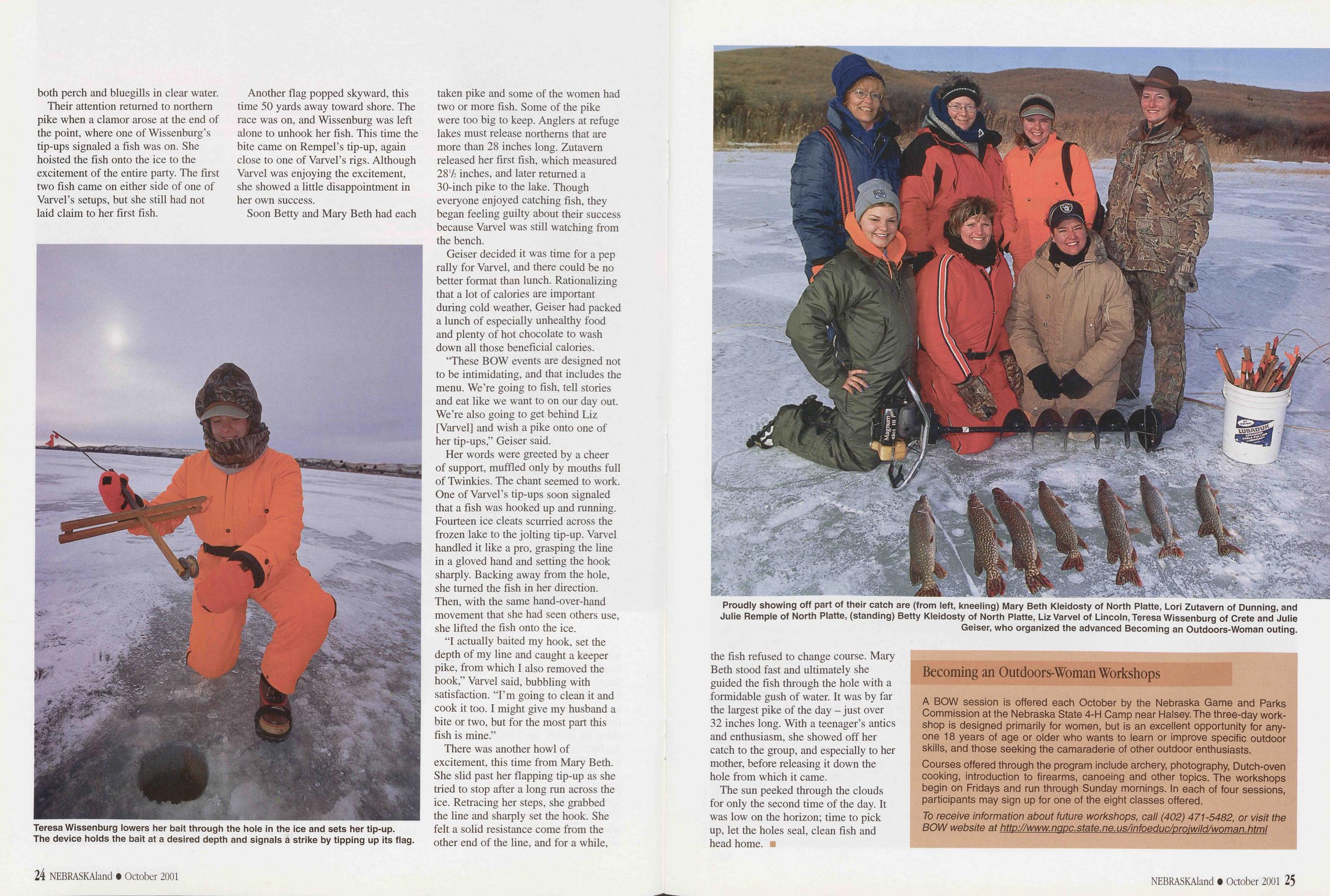
adjust a tip-up. She explained that the
basic functions of a tip-up are to hold
line, keep the bait at a desired depth,
signal a strike, and allow the fish to
take out line. A tip-up is a small,
20 NEBRASKAland • October 2001
NEBRASKAland • October 2001 21
Regulations allow a single angler to use up to five tip-ups. Collectively, the seven women could legally have had 35 tip-ups, but, after discussing it, they decided they didn’t need that many. Tom enthusiastically supported their decision and elected not to put out any tip-ups for himself - five less holes to drill.
Because other prey are not available in ice-covered lakes, northern pike are almost totally fish eaters during the winter. U.S. Fish and Wildlife Service regulations do not allow the use or possession of live minnows on the refuge, but anglers can use smelt - available from supermarkets’ frozen food sections - for bait. Anglers who plan ahead often notify their grocers of a scheduled pike fishing trip to ensure that smelt will be available.
Before striking out to claim their territories, each angler took several tip-ups and a plastic bag of cut-up smelt. As Julie Rempel cleared the ice floating in one of the holes, she recalled her grandfather, who taught her to fish.
"We fished mostly in the summer, and I have grown to really like this sport. I’ve only fished twice through the ice, not counting this trip, and I consider ice-fishing a much greater challenge. In open water, you can cover a lot of water, especially from a boat, but while fishing through this one small hole, fish have to come to you,” she said.
Rempel measured the depth of the water with a suspended weight on a hand line. Then, she peeled off that length of line from one of her tip-ups. She punctured a chunk of smelt with her treble hook and lowered the bait through the hole. Shortening the line about six inches, she lifted the bait off the bottom, set her flag and moved on to the next hole.
Liz Varvel intently watched Rempel prepare her first tip-up. She had little fishing experience.
"I fished once or twice with Mom when I was little and maybe a couple of other times, but all I did was fish - I’ve never caught. I went to the Becoming an Outdoors-Woman program last fall and took the fly-fishing class. It sparked a real interest in me for this sport as a whole, so here I am. My husband really wants me to participate, I just really want to catch a fish,” Varvel said.
Wissenburg moved around the ice like a character from an old silent movie - about double the speed of normal motion. She already had her tip-ups set and was busy helping others.
"I’ve caught pike and I know how much fun they are. My husband and I have gone to Minnesota, where we caught a lot of fish, mostly northerns, and I can’t wait to see the first flag go up,” she said.
The wait was brief. When a flag popped up on one of Lori Zutavern’s tip-ups, all the anglers charged across the ice to see her pull the line upward, hand over hand. She pulled a 28 1/2-inch northern onto the ice for all to see.
In Sandhills terms, Zutavern lived just down the road, but she never before had ice-fished, and had misconceptions about this trip.
"I was looking for a substantially built ice-fishing shack constructed out here in the middle of the lake like the
The only shelter for this party of ice anglers was a portable windbreak set up by the Kleidostys. True buddies, this mother and 16-year-old daughter provided the spark to enthuse the group on the rather dismal day. Betty said her fishing relationship with Mary Beth has been a long one, "I used to take her out in a playpen and let her play with a worm while I fished.”
Mary Beth smiled and said, “Those are wonderful memories, and each trip out we put more of them [memories] in the bank. We really like to give each other the business and we have a lot of fun everywhere we go.”
They had recently enjoyed excellent
panfishing on private Sandhills lakes.
While the others prepared tip-ups for
pike, the Kleidostys rigged some jigging
poles for bluegills. Pelican Lake has an
excellent reputation for big bluegills,
and hooking a platter-sized bluegill on
a light-action jigging rod is great sport.
The Kleidostys used teardrop-style,
ice-fishing jigs in combination with fat
and active wax worms, a delicacy to
22 NEBRASKAland • October 2001
NEBRASKAland • October 2001 23
 both perch and bluegills in clear water.
Their attention returned to northern pike when a clamor arose at the end of the point, where one of Wissenburg’s tip-ups signaled a fish was on. She hoisted the fish onto the ice to the excitement of the entire party. The first two fish came on either side of one of VarveTs setups, but she still had not laid claim to her first fish.
Another flag popped skyward, this time 50 yards away toward shore. The race was on, and Wissenburg was left alone to unhook her fish. This time the bite came on Rempel’s tip-up, again close to one of VarveTs rigs. Although Varvel was enjoying the excitement, she showed a little disappointment in her own success.
Soon Betty and Mary Beth had each taken pike and some of the women had two or more fish. Some of the pike were too big to keep. Anglers at refuge lakes must release northerns that are more than 28 inches long. Zutavern released her first fish, which measured 2872 inches, and later returned a 30-inch pike to the lake. Though everyone enjoyed catching fish, they began feeling guilty about their success because Varvel was still watching from the bench.
Geiser decided it was time for a pep rally for Varvel, and there could be no better format than lunch. Rationalizing that a lot of calories are important during cold weather, Geiser had packed a lunch of especially unhealthy food and plenty of hot chocolate to wash down all those beneficial calories.
“These BOW events are designed not to be intimidating, and that includes the menu. We’re going to fish, tell stories and eat like we want to on our day out. We’re also going to get behind Liz [Varvel] and wish a pike onto one of her tip-ups,” Geiser said.
Her words were greeted by a cheer of support, muffled only by mouths full of Twinkies. The chant seemed to work. One of Varvel's tip-ups soon signaled that a fish was hooked up and running. Fourteen ice cleats scurried across the frozen lake to the jolting tip-up. Varvel handled it like a pro, grasping the line in a gloved hand and setting the hook sharply. Backing away from the hole, she turned the fish in her direction. Then, with the same hand-over-hand movement that she had seen others use, she lifted the fish onto the ice.
"I actually baited my hook, set the depth of my line and caught a keeper pike, from which I also removed the hook,” Varvel said, bubbling with satisfaction. “I’m going to clean it and cook it too. I might give my husband a bite or two, but for the most part this fish is mine.”
There was another howl of excitement, this time from Mary Beth. She slid past her flapping tip-up as she tried to stop after a long run across the ice. Retracing her steps, she grabbed the line and sharply set the hook. She felt a solid resistance come from the other end of the line, and for a while,
The sun peeked through the clouds for only the second time of the day. It was low on the horizon; time to pick up, let the holes seal, clean fish and head home.
Becoming an Outdoors-Woman WorkshopsA BOW session is offered each October by the Nebraska Game and Parks Commission at the Nebraska State 4-H Camp near Halsey. The three-day work- shop is designed primarily for women, but is an excellent opportunity for any- one 18 years of age or older who wants to learn or improve specific outdoor skills, and those seeking the camaraderie of other outdoor enthusiasts.
Courses offered through the program include archery, photography, Dutch-oven cooking, introduction to firearms, canoeing and other topics. The workshops begin on Fridays and run through Sunday mornings. In each of four sessions, participants may sign up for one of the eight classes offered.
To receive information about future workshops, call (402) 471-5482, or visit the BOW website at http://www.ngpc.state.ne.us/infoeduc/projwild/woman.html
24 NEBRASKAland • October 2001 NEBRASKAland • October 2001 25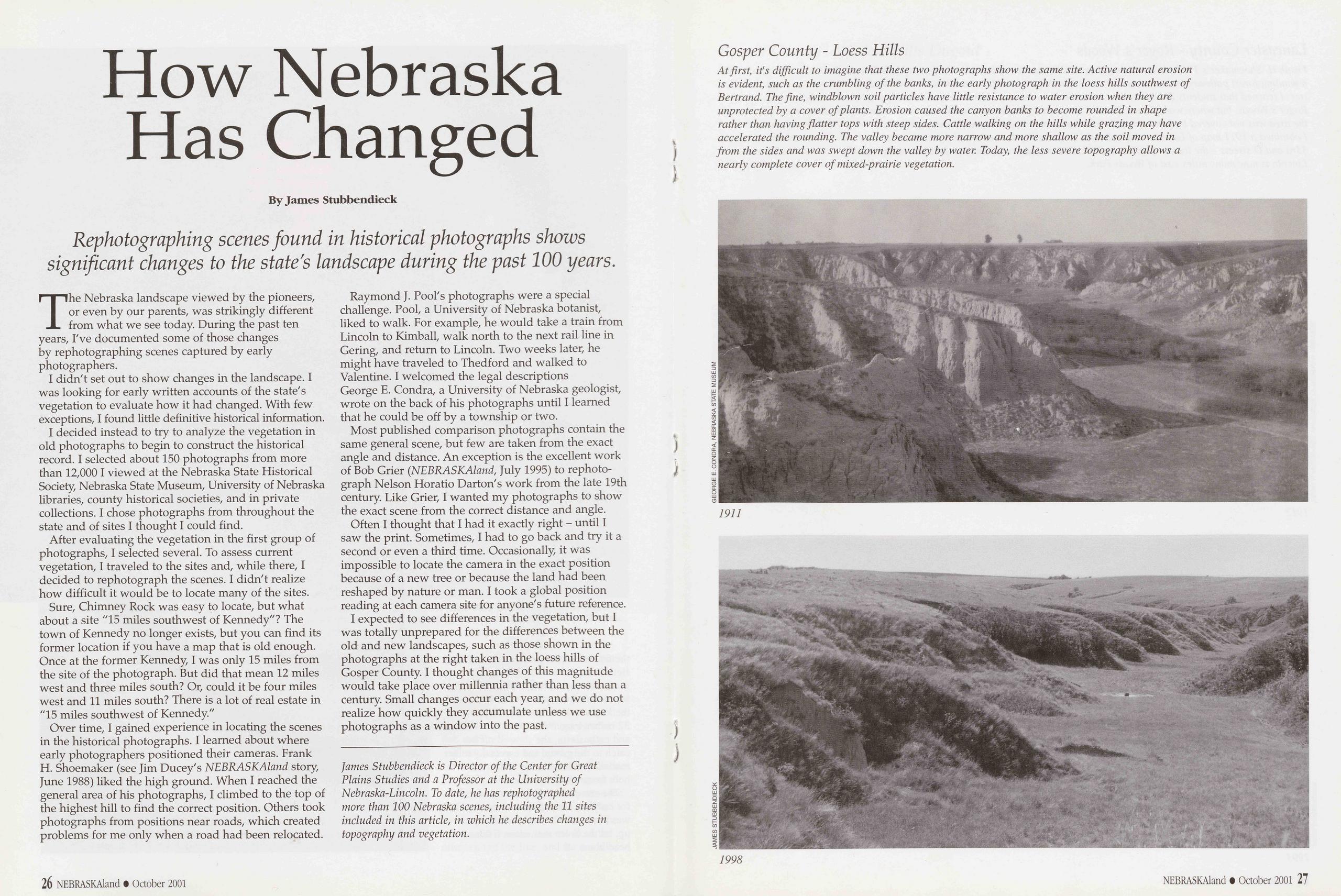
How Nebraska Has Changed
By James Stubbendieck Rephotographing scenes found in historical photographs shows significant changes to the state's landscape during the past 100 years.The Nebraska landscape viewed by the pioneers, or even by our parents, was strikingly different from what we see today. During the past ten years, I've documented some of those changes by rephotographing scenes captured by early photographers.
I didn't set out to show changes in the landscape. I was looking for early written accounts of the state's vegetation to evaluate how it had changed. With few exceptions, I found little definitive historical information.
I decided instead to try to analyze the vegetation in old photographs to begin to construct the historical record. I selected about 150 photographs from more than 12,000 I viewed at the Nebraska State Historical Society, Nebraska State Museum, University of Nebraska libraries, county historical societies, and in private collections. I chose photographs from throughout the state and of sites I thought I could find.
After evaluating the vegetation in the first group of photographs, I selected several. To assess current vegetation, I traveled to the sites and, while there, I decided to rephotograph the scenes. I didn't realize how difficult it would be to locate many of the sites.
Sure, Chimney Rock was easy to locate, but what about a site "15 miles southwest of Kennedy"? The town of Kennedy no longer exists, but you can find its former location if you have a map that is old enough. Once at the former Kennedy, I was only 15 miles from the site of the photograph. But did that mean 12 miles west and three miles south? Or, could it be four miles west and 11 miles south? There is a lot of real estate in "15 miles southwest of Kennedy."
Over time, I gained experience in locating the scenes in the historical photographs. I learned about where early photographers positioned their cameras. Frank H. Shoemaker (see Jim Ducey's NEBRASKAland story, June 1988) liked the high ground. When I reached the general area of his photographs, I climbed to the top of the highest hill to find the correct position. Others took photographs from positions near roads, which created problems for me only when a road had been relocated.
Raymond J. Pool's photographs were a special challenge. Pool, a University of Nebraska botanist, liked to walk. For example, he would take a train from Lincoln to Kimball, walk north to the next rail line in Gering, and return to Lincoln. Two weeks later, he might have traveled to Thedford and walked to Valentine. I welcomed the legal descriptions George E. Condra, a University of Nebraska geologist, wrote on the back of his photographs until I learned that he could be off by a township or two.
Most published comparison photographs contain the same general scene, but few are taken from the exact angle and distance. An exception is the excellent work of Bob Grier (NEBRASKAland, July 1995) to rephoto- graph Nelson Horatio Darton's work from the late 19th century. Like Grier, I wanted my photographs to show the exact scene from the correct distance and angle.
Often I thought that I had it exactly right - until I saw the print. Sometimes, I had to go back and try it a second or even a third time. Occasionally, it was impossible to locate the camera in the exact position because of a new tree or because the land had been reshaped by nature or man. I took a global position reading at each camera site for anyone's future reference.
I expected to see differences in the vegetation, but I was totally unprepared for the differences between the old and new landscapes, such as those shown in the photographs at the right taken in the loess hills of Gosper County. I thought changes of this magnitude would take place over millennia rather than less than a century. Small changes occur each year, and we do not realize how quickly they accumulate unless we use photographs as a window into the past.
James Stubbendieck is Director of the Center for Great Plains Studies and a Professor at the University of Nebraska-Lincoln. To date, he has rephotographed more than 100 Nebraska scenes, including the 11 sites included in this article, in which he describes changes in topography and vegetation.
Gosper County - Loess HillsAt first, it's difficult to imagine that these two photographs show the same site. Active natural erosion is evident, such as the crumbling of the banks, in the early photograph in the loess hills southwest of Bertrand. The fine, windblown soil particles have little resistance to water erosion when they are unprotected by a cover of plants. Erosion caused the canyon banks to become rounded in shape rather than having flatter tops with steep sides. Cattle walking on the hills while grazing may have accelerated the rounding. The valley became more narrow and more shallow as the soil moved in from the sides and was swept down the valley by water. Today, the less severe topography allows a nearly complete cover of mixed-prairie vegetation.
 Lancaster County - Roger's Woods
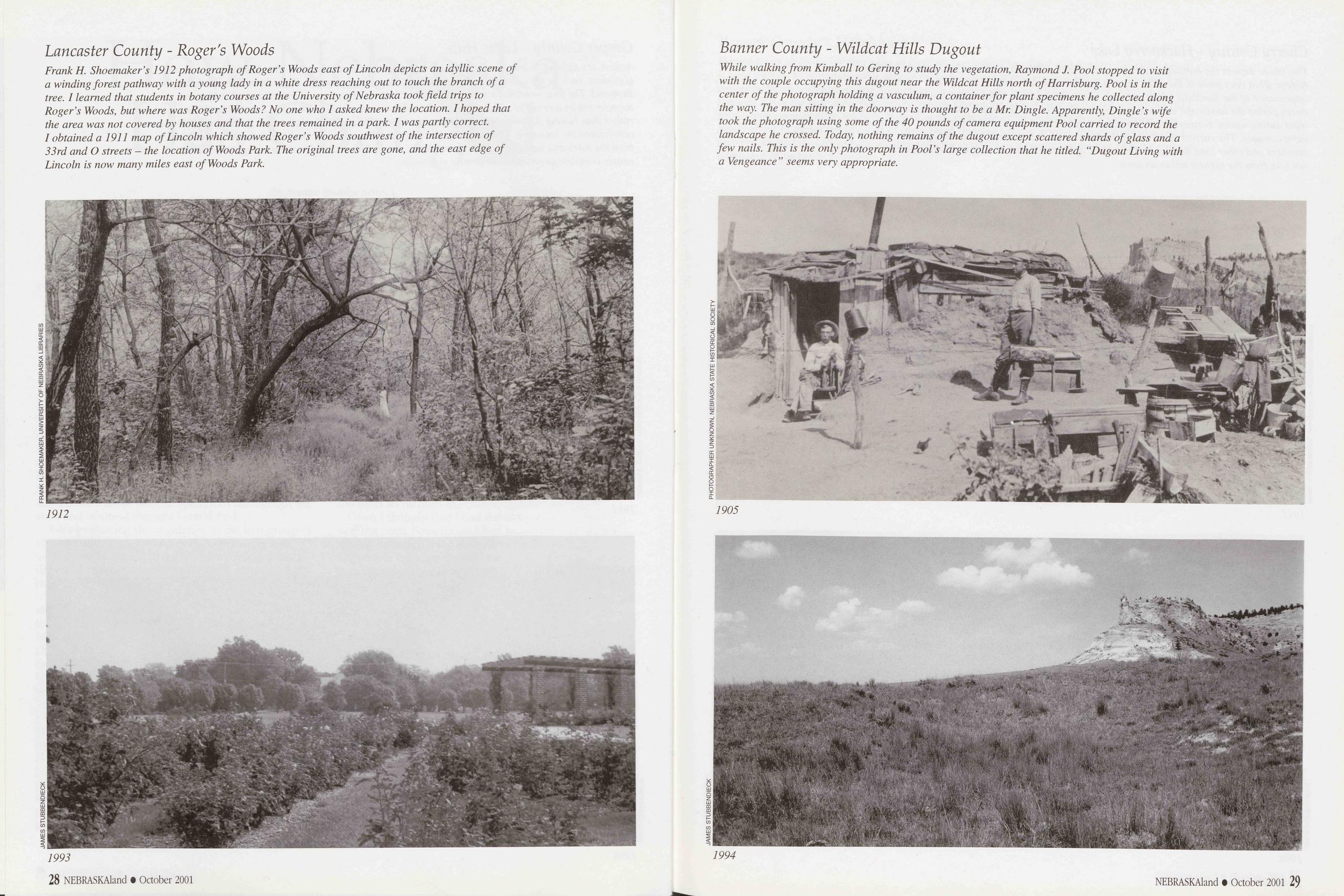
Frank H. Shoemaker's 1912 photograph of Roger's Woods east of Lincoln depicts an idyllic scene of a winding forest pathway with a young lady in a white dress reaching out to touch the branch of a tree. I learned that students in botany courses at the University of Nebraska took field trips to Roger's Woods, but where was Roger's Woods? No one who I asked knew the location. I hoped that the area was not covered by houses and that the trees remained in a park. I was partly correct. I obtained a 1911 map of Lincoln which showed Roger's Woods southwest of the intersection of 33rd and O streets - the location of Woods Park. The original trees are gone, and the east edge of Lincoln is now many miles east of Woods Park.
While walking from Kimball to Gering to study the vegetation, Raymond J. Pool stopped to visit with the couple occupying this dugout near the Wildcat Hills north of Harrisburg. Pool is in the center of the photograph holding a vasculum, a container for plant specimens he collected along the way. The man sitting in the doorway is thought to be a Mr. Dingle. Apparently, Dingle's wife took the photograph using some of the 40 pounds of camera equipment Pool carried to record the landscape he crossed. Today, nothing remains of the dugout except scattered shards of glass and a few nails. This is the only photograph in Pool's large collection that he titled. “Dugout Living with a Vengeance " seems very appropriate.
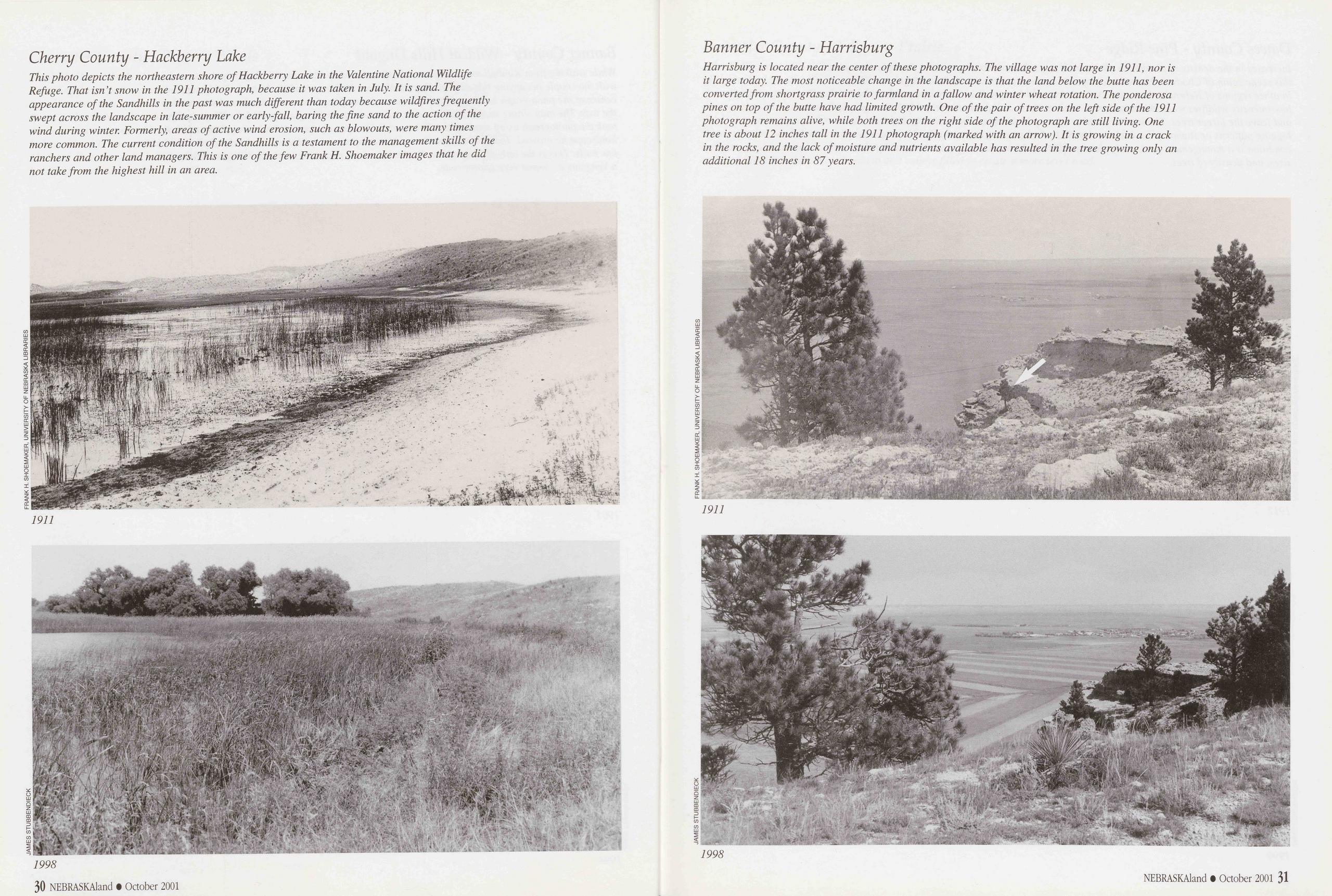 Cherry County - Hackberry Lake
This photo depicts the northeastern shore of Hackberry Lake in the Valentine National Wildlife Refuge. That isn't snow in the 1911 photograph, because it was taken in July. It is sand. The appearance of the Sandhills in the past was much different than today because wildfires frequently swept across the landscape in late-summer or early-fall, baring the fine sand to the action of the wind during winter. Formerly, areas of active wind erosion, such as blowouts, were many times more common. The current condition of the Sandhills is a testament to the management skills of the ranchers and other land managers. This is one of the few Frank H. Shoemaker images that he did not take from the highest hill in an area.
Harrisburg is located near the center of these photographs. The village was not large in 1911, nor is it large today. The most noticeable change in the landscape is that the land below the butte has been converted from shortgrass prairie to farmland in a fallow and winter wheat rotation. The ponderosa pines on top of the butte have had limited growth. One of the pair of trees on the left side of the 1911 photograph remains alive, while both trees on the right side of the photograph are still living. One tree is about 12 inches tall in the 1911 photograph (marked with an arrow). It is growing in a crack in the rocks, and the lack of moisture and nutrients available has resulted in the tree growing only an additional 18 inches in 87 years.
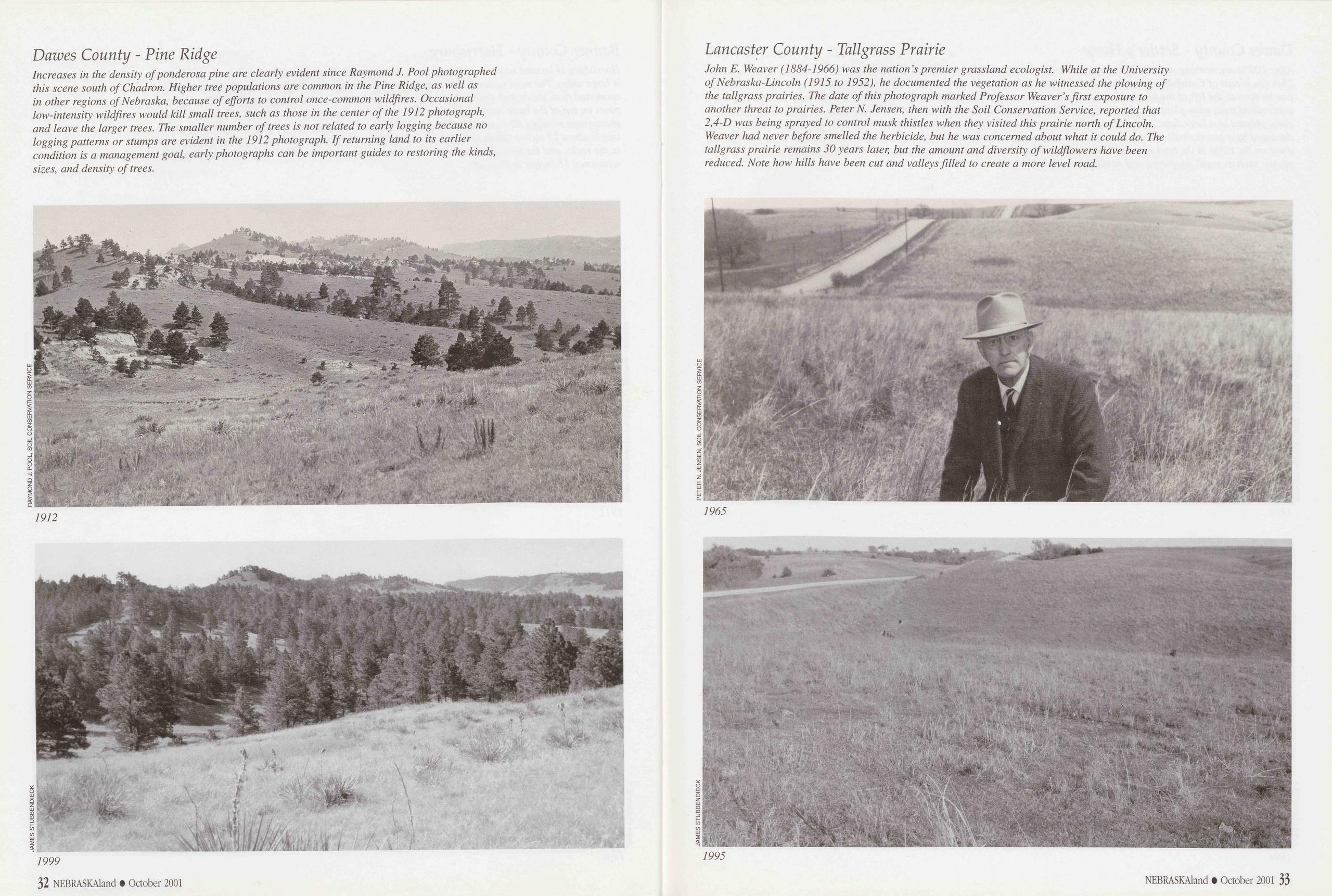 Dawes County - Pine Ridge
Increases in the density of ponderosa pine are clearly evident since Raymond J. Pool photographed this scene south of Chadron. Higher tree populations are common in the Pine Ridge, as well as in other regions of Nebraska, because of efforts to control once-common wildfires. Occasional low-intensity wildfires would kill small trees, such as those in the center of the 1912 photograph, and leave the larger trees. The smaller number of trees is not related to early logging because no logging patterns or stumps are evident in the 1912 photograph. If returning land to its earlier condition is a management goal, early photographs can be important guides to restoring the kinds, sizes, and density of trees.
John E. Weaver (1884-1966) was the nation's premier grassland ecologist. While at the University of Nebraska-Lincoln (1915 to 1952), he documented the vegetation as he witnessed the plowing of the tallgrass prairies. The date of this photograph marked Professor Weaver's first exposure to another threat to prairies. Peter N. Jensen, then with the Soil Conservation Service, reported that 2,4-D was being sprayed to control musk thistles when they visited this prairie north of Lincoln. Weaver had never before smelled the herbicide, but he was concerned about what it could do. The tallgrass prairie remains 30 years later, but the amount and diversity of wildflowers have been reduced. Note how hills have been cut and valleys filled to create a more level road.
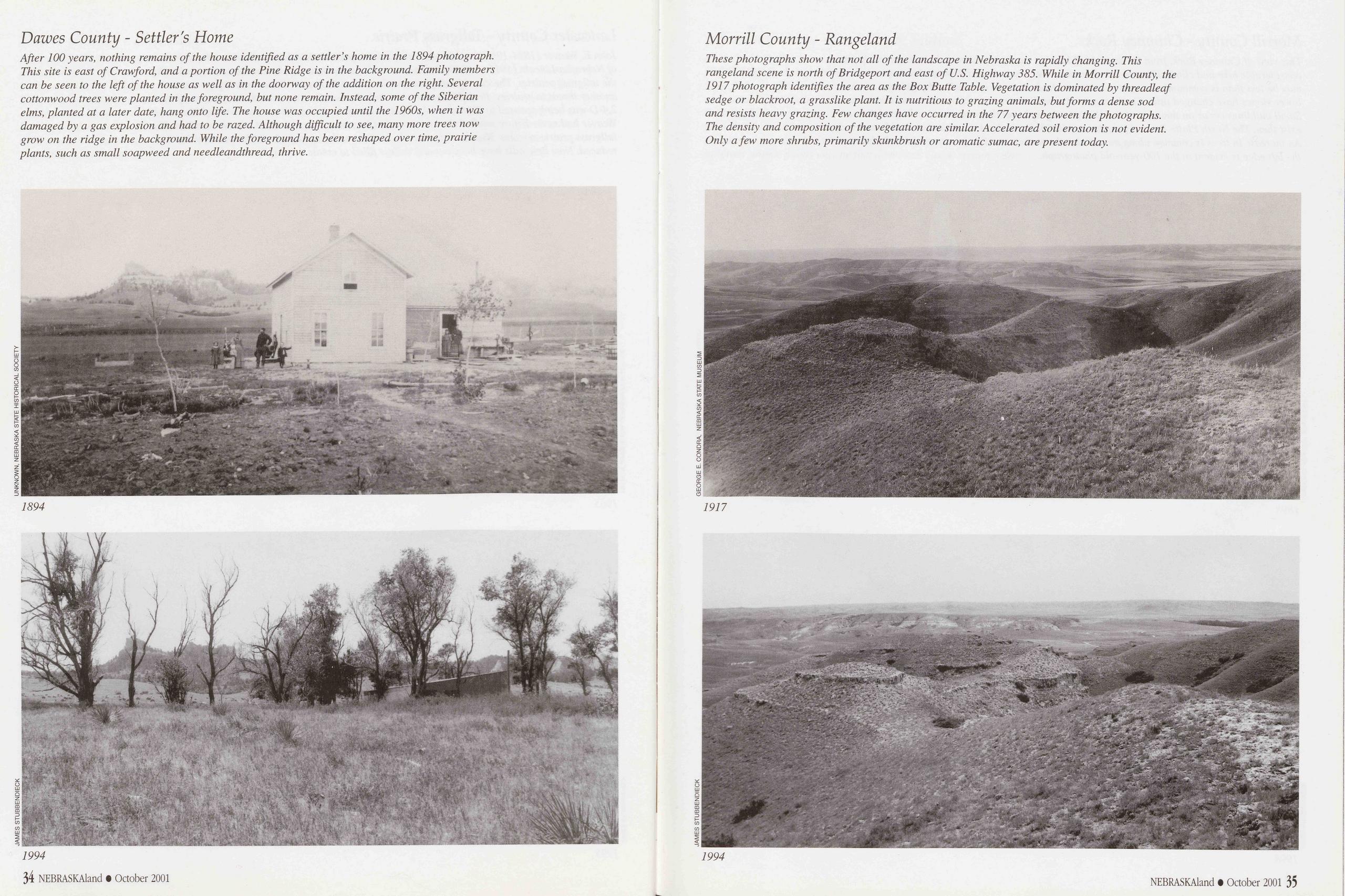 Dawes County - Settler's Home
After 100 years, nothing remains of the house identified as a settler's home in the 1894 photograph. This site is east of Crawford, and a portion of the Pine Ridge is in the background. Family members can be seen to the left of the house as well as in the doorway of the addition on the right. Several cottonwood trees were planted in the foreground, but none remain. Instead, some of the Siberian elms, planted at a later date, hang onto life. The house was occupied until the 1960s, when it was damaged by a gas explosion and had to be razed. Although difficult to see, many more trees now grow on the ridge in the background. While the foreground has been reshaped over time, prairie plants, such as small soapweed and needleandthread, thrive.
These photographs show that not all of the landscape in Nebraska is rapidly changing. This rangeland scene is north of Bridgeport and east of U.S. Highway 385. While in Morrill County, the 1917 photograph identifies the area as the Box Butte Table. Vegetation is dominated by threadleaf sedge or blackroot, a grasslike plant. It is nutritious to grazing animals, but forms a dense sod and resists heavy grazing. Few changes have occurred in the 77 years between the photographs. The density and composition of the vegetation are similar. Accelerated soil erosion is not evident. Only a few more shrubs, primarily skunkbrush or aromatic sumac, are present today.
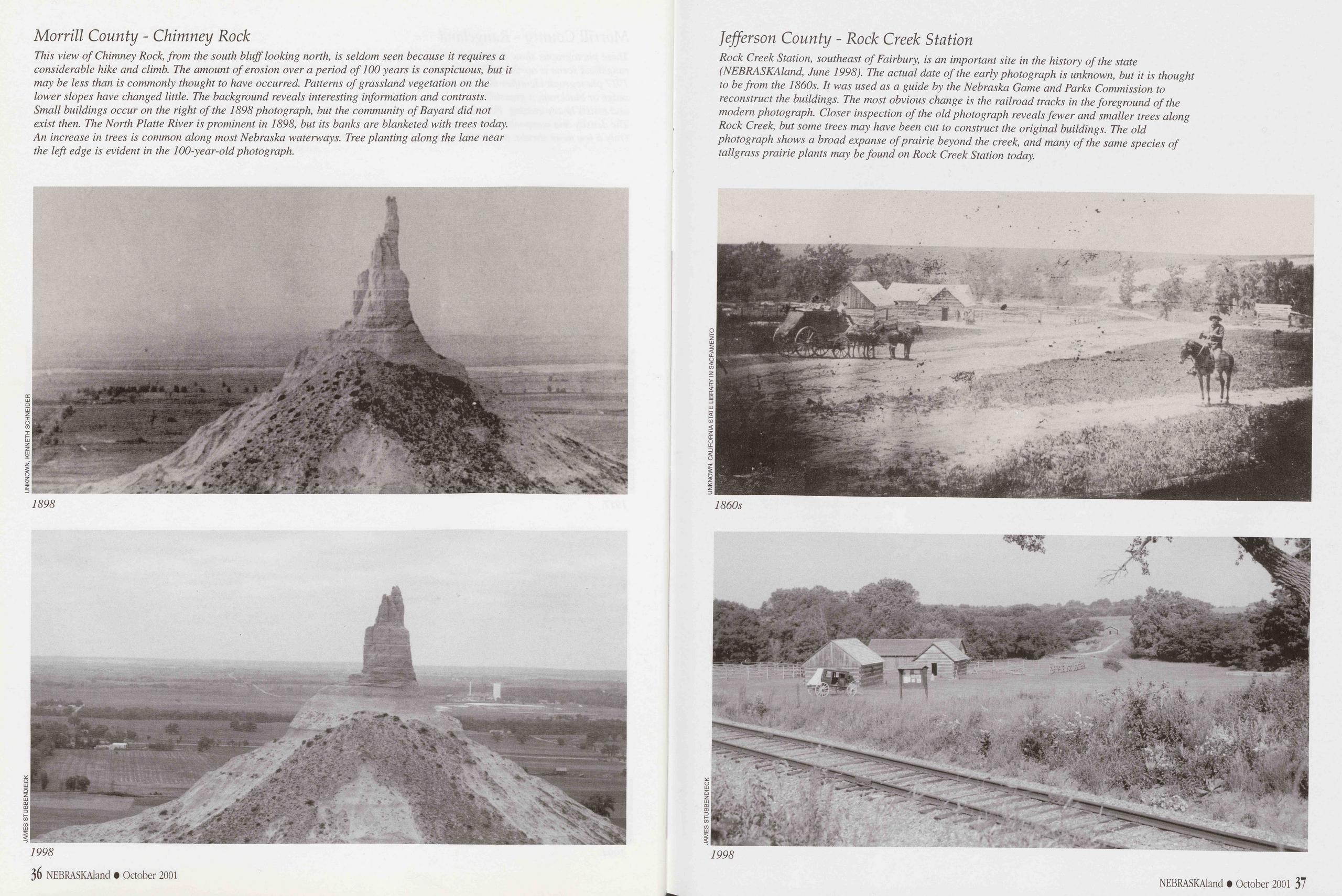 Morrill County - Chimney Rock
This view of Chimney Rock, from the south bluff looking north, is seldom seen because it requires a considerable hike and climb. The amount of erosion over a period of 100 years is conspicuous, but it may be less than is commonly thought to have occurred. Patterns of grassland vegetation on the lower slopes have changed little. The background reveals interesting information and contrasts. Small buildings occur on the right of the 1898 photograph, but the community of Bayard did not exist then. The North Platte River is prominent in 1898, but its banks are blanketed with trees today. An increase in trees is common along most Nebraska waterways. Tree planting along the lane near the left edge is evident in the 100-year-old photograph.
Rock Creek Station, southeast of Fairbury, is an important site in the history of the state (NEBRASKAland, June 1998). The actual date of the early photograph is unknown, but it is thought to be from the 1860s. It was used as a guide by the Nebraska Game and Parks Commission to reconstruct the buildings. The most obvious change is the railroad tracks in the foreground of the modern photograph. Closer inspection of the old photograph reveals fewer and smaller trees along Rock Creek, but some trees may have been cut to construct the original buildings. The old photograph shows a broad expanse of prairie beyond the creek, and many of the same species of tailgrass prairie plants may be found on Rock Creek Station today.
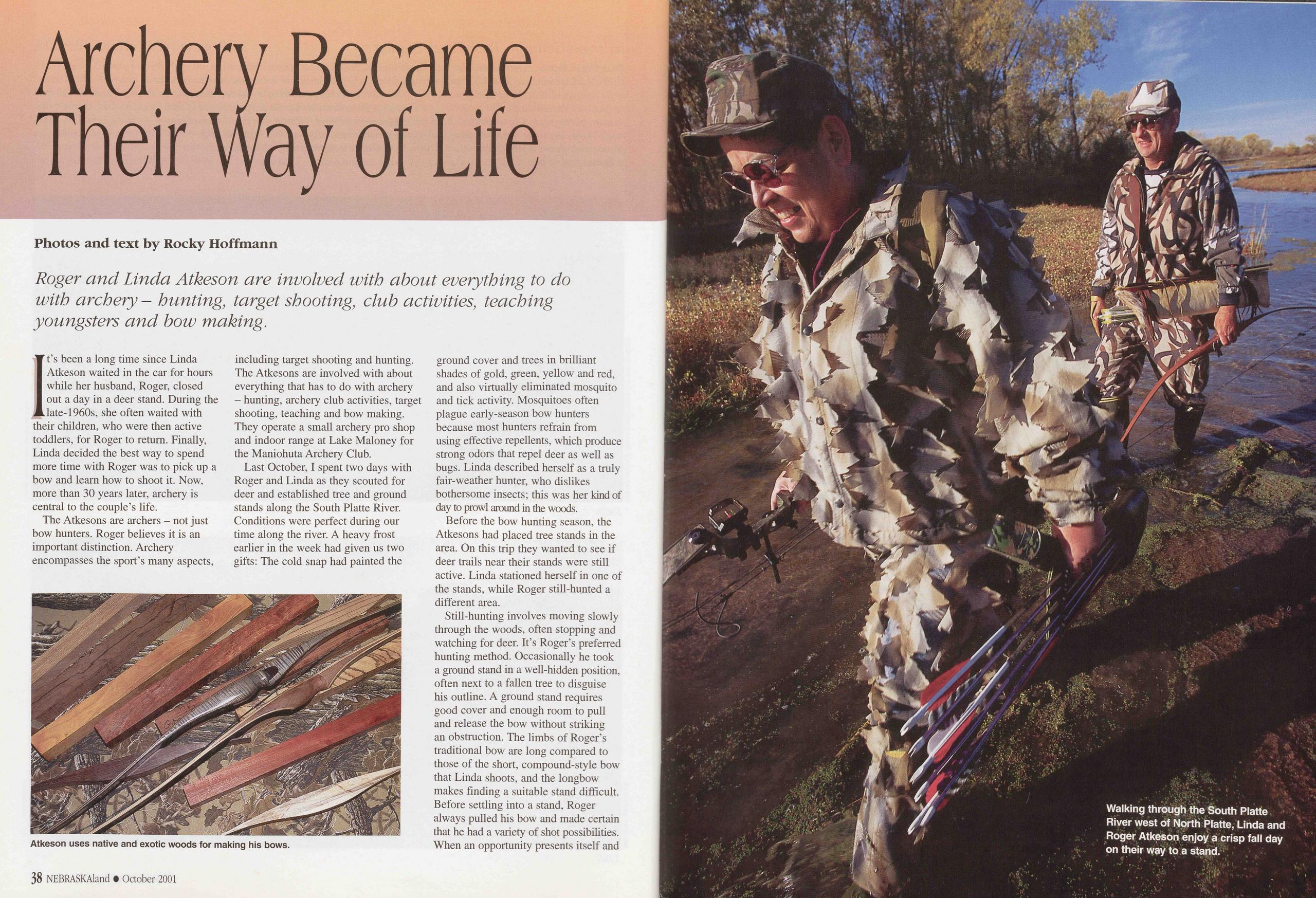
Archery Became Their way of Life
Photos and text by Rocky Hoffmann Roger and Linda Atkeson are involved with about everything to do with archery - hunting, target shooting, club activities, teaching youngsters and bow making.It’s been a long time since Linda Atkeson waited in the car for hours while her husband, Roger, closed out a day in a deer stand. During the late-1960s, she often waited with their children, who were then active toddlers, for Roger to return. Finally, Linda decided the best way to spend more time with Roger was to pick up a bow and learn how to shoot it. Now, more than 30 years later, archery is central to the couple’s life.
The Atkesons are archers - not just bow hunters. Roger believes it is an important distinction. Archery encompasses the sport’s many aspects,
Last October, I spent two days with Roger and Linda as they scouted for deer and established tree and ground stands along the South Platte River. Conditions were perfect during our time along the river. A heavy frost earlier in the week had given us two gifts: The cold snap had painted the ground cover and trees in brilliant shades of gold, green, yellow and red, and also virtually eliminated mosquito and tick activity. Mosquitoes often plague early-season bow hunters because most hunters refrain from using effective repellents, which produce strong odors that repel deer as well as bugs. Linda described herself as a truly fair-weather hunter, who dislikes bothersome insects; this was her kind of day to prowl around in the woods.
Before the bow hunting season, the Atkesons had placed tree stands in the area. On this trip they wanted to see if deer trails near their stands were still active. Linda stationed herself in one of the stands, while Roger still-hunted a different area.
Still-hunting involves moving slowly through the woods, often stopping and watching for deer. It’s Roger’s preferred hunting method. Occasionally he took a ground stand in a well-hidden position, often next to a fallen tree to disguise his outline. A ground stand requires good cover and enough room to pull and release the bow without striking an obstruction. The limbs of Roger’s traditional bow are long compared to those of the short, compound-style bow that Linda shoots, and the longbow makes finding a suitable stand difficult. Before settling into a stand, Roger always pulled his bow and made certain that he had a variety of shot possibilities. When an opportunity presents itself and
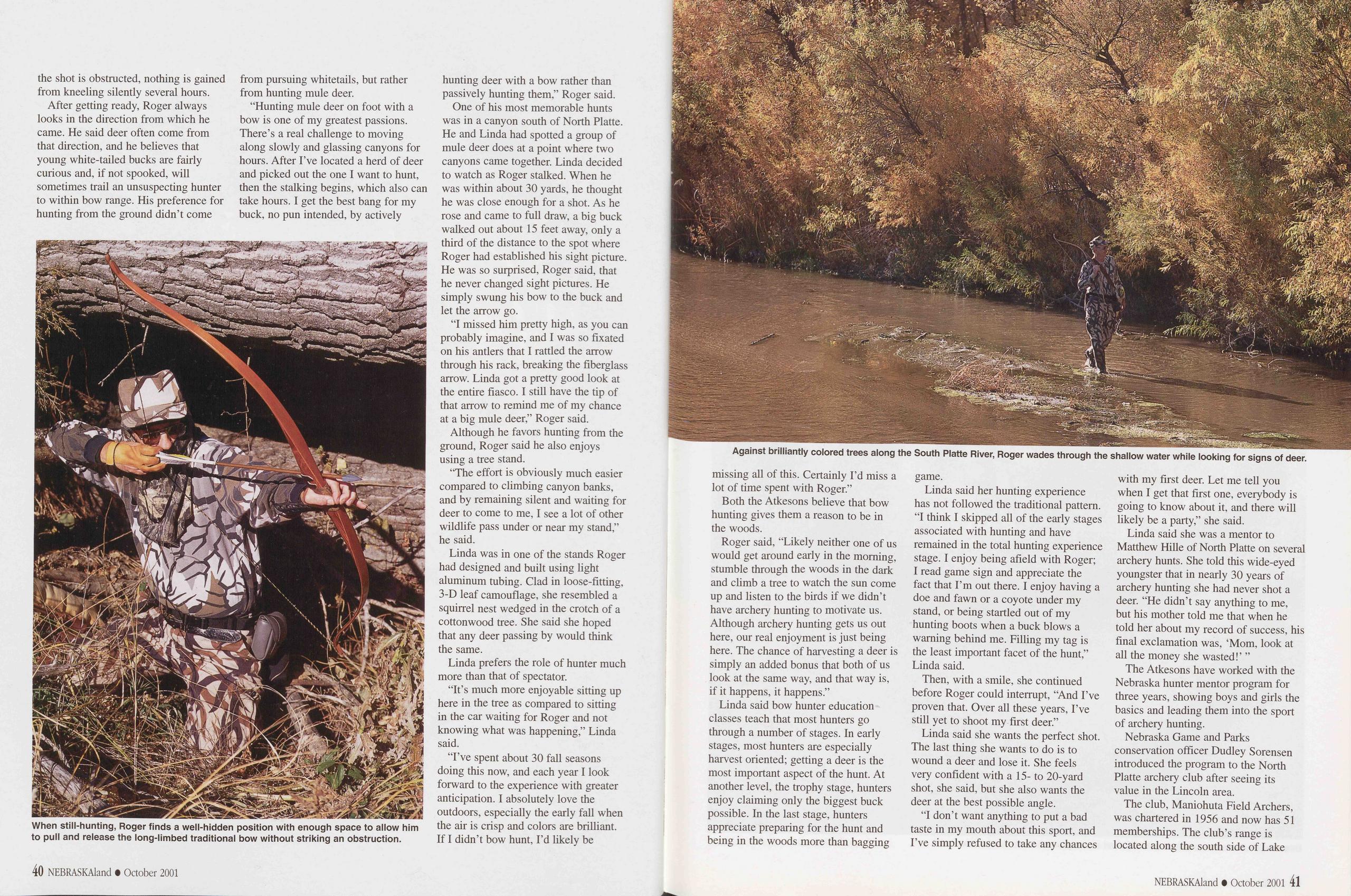 the shot is obstructed, nothing is gained
from kneeling silently several hours.
the shot is obstructed, nothing is gained
from kneeling silently several hours.
After getting ready, Roger always looks in the direction from which he came. He said deer often come from that direction, and he believes that young white-tailed bucks are fairly curious and, if not spooked, will sometimes trail an unsuspecting hunter to within bow range. His preference for hunting from the ground didn’t come
“Hunting mule deer on foot with a bow is one of my greatest passions. There’s a real challenge to moving along slowly and glassing canyons for hours. After I’ve located a herd of deer and picked out the one I want to hunt, then the stalking begins, which also can take hours. I get the best bang for my buck, no pun intended, by actively hunting deer with a bow rather than passively hunting them,” Roger said.
One of his most memorable hunts was in a canyon south of North Platte. He and Linda had spotted a group of mule deer does at a point where two canyons came together. Linda decided to watch as Roger stalked. When he was within about 30 yards, he thought he was close enough for a shot. As he rose and came to full draw, a big buck walked out about 15 feet away, only a third of the distance to the spot where Roger had established his sight picture. He was so surprised, Roger said, that he never changed sight pictures. He simply swung his bow to the buck and let the arrow go.
“I missed him pretty high, as you can probably imagine, and I was so fixated on his antlers that I rattled the arrow through his rack, breaking the fiberglass arrow. Linda got a pretty good look at the entire fiasco. I still have the tip of that arrow to remind me of my chance at a big mule deer,” Roger said.
Although he favors hunting from the ground, Roger said he also enjoys using a tree stand.
“The effort is obviously much easier compared to climbing canyon banks, and by remaining silent and waiting for deer to come to me, I see a lot of other wildlife pass under or near my stand,” he said.
Linda was in one of the stands Roger had designed and built using light aluminum tubing. Clad in loose-fitting, 3-D leaf camouflage, she resembled a squirrel nest wedged in the crotch of a cottonwood tree. She said she hoped that any deer passing by would think the same.
Linda prefers the role of hunter much more than that of spectator.
“It’s much more enjoyable sitting up here in the tree as compared to sitting in the car waiting for Roger and not knowing what was happening,” Linda said.
“I’ve spent about 30 fall seasons doing this now, and each year I look forward to the experience with greater anticipation. I absolutely love the outdoors, especially the early fall when the air is crisp and colors are brilliant. If I didn’t bow hunt, I’d likely be
Both the Atkesons believe that bow hunting gives them a reason to be in the woods.
Roger said, “Likely neither one of us would get around early in the morning, stumble through the woods in the dark and climb a tree to watch the sun come up and listen to the birds if we didn’t have archery hunting to motivate us. Although archery hunting gets us out here, our real enjoyment is just being here. The chance of harvesting a deer is simply an added bonus that both of us look at the same way, and that way is, if it happens, it happens ”
Linda said bow hunter education classes teach that most hunters go through a number of stages. In early stages, most hunters are especially harvest oriented; getting a deer is the most important aspect of the hunt. At another level, the trophy stage, hunters enjoy claiming only the biggest buck possible. In the last stage, hunters appreciate preparing for the hunt and being in the woods more than bagging game.
Linda said her hunting experience has not followed the traditional pattern. “I think I skipped all of the early stages associated with hunting and have remained in the total hunting experience stage. I enjoy being afield with Roger; I read game sign and appreciate the fact that I’m out there. I enjoy having a doe and fawn or a coyote under my stand, or being startled out of my hunting boots when a buck blows a warning behind me. Filling my tag is the least important facet of the hunt,” Linda said.
Then, with a smile, she continued before Roger could interrupt, “And I’ve proven that. Over all these years, I’ve still yet to shoot my first deer.”
Linda said she wants the perfect shot. The last thing she wants to do is to wound a deer and lose it. She feels very confident with a 15- to 20-yard shot, she said, but she also wants the deer at the best possible angle.
“I don’t want anything to put a bad taste in my mouth about this sport, and I’ve simply refused to take any chances with my first deer. Let me tell you when I get that first one, everybody is going to know about it, and there will likely be a party,” she said.
Linda said she was a mentor to Matthew Hille of North Platte on several archery hunts. She told this wide-eyed youngster that in nearly 30 years of archery hunting she had never shot a deer. “He didn’t say anything to me, but his mother told me that when he told her about my record of success, his final exclamation was, ‘Mom, look at all the money she wasted!’ ”
The Atkesons have worked with the Nebraska hunter mentor program for three years, showing boys and girls the basics and leading them into the sport of archery hunting.
Nebraska Game and Parks conservation officer Dudley Sorensen introduced the program to the North Platte archery club after seeing its value in the Lincoln area.
The club, Maniohuta Field Archers,
was chartered in 1956 and now has 51
memberships. The club’s range is
located along the south side of Lake
40 NEBRASKAland • October 2001
NEBRASKAland • October 2001 41
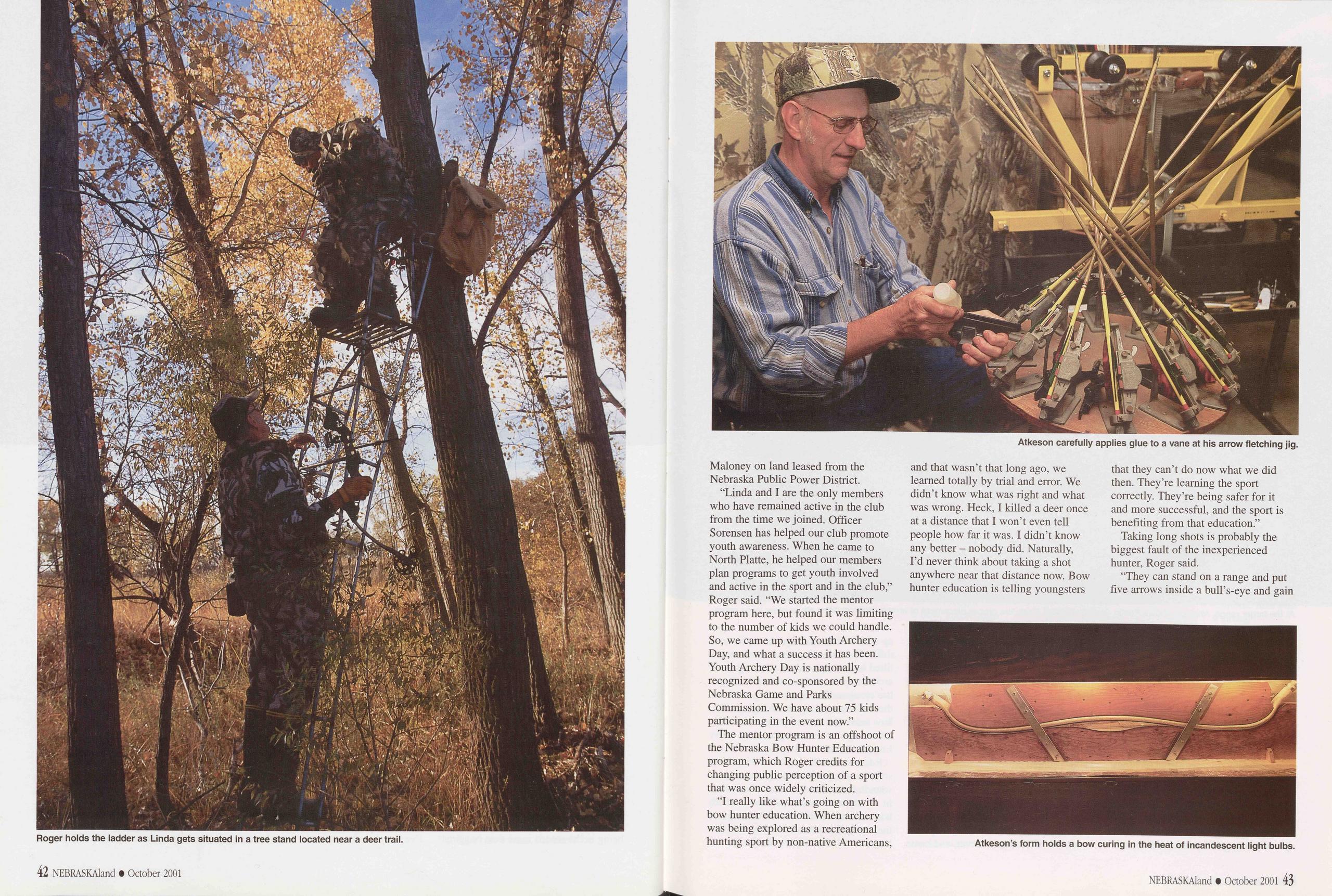
“Linda and I are the only members who have remained active in the club from the time we joined. Officer Sorensen has helped our club promote youth awareness. When he came to North Platte, he helped our members plan programs to get youth involved and active in the sport and in the club,” Roger said. “We started the mentor program here, but found it was limiting to the number of kids we could handle. So, we came up with Youth Archery Day, and what a success it has been. Youth Archery Day is nationally recognized and co-sponsored by the Nebraska Game and Parks Commission. We have about 75 kids participating in the event now.”
The mentor program is an offshoot of the Nebraska Bow Hunter Education program, which Roger credits for changing public perception of a sport that was once widely criticized.
“I really like what’s going on with bow hunter education. When archery was being explored as a recreational hunting sport by non-native Americans, and that wasn’t that long ago, we learned totally by trial and error. We didn’t know what was right and what was wrong. Heck, I killed a deer once at a distance that I won’t even tell people how far it was. I didn’t know any better - nobody did. Naturally, I’d never think about taking a shot anywhere near that distance now. Bow hunter education is telling youngsters
Taking long shots is probably the biggest fault of the inexperienced hunter, Roger said.
“They can stand on a range and put
five arrows inside a bull’s-eye and gain
42 NEBRASKAland • October 2001
NEBRASKAland • October 2001 43
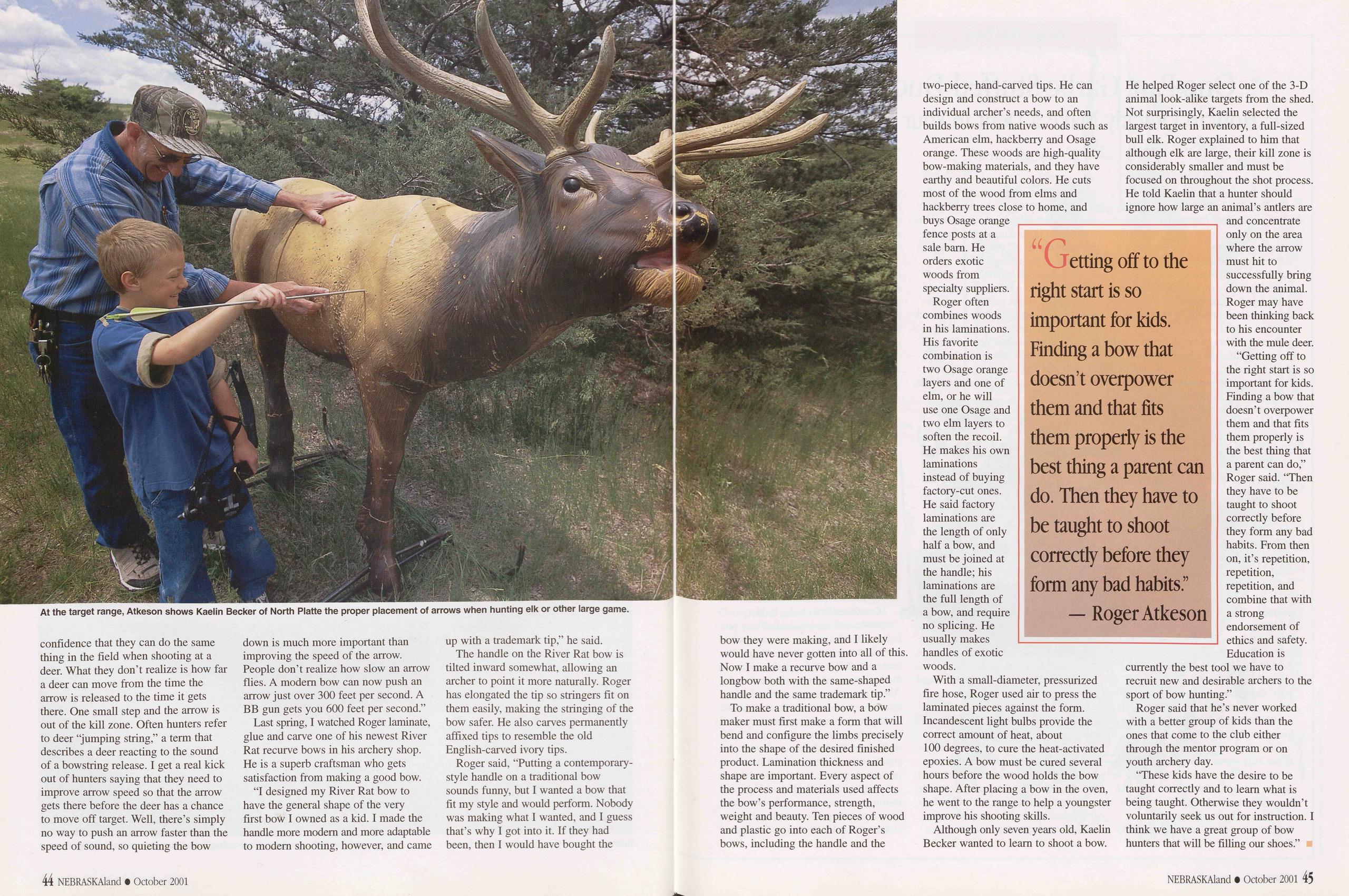
Last spring, I watched Roger laminate, glue and carve one of his newest River Rat recurve bows in his archery shop. He is a superb craftsman who gets satisfaction from making a good bow.
"I designed my River Rat bow to have the general shape of the very first bow I owned as a kid. I made the handle more modem and more adaptable to modem shooting, however, and came up with a trademark tip,” he said.
The handle on the River Rat bow is tilted inward somewhat, allowing an archer to point it more naturally. Roger has elongated the tip so stringers fit on them easily, making the stringing of the bow safer. He also carves permanently affixed tips to resemble the old English-carved ivory tips.
Roger said, “Putting a contemporary- style handle on a traditional bow sounds funny, but I wanted a bow that fit my style and would perform. Nobody was making what I wanted, and I guess that’s why I got into it. If they had been, then I would have bought the bow they were making, and I likely would have never gotten into all of this. Now I make a recurve bow and a longbow both with the same-shaped handle and the same trademark tip.”
To make a traditional bow, a bow maker must first make a form that will bend and configure the limbs precisely into the shape of the desired finished product. Lamination thickness and shape are important. Every aspect of the process and materials used affects the bow’s performance, strength, weight and beauty. Ten pieces of wood and plastic go into each of Roger’s bows, including the handle and the two-piece, hand-carved tips. He can design and construct a bow to an individual archer’s needs, and often builds bows from native woods such as American elm, hackberry and Osage orange. These woods are high-quality bow-making materials, and they have earthy and beautiful colors. He cuts most of the wood from elms and hackberry trees close to home, and buys Osage orange fence posts at a sale bam. He orders exotic woods from specialty suppliers.
Roger often combines woods in his laminations. His favorite combination is two Osage orange layers and one of elm, or he will use one Osage and two elm layers to soften the recoil. He makes his own laminations instead of buying factory-cut ones. He said factory laminations are the length of only half a bow, and must be joined at the handle; his laminations are the full length of a bow, and require no splicing. He usually makes handles of exotic woods.
With a small-diameter, pressurized fire hose, Roger used air to press the laminated pieces against the form. Incandescent light bulbs provide the correct amount of heat, about 100 degrees, to cure the heat-activated epoxies. A bow must be cured several hours before the wood holds the bow shape. After placing a bow in the oven, he went to the range to help a youngster improve his shooting skills.
Although only seven years old, Kaelin Becker wanted to learn to shoot a bow. He helped Roger select one of the 3-D animal look-alike targets from the shed. Not surprisingly, Kaelin selected the largest target in inventory, a full-sized bull elk. Roger explained to him that although elk are large, their kill zone is considerably smaller and must be focused on throughout the shot process. He told Kaelin that a hunter should ignore how large an animal’s antlers are and concentrate only on the area where the arrow must hit to successfully bring down the animal. Roger may have been thinking back to his encounter with the mule deer.
“Getting off to the right start is so important for kids. Finding a bow that doesn’t overpower them and that fits them properly is the best thing that a parent can do,” Roger said. “Then they have to be taught to shoot correctly before they form any bad habits. From then on, it’s repetition, repetition, repetition, and combine that with a strong endorsement of ethics and safety. Education is currently the best tool we have to recruit new and desirable archers to the sport of bow hunting.”
Roger said that he’s never worked with a better group of kids than the ones that come to the club either through the mentor program or on youth archery day.
“These kids have the desire to be taught correctly and to learn what is being taught. Otherwise they wouldn’t voluntarily seek us out for instruction. I think we have a great group of bow hunters that will be filling our shoes.”
Getting off to the right start is so important for kids. Finding a bow that doesn’t overpower them and that fits them properly is the best thing a parent can do. Then they have to be taught to shoot correctly before they form any bad habits.” -Roger Atkeson 44 NEBRASKAland • October 2001 NEBRASKAland • October 2001 45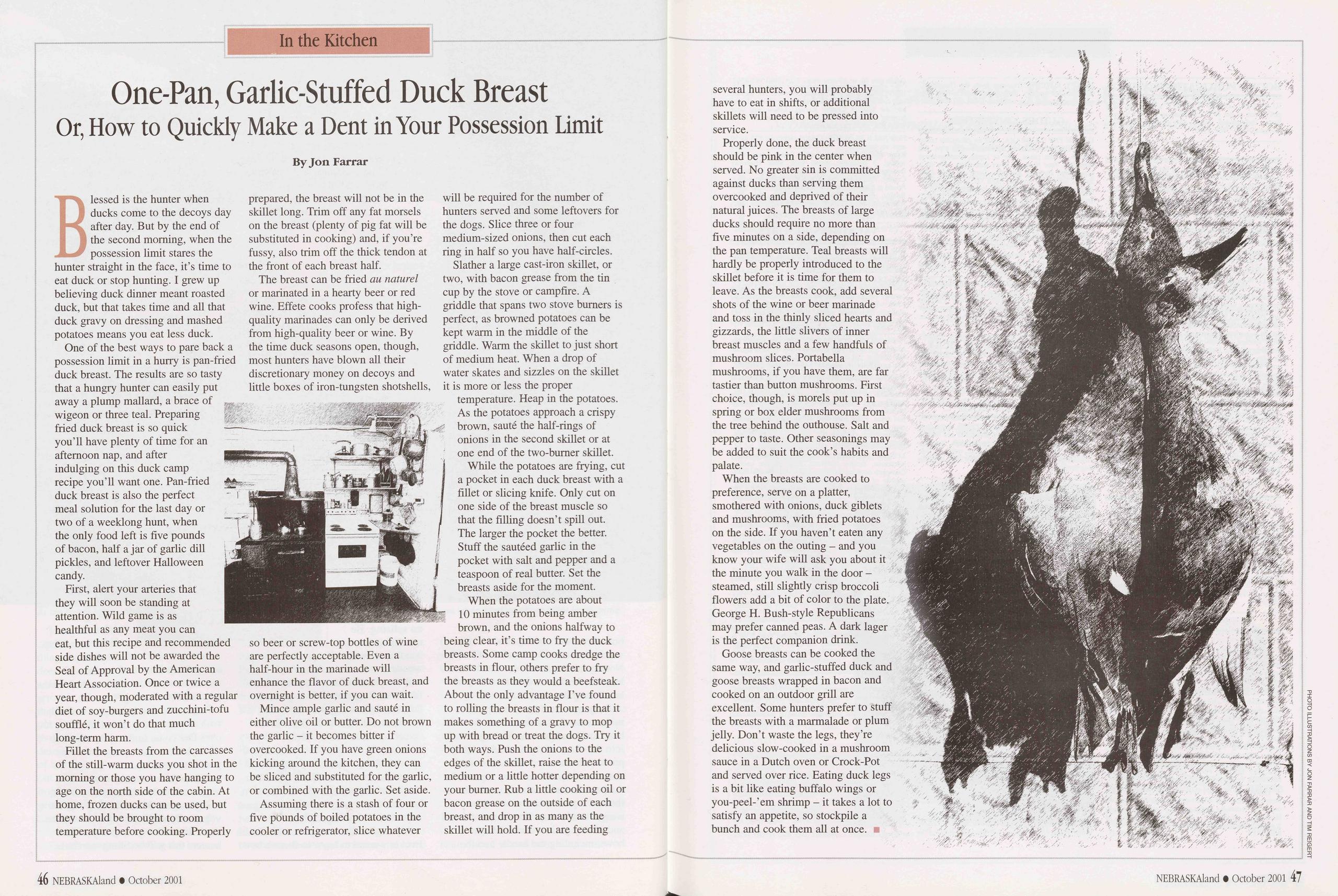
In the Kitchen
One-Pan, Garlic-Stuffed Duck Breast Or, How to Quickly Make a Dent in Your Possession Limit By Jon FarrarBlessed is the hunter when ducks come to the decoys day after day. But by the end of the second morning, when the possession limit stares the hunter straight in the face, it’s time to eat duck or stop hunting. I grew up believing duck dinner meant roasted duck, but that takes time and all that duck gravy on dressing and mashed potatoes means you eat less duck.
One of the best ways to pare back a possession limit in a hurry is pan-fried duck breast. The results are so tasty that a hungry hunter can easily put away a plump mallard, a brace of wigeon or three teal. Preparing fried duck breast is so quick you’ll have plenty of time for an afternoon nap, and after indulging on this duck camp recipe you’ll want one. Pan-fried duck breast is also the perfect meal solution for the last day or two of a weeklong hunt, when the only food left is five pounds of bacon, half a jar of garlic dill pickles, and leftover Halloween candy.
First, alert your arteries that they will soon be standing at attention. Wild game is as healthful as any meat you can eat, but this recipe and recommended side dishes will not be awarded the Seal of Approval by the American Heart Association. Once or twice a year, though, moderated with a regular diet of soy-burgers and zucchini-tofu souffle, it won’t do that much long-term harm.
Fillet the breasts from the carcasses of the still-warm ducks you shot in the morning or those you have hanging to age on the north side of the cabin. At home, frozen ducks can be used, but they should be brought to room temperature before cooking. Properly prepared, the breast will not be in the skillet long. Trim off any fat morsels on the breast (plenty of pig fat will be substituted in cooking) and, if you’re fussy, also trim off the thick tendon at the front of each breast half.
The breast can be fried au naturel or marinated in a hearty beer or red wine. Effete cooks profess that high- quality marinades can only be derived from high-quality beer or wine. By the time duck seasons open, though, most hunters have blown all their discretionary money on decoys and little boxes of iron-tungsten shotshells, so beer or screw-top bottles of wine are perfectly acceptable. Even a half-hour in the marinade will enhance the flavor of duck breast, and overnight is better, if you can wait.
Mince ample garlic and saute in either olive oil or butter. Do not brown the garlic - it becomes bitter if overcooked. If you have green onions kicking around the kitchen, they can be sliced and substituted for the garlic, or combined with the garlic. Set aside.
Assuming there is a stash of four or five pounds of boiled potatoes in the cooler or refrigerator, slice whatever will be required for the number of hunters served and some leftovers for the dogs. Slice three or four medium-sized onions, then cut each ring in half so you have half-circles.
Slather a large cast-iron skillet, or two, with bacon grease from the tin cup by the stove or campfire. A griddle that spans two stove burners is perfect, as browned potatoes can be kept warm in the middle of the griddle. Warm the skillet to just short of medium heat. When a drop of water skates and sizzles on the skillet it is more or less the proper temperature. Heap in the potatoes. As the potatoes approach a crispy brown, saute the half-rings of onions in the second skillet or at one end of the two-burner skillet.
While the potatoes are frying, cut a pocket in each duck breast with a fillet or slicing knife. Only cut on one side of the breast muscle so that the filling doesn’t spill out. The larger the pocket the better. Stuff the sauteed garlic in the pocket with salt and pepper and a teaspoon of real butter. Set the breasts aside for the moment.
When the potatoes are about 10 minutes from being amber brown, and the onions halfway to being clear, it’s time to fry the duck breasts. Some camp cooks dredge the breasts in flour, others prefer to fry the breasts as they would a beefsteak. About the only advantage I’ve found to rolling the breasts in flour is that it makes something of a gravy to mop up with bread or treat the dogs. Try it both ways. Push the onions to the edges of the skillet, raise the heat to medium or a little hotter depending on your burner. Rub a little cooking oil or bacon grease on the outside of each breast, and drop in as many as the skillet will hold. If you are feeding several hunters, you will probably have to eat in shifts, or additional skillets will need to be pressed into service.
Properly done, the duck breast should be pink in the center when served. No greater sin is committed against ducks than serving them overcooked and deprived of their natural juices. The breasts of large ducks should require no more than five minutes on a side, depending on the pan temperature. Teal breasts will hardly be properly introduced to the skillet before it is time for them to leave. As the breasts cook, add several shots of the wine or beer marinade and toss in the thinly sliced hearts and gizzards, the little slivers of inner breast muscles and a few handfuls of mushroom slices. Portabella mushrooms, if you have them, are far tastier than button mushrooms. First choice, though, is morels put up in spring or box elder mushrooms from the tree behind the outhouse. Salt and pepper to taste. Other seasonings may be added to suit the cook’s habits and palate.
When the breasts are cooked to preference, serve on a platter, smothered with onions, duck giblets and mushrooms, with fried potatoes on the side. If you haven’t eaten any vegetables on the outing - and you know your wife will ask you about it the minute you walk in the door - steamed, still slightly crisp broccoli flowers add a bit of color to the plate. George H. Bush-style Republicans may prefer canned peas. A dark lager is the perfect companion drink.
Goose breasts can be cooked the same way, and garlic-stuffed duck and goose breasts wrapped in bacon and cooked on an outdoor grill are excellent. Some hunters prefer to stuff the breasts with a marmalade or plum jelly. Don’t waste the legs, they’re delicious slow-cooked in a mushroom sauce in a Dutch oven or Crock-Pot and served over rice. Eating duck legs is a bit like eating buffalo wings or you-peel-’em shrimp - it takes a lot to satisfy an appetite, so stockpile a bunch and cook them all at once.
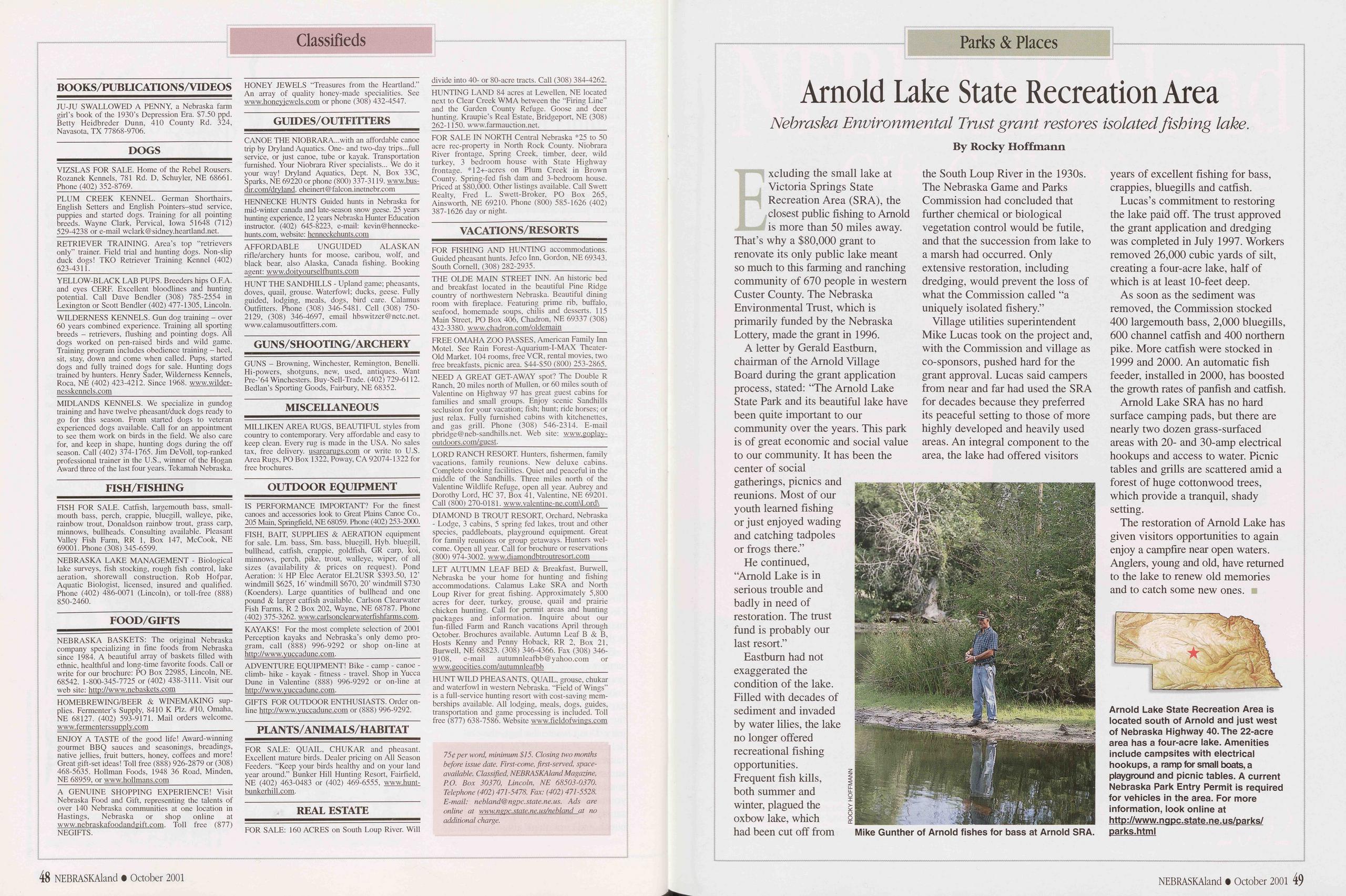
JU-JU SWALLOWED A PENNY, a Nebraska farm girl’s book of the 1930’s Depression Era. $7.50 ppd. Betty Heidbreder Dunn, 410 County Rd. 324, Navasota, TX 77868-9706.
DOGSVIZSLAS FOR SALE. Home of the Rebel Rousers. Rozanek Kennels, 781 Rd. D, Schuyler, NE 68661. Phone (402) 352-8769.
PLUM CREEK KENNEL. German Shorthairs, English Setters and English Pointers-stud service, puppies and started dogs. Training for all pointing breeds. Wayne Clark, Pervical, Iowa 51648 (712) 529-4238 or e-mail wclark@sidney.heartland.net.
RETRIEVER TRAINING. Area’s top “retrievers only” trainer. Field trial and hunting dogs. Non-slip duck dogs! TKO Retriever Training Kennel (402) 623-4311.
YELLOW-BLACK LAB PUPS. Breeders hips O.F.A. and eyes CERF. Excellent bloodlines and hunting potential. Call Dave Bendler (308) 785-2554 in Lexington or Scott Bendler (402) 477-1305, Lincoln.
WILDERNESS KENNELS. Gun dog training - over 60 years combined experience. Training all spotting breeds - retrievers, flushing and pointing dogs. All dogs worked on pen-raised birds and wild game. Training program includes obedience training - heel, sit, stay, down and come when called. Pups, started dogs and fully trained dogs for sale. Hunting dogs trained by hunters. Henry Sader, Wilderness Kennels, Roca, NE (402) 423-4212. Since 1968. www.wilder- nesskennels.com
MIDLANDS KENNELS. We specialize in gundog training and have twelve pheasant/duck dogs ready to go for this season. From started dogs to veteran experienced dogs available. Call for an appointment to see them work on birds in the field. We also care for, and keep in shape, hunting dogs during the off season. Call (402) 374-1765. Jim DeVoll, top-ranked professional trainer in the U.S., winner of the Hogan Award three of the last four years. Tekamah Nebraska.
FISH/FISHINGFISH FOR SALE. Catfish, largemouth bass, small- mouth bass, perch, crappie, bluegill, walleye, pike, rainbow trout, Donaldson rainbow trout, grass carp, minnows, bullheads. Consulting available. Pleasant Valley Fish Farm, RR 1, Box 147, McCook, NE 69001. Phone (308) 345-6599.
NEBRASKA LAKE MANAGEMENT - Biological lake surveys, fish stocking, rough fish control, lake aeration, shorewall construction. Rob Hofpar, Aquatic Biologist, licensed, insured and qualified. Phone (402) 486-0071 (Lincoln), or toll-free (888) 850-2460.
FOOD/GIFTSNEBRASKA BASKETS: The original Nebraska company specializing in fine foods from Nebraska since 1984. A beautiful array of baskets filled with ethnic, healthful and long-time favorite foods. Call or write for our brochure: PO Box 22985, Lincoln, NE. 68542. 1-800-345-7725 or (402) 438-3111. Visit our web site: http://www.nebaskets.com
HOMEBREWING/BEER & WINEMAKING sup- plies. Fermenter’s Supply, 8410 K Plz. #10, Omaha, NE 68127. (402) 593-9171. Mail orders welcome. www.fermenterssupply.com
ENJOY A TASTE of the good life! Award-winning gourmet BBQ sauces and seasonings, breadings, native jellies, fruit butters, honey, coffees and more! Great gift-set ideas! Toll free (888) 926-2879 or (308) 468-5635. Hollman Foods, 1948 36 Road, Minden, NE 68959, or www.hollmans.com
A GENUINE SHOPPING EXPERIENCE! Visit Nebraska Food and Gift, representing the talents of over 140 Nebraska communities at one location in Hastings, Nebraska or shop online at www.nebraskafoodandgift.com. Toll free (877) NEGIFTS.
HONEY JEWELS “Treasures from the Heartland.” An array of quality honey-made specialities. See www.honeyjewels.com or phone (308) 432-4547.
GUIDES/OUTFITTERSCANOE THE NIOBRARA...with an affordable canoe trip by Dryland Aquatics. One- and two-day trips...full service, or just canoe, tube or kayak. Transportation furnished. Your Niobrara River specialists... We do it your way! Dryland Aquatics, Dept. N, Box 33C, Sparks, NE 69220 or phone (800) 337-3119. www.bus- dir.com/dryland. eheinert@falcon.inetnebr.com
HENNECKE HUNTS Guided hunts in Nebraska for mid-winter Canada and late-season snow geese. 25 years hunting experience, 12 years Nebraska Hunter Education instructor. (402) 645-8223, e-mail: kevin@hennecke- hunts.com, website: henneckehunts.com
AFFORDABLE UNGUIDED ALASKAN rifle/archery hunts for moose, caribou, wolf, and black bear, also Alaska, Canada fishing. Booking agent: www.doityourselfhunts.com
HUNT THE SANDHILLS - Upland game; pheasants, doves, quail, grouse. Waterfowl; ducks, geese. Fully guided, lodging, meals, dogs, bird care. Calamus Outfitters. Phone (308) 346-5481. Cell (308) 750- 2129, (308) 346-4697, email hbswitzer@nctc.net. www.calamusoutfitters.com.
GUNS/SHOOTING/ARCHERYGUNS - Browning, Winchester, Remington, Benelli. Hi-powers, shotguns, new, used, antiques. Want Pre-’64 Winchesters. Buy-Sell-Trade. (402) 729-6112. Bedlan’s Spotting Goods, Fairbury, NE 68352.
MISCELLANEOUSMILLIKEN AREA RUGS, BEAUTIFUL styles from country to contemporary. Very affordable and easy to keep clean. Every rug is made in the USA. No sales tax, free delivery, usarearugs.com or write to U.S. Area Rugs, PO Box 1322, Poway, CA 92074-1322 for free brochures.
OUTDOOR EQUIPMENTIS PERFORMANCE IMPORTANT? For the finest canoes and accessories look to Great Plains Canoe Co., 205 Main, Springfield, NE 68059. Phone (402) 253-2000.
FISH, BAIT, SUPPLIES & AERATION equipment for sale. Lm. bass, Sm. bass, bluegill, Hyb. bluegill, bullhead, catfish, crappie, goldfish, GR carp, koi, minnows, perch, pike, trout, walleye, wiper, of all sizes (availability & prices on request). Pond Aeration: 1/4 HP Elec Aerator EL2USR $393.50, 12’ windmill $625,16’ windmill $670,20’ windmill $730 (Koenders). Large quantities of bullhead and one pound & larger catfish available. Carlson Clearwater Fish Farms, R 2 Box 202, Wayne, NE 68787. Phone (402) 375-3262. www.carlsonclearwaterfishfarms.com.
KAYAKS! For the most complete selection of 2001 Perception kayaks and Nebraska’s only demo pro- gram, call (888) 996-9292 or shop on-line at http://www.yuccadune.com.
ADVENTURE EQUIPMENT! Bike - camp - canoe - climb- hike - kayak - fitness - travel. Shop in Yucca Dune in Valentine (888) 996-9292 or on-line at http://www.yuccadune.com.
GIFTS FOR OUTDOOR ENTHUSIASTS. Order on- line http://www.yuccadune.com or (888) 996-9292.
PLANTS/ANIMALS/HABITATFOR SALE: QUAIL, CHUKAR and pheasant. Excellent mature birds. Dealer pricing on All Season Feeders. “Keep your birds healthy and on your land year around.” Bunker Hill Hunting Resort, Fairfield, NE (402) 463-0483 or (402) 469-6555, www.hunt- bunkerhill.com.
REAL ESTATEFOR SALE: 160 ACRES on South Loup River. Will divide into 40- or 80-acre tracts. Call (308) 384-4262.
HUNTING LAND 84 acres at Lewellen, NE located next to Clear Creek WMA between the “Firing Line” and the Garden County Refuge. Goose and deer hunting. Kraupie’s Real Estate, Bridgeport, NE (308) 262-1150. www.farmauction.net.
FOR SALE IN NORTH Central Nebraska *25 to 50 acre rec-property in North Rock County. Niobrara River frontage, Spring Creek, timber, deer, wild turkey, 3 bedroom house with State Highway frontage. *12+-acres on Plum Creek in Brown County. Spring-fed fish dam and 3-bedroom house. Priced at $80,000. Other listings available. Call Swett Realty, Fred L. Swett-Broker, PO Box 265, Ainsworth, NE 69210. Phone (800) 585-1626 (402) 387-1626 day or night.
VACATIONS/RESORTSFOR FISHING AND HUNTING accommodations. Guided pheasant hunts. Jefco Inn, Gordon, NE 69343. South Cornell, (308) 282-2935.
THE OLDE MAIN STREET INN. An historic bed and breakfast located in the beautiful Pine Ridge country of northwestern Nebraska. Beautiful dining room with fireplace. Featuring prime rib, buffalo, seafood, homemade soups, chilis and desserts. 115 Main Street, PO Box 406, Chadron, NE 69337 (308) 432-3380. www.chadron.com/oldemain
FREE OMAHA ZOO PASSES, American Family Inn Motel. See Rain Forest-Aquarium-I-MAX Theater- Old Market. 104 rooms, free VCR, rental movies, two free breakfasts, picnic area. $44-550 (800) 253-2865.
NEED A GREAT GET-AWAY spot? The Double R Ranch, 20 miles north of Mullen, or 60 miles south of Valentine on Highway 97 has great guest cabins for families and small groups. Enjoy scenic Sandhills seclusion for your vacation; fish; hunt; ride horses; or just relax. Fully furnished cabins with kitchenettes, and gas grill. Phone (308) 546-2314. E-mail pbridge@neb-sandhills.net. Web site: www.goplay- outdoors.com/guest.
LORD RANCH RESORT. Hunters, fishermen, family vacations, family reunions. New deluxe cabins. Complete cooking facilities. Quiet and peaceful in the middle of the Sandhills. Three miles north of the Valentine Wildlife Refuge, open all year. Aubrey and Dorothy Lord, HC 37, Box 41, Valentine, NE 69201. Call (800) 270-0181. www.valentine-ne.com\Lord\
DIAMOND B TROUT RESORT, Orchard, Nebraska - Lodge, 3 cabins, 5 spring fed lakes, trout and other species, paddleboats, playground equipment. Great for family reunions or group getaways. Hunters wel- come. Open all year. Call for brochure or reservations (800) 974-3002. www.diamondbtroutresort.com
LET AUTUMN LEAF BED & Breakfast, Burwell, Nebraska be your home for hunting and fishing accommodations. Calamus Lake SR A and North Loup River for great fishing. Approximately 5,800 acres for deer, turkey, grouse, quail and prairie chicken hunting. Call for permit areas and hunting packages and information. Inquire about our fun-filled Farm and Ranch vacations April through October. Brochures available. Autumn Leaf B & B, Hosts Kenny and Penny Hoback, RR 2, Box 21, Burwell, NE 68823. (308) 346-4366. Fax (308) 346- 9108, e-mail autumnleafbb@yahoo.com or www.geocities.com/ autumnleafbb
HUNT WILD PHEASANTS, QUAIL, grouse, chukar and waterfowl in western Nebraska. “Field of Wings” is a full-service hunting resort with cost-saving mem- berships available. All lodging, meals, dogs, guides, transportation and game processing is included. Toll free (877) 638-7586. Website www.fieldofwings.com
75¢ per word, minimum $15. Closing two months before issue date. First-come, first-served, space- available. Classified, NEBRASKAland Magazine, P.O. Box 30370, Lincoln, NE 68503-0370. Telephone (402) 471-5478. Fax: (402) 471-5528. E-mail: nebland@ngpc.state.ne. us. Ads are online at www.ngpc.state.ne.us/nebland at no additional charge.
Parks & Places
Arnold Lake State Recreation Area Nebraska Environmental Trust grant restores isolated fishing lake. By Rocky HoffmannExcluding the small lake at Victoria Springs State Recreation Area (SRA), the closest public fishing to Arnold is more than 50 miles away. That’s why a $80,000 grant to renovate its only public lake meant so much to this farming and ranching community of 670 people in western Custer County. The Nebraska Environmental Trust, which is primarily funded by the Nebraska Lottery, made the grant in 1996.
A letter by Gerald Eastbum, chairman of the Arnold Village Board during the grant application process, stated: “The Arnold Lake State Park and its beautiful lake have been quite important to our community over the years. This park is of great economic and social value to our community. It has been the center of social gatherings, picnics and reunions. Most of our youth learned fishing or just enjoyed wading and catching tadpoles or frogs there.”
He continued, “Arnold Lake is in serious trouble and badly in need of restoration. The trust fund is probably our last resort.”
Eastbum had not exaggerated the condition of the lake. Filled with decades of sediment and invaded by water lilies, the lake no longer offered recreational fishing opportunities. Frequent fish kills, both summer and winter, plagued the oxbow lake, which had been cut off from the South Loup River in the 1930s. The Nebraska Game and Parks Commission had concluded that further chemical or biological vegetation control would be futile, and that the succession from lake to a marsh had occurred. Only extensive restoration, including dredging, would prevent the loss of what the Commission called “a uniquely isolated fishery.”
Village utilities superintendent Mike Lucas took on the project and, with the Commission and village as co-sponsors, pushed hard for the grant approval. Lucas said campers from near and far had used the SRA for decades because they preferred its peaceful setting to those of more highly developed and heavily used areas. An integral component to the area, the lake had offered visitors years of excellent fishing for bass, crappies, bluegills and catfish.
Lucas’s commitment to restoring the lake paid off. The trust approved the grant application and dredging was completed in July 1997. Workers removed 26,000 cubic yards of silt, creating a four-acre lake, half of which is at least 10-feet deep.
As soon as the sediment was removed, the Commission stocked 400 largemouth bass, 2,000 bluegills, 600 channel catfish and 400 northern pike. More catfish were stocked in 1999 and 2000. An automatic fish feeder, installed in 2000, has boosted the growth rates of panfish and catfish.
Arnold Lake SRA has no hard surface camping pads, but there are nearly two dozen grass-surfaced areas with 20- and 30-amp electrical hookups and access to water. Picnic tables and grills are scattered amid a forest of huge cottonwood trees, which provide a tranquil, shady setting.
The restoration of Arnold Lake has given visitors opportunities to again enjoy a campfire near open waters. Anglers, young and old, have returned to the lake to renew old memories and to catch some new ones.
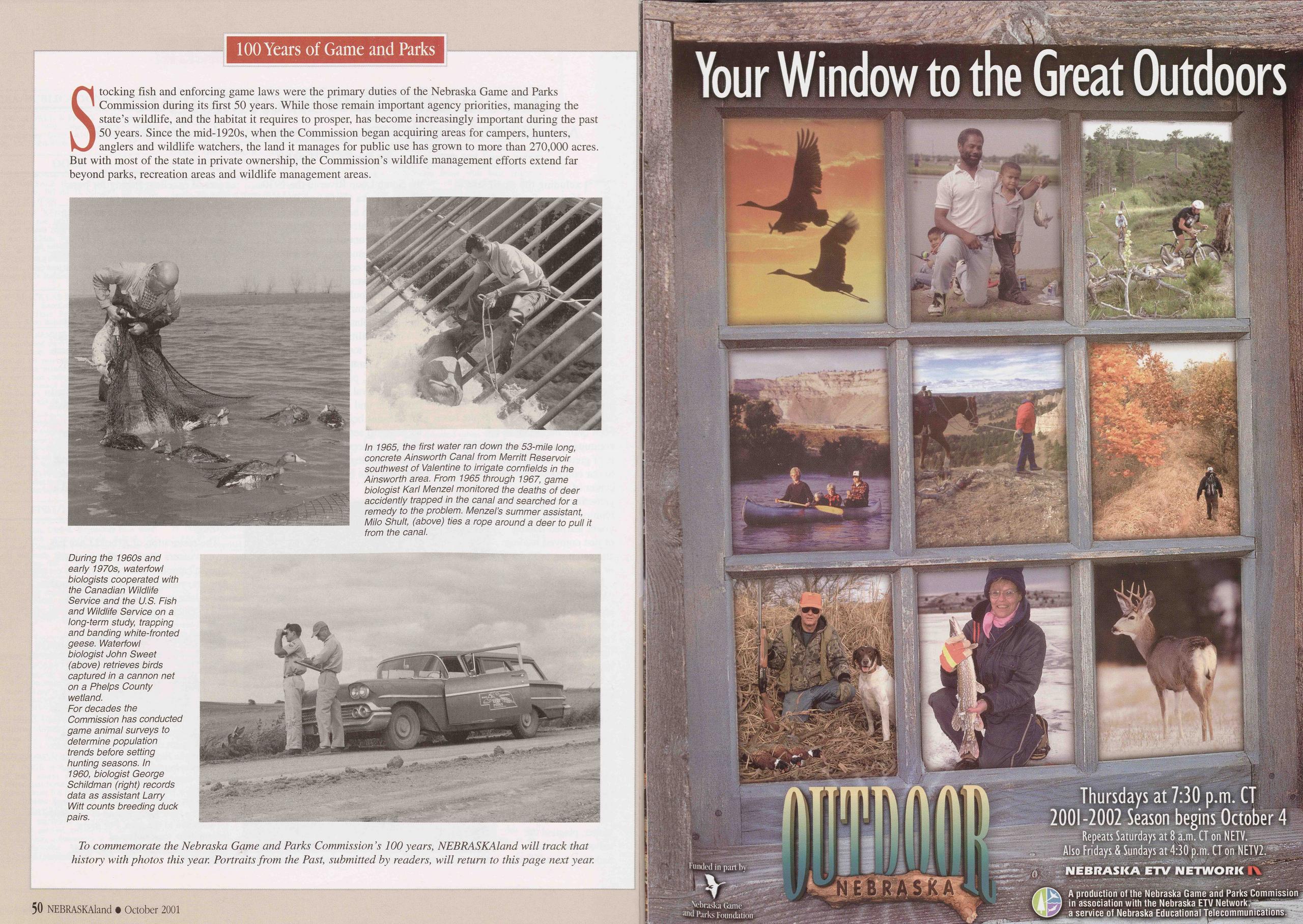
Stocking fish and enforcing game laws were the primary duties of the Nebraska Game and Parks Commission during its first 50 years. While those remain important agency priorities, managing the state’s wildlife, and the habitat it requires to prosper, has become increasingly important during the past 50 years. Since the mid-1920s, when the Commission began acquiring areas for campers, hunters, anglers and wildlife watchers, the land it manages for public use has grown to more than 270,000 acres. But with most of the state in private ownership, the Commission’s wildlife management efforts extend far beyond parks, recreation areas and wildlife management areas.
To commemorate the Nebraska Game and Parks Commission's 100 years, NEBRASKAland will track that history with photos this year. Portraits from the Past, submitted by readers, will return to this page next year.
OUTDOOR NEBRASKA Thursdays at 7:30 p.m. CT 2001-2002 Season begins October 4 Repeats Saturdays at 8 a.m. CT on NETV. Also Fridays & Sundays at 4:30 p.m. CT on NETV2 NEBRASKA ETV NETWORK
A production of the Nebraska Game and Parks Commission in association with the Nebraska ETV Network, a service of Nebraska Educational Telecommunications.
Funded in part by Nebraska Game and Parks Foundation
50 NEBRASKAland • October 2001
Position: 467 (22 views)