Volume 79, Issue 7, 2001
NEBRASKAland
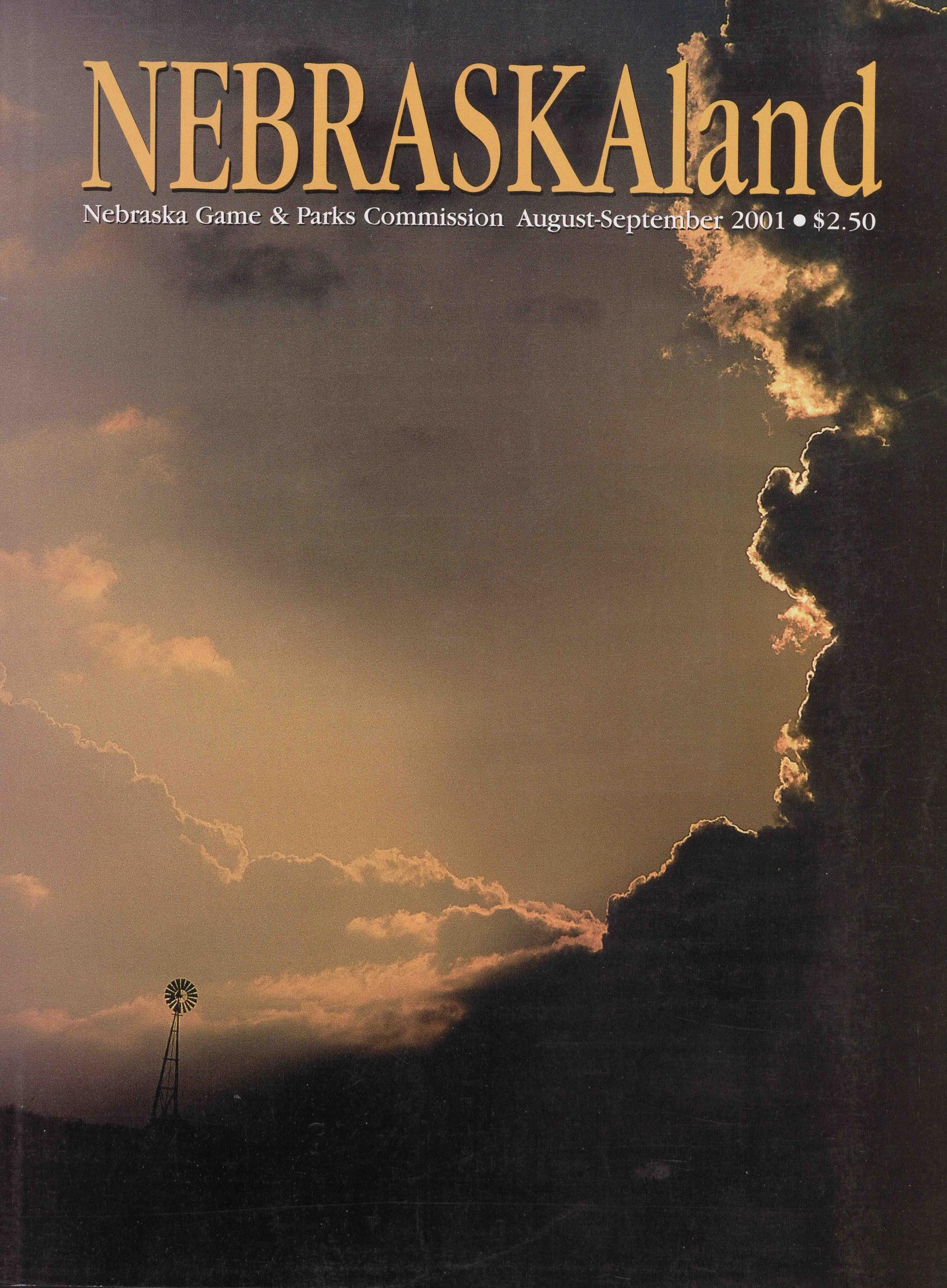
Nebraska Game & Parks Commission August-September 2001 • $2.50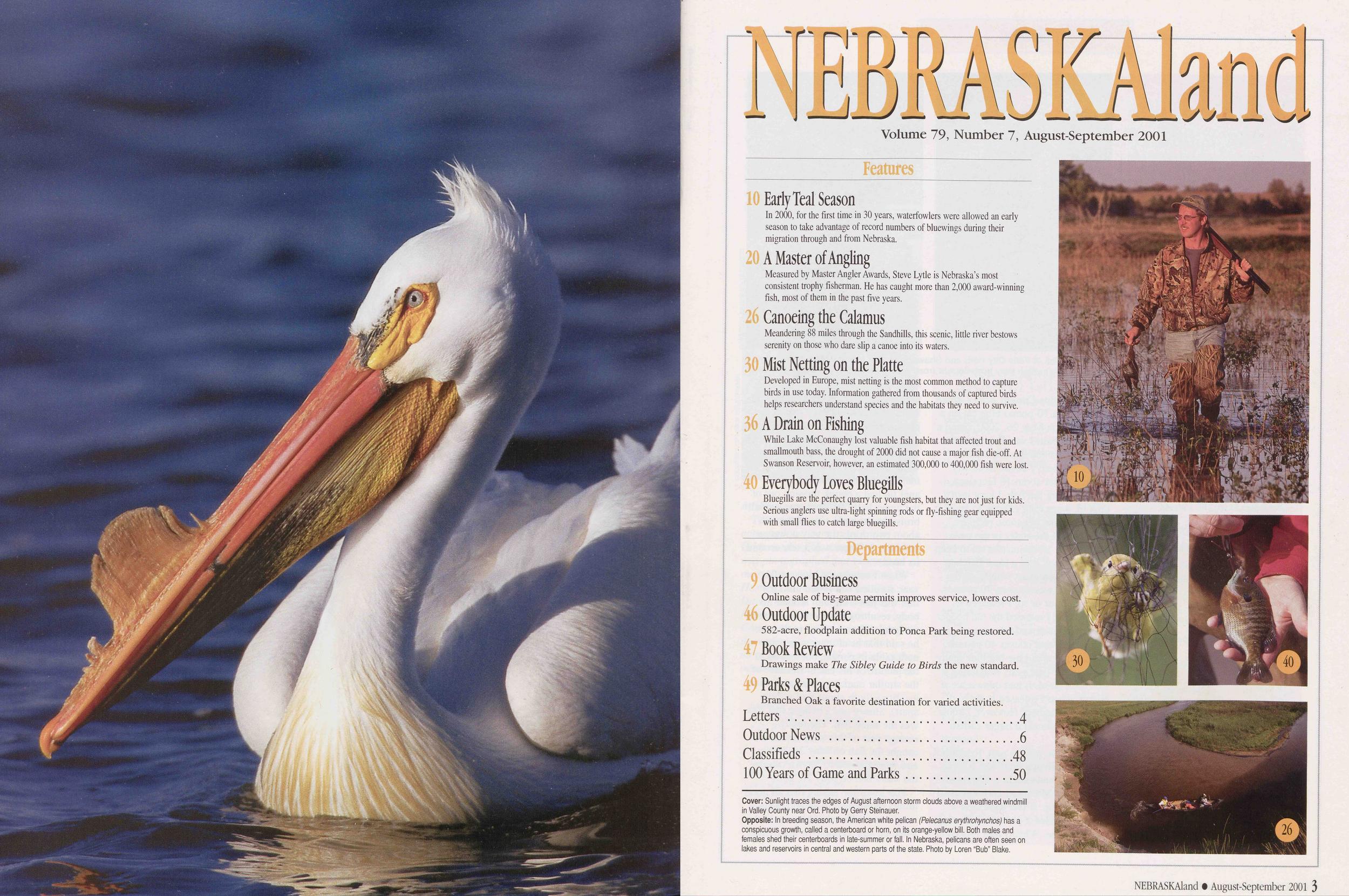
NEBRASKAland
Volume 79, Number 7, August-September 2001 Early Teal Season In 2000, for the first time in 30 years, waterfowlers were allowed an early season to take advantage of record numbers of bluewings during their migration through and from Nebraska. A Master of Angling Measured by Master Angler Awards, Steve Lytle is Nebraska's most consistent trophy fisherman. He has caught more than 2,000 award-winning fish, most of them in the past five years. Canoeing the Calamus Meandering 88 miles through the Sandhills, this scenic, little river bestows serenity on those who dare slip a canoe into its waters. Mist Netting on the Platte Developed in Europe, mist netting is the most common method to capture birds in use today. Information gathered from thousands of captured birds helps researchers understand species and the habitats they need to survive. A Drain on Fishing While Lake McConaughy lost valuable fish habitat that affected trout and smallmouth bass, the drought of 2000 did not cause a major fish die-off. At Swanson Reservoir, however, an estimated 300,000 to 400,000 fish were lost. Everybody Loves Bluegills Bluegills are the perfect quarry for youngsters, but they are not just for kids. Serious anglers use ultra-light spinning rods or fly-fishing gear equipped with small flies to catch large bluegills. Departments Outdoor Business Online sale of big-game permits improves service, lowers cost. 4t Outdoor Update 582-acre, floodplain addition to Ponca Park being restored. 47 Book Review Drawings make The Sibley Guide to Birds the new standard. 49 Parks &Places Branched Oak a favorite destination for varied activities. Letters 4 Outdoor News 6 100 Years of Game and Parks 50 Cover: Sunlight traces the edges of August afternoon storm clouds above a weathered windmill in Valley County near Ord. Photo by Gerry Steinauer. Opposite: In breeding season, the American white pelican (Pelecanus erythrohynchos) has a conspicuous growth, called a centerboard or horn, on its orange-yellow bill. Both males and females shed their centerboards in late-summer or fall. In Nebraska, pelicans are often seen on lakes and reservoirs in central and western parts of the state. Photo by Loren "Bub" Blake.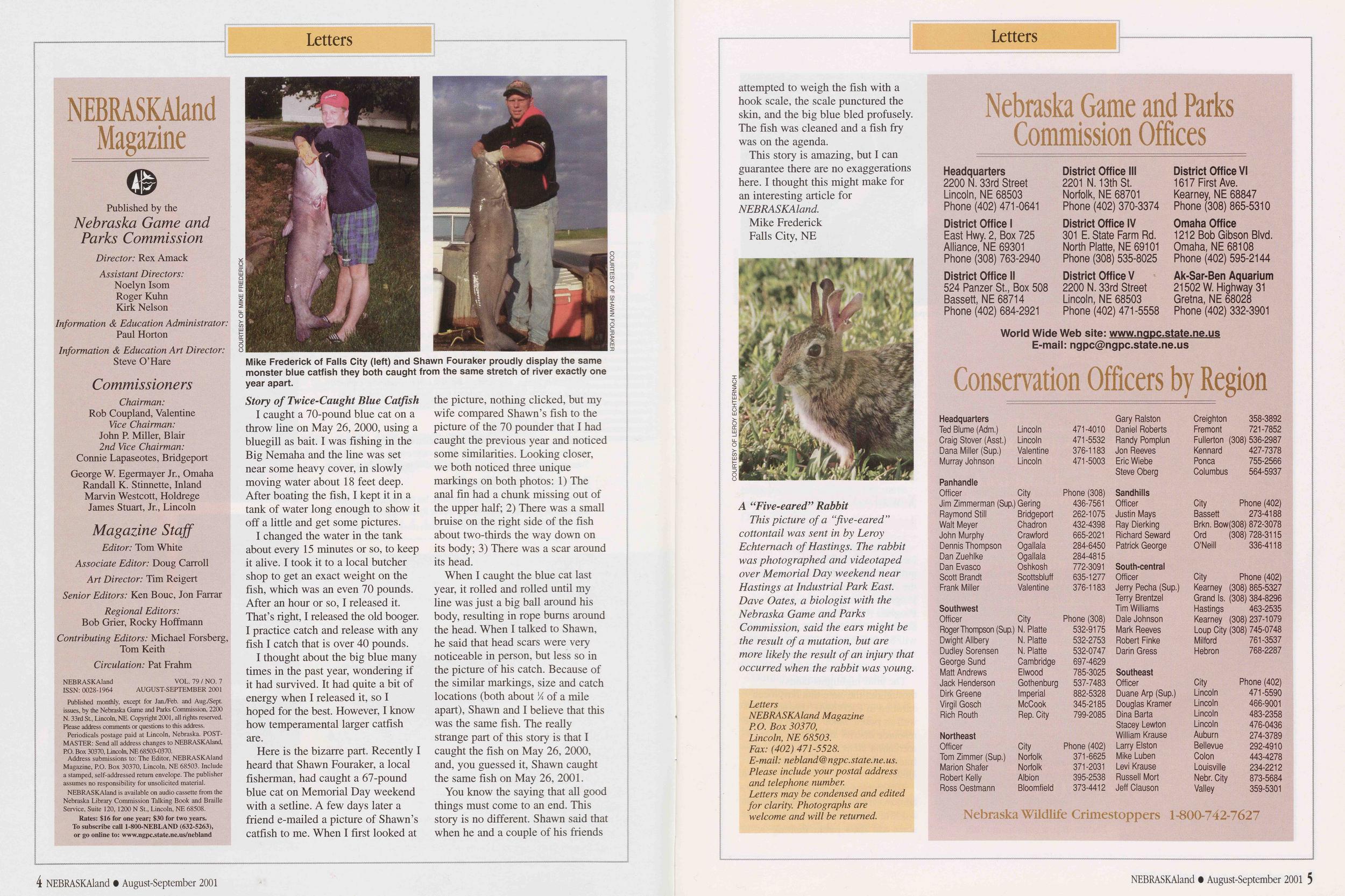 Letters
NEBRASKAland Mazine
Published by the
Nebraska Game and
Parks Commission
Director: Rex Amack
Assistant Directors:
Noelyn Isom
Roger Kuhn
Kirk Nelson
Information & Education Administrator:
Paul Horton
Information & Education Art Director:
Steve O'Hare
Commissioners
Chairman:
Rob Coupland, Valentine
Vice Chairman:
John P. Miller, Blair
2nd Vice Chairman:
Connie Lapaseotes, Bridgeport
George W. Egermayer Jr., Omaha
Randall K. Stinnette, Inland
Marvin Westcott, Holdrege
James Stuart, Jr., Lincoln
Magazine Staff
Editor: Tom White
Associate Editor: Doug Carroll
Art Director: Tim Reigert
Senior Editors: Ken Bouc, Jon Farrar
Regional Editors:
Bob Grier, Rocky Hoffmann
Contributing Editors: Michael Forsberg,
Tom Keith
Circulation: Pat Frahm
NEBRASKAland
ISSN: 0028-1964
VOL. 79 / NO. 7
AUGUST-SEPTEMBER 2001
Published monthly, except for Jan./Feb. and Aug7Sept.
issues, by the Nebraska Game and Parks Commission, 2200
N. 33rd St., Lincoln, NE. Copyright 2001, all rights reserved.
Please address comments or questions to this address.
Periodicals postage paid at Lincoln, Nebraska. POST-
MASTER: Send all address changes to NEBRASKAland,
P.O. Box 30370, Lincoln, NE 68503-0370.
Address submissions to: The Editor, NEBRASKAland
Magazine, P.O. Box 30370, Lincoln, NE 68503. Include
a stamped, self-addressed return envelope. The publisher
assumes no responsibility for unsolicited material.
NEBRASKAland is available on audio cassette from the
Nebraska Library Commission Talking Book and Braille
Service, Suite 120,1200 N St., Lincoln, NE 68508.
Rates: $16 for one year; $30 for two years.
To subscribe call 1-800-NEBLAND (632-5263),
or go online to: www.ngpc.state.ne.us/nebland
Story of Twice-Caught Blue Catfish
Letters
NEBRASKAland Mazine
Published by the
Nebraska Game and
Parks Commission
Director: Rex Amack
Assistant Directors:
Noelyn Isom
Roger Kuhn
Kirk Nelson
Information & Education Administrator:
Paul Horton
Information & Education Art Director:
Steve O'Hare
Commissioners
Chairman:
Rob Coupland, Valentine
Vice Chairman:
John P. Miller, Blair
2nd Vice Chairman:
Connie Lapaseotes, Bridgeport
George W. Egermayer Jr., Omaha
Randall K. Stinnette, Inland
Marvin Westcott, Holdrege
James Stuart, Jr., Lincoln
Magazine Staff
Editor: Tom White
Associate Editor: Doug Carroll
Art Director: Tim Reigert
Senior Editors: Ken Bouc, Jon Farrar
Regional Editors:
Bob Grier, Rocky Hoffmann
Contributing Editors: Michael Forsberg,
Tom Keith
Circulation: Pat Frahm
NEBRASKAland
ISSN: 0028-1964
VOL. 79 / NO. 7
AUGUST-SEPTEMBER 2001
Published monthly, except for Jan./Feb. and Aug7Sept.
issues, by the Nebraska Game and Parks Commission, 2200
N. 33rd St., Lincoln, NE. Copyright 2001, all rights reserved.
Please address comments or questions to this address.
Periodicals postage paid at Lincoln, Nebraska. POST-
MASTER: Send all address changes to NEBRASKAland,
P.O. Box 30370, Lincoln, NE 68503-0370.
Address submissions to: The Editor, NEBRASKAland
Magazine, P.O. Box 30370, Lincoln, NE 68503. Include
a stamped, self-addressed return envelope. The publisher
assumes no responsibility for unsolicited material.
NEBRASKAland is available on audio cassette from the
Nebraska Library Commission Talking Book and Braille
Service, Suite 120,1200 N St., Lincoln, NE 68508.
Rates: $16 for one year; $30 for two years.
To subscribe call 1-800-NEBLAND (632-5263),
or go online to: www.ngpc.state.ne.us/nebland
Story of Twice-Caught Blue Catfish
I caught a 70-pound blue cat on a throw line on May 26, 2000, using a bluegill as bait. I was fishing in the Big Nemaha and the line was set near some heavy cover, in slowly moving water about 18 feet deep. After boating the fish, I kept it in a tank of water long enough to show it off a little and get some pictures.
I changed the water in the tank about every 15 minutes or so, to keep it alive. I took it to a local butcher shop to get an exact weight on the fish, which was an even 70 pounds. After an hour or so, I released it. That's right, I released the old booger. I practice catch and release with any fish I catch that is over 40 pounds.
I thought about the big blue many times in the past year, wondering if it had survived. It had quite a bit of energy when I released it, so I hoped for the best. However, I know how temperamental larger catfish are.
Here is the bizarre part. Recently I heard that Shawn Fouraker, a local fisherman, had caught a 67-pound blue cat on Memorial Day weekend with a set line. A few days later a friend e-mailed a picture of Shawn's catfish to me. When I first looked at the picture, nothing clicked, but my wife compared Shawn's fish to the picture of the 70 pounder that I had caught the previous year and noticed some similarities. Looking closer, we both noticed three unique markings on both photos: 1) The anal fin had a chunk missing out of the upper half; 2) There was a small bruise on the right side of the fish about two-thirds the way down on its body; 3) There was a scar around its head.
When I caught the blue cat last year, it rolled and rolled until my line was just a big ball around his body, resulting in rope burns around the head. When I talked to Shawn, he said that head scars were very noticeable in person, but less so in the picture of his catch. Because of the similar markings, size and catch locations (both about % of a mile apart), Shawn and I believe that this was the same fish. The really strange part of this story is that I caught the fish on May 26, 2000, and, you guessed it, Shawn caught the same fish on May 26, 2001.
You know the saying that all good things must come to an end. This story is no different. Shawn said that when he and a couple of his friends attempted to weigh the fish with a hook scale, the scale punctured the skin, and the big blue bled profusely. The fish was cleaned and a fish fry was on the agenda.
This story is amazing, but I can guarantee there are no exaggerations here. I thought this might make for an interesting article for NEBRASKAland.
Mike Frederick Falls City, NE A "Five-eared" RabbitThis picture of a "five-eared" cottontail was sent in by Leroy Echternach of Hastings. The rabbit was photographed and videotaped over Memorial Day weekend near Hastings at Industrial Park East. Dave Oates, a biologist with the Nebraska Game and Parks Commission, said the ears might be the result of a mutation, but are more likely the result of an injury that occurred when the rabbit was young.
Letters NEBRASKAland Magazine P.O. Box 30370, Lincoln, NE 68503. Fax: (402) 471-5528. E-mail: nebland@ ngpc.state.ne.us. Please include your postal address and telephone number. Letters may be condensed and edited for clarity. Photographs are welcome and will be returned.
Nebraska Game and Parks Commission Offices Headquarters 2200 N. 33rd Street Lincoln, NE 68503 Phone (402) 471-0641 District Office I East Hwy. 2, Box 725 Alliance, NE 69301 Phone (308) 763-2940 District Office II 524 Panzer St., Box 508 Bassett, NE 68714 Phone (402) 684-2921 District Office III 2201 N. 13th St. Norfolk, NE 68701 Phone (402) 370-3374 District Office IV 301 E. State Farm Rd. North Platte, NE 69101 Phone (308) 535-8025 District Office V 2200 N. 33rd Street Lincoln, NE 68503 Phone (402) 471-5558 District Office VI 1617 First Ave. Kearney, NE 68847 Phone (308) 865-5310 Omaha Office 1212 Bob Gibson Blvd. Omaha, NE 68108 Phone (402) 595-2144 Ak-Sar-Ben Aquarium 21502 W. Highway 31 Gretna, NE 68028 Phone (402) 332-3901 World Wide Web site: www.nqpc.state.ne.us E-mail: ngpc@ngpc.state.ne.us Headquarters Ted Blume (Adm.) Craig Stover (Asst.) Dana Miller (Sup.) Murray Johnson Panhandle Officer Jim Zimmerman (Sup.) Raymond Still Walt Meyer John Murphy Dennis Thompson Dan Zuehlke Dan Evasco Scott Brandt Frank Miller Southwest Officer Roger Thompson (Sup.) Dwight Allbery Dudley Sorensen George Sund Matt Andrews Jack Henderson Dirk Greene Virgil Gosch Rich Routh Northeast Officer Tom Zimmer (Sup.) Marion Shafer Robert Kelly Ross Oestmann Lincoln Lincoln Valentine Lincoln City Gering Bridgeport Chadron Crawford Ogallala Ogallala Oshkosh Scottsbluff Valentine City N. Platte N. Platte N. Platte Cambridge Elwood Gothenburg Imperial McCook Rep. City City Norfolk Norfolk Albion Bloomfield 471-4010 471-5532 376-1183 471-5003 Phone (308) 436-7561 262-1075 432-4398 665-2021 284-6450 284-4815 772-3091 635-1277 376-1183 Phone (308) 532-9175 532-2753 532-0747 697-4629 785-3025 537-7483 882-5328 345-2185 799-2085 Phone (402) 371-6625 371-2031 395-2538 373-4412 Gary Ralston Daniel Roberts Randy Pomplun Jon Reeves Eric Wiebe Steve Oberg Sandhills Officer Justin Mays Ray Dierking Richard Seward Patrick George South-central Officer Jerry Pecha (Sup.) Terry Brentzel Tim Williams Dale Johnson Mark Reeves Robert Finke Darin Gress Southeast Officer Duane Arp (Sup.) Douglas Kramer Dina Barta Stacey Lewton William Krause Larry Elston Mike Luben Levi Krause Russell Mort Jeff Clauson Creighton 358-3892 Fremont 721-7852 Fullerton (308) 536-2987 Kennard 427-7378 Ponca 755-2566 Columbus 564-5937 City Phone (402) Bassett 273-4188 Brkn. Bow (308) 872-3078 Ord (308)728-3115 O'Neill 336-4118 Phone (402) (308) 865-5327 (308) 384-8296 463-2535 (308)237-1079 (308) 745-0748 761-3537 768-2287 City Kearney Grand Is. Hastings Kearney Loup City Milford Hebron City Lincoln Lincoln Lincoln Lincoln Auburn Bellevue Colon Louisville Nebr. City Valley Phone (402) 471-5590 466-9001 483-2358 476-0436 274-3789 292-4910 443-4278 234-2212 873-5684 359-5301 NEBRASKAland • August-September 2001 5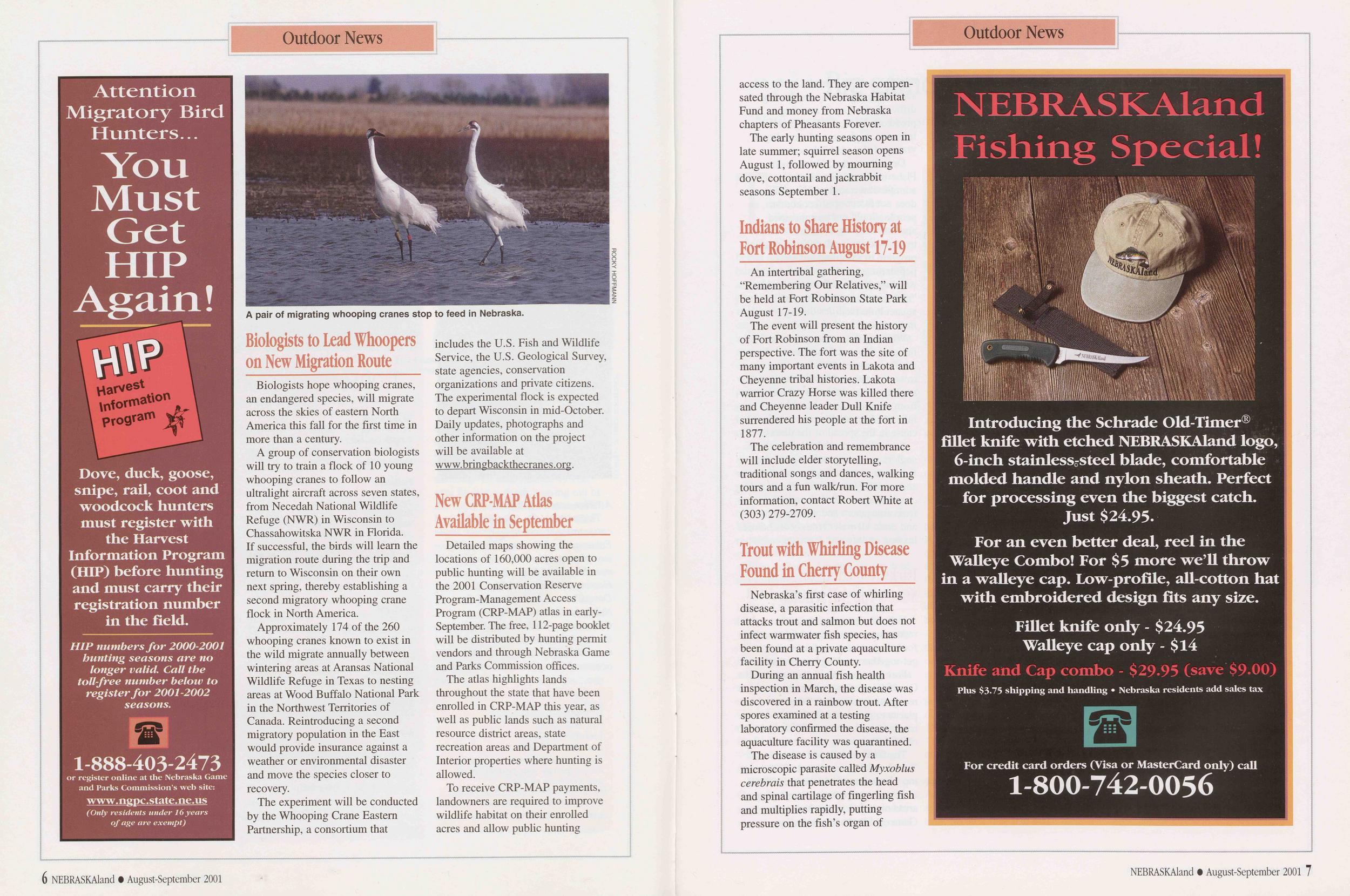
Biologists hope whooping cranes, an endangered species, will migrate across the skies of eastern North America this fall for the first time in more than a century.
A group of conservation biologists will try to train a flock of 10 young whooping cranes to follow an ultralight aircraft across seven states, from Necedah National Wildlife Refuge (NWR) in Wisconsin to Chassahowitska NWR in Florida. If successful, the birds will learn the migration route during the trip and return to Wisconsin on their own next spring, thereby establishing a second migratory whooping crane flock in North America.
Approximately 174 of the 260 whooping cranes known to exist in the wild migrate annually between wintering areas at Aransas National Wildlife Refuge in Texas to nesting areas at Wood Buffalo National Park in the Northwest Territories of Canada. Reintroducing a second migratory population in the East would provide insurance against a weather or environmental disaster and move the species closer to recovery.
The experiment will be conducted by the Whooping Crane Eastern Partnership, a consortium that includes the U.S. Fish and Wildlife Service, the U.S. Geological Survey, state agencies, conservation organizations and private citizens. The experimental flock is expected to depart Wisconsin in mid-October. Daily updates, photographs and other information on the project will be available at www.bringbackthecranes.org.
New CRP-MAP Atlas Available in SeptemberDetailed maps showing the locations of 160,000 acres open to public hunting will be available in the 2001 Conservation Reserve Program-Management Access Program (CRP-MAP) atlas in early- September. The free, 112-page booklet will be distributed by hunting permit vendors and through Nebraska Game and Parks Commission offices.
The atlas highlights lands throughout the state that have been enrolled in CRP-MAP this year, as well as public lands such as natural resource district areas, state recreation areas and Department of Interior properties where hunting is allowed.
To receive CRP-MAP payments, landowners are required to improve wildlife habitat on their enrolled acres and allow public hunting access to the land. They are compensated through the Nebraska Habitat Fund and money from Nebraska chapters of Pheasants Forever.
The early hunting seasons open in late summer; squirrel season opens August 1, followed by mourning dove, cottontail and jackrabbit seasons September.
Indians to Share History at Fort Robinson August 17-19An intertribal gathering, "Remembering Our Relatives," will be held at Fort Robinson State Park August 17-19.
The event will present the history of Fort Robinson from an Indian perspective. The fort was the site of many important events in Lakota and Cheyenne tribal histories. Lakota warrior Crazy Horse was killed there and Cheyenne leader Dull Knife surrendered his people at the fort in 1877.
The celebration and remembrance will include elder storytelling, traditional songs and dances, walking tours and a fun walk/run. For more information, contact Robert White at (303) 279-2709.
Trout with Whirling Disease Found in Cherry CountyNebraska's first case of whirling disease, a parasitic infection that attacks trout and salmon but does not infect warm water fish species, has been found at a private aquaculture facility in Cherry County.
During an annual fish health inspection in March, the disease was discovered in a rainbow trout. After spores examined at a testing laboratory confirmed the disease, the aquaculture facility was quarantined.
NEBRASKAland Fishing Special! Introducing the Schrade Old-Timer( fillet knife with etched NEBRASKAland logo, 6-inch stainless-steel blade, comfortable molded handle and nylon sheath. Perfect for processing even the biggest catch. Just $24.95. For an even better deal, reel in the Walleye Combo! For $5 more we'll throw in a walleye cap. Low-profile, all-cotton hat with embroidered design fits any size. Fillet knife only - $24.95 Walleye cap only - $14 Knife and Cap combo - $29-95 (save $9.00) Plus $3.75 shipping and handling • Nebraska residents add sales tax For credit card orders (Visa or MasterCard only) caU 1-800-742-0056The disease is caused by a microscopic parasite called Myxoblus cerebrals that penetrates the head and spinal cartilage of fingerling fish and multiplies rapidly, putting pressure on the fish's organ of
NEBRASKAland • August-September 2001 7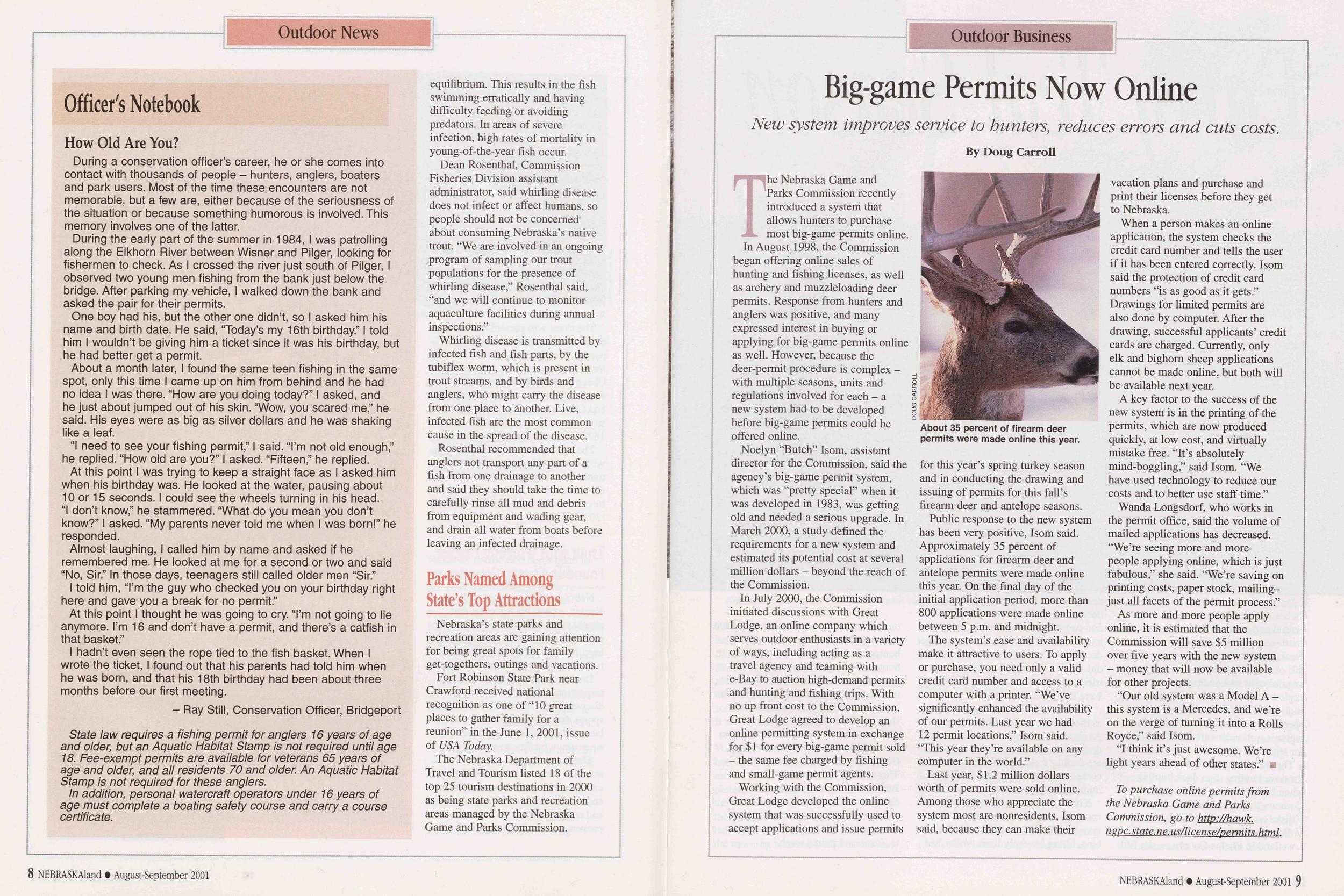 Outdoor News
Officer's Notebook
How Old Are You?
Outdoor News
Officer's Notebook
How Old Are You?
During a conservation officer's career, he or she comes into contact with thousands of people - hunters, anglers, boaters and park users. Most of the time these encounters are not memorable, but a few are, either because of the seriousness of the situation or because something humorous is involved. This memory involves one of the latter.
During the early part of the summer in 1984, I was patrolling along the Elkhorn River between Wisner and Pilger, looking for fishermen to check. As I crossed the river just south of Pilger, I observed two young men fishing from the bank just below the bridge. After parking my vehicle, I walked down the bank and asked the pair for their permits.
One boy had his, but the other one didn't, so I asked him his name and birth date. He said, "Today's my 16th birthday." I told him I wouldn't be giving him a ticket since it was his birthday, but he had better get a permit.
About a month later, I found the same teen fishing in the same spot, only this time I came up on him from behind and he had no idea I was there. "How are you doing today?" I asked, and he just about jumped out of his skin. "Wow, you scared me," he said. His eyes were as big as silver dollars and he was shaking like a leaf.
"I need to see your fishing permit," I said. "I'm not old enough," he replied. "How old are you?" I asked. "Fifteen," he replied. At this point I was trying to keep a straight face as I asked him when his birthday was. He looked at the water, pausing about 10 or 15 seconds. I could see the wheels turning in his head. "I don't know," he stammered. "What do you mean you don't know?" I asked. "My parents never told me when I was born!" he responded.
Almost laughing, I called him by name and asked if he remembered me. He looked at me for a second or two and said "No, Sir." In those days, teenagers still called older men "Sir." I told him, "I'm the guy who checked you on your birthday right here and gave you a break for no permit."
At this point I thought he was going to cry. "I'm not going to lie anymore. I'm 16 and don't have a permit, and there's a catfish in that basket."
I hadn't even seen the rope tied to the fish basket. When I wrote the ticket, I found out that his parents had told him when he was born, and that his 18th birthday had been about three months before our first meeting.
- Ray Still, Conservation Officer, BridgeportState law requires a fishing permit for anglers 16 years of age and older, but an Aquatic Habitat Stamp is not required until age 18. Fee-exempt permits are available for veterans 65 years of age and older, and all residents 70 and older. An Aquatic Habitat Stamp is not required for these anglers. In addition, personal watercraft operators under 16 years of age must complete a boating safety course and carry a course certificate.
This results in the fish swimming erratically and having difficulty feeding or avoiding predators. In areas of severe infection, high rates of mortality in young-of-the-year fish occur.
Dean Rosenthal, Commission Fisheries Division assistant administrator, said whirling disease does not infect or affect humans, so people should not be concerned about consuming Nebraska's native trout. "We are involved in an ongoing program of sampling our trout populations for the presence of whirling disease," Rosenthal said, "and we will continue to monitor aquaculture facilities during annual inspections."
Whirling disease is transmitted by infected fish and fish parts, by the tubiflex worm, which is present in trout streams, and by birds and anglers, who might carry the disease from one place to another. Live, infected fish are the most common cause in the spread of the disease.
Rosenthal recommended that anglers not transport any part of a fish from one drainage to another and said they should take the time to carefully rinse all mud and debris from equipment and wading gear, and drain all water from boats before leaving an infected drainage.
Parks Named Among State's Top AttractionsNebraska's state parks and recreation areas are gaining attention for being great spots for family get-togethers, outings and vacations.
Fort Robinson State Park near Crawford received national recognition as one of "10 great places to gather family for a reunion" in the June 1, 2001, issue of USA Today.
The Nebraska Department of Travel and Tourism listed 18 of the top 25 tourism destinations in 2000 as being state parks and recreation areas managed by the Nebraska Game and Parks Commission.
Outdoor Business Big-game Permits Now Online New system improves service to hunters, reduces errors and cuts costs. By Doug CarrollThe Nebraska Game and Parks Commission recently introduced a system that allows hunters to purchase most big-game permits online. In August 1998, the Commission began offering online sales of hunting and fishing licenses, as well as archery and muzzleloading deer permits. Response from hunters and anglers was positive, and many expressed interest in buying or applying for big-game permits online as well. However, because the deer-permit procedure is complex - with multiple seasons, units and regulations involved for each - a new system had to be developed before big-game permits could be offered online.
Noelyn "Butch" Isom, assistant director for the Commission, said the agency's big-game permit system, which was "pretty special" when it was developed in 1983, was getting old and needed a serious upgrade. In March 2000, a study defined the requirements for a new system and estimated its potential cost at several million dollars - beyond the reach of the Commission.
In July 2000, the Commission initiated discussions with Great Lodge, an online company which serves outdoor enthusiasts in a variety of ways, including acting as a travel agency and teaming with e-Bay to auction high-demand permits and hunting and fishing trips. With no up front cost to the Commission, Great Lodge agreed to develop an online permitting system in exchange for $1 for every big-game permit sold - the same fee charged by fishing and small-game permit agents.
Working with the Commission, Great Lodge developed the online system that was successfully used to accept applications and issue permits About 35 percent of firearm deer permits were made online this year. for this year's spring turkey season and in conducting the drawing and issuing of permits for this fall's firearm deer and antelope seasons.
Public response to the new system has been very positive, Isom said. Approximately 35 percent of applications for firearm deer and antelope permits were made online this year. On the final day of the initial application period, more than 800 applications were made online between 5 p.m. and midnight.
The system's ease and availability make it attractive to users. To apply or purchase, you need only a valid credit card number and access to a computer with a printer. "We've significantly enhanced the availability of our permits. Last year we had 12 permit locations," Isom said. This year they're available on any computer in the world."
Last year, $1.2 million dollars worth of permits were sold online. Among those who appreciate the system most are nonresidents, Isom said, because they can make their vacation plans and purchase and print their licenses before they get to Nebraska.
When a person makes an online application, the system checks the credit card number and tells the user if it has been entered correctly. Isom said the protection of credit card numbers "is as good as it gets." Drawings for limited permits are also done by computer. After the drawing, successful applicants' credit cards are charged. Currently, only elk and bighorn sheep applications cannot be made online, but both will be available next year.
A key factor to the success of the new system is in the printing of the permits, which are now produced quickly, at low cost, and virtually mistake free. "It's absolutely mind-boggling," said Isom. "We have used technology to reduce our costs and to better use staff time."
Wanda Longsdorf, who works in the permit office, said the volume of mailed applications has decreased. "We're seeing more and more people applying online, which is just fabulous," she said. "We're saving on printing costs, paper stock, mailing- just all facets of the permit process."
As more and more people apply online, it is estimated that the Commission will save $5 million over five years with the new system - money that will now be available for other projects.
"Our old system was a Model A - this system is a Mercedes, and we're on the verge of turning it into a Rolls Royce," said Isom.
"I think it's just awesome. We're light years ahead of other states."
To purchase online permits from the Nebraska Game and Parks Commission, go to http://hawk. ngpc. state, ne. us/license/permits, html.
8 NEBRASKAland t August-September 2001 NEBRASKAland • August-September 2001 9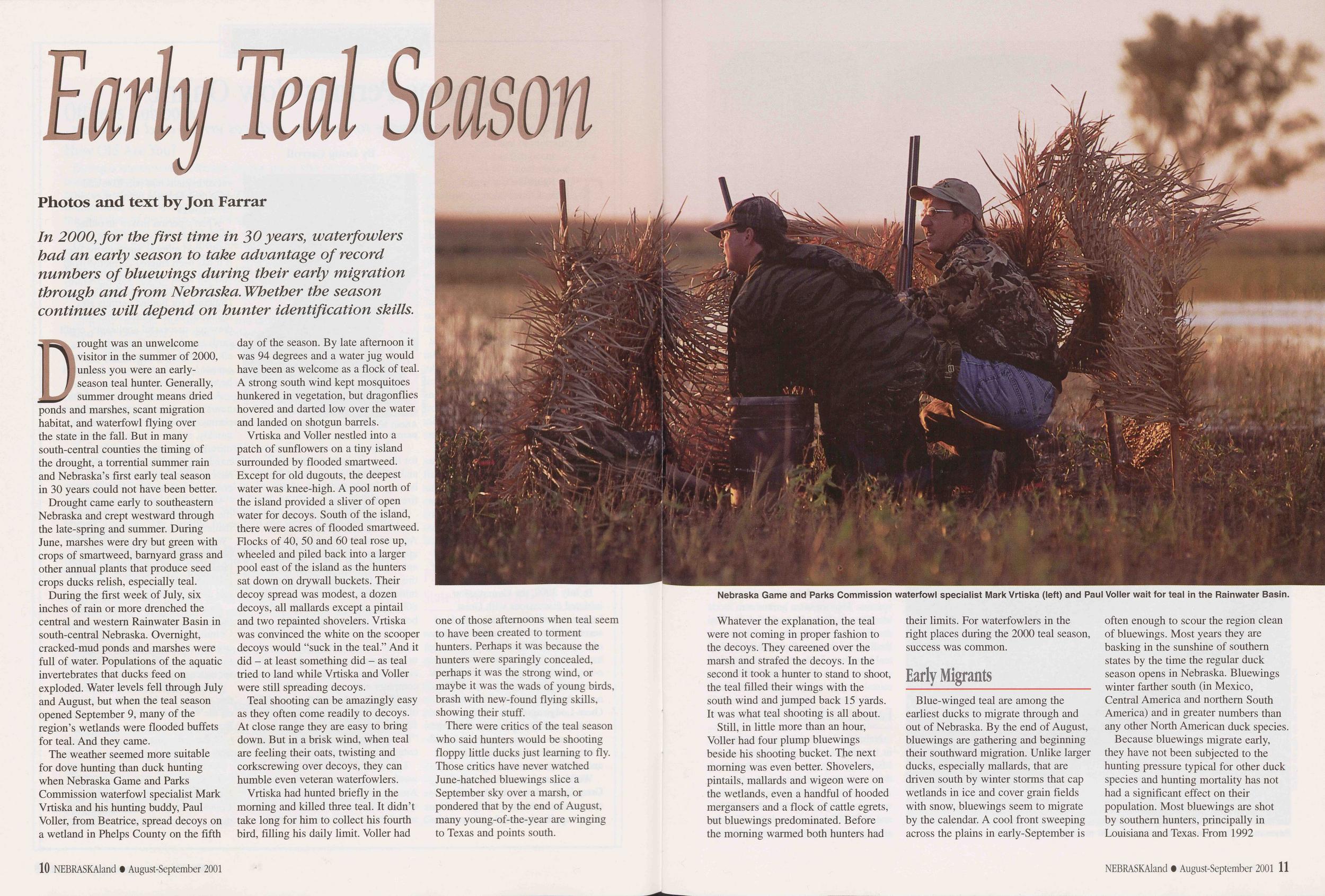
Early Teal Season
Photos and text by Jon Farrar In 2000, for the first time in 30 years, waterfowlers had an early season to take advantage of record numbers of bluewings during their early migration through and from Nebraska. Whether the season continues will depend on hunter identification skills.Drought was an unwelcome visitor in the summer of 2000, unless you were an early- season teal hunter. Generally, summer drought means dried ponds and marshes, scant migration habitat, and waterfowl flying over the state in the fall. But in many south-central counties the timing of the drought, a torrential summer rain and Nebraska's first early teal season in 30 years could not have been better.
Drought came early to southeastern Nebraska and crept westward through the late-spring and summer. During June, marshes were dry but green with crops of smartweed, barnyard grass and other annual plants that produce seed crops ducks relish, especially teal.
During the first week of July, six inches of rain or more drenched the central and western Rainwater Basin in south-central Nebraska. Overnight, cracked-mud ponds and marshes were full of water. Populations of the aquatic invertebrates that ducks feed on exploded. Water levels fell through July and August, but when the teal season opened September 9, many of the region's wetlands were flooded buffets for teal. And they came.
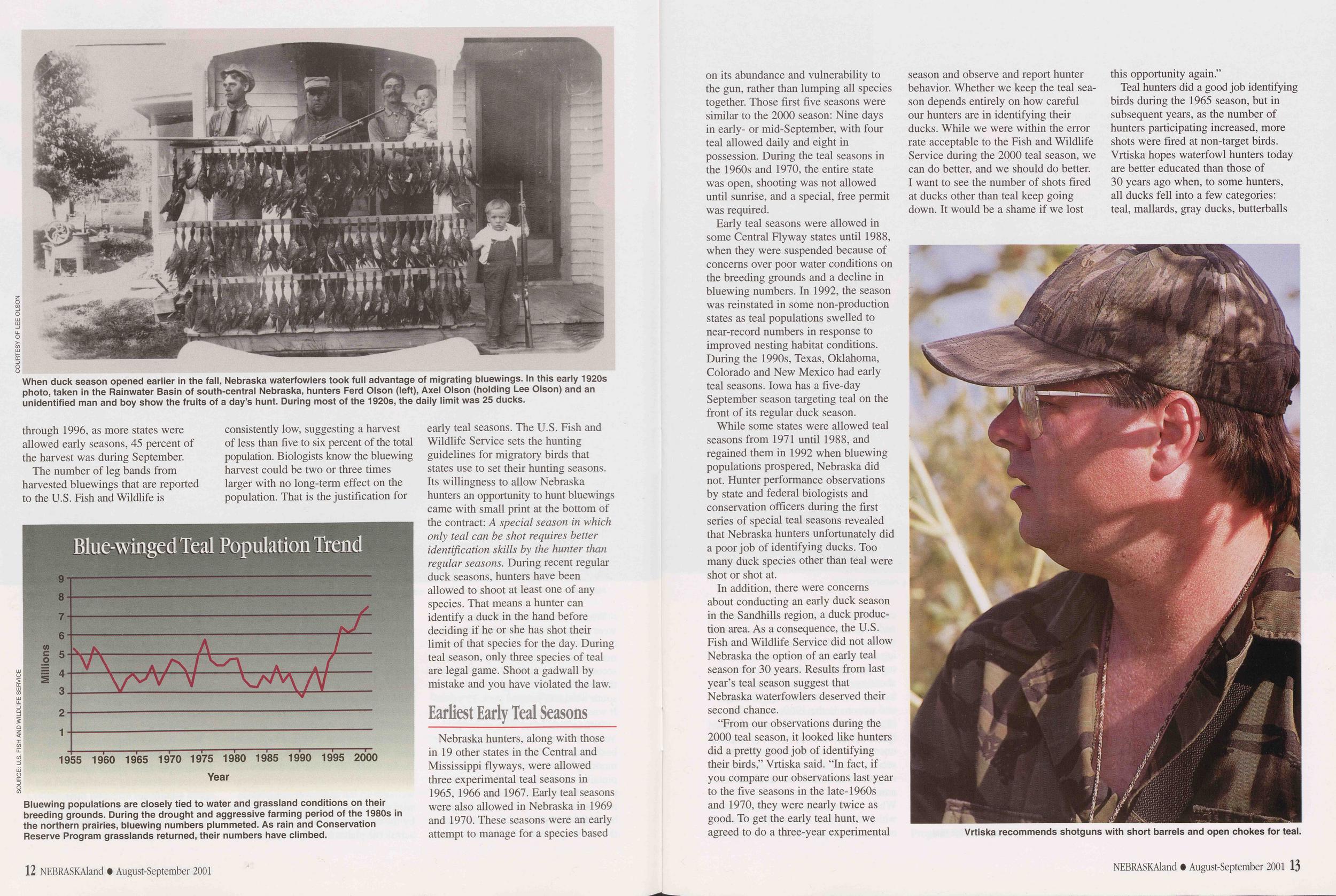
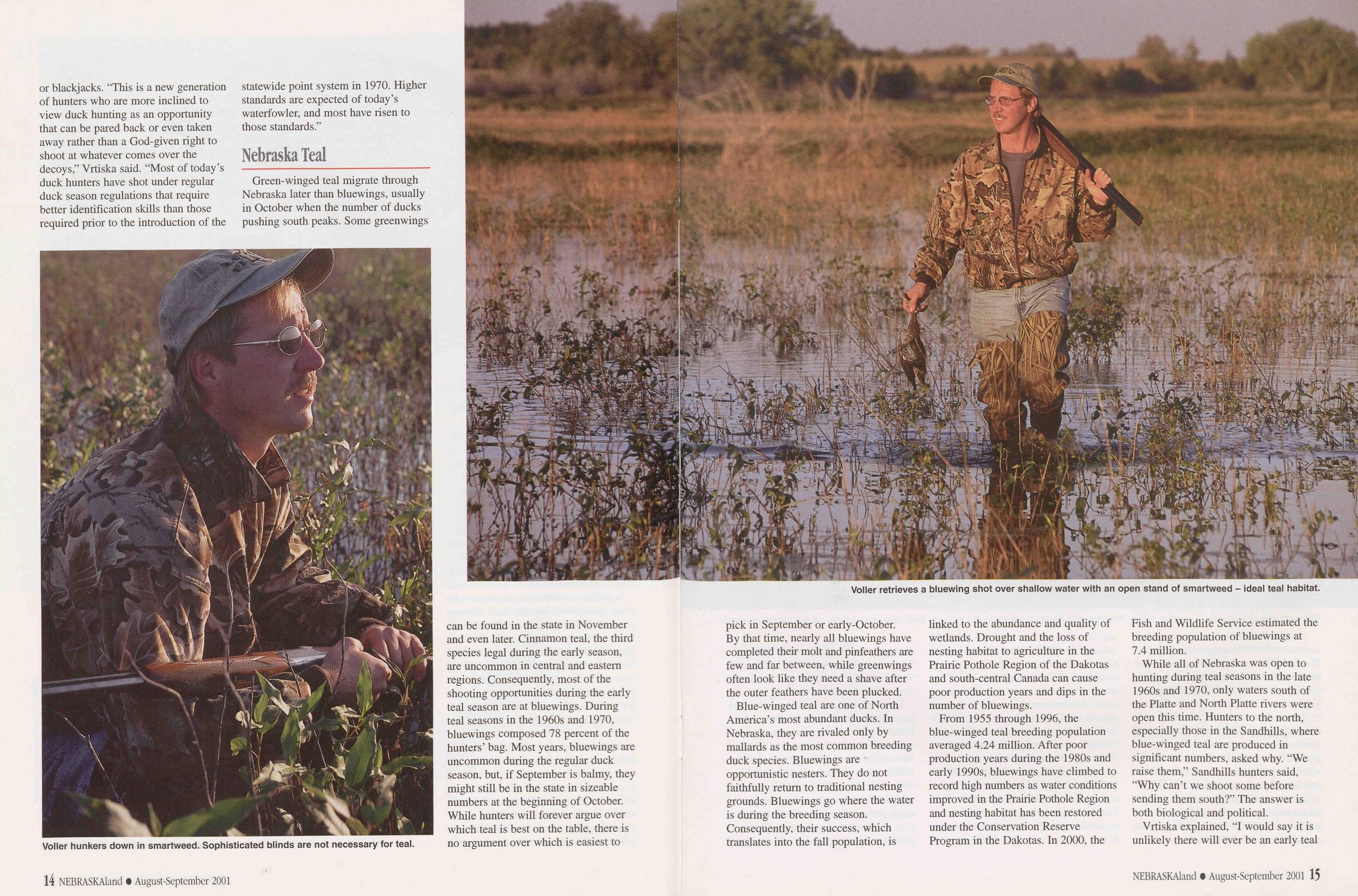
The weather seemed more suitable for dove hunting than duck hunting when Nebraska Game and Parks Commission waterfowl specialist Mark Vrtiska and his hunting buddy, Paul Voller, from Beatrice, spread decoys on a wetland in Phelps County on the fifth day of the season. By late afternoon it was 94 degrees and a water jug would have been as welcome as a flock of teal. A strong south wind kept mosquitoes hunkered in vegetation, but dragonflies hovered and darted low over the water and landed on shotgun barrels.
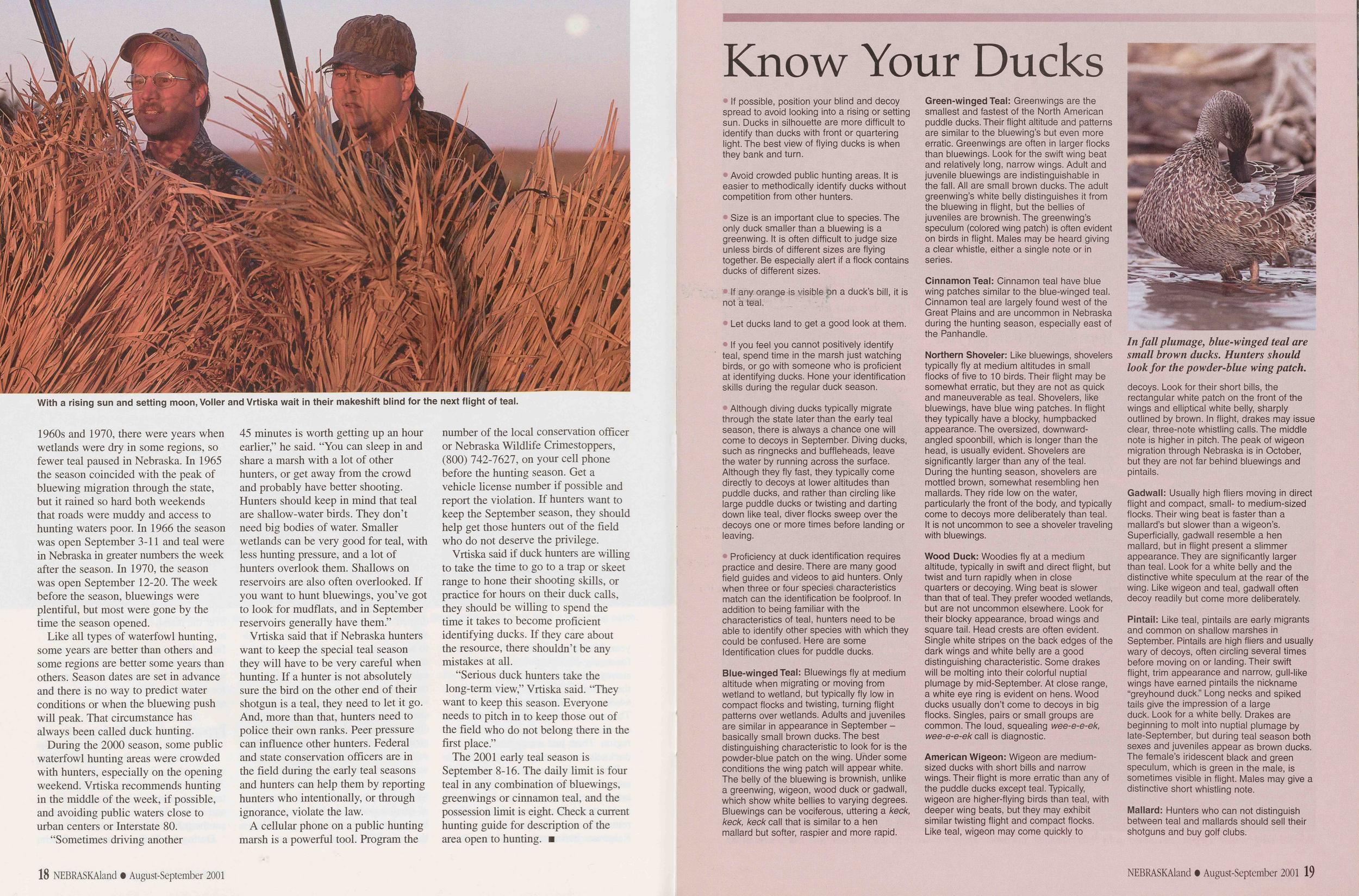
Vrtiska and Voller nestled into a patch of sunflowers on a tiny island surrounded by flooded smartweed. Except for old dugouts, the deepest water was knee-high. A pool north of the island provided a sliver of open water for decoys. South of the island, there were acres of flooded smartweed. Flocks of 40, 50 and 60 teal rose up, wheeled and piled back into a larger pool east of the island as the hunters sat down on dry wall buckets. Their decoy spread was modest, a dozen decoys, all mallards except a pintail and two repainted shovelers. Vrtiska was convinced the white on the scooper decoys would "suck in the teal." And it did - at least something did - as teal tried to land while Vrtiska and Voller were still spreading decoys.
Teal shooting can be amazingly easy as they often come readily to decoys. At close range they are easy to bring down. But in a brisk wind, when teal are feeling their oats, twisting and corkscrewing over decoys, they can humble even veteran waterfowlers. Vrtiska had hunted briefly in the morning and killed three teal. It didn't take long for him to collect his fourth bird, filling his daily limit. Voller had one of those afternoons when teal seem to have been created to torment hunters. Perhaps it was because the hunters were sparingly concealed, perhaps it was the strong wind, or maybe it was the wads of young birds, brash with new-found flying skills, showing their stuff.
There were critics of the teal season who said hunters would be shooting floppy little ducks just learning to fly. Those critics have never watched June-hatched bluewings slice a September sky over a marsh, or pondered that by the end of August, many young-of-the-year are winging to Texas and points south.
Whatever the explanation, the teal were not coming in proper fashion to the decoys. They careened over the marsh and strafed the decoys. In the second it took a hunter to stand to shoot, the teal filled their wings with the south wind and jumped back 15 yards. It was what teal shooting is all about.
Still, in little more than an hour, Voller had four plump bluewings beside his shooting bucket. The next morning was even better. Shovelers, pintails, mallards and wigeon were on the wetlands, even a handful of hooded mergansers and a flock of cattle egrets, but bluewings predominated. Before the morning warmed both hunters had their limits. For waterfowlers in the right places during the 2000 teal season, success was common.
Early MigrantsBlue-winged teal are among the earliest ducks to migrate through and out of Nebraska. By the end of August, bluewings are gathering and beginning their southward migration. Unlike larger ducks, especially mallards, that are driven south by winter storms that cap wetlands in ice and cover grain fields with snow, bluewings seem to migrate by the calendar. A cool front sweeping across the plains in early-September is often enough to scour the region clean of bluewings. Most years they are basking in the sunshine of southern states by the time the regular duck season opens in Nebraska. Bluewings winter farther south (in Mexico, Central America and northern South America) and in greater numbers than any other North American duck species.
Because bluewings migrate early,
they have not been subjected to the
hunting pressure typical for other duck
species and hunting mortality has not
had a significant effect on their
population. Most bluewings are shot
by southern hunters, principally in
Louisiana and Texas. From 1992
10 NEBRASKAland t August-September 2001
NEBRASKAland • August-September 2001 11
 through 1996, as more states were
allowed early seasons, 45 percent of
the harvest was during September.
through 1996, as more states were
allowed early seasons, 45 percent of
the harvest was during September.
The number of leg bands from harvested bluewings that are reported to the U.S. Fish and Wildlife is consistently low, suggesting a harvest of less than five to six percent of the total population. Biologists know the bluewing harvest could be two or three times larger with no long-term effect on the population. That is the justification for early teal seasons. The U.S. Fish and Wildlife Service sets the hunting guidelines for migratory birds that states use to set their hunting seasons. Its willingness to allow Nebraska hunters an opportunity to hunt bluewings came with small print at the bottom of the contract: A special season in which only teal can be shot requires better identification skills by the hunter than regular seasons. During recent regular duck seasons, hunters have been allowed to shoot at least one of any species. That means a hunter can identify a duck in the hand before deciding if he or she has shot their limit of that species for the day. During teal season, only three species of teal are legal game. Shoot a gadwall by mistake and you have violated the law.
Earliest Early Teal SeasonsNebraska hunters, along with those in 19 other states in the Central and Mississippi flyways, were allowed three experimental teal seasons in 1965, 1966 and 1967. Early teal seasons were also allowed in Nebraska in 1969 and 1970. These seasons were an early attempt to manage for a species based on its abundance and vulnerability to the gun, rather than lumping all species together. Those first five seasons were similar to the 2000 season: Nine days in early- or mid-September, with four teal allowed daily and eight in possession. During the teal seasons in the 1960s and 1970, the entire state was open, shooting was not allowed until sunrise, and a special, free permit was required.
Early teal seasons were allowed in some Central Fly way states until 1988, when they were suspended because of concerns over poor water conditions on the breeding grounds and a decline in bluewing numbers. In 1992, the season was reinstated in some non-production states as teal populations swelled to near-record numbers in response to improved nesting habitat conditions. During the 1990s, Texas, Oklahoma, Colorado and New Mexico had early teal seasons. Iowa has a five-day September season targeting teal on the front of its regular duck season.
While some states were allowed teal seasons from 1971 until 1988, and regained them in 1992 when bluewing populations prospered, Nebraska did not. Hunter performance observations by state and federal biologists and conservation officers during the first series of special teal seasons revealed that Nebraska hunters unfortunately did a poor job of identifying ducks. Too many duck species other than teal were shot or shot at.
In addition, there were concerns about conducting an early duck season in the Sandhills region, a duck production area. As a consequence, the U.S. Fish and Wildlife Service did not allow Nebraska the option of an early teal season for 30 years. Results from last year's teal season suggest that Nebraska waterfowlers deserved their second chance.
"From our observations during the 2000 teal season, it looked like hunters did a pretty good job of identifying their birds," Vrtiska said. "In fact, if you compare our observations last year to the five seasons in the late-1960s and 1970, they were nearly twice as good. To get the early teal hunt, we agreed to do a three-year experimental season and observe and report hunter behavior. Whether we keep the teal season depends entirely on how careful our hunters are in identifying their ducks. While we were within the error rate acceptable to the Fish and Wildlife Service during the 2000 teal season, we can do better, and we should do better. I want to see the number of shots fired at ducks other than teal keep going down. It would be a shame if we lost this opportunity again."
Teal hunters did a good job identifying
birds during the 1965 season, but in
subsequent years, as the number of
hunters participating increased, more
shots were fired at non-target birds.
Vrtiska hopes waterfowl hunters today
are better educated than those of
30 years ago when, to some hunters,
all ducks fell into a few categories:
teal, mallards, gray ducks, butterballs
NEBRASKAland • August-September 2001 13
 or blackjacks. "This is a new generation
of hunters who are more inclined to
view duck hunting as an opportunity
that can be pared back or even taken
away rather than a God-given right to
shoot at whatever comes over the
decoys," Vrtiska said. "Most of today's
duck hunters have shot under regular
duck season regulations that require
better identification skills than those
required prior to the introduction of the
statewide point system in 1970. Higher
standards are expected of today's
waterfowler, and most have risen to
those standards."
or blackjacks. "This is a new generation
of hunters who are more inclined to
view duck hunting as an opportunity
that can be pared back or even taken
away rather than a God-given right to
shoot at whatever comes over the
decoys," Vrtiska said. "Most of today's
duck hunters have shot under regular
duck season regulations that require
better identification skills than those
required prior to the introduction of the
statewide point system in 1970. Higher
standards are expected of today's
waterfowler, and most have risen to
those standards."
Green-winged teal migrate through Nebraska later than bluewings, usually in October when the number of ducks pushing south peaks. Some greenwings can be found in the state in November and even later. Cinnamon teal, the third species legal during the early season, are uncommon in central and eastern regions. Consequently, most of the shooting opportunities during the early teal season are at bluewings. During teal seasons in the 1960s and 1970, bluewings composed 78 percent of the hunters' bag. Most years, bluewings are uncommon during the regular duck season, but, if September is balmy, they might still be in the state in sizeable numbers at the beginning of October. While hunters will forever argue over which teal is best on the table, there is no argument over which is easiest to pick in September or early-October. By that time, nearly all bluewings have completed their molt and pinfeathers are few and far between, while greenwings often look like they need a shave after the outer feathers have been plucked.
Blue-winged teal are one of North America's most abundant ducks. In Nebraska, they are rivaled only by mallards as the most common breeding duck species. Bluewings are opportunistic nesters. They do not faithfully return to traditional nesting grounds. Bluewings go where the water is during the breeding season. Consequently, their success, which translates into the fall population, is linked to the abundance and quality of wetlands. Drought and the loss of nesting habitat to agriculture in the Prairie Pothole Region of the Dakotas and south-central Canada can cause poor production years and dips in the number of bluewings.
From 1955 through 1996, the blue-winged teal breeding population averaged 4.24 million. After poor production years during the 1980s and early 1990s, bluewings have climbed to record high numbers as water conditions improved in the Prairie Pothole Region and nesting habitat has been restored under the Conservation Reserve Program in the Dakotas. In 2000, the Fish and Wildlife Service estimated the breeding population of bluewings at 7.4 million.
While all of Nebraska was open to hunting during teal seasons in the late 1960s and 1970, only waters south of the Platte and North Platte rivers were open this time. Hunters to the north, especially those in the Sandhills, where blue-winged teal are produced in significant numbers, asked why. "We raise them," Sandhills hunters said, "Why can't we shoot some before sending them south?" The answer is both biological and political.
Vrtiska explained, "I would say it is
unlikely there will ever be an early teal
14 NEBRASKAland • August-September 2001
NEBRASKAland • August-September 2001 15
 season north of the zone now open.
The Sandhills is a significant duck
production area - there are too many
species other than teal there during
September. The opportunity for hunters
to shoot at non-target birds is high.
Secondly, we produce other duck
species in the Sandhills, mallards and
gadwall, for example, that home to
where they successfully nested in the
past, or where they hatched. We don't
want to be accidentally killing locally
raised and locally nesting birds. If
we did, it could lead to declining
production in the Sandhills."
season north of the zone now open.
The Sandhills is a significant duck
production area - there are too many
species other than teal there during
September. The opportunity for hunters
to shoot at non-target birds is high.
Secondly, we produce other duck
species in the Sandhills, mallards and
gadwall, for example, that home to
where they successfully nested in the
past, or where they hatched. We don't
want to be accidentally killing locally
raised and locally nesting birds. If
we did, it could lead to declining
production in the Sandhills."
Since the 2000 early teal season was announced, Vrtiska has received phone calls from hunters wanting to know why the northeastern counties were not open. Northeastern Nebraska is not a significant duck-production area. Why isn't early teal hunting allowed there? Vrtiska's response is that northeastern Nebraska is boxed in on three sides by duck-production areas: The Sandhills to the west, South Dakota to the north, and northwestern Iowa to the east. The likelihood of non-target species in the region is too high during September. It was also made clear to Nebraska biologists that the Fish and Wildlife Service would not entertain a proposal for a September teal season anywhere north of the Platte River.
Thirty years ago, significant numbers of ducks were raised in the Rainwater Basin. Then came the boom in center-pivot irrigation and the intensification of agriculture in the 1970s, when many wetlands were drained or filled. Diversified farming with livestock pasture, forage crops and small grains was replaced with intensive corn and soybean production. The number of nesting ducks fell year by year. During the 1960s, it was common for nearly 40,000 nesting ducks to be surveyed in the Rainwater Basin. By the spring of 1975, the estimate was 14,385 along the same survey routes. That was the last year the Commission conducted breeding duck counts in the region. There just weren't enough ducks there to justify the survey.
While federal waterfowl production areas and state wildlife management areas have protected some of the larger and better wetlands, waterfowl nesting remains a secondary benefit of Rainwater Basin wetlands. Their primary importance today is providing spring migration habitat. Because the Rainwater Basin is a less important duck production than it was during the 1960s, the Fish and Wildlife Service was amenable to again allowing an early teal season in southern Nebraska, where most ducks in September are early migrants. On average, far and away the most abundant are blue-winged teal.
Where and How to Hunt Teal"The shallow wetlands of the Rainwater Basin are probably the best teal habitat we have south of the Platte River in September," Vrtiska said, "but they are not the only places where there are teal-hunting opportunities. Teal like shallow water and they like mudflats. Wherever you find either in September, you'll probably find teal. Farm ponds, sloughs, and the shallow bays of Natural Resource District lakes and large reservoirs are all good places for teal and teal hunters. When I lived in Mississippi, we had phenomenal teal hunting on reservoir mudflats. We had flocks of 300 to 500 teal flying around. Hunters won't see flocks of that size in Nebraska, but it's not much different, other than it's not as hot here in September and you don't have to worry about stepping on cottonmouths."
While teal are susceptible to decoys, hunters who take extra time to conceal themselves will have closer shooting. Grass panels held up with willow sticks, or camouflage cloth draped over shoreline vegetation, are adequate cover and lightweight enough to lug into the marsh. Get the blind and decoys as close as is reasonable, Vrtiska said. Close shooting means ducks dead on the water and no searching for wounded birds in dense marsh or shoreline vegetation. Few ducks are as elusive in vegetation as teal. A dog is an excellent hunting partner during the early season, which serves as a good warm-up for the regular duck season.
Teal will come to all types of decoys. Mallard decoys work fine, but a mix of smaller puddle duck decoys is even better. Set a dozen teal decoys off to the side of the larger decoys, in shallow-water, wind-protected pockets, and nine times out of 10 teal will decoy to what they think are their own kind. Large decoys catch the attention of teal wheeling over the marsh or pond, and teal decoys convince them to come in close. Large numbers of decoys are not as important as when hunting mallards or diving ducks. In the right location, a half-dozen will work.
Large shot is a poor choice when hunting teal. Smaller shot puts more pellets in the pattern, and that is important when shooting small, careening teal. No. 4 steel shot is large enough, and many teal hunters prefer No. 6 or No. 7 steel. Open bores are the ticket for close-in teal gunning. Vrtiska said, "When teal decoy, they are in your face and you have to react fast. Short barrel, open choke and lots of pellets, that's what you want for teal."
While teal readily decoy and come down easily when shot, hitting them tests most hunters. Teal, especially greenwings, are fast, erratic fliers. They may come to decoys in an orderly flock formation but, on the spur of the moment, knot into a ball and dart down to the water. Take your eyes off the sky long enough to pour coffee and you might look up to find teal swimming in the decoys. Unless winds are strong, teal are just as apt to drop to the water going with or across the wind as into it. By September, teal have gathered into large flocks and are just waiting for a flimsy excuse to push south. For no apparent reason they jump up, wheel over the marsh or pond and come back to the water like cloth falling to the floor. All that nervous energy means that teal are almost always moving over wetlands and between wetlands, and for the hunter sitting over decoys that spells frequent customers.
Prospects for 2001 SeasonWill this year's teal season offer the same opportunities hunters had in 2000? Vrtiska said that will depend on teal production this breeding season, and on weather and water conditions in southern Nebraska this summer.
During the five teal seasons in the
16 NEBRASKAland • August-September 2001
NEBRASKAland • August-September 2001 17
 1960s and 1970, there were years when
wetlands were dry in some regions, so
fewer teal paused in Nebraska. In 1965
the season coincided with the peak of
bluewing migration through the state,
but it rained so hard both weekends
that roads were muddy and access to
hunting waters poor. In 1966 the season
was open September 3-11 and teal were
in Nebraska in greater numbers the week
after the season. In 1970, the season
was open September 12-20. The week
before the season, bluewings were
plentiful, but most were gone by the
time the season opened.
1960s and 1970, there were years when
wetlands were dry in some regions, so
fewer teal paused in Nebraska. In 1965
the season coincided with the peak of
bluewing migration through the state,
but it rained so hard both weekends
that roads were muddy and access to
hunting waters poor. In 1966 the season
was open September 3-11 and teal were
in Nebraska in greater numbers the week
after the season. In 1970, the season
was open September 12-20. The week
before the season, bluewings were
plentiful, but most were gone by the
time the season opened.
Like all types of waterfowl hunting, some years are better than others and some regions are better some years than others. Season dates are set in advance and there is no way to predict water conditions or when the bluewing push will peak. That circumstance has always been called duck hunting.
During the 2000 season, some public waterfowl hunting areas were crowded with hunters, especially on the opening weekend. Vrtiska recommends hunting in the middle of the week, if possible, and avoiding public waters close to urban centers or Interstate 80.
"Sometimes driving another 45 minutes is worth getting up an hour earlier," he said. "You can sleep in and share a marsh with a lot of other hunters, or get away from the crowd and probably have better shooting. Hunters should keep in mind that teal are shallow-water birds. They don't need big bodies of water. Smaller wetlands can be very good for teal, with less hunting pressure, and a lot of hunters overlook them. Shallows on reservoirs are also often overlooked. If you want to hunt bluewings, you've got to look for mudflats, and in September reservoirs generally have them."
Vrtiska said that if Nebraska hunters want to keep the special teal season they will have to be very careful when hunting. If a hunter is not absolutely sure the bird on the other end of their shotgun is a teal, they need to let it go. And, more than that, hunters need to police their own ranks. Peer pressure can influence other hunters. Federal and state conservation officers are in the field during the early teal seasons and hunters can help them by reporting hunters who intentionally, or through ignorance, violate the law.
A cellular phone on a public hunting marsh is a powerful tool. Program the number of the local conservation officer or Nebraska Wildlife Crimestoppers, (800) 742-7627, on your cell phone before the hunting season. Get a vehicle license number if possible and report the violation. If hunters want to keep the September season, they should help get those hunters out of the field who do not deserve the privilege.
Vrtiska said if duck hunters are willing to take the time to go to a trap or skeet range to hone their shooting skills, or practice for hours on their duck calls, they should be willing to spend the time it takes to become proficient identifying ducks. If they care about the resource, there shouldn't be any mistakes at all.
"Serious duck hunters take the long-term view," Vrtiska said. "They want to keep this season. Everyone needs to pitch in to keep those out of the field who do not belong there in the first place."
The 2001 early teal season is September 8-16. The daily limit is four teal in any combination of bluewings, greenwings or cinnamon teal, and the possession limit is eight. Check a current hunting guide for description of the area open to hunting.
Know Your Ducks• If possible, position your blind and decoy spread to avoid looking into a rising or setting sun. Ducks in silhouette are more difficult to identify than ducks with front or quartering light. The best view of flying ducks is when they bank and turn.
• Avoid crowded public hunting areas. It is easier to methodically identify ducks without competition from other hunters.
• Size is an important clue to species. The only duck smaller than a bluewing is a greenwing. It is often difficult to judge size unless birds of different sizes are flying together. Be especially alert if a flock contains ducks of different sizes.
If .any-orange-Is visible on a duck's bill, it is not a teal.
• Let ducks land to get a good look at them.
• If you feel you cannot positively identify teal, spend time in the marsh just watching birds, or go with someone who is proficient at identifying ducks. Hone your identification skills during the regular duck season.
• Although diving ducks typically migrate through the state later than the early teal season, there is always a chance one will come to decoys in September. Diving ducks, such as ringnecks and buffleheads, leave the water by running across the surface. Although they fly fast, they typically come directly to decoys at lower altitudes than puddle ducks, and rather than circling like large puddle ducks or twisting and darting down like teal, diver flocks sweep over the decoys one or more times before landing or leaving.
Proficiency at duck identification requires practice and desire. There are many good field guides and videos to aid hunters. Only when three or four species characteristics match can the identification be foolproof. In addition to being familiar with the characteristics of teal, hunters need to be able to identify other species with which they could be confused. Here are some Identification clues for puddle ducks.
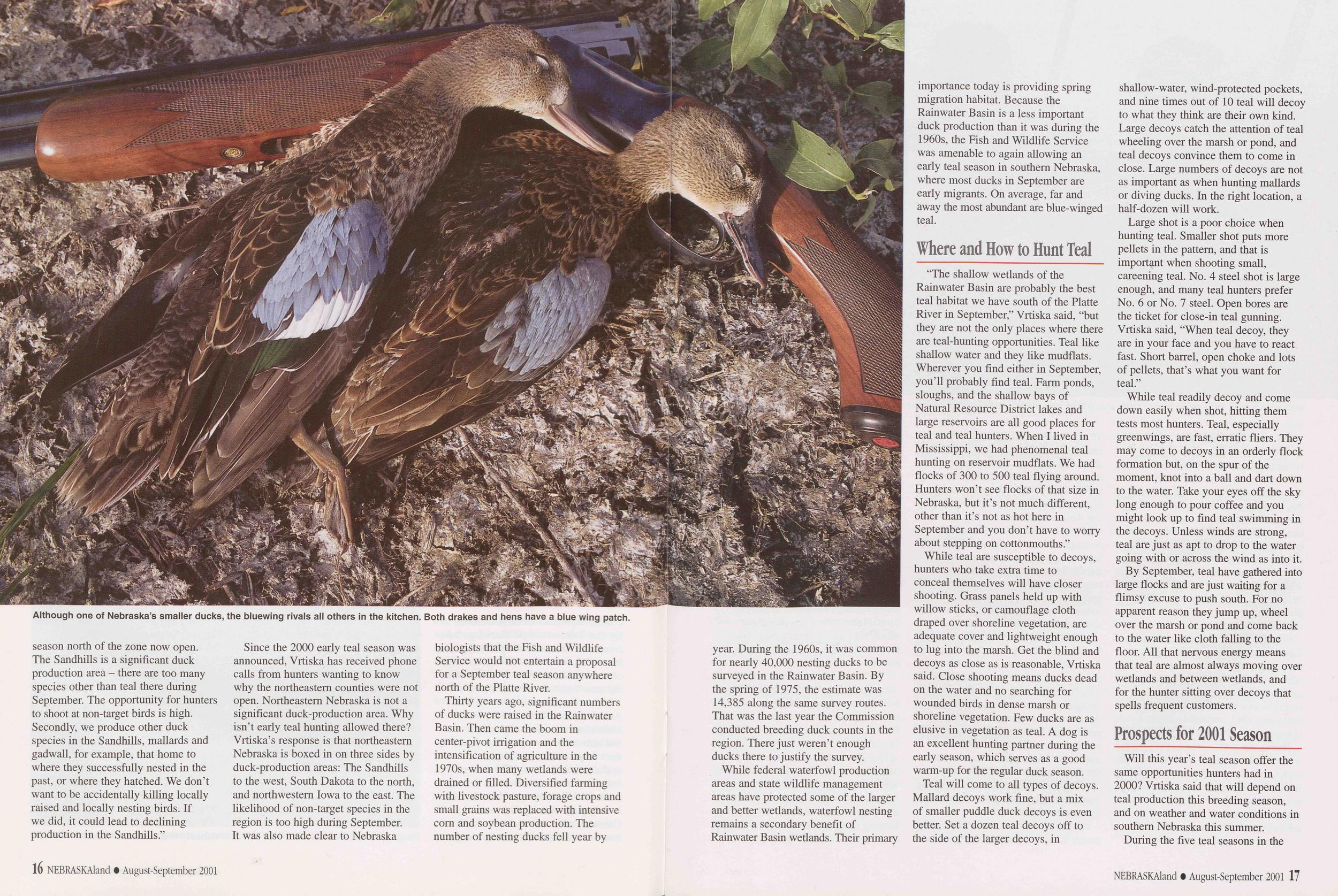
Blue-winged Teal: Bluewings fly at medium altitude when migrating or moving from wetland to wetland, but typically fly low in compact flocks and twisting, turning flight patterns over wetlands. Adults and juveniles are similar in appearance in September - basically small brown ducks. The best distinguishing characteristic to look for is the powder-blue patch on the wing. Under some conditions the wing patch will appear white. The belly of the bluewing is brownish, unlike a greenwing, wigeon, wood duck or gadwall, which show white bellies to varying degrees. Bluewings can be vociferous, uttering a keck, keck, keck call that is similar to a hen mallard but softer, raspier and more rapid.
Green-winged Teal: Greenwings are the smallest and fastest of the North American puddle ducks. Their flight altitude and patterns are similar to the bluewing's but even more erratic. Greenwings are often in larger flocks than bluewings. Look for the swift wing beat and relatively long, narrow wings. Adult and juvenile bluewings are indistinguishable in the fall. All are small brown ducks. The adult greenwing's white belly distinguishes it from the bluewing in flight, but the bellies of juveniles are brownish. The greenwing's speculum (colored wing patch) is often evident on birds in flight. Males may be heard giving a clear whistle, either a single note or in series.
Cinnamon Teal: Cinnamon teal have blue wing patches similar to the blue-winged teal. Cinnamon teal are largely found west of the Great Plains and are uncommon in Nebraska during the hunting season, especially east of the Panhandle.
Northern Shoveler: Like bluewings, shovelers typically fly at medium altitudes in small flocks of five to 10 birds. Their flight may be somewhat erratic, but they are not as quick and maneuverable as teal. Shovelers, like bluewings, have blue wing patches. In flight they typically have a blocky, humpbacked appearance. The oversized, downward angled spoonbill, which is longer than the head, is usually evident. Shovelers are significantly larger than any of the teal. During the hunting season, shovelers are mottled brown, somewhat resembling hen mallards. They ride low on the water, particularly the front of the body, and typically come to decoys more deliberately than teal. It is not uncommon to see a shoveler traveling with bluewings.
Wood Duck: Woodies fly at a medium altitude, typically in swift and direct flight, but twist and turn rapidly when in close quarters or decoying. Wing beat is slower than that of teal. They prefer wooded wetlands, but are not uncommon elsewhere. Look for their blocky appearance, broad wings and square tail. Head crests are often evident. Single white stripes on the back edges of the dark wings and white belly are a good distinguishing characteristic. Some drakes will be molting into their colorful nuptial plumage by mid-September. At close range, a white eye ring is evident on hens. Wood ducks usually don't come to decoys in big flocks. Singles, pairs or small groups are common. The loud, squealing wee-e-e-ek, wee-e-e-ek ca\\ is diagnostic.
American Wigeon: Wigeon are medium sized ducks with short bills and narrow wings. Their flight is more erratic than any of the puddle ducks except teal. Typically, wigeon are higher-flying birds than teal, with deeper wing beats, but they may exhibit similar twisting flight and compact flocks. Like teal, wigeon may come quickly to In fall plumage, blue-winged teal are small brown ducks. Hunters should look for the powder-blue wing patch, decoys. Look for their short bills, the rectangular white patch on the front of the wings and elliptical white belly, sharply outlined by brown. In flight, drakes may issue clear, three-note whistling calls. The middle note is higher in pitch. The peak of wigeon migration through Nebraska is in October, but they are not far behind bluewings and pintails.
Gadwall: Usually high fliers moving in direct flight and compact, small- to medium-sized flocks. Their wing beat is faster than a mallard's but slower than a wigeon's. Superficially, gadwall resemble a hen mallard, but in flight present a slimmer appearance. They are significantly larger than teal. Look for a white belly and the distinctive white speculum at the rear of the wing. Like wigeon and teal, gadwall often decoy readily but come more deliberately.
Pintail: Like teal, pintails are early migrants and common on shallow marshes in September. Pintails are high fliers and usually wary of decoys, often circling several times before moving on or landing. Their swift flight, trim appearance and narrow, gull-like wings have earned pintails the nickname "greyhound duck." Long necks and spiked tails give the impression of a large duck. Look for a white belly. Drakes are beginning to molt into nuptial plumage by late-September, but during teal season both sexes and juveniles appear as brown ducks. The female's iridescent black and green speculum, which is green in the male, is sometimes visible in flight. Males may give a distinctive short whistling note.
Mallard: Hunters who can not distinguish between teal and mallards should sell their shotguns and buy golf clubs.
18 NEBRASKAland • August-September 2001 NEBRASKAland • August-September 2001 19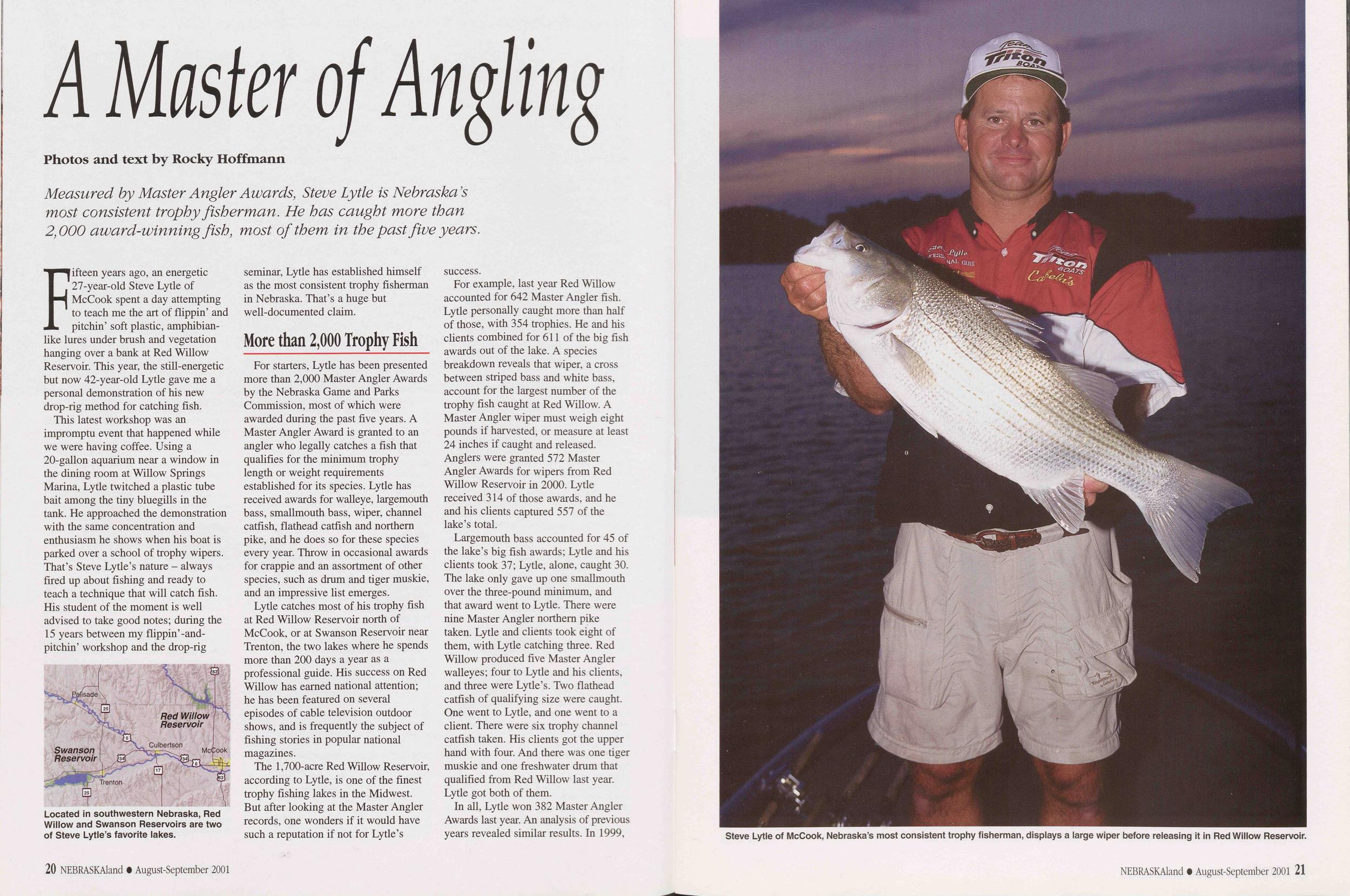
A Master of Angling
Photos and text by Rocky Hoffmann Measured by Master Angler Awards, Steve Lytle is Nebraska's most consistent trophy fisherman. He has caught more than 2,000 award-winning fish, most of them in the past five years.Fifteen years ago, an energetic 27-year-old Steve Lytle of McCook spent a day attempting to teach me the art of flippin' and pitchin' soft plastic, amphibian- like lures under brush and vegetation hanging over a bank at Red Willow Reservoir. This year, the still-energetic but now 42-year-old Lytle gave me a personal demonstration of his new drop-rig method for catching fish.
This latest workshop was an impromptu event that happened while we were having coffee. Using a 20-gallon aquarium near a window in the dining room at Willow Springs Marina, Lytle twitched a plastic tube bait among the tiny bluegills in the tank. He approached the demonstration with the same concentration and enthusiasm he shows when his boat is parked over a school of trophy wipers. That's Steve Lytle's nature - always fired up about fishing and ready to teach a technique that will catch fish. His student of the moment is well advised to take good notes; during the 15 years between my flippin'-and-pitchin' workshop and the drop-rig seminar, Lytle has established himself as the most consistent trophy fisherman in Nebraska. That's a huge but well-documented claim.
For starters, Lytle has been presented more than 2,000 Master Angler Awards by the Nebraska Game and Parks Commission, most of which were awarded during the past five years. A Master Angler Award is granted to an angler who legally catches a fish that qualifies for the minimum trophy length or weight requirements established for its species. Lytle has received awards for walleye, largemouth bass, smallmouth bass, wiper, channel catfish, flathead catfish and northern pike, and he does so for these species every year. Throw in occasional awards for crappie and an assortment of other species, such as drum and tiger muskie, and an impressive list emerges.
Lytle catches most of his trophy fish at Red Willow Reservoir north of McCook, or at Swanson Reservoir near Trenton, the two lakes where he spends more than 200 days a year as a professional guide. His success on Red Willow has earned national attention; he has been featured on several episodes of cable television outdoor shows, and is frequently the subject of fishing stories in popular national magazines.
The 1,700-acre Red Willow Reservoir, according to Lytle, is one of the finest trophy fishing lakes in the Midwest. But after looking at the Master Angler records, one wonders if it would have such a reputation if not for Lytle's success.
For example, last year Red Willow accounted for 642 Master Angler fish. Lytle personally caught more than half of those, with 354 trophies. He and his clients combined for 611 of the big fish awards out of the lake. A species breakdown reveals that wiper, a cross between striped bass and white bass, account for the largest number of the trophy fish caught at Red Willow. A Master Angler wiper must weigh eight pounds if harvested, or measure at least 24 inches if caught and released. Anglers were granted 572 Master Angler Awards for wipers from Red Willow Reservoir in 2000. Lytle received 314 of those awards, and he and his clients captured 557 of the lake's total.
Largemouth bass accounted for 45 of the lake's big fish awards; Lytle and his clients took 37; Lytle, alone, caught 30. The lake only gave up one smallmouth over the three-pound minimum, and that award went to Lytle. There were nine Master Angler northern pike taken. Lytle and clients took eight of them, with Lytle catching three. Red Willow produced five Master Angler walleyes; four to Lytle and his clients, and three were Lytle's. Two flathead catfish of qualifying size were caught. One went to Lytle, and one went to a client. There were six trophy channel catfish taken. His clients got the upper hand with four. And there was one tiger muskie and one freshwater drum that qualified from Red Willow last year. Lytle got both of them.
In all, Lytle won 382 Master Angler
Awards last year. An analysis of previous
years revealed similar results. In 1999,
NEBRASKAland • August-September 2001 21
 Lytle and his clients caught over 600
Master Angler fish at Red Willow and
more than 400 in 1998. The appearance
of a 1998 slump is an illusion. Lytle
said that before 1999, he was not turning
in all of his and his clients' Master
Angler Awards. Game and Parks officials
told him that the number of trophy fish
he catches is significant enough to help
them evaluate the lake, and they
encouraged him to report all of them.
Lytle and his clients caught over 600
Master Angler fish at Red Willow and
more than 400 in 1998. The appearance
of a 1998 slump is an illusion. Lytle
said that before 1999, he was not turning
in all of his and his clients' Master
Angler Awards. Game and Parks officials
told him that the number of trophy fish
he catches is significant enough to help
them evaluate the lake, and they
encouraged him to report all of them.
Over the past half-dozen years, Lytle and his clients have caught seven state-record wipers out of Red Willow Reservoir. Since 1995, Lytle has broken the wiper record five times, and he currently holds the state record with his 20-pound, 1-ounce lunker he took from Red Willow on August 1, 1999, shattering the previous record by more than two pounds. After breaking the 20-pound mark, Lytle has wondered if a world record might be possible in Nebraska. The current wiper world record is 27-pounds, 5-ounces from Greers Ferry Lake in Arkansas.
Developed Competitive SpiritLytle was a great athlete at McCook High School, lettering in football, basketball and track. He rushed for more than 1,000 yards as a fullback and planned to play for the University of Nebraska. But a Shrine Bowl injury ended his football career.
Lytle's hearing is limited, a condition some would consider a handicap but that he credits with instilling his competitive spirit.
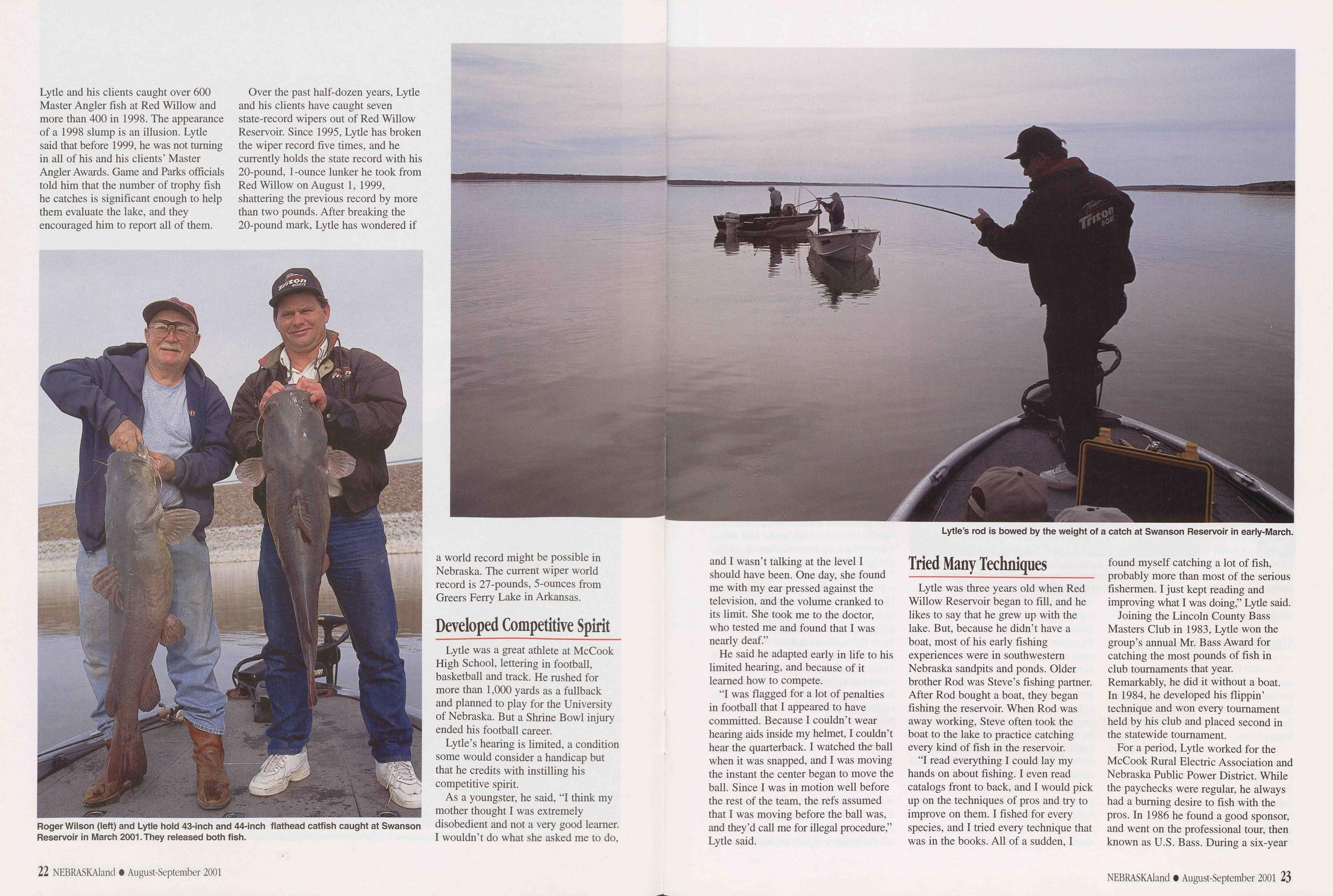
As a youngster, he said, 'T think my mother thought I was extremely disobedient and not a very good learner. I wouldn't do what she asked me to do, Lytle's rod is bowed by the weight of a catch at Swanson Reservoir in early-March. and I wasn't talking at the level I should have been. One day, she found me with my ear pressed against the television, and the volume cranked to its limit. She took me to the doctor, who tested me and found that I was nearly deaf."
He said he adapted early in life to his limited hearing, and because of it learned how to compete.
"I was flagged for a lot of penalties in football that I appeared to have committed. Because I couldn't wear hearing aids inside my helmet, I couldn't hear the quarterback. I watched the ball when it was snapped, and I was moving the instant the center began to move the ball. Since I was in motion well before the rest of the team, the refs assumed that I was moving before the ball was, and they'd call me for illegal procedure," Lytle said.
Tried Many TechniquesLytle was three years old when Red Willow Reservoir began to fill, and he likes to say that he grew up with the lake. But, because he didn't have a boat, most of his early fishing experiences were in southwestern Nebraska sandpits and ponds. Older brother Rod was Steve's fishing partner. After Rod bought a boat, they began fishing the reservoir. When Rod was away working, Steve often took the boat to the lake to practice catching every kind of fish in the reservoir.
"I read everything I could lay my hands on about fishing. I even read catalogs front to back, and I would pick up on the techniques of pros and try to improve on them. I fished for every species, and I tried every technique that was in the books. All of a sudden, I found myself catching a lot of fish, probably more than most of the serious fishermen. I just kept reading and improving what I was doing," Lytle said.
Joining the Lincoln County Bass Masters Club in 1983, Lytle won the group's annual Mr. Bass Award for catching the most pounds of fish in club tournaments that year. Remarkably, he did it without a boat. In 1984, he developed his flippin' technique and won every tournament held by his club and placed second in the statewide tournament.
For a period, Lytle worked for the
McCook Rural Electric Association and
Nebraska Public Power District. While
the paychecks were regular, he always
had a burning desire to fish with the
pros. In 1986 he found a good sponsor,
and went on the professional tour, then
known as U.S. Bass. During a six-year
22 NEBRASKAland • August-September 2001
NEBRASKAland • August-September 2001 23
 pro tour, he fished nationwide at tidal,
river, reservoir, and lake tournaments.
pro tour, he fished nationwide at tidal,
river, reservoir, and lake tournaments.
"I found that the techniques I had learned and perfected here in Nebraska worked all over the country, but I was still learning all the time. I really wish I was on tour now, because right now I know the front and back of everything that I was just learning then. I think I would be a much better competitive fishermen today because of all the experience I have gained guiding since 1993. Maybe in a year or two, I'll get back to the pro circuit. That is a very strong personal desire," Lytle said.
Simple Rules to Catch FishTo catch fish, Lytle has several simple rules. First, an angler has to keep his bait in the water. By fishing as many as 250 days a year, Lytle does just that. Second, an angler must keep the bait in front of fish.
"It doesn't do much good to simply lower a hook and a worm over the side of a boat unless there is a fish down there. The key to knowing where the fish are is knowing where the baitfish are. A lot of people say that the bite is off when they're not catching fish, or they may claim that the weather has shut everything down. In my opinion, the bite is rarely off, and weather doesn't affect the bite as much as how it affects baitfish. Always ask yourself, 'Where did the baitfish go?' because that's where the predators are," Lytle said.
He pointed to spring, a time when water temperatures can fluctuate in short periods, as an example.
"A rapid warming may entice baitfish into shallow water or to the surface over deep water. Then cloud cover moves in and the water cools, pushing baitfish down. Predators will follow them wherever they go. A fisherman has to be prepared to go there too, and therefore you have to know where they went and have the equipment available to take you there," Lytle said with a smile, knowing he had just performed a little fisherman double-talk.
To know where baitfish are, an angler must know the prey's habits and be able to read an electronic locator. Lytle is very good at both. When he says, "I'll bet we find shad in 20 feet of water off the face of the dam," you very likely will. When he looks into a locator and says, "There's a cloud of baitfish, and they're really nervous ... see there's some big fish pretty close to them. That's why the shad are all bunched up," you can be certain that's what's happening below.
Once I saw him stare intently at the locator screen, then tie on a glitter spoon and drop it over the side of the boat. "There! See that mark?" he said, "That's my spoon. I'll drop it down to just above the big fish. They're likely wipers, but they could be anything ... maybe even suspended northerns." As Lytle's spoon moved down so did the line on the locator. He stopped it about a foot or two above the predators and danced his rod tip up and down. The mark below his lure moved up, and wham. "Got one!" he said.
Lytle can spot an image of a fish lying almost flat on the bottom. When we were fishing, he often got next to the locator and pointed precisely to an imperfection on the screen that he claimed was a fish. When I was skeptical, he often caught the fish to prove his point. Although he usually uses liquid crystal graphs as fish locators, he also has great respect for old electronic flasher models that show only marks without illustration.
When Lytle found fish, he hovered over them and kept them in the cone of his locator as they moved, much like a police helicopter keeps a suspect in its spotlight. With one foot, he pressed against the side of the boat a bait rod supporting a lip-hooked bluegill, chub, golden shiner, or preferably, a shad. With his other foot, he expertly controlled a powerful electric motor. His hands were free, ready to cast a heavy spinnerbait, crankbait or topwater popper, or to pump a jigging spoon off the bottom. His eyes were totally fixed on the screen of his locator and, most of the time, he was talking. His running commentary entertained and educated his passengers; he always kept his clients and guests informed about what he saw on the locator, what he was doing, and what they should be doing to maximize their chances of catching a fish. Sometimes he talked to the fish. "C'mon fish, c'mon fish."
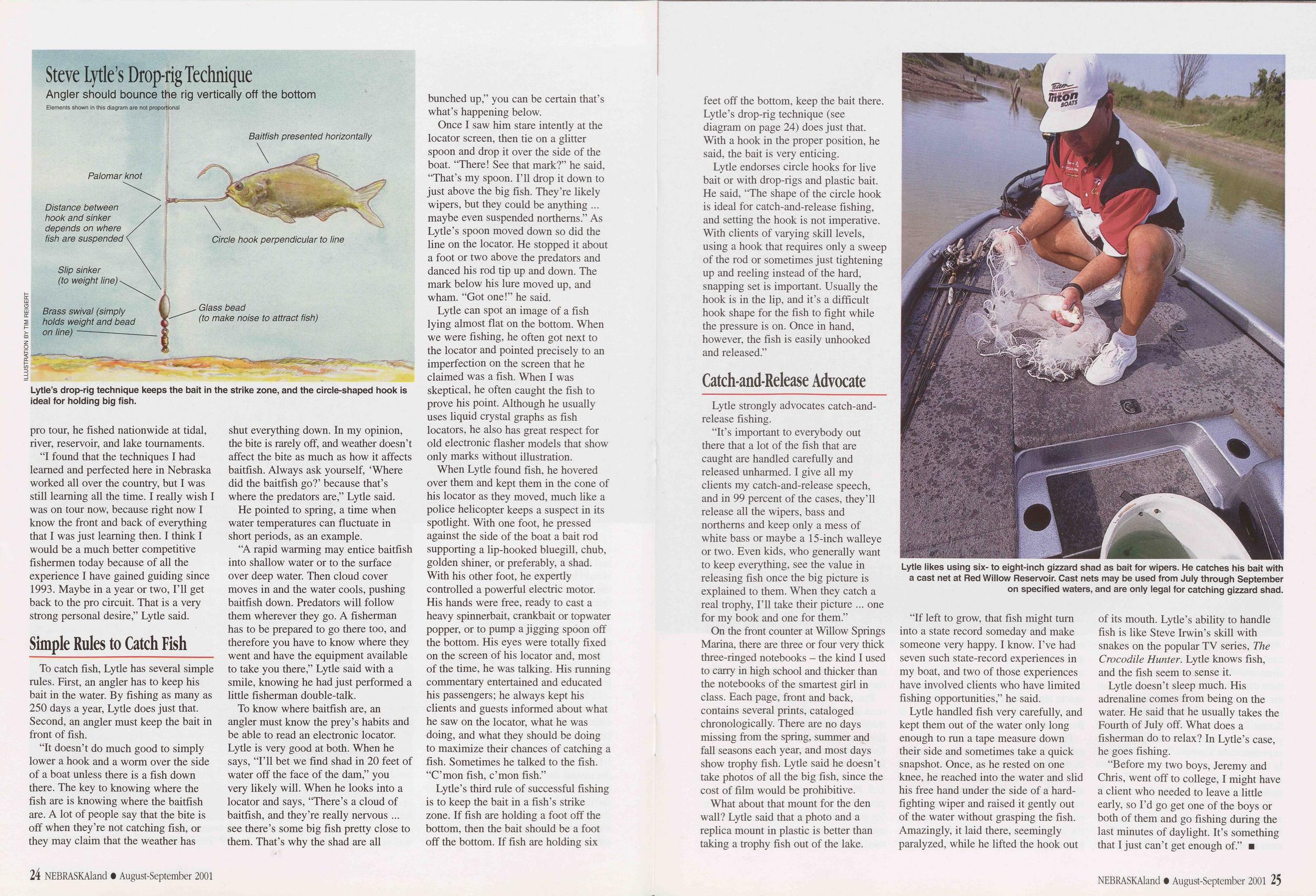
Lytle's third rule of successful fishing is to keep the bait in a fish's strike zone. If fish are holding a foot off the bottom, then the bait should be a foot off the bottom. If fish are holding six feet off the bottom, keep the bait there. Lytle's drop-rig technique (see diagram on page 24) does just that. With a hook in the proper position, he said, the bait is very enticing.
Lytle endorses circle hooks for live bait or with drop-rigs and plastic bait. He said, "The shape of the circle hook is ideal for catch-and-release fishing, and setting the hook is not imperative. With clients of varying skill levels, using a hook that requires only a sweep of the rod or sometimes just tightening up and reeling instead of the hard, snapping set is important. Usually the hook is in the lip, and it's a difficult hook shape for the fish to fight while the pressure is on. Once in hand, however, the fish is easily unhooked and released."
Catch-and-Release AdvocateLytle strongly advocates catch-and-release fishing.
"It's important to everybody out there that a lot of the fish that are caught are handled carefully and released unharmed. I give all my clients my catch-and-release speech, and in 99 percent of the cases, they'll release all the wipers, bass and northerns and keep only a mess of white bass or maybe a 15-inch walleye or two. Even kids, who generally want to keep everything, see the value in releasing fish once the big picture is explained to them. When they catch a real trophy, I'll take their picture ... one for my book and one for them."
On the front counter at Willow Springs Marina, there are three or four very thick three-ringed notebooks - the kind I used to carry in high school and thicker than the notebooks of the smartest girl in class. Each page, front and back, contains several prints, cataloged chronologically. There are no days missing from the spring, summer and fall seasons each year, and most days show trophy fish. Lytle said he doesn't take photos of all the big fish, since the cost of film would be prohibitive.
What about that mount for the den wall? Lytle said that a photo and a replica mount in plastic is better than taking a trophy fish out of the lake.
"If left to grow, that fish might turn into a state record someday and make someone very happy. I know. I've had seven such state-record experiences in my boat, and two of those experiences have involved clients who have limited fishing opportunities," he said.
Lytle handled fish very carefully, and kept them out of the water only long enough to run a tape measure down their side and sometimes take a quick snapshot. Once, as he rested on one knee, he reached into the water and slid his free hand under the side of a hard- fighting wiper and raised it gently out of the water without grasping the fish. Amazingly, it laid there, seemingly paralyzed, while he lifted the hook out of its mouth. Lytle's ability to handle fish is like Steve Irwin's skill with snakes on the popular TV series, The Crocodile Hunter. Lytle knows fish, and the fish seem to sense it.
Lytle doesn't sleep much. His adrenaline comes from being on the water. He said that he usually takes the Fourth of July off. What does a fisherman do to relax? In Lytle's case, he goes fishing.
"Before my two boys, Jeremy and Chris, went off to college, I might have a client who needed to leave a little early, so I'd go get one of the boys or both of them and go fishing during the last minutes of daylight. It's something that I just can't get enough of."
NEBRASKAland • August-September 2001 25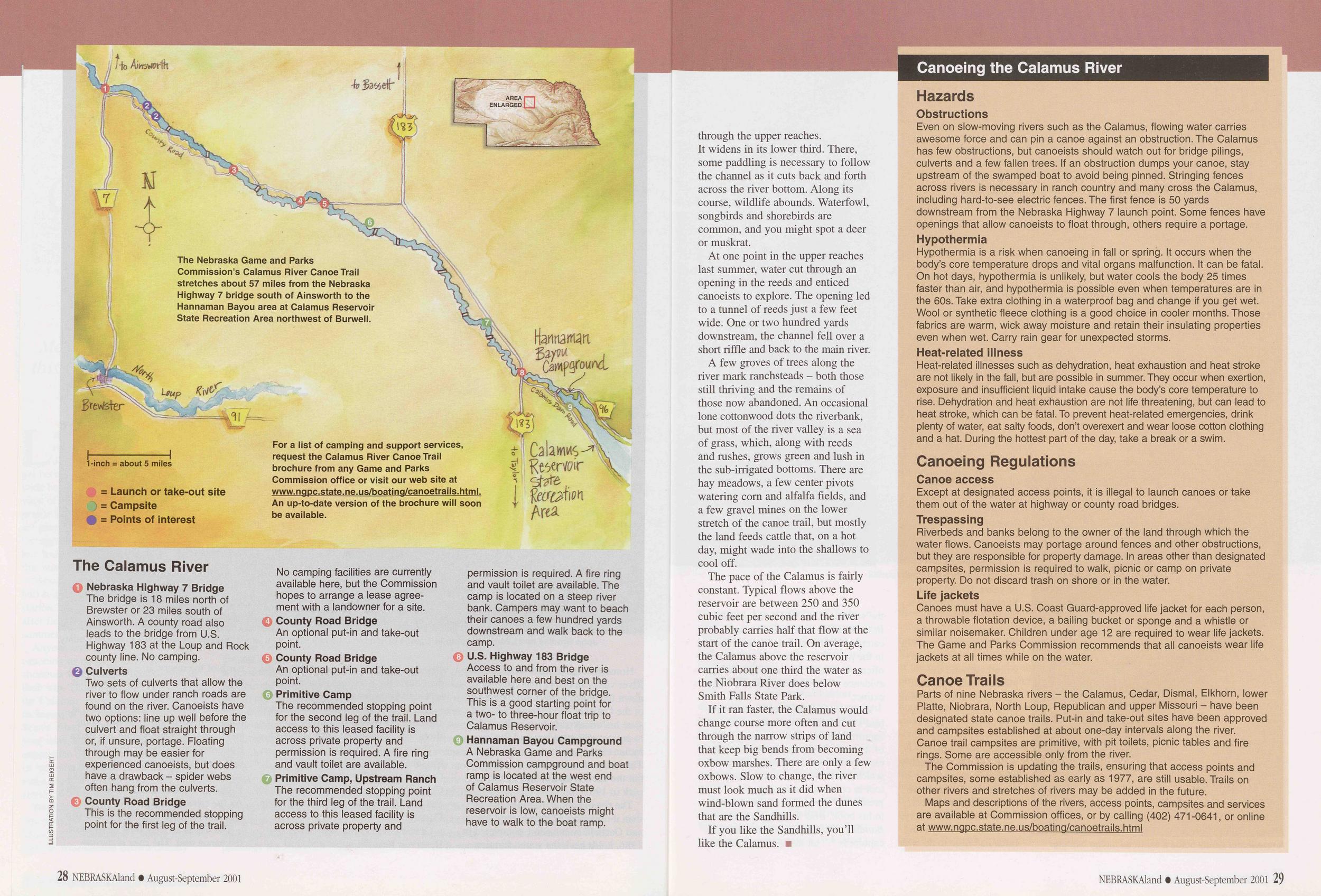
Canoeing the Calamus River
Photo and text by Eric Fowler Meandering 88 miles through the Sandhills, this scenic little river bestows serenity on those who dare slip a canoe into its waters.Like most of Nebraska's small rivers, the Calamus River f doesn't take the shortest route to get between two points. On some of its wide bends, canoeists get a 360-degree view of the river valley and the rolling prairie hills that stretch beyond. There are plenty of places where a portage through a few feet of reeds would cut hundreds of river yards off a trip down this meandering Sandhills stream.
"You can be on the river for a half-hour and stand and see where you started," said John Bradley of Omaha after floating a stretch of the river last summer. "It's a crooked little river."
Anyone who spends a summer day canoeing its course knows that taking shortcuts would defeat the purpose of their trip. There's no need to rush down the Calamus, once a candidate for inclusion in the National Wild and Scenic River System. It's better to take your time, soak up the scenery and experience the serenity the river offers. In fact, you might be more inclined to make a quick portage to revisit a stretch of river than to skip one.
The Calamus isn't long. It begins where trickles of water coming from Moon Lake Marsh and Clapper Lake meet in west-central Brown County south of Johnstown. It ends about 88 miles away when it joins the North Loup River northwest of Burwell.
The river drains about 1,060 square miles, but only 110 square miles contribute to surface runoff thanks to the sponge-like nature of the Sandhills. Like the north, middle and south branches of the Loup River, the Calamus is a drain for the vast Ogallala Aquifer, which lies beneath the High Plains. Water seeps from sandbanks along the river where it cuts into the Ogallala formation. Some springs bubble up from the riverbed. If you bury your hands in the riverbed sands, you can feel the cool, constant flow of groundwater seeping from below. In at least two places, water pours from pipes in the river that were set years ago to tap springs. Canoeists often fill their water bottles in these places. Better-tasting water is hard to find.
The river is named for a plant not native to the region and seldom found in the Calamus valley today. Acorus calamus, known best as sweet flag but also as bee wort, bitter pepper root, calamus root, myrtle grass and sweet rush, was prized by Native Americans for its medicinal properties. It was probably the Pawnee or Sioux who introduced the plant to the valley when they visited tjie area.
The medicinal powers of the reed-like plant, which grows two to three feet tall and sprouts small, green flowers, apparently were shared with Euroamericans long before they settled in the area. From 1820 to 1916, acorus calamus was listed in the U.S. Pharmacopeia and reportedly prescribed by physicians as a treatment for stomach cramps and gas. Native to northeastern states, its leaves also were used in salads and its roots were candied.
Homesteaders came to the Calamus River valley in the 1870s. Ten miles down the North Loup from the mouth of the Calamus, Fort Hartsuff, now a state historical park, was built in 1874 to protect white settlers and Pawnee Indians from hostile, nomadic Sioux. The Army abandoned the fort in 1881, but the site became a state historical parkin 1961.
The river is about 10 miles shorter than it once was. A dam at the Loup and Garfield county line, completed in 1986, holds back the water, forming Calamus Reservoir. Construction of the dam made the river ineligible for the scenic river designation, which is given to rivers that are undammed, unpolluted and have relatively undeveloped shorelines. Two out of three isn't bad.
Three major tributaries feed the Calamus. Skull Creek and Bloody Creek, both smaller versions of the Calamus, flow south from Rock County and join the river in northwestern Loup County.
Gracie Creek flows into Calamus Reservoir near the upper end. Just north of the reservoir, a small dam on the creek forms a two-acre pond that holds rainbow trout.
Hannaman Bayou Campground, at the upper end of the reservoir, is the end of the Nebraska Game and Parks Commission's Calamus River canoe trail - one of nine such trails in the state. The trail begins at the Nebraska Highway 7 bridge south of Ainsworth. As the crow flies, it's short. As the river flows, it's a two- to four-day trip.
The trip is an easy float on most of the canoe trail. The river is narrow
26 NEBRASKAland • August-September 2001 NEBRASKAland • August-September 2001 27
The Calamus River
Nebraska Highway 7 Bridge The bridge is 18 miles north of Brewster or 23 miles south of Ainsworth. A county road also leads to the bridge from U.S. Highway 183 at the Loup and Rock county line. No camping.
Culverts Two sets of culverts that allow the river to flow under ranch roads are found on the river. Canoeists have two options: line up well before the culvert and float straight through or, if unsure, portage. Floating through may be easier for experienced canoeists, but does have a drawback - spider webs often hang from the culverts.
County Road Bridge This is the recommended stopping point for the first leg of the trail. No camping facilities are currently available here, but the Commission hopes to arrange a lease agreement with a landowner for a site.
County Road Bridge An optional put-in and take-out point.
County Road Bridge An optional put-in and take-out point.
Primitive Camp The recommended stopping point for the second leg of the trail. Land access to this leased facility is across private property and permission is required. A fire ring and vault toilet are available. Primitive Camp, Upstream Ranch The recommended stopping point for the third leg of the trail. Land access to this leased facility is across private property and permission is required. A fire ring and vault toilet are available. The camp is located on a steep river bank. Campers may want to beach their canoes a few hundred yards downstream and walk back to the camp.
U.S. Highway 183 Bridge Access to and from the river is available here and best on the southwest corner of the bridge. This is a good starting point for a two- to three-hour float trip to Calamus Reservoir.
Hannaman Bayou Campground A Nebraska Game and Parks Commission campground and boat ramp is located at the west end of Calamus Reservoir State Recreation Area. When the reservoir is low, canoeists might have to walk to the boat ramp.
through the upper reaches. It widens in its lower third. There, some paddling is necessary to follow the channel as it cuts back and forth across the river bottom. Along its course, wildlife abounds. Waterfowl, songbirds and shorebirds are common, and you might spot a deer or muskrat.
At one point in the upper reaches last summer, water cut through an opening in the reeds and enticed canoeists to explore. The opening led to a tunnel of reeds just a few feet wide. One or two hundred yards downstream, the channel fell over a short riffle and back to the main river.
A few groves of trees along the river mark ranchsteads - both those still thriving and the remains of those now abandoned. An occasional lone cottonwood dots the riverbank, but most of the river valley is a sea of grass, which, along with reeds and rushes, grows green and lush in the sub-irrigated bottoms. There are hay meadows, a few center pivots watering corn and alfalfa fields, and a few gravel mines on the lower stretch of the canoe trail, but mostly the land feeds cattle that, on a hot day, might wade into the shallows to cool off.
The pace of the Calamus is fairly constant. Typical flows above the reservoir are between 250 and 350 cubic feet per second and the river probably carries half that flow at the start of the canoe trail. On average, the Calamus above the reservoir carries about one third the water as the Niobrara River does below Smith Falls State Park.
If it ran faster, the Calamus would change course more often and cut through the narrow strips of land that keep big bends from becoming oxbow marshes. There are only a few oxbows. Slow to change, the river must look much as it did when wind-blown sand formed the dunes that are the Sandhills.
If you like the Sandhills, you'll like the Calamus.
Canoeing the Calamus River Hazards ObstructionsEven on slow-moving rivers such as the Calamus, flowing water carries awesome force and can pin a canoe against an obstruction. The Calamus has few obstructions, but canoeists should watch out for bridge pilings, culverts and a few fallen trees. If an obstruction dumps your canoe, stay upstream of the swamped boat to avoid being pinned. Stringing fences across rivers is necessary in ranch country and many cross the Calamus, including hard-to-see electric fences. The first fence is 50 yards downstream from the Nebraska Highway 7 launch point. Some fences have openings that allow canoeists to float through, others require a portage.
HypothermiaHypothermia is a risk when canoeing in fall or spring. It occurs when the body's core temperature drops and vital organs malfunction. It can be fatal. On hot days, hypothermia is unlikely, but water cools the body 25 times faster than air, and hypothermia is possible even when temperatures are in the 60s. Take extra clothing in a waterproof bag and change if you get wet. Wool or synthetic fleece clothing is a good choice in cooler months. Those fabrics are warm, wick away moisture and retain their insulating properties even when wet. Carry rain gear for unexpected storms.
Heat-related illnessHeat-related illnesses such as dehydration, heat exhaustion and heat stroke are not likely in the fall, but are possible in summer. They occur when exertion, exposure and insufficient liquid intake cause the body's core temperature to rise. Dehydration and heat exhaustion are not life threatening, but can lead to heat stroke, which can be fatal. To prevent heat-related emergencies, drink plenty of water, eat salty foods, don't overexert and wear loose cotton clothing and a hat. During the hottest part of the day, take a break or a swim.
Canoeing Regulations Canoe accessExcept at designated access points, it is illegal to launch canoes or take them out of the water at highway or county road bridges.
TrespassingRiverbeds and banks belong to the owner of the land through which the water flows. Canoeists may portage around fences and other obstructions, but they are responsible for property damage. In areas other than designated campsites, permission is required to walk, picnic or camp on private property. Do not discard trash on shore or in the water.
Life jacketsCanoes must have a U.S. Coast Guard-approved life jacket for each person, a throwable flotation device, a bailing bucket or sponge and a whistle or similar noisemaker. Children under age 12 are required to wear life jackets. The Game and Parks Commission recommends that all canoeists wear life jackets at all times while on the water.
Canoe TrailsParts of nine Nebraska rivers - the Calamus, Cedar, Dismal, Elkhorn, lower Platte, Niobrara, North Loup, Republican and upper Missouri - have been designated state canoe trails. Put-in and take-out sites have been approved and campsites established at about one-day intervals along the river. Canoe trail campsites are primitive, with pit toilets, picnic tables and fire rings. Some are accessible only from the river.
The Commission is updating the trails, ensuring that access points and campsites, some established as early as 1977, are still usable. Trails on other rivers and stretches of rivers may be added in the future. Maps and descriptions of the rivers, access points, campsites and services are available at Commission offices, or by calling (402) 471-0641, or online at www.napc.state.ne.us/boatina/canoetrails.html
28 NEBRASKAland • August-September 2001 NEBRASKAland • August-September 2001 29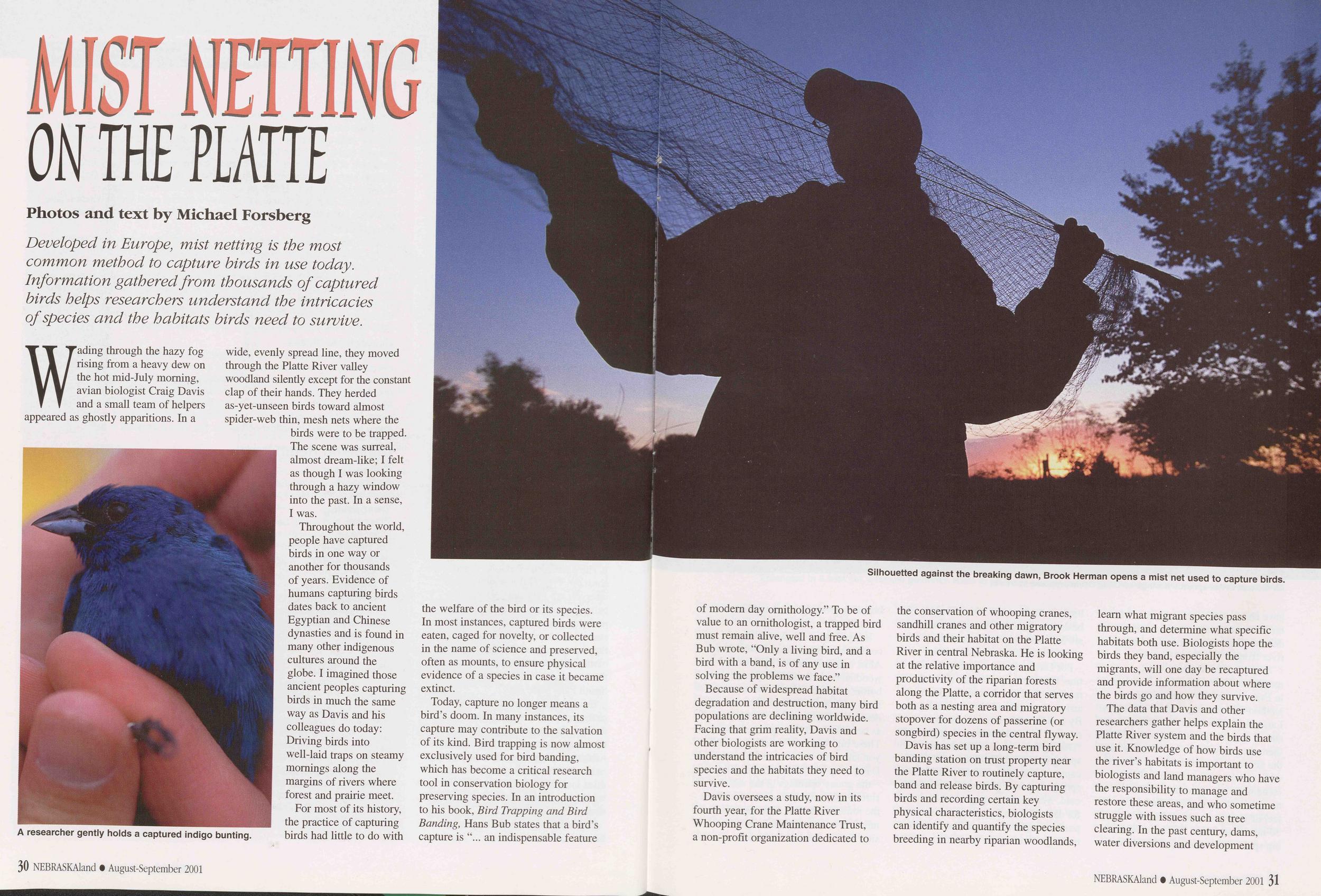
MIST NETTING ON THE PLATTE
Photos and text by Michael Forsberg Developed in Europe, mist netting is the most common method to capture birds in use today. Information gathered from thousands of captured birds helps researchers understand the intricacies of species and the habitats birds need to survive.Wading through the hazy fog rising from a heavy dew on the hot mid-July morning, avian biologist Craig Davis and a small team of helpers appeared as ghostly apparitions. In a A researcher gently holds a captured indigo wide, evenly spread line, they moved through the Platte River valley woodland silently except for the constant clap of their hands. They herded as-yet-unseen birds toward almost spider-web thin, mesh nets where the birds were to be trapped. The scene was surreal, almost dream-like; I felt as though I was looking through a hazy window into the past. In a sense, I was.
Throughout the world, people have captured birds in one way or another for thousands of years. Evidence of humans capturing birds dates back to ancient Egyptian and Chinese dynasties and is found in many other indigenous cultures around the globe. I imagined those ancient peoples capturing birds in much the same way as Davis and his colleagues do today: Driving birds into well-laid traps on steamy mornings along the margins of rivers where forest and prairie meet.
For most of its history, the practice of capturing bunting. birds had little to do with Silhouetted against the breaking dawn, Brook Herman opens a mist net used to capture birds. the welfare of the bird or its species. In most instances, captured birds were eaten, caged for novelty, or collected in the name of science and preserved, often as mounts, to ensure physical evidence of a species in case it became extinct.
Today, capture no longer means a bird's doom. In many instances, its capture may contribute to the salvation of its kind. Bird trapping is now almost exclusively used for bird banding, which has become a critical research tool in conservation biology for preserving species. In an introduction to his book, Bird Trapping and Bird Banding, Hans Bub states that a bird's capture is "... an indispensable feature of modern day ornithology." To be of value to an ornithologist, a trapped bird must remain alive, well and free. As Bub wrote, "Only a living bird, and a bird with a band, is of any use in solving the problems we face."
Because of widespread habitat degradation and destruction, many bird populations are declining worldwide. Facing that grim reality, Davis and other biologists are working to understand the intricacies of bird species and the habitats they need to survive.
Davis oversees a study, now in its fourth year, for the Platte River Whooping Crane Maintenance Trust, a non-profit organization dedicated to the conservation of whooping cranes, sandhill cranes and other migratory birds and their habitat on the Platte River in central Nebraska. He is looking at the relative importance and productivity of the riparian forests along the Platte, a corridor that serves both as a nesting area and migratory stopover for dozens of passerine (or songbird) species in the central flyway.
Davis has set up a long-term bird banding station on trust property near the Platte River to routinely capture, band and release birds. By capturing birds and recording certain key physical characteristics, biologists can identify and quantify the species breeding in nearby riparian woodlands, learn what migrant species pass through, and determine what specific habitats both use. Biologists hope the birds they band, especially the migrants, will one day be recaptured and provide information about where the birds go and how they survive.
The data that Davis and other
researchers gather helps explain the
Platte River system and the birds that
use it. Knowledge of how birds use
the river's habitats is important to
biologists and land managers who have
the responsibility to manage and
restore these areas, and who sometime
struggle with issues such as tree
clearing. In the past century, dams,
water diversions and development
30 NEBRASKAland • August-September 2001
NEBRASKAland • August-September 2001 31
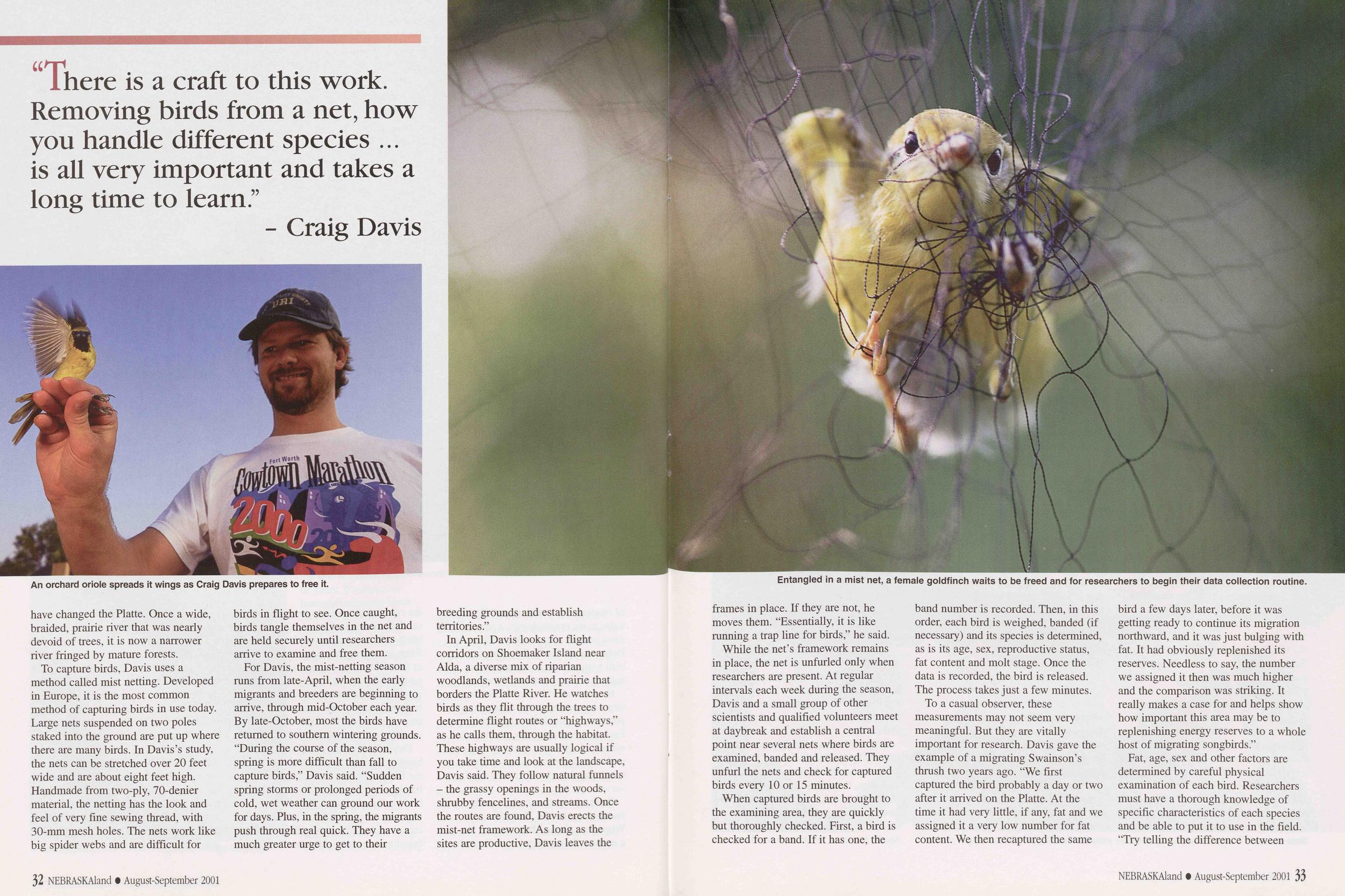 have changed the Platte. Once a wide,
braided, prairie river that was nearly
devoid of trees, it is now a narrower
river fringed by mature forests.
have changed the Platte. Once a wide,
braided, prairie river that was nearly
devoid of trees, it is now a narrower
river fringed by mature forests.
To capture birds, Davis uses a method called mist netting. Developed in Europe, it is the most common method of capturing birds in use today. Large nets suspended on two poles staked into the ground are put up where there are many birds. In Davis's study, the nets can be stretched over 20 feet wide and are about eight feet high. Handmade from two-ply, 70-denier material, the netting has the look and feel of very fine sewing thread, with 30-rnm mesh holes. The nets work like big spider webs and are difficult for birds in flight to see. Once caught, birds tangle themselves in the net and are held securely until researchers arrive to examine and free them.
For Davis, the mist-netting season runs from late-April, when the early migrants and breeders are beginning to arrive, through mid-October each year. By late-October, most the birds have returned to southern wintering grounds. "During the course of the season, spring is more difficult than fall to capture birds," Davis said. "Sudden spring storms or prolonged periods of cold, wet weather can ground our work for days. Plus, in the spring, the migrants push through real quick. They have a much greater urge to get to their breeding grounds and establish territories."
In April, Davis looks for flight corridors on Shoemaker Island near Alda, a diverse mix of riparian woodlands, wetlands and prairie that borders the Platte River. He watches birds as they flit through the trees to determine flight routes or "highways," as he calls them, through the habitat. These highways are usually logical if you take time and look at the landscape, Davis said. They follow natural funnels - the grassy openings in the woods, shrubby fence lines, and streams. Once the routes are found, Davis erects the mist-net framework. As long as the sites are productive, Davis leaves the frames in place. If they are not, he moves them. "Essentially, it is like running a trap line for birds," he said.
While the net's framework remains in place, the net is unfurled only when researchers are present. At regular intervals each week during the season, Davis and a small group of other scientists and qualified volunteers meet at daybreak and establish a central point near several nets where birds are examined, banded and released. They unfurl the nets and check for captured birds every 10 or 15 minutes.
When captured birds are brought to the examining area, they are quickly but thoroughly checked. First, a bird is checked for a band. If it has one, the band number is recorded. Then, in this order, each bird is weighed, banded (if necessary) and its species is determined, as is its age, sex, reproductive status, fat content and molt stage. Once the data is recorded, the bird is released. The process takes just a few minutes.
To a casual observer, these measurements may not seem very meaningful. But they are vitally important for research. Davis gave the example of a migrating Swainson's thrush two years ago. "We first captured the bird probably a day or two after it arrived on the Platte. At the time it had very little, if any, fat and we assigned it a very low number for fat content. We then recaptured the same bird a few days later, before it was getting ready to continue its migration northward, and it was just bulging with fat. It had obviously replenished its reserves. Needless to say, the number we assigned it then was much higher and the comparison was striking. It really makes a case for and helps show how important this area may be to replenishing energy reserves to a whole host of migrating songbirds."
Fat, age, sex and other factors are
determined by careful physical
examination of each bird. Researchers
must have a thorough knowledge of
specific characteristics of each species
and be able to put it to use in the field.
"Try telling the difference between
32 NEBRASKAland • August-September 2001
NEBRASKAland • August-September 2001 33
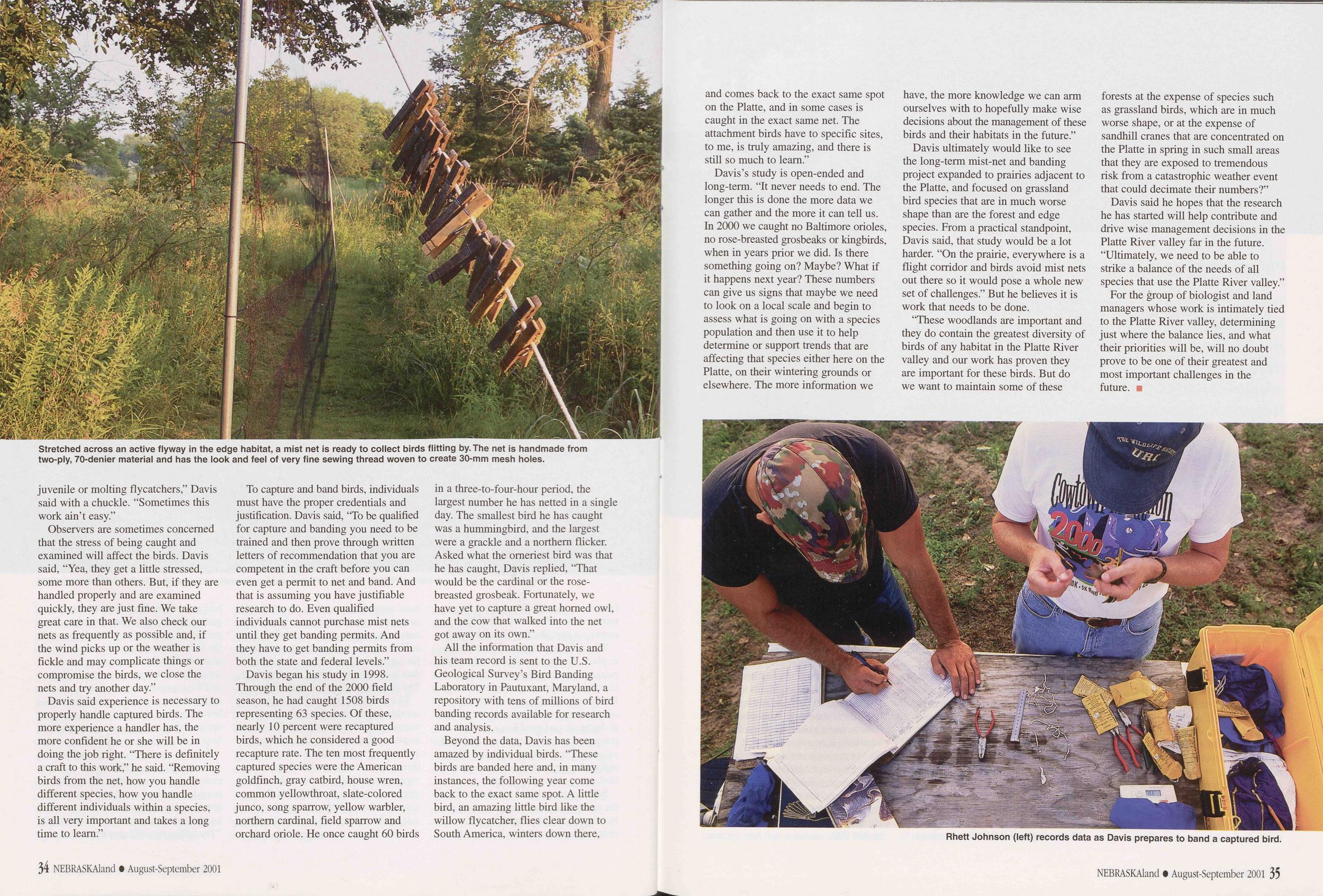 juvenile or molting flycatchers," Davis
said with a chuckle. "Sometimes this
work ain't easy."
juvenile or molting flycatchers," Davis
said with a chuckle. "Sometimes this
work ain't easy."
Observers are sometimes concerned that the stress of being caught and examined will affect the birds. Davis said, "Yea, they get a little stressed, some more than others. But, if they are handled properly and are examined quickly, they are just fine. We take great care in that. We also check our nets as frequently as possible and, if the wind picks up or the weather is fickle and may complicate things or compromise the birds, we close the nets and try another day."
Davis said experience is necessary to properly handle captured birds. The more experience a handler has, the more confident he or she will be in doing the job right. "There is definitely a craft to this work," he said. "Removing birds from the net, how you handle different species, how you handle different individuals within a species, is all very important and takes a long time to learn."
To capture and band birds, individuals must have the proper credentials and justification. Davis said, "To be qualified for capture and banding you need to be trained and then prove through written letters of recommendation that you are competent in the craft before you can even get a permit to net and band. And that is assuming you have justifiable research to do. Even qualified individuals cannot purchase mist nets until they get banding permits. And they have to get banding permits from both the state and federal levels."
Davis began his study in 1998. Through the end of the 2000 field season, he had caught 1508 birds representing 63 species. Of these, nearly 10 percent were recaptured birds, which he considered a good recapture rate. The ten most frequently captured species were the American goldfinch, gray catbird, house wren, common yellowthroat, slate-colored junco, song sparrow, yellow warbler, northern cardinal, field sparrow and orchard oriole. He once caught 60 birds in a three-to-four-hour period, the largest number he has netted in a single day. The smallest bird he has caught was a hummingbird, and the largest were a grackle and a northern flicker. Asked what the orneriest bird was that he has caught, Davis replied, "That would be the cardinal or the rose breasted grosbeak. Fortunately, we have yet to capture a great horned owl, and the cow that walked into the net got away on its own."
All the information that Davis and his team record is sent to the U.S. Geological Survey's Bird Banding Laboratory in Pautuxant, Maryland, a repository with tens of millions of bird banding records available for research and analysis.
Beyond the data, Davis has been amazed by individual birds. "These birds are banded here and, in many instances, the following year come back to the exact same spot. A little bird, an amazing little bird like the willow flycatcher, flies clear down to South America, winters down there, and comes back to the exact same spot on the Platte, and in some cases is caught in the exact same net. The attachment birds have to specific sites, to me, is truly amazing, and there is still so much to learn."
Davis's study is open-ended and long-term. "It never needs to end. The longer this is done the more data we can gather and the more it can tell us. In 2000 we caught no Baltimore orioles, no rose-breasted grosbeaks or kingbirds, when in years prior we did. Is there something going on? Maybe? What if it happens next year? These numbers can give us signs that maybe we need to look on a local scale and begin to assess what is going on with a species population and then use it to help determine or support trends that are affecting that species either here on the Platte, on their wintering grounds or elsewhere. The more information we have, the more knowledge we can arm ourselves with to hopefully make wise decisions about the management of these birds and their habitats in the future."
Davis ultimately would like to see the long-term mist-net and banding project expanded to prairies adjacent to the Platte, and focused on grassland bird species that are in much worse shape than are the forest and edge species. From a practical standpoint, Davis said, that study would be a lot harder. "On the prairie, everywhere is a flight corridor and birds avoid mist nets out there so it would pose a whole new set of challenges." But he believes it is work that needs to be done.
"These woodlands are important and they do contain the greatest diversity of birds of any habitat in the Platte River valley and our work has proven they are important for these birds. But do we want to maintain some of these forests at the expense of species such as grassland birds, which are in much worse shape, or at the expense of sandhill cranes that are concentrated on the Platte in spring in such small areas that they are exposed to tremendous risk from a catastrophic weather event that could decimate their numbers?"
Davis said he hopes that the research he has started will help contribute and drive wise management decisions in the Platte River valley far in the future. "Ultimately, we need to be able to strike a balance of the needs of all species that use the Platte River valley."
For the group of biologist and land managers whose work is intimately tied to the Platte River valley, determining just where the balance lies, and what their priorities will be, will no doubt prove to be one of their greatest and most important challenges in the future.
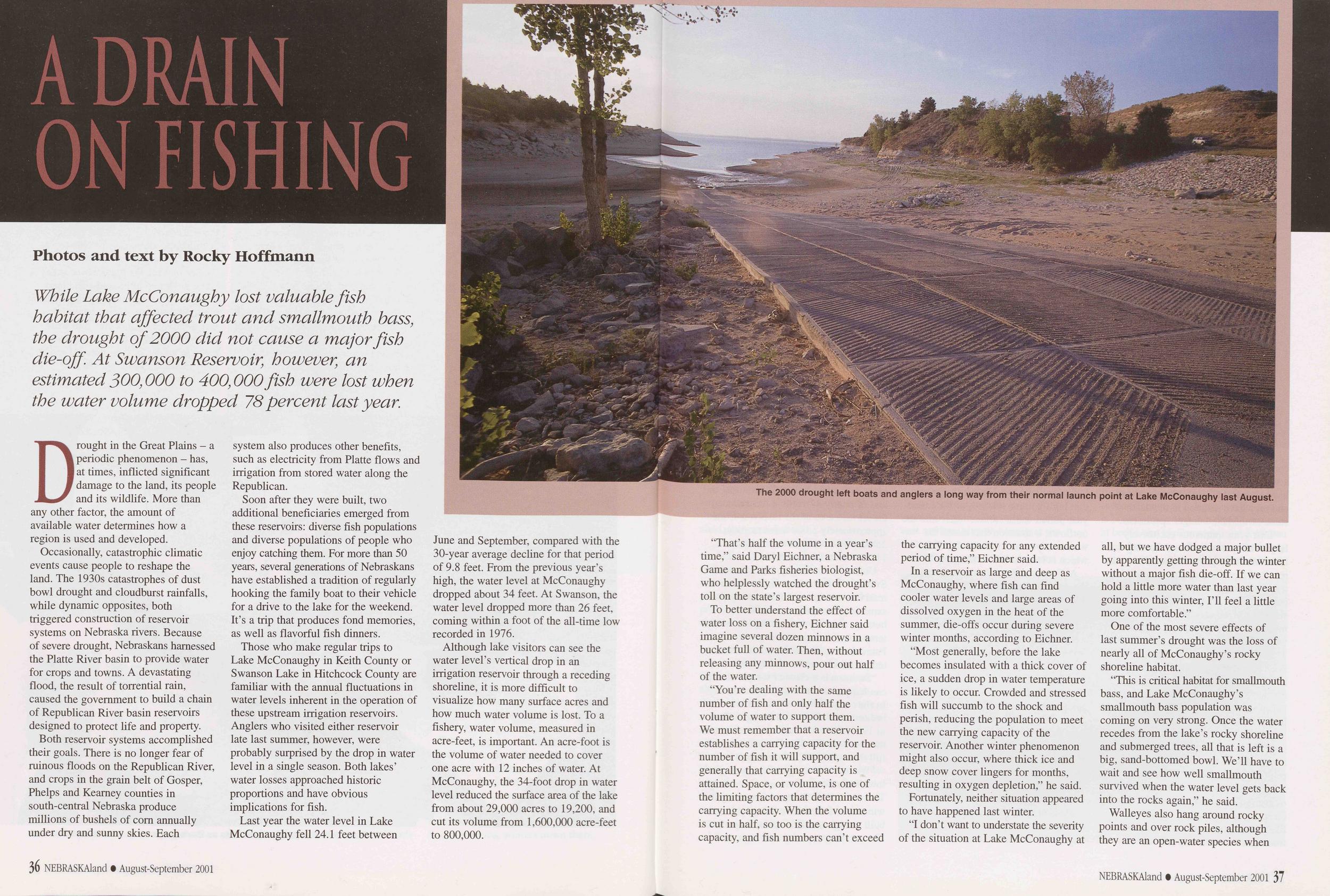
A Drain on Fishing
Photos and text by Rocky Hoffmann While Lake McConaughy lost valuable fish habitat that affected trout and smallmouth bass, the drought of 2000 did not cause a major fish die-off At Swanson Reservoir, however, an estimated 300,000 to 400,000 fish were lost when the water volume dropped 78 percent last year.Drought in the Great Plains - a periodic phenomenon - has, at times, inflicted significant damage to the land, its people and its wildlife. More than any other factor, the amount of available water determines how a region is used and developed.
Occasionally, catastrophic climatic events cause people to reshape the land. The 1930s catastrophes of dust bowl drought and cloudburst rainfalls, while dynamic opposites, both triggered construction of reservoir systems on Nebraska rivers. Because of severe drought, Nebraskans harnessed the Platte River basin to provide water for crops and towns. A devastating flood, the result of torrential rain, caused the government to build a chain of Republican River basin reservoirs designed to protect life and property.
Both reservoir systems accomplished their goals. There is no longer fear of ruinous floods on the Republican River, and crops in the grain belt of Gosper, Phelps and Kearney counties in south-central Nebraska produce millions of bushels of corn annually under dry and sunny skies. Each system also produces other benefits, such as electricity from Platte flows and irrigation from stored water along the Republican.
Soon after they were built, two additional beneficiaries emerged from these reservoirs: diverse fish populations and diverse populations of people who enjoy catching them. For more than 50 years, several generations of Nebraskans have established a tradition of regularly hooking the family boat to their vehicle for a drive to the lake for the weekend. It's a trip that produces fond memories, as well as flavorful fish dinners.
Those who make regular trips to Lake McConaughy in Keith County or Swanson Lake in Hitchcock County are familiar with the annual fluctuations in water levels inherent in the operation of these upstream irrigation reservoirs. Anglers who visited either reservoir late last summer, however, were probably surprised by the drop in water level in a single season. Both lakes' water losses approached historic proportions and have obvious implications for fish.
Last year the water level in Lake McConaughy fell 24.1 feet between June and September, compared with the 30-year average decline for that period of 9.8 feet. From the previous year's high, the water level at McConaughy dropped about 34 feet. At Swanson, the water level dropped more than 26 feet, coming within a foot of the all-time low recorded in 1976.
Although lake visitors can see the water level's vertical drop in an irrigation reservoir through a receding shoreline, it is more difficult to visualize how many surface acres and how much water volume is lost. To a fishery, water volume, measured in acre-feet, is important. An acre-foot is the volume of water needed to cover one acre with 12 inches of water. At McConaughy, the 34-foot drop in water level reduced the surface area of the lake from about 29,000 acres to 19,200, and cut its volume from 1,600,000 acre-feet to 800,000.
The 2000 drought left boats and anglers a long way from their normal launch point at Lake McConaughy last August. "That's half the volume in a year's time," said Daryl Eichner, a Nebraska Game and Parks fisheries biologist, who helplessly watched the drought's toll on the state's largest reservoir. To better understand the effect of water loss on a fishery, Eichner said imagine several dozen minnows in a bucket full of water. Then, without releasing any minnows, pour out half of the water.
"You're dealing with the same number of fish and only half the volume of water to support them. We must remember that a reservoir establishes a carrying capacity for the number of fish it will support, and generally that carrying capacity is attained. Space, or volume, is one of the limiting factors that determines the carrying capacity. When the volume is cut in half, so too is the carrying capacity, and fish numbers can't exceed the carrying capacity for any extended period of time," Eichner said.
In a reservoir as large and deep as McConaughy, where fish can find cooler water levels and large areas of dissolved oxygen in the heat of the summer, die-offs occur during severe winter months, according to Eichner.
"Most generally, before the lake becomes insulated with a thick cover of ice, a sudden drop in water temperature is likely to occur. Crowded and stressed fish will succumb to the shock and perish, reducing the population to meet the new carrying capacity of the reservoir. Another winter phenomenon might also occur, where thick ice and deep snow cover lingers for months, resulting in oxygen depletion," he said.
Fortunately, neither situation appeared to have happened last winter.
"I don't want to understate the severity of the situation at Lake McConaughy at all, but we have dodged a major bullet by apparently getting through the winter without a major fish die-off. If we can hold a little more water than last year going into this winter, I'll feel a little more comfortable."
One of the most severe effects of last summer's drought was the loss of nearly all of McConaughy's rocky shoreline habitat.
"This is critical habitat for smallmouth bass, and Lake McConaughy's smallmouth bass population was coming on very strong. Once the water recedes from the lake's rocky shoreline and submerged trees, all that is left is a big, sand-bottomed bowl. We'll have to wait and see how well smallmouth survived when the water level gets back into the rocks again," he said.
Walleyes also hang around rocky
points and over rock piles, although
they are an open-water species when
36 NEBRASKAland • August-September 2001
NEBRASKAland • August-September 2001 37
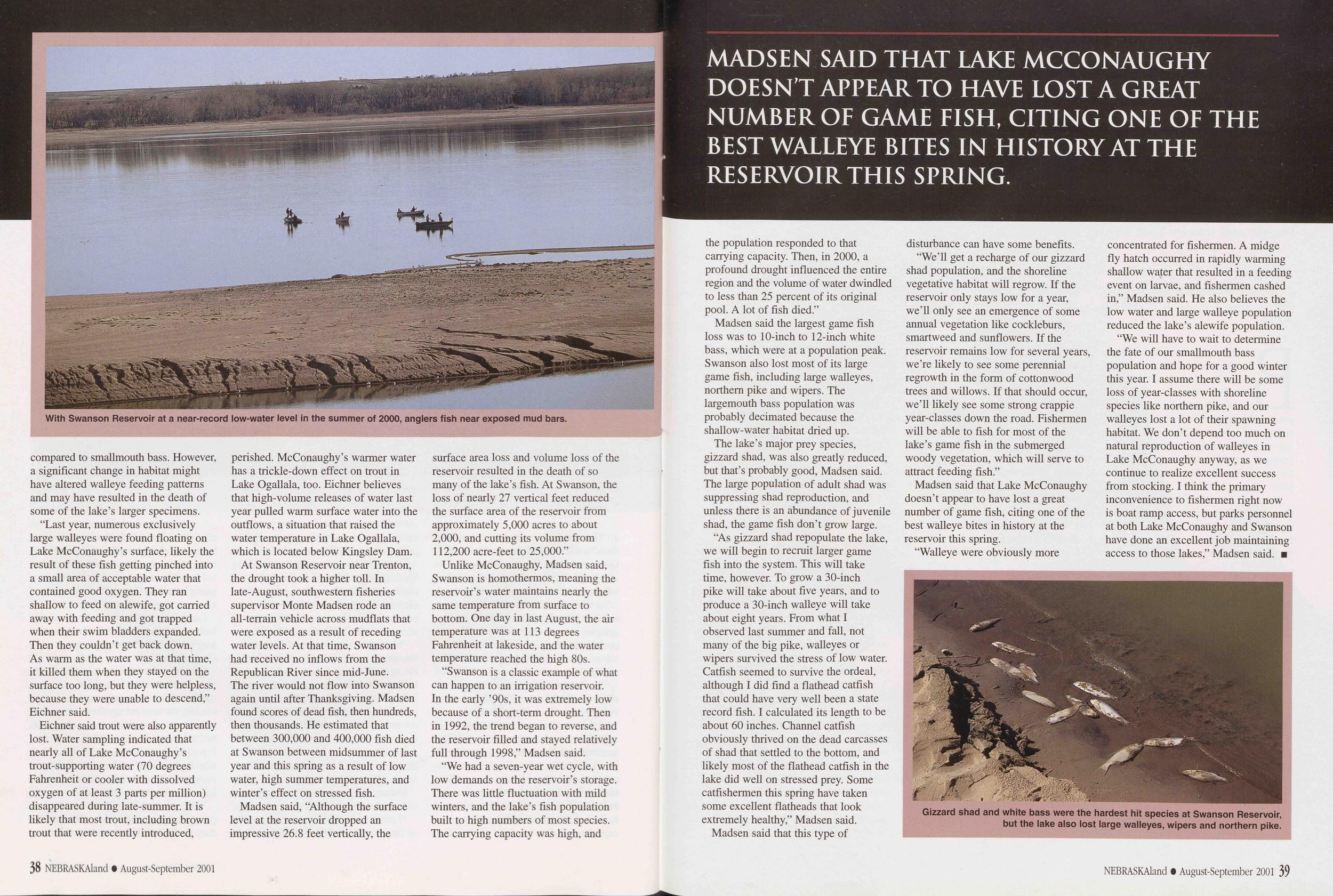 compared to smallmouth bass. However,
a significant change in habitat might
have altered walleye feeding patterns
and may have resulted in the death of
some of the lake's larger specimens.
compared to smallmouth bass. However,
a significant change in habitat might
have altered walleye feeding patterns
and may have resulted in the death of
some of the lake's larger specimens.
"Last year, numerous exclusively large walleyes were found floating on Lake McConaughy's surface, likely the result of these fish getting pinched into a small area of acceptable water that contained good oxygen. They ran shallow to feed on alewife, got carried away with feeding and got trapped when their swim bladders expanded. Then they couldn't get back down. As warm as the water was at that time, it killed them when they stayed on the surface too long, but they were helpless, because they were unable to descend," Eichner said.
Eichner said trout were also apparently lost. Water sampling indicated that nearly all of Lake McConaughy's trout-supporting water (70 degrees Fahrenheit or cooler with dissolved oxygen of at least 3 parts per million) disappeared during late-summer. It is likely that most trout, including brown trout that were recently introduced, perished. McConaughy's warmer water has a trickle-down effect on trout in Lake Ogallala, too. Eichner believes that high-volume releases of water last year pulled warm surface water into the outflows, a situation that raised the water temperature in Lake Ogallala, which is located below Kingsley Dam.
At Swanson Reservoir near Trenton, the drought took a higher toll. In late-August, southwestern fisheries supervisor Monte Madsen rode an all-terrain vehicle across mudflats that were exposed as a result of receding water levels. At that time, Swanson had received no inflows from the Republican River since mid-June. The river would not flow into Swanson again until after Thanksgiving. Madsen found scores of dead fish, then hundreds, then thousands. He estimated that between 300,000 and 400,000 fish died at Swanson between midsummer of last year and this spring as a result of low water, high summer temperatures, and winter's effect on stressed fish.
Madsen said, "Although the surface level at the reservoir dropped an impressive 26.8 feet vertically, the surface area loss and volume loss of the reservoir resulted in the death of so many of the lake's fish. At Swanson, the loss of nearly 27 vertical feet reduced the surface area of the reservoir from approximately 5,000 acres to about 2,000, and cutting its volume from 112,200 acre-feet to 25,000."
Unlike McConaughy, Madsen said, Swanson is homothermos, meaning the reservoir's water maintains nearly the same temperature from surface to bottom. One day in last August, the air temperature was at 113 degrees Fahrenheit at lakeside, and the water temperature reached the high 80s.
"Swanson is a classic example of what can happen to an irrigation reservoir. In the early '90s, it was extremely low because of a short-term drought. Then in 1992, the trend began to reverse, and the reservoir filled and stayed relatively full through 1998," Madsen said.
"We had a seven-year wet cycle, with low demands on the reservoir's storage. There was little fluctuation with mild winters, and the lake's fish population built to high numbers of most species. The carrying capacity was high, and the population responded to that carrying capacity. Then, in 2000, a profound drought influenced the entire region and the volume of water dwindled to less than 25 percent of its original pool. A lot of fish died."
Madsen said the largest game fish loss was to 10-inch to 12-inch white bass, which were at a population peak. Swanson also lost most of its large game fish, including large walleyes, northern pike and wipers. The largemouth bass population was probably decimated because the shallow-water habitat dried up.
The lake's major prey species, gizzard shad, was also greatly reduced, but that's probably good, Madsen said. The large population of adult shad was suppressing shad reproduction, and unless there is an abundance of juvenile shad, the game fish don't grow large.
"As gizzard shad repopulate the lake, we will begin to recruit larger game fish into the system. This will take time, however. To grow a 30-inch pike will take about five years, and to produce a 30-inch walleye will take about eight years. From what I observed last summer and fall, not many of the big pike, walleyes or wipers survived the stress of low water. Catfish seemed to survive the ordeal, although I did find a flathead catfish that could have very well been a state record fish. I calculated its length to be about 60 inches. Channel catfish obviously thrived on the dead carcasses of shad that settled to the bottom, and likely most of the flathead catfish in the lake did well on stressed prey. Some catfishermen this spring have taken some excellent flatheads that look extremely healthy," Madsen said.
Madsen said that this type of disturbance can have some benefits.
"We'll get a recharge of our gizzard shad population, and the shoreline vegetative habitat will regrow. If the reservoir only stays low for a year, we'll only see an emergence of some annual vegetation like cockleburs, smartweed and sunflowers. If the reservoir remains low for several years, we're likely to see some perennial regrowth in the form of Cottonwood trees and willows. If that should occur, we'll likely see some strong crappie year-classes down the road. Fishermen will be able to fish for most of the lake's game fish in the submerged woody vegetation, which will serve to attract feeding fish."
Madsen said that Lake McConaughy doesn't appear to have lost a great number of game fish, citing one of the best walleye bites in history at the reservoir this spring.
"Walleye were obviously more concentrated for fishermen. A midge fly hatch occurred in rapidly warming shallow water that resulted in a feeding event on larvae, and fishermen cashed in," Madsen said. He also believes the low water and large walleye population reduced the lake's alewife population.
"We will have to wait to determine the fate of our smallmouth bass population and hope for a good winter this year. I assume there will be some loss of year-classes with shoreline species like northern pike, and our walleyes lost a lot of their spawning habitat. We don't depend too much on natural reproduction of walleyes in Lake McConaughy anyway, as we continue to realize excellent success from stocking. I think the primary inconvenience to fishermen right now is boat ramp access, but parks personnel at both Lake McConaughy and Swanson have done an excellent job maintaining access to those lakes," Madsen said.
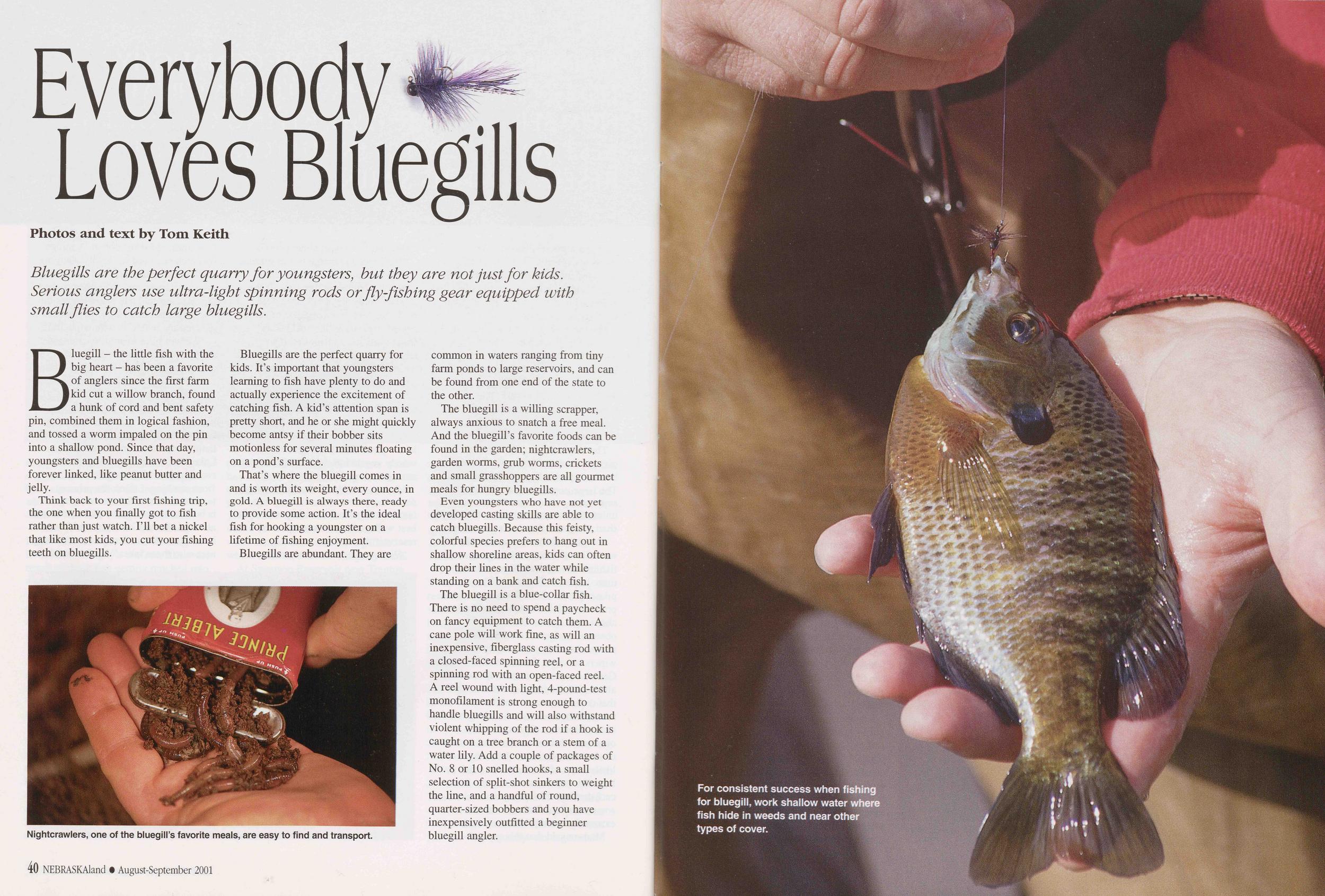
Everybody Loves Blue
Photos and text by Tom Keith Bluegills are the perfect quarry for youngsters, but they are not just for kids. Serious anglers use ultra-light spinning rods or fly-fishing gear equipped with small flies to catch large bluegills.Bluegill - the little fish with the big heart - has been a favorite of anglers since the first farm kid cut a willow branch, found a hunk of cord and bent safety pin, combined them in logical fashion, and tossed a worm impaled on the pin into a shallow pond. Since that day, youngsters and bluegills have been forever linked, like peanut butter and jelly.
Think back to your first fishing trip, the one when you finally got to fish rather than just watch. I'll bet a nickel that like most kids, you cut your fishing teeth on bluegills.
Bluegills are the perfect quarry for kids. It's important that youngsters learning to fish have plenty to do and actually experience the excitement of catching fish. A kid's attention span is pretty short, and he or she might quickly become antsy if their bobber sits motionless for several minutes floating on a pond's surface.
That's where the bluegill comes in and is worth its weight, every ounce, in gold. A bluegill is always there, ready to provide some action. It's the ideal fish for hooking a youngster on a lifetime of fishing enjoyment.
Bluegills are abundant. They are Nightcrawlers, one of the bluegill's favorite meals, are easy to find and transport. common in waters ranging from tiny farm ponds to large reservoirs, and can be found from one end of the state to the other.
The bluegill is a willing scrapper, always anxious to snatch a free meal. And the bluegill's favorite foods can be found in the garden; nightcrawlers, garden worms, grub worms, crickets and small grasshoppers are all gourmet meals for hungry bluegills.
Even youngsters who have not yet developed casting skills are able to catch bluegills. Because this feisty, colorful species prefers to hang out in shallow shoreline areas, kids can often drop their lines in the water while standing on a bank and catch fish.
The bluegill is a blue-collar fish. There is no need to spend a paycheck on fancy equipment to catch them. A cane pole will work fine, as will an inexpensive, fiberglass casting rod with a closed-faced spinning reel, or a spinning rod with an open-faced reel. A reel wound with light, 4-pound-test monofilament is strong enough to handle bluegills and will also withstand violent whipping of the rod if a hook is caught on a tree branch or a stem of a water lily. Add a couple of packages of No. 8 or 10 snelled hooks, a small selection of split-shot sinkers to weight the line, and a handful of round, quarter-sized bobbers and you have inexpensively outfitted a beginner bluegill angler.
40 NEBRASKAland • August-September 2001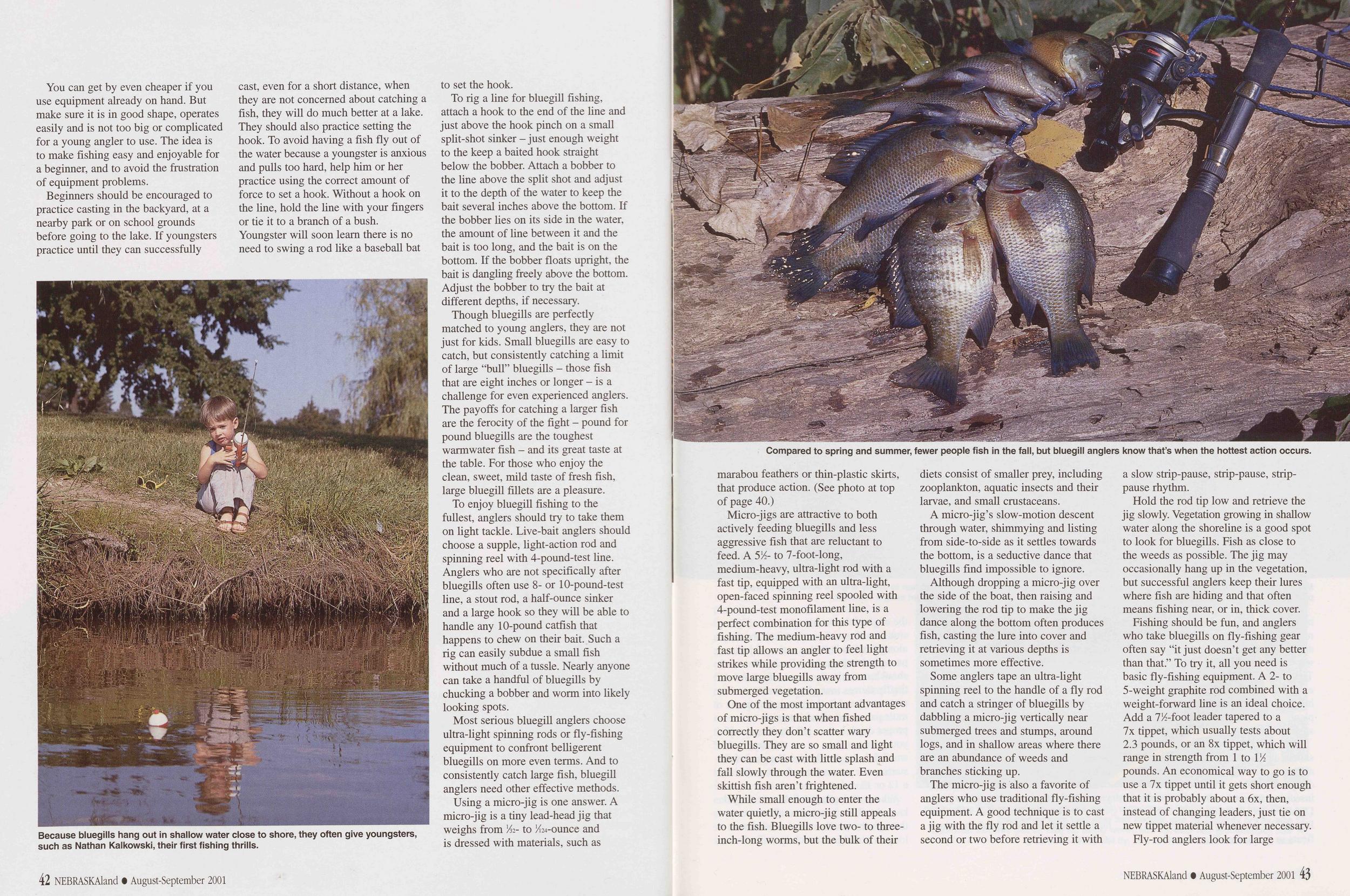
You can get by even cheaper if you use equipment already on hand. But make sure it is in good shape, operates easily and is not too big or complicated for a young angler to use. The idea is to make fishing easy and enjoyable for a beginner, and to avoid the frustration of equipment problems.
Beginners should be encouraged to practice casting in the backyard, at a nearby park or on school grounds before going to the lake. If youngsters practice until they can successfully cast, even for a short distance, when they are not concerned about catching a fish, they will do much better at a lake. They should also practice setting the hook. To avoid having a fish fly out of the water because a youngster is anxious and pulls too hard, help him or her practice using the correct amount of force to set a hook. Without a hook on the line, hold the line with your fingers or tie it to a branch of a bush. Youngster will soon learn there is no need to swing a rod like a baseball bat to set the hook.
To rig a line for bluegill fishing, attach a hook to the end of the line and just above the hook pinch on a small split-shot sinker -just enough weight to the keep a baited hook straight below the bobber. Attach a bobber to the line above the split shot and adjust it to the depth of the water to keep the bait several inches above the bottom. If the bobber lies on its side in the water, the amount of line between it and the bait is too long, and the bait is on the bottom. If the bobber floats upright, the bait is dangling freely above the bottom. Adjust the bobber to try the bait at different depths, if necessary.
Though bluegills are perfectly matched to young anglers, they are not just for kids. Small bluegills are easy to catch, but consistently catching a limit of large "bull" bluegills - those fish that are eight inches or longer - is a challenge for even experienced anglers. The payoffs for catching a larger fish are the ferocity of the fight - pound for pound bluegills are the toughest warmwater fish - and its great taste at the table. For those who enjoy the clean, sweet, mild taste of fresh fish, large bluegill fillets are a pleasure.
To enjoy bluegill fishing to the fullest, anglers should try to take them on light tackle. Live-bait anglers should choose a supple, light-action rod and spinning reel with 4-pound-test line. Anglers who are not specifically after bluegills often use 8- or 10-pound-test line, a stout rod, a half-ounce sinker and a large hook so they will be able to handle any 10-pound catfish that happens to chew on their bait. Such a rig can easily subdue a small fish without much of a tussle. Nearly anyone can take a handful of bluegills by chucking a bobber and worm into likely looking spots.
Most serious bluegill anglers choose ultra-light spinning rods or fly-fishing equipment to confront belligerent bluegills on more even terms. And to consistently catch large fish, bluegill anglers need other effective methods.
Using a micro-jig is one answer. A micro-jig is a tiny lead-head jig that weighs from ounce and is dressed with materials, such as marabou feathers or thin-plastic skirts, that produce action. (See photo at top of page 40.)
Micro-jigs are attractive to both actively feeding bluegills and less aggressive fish that are reluctant to feed. A 5M- to 7-foot-long, medium-heavy, ultra-light rod with a fast tip, equipped with an ultra-light, open-faced spinning reel spooled with 4-pound-test monofilament line, is a perfect combination for this type of fishing. The medium-heavy rod and fast tip allows an angler to feel light strikes while providing the strength to move large bluegills away from submerged vegetation.
One of the most important advantages of micro-jigs is that when fished correctly they don't scatter wary bluegills. They are so small and light they can be cast with little splash and fall slowly through the water. Even skittish fish aren't frightened.
While small enough to enter the water quietly, a micro-jig still appeals to the fish. Bluegills love two- to three-inch-long worms, but the bulk of their diets consist of smaller prey, including zooplankton, aquatic insects and their larvae, and small crustaceans.
A micro-jig's slow-motion descent through water, shimmying and listing from side-to-side as it settles towards the bottom, is a seductive dance that bluegills find impossible to ignore.
Although dropping a micro-jig over the side of the boat, then raising and lowering the rod tip to make the jig dance along the bottom often produces fish, casting the lure into cover and retrieving it at various depths is sometimes more effective.
Some anglers tape an ultra-light spinning reel to the handle of a fly rod and catch a stringer of bluegills by dabbling a micro-jig vertically near submerged trees and stumps, around logs, and in shallow areas where there are an abundance of weeds and branches sticking up.
The micro-jig is also a favorite of anglers who use traditional fly-fishing equipment. A good technique is to cast a jig with the fly rod and let it settle a second or two before retrieving it with a slow strip-pause, strip-pause, strip pause rhythm.
Hold the rod tip low and retrieve the jig slowly. Vegetation growing in shallow water along the shoreline is a good spot to look for bluegills. Fish as close to the weeds as possible. The jig may occasionally hang up in the vegetation, but successful anglers keep their lures where fish are hiding and that often means fishing near, or in, thick cover.
Fishing should be fun, and anglers who take bluegills on fly-fishing gear often say "it just doesn't get any better than that." To try it, all you need is basic fly-fishing equipment. A 2- to 5-weight graphite rod combined with a weight-forward line is an ideal choice. Add a 7 1/4-foot leader tapered to a 7x tippet, which usually tests about 2.3 pounds, or an 8x tippet, which will range in strength from 1 to VA pounds. An economical way to go is to use a 7x tippet until it gets short enough that it is probably about a 6x, then, instead of changing leaders, just tie on new tippet material whenever necessary.
Fly-rod anglers look for large
42 NEBRASKAland • August-September 2001
NEBRASKAland • August-September 2001
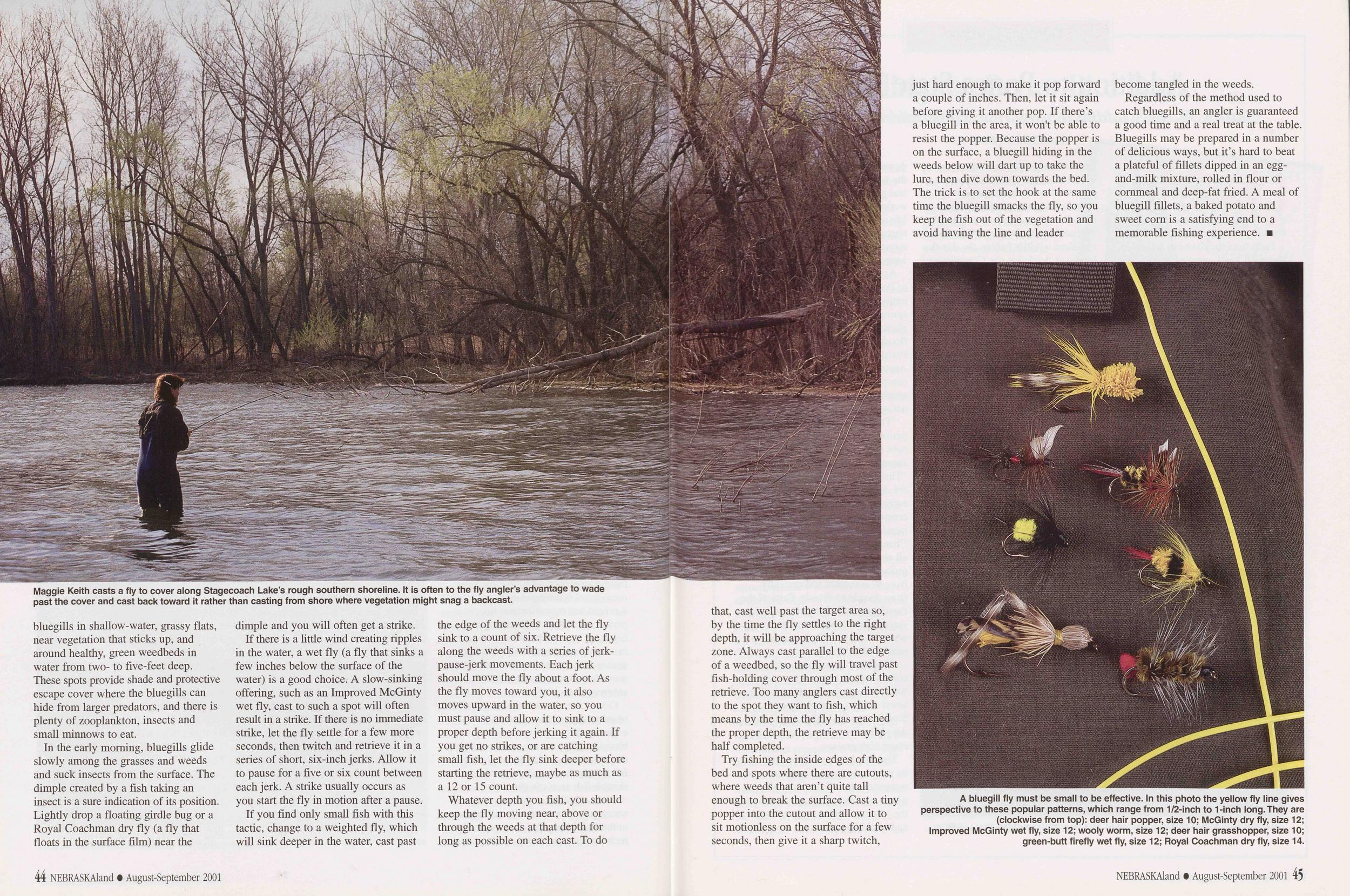 bluegills in shallow-water, grassy flats,
near vegetation that sticks up, and
around healthy, green weed beds in
water from two- to five-feet deep.
These spots provide shade and protective
escape cover where the bluegills can
hide from larger predators, and there is
plenty of zooplankton, insects and
small minnows to eat.
bluegills in shallow-water, grassy flats,
near vegetation that sticks up, and
around healthy, green weed beds in
water from two- to five-feet deep.
These spots provide shade and protective
escape cover where the bluegills can
hide from larger predators, and there is
plenty of zooplankton, insects and
small minnows to eat.
In the early morning, bluegills glide slowly among the grasses and weeds and suck insects from the surface. The dimple created by a fish taking an insect is a sure indication of its position. Lightly drop a floating girdle bug or a Royal Coachman dry fly (a fly that floats in the surface film) near the dimple and you will often get a strike.
If there is a little wind creating ripples in the water, a wet fly (a fly that sinks a few inches below the surface of the water) is a good choice. A slow-sinking offering, such as an Improved McGinty wet fly, cast to such a spot will often result in a strike. If there is no immediate strike, let the fly settle for a few more seconds, then twitch and retrieve it in a series of short, six-inch jerks. Allow it to pause for a five or six count between each jerk. A strike usually occurs as you start the fly in motion after a pause.
If you find only small fish with this tactic, change to a weighted fly, which will sink deeper in the water, cast past the edge of the weeds and let the fly sink to a count of six. Retrieve the fly along the weeds with a series of jerk-pause-jerk movements. Each jerk should move the fly about a foot. As the fly moves toward you, it also moves upward in the water, so you must pause and allow it to sink to a proper depth before jerking it again. If you get no strikes, or are catching small fish, let the fly sink deeper before starting the retrieve, maybe as much as a 12 or 15 count.
Whatever depth you fish, you should keep the fly moving near, above or through the weeds at that depth for long as possible on each cast. To do that, cast well past the target area so, by the time the fly settles to the right depth, it will be approaching the target zone. Always cast parallel to the edge of a weedbed, so the fly will travel past fish-holding cover through most of the retrieve. Too many anglers cast directly to the spot they want to fish, which means by the time the fly has reached the proper depth, the retrieve may be half completed.
Try fishing the inside edges of the bed and spots where there are cutouts, where weeds that aren't quite tall enough to break the surface. Cast a tiny popper into the cutout and allow it to sit motionless on the surface for a few seconds, then give it a sharp twitch, just hard enough to make it pop forward a couple of inches. Then, let it sit again before giving it another pop. If there's a bluegill in the area, it won't be able to resist the popper. Because the popper is on the surface, a bluegill hiding in the weeds below will dart up to take the lure, then dive down towards the bed. The trick is to set the hook at the same time the bluegill smacks the fly, so you keep the fish out of the vegetation and avoid having the line and leader become tangled in the weeds.
Regardless of the method used to catch bluegills, an angler is guaranteed a good time and a real treat at the table. Bluegills may be prepared in a number of delicious ways, but it's hard to beat a plateful of fillets dipped in an egg-and-milk mixture, rolled in flour or cornmeal and deep-fat fried. A meal of bluegill fillets, a baked potato and sweet corn is a satisfying end to a memorable fishing experience.
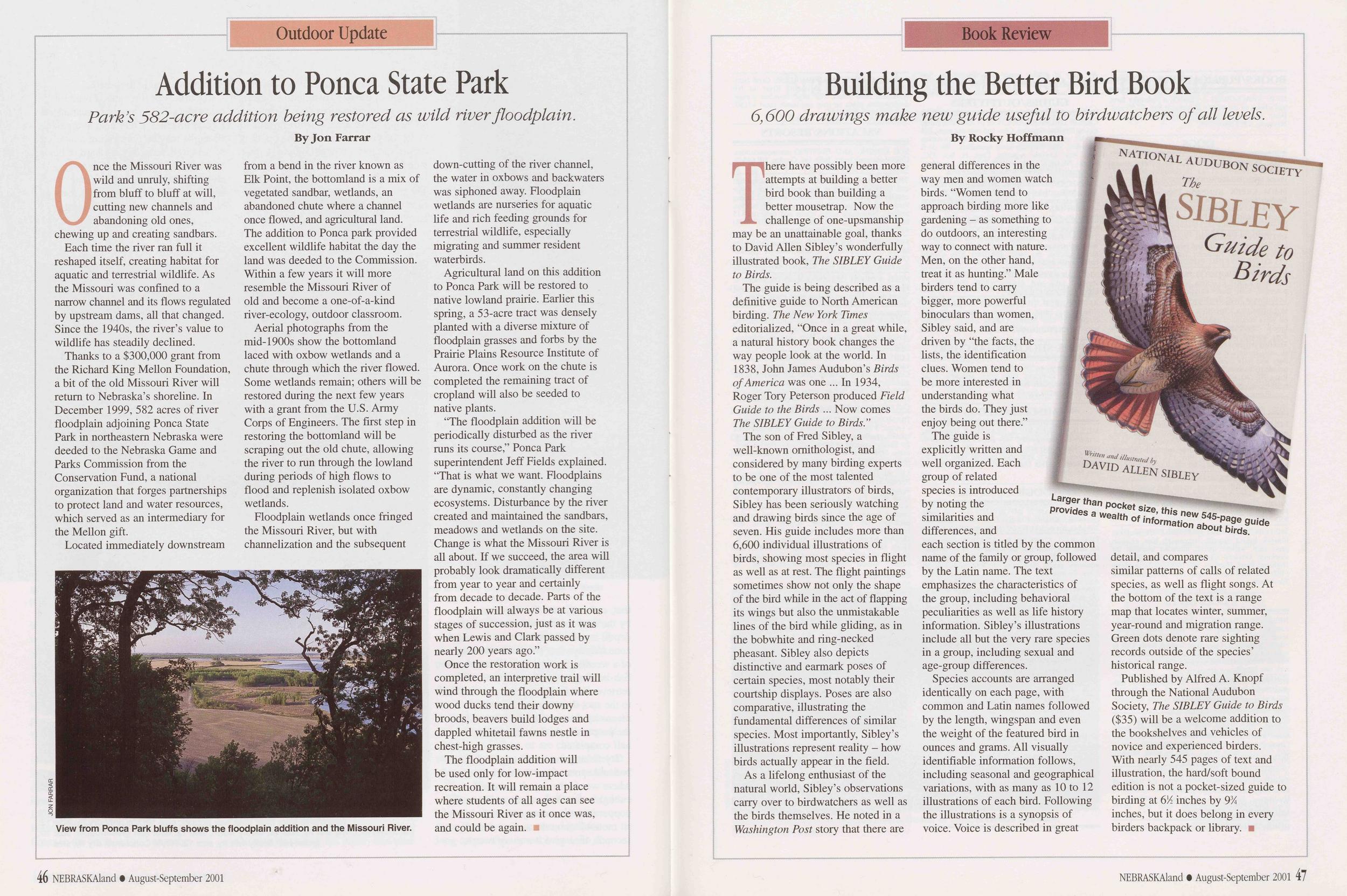
Once the Missouri River was wild and unruly, shifting from bluff to bluff at will, cutting new channels and abandoning old ones, chewing up and creating sandbars. Each time the river ran full it reshaped itself, creating habitat for aquatic and terrestrial wildlife. As the Missouri was confined to a narrow channel and its flows regulated by upstream dams, all that changed. Since the 1940s, the river's value to wildlife has steadily declined.
Thanks to a $300,000 grant from the Richard King Mellon Foundation, a bit of the old Missouri River will return to Nebraska's shoreline. In December 1999, 582 acres of river floodplain adjoining Ponca State Park in northeastern Nebraska were deeded to the Nebraska Game and Parks Commission from the Conservation Fund, a national organization that forges partnerships to protect land and water resources, which served as an intermediary for the Mellon gift.
Located immediately downstream from a bend in the river known as Elk Point, the bottomland is a mix of vegetated sandbar, wetlands, an abandoned chute where a channel once flowed, and agricultural land. The addition to Ponca park provided excellent wildlife habitat the day the land was deeded to the Commission. Within a few years it will more resemble the Missouri River of old and become a one-of-a-kind river-ecology, outdoor classroom.
Aerial photographs from the mid-1900s show the bottomland laced with oxbow wetlands and a chute through which the river flowed. Some wetlands remain; others will be restored during the next few years with a grant from the U.S. Army Corps of Engineers. The first step in restoring the bottomland will be scraping out the old chute, allowing the river to run through the lowland during periods of high flows to flood and replenish isolated oxbow wetlands.
Floodplain wetlands once fringed the Missouri River, but with channelization and the subsequent View from Ponca Park bluffs shows the floodplain addition and the Missouri River. down-cutting of the river channel, the water in oxbows and backwaters was siphoned away. Floodplain wetlands are nurseries for aquatic life and rich feeding grounds for terrestrial wildlife, especially migrating and summer resident waterbirds.
Agricultural land on this addition to Ponca Park will be restored to native lowland prairie. Earlier this spring, a 53-acre tract was densely planted with a diverse mixture of floodplain grasses and forbs by the Prairie Plains Resource Institute of Aurora. Once work on the chute is completed the remaining tract of cropland will also be seeded to native plants.
"The floodplain addition will be periodically disturbed as the river runs its course," Ponca Park superintendent Jeff Fields explained. "That is what we want. Floodplains are dynamic, constantly changing ecosystems. Disturbance by the river created and maintained the sandbars, meadows and wetlands on the site. Change is what the Missouri River is all about. If we succeed, the area will probably look dramatically different from year to year and certainly from decade to decade. Parts of the floodplain will always be at various stages of succession, just as it was when Lewis and Clark passed by nearly 200 years ago."
Once the restoration work is completed, an interpretive trail will wind through the floodplain where wood ducks tend their downy broods, beavers build lodges and dappled whitetail fawns nestle in chest-high grasses.
The floodplain addition will be used only for low-impact recreation. It will remain a place where students of all ages can see the Missouri River as it once was, and could be again.
Book Review Building the Better Bird Book 6,600 drawings make new guide useful to birdwatchers of all levels.There have possibly been more attempts at building a better bird book than building a better mousetrap. Now the challenge of one-upsmanship may be an unattainable goal, thanks to David Allen Sibley's wonderfully illustrated book, The SIBLEY Guide to Birds.
The guide is being described as a definitive guide to North American birding. The New York Times editorialized, "Once in a great while, a natural history book changes the way people look at the world. In 1838, John James Audubon's Birds of America was one ... In 1934, Roger Tory Peterson produced Field Guide to the Birds ... Now comes The SIBLEY Guide to Birds."
The son of Fred Sibley, a well-known ornithologist, and considered by many birding experts to be one of the most talented contemporary illustrators of birds, Sibley has been seriously watching and drawing birds since the age of seven. His guide includes more than 6,600 individual illustrations of birds, showing most species in flight as well as at rest. The flight paintings sometimes show not only the shape of the bird while in the act of flapping its wings but also the unmistakable lines of the bird while gliding, as in the bobwhite and ring-necked pheasant. Sibley also depicts distinctive and earmark poses of certain species, most notably their courtship displays. Poses are also comparative, illustrating the fundamental differences of similar species. Most importantly, Sibley's illustrations represent reality - how birds actually appear in the field.
As a lifelong enthusiast of the natural world, Sibley's observations carry over to birdwatchers as well as the birds themselves. He noted in a Washington Post story that there are general differences in the way men and women watch birds. "Women tend to approach birding more like gardening - as something to do outdoors, an interesting way to connect with nature. Men, on the other hand, treat it as hunting." Male birders tend to carry bigger, more powerful binoculars than women, Sibley said, and are driven by "the facts, the lists, the identification clues. Women tend to be more interested in understanding what the birds do. They just enjoy being out there."
The guide is explicitly written and well organized. Each group of related species is introduced by noting the similarities and differences, and each section is titled by the common name of the family or group, followed by the Latin name. The text emphasizes the characteristics of the group, including behavioral peculiarities as well as life history information. Sibley's illustrations include all but the very rare species in a group, including sexual and age-group differences.
Species accounts are arranged identically on each page, with common and Latin names followed by the length, wingspan and even the weight of the featured bird in ounces and grams. All visually identifiable information follows, including seasonal and geographical variations, with as many as 10 to 12 illustrations of each bird. Following the illustrations is a synopsis of voice. Voice is described in great detail, and compares similar patterns of calls of related species, as well as flight songs. At the bottom of the text is a range map that locates winter, summer, year-round and migration range. Green dots denote rare sighting records outside of the species' historical range.
Published by Alfred A. Knopf through the National Audubon Society, The SIBLEY Guide to Birds ($35) will be a welcome addition to the bookshelves and vehicles of novice and experienced birders. With nearly 545 pages of text and illustration, the hard/soft bound edition is not a pocket-sized guide to birding at 6M inches by 9% inches, but it does belong in every birders backpack or library.
46 NEBRASKAland • August-September 2001 NEBRASKAland • August-September 2001 47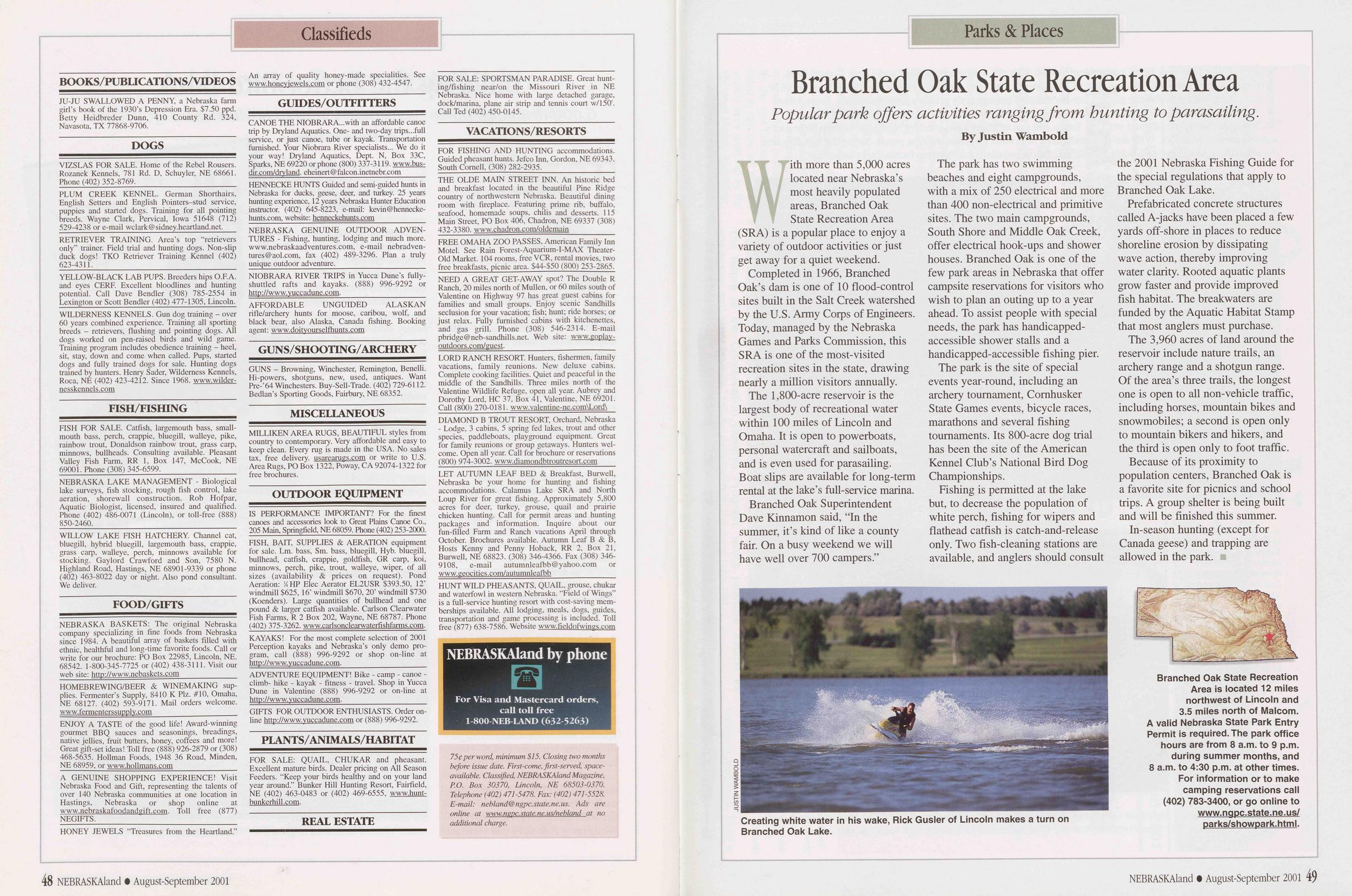
Classifieds
BOOKS/PUBLICATIONS/VIDEOSJU-JU SWALLOWED A PENNY, a Nebraska farm girl's book of the 1930's Depression Era. $7.50 ppd. Betty Heidbreder Dunn, 410 County Rd. 324, Navasota, TX 77868-9706.
DOGSVIZSLAS FOR SALE. Home of the Rebel Rousers. Rozanek Kennels, 781 Rd. D, Schuyler, NE 68661. Phone (402) 352-8769.
PLUM CREEK KENNEL. German Shorthairs, English Setters and English Pointers-stud service, puppies and started dogs. Training for all pointing breeds. Wayne Clark, Pervical, Iowa 51648 (712) 529-4238 or e-mail wclark@sidney.heartland.net.
RETRIEVER TRAINING. Area's top "retrievers only" trainer. Field trial and hunting dogs. Non-slip duck dogs! TKO Retriever Training Kennel (402) 623-43 if.
YELLOW-BLACK LAB PUPS. Breeders hips O.F.A. and eyes CERE Excellent bloodlines and hunting potential. Call Dave Bendler (308) 785-2554 in Lexington or Scott Bendler (402) 477-1305, Lincoln.
WILDERNESS KENNELS. Gun dog training - over 60 years combined experience. Training all sporting breeds - retrievers, flushing and pointing dogs. All dogs worked on pen-raised birds and wild game. Training program includes obedience training - heel, sit, stay, down and come when called. Pups, started dogs and fully trained dogs for sale. Hunting dogs trained by hunters. Henry Sader, Wilderness Kennels, Roca, NE (402) 423-4212. Since 1968. www.wilder- nesskennels.com
FISH/FISHINGFISH FOR SALE. Catfish, largemouth bass, small- mouth bass, perch, crappie, bluegill, walleye, pike, rainbow trout, Donaldson rainbow trout, grass carp, minnows, bullheads. Consulting available. Pleasant Valley Fish Farm, RR 1, Box 147, McCook, NE 69001. Phone (308) 345-6599.
NEBRASKA LAKE MANAGEMENT - Biological lake surveys, fish stocking, rough fish control, lake aeration, shorewall construction. Rob Hofpar, Aquatic Biologist, licensed, insured and qualified. Phone (402) 486-0071 (Lincoln), or toll-free (888) 850-2460.
WILLOW LAKE FISH HATCHERY. Channel cat, bluegill, hybrid bluegill, largemouth bass, crappie, grass carp, walleye, perch, minnows available for stocking. Gay lord Crawford and Son, 7580 N. Highland Road, Hastings, NE 68901-9339 or phone (402) 463-8022 day or night. Also pond consultant. We deliver.
FOOD/GIFTSNEBRASKA BASKETS: The original Nebraska company specializing in fine foods from Nebraska since 1984. A beautiful array of baskets filled with ethnic, healthful and long-time favorite foods. Call or write for our brochure: PO Box 22985, Lincoln, NE. 68542. 1-800-345-7725 or (402) 438-3111. Visit our web site: http:/Avww.nebaskets.com
HOMEBREWING/BEER & WINEMAKING sup- plies. Fermenter's Supply, 8410 K Plz. #10, Omaha, NE 68127. (402) 593-9171. Mail orders welcome. www.fermenterssupply.com
ENJOY A TASTE of the good life! Award-winning gourmet BBQ sauces and seasonings, breadings, native jellies, fruit butters, honey, coffees and more! Great gift-set ideas! Toll free (888) 926-2879 or (308) 468-5635. Hollman Foods, 1948 36 Road, Minden, NE 68959, or www.hollmans.com
A GENUINE SHOPPING EXPERIENCE! Visit Nebraska Food and Gift, representing the talents of over 140 Nebraska communities at one location in Hastings, Nebraska or shop online at www.nebraskafoodandgift.com. Toll free (877) NEGIFTS.
HONEY JEWELS "Treasures from the Heartland." An array of quality honey-made specialities. See www.honeyjewels.com or phone (308) 432-4547.
GUIDES/OUTFITTERSCANOE THE NIOBRARA...with an affordable canoe trip by Dryland Aquatics. One- and two-day trips...full service, or just canoe, tube or kayak. Transportation furnished. Your Niobrara River specialists... We do it your way! Dryland Aquatics, Dept. N, Box 33C, Sparks, NE 69220 or phone (800) 337-3119. www.busdir.com/dryland. eheinert@falcon.inetnebr.com
HENNECKE HXJNTS Guided and semi-guided hunts in Nebraska for ducks, geese, deer, and turkey. 25 years hunting experience, 12 years Nebraska Hunter Education instructor. (402) 645-8223, e-mail: kevin@henneckehunts.com, website: henneckehunts.com
NEBRASKA GENUINE OUTDOOR ADVEN- TURES - Fishing, hunting, lodging and much more. www.nebraskaadventures.com, e-mail nebradventures® aol.com, fax (402) 489-3296. Plan a truly unique outdoor adventure.
NIOBRARA RIVER TRIPS in Yucca Dune's fully shuttled rafts and kayaks. (888) 996-9292 or http://www.yuccadune.com.
AFFORDABLE UNGUIDED ALASKAN rifle/archery hunts for moose, caribou, wolf, and black bear, also Alaska, Canada fishing. Booking agent: www.doityourselfhunts.com
GUNS/SHOOTING/ARCHERYGUNS - Browning, Winchester, Remington, Benelli. Hi-powers, shotguns, new, used, antiques. Want Pre-'64 Winchesters. Buy-Sell-Trade. (402) 729-6112. Bedlan's Sporting Goods, Fairbury, NE 68352.
MISCELLANEOUSMILLIKEN AREA RUGS, BEAUTIFUL styles from country to contemporary. Very affordable and easy to keep clean. Every rug is made in the USA. No sales tax, free delivery, usarearugs.com or write to U.S. Area Rugs, PO Box 1322, Poway, CA 92074-1322 for free brochures.
OUTDOOR EQUIPMENTIS PERFORMANCE IMPORTANT? For the finest canoes and accessories look to Great Plains Canoe Co., 205 Main, Springfield, NE 68059. Phone (402) 253-2000.
FISH, BAIT, SUPPLIES &AERATION equipment for sale. Lm. bass, Sm. bass, bluegill, Hyb. bluegill, bullhead, catfish, crappie, goldfish, GR carp, koi, minnows, perch, pike, trout, walleye, wiper, of all sizes (availability & prices on request). Pond Aeration: %HP Elec Aerator EL2USR $393.50, 12' windmill $625, 16' windmill $670, 20' windmill $730 (Koenders). Large quantities of bullhead and one pound & larger catfish available. Carlson Clearwater Fish Farms, R 2 Box 202, Wayne, NE 68787. Phone (402) 375-3262. www.carlsonclearwaterfishfarms.com.
KAYAKS! For the most complete selection of 2001 Perception kayaks and Nebraska's only demo program, call (888) 996-9292 or shop on-line at http://www.yuccadune.com.
ADVENTURE EQUIPMENT! Bike - camp - canoe - climb- hike - kayak - fitness - travel. Shop in Yucca Dune in Valentine (888) 996-9292 or on-line at http://www.yuccadune.com.
GIFTS FOR OUTDOOR ENTHUSIASTS. Order on- line http://www.yuccadune.com or (888) 996-9292.
PLANTS/ANIMALS/HABITATFOR SALE: QUAIL, CHUKAR and pheasant. Excellent mature birds. Dealer pricing on All Season Feeders. "Keep your birds healthy and on your land year around." Bunker Hill Hunting Resort, Fairfield, NE (402) 463-0483 or (402) 469-6555, www.huntbunkerhill.com.
REAL ESTATEFOR SALE: SPORTSMAN PARADISE. Great hunt- ing/fishing near/on the Missouri River in NE Nebraska. Nice home with large detached garage, dock/marina, plane air strip and tennis court w/150'. Call Ted (402) 450-0145.
VACATIONS/RESORTSFOR FISHING AND HUNTING accommodations. Guided pheasant hunts. Jefco Inn, Gordon, NE 69343. South Cornell, (308) 282-2935.
THE OLDE MAIN STREET INN. An historic bed and breakfast located in the beautiful Pine Ridge country of northwestern Nebraska. Beautiful dining room with fireplace. Featuring prime rib, buffalo, seafood, homemade soups, chilis and desserts. 115 Main Street, PO Box 406, Chadron, NE 69337 (308) 432-3380. www.chadron.com/oldemain
FREE OMAHA ZOO PASSES, American Family Inn Motel. See Rain Forest-Aquarium-I-MAX Theater- Old Market. 104 rooms, free VCR, rental movies, two free breakfasts, picnic area. $44-$50 (800) 253-2865.
NEED A GREAT GET-AWAY spot? The Double R Ranch, 20 miles north of Mullen, or 60 miles south of Valentine on Highway 97 has great guest cabins for families and small groups. Enjoy scenic Sandhills seclusion for your vacation; fish; hunt; ride horses; or just relax. Fully furnished cabins with kitchenettes, and gas grill. Phone (308) 546-2314. E-mail pbridge@neb-sandhills.net. Web site: www.goplayoutdoors. com/guest.
LORD RANCH RESORT. Hunters, fishermen, family vacations, family reunions. New deluxe cabins. Complete cooking facilities. Quiet and peaceful in the middle of the Sandhills. Three miles north of the Valentine Wildlife Refuge, open all year. Aubrey and Dorothy Lord, HC 37, Box 41, Valentine, NE 69201. Call (800) 270-0181. www.valentine-ne.com\Lord\
DIAMOND B TROUT RESORT, Orchard, Nebraska - Lodge, 3 cabins, 5 spring fed lakes, trout and other species, paddle boats, playground equipment. Great for family reunions or group getaways. Hunters welcome. Open all year. Call for brochure or reservations (800) 974-3002. www.diamondbtroutresort.com
LET AUTUMN LEAF BED & Breakfast, Burwell, Nebraska be your home for hunting and fishing accommodations. Calamus Lake SRA and North Loup River for great fishing. Approximately 5,800 acres for deer, turkey, grouse, quail and prairie chicken hunting. Call for permit areas and hunting packages and information. Inquire about our fun-filled Farm and Ranch vacations April through October. Brochures available. Autumn Leaf B & B, Hosts Kenny and Penny Hoback, RR 2, Box 21, Burwell, NE 68823. (308) 346-4366. Fax (308) 346-9108, e-mail autumnleafbb@yahoo.com or www.geocities.com/autumnleafbb
HUNT WILD PHEASANTS, QUAIL, grouse, chukar and waterfowl in western Nebraska. "Field of Wings" is a full-service hunting resort with cost-saving memberships available. All lodging, meals, dogs, guides, transportation and game processing is included. Toll free (877) 638-7586. Website www.fieldofwings.com
NEBRASKAland by phone For Visa and Mastercard orders, call toll free 1-800-NEB-LAND (632-5263)
75$ per word, minimum $15. Closing two months before issue date. First-come, first-served, space available. Classified, NEBRASKAland Magazine, P.O. Box 30370, Lincoln, NE 68503-0370. Telephone (402) 471-5478. Fax: (402) 471-5528. E-mail: nebland@ngpc.state.ne.us. Ads are online at www, ngpc. state, ne. us/nebland at no additional charge.
Branched Oak State Recreation Area Popular park offers activities ranging from hunting to parasailing. By Justin WamboldWith more than 5,000 acres located near Nebraska's most heavily populated areas, Branched Oak State Recreation Area (SRA) is a popular place to enjoy a variety of outdoor activities or just get away for a quiet weekend.
Completed in 1966, Branched Oak's dam is one of 10 flood-control sites built in the Salt Creek watershed by the U.S. Army Corps of Engineers. Today, managed by the Nebraska Games and Parks Commission, this SRA is one of the most-visited recreation sites in the state, drawing nearly a million visitors annually.
The 1,800-acre reservoir is the largest body of recreational water within 100 miles of Lincoln and Omaha. It is open to powerboats, personal watercraft and sailboats, and is even used for parasailing. Boat slips are available for long-term rental at the lake's full-service marina.
Branched Oak Superintendent Dave Kinnamon said, "In the summer, it's kind of like a county fair. On a busy weekend we will have well over 700 campers."
The park has two swimming beaches and eight campgrounds, with a mix of 250 electrical and more than 400 non-electrical and primitive sites. The two main campgrounds, South Shore and Middle Oak Creek, offer electrical hook-ups and shower houses. Branched Oak is one of the few park areas in Nebraska that offer campsite reservations for visitors who wish to plan an outing up to a year ahead. To assist people with special needs, the park has handicapped accessible shower stalls and a handicapped-accessible fishing pier.
The park is the site of special events year-round, including an archery tournament, Cornhusker State Games events, bicycle races, marathons and several fishing tournaments. Its 800-acre dog trial has been the site of the American Kennel Club's National Bird Dog Championships.
Fishing is permitted at the lake but, to decrease the population of white perch, fishing for wipers and flathead catfish is catch-and-release only. Two fish-cleaning stations are available, and anglers should consult the 2001 Nebraska Fishing Guide for the special regulations that apply to Branched Oak Lake.
Prefabricated concrete structures called A-jacks have been placed a few yards off-shore in places to reduce shoreline erosion by dissipating wave action, thereby improving water clarity. Rooted aquatic plants grow faster and provide improved fish habitat. The breakwaters are funded by the Aquatic Habitat Stamp that most anglers must purchase.
The 3,960 acres of land around the reservoir include nature trails, an archery range and a shotgun range. Of the area's three trails, the longest one is open to all non-vehicle traffic, including horses, mountain bikes and snowmobiles; a second is open only to mountain bikers and hikers, and the third is open only to foot traffic.
Because of its proximity to population centers, Branched Oak is a favorite site for picnics and school trips. A group shelter is being built and will be finished this summer.
In-season hunting (except for Canada geese) and trapping are allowed in the park.
Branched Oak State Recreation Area is located 12 miles northwest of Lincoln and 3.5 miles north of Malcom. A valid Nebraska State Park Entry Permit is required. The park office hours are from 8 a.m. to 9 p.m. during summer months, and 8 a.m. to 4:30 p.m. at other times. For information or to make camping reservations call (402)783-3400, or go online to www.ngpc.state.ne.us/ parks/showpark.html.
48 NEBRASKAland • August-September 2001 NEBRASKAland • August-September 2001 49
In 1901, the Nebraska Fish Commission merged with the newly-created Fish and Game Commission, forerunner of today's Game and Parks Commission. Since the creation of the Fish Commission in 1879, providing fish for Nebraska anglers has been one of the agency's primary responsibilities. Early efforts concentrated on raising fish for stocking across the state. In 1943, the agency hired its first fisheries biologist. Today, raising and stocking fish is still one of many tools used by biologists to keep Nebraska's waters supplied with fish. With the construction of reservoirs and conservation ponds during the last 50 years, the scientific management of aquatic habitat and fish populations has become increasingly important.
In about 1959, Larry Zadina (left photo) releases fish from a galvanized wash tub into the state fair fish pond on the south side of Lake Maloney near North Platte. Fish were held there through the summer for exhibition at the state fair in Lincoln. The fish display remains a big attraction at the Game and Parks Commission area at the state fair. Today fish for the fair or for stocking lakes, ponds and rivers are transported in tank trucks with aeration systems. Vic Forney (above photo, left) and Vic Matousek gillnet walleyes at the outlet of Lake Maloney. Milt collected from the males and eggs from the females were combined to produce walleye fry at the North Platte hatchery for later stocking. That most basic fish management activity remains essentially unchanged today.
In 1919, the Commission established its third fish hatchery, purchasing a private hatchery near Benkelman in Dundy County. Several years later, a larger hatchery was established nearby on Rock Creek. Because the water source was better at the Rock Creek hatchery, it was enlarged over the years. In 1972 the Benkelman hatchery was closed and the grounds sold. In a late 1950s photograph, Rock Creek Hatchery assistant superintendent Charles Blank (center) and two assistants, Jerry Plucker (left) and Elvin Bray, seine trout fingerlings from a circular raceway for stocking.
To commemorate the Nebraska Game and Parks Commission's 100 years, NEBRASKAland will track that history with photos this year. Portraits from the Past, submitted by readers, will return to this page next year.
Visit Nebraska State Parks state parks and state recreation areas can fill your summer with activities, excitement and just plain relaxation. With detailed information on lodging, camping, activities, facilities, ' seasons; fees and resetvation policies. all today! For up-to-date information online go to www.napcstate.ne Nebraska Game and Parks Commission 50 NEBRASKAland • August-September 2001
Position: 583 (19 views)