Volume 79, Issue 6, 2001
NEBRASKAland
Nebraska Game & Parks Commission July 2001 • $2.50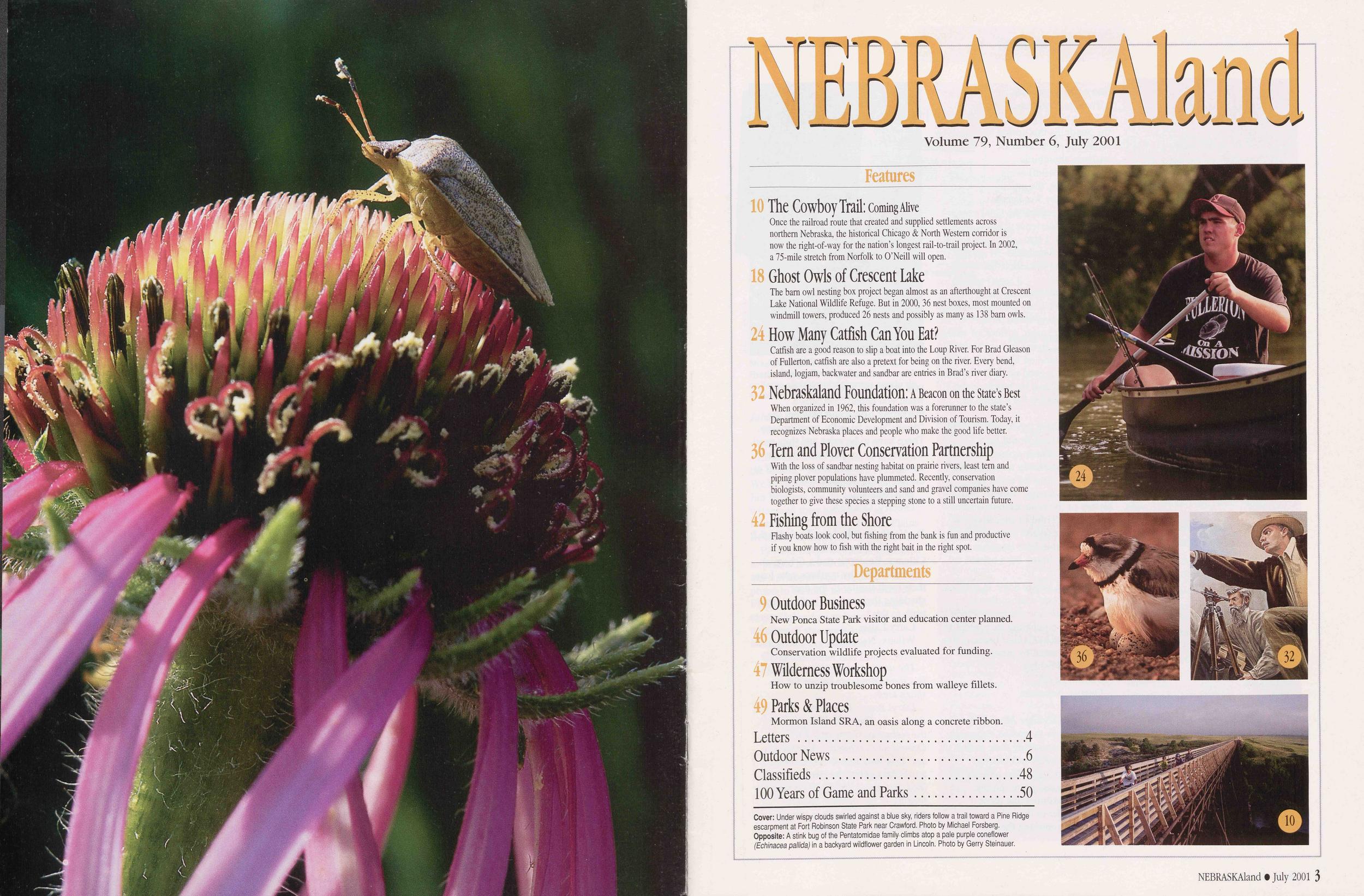
NEBRASKAland
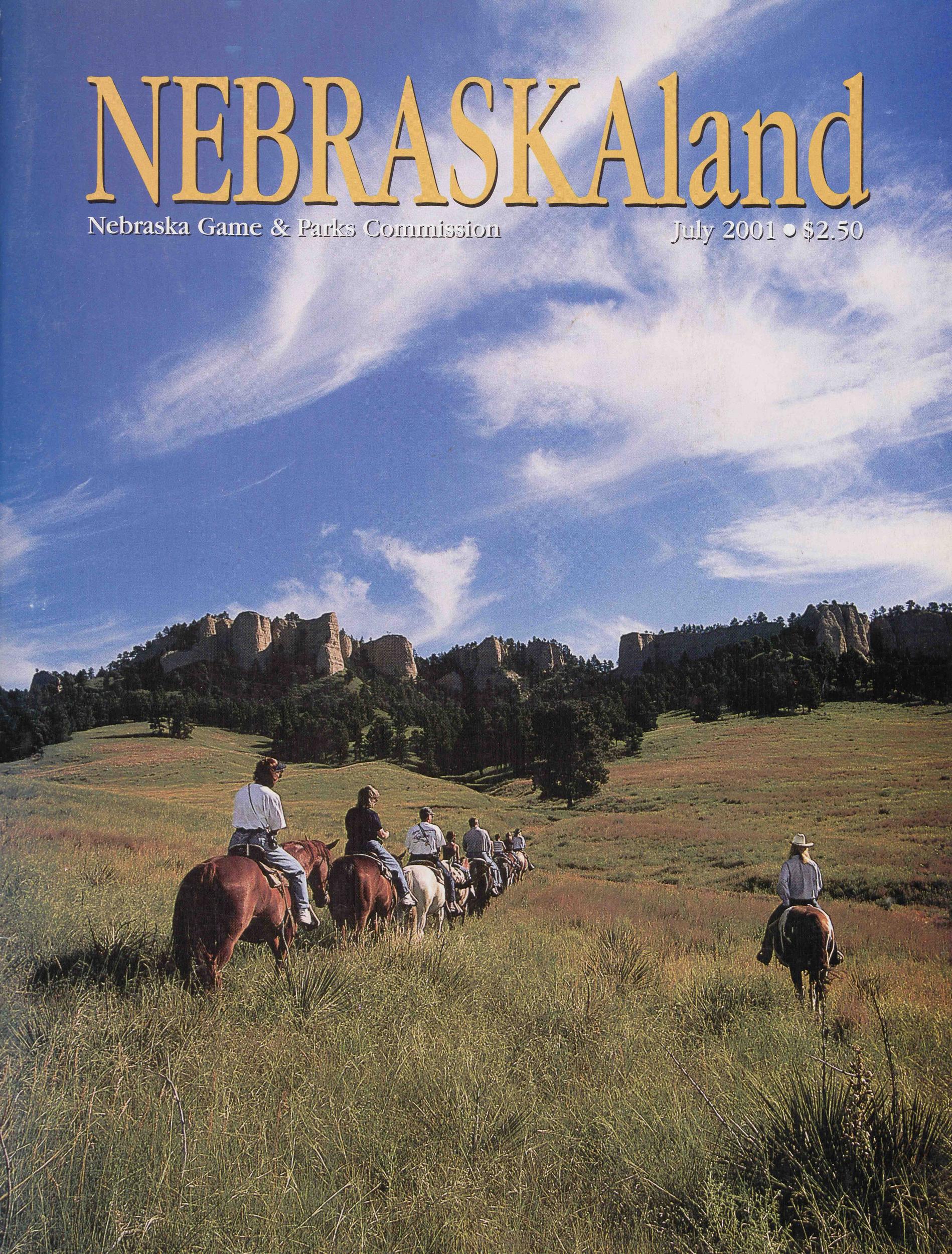
Volume 79, Number 6, July 2001 The Cowboy Trail: coiningAiive Once the railroad route that created and supplied settlements across northern Nebraska, the historical Chicago & North Western corridor is now the right-of-way for the nation's longest rail-to-trail project. In 2002, a 75-mile stretch from Norfolk to O'Neill will open. Ghost Owls of Crescent Lake The bam owl nesting box project began almost as an afterthought at Crescent Lake National Wildlife Refuge. But in 2000, 36 nest boxes, most mounted on windmill towers, produced 26 nests and possibly as many as 138 bam owls. How Many Catfish Can You Eat? Catfish are a good reason to slip a boat into the Loup River. For Brad Gleason of Fullerton, catfish are also a pretext for being on the river. Every bend, island, logjam, backwater and sandbar are entries in Brad's river diary. Nebraskaland Foundation: a Beacon on the state's Best When organized in 1962, this foundation was a forerunner to the state's Department of Economic Development and Division of Tourism. Today, it recognizes Nebraska places and people who make the good life better. Tern and Plover Conservation Partnership With the loss of sandbar nesting habitat on prairie rivers, least tem and piping plover populations have plummeted. Recently, conservation biologists, community volunteers and sand and gravel companies have come together to give these species a stepping stone to a still uncertain future. Fishing from the Shore Flashy boats look cool, but fishing from the bank is fun and productive if you know how to fish with the right bait in the right spot. Departments Outdoor Business New Ponca State Park visitor and education center planned. 46 Outdoor Update Conservation wildlife projects evaluated for funding. 4? Wilderness Workshop How to unzip troublesome bones from walleye fillets. 49 Parks & Places Mormon Island SRA, an oasis along a concrete ribbon. Letters 4 Outdoor News 6 Classifieds 48 100 Years of Game and Parks 50 Cover: Under wispy clouds swirled against a blue sky, riders follow a trail toward a Pine Ridge escarpment at Fort Robinson State Park near Crawford. Photo by Michael Forsberg. Opposite: A stink bug of the Pentatomidae family climbs atop a pale purple coneflower (Echinacea pallida) in a backyard wildflower garden in Lincoln. Photo by Gerry Steinauer.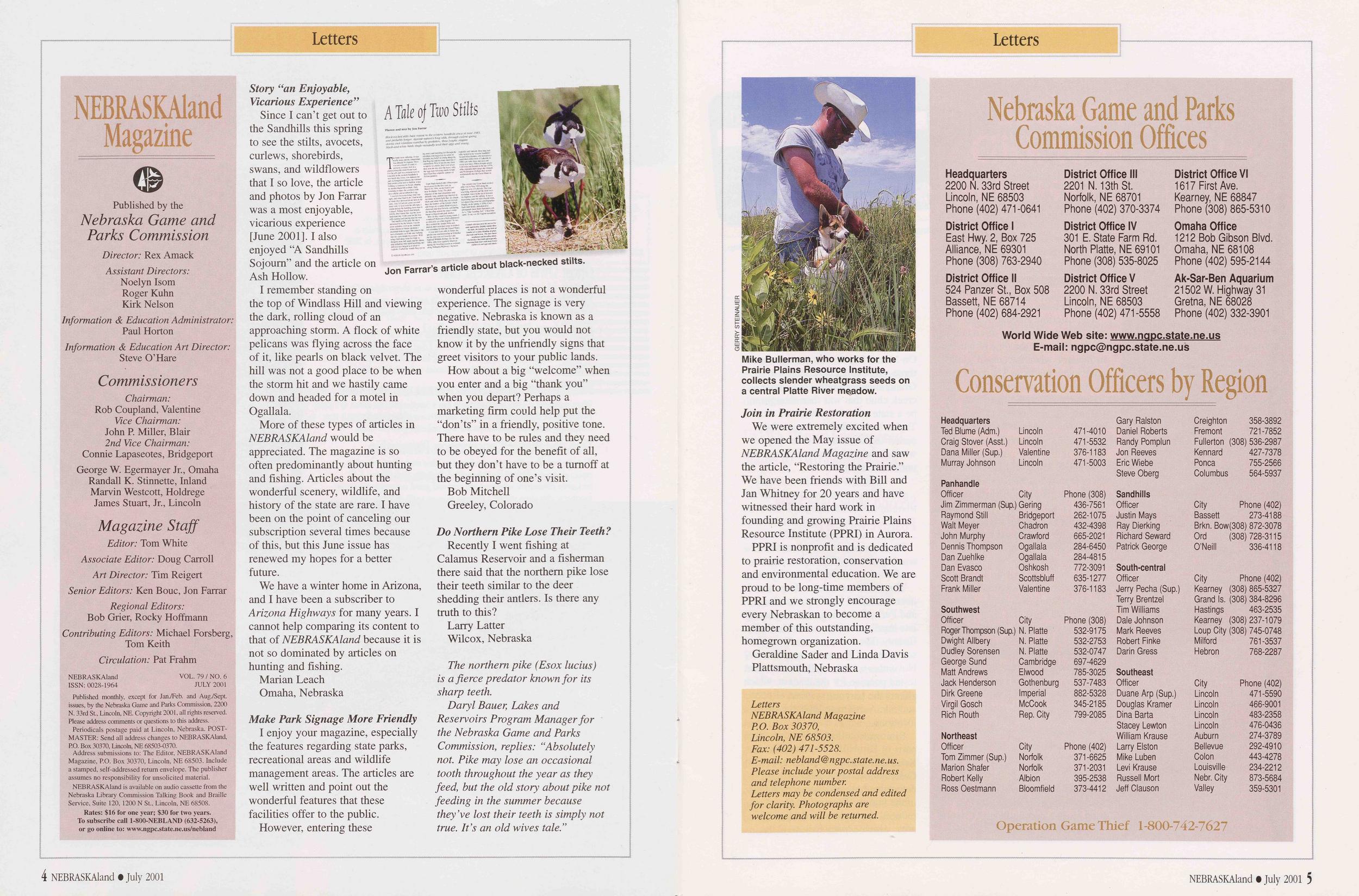 Letters
NEBRASKAland Mazine
Published by the
Nebraska Game and
Parks Commission
Director: Rex Amack
Assistant Directors:
Noelyn Isom
Roger Kuhn
Kirk Nelson
Information & Education Administrator:
Paul Horton
Information & Education Art Director:
Steve O'Hare
Commissioners
Chairman:
Rob Coupland, Valentine
Vice Chairman:
John P. Miller, Blair
2nd Vice Chairman:
Connie Lapaseotes, Bridgeport
George W. Egermayer Jr., Omaha
Randall K. Stinnette, Inland
Marvin Westcott, Holdrege
James Stuart, Jr., Lincoln
Magazine Staff
Editor: Tom White
Associate Editor: Doug Carroll
Art Director: Tim Reigert
Senior Editors: Ken Bouc, Jon Farrar
Regional Editors:
Bob Grier, Rocky Hoffmann
Contributing Editors: Michael Forsberg,
Tom Keith
Circulation: Pat Frahm
NEBRASKAland
ISSN: 0028-1964
VOL. 79 / NO. 6
JULY 2001
Published monthly, except for Jan/Feb. and Aug./Sept.
issues, by the Nebraska Game and Parks Commission, 2200
N. 33rd St., Lincoln, NE. Copyright 2001, all rights reserved.
Please address comments or questions to this address.
Periodicals postage paid at Lincoln, Nebraska.
POSTMASTER: Send all address changes to NEBRASKAland,
P.O. Box 30370, Lincoln, NE 68503-0370.
Address submissions to: The Editor, NEBRASKAland
Magazine, P.O. Box 30370, Lincoln, NE 68503. Include
a stamped, self-addressed return envelope. The publisher
assumes no responsibility for unsolicited material.
NEBRASKAland is available on audio cassette from the
Nebraska Library Comission Talking Book and Braille
Service, Suite 120, 1200 N St., Lincoln, NE 68508.
Rates: $16 for one year; $30 for two years.
To subscribe call 1-800-NEBLAND (632-5263),
or go online to: www.ngpc.state.ne.us/nebland
Story "an Enjoyable,
Vicarious Experience'
Letters
NEBRASKAland Mazine
Published by the
Nebraska Game and
Parks Commission
Director: Rex Amack
Assistant Directors:
Noelyn Isom
Roger Kuhn
Kirk Nelson
Information & Education Administrator:
Paul Horton
Information & Education Art Director:
Steve O'Hare
Commissioners
Chairman:
Rob Coupland, Valentine
Vice Chairman:
John P. Miller, Blair
2nd Vice Chairman:
Connie Lapaseotes, Bridgeport
George W. Egermayer Jr., Omaha
Randall K. Stinnette, Inland
Marvin Westcott, Holdrege
James Stuart, Jr., Lincoln
Magazine Staff
Editor: Tom White
Associate Editor: Doug Carroll
Art Director: Tim Reigert
Senior Editors: Ken Bouc, Jon Farrar
Regional Editors:
Bob Grier, Rocky Hoffmann
Contributing Editors: Michael Forsberg,
Tom Keith
Circulation: Pat Frahm
NEBRASKAland
ISSN: 0028-1964
VOL. 79 / NO. 6
JULY 2001
Published monthly, except for Jan/Feb. and Aug./Sept.
issues, by the Nebraska Game and Parks Commission, 2200
N. 33rd St., Lincoln, NE. Copyright 2001, all rights reserved.
Please address comments or questions to this address.
Periodicals postage paid at Lincoln, Nebraska.
POSTMASTER: Send all address changes to NEBRASKAland,
P.O. Box 30370, Lincoln, NE 68503-0370.
Address submissions to: The Editor, NEBRASKAland
Magazine, P.O. Box 30370, Lincoln, NE 68503. Include
a stamped, self-addressed return envelope. The publisher
assumes no responsibility for unsolicited material.
NEBRASKAland is available on audio cassette from the
Nebraska Library Comission Talking Book and Braille
Service, Suite 120, 1200 N St., Lincoln, NE 68508.
Rates: $16 for one year; $30 for two years.
To subscribe call 1-800-NEBLAND (632-5263),
or go online to: www.ngpc.state.ne.us/nebland
Story "an Enjoyable,
Vicarious Experience'
Since I can't get out to the Sandhills this spring to see the stilts, avocets, curlews, shorebirds, swans, and wildflowers that I so love, the article and photos by Jon Farrar was a most enjoyable, vicarious experience [June 2001]. I also enjoyed "A Sandhills Sojourn" and the article on Ash Hollow.
I remember standing on the top of Windlass Hill and viewing the dark, rolling cloud of an approaching storm. A flock of white pelicans was flying across the face of it, like pearls on black velvet. The hill was not a good place to be when the storm hit and we hastily came down and headed for a motel in Ogallala.
More of these types of articles in NEBRASKAland would be appreciated. The magazine is so often predominantly about hunting and fishing. Articles about the wonderful scenery, wildlife, and history of the state are rare. I have been on the point of canceling our subscription several times because of this, but this June issue has renewed my hopes for a better future.
We have a winter home in Arizona, and I have been a subscriber to Arizona Highways for many years. I cannot help comparing its content to that of NEBRASKAland because it is not so dominated by articles on hunting and fishing.
Marian Leach Omaha, Nebraska Make Park Signage More FriendlyI enjoy your magazine, especially the features regarding state parks, recreational areas and wildlife management areas. The articles are well written and point out the wonderful features that these facilities offer to the public.
However, entering these wonderful places is not a wonderful experience. The signage is very negative. Nebraska is known as a friendly state, but you would not know it by the unfriendly signs that greet visitors to your public lands.
How about a big "welcome" when you enter and a big "thank you" when you depart? Perhaps a marketing firm could help put the "don'ts" in a friendly, positive tone. There have to be rules and they need to be obeyed for the benefit of all, but they don't have to be a turnoff at the beginning of one's visit.
Bob Mitchell Greeley, Colorado Do Northern Pike Lose Their Teeth?Recently I went fishing at Calamus Reservoir and a fisherman there said that the northern pike lose their teeth similar to the deer shedding their antlers. Is there any truth to this?
Larry Latter Wilcox, NebraskaThe northern pike (Esox lucius) is a fierce predator known for its sharp teeth.
Daryl Bauer, Lakes and Reservoirs Program Manager for the Nebraska Game and Parks Commission, replies: ''Absolutely not. Pike may lose an occasional tooth throughout the year as they feed, but the old story about pike not feeding in the summer because they we lost their teeth is simply not true. It's an old wives tale."
We were extremely excited when we opened the May issue of NEBRASKAland Magazine and saw the article, "Restoring the Prairie." We have been friends with Bill and Jan Whitney for 20 years and have witnessed their hard work in founding and growing Prairie Plains Resource Institute (PPRI) in Aurora.
PPRI is nonprofit and is dedicated to prairie restoration, conservation and environmental education. We are proud to be long-time members of PPRI and we strongly encourage every Nebraskan to become a member of this outstanding, homegrown organization.
Geraldine Sader and Linda Davis Plattsmouth, NebraskaLetters NEBRASKAland Magazine P.O. Box 30370, Lincoln, NE 68503. Fax: (402) 471-5528. E-mail: nebland@ngpc.state.ne.us. Please include your postal address and telephone number. Letters may be condensed and edited for clarity. Photographs are welcome and will be returned.
Nebraska Game and Parks Commission Offices Headquarters 2200 N. 33rd Street Lincoln, NE 68503 Phone (402) 471-0641 District Office I East Hwy. 2, Box 725 Alliance, NE 69301 Phone (308) 763-2940 District Office II 524 Panzer St., Box 508 Bassett, NE 68714 Phone (402) 684-2921 District Office III 2201 N. 13th St. Norfolk, NE 68701 Phone (402) 370-3374 District Office IV 301 E. State Farm Rd. North Platte, NE 69101 Phone (308) 535-8025 District Office V 2200 N. 33rd Street Lincoln, NE 68503 Phone (402) 471-5558 District Office VI 1617 First Ave. Kearney, NE 68847 Phone (308) 865-5310 Omaha Office 1212 Bob Gibson Blvd. Omaha, NE 68108 Phone (402) 595-2144 Ak-Sar-Ben Aquarium 21502 W. Highway 31 Gretna, NE 68028 Phone (402) 332-3901 World Wide Web site: www.nqpc.state.ne.us E-mail: ngpc@ngpc.state.ne.us Headquarters Gary Ralston Creighton 358-3892 Ted Blume (Adm.) Lincoln 471-4010 Daniel Roberts Fremont 721-7852 Craig Stover (Asst.) Lincoln 471-5532 Randy Pomplun Fullerton (308) 536-2987 Dana Miller (Sup.) Valentine 376-1183 Jon Reeves Kennard 427-7378 Murray Johnson Lincoln 471-5003 Eric Wiebe Ponca 755-2566 Steve Oberg Columbus 564-5937 Panhandle Officer City Phone (308) Sandhills Jim Zimmerman (Sup.) Gering 436-7561 Officer City Phone (402) Raymond Still Bridgeport 262-1075 Justin Mays Bassett 273-4188 Walt Meyer Chadron 432-4398 Ray Dierking Brkn. Bow (308) 872-3078 John Murphy Crawford 665-2021 Richard Seward Ord (308)728-3115 Dennis Thompson Ogallala 284-6450 Patrick George O'Neill 336-4118 Dan Zuehlke Ogallala 284-4815 Dan Evasco Oshkosh 772-3091 South-central Scott Brandt Scottsbluff 635-1277 Officer City Phone (402) Frank Miller Valentine 376-1183 Jerry Pecha (Sup.) Kearney (308) 865-5327 Terry Brentzel Grand Is. (308) 384-8296 Southwest Tim Williams Hastings 463-2535 Officer City Phone (308) Dale Johnson Kearney (308)237-1079 Roger Thompson (Sup.) N. Platte 532-917 Mark Reeves Loup City (308) 745-0748 Dwight Allbery N. Platte 532-2753 Robert Finke Milford 761-3537 Dudley Sorensen N. Platte 532-0747 Darin Gress Hebron 768-2287 George Sund Cambridge 697-4629 Matt Andrews Elwood 785-3025 Southeast Jack Henderson Gothenburg 537-7483 Officer City Phone (402) Dirk Greene Imperial 882-5328 Duane Arp (Sup.)Lincoln 471-5590 Virgil Gosch McCook 345-2185 Douglas Kramer Lincoln 466-9001 Rich Routh Rep. City 799-2085 Dina Barta Lincoln 483-2358 Stacey Lewton Lincoln 476-0436 Northeast William Krause Auburn 274-3789 Officer City Phone (402) Larry Elston Bellevue 292-4910 Tom Zimmer (Sup.)Norfolk 371-6625 Mike Luben Colon 443-4278 Marion Shafer Norfolk 371-2031 Levi Krause Louisville 234-2212 Robert Kelly Albion 395-2538 Russell Mort Nebr. City 873-5684 Ross Oestmann Bloomfield 73-4412 Jeff Clauson Valley 359-5301 4 NEBRSKAland • July 2001 NEBRASKAland • July 2001 5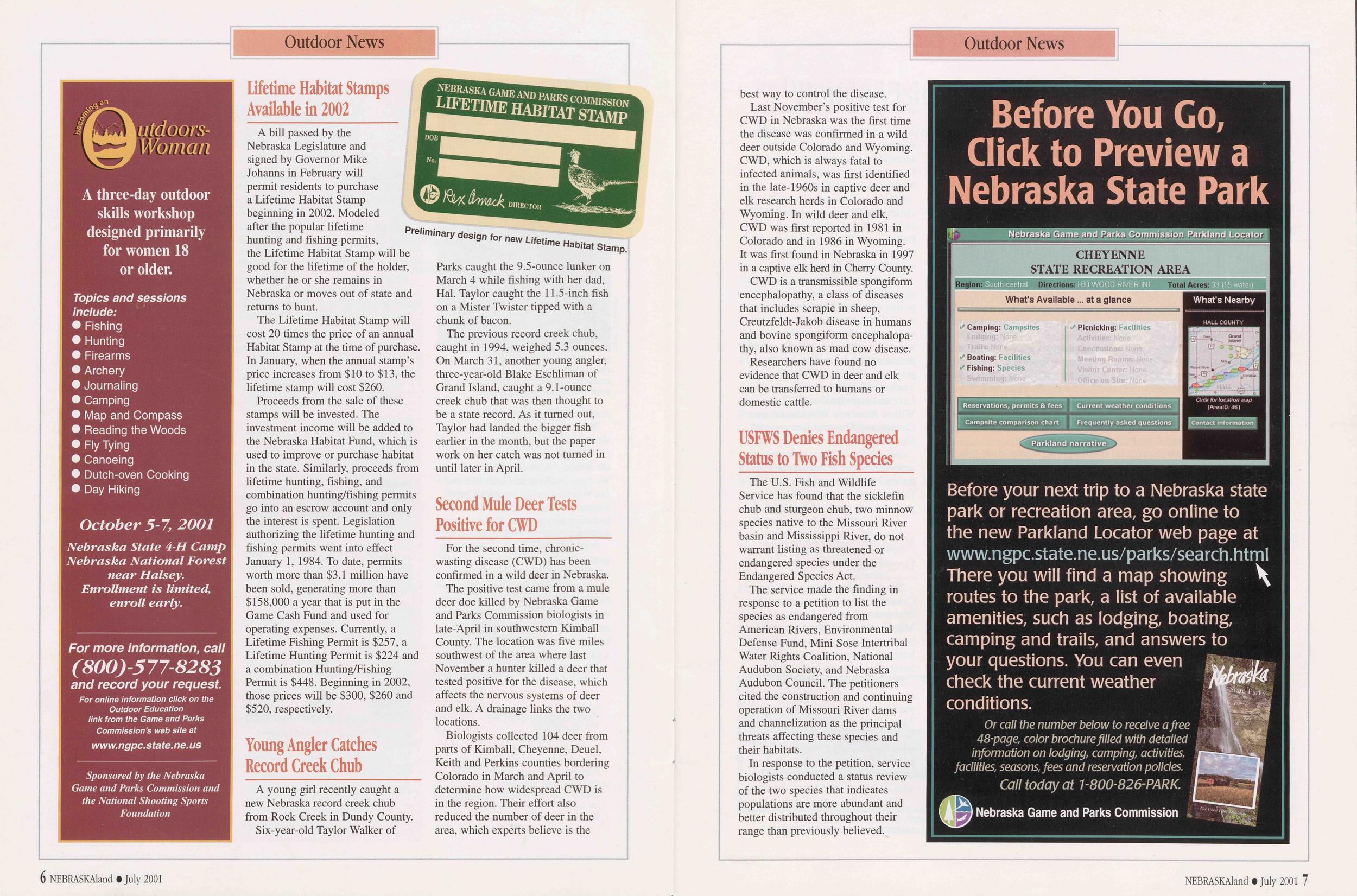
A bill passed by the Nebraska Legislature and signed by Governor Mike Johanns in February will permit residents to purchase a Lifetime Habitat Stamp beginning in 2002. Modeled after the popular lifetime hunting and fishing permits, the Lifetime Habitat Stamp will be good for the lifetime of the holder, whether he or she remains in Nebraska or moves out of state and returns to hunt.
The Lifetime Habitat Stamp will cost 20 times the price of an annual Habitat Stamp at the time of purchase. In January, when the annual stamp's price increases from $10 to $13, the lifetime stamp will cost $260.
Proceeds from the sale of these stamps will be invested. The investment income will be added to the Nebraska Habitat Fund, which is used to improve or purchase habitat in the state. Similarly, proceeds from lifetime hunting, fishing, and combination hunting/fishing permits go into an escrow account and only the interest is spent. Legislation authorizing the lifetime hunting and fishing permits went into effect January 1, 1984. To date, permits worth more than $3.1 million have been sold, generating more than $158,000 a year that is put in the Game Cash Fund and used for operating expenses. Currently, a Lifetime Fishing Permit is $257, a Lifetime Hunting Permit is $224 and a combination Hunting/Fishing Permit is $448. Beginning in 2002, those prices will be $300, $260 and $520, respectively.
Young Angler Catches Record Creek ChubA young girl recently caught a new Nebraska record creek chub from Rock Creek in Dundy County. Six-year-old Taylor Walker of Parks caught the 9.5-ounce lunker on March 4 while fishing with her dad, Hal. Taylor caught the 11.5-inch fish on a Mister Twister tipped with a chunk of bacon.
The previous record creek chub, caught in 1994, weighed 5.3 ounces. On March 31, another young angler, three-year-old Blake Eschliman of Grand Island, caught a 9.1-ounce creek chub that was then thought to be a state record. As it turned out, Taylor had landed the bigger fish earlier in the month, but the paper work on her catch was not turned in until later in April.
Second Mule Deer Tests Positive for CWDFor the second time, chronic-wasting disease (CWD) has been confirmed in a wild deer in Nebraska.
The positive test came from a mule deer doe killed by Nebraska Game and Parks Commission biologists in late-April in southwestern Kimball County. The location was five miles southwest of the area where last November a hunter killed a deer that tested positive for the disease, which affects the nervous systems of deer and elk. A drainage links the two locations.
Biologists collected 104 deer from parts of Kimball, Cheyenne, Deuel, Keith and Perkins counties bordering Colorado in March and April to determine how widespread CWD is in the region. Their effort also reduced the number of deer in the area, which experts believe is the best way to control the disease.
Last November's positive test for CWD in Nebraska was the first time the disease was confirmed in a wild deer outside Colorado and Wyoming. CWD, which is always fatal to infected animals, was first identified in the late-1960s in captive deer and elk research herds in Colorado and Wyoming. In wild deer and elk, CWD was first reported in 1981 in Colorado and in 1986 in Wyoming. It was first found in Nebraska in 1997 in a captive elk herd in Cherry County.
CWD is a transmissible spongiform encephalopathy, a class of diseases that includes scrapie in sheep, Creutzfeldt-Jakob disease in humans and bovine spongiform encephalopathy, also known as mad cow disease.
Researchers have found no evidence that CWD in deer and elk can be transferred to humans or domestic cattle.
USFWS Denies Endangered Status to Two Fish SpeciesThe U.S. Fish and Wildlife Service has found that the sicklefin chub and sturgeon chub, two minnow species native to the Missouri River basin and Mississippi River, do not warrant listing as threatened or endangered species under the Endangered Species Act.
The service made the finding in response to a petition to list the species as endangered from American Rivers, Environmental Defense Fund, Mini Sose Intertribal Water Rights Coalition, National Audubon Society, and Nebraska Audubon Council. The petitioners cited the construction and continuing operation of Missouri River dams and channelization as the principal threats affecting these species and their habitats.
In response to the petition, service biologists conducted a status review of the two species that indicates populations are more abundant and better distributed throughout their range than previously believed.
Before Click to Preview a Nebraska State Park CHEYENNE STATE RECREATION AREA South-central Total Acres: 3 (15 water) What's Available ... at a glance What's Nearby Camping: Campsites " Picnicking: Facilities Boating: Facilities Fishing: Species Reservations, permits & fees Current weather conditions Campsite comparison chart Frequently asked questions Parkland narrative Before your next trip to a Nebraska state park or recreation area, go online to the new Parkland Locator web page at www.ngpc.state.ne.us/parks/search.html There you will find a map showing routes to the park, a list of available amenities, such as lodging, boating, camping and trails, and answers to your questions. You can even check the current weather conditions. Or call the number below to receive a free 48-page, color brochure filled with detailed information on lodging, camping, activities, facilities, seasons, fees and reservation policies. Call today at 1-800-826-PARK. Nebraska Game and Parks Commission 6 NEBRASKAland • July 2001 NEBRASKAland • July 2001 7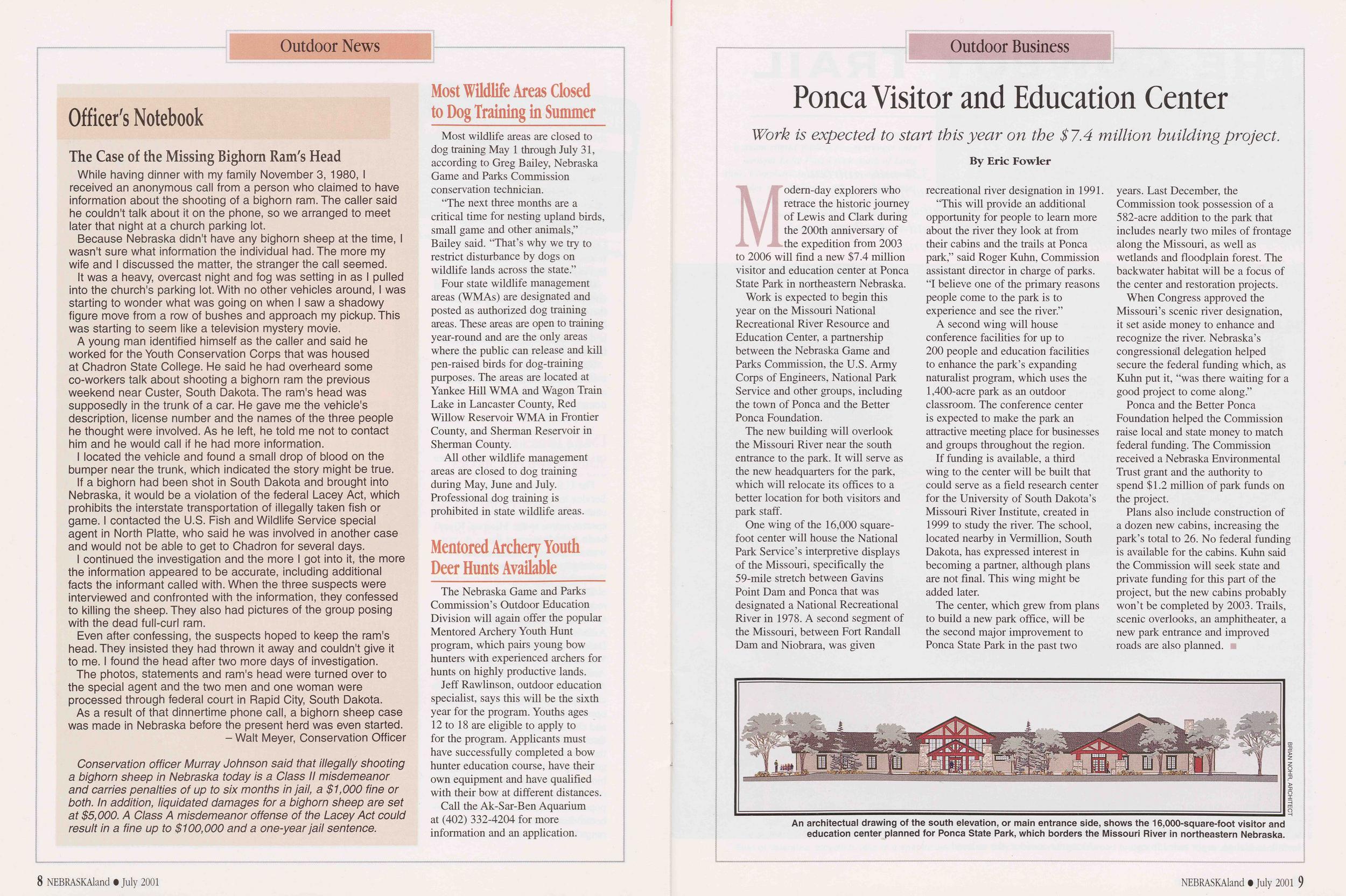 Officer's Notebook
The Case of the Missing Bighorn Ram's Head
Officer's Notebook
The Case of the Missing Bighorn Ram's Head
While having dinner with my family November 3, 1980, I received an anonymous call from a person who claimed to have information about the shooting of a bighorn ram. The caller said he couldn't talk about it on the phone, so we arranged to meet later that night at a church parking lot.
Because Nebraska didn't have any bighorn sheep at the time, I wasn't sure what information the individual had. The more my wife and I discussed the matter, the stranger the call seemed. It was a heavy, overcast night and fog was setting in as I pulled into the church's parking lot. With no other vehicles around, I was starting to wonder what was going on when I saw a shadowy figure move from a row of bushes and approach my pickup. This was starting to seem like a television mystery movie.
A young man identified himself as the caller and said he worked for the Youth Conservation Corps that was housed at Chadron State College. He said he had overheard some co-workers talk about shooting a bighorn ram the previous weekend near Custer, South Dakota. The ram's head was supposedly in the trunk of a car. He gave me the vehicle's description, license number and the names of the three people he thought were involved. As he left, he told me not to contact him and he would call if he had more information.
I located the vehicle and found a small drop of blood on the bumper near the trunk, which indicated the story might be true.
If a bighorn had been shot in South Dakota and brought into Nebraska, it would be a violation of the federal Lacey Act, which prohibits the interstate transportation of illegally taken fish or game. I contacted the U.S. Fish and Wildlife Service special agent in North Platte, who said he was involved in another case and would not be able to get to Chadron for several days.
I continued the investigation and the more I got into it, the more the information appeared to be accurate, including additional facts the informant called with. When the three suspects were interviewed and confronted with the information, they confessed to killing the sheep. They also had pictures of the group posing with the dead full-curl ram.
Even after confessing, the suspects hoped to keep the ram's head. They insisted they had thrown it away and couldn't give it to me. I found the head after two more days of investigation.
The photos, statements and ram's head were turned over to the special agent and the two men and one woman were processed through federal court in Rapid City, South Dakota.
As a result of that dinnertime phone call, a bighorn sheep case was made in Nebraska before the present herd was even started.
- Walt Meyer, Conservation OfficerConservation officer Murray Johnson said that illegally shooting a bighorn sheep in Nebraska today is a Class II misdemeanor and carries penalties of up to six months in jail, a $1,000 fine or both. In addition, liquidated damages for a bighorn sheep are set at $5,000. A Class A misdemeanor offense of the Lacey Act could result in a fine up to $100,000 and a one-year jail sentence.
Most Wildlife Areas Closed to Dog Training in SummerMost wildlife areas are closed to dog training May 1 through July 31, according to Greg Bailey, Nebraska Game and Parks Commission conservation technician.
"The next three months are a critical time for nesting upland birds, small game and other animals," Bailey said. "That's why we try to restrict disturbance by dogs on wildlife lands across the state."
Four state wildlife management areas (WMAs) are designated and posted as authorized dog training areas. These areas are open to training year-round and are the only areas where the public can release and kill pen-raised birds for dog-training purposes. The areas are located at Yankee Hill WMA and Wagon Train Lake in Lancaster County, Red Willow Reservoir WMA in Frontier County, and Sherman Reservoir in Sherman County.
All other wildlife management areas are closed to dog training during May, June and July. Professional dog training is prohibited in state wildlife areas.
Mentored Archery Youth Deer Hunts AvailableThe Nebraska Game and Parks Commission's Outdoor Education Division will again offer the popular Mentored Archery Youth Hunt program, which pairs young bow hunters with experienced archers for hunts on highly productive lands.
Jeff Rawlinson, outdoor education specialist, says this will be the sixth year for the program. Youths ages 12 to 18 are eligible to apply to for the program. Applicants must have successfully completed a bow hunter education course, have thenown equipment and have qualified with their bow at different distances.
Call the Ak-Sar-Ben Aquarium at (402) 332-4204 for more information and an application.
Ponca Visitor and Education Center Work is expected to start this year on the $7.4 million building project.Modern-day explorers who retrace the historic journey of Lewis and Clark during the 200th anniversary of the expedition from 2003 to 2006 will find a new $7.4 million visitor and education center at Ponca State Park in northeastern Nebraska.
Work is expected to begin this year on the Missouri National Recreational River Resource and Education Center, a partnership between the Nebraska Game and Parks Commission, the U.S. Army Corps of Engineers, National Park Service and other groups, including the town of Ponca and the Better Ponca Foundation.
The new building will overlook the Missouri River near the south entrance to the park. It will serve as the new headquarters for the park, which will relocate its offices to a better location for both visitors and park staff.
One wing of the 16,000 square- foot center will house the National Park Service's interpretive displays of the Missouri, specifically the 59-mile stretch between Gavins Point Dam and Ponca that was designated a National Recreational River in 1978. A second segment of the Missouri, between Fort Randall Dam and Niobrara, was given recreational river designation in 1991.
"This will provide an additional opportunity for people to learn more about the river they look at from their cabins and the trails at Ponca park," said Roger Kuhn, Commission assistant director in charge of parks. "I believe one of the primary reasons people come to the park is to experience and see the river."
A second wing will house conference facilities for up to 200 people and education facilities to enhance the park's expanding naturalist program, which uses the 1,400-acre park as an outdoor classroom. The conference center is expected to make the park an attractive meeting place for businesses and groups throughout the region.
If funding is available, a third wing to the center will be built that could serve as a field research center for the University of South Dakota's Missouri River Institute, created in 1999 to study the river. The school, located nearby in Vermillion, South Dakota, has expressed interest in becoming a partner, although plans are not final. This wing might be added later.
The center, which grew from plans to build a new park office, will be the second major improvement to Ponca State Park in the past two years. Last December, the Commission took possession of a 582-acre addition to the park that includes nearly two miles of frontage along the Missouri, as well as wetlands and floodplain forest. The backwater habitat will be a focus of the center and restoration projects.
When Congress approved the Missouri's scenic river designation, it set aside money to enhance and recognize the river. Nebraska's congressional delegation helped secure the federal funding which, as Kuhn put it, "was there waiting for a good project to come along."
Ponca and the Better Ponca Foundation helped the Commission raise local and state money to match federal funding. The Commission received a Nebraska Environmental Trust grant and the authority to spend $1.2 million of park funds on the project.
Plans also include construction of a dozen new cabins, increasing the park's total to 26. No federal funding is available for the cabins. Kuhn said the Commission will seek state and private funding for this part of the project, but the new cabins probably won't be completed by 2003. Trails, scenic overlooks, an amphitheater, a new park entrance and improved roads are also planned.
The Cowboy Trail COMING ALIVE
By Tom White Born in the 1870s as a route to Black Hills gold, this 321-mile railroad corridor created and supplied settlements across northern Nebraska. Soon after the trains stopped in 1992, recreational enthusiasts purchased the right-of-way for the nation's longest recreational rail-to-trail project. The 47 miles of trail open today should double by the end of the 2002 construction season and include a continuous 75-mile stretch from Norfolk to O'Neill.The 19th century's great western migration laced Nebraska with travel corridors - the Oregon- California Trail, the Pony Express route, the Mormon Trail. Most have nearly vanished; their remaining traces are ruts crossing pastures, historical road signs that mark would-be intersections with modern highways, and a few restored way stations.
The routes that have endured were laid with rails and connected population and resource centers. The Union Pacific and Burlington Northern Santa Fe lines, traced by parallel highways, remain sturdy bones in the nation's transportation network.
Somewhere between the almost gone and the commercially robust routes lies the Cowboy Recreation and Nature Trail - a historical corridor in transition.
Once part of the Chicago & North Western railroad's Cowboy Line, the route covers 321 miles across northern Nebraska from Norfolk to Chadron. From east to west, the trail passes through the farmland of the Elkhorn River valley, into Plains ranchland, across the scenic Niobrara River valley, along the northern Sandhills and to the edge of the Pine Ridge.
The Cowboy Trail is the longest rail-to-trail conversion in progress in the United States. Today, 47 miles of trail have been opened to public hiking, biking and horseback riding. This includes a 34-mile segment from Norfolk to Neligh, eight miles from Inman to O'Neill, and a five-mile stretch at Valentine that crosses the Niobrara River.
Gold Rush Created Route Across NebraskaThe corridor's history has been one of vacillating financial fortune. Indeed, it owes its very existence to the Black Hills' 1870s gold rush.
In 1871 the Fremont, Elkhorn & Missouri Valley Railroad (FE& MV) ran from Fremont to Wisner and had plans to push north to the confluence of the Niobrara and Missouri rivers. But, because of an economic downturn, rail construction stalled at Wisner.
Gold was discovered in the Black Hills in Dakota Territory in July 1874. Two years later the U.S. government wrested the Black Hills from the Sioux Indians, opening the way for Euroamerican exploration and mining. By sheer good fortune, the FE& MV found itself in the best geographical position to forge a much-needed supply line to the Black Hills.
Running south of Indian reservations, which blocked other railroads from the east, the FE& MV reached Oakdale in 1879, Fort Niobrara and Valentine in 1883 and Chadron by 1885. By the time the first train pulled into Rapid City in July 1886, the larger Chicago & North Western Railway (C& NW) had acquired the FE& MV - although the name didn't change for another 15 years.
Along its corridor, the railroad
10 NEBRASKAland • July 2001
NEBRASKAland • July 2001 11
 created stations every seven to 15 miles
and, around most, towns sprung up or
grew larger, providing services for
increasing numbers of homesteaders
and businesses. From Norfolk to
Chadron, the names of places - some
still vibrant, some gone - sketch a line
across the state: Kent, Battle Creek,
Meadow Grove, Tilden, Hord, Oakdale,
Neligh, Clearwater, Ewing, Stafford,
Inman, O'Neill, Emmet, Atkinson,
Gravel Pit, Stuart, Newport, Rock,
Bassett, Long Pine, Ainsworth,
Sandridge, Johnstown, Wood Lake,
Arabia, Thacher, Valentine, Crookston,
Kilgore, Nenzel, Cody, Roxby, Eli,
Mesa, Merriman, Bachelor, Irwin,
Soudan, Gordon, Clinton, Rushville,
Hay Springs, Bordeaux, and Chadron.
created stations every seven to 15 miles
and, around most, towns sprung up or
grew larger, providing services for
increasing numbers of homesteaders
and businesses. From Norfolk to
Chadron, the names of places - some
still vibrant, some gone - sketch a line
across the state: Kent, Battle Creek,
Meadow Grove, Tilden, Hord, Oakdale,
Neligh, Clearwater, Ewing, Stafford,
Inman, O'Neill, Emmet, Atkinson,
Gravel Pit, Stuart, Newport, Rock,
Bassett, Long Pine, Ainsworth,
Sandridge, Johnstown, Wood Lake,
Arabia, Thacher, Valentine, Crookston,
Kilgore, Nenzel, Cody, Roxby, Eli,
Mesa, Merriman, Bachelor, Irwin,
Soudan, Gordon, Clinton, Rushville,
Hay Springs, Bordeaux, and Chadron.
For years there was speculation that the C& NW had designs on making its line transcontinental to compete with the Union Pacific. But, shortly after the North Western reached Lander, Wyoming, in 1906, the railroad's management decided that was the end.
As with other railroads across the country, the C& NW was the dominant transporter of both freight and people in northern Nebraska from the 1880s through the 1920s. Indeed, without it, many of the towns and homesteads could not have survived. In 1876 the C& NW advertised itself as the 'The Sportman's Route" and, for some years around 1900, hunters in the Red Deer Club of Lincoln used the route to travel to Cherry County.
The construction of the Mount
Rushmore National Memorial began in
1927 and boosted the number of visitors
the North Western transported to see
the Black Hills. But freight and livestock
were the line's real trade. For years
ranchers would load cattle out of the
Sandhills and ride with them to the
Omaha stockyards. In 1932, the C& NW
served 66 farm implement dealers,
117 coal dealers, 48 grain elevators,
55 lumber dealers and 128 gas and oil
receivers on the line from Fremont to
Lander. But, by the 1930s, improved
12 NEBRASKAland • July 2001
NEBRASKAland • July 2001 13
 highways and increasingly reliable cars
and trucks provided more-flexible
alternatives to rail service, and the
Great Depression sent the line into an
economic tailspin.
highways and increasingly reliable cars
and trucks provided more-flexible
alternatives to rail service, and the
Great Depression sent the line into an
economic tailspin.
During World War II, the C& NW carried oil from central Wyoming and troops and supplies to Fort Robinson and South Dakota's Fort Meade. The line prospered again with agricultural shipments in the late 1940s. But, the number of riders continued to decline and passenger service ended in July 1958. With no more riders, most depots, once centers of small town activity, closed and the railroad's management and services were centralized.
C& NW began abandoning distant segments of the line in the 1960s. For a period in the 1980s, the Cowboy Line carried increasing loads of bentonite and coal from Wyoming. But, the company rerouted the business in 1989 and, in 1991, it filed an application with the Interstate Commerce Commission to abandon the Norfolk-to-Chadron portion of the line.
The last trains ran across the northern Nebraska line on December 1, 1992.
Railbanking Boosted Hike-Bike Trail movementAs the economic forces that created and sustained the Cowboy Line and other rail corridors withered, another movement that would shape their futures was taking hold.
Recreational trail advocates argued that abandoned rail corridors should not be disassembled. Maintaining the routes as hiking and biking trails, they pointed out, would provide public recreation while keeping the rights-of-way intact for possible future transportation or utility uses.
In 1983 Congress gave this concept legal standing in a one-paragraph provision that established "railbanking" and, in 1990, a U.S. Supreme Court decision affirmed the statute's legality.
Since 1991 two federal authorizations - known by the initialisms, ISTEA and TEA-21 - have shifted a small portion of federal transportation spending to bicycle and pedestrian projects. Although the concept is still disputed by some landowners with adjacent properties, railbanking and the stimulus of $3.8 billion in federal funding have created nationwide more than 1,000 trails with 11,000 miles of actively used, publicly owned routes during the past 15 years. The longest completed rail-trail is the Katy Trail, winding almost 200 miles through the middle of Missouri. About 1,200 more rail-trail projects are in planning stages.
The Rails-to-Trails Conservancy, a national nonprofit organization with more than 100,000 members, purchased the C& NW right-of-way across northern Nebraska for $6.2 million in 1993. The next year it donated the route to the state of Nebraska. A measure passed by the Nebraska Legislature made the Nebraska Game and Parks Commission responsible for the development and maintenance of what amounts to a 3,893-acre linear park that stretches 321 miles across the state.
Developing The Cowboy TrailOver the past seven years, the Cowboy Trail has emerged a piece at a time. On the 247-mile segment from Norfolk to Merriman, rails and ties have been removed and more than 200 bridges have been repaired and rebuilt with decking and sides added to allow foot, bicycle and horse traffic.
Federal TEA-21 funding is used to develop the trail. The cost for each mile of grading, surfacing and installing signs and bridges is about $26,000.
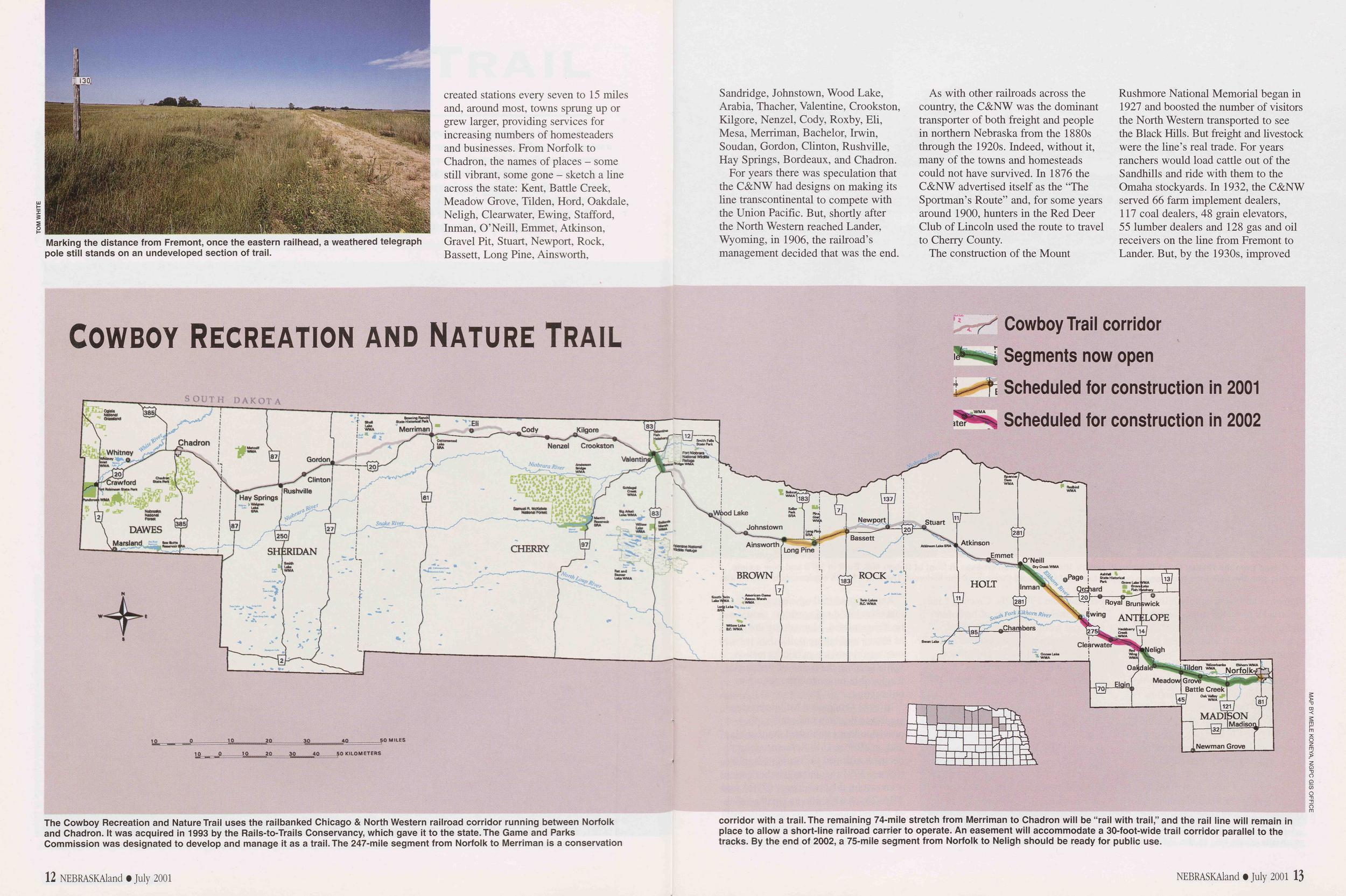
The 47 miles of trail open today should double by the end of the 2002 construction season. At that point, a continuous stretch of 75 miles, from Norfolk to O'Neill, and an additional 15-mile segment, from Bassett to Ainsworth through the scenic Long Pine area, will be available for trail users.
New construction and developments along the trail include:
• The 14-mile segment from Inman to Ewing will open this summer after surfacing is completed.
• A two-mile connector, which will allow users to begin their trip from TaHaZouka Park in Norfolk rather than the current trailhead west of the city is scheduled to be constructed this summer.
• Surfacing of the 15-mile, Ainsworth-to-Bassert segment will begin this year.
• Surfacing of the 18-mile, Neligh-to-Ewing segment will begin in 2002.
• Yucca Dune, an outfitting business located in Valentine, will have a bicycle sales and repair shop in the restored O'Neill depot next to the trail.
• The community of Long Pine is renovating its depot and the 12-room crew quarters.
The Trail Experience: Seeing Nebraska Up-CloseSpanning a sizeable chunk of America's outback, the Cowboy Trail experience is largely what one makes it. It can be a pleasant escape for an evening nature walk, a family getaway for a bicycling weekend, a course for a grueling long-distance run, or a convenient route to explore the Plains on horseback.
Whether biking, hiking or horseback riding, the trail offers a few givens for all who travel it.
Regardless of where you enter and exit, travel the Cowboy Trail and you will soon be immersed in nature. The eight-foot wide ribbon of crushed limestone and wooden bridges cuts through a right-of-way, normally 100-feet wide, which provides important cover for wildlife and pockets for native prairie plants. While species differ along the route, rabbits, ground squirrels, pheasants, quail, and many songbirds find suitable habitat through much of the trail's course.
The corridor is alive with the sounds and sights of creatures, large and small, often missed by travelers in closed cars moving at 60 or 65 mph. Bald eagles patrol the Elkhorn River valley and, farther west, turkey vultures soar on thermals above the Niobrara River. The corridor also functions as an important migration route for wildlife between habitat areas.
Today's travelers on the Cowboy Trail, and on most other rail-trails, benefit from work of surveyors and engineers a century ago. To accommodate locomotives, railroads were built with grades of two percent or less, and with wide, sweeping curves. Today those design elements are a blessing to the self-propelled human being, especially at the end of a long day. On these trails, bikers, hikers and horseback riders have fewer hills, dales and sharp curves than do motorists on most highways.
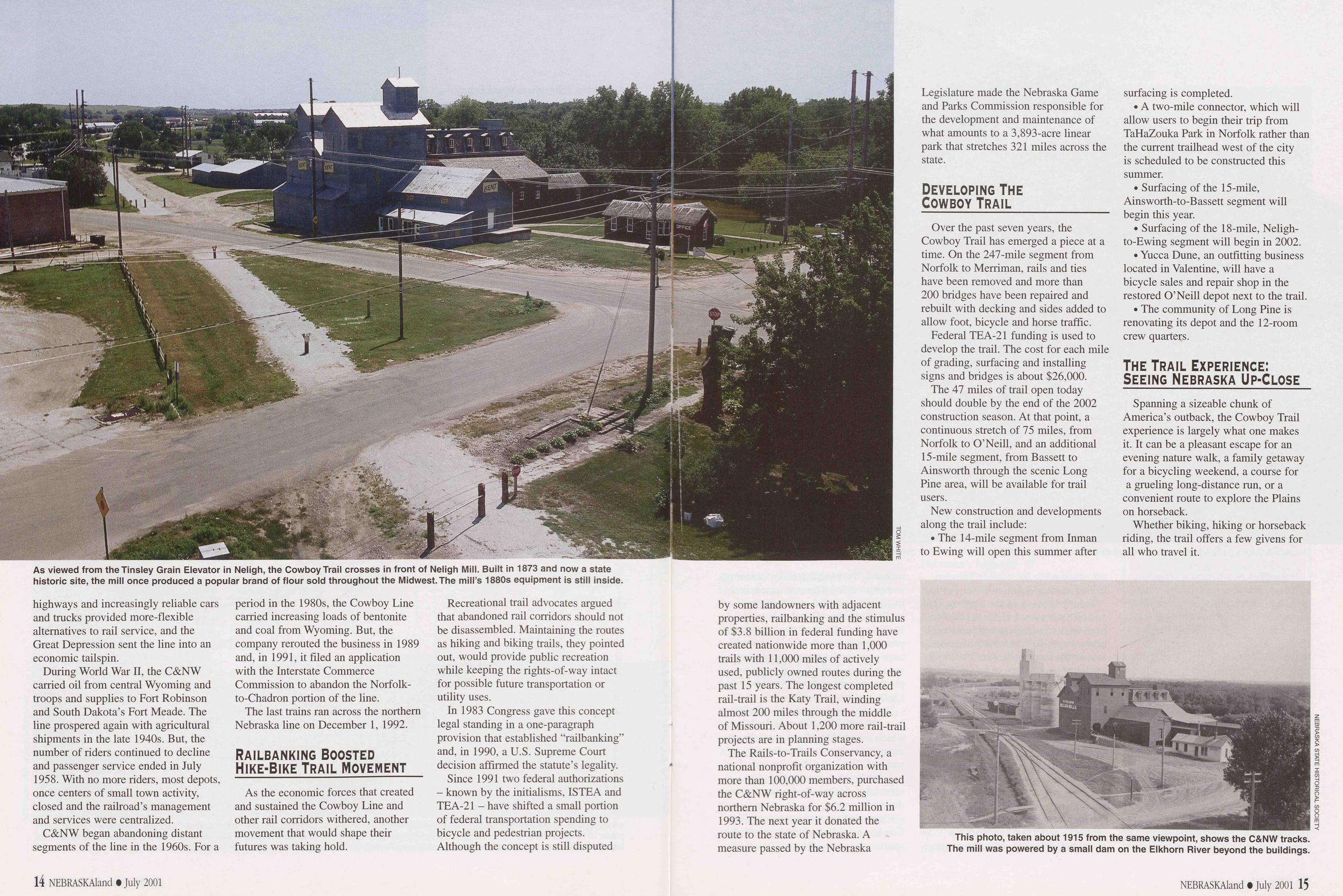
Along the Cowboy Trail, travelers discover many ghosts from the corridor's railroad past. Some weathered mileposts, originally telegraph poles, stand as sentinels, and a few still mark the distance to Fremont, once the eastern railhead. Next to the trail in the towns and cities along the route, riders find many buildings and structures that once served the railroad or were businesses tied to it. One of the most prominent is Neligh Mill, a grist mill once powered by water that is now a state historical site. It is open to the public and still harbors its original 1880s equipment inside.
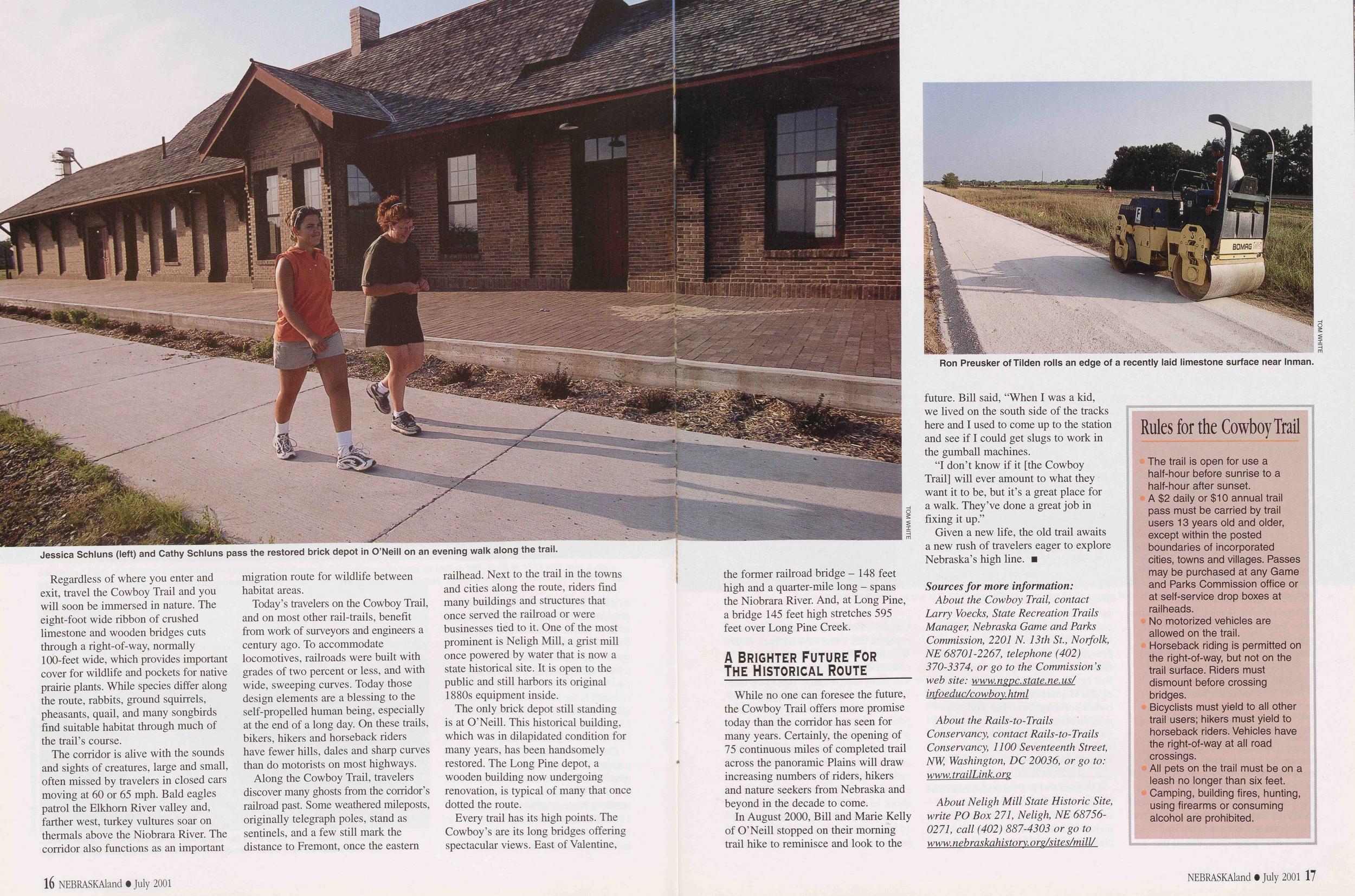
The only brick depot still standing is at O'Neill. This historical building, which was in dilapidated condition for many years, has been handsomely restored. The Long Pine depot, a wooden building now undergoing renovation, is typical of many that once dotted the route.
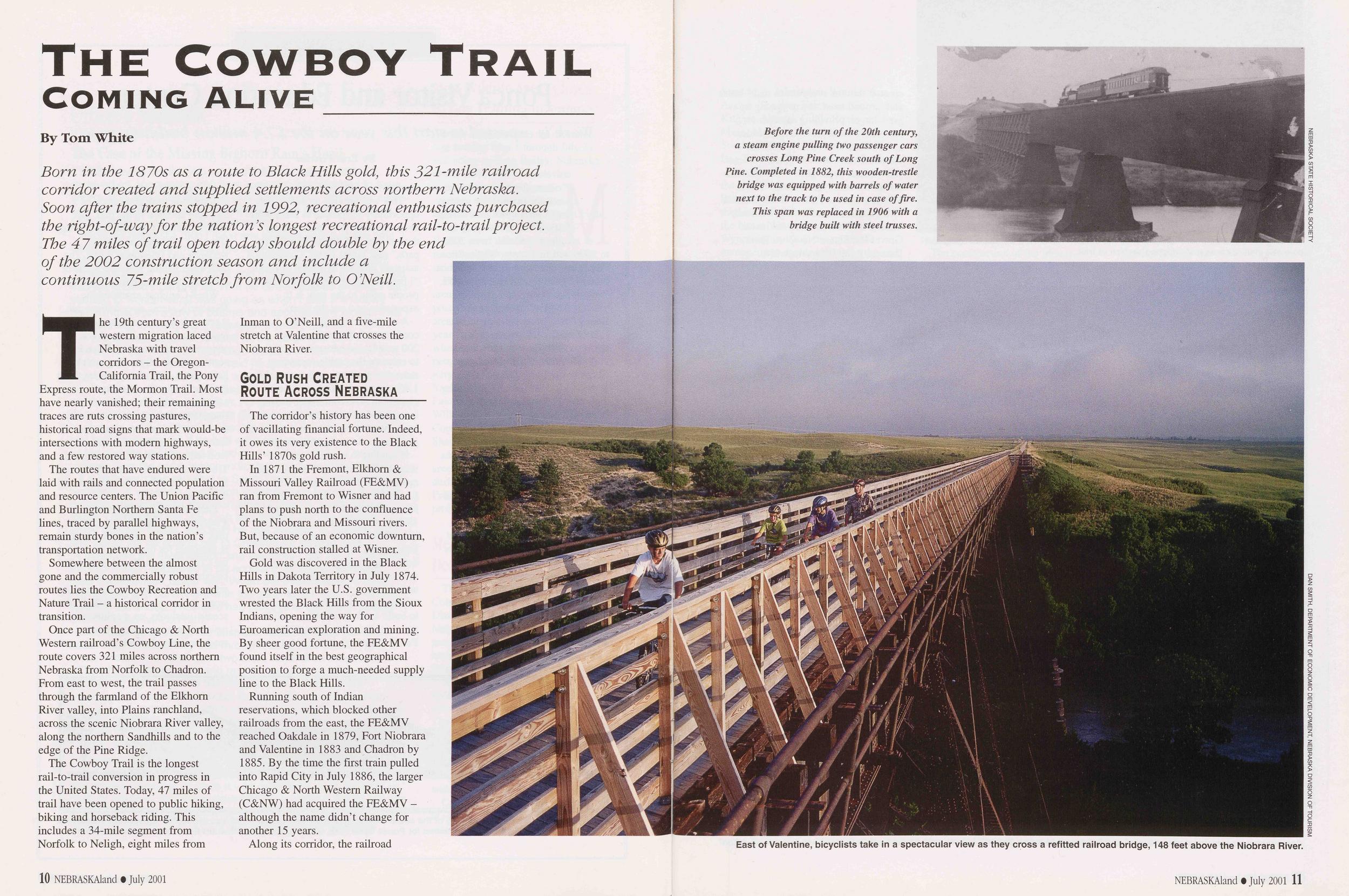
Every trail has its high points. The Cowboy's are its long bridges offering spectacular views. East of Valentine, the former railroad bridge - 148 feet high and a quarter-mile long - spans the Niobrara River. And, at Long Pine, a bridge 145 feet high stretches 595 feet over Long Pine Creek.
A Brighter Future For The Historical routeWhile no one can foresee the future, the Cowboy Trail offers more promise today than the corridor has seen for many years. Certainly, the opening of 75 continuous miles of completed trail across the panoramic Plains will draw increasing numbers of riders, hikers and nature seekers from Nebraska and beyond in the decade to come.
In August 2000, Bill and Marie Kelly of O'Neill stopped on their morning trail hike to reminisce and look to the Ron Preusker of Tilden rolls an edge of a recently laid limestone surface near Inman. future. Bill said, "When I was a kid, we lived on the south side of the tracks here and I used to come up to the station and see if I could get slugs to work in the gumball machines.
"I don't know if it [the Cowboy Trail] will ever amount to what they want it to be, but it's a great place for a walk. They've done a great job in fixing it up."
Given a new life, the old trail awaits a new rush of travelers eager to explore Nebraska's high line.
Sources for more information: About the Cowboy Trail, contact Larry Voecks, State Recreation Trails Manager, Nebraska Game and Parks Commission, 2201 N. 13th St, Norfolk, NE 68701-2267, telephone (402) 370-3374, or go to the Commission's web site: www, ngpc. state, ne. us/ infoeduc/cowbov. html
About the Rails-to-Trails Conservancy, contact Rails-to-Trails Conservancy, 1100 Seventeenth Street, NW, Washington, DC 20036, or go to: www. trailLink. org
About Neligh Mill State Historic Site, write PO Box 271, Neligh, NE 68756- 0271, call (402) 887-4303 or go to www, nebraskahistory.org/sites/mill/
Rules for the Cowboy TrailThe trail is open for use a half-hour before sunrise to a half-hour after sunset. A $2 daily or $10 annual trail pass must be carried by trail users 13 years old and older, except within the posted boundaries of incorporated cities, towns and villages. Passes may be purchased at any Game and Parks Commission office or at self-service drop boxes at railheads. No motorized vehicles are allowed on the trail. Horseback riding is permitted on the right-of-way, but not on the trail surface. Riders must dismount before crossing bridges. Bicyclists must yield to all other trail users; hikers must yield to horseback riders. Vehicles have the right-of-way at all road crossings. All pets on the trail must be on a leash no longer than six feet. Camping, building fires, hunting, using firearms or consuming alcohol are prohibited.
16 NEBRASKAland • July 2001 NEBRASKAland • July 2001 17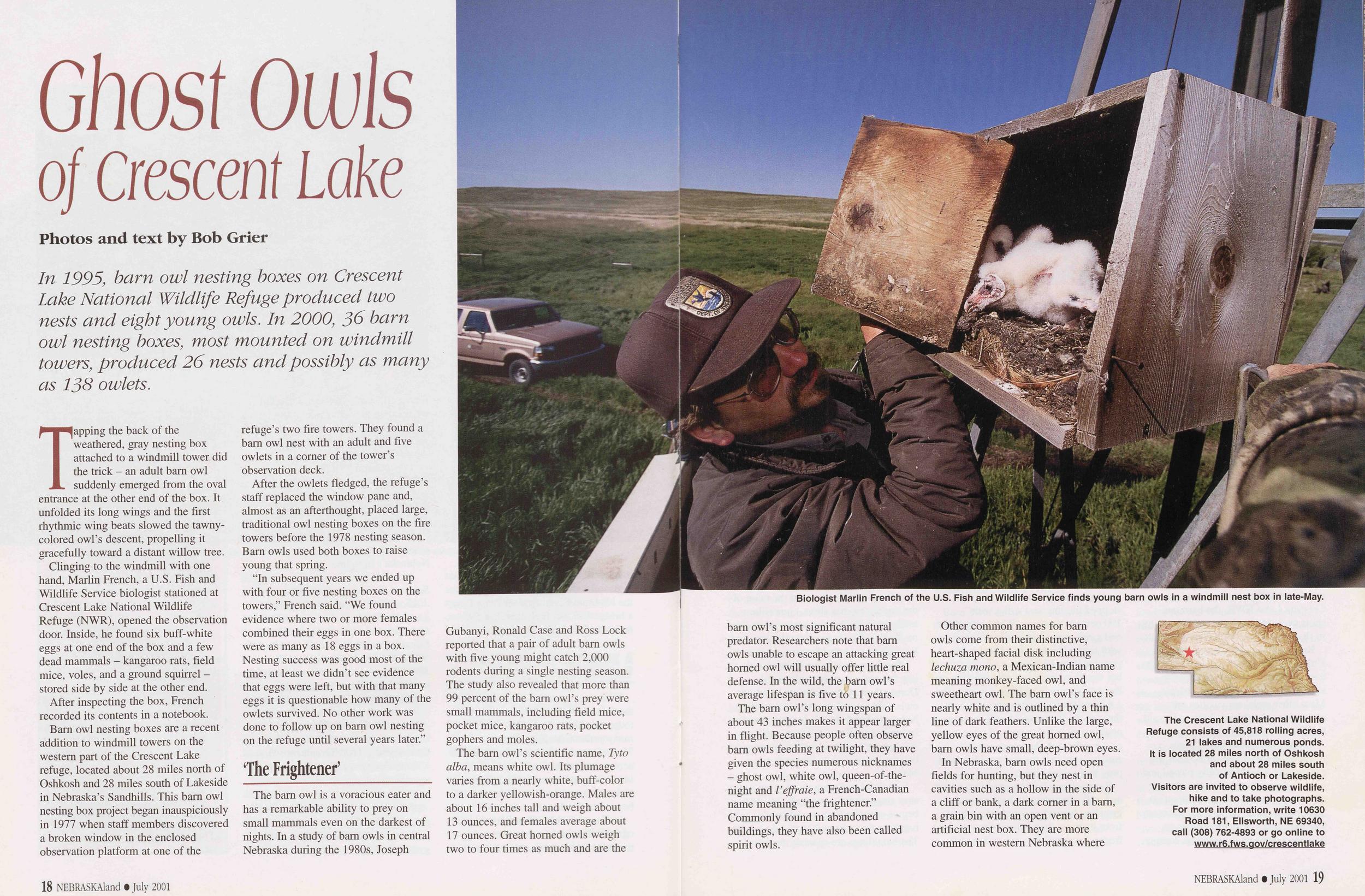
Ghost Owls of Crescent Lake
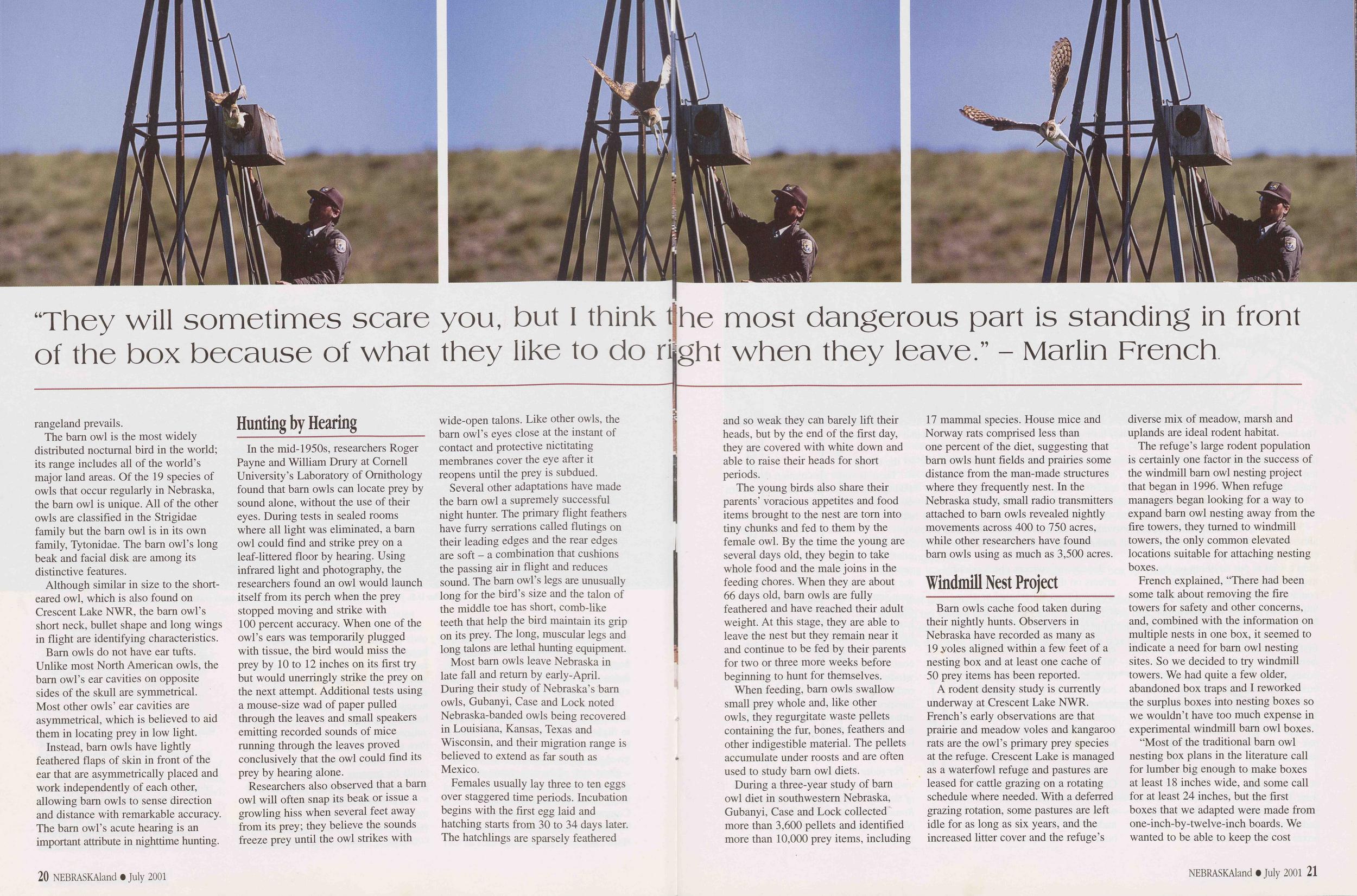
Photos and text by Bob Grier In 1995, barn owl nesting boxes on Crescent Lake National Wildlife Refuge produced two nests and eight young owls. In 2000, 36 barn owl nesting boxes, most mounted on windmill towers, produced 26 nests and possibly as many as 138 owlets.Tapping the back of the weathered, gray nesting box attached to a windmill tower did the trick - an adult bam owl suddenly emerged from the oval entrance at the other end of the box. It unfolded its long wings and the first rhythmic wing beats slowed the tawny- colored owl's descent, propelling it gracefully toward a distant willow tree.
Clinging to the windmill with one hand, Marlin French, a U.S. Fish and Wildlife Service biologist stationed at Crescent Lake National Wildlife Refuge (NWR), opened the observation door. Inside, he found six buff-white eggs at one end of the box and a few dead mammals - kangaroo rats, field mice, voles, and a ground squirrel - stored side by side at the other end.
After inspecting the box, French recorded its contents in a notebook.
Barn owl nesting boxes are a recent addition to windmill towers on the western part of the Crescent Lake refuge, located about 28 miles north of Oshkosh and 28 miles south of Lakeside in Nebraska's Sandhills. This barn owl nesting box project began inauspiciously in 1977 when staff members discovered a broken window in the enclosed observation platform at one of the refuge's two fire towers. They found a barn owl nest with an adult and five owlets in a comer of the tower's observation deck.
After the owlets fledged, the refuge's staff replaced the window pane and, almost as an afterthought, placed large, traditional owl nesting boxes on the fire towers before the 1978 nesting season. Barn owls used both boxes to raise young that spring.
"In subsequent years we ended up with four or five nesting boxes on the towers," French said. "We found evidence where two or more females combined their eggs in one box. There were as many as 18 eggs in a box. Nesting success was good most of the time, at least we didn't see evidence that eggs were left, but with that many eggs it is questionable how many of the owlets survived. No other work was done to follow up on barn owl nesting on the refuge until several years later."
'The Frightener'The barn owl is a voracious eater and has a remarkable ability to prey on small mammals even on the darkest of nights. In a study of barn owls in central Nebraska during the 1980s, Joseph Biologist Marlin French of the U.S. Fish and Wildlife Service finds young barn owls in a windmill nest box in late-May. Gubanyi, Ronald Case and Ross Lock reported that a pair of adult bam owls with five young might catch 2,000 rodents during a single nesting season. The study also revealed that more than 99 percent of the barn owl's prey were small mammals, including field mice, pocket mice, kangaroo rats, pocket gophers and moles.
The barn owl's scientific name, Tyto alba, means white owl. Its plumage varies from a nearly white, buff-color to a darker yellowish-orange. Males are about 16 inches tall and weigh about 13 ounces, and females average about 17 ounces. Great horned owls weigh two to four times as much and are the barn owl's most significant natural predator. Researchers note that barn owls unable to escape an attacking great horned owl will usually offer little real defense. In the wild, the barn owl's average lifespan is five to 11 years.
The barn owl's long wingspan of about 43 inches makes it appear larger in flight. Because people often observe barn owls feeding at twilight, they have given the species numerous nicknames - ghost owl, white owl, queen-of-the- night and Veffraie, a French-Canadian name meaning "the frightener." Commonly found in abandoned buildings, they have also been called spirit owls.
Other common names for barn owls come from their distinctive, heart-shaped facial disk including lechuza mono, a Mexican-Indian name meaning monkey-faced owl, and sweetheart owl. The barn owl's face is nearly white and is outlined by a thin line of dark feathers. Unlike the large, yellow eyes of the great horned owl, barn owls have small, deep-brown eyes.
The Crescent Lake National Wildlife Refuge consists of 45,818 rolling acres, 21 lakes and numerous ponds. It is located 28 miles north of Oshkosh and about 28 miles south of Antioch or Lakeside. Visitors are invited to observe wildlife, hike and to take photographs. For more information, write 10630 Road 181, Ellsworth, NE 69340, call (308) 762-4893 or go online to www.r6.fws.gov/crescentlake
In Nebraska, barn owls need open
fields for hunting, but they nest in
cavities such as a hollow in the side of
a cliff or bank, a dark corner in a barn,
a grain bin with an open vent or an
artificial nest box. They are more
common in western Nebraska where
18 NEBRASKAland • July 2001
NEBRASKAland • July 2001 19
 rangeland prevails.
The barn owl is the most widely distributed nocturnal bird in the world; its range includes all of the world's major land areas. Of the 19 species of owls that occur regularly in Nebraska, the barn owl is unique. All of the other owls are classified in the Strigidae family but the barn owl is in its own family, Tytonidae. The barn owl's long beak and facial disk are among its distinctive features.
Although similar in size to the short- eared owl, which is also found on Crescent Lake NWR, the barn owl's short neck, bullet shape and long wings in flight are identifying characteristics.
Barn owls do not have ear tufts. Unlike most North American owls, the barn owl's ear cavities on opposite sides of the skull are symmetrical. Most other owls' ear cavities are asymmetrical, which is believed to aid them in locating prey in low light.
Instead, barn owls have lightly feathered flaps of skin in front of the ear that are asymmetrically placed and work independently of each other, allowing barn owls to sense direction and distance with remarkable accuracy. The barn owl's acute hearing is an important attribute in nighttime hunting.
Hunting by HearingIn the mid-1950s, researchers Roger Payne and William Drury at Cornell University's Laboratory of Ornithology found that barn owls can locate prey by sound alone, without the use of their eyes. During tests in sealed rooms where all light was eliminated, a barn owl could find and strike prey on a leaf-littered floor by hearing. Using infrared light and photography, the researchers found an owl would launch itself from its perch when the prey stopped moving and strike with 100 percent accuracy. When one of the owl's ears was temporarily plugged with tissue, the bird would miss the prey by 10 to 12 inches on its first try but would unerringly strike the prey on the next attempt. Additional tests using a mouse-size wad of paper pulled through the leaves and small speakers emitting recorded sounds of mice running through the leaves proved conclusively that the owl could find its prey by hearing alone.
Researchers also observed that a barn owl will often snap its beak or issue a growling hiss when several feet away from its prey; they believe the sounds freeze prey until the owl strikes with wide-open talons. Like other owls, the barn owl's eyes close at the instant of contact and protective necessitating membranes cover the eye after it reopens until the prey is subdued.
Several other adaptations have made the barn owl a supremely successful night hunter. The primary flight feathers have furry serrations called flutings on their leading edges and the rear edges are soft - a combination that cushions the passing air in flight and reduces sound. The barn owl's legs are unusually long for the bird's size and the talon of the middle toe has short, comb-like teeth that help the bird maintain its grip on its prey. The long, muscular legs and long talons are lethal hunting equipment.
Most barn owls leave Nebraska in late fall and return by early-April. During their study of Nebraska's barn owls, Gubanyi, Case and Lock noted Nebraska-banded owls being recovered in Louisiana, Kansas, Texas and Wisconsin, and their migration range is believed to extend as far south as Mexico.
Females usually lay three to ten eggs over staggered time periods. Incubation begins with the first egg laid and hatching starts from 30 to 34 days later. The hatchlings are sparsely feathered and so weak they can barely lift their heads, but by the end of the first day, they are covered with white down and able to raise their heads for short periods.
The young birds also share their parents' voracious appetites and food items brought to the nest are torn into tiny chunks and fed to them by the female owl. By the time the young are several days old, they begin to take whole food and the male joins in the feeding chores. When they are about 66 days old, barn owls are fully feathered and have reached their adult weight. At this stage, they are able to leave the nest but they remain near it and continue to be fed by their parents for two or three more weeks before beginning to hunt for themselves.
When feeding, barn owls swallow small prey whole and, like other owls, they regurgitate waste pellets containing the fur, bones, feathers and other indigestible material. The pellets accumulate under roosts and are often used to study barn owl diets.
During a three-year study of barn owl diet in southwestern Nebraska, Gubanyi, Case and Lock collected more than 3,600 pellets and identified more than 10,000 prey items, including 17 mammal species. House mice and Norway rats comprised less than one percent of the diet, suggesting that barn owls hunt fields and prairies some distance from the man-made structures where they frequently nest. In the Nebraska study, small radio transmitters attached to barn owls revealed nightly movements across 400 to 750 acres, while other researchers have found barn owls using as much as 3,500 acres.
Windmill Nest ProjectBarn owls cache food taken during their nightly hunts. Observers in Nebraska have recorded as many as 19 voles aligned within a few feet of a nesting box and at least one cache of 50 prey items has been reported.
A rodent density study is currently underway at Crescent Lake NWR. French's early observations are that prairie and meadow voles and kangaroo rats are the owl's primary prey species at the refuge. Crescent Lake is managed as a waterfowl refuge and pastures are leased for cattle grazing on a rotating schedule where needed. With a deferred grazing rotation, some pastures are left idle for as long as six years, and the increased litter cover and the refuge's diverse mix of meadow, marsh and uplands are ideal rodent habitat.
The refuge's large rodent population is certainly one factor in the success of the windmill barn owl nesting project that began in 1996. When refuge managers began looking for a way to expand barn owl nesting away from the fire towers, they turned to windmill towers, the only common elevated locations suitable for attaching nesting boxes.
French explained, "There had been some talk about removing the fire towers for safety and other concerns, and, combined with the information on multiple nests in one box, it seemed to indicate a need for barn owl nesting sites. So we decided to try windmill towers. We had quite a few older, abandoned box traps and I reworked the surplus boxes into nesting boxes so we wouldn't have too much expense in experimental windmill barn owl boxes.
"Most of the traditional barn owl
nesting box plans in the literature call
for lumber big enough to make boxes
at least 18 inches wide, and some call
for at least 24 inches, but the first
boxes that we adapted were made from
one-inch-by-twelve-inch boards. We
wanted to be able to keep the cost
20 NEBRASKAland • July 2001
NEBRASKAland • July 2001 21
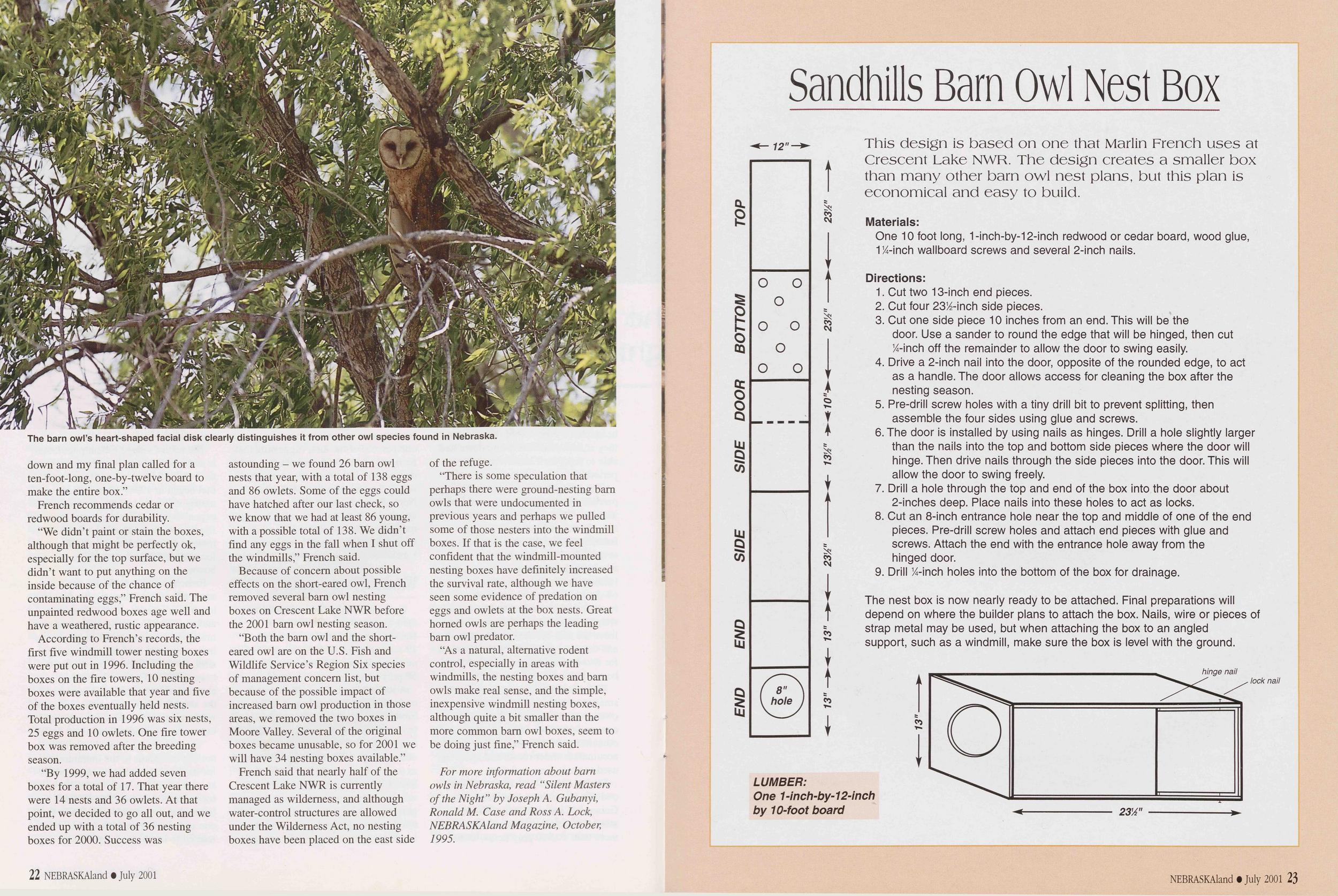 down and my final plan called for a
ten-foot-long, one-by-twelve board to
make the entire box."
down and my final plan called for a
ten-foot-long, one-by-twelve board to
make the entire box."
French recommends cedar or redwood boards for durability.
"We didn't paint or stain the boxes, although that might be perfectly ok, especially for the top surface, but we didn't want to put anything on the inside because of the chance of contaminating eggs," French said. The unpainted redwood boxes age well and have a weathered, rustic appearance.
According to French's records, the first five windmill tower nesting boxes were put out in 1996. Including the boxes on the fire towers, 10 nesting boxes were available that year and five of the boxes eventually held nests. Total production in 1996 was six nests, 25 eggs and 10 owlets. One fire tower box was removed after the breeding season.
"By 1999, we had added seven boxes for a total of 17. That year there were 14 nests and 36 owlets. At that point, we decided to go all out, and we ended up with a total of 36 nesting boxes for 2000. Success was astounding - we found 26 barn owl nests that year, with a total of 138 eggs and 86 owlets. Some of the eggs could have hatched after our last check, so we know that we had at least 86 young, with a possible total of 138. We didn't find any eggs in the fall when I shut off the windmills," French said.
Because of concern about possible effects on the short-eared owl, French removed several barn owl nesting boxes on Crescent Lake NWR before the 2001 barn owl nesting season.
"Both the barn owl and the short eared owl are on the U.S. Fish and Wildlife Service's Region Six species of management concern list, but because of the possible impact of increased barn owl production in those areas, we removed the two boxes in Moore Valley. Several of the original boxes became unusable, so for 2001 we will have 34 nesting boxes available."
French said that nearly half of the Crescent Lake NWR is currently managed as wilderness, and although water-control structures are allowed under the Wilderness Act, no nesting boxes have been placed on the east side of the refuge.
"There is some speculation that perhaps there were ground-nesting barn owls that were undocumented in previous years and perhaps we pulled some of those nesters into the windmill boxes. If that is the case, we feel confident that the windmill-mounted nesting boxes have definitely increased the survival rate, although we have seen some evidence of predation on eggs and owlets at the box nests. Great horned owls are perhaps the leading barn owl predator.
"As a natural, alternative rodent control, especially in areas with windmills, the nesting boxes and barn owls make real sense, and the simple, inexpensive windmill nesting boxes, although quite a bit smaller than the more common barn owl boxes, seem to be doing just fine," French said.
For more information about barn owls in Nebraska, read (Silent Masters of the Night" by Joseph A. Gubanyi, Ronald M. Case and Ross A. Lock, NEBRASKAland Magazine, October, 1995.
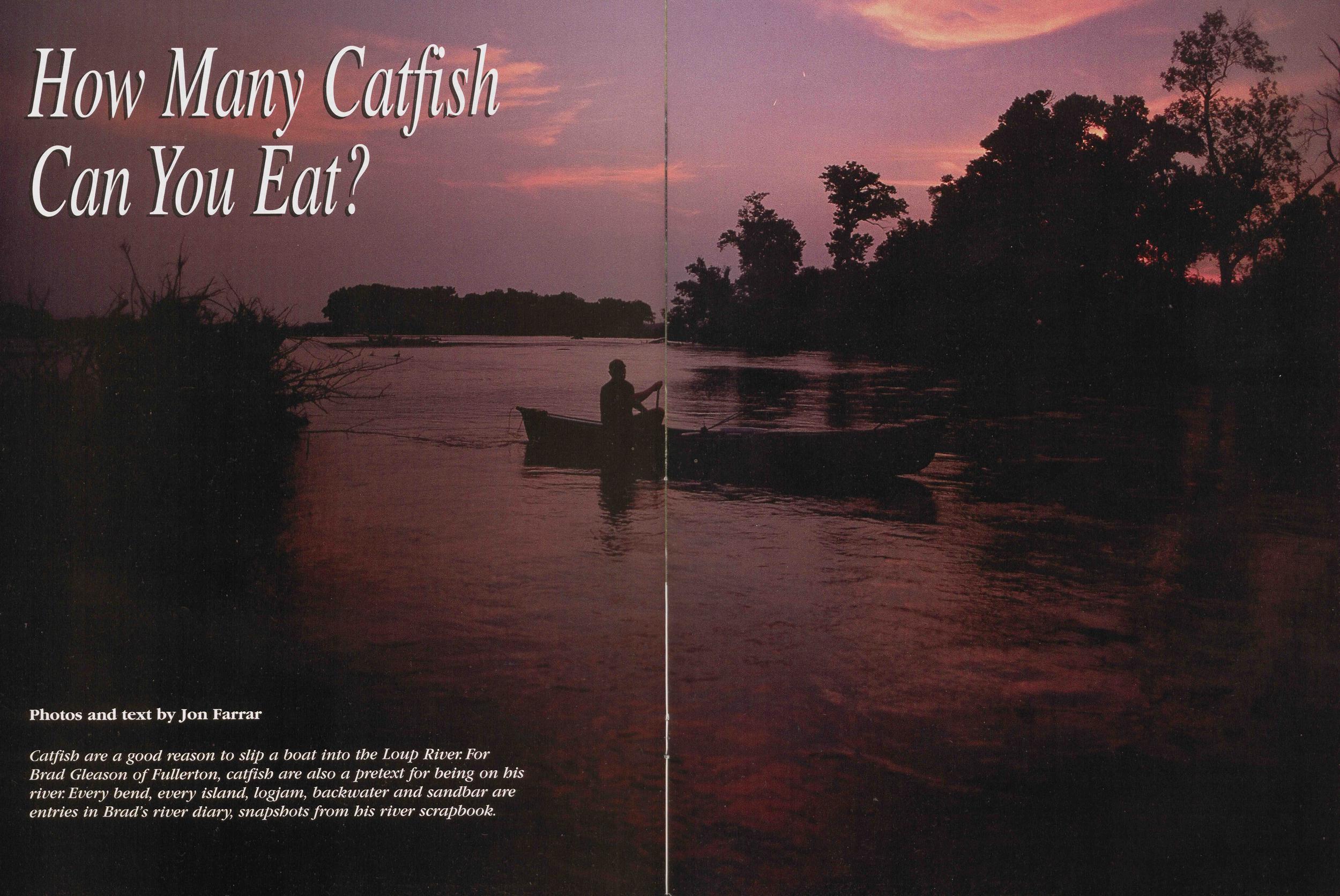
How Many Catfish Can You Eat?
Photos and text by Jon Farrar Catfish are a good reason to slip a boat into the Loup River For Brad Gleason ofFullerton, catfish are also a pretext for being on his river Every bend, every island, logjam, backwater and sandbar are entries in Brad's river diary, snapshots from his river scrapbook.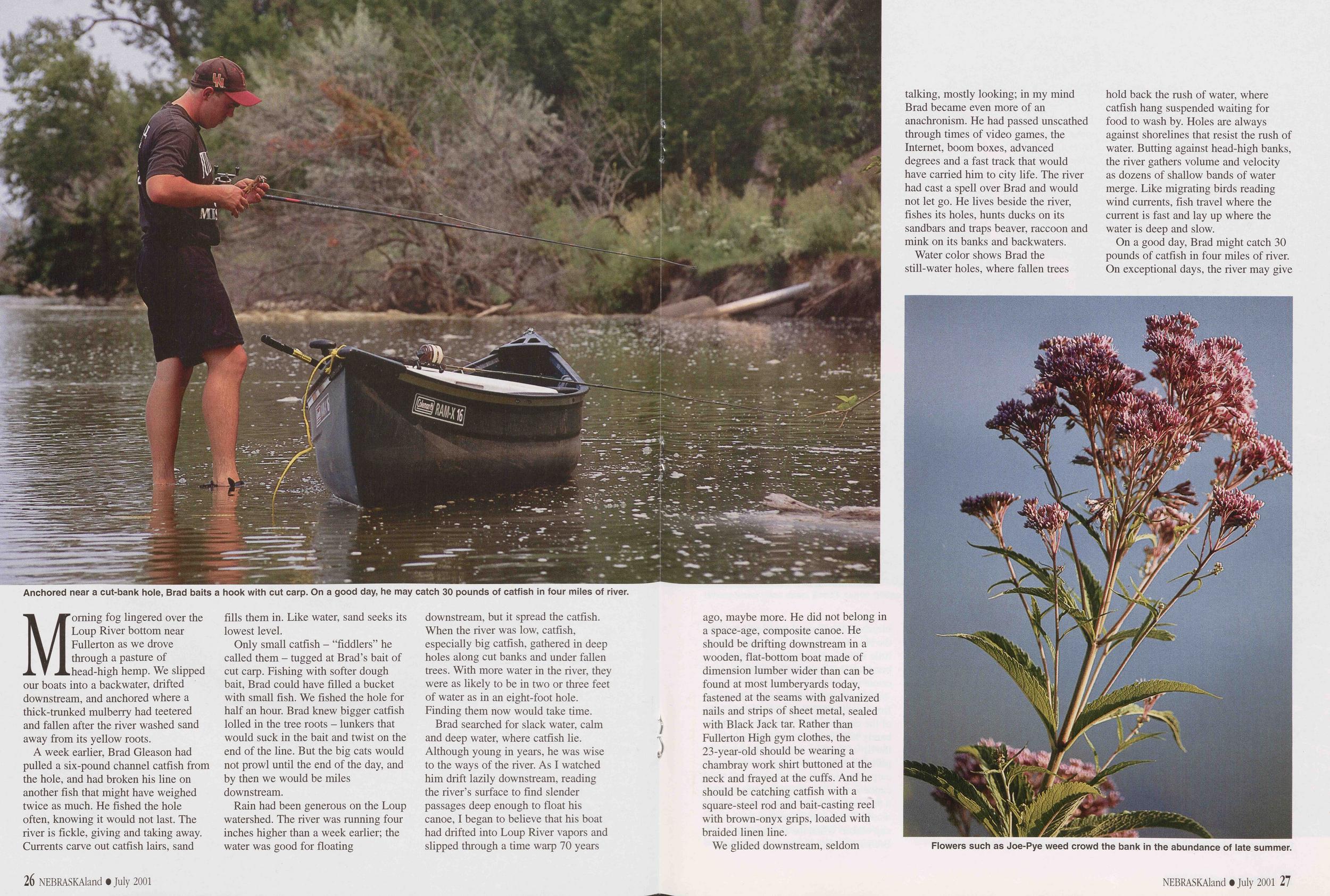
Morning fog lingered over the Loup River bottom near Fullerton as we drove through a pasture of .head-high hemp. We slipped our boats into a backwater, drifted downstream, and anchored where a thick-trunked mulberry had teetered and fallen after the river washed sand away from its yellow roots.
A week earlier, Brad Gleason had pulled a six-pound channel catfish from the hole, and had broken his line on another fish that might have weighed twice as much. He fished the hole often, knowing it would not last. The river is fickle, giving and taking away. Currents carve out catfish lairs, sand fills them in. Like water, sand seeks its lowest level.
Only small catfish - "fiddlers" he called them - tugged at Brad's bait of cut carp. Fishing with softer dough bait, Brad could have filled a bucket with small fish. We fished the hole for half an hour. Brad knew bigger catfish lolled in the tree roots - lunkers that would suck in the bait and twist on the end of the line. But the big cats would not prowl until the end of the day, and by then we would be miles downstream.
Rain had been generous on the Loup watershed. The river was running four inches higher than a week earlier; the water was good for floating downstream, but it spread the catfish. When the river was low, catfish, especially big catfish, gathered in deep holes along cut banks and under fallen trees. With more water in the river, they were as likely to be in two or three feet of water as in an eight-foot hole. Finding them now would take time.
Brad searched for slack water, calm and deep water, where catfish lie. Although young in years, he was wise to the ways of the river. As I watched him drift lazily downstream, reading the river's surface to find slender passages deep enough to float his canoe, I began to believe that his boat had drifted into Loup River vapors and slipped through a time warp 70 years ago, maybe more. He did not belong in a space-age, composite canoe. He should be drifting downstream in a wooden, flat-bottom boat made of dimension lumber wider than can be found at most lumberyards today, fastened at the seams with galvanized nails and strips of sheet metal, sealed with Black Jack tar. Rather than Fullerton High gym clothes, the 23-year-old should be wearing a chambray work shirt buttoned at the neck and frayed at the cuffs. And he should be catching catfish with a square-steel rod and bait-casting reel with brown-onyx grips, loaded with braided linen line.
We glided downstream, seldom talking, mostly looking; in my mind Brad became even more of an anachronism. He had passed unscathed through times of video games, the Internet, boom boxes, advanced degrees and a fast track that would have carried him to city life. The river had cast a spell over Brad and would not let go. He lives beside the river, fishes its holes, hunts ducks on its sandbars and traps beaver, raccoon and mink on its banks and backwaters.
Water color shows Brad the still-water holes, where fallen trees hold back the rush of water, where catfish hang suspended waiting for food to wash by. Holes are always against shorelines that resist the rush of water. Butting against head-high banks, the river gathers volume and velocity as dozens of shallow bands of water merge. Like migrating birds reading wind currents, fish travel where the current is fast and lay up where the water is deep and slow.
On a good day, Brad might catch 30
pounds of catfish in four miles of river.
On exceptional days, the river may give
26 NEBRASKAland • July 2001
NEBRASKAland • July 2001 27
 up 70 pounds. Some days the river
keeps its fish. The old fishermen in
town say the fish are gone from the
river, but they are wrong. You can't
catch fish sitting around a table at the
coffee shop.
up 70 pounds. Some days the river
keeps its fish. The old fishermen in
town say the fish are gone from the
river, but they are wrong. You can't
catch fish sitting around a table at the
coffee shop.
Carp fillets chunked into one-inch cubes are Brad's bread-and-butter bait. Carp are easy to get, the flesh is tough enough to stay on the hook and thwart nibbling fiddlers, and a two-pound carp yields enough bait for a day of fishing. Cut carp produces best late in the day, Brad believes, when bigger catfish are feeding. During the midday he uses homemade dough bait. When he has them, small sunfish are good bait and, early in the season, Brad uses nightcrawlers and chicken liver. When grass frogs and sand toads are abundant, he prefers them for bait above all others. His philosophy is simple: Use natural foods when they are abundant, and try everything in the bait box until something works.
Seldom does the channel fight one bank or the other for more than a half-mile. The river grows weary, turns and spreads to test the will of the opposite shore. Where the river spread and crossed, we followed, picking our way through a dozen meandering rivulets. Some of the rivulets float a canoe, others promise to, but spread into a fan of tumbling sand grains where even a boat of shallow draft grinds to a halt. On some crossings, Brad sought floatable water, weaving back and forth like an orb spider spinning its signature pattern on a web, reading the smooth and slightly deeper water below sandbars, turning away from ripples over sandbars. On other crossings, he let the canoe drift on an elusive trickle of water as long as it could, then pulled it over impassable sandbars.
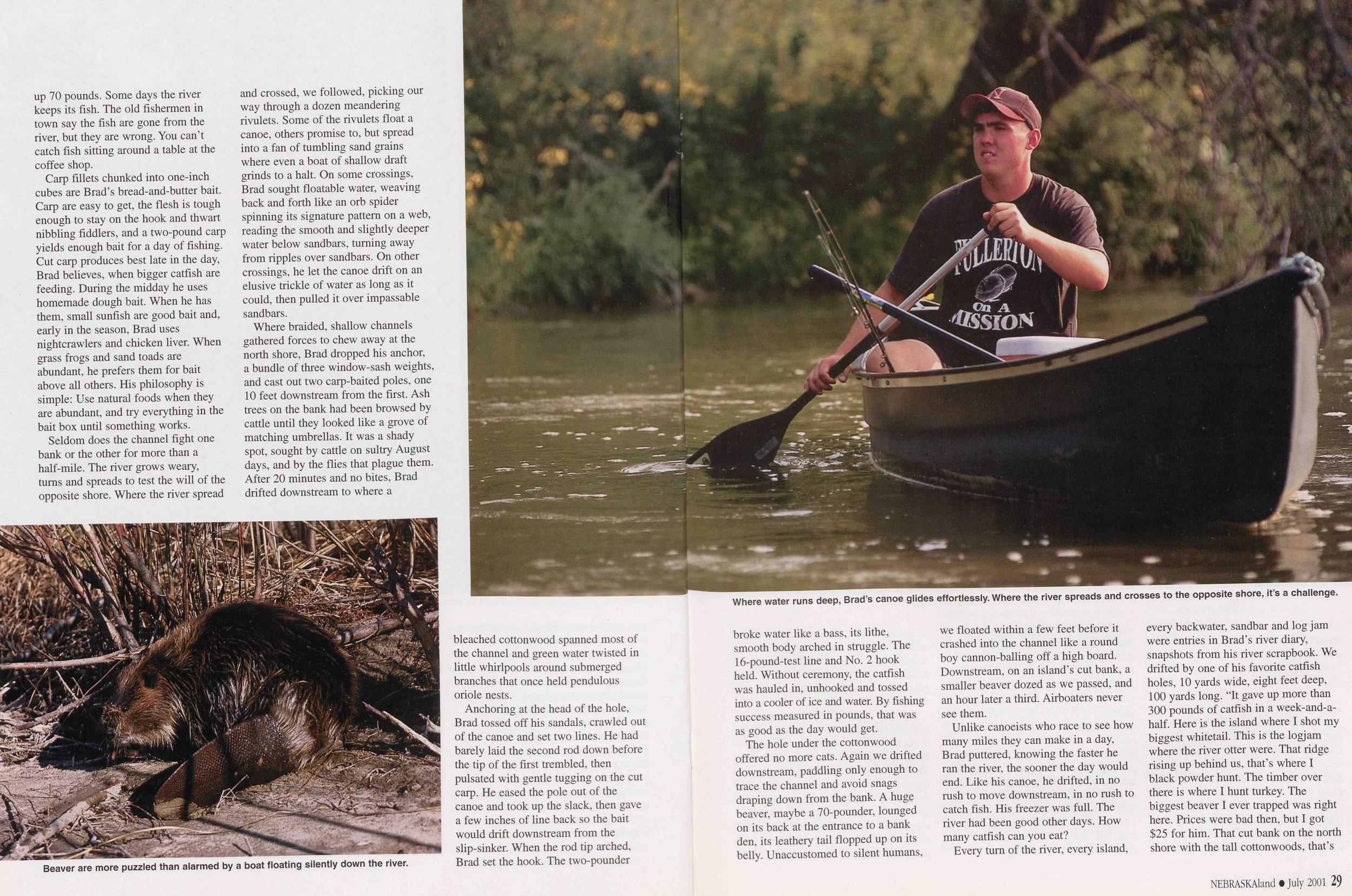
Where braided, shallow channels gathered forces to chew away at the north shore, Brad dropped his anchor, a bundle of three window-sash weights, and cast out two carp-baited poles, one 10 feet downstream from the first. Ash trees on the bank had been browsed by cattle until they looked like a grove of matching umbrellas. It was a shady spot, sought by cattle on sultry August days, and by the flies that plague them. After 20 minutes and no bites, Brad drifted downstream to where a Where water runs deep, Brad's canoe glides effortlessly. Where the river spreads and crosses to the opposite shore, it's a challenge. Beaver are more puzzled than alarmed by a boat floating silently down the river. bleached cottonwood spanned most of the channel and green water twisted in little whirlpools around submerged branches that once held pendulous oriole nests.
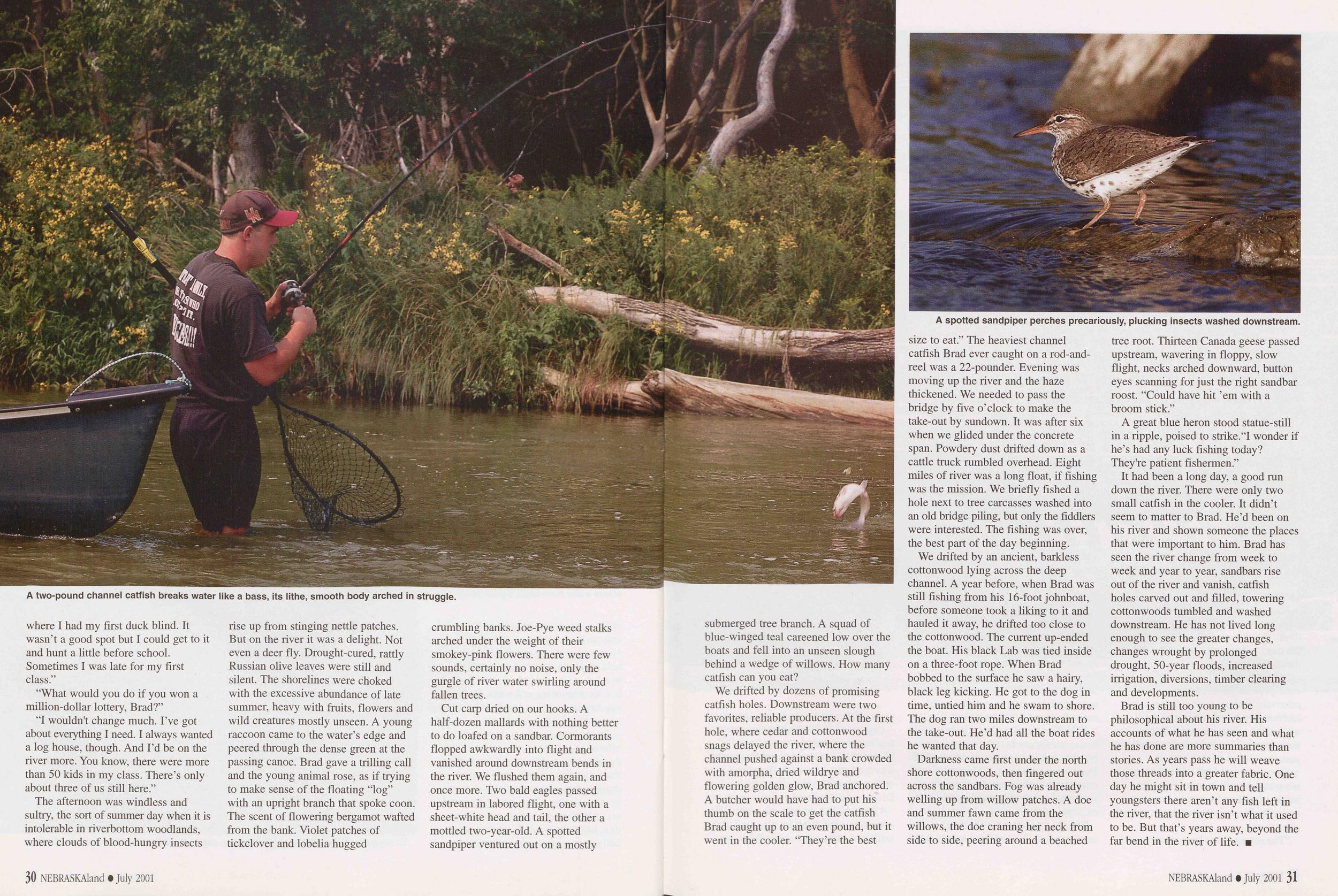
Anchoring at the head of the hole, Brad tossed off his sandals, crawled out of the canoe and set two lines. He had barely laid the second rod down before the tip of the first trembled, then pulsated with gentle tugging on the cut carp. He eased the pole out of the canoe and took up the slack, then gave a few inches of line back so the bait would drift downstream from the slip-sinker. When the rod tip arched, Brad set the hook. The two-pounder broke water like a bass, its lithe, smooth body arched in struggle. The 16-pound-test line and No. 2 hook held. Without ceremony, the catfish was hauled in, unhooked and tossed into a cooler of ice and water. By fishing success measured in pounds, that was as good as the day would get.
The hole under the cottonwood offered no more cats. Again we drifted downstream, paddling only enough to trace the channel and avoid snags draping down from the bank. A huge beaver, maybe a 70-pounder, lounged on its back at the entrance to a bank den, its leathery tail flopped up on its belly. Unaccustomed to silent humans, we floated within a few feet before it crashed into the channel like a round boy cannon-balling off a high board. Downstream, on an island's cut bank, a smaller beaver dozed as we passed, and an hour later a third. Air boaters never see them.
Unlike canoeists who race to see how many miles they can make in a day, Brad puttered, knowing the faster he ran the river, the sooner the day would end. Like his canoe, he drifted, in no rush to move downstream, in no rush to catch fish. His freezer was full. The river had been good other days. How many catfish can you eat?
Every turn of the river, every island,
every backwater, sandbar and log jam
were entries in Brad's river diary,
snapshots from his river scrapbook. We
drifted by one of his favorite catfish
holes, 10 yards wide, eight feet deep,
100 yards long. "It gave up more than
300 pounds of catfish in a week-and-a-
half. Here is the island where I shot my
biggest whitetail. This is the logjam
where the river otter were. That ridge
rising up behind us, that's where I
black powder hunt. The timber over
there is where I hunt turkey. The
biggest beaver I ever trapped was right
here. Prices were bad then, but I got
$25 for him. That cut bank on the north
shore with the tall cottonwoods, that's
NEBRASKAland • July 2001 29
 where I had my first duck blind. It
wasn't a good spot but I could get to it
and hunt a little before school.
Sometimes I was late for my first
class."
where I had my first duck blind. It
wasn't a good spot but I could get to it
and hunt a little before school.
Sometimes I was late for my first
class."
"What would you do if you won a million-dollar lottery, Brad?"
"I wouldn't change much. I've got about everything I need. I always wanted a log house, though. And I'd be on the river more. You know, there were more than 50 kids in my class. There's only about three of us still here."
The afternoon was windless and sultry, the sort of summer day when it is intolerable in river bottom woodlands, where clouds of blood-hungry insects rise up from stinging nettle patches. But on the river it was a delight. Not even a deer fly. Drought-cured, rattly Russian olive leaves were still and silent. The shorelines were choked with the excessive abundance of late summer, heavy with fruits, flowers and wild creatures mostly unseen. A young raccoon came to the water's edge and peered through the dense green at the passing canoe. Brad gave a trilling call and the young animal rose, as if trying to make sense of the floating "log" with an upright branch that spoke coon. The scent of flowering bergamot wafted from the bank. Violet patches of tickclover and lobelia hugged crumbling banks. Joe-Pye weed stalks arched under the weight of their smokey-pink flowers. There were few sounds, certainly no noise, only the gurgle of river water swirling around fallen trees.
Cut carp dried on our hooks. A half-dozen mallards with nothing better to do loafed on a sandbar. Cormorants flopped awkwardly into flight and vanished around downstream bends in the river. We flushed them again, and once more. Two bald eagles passed upstream in labored flight, one with a sheet-white head and tail, the other a mottled two-year-old. A spotted sandpiper ventured out on a mostly submerged tree branch. A squad of blue-winged teal careened low over the boats and fell into an unseen slough behind a wedge of willows. How many catfish can you eat?
We drifted by dozens of promising catfish holes. Downstream were two favorites, reliable producers. At the first hole, where cedar and cottonwood snags delayed the river, where the channel pushed against a bank crowded with amorpha, dried wildrye and flowering golden glow, Brad anchored. A butcher would have had to put his thumb on the scale to get the catfish Brad caught up to an even pound, but it went in the cooler. "They're the best size to eat." The heaviest channel catfish Brad ever caught on a rod-and- reel was a 22-pounder. Evening was moving up the river and the haze thickened. We needed to pass the bridge by five o'clock to make the take-out by sundown. It was after six when we glided under the concrete span. Powdery dust drifted down as a cattle truck rumbled overhead. Eight miles of river was a long float, if fishing was the mission. We briefly fished a hole next to tree carcasses washed into an old bridge piling, but only the fiddlers were interested. The fishing was over, the best part of the day beginning.
We drifted by an ancient, barkless cottonwood lying across the deep channel. A year before, when Brad was still fishing from his 16-foot johnboat, before someone took a liking to it and hauled it away, he drifted too close to the cottonwood. The current up-ended the boat. His black Lab was tied inside on a three-foot rope. When Brad bobbed to the surface he saw a hairy, black leg kicking. He got to the dog in time, untied him and he swam to shore. The dog ran two miles downstream to the take-out. He'd had all the boat rides he wanted that day.
Darkness came first under the north shore cotton woods, then fingered out across the sandbars. Fog was already welling up from willow patches. A doe and summer fawn came from the willows, the doe craning her neck from side to side, peering around a beached tree root. Thirteen Canada geese passed upstream, wavering in floppy, slow flight, necks arched downward, button eyes scanning for just the right sandbar roost. "Could have hit 'em with a broom stick."
A great blue heron stood statue-still in a ripple, poised to strike."I wonder if he's had any luck fishing today? They're patient fishermen."
It had been a long day, a good run down the river. There were only two small catfish in the cooler. It didn't seem to matter to Brad. He'd been on his river and shown someone the places that were important to him. Brad has seen the river change from week to week and year to year, sandbars rise out of the river and vanish, catfish holes carved out and filled, towering cottonwoods tumbled and washed downstream. He has not lived long enough to see the greater changes, changes wrought by prolonged drought, 50-year floods, increased irrigation, diversions, timber clearing and developments.
Brad is still too young to be philosophical about his river. His accounts of what he has seen and what he has done are more summaries than stories. As years pass he will weave those threads into a greater fabric. One day he might sit in town and tell youngsters there aren't any fish left in the river, that the river isn't what it used to be. But that's years away, beyond the far bend in the river of life.
NEBRASKAland • July 2001 31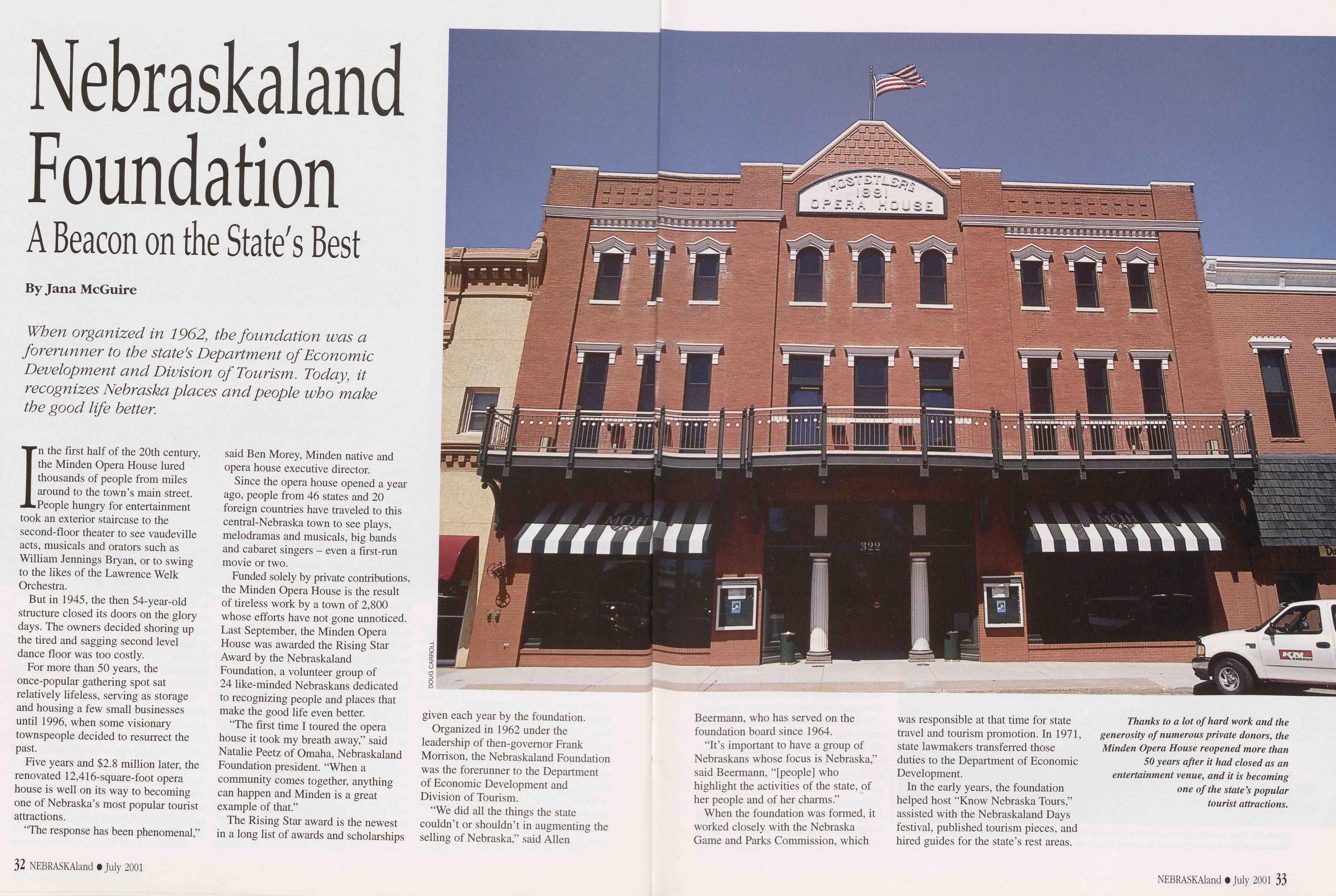
Nebraskaland Foundation
A Beacon on the State's Best By Jana McGuire When organized in 1962, the foundation was a forerunner to the state's Department of Economic Development and Division of Tourism. Today, it recognizes Nebraska places and people who make the good life better.In the first half of the 20th century, the Minden Opera House lured thousands of people from miles around to the town's main street. People hungry for entertainment took an exterior staircase to the second-floor theater to see vaudeville acts, musicals and orators such as William Jennings Bryan, or to swing to the likes of the Lawrence Welk Orchestra.
But in 1945, the then 54-year-old structure closed its doors on the glory days. The owners decided shoring up the tired and sagging second level dance floor was too costly.
For more than 50 years, the once-popular gathering spot sat relatively lifeless, serving as storage and housing a few small businesses until 1996, when some visionary townspeople decided to resurrect the past.
Five years and $2.8 million later, the renovated 12,416-square-foot opera house is well on its way to becoming one of Nebraska's most popular tourist attractions.
"The response has been phenomenal," said Ben Morey, Minden native and opera house executive director. Since the opera house opened a year ago, people from 46 states and 20 foreign countries have traveled to this central-Nebraska town to see plays, melodramas and musicals, big bands and cabaret singers - even a first-run movie or two.
Funded solely by private contributions, the Minden Opera House is the result of tireless work by a town of 2,800 whose efforts have not gone unnoticed. Last September, the Minden Opera House was awarded the Rising Star Award by the Nebraskaland Foundation, a volunteer group of 24 like-minded Nebraskans dedicated to recognizing people and places that make the good life even better.
"The first time I toured the opera house it took my breath away," said Natalie Peetz of Omaha, Nebraskaland Foundation president. "When a community comes together, anything can happen and Minden is a great example of that."
The Rising Star award is the newest in a long list of awards and scholarships given each year by the foundation.
Organized in 1962 under the leadership of then-governor Frank Morrison, the Nebraskaland Foundation was the forerunner to the Department of Economic Development and Division of Tourism.
"We did all the things the state couldn't or shouldn't in augmenting the selling of Nebraska," said Allen Beermann, who has served on the foundation board since 1964.
"It's important to have a group of Nebraskans whose focus is Nebraska," said Beermann, "[people] who highlight the activities of the state, of her people and of her charms."
When the foundation was formed, it worked closely with the Nebraska Game and Parks Commission, which was responsible at that time for state travel and tourism promotion. In 1971 state lawmakers transferred those duties to the Department of Economic Development.
In the early years, the foundation helped host "Know Nebraska Tours," assisted with the Nebraskaland Days festival, published tourism pieces, and hired guides for the state's rest areas.
Thanks to a lot of hard work and the generosity of numerous private donors, the Minden Opera House reopened more than 50 years after it had closed as an entertainment venue, and it is becoming one of the state's popular tourist attractions.
NEBRASKAland • July 2001 33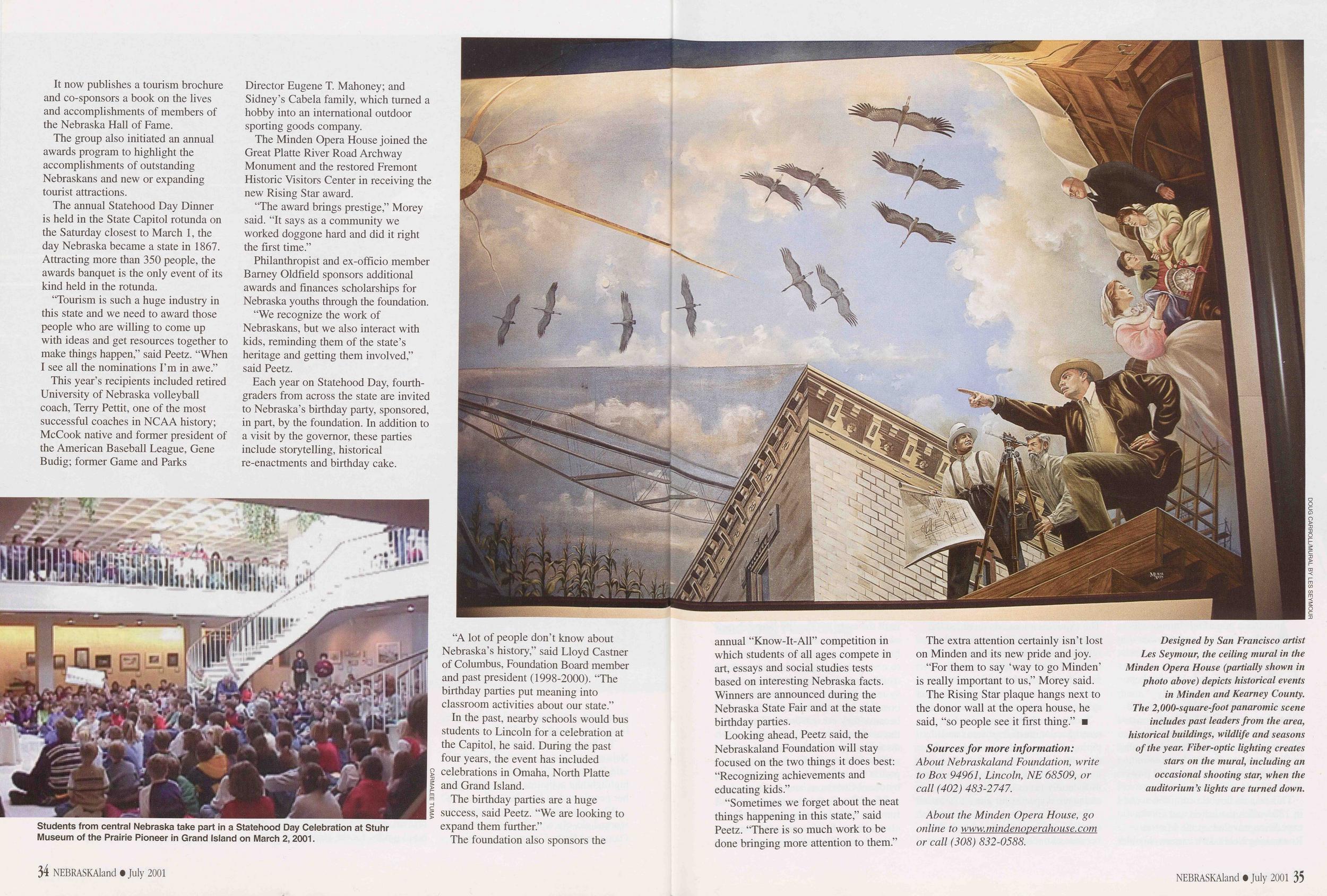
It now publishes a tourism brochure and co-sponsors a book on the lives and accomplishments of members of the Nebraska Hall of Fame.
The group also initiated an annual awards program to highlight the accomplishments of outstanding Nebraskans and new or expanding tourist attractions.
The annual Statehood Day Dinner is held in the State Capitol rotunda on the Saturday closest to March 1, the day Nebraska became a state in 1867. Attracting more than 350 people, the awards banquet is the only event of its kind held in the rotunda.
"Tourism is such a huge industry in this state and we need to award those people who are willing to come up with ideas and get resources together to make things happen," said Peetz. "When I see all the nominations I'm in awe."
This year's recipients included retired University of Nebraska volleyball coach, Terry Pettit, one of the most successful coaches in NCAA history; McCook native and former president of the American Baseball League, Gene Budig; former Game and Parks Director Eugene T. Mahoney; and Sidney's Cabela family, which turned a hobby into an international outdoor sporting goods company.
The Minden Opera House joined the Great Platte River Road Archway Monument and the restored Fremont Historic Visitors Center in receiving the new Rising Star award.
The award brings prestige," Morey said. "It says as a community we worked doggone hard and did it right the first time."
Philanthropist and ex-officio member Barney Oldfield sponsors additional awards and finances scholarships for Nebraska youths through the foundation.
"We recognize the work of Nebraskans, but we also interact with kids, reminding them of the state's heritage and getting them involved," said Peetz.
Each year on Statehood Day, fourth- graders from across the state are invited to Nebraska's birthday party, sponsored, in part, by the foundation. In addition to a visit by the governor, these parties include storytelling, historical re-enactments and birthday cake.
"A lot of people don't know about Nebraska's history," said Lloyd Castner of Columbus, Foundation Board member and past president (1998-2000). "The birthday parties put meaning into classroom activities about our state."
In the past, nearby schools would bus students to Lincoln for a celebration at the Capitol, he said. During the past four years, the event has included celebrations in Omaha, North Platte and Grand Island.
The birthday parties are a huge success, said Peetz. "We are looking to expand them further."
The foundation also sponsors the annual "Know-It-All" competition in which students of all ages compete in art, essays and social studies tests based on interesting Nebraska facts. Winners are announced during the Nebraska State Fair and at the state birthday parties.
Looking ahead, Peetz said, the Nebraskaland Foundation will stay focused on the two things it does best: "Recognizing achievements and educating kids."
"Sometimes we forget about the neat things happening in this state," said Peetz. "There is so much work to be done bringing more attention to them."
The extra attention certainly isn't lost on Minden and its new pride and joy.
"For them to say 'way to go Minden' is really important to us," Morey said. The Rising Star plaque hangs next to the donor wall at the opera house, he said, "so people see it first thing."
Sources for more information: About Nebraskaland Foundation, write to Box 94961, Lincoln, NE 68509, or call (402) 483-2747.
About the Minden Opera House, go online to www.mindenoperahouse.com or call (308) 832-0588.
Designed by San Francisco artist Les Seymour, the ceiling mural in the Minden Opera House (partially shown in photo above) depicts historical events in Minden and Kearney County. The 2,000-square-foot panaromic scene includes past leaders from the area, historical buildings, wildlife and seasons of the year. Fiber-optic lighting creates stars on the mural, including an occasional shooting star, when the auditorium's lights are turned down.
34 NEBRASKAland • July 2001 NEBRASKAland • July 2001 35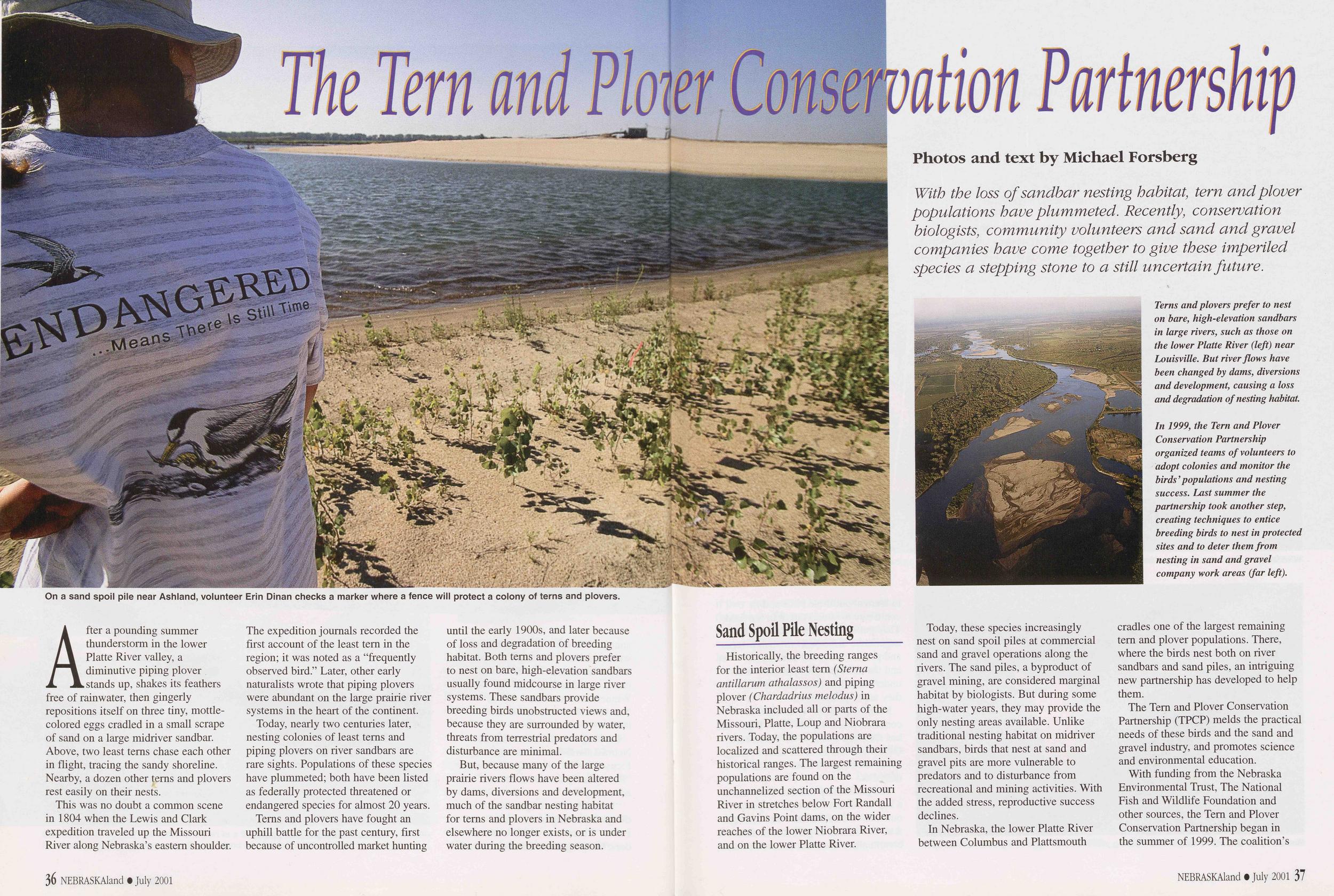
The Tern and Plover Conservation Partnership
After a pounding summer thunderstorm in the lower Platte River valley, a diminutive piping plover stands up, shakes its feathers free of rainwater, then gingerly repositions itself on three tiny, mottle colored eggs cradled in a small scrape of sand on a large midriver sandbar. Above, two least terns chase each other in flight, tracing the sandy shoreline. Nearby, a dozen other terns and plovers rest easily on their nests.
This was no doubt a common scene in 1804 when the Lewis and Clark expedition traveled up the Missouri River along Nebraska's eastern shoulder. The expedition journals recorded the first account of the least tern in the region; it was noted as a "frequently observed bird." Later, other early naturalists wrote that piping plovers were abundant on the large prairie river systems in the heart of the continent.
Today, nearly two centuries later, nesting colonies of least terns and piping plovers on river sandbars are rare sights. Populations of these species have plummeted; both have been listed as federally protected threatened or endangered species for almost 20 years.
Terns and plovers have fought an uphill battle for the past century, first because of uncontrolled market hunting until the early 1900s, and later because of loss and degradation of breeding habitat. Both terns and plovers prefer to nest on bare, high-elevation sandbars usually found midcourse in large river systems. These sandbars provide breeding birds unobstructed views and, because they are surrounded by water, threats from terrestrial predators and disturbance are minimal.
But, because many of the large prairie rivers flows have been altered by dams, diversions and development, much of the sandbar nesting habitat for terns and plovers in Nebraska and elsewhere no longer exists, or is under water during the breeding season.
Sand Spoil Pile NestingHistorically, the breeding ranges for the interior least tern (Sterna antillarum athalassos) and piping plover (Chardadrius melodus) in Nebraska included all or parts of the Missouri, Platte, Loup and Niobrara rivers. Today, the populations are localized and scattered through their historical ranges. The largest remaining populations are found on the unchannehzed section of the Missouri River in stretches below Fort Randall and Gavins Point dams, on the wider reaches of the lower Niobrara River, and on the lower Platte River.
Today, these species increasingly nest on sand spoil piles at commercial sand and gravel operations along the rivers. The sand piles, a byproduct of gravel mining, are considered marginal habitat by biologists. But during some high-water years, they may provide the only nesting areas available. Unlike traditional nesting habitat on midriver sandbars, birds that nest at sand and gravel pits are more vulnerable to predators and to disturbance from recreational and mining activities. With the added stress, reproductive success declines.
In Nebraska, the lower Platte River between Columbus and Plattsmouth cradles one of the largest remaining tern and plover populations. There, where the birds nest both on river sandbars and sand piles, an intriguing new partnership has developed to help them.
The Tern and Plover Conservation Partnership (TPCP) melds the practical needs of these birds and the sand and gravel industry, and promotes science and environmental education.
With funding from the Nebraska
Environmental Trust, The National
Fish and Wildlife Foundation and
other sources, the Tern and Plover
Conservation Partnership began in
the summer of 1999. The coalition's
36 NEBRASKAland • July 2001
NEBRASKAland • July 2001 37
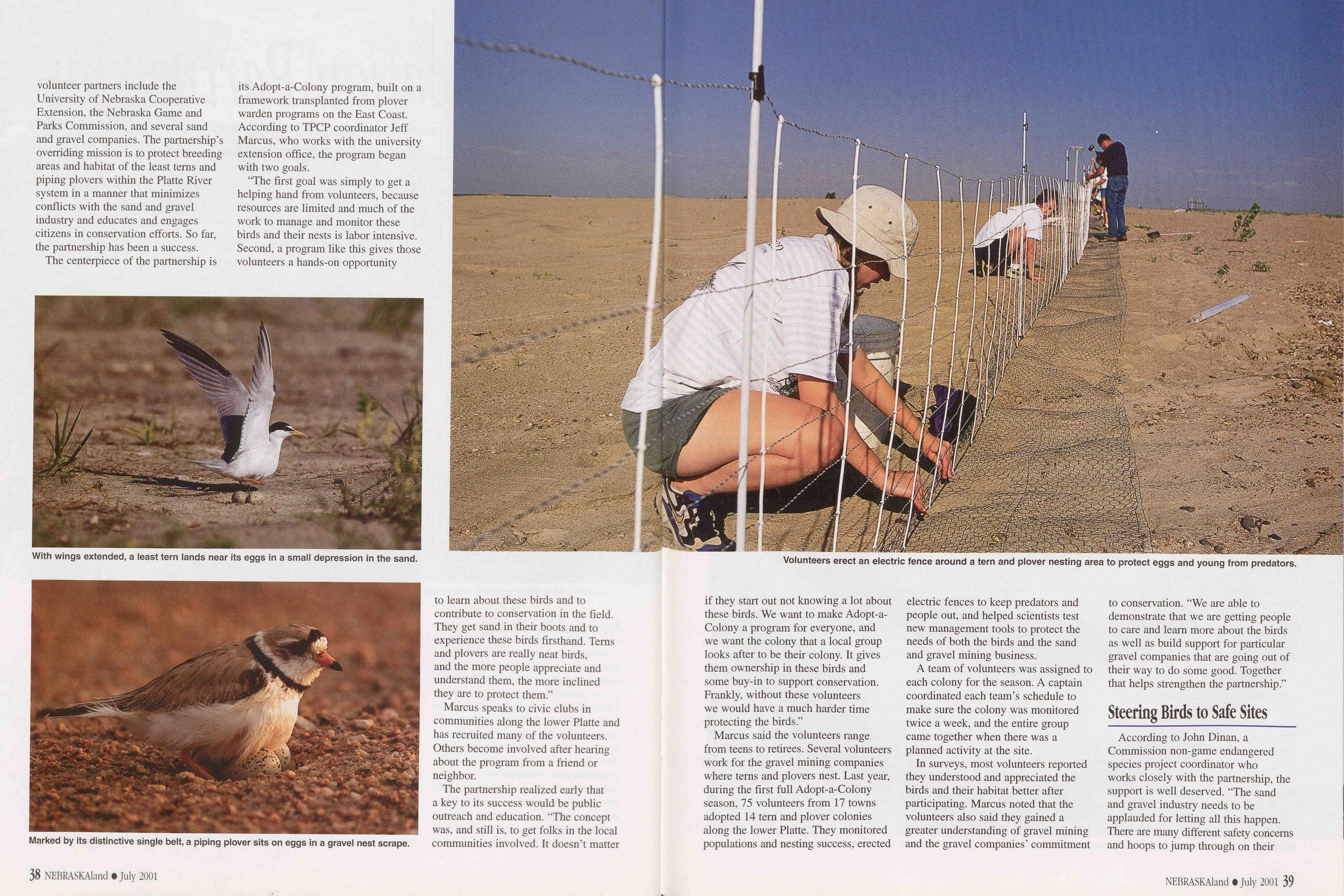 volunteer partners include the
University of Nebraska Cooperative
Extension, the Nebraska Game and
Parks Commission, and several sand
and gravel companies. The partnership's
overriding mission is to protect breeding
areas and habitat of the least terns and
piping plovers within the Platte River
system in a manner that minimizes
conflicts with the sand and gravel
industry and educates and engages
citizens in conservation efforts. So far,
the partnership has been a success.
volunteer partners include the
University of Nebraska Cooperative
Extension, the Nebraska Game and
Parks Commission, and several sand
and gravel companies. The partnership's
overriding mission is to protect breeding
areas and habitat of the least terns and
piping plovers within the Platte River
system in a manner that minimizes
conflicts with the sand and gravel
industry and educates and engages
citizens in conservation efforts. So far,
the partnership has been a success.
The centerpiece of the partnership is its Adopt-a-Colony program, built on a framework transplanted from plover warden programs on the East Coast. According to TPCP coordinator Jeff Marcus, who works with the university extension office, the program began with two goals.
'The first goal was simply to get a helping hand from volunteers, because resources are limited and much of the work to manage and monitor these birds and their nests is labor intensive. Second, a program like this gives those volunteers a hands-on opportunity Marked by its distinctive single belt, a piping plover sits on eggs in a gravel nest scrape. to learn about these birds and to contribute to conservation in the field. They get sand in their boots and to experience these birds firsthand. Terns and plovers are really neat birds, and the more people appreciate and understand them, the more inclined they are to protect them."
Marcus speaks to civic clubs in communities along the lower Platte and has recruited many of the volunteers. Others become involved after hearing about the program from a friend or neighbor.
The partnership realized early that a key to its success would be public outreach and education. "The concept was, and still is, to get folks in the local communities involved. It doesn't matter if they start out not knowing a lot about these birds. We want to make Adopt-a-Colony a program for everyone, and we want the colony that a local group looks after to be their colony. It gives them ownership in these birds and some buy-in to support conservation. Frankly, without these volunteers we would have a much harder time protecting the birds."
Marcus said the volunteers range from teens to retirees. Several volunteers work for the gravel mining companies where terns and plovers nest. Last year, during the first full Adopt-a-Colony season, 75 volunteers from 17 towns adopted 14 tern and plover colonies along the lower Platte. They monitored populations and nesting success, erected electric fences to keep predators and people out, and helped scientists test new management tools to protect the needs of both the birds and the sand and gravel mining business.
A team of volunteers was assigned to each colony for the season. A captain coordinated each team's schedule to make sure the colony was monitored twice a week, and the entire group came together when there was a planned activity at the site.
In surveys, most volunteers reported they understood and appreciated the birds and their habitat better after participating. Marcus noted that the volunteers also said they gained a greater understanding of gravel mining and the gravel companies' commitment to conservation. "We are able to demonstrate that we are getting people to care and learn more about the birds as well as build support for particular gravel companies that are going out of their way to do some good. Together that helps strengthen the partnership."
Steering Birds to Safe SitesAccording to John Dinan, a
Commission non-game endangered
species project coordinator who
works closely with the partnership, the
support is well deserved. "The sand
and gravel industry needs to be
applauded for letting all this happen.
There are many different safety concerns
and hoops to jump through on their
38 NEBRASKAland • July 2001
NEBRASKAland • July 2001 39
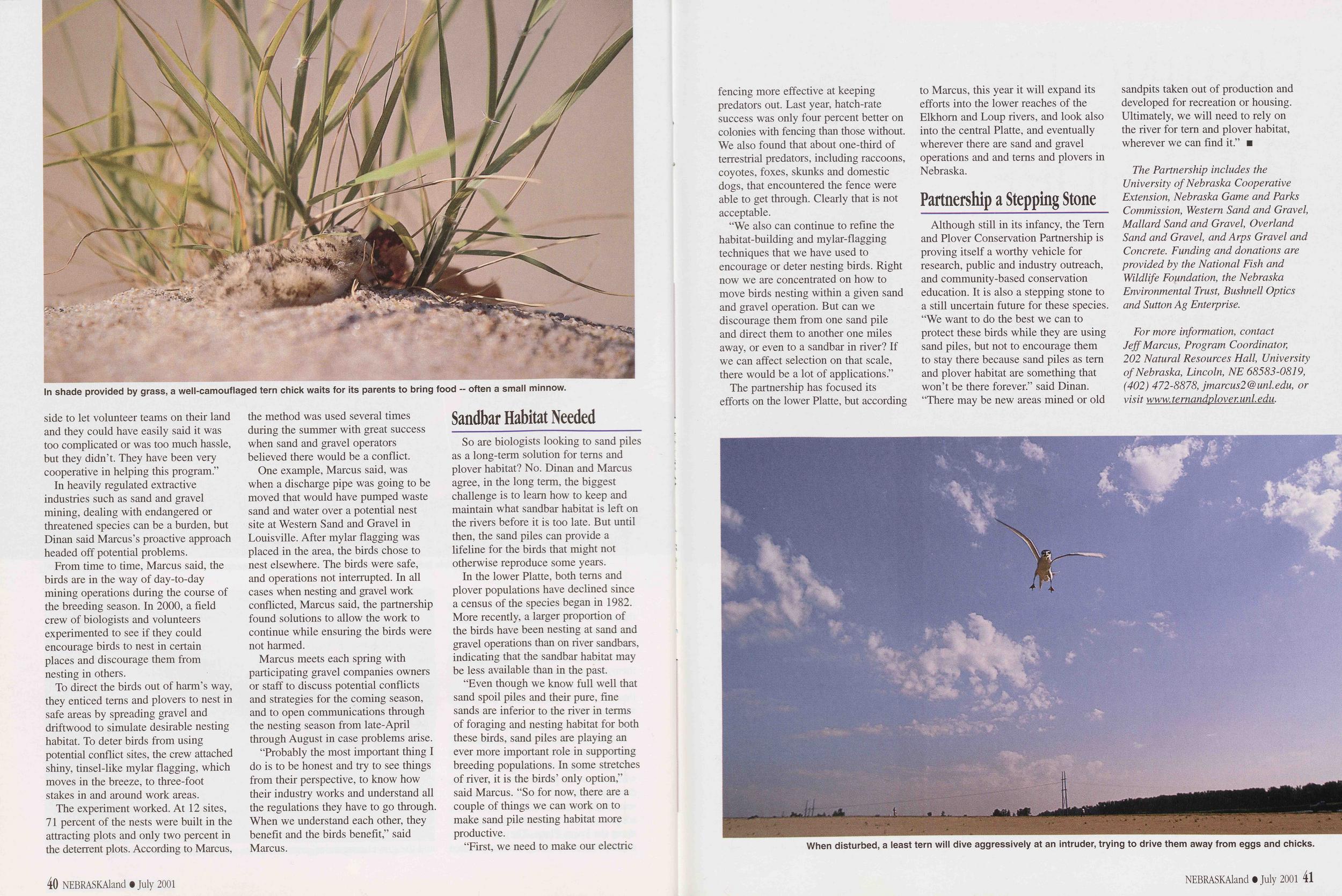 side to let volunteer teams on their land
and they could have easily said it was
too complicated or was too much hassle,
but they didn't. They have been very
cooperative in helping this program."
side to let volunteer teams on their land
and they could have easily said it was
too complicated or was too much hassle,
but they didn't. They have been very
cooperative in helping this program."
In heavily regulated extractive industries such as sand and gravel mining, dealing with endangered or threatened species can be a burden, but Dinan said Marcus's proactive approach headed off potential problems.
From time to time, Marcus said, the birds are in the way of day-to-day mining operations during the course of the breeding season. In 2000, a field crew of biologists and volunteers experimented to see if they could encourage birds to nest in certain places and discourage them from nesting in others.
To direct the birds out of harm's way, they enticed terns and plovers to nest in safe areas by spreading gravel and driftwood to simulate desirable nesting habitat. To deter birds from using potential conflict sites, the crew attached shiny, tinsel-like mylar flagging, which moves in the breeze, to three-foot stakes in and around work areas.
The experiment worked. At 12 sites, 71 percent of the nests were built in the attracting plots and only two percent in the deterrent plots. According to Marcus, the method was used several times during the summer with great success when sand and gravel operators believed there would be a conflict.
One example, Marcus said, was when a discharge pipe was going to be moved that would have pumped waste sand and water over a potential nest site at Western Sand and Gravel in Louisville. After mylar flagging was placed in the area, the birds chose to nest elsewhere. The birds were safe, and operations not interrupted. In all cases when nesting and gravel work conflicted, Marcus said, the partnership found solutions to allow the work to continue while ensuring the birds were not harmed.
Marcus meets each spring with participating gravel companies owners or staff to discuss potential conflicts and strategies for the coming season, and to open communications through the nesting season from late-April through August in case problems arise.
"Probably the most important thing I do is to be honest and try to see things from their perspective, to know how their industry works and understand all the regulations they have to go through. When we understand each other, they benefit and the birds benefit," said Marcus.
Sandbar Habitat NeededSo are biologists looking to sand piles as a long-term solution for terns and plover habitat? No. Dinan and Marcus agree, in the long term, the biggest challenge is to learn how to keep and maintain what sandbar habitat is left on the rivers before it is too late. But until then, the sand piles can provide a lifeline for the birds that might not otherwise reproduce some years.
In the lower Platte, both terns and plover populations have declined since a census of the species began in 1982. More recently, a larger proportion of the birds have been nesting at sand and gravel operations than on river sandbars, indicating that the sandbar habitat may be less available than in the past.
"Even though we know full well that sand spoil piles and their pure, fine sands are inferior to the river in terms of foraging and nesting habitat for both these birds, sand piles are playing an ever more important role in supporting breeding populations. In some stretches of river, it is the birds' only option," said Marcus. "So for now, there are a couple of things we can work on to make sand pile nesting habitat more productive.
"First, we need to make our electric fencing more effective at keeping predators out. Last year, hatch-rate success was only four percent better on colonies with fencing than those without. We also found that about one-third of terrestrial predators, including raccoons, coyotes, foxes, skunks and domestic dogs, that encountered the fence were able to get through. Clearly that is not acceptable.
"We also can continue to refine the habitat-building and mylar-flagging techniques that we have used to encourage or deter nesting birds. Right now we are concentrated on how to move birds nesting within a given sand and gravel operation. But can we discourage them from one sand pile and direct them to another one miles away, or even to a sandbar in river? If we can affect selection on that scale, there would be a lot of applications."
The partnership has focused its efforts on the lower Platte, but according to Marcus, this year it will expand its efforts into the lower reaches of the Elkhorn and Loup rivers, and look also into the central Platte, and eventually wherever there are sand and gravel operations and and terns and plovers in Nebraska.
Partnership a Stepping StoneAlthough still in its infancy, the Tern and Plover Conservation Partnership is proving itself a worthy vehicle for research, public and industry outreach, and community-based conservation education. It is also a stepping stone to a still uncertain future for these species. "We want to do the best we can to protect these birds while they are using sand piles, but not to encourage them to stay there because sand piles as tern and plover habitat are something that won't be there forever." said Dinan. "There may be new areas mined or old sandpits taken out of production and developed for recreation or housing. Ultimately, we will need to rely on the river for tern and plover habitat, wherever we can find it."
The Partnership includes the University of Nebraska Cooperative Extension, Nebraska Game and Parks Commission, Western Sand and Gravel, Mallard Sand and Gravel, Overland Sand and Gravel, and Arps Gravel and Concrete. Funding and donations are provided by the National Fish and Wildlife Foundation, the Nebraska Environmental Trust, Bushnell Optics and Sutton Ag Enterprise.
For more information, contact Jeff Marcus, Program Coordinator, 202 Natural Resources Hall, University of Nebraska, Lincoln, NE 68583-0819, (402) 472-8878, jmarcus2@unl.edu, or visit www.ternandplover.unl.edu.
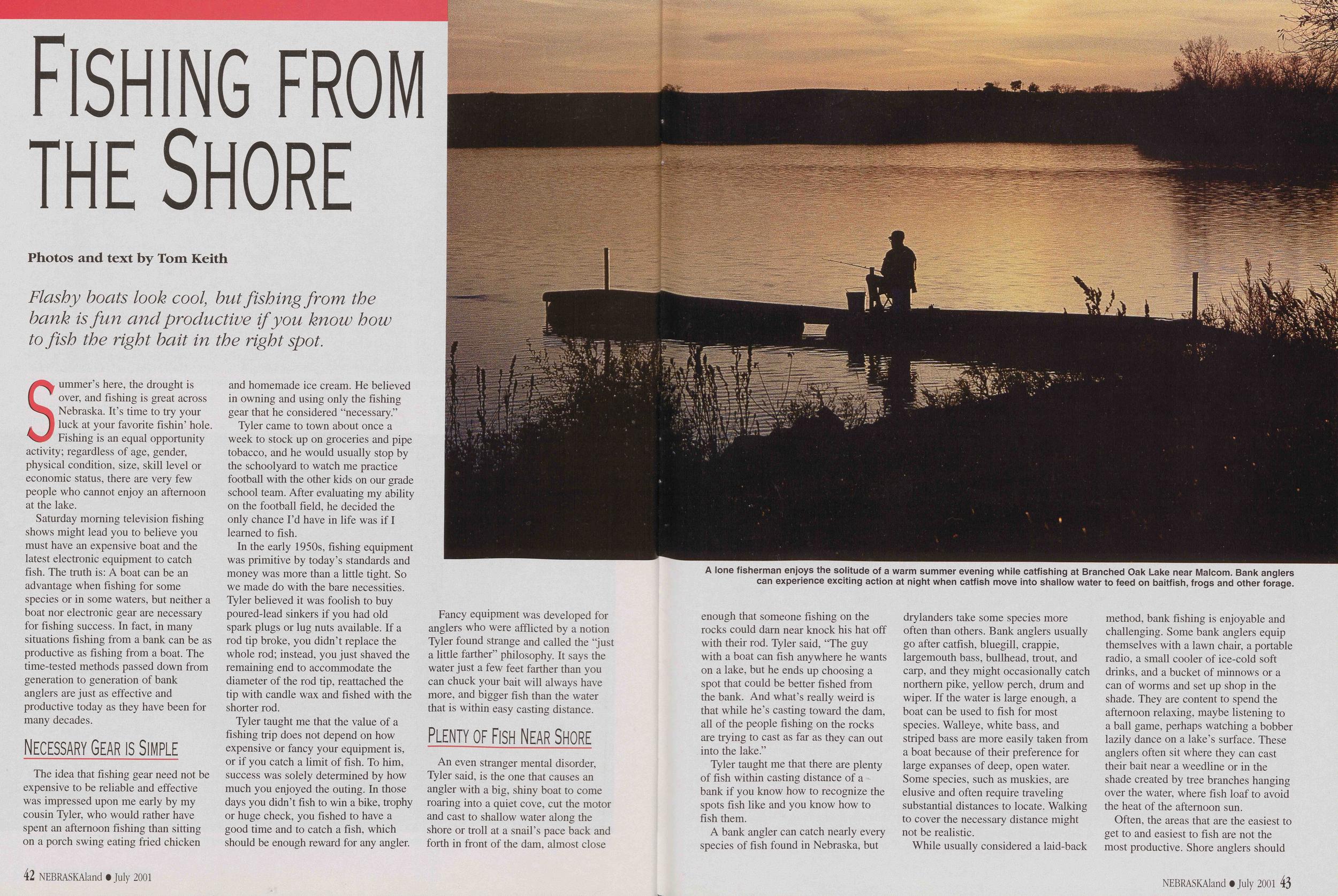
Fishing from the Shore
Photos and text by Tom Keith Flashy boats look cool, but fishing from the bank is fun and productive if you know how to fish the right bait in the right spot.Summer's here, the drought is over, and fishing is great across Nebraska. It's time to try your luck at your favorite flshin' hole. Fishing is an equal opportunity activity; regardless of age, gender, physical condition, size, skill level or economic status, there are very few people who cannot enjoy an afternoon at the lake.
Saturday morning television fishing shows might lead you to believe you must have an expensive boat and the latest electronic equipment to catch fish. The truth is: A boat can be an advantage when fishing for some species or in some waters, but neither a boat nor electronic gear are necessary for fishing success. In fact, in many situations fishing from a bank can be as productive as fishing from a boat. The time-tested methods passed down from generation to generation of bank anglers are just as effective and productive today as they have been for many decades.
NECESSARY GEAR IS SIMPLEThe idea that fishing gear need not be expensive to be reliable and effective was impressed upon me early by my cousin Tyler, who would rather have spent an afternoon fishing than sitting on a porch swing eating fried chicken and homemade ice cream. He believed in owning and using only the fishing gear that he considered "necessary."
Tyler came to town about once a week to stock up on groceries and pipe tobacco, and he would usually stop by the schoolyard to watch me practice football with the other kids on our grade school team. After evaluating my ability on the football field, he decided the only chance I'd have in life was if I learned to fish.
In the early 1950s, fishing equipment was primitive by today's standards and money was more than a little tight. So we made do with the bare necessities. Tyler believed it was foolish to buy poured-lead sinkers if you had old spark plugs or lug nuts available. If a rod tip broke, you didn't replace the whole rod; instead, you just shaved the remaining end to accommodate the diameter of the rod tip, reattached the tip with candle wax and fished with the shorter rod.
Tyler taught me that the value of a fishing trip does not depend on how expensive or fancy your equipment is, or if you catch a limit of fish. To him, success was solely determined by how much you enjoyed the outing. In those days you didn't fish to win a bike, trophy or huge check, you fished to have a good time and to catch a fish, which should be enough reward for any angler.
Fancy equipment was developed for anglers who were afflicted by a notion Tyler found strange and called the "just a little farther" philosophy. It says the water just a few feet farther than you can chuck your bait will always have more, and bigger fish than the water that is within easy casting distance.
Plenty of Fish Near ShoreAn even stranger mental disorder, Tyler said, is the one that causes an angler with a big, shiny boat to come roaring into a quiet cove, cut the motor and cast to shallow water along the shore or troll at a snail's pace back and forth in front of the dam, almost close enough that someone fishing on the rocks could darn near knock his hat off with their rod. Tyler said, "The guy with a boat can fish anywhere he wants on a lake, but he ends up choosing a spot that could be better fished from the bank. And what's really weird is that while he's casting toward the dam, all of the people fishing on the rocks are trying to cast as far as they can out into the lake."
Tyler taught me that there are plenty of fish within casting distance of a bank if you know how to recognize the spots fish like and you know how to fish them.
A bank angler can catch nearly every species of fish found in Nebraska, but drylanders take some species more often than others. Bank anglers usually go after catfish, bluegill, crappie, largemouth bass, bullhead, trout, and carp, and they might occasionally catch northern pike, yellow perch, drum and wiper. If the water is large enough, a boat can be used to fish for most species. Walleye, white bass, and striped bass are more easily taken from a boat because of their preference for large expanses of deep, open water. Some species, such as muskies, are elusive and often require traveling substantial distances to locate. Walking to cover the necessary distance might not be realistic.
While usually considered a laid-back method, bank fishing is enjoyable and challenging. Some bank anglers equip themselves with a lawn chair, a portable radio, a small cooler of ice-cold soft drinks, and a bucket of minnows or a can of worms and set up shop in the shade. They are content to spend the afternoon relaxing, maybe listening to a ball game, perhaps watching a bobber lazily dance on a lake's surface. These anglers often sit where they can cast their bait near a weedline or in the shade created by tree branches hanging over the water, where fish loaf to avoid the heat of the afternoon sun.
Often, the areas that are the easiest to
get to and easiest to fish are not the
most productive. Shore anglers should
42 NEBRASKAland • July 2001
NEBRASKAland • July 2001 43
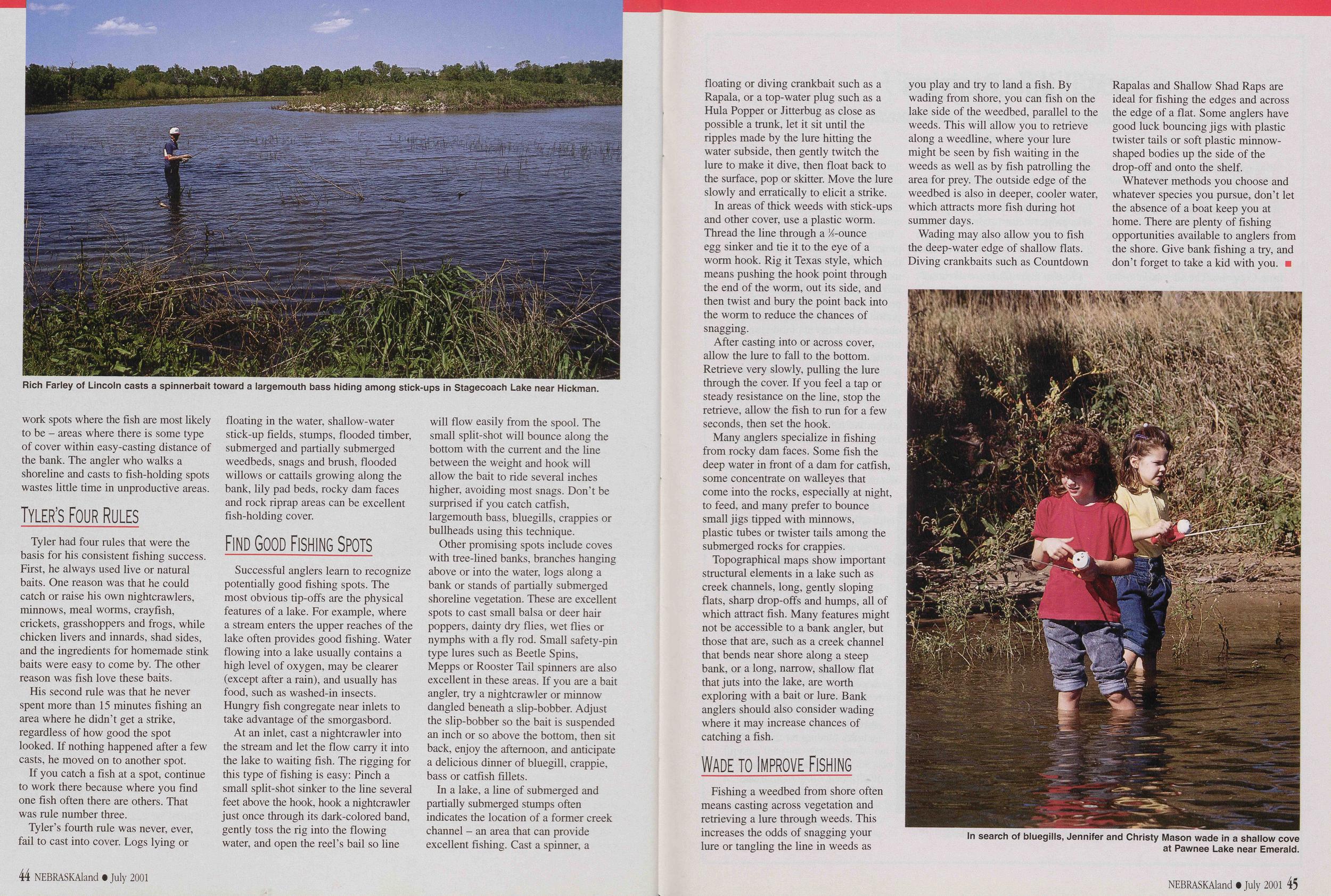 work spots where the fish are most likely
to be - areas where there is some type
of cover within easy-casting distance of
the bank. The angler who walks a
shoreline and casts to fish-holding spots
wastes little time in unproductive areas.
work spots where the fish are most likely
to be - areas where there is some type
of cover within easy-casting distance of
the bank. The angler who walks a
shoreline and casts to fish-holding spots
wastes little time in unproductive areas.
Tyler had four rules that were the basis for his consistent fishing success. First, he always used live or natural baits. One reason was that he could catch or raise his own nightcrawlers, minnows, meal worms, crayfish, crickets, grasshoppers and frogs, while chicken livers and innards, shad sides, and the ingredients for homemade stink baits were easy to come by. The other reason was fish love these baits.
His second rule was that he never spent more than 15 minutes fishing an area where he didn't get a strike, regardless of how good the spot looked. If nothing happened after a few casts, he moved on to another spot. If you catch a fish at a spot, continue to work there because where you find one fish often there are others. That was rule number three.
Tyler's fourth rule was never, ever, fail to cast into cover. Logs lying or floating in the water, shallow-water stick-up fields, stumps, flooded timber, submerged and partially submerged weedbeds, snags and brush, flooded willows or cattails growing along the bank, lily pad beds, rocky dam faces and rock riprap areas can be excellent fish-holding cover.
Find Good Fishing SpotsSuccessful anglers learn to recognize potentially good fishing spots. The most obvious tip-offs are the physical features of a lake. For example, where a stream enters the upper reaches of the lake often provides good fishing. Water flowing into a lake usually contains a high level of oxygen, may be clearer (except after a rain), and usually has food, such as washed-in insects. Hungry fish congregate near inlets to take advantage of the smorgasbord.
At an inlet, cast a nightcrawler into the stream and let the flow carry it into the lake to waiting fish. The rigging for this type of fishing is easy: Pinch a small split-shot sinker to the line several feet above the hook, hook a nightcrawler just once through its dark-colored band, gently toss the rig into the flowing water, and open the reel's bail so fine will flow easily from the spool. The small split-shot will bounce along the bottom with the current and the line between the weight and hook will allow the bait to ride several inches higher, avoiding most snags. Don't be surprised if you catch catfish, largemouth bass, bluegills, crappies or bullheads using this technique.
Other promising spots include coves with tree-fined banks, branches hanging above or into the water, logs along a bank or stands of partially submerged shoreline vegetation. These are excellent spots to cast small balsa or deer hair poppers, dainty dry flies, wet flies or nymphs with a fly rod. Small safety-pin type lures such as Beetle Spins, Mepps or Rooster Tail spinners are also excellent in these areas. If you are a bait angler, try a nightcrawler or minnow dangled beneath a slip-bobber. Adjust the slip-bobber so the bait is suspended an inch or so above the bottom, then sit back, enjoy the afternoon, and anticipate a delicious dinner of bluegill, crappie, bass or catfish fillets.
In a lake, a line of submerged and partially submerged stumps often indicates the location of a former creek channel - an area that can provide excellent fishing. Cast a spinner, a floating or diving crankbait such as a Rapala, or a top-water plug such as a Hula Popper or Jitterbug as close as possible a trunk, let it sit until the ripples made by the lure hitting the water subside, then gently twitch the lure to make it dive, then float back to the surface, pop or skitter. Move the lure slowly and erratically to elicit a strike.
In areas of thick weeds with stick-ups and other cover, use a plastic worm. Thread the line through a K-ounce egg sinker and tie it to the eye of a worm hook. Rig it Texas style, which means pushing the hook point through the end of the worm, out its side, and then twist and bury the point back into the worm to reduce the chances of snagging.
After casting into or across cover, allow the lure to fall to the bottom. Retrieve very slowly, pulling the lure through the cover. If you feel a tap or steady resistance on the line, stop the retrieve, allow the fish to run for a few seconds, then set the hook.
Many anglers specialize in fishing from rocky dam faces. Some fish the deep water in front of a dam for catfish, some concentrate on walleyes that come into the rocks, especially at night, to feed, and many prefer to bounce small jigs tipped with minnows, plastic tubes or twister tails among the submerged rocks for crappies.
Topographical maps show important structural elements in a lake such as creek channels, long, gently sloping flats, sharp drop-offs and humps, all of which attract fish. Many features might not be accessible to a bank angler, but those that are, such as a creek channel that bends near shore along a steep bank, or a long, narrow, shallow flat that juts into the lake, are worth exploring with a bait or lure. Bank anglers should also consider wading where it may increase chances of catching a fish.
Wade to Improve FishingFishing a weedbed from shore often means casting across vegetation and retrieving a lure through weeds. This increases the odds of snagging your lure or tangling the line in weeds as you play and try to land a fish. By wading from shore, you can fish on the lake side of the weedbed, parallel to the weeds. This will allow you to retrieve along a weed line, where your lure might be seen by fish waiting in the weeds as well as by fish patrolling the area for prey. The outside edge of the weedbed is also in deeper, cooler water, which attracts more fish during hot summer days.
Wading may also allow you to fish the deep-water edge of shallow flats. Diving crankbaits such as Countdown Rapalas and Shallow Shad Raps are ideal for fishing the edges and across the edge of a flat. Some anglers have good luck bouncing jigs with plastic twister tails or soft plastic minnow shaped bodies up the side of the drop-off and onto the shelf.
Whatever methods you choose and whatever species you pursue, don't let the absence of a boat keep you at home. There are plenty of fishing opportunities available to anglers from the shore. Give bank fishing a try, and don't forget to take a kid with you.
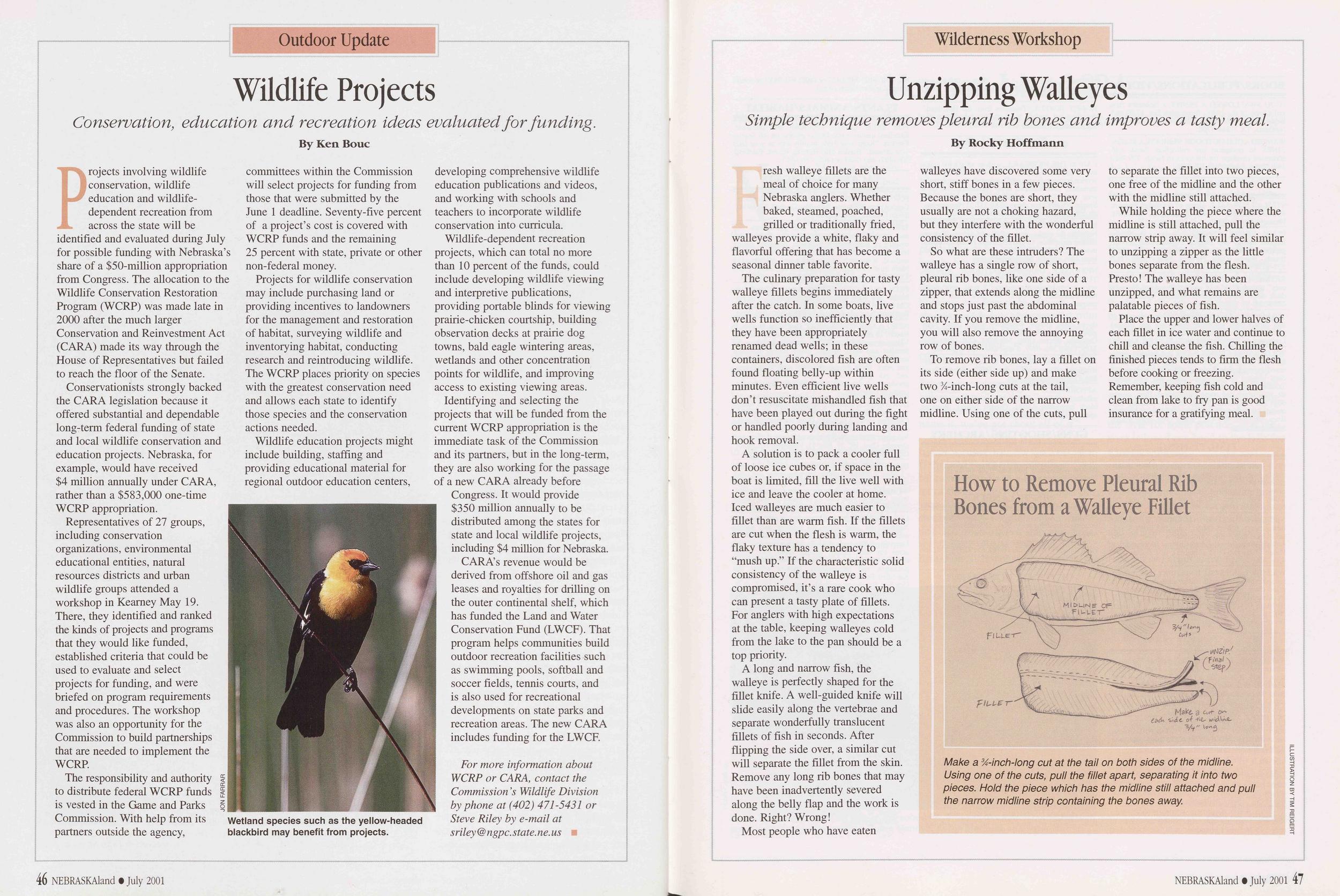
Projects involving wildlife conservation, wildlife education and wildlife- dependent recreation from across the state will be identified and evaluated during July for possible funding with Nebraska's share of a $50-million appropriation from Congress. The allocation to the Wildlife Conservation Restoration Program (WCRP) was made late in 2000 after the much larger Conservation and Reinvestment Act (CARA) made its way through the House of Representatives but failed to reach the floor of the Senate.
Conservationists strongly backed the CARA legislation because it offered substantial and dependable long-term federal funding of state and local wildlife conservation and education projects. Nebraska, for example, would have received $4 million annually under CARA, rather than a $583,000 one-time WCRP appropriation.
Representatives of 27 groups, including conservation organizations, environmental educational entities, natural resources districts and urban wildlife groups attended a workshop in Kearney May 19. There, they identified and ranked the kinds of projects and programs that they would like funded, established criteria that could be used to evaluate and select projects for funding, and were briefed on program requirements and procedures. The workshop was also an opportunity for the Commission to build partnerships that are needed to implement the WCRP.
The responsibility and authority to distribute federal WCRP funds is vested in the Game and Parks Commission. With help from its partners outside the agency, committees within the Commission will select projects for funding from those that were submitted by the June 1 deadline. Seventy-five percent of a project's cost is covered with WCRP funds and the remaining 25 percent with state, private or other non-federal money.
Projects for wildlife conservation may include purchasing land or providing incentives to landowners for the management and restoration of habitat, surveying wildlife and inventorying habitat, conducting research and reintroducing wildlife. The WCRP places priority on species with the greatest conservation need and allows each state to identify those species and the conservation actions needed.
Wildlife education projects might include building, staffing and providing educational material for regional outdoor education centers, Wetland species such as the yellow-headed blackbird may benefit from projects. developing comprehensive wildlife education publications and videos, and working with schools and teachers to incorporate wildlife conservation into curricula.
Wildlife-dependent recreation projects, which can total no more than 10 percent of the funds, could include developing wildlife viewing and interpretive publications, providing portable blinds for viewing prairie-chicken courtship, building observation decks at prairie dog towns, bald eagle wintering areas, wetlands and other concentration points for wildlife, and improving access to existing viewing areas.
Identifying and selecting the projects that will be funded from the current WCRP appropriation is the immediate task of the Commission and its partners, but in the long-term, they are also working for the passage of a new CARA already before Congress. It would provide $350 million annually to be distributed among the states for state and local wildlife projects, including $4 million for Nebraska.
CARA's revenue would be derived from offshore oil and gas leases and royalties for drilling on the outer continental shelf, which has funded the Land and Water Conservation Fund (LWCF). That program helps communities build outdoor recreation facilities such as swimming pools, softball and soccer fields, tennis courts, and is also used for recreational developments on state parks and recreation areas. The new CARA includes funding for the LWCF.
For more information about WCRP or CARA, contact the Commission's Wildlife Division by phone at (402) 471-5431 or Steve Riley by e-mail at sriley@ngpc.state.ne.us
Unzipping Walleyes Simple technique removes pleural rib bones and improves a tasty meal. By Rocky HoffmannFresh walleye fillets are the meal of choice for many Nebraska anglers. Whether baked, steamed, poached, grilled or traditionally fried, walleyes provide a white, flaky and flavorful offering that has become a seasonal dinner table favorite.
The culinary preparation for tasty walleye fillets begins immediately after the catch. In some boats, live wells function so inefficiently that they have been appropriately renamed dead wells; in these containers, discolored fish are often found floating belly-up within minutes. Even efficient live wells don't resuscitate mishandled fish that have been played out during the fight or handled poorly during landing and hook removal.
A solution is to pack a cooler full of loose ice cubes or, if space in the boat is limited, fill the live well with ice and leave the cooler at home. Iced walleyes are much easier to fillet than are warm fish. If the fillets are cut when the flesh is warm, the flaky texture has a tendency to "mush up." If the characteristic solid consistency of the walleye is compromised, it's a rare cook who can present a tasty plate of fillets. For anglers with high expectations at the table, keeping walleyes cold from the lake to the pan should be a top priority.
A long and narrow fish, the walleye is perfectly shaped for the fillet knife. A well-guided knife will slide easily along the vertebrae and separate wonderfully translucent fillets of fish in seconds. After flipping the side over, a similar cut will separate the fillet from the skin. Remove any long rib bones that may have been inadvertently severed along the belly flap and the work is done. Right? Wrong!
Most people who have eaten walleyes have discovered some very short, stiff bones in a few pieces. Because the bones are short, they usually are not a choking hazard, but they interfere with the wonderful consistency of the fillet.
So what are these intruders? The walleye has a single row of short, pleural rib bones, like one side of a zipper, that extends along the midline and stops just past the abdominal cavity. If you remove the midline, you will also remove the annoying row of bones.
To remove rib bones, lay a fillet on its side (either side up) and make two %-inch-long cuts at the tail, one on either side of the narrow midline. Using one of the cuts, pull to separate the fillet into two pieces, one free of the midline and the other with the midline still attached.
While holding the piece where the midline is still attached, pull the narrow strip away. It will feel similar to unzipping a zipper as the little bones separate from the flesh. Presto! The walleye has been unzipped, and what remains are palatable pieces of fish.
Place the upper and lower halves of each fillet in ice water and continue to chill and cleanse the fish. Chilling the finished pieces tends to firm the flesh before cooking or freezing. Remember, keeping fish cold and clean from lake to fry pan is good insurance for a gratifying meal.
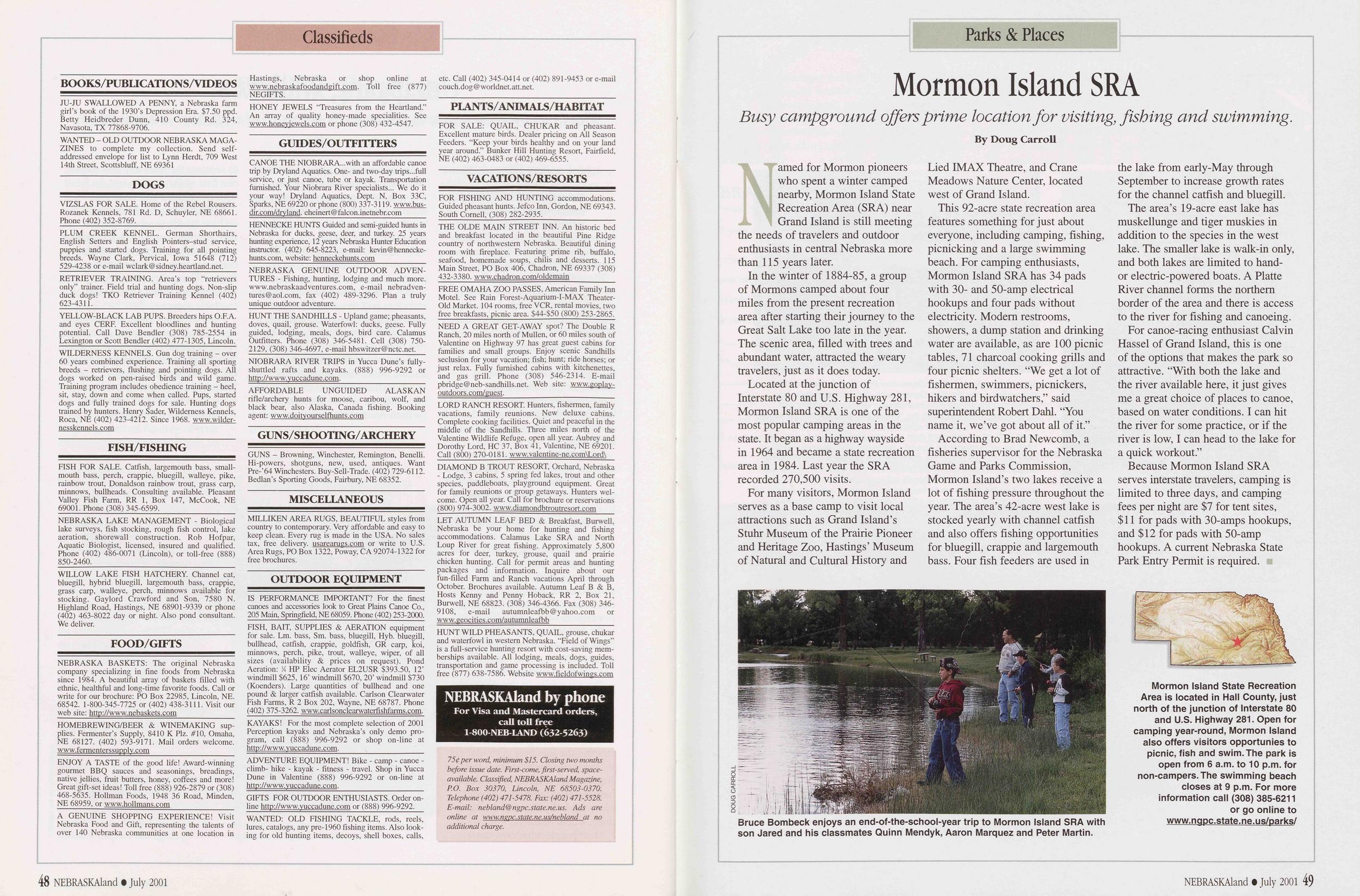
Classifieds
BOOKS/PUBLICATIONS/VIDEOSJU-JU SWALLOWED A PENNY, a Nebraska farm girl's book of the 1930's Depression Era. $7.50 ppd. Betty Heidbreder Dunn, 410 County Rd. 324, Navasota, TX 77868-9706.
WANTED - OLD OUTDOOR NEBRASKA MAGA- ZINES to complete my collection. Send self- addressed envelope for list to Lynn Herdt, 709 West 14th Street, Scottsbluff, NE 69361
DOGSVIZSLAS FOR SALE. Home of the Rebel Rousers. Rozanek Kennels, 781 Rd. D, Schuyler, NE 68661. Phone (402) 352-8769.
PLUM CREEK KENNEL. German Shorthairs, English Setters and English Pointers-stud service, puppies and started dogs. Training for all pointing breeds. Wayne Clark, Pervical, Iowa 51648 (712) 529-4238 or e-mail wclark@sidney.heartland.net.
RETRIEVER TRAINING. Area's top "retrievers only" trainer. Field trial and hunting dogs. Non-slip duck dogs! TKO Retriever Training Kennel (402) 623-43 if.
YELLOW-BLACK LAB PUPS. Breeders hips O.F.A. and eyes CERE Excellent bloodlines and hunting potential. Call Dave Bendler (308) 785-2554 in Lexington or Scott Bendler (402) 477-1305, Lincoln.
WILDERNESS KENNELS. Gun dog training - over 60 years combined experience. Training all sporting breeds - retrievers, flushing and pointing dogs. All dogs worked on pen-raised birds and wild game. Training program includes obedience training - heel, sit, stay, down and come when called. Pups, started dogs and fully trained dogs for sale. Hunting dogs trained by hunters. Henry Sader, Wilderness Kennels, Roca, NE (402) 423-4212. Since 1968. www.wilder- nesskennels.com
FISH/FISHINGFISH FOR SALE. Catfish, largemouth bass, small- mouth bass, perch, crappie, bluegill, walleye, pike, rainbow trout, Donaldson rainbow trout, grass carp, minnows, bullheads. Consulting available. Pleasant Valley Fish Farm, RR 1, Box 147, McCook, NE 69001. Phone (308) 345-6599.
NEBRASKA LAKE MANAGEMENT - Biological lake surveys, fish stocking, rough fish control, lake aeration, shorewall construction. Rob Hofpar, Aquatic Biologist, licensed, insured and qualified. Phone (402) 486-0071 (Lincoln), or toll-free (888) 850-2460.
WILLOW LAKE FISH HATCHERY. Channel cat, bluegill, hybrid bluegill, largemouth bass, crappie, grass carp, walleye, perch, minnows available for stocking. Gaylord Crawford and Son, 7580 N. Highland Road, Hastings, NE 68901-9339 or phone (402) 463-8022 day or night. Also pond consultant. We deliver.
FOOD/GIFTSNEBRASKA BASKETS: The original Nebraska company specializing in fine foods from Nebraska since 1984. A beautiful array of baskets filled with ethnic, healthful and long-time favorite foods. Call or write for our brochure: PO Box 22985, Lincoln, NE. 68542. 1-800-345-7725 or (402) 438-3111. Visit our web site: http://www.nebaskets.com
HOMEBREWING/BEER & WINEMAKING sup- plies. Fermenter's Supply, 8410 K Plz. #10, Omaha, NE 68127. (402) 593-9171. Mail orders welcome. www.fermenterssupply.com
ENJOY A TASTE of the good life! Award-winning gourmet BBQ sauces and seasonings, breadings, native jellies, fruit butters, honey, coffees and more! Great gift-set ideas! Toll free (888) 926-2879 or (308) 468-5635. Hollman Foods, 1948 36 Road, Minden, NE 68959, or www.hollmans.com
A GENUINE SHOPPING EXPERIENCE! Visit Nebraska Food and Gift, representing the talents of over 140 Nebraska communities at one location in Hastings, Nebraska or shop www.nebraskafoodandgift.com. NEGIFTS.
HONEY JEWELS "Treasures from the Heartland." An array of quality honey-made specialities. See www.honeyjewels.com or phone (308) 432-4547.
GUIDES/QUTFITTERSCANOE THE NIOBRARA...with an affordable canoe trip by Dryland Aquatics. One- and two-day trips...full service, or just canoe, tube or kayak. Transportation furnished. Your Niobrara River specialists... We do it your way! Dryland Aquatics, Dept. N, Box 33C, Sparks, NE 69220 or phone (800) 337-3119. www.bus- dir.com/dryland. eheinert@falcon.inetnebr.com
HENNECKE HUNTS Guided and semi-guided hunts in Nebraska for ducks, geese, deer, and turkey. 25 years hunting experience, 12 years Nebraska Hunter Education instructor. (402) 645-8223, e-mail: kevin@henneckehunts.com, website: henneckehunts.com
NEBRASKA GENUINE OUTDOOR ADVEN- TURES - Fishing, hunting, lodging and much more. www.nebraskaadventures.com, e-mail nebradventures@aol.com, fax (402) 489-3296. Plan a truly unique outdoor adventure.
HUNT THE SANDHILLS - Upland game; pheasants, doves, quail, grouse. Waterfowl: ducks, geese. Fully guided, lodging, meals, dogs, bird care. Calamus Outfitters. Phone (308) 346-5481. Cell (308) 750- 2129, (308) 346-4697, e-mail hbswitzer@nctc.net.
NIOBRARA RIVER TRIPS in Yucca Dune's fully- shuttled rafts and kayaks. (888) 996-9292 or http://www.yuccadune.com.
AFFORDABLE UNGUIDED ALASKAN rifle/archery hunts for moose, caribou, wolf, and black bear, also Alaska, Canada fishing. Booking agent: www.doityourselfhunts.com
GUNS/SHOOTING/ARCHERYGUNS - Browning, Winchester, Remington, Benelli. Hi-powers, shotguns, new, used, antiques. Want Pre-'64 Winchesters. Buy-Sell-Trade. (402) 729-6112. Bedlan's Sporting Goods, Fairbury, NE 68352.
MISCELLANEOUSMILLIKEN AREA RUGS, BEAUTIFUL styles from country to contemporary. Very affordable and easy to keep clean. Every rug is made in the USA. No sales tax, free delivery, usarearugs.com or write to U.S. Area Rugs, PO Box 1322, Poway, CA 92074-1322 for free brochures.
OUTDOOR EQUIPMENTIS PERFORMANCE IMPORTANT? For the finest canoes and accessories look to Great Plains Canoe Co., 205 Main, Springfield, NE 68059. Phone (402) 253-2000.
FISH, BAIT, SUPPLIES & AERATION equipment for sale. Lm. bass, Sm. bass, bluegill, Hyb. bluegill, bullhead, catfish, crappie, goldfish, GR carp, koi, minnows, perch, pike, trout, walleye, wiper, of all sizes (availability & prices on request). Pond Aeration: lA HP Elec Aerator EL2USR $393.50, 12' windmill $625, 16' windmill $670, 20' windmill $730 (Koenders). Large quantities of bullhead and one pound & larger catfish available. Carlson Clearwater Fish Farms, R 2 Box 202, Wayne, NE 68787. Phone (402) 375-3262. www.carlsonclearwaterfishfarms.com.
KAYAKS! For the most complete selection of 2001 Perception kayaks and Nebraska's only demo program, call (888) 996-9292 or shop on-line at http://www.yuccadune.com.
ADVENTURE EQUIPMENT! Bike - camp - canoe - climb- hike - kayak - fitness - travel. Shop in Yucca Dune in Valentine (888) 996-9292 or on-line at http://www.yuccadune.com.
GIFTS FOR OUTDOOR ENTHUSIASTS. Order on- line http://www.yuccadune.com or (888) 996-9292. WANTED: OLD FISHING TACKLE, rods, reels, lures, catalogs, any pre-1960 fishing items. Also looking for old hunting items, decoys, shell boxes, calls, etc. Call (402) 345-0414 or (402) 891-9453 or e-mail couch.dog@worldnet.att.net.
PLANTS/ANIMALS/HABITATFOR SALE: QUAIL, CHUKAR and pheasant. Excellent mature birds. Dealer pricing on All Season Feeders. "Keep your birds healthy and on your land year around." Bunker Hill Hunting Resort, Fairfield, NE (402) 463-0483 or (402) 469-6555.
VACATIONS/RESORTSFOR FISHING AND HUNTING accommodations. Guided pheasant hunts. Jefco Inn, Gordon, NE 69343. South Cornell, (308) 282-2935.
THE OLDE MAIN STREET INN. An historic bed and breakfast located in the beautiful Pine Ridge country of northwestern Nebraska. Beautiful dining room with fireplace. Featuring prime rib, buffalo, seafood, homemade soups, chilis and desserts. 115 Main Street, PO Box 406, Chadron, NE 69337 (308) 432-3380. www.chadron.com/oldemain
FREE OMAHA ZOO PASSES, American Family Inn Motel. See Rain Forest-Aquarium-I-MAX Theater- Old Market. 104 rooms, free VCR, rental movies, two free breakfasts, picnic area. $44-$50 (800) 253-2865.
NEED A GREAT GET-AWAY spot? The Double R Ranch, 20 miles north of Mullen, or 60 miles south of Valentine on Highway 97 has great guest cabins for families and small groups. Enjoy scenic Sandhills seclusion for your vacation; fish; hunt; ride horses; or just relax. Fully furnished cabins with kitchenettes, and gas grill. Phone (308) 546-2314. E-mail pbridge@neb-sandhills.net. Web site: www.goplay- outdoors.com/guest.
LORD RANCH RESORT. Hunters, fishermen, family vacations, family reunions. New deluxe cabins. Complete cooking facilities. Quiet and peaceful in the middle of the Sandhills. Three miles north of the Valentine Wildlife Refuge, open all year. Aubrey and Dorothy Lord, HC 37, Box 41, Valentine, NE 69201. Call (800) 270-0181. www.valentine-ne.com\Lord\
DIAMOND B TROUT RESORT, Orchard, Nebraska - Lodge, 3 cabins, 5 spring fed lakes, trout and other species, paddleboats, playground equipment. Great for family reunions or group getaways. Hunters welcome. Open all year. Call for brochure or reservations (800) 974-3002. www.diamondbtroutresort.com
LET AUTUMN LEAF BED & Breakfast, Burwell, Nebraska be your home for hunting and fishing accommodations. Calamus Lake SRA and North Loup River for great fishing. Approximately 5,800 acres for deer, turkey, grouse, quail and prairie chicken hunting. Call for permit areas and hunting packages and information. Inquire about our fun-filled Farm and Ranch vacations April through October. Brochures available. Autumn Leaf B & B, Hosts Kenny and Penny Hoback, RR 2, Box 21, Burwell, NE 68823. (308) 346-4366. Fax (308) 346-9108, e-mail autumnleafbb@yahoo.com or www.geocities.com/autumnleafbb
HUNT WILD PHEASANTS, QUAIL, grouse, chukar and waterfowl in western Nebraska. "Field of Wings" is a full-service hunting resort with cost-saving memberships available. All lodging, meals, dogs, guides, transportation and game processing is included. Toll free (877) 638-7586. Website www.fieldofwings.com
NEBRASKAland by phone For Visa and Mastercard orders, call toll free 1-800-NEB-LAND (632-5263)
75$ per word, minimum $15. Closing two months before issue date. First-come, first-served, space available. Classified, NEBRASKAland Magazine, P.O. Box 30370, Lincoln, NE 68503-0370. Telephone (402) 471-5478. Fax: (402) 471-5528. E-mail: nebland@ngpc. state.ne. us. Ads are online at www.ngpc.state.ne.us/nebland at no additional charge.
Parks & Places Mormon Island SRA Busy campground offers prime location for visiting, fishing and swimming. By Doug CarrollNamed for Morrnon pioneers who spent a winter camped nearby, Mormon Island State Recreation Area (SRA) near Grand Island is still meeting the needs of travelers and outdoor enthusiasts in central Nebraska more than 115 years later.
In the winter of 1884-85, a group of Mormons camped about four rniles from the present recreation area after starting their journey to the Great Salt Lake too late in the year. The scenic area, filled with trees and abundant water, attracted the weary travelers, just as it does today.
Located at the junction of Interstate 80 and U.S. Highway 281, Mormon Island SRA is one of the most popular camping areas in the state. It began as a highway wayside in 1964 and became a state recreation area in 1984. Last year the SRA recorded 270,500 visits.
For many visitors, Mormon Island serves as a base camp to visit local attractions such as Grand Island's Stuhr Museum of the Prairie Pioneer and Heritage Zoo, Hastings' Museum of Natural and Cultural History and Lied IMAX Theatre, and Crane Meadows Nature Center, located west of Grand Island.
This 92-acre state recreation area features something for just about everyone, including camping, fishing, picnicking and a large swimming beach. For camping enthusiasts, Mormon Island SRA has 34 pads with 30- and 50-amp electrical hookups and four pads without electricity. Modern restrooms, showers, a dump station and drinking water are available, as are 100 picnic tables, 71 charcoal cooking grills and four picnic shelters. "We get a lot of fishermen, swimmers, picnickers, hikers and birdwatchers," said superintendent Robert Dahl. "You name it, we've got about all of it."
According to Brad Newcomb, a fisheries supervisor for the Nebraska Game and Parks Commission, Mormon Island's two lakes receive a lot of fishing pressure throughout the year. The area's 42-acre west lake is stocked yearly with channel catfish and also offers fishing opportunities for bluegill, crappie and largemouth bass. Four fish feeders are used in the lake from early-May through September to increase growth rates for the channel catfish and bluegill.
The area's 19-acre east lake has muskellunge and tiger muskies in addition to the species in the west lake. The smaller lake is walk-in only, and both lakes are limited to hand- or electric-powered boats. A Platte River channel forms the northern border of the area and there is access to the river for fishing and canoeing.
For canoe-racing enthusiast Calvin Hassel of Grand Island, this is one of the options that makes the park so attractive. "With both the lake and the river available here, it just gives me a great choice of places to canoe, based on water conditions. I can hit the river for some practice, or if the river is low, I can head to the lake for a quick workout."
Because Mormon Island SRA serves interstate travelers, camping is limited to three days, and camping fees per night are $7 for tent sites, $11 for pads with 30-amps hookups, and $12 for pads with 50-amp hookups. A current Nebraska State Park Entry Permit is required.
Mormon Island State Recreation Area is located in Hall County, just north of the junction of Interstate 80 and U.S. Highway 281. Open for camping year-round, Mormon Island also offers visitors opportunities to picnic, fish and swim. The park is open from 6 a.m. to 10 p.m. for non-campers. The swimming beach closes at 9 p.m. For more information call (308) 385-6211 or go online to www.nqpc.state.ne.us/parks/
48 NEBRASKAland • July 2001 NEBRASKAland • July 2001 49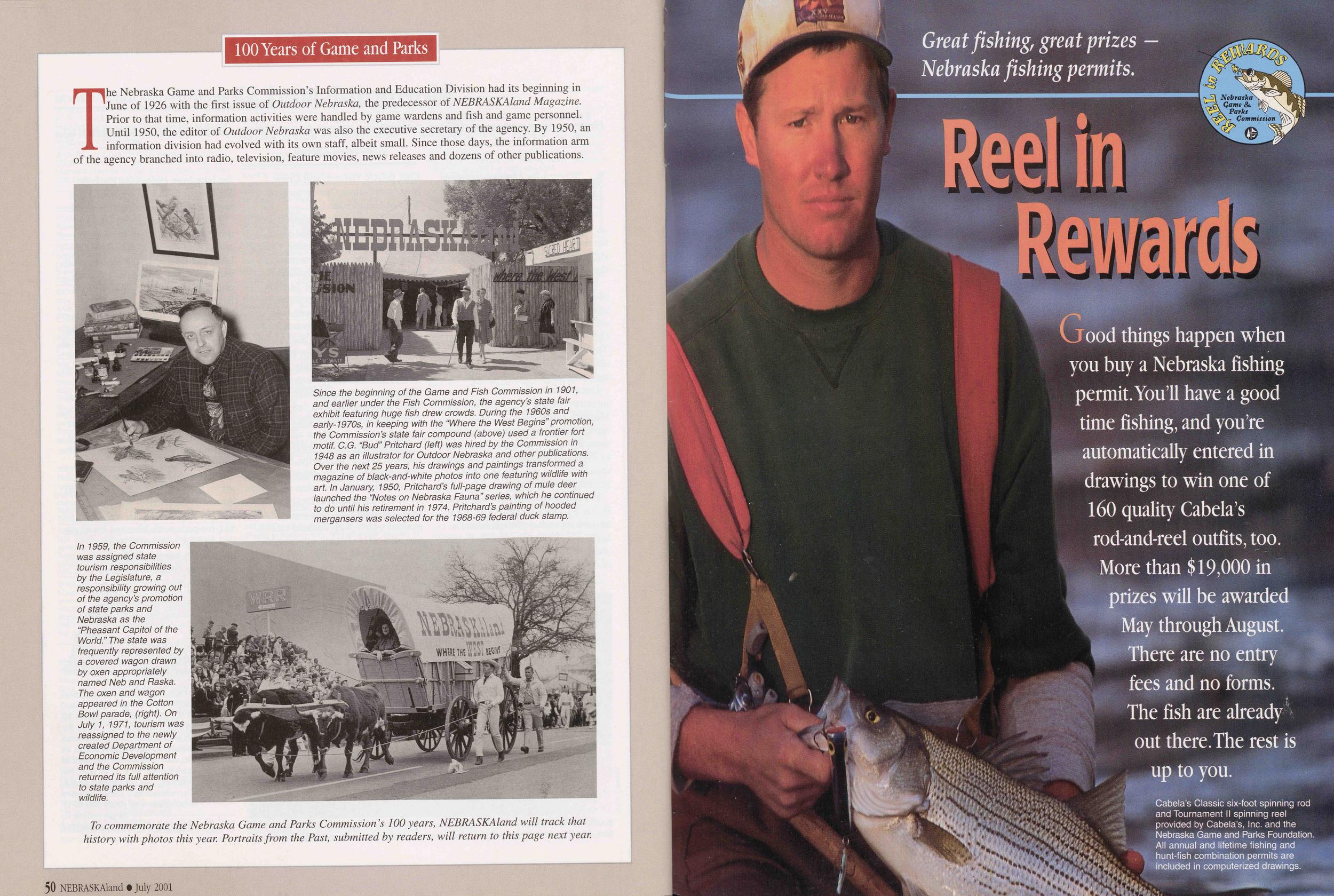
The Nebraska Game and Parks Commission's Information and Education Division had its beginning June of 1926 with the first issue of Outdoor Nebraska, the predecessor of NEBRASKAland Magazine. Prior to that time, information activities were handled by game wardens and fish and game personnel. Until 1950, the editor of Outdoor Nebraska was also the executive secretary of the agency. By 1950, an information division had evolved with its own staff, albeit small. Since those days, the information arm of the agency branched into radio, television, feature movies, news releases and dozens of other publications.
Since the beginning of the Game and Fish Commission in 1901, and earlier under the Fish Commission, the agency's state fair exhibit featuring huge fish drew crowds. During the 1960s and early-1970s, in keeping with the "Where the West Begins" promotion, the Commission's state fair compound (above) used a frontier fort motif. C.G. "Bud" Pritchard (left) was hired by the Commission in 1948 as an illustrator for Outdoor Nebraska and other publications. Over the next 25 years, his drawings and paintings transformed a magazine of black-and-white photos into one featuring wildlife with art. In January, 1950, Pritchard's full-page drawing of mule deer launched the "Notes on Nebraska Fauna" series, which he continued to do until his retirement in 1974. Pritchard's painting of hooded mergansers was selected for the 1968-69 federal duck stamp.
In 1959, the Commission was assigned state tourism responsibilities by the Legislature, a responsibility growing out of the agency's promotion of state parks and Nebraska as the "Pheasant Capitol of the World." The state was frequently represented by a covered wagon drawn by oxen appropriately named Neb and Raska. The oxen and wagon appeared in the Cotton Bowl parade, (right). On July 1, 1971, tourism was reassigned to the newly created Department of Economic Development and the Commission returned its full attention to state parks and wildlife.
To commemorate the Nebraska Game and Parks Commission's 100 years, NEBRASKAland will track that history with photos this year. Portraits from the Past, submitted by readers, will return to this page next year.
Great fishing, great prizes Nebraska fishing permits. bod things happen when you buy a Nebraska fishing permit. You'll have a good time fishing, and you're automatically entered in drawings to win one of 160 quality Cabela's rod-and-reel outfits, too. More than $19,000 in prizes will be awarded May through August. There are no entry ees and no forms. The fish are already out there.The rest is up to you. Classic six-foot spinning rod and Tournament II spinning reel provided by Cabela's, inc. and the Nebraska Game and Parks Foundation. All annual and lifetime fishing and hunt-fish combination permits are included in computerized drawings.
Position: 510 (21 views)