Volume 79, Issue 5, 2001
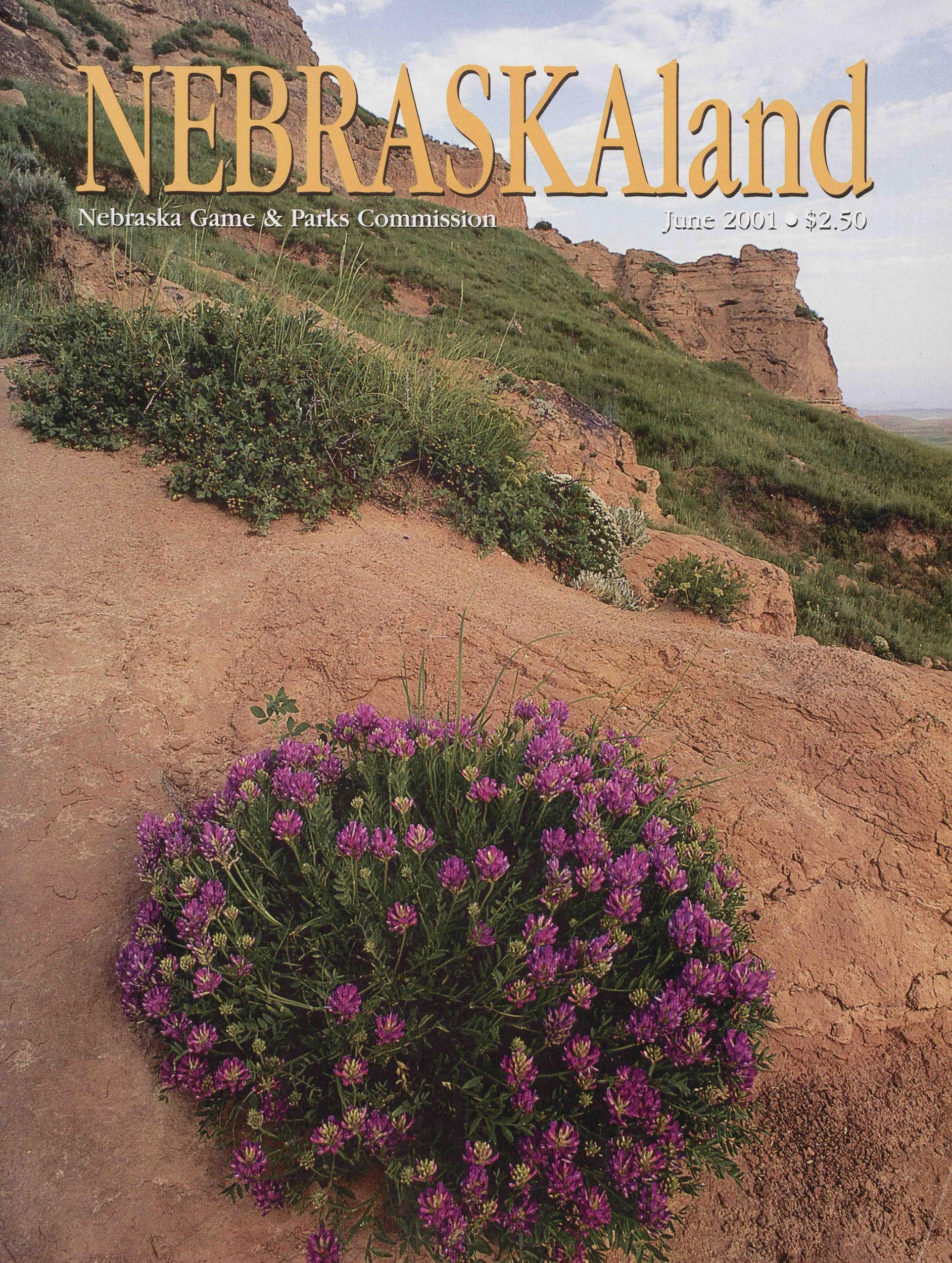
NEBRASKAland
June 2001 w. $2.50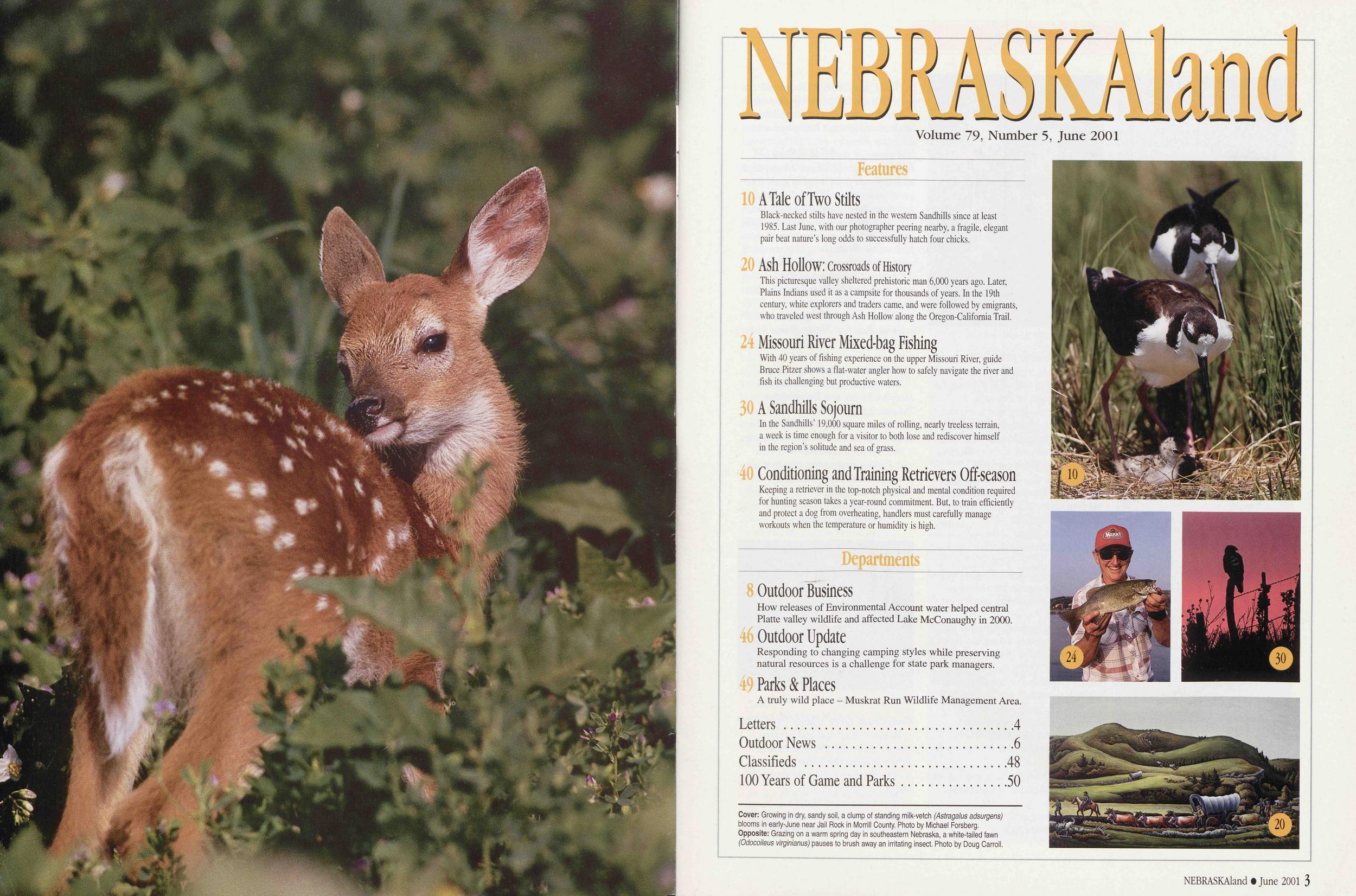
NEBRASKAland
Volume 79, Number 5, June 2001 Features A Tale of Two Stilts Black-necked stilts have nested in the western Sandhills since at least 1985. Last June, with our photographer peering nearby, a fragile, elegant pair beat nature's long odds to successfully hatch four chicks. Ash Hollow: Crossroads of History This picturesque valley sheltered prehistoric man 6,000 years ago. Later, Plains Indians used it as a campsite for thousands of years. In the 19th century, white explorers and traders came, and were followed by emigrants, who traveled west through Ash Hollow along the Oregon-California Trail. Missouri River Mixed-bag Fishing With 40 years of fishing experience on the upper Missouri River, guide Bruce Pitzer shows a flat-water angler how to safely navigate the river and fish its challenging but productive waters. ) A Sandhills Sojourn In the Sandhills' 19,000 square miles of rolling, nearly treeless terrain, a week is time enough for a visitor to both lose and rediscover himself in the region's solitude and sea of grass. Conditioning and Training Retrievers Off-season Keeping a retriever in the top-notch physical and mental condition required for hunting season takes a year-round commitment. But, to train efficiently and protect a dog from overheating, handlers must carefully manage workouts when the temperature or humidity is high. Departments 8 Outdoor Business How releases of Envkonmental Account water helped central Platte valley wildlife and affected Lake McConaughy in 2000. Outdoor Update Responding to changing camping styles while preserving natural resources is a challenge for state park managers. 49 Parks & Places A truly wild place - Muskrat Run Wildlife Management Area. Outdoor News ............................6 Classifieds 48 100 Years of Game and Parks................50 Cover: Growing in dry, sandy soil, a clump of standing milk-vetch (Astragalus adsurgens) blooms in early-June near Jail Rock in Morrill County. Photo by Michael Forsberg. Opposite: Grazing on a warm spring day in southeastern Nebraska, a white-tailed fawn (Odocoileus virginianus) pauses to brush away an irritating insect. Photo by Doug Carroll.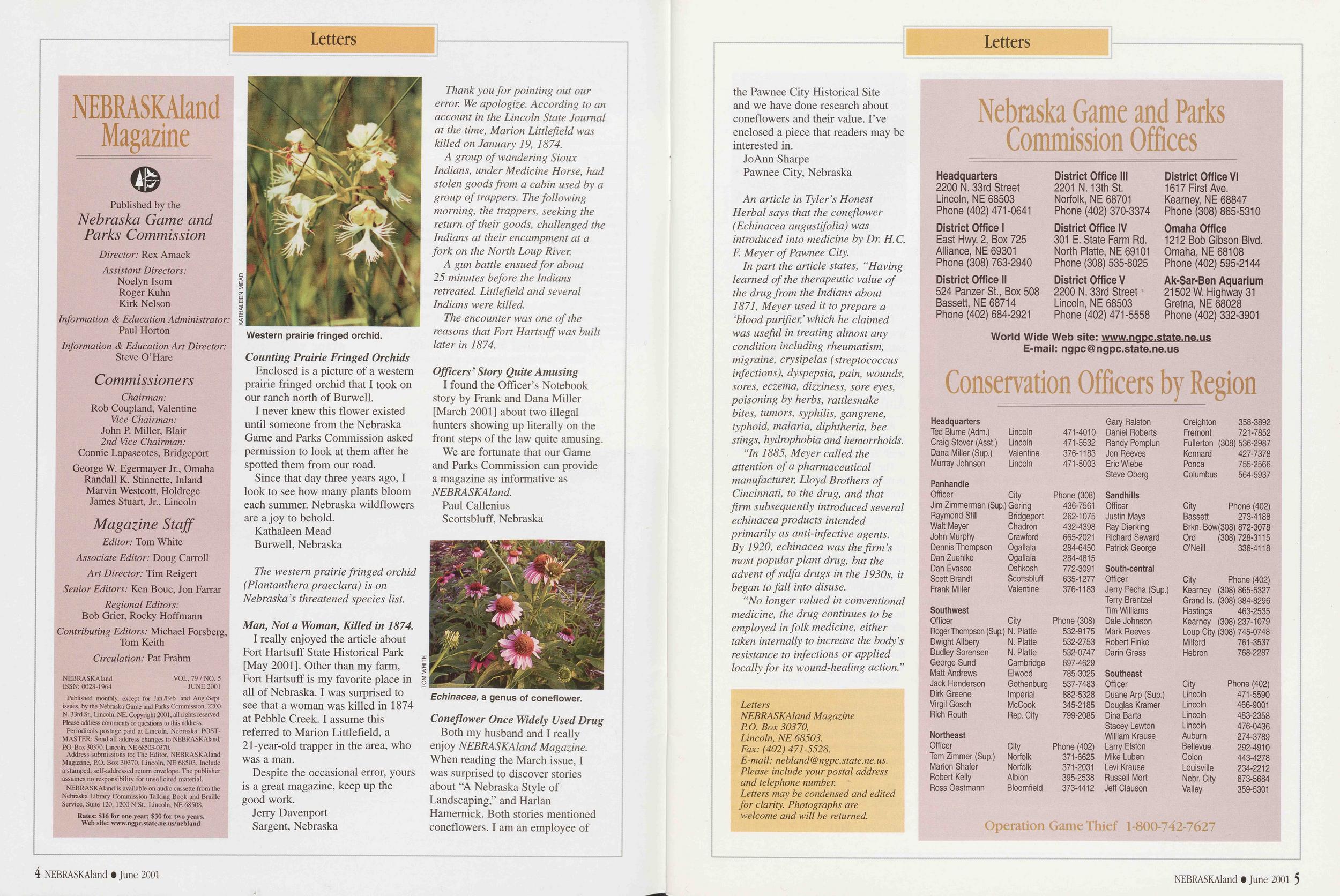
Letters
Published by the Nebraska Game and Parks Commission Director: Rex Amack Assistant Directors: Noelyn Isom Roger Kuhn Kirk Nelson Information & Education Administrator: Paul Horton Information & Education Art Director: Steve O'Hare Commissioners Chairman: Rob Coupland, Valentine Vice Chairman: John P. Miller, Blair 2nd Vice Chairman: Connie Lapaseotes, Bridgeport George W. Egermayer Jr., Omaha Randall K. Stinnette, Inland Marvin Westcott, Holdrege James Stuart, Jr., Lincoln Magazine Staff Editor: Tom White Associate Editor: Doug Carroll Art Director: Tim Reigert Senior Editors: Ken Bouc, Jon Farrar Regional Editors: Bob Grier, Rocky Hoffmann Contributing Editors: Michael Forsberg, Tom Keith Circulation: Pat Frahm NEBRASKAland ISSN: 0028-1964 VOL. 79 / NO. 5 JUNE 2001 Published monthly, except for Jan./Feb. and AugVSept. issues, by the Nebraska Game and Parks Commission, 2200 N. 33rd St., Lincoln, NE. Copyright 2001, all rights reserved. Please address comments or questions to this address. Periodicals postage paid at Lincoln, Nebraska. POSTMASTER: Send all address changes to NEBRASKAland, P.O. Box 30370, Lincoln, NE 68503-0370. Address submissions to: The Editor, NEBRASKAland Magazine, P.O. Box 30370, Lincoln, NE 68503. Include a stamped, self-addressed return envelope. The publisher assumes no responsibility for unsolicited material. NEBRASKAland is available on audio cassette from the Nebraska Library Commission Talking Book and Braille Service, Suite 120, 1200 N St., Lincoln, NE 68508. Rates: $16 for one year; $30 for two years. Web site: www.ngpc.state.ne.us/neblandEnclosed is a picture of a western prairie fringed orchid that I took on our ranch north of Burwell.
I never knew this flower existed until someone from the Nebraska Game and Parks Conimission asked permission to look at them after he spotted them from our road.
Since that day three years ago, I look to see how many plants bloom each summer. Nebraska wildflowers are a joy to behold.
Kathaleen Mead Burwell, NebraskaThe western prairie fringed orchid (Plantanthera praeclara) is on Nebraska *s threatened species list.
Man, Not a Woman, Killed in 1874.I really enjoyed the article about Fort Hartsuff State Historical Park [May 2001]. Other than my farm, Fort Hartsuff is my favorite place in all of Nebraska. I was surprised to see that a woman was killed in 1874 at Pebble Creek. I assume this referred to Marion Littlefield, a 21-year-old trapper in the area, who was a man.
Despite the occasional error, yours is a great magazine, keep up the good work.
Jerry Davenport Sargent, NebraskaThank you for pointing out our error. We apologize. According to an account in the Lincoln State Journal at the time, Marion Littlefield was killed on January 19, 1874.
A group of wandering Sioux Indians, under Medicine Horse, had stolen goods from a cabin used by a group of trappers. The following morning, the trappers, seeking the return of their goods, challenged the Indians at their encampment at a fork on the North Loup River.
A gun battle ensued for about 25 minutes before the Indians retreated. Littlefield and several Indians were killed.
The encounter was one of the reasons that Fort Hartsuff was built later in 1874.
Officers' Story Quite AmusingI found the Officer's Notebook story by Frank and Dana Miller [March 2001] about two illegal hunters showing up literally on the front steps of the law quite amusing.
We are fortunate that our Game and Parks Corrrrnission can provide a magazine as informative as NEBRASKAland.
Paul Callenius Scottsbluff, NebraskaBoth my husband and I really enjoy NEBRASKAland Magazine. When reading the March issue, I was surprised to discover stories about "A Nebraska Style of Landscaping," and Harlan Hamernick. Both stories mentioned coneflowers. I am an employee of 4 NEBRASKAland • June 2001 the Pawnee City Historical Site and we have done research about coneflowers and their value. I've enclosed a piece that readers may be interested in.
JoAnn Sharpe Pawnee City, NebraskaAn article in Tyler's Honest Herbal says that the coneflower (Echinacea angustifolia) was introduced into medicine by Dr. H. C. F. Meyer of Pawnee City.
In part the article states, "Having learned of the therapeutic value of the drug from the Indians about 1871, Meyer used it to prepare a 'bloodpurifier,' which he claimed was useful in treating almost any condition including rheumatism, migraine, erysipelas (streptococcus infections), dyspepsia, pain, wounds, sores, eczema, dizziness, sore eyes, poisoning by herbs, rattlesnake bites, tumors, syphilis, gangrene, typhoid, malaria, diphtheria, bee stings, hydrophobia and hemorrhoids.
"In 1885, Meyer called the attention of a pharmaceutical manufacturer, Lloyd Brothers of Cincinnati, to the drug, and that firm subsequently introduced several echinacea products intended primarily as anti-infective agents. By 1920, echinacea was the firm's most popular plant drug, but the advent of sulfa drugs in the 1930s, it began to fall into disuse.
"No longer valued in conventional medicine, the drug continues to be employed in folk medicine, either taken internally to increase the body's resistance to infections or applied locally for its wound-healing action."
Letters NEBRASKAland Magazine P.O. Box 30370, Lincoln, NE 68503. Fax: (402) 471-5528. E-mail: nebland@ngpc.state.ne. us. Please include your postal address and telephone number. Letters may be condensed and edited for clarity. Photographs are welcome and will be returned. Nebraska Game and Parks Commission Offices Headquarters 2200 N. 33rd Street Lincoln, NE 68503 Phone (402) 471-0641 District Office I East Hwy. 2, Box 725 Alliance, NE 69301 Phone (308) 763-2940 District Office II 524 Panzer St, Box 508 Bassett, NE 68714 Phone (402) 684-2921 District Office III 2201 N. 13th St. Norfolk, NE 68701 Phone (402) 370-3374 District Office IV 301 E. State Farm Rd. North Platte, NE 69101 Phone (308) 535-8025 District Office V 2200 N. 33rd Street Lincoln, NE 68503 Phone (402) 471-5558 District Office VI 1617 First Ave. Kearney, NE 68847 Phone (308) 865-5310 Omaha Office 1212 Bob Gibson Blvd. Omaha, NE 68108 Phone (402) 595-2144 Ak-Sar-Ben Aquarium 21502 W. Highway 31 Gretna, NE 68028 Phone (402) 332-3901 World Wide Web site: www.ngpc.state.ne.us E-mail: ngpc@ngpc.state.ne.us Conservation Officers By Region Headquarters Gary Ralston Creighton 358-3892 Ted Blume (Adm.) Lincoln 471-4010 Daniel Roberts Fremont 721-7852 Craig Stover (Asst.) Lincoln 471-5532 Randy Pomplun Fullerton (308) 536-2987 Dana Miller (Sup.) Valentine 376-1183 Jon Reeves Kennard 427-7378 Murray Johnson Lincoln 471-5003 Eric Wiebe Ponca 755-2566 Steve Oberg Columbus 564-5937 Panhandle Officer City Phone (308) Sandhills Jim Zimmerman (Sup.) Gering 436-7561 Officer City Phone (402) Raymond Still Bridgeport 262-1075 Justin Mays Bassett 273-4188 Walt Meyer Chadron 432-4398 Ray Dierking Brkn. Bow (308) 872-3078 John Murphy Crawford 665-2021 Richard Seward Ord (308)728-3115 Dennis Thompson Ogallala 284-6450 Patrick George O'Neill 336-4118 Dan Zuehlke Ogallala 284-4815 Dan Evasco Oshkosh 772-3091 South-central Scott Brandt Scottsbluff 635-1277 Officer City Phone (402) Frank Miller Valentine 376-1183 Jerry Pecha (Sup.Kearney (308) 865-532 Terry Brentzel Grand Is. (308) 384-8296 Southwest Tim Williams Hastings 463-2535 Officer City Phone (308) Dale Johnson Kearney (308)237-1079 Roger Thompson (Sup.) N. Platte 532-9175 Mark Reeves Loup City (308) 745-0748 Dwight Allbery N. Platte 532-2753 Robert Finke Milford 761-3537 Dudley Sorensen N. Platte 532-0747 Darin Gress Hebron 768-2287 George Sund Cambridge 697-4629 Matt Andrews Elwood 785-3025 Southeast Jack Henderson Gothenburg 537-7483 Officer City Phone (402) Dirk Greene Imperial 882-5328 Duane Arp (Sup.)Lincoln 471-5590 Virgil Gosch McCook 345-2185 Douglas Kramer Lincoln 466-9001 Rich Routh Rep. City 799-2085 Dina Barta Lincoln 483-2358 \Stacey Lewton Lincoln 476-0436 Northeast William Krause Auburn 274-3789 Officer City Phone (402) Larry Elston Bellevue 292-4910 Tom Zimmer (Sup.)Norfolk 371-6625 Mike Luben Colon 443-4278 Marion Shafer Norfolk 371-2031 Levi Krause Louisville 234-2212 Robert Kelly Albion 395-2538 Russell Mort Nebr. City 873-5684 Ross Oestmann Bloomfield 373-4412 Jeff Clauson Valley 359-5301 NEBRASKAland • June 2001 5
Outdoor News
Want to Nebraska's state parks are still your best bet for a perfect vacation or weekend break. Get a 48-page, color brochure highlighting state parks, recreation areas and historical parks. You'll get detailed information on lodging, camping, activities, facilities, seasons, reservations and fees. Call today! 1-800-826-PARKThe Nebraska Game and Parks Commission verified two new state-record fish this spring - a creek chub and a tiger muskie.
The new hook-and-line, state-record creek chub is a 9.1-ounce lunker taken by 3-year-old Blake Eschliman of Grand Island. Blake caught the 11%-inch fish on an earthworm while fishing in Munson Creek in Howard County on March 31. The previous state-record creek chub, caught in 1994, weighed 5.3 ounces.
The new state-record tiger muskie is a 33-pound, 5-ounce fish caught April 15 in the northwestern comer of Johnson Lake. Andrew Dorsey, who lives on the lake, caught the fish on a Rat-L-Trap lure. Forty-five minutes after he initially thought his lure was snagged on something, Dorsey landed the fish.
The previous state-record tiger muskie was taken from Oliver Reservoir in 1995. It weighed 26 pounds, 8 ounces.
Parkland Locator Web Site Now Available to VisitorsIf you are planning to visit a Nebraska park or recreation area, you can now use a comprehensive web site to learn about park amenities or to find a locator map before you go.
The Nebraska Game and Parks Commission's new parkland locator page permits web site visitors to search for information about state parks, state historical parks and state recreation areas based on several criteria. They include: location (district, county or nearest city or town), area name, type of area, or by what amenities are available, such as camping, trails, lodging, boating or swimming.
Each park's location is shown on a map, and detailed information, including fees, reservations, permits and current weather conditions, is available.
To visit the site, go online to www.ngpc.state.ne.us/parks/ search.html
Ashfall Celebrating Tenth Anniversary in JuneAshfall Fossil Beds State Historical Park will celebrate its tenth anniversary June 9.
The park, located north of Royal in northeastern Nebraska, contains the skeletons of hundreds of prehistoric animals that were buried under a bed of volcanic ash 10 million years ago. A 2,000-square-foot "Rhino Bam" protects part of the deposit, where skeletons are uncovered and displayed where they were found.
The public is welcome to attend the celebration. A complimentary lunch featuring bison burgers will be served from 11:30 a.m. to 1 p.m. A program commemorating the park's first 10 years and looking at its future will follow the lunch.
Paleontologists will interpret aspects of the dig for visitors, and other activities will include a hands-on opportunity for children to make casts of rhino teeth, a video documentary showing highlights about the park, and displays detailing future plans for the park.
For more information, write Ashfall Fossil Beds SHP, PO Box 66, Royal, NE 68773-0066, or call (402) 893-2000.
6 NEBRASKAland • June 2001A bull moose wandering in northeastern Nebraska earlier this year made himself at home on a Madison County farm and didn't leave until mid-April.
Carl Wolfe, a biologist with the Nebraska Game and Parks Commission, observed the animal in early-April and said it seemed comfortable in the farmyard. Wolfe said the bull dropped its antlers in January and was probably a young animal. It fed in an unharvested soybean field, ate cattle feed and drank out of stock tanks alongside the cattle. Bedding amidst scattered farm implements, the moose was not unduly alarmed by the movements of cattle and people around it. Wolfe estimated the animal weighed 950 to 1050 pounds. Adult bulls normally weigh between 900 and 1400 pounds.
The sight of a moose wandering in Nebraska, while uncommon, is not unheard of. Within the past 20 years, about a half dozen others have been seen in the state. Most wandering moose have a tiny nematode worm in their brain, Wolfe said. The worm causes the animals to become disoriented, lose their guidance ability and eventually causes death. This moose probably wandered about 300 miles from central or north-central Minnesota to reach Madison County.
While a parasite may have disrupted this animal's travel patterns, Wolfe said, "He's not so dumb he can't find food and shelter."
Would you like to... Enroll in the Conservation Reserve Program-Management Access Program. You can earn up to $5 per acre for improving wildlife habitat and opening your land to walk-in hunting. Increase your income while you help wildlife and hunters. Call a Game and Parks office in your area for information. Panhandle Alliance (308) 763-2940 Sandhills Bassett (402) 684-2921 Northeast Norfolk (402) 370-3374 Southwest North Platte (308) 535-8025 Southeast Lincoln (402)471-0641 SouthCentral Kearney (308) 865-5308 Or log onto the Commission's web site: http://www.ngpc.state.ne.us/hunting/crp/crp_map1.html Nebraska Game and Parks Commission NEBRASKAland • June 2001 7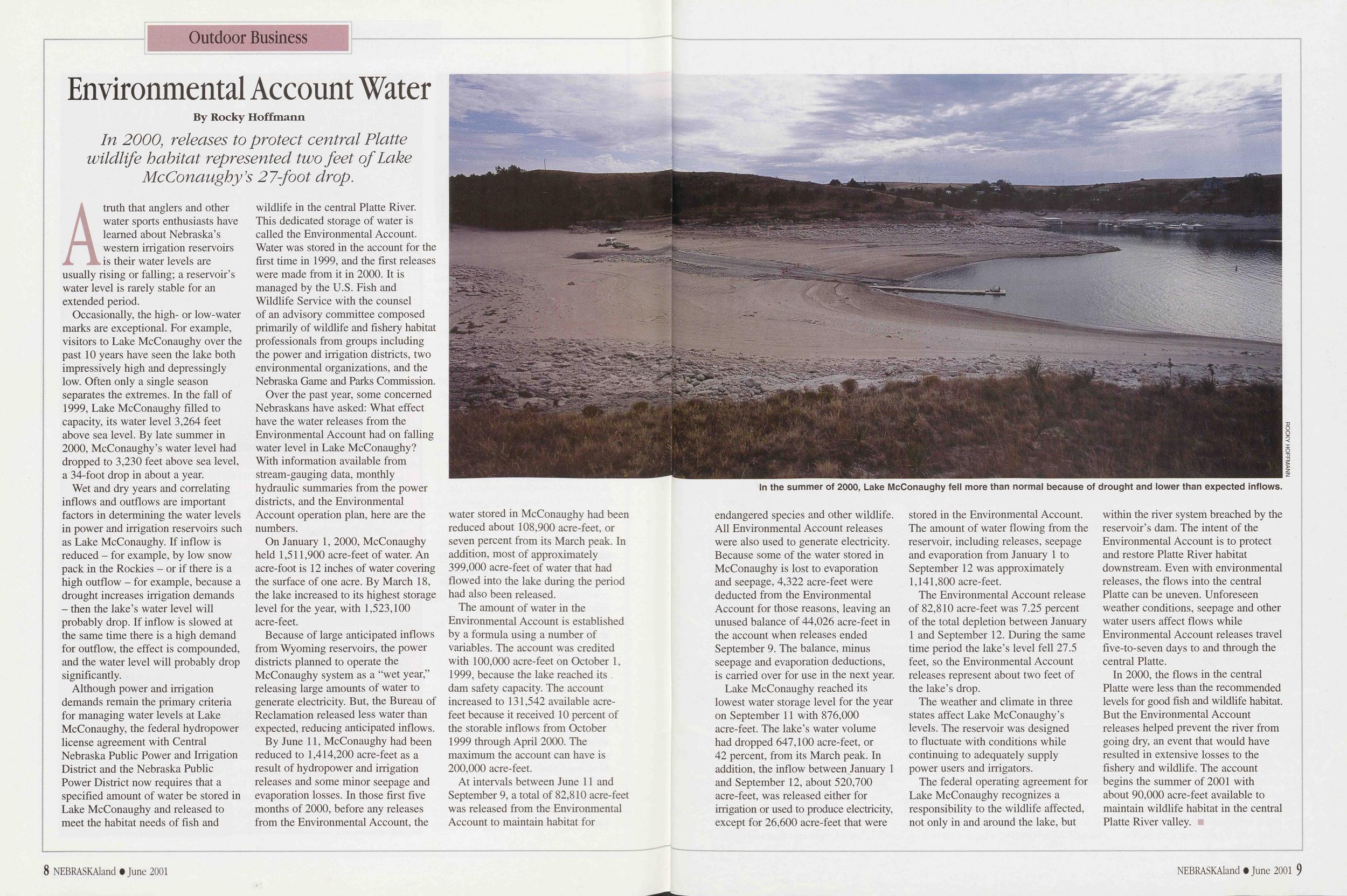
Outdoor Business
Environmental Account Water
By Rocky Hoffmann In 2000, releases to protect central Platte wildlife habitat represented two feet of Lake McConaughy's 27-foot drop.truth that anglers and other water sports enthusiasts have learned about Nebraska's western irrigation reservoirs is their water levels are usually rising or falling; a reservoir's water level is rarely stable for an extended period.
Occasionally, the high- or low-water marks are exceptional. For example, visitors to Lake McConaughy over the past 10 years have seen the lake both impressively high and depressingly low. Often only a single season separates the extremes. In the fall of 1999, Lake McConaughy filled to capacity, its water level 3,264 feet above sea level. By late summer in 2000, McConaughy's water level had dropped to 3,230 feet above sea level, a 34-foot drop in about a year.
Wet and dry years and correlating inflows and outflows are important factors in determining the water levels in power and irrigation reservoirs such as Lake McConaughy. If inflow is reduced - for example, by low snow pack in the Rockies - or if there is a high outflow - for example, because a drought increases irrigation demands - then the lake's water level will probably drop. If inflow is slowed at the same time there is a high demand for outflow, the effect is compounded, and the water level will probably drop significantly.
Although power and irrigation demands remain the primary criteria for managing water levels at Lake McConaughy, the federal hydropower license agreement with Central Nebraska Public Power and Irrigation District and the Nebraska Public Power District now requires that a specified amount of water be stored in Lake McConaughy and released to meet the habitat needs of fish and wildlife in the central Platte River. This dedicated storage of water is called the Environmental Account. Water was stored in the account for the first time in 1999, and the first releases were made from it in 2000. It is managed by the U.S. Fish and Wildlife Service with the counsel of an advisory committee composed primarily of wildlife and fishery habitat professionals from groups including the power and irrigation districts, two environmental organizations, and the Nebraska Game and Parks Commission.
Over the past year, some concerned Nebraskans have asked: What effect have the water releases from the Environmental Account had on falling water level in Lake McConaughy? With information available from stream-gauging data, monthly hydraulic summaries from the power districts, and the Environmental Account operation plan, here are the numbers.
On January 1, 2000, McConaughy held 1,511,900 acre-feet of water. An acre-foot is 12 inches of water covering the surface of one acre. By March 18, the lake increased to its highest storage level for the year, with 1,523,100 acre-feet.
Because of large anticipated inflows from Wyoming reservoirs, the power districts planned to operate the McConaughy system as a "wet year," releasing large amounts of water to generate electricity. But, the Bureau of Reclamation released less water than expected, reducing anticipated inflows.
By June 11, McConaughy had been reduced to 1,414,200 acre-feet as a result of hydropower and irrigation releases and some minor seepage and evaporation losses. In those first five months of 2000, before any releases from the Environmental Account, the water stored in McConaughy had been reduced about 108,900 acre-feet, or seven percent from its March peak. In addition, most of approximately 399,000 acre-feet of water that had flowed into the lake during the period had also been released.
The amount of water in the Environmental Account is established by a formula using a number of variables. The account was credited with 100,000 acre-feet on October 1, 1999, because the lake reached its dam safety capacity. The account increased to 131,542 available acre-feet because it received 10 percent of the storable inflows from October 1999 through April 2000. The maximum the account can have is 200,000 acre-feet.
At intervals between June 11 and September 9, a total of 82,810 acre-feet was released from the Environmental Account to maintain habitat for 8 NEBRASKAland • June 2001
Lake McConaughy reached its lowest water storage level for the year on September 11 with 876,000 acre-feet. The lake's water volume had dropped 647,100 acre-feet, or 42 percent, from its March peak. In addition, the inflow between January 1 and September 12, about 520,700 acre-feet, was released either for irrigation or used to produce electricity, except for 26,600 acre-feet that were stored in the Environmental Account. The amount of water flowing from the reservoir, including releases, seepage and evaporation from January 1 to September 12 was approximately 1,141,800 acre-feet.
The Environmental Account release of 82,810 acre-feet was 7.25 percent of the total depletion between January 1 and September 12. During the same time period the lake's level fell 27.5 feet, so the Environmental Account releases represent about two feet of the lake's drop.
The weather and climate in three states affect Lake McConaughy's levels. The reservoir was designed to fluctuate with conditions while continuing to adequately supply power users and irrigators.
The federal operating agreement for Lake McConaughy recognizes a responsibility to the wildlife affected, not only in and around the lake, but within the river system breached by the reservoir's dam. The intent of the Environmental Account is to protect and restore Platte River habitat downstream. Even with environmental releases, the flows into the central Platte can be uneven. Unforeseen weather conditions, seepage and other water users affect flows while Environmental Account releases travel five-to-seven days to and through the central Platte.
In 2000, the flows in the central Platte were less than the recommended levels for good fish and wildlife habitat. But the Environmental Account releases helped prevent the river from going dry, an event that would have resulted in extensive losses to the fishery and wildlife. The account begins the summer of 2001 with about 90,000 acre-feet available to maintain wildlife habitat in the central Platte River valley.
NEBRASKAland • June 2001 9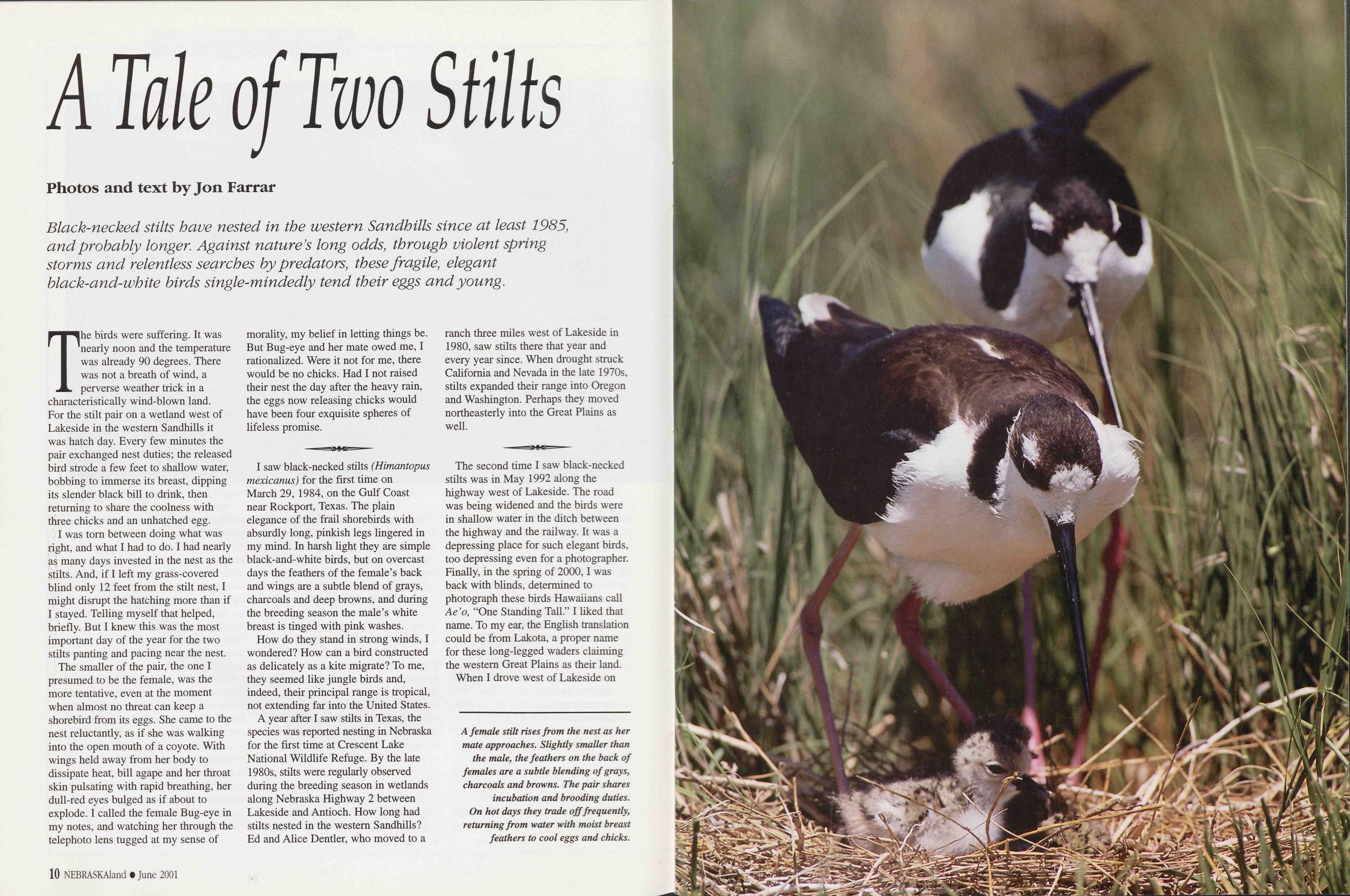
Tale of Two Stilts
Photos and text by Jon Farrar Black-necked stilts have nested in the western Sandhills since at least 1985, and probably longer. Against nature's long odds, through violent spring storms and relentless searches by predators, these fragile, elegant black-and-white birds single-mindedly tend their eggs and young.The birds were suffering. It was nearly noon and the temperature was already 90 degrees. There was not a breath of wind, a perverse weather trick in a characteristically wind-blown land. For the stilt pair on a wetland west of Lakeside in the western Sandhills it was hatch day. Every few minutes the pair exchanged nest duties; the released bird strode a few feet to shallow water, bobbing to immerse its breast, dipping its slender black bill to drink, then returning to share the coolness with three chicks and an unhatched egg.
I was torn between doing what was right, and what I had to do. I had nearly as many days invested in the nest as the stilts. And, if I left my grass-covered blind only 12 feet from the stilt nest, I might disrupt the hatching more than if I stayed. Telling myself that helped, briefly. But I knew this was the most important day of the year for the two stilts panting and pacing near the nest.
The smaller of the pair, the one I presumed to be the female, was the more tentative, even at the moment when almost no threat can keep a shorebird from its eggs. She came to the nest reluctantly, as if she was walking into the open mouth of a coyote. With wings held away from her body to dissipate heat, bill agape and her throat skin pulsating with rapid breathing, her dull-red eyes bulged as if about to explode. I called the female Bug-eye in my notes, and watching her through the telephoto lens tugged at my sense of 10 NEBRASKAland • June 2001 morality, my belief in letting things be. But Bug-eye and her mate owed me, I rationalized. Were it not for me, there would be no chicks. Had I not raised their nest the day after the heavy rain, the eggs now releasing chicks would have been four exquisite spheres of lifeless promise.
I saw black-necked stilts (Himantopus mexicanus) for the first time on March 29, 1984, on the Gulf Coast near Rockport, Texas. The plain elegance of the frail shorebirds with absurdly long, pinkish legs lingered in my mind. In harsh light they are simple black-and-white birds, but on overcast days the feathers of the female's back and wings are a subtle blend of grays, charcoals and deep browns, and during the breeding season the male's white breast is tinged with pink washes.
How do they stand in strong winds, I wondered? How can a bird constructed as delicately as a kite migrate? To me, they seemed like jungle birds and, indeed, their principal range is tropical, not extending far into the United States.
A year after I saw stilts in Texas, the species was reported nesting in Nebraska for the first time at Crescent Lake National Wildlife Refuge. By the late 1980s, stilts were regularly observed during the breeding season in wetlands along Nebraska Highway 2 between Lakeside and Antioch. How long had stilts nested in the western Sandhills? Ed and Alice Dentler, who moved to a ranch three miles west of Lakeside in 1980, saw stilts there that year and every year since. When drought struck Cahfornia and Nevada in the late 1970s, stilts expanded their range into Oregon and Washington. Perhaps they moved northeasterly into the Great Plains as well.
The second time I saw black-necked stilts was in May 1992 along the highway west of Lakeside. The road was being widened and the birds were in shallow water in the ditch between the highway and the railway. It was a depressing place for such elegant birds, too depressing even for a photographer. Finally, in the spring of 2000,1 was back with blinds, determined to photograph these birds Hawaiians call Ae 'o, "One Standing Tall." I liked that name. To my ear, the English translation could be from Lakota, a proper name for these long-legged waders claiming the western Great Plains as their land.
When I drove west of Lakeside on
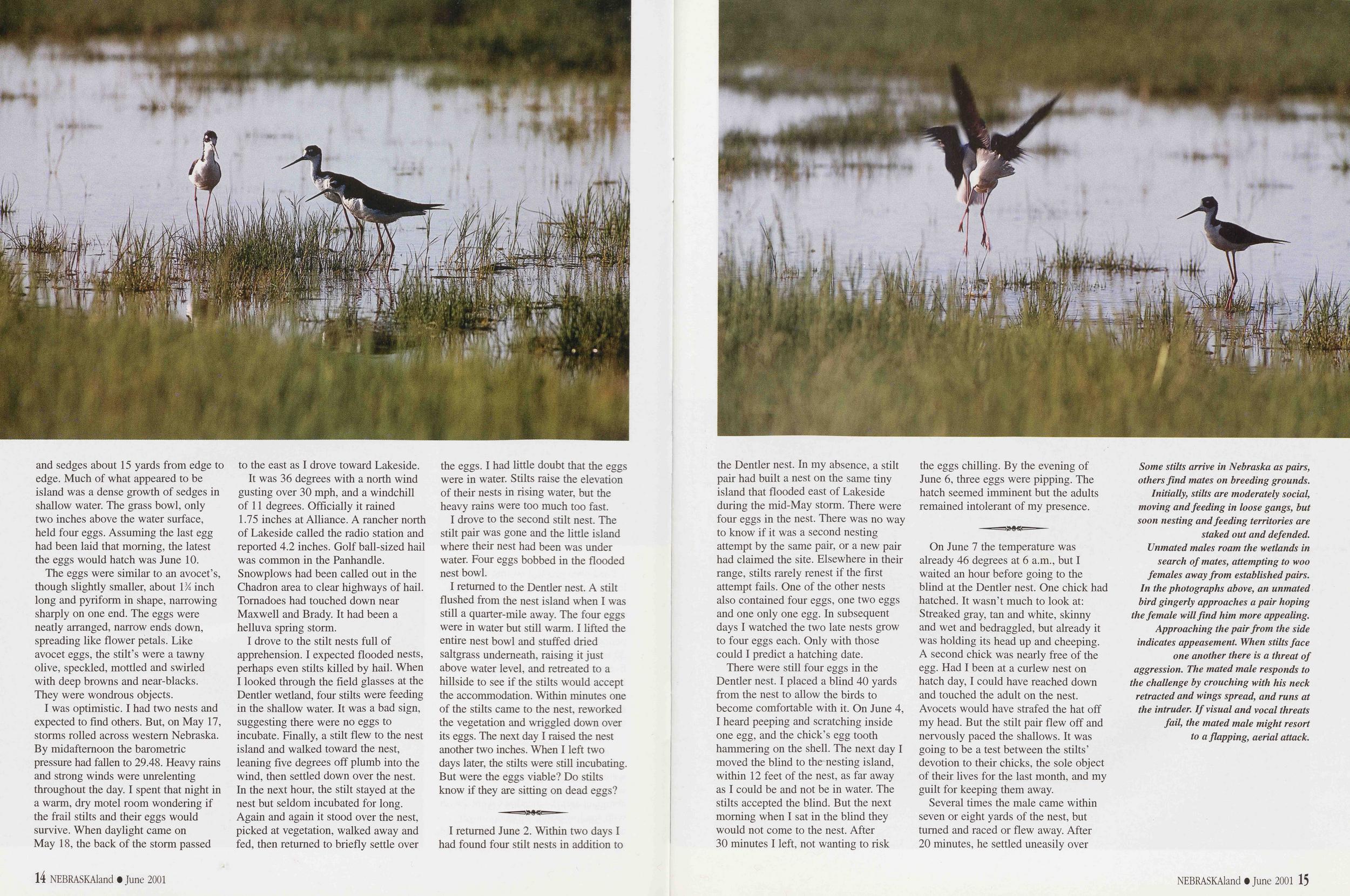
While it was early for the nesting season, I watched a pair of stilts mate. The avocet is the stilt's closest relative and their habits, including courtship display, parallel closely. The displays and postures of the male and female are ritualized, varying only with the skill of the pair. The display is initiated with symbolic preening. The male is especially demonstrative, dipping his bill in water and preening his breast feathers. The female's body is less erect than the male's and she gradually lowers, with neck extended and bill nearly touching the water. With this posture the female tells the male she is receptive to his advances.
Once the female assumes this pre-copulatory posture, the male's display intensifies. He moves rapidly from one side of the female to the other, always passing behind, preening with quick movements, dipping his bill frequently and shaking it vigorously. After several minutes the male flutters up onto the female's back, and with wings arched like an Indian headdress, folds his carpenter-measure legs and slides back. The female shifts her tail to the side and moves her head from side to side in scythe-like motions. After the male drops down to the female's side, the birds cross bills and spin in a tight circle, or run forward together, sometimes with the wing of the male held over the female's back. Separating, they preen, bathe and drink.
12 NEBRASKAland • June 2001I had photographed nesting shorebirds, including avocets, many times. I had come to know them as trusting birds; birds that readily accept a photo blind if it is introduced late in the incubation period. Many times I had staked a blind 20 feet from an avocet nest and, within five minutes, a bird returned to incubate. I assumed stilts would be no different. But the weather and the stilt's nature soon proved my uncharacteristic optimism unfounded.
During the first week of May, stilts were spread throughout the wetlands west of Lakeside. Rainfall had been abundant and the meadows were awash with shallow pools. Stilts no longer associated in loose gangs. Rather, there was a pair here and a pair there, and there were challenges and conflicts for nesting and feeding territories, even for mates. Unmated males tried repeatedly to woo females from established pairs. Stilt pairs spent their days feeding, even in the early morning, suggesting they had no eggs to incubate. For several days, I walked and observed the wetlands, hoping to glimpse a stilt walking to a nest and settling over eggs.
Again and again the stilts fooled me with their distraction displays. Sometimes I would be mobbed by as many as eight or 10 stilts. Where one minute there was only a pair, suddenly several came from nearby pools to join ranks. Rather than strafing intruders, as avocets and curlews do, the stilts hovered and glided overhead issuing yapping kek, kek, kek, kek alarm calls. Their strategy seemed not so much to drive me from the meadow as to distract me. Stilts landed 30 yards away and stood with outstretched, trembling wings as if injured, inviting me to follow for an easy meal. Some ran short distances and squatted in the grass as if settling over eggs. As I approached, they ran and again squatted. Never were there eggs or a nest. For hours, I sat on little knolls and watched stilts through field glasses, hoping one would move to a nest. I left without finding stilt eggs.
On May 15,1 was again walking the wetlands west of Lakeside. Surely there would be eggs down by then. I hoped I would find an incomplete clutch so I could calculate the hatching date, which on average is about 25 days after the last, typically fourth, egg is laid. I found a stilt nest with four eggs east of Lakeside, and rancher Ed Dentler told me he had flushed a nesting stilt while riding horseback in a meadow west of Lakeside a few days earlier. The next day I pulled on waders and found, what in my notes, became the Dentler nest.
The nest was on an island of saltgrass
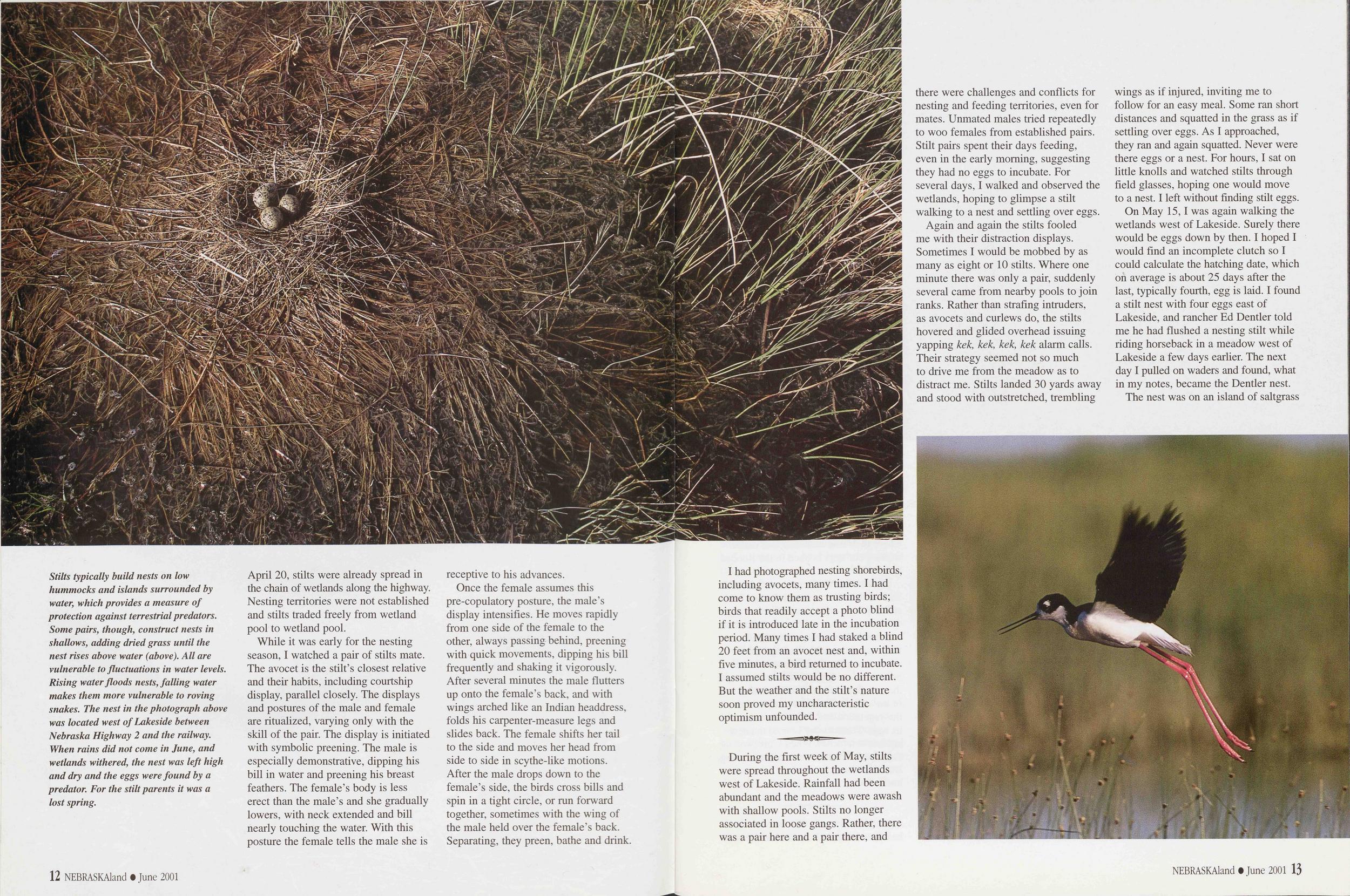
The eggs were similar to an avocet's, though slightly smaller, about VA inch long and pyriform in shape, narrowing sharply on one end. The eggs were neatly arranged, narrow ends down, spreading like flower petals. Like avocet eggs, the stilt's were a tawny olive, speckled, mottled and swirled with deep browns and near-blacks. They were wondrous objects.
I was optimistic. I had two nests and expected to find others. But, on May 17, storms rolled across western Nebraska. By midafternoon the barometric pressure had fallen to 29.48. Heavy rains and strong winds were unrelenting throughout the day. I spent that night in a warm, dry motel room wondering if the frail stilts and their eggs would survive. When daylight came on May 18, the back of the storm passed to the east as I drove toward Lakeside.
It was 36 degrees with a north wind gusting over 30 mph, and a windchill of 11 degrees. Officially it rained 1.75 inches at Alliance. A rancher north of Lakeside called the radio station and reported 4.2 inches. Golf ball-sized hail was common in the Panhandle. Snowplows had been called out in the Chadron area to clear highways of hail. Tornadoes had touched down near Maxwell and Brady. It had been a helluva spring storm.
I drove to the stilt nests full of apprehension. I expected flooded nests, perhaps even stilts killed by hail. When I looked through the field glasses at the Dentler wetland, four stilts were feeding in the shallow water. It was a bad sign, suggesting there were no eggs to incubate. Finally, a stilt flew to the nest island and walked toward the nest, leaning five degrees off plumb into the wind, then settled down over the nest. In the next hour, the stilt stayed at the nest but seldom incubated for long. Again and again it stood over the nest, picked at vegetation, walked away and fed, then returned to briefly settle over the eggs. I had little doubt that the eggs were in water. Stilts raise the elevation of their nests in rising water, but the heavy rains were too much too fast.
I drove to the second stilt nest. The stilt pair was gone and the little island where their nest had been was under water. Four eggs bobbed in the flooded nest bowl.
I returned to the Dentler nest. A stilt flushed from the nest island when I was still a quarter-mile away. The four eggs were in water but still warm. I lifted the entire nest bowl and stuffed dried saltgrass underneath, raising it just above water level, and retreated to a hillside to see if the stilts would accept the accommodation. Within minutes one of the stilts came to the nest, reworked the vegetation and wriggled down over its eggs. The next day I raised the nest another two inches. When I left two days later, the stilts were still incubating. But were the eggs viable? Do stilts know if they are sitting on dead eggs?
I returned June 2. Within two days I had found four stilt nests in addition to 14 NEBRASKAland • June 2001 the Dentler nest. In my absence, a stilt pair had built a nest on the same tiny island that flooded east of Lakeside during the mid-May storm. There were four eggs in the nest. There was no way to know if it was a second nesting attempt by the same pair, or a new pair had claimed the site. Elsewhere in their range, stilts rarely renest if the first attempt fails. One of the other nests also contained four eggs, one two eggs and one only one egg. In subsequent days I watched the two late nests grow to four eggs each. Only with those could I predict a hatching date.
There were still four eggs in the Dentler nest. I placed a blind 40 yards from the nest to allow the birds to become comfortable with it. On June 4, I heard peeping and scratching inside one egg, and the chick's egg tooth hammering on the shell. The next day I moved the blind to the nesting island, within 12 feet of the nest, as far away as I could be and not be in water. The stilts accepted the blind. But the next morning when I sat in the blind they would not come to the nest. After 30 minutes I left, not wanting to risk the eggs chilling. By the evening of June 6, three eggs were pipping. The hatch seemed imminent but the adults remained intolerant of my presence.
On June 7 the temperature was already 46 degrees at 6 a.m., but I waited an hour before going to the blind at the Dentler nest. One chick had hatched. It wasn't much to look at: Streaked gray, tan and white, skinny and wet and bedraggled, but already it was holding its head up and cheeping. A second chick was nearly free of the egg. Had I been at a curlew nest on hatch day, I could have reached down and touched the adult on the nest. Avocets would have strafed the hat off my head. But the stilt pair flew off and nervously paced the shallows. It was going to be a test between the stilts' devotion to their chicks, the sole object of their lives for the last month, and my guilt for keeping them away.
Several times the male came within seven or eight yards of the nest, but turned and raced or flew away. After 20 minutes, he settled uneasily over
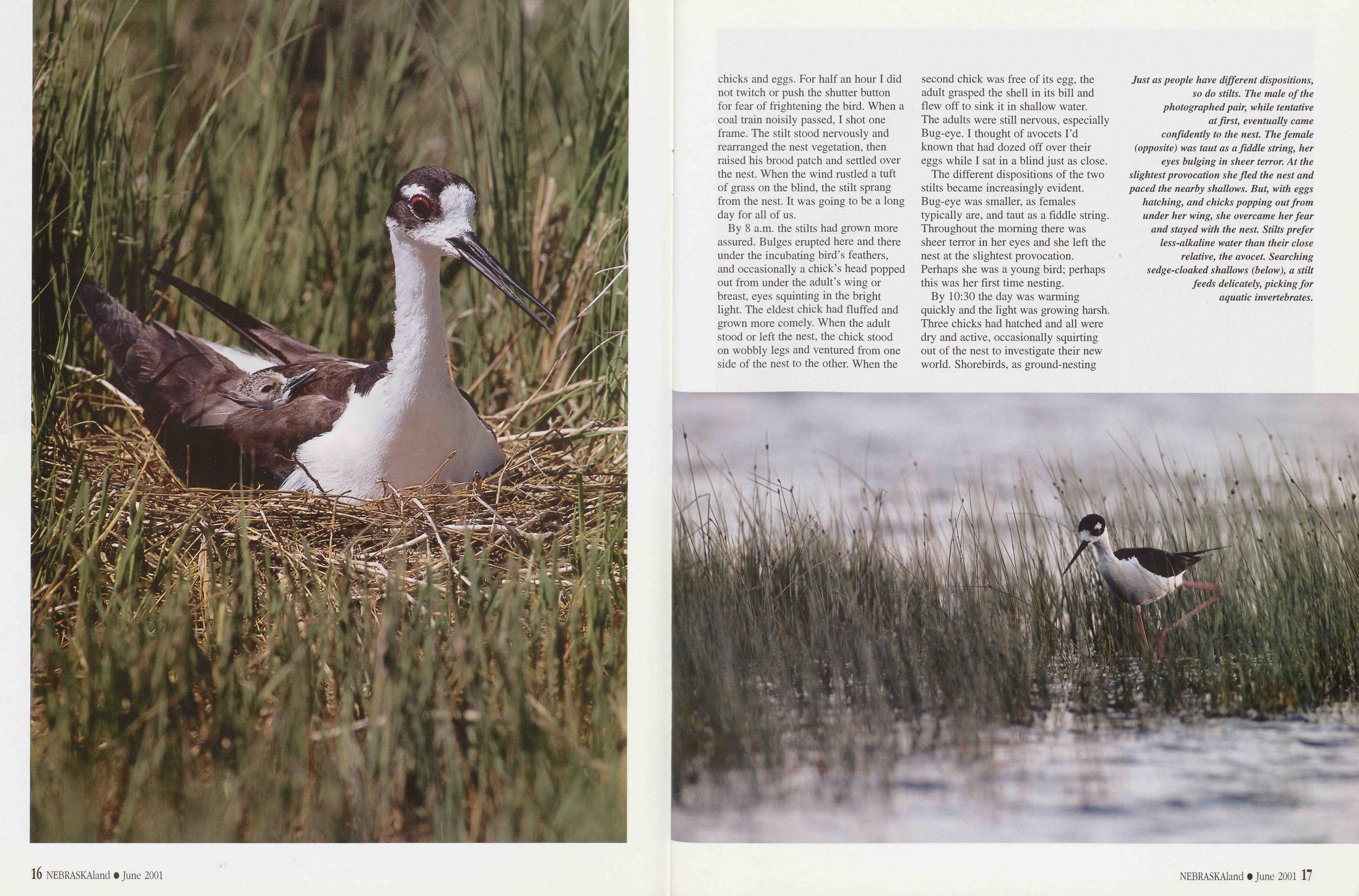
By 8 a.m. the stilts had grown more assured. Bulges erupted here and there under the incubating bird's feathers, and occasionally a chick's head popped out from under the adult's wing or breast, eyes squinting in the bright light. The eldest chick had fluffed and grown more comely. When the adult stood or left the nest, the chick stood on wobbly legs and ventured from one side of the nest to the other. When the second chick was free of its egg, the adult grasped the shell in its bill and flew off to sink it in shallow water. The adults were still nervous, especially Bug-eye. I thought of avocets I'd known that had dozed off over their eggs while I sat in a blind just as close.
The different dispositions of the two stilts became increasingly evident. Bug-eye was smaller, as females typically are, and taut as a fiddle string. Throughout the morning there was sheer terror in her eyes and she left the nest at the slightest provocation. Perhaps she was a young bird; perhaps this was her first time nesting.
By 10:30 the day was warming quickly and the light was growing harsh. Three chicks had hatched and all were dry and active, occasionally squirting out of the nest to investigate their new world. Shorebirds, as ground-nesting
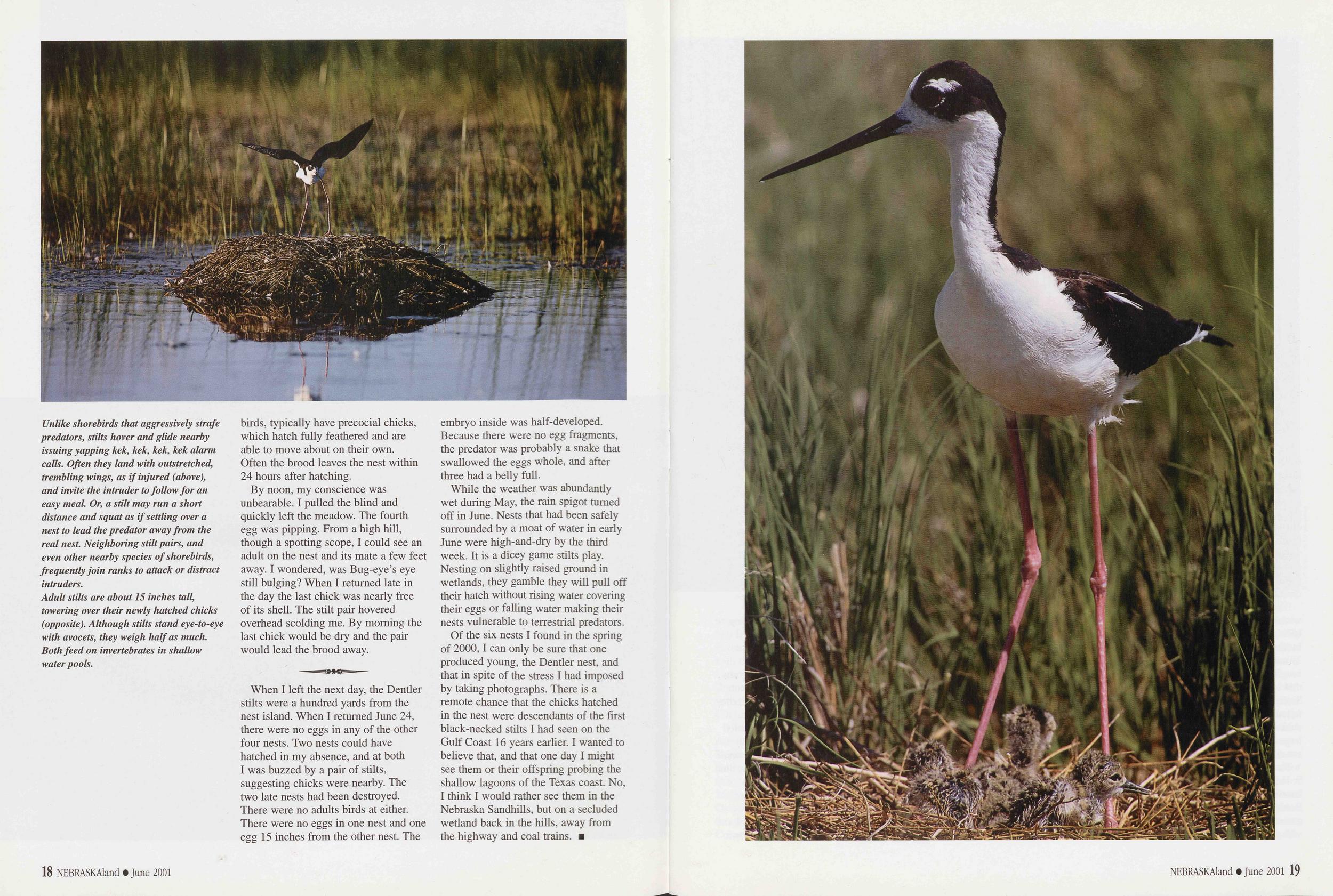
By noon, my conscience was unbearable. I pulled the blind and quickly left the meadow. The fourth egg was pipping. From a high hill, though a spotting scope, I could see an adult on the nest and its mate a few feet away. I wondered, was Bug-eye's eye still bulging? When I returned late in the day the last chick was nearly free of its shell. The stilt pair hovered overhead scolding me. By morning the last chick would be dry and the pair would lead the brood away.
When I left the next day, the Dentler stilts were a hundred yards from the nest island. When I returned June 24, there were no eggs in any of the other four nests. Two nests could have hatched in my absence, and at both I was buzzed by a pair of stilts, suggesting chicks were nearby. The two late nests had been destroyed. There were no adults birds at either. There were no eggs in one nest and one egg 15 inches from the other nest. The embryo inside was half-developed. Because there were no egg fragments, the predator was probably a snake that swallowed the eggs whole, and after three had a belly full.
While the weather was abundantly wet during May, the rain spigot turned off in June. Nests that had been safely surrounded by a moat of water in early June were high-and-dry by the third week. It is a dicey game stilts play. Nesting on slightly raised ground in wetlands, they gamble they will pull off their hatch without rising water covering their eggs or falling water making their nests vulnerable to terrestrial predators.
Of the six nests I found in the spring of 2000,1 can only be sure that one produced young, the Dentler nest, and that in spite of the stress I had imposed by taking photographs. There is a remote chance that the chicks hatched in the nest were descendants of the first black-necked stilts I had seen on the Gulf Coast 16 years earlier. I wanted to believe that, and that one day I might see them or their offspring probing the shallow lagoons of the Texas coast. No, I think I would rather see them in the Nebraska Sandhills, but on a secluded wetland back in the hills, away from the highway and coal trains.
18 NEBRASKAland • June 2001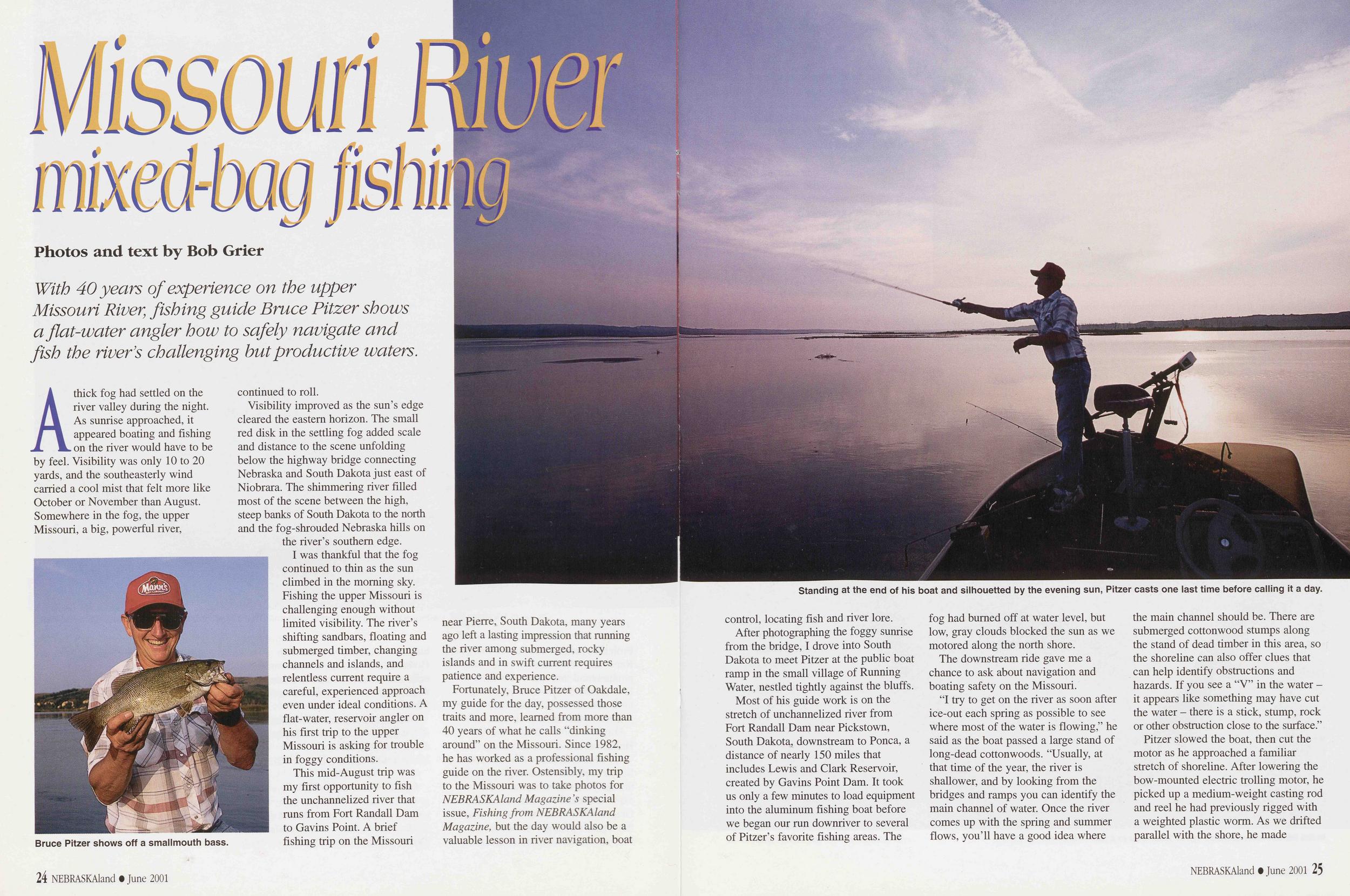
Ash Hollow Crossroads of History
Bv Bob Grier This picturesque valley sheltered prehistoric man 6,000 years ago. Later, Plains Indians used it as a campsite for thousands of years. In the 19th century, white explorers and traders came, and were followed by thousands of emigrants who made their way west through Ash Hollow along the Oregon-California Trail.Ash Hollow was an important campsite on the Oregon-California Trail, a 2000-mile route from the Missouri River to the Pacific. Many emigrant journals speak of the beauty of the valley's groves of ash and cedar, the profusion of blooming wild rose and the sweet spring water. They also tell of the steep descent into the valley down Windlass Hill, where eroded wagon ruts are still visible, and of the numerous graves they found of travelers who died of cholera and other diseases.
Blue Creek, near Ash Hollow, was witness to one of the first clashes between the U.S. Army and Plains Indian tribes. In 1854, a command of 29 men under Lieutenant John L. Grattan sought payment for a wandering cow that was slaughtered and eaten by Sioux Indians. After negotiations failed, Grattan foolishly ordered the soldiers to fire indiscriminately upon a large body of Indians, who in turn attacked and killed the soldiers.
The following year, General William S. Harney sought to avenge what was known as the Grattan massacre. In the Battle of Blue Water, Harney's command of 600 soldiers attacked a village of about 250 Indians, including Brules, Oglalas, Miniconjou and Cheyennes, led by Chief Little Thunder. Accounts estimated that Harney's force killed about 75 Indians including women and children.
Lieutenant Gouverneur Kemble Warren was a young officer in Harney's command. His journal, maps and the Indian materials that he gathered after the battle and donated to the Smithsonian document the incident. The items he collected also exhibit the refinement and beauty of the Plains Indian materials during this period.
While attempting to find an overland route between Fort Astoria, a fur trading post at the mouth of the Columbia River, and the Missouri River, Robert Stuart and six companions became the first white men to travel what became the Oregon Trail. The Stuart party came upon Ash Hollow on March 26, 1813. Stuart's journal noted crossing "a creek thirty yards wide" identified as Blue Creek, and went on to describe Ash Hollow: "3 miles lower, another Branch joined the main stream from the south, it is thickly wooded a short distance from its mouth, but with what kinds we could not well distinguish. . . For a considerable distance above but more particularly below its junction the River Bluffs are very near and sometimes constitute its banks. They are composed principally of a blue limestone and possess many cedars on which account we call the last mentioned Branch, Cedar Creek - saw sixty Wild Horses."
Following Stuart's journey, the route was used by trappers and traders, including William Ashley, who hauled supplies to the Rocky Mountains. In 1827, Ashley's men transported a small cannon from St. Louis to the Great Salt Lake, probably the first wheeled vehicle to roll through Ash Hollow.
In 1830, famous mountain men Jedediah Smith, David Jackson and William Sublette took 10 mule-drawn 20 NEBRASKAland t June 2001 wagons, 81 men mounted on mules and two Dearborn wagons to the Wind River Range in Wyoming and returned with their furs in the fall. In 1832, a trading expedition led by Captain Bonneville passed through Ash Hollow with the first wagons to go over the Continental Divide.
These trips verified that it was possible to take wagons over this route. Beginning in 1843, more than a half-million people went west on the Oregon-California Trail over the next 25 years. Some went all the way to Oregon's Willamette Valley in search of farmland, but many more split off for Colorado and California in search of gold and fortune. The trail's glory ebbed in 1869 when the transcontinental railroad was completed. Ash Hollow provided wagon train travelers the basic necessities that attracted earlier wanderers - an attractive spot, shelter, good water, wood, fruits and berries.
In his 1969 book, The Great Platte River Road, Merrill J. Mattes tells the compelling story of the migration on the Oregon-California Trail. Mattes, who became superintendent of Scotts Bluff National Monument in 1935, included numerous passages about Ash Hollow based on research of overland trail diaries and journals.
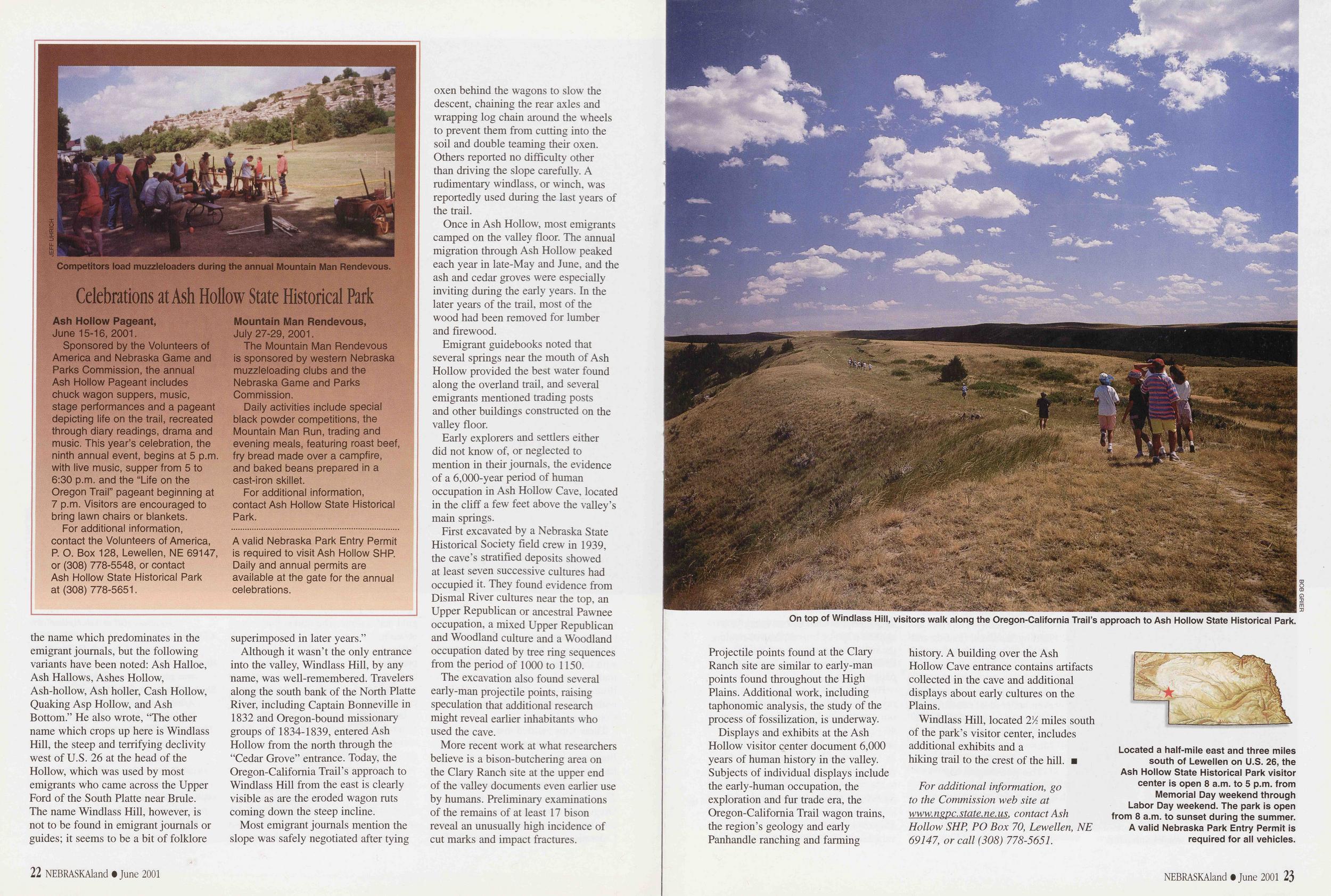
Ash Hollow Pageant, June 15-16, 2001.
Sponsored by the Volunteers of America and Nebraska Game and Parks Commission, the annual Ash Hollow Pageant includes chuck wagon suppers, music, stage performances and a pageant depicting life on the trail, recreated through diary readings, drama and music. This year's celebration, the ninth annual event, begins at 5 p.m. with live music, supper from 5 to 6:30 p.m. and the "Life on the Oregon Trail" pageant beginning at 7 p.m. Visitors are encouraged to bring lawn chairs or blankets.
For additional information, contact the Volunteers of America, P. O. Box 128, Lewellen, NE 69147, or (308) 778-5548, or contact Ash Hollow State Historical Park at (308) 778-5651.
Mountain Man Rendevous, July 27-29, 2001.
The Mountain Man Rendevous is sponsored by western Nebraska muzzleloading clubs and the Nebraska Game and Parks Commission.
Daily activities include special black powder competitions, the Mountain Man Run, trading and evening meals, featuring roast beef, fry bread made over a campfire, and baked beans prepared in a cast-iron skillet.
For additional information, contact Ash Hollow State Historical Park.
A valid Nebraska Park Entry Permit is required to visit Ash Hollow SHP Daily and annual permits are available at the gate for the annual celebrations.
Mattes noted that "Ash Hollow is the name which predominates in the emigrant journals, but the following variants have been noted: Ash Halloe, Ash Hallows, Ashes Hollow, Ash-hollow, Ash holler, Cash Hollow, Quaking Asp Hollow, and Ash Bottom." He also wrote, "The other name which crops up here is Windlass Hill, the steep and terrifying declivity west of U.S. 26 at the head of the Hollow, which was used by most emigrants who came across the Upper Ford of the South Platte near Brule. The name Windlass Hill, however, is not to be found in emigrant journals or guides; it seems to be a bit of folklore superimposed in later years."
Although it wasn't the only entrance into the valley, Windlass Hill, by any name, was well-remembered. Travelers along the south bank of the North Platte River, including Captain Bonneville in 1832 and Oregon-bound missionary groups of 1834-1839, entered Ash Hollow from the north through the "Cedar Grove" entrance. Today, the Oregon-California Trail's approach to Windlass Hill from the east is clearly visible as are the eroded wagon ruts coming down the steep incline.
Most emigrant journals mention the slope was safely negotiated after tying oxen behind the wagons to slow the descent, chaining the rear axles and wrapping log chain around the wheels to prevent them from cutting into the soil and double teaming their oxen. Others reported no difficulty other than driving the slope carefully. A rudimentary windlass, or winch, was reportedly used during the last years of the trail.
Once in Ash Hollow, most emigrants camped on the valley floor. The annual migration through Ash Hollow peaked each year in late-May and June, and the ash and cedar groves were especially inviting during the early years. In the later years of the trail, most of the wood had been removed for lumber and firewood.
Emigrant guidebooks noted that several springs near the mouth of Ash Hollow provided the best water found along the overland trail, and several emigrants mentioned trading posts and other buildings constructed on the valley floor.
Early explorers and settlers either did not know of, or neglected to mention in their journals, the evidence of a 6,000-year period of human occupation in Ash Hollow Cave, located in the cliff a few feet above the valley's main springs.
First excavated by a Nebraska State Historical Society field crew in 1939, the cave's stratified deposits showed at least seven successive cultures had occupied it. They found evidence from Dismal River cultures near the top, an Upper Republican or ancestral Pawnee occupation, a mixed Upper Republican and Woodland culture and a Woodland occupation dated by tree ring sequences from the period of 1000 to 1150.
The excavation also found several early-man projectile points, raising speculation that additional research might reveal earlier inhabitants who used the cave.
More recent work at what researchers believe is a bison-butchering area on the Clary Ranch site at the upper end of the valley documents even earlier use by humans. Preliminary examinations of the remains of at least 17 bison reveal an unusually high incidence of cut marks and impact fractures. 22 NEBRASKAland • June 2001
Displays and exhibits at the Ash Hollow visitor center document 6,000 years of human history in the valley. Subjects of individual displays include the early-human occupation, the exploration and fur trade era, the Oregon-California Trail wagon trains, the region's geology and early Panhandle ranching and farming history. A building over the Ash Hollow Cave entrance contains artifacts collected in the cave and additional displays about early cultures on the Plains.
Windlass Hill, located TA miles south of the park's visitor center, includes additional exhibits and a hiking trail to the crest of the hill.
For additional information, go to the Commission web site at www, ngpc. state, ne. us. contact Ash Hollow SHP, PO Box 70, Lewellen, NE 69147, or call (308) 778-5651.
Missouri River mixed-bag fishing
Photos and text by Bob Grier With 40 years of experience on the upper Missouri River, fishing guide Bruce Pitzer shows a flat-water angler how to safely navigate and fish the river's challenging hut productive waters.A thick fog had settled on the river valley during the night. As sunrise approached, it appeared boating and fishing on the river would have to be by feel. Visibility was only 10 to 20 yards, and the southeasterly wind carried a cool mist that felt more like October or November than August. Somewhere in the fog, the upper Missouri, a big, powerful river, continued to roll.
Visibility improved as the sun's edge cleared the eastern horizon. The small red disk in the settling fog added scale and distance to the scene unfolding below the highway bridge connecting Nebraska and South Dakota just east of Niobrara. The shimmering river filled most of the scene between the high, steep banks of South Dakota to the north and the fog-shrouded Nebraska hills on the river's southern edge.
I was thankful that the fog continued to thin as the sun climbed in the morning sky. Fishing the upper Missouri is challenging enough without limited visibility. The river's shifting sandbars, floating and submerged timber, changing channels and islands, and relentless current require a careful, experienced approach even under ideal conditions. A flat-water, reservoir angler on his first trip to the upper Missouri is asking for trouble in foggy conditions.
This mid-August trip was my first opportunity to fish the unchannelized river that runs from Fort Randall Dam to Gavins Point. A brief fishing trip on the Missouri near Pierre, South Dakota, many years ago left a lasting impression that running the river among submerged, rocky islands and in swift current requires patience and experience.
Fortunately, Bruce Pitzer of Oakdale, my guide for the day, possessed those traits and more, learned from more than 40 years of what he calls "dinking around" on the Missouri. Since 1982, he has worked as a professional fishing guide on the river. Ostensibly, my trip to the Missouri was to take photos for NEBRASKAland Magazine's special issue, Fishing from NEBRASKAland Magazine, but the day would also be a valuable lesson in river navigation, boat
After photographing the foggy sunrise from the bridge, I drove into South Dakota to meet Pitzer at the public boat ramp in the small village of Running Water, nestled tightly against the bluffs.
Most of his guide work is on the stretch of unchannelized river from Fort Randall Dam near Pickstown, South Dakota, downstream to Ponca, a distance of nearly 150 miles that includes Lewis and Clark Reservoir, created by Gavins Point Dam. It took us only a few minutes to load equipment into the aluminum fishing boat before we began our run downriver to several of Pitzer's favorite fishing areas. The fog had burned off at water level, but low, gray clouds blocked the sun as we motored along the north shore.
The downstream ride gave me a chance to ask about navigation and boating safety on the Missouri.
"I try to get on the river as soon after ice-out each spring as possible to see where most of the water is flowing," he said as the boat passed a large stand of long-dead cotton woods. "Usually, at that time of the year, the river is shallower, and by looking from the bridges and ramps you can identify the main channel of water. Once the river comes up with the spring and summer flows, you'll have a good idea where the main channel should be. There are submerged cottonwood stumps along the stand of dead timber in this area, so the shoreline can also offer clues that can help identify obstructions and hazards. If you see a "V" in the water - it appears like something may have cut the water - there is a stick, stump, rock or other obstruction close to the surface."
Pitzer slowed the boat, then cut the
motor as he approached a familiar
stretch of shoreline. After lowering the
bow-mounted electric trolling motor, he
picked up a medium-weight casting rod
and reel he had previously rigged with
a weighted plastic worm. As we drifted
parallel with the shore, he made
NEBRASKAland • June 2001 25
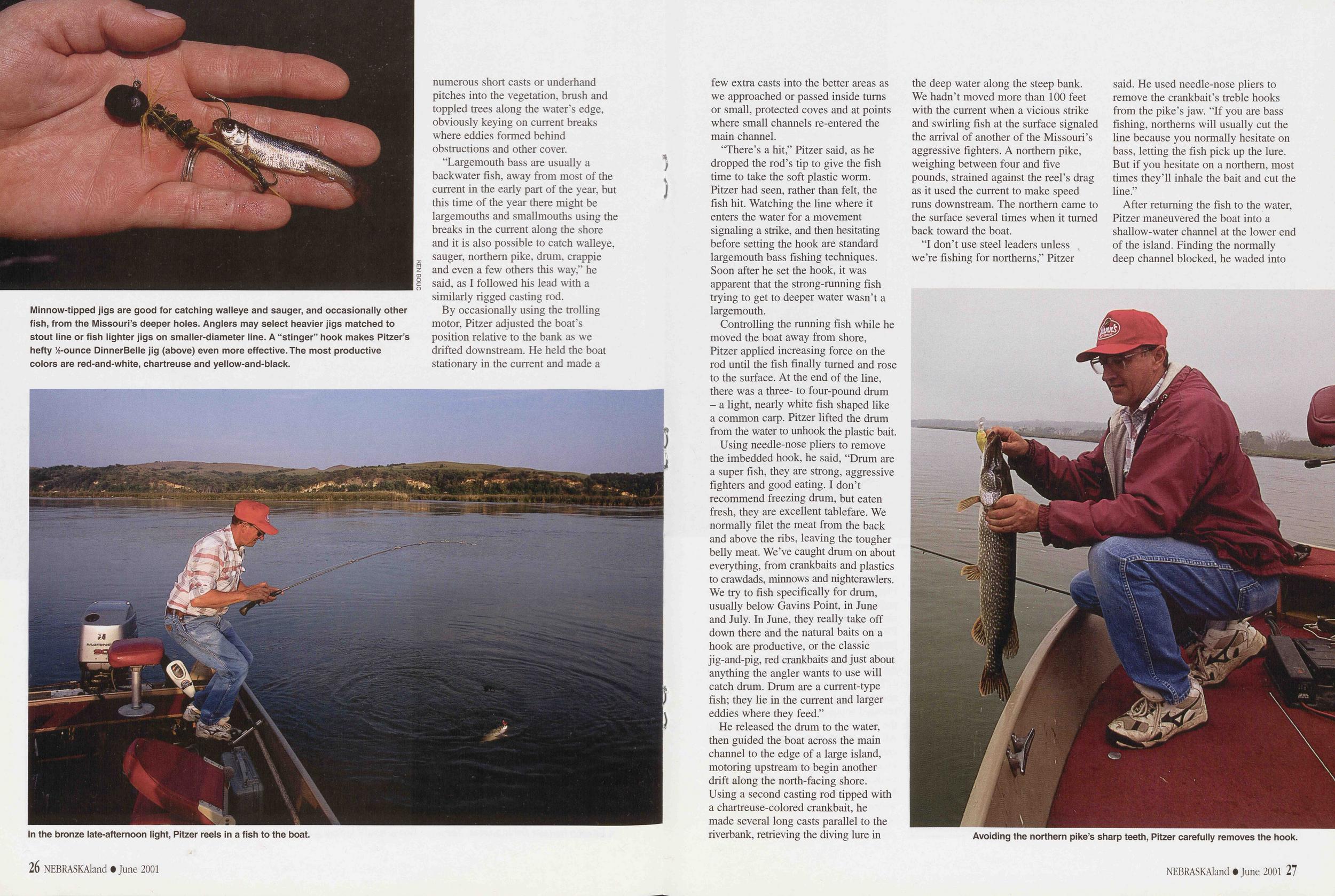
"Largemouth bass are usually a backwater fish, away from most of the current in the early part of the year, but this time of the year there might be largemouths and smallmouths using the breaks in the current along the shore and it is also possible to catch walleye, sauger, northern pike, drum, crappie and even a few others this way," he said, as I followed his lead with a similarly rigged casting rod.
By occasionally using the trolling motor, Pitzer adjusted the boat's position relative to the bank as we drifted downstream. He held the boat stationary in the current and made a
"There's a hit," Pitzer said, as he dropped the rod's tip to give the fish time to take the soft plastic worm. Pitzer had seen, rather than felt, the fish hit. Watching the line where it enters the water for a movement signaling a strike, and then hesitating before setting the hook are standard largemouth bass fishing techniques. Soon after he set the hook, it was apparent that the strong-running fish trying to get to deeper water wasn't a largemouth.
Controlling the running fish while he moved the boat away from shore, Pitzer applied increasing force on the rod until the fish finally turned and rose to the surface. At the end of the line, there was a three- to four-pound drum - a light, nearly white fish shaped like a common carp. Pitzer lifted the drum from the water to unhook the plastic bait.
Using needle-nose pliers to remove the imbedded hook, he said, "Drum are a super fish, they are strong, aggressive fighters and good eating. I don't recommend freezing drum, but eaten fresh, they are excellent tablefare. We normally filet the meat from the back and above the ribs, leaving the tougher belly meat. We've caught drum on about everything, from crankbaits and plastics to crawdads, minnows and nightcrawlers. We try to fish specifically for drum, usually below Gavins Point, in June and July. In June, they really take off down there and the natural baits on a hook are productive, or the classic jig-and-pig, red crankbaits and just about anything the angler wants to use will catch drum. Drum are a current-type fish; they lie in the current and larger eddies where they feed."
He released the drum to the water, then guided the boat across the main channel to the edge of a large island, motoring upstream to begin another drift along the north-facing shore. Using a second casting rod tipped with a chartreuse-colored crankbait, he made several long casts parallel to the riverbank, retrieving the diving lure in the deep water along the steep bank. We hadn't moved more than 100 feet with the current when a vicious strike and swirling fish at the surface signaled the arrival of another of the Missouri's aggressive fighters. A northern pike, weighing between four and five pounds, strained against the reel's drag as it used the current to make speed runs downstream. The northern came to the surface several times when it turned back toward the boat.
"I don't use steel leaders unless we're fishing for northerns," Pitzer said. He used needle-nose pliers to remove the crankbait's treble hooks from the pike's jaw. "If you are bass fishing, northerns will usually cut the line because you normally hesitate on bass, letting the fish pick up the lure. But if you hesitate on a northern, most times they'll inhale the bait and cut the line."
After returning the fish to the water, Pitzer maneuvered the boat into a shallow-water channel at the lower end of the island. Finding the normally deep channel blocked, he waded into
 the river, dragging the boat over the
shallow sandbars. Once in the
backwater channel, we returned to
casting crankbaits and soft plastic baits
without success.
the river, dragging the boat over the
shallow sandbars. Once in the
backwater channel, we returned to
casting crankbaits and soft plastic baits
without success.
Leaving the shallow backwater required more wading and dragging, and once the boat reached the main channel, Pitzer headed upriver to sandbars along the upper end of the large island. Finding a sharp drop-off where the sandbar was cut by the current, he carefully lodged the nose of the boat onto the shallow sandbar. With the fast-flowing, deeper water just behind the stern, it took several tries before the boat held fast on the sandbar.
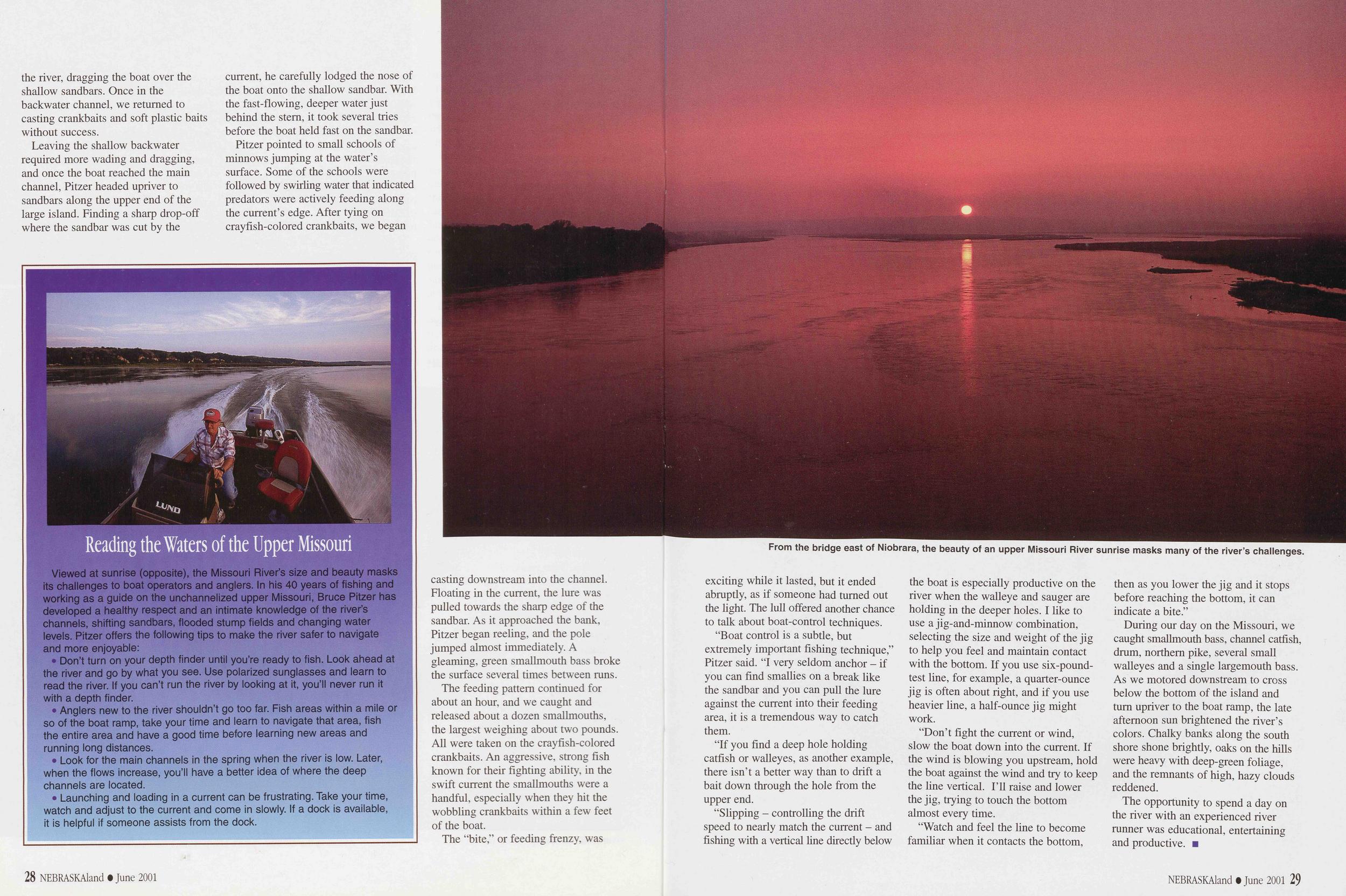
Viewed at sunrise (opposite), the Missouri River's size and beauty masks its challenges to boat operators and anglers. In his 40 years of fishing and working as a guide on the unchahnelized upper Missouri, Bruce Pitzer has developed a healthy respect and an intimate knowledge of the river's channels, shifting sandbars, flooded stump fields and changing water levels. Pitzer offers the following tips to make the river safer to navigate and more enjoyable:
► Don't turn on your depth finder until you're ready to fish. Look ahead at the river and go by what you see. Use polarized sunglasses and learn to read the river. If you can't run the river by looking at it, you'll never run it with a depth finder.
► Anglers new to the river shouldn't go too far. Fish areas within a mile or so of the boat ramp, take your time and learn to navigate that area, fish the entire area and have a good time before learning new areas and running long distances.
• Look for the main channels in the spring when the river is low. Later, when the flows increase, you'll have a better idea of where the deep channels are located.
• Launching and loading in a current can be frustrating. Take your time, watch and adjust to the current and come in slowly. If a dock is available, it is helpful if someone assists from the dock.
Pitzer pointed to small schools of minnows jumping at the water's surface. Some of the schools were followed by swirling water that indicated predators were actively feeding along the current's edge. After tying on crayfish-colored crankbaits, we began casting downstream into the channel. Floating in the current, the lure was pulled towards the sharp edge of the sandbar. As it approached the bank, Pitzer began reeling, and the pole jumped almost immediately. A gleaming, green smallmouth bass broke the surface several times between runs.
The feeding pattern continued for about an hour, and we caught and released about a dozen smallmouths, the largest weighing about two pounds. All were taken on the crayfish-colored crankbaits. An aggressive, strong fish known for their fighting ability, in the swift current the smallmouths were a handful, especially when they hit the wobbling crankbaits within a few feet of the boat.
The "bite," or feeding frenzy, was 28 NEBRASKAland • June 2001
"Boat control is a subtle, but extremely important fishing technique," Pitzer said. "I very seldom anchor - if you can find smallies on a break like the sandbar and you can pull the lure against the current into their feeding area, it is a tremendous way to catch them.
"If you find a deep hole holding catfish or walleyes, as another example, there isn't a better way than to drift a bait down through the hole from the upper end.
"Slipping - controlling the drift speed to nearly match the current - and fishing with a vertical line directly below the boat is especially productive on the river when the walleye and sauger are holding in the deeper holes. I like to use a jig-and-minnow combination, selecting the size and weight of the jig to help you feel and maintain contact with the bottom. If you use six-pound-test line, for example, a quarter-ounce jig is often about right, and if you use heavier line, a half-ounce jig might work.
"Don't fight the current or wind, slow the boat down into the current. If the wind is blowing you upstream, hold the boat against the wind and try to keep the line vertical. I'll raise and lower the jig, trying to touch the bottom almost every time.
"Watch and feel the line to become familiar when it contacts the bottom, then as you lower the jig and it stops before reaching the bottom, it can indicate a bite."
During our day on the Missouri, we caught snailmouth bass, channel catfish, drum, northern pike, several small walleyes and a single largemouth bass. As we motored downstream to cross below the bottom of the island and turn upriver to the boat ramp, the late afternoon sun brightened the river's colors. Chalky banks along the south shore shone brightly, oaks on the hills were heavy with deep-green foliage, and the remnants of high, hazy clouds reddened.
The opportunity to spend a day on the river with an experienced river runner was educational, entertaining and productive.
NEBRASKAland • June 2001 29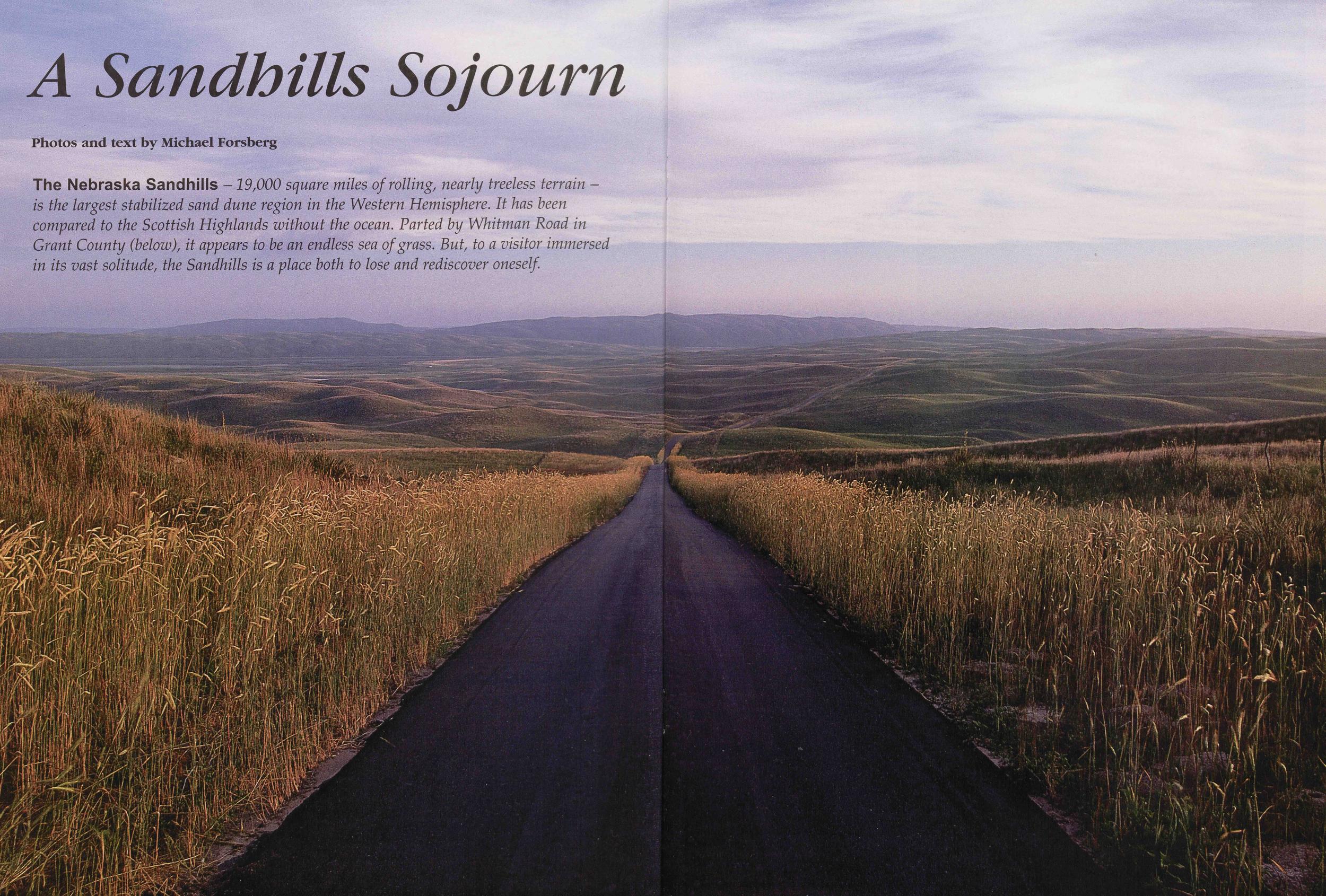
A Sandhills Sojourn
Photos and text by Michael Forsberg The Nebraska Sandhills -19,000 square> miles of rolling, nearly treeless terrain - is the largest stabilized sand dune region in the Western Hemisphere. It has been compared to the Scottish Highlands without the ocean. Parted by Whitman Road in Grant County (below), it appears to be an endless sea of grass. But, to a visitor immersed in its vast solitude, the Sandhills is a place both to lose and rediscover oneself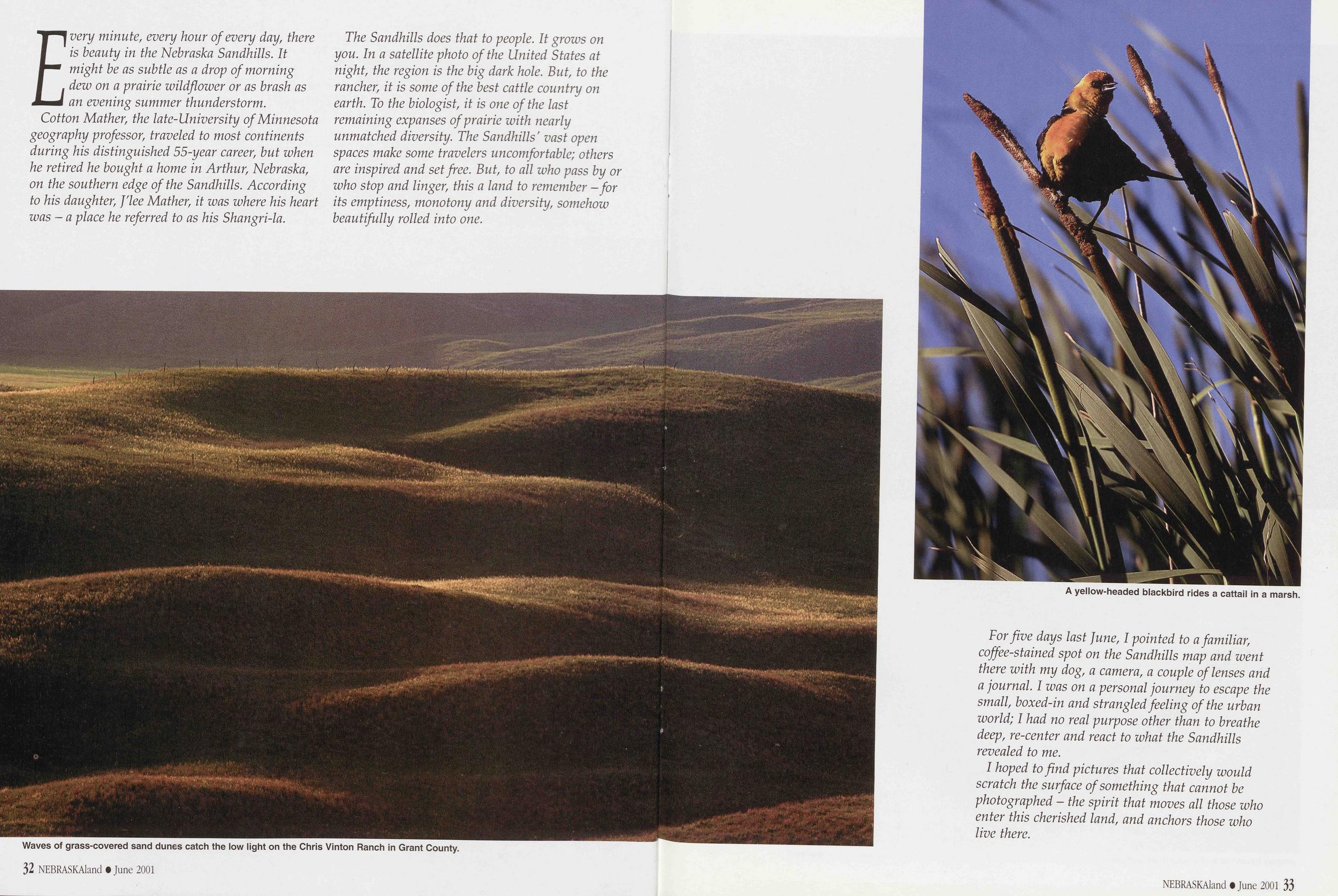
Every minute, every hour of every day, there is beauty in the Nebraska Sandhills. It might be as subtle as a drop of morning dew on a prairie wildflower or as brash as an evening summer thunderstorm.
Cotton Mather, the late-University of Minnesota geography professor, traveled to most continents during his distinguished 55-year career, but when he retired he bought a home in Arthur, Nebraska, on the southern edge of the Sandhills. According to his daughter, flee Mather, it was where his heart was - a place he referred to as his Shangri-la.
The Sandhills does that to people. It grows on you. In a satellite photo of the United States at night, the region is the big dark hole. But, to the rancher, it is some of the best cattle country on earth. To the biologist, it is one of the last remaining expanses of prairie with nearly unmatched diversity. The Sandhills' vast open spaces make some travelers uncomfortable; others are inspired and set free. But, to all who pass by or who stop and linger, this a land to remember -for its emptiness, monotony and diversity, somehow beautifully rolled into one.
For five days last June, I pointed to a familiar, coffee-stained spot on the Sandhills map and went there with my dog, a camera, a couple of lenses and a journal. I was on a personal journey to escape the small, boxed-in and strangled feeling of the urban world; I had no real purpose other than to breathe deep, re-center and react to what the Sandhills revealed to me.
I hoped to find pictures that collectively would scratch the surface of something that cannot be photographed - the spirit that moves all those who enter this cherished land, and anchors those who live there.
NEBRASKAland • June 2001 33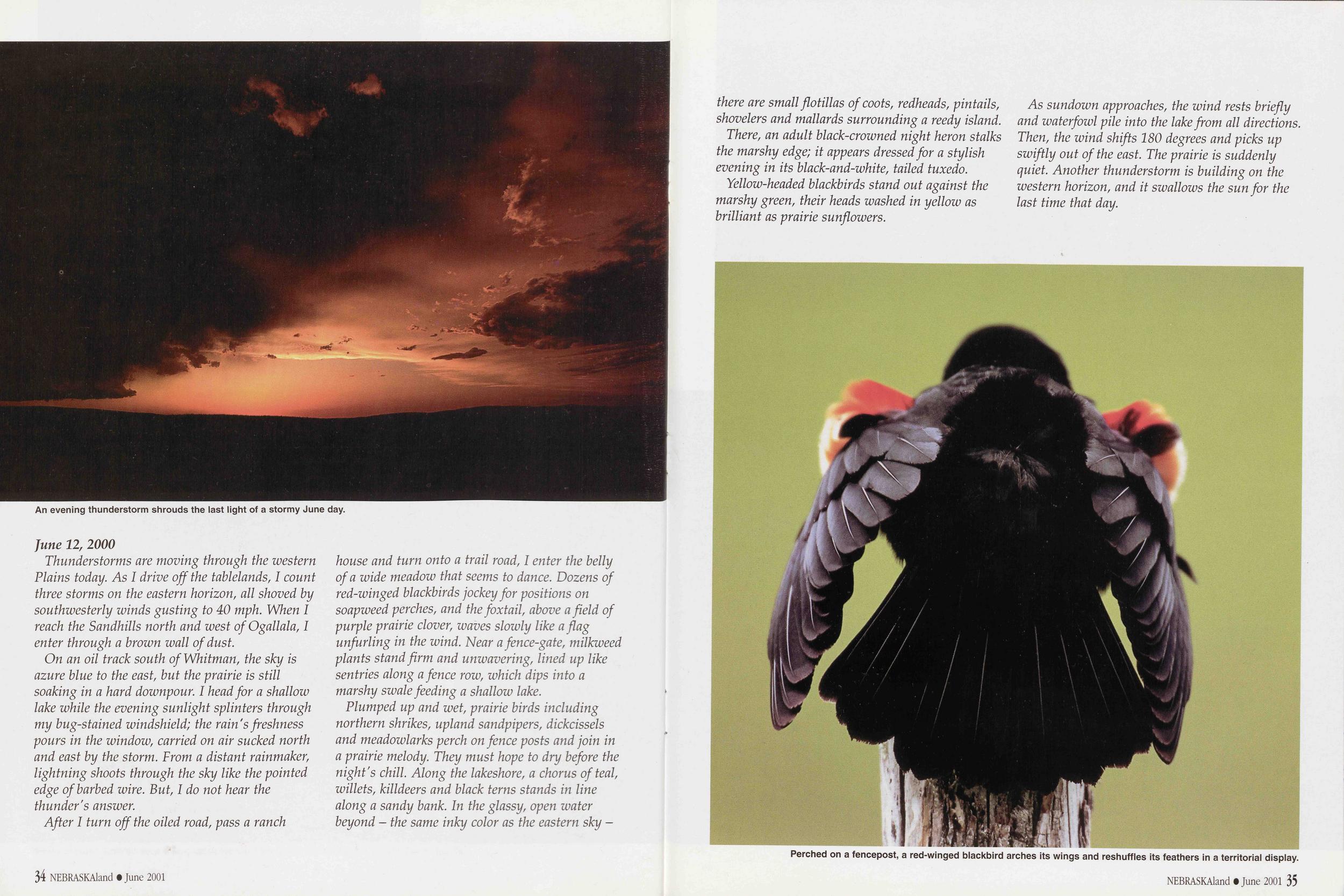
Thunderstorms are moving through the western Plains today. As I drive off the tablelands, I count three storms on the eastern horizon, all shoved by southwesterly winds gusting to 40 mph. When I reach the Sandhills north and west of Ogallala, I enter through a brown wall of dust.
On an oil track south of Whitman, the sky is azure blue to the east, but the prairie is still soaking in a hard downpour. I head for a shallow lake while the evening sunlight splinters through my bug-stained windshield; the rain's freshness pours in the window, carried on air sucked north and east by the storm. From a distant rainmaker, lightning shoots through the sky like the pointed edge of barbed wire. But, I do not hear the thunder's answer.
After I turn off the oiled road, pass a ranch house and turn onto a trail road, I enter the belly of a wide meadow that seems to dance. Dozens of red-winged blackbirds jockey for positions on soapweed perches, and the foxtail, above a field of purple prairie clover, waves slowly like a flag unfurling in the wind. Near a fence-gate, milkweed plants stand firm and unwavering, lined up like sentries along a fence row, which dips into a marshy swale feeding a shallow lake.
Plumped up and wet, prairie birds including northern shrikes, upland sandpipers, dickcissels and meadowlarks perch on fence posts and join in a prairie melody. They must hope to dry before the night's chill. Along the lakeshore, a chorus of teal, willets, killdeers and black terns stands in line along a sandy bank. In the glassy, open water beyond - the same inky color as the eastern sky - 34 NEBRASKAland • June 2001 there are small flotillas of coots, redheads, pintails, shovelers and mallards surrounding a reedy island.
There, an adult black-crowned night heron stalks the marshy edge; it appears dressed for a stylish evening in its black-and-white, tailed tuxedo.
Yellow-headed blackbirds stand out against the marshy green, their heads washed in yellow as brilliant as prairie sunflowers.
As sundown approaches, the wind rests briefly and waterfowl pile into the lake from all directions. Then, the wind shifts 180 degrees and picks up swiftly out of the east. The prairie is suddenly quiet. Another thunderstorm is building on the western horizon, and it swallows the sun for the last time that day.
 June 13, 2000
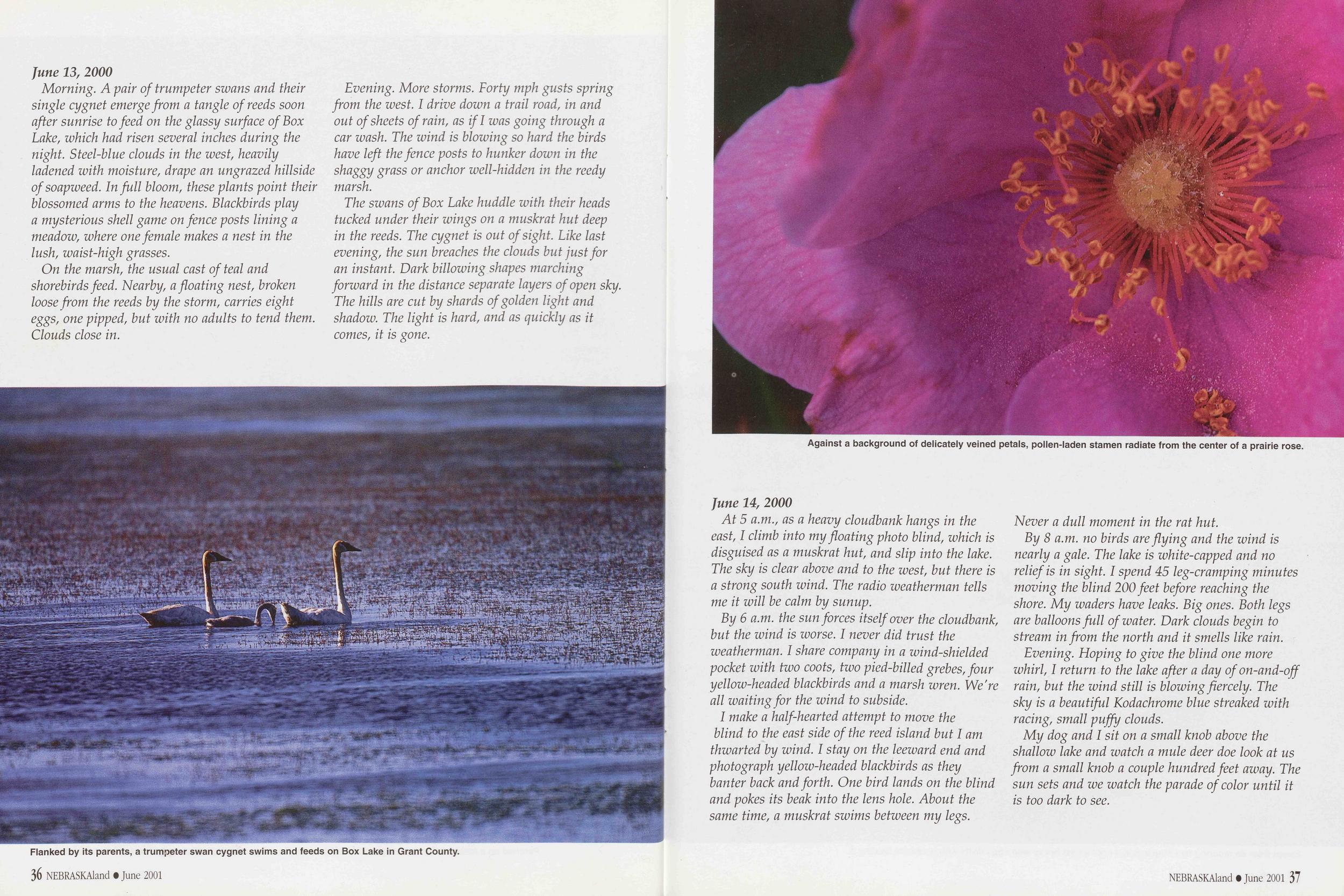
Morning. A pair of trumpeter swans and their single cygnet emerge from a tangle of reeds soon after sunrise to feed on the glassy surface of Box Lake, which had risen several inches during the night. Steel-blue clouds in the west, heavily ladened with moisture, drape an ungrazed hillside of soapweed. In full bloom, these plants point their blossomed arms to the heavens. Blackbirds play a mysterious shell game on fence posts lining a meadow, where one female makes a nest in the lush, waist-high grasses.
On the marsh, the usual cast of teal and shorebirds feed. Nearby, a floating nest, broken loose from the reeds by the storm, carries eight eggs, one pipped, but with no adults to tend them. Clouds close in.
Evening. More storms. Forty mph gusts spring from the west. I drive down a trail road, in and out of sheets of rain, as if I was going through a car wash. The wind is blowing so hard the birds have left the fence posts to hunker down in the shaggy grass or anchor well-hidden in the reedy marsh.
The swans of Box Lake huddle with their heads tucked under their wings on a muskrat hut deep in the reeds. The cygnet is out of sight. Like last evening, the sun breaches the clouds but just for an instant. Dark billowing shapes marching forward in the distance separate layers of open sky. The hills are cut by shards of golden light and shadow. The light is hard, and as quickly as it comes, it is gone.
At 5 a.m., as a heavy cloudbank hangs in the east, I climb into my floating photo blind, which is disguised as a muskrat hut, and slip into the lake. The sky is clear above and to the west, but there is a strong south wind. The radio weatherman tells me it will be calm by sunup.
By 6 a.m. the sun forces itself over the cloudbank, but the wind is worse. I never did trust the weatherman. I share company in a wind-shielded pocket with two coots, two pied-billed grebes, four yellow-headed blackbirds and a marsh wren. We're all waiting for the wind to subside.
I make a half-hearted attempt to move the blind to the east side of the reed island but I am thwarted by wind. I stay on the leeward end and photograph yellow-headed blackbirds as they banter back and forth. One bird lands on the blind and pokes its beak into the lens hole. About the same time, a muskrat swims between my legs. Never a dull moment in the rat hut.
By 8 a.m. no birds are flying and the wind is nearly a gale. The lake is white-capped and no relief is in sight. I spend 45 leg-cramping minutes moving the blind 200 feet before reaching the shore. My waders have leaks. Big ones. Both legs are balloons full of water. Dark clouds begin to stream in from the north and it smells like rain.
Evening. Hoping to give the blind one more whirl, I return to the lake after a day of on-and-off rain, but the wind still is blowing fiercely. The sky is a beautiful Kodachrome blue streaked with racing, small puffy clouds.
My dog and I sit on a small knob above the shallow lake and watch a mule deer doe look at us from a small knob a couple hundred feet away. The sun sets and we watch the parade of color until it is too dark to see.
NEBRASKAland • June 2001 37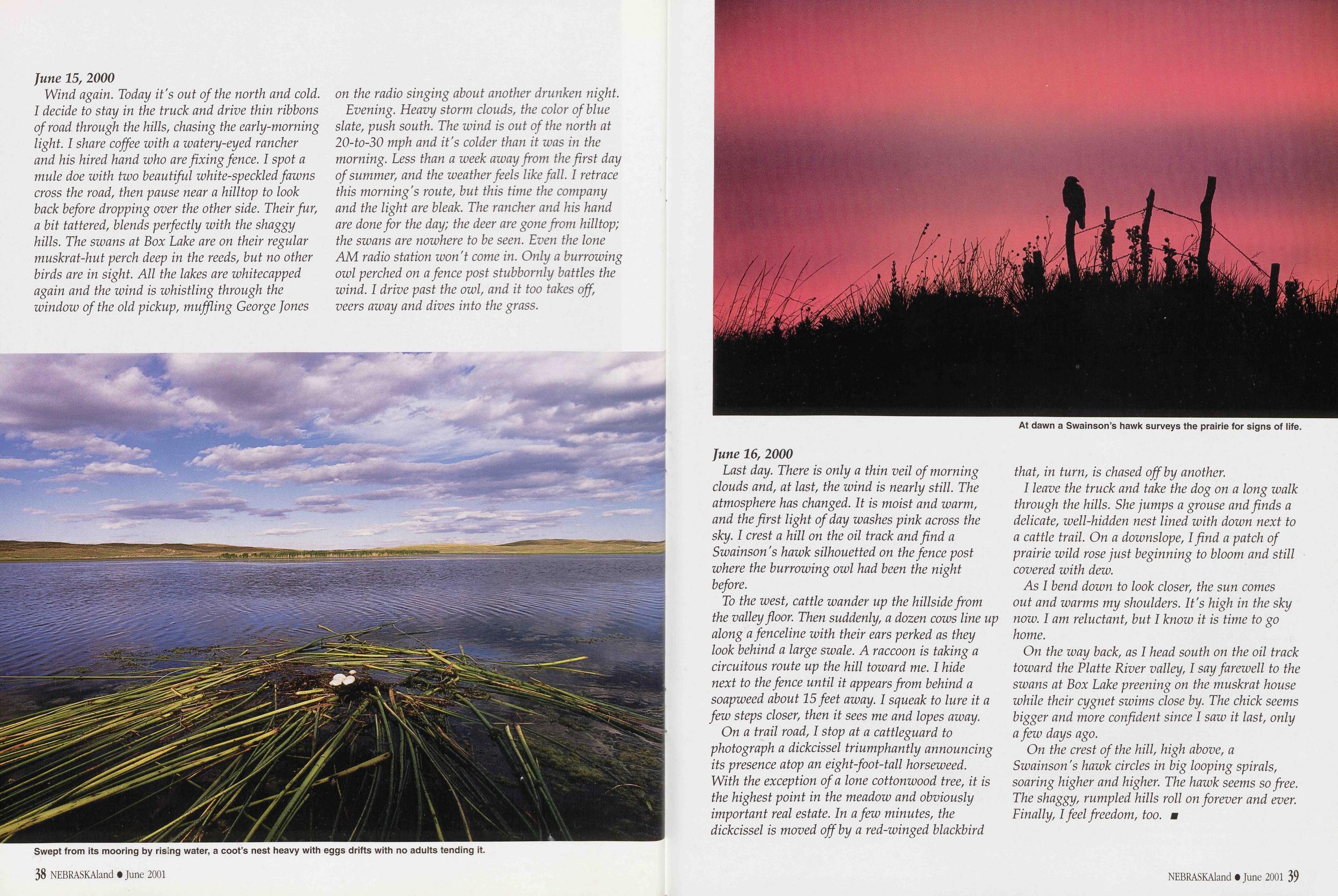 ]une 15, 2000
Wind again. Today it's out of the north and cold. I decide to stay in the truck and drive thin ribbons of road through the hills, chasing the early-morning light. I share coffee with a watery-eyed rancher and his hired hand who are fixing fence. I spot a mule doe with two beautiful white-speckled fawns cross the road, then pause near a hilltop to look back before dropping over the other side. Their fur, a bit tattered, blends perfectly with the shaggy hills. The swans at Box Lake are on their regular muskrat-hut perch deep in the reeds, but no other birds are in sight. All the lakes are whitecapped again and the wind is whistling through the window of the old pickup, muffling George Jones on the radio singing about another drunken night.
Evening. Heavy storm clouds, the color of blue slate, push south. The wind is out of the north at 20-to-30 mph and it's colder than it was in the morning. Less than a week away from the first day of summer, and the weather feels like fall. I retrace this morning's route, but this time the company and the light are bleak. The rancher and his hand are done for the day; the deer are gone from hilltop; the swans are nowhere to be seen. Even the lone AM radio station won't come in. Only a burrowing owl perched on a fence post stubbornly battles the wind. I drive past the owl, and it too takes off, veers away and dives into the grass.
Last day. There is only a thin veil of morning clouds and, at last, the wind is nearly still. The atmosphere has changed. It is moist and warm, and the first light of day washes pink across the sky. I crest a hill on the oil track and find a Swainson's hawk silhouetted on the fence post where the burrowing owl had been the night before.
To the west, cattle wander up the hillside from the valley floor. Then suddenly, a dozen cows line up along afenceline with their ears perked as they look behind a large swale. A raccoon is taking a circuitous route up the hill toward me. I hide next to the fence until it appears from behind a soapweed about 15 feet away. I squeak to lure it a few steps closer, then it sees me and lopes away.
On a trail road, I stop at a cattleguard to photograph a dickcissel triumphantly announcing its presence atop an eight-foot-tall horseweed. With the exception of a lone cottonwood tree, it is the highest point in the meadow and obviously important real estate. In a few minutes, the dickcissel is moved off by a red-winged blackbird that, in turn, is chased off by another.
I leave the truck and take the dog on a long walk through the hills. She jumps a grouse and finds a delicate, well-hidden nest lined with down next to a cattle trail. On a downslope, I find a patch of prairie wild rose just beginning to bloom and still covered with dew.
As I bend down to look closer, the sun comes out and warms my shoulders. It's high in the sky now. I am reluctant, but I know it is time to go home.
On the way back, as I head south on the oil track toward the Platte River valley, I say farewell to the swans at Box Lake preening on the muskrat house while their cygnet swims close by. The chick seems bigger and more confident since I saw it last, only a few days ago.
On the crest of the hill, high above, a Swainson 's hawk circles in big looping spirals, soaring higher and higher. The hawk seems so free. The shaggy, rumpled hills roll on forever and ever. Finally, I feel freedom, too.
NEBRASKAland • June 2001 39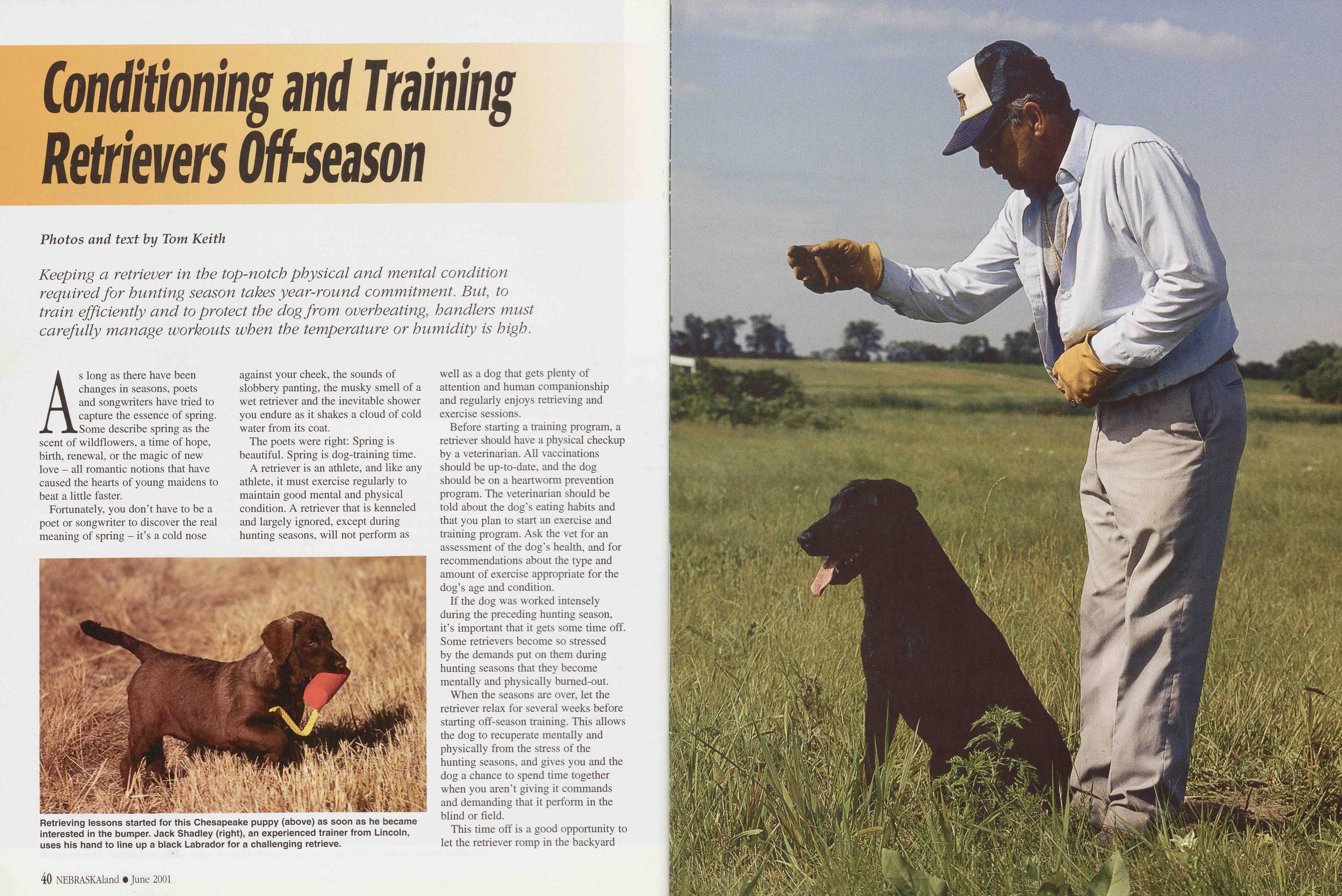
Conditioning and Training Retrievers Off-season
Photos and text by Tom Keith Keeping a retriever in the top-notch physical and mental condition required for hunting season takes year-round commitment. But, to train efficiently and to protect the dog from overheating, handlers must carefully manage workouts when the temperature or humidity is high.As long as there have been changes in seasons, poets and songwriters have tried to capture the essence of spring. Some describe spring as the scent of wildflowers, a time of hope, birth, renewal, or the magic of new love - all romantic notions that have caused the hearts of young maidens to beat a little faster.
Fortunately, you don't have to be a poet or songwriter to discover the real meaning of spring - it's a cold nose against your cheek, the sounds of slobbery panting, the musky smell of a wet retriever and the inevitable shower you endure as it shakes a cloud of cold water from its coat.
The poets were right: Spring is beautiful. Spring is dog-training time.
A retriever is an athlete, and like any athlete, it must exercise regularly to maintain good mental and physical condition. A retriever that is kenneled and largely ignored, except during hunting seasons, will not perform as well as a dog that gets plenty of attention and human companionship and regularly enjoys retrieving and exercise sessions.
Before starting a training program, a retriever should have a physical checkup by a veterinarian. All vaccinations should be up-to-date, and the dog should be on a heartworm prevention program. The veterinarian should be told about the dog's eating habits and that you plan to start an exercise and training program. Ask the vet for an assessment of the dog's health, and for recommendations about the type and amount of exercise appropriate for the dog's age and condition.
If the dog was worked intensely during the preceding hunting season, it's important that it gets some time off. Some retrievers become so stressed by the demands put on them during hunting seasons that they become mentally and physically burned-out.
When the seasons are over, let the retriever relax for several weeks before starting off-season training. This allows the dog to recuperate mentally and physically from the stress of the hunting seasons, and gives you and the dog a chance to spend time together when you aren't giving it commands and demanding that it perform in the blind or field.
This time off is a good opportunity to let the retriever romp in the backyard
 Good trainers constantly monitor their dog's
condition. If a dog becomes too hot it may
suffer heat stroke and possibly die.
with the kids, go for leisurely walks
with the family and just enjoy being a
dog. If possible, spend a few hours at a
wildlife management area where the
dog is safe from traffic, and let it run
where it wants and at its own pace.
Good trainers constantly monitor their dog's
condition. If a dog becomes too hot it may
suffer heat stroke and possibly die.
with the kids, go for leisurely walks
with the family and just enjoy being a
dog. If possible, spend a few hours at a
wildlife management area where the
dog is safe from traffic, and let it run
where it wants and at its own pace.
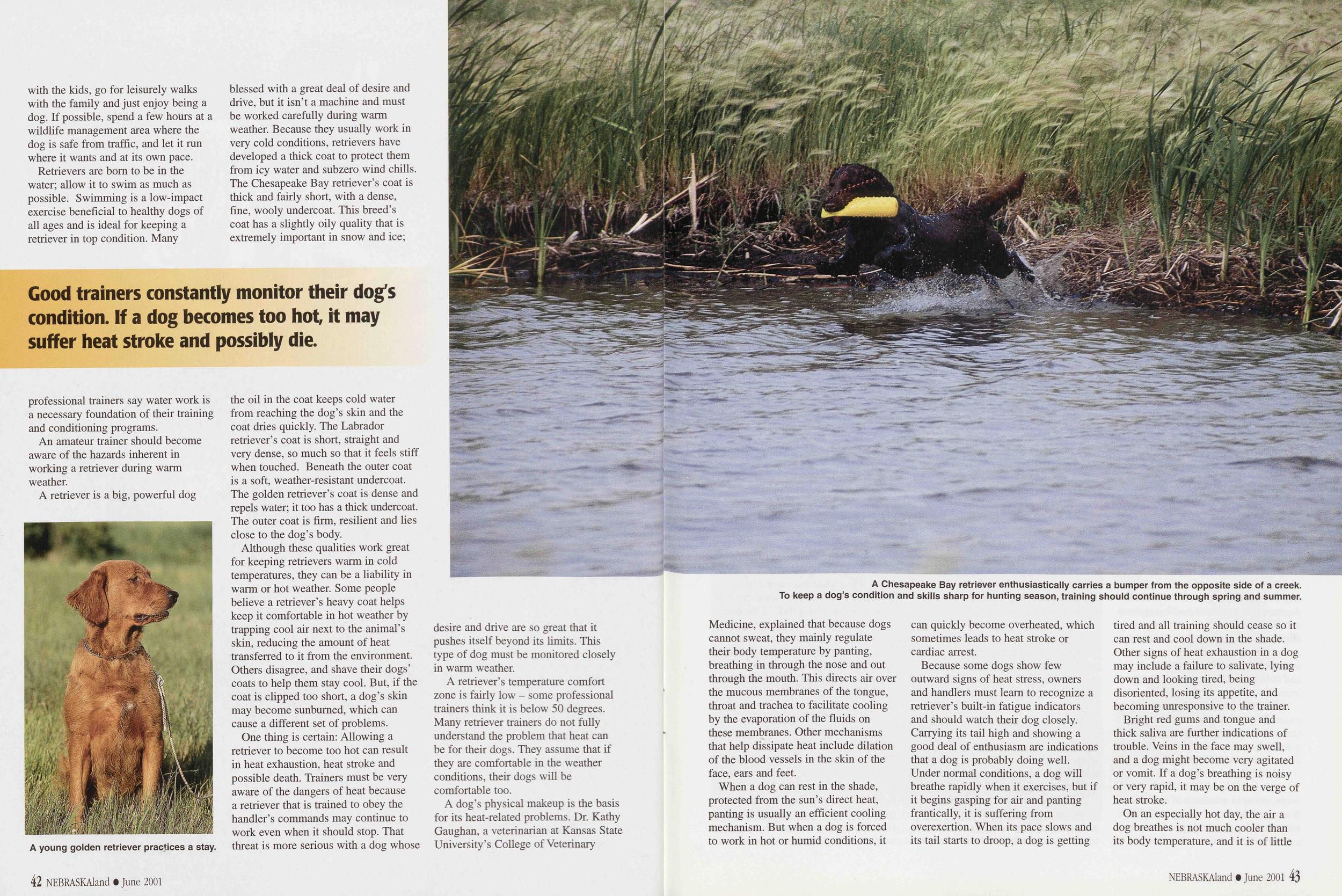
Retrievers are born to be in the water; allow it to swim as much as possible. Swimming is a low-impact exercise beneficial to healthy dogs of all ages and is ideal for keeping a retriever in top condition. Many professional trainers say water work is a necessary foundation of their training and conditioning programs.
An amateur trainer should become aware of the hazards inherent in working a retriever during warm weather.
A retriever is a big, powerful dog blessed with a great deal of desire and drive, but it isn't a machine and must be worked carefully during warm weather. Because they usually work in very cold conditions, retrievers have developed a thick coat to protect them from icy water and subzero wind chills. The Chesapeake Bay retriever's coat is thick and fairly short, with a dense, fine, wooly undercoat. This breed's coat has a slightly oily quality that is extremely important in snow and ice; the oil in the coat keeps cold water from reaching the dog's skin and the coat dries quickly. The Labrador retriever's coat is short, straight and very dense, so much so that it feels stiff when touched. Beneath the outer coat is a soft, weather-resistant undercoat. The golden retriever's coat is dense and repels water; it too has a thick undercoat. The outer coat is firm, resilient and lies close to the dog's body.
Although these qualities work great for keeping retrievers warm in cold temperatures, they can be a liability in warm or hot weather. Some people believe a retriever's heavy coat helps keep it comfortable in hot weather by trapping cool air next to the animal's skin, reducing the amount of heat transferred to it from the environment. Others disagree, and shave their dogs' coats to help them stay cool. But, if the coat is clipped too short, a dog's skin may become sunburned, which can cause a different set of problems.
One thing is certain: Allowing a retriever to become too hot can result in heat exhaustion, heat stroke and possible death. Trainers must be very aware of the dangers of heat because a retriever that is trained to obey the handler's commands may continue to work even when it should stop. That threat is more serious with a dog whose desire and drive are so great that it pushes itself beyond its limits. This type of dog must be monitored closely in warm weather.
A retriever's temperature comfort zone is fairly low - some professional trainers think it is below 50 degrees. Many retriever trainers do not fully understand the problem that heat can be for their dogs. They assume that if they are comfortable in the weather conditions, their dogs will be comfortable too.
A dog's physical makeup is the basis for its heat-related problems. Dr. Kathy Gaughan, a veterinarian at Kansas State University's College of Veterinary
When a dog can rest in the shade, protected from the sun's direct heat, panting is usually an efficient cooling mechanism. But when a dog is forced to work in hot or humid conditions, it can quickly become overheated, which sometimes leads to heat stroke or cardiac arrest.
Because some dogs show few outward signs of heat stress, owners and handlers must learn to recognize a retriever's built-in fatigue indicators and should watch their dog closely. Carrying its tail high and showing a good deal of enthusiasm are indications that a dog is probably doing well. Under normal conditions, a dog will breathe rapidly when it exercises, but if it begins gasping for air and panting frantically, it is suffering from overexertion. When its pace slows and its tail starts to droop, a dog is getting tired and all training should cease so it can rest and cool down in the shade. Other signs of heat exhaustion in a dog may include a failure to salivate, lying down and looking tired, being disoriented, losing its appetite, and becoming unresponsive to the trainer.
Bright red gums and tongue and thick saliva are further indications of trouble. Veins in the face may swell, and a dog might become very agitated or vomit. If a dog's breathing is noisy or very rapid, it may be on the verge of heat stroke.
NEBRASKAland • June 2001 43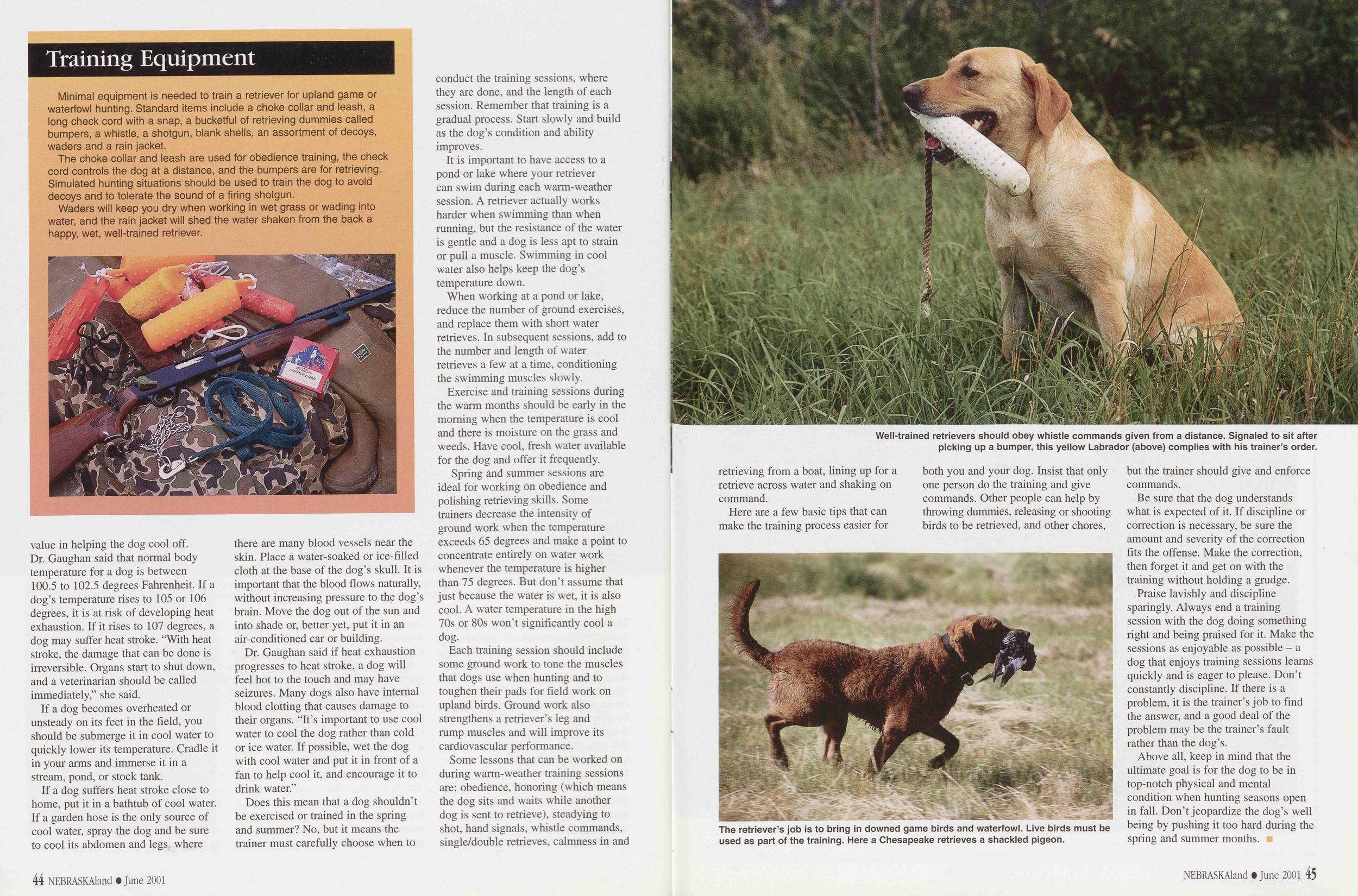 Training Equipment
Minimal equipment is needed to train a retriever for upland game or waterfowl hunting. Standard items include a choke collar and leash, a long check cord with a snap, a bucketful of retrieving dummies called bumpers, a whistle, a shotgun, blank shells, an assortment of decoys, waders and a rain jacket.
The choke collar and leash are used for obedience training, the check cord controls the dog at a distance, and the bumpers are for retrieving. Simulated hunting situations should be used to train the dog to avoid decoys and to tolerate the sound of a firing shotgun.
Waders will keep you dry when working in wet grass or wading into water, and the rain jacket will shed the water shaken from the back a happy, wet, well-trained retriever.
On an especially hot day, the air a dog breathes is not much cooler than its body temperature, and it is of little value in helping the dog cool off. Dr. Gaughan said that normal body temperature for a dog is between 100.5 to 102.5 degrees Fahrenheit. If a dog's temperature rises to 105 or 106 degrees, it is at risk of developing heat exhaustion. If it rises to 107 degrees, a dog may suffer heat stroke. "With heat stroke, the damage that can be done is irreversible. Organs start to shut down, and a veterinarian should be called immediately," she said.
If a dog becomes overheated or unsteady on its feet in the field, you should be submerge it in cool water to quickly lower its temperature. Cradle it in your arms and immerse it in a stream, pond, or stock tank.
If a dog suffers heat stroke close to home, put it in a bathtub of cool water. If a garden hose is the only source of cool water, spray the dog and be sure to cool its abdomen and legs, where there are many blood vessels near the skin. Place a water-soaked or ice-filled cloth at the base of the dog's skull. It is important that the blood flows naturally, without increasing pressure to the dog's brain. Move the dog out of the sun and into shade or, better yet, put it in an air-conditioned car or building.
Dr. Gaughan said if heat exhaustion progresses to heat stroke, a dog will feel hot to the touch and may have seizures. Many dogs also have internal blood clotting that causes damage to their organs. "It's important to use cool water to cool the dog rather than cold or ice water. If possible, wet the dog with cool water and put it in front of a fan to help cool it, and encourage it to drink water."
Does this mean that a dog shouldn't be exercised or trained in the spring and summer? No, but it means the trainer must carefully choose when to conduct the training sessions, where they are done, and the length of each session. Remember that training is a gradual process. Start slowly and build as the dog's condition and ability improves.
It is important to have access to a pond or lake where your retriever can swim during each warm-weather session. A retriever actually works harder when swimming than when running, but the resistance of the water is gentle and a dog is less apt to strain or pull a muscle. Swimming in cool water also helps keep the dog's temperature down.
When working at a pond or lake, reduce the number of ground exercises, and replace them with short water retrieves. In subsequent sessions, add to the number and length of water retrieves a few at a time, conditioning the swimming muscles slowly.
Exercise and training sessions during the warm months should be early in the morning when the temperature is cool and there is moisture on the grass and weeds. Have cool, fresh water available for the dog and offer it frequently.
Spring and summer sessions are ideal for working on obedience and pohshing retrieving skills. Some trainers decrease the intensity of ground work when the temperature exceeds 65 degrees and make a point to concentrate entirely on water work whenever the temperature is higher than 75 degrees. But don't assume that just because the water is wet, it is also cool. A water temperature in the high 70s or 80s won't significantly cool a dog.
Each training session should include some ground work to tone the muscles that dogs use when hunting and to toughen their pads for field work on upland birds. Ground work also strengthens a retriever's leg and rump muscles and will improve its cardiovascular performance.
Some lessons that can be worked on during warm-weather training sessions are: obedience, honoring (which means the dog sits and waits while another dog is sent to retrieve), steadying to shot, hand signals, whistle commands, single/double retrieves, calmness in and 44 NEBRASKAland • June 2001
Here are a few basic tips that can make the training process easier for both you and your dog. Insist that only one person do the training and give commands. Other people can help by throwing dummies, releasing or shooting birds to be retrieved, and other chores, but the trainer should give and enforce commands.
Be sure that the dog understands what is expected of it. If discipline or correction is necessary, be sure the amount and severity of the correction fits the offense. Make the correction, then forget it and get on with the training without holding a grudge.
Praise lavishly and discipline sparingly. Always end a training session with the dog doing something right and being praised for it. Make the sessions as enjoyable as possible - a dog that enjoys training sessions learns quickly and is eager to please. Don't constantly discipline. If there is a problem, it is the trainer's job to find the answer, and a good deal of the problem may be the trainer's fault rather than the dog's.
Above all, keep in mind that the ultimate goal is for the dog to be in top-notch physical and mental condition when hunting seasons open in fall. Don't jeopardize the dog's well being by pushing it too hard during the spring and summer months.
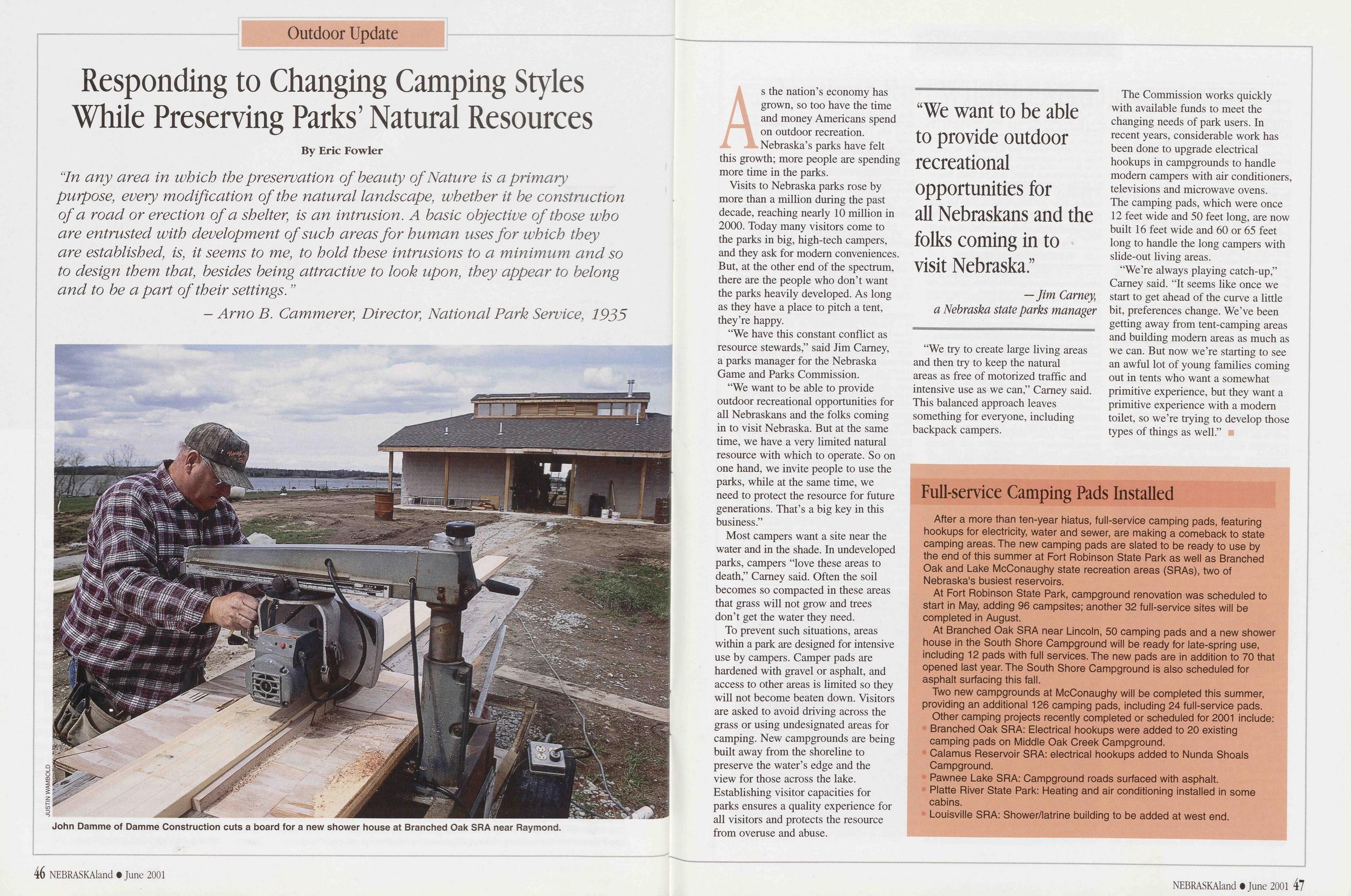
Outdoor Update
Responding to Changing Camping Styles While Preserving Parks' Natural Resources
By Eric Fowler "In any area in which the preservation of beauty of Nature is a primary purpose, every modification of the natural landscape, whether it be construction of a road or erection of a shelter, is an intrusion. A basic objective of those who are entrusted with development of such areas for human uses for which they are established, is, it seems to me, to hold these intrusions to a minimum and so to design them that, besides being attractive to look upon, they appear to belong and to be a part of their settings." - Arno B. Cammerer, Director, National Park Service, 1935As the nation's economy has grown, so too have the time and money Americans spend on outdoor recreation. Nebraska's parks have felt this growth; more people are spending more time in the parks.
Visits to Nebraska parks rose by more than a million during the past decade, reaching nearly 10 million in 2000. Today many visitors come to the parks in big, high-tech campers, and they ask for modern conveniences. But, at the other end of the spectrum, there are the people who don't want the parks heavily developed. As long as they have a place to pitch a tent, they're happy.
"We have this constant conflict as resource stewards," said Jim Carney, a parks manager for the Nebraska Game and Parks Commission.
"We want to be able to provide outdoor recreational opportunities for all Nebraskans and the folks coming in to visit Nebraska. But at the same time, we have a very limited natural resource with which to operate. So on one hand, we invite people to use the parks, while at the same time, we need to protect the resource for future generations. That's a big key in this business."
Most campers want a site near the water and in the shade. In undeveloped parks, campers "love these areas to death," Carney said. Often the soil becomes so compacted in these areas that grass will not grow and trees don't get the water they need.
To prevent such situations, areas within a park are designed for intensive use by campers. Camper pads are hardened with gravel or asphalt, and access to other areas is limited so they will not become beaten down. Visitors are asked to avoid driving across the grass or using undesignated areas for camping. New campgrounds are being built away from the shoreline to preserve the water's edge and the view for those across the lake. Establishing visitor capacities for parks ensures a quality experience for all visitors and protects the resource from overuse and abuse.
"We want to be able to provide outdoor recreational opportunities for all Nebraskans and the folks coming in to visit Nebraska."
—Jim Carney, a Nebraska state parks manager"We try to create large living areas and then try to keep the natural areas as free of motorized traffic and intensive use as we can," Carney said. This balanced approach leaves something for everyone, including backpack campers.
The Commission works quickly with available funds to meet the changing needs of park users. In recent years, considerable work has been done to upgrade electrical hookups in campgrounds to handle modern campers with air conditioners, televisions and microwave ovens. The camping pads, which were once 12 feet wide and 50 feet long, are now built 16 feet wide and 60 or 65 feet long to handle the long campers with slide-out living areas.
"We're always playing catch-up," Carney said. "It seems like once we start to get ahead of the curve a little bit, preferences change. We've been getting away from tent-camping areas and building modern areas as much as we can. But now we're starting to see an awful lot of young families coming out in tents who want a somewhat primitive experience, but they want a primitive experience with a modern toilet, so we're trying to develop those types of things as well."
Full-service Camping Pads InstalledAfter a more than ten-year hiatus, full-service camping pads, featuring hookups for electricity, water and sewer, are making a comeback to state camping areas. The new camping pads are slated to be ready to use by the end of this summer at Fort Robinson State Park as well as Branched Oak and Lake McConaughy state recreation areas (SRAs), two of Nebraska's busiest reservoirs.
At Fort Robinson State Park, campground renovation was scheduled to start in May, adding 96 campsites; another 32 full-service sites will be completed in August.
At Branched Oak SRA near Lincoln, 50 camping pads and a new shower house in the South Shore Campground will be ready for late-spring use, including 12 pads with full services. The new pads are in addition to 70 that opened last year. The South Shore Campground is also scheduled for asphalt surfacing this fall.
Two new campgrounds at McConaughy will be completed this summer, providing an additional 126 camping pads, including 24 full-service pads.
Other camping projects recently completed or scheduled for 2001 include: Branched Oak SRA: Electrical hookups were added to 20 existing camping pads on Middle Oak Creek Campground. Calamus Reservoir SRA: electrical hookups added to Nunda Shoals Campground. Pawnee Lake SRA: Campground roads surfaced with asphalt. Platte River State Park: Heating and air conditioning installed in some cabins. Louisville SRA: Shower/latrine building to be added at west end.
NEBRASKAland • June 2001 47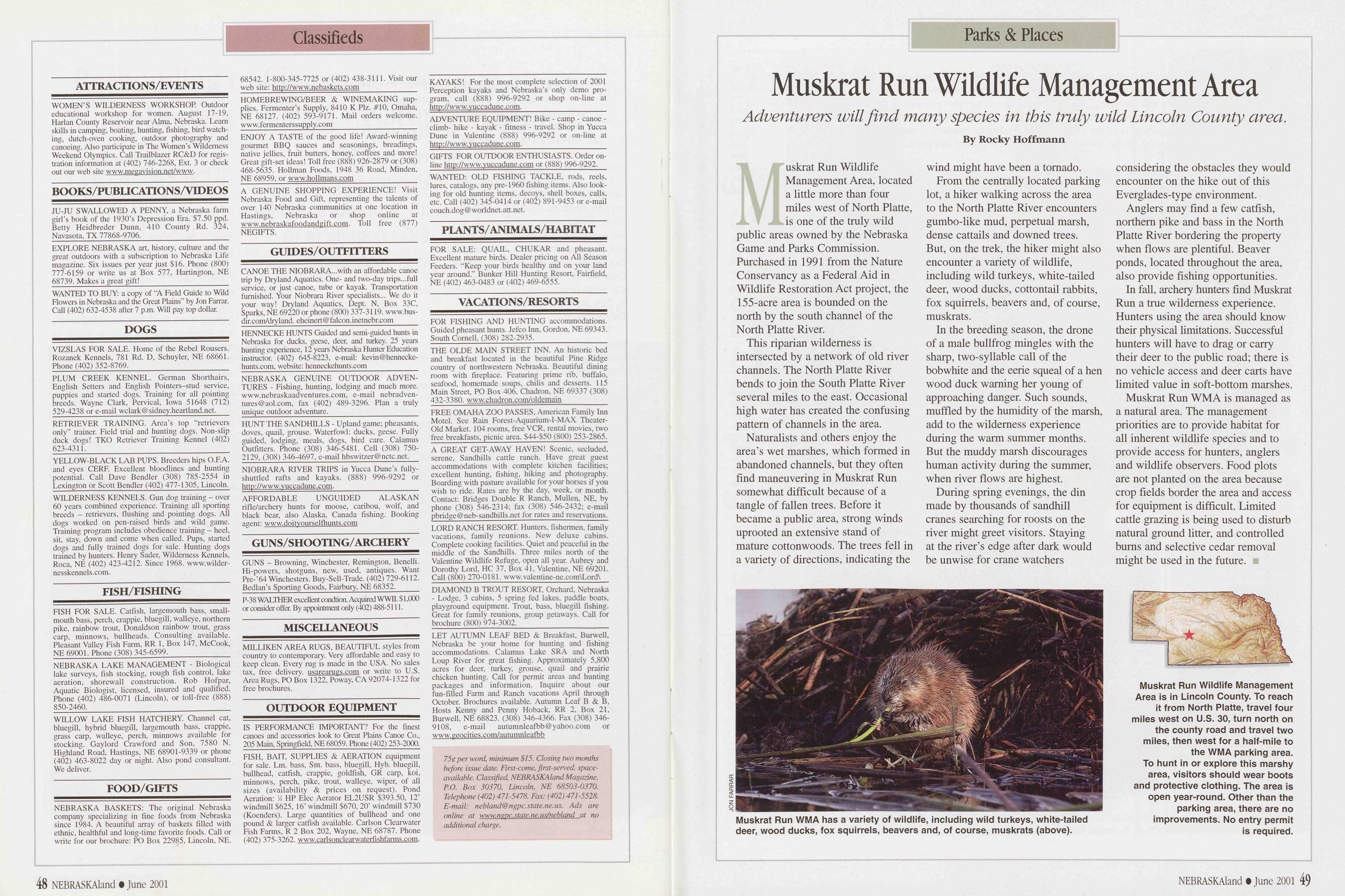
Classifieds
ATTRACTIONS/EVENTSWOMEN'S WILDERNESS WORKSHOP. Outdoor educational workshop for women. August 17-19, Harlan County Reservoir near Alma, Nebraska. Learn skills in camping, boating, hunting, fishing, bird watching, dutch-oven cooking, outdoor photography and canoeing. Also participate in The Women's Wilderness Weekend Olympics. Call Trailblazer RC&D for registration information at (402) 746-2268, Ext. 3 or check out our web site www.megavision.net/www.
BOOKS/PUBLICATIONS/VIDEOSJU-JU SWALLOWED A PENNY, a Nebraska farm girl's book of the 1930's Depression Era. $7.50 ppd. Betty Heidbreder Dunn, 410 County Rd. 324, Navasota, TX 77868-9706.
EXPLORE NEBRASKA art, history, culture and the great outdoors with a subscription to Nebraska Life magazine. Six issues per year just $16. Phone (800) 777-6159 or write us at Box 577, Harrington, NE 68739. Makes a great gift!
WANTED TO BUY: a copy of "A Field Guide to Wild Flowers in Nebraska and the Great Plains" by Jon Farrar. Call (402) 632-4538 after 7 p.m. Will pay top dollar.
DOGSVIZSLAS FOR SALE. Home of the Rebel Rousers. Rozanek Kennels, 781 Rd. D, Schuyler, NE 68661. Phone (402) 352-8769.
PLUM CREEK KENNEL. German Shorthairs, English Setters and English Pointers-stud service, puppies and started dogs. Training for all pointing breeds. Wayne Clark, Pervical, Iowa 51648 (712) 529-4238 or e-mail wclark@sidney.heartland.net.
RETRIEVER TRAINING. Area's top "retrievers only" trainer. Field trial and hunting dogs. Non-slip duck dogs! TKO Retriever Trainins; Kennel (402) 623-4311.
YELLOW-BLACK LAB PUPS. Breeders hips O.F.A. and eyes CERF Excellent bloodlines and hunting potential. Call Dave Bendler (308) 785-2554 in Lexington or Scott Bendler (402) 477-1305, Lincoln.
WILDERNESS KENNELS. Gun dog training - over 60 years combined experience. Training all sporting breeds - retrievers, flushing and pointing dogs. All dogs worked on pen-raised birds and wild game. Training program includes obedience training - heel, sit, stay, down and come when called. Pups, started dogs and fully trained dogs for sale. Hunting dogs trained by hunters. Henry Sader, Wilderness Kennels, Roca, NE (402) 423-4212. Since 1968. www.wildernesskennels.com.
FISH/FISHINGFISH FOR SALE. Catfish, largemouth bass, small- mouth bass, perch, crappie, bluegill, walleye, northern pike, rainbow trout, Donaldson rainbow trout, grass carp, minnows, bullheads. Consulting available. Pleasant Valley Fish Farm, RR 1, Box 147, McCook, NE 69001. Phone (308) 345-6599.
NEBRASKA LAKE MANAGEMENT - Biological lake surveys, fish stocking, rough fish control, lake aeration, shorewall construction. Rob Hofpar, Aquatic Biologist, licensed, insured and qualified. Phone (402) 486-0071 (Lincoln), or toll-free (888) 850-2460.
WILLOW LAKE FISH HATCHERY. Channel cat, bluegill, hybrid bluegill, largemouth bass, crappie, grass carp, walleye, perch, minnows available for stocking;. Gaylord Crawford and Son, 7580 N. Highland Road, Hastings, NE 68901-9339 or phone (402) 463-8022 day or night. Also pond consultant. We deliver.
FOOD/GIFTSNEBRASKA BASKETS: The original Nebraska company specializing in fine foods from Nebraska since 1984. A beautiful array of baskets filled with ethnic, healthful and long-time favorite foods. Call or write for our brochure: PO Box 22985, Lincoln, NE. iffissajsastfaeee^p 68542. 1-800-345-7725 or (402) 438-3111. Visit our web site: http://www.nebaskets.com
HOMEBREWING/BEER & WINEMAKING sup- plies. Fermenter's Supply, 8410 K Plz. #10, Omaha, NE 68127. (402) 593-9171. Mail orders welcome. www. fermenterssupply. com
ENJOY A TASTE of the good life! Award-winning gourmet BBQ sauces and seasonings, breadings, native jellies, fruit butters, honey, coffees and more! Great gift-set ideas! Toll free (888) 926-2879 or (308) 468-5635. Hollman Foods, 1948 36 Road, Minden, NE 68959, or www.hollmans.com
A GENUINE SHOPPING EXPERIENCE! Visit Nebraska Food and Gift, representing the talents of over 140 Nebraska communities at one location in Hastings, Nebraska or shop online at www.nebraskafoodandgift.com. Toll free (877) NEGIFTS.
GUIDES/OUTFITTERSCANOE THE NIOBRARA...with an affordable canoe trip by Dryland Aquatics. One- and two-day trips...full service, or just canoe, tube or kayak. Transportation furnished. Your Niobrara River specialists... We do it your way! Dryland Aquatics, Dept. N, Box 33C, Sparks, NE 69220 or phone (800) 337-3119. www.busdir.com/dryland. eheinert@falcon.inetnebr.com
HEFJNECKE HUNTS Guided and semi-guided hunts in Nebraska for ducks, geese, deer, and turkey. 25 years hunting experience, 12 years Nebraska Hunter Education instructor. (402) 645-8223, e-mail: kevin@henneckehunts.com, website: henneckehunts.com
NEBRASKA GENUINE OUTDOOR ADVEN- TURES - Fishing, hunting, lodging and much more. www.nebraskaadventures.com, e-mail nebradventures@aol.com, fax (402) 489-3296. Plan a truly unique outdoor adventure.
HUNT THE SANDHILLS - Upland game; pheasants, doves, quail, grouse. Waterfowl: ducks, geese. Fully guided, lodging, meals, dogs, bird care. Calamus Outfitters. Phone (308) 346^5481. Cell (308) 750-2129, (308) 346-4697, e-mail hbswitzer@nctc.net.
NIOBRARA RIVER TRIPS in Yucca Dune's fully shuttled rafts and kayaks. (888) 996-9292 or http://www.yuccadune.com.
AFFORDABLE UNGUIDED ALASKAN rifle/archery hunts for moose, caribou, wolf, and black bear, also Alaska, Canada fishing. Booking agent: www.doityourselfhunts.com
GUNS/SHQOTING/ARCHERYGUNS - Browning, Winchester, Remington, Benelli. Hi-powers, shotguns, new, used, antiques. Want Pre-'64 Winchesters. Buy-Sell-Trade. (402) 729-6112. Bedlan's Sporting Goods, Fairbury, NE 68352.
P-38 WALTHER excellent condtion. Acquired WWII. $1,000 or consider offer. By appointment only (402) 488-5 111.
MISCELLANEOUSMILLIKEN AREA RUGS, BEAUTIFUL styles from country to contemporary. Very affordable and easy to keep clean. Every rug is made in the USA. No sales tax, free delivery, usarearugs.com or write to U.S. Area Rugs, PO Box 1322, Poway, CA 92074-1322 for free brochures.
OUTDOOR EQUIPMENTIS PERFORMANCE IMPORTANT? For the finest canoes and accessories look to Great Plains Canoe Co., 205 Main, Springfield, NE 68059. Phone (402) 253-2000.
FISH, BAIT, SUPPLIES & AERATION equipment for sale. Lm. bass, Sm. bass, bluegill, Hyb. bluegill, bullhead, catfish, crappie, goldfish, GR carp, koi, minnows, perch, pike, trout, walleye, wiper, of all sizes (availability & prices on request). Pond Aeration: % HP Elec Aerator EL2USR $393.50, 12' windmill $625, 16' windmill $670, 20' windmill $730 (Koenders). Large quantities of bullhead and one pound & larger catfish available. Carlson Clearwater Fish Farms, R 2 Box 202, Wayne, NE 68787. Phone (402) 375-3262. www.carlsonclearwaterfishfarms.com.
KAYAKS! For the most complete selection of 2001 Perception kayaks and Nebraska's only demo program, call (888) 996-9292 or shop on-line at http://www.yuccadune.com.
ADVENTURE EQUIPMENT! Bike - camp - canoe - climb- hike - kayak - fitness - travel. Shop in Yucca Dune in Valentine (888) 996-9292 or on-line at http://www.yuccadune.com.
GIFTS FOR OUTDOOR ENTHUSIASTS. Order online http://www.yuccadune.com or (888) 996-9292.
WANTED: OLD FISHING TACKLE, rods, reels, lures, catalogs, any pre-1960 fishing items. Also looking for old hunting items, decoys, shell boxes, calls, etc. Call (402) 3454)414 or (402) 891-9453 or e-mail couch.dog@worldnet.att.net.
PIANTS/ANIMALS/HABITATFOR SALE: QUAIL, CHUKAR and pheasant. Excellent mature birds. Dealer pricing on All Season Feeders. "Keep your birds healthy and on your land year around." Bunker Hill Hunting Resort, Fairfield, NE (402) 463-0483 or (402) 469-6555.
VACATIONS/RESORTSFOR FISHING AND HUNTING accommodations. Guided pheasant hunts. Jefco Inn, Gordon, NE 69343. South Cornell, (308) 282-2935.
THE OLDE MAIN STREET INN. An historic bed and breakfast located in the beautiful Pine Ridge country of northwestern Nebraska. Beautiful dining room with fireplace. Featuring prime rib, buffalo, seafood, homemade soups, chilis and desserts. 115 Main Street, PO Box 406, Chadron, NE 69337 (308) 432-3380. www.chadron.com/oldemain
FREE OMAHA ZOO PASSES, American Family Inn Motel. See Rain Forest-Aquarium-I-MAX Theater- Old Market. 104 rooms, free VCR, rental movies, two free breakfasts, picnic area. $44-$50 (800) 253-2865.
A GREAT GET-AWAY HAVEN! Scenic, secluded, serene, Sandhills cattle ranch. Have great guest accommodations with complete kitchen facilities; excellent hunting, fishing, hiking and photography. Boarding with pasture available for your horses if you wish to ride. Rates are by the day, week, or month. Contact: Bridges Double R Ranch, Mullen, NE, by phone (308) 546-2314; fax (308) 546-2432; e-mail pbridge@neb-sandhills.net for rates and reservations.
LORD RANCH RESORT. Hunters, fishermen, family vacations, family reunions. New deluxe cabins. Complete cooking facilities. Quiet and peaceful in the middle of the Sandhills. Three miles north of the Valentine Wildlife Refuge, open all year. Aubrey and Dorothy Lord, HC 37, Box 41, Valentine, NE 69201. Call (800) 270-0181. www.valentine-ne.com\Lord\
DIAMOND B TROUT RESORT, Orchard, Nebraska - Lodge, 3 cabins, 5 spring fed lakes, paddle boats, playground equipment. Trout, bass, bluegill fishing. Great for family reunions, group getaways. Call for brochure (800) 974-3002.
LET AUTUMN LEAF BED & Breakfast, Burwell, Nebraska be your home for hunting and fishing accommodations. Calamus Lake SRA and North Loup River for great fishing. Approximately 5,800 acres for deer, turkey, grouse, quail and prairie chicken hunting. Call for permit areas and hunting packages and information. Inquire about our fun-filled Farm and Ranch vacations April through October. Brochures available. Autumn Leaf B & B, Hosts Kenny and Penny Hoback, RR 2, Box 21, Burwell, NE 68823. (308) 346-4366. Fax (308) 346-9108, e-mail autumnleafbb@yahoo.com or www.geocities.com/auturnnleafbb
75$ per word, minimum $15. Closing two months before issue date. First-come, first-served, space available. Classified, NEBRASKAland Magazine, P.O. Box 30370, Lincoln, NE 68503-0370. Telephone (402) 471-5478. Fax: (402) 471-5528. E-mail: nebland@ngpc. state.ne.us. Ads are online at www.ngpc.state.ne.us/nebland at no additional charge.
48 NEBRASKAland • June 2001Parks & Place
Muskrat Run Wildlife Management Area
Adventurers will find many species in this truly wild Lincoln County area. By Rocky HoffmanMuskrat Run Wildlife Management Area, located a little more than four miles west of North Platte, is one of the truly wild public areas owned by the Nebraska Game and Parks Commission. Purchased in 1991 from the Nature Conservancy as a Federal Aid in Wildlife Restoration Act project, the 155-acre area is bounded on the north by the south channel of the North Platte River.
This riparian wilderness is intersected by a network of old river channels. The North Platte River bends to join the South Platte River several miles to the east. Occasional high water has created the confusing pattern of channels in the area.
Naturalists and others enjoy the area's wet marshes, which formed in abandoned channels, but they often find maneuvering in Muskrat Run somewhat difficult because of a tangle of fallen trees. Before it became a public area, strong winds uprooted an extensive stand of mature cottonwoods. The trees fell in a variety of directions, indicating the wind might have been a tornado.
From the centrally located parking lot, a hiker walking across the area to the North Platte River encounters gumbo-like mud, perpetual marsh, dense cattails and downed trees. But, on the trek, the hiker might also encounter a variety of wildlife, including wild turkeys, white-tailed deer, wood ducks, cottontail rabbits, fox squirrels, beavers and, of course, muskrats.
In the breeding season, the drone of a male bullfrog mingles with the sharp, two-syllable call of the bobwhite and the eerie squeal of a hen wood duck warning her young of approaching danger. Such sounds, muffled by the humidity of the marsh, add to the wilderness experience during the warm summer months. But the muddy marsh discourages human activity during the summer, when river flows are highest.
During spring evenings, the din made by thousands of sandhill cranes searching for roosts on the river might greet visitors. Staying at the river's edge after dark would be unwise for crane watchers considering the obstacles they would encounter on the hike out of this Everglades-type environment.
Anglers may find a few catfish, northern pike and bass in the North Platte River bordering the property when flows are plentiful. Beaver ponds, located throughout the area, also provide fishing opportunities.
In fall, archery hunters find Muskrat Run a true wilderness experience. Hunters using the area should know their physical limitations. Successful hunters will have to drag or carry their deer to the public road; there is no vehicle access and deer carts have limited value in soft-bottom marshes.
Muskrat Run WMA is managed as a natural area. The management priorities are to provide habitat for all inherent wildlife species and to provide access for hunters, anglers and wildlife observers. Food plots are not planted on the area because crop fields border the area and access for equipment is difficult. Limited cattle grazing is being used to disturb natural ground litter, and controlled burns and selective cedar removal might be used in the future, m
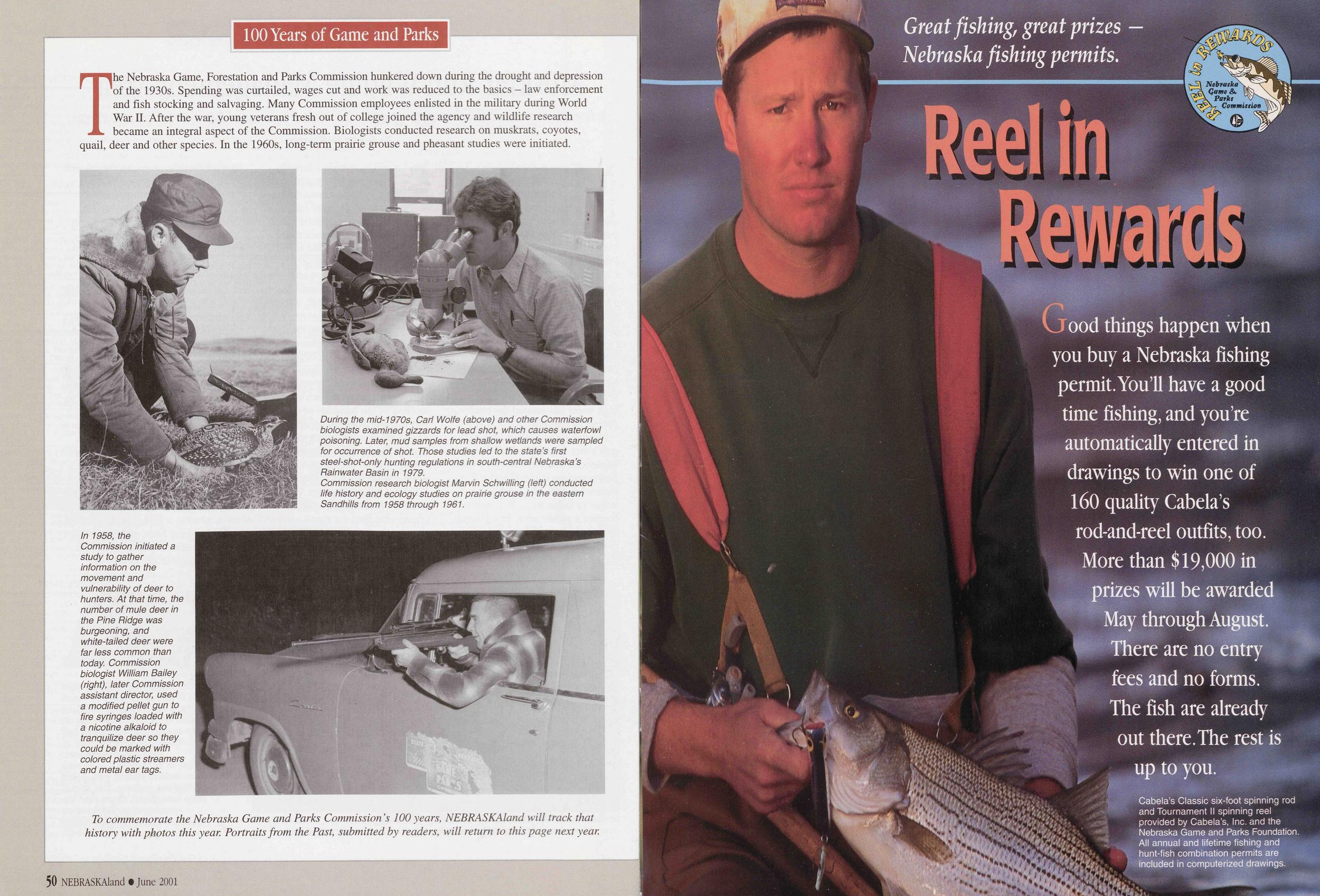
100 Years of Game and Parks
The Nebraska Game, Forestation and Parks Commission hunkered down during the drought and depression of the 1930s. Spending was curtailed, wages cut and work was reduced to the basics - law enforcement and fish stocking and salvaging. Many Commission employees enlisted in the military during World War II. After the war, young veterans fresh out of college joined the agency and wildlife research became an integral aspect of the Commission. Biologists conducted research on muskrats, coyotes, quail, deer and other species. In the 1960s, long-term prairie grouse and pheasant studies were initiated.
To commemorate the Nebraska Game and Parks Commission's 100 years, NEBRASKAland will track that history with photos this year. Portraits from the Past, submitted by readers, will return to this page next year.
50 NEBRASKAland • June 2001
Position: 541 (20 views)