Volume 79, Issue 2, 2001
NEBRASKAland
Nebraska Game & Parks Commission March 2001 $2.50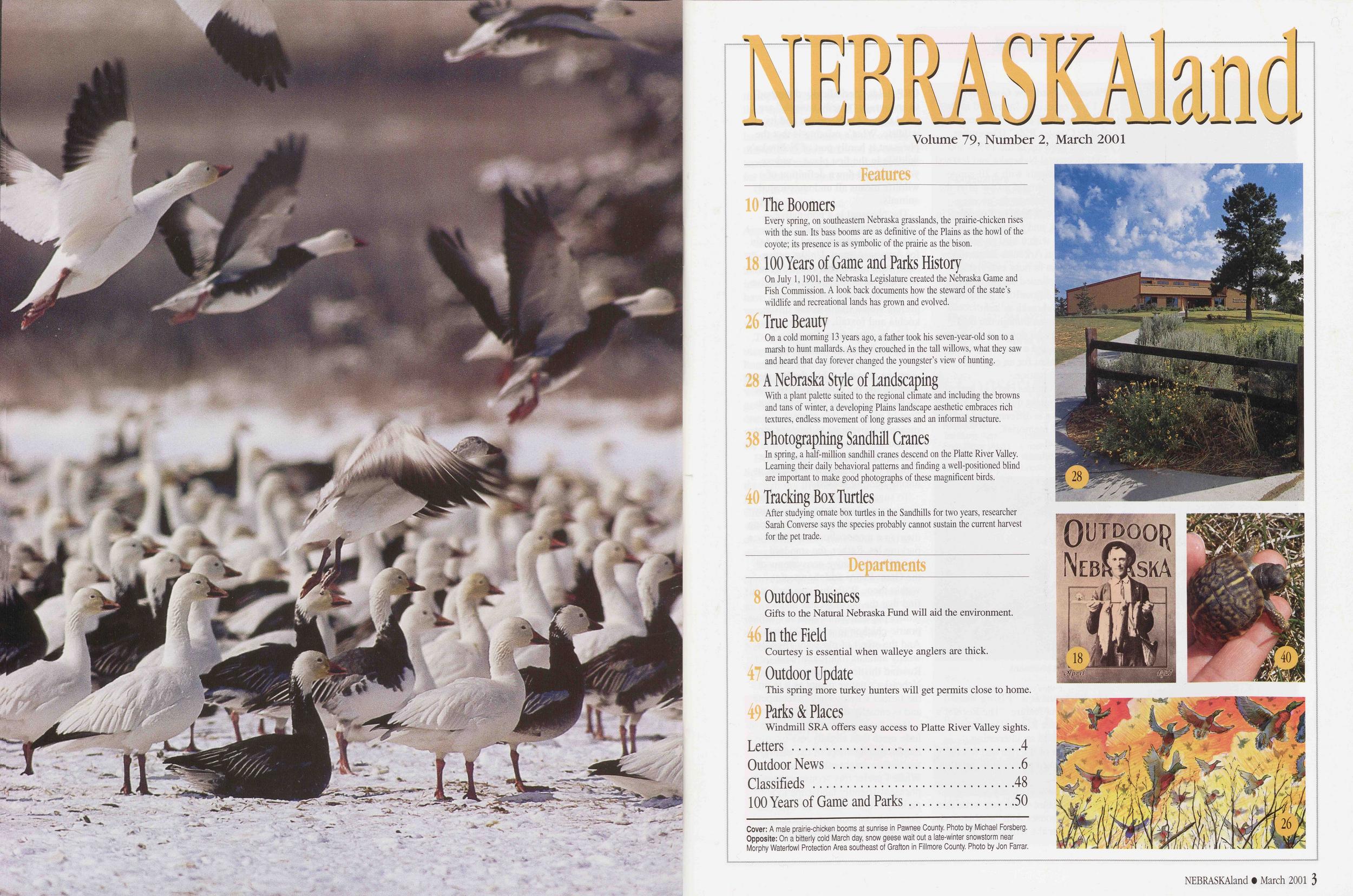
Letters
Pheasant Tradition Goes On
I was especially interested in the article by Jon Farrar "The Rooster's Roller Coaster Ride" [December 2000]. I grew up in the 1950s and '60s in central Nebraska and learned to hunt pheasants with a 20-gauge Remington. I would go out after the chores were done in the evening when there was light or first thing in the morning, and I would usually come home with a bird or two. Hunters from Arkansas came to my parents' farm to hunt every year.
I have continued the tradition. Since 1981,1 go with a group of friends to Nebraska to hunt pheasants. Even though the bird numbers may be down, sharing time with friends and a good dog in the outdoors makes for an eagerly anticipated vacation.
We don't start as early as we once did and we might quit before sunset, but each year is different and creates a new set of memories.
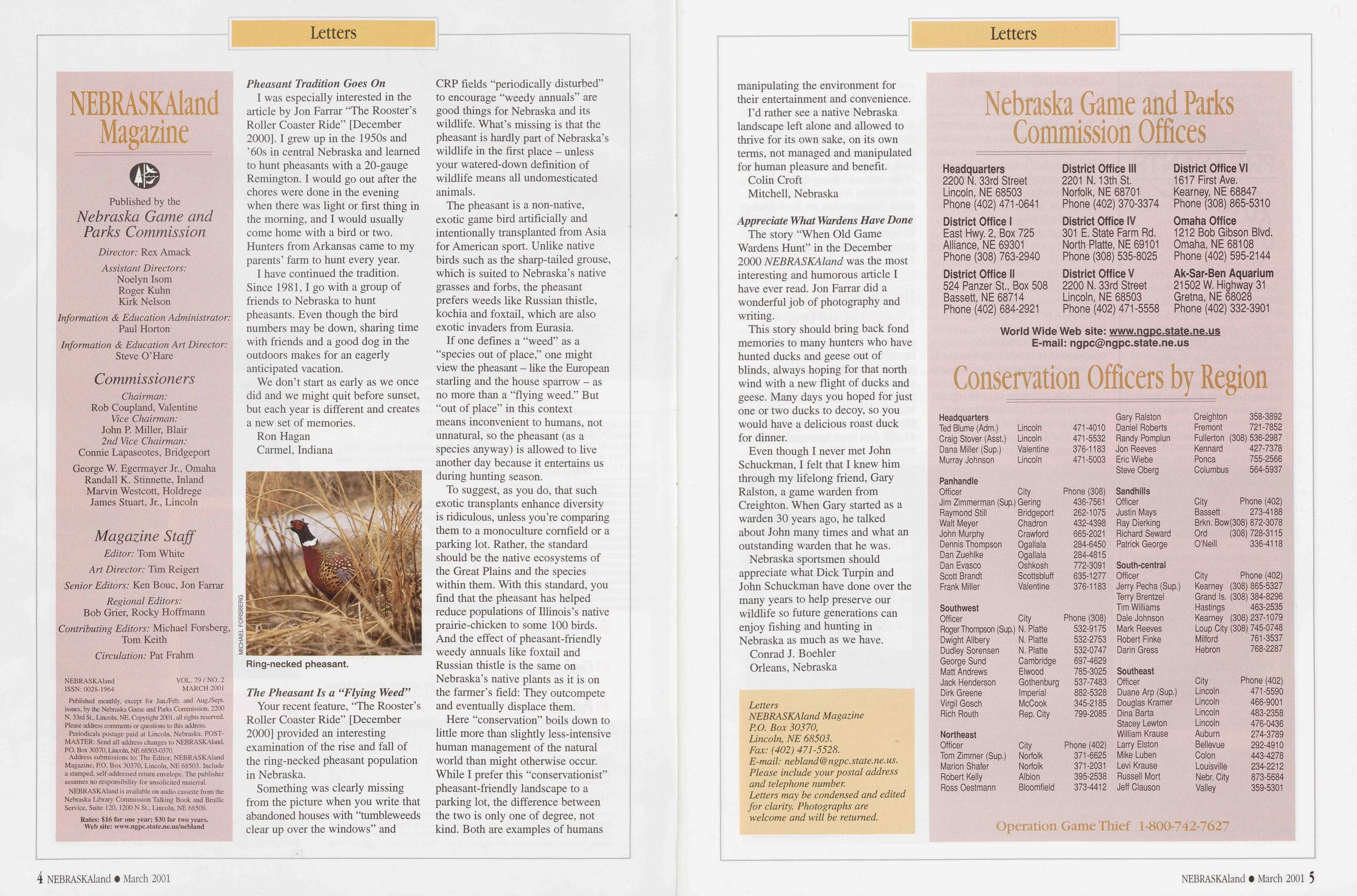
The Pheasant Is a "Flying Weed" Your recent feature, "The Rooster's Roller Coaster Ride" [December 2000] provided an interesting examination of the rise and fall of the ring-necked pheasant population in Nebraska.
Something was clearly missing from the picture when you write that abandoned houses with "tumbleweeds clear up over the windows" and CRP fields "periodically disturbed" to encourage "weedy annuals" are good things for Nebraska and its wildlife. What's missing is that the pheasant is hardly part of Nebraska's wildlife in the first place - unless your watered-down definition of wildlife means all undomesticated animals.
The pheasant is a non-native, exotic game bird artificially and intentionally transplanted from Asia for American sport. Unlike native birds such as the sharp-tailed grouse, which is suited to Nebraska's native grasses and forbs, the pheasant prefers weeds like Russian thistle, kochia and foxtail, which are also exotic invaders from Eurasia.
If one defines a "weed" as a "species out of place," one might view the pheasant - like the European starling and the house sparrow - as no more than a "flying weed." But "out of place" in this context means inconvenient to humans, not unnatural, so the pheasant (as a species anyway) is allowed to live another day because it entertains us during hunting season.
To suggest, as you do, that such exotic transplants enhance diversity is ridiculous, unless you're comparing them to a monoculture cornfield or a parking lot. Rather, the standard should be the native ecosystems of the Great Plains and the species within them. With this standard, you find that the pheasant has helped reduce populations of Illinois's native prairie-chicken to some 100 birds. And the effect of pheasant-friendly weedy annuals like foxtail and Russian thistle is the same on Nebraska's native plants as it is on the farmer's field: They outcompete and eventually displace them.
Here "conservation" boils down to little more than slightly less-intensive human management of the natural world than might otherwise occur. While I prefer this "conservationist" pheasant-friendly landscape to a parking lot, the difference between the two is only one of degree, not kind. Both are examples of humans
4 NEBRASKAland • March 2001manipulating the environment for their entertainment and convenience.
I'd rather see a native Nebraska landscape left alone and allowed to thrive for its own sake, on its own terms, not managed and manipulated for human pleasure and benefit.
Appreciate What Wardens Have Done
The story "When Old Game Wardens Hunt" in the December 2000 NEBRASKAland was the most interesting and humorous article I have ever read. Jon Farrar did a wonderful job of photography and writing.
This story should bring back fond memories to many hunters who have hunted ducks and geese out of blinds, always hoping for that north wind with a new flight of ducks and geese. Many days you hoped for just one or two ducks to decoy, so you would have a delicious roast duck for dinner.
Even though I never met John Schuckman, I felt that I knew him through my lifelong friend, Gary Ralston, a game warden from Creighton. When Gary started as a warden 30 years ago, he talked about John many times and what an outstanding warden that he was.
Nebraska sportsmen should appreciate what Dick Turpin and John Schuckman have done over the many years to help preserve our wildlife so future generations can enjoy fishing and hunting in Nebraska as much as we have.
Conrad J. BoehlerOrleans, Nebraska Letters NEBRASKAland Magazine RO. Box 30370, Lincoln, NE 68503. Fax: (402) 471-5528. E-mail: nebland@ngpc.state.ne.us. Please include your postal address and telephone number. Letters may be condensed and edited for clarity. Photographs are welcome and will be returned. Headquarters 2200 N. 33rd Street Lincoln, NE 68503 Phone (402) 471-0641 District Office I East Hwy. 2, Box 725 Alliance, NE 69301 Phone (308) 763-2940 District Office II 524 Panzer St., Box 508 Bassett, NE 68714 Phone (402) 684-2921 District Office III 2201 N. 13th St. Norfolk, NE 68701 Phone (402) 370-3374 District Office IV 301 E. State Farm Rd. North Platte, NE 69101 Phone (308) 535-8025 District Office V 2200 N. 33rd Street Lincoln, NE 68503 Phone (402) 471-5558 District Office VI 1617 First Ave. Kearney, NE 68847 Phone (308) 865-5310 Omaha Office 1212 Bob Gibson Blvd. Omaha, NE 68108 Phone (402) 595-2144 Ak-Sar-Ben Aquarium 21502 W. Highway 31 Gretna, NE 68028 Phone (402) 332-3901 World Wide Web site: www.nqpc.state.ne.us E-mail: ngpc@ngpc.state.ne.us Headquarters Ted Blume (Adm.) Craig Stover (Asst.) Dana Miller (Sup.) Murray Johnson Panhandle Officer Jim Zimmerman (Sup.) Raymond Still Walt Meyer John Murphy Dennis Thompson Dan Zuehlke Dan Evasco Scott Brandt Frank Miller Southwest Lincoln Lincoln Valentine Lincoln City Gering Bridgeport Chadron Crawford Ogallala Ogallala Oshkosh Scottsbluff Valentine Officer City Roger Thompson (Sup.) N. Platte Dwight Allbery N. Platte Dudley Sorensen N. Platte George Sund Cambridge Matt Andrews Elwood Jack Henderson Gothenburg Dirk Greene Imperial Virgil Gosch McCook Rich Routh Rep. City Northeast Officer City Tom Zimmer (Sup.) Norfolk Marion Shafer Norfolk Robert Kelly Albion Ross Oestmann Bloomfield 471-4010 471-5532 376-1183 471-5003 Phone (308) 436-7561 262-1075 432-4398 665-2021 284-6450 284-4815 772-3091 635-1277 376-1183 Phone (308) 532-9175 532-2753 532-0747 697-4629 785-3025 537-7483 882-5328 345-2185 799-2085 Phone (402) 371-6625 371-2031 395-2538 373-4412 Gary Ralston Daniel Roberts Randy Pomplun Jon Reeves Eric Wiebe Steve Oberg Sandhills Officer Justin Mays Ray Dierking Richard Seward Patrick George South-central Officer Jerry Pecha (Sup.) Terry Brentzel Tim Williams Dale Johnson Mark Reeves Robert Finke Darin Gress Southeast Officer Duane Arp (Sup.) Douglas Kramer Dina Barta Stacey Lewton William Krause Larry Elston Mike Luben Levi Krause Russell Mort Jeff Clauson Creighton 358-3892 Fremont 721-7852 Fullerton (308) 536-2987 Kennard 427-7378 Ponca 755-2566 Columbus 564-5937 City Phone (402) Bassett 273-4188 Brkn. Bow (308) 872-3078 Ord (308)728-3115 O'Neill 336-4118 City Kearney Grand Is. Hastings Kearney Loup City Milford Hebron Phone (402) (308) 865-5327 (308)384-8296 463-2535 (308)237-1079 (308) 745-0748 761-3537 768-2287 City Lincoln Lincoln Lincoln Lincoln Auburn Bellevue Colon Louisville Nebr. City Valley Phone (402) 471-5590 466-9001 483-2358 476-0436 274-3789 292-4910 443-4278 234-2212 873-5684 359-5301 NEBRASKAland • March 2001 5 PHEASANTS Nebraska Pheasants Forever chapters are working with farmers and landowners to establish wildlife habitat. The goal of Pheasants Forever is to restore upland wildlife populations through quality habitat. We are paying landowners to plant food plots, nesting cover, shelterbelts and other quality habitat projects. Nebraska currently has 52 chapters and more than 10,000 members throughout the state looking to work with local farmers and landowners for the benefit of all upland wildlife. In just 14 years, these chapters have planted more than 2.2 million trees, created more than 316,000 acres of new habitat, and spent over $5.2 million on habitat and conservation education in the state. For help planting wildlife habitat or more information about Pheasants Forever, call (308) 485-0154 or write to: Pheasants Forever 1011 Alexander Ave. Elba, NE 68835
Pheasants Forever
Outdoor News
Conservation Legislation Network Offers Updates
To provide sportsmen, landowners and wildlife enthusiasts information about state and federal conservation legislation, the Nebraska Game and Parks Commission has established the Conservation and Legislation Information Network.
Beyond offering timely information, the network's goals include:
• To assist constituents in participating in the legislative process. • To provide a Commission analysis of new and changing legislation. • To provide a conduit for constituents to express opinions and concerns to appropriate Commission staff members.For more information or to register at the network, call Commission wildlife biologist Ron Leathers at (402) 471-5431 or go online at http://bighorn.ngpc.state.ne.us/ network/.
Loup Management Area Named for Leonard Koziol
At its October meeting, the Nebraska Game and Parks Commission renamed 328 acres on the Middle and North Loup rivers in Howard County the Leonard A. Koziol Wildlife Management Area. Koziol, who was a Commission biologist, was severely injured in a plane accident in 1979 while conducting an aerial deer survey. He died September 29, 2000.
Personal Watercraft Ban on Stretches of Missouri Upheld
After receiving more than 10,000 comments from individuals and groups last fall, the National Park Service upheld its decision to ban personal watercraft on segments of the Missouri River. More than 80 percent of the respondents expressed support for the ban.
Citing concerns about user safety, visitor conflicts and environmental damage, the park service instituted the ban last spring for all national park waters, including two segments of the Missouri River that make up the Missouri National Recreational River. The stretches are from Fort Randall Dam near Pickstown, South Dakota, to Niobrara, Nebraska, and from Gavins Point, near Yankton, South Dakota, to Ponca, Nebraska.
Firearm Hunters Take a Record 43,460 Deer
Over 60 percent of Nebraska hunters who had a permit killed a deer in a record-setting firearm season last November.
Karl Menzel, big game specialist with the Nebraska Game and Parks Commission, reported that a record 43,460 deer were harvested, 3,681 more than in 1999.
During the archery deer hunting season, 15,729 permit holders took 4,532 deer, a success rate of 29 percent, compared to 28 percent in 1999 when 16,137 permit holders took 4,498 deer.
Muzzleloaders did a little better. A total of 17,801 black powder hunters killed 5,761 deer during the 2000 muzzleloader season for a success rate of 32 percent, the same as in 1999 when 15,047 permit holders took 4,792 deer.
Statewide Turkey Archery Season Opens March 25
The Nebraska statewide wild turkey archery season begins March 25 and runs until May 20. Last year 3,405 bowhunters took 1,162 turkeys.
In the Northwest Unit, the spring shotgun season is April 14 to May 20. In the East, Southwest and Verdigre units, the shotgun season is split. The early spring season is April 14-22; the late season is April 23 to May 20. Last year 15,768 shotgun hunters killed 6,650 turkeys. Both shotgun and archery hunters are required to have a turkey hunting permit and Nebraska Habitat Stamp. (See More Turkey Permits, page 47).
Other opening days for hunting non-migratory species this year are:
Species Opening DateSquirrel ..................................Aug. 1
Elk (Boyd Unit)....................Aug. 15
Archery Pronghorn ..............Aug. 20
Cottontail/Jackrabbit..............Sept. 1
Archery Deer........................Sept. 15
Grouse..................................Sept. 15
Muzzleloader Pronghorn......Sept. 22
Elk (Hat Creek and Bordeaux Units) ..........Sept. 22
Archery Fall Turkey................Oct. 1
Firearm Antelope ..................Oct. 13
Shotgun Fall Turkey..............Oct. 20
Pheasant ................................Oct. 27
Quail.......................................Oct. 27
Partridge................................Oct. 27
Firearm Deer........................Nov. 10
Muzzleloader Deer..................Dec. 1
Outdoor News
Postal Service to Depict Prairie, Wildlife on Stamps
The United State Postal Service will depict the Great Plains in two new issues this spring. A new, 70-cent international stamp featuring Nine-Mile Prairie, as photographed by Michael Forsberg of Lincoln, is scheduled to be released March 6. On April 19, a sheet of stamps titled the "Great Plains Prairie," painted by John D. Dawson of Hilo, Hawaii, will be released.
Nine-Mile Prairie, northwest of Lincoln, is a remnant of the tallgrass prairie that once covered wide areas of the Midwest from Ohio to eastern Nebraska. Forsberg, a freelance photographer and a contributing editor to NEBRASKAland Magazine, took the photograph, showing a sweeping expanse of prairie, in the fall of 1994 from a stepladder.
"What I wanted to do was give people a sense of the tallgrass prairie, especially what it would have been like for a person on horseback or in a covered wagon 150 years ago as they were rolling across Nebraska," Forsberg said. The stamp is part of the postal service's American Scenes series.
The Great Plains Prairie sheet of stamps depicts wildlife in a natural setting. It is part of the Nature of America series.
Swift Fox Remains on State Endangered Spedes List
In January the U.S. Fish and Wildlife Service removed the swift fox from a list of candidates for the federal threatened species list because its population may have increased.
However, the swift fox remains on Nebraska's endangered list. Rick Schneider, manager of the Natural Heritage program, said current evidence shows there are too few swift foxes in Nebraska to remove the species from the state list.
Nickel-Gold Plate......................$35.00
Solid Sterling Silver................$140.00
(price + sales tax + shipping) protecting Nebraska's wildlife and natural resources 1901-2001 Centennial Print "Protectors of all they see" Original art by Neal Anderson Limited Edition of 500 signed and numbered by artist....................$85.00
(shrink wrapped on foam board)
Not numbered or signed..........$20.00
(rolled in tube)
(price + sales tax + shipping)
or write to: Order forms available by: e-mail at: ncoa@alltel.net NCOA, P.O. Box 497, Louisville, NE 68037 6 NEBRASKAland • March 2001 NEBRASKAland • March 2001 7
Outdoor Business
A New Endowment
Gifts to Natural Nebraska Fund will ensure future environmental projects.
When voters approved a constitutional amendment authorizing the Nebraska Lottery in 1992, they provided a huge shot in the arm to efforts to preserve and restore the state's rich natural heritage. Nearly 50 percent of the lottery proceeds go to the Nebraska Environmental Trust. The mission of the trust is to distribute those funds as grants throughout the state for "conserving, enhancing and restoring" the state's environment in the areas of water quality, recycling and preservation of critical habitat.
Since the state lottery began in September of 1993, the trust has distributed nearly $54 million for projects that have touched the lives of all Nebraskans, especially those who enjoy wildlife and wild places.
Trust grants are supporting the Aquatic Habitat Program in dredging and rejuvenating small lakes across the state to provide close-to-home recreation for families. The trust partnered with Ducks Unlimited to acquire and restore wetlands used by wildlife, sportsmen and birders, and with Pheasants Forever in an innovative program to establish wildlife habitat on the corners of fields irrigated by center-pivot irrigation systems. The trust partnered with the Rainwater Basin Joint Venture Program and the Sandhills Task Force to improve water quality and wildlife habitat in those water-rich regions. A trust grant helped fund restoration of Platte River habitat for waterfowl, shorebirds and cranes. Trust grants are helping to restore oxbows, chutes and backwaters on the Missouri River, to safely dispose of pesticides, preserve remnant tracts of tallgrass prairie and to establish grass filter strips between agricultural fields and streams, lakes and other wetlands. And the list goes on and on. The trust's success has exceeded all expectations, even it's own.
"We have turned away more than $250 million in legitimate and worthy grant requests," said board chairman Dick Mercer of Kearney. "The need for these projects, and the desire of Nebraskans to have these projects done, is far greater than we are able to meet with our current funding. We are proud of the fact that we don't use tax dollars for our funding, and so we started looking for ways to do more using voluntary donations."
To provide more funding for.
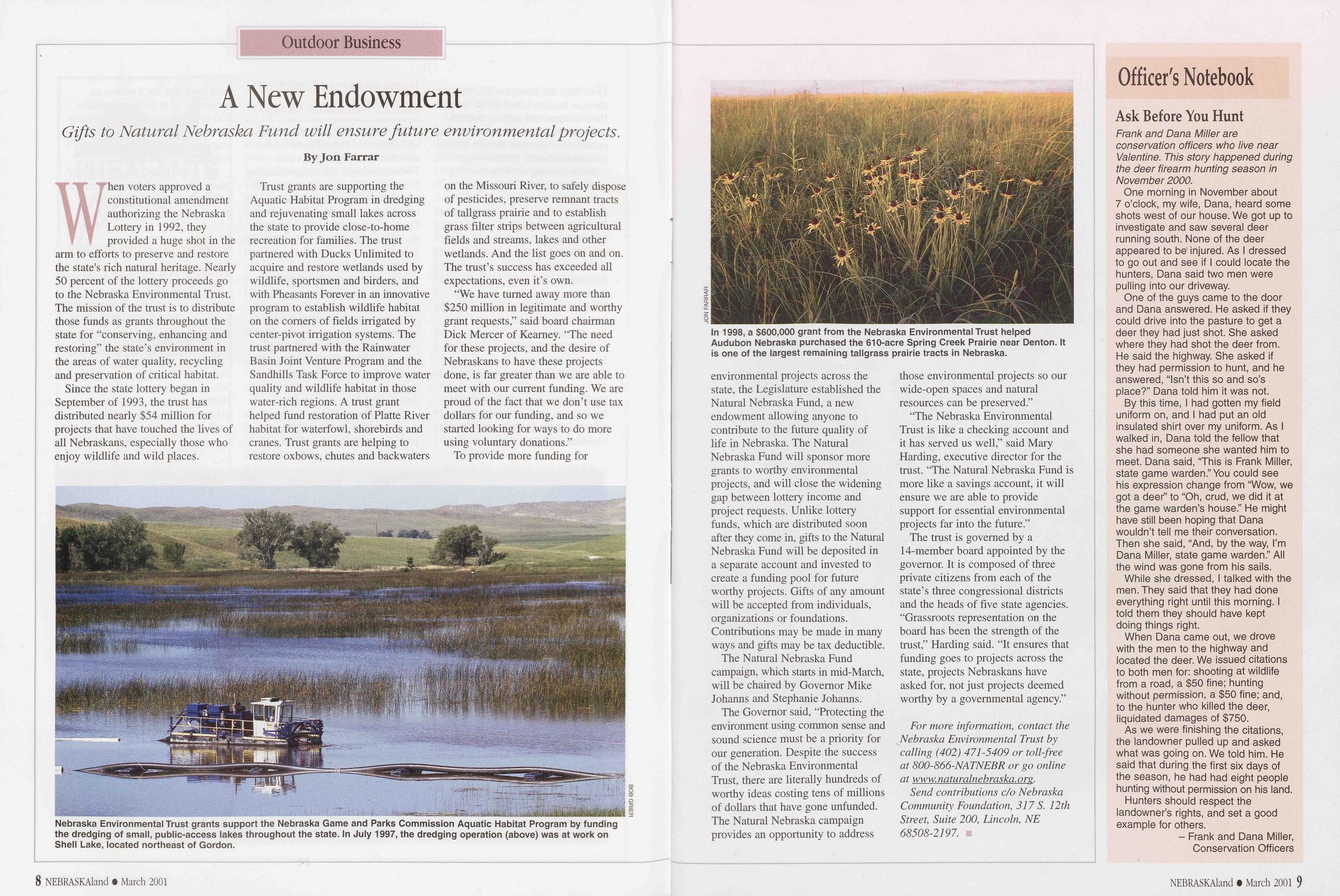
In 1998, a $600,000 grant from the Nebraska Environmental Trust helped Audubon Nebraska purchased the 610-acre Spring Creek Prairie near Denton. It is one of the largest remaining tallgrass prairie tracts in Nebraska.
Nebraska Environmental Trust grants support the Nebraska Game and Parks Commission Aquatic Habitat Program by funding the dredging of small, public-access lakes throughout the state. In July 1997, the dredging operation (above) was at work on Shell Lake, located northeast of Gordon.
environmental projects across the state, the Legislature established the Natural Nebraska Fund, a new endowment allowing anyone to contribute to the future quality of life in Nebraska. The Natural Nebraska Fund will sponsor more grants to worthy environmental projects, and will close the widening gap between lottery income and project requests. Unlike lottery funds, which are distributed soon after they come in, gifts to the Natural Nebraska Fund will be deposited in a separate account and invested to create a funding pool for future worthy projects. Gifts of any amount will be accepted from individuals, organizations or foundations. Contributions may be made in many ways and gifts may be tax deductible.
The Natural Nebraska Fund campaign, which starts in mid-March, will be chaired by Governor Mike Johanns and Stephanie Johanns.
The Governor said, "Protecting the environment using common sense and sound science must be a priority for our generation. Despite the success of the Nebraska Environmental Trust, there are literally hundreds of worthy ideas costing tens of millions of dollars that have gone unfunded. The Natural Nebraska campaign provides an opportunity to address those environmental projects so our wide-open spaces and natural resources can be preserved."
"The Nebraska Environmental Trust is like a checking account and it has served us well," said Mary Harding, executive director for the trust. "The Natural Nebraska Fund is more like a savings account, it will ensure we are able to provide support for essential environmental projects far into the future."
The trust is governed by a 14-member board appointed by the governor. It is composed of three private citizens from each of the state's three congressional districts and the heads of five state agencies. "Grassroots representation on the board has been the strength of the trust," Harding said. "It ensures that funding goes to projects across the state, projects Nebraskans have asked for, not just projects deemed worthy by a governmental agency."
For more information, contact the Nebraska Environmental Trust by calling (402) 471-5409 or toll-free at 800-866-NATNEBR or go online at www.naturalnebraska.org. Send contributions c/o Nebraska Community Foundation, 317 S. 12th Street, Suite 200, Lincoln, NE 68508-2197.Officer's Notebook
Ask Before You Hunt
Frank and Dana Miller are conservation officers who live near Valentine. This story happened during the deer firearm hunting season in November 2000.
One morning in November about 7 o'clock, my wife, Dana, heard some shots west of our house. We got up to investigate and saw several deer running south. None of the deer appeared to be injured. As I dressed to go out and see if I could locate the hunters, Dana said two men were pulling into our driveway.
One of the guys came to the door and Dana answered. He asked if they could drive into the pasture to get a deer they had just shot. She asked where they had shot the deer from. He said the highway. She asked if they had permission to hunt, and he answered, "Isn't this so and so's place?" Dana told him it was not.
By this time, I had gotten my field uniform on, and I had put an old insulated shirt over my uniform. As I walked in, Dana told the fellow that she had someone she wanted him to meet. Dana said, "This is Frank Miller, state game warden." You could see his expression change from "Wow, we got a deer" to "Oh, crud, we did it at the game warden's house." He might have still been hoping that Dana wouldn't tell me their conversation. Then she said, "And, by the way, I'm Dana Miller, state game warden." All the wind was gone from his sails.
While she dressed, I talked with the men. They said that they had done everything right until this morning. I told them they should have kept doing things right.
When Dana came out, we drove with the men to the highway and located the deer. We issued citations to both men for: shooting at wildlife from a road, a $50 fine; hunting without permission, a $50 fine; and, to the hunter who killed the deer, liquidated damages of $750.
As we were finishing the citations, the landowner pulled up and asked what was going on. We told him. He said that during the first six days of the season, he had had eight people hunting without permission on his land.
Hunters should respect the landowner's rights, and set a good example for others.
- Frank and Dana MillerConservation Officers 8 NEBRASKAland • March 2001 NEBRASKAland • March 2001 9
The Boomers
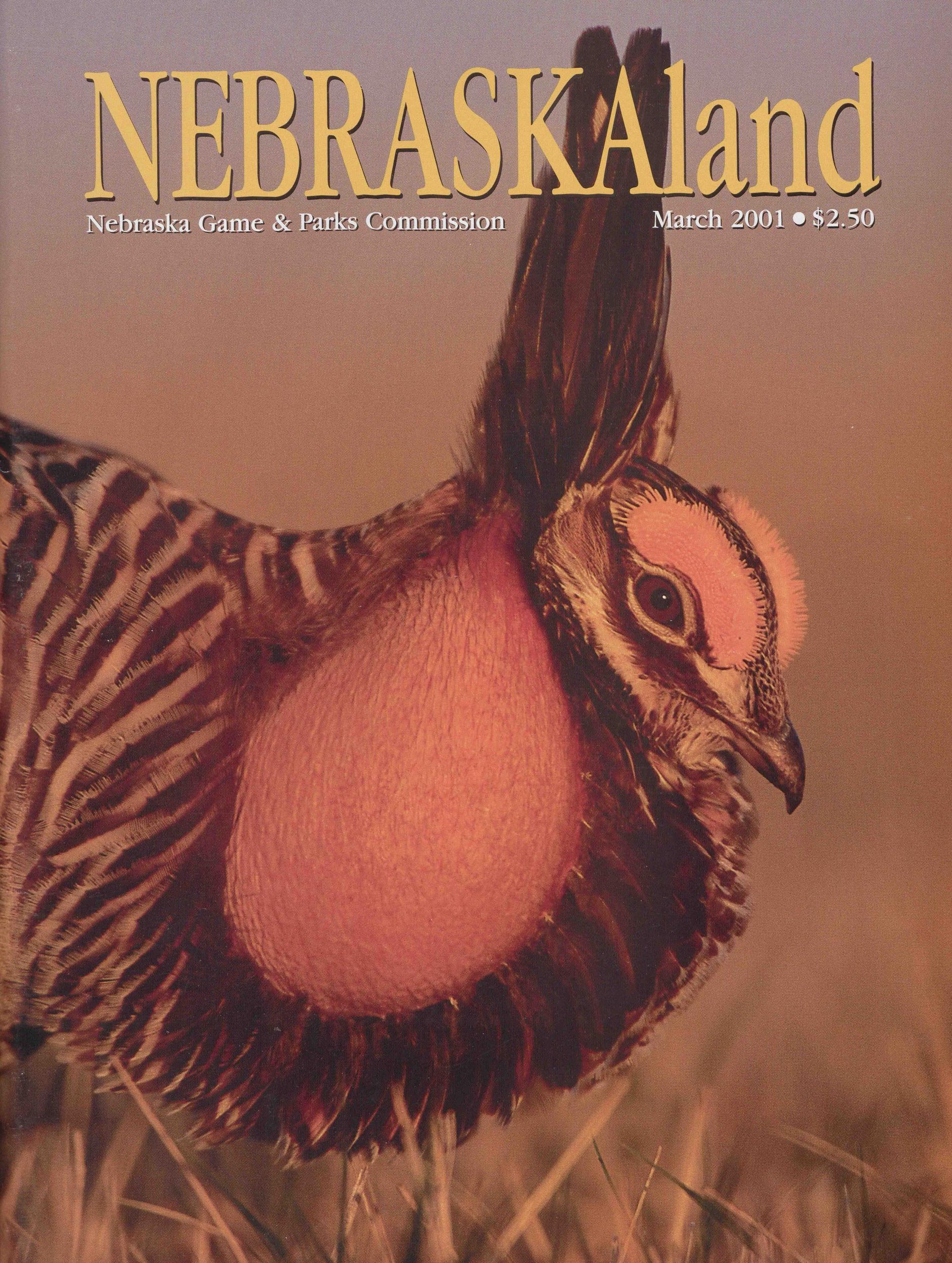
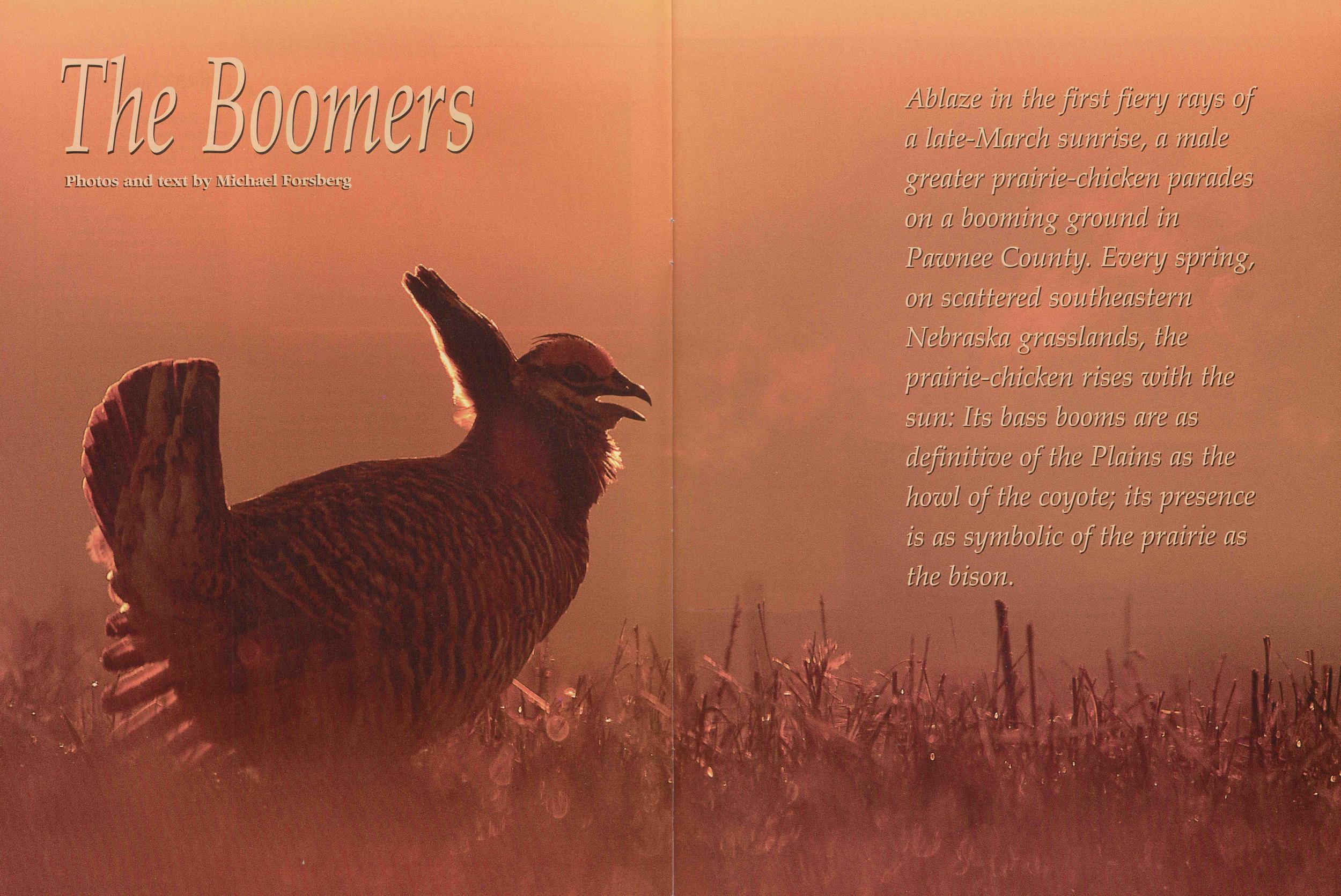
Ablaze in the first fiery rays of a late-March sunrise, a male greater prairie-chicken parades on a booming ground in Pawnee County. Every spring, on scattered southeastern Nebraska grasslands, the prairie-chicken rises with the sun: Its bass booms are as definitive of the Plains as the howl of the coyote; its presence is as symbolic of the prairie as the bison.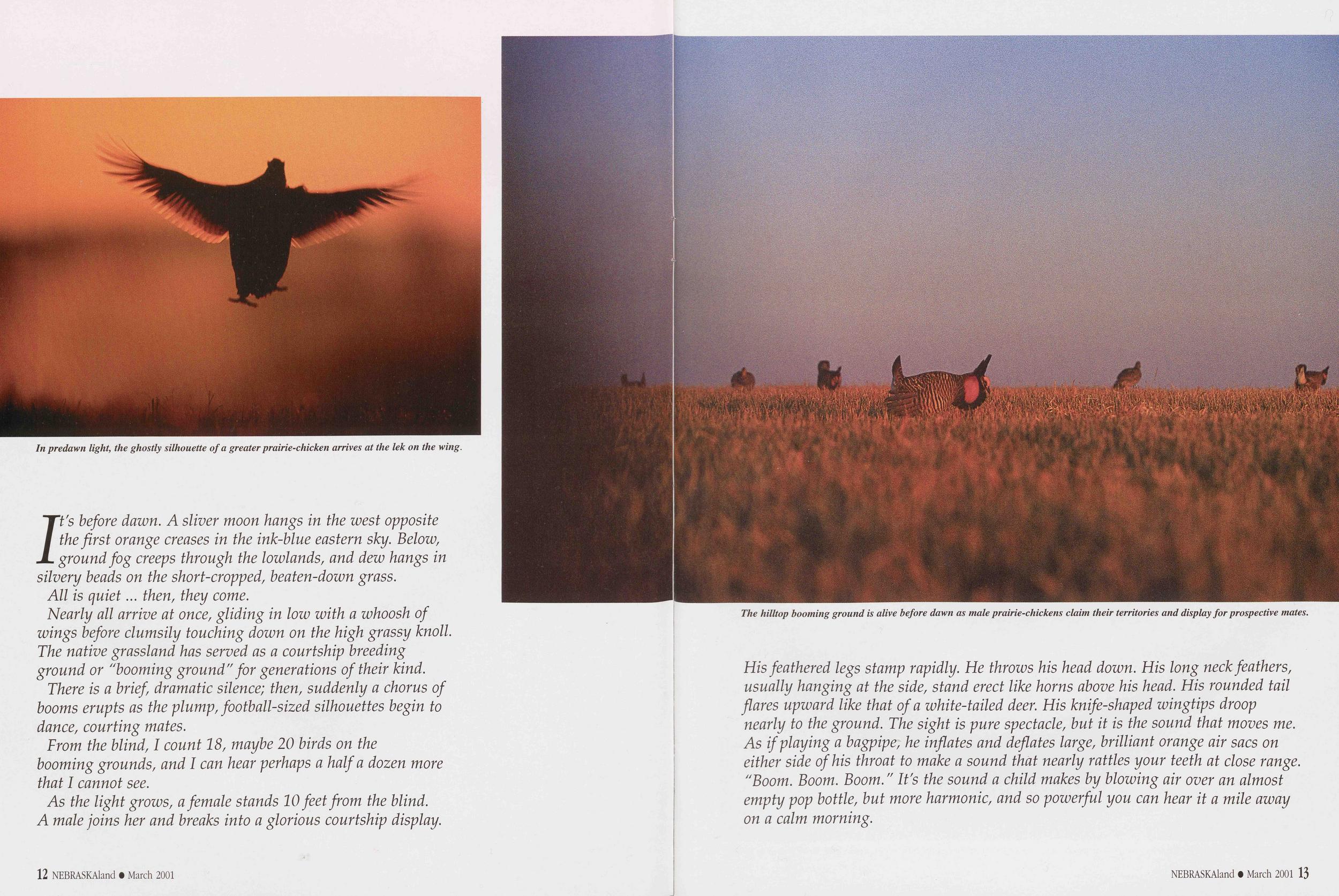
In predawn light, the ghostly silhouette of a greater prairie-chicken arrives at the lek on the wing.
I't's before dawn. A sliver moon hangs in the west opposite the first orange creases in the ink-blue eastern sky. Below, ground fog creeps through the lowlands, and dew hangs in silvery beads on the short-cropped, beaten-down grass.
All is quiet... then, they come.
Nearly all arrive at once, gliding in low with a whoosh of wings before clumsily touching down on the high grassy knoll. The native grassland has served as a courtship breeding ground or "booming ground" for generations of their kind.
There is a brief, dramatic silence; then, suddenly a chorus of booms erupts as the plump, football-sized silhouettes begin to dance, courting mates.
From the blind, I count 18, maybe 20 birds on the booming grounds, and I can hear perhaps a half a dozen more that I cannot see.
As the light grows, a female stands 10 feet from the blind. A male joins her and breaks into a glorious courtship display.
12 NEBRASKAland • March 2001The hilltop booming ground is alive before dawn as male prairie-chickens claim their territories and display for prospective mates.
His feathered legs stamp rapidly. He throws his head down. His long neck feathers, usually hanging at the side, stand erect like horns above his head. His rounded tail flares upward like that of a white-tailed deer. His knife-shaped wingtips droop nearly to the ground. The sight is pure spectacle, but it is the sound that moves me. As if playing a bagpipe, he inflates and deflates large, brilliant orange air sacs on either side of his throat to make a sound that nearly rattles your teeth at close range. "Boom. Boom. Boom." It's the sound a child makes by blowing air over an almost empty pop bottle, but more harmonic, and so powerful you can hear it a mile away on a calm morning.
NEBRASKAland • March 2001 13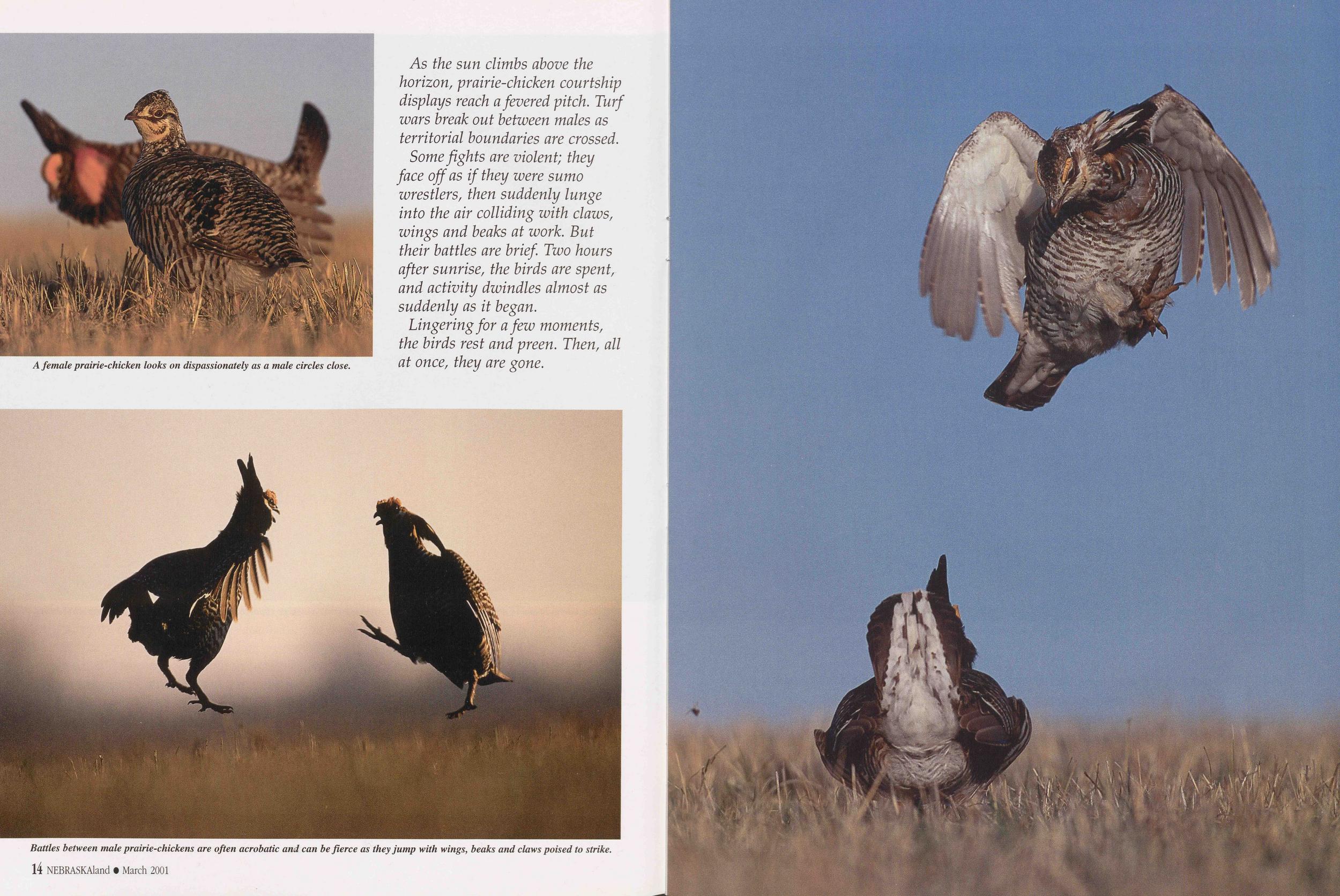
A female prairie-chicken looks on dispassionately as a male circles close.
As the sun climbs above the horizon, prairie-chicken courtship displays reach a fevered pitch. Turf wars break out between males as territorial boundaries are crossed.
Some fights are violent; they face off as if they were sumo wrestlers, then suddenly lunge into the air colliding with claws, wings and beaks at work. But their battles are brief. Two hours after sunrise, the birds are spent, and activity dwindles almost as suddenly as it began.
Lingering for a few moments, the birds rest and preen. Then, all at once, they are gone.
Battles between male prairie-chickens are often acrobatic and can be fierce as they jump with wings, beaks and claws poised to strike.
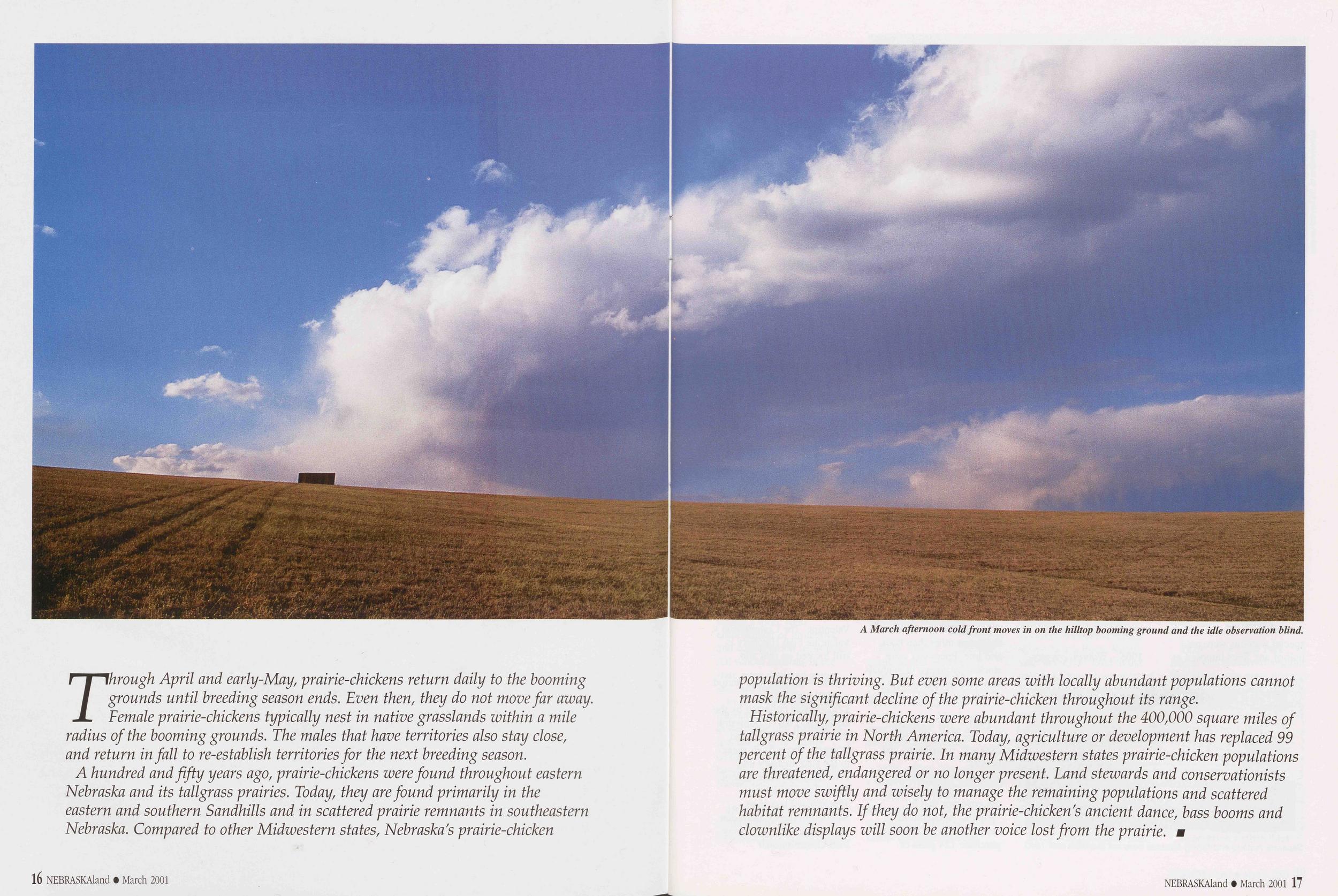
A March afternoon cold front moves in on the hilltop booming ground and the idle observation blind.
Through April and early-May, prairie-chickens return daily to the booming grounds until breeding season ends. Even then, they do not move jar away. Female prairie-chickens typically nest in native grasslands within a mile radius of the booming grounds. The males that have territories also stay close, and return in fall to re-establish territories for the next breeding season.
A hundred and fifty years ago, prairie-chickens were found throughout eastern Nebraska and its tallgrass prairies. Today, they are found primarily in the eastern and southern Sandhills and in scattered prairie remnants in southeastern Nebraska. Compared to other Midwestern states, Nebraska's prairie-chicken population is thriving. But even some areas with locally abundant populations cannot mask the significant decline of the prairie-chicken throughout its range.
Historically, prairie-chickens were abundant throughout the 400,000 square miles of tallgrass prairie in North America. Today, agriculture or development has replaced 99 percent of the tallgrass prairie. In many Midwestern states prairie-chicken populations are threatened, endangered or no longer present. Land stewards and conservationists must move swiftly and wisely to manage the remaining populations and scattered habitat remnants. If they do not, the prairie-chicken's ancient dance, bass booms and clownlike displays will soon be another voice lost from the prairie,
16 NEBRASKAland • March 2001 NEBRASKAland • March 2001 17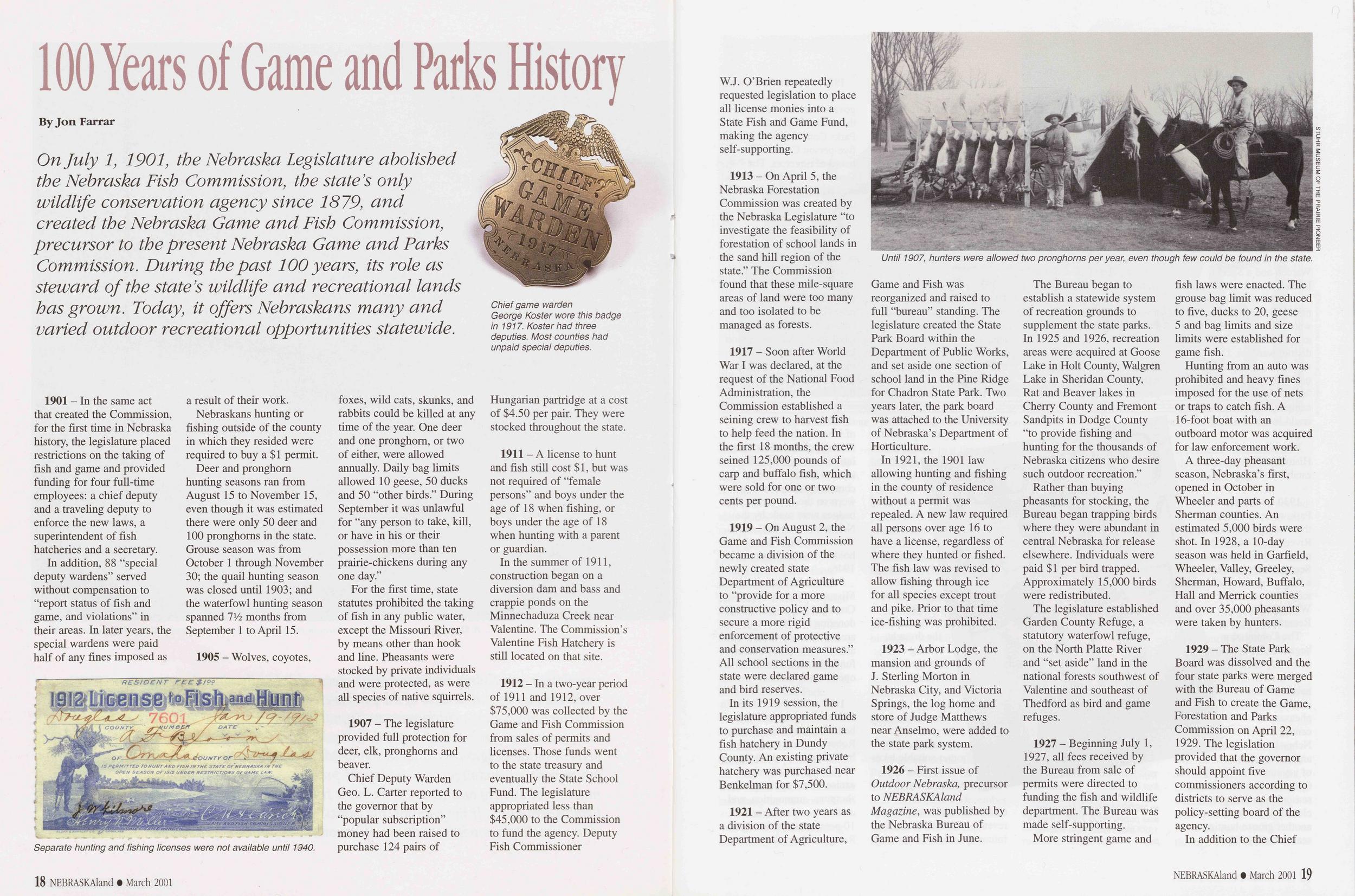
100 Years of Game and Parks History
On July 1, 190 J the Nebraska Legislature abolished the Nebraska Fish Commission, the state's only wildlife conservation agency since 1879, and created the Nebraska Game and Fish Commission, precursor to the present Nebraska Game and Parks Commission. During the past 100 years, its role as steward of the state's wildlife and recreational lands has grown. Today, it offers Nebraskans many and varied outdoor recreational opportunities statewide.
Chief game warden George Koster wore this badge in 1917. Koster had three deputies. Most counties had unpaid special deputies.
1901 - In the same act that created the Commission, for the first time in Nebraska history, the legislature placed restrictions on the taking of fish and game and provided funding for four full-time employees: a chief deputy and a traveling deputy to enforce the new laws, a superintendent of fish hatcheries and a secretary.
In addition, 88 "special deputy wardens" served without compensation to "report status of fish and game, and violations" in their areas. In later years, the special wardens were paid half of any fines imposed as a result of their work.
Nebraskans hunting or fishing outside of the county in which they resided were required to buy a $1 permit.
Deer and pronghorn hunting seasons ran from August 15 to November 15, even though it was estimated there were only 50 deer and 100 pronghorns in the state. Grouse season was from October 1 through November 30; the quail hunting season was closed until 1903; and the waterfowl hunting season spanned IVi months from September 1 to April 15.
1905 - Wolves, coyotes,
Separate hunting and fishing licenses were not available until 1940.
foxes, wild cats, skunks, and rabbits could be killed at any time of the year. One deer and one pronghorn, or two of either, were allowed annually. Daily bag limits allowed 10 geese, 50 ducks and 50 "other birds." During September it was unlawful for "any person to take, kill, or have in his or their possession more than ten prairie-chickens during any one day."
For the first time, state statutes prohibited the taking of fish in any public water, except the Missouri River, by means other than hook and line. Pheasants were stocked by private individuals and were protected, as were all species of native squirrels.
1907 - The legislature provided full protection for deer, elk, pronghorns and beaver.
Chief Deputy Warden Geo. L. Carter reported to the governor that by "popular subscription" money had been raised to purchase 124 pairs of Hungarian partridge at a cost of $4.50 per pair. They were stocked throughout the state.
1911 - A license to hunt and fish still cost $1, but was not required of "female persons" and boys under the age of 18 when fishing, or boys under the age of 18 when hunting with a parent or guardian.
In the summer of 1911, construction began on a diversion dam and bass and crappie ponds on the Minnechaduza Creek near Valentine. The Commission's Valentine Fish Hatchery is still located on that site.
1912 - In a two-year period of 1911 and 1912, over $75,000 was collected by the Game and Fish Commission from sales of permits and licenses. Those funds went to the state treasury and eventually the State School Fund. The legislature appropriated less than $45,000 to the Commission to fund the agency. Deputy Fish Commissioner
18 NEBRASKAland • March 2001W.J. O'Brien repeatedly requested legislation to place all license monies into a State Fish and Game Fund, making the agency self-supporting.
1913 - On April 5, the Nebraska Forestation Commission was created by the Nebraska Legislature "to investigate the feasibility of forestation of school lands in the sand hill region of the state." The Commission found that these mile-square areas of land were too many and too isolated to be managed as forests.
1917 - Soon after World War I was declared, at the request of the National Food Administration, the Commission established a seining crew to harvest fish to help feed the nation. In the first 18 months, the crew seined 125,000 pounds of carp and buffalo fish, which were sold for one or two cents per pound.
1919 - On August 2, the Game and Fish Commission became a division of the newly created state Department of Agriculture to "provide for a more constructive policy and to secure a more rigid enforcement of protective and conservation measures." All school sections in the state were declared game and bird reserves.
In its 1919 session, the legislature appropriated funds to purchase and maintain a fish hatchery in Dundy County. An existing private hatchery was purchased near Benkelman for $7,500.
1921 - After two years as a division of the state Department of Agriculture,
Until 1907, hunters were allowed two pronghorns per year, even though few could be found in the state.
Game and Fish was reorganized and raised to full "bureau" standing. The legislature created the State Park Board within the Department of Public Works, and set aside one section of school land in the Pine Ridge for Chadron State Park. Two years later, the park board was attached to the University of Nebraska's Department of Horticulture.
In 1921, the 1901 law allowing hunting and fishing in the county of residence without a permit was repealed. A new law required all persons over age 16 to have a license, regardless of where they hunted or fished. The fish law was revised to allow fishing through ice for all species except trout and pike. Prior to that time ice-fishing was prohibited.
1923 - Arbor Lodge, the mansion and grounds of J. Sterling Morton in Nebraska City, and Victoria Springs, the log home and store of Judge Matthews near Anselmo, were added to the state park system.
1926 - First issue of Outdoor Nebraska, precursor to NEBRASKAland Magazine, was published by the Nebraska Bureau of Game and Fish in June.
The Bureau began to establish a statewide system of recreation grounds to supplement the state parks. In 1925 and 1926, recreation areas were acquired at Goose Lake in Holt County, Walgren Lake in Sheridan County, Rat and Beaver lakes in Cherry County and Fremont Sandpits in Dodge County "to provide fishing and hunting for the thousands of Nebraska citizens who desire such outdoor recreation."
Rather than buying pheasants for stocking, the Bureau began trapping birds where they were abundant in central Nebraska for release elsewhere. Individuals were paid $ 1 per bird trapped. Approximately 15,000 birds were redistributed.
The legislature established Garden County Refuge, a statutory waterfowl refuge, on the North Platte River and "set aside" land in the national forests southwest of Valentine and southeast of Thedford as bird and game refuges.
1927 - Beginning July 1, 1927, all fees received by the Bureau from sale of permits were directed to funding the fish and wildlife department. The Bureau was made self-supporting.
More stringent game and fish laws were enacted. The grouse bag limit was reduced to five, ducks to 20, geese 5 and bag limits and size limits were established for game fish.
Hunting from an auto was prohibited and heavy fines imposed for the use of nets or traps to catch fish. A 16-foot boat with an outboard motor was acquired for law enforcement work.
A three-day pheasant season, Nebraska's first, opened in October in Wheeler and parts of Sherman counties. An estimated 5,000 birds were shot. In 1928, a 10-day season was held in Garfield, Wheeler, Valley, Greeley, Sherman, Howard, Buffalo, Hall and Merrick counties and over 35,000 pheasants were taken by hunters.
1929 - The State Park Board was dissolved and the four state parks were merged with the Bureau of Game and Fish to create the Game, Forestation and Parks Commission on April 22, 1929. The legislation provided that the governor should appoint five commissioners according to districts to serve as the policy-setting board of the agency.
In addition to the Chief
NEBRASKAland t March 2001 19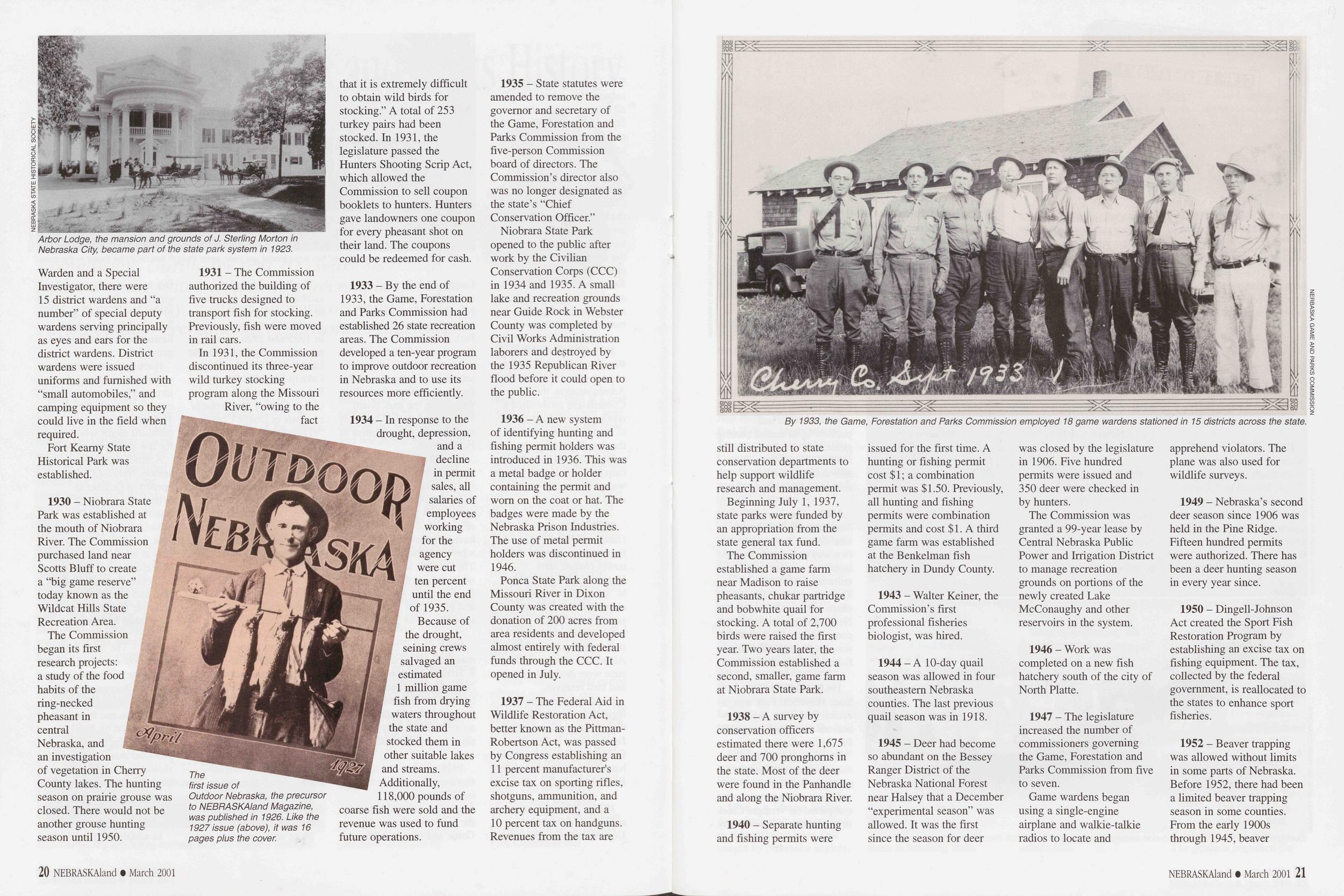
Arbor Lodge, the mansion and grounds of J. Sterling Morton in Nebraska City, became part of the state park system in 1923.
Warden and a Special Investigator, there were 15 district wardens and "a number" of special deputy wardens serving principally as eyes and ears for the district wardens. District wardens were issued uniforms and furnished with "small automobiles," and camping equipment so they could live in the field when required.
Fort Kearny State Historical Park was established.
1930 - Niobrara State Park was established at the mouth of Niobrara River. The Commission purchased land near Scotts Bluff to create a "big game reserve" today known as the Wildcat Hills State Recreation Area.
The Commission began its first research projects: a study of the food habits of the ring-necked pheasant in central Nebraska, and an investigation of vegetation in Cherry County lakes. The hunting season on prairie grouse was closed. There would not be another grouse hunting season until 1950.
1931 - The Commission authorized the building of five trucks designed to transport fish for stocking. Previously, fish were moved in rail cars.
In 1931, the Commission discontinued its three-year wild turkey stocking program along the Missouri River, "owing to the fact
The first issue of Outdoor Nebraska, the precursor to NEBRASKAland Magazine, was published in 1926. Like the 1927 issue (above), it was 16 pages plus the cover.
that it is extremely difficult to obtain wild birds for stocking." A total of 253 turkey pairs had been stocked. In 1931, the legislature passed the Hunters Shooting Scrip Act, which allowed the Commission to sell coupon booklets to hunters. Hunters gave landowners one coupon for every pheasant shot on their land. The coupons could be redeemed for cash.
1933 - By the end of 1933, the Game, Forestation and Parks Commission had established 26 state recreation areas. The Commission developed a ten-year program to improve outdoor recreation in Nebraska and to use its resources more efficiently.
1934 - In response to the drought, depression, and a decline in permit sales, all salaries of employees working for the agency were cut ten percent until the end of 1935.
Because of the drought, seining crews salvaged an estimated 1 million game fish from drying waters throughout the state and stocked them in other suitable lakes and streams. Additionally, 118,000 pounds of coarse fish were sold and the revenue was used to fund future operations.
1935 - State statutes were amended to remove the governor and secretary of the Game, Forestation and Parks Commission from the five-person Commission board of directors. The Commission's director also was no longer designated as the state's "Chief Conservation Officer."
Niobrara State Park opened to the public after work by the Civilian Conservation Corps (CCC) in 1934 and 1935. A small lake and recreation grounds near Guide Rock in Webster County was completed by Civil Works Administration laborers and destroyed by the 1935 Republican River flood before it could open to the public.
1936 - A new system of identifying hunting and fishing permit holders was introduced in 1936. This was a metal badge or holder containing the permit and worn on the coat or hat. The badges were made by the Nebraska Prison Industries. The use of metal permit holders was discontinued in 1946.
Ponca State Park along the Missouri River in Dixon County was created with the donation of 200 acres from area residents and developed almost entirely with federal funds through the CCC. It opened in July.
1937 - The Federal Aid in Wildlife Restoration Act, better known as the Pittman-Robertson Act, was passed by Congress establishing an 11 percent manufacturer's excise tax on sporting rifles, shotguns, ammunition, and archery equipment, and a 10 percent tax on handguns. Revenues from the tax are
By 1933, the Game, Forestation and Parks Commission employed 18 game wardens stationed in 15 districts across the state.
still distributed to state conservation departments to help support wildlife research and management.
Beginning July 1, 1937, state parks were funded by an appropriation from the state general tax fund.
The Commission established a game farm near Madison to raise pheasants, chukar partridge and bobwhite quail for stocking. A total of 2,700 birds were raised the first year. Two years later, the Commission established a second, smaller, game farm at Niobrara State Park.
1938 - A survey by conservation officers estimated there were 1,675 deer and 700 pronghorns in the state. Most of the deer were found in the Panhandle and along the Niobrara River.
1940 - Separate hunting and fishing permits were issued for the first time. A hunting or fishing permit cost $1; a combination permit was $1.50. Previously, all hunting and fishing permits were combination permits and cost $1. A third game farm was established at the Benkelman fish hatchery in Dundy County.
1943 - Walter Keiner, the Commission's first professional fisheries biologist, was hired.
1944 - A 10-day quail season was allowed in four southeastern Nebraska counties. The last previous quail season was in 1918.
1945 - Deer had become so abundant on the Bessey Ranger District of the Nebraska National Forest near Halsey that a December "experimental season" was allowed. It was the first since the season for deer was closed by the legislature in 1906. Five hundred permits were issued and 350 deer were checked in by hunters.
The Commission was granted a 99-year lease by Central Nebraska Public Power and Irrigation District to manage recreation grounds on portions of the newly created Lake McConaughy and other reservoirs in the system.
1946 - Work was completed on a new fish hatchery south of the city of North Platte.
1947 - The legislature increased the number of commissioners governing the Game, Forestation and Parks Commission from five to seven.
Game wardens began using a single-engine airplane and walkie-talkie radios to locate and apprehend violators. The plane was also used for wildlife surveys.
1949 - Nebraska's second deer season since 1906 was held in the Pine Ridge. Fifteen hundred permits were authorized. There has been a deer hunting season in every year since.
1950 - Dingell-Johnson Act created the Sport Fish Restoration Program by establishing an excise tax on fishing equipment. The tax, collected by the federal government, is reallocated to the states to enhance sport fisheries.
1952 - Beaver trapping was allowed without limits in some parts of Nebraska. Before 1952, there had been a limited beaver trapping season in some counties. From the early 1900s through 1945, beaver
20 NEBRASKAland • March 2001 NEBRASKAland • March 2001 21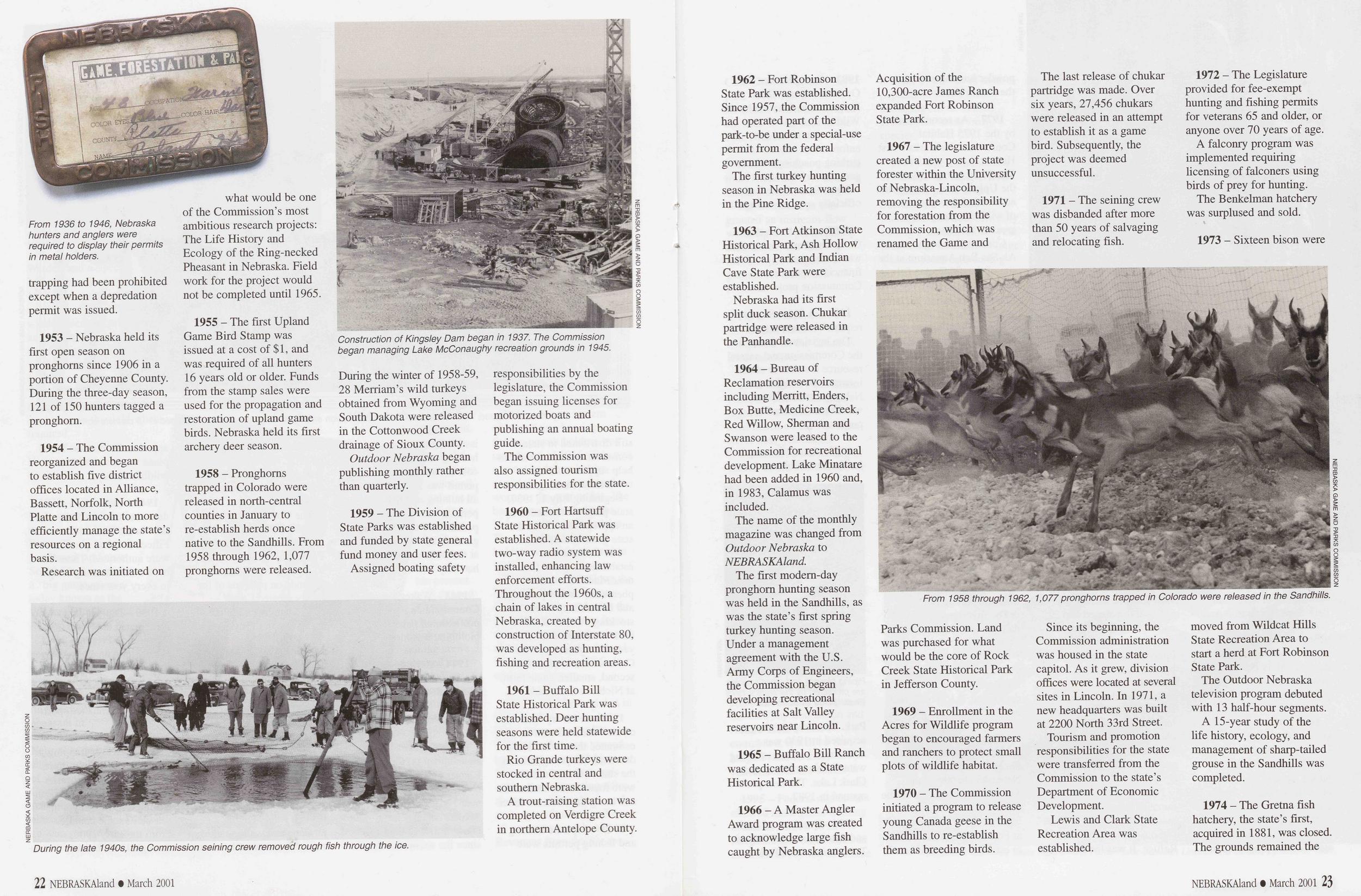
From 1936 to 1946, Nebraska hunters and anglers were required to display their permits in metal holders.
trapping had been prohibited except when a depredation permit was issued.
1953 - Nebraska held its first open season on pronghorns since 1906 in a portion of Cheyenne County. During the three-day season, 121 of 150 hunters tagged a pronghorn.
1954 - The Commission reorganized and began to establish five district offices located in Alliance, Bassett, Norfolk, North Platte and Lincoln to more efficiently manage the state's resources on a regional basis.
Research was initiated on what would be one of the Commission's most ambitious research projects: The Life History and Ecology of the Ring-necked Pheasant in Nebraska. Field work for the project would not be completed until 1965.
1955 - The first Upland Game Bird Stamp was issued at a cost of $1, and was required of all hunters 16 years old or older. Funds from the stamp sales were used for the propagation and restoration of upland game birds. Nebraska held its first archery deer season.
1958 - Pronghorns trapped in Colorado were released in north-central counties in January to re-establish herds once native to the Sandhills. From 1958 through 1962, 1,077 pronghorns were released.
Construction of Kingsley Dam began in 1937. The Commission began managing Lake McConaughy recreation grounds in 1945.
During the winter of 1958-59, 28 Merriam's wild turkeys obtained from Wyoming and South Dakota were released in the Cottonwood Creek drainage of Sioux County.
Outdoor Nebraska began publishing monthly rather than quarterly.
1959 - The Division of State Parks was established and funded by state general fund money and user fees.
Assigned boating safety responsibilities by the legislature, the Commission began issuing licenses for motorized boats and publishing an annual boating guide.
The Commission was also assigned tourism responsibilities for the state.
1960 - Fort Hartsuff State Historical Park was established. A statewide two-way radio system was installed, enhancing law enforcement efforts. Throughout the 1960s, a chain of lakes in central Nebraska, created by construction of Interstate 80, was developed as hunting, fishing and recreation areas.
1961 - Buffalo Bill State Historical Park was established. Deer hunting seasons were held statewide for the first time.
Rio Grande turkeys were stocked in central and southern Nebraska.
A trout-raising station was completed on Verdigre Creek in northern Antelope County.
During the late 1940s, the Commission seining crew removed rough fish through the ice.
1962 - Fort Robinson State Park was established. Since 1957, the Commission had operated part of the park-to-be under a special-use permit from the federal government.
The first turkey hunting season in Nebraska was held in the Pine Ridge.
1963 - Fort Atkinson State Historical Park, Ash Hollow Historical Park and Indian Cave State Park were established.
Nebraska had its first split duck season. Chukar partridge were released in the Panhandle.
1964 - Bureau of Reclamation reservoirs including Merritt, Enders, Box Butte, Medicine Creek, Red Willow, Sherman and Swanson were leased to the Commission for recreational development. Lake Minatare had been added in 1960 and, in 1983, Calamus was included.
The name of the monthly magazine was changed from Outdoor Nebraska to NEBRASKAland.
The first modern-day pronghorn hunting season was held in the Sandhills, as was the state's first spring turkey hunting season. Under a management agreement with the U.S. Army Corps of Engineers, the Commission began developing recreational facilities at Salt Valley reservoirs near Lincoln.
1965 - Buffalo Bill Ranch was dedicated as a State Historical Park.
1966 - A Master Angler Award program was created to acknowledge large fish caught by Nebraska anglers. Acquisition of the 10,300-acre James Ranch expanded Fort Robinson State Park.
1967 - The legislature created a new post of state forester within the University of Nebraska-Lincoln, removing the responsibility for forestation from the Commission, which was renamed the Game and
The last release of chukar partridge was made. Over six years, 27,456 chukars were released in an attempt to establish it as a game bird. Subsequently, the project was deemed unsuccessful.
1971 - The seining crew was disbanded after more than 50 years of salvaging and relocating fish.
1972 - The Legislature provided for fee-exempt hunting and fishing permits for veterans 65 and older, or anyone over 70 years of age.
A falconry program was implemented requiring licensing of falconers using birds of prey for hunting.
The Benkelman hatchery was surplused and sold.
1973 - Sixteen bison were
From 1958 through 1962, 1,077 pronghorns trapped in Colorado were released in the Sandhills.
Parks Commission. Land was purchased for what would be the core of Rock Creek State Historical Park in Jefferson County.
1969 - Enrollment in the Acres for Wildlife program began to encouraged farmers and ranchers to protect small plots of wildlife habitat.
1970 - The Commission initiated a program to release young Canada geese in the Sandhills to re-establish them as breeding birds.
Since its beginning, the Commission administration was housed in the state capitol. As it grew, division offices were located at several sites in Lincoln. In 1971, a new headquarters was built at 2200 North 33rd Street.
Tourism and promotion responsibilities for the state were transferred from the Commission to the state's Department of Economic Development.
Lewis and Clark State Recreation Area was established.
moved from Wildcat Hills State Recreation Area to start a herd at Fort Robinson State Park.
The Outdoor Nebraska television program debuted with 13 half-hour segments.
A 15-year study of the life history, ecology, and management of sharp-tailed grouse in the Sandhills was completed.
1974 - The Gretna fish hatchery, the state's first, acquired in 1881, was closed. The grounds remained the
NEBRASKAland • March 2001 23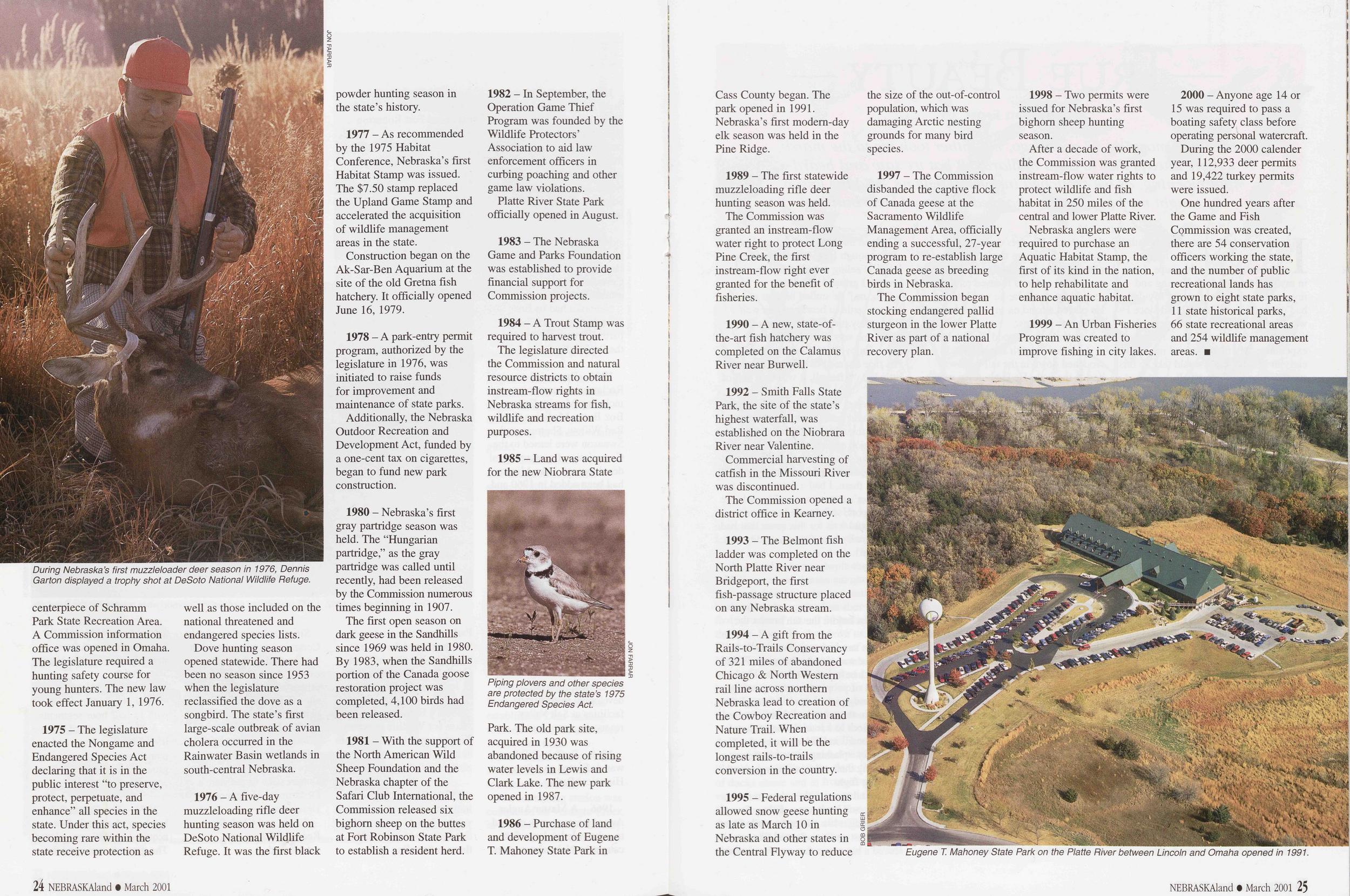
During Nebraska's first muzzleloader deer season in 1976, Dennis Garton displayed a trophy shot at DeSoto National Wildlife Refuge.
centerpiece of Schramm Park State Recreation Area. A Commission information office was opened in Omaha. The legislature required a hunting safety course for young hunters. The new law took effect January 1, 1976.
1975 - The legislature enacted the Nongame and Endangered Species Act declaring that it is in the public interest "to preserve, protect, perpetuate, and enhance" all species in the state. Under this act, species becoming rare within the state receive protection as well as those included on the national threatened and endangered species lists.
Dove hunting season opened statewide. There had been no season since 1953 when the legislature reclassified the dove as a songbird. The state's first large-scale outbreak of avian cholera occurred in the Rainwater Basin wetlands in south-central Nebraska.
1976 - A five-day muzzleloading rifle deer hunting season was held on DeSoto National Wildlife Refuge. It was the first black powder hunting season in the state's history.
1977 - As recommended by the 1975 Habitat Conference, Nebraska's first Habitat Stamp was issued. The $7.50 stamp replaced the Upland Game Stamp and accelerated the acquisition of wildlife management areas in the state.
Construction began on the Ak-Sar-Ben Aquarium at the site of the old Gretna fish hatchery. It officially opened June 16, 1979.
1978 - A park-entry permit program, authorized by the legislature in 1976, was initiated to raise funds for improvement and maintenance of state parks.
Additionally, the Nebraska Outdoor Recreation and Development Act, funded by a one-cent tax on cigarettes, began to fund new park construction.
1980 - Nebraska's first gray partridge season was held. The "Hungarian partridge," as the gray partridge was called until recently, had been released by the Commission numerous times beginning in 1907.
The first open season on dark geese in the Sandhills since 1969 was held in 1980. By 1983, when the Sandhills portion of the Canada goose restoration project was completed, 4,100 birds had been released.
1981 - With the support of the North American Wild Sheep Foundation and the Nebraska chapter of the Safari Club International, the Commission released six bighorn sheep on the buttes at Fort Robinson State Park to establish a resident herd.
1982 - In September, the Operation Game Thief Program was founded by the Wildlife Protectors' Association to aid law enforcement officers in curbing poaching and other game law violations.
Platte River State Park officially opened in August.
1983 - The Nebraska Game and Parks Foundation was established to provide financial support for Commission projects.
1984 - A Trout Stamp was required to harvest trout.
The legislature directed the Commission and natural resource districts to obtain instream-flow rights in Nebraska streams for fish, wildlife and recreation purposes.
1985 - Land was acquired for the new Niobrara State
Piping plovers and other species are protected by the state's 1975 Endangered Species Act.
Park. The old park site, acquired in 1930 was abandoned because of rising water levels in Lewis and Clark Lake. The new park opened in 1987.
1986 - Purchase of land and development of Eugene T. Mahoney State Park in Cass County began. The park opened in 1991. Nebraska's first modern-day elk season was held in the Pine Ridge.
1989 - The first statewide muzzleloading rifle deer hunting season was held.
The Commission was granted an instream-flow water right to protect Long Pine Creek, the first instream-flow right ever granted for the benefit of fisheries.
1990 - A new, state-of- the-art fish hatchery was completed on the Calamus River near Burwell.
1992 - Smith Falls State Park, the site of the state's highest waterfall, was established on the Niobrara River near Valentine.
Commercial harvesting of catfish in the Missouri River was discontinued.
The Commission opened a district office in Kearney.
1993 - The Belmont fish ladder was completed on the North Platte River near Bridgeport, the first fish-passage structure placed on any Nebraska stream.
1994 - A gift from the Rails-to-Trails Conservancy of 321 miles of abandoned Chicago & North Western rail line across northern Nebraska lead to creation of the Cowboy Recreation and Nature Trail. When completed, it will be the longest rails-to-trails conversion in the country.
1995 - Federal regulations allowed snow geese hunting as late as March 10 in Nebraska and other states in the Central Flyway to reduce the size of the out-of-control population, which was damaging Arctic nesting grounds for many bird species.
1997 - The Commission disbanded the captive flock of Canada geese at the Sacramento Wildlife Management Area, officially ending a successful, 27-year program to re-establish large Canada geese as breeding birds in Nebraska.
The Commission began stocking endangered pallid sturgeon in the lower Platte River as part of a national recovery plan.
1998 - Two permits were issued for Nebraska's first bighorn sheep hunting season.
After a decade of work, the Commission was granted instream-flow water rights to protect wildlife and fish habitat in 250 miles of the central and lower Platte River.
ebraska anglers were required to purchase an Aquatic Habitat Stamp, the first of its kind in the nation, to help rehabilitate and enhance aquatic habitat.
1999 - An Urban Fisheries Program was created to improve fishing in city lakes.
2000 - Anyone age 14 or 15 was required to pass a boating safety class before operating personal watercraft.
During the 2000 calender year, 112,933 deer permits and 19,422 turkey permits were issued.
One hundred years after the Game and Fish Commission was created, there are 54 conservation officers working the state, and the number of public recreational lands has grown to eight state parks, 11 state historical parks, 66 state recreational areas and 254 wildlife management areas.
Eugene T. Mahoney State Park on the Platte River between Lincoln and Omaha opened in 1991.
True Beauty
On a cold morning 13 years ago, my father took me to the marsh, as he always did, to hunt mallards. What we saw and heard that morning, as we crouched in the tall willows, and the lesson he taught me have forever changed the way I view hunting.It was on a duck hunt with my father years ago where my love for the outdoors began to take shape. I was in my fifth year of duck hunting and my seventh year of existence. My dad had taken me to the duck blind since I was 2 years old. In the early years, I didn't hunt; I just went along for the experience. My father started me very early in life, hoping I would take to this sport that he loved so much.
The marsh was dark and quiet early that morning. In the predawn hours, the first rays of gray light streaked the eastern horizon. The sound of birds, aroused from a night's slumber, filled my ears. My eyes darted back and forth on the trail ahead, searching for willow stumps that could easily trip up a person. I daydreamed about things that excite young boys: I envisioned the fantastic shots I would make that day, and how proud my father would be of his young protege. I wondered if the wind would blow and make the ducks nervous enough to fly. If they flew, I hoped they would be drawn to our slough by the decoys and my father's expert calls. In those early years, I judged the success or failure of an outing by how much shooting we did, and how many mallards we came home with.
Trudging along in my oversized hip waders and hand-me-down hunting clothes, I had no idea that my entire ideology on hunting and the outdoor experience was about to change.
Because I was so absorbed with my thoughts and the overgrown path ahead, I didn't notice my father stop. I nearly collided with him. I looked up with questioning eyes, as he looked down at me. I recognized the look on his face. I had seen it many times, mostly while hunting. Although he looked directly at me, he seemed to be seeing right through me. His eyes darted back and forth, and there was a look of concentration on his face. He had heard something and was focused on the sound, not on where he was looking. He placed a hand on my shoulder, and a finger to his lips.
I instantly understood. Trying to be as quiet and smooth as possible, I crouched down in the tall willows beside the path. He knelt down with a quiet, fluid movement that always made me feel clumsy. "Hear that," he whispered into my ear, tickling my nose with his the warm breath smelling of coffee.
"Yeah," I whispered back, still unsure of what I was hearing.
It was a steady, muffled sound that reminded me of a roomful of people talking to each other; you hear the buzz of conversation, but can't make out specific voices. I listened, and listened again to the familiar sound, yet I couldn't place it.
My father leaned close and, in an astonished voice, whispered, "They must have spent the night here, sounds like hundreds of them."
Suddenly, a picture flooded my mind. Ducks. Hundreds or, in my young mind, thousands covered our long, thin, spring-fed lake. I tightened my grip on the shotgun and started to creep forward. My father gently grabbed my collar, and squatted me back down. The disappointment in my face must have been very apparent. Enough that he felt he owed me an explanation. He leaned close to me and softly said something that has structured my life ever since.
"It's so cold. They must have filled the lake to keep the water from freezing. They will be cold and stiff after a night on the water. They'll jump soon."
I piped in, "Oh, so we should get close enough for a shot before they jump." Feeling proud of my hunting smarts, I grinned up at him.
"No, no," he smiled back at me, "I say we settle in here, and just wait. When they jump, they'll peel off the water this way. We can just watch them. Enjoy them. Cherish them." His face beamed like that of an excited, little kid, "After all, it will be a hell of a show."
Just watch them, I thought to myself with a mild sense of disappointment. Then, I thought about what else he had said. Enjoy and cherish these birds that, according to my mother, break up our happy home for a few months every fall. Cherish them. I had a deep respect for my father's experience and knowledge of the sport, so I decided to just sit quietly and wait for this event that had my normally cool father as giddy as a schoolgirl.
His eyes slowly scanned back and forth along the eastern horizon, which by this time was glowing with the brilliant reds and oranges that always come just before the sun breaks the horizon.
As the sun came up, the sound on the water was slowly changing. What, moments before, had sounded like a roomful of people murmuring softly now slowly picked up. It was as if the people in the room had steadily raised their voices to a loud, heated debate. Now, I heard individual ducks quacking nervously, splashing around in the water, stretching their cold, stiff wings for the morning flight.
I looked at my father, then to the horizon, and back to my father. Every time I caught his glance he smiled his big, honest smile and acted like we shared a big secret that we were keeping from the rest of the world. He became more and more excited as ducks got louder. Suddenly, all hell broke loose.
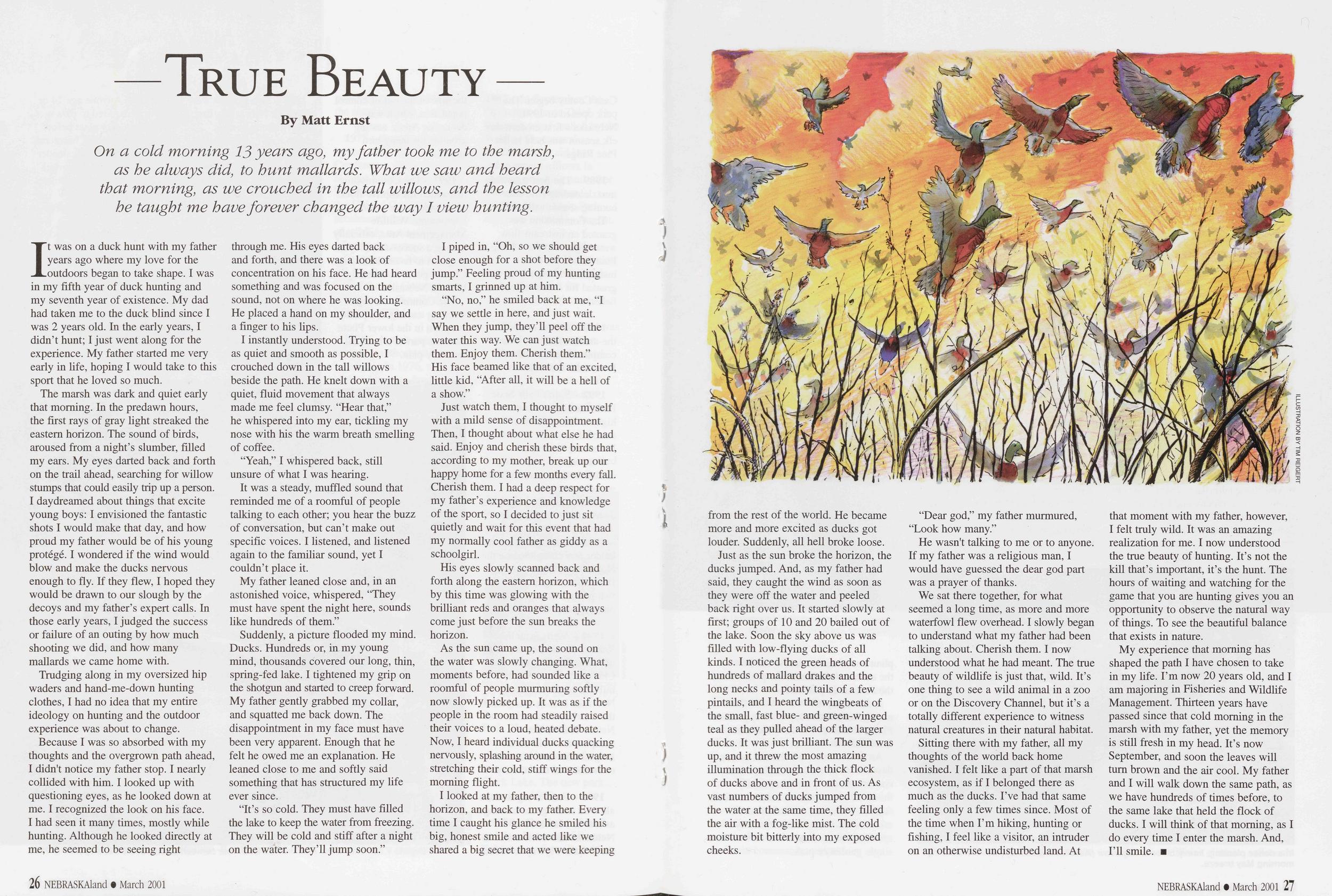
Just as the sun broke the horizon, the ducks jumped. And, as my father had said, they caught the wind as soon as they were off the water and peeled back right over us. It started slowly at first; groups of 10 and 20 bailed out of the lake. Soon the sky above us was filled with low-flying ducks of all kinds. I noticed the green heads of hundreds of mallard drakes and the long necks and pointy tails of a few pintails, and I heard the wingbeats of the small, fast blue- and green-winged teal as they pulled ahead of the larger ducks. It was just brilliant. The sun was up, and it threw the most amazing illumination through the thick flock of ducks above and in front of us. As vast numbers of ducks jumped from the water at the same time, they filled the air with a fog-like mist. The cold moisture bit bitterly into my exposed cheeks.
"Dear god," my father murmured, "Look how many."
He wasn't talking to me or to anyone. If my father was a religious man, I would have guessed the dear god part was a prayer of thanks.
We sat there together, for what seemed a long time, as more and more waterfowl flew overhead. I slowly began to understand what my father had been talking about. Cherish them. I now understood what he had meant. The true beauty of wildlife is just that, wild. It's one thing to see a wild animal in a zoo or on the Discovery Channel, but it's a totally different experience to witness natural creatures in their natural habitat.
Sitting there with my father, all my thoughts of the world back home vanished. I felt like a part of that marsh ecosystem, as if I belonged there as much as the ducks. I've had that same feeling only a few times since. Most of the time when I'm hiking, hunting or fishing, I feel like a visitor, an intruder on an otherwise undisturbed land. At that moment with my father, however, I felt truly wild. It was an amazing realization for me. I now understood the true beauty of hunting. It's not the kill that's important, it's the hunt. The hours of waiting and watching for the game that you are hunting gives you an opportunity to observe the natural way of things. To see the beautiful balance that exists in nature.
My experience that morning has shaped the path I have chosen to take in my life. I'm now 20 years old, and I am majoring in Fisheries and Wildlife Management. Thirteen years have passed since that cold morning in the marsh with my father, yet the memory is still fresh in my head. It's now September, and soon the leaves will turn brown and the air cool. My father and I will walk down the same path, as we have hundreds of times before, to the same lake that held the flock of ducks. I will think of that morning, as I do every time I enter the marsh. And, I'll smile.
A Nebraska Style of Landscaping
Using a plant palette suited to the regional climate and including browns and tans of winter, the Plains landscape aesthetic embraces rich textures, endless movement of long grasses and an informal structure.Nebraska is a deceptive place. Lacking trees, settlers once called it a desert. Absent mountains, travelers claim the topography is flat. Sparsely populated, buffeted by wind and stung by hot and cold extremes, some newcomers find it desolate.
Yet, to the surprise of many, the state harbors a rich botany and horticulture - the foundation blocks for a developing Nebraska style of landscaping. In the "flat, desolate desert," distinctive Plains gardens grow.
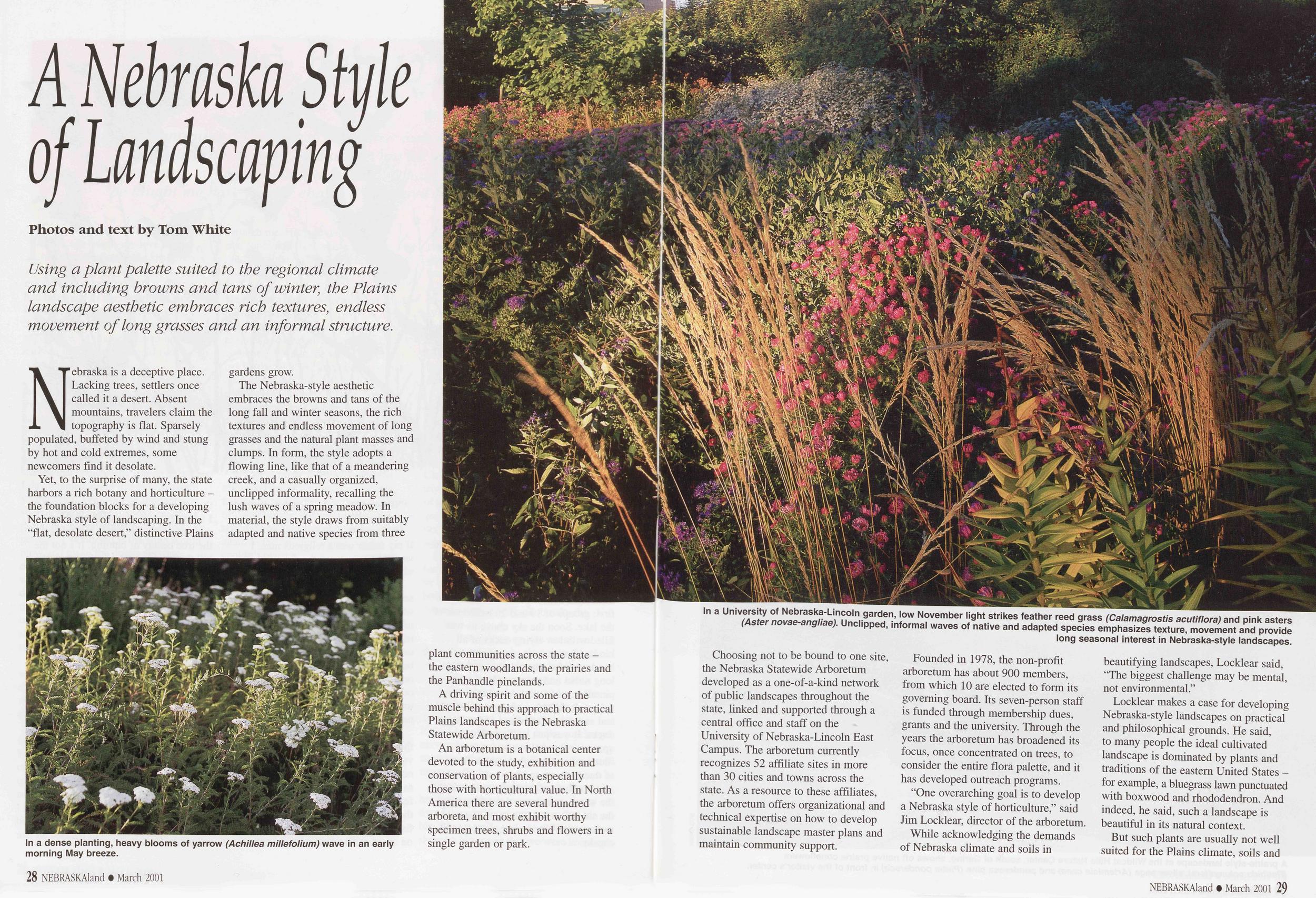
The Nebraska-style aesthetic embraces the browns and tans of the long fall and winter seasons, the rich textures and endless movement of long grasses and the natural plant masses and clumps. In form, the style adopts a flowing line, like that of a meandering creek, and a casually organized, undipped informality, recalling the lush waves of a spring meadow. In material, the style draws from suitably adapted and native species from three
In a dense planting, heavy blooms of yarrow (Achillea millefolium) wave in an early morning May breeze.
plant communities across the state - the eastern woodlands, the prairies and the Panhandle pine lands.
A driving spirit and some of the muscle behind this approach to practical Plains landscapes is the Nebraska Statewide Arboretum.
An arboretum is a botanical center devoted to the study, exhibition and conservation of plants, especially those with horticultural value. In North America there are several hundred arboreta, and most exhibit worthy specimen trees, shrubs and flowers in a single garden or park.
In a University of Nebraska-Lincoln garden, low November light strikes feather reed grass (Calamagrostis acutiflora) and pink asters (Aster novae-angliae). Undipped, informal waves of native and adapted species emphasizes texture, movement and provide long seasonal interest in Nebraska-style landscapes.
Choosing not to be bound to one site, the Nebraska Statewide Arboretum developed as a one-of-a-kind network of public landscapes throughout the state, linked and supported through a central office and staff on the University of Nebraska-Lincoln East Campus. The arboretum currently recognizes 52 affiliate sites in more than 30 cities and towns across the state. As a resource to these affiliates, the arboretum offers organizational and technical expertise on how to develop sustainable landscape master plans and maintain community support.
Founded in 1978, the non-profit arboretum has about 900 members, from which 10 are elected to form its governing board. Its seven-person staff is funded through membership dues, grants and the university. Through the years the arboretum has broadened its focus, once concentrated on trees, to consider the entire flora palette, and it has developed outreach programs.
"One overarching goal is to develop a Nebraska style of horticulture," said Jim Locklear, director of the arboretum.
While acknowledging the demands of Nebraska climate and soils in beautifying landscapes, Locklear said, "The biggest challenge may be mental, not environmental."
Locklear makes a case for developing Nebraska-style landscapes on practical and philosophical grounds. He said, to many people the ideal cultivated landscape is dominated by plants and traditions of the eastern United States - for example, a bluegrass lawn punctuated with boxwood and rhododendron. And indeed, he said, such a landscape is beautiful in its natural context.
But such plants are usually not well suited for the Plains climate, soils and
NEBRASKAland • March 2001 29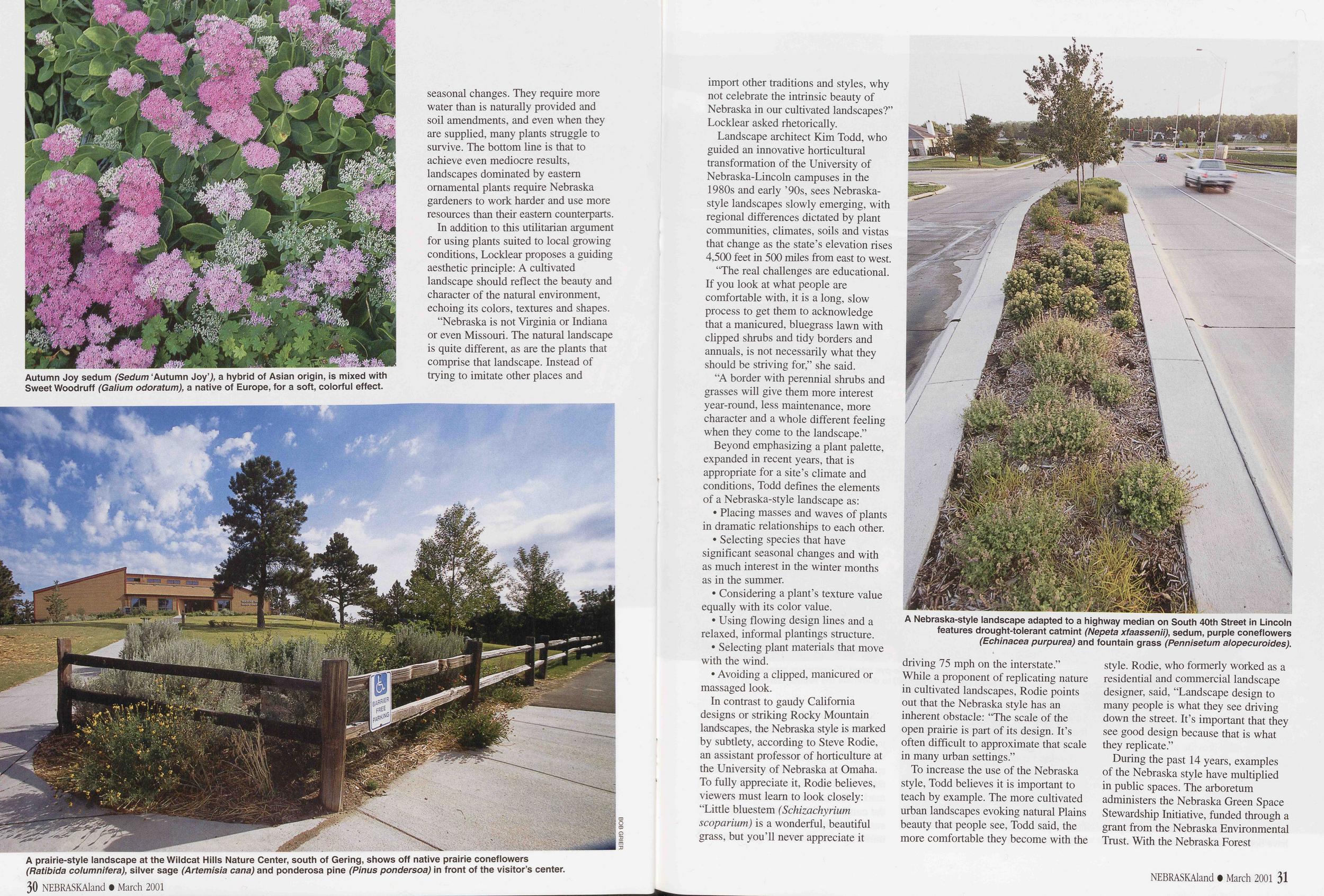
Autumn Joy sedum (Sedum 'Autumn Joy';, a hybrid of Asian origin, is mixed with Sweet Woodruff (Galium odoratum), a native of Europe, for a soft, colorful effect.
seasonal changes. They require more water than is naturally provided and soil amendments, and even when they are supplied, many plants struggle to survive. The bottom line is that to achieve even mediocre results, landscapes dominated by eastern ornamental plants require Nebraska gardeners to work harder and use more resources than their eastern counterparts.
In addition to this utilitarian argument for using plants suited to local growing conditions, Locklear proposes a guiding aesthetic principle: A cultivated landscape should reflect the beauty and character of the natural environment, echoing its colors, textures and shapes.
"Nebraska is not Virginia or Indiana or even Missouri. The natural landscape is quite different, as are the plants that comprise that landscape. Instead of trying to imitate other places and import other traditions and styles, why not celebrate the intrinsic beauty of Nebraska in our cultivated landscapes?" Locklear asked rhetorically.
Landscape architect Kim Todd, who guided an innovative horticultural transformation of the University of Nebraska-Lincoln campuses in the 1980s and early '90s, sees Nebraska- style landscapes slowly emerging, with regional differences dictated by plant communities, climates, soils and vistas that change as the state's elevation rises 4,500 feet in 500 miles from east to west.
"The real challenges are educational. If you look at what people are comfortable with, it is a long, slow process to get them to acknowledge that a manicured, bluegrass lawn with clipped shrubs and tidy borders and annuals, is not necessarily what they should be striving for," she said.
"A border with perennial shrubs and grasses will give them more interest year-round, less maintenance, more character and a whole different feeling when they come to the landscape."
Beyond emphasizing a plant palette, expanded in recent years, that is appropriate for a site's climate and conditions, Todd defines the elements of a Nebraska-style landscape as:
• Placing masses and waves of plants in dramatic relationships to each other. • Selecting species that have significant seasonal changes and with as much interest in the winter months as in the summer. • Considering a plant's texture value equally with its color value. • Using flowing design lines and a relaxed, informal plantings structure. • Selecting plant materials that move with the wind. • Avoiding a clipped, manicured or massaged look.In contrast to gaudy California designs or striking Rocky Mountain landscapes, the Nebraska style is marked by subtlety, according to Steve Rodie, an assistant professor of horticulture at the University of Nebraska at Omaha. To fully appreciate it, Rodie believes, viewers must learn to look closely: "Little bluestem (Schizachyrium scoparium) is a wonderful, beautiful grass, but you'll never appreciate it
A Nebraska-style landscape adapted to a highway median on South 40th Street in Lincoln features drought-tolerant catmint (Nepeta xfaassenii), sedum, purple coneflowers (Echinacea purpurea) and fountain grass (Pennisetum alopecuroides).
driving 75 mph on the interstate." While a proponent of replicating nature in cultivated landscapes, Rodie points out that the Nebraska style has an inherent obstacle: "The scale of the open prairie is part of its design. It's often difficult to approximate that scale in many urban settings."
To increase the use of the Nebraska style, Todd believes it is important to teach by example. The more cultivated urban landscapes evoking natural Plains beauty that people see, Todd said, the more comfortable they become with the
A prairie-style landscape at the Wildcat Hills Nature Center, south of Gering, shows off native prairie coneflowers (Ratibida columnifera), silver sage (Artemisia cana) and ponderosa pine (Pinus pondersoa) in front of the visitor's center.
style. Rodie, who formerly worked as a residential and commercial landscape designer, said, "Landscape design to many people is what they see driving down the street. It's important that they see good design because that is what they replicate."
During the past 14 years, examples of the Nebraska style have multiplied in public spaces. The arboretum administers the Nebraska Green Space Stewardship Initiative, funded through a grant from the Nebraska Environmental Trust. With the Nebraska Forest
NEBRASKAland • March 2001 31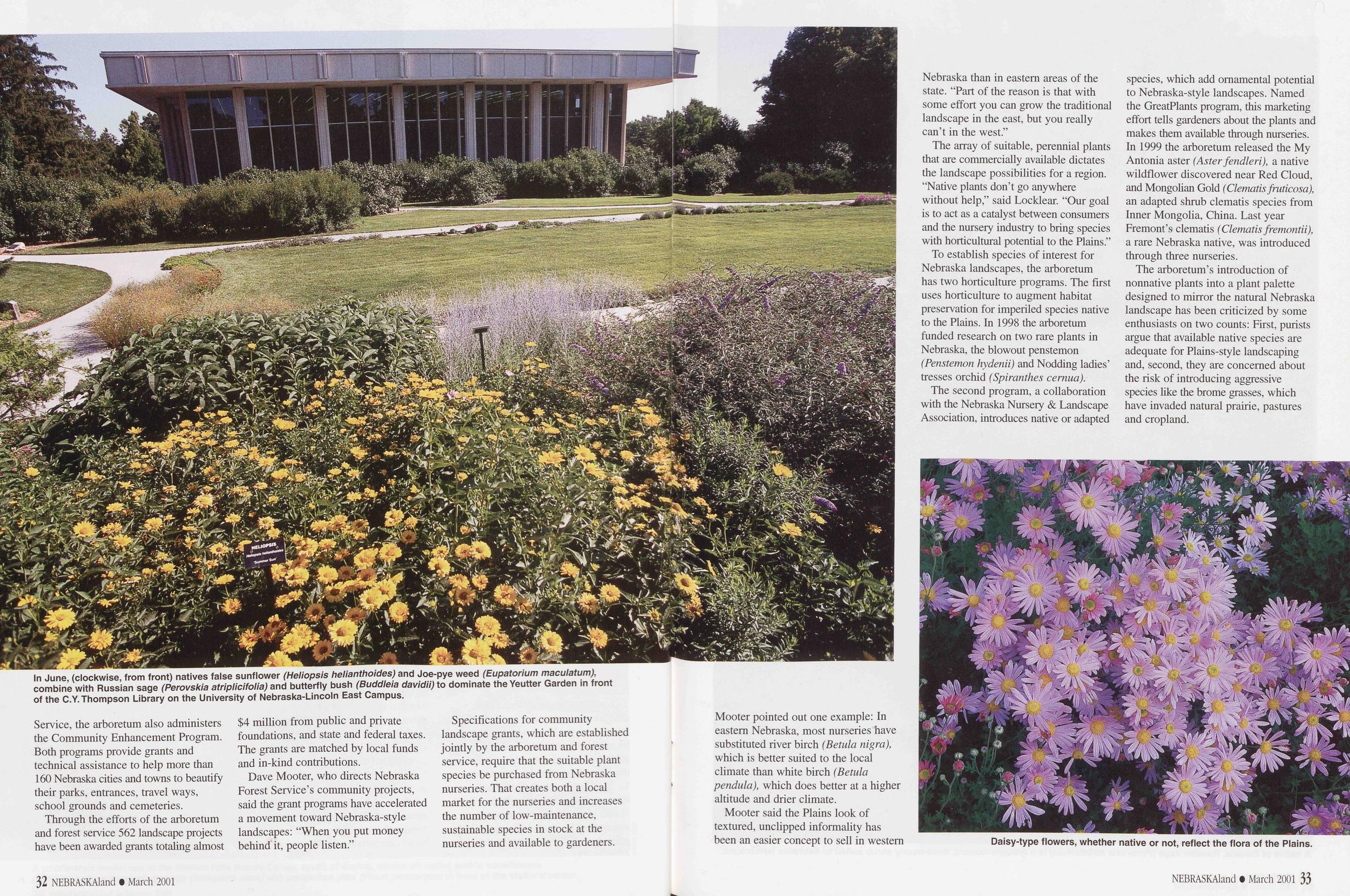
In June, (clockwise, from front) natives false sunflower (Heliopsis helianthoides) and Joe-pye weed (Eupatonum maculatum) combine with Russian sage (Perovskia atriplicifolia) and butterfly bush (Buddleia davidii) to dominate the Yeutter Garden in front of the C.Y.Thompson Library on the University of Nebraska-Lincoln East Campus.
Service, the arboretum also administers the Community Enhancement Program. Both programs provide grants and technical assistance to help more than 160 Nebraska cities and towns to beautify their parks, entrances, travel ways, school grounds and cemeteries.
Through the efforts of the arboretum and forest service 562 landscape projects have been awarded grants totaling almost $4 million from public and private foundations, and state and federal taxes. The grants are matched by local funds and in-kind contributions.
Dave Mooter, who directs Nebraska Forest Service's community projects, said the grant programs have accelerated a movement toward Nebraska-style landscapes: "When you put money behind it, people listen."
Specifications for community landscape grants, which are established jointly by the arboretum and forest service, require that the suitable plant species be purchased from Nebraska nurseries. That creates both a local market for the nurseries and increases the number of low-maintenance, sustainable species in stock at the nurseries and available to gardeners.
Mooter pointed out one example: In eastern Nebraska, most nurseries have substituted river birch (Betula nigra), which is better suited to the local climate than white birch (Betula pendula), which does better at a higher altitude and drier climate.
Mooter said the Plains look of textured, undipped informality has been an easier concept to sell in western Nebraska than in eastern areas of the state. "Part of the reason is that with some effort you can grow the traditional landscape in the east, but you really can't in the west."
The array of suitable, perennial plants that are commercially available dictates the landscape possibilities for a region. "Native plants don't go anywhere without help," said Locklear. "Our goal is to act as a catalyst between consumers and the nursery industry to bring species with horticultural potential to the Plains."
To establish species of interest for Nebraska landscapes, the arboretum has two horticulture programs. The first uses horticulture to augment habitat preservation for imperiled species native to the Plains. In 1998 the arboretum funded research on two rare plants in Nebraska, the blowout penstemon (Penstemon hydenii) and Nodding ladies' tresses orchid (Spiranthes cernua).
The second program, a collaboration with the Nebraska Nursery & Landscape Association, introduces native or adapted species, which add ornamental potential to Nebraska-style landscapes. Named the GreatPlants program, this marketing effort tells gardeners about the plants and makes them available through nurseries. In 1999 the arboretum released the My Antonia aster (Aster fendleri), a native wildflower discovered near Red Cloud, and Mongolian Gold (Clematis fruticosa), an adapted shrub clematis species from Inner Mongolia, China. Last year Fremont's clematis (Clematis fremontii), a rare Nebraska native, was introduced through three nurseries.
The arboretum's introduction of nonnative plants into a plant palette designed to mirror the natural Nebraska landscape has been criticized by some enthusiasts on two counts: First, purists argue that available native species are adequate for Plains-style landscaping and, second, they are concerned about the risk of introducing aggressive species like the brome grasses, which have invaded natural prairie, pastures and cropland.
Daisy-type flowers, whether native or not, reflect the flora of the Plains.
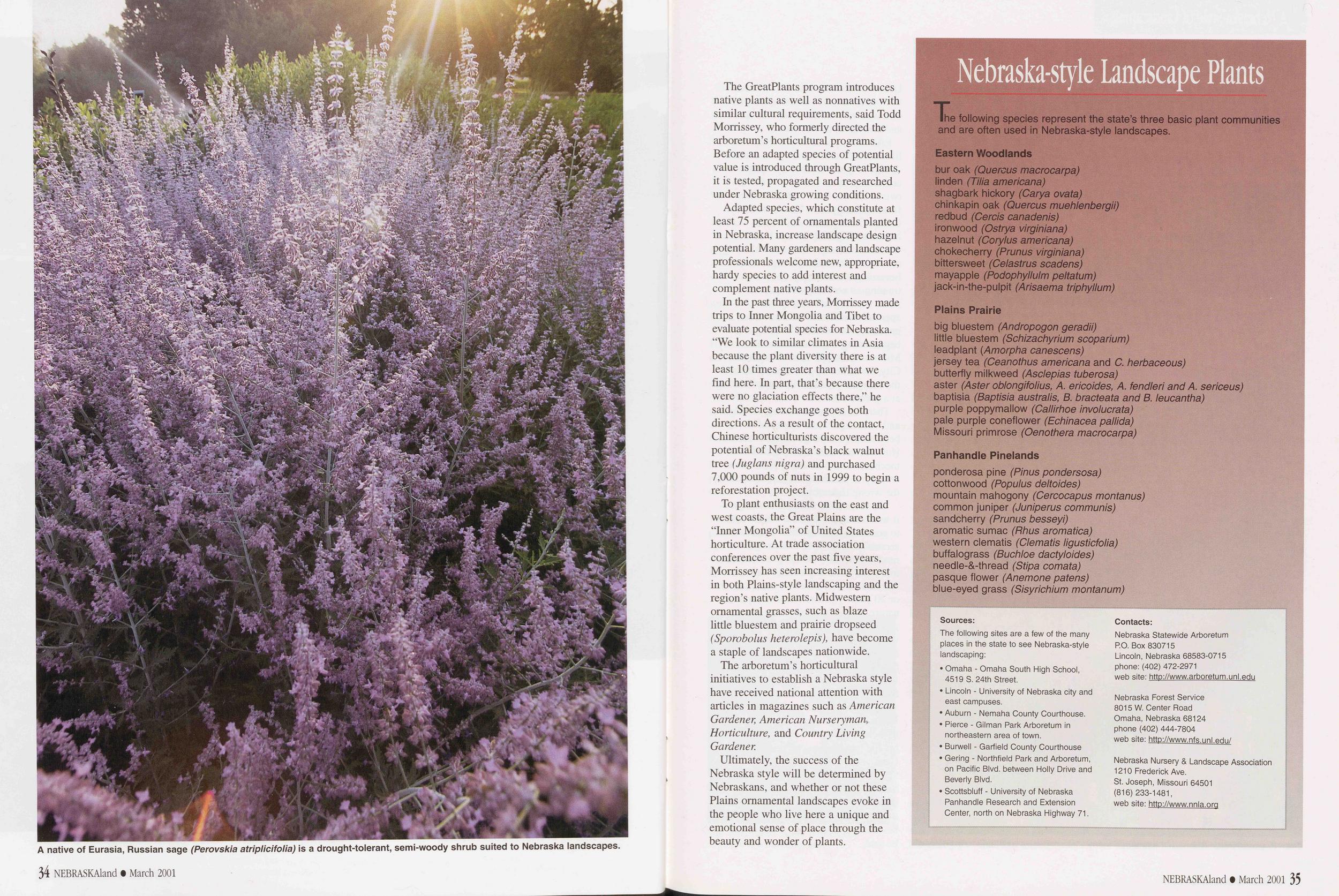
A native of Eurasia, Russian sage (Perovskia atriplicifolia) is a drought-tolerant, semi-woody shrub suited to Nebraska landscapes.
The Great Plants program introduces native plants as well as nonnatives with similar cultural requirements, said Todd Morrissey, who formerly directed the arboretum's horticultural programs. Before an adapted species of potential value is introduced through GreatPlants, it is tested, propagated and researched under Nebraska growing conditions.
Adapted species, which constitute at least 75 percent of ornamentals planted in Nebraska, increase landscape design potential. Many gardeners and landscape professionals welcome new, appropriate, hardy species to add interest and complement native plants.
In the past three years, Morrissey made trips to Inner Mongolia and Tibet to evaluate potential species for Nebraska. "We look to similar climates in Asia because the plant diversity there is at least 10 times greater than what we find here. In part, that's because there were no glaciation effects there," he said. Species exchange goes both directions. As a result of the contact, Chinese horticulturists discovered the potential of Nebraska's black walnut tree (Juglans nigra) and purchased 7,000 pounds of nuts in 1999 to begin a reforestation project.
To plant enthusiasts on the east and west coasts, the Great Plains are the "Inner Mongolia" of United States horticulture. At trade association conferences over the past five years, Morrissey has seen increasing interest in both Plains-style landscaping and the region's native plants. Midwestern ornamental grasses, such as blaze little bluestem and prairie dropseed (Sporobolus heterolepis), have become a staple of landscapes nationwide.
The arboretum's horticultural initiatives to establish a Nebraska style have received national attention with articles in magazines such as American Gardener, American Nurseryman, Horticulture, and Country Living Gardener.
Ultimately, the success of the Nebraska style will be determined by Nebraskans, and whether or not these Plains ornamental landscapes evoke in the people who live here a unique and emotional sense of place through the beauty and wonder of plants.
Nebraska-style Landscape Plants
The following species represent the state's three basic plant communities and are often used in Nebraska-style landscapes.
Eastern Woodlands
bur oak (Quercus macrocarpa) linden (Tilia americana) shagbark hickory (Carya ovata) chinkapin oak (Quercus muehlenbergii) redbud (Cercis canadenis) ironwood (Ostrya virginiana) hazelnut (Corylus americana) chokecherry (Prunus virginiana) bittersweet (Celastrus scadens) mayapple (Podophyllum peltatum) jack-in-the-pulpit (Arisaema triphylium)Plains Prairie
big bluestem (Andropogon geradii) little bluestem (Schizachyrium scoparium) leadplant (Amorpha canescens) jersey tea (Ceanothus americana andC. herbaceous) butterfly milkweed (Asclepias tuberosa) aster (Aster obiongifolius, A. ericoides, A. fendleri and A. sericeus) baptisia (Baptisia australis, B. bracteata and B. leucantha) purple poppymallow (Callirhoe invoiucrata) pale purple coneflower (Echinacea pallida) Missouri primrose (Oenothera macrocarpa) Panhandle Pinelands ponderosa pine (Pinus pondersosa) cottonwood (Populus deltoides) mountain mahogony (Cercocapus montanus) common juniper (Juniperus communis) sandcherry (Prunus besseyi) aromatic sumac (Rhus aromatica) western clematis (Clematis ligusticfolia) buffalograss (Buchloe dactyloides) needle-&-thread (Stipa comata) pasque flower (Anemone patens) blue-eyed grass (Sisyrichium montanum) Sources: The following sites are a few of the many places in the state to see Nebraska-style landscaping: • Omaha - Omaha South High School, 4519 S. 24th Street. • Lincoln - University of Nebraska city and east campuses. • Auburn - Nemaha County Courthouse. • Pierce - Gilman Park Arboretum in northeastern area of town. • Burwell - Garfield County Courthouse • Gering - Northfield Park and Arboretum, on Pacific Blvd. between Holly Drive and Beverly Blvd. • Scottsbluff - University of Nebraska Panhandle Research and Extension Center, north on Nebraska Highway 71. Contacts: Nebraska Statewide Arboretum P.O. Box 830715 Lincoln, Nebraska 68583-0715 phone: (402) 472-2971 web site: http://www.arboretum.unl.edu Nebraska Forest Service 8015 W. Center Road Omaha, Nebraska 68124 phone (402) 444-7804 web site: http://www.nfs.unl.edu/ Nebraska Nursery & Landscape Association 1210 Frederick Ave. St. Joseph, Missouri 64501 (816)233-1481, web site: http://www.nnla.org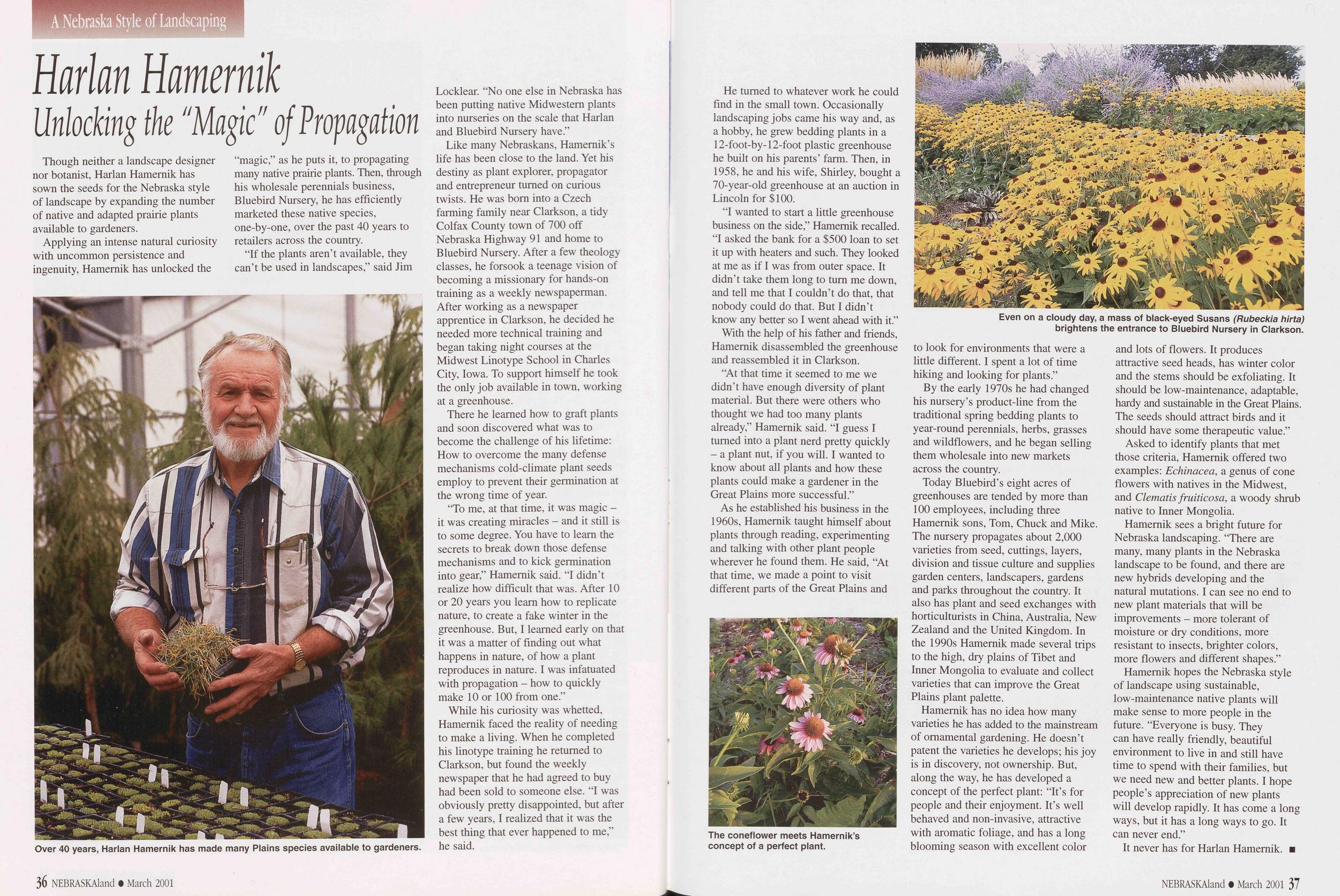
A Nebraska Style of Landscaping
Unlocking the "Magic" of Propagation
Though neither a landscape designer nor botanist, Harlan Hamernik has sown the seeds for the Nebraska style of landscape by expanding the number of native and adapted prairie plants available to gardeners.
Applying an intense natural curiosity with uncommon persistence and ingenuity, Hamernik has unlocked the "magic," as he puts it, to propagating many native prairie plants. Then, through his wholesale perennials business, Bluebird Nursery, he has efficiently marketed these native species, one-by-one, over the past 40 years to retailers across the country.
"If the plants aren't available, they can't be used in landscapes," said Jim
Over 40 years, Harlan Hamernik has made many Plains species available to gardeners.
Locklear. "No one else in Nebraska has been putting native Midwestern plants into nurseries on the scale that Harlan and Bluebird Nursery have."
Like many Nebraskans, Hamernik's life has been close to the land. Yet his destiny as plant explorer, propagator and entrepreneur turned on curious twists. He was born into a Czech farming family near Clarkson, a tidy Colfax County town of 700 off Nebraska Highway 91 and home to Bluebird Nursery. After a few theology classes, he forsook a teenage vision of becoming a missionary for hands-on training as a weekly newspaperman. After working as a newspaper apprentice in Clarkson, he decided he needed more technical training and began taking night courses at the Midwest Linotype School in Charles City, Iowa. To support himself he took the only job available in town, working at a greenhouse.
There he learned how to graft plants and soon discovered what was to become the challenge of his lifetime: How to overcome the many defense mechanisms cold-climate plant seeds employ to prevent their germination at the wrong time of year.
"To me, at that time, it was magic - it was creating miracles - and it still is to some degree. You have to learn the secrets to break down those defense mechanisms and to kick germination into gear," Hamernik said. "I didn't realize how difficult that was. After 10 or 20 years you learn how to replicate nature, to create a fake winter in the greenhouse. But, I learned early on that it was a matter of finding out what happens in nature, of how a plant reproduces in nature. I was infatuated with propagation - how to quickly make 10 or 100 from one."
While his curiosity was whetted, Hamernik faced the reality of needing to make a living. When he completed his linotype training he returned to Clarkson, but found the weekly newspaper that he had agreed to buy had been sold to someone else. "I was obviously pretty disappointed, but after a few years, I realized that it was the best thing that ever happened to me," he said.
He turned to whatever work he could find in the small town. Occasionally landscaping jobs came his way and, as a hobby, he grew bedding plants in a 12-foot-by-12-foot plastic greenhouse he built on his parents' farm. Then, in 1958, he and his wife, Shirley, bought a 70-year-old greenhouse at an auction in Lincoln for $100.
"I wanted to start a little greenhouse business on the side," Hamernik recalled. "I asked the bank for a $500 loan to set it up with heaters and such. They looked at me as if I was from outer space. It didn't take them long to turn me down, and tell me that I couldn't do that, that nobody could do that. But I didn't know any better so I went ahead with it."
With the help of his father and friends, Hamernik disassembled the greenhouse and reassembled it in Clarkson.
"At that time it seemed to me we didn't have enough diversity of plant material. But there were others who thought we had too many plants already," Hamernik said. "I guess I turned into a plant nerd pretty quickly - a plant nut, if you will. I wanted to know about all plants and how these plants could make a gardener in the Great Plains more successful."
As he established his business in the 1960s, Hamernik taught himself about plants through reading, experimenting and talking with other plant people wherever he found them. He said, "At that time, we made a point to visit different parts of the Great Plains and
Even on a cloudy day, a mass of black-eyed Susans (Rubeckia hirta) brightens the entrance to Bluebird Nursery in Clarkson.
The coneflower meets Hamernik's concept of a perfect plant.
to look for environments that were a little different. I spent a lot of time hiking and looking for plants."
By the early 1970s he had changed his nursery's product-line from the traditional spring bedding plants to year-round perennials, herbs, grasses and wildflowers, and he began selling them wholesale into new markets across the country.
Today Bluebird's eight acres of greenhouses are tended by more than 100 employees, including three Hamernik sons, Tom, Chuck and Mike. The nursery propagates about 2,000 varieties from seed, cuttings, layers, division and tissue culture and supplies garden centers, landscapers, gardens and parks throughout the country. It also has plant and seed exchanges with horticulturists in China, Australia, New Zealand and the United Kingdom. In the 1990s Hamernik made several trips to the high, dry plains of Tibet and Inner Mongolia to evaluate and collect varieties that can improve the Great Plains plant palette.
Hamernik has no idea how many varieties he has added to the mainstream of ornamental gardening. He doesn't patent the varieties he develops; his joy is in discovery, not ownership. But, along the way, he has developed a concept of the perfect plant: "It's for people and their enjoyment. It's well behaved and non-invasive, attractive with aromatic foliage, and has a long blooming season with excellent color and lots of flowers. It produces attractive seed heads, has winter color and the stems should be exfoliating. It should be low-maintenance, adaptable, hardy and sustainable in the Great Plains. The seeds should attract birds and it should have some therapeutic value."
Asked to identify plants that met those criteria, Hamernik offered two examples: Echinacea, a genus of cone flowers with natives in the Midwest, and Clematis fruiticosa, a woody shrub native to Inner Mongolia.
Hamernik sees a bright future for Nebraska landscaping. "There are many, many plants in the Nebraska landscape to be found, and there are new hybrids developing and the natural mutations. I can see no end to new plant materials that will be improvements - more tolerant of moisture or dry conditions, more resistant to insects, brighter colors, more flowers and different shapes."
Hamernik hopes the Nebraska style of landscape using sustainable, low-maintenance native plants will make sense to more people in the future. "Everyone is busy. They can have really friendly, beautiful environment to live in and still have time to spend with their families, but we need new and better plants. I hope people's appreciation of new plants will develop rapidly. It has come a long ways, but it has a long ways to go. It can never end."
It never has for Harlan Hamernik.
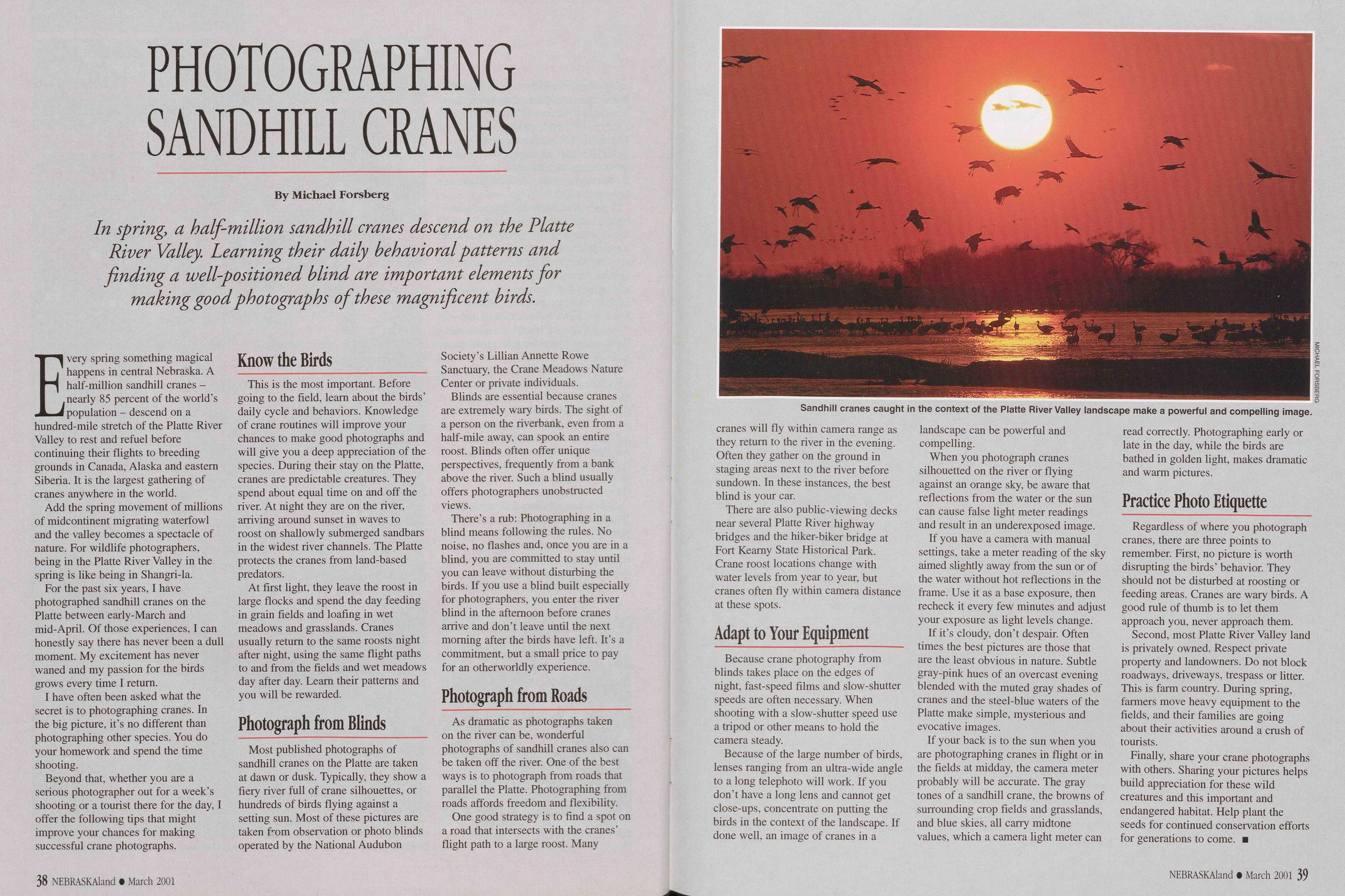
PHOTOGRAPHING SANDHILL CRANES
In spring a half-million sandhill cranes descend on the Platte River Valley. Learning their daily behavioral patterns and finding a well-positioned blind are important elements for making good photographs of these magnificent birds.Every spring something magical happens in central Nebraska. A half-million sandhill cranes - nearly 85 percent of the world's population - descend on a hundred-mile stretch of the Platte River Valley to rest and refuel before continuing their flights to breeding grounds in Canada, Alaska and eastern Siberia. It is the largest gathering of cranes anywhere in the world.
Add the spring movement of millions of midcontinent migrating waterfowl and the valley becomes a spectacle of nature. For wildlife photographers, being in the Platte River Valley in the spring is like being in Shangri-la.
For the past six years, I have photographed sandhill cranes on the Platte between early-March and mid-April. Of those experiences, I can honestly say there has never been a dull moment. My excitement has never waned and my passion for the birds grows every time I return.
I have often been asked what the secret is to photographing cranes. In the big picture, it's no different than photographing other species. You do your homework and spend the time shooting.
Beyond that, whether you are a serious photographer out for a week's shooting or a tourist there for the day, I offer the following tips that might improve your chances for making successful crane photographs.
Know the Birds
This is the most important. Before going to the field, learn about the birds' daily cycle and behaviors. Knowledge of crane routines will improve your chances to make good photographs and will give you a deep appreciation of the species. During their stay on the Platte, cranes are predictable creatures. They spend about equal time on and off the river. At night they are on the river, arriving around sunset in waves to roost on shallowly submerged sandbars in the widest river channels. The Platte protects the cranes from land-based predators.
At first light, they leave the roost in large flocks and spend the day feeding in grain fields and loafing in wet meadows and grasslands. Cranes usually return to the same roosts night after night, using the same flight paths to and from the fields and wet meadows day after day. Learn their patterns and you will be rewarded.
Photograph from Blinds
Most published photographs of sandhill cranes on the Platte are taken at dawn or dusk. Typically, they show a fiery river full of crane silhouettes, or hundreds of birds flying against a setting sun. Most of these pictures are taken from observation or photo blinds operated by the National Audubon Society's Lillian Annette Rowe Sanctuary, the Crane Meadows Nature Center or private individuals.
Blinds are essential because cranes are extremely wary birds. The sight of a person on the riverbank, even from a half-mile away, can spook an entire roost. Blinds often offer unique perspectives, frequently from a bank above the river. Such a blind usually offers photographers unobstructed views.
There's a rub: Photographing in a blind means following the rules. No noise, no flashes and, once you are in a blind, you are committed to stay until you can leave without disturbing the birds. If you use a blind built especially for photographers, you enter the river blind in the afternoon before cranes arrive and don't leave until the next morning after the birds have left. It's a commitment, but a small price to pay for an otherworldly experience.
Photograph from Roads
As dramatic as photographs taken on the river can be, wonderful photographs of sandhill cranes also can be taken off the river. One of the best ways is to photograph from roads that parallel the Platte. Photographing from roads affords freedom and flexibility.
One good strategy is to find a spot on a road that intersects with the cranes' flight path to a large roost. Many
Sandhill cranes caught in the context of the Platte River Valley landscape make a powerful and compelling image.
cranes will fly within camera range as they return to the river in the evening. Often they gather on the ground in staging areas next to the river before sundown. In these instances, the best blind is your car.
There are also public-viewing decks near several Platte River highway bridges and the hiker-biker bridge at Fort Kearny State Historical Park. Crane roost locations change with water levels from year to year, but cranes often fly within camera distance at these spots.
Adapt to Your Equipment
Because crane photography from blinds takes place on the edges of night, fast-speed films and slow-shutter speeds are often necessary. When shooting with a slow-shutter speed use a tripod or other means to hold the camera steady.
Because of the large number of birds, lenses ranging from an ultra-wide angle to a long telephoto will work. If you don't have a long lens and cannot get close-ups, concentrate on putting the birds in the context of the landscape. If done well, an image of cranes in a landscape can be powerful and compelling.
When you photograph cranes silhouetted on the river or flying against an orange sky, be aware that reflections from the water or the sun can cause false fight meter readings and result in an underexposed image.
If you have a camera with manual settings, take a meter reading of the sky aimed slightly away from the sun or of the water without hot reflections in the frame. Use it as a base exposure, then recheck it every few minutes and adjust your exposure as fight levels change.
If it's cloudy, don't despair. Often times the best pictures are those that are the least obvious in nature. Subtle gray-pink hues of an overcast evening blended with the muted gray shades of cranes and the steel-blue waters of the Platte make simple, mysterious and evocative images.
If your back is to the sun when you are photographing cranes in flight or in the fields at midday, the camera meter probably will be accurate. The gray tones of a sandhill crane, the browns of surrounding crop fields and grasslands, and blue skies, all carry midtone values, which a camera light meter can read correctly. Photographing early or late in the day, while the birds are bathed in golden light, makes dramatic and warm pictures.
Practice Photo Etiquette
Regardless of where you photograph cranes, there are three points to remember. First, no picture is worth disrupting the birds' behavior. They should not be disturbed at roosting or feeding areas. Cranes are wary birds. A good rule of thumb is to let them approach you, never approach them.
Second, most Platte River Valley land is privately owned. Respect private property and landowners. Do not block roadways, driveways, trespass or litter. This is farm country. During spring, farmers move heavy equipment to the fields, and their families are going about their activities around a crush of tourists.
Finally, share your crane photographs with others. Sharing your pictures helps build appreciation for these wild creatures and this important and endangered habitat. Help plant the seeds for continued conservation efforts for generations to come.
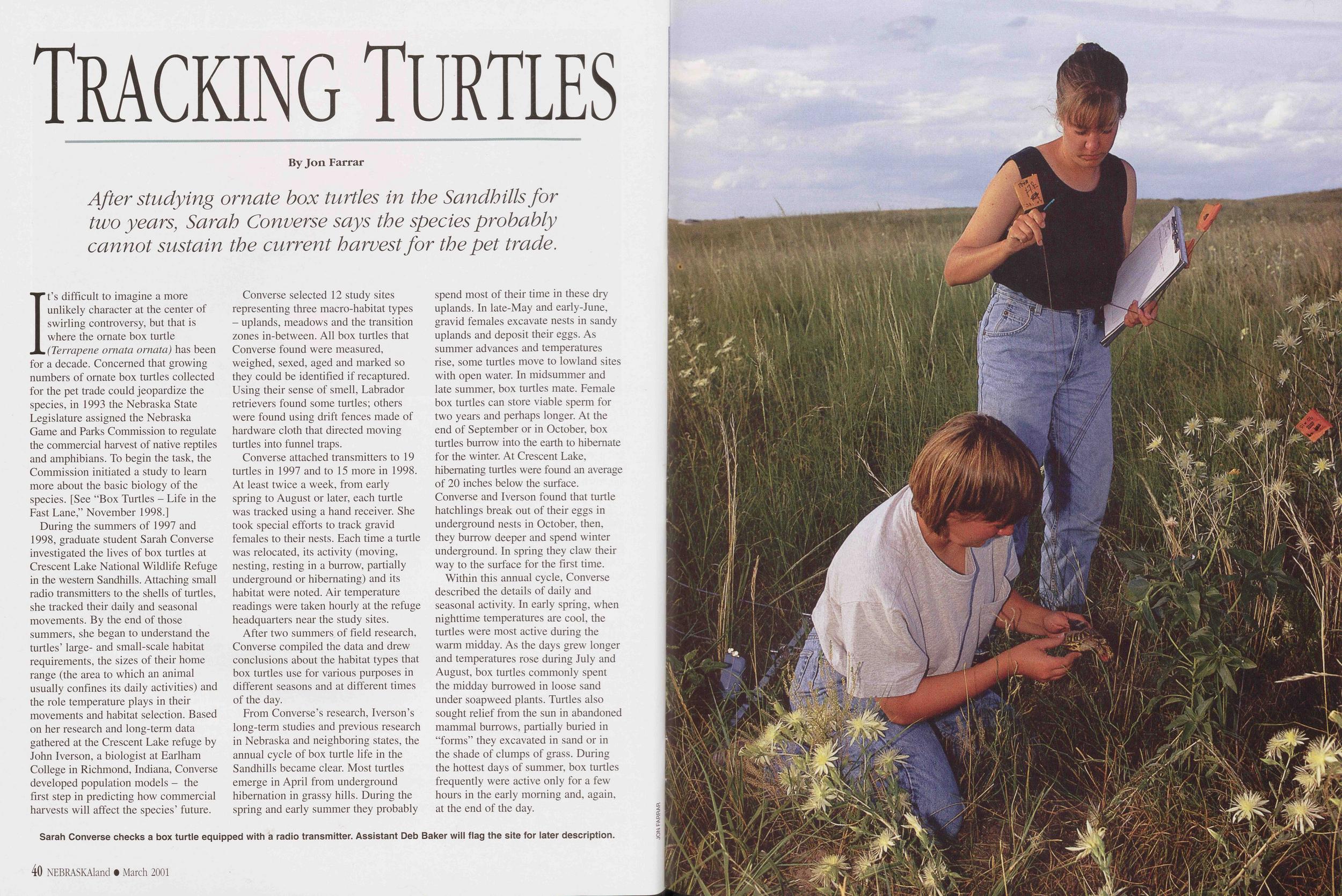
Tracking Turtles
After studying ornate box turtles in the Sandhills for two years, Sarah Converse says the species probably cannot sustain the current harvest for the pet trade.It's difficult to imagine a more unlikely character at the center of swirling controversy, but that is where the ornate box turtle (Terrapene ornata ornata) has been for a decade. Concerned that growing numbers of ornate box turtles collected for the pet trade could jeopardize the species, in 1993 the Nebraska State Legislature assigned the Nebraska Game and Parks Commission to regulate the commercial harvest of native reptiles and amphibians. To begin the task, the Commission initiated a study to learn more about the basic biology of the species. [See "Box Turtles - Life in the Fast Lane," November 1998.]
During the summers of 1997 and 1998, graduate student Sarah Converse investigated the lives of box turtles at Crescent Lake National Wildlife Refuge in the western Sandhills. Attaching small radio transmitters to the shells of turtles, she tracked their daily and seasonal movements. By the end of those summers, she began to understand the turtles' large- and small-scale habitat requirements, the sizes of their home range (the area to which an animal usually confines its daily activities) and the role temperature plays in their movements and habitat selection. Based on her research and long-term data gathered at the Crescent Lake refuge by John Iverson, a biologist at Earlham College in Richmond, Indiana, Converse developed population models - the first step in predicting how commercial harvests will affect the species' future.
Converse selected 12 study sites representing three macro-habitat types - uplands, meadows and the transition zones in-between. All box turtles that Converse found were measured, weighed, sexed, aged and marked so they could be identified if recaptured. Using their sense of smell, Labrador retrievers found some turtles; others were found using drift fences made of hardware cloth that directed moving turtles into funnel traps.
Converse attached transmitters to 19 turtles in 1997 and to 15 more in 1998. At least twice a week, from early spring to August or later, each turtle was tracked using a hand receiver. She took special efforts to track gravid females to their nests. Each time a turtle was relocated, its activity (moving, nesting, resting in a burrow, partially underground or hibernating) and its habitat were noted. Air temperature readings were taken hourly at the refuge headquarters near the study sites.
After two summers of field research, Converse compiled the data and drew conclusions about the habitat types that box turtles use for various purposes in different seasons and at different times of the day.
From Converse's research, Iverson's long-term studies and previous research in Nebraska and neighboring states, the annual cycle of box turtle life in the Sandhills became clear. Most turtles emerge in April from underground hibernation in grassy hills. During the spring and early summer they probably spend most of their time in these dry uplands. In late-May and early-June, gravid females excavate nests in sandy uplands and deposit their eggs. As summer advances and temperatures rise, some turtles move to lowland sites with open water. In midsummer and late summer, box turtles mate. Female box turtles can store viable sperm for two years and perhaps longer. At the end of September or in October, box turtles burrow into the earth to hibernate for the winter. At Crescent Lake, hibernating turtles were found an average of 20 inches below the surface. Converse and Iverson found that turtle hatchlings break out of their eggs in underground nests in October, then, they burrow deeper and spend winter underground. In spring they claw their way to the surface for the first time.
Within this annual cycle, Converse described the details of daily and seasonal activity. In early spring, when nighttime temperatures are cool, the turtles were most active during the warm midday. As the days grew longer and temperatures rose during July and August, box turtles commonly spent the midday burrowed in loose sand under soap weed plants. Turtles also sought relief from the sun in abandoned mammal burrows, partially buried in "forms" they excavated in sand or in the shade of clumps of grass. During the hottest days of summer, box turtles frequently were active only for a few hours in the early mornin
Sarah Converse checks a box turtle equipped with a radio transmitter. Assistant Deb Baker will flag the site for later description.
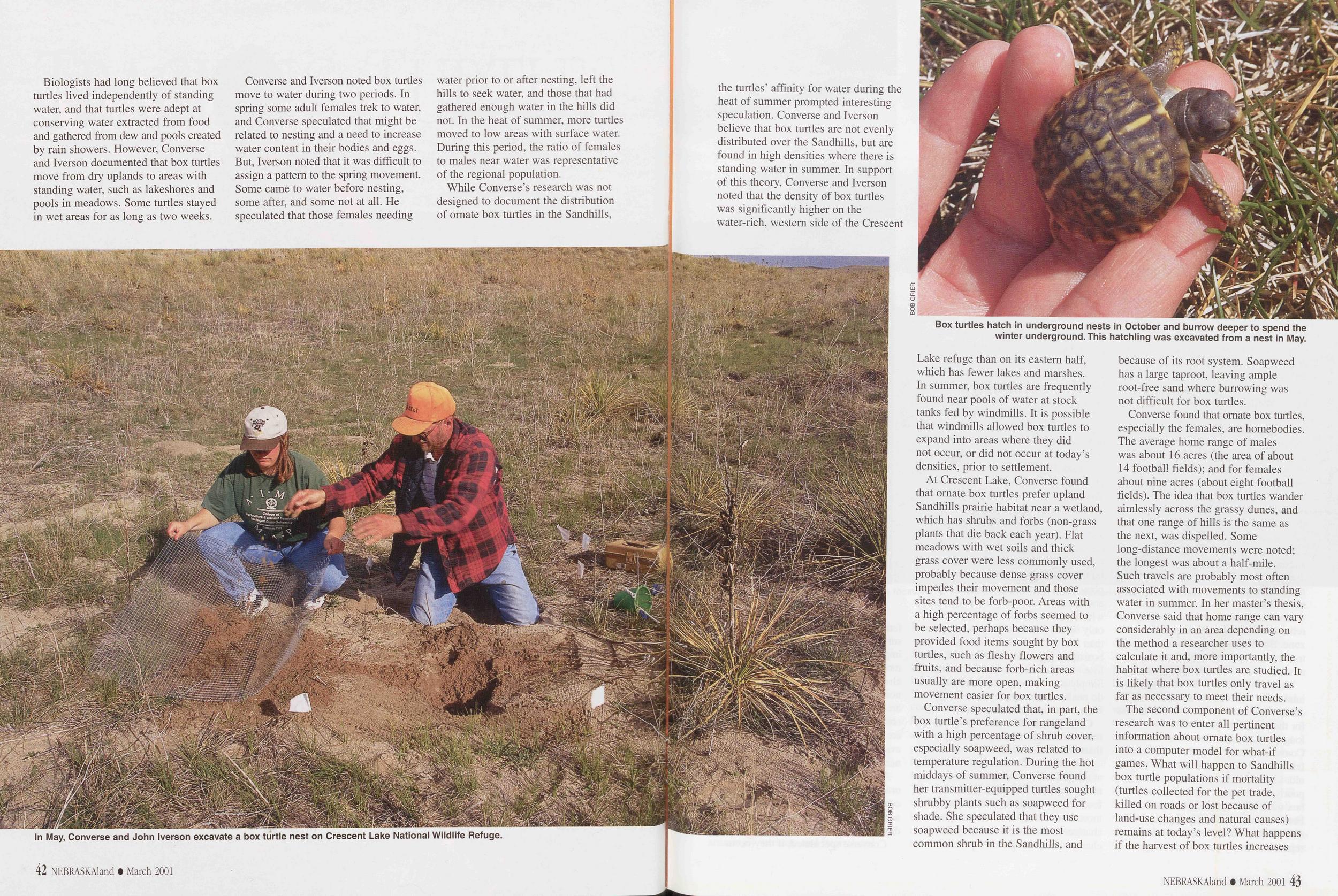
Biologists had long believed that box turtles lived independently of standing water, and that turtles were adept at conserving water extracted from food and gathered from dew and pools created by rain showers. However, Converse and Iverson documented that box turtles move from dry uplands to areas with standing water, such as lakeshores and pools in meadows. Some turtles stayed in wet areas for as long as two weeks.
Converse and Iverson noted box turtles move to water during two periods. In spring some adult females trek to water, and Converse speculated that might be related to nesting and a need to increase water content in their bodies and eggs. But, Iverson noted that it was difficult to assign a pattern to the spring movement. Some came to water before nesting, some after, and some not at all. He speculated that those females needing water prior to or after nesting, left the hills to seek water, and those that had gathered enough water in the hills did not. In the heat of summer, more turtles moved to low areas with surface water. During this period, the ratio of females to males near water was representative of the regional population.
While Converse's research was not designed to document the distribution of ornate box turtles in the Sandhills, the turtles' affinity for water during the heat of summer prompted interesting speculation. Converse and Iverson believe that box turtles are not evenly distributed over the Sandhills, but are found in high densities where there is standing water in summer. In support of this theory, Converse and Iverson noted that the density of box turtles was significantly higher on the water-rich, western side of the Crescent
Box turtles hatch in underground nests in October and burrow deeper to spend the winter underground. This hatchling was excavated from a nest in May.
In May, Converse and John Iverson excavate a box turtle nest on Crescent Lake National Wildlife Refuge
Lake refuge than on its eastern half, which has fewer lakes and marshes. In summer, box turtles are frequently found near pools of water at stock tanks fed by windmills. It is possible that windmills allowed box turtles to expand into areas where they did not occur, or did not occur at today's densities, prior to settlement.
At Crescent Lake, Converse found that ornate box turtles prefer upland Sandhills prairie habitat near a wetland, which has shrubs and forbs (non-grass plants that die back each year). Flat meadows with wet soils and thick grass cover were less commonly used, probably because dense grass cover impedes their movement and those sites tend to be forb-poor. Areas with a high percentage of forbs seemed to be selected, perhaps because they provided food items sought by box turtles, such as fleshy flowers and fruits, and because forb-rich areas usually are more open, making movement easier for box turtles.
Converse speculated that, in part, the box turtle's preference for rangeland with a high percentage of shrub cover, especially soapweed, was related to temperature regulation. During the hot middays of summer, Converse found her transmitter-equipped turtles sought shrubby plants such as soapweed for shade. She speculated that they use soapweed because it is the most common shrub in the Sandhills, and because of its root system. Soapweed has a large taproot, leaving ample root-free sand where burrowing was not difficult for box turtles.
Converse found that ornate box turtles, especially the females, are homebodies. The average home range of males was about 16 acres (the area of about 14 football fields); and for females about nine acres (about eight football fields). The idea that box turtles wander aimlessly across the grassy dunes, and that one range of hills is the same as the next, was dispelled. Some long-distance movements were noted; the longest was about a half-mile. Such travels are probably most often associated with movements to standing water in summer. In her master's thesis, Converse said that home range can vary considerably in an area depending on the method a researcher uses to calculate it and, more importantly, the habitat where box turtles are studied. It is likely that box turtles only travel as far as necessary to meet their needs.
The second component of Converse's research was to enter all pertinent information about ornate box turtles into a computer model for what-if games. What will happen to Sandhills box turtle populations if mortality (turtles collected for the pet trade, killed on roads or lost because of land-use changes and natural causes) remains at today's level? What happens if the harvest of box turtles increases
NEBRASKAland • March 2001 43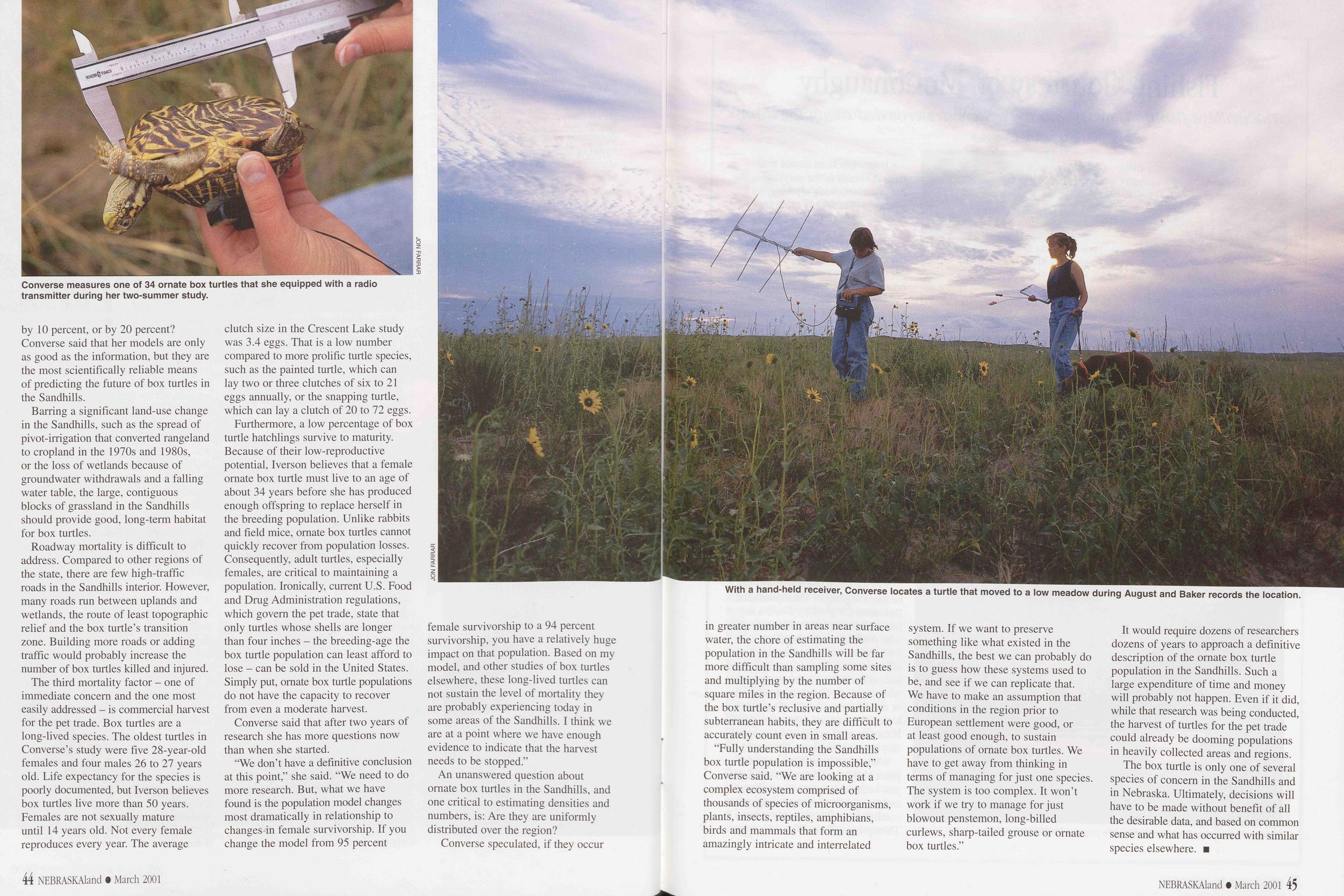
Converse measures one of 34 ornate box turtles that she equipped with a radio transmitter during her two-summer study.
by 10 percent, or by 20 percent? Converse said that her models are only as good as the information, but they are the most scientifically reliable means of predicting the future of box turtles in the Sandhills.
Barring a significant land-use change in the Sandhills, such as the spread of pivot-irrigation that converted rangeland to cropland in the 1970s and 1980s, or the loss of wetlands because of groundwater withdrawals and a falling water table, the large, contiguous blocks of grassland in the Sandhills should provide good, long-term habitat for box turtles.
Roadway mortality is difficult to address. Compared to other regions of the state, there are few high-traffic roads in the Sandhills interior. However, many roads run between uplands and wetlands, the route of least topographic relief and the box turtle's transition zone. Building more roads or adding traffic would probably increase the number of box turtles killed and injured.
The third mortality factor - one of immediate concern and the one most easily addressed - is commercial harvest for the pet trade. Box turtles are a long-lived species. The oldest turtles in Converse's study were five 28-year-old females and four males 26 to 27 years old. Life expectancy for the species is poorly documented, but Iverson believes box turtles live more than 50 years. Females are not sexually mature until 14 years old. Not every female reproduces every year. The average clutch size in the Crescent Lake study was 3.4 eggs. That is a low number compared to more prolific turtle species, such as the painted turtle, which can lay two or three clutches of six to 21 eggs annually, or the snapping turtle, which can lay a clutch of 20 to 72 eggs.
Furthermore, a low percentage of box turtle hatchlings survive to maturity. Because of their low-reproductive potential, Iverson believes that a female ornate box turtle must live to an age of about 34 years before she has produced enough offspring to replace herself in the breeding population. Unlike rabbits and field mice, ornate box turtles cannot quickly recover from population losses. Consequently, adult turtles, especially females, are critical to maintaining a population. Ironically, current U.S. Food and Drug Administration regulations, which govern the pet trade, state that only turtles whose shells are longer than four inches - the breeding-age the box turtle population can least afford to lose - can be sold in the United States. Simply put, ornate box turtle populations do not have the capacity to recover from even a moderate harvest.
Converse said that after two years of research she has more questions now than when she started.
"We don't have a definitive conclusion at this point," she said. "We need to do more research. But, what we have found is the population model changes most dramatically in relationship to changes in female survivorship. If you change the model from 95 percent female survivorship to a 94 percent survivorship, you have a relatively huge impact on that population. Based on my model, and other studies of box turtles elsewhere, these long-lived turtles can not sustain the level of mortality they are probably experiencing today in some areas of the Sandhills. I think we are at a point where we have enough evidence to indicate that the harvest needs to be stopped."
An unanswered question about ornate box turtles in the Sandhills, and one critical to estimating densities and numbers, is: Are they are uniformly distributed over the region?
Converse speculated, if they occur
With a hand-held receiver, Converse locates a turtle that renoved to a low meadow during August and Baker records the location.
in greater number in areas near surface water, the chore of estimating the population in the Sandhills will be far more difficult than sampling some sites and multiplying by the number of square miles in the region. Because of the box turtle's reclusive and partially subterranean habits, they are difficult to accurately count even in small areas.
"Fully understanding the Sandhills box turtle population is impossible," Converse said. "We are looking at a complex ecosystem comprised of thousands of species of microorganisms, plants, insects, reptiles, amphibians, birds and mammals that form an amazingly intricate and interrelated system. If we want to preserve something like what existed in the Sandhills, the best we can probably do is to guess how these systems used to be, and see if we can replicate that. We have to make an assumption that conditions in the region prior to European settlement were good, or at least good enough, to sustain populations of ornate box turtles. We have to get away from thinking in terms of managing for just one species. The system is too complex. It won't work if we try to manage for just blowout penstemon, long-billed curlews, sharp-tailed grouse or ornate box turtles."
It would require dozens of researchers dozens of years to approach a definitive description of the ornate box turtle population in the Sandhills. Such a large expenditure of time and money will probably not happen. Even if it did, while that research was being conducted, the harvest of turtles for the pet trade could already be dooming populations in heavily collected areas and regions.
The box turtle is only one of several species of concern in the Sandhills and in Nebraska. Ultimately, decisions will have to be made without benefit of all the desirable data, and based on common sense and what has occurred with similar species elsewhere.
44 NEBRASKAland • March 2001 NEBRASKAland • March 2001 45
Fishing Courtesy on McConaughy
The walleye fishing is great, but the waters are crowded along the dam
For the past few years, walleye fishing at Lake McConaughy has been excellent - as good as there is in the Midwest. Many have joined the throng of anglers who troll the face of Kingsley Dam nightly from the beginning of the walleye spawn, in April, through August. But, some think it's the catching, not the fishing, that's good.
"This is no place for the fisherman who looks at fishing as therapeutic and relaxing and likes to fish that way," said Dennis Thompson a conservation officer for the Nebraska Game and Parks Commission in Ogallala. "It's basically a hard-nosed competition. To me, that's what it is."
Thompson has counted as many as 60 boats trolling the length of the 3M-mile dam at once - a boat every hundred yards. Combine the boating anglers with the shore anglers, who hike down the dam's rock face, and these fishing waters become crowded. In such close quarters, confrontations are common, most often between bank and boat anglers but, sometimes, between boat fishermen, too. Heated words are exchanged nightly, and, according to Thompson, "There's been a time or two when a fisherman has anchored his boat and gotten into fisticuffs [with a bank angler]."
Thompson said all anglers would enjoy fishing more, if they followed a few unwritten rules.
• Boaters should to yield to bank anglers. Boat anglers often troll 6 to 8 feet from the rocks. Boaters should swing wide when they approach bank anglers to give them space. • Bank anglers should make themselves visible to boaters. Use a light, headlamp or lantern. • Boats operators should give each other room and pay attention to the boat in front. Those who follow too closely can cut the lines of anglers in the boat ahead. Anglers often back up their boats to free lures that are snagged in the rocks or stop to land a fish. A following operator should stop or go around a boat that has stopped. When passing a stopped boat, give it plenty of room. • Boat operators should match the speed of other boats. Going too slow causes boat traffic to back up. Waters off Kingsley Dam's rock face are popular for walleye fishing. • Boats operators should troll from the south to the north along the dam face, following a pattern set years ago. There isn't room for two-way traffic. • When boats are waiting to begin a run, other boat operators should not cut in line. • Boats must have proper lights so other boat operators can see them. • When lines become entwined, one angler should open his bail and allow the other person to reel in both lines and untangle them. • In areas of congestion, there will be times when anglers get in each other's way. Be patient and polite. It's just part of the game. • Boat operators should not troll the dam face alone. There are too many things for one person to pay attention to. • Anglers should watch the weather. When a front moves in, Lake McConaughy can become rough quickly. If a motor fails, it spells big trouble for a boat operator. Every year at least one boat without power is battered on the rocks.When the walleye spawn is at its peak, boats begin trolling the dam before sundown and a few will still be there at sunrise, Thompson said. But, most are gone by 2 or 3 a.m., leaving more space to fish for anglers who don't mind missing sleep.
Commission law enforcement officers patrol the dam, both by boat and on the bank, to observe people who snag fish, whether intentionally or not. Thompson said, "I suspect a high percentage of fish are snagged. If they're not hooked in the mouth, they have to be returned."
While it's not the most peaceful place to fish, the fishing is good. "If you've never caught a big walleye and can go out there and endure the conditions, you'll probably get one," Thompson said.
More Turkey Permits
Increase for spring seasons will allow more hunters to hunt close to home.
This spring most Nebraska hunters should be able to hunt wild turkeys where they choose. The Nebraska Game and Parks Commission approved 2,900 more shotgun permits than last year for the early and late seasons in the Southwest, Verdigre and East management units.
Last August the Commission approved the Nebraska Wild Turkey Management Plan, which was jointly developed by the Commission and the National Wild Turkey Federation. The plan called for a progressive increase in hunting opportunities.
Year-round hunting and habitat destruction extirpated turkeys from Nebraska by 1915, but they have done well since being reintroduced to the Pine Ridge in 1959. After the first flocks multiplied, some turkeys were moved to other parts of the state. Today, every major river drainage and most forested areas hold turkeys. Nebraska now ranks in the top 20 states in the United States in turkey harvest despite ranking near the bottom in wooded acres.
Turkeys are doing well in Nebraska. The factor limiting permits is how more hunting pressure will affect hunters and landowners, not how it will affect the bird population. "We always want to provide hunters with a quality experience where the opportunity for success is high," said Scott Taylor, the Commission's upland game program manager.
Biologists expect the number of turkeys in the state to continue to increase. Because spring harvest is limited to toms, it has little effect on the population's reproductive capacity.
To spread hunting pressure, the East Unit has been split into early and late seasons, as was previously done in the Verdigre and Southwest units.
Landowners, who often limit the number of hunters on their property,
Brad Glaser of Norfolk (left), a member of the Northeast Nebraska Chapter of the National Wild Turkey Federation, and Commission biologist Bruce Trindle release turkeys at Summit Lake State Recreation Area near Tekamah in December.
were surveyed last year about hunting pressure and turkey numbers. Only 17 percent indicated there was too much hunting pressure. After the spring seasons, the Commission will survev hunter success and satisfaction in all units. If hunters and landowners are generally satisfied, further increases in spring permits will follow. Eventually, limits might be removed for the late seasons in the Southwest, Verdigre and East units.
In 1989, permit limits were removed from the Panhandle and Niobrara units, which were combined in 1992 to form the Northwest Unit. During the past five spring seasons, both the number of permits and successful hunts have climbed. In the past, many hunters who did not draw a permit in the unit where they live have hunted in the Northwest, which contains more public land than any other unit in the state. With more permits available in the rest of the state, hunting pressure is expected to decline in the Northwest.
Relocation of turkeys into new areas might provide some new hunting opportunities. The management plan identified a few areas with suitable habitat that did not have turkeys. These areas, although generally small, met size and land-use guidelines and did not have travel corridors to existing turkey populations, which were at least three miles away.
Three areas in northeastern Nebraska - Summit Lake near Tekamah, the Bohemian Alps southwest of Linwood and York Creek northwest of Blair - received birds in December.
Turkey relocation is labor intensive, and it is difficult to justify based on the limited additional hunting opportunities that new areas provide. "Turkeys are pretty mobile and usually find suitable habitat," Taylor said. "From now on, we'll be in more of a population maintenance mode rather than a restoration mode."
Maintenance will focus on keeping turkey numbers at levels acceptable to landowners and hunters - an objective that will be reached through the harvest of hens during the fall season.
46 NEBRASKAland • March 2001 NEBRASKAland • March 2001 47
Classifieds
BOOKS/PUBLICATIONS/VIDEOS
JU-JU SWALLOWED A PENNY, a Nebraska farm girl's book of the 1930's Depression Era. $7.50 ppd. Betty Heidbreder Dunn, 410 County Rd. 324, Navasota, TX 77868-9706.
EXPLORE NEBRASKA art, history, culture and the great outdoors with a subscription to Nebraska Life magazine. Six issues per year just $16. Phone (800) 777-6159 or write us at Box 577, Hartington, NE 68739. Makes a great gift!
DOGS
VIZSLAS FOR SALE. Home of the Rebel Rousers. Rozanek Kennels. 781 Rd. D, Schuyler, NE 68661. Phone (402) 352-8769.
PLUM CREEK KENNEL. German Shorthairs, English Setters and English Pointers-stud service, puppies and started dogs. Training for all pointing breeds. Wayne Clark, Pervical, Iowa 51648 (712) 529-4238 or e-mail wclark@sidney.heartland.net.
RETRIEVER TRAINING. Area's top "retrievers only" trainer. Field trial and hunting dogs. Non-slip duck dogs! TKO Retriever Training Kennel (402) 623-4311
YELLOW-BLACK LAB PUPS. Breeders hips O.F.A. and eyes CERE Excellent bloodlines and hunting potential. Call Dave Bendler (308) 785-2554 in Lexington or Scott Bendler (402) 477-1305, Lincoln.
WILDERNESS KENNELS. Gun dog training - over 60 years combined experience. Training all sporting breeds - retrievers, flushing and pointing dogs. All dogs worked on pen-raised birds and wild game. Training program includes obedience training - heel, sit, stay, down and come when called. Pups, started dogs and fully trained dogs for sale. Hunting dogs trained by hunters. Henry Sader, Wilderness Kennels, Roca, NE (402) 423-4212. Since 1968. www.wildernesskennels.com.
FISH/FISHING
FISH FOR SALE. Catfish, largemouth bass, smallmouth bass, perch, crappie, bluegill, walleye, northern pike, rainbow trout, Donaldson rainbow trout, grass carp, minnows, bullheads. Consulting available. Pleasant Valley Fish Farm, RR 1, Box 147, McCook, NE 69001. Phone (308) 345-6599.
NEBRASKA LAKE MANAGEMENT - Biological lake surveys, fish stocking, rough fish control, lake aeration, shorewall construction. Rob Hofpar, Aquatic Biologist, licensed, insured and qualified. Phone (402) 486-0071 (Lincoln), or toll-free (888) 850-2460.
FOOD/GIFTS
NEBRASKA BASKETS: The original Nebraska company specializing in fine foods from Nebraska since 1984. A beautiful array of baskets filled with ethnic, healthful and long-time favorite foods. Call or write for our brochure: PO Box 22985, Lincoln, NE. 68542. 1-800-345-7725 or (402) 438-3111. Visit our web site: http://www.nebaskets.com
HOMEBREWING/BEER & WINEMAKING sup- plies. Fermenter's Supply, 8410 K Plz. #10, Omaha, NE 68127. (402) 593-9171. Mail orders welcome.
ENJOY A TASTE of the good life! Award-winning gourmet BBQ sauces and seasonings, breadings, native jellies, fruit butters, honey, coffees and more! Great gift-set ideas! Toll free (888) 926-2879 or (308) 468-5635. Hollman Foods, 1948 36 Road, Minden, NE 68959, or www.hollmans.com
A GENUINE SHOPPING EXPERIENCE! Visit Nebraska Food and Gift, representing the talents of over 140 Nebraska communities at one location in Hastings, Nebraska or shop online at www.nebraskafoodandgift.com. Toll free (877) NEGIFTS.
GUIDES/OUTFITTERS
CANOE THE NIOBRARA...with an affordable canoe trip by Dryland Aquatics. One- and two-day trips...full service, or just canoe, tube or kayak. Transportation furnished. Your Niobrara River specialists... We do it your way! Dryland Aquatics, Dept. N, Box 33C, Sparks, NE 69220 or phone (800) 337-3119. www.busdir.com/dryland. eheinert@falcon.inetnebr.com
HENNECKE HUNTS Guided and semi-guided hunts in Nebraska for ducks, geese, deer, and turkey. 25 years hunting experience, 12 years Nebraska Hunter Education instructor. (402) 645-8223, e-mail: kevin@henneckehunts.com, website: henneckehunts.com
NEBRASKA GENUINE OUTDOOR ADVEN- TURES - Fishing, hunting, lodging and much more. www.nebraskaadventures.com, e-mail nebradventures@aol.com, fax (402) 489-3296. Plan a truly unique outdoor adventure.
NORTH LOUP RIVER TRAILS, Ord, NE. Guided trail rides and tank trips on the North Loup River. (308) 728-5950. E-mail timmons@cornhusker.net.
CANOE THE CALAMUS with Calamus Outfitters. Canoe, kayak, tube - 1-, 2-, or 3-day trips. Transportation provided. Stay at the lodge or camp. Custom packages to fit your party. Phone (308) 346-5481, Cell (308) 750-2129, (308) 346-4697, e-mail hbs witzer @ nctc .net.
HUNT THE SANDHILLS - Upland game: pheas- ants, doves, quail, grouse. Waterfowl: ducks, geese. Fully guided, lodging, meals, dogs, bird care. Calamus Outfitters Phone (308) 346-5481, Cell (308) 750-2129, (308) 346-4697, e-mail hbswitzer@nctc.net.
GUNS/SHQOTING/ARCHERY
GUNS - Browning, Winchester, Remington, Benelli. Hi-powers, shotguns, new, used, antiques. Want Pre-'64 Winchesters. Buy-Sell-Trade. (402) 729-6112. Bedlan's Sporting Goods, Fairbury, NE 68352.
HUNTING
TURKEY, DEER GROUSE & VARMINTS at the Niobrara River Ranch, 10,000 private acres on the nationally designated Scenic Niobrara River. Guaranteed turkey success with enormous numbers to pick from. White-tailed Deer - 2000 produced a Boone and Crocket, 98 produced a state citation and The NRR still holds the record for 3rd largest Whitetail ever taken in Nebraska. Stay in new authentic log cabins, all conveniences, full bath and kitchen, Direct TV, etc. Reasonable rates. Owner operated, www.niobrarariverranch.com, toll-free (866) 282-8677.
OUTDOOR EQUIPMENT
IS PERFORMANCE IMPORTANT? For the finest canoes and accessories look to Great Plains Canoe Co., 205 Main, Springfield, NE 68059. Phone (402) 253-2000.
COLD-WEATHER HUNT, FISH, sports, camp? Keep warm and comfortable in high-performance thermal long underwear: four-way stretch, wicks perspiration, fights body odor, convenient zippered flaps, lightweight, 100% American made, washable. Order online www.cdsportswear.com or phone (402) 991- 4447. Carol Davis Sportswear.
FISH, BAIT, SUPPLIES & AERATION equipment for sale. Lm. bass, Sm. bass, bluegill, Hyb. bluegill, bullhead, catfish, crappie, goldfish, GR carp, koi, minnows, perch, pike, trout, walleye, wiper, of all sizes (availability & prices on request). Pond Aeration: % HP Elec Aerator EL2USR $393.50, 12' windmill $625, 16' windmill $670, 20' windmill $730 (Koenders). Large quantities of bullhead and one pound & larger catfish available. Carlson Clearwater Fish Farms, R 2 Box 202, Wayne, NE 68787. Phone (402) 375-3262. www.carlsonclearwaterfishfarms.com.
PIANTS/ANIMALS/HABITAT
FOR SALE: QUAIL, CHUKAR and Pheasant. Excellent mature birds. Dealer pricing on All-Season Feeders. "Keep your birds healthy and on your land year around." Bunker Hill Hunting Preserve, Fairfield, NE. (402) 463-0483 or 469-6555.
NUT TREES - Nebraska Nut Growers Association. Information on planting black walnuts, pecans, hazelnuts, chestnuts in Nebraska. Membership $10 per year. NE NGA, 122 Mussehl Hall, UNL East Campus, Lincoln, NE 68583.
VACATIONS/RESORTS
FOR FISHING AND HUNTING accommodations. Guided pheasant hunts. Jefco Inn, Gordon, NE 69343. South Cornell, (308) 282-2935.
THE OLDE MAIN STREET INN. An historic bed and breakfast located in the beautiful Pine Ridge country of northwestern Nebraska. Beautiful dining room with fireplace. Featuring prime rib, buffalo, seafood, homemade soups, chilis and desserts. 115 Main Street, Chadron, NE 69337 (308) 432-3380. w w w. chadron. comVoldemain
FREE OMAHA ZOO PASSES, American Family Inn Motel. See Rain Forest-Aquarium-I-MAX Theater- Old Market. 104 rooms, free VCR, rental movies, two free breakfasts, picnic area. $44-$50 (800) 253-2865.
A GREAT GET-AWAY HAVEN! Scenic, secluded, serene, Sandhills cattle ranch. Have great guest accommodations with complete kitchen facilities; excellent hunting, fishing, hiking and photography. Boarding with pasture available for your horses if you wish to ride. Rates are by the day, week, or month. Contact: Bridges Double R Ranch, Mullen, NE, by phone (308) 546-2314; fax (308) 546-2432; e-mail pbridge@neb-sandhills.net for rates and reservations.
LORD RANCH RESORT. Hunters, fishermen, family vacations, family reunions. New deluxe cabins. Complete cooking facilities. Quiet and peaceful in the middle of the Sandhills. Three miles north of the Valentine Wildlife Refuge, open all year. Aubrey and Dorothy Lord, HC 37, Box 41, Valentine, NE 69201. Call (800) 270-0181. www.valentine-ne.com\Lord\
DIAMOND B TROUT RESORT, Orchard, Nebraska - Lodge, 3 cabins, 5 spring fed lakes, paddle boats, playground equipment. Trout, bass, bluegill fishing. Great for family reunions, group getaways. Call for brochure (800) 974-3002.
LET AUTUMN BED & BREAKFAST, Burwell, Nebraska be your home for hunting and fishing accommodations. Calamus Lake SRA and North Loup River for great fishing. Approximately 5,800 acres for deer, turkey, grouse, quail and prairie chicken hunting. Call for permit areas and hunting packages and information. Inquire about our fun-filled Farm and Ranch vacations April through October. Brochures available. Autumn Leaf B & B, Hosts Kenny and Penny Hoback, RR 2, Box 21, Burwell, NE 68823. (308) 346-4366. Fax (308) 346- 9108, e-mail autumnleafbb@yahoo.com or www.nabbl.com/bur4366.htm.
NIOBRARA RIVER RANCH The best of outdoor Nebraska. Rustic handcrafted log cabins with all comforts of home-wood stoves, A/C, direcTV, D/W, microwave; Campgrounds with bath house and beach; canoeing, tubing, horse trails, hiking, and hunting packages, all available on 10,000 acres along the National Scenic Niobrara River. Located 15 miles E. on Hwy 12, then south on Smith Falls road. Tollfree (866) 282-8677. www.niobrarariveiTanch.com.
REMOTE GETAWAY LOG CABIN in the woods on a stream. Two hours from Lincoln or Omaha. Get your partner, leave the kids and pets behind and escape. 4-wheel drive required. (402) 432-4815.
NEBRASKA STATE PARKS: The perfect getaway. For a free color brochure listing all park facilities, call (800) 826-7275 or find complete park information just a mouse-click away at www.ngpc.state.ne.us.
75$ per word, minimum $15. Closing two months before issue date. First-come, first-served, space available. Classified, NEBRASKAland Magazine, P.O. Box 30370, Lincoln, NE 68503-0370. Telephone (402) 471-5478. Fax: (402) 471-5528. E-mail: nebland@ngpc. state.ne.us. Ads are online at www.ngpc.state.ne.us/nebland at no additional charge. 48 NEBRASKAland • March 2001Parks & Places
Windmill State Recreation Area
Campsites offer base to see sandhill cranes and Platte Valley attractions.
The Platte River Valley has been a major midcontinent travel corridor for centuries. Today's Interstate 80 travelers follow the footsteps of Indians, explorers, mountain men and pioneers heading west. The highway has replaced the narrow wagon tracks and bison trails; the nearly treeless prairie encountered by the early travelers has given way to farms, communities and a riparian forest of cottonwood, willows and cedars along the Platte.
There is a lot to see and do along the central Platte, and Windmill State Recreation Area (SRA), located north of 1-80 at exit 285, 13 miles east of Kearney, is an ideal location. Whether for a brief stop or for an extended stay to enjoy the area's sights and the natural spectacle of migrating waterfowl in spring, Windmill offers easy access and a convenient location.
Windmill SRA has 167 acres that include lakes, 69 hard-surfaced camping pads with 30- and 50-amp electrical hookups, tent camping areas, showers, restrooms, a recreational-vehicle dump station, water, picnic tables, grills, shelters, and a swimming beach.
Area attractions include: • The Great Platte River Road Archway Monument that spans 1-80 near Kearney. The monument has historical exhibits about the evolution of transportation and communication. • Fort Kearny State Historical Park and Recreation Area, 3 miles south of 1-80 exit 279 on Nebraska Highway 50A. The park includes restored buildings of the historic military post. • Pioneer Village in Minden, 12 miles south of exit 279. The museum includes exhibits showing the development of modern life and many antique vehicles. • Cabela's, 2 miles east of Kearney on U.S. 30. This outfitting store also has wildlife displays and large aquariums with native fish.A estimated 500,000 sandhill cranes, nearly 10 million ducks and geese and hundreds of thousands of shorebirds stop to rest and feed along an 80-mile stretch of the central Platte River Valley during their spring migration to northern breeding areas. Crane and wildlife viewing locations near Windmill SRA include the Crane Meadows Nature Center southeast of exit 305 and the Lillian Annette Rowe Sanctuary, south of the river between exits 285 and 279.
There are viewing decks at the Gibbon (highway L10C) and Alda bridges. Roadside turnouts located southeast of the exit 305 on Platte River Drive and west of the Rowe Sanctuary office on Elm Island Road allow visitors to safely pull off the road to watch cranes feeding in the fields during the day. Fort Kearny State Historical Park and Recreation Area also provides a crane-viewing site on the historical railroad bridge spanning the Platte, part of a 1.8-mile hike-bike trail.
Windmill SRA is open throughout the year, although some facilities are limited during winter. Campsites are available on a first-come, first-served basis; space is usually available, even during spring and summer weekends.
Windmill State Recreation Area is north of Interstate 80 at exit 285, 13 miles east of Kearney. The area is open daily. A valid Nebraska State Park Entry Permit is required. For additional information, contact Windmill State Recreation Area, PO Box 427, Gibbon, NE 68840, call (308) 468-5700, or look online at www.nqpc.state.ne.us/qpland/parks.html.
Adjacent to I-80, Windmill State Recreation Area offers campers many amenities.
100 Years of Game and Parks
On July 1, 1901, the Nebraska Legislature abolished the Nebraska Fish Commission and created the Nebraska Game and Fish Commission. During the new Commission's early years, its principal efforts were law enforcement and fish stocking. The Gretna hatchery on the Platte River west of Louisville, acquired in 1881, was the cornerstone of the fisheries operation. The hatchery was closed in 1974, but the grounds remain the centerpiece of Schramm Park State Recreation Area.
In 1914, a new hatch house (above) was built to hatch and hold trout and warmwater species until the fish were large enough to be moved to rearing ponds. The building is a small museum today. W.J. O'Brien, at the head of a large catfish, (below) was the first Deputy Fish Commissioner. The catfish was probably kept as a spawner and perhaps exhibited at the Nebraska State Fair. Two women hatchery workers (left) paused from their routine to pose with bass tied to the ends of their lines for a photographer.
To commemorate the Nebraska Game and Parks Commission's 100 years, NEBRASKAland will track that history with photos this year. Portraits from the Past submitted by readers will return to this page next year.
This year, Make a Difference!
Position: 583 (19 views)