Volume 79, Issue 1, 2001
Fishing from NEBRASKAland Magazine
Fishing from NEBRASKAland Magazine
NEBRASKAland Magazine
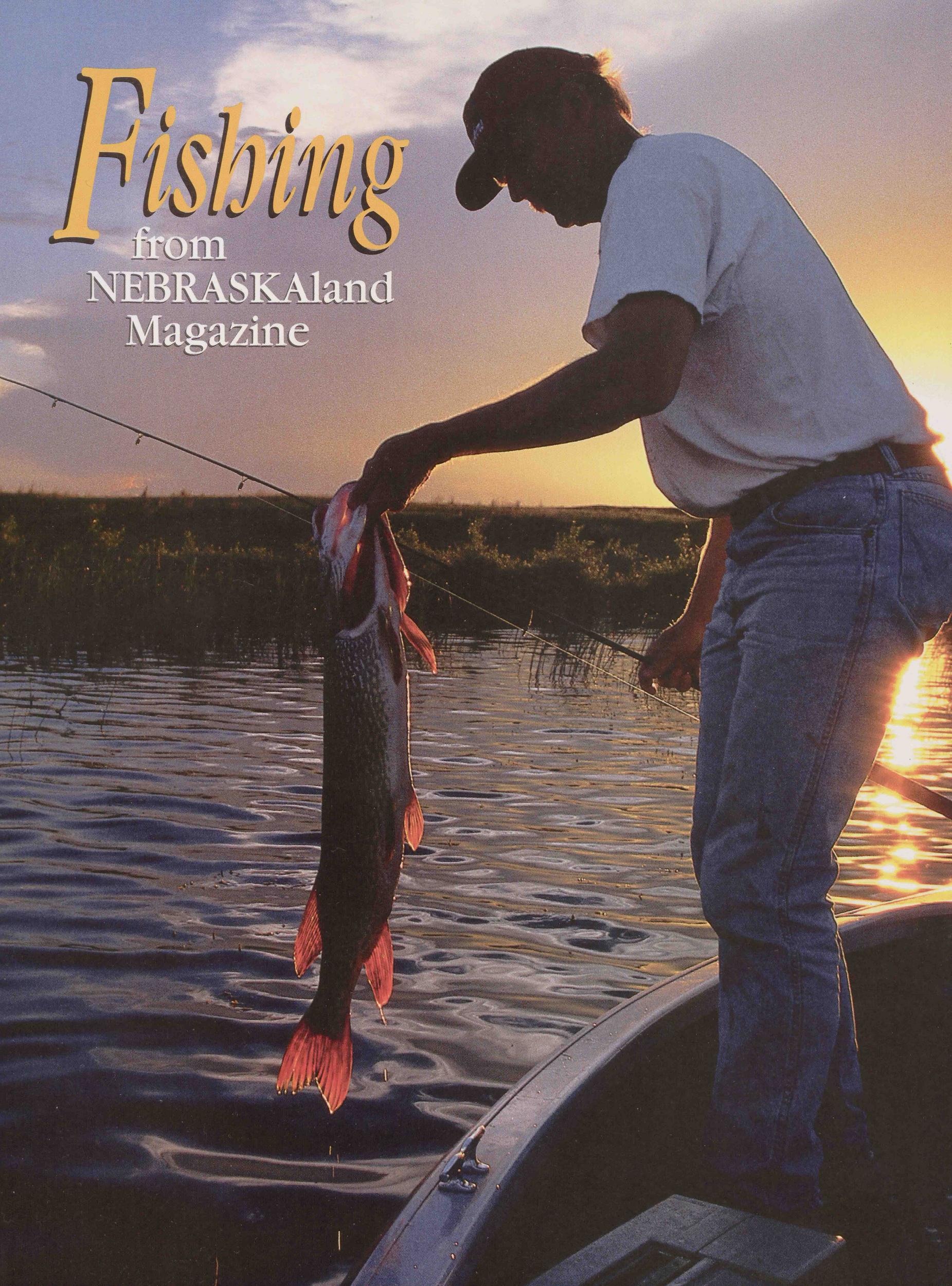
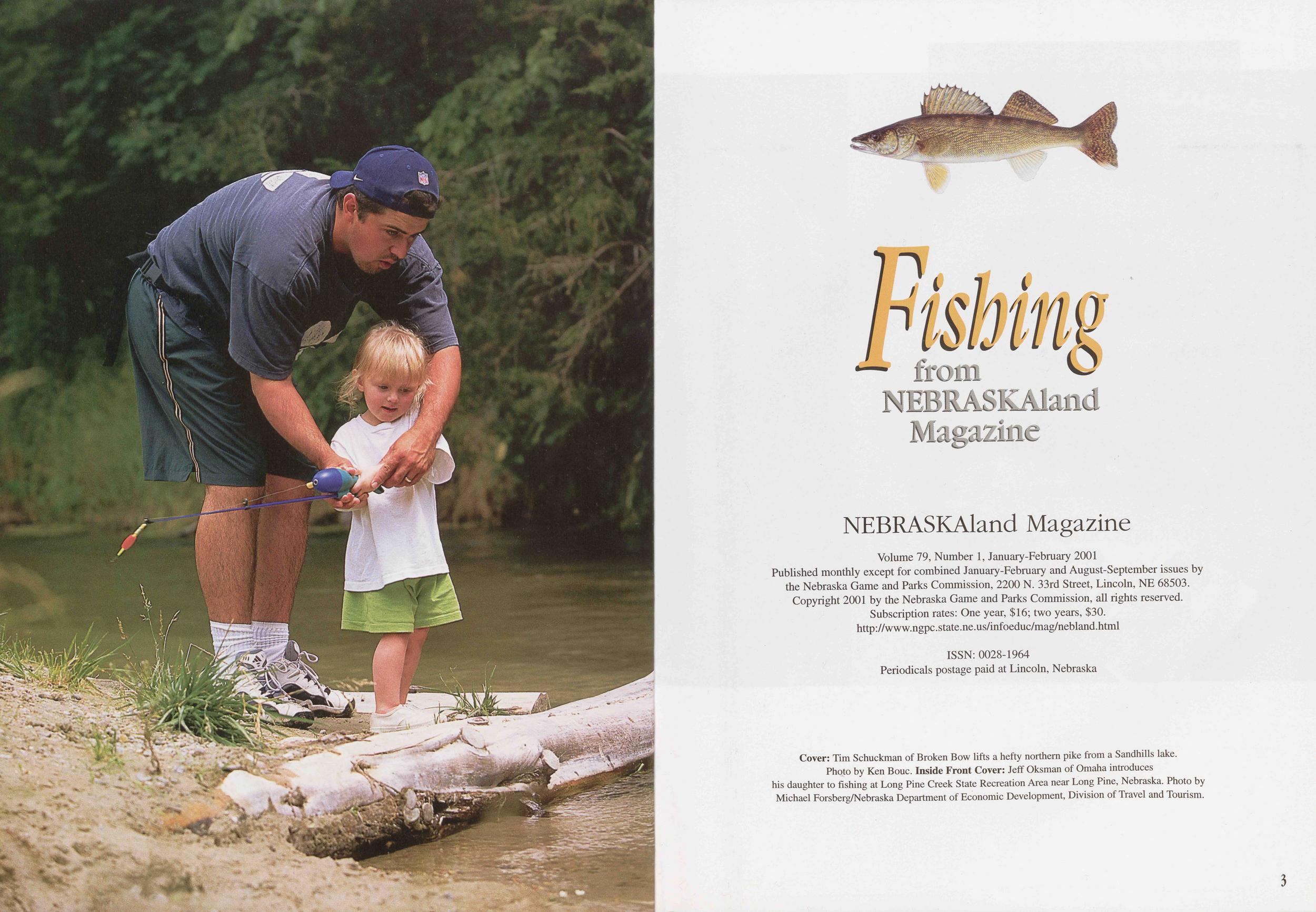
Volume 79, Number 1, January-February 2001 Published monthly except for combined January-February and August-September issues by the Nebraska Game and Parks Conmission, 2200 N. 33rd Street, Lincoln, NE 68503. Copyright 2001 by the Nebraska Game and Parks Commission, all rights reserved. Subscription rates: One year, $16; two years, $30. http://www.ngpc.state.ne.us/infoeduc/mag/nebland.html ISSN: 0028-1964 Periodicals postage paid at Lincoln, Nebraska Cover: Tim Schuckman of Broken Bow lifts a hefty northern pike from a Sandhills lake. Photo by Ken Bouc. Inside Front Cover: Jeff Oksman of Omaha introduces his daughter to fishing at Long Pine Creek State Recreation Area near Long Pine, Nebraska. Photo by Michael Forsberg/Nebraska Department of Economic Development, Division of Travel and Tourism. 3 INTRODUCTION 6
CHAPTER ONE: LARGE RESERVOIRS 8
CHAPTER TWO: THE MISSOURI 24
CHAPTER THREE: THE PRAIRIE RIVERS 36
CHAPTER FOUR: FARM PONDS 44
CHAPTER FIVE: SANDPITS 56
CHAPTER SIX: MIDSIZE RESERVOIRS 68
CHAPTER SEVEN: SANDHILLS LAKES 82
CHAPTER EIGHT: COLDWATER STREAMS 94
CHAPTER NINE: THE TACKLE BOX 104
Acknowledgements 114
INTRODUCTION 6
CHAPTER ONE: LARGE RESERVOIRS 8
CHAPTER TWO: THE MISSOURI 24
CHAPTER THREE: THE PRAIRIE RIVERS 36
CHAPTER FOUR: FARM PONDS 44
CHAPTER FIVE: SANDPITS 56
CHAPTER SIX: MIDSIZE RESERVOIRS 68
CHAPTER SEVEN: SANDHILLS LAKES 82
CHAPTER EIGHT: COLDWATER STREAMS 94
CHAPTER NINE: THE TACKLE BOX 104
Acknowledgements 114
Why We Fish
Nebraskans love to fish. Nearly three out of four of us have wet a line at one time or another, according to a 1997 statewide survey, which also suggests that one in three adults in the state fish in a given year.
Conducted by the University of Nebraska-Lincoln Sociology Department, the survey found that people quit fishing for lack of time, but more than half the inactive anglers hope to someday return to the sport.
As its title indicates, this edition is meant for anglers ... the faithful, the falien-away and potential converts. Its focus is on understanding fish - how to find them, how to make them bite, and how to release them - not on biology and management.
This issue is organized by types of fishing water, and it highlights the techniques developed by accomplished Nebraska anglers on their home waters - not methods originating far away and recycled from national media.
Active anglers, and perhaps former anglers, as well, will likely be drawn to the text of the articles, where tackle and technique are explained in detail. A series of boxed features, titled "Fishing Simple," provides basic fishing information that is made-to-order for new anglers, and the last chapter, "The Tackle Box," is a treasure chest of basic information ranging from knots and rigs to weather's effect on fishing.
The university survey also yielded information about what matters most to Nebraska anglers. Catching a big fish is not especially important to most, nor is catching a big stringer of fish to eat nor catching and releasing fish. Being close to nature is not a big deal, either. What Nebraskans like best about fishing is relaxation. Obviously, we understand what is really important.
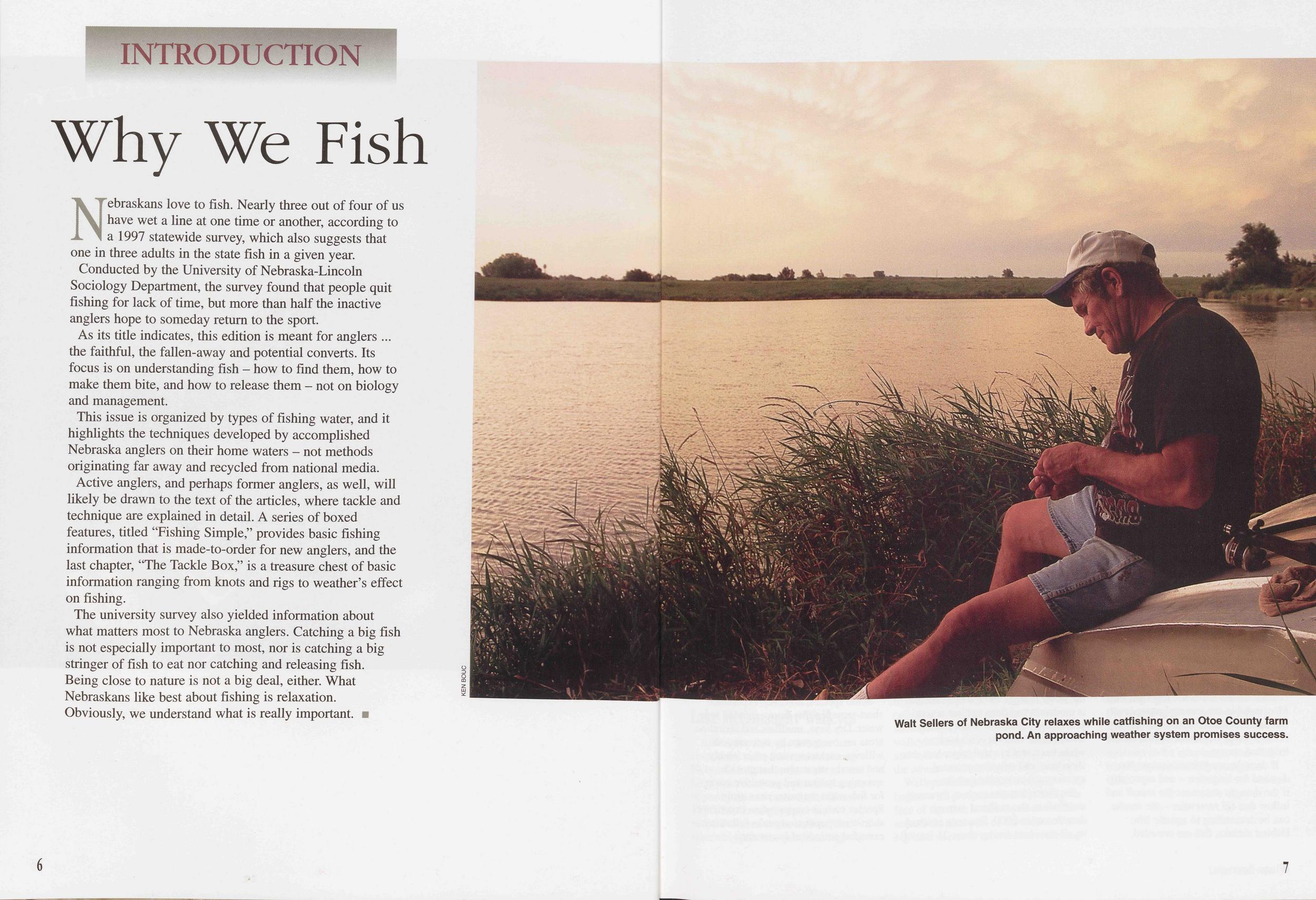
Walt Sellers of Nebraska City relaxes while catfishing on an Otoe County farm pond. An approaching weather system promises success.
Large Reservoirs
Where the Big Ones Roam
By Rocky HoffmannMORE TROPHY FISH - nearly half the state's Master .Angler Award qualifiers - have been caught from large reservoirs than from any other water bodies in Nebraska. Moreover, because introduced trophy fish such as wiper (a white bass-striped bass hybrid) are thriving in the state's big reservoirs, those bragging rights will be safe well into the future.
Although big reservoirs provide Nebraska anglers thousands of hours of recreation and thousands of fish dinners each year, these bodies of water were not constructed primarily for sportfishing. In fact, fishing and other water-based recreation are below irrigation, electrical generation and flood control on a list of intended benefits. In nearly every case, managing a reservoir for sportfishing conflicts with the reasons it was built.
Consequently anglers - and the fish themselves - have to adjust to conditions that often are less than ideal. Most notable are seasonal water-level fluctuations. The lowest levels usually occur in early-September at the end of irrigation season.
If drought conditions increase the demand for irrigation - and especially if the drought decreases the runoff and inflow that fill reservoirs - the results can be devastating to aquatic life: Habitat shrinks, fish are crowded,
8 Large Reservoirsshallow-water food organisms disappear, water chemistry and temperatures change, and the lake's carrying capacity decreases. Fish kills often occur as populations adjust to a diminished carrying capacity.
In the drought of 2000, Lake McConaughy lost 25 feet in depth leaving little rocky structure submerged and depriving smallmouth bass of most of their habitat. By mid-August, water at depths below 30 feet was lethally devoid of oxygen, forcing large numbers of fish into a fraction of the space that formerly supported them. The results were stress and fish kills.
Reservoirs managed primarily for electrical power generation fluctuate less from season to season, but may fluctuate severely day to day. Lake Ogallala, for example, a tailwater reservoir below Lake McConaughy, fluctuates as much as 4 feet per day. The effects on shallow-water organisms essential to game fish can be profound.
Fish populations in the largest reservoirs usually survive drawdowns better than those in small reservoirs, if the water is deep enough and drought is moderate and does not last several years. Short-term low water usually affects open-water species such as white bass, walleye and wiper less than shoreline- and structure-oriented species such as smallmouth bass.
Smaller reservoirs such as Swanson and Enders also suffered extreme drawdowns in 2000. Swanson reached its all-time low, losing about 25 feet of water by August, resulting in a large die-off of game fish. Most of the dead game fish, victims of high temperatures and crowding, were open-water species, primarily white bass and wipers.
Some species, however, experience short-term benefits from extended low water. Dry bays, mudflats and shoreline areas are overgrown by cottonwoods, willows, cockleburs and other weedy and woody vegetation that provide spawning habitat and protective cover for fish when the water rises again. Species such as crappie often experience short-term population peaks following extended periods of low water.
Whatever the conditions, anglers have to adjust their fishing techniques to the realities of fluctuating water and reservoir management regimens that are not designed to promote fish and fishing.
Lake McConaughy Walleyes
In recent years, the fish that has caused the most excitement among Nebraska anglers is the walleye, and large reservoirs have provided ample opportunities to catch them. Since 1996, McConaughy has been second to none in the nation. The state's biggest lake produces big walleyes - lots of them - and most anglers, regardless of skill, can catch them.
How could it get any better?
Because so many of the lake's big walleyes are easily caught, size lmits have been imposed; an angler may keep only one large fish per day. It's not unusual to have an excellent day of walleye fishing at Lake McConaughy and to leave with only one fish because the others were too big to legally keep.
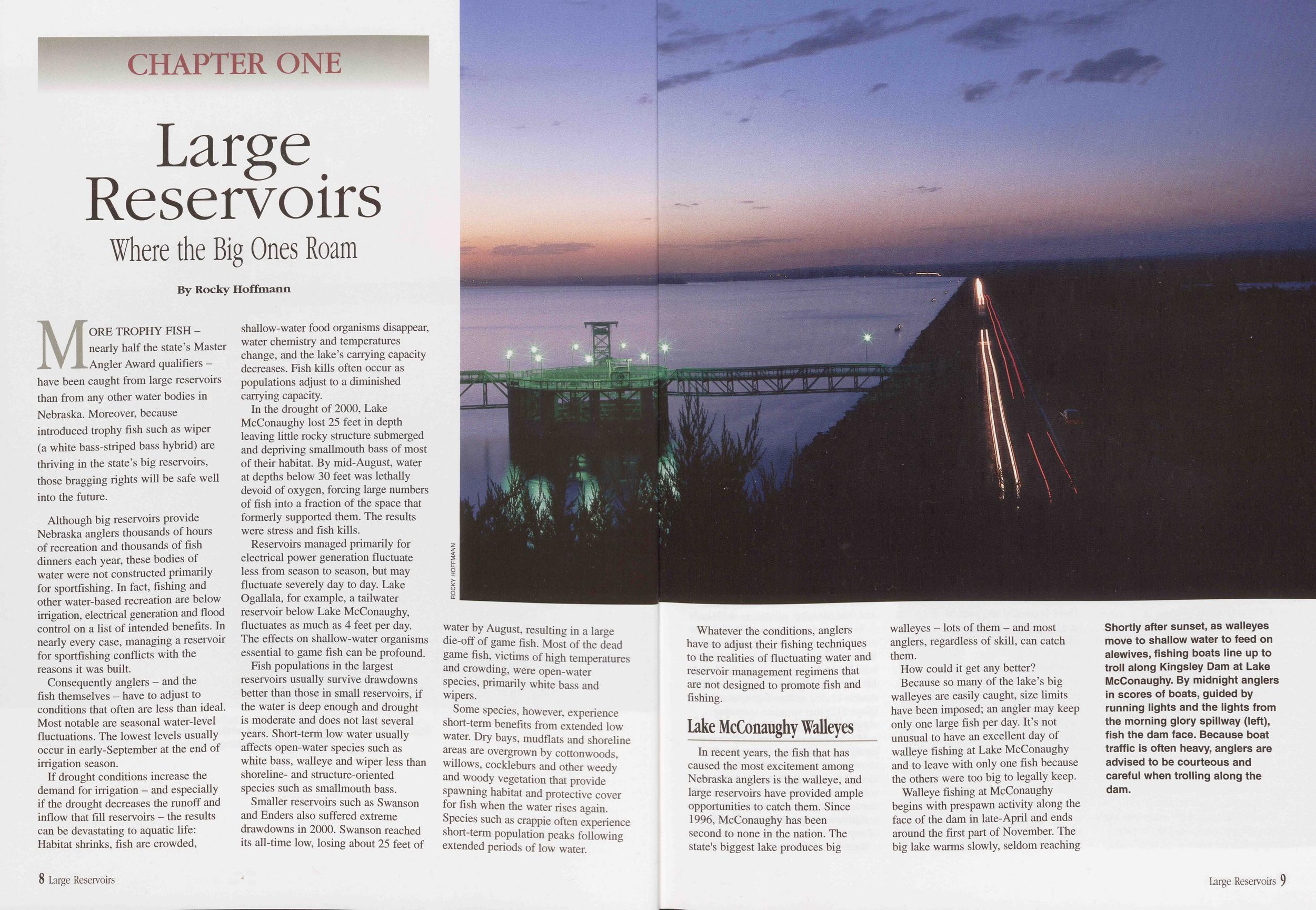
Walleye fishing at McConaughy begins with prespawn activity along the face of the dam in late-April and ends around the first part of November. The big lake warms slowly, seldom reaching Shortly after sunset, as walleyes move to shallow water to feed on alewives, fishing boats line up to troll along Kingsley Dam at Lake McConaughy. By midnight anglers in scores of boats, guided by running lights and the lights from the morning glory spillway (left), fish the dam face. Because boat traffic is often heavy, anglers are advised to be courteous and careful when trolling along the dam.
Large Reservoirs 9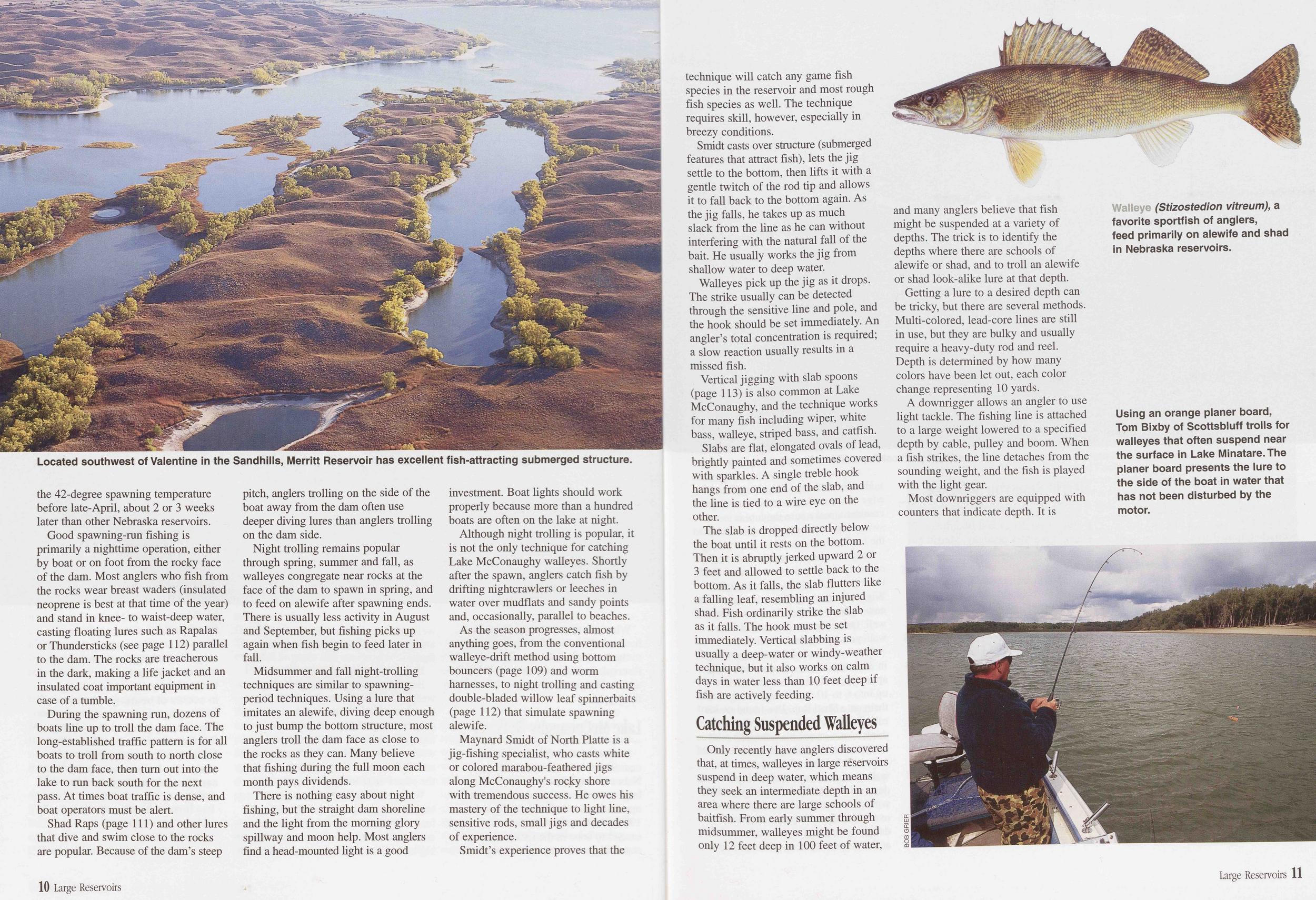
Located southwest of Valentine in the Sandhills, Merritt Reservoir has excellent fish-attracting submerged structure.
the 42-degree spawning temperature before late-April, about 2 or 3 weeks later than other Nebraska reservoirs.
Good spawning-run fishing is primarily a nighttime operation, either by boat or on foot from the rocky face of the dam. Most anglers who fish from the rocks wear breast waders (insulated neoprene is best at that time of the year) and stand in knee- to waist-deep water, casting floating lures such as Rapalas or Thundersticks (see page 112) parallel to the dam. The rocks are treacherous in the dark, making a life jacket and an insulated coat important equipment in case of a tumble.
During the spawning run, dozens of boats line up to troll the dam face. The long-established traffic pattern is for all boats to troll from south to north close to the dam face, then turn out into the lake to run back south for the next pass. At times boat traffic is dense, and boat operators must be alert.
Shad Raps (page 111) and other lures that dive and swim close to the rocks are popular. Because of the dam's steep
10 Large Reservoirspitch, anglers trolling on the side of the boat away from the dam often use deeper diving lures than anglers trolling on the dam side.
Night trolling remains popular through spring, summer and fall, as walleyes congregate near rocks at the face of the dam to spawn in spring, and to feed on alewife after spawning ends. There is usually less activity in August and September, but fishing picks up again when fish begin to feed later in fall.
Midsummer and fall night-trolling techniques are similar to spawning- period techniques. Using a lure that imitates an alewife, diving deep enough to just bump the bottom structure, most anglers troll the dam face as close to the rocks as they can. Many believe that fishing during the full moon each month pays dividends.
There is nothing easy about night fishing, but the straight dam shoreline and the light from the morning glory spillway and moon help. Most anglers find a head-mounted light is a good investment. Boat lights should work properly because more than a hundred boats are often on the lake at night.
Although night trolling is popular, it is not the only technique for catching Lake McConaughy walleyes. Shortly after the spawn, anglers catch fish by drifting nightcrawlers or leeches in water over mudflats and sandy points and, occasionally, parallel to beaches.
As the season progresses, almost anything goes, from the conventional walleye-drift method using bottom bouncers (page 109) and worm harnesses, to night trolling and casting double-bladed willow leaf spinnerbaits (page 112) that simulate spawning alewife.
Maynard Smidt of North Platte is a jig-fishing specialist, who casts white or colored marabou-feathered jigs along McConaughy's rocky shore with tremendous success. He owes his mastery of the technique to fight fine, sensitive rods, small jigs and decades of experience.
Smidt's experience proves that the technique will catch any game fish species in the reservoir and most rough fish species as well. The technique requires skill, however, especially in breezy conditions.
Smidt casts over structure (submerged features that attract fish), lets the jig settle to the bottom, then lifts it with a gentle twitch of the rod tip and allows it to fall back to the bottom again. As the jig falls, he takes up as much slack from the line as he can without interfering with the natural fall of the bait. He usually works the jig from shallow water to deep water.
Walleyes pick up the jig as it drops. The strike usually can be detected through the sensitive line and pole, and the hook should be set immediately. An angler's total concentration is required; a slow reaction usually results in a missed fish.
Vertical jigging with slab spoons (page 113) is also common at Lake McConaughy, and the technique works for many fish including wiper, white bass, walleye, striped bass, and catfish. Slabs are flat, elongated ovals of lead, brightly painted and sometimes covered with sparkles. A single treble hook hangs from one end of the slab, and the line is tied to a wire eye on the other.
The slab is dropped directly below the boat until it rests on the bottom. Then it is abruptly jerked upward 2 or 3 feet and allowed to settle back to the bottom. As it falls, the slab flutters like a falling leaf, resembling an injured shad. Fish ordinarily strike the slab as it falls. The hook must be set immediately. Vertical slabbing is usually a deep-water or windy-weather technique, but it also works on calm days in water less than 10 feet deep if fish are actively feeding.
Catching Suspended Walleyes
Only recently have anglers discovered that, at times, walleyes in large reservoirs suspend in deep water, which means they seek an intermediate depth in an area where there are large schools of baitfish. From early summer through midsummer, walleyes might be found only 12 feet deep in 100 feet of water, and many anglers believe that fish might be suspended at a variety of depths. The trick is to identify the depths where there are schools of alewife or shad, and to troll an alewife or shad look-alike lure at that depth.
Getting a lure to a desired depth can be tricky, but there are several methods. Multi-colored, lead-core lines are still in use, but they are bulky and usually require a heavy-duty rod and reel. Depth is determined by how many colors have been let out, each color change representing 10 yards.
A downrigger allows an angler to use light tackle. The fishing line is attached to a large weight lowered to a specified depth by cable, pulley and boom. When a fish strikes, the line detaches from the sounding weight, and the fish is played with the light gear.
Most downriggers are equipped with counters that indicate depth. It is
Walley (Stizostedion vitreum), a favorite sportfish of anglers, feed primarily on alewife and shad in Nebraska reservoirs.
Using an orange planer board, Tom Bixby of Scottsbluff trolls for walleyes that often suspend near the surface in Lake Miniature. The planer board presents the lure to the side of the boat in water that has not been disturbed by the motor.
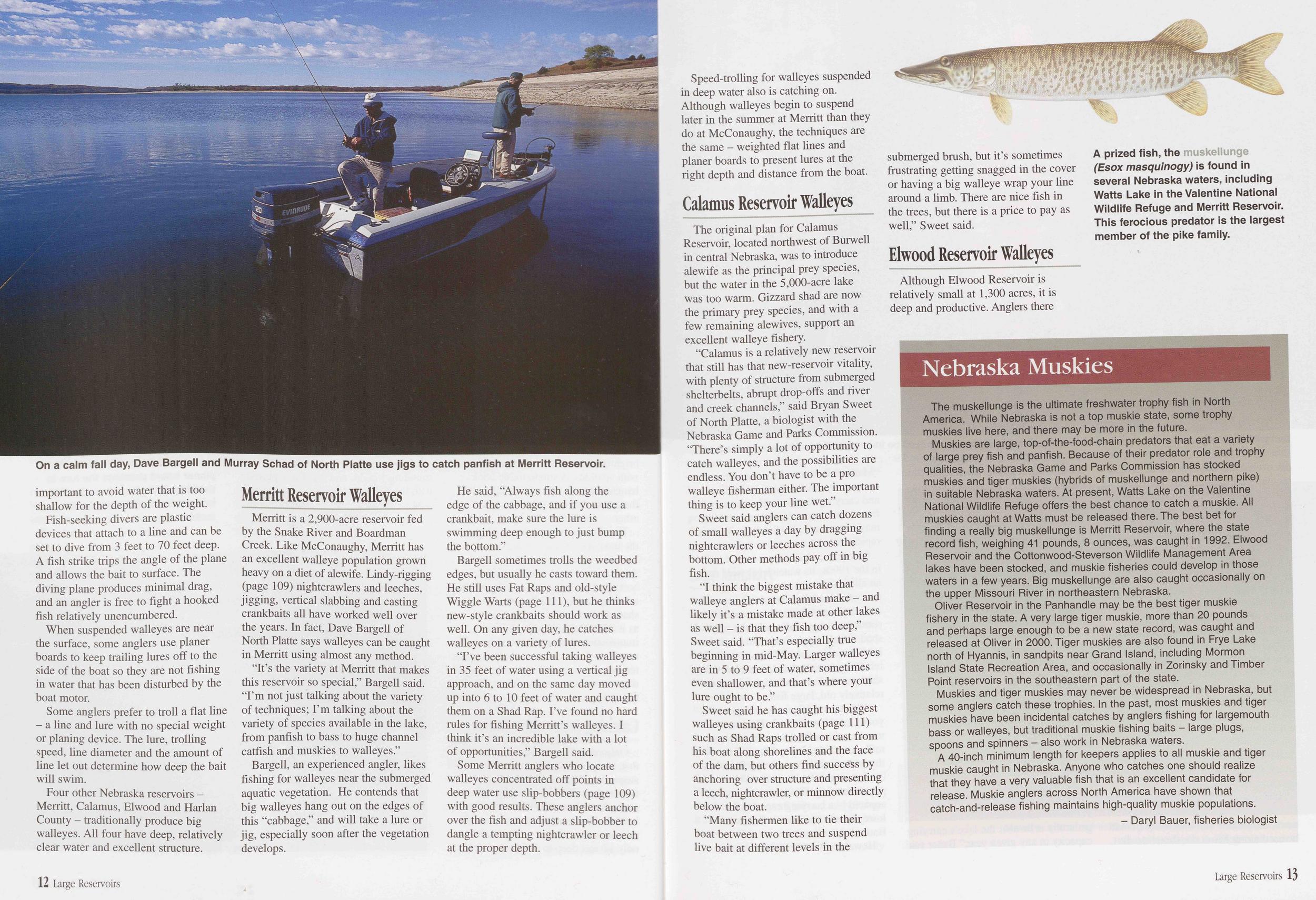
On a calm fall day, Dave Bargell and Murray Schad of North Platte use jigs to catch panfish at Merritt Reservoir.
important to avoid water that is too shallow for the depth of the weight.
Fish-seeking divers are plastic devices that attach to a line and can be set to dive from 3 feet to 70 feet deep. A fish strike trips the angle of the plane and allows the bait to surface. The diving plane produces minimal drag, and an angler is free to fight a hooked fish relatively unencumbered. When suspended walleyes are near the surface, some anglers use planer boards to keep trailing lures off to the side of the boat so they are not fishing in water that has been disturbed by the boat motor.
Some anglers prefer to troll a flat line - a line and lure with no special weight or planing device. The lure, trolling speed, line diameter and the amount of line let out determine how deep the bait will swim.
Four other Nebraska reservoirs - Merritt, Calamus, Elwood and Harlan County - traditionally produce big walleyes. All four have deep, relatively clear water and excellent structure.
12 Large ReservoirsMerritt Reservoir Walleyes
Merritt is a 2,900-acre reservoir fed by the Snake River and Boardman Creek. Like McConaughy, Merritt has an excellent walleye population grown heavy on a diet of alewife. Lindy-rigging (page 109) nightcrawlers and leeches, jigging, vertical slabbing and casting crankbaits all have worked well over the years. In fact, Dave Bargell of North Platte says walleyes can be caught in Merritt using almost any method.
"It's the variety at Merritt that makes this reservoir so special," Bargell said. "I'm not just talking about the variety of techniques; I'm talking about the variety of species available in the lake, from panfish to bass to huge channel catfish and muskies to walleyes."
Bargell, an experienced angler, likes fishing for walleyes near the submerged aquatic vegetation. He contends that big walleyes hang out on the edges of this "cabbage," and will take a lure or jig, especially soon after the vegetation develops.
He said, "Always fish along the edge of the cabbage, and if you use a crankbait, make sure the lure is swimming deep enough to just bump the bottom."
Bargell sometimes trolls the weed bed edges, but usually he casts toward them. He still uses Fat Raps and old-style Wiggle Warts (page 111), but he thinks new-style crankbaits should work as well. On any given day, he catches walleyes on a variety of lures.
"I've been successful taking walleyes in 35 feet of water using a vertical jig approach, and on the same day moved up into 6 to 10 feet of water and caught them on a Shad Rap. I've found no hard rules for fishing Merritf s walleyes. I think it's an incredible lake with a lot of opportunities," Bargell said.
Some Merritt anglers who locate walleyes concentrated off points in deep water use slip-bobbers (page 109) with good results. These anglers anchor over the fish and adjust a slip-bobber to dangle a tempting nightcrawler or leech at the proper depth.
Speed-trolling for walleyes suspended in deep water also is catching on. Although walleyes begin to suspend later in the summer at Merritt than they do at McConaughy, the techniques are the same - weighted flat lines and planer boards to present lures at the right depth and distance from the boat.
Calamus Reservoir Walleyes
The original plan for Calamus Reservoir, located northwest of Burwell in central Nebraska, was to introduce alewife as the principal prey species, but the water in the 5,000-acre lake was too warm. Gizzard shad are now the primary prey species, and with a few remaining alewives, support an excellent walleye fishery.
"Calamus is a relatively new reservoir that still has that new-reservoir vitality, with plenty of structure from submerged shelterbelts, abrupt drop-offs and river and creek channels," said Bryan Sweet of North Platte, a biologist with the Nebraska Game and Parks Commission. "There's simply a lot of opportunity to catch walleyes, and the possibilities are endless. You don't have to be a pro walleye fisherman either. The important thing is to keep your line wet."
Sweet said anglers can catch dozens of small walleyes a day by dragging nightcrawlers or leeches across the bottom. Other methods pay off in big fish.
"I think the biggest mistake that walleye anglers at Calamus make - and likely it's a mistake made at other lakes as well - is that they fish too deep," Sweet said. "That's especially true beginning in mid-May. Larger walleyes are in 5 to 9 feet of water, sometimes even shallower, and that's where your lure ought to be."
Sweet said he has caught his biggest walleyes using crankbaits (page 111) such as Shad Raps trolled or cast from his boat along shorelines and the face of the dam, but others find success by anchoring over structure and presenting a leech, nightcrawler, or minnow directly below the boat.
"Many fishermen like to tie their boat between two trees and suspend live bait at different levels in the submerged brush, but it's sometimes frustrating getting snagged in the cover or having a big walleye wrap your line around a limb. There are nice fish in the trees, but there is a price to pay as well," Sweet said.
Elwood Reservoir Walleyes
A prized fish, the (Esox masquinogy) is found in several Nebraska waters, including Watts Lake in the Valentine National Wildlife Refuge and Merritt Reservoir. This ferocious predator is the largest member of the pike family.
Although Elwood Reservoir is relatively small at 1,300 acres, it is deep and productive. Anglers there
Nebraska Muskies
The muskeliunge is the ultimate freshwater trophy fish in North America. While Nebraska is not a top muskie state, some trophy muskies live here, and there may be more in the future.
Muskies are large, top-of-the-food-chain predators that eat a variety of large prey fish and panfish. Because of their predator role and trophy qualities, the Nebraska Game and Parks Commission has stocked muskies and tiger muskies (hybrids of muskeliunge and northern pike) in suitable Nebraska waters. At present, Watts Lake on the Valentine National Wildlife Refuge offers the best chance to catch a muskie. All muskies caught at Watts must be released there. The best bet for finding a really big muskeliunge is Merritt Reservoir, where the state record fish, weighing 41 pounds, 8 ounces, was caught in 1992. Elwood Reservoir and the Cottonwood-Steverson Wildlife Management Area lakes have been stocked, and muskie fisheries could develop in those waters in a few years. Big muskeliunge are also caught occasionally on the upper Missouri River in northeastern Nebraska.
Oliver Reservoir in the Panhandle may be the best tiger muskie fishery in the state. A very large tiger muskie, more than 20 pounds and perhaps large enough to be a new state record, was caught and released at Oliver in 2000. Tiger muskies are also found in Frye Lake north of Hyannis, in sandpits near Grand Island, including Mormon Island State Recreation Area, and occasionally in Zorinsky and Timber Point reservoirs in the southeastern part of the state.
Muskies and tiger muskies may never be widespread in Nebraska, but some anglers catch these trophies. In the past, most muskies and tiger muskies have been incidental catches by anglers fishing for largemouth bass or walleyes, but traditional muskie fishing baits - large plugs, spoons and spinners - also work in Nebraska waters.
A 40-inch minimum length for keepers applies to all muskie and tiger muskie caught in Nebraska. Anyone who catches one should realize that they have a very valuable fish that is an excellent candidate for release. Muskie anglers across North America have shown that catch-and-release fishing maintains high-quality muskie populations. - Daryl Bauer, fisheries biologist
Large Reservoirs 13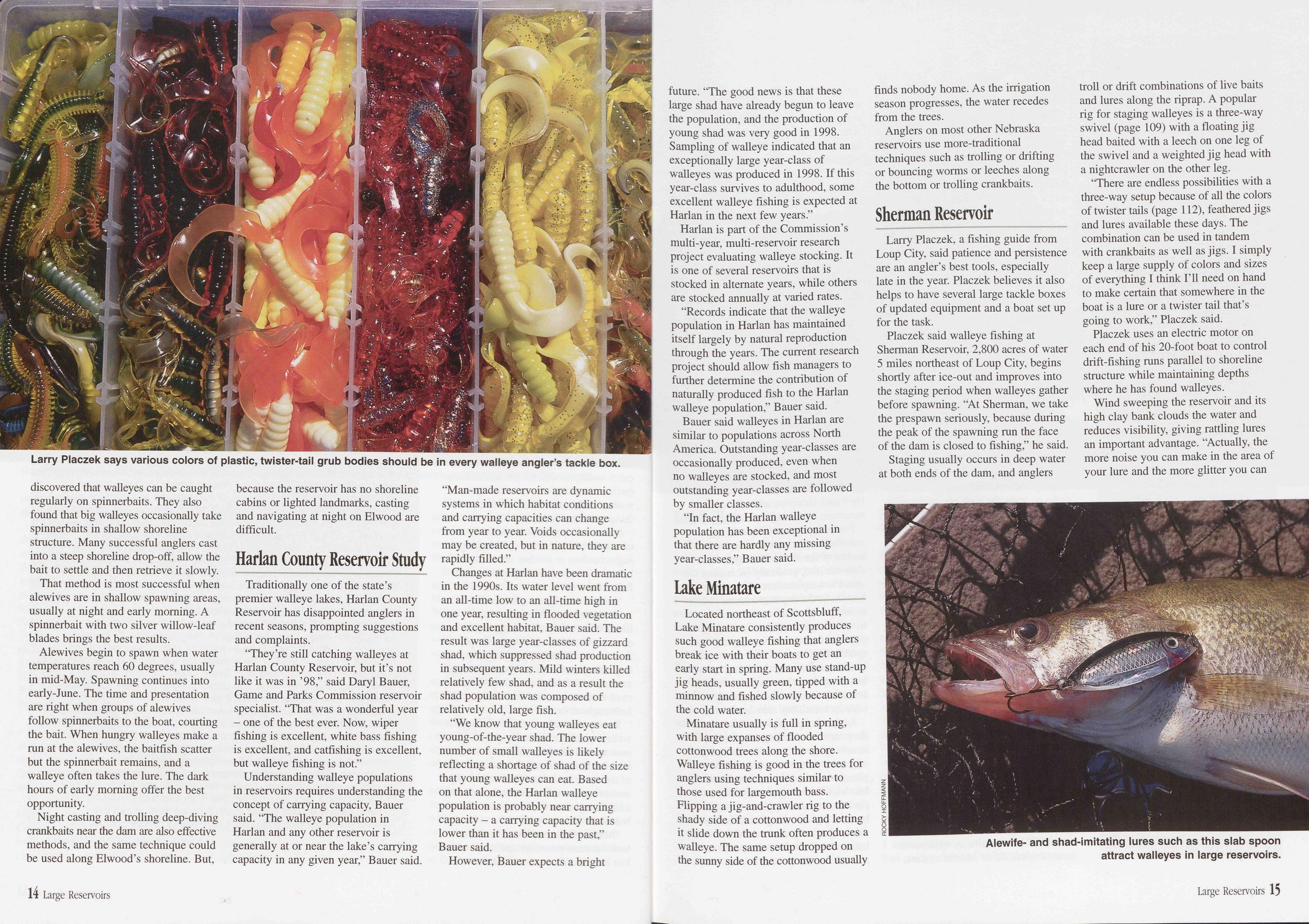
Larry Placzek says various colors of plastic, twister-tail grub bodies should be in every walleye angler's tackle box.
discovered that walleyes can be caught regularly on spinnerbaits. They also found that big walleyes occasionally take spinnerbaits in shallow shoreline structure. Many successful anglers cast into a steep shoreline drop-off, allow the bait to settle and then retrieve it slowly.
That method is most successful when alewives are in shallow spawning areas, usually at night and early morning. A spinnerbait with two silver willow-leaf blades brings the best results.
Alewives begin to spawn when water temperatures reach 60 degrees, usually in mid-May. Spawning continues into early-June. The time and presentation are right when groups of alewives follow spinnerbaits to the boat, courting the bait. When hungry walleyes make a run at the alewives, the baitfish scatter but the spinnerbait remains, and a walleye often takes the lure. The dark hours of early morning offer the best opportunity.
Night casting and trolling deep-diving crankbaits near the dam are also effective methods, and the same technique could be used along Elwood's shoreline. But, because the reservoir has no shoreline cabins or lighted landmarks, casting and navigating at night on Elwood are difficult.
Harlan County Reservoir Study
Traditionally one of the state's premier walleye lakes, Harlan County Reservoir has disappointed anglers in recent seasons, prompting suggestions and complaints.
"They're still catching walleyes at Harlan County Reservoir, but it's not like it was in '98," said Daryl Bauer, Game and Parks Commission reservoir specialist. "That was a wonderful year - one of the best ever. Now, wiper fishing is excellent, white bass fishing is excellent, and catfishing is excellent, but walleye fishing is not."
Understanding walleye populations in reservoirs requires understanding the concept of carrying capacity, Bauer said. "The walleye population in Harlan and any other reservoir is generally at or near the lake's carrying capacity in any given year," Bauer said.
"Man-made reservoirs are dynamic systems in which habitat conditions and carrying capacities can change from year to year. Voids occasionally may be created, but in nature, they are rapidly filled."
Changes at Harlan have been dramatic in the 1990s. Its water level went from an all-time low to an all-time high in one year, resulting in flooded vegetation and excellent habitat, Bauer said. The result was large year-classes of gizzard shad, which suppressed shad production in subsequent years. Mild winters killed relatively few shad, and as a result the shad population was composed of relatively old, large fish.
"We know that young walleyes eat young-of-the-year shad. The lower number of small walleyes is likely reflecting a shortage of shad of the size that young walleyes can eat. Based on that alone, the Harlan walleye population is probably near carrying capacity - a carrying capacity that is lower than it has been in the past," Bauer said.
However, Bauer expects a bright future. "The good news is that these large shad have already begun to leave the population, and the production of young shad was very good in 1998. Sampling of walleye indicated that an exceptionally large year-class of walleyes was produced in 1998. If this year-class survives to adulthood, some excellent walleye fishing is expected at Harlan in the next few years."
Harlan is part of the Commission's multi-year, multi-reservoir research project evaluating walleye stocking. It is one of several reservoirs that is stocked in alternate years, while others are stocked annually at varied rates.
"Records indicate that the walleye population in Harlan has maintained itself largely by natural reproduction through the years. The current research project should allow fish managers to further determine the contribution of naturally produced fish to the Harlan walleye population," Bauer said.
Bauer said walleyes in Harlan are similar to populations across North America. Outstanding year-classes are occasionally produced, even when no walleyes are stocked, and most outstanding year-classes are followed by smaller classes.
"In fact, the Harlan walleye population has been exceptional in that there are hardly any missing year-classes," Bauer said.
Lake Minatare
Located northeast of Scottsbluff, Lake Minatare consistently produces such good walleye fishing that anglers break ice with their boats to get an early start in spring. Many use stand-up jig heads, usually green, tipped with a minnow and fished slowly because of the cold water.
Minatare usually is full in spring, with large expanses of flooded Cottonwood trees along the shore. Walleye fishing is good in the trees for anglers using techniques similar to those used for largemouth bass. Flipping a jig-and-crawler rig to the shady side of a cottonwood and letting it slide down the trunk often produces a walleye. The same setup dropped on the sunny side of the cottonwood usually finds nobody home. As the irrigation season progresses, the water recedes from the trees.
Anglers on most other Nebraska reservoirs use more-traditional techniques such as trolling or drifting or bouncing worms or leeches along the bottom or trolling crankbaits.
Sherman Reservoir
Larry Placzek, a fishing guide from Loup City, said patience and persistence are an angler's best tools, especially late in the year. Placzek believes it also helps to have several large tackle boxes of updated equipment and a boat set up for the task.
Placzek said walleye fishing at Sherman Reservoir, 2,800 acres of water 5 miles northeast of Loup City, begins shortly after ice-out and improves into the staging period when walleyes gather before spawning. "At Sherman, we take the prespawn seriously, because during the peak of the spawning run the face of the dam is closed to fishing," he said.
Staging usually occurs in deep water at both ends of the dam, and anglers troll or drift combinations of live baits and lures along the riprap. A popular rig for staging walleyes is a three-way swivel (page 109) with a floating jig head baited with a leech on one leg of the swivel and a weighted jig head with a nightcrawler on the other leg.
'There are endless possibilities with a three-way setup because of all the colors of twister tails (page 112), feathered jigs and lures available these days. The combination can be used in tandem with crankbaits as well as jigs. I simply keep a large supply of colors and sizes of everything I think I'll need on hand to make certain that somewhere in the boat is a lure or a twister tail that's going to work," Placzek said.
Placzek uses an electric motor on each end of his 20-foot boat to control drift-fishing runs parallel to shoreline structure while maintaining depths where he has found walleyes.
Wind sweeping the reservoir and its high clay bank clouds the water and reduces visibility, giving rattling lures an important advantage. "Actually, the more noise you can make in the area of your lure and the more glitter you can
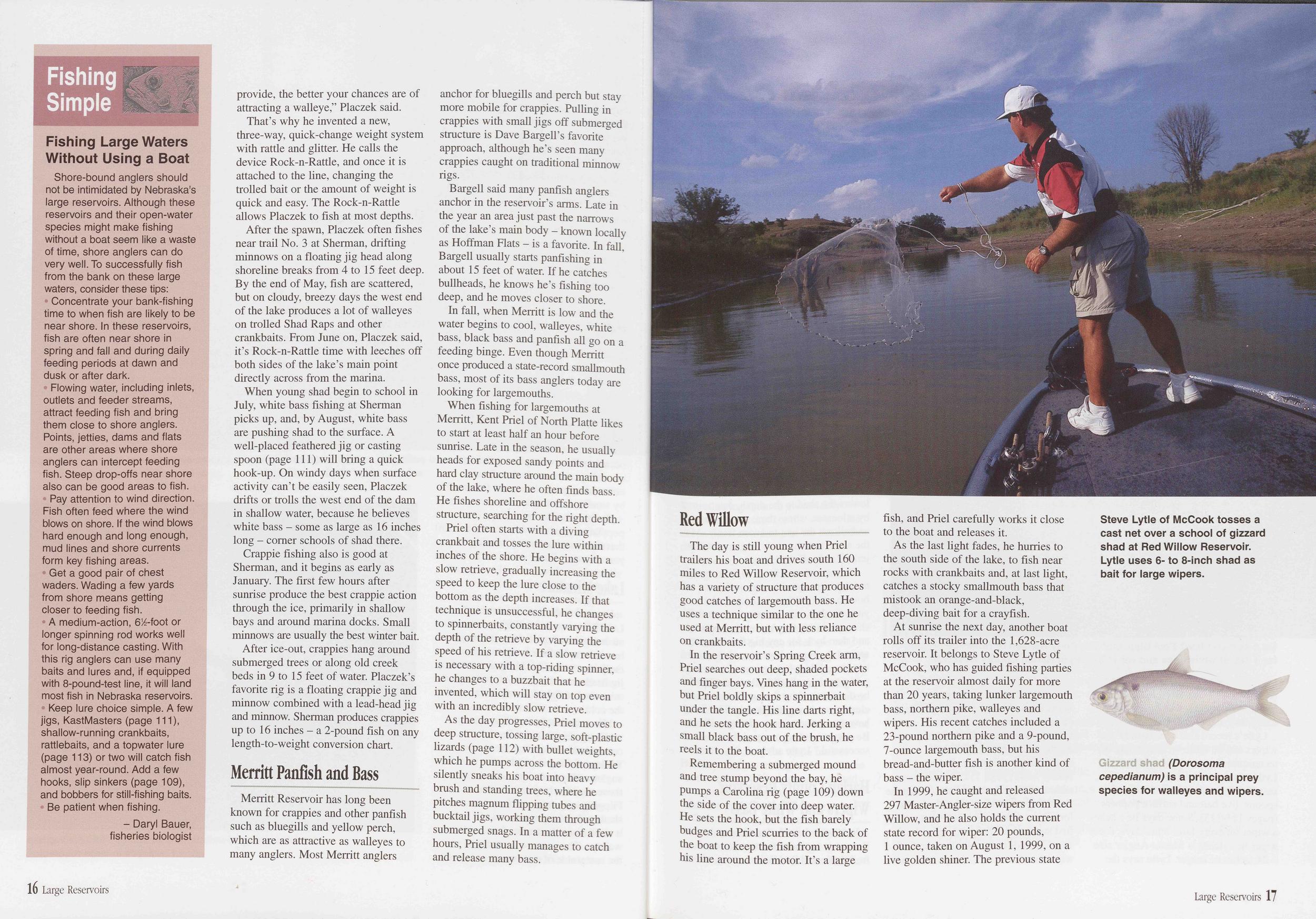
Alewife- and shad-imitating lures such as this slab spoon attract walleyes in large reservoirs.
Fishing Simple
fishing Large Waters Without Using a Boat
Shore-bound anglers should not be Intimidated by Nebraska's large reservoirs. Although these reservoirs and their open-water species might make fishing without a boat seem like a waste of time, shore anglers can do very well. To successfully fish from the bank on these large waters, consider these tips:
Concentrate your bank-fishing time to when fish are likely to be near shore. In these reservoirs, fish are often near shore in spring and fall and during daily feeding periods at dawn and dusk or after dark.
Flowing water, including inlets, outlets and feeder streams, attract feeding fish and bring them close to shore anglers. Points, jetties, dams and flats are other areas where shore anglers can intercept feeding fish. Steep drop-offs near shore also can be good areas to fish.
Pay attention to wind direction. Fish often feed where the wind blows on shore. If the wind blows hard enough and long enough, mud lines and shore currents form key fishing areas.
Get a good pair of chest waders. Wading a few yards from shore means getting closer to feeding fish.
A medium-action, 6 1/2-foot or longer spinning rod works well for long-distance casting. With this rig anglers can use many baits and lures and, if equipped with 8-pound-test line, it will land most fish in Nebraska reservoirs. Keep lure choice simple. A few jigs, KastMasters (page 111), shallow-running crankbaits, rattlebaits, and a topwater lure (page 113) or two will catch fish almost year-round. Add a few hooks, slip sinkers (page 109), and bobbers for still-fishing baits.
Be patient when fishing. - Daryl Bauer, fisheries biologist
provide, the better your chances are of attracting a walleye," Placzek said.
That's why he invented a new, three-way, quick-change weight system with rattle and glitter. He calls the device Rock-n-Rattle, and once it is attached to the line, changing the trolled bait or the amount of weight is quick and easy. The Rock-n-Rattle allows Placzek to fish at most depths.
After the spawn, Placzek often fishes near trail No. 3 at Sherman, drifting minnows on a floating jig head along shoreline breaks from 4 to 15 feet deep. By the end of May, fish are scattered, but on cloudy, breezy days the west end of the lake produces a lot of walleyes on trolled Shad Raps and other crankbaits. From June on, Placzek said, it's Rock-n-Rattle time with leeches off both sides of the lake's main point directly across from the marina.
When young shad begin to school in July, white bass fishing at Sherman picks up, and, by August, white bass are pushing shad to the surface. A well-placed feathered jig or casting spoon (page 111) will bring a quick hook-up. On windy days when surface activity can't be easily seen, Placzek drifts or trolls the west end of the dam in shallow water, because he believes white bass - some as large as 16 inches long - corner schools of shad there.
Crappie fishing also is good at Sherman, and it begins as early as January. The first few hours after sunrise produce the best crappie action through the ice, primarily in shallow bays and around marina docks. Small minnows are usually the best winter bait.
After ice-out, crappies hang around submerged trees or along old creek beds in 9 to 15 feet of water. Placzek's favorite rig is a floating crappie jig and minnow combined with a lead-head jig and minnow. Sherman produces crappies up to 16 inches - a 2-pound fish on any length-to-weight conversion chart.
Merritt Panfish and Bass
Merritt Reservoir has long been known for crappies and other panfish such as bluegills and yellow perch, which are as attractive as walleyes to many anglers. Most Merritt anglers anchor for bluegills and perch but stay more mobile for crappies. Pulling in crappies with small jigs off submerged structure is Dave Bargell's favorite approach, although he's seen many crappies caught on traditional minnow rigs.
Bargell said many panfish anglers anchor in the reservoir's arms. Late in the year an area just past the narrows of the lake's main body - known locally as Hoffman Flats - is a favorite. In fall, Bargell usually starts panfishing in about 15 feet of water. If he catches bullheads, he knows he's fishing too deep, and he moves closer to shore.
In fall, when Merritt is low and the water begins to cool, walleyes, white bass, black bass and panfish all go on a feeding binge. Even though Merritt once produced a state-record smallmouth bass, most of its bass anglers today are looking for largemouths.
When fishing for largemouths at Merritt, Kent Priel of North Platte likes to start at least half an hour before sunrise. Late in the season, he usually heads for exposed sandy points and hard clay structure around the main body of the lake, where he often finds bass. He fishes shoreline and offshore structure, searching for the right depth.
Priel often starts with a diving crankbait and tosses the lure within inches of the shore. He begins with a slow retrieve, gradually increasing the speed to keep the lure close to the bottom as the depth increases. If that technique is unsuccessful, he changes to spinnerbaits, constantly varying the depth of the retrieve by varying the speed of his retrieve. If a slow retrieve is necessary with a top-riding spinner, he changes to a buzzbait that he invented, which will stay on top even with an incredibly slow retrieve.
As the day progresses, Priel moves to deep structure, tossing large, soft-plastic lizards (page 112) with bullet weights, which he pumps across the bottom. He silently sneaks his boat into heavy brush and standing trees, where he pitches magnum flipping tubes and bucktail jigs, working them through submerged snags. In a matter of a few hours, Priel usually manages to catch and release many bass.
Red Willow
The day is still young when Priel trailers his boat and drives south 160 miles to Red Willow Reservoir, which has a variety of structure that produces good catches of largemouth bass. He uses a technique similar to the one he used at Merritt, but with less reliance on crankbaits.
In the reservoir's Spring Creek arm, Priel searches out deep, shaded pockets and finger bays. Vines hang in the water, but Priel boldly skips a spinnerbait under the tangle. His line darts right, and he sets the hook hard. Jerking a small black bass out of the brush, he reels it to the boat.
Remembering a submerged mound and tree stump beyond the bay, he pumps a Carolina rig (page 109) down the side of the cover into deep water. He sets the hook, but the fish barely budges and Priel scurries to the back of the boat to keep the fish from wrapping his line around the motor. It's a large fish, and Priel carefully works it close to the boat and releases it.
As the last light fades, he hurries to the south side of the lake, to fish near rocks with crankbaits and, at last light, catches a stocky smallmouth bass that mistook an orange-and-black, deep-diving bait for a crayfish.
At sunrise the next day, another boat rolls off its trailer into the 1,628-acre reservoir. It belongs to Steve Lytle of McCook, who has guided fishing parties at the reservoir almost daily for more than 20 years, taking lunker largemouth bass, northern pike, walleyes and wipers. His recent catches included a 23-pound northern pike and a 9-pound, 7-ounce largemouth bass, but his bread-and-butter fish is another kind of bass - the wiper.
In 1999, he caught and released 297 Master-Angler-size wipers from Red Willow, and he also holds the current state record for wiper: 20 pounds, 1 ounce, taken on August 1, 1999, on a live golden shiner. The previous state
Steve Lytle of McCook tosses a cast net over a school of gizzard shad at Red Willow Reservoir. Lytle uses 6- to 8-inch shad as bait for large wipers.
Gizzard Shad(Dorosoma cepedianum) is a principal prey species for walleyes and wipers.
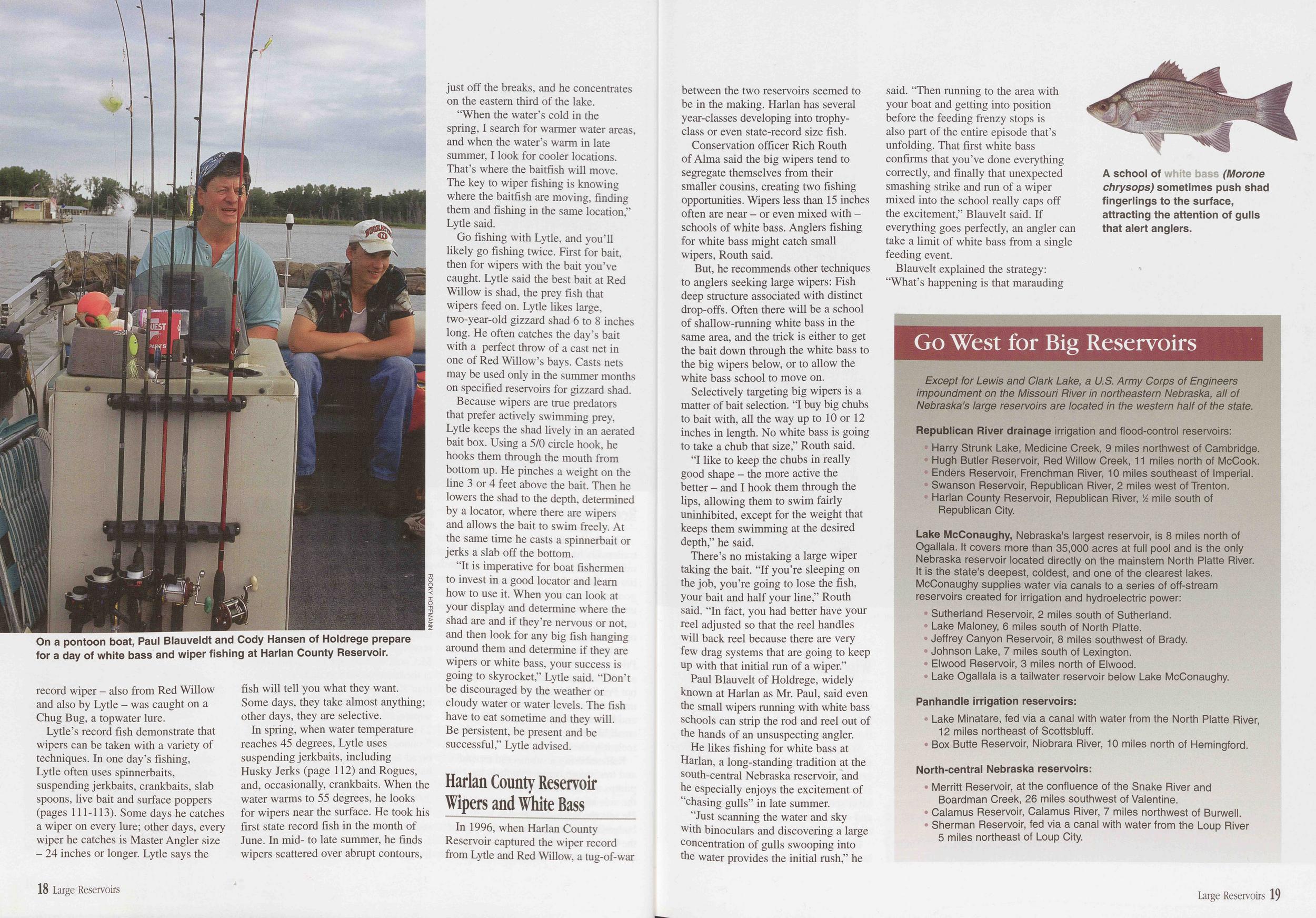
On a pontoon boat, Paul Blauveldt and Cody Hansen of Holdrege prepare for a day of white bass and wiper fishing at Harlan County Reservoir.
record wiper - also from Red Willow and also by Lytle - was caught on a Chug Bug, a topwater lure.
Lytle's record fish demonstrate that wipers can be taken with a variety of techniques. In one day's fishing, Lytle often uses spinnerbaits, suspending jerkbaits, crankbaits, slab spoons, live bait and surface poppers (pages 111-113). Some days he catches a wiper on every lure; other days, every wiper he catches is Master Angler size - 24 inches or longer. Lytle says the
18 Large Reservoirsfish will tell you what they want. Some days, they take almost anything; other days, they are selective.
In spring, when water temperature reaches 45 degrees, Lytle uses suspending jerkbaits, including Husky Jerks (page 112) and Rogues, and, occasionally, crankbaits. When the water warms to 55 degrees, he looks for wipers near the surface. He took his first state record fish in the month of June. In mid- to late summer, he finds wipers scattered over abrupt contours, just off the breaks, and he concentrates on the eastern third of the lake.
"When the water's cold in the spring, I search for warmer water areas, and when the water's warm in late summer, I look for cooler locations. That's where the baitfish will move. The key to wiper fishing is knowing where the baitfish are moving, finding them and fishing in the same location," Lytle said.
Go fishing with Lytle, and you'll likely go fishing twice. First for bait, then for wipers with the bait you've caught. Lytle said the best bait at Red Willow is shad, the prey fish that wipers feed on. Lytle likes large, two-year-old gizzard shad 6 to 8 inches long. He often catches the day's bait with a perfect throw of a cast net in one of Red Willow's bays. Casts nets may be used only in the summer months on specified reservoirs for gizzard shad.
Because wipers are true predators that prefer actively swimming prey, Lytle keeps the shad lively in an aerated bait box. Using a 5/0 circle hook, he hooks them through the mouth from bottom up. He pinches a weight on the line 3 or 4 feet above the bait. Then he lowers the shad to the depth, determined by a locator, where there are wipers and allows the bait to swim freely. At the same time he casts a spinnerbait or jerks a slab off the bottom.
"It is imperative for boat fishermen to invest in a good locator and learn how to use it. When you can look at your display and determine where the shad are and if they're nervous or not, and then look for any big fish hanging around them and determine if they are wipers or white bass, your success is going to skyrocket," Lytle said. "Don't be discouraged by the weather or cloudy water or water levels. The fish have to eat sometime and they will. Be persistent, be present and be successful," Lytle advised.
Harlan County Reservoir Wipers and White Bass
In 1996, when Harlan County Reservoir captured the wiper record from Lytle and Red Willow, a tug-of-war between the two reservoirs seemed to be in the making. Harlan has several year-classes developing into trophy class or even state-record size fish.
Conservation officer Rich Routh of Alma said the big wipers tend to segregate themselves from their smaller cousins, creating two fishing opportunities. Wipers less than 15 inches often are near - or even mixed with - schools of white bass. Anglers fishing for white bass might catch small wipers, Routh said.
But, he recommends other techniques to anglers seeking large wipers: Fish deep structure associated with distinct drop-offs. Often there will be a school of shallow-running white bass in the same area, and the trick is either to get the bait down through the white bass to the big wipers below, or to allow the white bass school to move on.
Selectively targeting big wipers is a matter of bait selection. "I buy big chubs to bait with, all the way up to 10 or 12 inches in length. No white bass is going to take a chub that size," Routh said.
"I like to keep the chubs in really good shape - the more active the better - and I hook them through the lips, allowing them to swim fairly uninhibited, except for the weight that keeps them swimming at the desired depth," he said.
There's no mistaking a large wiper taking the bait. "If you're sleeping on the job, you're going to lose the fish, your bait and half your line," Routh said. "In fact, you had better have your reel adjusted so that the reel handles will back reel because there are very few drag systems that are going to keep up with that initial run of a wiper."
Paul Blauvelt of Holdrege, widely known at Harlan as Mr. Paul, said even the small wipers running with white bass schools can strip the rod and reel out of the hands of an unsuspecting angler.
He likes fishing for white bass at Harlan, a long-standing tradition at the south-central Nebraska reservoir, and he especially enjoys the excitement of "chasing gulls" in late summer.
"Just scanning the water and sky with binoculars and discovering a large concentration of gulls swooping into the water provides the initial rush," he said. "Then running to the area with your boat and getting into position before the feeding frenzy stops is also part of the entire episode that's unfolding. That first white bass confirms that you've done everything correctly, and finally that unexpected smashing strike and run of a wiper mixed into the school really caps off the excitement," Blauvelt said. If everything goes perfectly, an angler can take a limit of white bass from a single feeding event.
Blauvelt explained the strategy: "What's happening is that marauding
A school of white bass (Morone chrysops) sometimes push shad fingerlings to the surface, attracting the attention of gulls that alert anglers.
Go West for Big Reservoirs
Except for Lewis and dark Lake, a U.S. Army Corps of Engin impoundment on the Missouri River in northeastern Nebraska, all of Nebraska's large reservoirs are located in the western half of the state.
Republican River drainage tv Strunk Lake, of Cambridgie of McGook swanson Heservoir, Hepubiican Hiver, 2 miles west of Irenton. Harlan County Reservoir, Republican River, 1i mile south of Republican City.
Lake McConaughy, Nebraska's largest reservoir, is 8 miles north of Ogallala. It covers more than 35,000 acres at full pool and is the only Nebraska reservoir located directly on the mainstem North Platte River. It is the state's deepest, coldest, and one of the clearest lakes. McConaughy supplies water via canals to a series of off-stream reservoirs created for irrigation and hydroelectric power:
Sutherland Reservoir, 2 miles south of Sutherland. Lake Maloney, 6 miles south of North Platte. Jeffrey Canyon Reservoir, 8 miles southwest of Brady. * Johnson Lake, 7 miles south of Lexington. Elwood Reservoir, 3 miles north of Elwood. * Lake Ogallala is a tailwater reservoir below Lake McConaughy.
Panhandle irrigation reservoirs: * Lake Minatare, fed via a canal with water from the North Platte River, 12 miles northeast of Scottsbluff. * Box Butte Reservoir, Niobrara River, 10 miles north of Hemingford.
North-central Nebraska reservoirs: * Merritt Reservoir, at the confluence of the Snake River and Boardman Creek, 26 miles southwest of Valentine. * Calamus Reservoir, Calamus River, 7 miles northwest of Burwell. * Sherman Reservoir, fed via a canal with water from the Loup River 5 miles northeast of Loup City.
Large Reservoirs 19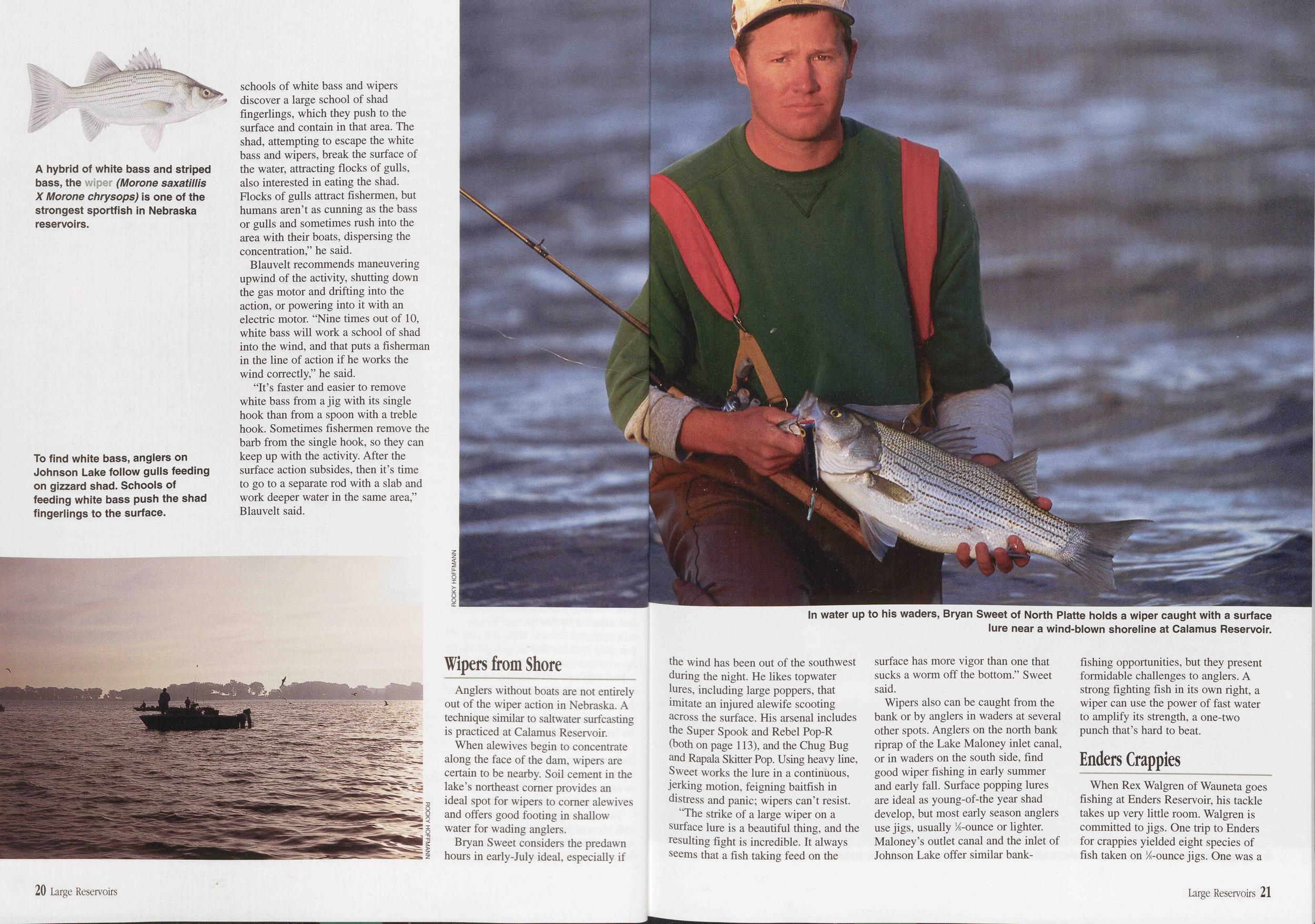
A hybrid of white bass and striped bass, the wiper (Morone saxatillis X Morone chrysops) is one of the strongest sport fish in Nebraska reservoirs.
To find white bass, anglers on Johnson Lake follow gulls feeding on gizzard shad. Schools of feeding white bass push the shad fingerlings to the surface.
schools of white bass and wipers discover a large school of shad fingerlings, which they push to the surface and contain in that area. The shad, attempting to escape the white bass and wipers, break the surface of the water, attracting flocks of gulls, also interested in eating the shad. Flocks of gulls attract fishermen, but humans aren't as cunning as the bass or gulls and sometimes rush into the area with their boats, dispersing the concentration," he said.
Blauvelt recommends maneuvering upwind of the activity, shutting down the gas motor and drifting into the action, or powering into it with an electric motor. "Nine times out of 10, white bass will work a school of shad into the wind, and that puts a fisherman in the line of action if he works the wind correctly," he said.
"It's faster and easier to remove white bass from a jig with its single hook than from a spoon with a treble hook. Sometimes fishermen remove the barb from the single hook, so they can keep up with the activity. After the surface action subsides, then it's time to go to a separate rod with a slab and work deeper water in the same area," Blauvelt said.
In water up to his waders, Bryan Sweet of North Platte holds a wiper caught with a surface lure near a wind-blown shoreline at Calamus Reservoir.
Wipers from Shore
Anglers without boats are not entirely out of the wiper action in Nebraska. A technique similar to saltwater surfcasting is practiced at Calamus Reservoir.
When alewives begin to concentrate along the face of the dam, wipers are certain to be nearby. Soil cement in the lake's northeast corner provides an ideal spot for wipers to corner alewives and offers good footing in shallow water for wading anglers.
Bryan Sweet considers the predawn hours in early-July ideal, especially if the wind has been out of the southwest during the night. He likes topwater lures, including large poppers, that imitate an injured alewife scooting across the surface. His arsenal includes the Super Spook and Rebel Pop-R (both on page 113), and the Chug Bug and Rapala Skitter Pop. Using heavy line, Sweet works the lure in a continuous, jerking motion, feigning baitfish in distress and panic; wipers can't resist.
'The strike of a large wiper on a surface lure is a beautiful thing, and the resulting fight is incredible. It always seems that a fish taking feed on the surface has more vigor than one that sucks a worm off the bottom." Sweet said.
Wipers also can be caught from the bank or by anglers in waders at several other spots. Anglers on the north bank riprap of the Lake Maloney inlet canal, or in waders on the south side, find good wiper fishing in early summer and early fall. Surface popping lures are ideal as young-of-the year shad develop, but most early season anglers use jigs, usually %-ounce or lighter. Maloney's outlet canal and the inlet of Johnson Lake offer similar bank- fishing opportunities, but they present formidable challenges to anglers. A strong fighting fish in its own right, a wiper can use the power of fast water to amplify its strength, a one-two punch that's hard to beat.
Enders Crappies
When Rex Walgren of Wauneta goes fishing at Enders Reservoir, his tackle takes up very little room. Walgren is committed to jigs. One trip to Enders for crappies yielded eight species of fish taken on ^-ounce jigs. One was a
20 Large Reservoirs Large Reservoirs 21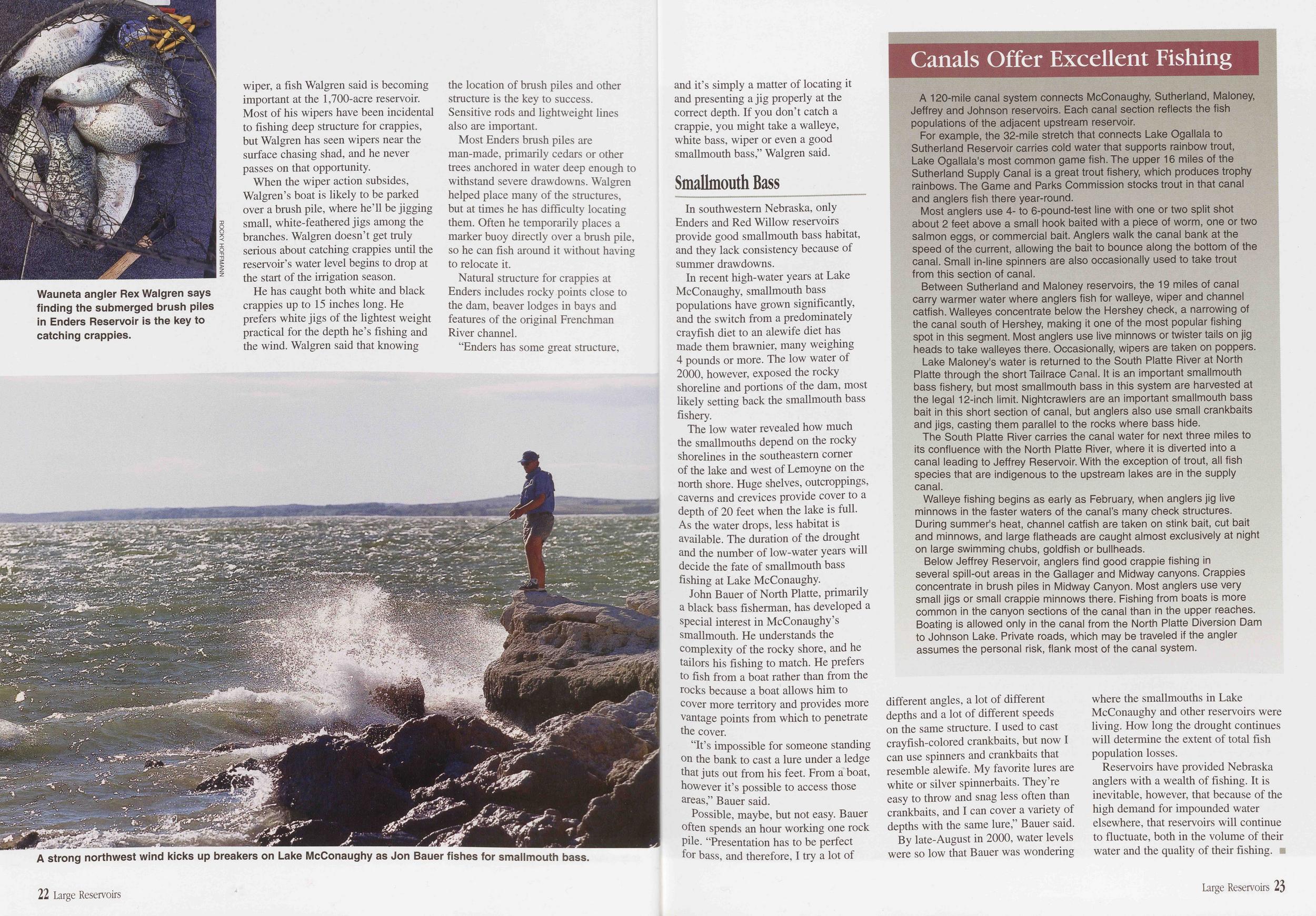
Wauneta angler Rex Walgren says finding the submerged brush piles in Enders Reservoir is the key to catching crappies.
wiper, a fish Walgren said is becoming important at the 1,700-acre reservoir. Most of his wipers have been incidental to fishing deep structure for crappies, but Walgren has seen wipers near the surface chasing shad, and he never passes on that opportunity.
When the wiper action subsides, Walgren's boat is likely to be parked over a brush pile, where he'll be jigging small, white-feathered jigs among the branches. Walgren doesn't get truly serious about catching crappies until the reservoir's water level begins to drop at the start of the irrigation season.
He has caught both white and black crappies up to 15 inches long. He prefers white jigs of the lightest weight practical for the depth he's fishing and the wind. Walgren said that knowing the location of brush piles and other structure is the key to success. Sensitive rods and lightweight lines also are important.
Most Enders brush piles are man-made, primarily cedars or other trees anchored in water deep enough to withstand severe drawdowns. Walgren helped place many of the structures, but at times he has difficulty locating them. Often he temporarily places a marker buoy directly over a brush pile, so he can fish around it without having to relocate it.
Natural structure for crappies at Enders includes rocky points close to the dam, beaver lodges in bays and features of the original Frenchman River channel.
"Enders has some great structure, A strong northwest wind kicks up breakers on Lake McConaughy as Jon Bauer fishes for smallmouth bass. and it's simply a matter of locating it and presenting a jig properly at the correct depth. If you don't catch a crappie, you might take a walleye, white bass, wiper or even a good smallmouth bass," Walgren said.
Smallmouth Bass
In southwestern Nebraska, only Enders and Red Willow reservoirs provide good smallmouth bass habitat, and they lack consistency because of summer drawdowns.
In recent high-water years at Lake McConaughy, smallmouth bass populations have grown significantly, and the switch from a predominately crayfish diet to an alewife diet has made them brawnier, many weighing 4 pounds or more. The low water of 2000, however, exposed the rocky shoreline and portions of the dam, most likely setting back the smallmouth bass fishery.
The low water revealed how much the smallmouths depend on the rocky shorelines in the southeastern corner of the lake and west of Lemoyne on the north shore. Huge shelves, outcroppings, caverns and crevices provide cover to a depth of 20 feet when the lake is full. As the water drops, less habitat is available. The duration of the drought and the number of low-water years will decide the fate of smallmouth bass fishing at Lake McConaughy.
John Bauer of North Platte, primarily a black bass fisherman, has developed a special interest in McConaughy's smallmouth. He understands the complexity of the rocky shore, and he tailors his fishing to match. He prefers to fish from a boat rather than from the rocks because a boat allows him to cover more territory and provides more vantage points from which to penetrate the cover.
"It's impossible for someone standing on the bank to cast a lure under a ledge that juts out from his feet. From a boat, however it's possible to access those areas," Bauer said.
Possible, maybe, but not easy. Bauer often spends an hour working one rock pile. "Presentation has to be perfect for bass, and therefore, I try a lot of
Canals Offer Excellent Fishing
A 120-mile canal system connects McConaughy, Sutherland, Maloney, Jeffrey and Johnson reservoirs. Each canal section reflects the fish populations of the adjacent upstream reservoir.
For example, the 32-mile stretch that connects Lake Ogallala to Sutherland Reservoir carries cold water that supports rainbow trout, Lake Ogallala's most common game fish. The upper 16 miles of the Sutherland Supply Canal is a great trout fishery, which produces trophy rainbows. The Game and Parks Commission stocks trout in that canal and anglers fish there year-round.
Most anglers use 4- to 6-pound-test line with one or two split shot about 2 feet above a small hook baited with a piece of worm, one or two salmon eggs, or commercial bait. Anglers walk the canal bank at the speed of the current, allowing the bait to bounce along the bottom of the canal. Small in-line spinners are also occasionally used to take trout from this section of canal.
Between Sutherland and Maloney reservoirs, the 19 miles of canal carry warmer water where anglers fish for walleye, wiper and channel catfish. Walleyes concentrate below the Hershey check, a narrowing of the canal south of Hershey, making it one of the most popular fishing spot in this segment. Most anglers use live minnows or twister tails on jig heads to take walleyes there. Occasionally, wipers are taken on poppers.
Lake Maloney's water is returned to the South Platte River at North Platte through the short Tailrace Canal. It is an important smallmouth bass fishery, but most smallmouth bass in this system are harvested at the legal 12-inch limit. Nightcrawlers are an important smallmouth bass bait in this short section of canal, but anglers also use small crankbaits and jigs, casting them parallel to the rocks where bass hide.
The South Platte River carries the canal water for next three miles to its confluence with the North Platte River, where it is diverted into a canal leading to Jeffrey Reservoir. With the exception of trout, all fish species that are indigenous to the upstream lakes are in the supply canal.
Walleye fishing begins as early as February, when anglers jig live minnows in the faster waters of the canal's many check structures. During summer's heat, channel catfish are taken on stink bait, cut bait and minnows, and large flatheads are caught almost exclusively at night on large swimming chubs, goldfish or bullheads.
Below Jeffrey Reservoir, anglers find good crappie fishing in several spill-out areas in the Gallager and Midway canyons. Crappies concentrate in brush piles in Midway Canyon. Most anglers use very small jigs or small crappie minnows there. Fishing from boats is more common in the canyon sections of the canal than in the upper reaches. Boating is allowed only in the canal from the North Platte Diversion Dam to Johnson Lake. Private roads, which may be traveled if the angler assumes the personal risk, flank most of the canal system.
different angles, a lot of different depths and a lot of different speeds on the same structure. I used to cast crayfish-colored crankbaits, but now I can use spinners and crankbaits that resemble alewife. My favorite lures are white or silver spinnerbaits. They're easy to throw and snag less often than crankbaits, and I can cover a variety of depths with the same lure," Bauer said.
By late-August in 2000, water levels were so low that Bauer was wondering where the smallmouths in Lake McConaughy and other reservoirs were living. How long the drought continues will determine the extent of total fish population losses.
Reservoirs have provided Nebraska anglers with a wealth of fishing. It is inevitable, however, that because of the high demand for impounded water elsewhere, that reservoirs will continue to fluctuate, both in the volume of their water and the quality of their fishing.
22 Large Reservoirs Large Reservoirs 23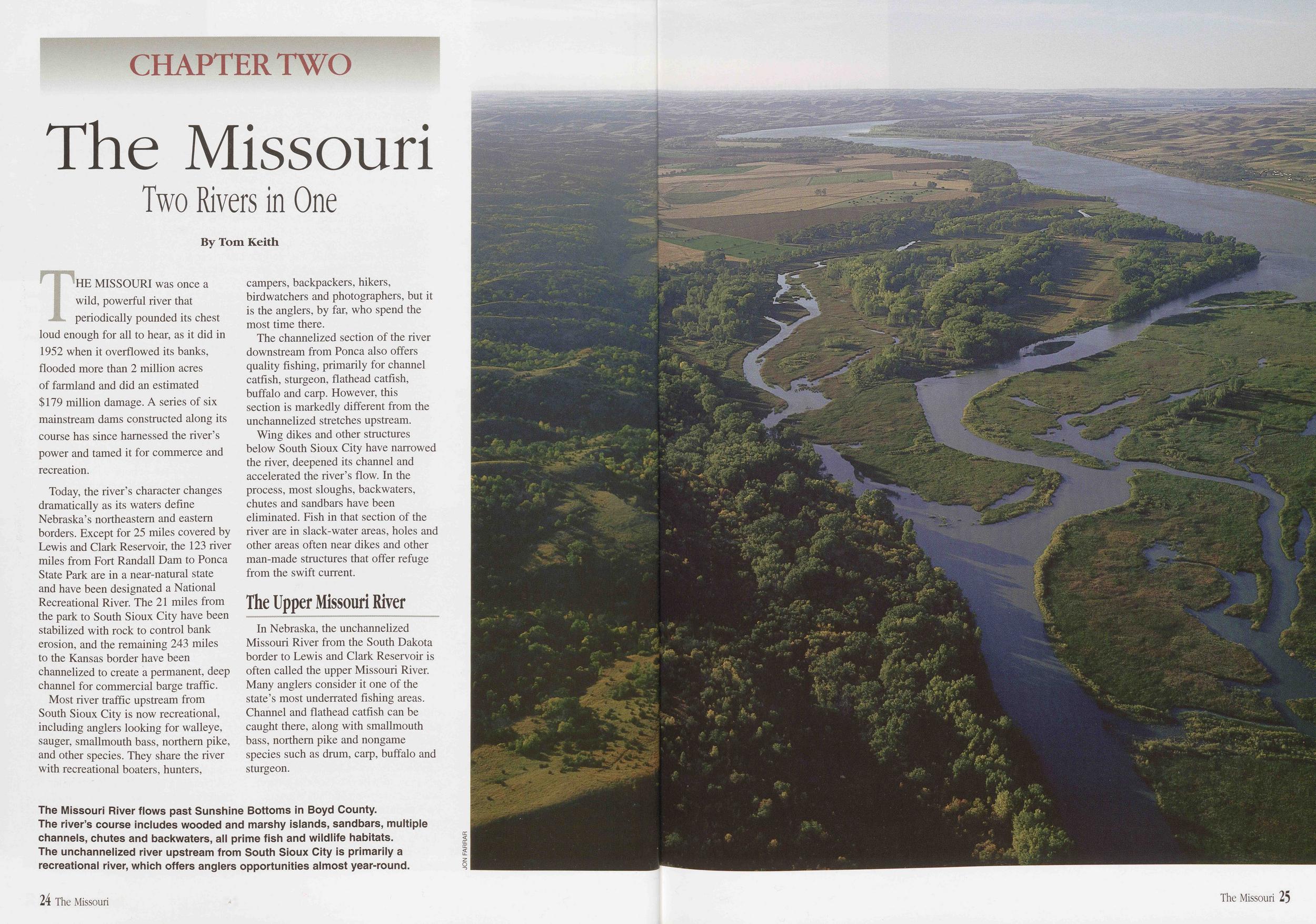
CHAPTER TWO
The Missouri
Two Rivers in One
THE MISSOURI was once a wild, powerful river that periodically pounded its chest loud enough for all to hear, as it did in 1952 when it overflowed its banks, flooded more than 2 million acres of farmland and did an estimated $179 million damage. A series of six mainstream dams constructed along its course has since harnessed the river's power and tamed it for commerce and recreation.
Today, the river's character changes dramatically as its waters define Nebraska's northeastern and eastern borders. Except for 25 miles covered by Lewis and Clark Reservoir, the 123 river miles from Fort Randall Dam to Ponca State Park are in a near-natural state and have been designated a National Recreational River. The 21 miles from the park to South Sioux City have been stabilized with rock to control bank erosion, and the remaining 243 miles to the Kansas border have been channelized to create a permanent, deep channel for commercial barge traffic.
Most river traffic upstream from South Sioux City is now recreational, including anglers looking for walleye, sauger, smallmouth bass, northern pike, and other species. They share the river with recreational boaters, hunters, campers, backpackers, hikers, birdwatchers and photographers, but it is the anglers, by far, who spend the most time there.
The channelized section of the river downstream from Ponca also offers quality fishing, primarily for channel catfish, sturgeon, flathead catfish, buffalo and carp. However, this section is markedly different from the unchannelized stretches upstream.
Wing dikes and other structures below South Sioux City have narrowed the river, deepened its channel and accelerated the river's flow. In the process, most sloughs, backwaters, chutes and sandbars have been eliminated. Fish in that section of the river are in slack-water areas, holes and other areas often near dikes and other man-made structures that offer refuge from the swift current.
The Upper Missouri River
In Nebraska, the unchannelized Missouri River from the South Dakota border to Lewis and Clark Reservoir is often called the upper Missouri River. Many anglers consider it one of the state's most underrated fishing areas. Channel and flathead catfish can be caught there, along with smallmouth bass, northern pike and nongame species such as drum, carp, buffalo and sturgeon.
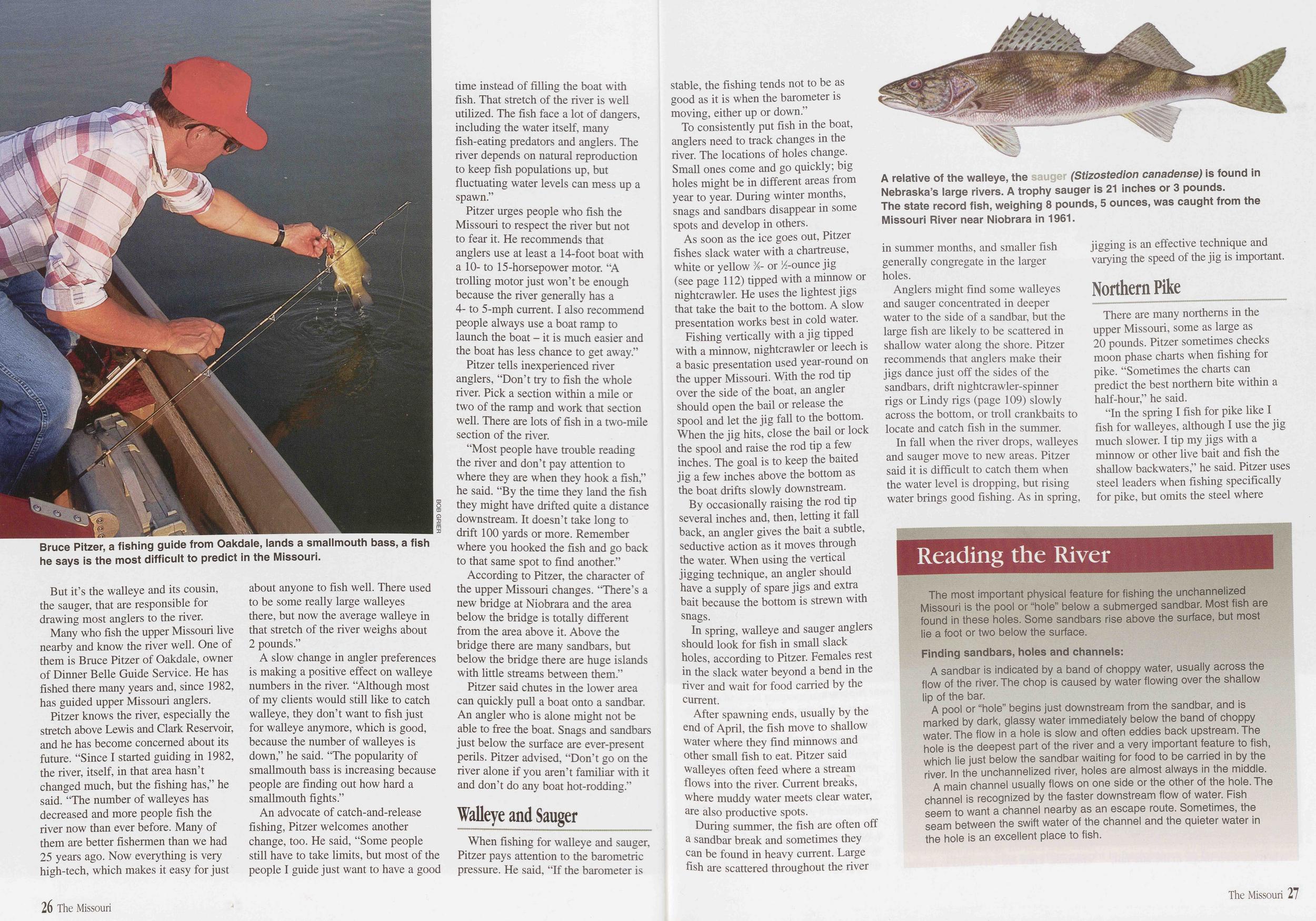
The Missouri River flows past Sunshine Bottoms in Boyd County. The river's course includes wooded and marshy islands, sandbars, multiple channels, chutes and backwaters, all prime fish and wildlife habitats. The unchannelized river upstream from South Sioux City is primarily a recreational river, which offers anglers opportunities almost year-round.
Bruce Pitzer a fishing guide from Oakdale, lands a smallmouth bass, a fish he says is the most difficult to predict in the Missouri.
But it's the walleye and its cousin, the sauger, that are responsible for drawing most anglers to the river.
Many who fish the upper Missouri five nearby and know the river well. One of them is Bruce Pitzer of Oakdale, owner of Dinner Belle Guide Service. He has fished there many years and, since 1982, has guided upper Missouri anglers.
Pitzer knows the river, especially the stretch above Lewis and Clark Reservoir, and he has become concerned about its future. "Since I started guiding in 1982, the river, itself, in that area hasn't changed much, but the fishing has," he said. "The number of walleyes has decreased and more people fish the river now than ever before. Many of them are better fishermen than we had 25 years ago. Now everything is very high-tech, which makes it easy for just
26 The Missouriabout anyone to fish well. There used to be some really large walleyes there, but now the average walleye in that stretch of the river weighs about 2 pounds."
A slow change in angler preferences is making a positive effect on walleye numbers in the river. "Although most of my clients would still like to catch walleye, they don't want to fish just for walleye anymore, which is good, because the number of walleyes is down," he said. "The popularity of smallmouth bass is increasing because people are finding out how hard a smallmouth fights."
An advocate of catch-and-release fishing, Pitzer welcomes another change, too. He said, "Some people still have to take limits, but most of the people I guide just want to have a good time instead of filling the boat with fish. That stretch of the river is well utilized. The fish face a lot of dangers, including the water itself, many fish-eating predators and anglers. The river depends on natural reproduction to keep fish populations up, but fluctuating water levels can mess up a spawn."
Pitzer urges people who fish the Missouri to respect the river but not to fear it. He recommends that anglers use at least a 14-foot boat with a 10- to 15-horsepower motor. "A trolling motor just won't be enough because the river generally has a 4- to 5-mph current. I also recommend people always use a boat ramp to launch the boat - it is much easier and the boat has less chance to get away."
Pitzer tells inexperienced river anglers, "Don't try to fish the whole river. Pick a section within a mile or two of the ramp and work that section well. There are lots of fish in a two-mile section of the river.
"Most people have trouble reading the river and don't pay attention to where they are when they hook a fish," he said. "By the time they land the fish they might have drifted quite a distance downstream. It doesn't take long to drift 100 yards or more. Remember where you hooked the fish and go back to that same spot to find another."
According to Pitzer, the character of the upper Missouri changes. "There's a new bridge at Niobrara and the area below the bridge is totally different from the area above it. Above the bridge there are many sandbars, but below the bridge there are huge islands with little streams between them."
Pitzer said chutes in the lower area can quickly pull a boat onto a sandbar. An angler who is alone might not be able to free the boat. Snags and sandbars just below the surface are ever-present perils. Pitzer advised, "Don't go on the river alone if you aren't familiar with it and don't do any boat hot-rodding."
Walleye and Sauger
When fishing for walleye and sauger, Pitzer pays attention to the barometric pressure. He said, "If the barometer is stable, the fishing tends not to be as good as it is when the barometer is moving, either up or down."
To consistently put fish in the boat, anglers need to track changes in the river. The locations of holes change. Small ones come and go quickly; big holes might be in different areas from year to year. During winter months, snags and sandbars disappear in some spots and develop in others.
As soon as the ice goes out, Pitzer fishes slack water with a chartreuse, white or yellow %- or M-ounce jig (see page 112) tipped with a minnow or nightcrawler. He uses the lightest jigs that take the bait to the bottom. A slow presentation works best in cold water.
Fishing vertically with a jig tipped with a minnow, nightcrawler or leech is a basic presentation used year-round on the upper Missouri. With the rod tip over the side of the boat, an angler should open the bail or release the spool and let the jig fall to the bottom. When the jig hits, close the bail or lock the spool and raise the rod tip a few inches. The goal is to keep the baited jig a few inches above the bottom as the boat drifts slowly downstream.
By occasionally raising the rod tip several inches and, then, letting it fall back, an angler gives the bait a subtle, seductive action as it moves through the water. When using the vertical jigging technique, an angler should have a supply of spare jigs and extra bait because the bottom is strewn with snags.
In spring, walleye and sauger anglers should look for fish in small slack holes, according to Pitzer. Females rest in the slack water beyond a bend in the river and wait for food carried by the current.
After spawning ends, usually by the end of April, the fish move to shallow water where they find minnows and other small fish to eat. Pitzer said walleyes often feed where a stream flows into the river. Current breaks, where muddy water meets clear water, are also productive spots.
During summer, the fish are often off a sandbar break and sometimes they can be found in heavy current. Large fish are scattered throughout the river
A relative of the walleye, the (Stizostedion canadense) is found in Nebraska's large rivers. A trophy sauger is 21 inches or 3 pounds. The state record fish, weighing 8 pounds, 5 ounces, was caught from the Missouri River near Niobrara in 1961.
in summer months, and smaller fish generally congregate in the larger holes.
Anglers might find some walleyes and sauger concentrated in deeper water to the side of a sandbar, but the large fish are likely to be scattered in shallow water along the shore. Pitzer recommends that anglers make their jigs dance just off the sides of the sandbars, drift nightcrawler-spinner rigs or Lindy rigs (page 109) slowly across the bottom, or troll crankbaits to locate and catch fish in the summer.
In fall when the river drops, walleyes and sauger move to new areas. Pitzer said it is difficult to catch them when the water level is dropping, but rising water brings good fishing. As in spring, jigging is an effective technique and varying the speed of the jig is important.
Northern Pike
There are many northerns in the upper Missouri, some as large as 20 pounds. Pitzer sometimes checks moon phase charts when fishing for pike. "Sometimes the charts can predict the best northern bite within a half-hour," he said.
"In the spring I fish for pike like I fish for walleyes, although I use the jig much slower. I tip my jigs with a minnow or other live bait and fish the shallow backwaters," he said. Pitzer uses steel leaders when fishing specifically for pike, but omits the steel where
Reading the River
found in these holes. Some sandbars rise above the surface, but most lie a foot or two below the surface.
Finding sandbars, holes and channels:
A sandbar is indicated by a band of choppy water, usually across the flow of the river. The chop is caused by water flowing over the shallow lip of the bar.
A pool or "hole" begins just downstream from the sandbar, and is marked by dark, glassy water immediately below the band of choppy water. The flow in a hole is slow and often eddies back upstream. The hole is the deepest part of the river and a very important feature to fish, which lie just below the sandbar waiting for food to be carried in by the river In the unchannelized river, holes are almost always in the middle.
A main channel usually flows on one side or the other of the hole. The channel is recognized by the faster downstream flow of water. Fish seem to want a channel nearby as an escape route. Sometimes, the seam between the swift water of the channel and the quieter water in the hole is an excellent place to fish.
The Missouri 27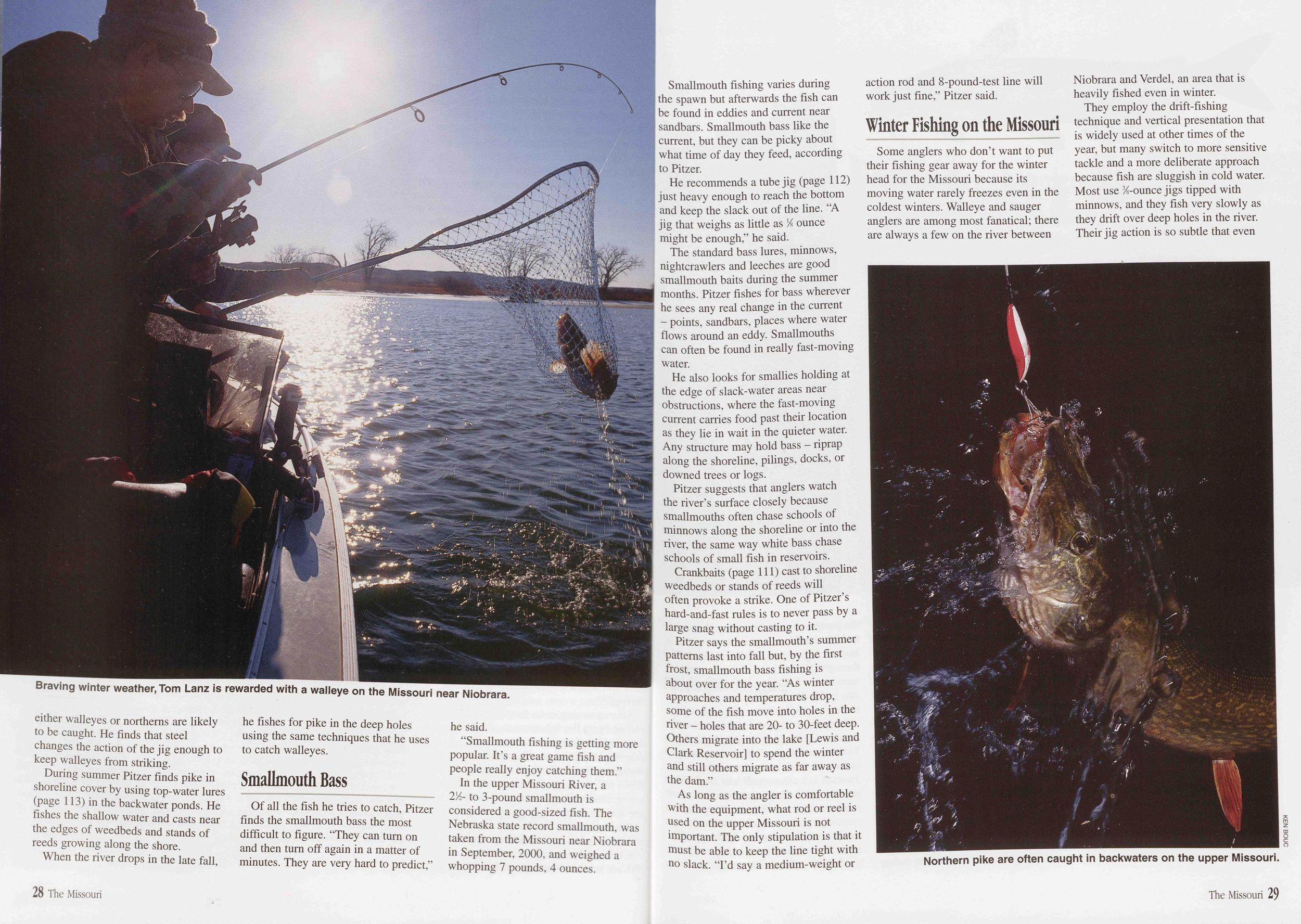
Braving winter weather, Tom Lanz is rewarded with a walleye on the Missouri near Niobrara.
either walleyes or northerns are likely to be caught. He finds that steel changes the action of the jig enough to keep walleyes from striking.
During summer Pitzer finds pike in shoreline cover by using top-water lures (page 113) in the backwater ponds. He fishes the shallow water and casts near the edges of weedbeds and stands of reeds growing along the shore.
When the river drops in the late fall, he fishes for pike in the deep holes using the same techniques that he uses to catch walleyes.
Smallmouth Bass
Of all the fish he tries to catch, Pitzer finds the smallmouth bass the most difficult to figure. 'They can turn on and then turn off again in a matter of minutes. They are very hard to predict," he said.
"Smallmouth fishing is getting more popular. It's a great game fish and people really enjoy catching them."
In the upper Missouri River, a 2M- to 3-pound smallmouth is considered a good-sized fish. The Nebraska state record smallmouth, was taken from the Missouri near Niobrara in September, 2000, and weighed a whopping 7 pounds, 4 ounces.
Smallmouth fishing varies during the spawn but afterwards the fish can be found in eddies and current near sandbars. Smallmouth bass like the current, but they can be picky about what time of day they feed, according to Pitzer.
He recommends a tube jig (page 112) just heavy enough to reach the bottom and keep the slack out of the line. "A jig that weighs as little as % ounce might be enough," he said.
The standard bass lures, minnows, nightcrawlers and leeches are good smallmouth baits during the summer months. Pitzer fishes for bass wherever he sees any real change in the current - points, sandbars, places where water flows around an eddy. Smallmouths can often be found in really fast-moving water.
He also looks for smallies holding at the edge of slack-water areas near obstructions, where the fast-moving current carries food past their location as they lie in wait in the quieter water. Any structure may hold bass - riprap along the shoreline, pilings, docks, or downed trees or logs.
Pitzer suggests that anglers watch the river's surface closely because smallmouths often chase schools of minnows along the shoreline or into the river, the same way white bass chase schools of small fish in reservoirs.
Crankbaits (page 111) cast to shoreline weedbeds or stands of reeds will often provoke a strike. One of Pitzer's hard-and-fast rules is to never pass by a large snag without casting to it.
Pitzer says the smallmouth's summer patterns last into fall but, by the first frost, smallmouth bass fishing is about over for the year. "As winter approaches and temperatures drop, some of the fish move into holes in the river - holes that are 20- to 30-feet deep. Others migrate into the lake [Lewis and Clark Reservoir] to spend the winter and still others migrate as far away as the dam."
As long as the angler is comfortable with the equipment, what rod or reel is used on the upper Missouri is not important. The only stipulation is that it must be able to keep the line tight with no slack. "I'd say a medium-weight or action rod and 8-pound-test line will work just fine," Pitzer said.
Winter Fishing on the Missouri
Some anglers who don't want to put their fishing gear away for the winter head for the Missouri because its moving water rarely freezes even in the coldest winters. Walleye and sauger anglers are among most fanatical; there are always a few on the river between Niobrara and Verdel, an area that is heavily fished even in winter.
They employ the drift-fishing technique and vertical presentation that is widely used at other times of the year, but many switch to more sensitive tackle and a more deliberate approach because fish are sluggish in cold water. Most use %-ounce jigs tipped with minnows, and they fish very slowly as they drift over deep holes in the river. Their jig action is so subtle that even
Northern pike are often caught in backwaters on the upper Missouri.
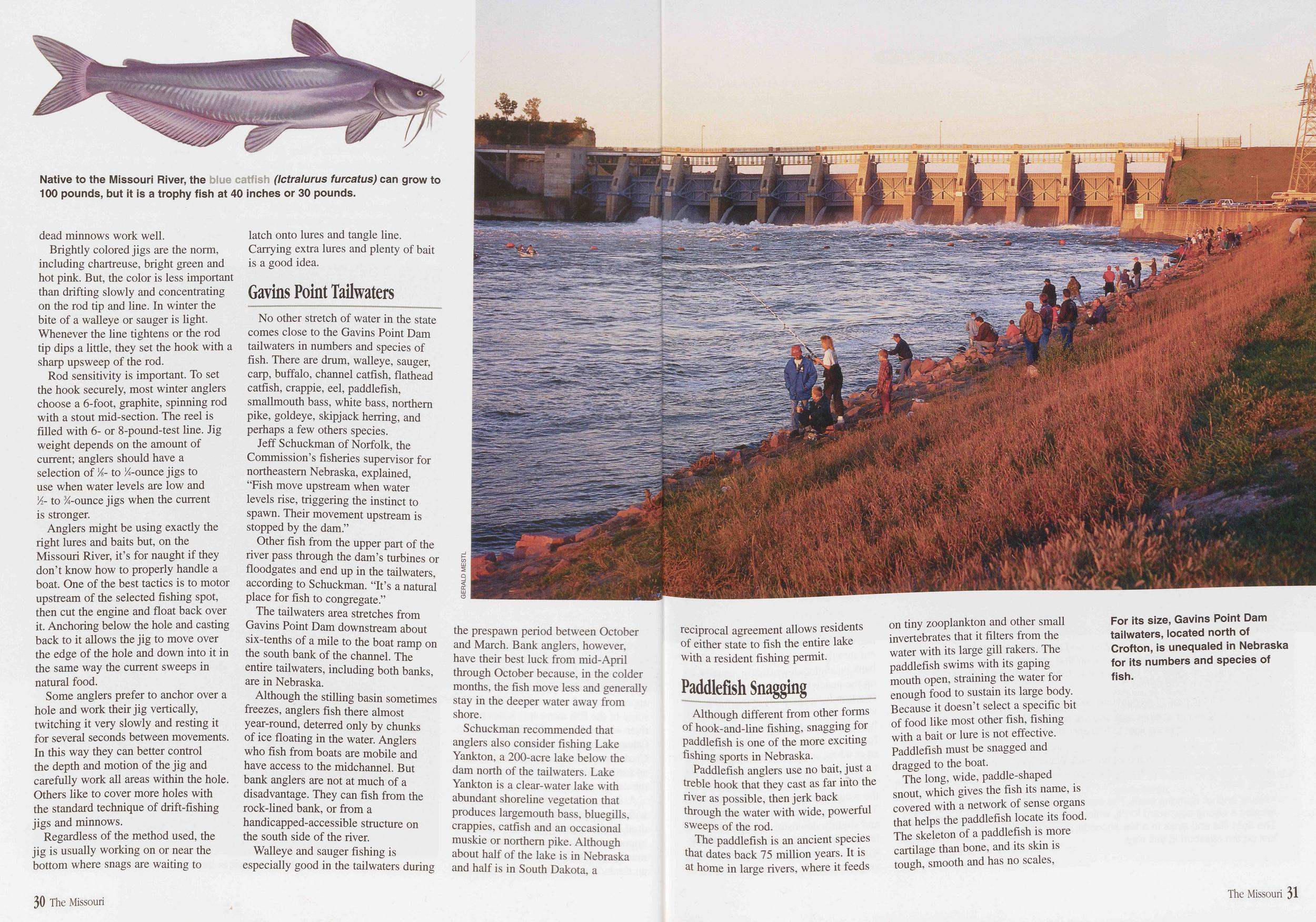
Native to the Missouri River, the Wli (Ictralurus furcatus) can grow to 100 pounds, but it is a trophy fish at 40 inches or 30 pounds.
dead minnows work well.
Brightly colored jigs are the norm, including chartreuse, bright green and hot pink. But, the color is less important than drifting slowly and concentrating on the rod tip and line. In winter the bite of a walleye or sauger is light. Whenever the line tightens or the rod tip dips a little, they set the hook with a sharp upsweep of the rod.
Rod sensitivity is important. To set the hook securely, most winter anglers choose a 6-foot, graphite, spinning rod with a stout mid-section. The reel is filled with 6- or 8-pound-test line. Jig weight depends on the amount of current; anglers should have a selection of %- to %-ounce jigs to use when water levels are low and ]A- to %-ounce jigs when the current is stronger.
Anglers might be using exactly the right lures and baits but, on the Missouri River, it's for naught if they don't know how to properly handle a boat. One of the best tactics is to motor upstream of the selected fishing spot, then cut the engine and float back over it. Anchoring below the hole and casting back to it allows the jig to move over the edge of the hole and down into it in the same way the current sweeps in natural food.
Some anglers prefer to anchor over a hole and work their jig vertically, twitching it very slowly and resting it for several seconds between movements. In this way they can better control the depth and motion of the jig and carefully work all areas within the hole. Others like to cover more holes with the standard technique of drift-fishing jigs and minnows.
Regardless of the method used, the jig is usually working on or near the bottom where snags are waiting to 30 The Missouri latch onto lures and tangle line. Carrying extra lures and plenty of bait is a good idea.
Gavins Point Tailwaters
No other stretch of water in the state comes close to the Gavins Point Dam tailwaters in numbers and species of fish. There are drum, walleye, sauger, carp, buffalo, channel catfish, flathead catfish, crappie, eel, paddlefish, smallmouth bass, white bass, northern pike, goldeye, skipjack herring, and perhaps a few others species.
Jeff Schuckman of Norfolk, the Commission's fisheries supervisor for northeastern Nebraska, explained, "Fish move upstream when water levels rise, triggering the instinct to spawn. Their movement upstream is stopped by the dam."
Other fish from the upper part of the river pass through the dam's turbines or floodgates and end up in the tailwaters, according to Schuckman. "It's a natural place for fish to congregate."
The tailwaters area stretches from Gavins Point Dam downstream about six-tenths of a mile to the boat ramp on the south bank of the channel. The entire tailwaters, including both banks, are in Nebraska.
Although the stilling basin sometimes freezes, anglers fish there almost year-round, deterred only by chunks of ice floating in the water. Anglers who fish from boats are mobile and have access to the midchannel. But bank anglers are not at much of a disadvantage. They can fish from the rock-lined bank, or from a handicapped-accessible structure on the south side of the river.
Walleye and sauger fishing is especially good in the tailwaters during the prespawn period between October and March. Bank anglers, however, have their best luck from mid-April through October because, in the colder months, the fish move less and generally stay in the deeper water away from shore.
Schuckman recommended that anglers also consider fishing Lake Yankton, a 200-acre lake below the dam north of the tailwaters. Lake Yankton is a clear-water lake with abundant shoreline vegetation that produces largemouth bass, bluegills, crappies, catfish and an occasional muskie or northern pike. Although about half of the lake is in Nebraska and half is in South Dakota, a reciprocal agreement allows residents of either state to fish the entire lake with a resident fishing permit.
Paddlefish Snagging
Although different from other forms of hook-and-line fishing, snagging for paddlefish is one of the more exciting fishing sports in Nebraska.
Paddlefish anglers use no bait, just a treble hook that they cast as far into the river as possible, then jerk back through the water with wide, powerful sweeps of the rod.
The paddlefish is an ancient species that dates back 75 million years. It is at home in large rivers, where it feeds on tiny zooplankton and other small invertebrates that it filters from the water with its large gill rakers. The paddlefish swims with its gaping mouth open, straining the water for enough food to sustain its large body. Because it doesn't select a specific bit of food like most other fish, fishing with a bait or lure is not effective. Paddlefish must be snagged and dragged to the boat.
The long, wide, paddle-shaped snout, which gives the fish its name, is covered with a network of sense organs that helps the paddlefish locate its food. The skeleton of a paddlefish is more cartilage than bone, and its skin is tough, smooth and has no scales,
For its size, Gavins Point Dam tailwaters, located north of Crofton, is unequaled in Nebraska for its numbers and species of fish.
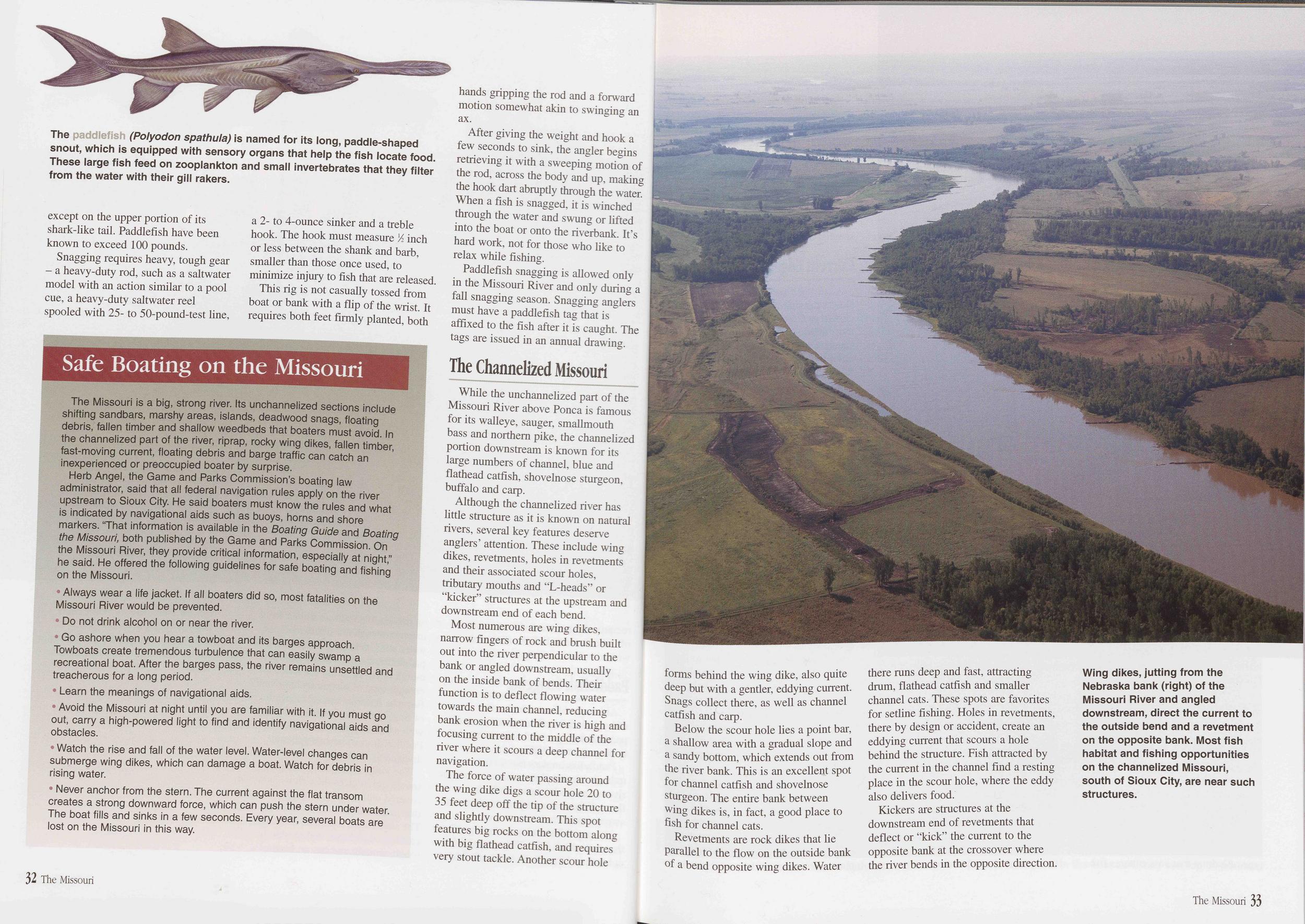
The (Polyodon spathula) is named for its long, paddle-shaped snout, which is equipped with sensory organs that help the fish locate food. These large fish feed on zooplankton and small invertebrates that they filter from the water with their gill rakers.
except on the upper portion of its shark-like tail. Paddlefish have been known to exceed 100 pounds.
Snagging requires heavy, tough gear - a heavy-duty rod, such as a saltwater model with an action similar to a pool cue, a heavy-duty saltwater reel spooled with 25- to 50-pound-test line, a 2- to 4-ounce sinker and a treble hook. The hook must measure M inch or less between the shank and barb, smaller than those once used, to minimize injury to fish that are released.
This rig is not casually tossed from boat or bank with a flip of the wrist It requires both feet firmly planted, both
Safe Boating on the Missouri
The Missouri is a big, strong river. Its unchannelized sections include shifting sandbars, marshy areas, islands, deadwood snags floating debris, fallen timber and shallow weedbeds that boaters must avoid in the channelized part of the river, riprap, rocky wing dikes, fallen timber fast-moving current, floating debris and barge traffic can catch an inexperienced or preoccupied boater by surprise.
Herb Angel, the Game and Parks Commission's boating law administrator, said that all federal navigation rules apply on the river upstream to Sioux City. He said boaters must know the rules and what is indicated by navigational aids such as buoys, horns and shore markers. "That information is available in the Boatina Guide the Missouri, both published by the Game and Park? the Missouri River, they provide critical information, especially on the following guidelines for safe Safe boating and fishing on the Missouri
'Always wear a life jacket. If all boaters did so, most fatalities on the Missouri River would be prevented.
• Do not drink alcohol on or near the river.
• Go ashore when you hear a towboat and its barges approach Towboats create tremendous turbulence that can easily swamD a recreational boat. After the barges pass, the river remains unsettled and treacherous for a long period.
• Learn the meanings of navigational aids.
• Avoid the Missouri at night until you are familiar with it If you must go out, carry a high-powered light to find and identify navigational aids and ODSTclCIGS.
• Watch the rise and fall of the water level. Water-level changes can submerge wing dikes, which can damage a boat. Watch for debrk in rising water.
• Never anchor from the stern. The current against the flat transom creates a strong downward force, which can push the stern under water The boat fills and sinks in a few seconds. Every year, several boats are " lost on the Missouri in this way.
32 The Missourihands gripping the rod and a forward motion somewhat akin to swinging an ax.
After giving the weight and hook a few seconds to sink, the angler begins retrieving it with a sweeping motion of the rod, across the body and up, making the hook dart abruptly through the water. When a fish is snagged, it is winched through the water and swung or lifted into the boat or onto the riverbank. It's hard work, not for those who like to relax while fishing.
Paddlefish snagging is allowed only in the Missouri River and only during a fall snagging season. Snagging anglers must have a paddlefish tag that is affixed to the fish after it is caught. The tags are issued in an annual drawing.
The Channelized Missouri
While the unchannelized part of the Missouri River above Ponca is famous for its walleye, sauger, smallmouth bass and northern pike, the channelized portion downstream is known for its large numbers of channel, blue and flathead catfish, shovel nose sturgeon, buffalo and carp.
Although the channelized river has little structure as it is known on natural rivers, several key features deserve anglers' attention. These include wing dikes, revetments, holes in revetments and their associated scour holes, tributary mouths and "L-heads" or "kicker" structures at the upstream and downstream end of each bend.
Most numerous are wing dikes, narrow fingers of rock and brush built out into the river perpendicular to the bank or angled downstream, usually on the inside bank of bends. Their function is to deflect flowing water towards the main channel, reducing bank erosion when the river is high and focusing current to the middle of the river where it scours a deep channel for navigation.
The force of water passing around the wing dike digs a scour hole 20 to 35 feet deep off the tip of the structure and slightly downstream. This spot features big rocks on the bottom along with big flathead catfish, and requires very stout tackle. Another scour hole forms behind the wing dike, also quite deep but with a gentler, eddying current. Snags collect there, as well as channel catfish and carp.
Below the scour hole lies a point bar, a shallow area with a gradual slope and a sandy bottom, which extends out from the river bank. This is an excellent spot for channel catfish and shovelnose sturgeon. The entire bank between wing dikes is, in fact, a good place to fish for channel cats.
Revetments are rock dikes that lie parallel to the flow on the outside bank of a bend opposite wing dikes. Water there runs deep and fast, attracting drum, flathead catfish and smaller channel cats. These spots are favorites for set line fishing. Holes in revetments, there by design or accident, create an eddying current that scours a hole behind the structure. Fish attracted by the current in the channel find a resting place in the scour hole, where the eddy also delivers food.
Kickers are structures at the downstream end of revetments that deflect or "kick" the current to the opposite bank at the crossover where the river bends in the opposite direction.
Wing dikes, jutting from the Nebraska bank (right) of the Missouri River and angled downstream, direct the current to the outside bend and a revetment on the opposite bank. Most fish habitat and fishing opportunities on the channelized Missouri, south of Sioux City, are near such structures.
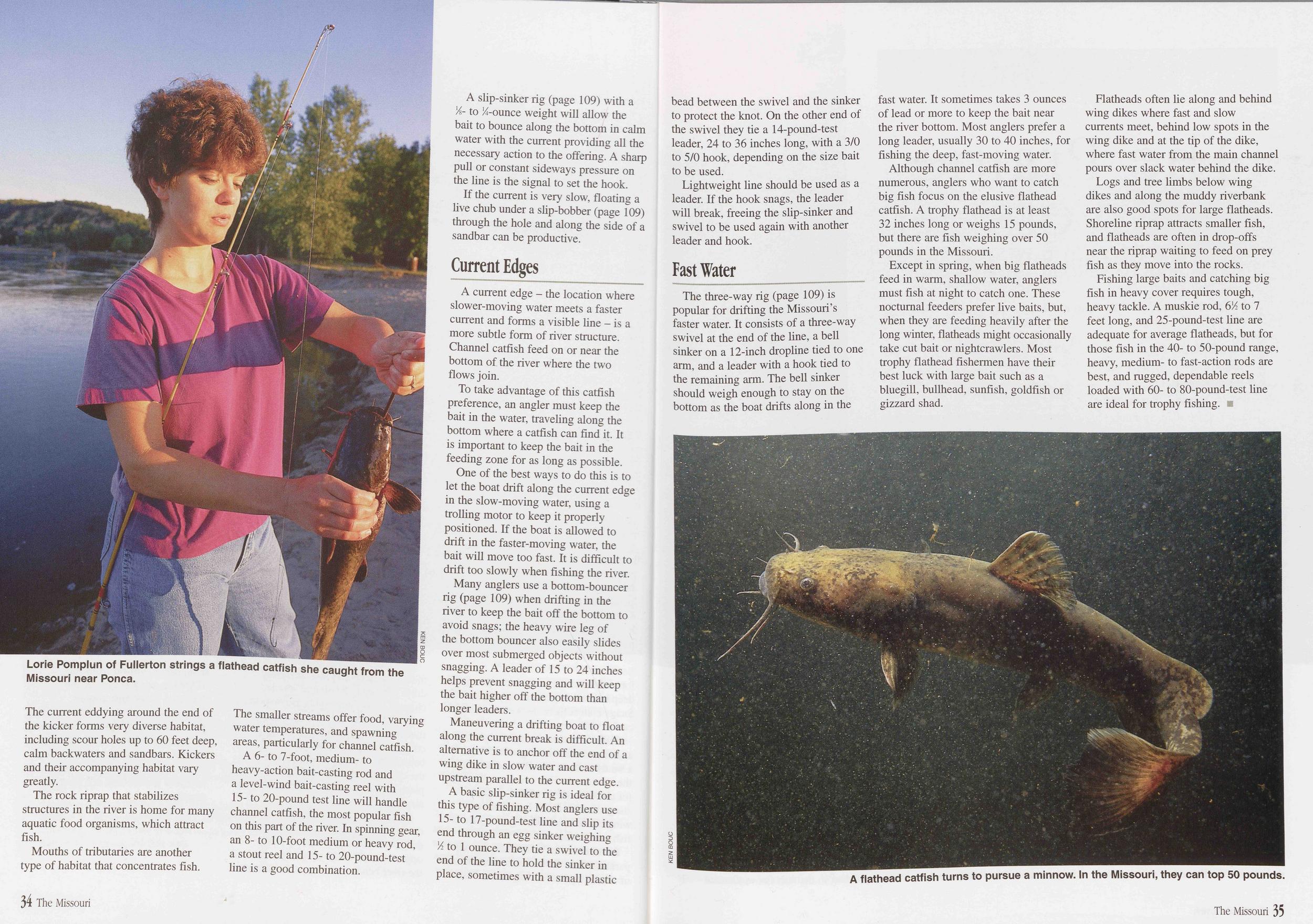
Lorie Pomplun of Fullerton strings a flathead catfish she caught from the Missouri near Ponca.
The current eddying around the end of the kicker forms very diverse habitat, including scour holes up to 60 feet deep, calm backwaters and sandbars. Kickers and their accompanying habitat vary greatly.
The rock riprap that stabilizes structures in the river is home for many aquatic food organisms, which attract fish.
Mouths of tributaries are another type of habitat that concentrates fish.
34 The MissouriThe smaller streams offer food, varying water temperatures, and spawning areas, particularly for channel catfish.
A 6- to 7-foot, medium- to heavy-action bait-casting rod and a level-wind bait-casting reel with 15- to 20-pound test line will handle channel catfish, the most popular fish on this part of the river. In spinning gear, an 8- to 10-foot medium or heavy rod, a stout reel and 15- to 20-pound-test line is a good combination. A slip-sinker rig (page 109) with a A- to ]4-ounce weight will allow the bait to bounce along the bottom in calm water with the current providing all the necessary action to the offering. A sharp pull or constant sideways pressure on the line is the signal to set the hook.
If the current is very slow, floating a live chub under a slip-bobber (page 109) through the hole and along the side of a sandbar can be productive.
Current Edges
A current edge - the location where slower-moving water meets a faster current and forms a visible line - is a more subtle form of river structure. Channel catfish feed on or near the bottom of the river where the two flows join.
To take advantage of this catfish preference, an angler must keep the bait in the water, traveling along the bottom where a catfish can find it. It is important to keep the bait in the feeding zone for as long as possible.
One of the best ways to do this is to let the boat drift along the current edge in the slow-moving water, using a trolling motor to keep it properly positioned. If the boat is allowed to drift in the faster-moving water, the bait will move too fast. It is difficult to drift too slowly when fishing the river.
Many anglers use a bottom-bouncer rig (page 109) when drifting in the river to keep the bait off the bottom to avoid snags; the heavy wire leg of the bottom bouncer also easily slides over most submerged objects without snagging. A leader of 15 to 24 inches helps prevent snagging and will keep the bait higher off the bottom than longer leaders.
Maneuvering a drifting boat to float along the current break is difficult. An alternative is to anchor off the end of a wing dike in slow water and cast upstream parallel to the current edge.
A basic slip-sinker rig is ideal for this type of fishing. Most anglers use 15- to 17-pound-test line and slip its end through an egg sinker weighing M to 1 ounce. They tie a swivel to the end of the line to hold the sinker in place, sometimes with a small plastic bead between the swivel and the sinker to protect the knot. On the other end of the swivel they tie a 14-pound-test leader, 24 to 36 inches long, with a 3/0 to 5/0 hook, depending on the size bait to be used.
Lightweight line should be used as a leader. If the hook snags, the leader will break, freeing the slip-sinker and swivel to be used again with another leader and hook.
Fast WaterThe three-way rig (page 109) is popular for drifting the Missouri's faster water. It consists of a three-way swivel at the end of the line, a bell sinker on a 12-inch drop line tied to one arm, and a leader with a hook tied to the remaining arm. The bell sinker should weigh enough to stay on the bottom as the boat drifts along in the fast water. It sometimes takes 3 ounces of lead or more to keep the bait near the river bottom. Most anglers prefer a long leader, usually 30 to 40 inches, for fishing the deep, fast-moving water.
Although channel catfish are more numerous, anglers who want to catch big fish focus on the elusive flathead catfish. A trophy flathead is at least 32 inches long or weighs 15 pounds, but there are fish weighing over 50 pounds in the Missouri.
Except in spring, when big flatheads feed in warm, shallow water, anglers must fish at night to catch one. These nocturnal feeders prefer live baits, but, when they are feeding heavily after the long winter, flatheads might occasionally take cut bait or nightcrawlers. Most trophy flathead fishermen have their best luck with large bait such as a bluegill, bullhead, sunfish, goldfish or gizzard shad.
Flatheads often lie along and behind wing dikes where fast and slow currents meet, behind low spots in the wing dike and at the tip of the dike, where fast water from the main channel pours over slack water behind the dike.
Logs and tree limbs below wing dikes and along the muddy riverbank are also good spots for large flatheads. Shoreline riprap attracts smaller fish, and flatheads are often in drop-offs near the riprap waiting to feed on prey fish as they move into the rocks.
Fishing large baits and catching big fish in heavy cover requires tough, heavy tackle. A muskie rod, 6]A to 7 feet long, and 25-pound-test line are adequate for average flatheads, but for those fish in the 40- to 50-pound range, heavy, medium- to fast-action rods are best, and rugged, dependable reels loaded with 60- to 80-pound-test line are ideal for trophy fishing.
flathead catfish turns to pursue a minnow. In the Missouri, they can top 50 pounds.
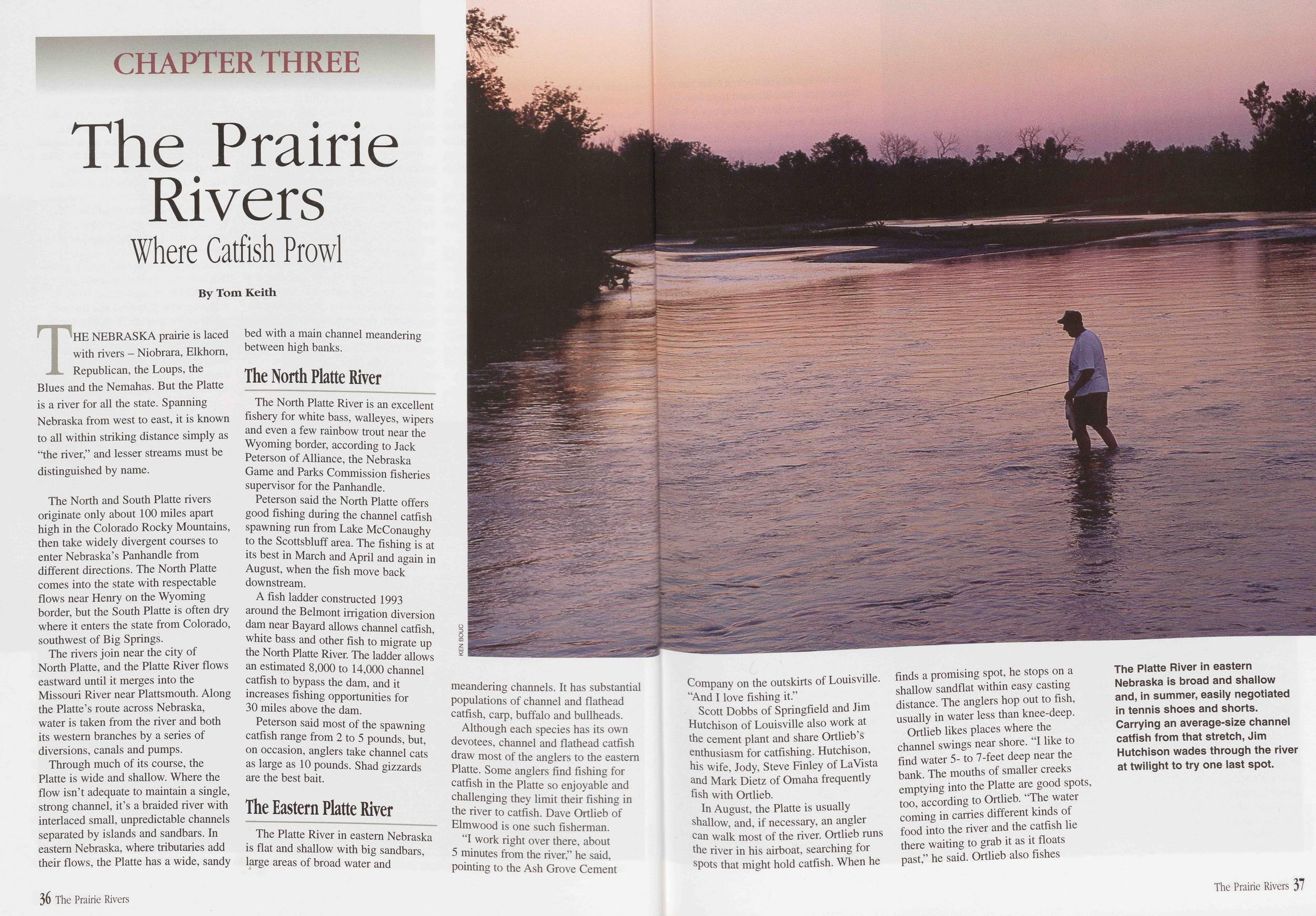
CHAPTER THREE
The Prairie Rivers
Where Catfish Prowl
THE NEBRASKA prairie is laced with rivers - Niobrara, Elkhorn, Republican, the Loups, the Blues and the Nemahas. But the Platte is a river for all the state. Spanning Nebraska from west to east, it is known to all within striking distance simply as "the river," and lesser streams must be distinguished by name.
The North and South Platte rivers originate only about 100 miles apart high in the Colorado Rocky Mountains, then take widely divergent courses to enter Nebraska's Panhandle from different directions. The North Platte comes into the state with respectable flows near Henry on the Wyoming border, but the South Platte is often dry where it enters the state from Colorado, southwest of Big Springs.
The rivers join near the city of North Platte, and the Platte River flows eastward until it merges into the Missouri River near Plattsmouth. Along the Platte's route across Nebraska, water is taken from the river and both its western branches by a series of diversions, canals and pumps.
Through much of its course, the Platte is wide and shallow. Where the flow isn't adequate to maintain a single, strong channel, it's a braided river with interlaced small, unpredictable channels separated by islands and sandbars. In eastern Nebraska, where tributaries add their flows, the Platte has a wide, sandy 36 The Prairie Rivers bed with a main channel meandering between high banks.
The North Platte River
The North Platte River is an excellent fishery for white bass, walleyes, wipers and even a few rainbow trout near the Wyoming border, according to Jack Peterson of Alliance, the Nebraska Game and Parks Commission fisheries supervisor for the Panhandle.
Peterson said the North Platte offers good fishing during the channel catfish spawning run from Lake McConaughy to the Scottsbluff area. The fishing is at its best in March and April and again in August, when the fish move back downstream.
A fish ladder constructed 1993 around the Belmont irrigation diversion dam near Bayard allows channel catfish, white bass and other fish to migrate up the North Platte River. The ladder allows an estimated 8,000 to 14,000 channel catfish to bypass the dam, and it increases fishing opportunities for 30 miles above the dam.
Peterson said most of the spawning catfish range from 2 to 5 pounds, but, on occasion, anglers take channel cats as large as 10 pounds. Shad gizzards are the best bait.
The Eastern Platte River
The Platte River in eastern Nebraska is flat and shallow with big sandbars, large areas of broad water and meandering channels. It has substantial populations of channel and flathead catfish, carp, buffalo and bullheads.
Although each species has its own devotees, channel and flathead catfish draw most of the anglers to the eastern Platte. Some anglers find fishing for catfish in the Platte so enjoyable and challenging they limit their fishing in the river to catfish. Dave Ortlieb of Elmwood is one such fisherman.
"I work right over there, about 5 minutes from the river," he said, pointing to the Ash Grove Cement Company on the outskirts of Louisville. "And I love fishing it."
Scott Dobbs of Springfield and Jim Hutchison of Louisville also work at the cement plant and share Ortlieb's enthusiasm for catfishing. Hutchison, his wife, Jody, Steve Finley of LaVista and Mark Dietz of Omaha frequently fish with Ortlieb.
In August, the Platte is usually shallow, and, if necessary, an angler can walk most of the river. Ortlieb runs the river in his airboat, searching for spots that might hold catfish. When he finds a promising spot, he stops on a shallow sandflat within easy casting distance. The anglers hop out to fish, usually in water less than knee-deep.
Ortlieb likes places where the channel swings near shore. "I like to find water 5- to 7-feet deep near the bank The mouths of smaller creeks emptying into the Platte are good spots, too, according to Ortlieb. 'The water coming in carries different kinds of food into the river and the catfish lie there waiting to grab it as it floats past," he said. Ortlieb also fishes
The Platte River in eastern Nebraska is broad and shallow and, in summer, easily negotiated in tennis shoes and shorts. Carrying an average-size channel catfish from that stretch, Jim Hutchison wades through the river at twilight to try one last spot.
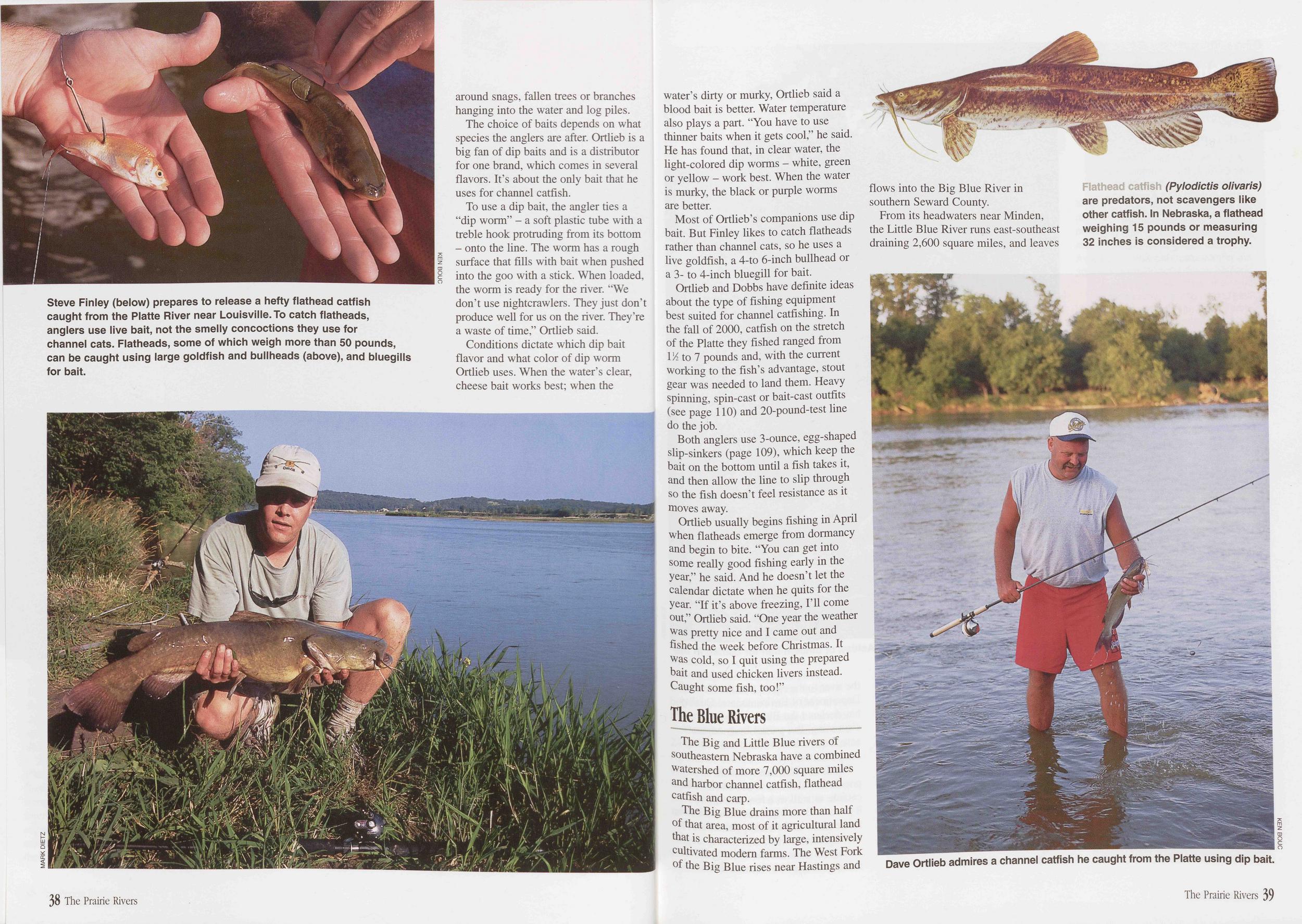
Steve Finley (below) prepares to release a hefty flathead catfish caught from the Platte River near Louisville. To catch flatheads, anglers use live bait, not the smelly concoctions they use for channel cats. Flatheads, some of which weigh more than 50 pounds, can be caught using large goldfish and bullheads (above), and bluegills for bait.
around snags, fallen trees or branches hanging into the water and log piles.
The choice of baits depends on what species the anglers are after. Ortheb is a big fan of dip baits and is a distributor for one brand, which comes in several flavors. It's about the only bait that he uses for channel catfish.
To use a dip bait, the angler ties a "dip worm" - a soft plastic tube with a treble hook protruding from its bottom - onto the line. The worm has a rough surface that fills with bait when pushed into the goo with a stick. When loaded, the worm is ready for the river. "We don't use nightcrawlers. They just don't produce well for us on the river. They're a waste of time," Ortheb said.
Conditions dictate which dip bait flavor and what color of dip worm Ortheb uses. When the water's clear, cheese bait works best; when the water's dirty or murky, Ortlieb said a blood bait is better. Water temperature also plays a part. "You have to use thinner baits when it gets cool," he said. He has found that, in clear water, the light-colored dip worms - white, green or yellow - work best. When the water is murky, the black or purple worms are better.
Most of Ortlieb's companions use dip bait. But Finley likes to catch flatheads rather than channel cats, so he uses a live goldfish, a 4-to 6-inch bullhead or a 3- to 4-inch bluegill for bait.
Ortlieb and Dobbs have definite ideas about the type of fishing equipment best suited for channel catfishing. In the fall of 2000, catfish on the stretch of the Platte they fished ranged from VA to 7 pounds and, with the current working to the fish's advantage, stout gear was needed to land them. Heavy spinning, spin-cast or bait-cast outfits (see page 110) and 20-pound-test line do the job.
Both anglers use 3-ounce, egg-shaped slip-sinkers (page 109), which keep the bait on the bottom until a fish takes it, and then allow the line to slip through so the fish doesn't feel resistance as it moves away.
Ortlieb usually begins fishing in April when flatheads emerge from dormancy and begin to bite. "You can get into some really good fishing early in the year," he said. And he doesn't let the calendar dictate when he quits for the year. "If it's above freezing, I'll come out," Ortheb said. "One year the weather was pretty nice and I came out and fished the week before Christmas. It was cold, so I quit using the prepared bait and used chicken livers instead. Caught some fish, too!"
The Blue Rivers
The Big and Little Blue rivers of southeastern Nebraska have a combined watershed of more 7,000 square miles and harbor channel catfish, flathead catfish and carp.
The Big Blue drains more than half °f that area, most of it agricultural land that is characterized by large, intensively cultivated modern farms. The West Fork of the Big Blue rises near Hastings and flows into the Big Blue River in southern Seward County.
From its headwaters near Minden, the Little Blue River runs east-southeast draining 2,600 square miles, and leaves
(Pylodictis olivaris) are predators, not scavengers like other catfish. In Nebraska, a flathead weighing 15 pounds or measuring 32 inches is considered a trophy.
Dave Ortlieb admires a channel catfish he caught from the Platte using dip bait.
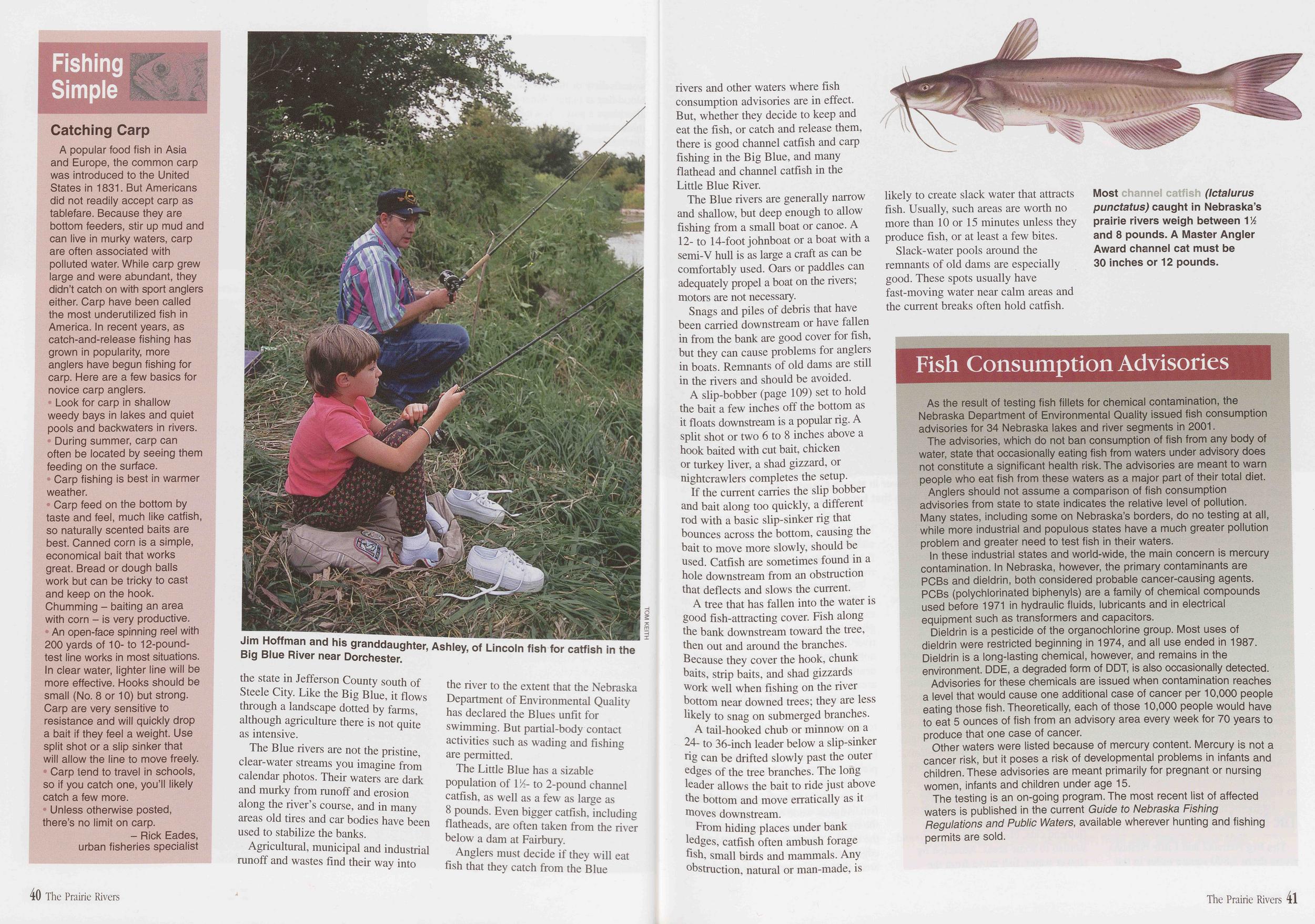
Fishing Simple
Catching Carp
A popular food fish in Asia and Europe, the common carp was introduced to the United States in 1831. But Americans did not readily accept carp as tablefare. Because they are bottom feeders, stir up mud and can live in murky waters, carp are often associated with polluted water. While carp grew large and were abundant, they didn't catch on with sport anglers either. Carp have been called the most underutilized fish in America. In recent years, as catch-and-release fishing has grown in popularity, more anglers have begun fishing for carp. Here are a few basics for novice carp anglers.
Look for carp in shallow weedy bays in lakes and quiet pools and backwaters in rivers. • During summer, carp can often be located by seeing them feeding on the surface. Carp fishing is best in warmer weather. Carp feed on the bottom by taste and feel, much like catfish, so naturally scented baits are best. Canned corn is a simple, economical bait that works great. Bread or dough balls work but can be tricky to cast and keep on the hook. Chumming - baiting an area with corn - is very productive. An open-face spinning reel with 200 yards of 10- to 12-pound- test line works in most situations. In clear water, lighter line will be more effective. Hooks should be small (No. 8 or 10) but strong. Carp are very sensitive to resistance and will quickly drop a bait if they feel a weight. Use split shot or a slip sinker that will allow the line to move freely. Carp tend to travel in schools, so if you catch one, you'll likely catch a few more. # Unless otherwise posted, there's no limit on carp.the state in Jefferson County south of Steele City. Like the Big Blue, it flows through a landscape dotted by farms, although agriculture there is not quite as intensive.
The Blue rivers are not the pristine, clear-water streams you imagine from calendar photos. Their waters are dark and murky from runoff and erosion along the river's course, and in many areas old tires and car bodies have been used to stabilize the banks.
Agricultural, municipal and industrial runoff and wastes find their wav into the river to the extent that the Nebraska Department of Environmental Quality has declared the Blues unfit for swimming. But partial-body contact activities such as wading and fishing are permitted.
The Little Blue has a sizable population of VA- to 2-pound channel catfish, as well as a few as large as 8 pounds. Even bigger catfish, including flatheads, are often taken from the river below a dam at Fairbury.
Anglers must decide if they will eat fish that they catch from the Blue rivers and other waters where fish consumption advisories are in effect. But, whether they decide to keep and eat the fish, or catch and release them, there is good channel catfish and carp fishing in the Big Blue, and many flathead and channel catfish in the Little Blue River.
The Blue rivers are generally narrow and shallow, but deep enough to allow fishing from a small boat or canoe. A 12- to 14-foot johnboat or a boat with a semi-V hull is as large a craft as can be comfortably used. Oars or paddles can adequately propel a boat on the rivers; motors are not necessary.
Snags and piles of debris that have been carried downstream or have fallen in from the bank are good cover for fish, but they can cause problems for anglers in boats. Remnants of old dams are still in the rivers and should be avoided.
A slip-bobber (page 109) set to hold the bait a few inches off the bottom as it floats downstream is a popular rig. A split shot or two 6 to 8 inches above a hook baited with cut bait, chicken or turkey liver, a shad gizzard, or nightcrawlers completes the setup.
If the current carries the slip bobber and bait along too quickly, a different rod with a basic slip-sinker rig that bounces across the bottom, causing the bait to move more slowly, should be used. Catfish are sometimes found in a hole downstream from an obstruction that deflects and slows the current.
A tree that has fallen into the water is good fish-attracting cover. Fish along the bank downstream toward the tree, then out and around the branches. Because they cover the hook, chunk baits, strip baits, and shad gizzards work well when fishing on the river bottom near downed trees; they are less likely to snag on submerged branches.
A tail-hooked chub or minnow on a 24- to 36-inch leader below a ship-sinker rig can be drifted slowly past the outer edges of the tree branches. The long leader allows the bait to ride just above the bottom and move erratically as it moves downstream.
From hiding places under bank ledges, catfish often ambush forage fish, small birds and mammals. Any obstruction, natural or man-made, is likely to create slack water that attracts fish. Usually, such areas are worth no more than 10 or 15 minutes unless they produce fish, or at least a few bites.
Slack-water pools around the remnants of old dams are especially good. These spots usually have fast-moving water near calm areas and the current breaks often hold catfish.
Most channel catfish (Ictalurus punctatus) caught in Nebraska's prairie rivers weigh between VA and 8 pounds. A Master Angler Award channel cat must be 30 inches or 12 pounds.
Fish Consumption Advisories
As the result of testing fish fillets for chemical contamination, the Nebraska Department of Environmental Quality issued fish consumption advisories for 34 Nebraska lakes and river segments in 2001.
The advisories, which do not ban consumption of fish from any body of water, state that occasionally eating fish from waters under advisory does not constitute a significant health risk. The advisories are meant to warn people who eat fish from these waters as a major part of their total diet.
Anglers should not assume a comparison of fish consumption advisories from state to state indicates the relative level of pollution. Many states, including some on Nebraska's borders, do no testing at all, while more industrial and populous states have a much greater pollution problem and greater need to test fish in their waters.
In these industrial states and world-wide, the main concern is mercury contamination. In Nebraska, however, the primary contaminants are PCBs and dieldrin, both considered probable cancer-causing agents. PCBs (polychlorinated biphenyls) are a family of chemical compounds used before 1971 in hydraulic fluids, lubricants and in electrical equipment such as transformers and capacitors.
Dieldrin is a pesticide of the organochlorine group. Most uses of dieldrin were restricted beginning in 1974, and all use ended in 1987. Dieldrin is a long-lasting chemical, however, and remains in the environment. DDE, a degraded form of DDT, is also occasionally detected.
Advisories for these chemicals are issued when contamination reaches a level that would cause one additional case of cancer per 10,000 people eating those fish. Theoretically, each of those 10,000 people would have to eat 5 ounces of fish from an advisory area every week for 70 years to produce that one case of cancer.
Other waters were listed because of mercury content. Mercury is not a cancer risk, but it poses a risk of developmental problems in infants and children. These advisories are meant primarily for pregnant or nursing women, infants and children under age 15.
The testing is an on-going program. The most recent list of affected waters is published in the current Guide to Nebraska Fishing Regulations and Public Waters, available wherever hunting and fishing permits are sold.
40 The Prairie Rivers The Prairie Rivers 41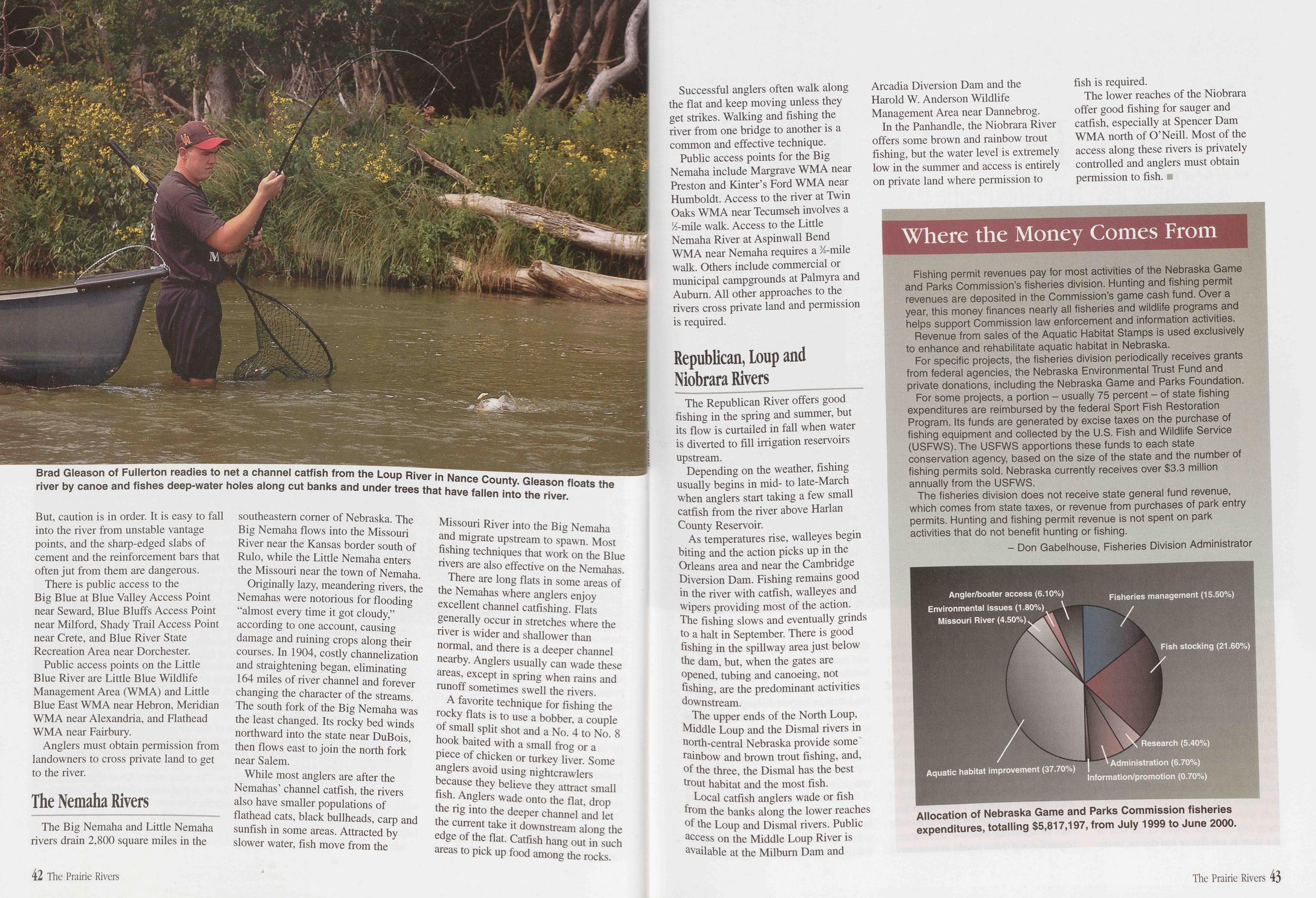
Brad Gleason of Fullerton readies to net a channel catfish from the Loup River river by canoe and fishes deep-water holes along cut banks and under trees that have fallen into the river.
Gleaaon floats the But, caution is in order. It is easy to fall into the river from unstable vantage points, and the sharp-edged slabs of cement and the reinforcement bars that often jut from them are dangerous.
There is public access to the Big Blue at Blue Valley Access Point near Seward, Blue Bluffs Access Point near Milford, Shady Trail Access Point near Crete, and Blue River State Recreation Area near Dorchester.
Public access points on the Little Blue River are Little Blue Wildlife Management Area (WMA) and Little Blue East WMA near Hebron, Meridian WMA near Alexandria, and Flathead WMA near Fairbury.
Anglers must obtain permission from landowners to cross private land to get to the river.
The Nemaha Rivers
The Big Nemaha and Little Nemaha rivers drain 2,800 square miles in the 42 The Prairie Rivers southeastern comer of Nebraska. The Big Nemaha flows into the Missouri River near the Kansas border south of Rulo, while the Little Nemaha enters the Missouri near the town of Nemaha.
Originally lazy, meandering rivers, the Nemahas were notorious for flooding "almost every time it got cloudy," according to one account, causing damage and mining crops along their courses. In 1904, costly channelization and straightening began, eliminating 164 miles of river channel and forever changing the character of the streams. The south fork of the Big Nemaha was the least changed. Its rocky bed winds northward into the state near DuBois, then flows east to join the north fork' near Salem.
While most anglers are after the Nemahas' channel catfish, the rivers also have smaller populations of flathead cats, black bullheads, carp and sunfish in some areas. Attracted by slower water, fish move from the Missouri River into the Big Nemaha and migrate upstream to spawn. Most fishing techniques that work on the Blue rivers are also effective on the Nemahas.
There are long flats in some areas of the Nemahas where anglers enjoy excellent channel catfishing. Flats generally occur in stretches where the river is wider and shallower than normal, and there is a deeper channel nearby. Anglers usually can wade these areas, except in spring when rains and runoff sometimes swell the rivers.
A favorite technique for fishing the rocky flats is to use a bobber, a couple of small split shot and a No. 4 to No. 8 hook baited with a small frog or a piece of chicken or turkey liver. Some anglers avoid using nightcrawlers because they believe they attract small fish. Anglers wade onto the flat, drop the rig into the deeper channel and let the current take it downstream along the edge of the flat. Catfish hang out in such areas to pick up food among the rocks.
Successful anglers often walk along the flat and keep moving unless they get strikes. Walking and fishing the river from one bridge to another is a common and effective technique.
Public access points for the Big Nemaha include Margrave WMA near Preston and Kinter's Ford WMA near Humboldt. Access to the river at Twin Oaks WMA near Tecumseh involves a M-mile walk. Access to the Little Nemaha River at Aspinwall Bend WMA near Nemaha requires a 5-mile walk. Others include commercial or municipal campgrounds at Palmyra and Auburn. All other approaches to the rivers cross private land and permission is required.
Republican, Loup and Niobrara Rivers
The Republican River offers good fishing in the spring and summer, but its flow is curtailed in fall when water is diverted to fill irrigation reservoirs upstream.
Depending on the weather, fishing usually begins in mid- to late-March when anglers start taking a few small catfish from the river above Harlan County Reservoir.
As temperatures rise, walleyes begin biting and the action picks up in the Orleans area and near the Cambridge Diversion Dam. Fishing remains good in the river with catfish, walleyes and wipers providing most of the action. The fishing slows and eventually grinds to a halt in September. There is good fishing in the spillway area just below the dam, but, when the gates are opened, tubing and canoeing, not fishing, are the predominant activities downstream.
The upper ends of the North Loup, Middle Loup and the Dismal rivers in north-central Nebraska provide some rainbow and brown trout fishing, and, of the three, the Dismal has the best trout habitat and the most fish.
Local catfish anglers wade or fish from the banks along the lower reaches of the Loup and Dismal rivers. Public access on the Middle Loup River is available at the Milburn Dam and Arcadia Diversion Dam and the Harold W. Anderson Wildlife Management Area near Dannebrog.
In the Panhandle, the Niobrara River offers some brown and rainbow trout fishing, but the water level is extremely low in the summer and access is entirely on private land where permission to fish is required.
The lower reaches of the Niobrara offer good fishing for sauger and catfish, especially at Spencer Dam WMA north of O'Neill. Most of the access along these rivers is privately controlled and anglers must obtain permission to fish.
Where the Money Comes From
Fishing permit revenues pay for most activities of the Nebraska Game and Parks Commission's fisheries division. Hunting and fishing permit revenues are deposited in the Commission's game cash fund. Over a year, this money finances nearly all fisheries and wildlife programs and helps support Commission law enforcement and information activities.
Revenue from sales of the Aquatic Habitat Stamps is used exclusively to enhance and rehabilitate aquatic habitat in Nebraska.
For specific projects, the fisheries division periodically receives grants from federal agencies, the Nebraska Environmental Trust Fund and private donations, including the Nebraska Game and Parks Foundation.
For some projects, a portion - usually 75 percent - of state fishing expenditures are reimbursed by the federal Sport Fish Restoration Program. Its funds are generated by excise taxes on the purchase of fishing equipment and collected by the U.S. Fish and Wildlife Service (USFWS).The USFWS apportions these funds to each state conservation agency, based on the size of the state and the number of fishing permits sold. Nebraska currently receives over $3.3 million annually from the USFWS.
The fisheries division does not receive state general fund revenue, which comes from state taxes, or revenue from purchases of park entry permits. Hunting and fishing permit revenue is not spent on park activities that do not benefit hunting or fishing.
Allocation of Nebraska Game and Parks Commission fisheries expenditures, totaling $5,817,197, from July 1999 to June 2000.
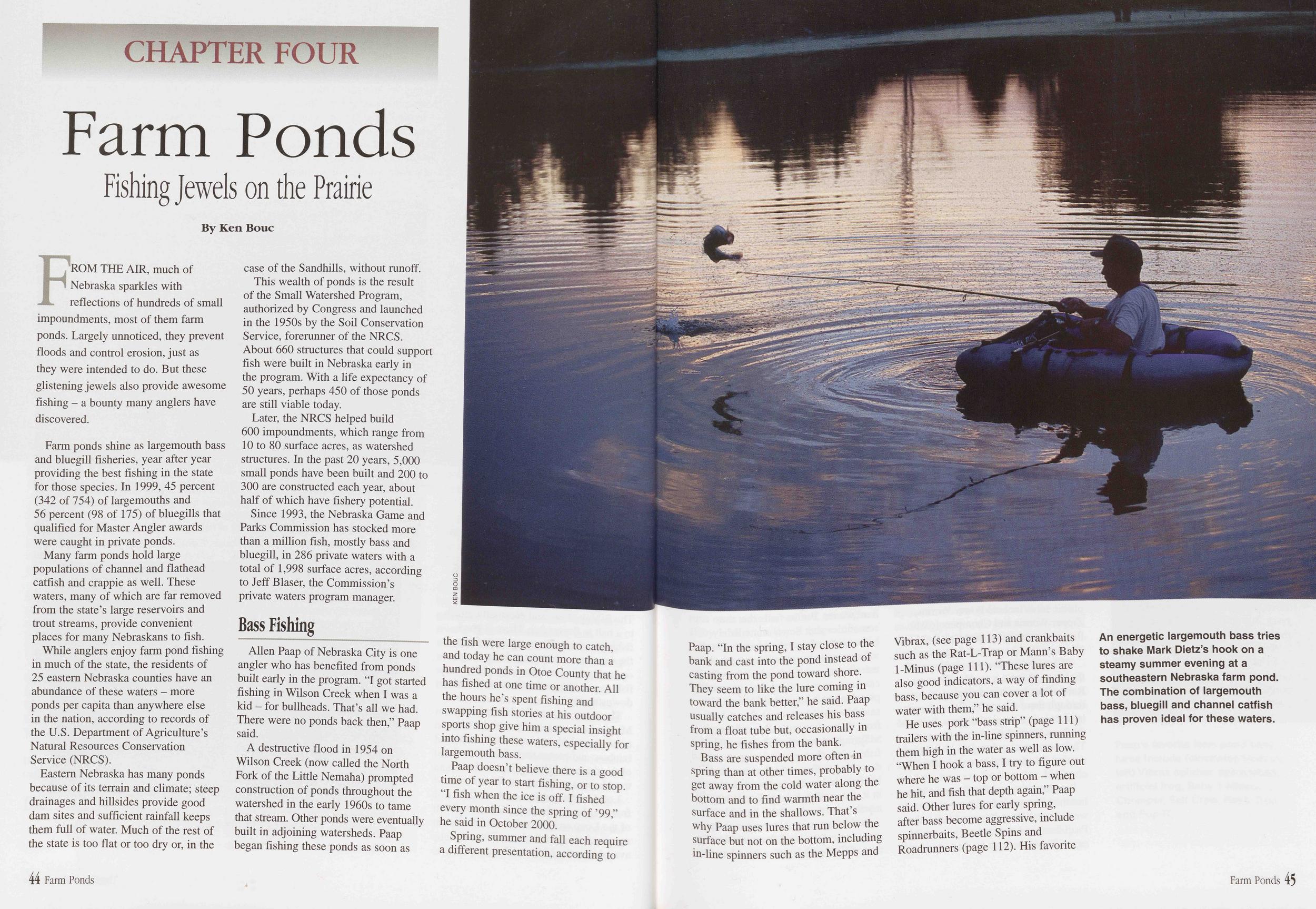
CHAPTER FOUR
Farm Ponds
Fishing Jewels on the Prairie
FROM THE AIR, much of Nebraska sparkles with reflections of hundreds of small impoundments, most of them farm ponds. Largely unnoticed, they prevent floods and control erosion, just as they were intended to do. But these glistening jewels also provide awesome fishing - a bounty many anglers have discovered.
Farm ponds shine as largemouth bass and bluegill fisheries, year after year providing the best fishing in the state for those species. In 1999, 45 percent (342 of 754) of largemouths and 56 percent (98 of 175) of bluegills that qualified for Master Angler awards were caught in private ponds.
Many farm ponds hold large populations of channel and flathead catfish and crappie as well. These waters, many of which are far removed from the state's large reservoirs and trout streams, provide convenient places for many Nebraskans to fish.
While anglers enjoy farm pond fishing in much of the state, the residents of 25 eastern Nebraska counties have an abundance of these waters - more ponds per capita than anywhere else in the nation, according to records of the U.S. Department of Agriculture's Natural Resources Conservation Service (NRCS).
Eastern Nebraska has many ponds because of its terrain and climate; steep drainages and hillsides provide good dam sites and sufficient rainfall keeps them full of water. Much of the rest of the state is too flat or too dry or, in the
44 Farm Pondscase of the Sandhills, without runoff.
This wealth of ponds is the result of the Small Watershed Program, authorized by Congress and launched in the 1950s by the Soil Conservation Service, forerunner of the NRCS. About 660 structures that could support fish were built in Nebraska early in the program. With a life expectancy of 50 years, perhaps 450 of those ponds are still viable today.
Later, the NRCS helped build 600 impoundments, which range from 10 to 80 surface acres, as watershed structures. In the past 20 years, 5,000 small ponds have been built and 200 to 300 are constructed each year, about half of which have fishery potential.
Since 1993, the Nebraska Game and Parks Commission has stocked more than a million fish, mostly bass and bluegill, in 286 private waters with a total of 1,998 surface acres, according to Jeff Blaser, the Commission's private waters program manager.
Bass Fishing
Allen Paap of Nebraska City is one angler who has benefited from ponds built early in the program. "I got started fishing in Wilson Creek when I was a kid - for bullheads. That's all we had. There were no ponds back then," Paap said.
A destructive flood in 1954 on Wilson Creek (now called the North Fork of the Little Nemaha) prompted construction of ponds throughout the watershed in the early 1960s to tame that stream. Other ponds were eventually built in adjoining watersheds. Paap began fishing these ponds as soon as the fish were large enough to catch, and today he can count more than a hundred ponds in Otoe County that he has fished at one time or another. All the hours he's spent fishing and swapping fish stories at his outdoor sports shop give him a special insight into fishing these waters, especially for largemouth bass.
Paap doesn't believe there is a good time of year to start fishing, or to stop. "I fish when the ice is off. I fished every month since the spring of '99," he said in October 2000.
Spring, summer and fall each require a different presentation, according to Paap. "In the spring, I stay close to the bank and cast into the pond instead of casting from the pond toward shore. They seem to like the lure coming in toward the bank better," he said. Paap usually catches and releases his bass from a float tube but, occasionally in spring, he fishes from the bank.
Bass are suspended more often in spring than at other times, probably to get away from the cold water along the bottom and to find warmth near the surface and in the shallows. That's why Paap uses lures that run below the surface but not on the bottom, including in-line spinners such as the Mepps and Vibrax, (see page 113) and crankbaits such as the Rat-L-Trap or Mann's Baby 1-Minus (page 111). "These lures are also good indicators, a way of finding bass, because you can cover a lot of water with them," he said.
He uses pork "bass strip" (page 111) trailers with the in-line spinners, running them high in the water as well as low. "When I hook a bass, I try to figure out where he was - top or bottom - when he hit, and fish that depth again," Paap said. Other lures for early spring, after bass become aggressive, include spinnerbaits, Beetle Spins and Roadrunners (page 112). His favorite
An energetic largemouth bass tries to shake Mark Dietz's hook on a steamy summer evening at a southeastern Nebraska farm pond. The combination of largemouth bass, bluegill and channel catfish has proven ideal for these waters.
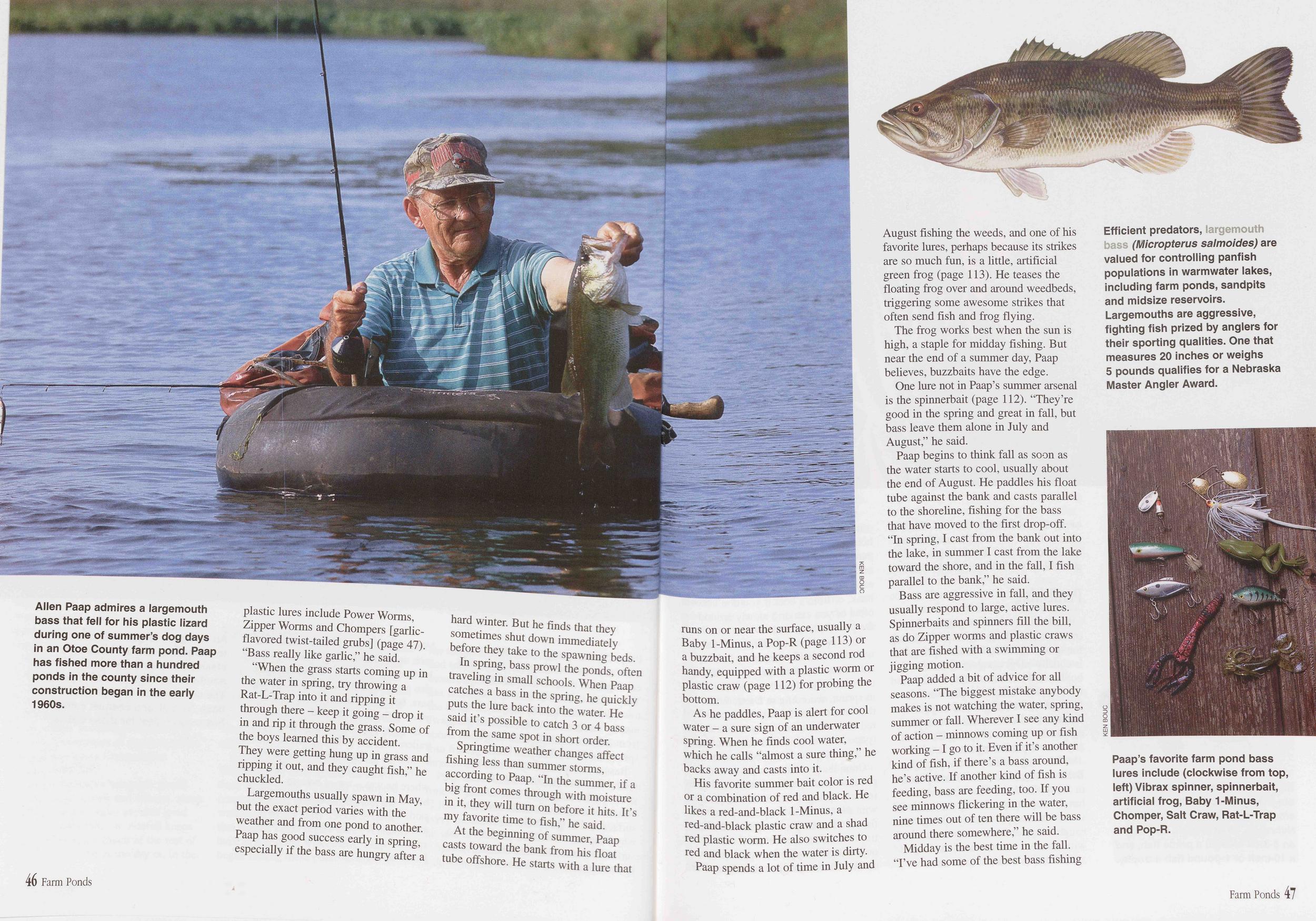
Allen Paap admires a largemouth bass that fell for his plastic lizard during one of summer's dog days in an Otoe County farm pond. Paap has fished more than a hundred ponds in the county since their construction began in the early 1960s.
plastic lures include Power Worms, Zipper Worms and Chompers [garlic- flavored twist-tailed grubs] (page 47). "Bass really like garlic," he said.
"When the grass starts coming up in the water in spring, try throwing a Rat-L-Trap into it and ripping it through there - keep it going - drop it in and rip it through the grass. Some of the boys learned this by accident. They were getting hung up in grass and ripping it out, and they caught fish," he chuckled.
Largemouths usually spawn in May, but the exact period varies with the weather and from one pond to another. Paap has good success early in spring, especially if the bass are hungry after a
46 Farm Pondshard winter. But he finds that they sometimes shut down immediately before they take to the spawning beds
In spring, bass prowl the ponds often traveling in small schools. When Paap catches a bass in the spring, he quickly puts the lure back into the water. He said it's possible to catch 3 or 4 bass from the same spot in short order.
Springtime weather changes affect fishing less than summer storms according to Paap. "In the summer, if a big front comes through with moisture in it they will turn on before it hits It's my favorite time to fish," he said
At the beginning of summer, Paap lasts toward the bank from his float tube offshore. He starts with a lure that runs on or near the surface, usually a Baby 1-Minus, a Pop-R (page 113) or a buzzbait, and he keeps a second rod handy, equipped with a plastic worm or plastic craw (page 112) for probing the bottom.
As he paddles, Paap is alert for cool water - a sure sign of an underwater spring. When he finds cool water, which he calls "almost a sure thing," he backs away and casts into it.
His favorite summer bait color is red or a combination of red and black. He likes a red-and-black 1-Minus, a red-and-black plastic craw and a shad red plastic worm. He also switches to red and black when the water is dirty.
Paap spends a lot of time in July and August fishing the weeds, and one of his favorite lures, perhaps because its strikes are so much fun, is a little, artificial green frog (page 113). He teases the floating frog over and around weedbeds, triggering some awesome strikes that often send fish and frog flying.
The frog works best when the sun is high, a staple for midday fishing. But near the end of a summer day, Paap believes, buzzbaits have the edge.
One lure not in Paap's summer arsenal is the spinnerbait (page 112). "They're good in the spring and great in fall, but bass leave them alone in July and August," he said.
Paap begins to think fall as soon as the water starts to cool, usually about the end of August. He paddles his float tube against the bank and casts parallel to the shoreline, fishing for the bass that have moved to the first drop-off. "In spring, I cast from the bank out into the lake, in summer I cast from the lake toward the shore, and in the fall, I fish parallel to the bank," he said.
Bass are aggressive in fall, and they usually respond to large, active lures. Spinnerbaits and spinners fill the bill, as do Zipper worms and plastic craws that are fished with a swimming or jigging motion.
Paap added a bit of advice for all seasons. "The biggest mistake anybody makes is not watching the water, spring, summer or fall. Wherever I see any kind of action - minnows coming up or fish working -1 go to it. Even if it's another kind of fish, if there's a bass around, he's active. If another kind of fish is feeding, bass are feeding, too. If you see minnows flickering in the water, nine times out of ten there will be bass around there somewhere," he said.
Midday is the best time in the fall. "I've had some of the best bass fishing
Efficient predators, bass (Micropterus salmoides) are valued for controlling panfish populations in warmwater lakes, including farm ponds, sandpits and midsize reservoirs. Largemouths are aggressive, fighting fish prized by anglers for their sporting qualities. One that measures 20 inches or weighs 5 pounds qualifies for a Nebraska Master Angler Award.
Paap's favorite farm pond bass lures include (clockwise from top, left) Vibrax spinner, spinnerbait, artificial frog, Baby 1-Minus, Chomper, Salt Craw, Rat-L-Trap and Pop-R.
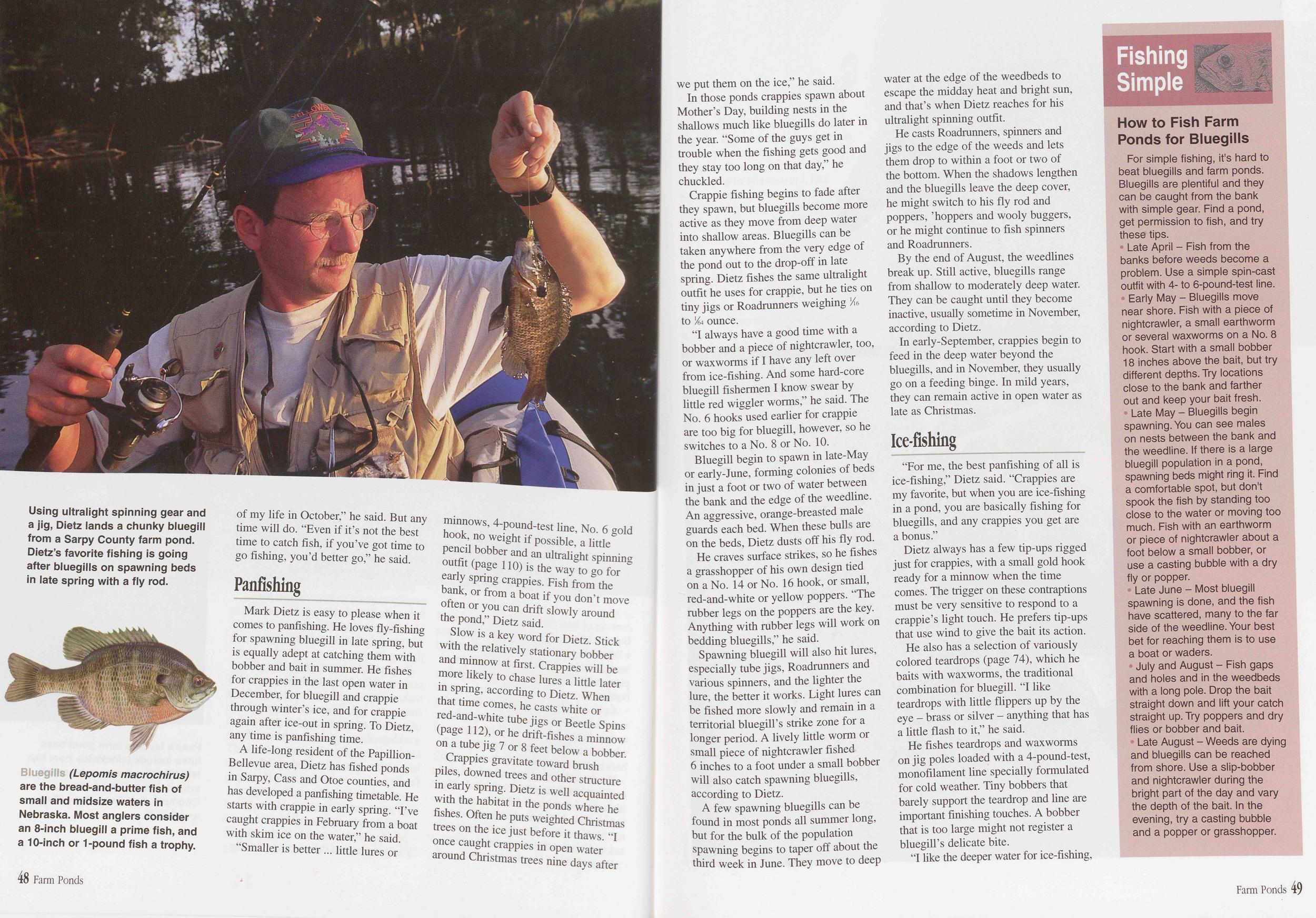
Using ultralight spinning gear and a jig, Dietz lands a chunky bluegill from a Sarpy County farm pond. Dietz's favorite fishing is going after bluegills on spawning beds in late spring with a fly rod.
of my life in October," he said. But any time will do. "Even if it's not the best time to catch fish, if you've got time to go fishing, you'd better go," he said.
Panfishing
(Lepomis macrochirus) are the bread-and-butter fish of small and midsize waters in Nebraska. Most anglers consider an 8-inch bluegill a prime fish, and a 10-inch or 1-pound fish a trophy.
Mark Dietz is easy to please when it comes to panfishing. He loves fly-fishing for spawning bluegill in late spring, but is equally adept at catching them with bobber and bait in summer. He fishes for crappies in the last open water in December, for bluegill and crappie through winter's ice, and for crappie again after ice-out in spring. To Dietz, any time is panfishing time.
A life-long resident of the Papillion- Bellevue area, Dietz has fished ponds in Sarpy, Cass and Otoe counties, and has developed a panfishing timetable. He starts with crappie in early spring. "I've caught crappies in February from a boat with skim ice on the water," he said.
"Smaller is better ... little lures or minnows, 4-pound-test line, No. 6 gold hook, no weight if possible, a little pencil bobber and an ultralight spinning outfit (page 110) is the way to go for early spring crappies. Fish from the bank, or from a boat if you don't move often or you can drift slowly around the pond," Dietz said.
Slow is a key word for Dietz. Stick with the relatively stationary bobber and minnow at first. Crappies will be more likely to chase lures a little later in spring, according to Dietz. When that time comes, he casts white or red-and-white tube jigs or Beetle Spins (page 112), or he drift-fishes a minnow on a tube jig 7 or 8 feet below a bobber.
Crappies gravitate toward brush piles, downed trees and other structure in early spring. Dietz is well acquainted with the habitat in the ponds where he fishes. Often he puts weighted Christmas trees on the ice just before it thaws. "I once caught crappies in open water around Christmas trees nine days after we put them on the ice," he said.
In those ponds crappies spawn about Mother's Day, building nests in the shallows much like bluegills do later in the year. "Some of the guys get in trouble when the fishing gets good and they stay too long on that day," he chuckled.
Crappie fishing begins to fade after they spawn, but bluegills become more active as they move from deep water into shallow areas. Bluegills can be taken anywhere from the very edge of the pond out to the drop-off in late spring. Dietz fishes the same ultralight outfit he uses for crappie, but he ties on tiny jigs or Roadrunners weighing Vie to V(a ounce.
"I always have a good time with a bobber and a piece of nightcrawler, too, or waxworms if I have any left over from ice-fishing. And some hard-core bluegill fishermen I know swear by little red wiggler worms," he said. The No. 6 hooks used earlier for crappie are too big for bluegill, however, so he switches to a No. 8 or No. 10.
Bluegill begin to spawn in late-May or early-June, forming colonies of beds in just a foot or two of water between the bank and the edge of the weed line. An aggressive, orange-breasted male guards each bed. When these bulls are on the beds, Dietz dusts off his fly rod.
He craves surface strikes, so he fishes a grasshopper of his own design tied on a No. 14 or No. 16 hook, or small, red-and-white or yellow poppers. "The rubber legs on the poppers are the key. Anything with rubber legs will work on bedding bluegills," he said.
Spawning bluegill will also hit lures, especially tube jigs, Roadrunners and various spinners, and the lighter the lure, the better it works. Light lures can be fished more slowly and remain in a territorial bluegill's strike zone for a longer period. A lively little worm or small piece of nightcrawler fished 6 inches to a foot under a small bobber will also catch spawning bluegills, according to Dietz.
A few spawning bluegills can be found in most ponds all summer long, but for the bulk of the population spawning begins to taper off about the third week in June. They move to deep water at the edge of the weedbeds to escape the midday heat and bright sun, and that's when Dietz reaches for his ultralight spinning outfit.
He casts Roadrunners, spinners and jigs to the edge of the weeds and lets them drop to within a foot or two of the bottom. When the shadows lengthen and the bluegills leave the deep cover, he might switch to his fly rod and poppers, 'hoppers and wooly buggers, or he might continue to fish spinners and Roadrunners.
By the end of August, the weed lines break up. Still active, bluegills range from shallow to moderately deep water. They can be caught until they become inactive, usually sometime in November, according to Dietz.
In early-September, crappies begin to feed in the deep water beyond the bluegills, and in November, they usually go on a feeding binge. In mild years, they can remain active in open water as late as Christmas.
Ice-fishing
"For me, the best panfishing of all is ice-fishing," Dietz said. "Crappies are my favorite, but when you are ice-fishing in a pond, you are basically fishing for bluegills, and any crappies you get are a bonus."
Dietz always has a few tip-ups rigged just for crappies, with a small gold hook ready for a minnow when the time comes. The trigger on these contraptions must be very sensitive to respond to a crappie's light touch. He prefers tip-ups that use wind to give the bait its action.
He also has a selection of variously colored teardrops (page 74), which he baits with waxworms, the traditional combination for bluegill. "I like teardrops with little flippers up by the eye - brass or silver - anything that has a little flash to it," he said.
He fishes teardrops and waxworms on jig poles loaded with a 4-pound-test, monofilament line specially formulated for cold weather. Tiny bobbers that barely support the teardrop and line are important finishing touches. A bobber that is too large might not register a bluegill's delicate bite.
"I like the deeper water for ice-fishing,
Fishing Simple
How to Fish Farm Ponds for Bluegills
For simple fishing, it's hard to beat bluegills and farm ponds. Bluegills are plentiful and they can be caught from the bank with simple gear. Find a pond, get permission to fish, and try these tips.
* Late April - Fish from the banks before weeds become a problem. Use a simple spin-cast outfit with 4- to 6-pound-test line. * Early May - Bluegills move near shore. Fish with a piece of nightcrawler, a small earthworm or several waxworms on a No. 8 hook. Start with a small bobber 18 inches above the bait, but try different depths. Try locations close to the bank and farther out and keep your bait fresh. Late May - Bluegills begin spawning. You can see males on nests between the bank and the weed line. If there is a large bluegill population in a pond, spawning beds might ring it. Find a comfortable spot, but don't spook the fish by standing too close to the water or moving too much. Fish with an earthworm or piece of nightcrawler about a foot below a small bobber, or use a casting bubble with a dry fly or popper. Late June - Most bluegill spawning is done, and the fish have scattered, many to the far side of the weed line. Your best bet for reaching them is to use a boat or waders. * July and August - Fish gaps and holes and in the weedbeds with a long pole. Drop the bait straight down and lift your catch straight up. Try poppers and dry flies or bobber and bait. Late August - Weeds are dying and bluegills can be reached from shore. Use a slip-bobber and nightcrawler during the bright part of the day and vary the depth of the bait. In the evening, try a casting bubble and a popper or grasshopper. Farm Ponds 49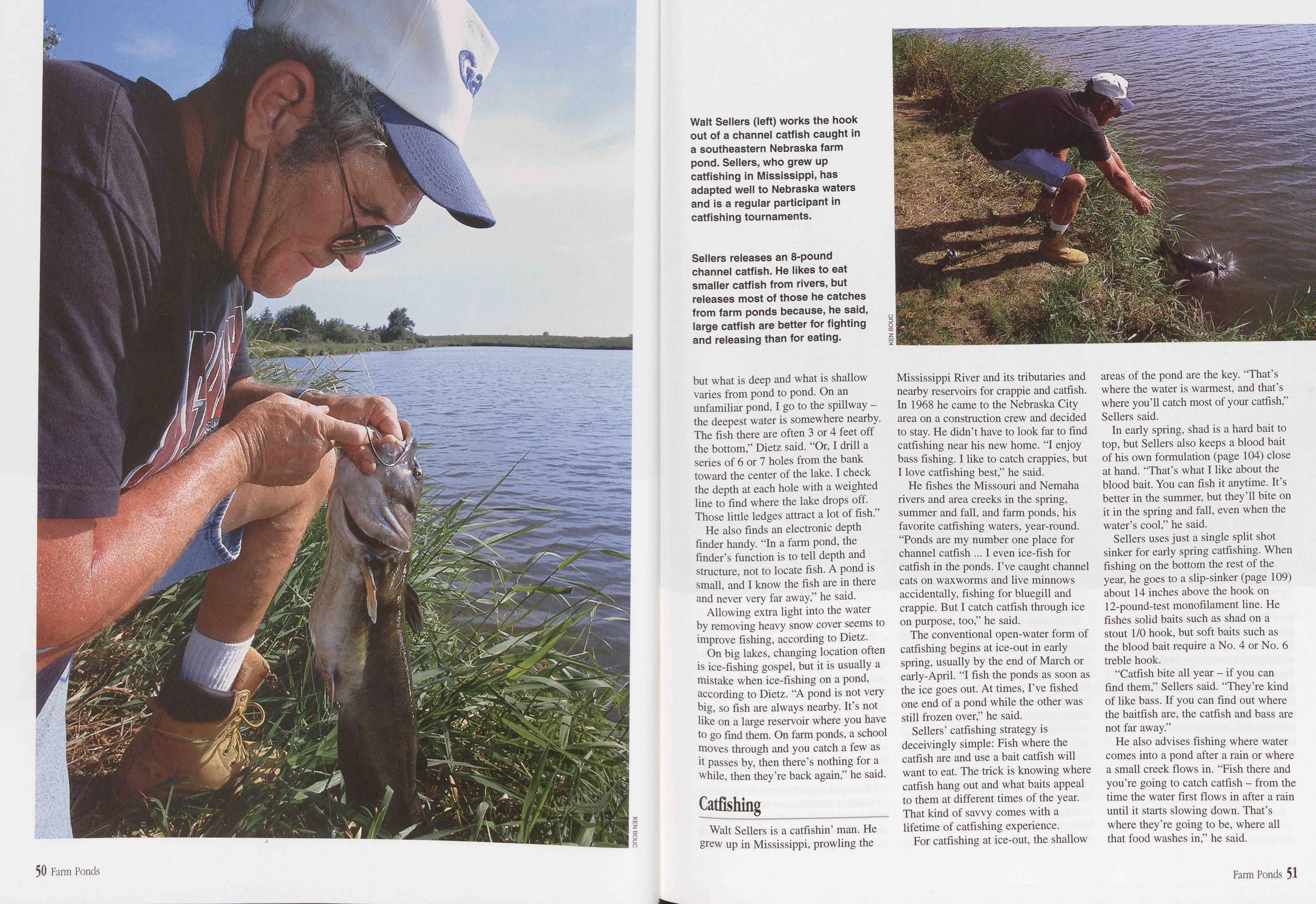
Walt Sellers (left) works the hook out of a channel catfish caught in a southeastern Nebraska farm pond. Sellers, who grew up catfishing in Mississippi, has adapted well to Nebraska waters and is a regular participant in catfishing tournaments.
Sellers releases an 8-pound channel catfish. He likes to eat smaller catfish from rivers, but releases most of those he catches from farm ponds because, he said, large catfish are better for fighting and releasing than for eating.
but what is deep and what is shallow varies from pond to pond. On an unfamiliar pond, I go to the spillway - the deepest water is somewhere nearby. The fish there are often 3 or 4 feet off the bottom," Dietz said. "Or, I drill a series of 6 or 7 holes from the bank toward the center of the lake. I check the depth at each hole with a weighted line to find where the lake drops off. Those little ledges attract a lot of fish."
He also finds an electronic depth finder handy. "In a farm pond, the finder's function is to tell depth and structure, not to locate fish. A pond is small, and I know the fish are in there and never very far away," he said.
Allowing extra light into the water by removing heavy snow cover seems to improve fishing, according to Dietz.
On big lakes, changing location often is ice-fishing gospel, but it is usually a mistake when ice-fishing on a pond, according to Dietz. "A pond is not very big, so fish are always nearby. It's not like on a large reservoir where you have to go find them. On farm ponds, a school moves through and you catch a few as it passes by, then there's nothing for a while, then they're back again," he said.
Catfishing
Walt Sellers is a catfishin' man. He grew up in Mississippi, prowling the Mississippi River and its tributaries and nearby reservoirs for crappie and catfish. In 1968 he came to the Nebraska City area on a construction crew and decided to stay. He didn't have to look far to find catfishing near his new home. "I enjoy bass fishing. I like to catch crappies, but I love catfishing best," he said.
He fishes the Missouri and Nemaha rivers and area creeks in the spring, summer and fall, and farm ponds, his favorite catfishing waters, year-round. "Ponds are my number one place for channel catfish ... I even ice-fish for catfish in the ponds. I've caught channel cats on waxworms and live minnows accidentally, fishing for bluegill and crappie. But I catch catfish through ice on purpose, too," he said.
The conventional open-water form of catfishing begins at ice-out in early spring, usually by the end of March or early-April. "I fish the ponds as soon as the ice goes out. At times, I've fished one end of a pond while the other was still frozen over," he said.
Sellers' catfishing strategy is deceivingly simple: Fish where the catfish are and use a bait catfish will want to eat. The trick is knowing where catfish hang out and what baits appeal to them at different times of the year. That kind of savvy comes with a lifetime of catfishing experience.
For catfishing at ice-out, the shallow areas of the pond are the key. "That's where the water is warmest, and that's where you'll catch most of your catfish," Sellers said.
In early spring, shad is a hard bait to top, but Sellers also keeps a blood bait of his own formulation (page 104) close at hand. "That's what I like about the blood bait. You can fish it anytime. It's better in the summer, but they'll bite on it in the spring and fall, even when the water's cool," he said.
Sellers uses just a single split shot sinker for early spring catfishing. When fishing on the bottom the rest of the year, he goes to a slip-sinker (page 109) about 14 inches above the hook on 12-pound-test monofilament line. He fishes solid baits such as shad on a stout 1/0 hook, but soft baits such as the blood bait require a No. 4 or No. 6 treble hook.
"Catfish bite all year - if you can find them," Sellers said. "They're kind of like bass. If you can find out where the baitfish are, the catfish and bass are not far away."
He also advises fishing where water comes into a pond after a rain or where a small creek flows in. "Fish there and you're going to catch catfish - from the time the water first flows in after a rain until it starts slowing down. That's where they're going to be, where all that food washes in," he said.
50 Farm Ponds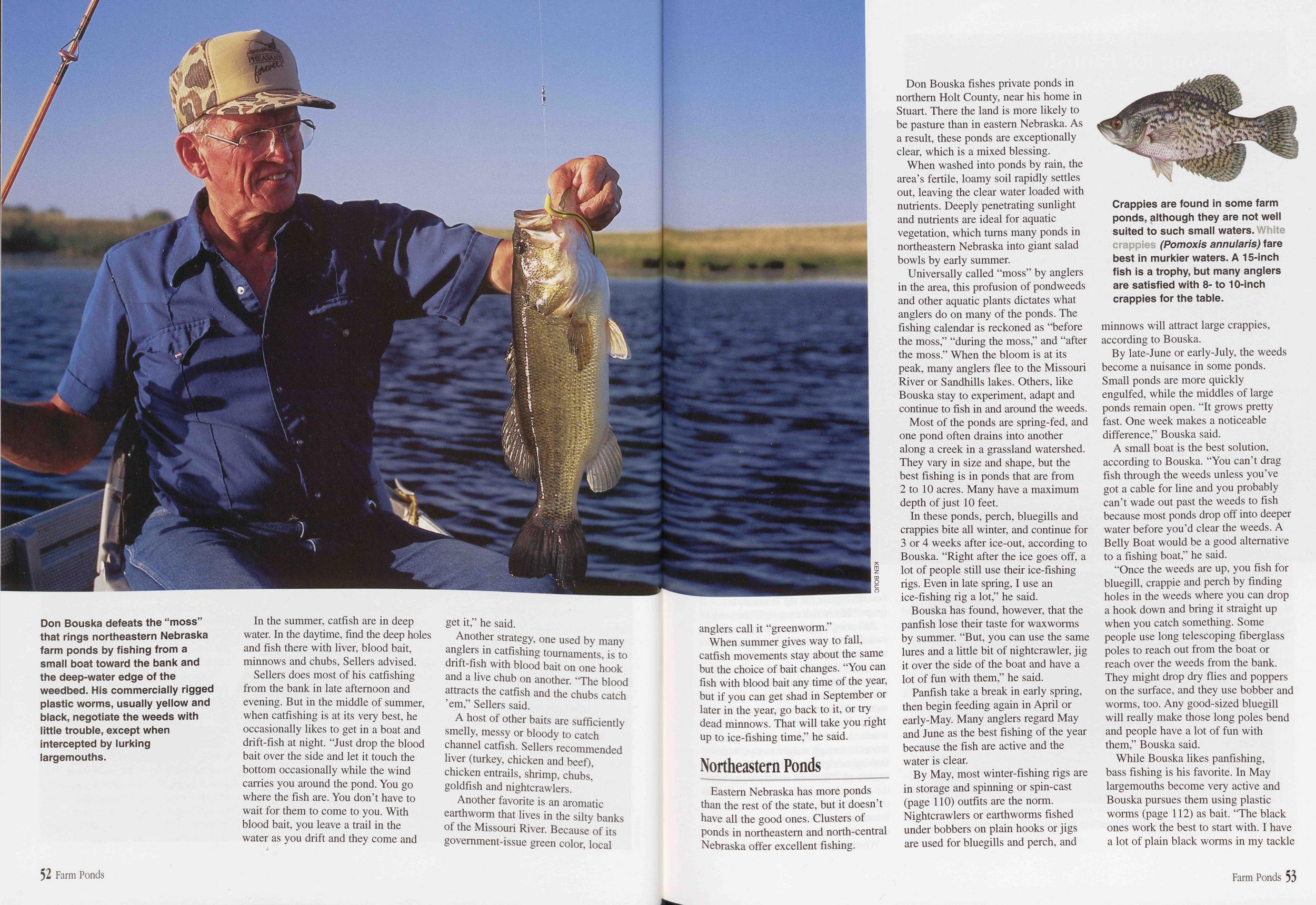
Don Bouska defeats the "moss" that rings northeastern Nebraska farm ponds by fishing from a small boat toward the bank and the deep-water edge of the weedbed. His commercially rigged plastic worms, usually yellow and black, negotiate the weeds with little trouble, except when intercepted by lurking largemouths.
In the summer, catfish are in deep water. In the daytime, find the deep holes and fish there with liver, blood bait, minnows and chubs, Sellers advised.
Sellers does most of his catfishing from the bank in late afternoon and evening. But in the middle of summer, when catfishing is at its very best, he occasionally likes to get in a boat and drift-fish at night. "Just drop the blood bait over the side and let it touch the bottom occasionally while the wind carries you around the pond. You go where the fish are. You don't have to wait for them to come to you. With blood bait, you leave a trail in the water as you drift and they come and get it," he said.
Another strategy, one used by many anglers in catfishing tournaments, is to drift-fish with blood bait on one hook and a live chub on another. "The blood attracts the catfish and the chubs catch 'em," Sellers said.
A host of other baits are sufficiently smelly, messy or bloody to catch channel catfish. Sellers recommended liver (turkey, chicken and beef), chicken entrails, shrimp, chubs,' goldfish and nightcrawlers.
Another favorite is an aromatic earthworm that lives in the silty banks of the Missouri River. Because of its government-issue green color, local anglers call it "greenworm.
When summer gives way to fall, catfish movements stay about the same but the choice of bait changes. "You can fish with blood bait any time of the year, but if you can get shad in September or later in the year, go back to it, or try dead minnows. That will take you right up to ice-fishing time," he said.
Northeastern Ponds
Eastern Nebraska has more ponds than the rest of the state, but it doesn't have all the good ones. Clusters of ponds in northeastern and north-central Nebraska offer excellent fishing.
Don Bouska fishes private ponds in northern Holt County, near his home in Stuart. There the land is more likely to be pasture than in eastern Nebraska. As a result, these ponds are exception
When washed into ponds by rain, the area's fertile, loamy soil rapidly settles out, leaving the clear water loaded with nutrients. Deeply penetrating sunlight and nutrients are ideal for aquatic vegetation, which turns many ponds in northeastern Nebraska into giant salad bowls by early summer.
Universally called "moss" by anglers in the area, this profusion of pondweeds and other aquatic plants dictates what anglers do on many of the ponds. The fishing calendar is reckoned as "before the moss," "during the moss," and "after the moss." When the bloom is at its peak, many anglers flee to the Missouri River or Sandhills lakes. Others, like Bouska stay to experiment, adapt and continue to fish in and around the weeds.
Most of the ponds are spring-fed, and one pond often drains into another along a creek in a grassland watershed. They vary in size and shape, but the best fishing is in ponds that are from 2 to 10 acres. Many have a maximum depth of just 10 feet.
In these ponds, perch, bluegills and crappies bite all winter, and continue for 3 or 4 weeks after ice-out, according to Bouska. "Right after the ice goes off, a lot of people still use their ice-fishing rigs. Even in late spring, I use an ice-fishing rig a lot," he said.
Bouska has found, however, that the panfish lose their taste for waxworms by summer. "But, you can use the same lures and a little bit of nightcrawler, jig it over the side of the boat and have a lot of fun with them," he said.
Panfish take a break in early spring, then begin feeding again in April or early-May. Many anglers regard May and June as the best fishing of the year because the fish are active and the water is clear.
By May, most winter-fishing rigs are in storage and spinning or spin-cast (page 110) outfits are the norm. Nightcrawlers or earthworms fished under bobbers on plain hooks or jigs are used for bluegills and perch, and
Crappies are found in some farm ponds, although they are not well suited to such small waters. White crappies (Pomoxis annularis) fare best in murkier waters. A 15-inch fish is a trophy, but many anglers are satisfied with 8- to 10-inch crappies for the table.
minnows will attract large crappies, according to Bouska.
By late-June or early-July, the weeds become a nuisance in some ponds. Small ponds are more quickly engulfed, while the middles of large ponds remain open. "It grows pretty fast. One week makes a noticeable difference," Bouska said.
A small boat is the best solution, according to Bouska. "You can't drag fish through the weeds unless you've got a cable for line and you probably can't wade out past the weeds to fish because most ponds drop off into deeper water before you'd clear the weeds. A Belly Boat would be a good alternative to a fishing boat," he said.
"Once the weeds are up, you fish for bluegill, crappie and perch by finding holes in the weeds where you can drop a hook down and bring it straight up when you catch something. Some people use long telescoping fiberglass poles to reach out from the boat or reach over the weeds from the bank. They might drop dry flies and poppers on the surface, and they use bobber and worms, too. Any good-sized bluegill will really make those long poles bend and people have a lot of fun with them," Bouska said.
While Bouska likes panfishing, bass fishing is his favorite. In May largemouths become very active and Bouska pursues them using plastic worms (page 112) as bait. "The black ones work the best to start with. I have a lot of plain black worms in my tackle
52 Farm Ponds Farm Ponds 53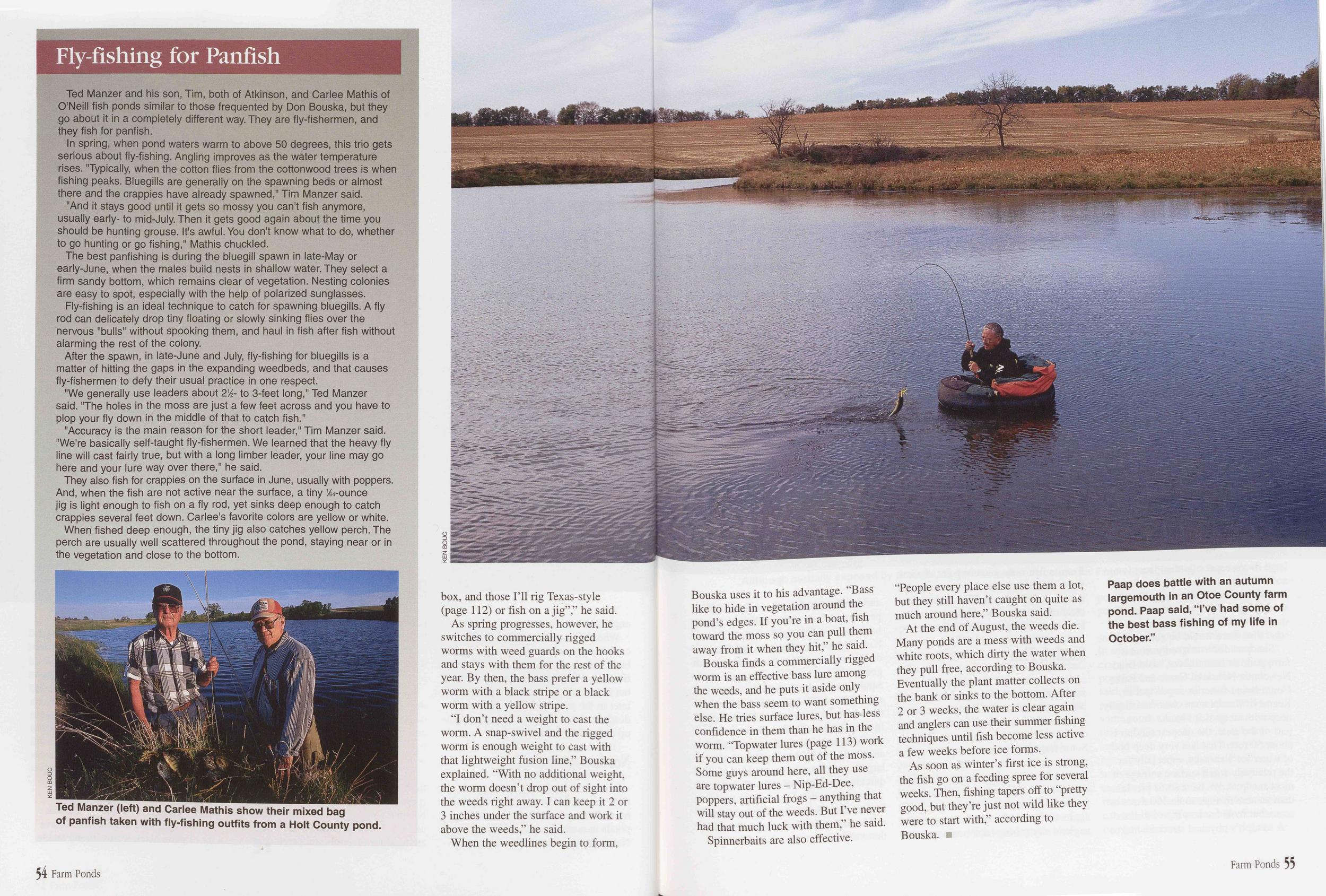
Fly-fishing for Panfish
Ted Manzer and his son, Tim, both of Atkinson, and Carlee Mathis of O'Neill fish ponds similar to those frequented by Don Bouska, but they go about it in a completely different way. They are fly-fishermen, and they fish for panfish.
In spring, when pond waters warm to above 50 degrees, this trio gets serious about fly-fishing. Angling improves as the water temperature rises. "Typically, when the cotton flies from the cottonwood trees is when fishing peaks. Biuegilis are generally on the spawning beds or almost there and the crappies have already spawned," Tim Manzer said.
"And it stays good until if gets so mossy you can't fish anymore, usually early- to mid-July. Then it gets good again about the time you should be hunting grouse. It's awful. You don't know what to do, whether to go hunting or go fishing," Mathis chuckled.
The best panfishing is during the bluegill spawn in late-May or early-June, when the males build nests in shallow water. They select a firm sandy bottom, which remains clear of vegetation. Nesting colonies are easy to spot, especially with the help of polarized sunglasses.
Fly-fishing is an ideal technique to catch for spawning biuegilis. A fly rod can delicately drop tiny floating or slowly sinking flies over the nervous "bulls" without spooking them, and haul in fish after fish without alarming the rest of the colony.
After the spawn, in late-June and July, fly-fishing for biuegilis is a matter of hitting the gaps in the expanding weedbeds, and that causes fly-fishermen to defy their usual practice in one respect.
"We generally use leaders about 2A- to 3-feet long," Ted Manzer said. "The holes in the moss are just a few feet across and you have to plop your fly down in the middle of that to catch fish."
"Accuracy is the main reason for the short leader," Tim Manzer said. "We're basically self-taught fly-fishermen. We learned that the heavy fly line will cast fairly true, but with a long limber leader, your line may go here and your lure way over there," he said.
They also fish for crappies on the surface in June, usually with poppers. And, when the fish are not active near the surface, a tiny bounce jig is light enough to fish on a fly rod, yet sinks deep enough to catch crappies several feet down. Carlee's favorite colors are yellow or white.
When fished deep enough, the tiny jig also catches yellow perch. The perch are usually well scattered throughout the pond, staying near or in the vegetation and close to the bottom.
Ted Manzer (left) and Carlee Mathis show their mixed bag of panfish taken with fly-fishing outfits from a Holt County pond.
box, and those I'll rig Texas-style (page 112) or fish on a jig"," he said.
As spring progresses, however, he switches to commercially rigged worms with weed guards on the hooks and stays with them for the rest of the year. By then, the bass prefer a yellow worm with a black stripe or a black worm with a yellow stripe.
"I don't need a weight to cast the worm. A snap-swivel and the rigged worm is enough weight to cast with that lightweight fusion line," Bouska explained. "With no additional weight, the worm doesn't drop out of sight into the weeds right away. I can keep it 2 or 3 inches under the surface and work it above the weeds," he said.
When the weed lines begin to form, Bouska uses it to his advantage. "Bass like to hide in vegetation around the pond's edges. If you're in a boat, fish toward the moss so you can pull them away from it when they hit," he said.
Bouska finds a commercially rigged worm is an effective bass lure among the weeds, and he puts it aside only when the bass seem to want something else. He tries surface lures, but has less confidence in them than he has in the worm. "Topwater lures (page 113) work if you can keep them out of the moss. Some guys around here, all they use are topwater lures - Nip-Ed-Dee, poppers, artificial frogs - anything that will stay out of the weeds. But I've never had that much luck with them," he said.
Spinnerbaits are also effective. "People every place else use them a lot, but they still haven't caught on quite as much around here," Bouska said.
At the end of August, the weeds die. Many ponds are a mess with weeds and white roots, which dirty the water when they pull free, according to Bouska. Eventually the plant matter collects on the bank or sinks to the bottom. After 2 or 3 weeks, the water is clear again and anglers can use their summer fishing techniques until fish become less active a few weeks before ice forms.
As soon as winter's first ice is strong, the fish go on a feeding spree for several weeks. Then, fishing tapers off to "pretty good, but they're just not wild like they were to start with," according to Bouska.
Paap does battle with an autumn largemouth in an Otoe County farm pond. Paap said, "I've had some of the best bass fishing of my life in October."
Farm Ponds 55
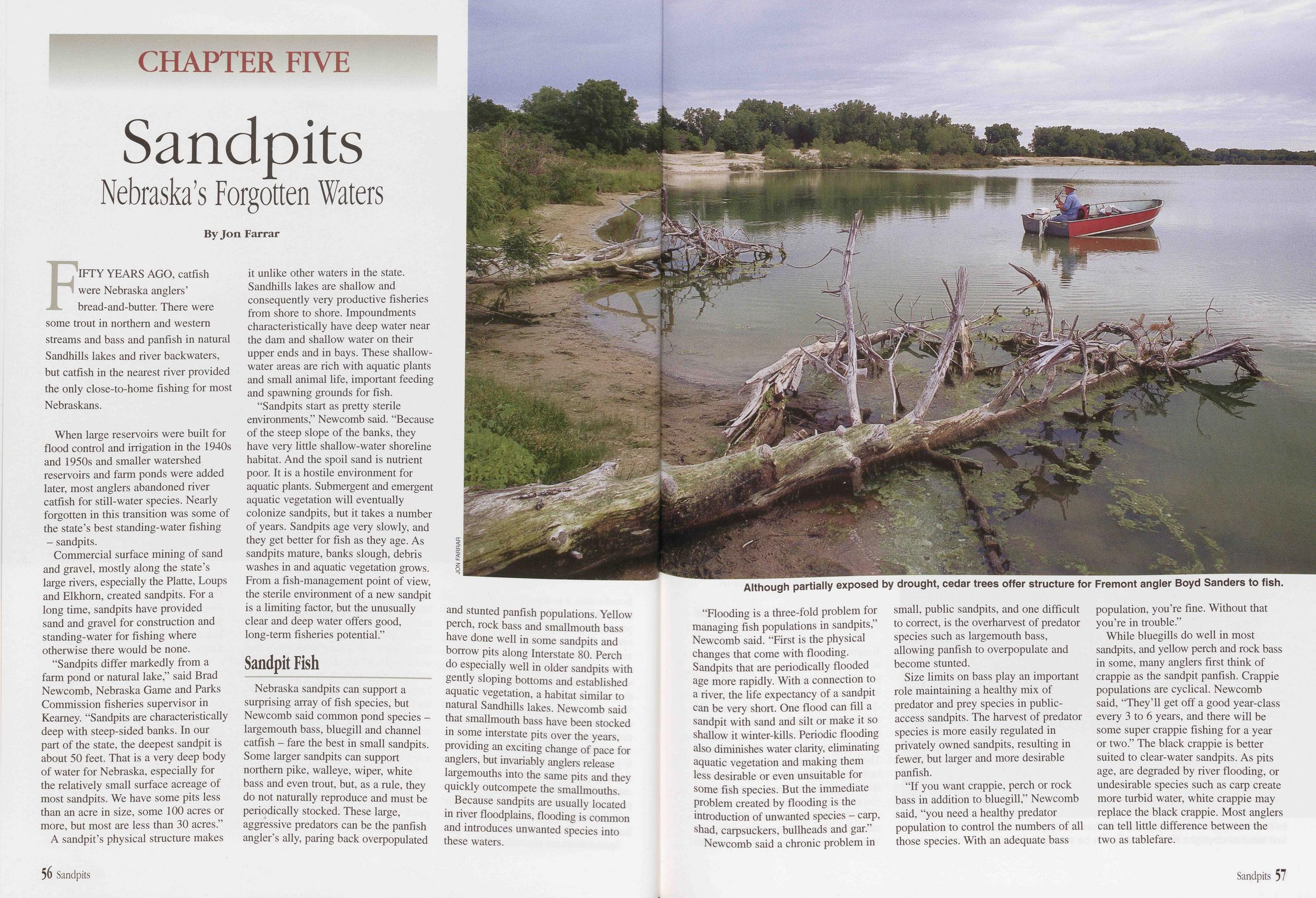
Sandpits
Nebraska's Forgotten Waters
FIFTY YEARS AGO, catfish were Nebraska anglers' A bread-and-butter. There were some trout in northern and western streams and bass and panfish in natural Sandhills lakes and river backwaters, but catfish in the nearest river provided the only close-to-home fishing for most Nebraskans.
When large reservoirs were built for flood control and irrigation in the 1940s and 1950s and smaller watershed reservoirs and farm ponds were added later, most anglers abandoned river catfish for still-water species. Nearly forgotten in this transition was some of the state's best standing-water fishing - sandpits.
Commercial surface mining of sand and gravel, mostly along the state's large rivers, especially the Platte, Loups and Elkhorn, created sandpits. For a long time, sandpits have provided sand and gravel for construction and standing-water for fishing where otherwise there would be none.
"Sandpits differ markedly from a farm pond or natural lake," said Brad Newcomb, Nebraska Game and Parks Commission fisheries supervisor in Kearney. "Sandpits are characteristically deep with steep-sided banks. In our part of the state, the deepest sandpit is about 50 feet. That is a very deep body of water for Nebraska, especially for the relatively small surface acreage of most sandpits. We have some pits less than an acre in size, some 100 acres or more, but most are less than 30 acres."
A sandpit's physical structure makes it unlike other waters in the state. Sandhills lakes are shallow and consequently very productive fisheries from shore to shore. Impoundments characteristically have deep water near the dam and shallow water on their upper ends and in bays. These shallow water areas are rich with aquatic plants and small animal life, important feeding and spawning grounds for fish.
"Sandpits start as pretty sterile environments," Newcomb said. "Because of the steep slope of the banks, they have very little shallow-water shoreline habitat. And the spoil sand is nutrient poor. It is a hostile environment for aquatic plants. Submergent and emergent aquatic vegetation will eventually colonize sandpits, but it takes a number of years. Sandpits age very slowly, and they get better for fish as they age. As sandpits mature, banks slough, debris washes in and aquatic vegetation grows. From a fish-management point of view, the sterile environment of a new sandpit is a limiting factor, but the unusually clear and deep water offers good, long-term fisheries potential."
Sandpit Fish
Nebraska sandpits can support a surprising array of fish species, but Newcomb said common pond species - largemouth bass, bluegill and channel catfish - fare the best in small sandpits. Some larger sandpits can support northern pike, walleye, wiper, white bass and even trout, but, as a rule, they do not naturally reproduce and must be periodically stocked. These large, aggressive predators can be the panfish angler's ally, paring back overpopulated
Although partially exposed by drought, cedar trees offer structure for Fremont angler Boyd Sanders to fish.
and stunted panfish populations. Yellow perch, rock bass and smallmouth bass have done well in some sandpits and borrow pits along Interstate 80. Perch do especially well in older sandpits with gently sloping bottoms and established aquatic vegetation, a habitat similar to natural Sandhills lakes. Newcomb said that smallmouth bass have been stocked in some interstate pits over the years, providing an exciting change of pace for anglers, but invariably anglers release largemouths into the same pits and they quickly outcompete the smallmouths.
Because sandpits are usually located in river floodplains, flooding is common and introduces unwanted species into these waters.
"Flooding is a three-fold problem for managing fish populations in sandpits," Newcomb said. "First is the physical changes that come with flooding. Sandpits that are periodically flooded age more rapidly. With a connection to a river, the life expectancy of a sandpit can be very short. One flood can fill a sandpit with sand and silt or make it so shallow it winter-kills. Periodic flooding also diminishes water clarity, ehminating aquatic vegetation and making them less desirable or even unsuitable for some fish species. But the immediate problem created by flooding is the introduction of unwanted species - carp, shad, carpsuckers, bullheads and gar."
Newcomb said a chronic problem in small, public sandpits, and one difficult to correct, is the over harvest of predator species such as largemouth bass, allowing panfish to overpopulate and become stunted.
Size limits on bass play an important role maintaining a healthy mix of predator and prey species in public access sandpits. The harvest of predator species is more easily regulated in privately owned sandpits, resulting in fewer, but larger and more desirable panfish.
"If you want crappie, perch or rock bass in addition to bluegill," Newcomb said, "you need a healthy predator population to control the numbers of all those species. With an adequate bass population, you're fine. Without that you're in trouble."
While bluegills do well in most sandpits, and yellow perch and rock bass in some, many anglers first think of crappie as the sandpit panfish. Crappie populations are cyclical. Newcomb said, "They'll get off a good year-class every 3 to 6 years, and there will be some super crappie fishing for a year or two." The black crappie is better suited to clear-water sandpits. As pits age, are degraded by river flooding, or undesirable species such as carp create more turbid water, white crappie may replace the black crappie. Most anglers can tell little difference between the two as tablefare.
56 Sandpits Sandpits 57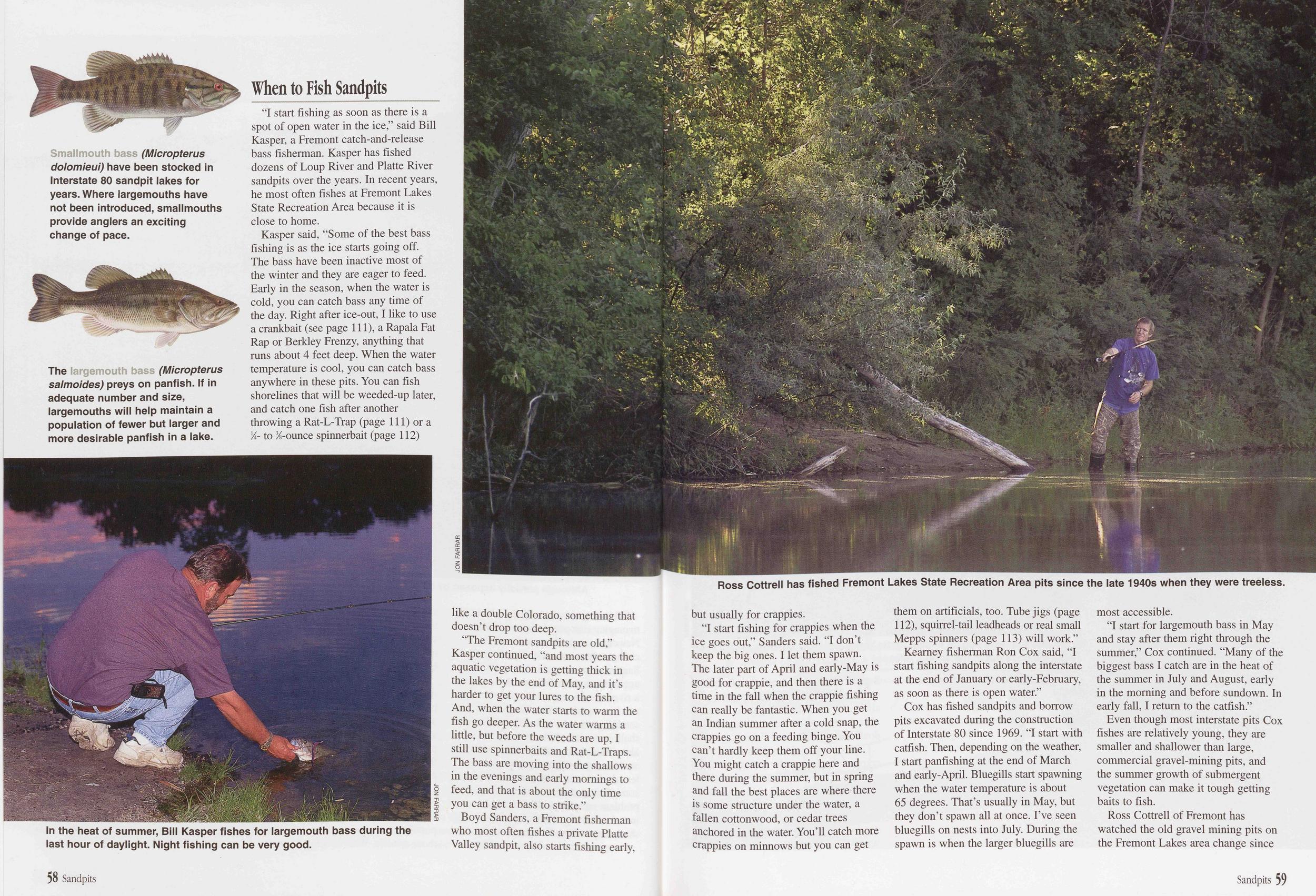
When to Fish Sandpits
Smailmoytri bass (Micropterus dolomieui) have been stocked in Interstate 80 sandpit lakes for years. Where largemouths have not been introduced, smallmouths provide anglers an exciting change of pace.
The largemouth bass (Micropterus salmoides) preys on panfish. If in adequate number and size, largemouths will help maintain a population of fewer but larger and more desirable panfish in a lake.
"I start fishing as soon as there is a spot of open water in the ice," said Bill Kasper, a Fremont catch-and-release bass fisherman. Kasper has fished dozens of Loup River and Platte River sandpits over the years. In recent years, he most often fishes at Fremont Lakes State Recreation Area because it is close to home.
Kasper said, "Some of the best bass fishing is as the ice starts going off. The bass have been inactive most of the winter and they are eager to feed. Early in the season, when the water is cold, you can catch bass any time of the day. Right after ice-out, I like to use a crankbait (see page 111), a Rapala Fat Rap or Berkley Frenzy, anything that runs about 4 feet deep. When the water temperature is cool, you can catch bass anywhere in these pits. You can fish shorelines that will be weeded-up later, and catch one fish after another throwing a Rat-L-Trap (page 111) or a Va- to %-ounce spinnerbait (page 112)
Ross Cottrell has fished Fremont Lakes State Recreation Area pits since the late 1940s when they were treeless.
In the heat of summer, Bill Kasper fishes for largemouth bass during the last hour of daylight. Night fishing can be very good.
like a double Colorado, something that doesn't drop too deep.
"The Fremont sandpits are old," Kasper continued, "and most years the aquatic vegetation is getting thick in the lakes by the end of May, and it's harder to get your lures to the fish. And, when the water starts to warm the fish go deeper. As the water warms a little, but before the weeds are up, I still use spinnerbaits and Rat-L-Traps. The bass are moving into the shallows in the evenings and early mornings to feed, and that is about the only time you can get a bass to strike."
Boyd Sanders, a Fremont fisherman who most often fishes a private Platte Valley sandpit, also starts fishing early, but usually for crappies.
"I start fishing for crappies when the ice goes out," Sanders said. "I don't keep the big ones. I let them spawn. The later part of April and early-May is good for crappie, and then there is a time in the fall when the crappie fishing can really be fantastic. When you get an Indian summer after a cold snap, the crappies go on a feeding binge. You can't hardly keep them off your line. You might catch a crappie here and there during the summer, but in spring and fall the best places are where there is some structure under the water, a fallen cottonwood, or cedar trees anchored in the water. You'll catch more crappies on minnows but you can get them on artificials, too. Tube jigs (page 112), squirrel-tail leadheads or real small Mepps spinners (page 113) will work."
Kearney fisherman Ron Cox said, "I start fishing sandpits along the interstate at the end of January or early-February, as soon as there is open water."
Cox has fished sandpits and borrow pits excavated during the construction of Interstate 80 since 1969. "I start with catfish. Then, depending on the weather, I start panfishing at the end of March and early-April. Bluegills start spawning when the water temperature is about 65 degrees. That's usually in May, but they don't spawn all at once. I've seen bluegills on nests into July. During the spawn is when the larger bluegills are most accessible.
"I start for largemouth bass in May and stay after them right through the summer," Cox continued. "Many of the biggest bass I catch are in the heat of the summer in July and August, early in the morning and before sundown. In early fall, I return to the catfish."
Even though most interstate pits Cox fishes are relatively young, they are smaller and shallower than large, commercial gravel-mining pits, and the summer growth of submergent vegetation can make it tough getting baits to fish.
Ross Cottrell of Fremont has watched the old gravel mining pits on the Fremont Lakes area change since
58 Sandpits Sandpits 59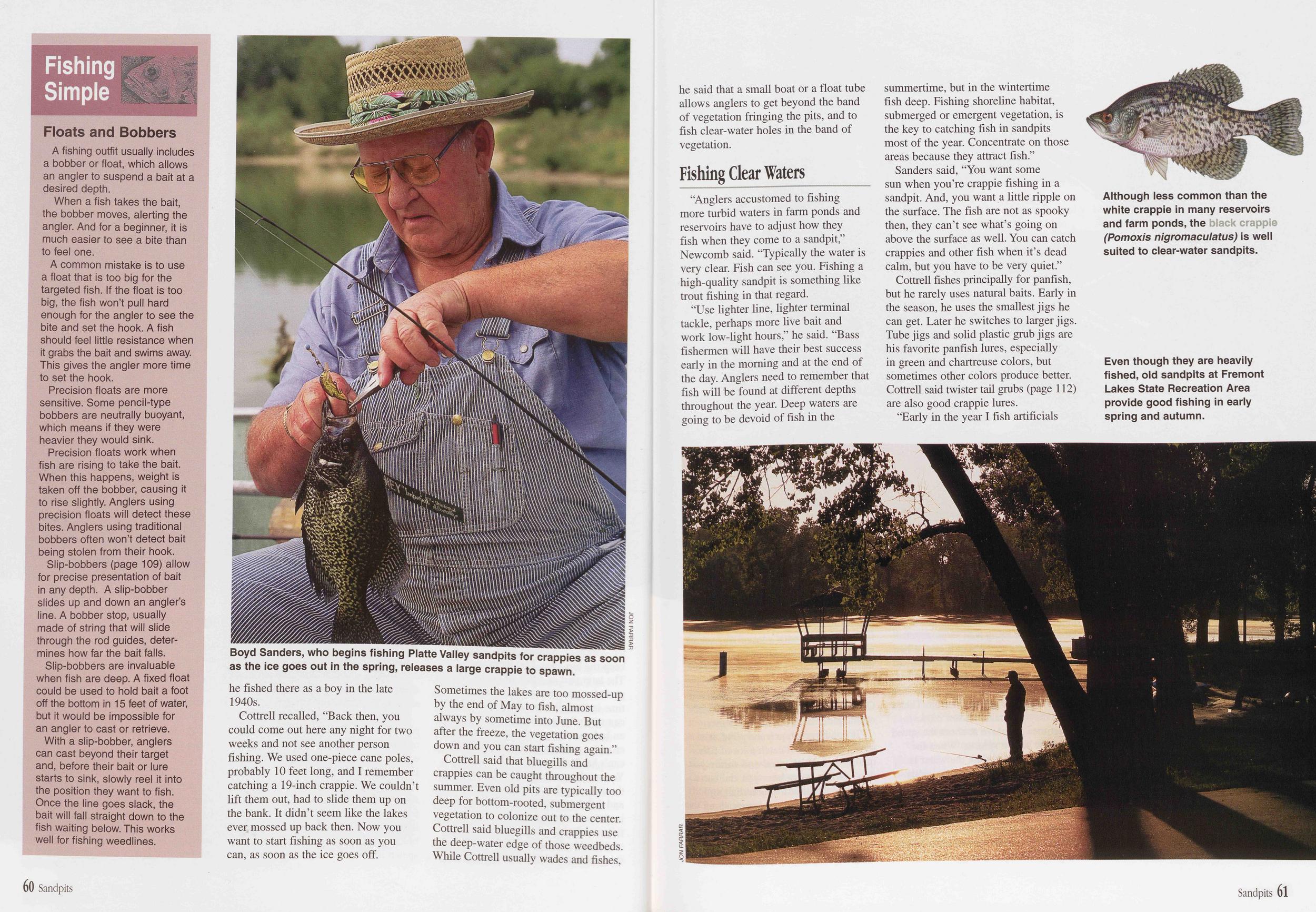
Floats and Bobbers
A fishing outfit usually includes a bobber or float, which allows an angler to suspend a bait at a desired depth.
When a fish takes the bait, the bobber moves, alerting the angler. And for a beginner, it is much easier to see a bite than to feel one.
A common mistake is to use a float that is too big for the targeted fish. If the float is too big, the fish won't pull hard enough for the angler to see the bite and set the hook. A fish should feel little resistance when it grabs the bait and swims away. This gives the angler more time to set the hook.
Precision floats are more sensitive. Some pencil-type bobbers are neutrally buoyant, which means if they were heavier they would sink.
Precision floats work when fish are rising to take the bait. When this happens, weight is taken off the bobber, causing it to rise slightly. Anglers using precision floats will detect these bites. Anglers using traditional bobbers often won't detect bait being stolen from their hook.
Slip-bobbers (page 109) allow for precise presentation of bait in any depth. A slip-bobber slides up and down an angler's line. A bobber stop, usually made of string that will slide through the rod guides, determines how far the bait falls.
Slip-bobbers are invaluable when fish are deep. A fixed float could be used to hold bait a foot off the bottom in 15 feet of water, but it would be impossible for an angler to cast or retrieve.
With a slip-bobber, anglers can cast beyond their target and, before their bait or lure starts to sink, slowly reel it into the position they want to fish. Once the line goes slack, the bait will fall straight down to the fish waiting below. This works well for fishing weed lines.
he fished there as a boy in the late 1940s.
Cottrell recalled, "Back then, you could come out here any night for two weeks and not see another person fishing. We used one-piece cane poles, probably 10 feet long, and I remember catching a 19-inch crappie. We couldn't lift them out, had to slide them up on the bank. It didn't seem like the lakes ever mossed up back then. Now you want to start fishing as soon as you can, as soon as the ice goes off. Sometimes the lakes are too mossed-up by the end of May to fish, almost always by sometime into June. But after the freeze, the vegetation goes down and you can start fishing again."
Cottrell said that bluegills and crappies can be caught throughout the summer. Even old pits are typically too deep for bottom-rooted, submergent vegetation to colonize out to the center. Cottrell said bluegills and crappies use the deep-water edge of those weed beds. While Cottrell usually wades and fishes, he said that a small boat or a float tube allows anglers to get beyond the band of vegetation fringing the pits, and to fish clear-water holes in the band of vegetation.
Fishing Clear Waters"Anglers accustomed to fishing more turbid waters in farm ponds and reservoirs have to adjust how they fish when they come to a sandpit," Newcomb said. "Typically the water is very clear. Fish can see you. Fishing a high-quality sandpit is something like trout fishing in that regard.
"Use lighter line, lighter terminal tackle, perhaps more live bait and work low-light hours," he said. "Bass fishermen will have their best success early in the morning and at the end of the day. Anglers need to remember that fish will be found at different depths throughout the year. Deep waters are going to be devoid of fish in the summertime, but in the wintertime fish deep. Fishing shoreline habitat, submerged or emergent vegetation, is the key to catching fish in sandpits most of the year. Concentrate on those areas because they attract fish."
Sanders said, "You want some sun when you're crappie fishing in a sandpit. And, you want a little ripple on the surface. The fish are not as spooky then, they can't see what's going on above the surface as well. You can catch crappies and other fish when it's dead calm, but you have to be very quiet."
Cottrell fishes principally for panfish, but he rarely uses natural baits. Early in the season, he uses the smallest jigs he can get. Later he switches to larger jigs. Tube jigs and solid plastic grub jigs are his favorite panfish lures, especially in green and chartreuse colors, but sometimes other colors produce better. Cottrell said twister tail grubs (page 112) are also good crappie lures.
"Early in the year I fish artificials
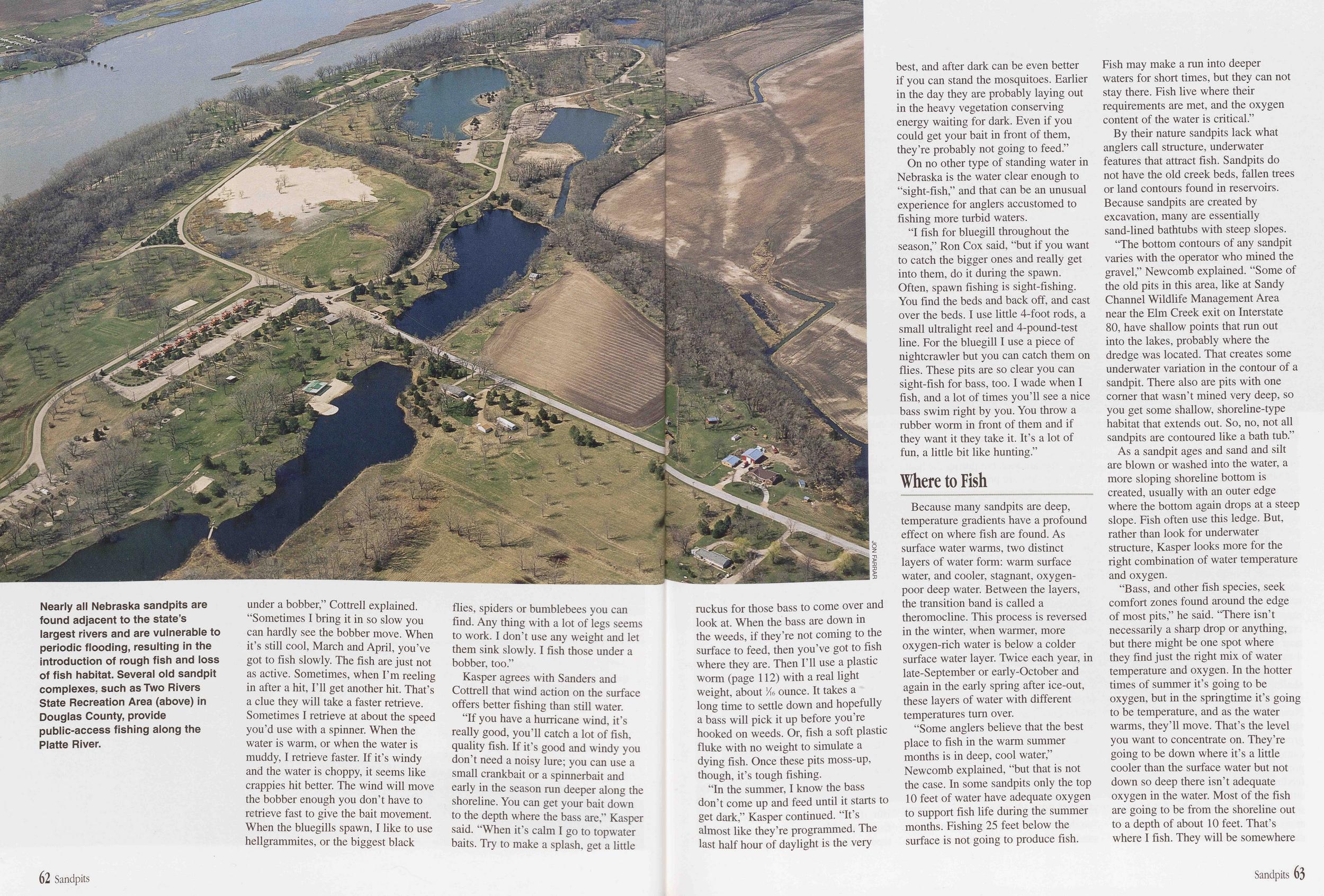
under a bobber," Cottrell explained. "Sometimes I bring it in so slow you can hardly see the bobber move. When it's still cool, March and April, you've got to fish slowly. The fish are just not as active. Sometimes, when I'm reeling in after a hit, I'll get another hit. That's a clue they will take a faster retrieve. Sometimes I retrieve at about the speed you'd use with a spinner. When the water is warm, or when the water is muddy, I retrieve faster. If it's windy and the water is choppy, it seems like crappies hit better. The wind will move the bobber enough you don't have to retrieve fast to give the bait movement. When the bluegills spawn, I like to use hellgrammites, or the biggest black flies, spiders or bumblebees you can find. Any thing with a lot of legs seems to work. I don't use any weight and let them sink slowly. I fish those under a bobber, too."
Kasper agrees with Sanders and Cottrell that wind action on the surface offers better fishing than still water.
"If you have a hurricane wind, it's really good, you'll catch a lot of fish, quality fish. If it's good and windy you don't need a noisy lure; you can use a small crankbait or a spinnerbait and early in the season deeper along the shoreline. You can get your bait down to the depth where the bass are," Kasper said. "When it's calm I go to topwater baits. Try to make a splash, get a little ruckus for those bass to come over and look at. When the bass are down in the weeds, if they're not coining to the surface to feed, then you've got to fish where they are. Then I'll use a plastic worm (page 112) with a real light weight, about Y\6 ounce. It takes a long time to settle down and hopefully a bass will pick it up before you're hooked on weeds. Or, fish a soft plastic fluke with no weight to simulate a dying fish. Once these pits moss-up, though, it's tough fishing.
"In the summer, I know the bass don't come up and feed until it starts to get dark," Kasper continued. "It's almost like they're programmed. The last half hour of daylight is the very best, and after dark can be even better if you can stand the mosquitoes. Earlier in the day they are probably laying out in the heavy vegetation conserving energy waiting for dark. Even if you could get your bait in front of them, they're probably not going to feed."
On no other type of standing water in Nebraska is the water clear enough to "sight-fish," and that can be an unusual experience for anglers accustomed to fishing more turbid waters.
"I fish for bluegill throughout the season," Ron Cox said, "but if you want to catch the bigger ones and really get into them, do it during the spawn. Often, spawn fishing is sight-fishing. You find the beds and back off, and cast over the beds. I use little 4-foot rods, a small ultralight reel and 4-pound-test line. For the bluegill I use a piece of nightcrawler but you can catch them on flies. These pits are so clear you can sight-fish for bass, too. I wade when I fish, and a lot of times you'll see a nice bass swim right by you. You throw a rubber worm in front of them and if they want it they take it. It's a lot of fun, a little bit like hunting."
Where to FishBecause many sandpits are deep, temperature gradients have a profound effect on where fish are found. As surface water warms, two distinct layers of water form: warm surface water, and cooler, stagnant, oxygen poor deep water. Between the layers, the transition band is called a theromocline. This process is reversed in the winter, when warmer, more oxygen-rich water is below a colder surface water layer. Twice each year, in late-September or early-October and again in the early spring after ice-out, these layers of water with different temperatures turn over.
"Some anglers believe that the best place to fish in the warm summer months is in deep, cool water," Newcomb explained, "but that is not the case. In some sandpits only the top 10 feet of water have adequate oxygen to support fish life during the summer months. Fishing 25 feet below the surface is not going to produce fish. Fish may make a run into deeper waters for short times, but they can not stay there. Fish live where their requirements are met, and the oxygen content of the water is critical."
By their nature sandpits lack what anglers call structure, underwater features that attract fish. Sandpits do not have the old creek beds, fallen trees or land contours found in reservoirs. Because sandpits are created by excavation, many are essentially sand-lined bathtubs with steep slopes.
"The bottom contours of any sandpit varies with the operator who mined the gravel," Newcomb explained. "Some of the old pits in this area, like at Sandy Channel Wildlife Management Area near the Elm Creek exit on Interstate 80, have shallow points that run out into the lakes, probably where the dredge was located. That creates some underwater variation in the contour of a sandpit. There also are pits with one corner that wasn't mined very deep, so you get some shallow, shoreline-type habitat that extends out. So, no, not all sandpits are contoured like a bath tub."
As a sandpit ages and sand and silt are blown or washed into the water, a more sloping shoreline bottom is created, usually with an outer edge where the bottom again drops at a steep slope. Fish often use this ledge. But, rather than look for underwater structure, Kasper looks more for the right combination of water temperature and oxygen.
"Bass, and other fish species, seek comfort zones found around the edge of most pits," he said. "There isn't necessarily a sharp drop or anything, but there might be one spot where they find just the right mix of water temperature and oxygen. In the hotter times of summer it's going to be oxygen, but in the springtime it's going to be temperature, and as the water warms, they'll move. That's the level you want to concentrate on. They're going to be down where it's a little cooler than the surface water but not down so deep there isn't adequate oxygen in the water. Most of the fish are going to be from the shoreline out to a depth of about 10 feet. That's where I fish. They will be somewhere
62 Sandpits Sandpits 63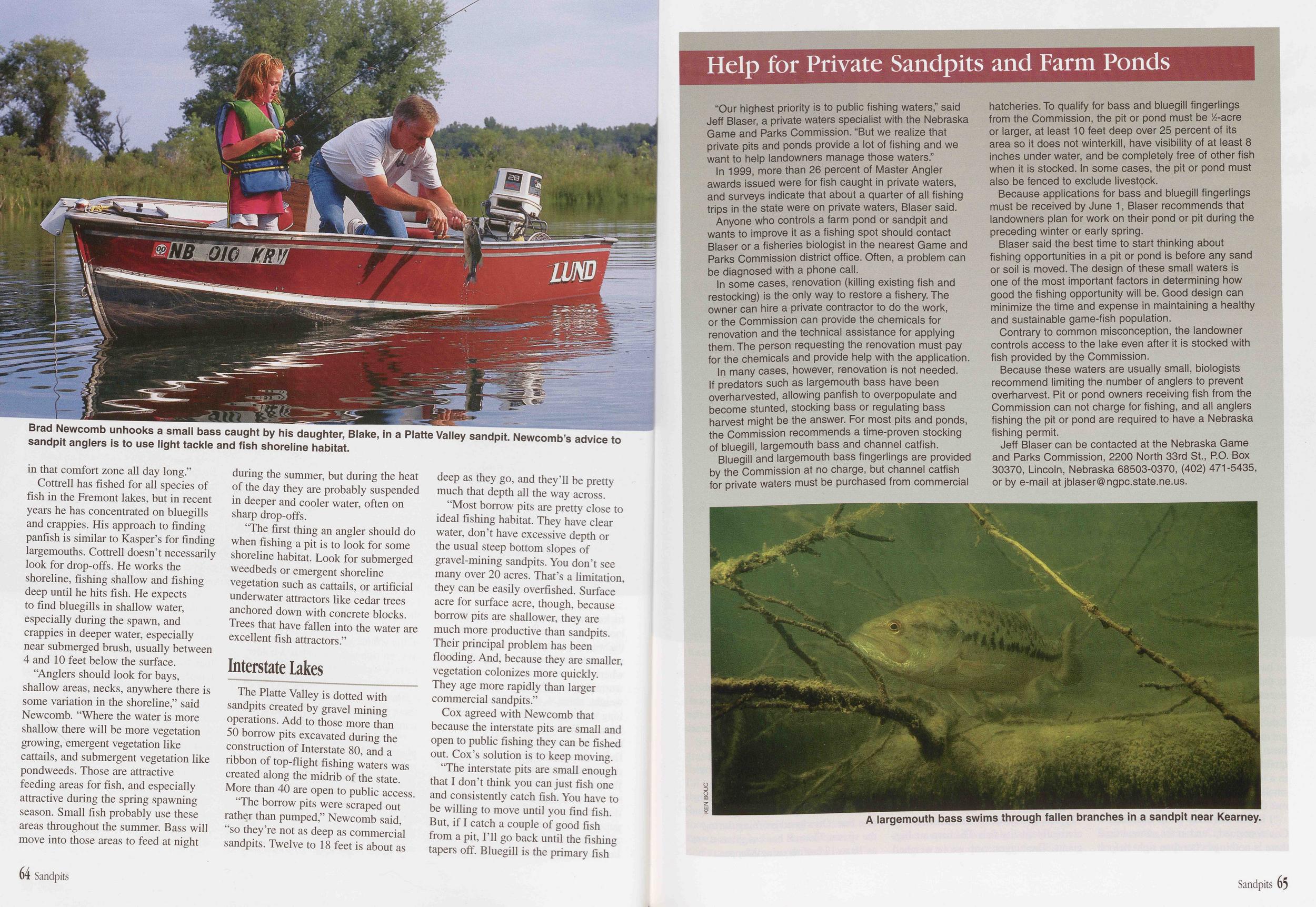
in that comfort zone all day long."
Cottrell has fished for all species of fish in the Fremont lakes, but in recent years he has concentrated on bluegills and crappies. His approach to finding panfish is similar to Kasper's for finding largemouths. Cottrell doesn't necessarily look for drop-offs. He works the shoreline, fishing shallow and fishing deep until he hits fish. He expects to find bluegills in shallow water, especially during the spawn, and crappies in deeper water, especially near submerged brush, usually between 4 and 10 feet below the surface.
"Anglers should look for bays, shallow areas, necks, anywhere there is some variation in the shoreline," said Newcomb. "Where the water is more shallow there will be more vegetation growing, emergent vegetation like cattails, and submergent vegetation like pondweeds. Those are attractive feeding areas for fish, and especially attractive during the spring spawning season. Small fish probably use these areas throughout the summer. Bass will move into those areas to feed at night
64 Sandpitsduring the summer, but during the heat of the day they are probably suspended in deeper and cooler water, often on sharp drop-offs.
"The first thing an angler should do when fishing a pit is to look for some shoreline habitat. Look for submerged weedbeds or emergent shoreline vegetation such as cattails, or artificial underwater attractors like cedar trees anchored down with concrete blocks. Trees that have fallen into the water are excellent fish attractors."
Interstate LakesThe Platte Valley is dotted with sandpits created by gravel mining operations. Add to those more than 50 borrow pits excavated during the construction of Interstate 80, and a ribbon of top-flight fishing waters was created along the midrib of the state. More than 40 are open to public access.
"The borrow pits were scraped out rather than pumped," Newcomb said, "so they're not as deep as commercial sandpits. Twelve to 18 feet is about as deep as they go, and they'll be pretty much that depth all the way across. "Most borrow pits are pretty close to ideal fishing habitat. They have clear water, don't have excessive depth or the usual steep bottom slopes of gravel-mining sandpits. You don't see many over 20 acres. That's a limitation, they can be easily overfished. Surface acre for surface acre, though, because borrow pits are shallower, they are much more productive than sandpits. Their principal problem has been flooding. And, because they are smaller, vegetation colonizes more quickly. They age more rapidly than larger commercial sandpits."
Cox agreed with Newcomb that because the interstate pits are small and open to public fishing they can be fished out. Cox's solution is to keep moving.
"The interstate pits are small enough that I don't think you can just fish one and consistently catch fish. You have to be willing to move until you find fish. But, if I catch a couple of good fish from a pit, I'll go back until the fishing tapers off. Bluegill is the primary fish
Help for Private Sandpits and Farm Ponds
"Our highest priority is to public fishing waters" said Jeff Blaser, a private waters specialist with the Nebraska Game and Parks Commission. "But we realize that private pits and ponds provide a lot of fishing and we want to help landowners manage those waters"
In 1999, more than 26 percent of Master Angler awards issued were for fish caught in private waters, and surveys indicate that about a quarter of all fishing trips in the state were on private waters, Blaser said. Anyone who controls a farm pond or sandpit and wants to improve it as a fishing spot should contact Blaser or a fisheries biologist in the nearest Game and Parks Commission district office. Often, a problem can be diagnosed with a phone call.
In some cases, renovation (killing existing fish and restocking) is the only way to restore a fishery. The owner can hire a private contractor to do the work, or the Commission can provide the chemicals for renovation and the technical assistance for applying them. The person requesting the renovation must pay for the chemicals and provide help with the application.
In many cases, however, renovation is not needed. If predators such as largemouth bass have been overharvested, allowing panfish to overpopulate and become stunted, stocking bass or regulating bass harvest might be the answer. For most pits and ponds, the Commission recommends a time-proven stocking of bluegill, largemouth bass and channel catfish.
Bluegill and largemouth bass fingerlings are provided by the Commission at no charge, but channel catfish for private waters must be purchased from commercial hatcheries. To qualify for bass and bluegill fingerlings from the Commission, the pit or pond must be y-acre or larger, at least 10 feet deep over 25 percent of its area so it does not winter kill, have visibility of at least 8 inches under water, and be completely free of other fish when it is stocked. In some cases, the pit or pond must also be fenced to exclude livestock.
Because applications for bass and bluegill fingerlings must be received by June 1, Blaser recommends that landowners plan for work on their pond or pit during the preceding winter or early spring.
Blaser said the best time to start thinking about fishing opportunities in a pit or pond is before any sand or soil is moved. The design of these small waters is one of the most important factors in determining how good the fishing opportunity will be. Good design can minimize the time and expense in maintaining a healthy and sustainable game-fish population.
Contrary to common misconception, the landowner controls access to the lake even after it is stocked with fish provided by the Commission.
Because these waters are usually small, biologists recommend limiting the number of anglers to prevent overh arvest. Pit or pond owners receiving fish from the Commission can not charge for fishing, and all anglers fishing the pit or pond are required to have a Nebraska fishing permit.
Jeff Blaser can be contacted at the Nebraska Game and Parks Commission, 2200 North 33rd St., P.O. Box 30370, Lincoln, Nebraska 68503-0370, (402) 471-5435, or by e-mail at jblaser@ngpc.state.ne.us.
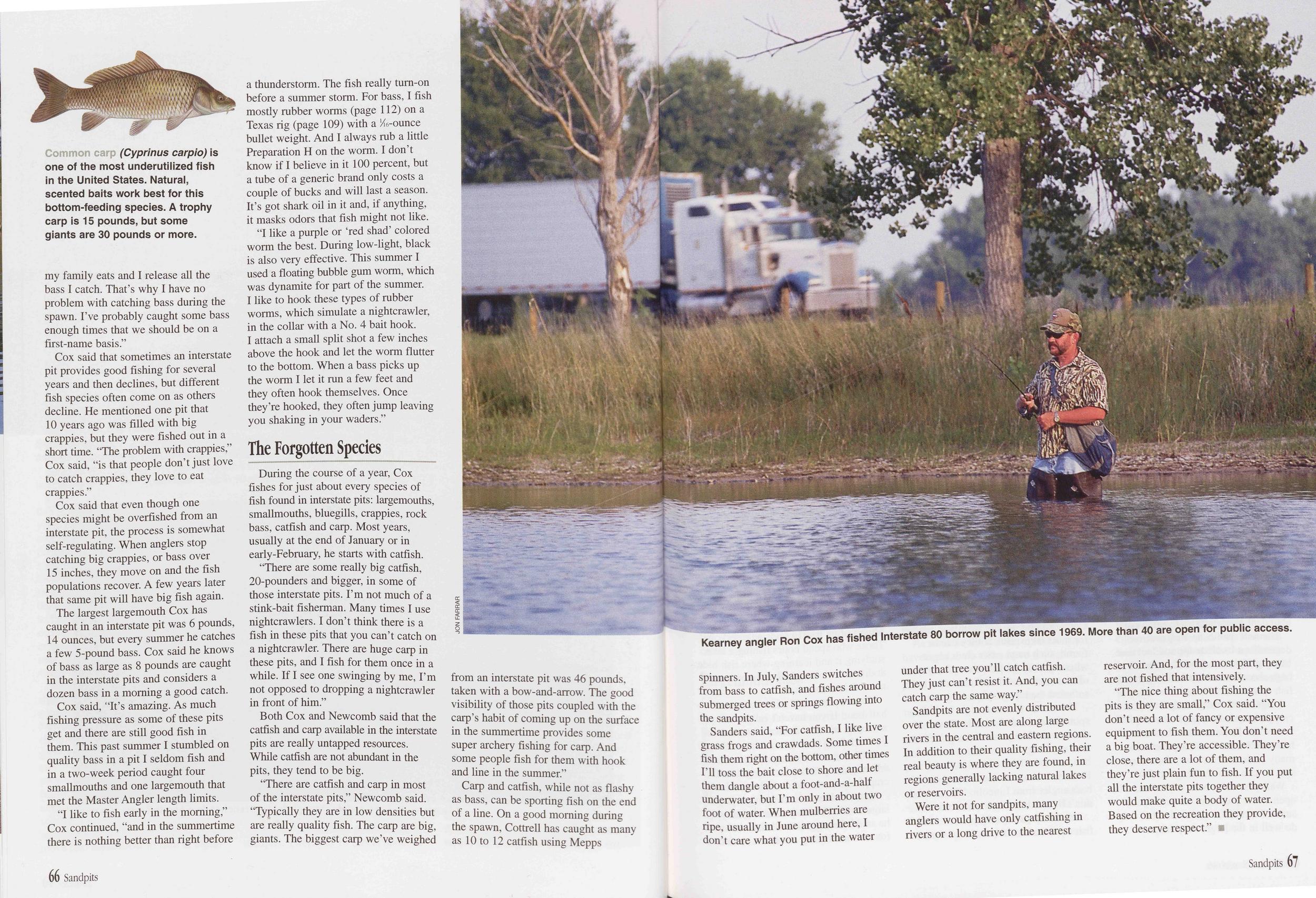
my family eats and I release all the bass I catch. That's why I have no problem with catching bass during the spawn. I've probably caught some bass enough times that we should be on a first-name basis."
Cox said that sometimes an interstate pit provides good fishing for several years and then declines, but different fish species often come on as others decline. He mentioned one pit that 10 years ago was filled with big crappies, but they were fished out in a short time. "The problem with crappies," Cox said, "is that people don't just love to catch crappies, they love to eat crappies."
Cox said that even though one species might be overfished from an interstate pit, the process is somewhat self-regulating. When anglers stop catching big crappies, or bass over 15 inches, they move on and the fish populations recover. A few years later that same pit will have big fish again.
The largest largemouth Cox has caught in an interstate pit was 6 pounds, 14 ounces, but every summer he catches a few 5-pound bass. Cox said he knows of bass as large as 8 pounds are caught in the interstate pits and considers a dozen bass in a morning a good catch. Cox said, "It's amazing. As much fishing pressure as some of these pits get and there are still good fish in them. This past summer I stumbled on quality bass in a pit I seldom fish and in a two-week period caught four smallmouths and one largemouth that met the Master Angler length limits.
"I like to fish early in the morning," Cox continued, "and in the summertime there is nothing better than right before a thunderstorm. The fish really turn-on before a summer storm. For bass, I fish mostly rubber worms (page 112) on a Texas rig (page 109) with a ounce bullet weight. And I always rub a little Preparation H on the worm. I don't know if I believe in it 100 percent, but a tube of a generic brand only costs a couple of bucks and will last a season. It's got shark oil in it and, if anything, it masks odors that fish might not like.
"I like a purple or 'red shad' colored worm the best. During low-light, black is also very effective. This summer I used a floating bubble gum worm, which was dynamite for part of the summer. I like to hook these types of rubber worms, which simulate a nightcrawler, in the collar with a No. 4 bait hook. I attach a small split shot a few inches above the hook and let the worm flutter to the bottom. When a bass picks up the worm I let it run a few feet and they often hook themselves. Once they're hooked, they often jump leaving you shaking in your waders."
The Forgotten SpeciesDuring the course of a year, Cox fishes for just about every species of fish found in interstate pits: largemouths, smallmouths, bluegills, crappies, rock bass, catfish and carp. Most years, usually at the end of January or in early-February, he starts with catfish.
"There are some really big catfish, 20-pounders and bigger, in some of those interstate pits. I'm not much of a stink-bait fisherman. Many times I use nightcrawlers. I don't think there is a fish in these pits that you can't catch on a nightcrawler. There are huge carp in these pits, and I fish for them once in a while. If I see one swinging by me, I'm not opposed to dropping a nightcrawler in front of him."
Both Cox and Newcomb said that the catfish and carp available in the interstate pits are really untapped resources. While catfish are not abundant in the pits, they tend to be big.
"There are catfish and carp in most of the interstate pits," Newcomb said.
"Typically they are in low densities but are really quality fish. The carp are big, giants. The biggest carp we've weighed
from an interstate pit was 46 pounds, taken with a bow-and-arrow. The good visibility of those pits coupled with the carp's habit of coming up on the surface in the summertime provides some super archery fishing for carp. And some people fish for them with hook and line in the summer."
Carp and catfish, while not as flashy as bass, can be sporting fish on the end of a line. On a good morning during the spawn, Cottrell has caught as many as 10 to 12 catfish using Mepps spinners. In July, Sanders switches from bass to catfish, and fishes around submerged trees or springs flowing into the sandpits.
Sanders said, "For catfish, I like live grass frogs and crawdads. Some times I fish them right on the bottom, other times I'll toss the bait close to shore and let them dangle about a foot-and-a-half underwater, but I'm only in about two foot of water. When mulberries are ripe, usually in June around here, I don't care what you put in the water under that tree you'll catch catfish. They just can't resist it. And, you can catch carp the same way."
Sandpits are not evenly distributed over the state. Most are along large rivers in the central and eastern regions. In addition to their quality fishing, their real beauty is where they are found, in regions generally lacking natural lakes or reservoirs.
Were it not for sandpits, many anglers would have only catfishing in rivers or a long drive to the nearest reservoir. And, for the most part, they are not fished that intensively.
"The nice thing about fishing the pits is they are small," Cox said. "You don't need a lot of fancy or expensive equipment to fish them. You don't need a big boat. They're accessible. They're close, there are a lot of them, and they're just plain fun to fish. If you put all the interstate pits together they would make quite a body of water. Based on the recreation they provide, they deserve respect."
Sandpits 67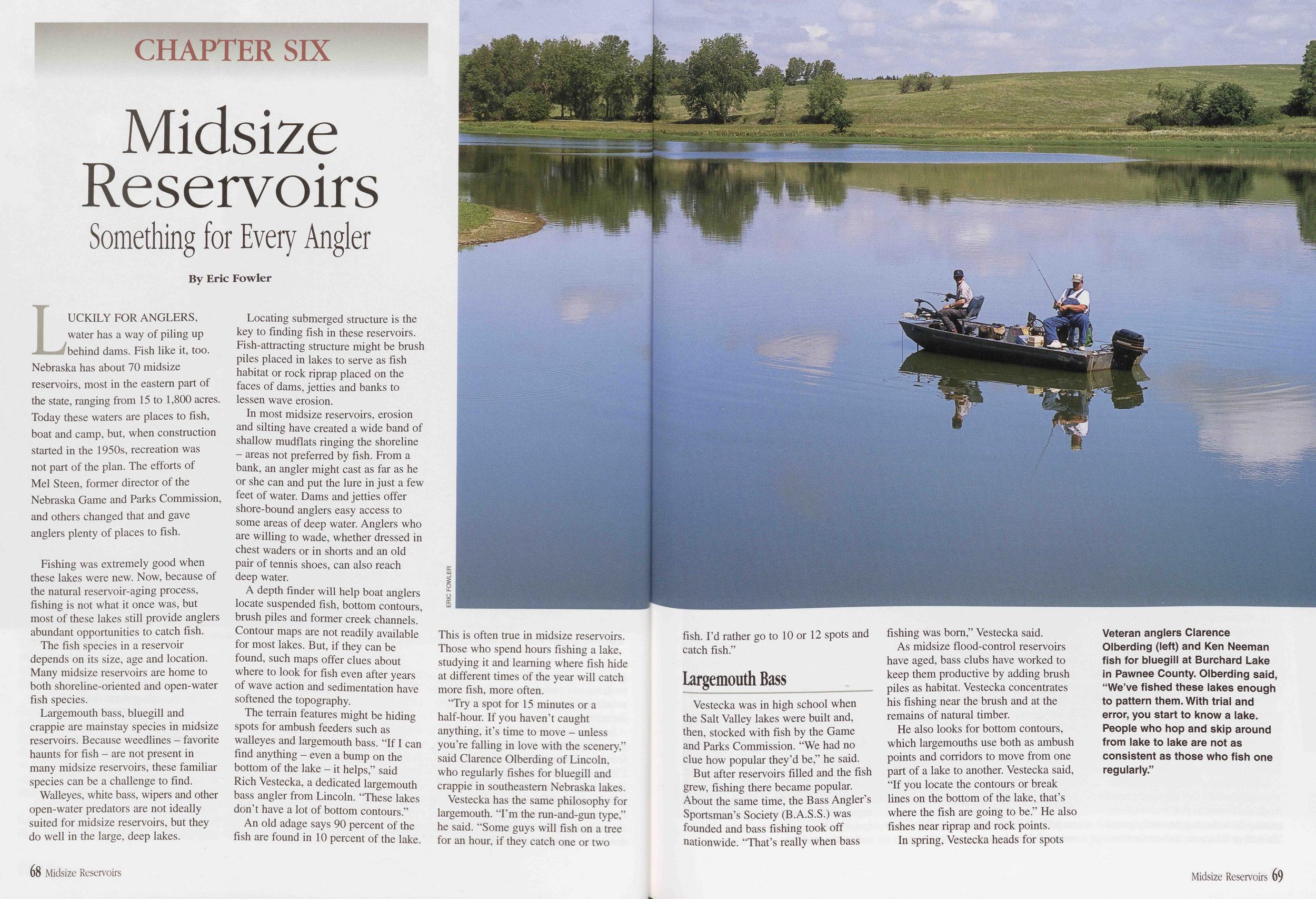
Midsize Reservoirs
Something for Every Angler
LUCKILY FOR ANGLERS, water has a way of piling up behind dams. Fish like it, too. Nebraska has about 70 midsize reservoirs, most in the eastern part of the state, ranging from 15 to 1,800 acres. Today these waters are places to fish, boat and camp, but, when construction started in the 1950s, recreation was not part of the plan. The efforts of Mel Steen, former director of the Nebraska Game and Parks Commission, and others changed that and gave anglers plenty of places to fish.
Fishing was extremely good when these lakes were new. Now, because of the natural reservoir-aging process, fishing is not what it once was, but most of these lakes still provide anglers abundant opportunities to catch fish. The fish species in a reservoir depends on its size, age and location. Many midsize reservoirs are home to both shoreline-oriented and open-water fish species.
Largemouth bass, bluegill and crappie are mainstay species in midsize reservoirs. Because weed lines - favorite haunts for fish - are not present in many midsize reservoirs, these familiar species can be a challenge to find.
Walleyes, white bass, wipers and other open-water predators are not ideally suited for midsize reservoirs, but they do well in the large, deep lakes.
Locating submerged structure is the key to finding fish in these reservoirs. Fish-attracting structure might be brush piles placed in lakes to serve as fish habitat or rock riprap placed on the faces of dams, jetties and banks to lessen wave erosion.
In most midsize reservoirs, erosion and silting have created a wide band of shallow mudflats ringing the shoreline - areas not preferred by fish. From a bank, an angler might cast as far as he or she can and put the lure in just a few feet of water. Dams and jetties offer shore-bound anglers easy access to some areas of deep water. Anglers who are willing to wade, whether dressed in chest waders or in shorts and an old pair of tennis shoes, can also reach deep water.
A depth finder will help boat anglers locate suspended fish, bottom contours, brush piles and former creek channels. Contour maps are not readily available for most lakes. But, if they can be found, such maps offer clues about where to look for fish even after years of wave action and sedimentation have softened the topography.
The terrain features might be hiding spots for ambush feeders such as walleyes and largemouth bass. "If I can find anything - even a bump on the bottom of the lake - it helps," said Rich Vestecka, a dedicated largemouth bass angler from Lincoln. "These lakes don't have a lot of bottom contours."
An old adage says 90 percent of the fish are found in 10 percent of the lake. This is often true in midsize reservoirs. Those who spend hours fishing a lake, studying it and learning where fish hide at different times of the year will catch more fish, more often.
"Try a spot for 15 minutes or a half-hour. If you haven't caught anything, it's time to move - unless you're falling in love with the scenery," said Clarence Olberding of Lincoln, who regularly fishes for bluegill and crappie in southeastern Nebraska lakes.
Vestecka has the same philosophy for largemouth. "I'm the run-and-gun type," he said. "Some guys will fish on a tree for an hour, if they catch one or two fish. I'd rather go to 10 or 12 spots and catch fish."
Largemouth BassVestecka was in high school when the Salt Valley lakes were built and, then, stocked with fish by the Game and Parks Commission. "We had no clue how popular they'd be," he said.
But after reservoirs filled and the fish grew, fishing there became popular. About the same time, the Bass Angler's Sportsman's Society (B.A.S.S.) was founded and bass fishing took off nationwide. "That's really when bass fishing was born," Vestecka said.
As midsize flood-control reservoirs have aged, bass clubs have worked to keep them productive by adding brush piles as habitat. Vestecka concentrates his fishing near the brush and at the remains of natural timber.
He also looks for bottom contours, which largemouths use both as ambush points and corridors to move from one part of a lake to another. Vestecka said, "If you locate the contours or break lines on the bottom of the lake, that's where the fish are going to be." He also fishes near riprap and rock points.
In spring, Vestecka heads for spots
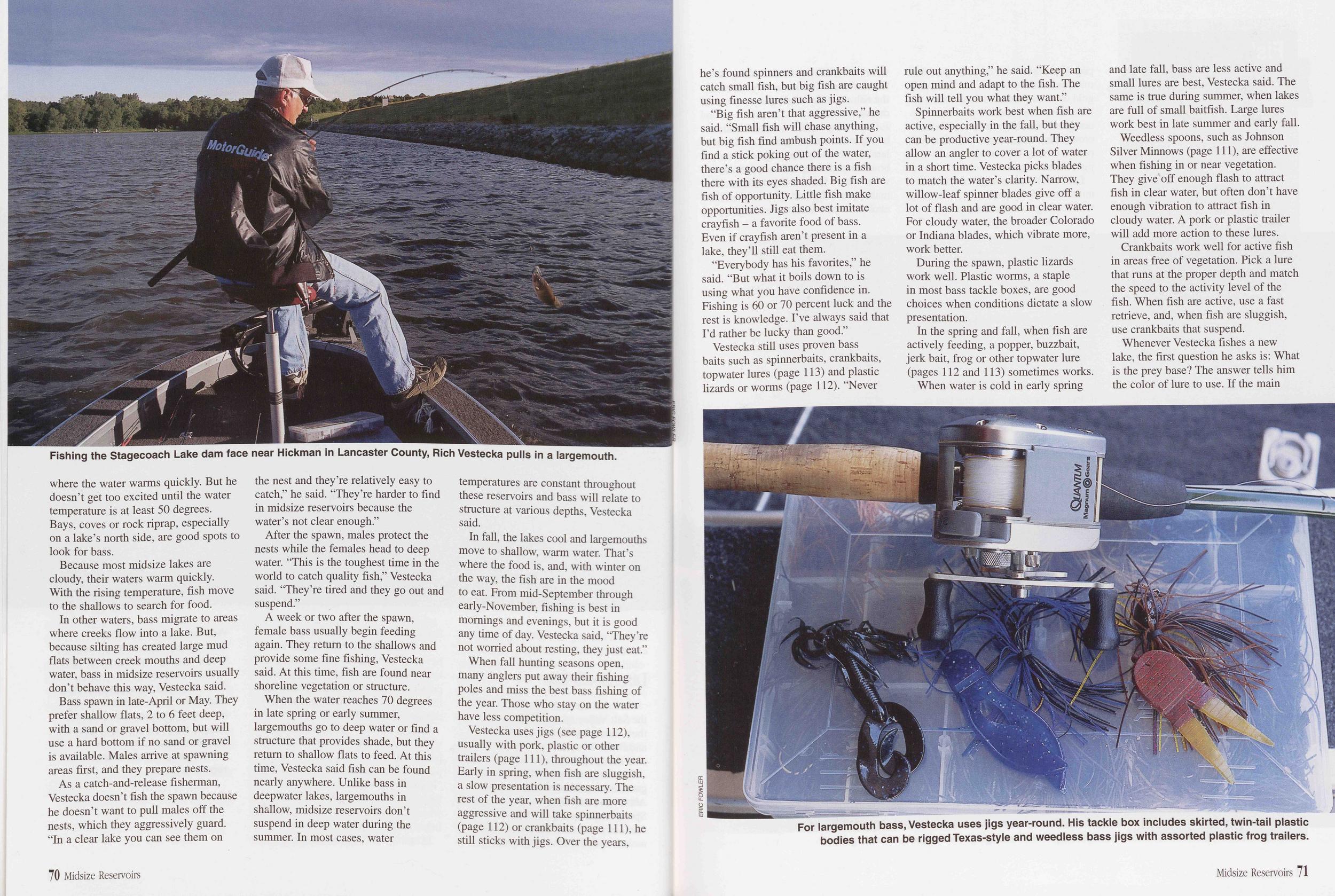
where the water warms quickly. But he doesn't get too excited until the water temperature is at least 50 degrees. Bays, coves or rock riprap, especially on a lake's north side, are good spots to look for bass.
Because most midsize lakes are cloudy, their waters warm quickly. With the rising temperature, fish move to the shallows to search for food.
In other waters, bass migrate to areas where creeks flow into a lake. But, because silting has created large mud flats between creek mouths and deep water, bass in midsize reservoirs usually don't behave this way, Vestecka said.
Bass spawn in late-April or May. They prefer shallow flats, 2 to 6 feet deep, with a sand or gravel bottom, but will use a hard bottom if no sand or gravel is available. Males arrive at spawning areas first, and they prepare nests.
As a catch-and-release fisherman, Vestecka doesn't fish the spawn because he doesn't want to pull males off the nests, which they aggressively guard. "In a clear lake you can see them on
70 Midsize Reservoirsthe nest and they're relatively easy to catch," he said. "They're harder to find in midsize reservoirs because the water's not clear enough."
After the spawn, males protect the nests while the females head to deep water. "This is the toughest time in the world to catch quality fish," Vestecka said. "They're tired and they go out and suspend."
A week or two after the spawn, female bass usually begin feeding again. They return to the shallows and provide some fine fishing, Vestecka said. At this time, fish are found near shoreline vegetation or structure.
When the water reaches 70 degrees in late spring or early summer, largemouths go to deep water or find a structure that provides shade, but they return to shallow flats to feed. At this time, Vestecka said fish can be found nearly anywhere. Unlike bass in deepwater lakes, largemouths in shallow, midsize reservoirs don't suspend in deep water during the summer. In most cases, water temperatures are constant throughout these reservoirs and bass will relate to structure at various depths, Vestecka said.
In fall, the lakes cool and largemouths move to shallow, warm water. That's where the food is, and, with winter on the way, the fish are in the mood to eat. From mid-September through early-November, fishing is best in mornings and evenings, but it is good any time of day. Vestecka said, "They're not worried about resting, they just eat."
When fall hunting seasons open, many anglers put away their fishing poles and miss the best bass fishing of the year. Those who stay on the water have less competition.
Vestecka uses jigs (see page 112), usually with pork, plastic or other trailers (page 111), throughout the year. Early in spring, when fish are sluggish, a slow presentation is necessary. The rest of the year, when fish are more aggressive and will take spinnerbaits (page 112) or crankbaits (page 111), he still sticks with jigs. Over the years, he's found spinners and crankbaits will catch small fish, but big fish are caught using finesse lures such as jigs.
"Big fish aren't that aggressive," he said. "Small fish will chase anything, but big fish find ambush points. If you find a stick poking out of the water, there's a good chance there is a fish there with its eyes shaded. Big fish are fish of opportunity. Little fish make opportunities. Jigs also best imitate crayfish - a favorite food of bass. Even if crayfish aren't present in a lake, they'll still eat them.
"Everybody has his favorites," he said. "But what it boils down to is using what you have confidence in. Fishing is 60 or 70 percent luck and the rest is knowledge. I've always said that I'd rather be lucky than good."
Vestecka still uses proven bass baits such as spinnerbaits, crankbaits, topwater lures (page 113) and plastic lizards or worms (page 112). "Never rule out anything," he said. "Keep an open mind and adapt to the fish. The fish will tell you what they want."
Spinnerbaits work best when fish are active, especially in the fall, but they can be productive year-round. They allow an angler to cover a lot of water in a short time. Vestecka picks blades to match the water's clarity. Narrow, willow-leaf spinner blades give off a lot of flash and are good in clear water. For cloudy water, the broader Colorado or Indiana blades, which vibrate more, work better.
During the spawn, plastic lizards work well. Plastic worms, a staple in most bass tackle boxes, are good choices when conditions dictate a slow presentation.
In the spring and fall, when fish are actively feeding, a popper, buzzbait, jerk bait, frog or other topwater lure (pages 112 and 113) sometimes works.
When water is cold in early spring and late fall, bass are less active and small lures are best, Vestecka said. The same is true during summer, when lakes are full of small baitfish. Large lures work best in late summer and early fall.
Weedless spoons, such as Johnson Silver Minnows (page 111), are effective when fishing in or near vegetation. They give off enough flash to attract fish in clear water, but often don't have enough vibration to attract fish in cloudy water. A pork or plastic trailer will add more action to these lures.
Crankbaits work well for active fish in areas free of vegetation. Pick a lure that runs at the proper depth and match the speed to the activity level of the fish. When fish are active, use a fast retrieve, and, when fish are sluggish, use crankbaits that suspend.
Whenever Vestecka fishes a new lake, the first question he asks is: What is the prey base? The answer tells him the color of lure to use. If the main
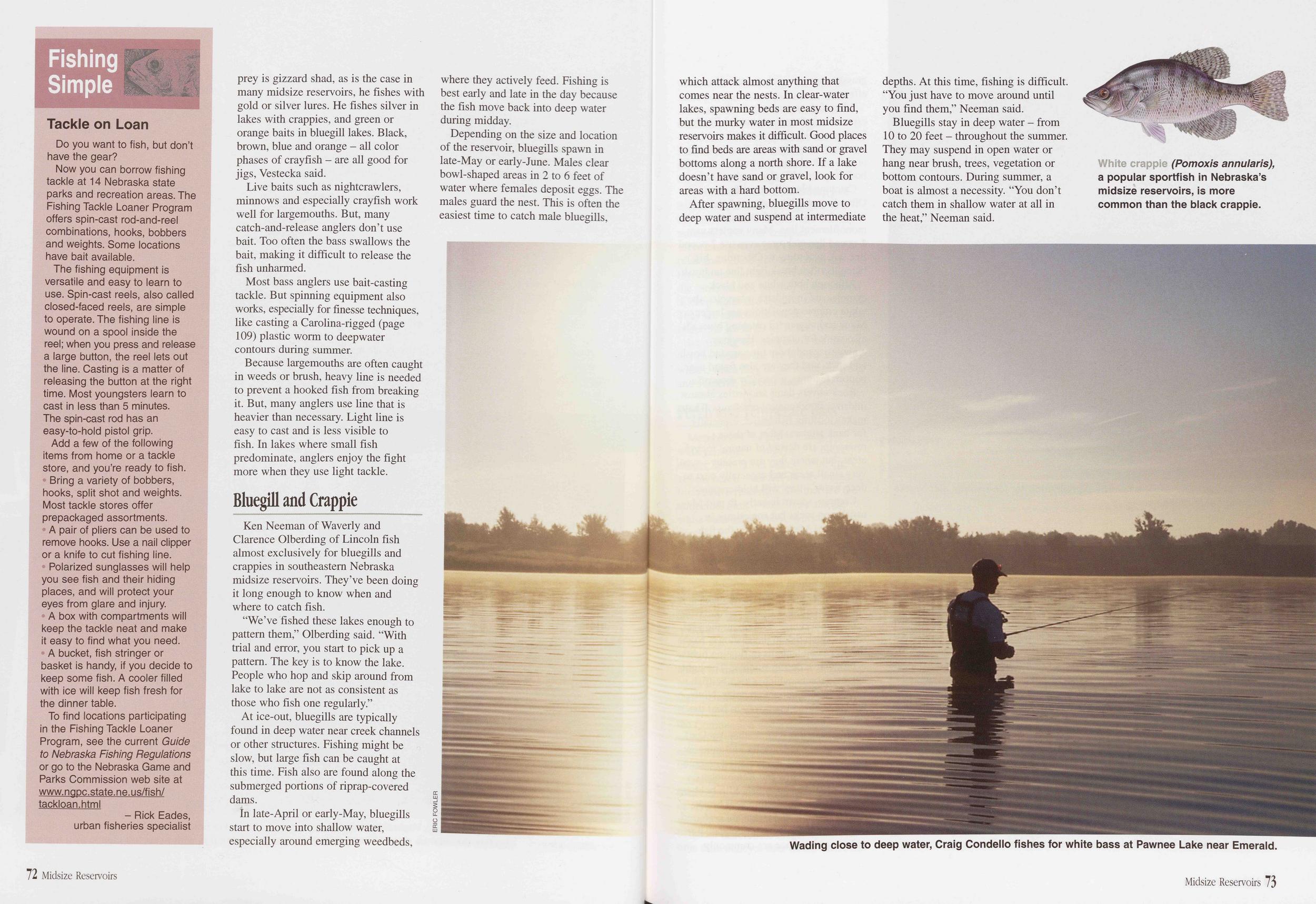
Fishing Simple
Tackle on Loan
Do you want to fish, but don't have the gear?
Now you can borrow fishing tackle at 14 Nebraska state parks and recreation areas. The Fishing Tackle Loaner Program offers spin-cast rod-and-reel combinations, hooks, bobbers and weights. Some locations have bait available.
The fishing equipment is versatile and easy to learn to use. Spin-cast reels, also called closed-faced reels, are simple to operate. The fishing line is wound on a spool inside the reel; when you press and release a large button, the reel lets out the line. Casting is a matter of releasing the button at the right time. Most youngsters learn to cast in less than 5 minutes. The spin-cast rod has an easy-to-hold pistol grip.
Add a few of the following items from home or a tackle store, and you're ready to fish.
•Bring a variety of bobbers, hooks, split shot and weights. Most tackle stores offer prepackaged assortments.
• A pair of pliers can be used to remove hooks. Use a nail clipper or a knife to cut fishing line.
•Polarized sunglasses will help you see fish and their hiding places, and will protect your eyes from glare and injury.
•A box with compartments will keep the tackle neat and make it easy to find what you need.
•A bucket, fish stringer or basket is handy, if you decide to keep some fish. A cooler filled with ice will keep fish fresh for the dinner table.
To find locations participating in the Fishing Tackle Loaner Program, see the current Guide to Nebraska Fishing Regulations or go to the Nebraska Game and Parks Commission web site at www.ngpc.state.ne.us/fish/ tackloan.html - Rick Eades, urban fisheries specialist
prey is gizzard shad, as is the case in many midsize reservoirs, he fishes with gold or silver lures. He fishes silver in lakes with crappies, and green or orange baits in bluegill lakes. Black, brown, blue and orange - all color phases of crayfish - are all good for jigs, Vestecka said.
Live baits such as nightcrawlers, minnows and especially crayfish work well for largemouths. But, many catch-and-release anglers don't use bait. Too often the bass swallows the bait, making it difficult to release the fish unharmed.
Most bass anglers use bait-casting tackle. But spinning equipment also works, especially for finesse techniques, like casting a Carolina-rigged (page 109) plastic worm to deepwater contours during summer.
Because largemouths are often caught in weeds or brush, heavy line is needed to prevent a hooked fish from breaking it. But, many anglers use line that is heavier than necessary. Light line is easy to cast and is less visible to fish. In lakes where small fish predominate, anglers enjoy the fight more when they use light tackle.
Bluegill and CrappieKen Neeman of Waverly and Clarence Olberding of Lincoln fish almost exclusively for bluegills and crappies in southeastern Nebraska midsize reservoirs. They've been doing it long enough to know when and where to catch fish.
"We've fished these lakes enough to pattern them," Olberding said. "With trial and error, you start to pick up a pattern. The key is to know the lake. People who hop and skip around from lake to lake are not as consistent as those who fish one regularly."
At ice-out, bluegills are typically found in deep water near creek channels or other structures. Fishing might be slow, but large fish can be caught at this time. Fish also are found along the submerged portions of riprap-covered dams.
In late-April or early-May, bluegills start to move into shallow water, especially around emerging weedbeds, where they actively feed. Fishing is best early and late in the day because the fish move back into deep water during midday.
Depending on the size and location of the reservoir, bluegills spawn in late-May or early-June. Males clear bowl-shaped areas in 2 to 6 feet of water where females deposit eggs. The males guard the nest. This is often the easiest time to catch male bluegills, which attack almost anything that comes near the nests. In clear-water lakes, spawning beds are easy to find, but the murky water in most midsize reservoirs makes it difficult. Good places to find beds are areas with sand or gravel bottoms along a north shore. If a lake doesn't have sand or gravel, look for areas with a hard bottom.
After spawning, bluegills move to deep water and suspend at intermediate depths. At this time, fishing is difficult. 'You just have to move around until you find them," Neeman said.
Bluegills stay in deep water - from 10 to 20 feet - throughout the summer. They may suspend in open water or hang near brush, trees, vegetation or bottom contours. During summer, a boat is almost a necessity. "You don't catch them in shallow water at all in the heat," Neeman said.
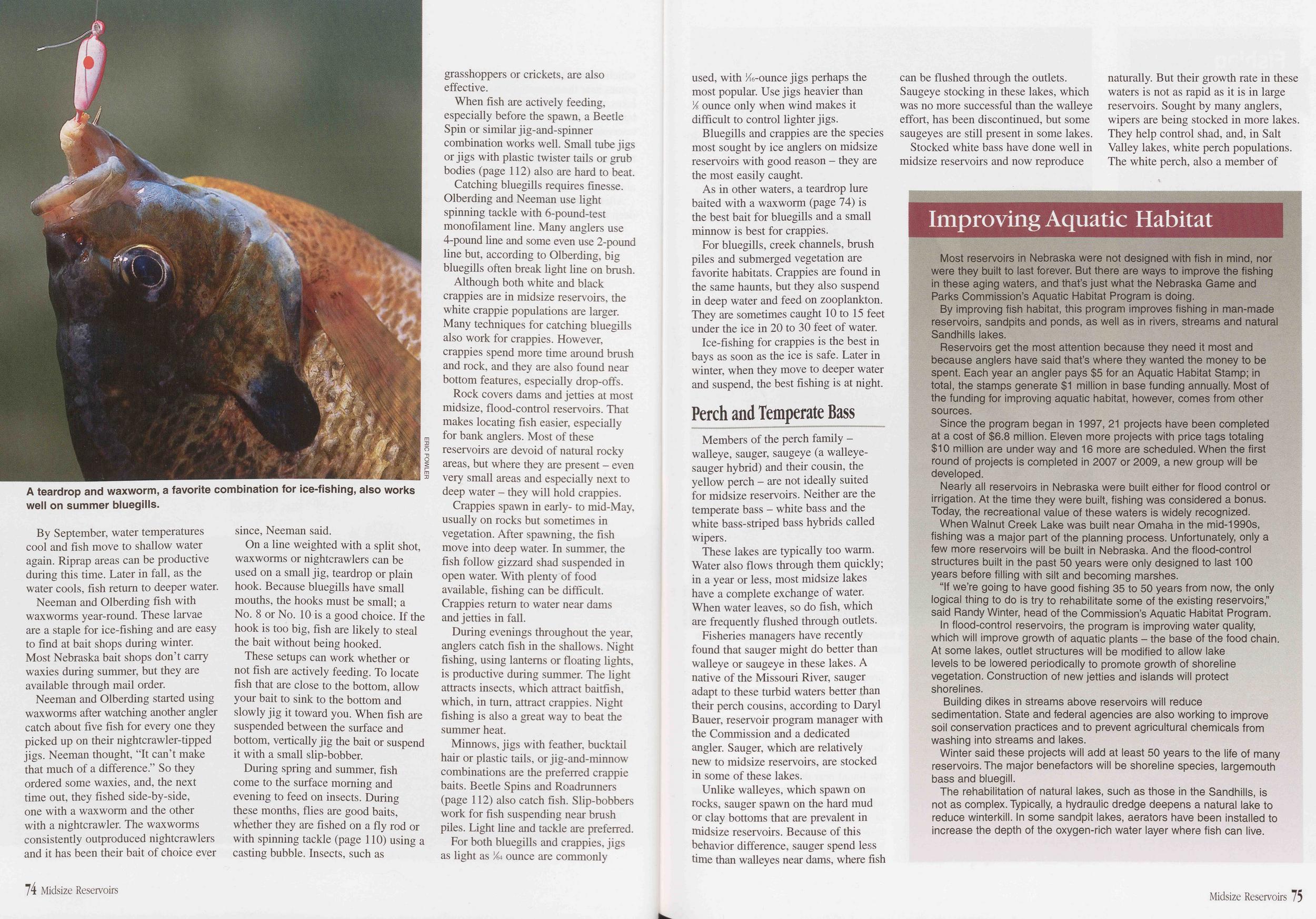
By September, water temperatures cool and fish move to shallow water again. Riprap areas can be productive during this time. Later in fall, as the water cools, fish return to deeper water.
Neeman and Olberding fish with waxworms year-round. These larvae are a staple for ice-fishing and are easy to find at bait shops during winter. Most Nebraska bait shops don't carry waxies during summer, but they are available through mail order.
Neeman and Olberding started using waxworms after watching another angler catch about five fish for every one they picked up on their nightcrawler-tipped jigs. Neeman thought, "It can't make that much of a difference." So they ordered some waxies, and, the next time out, they fished side-by-side, one with a waxworm and the other with a nightcrawler. The waxworms consistently outproduced nightcrawlers and it has been their bait of choice ever 74 Midsize Reservoirs since, Neeman said.
On a line weighted with a split shot, waxworms or nightcrawlers can be used on a small jig, teardrop or plain hook. Because bluegills have small mouths, the hooks must be small; a No. 8 or No. 10 is a good choice. If the hook is too big, fish are likely to steal the bait without being hooked.
These setups can work whether or not fish are actively feeding. To locate fish that are close to the bottom, allow your bait to sink to the bottom and slowly jig it toward you. When fish are suspended between the surface and bottom, vertically jig the bait or suspend it with a small slip-bobber.
During spring and summer, fish come to the surface morning and evening to feed on insects. During these months, flies are good baits, whether they are fished on a fly rod or with spinning tackle (page 110) using a casting bubble. Insects, such as grasshoppers or crickets, are also effective.
When fish are actively feeding, especially before the spawn, a Beetle Spin or similar jig-and-spinner combination works well. Small tube jigs or jigs with plastic twister tails or grub bodies (page 112) also are hard to beat.
Catching bluegills requires finesse. Olberding and Neeman use light spinning tackle with 6-pound-test monofilament line. Many anglers use 4-pound line and some even use 2-pound line but, according to Olberding, big bluegills often break light line on brush.
Although both white and black crappies are in midsize reservoirs, the white crappie populations are larger. Many techniques for catching bluegills also work for crappies. However, crappies spend more time around brush and rock, and they are also found near bottom features, especially drop-offs.
Rock covers dams and jetties at most midsize, flood-control reservoirs. That makes locating fish easier, especially for bank anglers. Most of these reservoirs are devoid of natural rocky areas, but where they are present - even very small areas and especially next to deep water - they will hold crappies.
Crappies spawn in early- to mid-May, usually on rocks but sometimes in vegetation. After spawning, the fish move into deep water. In summer, the fish follow gizzard shad suspended in open water. With plenty of food available, fishing can be difficult. Crappies return to water near dams and jetties in fall.
During evenings throughout the year, anglers catch fish in the shallows. Night fishing, using lanterns or floating fights, is productive during summer. The light attracts insects, which attract baitfish, which, in turn, attract crappies. Night fishing is also a great way to beat the summer heat.
Minnows, jigs with feather, buck tail hair or plastic tails, or jig-and-minnow combinations are the preferred crappie baits. Beetle Spins and Roadrunners (page 112) also catch fish. Slip-bobbers work for fish suspending near brush piles. Light fine and tackle are preferred.
For both bluegills and crappies, jigs as light as Vm ounce are commonly used, with bounce jigs perhaps the most popular. Use jigs heavier than % ounce only when wind makes it difficult to control lighter jigs.
Bluegills and crappies are the species most sought by ice anglers on midsize reservoirs with good reason - they are the most easily caught.
As in other waters, a teardrop lure baited with a waxworm (page 74) is the best bait for bluegills and a small minnow is best for crappies.
For bluegills, creek channels, brush piles and submerged vegetation are favorite habitats. Crappies are found in the same haunts, but they also suspend in deep water and feed on zooplankton. They are sometimes caught 10 to 15 feet under the ice in 20 to 30 feet of water.
Ice-fishing for crappies is the best in bays as soon as the ice is safe. Later in winter, when they move to deeper water and suspend, the best fishing is at night.
Perch and Temperate BassMembers of the perch family - walleye, sauger, saugeye (a walleye sauger hybrid) and their cousin, the yellow perch - are not ideally suited for midsize reservoirs. Neither are the temperate bass - white bass and the white bass-striped bass hybrids called wipers.
These lakes are typically too warm. Water also flows through them quickly; in a year or less, most midsize lakes have a complete exchange of water. When water leaves, so do fish, which are frequently flushed through outlets.
Fisheries managers have recently found that sauger might do better than walleye or saugeye in these lakes. A native of the Missouri River, sauger adapt to these turbid waters better than their perch cousins, according to Daryl Bauer, reservoir program manager with the Commission and a dedicated angler. Sauger, which are relatively new to midsize reservoirs, are stocked in some of these lakes.
Unlike walleyes, which spawn on rocks, sauger spawn on the hard mud or clay bottoms that are prevalent in midsize reservoirs. Because of this behavior difference, sauger spend less time than walleyes near dams, where fish can be flushed through the outlets. Saugeye stocking in these lakes, which was no more successful than the walleye effort, has been discontinued, but some saugeyes are still present in some lakes.
Stocked white bass have done well in midsize reservoirs and now reproduce naturally. But their growth rate in these waters is not as rapid as it is in large reservoirs. Sought by many anglers, wipers are being stocked in more lakes. They help control shad, and, in Salt Valley lakes, white perch populations. The white perch, also a member of
Improving Aquatic Habitat
Most reservoirs in Nebraska were not designed with fish in mind, nor were they built to last forever. But there are ways to improve the fishing in these aging waters, and that's just what the Nebraska Game and Parks Commission's Aquatic Habitat Program is doing.
By improving fish habitat, this program improves fishing in man-made reservoirs, sandpits and ponds, as well as in rivers, streams and natural Sandhills lakes.
Reservoirs get the most attention because they need it most and because anglers have said that's where they wanted the money to be spent. Each year an angler pays $5 for an Aquatic Habitat Stamp; in total, the stamps generate $1 million in base funding annually. Most of the funding for improving aquatic habitat, however, comes from other sources.
Since the program began in 1997, 21 projects have been completed at a cost of $6.8 million. Eleven more projects with price tags totaling $10 million are under way and 16 more are scheduled. When the first round of projects is completed in 2007 or 2009, a new group will be developed.
Nearly all reservoirs in Nebraska were built either for flood control or irrigation. At the time they were built, fishing was considered a bonus. Today, the recreational value of these waters is widely recognized.
When Walnut Creek Lake was built near Omaha in the mid-1990s, fishing was a major part of the planning process. Unfortunately, only a few more reservoirs will be built in Nebraska. And the flood-control structures built in the past 50 years were only designed to last 100 years before filling with silt and becoming marshes.
"If we're going to have good fishing 35 to 50 years from now, the only logical thing to do is try to rehabilitate some of the existing reservoirs," said Randy Winter, head of the Commission's Aquatic Habitat Program.
In flood-control reservoirs, the program is improving water quality, which will improve growth of aquatic plants - the base of the food chain. At some lakes, outlet structures will be modified to allow lake levels to be lowered periodically to promote growth of shoreline vegetation. Construction of new jetties and islands will protect shorelines.
Building dikes in streams above reservoirs will reduce sedimentation. State and federal agencies are also working to improve soil conservation practices and to prevent agricultural chemicals from washing into streams and lakes.
Winter said these projects will add at least 50 years to the life of many reservoirs. The major benefactors will be shoreline species, largemouth bass and bluegill.
The rehabilitation of natural lakes, such as those in the Sandhills, is not as complex. Typically, a hydraulic dredge deepens a natural lake to reduce winter kill. In some sandpit lakes, aerators have been installed to increase the depth of the oxygen-rich water layer where fish can live.
Midsize Reservoirs 75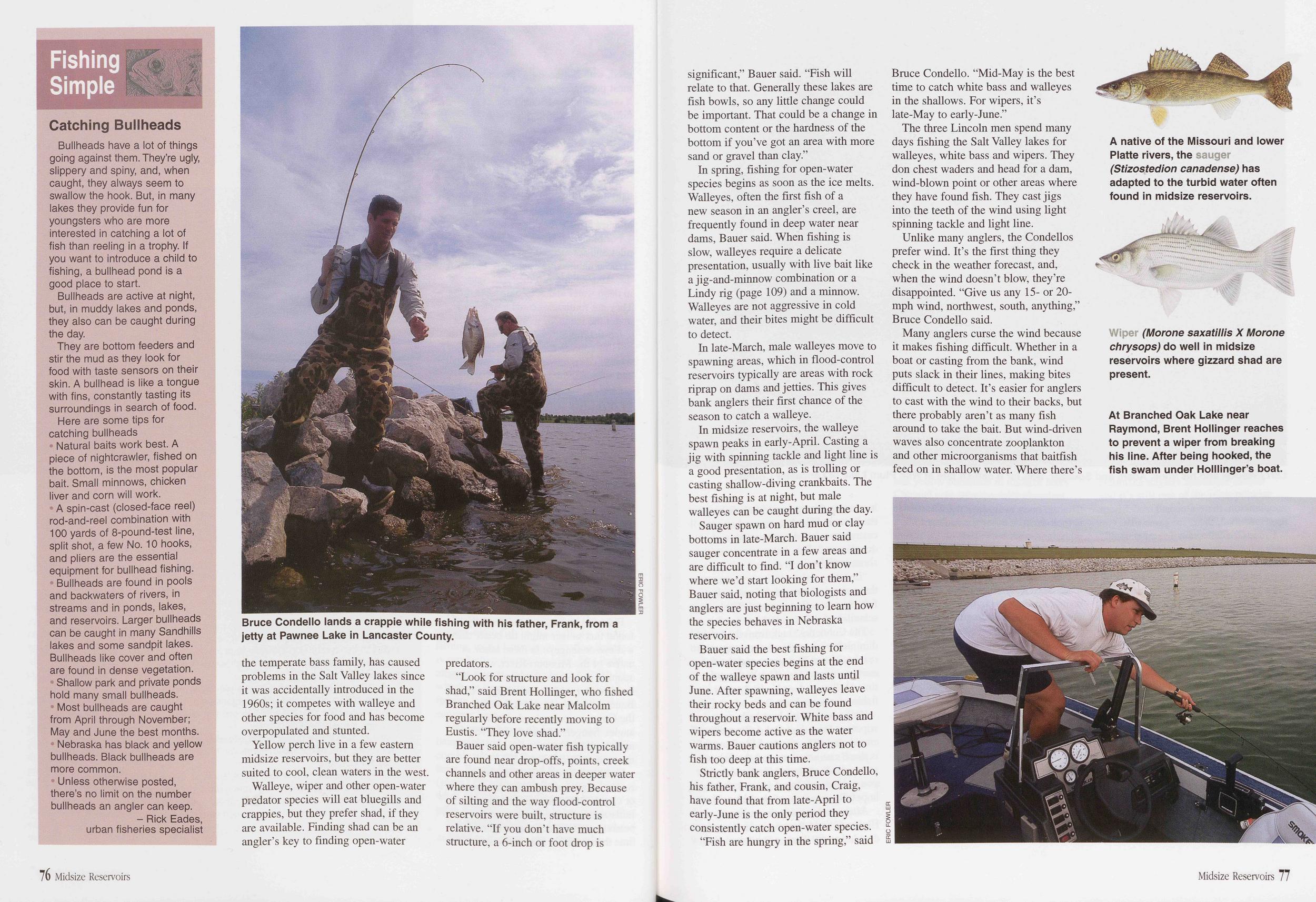
Catching Bullheads
Bullheads have a lot of things going against them. They're ugly, slippery and spiny, and, when caught, they always seem to swallow the hook. But, in many lakes they provide fun for youngsters who are more interested in catching a lot of fish than reeling in a trophy. If you want to introduce a child to fishing, a bullhead pond is a good place to start.
Bullheads are active at night, but, in muddy lakes and ponds, they also can be caught during the day.
They are bottom feeders and stir the mud as they look for food with taste sensors on their skin. A bullhead is like a tongue with fins, constantly tasting its surroundings in search of food.
Here are some tips for catching bullheads
* Natural baits work best. A piece of nightcrawler, fished on the bottom, is the most popular bait. Small minnows, chicken liver and corn will work.
A spin-cast (closed-face reel) rod-and-reel combination with 100 yards of 8-pound-test line, split shot, a few No. 10 hooks, and pliers are the essential equipment for bullhead fishing.
• Bullheads are found in pools and backwaters of rivers, in streams and in ponds, lakes, and reservoirs. Larger bullheads can be caught in many Sandhills lakes and some sandpit lakes. Bullheads like cover and often are found in dense vegetation.
• Shallow park and private ponds hold many small bullheads.
* Most bullheads are caught from April through November; May and June the best months. Nebraska has black and yellow bullheads. Black bullheads are more common.
Unless otherwise posted, there's no limit on the number bullheads an angler can keep.
the temperate bass family, has caused problems in the Salt Valley lakes since it was accidentally introduced in the 1960s; it competes with walleye and other species for food and has become overpopulated and stunted.
Yellow perch live in a few eastern midsize reservoirs, but they are better suited to cool, clean waters in the west.
Walleye, wiper and other open-water predator species will eat bluegills and crappies, but they prefer shad, if they are available. Finding shad can be an angler's key to finding open-water predators.
"Look for structure and look for shad," said Brent Hollinger, who fished Branched Oak Lake near Malcolm regularly before recently moving to Eustis. "They love shad."
Bauer said open-water fish typically are found near drop-offs, points, creek channels and other areas in deeper water where they can ambush prey. Because of silting and the way flood-control reservoirs were built, structure is relative. "If you don't have much structure, a 6-inch or foot drop is significant," Bauer said. "Fish will relate to that. Generally these lakes are fish bowls, so any little change could be important. That could be a change in bottom content or the hardness of the bottom if you've got an area with more sand or gravel than clay."
In spring, fishing for open-water species begins as soon as the ice melts. Walleyes, often the first fish of a new season in an angler's creel, are frequently found in deep water near dams, Bauer said. When fishing is slow, walleyes require a delicate presentation, usually with live bait like a jig-and-minnow combination or a Lindy rig (page 109) and a minnow. Walleyes are not aggressive in cold water, and their bites might be difficult to detect.
In late-March, male walleyes move to spawning areas, which in flood-control reservoirs typically are areas with rock riprap on dams and jetties. This gives bank anglers their first chance of the season to catch a walleye.
In midsize reservoirs, the walleye spawn peaks in early-April. Casting a jig with spinning tackle and light line is a good presentation, as is trolling or casting shallow-diving crankbaits. The best fishing is at night, but male walleyes can be caught during the day.
Sauger spawn on hard mud or clay bottoms in late-March. Bauer said sauger concentrate in a few areas and are difficult to find. "I don't know where we'd start looking for them," Bauer said, noting that biologists and anglers are just beginning to learn how the species behaves in Nebraska reservoirs.
Bauer said the best fishing for open-water species begins at the end of the walleye spawn and lasts until June. After spawning, walleyes leave their rocky beds and can be found throughout a reservoir. White bass and wipers become active as the water warms. Bauer cautions anglers not to fish too deep at this time.
Strictly bank anglers, Bruce Condello, his father, Frank, and cousin, Craig, have found that from late-April to early-June is the only period they consistently catch open-water species.
"Fish are hungry in the spring," said Bruce Condello. "Mid-May is the best time to catch white bass and walleyes in the shallows. For wipers, it's late-May to early-June."
The three Lincoln men spend many days fishing the Salt Valley lakes for walleyes, white bass and wipers. They don chest waders and head for a dam, wind-blown point or other areas where they have found fish. They cast jigs into the teeth of the wind using light spinning tackle and light line.
Unlike many anglers, the Condellos prefer wind. It's the first thing they check in the weather forecast, and, when the wind doesn't blow, they're disappointed. "Give us any 15- or 20-mph wind, northwest, south, anything," Bruce Condello said.
Many anglers curse the wind because it makes fishing difficult. Whether in a boat or casting from the bank, wind puts slack in their lines, making bites difficult to detect. It's easier for anglers to cast with the wind to their backs, but there probably aren't as many fish around to take the bait. But wind-driven waves also concentrate zooplankton and other microorganisms that baitfish feed on in shallow water. Where there's
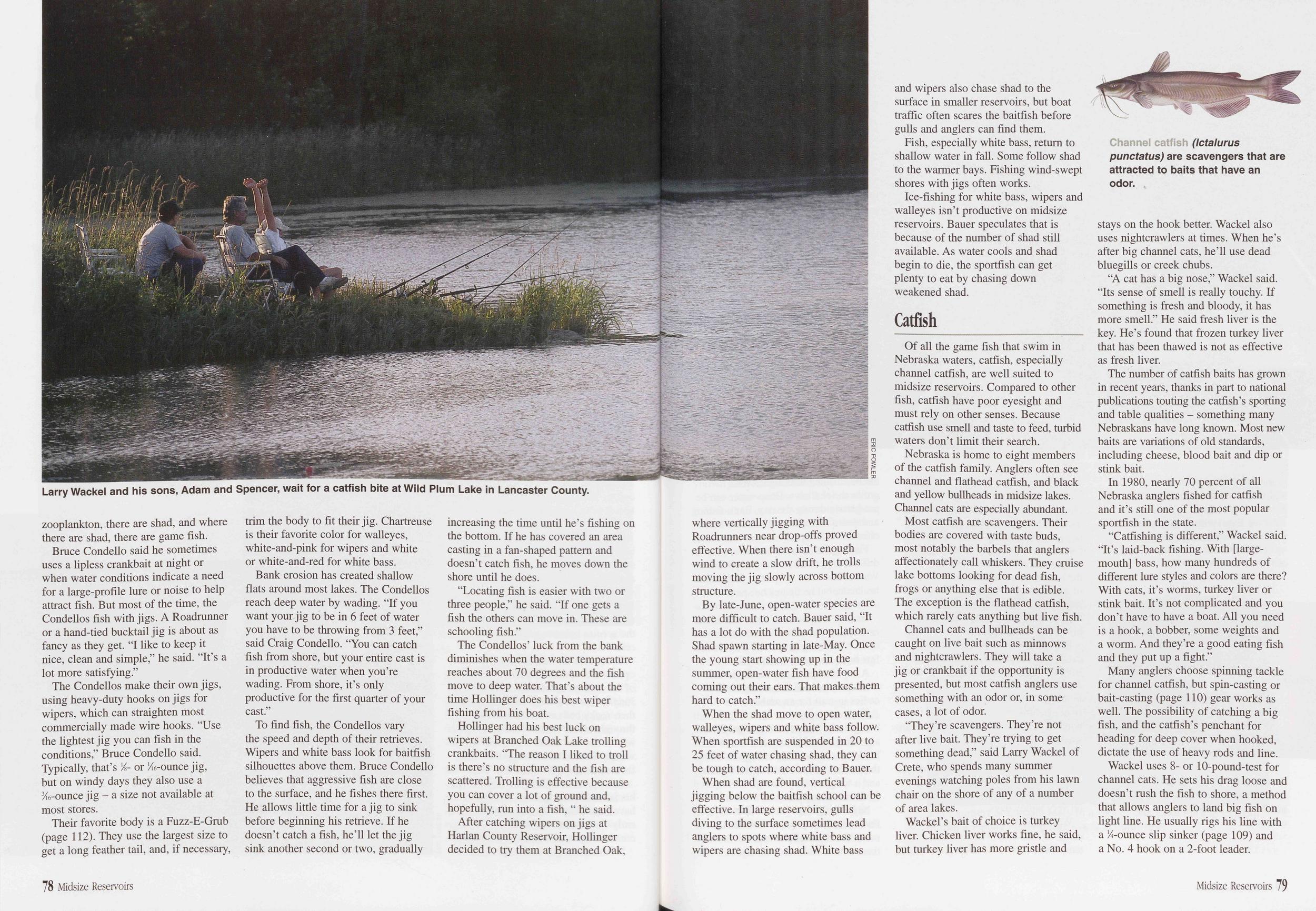
zooplankton, there are shad, and where there are shad, there are game fish.
Bruce Condello said he sometimes uses a lipless crankbait at night or when water conditions indicate a need for a large-profile lure or noise to help attract fish. But most of the time, the Condellos fish with jigs. A Roadrunner or a hand-tied bucktail jig is about as fancy as they get. "I like to keep it nice, clean and simple," he said. "It's a lot more satisfying."
The Condellos make their own jigs, using heavy-duty hooks on jigs for wipers, which can straighten most commercially made wire hooks. "Use the lightest jig you can fish in the conditions," Bruce Condello said. Typically, that's %- or Ke-ounce jig, but on windy days they also use a 716-ounce jig - a size not available at most stores.
Their favorite body is a Fuzz-E-Grub (page 112). They use the largest size to get a long feather tail, and, if necessary, 78 Midsize Reservoirs trim the body to fit their jig. Chartreuse is their favorite color for walleyes, white-and-pink for wipers and white or white-and-red for white bass.
Bank erosion has created shallow fiats around most lakes. The Condellos reach deep water by wading. "If you want your jig to be in 6 feet of water you have to be throwing from 3 feet," said Craig Condello. "You can catch fish from shore, but your entire cast is in productive water when you're wading. From shore, it's only productive for the first quarter of your cast."
To find fish, the Condellos vary the speed and depth of their retrieves. Wipers and white bass look for baitfish silhouettes above them. Bruce Condello believes that aggressive fish are close to the surface, and he fishes there first. He allows little time for a jig to sink before beginning his retrieve. If he doesn't catch a fish, he'll let the jig sink another second or two, gradually increasing the time until he's fishing on the bottom. If he has covered an area casting in a fan-shaped pattern and doesn't catch fish, he moves down the shore until he does.
"Locating fish is easier with two or three people," he said. "If one gets a fish the others can move in. These are schooling fish."
The Condellos' luck from the bank diminishes when the water temperature reaches about 70 degrees and the fish move to deep water. That's about the time Hollinger does his best wiper fishing from his boat.
Hollinger had his best luck on wipers at Branched Oak Lake trolling crankbaits. "The reason I liked to troll is there's no structure and the fish are scattered. Trolling is effective because you can cover a lot of ground and, hopefully, run into a fish, " he said.
After catching wipers on jigs at Harlan County Reservoir, Hollinger decided to try them at Branched Oak, where vertically jigging with Roadrunners near drop-offs proved effective. When there isn't enough wind to create a slow drift, he trolls moving the jig slowly across bottom structure.
By late-June, open-water species are more difficult to catch. Bauer said, "It has a lot do with the shad population. Shad spawn starting in late-May. Once the young start showing up in the summer, open-water fish have food coming out their ears. That makes them hard to catch."
When the shad move to open water, walleyes, wipers and white bass follow. When sportfish are suspended in 20 to 25 feet of water chasing shad, they can be tough to catch, according to Bauer.
When shad are found, vertical jigging below the baitfish school can be effective. In large reservoirs, gulls diving to the surface sometimes lead anglers to spots where white bass and wipers are chasing shad. White bass and wipers also chase shad to the surface in smaller reservoirs, but boat traffic often scares the baitfish before gulls and anglers can find them.
Fish, especially white bass, return to shallow water in fall. Some follow shad to the warmer bays. Fishing wind-swept shores with jigs often works.
Ice-fishing for white bass, wipers and walleyes isn't productive on midsize reservoirs. Bauer speculates that is because of the number of shad still available. As water cools and shad begin to die, the sportfish can get plenty to eat by chasing down weakened shad.
CatfishOf all the game fish that swim in Nebraska waters, catfish, especially channel catfish, are well suited to midsize reservoirs. Compared to other fish, catfish have poor eyesight and must rely on other senses. Because catfish use smell and taste to feed, turbid waters don't limit their search.
Nebraska is home to eight members of the catfish family. Anglers often see channel and flathead catfish, and black and yellow bullheads in midsize lakes. Channel cats are especially abundant.
Most catfish are scavengers. Their bodies are covered with taste buds, most notably the barbels that anglers affectionately call whiskers. They cruise lake bottoms looking for dead fish, frogs or anything else that is edible. The exception is the flathead catfish, which rarely eats anything but live fish.
Channel cats and bullheads can be caught on live bait such as minnows and nightcrawlers. They will take a jig or crankbait if the opportunity is presented, but most catfish anglers use something with an odor or, in some cases, a lot of odor.
"They're scavengers. They're not after live bait. They're trying to get something dead," said Larry Wackel of Crete, who spends many summer evenings watching poles from his lawn chair on the shore of any of a number of area lakes.
Wackel's bait of choice is turkey liver. Chicken liver works fine, he said, but turkey liver has more gristle and
stays on the hook better. Wackel also uses nightcrawlers at times. When he's after big channel cats, he'll use dead bluegills or creek chubs.
"A cat has a big nose," Wackel said. "Its sense of smell is really touchy. If something is fresh and bloody, it has more smell." He said fresh liver is the key. He's found that frozen turkey liver that has been thawed is not as effective as fresh liver.
The number of catfish baits has grown in recent years, thanks in part to national publications touting the catfish's sporting and table qualities - something many Nebraskans have long known. Most new baits are variations of old standards, including cheese, blood bait and dip or stink bait.
In 1980, nearly 70 percent of all Nebraska anglers fished for catfish and it's still one of the most popular sportfish in the state.
"Catfishing is different," Wackel said. "It's laid-back fishing. With [largemouth] bass, how many hundreds of different lure styles and colors are there? With cats, it's worms, turkey liver or stink bait. It's not complicated and you don't have to have a boat. All you need is a hook, a bobber, some weights and a worm. And they're a good eating fish and they put up a fight."
Many anglers choose spinning tackle for channel catfish, but spin-casting or bait-casting (page 110) gear works as well. The possibility of catching a big fish, and the catfish's penchant for heading for deep cover when hooked, dictate the use of heavy rods and line.
Wackel uses 8- or 10-pound-test for channel cats. He sets his drag loose and doesn't rush the fish to shore, a method that allows anglers to land big fish on light line. He usually rigs his line with a !4-ounce slip sinker (page 109) and a No. 4 hook on a 2-foot leader.
Midsize Reservoirs 79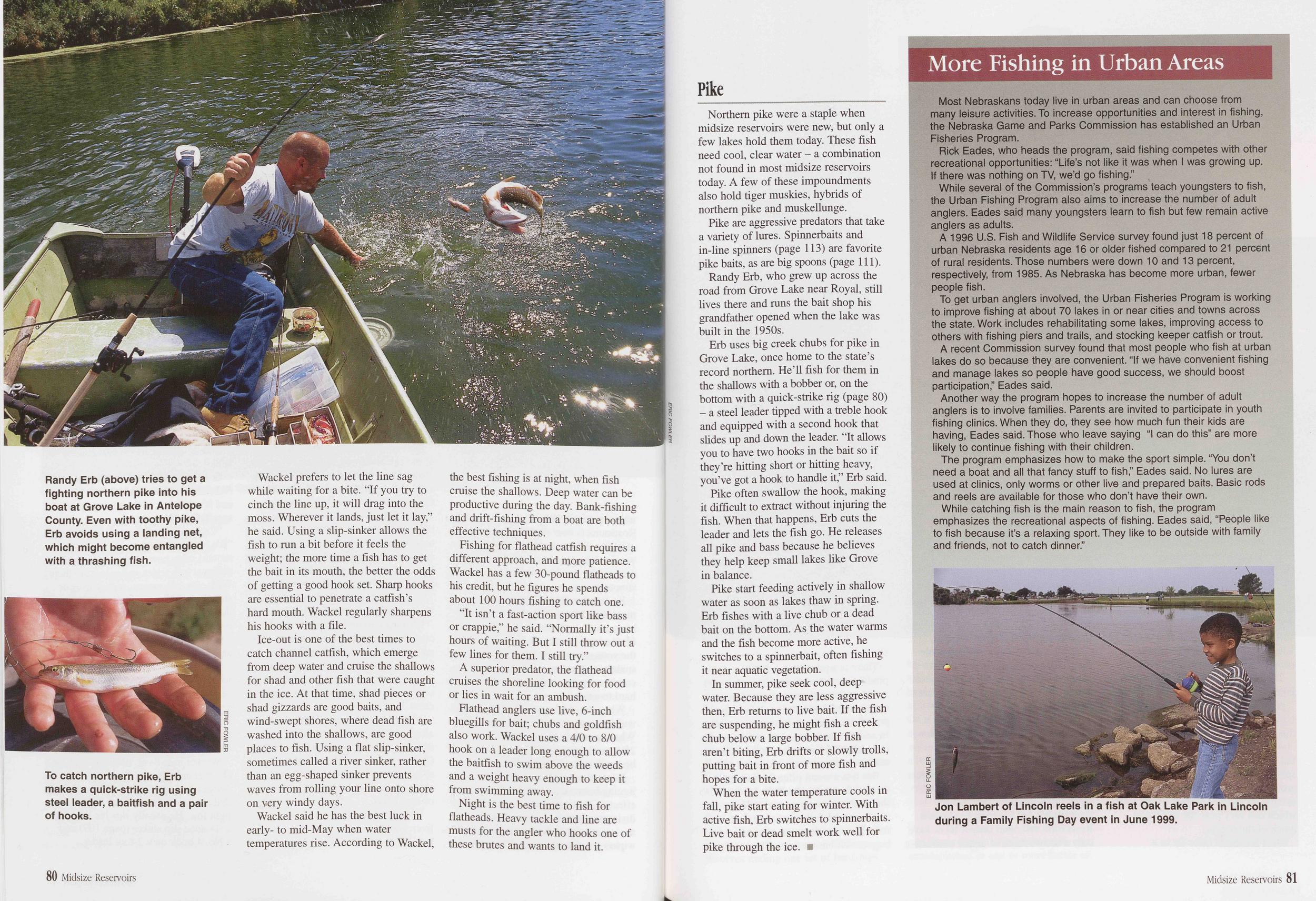
Wackel prefers to let the line sag while waiting for a bite. "If you try to cinch the line up, it will drag into the moss. Wherever it lands, just let it lay," he said. Using a slip-sinker allows the fish to run a bit before it feels the weight; the more time a fish has to get the bait in its mouth, the better the odds of getting a good hook set. Sharp hooks are essential to penetrate a catfish's hard mouth. Wackel regularly sharpens his hooks with a file.
Ice-out is one of the best times to catch channel catfish, which emerge from deep water and cruise the shallows for shad and other fish that were caught in the ice. At that time, shad pieces or shad gizzards are good baits, and wind-swept shores, where dead fish are washed into the shallows, are good places to fish. Using a flat slip-sinker, sometimes called a river sinker, rather than an egg-shaped sinker prevents waves from rolling your line onto shore on very windy days.
Wackel said he has the best luck in early- to mid-May when water temperatures rise. According to Wackel, the best fishing is at night, when fish cruise the shallows. Deep water can be productive during the day. Bank-fishing and drift-fishing from a boat are both effective techniques.
Fishing for flathead catfish requires a different approach, and more patience. Wackel has a few 30-pound flatheads to his credit, but he figures he spends about 100 hours fishing to catch one.
"It isn't a fast-action sport like bass or crappie," he said. "Normally it's just hours of waiting. But I still throw out a few lines for them. I still try."
A superior predator, the flathead cruises the shoreline looking for food or lies in wait for an ambush.
Flathead anglers use live, 6-inch bluegills for bait; chubs and goldfish also work. Wackel uses a 4/0 to 8/0 hook on a leader long enough to allow the baitfish to swim above the weeds and a weight heavy enough to keep it from swimming away.
Night is the best time to fish for flatheads. Heavy tackle and line are musts for the angler who hooks one of these brutes and wants to land it.
80 Midsize Reservoirs PikeNorthern pike were a staple when midsize reservoirs were new, but only a few lakes hold them today. These fish need cool, clear water - a combination not found in most midsize reservoirs today. A few of these impoundments also hold tiger muskies, hybrids of northern pike and muskellunge.
Pike are aggressive predators that take a variety of lures. Spinnerbaits and in-line spinners (page 113) are favorite pike baits, as are big spoons (page 111). Randy Erb, who grew up across the road from Grove Lake near Royal, still lives there and runs the bait shop his grandfather opened when the lake was built in the 1950s.
Erb uses big creek chubs for pike in Grove Lake, once home to the state's record northern. He'll fish for them in the shallows with a bobber or, on the bottom with a quick-strike rig (page 80) - a steel leader tipped with a treble hook and equipped with a second hook that slides up and down the leader. "It allows you to have two hooks in the bait so if they're hitting short or hitting heavy, you've got a hook to handle it," Erb said.
Pike often swallow the hook, making it difficult to extract without injuring the fish. When that happens, Erb cuts the leader and lets the fish go. He releases all pike and bass because he believes they help keep small lakes like Grove in balance.
Pike start feeding actively in shallow water as soon as lakes thaw in spring. Erb fishes with a live chub or a dead bait on the bottom. As the water warms and the fish become more active, he switches to a spinnerbait, often fishing it near aquatic vegetation.
In summer, pike seek cool, deep water. Because they are less aggressive then, Erb returns to live bait. If the fish are suspending, he might fish a creek chub below a large bobber. If fish aren't biting, Erb drifts or slowly trolls, putting bait in front of more fish and hopes for a bite.
When the water temperature cools in fall, pike start eating for winter. With active fish, Erb switches to spinnerbaits. Live bait or dead smelt work well for pike through the ice.
More Fishing in Urban Areas
Most Nebraskans today live in urban areas and can choose from many leisure activities. To increase opportunities and interest in fishing, the Nebraska Game and Parks Commission has established an Urban Fisheries Program.
Rick Eades, who heads the program, said fishing competes with other recreational opportunities: "Life's not like it was when I was growing up. If there was nothing on TV, we'd go fishing."
While several of the Commission's programs teach youngsters to fish, the Urban Fishing Program also aims to increase the number of adult anglers. Eades said many youngsters learn to fish but few remain active anglers as adults.
A 1996 U.S. Fish and Wildlife Service survey found just 18 percent of urban Nebraska residents age 16 or older fished compared to 21 percent of rural residents. Those numbers were down 10 and 13 percent, respectively, from 1985. As Nebraska has become more urban, fewer people fish.
To get urban anglers involved, the Urban Fisheries Program is working to improve fishing at about 70 lakes in or near cities and towns across the state. Work includes rehabilitating some lakes, improving access to others with fishing piers and trails, and stocking keeper catfish or trout.
A recent Commission survey found that most people who fish at urban lakes do so because they are convenient. "If we have convenient fishing and manage lakes so people have good success, we should boost participation," Eades said.
Another way the program hopes to increase the number of adult anglers is to involve families. Parents are invited to participate in youth fishing clinics. When they do, they see how much fun their kids are having, Eades said. Those who leave saying "I can do this" are more likely to continue fishing with their children.
The program emphasizes how to make the sport simple. "You don't need a boat and ail that fancy stuff to fish," Eades said. No lures are used at clinics, only worms or other live and prepared baits. Basic rods and reels are available for those who don't have their own.
While catching fish is the main reason to fish, the program emphasizes the recreational aspects of fishing. Eades said, "People like to fish because it's a relaxing sport. They like to be outside with family and friends, not to catch dinner."
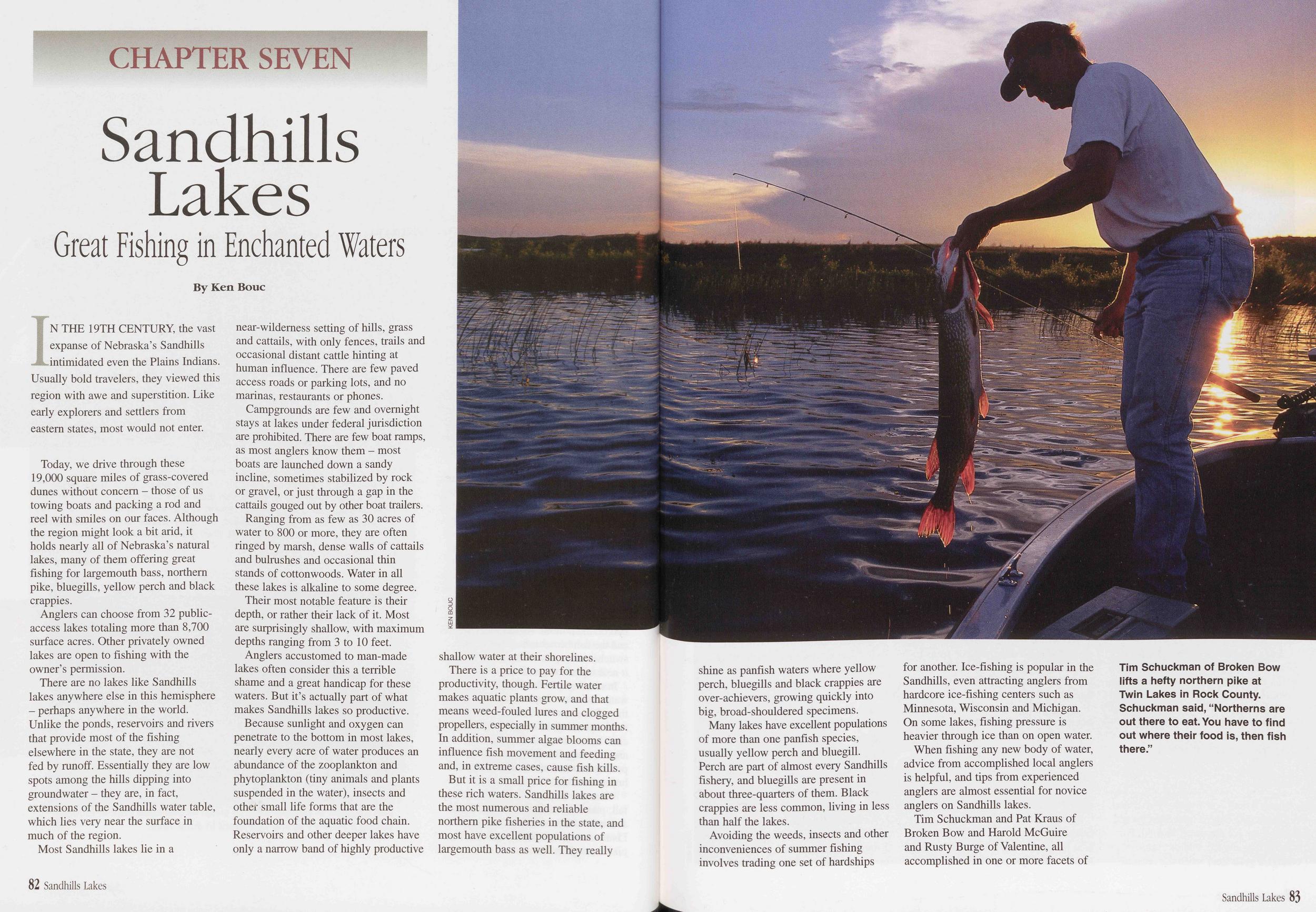
Chapter Seven
Sandhills Lakes
Great Fishing in Enchanted Waters
IN THE 19TH CENTURY, the vast expanse of Nebraska's Sandhills intimidated even the Plains Indians. Usually bold travelers, they viewed this region with awe and superstition. Like early explorers and settlers from eastern states, most would not enter.
Today, we drive through these 19,000 square miles of grass-covered dunes without concern - those of us towing boats and packing a rod and reel with smiles on our faces. Although the region might look a bit arid, it holds nearly all of Nebraska's natural lakes, many of them offering great fishing for largemouth bass, northern pike, bluegills, yellow perch and black crappies.
Anglers can choose from 32 public access lakes totaling more than 8,700 surface acres. Other privately owned lakes are open to fishing with the owner's permission.
There are no lakes like Sandhills lakes anywhere else in this hemisphere - perhaps anywhere in the world. Unlike the ponds, reservoirs and rivers that provide most of the fishing elsewhere in the state, they are not fed by runoff. Essentially they are low spots among the hills dipping into groundwater - they are, in fact, extensions of the Sandhills water table, which lies very near the surface in much of the region.
Most Sandhills lakes lie in a 82 Sandhills Lakes near-wilderness setting of hills, grass and cattails, with only fences, trails and occasional distant cattle hinting at human influence. There are few paved access roads or parking lots, and no marinas, restaurants or phones. Campgrounds are few and overnight stays at lakes under federal jurisdiction are prohibited. There are few boat ramps, as most anglers know them - most boats are launched down a sandy incline, sometimes stabilized by rock or gravel, or just through a gap in the cattails gouged out by other boat trailers. Ranging from as few as 30 acres of water to 800 or more, they are often ringed by marsh, dense walls of cattails and bulrushes and occasional thin stands of cotton woods. Water in all these lakes is alkaline to some degree. Their most notable feature is their depth, or rather their lack of it. Most are surprisingly shallow, with maximum depths ranging from 3 to 10 feet. Anglers accustomed to man-made lakes often consider this a terrible shame and a great handicap for these waters. But it's actually part of what makes Sandhills lakes so productive. Because sunlight and oxygen can penetrate to the bottom in most lakes, nearly every acre of water produces an abundance of the zooplankton and phytoplankton (tiny animals and plants suspended in the water), insects and other small life forms that are the foundation of the aquatic food chain. Reservoirs and other deeper lakes have only a narrow band of highly productive shallow water at their shorelines. There is a price to pay for the productivity, though. Fertile water makes aquatic plants grow, and that means weed-fouled lures and clogged propellers, especially in summer months. In addition, summer algae blooms can influence fish movement and feeding and, in extreme cases, cause fish kills. But it is a small price for fishing in these rich waters. Sandhills lakes are the most numerous and reliable northern pike fisheries in the state, and most have excellent populations of largemouth bass as well. They really shine as panfish waters where yellow perch, bluegills and black crappies are over-achievers, growing quickly into big, broad-shouldered specimens. Many lakes have excellent populations of more than one panfish species, usually yellow perch and bluegill. Perch are part of almost every Sandhills fishery, and bluegills are present in about three-quarters of them. Black crappies are less common, living in less than half the lakes.Avoiding the weeds, insects and other inconveniences of summer fishing involves trading one set of hardships for another. Ice-fishing is popular in the Sandhills, even attracting anglers from hardcore ice-fishing centers such as Minnesota, Wisconsin and Michigan. On some lakes, fishing pressure is heavier through ice than on open water.
When fishing any new body of water, advice from accomplished local anglers is helpful, and tips from experienced anglers are almost essential for novice anglers on Sandhills lakes.
Tim Schuckman and Pat Kraus of Broken Bow and Harold McGuire and Rusty Burge of Valentine, all accomplished in one or more facets of
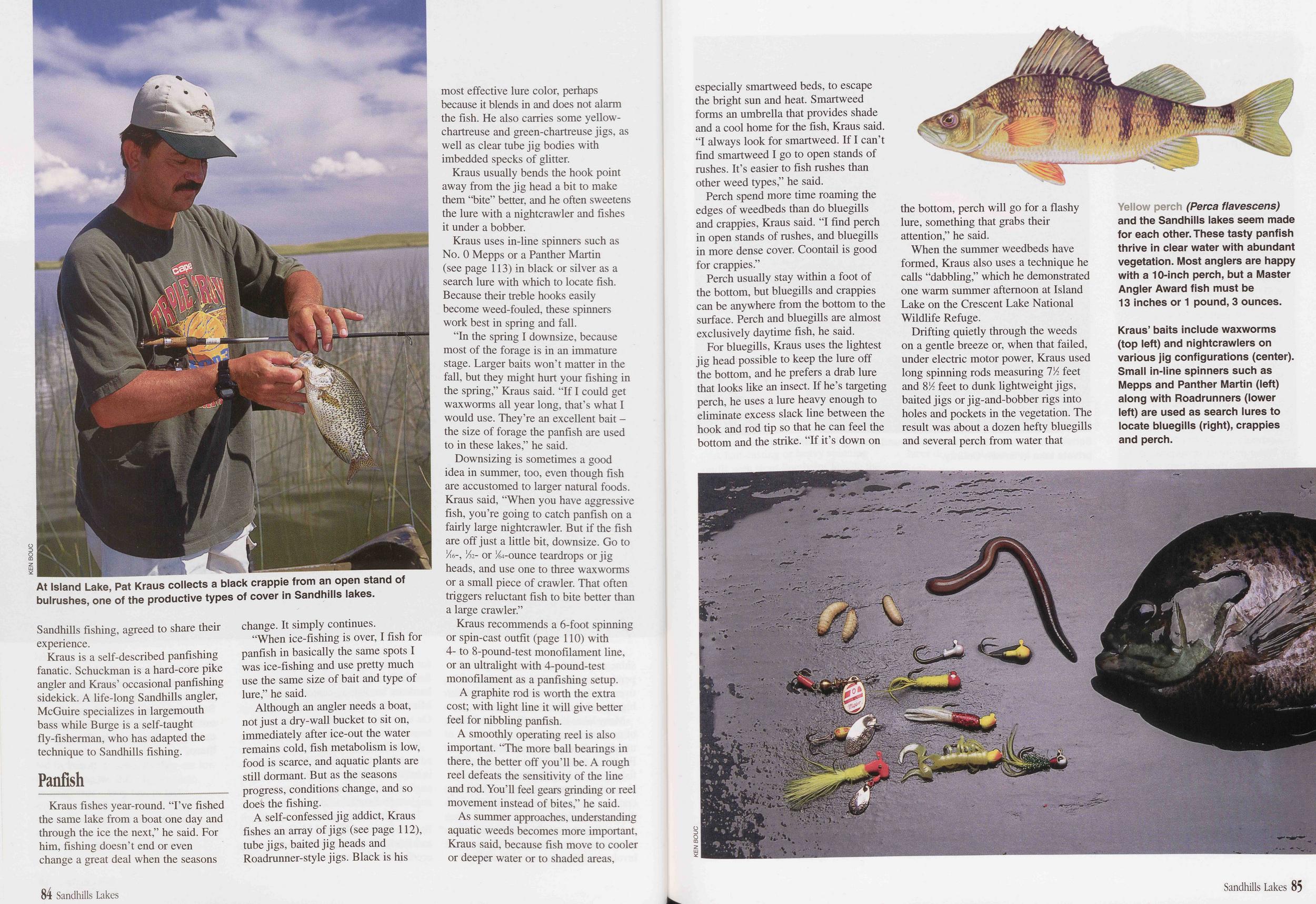
Sandhills fishing, agreed to share their experience.
Kraus is a self-described panfishing fanatic. Schuckman is a hard-core pike angler and Kraus' occasional panfishing sidekick. A life-long Sandhills angler, McGuire specializes in largemouth bass while Burge is a self-taught fly-fisherman, who has adapted the technique to Sandhills fishing.
PanfishKraus fishes year-round. "I've fished the same lake from a boat one day and through the ice the next," he said. For him, fishing doesn't end or even change a great deal when the seasons change. It simply continues.
"When ice-fishing is over, I fish for panfish in basically the same spots I was ice-fishing and use pretty much use the same size of bait and type of lure," he said.
Although an angler needs a boat, not just a dry-wall bucket to sit on, immediately after ice-out the water remains cold, fish metabolism is low, food is scarce, and aquatic plants are still dormant. But as the seasons progress, conditions change, and so does the fishing.
A self-confessed jig addict, Kraus fishes an array of jigs (see page 112), tube jigs, baited jig heads and Roadrunner-style jigs. Black is his most effective lure color, perhaps because it blends in and does not alarm the fish. He also carries some yellow- chartreuse and green-chartreuse jigs, as well as clear tube jig bodies with imbedded specks of glitter.
Kraus usually bends the hook point away from the jig head a bit to make them "bite" better, and he often sweetens the lure with a nightcrawler and fishes it under a bobber.
Kraus uses in-line spinners such as No. 0 Mepps or a Panther Martin (see page 113) in black or silver as a search lure with which to locate fish. Because their treble hooks easily become weed-fouled, these spinners work best in spring and fall.
"In the spring I downsize, because most of the forage is in an immature stage. Larger baits won't matter in the fall, but they might hurt your fishing in the spring," Kraus said. "If I could get waxworms all year long, that's what I would use. They're an excellent bait - the size of forage the panfish are used to in these lakes," he said.
Downsizing is sometimes a good idea in summer, too, even though fish are accustomed to larger natural foods. Kraus said, "When you have aggressive fish, you're going to catch panfish on a fairly large nightcrawler. But if the fish are off just a little bit, downsize. Go to Vi6-, !4- or %4-ounce teardrops or jig heads, and use one to three waxworms or a small piece of crawler. That often triggers reluctant fish to bite better than a large crawler."
Kraus recommends a 6-foot spinning or spin-cast outfit (page 110) with 4- to 8-pound-test monofilament line, or an ultralight with 4-pound-test monofilament as a panfishing setup. A graphite rod is worth the extra cost; with light fine it will give better feel for nibbling panfish.
A smoothly operating reel is also important. "The more ball bearings in there, the better off you'll be. A rough reel defeats the sensitivity of the line and rod. You'll feel gears grinding or reel movement instead of bites," he said.
As summer approaches, understanding aquatic weeds becomes more important, Kraus said, because fish move to cooler or deeper water or to shaded areas, especially smartweed beds, to escape the bright sun and heat. Smartweed forms an umbrella that provides shade and a cool home for the fish, Kraus said.
"I always look for smartweed. If I can't find smartweed I go to open stands of rushes. It's easier to fish rushes than other weed types," he said.
Perch spend more time roaming the edges of weed beds than do bluegills and crappies, Kraus said. "I find perch in open stands of rushes, and bluegills in more dense cover. Coontail is good for crappies."
Perch usually stay within a foot of the bottom, but bluegills and crappies can be anywhere from the bottom to the surface. Perch and bluegills are almost exclusively daytime fish, he said.
For bluegills, Kraus uses the lightest jig head possible to keep the lure off the bottom, and he prefers a drab lure that looks like an insect. If he's targeting perch, he uses a lure heavy enough to eliminate excess slack line between the hook and rod tip so that he can feel the bottom and the strike. "If it's down on the bottom, perch will go for a flashy lure, something that grabs their attention," he said.
When the summer weedbeds have formed, Kraus also uses a technique he calls "dabbling," which he demonstrated one warm summer afternoon at Island Lake on the Crescent Lake National Wildlife Refuge.
Drifting quietly through the weeds on a gentle breeze or, when that failed, under electric motor power, Kraus used long spinning rods measuring TA feet and WA feet to dunk lightweight jigs, baited jigs or jig-and-bobber rigs into holes and pockets in the vegetation. The result was about a dozen hefty bluegills and several perch from water that
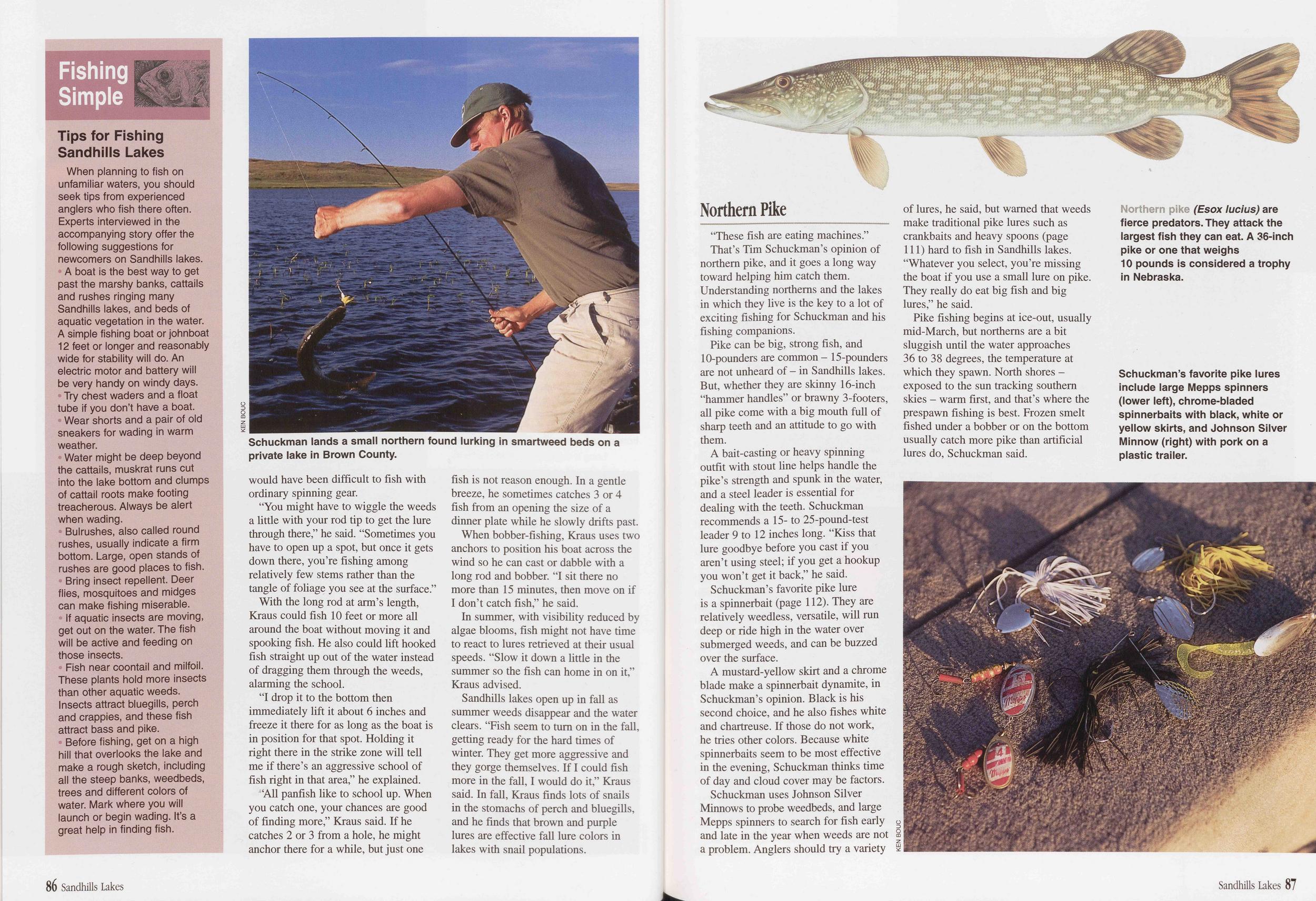
Fishing Simple
Tips for Fishing Sandhills Lakes
When planning to fish on unfamiliar waters, you should seek tips from experienced anglers who fish there often. Experts interviewed in the accompanying story offer the following suggestions for newcomers on Sandhills lakes.
A boat is the best way to get past the marshy banks, cattails and rushes ringing many Sandhills lakes, and beds of aquatic vegetation in the water. A simple fishing boat or johnboat 12 feet or longer and reasonably wide for stability will do. An electric motor and battery will be very handy on windy days.
* Try chest waders and a float tube if you don't have a boat. Wear shorts and a pair of old sneakers for wading in warm weather.
Water might be deep beyond the cattails, muskrat runs cut into the lake bottom and clumps of cattail roots make footing treacherous. Always be alert when wading.
Bulrushes, also called round rushes, usually indicate a firm bottom. Large, open stands of rushes are good places to fish.
Bring insect repellent. Deer flies, mosquitoes and midges can make fishing miserable.
If aquatic insects are moving, get out on the water. The fish will be active and feeding on those insects.
Fish near coontail and milfoil. These plants hold more insects than other aquatic weeds. Insects attract bluegills, perch and crappies, and these fish attract bass and pike.
Before fishing, get on a high hill that overlooks the lake and make a rough sketch, including all the steep banks, weedbeds, trees and different colors of water. Mark where you will launch or begin wading. It's a great help in finding fish.
would have been difficult to fish with ordinary spinning gear.
"You might have to wiggle the weeds a little with your rod tip to get the lure through there," he said. "Sometimes you have to open up a spot, but once it gets down there, you're fishing among relatively few stems rather than the tangle of foliage you see at the surface."
With the long rod at arm's length, Kraus could fish 10 feet or more all around the boat without moving it and spooking fish. He also could lift hooked fish straight up out of the water instead of dragging them through the weeds, alarming the school.
"I drop it to the bottom then immediately lift it about 6 inches and freeze it there for as long as the boat is in position for that spot. Holding it right there in the strike zone will tell me if there's an aggressive school of fish right in that area," he explained.
'All panfish like to school up. When you catch one, your chances are good of finding more," Kraus said. If he catches 2 or 3 from a hole, he might anchor there for a while, but just one fish is not reason enough. In a gentle breeze, he sometimes catches 3 or 4 fish from an opening the size of a dinner plate while he slowly drifts past.
When bobber-fishing, Kraus uses two anchors to position his boat across the wind so he can cast or dabble with a long rod and bobber. "I sit there no more than 15 minutes, then move on if I don't catch fish," he said.
In summer, with visibility reduced by algae blooms, fish might not have time to react to lures retrieved at their usual speeds. "Slow it down a little in the summer so the fish can home in on it," Kraus advised.
Sandhills lakes open up in fall as summer weeds disappear and the water clears. "Fish seem to turn on in the fall, getting ready for the hard times of winter. They get more aggressive and they gorge themselves. If I could fish more in the fall, I would do it," Kraus said. In fall, Kraus finds lots of snails in the stomachs of perch and bluegills, and he finds that brown and purple lures are effective fall lure colors in lakes with snail populations.
Northern Pike"These fish are eating machines."
That's Tim Schuckman's opinion of northern pike, and it goes a long way toward helping him catch them. Understanding northerns and the lakes in which they live is the key to a lot of exciting fishing for Schuckman and his fishing companions.
Pike can be big, strong fish, and 10-pounders are common - 15-pounders are not unheard of - in Sandhills lakes. But, whether they are skinny 16-inch "hammer handles" or brawny 3-footers, all pike come with a big mouth full of sharp teeth and an attitude to go with them.
A bait-casting or heavy spinning outfit with stout line helps handle the pike's strength and spunk in the water, and a steel leader is essential for dealing with the teeth. Schuckman recommends a 15- to 25-pound-test leader 9 to 12 inches long. "Kiss that lure goodbye before you cast if you aren't using steel; if you get a hookup you won't get it back," he said.
Schuckman's favorite pike lure is a spinnerbait (page 112). They are relatively weedless, versatile, will run deep or ride high in the water over submerged weeds, and can be buzzed over the surface.
A mustard-yellow skirt and a chrome blade make a spinnerbait dynamite, in Schuckman's opinion. Black is his second choice, and he also fishes white and chartreuse. If those do not work, he tries other colors. Because white spinnerbaits seem to be most effective in the evening, Schuckman thinks time of day and cloud cover may be factors.
Schuckman uses Johnson Silver Minnows to probe weedbeds, and large Mepps spinners to search for fish early and late in the year when weeds are not a problem. Anglers should try a variety of lures, he said, but warned that weeds make traditional pike lures such as crankbaits and heavy spoons (page 111) hard to fish in Sandhills lakes. "Whatever you select, you're missing the boat if you use a small lure on pike. They really do eat big fish and big lures," he said.
Pike fishing begins at ice-out, usually mid-March, but northerns are a bit sluggish until the water approaches 36 to 38 degrees, the temperature at which they spawn. North shores - exposed to the sun tracking southern skies - warm first, and that's where the prespawn fishing is best. Frozen smelt fished under a bobber or on the bottom usually catch more pike than artificial lures do, Schuckman said.
Northern pike (Esox lucius) are fierce predators. They attack the largest fish they can eat. A 36-inch pike or one that weighs 10 pounds is considered a trophy in Nebraska.
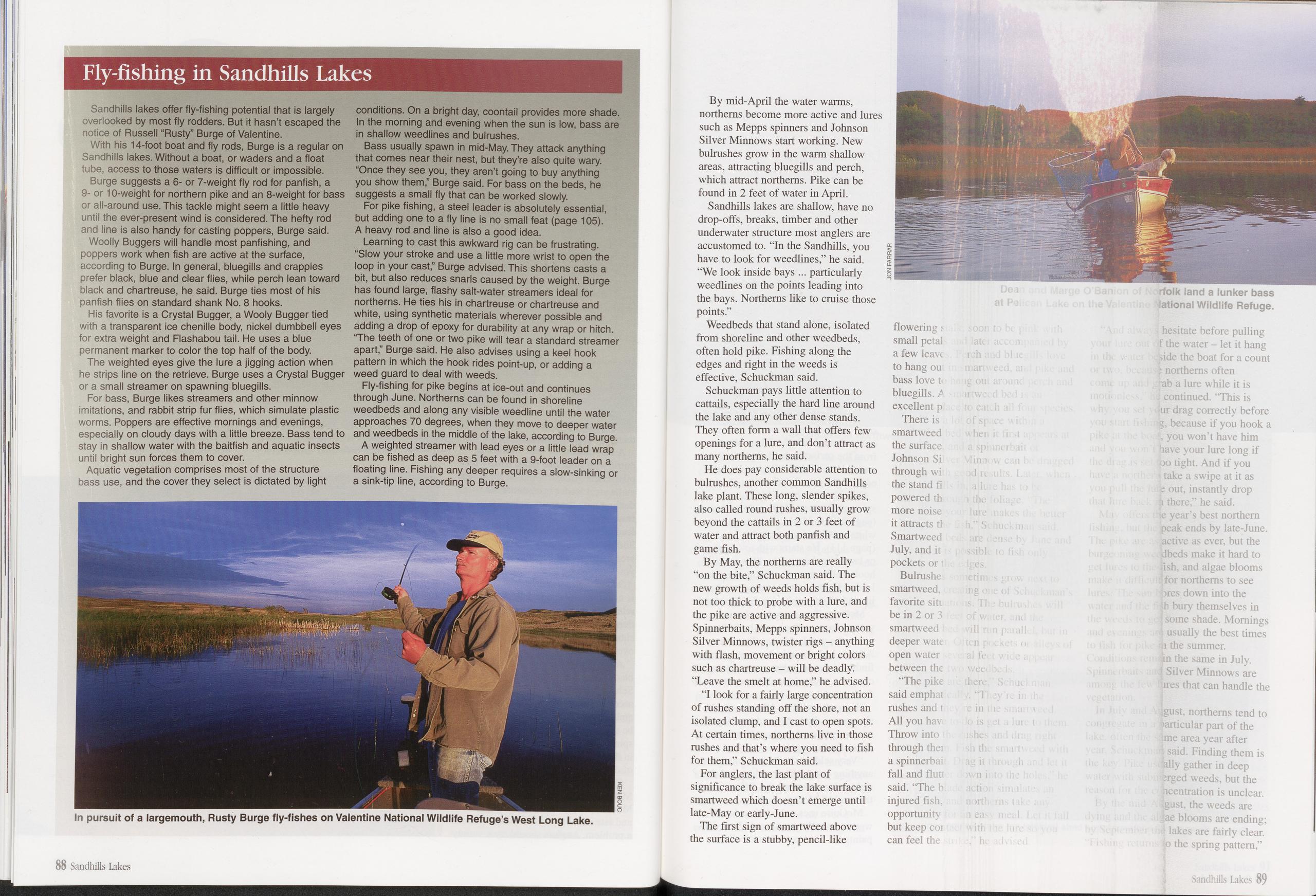
Fly-fishing in Sandhills Lakes
Sandhills lakes offer fly-fishing potential that is largely overlooked by most fly rodders. But it hasn’t escaped the notice of Russell “Rusty” Burge of Valentine.
With his 14-foot boat and fly rods, Burge is a regular on Sandhills lakes. Without a boat, or waders and a float tube, access to those waters is difficult or impossible.
Burge suggests a 6- or 7-weight fly rod for panfish, a 9- or 10-weight for northern pike and an 8-weight for bass or all-around use. This tackle might seem a little heavy until the ever-present wind is considered. The hefty rod and line is also handy for casting poppers, Burge said.
Woolly Buggers will handle most panfishing, and poppers work when fish are active at the surface, according to Burge. In general, bluegills and crappies prefer black, blue and clear flies, while perch lean toward black and chartreuse, he said. Burge ties most of his panfish flies on standard shank No. 8 hooks.
His favorite is a Crystal Bugger, a Wooly Bugger tied with a transparent ice chenille body, nickel dumbbell eyes for extra weight and Flashabou tail. He uses a blue permanent marker to color the top half of the body.
The weighted eyes give the lure a jigging action when he strips line on the retrieve. Burge uses a Crystal Bugger or a small streamer on spawning bluegills.
For bass, Burge likes streamers and other minnow imitations, and rabbit strip fur flies, which simulate plastic worms. Poppers are effective mornings and evenings, especially on cloudy days with a little breeze. Bass tend to stay in shallow water with the baitfish and aquatic insects until bright sun forces them to cover.
Aquatic vegetation comprises most of the structure bass use, and the cover they select is dictated by light conditions. On a bright day, coontail provides more shade. In the morning and evening when the sun is low, bass are in shallow weedlines and bulrushes.
Bass usually spawn in mid-May. They attack anything that comes near their nest, but they’re also quite wary. “Once they see you, they aren’t going to buy anything you show them,” Burge said. For bass on the beds, he suggests a small fly that can be worked slowly.
For pike fishing, a steel leader is absolutely essential, but adding one to a fly line is no small feat (page 105). A heavy rod and line is also a good idea.
Learning to cast this awkward rig can be frustrating. “Slow your stroke and use a little more wrist to open the loop in your cast,” Burge advised. This shortens casts a bit, but also reduces snarls caused by the weight. Burge has found large, flashy salt-water streamers ideal for northerns. He ties his in chartreuse or chartreuse and white, using synthetic materials wherever possible and adding a drop of epoxy for durability at any wrap or hitch. “The teeth of one or two pike will tear a standard streamer apart,” Burge said. He also advises using a keel hook pattern in which the hook rides point-up, or adding a weed guard to deal with weeds.
Fly-fishing for pike begins at ice-out and continues through June. Northerns can be found in shoreline weedbeds and along any visible weedline until the water approaches 70 degrees, when they move to deeper water and weedbeds in the middle of the lake, according to Burge.
A weighted streamer with lead eyes or a little lead wrap can be fished as deep as 5 feet with a 9-foot leader on a floating line. Fishing any deeper requires a slow-sinking or a sink-tip line, according to Burge.
By mid-April the water warms, northerns become more active and lures such as Mepps spinners and Johnson Silver Minnows start working. New bulrushes grow in the warm shallow areas, attracting bluegills and perch, which attract northerns. Pike can be found in 2 feet of water in April.
Sandhills lakes are shallow, have no drop-offs, breaks, timber and other underwater structure most anglers are accustomed to. "In the Sandhills, you have to look for weedlines,” he said. “We look inside bays ... particularly weedlines on the points leading into the bays. Northerns like to cruise those points.”
Weedbeds that stand alone, isolated from shoreline and other weedbeds, often hold pike. Fishing along the edges and right in the weeds is effective, Schuckman said.
Schuckman pays little attention to cattails, especially the hard line around the lake and any other dense stands. They often form a wall that offers few openings for a lure, and don’t attract as many northerns, he said.
He does pay considerable attention to bulrushes, another common Sandhills lake plant. These long, slender spikes, also called round rushes, usually grow beyond the cattails in 2 or 3 feet of water and attract both panfish and game fish.
By May, the northerns are really "on the bite,” Schuckman said. The new growth of weeds holds fish, but is not too thick to probe with a lure, and the pike are active and aggressive. Spinnerbaits, Mepps spinners, Johnson Silver Minnows, twister rigs - anything with flash, movement or bright colors such as chartreuse - will be deadly. "Leave the smelt at home,” he advised.
"I look for a fairly large concentration of rushes standing off the shore, not an isolated clump, and I cast to open spots. At certain times, northerns live in those rushes and that’s where you need to fish for them,” Schuckman said.
For anglers, the last plant of significance to break the lake surface is smartweed which doesn’t emerge until late-May or early-June.
The first sign of smartweed above the surface is a stubby, pencil-like
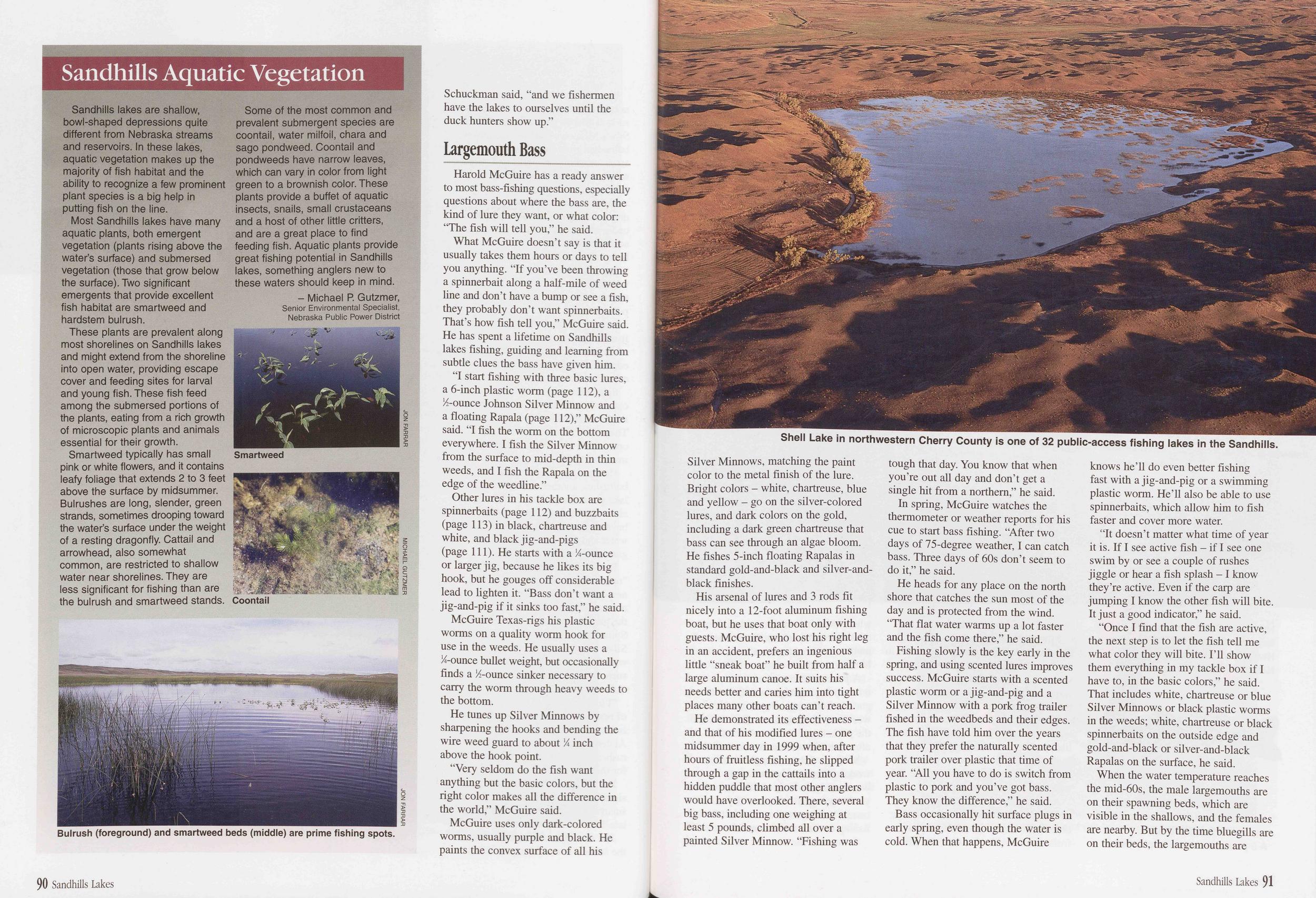
Sandhills Aquatic Vegetation
Sandhills lakes are shallow, bowl-shaped depressions quite different from Nebraska streams and reservoirs. In these lakes, aquatic vegetation makes up the majority of fish habitat and the ability to recognize a few prominent plant species is a big help in putting fish on the line.
Most Sandhills lakes have many aquatic plants, both emergent vegetation (plants rising above the water's surface) and submersed vegetation (those that grow below the surface). Two significant emergents that provide excellent fish habitat are smartweed and hardstem bulrush.
These plants are prevalent along most shorelines on Sandhills lakes and might extend from the shoreline into open water, providing escape cover and feeding sites for larval and young fish. These fish feed among the submersed portions of the plants, eating from a rich growth of microscopic plants and animals essential for their growth.
Smartweed typically has small pink or white flowers, and it contains leafy foliage that extends 2 to 3 feet above the surface by midsummer. Bulrushes are long, slender, green strands, sometimes drooping toward the water's surface under the weight of a resting dragonfly. Cattail and arrowhead, also somewhat common, are restricted to shallow water near shorelines. They are less significant for fishing than are the bulrush and smartweed stands.
Some of the most common and prevalent submergent species are coontail, water milfoil, chara and sago pondweed. Coontail and pondweeds have narrow leaves, which can vary in color from light green to a brownish color. These plants provide a buffet of aquatic insects, snails, small crustaceans and a host of other little critters, and are a great place to find feeding fish. Aquatic plants provide great fishing potential in Sandhills lakes, something anglers new to these waters should keep in mind.
- Michael P. Gutzmer, Senior Environmental Specialist, Nebraska Public Power District
Schuckman said, "and we fishermen have the lakes to ourselves until the duck hunters show up."
Largemouth BassHarold McGuire has a ready answer to most bass-fishing questions, especially questions about where the bass are, the kind of lure they want, or what color: "The fish will tell you," he said.
What McGuire doesn't say is that it usually takes them hours or days to tell you anything. "If you've been throwing a spinnerbait along a half-mile of weed line and don't have a bump or see a fish, they probably don't want spinnerbaits. That's how fish tell you," McGuire said. He has spent a lifetime on Sandhills lakes fishing, guiding and learning from subtle clues the bass have given him.
"I start fishing with three basic lures, a 6-inch plastic worm (page 112), a M-ounce Johnson Silver Minnow and a floating Rapala (page 112)," McGuire said. "I fish the worm on the bottom everywhere. I fish the Silver Minnow from the surface to mid-depth in thin weeds, and I fish the Rapala on the edge of the weedline."
Other lures in his tackle box are spinnerbaits (page 112) and buzzbaits (page 113) in black, chartreuse and white, and black jig-and-pigs (page 111). He starts with a %-ounce or larger jig, because he likes its big hook, but he gouges off considerable lead to lighten it. "Bass don't want a jig-and-pig if it sinks too fast," he said.
McGuire Texas-rigs his plastic worms on a quality worm hook for use in the weeds. He usually uses a bounce bullet weight, but occasionally finds a M-ounce sinker necessary to carry the worm through heavy weeds to the bottom.
He tunes up Silver Minnows by sharpening the hooks and bending the wire weed guard to about % inch above the hook point.
"Very seldom do the fish want anything but the basic colors, but the right color makes all the difference in the world," McGuire said.
McGuire uses only dark-colored worms, usually purple and black. He paints the convex surface of all his
Silver Minnows, matching the paint color to the metal finish of the lure. Bright colors - white, chartreuse, blue and yellow - go on the silver-colored lures, and dark colors on the gold, including a dark green chartreuse that bass can see through an algae bloom. He fishes 5-inch floating Rapalas in standard gold-and-black and silver-and-black finishes.
His arsenal of lures and 3 rods fit nicely into a 12-foot aluminum fishing boat, but he uses that boat only with guests. McGuire, who lost his right leg in an accident, prefers an ingenious little "sneak boat" he built from half a large aluminum canoe. It suits his needs better and caries him into tight places many other boats can't reach.
He demonstrated its effectiveness - and that of his modified lures - one midsummer day in 1999 when, after hours of fruitless fishing, he slipped through a gap in the cattails into a hidden puddle that most other anglers would have overlooked. There, several big bass, including one weighing at least 5 pounds, climbed all over a painted Silver Minnow. "Fishing was tough that day. You know that when you're out all day and don't get a single hit from a northern," he said.
In spring, McGuire watches the thermometer or weather reports for his cue to start bass fishing. "After two days of 75-degree weather, I can catch bass. Three days of 60s don't seem to do it," he said.
He heads for any place on the north shore that catches the sun most of the day and is protected from the wind. "That flat water warms up a lot faster and the fish come there," he said.
Fishing slowly is the key early in the spring, and using scented lures improves success. McGuire starts with a scented plastic worm or a jig-and-pig and a Silver Minnow with a pork frog trailer fished in the weedbeds and their edges. The fish have told him over the years that they prefer the naturally scented pork trailer over plastic that time of year. "All you have to do is switch from plastic to pork and you've got bass. They know the difference," he said.
Bass occasionally hit surface plugs in early spring, even though the water is cold. When that happens, McGuire knows he'll do even better fishing fast with a jig-and-pig or a swimming plastic worm. He'll also be able to use spinnerbaits, which allow him to fish faster and cover more water.
"It doesn't matter what time of year it is. If I see active fish - if I see one swim by or see a couple of rushes jiggle or hear a fish splash - I know they're active. Even if the carp are jumping I know the other fish will bite. It just a good indicator," he said.
"Once I find that the fish are active, the next step is to let the fish tell me what color they will bite. I'll show them everything in my tackle box if I have to, in the basic colors," he said. That includes white, chartreuse or blue Silver Minnows or black plastic worms in the weeds; white, chartreuse or black spinnerbaits on the outside edge and gold-and-black or silver-and-black Rapalas on the surface, he said.
When the water temperature reaches the mid-60s, the male largemouths are on their spawning beds, which are visible in the shallows, and the females are nearby. But by the time bluegills are on their beds, the largemouths are
90 Sandhills Lakes Sandhills Lakes 91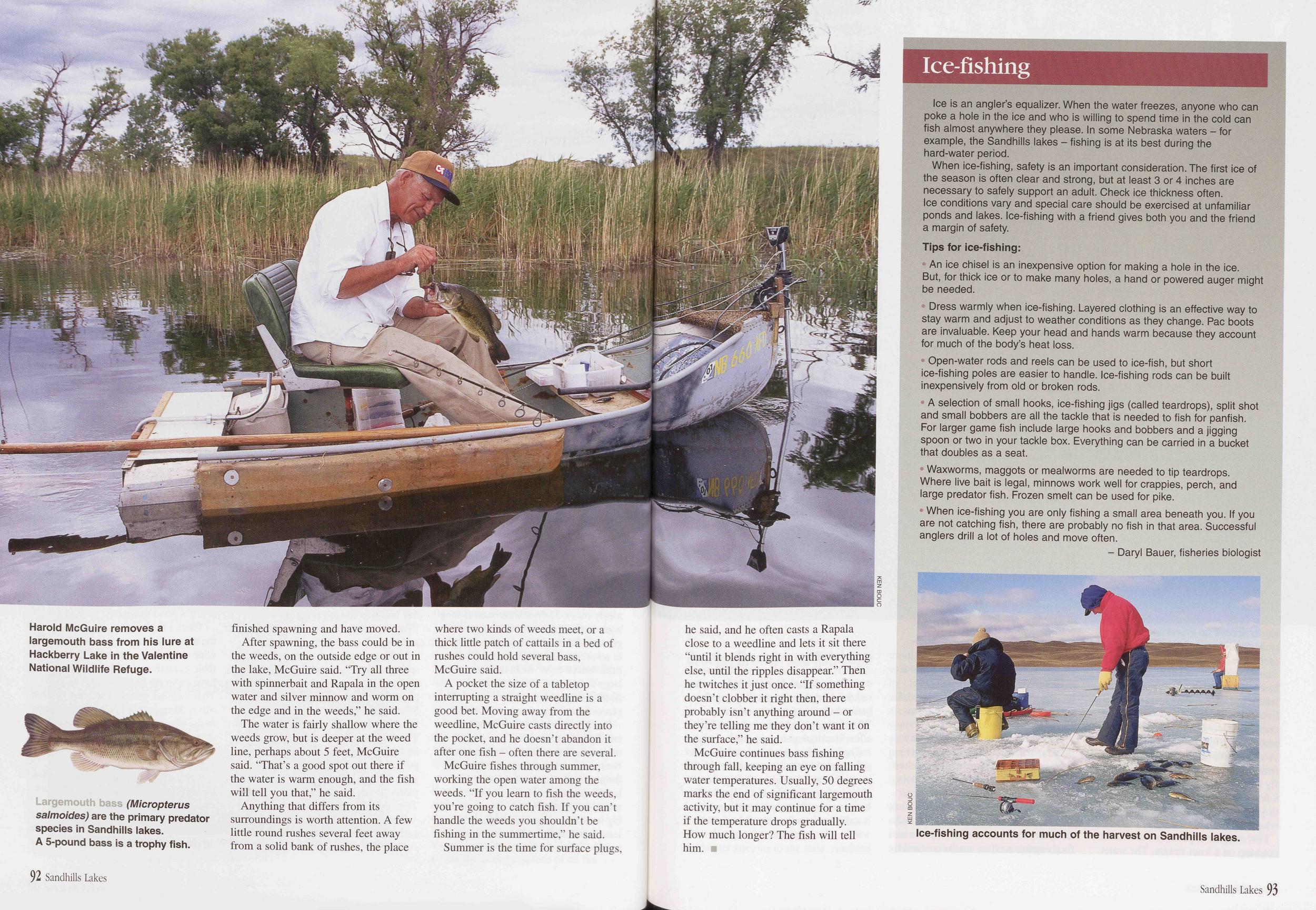
finished spawning and have moved.
After spawning, the bass could be in the weeds, on the outside edge or out in the lake, McGuire said. "Try all three with spinnerbait and Rapala in the open water and silver minnow and worm on the edge and in the weeds," he said.
The water is fairly shallow where the weeds grow, but is deeper at the weed line, perhaps about 5 feet, McGuire said. "That's a good spot out there if the water is warm enough, and the fish will tell you that," he said.
Anything that differs from its surroundings is worth attention. A few little round rushes several feet away from a solid bank of rushes, the place where two kinds of weeds meet, or a thick little patch of cattails in a bed of rushes could hold several bass, McGuire said.
A pocket the size of a tabletop interrupting a straight weed line is a good bet. Moving away from the weed line, McGuire casts directly into the pocket, and he doesn't abandon it after one fish - often there are several.
McGuire fishes through summer, working the open water among the weeds. "If you learn to fish the weeds, you're going to catch fish. If you can't handle the weeds you shouldn't be fishing in the summertime," he said.
Summer is the time for surface plugs, he said, and he often casts a Rapala close to a weed line and lets it sit there "until it blends right in with everything else, until the ripples disappear." Then he twitches it just once. "If something doesn't clobber it right then, there probably isn't anything around - or they're telling me they don't want it on the surface," he said.
McGuire continues bass fishing through fall, keeping an eye on falling water temperatures. Usually, 50 degrees marks the end of significant largemouth activity, but it may continue for a time if the temperature drops gradually. How much longer? The fish will tell him.
Ice-fishing
Ice is an angler's equalizer. When the water freezes, anyone who can poke a hole in the ice and who is willing to spend time in the cold can fish almost anywhere they please. In some Nebraska waters - for example, the Sandhills lakes - fishing is at its best during the hard-water period.
When ice-fishing, safety is an important consideration. The first ice of the season is often clear and strong, but at least 3 or 4 inches are necessary to safely support an adult. Check ice thickness often. Ice conditions vary and special care should be exercised at unfamiliar ponds and lakes. Ice-fishing with a friend gives both you and the friend margin to safety.
Tips for ice-fishing:
An ice chisel is an inexpensive option for making a hole in the ice. But, for thick ice or to make many holes, a hand or powered auger might be needed.
Dress warmly when ice-fishing. Layered clothing is an effective way to stay warm and adjust to weather conditions as they change. Pac boots are invaluable. Keep your head and hands warm because they account for much of the body's heat loss.
Open-water rods and reels can be used to ice-fish, but short ice-fishing poles are easier to handle. Ice-fishing rods can be built inexpensively from old or broken rods.
A selection of small hooks, ice-fishing jigs (called teardrops), split shot and small bobbers are all the tackle that is needed to fish for panfish. For larger game fish include large hooks and bobbers and a jigging spoon or two in your tackle box. Everything can be carried in a bucket that doubles as a seat.
Waxworms, maggots or mealworms are needed to tip teardrops. Where live bait is legal, minnows work well for crappies, perch, and large predator fish. Frozen smelt can be used for pike.
When ice-fishing you are only fishing a small area beneath you. If you are not catching fish, there are probably no fish in that area. Successful anglers drill a lot of holes and move often.
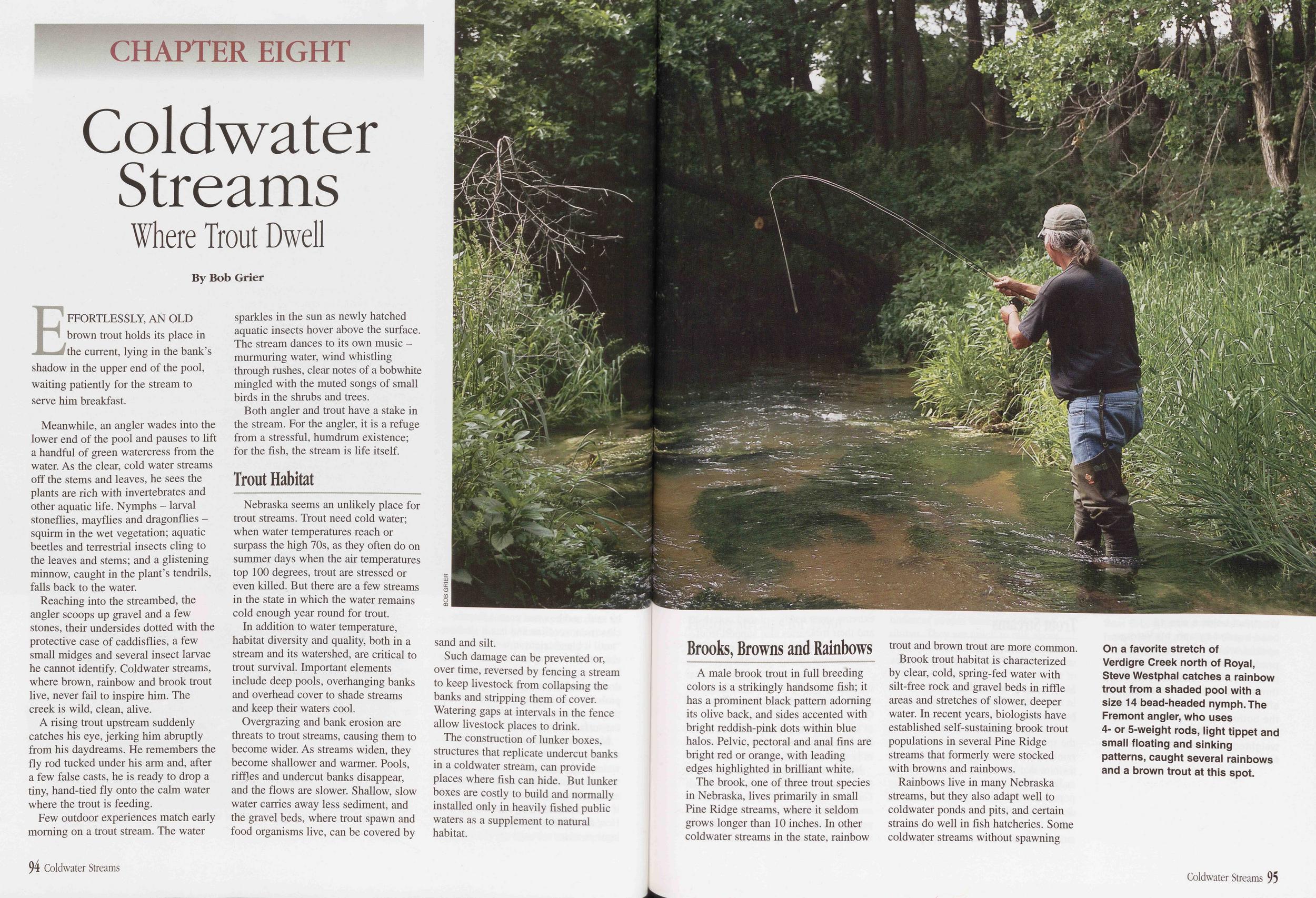
Chapter Eight
Coldwater Streams
Where Trout Dwell
EFFORTLESSLY, AN OLD brown trout holds its place in the current, lying in the bank's shadow in the upper end of the pool, waiting patiently for the stream to serve him breakfast.
Meanwhile, an angler wades into the lower end of the pool and pauses to lift a handful of green watercress from the water. As the clear, cold water streams off the stems and leaves, he sees the plants are rich with invertebrates and other aquatic life. Nymphs - larval stoneflies, mayflies and dragonflies - squirm in the wet vegetation; aquatic beetles and terrestrial insects cling to the leaves and stems; and a glistening minnow, caught in the plant's tendrils, falls back to the water.
Reaching into the streambed, the angler scoops up gravel and a few stones, their undersides dotted with the protective case of caddisflies, a few small midges and several insect larvae he cannot identify. Cold water streams, where brown, rainbow and brook trout live, never fail to inspire him. The creek is wild, clean, alive.
A rising trout upstream suddenly catches his eye, jerking him abruptly from his daydreams. He remembers the fly rod tucked under his arm and, after a few false casts, he is ready to drop a tiny, hand-tied fly onto the calm water where the trout is feeding.
Few outdoor experiences match early morning on a trout stream. The water 94 Coldwater Streams sparkles in the sun as newly hatched aquatic insects hover above the surface. The stream dances to its own music - murmuring water, wind whistling through rushes, clear notes of a bobwhite mingled with the muted songs of small birds in the shrubs and trees.
Both angler and trout have a stake in the stream. For the angler, it is a refuge from a stressful, humdrum existence; for the fish, the stream is life itself. Trout HabitatNebraska seems an unlikely place for trout streams. Trout need cold water; when water temperatures reach or surpass the high 70s, as they often do on summer days when the air temperatures top 100 degrees, trout are stressed or even killed. But there are a few streams in the state in which the water remains cold enough year round for trout.
In addition to water temperature, habitat diversity and quality, both in a stream and its watershed, are critical to trout survival. Important elements include deep pools, overhanging banks and overhead cover to shade streams and keep their waters cool.
Overgrazing and bank erosion are threats to trout streams, causing them to become wider. As streams widen, they become shallower and warmer. Pools, riffles and undercut banks disappear, and the flows are slower. Shallow, slow water carries away less sediment, and the gravel beds, where trout spawn and food organisms live, can be covered by sand and silt.
Such damage can be prevented or, over time, reversed by fencing a stream to keep livestock from collapsing the banks and stripping them of cover. Watering gaps at intervals in the fence allow livestock places to drink.
The construction of lunker boxes, structures that replicate undercut banks in a cold water stream, can provide places where fish can hide. But lunker boxes are costly to build and normally installed only in heavily fished public waters as a supplement to natural habitat.
Brooks, Browns and RainbowsA male brook trout in full breeding colors is a strikingly handsome fish; it has a prominent black pattern adorning its olive back, and sides accented with bright reddish-pink dots within blue halos. Pelvic, pectoral and anal fins are bright red or orange, with leading edges highlighted in brilliant white.
The brook, one of three trout species in Nebraska, lives primarily in small Pine Ridge streams, where it seldom grows longer than 10 inches. In other cold water streams in the state, rainbow trout and brown trout are more common.
Brook trout habitat is characterized by clear, cold, spring-fed water with silt-free rock and gravel beds in riffle areas and stretches of slower, deeper water. In recent years, biologists have established self-sustaining brook trout populations in several Pine Ridge streams that formerly were stocked with browns and rainbows.
Rainbows live in many Nebraska streams, but they also adapt well to col dwater ponds and pits, and certain strains do well in fish hatcheries. Some cold water streams without spawning
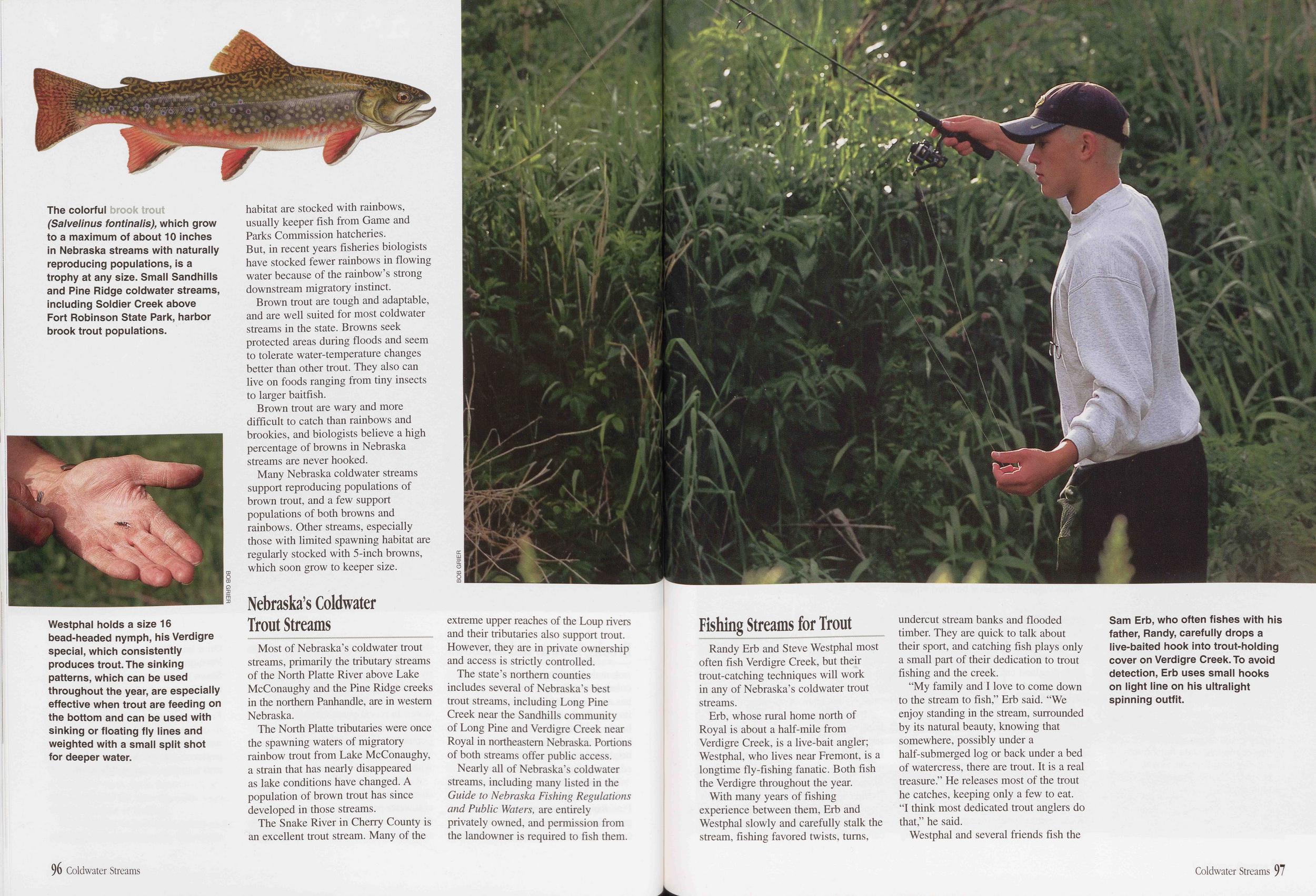
habitat are stocked with rainbows, usually keeper fish from Game and Parks Commission hatcheries. But, in recent years fisheries biologists have stocked fewer rainbows in flowing water because of the rainbow's strong downstream migratory instinct.
Brown trout are tough and adaptable, and are well suited for most cold water streams in the state. Browns seek protected areas during floods and seem to tolerate water-temperature changes better than other trout. They also can live on foods ranging from tiny insects to larger baitfish.
Brown trout are wary and more difficult to catch than rainbows and brookies, and biologists believe a high percentage of browns in Nebraska streams are never hooked.
Many Nebraska cold water streams support reproducing populations of brown trout, and a few support populations of both browns and rainbows. Other streams, especially those with limited spawning habitat are regularly stocked with 5-inch browns, which soon grow to keeper size.
Nebraska's Cold water Trout StreamsMost of Nebraska's cold water trout streams, primarily the tributary streams of the North Platte River above Lake McConaughy and the Pine Ridge creeks in the northern Panhandle, are in western Nebraska.
The North Platte tributaries were once the spawning waters of migratory rainbow trout from Lake McConaughy, a strain that has nearly disappeared as lake conditions have changed. A population of brown trout has since developed in those streams.
The Snake River in Cherry County is an excellent trout stream. Many of the extreme upper reaches of the Loup rivers and their tributaries also support trout. However, they are in private ownership and access is strictly controlled.
The state's northern counties includes several of Nebraska's best trout streams, including Long Pine Creek near the Sandhills community of Long Pine and Verdigre Creek near Royal in northeastern Nebraska. Portions of both streams offer public access.
Nearly all of Nebraska's cold water streams, including many listed in the Guide to Nebraska Fishing Regulations and Public Waters, are entirely privately owned, and permission from the landowner is required to fish them.
96 Coldwater Streams Fishing Streams for TroutRandy Erb and Steve Westphal most often fish Verdigre Creek, but their trout-catching techniques will work in any of Nebraska's coldwater trout streams.
Erb, whose rural home north of Royal is about a half-mile from Verdigre Creek, is a live-bait angler; Westphal, who lives near Fremont, is a longtime fly-fishing fanatic. Both fish the Verdigre throughout the year.
With many years of fishing experience between them, Erb and Westphal slowly and carefully stalk the stream, fishing favored twists, turns, undercut stream banks and flooded timber. They are quick to talk about their sport, and catching fish plays only a small part of their dedication to trout fishing and the creek.
"My family and I love to come down to the stream to fish," Erb said. "We enjoy standing in the stream, surrounded by its natural beauty, knowing that somewhere, possibly under a half-submerged log or back under a bed of watercress, there are trout. It is a real treasure." He releases most of the trout he catches, keeping only a few to eat. "I think most dedicated trout anglers do that," he said.
Westphal and several friends fish the
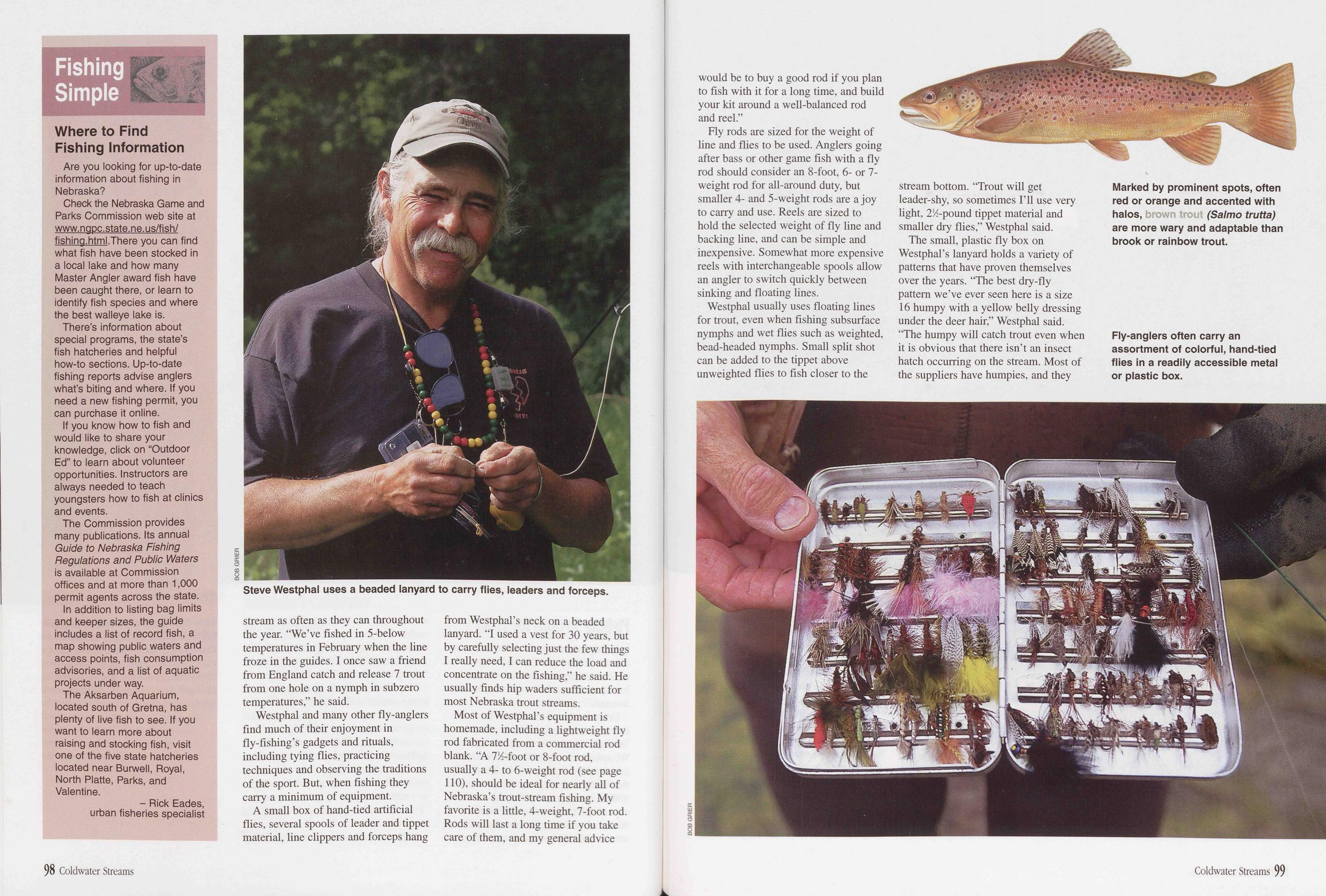
Fishing Simple
Where to Find Fishing Information
Are you looking for up-to-date information about fishing in Nebraska?
Check the Nebraska Game and Parks Commission web site at www.napc.state.ne.us/fish/ fishing.html.There you can find what fish have been stocked in a local lake and how many Master Angler award fish have been caught there, or learn to identify fish species and where the best walleye lake is.
There's information about special programs, the state's fish hatcheries and helpful how-to sections. Up-to-date fishing reports advise anglers what's biting and where. If you need a new fishing permit, you can purchase it online.
If you know how to fish and would like to share your knowledge, click on "Outdoor Ed" to learn about volunteer opportunities. Instructors are always needed to teach youngsters how to fish at clinics and events.
The Commission provides many publications. Its annual Guide to Nebraska Fishing Regulations and Public Waters is available at Commission offices and at more than 1,000 permit agents across the state.
In addition to listing bag limits and keeper sizes, the guide includes a list of record fish, a map showing public waters and access points, fish consumption advisories, and a list of aquatic projects under way.
The Aksarben Aquarium, located south of Gretna, has plenty of live fish to see. If you want to learn more about raising and stocking fish, visit one of the five state hatcheries located near Burwell, Royal, North Platte, Parks, and Valentine.
stream as often as they can throughout the year. "We've fished in 5-below temperatures in February when the line froze in the guides. I once saw a friend from England catch and release 7 trout from one hole on a nymph in subzero temperatures," he said.
Westphal and many other fly-anglers find much of their enjoyment in fly-fishing's gadgets and rituals, including tying flies, practicing techniques and observing the traditions of the sport. But, when fishing they carry a minimum of equipment.
A small box of hand-tied artificial flies, several spools of leader and tippet material, line clippers and forceps hang from Westphal's neck on a beaded lanyard. "I used a vest for 30 years, but by carefully selecting just the few things I really need, I can reduce the load and concentrate on the fishing," he said. He usually finds hip waders sufficient for most Nebraska trout streams.
Most of Westphal's equipment is homemade, including a lightweight fly rod fabricated from a commercial rod blank. "A 7M-foot or 8-foot rod, usually a 4- to 6-weight rod (see page 110), should be ideal for nearly all of Nebraska's trout-stream fishing. My favorite is a little, 4-weight, 7-foot rod. Rods will last a long time if you take care of them, and my general advice 98 Coldwater Streams would be to buy a good rod if you plan to fish with it for a long time, and build your kit around a well-balanced rod and reel."
Fly rods are sized for the weight of line and flies to be used. Anglers going after bass or other game fish with a fly rod should consider an 8-foot, 6- or 7-weight rod for all-around duty, but smaller 4- and 5-weight rods are a joy to carry and use. Reels are sized to hold the selected weight of fly line and backing line, and can be simple and inexpensive. Somewhat more expensive reels with interchangeable spools allow an angler to switch quickly between sinking and floating lines.
Westphal usually uses floating lines for trout, even when fishing subsurface nymphs and wet flies such as weighted, bead-headed nymphs. Small split shot can be added to the tippet above unweighted flies to fish closer to the stream bottom. "Trout will get leader-shy, so sometimes I'll use very light, 2K-pound tippet material and smaller dry flies," Westphal said.
The small, plastic fly box on Westphal's lanyard holds a variety of patterns that have proven themselves over the years. "The best dry-fly pattern we've ever seen here is a size 16 humpy with a yellow belly dressing under the deer hair," Westphal said. The humpy will catch trout even when it is obvious that there isn't an insect hatch occurring on the stream. Most of the suppliers have humpies, and they
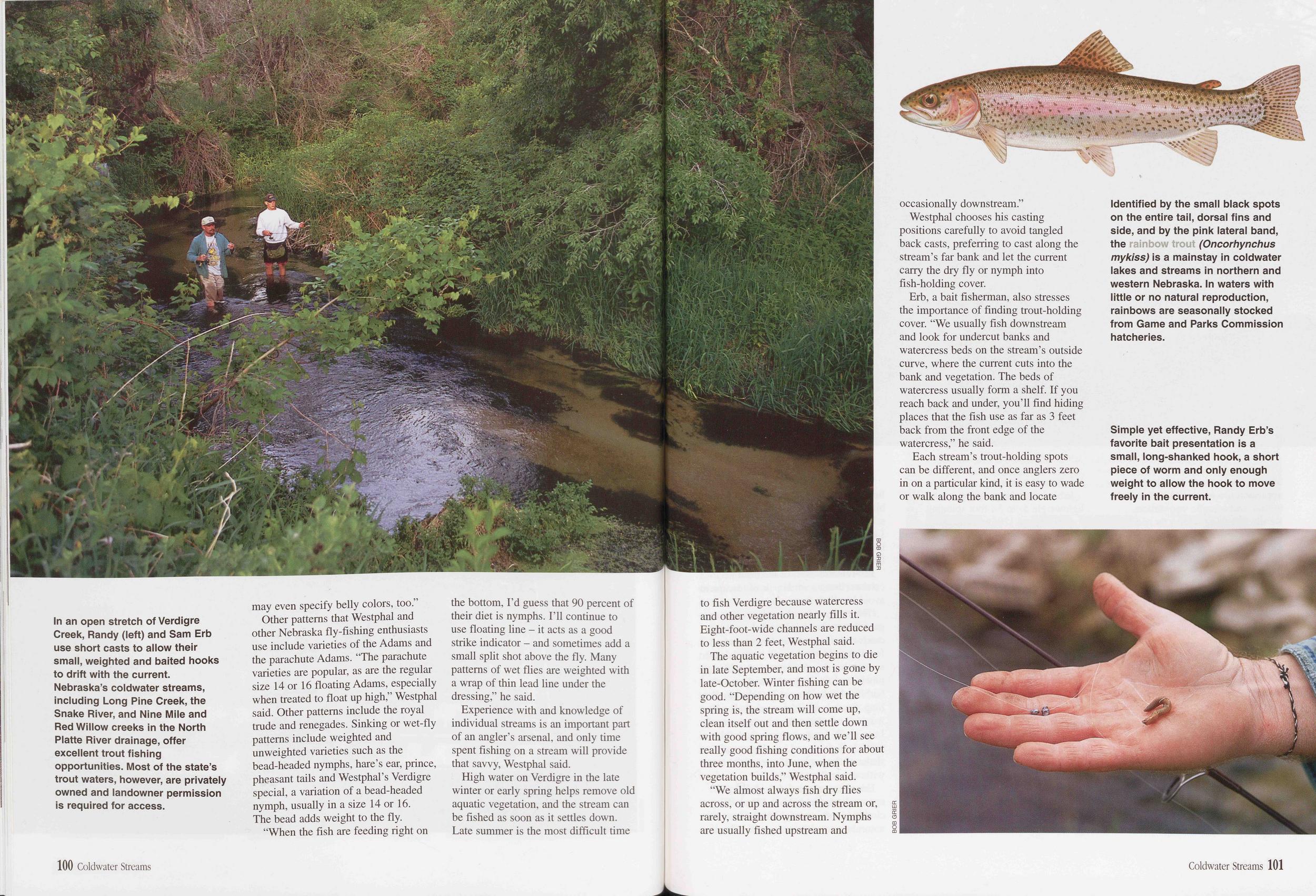
may even specify belly colors, too."
Other patterns that Westphal and other Nebraska fly-fishing enthusiasts use include varieties of the Adams and the parachute Adams. 'The parachute varieties are popular, as are the regular size 14 or 16 floating Adams, especially when treated to float up high," Westphal said. Other patterns include the royal trude and renegades. Sinking or wet-fly patterns include weighted and unweighted varieties such as the bead-headed nymphs, hare's ear, prince, pheasant tails and Westphal's Verdigre special, a variation of a bead-headed nymph, usually in a size 14 or 16. The bead adds weight to the fly.
"When the fish are feeding right on the bottom, I'd guess that 90 percent of their diet is nymphs. I'll continue to use floating line - it acts as a good strike indicator - and sometimes add a small split shot above the fly. Many patterns of wet flies are weighted with a wrap of thin lead line under the dressing," he said.
Experience with and knowledge of individual streams is an important part of an angler's arsenal, and only time spent fishing on a stream will provide that savvy, Westphal said.
High water on Verdigre in the late winter or early spring helps remove old aquatic vegetation, and the stream can be fished as soon as it settles down. Late summer is the most difficult time 100 Coldwater Streams to fish Verdigre because watercress and other vegetation nearly fills it. Eight-foot-wide channels are reduced to less than 2 feet, Westphal said.
The aquatic vegetation begins to die in late September, and most is gone by late-October. Winter fishing can be good. "Depending on how wet the spring is, the stream will come up, clean itself out and then settle down with good spring flows, and we'll see really good fishing conditions for about three months, into June, when the vegetation builds," Westphal said.
"We almost always fish dry flies across, or up and across the stream or, rarely, straight downstream. Nymphs are usually fished upstream and occasionally downstream."
Westphal chooses his casting positions carefully to avoid tangled back casts, preferring to cast along the stream's far bank and let the current carry the dry fly or nymph into fish-holding cover.
Erb, a bait fisherman, also stresses the importance of finding trout-holding cover. "We usually fish downstream and look for undercut banks and watercress beds on the stream's outside curve, where the current cuts into the bank and vegetation. The beds of watercress usually form a shelf. If you reach back and under, you'll find hiding places that the fish use as far as 3 feet back from the front edge of the watercress," he said.
Each stream's trout-holding spots can be different, and once anglers zero in on a particular kind, it is easy to wade or walk along the bank and locate
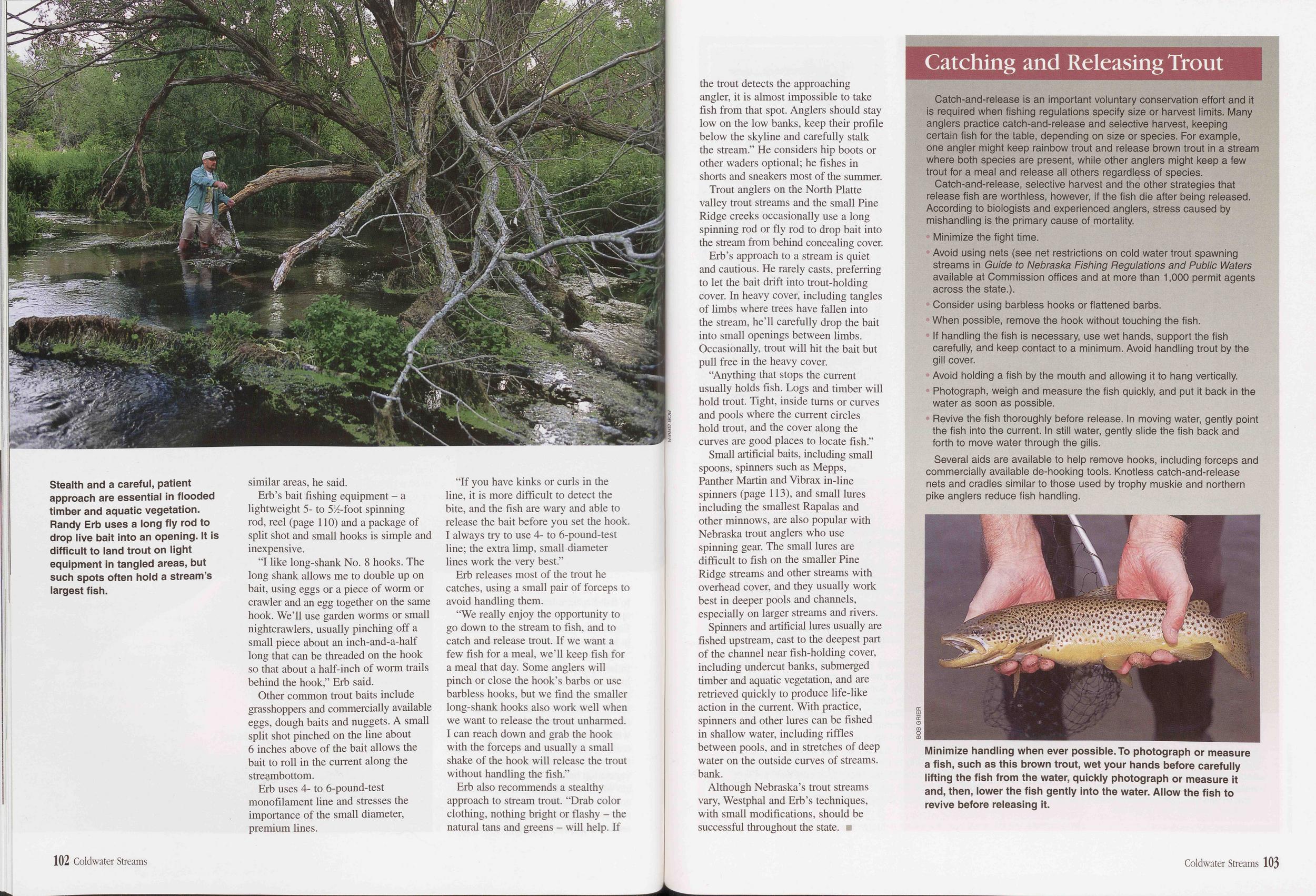
similar areas, he said.
Erb's bait fishing equipment - a lightweight 5- to 5/Cfoot spinning rod, reel (page 110) and a package of split shot and small hooks is simple and inexpensive.
"I like long-shank No. 8 hooks. The long shank allows me to double up on bait, using eggs or a piece of worm or crawler and an egg together on the same hook. We'll use garden worms or small nightcrawlers, usually pinching off a small piece about an inch-and-a-half long that can be threaded on the hook so that about a half-inch of worm trails behind the hook," Erb said.
Other common trout baits include grasshoppers and commercially available eggs, dough baits and nuggets. A small split shot pinched on the line about 6 inches above of the bait allows the bait to roll in the current along the stream bottom.
Erb uses 4- to 6-pound-test monofilament line and stresses the importance of the small diameter, premium lines.
"If you have kinks or curls in the line, it is more difficult to detect the bite, and the fish are wary and able to release the bait before you set the hook. I always try to use 4- to 6-pound-test line; the extra limp, small diameter lines work the very best."
Erb releases most of the trout he catches, using a small pair of forceps to avoid handling them.
"We really enjoy the opportunity to go down to the stream to fish, and to catch and release trout. If we want a few fish for a meal, we'll keep fish for a meal that day. Some anglers will pinch or close the hook's barbs or use barbless hooks, but we find the smaller long-shank hooks also work well when we want to release the trout unharmed. I can reach down and grab the hook with the forceps and usually a small shake of the hook will release the trout without handling the fish."
Erb also recommends a stealthy approach to stream trout. "Drab color clothing, nothing bright or flashy - the natural tans and greens - will help. If 102 Coldwater Streams the trout detects the approaching angler, it is almost impossible to take fish from that spot. Anglers should stay low on the low banks, keep their profile below the skyline and carefully stalk the stream." He considers hip boots or other waders optional; he fishes in shorts and sneakers most of the summer.
Trout anglers on the North Platte valley trout streams and the small Pine Ridge creeks occasionally use a long spinning rod or fly rod to drop bait into the stream from behind concealing cover.
Erb's approach to a stream is quiet and cautious. He rarely casts, preferring to let the bait drift into trout-holding cover. In heavy cover, including tangles of limbs where trees have fallen into the stream, he'll carefully drop the bait into small openings between limbs. Occasionally, trout will hit the bait but pull free in the heavy cover.
"Anything that stops the current usually holds fish. Logs and timber will hold trout. Tight, inside turns or curves and pools where the current circles hold trout, and the cover along the curves are good places to locate fish."
Small artificial baits, including small spoons, spinners such as Mepps, Panther Martin and Vibrax in-line spinners (page 113), and small lures including the smallest Rapalas and other minnows, are also popular with Nebraska trout anglers who use spinning gear. The small lures are difficult to fish on the smaller Pine Ridge streams and other streams with overhead cover, and they usually work best in deeper pools and channels, especially on larger streams and rivers.
Spinners and artificial lures usually are fished upstream, cast to the deepest part of the channel near fish-holding cover, including undercut banks, submerged timber and aquatic vegetation, and are retrieved quickly to produce life-like action in the current. With practice, spinners and other lures can be fished in shallow water, including riffles between pools, and in stretches of deep water on the outside curves of streams, bank.
Although Nebraska's trout streams vary, Westphal and Erb's techniques, with small modifications, should be successful throughout the state.
Catching and Releasing Trout
Catch-and-release is an important voluntary conservation effort and it is required when fishing regulations specify size or harvest limits. Many anglers practice catch-and-release and selective harvest, keeping certain fish for the table, depending on size or species. For example, one angler might keep rainbow trout and release brown trout in a stream where both species are present, while other anglers might keep a few trout for a meal and release all others regardless of species.
Catch-and-release, selective harvest and the other strategies that release fish are worthless, however, if the fish die after being released. According to biologists and experienced anglers, stress caused by mishandling is the primary cause of mortality.
Minimize the fight time.
Avoid using nets (see net restrictions on cold water trout spawning streams in Guide to Nebraska Fishing Regulations and Public Waters available at Commission offices and at more than 1,000 permit agents across the state.).
Consider using barbless hooks or flattened barbs.
When possible, remove the hook without touching the fish.
If handling the fish is necessary, use wet hands, support the fish carefully, and keep contact to a minimum. Avoid handling trout by the gill cover.
Avoid holding a fish by the mouth and allowing it to hang vertically.
Photograph, weigh and measure the fish quickly, and put it back in the water as soon as possible.
Revive the fish thoroughly before release. In moving water, gently point the fish into the current. In still water, gently slide the fish back and forth to move water through the gills.
Several aids are available to help remove hooks, including forceps and commercially available de-hooking tools. Knotless catch-and-release nets and cradles similar to those used by trophy muskie and northern pike anglers reduce fish handling.
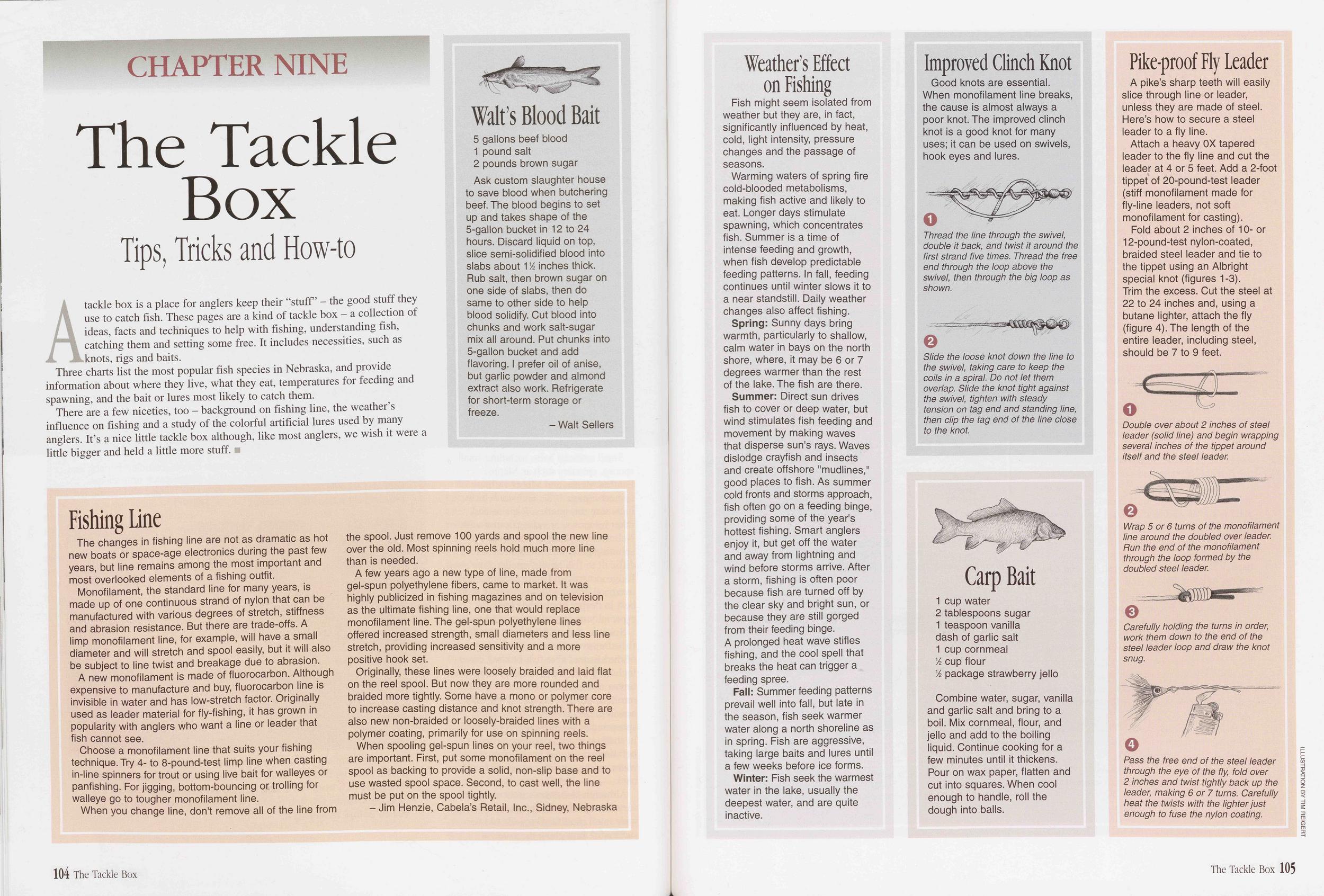
CHAPTER NINE
The Tackle Box
Tips, Tricks and How-to
A tackle box is a place for anglers keep their "stuff' - the good stuff they use to catch fish. These pages are a kind of tackle box - a collection of ideas, facts and techniques to help with fishing, understanding fish, catching them and setting some free. It includes necessities, such as knots, rigs and baits.
Three charts list the most popular fish species in Nebraska, and provide information about where they live, what they eat, temperatures for feeding and spawning, and the bait or lures most likely to catch them.
There are a few niceties, too - background on fishing line, the weather's influence on fishing and a study of the colorful artificial lures used by many anglers. It's a nice little tackle box although, like most anglers, we wish it were a little bigger and held a little more stuff.
Walt's Blood Bait
5 gallons beef blood
1 pound salt
2 pounds brown sugar
Ask custom slaughter house to save blood when butchering beef. The blood begins to set up and takes shape of the 5-gallon bucket in 12 to 24 hours. Discard liquid on top, slice semi-solidified blood into slabs about 1V2 inches thick. Rub salt, then brown sugar on one side of slabs, then do same to other side to help blood solidify. Cut blood into chunks and work salt-sugar mix all around. Put chunks into 5-gallon bucket and add flavoring. I prefer oil of anise, but garlic powder and almond extract also work. Refrigerate for short-term storage or freeze.
Fishing Line
The changes in fishing line are not as dramatic as hot new boats or space-age electronics during the past few years, but line remains among the most important and most overlooked elements of a fishing outfit.
Monofilament, the standard line for many years, is made up of one continuous strand of nylon that can be manufactured with various degrees of stretch, stiffness and abrasion resistance. But there are trade-offs. A limp monofilament line, for example, will have a small diameter and will stretch and spool easily, but it will also be subject to line twist and breakage due to abrasion.
A new monofilament is made of fluorocarbon. Although expensive to manufacture and buy, fluorocarbon line is invisible in water and has low-stretch factor. Originally used as leader material for fly-fishing, it has grown in popularity with anglers who want a line or leader that fish cannot see.
Choose a monofilament line that suits your fishing technique. Try 4- to 8-pound-test limp line when casting in-line spinners for trout or using live bait for walleyes or panfishing. For jigging, bottom-bouncing or trolling for walleye go to tougher monofilament line.
When you change line, don't remove all of the line from the spool. Just remove 100 yards and spool the new line over the old. Most spinning reels hold much more line than is needed.
A few years ago a new type of line, made from gel-spun polyethylene fibers, came to market. It was highly publicized in fishing magazines and on television as the ultimate fishing line, one that would replace monofilament line. The gel-spun polyethylene lines offered increased strength, small diameters and less line stretch, providing increased sensitivity and a more positive hook set.
Originally, these lines were loosely braided and laid flat on the reel spool. But now they are more rounded and braided more tightly. Some have a mono or polymer core to increase casting distance and knot strength. There are also new non-braided or loosely-braided lines with a polymer coating, primarily for use on spinning reels.
When spooling gel-spun lines on your reel, two things are important. First, put some monofilament on the reel spool as backing to provide a solid, non-slip base and to use wasted spool space. Second, to cast well, the line must be put on the spool tightly.
Weather's Effect on Fishing
Fish might seem isolated from weather but they are, in fact, significantly influenced by heat, cold, light intensity, pressure changes and the passage of seasons.
Warming waters of spring fire cold-blooded metabolisms, making fish active and likely to eat. Longer days stimulate spawning, which concentrates fish. Summer is a time of intense feeding and growth, when fish develop predictable feeding patterns. In fall, feeding continues until winter slows it to a near standstill. Daily weather changes also affect fishing.
Spring: Sunny days bring warmth, particularly to shallow, calm water in bays on the north shore, where, it may be 6 or 7 degrees warmer than the rest of the lake. The fish are there.
Summer: Direct sun drives fish to cover or deep water, but wind stimulates fish feeding and movement by making waves that disperse sun's rays. Waves dislodge crayfish and insects and create offshore "mudlines," good places to fish. As summer cold fronts and storms approach, fish often go on a feeding binge, providing some of the year's hottest fishing. Smart anglers enjoy it, but get off the water and away from lightning and wind before storms arrive. After a storm, fishing is often poor because fish are turned off by the clear sky and bright sun, or because they are still gorged from their feeding binge. A prolonged heat wave stifles fishing, and the cool spell that breaks the heat can trigger a feeding spree.
Fall: Summer feeding patterns prevail well into fall, but late in the season, fish seek warmer water along a north shoreline as in spring. Fish are aggressive, taking large baits and lures until a few weeks before ice forms.
Winter: Fish seek the warmest water in the lake, usually the deepest water, and are quite inactive.
Improved Clinch Knot
Good knots are essential. When monofilament line breaks, the cause is almost always a poor knot. The improved clinch knot is a good knot for many uses; it can be used on swivels, hook eyes and lures.
Thread the line through the swivel, double it back, and twist it around the first strand five times. Thread the free end through the loop above the swivel, then through the big loop as shown.
Slide the loose knot down the line to the swivel, taking care to keep the coils in a spiral. Do not let them overlap. Slide the knot tight against the swivel, tighten with steady tension on tag end and standing line, then clip the tag end of the line close to the knot.
Carp Bait
1 cup water
2 tablespoons sugar
1 teaspoon vanilla
dash of garlic salt
1 cup cornmeal
V2 cup flour
V2 package strawberry jello
Combine water, sugar, vanilla and garlic salt and bring to a boil. Mix cornmeal, flour, and jello and add to the boiling liquid. Continue cooking for a few minutes until it thickens. Pour on wax paper, flatten and cut into squares. When cool enough to handle, roll the dough into balls.
Pike-proof Fly Leader
A pike's sharp teeth will easily slice through line or leader, unless they are made of steel. Here's how to secure a steel leader to a fly line.
Attach a heavy OX tapered leader to the fly line and cut the leader at 4 or 5 feet. Add a 2-foot tippet of 20-pound-test leader (stiff monofilament made for fly-line leaders, not soft monofilament for casting).
Fold about 2 inches of 10- or 12-pound-test nylon-coated, braided steel leader and tie to the tippet using an Albright special knot (figures 1-3). Trim the excess. Cut the steel at 22 to 24 inches and, using a butane lighter, attach the fly (figure 4). The length of the entire leader, including steel, should be 7 to 9 feet.
Double over about 2 inches of steel leader (solid line) and begin wrapping several inches of the tippet around itself and the steel leader.
Wrap 5 or 6 turns of the monofilament line around the doubled over leader. Run the end of the monofilament through the loop formed by the doubled steel leader.
Carefully holding the turns in order, work them down to the end of the steel leader loop and draw the knot snug.
Pass the free end of the steel leader through the eye of the fly, fold over 2 inches and twist tightly back up the leader, making 6 or 7 turns. Carefully heat the twists with the lighter just enough to fuse the nylon coating.
The Tackle Box 105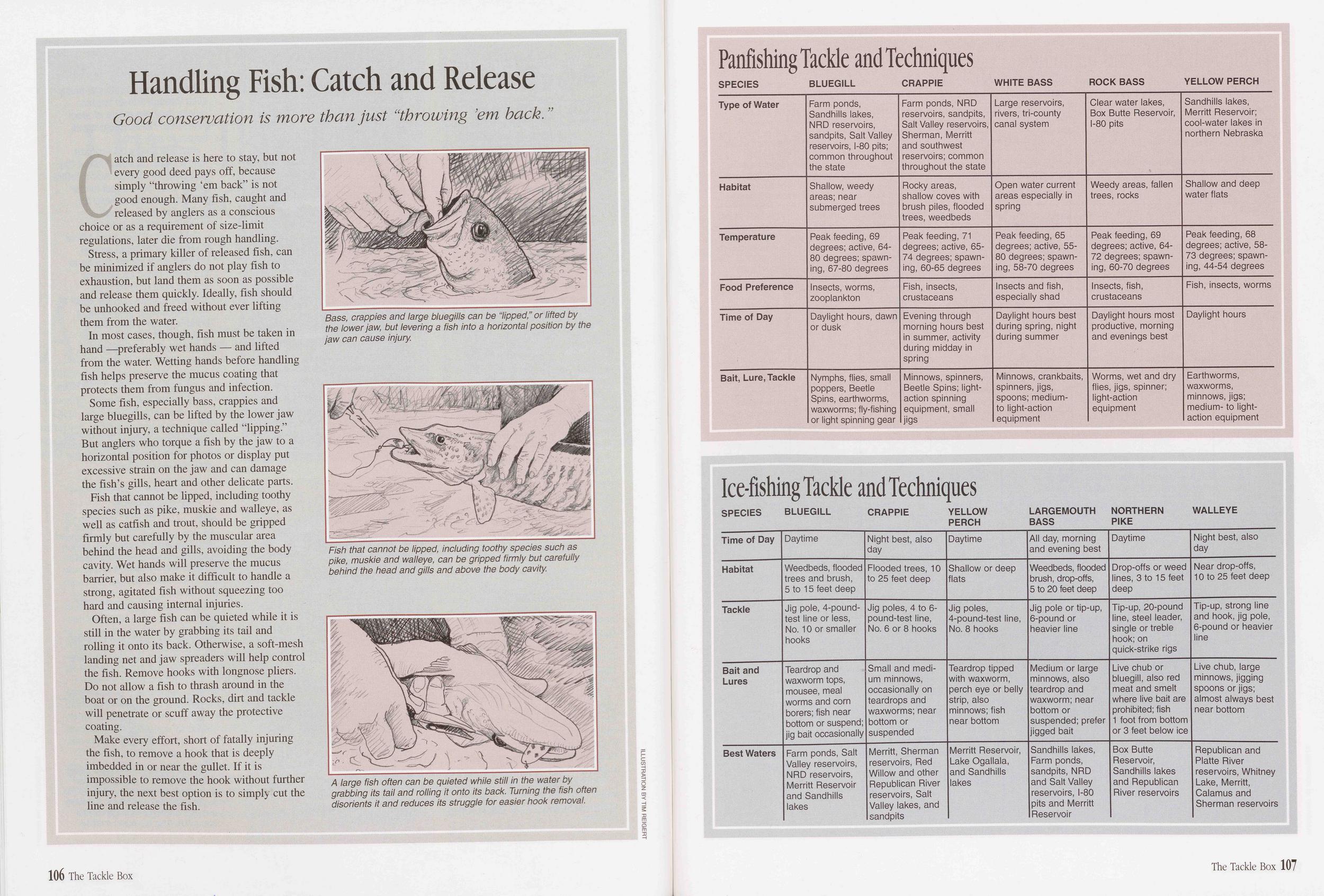
Handling Fish: Catch and Release
Good conservation is more than just "throwing 'em back.
Catch and release is here to stay, but not every good deed pays off, because simply "throwing 'em back" is not good enough. Many fish, caught and released by anglers as a conscious choice or as a requirement of size-limit regulations, later die from rough handling.
Stress, a primary killer of released fish, can be minimized if anglers do not play fish to exhaustion, but land them as soon as possible and release them quickly. Ideally, fish should be unhooked and freed without ever lifting them from the water.
In most cases, though, fish must be taken in hand —preferably wet hands — and lifted from the water. Wetting hands before handling fish helps preserve the mucus coating that protects them from fungus and infection.
Some fish, especially bass, crappies and large biuegills, can be lifted by the lower jaw without injury, a technique called "lipping." But anglers who torque a fish by the jaw to a horizontal position for photos or display put excessive strain on the jaw and can damage the fish's gills, heart and other delicate parts.
Fish that cannot be lipped, including toothy species such as pike, muskie and walleye, as well as catfish and trout, should be gripped firmly but carefully by the muscular area behind the head and gills, avoiding the body cavity. Wet hands will preserve the mucus barrier, but also make it difficult to handle a strong, agitated fish without squeezing too hard and causing internal injuries.
Often, a large fish can be quieted while it is still in the water by grabbing its tail and rolling it onto its back. Otherwise, a soft-mesh landing net and jaw spreaders will help control the fish. Remove hooks with longnose pliers. Do not allow a fish to thrash around in the boat or on the ground. Rocks, dirt and tackle will penetrate or scuff away the protective coating.
Make every effort, short of fatally injuring the fish, to remove a hook that is deeply imbedded in or near the gullet. If it is impossible to remove the hook without further injury, the next best option is to simply cut the line and release the fish.
106 The Tackle BoxPanfishing Tackle and Techniques
SPECIES BLUEGILL CRAPPIE WHITE BASS ROCK BASS YELLOW PERCH Type of Water Farm ponds, Sandhills lakes, NRD reservoirs, sandpits, Salt Valley reservoirs, 1-80 pits; common throughout the state Farm ponds, NRD reservoirs, sandpits, Salt Valley reservoirs, Sherman, Merritt and southwest reservoirs; common throughout the state Large reservoirs, rivers, tri-county canal system Clear water lakes, Box Butte Reservoir, I-80 pits Sandhills lakes, Merritt Reservoir; cool-water lakes in northern Nebraska Habitat Shallow, weedy areas; near submerged trees Rocky areas, shallow coves with brush piles, flooded trees, weedbeds Open water current areas especially in spring Weedy areas, fallen trees, rocks Shallow and deep water flats Temperature Peak feeding, 69 degrees; active, 64-80 degrees; spawning, 67-80 degrees Peak feeding, 71 degrees; active, 65-74 degrees; spawning, 60-65 degrees Peak feeding, 65 degrees; active, 55-80 degrees; spawning, 58-70 degrees Peak feeding, 69 degrees; active, 64-72 degrees; spawning, 60-70 degrees Peak feeding, 68 degrees; active, 58-73 degrees; spawning, 44-54 degrees Food Preference Insects, worms, zooplankton Fish, insects, crustaceans Insects and fish, especially shad Insects, fish, crustaceans Fish, insects, worms Time of Day Daylight hours, dawn or dusk Evening through morning hours best in summer, activity during midday in spring Daylight hours best during spring, night during summer Daylight hours most productive, morning and evenings best Daylight hours Bait, Lure, Tackle Nymphs, flies, small poppers, Beetle Spins, earthworms, waxworms; fly-fishing or light spinning gear Minnows, spinners, Beetle Spins; light-action spinning equipment, small jigs Minnows, crankbaits, spinners, jigs, spoons; medium-to light-action equipment Worms, wet and dry flies, jigs, spinner; light-action equipment Earthworms, waxworms, minnows, jigs; medium- to light-action equipmentIce-fishing Tackle and Techniques
SPECIES BLUEGILL CRAPPIE YELLOW PERCH LARGEMOUTH NORTHERN BASS PIKE WALLEYE Time of Day Daytime Night best, also day Daytime All day, morning and evening best Daytime Night best, also day Habitat Weedbeds, flooded Flooded trees, 10 Shallow or deep Weedbeds, flooded Drop-offs or weed Near drop-offs, trees and brush, to 25 feet deep flats brush, drop-offs, lines, 3 to 15 feet 10 to 25 feet deep 5 to 15 feet deep 5 to 20 feet deep deep Tackle Jig pole, 4-pound- Jig poles, 4 to 6- Jig poles, Jig pole or tip-up, Tip-up, 20-pound Tip-up, strong line test line or less, pound-test line, 4-pound-test line, 6-pound or line, steel leader, and hook, jig pole, No. 10 or smaller No. 6 or 8 hooks No. 8 hooks heavier line single or treble 6-pound or heavier hooks hook; on quick-strike rigs line Bait and Teardrop and Small and medi- Teardrop tipped Medium or large Live chub or Live chub, large Lures waxworm tops, um minnows, with waxworm, minnows, also bluegill, also red minnows, jigging mousee, meal occasionally on perch eye or belly teardrop and meat and smelt spoons or jigs; worms and corn teardrops and strip, also waxworm; near where live bait are almost always best borers; fish near waxworms; near minnows; fish bottom or prohibited; fish near bottom bottom or suspend; bottom or near bottom suspended; prefer 1 foot from bottom jig bait occasionally suspended jigged bait or 3 feet below ice Best Waters Farm ponds, Salt Merritt, Sherman Merritt Reservoir, Sandhills lakes, Box Butte Republican and Valley reservoirs, reservoirs, Red Lake Ogallala, Farm ponds, Reservoir, Platte River NRD reservoirs, Willow and other and Sandhills sandpits, NRD Sandhills lakes reservoirs, Whitney Merritt Reservoir Republican River lakes and Salt Valley and Republican Lake, Merritt, and Sandhills reservoirs, Salt reservoirs, I-80 River reservoirs Calamus and lakes Valley lakes, and sandpits pits and Merritt Reservoir Sherman reservoirs The Tackle Box 107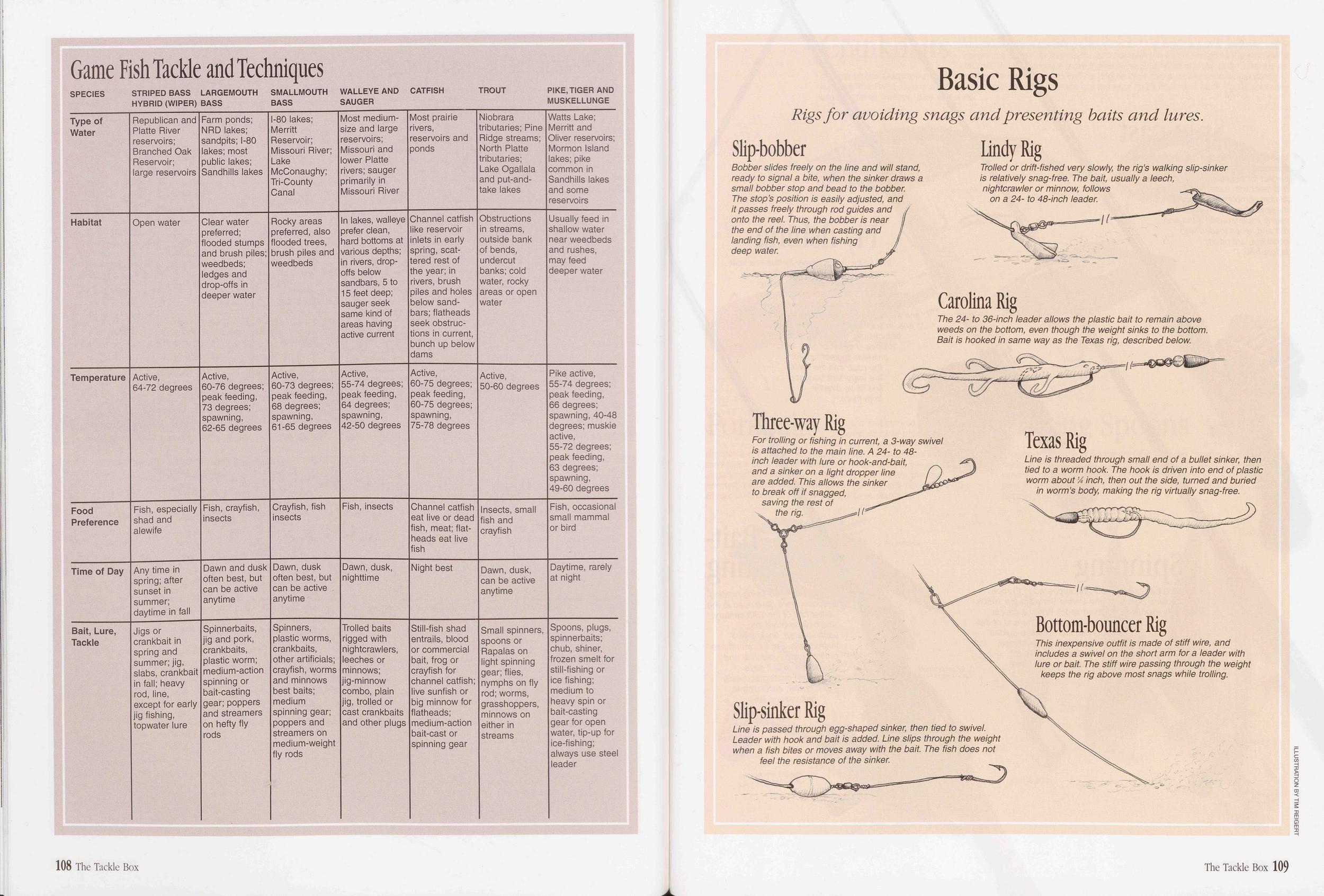
Game Fish Tackle and Techniques
SPECIES Type of Water STRIPED BASS LARGEMOUTH HYBRID (WIPER) BASS SMALLMOUTH BASS WALLEYE AND SAUGER CATFISH TROUT PIKE, TIGER AND MUSKELLUNGE Habitat Temperature Food Preference Time of Day Bait, Lure, Tackle Republican and Platte River reservoirs; Branched Oak Reservoir; large reservoirs Open water Active, 64-72 degrees Farm ponds; NRD lakes; sandpits; 1-80 lakes; most public lakes; Sandhills lakes Clear water preferred; flooded stumps and brush piles; weedbeds; ledges and drop-offs in deeper water Active, 60-76 degrees; peak feeding, 73 degrees; spawning, 62-65 degrees 1-80 lakes; Merritt Reservoir; Missouri River; Lake McConaughy; Tri-County Canal Rocky areas preferred, also flooded trees, brush piles and weedbeds Fish, especially shad and alewife Any time in spring; after sunset in summer; daytime in fall Jigs or crankbait in spring and summer; jig, slabs, crankbait in fall; heavy rod, line, except for early jig fishing, top water lure Fish, crayfish, insects Active, 60-73 degrees; peak feeding, 68 degrees; spawning, 61-65 degrees Most medium- size and large reservoirs; Missouri and lower Platte rivers; sauger primarily in Missouri River In lakes, walleye prefer clean, hard bottoms at various depths; in rivers, drop- offs below sandbars, 5 to 15 feet deep; sauger seek same kind of areas having active current Crayfish, fish insects Dawn and dusk often best, but can be active anytime Spinnerbaits, jig and pork, crankbaits, plastic worm; medium-action spinning or bait-casting gear; poppers and streamers on hefty fly rods Dawn, dusk often best, but can be active anytime Spinners, plastic worms, crankbaits, other artificials; crayfish, worms and minnows best baits; medium spinning gear; poppers and streamers on medium-weight fly rods Active, 55-74 degrees; peak feeding, 64 degrees; spawning, 42-50 degrees Most prairie rivers, reservoirs and ponds Channel catfish like reservoir inlets in early spring, scattered rest of the year; in rivers, brush piles and holes below sandbars; flatheads seek obstructions in current, bunch up below dams Fish, insects Dawn, dusk, nighttime Trolled baits rigged with nightcrawlers, leeches or minnows; jig-minnow combo, plain jig, trolled or cast crankbaits and other plugs Active, 60-75 degrees; peak feeding, 60-75 degrees; spawning, 75-78 degrees Channel catfish eat live or dead fish, meat; flatheads eat live fish Niobrara tributaries; Pine Ridge streams; North Platte tributaries; Lake Ogallala and put-and- take lakes Obstructions in streams, outside bank of bends, undercut banks; cold water, rocky areas or open water Active, 50-60 degrees Watts Lake; Merritt and Oliver reservoirs; Mormon Island lakes; pike common in Sandhills lakes and some reservoirs Usually feed in shallow water near weed beds and rushes, may feed deeper water Night best Still-fish shad entrails, blood or commercial bait, frog or crayfish for channel catfish; live sunfish or big minnow for flatheads; medium-action bait-cast or spinning gear Insects, small fish and crayfish Dawn, dusk, can be active anytime Small spinners, spoons or Rapalas on light spinning gear; flies, nymphs on fly rod; worms, grasshoppers, minnows on either in streams Pike active, 55-74 degrees; peak feeding, 66 degrees; spawning, 40-48 degrees; muskie active, 55-72 degrees; peak feeding, 63 degrees; spawning, 49-60 degrees Fish, occasional small mammal or bird Daytime, rarely at night Spoons, plugs, spinnerbaits; chub, shiner, frozen smelt for still-fishing or ice fishing; medium to heavy spin or bait-casting gear for open water, tip-up for ice-fishing; always use steel leader 108 The Tackle BoxBasic Rigs
Rigs for avoiding snags and presenting baits and lures.
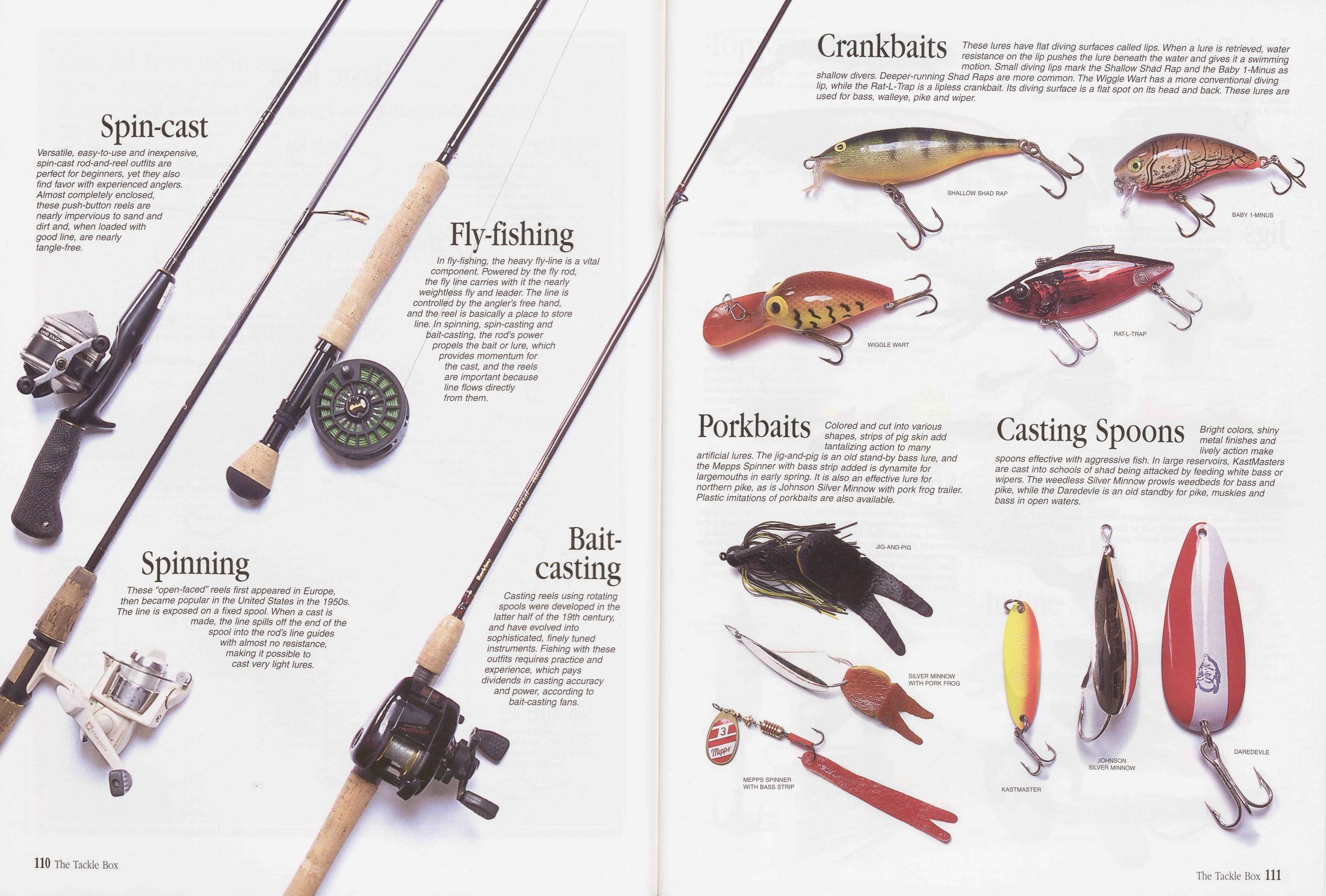
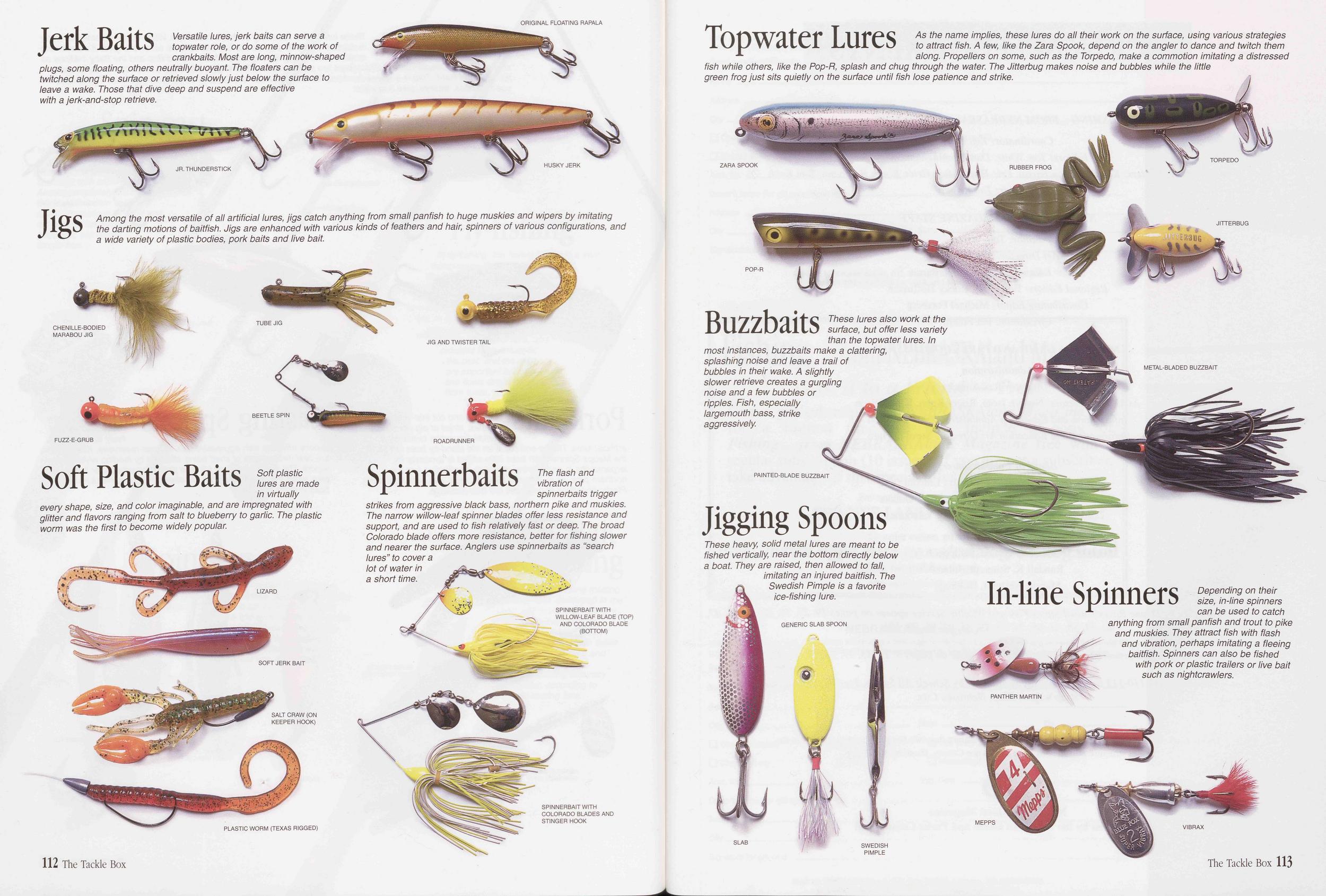
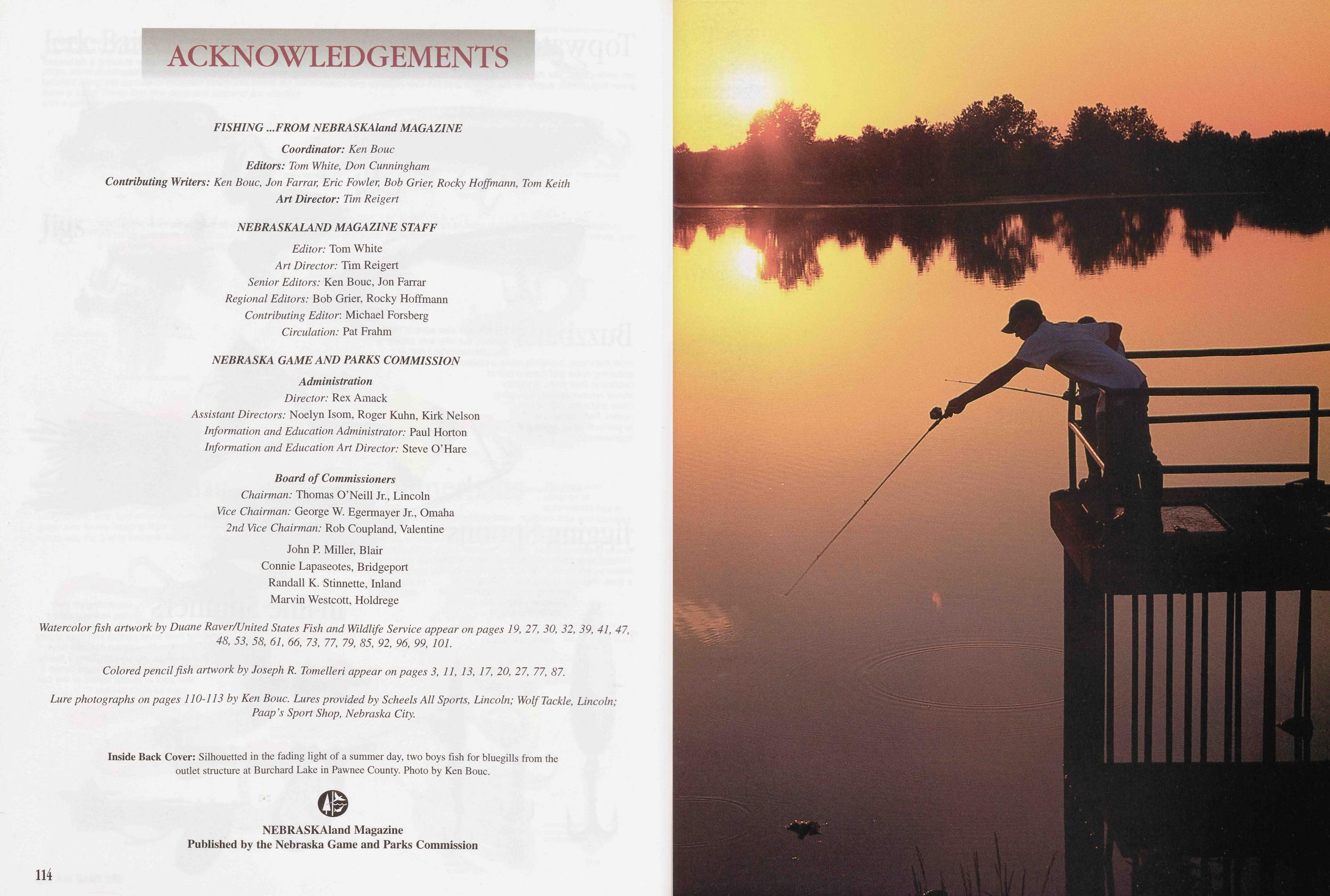
ACKNOWLEDGEMENTS
FISHING ...FROM NEBRASKAland MAGAZINE Coordinator: Ken Bouc Editors: Tom White, Don Cunningham Contributing Writers: Ken Bouc, Jon Farrar, Eric Fowler, Bob Grier, Rocky Hoffmann, Tom Keith Art Director: Tim Reigert NEBRASKALAND MAGAZINE STAFF Editor: Tom White Art Director: Tim Reigert Senior Editors: Ken Bouc, Jon Farrar Regional Editors: Bob Grier, Rocky Hoffmann Contributing Editor: Michael Forsberg Circulation: Pat Frahm NEBRASKA GAME AND PARKS COMMISSION Administration Director: Rex Amack Assistant Directors: Noelyn Isom, Roger Kuhn, Kirk Nelson Information and Education Administrator: Paul Horton Information and Education Art Director: Steve O'Hare Board of Commissioners Chairman: Thomas O'Neill Jr., Lincoln Vice Chairman: George W. Egermayer Jr., Omaha 2nd Vice Chairman: Rob Coupland, Valentine John P. Miller, Blair Connie Lapaseotes, Bridgeport Randall K. Stinnette, Inland Marvin Westcott, HoldregeWatercolor fish artwork by Duane Raver/United States Fish and Wildlife Service appear on pages 19, 27, 30, 32, 39, 41, 47, 48, 53, 58, 61, 66, 73, 77, 79, 85, 92, 96, 99, 101.
Colored pencil fish artwork by Joseph R. Tomelleri appear on pages 3, 11, 13, 17, 20, 27, 77, 87.
Lure photographs on pages 110-113 by Ken Bouc. Lures provided by Scheels All Sports, Lincoln; Wolf Tackle, Lincoln; Paap 's Sport Shop, Nebraska City.
NEBRASKAland Magazine Published by the Nebraska Game and Parks Commission
Position: 305 (29 views)