Volume 78, Issue 10, 2000
NEBRASKAland
Nebraska Game & Parks Commission December • $2.50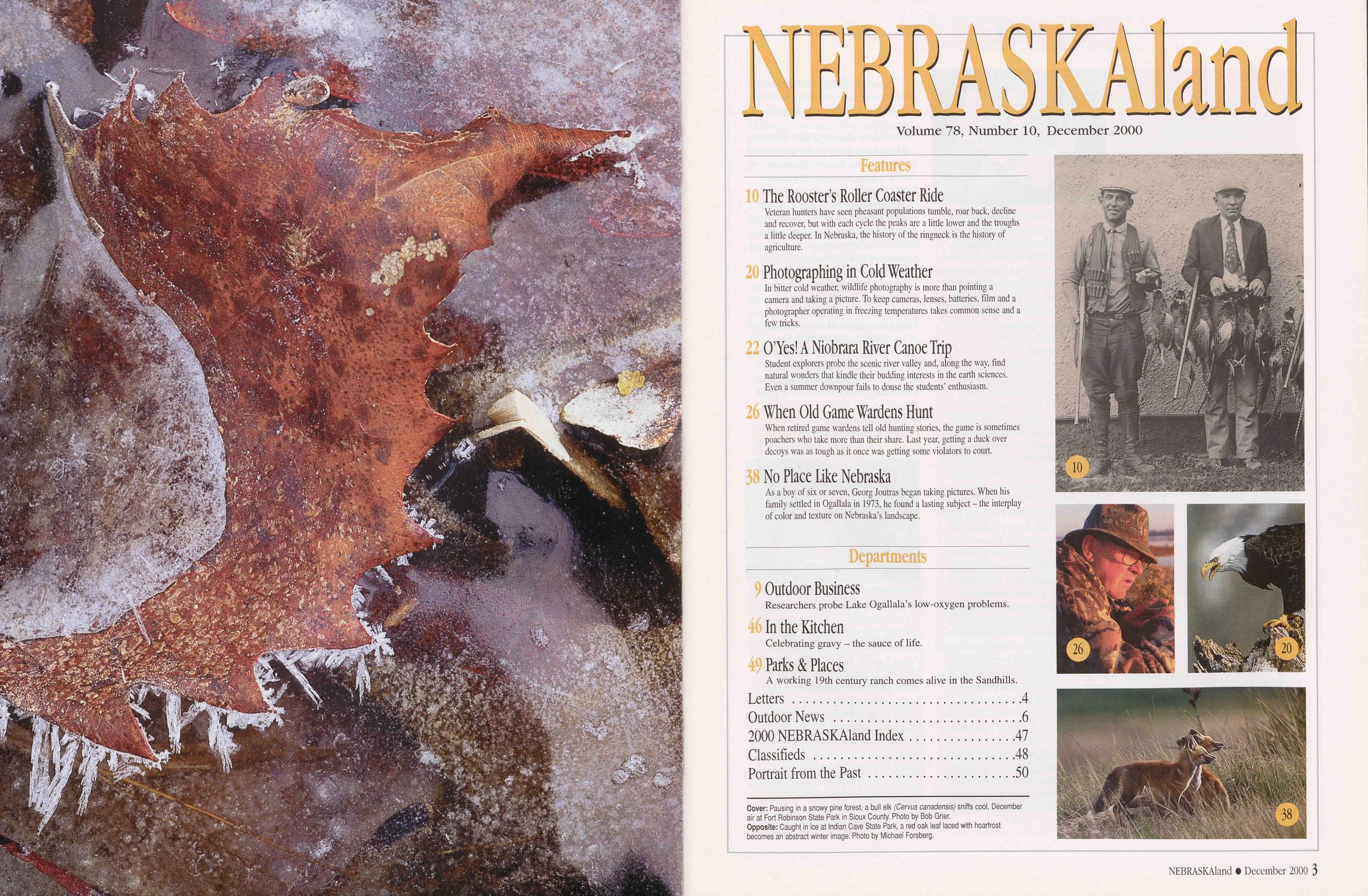
NEBRASKAland
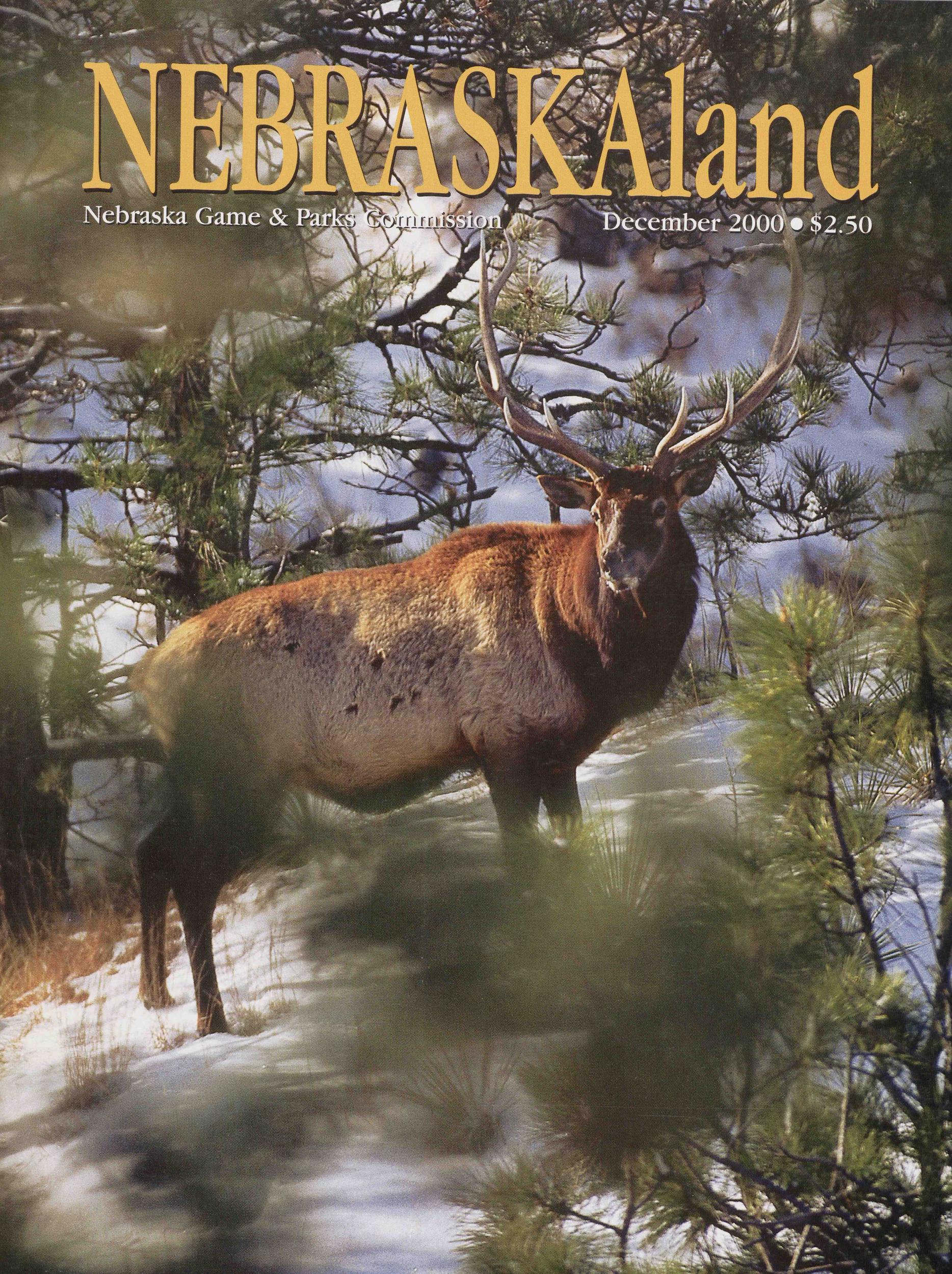
Volume 78, Number 10, December 2000 Features The Rooster’s Roller Coaster Ride Veteran hunters have seen pheasant populations tumble, roar back, decline and recover, but with each cycle the peaks are a little lower and the troughs a little deeper. In Nebraska, the history of the ringneck is the history of agriculture. Photographing in Cold Weather In bitter cold weather, wildlife photography is more than pointing a camera and taking a picture. To keep cameras, lenses, batteries, film and a photographer operating in freezing temperatures takes common sense and a few tricks. O’Yes! A Niobrara River Canoe Trip Student explorers probe the scenic river valley and, along the way, find natural wonders that kindle their budding interests in the earth sciences. Even a summer downpour fails to douse the students’ enthusiasm. When Old Game Wardens Hunt When retired game wardens tell old hunting stories, the game is sometimes poachers who take more than their share. Last year, getting a duck over decoys was as tough as it once was getting some violators to court. No Place Like Nebraska As a boy of six or seven, Georg Joutras began taking pictures. When his family settled in Ogallala in 1973, he found a lasting subject - the interplay of color and texture on Nebraska’s landscape. Departments Outdoor Business Researchers probe Lake Ogallala’s low-oxygen problems. In the Kitchen Celebrating gravy - the sauce of life. Parks & Places A working 19th century ranch comes alive in the Sandhills. Letters 4 Outdoor News 6 2000 NEBRASKAland Index 47 Classifieds 48 Portrait from the Past 50 Cover: Pausing in a snowy pine forest, a bull elk (Cervus canadensis) sniffs cool, December air at Fort Robinson State Park in Sioux County. Photo by Bob Grier. Opposite: Caught in ice at Indian Cave State Park, a red oak leaf laced with hoarfrost becomes an abstract winter image. Photo by Michael Forsberg.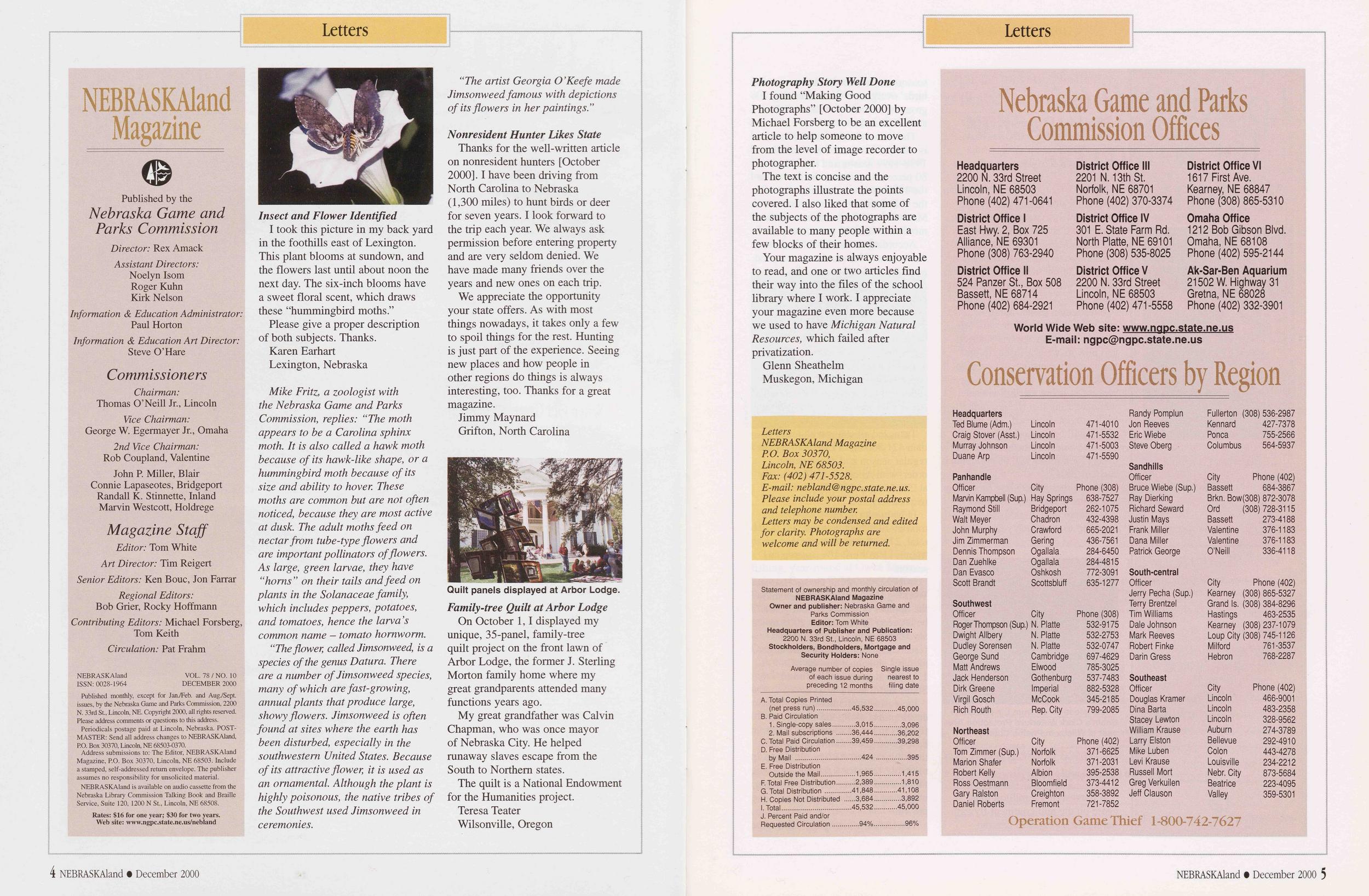 Letters
NEBRASKAland Mazine
Published by the
Nebraska Game and
Parks Commission
Director: Rex Amack
Assistant Directors:
Noelyn Isom
Roger Kuhn
Kirk Nelson
Information & Education Administrator:
Paul Horton
Information & Education Art Director:
Steve O’Hare
Commissioners
Chairman:
Thomas O’Neill Jr., Lincoln
Vice Chairman:
George W. Egermayer Jr., Omaha
2nd Vice Chairman:
Rob Coupland, Valentine
John P. Miller, Blair
Connie Lapaseotes, Bridgeport
Randall K. Stinnette, Inland
Marvin Westcott, Holdrege
Magazine Staff
Editor: Tom White
Art Director: Tim Reigert
Senior Editors: Ken Bouc, Jon Farrar
Regional Editors:
Bob Grier, Rocky Hoffmann
Contributing Editors: Michael Forsberg,
Tom Keith
Circulation: Pat Frahm
NEBRASKAland VOL. 78 / NO. 10
ISSN: 0028-1964 DECEMBER 2000
Published monthly, except for Jan./Feb. and Aug./Sept.
issues, by the Nebraska Game and Parks Commission, 2200
N. 33rd St., Lincoln, NE. Copyright 2000, all rights reserved.
Please address comments or questions to this address.
Periodicals postage paid at Lincoln, Nebraska. POST-
MASTER: Send all address changes to NEBRASKAland,
P.O. Box 30370, Lincoln, NE 68503-0370.
Address submissions to: The Editor, NEBRASKAland
Magazine, P.O. Box 30370, Lincoln, NE 68503. Include
a stamped, self-addressed return envelope. The publisher
assumes no responsibility for unsolicited material.
NEBRASKAland is available on audio cassette from the
Nebraska Library Commission Talking Book and Braille
Service, Suite 120, 1200 N St., Lincoln, NE 68508.
Rates: $16 for one year; $30 for two years.
Web site: www.ngpc.state.ne.us/nebland
Insect and Flower Identified
Letters
NEBRASKAland Mazine
Published by the
Nebraska Game and
Parks Commission
Director: Rex Amack
Assistant Directors:
Noelyn Isom
Roger Kuhn
Kirk Nelson
Information & Education Administrator:
Paul Horton
Information & Education Art Director:
Steve O’Hare
Commissioners
Chairman:
Thomas O’Neill Jr., Lincoln
Vice Chairman:
George W. Egermayer Jr., Omaha
2nd Vice Chairman:
Rob Coupland, Valentine
John P. Miller, Blair
Connie Lapaseotes, Bridgeport
Randall K. Stinnette, Inland
Marvin Westcott, Holdrege
Magazine Staff
Editor: Tom White
Art Director: Tim Reigert
Senior Editors: Ken Bouc, Jon Farrar
Regional Editors:
Bob Grier, Rocky Hoffmann
Contributing Editors: Michael Forsberg,
Tom Keith
Circulation: Pat Frahm
NEBRASKAland VOL. 78 / NO. 10
ISSN: 0028-1964 DECEMBER 2000
Published monthly, except for Jan./Feb. and Aug./Sept.
issues, by the Nebraska Game and Parks Commission, 2200
N. 33rd St., Lincoln, NE. Copyright 2000, all rights reserved.
Please address comments or questions to this address.
Periodicals postage paid at Lincoln, Nebraska. POST-
MASTER: Send all address changes to NEBRASKAland,
P.O. Box 30370, Lincoln, NE 68503-0370.
Address submissions to: The Editor, NEBRASKAland
Magazine, P.O. Box 30370, Lincoln, NE 68503. Include
a stamped, self-addressed return envelope. The publisher
assumes no responsibility for unsolicited material.
NEBRASKAland is available on audio cassette from the
Nebraska Library Commission Talking Book and Braille
Service, Suite 120, 1200 N St., Lincoln, NE 68508.
Rates: $16 for one year; $30 for two years.
Web site: www.ngpc.state.ne.us/nebland
Insect and Flower Identified
I took this picture in my back yard in the foothills east of Lexington. This plant blooms at sundown, and the flowers last until about noon the next day. The six-inch blooms have a sweet floral scent, which draws these “hummingbird moths.”
Please give a proper description of both subjects. Thanks.
Karen Earhart Lexington, NebraskaMike Fritz, a zoologist with the Nebraska Game and Parks Commission, replies: “The moth appears to be a Carolina sphinx moth. It is also called a hawk moth because of its hawk-like shape, or a hummingbird moth because of its size and ability to hover. These moths are common but are not often noticed, because they are most active at dusk. The adult moths feed on nectar from tube-type flowers and are important pollinators of flowers. As large, green larvae, they have “horns” on their tails and feed on plants in the Solanaceae family, which includes peppers, potatoes, and tomatoes, hence the larva’s common name - tomato hornworm.
“The flower, called Jimsonweed, is a species of the genus Datura. There are a number of Jimsonweed species, many of which are fast-growing, annual plants that produce large, showy flowers. Jimsonweed is often found at sites where the earth has been disturbed, especially in the southwestern United States. Because of its attractive flower, it is used as an ornamental. Although the plant is highly poisonous, the native tribes of the Southwest used Jimsonweed in ceremonies.
“The artist Georgia O'Keefe made Jimsonweed famous with depictions of its flowers in her paintings.”
Nonresident Hunter Likes StateThanks for the well-written article on nonresident hunters [October 2000]. I have been driving from North Carolina to Nebraska (1,300 miles) to hunt birds or deer for seven years. I look forward to the trip each year. We always ask permission before entering property and are very seldom denied. We have made many friends over the years and new ones on each trip.
We appreciate the opportunity your state offers. As with most things nowadays, it takes only a few to spoil things for the rest. Hunting is just part of the experience. Seeing new places and how people in other regions do things is always interesting, too. Thanks for a great magazine.
Jimmy Maynard Grifton, North CarolinaOn October 1, I displayed my unique, 35-panel, family-tree quilt project on the front lawn of Arbor Lodge, the former J. Sterling Morton family home where my great grandparents attended many functions years ago.
My great grandfather was Calvin Chapman, who was once mayor of Nebraska City. He helped runaway slaves escape from the South to Northern states.
The quilt is a National Endowment for the Humanities project.
Teresa Teater Wilsonville, Oregon Photography Story Well DoneI found “Making Good Photographs” [October 2000] by Michael Forsberg to be an excellent article to help someone to move from the level of image recorder to photographer.
The text is concise and the photographs illustrate the points covered. I also liked that some of the subjects of the photographs are available to many people within a few blocks of their homes.
Your magazine is always enjoyable to read, and one or two articles find their way into the files of the school library where I work. I appreciate your magazine even more because we used to have Michigan Natural Resources, which failed after privatization.
Glenn Sheathelm Muskegon, Michigan Letters NEBRASKAland Magazine P.O. Box 30370, Lincoln, NE 68503. Fax: (402) 471-5528. E-mail: nebland@ ngpc. state, ne. us. Please include your postal address and telephone number. Letters may be condensed and edited for clarity. Photographs are welcome and will be returned. Statement of ownership and monthly circulation of NEBRASKAland Magazine Owner and publisher: Nebraska Game and Parks Commission Editor: Tom White Headquarters of Publisher and Publication: 2200 N. 33rd St., Lincoln, NE 68503 Stockholders, Bondholders, Mortgage and Security Holders: None Average number of copies of each issue during preceding 12 months Single issue nearest to filing date A. Total Copies Printed (net press run) B. Paid Circulation 1. Single-copy sales 2. Mail subscriptions C. Total Paid Circulation D. Free Distribution by Mail E. Free Distribution Outside the Mail F. Total Free Distribution G. Total Distribution H. Copies Not Distributed I. Total J. Percent Paid and/or Requested Circulation Nebraska Game and Parks Commission Offices Headquarters 2200 N. 33rd Street Lincoln, NE 68503 Phone (402) 471-0641 District Office III 2201 N. 13th St. Norfolk, NE 68701 Phone (402) 370-3374 District Office VI 1617 First Ave. Kearney, NE 68847 Phone (308) 865-5310 District Office 1 District Office IV Omaha Office East Hwy. 2, Box 725 301 E. State Farm Rd. 1212 Bob Gibson Blvd. Alliance, NE 69301 North Platte, NE 69101 Omaha, NE 68108 Phone (308) 763-2940 Phone (308) 535-8025 Phone (402) 595-2144 District Office II District Office V Ak-Sar-Ben Aquarium 524 Panzer St., Box 508 2200 N. 33rd Street 21502 W. Highway 31 Bassett, NE 68714 Lincoln, NE 68503 Gretna, NE 68028 Phone (402) 684-2921 Phone (402) 471-5558 Phone (402) 332-3901 World Wide Web site: www.napc.state.ne.us E-mail: ngpc@ngpc.state.ne.us Headquarters Randy Pomplun Fullerton (308) 536-2987 Ted Blume (Adm.) Lincoln 471-4010 Jon Reeves Kennard 427-7378 Craig Stover (Asst.) Lincoln 471-5532 Eric Wiebe Ponca 755-2566 Murray Johnson Lincoln 471-5003 Steve Oberg Columbus 564-5937 Duane Arp Lincoln 471-5590 Sandhills Panhandle Officer City Phone (402) Officer City Phone (308) Bruce Wiebe (Sup.) Bassett 684-3867 Marvin Kampbell (Sup.) Hay Springs 638-7527 Ray Dierking Brkn. Bow(308) 872-3078 Raymond Still Bridgeport 262-1075 Richard Seward Ord (308) 728-3115 Walt Meyer Chadron 432-4398 Justin Mays Bassett 273-4188 John Murphy Crawford 665-2021 Frank Miller Valentine 376-1183 Jim Zimmerman Gering 436-7561 Dana Miller Valentine 376-1183 Dennis Thompson Ogallala 284-6450 Patrick George O'Neill 336-4118 Dan Zuehlke Ogallala 284-4815 Dan Evasco Oshkosh 772-3091 South-central Scott Brandt Scottsbluff 635-1277 Officer City Phone (402) Jerry Pecha (Sup.) Kearney (308) 865-5327 Southwest Terry Brentzel Grand Is. (308) 384-8296 Officer City Phone (308) Tim Williams Hastings 463-2535 Roger Thompson (Sup.) N. Platte 532-9175 Dale Johnson Kearney (308) 237-1079 Dwight Allbery N. Platte 532-2753 Mark Reeves Loup City (308) 745-1126 Dudley Sorensen N. Platte 532-0747 Robert Finke Milford 761-3537 George Sund Cambridge 697-4629 Darin Gress Hebron 768-2287 Matt Andrews Elwood 785-3025 Jack Henderson Gothenburg 537-7483 Southeast Dirk Greene Imperial 882-5328 Officer City Phone (402) Virgil Gosch McCook 345-2185 Douglas Kramer Lincoln 466-9001 Rich Routh Rep. City 799-2085 Dina Barta Lincoln 483-2358 Stacey Lewton Lincoln 328-9562 Northeast William Krause Auburn 274-3789 Officer City Phone (402) Larry Elston Bellevue 292-4910 Tom Zimmer (Sup.) Norfolk 371-6625 Mike Luben Colon 443-4278 Marion Shafer Norfolk 371-2031 Levi Krause Louisville 234-2212 Robert Kelly Albion 395-2538 Russell Mort Nebr. City 873-5684 Ross Oestmann Bloomfield 373-4412 Greg Verkuilen Beatrice 223-4095 Gary Ralston Creighton 358-3892 Jeff Clauson Valley 359-5301 Daniel Roberts Fremont 721-7852 Operation Game Thief 1-800-742-7627 4 NEBRASKAland • December 2000 NEBRASKAland • December 2000 5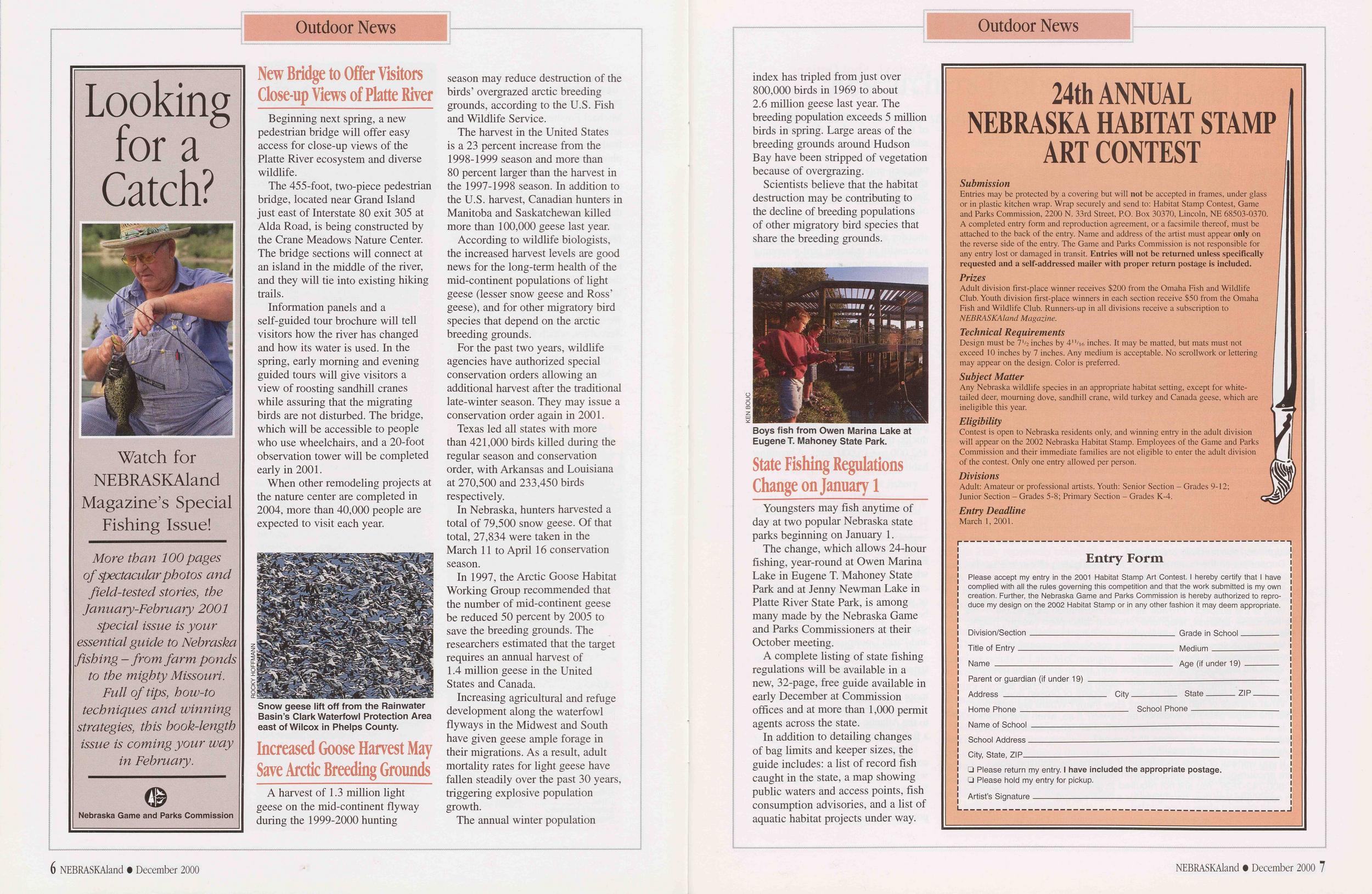
Beginning next spring, a new pedestrian bridge will offer easy access for close-up views of the Platte River ecosystem and diverse wildlife.
The 455-foot, two-piece pedestrian bridge, located near Grand Island just east of Interstate 80 exit 305 at Alda Road, is being constructed by the Crane Meadows Nature Center. The bridge sections will connect at an island in the middle of the river, and they will tie into existing hiking trails.
Information panels and a self-guided tour brochure will tell visitors how the river has changed and how its water is used. In the spring, early morning and evening guided tours will give visitors a view of roosting sandhill cranes while assuring that the migrating birds are not disturbed. The bridge, which will be accessible to people who use wheelchairs, and a 20-foot observation tower will be completed early in 2001.
When other remodeling projects at the nature center are completed in 2004, more than 40,000 people are expected to visit each year.
A harvest of 1.3 million light geese on the mid-continent flyway during the 1999-2000 hunting season may reduce destruction of the birds’ overgrazed arctic breeding grounds, according to the U.S. Fish and Wildlife Service.
The harvest in the United States is a 23 percent increase from the 1998-1999 season and more than 80 percent larger than the harvest in the 1997-1998 season. In addition to the U.S. harvest, Canadian hunters in Manitoba and Saskatchewan killed more than 100,000 geese last year.
According to wildlife biologists, the increased harvest levels are good news for the long-term health of the mid-continent populations of light geese (lesser snow geese and Ross’ geese), and for other migratory bird species that depend on the arctic breeding grounds.
For the past two years, wildlife agencies have authorized special conservation orders allowing an additional harvest after the traditional late-winter season. They may issue a conservation order again in 2001.
Texas led all states with more than 421,000 birds killed during the regular season and conservation order, with Arkansas and Louisiana at 270,500 and 233,450 birds respectively.
In Nebraska, hunters harvested a total of 79,500 snow geese. Of that total, 27,834 were taken in the March 11 to April 16 conservation season.
In 1997, the Arctic Goose Habitat Working Group recommended that the number of mid-continent geese be reduced 50 percent by 2005 to save the breeding grounds. The researchers estimated that the target requires an annual harvest of 1.4 million geese in the United States and Canada.
Increasing agricultural and refuge development along the waterfowl flyways in the Midwest and South have given geese ample forage in their migrations. As a result, adult mortality rates for light geese have fallen steadily over the past 30 years, triggering explosive population growth.
The annual winter population index has tripled from just over 800,000 birds in 1969 to about 2.6 million geese last year. The breeding population exceeds 5 million birds in spring. Large areas of the breeding grounds around Hudson Bay have been stripped of vegetation because of overgrazing.
Scientists believe that the habitat destruction may be contributing to the decline of breeding populations of other migratory bird species that share the breeding grounds.
Youngsters may fish anytime of day at two popular Nebraska state parks beginning on January 1.
The change, which allows 24-hour fishing, year-round at Owen Marina Lake in Eugene T. Mahoney State Park and at Jenny Newman Lake in Platte River State Park, is among many made by the Nebraska Game and Parks Commissioners at their October meeting.
A complete listing of state fishing regulations will be available in a new, 32-page, free guide available in early December at Commission offices and at more than 1,000 permit agents across the state.
In addition to detailing changes of bag limits and keeper sizes, the guide includes: a list of record fish caught in the state, a map showing public waters and access points, fish consumption advisories, and a list of aquatic habitat projects under way.
24th ANNUAL NEBRASKA HABITAT STAMP ART CONTEST KEN BOUC Submission Entries may be protected by a covering but will not be accepted in frames, under glass or in plastic kitchen wrap. Wrap securely and send to: Habitat Stamp Contest, Game and Parks Commission, 2200 N. 33rd Street, P.O. Box 30370, Lincoln, NE 68503-0370. A completed entry form and reproduction agreement, or a facsimile thereof, must be attached to the back of the entry. Name and address of the artist must appear only on the reverse side of the entry. The Game and Parks Commission is not responsible for any entry lost or damaged in transit. Entries will not be returned unless specifically requested and a self-addressed mailer with proper return postage is included. Prizes Adult division first-place winner receives $200 from the Omaha Fish and Wildlife Club. Youth division first-place winners in each section receive $50 from the Omaha Fish and Wildlife Club. Runners-up in all divisions receive a subscription to NEBRASKAland Magazine. Technical Requirements Design must be 7 1/2 inches by 4x6 inches. It may be matted, but mats must not exceed 10 inches by 7 inches. Any medium is acceptable. No scrollwork or lettering may appear on the design. Color is preferred. Subject Matter Any Nebraska wildlife species in an appropriate habitat setting, except for white- tailed deer, mourning dove, sandhill crane, wild turkey and Canada geese, which are ineligible this year. Eligibility Contest is open to Nebraska residents only, and winning entry in the adult division will appear on the 2002 Nebraska Habitat Stamp. Employees of the Game and Parks Commission and their immediate families are not eligible to enter the adult division of the contest. Only one entry allowed per person. Divisions Adult: Amateur or professional artists. Youth: Senior Section - Grades 9-12; Junior Section - Grades 5-8; Primary Section - Grades K-4. Entry Deadline March 1, 2001. Entry Form Please accept my entry in the 2001 Habitat Stamp Art Contest. I hereby certify that I have j complied with all the rules governing this competition and that the work submitted is my own , creation. Further, the Nebraska Game and Parks Commission is hereby authorized to reproduce my design on the 2002 Habitat Stamp or in any other fashion it may deem appropriate. Division/Section Grade in School Title of Entry Medium Name Age (if under 19) Parent or guardian (if under 19) Address City State ZIP Home Phone School Phone Name of School School Address City, State, ZIP Please return my entry. I have included the appropriate postage. Please hold my entry for pickup. Artist’s Signature 6 NEBRASKAland • December 2000 NEBRASKAland • December 2000 7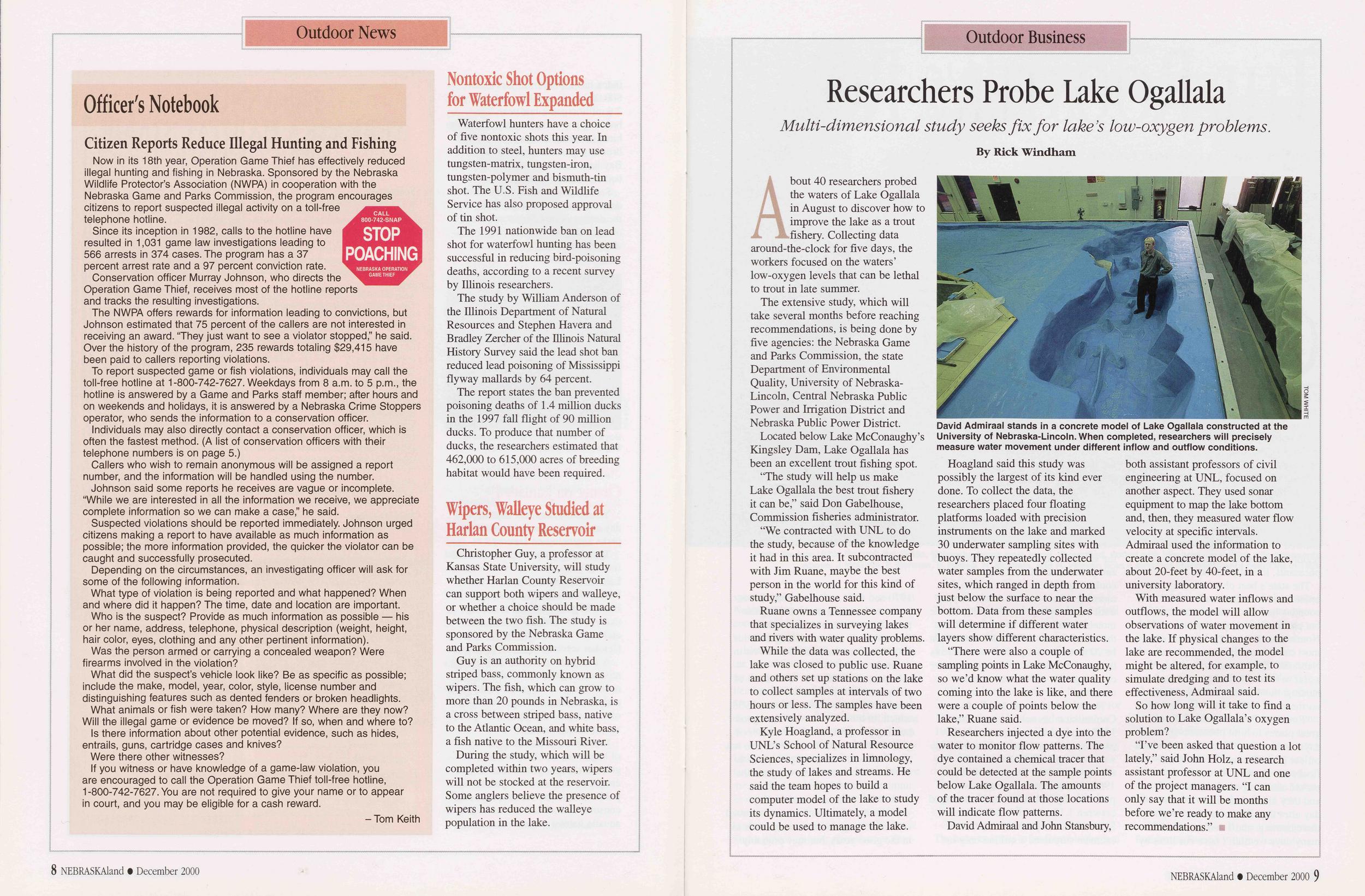 Outdoor Business
Officer's Notebook
Citizen Reports Reduce Illegal Hunting and Fishing
Outdoor Business
Officer's Notebook
Citizen Reports Reduce Illegal Hunting and Fishing
Now in its 18th year, Operation Game Thief has effectively reduced illegal hunting and fishing in Nebraska. Sponsored by the Nebraska Wildlife Protector’s Association (NWPA) in cooperation with the Nebraska Game and Parks Commission, the program encourages citizens to report suspected illegal activity on a toll-free telephone hotline.
Since its inception in 1982, calls to the hotline have resulted in 1,031 game law investigations leading to 566 arrests in 374 cases. The program has a 37 percent arrest rate and a 97 percent conviction rate. Conservation officer Murray Johnson, who directs the Operation Game Thief, receives most of the hotline reports and tracks the resulting investigations.
The NWPA offers rewards for information leading to convictions, but Johnson estimated that 75 percent of the callers are not interested in receiving an award. “They just want to see a violator stopped,” he said. Over the history of the program, 235 rewards totaling $29,415 have been paid to callers reporting violations.
To report suspected game or fish violations, individuals may call the toll-free hotline at 1 -800-742-7627. Weekdays from 8 a.m. to 5 p.m., the hotline is answered by a Game and Parks staff member; after hours and on weekends and holidays, it is answered by a Nebraska Crime Stoppers operator, who sends the information to a conservation officer.
Individuals may also directly contact a conservation officer, which is often the fastest method. (A list of conservation officers with their telephone numbers is on page 5.)
Callers who wish to remain anonymous will be assigned a report number, and the information will be handled using the number.
Johnson said some reports he receives are vague or incomplete.
“While we are interested in all the information we receive, we appreciate complete information so we can make a case,” he said.
Suspected violations should be reported immediately. Johnson urged citizens making a report to have available as much information as possible; the more information provided, the quicker the violator can be caught and successfully prosecuted.
Depending on the circumstances, an investigating officer will ask for some of the following information.
What type of violation is being reported and what happened? When and where did it happen? The time, date and location are important.
Who is the suspect? Provide as much information as possible — his or her name, address, telephone, physical description (weight, height, hair color, eyes, clothing and any other pertinent information).
Was the person armed or carrying a concealed weapon? Were firearms involved in the violation?
What did the suspect’s vehicle look like? Be as specific as possible; include the make, model, year, color, style, license number and distinguishing features such as dented fenders or broken headlights.
What animals or fish were taken? How many? Where are they now?
Will the illegal game or evidence be moved? If so, when and where to? Is there information about other potential evidence, such as hides, entrails, guns, cartridge cases and knives?
Were there other witnesses?
If you witness or have knowledge of a game-law violation, you are encouraged to call the Operation Game Thief toll-free hotline, 1-800-742-7627. You are not required to give your name or to appear in court, and you may be eligible for a cash reward.
Nontoxic Shot Options for Waterfowl ExpandedWaterfowl hunters have a choice of five nontoxic shots this year. In addition to steel, hunters may use tungsten-matrix, tungsten-iron, tungsten-polymer and bismuth-tin shot. The U.S. Fish and Wildlife Service has also proposed approval of tin shot.
The 1991 nationwide ban on lead shot for waterfowl hunting has been successful in reducing bird-poisoning deaths, according to a recent survey by Illinois researchers.
The study by William Anderson of the Illinois Department of Natural Resources and Stephen Havera and Bradley Zercher of the Illinois Natural History Survey said the lead shot ban reduced lead poisoning of Mississippi flyway mallards by 64 percent.
The report states the ban prevented poisoning deaths of 1.4 million ducks in the 1997 fall flight of 90 million ducks. To produce that number of ducks, the researchers estimated that 462,000 to 615,000 acres of breeding habitat would have been required.
Wipers, Walleye Studied at Harlan County ReservoirChristopher Guy, a professor at Kansas State University, will study whether Harlan County Reservoir can support both wipers and walleye, or whether a choice should be made between the two fish. The study is sponsored by the Nebraska Game and Parks Commission.
Guy is an authority on hybrid striped bass, commonly known as wipers. The fish, which can grow to more than 20 pounds in Nebraska, is a cross between striped bass, native to the Atlantic Ocean, and white bass, a fish native to the Missouri River.
During the study, which will be completed within two years, wipers will not be stocked at the reservoir. Some anglers believe the presence of wipers has reduced the walleye population in the lake.
Researchers Probe Lake Ogallala Multi-dimensional study seeks fix for lake’s low-oxygen problems. By Rick WindhamAbout 40 researchers probed the waters of Lake Ogallala in August to discover how to improve the lake as a trout fishery. Collecting data around-the-clock for five days, the workers focused on the waters’ low-oxygen levels that can be lethal to trout in late summer.
The extensive study, which will take several months before reaching recommendations, is being done by five agencies: the Nebraska Game and Parks Commission, the state Department of Environmental Quality, University of Nebraska- Lincoln, Central Nebraska Public Power and Irrigation District and Nebraska Public Power District.
Located below Lake McConaughy’s Kingsley Dam, Lake Ogallala has been an excellent trout fishing spot.
“The study will help us make Lake Ogallala the best trout fishery it can be,” said Don Gabelhouse, Commission fisheries administrator.
“We contracted with UNL to do the study, because of the knowledge it had in this area. It subcontracted with Jim Ruane, maybe the best person in the world for this kind of study,” Gabelhouse said.
Ruane owns a Tennessee company that specializes in surveying lakes and rivers with water quality problems.
While the data was collected, the lake was closed to public use. Ruane and others set up stations on the lake to collect samples at intervals of two hours or less. The samples have been extensively analyzed.
Kyle Hoagland, a professor in UNL’s School of Natural Resource Sciences, specializes in limnology, the study of lakes and streams. He said the team hopes to build a computer model of the lake to study its dynamics. Ultimately, a model could be used to manage the lake.
Hoagland said this study was possibly the largest of its kind ever done. To collect the data, the researchers placed four floating platforms loaded with precision instruments on the lake and marked 30 underwater sampling sites with buoys. They repeatedly collected water samples from the underwater sites, which ranged in depth from just below the surface to near the bottom. Data from these samples will determine if different water layers show different characteristics.
“There were also a couple of sampling points in Lake McConaughy, so we’d know what the water quality coming into the lake is like, and there were a couple of points below the lake,” Ruane said.
Researchers injected a dye into the water to monitor flow patterns. The dye contained a chemical tracer that could be detected at the sample points below Lake Ogallala. The amounts of the tracer found at those locations will indicate flow patterns.
David Admiraal and John Stansbury, both assistant professors of civil engineering at UNL, focused on another aspect. They used sonar equipment to map the lake bottom and, then, they measured water flow velocity at specific intervals. Admiraal used the information to create a concrete model of the lake, about 20-feet by 40-feet, in a university laboratory.
With measured water inflows and outflows, the model will allow observations of water movement in the lake. If physical changes to the lake are recommended, the model might be altered, for example, to simulate dredging and to test its effectiveness, Admiraal said.
So how long will it take to find a solution to Lake Ogallala’s oxygen problem?
“I’ve been asked that question a lot lately,” said John Holz, a research assistant professor at UNL and one of the project managers. “I can only say that it will be months before we’re ready to make any recommendations.”
8 NEBRASKAland • December 2000 NEBRASKAland • December 2000 9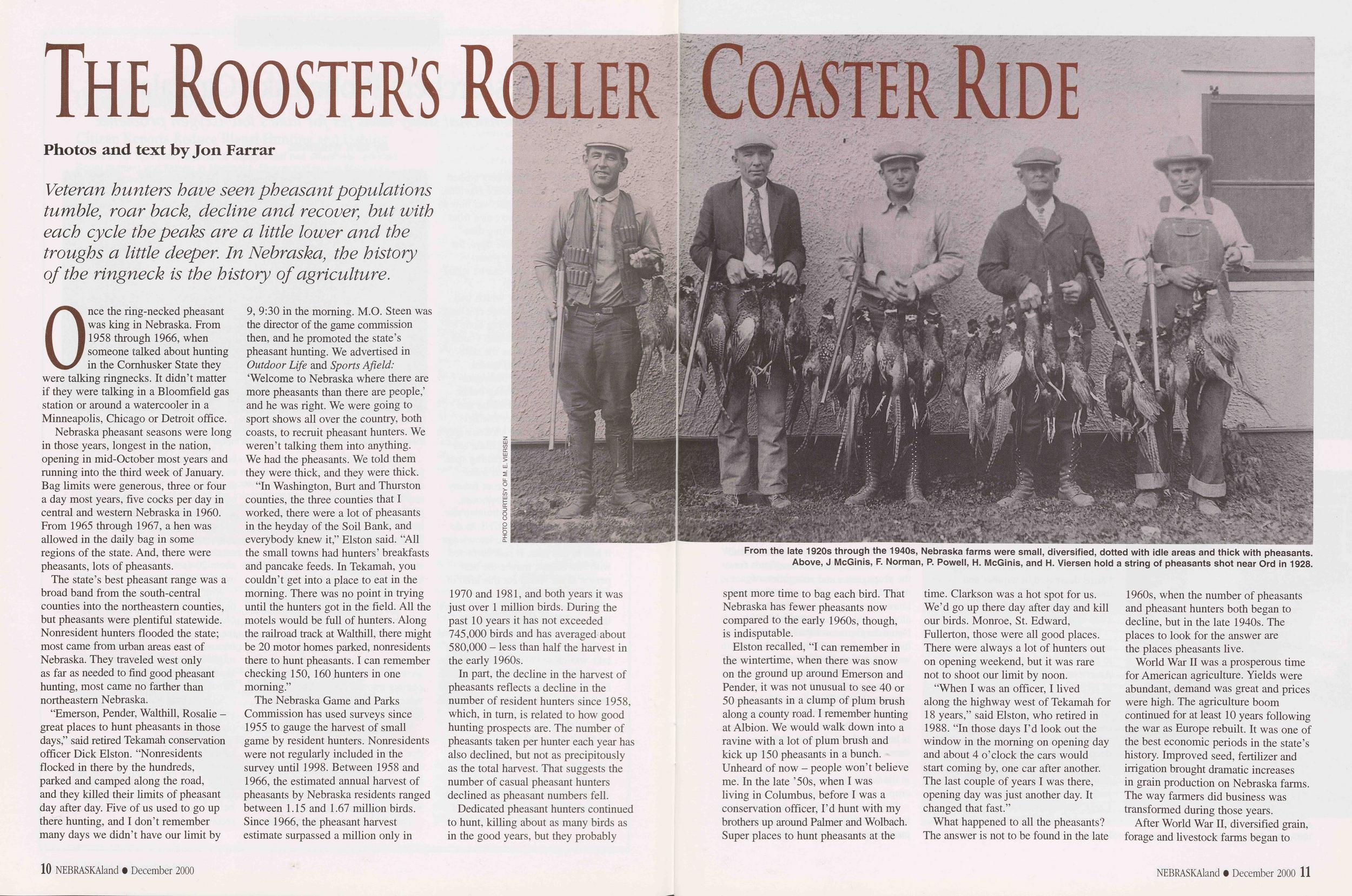
The Rooster's Roller Coaster Ride
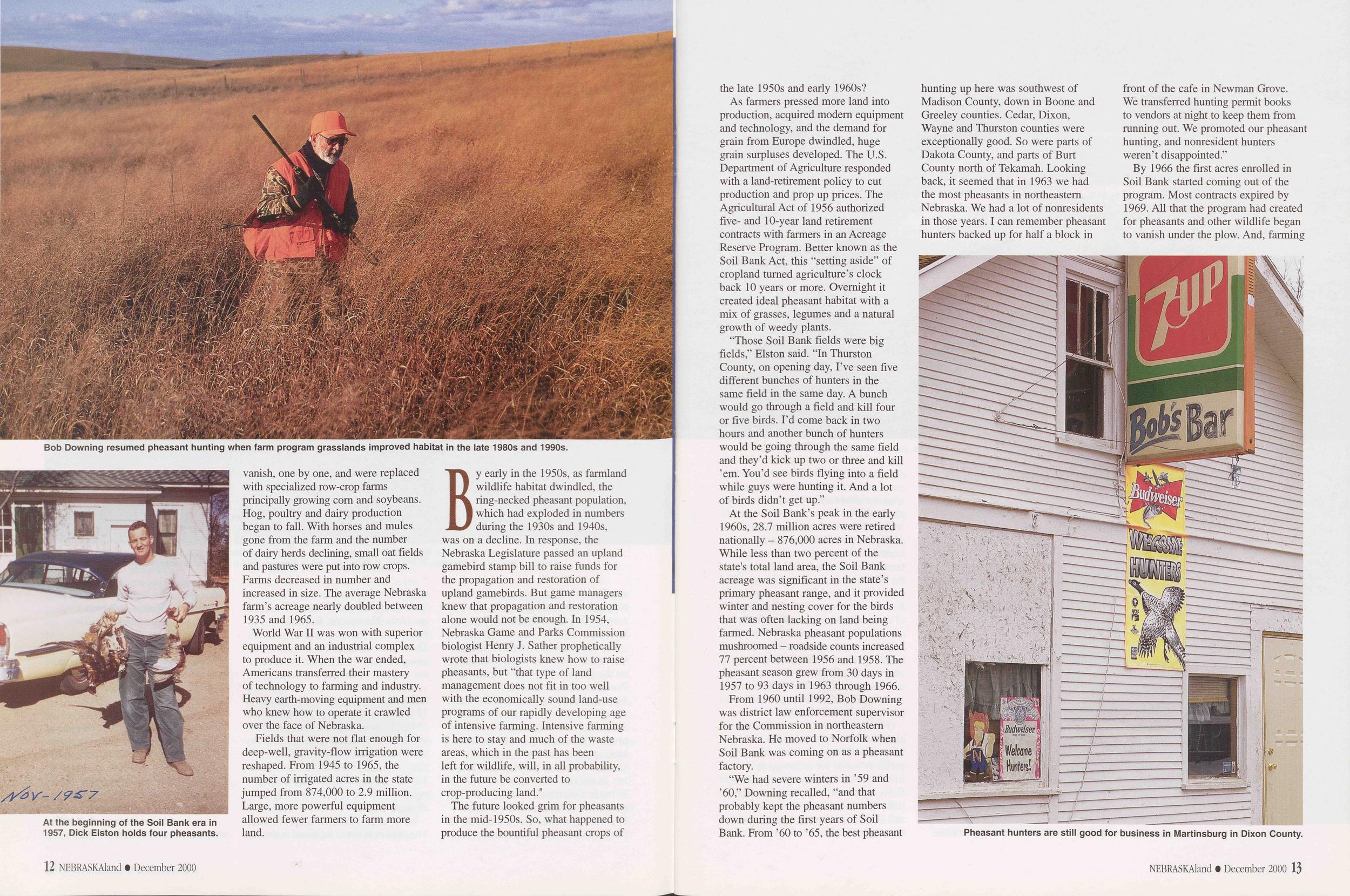
Photos and text by Jon Farrar Veteran hunters have seen pheasant populations tumble, roar back, decline and recover, but with each cycle the peaks are a little lower and the troughs a little deeper. In Nebraska, the history of the ringneck is the history of agriculture.Once the ring-necked pheasant was king in Nebraska. From 1958 through 1966, when someone talked about hunting in the Comhusker State they were talking ringnecks. It didn’t matter if they were talking in a Bloomfield gas station or around a watercooler in a Minneapolis, Chicago or Detroit office.
Nebraska pheasant seasons were long in those years, longest in the nation, opening in mid-October most years and running into the third week of January. Bag limits were generous, three or four a day most years, five cocks per day in central and western Nebraska in 1960. From 1965 through 1967, a hen was allowed in the daily bag in some regions of the state. And, there were pheasants, lots of pheasants.
The state’s best pheasant range was a broad band from the south-central counties into the northeastern counties, but pheasants were plentiful statewide. Nonresident hunters flooded the state; most came from urban areas east of Nebraska. They traveled west only as far as needed to find good pheasant hunting, most came no farther than northeastern Nebraska.
“Emerson, Pender, Walthill, Rosalie - great places to hunt pheasants in those days,” said retired Tekamah conservation officer Dick Elston. “Nonresidents flocked in there by the hundreds, parked and camped along the road, and they killed their limits of pheasant day after day. Five of us used to go up there hunting, and I don’t remember many days we didn’t have our limit by 9, 9:30 in the morning. M.O. Steen was the director of the game commission then, and he promoted the state’s pheasant hunting. We advertised in Outdoor Life and Sports Afield: ‘Welcome to Nebraska where there are more pheasants than there are people,’ and he was right. We were going to sport shows all over the country, both coasts, to recruit pheasant hunters. We weren’t talking them into anything. We had the pheasants. We told them they were thick, and they were thick.
“In Washington, Burt and Thurston counties, the three counties that I worked, there were a lot of pheasants in the heyday of the Soil Bank, and everybody knew it,” Elston said. “All the small towns had hunters’ breakfasts and pancake feeds. In Tekamah, you couldn’t get into a place to eat in the morning. There was no point in trying until the hunters got in the field. All the motels would be full of hunters. Along the railroad track at Walthill, there might be 20 motor homes parked, nonresidents there to hunt pheasants. I can remember checking 150, 160 hunters in one morning.”
The Nebraska Game and Parks Commission has used surveys since 1955 to gauge the harvest of small game by resident hunters. Nonresidents were not regularly included in the survey until 1998. Between 1958 and 1966, the estimated annual harvest of pheasants by Nebraska residents ranged between 1.15 and 1.67 million birds. Since 1966, the pheasant harvest estimate surpassed a million only in 1970 and 1981, and both years it was just over 1 million birds. During the past 10 years it has not exceeded 745,000 birds and has averaged about 580,000 - less than half the harvest in the early 1960s.
In part, the decline in the harvest of pheasants reflects a decline in the number of resident hunters since 1958, which, in turn, is related to how good hunting prospects are. The number of pheasants taken per hunter each year has also declined, but not as precipitously as the total harvest. That suggests the number of casual pheasant hunters declined as pheasant numbers fell.
Dedicated pheasant hunters continued to hunt, killing about as many birds as in the good years, but they probably spent more time to bag each bird. That Nebraska has fewer pheasants now compared to the early 1960s, though, is indisputable.
Elston recalled, “I can remember in the wintertime, when there was snow on the ground up around Emerson and Pender, it was not unusual to see 40 or 50 pheasants in a clump of plum brush along a county road. I remember hunting at Albion. We would walk down into a ravine with a lot of plum brush and kick up 150 pheasants in a bunch. Unheard of now - people won’t believe me. In the late ’50s, when I was living in Columbus, before I was a conservation officer, I’d hunt with my brothers up around Palmer and Wolbach. Super places to hunt pheasants at the time. Clarkson was a hot spot for us. We’d go up there day after day and kill our birds. Monroe, St. Edward, Fullerton, those were all good places. There were always a lot of hunters out on opening weekend, but it was rare not to shoot our limit by noon.
“When I was an officer, I lived along the highway west of Tekamah for 18 years,” said Elston, who retired in 1988. “In those days I’d look out the window in the morning on opening day and about 4 o’clock the cars would start coming by, one car after another. The last couple of years I was there, opening day was just another day. It changed that fast.”
What happened to all the pheasants? The answer is not to be found in the late 1960s, when the number of pheasants and pheasant hunters both began to decline, but in the late 1940s. The places to look for the answer are the places pheasants live.
World War II was a prosperous time for American agriculture. Yields were abundant, demand was great and prices were high. The agriculture boom continued for at least 10 years following the war as Europe rebuilt. It was one of the best economic periods in the state’s history. Improved seed, fertilizer and irrigation brought dramatic increases in grain production on Nebraska farms. The way farmers did business was transformed during those years.
After World War II, diversified grain,
forage and livestock farms began to
10 NEBRASKAland • December 2000
NEBRASKAland • December 2000 11
 vanish, one by one, and were replaced
with specialized row-crop farms
principally growing com and soybeans.
Hog, poultry and dairy production
began to fall. With horses and mules
gone from the farm and the number
of dairy herds declining, small oat fields
and pastures were put into row crops.
Farms decreased in number and
increased in size. The average Nebraska
farm’s acreage nearly doubled between
1935 and 1965.
vanish, one by one, and were replaced
with specialized row-crop farms
principally growing com and soybeans.
Hog, poultry and dairy production
began to fall. With horses and mules
gone from the farm and the number
of dairy herds declining, small oat fields
and pastures were put into row crops.
Farms decreased in number and
increased in size. The average Nebraska
farm’s acreage nearly doubled between
1935 and 1965.
World War II was won with superior equipment and an industrial complex to produce it. When the war ended, Americans transferred their mastery of technology to farming and industry. Heavy earth-moving equipment and men who knew how to operate it crawled over the face of Nebraska.
Fields that were not flat enough for deep-well, gravity-flow irrigation were reshaped. From 1945 to 1965, the number of irrigated acres in the state jumped from 874,000 to 2.9 million. Large, more powerful equipment allowed fewer farmers to farm more land.
By early in the 1950s, as farmland wildlife habitat dwindled, the ring-necked pheasant population, which had exploded in numbers during the 1930s and 1940s, was on a decline. In response, the Nebraska Legislature passed an upland gamebird stamp bill to raise funds for the propagation and restoration of upland gamebirds. But game managers knew that propagation and restoration alone would not be enough. In 1954, Nebraska Game and Parks Commission biologist Henry J. Sather prophetically wrote that biologists knew how to raise pheasants, but "that type of land management does not fit in too well with the economically sound land-use programs of our rapidly developing age of intensive farming. Intensive farming is here to stay and much of the waste areas, which in the past has been left for wildlife, will, in all probability, in the future be converted to crop-producing land."
The future looked grim for pheasants in the mid-1950s. So, what happened to produce the bountiful pheasant crops of the late 1950s and early 1960s?
As farmers pressed more land into production, acquired modem equipment and technology, and the demand for grain from Europe dwindled, huge grain surpluses developed. The U.S. Department of Agriculture responded with a land-retirement policy to cut production and prop up prices. The Agricultural Act of 1956 authorized five- and 10-year land retirement contracts with farmers in an Acreage Reserve Program. Better known as the Soil Bank Act, this “setting aside” of cropland turned agriculture’s clock back 10 years or more. Overnight it created ideal pheasant habitat with a mix of grasses, legumes and a natural growth of weedy plants.
"Those Soil Bank fields were big fields,” Elston said. “In Thurston County, on opening day, I’ve seen five different bunches of hunters in the same field in the same day. A bunch would go through a field and kill four or five birds. I’d come back in two hours and another bunch of hunters would be going through the same field and they’d kick up two or three and kill ’em. You’d see birds flying into a field while guys were hunting it. And a lot of birds didn’t get up.”
At the Soil Bank’s peak in the early 1960s, 28.7 million acres were retired nationally - 876,000 acres in Nebraska. While less than two percent of the state's total land area, the Soil Bank acreage was significant in the state’s primary pheasant range, and it provided winter and nesting cover for the birds that was often lacking on land being farmed. Nebraska pheasant populations mushroomed - roadside counts increased 77 percent between 1956 and 1958. The pheasant season grew from 30 days in 1957 to 93 days in 1963 through 1966.
From 1960 until 1992, Bob Downing was district law enforcement supervisor for the Commission in northeastern Nebraska. He moved to Norfolk when Soil Bank was coming on as a pheasant factory.
“We had severe winters in ’59 and ’60,” Downing recalled, “and that probably kept the pheasant numbers down during the first years of Soil Bank. From ’60 to ’65, the best pheasant hunting up here was southwest of Madison County, down in Boone and Greeley counties. Cedar, Dixon, Wayne and Thurston counties were exceptionally good. So were parts of Dakota County, and parts of Burt County north of Tekamah. Looking back, it seemed that in 1963 we had the most pheasants in northeastern Nebraska. We had a lot of nonresidents in those years. I can remember pheasant hunters backed up for half a block in front of the cafe in Newman Grove. We transferred hunting permit books to vendors at night to keep them from running out. We promoted our pheasant hunting, and nonresident hunters weren’t disappointed.”
By 1966 the first acres enrolled in
Soil Bank started coming out of the
program. Most contracts expired by
1969. All that the program had created
for pheasants and other wildlife began
to vanish under the plow. And, farming
NEBRASKAland • December 2000 13
12 NEBRASKAland • December 2000
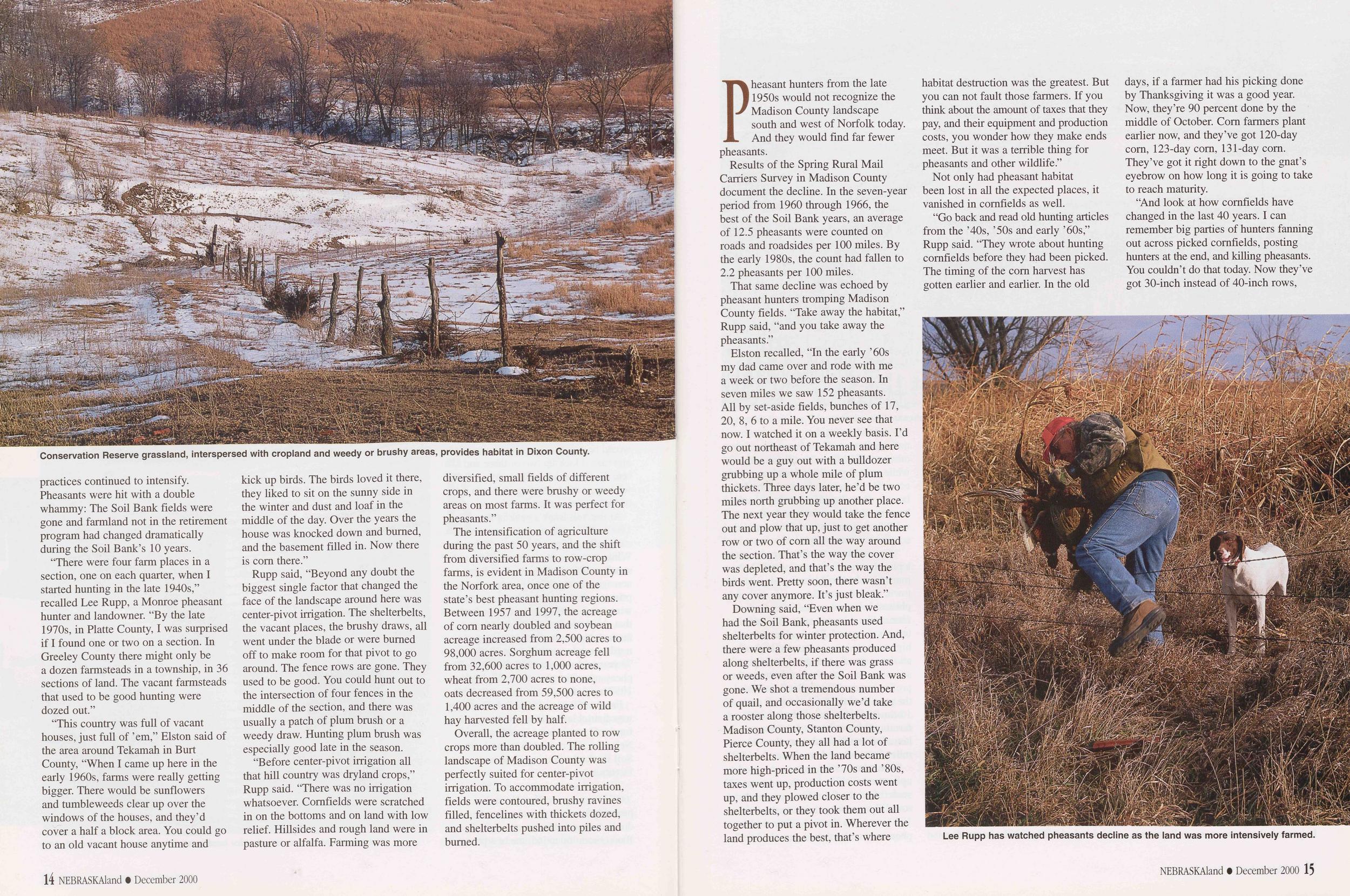 practices continued to intensify.
Pheasants were hit with a double
whammy: The Soil Bank fields were
gone and farmland not in the retirement
program had changed dramatically
during the Soil Bank’s 10 years.
practices continued to intensify.
Pheasants were hit with a double
whammy: The Soil Bank fields were
gone and farmland not in the retirement
program had changed dramatically
during the Soil Bank’s 10 years.
"There were four farm places in a section, one on each quarter, when I started hunting in the late 1940s,” recalled Lee Rupp, a Monroe pheasant hunter and landowner. "By the late 1970s, in Platte County, I was surprised if I found one or two on a section. In Greeley County there might only be a dozen farmsteads in a township, in 36 sections of land. The vacant farmsteads that used to be good hunting were dozed out.”
“This country was full of vacant houses, just full of ’em,” Elston said of the area around Tekamah in Burt County, "When I came up here in the early 1960s, farms were really getting bigger. There would be sunflowers and tumbleweeds clear up over the windows of the houses, and they’d cover a half a block area. You could go to an old vacant house anytime and kick up birds. The birds loved it there, they liked to sit on the sunny side in the winter and dust and loaf in the middle of the day. Over the years the house was knocked down and burned, and the basement filled in. Now there is com there.”
Rupp said, “Beyond any doubt the biggest single factor that changed the face of the landscape around here was center-pivot irrigation. The shelterbelts, the vacant places, the brushy draws, all went under the blade or were burned off to make room for that pivot to go around. The fence rows are gone. They used to be good. You could hunt out to the intersection of four fences in the middle of the section, and there was usually a patch of plum brush or a weedy draw. Hunting plum brush was especially good late in the season.
"Before center-pivot irrigation all that hill country was dryland crops,” Rupp said. "There was no irrigation whatsoever. Cornfields were scratched in on the bottoms and on land with low relief. Hillsides and rough land were in pasture or alfalfa. Farming was more diversified, small fields of different crops, and there were brushy or weedy areas on most farms. It was perfect for pheasants.”
The intensification of agriculture during the past 50 years, and the shift from diversified farms to row-crop farms, is evident in Madison County in the Norfork area, once one of the state’s best pheasant hunting regions. Between 1957 and 1997, the acreage of com nearly doubled and soybean acreage increased from 2,500 acres to 98,000 acres. Sorghum acreage fell from 32,600 acres to 1,000 acres, wheat from 2,700 acres to none, oats decreased from 59,500 acres to 1,400 acres and the acreage of wild hay harvested fell by half.
Overall, the acreage planted to row crops more than doubled. The rolling landscape of Madison County was perfectly suited for center-pivot irrigation. To accommodate irrigation, fields were contoured, brushy ravines filled, fencelines with thickets dozed, and shelterbelts pushed into piles and burned.
Pheasant hunters from the late 1950s would not recognize the Madison County landscape south and west of Norfolk today. And they would find far fewer pheasants.
Results of the Spring Rural Mail Carriers Survey in Madison County document the decline. In the seven-year period from 1960 through 1966, the best of the Soil Bank years, an average of 12.5 pheasants were counted on roads and roadsides per 100 miles. By the early 1980s, the count had fallen to 2.2 pheasants per 100 miles.
That same decline was echoed by pheasant hunters tromping Madison County fields. "Take away the habitat,” Rupp said, "and you take away the pheasants.”
Elston recalled, "In the early ’60s my dad came over and rode with me a week or two before the season. In seven miles we saw 152 pheasants. All by set-aside fields, bunches of 17, 20, 8, 6 to a mile. You never see that now. I watched it on a weekly basis. I’d go out northeast of Tekamah and here would be a guy out with a bulldozer grubbing up a whole mile of plum thickets. Three days later, he’d be two miles north grubbing up another place. The next year they would take the fence out and plow that up, just to get another row or two of com all the way around the section. That’s the way the cover was depleted, and that’s the way the birds went. Pretty soon, there wasn’t any cover anymore. It’s just bleak.”
Downing said, "Even when we had the Soil Bank, pheasants used shelterbelts for winter protection. And, there were a few pheasants produced along shelterbelts, if there was grass or weeds, even after the Soil Bank was gone. We shot a tremendous number of quail, and occasionally we’d take a rooster along those shelterbelts. Madison County, Stanton County, Pierce County, they all had a lot of shelterbelts. When the land became more high-priced in the ’70s and ’80s, taxes went up, production costs went up, and they plowed closer to the shelterbelts, or they took them out all together to put a pivot in. Wherever the land produces the best, that’s where habitat destruction was the greatest. But you can not fault those farmers. If you think about the amount of taxes that they pay, and their equipment and production costs, you wonder how they make ends meet. But it was a terrible thing for pheasants and other wildlife.”
Not only had pheasant habitat been lost in all the expected places, it vanished in cornfields as well.
"Go back and read old hunting articles from the ’40s, ’50s and early ’60s,” Rupp said. “They wrote about hunting cornfields before they had been picked. The timing of the com harvest has gotten earlier and earlier. In the old days, if a farmer had his picking done by Thanksgiving it was a good year. Now, they’re 90 percent done by the middle of October. Com farmers plant earlier now, and they’ve got 120-day com, 123-day com, 131-day com. They’ve got it right down to the gnat’s eyebrow on how long it is going to take to reach maturity.
“And look at how cornfields have
changed in the last 40 years. I can
remember big parties of hunters fanning
out across picked cornfields, posting
hunters at the end, and killing pheasants.
You couldn’t do that today. Now they’ve
got 30-inch instead of 40-inch rows,
14 NEBRASKAland • December 2000
NEBRASKAland • December 2000 15
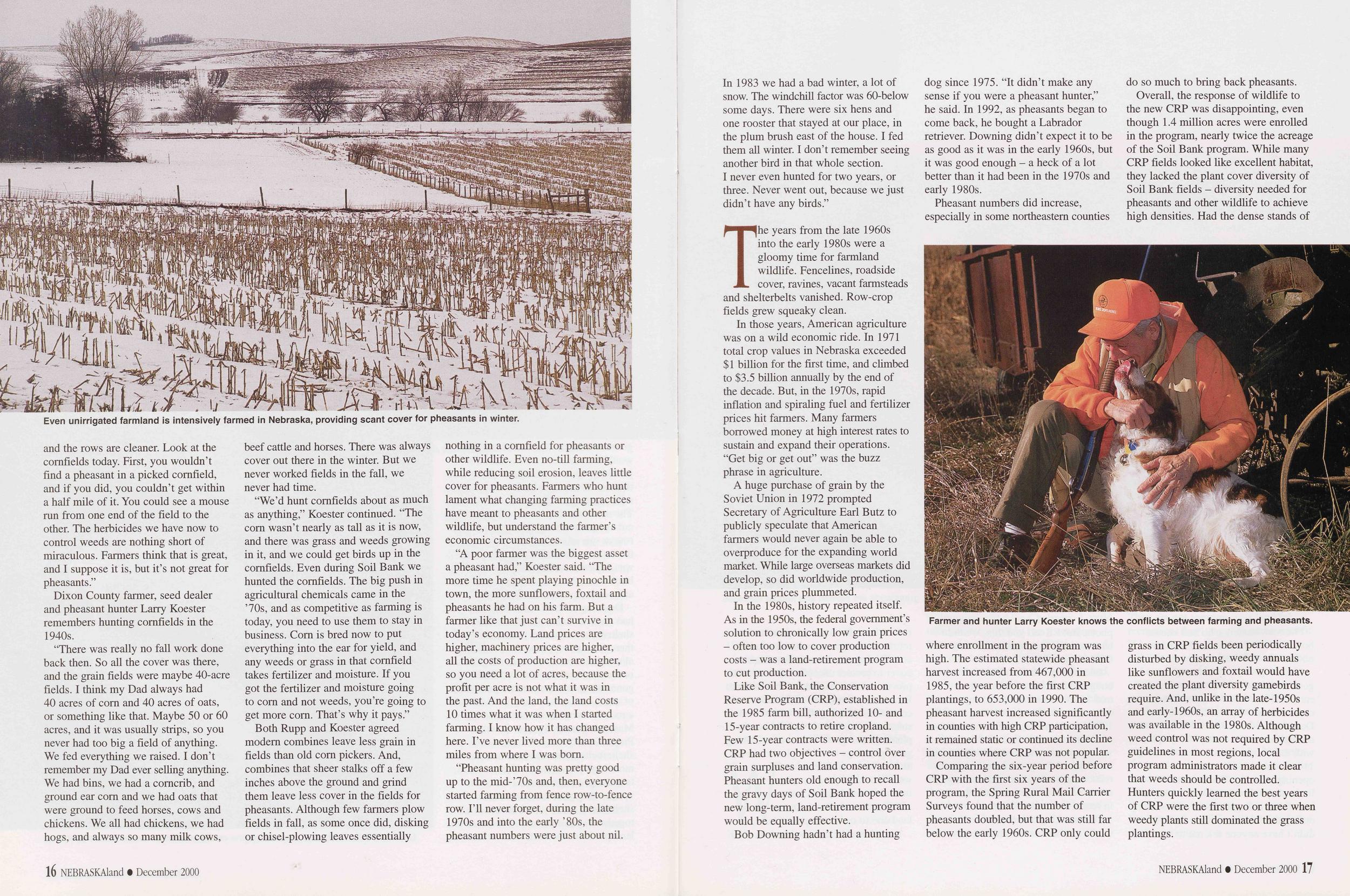 and the rows are cleaner. Look at the
cornfields today. First, you wouldn’t
find a pheasant in a picked cornfield,
and if you did, you couldn’t get within
a half mile of it. You could see a mouse
run from one end of the field to the
other. The herbicides we have now to
control weeds are nothing short of
miraculous. Farmers think that is great,
and I suppose it is, but it’s not great for
pheasants.”
and the rows are cleaner. Look at the
cornfields today. First, you wouldn’t
find a pheasant in a picked cornfield,
and if you did, you couldn’t get within
a half mile of it. You could see a mouse
run from one end of the field to the
other. The herbicides we have now to
control weeds are nothing short of
miraculous. Farmers think that is great,
and I suppose it is, but it’s not great for
pheasants.”
Dixon County farmer, seed dealer and pheasant hunter Larry Koester remembers hunting cornfields in the 1940s.
“There was really no fall work done back then. So all the cover was there, and the grain fields were maybe 40-acre fields. I think my Dad always had 40 acres of com and 40 acres of oats, or something like that. Maybe 50 or 60 acres, and it was usually strips, so you never had too big a field of anything. We fed everything we raised. I don’t remember my Dad ever selfing anything. We had bins, we had a comcrib, and ground ear com and we had oats that were ground to feed horses, cows and chickens. We all had chickens, we had hogs, and always so many milk cows, beef cattle and horses. There was always cover out there in the winter. But we never worked fields in the fall, we never had time.
“We’d hunt cornfields about as much as anything,” Koester continued. “The com wasn’t nearly as tall as it is now, and there was grass and weeds growing in it, and we could get birds up in the cornfields. Even during Soil Bank we hunted the cornfields. The big push in agricultural chemicals came in the ’70s, and as competitive as farming is today, you need to use them to stay in business. Com is bred now to put everything into the ear for yield, and any weeds or grass in that cornfield takes fertilizer and moisture. If you got the fertilizer and moisture going to com and not weeds, you’re going to get more com. That’s why it pays.”
Both Rupp and Koester agreed modem combines leave less grain in fields than old com pickers. And, combines that sheer stalks off a few inches above the ground and grind them leave less cover in the fields for pheasants. Although few farmers plow fields in fall, as some once did, disking or chisel-plowing leaves essentially nothing in a cornfield for pheasants or other wildlife. Even no-till farming, while reducing soil erosion, leaves little cover for pheasants. Farmers who hunt lament what changing farming practices have meant to pheasants and other wildlife, but understand the farmer’s economic circumstances.
“A poor farmer was the biggest asset a pheasant had,” Koester said. “The more time he spent playing pinochle in town, the more sunflowers, foxtail and pheasants he had on his farm. But a farmer like that just can’t survive in today’s economy. Land prices are higher, machinery prices are higher, all the costs of production are higher, so you need a lot of acres, because the profit per acre is not what it was in the past. And the land, the land costs 10 times what it was when I started farming. I know how it has changed here. I’ve never lived more than three miles from where I was bom.
“Pheasant hunting was pretty good up to the mid-’70s and, then, everyone started farming from fence row-to-fence row. I’ll never forget, during the late 1970s and into the early ’80s, the pheasant numbers were just about nil. In 1983 we had a bad winter, a lot of snow. The windchill factor was 60-below some days. There were six hens and one rooster that stayed at our place, in the plum brush east of the house. I fed them all winter. I don’t remember seeing another bird in that whole section. I never even hunted for two years, or three. Never went out, because we just didn’t have any birds.”
The years from the late 1960s into the early 1980s were a gloomy time for farmland wildlife. Fencelines, roadside cover, ravines, vacant farmsteads and shelterbelts vanished. Row-crop fields grew squeaky clean.
In those years, American agriculture was on a wild economic ride. In 1971 total crop values in Nebraska exceeded $1 billion for the first time, and climbed to $3.5 billion annually by the end of the decade. But, in the 1970s, rapid inflation and spiraling fuel and fertilizer prices hit farmers. Many farmers borrowed money at high interest rates to sustain and expand their operations. “Get big or get out” was the buzz phrase in agriculture.
A huge purchase of grain by the Soviet Union in 1972 prompted Secretary of Agriculture Earl Butz to publicly speculate that American farmers would never again be able to overproduce for the expanding world market. While large overseas markets did develop, so did worldwide production, and grain prices plummeted.
In the 1980s, history repeated itself. As in the 1950s, the federal government’s solution to chronically low grain prices - often too low to cover production costs - was a land-retirement program to cut production.
Like Soil Bank, the Conservation Reserve Program (CRP), established in the 1985 farm bill, authorized 10- and 15-year contracts to retire cropland. Few 15-year contracts were written. CRP had two objectives - control over grain surpluses and land conservation. Pheasant hunters old enough to recall the gravy days of Soil Bank hoped the new long-term, land-retirement program would be equally effective.
Bob Downing hadn’t had a hunting dog since 1975. “It didn’t make any sense if you were a pheasant hunter,” he said. In 1992, as pheasants began to come back, he bought a Labrador retriever. Downing didn’t expect it to be as good as it was in the early 1960s, but it was good enough - a heck of a lot better than it had been in the 1970s and early 1980s.
Pheasant numbers did increase, especially in some northeastern counties where enrollment in the program was high. The estimated statewide pheasant harvest increased from 467,000 in 1985, the year before the first CRP plantings, to 653,000 in 1990. The pheasant harvest increased significantly in counties with high CRP participation, it remained static or continued its decline in counties where CRP was not popular.
Comparing the six-year period before CRP with the first six years of the program, the Spring Rural Mail Carrier Surveys found that the number of pheasants doubled, but that was still far below the early 1960s. CRP only could do so much to bring back pheasants.
Overall, the response of wildlife to the new CRP was disappointing, even though 1.4 million acres were enrolled in the program, nearly twice the acreage of the Soil Bank program. While many CRP fields looked like excellent habitat, they lacked the plant cover diversity of Soil Bank fields - diversity needed for pheasants and other wildlife to achieve high densities. Had the dense stands of grass in CRP fields been periodically disturbed by disking, weedy annuals like sunflowers and foxtail would have created the plant diversity gamebirds require. And, unlike in the late-1950s and early-1960s, an array of herbicides was available in the 1980s. Although weed control was not required by CRP guidelines in most regions, local program administrators made it clear that weeds should be controlled. Hunters quickly learned the best years of CRP were the first two or three when weedy plants still dominated the grass plantings.
16 NEBRASKAland • December 2000 NEBRASKAland • December 2000 17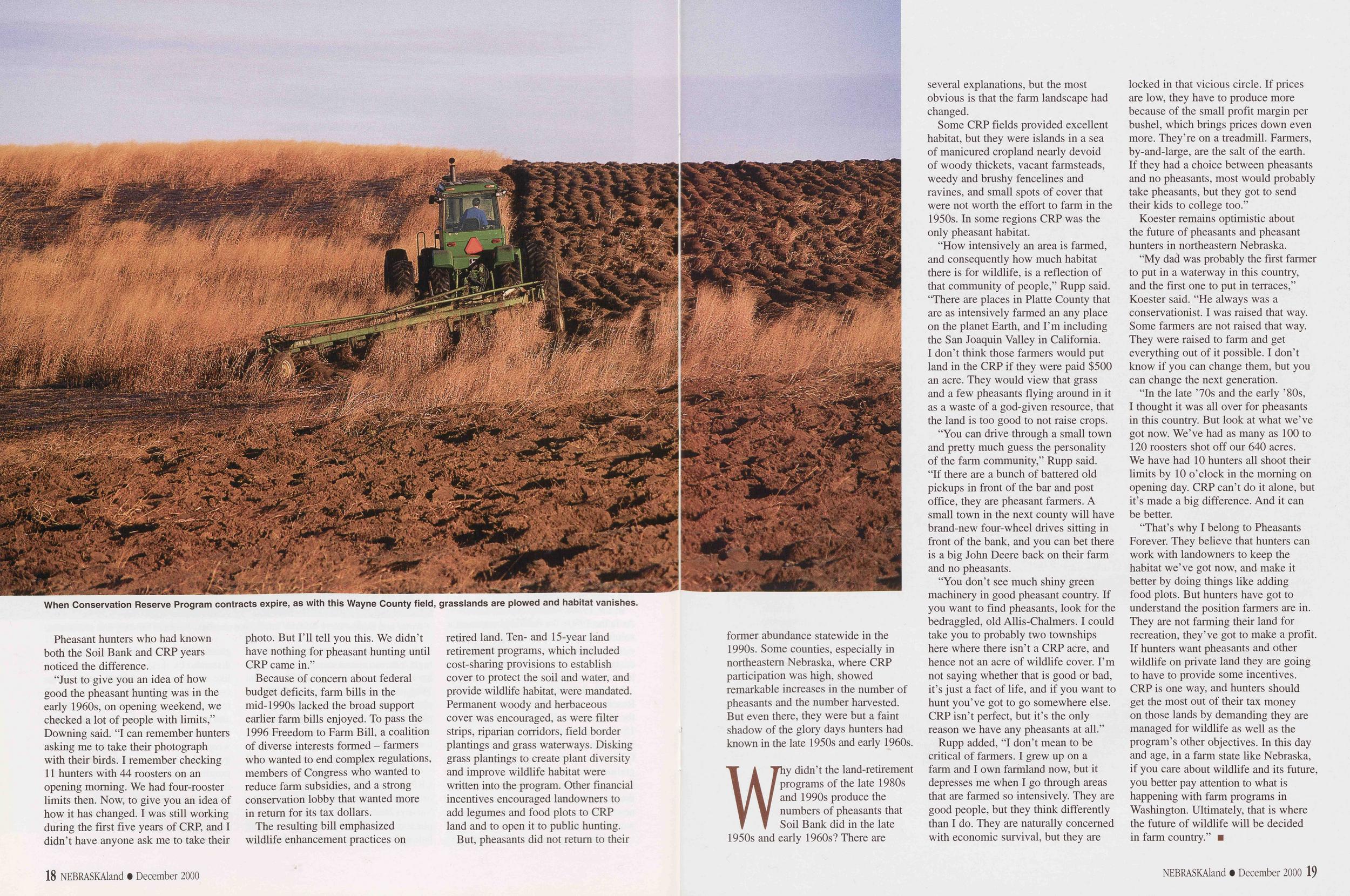
Pheasant hunters who had known both the Soil Bank and CRP years noticed the difference.
“Just to give you an idea of how good the pheasant hunting was in the early 1960s, on opening weekend, we checked a lot of people with limits,” Downing said. "I can remember hunters asking me to take their photograph with their birds. I remember checking 11 hunters with 44 roosters on an opening morning. We had four-rooster limits then. Now, to give you an idea of how it has changed. I was still working during the first five years of CRP, and I didn’t have anyone ask me to take their photo. But I’ll tell you this. We didn’t have nothing for pheasant hunting until CRP came in.”
Because of concern about federal budget deficits, farm bills in the mid-1990s lacked the broad support earlier farm bills enjoyed. To pass the 1996 Freedom to Farm Bill, a coalition of diverse interests formed - farmers who wanted to end complex regulations, members of Congress who wanted to reduce farm subsidies, and a strong conservation lobby that wanted more in return for its tax dollars.
The resulting bill emphasized wildlife enhancement practices on retired land. Ten- and 15-year land retirement programs, which included cost-sharing provisions to establish cover to protect the soil and water, and provide wildlife habitat, were mandated. Permanent woody and herbaceous cover was encouraged, as were filter strips, riparian corridors, field border plantings and grass waterways. Disking grass plantings to create plant diversity and improve wildlife habitat were written into the program. Other financial incentives encouraged landowners to add legumes and food plots to CRP land and to open it to public hunting.
But, pheasants did not return to their former abundance statewide in the 1990s. Some counties, especially in northeastern Nebraska, where CRP participation was high, showed remarkable increases in the number of pheasants and the number harvested. But even there, they were but a faint shadow of the glory days hunters had known in the late 1950s and early 1960s.
Why didn’t the land-retirement programs of the late 1980s and 1990s produce the numbers of pheasants that Soil Bank did in the late 1950s and early 1960s? There are several explanations, but the most obvious is that the farm landscape had changed.
Some CRP fields provided excellent habitat, but they were islands in a sea of manicured cropland nearly devoid of woody thickets, vacant farmsteads, weedy and brushy fencelines and ravines, and small spots of cover that were not worth the effort to farm in the 1950s. In some regions CRP was the only pheasant habitat.
“How intensively an area is farmed, and consequently how much habitat there is for wildlife, is a reflection of that community of people,” Rupp said. “There are places in Platte County that are as intensively farmed an any place on the planet Earth, and I’m including the San Joaquin Valley in California. I don’t think those farmers would put land in the CRP if they were paid $500 an acre. They would view that grass and a few pheasants flying around in it as a waste of a god-given resource, that the land is too good to not raise crops.
“You can drive through a small town and pretty much guess the personality of the farm community,” Rupp said. “If there are a bunch of battered old pickups in front of the bar and post office, they are pheasant farmers. A small town in the next county will have brand-new four-wheel drives sitting in front of the bank, and you can bet there is a big John Deere back on their farm and no pheasants.
“You don’t see much shiny green machinery in good pheasant country. If you want to find pheasants, look for the bedraggled, old Allis-Chalmers. I could take you to probably two townships here where there isn’t a CRP acre, and hence not an acre of wildlife cover. I’m not saying whether that is good or bad, it’s just a fact of life, and if you want to hunt you’ve got to go somewhere else. CRP isn’t perfect, but it’s the only reason we have any pheasants at all.”
Rupp added, “I don’t mean to be critical of farmers. I grew up on a farm and I own farmland now, but it depresses me when I go through areas that are farmed so intensively. They are good people, but they think differently than I do. They are naturally concerned with economic survival, but they are locked in that vicious circle. If prices are low, they have to produce more because of the small profit margin per bushel, which brings prices down even more. They’re on a treadmill. Farmers, by-and-large, are the salt of the earth. If they had a choice between pheasants and no pheasants, most would probably take pheasants, but they got to send their kids to college too.”
Koester remains optimistic about the future of pheasants and pheasant hunters in northeastern Nebraska.
“My dad was probably the first farmer to put in a waterway in this country, and the first one to put in terraces,” Koester said. “He always was a conservationist. I was raised that way. Some farmers are not raised that way. They were raised to farm and get everything out of it possible. I don’t know if you can change them, but you can change the next generation.
“In the late ’70s and the early ’80s, I thought it was all over for pheasants in this country. But look at what we’ve got now. We’ve had as many as 100 to 120 roosters shot off our 640 acres. We have had 10 hunters all shoot their limits by 10 o’clock in the morning on opening day. CRP can’t do it alone, but it’s made a big difference. And it can be better.
“That’s why I belong to Pheasants Forever. They believe that hunters can work with landowners to keep the habitat we’ve got now, and make it better by doing things like adding food plots. But hunters have got to understand the position farmers are in. They are not farming their land for recreation, they’ve got to make a profit. If hunters want pheasants and other wildlife on private land they are going to have to provide some incentives. CRP is one way, and hunters should get the most out of their tax money on those lands by demanding they are managed for wildlife as well as the program’s other objectives. In this day and age, in a farm state like Nebraska, if you care about wildlife and its future, you better pay attention to what is happening with farm programs in Washington. Ultimately, that is where the future of wildlife will be decided in farm country.” ■
18 NEBRASKAland • December 2000 NEBRASKAland • December 2000 19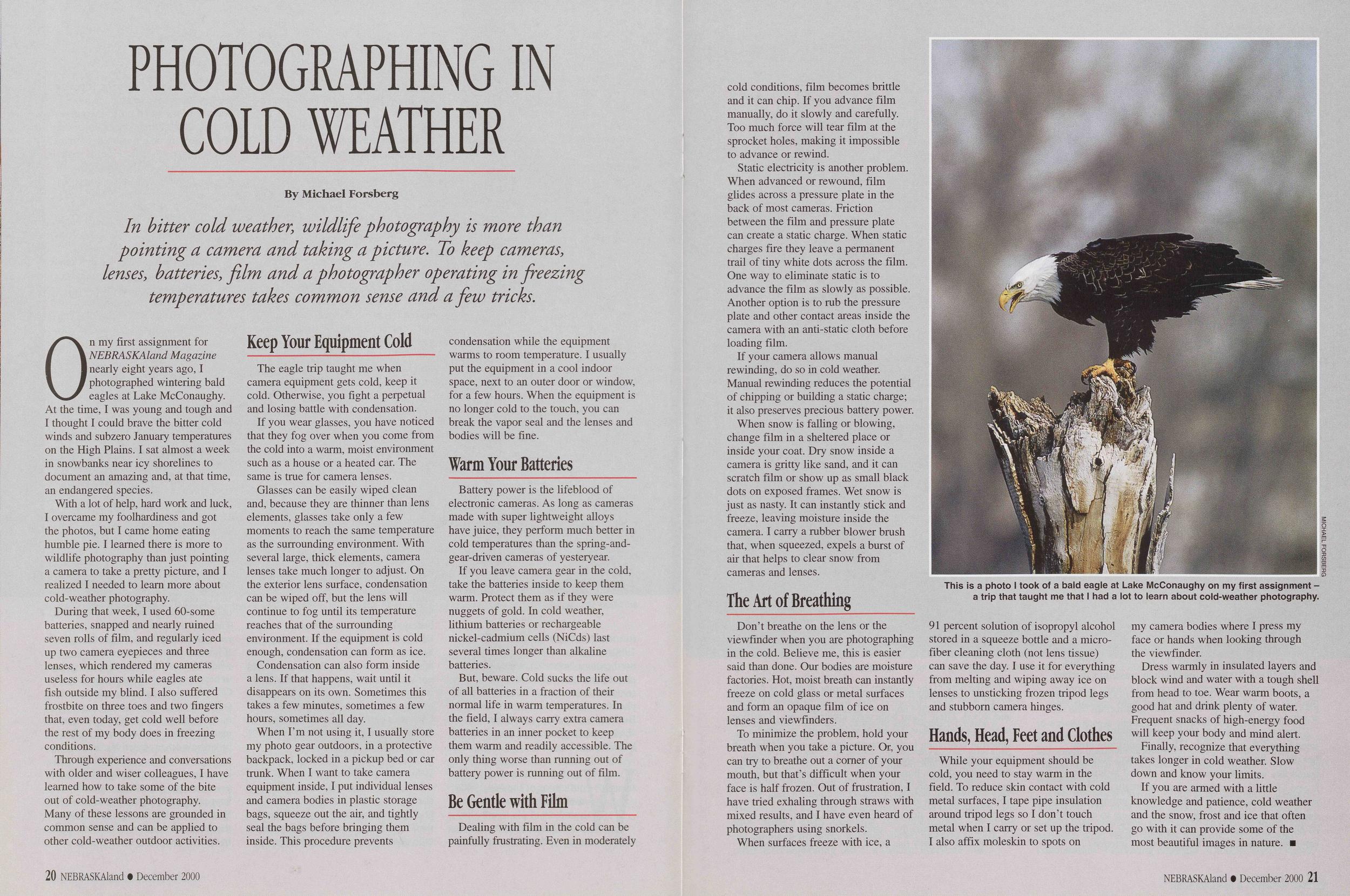
PHOTOGRAPHING IN COLD WEATHER
By Michael Forsberg In bitter cold weather, wildlife photography is more than pointing a camera and taking a picture. To keep cameras, lenses, batteries, fdm and a photographer operating in freezing temperatures takes common sense and a few tricks.On my first assignment for NEBRASKAland Magazine nearly eight years ago, I photographed wintering bald eagles at Lake McConaughy. At the time, I was young and tough and I thought I could brave the bitter cold winds and subzero January temperatures on the High Plains. I sat almost a week in snowbanks near icy shorelines to document an amazing and, at that time, an endangered species.
With a lot of help, hard work and luck, I overcame my foolhardiness and got the photos, but I came home eating humble pie. I learned there is more to wildlife photography than just pointing a camera to take a pretty picture, and I realized I needed to learn more about cold-weather photography.
During that week, I used 60-some batteries, snapped and nearly ruined seven rolls of film, and regularly iced up two camera eyepieces and three lenses, which rendered my cameras useless for hours while eagles ate fish outside my blind. I also suffered frostbite on three toes and two fingers that, even today, get cold well before the rest of my body does in freezing conditions.
Through experience and conversations with older and wiser colleagues, I have learned how to take some of the bite out of cold-weather photography. Many of these lessons are grounded in common sense and can be applied to other cold-weather outdoor activities.
Keep Your Equipment ColdThe eagle trip taught me when camera equipment gets cold, keep it cold. Otherwise, you fight a perpetual and losing battle with condensation.
If you wear glasses, you have noticed that they fog over when you come from the cold into a warm, moist environment such as a house or a heated car. The same is true for camera lenses.
Glasses can be easily wiped clean and, because they are thinner than lens elements, glasses take only a few moments to reach the same temperature as the surrounding environment. With several large, thick elements, camera lenses take much longer to adjust. On the exterior lens surface, condensation can be wiped off, but the lens will continue to fog until its temperature reaches that of the surrounding environment. If the equipment is cold enough, condensation can form as ice.
Condensation can also form inside a lens. If that happens, wait until it disappears on its own. Sometimes this takes a few minutes, sometimes a few hours, sometimes all day.
When I’m not using it, I usually store my photo gear outdoors, in a protective backpack, locked in a pickup bed or car trunk. When I want to take camera equipment inside, I put individual lenses and camera bodies in plastic storage bags, squeeze out the air, and tightly seal the bags before bringing them inside. This procedure prevents condensation while the equipment warms to room temperature. I usually put the equipment in a cool indoor space, next to an outer door or window, for a few hours. When the equipment is no longer cold to the touch, you can break the vapor seal and the lenses and bodies will be fine.
Warm Your BatteriesBattery power is the lifeblood of electronic cameras. As long as cameras made with super lightweight alloys have juice, they perform much better in cold temperatures than the spring-and- gear-driven cameras of yesteryear.
If you leave camera gear in the cold, take the batteries inside to keep them warm. Protect them as if they were nuggets of gold. In cold weather, lithium batteries or rechargeable nickel-cadmium cells (NiCds) last several times longer than alkaline batteries.
But, beware. Cold sucks the life out of all batteries in a fraction of their normal life in warm temperatures. In the field, I always carry extra camera batteries in an inner pocket to keep them warm and readily accessible. The only thing worse than running out of battery power is running out of film.
Be Gentle with FilmDealing with film in the cold can be painfully frustrating. Even in moderately cold conditions, film becomes brittle and it can chip. If you advance film manually, do it slowly and carefully. Too much force will tear film at the sprocket holes, making it impossible to advance or rewind.
Static electricity is another problem. When advanced or rewound, film glides across a pressure plate in the back of most cameras. Friction between the film and pressure plate can create a static charge. When static charges fire they leave a permanent trail of tiny white dots across the film. One way to eliminate static is to advance the film as slowly as possible. Another option is to rub the pressure plate and other contact areas inside the camera with an anti-static cloth before loading film.
If your camera allows manual rewinding, do so in cold weather. Manual rewinding reduces the potential of chipping or building a static charge; it also preserves precious battery power.
When snow is falling or blowing, change film in a sheltered place or inside your coat. Dry snow inside a camera is gritty like sand, and it can scratch film or show up as small black dots on exposed frames. Wet snow is just as nasty. It can instantly stick and freeze, leaving moisture inside the camera. I carry a rubber blower brush that, when squeezed, expels a burst of air that helps to clear snow from cameras and lenses.
The Art of BreathingDon’t breathe on the lens or the viewfinder when you are photographing in the cold. Believe me, this is easier said than done. Our bodies are moisture factories. Hot, moist breath can instantly freeze on cold glass or metal surfaces and form an opaque film of ice on lenses and viewfinders.
To minimize the problem, hold your breath when you take a picture. Or, you can try to breathe out a comer of your mouth, but that’s difficult when your face is half frozen. Out of frustration, I have tried exhaling through straws with mixed results, and I have even heard of photographers using snorkels.
When surfaces freeze with ice, a 91 percent solution of isopropyl alcohol stored in a squeeze bottle and a micro- fiber cleaning cloth (not lens tissue) can save the day. I use it for everything from melting and wiping away ice on lenses to unsticking frozen tripod legs and stubborn camera hinges.
Hands, Head, Feet and ClothesWhile your equipment should be cold, you need to stay warm in the field. To reduce skin contact with cold metal surfaces, I tape pipe insulation around tripod legs so I don’t touch metal when I carry or set up the tripod. I also affix moleskin to spots on my camera bodies where I press my face or hands when looking through the viewfinder.
Dress warmly in insulated layers and block wind and water with a tough shell from head to toe. Wear warm boots, a good hat and drink plenty of water. Frequent snacks of high-energy food will keep your body and mind alert.
Finally, recognize that everything takes longer in cold weather. Slow down and know your limits.
If you are armed with a little knowledge and patience, cold weather and the snow, frost and ice that often go with it can provide some of the most beautiful images in nature. ■
20 NEBRASKAland • December 2000 NEBRASKAland • December 2000 21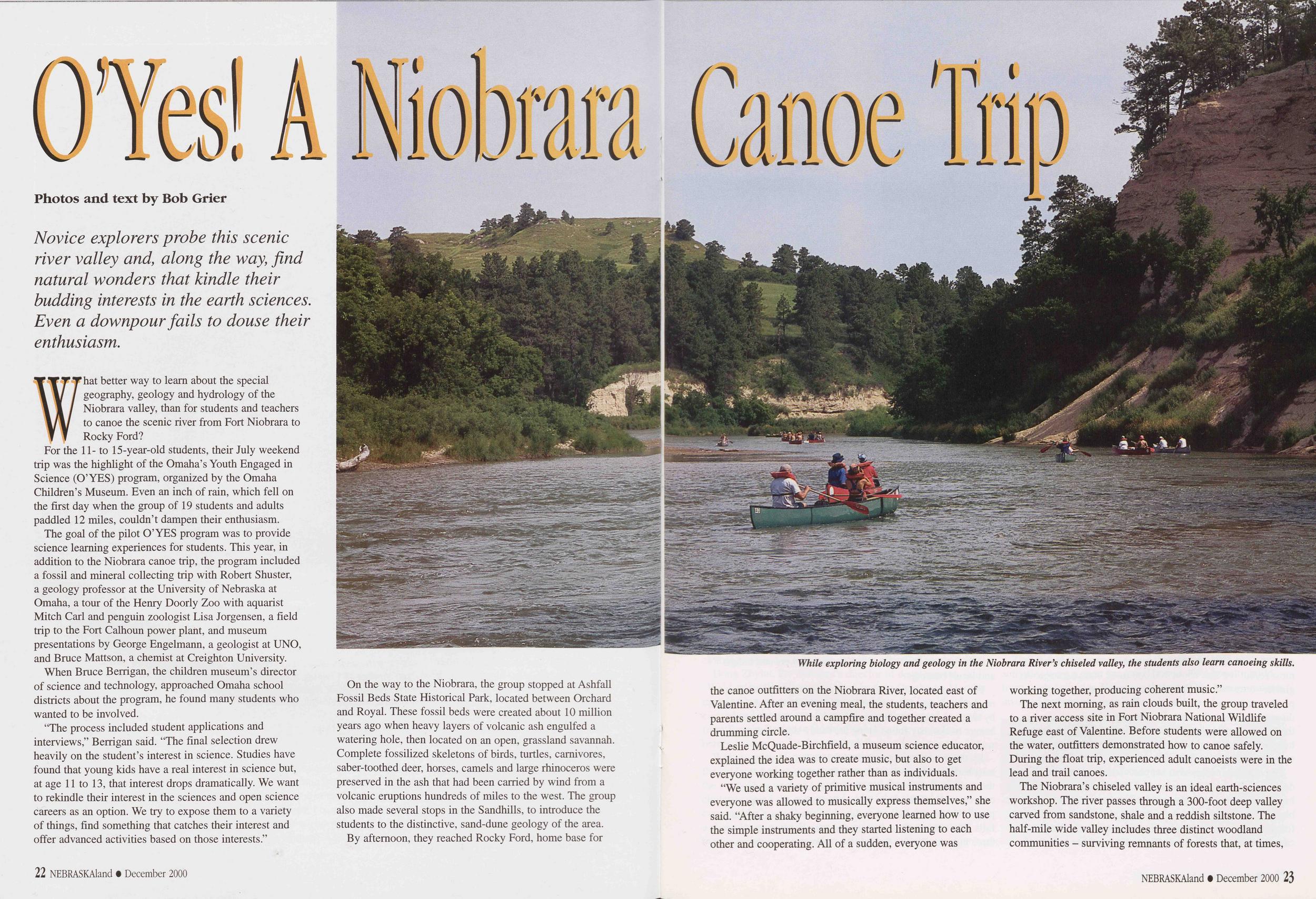
O'Yes! A Niobrara Canoe Trip
Photos and text by Bob Grier Novice explorers probe this scenic river valley and, along the way, find natural wonders that kindle their budding interests in the earth sciences. Even a downpour fails to douse their enthusiasm.What better way to learn about the special geography, geology and hydrology of the Niobrara valley, than for students and teachers to canoe the scenic river from Fort Niobrara to Rocky Ford?
For the 11- to 15-year-old students, their July weekend trip was the highlight of the Omaha’s Youth Engaged in Science (O’YES) program, organized by the Omaha Children’s Museum. Even an inch of rain, which fell on the first day when the group of 19 students and adults paddled 12 miles, couldn’t dampen their enthusiasm.
The goal of the pilot O’YES program was to provide science learning experiences for students. This year, in addition to the Niobrara canoe trip, the program included a fossil and mineral collecting trip with Robert Shuster, a geology professor at the University of Nebraska at Omaha, a tour of the Henry Doorly Zoo with aquarist Mitch Carl and penguin zoologist Lisa Jorgensen, a field trip to the Fort Calhoun power plant, and museum presentations by George Engelmann, a geologist at UNO, and Bruce Mattson, a chemist at Creighton University.
When Bruce Berrigan, the children museum’s director of science and technology, approached Omaha school districts about the program, he found many students who wanted to be involved.
"The process included student applications and interviews,” Berrigan said. “The final selection drew heavily on the student’s interest in science. Studies have found that young kids have a real interest in science but, at age 11 to 13, that interest drops dramatically. We want to rekindle their interest in the sciences and open science careers as an option. We try to expose them to a variety of things, find something that catches their interest and offer advanced activities based on those interests.”
On the way to the Niobrara, the group stopped at Ashfall Fossil Beds State Historical Park, located between Orchard and Royal. These fossil beds were created about 10 million years ago when heavy layers of volcanic ash engulfed a watering hole, then located on an open, grassland savannah. Complete fossilized skeletons of birds, turtles, carnivores, saber-toothed deer, horses, camels and large rhinoceros were preserved in the ash that had been carried by wind from a volcanic eruptions hundreds of miles to the west. The group also made several stops in the Sandhills, to introduce the students to the distinctive, sand-dune geology of the area.
By afternoon, they reached Rocky Ford, home base for the canoe outfitters on the Niobrara River, located east of Valentine. After an evening meal, the students, teachers and parents settled around a campfire and together created a drumming circle.
Leslie McQuade-Birchfield, a museum science educator, explained the idea was to create music, but also to get everyone working together rather than as individuals.
“We used a variety of primitive musical instruments and everyone was allowed to musically express themselves,” she said. “After a shaky beginning, everyone learned how to use the simple instruments and they started listening to each other and cooperating. All of a sudden, everyone was working together, producing coherent music.”
The next morning, as rain clouds built, the group traveled to a river access site in Fort Niobrara National Wildlife Refuge east of Valentine. Before students were allowed on the water, outfitters demonstrated how to canoe safely. During the float trip, experienced adult canoeists were in the lead and trail canoes.
The Niobrara’s chiseled valley is an ideal earth-sciences
workshop. The river passes through a 300-foot deep valley
carved from sandstone, shale and a reddish siltstone. The
half-mile wide valley includes three distinct woodland
communities - surviving remnants of forests that, at times,
22 NEBRASKAland • December 2000
NEBRASKAland • December 2000 23
 have covered the northern plains.
Paper birch trees on the river’s southern bluffs and along canyons carved by spring-fed streams are survivors from the most recent ice age, about 100,000 to 12,000 years ago. As glaciers retreated and the climate warmed, many northern plants and animals, such as the white spruce and musk ox, disappeared from the area. But the paper birch remained in the Niobrara valley, isolated by prairie from other populations hundreds of miles to the north. Today, the nearest paper birch stand to the valley is in the Black Hills of South Dakota.
The Niobrara valley also supports stands of eastern deciduous forest with species such as bur oak, green ash, basswood, American elm and black walnut. A hybrid of the big-toothed aspen, an eastern species, and the quaking aspen, found throughout the western mountains, is at home in a canyon adjacent to the river. The valley also has a zone of overlapping habitats that support several hybrids of eastern and western bird species, including Baltimore and Bullock’s orioles, yellow-shafted and red-shafted flickers and indigo and lazuli buntings.
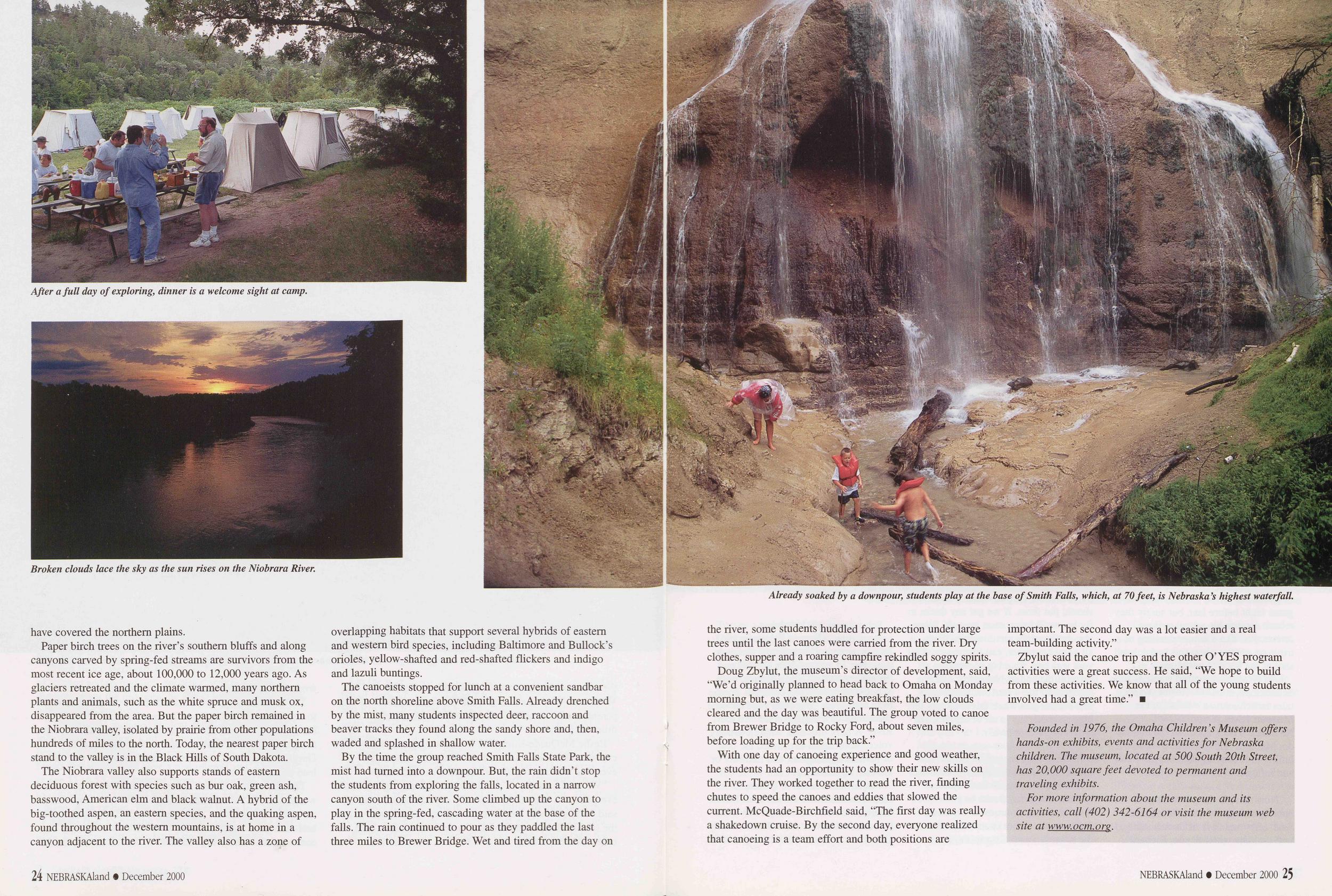
The canoeists stopped for lunch at a convenient sandbar on the north shoreline above Smith Falls. Already drenched by the mist, many students inspected deer, raccoon and beaver tracks they found along the sandy shore and, then, waded and splashed in shallow water.
By the time the group reached Smith Falls State Park, the mist had turned into a downpour. But, the rain didn’t stop the students from exploring the falls, located in a narrow canyon south of the river. Some climbed up the canyon to play in the spring-fed, cascading water at the base of the falls. The rain continued to pour as they paddled the last three miles to Brewer Bridge. Wet and tired from the day on the river, some students huddled for protection under large trees until the last canoes were carried from the river. Dry clothes, supper and a roaring campfire rekindled soggy spirits.
Doug Zbylut, the museum’s director of development, said, “We’d originally planned to head back to Omaha on Monday morning but, as we were eating breakfast, the low clouds cleared and the day was beautiful. The group voted to canoe from Brewer Bridge to Rocky Ford, about seven miles, before loading up for the trip back.”
With one day of canoeing experience and good weather, the students had an opportunity to show their new skills on the river. They worked together to read the river, finding chutes to speed the canoes and eddies that slowed the current. McQuade-Birchfield said, “The first day was really a shakedown cruise. By the second day, everyone realized that canoeing is a team effort and both positions are important. The second day was a lot easier and a real team-building activity.”
Zbylut said the canoe trip and the other O’YES program activities were a great success. He said, “We hope to build from these activities. We know that all of the young students involved had a great time.” ■
Founded in 1976, the Omaha Children's Museum offers hands-on exhibits, events and activities for Nebraska children. The museum, located at 500 South 20th Street, has 20,000 square feet devoted to permanent and traveling exhibits.
For more information about the museum and its activities, call (402) 342-6164 or visit the museum web site at www.ocm.org.
24 NEBRASKAland O December 2000 NEBRASKAland • December 2000 25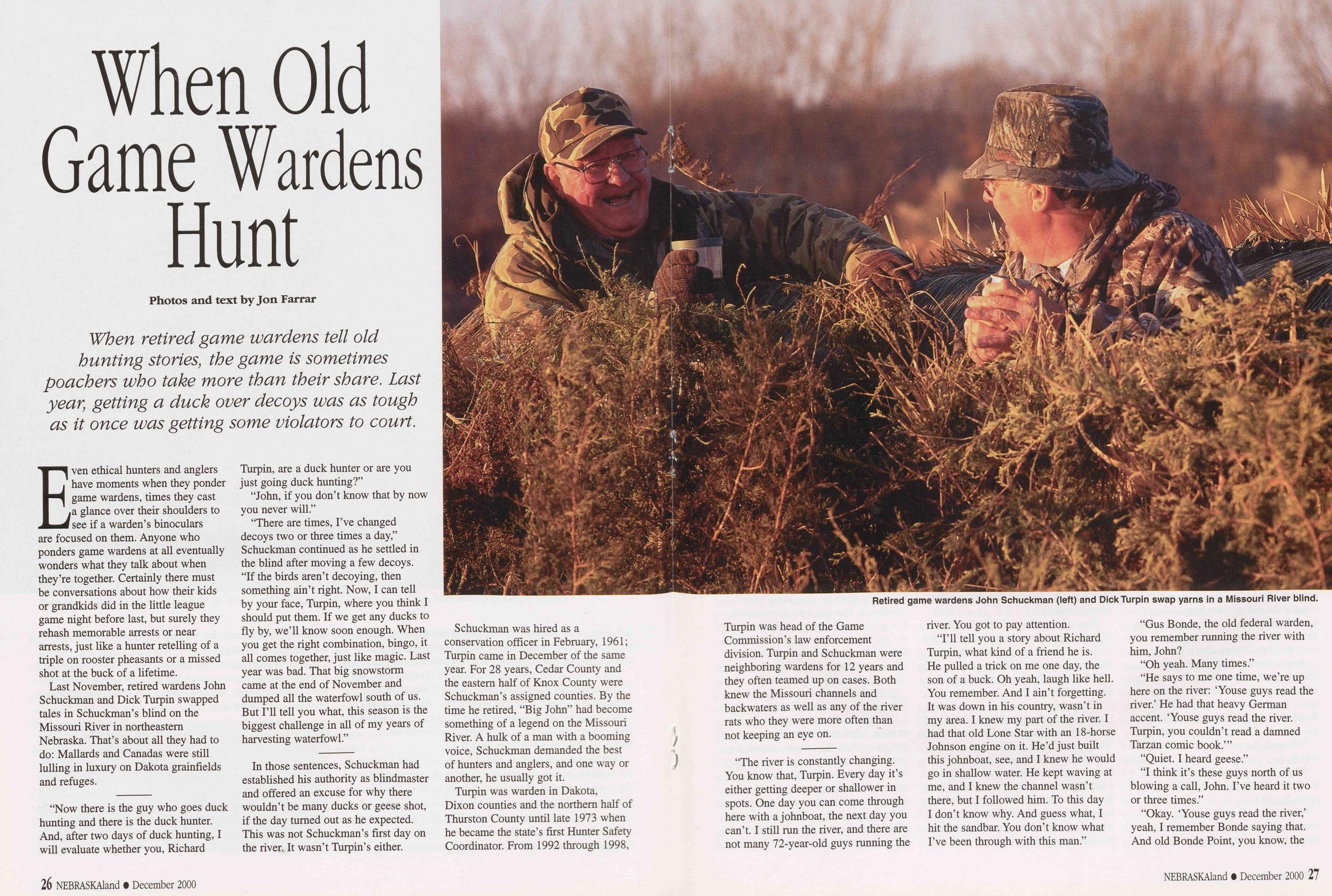
When Old Game Wardens Hunt
Photos and text by Jon Farrar When retired game wardens tell old hunting stories, the game is sometimes poachers who take more than their share. Last year, getting a duck over decoys was as tough as it once was getting some violators to court.Even ethical hunters and anglers have moments when they ponder game wardens, times they cast a glance over their shoulders to see if a warden’s binoculars are focused on them. Anyone who ponders game wardens at all eventually wonders what they talk about when they’re together. Certainly there must be conversations about how their kids or grandkids did in the little league game night before last, but surely they rehash memorable arrests or near arrests, just like a hunter retelling of a triple on rooster pheasants or a missed shot at the buck of a lifetime.
Last November, retired wardens John Schuckman and Dick Turpin swapped tales in Schuckman’s blind on the Missouri River in northeastern Nebraska. That’s about all they had to do: Mallards and Canadas were still lulling in luxury on Dakota grainfields and refuges.
"Now there is the guy who goes duck hunting and there is the duck hunter. And, after two days of duck hunting, I will evaluate whether you, Richard Turpin, are a duck hunter or are you just going duck hunting?”
"John, if you don’t know that by now you never will.”
“There are times, I’ve changed decoys two or three times a day,” Schuckman continued as he settled in the blind after moving a few decoys. “If the birds aren’t decoying, then something ain’t right. Now, I can tell by your face, Turpin, where you think I should put them. If we get any ducks to fly by, we’ll know soon enough. When you get the right combination, bingo, it all comes together, just like magic. Last year was bad. That big snowstorm came at the end of November and dumped all the waterfowl south of us. But I’ll tell you what, this season is the biggest challenge in all of my years of harvesting waterfowl.”
In those sentences, Schuckman had established his authority as blindmaster and offered an excuse for why there wouldn’t be many ducks or geese shot, if the day turned out as he expected. This was not Schuckman’s first day on the river. It wasn’t Turpin’s either.
Schuckman was hired as a conservation officer in February, 1961; Turpin came in December of the same year. For 28 years, Cedar County and the eastern half of Knox County were Schuckman’s assigned counties. By the time he retired, "Big John” had become something of a legend on the Missouri River. A hulk of a man with a booming voice, Schuckman demanded the best of hunters and anglers, and one way or another, he usually got it.
Turpin was warden in Dakota, Dixon counties and the northern half of Thurston County until late 1973 when he became the state’s first Hunter Safety Coordinator. From 1992 through 1998, Turpin was head of the Game Commission’s law enforcement division. Turpin and Schuckman were neighboring wardens for 12 years and they often teamed up on cases. Both knew the Missouri channels and backwaters as well as any of the river rats who they were more often than not keeping an eye on.
“The river is constantly changing. You know that, Turpin. Every day it’s either getting deeper or shallower in spots. One day you can come through here with a johnboat, the next day you can’t. I still run the river, and there are not many 72-year-old guys running the river. You got to pay attention.
"I’ll tell you a story about Richard Turpin, what kind of a friend he is. He pulled a trick on me one day, the son of a buck. Oh yeah, laugh like hell. You remember. And I ain’t forgetting. It was down in his country, wasn’t in my area. I knew my part of the river. I had that old Lone Star with an 18-horse Johnson engine on it. He’d just built this johnboat, see, and I knew he would go in shallow water. He kept waving at me, and I knew the channel wasn’t there, but I followed him. To this day I don’t know why. And guess what, I hit the sandbar. You don’t know what I’ve been through with this man.”
“Gus Bonde, the old federal warden, you remember running the river with him, John?
"Oh yeah. Many times.”
"He says to me one time, we’re up here on the river: ‘Youse guys read the river.’ He had that heavy German accent. ‘Youse guys read the river. Turpin, you couldn’t read a damned Tarzan comic book.’”
“Quiet. I heard geese.”
"I think it’s these guys north of us blowing a call, John. I’ve heard it two or three times.”
"Okay. ‘Youse guys read the river,’
yeah, I remember Bonde saying that.
And old Bonde Point, you know, the
26 NEBRASKAland • December 2000
NEBRASKAland • December 2000 27
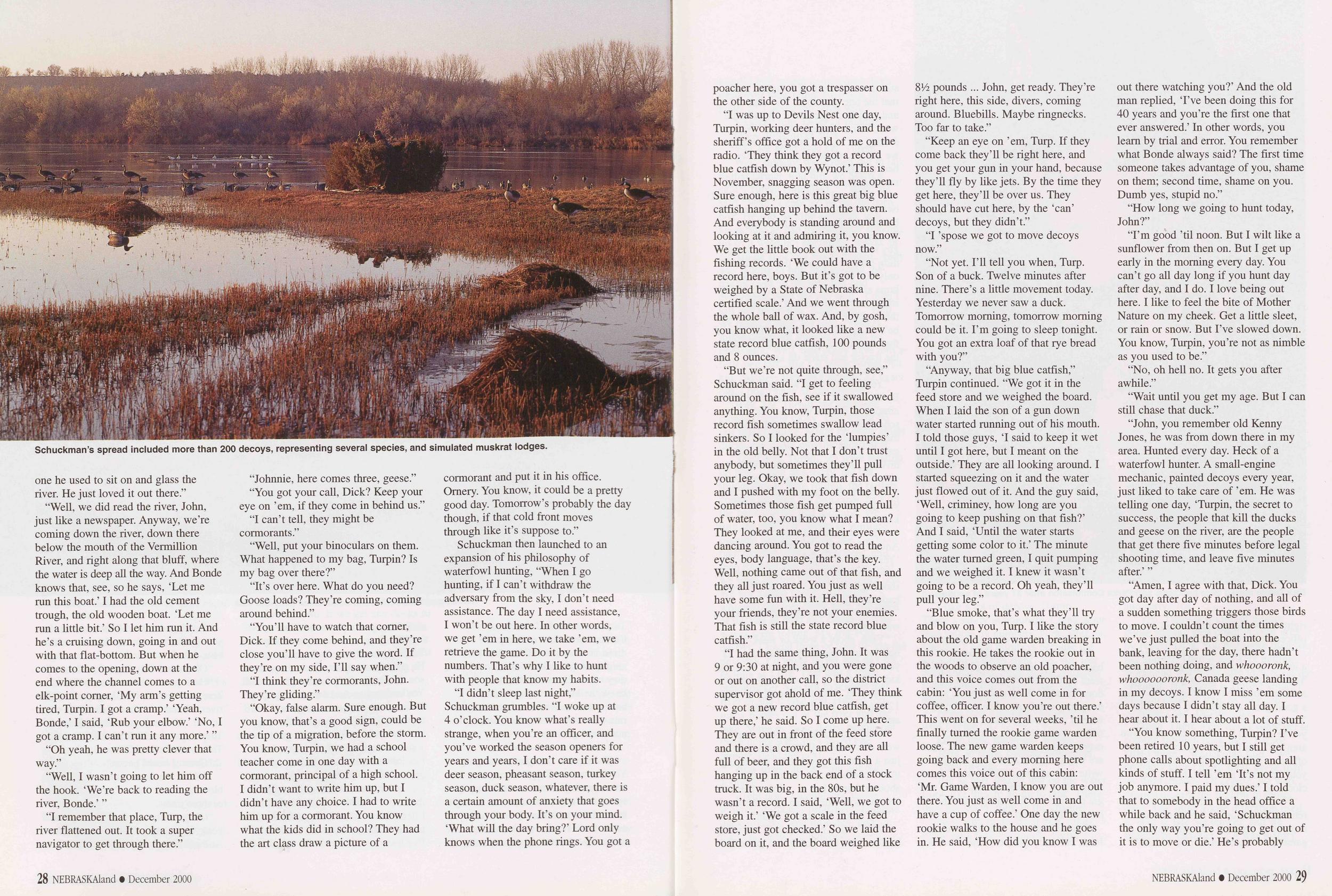 one he used to sit on and glass the
river. He just loved it out there.”
one he used to sit on and glass the
river. He just loved it out there.”
“Well, we did read the river, John, just like a newspaper. Anyway, we’re coming down the river, down there below the mouth of the Vermillion River, and right along that bluff, where the water is deep all the way. And Bonde knows that, see, so he says, ‘Let me run this boat.’ I had the old cement trough, the old wooden boat. ‘Let me run a little bit.’ So I let him run it. And he’s a cruising down, going in and out with that flat-bottom. But when he comes to the opening, down at the end where the channel comes to a elk-point comer, ‘My arm’s getting tired, Turpin. I got a cramp.’ ‘Yeah, Bonde,’ I said, ‘Rub your elbow.’ ‘No, I got a cramp. I can’t run it any more.’ ” “Oh yeah, he was pretty clever that way.”
“Well, I wasn’t going to let him off the hook. ‘We’re back to reading the river, Bonde.’ ”
“I remember that place, Turp, the river flattened out. It took a super navigator to get through there.”
“Johnnie, here comes three, geese.”
“You got your call, Dick? Keep your eye on ’em, if they come in behind us.”
“I can’t tell, they might be cormorants.”
“Well, put your binoculars on them. What happened to my bag, Turpin? Is my bag over there?”
“It’s over here. What do you need? Goose loads? They’re coming, coming around behind.”
“You’ll have to watch that corner, Dick. If they come behind, and they’re close you’ll have to give the word. If they’re on my side, I'll say when.”
“I think they’re cormorants, John. They’re gliding.”
“Okay, false alarm. Sure enough. But you know, that’s a good sign, could be the tip of a migration, before the storm. You know, Turpin, we had a school teacher come in one day with a cormorant, principal of a high school. I didn’t want to write him up, but I didn’t have any choice. I had to write him up for a cormorant. You know what the kids did in school? They had the art class draw a picture of a cormorant and put it in his office. Ornery. You know, it could be a pretty good day. Tomorrow’s probably the day though, if that cold front moves through like it’s suppose to.”
Schuckman then launched to an expansion of his philosophy of waterfowl hunting, “When I go hunting, if I can’t withdraw the adversary from the sky, I don’t need assistance. The day I need assistance, I won’t be out here. In other words, we get ’em in here, we take ’em, we retrieve the game. Do it by the numbers. That’s why I like to hunt with people that know my habits.
“I didn’t sleep last night,” Schuckman grumbles. “I woke up at 4 o’clock. You know what’s really strange, when you’re an officer, and you’ve worked the season openers for years and years, I don’t care if it was deer season, pheasant season, turkey season, duck season, whatever, there is a certain amount of anxiety that goes through your body. It’s on your mind. ‘What will the day bring?’ Lord only knows when the phone rings. You got a poacher here, you got a trespasser on the other side of the county.
“I was up to Devils Nest one day, Turpin, working deer hunters, and the sheriff’s office got a hold of me on the radio. ‘They think they got a record blue catfish down by Wynot.’ This is November, snagging season was open. Sure enough, here is this great big blue catfish hanging up behind the tavern. And everybody is standing around and looking at it and admiring it, you know. We get the little book out with the fishing records. ‘We could have a record here, boys. But it’s got to be weighed by a State of Nebraska certified scale.’ And we went through the whole ball of wax. And, by gosh, you know what, it looked like a new state record blue catfish, 100 pounds and 8 ounces.
“But we’re not quite through, see,” Schuckman said. “I get to feeling around on the fish, see if it swallowed anything. You know, Turpin, those record fish sometimes swallow lead sinkers. So I looked for the ‘lumpies’ in the old belly. Not that I don’t trust anybody, but sometimes they’ll pull your leg. Okay, we took that fish down and I pushed with my foot on the belly. Sometimes those fish get pumped full of water, too, you know what I mean? They looked at me, and their eyes were dancing around. You got to read the eyes, body language, that’s the key. Well, nothing came out of that fish, and they all just roared. You just as well have some fun with it. Hell, they’re your friends, they’re not your enemies. That fish is still the state record blue catfish.”
“I had the same thing, John. It was 9 or 9:30 at night, and you were gone or out on another call, so the district supervisor got ahold of me. ‘They think we got a new record blue catfish, get up there,’ he said. So I come up here. They are out in front of the feed store and there is a crowd, and they are all full of beer, and they got this fish hanging up in the back end of a stock truck. It was big, in the 80s, but he wasn’t a record. I said, ‘Well, we got to weigh it.’ ‘We got a scale in the feed store, just got checked.’ So we laid the board on it, and the board weighed like 8^ pounds ... John, get ready. They’re right here, this side, divers, coming around. Bluebills. Maybe ringnecks. Too far to take.”
“Keep an eye on ’em, Turp. If they come back they’ll be right here, and you get your gun in your hand, because they’ll fly by like jets. By the time they get here, they’ll be over us. They should have cut here, by the ‘can’ decoys, but they didn’t.”
“I ’spose we got to move decoys now.”
“Not yet. I’ll tell you when, Turp. Son of a buck. Twelve minutes after nine. There’s a little movement today. Yesterday we never saw a duck. Tomorrow morning, tomorrow morning could be it. I’m going to sleep tonight. You got an extra loaf of that rye bread with you?”
“Anyway, that big blue catfish,” Turpin continued. “We got it in the feed store and we weighed the board. When I laid the son of a gun down water started running out of his mouth. I told those guys, I said to keep it wet until I got here, but I meant on the outside.’ They are all looking around. I started squeezing on it and the water just flowed out of it. And the guy said, ‘Well, criminey, how long are you going to keep pushing on that fish?’ And I said, ‘Until the water starts getting some color to it.’ The minute the water turned green, I quit pumping and we weighed it. I knew it wasn’t going to be a record. Oh yeah, they’ll pull your leg.”
“Blue smoke, that’s what they’ll try and blow on you, Turp. I like the story about the old game warden breaking in this rookie. He takes the rookie out in the woods to observe an old poacher, and this voice comes out from the cabin: ‘You just as well come in for coffee, officer. I know you’re out there.’ This went on for several weeks, ’til he finally turned the rookie game warden loose. The new game warden keeps going back and every morning here comes this voice out of this cabin: ‘Mr. Game Warden, I know you are out there. You just as well come in and have a cup of coffee.’ One day the new rookie walks to the house and he goes in. He said, ‘How did you know I was out there watching you?’ And the old man replied, ‘I’ve been doing this for 40 years and you’re the first one that ever answered.’ In other words, you learn by trial and error. You remember what Bonde always said? The first time someone takes advantage of you, shame on them; second time, shame on you. Dumb yes, stupid no.”
“How long we going to hunt today, John?”
“I’m good ’til noon. But I wilt like a sunflower from then on. But I get up early in the morning every day. You can’t go all day long if you hunt day after day, and I do. I love being out here. I like to feel the bite of Mother Nature on my cheek. Get a little sleet, or rain or snow. But I’ve slowed down. You know, Turpin, you’re not as nimble as you used to be.”
“No, oh hell no. It gets you after awhile.”
“Wait until you get my age. But I can still chase that duck.”
“John, you remember old Kenny Jones, he was from down there in my area. Hunted every day. Heck of a waterfowl hunter. A small-engine mechanic, painted decoys every year, just liked to take care of ’em. He was telling one day, ‘Turpin, the secret to success, the people that kill the ducks and geese on the river, are the people that get there five minutes before legal shooting time, and leave five minutes after.’"
“Amen, I agree with that, Dick. You got day after day of nothing, and all of a sudden something triggers those birds to move. I couldn’t count the times we’ve just pulled the boat into the bank, leaving for the day, there hadn’t been nothing doing, and whoooronk, whooooooronk, Canada geese landing in my decoys. I know I miss ’em some days because I didn’t stay all day. I hear about it. I hear about a lot of stuff.
“You know something, Turpin? I’ve
been retired 10 years, but I still get
phone calls about spotlighting and all
kinds of stuff. I tell ’em ‘It’s not my
job anymore. I paid my dues.’ I told
that to somebody in the head office a
while back and he said, ‘Schuckman
the only way you’re going to get out of
it is to move or die.’ He’s probably
28 NEBRASKAland • December 2000
NEBRASKAland • December 2000 29
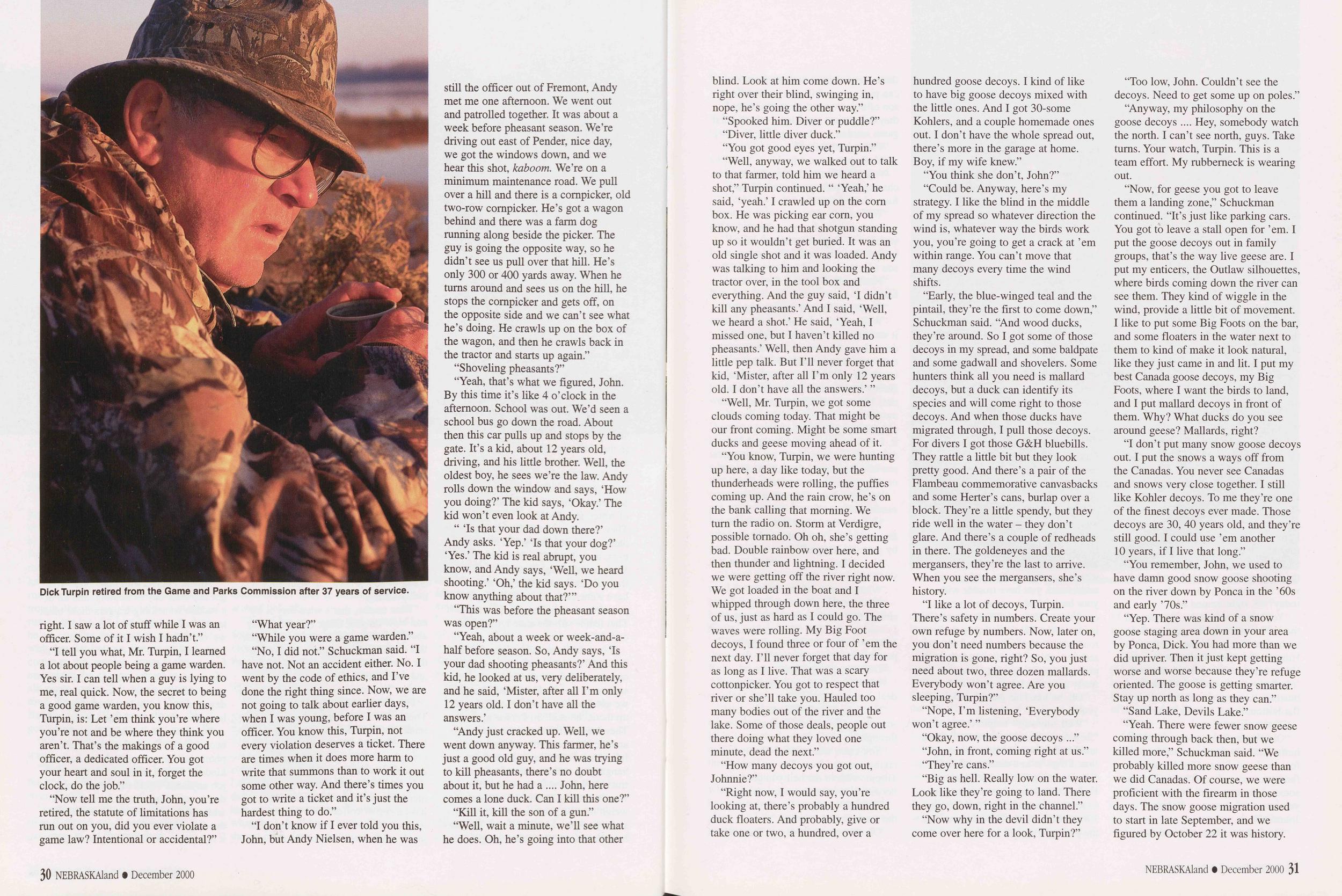 right. I saw a lot of stuff while I was an
officer. Some of it I wish I hadn’t.”
right. I saw a lot of stuff while I was an
officer. Some of it I wish I hadn’t.”
"I tell you what, Mr. Turpin, I learned a lot about people being a game warden. Yes sir. I can tell when a guy is lying to me, real quick. Now, the secret to being a good game warden, you know this, Turpin, is: Let ’em think you’re where you’re not and be where they think you aren’t. That’s the makings of a good officer, a dedicated officer. You got your heart and soul in it, forget the clock, do the job.”
“Now tell me the truth, John, you’re retired, the statute of limitations has run out on you, did you ever violate a game law? Intentional or accidental?”
“What year?”
“While you were a game warden.”
“No, I did not.” Schuckman said. “I have not. Not an accident either. No. I went by the code of ethics, and I’ve done the right thing since. Now, we are not going to talk about earlier days, when I was young, before I was an officer. You know this, Turpin, not every violation deserves a ticket. There are times when it does more harm to write that summons than to work it out some other way. And there’s times you got to write a ticket and it’s just the hardest thing to do.”
“I don’t know if I ever told you this, John, but Andy Nielsen, when he was still the officer out of Fremont, Andy met me one afternoon. We went out and patrolled together. It was about a week before pheasant season. We’re driving out east of Pender, nice day, we got the windows down, and we hear this shot, kaboom. We’re on a minimum maintenance road. We pull over a hill and there is a compicker, old two-row compicker. He’s got a wagon behind and there was a farm dog running along beside the picker. The guy is going the opposite way, so he didn’t see us pull over that hill. He’s only 300 or 400 yards away. When he turns around and sees us on the hill, he stops the compicker and gets off, on the opposite side and we can’t see what he’s doing. He crawls up on the box of the wagon, and then he crawls back in the tractor and starts up again.”
“Shoveling pheasants?”
“Yeah, that’s what we figured, John. By this time it’s like 4 o’clock in the afternoon. School was out. We’d seen a school bus go down the road. About then this car pulls up and stops by the gate. It’s a kid, about 12 years old, driving, and his little brother. Well, the oldest boy, he sees we’re the law. Andy rolls down the window and says, ‘How you doing?’ The kid says, ‘Okay.’ The kid won’t even look at Andy.
“ Is that your dad down there?’ Andy asks. ‘Yep.’ Is that your dog?’ ‘Yes.’ The kid is real abrupt, you know, and Andy says, ‘Well, we heard shooting.’ ‘Oh,’ the kid says. ‘Do you know anything about that?”’
“This was before the pheasant season was open?”
“Yeah, about a week or week-and-a- half before season. So, Andy says, Is your dad shooting pheasants?’ And this kid, he looked at us, very deliberately, and he said, ‘Mister, after all I’m only 12 years old. I don’t have all the answers.’
“Andy just cracked up. Well, we went down anyway. This farmer, he’s just a good old guy, and he was trying to kill pheasants, there’s no doubt about it, but he had a .... John, here comes a lone duck. Can I kill this one?”
“Kill it, kill the son of a gun.”
“Well, wait a minute, we’ll see what he does. Oh, he’s going into that other blind. Look at him come down. He’s right over their blind, swinging in, nope, he’s going the other way.”
“Spooked him. Diver or puddle?”
“Diver, little diver duck.”
“You got good eyes yet, Turpin.”
“Well, anyway, we walked out to talk to that farmer, told him we heard a shot,” Turpin continued. “ ‘Yeah,’ he said, ‘yeah.’ I crawled up on the com box. He was picking ear com, you know, and he had that shotgun standing up so it wouldn’t get buried. It was an old single shot and it was loaded. Andy was talking to him and looking the tractor over, in the tool box and everything. And the guy said, T didn’t kill any pheasants.’ And I said, ‘Well, we heard a shot.’ He said, ‘Yeah, I missed one, but I haven’t killed no pheasants.’ Well, then Andy gave him a little pep talk. But I’ll never forget that kid, ‘Mister, after all I’m only 12 years old. I don’t have all the answers.’ ”
“Well, Mr. Turpin, we got some clouds coming today. That might be our front coming. Might be some smart ducks and geese moving ahead of it.
“You know, Turpin, we were hunting up here, a day like today, but the thunderheads were rolling, the puffies coming up. And the rain crow, he’s on the bank calling that morning. We turn the radio on. Storm at Verdigre, possible tornado. Oh oh, she’s getting bad. Double rainbow over here, and then thunder and lightning. I decided we were getting off the river right now. We got loaded in the boat and I whipped through down here, the three of us, just as hard as I could go. The waves were rolling. My Big Foot decoys, I found three or four of ’em the next day. I’ll never forget that day for as long as I live. That was a scary cottonpicker. You got to respect that river or she’ll take you. Hauled too many bodies out of the river and the lake. Some of those deals, people out there doing what they loved one minute, dead the next.”
“How many decoys you got out, Johnnie?”
“Right now, I would say, you’re looking at, there’s probably a hundred duck floaters. And probably, give or take one or two, a hundred, over a hundred goose decoys. I kind of like to have big goose decoys mixed with the little ones. And I got 30-some Kohlers, and a couple homemade ones out. I don’t have the whole spread out, there’s more in the garage at home. Boy, if my wife knew.”
“You think she don’t, John?”
“Could be. Anyway, here’s my strategy. I like the blind in the middle of my spread so whatever direction the wind is, whatever way the birds work you, you’re going to get a crack at ’em within range. You can’t move that many decoys every time the wind shifts.
“Early, the blue-winged teal and the pintail, they’re the first to come down,” Schuckman said. “And wood ducks, they’re around. So I got some of those decoys in my spread, and some baldpate and some gadwall and shovelers. Some hunters think all you need is mallard decoys, but a duck can identify its species and will come right to those decoys. And when those ducks have migrated through, I pull those decoys. For divers I got those G&H bluebills. They rattle a little bit but they look pretty good. And there’s a pair of the Flambeau commemorative canvasbacks and some Herter’s cans, burlap over a block. They’re a little spendy, but they ride well in the water - they don’t glare. And there’s a couple of redheads in there. The goldeneyes and the mergansers, they’re the last to arrive. When you see the mergansers, she’s history.
“I like a lot of decoys, Turpin. There’s safety in numbers. Create your own refuge by numbers. Now, later on, you don’t need numbers because the migration is gone, right? So, you just need about two, three dozen mallards. Everybody won’t agree. Are you sleeping, Turpin?”
“Nope, I’m listening, ‘Everybody won’t agree.’ ”
“Okay, now, the goose decoys ...”
“John, in front, coming right at us.”
“They’re cans.”
“Big as hell. Really low on the water. Look like they’re going to land. There they go, down, right in the channel.”
“Now why in the devil didn’t they come over here for a look, Turpin?”
“Too low, John. Couldn’t see the decoys. Need to get some up on poles.”
“Anyway, my philosophy on the goose decoys .... Hey, somebody watch the north. I can’t see north, guys. Take turns. Your watch, Turpin. This is a team effort. My rubberneck is wearing out.
“Now, for geese you got to leave them a landing zone,” Schuckman continued. “It’s just like parking cars. You got to leave a stall open for ’em. I put the goose decoys out in family groups, that’s the way live geese are. I put my enticers, the Outlaw silhouettes, where birds coming down the river can see them. They kind of wiggle in the wind, provide a little bit of movement. I like to put some Big Foots on the bar, and some floaters in the water next to them to kind of make it look natural, like they just came in and lit. I put my best Canada goose decoys, my Big Foots, where I want the birds to land, and I put mallard decoys in front of them. Why? What ducks do you see around geese? Mallards, right?
“I don’t put many snow goose decoys out. I put the snows a ways off from the Canadas. You never see Canadas and snows very close together. I still like Kohler decoys. To me they’re one of the finest decoys ever made. Those decoys are 30, 40 years old, and they’re still good. I could use ’em another 10 years, if I live that long.”
“You remember, John, we used to have damn good snow goose shooting on the river down by Ponca in the ’60s and early ’70s.”
“Yep. There was kind of a snow goose staging area down in your area by Ponca, Dick. You had more than we did upriver. Then it just kept getting worse and worse because they’re refuge oriented. The goose is getting smarter. Stay up north as long as they can.”
“Sand Lake, Devils Lake.”
“Yeah. There were fewer snow geese coming through back then, but we killed more,” Schuckman said. “We probably killed more snow geese than we did Canadas. Of course, we were proficient with the firearm in those days. The snow goose migration used to start in late September, and we figured by October 22 it was history.
NEBRASKAland • December 2000 31 30 NEBRASKAland • December 2000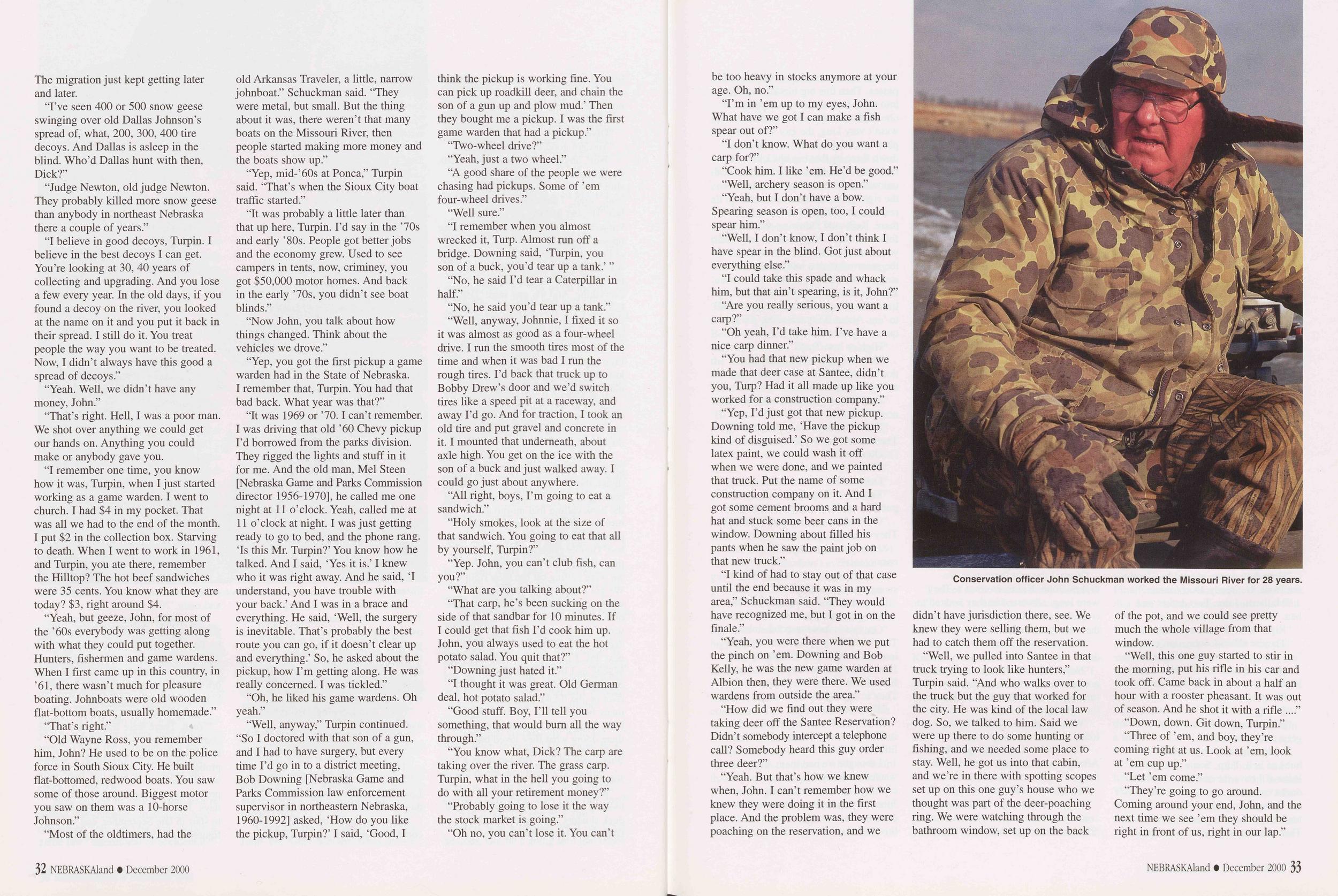
The migration just kept getting later and later.
"I've seen 400 or 500 snow geese swinging over old Dallas Johnson’s spread of, what, 200, 300, 400 tire decoys. And Dallas is asleep in the blind. Who’d Dallas hunt with then, Dick?”
"Judge Newton, old judge Newton. They probably killed more snow geese than anybody in northeast Nebraska there a couple of years.”
"I believe in good decoys, Turpin. I believe in the best decoys I can get. You’re looking at 30, 40 years of collecting and upgrading. And you lose a few every year. In the old days, if you found a decoy on the river, you looked at the name on it and you put it back in their spread. I still do it. You treat people the way you want to be treated. Now, I didn’t always have this good a spread of decoys.”
"Yeah. Well, we didn’t have any money, John.”
"That’s right. Hell, I was a poor man. We shot over anything we could get our hands on. Anything you could make or anybody gave you.
"I remember one time, you know how it was, Turpin, when I just started working as a game warden. I went to church. I had $4 in my pocket. That was all we had to the end of the month. I put $2 in the collection box. Starving to death. When I went to work in 1961, and Turpin, you ate there, remember the Hilltop? The hot beef sandwiches were 35 cents. You know what they are today? $3, right around $4.
"Yeah, but geeze, John, for most of the ’60s everybody was getting along with what they could put together. Hunters, fishermen and game wardens. When I first came up in this country, in ’61, there wasn’t much for pleasure boating. Johnboats were old wooden flat-bottom boats, usually homemade.”
"That’s right.”
"Old Wayne Ross, you remember him, John? He used to be on the police force in South Sioux City. He built flat-bottomed, redwood boats. You saw some of those around. Biggest motor you saw on them was a 10-horse Johnson.”
"Most of the oldtimers, had the old Arkansas Traveler, a little, narrow johnboat.” Schuckman said. "They were metal, but small. But the thing about it was, there weren’t that many boats on the Missouri River, then people started making more money and the boats show up.”
"Yep, mid-’60s at Ponca,” Turpin said. "That’s when the Sioux City boat traffic started.”
"It was probably a little later than that up here, Turpin. I’d say in the ’70s and early ’80s. People got better jobs and the economy grew. Used to see campers in tents, now, criminey, you got $50,000 motor homes. And back in the early ’70s, you didn’t see boat blinds.”
"Now John, you talk about how things changed. Think about the vehicles we drove.”
"Yep, you got the first pickup a game warden had in the State of Nebraska. I remember that, Turpin. You had that bad back. What year was that?”
"It was 1969 or ’70. I can’t remember. I was driving that old ’60 Chevy pickup I’d borrowed from the parks division. They rigged the lights and stuff in it for me. And the old man, Mel Steen [Nebraska Game and Parks Commission director 1956-1970], he called me one night at 11 o’clock. Yeah, called me at IIo’clock at night. I was just getting ready to go to bed, and the phone rang. Is this Mr. Turpin?’ You know how he talked. And I said, Yes it is.’ I knew who it was right away. And he said, ‘I understand, you have trouble with your back.’ And I was in a brace and everything. He said, ‘Well, the surgery is inevitable. That’s probably the best route you can go, if it doesn’t clear up and everything.’ So, he asked about the pickup, how I’m getting along. He was really concerned. I was tickled.”
"Oh, he liked his game wardens. Oh yeah.”
“Well, anyway,” Turpin continued. "So I doctored with that son of a gun, and I had to have surgery, but every time I’d go in to a district meeting, Bob Downing [Nebraska Game and Parks Commission law enforcement supervisor in northeastern Nebraska, 1960-1992] asked, ‘How do you like the pickup, Turpin?’ I said, ‘Good, I think the pickup is working fine. You can pick up roadkill deer, and chain the son of a gun up and plow mud.’ Then they bought me a pickup. I was the first game warden that had a pickup.”
“Two-wheel drive?”
"Yeah, just a two wheel.”
"A good share of the people we were chasing had pickups. Some of ’em four-wheel drives.”
"Well sure.”
"I remember when you almost wrecked it, Turp. Almost run off a bridge. Downing said, ‘Turpin, you son of a buck, you’d tear up a tank.’ ”
“No, he said I’d tear a Caterpillar in half.”
"No, he said you’d tear up a tank.”
"Well, anyway, Johnnie, I fixed it so it was almost as good as a four-wheel drive. I run the smooth tires most of the time and when it was bad I run the rough tires. I’d back that truck up to Bobby Drew’s door and we’d switch tires like a speed pit at a raceway, and away I’d go. And for traction, I took an old tire and put gravel and concrete in it. I mounted that underneath, about axle high. You get on the ice with the son of a buck and just walked away. I could go just about anywhere.
“All right, boys, I’m going to eat a sandwich.”
“Holy smokes, look at the size of that sandwich. You going to eat that all by yourself, Turpin?”
“Yep. John, you can’t club fish, can you?”
"What are you talking about?”
"That carp, he’s been sucking on the side of that sandbar for 10 minutes. If I could get that fish I’d cook him up. John, you always used to eat the hot potato salad. You quit that?”
“Downing just hated it.”
"I thought it was great. Old German deal, hot potato salad.”
“Good stuff. Boy, I’ll tell you something, that would bum all the way through.”
"You know what, Dick? The carp are taking over the river. The grass carp. Turpin, what in the hell you going to do with all your retirement money?”
“Probably going to lose it the way the stock market is going.”
"Oh no, you can’t lose it. You can’t be too heavy in stocks anymore at your age. Oh, no.”
"I’m in ’em up to my eyes, John. What have we got I can make a fish spear out of?”
“I don’t know. What do you want a carp for?”
“Cook him. I like ’em. He’d be good.”
“Well, archery season is open.”
"Yeah, but I don’t have a bow.
Spearing season is open, too, I could spear him.”
“Well, I don’t know, I don’t think I have spear in the blind. Got just about everything else.”
“I could take this spade and whack him, but that ain’t spearing, is it, John?”
"Are you really serious, you want a carp?”
“Oh yeah, I’d take him. I’ve have a nice carp dinner.”
“You had that new pickup when we made that deer case at Santee, didn’t you, Turp? Had it all made up like you worked for a construction company.”
“Yep, I’d just got that new pickup. Downing told me, ‘Have the pickup kind of disguised.’ So we got some latex paint, we could wash it off when we were done, and we painted that truck. Put the name of some construction company on it. And I got some cement brooms and a hard hat and stuck some beer cans in the window. Downing about filled his pants when he saw the paint job on that new truck.”
“I kind of had to stay out of that case until the end because it was in my area,” Schuckman said. "They would have recognized me, but I got in on the finale.”
"Yeah, you were there when we put the pinch on ’em. Downing and Bob Kelly, he was the new game warden at Albion then, they were there. We used wardens from outside the area.”
"How did we find out they were taking deer off the Santee Reservation? Didn’t somebody intercept a telephone call? Somebody heard this guy order three deer?”
“Yeah. But that’s how we knew when, John. I can’t remember how we knew they were doing it in the first place. And the problem was, they were poaching on the reservation, and we didn’t have jurisdiction there, see. We knew they were selling them, but we had to catch them off the reservation.
“Well, we pulled into Santee in that truck trying to look like hunters,” Turpin said. "And who walks over to the truck but the guy that worked for the city. He was kind of the local law dog. So, we talked to him. Said we were up there to do some hunting or fishing, and we needed some place to stay. Well, he got us into that cabin, and we’re in there with spotting scopes set up on this one guy’s house who we thought was part of the deer-poaching ring. We were watching through the bathroom window, set up on the back of the pot, and we could see pretty much the whole village from that window.
"Well, this one guy started to stir in the morning, put his rifle in his car and took off. Came back in about a half an hour with a rooster pheasant. It was out of season. And he shot it with a rifle ...”
"Down, down. Git down, Turpin.”
"Three of ’em, and boy, they’re coming right at us. Look at ’em, look at ’em cup up.”
"Let ’em come.”
"They’re going to go around. Coming around your end, John, and the next time we see ’em they should be right in front of us, right in our lap.”
32 NEBRASKAland • December 2000 NEBRASKAland • December 2000 33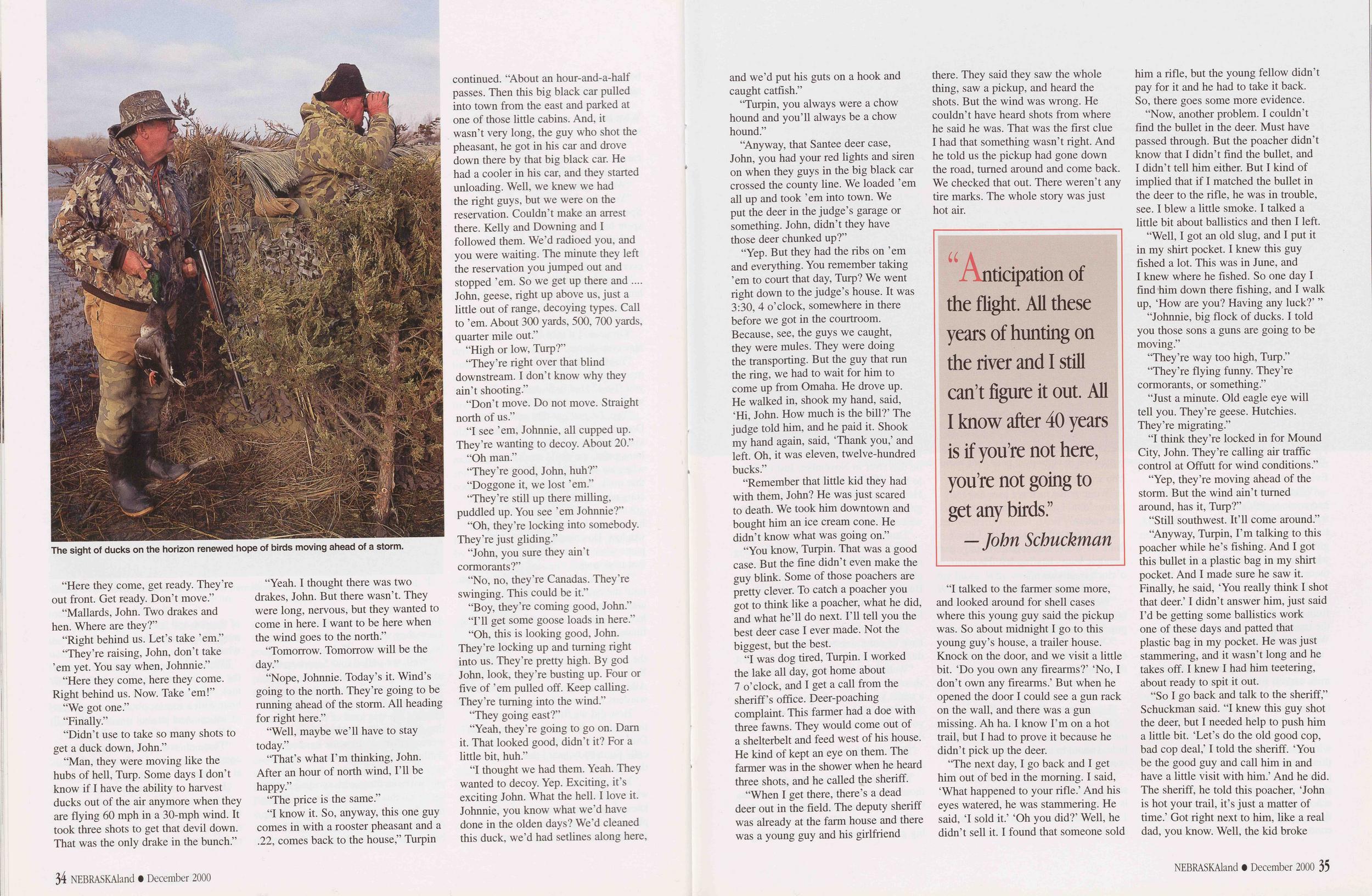
“Here they come, get ready. They’re out front. Get ready. Don’t move.”
“Mallards, John. Two drakes and hen. Where are they?”
“Right behind us. Let’s take ’em.”
“They’re raising, John, don’t take ’em yet. You say when, Johnnie.” “Here they come, here they come. Right behind us. Now. Take ’em!”
“We got one.”
“Finally.”
“Didn’t use to take so many shots to get a duck down, John.”
“Man, they were moving like the hubs of hell, Turp. Some days I don’t know if I have the ability to harvest ducks out of the air anymore when they are flying 60 mph in a 30-mph wind. It took three shots to get that devil down. That was the only drake in the bunch.”
“Yeah. I thought there was two drakes, John. But there wasn’t. They were long, nervous, but they wanted to come in here. I want to be here when the wind goes to the north.”
“Tomorrow. Tomorrow will be the day.”
“Nope, Johnnie. Today’s it. Wind’s going to the north. They’re going to be running ahead of the storm. All heading for right here.”
“Well, maybe we’ll have to stay today.”
“That’s what I’m thinking, John. After an hour of north wind, I’ll be happy.”
“The price is the same.”
“I know it. So, anyway, this one guy comes in with a rooster pheasant and a .22, comes back to the house,” Turpin continued. “About an hour-and-a-half passes. Then this big black car pulled into town from the east and parked at one of those little cabins. And, it wasn’t very long, the guy who shot the pheasant, he got in his car and drove down there by that big black car. He had a cooler in his car, and they started unloading. Well, we knew we had the right guys, but we were on the reservation. Couldn’t make an arrest there. Kelly and Downing and I followed them. We’d radioed you, and you were waiting. The minute they left the reservation you jumped out and stopped ’em. So we get up there and .... John, geese, right up above us, just a little out of range, decoying types. Call to ’em. About 300 yards, 500, 700 yards, quarter mile out.”
“High or low, Turp?”
“They’re right over that blind downstream. I don’t know why they ain’t shooting.”
“Don’t move. Do not move. Straight north of us.”
“I see ’em, Johnnie, all cupped up. They’re wanting to decoy. About 20.”
“Oh man.”
“They’re good, John, huh?”
“Doggone it, we lost ’em.”
“They’re still up there milling, puddled up. You see ’em Johnnie?”
“Oh, they’re locking into somebody. They’re just gliding.”
“John, you sure they ain’t cormorants?”
“No, no, they’re Canadas. They’re swinging. This could be it.”
“Boy, they’re coming good, John.”
“I’ll get some goose loads in here.”
“Oh, this is looking good, John. They’re locking up and turning right into us. They’re pretty high. By god John, look, they’re busting up. Four or five of ’em pulled off. Keep calling. They’re turning into the wind.”
“They going east?”
“Yeah, they’re going to go on. Dam it. That looked good, didn’t it? For a little bit, huh.”
“I thought we had them. Yeah. They wanted to decoy. Yep. Exciting, it’s exciting John. What the hell. I love it. Johnnie, you know what we’d have done in the olden days? We’d cleaned this duck, we’d had setlines along here, and we’d put his guts on a hook and caught catfish.”
“Turpin, you always were a chow hound and you’ll always be a chow hound.”
“Anyway, that Santee deer case, John, you had your red lights and siren on when they guys in the big black car crossed the county line. We loaded ’em all up and took ’em into town. We put the deer in the judge’s garage or something. John, didn’t they have those deer chunked up?”
“Yep. But they had the ribs on ’em and everything. You remember taking ’em to court that day, Turp? We went right down to the judge’s house. It was 3:30, 4 o’clock, somewhere in there before we got in the courtroom. Because, see, the guys we caught, they were mules. They were doing the transporting. But the guy that run the ring, we had to wait for him to come up from Omaha. He drove up. He walked in, shook my hand, said, ‘Hi, John. How much is the bill?’ The judge told him, and he paid it. Shook my hand again, said, ‘Thank you,’ and left. Oh, it was eleven, twelve-hundred bucks.”
“Remember that little kid they had with them, John? He was just scared to death. We took him downtown and bought him an ice cream cone. He didn’t know what was going on.”
“You know, Turpin. That was a good case. But the fine didn’t even make the guy blink. Some of those poachers are pretty clever. To catch a poacher you got to think like a poacher, what he did, and what he’ll do next. I’ll tell you the best deer case I ever made. Not the biggest, but the best.
“I was dog tired, Turpin. I worked the lake all day, got home about 7 o’clock, and I get a call from the sheriff’s office. Deer-poaching complaint. This farmer had a doe with three fawns. They would come out of a shelterbelt and feed west of his house. He kind of kept an eye on them. The farmer was in the shower when he heard three shots, and he called the sheriff.
“When I get there, there’s a dead deer out in the field. The deputy sheriff was already at the farm house and there was a young guy and his girlfriend there. They said they saw the whole thing, saw a pickup, and heard the shots. But the wind was wrong. He couldn’t have heard shots from where he said he was. That was the first clue I had that something wasn’t right. And he told us the pickup had gone down the road, turned around and come back. We checked that out. There weren’t any tire marks. The whole story was just hot air.
“I talked to the farmer some more, and looked around for shell cases where this young guy said the pickup was. So about midnight I go to this young guy’s house, a trailer house. Knock on the door, and we visit a little bit. Do you own any firearms?’ ‘No, I don’t own any firearms.’ But when he opened the door I could see a gun rack on the wall, and there was a gun missing. Ah ha. I know I’m on a hot trail, but I had to prove it because he didn’t pick up the deer.
“The next day, I go back and I get him out of bed in the morning. I said, ‘What happened to your rifle.’ And his eyes watered, he was stammering. He said, I sold it.’ ‘Oh you did?’ Well, he didn’t sell it. I found that someone sold him a rifle, but the young fellow didn’t pay for it and he had to take it back. So, there goes some more evidence.
“Now, another problem. I couldn’t find the bullet in the deer. Must have passed through. But the poacher didn’t know that I didn’t find the bullet, and I didn’t tell him either. But I kind of implied that if I matched the bullet in the deer to the rifle, he was in trouble, see. I blew a little smoke. I talked a little bit about ballistics and then I left.
“Well, I got an old slug, and I put it in my shirt pocket. I knew this guy fished a lot. This was in June, and I knew where he fished. So one day I find him down there fishing, and I walk up, ‘How are you? Having any luck?’ ”
“Johnnie, big flock of ducks. I told you those sons a guns are going to be moving.”
“They’re way too high, Turp.”
“They’re flying funny. They’re cormorants, or something.”
“Just a minute. Old eagle eye will tell you. They’re geese. Hutchies. They’re migrating.”
“I think they’re locked in for Mound City, John. They’re calling air traffic control at Offutt for wind conditions.”
“Yep, they’re moving ahead of the storm. But the wind ain’t turned around, has it, Turp?”
“Still southwest. It’ll come around.”
“Anyway, Turpin, I’m talking to this poacher while he’s fishing. And I got this bullet in a plastic bag in my shirt pocket. And I made sure he saw it. Finally, he said, ‘You really think I shot that deer.’ I didn’t answer him, just said I’d be getting some ballistics work one of these days and patted that plastic bag in my pocket. He was just stammering, and it wasn’t long and he takes off. I knew I had him teetering, about ready to spit it out.
“So I go back and talk to the sheriff,”
Schuckman said. “I knew this guy shot
the deer, but I needed help to push him
a little bit. ‘Let’s do the old good cop,
bad cop deal,’ I told the sheriff. ‘You
be the good guy and call him in and
have a little visit with him.’ And he did.
The sheriff, he told this poacher, ‘John
is hot your trail, it’s just a matter of
time.’ Got right next to him, like a real
dad, you know. Well, the kid broke
34 NEBRASKAland • December 2000
NEBRASKAland • December 2000 35
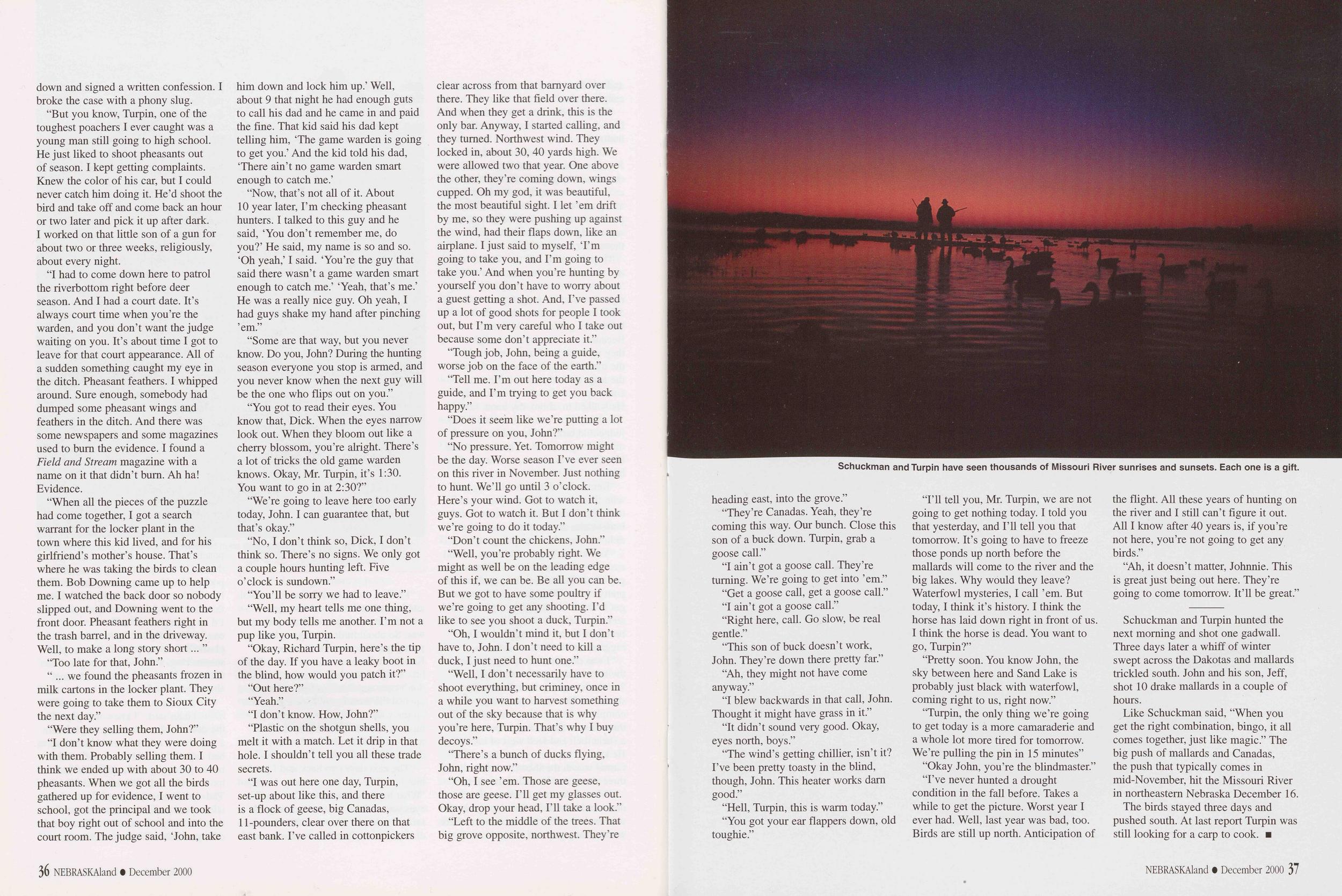 down and signed a written confession. I
broke the case with a phony slug.
down and signed a written confession. I
broke the case with a phony slug.
“But you know, Turpin, one of the toughest poachers I ever caught was a young man still going to high school. He just liked to shoot pheasants out of season. I kept getting complaints. Knew the color of his car, but I could never catch him doing it. He’d shoot the bird and take off and come back an hour or two later and pick it up after dark. I worked on that little son of a gun for about two or three weeks, religiously, about every night.
"I had to come down here to patrol the riverbottom right before deer season. And I had a court date. It’s always court time when you’re the warden, and you don’t want the judge waiting on you. It’s about time I got to leave for that court appearance. All of a sudden something caught my eye in the ditch. Pheasant feathers. I whipped around. Sure enough, somebody had dumped some pheasant wings and feathers in the ditch. And there was some newspapers and some magazines used to bum the evidence. I found a Field and Stream magazine with a name on it that didn’t bum. Ah ha! Evidence.
“When all the pieces of the puzzle had come together, I got a search warrant for the locker plant in the town where this kid lived, and for his girlfriend’s mother’s house. That’s where he was taking the birds to clean them. Bob Downing came up to help me. I watched the back door so nobody slipped out, and Downing went to the front door. Pheasant feathers right in the trash barrel, and in the driveway. Well, to make a long story short...”
“Too late for that, John.”
“ ... we found the pheasants frozen in milk cartons in the locker plant. They were going to take them to Sioux City the next day.”
“Were they selling them, John?”
“I don’t know what they were doing with them. Probably selling them. I think we ended up with about 30 to 40 pheasants. When we got all the birds gathered up for evidence, I went to school, got the principal and we took that boy right out of school and into the court room. The judge said, ‘John, take him down and lock him up.’ Well, about 9 that night he had enough guts to call his dad and he came in and paid the fine. That kid said his dad kept telling him, ‘The game warden is going to get you.’ And the kid told his dad, ‘There ain’t no game warden smart enough to catch me.’
“Now, that’s not all of it. About 10 year later, I’m checking pheasant hunters. I talked to this guy and he said, ‘You don’t remember me, do you?’ He said, my name is so and so. ‘Oh yeah,’ I said. ‘You’re the guy that said there wasn’t a game warden smart enough to catch me.’ ‘Yeah, that’s me.’ He was a really nice guy. Oh yeah, I had guys shake my hand after pinching ’em.”
“Some are that way, but you never know. Do you, John? During the hunting season everyone you stop is armed, and you never know when the next guy will be the one who flips out on you.”
“You got to read their eyes. You know that, Dick. When the eyes narrow look out. When they bloom out like a cherry blossom, you’re alright. There’s a lot of tricks the old game warden knows. Okay, Mr. Turpin, it’s 1:30. You want to go in at 2:30?”
“We’re going to leave here too early today, John. I can guarantee that, but that’s okay.”
“No, I don’t think so, Dick, I don’t think so. There’s no signs. We only got a couple hours hunting left. Five o’clock is sundown.”
“You’ll be sorry we had to leave.”
“Well, my heart tells me one thing, but my body tells me another. I’m not a pup like you, Turpin.
“Okay, Richard Turpin, here’s the tip of the day. If you have a leaky boot in the blind, how would you patch it?”
“Out here?”
“Yeah.”
“I don’t know. How, John?”
“Plastic on the shotgun shells, you melt it with a match. Let it drip in that hole. I shouldn’t tell you all these trade secrets.
“I was out here one day, Turpin, set-up about like this, and there is a flock of geese, big Canadas, 11-pounders, clear over there on that east bank. I’ve called in cottonpickers clear across from that barnyard over there. They like that field over there. And when they get a drink, this is the only bar. Anyway, I started calling, and they turned. Northwest wind. They locked in, about 30, 40 yards high. We were allowed two that year. One above the other, they’re coming down, wings cupped. Oh my god, it was beautiful, the most beautiful sight. I let ’em drift by me, so they were pushing up against the wind, had their flaps down, like an airplane. I just said to myself, I’m going to take you, and I’m going to take you.’ And when you’re hunting by yourself you don’t have to worry about a guest getting a shot. And, I’ve passed up a lot of good shots for people I took out, but I’m very careful who I take out because some don’t appreciate it.”
“Tough job, John, being a guide, worse job on the face of the earth.”
“Tell me. I’m out here today as a guide, and I’m trying to get you back happy.”
“Does it seem like we’re putting a lot of pressure on you, John?”
“No pressure. Yet. Tomorrow might be the day. Worse season I’ve ever seen on this river in November. Just nothing to hunt. We’ll go until 3 o’clock. Here’s your wind. Got to watch it, guys. Got to watch it. But I don’t think we’re going to do it today.”
“Don’t count the chickens, John.”
“Well, you’re probably right. We might as well be on the leading edge of this if, we can be. Be all you can be. But we got to have some poultry if we’re going to get any shooting. I’d like to see you shoot a duck, Turpin.”
“Oh, I wouldn’t mind it, but I don’t have to, John. I don’t need to kill a duck, I just need to hunt one.”
“Well, I don’t necessarily have to shoot everything, but criminey, once in a while you want to harvest something out of the sky because that is why you’re here, Turpin. That’s why I buy decoys.”
“There’s a bunch of ducks flying, John, right now.”
“Oh, I see ’em. Those are geese, those are geese. I’ll get my glasses out. Okay, drop your head, I’ll take a look.”
“Left to the middle of the trees. That big grove opposite, northwest. They’re heading east, into the grove.”
“They’re Canadas. Yeah, they’re coming this way. Our bunch. Close this son of a buck down. Turpin, grab a goose call.”
“I ain’t got a goose call. They’re turning. We’re going to get into ’em.”
“Get a goose call, get a goose call.”
“I ain’t got a goose call.”
“Right here, call. Go slow, be real gentle.”
“This son of buck doesn’t work, John. They’re down there pretty far.”
“Ah, they might not have come anyway.”
“I blew backwards in that call, John. Thought it might have grass in it.”
“It didn’t sound very good. Okay, eyes north, boys.”
“The wind’s getting chillier, isn’t it? I’ve been pretty toasty in the blind, though, John. This heater works darn good.”
“Hell, Turpin, this is warm today.”
“You got your ear flappers down, old toughie.”
“I’ll tell you, Mr. Turpin, we are not going to get nothing today. I told you that yesterday, and I’ll tell you that tomorrow. It’s going to have to freeze those ponds up north before the mallards will come to the river and the big lakes. Why would they leave? Waterfowl mysteries, I call ’em. But today, I think it’s history. I think the horse has laid down right in front of us. I think the horse is dead. You want to go, Turpin?”
“Pretty soon. You know John, the sky between here and Sand Lake is probably just black with waterfowl, coming right to us, right now.”
“Turpin, the only thing we’re going to get today is a more camaraderie and a whole lot more tired for tomorrow. We’re pulling the pin in 15 minutes”
“Okay John, you’re the blindmaster.”
“I’ve never hunted a drought condition in the fall before. Takes a while to get the picture. Worst year I ever had. Well, last year was bad, too. Birds are still up north. Anticipation of the flight. All these years of hunting on the river and I still can’t figure it out. All I know after 40 years is, if you’re not here, you’re not going to get any birds.”
“Ah, it doesn’t matter, Johnnie. This is great just being out here. They’re going to come tomorrow. It’ll be great.”
Schuckman and Turpin hunted the next morning and shot one gadwall. Three days later a whiff of winter swept across the Dakotas and mallards trickled south. John and his son, Jeff, shot 10 drake mallards in a couple of hours.
Like Schuckman said, “When you get the right combination, bingo, it all comes together, just like magic.” The big push of mallards and Canadas, the push that typically comes in mid-November, hit the Missouri River in northeastern Nebraska December 16.
The birds stayed three days and pushed south. At last report Turpin was still looking for a carp to cook. ■
36 NEBRASKAland • December 2000 NEBRASKAland • December 2000 37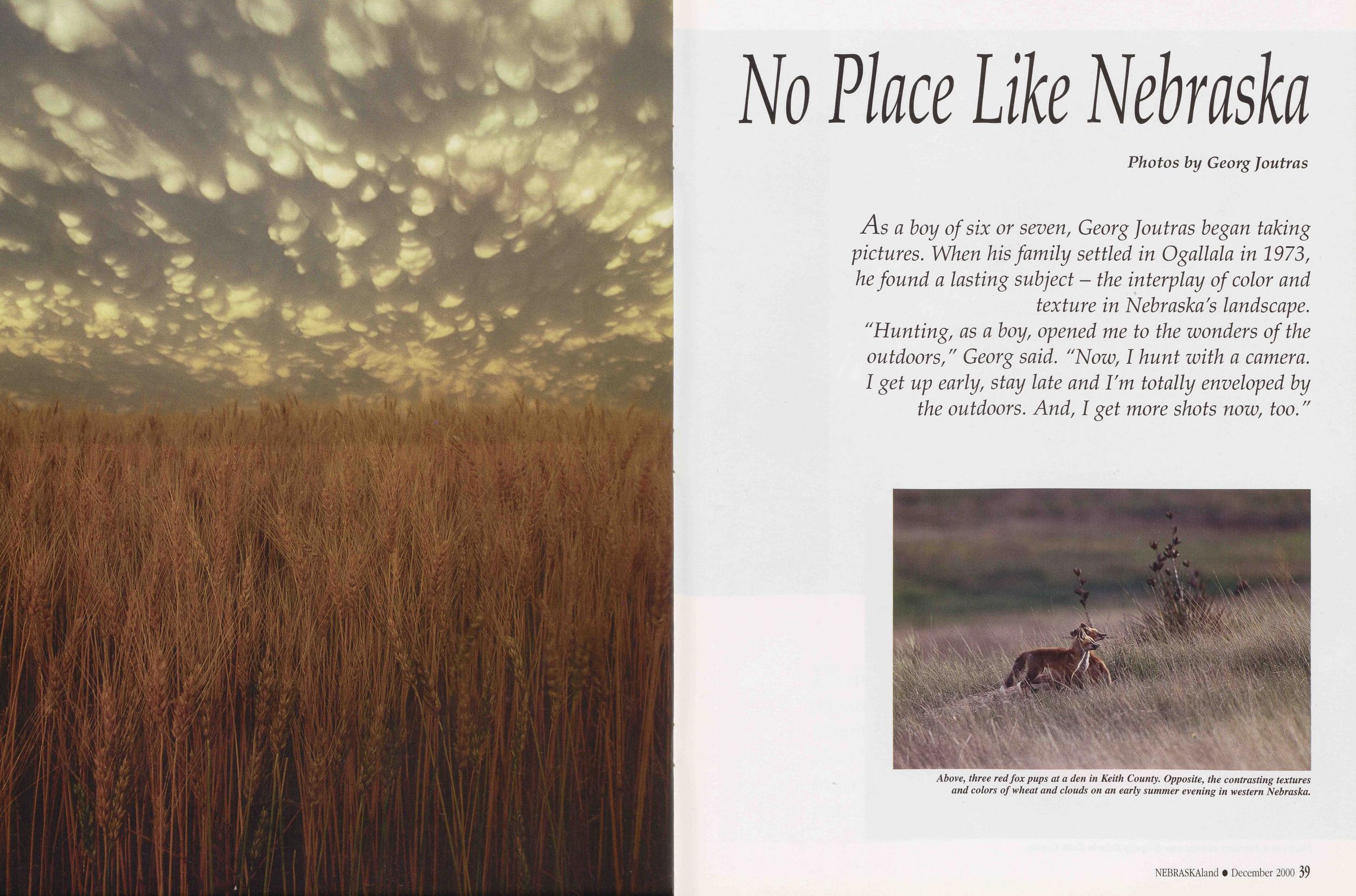
No Place Like Nebraska
Photos by Georg Joutras As a boy of six or seven, Georg Joutras began taking pictures. When his family settled in Ogallala in 1973, he found a lasting subject - the interplay of color and texture in Nebraska's landscape. Hunting, as a boy, opened me to the wonders of the outdoors," Georg said. "Now, I hunt with a camera. 1 get up early, stay late and I'm totally enveloped by the outdoors. And, I get more shots now, too."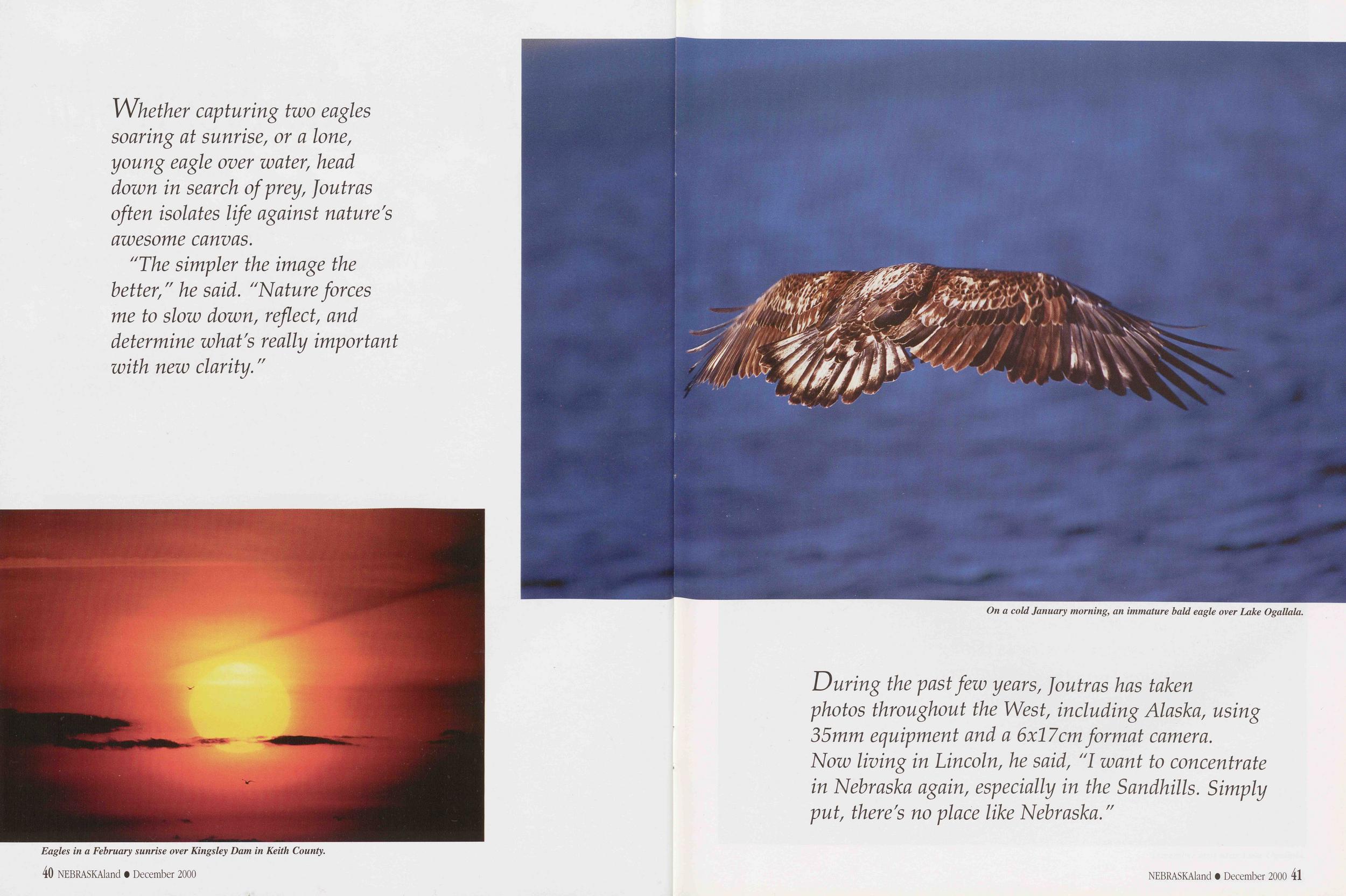 Whether capturing two eagles
soaring at sunrise, or a lone,
young eagle over water, head
down in search of prey, Joutras
often isolates life against nature's
awesome canvas.
The simpler the image the
better," he said. "Nature forces
me to slow down, reflect, and
determine what's really important
with new clarity."
Whether capturing two eagles
soaring at sunrise, or a lone,
young eagle over water, head
down in search of prey, Joutras
often isolates life against nature's
awesome canvas.
The simpler the image the
better," he said. "Nature forces
me to slow down, reflect, and
determine what's really important
with new clarity."
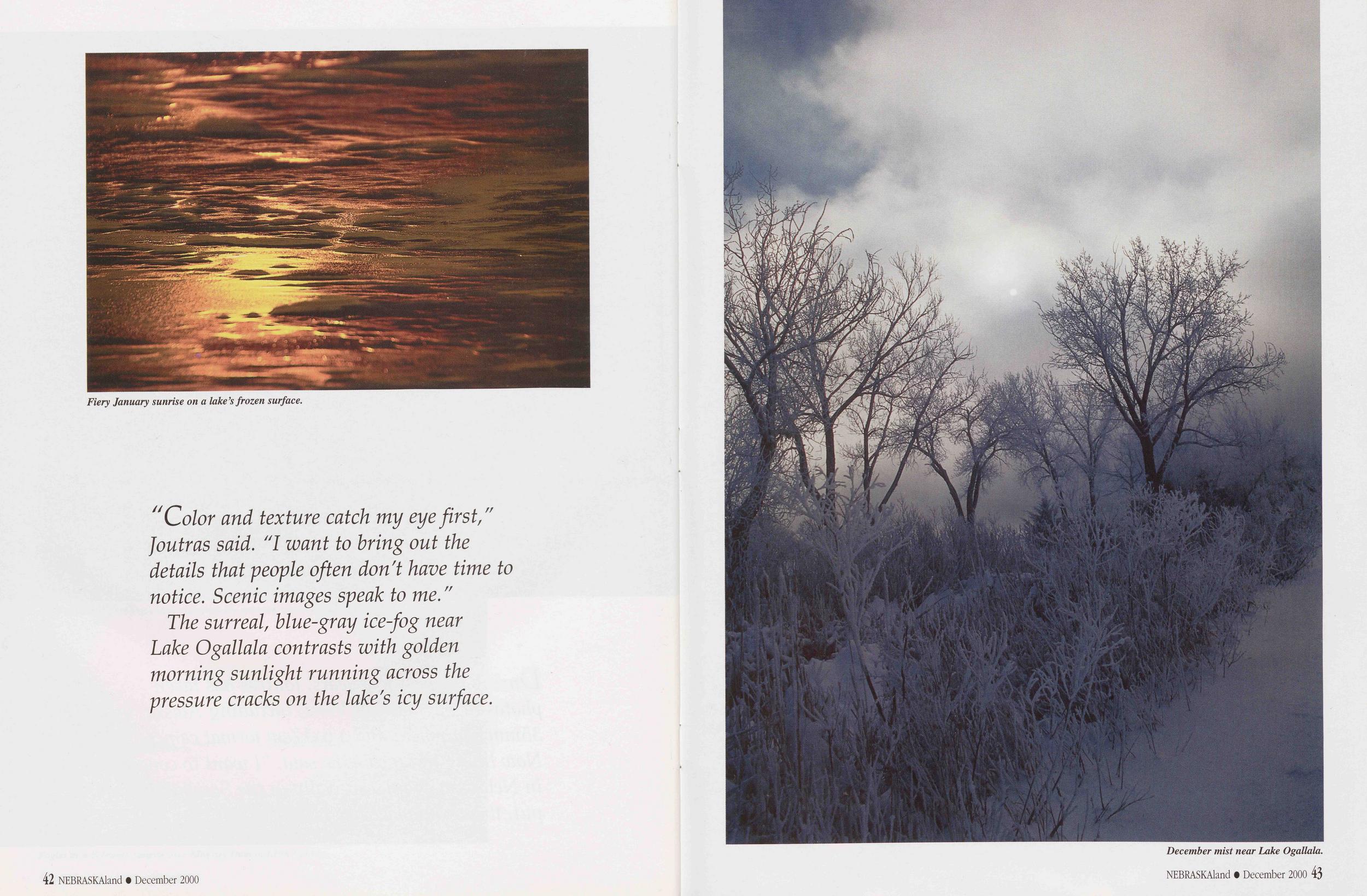 Color and texture catch my eye first,"
Joutras said, "I want to bring out the
details that people often don't have time to
notice. Scenic images speak to me."
The surreal, blue-gray ice-fog near
Lake Ogallala contrasts with golden
morning sunlight running across the
pressure cracks on the lake's icy surface.
Color and texture catch my eye first,"
Joutras said, "I want to bring out the
details that people often don't have time to
notice. Scenic images speak to me."
The surreal, blue-gray ice-fog near
Lake Ogallala contrasts with golden
morning sunlight running across the
pressure cracks on the lake's icy surface.
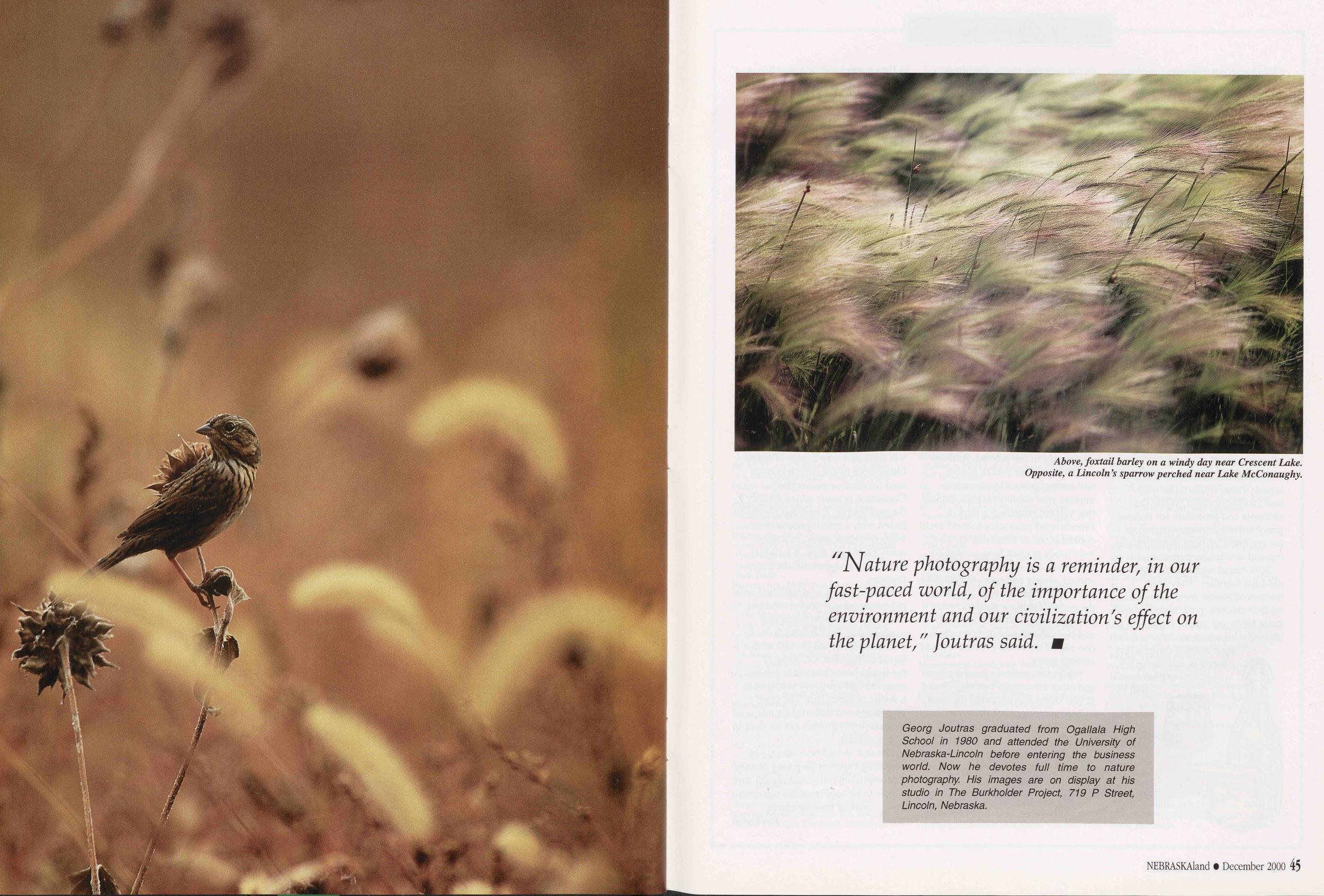
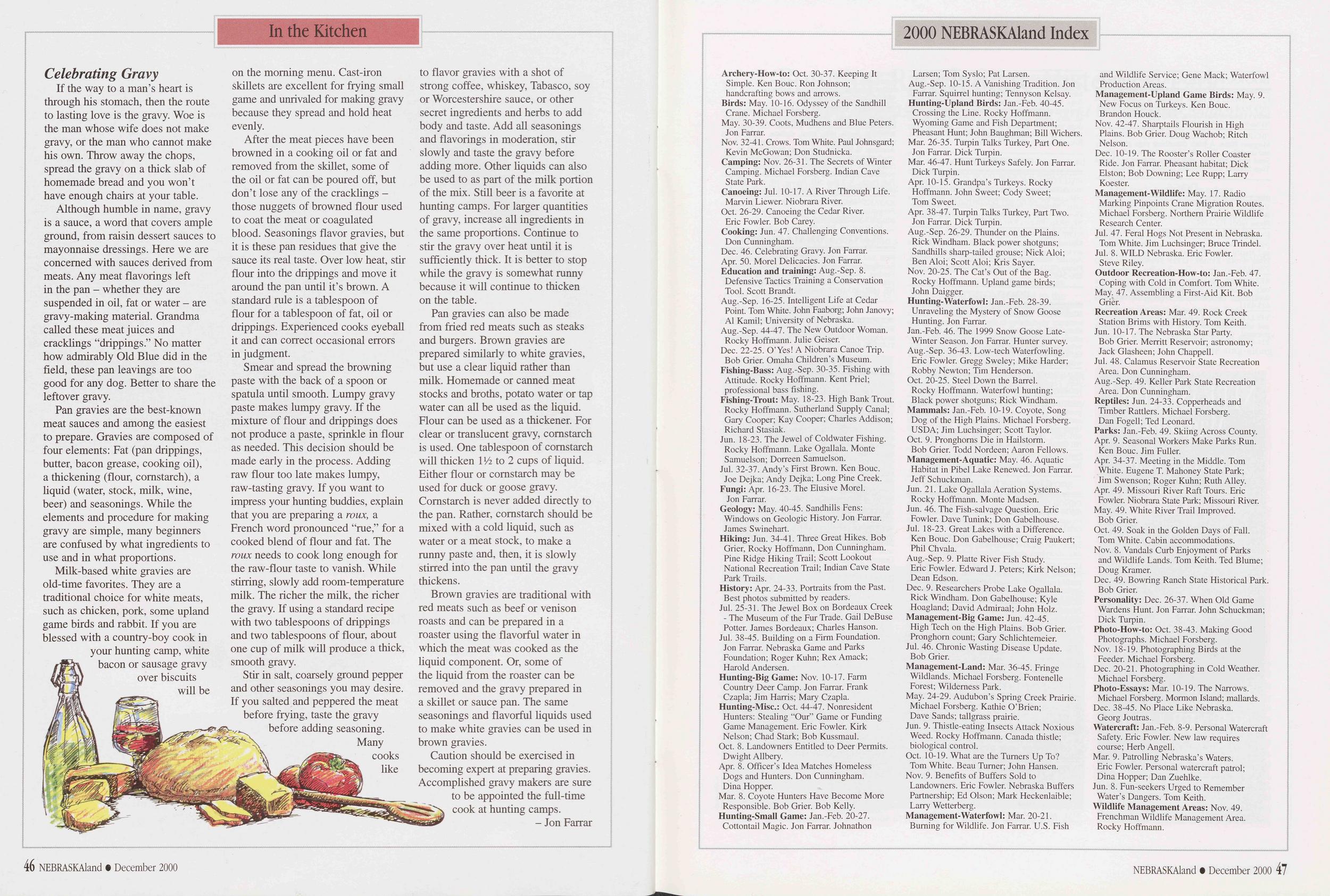
If the way to a man’s heart is through his stomach, then the route to lasting love is the gravy. Woe is the man whose wife does not make gravy, or the man who cannot make his own. Throw away the chops, spread the gravy on a thick slab of homemade bread and you won’t have enough chairs at your table.
Although humble in name, gravy is a sauce, a word that covers ample ground, from raisin dessert sauces to mayonnaise dressings. Here we are concerned with sauces derived from meats. Any meat flavorings left in the pan - whether they are suspended in oil, fat or water - are gravy-making material. Grandma called these meat juices and cracklings “drippings.” No matter how admirably Old Blue did in the field, these pan leavings are too good for any dog. Better to share the leftover gravy.
Pan gravies are the best-known meat sauces and among the easiest to prepare. Gravies are composed of four elements: Fat (pan drippings, butter, bacon grease, cooking oil), a thickening (flour, cornstarch), a liquid (water, stock, milk, wine, beer) and seasonings. While the elements and procedure for making gravy are simple, many beginners are confused by what ingredients to use and in what proportions.
Milk-based white gravies are old-time favorites. They are a traditional choice for white meats, such as chicken, pork, some upland game birds and rabbit. If you are blessed with a country-boy cook in your hunting camp, white bacon or sausage gravy over biscuits will be like on the morning menu. Cast-iron skillets are excellent for frying small game and unrivaled for making gravy because they spread and hold heat evenly.
After the meat pieces have been browned in a cooking oil or fat and removed from the skillet, some of the oil or fat can be poured off, but don’t lose any of the cracklings - those nuggets of browned flour used to coat the meat or coagulated blood. Seasonings flavor gravies, but it is these pan residues that give the sauce its real taste. Over low heat, stir flour into the drippings and move it around the pan until it’s brown. A standard rule is a tablespoon of flour for a tablespoon of fat, oil or drippings. Experienced cooks eyeball it and can correct occasional errors in judgment.
Smear and spread the browning paste with the back of a spoon or spatula until smooth. Lumpy gravy paste makes lumpy gravy. If the mixture of flour and drippings does not produce a paste, sprinkle in flour as needed. This decision should be made early in the process. Adding raw flour too late makes lumpy, raw-tasting gravy. If you want to impress your hunting buddies, explain that you are preparing a roux, a French word pronounced “rue,” for a cooked blend of flour and fat. The roux needs to cook long enough for the raw-flour taste to vanish. While stirring, slowly add room-temperature milk. The richer the milk, the richer the gravy. If using a standard recipe with two tablespoons of drippings and two tablespoons of flour, about one cup of milk will produce a thick, smooth gravy.
Stir in salt, coarsely ground pepper and other seasonings you may desire. If you salted and peppered the meat before frying, taste the gravy before adding seasoning. Many cooks to flavor gravies with a shot of strong coffee, whiskey, Tabasco, soy or Worcestershire sauce, or other secret ingredients and herbs to add body and taste. Add all seasonings and flavorings in moderation, stir slowly and taste the gravy before adding more. Other liquids can also be used to as part of the milk portion of the mix. Still beer is a favorite at hunting camps. For larger quantities of gravy, increase all ingredients in the same proportions. Continue to stir the gravy over heat until it is sufficiently thick. It is better to stop while the gravy is somewhat runny because it will continue to thicken on the table.
Pan gravies can also be made from fried red meats such as steaks and burgers. Brown gravies are prepared similarly to white gravies, but use a clear liquid rather than milk. Homemade or canned meat stocks and broths, potato water or tap water can all be used as the liquid. Flour can be used as a thickener. For clear or translucent gravy, cornstarch is used. One tablespoon of cornstarch will thicken IVi to 2 cups of liquid. Either flour or cornstarch may be used for duck or goose gravy. Cornstarch is never added directly to the pan. Rather, cornstarch should be mixed with a cold liquid, such as water or a meat stock, to make a runny paste and, then, it is slowly stirred into the pan until the gravy thickens.
Brown gravies are traditional with red meats such as beef or venison roasts and can be prepared in a roaster using the flavorful water in which the meat was cooked as the liquid component. Or, some of the liquid from the roaster can be removed and the gravy prepared in a skillet or sauce pan. The same seasonings and flavorful liquids used to make white gravies can be used in brown gravies.
Caution should be exercised in becoming expert at preparing gravies. Accomplished gravy makers are sure to be appointed the full-time cook at hunting camps.
- Jon Farrar 2000 NEBRASKAland IndexArchery-How-to: Oct. 30-37. Keeping It Simple. Ken Bouc. Ron Johnson; handcrafting bows and arrows.
Birds: May. 10-16. Odyssey of the Sandhill Crane. Michael Forsberg. May. 30-39. Coots, Mudhens and Blue Peters. Jon Farrar. Nov. 32-41. Crows. Tom White. Paul Johnsgard; Kevin McGowan; Don Studnicka.
Camping: Nov. 26-31. The Secrets of Winter Camping. Michael Forsberg. Indian Cave State Park.
Canoeing: Jul. 10-17. A River Through Life. Marvin Liewer. Niobrara River. Oct. 26-29. Canoeing the Cedar River. Eric Fowler. Bob Carey.
Cooking: Jun. 47. Challenging Conventions. Don Cunningham. Dec. 46. Celebrating Gravy. Jon Farrar. Apr. 50. Morel Delicacies. Jon Farrar.
Education and training: Aug.-Sep. 8. Defensive Tactics Training a Conservation Tool. Scott Brandt. Aug.-Sep. 16-25. Intelligent Life at Cedar Point. Tom White. John Faaborg; John Janovy; Al Kamil; University of Nebraska. Aug.-Sep. 44-47. The New Outdoor Woman. Rocky Hoffmann. Julie Geiser. Dec. 22-25. O’Yes! A Niobrara Canoe Trip. Bob Grier. Omaha Children’s Museum.
Fishing-Bass: Aug.-Sep. 30-35. Fishing with Attitude. Rocky Hoffmann. Kent Priel; professional bass fishing.
Fishing-Trout: May. 18-23. High Bank Trout. Rocky Hoffmann. Sutherland Supply Canal; Gary Cooper; Kay Cooper; Charles Addison; Richard Stasiak. Jun. 18-23. The Jewel of Coldwater Fishing. Rocky Hoffmann. Lake Ogallala. Monte Samuelson; Dorreen Samuelson. Jul. 32-37. Andy’s First Brown. Ken Bouc. Joe Dejka; Andy Dejka; Long Pine Creek.
Fungi: Apr. 16-23. The Elusive Morel. Jon Farrar.
Geology: May. 40-45. Sandhills Fens: Windows on Geologic History. Jon Farrar. James Swinehart.
Hiking: Jun. 34-41. Three Great Hikes. Bob Grier, Rocky Hoffmann, Don Cunningham. Pine Ridge Hiking Trail; Scott Lookout National Recreation Trail; Indian Cave State Park Trails.
History: Apr. 24-33. Portraits from the Past. Best photos submitted by readers. Jul. 25-31. The Jewel Box on Bordeaux Creek - The Museum of the Fur Trade. Gail DeBuse Potter. James Bordeaux; Charles Hanson. Jul. 38-45. Building on a Firm Foundation. Jon Farrar. Nebraska Game and Parks Foundation; Roger Kuhn; Rex Amack; Harold Andersen.
Hunting-Big Game: Nov. 10-17. Farm Country Deer Camp. Jon Farrar. Frank Czapla; Jim Harris; Mary Czapla.
Hunting-Misc.: Oct. 44-47. Nonresident Hunters: Stealing “Our” Game or Funding Game Management. Eric Fowler. Kirk Nelson; Chad Stark; Bob Kussmaul. Oct. 8. Landowners Entitled to Deer Permits. Dwight Allbery. Apr. 8. Officer’s Idea Matches Homeless Dogs and Hunters. Don Cunningham. Dina Hopper. Mar. 8. Coyote Hunters Have Become More Responsible. Bob Grier. Bob Kelly.
Hunting-Small Game: Jan.-Feb. 20-27. Cottontail Magic. Jon Farrar. Johnathon Larsen; Tom Syslo; Pat Larsen. Aug.-Sep. 10-15. A Vanishing Tradition. Jon Farrar. Squirrel hunting; Tennyson Kelsay.
Hunting-Upland Birds: Jan.-Feb. 40-45. Crossing the Line. Rocky Hoffmann. Wyoming Game and Fish Department; Pheasant Hunt; John Baughman; Bill Wichers. Mar. 26-35. Turpin Talks Turkey, Part One. Jon Farrar. Dick Turpin. Mar. 46-47. Hunt Turkeys Safely. Jon Farrar. Dick Turpin. Apr. 10-15. Grandpa’s Turkeys. Rocky Hoffmann. John Sweet; Cody Sweet; Tom Sweet. Apr. 38-47. Turpin Talks Turkey, Part Two. Jon Farrar. Dick Turpin. Aug.-Sep. 26-29. Thunder on the Plains. Rick Windham. Black power shotguns; Sandhills sharp-tailed grouse; Nick Aloi; Ben Aloi; Scott Aloi; Kris Sayer. Nov. 20-25. The Cat’s Out of the Bag. Rocky Hoffmann. Upland game birds; John Daigger.
Hunting-Waterfowl: Jan.-Feb. 28-39. Unraveling the Mystery of Snow Goose Hunting. Jon Farrar. Jan.-Feb. 46. The 1999 Snow Goose Late- Winter Season. Jon Farrar. Hunter survey. Aug.-Sep. 36-43. Low-tech Waterfowling. Eric Fowler. Gregg Sweley; Mike Harder; Robby Newton; Tim Henderson. Oct. 20-25. Steel Down the Barrel. Rocky Hoffmann. Waterfowl hunting; Black power shotguns; Rick Windham.
Mammals: Jan.-Feb. 10-19. Coyote, Song Dog of the High Plains. Michael Forsberg. USDA; Jim Luchsinger; Scott Taylor. Oct. 9. Pronghorns Die in Hailstorm. Bob Grier. Todd Nordeen; Aaron Fellows.
Management-Aquatic: May. 46. Aquatic Habitat in Pibel Lake Renewed. Jon Farrar. Jeff Schuckman. Jun. 21. Lake Ogallala Aeration Systems. Rocky Hoffmann. Monte Madsen. Jun. 46. The Fish-salvage Question. Eric Fowler. Dave Tunink; Don Gabelhouse. Jul. 18-23. Great Lakes with a Difference. Ken Bouc. Don Gabelhouse; Craig Paukert; Phil Chvala. Aug.-Sep. 9. Platte River Fish Study. Eric Fowler. Edward J. Peters; Kirk Nelson; Dean Edson. Dec. 9. Researchers Probe Lake Ogallala. Rick Windham. Don Gabelhouse; Kyle Hoagland; David Admiraal; John Holz.
Management-Big Game: Jun. 42-45. High Tech on the High Plains. Bob Grier. Pronghorn count; Gary Schlichtemeier. Jul. 46. Chronic Wasting Disease Update. Bob Grier.
Management-Land: Mar. 36-45. Fringe Wildlands. Michael Forsberg. Fontenelle Forest; Wilderness Park. May. 24-29. Audubon’s Spring Creek Prairie. Michael Forsberg. Kathie O’Brien; Dave Sands; tailgrass prairie. Jun. 9. Thistle-eating Insects Attack Noxious Weed. Rocky Hoffmann. Canada thistle; biological control. Oct. 10-19. What are the Turners Up To? Tom White. Beau Turner; John Hansen. Nov. 9. Benefits of Buffers Sold to Landowners. Eric Fowler. Nebraska Buffers Partnership; Ed Olson; Mark Heckenlaible; Larry Wetterberg.
Management-Waterfowl: Mar. 20-21. Burning for Wildlife. Jon Farrar. U.S. Fish and Wildlife Service; Gene Mack; Waterfowl Production Areas.
Management-Upland Game Birds: May. 9. New Focus on Turkeys. Ken Bouc. Brandon Houck. Nov. 42-47. Sharptails Flourish in High Plains. Bob Grier. Doug Wachob; Ritch Nelson. Dec. 10-19. The Rooster’s Roller Coaster Ride. Jon Farrar. Pheasant habitat; Dick Elston; Bob Downing; Lee Rupp; Larry Koester.
Management-Wildlife: May. 17. Radio Marking Pinpoints Crane Migration Routes. Michael Forsberg. Northern Prairie Wildlife Research Center. Jul. 47. Feral Hogs Not Present in Nebraska. Tom White. Jim Luchsinger; Bruce Trindel. Jul. 8. WILD Nebraska. Eric Fowler. Steve Riley.
Outdoor Recreation-How-to: Jan.-Feb. 47. Coping with Cold in Comfort. Tom White. May. 47. Assembling a First-Aid Kit. Bob Grier.
Recreation Areas: Mar. 49. Rock Creek Station Brims with History. Tom Keith. Jun. 10-17. The Nebraska Star Party. Bob Grier. Merritt Reservoir; astronomy; Jack Glasheen; John Chappell. Jul. 48. Calamus Reservoir State Recreation Area. Don Cunningham. Aug.-Sep. 49. Keller Park State Recreation Area. Don Cunningham. Reptiles: Jun. 24-33. Copperheads and Timber Rattlers. Michael Forsberg. Dan Fogell; Ted Leonard.
Parks: Jan.-Feb. 49. Skiing Across County. Apr. 9. Seasonal Workers Make Parks Run. Ken Bouc. Jim Fuller. Apr. 34-37. Meeting in the Middle. Tom White. Eugene T. Mahoney State Park; Jim Swenson; Roger Kuhn; Ruth Alley. Apr. 49. Missouri River Raft Tours. Eric Fowler. Niobrara State Park; Missouri River. May. 49. White River Trail Improved. Bob Grier. Oct. 49. Soak in the Golden Days of Fall. Tom White. Cabin accommodations. Nov. 8. Vandals Curb Enjoyment of Parks and Wildlife Lands. Tom Keith. Ted Blume; Doug Kramer. Dec. 49. Bowring Ranch State Historical Park. Bob Grier.
Personality: Dec. 26-37. When Old Game Wardens Hunt. Jon Farrar. John Schuckman; Dick Turpin.
Photo-How-to: Oct. 38-43. Making Good Photographs. Michael Forsberg. Nov. 18-19. Photographing Birds at the Feeder. Michael Forsberg. Dec. 20-21. Photographing in Cold Weather. Michael Forsberg.
Photo-Essays: Mar. 10-19. The Narrows. Michael Forsberg. Mormon Island; mallards. Dec. 38-45. No Place Like Nebraska. Georg Joutras.
Watercraft: Jan.-Feb. 8-9. Personal Watercraft Safety. Eric Fowler. New law requires course; Herb Angell. Mar. 9. Patrolling Nebraska’s Waters. Eric Fowler. Personal watercraft patrol; Dina Hopper; Dan Zuehlke. Jun. 8. Fun-seekers Urged to Remember Water’s Dangers. Tom Keith.
Wildlife Management Areas: Nov. 49. Frenchman Wildlife Management Area. Rocky Hoffmann.
46 NEBRASKAland • December 2000 NEBRASKAland • December 2000 47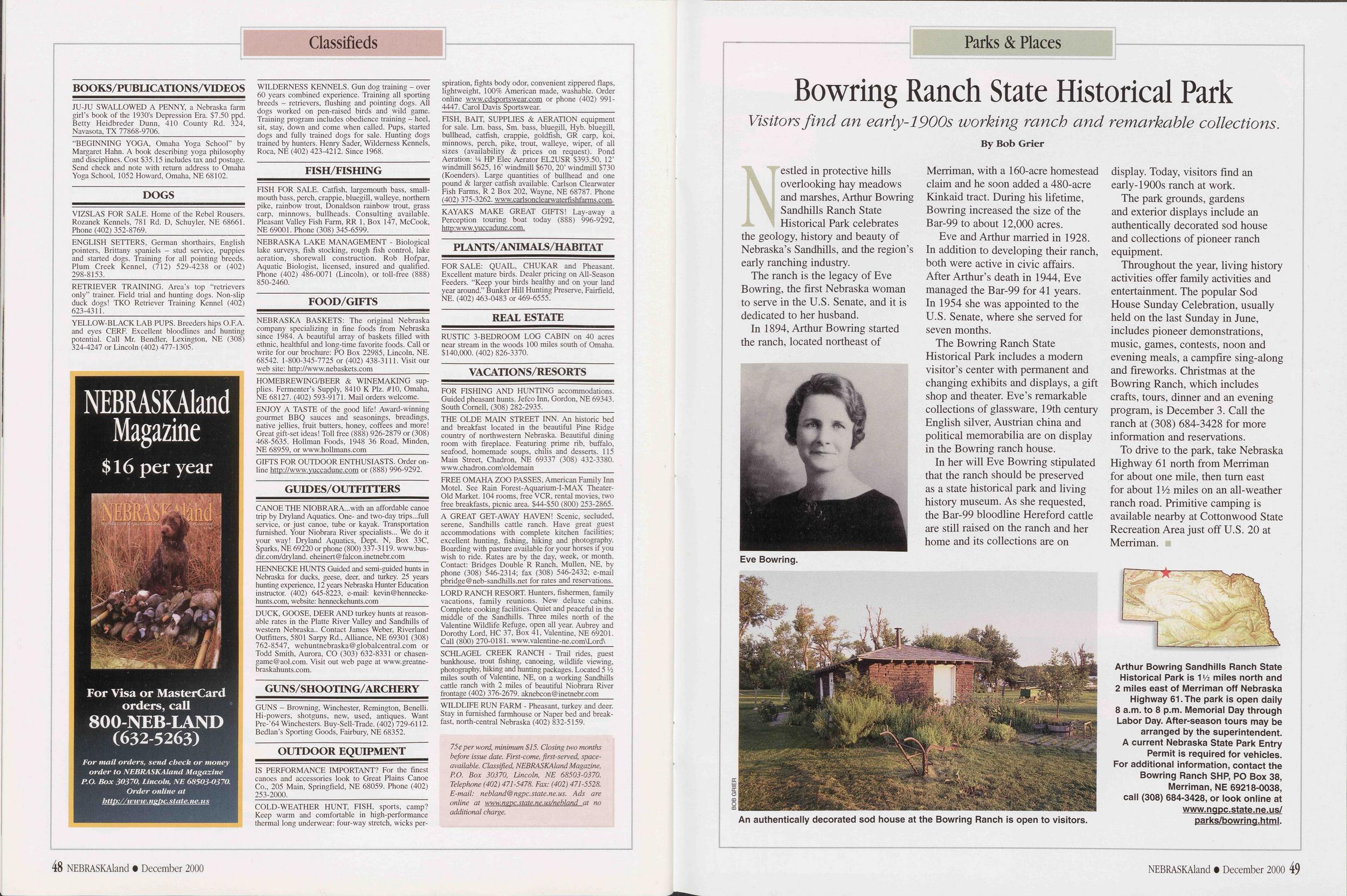
Classifieds
Parks& Places BOOKS/PUBLIC ATION S/VIDEOSJU-JU SWALLOWED A PENNY, a Nebraska farm girl’s book of the 1930's Depression Era. $7.50 ppd. Betty Heidbreder Dunn, 410 County Rd. 324, Navasota, TX 77868-9706.
“BEGINNING YOGA, Omaha Yoga School” by Margaret Hahn. A book describing yoga philosophy and disciplines. Cost $35.15 includes tax and postage. Send check and note with return address to Omaha Yoga School, 1052 Howard, Omaha, NE 68102.
DOGSVIZSLAS FOR SALE. Home of the Rebel Rousers. Rozanek Kennels, 781 Rd. D, Schuyler, NE 68661. Phone (402) 352-8769.
ENGLISH SETTERS, German shorthairs, English pointers, Brittany spaniels - stud service, puppies and started dogs. Training for all pointing breeds. Plum Creek Kennel, (712) 529-4238 or (402) 298-8153.
RETRIEVER TRAINING. Area’s top “retrievers only” trainer. Field trial and hunting dogs. Non-slip duck dogs! TKO Retriever Training Kennel (402) 623-4311.
YELLOW-BLACK LAB PUPS. Breeders hips O.F.A. and eyes CERF. Excellent bloodlines and hunting potential. Call Mr. Bendler, Lexington, NE (308) 324-4247 or Lincoln (402) 477-1305.
NEBRASKAland Magazine $16 per year For Visa or MasterCard orders, call 800-NEB-LAND (632-5263) For mail orders, send check or money order to NEBRASKAland Magazine P.O. Box 30370, Lincoln, NE 685O3-O37O. Order online at http://wivw.ngpc.state.ne.usWILDERNESS KENNELS. Gun dog training - over 60 years combined experience. Training all sporting breeds - retrievers, flushing and pointing dogs. All dogs worked on pen-raised birds and wild game. Training program includes obedience training - heel, sit, stay, down and come when called. Pups, started dogs and fully trained dogs for sale. Hunting dogs trained by hunters. Henry Sader, Wilderness Kennels, Roca, NE (402) 423-4212. Since 1968.
FISH/FISHINGFISH FOR SALE. Catfish, largemouth bass, small- mouth bass, perch, crappie, bluegill, walleye, northern pike, rainbow trout, Donaldson rainbow trout, grass carp, minnows, bullheads. Consulting available. Pleasant Valley Fish Farm, RR 1, Box 147, McCook, NE 69001. Phone (308) 345-6599.
NEBRASKA LAKE MANAGEMENT - Biological lake surveys, fish stocking, rough fish control, lake aeration, shorewall construction. Rob Hofpar, Aquatic Biologist, licensed, insured and qualified. Phone (402) 486-0071 (Lincoln), or toll-free (888) 850-2460.
FOOD/GIFTSNEBRASKA BASKETS: The original Nebraska company specializing in fine foods from Nebraska since 1984. A beautiful array of baskets filled with ethnic, healthful and long-time favorite foods. Call or write for our brochure: PO Box 22985, Lincoln, NE. 68542. 1-800-345-7725 or (402) 438-3111. Visit our web site: http://www.nebaskets.com
HOMEBREWING/BEER & WINEMAKING sup- plies. Fermenter’s Supply, 8410 K Plz. #10, Omaha, NE 68127. (402) 593-9171. Mail orders welcome.
ENJOY A TASTE of the good life! Award-winning gourmet BBQ sauces and seasonings, breadings, native jellies, fruit butters, honey, coffees and more! Great gift-set ideas! Toll free (888) 926-2879 or (308) 468-5635. Hollman Foods, 1948 36 Road, Minden, NE 68959, or www.hollmans.com
GIFTS FOR OUTDOOR ENTHUSIASTS. Order on- line http://www.vuccadune.com or (888) 996-9292.
GUIDES/OUTFITTERSCANOE THE NIOBRARA...with an affordable canoe trip by Dryland Aquatics. One- and two-day trips...full service, or just canoe, tube or kayak. Transportation furnished. Your Niobrara River specialists... We do it your way! Dryland Aquatics, Dept. N, Box 33C, Sparks, NE 69220 or phone (800) 337-3119. www.bus- dir.com/dryland. eheinert@falcon.inetnebr.com
HENNECKE HUNTS Guided and semi-guided hunts in Nebraska for ducks, geese, deer, and turkey. 25 years hunting experience, 12 years Nebraska Hunter Education instructor. (402) 645-8223, e-mail: kevin@hermecke- hunts.com, website: henneckehunts.com
DUCK, GOOSE, DEER AND turkey hunts at reason- able rates in the Platte River Valley and Sandhills of western Nebraska.. Contact James Weber, Riverland Outfitters, 5801 Sarpy Rd., Alliance, NE 69301 (308) 762-8547, wehuntnebraska@globalcentral.com or Todd Smith, Aurora, CO (303) 632-8331 or chasen- game@aol.com. Visit out web page at www.greatne- braskahunts.com.
GUNS/SHOOTING/ARCHERYGUNS - Browning, Winchester, Remington, Benelli. Hi-powers, shotguns, new, used, antiques. Want Pre-’64 Winchesters. Buy-Sell-Trade. (402) 729-6112. Bedlan’s Sporting Goods, Fairbury, NE 68352.
Ol JTDOOR EQUIPMENTIS PERFORMANCE IMPORTANT? For the finest canoes and accessories look to Great Plains Canoe Co., 205 Main, Springfield, NE 68059. Phone (402) 253-2000.
COLD-WEATHER HUNT, FISH, sports, camp? Keep warm and comfortable in high-performance thermal long underwear: four-way stretch, wicks per- spiration, fights body odor, convenient zippered flaps, lightweight, 100% American made, washable. Order online www.cdsportswear.com or phone (402) 991- 4447. Carol Davis Sportswear.
FISH, BAIT, SUPPLIES & AERATION equipment for sale. Lm. bass, Sm. bass, bluegill, Hyb. bluegill, bullhead, catfish, crappie, goldfish, GR carp, koi, minnows, perch, pike, trout, walleye, wiper, of all sizes (availability & prices on request). Pond Aeration: 14 HP Elec Aerator EL2USR $393.50, 12’ windmill $625, 16’ windmill $670, 20’ windmill $730 (Koenders). Large quantities of bullhead and one pound &larger catfish available. Carlson Clearwater Fish Farms, R 2 Box 202, Wayne, NE 68787. Phone (402) 375-3262. www.carlsonclearwaterfishfarms.com.
KAYAKS MAKE GREAT GIFTS! Lay-away a Perception touring boat today (888) 996-9292, http:www.vuccadune.com.
PLANTS/ANIMALS/HABITATFOR SALE: QUAIL, CHUKAR and Pheasant. Excellent mature birds. Dealer pricing on All-Season Feeders. “Keep your birds healthy and on your land year around.” Bunker Hill Hunting Preserve, Fairfield, NE. (402) 463-0483 or 469-6555.
REAL ESTATERUSTIC 3-BEDROOM LOG CABIN on 40 acres near stream in the woods 100 miles south of Omaha. $140,000. (402) 826-3370.
VACATIONS/RESORTSFOR FISHING AND HUNTING accommodations. Guided pheasant hunts. Jefco Inn, Gordon, NE 69343. South Cornell, (308) 282-2935.
THE OLDE MAIN STREET INN. An historic bed and breakfast located in the beautiful Pine Ridge country of northwestern Nebraska. Beautiful dining room with fireplace. Featuring prime rib, buffalo, seafood, homemade soups, chilis and desserts. 115 Main Street, Chadron, NE 69337 (308) 432-3380. www.chadron,com\oldemain
FREE OMAHA ZOO PASSES, American Family Inn Motel. See Rain Forest-Aquarium-I-MAX Theater- Old Market. 104 rooms, free VCR, rental movies, two free breakfasts, picnic area. $44-$50 (800) 253-2865.
A GREAT GET-AWAY HAVEN! Scenic, secluded, serene, Sandhills cattle ranch. Have great guest accommodations with complete kitchen facilities; excellent hunting, fishing, hiking and photography. Boarding with pasture available for your horses if you wish to ride. Rates are by the day, week, or month. Contact: Bridges Double R Ranch, Mullen, NE, by phone (308) 546-2314; fax (308) 546-2432; e-mail pbridge@neb-sandhills.net for rates and reservations.
LORD RANCH RESORT. Hunters, fishermen, family vacations, family reunions. New deluxe cabins. Complete cooking facilities. Quiet and peaceful in the middle of the Sandhills. Three miles north of the Valentine Wildlife Refuge, open all year. Aubrey and Dorothy Lord, HC 37, Box 41, Valentine, NE 69201. Call (800) 270-0181. www.valentine-ne.com\Lord\
SCHLAGEL CREEK RANCH - Trail rides, guest bunkhouse, trout fishing, canoeing, wildlife viewing, photography, hiking and hunting packages. Located 5 Vi miles south of Valentine, NE, on a working Sandhills cattle ranch with 2 miles of beautiful Niobrara River frontage (402) 376-2679. aknebcon@inetnebr.com
WILDLIFE RUN FARM - Pheasant, turkey and deer. Stay in furnished farmhouse or Naper bed and break- fast, north-central Nebraska (402) 832-5159.
75 per word, minimum $15. Closing two months before issue date. First-come, first-served, space- available. Classified, NEBRASKAland Magazine, P.O. Box 30370, Lincoln, NE 68503-0370. Telephone (402) 471-5478. Fax: (402) 471-5528. E-mail: nebland@ngpc.state.ne.us. Ads are online at ww.ngpc.state.ne.us/nebland at no additional charge.
Bowring Ranch State Historical Park Visitors find an early-1900s working ranch and remarkable collections. By Bob GrierNestled in protective hills overlooking hay meadows and marshes, Arthur Bowring Sandhills Ranch State Historical Park celebrates the geology, history and beauty of Nebraska’s Sandhills, and the region’s early ranching industry.
The ranch is the legacy of Eve Bowring, the first Nebraska woman to serve in the U.S. Senate, and it is dedicated to her husband.
In 1894, Arthur Bowring started the ranch, located northeast of Merriman, with a 160-acre homestead claim and he soon added a 480-acre Kinkaid tract. During his lifetime, Bowring increased the size of the Bar-99 to about 12,000 acres.
Eve and Arthur married in 1928. In addition to developing their ranch, both were active in civic affairs. After Arthur’s death in 1944, Eve managed the Bar-99 for 41 years. In 1954 she was appointed to the U.S. Senate, where she served for seven months.
The Bowring Ranch State Historical Park includes a modem visitor’s center with permanent and changing exhibits and displays, a gift shop and theater. Eve’s remarkable collections of glassware, 19th century English silver, Austrian china and political memorabilia are on display in the Bowring ranch house.
In her will Eve Bowring stipulated that the ranch should be preserved as a state historical park and living history museum. As she requested, the Bar-99 bloodline Hereford cattle are still raised on the ranch and her home and its collections are on display. Today, visitors find an early-1900s ranch at work. The park grounds, gardens and exterior displays include an authentically decorated sod house and collections of pioneer ranch equipment.
Throughout the year, living history activities offer family activities and entertainment. The popular Sod House Sunday Celebration, usually held on the last Sunday in June, includes pioneer demonstrations, music, games, contests, noon and evening meals, a campfire sing-along and fireworks. Christmas at the Bowring Ranch, which includes crafts, tours, dinner and an evening program, is December 3. Call the ranch at (308) 684-3428 for more information and reservations.
To drive to the park, take Nebraska Highway 61 north from Merriman for about one mile, then turn east for about 1 1/2 miles on an all-weather ranch road. Primitive camping is available nearby at Cottonwood State Recreation Area just off U.S. 20 at Merriman.
Arthur Bowring Sandhills Ranch State Historical Park is 13 miles north and 2 miles east of Merriman off Nebraska Highway 61. The park is open daily 8 a.m. to 8 p.m. Memorial Day through Labor Day. After-season tours may be arranged by the superintendent. A current Nebraska State Park Entry Permit is required for vehicles. For additional information, contact the Bowring Ranch SHP, PO Box 38, Merriman, NE 69218-0038, call (308) 684-3428, or look online at www.nqpc.state.ne.us/ parks/bowrina.html.
48 NEBRASKAland • December 2000 NEBRASKAland • December 2000 49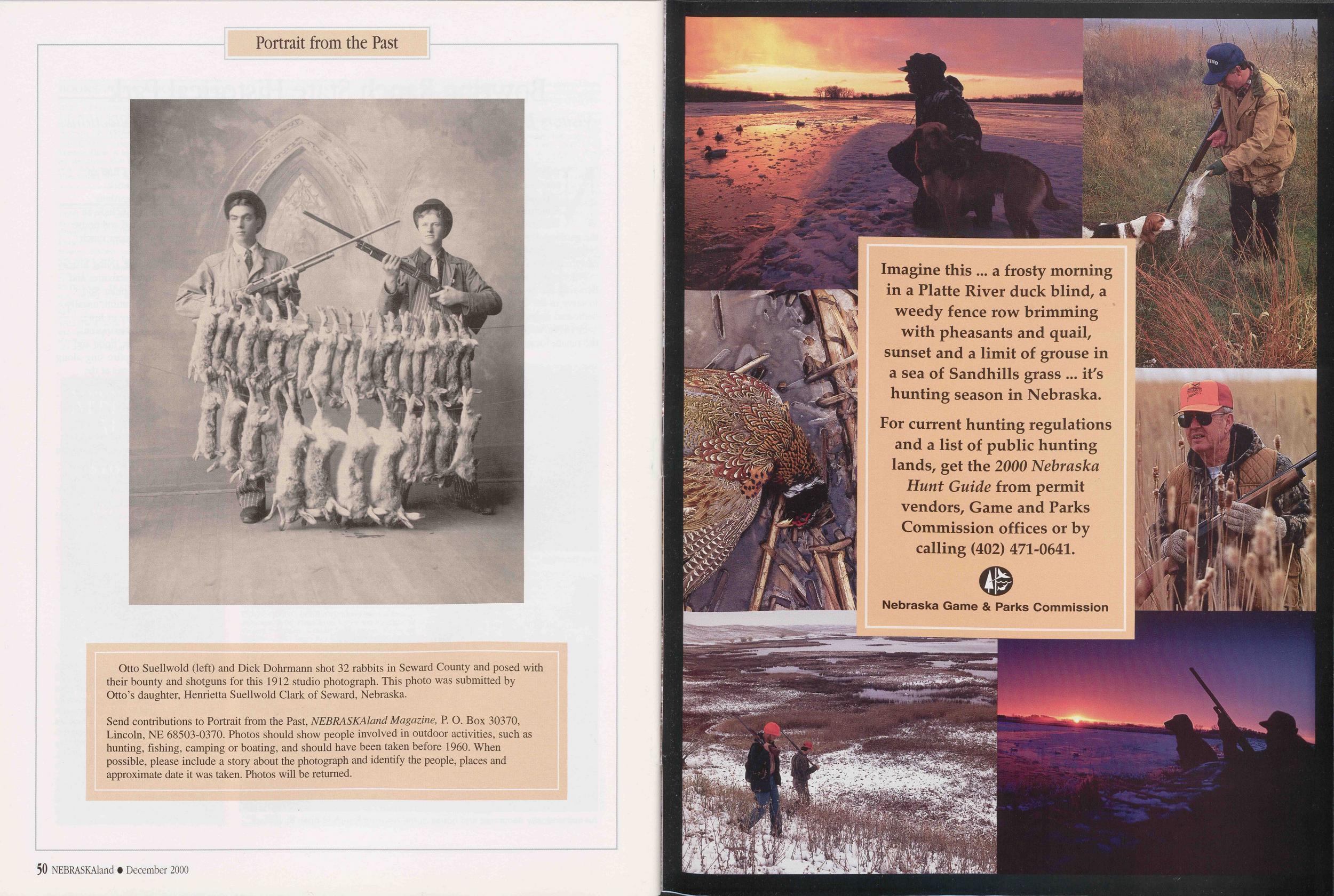
Otto Suellwold (left) and Dick Dohrmann shot 32 rabbits in Seward County and posed with their bounty and shotguns for this 1912 studio photograph. This photo was submitted by Otto’s daughter, Henrietta Suellwold Clark of Seward, Nebraska.
Send contributions to Portrait from the Past, NEBRASKAland Magazine, P. O. Box 30370, Lincoln, NE 68503-0370. Photos should show people involved in outdoor activities, such as hunting, fishing, camping or boating, and should have been taken before 1960. When possible, please include a story about the photograph and identify the people, places and approximate date it was taken. Photos will be returned.
Nebraska Game &Parks Commission Imagine this ... a frosty morning in a Platte River duck blind, a weedy fence row brimming with pheasants and quail, sunset and a limit of grouse in a sea of Sandhills grass ... it's hunting season in Nebraska. For current hunting regulations and a list of public hunting lands, get the 2000 Nebraska Hunt Guide from permit vendors, Game and Parks Commission offices or by calling (402) 471-0641. 50 NEBRASKAland • December 2000
Position: 626 (18 views)