Volume 78, Issue 9, 2000
NEBRASKAland
Nebraska Game & Parks Commission November 2000 • $2.50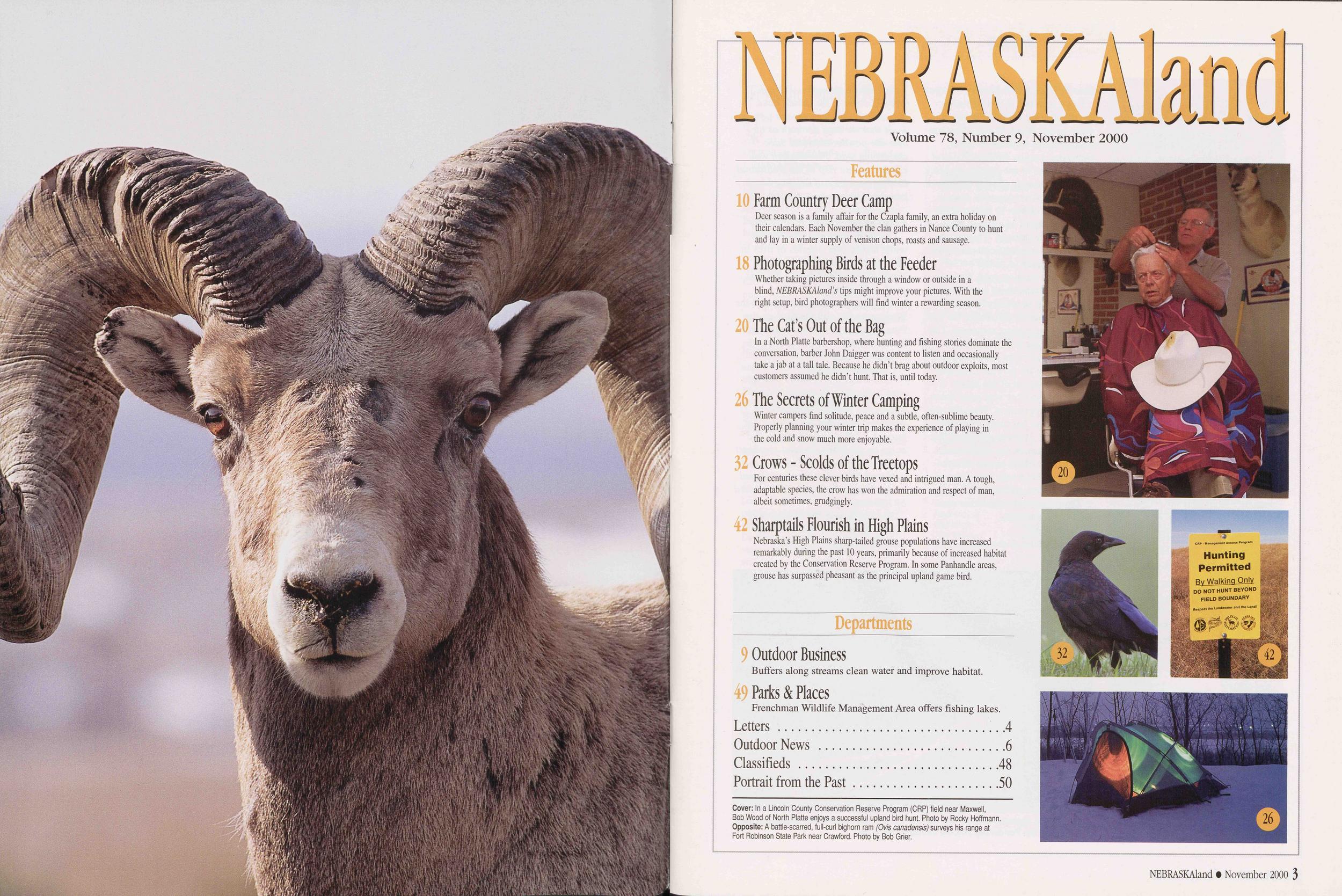
NEBRASKAland
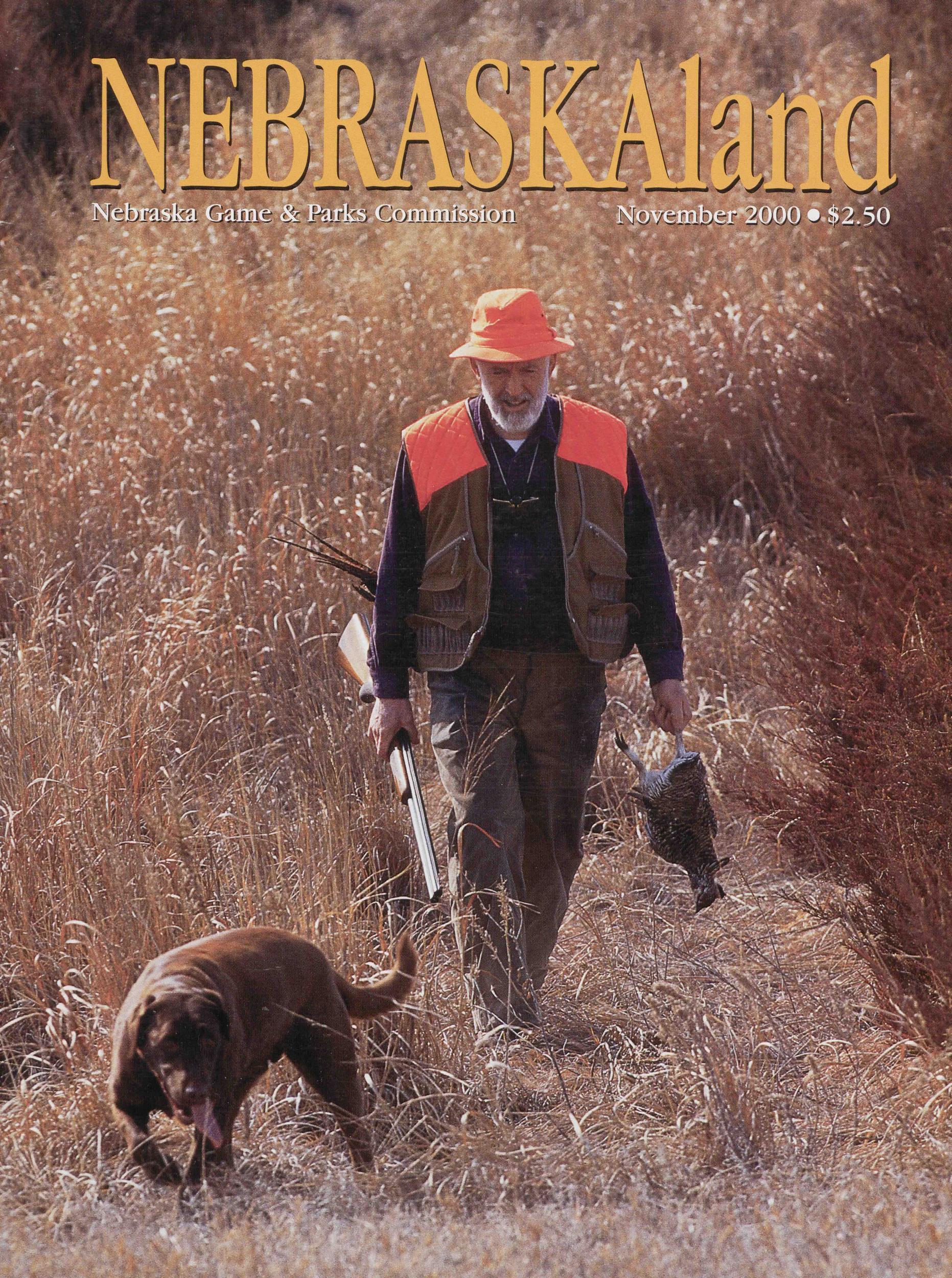
Volume 78, Number 9, November 2000 Features 10 Farm Country Deer Camp Deer season is a family affair for the Czapla family, an extra holiday on their calendars. Each November the clan gathers in Nance County to hunt and lay in a winter supply of venison chops, roasts and sausage. Photographing Birds at the Feeder Whether taking pictures inside through a window or outside in a blind, NEBRASKAland’s tips might improve your pictures. With the right setup, bird photographers will find winter a rewarding season. 20 The Cat’s Out of the Bag In a North Platte barbershop, where hunting and fishing stories dominate the conversation, barber John Daigger was content to listen and occasionally take a jab at a tall tale. Because he didn’t brag about outdoor exploits, most customers assumed he didn’t hunt. That is, until today. The Secrets of Winter Camping Winter campers find solitude, peace and a subtle, often-sublime beauty. Properly planning your winter trip makes the experience of playing in the cold and snow much more enjoyable. Crows - Scolds of the Treetops For centuries these clever birds have vexed and intrigued man. A tough, adaptable species, the crow has won the admiration and respect of man, albeit sometimes, grudgingly. Sharptails Flourish in High Plains Nebraska’s High Plains sharp-tailed grouse populations have increased remarkably during the past 10 years, primarily because of increased habitat created by the Conservation Reserve Program. In some Panhandle areas, grouse has surpassed pheasant as the principal upland game bird. Departments Outdoor Business Buffers along streams clean water and improve habitat. 49 Parks & Places Frenchman Wildlife Management Area offers fishing lakes. Letters 4 Outdoor News 6 Classifieds 48 Portrait from the Past 50 Cover: In a Lincoln County Conservation Reserve Program (CRP) field near Maxwell, Bob Wood of North Platte enjoys a successful upland bird hunt. Photo by Rocky Hoffmann. Opposite: A battle-scarred, full-curl bighorn ram (Ovis canadensis) surveys his range at Fort Robinson State Park near Crawford. Photo by Bob Grier.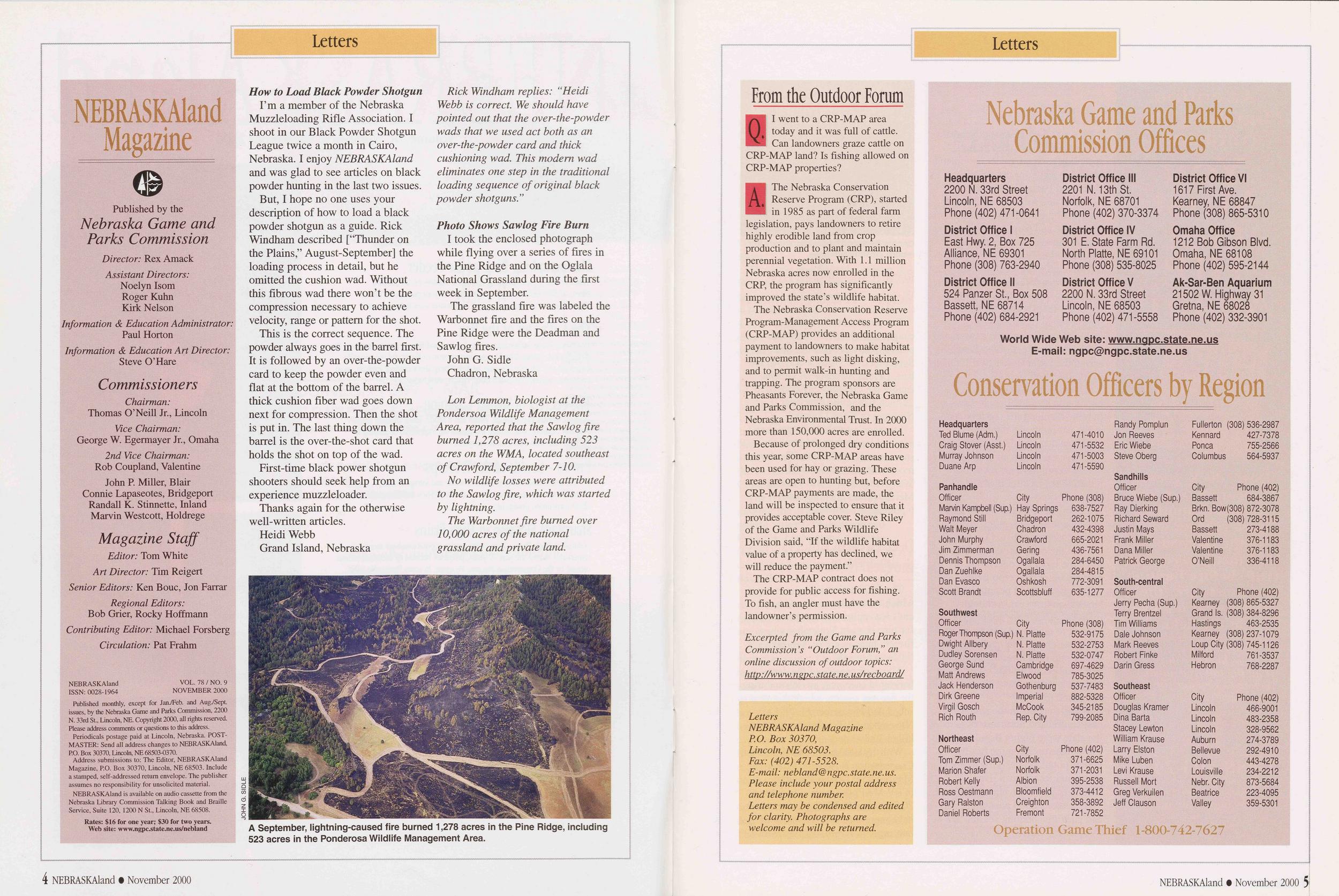 Letters
NEBRASKAland
Magazine
Published by the
Nebraska Game and
Parks Commission
Director: Rex Amack
Assistant Directors:
Noelyn Isom
Roger Kuhn
Kirk Nelson
Information & Education Administrator:
Paul Horton
Information & Education Art Director:
Steve O’Hare
Commissioners
Chairman:
Thomas O’Neill Jr., Lincoln
Vice Chairman:
George W. Egermayer Jr., Omaha
2nd Vice Chairman:
Rob Coupland, Valentine
John P. Miller, Blair
Connie Lapaseotes, Bridgeport
Randall K. Stinnette, Inland
Marvin Westcott, Holdrege
Magazine Staff
Editor: Tom White
Art Director: Tim Reigert
Senior Editors: Ken Bouc, Jon Farrar
Regional Editors:
Bob Grier, Rocky Hoffmann
Contributing Editor: Michael Forsberg
Circulation: Pat Frahm
NEBRASKAland VOL. 78 / NO. 9
ISSN: 0028-1964 NOVEMBER 2000
Published monthly, except for JanTFeb. and Aug./Sept.
issues, by the Nebraska Game and Parks Commission, 2200
N. 33rd St., Lincoln, NE. Copyright 2000, all rights reserved.
Please address comments or questions to this address.
Periodicals postage paid at Lincoln, Nebraska. POST-
MASTER: Send all address changes to NEBRASKAland,
P.O. Box 30370, Lincoln, NE 68503-0370.
Address submissions to: The Editor, NEBRASKAland
Magazine, P.O. Box 30370, Lincoln, NE 68503. Include
a stamped, self-addressed return envelope. The publisher
assumes no responsibility for unsolicited material.
NEBRASKAland is available on audio cassette from the
Nebraska Library Commission Talking Book and Braille
Service, Suite 120, 1200 N St., Lincoln, NE 68508.
Rates: $16 for one year; $30 for two years.
Web site: www.ngpc.state.ne.us/nebland
How to Load Black Powder Shotgun
Letters
NEBRASKAland
Magazine
Published by the
Nebraska Game and
Parks Commission
Director: Rex Amack
Assistant Directors:
Noelyn Isom
Roger Kuhn
Kirk Nelson
Information & Education Administrator:
Paul Horton
Information & Education Art Director:
Steve O’Hare
Commissioners
Chairman:
Thomas O’Neill Jr., Lincoln
Vice Chairman:
George W. Egermayer Jr., Omaha
2nd Vice Chairman:
Rob Coupland, Valentine
John P. Miller, Blair
Connie Lapaseotes, Bridgeport
Randall K. Stinnette, Inland
Marvin Westcott, Holdrege
Magazine Staff
Editor: Tom White
Art Director: Tim Reigert
Senior Editors: Ken Bouc, Jon Farrar
Regional Editors:
Bob Grier, Rocky Hoffmann
Contributing Editor: Michael Forsberg
Circulation: Pat Frahm
NEBRASKAland VOL. 78 / NO. 9
ISSN: 0028-1964 NOVEMBER 2000
Published monthly, except for JanTFeb. and Aug./Sept.
issues, by the Nebraska Game and Parks Commission, 2200
N. 33rd St., Lincoln, NE. Copyright 2000, all rights reserved.
Please address comments or questions to this address.
Periodicals postage paid at Lincoln, Nebraska. POST-
MASTER: Send all address changes to NEBRASKAland,
P.O. Box 30370, Lincoln, NE 68503-0370.
Address submissions to: The Editor, NEBRASKAland
Magazine, P.O. Box 30370, Lincoln, NE 68503. Include
a stamped, self-addressed return envelope. The publisher
assumes no responsibility for unsolicited material.
NEBRASKAland is available on audio cassette from the
Nebraska Library Commission Talking Book and Braille
Service, Suite 120, 1200 N St., Lincoln, NE 68508.
Rates: $16 for one year; $30 for two years.
Web site: www.ngpc.state.ne.us/nebland
How to Load Black Powder Shotgun
I’m a member of the Nebraska Muzzleloading Rifle Association. I shoot in our Black Powder Shotgun League twice a month in Cairo, Nebraska. I enjoy NEBRASKAland and was glad to see articles on black powder hunting in the last two issues.
But, I hope no one uses your description of how to load a black powder shotgun as a guide. Rick Windham described [“Thunder on the Plains,” August-September] the loading process in detail, but he omitted the cushion wad. Without this fibrous wad there won’t be the compression necessary to achieve velocity, range or pattern for the shot.
This is the correct sequence. The powder always goes in the barrel first. It is followed by an over-the-powder card to keep the powder even and flat at the bottom of the barrel. A thick cushion fiber wad goes down next for compression. Then the shot is put in. The last thing down the barrel is the over-the-shot card that holds the shot on top of the wad.
First-time black power shotgun shooters should seek help from an experience muzzleloader.
Thanks again for the otherwise well-written articles.
Heidi Webb Grand Island, NebraskaRick Windham replies: "Heidi Webb is correct. We should have pointed out that the over-the-powder wads that we used act both as an over-the-powder card and thick cushioning wad. This modem wad eliminates one step in the traditional loading sequence of original black powder shotguns.”
Photo Shows Sawlog Fire BurnI took the enclosed photograph while flying over a series of fires in the Pine Ridge and on the Oglala National Grassland during the first week in September.
The grassland fire was labeled the Warbonnet fire and the fires on the Pine Ridge were the Deadman and Sawlog fires.
John G. Sidle Chadron, NebraskaLon Lemmon, biologist at the Pondersoa Wildlife Management Area, reported that the Sawlog fire burned 1,278 acres, including 523 acres on the WMA, located southeast of Crawford, September 7-10.
No wildlife losses were attributed to the Sawlog fire, which was started by lightning.
The Warbonnet fire burned over 10,000 acres of the national grassland and private land.
From the Outdoor ForumI went to a CRP-MAP area I today and it was full of cattle. Can landowners graze cattle on CRP-MAP land? Is fishing allowed on CRP-MAP properties?
The Nebraska Conservation Reserve Program (CRP), started in 1985 as part of federal farm legislation, pays landowners to retire highly erodible land from crop production and to plant and maintain perennial vegetation. With 1.1 million Nebraska acres now enrolled in the CRP, the program has significantly improved the state’s wildlife habitat. The Nebraska Conservation Reserve Program-Management Access Program (CRP-MAP) provides an additional payment to landowners to make habitat improvements, such as light disking, and to permit walk-in hunting and trapping. The program sponsors are Pheasants Forever, the Nebraska Game and Parks Commission, and the Nebraska Environmental Trust. In 2000 more than 150,000 acres are enrolled.
Because of prolonged dry conditions this year, some CRP-MAP areas have been used for hay or grazing. These areas are open to hunting but, before CRP-MAP payments are made, the land will be inspected to ensure that it provides acceptable cover. Steve Riley of the Game and Parks Wildlife Division said, “If the wildlife habitat value of a property has declined, we will reduce the payment.”
The CRP-MAP contract does not provide for public access for fishing. To fish, an angler must have the landowner’s permission.
Excerpted from the Game and Parks Commission’s “Outdoor Forum,” an online discussion of outdoor topics: http://www.n2pc. state, ne, us/recboard/
Letters NEBRASKAland Magazine P.O. Box 30370, Lincoln, NE 68503. Fax: (402) 471-5528. E-mail: nebland@ngpc.state.ne.us. Please include your postal address and telephone number. Letters may be condensed and edited for clarity. Photographs are welcome and will be returned.
Nebraska Game and Parks Commission Offices Headquarters District Office III District Office VI 2200 N. 33rd Street 2201 N. 13th St. 1617 First Ave. Lincoln, NE 68503 Norfolk, NE 68701 Kearney, NE 68847 Phone (402) 471-0641 Phone (402) 370-3374 Phone (308) 865-5310 District Office I District Office IV Omaha Office East Hwy. 2, Box 725 301 E. State Farm Rd. 1212 Bob Gibson Blvd. Alliance, NE 69301 North Platte, NE 69101 Omaha, NE 68108 Phone (308) 763-2940 Phone (308) 535-8025 Phone (402) 595-2144 District Office II District Office V Ak-Sar-Ben Aquarium 524 Panzer St., Box 508 2200 N. 33rd Street 21502 W. Highway 31 Bassett, NE 68714 Lincoln, NE 68503 Gretna, NE 68028 Phone (402) 684-2921 Phone (402) 471-5558 Phone (402) 332-3901 World Wide Web site: www.napc.state.ne,us E-mail: ngpc@ngpc.state.ne.us Conservation Officers by Region Headquarters Randy Pomplun Fullerton (308) 536-2987 Ted Blume (Adm.) Lincoln 471-4010 Jon Reeves Kennard 427-7378 Craig Stover (Asst.) Lincoln 471-5532 Eric Wiebe Ponca 755-2566 Murray Johnson Lincoln 471-5003 Steve Oberg Columbus 564-5937 Duane Arp Lincoln 471-5590 Sandhills Panhandle Officer City Phone (402) Officer City Phone (308) Bruce Wiebe (Sup.) Bassett 684-3867 Marvin Kampbell (Sup.) Hay Springs 638-7527 Ray Dierking Brkn. Bow(308) 872-3078 Raymond Still Bridgeport 262-1075 Richard Seward Ord (308) 728-3115 Walt Meyer Chadron 432-4398 Justin Mays Bassett 273-4188 John Murphy Crawford 665-2021 Frank Miller Valentine 376-1183 Jim Zimmerman Gering 436-7561 Dana Miller Valentine 376-1183 Dennis Thompson Ogallala 284-6450 Patrick George O’Neill 336-4118 Dan Zuehlke Ogallala 284-4815 Dan Evasco Oshkosh 772-3091 South-central Scott Brandt Scottsbluff 635-1277 Officer City Phone (402) Jerry Pecha (Sup.) Kearney (308) 865-5327 Southwest Terry Brentzel Grand Is. (308) 384-8296 Officer City Phone (308) Tim Williams Hastings 463-2535 Roger Thompson (Sup.) N. Platte 532-9175 Dale Johnson Kearney (308) 237-1079 Dwight Allbery N. Platte 532-2753 Mark Reeves Loup City (308) 745-1126 Dudley Sorensen N. Platte 532-0747 Robert Finke Milford 761-3537 George Sund Cambridge 697-4629 Darin Gress Hebron 768-2287 Matt Andrews Elwood 785-3025 Jack Henderson Gothenburg 537-7483 Southeast Dirk Greene Imperial 882-5328 Officer City Phone (402) Virgil Gosch McCook 345-2185 Douglas Kramer Lincoln 466-9001 Rich Routh Rep. City 799-2085 Dina Barta Lincoln 483-2358 Stacey Lewton Lincoln 328-9562 Northeast William Krause Auburn 274-3789 Officer City Phone (402) Larry Elston Bellevue 292-4910 Tom Zimmer (Sup.) Norfolk 371-6625 MikeLuben Colon 443-4278 Marion Shafer Norfolk 371-2031 Levi Krause Louisville 234-2212 Robert Kelly Albion 395-2538 Russell Mort Nebr. City 873-5684 Ross Oestmann Bloomfield 373-4412 Greg Verkuilen Beatrice 223-4095 Gary Ralston Creighton 358-3892 Jeff Clauson Valley 359-5301 Daniel Roberts Fremont 721-7852 Operation Game Thief 1-800-742-7627 4 NEBRASKAland • November 2000 NEBRASKAland • November 2000 5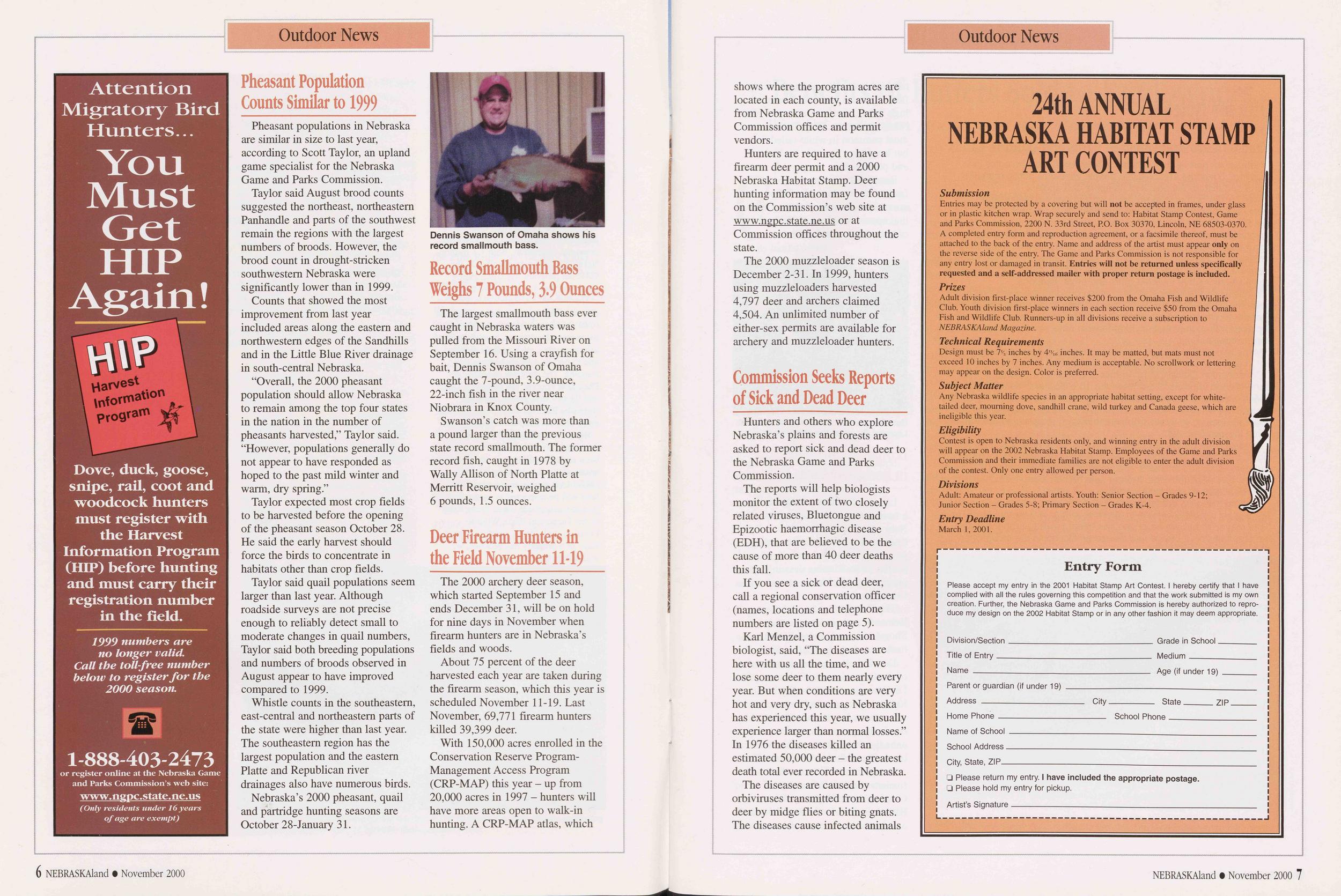
Pheasant populations in Nebraska are similar in size to last year, according to Scott Taylor, an upland game specialist for the Nebraska Game and Parks Commission.
Taylor said August brood counts suggested the northeast, northeastern Panhandle and parts of the southwest remain the regions with the largest numbers of broods. However, the brood count in drought-stricken southwestern Nebraska were significantly lower than in 1999.
Counts that showed the most improvement from last year included areas along the eastern and northwestern edges of the Sandhills and in the Little Blue River drainage in south-central Nebraska.
“Overall, the 2000 pheasant population should allow Nebraska to remain among the top four states in the nation in the number of pheasants harvested,” Taylor said. “However, populations generally do not appear to have responded as hoped to the past mild winter and warm, dry spring.”
Taylor expected most crop fields to be harvested before the opening of the pheasant season October 28. He said the early harvest should force the birds to concentrate in habitats other than crop fields.
Taylor said quail populations seem larger than last year. Although roadside surveys are not precise enough to reliably detect small to moderate changes in quail numbers, Taylor said both breeding populations and numbers of broods observed in August appear to have improved compared to 1999.
Whistle counts in the southeastern, east-central and northeastern parts of the state were higher than last year. The southeastern region has the largest population and the eastern Platte and Republican river drainages also have numerous birds.
Nebraska’s 2000 pheasant, quail and partridge hunting seasons are October 28-January 31.
The largest smallmouth bass ever caught in Nebraska waters was pulled from the Missouri River on September 16. Using a crayfish for bait, Dennis Swanson of Omaha caught the 7-pound, 3.9-ounce, 22-inch fish in the river near Niobrara in Knox County.
Swanson’s catch was more than a pound larger than the previous state record smallmouth. The former record fish, caught in 1978 by Wally Allison of North Platte at Merritt Reservoir, weighed 6 pounds, 1.5 ounces.
Deer Firearm Hunters in the Field November 11-19The 2000 archery deer season, which started September 15 and ends December 31, will be on hold for nine days in November when firearm hunters are in Nebraska’s fields and woods.
About 75 percent of the deer harvested each year are taken during the firearm season, which this year is scheduled November 11-19. Last November, 69,771 firearm hunters killed 39,399 deer.
With 150,000 acres enrolled in the Conservation Reserve Program- Management Access Program (CRP-MAP) this year - up from 20,000 acres in 1997 - hunters will have more areas open to walk-in hunting. A CRP-MAP atlas, which shows where the program acres are located in each county, is available from Nebraska Game and Parks Commission offices and permit vendors.
Hunters are required to have a firearm deer permit and a 2000 Nebraska Habitat Stamp. Deer hunting information may be found on the Commission’s web site at www.ngpc.state.ne.us or at Commission offices throughout the state.
The 2000 muzzleloader season is December 2-31. In 1999, hunters using muzzleloaders harvested 4,797 deer and archers claimed 4,504. An unlimited number of either-sex permits are available for archery and muzzleloader hunters.
Commission Seeks Reports of Sick and Dead DeerHunters and others who explore Nebraska’s plains and forests are asked to report sick and dead deer to the Nebraska Game and Parks Commission.
The reports will help biologists monitor the extent of two closely related viruses, Bluetongue and Epizootic haemorrhagic disease (EDH), that are believed to be the cause of more than 40 deer deaths this fall.
If you see a sick or dead deer, call a regional conservation officer (names, locations and telephone numbers are listed on page 5).
Karl Menzel, a Commission biologist, said, “The diseases are here with us all the time, and we lose some deer to them nearly every year. But when conditions are very hot and very dry, such as Nebraska has experienced this year, we usually experience larger than normal losses.” In 1976 the diseases killed an estimated 50,000 deer - the greatest death total ever recorded in Nebraska.
The diseases are caused by orbiviruses transmitted from deer to deer by midge flies or biting gnats. The diseases cause infected animals
24th ANNUAL NEBRASKA HABITAT STAMP ART CONTEST Submission Entries may be protected by a covering but will not be accepted in frames, under glass or in plastic kitchen wrap. Wrap securely and send to: Habitat Stamp Contest, Game and Parks Commission, 2200 N. 33rd Street, P.O. Box 30370, Lincoln, NE 68503-0370. A completed entry form and reproduction agreement, or a facsimile thereof, must be attached to the back of the entry. Name and address of the artist must appear only on the reverse side of the entry. The Game and Parks Commission is not responsible for any entry lost or damaged in transit. Entries will not be returned unless specifically requested and a self-addressed mailer with proper return postage is included. Prizes Adult division first-place winner receives $200 from the Omaha Fish and Wildlife Club. Youth division first-place winners in each section receive $50 from the Omaha Fish and Wildlife Club. Runners-up in all divisions receive a subscription to NEBRASKAland Magazine. Technical Requirements Design must be 7x4 inches by inches. It may be matted, but mats must not exceed 10 inches by 7 inches. Any medium is acceptable. No scrollwork or lettering may appear on the design. Color is preferred. Subject Matter Any Nebraska wildlife species in an appropriate habitat setting, except for white- tailed deer, mourning dove, sandhill crane, wild turkey and Canada geese, which are ineligible this year. Eligibility Contest is open to Nebraska residents only, and winning entry in the adult division will appear on the 2002 Nebraska Habitat Stamp. Employees of the Game and Parks Commission and their immediate families are not eligible to enter the adult division of the contest. Only one entry allowed per person. Divisions Adult: Amateur or professional artists. Youth: Senior Section - Grades 9-12; Junior Section - Grades 5-8; Primary Section - Grades K-4. Entry Deadline March 1,2001. Entry Form Please accept my entry in the 2001 Habitat Stamp Art Contest. I hereby certify that I have I complied with all the rules governing this competition and that the work submitted is my own creation. Further, the Nebraska Game and Parks Commission is hereby authorized to repro- duce my design on the 2002 Habitat Stamp or in any other fashion it may deem appropriate. Division/Section Grade in School Title of Entry Medium Name Age (if under 19) Parent or guardian (if under 19) Address City State ZIP Home Phone School Phone Name of School School Address City, State, ZIP Please return my entry. I have included the appropriate postage. Please hold my entry for pickup. Artist’s Signature 6 NEBRASKAland • November 2000 NEBRASKAland • November 2000 7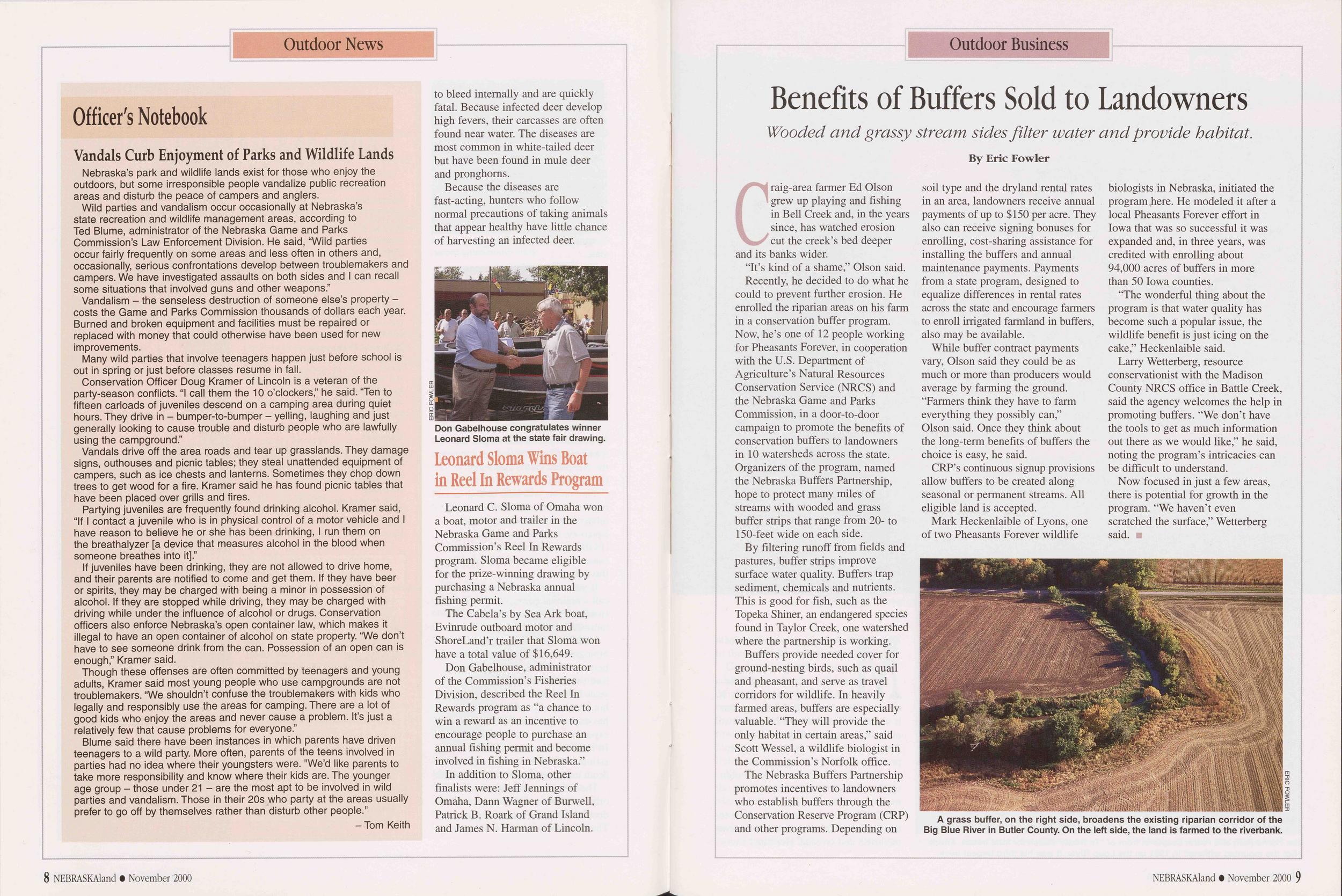 Outdoor Business
Officer's Notebook
Vandals Curb Enjoyment of Parks and Wildlife Lands
Outdoor Business
Officer's Notebook
Vandals Curb Enjoyment of Parks and Wildlife Lands
Nebraska’s park and wildlife lands exist for those who enjoy the outdoors, but some irresponsible people vandalize public recreation areas and disturb the peace of campers and anglers.
Wild parties and vandalism occur occasionally at Nebraska’s state recreation and wildlife management areas, according to Ted Blume, administrator of the Nebraska Game and Parks Commission’s Law Enforcement Division. He said, “Wild parties occur fairly frequently on some areas and less often in others and, occasionally, serious confrontations develop between troublemakers and campers. We have investigated assaults on both sides and I can recall some situations that involved guns and other weapons.”
Vandalism - the senseless destruction of someone else’s property - costs the Game and Parks Commission thousands of dollars each year. Burned and broken equipment and facilities must be repaired or replaced with money that could otherwise have been used for new improvements.
Many wild parties that involve teenagers happen just before school is out in spring or just before classes resume in fall.
Conservation Officer Doug Kramer of Lincoln is a veteran of the party-season conflicts. “I call them the 10 o’clockers,” he said. “Ten to fifteen carloads of juveniles descend on a camping area during quiet hours. They drive in - bumper-to-bumper - yelling, laughing and just generally looking to cause trouble and disturb people who are lawfully using the campground.”
Vandals drive off the area roads and tear up grasslands. They damage signs, outhouses and picnic tables; they steal unattended equipment of campers, such as ice chests and lanterns. Sometimes they chop down trees to get wood for a fire. Kramer said he has found picnic tables that have been placed over grills and fires.
Partying juveniles are frequently found drinking alcohol. Kramer said, “If I contact a juvenile who is in physical control of a motor vehicle and I have reason to believe he or she has been drinking, I run them on the breathalyzer [a device that measures alcohol in the blood when someone breathes into it].”
If juveniles have been drinking, they are not allowed to drive home, and their parents are notified to come and get them. If they have beer or spirits, they may be charged with being a minor in possession of alcohol. If they are stopped while driving, they may be charged with driving while under the influence of alcohol or drugs. Conservation officers also enforce Nebraska’s open container law, which makes it illegal to have an open container of alcohol on state property. “We don’t have to see someone drink from the can. Possession of an open can is enough,” Kramer said.
Though these offenses are often committed by teenagers and young adults, Kramer said most young people who use campgrounds are not troublemakers. “We shouldn’t confuse the troublemakers with kids who legally and responsibly use the areas for camping. There are a lot of good kids who enjoy the areas and never cause a problem. It’s just a relatively few that cause problems for everyone.”
Blume said there have been instances in which parents have driven teenagers to a wild party. More often, parents of the teens involved in parties had no idea where their youngsters were. "We’d like parents to take more responsibility and know where their kids are. The younger age group - those under 21 - are the most apt to be involved in wild parties and vandalism. Those in their 20s who party at the areas usually prefer to go off by themselves rather than disturb other people."
- Tom Keithto bleed internally and are quickly fatal. Because infected deer develop high fevers, their carcasses are often found near water. The diseases are most common in white-tailed deer but have been found in mule deer and pronghorns.
Because the diseases are fast-acting, hunters who follow normal precautions of taking animals that appear healthy have little chance of harvesting an infected deer.
Leonard C. Sloma of Omaha won a boat, motor and trailer in the Nebraska Game and Parks Commission’s Reel In Rewards program. Sloma became eligible for the prize-winning drawing by purchasing a Nebraska annual fishing permit.
The Cabela’s by Sea Ark boat, Evinrude outboard motor and ShoreLand’r trailer that Sloma won have a total value of $16,649.
Don Gabelhouse, administrator of the Commission’s Fisheries Division, described the Reel In Rewards program as “a chance to win a reward as an incentive to encourage people to purchase an annual fishing permit and become involved in fishing in Nebraska.”
In addition to Sloma, other finalists were: Jeff Jennings of Omaha, Dann Wagner of Burwell, Patrick B. Roark of Grand Island and James N. Harman of Lincoln.
Benefits of Buffers Sold to Landowners Wooded and grassy stream sides filter water and provide habitat. By Eric FowlerCraig-area farmer Ed Olson grew up playing and fishing in Bell Creek and, in the years since, has watched erosion cut the creek’s bed deeper and its banks wider.
"It’s kind of a shame,” Olson said. Recently, he decided to do what he could to prevent further erosion. He enrolled the riparian areas on his farm in a conservation buffer program. Now, he’s one of 12 people working for Pheasants Forever, in cooperation with the U.S. Department of Agriculture’s Natural Resources Conservation Service (NRCS) and the Nebraska Game and Parks Commission, in a door-to-door campaign to promote the benefits of conservation buffers to landowners in 10 watersheds across the state. Organizers of the program, named the Nebraska Buffers Partnership, hope to protect many miles of streams with wooded and grass buffer strips that range from 20- to 150-feet wide on each side.
By filtering runoff from fields and pastures, buffer strips improve surface water quality. Buffers trap sediment, chemicals and nutrients. This is good for fish, such as the Topeka Shiner, an endangered species found in Taylor Creek, one watershed where the partnership is working.
Buffers provide needed cover for ground-nesting birds, such as quail and pheasant, and serve as travel corridors for wildlife. In heavily farmed areas, buffers are especially valuable. "They will provide the only habitat in certain areas,” said Scott Wessel, a wildlife biologist in the Commission’s Norfolk office.
The Nebraska Buffers Partnership promotes incentives to landowners who establish buffers through the Conservation Reserve Program (CRP) and other programs. Depending on soil type and the dryland rental rates in an area, landowners receive annual payments of up to $150 per acre. They also can receive signing bonuses for enrolling, cost-sharing assistance for installing the buffers and annual maintenance payments. Payments from a state program, designed to equalize differences in rental rates across the state and encourage farmers to enroll irrigated farmland in buffers, also may be available.
While buffer contract payments vary, Olson said they could be as much or more than producers would average by farming the ground. "Farmers think they have to farm everything they possibly can,” Olson said. Once they think about the long-term benefits of buffers the choice is easy, he said.
CRP’s continuous signup provisions allow buffers to be created along seasonal or permanent streams. All eligible land is accepted.
Mark Heckenlaible of Lyons, one of two Pheasants Forever wildlife biologists in Nebraska, initiated the program here. He modeled it after a local Pheasants Forever effort in Iowa that was so successful it was expanded and, in three years, was credited with enrolling about 94,000 acres of buffers in more than 50 Iowa counties.
“The wonderful thing about the program is that water quality has become such a popular issue, the wildlife benefit is just icing on the cake,” Heckenlaible said.
Larry Wetterberg, resource conservationist with the Madison County NRCS office in Battle Creek, said the agency welcomes the help in promoting buffers. “We don’t have the tools to get as much information out there as we would like,” he said, noting the program’s intricacies can be difficult to understand.
Now focused in just a few areas, there is potential for growth in the program. "We haven’t even scratched the surface,” Wetterberg said. ■
8 NEBRASKAland • November 2000 NEBRASKAland • November 2000 9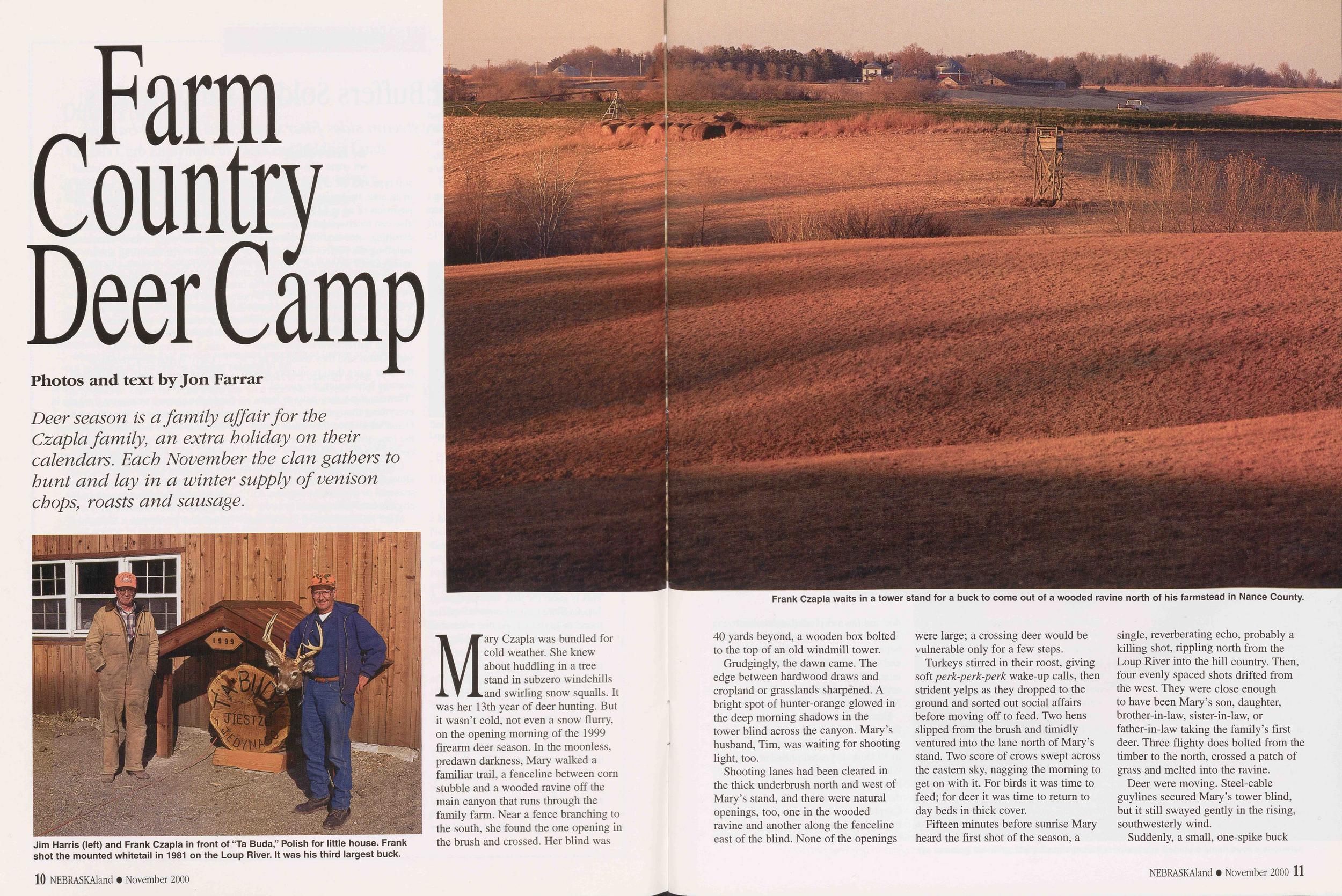
Farm County Deer Camp
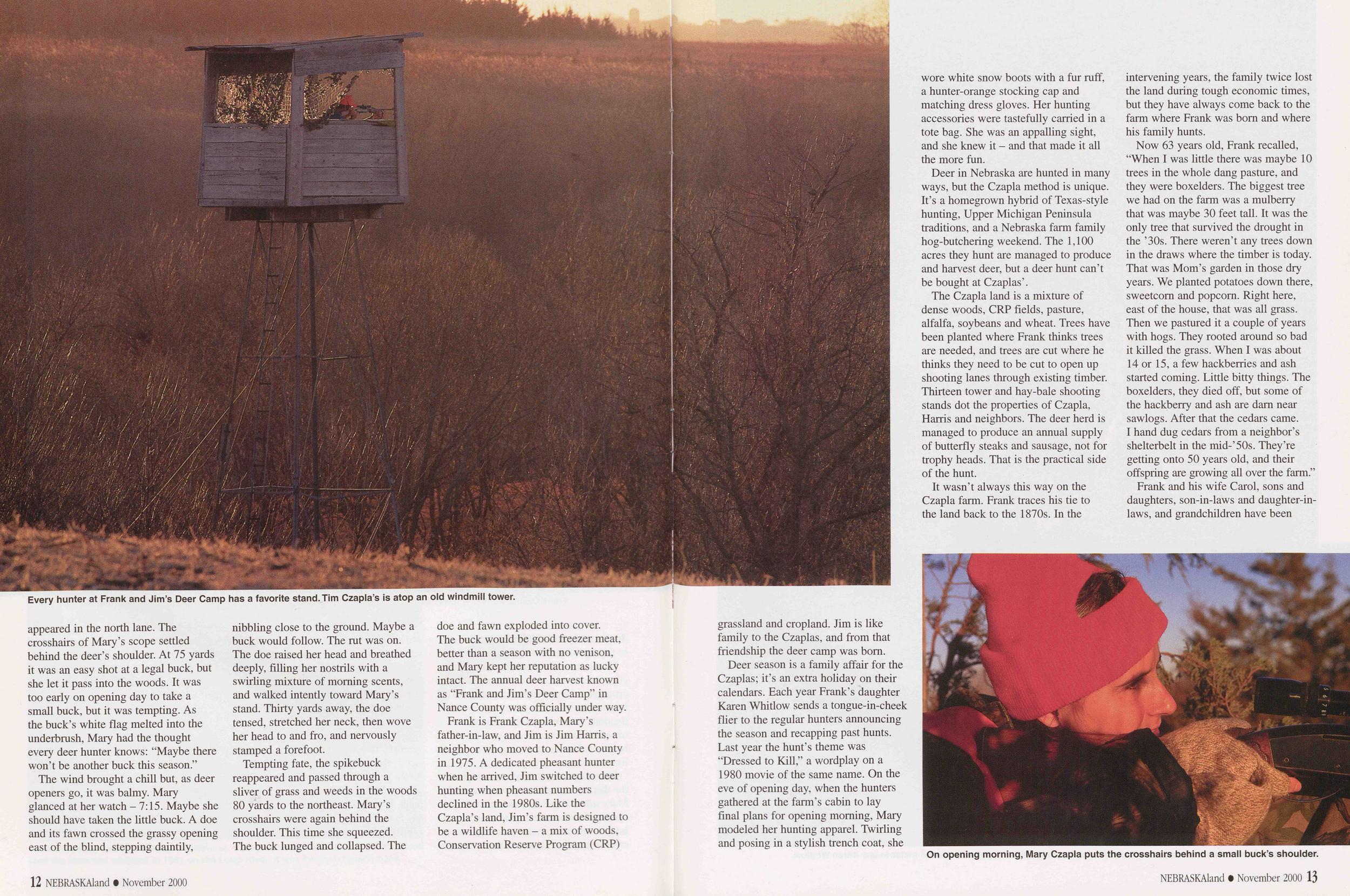
Deer season is a family affair for the Czapla family, an extra holiday on their calendars. Each November the clan gathers to hunt and lay in a winter supply of venison chops, roasts and sausage.Mary Czapla was bundled for cold weather. She knew about huddling in a tree stand in subzero windchills and swirling snow squalls. It was her 13th year of deer hunting. But it wasn’t cold, not even a snow flurry, on the opening morning of the 1999 firearm deer season. In the moonless, predawn darkness, Mary walked a familiar trail, a fenceline between com stubble and a wooded ravine off the main canyon that runs through the family farm. Near a fence branching to the south, she found the one opening in the brush and crossed. Her blind was 40 yards beyond, a wooden box bolted to the top of an old windmill tower.
Grudgingly, the dawn came. The edge between hardwood draws and cropland or grasslands sharpened. A bright spot of hunter-orange glowed in the deep morning shadows in the tower blind across the canyon. Mary’s husband, Tim, was waiting for shooting light, too.
Shooting lanes had been cleared in the thick underbrush north and west of Mary’s stand, and there were natural openings, too, one in the wooded ravine and another along the fenceline east of the blind. None of the openings were large; a crossing deer would be vulnerable only for a few steps.
Turkeys stirred in their roost, giving soft perk-perk-perk wake-up calls, then strident yelps as they dropped to the ground and sorted out social affairs before moving off to feed. Two hens slipped from the brush and timidly ventured into the lane north of Mary’s stand. Two score of crows swept across the eastern sky, nagging the morning to get on with it. For birds it was time to feed; for deer it was time to return to day beds in thick cover.
Fifteen minutes before sunrise Mary heard the first shot of the season, a single, reverberating echo, probably a killing shot, rippling north from the Loup River into the hill country. Then, four evenly spaced shots drifted from the west. They were close enough to have been Mary’s son, daughter, brother-in-law, sister-in-law, or father-in-law taking the family’s first deer. Three flighty does bolted from the timber to the north, crossed a patch of grass and melted into the ravine.
Deer were moving. Steel-cable guylines secured Mary’s tower blind, but it still swayed gently in the rising, southwesterly wind.
Suddenly, a small, one-spike buck
10 NEBRASKAland O November 2000
NEBRASKAland • November 2000 11
 appeared in the north lane. The
crosshairs of Mary’s scope settled
behind the deer’s shoulder. At 75 yards
it was an easy shot at a legal buck, but
she let it pass into the woods. It was
too early on opening day to take a
small buck, but it was tempting. As
the buck’s white flag melted into the
underbrush, Mary had the thought
every deer hunter knows: "Maybe there
won’t be another buck this season.”
appeared in the north lane. The
crosshairs of Mary’s scope settled
behind the deer’s shoulder. At 75 yards
it was an easy shot at a legal buck, but
she let it pass into the woods. It was
too early on opening day to take a
small buck, but it was tempting. As
the buck’s white flag melted into the
underbrush, Mary had the thought
every deer hunter knows: "Maybe there
won’t be another buck this season.”
The wind brought a chill but, as deer openers go, it was balmy. Mary glanced at her watch - 7:15. Maybe she should have taken the little buck. A doe and its fawn crossed the grassy opening east of the blind, stepping daintily, 12 NEBRASKAland • November 2000 nibbling close to the ground. Maybe a buck would follow. The rut was on. The doe raised her head and breathed deeply, filling her nostrils with a swirling mixture of morning scents, and walked intently toward Mary’s stand. Thirty yards away, the doe tensed, stretched her neck, then wove her head to and fro, and nervously stamped a forefoot.
Tempting fate, the spikebuck reappeared and passed through a sliver of grass and weeds in the woods 80 yards to the northeast. Mary’s crosshairs were again behind the shoulder. This time she squeezed. The buck lunged and collapsed. The doe and fawn exploded into cover. The buck would be good freezer meat, better than a season with no venison, and Mary kept her reputation as lucky intact. The annual deer harvest known as "Frank and Jim’s Deer Camp” in Nance County was officially under way.
Frank is Frank Czapla, Mary’s father-in-law, and Jim is Jim Harris, a neighbor who moved to Nance County in 1975. A dedicated pheasant hunter when he arrived, Jim switched to deer hunting when pheasant numbers declined in the 1980s. Like the Czapla’s land, Jim’s farm is designed to be a wildlife haven - a mix of woods, Conservation Reserve Program (CRP) grassland and cropland. Jim is like family to the Czaplas, and from that friendship the deer camp was bom.
Deer season is a family affair for the Czaplas; it’s an extra holiday on their calendars. Each year Frank’s daughter Karen Whitlow sends a tongue-in-cheek flier to the regular hunters announcing the season and recapping past hunts. Last year the hunt’s theme was "Dressed to Kill,” a wordplay on a 1980 movie of the same name. On the eve of opening day, when the hunters gathered at the farm’s cabin to lay final plans for opening morning, Mary modeled her hunting apparel. Twirling and posing in a stylish trench coat, she wore white snow boots with a fur ruff, a hunter-orange stocking cap and matching dress gloves. Her hunting accessories were tastefully carried in a tote bag. She was an appalling sight, and she knew it - and that made it all the more fun.
Deer in Nebraska are hunted in many ways, but the Czapla method is unique. It’s a homegrown hybrid of Texas-style hunting, Upper Michigan Peninsula traditions, and a Nebraska farm family hog-butchering weekend. The 1,100 acres they hunt are managed to produce and harvest deer, but a deer hunt can’t be bought at Czaplas’.
The Czapla land is a mixture of dense woods, CRP fields, pasture, alfalfa, soybeans and wheat. Trees have been planted where Frank thinks trees are needed, and trees are cut where he thinks they need to be cut to open up shooting lanes through existing timber. Thirteen tower and hay-bale shooting stands dot the properties of Czapla, Harris and neighbors. The deer herd is managed to produce an annual supply of butterfly steaks and sausage, not for trophy heads. That is the practical side of the hunt.
It wasn’t always this way on the Czapla farm. Frank traces his tie to the land back to the 1870s. In the intervening years, the family twice lost the land during tough economic times, but they have always come back to the farm where Frank was bom and where his family hunts.
Now 63 years old, Frank recalled, "When I was little there was maybe 10 trees in the whole dang pasture, and they were boxelders. The biggest tree we had on the farm was a mulberry that was maybe 30 feet tall. It was the only tree that survived the drought in the ’30s. There weren’t any trees down in the draws where the timber is today. That was Mom’s garden in those dry years. We planted potatoes down there, sweetcorn and popcorn. Right here, east of the house, that was all grass. Then we pastured it a couple of years with hogs. They rooted around so bad it killed the grass. When I was about 14 or 15, a few hackberries and ash started coming. Little bitty things. The boxelders, they died off, but some of the hackberry and ash are dam near sawlogs. After that the cedars came. I hand dug cedars from a neighbor’s shelterbelt in the mid-’50s. They’re getting onto 50 years old, and their offspring are growing all over the farm.”
Frank and his wife Carol, sons and
daughters, son-in-laws and daughter-in-
laws, and grandchildren have been
 planting trees on the farm ever since -
black walnut, black cherry, red cedar,
bur oak, red oak and white oak - more
than 16,000 hardwoods.
planting trees on the farm ever since -
black walnut, black cherry, red cedar,
bur oak, red oak and white oak - more
than 16,000 hardwoods.
The first sign that Frank saw of deer on the family farm was the skull of a “nice little four-pointer” he found on the “80 south of the house” in 1950. Deer were plentiful by the time Frank returned from the Army in 1958. In 1959 Nance County had its first deer season since the early 1900s. Frank drew his first deer permit in 1961, one of 500 issued in the management unit, and he shot the largest antlered deer he would ever shoot on Loup River land he bought a year earlier. In 1963 he hung up the second largest rack he would ever take, again from the Loup River bottoms.
“We used to walk the hills up here in those days and try to push deer out,” he said. “You’d think you were hunting rabbits. There were deer here, but if we d get one or two out of a group of 10 or 12 hunters, that was pretty good. Then big floods came down the Loup in ’64 and again in ’66. The water just boiled down that valley, dumped sand over the whole pasture where we hunted on the river, and two years after that there was nothing but little willows. You wouldn’t believe the deer we dragged out of that place.”
Frank said the size of deer antlers steadily declined after the early 1960s, because hunting pressure increased and bucks that had grown old and heavy-headed before the first season had been shot or died of natural causes. Frank and his sons continued to hunt on the Loup River through the 1970s. By the early 1980s it was difficult to find riverbottom land to hunt, and the Czaplas started hunting deer on their home place. Rather than driving deer, they hunted from tree stands.
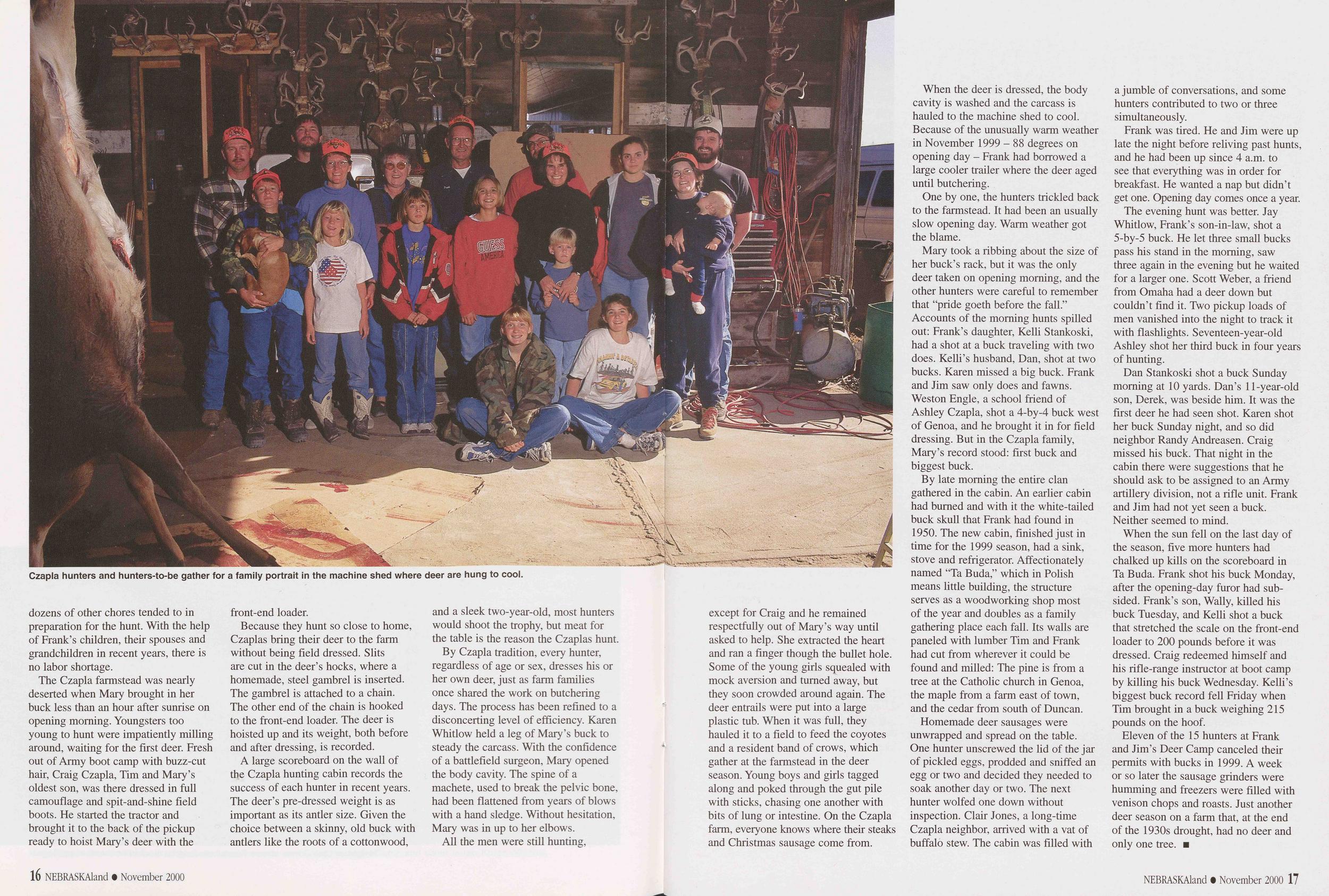
Antler size declined dramatically in the 1980s. The interior walls and rafters of the machine shed, where the Czaplas hang deer to cool, is lined with dozens of antlers. Most have spreads of less than a foot, because few bucks on Czapla’s intensively hunted land live through a second hunting season.
Just as the whitetails in Nance County have changed since the early 1960s, so have the rifles the hunters use. Frank started with a military surplus 30.06 Springfield rifle with peep sights, which he bought with 500 rounds of ammunition for $35 through an ad in a hunting magazine. Later he borrowed a sporting rifle from a friend, then moved to the rifle he still shoots today - a Remington semi-automatic 30.06 that he earned as a premium for buying Super Sweet hog feed. “We fed a lot of hogs at the time,” he recalled. “It took thousands of coupons off the bags. I saved for about two years and finally got it in ’66.”
Through most of the 1980s, Frank and his son, Tim, were the only deer hunters in the Czapla family. Most of Frank and Carol’s other children had moved away or were busy starting families. But, one by one, they came back and usually brought a spouse. The family deer hunt grew in size and tradition and, by the late 1980s, it was a full-blown annual event.
As the number of hunters grew, their preparation for the deer season became more elaborate. On the Loup River, Frank had hunted from pole blinds made of two upright two-by-fours with a platform nailed to a cottonwood tree. The first pole blinds he built in the wooded ravine bottoms on his farm were similar. After a few years, the hunters decided the hillsides offered a better view, and deer moving through the bottom cover would be less likely to catch a hunter’s scent.
Taller blinds required longer, stronger poles. When utility lines bordering the farm were buried, Frank salvaged the poles; they became the supports for taller, more comfortable blinds. Two old windmill towers were put to similar use, and the hunters began experimenting with hay-bale blinds. They used large round bales at first, but they found that large square bales were easier to stack in a way that left an opening on the top layer where a hunter could huddle out of the wind, or, as Frank put it, “to lay back and nap on a sunny afternoon.”
It takes hunters about three weekends to put the blinds in order, make repairs, add cedar boughs for camouflage and stack bales. Like the hunt, these work details are filled with good-natured fun. Several years ago, after a female hunter complained about bathroom facilities in the blinds, the men installed a porcelain stool. Plumbing to the high-rise fixture, however, is yet to be completed.
Shooting lanes are cut with a brush
hog mower, trees are planted and
14 NEBRASKAland • November 2000
NEBRASKAland • November 2000 15
 dozens of other chores tended to in
preparation for the hunt. With the help
of Frank’s children, their spouses and
grandchildren in recent years, there is
no labor shortage.
dozens of other chores tended to in
preparation for the hunt. With the help
of Frank’s children, their spouses and
grandchildren in recent years, there is
no labor shortage.
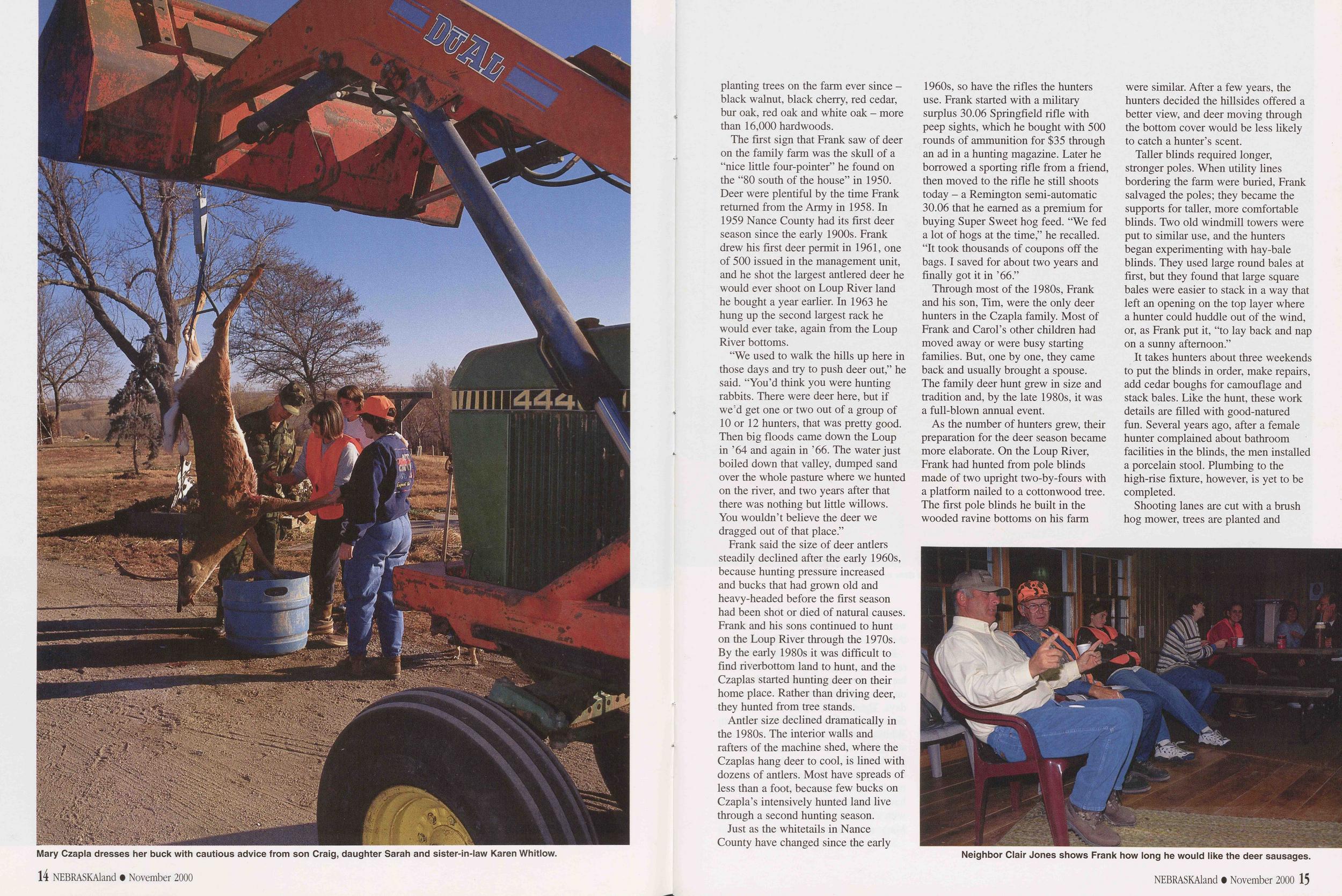
The Czapla farmstead was nearly deserted when Mary brought in her buck less than an hour after sunrise on opening morning. Youngsters too young to hunt were impatiently milling around, waiting for the first deer. Fresh out of Army boot camp with buzz-cut hair, Craig Czapla, Tim and Mary’s oldest son, was there dressed in full camouflage and spit-and-shine field boots. He started the tractor and brought it to the back of the pickup ready to hoist Mary’s deer with the front-end loader.
Because they hunt so close to home, Czaplas bring their deer to the farm without being field dressed. Slits are cut in the deer’s hocks, where a homemade, steel gambrel is inserted. The gambrel is attached to a chain. The other end of the chain is hooked to the front-end loader. The deer is hoisted up and its weight, both before and after dressing, is recorded.
A large scoreboard on the wall of the Czapla hunting cabin records the success of each hunter in recent years. The deer’s pre-dressed weight is as important as its antler size. Given the choice between a skinny, old buck with antlers like the roots of a cottonwood, and a sleek two-year-old, most hunters would shoot the trophy, but meat for the table is the reason the Czaplas hunt.
By Czapla tradition, every hunter, regardless of age or sex, dresses his or her own deer, just as farm families once shared the work on butchering days. The process has been refined to a disconcerting level of efficiency. Karen Whitlow held a leg of Mary’s buck to steady the carcass. With the confidence of a battlefield surgeon, Mary opened the body cavity. The spine of a machete, used to break the pelvic bone, had been flattened from years of blows with a hand sledge. Without hesitation, Mary was in up to her elbows.
All the men were still hunting, except for Craig and he remained respectfully out of Mary’s way until asked to help. She extracted the heart and ran a finger though the bullet hole. Some of the young girls squealed with mock aversion and turned away, but they soon crowded around again. The deer entrails were put into a large plastic tub. When it was full, they hauled it to a field to feed the coyotes and a resident band of crows, which gather at the farmstead in the deer season. Young boys and girls tagged along and poked through the gut pile with sticks, chasing one another with bits of lung or intestine. On the Czapla farm, everyone knows where their steaks and Christmas sausage come from.
When the deer is dressed, the body cavity is washed and the carcass is hauled to the machine shed to cool. Because of the unusually warm weather in November 1999 - 88 degrees on opening day - Frank had borrowed a large cooler trailer where the deer aged until butchering.
One by one, the hunters trickled back to the farmstead. It had been an usually slow opening day. Warm weather got the blame.
Mary took a ribbing about the size of her buck’s rack, but it was the only deer taken on opening morning, and the other hunters were careful to remember that “pride goeth before the fall.” Accounts of the morning hunts spilled out: Frank’s daughter, Kelli Stankoski, had a shot at a buck traveling with two does. Kelli’s husband, Dan, shot at two bucks. Karen missed a big buck. Frank and Jim saw only does and fawns. Weston Engle, a school friend of Ashley Czapla, shot a 4-by-4 buck west of Genoa, and he brought it in for field dressing. But in the Czapla family, Mary’s record stood: first buck and biggest buck.
By late morning the entire clan gathered in the cabin. An earlier cabin had burned and with it the white-tailed buck skull that Frank had found in 1950. The new cabin, finished just in time for the 1999 season, had a sink, stove and refrigerator. Affectionately named "Ta Buda,” which in Polish means little building, the structure serves as a woodworking shop most of the year and doubles as a family gathering place each fall. Its walls are paneled with lumber Tim and Frank had cut from wherever it could be found and milled: The pine is from a tree at the Catholic church in Genoa, the maple from a farm east of town, and the cedar from south of Duncan.
Homemade deer sausages were unwrapped and spread on the table. One hunter unscrewed the lid of the jar of pickled eggs, prodded and sniffed an egg or two and decided they needed to soak another day or two. The next hunter wolfed one down without inspection. Clair Jones, a long-time Czapla neighbor, arrived with a vat of buffalo stew. The cabin was filled with a jumble of conversations, and some hunters contributed to two or three simultaneously.
Frank was tired. He and Jim were up late the night before reliving past hunts, and he had been up since 4 a.m. to see that everything was in order for breakfast. He wanted a nap but didn’t get one. Opening day comes once a year.
The evening hunt was better. Jay Whitlow, Frank’s son-in-law, shot a 5-by-5 buck. He let three small bucks pass his stand in the morning, saw three again in the evening but he waited for a larger one. Scott Weber, a friend from Omaha had a deer down but couldn’t find it. Two pickup loads of men vanished into the night to track it with flashlights. Seventeen-year-old Ashley shot her third buck in four years of hunting.
Dan Stankoski shot a buck Sunday morning at 10 yards. Dan’s 11-year-old son, Derek, was beside him. It was the first deer he had seen shot. Karen shot her buck Sunday night, and so did neighbor Randy Andreasen. Craig missed his buck. That night in the cabin there were suggestions that he should ask to be assigned to an Army artillery division, not a rifle unit. Frank and Jim had not yet seen a buck. Neither seemed to mind.
When the sun fell on the last day of the season, five more hunters had chalked up kills on the scoreboard in Ta Buda. Frank shot his buck Monday, after the opening-day furor had sub- sided. Frank’s son, Wally, killed his buck Tuesday, and Kelli shot a buck that stretched the scale on the front-end loader to 200 pounds before it was dressed. Craig redeemed himself and his rifle-range instructor at boot camp by killing his buck Wednesday. Kelli’s biggest buck record fell Friday when Tim brought in a buck weighing 215 pounds on the hoof.
Eleven of the 15 hunters at Frank and Jim’s Deer Camp canceled their permits with bucks in 1999. A week or so later the sausage grinders were humming and freezers were filled with venison chops and roasts. Just another deer season on a farm that, at the end of the 1930s drought, had no deer and only one tree. ■
16 NEBRASKAland • November 2000 NEBRASKAland • November 2000 17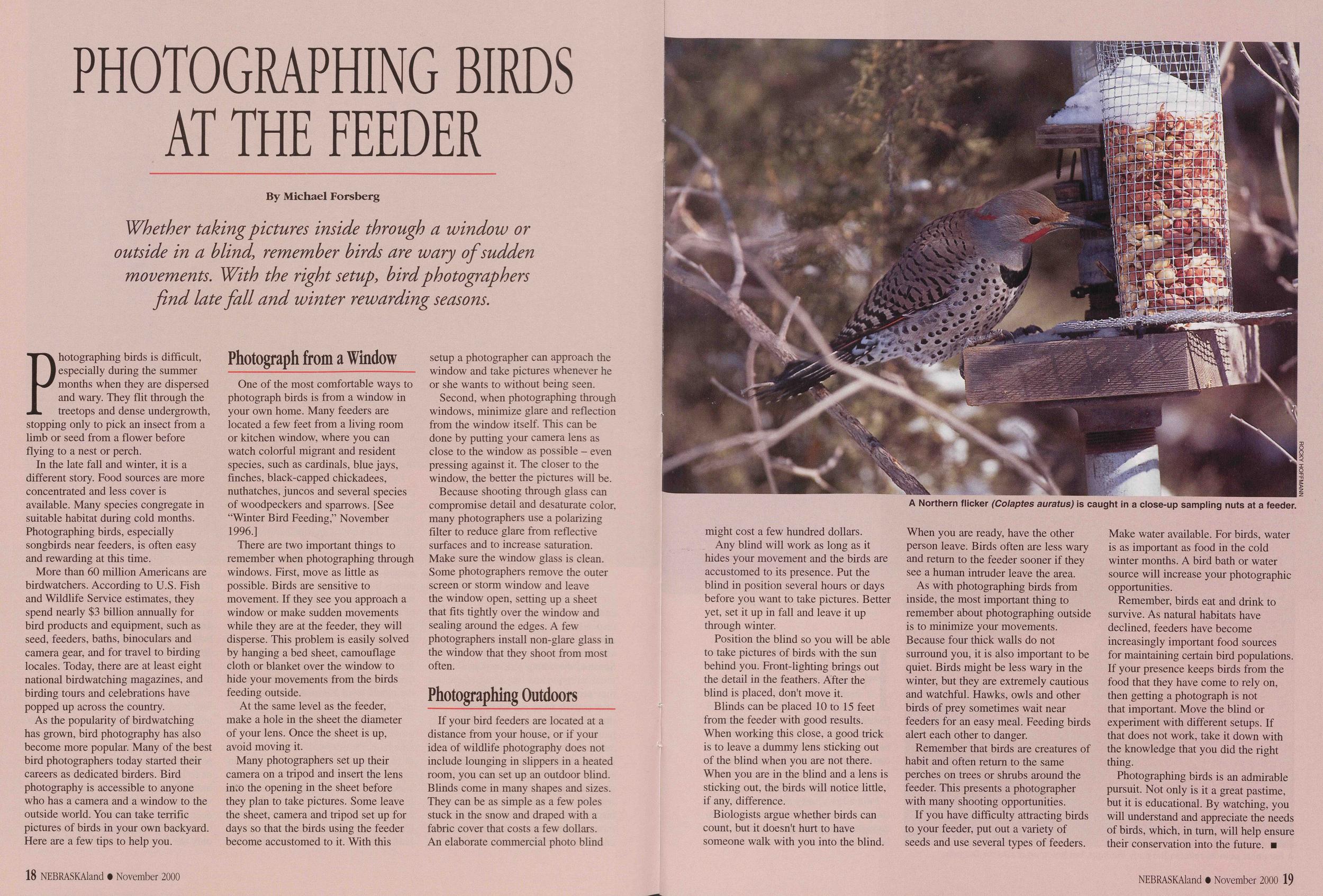
PHOTOGRAPHING BIRDS AT THE FEEDER
By Michael Forsberg Whether taking pictures inside through a window or outside in a blind, remember birds are wary of sudden movements. With the right setup, bird photographers find late fall and winter rewarding seasons.Photographing birds is difficult, especially during the summer months when they are dispersed and wary. They flit through the treetops and dense undergrowth, stopping only to pick an insect from a limb or seed from a flower before flying to a nest or perch.
In the late fall and winter, it is a different story. Food sources are more concentrated and less cover is available. Many species congregate in suitable habitat during cold months. Photographing birds, especially songbirds near feeders, is often easy and rewarding at this time.
More than 60 million Americans are birdwatchers. According to U.S. Fish and Wildlife Service estimates, they spend nearly $3 billion annually for bird products and equipment, such as seed, feeders, baths, binoculars and camera gear, and for travel to birding locales. Today, there are at least eight national birdwatching magazines, and birding tours and celebrations have popped up across the country.
As the popularity of birdwatching has grown, bird photography has also become more popular. Many of the best bird photographers today started their careers as dedicated birders. Bird photography is accessible to anyone who has a camera and a window to the outside world. You can take terrific pictures of birds in your own backyard. Here are a few tips to help you.
Photograph from a WindowOne of the most comfortable ways to photograph birds is from a window in your own home. Many feeders are located a few feet from a living room or kitchen window, where you can watch colorful migrant and resident species, such as cardinals, blue jays, finches, black-capped chickadees, nuthatches, juncos and several species of woodpeckers and sparrows. [See “Winter Bird Feeding,” November 1996.]
There are two important things to remember when photographing through windows. First, move as little as possible. Birds are sensitive to movement. If they see you approach a window or make sudden movements while they are at the feeder, they will disperse. This problem is easily solved by hanging a bed sheet, camouflage cloth or blanket over the window to hide your movements from the birds feeding outside.
At the same level as the feeder, make a hole in the sheet the diameter of your lens. Once the sheet is up, avoid moving it.
Many photographers set up their camera on a tripod and insert the lens into the opening in the sheet before they plan to take pictures. Some leave the sheet, camera and tripod set up for days so that the birds using the feeder become accustomed to it. With this setup a photographer can approach the window and take pictures whenever he or she wants to without being seen.
Second, when photographing through windows, minimize glare and reflection from the window itself. This can be done by putting your camera lens as close to the window as possible - even pressing against it. The closer to the window, the better the pictures will be.
Because shooting through glass can compromise detail and desaturate color, many photographers use a polarizing filter to reduce glare from reflective surfaces and to increase saturation. Make sure the window glass is clean. Some photographers remove the outer screen or storm window and leave the window open, setting up a sheet that fits tightly over the window and sealing around the edges. A few photographers install non-glare glass in the window that they shoot from most often.
Photographing OutdoorsIf your bird feeders are located at a distance from your house, or if your idea of wildlife photography does not include lounging in slippers in a heated room, you can set up an outdoor blind. Blinds come in many shapes and sizes. They can be as simple as a few poles stuck in the snow and draped with a fabric cover that costs a few dollars. An elaborate commercial photo blind might cost a few hundred dollars.
Any blind will work as long as it hides your movement and the birds are accustomed to its presence. Put the blind in position several hours or days before you want to take pictures. Better yet, set it up in fall and leave it up through winter.
Position the blind so you will be able to take pictures of birds with the sun behind you. Front-lighting brings out the detail in the feathers. After the blind is placed, don't move it.
Blinds can be placed 10 to 15 feet from the feeder with good results. When working this close, a good trick is to leave a dummy lens sticking out of the blind when you are not there. When you are in the blind and a lens is sticking out, the birds will notice little, if any, difference.
Biologists argue whether birds can count, but it doesn't hurt to have someone walk with you into the blind. When you are ready, have the other person leave. Birds often are less wary and return to the feeder sooner if they see a human intruder leave the area.
As with photographing birds from inside, the most important thing to remember about photographing outside is to minimize your movements. Because four thick walls do not surround you, it is also important to be quiet. Birds might be less wary in the winter, but they are extremely cautious and watchful. Hawks, owls and other birds of prey sometimes wait near feeders for an easy meal. Feeding birds alert each other to danger.
Remember that birds are creatures of habit and often return to the same perches on trees or shrubs around the feeder. This presents a photographer with many shooting opportunities.
If you have difficulty attracting birds to your feeder, put out a variety of seeds and use several types of feeders. Make water available. For birds, water is as important as food in the cold winter months. A bird bath or water source will increase your photographic opportunities.
Remember, birds eat and drink to survive. As natural habitats have declined, feeders have become increasingly important food sources for maintaining certain bird populations. If your presence keeps birds from the food that they have come to rely on, then getting a photograph is not that important. Move the blind or experiment with different setups. If that does not work, take it down with the knowledge that you did the right thing.
Photographing birds is an admirable pursuit. Not only is it a great pastime, but it is educational. By watching, you will understand and appreciate the needs of birds, which, in turn, will help ensure their conservation into the future. ■
18 NEBRASKAland • November 2000 NEBRASKAland • November 2000 19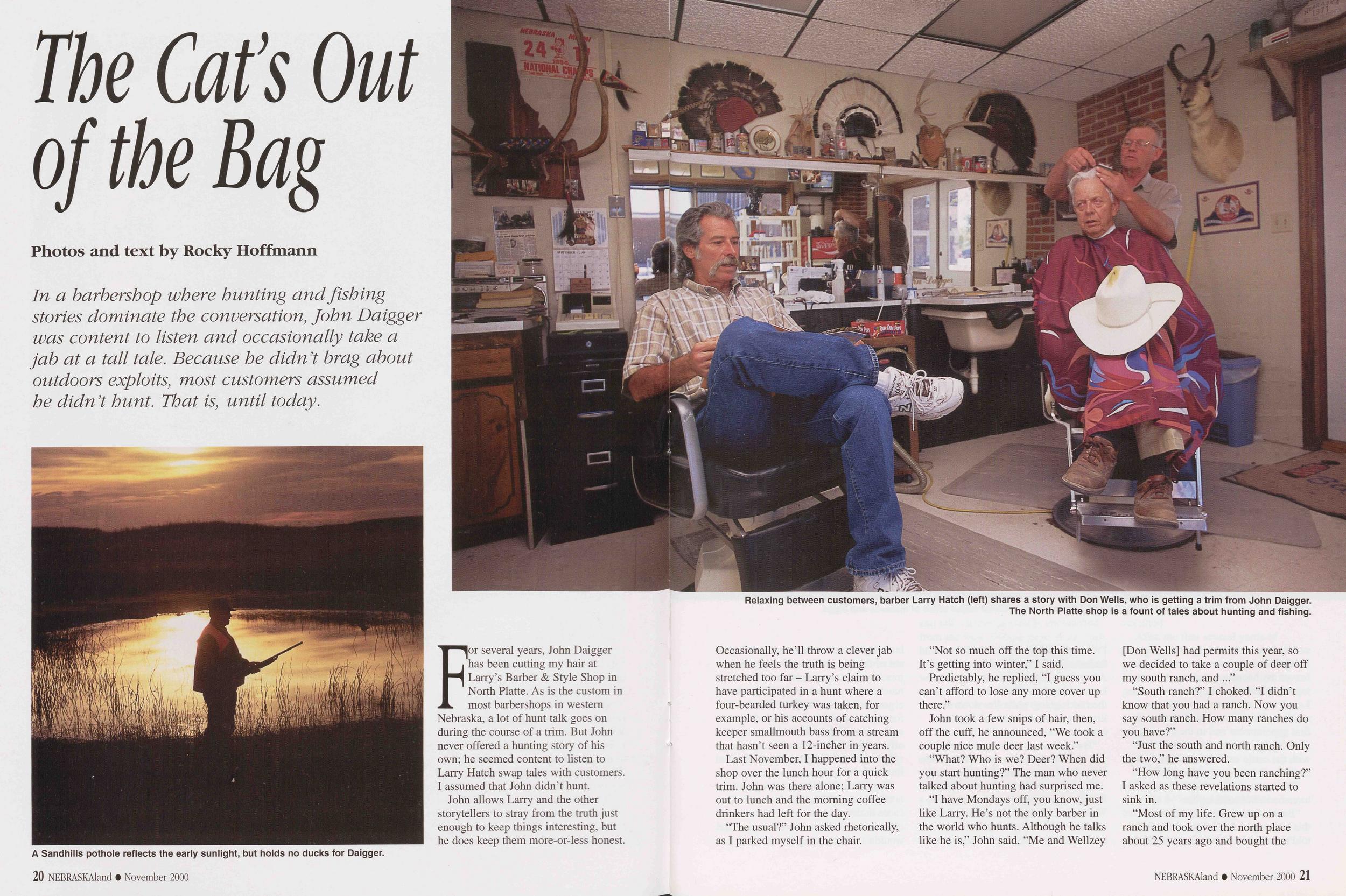
The Cat’s Out of the Bag
Photos and text by Rocky Hoffmann In a barbershop where hunting and fishing stories dominate the conversation, John Daigger was content to listen and occasionally take a jab at a tall tale. Because he didn’t brag about outdoors exploits, most customers assumed he didn’t hunt. That is, until today.For several years, John Daigger has been cutting my hair at Larry’s Barber & Style Shop in North Platte. As is the custom in most barbershops in western Nebraska, a lot of hunt talk goes on during the course of a trim. But John never offered a hunting story of his own; he seemed content to listen to Larry Hatch swap tales with customers. I assumed that John didn’t hunt.
John allows Larry and the other storytellers to stray from the truth just enough to keep things interesting, but he does keep them more-or-less honest. Occasionally, he’ll throw a clever jab when he feels the truth is being stretched too far - Larry’s claim to have participated in a hunt where a four-bearded turkey was taken, for example, or his accounts of catching keeper smallmouth bass from a stream that hasn’t seen a 12-incher in years.
Last November, I happened into the shop over the lunch hour for a quick trim. John was there alone; Larry was out to lunch and the morning coffee drinkers had left for the day.
“The usual?” John asked rhetorically, as I parked myself in the chair.
“Not so much off the top this time. It’s getting into winter,” I said.
Predictably, he replied, “I guess you can’t afford to lose any more cover up there.”
John took a few snips of hair, then, off the cuff, he announced, “We took a couple nice mule deer last week.”
“What? Who is we? Deer? When did you start hunting?” The man who never talked about hunting had surprised me.
“I have Mondays off, you know, just like Larry. He’s not the only barber in the world who hunts. Although he talks like he is,” John said. “Me and Wellzey [Don Wells] had permits this year, so we decided to take a couple of deer off my south ranch, and ...”
“South ranch?” I choked. “I didn’t know that you had a ranch. Now you say south ranch. How many ranches do you have?”
“Just the south and north ranch. Only the two,” he answered.
“How long have you been ranching?” I asked as these revelations started to sink in.
“Most of my life. Grew up on a
ranch and took over the north place
about 25 years ago and bought the
20 NEBRASKAland • November 2000
NEBRASKAland • November 2000 21
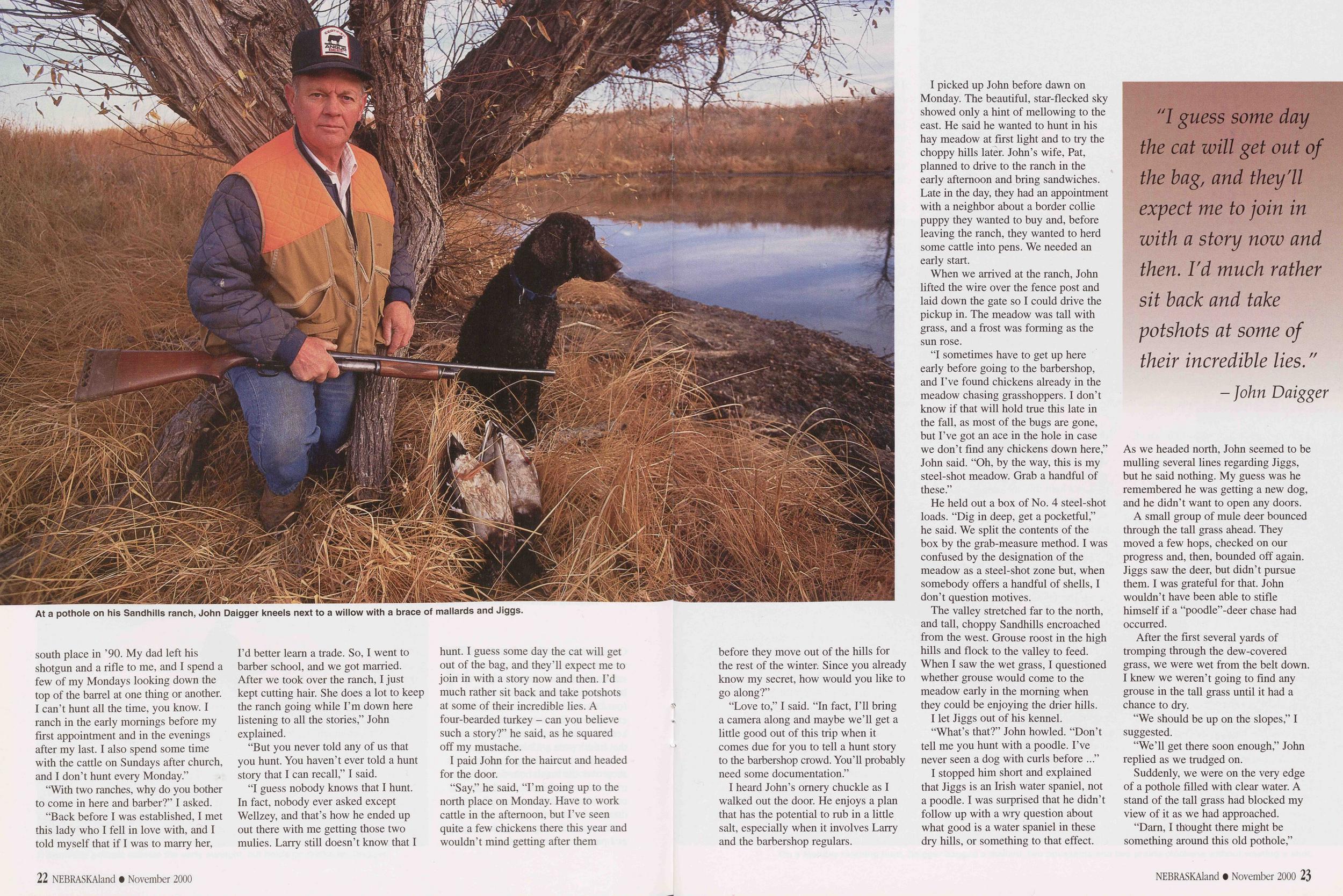 south place in '90. My dad left his
shotgun and a rifle to me, and I spend a
few of my Mondays looking down the
top of the barrel at one thing or another.
I can’t hunt all the time, you know. I
ranch in the early mornings before my
first appointment and in the evenings
after my last. I also spend some time
with the cattle on Sundays after church,
and I don’t hunt every Monday.”
south place in '90. My dad left his
shotgun and a rifle to me, and I spend a
few of my Mondays looking down the
top of the barrel at one thing or another.
I can’t hunt all the time, you know. I
ranch in the early mornings before my
first appointment and in the evenings
after my last. I also spend some time
with the cattle on Sundays after church,
and I don’t hunt every Monday.”
“With two ranches, why do you bother to come in here and barber?” I asked.
“Back before I was established, I met this lady who I fell in love with, and I told myself that if I was to marry her, I’d better learn a trade. So, I went to barber school, and we got married. After we took over the ranch, I just kept cutting hair. She does a lot to keep the ranch going while I’m down here listening to all the stories,” John explained.
“But you never told any of us that you hunt. You haven’t ever told a hunt story that I can recall,” I said.
“I guess nobody knows that I hunt. In fact, nobody ever asked except Wellzey, and that’s how he ended up out there with me getting those two mulies. Larry still doesn’t know that I hunt. I guess some day the cat will get out of the bag, and they’ll expect me to join in with a story now and then. I’d much rather sit back and take potshots at some of their incredible lies. A four-bearded turkey - can you believe such a story?” he said, as he squared off my mustache.
I paid John for the haircut and headed for the door.
“Say,” he said, “I’m going up to the north place on Monday. Have to work cattle in the afternoon, but I’ve seen quite a few chickens there this year and wouldn’t mind getting after them before they move out of the hills for the rest of the winter. Since you already know my secret, how would you like to go along?”
“Love to,” I said. “In fact, I’ll bring a camera along and maybe we’ll get a little good out of this trip when it comes due for you to tell a hunt story to the barbershop crowd. You’ll probably need some documentation.”
I heard John’s ornery chuckle as I walked out the door. He enjoys a plan that has the potential to rub in a little salt, especially when it involves Larry and the barbershop regulars.
I picked up John before dawn on Monday. The beautiful, star-flecked sky showed only a hint of mellowing to the east. He said he wanted to hunt in his hay meadow at first light and to try the choppy hills later. John’s wife, Pat, planned to drive to the ranch in the early afternoon and bring sandwiches. Late in the day, they had an appointment with a neighbor about a border collie puppy they wanted to buy and, before leaving the ranch, they wanted to herd some cattle into pens. We needed an early start.
When we arrived at the ranch, John lifted the wire over the fence post and laid down the gate so I could drive the pickup in. The meadow was tall with grass, and a frost was forming as the sun rose.
“I sometimes have to get up here early before going to the barbershop, and I’ve found chickens already in the meadow chasing grasshoppers. I don’t know if that will hold true this late in the fall, as most of the bugs are gone, but I’ve got an ace in the hole in case we don’t find any chickens down here,” John said. “Oh, by the way, this is my steel-shot meadow. Grab a handful of these.”
He held out a box of No. 4 steel-shot loads. “Dig in deep, get a pocketful,” he said. We split the contents of the box by the grab-measure method. I was confused by the designation of the meadow as a steel-shot zone but, when somebody offers a handful of shells, I don’t question motives.
The valley stretched far to the north, and tall, choppy Sandhills encroached from the west. Grouse roost in the high hills and flock to the valley to feed. When I saw the wet grass, I questioned whether grouse would come to the meadow early in the morning when they could be enjoying the drier hills.
I let Jiggs out of his kennel.
“What’s that?” John howled. “Don’t tell me you hunt with a poodle. I’ve never seen a dog with curls before ...”
"I guess some day the cat will get out of the bag, and they'll expect me to join in with a story now and then. I'd much rather sit back and take potshots at some of their incredible lies." - John DaiggerI stopped him short and explained that Jiggs is an Irish water spaniel, not a poodle. I was surprised that he didn’t follow up with a wry question about what good is a water spaniel in these dry hills, or something to that effect. As we headed north, John seemed to be mulling several lines regarding Jiggs, but he said nothing. My guess was he remembered he was getting a new dog, and he didn’t want to open any doors.
A small group of mule deer bounced through the tall grass ahead. They moved a few hops, checked on our progress and, then, bounded off again. Jiggs saw the deer, but didn’t pursue them. I was grateful for that. John wouldn’t have been able to stifle himself if a “poodle”-deer chase had occurred.
After the first several yards of tromping through the dew-covered grass, we were wet from the belt down. I knew we weren’t going to find any grouse in the tall grass until it had a chance to dry.
“We should be up on the slopes,” I suggested.
“We’ll get there soon enough,” John replied as we trudged on.
Suddenly, we were on the very edge of a pothole filled with clear water. A stand of the tall grass had blocked my view of it as we had approached.
“Dam, I thought there might be
something around this old pothole,”
22 NEBRASKAland • November 2000
NEBRASKAland • November 2000 23
 John said, revealing he had known all
along where we were going.
John said, revealing he had known all
along where we were going.
"I don’t think that grouse need a place to drink on a wet morning like this. In fact, I think they’ll be looking for a place to dry,” I said.
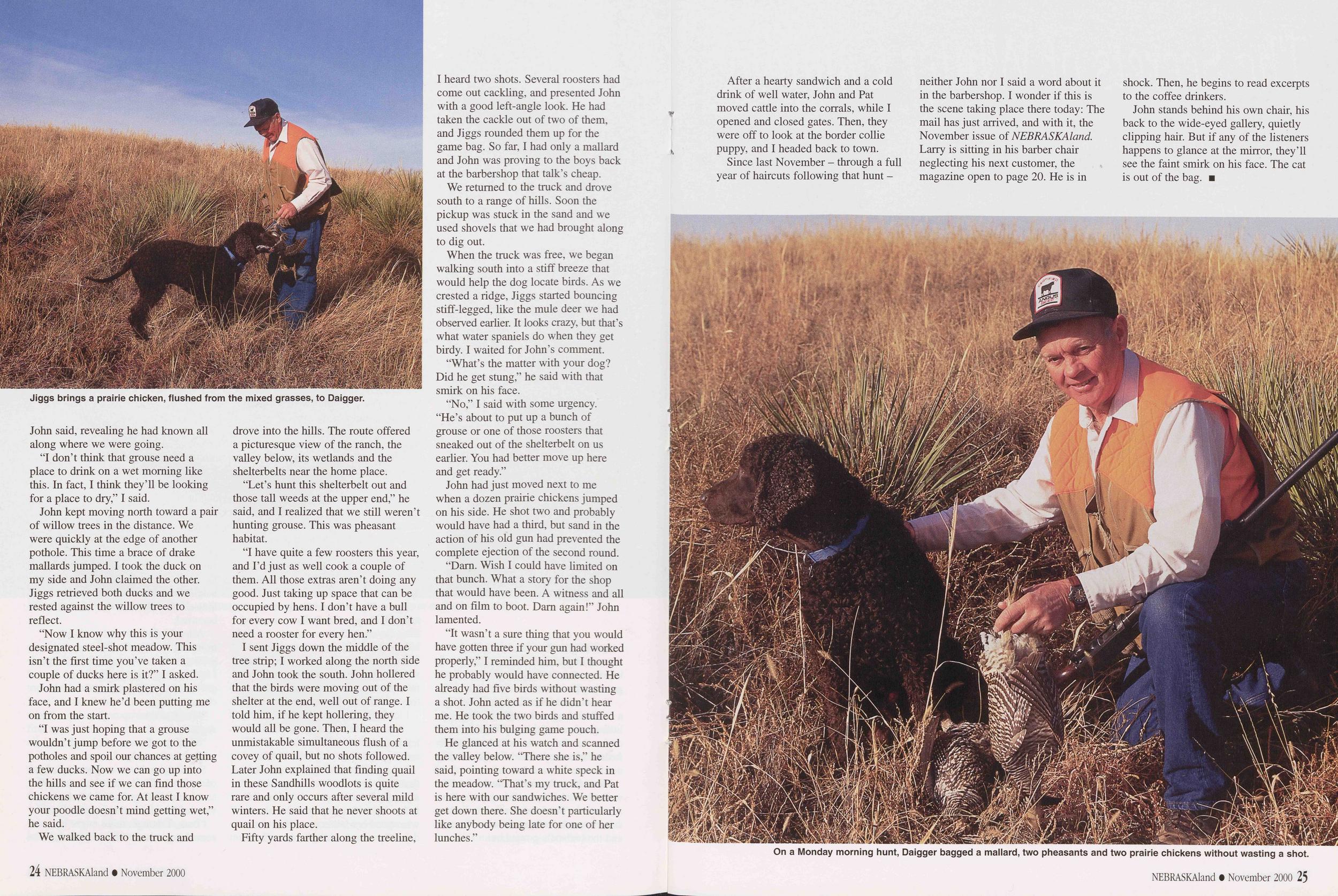
John kept moving north toward a pair of willow trees in the distance. We were quickly at the edge of another pothole. This time a brace of drake mallards jumped. I took the duck on my side and John claimed the other. Jiggs retrieved both ducks and we rested against the willow trees to reflect.
“Now I know why this is your designated steel-shot meadow. This isn’t the first time you’ve taken a couple of ducks here is it?” I asked.
ohn had a smirk plastered on his face, and I knew he’d been putting me on from the start.
"I was just hoping that a grouse wouldn’t jump before we got to the potholes and spoil our chances at getting a few ducks. Now we can go up into the hills and see if we can find those chickens we came for. At least I know your poodle doesn’t mind getting wet,” he said.
We walked back to the truck and drove into the hills. The route offered a picturesque view of the ranch, the valley below, its wetlands and the shelterbelts near the home place.
“Let’s hunt this shelterbelt out and those tall weeds at the upper end,” he said, and I realized that we still weren’t hunting grouse. This was pheasant habitat.
“I have quite a few roosters this year, and I’d just as well cook a couple of them. All those extras aren’t doing any good. Just taking up space that can be occupied by hens. I don’t have a bull for every cow I want bred, and I don’t need a rooster for every hen.”
I sent Jiggs down the middle of the tree strip; I worked along the north side and John took the south. John hollered that the birds were moving out of the shelter at the end, well out of range. I told him, if he kept hollering, they would all be gone. Then, I heard the unmistakable simultaneous flush of a covey of quail, but no shots followed. Later John explained that finding quail in these Sandhills woodlots is quite rare and only occurs after several mild winters. He said that he never shoots at quail on his place.
Fifty yards farther along the treeline, I heard two shots. Several roosters had come out cackling, and presented John with a good left-angle look. He had taken the cackle out of two of them, and Jiggs rounded them up for the game bag. So far, I had only a mallard and John was proving to the boys back at the barbershop that talk’s cheap.
We returned to the truck and drove south to a range of hills. Soon the pickup was stuck in the sand and we used shovels that we had brought along to dig out.
When the truck was free, we began walking south into a stiff breeze that would help the dog locate birds. As we crested a ridge, Jiggs started bouncing stiff-legged, like the mule deer we had observed earlier. It looks crazy, but that’s what water spaniels do when they get birdy. I waited for John’s comment.
“What’s the matter with your dog? Did he get stung,” he said with that smirk on his face.
“No,” I said with some urgency.
“He’s about to put up a bunch of grouse or one of those roosters that sneaked out of the shelterbelt on us earlier. You had better move up here and get ready.”
John had just moved next to me when a dozen prairie chickens jumped on his side. He shot two and probably would have had a third, but sand in the action of his old gun had prevented the complete ejection of the second round.
“Dam. Wish I could have limited on that bunch. What a story for the shop that would have been. A witness and all and on film to boot. Dam again!” John lamented.
“It wasn’t a sure thing that you would have gotten three if your gun had worked properly,” I reminded him, but I thought he probably would have connected. He already had five birds without wasting a shot. John acted as if he didn’t hear me. He took the two birds and stuffed them into his bulging game pouch.
He glanced at his watch and scanned the valley below. “There she is,” he said, pointing toward a white speck in the meadow. “That’s my truck, and Pat is here with our sandwiches. We better get down there. She doesn’t particularly like anybody being late for one of her lunches.”
After a hearty sandwich and a cold drink of well water, John and Pat moved cattle into the corrals, while I opened and closed gates. Then, they were off to look at the border collie puppy, and I headed back to town.
Since last November - through a full year of haircuts following that hunt - neither John nor I said a word about it in the barbershop. I wonder if this is the scene taking place there today: The mail has just arrived, and with it, the November issue of NEBRASKAland. Larry is sitting in his barber chair neglecting his next customer, the magazine open to page 20. He is in shock. Then, he begins to read excerpts to the coffee drinkers.
John stands behind his own chair, his back to the wide-eyed gallery, quietly clipping hair. But if any of the listeners happens to glance at the mirror, they’ll see the faint smirk on his face. The cat is out of the bag. ■
24 NEBRASKAland • November 2000 NEBRASKAland • November 2000 25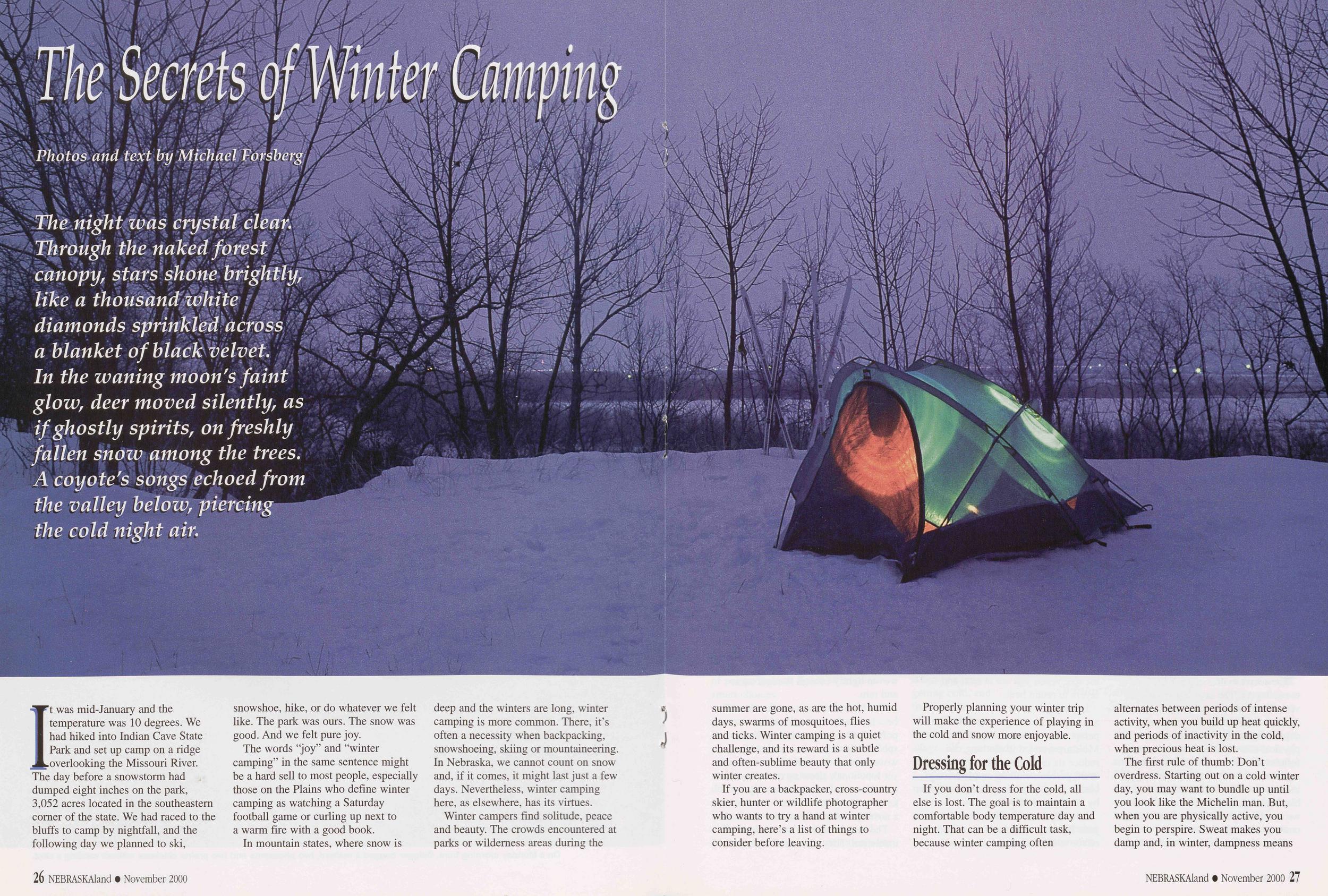
The Secrets of Winter Camping
Photos and text by Michael Forsberg The night was crystal clear. Through the naked forest canopy, stars shone brightly like a thousand white diamonds sprinkled across a blanket of black velvet. In the waning moon's faint glow, deer moved silently, as if ghostly spirits, on freshly fallen snow among the trees. A coyote's songs echoed from the valley below, piercing the cold night air.It was mid-January and the temperature was 10 degrees. We had hiked into Indian Cave State Park and set up camp on a ridge overlooking the Missouri River. The day before a snowstorm had dumped eight inches on the park, 3,052 acres located in the southeastern comer of the state. We had raced to the bluffs to camp by nightfall, and the following day we planned to ski, snowshoe, hike, or do whatever we felt like. The park was ours. The snow was good. And we felt pure joy.
The words "joy” and "winter camping” in the same sentence might be a hard sell to most people, especially those on the Plains who define winter camping as watching a Saturday football game or curling up next to a warm fire with a good book.
In mountain states, where snow is deep and the winters are long, winter camping is more common. There, it’s often a necessity when backpacking, snowshoeing, skiing or mountaineering. In Nebraska, we cannot count on snow and, if it comes, it might last just a few days. Nevertheless, winter camping here, as elsewhere, has its virtues.
Winter campers find solitude, peace and beauty. The crowds encountered at parks or wilderness areas during the summer are gone, as are the hot, humid days, swarms of mosquitoes, flies and ticks. Winter camping is a quiet challenge, and its reward is a subtle and often-sublime beauty that only winter creates.
If you are a backpacker, cross-country skier, hunter or wildlife photographer who wants to try a hand at winter camping, here’s a list of things to consider before leaving.
Properly planning your winter trip will make the experience of playing in the cold and snow more enjoyable.
Dressing for the ColdIf you don’t dress for the cold, all else is lost. The goal is to maintain a comfortable body temperature day and night. That can be a difficult task, because winter camping often alternates between periods of intense activity, when you build up heat quickly, and periods of inactivity in the cold, when precious heat is lost.
The first rule of thumb: Don’t
overdress. Starting out on a cold winter
day, you may want to bundle up until
you look like the Michelin man. But,
when you are physically active, you
begin to perspire. Sweat makes you
damp and, in winter, dampness means
26 NEBRASKAland • November 2000
NEBRASKAland • November 2000 27
 you will soon become chilled and
eventually cold. At that point, the
clothes on your body won’t help you.
you will soon become chilled and
eventually cold. At that point, the
clothes on your body won’t help you.
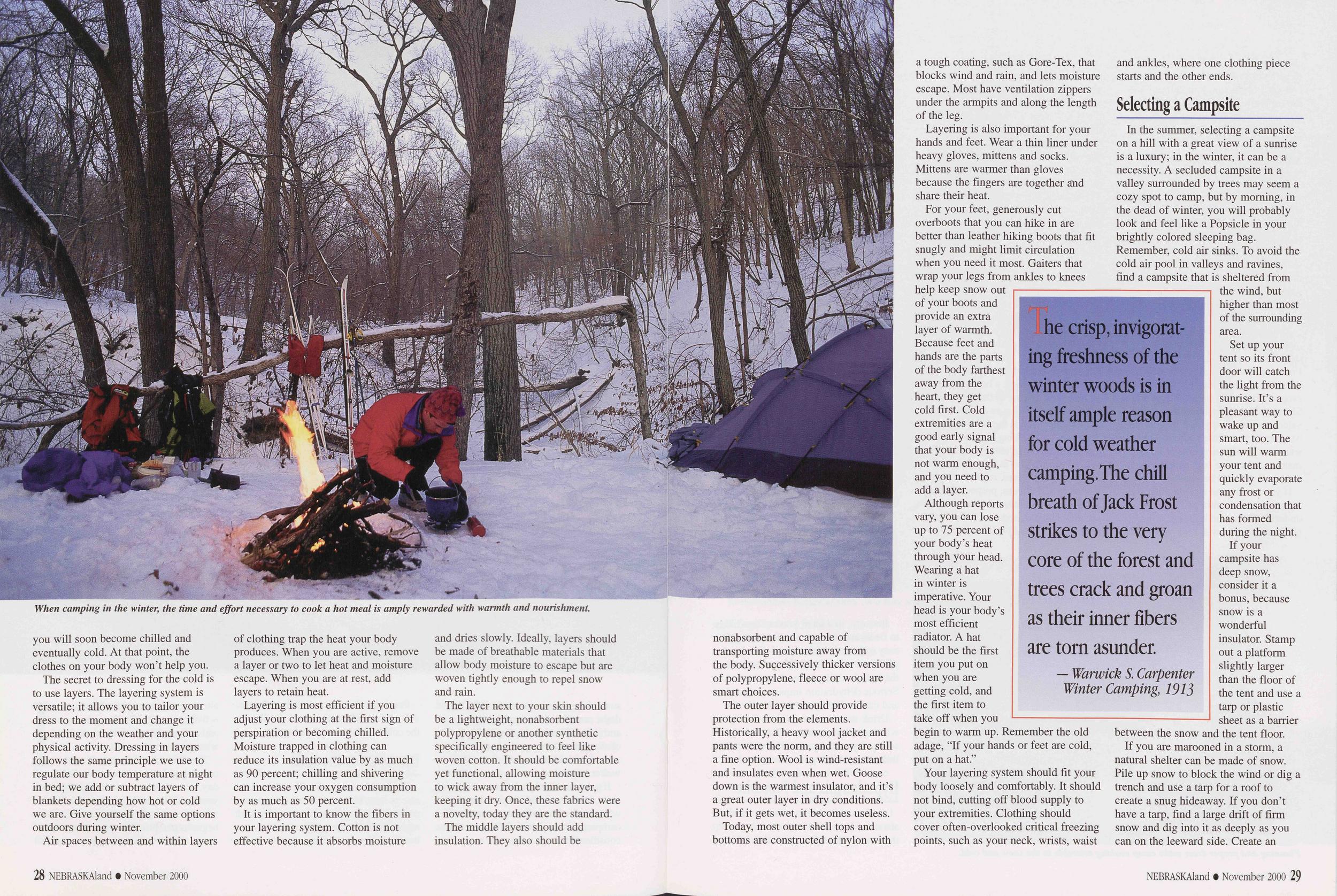
The secret to dressing for the cold is to use layers. The layering system is versatile; it allows you to tailor your dress to the moment and change it depending on the weather and your physical activity. Dressing in layers follows the same principle we use to regulate our body temperature at night in bed; we add or subtract layers of blankets depending how hot or cold we are. Give yourself the same options outdoors during winter.
Air spaces between and within layers of clothing trap the heat your body produces. When you are active, remove a layer or two to let heat and moisture escape. When you are at rest, add layers to retain heat.
Layering is most efficient if you adjust your clothing at the first sign of perspiration or becoming chilled. Moisture trapped in clothing can reduce its insulation value by as much as 90 percent; chilling and shivering can increase your oxygen consumption by as much as 50 percent.
It is important to know the fibers in your layering system. Cotton is not effective because it absorbs moisture and dries slowly. Ideally, layers should be made of breathable materials that allow body moisture to escape but are woven tightly enough to repel snow and rain.
The layer next to your skin should be a lightweight, nonabsorbent polypropylene or another synthetic specifically engineered to feel like woven cotton. It should be comfortable yet functional, allowing moisture to wick away from the inner layer, keeping it dry. Once, these fabrics were a novelty, today they are the standard.
The middle layers should add insulation. They also should be nonabsorbent and capable of transporting moisture away from the body. Successively thicker versions of polypropylene, fleece or wool are smart choices.
The outer layer should provide protection from the elements. Historically, a heavy wool jacket and pants were the norm, and they are still a fine option. Wool is wind-resistant and insulates even when wet. Goose down is the warmest insulator, and it’s a great outer layer in dry conditions. But, if it gets wet, it becomes useless.
Today, most outer shell tops and bottoms are constructed of nylon with a tough coating, such as Gore-Tex, that blocks wind and rain, and lets moisture escape. Most have ventilation zippers under the armpits and along the length of the leg.
Layering is also important for your hands and feet. Wear a thin liner under heavy gloves, mittens and socks. Mittens are warmer than gloves because the fingers are together and share their heat.
For your feet, generously cut overboots that you can hike in are better than leather hiking boots that fit snugly and might limit circulation when you need it most. Gaiters that wrap your legs from ankles to knees help keep snow out of your boots and provide an extra layer of warmth. Because feet and hands are the parts of the body farthest away from the heart, they get cold first. Cold extremities are a good early signal that your body is not warm enough, and you need to add a layer.
Although reports vary, you can lose up to 75 percent of your body’s heat through your head. Wearing a hat in winter is imperative. Your head is your body’s most efficient radiator. A hat should be the first item you put on when you are getting cold, and the first item to take off when you begin to warm up. Remember the old adage, "If your hands or feet are cold, put on a hat.”
Your layering system should fit your body loosely and comfortably. It should not bind, cutting off blood supply to your extremities. Clothing should cover often-overlooked critical freezing points, such as your neck, wrists, waist and ankles, where one clothing piece starts and the other ends.
Selecting a Campsite The crisp, invigorat- ing freshness of the winter woods is in itself ample reason for cold weather camping.The chill breath of Jack Frost strikes to the very core of the forest and trees crack and groan as their inner fibers are torn asunder. — Warwick S. Carpenter Winter Camping, 1915In the summer, selecting a campsite on a hill with a great view of a sunrise is a luxury; in the winter, it can be a necessity. A secluded campsite in a valley surrounded by trees may seem a cozy spot to camp, but by morning, in the dead of winter, you will probably look and feel like a Popsicle in your brightly colored sleeping bag. Remember, cold air sinks. To avoid the cold air pool in valleys and ravines, find a campsite that is sheltered from the wind, but higher than most of the surrounding area.
Set up your tent so its front door will catch the light from the sunrise. It’s a pleasant way to wake up and smart, too. The sun will warm your tent and quickly evaporate any frost or condensation that has formed during the night.
If your campsite has deep snow, consider it a bonus, because snow is a wonderful insulator. Stamp out a platform slightly larger than the floor of the tent and use a tarp or plastic sheet as a barrier between the snow and the tent floor.
If you are marooned in a storm, a
natural shelter can be made of snow.
Pile up snow to block the wind or dig a
trench and use a tarp for a roof to
create a snug hideaway. If you don’t
have a tarp, find a large drift of firm
snow and dig into it as deeply as you
can on the leeward side. Create an
28 NEBRASKAland • November 2000
NEBRASKAland • November 2000 29
 entry tunnel that leads to an upper
sleeping chamber with enough room to
curl up. Poke a vent hole through the
top for fresh air. A snow shelter might
take an hour or two to build, but it’s
comfortable and could save your life.
entry tunnel that leads to an upper
sleeping chamber with enough room to
curl up. Poke a vent hole through the
top for fresh air. A snow shelter might
take an hour or two to build, but it’s
comfortable and could save your life.
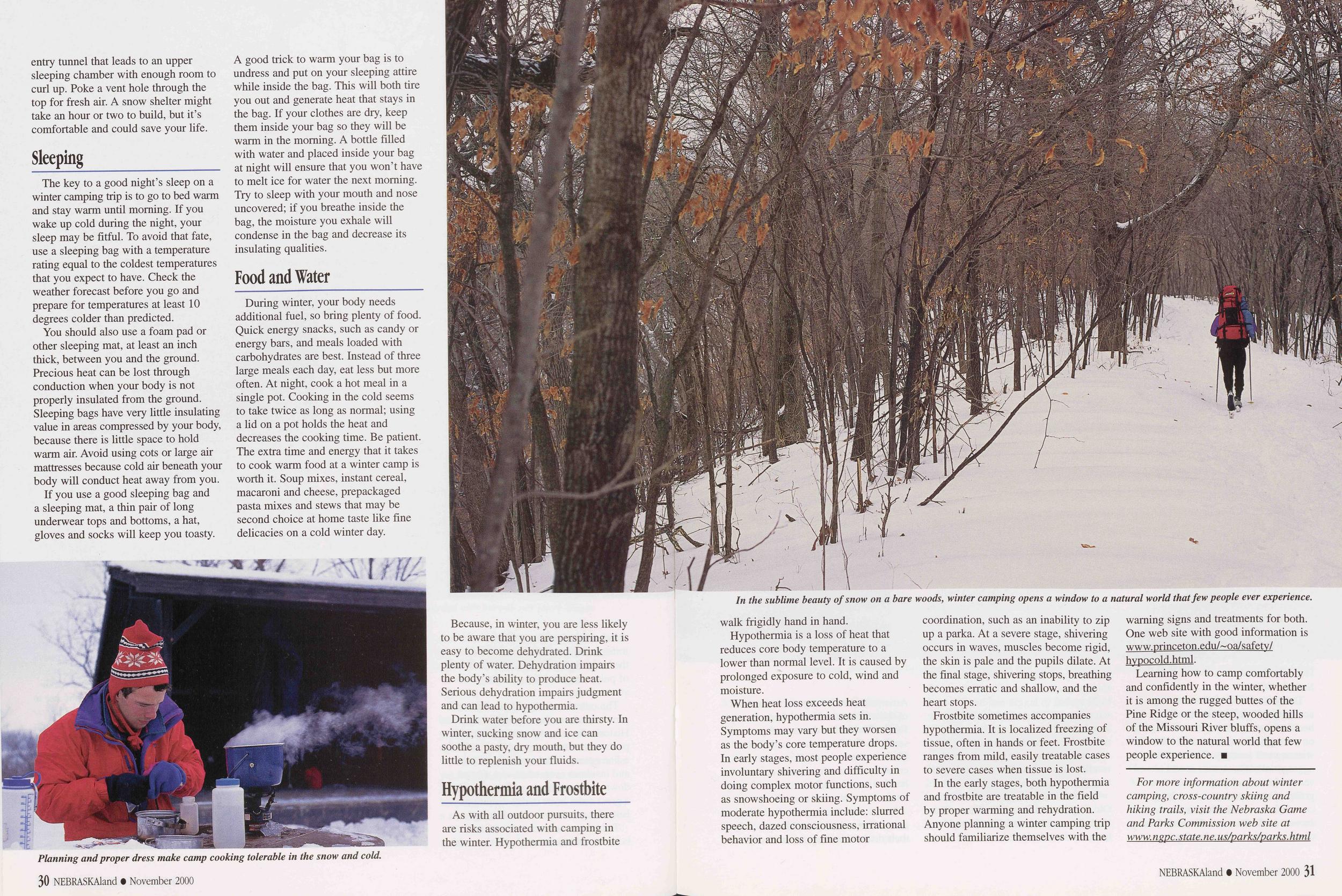
The key to a good night’s sleep on a winter camping trip is to go to bed warm and stay warm until morning. If you wake up cold during the night, your sleep may be fitful. To avoid that fate, use a sleeping bag with a temperature rating equal to the coldest temperatures that you expect to have. Check the weather forecast before you go and prepare for temperatures at least 10 degrees colder than predicted.
You should also use a foam pad or other sleeping mat, at least an inch thick, between you and the ground. Precious heat can be lost through conduction when your body is not properly insulated from the ground. Sleeping bags have very little insulating value in areas compressed by your body, because there is little space to hold warm air. Avoid using cots or large air mattresses because cold air beneath your body will conduct heat away from you.
If you use a good sleeping bag and a sleeping mat, a thin pair of long underwear tops and bottoms, a hat, gloves and socks will keep you toasty. A good trick to warm your bag is to undress and put on your sleeping attire while inside the bag. This will both tire you out and generate heat that stays in the bag. If your clothes are dry, keep them inside your bag so they will be warm in the morning. A bottle filled with water and placed inside your bag at night will ensure that you won’t have to melt ice for water the next morning. Try to sleep with your mouth and nose uncovered; if you breathe inside the bag, the moisture you exhale will condense in the bag and decrease its insulating qualities.
Food and WaterDuring winter, your body needs additional fuel, so bring plenty of food. Quick energy snacks, such as candy or energy bars, and meals loaded with carbohydrates are best. Instead of three large meals each day, eat less but more often. At night, cook a hot meal in a single pot. Cooking in the cold seems to take twice as long as normal; using a lid on a pot holds the heat and decreases the cooking time. Be patient. The extra time and energy that it takes to cook warm food at a winter camp is worth it. Soup mixes, instant cereal, macaroni and cheese, prepackaged pasta mixes and stews that may be second choice at home taste like fine delicacies on a cold winter day.
Because, in winter, you are less likely to be aware that you are perspiring, it is easy to become dehydrated. Drink plenty of water. Dehydration impairs the body’s ability to produce heat. Serious dehydration impairs judgment and can lead to hypothermia.
Drink water before you are thirsty. In winter, sucking snow and ice can soothe a pasty, dry mouth, but they do little to replenish your fluids.
Hypothermia and FrostbiteAs with all outdoor pursuits, there are risks associated with camping in the winter. Hypothermia and frostbite walk frigidly hand in hand.
Hypothermia is a loss of heat that reduces core body temperature to a lower than normal level. It is caused by prolonged exposure to cold, wind and moisture.
When heat loss exceeds heat generation, hypothermia sets in. Symptoms may vary but they worsen as the body’s core temperature drops. In early stages, most people experience involuntary shivering and difficulty in doing complex motor functions, such as snowshoeing or skiing. Symptoms of moderate hypothermia include: slurred speech, dazed consciousness, irrational behavior and loss of fine motor coordination, such as an inability to zip up a parka. At a severe stage, shivering occurs in waves, muscles become rigid, the skin is pale and the pupils dilate. At the final stage, shivering stops, breathing becomes erratic and shallow, and the heart stops.
Frostbite sometimes accompanies hypothermia. It is localized freezing of tissue, often in hands or feet. Frostbite ranges from mild, easily treatable cases to severe cases when tissue is lost.
In the early stages, both hypothermia and frostbite are treatable in the field by proper warming and rehydration. Anyone planning a winter camping trip should familiarize themselves with the warning signs and treatments for both. One web site with good information is www.princeton.edu/-oa/safety/ hypocold.html.
Learning how to camp comfortably and confidently in the winter, whether it is among the rugged buttes of the Pine Ridge or the steep, wooded hills of the Missouri River bluffs, opens a window to the natural world that few people experience. ■
For more information about winter camping, cross-country skiing and hiking trails, visit the Nebraska Game and Parks Commission web site at www.ngpc. state, ne. us/parks/parks.html
30 NEBRASKAland • November 2000 NEBRASKAland • November 2000 31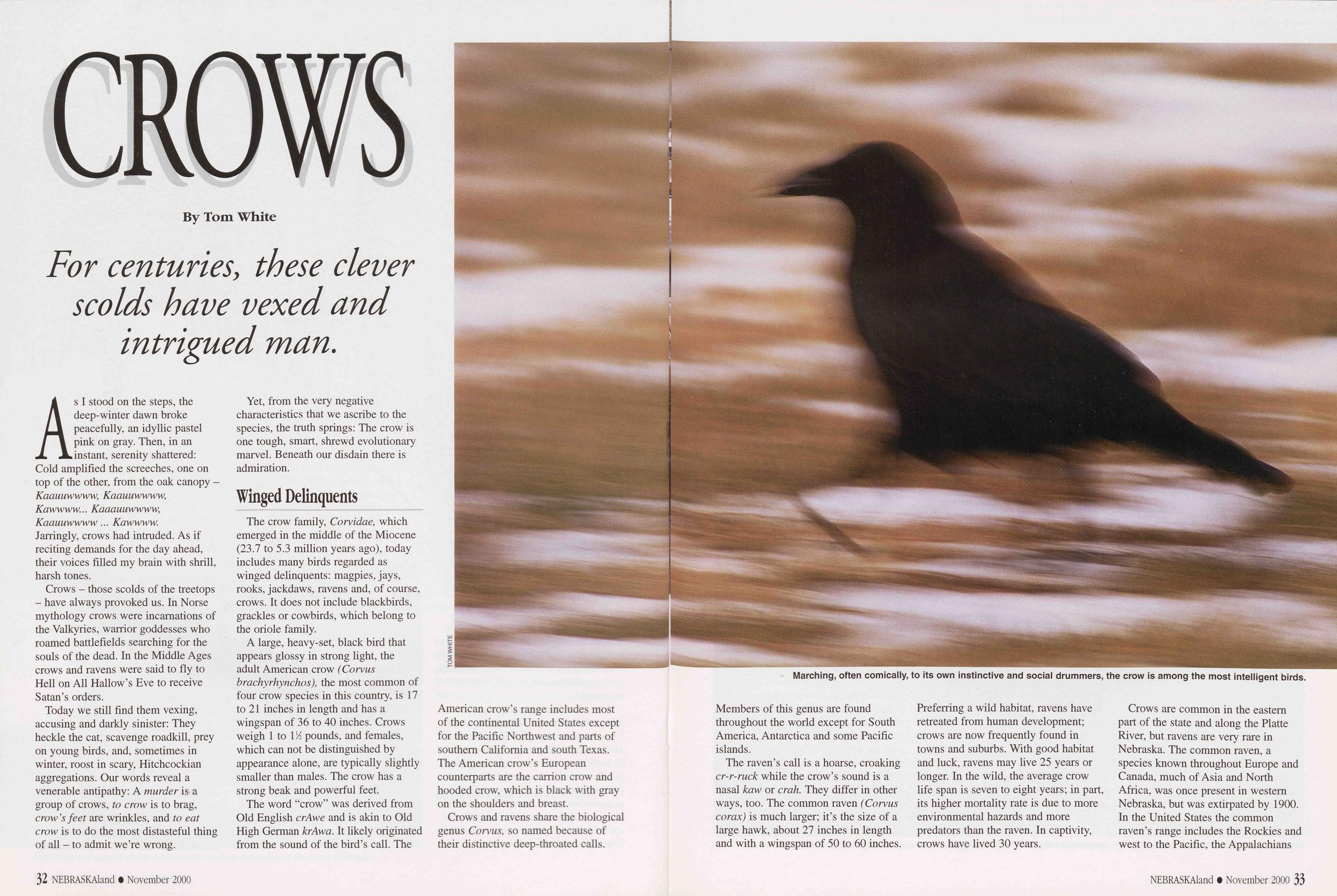
CROWS
By Tom White For centuries, these clever scolds have vexed and intrigued man.As I stood on the steps, the deep-winter dawn broke peacefully, an idyllic pastel pink on gray. Then, in an instant, serenity shattered: Cold amplified the screeches, one on top of the other, from the oak canopy - Kaauuwwww, Kaauuwwww, Kawwww... Kaaauuwwww, Kaauuwwww... Kawwww. Jarringly, crows had intruded. As if reciting demands for the day ahead, their voices filled my brain with shrill, harsh tones.
Crows - those scolds of the treetops - have always provoked us. In Norse mythology crows were incarnations of the Valkyries, warrior goddesses who roamed battlefields searching for the souls of the dead. In the Middle Ages crows and ravens were said to fly to Hell on All Hallow’s Eve to receive Satan’s orders.
Today we still find them vexing, accusing and darkly sinister: They heckle the cat, scavenge roadkill, prey on young birds, and, sometimes in winter, roost in scary, Hitchcockian aggregations. Our words reveal a venerable antipathy: A murder is a group of crows, to crow is to brag, crow's feet are wrinkles, and to eat crow is to do the most distasteful thing of all - to admit we’re wrong.
Yet, from the very negative characteristics that we ascribe to the species, the truth springs: The crow is one tough, smart, shrewd evolutionary marvel. Beneath our disdain there is admiration.
Winged DelinquentsThe crow family, Corvidae, which emerged in the middle of the Miocene (23.7 to 5.3 million years ago), today includes many birds regarded as winged delinquents: magpies, jays, rooks, jackdaws, ravens and, of course, crows. It does not include blackbirds, grackles or cowbirds, which belong to the oriole family.
A large, heavy-set, black bird that appears glossy in strong light, the adult American crow (Corvus brachyrhynchos), the most common of four crow species in this country, is 17 to 21 inches in length and has a wingspan of 36 to 40 inches. Crows weigh 1 to 1 1/2 pounds, and females, which can not be distinguished by appearance alone, are typically slightly smaller than males. The crow has a strong beak and powerful feet.
The word "crow” was derived from Old English crAwe and is akin to Old High German krAwa. It likely originated from the sound of the bird’s call. The American crow’s range includes most of the continental United States except for the Pacific Northwest and parts of southern California and south Texas. The American crow’s European counterparts are the carrion crow and hooded crow, which is black with gray on the shoulders and breast.
Crows and ravens share the biological genus Corvus, so named because of their distinctive deep-throated calls. Members of this genus are found throughout the world except for South America, Antarctica and some Pacific islands.
The raven’s call is a hoarse, croaking cr-r-ruck while the crow’s sound is a nasal kaw or crah. They differ in other ways, too. The common raven (Corvus corax) is much larger; it’s the size of a large hawk, about 27 inches in length and with a wingspan of 50 to 60 inches. Preferring a wild habitat, ravens have retreated from human development; crows are now frequently found in towns and suburbs. With good habitat and luck, ravens may live 25 years or longer. In the wild, the average crow life span is seven to eight years; in part, its higher mortality rate is due to more environmental hazards and more predators than the raven. In captivity, crows have lived 30 years.
Crows are common in the eastern
part of the state and along the Platte
River, but ravens are very rare in
Nebraska. The common raven, a
species known throughout Europe and
Canada, much of Asia and North
Africa, was once present in western
Nebraska, but was extirpated by 1900.
In the United States the common
raven’s range includes the Rockies and
west to the Pacific, the Appalachians
32 NEBRASKAland • November 2000
NEBRASKAland • November 2000 33
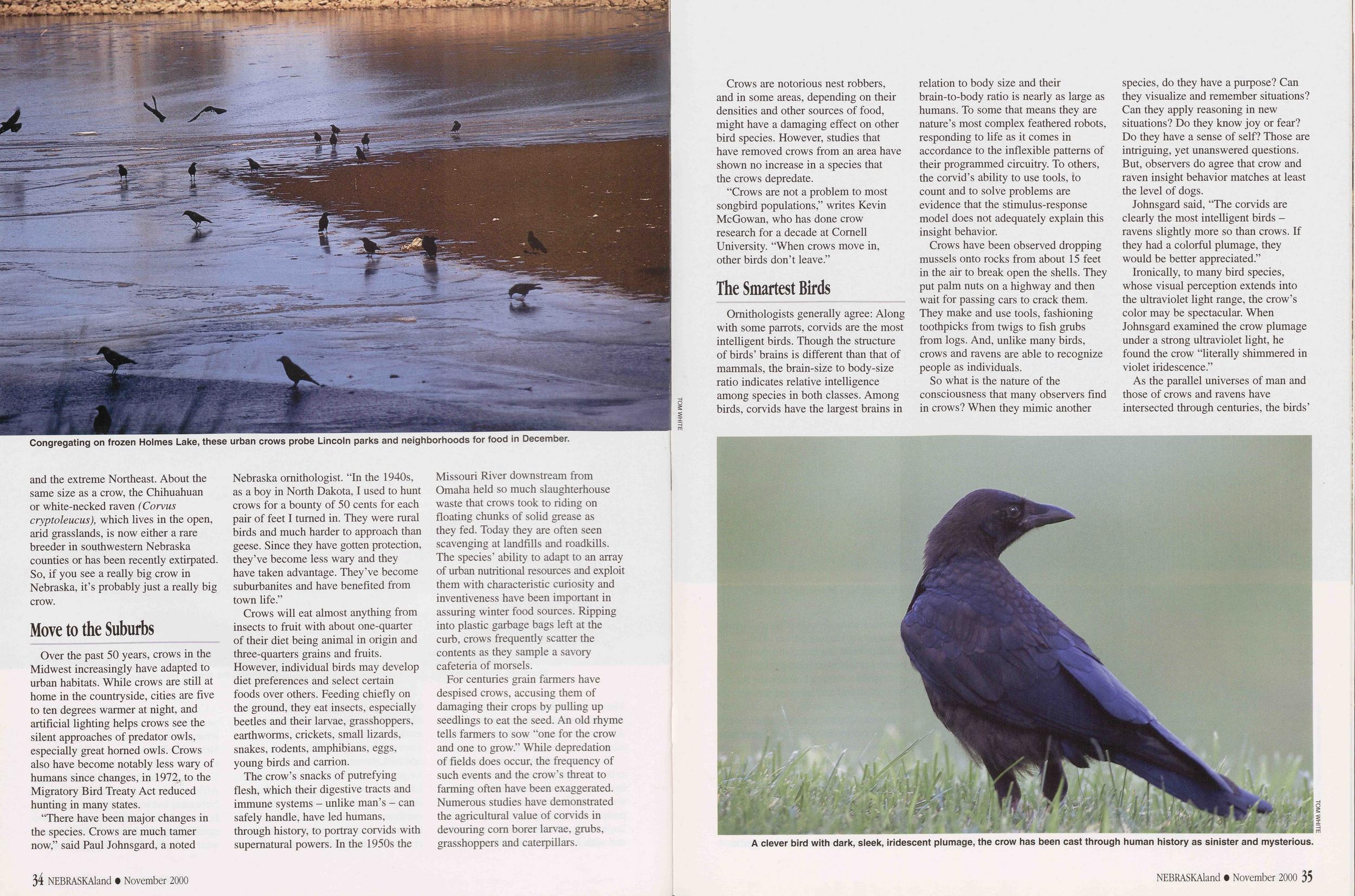 and the extreme Northeast. About the
same size as a crow, the Chihuahuan
or white-necked raven (Corvus
cryptoleucus), which lives in the open,
arid grasslands, is now either a rare
breeder in southwestern Nebraska
counties or has been recently extirpated.
So, if you see a really big crow in
Nebraska, it’s probably just a really big
crow.
and the extreme Northeast. About the
same size as a crow, the Chihuahuan
or white-necked raven (Corvus
cryptoleucus), which lives in the open,
arid grasslands, is now either a rare
breeder in southwestern Nebraska
counties or has been recently extirpated.
So, if you see a really big crow in
Nebraska, it’s probably just a really big
crow.
Over the past 50 years, crows in the Midwest increasingly have adapted to urban habitats. While crows are still at home in the countryside, cities are five to ten degrees warmer at night, and artificial lighting helps crows see the silent approaches of predator owls, especially great homed owls. Crows also have become notably less wary of humans since changes, in 1972, to the Migratory Bird Treaty Act reduced hunting in many states.
"There have been major changes in the species. Crows are much tamer now,” said Paul Johnsgard, a noted Nebraska ornithologist. "In the 1940s, as a boy in North Dakota, I used to hunt crows for a bounty of 50 cents for each pair of feet I turned in. They were rural birds and much harder to approach than geese. Since they have gotten protection, they’ve become less wary and they have taken advantage. They’ve become suburbanites and have benefited from town life.”
Crows will eat almost anything from insects to fruit with about one-quarter of their diet being animal in origin and three-quarters grains and fruits. However, individual birds may develop diet preferences and select certain foods over others. Feeding chiefly on the ground, they eat insects, especially beetles and their larvae, grasshoppers, earthworms, crickets, small lizards, snakes, rodents, amphibians, eggs, young birds and carrion.
The crow’s snacks of putrefying flesh, which their digestive tracts and immune systems - unlike man’s - can safely handle, have led humans, through history, to portray corvids with supernatural powers. In the 1950s the Missouri River downstream from Omaha held so much slaughterhouse waste that crows took to riding on floating chunks of solid grease as they fed. Today they are often seen scavenging at landfills and roadkills. The species’ ability to adapt to an array of urban nutritional resources and exploit them with characteristic curiosity and inventiveness have been important in assuring winter food sources. Ripping into plastic garbage bags left at the curb, crows frequently scatter the contents as they sample a savory cafeteria of morsels.
For centuries grain farmers have despised crows, accusing them of damaging their crops by pulling up seedlings to eat the seed. An old rhyme tells farmers to sow "one for the crow and one to grow.” While depredation of fields does occur, the frequency of such events and the crow’s threat to farming often have been exaggerated. Numerous studies have demonstrated the agricultural value of corvids in devouring com borer larvae, grubs, grasshoppers and caterpillars.
Crows are notorious nest robbers, and in some areas, depending on their densities and other sources of food, might have a damaging effect on other bird species. However, studies that have removed crows from an area have shown no increase in a species that the crows depredate.
"Crows are not a problem to most songbird populations,” writes Kevin McGowan, who has done crow research for a decade at Cornell University. "When crows move in, other birds don’t leave.”
The Smartest BirdsOrnithologists generally agree: Along with some parrots, corvids are the most intelligent birds. Though the structure of birds’ brains is different than that of mammals, the brain-size to body-size ratio indicates relative intelligence among species in both classes. Among birds, corvids have the largest brains in relation to body size and their brain-to-body ratio is nearly as large as humans. To some that means they are nature’s most complex feathered robots, responding to life as it comes in accordance to the inflexible patterns of their programmed circuitry. To others, the corvid’s ability to use tools, to count and to solve problems are evidence that the stimulus-response model does not adequately explain this insight behavior.
Crows have been observed dropping mussels onto rocks from about 15 feet in the air to break open the shells. They put palm nuts on a highway and then wait for passing cars to crack them. They make and use tools, fashioning toothpicks from twigs to fish grubs from logs. And, unlike many birds, crows and ravens are able to recognize people as individuals.
So what is the nature of the consciousness that many observers find in crows? When they mimic another species, do they have a purpose? Can they visualize and remember situations? Can they apply reasoning in new situations? Do they know joy or fear? Do they have a sense of self? Those are intriguing, yet unanswered questions. But, observers do agree that crow and raven insight behavior matches at least the level of dogs.
Johnsgard said, "The corvids are clearly the most intelligent birds - ravens slightly more so than crows. If they had a colorful plumage, they would be better appreciated.”
Ironically, to many bird species, whose visual perception extends into the ultraviolet light range, the crow’s color may be spectacular. When Johnsgard examined the crow plumage under a strong ultraviolet light, he found the crow “literally shimmered in violet iridescence.”
As the parallel universes of man and
those of crows and ravens have
intersected through centuries, the birds’
34 NEBRASKAland • November 2000
NEBRASKAland • November 2000 35
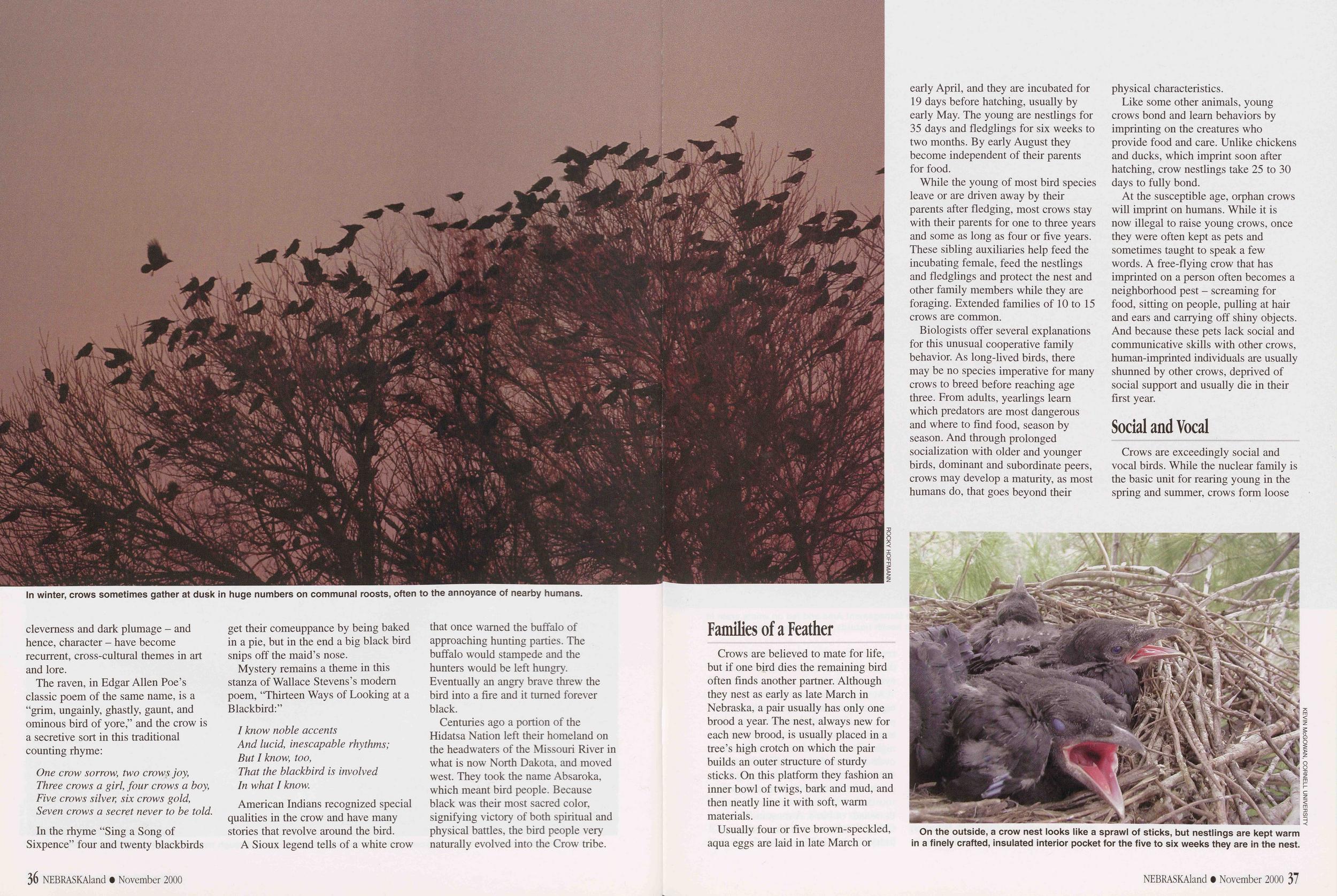 cleverness and dark plumage - and
hence, character - have become
recurrent, cross-cultural themes in art
and lore.
cleverness and dark plumage - and
hence, character - have become
recurrent, cross-cultural themes in art
and lore.
The raven, in Edgar Allen Poe’s classic poem of the same name, is a "grim, ungainly, ghastly, gaunt, and ominous bird of yore,” and the crow is a secretive sort in this traditional counting rhyme:
One crow sorrow, two crows joy, Three crows a girl, four crows a boy, Five crows silver, six crows gold, Seven crows a secret never to be told.
In the rhyme "Sing a Song of Sixpence” four and twenty blackbirds get their comeuppance by being baked in a pie, but in the end a big black bird snips off the maid’s nose.
Mystery remains a theme in this stanza of Wallace Stevens’s modem poem, “Thirteen Ways of Looking at a Blackbird:”
I know noble accents And lucid, inescapable rhythms; But I know, too, That the blackbird is involved In what I know.
American Indians recognized special qualities in the crow and have many stories that revolve around the bird.
A Sioux legend tells of a white crow that once warned the buffalo of approaching hunting parties. The buffalo would stampede and the hunters would be left hungry. Eventually an angry brave threw the bird into a fire and it turned forever black.
Centuries ago a portion of the Hidatsa Nation left their homeland on the headwaters of the Missouri River in what is now North Dakota, and moved west. They took the name Absaroka, which meant bird people. Because black was their most sacred color, signifying victory of both spiritual and physical battles, the bird people very naturally evolved into the Crow tribe.
Families of a FeatherCrows are believed to mate for life, but if one bird dies the remaining bird often finds another partner. Although they nest as early as late March in Nebraska, a pair usually has only one brood a year. The nest, always new for each new brood, is usually placed in a tree’s high crotch on which the pair builds an outer structure of sturdy sticks. On this platform they fashion an inner bowl of twigs, bark and mud, and then neatly line it with soft, warm materials.
Usually four or five brown-speckled, aqua eggs are laid in late March or early April, and they are incubated for 19 days before hatching, usually by early May. The young are nestlings for 35 days and fledglings for six weeks to two months. By early August they become independent of their parents for food.
While the young of most bird species leave or are driven away by their parents after fledging, most crows stay with their parents for one to three years and some as long as four or five years. These sibling auxiliaries help feed the incubating female, feed the nestlings and fledglings and protect the nest and other family members while they are foraging. Extended families of 10 to 15 crows are common.
Biologists offer several explanations for this unusual cooperative family behavior. As long-lived birds, there may be no species imperative for many crows to breed before reaching age three. From adults, yearlings learn which predators are most dangerous and where to find food, season by season. And through prolonged socialization with older and younger birds, dominant and subordinate peers, crows may develop a maturity, as most humans do, that goes beyond their physical characteristics.
Like some other animals, young crows bond and learn behaviors by imprinting on the creatures who provide food and care. Unlike chickens and ducks, which imprint soon after hatching, crow nestlings take 25 to 30 days to fully bond.
At the susceptible age, orphan crows will imprint on humans. While it is now illegal to raise young crows, once they were often kept as pets and sometimes taught to speak a few words. A free-flying crow that has imprinted on a person often becomes a neighborhood pest - screaming for food, sitting on people, pulling at hair and ears and carrying off shiny objects. And because these pets lack social and communicative skills with other crows, human-imprinted individuals are usually shunned by other crows, deprived of social support and usually die in their first year.
Social and VocalCrows are exceedingly social and
vocal birds. While the nuclear family is
the basic unit for rearing young in the
spring and summer, crows form loose
36 NEBRASKAland • November 2000
NEBRASKAland • November 2000 37
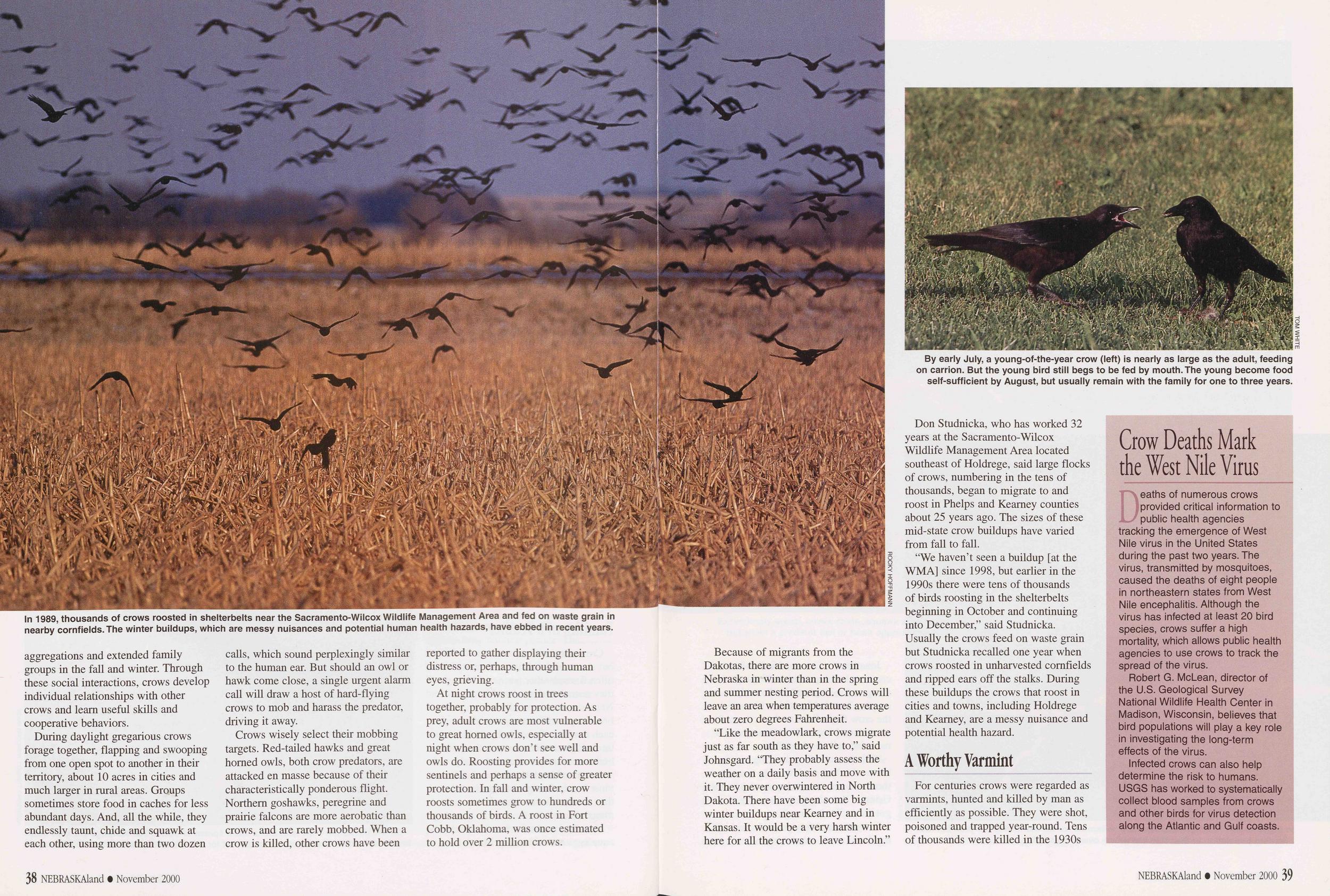 aggregations and extended family
groups in the fall and winter. Through
these social interactions, crows develop
individual relationships with other
crows and learn useful skills and
cooperative behaviors.
aggregations and extended family
groups in the fall and winter. Through
these social interactions, crows develop
individual relationships with other
crows and learn useful skills and
cooperative behaviors.
During daylight gregarious crows forage together, flapping and swooping from one open spot to another in their territory, about 10 acres in cities and much larger in rural areas. Groups sometimes store food in caches for less abundant days. And, all the while, they endlessly taunt, chide and squawk at each other, using more than two dozen calls, which sound perplexingly similar to the human ear. But should an owl or hawk come close, a single urgent alarm call will draw a host of hard-flying crows to mob and harass the predator, driving it away.
Crows wisely select their mobbing targets. Red-tailed hawks and great homed owls, both crow predators, are attacked en masse because of their characteristically ponderous flight. Northern goshawks, peregrine and prairie falcons are more aerobatic than crows, and are rarely mobbed. When a crow is killed, other crows have been reported to gather displaying their distress or, perhaps, through human eyes, grieving.
At night crows roost in trees together, probably for protection. As prey, adult crows are most vulnerable to great homed owls, especially at night when crows don’t see well and owls do. Roosting provides for more sentinels and perhaps a sense of greater protection. In fall and winter, crow roosts sometimes grow to hundreds or thousands of birds. A roost in Fort Cobb, Oklahoma, was once estimated to hold over 2 million crows.
Because of migrants from the Dakotas, there are more crows in Nebraska in winter than in the spring and summer nesting period. Crows will leave an area when temperatures average about zero degrees Fahrenheit.
“Like the meadowlark, crows migrate just as far south as they have to,” said Johnsgard. “They probably assess the weather on a daily basis and move with it. They never overwintered in North Dakota. There have been some big winter buildups near Kearney and in Kansas. It would be a very harsh winter here for all the crows to leave Lincoln.”
Don Studnicka, who has worked 32 years at the Sacramento-Wilcox Wildlife Management Area located southeast of Holdrege, said large flocks of crows, numbering in the tens of thousands, began to migrate to and roost in Phelps and Kearney counties about 25 years ago. The sizes of these mid-state crow buildups have varied from fall to fall.
“We haven’t seen a buildup [at the WMA] since 1998, but earlier in the 1990s there were tens of thousands of birds roosting in the shelterbelts beginning in October and continuing into December,” said Studnicka. Usually the crows feed on waste grain but Studnicka recalled one year when crows roosted in unharvested cornfields and ripped ears off the stalks. During these buildups the crows that roost in cities and towns, including Holdrege and Kearney, are a messy nuisance and potential health hazard.
A Worthy Varmint Crow Deaths Mark the West Nile VirusDeaths of numerous crows provided critical information to public health agencies tracking the emergence of West Nile virus in the United States during the past two years. The virus, transmitted by mosquitoes, caused the deaths of eight people in northeastern states from West Nile encephalitis. Although the virus has infected at least 20 bird species, crows suffer a high mortality, which allows public health agencies to use crows to track the spread of the virus.
Robert G. McLean, director of the U.S. Geological Survey National Wildlife Health Center in Madison, Wisconsin, believes that bird populations will play a key role in investigating the long-term effects of the virus.
Infected crows can also help determine the risk to humans. USGS has worked to systematically collect blood samples from crows and other birds for virus detection along the Atlantic and Gulf coasts.
For centuries crows were regarded as
varmints, hunted and killed by man as
efficiently as possible. They were shot,
poisoned and trapped year-round. Tens
of thousands were killed in the 1930s
38 NEBRASKAland • November 2000
NEBRASKAland • November 2000 39
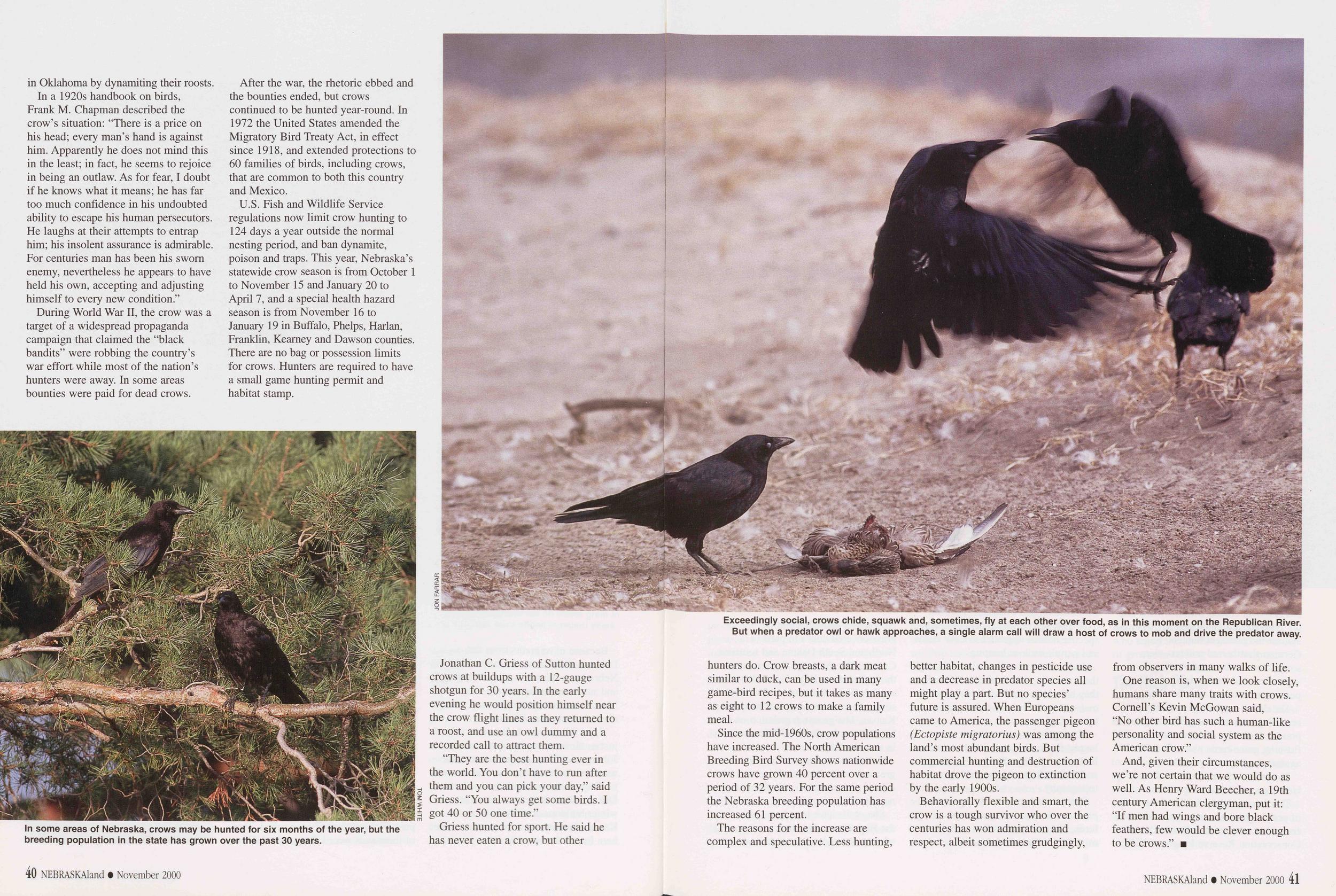 in Oklahoma by dynamiting their roosts.
In a 1920s handbook on birds, Frank M. Chapman described the crow’s situation: “There is a price on his head; every man’s hand is against him. Apparently he does not mind this in the least; in fact, he seems to rejoice in being an outlaw. As for fear, I doubt if he knows what it means; he has far too much confidence in his undoubted ability to escape his human persecutors. He laughs at their attempts to entrap him; his insolent assurance is admirable. For centuries man has been his sworn enemy, nevertheless he appears to have held his own, accepting and adjusting himself to every new condition.”
During World War II, the crow was a target of a widespread propaganda campaign that claimed the “black bandits” were robbing the country’s war effort while most of the nation’s hunters were away. In some areas bounties were paid for dead crows.
After the war, the rhetoric ebbed and the bounties ended, but crows continued to be hunted year-round. In 1972 the United States amended the Migratory Bird Treaty Act, in effect since 1918, and extended protections to 60 families of birds, including crows, that are common to both this country and Mexico.
U.S. Fish and Wildlife Service regulations now limit crow hunting to 124 days a year outside the normal nesting period, and ban dynamite, poison and traps. This year, Nebraska’s statewide crow season is from October 1 to November 15 and January 20 to April 7, and a special health hazard season is from November 16 to January 19 in Buffalo, Phelps, Harlan, Franklin, Kearney and Dawson counties. There are no bag or possession limits for crows. Hunters are required to have a small game hunting permit and habitat stamp.
Jonathan C. Griess of Sutton hunted crows at buildups with a 12-gauge shotgun for 30 years. In the early evening he would position himself near the crow flight lines as they returned to a roost, and use an owl dummy and a recorded call to attract them.
“They are the best hunting ever in the world. You don’t have to run after them and you can pick your day,” said Griess. “You always get some birds. I got 40 or 50 one time.”
Griess hunted for sport. He said he has never eaten a crow, but other hunters do. Crow breasts, a dark meat similar to duck, can be used in many game-bird recipes, but it takes as many as eight to 12 crows to make a family meal.
Since the mid-1960s, crow populations have increased. The North American Breeding Bird Survey shows nationwide crows have grown 40 percent over a period of 32 years. For the same period the Nebraska breeding population has increased 61 percent.
The reasons for the increase are complex and speculative. Less hunting, better habitat, changes in pesticide use and a decrease in predator species all might play a part. But no species’ future is assured. When Europeans came to America, the passenger pigeon (Ectopiste migratorius) was among the land’s most abundant birds. But commercial hunting and destruction of habitat drove the pigeon to extinction by the early 1900s.
Behaviorally flexible and smart, the crow is a tough survivor who over the centuries has won admiration and respect, albeit sometimes grudgingly, from observers in many walks of life.
One reason is, when we look closely, humans share many traits with crows. Cornell’s Kevin McGowan said, “No other bird has such a human-like personality and social system as the American crow.”
And, given their circumstances, we’re not certain that we would do as well. As Henry Ward Beecher, a 19th century American clergyman, put it: “If men had wings and bore black feathers, few would be clever enough to be crows.” ■
40 NEBRASKAland • November 2000 NEBRASKAland • November 2000 41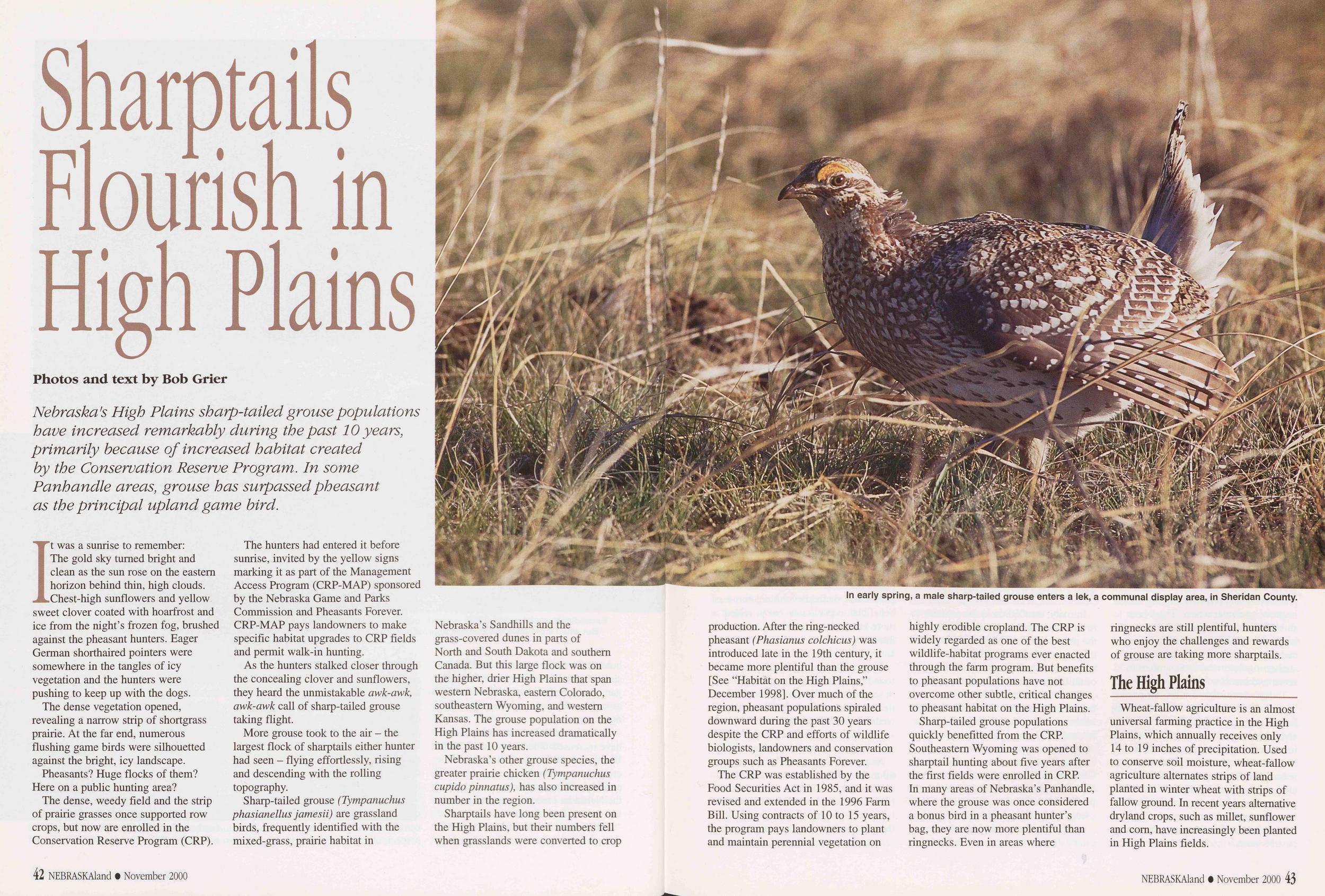
Sharptails Flourish in High Plains
Photos and text by Bob Grier Nebraska's High Plains sharp-tailed grouse populations have increased remarkably during the past 10 years, primarily because of increased habitat created by the Conservation Reserve Program. In some Panhandle areas, grouse has surpassed pheasant as the principal upland game bird.It was a sunrise to remember: The gold sky turned bright and clean as the sun rose on the eastern horizon behind thin, high clouds. Chest-high sunflowers and yellow sweet clover coated with hoarfrost and ice from the night’s frozen fog, brushed against the pheasant hunters. Eager German shorthaired pointers were somewhere in the tangles of icy vegetation and the hunters were pushing to keep up with the dogs.
The dense vegetation opened, revealing a narrow strip of shortgrass prairie. At the far end, numerous flushing game birds were silhouetted against the bright, icy landscape.
Pheasants? Huge flocks of them? Here on a public hunting area?
The dense, weedy field and the strip of prairie grasses once supported row crops, but now are enrolled in the Conservation Reserve Program (CRP).
The hunters had entered it before sunrise, invited by the yellow signs marking it as part of the Management Access Program (CRP-MAP) sponsored by the Nebraska Game and Parks Commission and Pheasants Forever. CRP-MAP pays landowners to make specific habitat upgrades to CRP fields and permit walk-in hunting.
As the hunters stalked closer through the concealing clover and sunflowers, they heard the unmistakable awk-awk, awk-awk call of sharp-tailed grouse taking flight.
More grouse took to the air - the largest flock of sharptails either hunter had seen - flying effortlessly, rising and descending with the rolling topography.
Sharp-tailed grouse (Tympanuchus phasianellus jamesii) are grassland birds, frequently identified with the mixed-grass, prairie habitat in Nebraska’s Sandhills and the grass-covered dunes in parts of North and South Dakota and southern Canada. But this large flock was on the higher, drier High Plains that span western Nebraska, eastern Colorado, southeastern Wyoming, and western Kansas. The grouse population on the High Plains has increased dramatically in the past 10 years.
Nebraska’s other grouse species, the greater prairie chicken (Tympanuchus cupido pinnatus), has also increased in number in the region.
Sharptails have long been present on the High Plains, but their numbers fell when grasslands were converted to crop production. After the ring-necked pheasant (Phasianus colchicus) was introduced late in the 19th century, it became more plentiful than the grouse [See “Habitat on the High Plains,” December 1998]. Over much of the region, pheasant populations spiraled downward during the past 30 years despite the CRP and efforts of wildlife biologists, landowners and conservation groups such as Pheasants Forever.
The CRP was established by the Food Securities Act in 1985, and it was revised and extended in the 1996 Farm Bill. Using contracts of 10 to 15 years, the program pays landowners to plant and maintain perennial vegetation on highly erodible cropland. The CRP is widely regarded as one of the best wildlife-habitat programs ever enacted through the farm program. But benefits to pheasant populations have not overcome other subtle, critical changes to pheasant habitat on the High Plains.
Sharp-tailed grouse populations quickly benefitted from the CRP. Southeastern Wyoming was opened to sharptail hunting about five years after the first fields were enrolled in CRP. In many areas of Nebraska’s Panhandle, where the grouse was once considered a bonus bird in a pheasant hunter’s bag, they are now more plentiful than ringnecks. Even in areas where ringnecks are still plentiful, hunters who enjoy the challenges and rewards of grouse are taking more sharptails.
The High PlainsWheat-fallow agriculture is an almost universal farming practice in the High Plains, which annually receives only 14 to 19 inches of precipitation. Used to conserve soil moisture, wheat-fallow agriculture alternates strips of land planted in winter wheat with strips of fallow ground. In recent years alternative dryland crops, such as millet, sunflower and com, have increasingly been planted in High Plains fields.
42 NEBRASKAland • November 2000 NEBRASKAland • November 2000 43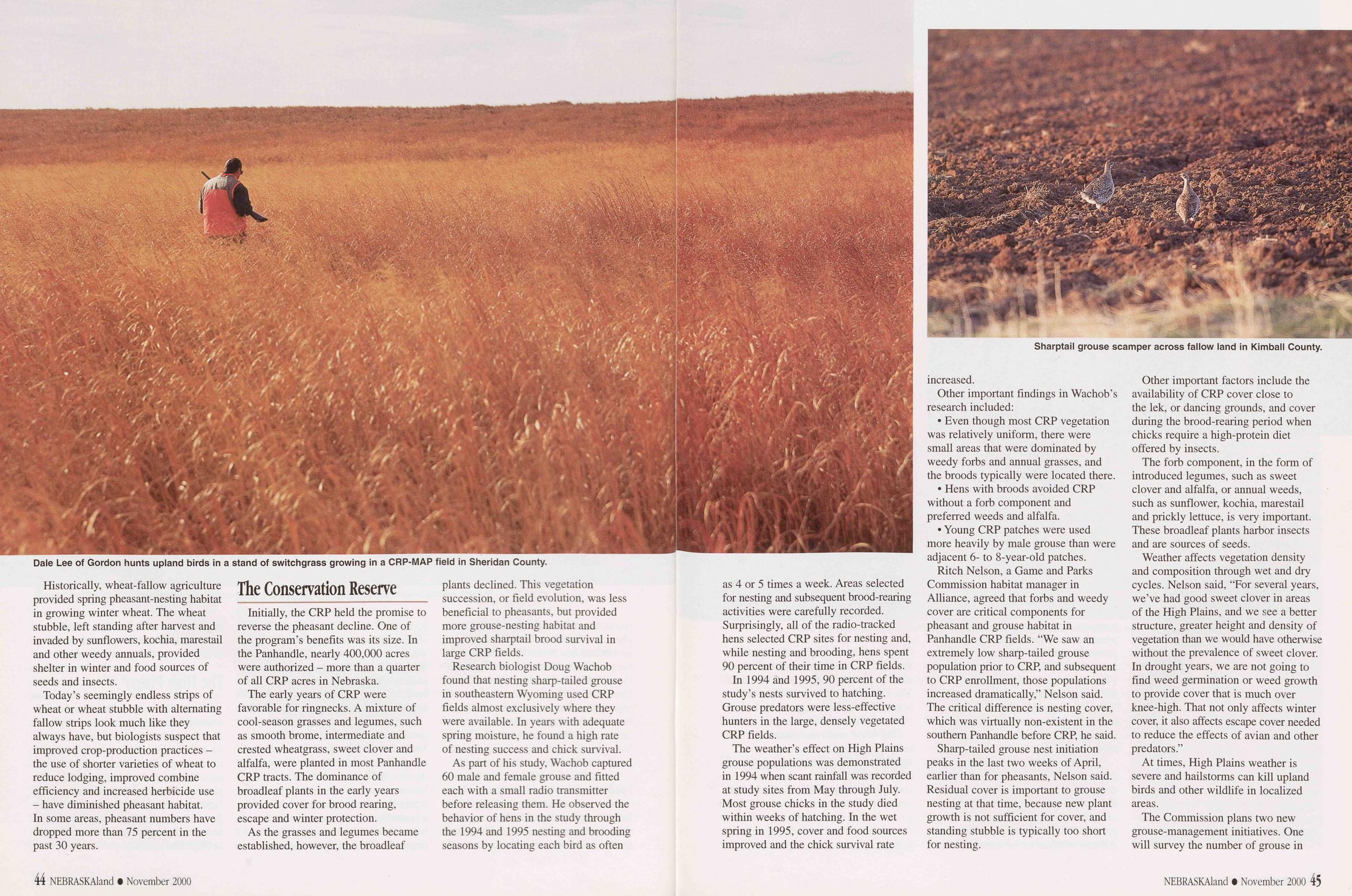
Historically, wheat-fallow agriculture provided spring pheasant-nesting habitat in growing winter wheat. The wheat stubble, left standing after harvest and invaded by sunflowers, kochia, marestail and other weedy annuals, provided shelter in winter and food sources of seeds and insects.
Today’s seemingly endless strips of wheat or wheat stubble with alternating fallow strips look much like they always have, but biologists suspect that improved crop-production practices - the use of shorter varieties of wheat to reduce lodging, improved combine efficiency and increased herbicide use - have diminished pheasant habitat. In some areas, pheasant numbers have dropped more than 75 percent in the past 30 years.
The Conservation ReserveInitially, the CRP held the promise to reverse the pheasant decline. One of the program’s benefits was its size. In the Panhandle, nearly 400,000 acres were authorized - more than a quarter of all CRP acres in Nebraska.
The early years of CRP were favorable for ringnecks. A mixture of cool-season grasses and legumes, such as smooth brome, intermediate and crested wheatgrass, sweet clover and alfalfa, were planted in most Panhandle CRP tracts. The dominance of broadleaf plants in the early years provided cover for brood rearing, escape and winter protection.
As the grasses and legumes became established, however, the broadleaf plants declined. This vegetation succession, or field evolution, was less beneficial to pheasants, but provided more grouse-nesting habitat and improved sharptail brood survival in large CRP fields.
Research biologist Doug Wachob found that nesting sharp-tailed grouse in southeastern Wyoming used CRP fields almost exclusively where they were available. In years with adequate spring moisture, he found a high rate of nesting success and chick survival.
As part of his study, Wachob captured 60 male and female grouse and fitted each with a small radio transmitter before releasing them. He observed the behavior of hens in the study through the 1994 and 1995 nesting and brooding seasons by locating each bird as often as 4 or 5 times a week. Areas selected for nesting and subsequent brood-rearing activities were carefully recorded. Surprisingly, all of the radio-tracked hens selected CRP sites for nesting and, while nesting and brooding, hens spent 90 percent of their time in CRP fields.
In 1994 and 1995, 90 percent of the study’s nests survived to hatching. Grouse predators were less-effective hunters in the large, densely vegetated CRP fields.
The weather’s effect on High Plains grouse populations was demonstrated in 1994 when scant rainfall was recorded at study sites from May through July. Most grouse chicks in the study died within weeks of hatching. In the wet spring in 1995, cover and food sources improved and the chick survival rate increased.
Other important findings in Wachob’s research included:
• Even though most CRP vegetation was relatively uniform, there were small areas that were dominated by weedy forbs and annual grasses, and the broods typically were located there.
• Hens with broods avoided CRP without a forb component and preferred weeds and alfalfa.
• Young CRP patches were used more heavily by male grouse than were adjacent 6- to 8-year-old patches.
Ritch Nelson, a Game and Parks Commission habitat manager in Alliance, agreed that forbs and weedy cover are critical components for pheasant and grouse habitat in Panhandle CRP fields. "We saw an extremely low sharp-tailed grouse population prior to CRP, and subsequent to CRP enrollment, those populations increased dramatically,” Nelson said. The critical difference is nesting cover, which was virtually non-existent in the southern Panhandle before CRP, he said.
Sharp-tailed grouse nest initiation peaks in the last two weeks of April, earlier than for pheasants, Nelson said. Residual cover is important to grouse nesting at that time, because new plant growth is not sufficient for cover, and standing stubble is typically too short for nesting.
Other important factors include the availability of CRP cover close to the lek, or dancing grounds, and cover during the brood-rearing period when chicks require a high-protein diet offered by insects.
The forb component, in the form of introduced legumes, such as sweet clover and alfalfa, or annual weeds, such as sunflower, kochia, marestail and prickly lettuce, is very important. These broadleaf plants harbor insects and are sources of seeds.
Weather affects vegetation density and composition through wet and dry cycles. Nelson said, "For several years, we’ve had good sweet clover in areas of the High Plains, and we see a better structure, greater height and density of vegetation than we would have otherwise without the prevalence of sweet clover. In drought years, we are not going to find weed germination or weed growth to provide cover that is much over knee-high. That not only affects winter cover, it also affects escape cover needed to reduce the effects of avian and other predators.”
At times, High Plains weather is severe and hailstorms can kill upland birds and other wildlife in localized areas.
The Commission plans two new
grouse-management initiatives. One
will survey the number of grouse in
44 NEBRASKAland • November 2000
NEBRASKAland • November 2000 45
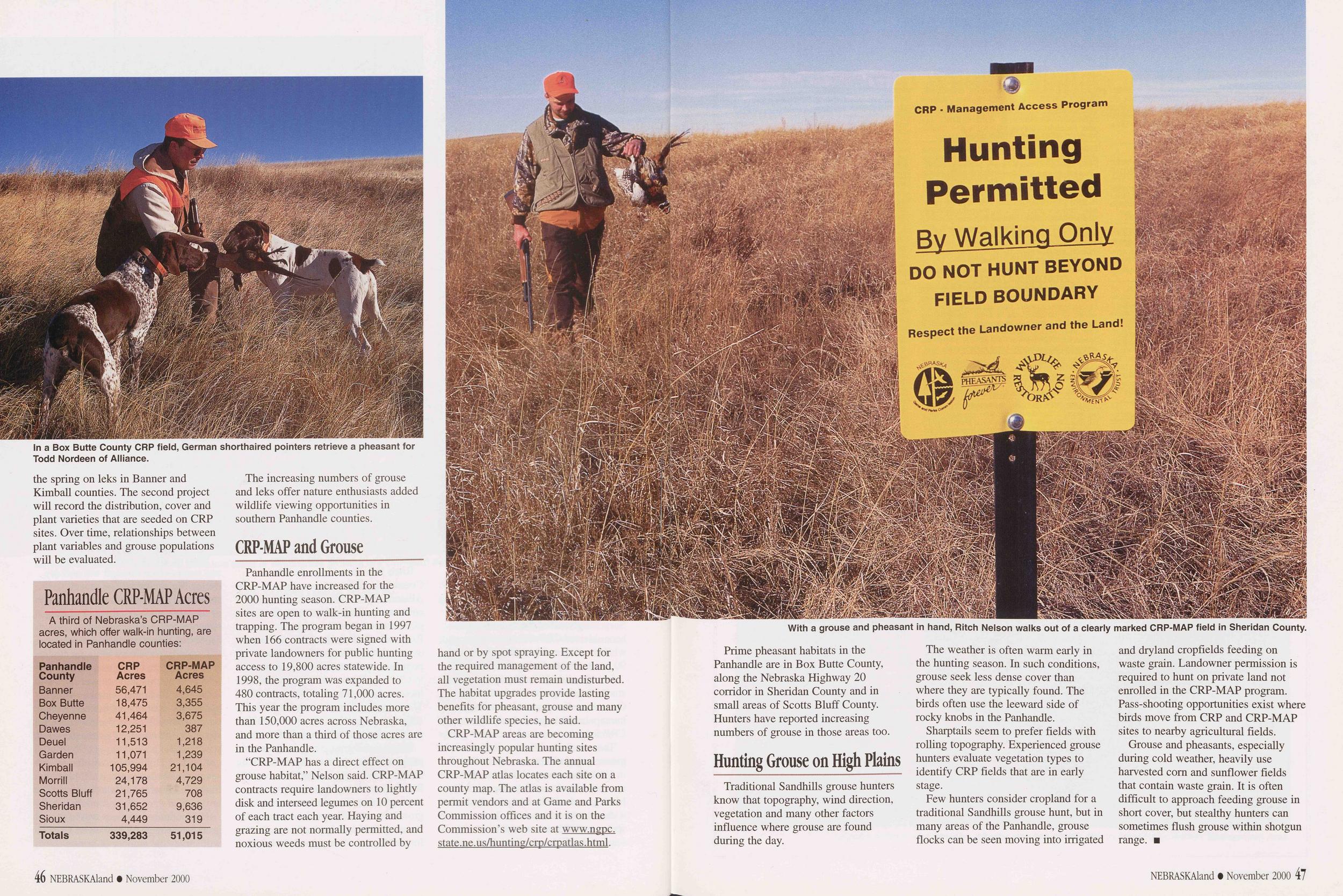 the spring on leks in Banner and
Kimball counties. The second project
will record the distribution, cover and
plant varieties that are seeded on CRP
sites. Over time, relationships between
plant variables and grouse populations
will be evaluated.
the spring on leks in Banner and
Kimball counties. The second project
will record the distribution, cover and
plant varieties that are seeded on CRP
sites. Over time, relationships between
plant variables and grouse populations
will be evaluated.
A third of Nebraska’s CRP-MAP acres, which offer walk-in hunting, are located in Panhandle counties:
Panhandle CRP CRP-MAP County Acres Acres Banner 56,471 4,645 Box Butte 18,475 3,355 Cheyenne 41,464 3,675 Dawes 12,251 387 Deuel 11,513 1,218 Garden 11,071 1,239 Kimball 105,994 21,104 Morrill 24,178 4,729 Scotts Bluff 21,765 708 Sheridan 31,652 9,636 Sioux 4,449 319 Totals 339,283 51,015
The increasing numbers of grouse and leks offer nature enthusiasts added wildlife viewing opportunities in southern Panhandle counties.
CRP-MAP and GrousePanhandle enrollments in the CRP-MAP have increased for the 2000 hunting season. CRP-MAP sites are open to walk-in hunting and trapping. The program began in 1997 when 166 contracts were signed with private landowners for public hunting access to 19,800 acres statewide. In 1998, the program was expanded to 480 contracts, totaling 71,000 acres. This year the program includes more than 150,000 acres across Nebraska, and more than a third of those acres are in the Panhandle.
“CRP-MAP has a direct effect on grouse habitat,” Nelson said. CRP-MAP contracts require landowners to lightly disk and interseed legumes on 10 percent of each tract each year. Haying and grazing are not normally permitted, and noxious weeds must be controlled by hand or by spot spraying. Except for the required management of the land, all vegetation must remain undisturbed. The habitat upgrades provide lasting benefits for pheasant, grouse and many other wildlife species, he said.
CRP-MAP areas are becoming increasingly popular hunting sites throughout Nebraska. The annual CRP-MAP atlas locates each site on a county map. The atlas is available from permit vendors and at Game and Parks Commission offices and it is on the Commission’s web site at www.ngpc. state.ne.us/hunting/crp/crpatlas.html.
Prime pheasant habitats in the Panhandle are in Box Butte County, along the Nebraska Highway 20 corridor in Sheridan County and in small areas of Scotts Bluff County. Hunters have reported increasing numbers of grouse in those areas too.
Hunting Grouse on High PlainsTraditional Sandhills grouse hunters know that topography, wind direction, vegetation and many other factors influence where grouse are found during the day.
The weather is often warm early in the hunting season. In such conditions, grouse seek less dense cover than where they are typically found. The birds often use the leeward side of rocky knobs in the Panhandle.
Sharptails seem to prefer fields with rolling topography. Experienced grouse hunters evaluate vegetation types to identify CRP fields that are in early stage.
Few hunters consider cropland for a traditional Sandhills grouse hunt, but in many areas of the Panhandle, grouse flocks can be seen moving into irrigated and dryland cropfields feeding on waste grain. Landowner permission is required to hunt on private land not enrolled in the CRP-MAP program. Pass-shooting opportunities exist where birds move from CRP and CRP-MAP sites to nearby agricultural fields.
Grouse and pheasants, especially during cold weather, heavily use harvested com and sunflower fields that contain waste grain. It is often difficult to approach feeding grouse in short cover, but stealthy hunters can sometimes flush grouse within shotgun range. ■
46 NEBRASKAland • November 2000 NEBRASKAland • November 2000 47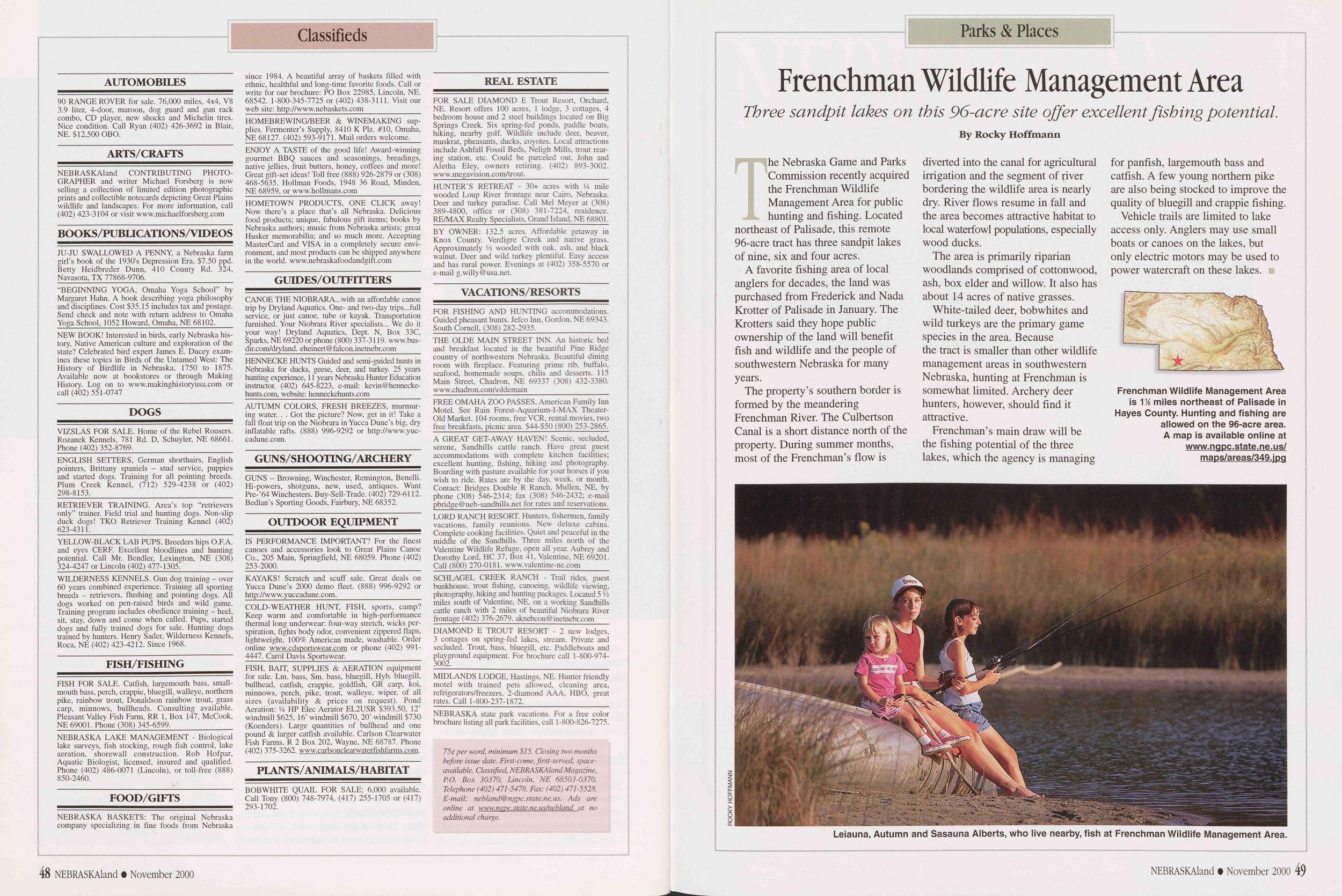
Classifieds
Parks& Places AUTOMOBILES90 RANGE ROVER for sale. 76,000 miles, 4x4, V8 3.9 liter, 4-door, maroon, dog guard and gun rack combo, CD player, new shocks and Michelin tires. Nice condition. Call Ryan (402) 426-3692 in Blair, NE. $12,500 OBO.
ARTS/CRAFTSNEBRASKAland CONTRIBUTING PHOTO- GRAPHER and writer Michael Forsberg is now selling a collection of limited edition photographic prints and collectible notecards depicting Great Plains wildlife and landscapes. For more information, call (402) 423-3104 or visit www.michaelforsberg.com
BOOKS/PUBLICATION S/VIDEOSJU-JU SWALLOWED A PENNY, a Nebraska farm girl’s book of the 1930's Depression Era. $7.50 ppd. Betty Heidbreder Dunn, 410 County Rd. 324, Navasota, TX 77868-9706.
“BEGINNING YOGA, Omaha Yoga School” by Margaret Hahn. A book describing yoga philosophy and disciplines. Cost $35.15 includes tax and postage. Send check and note with return address to Omaha Yoga School, 1052 Howard, Omaha, NE 68102.
NEW BOOK! Interested in birds, early Nebraska his- tory, Native American culture and exploration of the state? Celebrated bird expert James E. Ducey exam- ines these topics in Birds of the Untamed West: The History of Birdlife in Nebraska, 1750 to 1875. Available now at bookstores or through Making History. Log on to www.makinghistoryusa.com or call (402) 551-0747
DOGSVIZSLAS FOR SALE. Home of the Rebel Rousers. Rozanek Kennels, 781 Rd. D, Schuyler, NE 68661. Phone (402) 352-8769.
ENGLISH SETTERS, German shorthairs, English pointers, Brittany spaniels - stud service, puppies and started dogs. Training for all pointing breeds. Plum Creek Kennel, (712) 529-4238 or (402) 298-8153
RETRIEVER TRAINING. Area’s top “retrievers only” trainer. Field trial and hunting dogs. Non-slip duck dogs! TKO Retriever Training Kennel (402) 623-4311.
YELLOW-BLACK LAB PUPS. Breeders hips O.F.A. and eyes CERF. Excellent bloodlines and hunting potential. Call Mr. Bendler, Lexington, NE (308) 324-4247 or Lincoln (402) 477-1305.
WILDERNESS KENNELS. Gun dog training - over 60 years combined experience. Training all sporting breeds - retrievers, flushing and pointing dogs. All dogs worked on pen-raised birds and wild game. Training program includes obedience training - heel, sit, stay, down and come when called. Pups, started dogs and fully trained dogs for sale. Hunting dogs trained by hunters. Henry Sader, Wilderness Kennels, Roca, NE (402) 423-4212. Since 1968.
FISH/FISHINGFISH FOR SALE. Catfish, largemouth bass, small- mouth bass, perch, crappie, bluegill, walleye, northern pike, rainbow trout, Donaldson rainbow trout, grass carp, minnows, bullheads. Consulting available. Pleasant Valley Fish Farm, RR 1, Box 147, McCook, NE 69001. Phone (308) 345-6599.
NEBRASKA LAKE MANAGEMENT - Biological lake surveys, fish stocking, rough fish control, lake aeration, shorewall construction. Rob Hofpar, Aquatic Biologist, licensed, insured and qualified. Phone (402) 486-0071 (Lincoln), or toll-free (888) 850-2460.
FOOD/GIFTSNEBRASKA BASKETS: The original Nebraska company specializing in fine foods from Nebraska since 1984. A beautiful array of baskets filled with ethnic, healthful and long-time favorite foods. Call or write for our brochure: PO Box 22985, Lincoln, NE. 68542. 1-800-345-7725 or (402) 438-3111. Visit our web site: http://www.nebaskets.com
HOMEBREWING/BEER & WINEMAKING sup- plies. Fermenter’s Supply, 8410 K Plz. #10, Omaha, NE 68127. (402) 593-9171. Mail orders welcome. ENJOY A TASTE of the good life! Award-winning gourmet BBQ sauces and seasonings, breadings, native jellies, fruit butters, honey, coffees and more! Great gift-set ideas! Toll free (888) 926-2879 or (308) 468-5635. Hollman Foods, 1948 36 Road, Minden, NE 68959, or www.hollmans.com
HOMETOWN PRODUCTS, ONE CLICK away! Now there’s a place that’s all Nebraska. Delicious food products; unique, fabulous gift items; books by Nebraska authors; music from Nebraska artists; great Husker memorabilia; and so much more. Accepting MasterCard and VISA in a completely secure envi- ronment, and most products can be shipped anywhere in the world, www.nebraskafoodandgift.com
GUIDES/OUTFITTERSCANOE THE NIOBRARA...with an affordable canoe trip by Dryland Aquatics. One- and two-day trips...full service, or just canoe, tube or kayak. Transportation furnished. Your Niobrara River specialists... We do it your way! Dryland Aquatics, Dept. N, Box 33C, Sparks, NE 69220 or phone (800) 337-3119. www.bus- dir.com/dryland. eheinert@falcon.inetnebr.com
HENNECKE HUNTS Guided and semi-guided hunts in Nebraska for ducks, geese, deer, and turkey. 25 years hunting experience, 11 years Nebraska Hunter Education instructor. (402) 645-8223, e-mail: kevin@Keiuieeke- hunts.com, website: henneckehunts.com
AUTUMN COLORS, FRESH BREEZES, murmur- ing water. . . Got the picture? Now, get in it! Take a fall float trip on the Niobrara in Yucca Dune’s big, dry inflatable rafts. (888) 996-9292 or http://www.yuc- cadune.com.
GUNS/SHOOTING/ARCHERYGUNS - Browning, Winchester, Remington, Benelli. Hi-powers, shotguns, new, used, antiques. Want Pre-’64 Winchesters. Buy-Sell-Trade. (402) 729-6112. Bedlan’s Sporting Goods, Fairbury, NE 68352.
OUTDOOR EQUIPMENTIS PERFORMANCE IMPORTANT? For the finest canoes and accessories look to Great Plains Canoe Co., 205 Main, Springfield, NE 68059. Phone (402) 253-2000.
KAYAKS! Scratch and scuff sale. Great deals on Yucca Dune’s 2000 demo fleet. (888) 996-9292 or http://www.yuccadune.com.
COLD-WEATHER HUNT, FISH, sports, camp? Keep warm and comfortable in high-performance thermal long underwear: four-way stretch, wicks per- spiration, fights body odor, convenient zippered flaps, lightweight, 100% American made, washable. Order online www.cdsportswear.com or phone (402) 991- 4447. Carol Davis Sportswear.
FISH, BAIT, SUPPLIES &AERATION equipment for sale. Lm. bass, Sm. bass, bluegill, Hyb. bluegill, bullhead, catfish, crappie, goldfish, GR carp, koi, minnows, perch, pike, trout, walleye, wiper, of all sizes (availability & prices on request). Pond Aeration: HP Elec Aerator EL2USR $393.50, 12' windmill $625, 16’ windmill $670, 20’ windmill $730 (Koenders). Large quantities of bullhead and one pound & larger catfish available. Carlson Clearwater Fish Farms, R 2 Box 202, Wayne, NE 68787. Phone (402) 375-3262. www.carlsonclearwaterfishfarms.com.
PLANTS/ANIMALS/HABITATBOBWHITE QUAIL FOR SALE; 6,000 available. Call Tony (800) 748-7974, (417) 255-1705 or (417) 293-1702.
REAL ESTATEFOR SALE DIAMOND E Trout Resort, Orchard, NE. Resort offers 100 acres, 1 lodge, 3 cottages, 4 bedroom house and 2 steel buildings located on Big Springs Creek. Six spring-fed ponds, paddle boats, hiking, nearby golf. Wildlife include deer, beaver, muskrat, pheasants, ducks, coyotes. Local attractions include Ashfall Fossil Beds, Neligh Mills, trout rear- ing station, etc. Could be parceled out. John and Aletha Eley, owners retiring. (402) 893-3002. www.megavision.com/trout.
HUNTER’S RETREAT - 30+ acres with 'A mile wooded Loup River frontage near Cairo, Nebraska. Deer and turkey paradise. Call Mel Meyer at (308) 389-4800, office or (308) 381-7224, residence. RE/MAX Realty Specialists. Grand Island. NE 68801.
BY OWNER: 132.5 acres. Affordable getaway in Knox County. Verdigre Creek and native grass. Approximately Vs wooded with oak, ash, and black walnut. Deer and wild turkey plentiful. Easy access and has rural power. Evenings at (402) 358-5570 or e-mail g.willy@usa.net.
VACATION S/RESORTSFOR FISHING AND HUNTING accommodations. Guided pheasant hunts. Jefco Inn, Gordon, NE 69343. South Cornell, (308) 282-2935.
THE OLDE MAIN STREET INN. An historic bed and breakfast located in the beautiful Pine Ridge country of northwestern Nebraska. Beautiful dining room with fireplace. Featuring prime rib, buffalo, seafood, homemade soups, chilis and desserts. 115 Main Street, Chadron, NE 69337 (308) 432-3380. www.chadron.com\oldemain
FREE OMAHA ZOO PASSES, American Family Inn Motel. See Rain Forest-Aquarium-I-MAX Theater- Old Market. 104 rooms, free VCR, rental movies, two free breakfasts, picnic area. $44-$50 (800) 253-2865.
A GREAT GET-AWAY HAVEN! Scenic, secluded, serene, Sandhills cattle ranch. Have great guest accommodations with complete kitchen facilities; excellent hunting, fishing, hiking and photography. Boarding with pasture available for your horses if you wish to ride. Rates are by the day, week, or month. Contact: Bridges Double R Ranch, Mullen. NE, by phone (308) 546-2314; fax (308) 546-2432; e-mail pbridge@neb-sandhills.net for rates and reservations.
LORD RANCH RESORT. Hunters, fishermen, family vacations, family reunions. New deluxe cabins. Complete cooking facilities. Quiet and peaceful in the middle of the Sandhills. Three miles north of the Valentine Wildlife Refuge, open all year. Aubrey and Dorothy Lord, HC 37, Box 41, Valentine, NE 69201. Call (800) 270-0181. www.valentine-ne.com
SCHLAGEL CREEK RANCH - Trail rides, guest bunkhouse, trout fishing, canoeing, wildlife viewing, photography, hiking and hunting packages. Located 5 Vi miles south of Valentine, NE, on a working Sandhills cattle ranch with 2 miles of beautiful Niobrara River frontage (402) 376-2679. aknebcon@inemebr.com
DIAMOND E TROUT RESORT - 2 new lodges, 3 cottages on spring-fed lakes, stream. Private and secluded. Trout, bass, bluegill, etc. Paddleboats and playground equipment. For brochure call 1-800-974- 3002.
MIDLANDS LODGE, Hastings, NE. Hunter friendly motel with trained pets allowed, cleaning area, refrigerators/freezers, 2-diamond AAA, HBO, great rates. Call 1-800-237-1872.
NEBRASKA state park vacations. For a free color brochure listing all park facilities, call 1-800-826-7275.
75 per word, minimum $15. Closing two months before issue date. First-come, first-served, space- available. Classified, NEBRASKAland Magazine, P.O. Box 30370, Lincoln, NE 68503-0370. Telephone (402) 471-5478. Fax: (402) 471-5528. E-mail: nebland@ngpc.state.ne.us. Ads are online at www.nppc.state.ne.us/nebland at no additional charge.
Frenchman Wildlife Management Area Three sandpit lakes on this 96-acre site offer excellent fishing potential. By Rocky HoffmannThe Nebraska Game and Parks Commission recently acquired the Frenchman Wildlife Management Area for public hunting and fishing. Located northeast of Palisade, this remote 96-acre tract has three sandpit lakes of nine, six and four acres.
A favorite fishing area of local anglers for decades, the land was purchased from Frederick and Nada Krotter of Palisade in January. The Krotters said they hope public ownership of the land will benefit fish and wildlife and the people of southwestern Nebraska for many years.
The property’s southern border is formed by the meandering Frenchman River. The Culbertson Canal is a short distance north of the property. During summer months, most of the Frenchman’s flow is diverted into the canal for agricultural irrigation and the segment of river bordering the wildlife area is nearly dry. River flows resume in fall and the area becomes attractive habitat to local waterfowl populations, especially wood ducks.
The area is primarily riparian woodlands comprised of cottonwood, ash, box elder and willow. It also has about 14 acres of native grasses.
White-tailed deer, bobwhites and wild turkeys are the primary game species in the area. Because the tract is smaller than other wildlife management areas in southwestern Nebraska, hunting at Frenchman is somewhat limited. Archery deer hunters, however, should find it attractive.
Frenchman’s main draw will be the fishing potential of the three lakes, which the agency is managing for panfish, largemouth bass and catfish. A few young northern pike are also being stocked to improve the quality of bluegill and crappie fishing.
Vehicle trails are limited to lake access only. Anglers may use small boats or canoes on the lakes, but only electric motors may be used to power watercraft on these lakes.
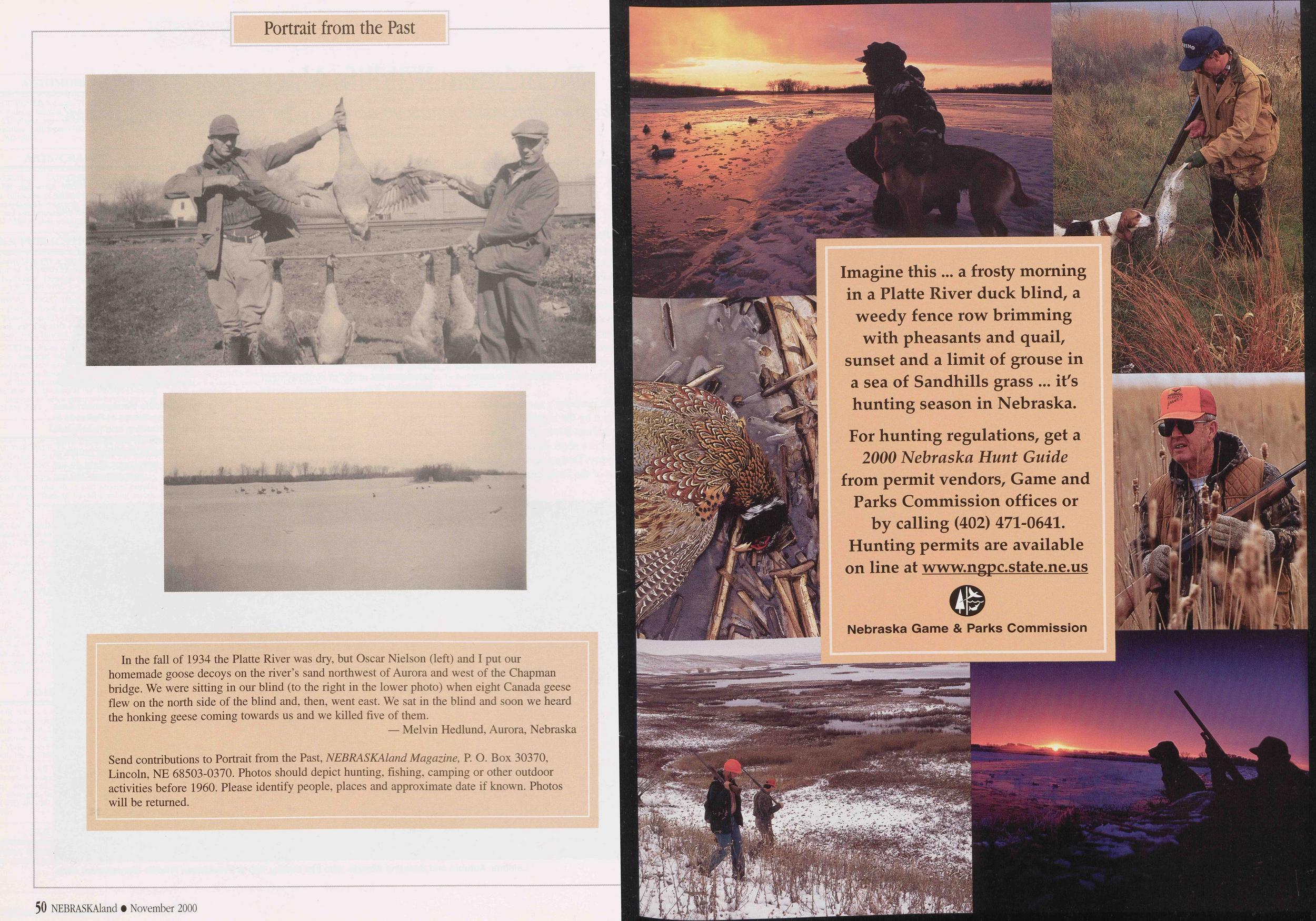
In the fall of 1934 the Platte River was dry, but Oscar Nielson (left) and I put our homemade goose decoys on the river’s sand northwest of Aurora and west of the Chapman bridge. We were sitting in our blind (to the right in the lower photo) when eight Canada geese flew on the north side of the blind and, then, went east. We sat in the blind and soon we heard the honking geese coming towards us and we killed five of them.
— Melvin Hedlund, Aurora, NebraskaSend contributions to Portrait from the Past, NEBRASKAland Magazine, P. 0. Box 30370, Lincoln, NE 68503-0370. Photos should depict hunting, fishing, camping or other outdoor activities before 1960. Please identify people, places and approximate date if known. Photos will be returned.
Nebraska Game & Parks Commission Imagine this ... a frosty morning in a Platte River duck blind, a weedy fence row brimming with pheasants and quail, sunset and a limit of grouse in a sea of Sandhills grass ... it's hunting season in Nebraska. For hunting regulations, get a 2000 Nebraska Hunt Guide from permit vendors, Game and Parks Commission offices or by calling (402) 471-0641. Hunting permits are available on line at www.ngpc.state.ne.us
Position: 704 (16 views)