Volume 78, Issue 8, 2000
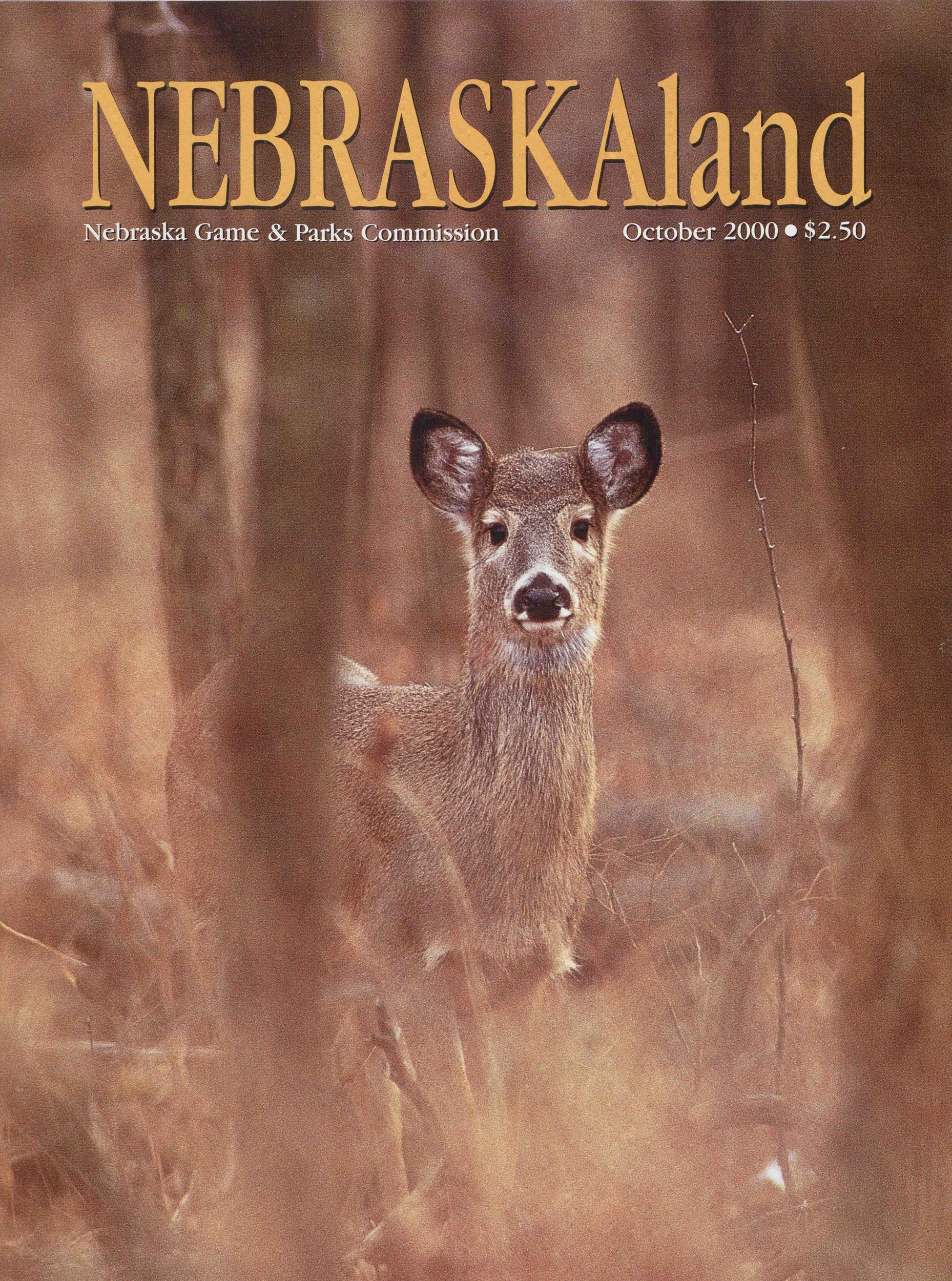
NEBRASKAland
Nebraska Game & Parks Commission October 2000 • $2.50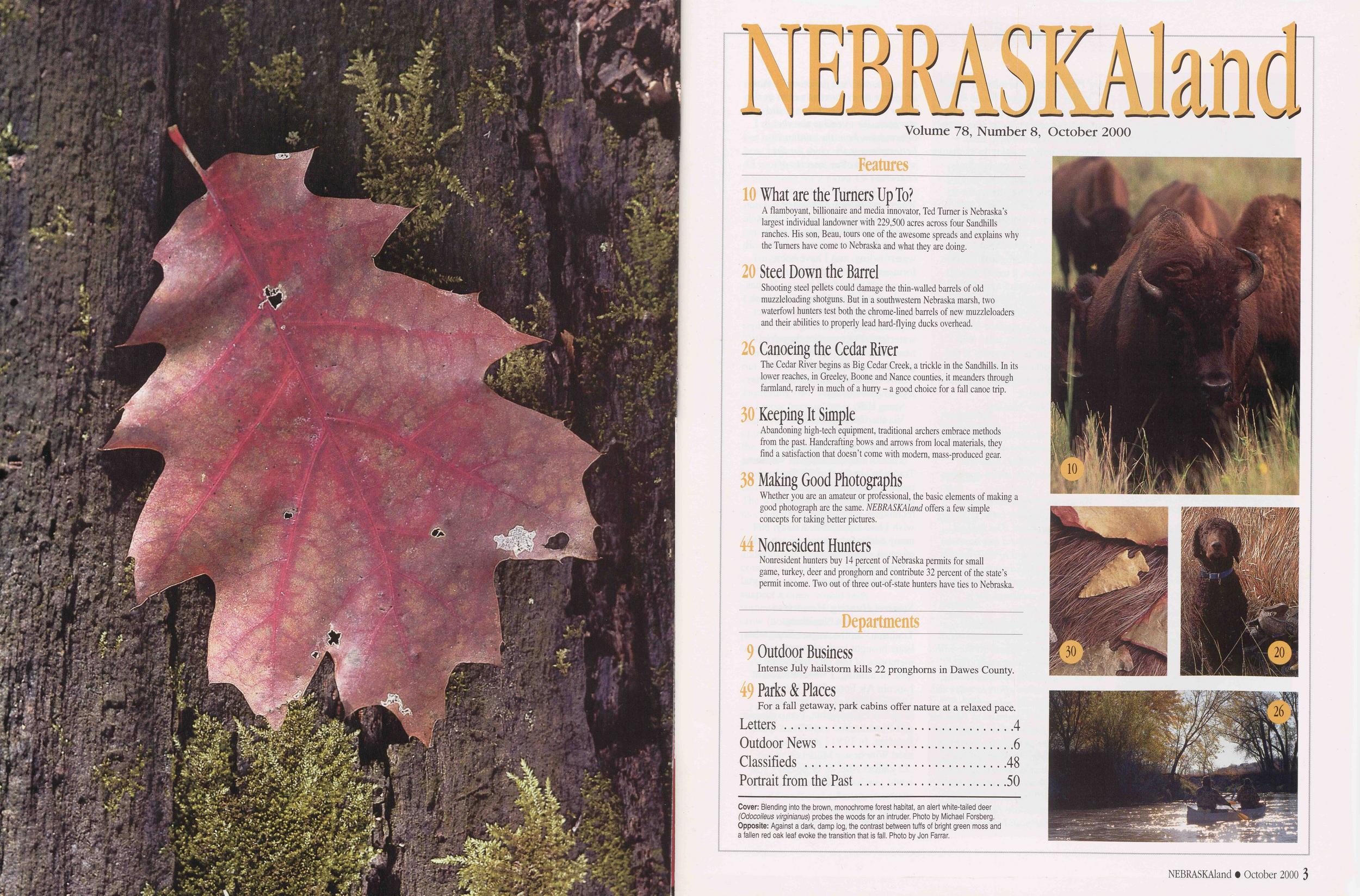
NEBRASKAland
Volume 78, Number 8, October 2000 Features What are the Turners Up To? A flamboyant, billionaire and media innovator, Ted Turner is Nebraska’s largest individual landowner with 229,500 acres across four Sandhills ranches. His son, Beau, tours one of the awesome spreads and explains why the Turners have come to Nebraska and what they are doing. 20 Steel Down the Barrel Shooting steel pellets could damage the thin-walled barrels of old muzzleloading shotguns. But in a southwestern Nebraska marsh, two waterfowl hunters test both the chrome-lined barrels of new muzzleloaders and their abilities to properly lead hard-flying ducks overhead. Canoeing the Cedar River The Cedar River begins as Big Cedar Creek, a trickle in the Sandhills. In its lower reaches, in Greeley, Boone and Nance counties, it meanders through farmland, rarely in much of a hurry - a good choice for a fall canoe trip. Keeping It Simple Abandoning high-tech equipment, traditional archers embrace methods from the past. Handcrafting bows and arrows from local materials, they find a satisfaction that doesn’t come with modem, mass-produced gear. Making Good Photographs Whether you are an amateur or professional, the basic elements of making a good photograph are the same. NEBRASKAland offers a few simple concepts for taking better pictures. Nonresident Hunters Nonresident hunters buy 14 percent of Nebraska permits for small game, turkey, deer and pronghorn and contribute 32 percent of the state’s permit income. Two out of three out-of-state hunters have ties to Nebraska. Departments Outdoor Business Intense July hailstorm kills 22 pronghorns in Dawes County. 49 Parks &Places For a fall getaway, park cabins offer nature at a relaxed pace. Letters..........................................4 Outdoor News ....................................6 Classifieds ....................................48 Portrait from the Past..........................50 Cover: Blending into the brown, monochrome forest habitat, an alert white-tailed deer (Odocoileus virginianus) probes the woods for an intruder. Photo by Michael Forsberg. Opposite: Against a dark, damp log, the contrast between tuffs of bright green moss and a fallen red oak leaf evoke the transition that is fall. Photo by Jon Farrar.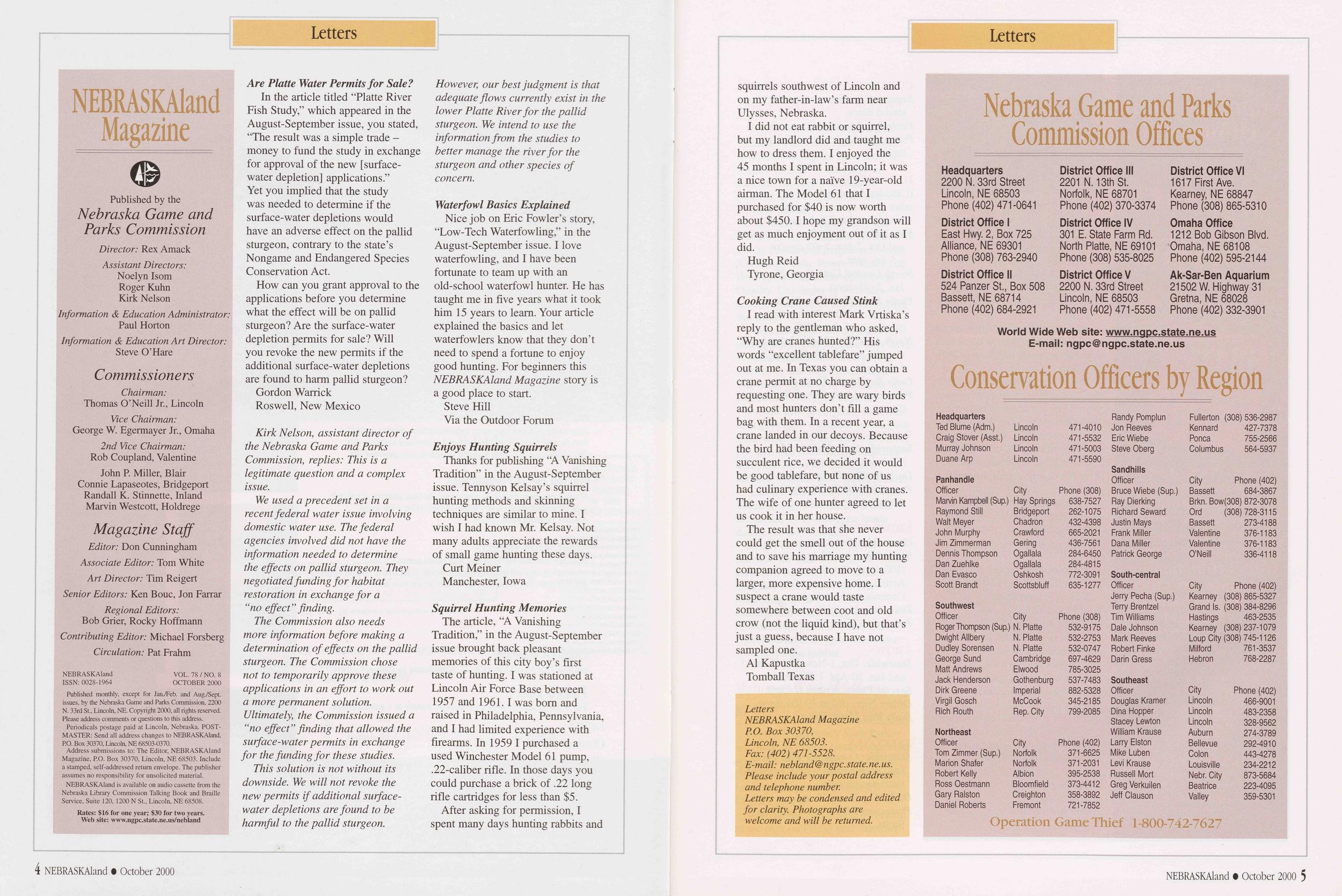 Letters NEBRASKAland Mazine Published by the Nebraska Game and Parks Commission Director: Rex Amack Assistant Directors: Noelyn Isom Roger Kuhn Kirk Nelson Information & Education Administrator: Paul Horton Information & Education Art Director: Steve O’Hare Commissioners Chairman: Thomas O’Neill Jr., Lincoln Vice Chairman: George W. Egermayer Jr., Omaha 2nd Vice Chairman: Rob Coupland, Valentine John P. Miller, Blair Connie Lapaseotes, Bridgeport Randall K. Stinnette, Inland Marvin Westcott, Holdrege Magazine Staff Editor: Don Cunningham Associate Editor: Tom White Art Director: Tim Reigert Senior Editors: Ken Bouc, Jon Farrar Regional Editors: Bob Grier, Rocky Hoffmann Contributing Editor: Michael Forsberg Circulation: Pat Frahm NEBRASKAland VOL. 78 / NO. 8 ISSN: 0028-1964 OCTOBER 2000 Published monthly, except for Jan./Feb. and AugVSept. issues, by the Nebraska Game and Parks Commission, 2200 N. 33rd St., Lincoln, NE. Copyright 2000, all rights reserved. Please address comments or questions to this address. Periodicals postage paid at Lincoln, Nebraska. POST- MASTER: Send all address changes to NEBRASKAland, P.O. Box 30370, Lincoln, NE 68503-0370. Address submissions to: The Editor, NEBRASKAland Magazine, P.O. Box 30370, Lincoln, NE 68503. Include a stamped, self-addressed return envelope. The publisher assumes no responsibility for unsolicited material. NEBRASKAland is available on audio cassette from the Nebraska Library Commission Talking Book and Braille Service, Suite 120, 1200 N St., Lincoln, NE 68508. Rates: $16 for one year; $30 for two years. Web site: ww w.ngpc.state.ne.us/nebland Are Platte Water Permits for Sale?
In the article titled “Platte River Fish Study,” which appeared in the August-September issue, you stated, “The result was a simple trade - money to fund the study in exchange for approval of the new [surface- water depletion] applications.” Yet you implied that the study was needed to determine if the surface-water depletions would have an adverse effect on the pallid sturgeon, contrary to the state’s Nongame and Endangered Species Conservation Act.
How can you grant approval to the applications before you determine what the effect will be on pallid sturgeon? Are the surface-water depletion permits for sale? Will you revoke the new permits if the additional surface-water depletions are found to harm pallid sturgeon?
Gordon Warrick Roswell, New MexicoKirk Nelson, assistant director of the Nebraska Game and Parks Commission, replies: This is a legitimate question and a complex issue.
We used a precedent set in a recent federal water issue involving domestic water use. The federal agencies involved did not have the information needed to determine the effects on pallid sturgeon. They negotiated funding for habitat restoration in exchange for a “no effect” finding.
The Commission also needs more information before making a determination of effects on the pallid sturgeon. The Commission chose not to temporarily approve these applications in an effort to work out a more permanent solution. Ultimately, the Commission issued a “no effect” finding that allowed the surface-water permits in exchange for the funding for these studies.
This solution is not without its downside. We will not revoke the new permits if additional surface- water depletions are found to be harmful to the pallid sturgeon. However, our best judgment is that adequate flows currently exist in the lower Platte River for the pallid sturgeon. We intend to use the information from the studies to better manage the river for the sturgeon and other species of concern.
Waterfowl Basics ExplainedNice job on Eric Fowler’s story, “Low-Tech Waterfowling,” in the August-September issue. I love waterfowling, and I have been fortunate to team up with an old-school waterfowl hunter. He has taught me in five years what it took him 15 years to learn. Your article explained the basics and let waterfowlers know that they don’t need to spend a fortune to enjoy good hunting. For beginners this NEBRASKAland Magazine story is a good place to start.
Steve Hill Via the Outdoor Forum Enjoys Hunting SquirrelsThanks for publishing “A Vanishing Tradition” in the August-September issue. Tennyson Kelsay’s squirrel hunting methods and skinning techniques are similar to mine. I wish I had known Mr. Kelsay. Not many adults appreciate the rewards of small game hunting these days.
Curt Meiner Manchester, Iowa Squirrel Hunting MemoriesThe article, “A Vanishing Tradition,” in the August-September issue brought back pleasant memories of this city boy’s first taste of hunting. I was stationed at Lincoln Air Force Base between 1957 and 1961.1 was bom and raised in Philadelphia, Pennsylvania, and I had limited experience with firearms. In 1959 I purchased a used Winchester Model 61 pump, .22-caliber rifle. In those days you could purchase a brick of .22 long rifle cartridges for less than $5.
After asking for permission, I spent many days hunting rabbits and squirrels southwest of Lincoln and on my father-in-law’s farm near Ulysses, Nebraska.
I did not eat rabbit or squirrel, but my landlord did and taught me how to dress them. I enjoyed the 45 months I spent in Lincoln; it was a nice town for a naive 19-year-old airman. The Model 61 that I purchased for $40 is now worth about $450.1 hope my grandson will get as much enjoyment out of it as I did.
Hugh Reid Tyrone, Georgia Cooking Crane Caused StinkI read with interest Mark Vrtiska’s reply to the gentleman who asked, “Why are cranes hunted?” His words “excellent tablefare” jumped out at me. In Texas you can obtain a crane permit at no charge by requesting one. They are wary birds and most hunters don’t fill a game bag with them. In a recent year, a crane landed in our decoys. Because the bird had been feeding on succulent rice, we decided it would be good tablefare, but none of us had culinary experience with cranes. The wife of one hunter agreed to let us cook it in her house.
The result was that she never could get the smell out of the house and to save his marriage my hunting companion agreed to move to a larger, more expensive home. I suspect a crane would taste somewhere between coot and old crow (not the liquid kind), but that’s just a guess, because I have not sampled one.
Al Kapustka Tomball TexasLetters NEBRASKAland Magazine RO. Box 30370, Lincoln, NE 68503. Eax: (402) 471-5528. E-mail: nebland@ ngpc.state, ne. us. Please include your postal address and telephone number. Letters may be condensed and edited for clarity. Photographs are welcome and will be returned.
Nebraska Game and Parks Commission Offices Headquarters 2200 N. 33rd Street Lincoln, NE 68503 Phone (402) 471-0641 District Office III 2201 N. 13th St. Norfolk, NE 68701 Phone (402) 370-3374 District Office VI 1617 First Ave. Kearney, NE 68847 Phone (308) 865-5310 District Office I District Office IV Omaha Office East Hwy. 2, Box 725 301 E. State Farm Rd. 1212 Bob Gibson Blvd. Alliance, NE 69301 North Platte, NE 69101 Omaha, NE 68108 Phone (308) 763-2940 Phone (308) 535-8025 Phone (402) 595-2144 District Office II District Office V Ak-Sar-Ben Aquarium 524 Panzer St., Box 508 2200 N. 33rd Street 21502 W. Highway 31 Bassett, NE 68714 Lincoln, NE 68503 Gretna, NE 68028 Phone (402) 684-2921 Phone (402) 471-5558 Phone (402) 332-3901 World Wide Web site: www.ngpc.state.ne.us E-mail: ngpc@ngpc.state.ne.us Conservation Officers by Region Headquarters Randy Pomplun Fullerton (308) 536-2987 Ted Blume (Adm.) Lincoln 471-4010 Jon Reeves Kennard 427-7378 Craig Stover (Asst.) Lincoln 471-5532 Eric Wiebe Ponca 755-2566 Murray Johnson Lincoln 471-5003 Steve Oberg Columbus 564-5937 Duane Arp Lincoln 471-5590 Sandhills Panhandle Officer City Phone (402) Officer City Phone (308) Bruce Wiebe (Sup.) Bassett 684-3867 Marvin Rampdell (Sup.) Hay Springs 638-7527 Ray Dierking Brkn. Bow(308) 872-3078 Raymond Still Bridgeport 262-1075 Richard Seward Ord (308) 728-3115 Walt Meyer Chadron 432-4398 Justin Mays Bassett 273-4188 John Murphy Crawford 665-2021 Frank Miller Valentine 376-1183 Jim Zimmerman Gering 436-7561 Dana Miller Valentine 376-1183 Dennis Thompson Ogallala 284-6450 Patrick George O’Neill 336-4118 Dan Zuehlke Ogallala 284-4815 Dan Evasco Oshkosh 772-3091 South-central Scott Brandt Scottsbluff 635-1277 Officer City Phone (402) Jerry Pecha (Sup.) Kearney (308) 865-5327 Southwest Terry Brentzel Grand Is. (308) 384-8296 Officer City Phone (308) Tim Williams Hastings 463-2535 Roger Thompson (Sup.) N. Platte 532-9175 Dale Johnson Kearney (308) 237-1079 Dwight Allbery N. Platte 532-2753 Mark Reeves Loup City (308) 745-1126 Dudley Sorensen N. Platte 532-0747 Robert Finke Milford 761-3537 George Sund Cambridge 697-4629 Darin Gress Hebron 768-2287 Matt Andrews Elwood 785-3025 Jack Henderson Gothenburg 537-7483 Southeast Dirk Greene Imperial 882-5328 Officer City Phone (402) Virgil Gosch McCook 345-2185 Douglas Kramer Lincoln 466-9001 Rich Routh Rep. City 799-2085 Dina Hopper Lincoln 483-2358 Stacey Lewton Lincoln 328-9562 Northeast William Krause Auburn 274-3789 Officer City Phone (402) Larry Elston Bellevue 292-4910 Tom Zimmer (Sup.) Norfolk 371-6625 Mike Luben Colon 443-4278 Marion Shafer Norfolk 371-2031 Levi Krause Louisville 234-2212 Robert Kelly Albion 395-2538 Russell Mort Nebr. City 873-5684 Ross Oestmann Bloomfield 373-4412 Greg Verkuilen Beatrice 223-4095 Gary Ralston Creighton 358-3892 Jeff Clauson Valley 359-5301 Daniel Roberts Fremont 721-7852 Operation Game Thief 1-800-742-7627 4 NEBRASKAland • October 2000 NEBRASKAland • October 2000 5
Nebraska’s Game and Parks Commissioners made several changes in waterfowl hunting dates for the 2000 season at their August meeting.
The Low Plains Late duck hunting season will open about a week later than last year and will be split into two parts.
The South-Central and Panhandle dark goose hunting units of previous years were combined to form the Platte River Unit. The dark goose seasons in the East, Platte River and North units are split.
The bag and possession limits were not changed from the previous season.
All seasons meet the guidelines established by the U.S. Fish and Wildlife Service.
DUCKSLow Plains Early: Sept. 30-Dec. 10 (72 days) and Dec. 16-17 (2 days) - 5 day split.
Low Plains Late: Oct. 14-15 (2 days) and Oct. 21-Dec. 31 (72 days) - 5 day split.
High Plains: Sept. 30-Dec. 10 (72 days) and Dec. 15-Jan. 7 (24 days) - 4 day split.
Daily Bag Limit: Six ducks, which may include no more than five mallards of which no more than two can be females, one mottled duck, one pintail, one canvasback, two wood ducks, two redheads, and three scaup (greater and lesser combined).
Possession Limit: Two daily bag limits.
COOTSSeason: Concurrent with duck season dates.
Daily Bag Limit: 15 coots.
Possession Limit: Two daily bag limits.
DARK GEESE (Canadas, brant and all other goose species, except for white-fronted and light geese.)East Unit: Sept. 30-Oct. 1 (2 days) and Oct. 7-Jan. 7 (93 days) - 5 day split.
North Central Unit: Sept. 30- Jan. 2 (95 days).
Platte River Unit: Oct. 21-22 (2 days) and Oct. 28-Jan. 28 (93 days) - 5 day split.
North Unit: Oct. 21-22 (2 days) and Oct. 28-Jan. 28 (93 days) - 5 day split.
Daily Bag Limit: Three geese.
Possession Limit: Two daily bag limits.
WHITE-FRONTED GEESEStatewide: Sept. 30-Dec. 24 (86 days).
Daily Bag Limit: Two geese.
Possession Limit: Two daily bag limits.
LIGHT GEESE(Snow, blue and Ross’ geese.) Statewide: Sept. 30-Jan. 12 (105 days). The Conservation Action will be set at a future Commission meeting.
Daily Bag Limit: 20 geese.
Possession Limit: None.
CROWSStatewide: Oct. 1-Nov. 15 (46 days) and Jan. 20-Apr. 7 (78 days).
Special Public Health Hazard
Order: Nov. 16-Jan.l9 (64 days).
Daily Bag Limit: None.
FALCONRYStatewide: Concurrent with water- fowl season dates within zones and management units.
Daily Bag Limit: Three.
Possession Limit: Two daily bag limits.
Researchers Studying Lake Ogallala Oxygen LevelThe Nebraska Game and Parks Commission closed Lake Ogallala to public boating for three days in August to allow researchers to measure the lake’s circulation patterns and oxygen levels over a 48-hour period.
The study is sponsored by the Commission, the Central Nebraska Public Power and Irrigation District, Nebraska Public Power District and the Department of Environmental Quality. University of Nebraska- Lincoln researchers are coordinating the study.
Reduced dissolved oxygen levels during warm, late-summer days have stressed rainbow and brown trout stocked in the Keith County lake. The study’s goal is to determine the causes of the oxygen depletion.
For the past three years, fisheries biologists have worked to re-establish Lake Ogallala as the state’s premiere put-and-take trout lake. Competing nongame fish were killed and aeration systems have been installed to increase dissolved oxygen levels. These efforts, however, have been threatened by low-oxygen levels during the late summer.
Jointly owned by the power districts, the lake was created when earth was extracted to construct Kingsley Dam and create Lake McConaughy in 1941. Before construction of the Kingsley hydroelectric plant in 1985, Lake Ogallala’s cold, oxygen-rich water was ideal trout habitat.
Mahoney Weekend Home to 10,000 at Scout JubileeEugene T. Mahoney State Park will have its largest group event ever when the Mid-America Boy Scout Council holds its 2000 Millennium Jubilee during the weekend of October 13-15.
Ready for Hunting? Don't Forget Your Permit! Resident Hunt and Fish Resident Hunt Resident Fish Nonresident Hunt Nonresident Fish Habitat Stamp Aquatic Habitat Stamp. $21.75 ...$9.50 $12.75 $55.00 $35.00 $10.00 ...$5.00 For a lifetime of outdoor fun, consider a lifetime permit. Lifetime Hunt and Fish Lifetime Hunt Lifetime Fish $448.00 $224.00 $257.50 Hunting and fishing permits are available at all Nebraska Game and Parks Commission offices and from sporting goods stores, outfitters, bait shops and many other vendors throughout the state. For more information call (402) 471-0641. Some permits are available on the Commission’s web site: www.ngpc.state.ne.us Nebraska Game and Parks CommissionMore than 6,500 scouts will camp in the park on Friday and Saturday 6 NEBRASKAland • October 2000 NEBRASKAland • October 2000 7 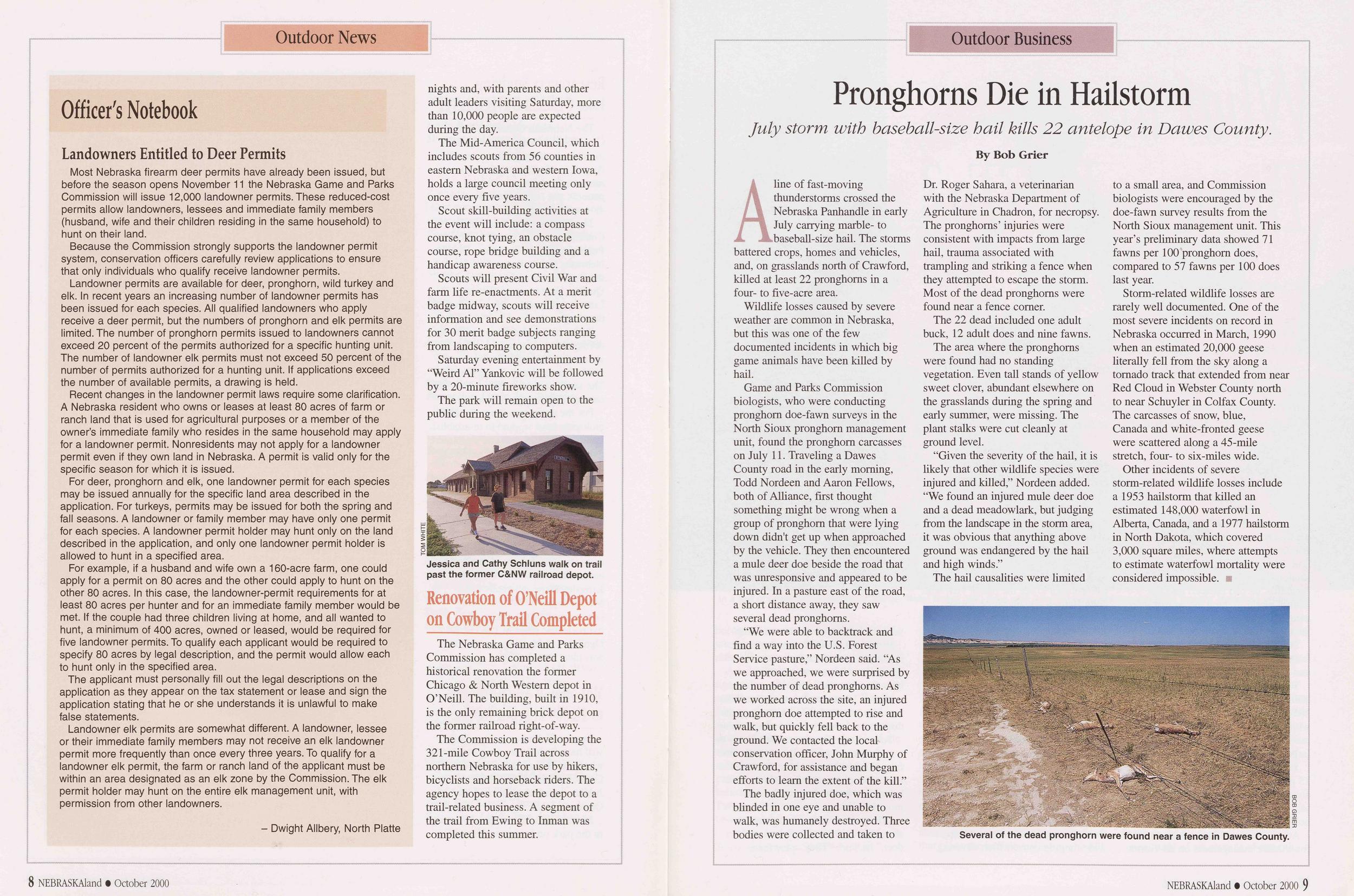 nights and, with parents and other adult leaders visiting Saturday, more than 10,000 people are expected during the day.
Most Nebraska firearm deer permits have already been issued, but before the season opens November 11 the Nebraska Game and Parks Commission will issue 12,000 landowner permits. These reduced-cost permits allow landowners, lessees and immediate family members (husband, wife and their children residing in the same household) to hunt on their land.
Because the Commission strongly supports the landowner permit system, conservation officers carefully review applications to ensure that only individuals who qualify receive landowner permits.
Landowner permits are available for deer, pronghorn, wild turkey and elk. In recent years an increasing number of landowner permits has been issued for each species. All qualified landowners who apply receive a deer permit, but the numbers of pronghorn and elk permits are limited. The number of pronghorn permits issued to landowners cannot exceed 20 percent of the permits authorized for a specific hunting unit. The number of landowner elk permits must not exceed 50 percent of the number of permits authorized for a hunting unit. If applications exceed the number of available permits, a drawing is held.
Recent changes in the landowner permit laws require some clarification. A Nebraska resident who owns or leases at least 80 acres of farm or ranch land that is used for agricultural purposes or a member of the owner’s immediate family who resides in the same household may apply for a landowner permit. Nonresidents may not apply for a landowner permit even if they own land in Nebraska. A permit is valid only for the specific season for which it is issued.
For deer, pronghorn and elk, one landowner permit for each species may be issued annually for the specific land area described in the application. For turkeys, permits may be issued for both the spring and fall seasons. A landowner or family member may have only one permit for each species. A landowner permit holder may hunt only on the land described in the application, and only one landowner permit holder is allowed to hunt in a specified area.
For example, if a husband and wife own a 160-acre farm, one could apply for a permit on 80 acres and the other could apply to hunt on the other 80 acres. In this case, the landowner-permit requirements for at least 80 acres per hunter and for an immediate family member would be met. If the couple had three children living at home, and all wanted to hunt, a minimum of 400 acres, owned or leased, would be required for five landowner permits. To qualify each applicant would be required to specify 80 acres by legal description, and the permit would allow each to hunt only in the specified area.
The applicant must personally fill out the legal descriptions on the application as they appear on the tax statement or lease and sign the application stating that he or she understands it is unlawful to make false statements.
Landowner elk permits are somewhat different. A landowner, lessee or their immediate family members may not receive an elk landowner permit more frequently than once every three years. To qualify for a landowner elk permit, the farm or ranch land of the applicant must be within an area designated as an elk zone by the Commission. The elk permit holder may hunt on the entire elk management unit, with permission from other landowners.
- Dwight Allbery, North PlatteThe Mid-America Council, which includes scouts from 56 counties in eastern Nebraska and western Iowa, holds a large council meeting only once every five years.
Scout skill-building activities at the event will include: a compass course, knot tying, an obstacle course, rope bridge building and a handicap awareness course.
Scouts will present Civil War and farm life re-enactments. At a merit badge midway, scouts will receive information and see demonstrations for 30 merit badge subjects ranging from landscaping to computers.
Saturday evening entertainment by “Weird Al” Yankovic will be followed by a 20-minute fireworks show.
The park will remain open to the public during the weekend.
The Nebraska Game and Parks Commission has completed a historical renovation the former Chicago &North Western depot in O’Neill. The building, built in 1910, is the only remaining brick depot on the former railroad right-of-way.
The Commission is developing the 321-mile Cowboy Trail across northern Nebraska for use by hikers, bicyclists and horseback riders. The agency hopes to lease the depot to a trail-related business. A segment of the trail from Ewing to Inman was completed this summer.
Pronghorns Die in Hailstorm July storm with baseball-size hail kills 22 antelope in Dawes County. By Bob GrierAline of fast-moving thunderstorms crossed the Nebraska Panhandle in early July carrying marble- to baseball-size hail. The storms battered crops, homes and vehicles, and, on grasslands north of Crawford, killed at least 22 pronghorns in a four- to five-acre area.
Wildlife losses caused by severe weather are common in Nebraska, but this was one of the few documented incidents in which big game animals have been killed by hail.
Game and Parks Commission biologists, who were conducting pronghorn doe-fawn surveys in the North Sioux pronghorn management unit, found the pronghorn carcasses on July 11. Traveling a Dawes County road in the early morning, Todd Nordeen and Aaron Fellows, both of Alliance, first thought something might be wrong when a group of pronghorn that were lying down didn't get up when approached by the vehicle. They then encountered a mule deer doe beside the road that was unresponsive and appeared to be injured. In a pasture east of the road, a short distance away, they saw several dead pronghorns.
“We were able to backtrack and find a way into the U.S. Forest Service pasture,” Nordeen said. “As we approached, we were surprised by the number of dead pronghorns. As we worked across the site, an injured pronghorn doe attempted to rise and walk, but quickly fell back to the ground. We contacted the local conservation officer, John Murphy of Crawford, for assistance and began efforts to learn the extent of the kill.”
The badly injured doe, which was blinded in one eye and unable to walk, was humanely destroyed. Three bodies were collected and taken to Dr. Roger Sahara, a veterinarian with the Nebraska Department of Agriculture in Chadron, for necropsy. The pronghorns’ injuries were consistent with impacts from large hail, trauma associated with trampling and striking a fence when they attempted to escape the storm. Most of the dead pronghorns were found near a fence comer.
The 22 dead included one adult buck, 12 adult does and nine fawns.
The area where the pronghorns were found had no standing vegetation. Even tall stands of yellow sweet clover, abundant elsewhere on the grasslands during the spring and early summer, were missing. The plant stalks were cut cleanly at ground level.
“Given the severity of the hail, it is likely that other wildlife species were injured and killed,” Nordeen added. “We found an injured mule deer doe and a dead meadowlark, but judging from the landscape in the storm area, it was obvious that anything above ground was endangered by the hail and high winds.”
The hail causalities were limited to a small area, and Commission biologists were encouraged by the doe-fawn survey results from the North Sioux management unit. This year’s preliminary data showed 71 fawns per 100 pronghorn does, compared to 57 fawns per 100 does last year.
Storm-related wildlife losses are rarely well documented. One of the most severe incidents on record in Nebraska occurred in March, 1990 when an estimated 20,000 geese literally fell from the sky along a tornado track that extended from near Red Cloud in Webster County north to near Schuyler in Colfax County. The carcasses of snow, blue, Canada and white-fronted geese were scattered along a 45-mile stretch, four- to six-miles wide.
Other incidents of severe storm-related wildlife losses include a 1953 hailstorm that killed an estimated 148,000 waterfowl in Alberta, Canada, and a 1977 hailstorm in North Dakota, which covered 3,000 square miles, where attempts to estimate waterfowl mortality were considered impossible. ■
8 NEBRASKAland • October 2000 NEBRASKAland • October 2000 9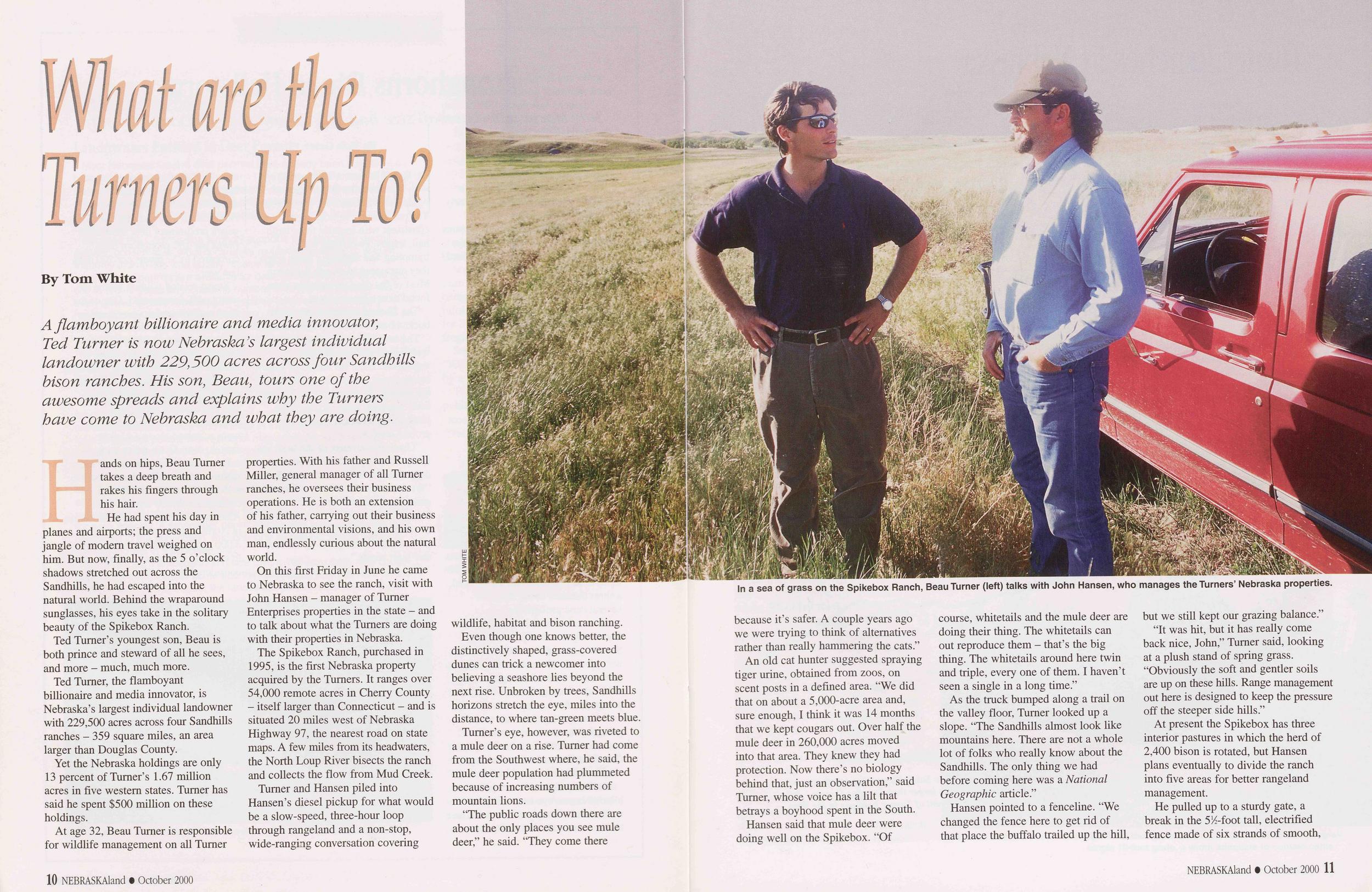
What are the Turners Up To?
By Tom White A flamboyant billionaire and media innovator, Ted Turner is now Nebraska’s largest individual landowner with 229,500 acres across four Sandhills bison ranches. His son, Beau, tours one of the awesome spreads and explains why the Turners have come to Nebraska and what they are doing.Hands on hips, Beau Turner takes a deep breath and rakes his fingers through his hair.
He had spent his day in planes and airports; the press and jangle of modem travel weighed on him. But now, finally, as the 5 o’clock shadows stretched out across the Sandhills, he had escaped into the natural world. Behind the wraparound sunglasses, his eyes take in the solitary beauty of the Spikebox Ranch.
Ted Turner’s youngest son, Beau is both prince and steward of all he sees, and more - much, much more.
Ted Turner, the flamboyant billionaire and media innovator, is Nebraska’s largest individual landowner with 229,500 acres across four Sandhills ranches - 359 square miles, an area larger than Douglas County.
Yet the Nebraska holdings are only 13 percent of Turner’s 1.67 million acres in five western states. Turner has said he spent $500 million on these holdings.
At age 32, Beau Turner is responsible for wildlife management on all Turner properties. With his father and Russell Miller, general manager of all Turner ranches, he oversees their business operations. He is both an extension of his father, carrying out their business and environmental visions, and his own man, endlessly curious about the natural world.
On this first Friday in June he came to Nebraska to see the ranch, visit with John Hansen - manager of Turner Enterprises properties in the state - and to talk about what the Turners are doing with their properties in Nebraska.
The Spikebox Ranch, purchased in 1995, is the first Nebraska property acquired by the Turners. It ranges over 54,000 remote acres in Cherry County - itself larger than Connecticut - and is situated 20 miles west of Nebraska Highway 97, the nearest road on state maps. A few miles from its headwaters, the North Loup River bisects the ranch and collects the flow from Mud Creek.
Turner and Hansen piled into Hansen’s diesel pickup for what would be a slow-speed, three-hour loop through rangeland and a non-stop, wide-ranging conversation covering wildlife, habitat and bison ranching.
Even though one knows better, the distinctively shaped, grass-covered dunes can trick a newcomer into believing a seashore lies beyond the next rise. Unbroken by trees, Sandhills horizons stretch the eye, miles into the distance, to where tan-green meets blue.
Turner’s eye, however, was riveted to a mule deer on a rise. Turner had come from the Southwest where, he said, the mule deer population had plummeted because of increasing numbers of mountain lions.
"The public roads down there are about the only places you see mule deer,” he said. “They come there because it’s safer. A couple years ago we were trying to think of alternatives rather than really hammering the cats.”
An old cat hunter suggested spraying tiger urine, obtained from zoos, on scent posts in a defined area. “We did that on about a 5,000-acre area and, sure enough, I think it was 14 months that we kept cougars out. Over half the mule deer in 260,000 acres moved into that area. They knew they had protection. Now there’s no biology behind that, just an observation,” said Turner, whose voice has a lilt that betrays a boyhood spent in the South.
Hansen said that mule deer were doing well on the Spikebox. “Of course, whitetails and the mule deer are doing their thing. The whitetails can out reproduce them - that’s the big thing. The whitetails around here twin and triple, every one of them. I haven’t seen a single in a long time.”
As the truck bumped along a trail on the valley floor, Turner looked up a slope. “The Sandhills almost look like mountains here. There are not a whole lot of folks who really know about the Sandhills. The only thing we had before coming here was a National Geographic article.”
Hansen pointed to a fenceline. “We changed the fence here to get rid of that place the buffalo trailed up the hill, but we still kept our grazing balance.”
“It was hit, but it has really come back nice, John,” Turner said, looking at a plush stand of spring grass. “Obviously the soft and gentler soils are up on these hills. Range management out here is designed to keep the pressure off the steeper side hills.”
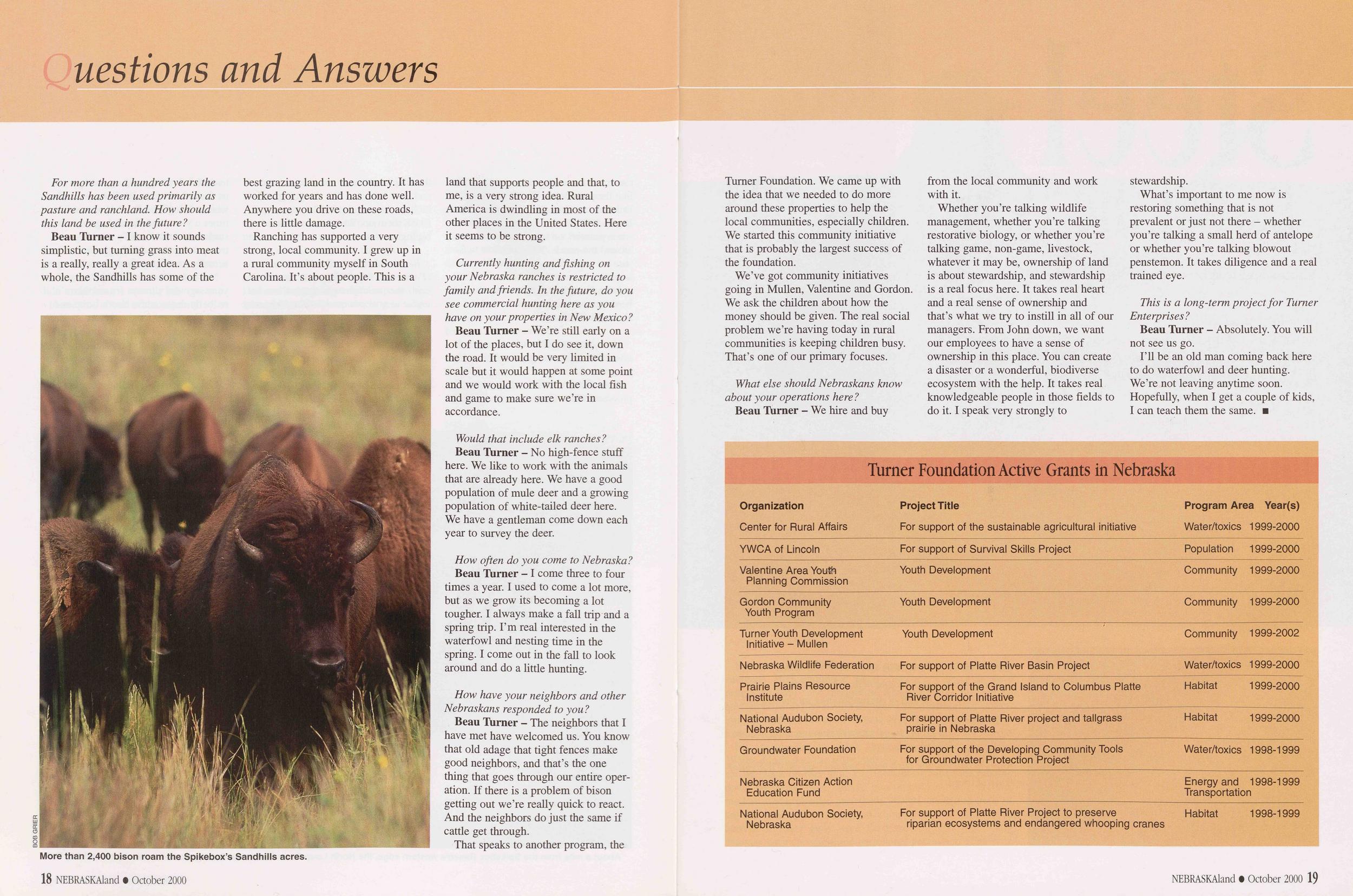
At present the Spikebox has three interior pastures in which the herd of 2,400 bison is rotated, but Hansen plans eventually to divide the ranch into five areas for better rangeland management.
He pulled up to a sturdy gate, a break in the 5 1/2 foot tall, electrified fence made of six strands of smooth, 10 NEBRASKAland O October 2000 NEBRASKAland • October 2000 11 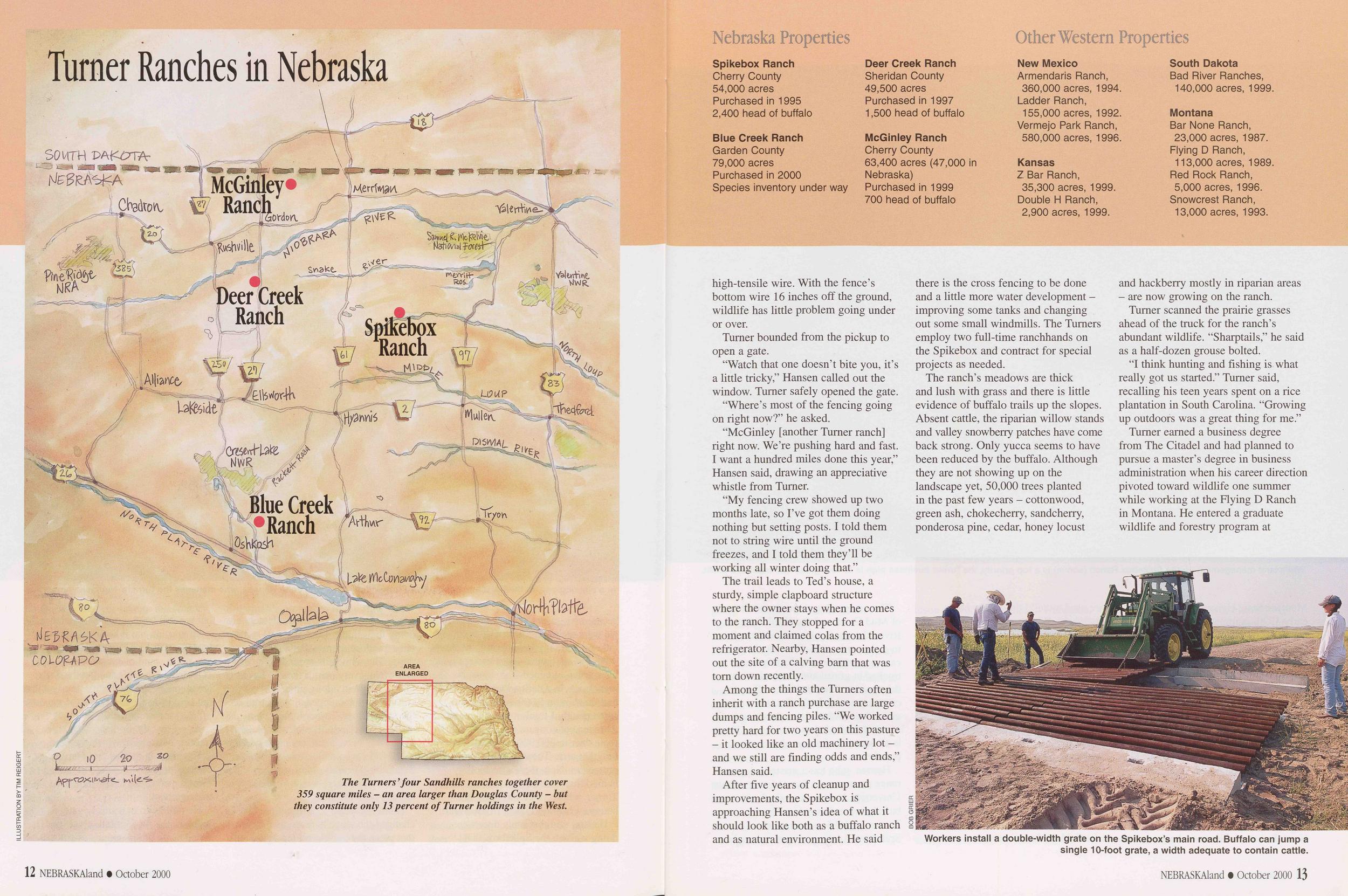 high-tensile wire. With the fence’s bottom wire 16 inches off the ground, wildlife has little problem going under or over.
Spikebox Ranch Cherry County 54,000 acres Purchased in 1995 2,400 head of buffalo
Blue Creek Ranch Garden County 79,000 acres Purchased in 2000 Species inventory under way
Deer Creek Ranch Sheridan County 49.500 acres Purchased in 1997 1.500 head of buffalo
McGinley Ranch Cherry County 63,400 acres (47,000 in Nebraska) Purchased in 1999 700 head of buffalo New Mexico
Armendaris Ranch, 360,000 acres, 1994.
Ladder Ranch, 155,000 acres, 1992. Vermejo Park Ranch, 580,000 acres, 1996. Kansas
Z Bar Ranch, 35,300 acres, 1999. Double H Ranch, 2,900 acres, 1999.
South Dakota Bad River Ranches, 140,000 acres, 1999.
Montana Bar None Ranch, 23,000 acres, 1987. Flying D Ranch, 113,000 acres, 1989. Red Rock Ranch, 5,000 acres, 1996. Snowcrest Ranch,
ILLUSTRATION BY TIM REIGERT Turner Ranches in Nebraska359 square miles - an area larger than Douglas County - but they constitute only 13 percent of Turner holdings in the West.
Turner bounded from the pickup to open a gate.
“Watch that one doesn’t bite you, it’s a little tricky,” Hansen called out the window. Turner safely opened the gate.
“Where’s most of the fencing going on right now?” he asked.
“McGinley [another Turner ranch] right now. We’re pushing hard and fast. I want a hundred miles done this year,” Hansen said, drawing an appreciative whistle from Turner.
“My fencing crew showed up two months late, so I’ve got them doing nothing but setting posts. I told them not to string wire until the ground freezes, and I told them they’ll be working all winter doing that.”
The trail leads to Ted’s house, a sturdy, simple clapboard structure where the owner stays when he comes to the ranch. They stopped for a moment and claimed colas from the refrigerator. Nearby, Hansen pointed out the site of a calving barn that was tom down recently.
Among the things the Turners often inherit with a ranch purchase are large dumps and fencing piles. “We worked pretty hard for two years on this pasture - it looked like an old machinery lot - and we still are finding odds and ends,” Hansen said.
After five years of cleanup and improvements, the Spikebox is approaching Hansen’s idea of what it should look like both as a buffalo ranch and as natural environment. He said there is the cross fencing to be done and a little more water development - improving some tanks and changing out some small windmills. The Turners employ two full-time ranchhands on the Spikebox and contract for special projects as needed.
The ranch’s meadows are thick and lush with grass and there is little evidence of buffalo trails up the slopes. Absent cattle, the riparian willow stands and valley snowberry patches have come back strong. Only yucca seems to have been reduced by the buffalo. Although they are not showing up on the landscape yet, 50,000 trees planted in the past few years - cottonwood, green ash, chokecherry, sandcherry, ponderosa pine, cedar, honey locust and hackberry mostly in riparian areas - are now growing on the ranch.
Turner scanned the prairie grasses ahead of the truck for the ranch’s abundant wildlife. “Sharptails,” he said as a half-dozen grouse bolted.
“I think hunting and fishing is what really got us started.” Turner said, recalling his teen years spent on a rice plantation in South Carolina. “Growing up outdoors was a great thing for me.”
Turner earned a business degree from The Citadel and had planned to pursue a master’s degree in business administration when his career direction pivoted toward wildlife one summer while working at the Flying D Ranch in Montana. He entered a graduate wildlife and forestry program at 12 NEBRASKAland • October 2000 NEBRASKAland • October 2000 13 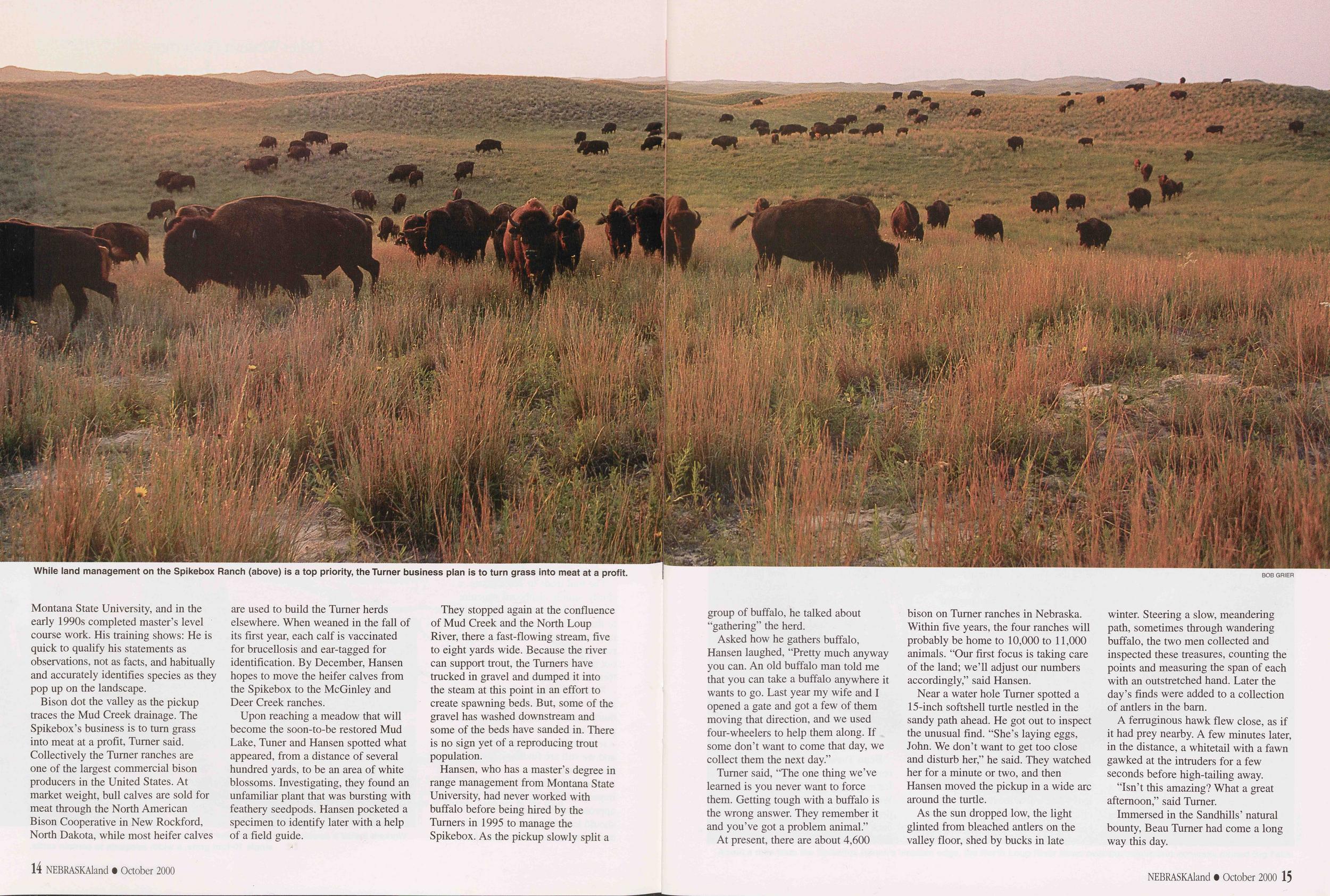 Montana State University, and in the early 1990s completed master’s level course work. His training shows: He is quick to qualify his statements as observations, not as facts, and habitually and accurately identifies species as they pop up on the landscape.
Bison dot the valley as the pickup traces the Mud Creek drainage. The Spikebox’s business is to turn grass into meat at a profit, Turner said. Collectively the Turner ranches are one of the largest commercial bison producers in the United States. At market weight, bull calves are sold for meat through the North American Bison Cooperative in New Rockford, North Dakota, while most heifer calves are used to build the Turner herds elsewhere. When weaned in the fall of its first year, each calf is vaccinated for brucellosis and ear-tagged for identification. By December, Hansen hopes to move the heifer calves from the Spikebox to the McGinley and Deer Creek ranches.
Upon reaching a meadow that will become the soon-to-be restored Mud Lake, Tuner and Hansen spotted what appeared, from a distance of several hundred yards, to be an area of white blossoms. Investigating, they found an unfamiliar plant that was bursting with feathery seedpods. Hansen pocketed a specimen to identify later with a help of a field guide.
They stopped again at the confluence of Mud Creek and the North Loup River, there a fast-flowing stream, five to eight yards wide. Because the river can support trout, the Turners have trucked in gravel and dumped it into the steam at this point in an effort to create spawning beds. But, some of the gravel has washed downstream and some of the beds have sanded in. There is no sign yet of a reproducing trout population.
Hansen, who has a master’s degree in range management from Montana State University, had never worked with buffalo before being hired by the Turners in 1995 to manage the Spikebox. As the pickup slowly split a group of buffalo, he talked about “gathering” the herd.
Asked how he gathers buffalo, Hansen laughed, “Pretty much anyway you can. An old buffalo man told me that you can take a buffalo anywhere it wants to go. Last year my wife and I opened a gate and got a few of them moving that direction, and we used four-wheelers to help them along. If some don’t want to come that day, we collect them the next day.”
Turner said, “The one thing we’ve learned is you never want to force them. Getting tough with a buffalo is the wrong answer. They remember it and you’ve got a problem animal.”
At present, there are about 4,600 bison on Turner ranches in Nebraska. Within five years, the four ranches will probably be home to 10,000 to 11,000 animals. “Our first focus is taking care of the land; we’ll adjust our numbers accordingly,” said Hansen.
Near a water hole Turner spotted a 15-inch softshell turtle nestled in the sandy path ahead. He got out to inspect the unusual find. “She’s laying eggs, John. We don’t want to get too close and disturb her,” he said. They watched her for a minute or two, and then Hansen moved the pickup in a wide arc around the turtle.
As the sun dropped low, the light glinted from bleached antlers on the valley floor, shed by bucks in late winter. Steering a slow, meandering path, sometimes through wandering buffalo, the two men collected and inspected these treasures, counting the points and measuring the span of each with an outstretched hand. Later the day’s finds were added to a collection of antlers in the bam.
A ferruginous hawk flew close, as if it had prey nearby. A few minutes later, in the distance, a whitetail with a fawn gawked at the intruders for a few seconds before high-tailing away.
“Isn’t this amazing? What a great afternoon,” said Turner.
Immersed in the Sandhills’ natural bounty, Beau Turner had come a long way this day.
14 NEBRASKAland • October 2000 NEBRASKAland • October 2000 15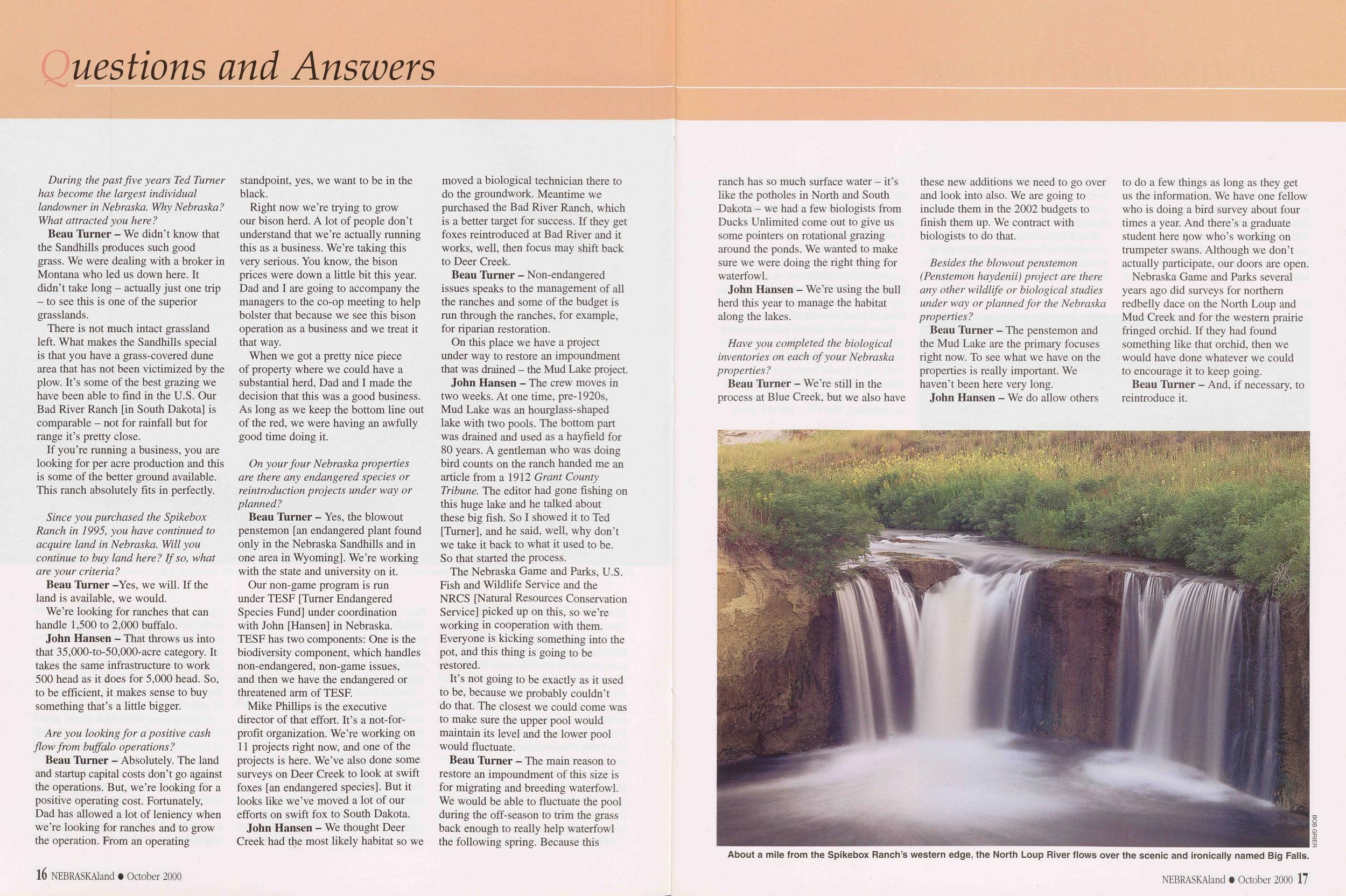 Questions and Answers
During the past five years Ted Turner has become the largest individual landowner in Nebraska. Why Nebraska? What attracted you here ?
Beau TXirner - We didn’t know that the Sandhills produces such good grass. We were dealing with a broker in Montana who led us down here. It didn’t take long - actually just one trip - to see this is one of the superior grasslands.
There is not much intact grassland left. What makes the Sandhills special is that you have a grass-covered dune area that has not been victimized by the plow. It’s some of the best grazing we have been able to find in the U.S. Our Bad River Ranch [in South Dakota] is comparable - not for rainfall but for range it’s pretty close.
If you’re running a business, you are looking for per acre production and this is some of the better ground available. This ranch absolutely fits in perfectly.
Since you purchased the Spikebox Ranch in 1995, you have continued to acquire land in Nebraska. Will you continue to buy land here? If so, what are your criteria?
Beau TYirner -Yes, we will. If the land is available, we would.
We’re looking for ranches that can handle 1,500 to 2,000 buffalo.
John Hansen - That throws us into that 35,000-to-50,000-acre category. It takes the same infrastructure to work 500 head as it does for 5,000 head. So, to be efficient, it makes sense to buy something that’s a little bigger.
Are you looking for a positive cash flow from buffalo operations?
Beau Turner - Absolutely. The land and startup capital costs don’t go against the operations. But, we’re looking for a positive operating cost. Fortunately, Dad has allowed a lot of leniency when we’re looking for ranches and to grow the operation. From an operating standpoint, yes, we want to be in the black.
Right now we’re trying to grow our bison herd. A lot of people don’t understand that we’re actually running this as a business. We’re taking this very serious. You know, the bison prices were down a little bit this year. Dad and I are going to accompany the managers to the co-op meeting to help bolster that because we see this bison operation as a business and we treat it that way.
When we got a pretty nice piece of property where we could have a substantial herd, Dad and I made the decision that this was a good business. As long as we keep the bottom line out of the red, we were having an awfully good time doing it.
On your four Nebraska properties are there any endangered species or reintroduction projects under way or planned?
Beau Tbrner - Yes, the blowout penstemon [an endangered plant found only in the Nebraska Sandhills and in one area in Wyoming]. We’re working with the state and university on it.
Our non-game program is run under TESF [Turner Endangered Species Fund] under coordination with John [Hansen] in Nebraska. TESF has two components: One is the biodiversity component, which handles non-endangered, non-game issues, and then we have the endangered or threatened arm of TESF.
Mike Phillips is the executive director of that effort. It’s a not-for- profit organization. We’re working on 11 projects right now, and one of the projects is here. We’ve also done some surveys on Deer Creek to look at swift foxes [an endangered species]. But it looks like we’ve moved a lot of our efforts on swift fox to South Dakota.
John Hansen - We thought Deer Creek had the most likely habitat so we moved a biological technician there to do the groundwork. Meantime we purchased the Bad River Ranch, which is a better target for success. If they get foxes reintroduced at Bad River and it works, well, then focus may shift back to Deer Creek.
Beau Turner - Non-endangered issues speaks to the management of all the ranches and some of the budget is run through the ranches, for example, for riparian restoration.
On this place we have a project under way to restore an impoundment that was drained - the Mud Lake project.
John Hansen - The crew moves in two weeks. At one time, pre-1920s, Mud Lake was an hourglass-shaped lake with two pools. The bottom part was drained and used as a hayfield for 80 years. A gentleman who was doing bird counts on the ranch handed me an article from a 1912 Grant County Tribune. The editor had gone fishing on this huge lake and he talked about these big fish. So I showed it to Ted [Turner], and he said, well, why don’t we take it back to what it used to be. So that started the process.
The Nebraska Game and Parks, U.S. Fish and Wildlife Service and the NRCS [Natural Resources Conservation Service] picked up on this, so we’re working in cooperation with them. Everyone is kicking something into the pot, and this thing is going to be restored.
It’s not going to be exactly as it used to be, because we probably couldn’t do that. The closest we could come was to make sure the upper pool would maintain its level and the lower pool would fluctuate.
Beau Turner - The main reason to restore an impoundment of this size is for migrating and breeding waterfowl. We would be able to fluctuate the pool during the off-season to trim the grass back enough to really help waterfowl the following spring. Because this ranch has so much surface water - it’s like the potholes in North and South Dakota - we had a few biologists from Ducks Unlimited come out to give us some pointers on rotational grazing around the ponds. We wanted to make sure we were doing the right thing for waterfowl.
John Hansen - We’re using the bull herd this year to manage the habitat along the lakes.
Have you completed the biological inventories on each of your Nebraska properties ?
Beau Turner - We’re still in the process at Blue Creek, but we also have these new additions we need to go over and look into also. We are going to include them in the 2002 budgets to finish them up. We contract with biologists to do that.
Besides the blowout penstemon (Penstemon haydenii) project are there any other wildlife or biological studies under way or planned for the Nebraska properties?
Beau TYirner - The penstemon and the Mud Lake are the primary focuses right now. To see what we have on the properties is really important. We haven’t been here very long.
John Hansen - We do allow others to do a few things as long as they get us the information. We have one fellow who is doing a bird survey about four times a year. And there’s a graduate student here now who’s working on trumpeter swans. Although we don’t actually participate, our doors are open.
Nebraska Game and Parks several years ago did surveys for northern redbelly dace on the North Loup and Mud Creek and for the western prairie fringed orchid. If they had found something like that orchid, then we would have done whatever we could to encourage it to keep going.
Beau Thrner - And, if necessary, to reintroduce it.
 Questions and Answers BOB GRIER
For more than a hundred years the Sandhills has been used primarily as pasture and ranchland. How should this land be used in the future?
Beau TYirner - I know it sounds simplistic, but turning grass into meat is a really, really a great idea. As a whole, the Sandhills has some of the best grazing land in the country. It has worked for years and has done well. Anywhere you drive on these roads, there is little damage.
Ranching has supported a very strong, local community. I grew up in a rural community myself in South Carolina. It’s about people. This is a land that supports people and that, to me, is a very strong idea. Rural America is dwindling in most of the other places in the United States. Here it seems to be strong.
Currently hunting and fishing on your Nebraska ranches is restricted to family and friends. In the future, do you see commercial hunting here as you have on your properties in New Mexico?
Beau Turner - We’re still early on a lot of the places, but I do see it, down the road. It would be very limited in scale but it would happen at some point and we would work with the local fish and game to make sure we’re in accordance.
Would that include elk ranches?
Beau Turner - No high-fence stuff here. We like to work with the animals that are already here. We have a good population of mule deer and a growing population of white-tailed deer here. We have a gentleman come down each year to survey the deer.
How often do you come to Nebraska?
Beau Turner -1 come three to four times a year. I used to come a lot more, but as we grow its becoming a lot tougher. I always make a fall trip and a spring trip. I’m real interested in the waterfowl and nesting time in the spring. I come out in the fall to look around and do a little hunting.
How have your neighbors and other Nebraskans responded to you ?
Beau Turner - The neighbors that I have met have welcomed us. You know that old adage that tight fences make good neighbors, and that’s the one thing that goes through our entire oper- ation. If there is a problem of bison getting out we’re really quick to react. And the neighbors do just the same if cattle get through.
That speaks to another program, the Turner Foundation. We came up with the idea that we needed to do more around these properties to help the local communities, especially children. We started this community initiative that is probably the largest success of the foundation.
We’ve got community initiatives going in Mullen, Valentine and Gordon. We ask the children about how the money should be given. The real social problem we’re having today in rural communities is keeping children busy. That’s one of our primary focuses.
What else should Nebraskans know about your operations here?
Beau Turner - We hire and buy from the local community and work with it.
Turner Foundation Active Grants in NebraskaOrganization Project Title Program Area Year(s) Center for Rural Affairs For support of the sustainable agricultural initiative Water/toxics 1999-2000 YWCA of Lincoln For support of Survival Skills Project Population 1999-2000 Valentine Area YouLa Planning Commission Youth Development Community 1999-2000 Gordon Community Youth Program Youth Development Community 1999-2000 Turner Youth Development Initiative - Mullen Youth Development Community 1999-2002 Nebraska Wildlife Federation For support of Platte River Basin Project Water/toxics 1999-2000 Prairie Plains Resource Institute For support of the Grand Island to Columbus Platte River Corridor Initiative Habitat 1999-2000 National Audubon Society, Nebraska For support of Platte River project and tailgrass prairie in Nebraska Habitat 1999-2000 Groundwater Foundation For support of the Developing Community Tools for Groundwater Protection Project Water/toxics 1998-1999 Nebraska Citizen Action Education Fund Energy and 1998-1999 Transportation National Audubon Society, Nebraska For support of Platte River Project to preserve riparian ecosystems and endangered whooping cranes Habitat 1998-1999
Whether you’re talking wildlife management, whether you’re talking restorative biology, or whether you’re talking game, non-game, livestock, whatever it may be, ownership of land is about stewardship, and stewardship is a real focus here. It takes real heart and a real sense of ownership and that’s what we try to instill in all of our managers. From John down, we want our employees to have a sense of ownership in this place. You can create a disaster or a wonderful, biodiverse ecosystem with the help. It takes real knowledgeable people in those fields to do it. I speak very strongly to stewardship.
What’s important to me now is restoring something that is not prevalent or just not there - whether you’re talking a small herd of antelope or whether you’re talking blowout penstemon. It takes diligence and a real trained eye.
This is a long-term project for Turner Enterprises?
Beau TXirner - Absolutely. You will not see us go.
I’ll be an old man coming back here to do waterfowl and deer hunting. We’re not leaving anytime soon. Hopefully, when I get a couple of kids, I can teach them the same. ■
18 NEBRASKAland • October 2000 NEBRASKAland • October 2000 19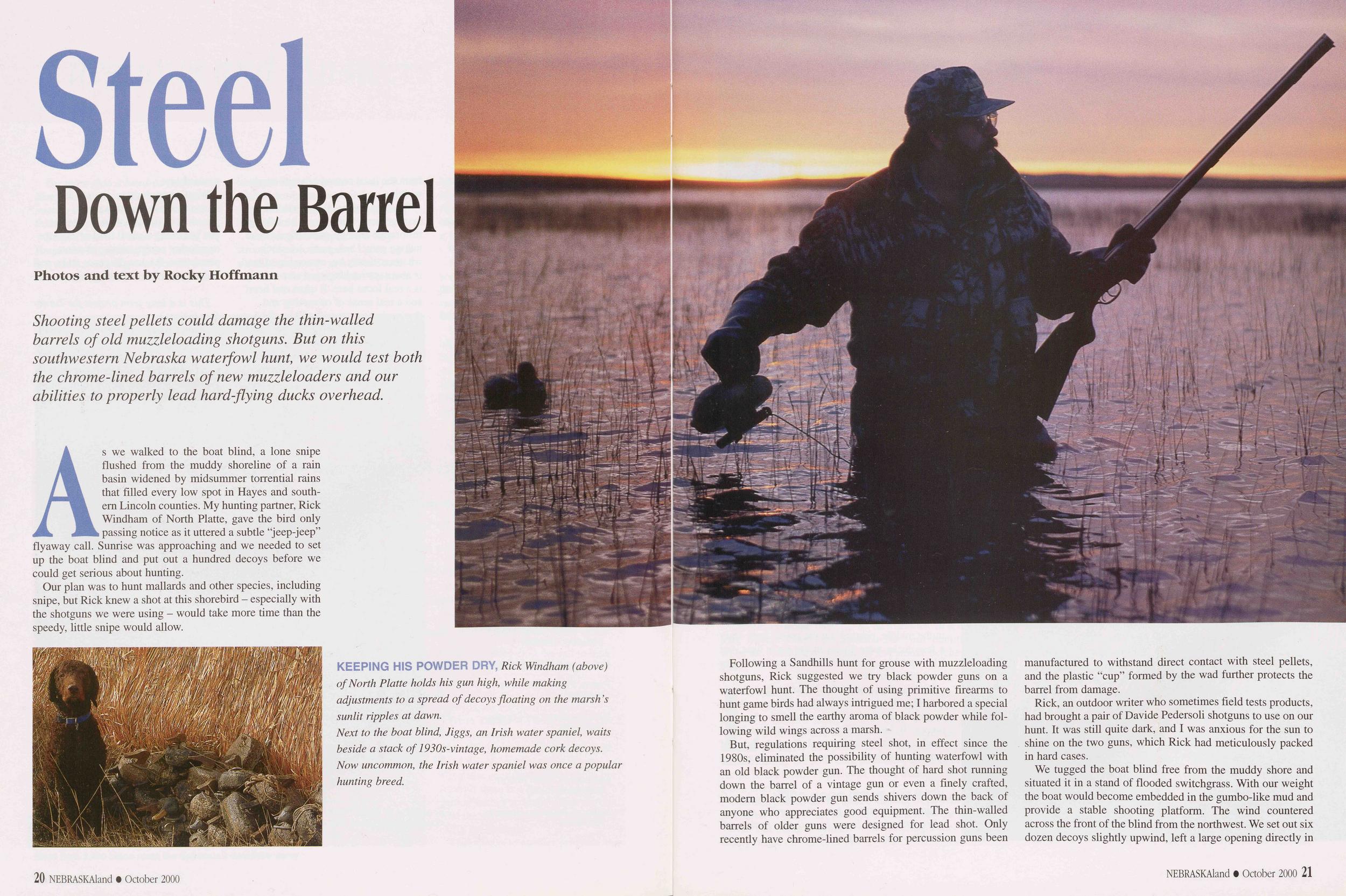
Steel Down the Barrel
Photos and text by Rocky Hoffmann Shooting steel pellets could damage the thin-walled barrels of old muzzle loading shotguns. But on this southwestern Nebraska waterfowl hunt, we would test both the chrome-lined barrels of new muzzleloaders and our abilities to properly lead hard-flying ducks overhead.As we walked to the boat blind, a lone snipe flushed from the muddy shoreline of a rain basin widened by midsummer torrential rains that filled every low spot in Hayes and south- ern Lincoln counties. My hunting partner, Rick Windham of North Platte, gave the bird only passing notice as it uttered a subtle “jeep-jeep” flyaway call. Sunrise was approaching and we needed to set up the boat blind and put out a hundred decoys before we could get serious about hunting.
Our plan was to hunt mallards and other species, including snipe, but Rick knew a shot at this shorebird - especially with the shotguns we were using - would take more time than the speedy, little snipe would allow.
Following a Sandhills hunt for grouse with muzzleloading shotguns, Rick suggested we try black powder guns on a waterfowl hunt. The thought of using primitive firearms to hunt game birds had always intrigued me; I harbored a special longing to smell the earthy aroma of black powder while fol- lowing wild wings across a marsh.
But, regulations requiring steel shot, in effect since the 1980s, eliminated the possibility of hunting waterfowl with an old black powder gun. The thought of hard shot running down the barrel of a vintage gun or even a finely crafted, modem black powder gun sends shivers down the back of anyone who appreciates good equipment. The thin-walled barrels of older guns were designed for lead shot. Only recently have chrome-lined barrels for percussion guns been manufactured to withstand direct contact with steel pellets, and the plastic "cup” formed by the wad further protects the barrel from damage.
Rick, an outdoor writer who sometimes field tests products, had brought a pair of Davide Pedersoli shotguns to use on our hunt. It was still quite dark, and I was anxious for the sun to shine on the two guns, which Rick had meticulously packed in hard cases.
We tugged the boat blind free from the muddy shore and situated it in a stand of flooded switchgrass. With our weight the boat would become embedded in the gumbo-like mud and provide a stable shooting platform. The wind countered across the front of the blind from the northwest. We set out six dozen decoys slightly upwind, left a large opening directly in 20 NEBRASKAland • October 2000 NEBRASKAland • October 2000 21 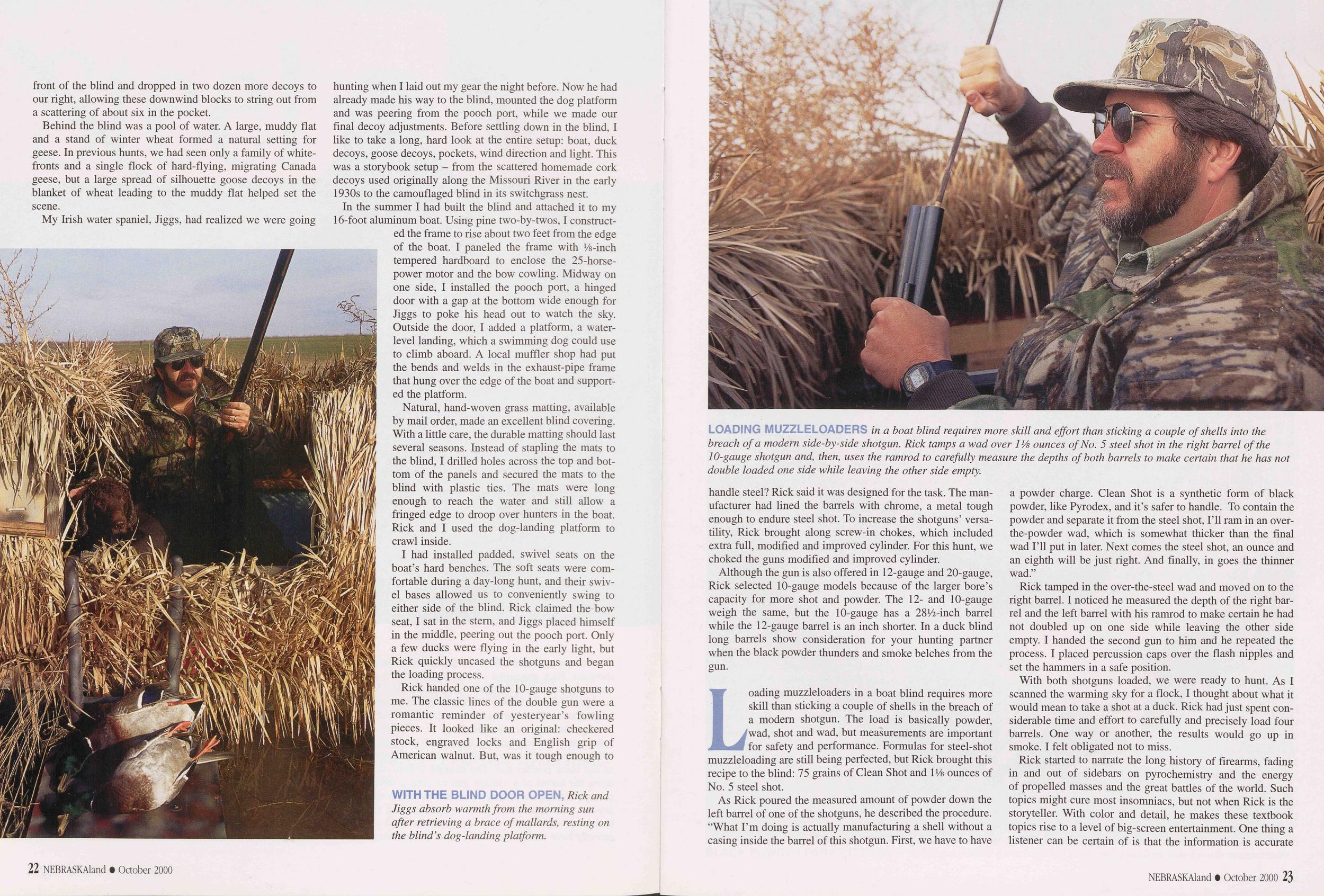 front of the blind and dropped in two dozen more decoys to our right, allowing these downwind blocks to string out from a scattering of about six in the pocket.
Behind the blind was a pool of water. A large, muddy flat and a stand of winter wheat formed a natural setting for geese. In previous hunts, we had seen only a family of white- fronts and a single flock of hard-flying, migrating Canada geese, but a large spread of silhouette goose decoys in the blanket of wheat leading to the muddy flat helped set the scene.
My Irish water spaniel, Jiggs, had realized we were going hunting when I laid out my gear the night before. Now he had already made his way to the blind, mounted the dog platform and was peering from the pooch port, while we made our final decoy adjustments. Before settling down in the blind, I like to take a long, hard look at the entire setup: boat, duck decoys, goose decoys, pockets, wind direction and light. This was a storybook setup - from the scattered homemade cork decoys used originally along the Missouri River in the early 1930s to the camouflaged blind in its switchgrass nest. In the summer I had built the blind and attached it to my 16-foot aluminum boat. Using pine two-by-twos, I construct- ed the frame to rise about two feet from the edge of the boat. I paneled the frame with Ms-inch tempered hardboard to enclose the 25-horse- power motor and the bow cowling. Midway on one side, I installed the pooch port, a hinged door with a gap at the bottom wide enough for Jiggs to poke his head out to watch the sky. Outside the door, I added a platform, a water- level landing, which a swimming dog could use to climb aboard. A local muffler shop had put the bends and welds in the exhaust-pipe frame that hung over the edge of the boat and support- ed the platform.
Natural, hand-woven grass matting, available by mail order, made an excellent blind covering. With a little care, the durable matting should last several seasons. Instead of stapling the mats to the blind, I drilled holes across the top and bot- tom of the panels and secured the mats to the blind with plastic ties. The mats were long enough to reach the water and still allow a fringed edge to droop over hunters in the boat. Rick and I used the dog-landing platform to crawl inside.
I had installed padded, swivel seats on the boat’s hard benches. The soft seats were com- fortable during a day-long hunt, and their swiv- el bases allowed us to conveniently swing to either side of the blind. Rick claimed the bow seat, I sat in the stem, and Jiggs placed himself in the middle, peering out the pooch port. Only a few ducks were flying in the early light, but Rick quickly uncased the shotguns and began the loading process.
Rick handed one of the 10-gauge shotguns to me. The classic lines of the double gun were a romantic reminder of yesteryear’s fowling pieces. It looked like an original: checkered stock, engraved locks and English grip of American walnut. But, was it tough enough to handle steel? Rick said it was designed for the task. The man- ufacturer had lined the barrels with chrome, a metal tough enough to endure steel shot. To increase the shotguns’ versa- tility, Rick brought along screw-in chokes, which included extra full, modified and improved cylinder. For this hunt, we choked the guns modified and improved cylinder.
Although the gun is also offered in 12-gauge and 20-gauge, Rick selected 10-gauge models because of the larger bore’s capacity for more shot and powder. The 12- and 10-gauge weigh the same, but the 10-gauge has a 281/2-inch barrel while the 12-gauge barrel is an inch shorter. In a duck blind long barrels show consideration for your hunting partner when the black powder thunders and smoke belches from the gun.
Loading muzzleloaders in a boat blind requires more skill than sticking a couple of shells in the breach of a modem shotgun. The load is basically powder, wad, shot and wad, but measurements are important for safety and performance. Formulas for steel-shot muzzleloading are still being perfected, but Rick brought this recipe to the blind: 75 grains of Clean Shot and IVs ounces of No. 5 steel shot.
As Rick poured the measured amount of powder down the left barrel of one of the shotguns, he described the procedure. “What I’m doing is actually manufacturing a shell without a casing inside the barrel of this shotgun. First, we have to have a powder charge. Clean Shot is a synthetic form of black powder, like Pyrodex, and it’s safer to handle. To contain the powder and separate it from the steel shot, I’ll ram in an over- the-powder wad, which is somewhat thicker than the final wad I’ll put in later. Next comes the steel shot, an ounce and an eighth will be just right. And finally, in goes the thinner wad.”
Rick tamped in the over-the-steel wad and moved on to the right barrel. I noticed he measured the depth of the right bar- rel and the left barrel with his ramrod to make certain he had not doubled up on one side while leaving the other side empty. I handed the second gun to him and he repeated the process. I placed percussion caps over the flash nipples and set the hammers in a safe position.
With both shotguns loaded, we were ready to hunt. As I scanned the warming sky for a flock, I thought about what it would mean to take a shot at a duck. Rick had just spent con- siderable time and effort to carefully and precisely load four barrels. One way or another, the results would go up in smoke. I felt obligated not to miss.
Rick started to narrate the long history of firearms, fading in and out of sidebars on pyrochemistry and the energy of propelled masses and the great battles of the world. Such topics might cure most insomniacs, but not when Rick is the storyteller. With color and detail, he makes these textbook topics rise to a level of big-screen entertainment. One thing a listener can be certain of is that the information is accurate 22 NEBRASKAland • October 2000 NEBRASKAland • October 2000 23 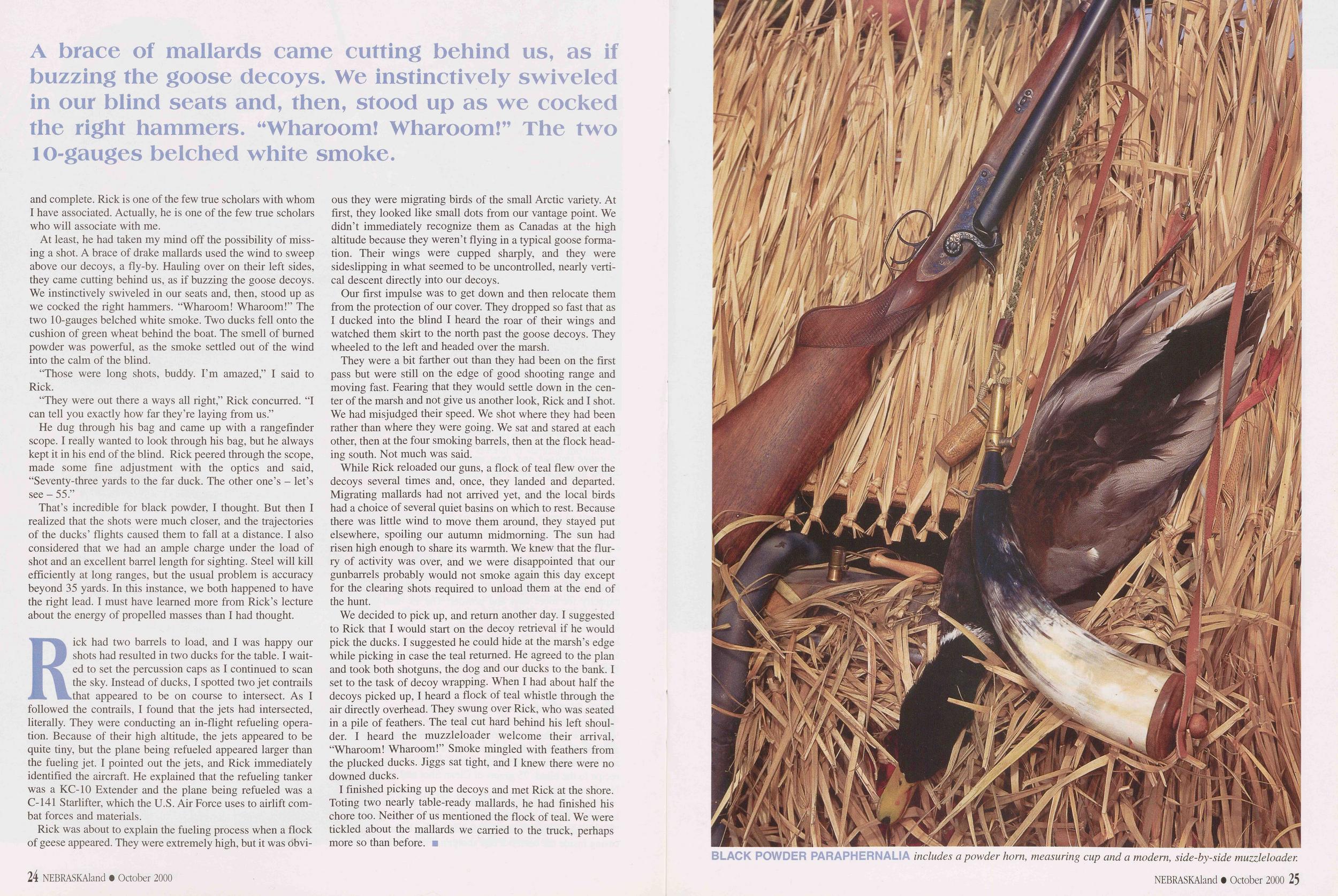 and complete. Rick is one of the few true scholars with whom I have associated. Actually, he is one of the few true scholars who will associate with me.
At least, he had taken my mind off the possibility of miss- ing a shot. A brace of drake mallards used the wind to sweep above our decoys, a fly-by. Hauling over on their left sides, they came cutting behind us, as if buzzing the goose decoys. We instinctively swiveled in our seats and, then, stood up as we cocked the right hammers. "Wharoom! Wharoom!” The two 10-gauges belched white smoke. Two ducks fell onto the cushion of green wheat behind the boat. The smell of burned powder was powerful, as the smoke settled out of the wind into the calm of the blind.
“Those were long shots, buddy. I’m amazed,” I said to Rick.
"They were out there a ways all right,” Rick concurred. "I can tell you exactly how far they’re laying from us.” He dug through his bag and came up with a rangefinder scope. I really wanted to look through his bag, but he always kept it in his end of the blind. Rick peered through the scope, made some fine adjustment with the optics and said, “Seventy-three yards to the far duck. The other one’s - let’s see - 55.”
That’s incredible for black powder, I thought. But then I realized that the shots were much closer, and the trajectories of the ducks’ flights caused them to fall at a distance. I also considered that we had an ample charge under the load of shot and an excellent barrel length for sighting. Steel will kill efficiently at long ranges, but the usual problem is accuracy beyond 35 yards. In this instance, we both happened to have the right lead. I must have learned more from Rick’s lecture about the energy of propelled masses than I had thought.
Rick had two barrels to load, and I was happy our shots had resulted in two ducks for the table. I wait- ed to set the percussion caps as I continued to scan the sky. Instead of ducks, I spotted two jet contrails that appeared to be on course to intersect. As I followed the contrails, I found that the jets had intersected, literally. They were conducting an in-flight refueling opera- tion. Because of their high altitude, the jets appeared to be quite tiny, but the plane being refueled appeared larger than the fueling jet. I pointed out the jets, and Rick immediately identified the aircraft. He explained that the refueling tanker was a KC-10 Extender and the plane being refueled was a C-141 Starlifter, which the U.S. Air Force uses to airlift com- bat forces and materials.
Rick was about to explain the fueling process when a flock of geese appeared. They were extremely high, but it was obvi- ous they were migrating birds of the small Arctic variety. At first, they looked like small dots from our vantage point. We didn’t immediately recognize them as Canadas at the high altitude because they weren’t flying in a typical goose forma- tion. Their wings were cupped sharply, and they were sideslipping in what seemed to be uncontrolled, nearly verti- cal descent directly into our decoys.
Our first impulse was to get down and then relocate them from the protection of our cover. They dropped so fast that as I ducked into the blind I heard the roar of their wings and watched them skirt to the north past the goose decoys. They wheeled to the left and headed over the marsh.
They were a bit farther out than they had been on the first pass but were still on the edge of good shooting range and moving fast. Fearing that they would settle down in the cen- ter of the marsh and not give us another look, Rick and I shot. We had misjudged their speed. We shot where they had been rather than where they were going. We sat and stared at each other, then at the four smoking barrels, then at the flock head- ing south. Not much was said.
While Rick reloaded our guns, a flock of teal flew over the decoys several times and, once, they landed and departed. Migrating mallards had not arrived yet, and the local birds had a choice of several quiet basins on which to rest. Because there was little wind to move them around, they stayed put elsewhere, spoiling our autumn midmoming. The sun had risen high enough to share its warmth. We knew that the flur- ry of activity was over, and we were disappointed that our gunbarrels probably would not smoke again this day except for the clearing shots required to unload them at the end of the hunt.
We decided to pick up, and return another day. I suggested to Rick that I would start on the decoy retrieval if he would pick the ducks. I suggested he could hide at the marsh’s edge while picking in case the teal returned. He agreed to the plan and took both shotguns, the dog and our ducks to the bank. I set to the task of decoy wrapping. When I had about half the decoys picked up, I heard a flock of teal whistle through the air directly overhead. They swung over Rick, who was seated in a pile of feathers. The teal cut hard behind his left shoul- der. I heard the muzzleloader welcome their arrival, “Wharoom! Wharoom!” Smoke mingled with feathers from the plucked ducks. Jiggs sat tight, and I knew there were no downed ducks.
I finished picking up the decoys and met Rick at the shore. Toting two nearly table-ready mallards, he had finished his chore too. Neither of us mentioned the flock of teal. We were tickled about the mallards we carried to the truck, perhaps more so than before.
Canoeing the Cedar River
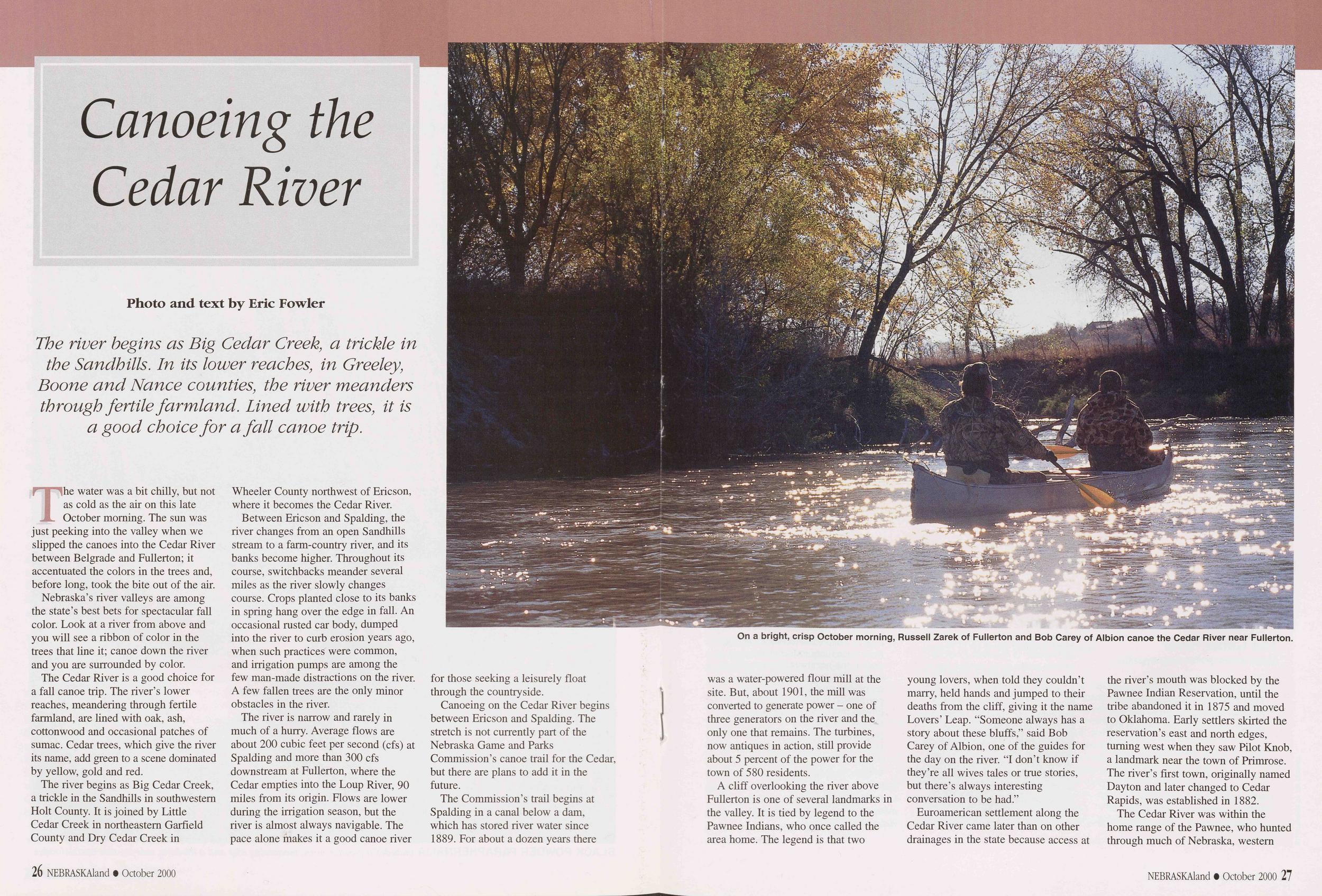
Photo and text by Eric Fowler The river begins as Big Cedar Creek, a trickle in the Sandhills. In its lower reaches, in Greeley, Boone and Nance counties, the river meanders through fertile farmland. Lined with trees, it is a good choice for a fall canoe trip.The water was a bit chilly, but not as cold as the air on this late October morning. The sun was just peeking into the valley when we slipped the canoes into the Cedar River between Belgrade and Fullerton; it accentuated the colors in the trees and, before long, took the bite out of the air.
Nebraska’s river valleys are among the state’s best bets for spectacular fall color. Look at a river from above and you will see a ribbon of color in the trees that line it; canoe down the river and you are surrounded by color.
The Cedar River is a good choice for a fall canoe trip. The river’s lower reaches, meandering through fertile farmland, are lined with oak, ash, cottonwood and occasional patches of sumac. Cedar trees, which give the river its name, add green to a scene dominated by yellow, gold and red.
The river begins as Big Cedar Creek, a trickle in the Sandhills in southwestern Holt County. It is joined by Little Cedar Creek in northeastern Garfield County and Dry Cedar Creek in Wheeler County northwest of Ericson, where it becomes the Cedar River.
Between Ericson and Spalding, the river changes from an open Sandhills stream to a farm-country river, and its banks become higher. Throughout its course, switchbacks meander several miles as the river slowly changes course. Crops planted close to its banks in spring hang over the edge in fall. An occasional rusted car body, dumped into the river to curb erosion years ago, when such practices were common, and irrigation pumps are among the few man-made distractions on the river. A few fallen trees are the only minor obstacles in the river.
The river is narrow and rarely in much of a hurry. Average flows are about 200 cubic feet per second (cfs) at Spalding and more than 300 cfs downstream at Fullerton, where the Cedar empties into the Loup River, 90 miles from its origin. Flows are lower during the irrigation season, but the river is almost always navigable. The pace alone makes in a good canoe river for those seeking a leisurely float through the countryside.
Canoeing on the Cedar River begins between Ericson and Spalding. The stretch is not currently part of the Nebraska Game and Parks Commission’s canoe trail for the Cedar, but there are plans to add it in the future.
The Commission’s trail begins at Spalding in a canal below a dam, which has stored river water since 1889. For about a dozen years there was a water-powered flour mill at the site. But, about 1901, the mill was converted to generate power - one of three generators on the river and the only one that remains. The turbines, now antiques in action, still provide about 5 percent of the power for the town of 580 residents.
A cliff overlooking the river above Fullerton is one of several landmarks in the valley. It is tied by legend to the Pawnee Indians, who once called the area home. The legend is that two young lovers, when told they couldn’t marry, held hands and jumped to their deaths from the cliff, giving it the name Lovers’ Leap. “Someone always has a story about these bluffs,” said Bob Carey of Albion, one of the guides for the day on the river. "I don’t know if they’re all wives tales or true stories, but there’s always interesting conversation to be had.”
Euroamerican settlement along the Cedar River came later than on other drainages in the state because access at the river’s mouth was blocked by the Pawnee Indian Reservation, until the tribe abandoned it in 1875 and moved to Oklahoma. Early settlers skirted the reservation’s east and north edges, turning west when they saw Pilot Knob, a landmark near the town of Primrose. The river’s first town, originally named Dayton and later changed to Cedar Rapids, was established in 1882.
The Cedar River was within the home range of the Pawnee, who hunted through much of Nebraska, western 26 NEBRASKAland • October 2000 NEBRASKAland • October 2000 27 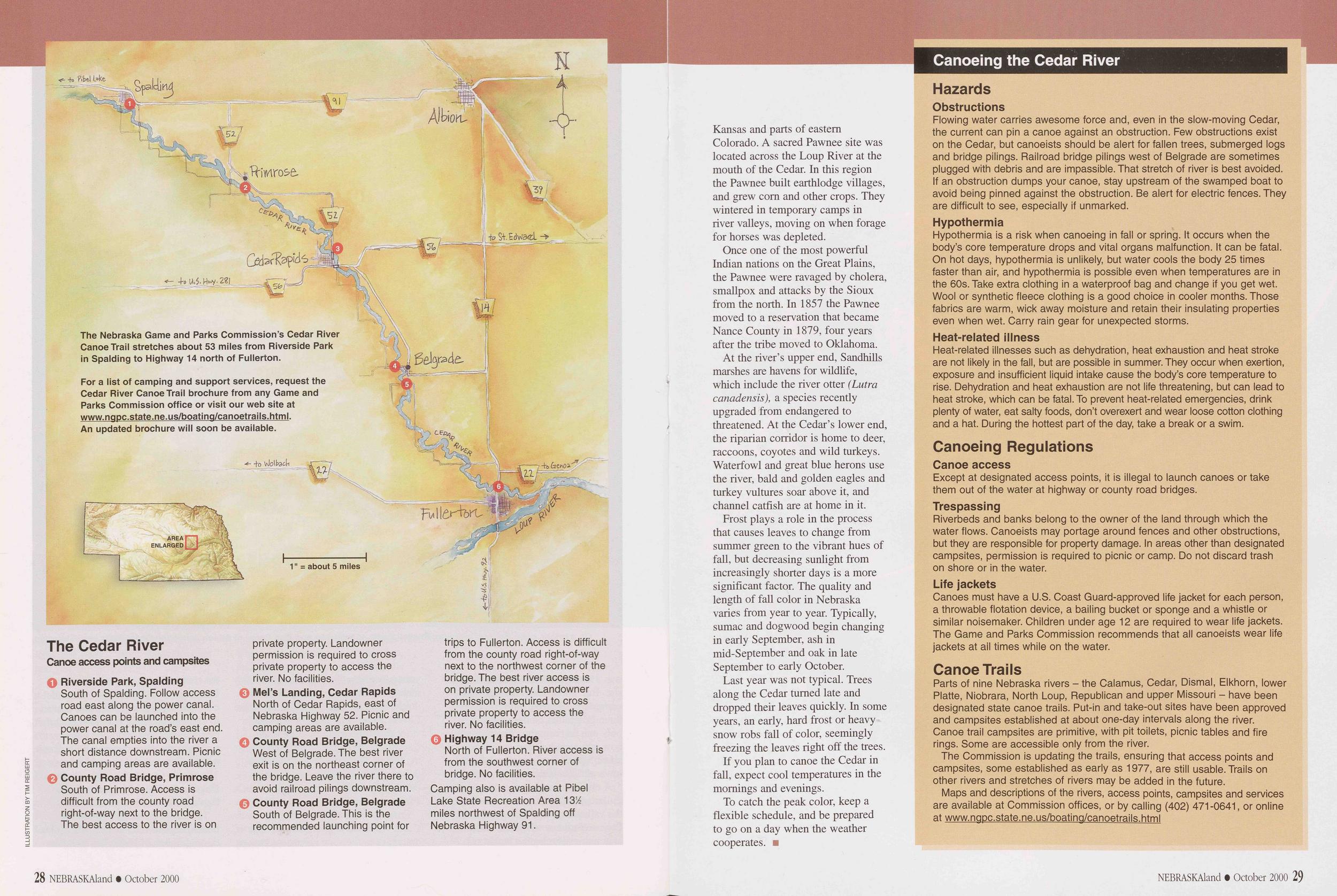 Kansas and parts of eastern Colorado. A sacred Pawnee site was located across the Loup River at the mouth of the Cedar. In this region the Pawnee built earthlodge villages, and grew com and other crops. They wintered in temporary camps in river valleys, moving on when forage for horses was depleted.
in Spalding to Highway 14 north of Fullerton. For a list of camping and support services, request the Cedar River Canoe Trail brochure from any Game and Parks Commission office or visit our web site at www.nqpc.state.ne.us/boatina/canoetrailsjitmi. An updated brochure will soon be available.
1" = about 5 miles
The Cedar River Canoe access points and campsites Riverside Park, SpaldingSouth of Spalding. Follow access road east along the power canal. Canoes can be launched into the power canal at the road’s east end. The canal empties into the river a short distance downstream. Picnic and camping areas are available.
County Road Bridge, Primrose
South of Primrose. Access is difficult from the county road right-of-way next to the bridge. The best access to the river is on private property. Landowner permission is required to cross private property to access the river. No facilities.
Mel’s Landing, Cedar Rapids
North of Cedar Rapids, east of Nebraska Highway 52. Picnic and camping areas are available.
County Road Bridge, Belgrade
West of Belgrade. The best river exit is on the northeast corner of the bridge. Leave the river there to avoid railroad pilings downstream.
County Road Bridge, Belgrade
South of Belgrade. This is the recommended launching point for trips to Fullerton. Access is difficult from the county road right-of-way next to the northwest corner of the bridge. The best river access is on private property. Landowner permission is required to cross private property to access the river. No facilities.
Highway 14 Bridge
North of Fullerton. River access is from the southwest corner of bridge. No facilities.
Camping also is available at Pibel Lake State Recreation Area 1M miles northwest of Spalding off Nebraska Highway 91.
Once one of the most powerful Indian nations on the Great Plains, the Pawnee were ravaged by cholera, smallpox and attacks by the Sioux from the north. In 1857 the Pawnee moved to a reservation that became Nance County in 1879, four years after the tribe moved to Oklahoma.
At the river’s upper end, Sandhills marshes are havens for wildlife, which include the river otter (Lutra canadensis), a species recently upgraded from endangered to threatened. At the Cedar’s lower end, the riparian corridor is home to deer, raccoons, coyotes and wild turkeys. Waterfowl and great blue herons use the river, bald and golden eagles and turkey vultures soar above it, and channel catfish are at home in it.
Frost plays a role in the process that causes leaves to change from summer green to the vibrant hues of fall, but decreasing sunlight from increasingly shorter days is a more significant factor. The quality and length of fall color in Nebraska varies from year to year. Typically, sumac and dogwood begin changing in early September, ash in mid-September and oak in late September to early October.
Last year was not typical. Trees along the Cedar turned late and dropped their leaves quickly. In some years, an early, hard frost or heavy snow robs fall of color, seemingly freezing the leaves right off the trees.
If you plan to canoe the Cedar in fall, expect cool temperatures in the mornings and evenings.
To catch the peak color, keep a flexible schedule, and be prepared to go on a day when the weather cooperates. ■
Canoeing the Cedar River HazardsObstructions
Flowing water carries awesome force and, even in the slow-moving Cedar, the current can pin a canoe against an obstruction. Few obstructions exist on the Cedar, but canoeists should be alert for fallen trees, submerged logs and bridge pilings. Railroad bridge pilings west of Belgrade are sometimes plugged with debris and are impassible. That stretch of river is best avoided. If an obstruction dumps your canoe, stay upstream of the swamped boat to avoid being pinned against the obstruction. Be alert for electric fences. They are difficult to see, especially if unmarked.
Hypothermia
Hypothermia is a risk when canoeing in fall or spring. It occurs when the body’s core temperature drops and vital organs malfunction. It can be fatal. On hot days, hypothermia is unlikely, but water cools the body 25 times faster than air, and hypothermia is possible even when temperatures are in the 60s. Take extra clothing in a waterproof bag and change if you get wet. Wool or synthetic fleece clothing is a good choice in cooler months. Those fabrics are warm, wick away moisture and retain their insulating properties even when wet. Carry rain gear for unexpected storms.
Heat-related illness
Heat-related illnesses such as dehydration, heat exhaustion and heat stroke are not likely in the fall, but are possible in summer. They occur when exertion, exposure and insufficient liquid intake cause the body’s core temperature to rise. Dehydration and heat exhaustion are not life threatening, but can lead to heat stroke, which can be fatal. To prevent heat-related emergencies, drink plenty of water, eat salty foods, don’t overexert and wear loose cotton clothing and a hat. During the hottest part of the day, take a break or a swim.
Canoeing RegulationsCanoe access
Except at designated access points, it is illegal to launch canoes or take them out of the water at highway or county road bridges.
Trespassing
Riverbeds and banks belong to the owner of the land through which the water flows. Canoeists may portage around fences and other obstructions, but they are responsible for property damage. In areas other than designated campsites, permission is required to picnic or camp. Do not discard trash on shore or in the water.
Life jackets
Canoes must have a U.S. Coast Guard-approved life jacket for each person, a throwable flotation device, a bailing bucket or sponge and a whistle or similar noisemaker. Children under age 12 are required to wear life jackets. The Game and Parks Commission recommends that all canoeists wear life jackets at ail times while on the water.
Canoe Trails
Parts of nine Nebraska rivers - the Calamus, Cedar, Dismal, Elkhorn, lower Platte, Niobrara, North Loup, Republican and upper Missouri - have been designated state canoe trails. Put-in and take-out sites have been approved and campsites established at about one-day intervals along the river. Canoe trail campsites are primitive, with pit toilets, picnic tables and fire rings. Some are accessible only from the river.
The Commission is updating the trails, ensuring that access points and campsites, some established as early as 1977, are still usable. Trails on other rivers and stretches of rivers may be added in the future. Maps and descriptions of the rivers, access points, campsites and services are available at Commission offices, or by calling (402) 471-0641, or online at www.nopc.state.ne.us/boatinq/canoetrails.html
28 NEBRASKAland • October 2000 NEBRASKAland • October 2000 29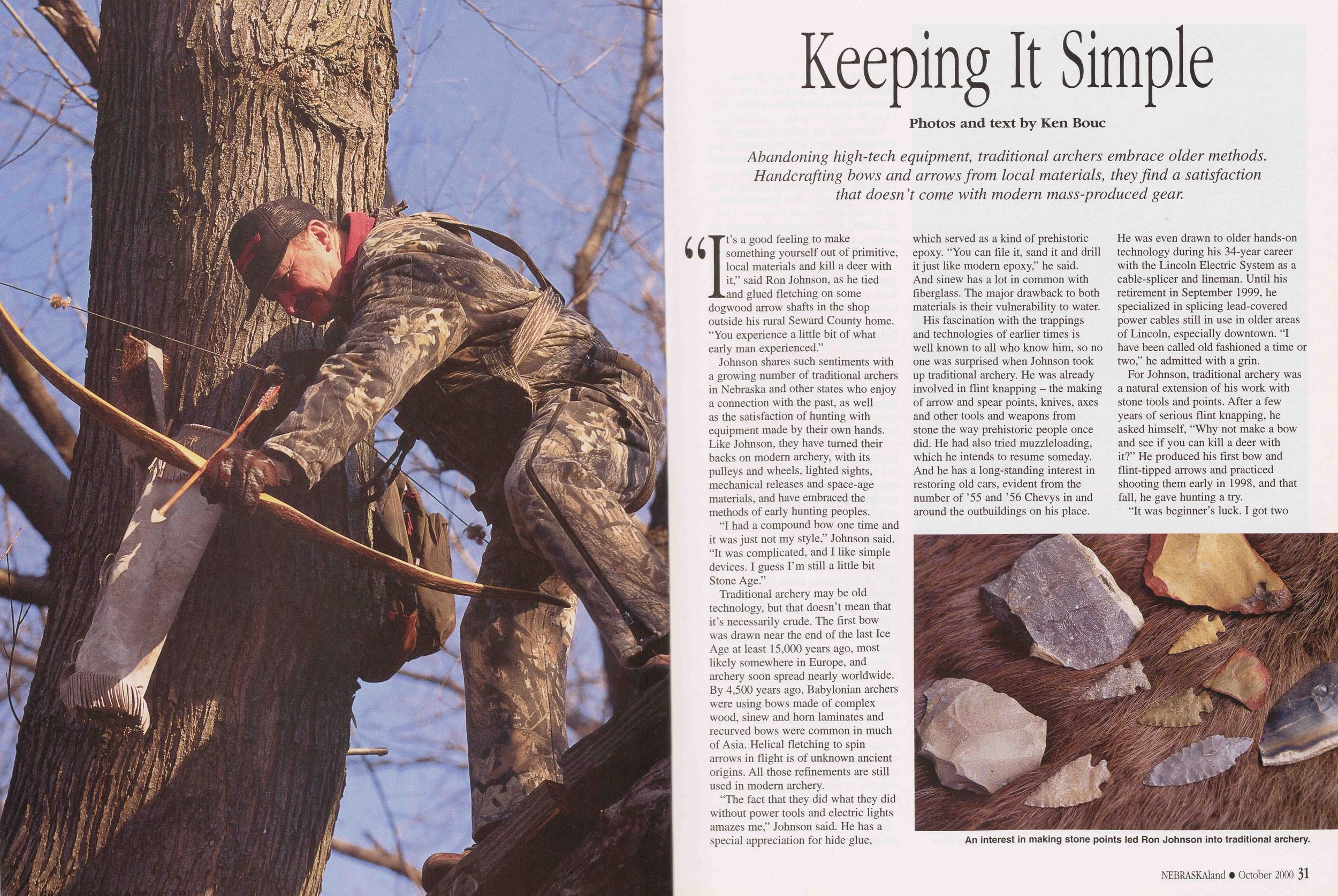
Keeping It Simple
Photos and text by Ken Bouc Abandoning high-tech equipment, traditional archers embrace older methods. Handcrafting bows and arrows from local materials, they find a satisfaction that doesn ’t come with modern mass-produced gear.It’s a good feeling to make something yourself out of primitive, local materials and kill a deer with it,” said Ron Johnson, as he tied and glued fletching on some dogwood arrow shafts in the shop outside his rural Seward County home. “You experience a little bit of what early man experienced.”
Johnson shares such sentiments with a growing number of traditional archers in Nebraska and other states who enjoy a connection with the past, as well as the satisfaction of hunting with equipment made by their own hands. Like Johnson, they have turned their backs on modem archery, with its pulleys and wheels, lighted sights, mechanical releases and space-age materials, and have embraced the methods of early hunting peoples.
“I had a compound bow one time and it was just not my style,” Johnson said. “It was complicated, and I like simple devices. I guess I’m still a little bit Stone Age.”
Traditional archery may be old technology, but that doesn’t mean that it’s necessarily crude. The first bow was drawn near the end of the last Ice Age at least 15,000 years ago, most likely somewhere in Europe, and archery soon spread nearly worldwide. By 4,500 years ago, Babylonian archers were using bows made of complex wood, sinew and horn laminates and recurved bows were common in much of Asia. Helical fletching to spin arrows in flight is of unknown ancient origins. All those refinements are still used in modem archery.
“The fact that they did what they did without power tools and electric lights amazes me,” Johnson said. He has a special appreciation for hide glue, which served as a kind of prehistoric epoxy. “You can file it, sand it and drill it just like modem epoxy,” he said. And sinew has a lot in common with fiberglass. The major drawback to both materials is their vulnerability to water.
His fascination with the trappings and technologies of earlier times is well known to all who know him, so no one was surprised when Johnson took up traditional archery. He was already involved in flint knapping - the making of arrow and spear points, knives, axes and other tools and weapons from stone the way prehistoric people once did. He had also tried muzzleloading, which he intends to resume someday. And he has a long-standing interest in restoring old cars, evident from the number of ’55 and ’56 Chevys in and around the outbuildings on his place. He was even drawn to older hands-on technology during his 34-year career with the Lincoln Electric System as a cable-splicer and lineman. Until his retirement in September 1999, he specialized in splicing lead-covered power cables still in use in older areas of Lincoln, especially downtown. “I have been called old fashioned a time or two,” he admitted with a grin.
For Johnson, traditional archery was a natural extension of his work with stone tools and points. After a few years of serious flint knapping, he asked himself, “Why not make a bow and see if you can kill a deer with it?” He produced his first bow and flint-tipped arrows and practiced shooting them early in 1998, and that fall, he gave hunting a try.
“It was beginner’s luck. I got two NEBRASKAland • October 2000 31 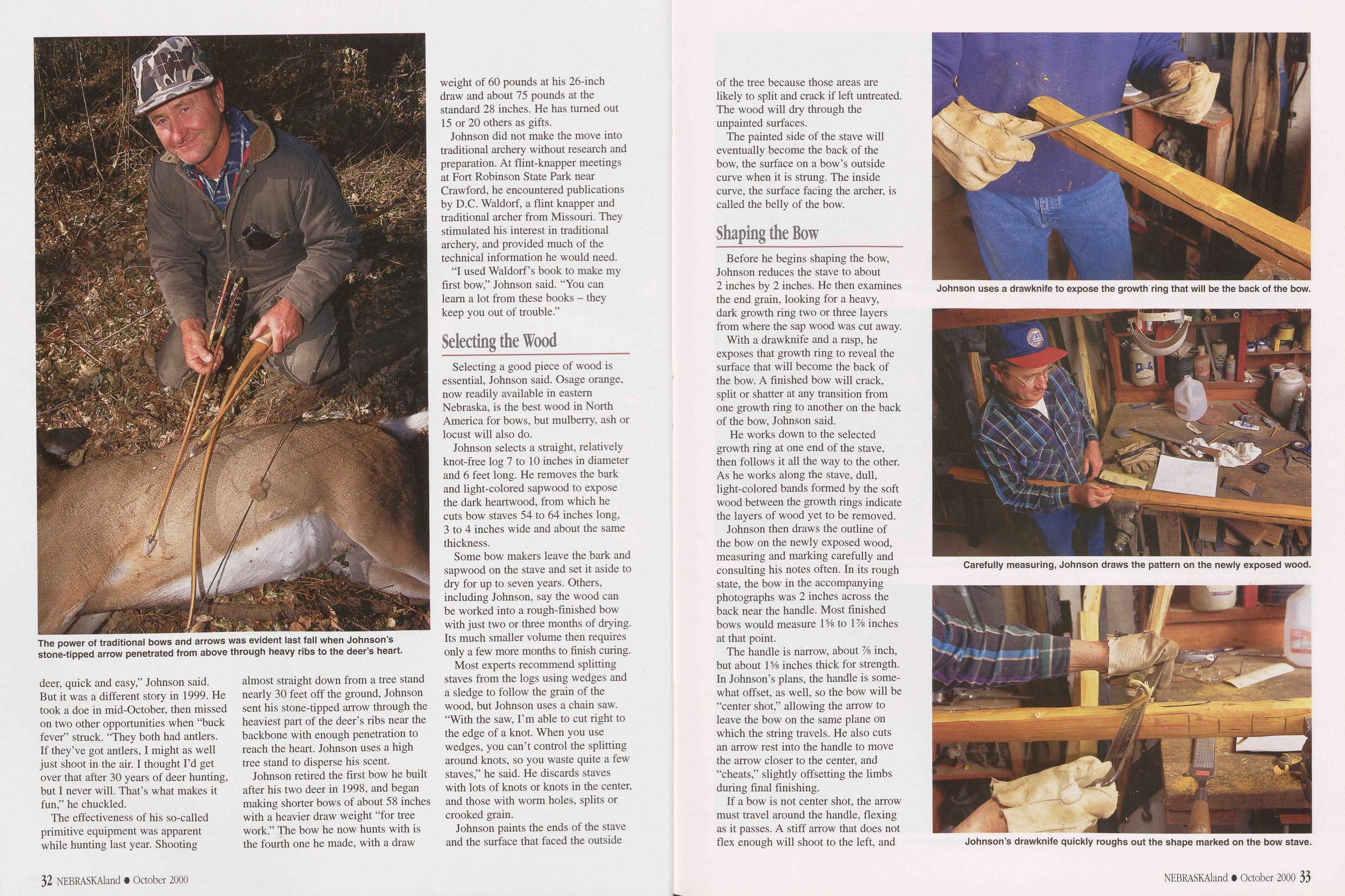 deer, quick and easy,” Johnson said. But it was a different story in 1999. He took a doe in mid-October, then missed on two other opportunities when “buck fever” struck. “They both had antlers. If they’ve got antlers, I might as well just shoot in the air. I thought I’d get over that after 30 years of deer hunting, but I never will. That’s what makes it fun,” he chuckled.
The effectiveness of his so-called primitive equipment was apparent while hunting last year. Shooting almost straight down from a tree stand nearly 30 feet off the ground, Johnson sent his stone-tipped arrow through the heaviest part of the deer’s ribs near the backbone with enough penetration to reach the heart. Johnson uses a high tree stand to disperse his scent.
Johnson retired the first bow he built after his two deer in 1998, and began making shorter bows of about 58 inches with a heavier draw weight “for tree work.” The bow he now hunts with is the fourth one he made, with a draw weight of 60 pounds at his 26-inch draw and about 75 pounds at the standard 28 inches. He has turned out 15 or 20 others as gifts.
Johnson did not make the move into traditional archery without research and preparation. At flint-knapper meetings at Fort Robinson State Park near Crawford, he encountered publications by D.C. Waldorf, a flint knapper and traditional archer from Missouri. They stimulated his interest in traditional archery, and provided much of the technical information he would need.
“I used Waldorf’s book to make my first bow,” Johnson said. “You can learn a lot from these books - they keep you out of trouble.”
Selecting the WoodSelecting a good piece of wood is essential, Johnson said. Osage orange, now readily available in eastern Nebraska, is the best wood in North America for bows, but mulberry, ash or locust will also do.
Johnson selects a straight, relatively knot-free log 7 to 10 inches in diameter and 6 feet long. He removes the bark and light-colored sapwood to expose the dark heartwood, from which he cuts bow staves 54 to 64 inches long, 3 to 4 inches wide and about the same thickness.
Some bow makers leave the bark and sapwood on the stave and set it aside to dry for up to seven years. Others, including Johnson, say the wood can be worked into a rough-finished bow with just two or three months of drying. Its much smaller volume then requires only a few more months to finish curing.
Most experts recommend splitting staves from the logs using wedges and a sledge to follow the grain of the wood, but Johnson uses a chain saw. “With the saw, I’m able to cut right to the edge of a knot. When you use wedges, you can’t control the splitting around knots, so you waste quite a few staves,” he said. He discards staves with lots of knots or knots in the center, and those with worm holes, splits or crooked grain.
Johnson paints the ends of the stave and the surface that faced the outside of the tree because those areas are likely to split and crack if left untreated. The wood will dry through the unpainted surfaces.
The painted side of the stave will eventually become the back of the bow, the surface on a bow’s outside curve when it is strung. The inside curve, the surface facing the archer, is called the belly of the bow.
Shaping the BowBefore he begins shaping the bow, Johnson reduces the stave to about 2 inches by 2 inches. He then examines the end grain, looking for a heavy, dark growth ring two or three layers from where the sap wood was cut away.
With a drawknife and a rasp, he exposes that growth ring to reveal the surface that will become the back of the bow. A finished bow will crack, split or shatter at any transition from one growth ring to another on the back of the bow, Johnson said.
He works down to the selected growth ring at one end of the stave, then follows it all the way to the other. As he works along the stave, dull, light-colored bands formed by the soft wood between the growth rings indicate the layers of wood yet to be removed.
Johnson then draws the outline of the bow on the newly exposed wood, measuring and marking carefully and consulting his notes often. In its rough state, the bow in the accompanying photographs was 2 inches across the back near the handle. Most finished bows would measure l5/s to 1% inches at that point.
The handle is narrow, about % inch, but about l5/8 inches thick for strength. In Johnson’s plans, the handle is some- what offset, as well, so the bow will be “center shot,” allowing the arrow to leave the bow on the same plane on which the string travels. He also cuts an arrow rest into the handle to move the arrow closer to the center, and “cheats,” slightly offsetting the limbs during final finishing.
If a bow is not center shot, the arrow must travel around the handle, flexing as it passes. A stiff arrow that does not flex enough will shoot to the left, and 32 NEBRASKAland • October 2000 NEBRASKAland • October 2000 33 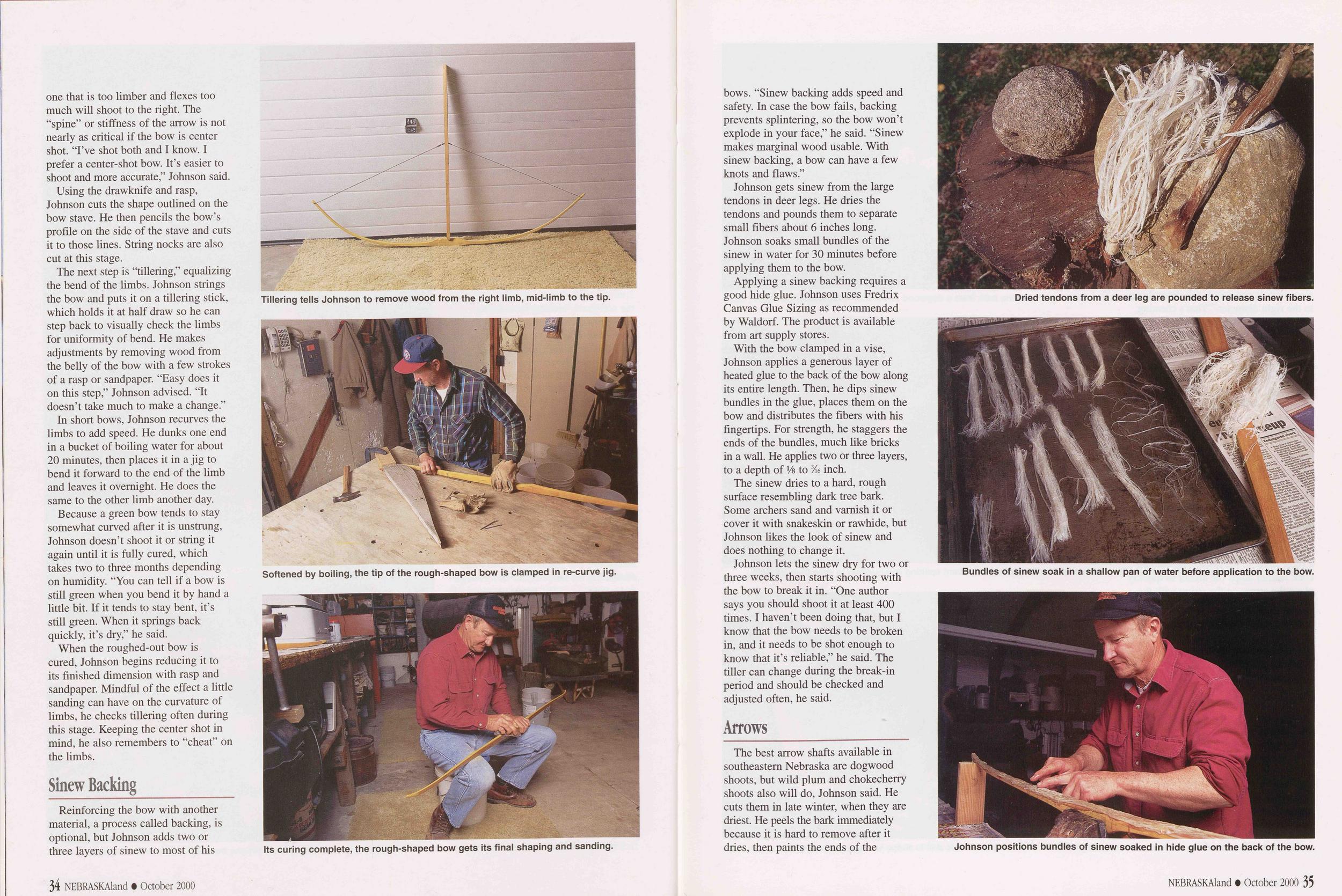 one that is too limber and flexes too much will shoot to the right. The “spine” or stiffness of the arrow is not nearly as critical if the bow is center shot. “I've shot both and I know. I prefer a center-shot bow. It’s easier to shoot and more accurate,” Johnson said.
Using the drawknife and rasp, Johnson cuts the shape outlined on the bow stave. He then pencils the bow’s profile on the side of the stave and cuts it to those lines. String nocks are also cut at this stage.
The next step is “tillering,” equalizing the bend of the limbs. Johnson strings the bow and puts it on a tillering stick, which holds it at half draw so he can step back to visually check the limbs for uniformity of bend. He makes adjustments by removing wood from the belly of the bow with a few strokes of a rasp or sandpaper. “Easy does it on this step,” Johnson advised. “It doesn’t take much to make a change.”
In short bows, Johnson recurves the limbs to add speed. He dunks one end in a bucket of boiling water for about 20 minutes, then places it in a jig to bend it forward to the end of the limb and leaves it overnight. He does the same to the other limb another day.
Because a green bow tends to stay somewhat curved after it is unstrung, Johnson doesn’t shoot it or string it again until it is fully cured, which takes two to three months depending on humidity. “You can tell if a bow is still green when you bend it by hand a little bit. If it tends to stay bent, it’s still green. When it springs back quickly, it’s dry,” he said.
When the roughed-out bow is cured, Johnson begins reducing it to its finished dimension with rasp and sandpaper. Mindful of the effect a little sanding can have on the curvature of limbs, he checks tillering often during this stage. Keeping the center shot in mind, he also remembers to “cheat” on the limbs.
Sinew BackingReinforcing the bow with another material, a process called backing, is optional, but Johnson adds two or three layers of sinew to most of his bows. “Sinew backing adds speed and safety. In case the bow fails, backing prevents splintering, so the bow won’t explode in your face,” he said. “Sinew makes marginal wood usable. With sinew backing, a bow can have a few knots and flaws.”
Johnson gets sinew from the large tendons in deer legs. He dries the tendons and pounds them to separate small fibers about 6 inches long. Johnson soaks small bundles of the sinew in water for 30 minutes before applying them to the bow.
Applying a sinew backing requires a good hide glue. Johnson uses Fredrix Canvas Glue Sizing as recommended by Waldorf. The product is available from art supply stores.
With the bow clamped in a vise, Johnson applies a generous layer of heated glue to the back of the bow along its entire length. Then, he dips sinew bundles in the glue, places them on the bow and distributes the fibers with his fingertips. For strength, he staggers the ends of the bundles, much like bricks in a wall. He applies two or three layers, to a depth of Vs to %> inch.
The sinew dries to a hard, rough surface resembling dark tree bark. Some archers sand and varnish it or cover it with snakeskin or rawhide, but Johnson likes the look of sinew and does nothing to change it.
Johnson lets the sinew dry for two or three weeks, then starts shooting with the bow to break it in. “One author says you should shoot it at least 400 times. I haven’t been doing that, but I know that the bow needs to be broken in, and it needs to be shot enough to know that it’s reliable,” he said. The tiller can change during the break-in period and should be checked and adjusted often, he said.
The best arrow shafts available in southeastern Nebraska are dogwood shoots, but wild plum and chokecherry shoots also will do, Johnson said. He cuts them in late winter, when they are driest. He peels the bark immediately because it is hard to remove after it dries, then paints the ends of the 34 NEBRASKAland • October 2000 NEBRASKAland • October 2000 35 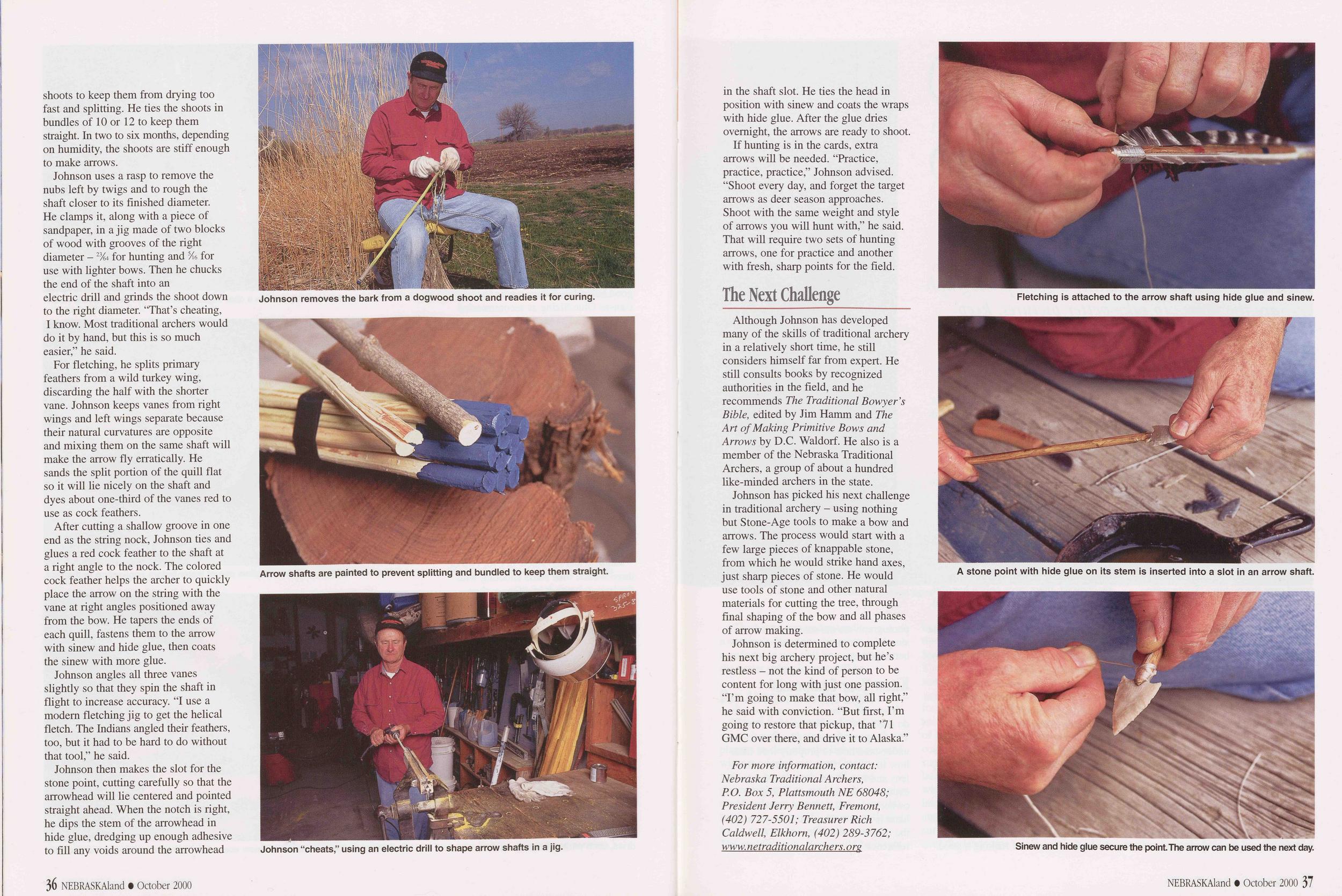 shoots to keep them from drying too fast and splitting. He ties the shoots in bundles of 10 or 12 to keep them straight. In two to six months, depending on humidity, the shoots are stiff enough to make arrows.
Johnson uses a rasp to remove the nubs left by twigs and to rough the shaft closer to its finished diameter. He clamps it, along with a piece of sandpaper, in a jig made of two blocks of wood with grooves of the right diameter - % for hunting and Xs for use with lighter bows. Then he chucks the end of the shaft into an electric drill and grinds the shoot down to the right diameter. “That’s cheating, I know. Most traditional archers would do it by hand, but this is so much easier,” he said.
For fletching, he splits primary feathers from a wild turkey wing, discarding the half with the shorter vane. Johnson keeps vanes from right wings and left wings separate because their natural curvatures are opposite and mixing them on the same shaft will make the arrow fly erratically. He sands the split portion of the quill flat so it will lie nicely on the shaft and dyes about one-third of the vanes red to use as cock feathers.
After cutting a shallow groove in one end as the string nock, Johnson ties and glues a red cock feather to the shaft at a right angle to the nock. The colored cock feather helps the archer to quickly place the arrow on the string with the vane at right angles positioned away from the bow. He tapers the ends of each quill, fastens them to the arrow with sinew and hide glue, then coats the sinew with more glue.
Johnson angles all three vanes slightly so that they spin the shaft in flight to increase accuracy. "I use a modem fletching jig to get the helical fletch. The Indians angled their feathers, too, but it had to be hard to do without that tool,” he said.
Johnson then makes the slot for the stone point, cutting carefully so that the arrowhead will lie centered and pointed straight ahead. When the notch is right, he dips the stem of the arrowhead in hide glue, dredging up enough adhesive to fill any voids around the arrowhead in the shaft slot. He ties the head in position with sinew and coats the wraps with hide glue. After the glue dries overnight, the arrows are ready to shoot.
If hunting is in the cards, extra arrows will be needed. “Practice, practice, practice,” Johnson advised. “Shoot every day, and forget the target arrows as deer season approaches. Shoot with the same weight and style of arrows you will hunt with,” he said. That will require two sets of hunting arrows, one for practice and another with fresh, sharp points for the field.
The Next ChallengeAlthough Johnson has developed many of the skills of traditional archery in a relatively short time, he still considers himself far from expert. He still consults books by recognized authorities in the field, and he recommends The Traditional Bowyer's Bible, edited by Jim Hamm and The Art of Making Primitive Bows and Arrows by D.C. Waldorf. He also is a member of the Nebraska Traditional Archers, a group of about a hundred like-minded archers in the state.
Johnson has picked his next challenge in traditional archery - using nothing but Stone-Age tools to make a bow and arrows. The process would start with a few large pieces of knappable stone, from which he would strike hand axes, just sharp pieces of stone. He would use tools of stone and other natural materials for cutting the tree, through final shaping of the bow and all phases of arrow making.
Johnson is determined to complete his next big archery project, but he’s restless - not the kind of person to be content for long with just one passion. “I’m going to make that bow, all right,” he said with conviction. “But first, I’m going to restore that pickup, that ’71 GMC over there, and drive it to Alaska.”
For more information, contact: Nebraska Traditional Archers, P.O. Box 5, Plattsmouth NE 68048; President Jerry Bennett, Fremont, (402) 727-5501; Treasurer Rich Caldwell, Elkhorn, (402) 289-3762; www. netraditionalarchers. org
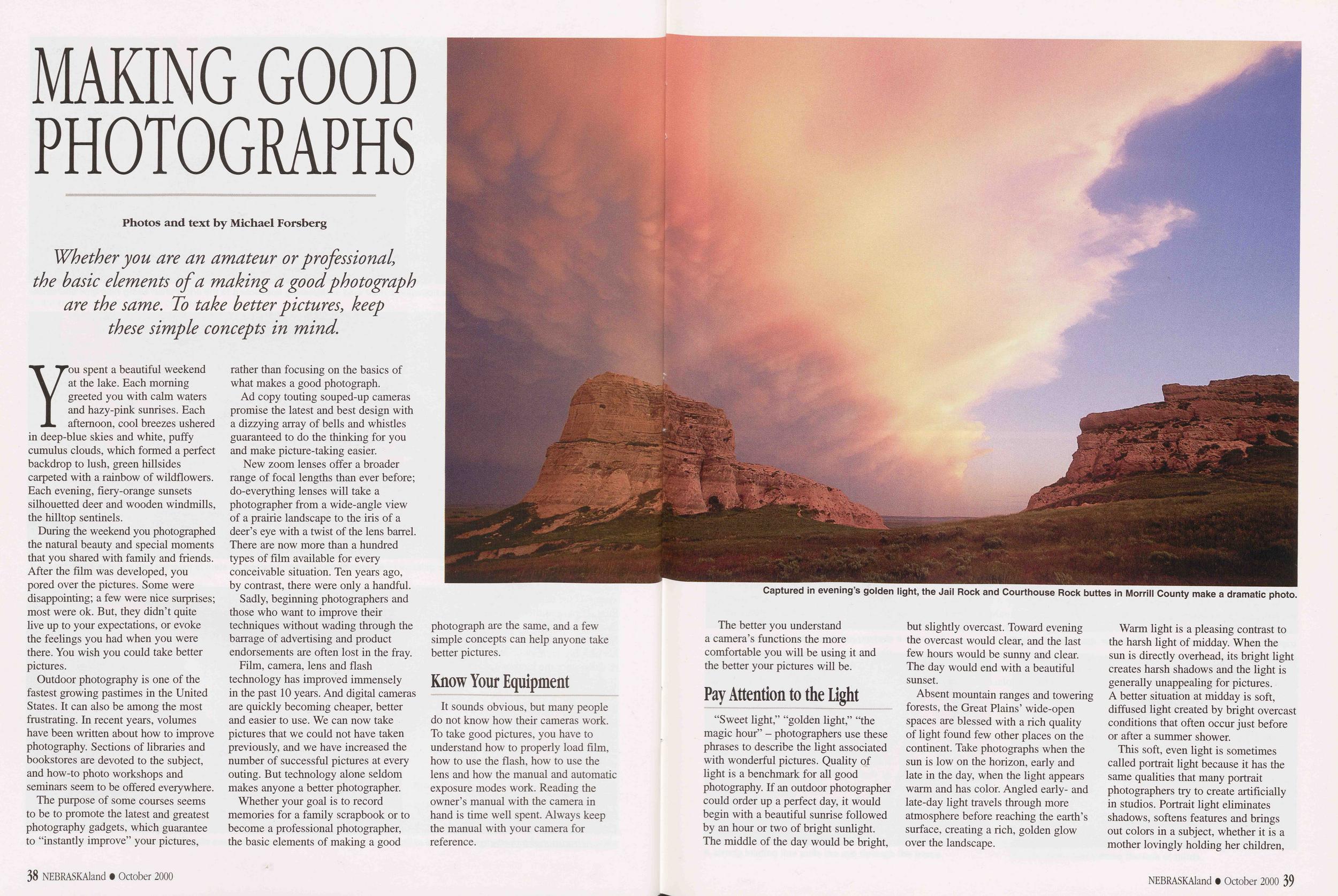
MAKING GOOD PHOTOGRAPHS
Photos and text by Michael Forsberg Whether you are an amateur or professional, the basic elements of a making a good photograph are the same. To take better pictures, keep these simple concepts in mind.You spent a beautiful weekend at the lake. Each morning greeted you with calm waters and hazy-pink sunrises. Each afternoon, cool breezes ushered in deep-blue skies and white, puffy cumulus clouds, which formed a perfect backdrop to lush, green hillsides carpeted with a rainbow of wildflowers. Each evening, fiery-orange sunsets silhouetted deer and wooden windmills, the hilltop sentinels.
During the weekend you photographed the natural beauty and special moments that you shared with family and friends. After the film was developed, you pored over the pictures. Some were disappointing; a few were nice surprises; most were ok. But, they didn’t quite live up to your expectations, or evoke the feelings you had when you were there. You wish you could take better pictures.
Outdoor photography is one of the fastest growing pastimes in the United States. It can also be among the most frustrating. In recent years, volumes have been written about how to improve photography. Sections of libraries and bookstores are devoted to the subject, and how-to photo workshops and seminars seem to be offered everywhere.
The purpose of some courses seems to be to promote the latest and greatest photography gadgets, which guarantee to “instantly improve” your pictures, rather than focusing on the basics of what makes a good photograph.
Ad copy touting souped-up cameras promise the latest and best design with a dizzying array of bells and whistles guaranteed to do the thinking for you and make picture-taking easier.
New zoom lenses offer a broader range of focal lengths than ever before; do-everything lenses will take a photographer from a wide-angle view of a prairie landscape to the iris of a deer’s eye with a twist of the lens barrel. There are now more than a hundred types of film available for every conceivable situation. Ten years ago, by contrast, there were only a handful.
Sadly, beginning photographers and those who want to improve their techniques without wading through the barrage of advertising and product endorsements are often lost in the fray.
Film, camera, lens and flash technology has improved immensely in the past 10 years. And digital cameras are quickly becoming cheaper, better and easier to use. We can now take pictures that we could not have taken previously, and we have increased the number of successful pictures at every outing. But technology alone seldom makes anyone a better photographer.
Whether your goal is to record memories for a family scrapbook or to become a professional photographer, the basic elements of making a good photograph are the same, and a few simple concepts can help anyone take better pictures.
Know Your EquipmentIt sounds obvious, but many people do not know how their cameras work. To take good pictures, you have to understand how to properly load film, how to use the flash, how to use the lens and how the manual and automatic exposure modes work. Reading the owner’s manual with the camera in hand is time well spent. Always keep the manual with your camera for reference.
The better you understand a camera’s functions the more comfortable you will be using it and the better your pictures will be.
Pay Attention to the Light“Sweet light,” “golden light,” “the magic hour” - photographers use these phrases to describe the light associated with wonderful pictures. Quality of light is a benchmark for all good photography. If an outdoor photographer could order up a perfect day, it would begin with a beautiful sunrise followed by an hour or two of bright sunlight. The middle of the day would be bright, but slightly overcast. Toward evening the overcast would clear, and the last few hours would be sunny and clear. The day would end with a beautiful sunset.
Absent mountain ranges and towering forests, the Great Plains’ wide-open spaces are blessed with a rich quality of light found few other places on the continent. Take photographs when the sun is low on the horizon, early and late in the day, when the light appears warm and has color. Angled early- and late-day light travels through more atmosphere before reaching the earth’s surface, creating a rich, golden glow over the landscape.
Warm light is a pleasing contrast to the harsh light of midday. When the sun is directly overhead, its bright light creates harsh shadows and the light is generally unappealing for pictures. A better situation at midday is soft, diffused light created by bright overcast conditions that often occur just before or after a summer shower.
This soft, even light is sometimes called portrait light because it has the same qualities that many portrait photographers try to create artificially in studios. Portrait light eliminates shadows, softens features and brings out colors in a subject, whether it is a mother lovingly holding her children, 38 NEBRASKAland • October 2000 NEBRASKAland • October 2000 39 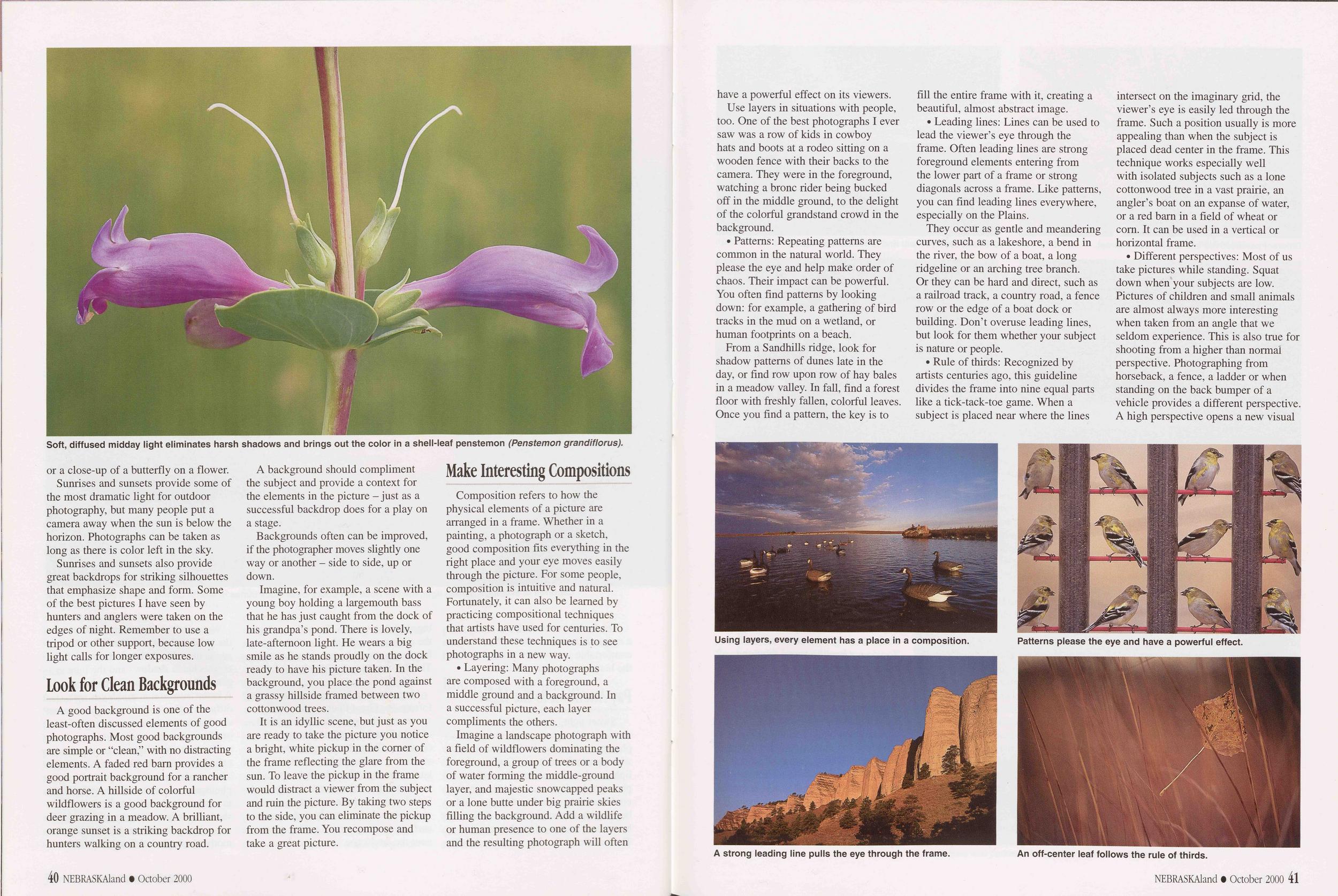 or a close-up of a butterfly on a flower.
Sunrises and sunsets provide some of the most dramatic light for outdoor photography, but many people put a camera away when the sun is below the horizon. Photographs can be taken as long as there is color left in the sky.
Sunrises and sunsets also provide great backdrops for striking silhouettes that emphasize shape and form. Some of the best pictures I have seen by hunters and anglers were taken on the edges of night. Remember to use a tripod or other support, because low light calls for longer exposures.
Look for Clean BackgroundsA good background is one of the least-often discussed elements of good photographs. Most good backgrounds are simple or “clean,” with no distracting elements. A faded red bam provides a good portrait background for a rancher and horse. A hillside of colorful wildflowers is a good background for deer grazing in a meadow. A brilliant, orange sunset is a striking backdrop for hunters walking on a country road.
A background should compliment the subject and provide a context for the elements in the picture - just as a successful backdrop does for a play on a stage.
Backgrounds often can be improved, if the photographer moves slightly one way or another - side to side, up or down.
Imagine, for example, a scene with a young boy holding a largemouth bass that he has just caught from the dock of his grandpa’s pond. There is lovely, late-aftemoon light. He wears a big smile as he stands proudly on the dock ready to have his picture taken. In the background, you place the pond against a grassy hillside framed between two cottonwood trees.
It is an idyllic scene, but just as you are ready to take the picture you notice a bright, white pickup in the comer of the frame reflecting the glare from the sun. To leave the pickup in the frame would distract a viewer from the subject and min the picture. By taking two steps to the side, you can eliminate the pickup from the frame. You recompose and take a great picture.
Make Interesting CompositionsComposition refers to how the physical elements of a picture are arranged in a frame. Whether in a painting, a photograph or a sketch, good composition fits everything in the right place and your eye moves easily through the picture. For some people, composition is intuitive and natural. Fortunately, it can also be learned by practicing compositional techniques that artists have used for centuries. To understand these techniques is to see photographs in a new way.
• Layering: Many photographs are composed with a foreground, a middle ground and a background. In a successful picture, each layer compliments the others.
Imagine a landscape photograph with a field of wildflowers dominating the foreground, a group of trees or a body of water forming the middle-ground layer, and majestic snowcapped peaks or a lone butte under big prairie skies filling the background. Add a wildlife or human presence to one of the layers and the resulting photograph will often have a powerful effect on its viewers.
Use layers in situations with people, too. One of the best photographs I ever saw was a row of kids in cowboy hats and boots at a rodeo sitting on a wooden fence with their backs to the camera. They were in the foreground, watching a bronc rider being bucked off in the middle ground, to the delight of the colorful grandstand crowd in the background.
• Patterns: Repeating patterns are common in the natural world. They please the eye and help make order of chaos. Their impact can be powerful. You often find patterns by looking down: for example, a gathering of bird tracks in the mud on a wetland, or human footprints on a beach.
From a Sandhills ridge, look for shadow patterns of dunes late in the day, or find row upon row of hay bales in a meadow valley. In fall, find a forest floor with freshly fallen, colorful leaves. Once you find a pattern, the key is to fill the entire frame with it, creating a beautiful, almost abstract image.
• Leading lines: Lines can be used to lead the viewer’s eye through the frame. Often leading lines are strong foreground elements entering from the lower part of a frame or strong diagonals across a frame. Like patterns, you can find leading lines everywhere, especially on the Plains.
They occur as gentle and meandering curves, such as a lakeshore, a bend in the river, the bow of a boat, a long ridgeline or an arching tree branch. Or they can be hard and direct, such as a railroad track, a country road, a fence row or the edge of a boat dock or building. Don’t overuse leading lines, but look for them whether your subject is nature or people.
• Rule of thirds: Recognized by artists centuries ago, this guideline divides the frame into nine equal parts like a tick-tack-toe game. When a subject is placed near where the lines intersect on the imaginary grid, the viewer’s eye is easily led through th frame. Such a position usually is mo appealing than when the subject is placed dead center in the frame. This technique works especially well with isolated subjects such as a lone cottonwood tree in a vast prairie, an angler’s boat on an expanse of water, or a red bam in a field of wheat or com. It can be used in a vertical or horizontal frame.
• Different perspectives: Most of us take pictures while standing. Squat down when your subjects are low. Pictures of children and small animals are almost always more interesting when taken from an angle that we seldom experience. This is also true for shooting from a higher than normal perspective. Photographing from horseback, a fence, a ladder or when standing on the back bumper of a vehicle provides a different perspective. A high perspective opens a new visual 40 NEBRASKAland • October 2000 NEBRASKAland • October 2000 41 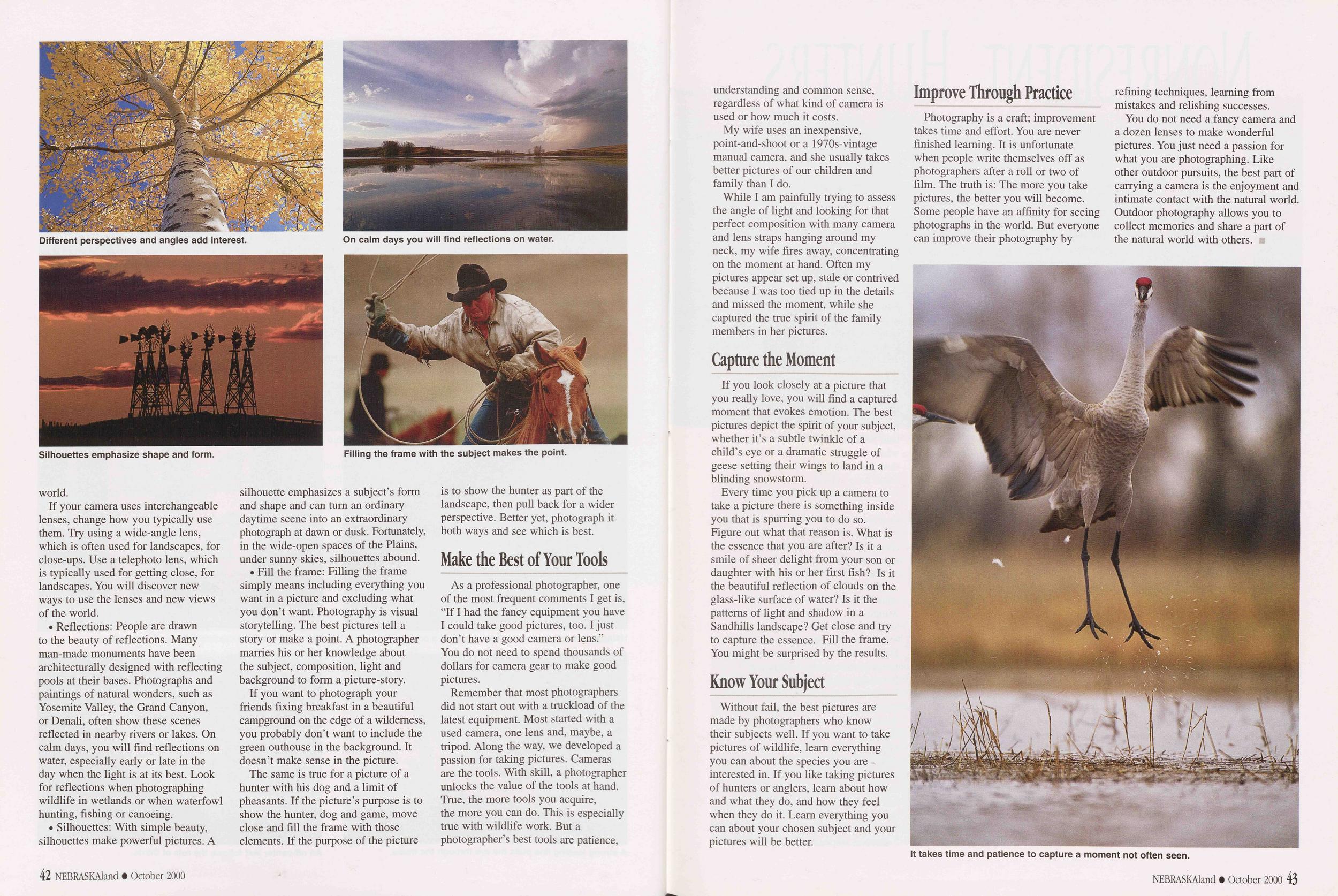 world.
If your camera uses interchangeable lenses, change how you typically use them. Try using a wide-angle lens, which is often used for landscapes, for close-ups. Use a telephoto lens, which is typically used for getting close, for landscapes. You will discover new ways to use the lenses and new views of the world.
•Reflections: People are drawn to the beauty of reflections. Many man-made monuments have been architecturally designed with reflecting pools at their bases. Photographs and paintings of natural wonders, such as Yosemite Valley, the Grand Canyon, or Denali, often show these scenes reflected in nearby rivers or lakes. On calm days, you will find reflections on water, especially early or late in the day when the light is at its best. Look for reflections when photographing wildlife in wetlands or when waterfowl hunting, fishing or canoeing.
•Silhouettes: With simple beauty, silhouettes make powerful pictures. A silhouette emphasizes a subject’s form and shape and can turn an ordinary daytime scene into an extraordinary photograph at dawn or dusk. Fortunately, in the wide-open spaces of the Plains, under sunny skies, silhouettes abound.
• Fill the frame: Filling the frame simply means including everything you want in a picture and excluding what you don’t want. Photography is visual storytelling. The best pictures tell a story or make a point. A photographer marries his or her knowledge about the subject, composition, light and background to form a picture-story.
If you want to photograph your friends fixing breakfast in a beautiful campground on the edge of a wilderness, you probably don’t want to include the green outhouse in the background. It doesn’t make sense in the picture.
The same is true for a picture of a hunter with his dog and a limit of pheasants. If the picture’s purpose is to show the hunter, dog and game, move close and fill the frame with those elements. If the purpose of the picture is to show the hunter as part of the landscape, then pull back for a wider perspective. Better yet, photograph it both ways and see which is best.
Make the Best of Your ToolsAs a professional photographer, one of the most frequent comments I get is, "If I had the fancy equipment you have I could take good pictures, too. I just don’t have a good camera or lens.” You do not need to spend thousands of dollars for camera gear to make good pictures.
Remember that most photographers did not start out with a truckload of the latest equipment. Most started with a used camera, one lens and, maybe, a tripod. Along the way, we developed a passion for taking pictures. Cameras are the tools. With skill, a photographer unlocks the value of the tools at hand. True, the more tools you acquire, the more you can do. This is especially true with wildlife work. But a photographer’s best tools are patience, understanding and common sense, regardless of what kind of camera is used or how much it costs.
My wife uses an inexpensive, point-and-shoot or a 1970s-vintage manual camera, and she usually takes better pictures of our children and family than I do.
While I am painfully trying to assess the angle of light and looking for that perfect composition with many camera and lens straps hanging around my neck, my wife fires away, concentrating on the moment at hand. Often my pictures appear set up, stale or contrived because I was too tied up in the details and missed the moment, while she captured the true spirit of the family members in her pictures.
Capture the MomentIf you look closely at a picture that you really love, you will find a captured moment that evokes emotion. The best pictures depict the spirit of your subject, whether it’s a subtle twinkle of a child’s eye or a dramatic struggle of geese setting their wings to land in a blinding snowstorm.
Every time you pick up a camera to take a picture there is something inside you that is spurring you to do so. Figure out what that reason is. What is the essence that you are after? Is it a smile of sheer delight from your son or daughter with his or her first fish? Is it the beautiful reflection of clouds on the glass-like surface of water? Is it the patterns of light and shadow in a Sandhills landscape? Get close and try to capture the essence. Fill the frame. You might be surprised by the results.
Know Your SubjectWithout fail, the best pictures are made by photographers who know their subjects well. If you want to take pictures of wildlife, learn everything you can about the species you are interested in. If you like taking pictures of hunters or anglers, learn about how and what they do, and how they feel when they do it. Learn everything you can about your chosen subject and your pictures will be better.
Improve Through PracticePhotography is a craft; improvement takes time and effort. You are never finished learning. It is unfortunate when people write themselves off as photographers after a roll or two of film. The truth is: The more you take pictures, the better you will become. Some people have an affinity for seeing photographs in the world. But everyone can improve their photography by refining techniques, learning from mistakes and relishing successes.
You do not need a fancy camera and a dozen lenses to make wonderful pictures. You just need a passion for what you are photographing. Like other outdoor pursuits, the best part of carrying a camera is the enjoyment and intimate contact with the natural world. Outdoor photography allows you to collect memories and share a part of the natural world with others.
42 NEBRASKAland • October 2000 NEBRASKAland • October 2000 43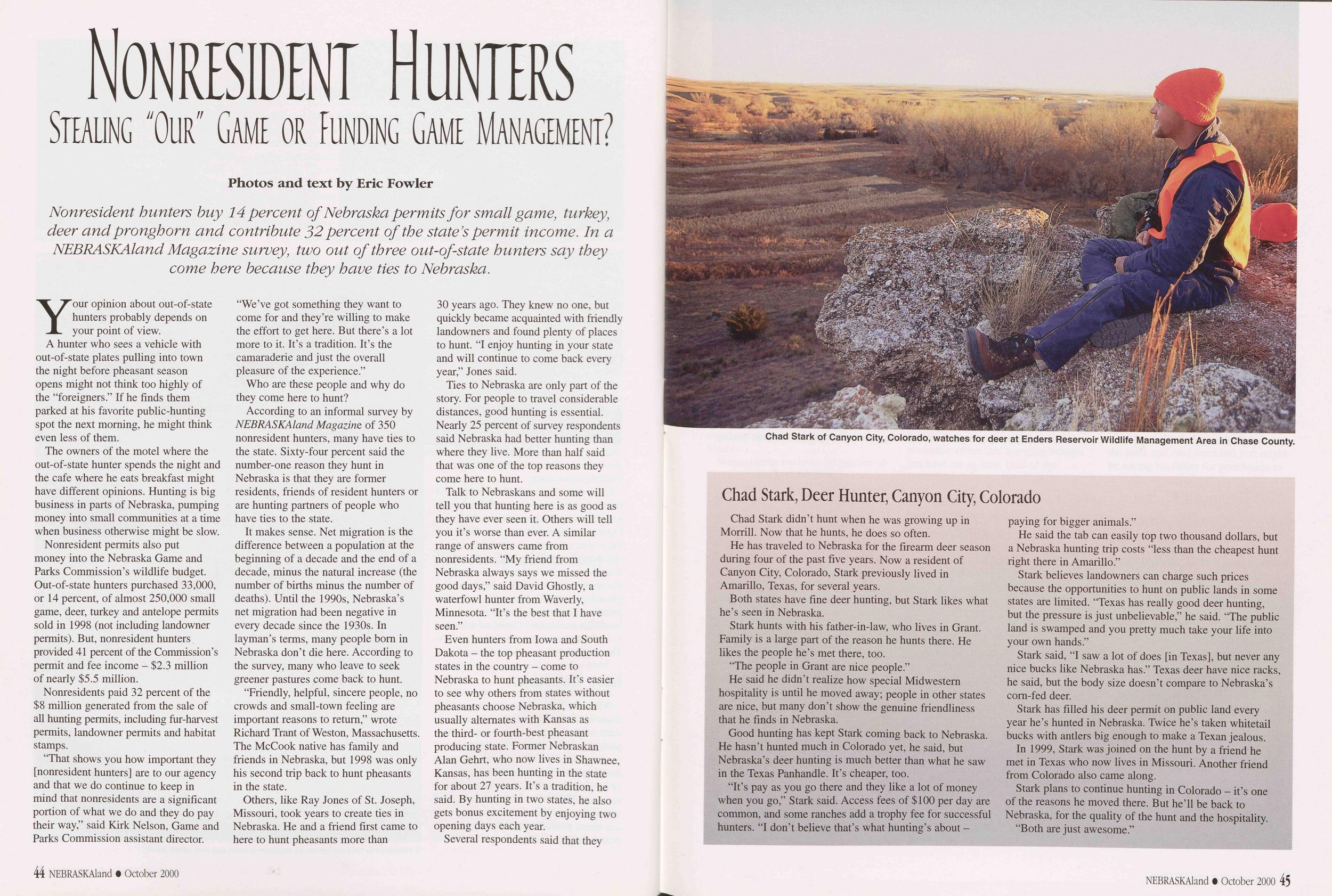
Nonresident Hunters
Stealing "Our" Game or Funding Game Management? Photos and text by Eric Fowler Nonresident hunters buy 14 percent of Nebraska permits for small game, turkey, deer and pronghorn and contribute J2 percent of the state’s permit income. In a NEBRASKAland Magazine survey, two out of three out-of-state hunters say they come here because they have ties to Nebraska.Your opinion about out-of-state hunters probably depends on your point of view.
A hunter who sees a vehicle with out-of-state plates pulling into town the night before pheasant season opens might not think too highly of the “foreigners.” If he finds them parked at his favorite public-hunting spot the next morning, he might think even less of them.
The owners of the motel where the out-of-state hunter spends the night and the cafe where he eats breakfast might have different opinions. Hunting is big business in parts of Nebraska, pumping money into small communities at a time when business otherwise might be slow.
Nonresident permits also put money into the Nebraska Game and Parks Commission’s wildlife budget. Out-of-state hunters purchased 33,000, or 14 percent, of almost 250,000 small game, deer, turkey and antelope permits sold in 1998 (not including landowner permits). But, nonresident hunters provided 41 percent of the Commission’s permit and fee income - $2.3 million of nearly $5.5 million.
Nonresidents paid 32 percent of the $8 million generated from the sale of all hunting permits, including fur-harvest permits, landowner permits and habitat stamps.
“That shows you how important they [nonresident hunters] are to our agency and that we do continue to keep in mind that nonresidents are a significant portion of what we do and they do pay their way,” said Kirk Nelson, Game and Parks Commission assistant director. “We’ve got something they want to come for and they’re willing to make the effort to get here. But there’s a lot more to it. It’s a tradition. It’s the camaraderie and just the overall pleasure of the experience.”
Who are these people and why do they come here to hunt?
According to an informal survey by NEBRASKAland Magazine of 350 nonresident hunters, many have ties to the state. Sixty-four percent said the number-one reason they hunt in Nebraska is that they are former residents, friends of resident hunters or are hunting partners of people who have ties to the state.
It makes sense. Net migration is the difference between a population at the beginning of a decade and the end of a decade, minus the natural increase (the number of births minus the number of deaths). Until the 1990s, Nebraska’s net migration had been negative in every decade since the 1930s. In layman’s terms, many people bom in Nebraska don’t die here. According to the survey, many who leave to seek greener pastures come back to hunt.
“Friendly, helpful, sincere people, no crowds and small-town feeling are important reasons to return,” wrote Richard Trant of Weston, Massachusetts. The McCook native has family and friends in Nebraska, but 1998 was only his second trip back to hunt pheasants in the state.
Others, like Ray Jones of St. Joseph, Missouri, took years to create ties in Nebraska. He and a friend first came to here to hunt pheasants more than 30 years ago. They knew no one, but quickly became acquainted with friendly landowners and found plenty of places to hunt. “I enjoy hunting in your state and will continue to come back every year,” Jones said.
Ties to Nebraska are only part of the story. For people to travel considerable distances, good hunting is essential. Nearly 25 percent of survey respondents said Nebraska had better hunting than where they live. More than half said that was one of the top reasons they come here to hunt.
Talk to Nebraskans and some will tell you that hunting here is as good as they have ever seen it. Others will tell you it’s worse than ever. A similar range of answers came from nonresidents. “My friend from Nebraska always says we missed the good days,” said David Ghostly, a waterfowl hunter from Waverly, Minnesota. “It’s the best that I have seen.”
Even hunters from Iowa and South Dakota - the top pheasant production states in the country - come to Nebraska to hunt pheasants. It’s easier to see why others from states without pheasants choose Nebraska, which usually alternates with Kansas as the third- or fourth-best pheasant producing state. Former Nebraskan Alan Gehrt, who now lives in Shawnee, Kansas, has been hunting in the state for about 27 years. It’s a tradition, he said. By hunting in two states, he also gets bonus excitement by enjoying two opening days each year.
Chad Stark didn’t hunt when he was growing up in Morrill. Now that he hunts, he does so often.
He has traveled to Nebraska for the firearm deer season during four of the past five years. Now a resident of Canyon City, Colorado, Stark previously lived in Amarillo, Texas, for several years.
Both states have fine deer hunting, but Stark likes what he’s seen in Nebraska.
Stark hunts with his father-in-law, who lives in Grant. Family is a large part of the reason he hunts there. He likes the people he’s met there, too.
“The people in Grant are nice people.”
He said he didn’t realize how special Midwestern hospitality is until he moved away; people in other states are nice, but many don’t show the genuine friendliness that he finds in Nebraska.
Good hunting has kept Stark coming back to Nebraska. He hasn’t hunted much in Colorado yet, he said, but Nebraska’s deer hunting is much better than what he saw in the Texas Panhandle. It’s cheaper, too.
“It’s pay as you go there and they like a lot of money when you go,” Stark said. Access fees of $100 per day are common, and some ranches add a trophy fee for successful hunters. “I don’t believe that’s what hunting’s about - paying for bigger animals.”
He said the tab can easily top two thousand dollars, but a Nebraska hunting trip costs “less than the cheapest hunt right there in Amarillo.”
Stark believes landowners can charge such prices because the opportunities to hunt on public lands in some states are limited. “Texas has really good deer hunting, but the pressure is just unbelievable,” he said. “The public land is swamped and you pretty much take your life into your own hands.”
Stark said, “I saw a lot of does [in Texas], but never any nice bucks like Nebraska has.” Texas deer have nice racks, he said, but the body size doesn’t compare to Nebraska’s com-fed deer.
Stark has filled his deer permit on public land every year he’s hunted in Nebraska. Twice he’s taken whitetail bucks with antlers big enough to make a Texan jealous.
In 1999, Stark was joined on the hunt by a friend he met in Texas who now lives in Missouri. Another friend from Colorado also came along.
Stark plans to continue hunting in Colorado - it’s one of the reasons he moved there. But he’ll be back to Nebraska, for the quality of the hunt and the hospitality.
“Both are just awesome.”
44 NEBRASKAland • October 2000 NEBRASKAland • October 2000 45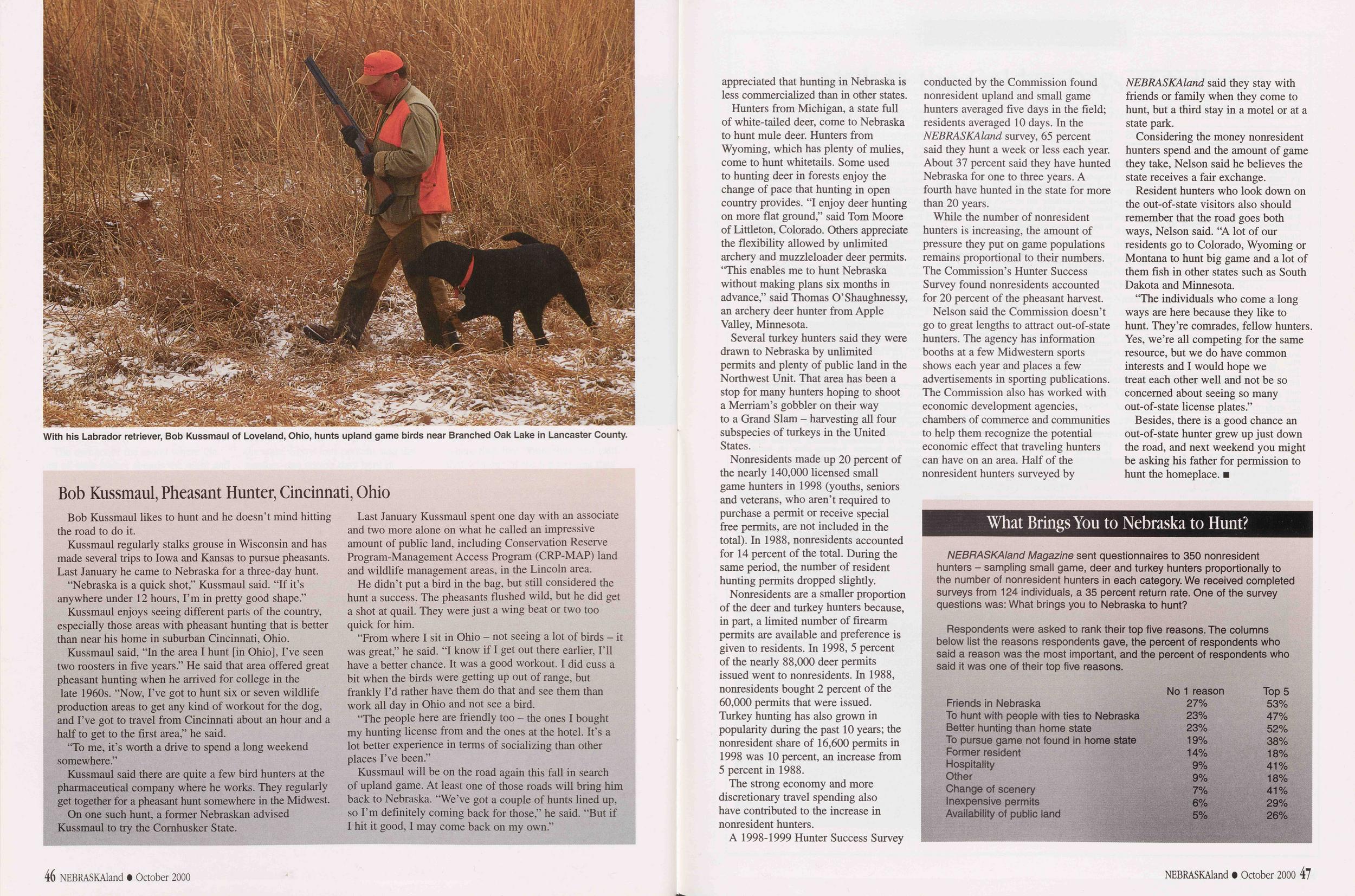
Bob Kussmaul likes to hunt and he doesn’t mind hitting the road to do it.
Kussmaul regularly stalks grouse in Wisconsin and has made several trips to Iowa and Kansas to pursue pheasants. Last January he came to Nebraska for a three-day hunt.
“Nebraska is a quick shot,” Kussmaul said. "If it’s anywhere under 12 hours, I’m in pretty good shape.”
Kussmaul enjoys seeing different parts of the country, especially those areas with pheasant hunting that is better than near his home in suburban Cincinnati, Ohio.
Kussmaul said, “In the area I hunt [in Ohio], I’ve seen two roosters in five years.” He said that area offered great pheasant hunting when he arrived for college in the late 1960s. “Now, I’ve got to hunt six or seven wildlife production areas to get any kind of workout for the dog, and I’ve got to travel from Cincinnati about an hour and a half to get to the first area,” he said.
“To me, it’s worth a drive to spend a long weekend somewhere.”
Kussmaul said there are quite a few bird hunters at the pharmaceutical company where he works. They regularly get together for a pheasant hunt somewhere in the Midwest.
On one such hunt, a former Nebraskan advised Kussmaul to try the Comhusker State.
Last January Kussmaul spent one day with an associate and two more alone on what he called an impressive amount of public land, including Conservation Reserve Program-Management Access Program (CRP-MAP) land and wildlife management areas, in the Lincoln area.
He didn’t put a bird in the bag, but still considered the hunt a success. The pheasants flushed wild, but he did get a shot at quail. They were just a wing beat or two too quick for him.
“From where I sit in Ohio - not seeing a lot of birds - it was great,” he said. “I know if I get out there earlier, I’ll have a better chance. It was a good workout. I did cuss a bit when the birds were getting up out of range, but frankly I’d rather have them do that and see them than work all day in Ohio and not see a bird.
“The people here are friendly too - the ones I bought my hunting license from and the ones at the hotel. It’s a lot better experience in terms of socializing than other places I’ve been.”
Kussmaul will be on the road again this fall in search of upland game. At least one of those roads will bring him back to Nebraska. “We’ve got a couple of hunts fined up, so I’m definitely coming back for those,” he said. “But if I hit it good, I may come back on my own.”
Several respondents said that they appreciated that hunting in Nebraska is less commercialized than in other states.
Hunters from Michigan, a state full of white-tailed deer, come to Nebraska to hunt mule deer. Hunters from Wyoming, which has plenty of mulies, come to hunt whitetails. Some used to hunting deer in forests enjoy the change of pace that hunting in open country provides. “I enjoy deer hunting on more flat ground,” said Tom Moore of Littleton, Colorado. Others appreciate the flexibility allowed by unlimited archery and muzzleloader deer permits. “This enables me to hunt Nebraska without making plans six months in advance,” said Thomas O’Shaughnessy, an archery deer hunter from Apple Valley, Minnesota.
Several turkey hunters said they were drawn to Nebraska by unlimited permits and plenty of public land in the Northwest Unit. That area has been a stop for many hunters hoping to shoot a Merriam’s gobbler on their way to a Grand Slam - harvesting all four subspecies of turkeys in the United States.
Nonresidents made up 20 percent of the nearly 140,000 licensed small game hunters in 1998 (youths, seniors and veterans, who aren’t required to purchase a permit or receive special free permits, are not included in the total). In 1988, nonresidents accounted for 14 percent of the total. During the same period, the number of resident hunting permits dropped slightly.
Nonresidents are a smaller proportion of the deer and turkey hunters because, in part, a limited number of firearm permits are available and preference is given to residents. In 1998, 5 percent of the nearly 88,000 deer permits issued went to nonresidents. In 1988, nonresidents bought 2 percent of the 60,000 permits that were issued. Turkey hunting has also grown in popularity during the past 10 years; the nonresident share of 16,600 permits in 1998 was 10 percent, an increase from 5 percent in 1988.
The strong economy and more discretionary travel spending also have contributed to the increase in nonresident hunters.
A 1998-1999 Hunter Success Survey conducted by the Commission found nonresident upland and small game hunters averaged five days in the field; residents averaged 10 days. In the NEBRASKAland survey, 65 percent said they hunt a week or less each year. About 37 percent said they have hunted Nebraska for one to three years. A fourth have hunted in the state for more than 20 years.
While the number of nonresident hunters is increasing, the amount of pressure they put on game populations remains proportional to their numbers. The Commission’s Hunter Success Survey found nonresidents accounted for 20 percent of the pheasant harvest.
What Brings You to Nebraska to Hunt?NEBRASKAland Magazine sent questionnaires to 350 nonresident hunters - sampling small game, deer and turkey hunters proportionally to the number of nonresident hunters in each category. We received completed surveys from 124 individuals, a 35 percent return rate. One of the survey questions was: What brings you to Nebraska to hunt?
Respondents were asked to rank their top five reasons. The columns below list the reasons respondents gave, the percent of respondents who said a reason was the most important, and the percent of respondents who said it was one of their top five reasons.
No 1 reason Top 5 Friends in Nebraska 27% 53% To hunt with people with ties to Nebraska 23% 47% Better hunting than home state 23% 52% To pursue game not found in home state 19% 38% Former resident 14% 18% Hospitality 9% 41% Other 9% 18% Change of scenery 7% 41% Inexpensive permits 6% 29% Availability of public land 5% 26%Nelson said the Commission doesn’t go to great lengths to attract out-of-state hunters. The agency has information booths at a few Midwestern sports shows each year and places a few advertisements in sporting publications. The Commission also has worked with economic development agencies, chambers of commerce and communities to help them recognize the potential economic effect that traveling hunters can have on an area. Half of the nonresident hunters surveyed by NEBRASKAland said they stay with friends or family when they come to hunt, but a third stay in a motel or at a state park.
Considering the money nonresident hunters spend and the amount of game they take, Nelson said he believes the state receives a fair exchange.
Resident hunters who look down on the out-of-state visitors also should remember that the road goes both ways, Nelson said. “A lot of our residents go to Colorado, Wyoming or Montana to hunt big game and a lot of them fish in other states such as South Dakota and Minnesota.
“The individuals who come a long ways are here because they like to hunt. They’re comrades, fellow hunters. Yes, we’re all competing for the same resource, but we do have common interests and I would hope we treat each other well and not be so concerned about seeing so many out-of-state license plates.”
Besides, there is a good chance an out-of-state hunter grew up just down the road, and next weekend you might be asking his father for permission to hunt the homeplace. ■
46 NEBRASKAland • October 2000 NEBRASKAland • October 2000 47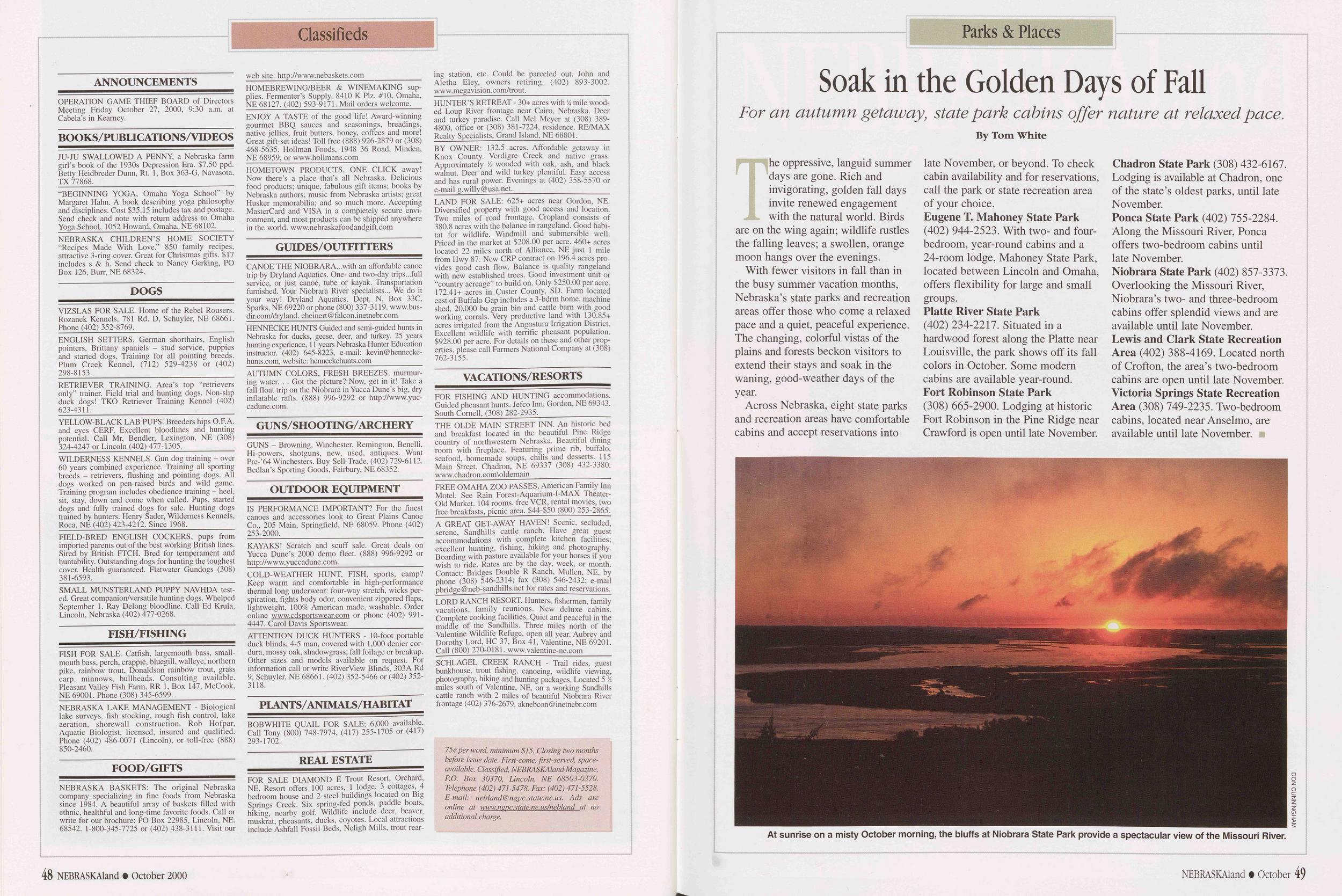
Classifieds
Parks& Places ANNOUNCEMENTSOPERATION GAME THIEF BOARD of Directors Meeting Friday October 27, 2000, 9:30 a.m. at Cabela’s in Kearney.
BOOKS/PUBLICATIONS/VIDEOSJU-JU SWALLOWED A PENNY, a Nebraska farm girl’s book of the 1930s Depression Era. $7.50 ppd. Betty Heidbreder Dunn, Rt. 1, Box 363-G, Navasota, TX 77868
“BEGINNING YOGA, Omaha Yoga School” by Margaret Hahn. A book describing yoga philosophy and disciplines. Cost $35.15 includes tax and postage. Send check and note with return address to Omaha Yoga School, 1052 Howard, Omaha, NE 68102.
NEBRASKA CHILDREN’S HOME SOCIETY “Recipes Made With Love.” 850 family recipes, attractive 3-ring cover. Great for Christmas gifts. $17 includes s & h. Send check to Nancy Gerking, PO Box 126, Burr, NE 68324.
DOGSVIZSLAS FOR SALE. Home of the Rebel Rousers. Rozanek Kennels, 781 Rd. D, Schuyler, NE 68661. Phone (402) 352-8769.
ENGLISH SETTERS, German shorthairs, English pointers, Brittany spaniels - stud service, puppies and started dogs. Training for all pointing breeds. Plum Creek Kennel, (712) 529-4238 or (402) 298-8153.
RETRIEVER TRAINING. Area’s top “retrievers only” trainer. Field trial and hunting dogs. Non-slip duck dogs! TKO Retriever Training Kennel (402) 623-4311.
YELLOW-BLACK LAB PUPS. Breeders hips O.F.A. and eyes CERF. Excellent bloodlines and hunting potential. Call Mr. Bendler, Lexington, NE (308) 324-4247 or Lincoln (402) 477-1305.
WILDERNESS KENNELS. Gun dog training - over 60 years combined experience. Training all sporting breeds - retrievers, flushing and pointing dogs. All dogs worked on pen-raised birds and wild game. Training program includes obedience training - heel, sit, stay, down and come when called. Pups, started dogs and fully trained dogs for sale. Hunting dogs trained by hunters. Henry Sader, Wilderness Kennels, Roca, NE (402) 423-4212, Since 1968.
FIELD-BRED ENGLISH COCKERS, pups from imported parents out of the best working British lines. Sired by British FTCH. Bred for temperament and huntability. Outstanding dogs for hunting the toughest cover. Health guaranteed. Flatwater Gundogs (308) 381-6593.
SMALL MUNSTERLAND PUPPY NAVHDA test- ed. Great companion/versatile hunting dogs. Whelped September 1. Ray Delong bloodline. Call Ed Krula, Lincoln, Nebraska (402) 477-0268.
FISH/FISHINGFISH FOR SALE. Catfish, largemouth bass, small- mouth bass, perch, crappie, bluegill, walleye, northern pike, rainbow trout, Donaldson rainbow trout, grass carp, minnows, bullheads. Consulting available. Pleasant Valley Fish Farm, RR 1, Box 147, McCook, NE 69001. Phone (308) 345-6599.
NEBRASKA LAKE MANAGEMENT - Biological lake surveys, fish stocking, rough fish control, lake aeration, shorewall construction. Rob Hofpar, Aquatic Biologist, licensed, insured and qualified. Phone (402) 486-0071 (Lincoln), or toll-free (888) 850-2460.
FOOD/GIFTSNEBRASKA BASKETS: The original Nebraska company specializing in fine foods from Nebraska since 1984. A beautiful array of baskets filled with ethnic, healthful and long-time favorite foods. Call or write for our brochure: PO Box 22985, Lincoln, NE. 68542. 1-800-345-7725 or (402) 438-3111. Visit our web site: http://www.nebaskets.com
HOMEBREWING/BEER & WINEMAKING sup- plies. Fermenter’s Supply, 8410 K Plz. #10, Omaha, NE 68127. (402) 593-9171. Mail orders welcome. ENJOY A TASTE of the good life! Award-winning gourmet BBQ sauces and seasonings, breadings, native jellies, fruit butters, honey, coffees and more! Great gift-set ideas! Toll free (888) 926-2879 or (308) 468-5635. Hollman Foods, 1948 36 Road, Minden, NE 68959, or www.hollmans.com
HOMETOWN PRODUCTS, ONE CLICK away! Now there’s a place that’s all Nebraska. Delicious food products; unique, fabulous gift items; books by Nebraska authors; music from Nebraska artists; great Husker memorabilia; and so much more. Accepting MasterCard and VISA in a completely secure envi- ronment, and most products can be shipped anywhere in the world, www.nebraskafoodandgift.com
GUIDES/OUTFITTERSCANOE THE NIOBRARA...with an affordable canoe trip by Dryland Aquatics. One- and two-day trips...full service, or just canoe, tube or kayak. Transportation furnished. Your Niobrara River specialists... We do it your way! Dryland Aquatics, Dept. N, Box 33C, Sparks, NE 69220 or phone (800) 337-3119. www.bus- dir.com/dryland. eheinert@falcon.inetnebr.com
HENNECKE HUNTS Guided and semi-guided hunts in Nebraska for ducks, geese, deer, and turkey. 25 years hunting experience, 11 years Nebraska Hunter Education instructor. (402) 645-8223, e-mail: kevin@hennecke- hunts.com, website: henneckehunts.com
AUTUMN COLORS, FRESH BREEZES, murmur- ing water. . . Got the picture? Now, get in it! Take a fall float trip on the Niobrara in Yucca Dune’s big, dry inflatable rafts. (888) 996-9292 or http://www.yuc- cadune.com.
GUNS/SHOOTING/ARCHERYGUNS - Browning, Winchester, Remington, Benelli. Hi-powers, shotguns, new, used, antiques. Want Pre-’64 Winchesters. Buy-Sell-Trade. (402) 729-6112. Bedlan’s Sporting Goods, Fairbury, NE 68352.
OUTDOOR EQUIPMENTIS PERFORMANCE IMPORTANT? For the finest canoes and accessories look to Great Plains Canoe Co., 205 Main, Springfield, NE 68059. Phone (402) 253-2000.
KAYAKS! Scratch and scuff sale. Great deals on Yucca Dune’s 2000 demo fleet. (888) 996-9292 or http://www.yuccadune.com.
COLD-WEATHER HUNT, FISH, sports, camp? Keep warm and comfortable in high-performance thermal long underwear: four-way stretch, wicks per- spiration, fights body odor, convenient zippered flaps, lightweight, 100% American made, washable. Order online www.cdsportswear.com or phone (402) 991- 4447. Carol Davis Sportswear.
ATTENTION DUCK HUNTERS - 10-foot portable duck blinds, 4-5 man, covered with 1,000 denier cor- dura, mossy oak, shadowgrass, fall foilage or breakup. Other sizes and models available on request. For information call or write RiverView Blinds, 3O3A Rd 9, Schuyler, NE 68661. (402) 352-5466 or (402) 352- 3118.
PLANTS/ANIMALS/HABITATBOBWHITE QUAIL FOR SALE; 6,000 available. Call Tony (800) 748-7974, (417) 255-1705 or (417) 293-1702.
FOR SALE DIAMOND E Trout Resort, Orchard, NE. Resort offers 100 acres, 1 lodge, 3 cottages, 4 bedroom house and 2 steel buildings located on Big Springs Creek. Six spring-fed ponds, paddle boats, hiking, nearby golf. Wildlife include deer, beaver, muskrat, pheasants, ducks, coyotes. Local attractions include Ashfall Fossil Beds, Neligh Mills, trout rear- ing station, etc. Could be parceled out. John and Aletha Eley, owners retiring. (402) 893-3002. www.megavision.com/trout.
HUNTER’S RETREAT - 30+ acres with % mile wood- ed Loup River frontage near Cairo, Nebraska. Deer and turkey paradise. Call Mel Meyer at (308) 389- 4800, office or (308) 381-7224, residence. RE/MAX Realty Specialists, Grand Island, NE 68801.
BY OWNER: 132.5 acres. Affordable getaway in Knox County. Verdigre Creek and native grass. Approximately % wooded with oak, ash, and black walnut. Deer and wild turkey plentiful. Easy access and has rural power. Evenings at (402) 358-5570 or e-mail g.willy@usa.net.
LAND FOR SALE: 625+ acres near Gordon, NE. Diversified property with good access and location. Two miles of road frontage. Cropland consists of 380.8 acres with the balance in rangeland. Good habi- tat for wildlife. Windmill and submersible well. Priced in the market at $208.00 per acre. 460+ acres located 22 miles north of Alliance, NE just 1 mile from Hwy 87. New CRP contract on 196.4 acres pro- vides good cash flow. Balance is quality rangeland with new established trees. Good investment unit or “country acreage” to build on. Only $250.00 per acre. 172.41+ acres in Custer County, SD. Farm located east of Buffalo Gap includes a 3-bdrm home, machine shed, 20,000 bu grain bin and cattle bam with good working corrals. Very productive land with 130.85+ acres irrigated from the Angostura Irrigation District. Excellent wildlife with terrific pheasant population. $928.00 per acre. For details on these and other prop- erties, please call Farmers National Company at (308) 762-3155.
VACATION S/RESORTSFOR FISHING AND HUNTING accommodations. Guided pheasant hunts. Jefco Inn, Gordon, NE 69343. South Cornell, (308) 282-2935.
THE OLDE MAIN STREET INN. An historic bed and breakfast located in the beautiful Pine Ridge country of northwestern Nebraska. Beautiful dining room with fireplace. Featuring prime rib, buffalo, seafood, homemade soups, chilis and desserts. 115 Main Street, Chadron, NE 69337 (308) 432-3380. www.chadron,com\oldemain
FREE OMAHA ZOO PASSES, American Family Inn Motel. See Rain Forest-Aquarium-I-MAX Theater- Old Market. 104 rooms, free VCR, rental movies, two free breakfasts, picnic area. $44-$50 (800) 253-2865.
A GREAT GET-AWAY HAVEN! Scenic, secluded, serene, Sandhills cattle ranch. Have great guest accommodations with complete kitchen facilities; excellent hunting, fishing, hiking and photography. Boarding with pasture available for your horses if you wish to ride. Rates are by the day, week, or month. Contact; Bridges Double R Ranch, Mullen, NE, by phone (308) 546-2314; fax (308) 546-2432; e-mail pbridge@neb-sandhills.net for rates and reservations.
LORD RANCH RESORT. Hunters, fishermen, family vacations, family reunions. New deluxe cabins. Complete cooking facilities. Quiet and peaceful in the middle of the Sandhills. Three miles north of the Valentine Wildlife Refuge, open all year. Aubrey and Dorothy Lord, HC 37, Box 41, Valentine, NE 69201. Call (800) 270-0181. www.valentine-ne.com
SCHLAGEL CREEK RANCH - Trail rides, guest bunkhouse, trout fishing, canoeing, wildlife viewing, photography, hiking and hunting packages. Located 5 miles south of Valentine, NE, on a working Sandhills cattle ranch with 2 miles of beautiful Niobrara River frontage (402) 376-2679. aknebcon@inetnebr.com
75 per word, minimum $15. Closing two months before issue date. First-come, first-served, space- available. Classified, NEBRASKAland Magazine, P.O. Box 30370, Lincoln, NE 68503-0370. Telephone (402) 471-5478. Fax: (402) 471-5528. E-mail: nebland@ngpc.state, ne.us. Ads are online at www.n2pc.state.ne.us/nebland at no additional charge.
Soak in the Golden Days of Fall For an autumn getaway, state park cabins offer nature at relaxed pace. By Tom WhiteThe oppressive, languid summer days are gone. Rich and invigorating, golden fall days invite renewed engagement with the natural world. Birds are on the wing again; wildlife rustles the falling leaves; a swollen, orange moon hangs over the evenings.
With fewer visitors in fall than in the busy summer vacation months, Nebraska’s state parks and recreation areas offer those who come a relaxed pace and a quiet, peaceful experience. The changing, colorful vistas of the plains and forests beckon visitors to extend their stays and soak in the waning, good-weather days of the year.
DON CUNNINGHAMAcross Nebraska, eight state parks and recreation areas have comfortable cabins and accept reservations into late November, or beyond. To check cabin availability and for reservations, call the park or state recreation area of your choice.
Eugene T. Mahoney State Park
(402) 944-2523. With two- and four- bedroom, year-round cabins and a 24-room lodge, Mahoney State Park, located between Lincoln and Omaha, offers flexibility for large and small groups.
Platte River State Park
(402) 234-2217. Situated in a hardwood forest along the Platte near Louisville, the park shows off its fall colors in October. Some modern cabins are available year-round.
Fort Robinson State Park
(308) 665-2900. Lodging at historic Fort Robinson in the Pine Ridge near Crawford is open until late November. Chadron State Park (308) 432-6167. Lodging is available at Chadron, one of the state’s oldest parks, until late November.
Ponca State Park
(402) 755-2284. Along the Missouri River, Ponca offers two-bedroom cabins until late November.
Niobrara State Park
(402) 857-3373. Overlooking the Missouri River, Niobrara’s two- and three-bedroom cabins offer splendid views and are available until late November.
Lewis and Clark State Recreation
Area (402) 388-4169. Located north of Crofton, the area’s two-bedroom cabins are open until late November.
Victoria Springs State Recreation
Area (308) 749-2235. Two-bedroom cabins, located near Anselmo, are available until late November.
48 NEBRASKAland • October 2000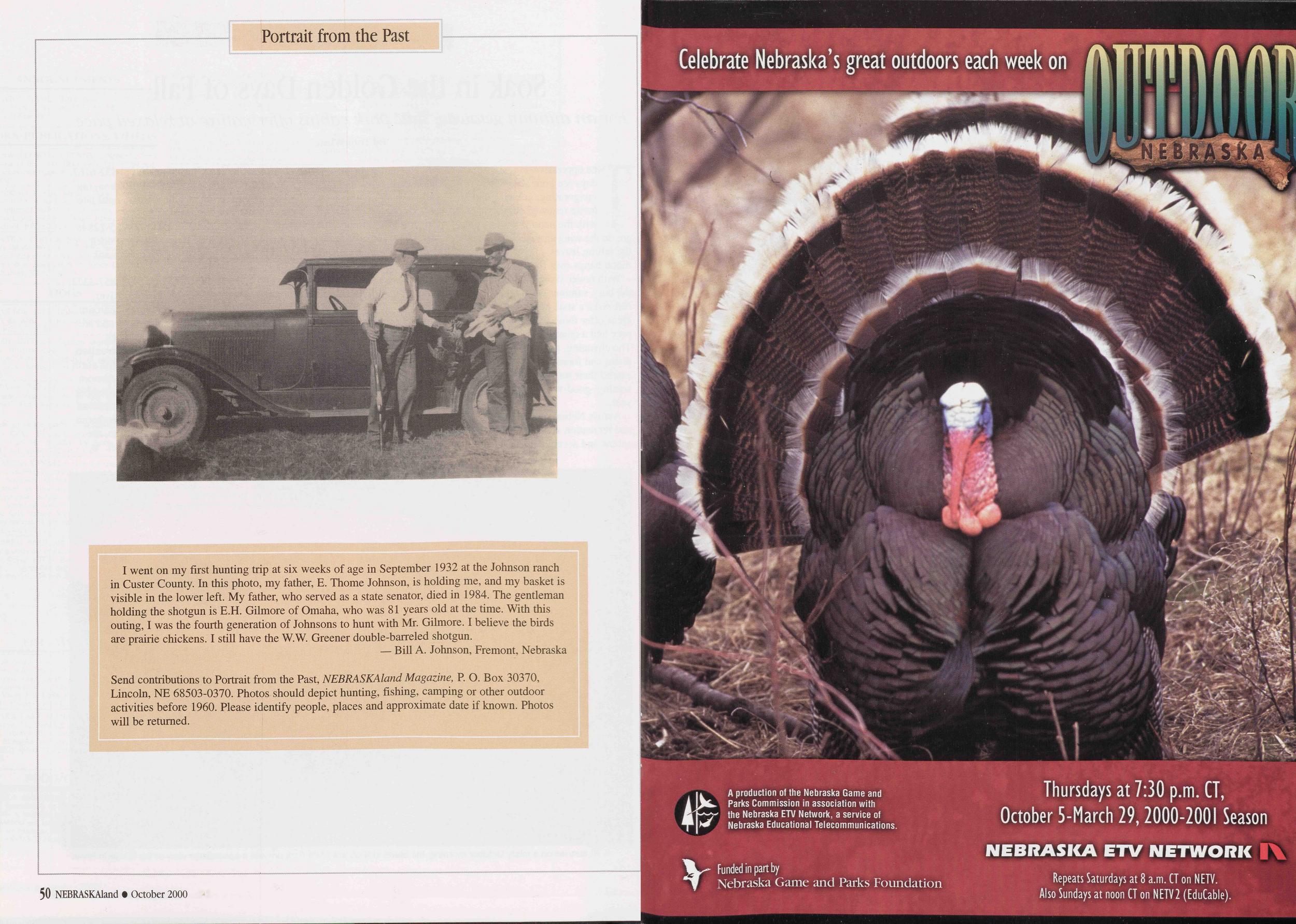
I went on my first hunting trip at six weeks of age in September 1932 at the Johnson ranch in Custer County. In this photo, my father, E. Thome Johnson, is holding me, and my basket is visible in the lower left. My father, who served as a state senator, died in 1984. The gentleman holding the shotgun is E.H. Gilmore of Omaha, who was 81 years old at the time. With this outing, I was the fourth generation of Johnsons to hunt with Mr. Gilmore. I believe the birds are prairie chickens. I still have the W.W. Greener double-barreled shotgun.
— Bill A. Johnson, Fremont, NebraskaSend contributions to Portrait from the Past, NEBRASKAland Magazine, P. O. Box 30370, Lincoln, NE 68503-0370. Photos should depict hunting, fishing, camping or other outdoor activities before 1960. Please identify people, places and approximate date if known. Photos will be returned.
Celebrate Nebraska’s great outdoors each week on October 5-March 29,2000-2001 Season NEBRASKA ETV NETWORK |V Repeats Saturdays at 8 a.m. CT on NETV. Also Sundays at noon CT on NETV2 (EduCable). Funded in part by Nebraska Game and Parks Foundation A production of the Nebraska Game and Parks Commission in association with the Nebraska ETV Network, a service of Nebraska Educational Telecommunications. 50 NEBRASKAland • October 2000
Position: 8 (774 views)