Volume 78, Issue 7, 2000
NEBRASKAland
Nebraska Game & Parks Commission August-September 2000 • $2.50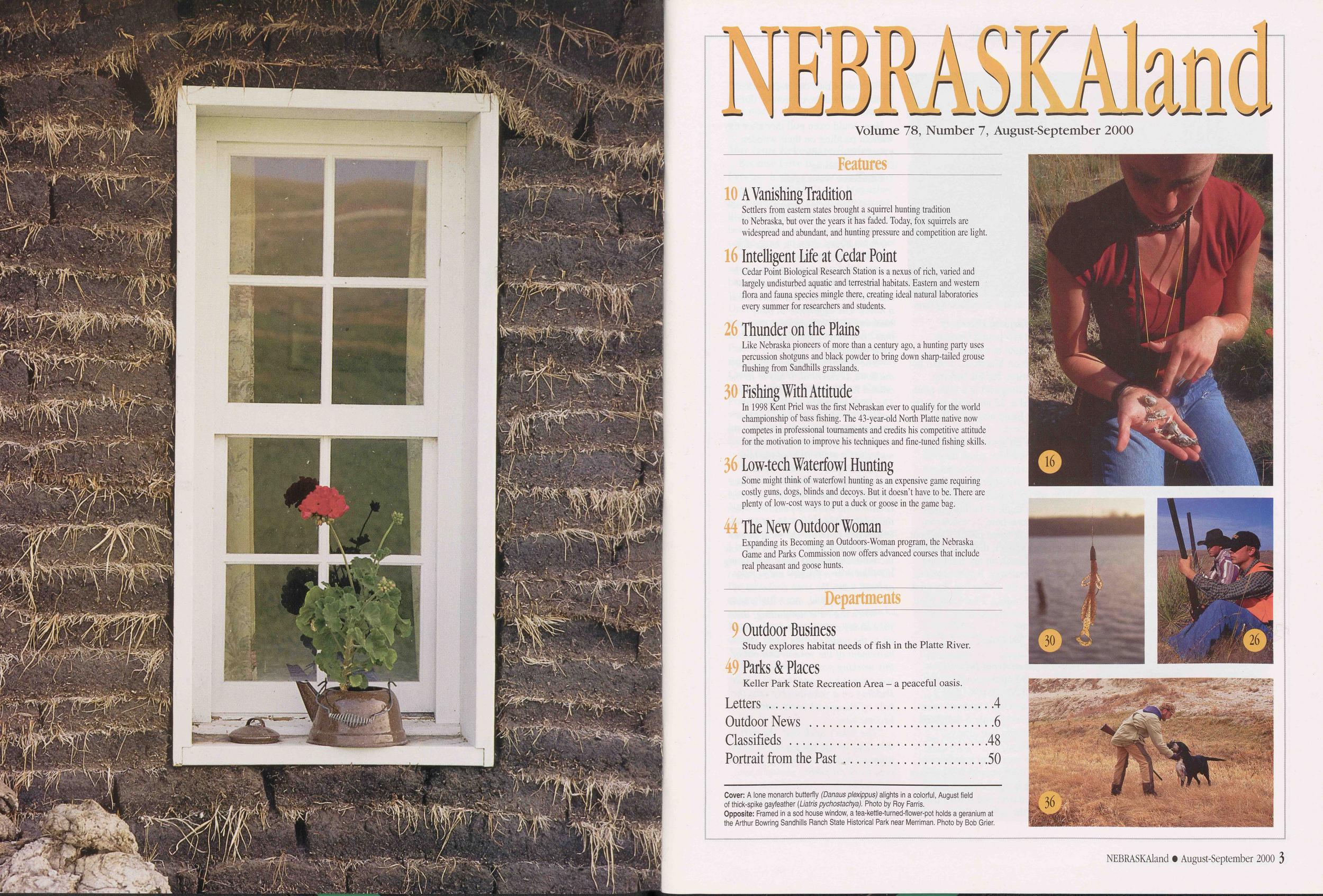
NEBRASKAland
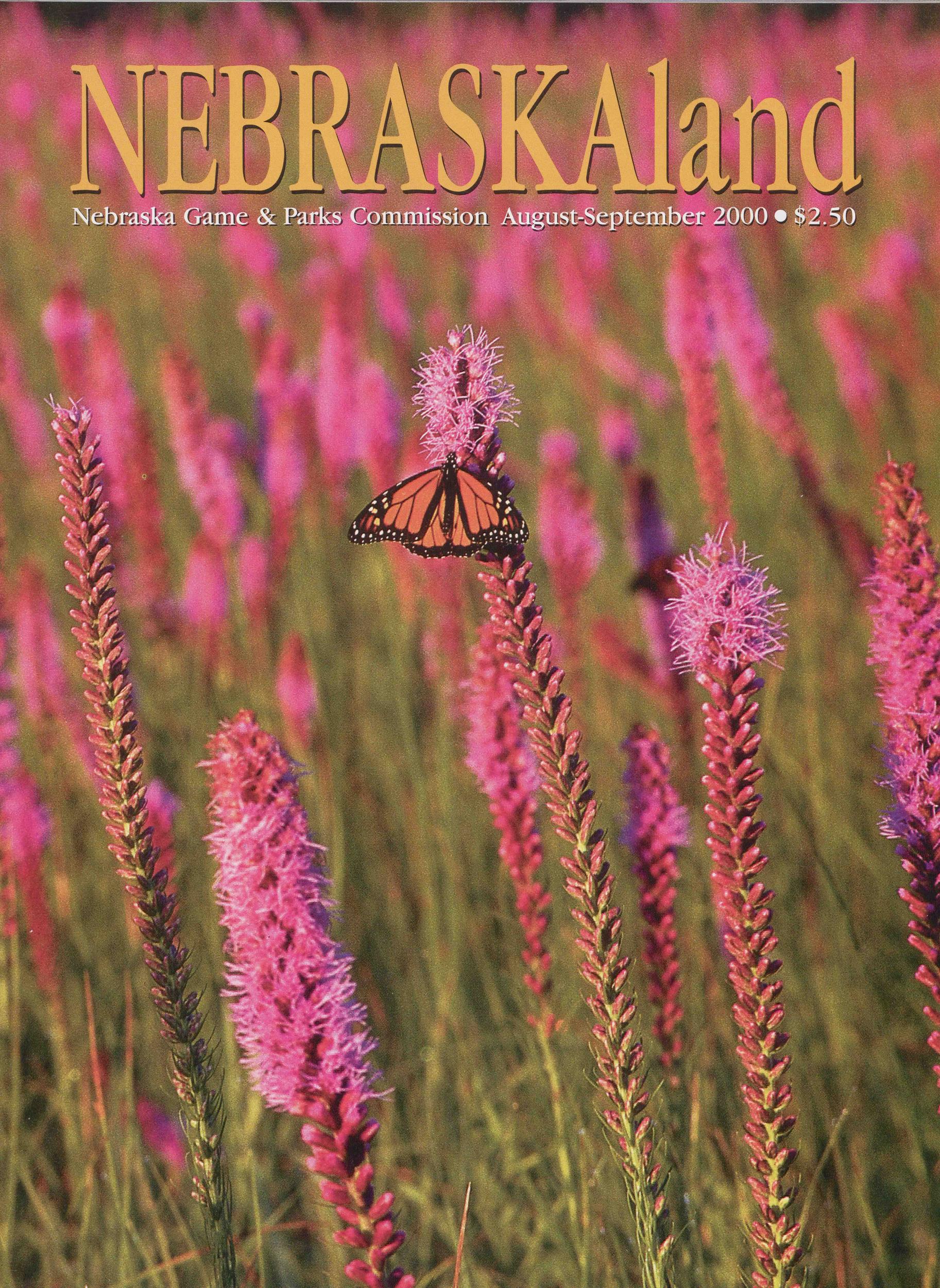
Volume 78, Number 7, August-September 2000 Features A Vanishing Tradition Settlers from eastern states brought a squirrel hunting tradition to Nebraska, but over the years it has faded. Today, fox squirrels are widespread and abundant, and hunting pressure and competition are light. Intelligent Life at Cedar Point Cedar Point Biological Research Station is a nexus of rich, varied and largely undisturbed aquatic and terrestrial habitats. Eastern and western flora and fauna species mingle there, creating ideal natural laboratories every summer for researchers and students. Thunder on the Plains Like Nebraska pioneers of more than a century ago, a hunting party uses percussion shotguns and black powder to bring down sharp-tailed grouse flushing from Sandhills grasslands. Zi Fishing With Attitude In 1998 Kent Priel was the first Nebraskan ever to qualify for the world championship of bass fishing. The 43-year-old North Platte native now competes in professional tournaments and credits his competitive attitude for the motivation to improve his techniques and fine-tuned fishing skills. Low-tech Waterfowl Hunting Some might think of waterfowl hunting as an expensive game requiring costly guns, dogs, blinds and decoys. But it doesn’t have to be. There are plenty of low-cost ways to put a duck or goose in the game bag. The New Outdoor Woman Expanding its Becoming an Outdoors-Woman program, the Nebraska Game and Parks Commission now offers advanced courses that include real pheasant and goose hunts. Departments Outdoor Business Study explores habitat needs of fish in the Platte River. 49 Parks & Places Keller Park State Recreation Area - a peaceful oasis. Letters 4 Outdoor News 6 Classifieds 48 Portrait from the Past 50 Cover: A lone monarch butterfly (Danaus plexippus) alights in a colorful, August field of thick-spike gayfeather (Liatris pychostachya). Photo by Roy Farris. Opposite: Framed in a sod house window, a tea-kettle-turned-flower-pot holds a geranium at the Arthur Bowring Sandhills Ranch State Historical Park near Merriman. Photo by Bob Grier.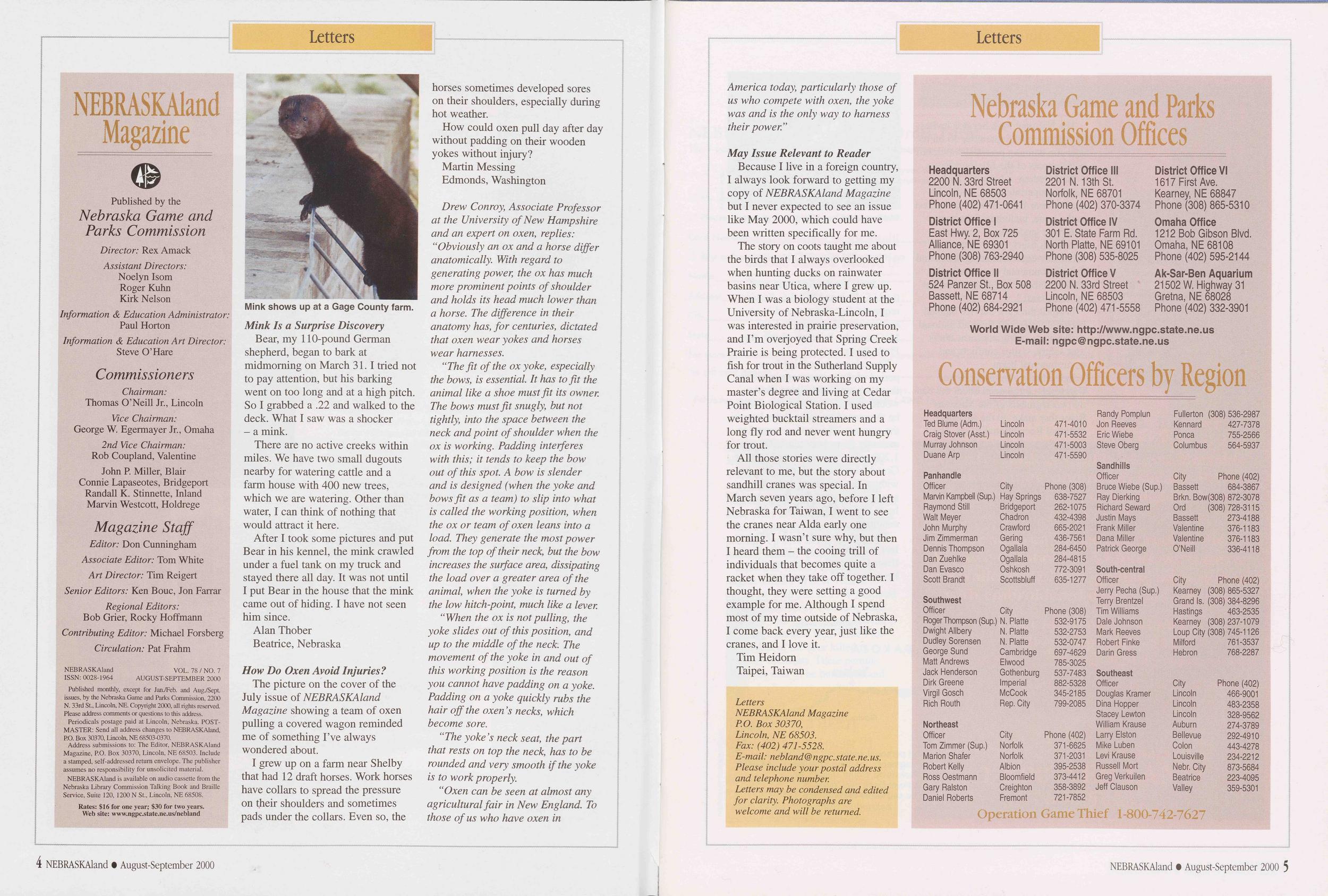 Letters
NEBRASKAland Mazine
Published by the
Nebraska Game and
Parks Commission
Director: Rex Amack
Assistant Directors:
Noelyn Isom
Roger Kuhn
Kirk Nelson
Information & Education Administrator:
Paul Horton
Information & Education Art Director:
Steve O’Hare
Commissioners
Chairman:
Thomas O’Neill Jr., Lincoln
Vice Chairman:
George W. Egermayer Jr., Omaha
2nd Vice Chairman:
Rob Coupland, Valentine
John P. Miller, Blau-
Connie Lapaseotes, Bridgeport
Randall K. Stinnette, Inland
Marvin Westcott, Holdrege
Magazine Staff
Editor: Don Cunningham
Associate Editor: Tom White
Art Director: Tim Reigert
Senior Editors: Ken Bouc, Jon Farrar
Regional Editors:
Bob Grier, Rocky Hoffmann
Contributing Editor: Michael Forsberg
Circulation: Pat Frahm
NEBRASKAland VOL. 78 / NO. 7
ISSN: 0028-1964 AUGUST-SEPTEMBER 2000
Published monthly, except for Jan./Feb. and AugVSept.
issues, by the Nebraska Game and Parks Commission, 2200
N. 33rd St., Lincoln, NE. Copyright 2000, all rights reserved.
Please address comments or questions to this address.
Periodicals postage paid at Lincoln, Nebraska. POST-
MASTER: Send all address changes to NEBRASKAland,
P.O. Box 30370, Lincoln, NE 68503-0370.
Address submissions to: The Editor, NEBRASKAland
Magazine, P.O. Box 30370, Lincoln, NE 68503. Include
a stamped, self-addressed return envelope. The publisher
assumes no responsibility for unsolicited material.
NEBRASKAland is available on audio cassette from the
Nebraska Library Commission Talking Book and Braille
Service, Suite 120, 1200 N St., Lincoln, NE 68508.
Rates: $16 for one year; $30 for two years.
Web site: www.ngpc.state.ne.us/nebland
Letters
NEBRASKAland Mazine
Published by the
Nebraska Game and
Parks Commission
Director: Rex Amack
Assistant Directors:
Noelyn Isom
Roger Kuhn
Kirk Nelson
Information & Education Administrator:
Paul Horton
Information & Education Art Director:
Steve O’Hare
Commissioners
Chairman:
Thomas O’Neill Jr., Lincoln
Vice Chairman:
George W. Egermayer Jr., Omaha
2nd Vice Chairman:
Rob Coupland, Valentine
John P. Miller, Blau-
Connie Lapaseotes, Bridgeport
Randall K. Stinnette, Inland
Marvin Westcott, Holdrege
Magazine Staff
Editor: Don Cunningham
Associate Editor: Tom White
Art Director: Tim Reigert
Senior Editors: Ken Bouc, Jon Farrar
Regional Editors:
Bob Grier, Rocky Hoffmann
Contributing Editor: Michael Forsberg
Circulation: Pat Frahm
NEBRASKAland VOL. 78 / NO. 7
ISSN: 0028-1964 AUGUST-SEPTEMBER 2000
Published monthly, except for Jan./Feb. and AugVSept.
issues, by the Nebraska Game and Parks Commission, 2200
N. 33rd St., Lincoln, NE. Copyright 2000, all rights reserved.
Please address comments or questions to this address.
Periodicals postage paid at Lincoln, Nebraska. POST-
MASTER: Send all address changes to NEBRASKAland,
P.O. Box 30370, Lincoln, NE 68503-0370.
Address submissions to: The Editor, NEBRASKAland
Magazine, P.O. Box 30370, Lincoln, NE 68503. Include
a stamped, self-addressed return envelope. The publisher
assumes no responsibility for unsolicited material.
NEBRASKAland is available on audio cassette from the
Nebraska Library Commission Talking Book and Braille
Service, Suite 120, 1200 N St., Lincoln, NE 68508.
Rates: $16 for one year; $30 for two years.
Web site: www.ngpc.state.ne.us/nebland
Bear, my 110-pound German shepherd, began to bark at midmoming on March 31.1 tried not to pay attention, but his barking went on too long and at a high pitch. So I grabbed a .22 and walked to the deck. What I saw was a shocker - a mink.
There are no active creeks within miles. We have two small dugouts nearby for watering cattle and a farm house with 400 new trees, which we are watering. Other than water, I can think of nothing that would attract it here.
After I took some pictures and put Bear in his kennel, the mink crawled under a fuel tank on my truck and stayed there all day. It was not until I put Bear in the house that the mink came out of hiding. I have not seen him since.
Alan Thober Beatrice, Nebraska How Do Oxen Avoid Injuries?The picture on the cover of the July issue of NEBRASKAland Magazine showing a team of oxen pulling a covered wagon reminded me of something I’ve always wondered about.
I grew up on a farm near Shelby that had 12 draft horses. Work horses have collars to spread the pressure on their shoulders and sometimes pads under the collars. Even so, the horses sometimes developed sores on their shoulders, especially during hot weather.
How could oxen pull day after day without padding on their wooden yokes without injury?
Martin Messing Edmonds, WashingtonDrew Conroy, Associate Professor at the University of New Hampshire and an expert on oxen, replies: “Obviously an ox and a horse differ anatomically. With regard to generating power, the ox has much more prominent points of shoulder and holds its head much lower than a horse. The difference in their anatomy has, for centuries, dictated that oxen wear yokes and horses wear harnesses.
“The fit of the ox yoke, especially the bows, is essential. It has to fit the animal like a shoe must fit its owner. The bows must fit snugly, but not tightly, into the space between the neck and point of shoulder when the ox is working. Padding interferes with this; it tends to keep the bow out of this spot. A bow is slender and is designed (when the yoke and bows fit as a team) to slip into what is called the working position, when the ox or team of oxen leans into a load. They generate the most power from the top of their neck, but the bow increases the surface area, dissipating the load over a greater area of the animal, when the yoke is turned by the low hitch-point, much like a lever.
“When the ox is not pulling, the yoke slides out of this position, and up to the middle of the neck. The movement of the yoke in and out of this working position is the reason you cannot have padding on a yoke. Padding on a yoke quickly rubs the hair off the oxen's necks, which become sore.
“The yoke's neck seat, the part that rests on top the neck, has to be rounded and very smooth if the yoke is to work properly.
“Oxen can be seen at almost any agricultural fair in New England. To those of us who have oxen in America today, particularly those of us who compete with oxen, the yoke was and is the only way to harness their power."
May Issue Relevant to ReaderBecause I live in a foreign country, I always look forward to getting my copy of NEBRASKAland Magazine but I never expected to see an issue like May 2000, which could have been written specifically for me.
The story on coots taught me about the birds that I always overlooked when hunting ducks on rainwater basins near Utica, where I grew up. When I was a biology student at the University of Nebraska-Lincoln, I was interested in prairie preservation, and I’m overjoyed that Spring Creek Prairie is being protected. I used to fish for trout in the Sutherland Supply Canal when I was working on my master’s degree and living at Cedar Point Biological Station. I used weighted bucktail streamers and a long fly rod and never went hungry for trout.
All those stories were directly relevant to me, but the story about sandhill cranes was special. In March seven years ago, before I left Nebraska for Taiwan, I went to see the cranes near Alda early one morning. I wasn’t sure why, but then I heard them - the cooing trill of individuals that becomes quite a racket when they take off together. I thought, they were setting a good example for me. Although I spend most of my time outside of Nebraska, I come back every year, just like the cranes, and I love it.
Tim Heidom Taipei, Taiwan Letters NEBRASKAland Magazine P.O. Box 30370, Lincoln, NE 68503. Fax: (402) 471-5528. E-mail: nebland@ ngpc. state, ne. us. Please include your postal address and telephone number. Letters may be condensed and edited for clarity. Photographs are welcome and will be returned. Nebraska Game and Parks Headquarters 2200 N. 33rd Street Lincoln, NE 68503 Phone (402) 471-0641 District Office III 2201 N. 13th St. Norfolk, NE 68701 Phone (402) 370-3374 District Office VI 1617 First Ave. Kearney, NE 68847 Phone (308) 865-5310 District Office I District Office IV Omaha Office East Hwy. 2, Box 725 301 E. State Farm Rd. 1212 Bob Gibson Blvd. Alliance, NE 69301 North Platte, NE 69101 Omaha, NE 68108 Phone (308) 763-2940 Phone (308) 535-8025 Phone (402) 595-2144 District Office II District Office V Ak-Sar-Ben Aquarium 524 Panzer St., Box 508 2200 N. 33rd Street 21502 W. Highway 31 Bassett, NE 68714 Lincoln, NE 68503 Gretna, NE 68028 Phone (402) 684-2921 Phone (402) 471-5558 Phone (402) 332-3901 World Wide Web site: http://www.ngpc.state.ne.us E-mail: ngpc@ngpc.state.ne.us Conservation Officers by Region Headquarters Randy Pomplun Fullerton (308) 536-2987 Ted Blume (Adm.) Lincoln 471-4010 Jon Reeves Kennard 427-7378 Craig Stover (Asst.) Lincoln 471-5532 Eric Wiebe Ponca 755-2566 Murray Johnson Lincoln 471-5003 Steve Oberg Columbus 564-5937 Duane Arp Lincoln 471-5590 Sandhills Panhandle Officer City Phone (402) Officer City Phone (308) Bruce Wiebe (Sup.) Bassett 684-3867 Marvin Kampbell (Sup.) Hay Springs 638-7527 Ray Dierking Brkn. Bow(308) 872-3078 Raymond Still Bridgeport 262-1075 Richard Seward Ord (308) 728-3115 Walt Meyer Chadron 432-4398 Justin Mays Bassett 273-4188 John Murphy Crawford 665-2021 Frank Miller Valentine 376-1183 Jim Zimmerman Gering 436-7561 Dana Miller Valentine 376-1183 Dennis Thompson Ogallala 284-6450 Patrick George O’Neill 336-4118 Dan Zuehlke Ogallala 284-4815 Dan Evasco Oshkosh 772-3091 South-central Scott Brandt Scottsbluff 635-1277 Officer City Phone (402) Jerry Pecha (Sup.) Kearney (308) 865-5327 Southwest Terry Brentzel Grand Is. (308) 384-8296 Officer City Phone (308) Tim Williams Hastings 463-2535 Roger Thompson (Sup.) N. Platte 532-9175 Dale Johnson Kearney (308)237-1079 Dwight Allbery N. Platte 532-2753 Mark Reeves Loup City (308) 745-1126 Dudley Sorensen N. Platte 532-0747 Robert Finke Milford 761-3537 George Sund Cambridge 697-4629 Darin Gress Hebron 768-2287 Matt Andrews Elwood 785-3025 Jack Henderson Gothenburg 537-7483 Southeast Dirk Greene Imperial 882-5328 Officer City Phone (402) Virgil Gosch McCook 345-2185 Douglas Kramer Lincoln 466-9001 Rich Routh Rep. City 799-2085 Dina Hopper Lincoln 483-2358 Stacey Lewton Lincoln 328-9562 Northeast William Krause Auburn 274-3789 Officer City Phone (402) Larry Elston Bellevue 292-4910 Tom Zimmer (Sup.) Norfolk 371-6625 Mike Luben Colon 443-4278 Marion Shafer Norfolk 371-2031 Levi Krause Louisville 234-2212 Robert Kelly Albion 395-2538 Russell Mort Nebr. City 873-5684 Ross Oestmann Bloomfield 373-4412 Greg Verkuilen Beatrice 223-4095 Gary Ralston Creighton 358-3892 Jeff Clauson Valley 359-5301 Daniel Roberts Fremont 721-7852 Operation Game Thief 1-800-742-7627 4 NEBRASKAland • August-September 2000 NEBRASKAland • August-September 2000 5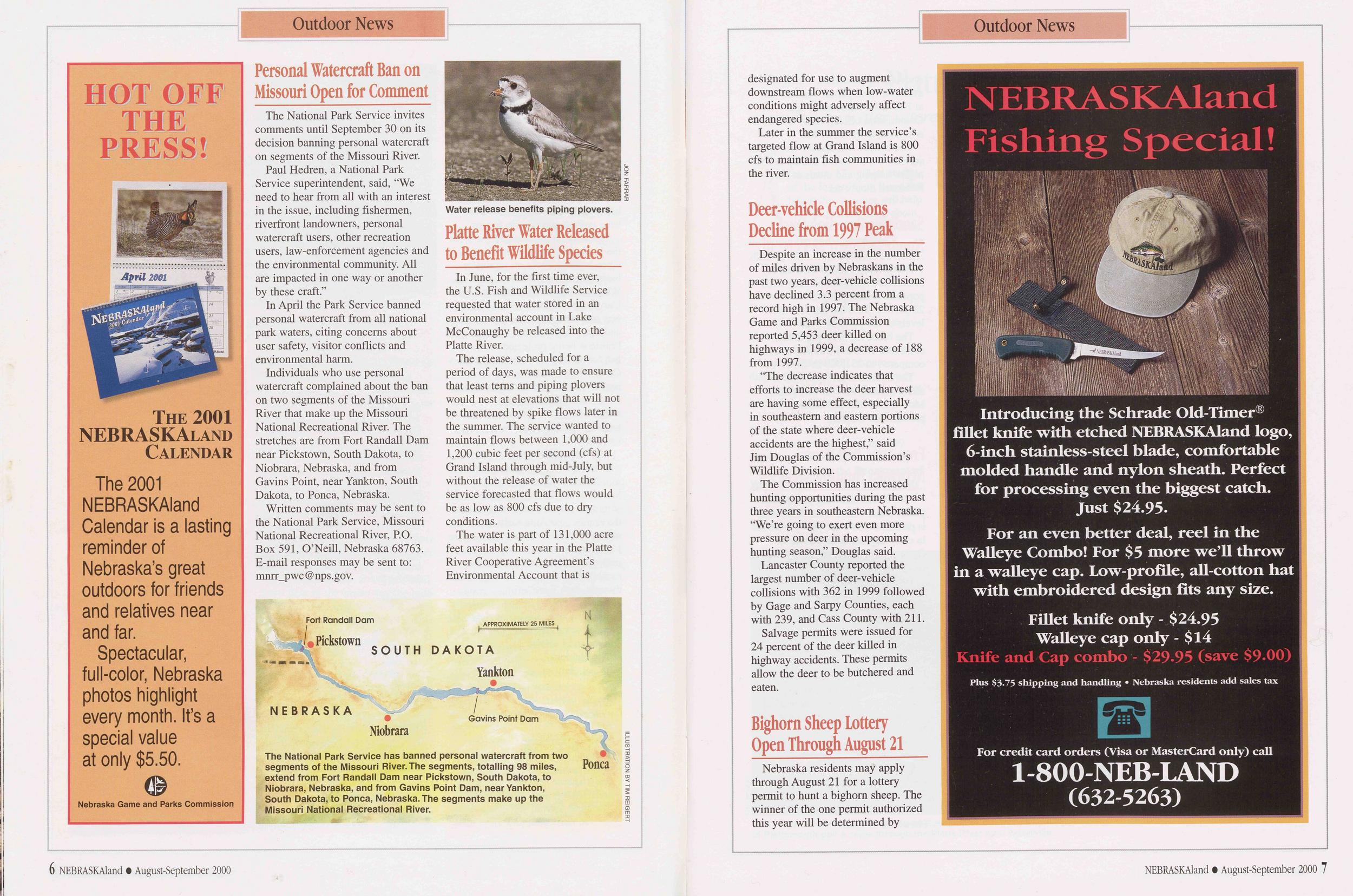
The National Park Service invites comments until September 30 on its decision banning personal watercraft on segments of the Missouri River.
Paul Hedren, a National Park Service superintendent, said, “We need to hear from all with an interest in the issue, including fishermen, riverfront landowners, personal watercraft users, other recreation users, law-enforcement agencies and the environmental community. All are impacted in one way or another by these craft.”
In April the Park Service banned personal watercraft from all national park waters, citing concerns about user safety, visitor conflicts and environmental harm.
Individuals who use personal watercraft complained about the ban on two segments of the Missouri River that make up the Missouri National Recreational River. The stretches are from Fort Randall Dam near Pickstown, South Dakota, to Niobrara, Nebraska, and from Gavins Point, near Yankton, South Dakota, to Ponca, Nebraska.
Written comments may be sent to the National Park Service, Missouri National Recreational River, P.O. Box 591, O’Neill, Nebraska 68763. E-mail responses may be sent to: mnrr_pwc@nps.gov.
The National Park Service has banned personal watercraft from two segments of the Missouri River. The segments, totalling 98 miles, Ponca extend from Fort Randall Dam near Pickstown, South Dakota, to Niobrara, Nebraska, and from Gavins Point Dam, near Yankton, South Dakota, to Ponca, Nebraska. The segments make up the Missouri National Recreational River.
ILLUSTRATION BY TIM REIGERTIn June, for the first time ever, the U.S. Fish and Wildlife Service requested that water stored in an environmental account in Lake McConaughy be released into the Platte River.
The release, scheduled for a period of days, was made to ensure that least terns and piping plovers would nest at elevations that will not be threatened by spike flows later in the summer. The service wanted to maintain flows between 1,000 and 1,200 cubic feet per second (cfs) at Grand Island through mid-July, but without the release of water the service forecasted that flows would be as low as 800 cfs due to dry conditions.
The water is part of 131,000 acre feet available this year in the Platte River Cooperative Agreement’s Environmental Account that is designated for use to augment downstream flows when low-water conditions might adversely affect endangered species.
Later in the summer the service’s targeted flow at Grand Island is 800 cfs to maintain fish communities in the river.
Deer-vehide Collisions Decline from 1997 PeakDespite an increase in the number of miles driven by Nebraskans in the past two years, deer-vehicle collisions have declined 3.3 percent from a record high in 1997. The Nebraska Game and Parks Commission reported 5,453 deer killed on highways in 1999, a decrease of 188 from 1997.
“The decrease indicates that efforts to increase the deer harvest are having some effect, especially in southeastern and eastern portions of the state where deer-vehicle accidents are the highest,” said Jim Douglas of the Commission’s Wildlife Division.
The Commission has increased hunting opportunities during the past three years in southeastern Nebraska. “We’re going to exert even more pressure on deer in the upcoming hunting season,” Douglas said.
Lancaster County reported the largest number of deer-vehicle collisions with 362 in 1999 followed by Gage and Sarpy Counties, each with 239, and Cass County with 211.
Salvage permits were issued for 24 percent of the deer killed in highway accidents. These permits allow the deer to be butchered and eaten.
NEBRASKAland Fishing Special! Introducing the Schrade Old-Timer® fillet knife with etched NEBRASKAland logo, 6 inch stainless-steel blade, comfortable molded handle and nylon sheath. Perfect for processing even the biggest catch. Just $24.95. For an even better deal, reel in the Walleye Combo! For $5 more we’ll throw in a walleye cap. Low-profile, all-cotton hat with embroidered design fits any size. Fillet knife only - $24.95 Walleye cap only - $14 Knife and Cap combo - $29 95 (save $9.00) Plus $3.75 shipping and handling • Nebraska residents add sales tax For credit card orders (Visa or MasterCard only) call 1-800-NEB-LAND (632-5263) Bighorn Sheep Lottery Open Through August 21Nebraska residents may apply through August 21 for a lottery permit to hunt a bighorn sheep. The winner of the one permit authorized this year will be determined by
NEBRASKAland • August-September 2000 7 6 NEBRASKAland • August-September 2000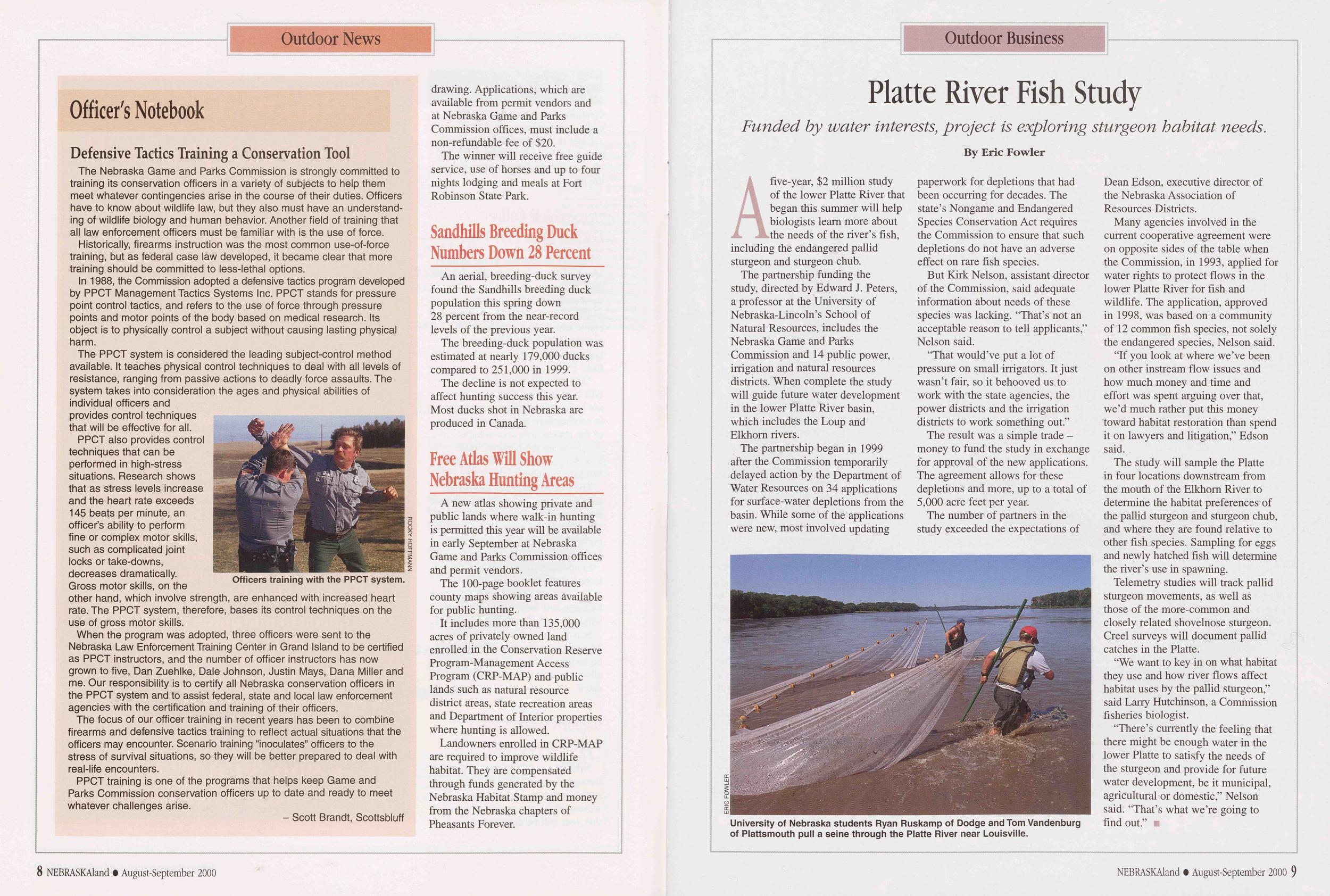 Officer's Notebook
Defensive Tactics Training a Conservation Tool
Officer's Notebook
Defensive Tactics Training a Conservation Tool
The Nebraska Game and Parks Commission is strongly committed to training its conservation officers in a variety of subjects to help them meet whatever contingencies arise in the course of their duties. Officers have to know about wildlife law, but they also must have an understand- ing of wildlife biology and human behavior. Another field of training that all law enforcement officers must be familiar with is the use of force. Historically, firearms instruction was the most common use-of-force training, but as federal case law developed, it became clear that more training should be committed to less-lethal options.
In 1988, the Commission adopted a defensive tactics program developed by PPCT Management Tactics Systems Inc. PPCT stands for pressure point control tactics, and refers to the use of force through pressure points and motor points of the body based on medical research. Its object is to physically control a subject without causing lasting physical harm.
The PPCT system is considered the leading subject-control method available. It teaches physical control techniques to deal with all levels of resistance, ranging from passive actions to deadly force assaults. The system takes into consideration the ages and physical abilities of individual officers and provides control techniques that will be effective for all.
PPCT also provides control techniques that can be performed in high-stress situations. Research shows that as stress levels increase and the heart rate exceeds 145 beats per minute, an officer’s ability to perform fine or complex motor skills, such as complicated joint locks or take-downs, decreases dramatically. Gross motor skills, on the other hand, which involve strength, are enhanced with increased heart rate. The PPCT system, therefore, bases its control techniques on the use of gross motor skills.
When the program was adopted, three officers were sent to the Nebraska Law Enforcement Training Center in Grand Island to be certified as PPCT instructors, and the number of officer instructors has now grown to five, Dan Zuehlke, Dale Johnson, Justin Mays, Dana Miller and me. Our responsibility is to certify all Nebraska conservation officers in the PPCT system and to assist federal, state and local law enforcement agencies with the certification and training of their officers.
The focus of our officer training in recent years has been to combine firearms and defensive tactics training to reflect actual situations that the officers may encounter. Scenario training “inoculates” officers to the stress of survival situations, so they will be better prepared to deal with real-life encounters.
PPCT training is one of the programs that helps keep Game and Parks Commission conservation officers up to date and ready to meet whatever challenges arise.
- Scott Brandt, Scottsbluffdrawing. Applications, which are available from permit vendors and at Nebraska Game and Parks Commission offices, must include a non-refundable fee of $20.
The winner will receive free guide service, use of horses and up to four nights lodging and meals at Fort Robinson State Park.
Sandhills Breeding Duck Numbers Down 28 PercentAn aerial, breeding-duck survey found the Sandhills breeding duck population this spring down 28 percent from the near-record levels of the previous year.
The breeding-duck population was estimated at nearly 179,000 ducks compared to 251,000 in 1999.
The decline is not expected to affect hunting success this year. Most ducks shot in Nebraska are produced in Canada.
Free Atlas Will Show Nebraska Hunting AreasA new atlas showing private and public lands where walk-in hunting is permitted this year will be available in early September at Nebraska Game and Parks Commission offices and permit vendors.
The 100-page booklet features county maps showing areas available for public hunting.
It includes more than 135,000 acres of privately owned land enrolled in the Conservation Reserve Program-Management Access Program (CRP-MAP) and public lands such as natural resource district areas, state recreation areas and Department of Interior properties where hunting is allowed.
Landowners enrolled in CRP-MAP are required to improve wildlife habitat. They are compensated through funds generated by the Nebraska Habitat Stamp and money from the Nebraska chapters of Pheasants Forever.
Outdoor Business Platte River Fish Study Funded by water interests, project is exploring sturgeon habitat needs. By Eric FowlerA five-year, $2 million study of the lower Platte River that began this summer will help biologists learn more about the needs of the river’s fish, including the endangered pallid sturgeon and sturgeon chub.
The partnership funding the study, directed by Edward J. Peters, a professor at the University of Nebraska-Lincoln’s School of Natural Resources, includes the Nebraska Game and Parks Commission and 14 public power, irrigation and natural resources districts. When complete the study will guide future water development in the lower Platte River basin, which includes the Loup and Elkhorn rivers.
The partnership began in 1999 after the Commission temporarily delayed action by the Department of Water Resources on 34 applications for surface-water depletions from the basin. While some of the applications were new, most involved updating paperwork for depletions that had been occurring for decades. The state’s Nongame and Endangered Species Conservation Act requires the Commission to ensure that such depletions do not have an adverse effect on rare fish species.
But Kirk Nelson, assistant director of the Commission, said adequate information about needs of these species was lacking. “That’s not an acceptable reason to tell applicants,” Nelson said.
“That would’ve put a lot of pressure on small irrigators. It just wasn’t fair, so it behooved us to work with the state agencies, the power districts and the irrigation districts to work something out.”
The result was a simple trade - money to fund the study in exchange for approval of the new applications. The agreement allows for these depletions and more, up to a total of 5,000 acre feet per year.
The number of partners in the study exceeded the expectations of Dean Edson, executive director of the Nebraska Association of Resources Districts.
Many agencies involved in the current cooperative agreement were on opposite sides of the table when the Commission, in 1993, applied for water rights to protect flows in the lower Platte River for fish and wildlife. The application, approved in 1998, was based on a community of 12 common fish species, not solely the endangered species, Nelson said.
“If you look at where we’ve been on other instream flow issues and how much money and time and effort was spent arguing over that, we’d much rather put this money toward habitat restoration than spend it on lawyers and litigation,” Edson said.
The study will sample the Platte in four locations downstream from the mouth of the Elkhorn River to determine the habitat preferences of the pallid sturgeon and sturgeon chub, and where they are found relative to other fish species. Sampling for eggs and newly hatched fish will determine the river’s use in spawning.
Telemetry studies will track pallid sturgeon movements, as well as those of the more-common and closely related shovelnose sturgeon. Creel surveys will document pallid catches in the Platte.
“We want to key in on what habitat they use and how river flows affect habitat uses by the pallid sturgeon,” said Larry Hutchinson, a Commission fisheries biologist.
“There’s currently the feeling that there might be enough water in the lower Platte to satisfy the needs of the sturgeon and provide for future water development, be it municipal, agricultural or domestic,” Nelson said. “That’s what we’re going to find out.”
8 NEBRASKAland • August-September 2000 NEBRASKAland • August-September 2000 9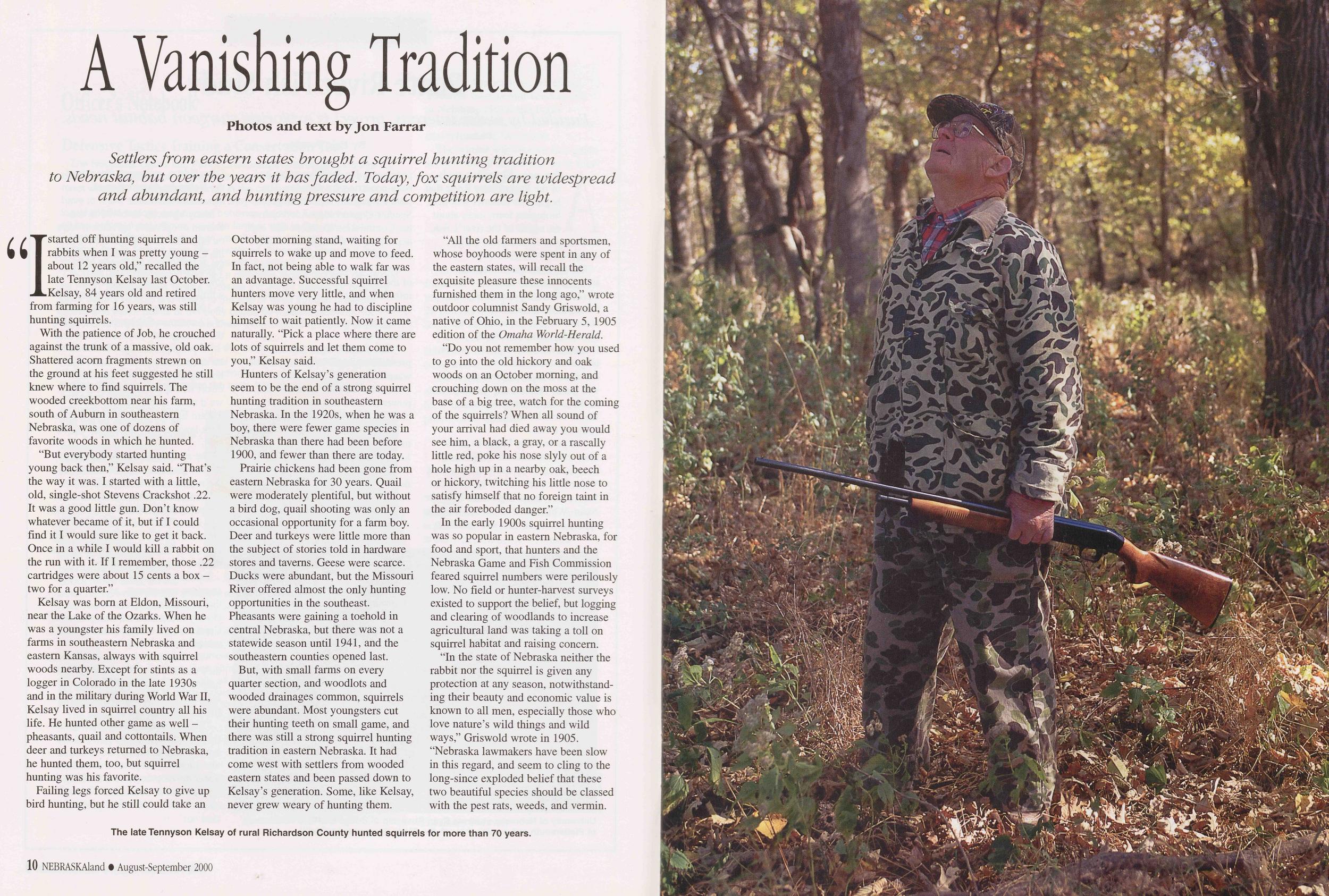
A Vanishing Tradition
Photos and text by Jon Farrar Settlers from eastern states brought a squirrel hunting tradition to Nebraska, but over the years it has faded. Today, fox squirrels are widespread and abundant, and hunting pressure and competition are light."I started off hunting squirrels and rabbits when I was pretty young - about 12 years old,” recalled the late Tennyson Kelsay last October. A Kelsay, 84 years old and retired from farming for 16 years, was still hunting squirrels.
With the patience of Job, he crouched against the trunk of a massive, old oak. Shattered acorn fragments strewn on the ground at his feet suggested he still knew where to find squirrels. The wooded creekbottom near his farm, south of Auburn in southeastern Nebraska, was one of dozens of favorite woods in which he hunted.
“But everybody started hunting young back then,” Kelsay said. “That’s the way it was. I started with a little, old, single-shot Stevens Crackshot .22. It was a good little gun. Don’t know whatever became of it, but if I could find it I would sure like to get it back. Once in a while I would kill a rabbit on the run with it. If I remember, those .22 cartridges were about 15 cents a box - two for a quarter.”
Kelsay was bom at Eldon, Missouri, near the Lake of the Ozarks. When he was a youngster his family lived on farms in southeastern Nebraska and eastern Kansas, always with squirrel woods nearby. Except for stints as a logger in Colorado in the late 1930s and in the military during World War II, Kelsay lived in squirrel country all his life. He hunted other game as well - pheasants, quail and cottontails. When deer and turkeys returned to Nebraska, he hunted them, too, but squirrel hunting was his favorite.
Failing legs forced Kelsay to give up bird hunting, but he still could take an October morning stand, waiting for squirrels to wake up and move to feed. In fact, not being able to walk far was an advantage. Successful squirrel hunters move very little, and when Kelsay was young he had to discipline himself to wait patiently. Now it came naturally. “Pick a place where there are lots of squirrels and let them come to you,” Kelsay said.
Hunters of Kelsay’s generation seem to be the end of a strong squirrel hunting tradition in southeastern Nebraska. In the 1920s, when he was a boy, there were fewer game species in Nebraska than there had been before 1900, and fewer than there are today.
Prairie chickens had been gone from eastern Nebraska for 30 years. Quail were moderately plentiful, but without a bird dog, quail shooting was only an occasional opportunity for a farm boy. Deer and turkeys were little more than the subject of stories told in hardware stores and taverns. Geese were scarce. Ducks were abundant, but the Missouri River offered almost the only hunting opportunities in the southeast. Pheasants were gaining a toehold in central Nebraska, but there was not a statewide season until 1941, and the southeastern counties opened last.
But, with small farms on every quarter section, and woodlots and wooded drainages common, squirrels were abundant. Most youngsters cut their hunting teeth on small game, and there was still a strong squirrel hunting tradition in eastern Nebraska. It had come west with settlers from wooded eastern states and been passed down to Kelsay’s generation. Some, like Kelsay, never grew weary of hunting them.
“All the old farmers and sportsmen, whose boyhoods were spent in any of the eastern states, will recall the exquisite pleasure these innocents furnished them in the long ago,” wrote outdoor columnist Sandy Griswold, a native of Ohio, in the February 5, 1905 edition of the Omaha World-Herald.
“Do you not remember how you used to go into the old hickory and oak woods on an October morning, and crouching down on the moss at the base of a big tree, watch for the coming of the squirrels? When all sound of your arrival had died away you would see him, a black, a gray, or a rascally little red, poke his nose slyly out of a hole high up in a nearby oak, beech or hickory, twitching his little nose to satisfy himself that no foreign taint in the air foreboded danger.”
In the early 1900s squirrel hunting was so popular in eastern Nebraska, for food and sport, that hunters and the Nebraska Game and Fish Commission feared squirrel numbers were perilously low. No field or hunter-harvest surveys existed to support the belief, but logging and clearing of woodlands to increase agricultural land was taking a toll on squirrel habitat and raising concern.
“In the state of Nebraska neither the rabbit nor the squirrel is given any protection at any season, notwithstand- ing their beauty and economic value is known to all men, especially those who love nature’s wild things and wild ways,” Griswold wrote in 1905. “Nebraska lawmakers have been slow in this regard, and seem to cling to the long-since exploded belief that these two beautiful species should be classed with the pest rats, weeds, and vermin.
And this, too, in the face of the fact that there are but few states in the union but what have their regularly defined open and closed seasons for both.”
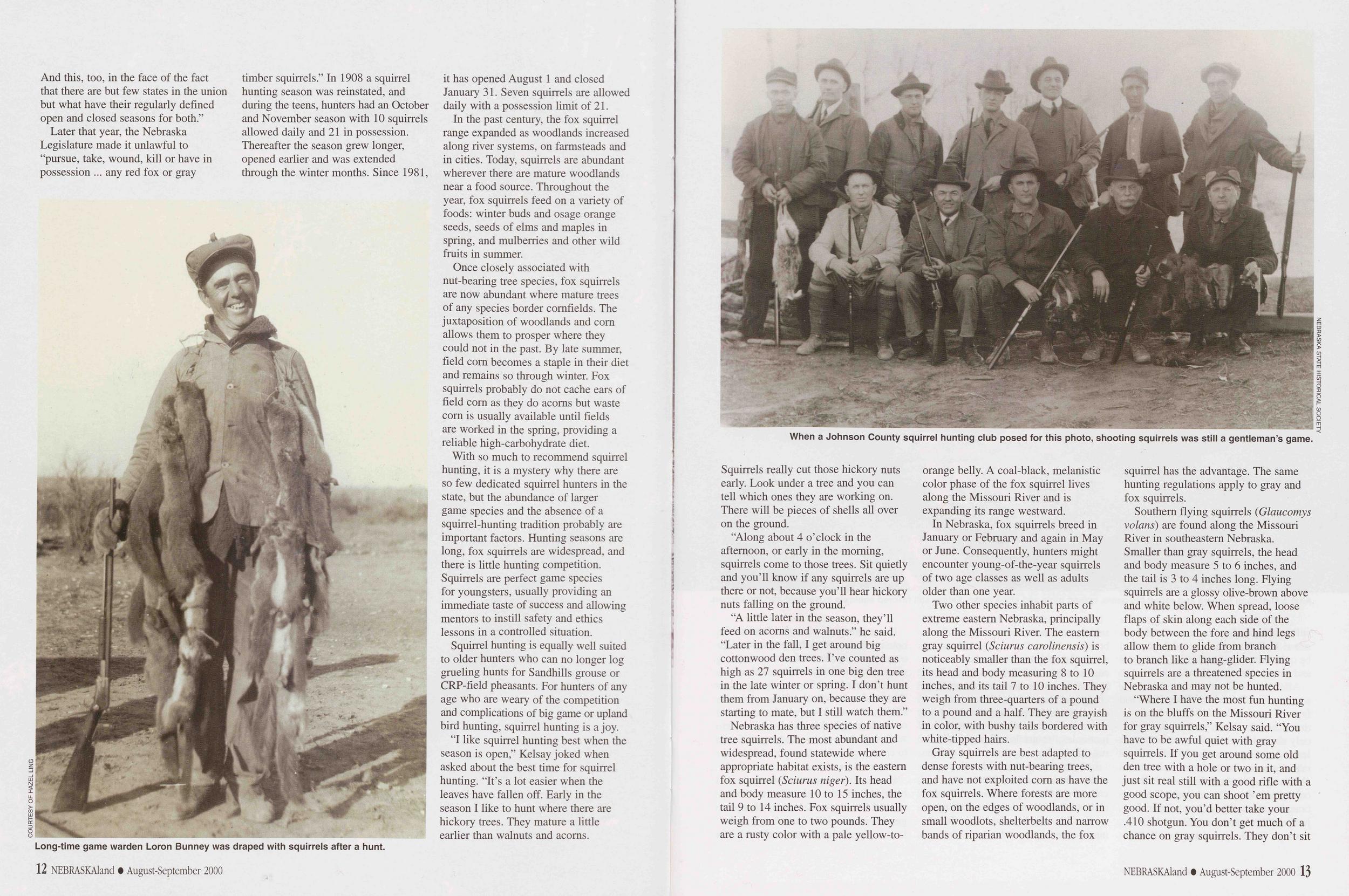
COURTESY OF HAZEL LINGLater that year, the Nebraska Legislature made it unlawful to “pursue, take, wound, kill or have in possession ... any red fox or gray timber squirrels.” In 1908 a squirrel hunting season was reinstated, and during the teens, hunters had an October and November season with 10 squirrels allowed daily and 21 in possession. Thereafter the season grew longer, opened earlier and was extended through the winter months. Since 1981, it has opened August 1 and closed January 31. Seven squirrels are allowed daily with a possession limit of 21.
In the past century, the fox squirrel range expanded as woodlands increased along river systems, on farmsteads and in cities. Today, squirrels are abundant wherever there are mature woodlands near a food source. Throughout the year, fox squirrels feed on a variety of foods: winter buds and osage orange seeds, seeds of elms and maples in spring, and mulberries and other wild fruits in summer.
Once closely associated with nut-bearing tree species, fox squirrels are now abundant where mature trees of any species border cornfields. The juxtaposition of woodlands and com allows them to prosper where they could not in the past. By late summer, field com becomes a staple in their diet and remains so through winter. Fox squirrels probably do not cache ears of field com as they do acorns but waste com is usually available until fields are worked in the spring, providing a reliable high-carbohydrate diet.
With so much to recommend squirrel hunting, it is a mystery why there are so few dedicated squirrel hunters in the state, but the abundance of larger game species and the absence of a squirrel-hunting tradition probably are important factors. Hunting seasons are long, fox squirrels are widespread, and there is little hunting competition. Squirrels are perfect game species for youngsters, usually providing an immediate taste of success and allowing mentors to instill safety and ethics lessons in a controlled situation.
Squirrel hunting is equally well suited to older hunters who can no longer log grueling hunts for Sandhills grouse or CRP-field pheasants. For hunters of any age who are weary of the competition and complications of big game or upland bird hunting, squirrel hunting is a joy.
"I like squirrel hunting best when the season is open,” Kelsay joked when asked about the best time for squirrel hunting. “It’s a lot easier when the leaves have fallen off. Early in the season I like to hunt where there are hickory trees. They mature a little earlier than walnuts and acorns. Squirrels really cut those hickory nuts early. Look under a tree and you can tell which ones they are working on. There will be pieces of shells all over on the ground.
“Along about 4 o’clock in the afternoon, or early in the morning, squirrels come to those trees. Sit quietly and you’ll know if any squirrels are up there or not, because you’ll hear hickory nuts falling on the ground.
“A little later in the season, they’ll feed on acorns and walnuts.” he said. “Later in the fall, I get around big cottonwood den trees. I’ve counted as high as 27 squirrels in one big den tree in the late winter or spring. I don’t hunt them from January on, because they are starting to mate, but I still watch them.”
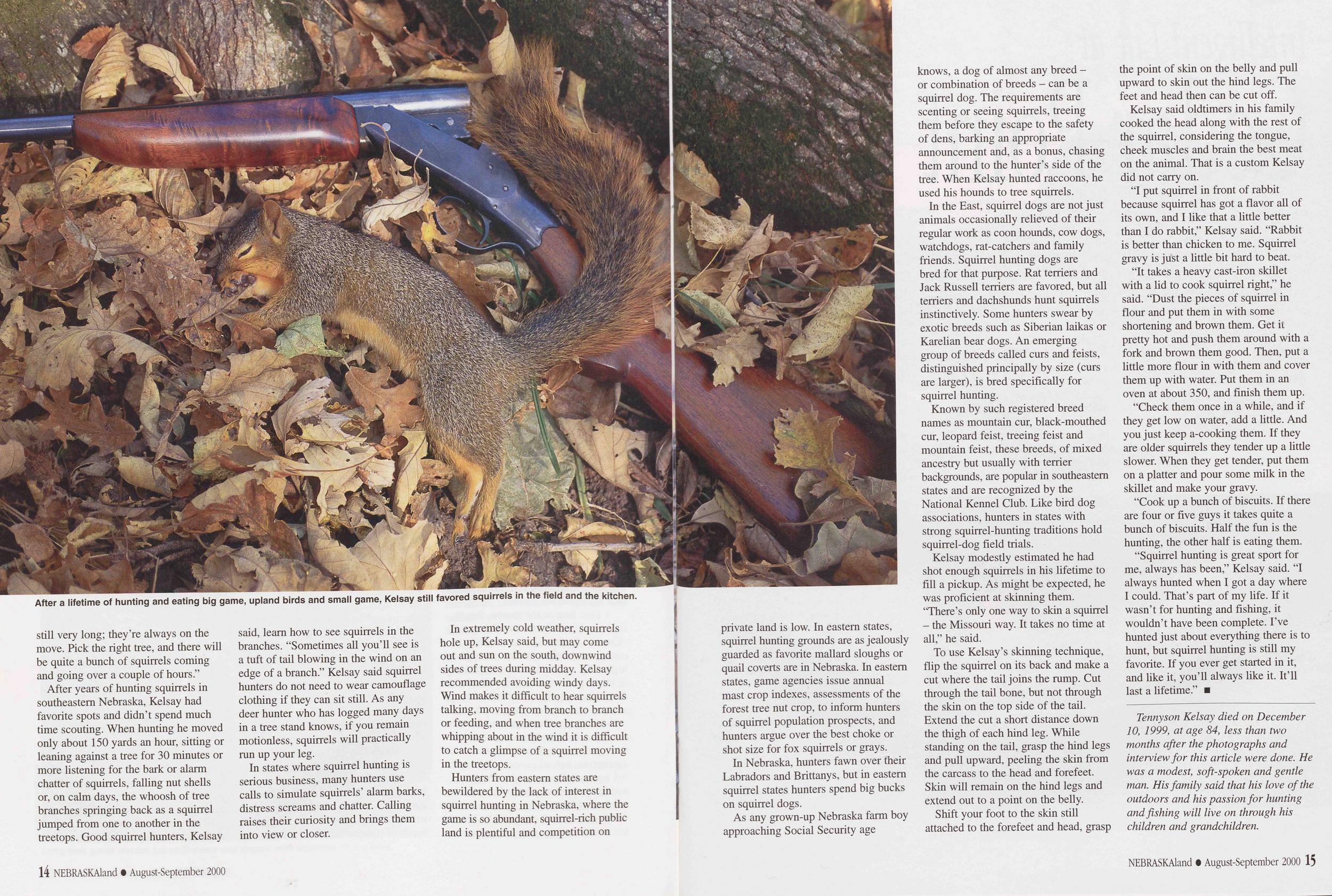
Nebraska has three species of native tree squirrels. The most abundant and widespread, found statewide where appropriate habitat exists, is the eastern fox squirrel (Sciurus niger). Its head and body measure 10 to 15 inches, the tail 9 to 14 inches. Fox squirrels usually weigh from one to two pounds. They are a rusty color with a pale yellow-to- orange belly. A coal-black, melanistic color phase of the fox squirrel lives along the Missouri River and is expanding its range westward.
In Nebraska, fox squirrels breed in January or February and again in May or June. Consequently, hunters might encounter young-of-the-year squirrels of two age classes as well as adults older than one year.
Two other species inhabit parts of extreme eastern Nebraska, principally along the Missouri River. The eastern gray squirrel (Sciurus carolinensis) is noticeably smaller than the fox squirrel, its head and body measuring 8 to 10 inches, and its tail 7 to 10 inches. They weigh from three-quarters of a pound to a pound and a half. They are grayish in color, with bushy tails bordered with white-tipped hairs.
Gray squirrels are best adapted to dense forests with nut-bearing trees, and have not exploited com as have the fox squirrels. Where forests are more open, on the edges of woodlands, or in small woodlots, shelterbelts and narrow bands of riparian woodlands, the fox squirrel has the advantage. The same hunting regulations apply to gray and fox squirrels.
Southern flying squirrels (Glaucomys volans) are found along the Missouri River in southeastern Nebraska. Smaller than gray squirrels, the head and body measure 5 to 6 inches, and the tail is 3 to 4 inches long. Flying squirrels are a glossy olive-brown above and white below. When spread, loose flaps of skin along each side of the body between the fore and hind legs allow them to glide from branch to branch like a hang-glider. Flying squirrels are a threatened species in Nebraska and may not be hunted.
“Where I have the most fun hunting
is on the bluffs on the Missouri River
for gray squirrels,” Kelsay said. “You
have to be awful quiet with gray
squirrels. If you get around some old
den tree with a hole or two in it, and
just sit real still with a good rifle with a
good scope, you can shoot ’em pretty
good. If not, you’d better take your
.410 shotgun. You don’t get much of a
chance on gray squirrels. They don’t sit
12 NEBRASKAland • August-September 2000
NEBRASKAland • August-September 2000 13
 still very long; they’re always on the
move. Pick the right tree, and there will
be quite a bunch of squirrels coming
and going over a couple of hours.”
still very long; they’re always on the
move. Pick the right tree, and there will
be quite a bunch of squirrels coming
and going over a couple of hours.”
After years of hunting squirrels in southeastern Nebraska, Kelsay had favorite spots and didn’t spend much time scouting. When hunting he moved only about 150 yards an hour, sitting or leaning against a tree for 30 minutes or more listening for the bark or alarm chatter of squirrels, falling nut shells or, on calm days, the whoosh of tree branches springing back as a squirrel jumped from one to another in the treetops. Good squirrel hunters, Kelsay said, learn how to see squirrels in the branches. “Sometimes all you’ll see is a tuft of tail blowing in the wind on an edge of a branch.” Kelsay said squirrel hunters do not need to wear camouflage clothing if they can sit still. As any deer hunter who has logged many days in a tree stand knows, if you remain motionless, squirrels will practically run up your leg.
In states where squirrel hunting is serious business, many hunters use calls to simulate squirrels’ alarm barks, distress screams and chatter. Calling raises their curiosity and brings them into view or closer.
In extremely cold weather, squirrels hole up, Kelsay said, but may come out and sun on the south, downwind sides of trees during midday. Kelsay recommended avoiding windy days. Wind makes it difficult to hear squirrels talking, moving from branch to branch or feeding, and when tree branches are whipping about in the wind it is difficult to catch a glimpse of a squirrel moving in the treetops.
Hunters from eastern states are bewildered by the lack of interest in squirrel hunting in Nebraska, where the game is so abundant, squirrel-rich public land is plentiful and competition on private land is low. In eastern states, squirrel hunting grounds are as jealously guarded as favorite mallard sloughs or quail coverts are in Nebraska. In eastern states, game agencies issue annual mast crop indexes, assessments of the forest tree nut crop, to inform hunters of squirrel population prospects, and hunters argue over the best choke or shot size for fox squirrels or grays.
In Nebraska, hunters fawn over their Labradors and Brittanys, but in eastern squirrel states hunters spend big bucks on squirrel dogs.
As any grown-up Nebraska farm boy approaching Social Security age knows, a dog of almost any breed - or combination of breeds - can be a squirrel dog. The requirements are scenting or seeing squirrels, treeing them before they escape to the safety of dens, barking an appropriate announcement and, as a bonus, chasing them around to the hunter’s side of the tree. When Kelsay hunted raccoons, he used his hounds to tree squirrels.
In the East, squirrel dogs are not just animals occasionally relieved of their regular work as coon hounds, cow dogs, watchdogs, rat-catchers and family friends. Squirrel hunting dogs are bred for that purpose. Rat terriers and Jack Russell terriers are favored, but all terriers and dachshunds hunt squirrels instinctively. Some hunters swear by exotic breeds such as Siberian laikas or Karelian bear dogs. An emerging group of breeds called curs and feists, distinguished principally by size (curs are larger), is bred specifically for squirrel hunting.
Known by such registered breed names as mountain cur, black-mouthed cur, leopard feist, treeing feist and mountain feist, these breeds, of mixed ancestry but usually with terrier backgrounds, are popular in southeastern states and are recognized by the National Kennel Club. Like bird dog associations, hunters in states with strong squirrel-hunting traditions hold squirrel-dog field trials.
Kelsay modestly estimated he had shot enough squirrels in his lifetime to fill a pickup. As might be expected, he was proficient at skinning them. “There’s only one way to skin a squirrel - the Missouri way. It takes no time at all,” he said.
To use Kelsay’s skinning technique, flip the squirrel on its back and make a cut where the tail joins the rump. Cut through the tail bone, but not through the skin on the top side of the tail. Extend the cut a short distance down the thigh of each hind leg. While standing on the tail, grasp the hind legs and pull upward, peeling the skin from the carcass to the head and forefeet. Skin will remain on the hind legs and extend out to a point on the belly.
Shift your foot to the skin still attached to the forefeet and head, grasp the point of skin on the belly and pull upward to skin out the hind legs. The feet and head then can be cut off.
Kelsay said oldtimers in his family cooked the head along with the rest of the squirrel, considering the tongue, cheek muscles and brain the best meat on the animal. That is a custom Kelsay did not carry on.
“I put squirrel in front of rabbit because squirrel has got a flavor all of its own, and I like that a little better than I do rabbit,” Kelsay said. “Rabbit is better than chicken to me. Squirrel gravy is just a little bit hard to beat.
“It takes a heavy cast-iron skillet with a lid to cook squirrel right,” he said. “Dust the pieces of squirrel in flour and put them in with some shortening and brown them. Get it pretty hot and push them around with a fork and brown them good. Then, put a little more flour in with them and cover them up with water. Put them in an oven at about 350, and finish them up.
“Check them once in a while, and if they get low on water, add a little. And you just keep a-cooking them. If they are older squirrels they tender up a little slower. When they get tender, put them on a platter and pour some milk in the skillet and make your gravy.
“Cook up a bunch of biscuits. If there are four or five guys it takes quite a bunch of biscuits. Half the fun is the hunting, the other half is eating them.
“Squirrel hunting is great sport for me, always has been,” Kelsay said. “I always hunted when I got a day where I could. That’s part of my life. If it wasn’t for hunting and fishing, it wouldn’t have been complete. I’ve hunted just about everything there is to hunt, but squirrel hunting is still my favorite. If you ever get started in it, and like it, you’ll always like it. It’ll last a lifetime.” ■
Tennyson Kelsay died on December 10, 1999, at age 84, less than two months after the photographs and interview for this article were done. He was a modest, soft-spoken and gentle man. His family said that his love of the outdoors and his passion for hunting and fishing will live on through his children and grandchildren. 14 NEBRASKAland • August-September 2000 NEBRASKAland • August-September 2000 15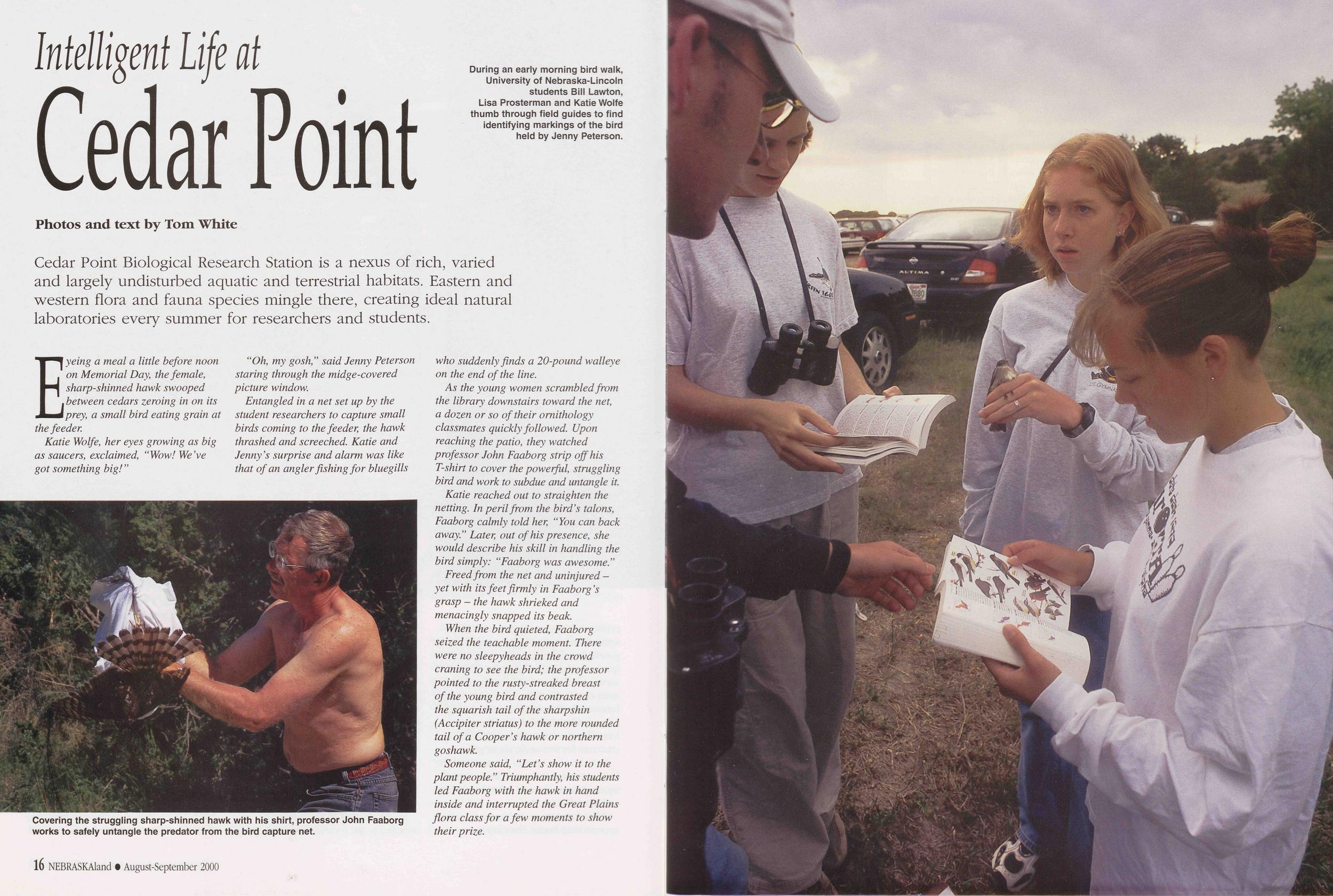
Intelligent Life nt Cedar Point
Photos and text by Tom White Cedar Point Biological Research Station is a nexus of rich, varied and largely undisturbed aquatic and terrestrial habitats. Eastern and western flora and fauna species mingle there, creating ideal natural laboratories every summer for researchers and students.Eyeing a meal a little before noon on Memorial Day, the female, sharp-shinned hawk swooped between cedars zeroing in on its prey, a small bird eating grain at the feeder.
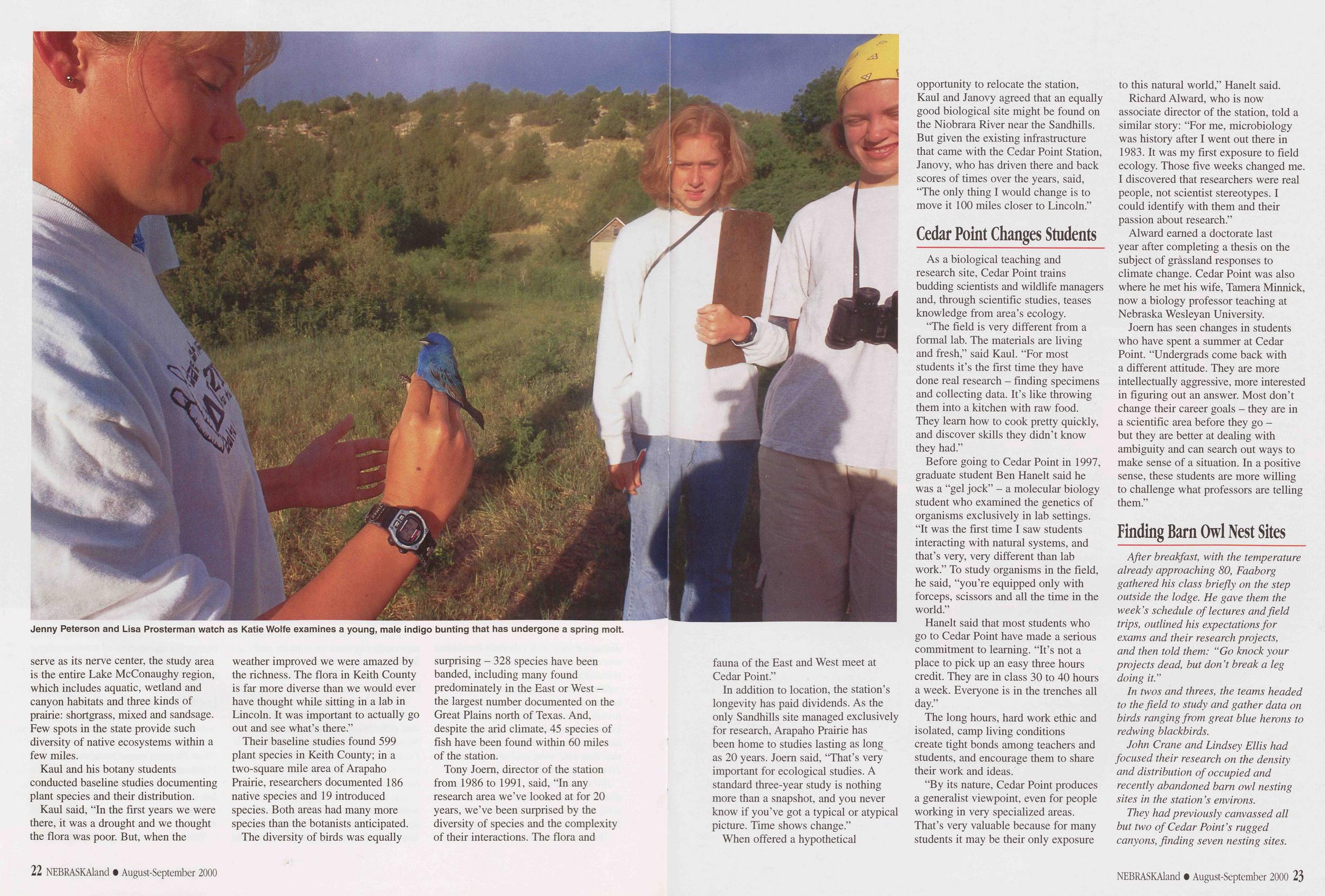
Katie Wolfe, her eyes growing as big as saucers, exclaimed, “Wow! We've got something big!"
“Oh, my gosh," said Jenny Peterson staring through the midge-covered picture window.
Entangled in a net set up by the student researchers to capture small birds coming to the feeder, the hawk thrashed and screeched. Katie and Jenny's surprise and alarm was like that of an angler fishing for bluegills who suddenly finds a 20-pound walleye on the end of the line.
As the young women scrambled from the library downstairs toward the net, a dozen or so of their ornithology classmates quickly followed. Upon reaching the patio, they watched professor John Faaborg strip off his T-shirt to cover the powerful, struggling bird and work to subdue and untangle it.
Katie reached out to straighten the netting. In peril from the bird's talons, Faaborg calmly told her, “You can back away." Later, out of his presence, she would describe his skill in handling the bird simply: “Faaborg was awesome."
Freed from the net and uninjured - yet with its feet firmly in Faaborg's grasp - the hawk shrieked and menacingly snapped its beak.
When the bird quieted, Faaborg seized the teachable moment. There were no sleepyheads in the crowd craning to see the bird; the professor pointed to the rusty-streaked breast of the young bird and contrasted the squarish tail of the sharp shin (Accipiter striatus) to the more rounded tail of a Cooper's hawk or northern goshawk.
Someone said, “Let's show it to the plant people." Triumphantly, his students led Faaborg with the hawk in hand inside and interrupted the Great Plains flora class for a few moments to show their prize.
16 NEBRASKAland • August-September 2000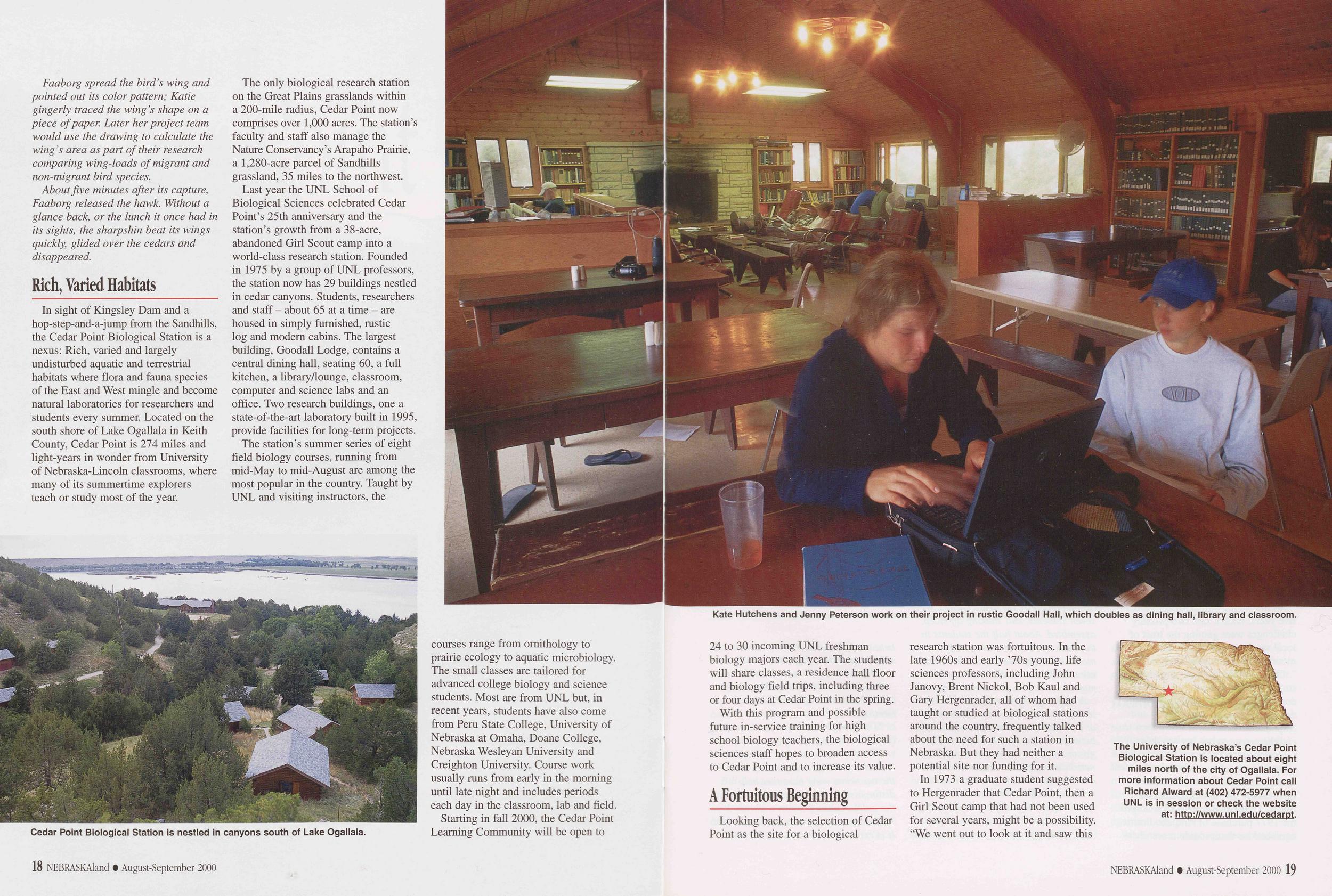
Faaborg spread the bird's wing and pointed out its color pattern; Katie gingerly traced the wing's shape on a piece of paper. Later her project team would use the drawing to calculate the wing's area as part of their research comparing wing-loads of migrant and non-migrant bird species.
About five minutes after its capture, Faaborg released the hawk. Without a glance back, or the lunch it once had in its sights, the sharpshin beat its wings quickly, glided over the cedars and disappeared.
Rich, Varied HabitatsIn sight of Kingsley Dam and a hop-step-and-a-jump from the Sandhills, the Cedar Point Biological Station is a nexus: Rich, varied and largely undisturbed aquatic and terrestrial habitats where flora and fauna species of the East and West mingle and become natural laboratories for researchers and students every summer. Located on the south shore of Lake Ogallala in Keith County, Cedar Point is 274 miles and light-years in wonder from University of Nebraska-Lincoln classrooms, where many of its summertime explorers teach or study most of the year.
The only biological research station on the Great Plains grasslands within a 200-mile radius, Cedar Point now comprises over 1,000 acres. The station’s faculty and staff also manage the Nature Conservancy’s Arapaho Prairie, a 1,280-acre parcel of Sandhills grassland, 35 miles to the northwest.
Last year the UNL School of Biological Sciences celebrated Cedar Point’s 25th anniversary and the station’s growth from a 38-acre, abandoned Girl Scout camp into a world-class research station. Founded in 1975 by a group of UNL professors, the station now has 29 buildings nestled in cedar canyons. Students, researchers and staff - about 65 at a time - are housed in simply furnished, rustic log and modem cabins. The largest building, Goodall Lodge, contains a central dining hall, seating 60, a full kitchen, a library/lounge, classroom, computer and science labs and an office. Two research buildings, one a state-of-the-art laboratory built in 1995, provide facilities for long-term projects.
The station’s summer series of eight field biology courses, running from mid-May to mid-August are among the most popular in the country. Taught by UNL and visiting instructors, the courses range from ornithology to prairie ecology to aquatic microbiology. The small classes are tailored for advanced college biology and science students. Most are from UNL but, in recent years, students have also come from Peru State College, University of Nebraska at Omaha, Doane College, Nebraska Wesleyan University and Creighton University. Course work usually runs from early in the morning until late night and includes periods each day in the classroom, lab and field.
Starting in fall 2000, the Cedar Point Learning Community will be open to 24 to 30 incoming UNL freshman biology majors each year. The students will share classes, a residence hall floor and biology field trips, including three or four days at Cedar Point in the spring.
With this program and possible future in-service training for high school biology teachers, the biological sciences staff hopes to broaden access to Cedar Point and to increase its value.
A Fortuitous BeginningLooking back, the selection of Cedar Point as the site for a biological research station was fortuitous. In the late 1960s and early ’70s young, life sciences professors, including John Janovy, Brent Nickol, Bob Kaul and Gary Hergenrader, all of whom had taught or studied at biological stations around the country, frequently talked about the need for such a station in Nebraska. But they had neither a potential site nor funding for it.
The University of Nebraska’s Cedar Point Biological Station is located about eight miles north of the city of Ogallala. For more information about Cedar Point call Richard Alward at (402) 472-5977 when UNL is in session or check the website at: http://www.unl.edu/cedarpt.
In 1973 a graduate student suggested
to Hergenrader that Cedar Point, then a
Girl Scout camp that had not been used
for several years, might be a possibility.
“We went out to look at it and saw this
18 NEBRASKAland • August-September 2000
NEBRASKAland • August-September 2000 19
 great diversity of habitats - wetlands,
upland grasslands, canyons and aquatic,”
said Hergenrader, who is now the
Nebraska State Forester.
great diversity of habitats - wetlands,
upland grasslands, canyons and aquatic,”
said Hergenrader, who is now the
Nebraska State Forester.
After winning support for the concept from key university leaders, Hergenrader said he and others flew to Ogallala to meet with the landowners, Burdett and Myrna Gainsforth.
“Woody Varner [then chancellor of the University of Nebraska] was the salesman of our group, and he was terrific, but it was really an effort to find mutual interests. The Gainsforths wanted the site to be put to a useful, non-commercial purpose. We wanted a field station and the administration wanted to find a way to put some students in western Nebraska,” Hergenrader recalled.
The parties quickly agreed that the university would lease 38 acres and the existing buildings for five years. Brent Nickol was appointed the director of the new biological station, and the first courses were scheduled for June 1975.
“It had been vacant for five years, and the facilities were built for small girls. There was no electricity in the student housing buildings until two weeks into the session,” said Nickol. “Basically we had three months to set up the station, get the equipment, hire cooks and establish the program.”
Bob Kaul said, “It was really ad hoc all the way - barely suitable. We didn’t know from day-to-day if we would have plumbing or electricity. But, somehow we managed.”
As the station’s director for its first five years, Nickol said two primary challenges were gaining the trust of local residents and attaining access to more land for scientific studies.
“Many locals thought hippie college students were going to invade their domain and loaf on the beach. With time, having a serious program and responsible students, we won their trust and the response has been wonderful.”
Once convinced, many ranchers have allowed researchers and students access to explore and collect specimens on their acres. With funding from the Nature Conservancy, Nickol arranged the 1977 purchase of Arapaho Prairie, two sections that provide researchers the controlled conditions necessary for long-term research projects.
As director of the station for 12 years over two spans, Janovy oversaw multiple building projects and land acquisitions. “The Gainsforths were very helpful in dividing their property so the university could acquire it a piece at a time.” he recalled.
In addition to guiding much of Cedar Point’s development, Janovy has taught field parasitology to 20 or more students every summer for the past 24 years. In several critically acclaimed books relating natural and personal discoveries during his summers in Keith County, Janovy has shared the essence of Cedar Point with readers throughout the country.
The 6 a.m. Bird WalkMorning light comes early at the station located at the eastern edge of the Mountain Time Zone, and with it a chorus of unmitigated cheeriness erupts from scores of birds in the forest.
Memorial Day at Cedar Point would reach 98 degrees and the Lake McConaughy beaches were crowded with visitors basking and playing in the sun. But, it was not a holiday for the students beginning the last week of their intensive three-week term. For the ornithology class, it started, as usual, with the optional 6 a.m. bird walk.
Elizabeth Rieke, the first to arrive at the lodge, played “Feelings ” and then a hymn on the upright Baldwin piano, accompanied by the avian chorus, as seven students, still shaking off sleep, assembled. About half the students in the class of 19 were biology majors - most aiming for health careers - and other half were wildlife management majors.
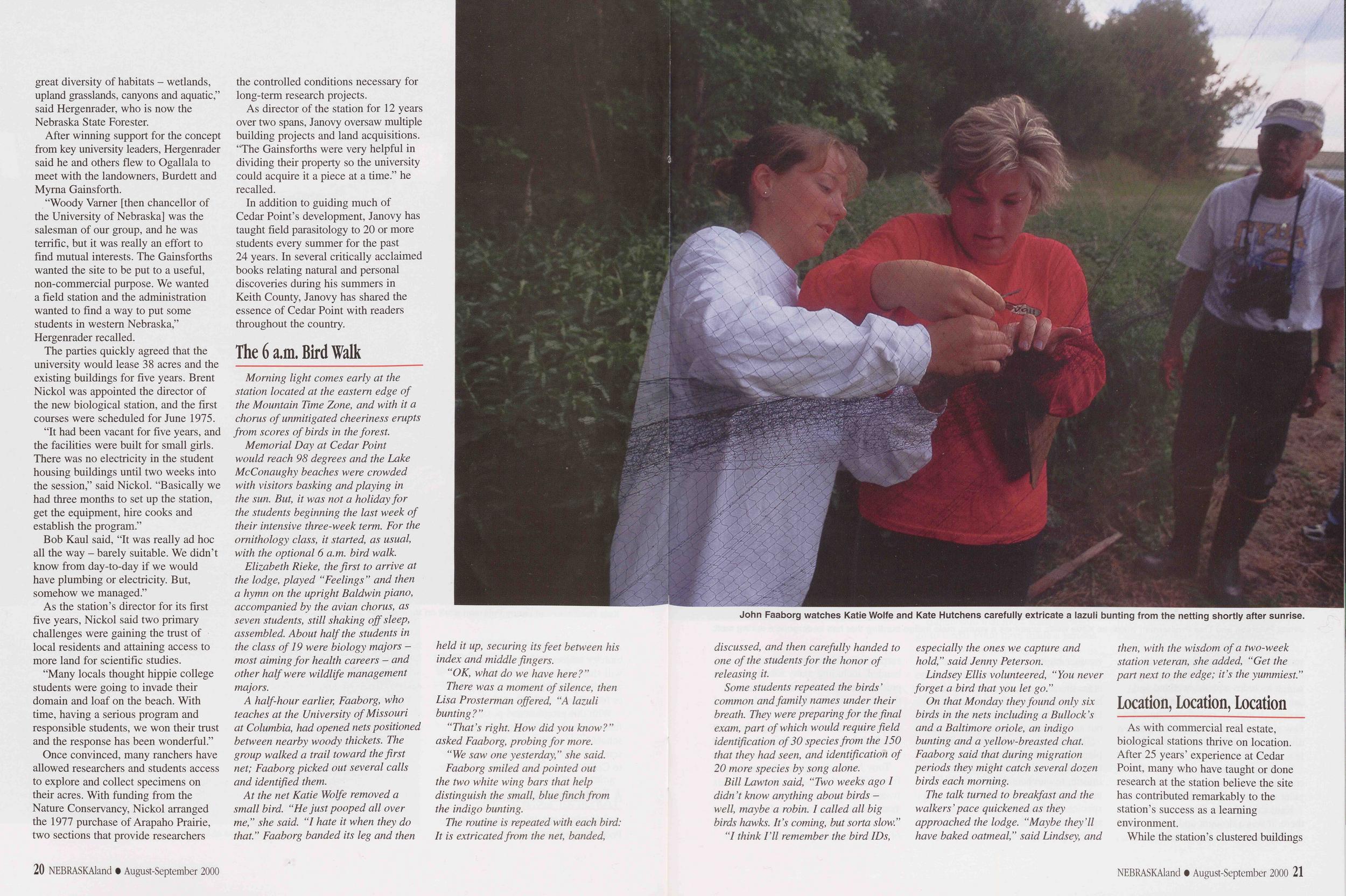
A half-hour earlier, Faaborg, who teaches at the University of Missouri at Columbia, had opened nets positioned between nearby woody thickets. The group walked a trail toward the first net; Faaborg picked out several calls and identified them.
At the net Katie Wolfe removed a small bird. “He just pooped all over me,” she said. “I hate it when they do that.” Faaborg banded its leg and then held it up, securing its feet between his index and middle fingers.
“OK, what do we have here?”
There was a moment of silence, then Lisa Prosterman offered, “A lazuli bunting?”
“That's right. How did you know?” asked Faaborg, probing for more.
“We saw one yesterday,” she said. Faaborg smiled and pointed out the two white wing bars that help distinguish the small, blue finch from the indigo bunting.
The routine is repeated with each bird. It is extricated from the net, banded, discussed, and then carefully handed to one of the students for the honor of releasing it.
Some students repeated the birds ' common and family names under their breath. They were preparing for the final exam, part of which would require field identification of 30 species from the 150 that they had seen, and identification of 20 more species by song alone.
Bill Lawton said, “Two weeks ago I didn’t know anything about birds - well, maybe a robin. I called all big birds hawks. It's coming, but sorta slow.”
“I think I'll remember the bird IDs, especially the ones we capture and hold,” said Jenny Peterson.
Lindsey Ellis volunteered, “You never forget a bird that you let go.” On that Monday they found only six birds in the nets including a Bullock's and a Baltimore oriole, an indigo bunting and a yellow-breasted chat. Faaborg said that during migration periods they might catch several dozen birds each morning.
The talk turned to breakfast and the walkers' pace quickened as they approached the lodge. “Maybe they'll have baked oatmeal,” said Lindsey, and then, with the wisdom of a two-week station veteran, she added, “Get the part next to the edge; it's the yummiest.”
Location, Location, LocationAs with commercial real estate, biological stations thrive on location. After 25 years’ experience at Cedar Point, many who have taught or done research at the station believe the site has contributed remarkably to the station’s success as a learning environment.
While the station’s clustered buildings
20 NEBRASKAland • August-September 2000
NEBRASKAland • August-September 2000 21
 serve as its nerve center, the study area
is the entire Lake McConaughy region,
which includes aquatic, wetland and
canyon habitats and three kinds of
prairie: shortgrass, mixed and sandsage.
Few spots in the state provide such
diversity of native ecosystems within a
few miles.
serve as its nerve center, the study area
is the entire Lake McConaughy region,
which includes aquatic, wetland and
canyon habitats and three kinds of
prairie: shortgrass, mixed and sandsage.
Few spots in the state provide such
diversity of native ecosystems within a
few miles.
Kaul and his botany students conducted baseline studies documenting plant species and their distribution.
Kaul said, "In the first years we were there, it was a drought and we thought the flora was poor. But, when the weather improved we were amazed by the richness. The flora in Keith County is far more diverse than we would ever have thought while sitting in a lab in Lincoln. It was important to actually go out and see what’s there.”
Their baseline studies found 599 plant species in Keith County; in a two-square mile area of Arapaho Prairie, researchers documented 186 native species and 19 introduced species. Both areas had many more species than the botanists anticipated.
The diversity of birds was equally surprising - 328 species have been banded, including many found predominately in the East or West - the largest number documented on the Great Plains north of Texas. And, despite the arid climate, 45 species of fish have been found within 60 miles of the station.
Tony Joem, director of the station from 1986 to 1991, said, “In any research area we’ve looked at for 20 years, we’ve been surprised by the diversity of species and the complexity of their interactions. The flora and fauna of the East and West meet at Cedar Point.”
In addition to location, the station’s longevity has paid dividends. As the only Sandhills site managed exclusively for research, Arapaho Prairie has been home to studies lasting as long as 20 years. Joem said, "That’s very important for ecological studies. A standard three-year study is nothing more than a snapshot, and you never know if you’ve got a typical or atypical picture. Time shows change.”
When offered a hypothetical opportunity to relocate the station, Kaul and Janovy agreed that an equally good biological site might be found on the Niobrara River near the Sandhills. But given the existing infrastructure that came with the Cedar Point Station, Janovy, who has driven there and back scores of times over the years, said, "The only thing I would change is to move it 100 miles closer to Lincoln.”
Cedar Point Changes StudentsAs a biological teaching and research site, Cedar Point trains budding scientists and wildlife managers and, through scientific studies, teases knowledge from area’s ecology.
"The field is very different from a formal lab. The materials are living and fresh,” said Kaul. “For most students it’s the first time they have done real research - finding specimens and collecting data. It’s like throwing them into a kitchen with raw food. They learn how to cook pretty quickly, and discover skills they didn’t know they had.”
Before going to Cedar Point in 1997, graduate student Ben Hanelt said he was a "gel jock” - a molecular biology student who examined the genetics of organisms exclusively in lab settings. "It was the first time I saw students interacting with natural systems, and that’s very, very different than lab work.” To study organisms in the field, he said, "you’re equipped only with forceps, scissors and all the time in the world.”
Hanelt said that most students who go to Cedar Point have made a serious commitment to learning. "It’s not a place to pick up an easy three hours credit. They are in class 30 to 40 hours a week. Everyone is in the trenches all day.”
The long hours, hard work ethic and isolated, camp living conditions create tight bonds among teachers and students, and encourage them to share their work and ideas.
“By its nature, Cedar Point produces a generalist viewpoint, even for people working in very specialized areas. That’s very valuable because for many students it may be their only exposure to this natural world,” Hanelt said.
Richard Alward, who is now associate director of the station, told a similar story: "For me, microbiology was history after I went out there in 1983. It was my first exposure to field ecology. Those five weeks changed me. I discovered that researchers were real people, not scientist stereotypes. I could identify with them and their passion about research.”
Alward earned a doctorate last year after completing a thesis on the subject of grassland responses to climate change. Cedar Point was also where he met his wife, Tamera Minnick, now a biology professor teaching at Nebraska Wesleyan University.
Joem has seen changes in students who have spent a summer at Cedar Point. “Undergrads come back with a different attitude. They are more intellectually aggressive, more interested in figuring out an answer. Most don’t change their career goals - they are in a scientific area before they go - but they are better at dealing with ambiguity and can search out ways to make sense of a situation. In a positive sense, these students are more willing to challenge what professors are telling them.”
Finding Barn Owl Nest SitesAfter breakfast, with the temperature already approaching 80, Faaborg gathered his class briefly on the step outside the lodge. He gave them the week's schedule of lectures and field trips, outlined his expectations for exams and their research projects, and then told them: “Go knock your projects dead, but don’t break a leg doing it."
In twos and threes, the teams headed to the field to study and gather data on birds ranging from great blue herons to redwing blackbirds.
John Crane and Lindsey Ellis had focused their research on the density and distribution of occupied and recently abandoned barn owl nesting sites in the station's environs.
They had previously canvassed all
but two of Cedar Point's rugged
canyons, finding seven nesting sites.
22 NEBRASKAland • August-September 2000
NEBRASKAland • August-September 2000 23
 They plotted each, using a
global positioning system
(GPS), and measured its
height from the ground.
They plotted each, using a
global positioning system
(GPS), and measured its
height from the ground.
Today they hoped to find more sites. They had only three days to complete the research, compile the data and write their findings. But first they wanted to check a site, found earlier, for nestlings.
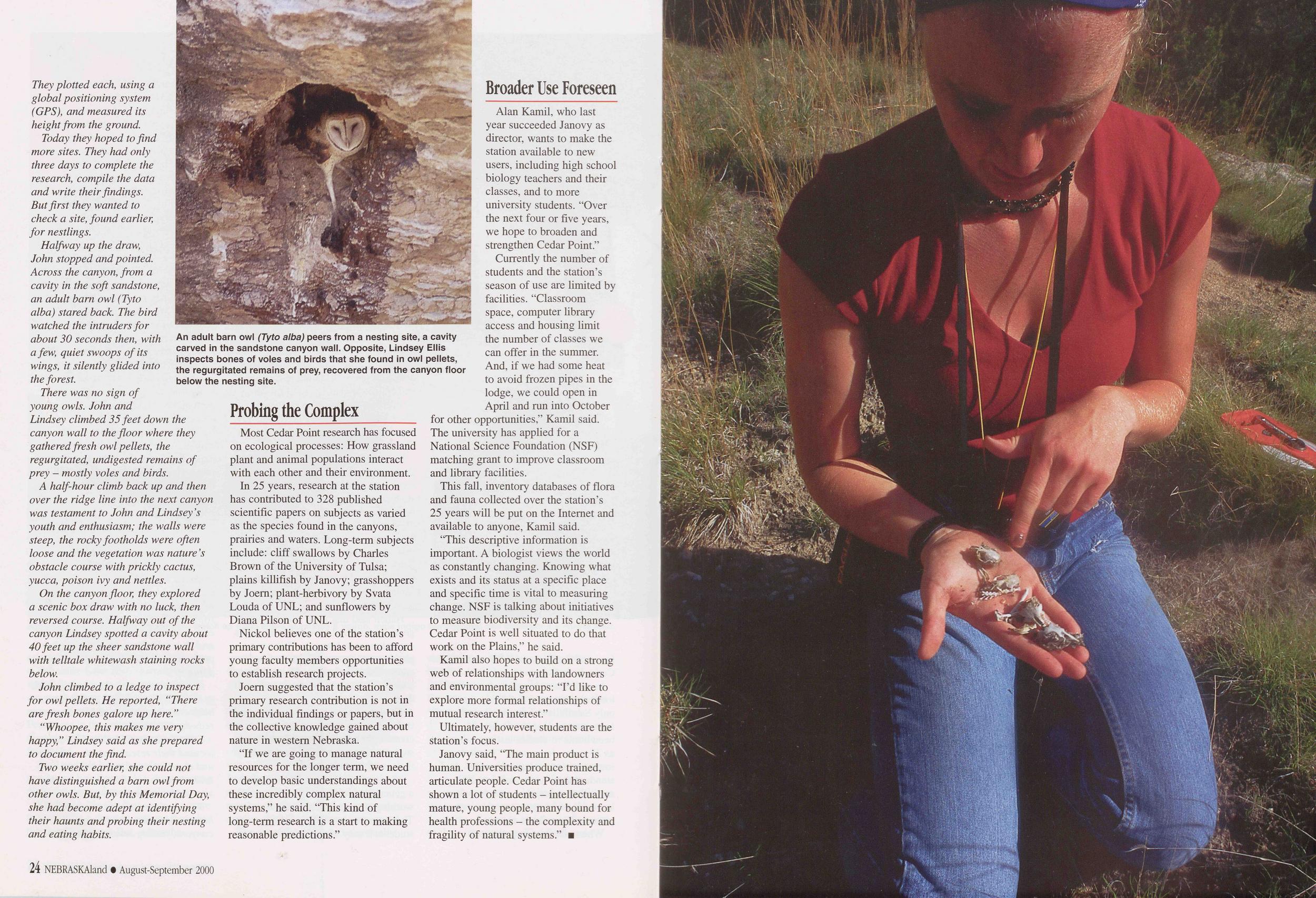
Halfway up the draw, John stopped and pointed. Across the canyon, from a cavity in the soft sandstone, an adult barn owl (Tyto alba) stared back. The bird watched the intruders for about 30 seconds then, with a few, quiet swoops of its wings, it silently glided into the forest.
There was no sign of young owls. John and Lindsey climbed 35 feet down the canyon wall to the floor where they gathered fresh owl pellets, the regurgitated, undigested remains of prey - mostly voles and birds.
A half-hour climb back up and then over the ridge line into the next canyon was testament to John and Lindsey’s youth and enthusiasm; the walls were steep, the rocky footholds were often loose and the vegetation was nature’s obstacle course with prickly cactus, yucca, poison ivy and nettles.
On the canyon floor, they explored a scenic box draw with no luck, then reversed course. Halfway out of the canyon Lindsey spotted a cavity about 40 feet up the sheer sandstone wall with telltale whitewash staining rocks below.
John climbed to a ledge to inspect for owl pellets. He reported, “There are fresh bones galore up here.”
“Whoopee, this makes me very happy,” Lindsey said as she prepared to document the find.
Two weeks earlier, she could not have distinguished a barn owl from other owls. But, by this Memorial Day, she had become adept at identifying their haunts and probing their nesting and eating habits.
Most Cedar Point research has focused on ecological processes: How grassland plant and animal populations interact with each other and their environment.
In 25 years, research at the station has contributed to 328 published scientific papers on subjects as varied as the species found in the canyons, prairies and waters. Long-term subjects include: cliff swallows by Charles Brown of the University of Tulsa; plains killifish by Janovy; grasshoppers by Joem; plant-herbivory by Svata Louda of UNL; and sunflowers by Diana Pilson of UNL.
Nichol believes one of the station’s primary contributions has been to afford young faculty members opportunities to establish research projects.
Joem suggested that the station’s primary research contribution is not in the individual findings or papers, but in the collective knowledge gained about nature in western Nebraska.
"If we are going to manage natural resources for the longer term, we need to develop basic understandings about these incredibly complex natural systems,” he said. "This kind of long-term research is a start to making reasonable predictions.”
Broader Use ForeseenAlan Kamil, who last year succeeded Janovy as director, wants to make the station available to new users, including high school biology teachers and their classes, and to more university students. “Over the next four or five years, we hope to broaden and strengthen Cedar Point.”
Currently the number of students and the station’s season of use are limited by facilities. “Classroom space, computer library access and housing limit the number of classes we can offer in the summer. And, if we had some heat to avoid frozen pipes in the lodge, we could open in April and run into October for other opportunities,” Kamil said. The university has applied for a National Science Foundation (NSF) matching grant to improve classroom and library facilities.
This fall, inventory databases of flora and fauna collected over the station’s 25 years will be put on the Internet and available to anyone, Kamil said.
“This descriptive information is important. A biologist views the world as constantly changing. Knowing what exists and its status at a specific place and specific time is vital to measuring change. NSF is talking about initiatives to measure biodiversity and its change. Cedar Point is well situated to do that work on the Plains,” he said.
Kamil also hopes to build on a strong web of relationships with landowners and environmental groups: “I’d like to explore more formal relationships of mutual research interest.”
Ultimately, however, students are the station’s focus.
Janovy said, “The main product is human. Universities produce trained, articulate people. Cedar Point has shown a lot of students - intellectually mature, young people, many bound for health professions - the complexity and fragility of natural systems.” ■
24 NEBRASKAland • August-September 2000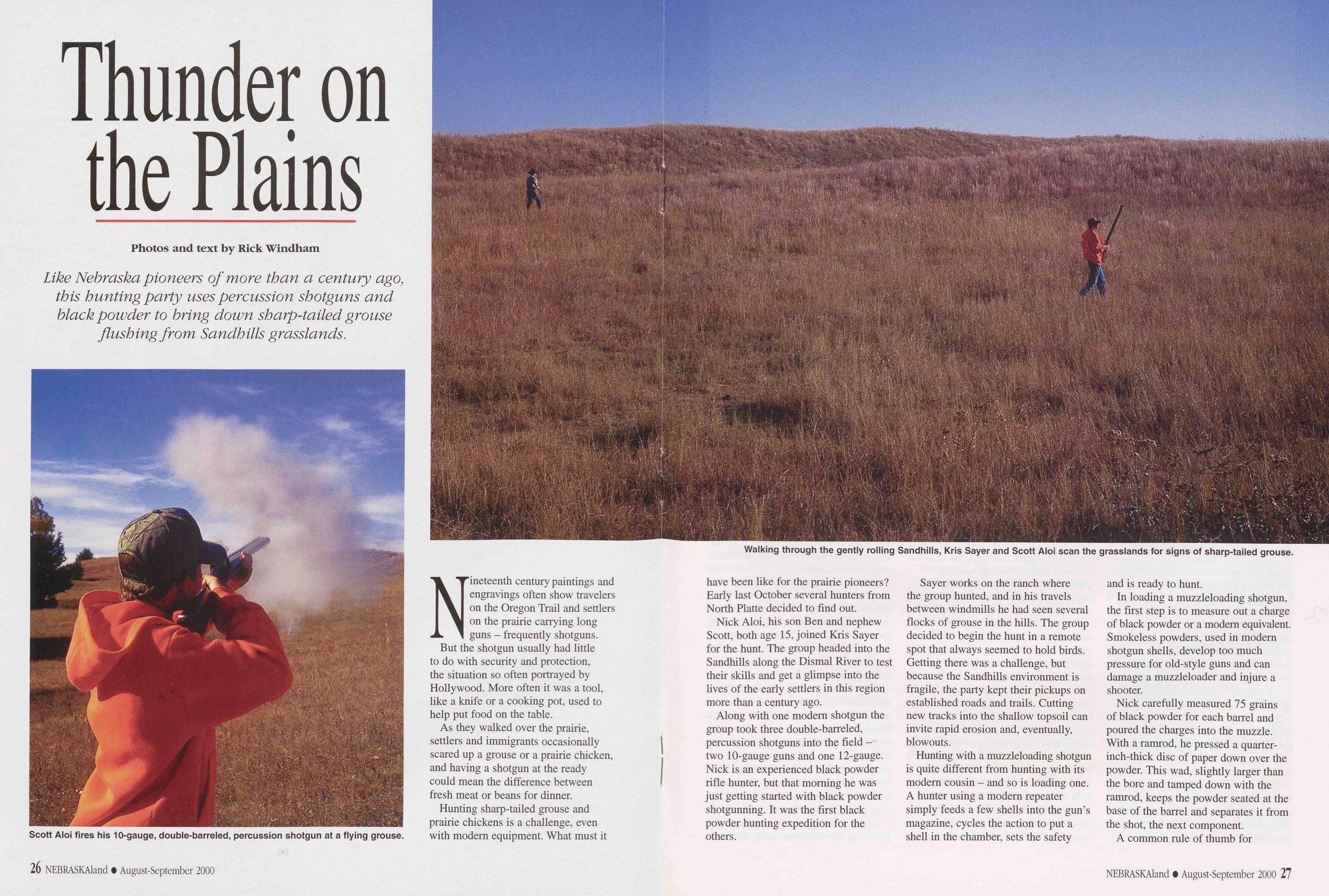
Thunder on the Plains
Photos and text by Rick Windham Like Nebraska pioneers of more than a century ago, this hunting party uses percussion shotguns and black powder to bring down sharp-tailed grouse flushing from Sandhills grasslands.Nineteenth century paintings and engravings often show travelers on the Oregon Trail and settlers on the prairie carrying long guns - frequently shotguns. But the shotgun usually had little to do with security and protection, the situation so often portrayed by Hollywood. More often it was a tool, like a knife or a cooking pot, used to help put food on the table.
As they walked over the prairie, settlers and immigrants occasionally scared up a grouse or a prairie chicken, and having a shotgun at the ready could mean the difference between fresh meat or beans for dinner.
Hunting sharp-tailed grouse and prairie chickens is a challenge, even with modem equipment. What must it have been like for the prairie pioneers? Early last October several hunters from North Platte decided to find out.
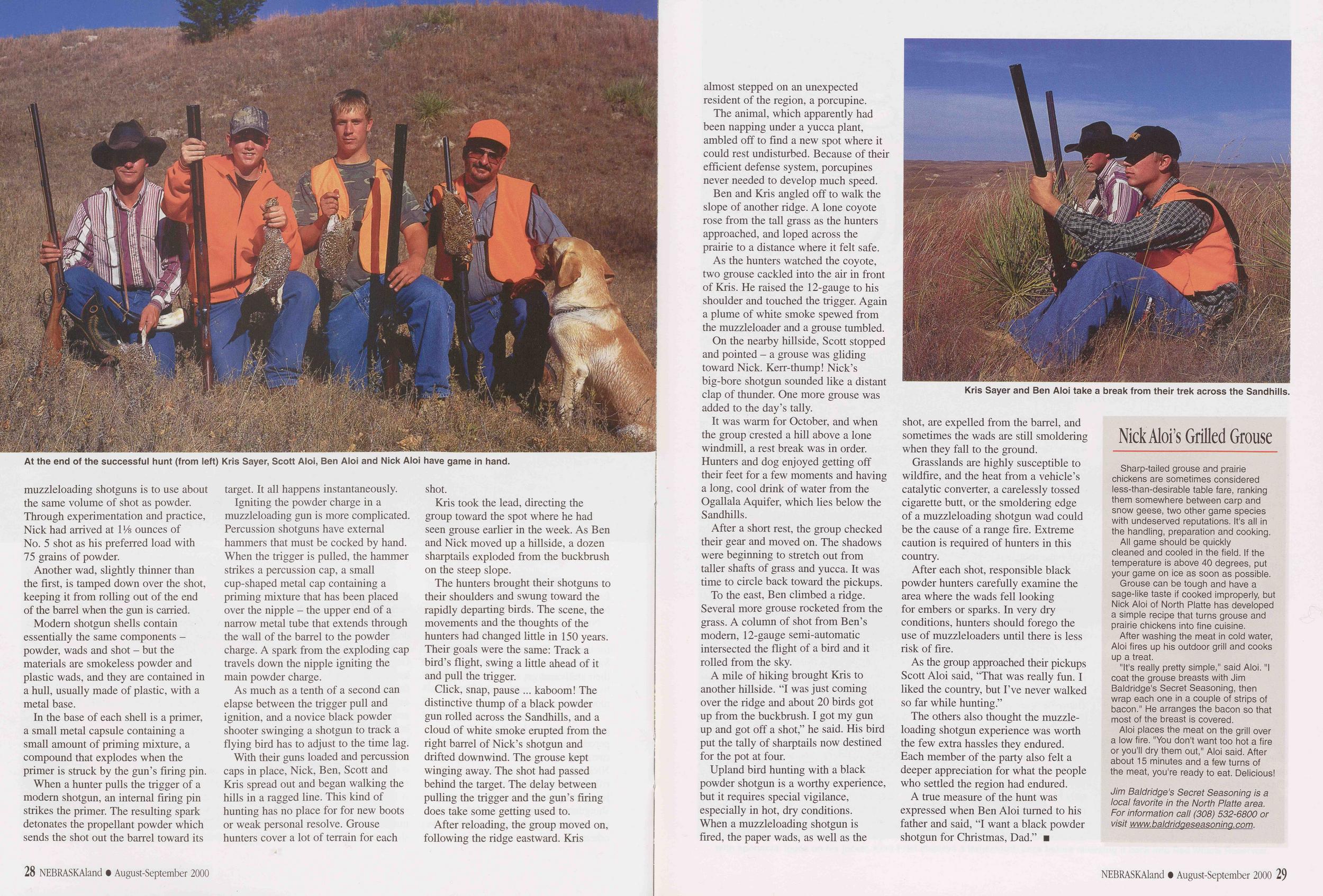
Nick Aloi, his son Ben and nephew Scott, both age 15, joined Kris Sayer for the hunt. The group headed into the Sandhills along the Dismal River to test their skills and get a glimpse into the lives of the early settlers in this region more than a century ago.
Along with one modem shotgun the group took three double-barreled, percussion shotguns into the field - two 10-gauge guns and one 12-gauge. Nick is an experienced black powder rifle hunter, but that morning he was just getting started with black powder shotgunning. It was the first black powder hunting expedition for the others.
Sayer works on the ranch where the group hunted, and in his travels between windmills he had seen several flocks of grouse in the hills. The group decided to begin the hunt in a remote spot that always seemed to hold birds. Getting there was a challenge, but because the Sandhills environment is fragile, the party kept their pickups on established roads and trails. Cutting new tracks into the shallow topsoil can invite rapid erosion and, eventually, blowouts.
Hunting with a muzzleloading shotgun is quite different from hunting with its modem cousin - and so is loading one. A hunter using a modern repeater simply feeds a few shells into the gun’s magazine, cycles the action to put a shell in the chamber, sets the safety and is ready to hunt.
In loading a muzzleloading shotgun, the first step is to measure out a charge of black powder or a modem equivalent. Smokeless powders, used in modem shotgun shells, develop too much pressure for old-style guns and can damage a muzzleloader and injure a shooter.
Nick carefully measured 75 grains of black powder for each barrel and poured the charges into the muzzle. With a ramrod, he pressed a quarter- inch-thick disc of paper down over the powder. This wad, slightly larger than the bore and tamped down with the ramrod, keeps the powder seated at the base of the barrel and separates it from the shot, the next component.
A common rule of thumb for
26 NEBRASKAland • August-September 2000
NEBRASKAland • August-September 2000 27
 muzzleloading shotguns is to use about
the same volume of shot as powder.
Through experimentation and practice,
Nick had arrived at IVs ounces of
No. 5 shot as his preferred load with
75 grains of powder.
muzzleloading shotguns is to use about
the same volume of shot as powder.
Through experimentation and practice,
Nick had arrived at IVs ounces of
No. 5 shot as his preferred load with
75 grains of powder.
Another wad, slightly thinner than the first, is tamped down over the shot, keeping it from rolling out of the end of the barrel when the gun is carried.
Modem shotgun shells contain essentially the same components - powder, wads and shot - but the materials are smokeless powder and plastic wads, and they are contained in a hull, usually made of plastic, with a metal base.
In the base of each shell is a primer, a small metal capsule containing a small amount of priming mixture, a compound that explodes when the primer is struck by the gun’s firing pin.
When a hunter pulls the trigger of a modem shotgun, an internal firing pin strikes the primer. The resulting spark detonates the propellant powder which sends the shot out the barrel toward its target. It all happens instantaneously.
Igniting the powder charge in a muzzleloading gun is more complicated. Percussion shotguns have external hammers that must be cocked by hand. When the trigger is pulled, the hammer strikes a percussion cap, a small cup-shaped metal cap containing a priming mixture that has been placed over the nipple - the upper end of a narrow metal tube that extends through the wall of the barrel to the powder charge. A spark from the exploding cap travels down the nipple igniting the main powder charge.
As much as a tenth of a second can elapse between the trigger pull and ignition, and a novice black powder shooter swinging a shotgun to track a flying bird has to adjust to the time lag.
With their guns loaded and percussion caps in place, Nick, Ben, Scott and Kris spread out and began walking the hills in a ragged line. This kind of hunting has no place for for new boots or weak personal resolve. Grouse hunters cover a lot of terrain for each shot.
Kris took the lead, directing the group toward the spot where he had seen grouse earlier in the week. As Ben and Nick moved up a hillside, a dozen sharptails exploded from the buckbrush on the steep slope.
The hunters brought their shotguns to their shoulders and swung toward the rapidly departing birds. The scene, the movements and the thoughts of the hunters had changed little in 150 years. Their goals were the same: Track a bird’s flight, swing a little ahead of it and pull the trigger.
Click, snap, pause ... kaboom! The distinctive thump of a black powder gun rolled across the Sandhills, and a cloud of white smoke erupted from the right barrel of Nick’s shotgun and drifted downwind. The grouse kept winging away. The shot had passed behind the target. The delay between pulling the trigger and the gun’s firing does take some getting used to.
After reloading, the group moved on, following the ridge eastward. Kris almost stepped on an unexpected resident of the region, a porcupine.
The animal, which apparently had been napping under a yucca plant, ambled off to find a new spot where it could rest undisturbed. Because of their efficient defense system, porcupines never needed to develop much speed.
Ben and Kris angled off to walk the slope of another ridge. A lone coyote rose from the tall grass as the hunters approached, and loped across the prairie to a distance where it felt safe.
As the hunters watched the coyote, two grouse cackled into the air in front of Kris. He raised the 12-gauge to his shoulder and touched the trigger. Again a plume of white smoke spewed from the muzzleloader and a grouse tumbled.
On the nearby hillside, Scott stopped and pointed - a grouse was gliding toward Nick. Kerr-thump! Nick’s big-bore shotgun sounded like a distant clap of thunder. One more grouse was added to the day’s tally.
It was warm for October, and when the group crested a hill above a lone windmill, a rest break was in order. Hunters and dog enjoyed getting off their feet for a few moments and having a long, cool drink of water from the Ogallala Aquifer, which lies below the Sandhills.
After a short rest, the group checked their gear and moved on. The shadows were beginning to stretch out from taller shafts of grass and yucca. It was time to circle back toward the pickups. To the east, Ben climbed a ridge.
Several more grouse rocketed from the grass. A column of shot from Ben’s modem, 12-gauge semi-automatic intersected the flight of a bird and it rolled from the sky.
A mile of hiking brought Kris to another hillside. "I was just coming over the ridge and about 20 birds got up from the buckbrush. I got my gun up and got off a shot,” he said. His bird put the tally of sharptails now destined for the pot at four.
Upland bird hunting with a black powder shotgun is a worthy experience, but it requires special vigilance, especially in hot, dry conditions. When a muzzleloading shotgun is fired, the paper wads, as well as the shot, are expelled from the barrel, and sometimes the wads are still smoldering when they fall to the ground.
Grasslands are highly susceptible to wildfire, and the heat from a vehicle’s catalytic converter, a carelessly tossed cigarette butt, or the smoldering edge of a muzzleloading shotgun wad could be the cause of a range fire. Extreme caution is required of hunters in this country.
After each shot, responsible black powder hunters carefully examine the area where the wads fell looking for embers or sparks. In very dry conditions, hunters should forego the use of muzzleloaders until there is less risk of fire.
As the group approached their pickups Scott Aloi said, “That was really fun. I liked the country, but I’ve never walked so far while hunting.”
The others also thought the muzzle- loading shotgun experience was worth the few extra hassles they endured. Each member of the party also felt a deeper appreciation for what the people who settled the region had endured.
A true measure of the hunt was expressed when Ben Aloi turned to his father and said, “I want a black powder shotgun for Christmas, Dad.” ■
NickAloi’s Grilled GrouseSharp-tailed grouse and prairie chickens are sometimes considered less-than-desirable table fare, ranking them somewhere between carp and snow geese, two other game species with undeserved reputations. It's all in the handling, preparation and cooking.
All game should be quickly cleaned and cooled in the field. If the temperature is above 40 degrees, put your game on ice as soon as possible.
Grouse can be tough and have a sage-like taste if cooked improperly, but Nick Aloi of North Platte has developed a simple recipe that turns grouse and prairie chickens into fine cuisine.
After washing the meat in cold water, Aloi fires up his outdoor grill and cooks up a treat.
"It's really pretty simple," said Aloi. "I coat the grouse breasts with Jim Baldridge's Secret Seasoning, then wrap each one in a couple of strips of bacon." He arranges the bacon so that most of the breast is covered.
Aloi places the meat on the grill over a low fire. "You don't want too hot a fire or you'll dry them out," Aloi said. After about 15 minutes and a few turns of the meat, you're ready to eat. Delicious!
Jim Baldridge's Secret Seasoning is a local favorite in the North Platte area. For information call (308) 532-6800 or visit www. baldridaeseasoning. com.
28 NEBRASKAland • August-September 2000 NEBRASKAland • August-September 2000 29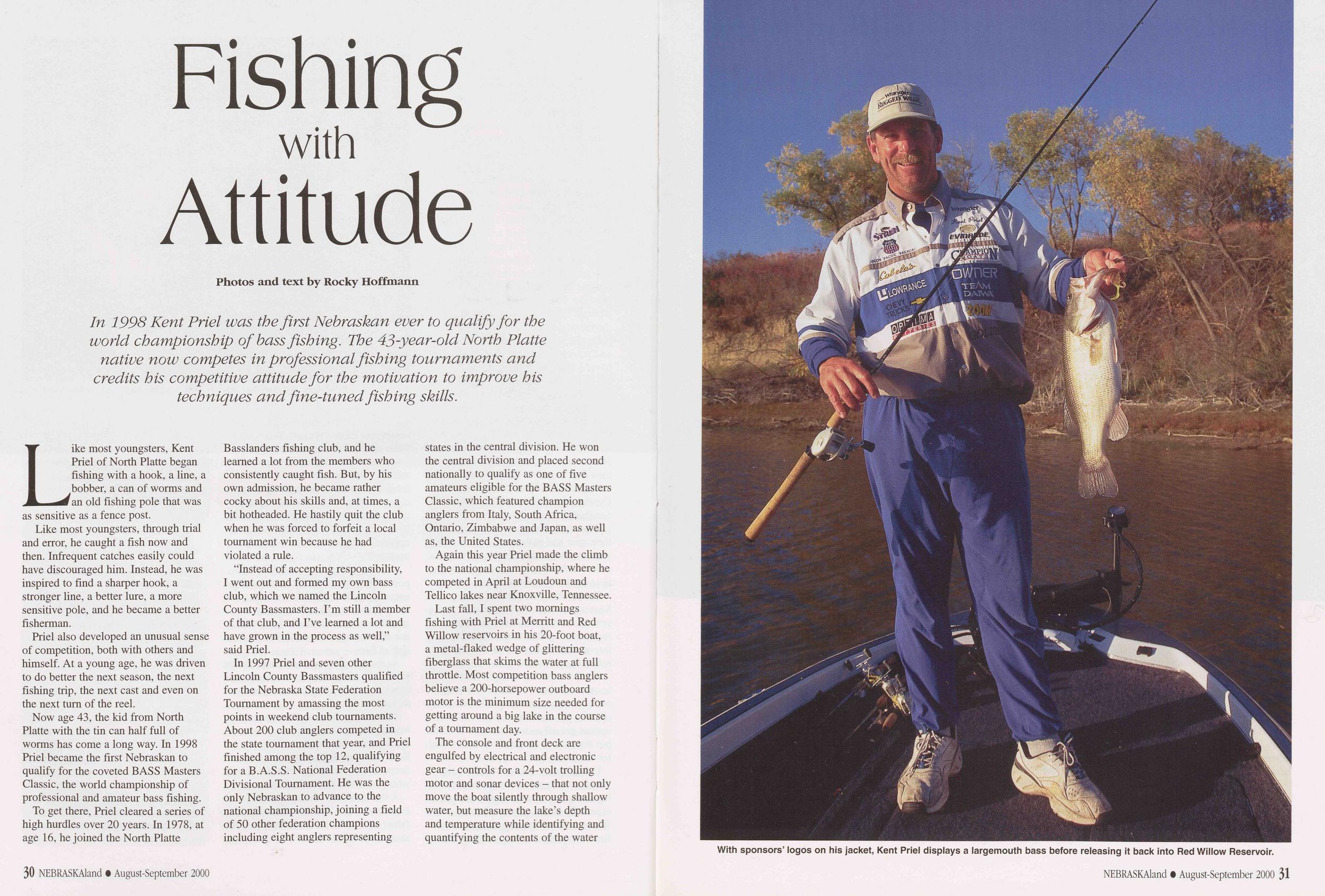
Fishing with Attitude
Photos and text by Rocky Hoffmann In 1998 Kent Priel was the first Nebraskan ever to qualify for the world championship of bass fishing. The 43-year-old North Platte native now competes in professional fishing tournaments and credits his competitive attitude for the motivation to improve his techniques and fine-tuned fishing skills.Like most youngsters, Kent Priel of North Platte began fishing with a hook, a line, a bobber, a can of worms and an old fishing pole that was as sensitive as a fence post.
Like most youngsters, through trial and error, he caught a fish now and then. Infrequent catches easily could have discouraged him. Instead, he was inspired to find a sharper hook, a stronger line, a better lure, a more sensitive pole, and he became a better fisherman.
Priel also developed an unusual sense of competition, both with others and himself. At a young age, he was driven to do better the next season, the next fishing trip, the next cast and even on the next turn of the reel.
Now age 43, the kid from North Platte with the tin can half full of worms has come a long way. In 1998 Priel became the first Nebraskan to qualify for the coveted BASS Masters Classic, the world championship of professional and amateur bass fishing.
To get there, Priel cleared a series of high hurdles over 20 years. In 1978, at age 16, he joined the North Platte Basslanders fishing club, and he learned a lot from the members who consistently caught fish. But, by his own admission, he became rather cocky about his skills and, at times, a bit hotheaded. He hastily quit the club when he was forced to forfeit a local tournament win because he had violated a rule.
“Instead of accepting responsibility, I went out and formed my own bass club, which we named the Lincoln County Bassmasters. I’m still a member of that club, and I’ve learned a lot and have grown in the process as well,” said Priel.
In 1997 Priel and seven other Lincoln County Bassmasters qualified for the Nebraska State Federation Tournament by amassing the most points in weekend club tournaments. About 200 club anglers competed in the state tournament that year, and Priel finished among the top 12, qualifying for a B.A.S.S. National Federation Divisional Tournament. He was the only Nebraskan to advance to the national championship, joining a field of 50 other federation champions including eight anglers representing states in the central division. He won the central division and placed second nationally to qualify as one of five amateurs eligible for the BASS Masters Classic, which featured champion anglers from Italy, South Africa, Ontario, Zimbabwe and Japan, as well as, the United States.
Again this year Priel made the climb to the national championship, where he competed in April at Loudoun and Tellico lakes near Knoxville, Tennessee.
Last fall, I spent two mornings fishing with Priel at Merritt and Red Willow reservoirs in his 20-foot boat, a metal-flaked wedge of glittering fiberglass that skims the water at full throttle. Most competition bass anglers believe a 200-horsepower outboard motor is the minimum size needed for getting around a big lake in the course of a tournament day.
The console and front deck are
engulfed by electrical and electronic
gear - controls for a 24-volt trolling
motor and sonar devices - that not only
move the boat silently through shallow
water, but measure the lake’s depth
and temperature while identifying and
quantifying the contents of the water
30 NEBRASKAland • August-September 2000
NEBRASKAland • August-September 2000 31
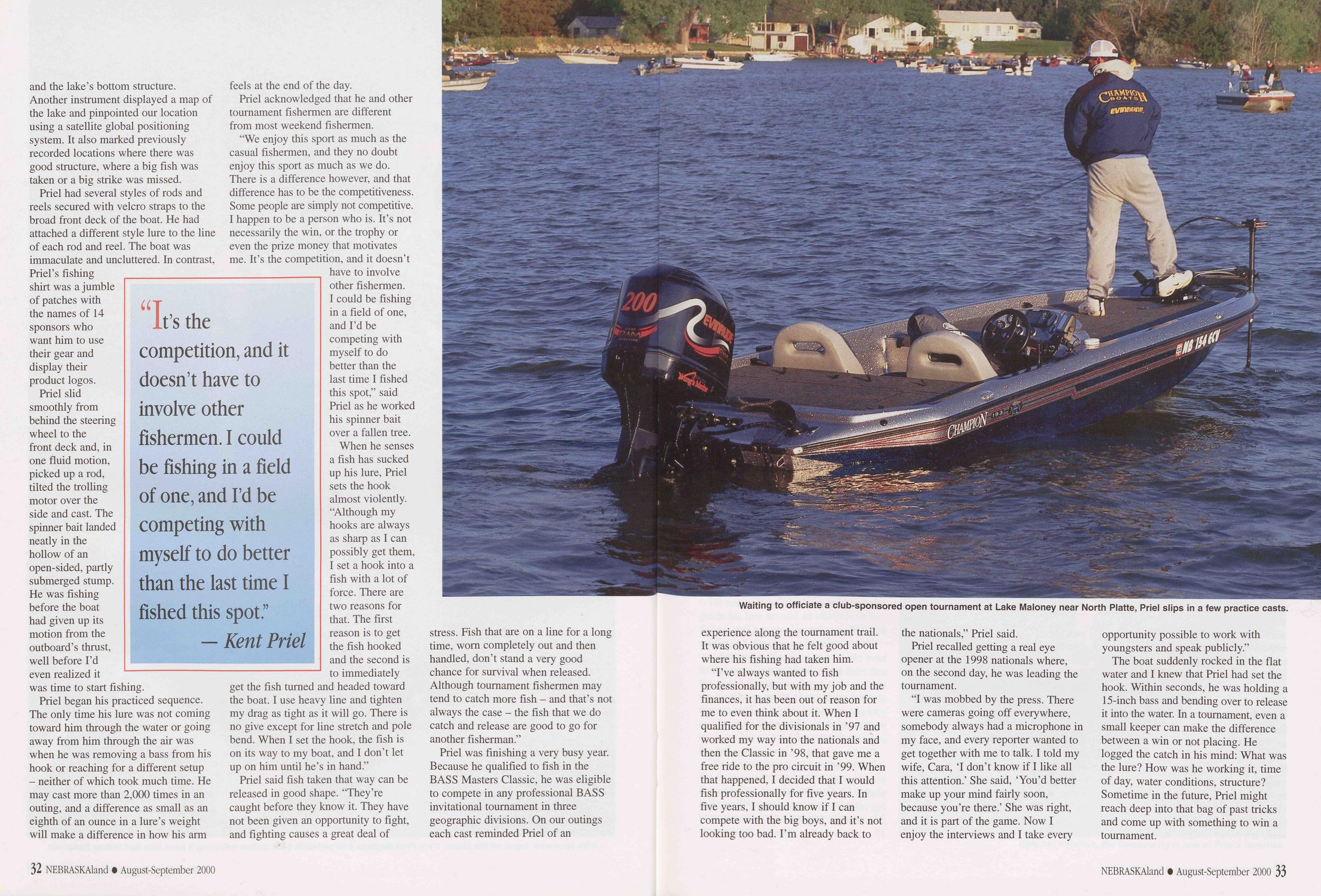 and the lake’s bottom structure.
Another instrument displayed a map of the lake and pinpointed our location using a satellite global positioning system. It also marked previously recorded locations where there was good structure, where a big fish was taken or a big strike was missed.
Priel had several styles of rods and reels secured with velcro straps to the broad front deck of the boat. He had attached a different style lure to the line of each rod and reel. The boat was immaculate and uncluttered. In contrast, Priel’s fishing shirt was a jumble of patches with the names of 14 sponsors who want him to use their gear and display their product logos.
Priel slid smoothly from behind the steering wheel to the front deck and, in one fluid motion, picked up a rod, tilted the trolling motor over the side and cast. The spinner bait landed neatly in the hollow of an open-sided, partly submerged stump. He was fishing before the boat had given up its motion from the outboard’s thrust, well before I’d even realized it was time to start fishing.
Priel began his practiced sequence. The only time his lure was not coming toward him through the water or going away from him through the air was when he was removing a bass from his hook or reaching for a different setup - neither of which took much time. He may cast more than 2,000 times in an outing, and a difference as small as an eighth of an ounce in a lure’s weight will make a difference in how his arm feels at the end of the day.
"It’s the competition, and it doesn’t have to involve other fishermen. I could be fishing in a field of one, and I’d be competing with myself to do better than the last time I fished this spot.” — Kent PrielPriel acknowledged that he and other tournament fishermen are different from most weekend fishermen.
“We enjoy this sport as much as the casual fishermen, and they no doubt enjoy this sport as much as we do. There is a difference however, and that difference has to be the competitiveness. Some people are simply not competitive. I happen to be a person who is. It’s not necessarily the win, or the trophy or even the prize money that motivates me. It’s the competition, and it doesn’t have to involve other fishermen. I could be fishing in a field of one, and I’d be competing with myself to do better than the last time I fished this spot,” said Priel as he worked his spinner bait over a fallen tree.
When he senses a fish has sucked up his lure, Priel sets the hook almost violently. “Although my hooks are always as sharp as I can possibly get them, I set a hook into a fish with a lot of force. There are two reasons for that. The first reason is to get the fish hooked and the second is to immediately get the fish turned and headed toward the boat. I use heavy line and tighten my drag as tight as it will go. There is no give except for line stretch and pole bend. When I set the hook, the fish is on its way to my boat, and I don’t let up on him until he’s in hand.”
Priel said fish taken that way can be released in good shape. “They’re caught before they know it. They have not been given an opportunity to fight, and fighting causes a great deal of stress. Fish that are on a line for a long time, worn completely out and then handled, don’t stand a very good chance for survival when released. Although tournament fishermen may tend to catch more fish - and that’s not always the case - the fish that we do catch and release are good to go for another fisherman.”
Priel was finishing a very busy year. Because he qualified to fish in the BASS Masters Classic, he was eligible to compete in any professional BASS invitational tournament in three geographic divisions. On our outings each cast reminded Priel of an experience along the tournament trail. It was obvious that he felt good about where his fishing had taken him.
“I’ve always wanted to fish professionally, but with my job and the finances, it has been out of reason for me to even think about it. When I qualified for the divisional in ’97 and worked my way into the nationals and then the Classic in ’98, that gave me a free ride to the pro circuit in ’99. When that happened, I decided that I would fish professionally for five years. In five years, I should know if I can compete with the big boys, and it’s not looking too bad. I’m already back to the nationals,” Priel said.
Priel recalled getting a real eye opener at the 1998 nationals where, on the second day, he was leading the tournament.
“I was mobbed by the press. There were cameras going off everywhere, somebody always had a microphone in my face, and every reporter wanted to get together with me to talk. I told my wife, Cara, I don’t know if I like all this attention.’ She said, ‘You’d better make up your mind fairly soon, because you’re there.’ She was right, and it is part of the game. Now I enjoy the interviews and I take every opportunity possible to work with youngsters and speak publicly.”
The boat suddenly rocked in the flat water and I knew that Priel had set the hook. Within seconds, he was holding a 15-inch bass and bending over to release it into the water. In a tournament, even a small keeper can make the difference between a win or not placing. He logged the catch in his mind: What was the lure? How was he working it, time of day, water conditions, structure? Sometime in the future, Priel might reach deep into that bag of past tricks and come up with something to win a tournament.
32 NEBRASKAland • August-September 2000 NEBRASKAland • August-September 2000 33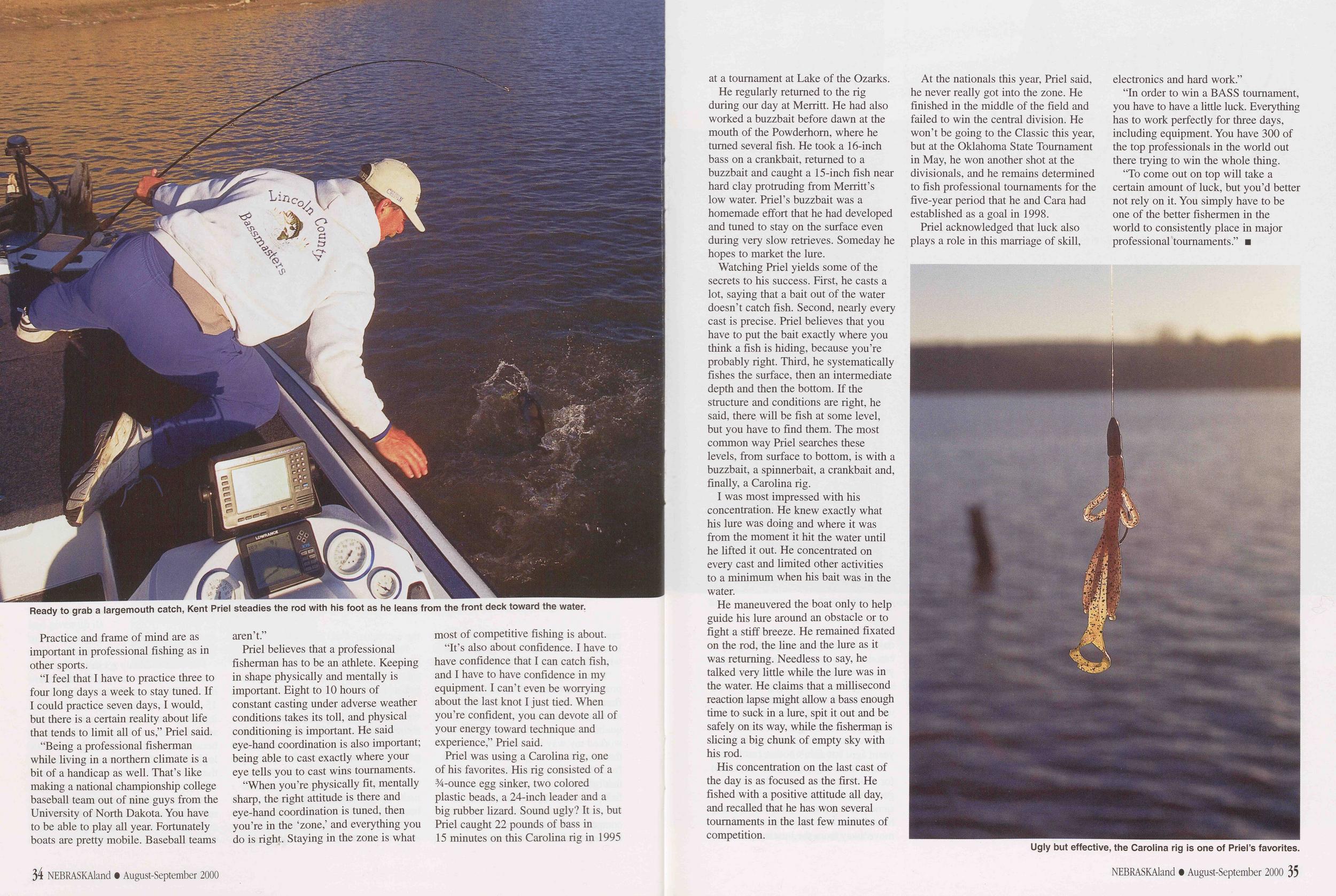
Practice and frame of mind are as important in professional fishing as in other sports.
"I feel that I have to practice three to four long days a week to stay tuned. If I could practice seven days, I would, but there is a certain reality about life that tends to limit all of us,” Priel said.
“Being a professional fisherman while living in a northern climate is a bit of a handicap as well. That’s like making a national championship college baseball team out of nine guys from the University of North Dakota. You have to be able to play all year. Fortunately boats are pretty mobile. Baseball teams aren’t.”
Priel believes that a professional fisherman has to be an athlete. Keeping in shape physically and mentally is important. Eight to 10 hours of constant casting under adverse weather conditions takes its toll, and physical conditioning is important. He said eye-hand coordination is also important; being able to cast exactly where your eye tells you to cast wins tournaments.
“When you’re physically fit, mentally sharp, the right attitude is there and eye-hand coordination is tuned, then you’re in the ‘zone,’ and everything you do is right. Staying in the zone is what most of competitive fishing is about.
“It’s also about confidence. I have to have confidence that I can catch fish, and I have to have confidence in my equipment. I can’t even be worrying about the last knot I just tied. When you’re confident, you can devote all of your energy toward technique and experience,” Priel said.
Priel was using a Carolina rig, one of his favorites. His rig consisted of a 34-ounce egg sinker, two colored plastic beads, a 24-inch leader and a big rubber lizard. Sound ugly? It is, but Priel caught 22 pounds of bass in 15 minutes on this Carolina rig in 1995 at a tournament at Lake of the Ozarks.
He regularly returned to the rig during our day at Merritt. He had also worked a buzzbait before dawn at the mouth of the Powderhom, where he turned several fish. He took a 16-inch bass on a crankbait, returned to a buzzbait and caught a 15-inch fish near hard clay protruding from Merritt’s low water. Priel’s buzzbait was a homemade effort that he had developed and tuned to stay on the surface even during very slow retrieves. Someday he hopes to market the lure.
Watching Priel yields some of the secrets to his success. First, he casts a lot, saying that a bait out of the water doesn’t catch fish. Second, nearly every cast is precise. Priel believes that you have to put the bait exactly where you think a fish is hiding, because you’re probably right. Third, he systematically fishes the surface, then an intermediate depth and then the bottom. If the structure and conditions are right, he said, there will be fish at some level, but you have to find them. The most common way Priel searches these levels, from surface to bottom, is with a buzzbait, a spinnerbait, a crankbait and, finally, a Carolina rig.
I was most impressed with his concentration. He knew exactly what his lure was doing and where it was from the moment it hit the water until he lifted it out. He concentrated on every cast and limited other activities to a minimum when his bait was in the water.
He maneuvered the boat only to help guide his lure around an obstacle or to fight a stiff breeze. He remained fixated on the rod, the line and the lure as it was returning. Needless to say, he talked very little while the lure was in the water. He claims that a millisecond reaction lapse might allow a bass enough time to suck in a lure, spit it out and be safely on its way, while the fisherman is slicing a big chunk of empty sky with his rod.
His concentration on the last cast of the day is as focused as the first. He fished with a positive attitude all day, and recalled that he has won several tournaments in the last few minutes of competition.
At the nationals this year, Priel said, he never really got into the zone. He finished in the middle of the field and failed to win the central division. He won’t be going to the Classic this year, but at the Oklahoma State Tournament in May, he won another shot at the divisional, and he remains determined to fish professional tournaments for the five-year period that he and Cara had established as a goal in 1998.
Priel acknowledged that luck also plays a role in this marriage of skill, electronics and hard work.”
“In order to win a BASS tournament, you have to have a little luck. Everything has to work perfectly for three days, including equipment. You have 300 of the top professionals in the world out there trying to win the whole thing.
“To come out on top will take a certain amount of luck, but you’d better not rely on it. You simply have to be one of the better fishermen in the world to consistently place in major professional tournaments.” ■
34 NEBRASKAland • August-September 2000 NEBRASKAland • August-September 2000 35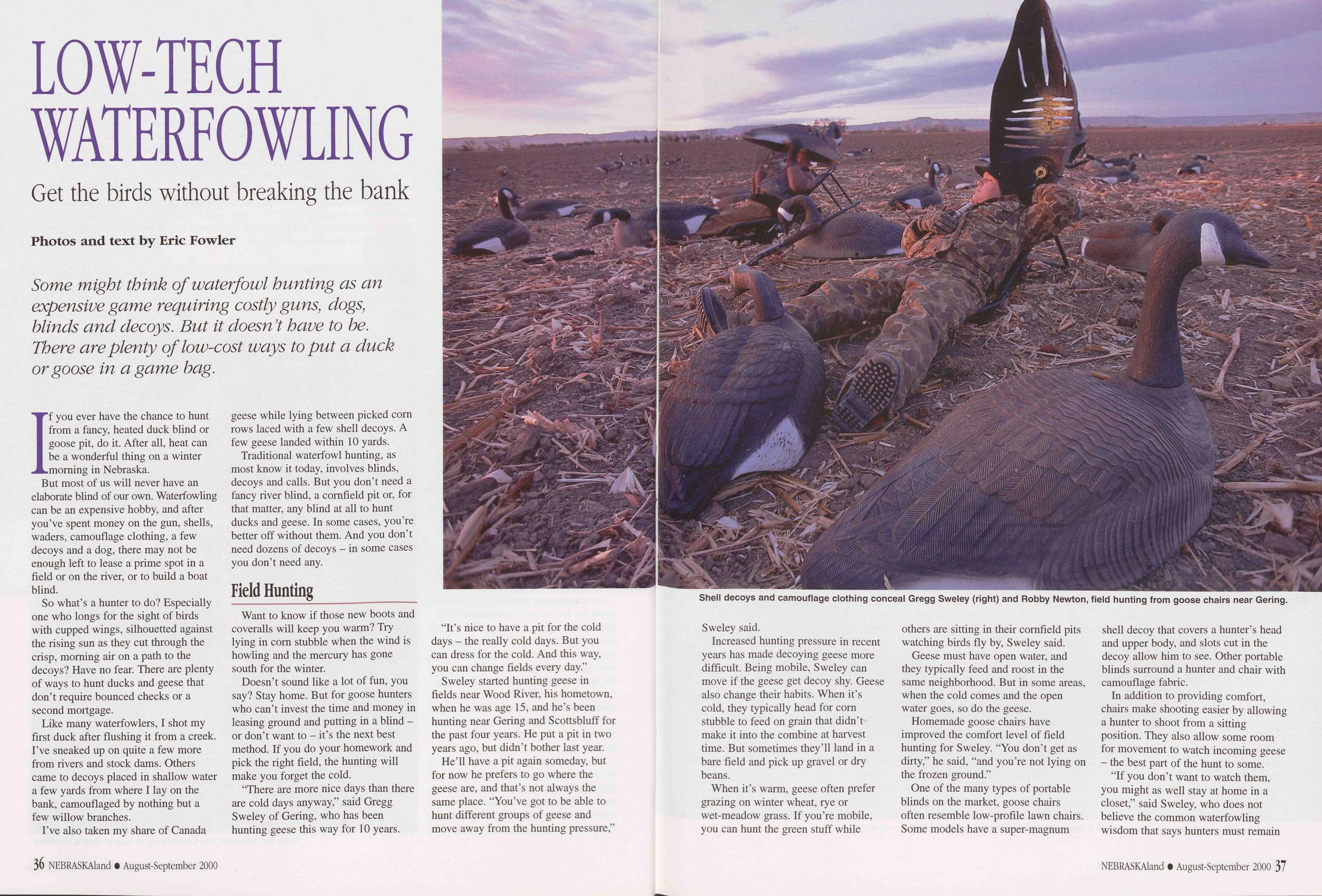
LOW-TECH WATERFOWLING
Get the birds without breaking the bank Photos and text by Eric Fowler Some might think of waterfowl hunting as an expensive game requiring costly guns, dogs, blinds and decoys. But it doesn’t have to be. There are plenty of low-cost ways to put a duck or goose in a game bag.If you ever have the chance to hunt from a fancy, heated duck blind or goose pit, do it. After all, heat can be a wonderful thing on a winter morning in Nebraska.
But most of us will never have an elaborate blind of our own. Waterfowling can be an expensive hobby, and after you’ve spent money on the gun, shells, waders, camouflage clothing, a few decoys and a dog, there may not be enough left to lease a prime spot in a field or on the river, or to build a boat blind.
So what’s a hunter to do? Especially one who longs for the sight of birds with cupped wings, silhouetted against the rising sun as they cut through the crisp, morning air on a path to the decoys? Have no fear. There are plenty of ways to hunt ducks and geese that don’t require bounced checks or a second mortgage.
Like many waterfowlers, I shot my first duck after flushing it from a creek. I’ve sneaked up on quite a few more from rivers and stock dams. Others came to decoys placed in shallow water a few yards from where I lay on the bank, camouflaged by nothing but a few willow branches.
I’ve also taken my share of Canada geese while lying between picked com rows laced with a few shell decoys. A few geese landed within 10 yards.
Traditional waterfowl hunting, as most know it today, involves blinds, decoys and calls. But you don’t need a fancy river blind, a cornfield pit or, for that matter, any blind at all to hunt ducks and geese. In some cases, you’re better off without them. And you don’t need dozens of decoys - in some cases you don’t need any.
Field HuntingWant to know if those new boots and coveralls will keep you warm? Try lying in com stubble when the wind is howling and the mercury has gone south for the winter.
Doesn’t sound like a lot of fun, you say? Stay home. But for goose hunters who can’t invest the time and money in leasing ground and putting in a blind - or don’t want to - it’s the next best method. If you do your homework and pick the right field, the hunting will make you forget the cold.
“There are more nice days than there are cold days anyway,” said Gregg Sweley of Gering, who has been hunting geese this way for 10 years.
"It’s nice to have a pit for the cold days - the really cold days. But you can dress for the cold. And this way, you can change fields every day.”
Sweley started hunting geese in fields near Wood River, his hometown, when he was age 15, and he’s been hunting near Gering and Scottsbluff for the past four years. He put a pit in two years ago, but didn’t bother last year.
He’ll have a pit again someday, but for now he prefers to go where the geese are, and that’s not always the same place. "You’ve got to be able to hunt different groups of geese and move away from the hunting pressure,” Sweley said.
Increased hunting pressure in recent years has made decoying geese more difficult. Being mobile, Sweley can move if the geese get decoy shy. Geese also change their habits. When it’s cold, they typically head for com stubble to feed on grain that didn’t make it into the combine at harvest time. But sometimes they’ll land in a bare field and pick up gravel or dry beans.
When it’s warm, geese often prefer grazing on winter wheat, rye or wet-meadow grass. If you’re mobile, you can hunt the green stuff while others are sitting in their cornfield pits watching birds fly by, Sweley said.
Geese must have open water, and they typically feed and roost in the same neighborhood. But in some areas, when the cold comes and the open water goes, so do the geese.
Homemade goose chairs have improved the comfort level of field hunting for Sweley. "You don’t get as dirty,” he said, "and you’re not lying on the frozen ground.”
One of the many types of portable blinds on the market, goose chairs often resemble low-profile lawn chairs. Some models have a super-magnum shell decoy that covers a hunter’s head and upper body, and slots cut in the decoy allow him to see. Other portable blinds surround a hunter and chair with camouflage fabric.
In addition to providing comfort, chairs make shooting easier by allowing a hunter to shoot from a sitting position. They also allow some room for movement to watch incoming geese - the best part of the hunt to some.
"If you don’t want to watch them,
you might as well stay at home in a
closet,” said Sweley, who does not
believe the common waterfowling
wisdom that says hunters must remain
36 NEBRASKAland • August-September 2000
NEBRASKAland • August-September 2000 37
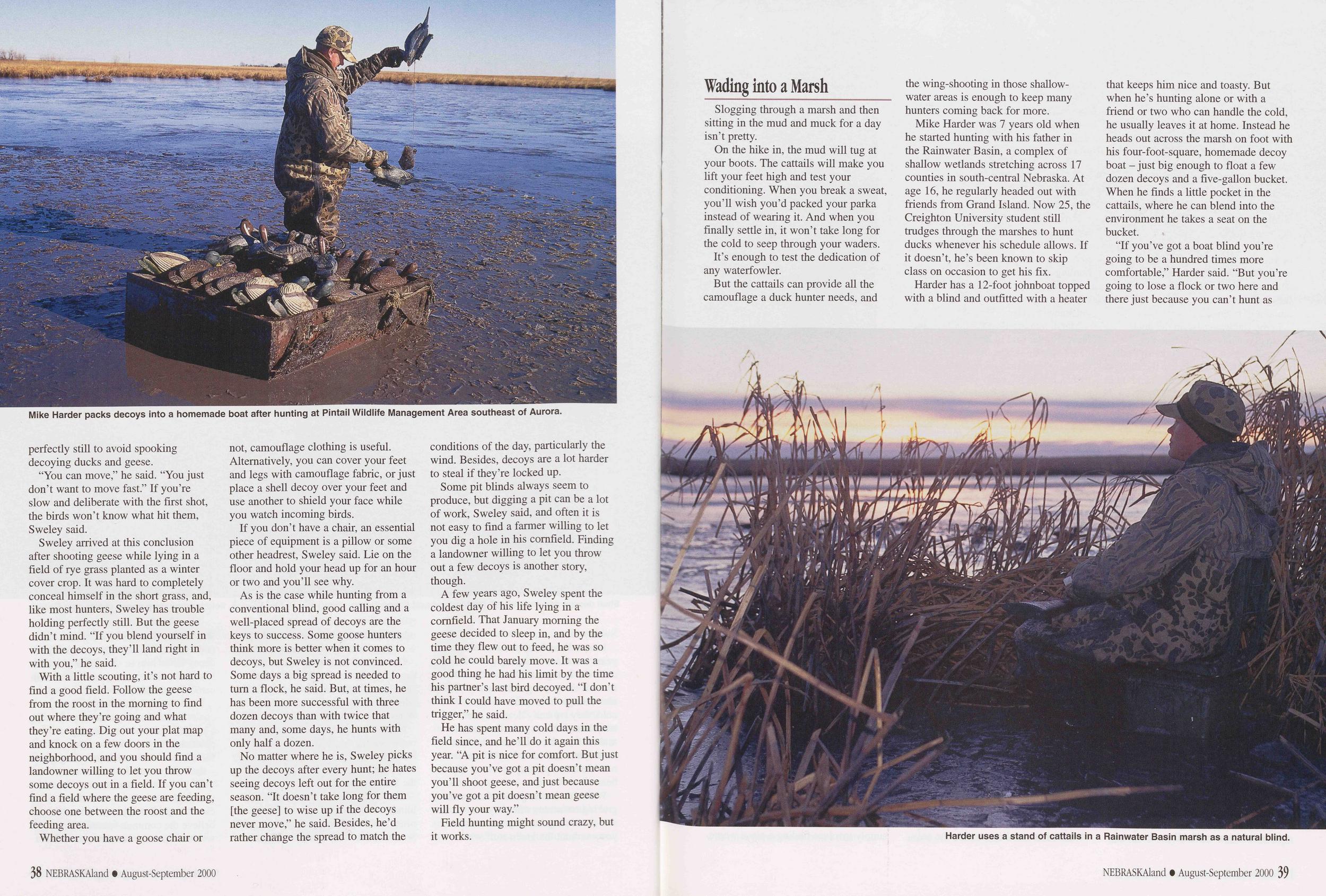 perfectly still to avoid spooking
decoying ducks and geese.
perfectly still to avoid spooking
decoying ducks and geese.
“You can move,” he said. “You just don’t want to move fast.” If you’re slow and deliberate with the first shot, the birds won’t know what hit them, Sweley said.
Sweley arrived at this conclusion after shooting geese while lying in a field of rye grass planted as a winter cover crop. It was hard to completely conceal himself in the short grass, and, like most hunters, Sweley has trouble holding perfectly still. But the geese didn’t mind. “If you blend yourself in with the decoys, they’ll land right in with you,” he said.
With a little scouting, it’s not hard to find a good field. Follow the geese from the roost in the morning to find out where they’re going and what they’re eating. Dig out your plat map and knock on a few doors in the neighborhood, and you should find a landowner willing to let you throw some decoys out in a field. If you can’t find a field where the geese are feeding, choose one between the roost and the feeding area.
Whether you have a goose chair or not, camouflage clothing is useful. Alternatively, you can cover your feet and legs with camouflage fabric, or just place a shell decoy over your feet and use another to shield your face while you watch incoming birds.
If you don’t have a chair, an essential piece of equipment is a pillow or some other headrest, Sweley said. Lie on the floor and hold your head up for an hour or two and you’ll see why.
As is the case while hunting from a conventional blind, good calling and a well-placed spread of decoys are the keys to success. Some goose hunters think more is better when it comes to decoys, but Sweley is not convinced. Some days a big spread is needed to turn a flock, he said. But, at times, he has been more successful with three dozen decoys than with twice that many and, some days, he hunts with only half a dozen.
No matter where he is, Sweley picks up the decoys after every hunt; he hates seeing decoys left out for the entire season. “It doesn’t take long for them [the geese] to wise up if the decoys never move,” he said. Besides, he’d rather change the spread to match the conditions of the day, particularly the wind. Besides, decoys are a lot harder to steal if they’re locked up.
Some pit blinds always seem to produce, but digging a pit can be a lot of work, Sweley said, and often it is not easy to find a farmer willing to let you dig a hole in his cornfield. Finding a landowner willing to let you throw out a few decoys is another story, though.
A few years ago, Sweley spent the coldest day of his life lying in a cornfield. That January morning the geese decided to sleep in, and by the time they flew out to feed, he was so cold he could barely move. It was a good thing he had his limit by the time his partner’s last bird decoyed. “I don’t think I could have moved to pull the trigger,” he said.
He has spent many cold days in the field since, and he’ll do it again this year. “A pit is nice for comfort. But just because you’ve got a pit doesn’t mean you’ll shoot geese, and just because you’ve got a pit doesn’t mean geese will fly your way.”
Field hunting might sound crazy, but it works.
Wading into a MarshSlogging through a marsh and then sitting in the mud and muck for a day isn’t pretty.
On the hike in, the mud will tug at your boots. The cattails will make you lift your feet high and test your conditioning. When you break a sweat, you’ll wish you’d packed your parka instead of wearing it. And when you finally settle in, it won’t take long for the cold to seep through your waders.
It’s enough to test the dedication of any waterfowler.
But the cattails can provide all the camouflage a duck hunter needs, and the wing-shooting in those shallow- water areas is enough to keep many hunters coming back for more.
Mike Harder was 7 years old when he started hunting with his father in the Rainwater Basin, a complex of shallow wetlands stretching across 17 counties in south-central Nebraska. At age 16, he regularly headed out with friends from Grand Island. Now 25, the Creighton University student still trudges through the marshes to hunt ducks whenever his schedule allows. If it doesn’t, he’s been known to skip class on occasion to get his fix.
Harder has a 12-foot johnboat topped with a blind and outfitted with a heater that keeps him nice and toasty. But when he’s hunting alone or with a friend or two who can handle the cold, he usually leaves it at home. Instead he heads out across the marsh on foot with his four-foot-square, homemade decoy boat - just big enough to float a few dozen decoys and a five-gallon bucket. When he finds a little pocket in the cattails, where he can blend into the environment he takes a seat on the bucket.
“If you’ve got a boat blind you’re
going to be a hundred times more
comfortable,” Harder said. “But you’re
going to lose a flock or two here and
there just because you can’t hunt as
38 NEBRASKAland • August-September 2000
NEBRASKAland • August-September 2000 39
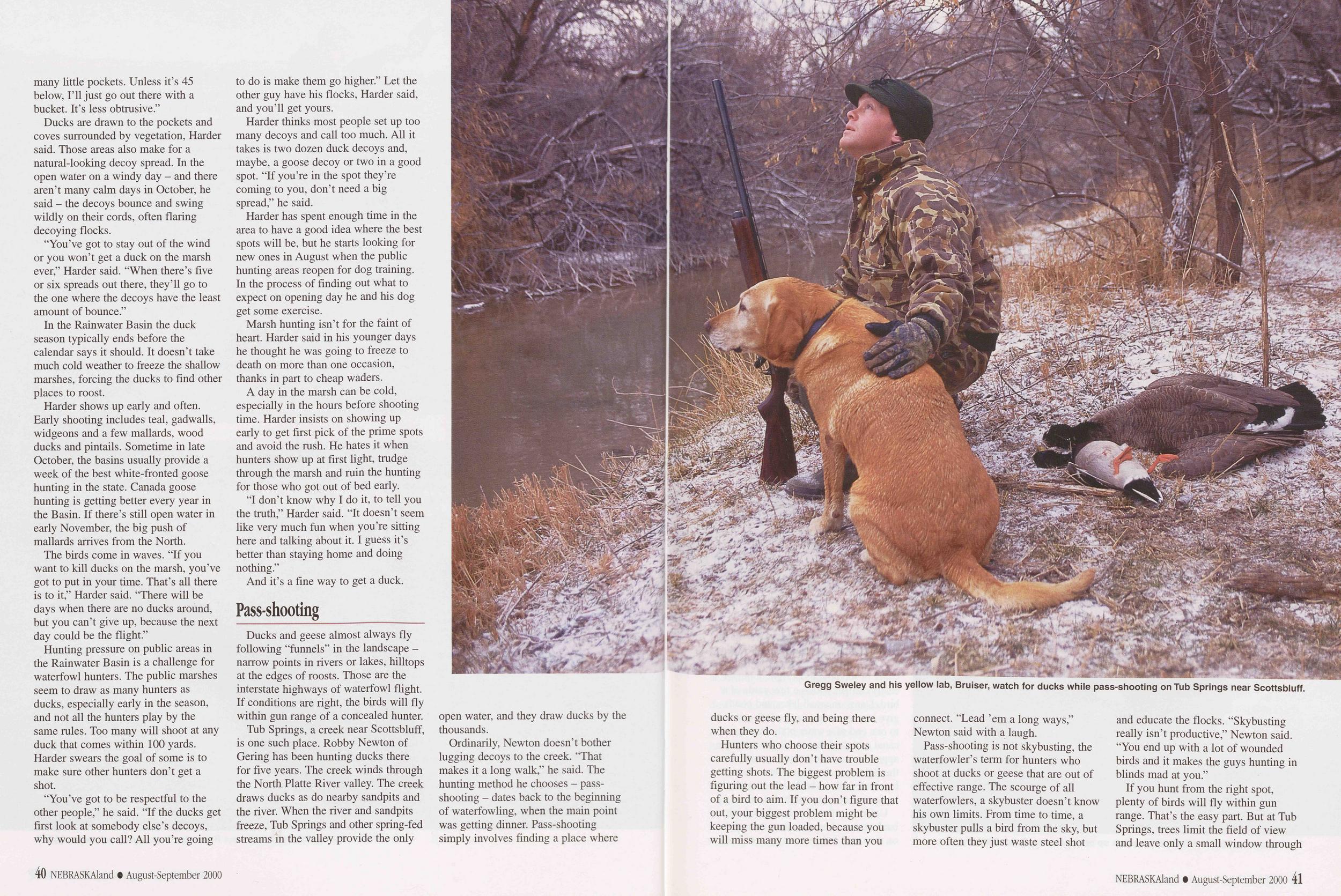 many little pockets. Unless it’s 45
below, I’ll just go out there with a
bucket. It’s less obtrusive.”
many little pockets. Unless it’s 45
below, I’ll just go out there with a
bucket. It’s less obtrusive.”
Ducks are drawn to the pockets and coves surrounded by vegetation, Harder said. Those areas also make for a natural-looking decoy spread. In the open water on a windy day - and there aren’t many calm days in October, he said - the decoys bounce and swing wildly on their cords, often flaring decoying flocks.
“You’ve got to stay out of the wind or you won’t get a duck on the marsh ever,” Harder said. “When there’s five or six spreads out there, they’ll go to the one where the decoys have the least amount of bounce.”
In the Rainwater Basin the duck season typically ends before the calendar says it should. It doesn’t take much cold weather to freeze the shallow marshes, forcing the ducks to find other places to roost.
Harder shows up early and often. Early shooting includes teal, gad walls, widgeons and a few mallards, wood ducks and pintails. Sometime in late October, the basins usually provide a week of the best white-fronted goose hunting in the state. Canada goose hunting is getting better every year in the Basin. If there’s still open water in early November, the big push of mallards arrives from the North.
The birds come in waves. “If you want to kill ducks on the marsh, you’ve got to put in your time. That’s all there is to it,” Harder said. “There will be days when there are no ducks around, but you can’t give up, because the next day could be the flight.”
Hunting pressure on public areas in the Rainwater Basin is a challenge for waterfowl hunters. The public marshes seem to draw as many hunters as ducks, especially early in the season, and not all the hunters play by the same rules. Too many will shoot at any duck that comes within 100 yards. Harder swears the goal of some is to make sure other hunters don’t get a shot.
"You’ve got to be respectful to the other people,” he said. "If the ducks get first look at somebody else’s decoys, why would you call? All you’re going to do is make them go higher.” Let the other guy have his flocks, Harder said, and you’ll get yours.
Harder thinks most people set up too many decoys and call too much. All it takes is two dozen duck decoys and, maybe, a goose decoy or two in a good spot. “If you’re in the spot they’re coming to you, don’t need a big spread,” he said.
Harder has spent enough time in the area to have a good idea where the best spots will be, but he starts looking for new ones in August when the public hunting areas reopen for dog training. In the process of finding out what to expect on opening day he and his dog get some exercise.
Marsh hunting isn’t for the faint of heart. Harder said in his younger days he thought he was going to freeze to death on more than one occasion, thanks in part to cheap waders.
A day in the marsh can be cold, especially in the hours before shooting time. Harder insists on showing up early to get first pick of the prime spots and avoid the rush. He hates it when hunters show up at first light, trudge through the marsh and ruin the hunting for those who got out of bed early.
“I don’t know why I do it, to tell you the truth,” Harder said. “It doesn’t seem like very much fun when you’re sitting here and talking about it. I guess it’s better than staying home and doing nothing.”
And it’s a fine way to get a duck.
Pass-shootingDucks and geese almost always fly following “funnels” in the landscape - narrow points in rivers or lakes, hilltops at the edges of roosts. Those are the interstate highways of waterfowl flight. If conditions are right, the birds will fly within gun range of a concealed hunter.
Tub Springs, a creek near Scottsbluff, is one such place. Robby Newton of Gering has been hunting ducks there for five years. The creek winds through the North Platte River valley. The creek draws ducks as do nearby sandpits and the river. When the river and sandpits freeze, Tub Springs and other spring-fed streams in the valley provide the only open water, and they draw ducks by the thousands.
Ordinarily, Newton doesn’t bother lugging decoys to the creek. "That makes it a long walk,” he said. The hunting method he chooses - pass- shooting - dates back to the beginning of waterfowling, when the main point was getting dinner. Pass-shooting simply involves finding a place where ducks or geese fly, and being there when they do.
Hunters who choose their spots carefully usually don’t have trouble getting shots. The biggest problem is figuring out the lead - how far in front of a bird to aim. If you don’t figure that out, your biggest problem might be keeping the gun loaded, because you will miss many more times than you connect. "Lead ’em a long ways,” Newton said with a laugh.
Pass-shooting is not skybusting, the waterfowler’s term for hunters who shoot at ducks or geese that are out of effective range. The scourge of all waterfowlers, a skybuster doesn’t know his own limits. From time to time, a skybuster pulls a bird from the sky, but more often they just waste steel shot and educate the flocks. “Skybusting really isn’t productive,” Newton said. “You end up with a lot of wounded birds and it makes the guys hunting in blinds mad at you.”
If you hunt from the right spot,
plenty of birds will fly within gun
range. That’s the easy part. But at Tub
Springs, trees limit the field of view
and leave only a small window through
NEBRASKAland • August-September 2000 41
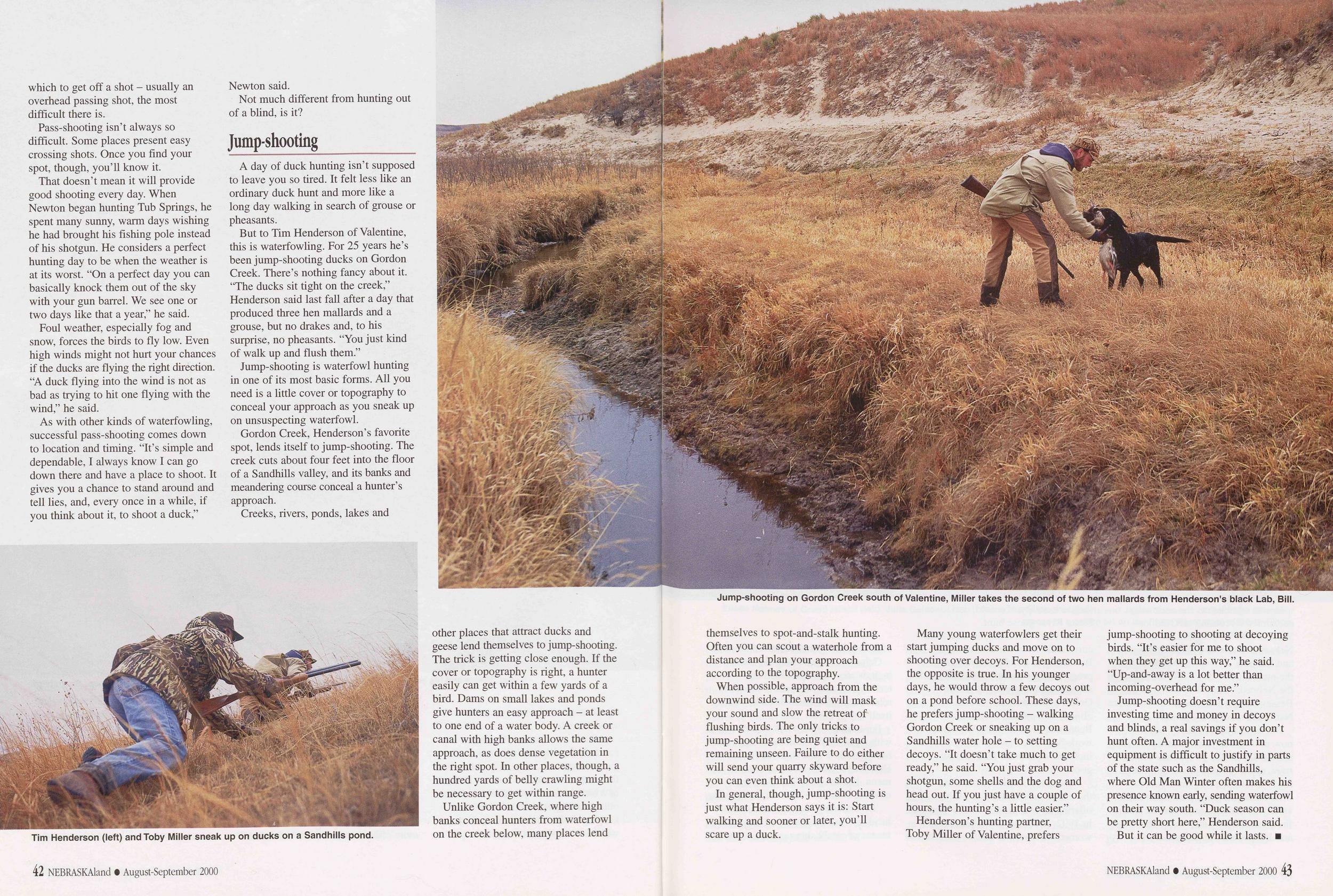 which to get off a shot - usually an
overhead passing shot, the most
difficult there is.
which to get off a shot - usually an
overhead passing shot, the most
difficult there is.
Pass-shooting isn’t always so difficult. Some places present easy crossing shots. Once you find your spot, though, you’ll know it.
That doesn’t mean it will provide good shooting every day. When Newton began hunting Tub Springs, he spent many sunny, warm days wishing he had brought his fishing pole instead of his shotgun. He considers a perfect hunting day to be when the weather is at its worst. "On a perfect day you can basically knock them out of the sky with your gun barrel. We see one or two days like that a year,” he said.
Foul weather, especially fog and snow, forces the birds to fly low. Even high winds might not hurt your chances if the ducks are flying the right direction. "A duck flying into the wind is not as bad as trying to hit one flying with the wind,” he said.
As with other kinds of waterfowling, successful pass-shooting comes down to location and timing. “It’s simple and dependable, I always know I can go down there and have a place to shoot. It gives you a chance to stand around and tell lies, and, every once in a while, if you think about it, to shoot a duck,” Newton said.
Not much different from hunting out of a blind, is it?
Jump-shootingA day of duck hunting isn’t supposed to leave you so tired. It felt less like an ordinary duck hunt and more like a long day walking in search of grouse or pheasants.
But to Tim Henderson of Valentine, this is waterfowling. For 25 years he’s been jump-shooting ducks on Gordon Creek. There’s nothing fancy about it. "The ducks sit tight on the creek,” Henderson said last fall after a day that produced three hen mallards and a grouse, but no drakes and, to his surprise, no pheasants. "You just kind of walk up and flush them.”
Jump-shooting is waterfowl hunting in one of its most basic forms. All you need is a little cover or topography to conceal your approach as you sneak up on unsuspecting waterfowl.
Gordon Creek, Henderson’s favorite spot, lends itself to jump-shooting. The creek cuts about four feet into the floor of a Sandhills valley, and its banks and meandering course conceal a hunter’s approach.
Creeks, rivers, ponds, lakes and other places that attract ducks and geese lend themselves to jump-shooting. The trick is getting close enough. If the cover or topography is right, a hunter easily can get within a few yards of a bird. Dams on small lakes and ponds give hunters an easy approach - at least to one end of a water body. A creek or canal with high banks allows the same approach, as does dense vegetation in the right spot. In other places, though, a hundred yards of belly crawling might be necessary to get within range.
Unlike Gordon Creek, where high banks conceal hunters from waterfowl on the creek below, many places lend themselves to spot-and-stalk hunting. Often you can scout a waterhole from a distance and plan your approach according to the topography.
When possible, approach from the downwind side. The wind will mask your sound and slow the retreat of flushing birds. The only tricks to jump-shooting are being quiet and remaining unseen. Failure to do either will send your quarry skyward before you can even think about a shot.
In general, though, jump-shooting is just what Henderson says it is: Start walking and sooner or later, you’ll scare up a duck.
Many young waterfowlers get their start jumping ducks and move on to shooting over decoys. For Henderson, the opposite is true. In his younger days, he would throw a few decoys out on a pond before school. These days, he prefers jump-shooting - walking Gordon Creek or sneaking up on a Sandhills water hole - to setting decoys. "It doesn’t take much to get ready,” he said. "You just grab your shotgun, some shells and the dog and head out. If you just have a couple of hours, the hunting’s a little easier.”
Henderson’s hunting partner, Toby Miller of Valentine, prefers jump-shooting to shooting at decoying birds. "It’s easier for me to shoot when they get up this way,” he said. "Up-and-away is a lot better than incoming-overhead for me.”
Jump-shooting doesn’t require investing time and money in decoys and blinds, a real savings if you don’t hunt often. A major investment in equipment is difficult to justify in parts of the state such as the Sandhills, where Old Man Winter often makes his presence known early, sending waterfowl on their way south. "Duck season can be pretty short here,” Henderson said.
But it can be good while it lasts. ■
42 NEBRASKAland • August-September 2000 NEBRASKAland • August-September 2000 43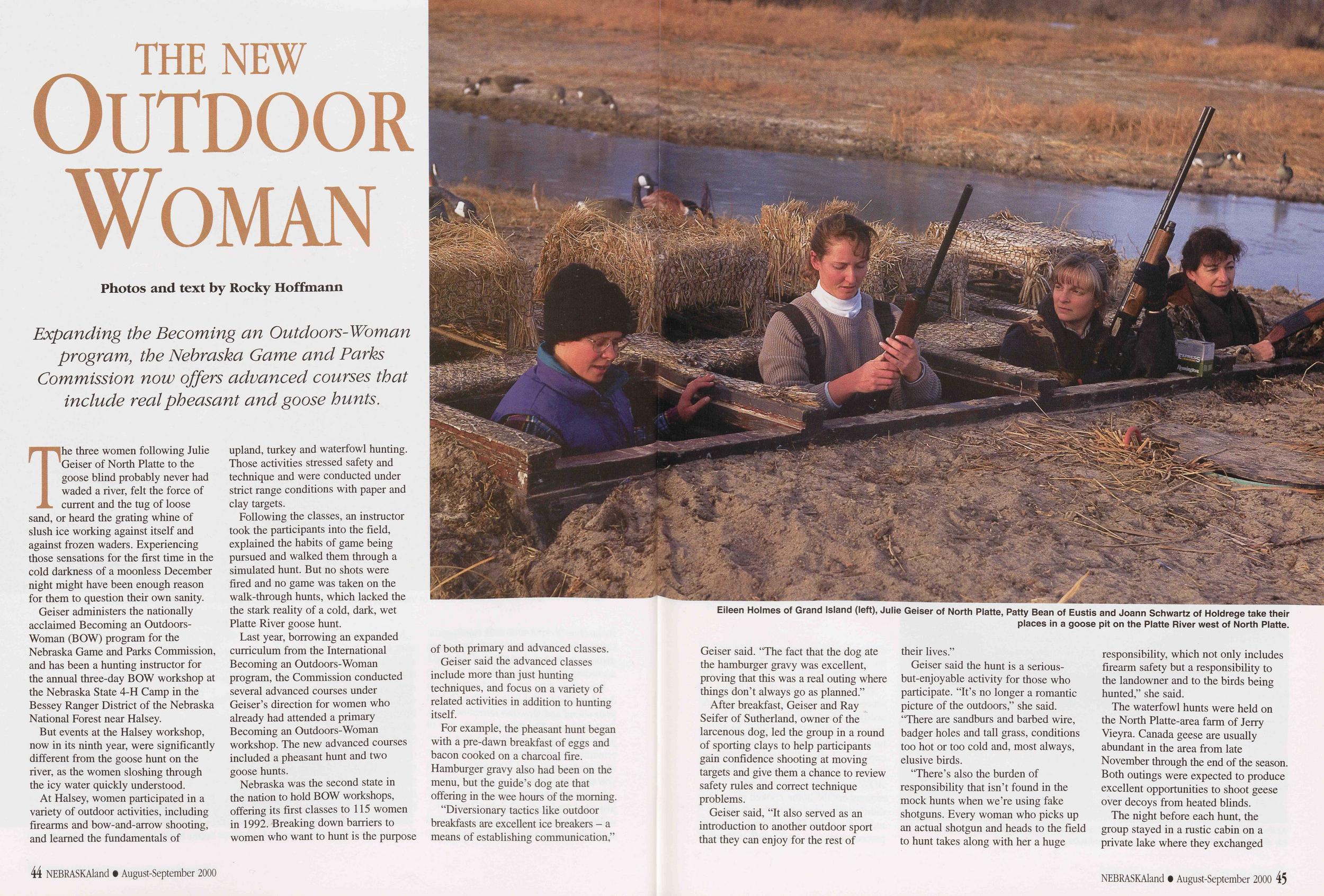
THE NEW Outdoor Woman
Photos and text by Rocky Hoffmann Expanding the Becoming an Outdoors-Woman program, the Nebraska Game and Parks Commission now offers advanced courses that include real pheasant and goose bunts.The three women following Julie Geiser of North Platte to the goose blind probably never had waded a river, felt the force of current and the tug of loose sand, or heard the grating whine of slush ice working against itself and against frozen waders. Experiencing those sensations for the first time in the cold darkness of a moonless December night might have been enough reason for them to question their own sanity.
Geiser administers the nationally acclaimed Becoming an Outdoors- Woman (BOW) program for the Nebraska Game and Parks Commission, and has been a hunting instructor for the annual three-day BOW workshop at the Nebraska State 4-H Camp in the Bessey Ranger District of the Nebraska National Forest near Halsey.
But events at the Halsey workshop, now in its ninth year, were significantly different from the goose hunt on the river, as the women sloshing through the icy water quickly understood.
At Halsey, women participated in a variety of outdoor activities, including firearms and bow-and-arrow shooting, and learned the fundamentals of upland, turkey and waterfowl hunting. Those activities stressed safety and technique and were conducted under strict range conditions with paper and clay targets.
Following the classes, an instructor took the participants into the field, explained the habits of game being pursued and walked them through a simulated hunt. But no shots were fired and no game was taken on the walk-through hunts, which lacked the the stark reality of a cold, dark, wet Platte River goose hunt.
Last year, borrowing an expanded curriculum from the International Becoming an Outdoors-Woman program, the Commission conducted several advanced courses under Geiser’s direction for women who already had attended a primary Becoming an Outdoors-Woman workshop. The new advanced courses included a pheasant hunt and two goose hunts.
Nebraska was the second state in the nation to hold BOW workshops, offering its first classes to 115 women in 1992. Breaking down barriers to women who want to hunt is the purpose of both primary and advanced classes.
Geiser said the advanced classes include more than just hunting techniques, and focus on a variety of related activities in addition to hunting itself.
For example, the pheasant hunt began with a pre-dawn breakfast of eggs and bacon cooked on a charcoal fire. Hamburger gravy also had been on the menu, but the guide’s dog ate that offering in the wee hours of the morning.
"Diversionary tactics like outdoor breakfasts are excellent ice breakers - a means of establishing communication,” Geiser said. “The fact that the dog ate the hamburger gravy was excellent, proving that this was a real outing where things don’t always go as planned.”
After breakfast, Geiser and Ray Seifer of Sutherland, owner of the larcenous dog, led the group in a round of sporting clays to help participants gain confidence shooting at moving targets and give them a chance to review safety rules and correct technique problems.
Geiser said, "It also served as an introduction to another outdoor sport that they can enjoy for the rest of their lives.”
Geiser said the hunt is a serious- but-enjoyable activity for those who participate. “It’s no longer a romantic picture of the outdoors,” she said. "There are sandburs and barbed wire, badger holes and tall grass, conditions too hot or too cold and, most always, elusive birds.
"There’s also the burden of responsibility that isn’t found in the mock hunts when we’re using fake shotguns. Every woman who picks up an actual shotgun and heads to the field to hunt takes along with her a huge responsibility, which not only includes firearm safety but a responsibility to the landowner and to the birds being hunted,” she said.
The waterfowl hunts were held on the North Platte-area farm of Jerry Vieyra. Canada geese are usually abundant in the area from late November through the end of the season. Both outings were expected to produce excellent opportunities to shoot geese over decoys from heated blinds.
The night before each hunt, the
group stayed in a rustic cabin on a
private lake where they exchanged
44 NEBRASKAland • August-September 2000
NEBRASKAland • August-September 2000 45
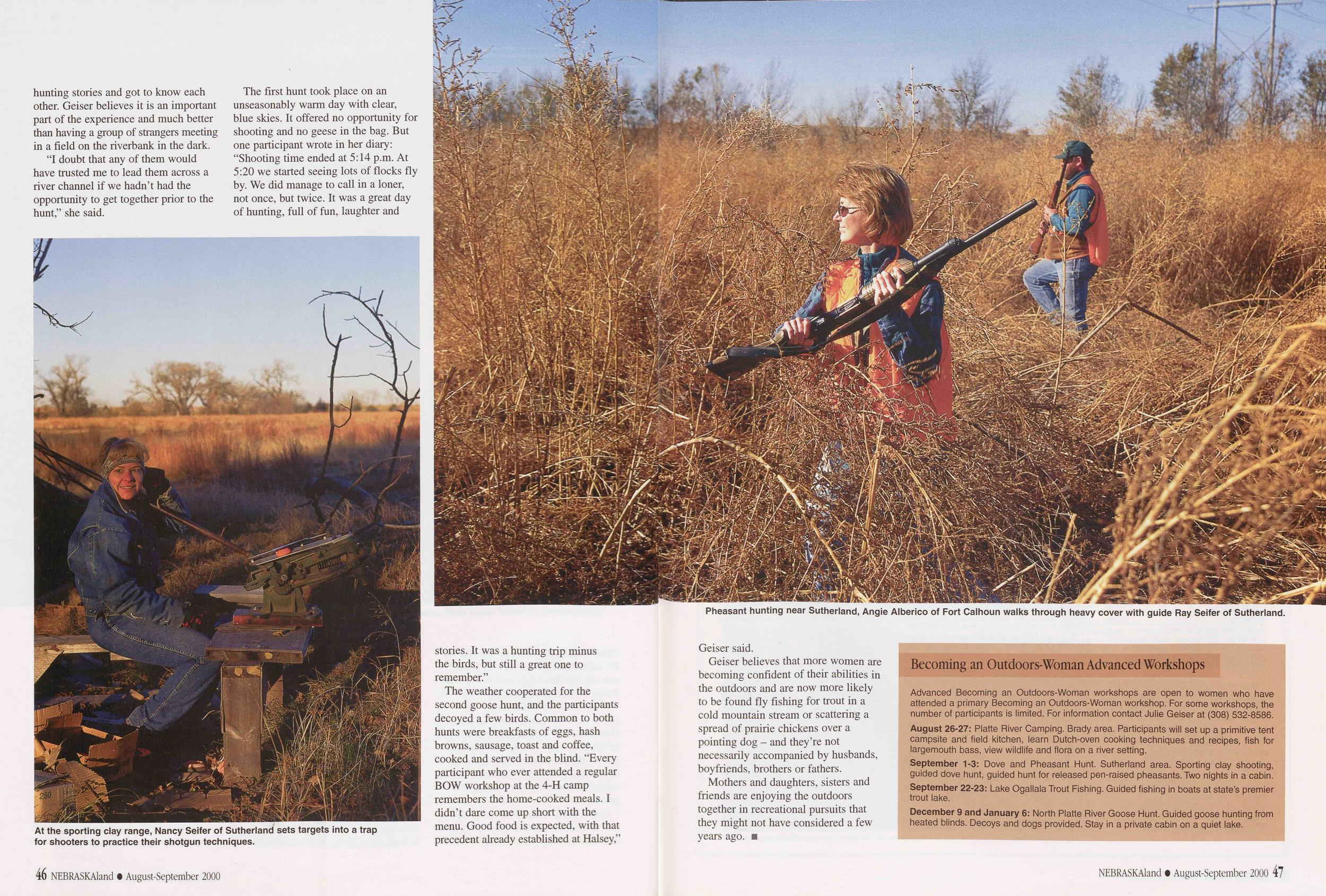 hunting stories and got to know each
other. Geiser believes it is an important
part of the experience and much better
than having a group of strangers meeting
in a field on the riverbank in the dark.
hunting stories and got to know each
other. Geiser believes it is an important
part of the experience and much better
than having a group of strangers meeting
in a field on the riverbank in the dark.
“I doubt that any of them would have trusted me to lead them across a river channel if we hadn’t had the opportunity to get together prior to the hunt,” she said.
The first hunt took place on an unseasonably warm day with clear, blue skies. It offered no opportunity for shooting and no geese in the bag. But one participant wrote in her diary : “Shooting time ended at 5:14 p.m. At 5:20 we started seeing lots of flocks fly by. We did manage to call in a loner, not once, but twice. It was a great day of hunting, full of fun, laughter and stories. It was a hunting trip minus the birds, but still a great one to remember.”
The weather cooperated for the second goose hunt, and the participants decoyed a few birds. Common to both hunts were breakfasts of eggs, hash browns, sausage, toast and coffee, cooked and served in the blind. “Every participant who ever attended a regular BOW workshop at the 4-H camp remembers the home-cooked meals. I didn’t dare come up short with the menu. Good food is expected, with that precedent already established at Halsey,” Geiser said.
Geiser believes that more women are becoming confident of their abilities in the outdoors and are now more likely to be found fly fishing for trout in a cold mountain stream or scattering a spread of prairie chickens over a pointing dog - and they’re not necessarily accompanied by husbands, boyfriends, brothers or fathers.
Mothers and daughters, sisters and friends are enjoying the outdoors together in recreational pursuits that they might not have considered a few years ago. ■
Becoming an Outdoors-Woman Advanced WorkshopsAdvanced Becoming an Outdoors-Woman workshops are open to women who have attended a primary Becoming an Outdoors-Woman workshop. For some workshops, the number of participants is limited. For information contact Julie Geiser at (308) 532-8586.
August 26-27: Platte River Camping. Brady area. Participants will set up a primitive tent campsite and field kitchen, learn Dutch-oven cooking techniques and recipes, fish for largemouth bass, view wildlife and flora on a river setting.
September 1-3: Dove and Pheasant Hunt. Sutherland area. Sporting clay shooting, guided dove hunt, guided hunt for released pen-raised pheasants. Two nights in a cabin. September 22-23: Lake Ogallala Trout Fishing. Guided fishing in boats at state’s premier trout lake.
December 9 and January 6: North Platte River Goose Hunt. Guided goose hunting from heated blinds. Decoys and dogs provided. Stay in a private cabin on a quiet lake.
46 NEBRASKAland • August-September 2000 NEBRASKAland • August-September 2000 47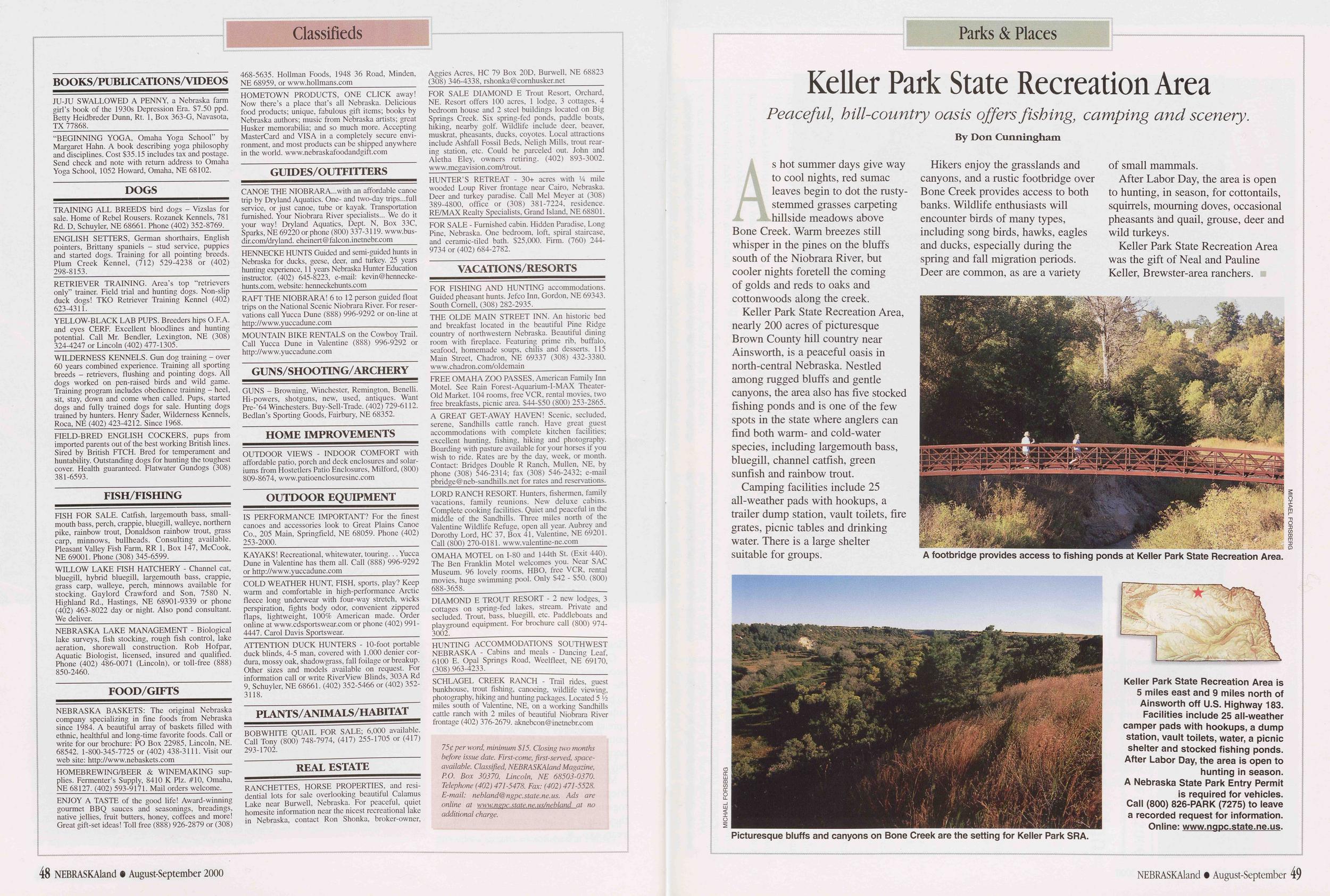
Classifieds
Parks& Places BOOKS/PUBLICATION S/VIDEOSJU-JU SWALLOWED A PENNY, a Nebraska farm girl’s book of the 1930s Depression Era. $7.50 ppd. Betty Heidbreder Dunn, Rt. 1, Box 363-0, Navasota, TX 77868.
“BEGINNING YOGA, Omaha Yoga School” by Margaret Hahn. A book describing yoga philosophy and disciplines. Cost $35.15 includes tax and postage. Send check and note with return address to Omaha Yoga School, 1052 Howard, Omaha, NE 68102.
DOGSTRAINING ALL BREEDS bird dogs - Vizslas for sale. Home of Rebel Rousers. Rozanek Kennels, 781 Rd. D, Schuyler, NE 68661. Phone (402) 352-8769.
ENGLISH SETTERS, German shorthairs, English pointers, Brittany spaniels - stud service, puppies and started dogs. Training for all pointing breeds. Plum Creek Kennel, (712) 529-4238 or (402) 298-8153.
RETRIEVER TRAINING. Area’s top “retrievers only” trainer. Field trial and hunting dogs. Non-slip duck dogs! TKO Retriever Training Kennel (402) 623-4311.
YELLOW-BLACK LAB PUPS. Breeders hips O.F.A. and eyes CERF. Excellent bloodlines and hunting potential. Call Mr. Bendler, Lexington, NE (308) 324-4247 or Lincoln (402) 477-1305.
WILDERNESS KENNELS. Gun dog training - over 60 years combined experience. Training all sporting breeds - retrievers, flushing and pointing dogs. All dogs worked on pen-raised birds and wild game. Training program includes obedience training - heel, sit, stay, down and come when called. Pups, started dogs and fully trained dogs for sale. Hunting dogs trained by hunters. Henry Sader, Wilderness Kennels, Roca, NE (402) 423-4212. Since 1968.
FIELD-BRED ENGLISH COCKERS, pups from imported parents out of the best working British lines. Sired by British FTCH. Bred for temperament and huntability. Outstanding dogs for hunting the toughest cover. Health guaranteed. Flatwater Gundogs (308) 381-6593.
FISH/FISHINGFISH FOR SALE. Catfish, largemouth bass, small- mouth bass, perch, crappie, bluegill, walleye, northern pike, rainbow trout, Donaldson rainbow trout, grass carp, minnows, bullheads. Consulting available. Pleasant Valley Fish Farm, RR 1, Box 147, McCook, NE 69001. Phone (308) 345-6599.
WILLOW LAKE FISH HATCHERY - Channel cat, bluegill, hybrid bluegill, largemouth bass, crappie, grass carp, walleye, perch, minnows available for stocking. Gaylord Crawford and Son, 7580 N. Highland Rd., Hastings, NE 68901-9339 or phone (402) 463-8022 day or night. Also pond consultant. We deliver
NEBRASKA LAKE MANAGEMENT - Biological lake surveys, fish stocking, rough fish control, lake aeration, shorewall construction. Rob Hofpar, Aquatic Biologist, licensed, insured and qualified. Phone (402) 486-0071 (Lincoln), or toll-free (888) 850-2460.
FOOD/GIFTSNEBRASKA BASKETS: The original Nebraska company specializing in fine foods from Nebraska since 1984. A beautiful array of baskets filled with ethnic, healthful and long-time favorite foods. Call or write for our brochure: PO Box 22985, Lincoln, NE. 68542. 1-800-345-7725 or (402) 438-3111. Visit our web site: http://www.nebaskets.com
HOMEBREWING/BEER & WINEMAKING sup- plies. Fermenter’s Supply, 8410 K Plz. #10, Omaha, NE 68127. (402) 593-9171. Mail orders welcome. ENJOY A TASTE of the good life! Award-winning gourmet BBQ sauces and seasonings, breadings, native jellies, fruit butters, honey, coffees and more! Great gift-set ideas! Toll free (888) 926-2879 or (308) 468-5635. Hollman Foods, 1948 36 Road, Minden, NE 68959, or www.hollmans.com
HOMETOWN PRODUCTS, ONE CLICK away! Now there’s a place that’s all Nebraska. Delicious food products; unique, fabulous gift items; books by Nebraska authors; music from Nebraska artists; great Husker memorabilia; and so much more. Accepting MasterCard and VISA in a completely secure envi- ronment, and most products can be shipped anywhere in the world, www.nebraskafoodandgift.com
GUIDES/OUTFITTERSCANOE THE NIOBRARA...with an affordable canoe trip by Dryland Aquatics. One- and two-day trips...full service, or just canoe, tube or kayak. Transportation furnished. Your Niobrara River specialists... We do it your way! Dryland Aquatics, Dept. N, Box 33C, Sparks, NE 69220 or phone (800) 337-3119. www.bus- dir.com/dryland. eheinert@falcon.inetnebr.com
HENNECKE HUNTS Guided and semi-guided hunts in Nebraska for ducks, geese, deer, and turkey. 25 years hunting experience, 11 years Nebraska Hunter Education instructor. (402) 645-8223, e-mail: kevin@hennecke- hunts.com, website: henneckehunts.com
RAFT THE NIOBRARA! 6 to 12 person guided float trips on the National Scenic Niobrara River. For reser- vations call Yucca Dune (888) 996-9292 or on-line at http://www.yuccadune.com
MOUNTAIN BIKE RENTALS on the Cowboy Trail. Call Yucca Dune in Valentine (888) 996-9292 or http://www.yuccadune.com
GUNS/SHOOTING/ARCHERYGUNS - Browning, Winchester, Remington, Benelli. Hi-powers, shotguns, new, used, antiques. Want Pre-’64 Winchesters. Buy-Sell-Trade. (402) 729-6112. Bedlan’s Sporting Goods, Fairbury, NE 68352.
HOME IMPROVEMENTSOUTDOOR VIEWS - INDOOR COMFORT with affordable patio, porch and deck enclosures and solar- iums from Hostetlers Patio Enclosures, Milford, (800) 809-8674, www.patioenclosuresinc.com
OUTDOOR EQUIPMENTIS PERFORMANCE IMPORTANT? For the finest canoes and accessories look to Great Plains Canoe Co., 205 Main, Springfield, NE 68059. Phone (402) 253-2000,
KAYAKS! Recreational, whitewater, touring.. .Yucca Dune in Valentine has them all. Call (888) 996-9292 or http://www.yuccadune.com
COLD WEATHER HUNT, FISH, sports, play? Keep warm and comfortable in high-performance Arctic fleece long underwear with four-way stretch, wicks perspiration, fights body odor, convenient zippered flaps, lightweight, 100% American made. Order online at www.cdsportswear.com or phone (402) 991- 4447. Carol Davis Sportswear.
ATTENTION DUCK HUNTERS - 10-foot portable duck blinds, 4-5 man, covered with 1,000 denier cor- dura, mossy oak, shadowgrass, fall foilage or breakup. Other sizes and models available on request. For information call or write RiverView Blinds, 3O3A Rd 9, Schuyler, NE 68661. (402) 352-5466 or (402) 352- 3118.
PLANTS/ANIMALS/HABITATBOBWHITE QUAIL FOR SALE; 6,000 available. Call Tony (800) 748-7974, (417) 255-1705 or (417) 293-1702.
REAL ESTATERANCHETTES, HORSE PROPERTIES, and resi- dential lots for sale overlooking beautiful Calamus Lake near Burwell, Nebraska. For peaceful, quiet homesite information near the nicest recreational lake in Nebraska, contact Ron Shonka, broker-owner, Aggies Acres, HC 79 Box 20D, Burwell, NE 68823 (308) 346-4338, rshonka@cornhusker.net
FOR SALE DIAMOND E Trout Resort, Orchard, NE. Resort offers 100 acres, 1 lodge, 3 cottages, 4 bedroom house and 2 steel buildings located on Big Springs Creek. Six spring-fed ponds, paddle boats, hiking, nearby golf. Wildlife include deer, beaver, muskrat, pheasants, ducks, coyotes. Local attractions include Ashfall Fossil Beds, Neligh Mills, trout rear- ing station, etc. Could be parceled out. John and Aletha Eley, owners retiring. (402) 893-3002. www.megavision.com/trout.
HUNTER’S RETREAT - 30+ acres with 14 mile wooded Loup River frontage near Cairo, Nebraska. Deer and turkey paradise. Call Mel Meyer at (308) 389-4800, office or (308) 381-7224, residence. RE/MAX Realty Specialists, Grand Island, NE 68801. FOR SALE - Furnished cabin. Hidden Paradise, Long Pine, Nebraska. One bedroom, loft, spiral staircase, and ceramic-tiled bath. $25,000. Firm. (760) 244- 9734 or (402) 684-2782.
VACATION S/RESORTSFOR FISHING AND HUNTING accommodations. Guided pheasant hunts. Jefco Inn, Gordon, NE 69343. South Cornell, (308) 282-2935.
THE OLDE MAIN STREET INN. An historic bed and breakfast located in the beautiful Pine Ridge country of northwestern Nebraska. Beautiful dining room with fireplace. Featuring prime rib, buffalo, seafood, homemade soups, chilis and desserts. 115 Main Street, Chadron, NE 69337 (308) 432-3380. www.chadron.com/oldemain
FREE OMAHA ZOO PASSES, American Family Inn Motel. See Rain Forest-Aquarium-I-MAX Theater- Old Market. 104 rooms, free VCR, rental movies, two free breakfasts, picnic area. $44-$50 (800) 253-2865.
A GREAT GET-AWAY HAVEN! Scenic, secluded, serene, Sandhills cattle ranch. Have great guest accommodations with complete kitchen facilities; excellent hunting, fishing, hiking and photography. Boarding with pasture available for your horses if you wish to ride. Rates are by the day, week, or month. Contact: Bridges Double R Ranch, Mullen, NE, by phone (308) 546-2314; fax (308) 546-2432; e-mail pbridge@neb-sandhills.net for rates and reservations.
LORD RANCH RESORT. Hunters, fishermen, family vacations, family reunions. New deluxe cabins. Complete cooking facilities. Quiet and peaceful in the middle of the Sandhills. Three miles north of the Valentine Wildlife Refuge, open all year. Aubrey and Dorothy Lord, HC 37, Box 41, Valentine, NE 69201. Call (800) 270-0181. www.valentine-ne.com
OMAHA MOTEL on 1-80 and 144th St. (Exit 440). The Ben Franklin Motel welcomes you. Near SAC Museum. 96 lovely rooms, HBO, free VCR, rental movies, huge swimming pool. Only $42 - $50. (800) 688-3658.
DIAMOND E TROUT RESORT - 2 new lodges, 3 cottages on spring-fed lakes, stream. Private and secluded. Trout, bass, bluegill, etc. Paddleboats and playground equipment. For brochure call (800) 974- 3002.
HUNTING ACCOMMODATIONS SOUTHWEST NEBRASKA - Cabins and meals - Dancing Leaf, 6100 E. Opal Springs Road, Weelfleet, NE^69170, (308) 963-4233.
SCHLAGEL CREEK RANCH - Trail rides, guest bunkhouse, trout fishing, canoeing, wildlife viewing, photography, hiking and hunting packages. Located 5 Vi miles south of Valentine, NE, on a working Sandhills cattle ranch with 2 miles of beautiful Niobrara River frontage (402) 376-2679. aknebcon@inetnebr.com
75$ per word, minimum $15. Closing two months before issue date. First-come, first-served, space- available. Classified, NEBRASKAland Magazine, P.O. Box 30370, Lincoln, NE 68503-0370. Telephone (402) 471-5478. Fax: (402) 471-5528. E-mail: nebland@ngpc.state, ne. us. Ads are online at www.nQoc.state.ne.us/nebland at no additional charge.
Keller Park State Recreation Area Peaceful, bill-country oasis offers fishing, camping and scenery. By Don CunninghamAs hot summer days give way to cool nights, red sumac leaves begin to dot the rusty- stemmed grasses carpeting hillside meadows above Bone Creek. Warm breezes still whisper in the pines on the bluffs south of the Niobrara River, but cooler nights foretell the coming of golds and reds to oaks and cottonwoods along the creek.
Keller Park State Recreation Area, nearly 200 acres of picturesque Brown County hill country near Ainsworth, is a peaceful oasis in north-central Nebraska. Nestled among rugged bluffs and gentle canyons, the area also has five stocked fishing ponds and is one of the few spots in the state where anglers can find both warm- and cold-water species, including largemouth bass, bluegill, channel catfish, green sunfish and rainbow trout.
Camping facilities include 25 all-weather pads with hookups, a trailer dump station, vault toilets, fire grates, picnic tables and drinking water. There is a large shelter suitable for groups.
MICHAEL FORSBERGHikers enjoy the grasslands and canyons, and a rustic footbridge over Bone Creek provides access to both banks. Wildlife enthusiasts will encounter birds of many types, including song birds, hawks, eagles and ducks, especially during the spring and fall migration periods. Deer are common, as are a variety of small mammals.
After Labor Day, the area is open to hunting, in season, for cottontails, squirrels, mourning doves, occasional pheasants and quail, grouse, deer and wild turkeys.
Keller Park State Recreation Area was the gift of Neal and Pauline Keller, Brewster-area ranchers.
Keller Park State Recreation Area is 5 miles east and 9 miles north of Ainsworth off U.S. Highway 183. Facilities include 25 all-weather camper pads with hookups, a dump station, vault toilets, water, a picnic shelter and stocked fishing ponds. After Labor Day, the area is open to hunting in season. A Nebraska State Park Entry Permit is required for vehicles. Call (800) 826-PARK (7275) to leave a recorded request for information. Online: www.nqpc.state.ne.us. 48 NEBRASKAland • August-September 2000 NEBRASKAland • August-September 49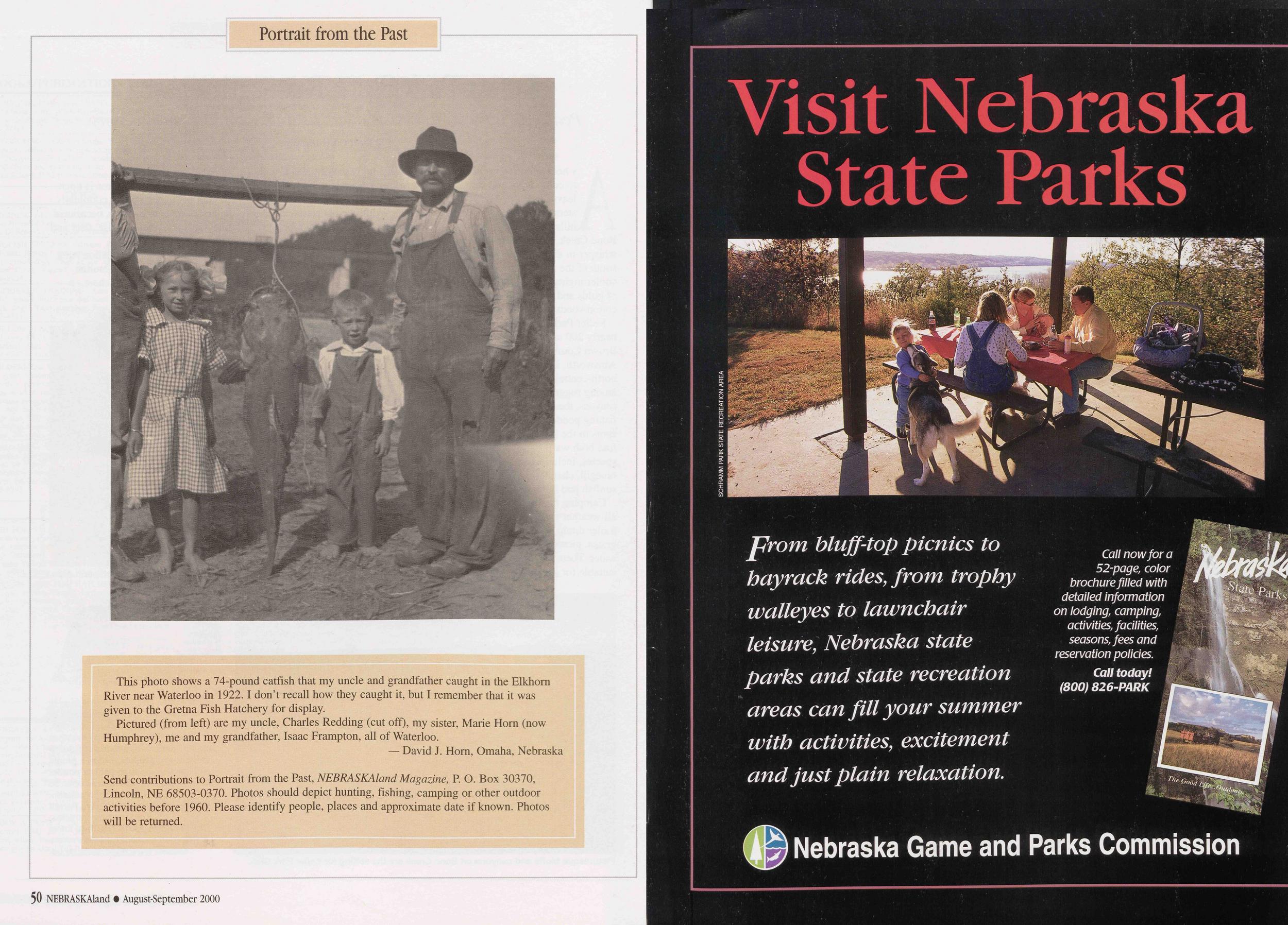
This photo shows a 74-pound catfish that my uncle and grandfather caught in the Elkhorn River near Waterloo in 1922. I don’t recall how they caught it, but I remember that it was given to the Gretna Fish Hatchery for display.
Pictured (from left) are my uncle, Charles Redding (cut off), my sister, Marie Hom (now Humphrey), me and my grandfather, Isaac Frampton, all of Waterloo.
— David J. Hom, Omaha, NebraskaSend contributions to Portrait from the Past, NEBRASKAland Magazine, P. 0. Box 30370, Lincoln, NE 68503-0370. Photos should depict hunting, fishing, camping or other outdoor activities before 1960. Please identify people, places and approximate date if known. Photos will be returned.
Visit Nebraska State Parks SCHRAMM PARK STATF From bluff-top picnics to hayrack rides, from trophy walleyes to lawnchair leisure, Nebraska state parks and state recreation areas can fill your summer with activities, excitement and just plain relaxation. Call now for a 52-page, color brochure filled with detailed information on lodging, camping, activities, facilities, seasons, feesand reservation policies. Call today! (800) 826-PARK E) Nebraska Game and Parks Commission 50 NEBRASKAland • August-September 2000
Position: 583 (19 views)