Volume 78, Issue 6, 2000
NEBRASKAland
Nebraska Game & Parks Commission August-September 2000 • $2.50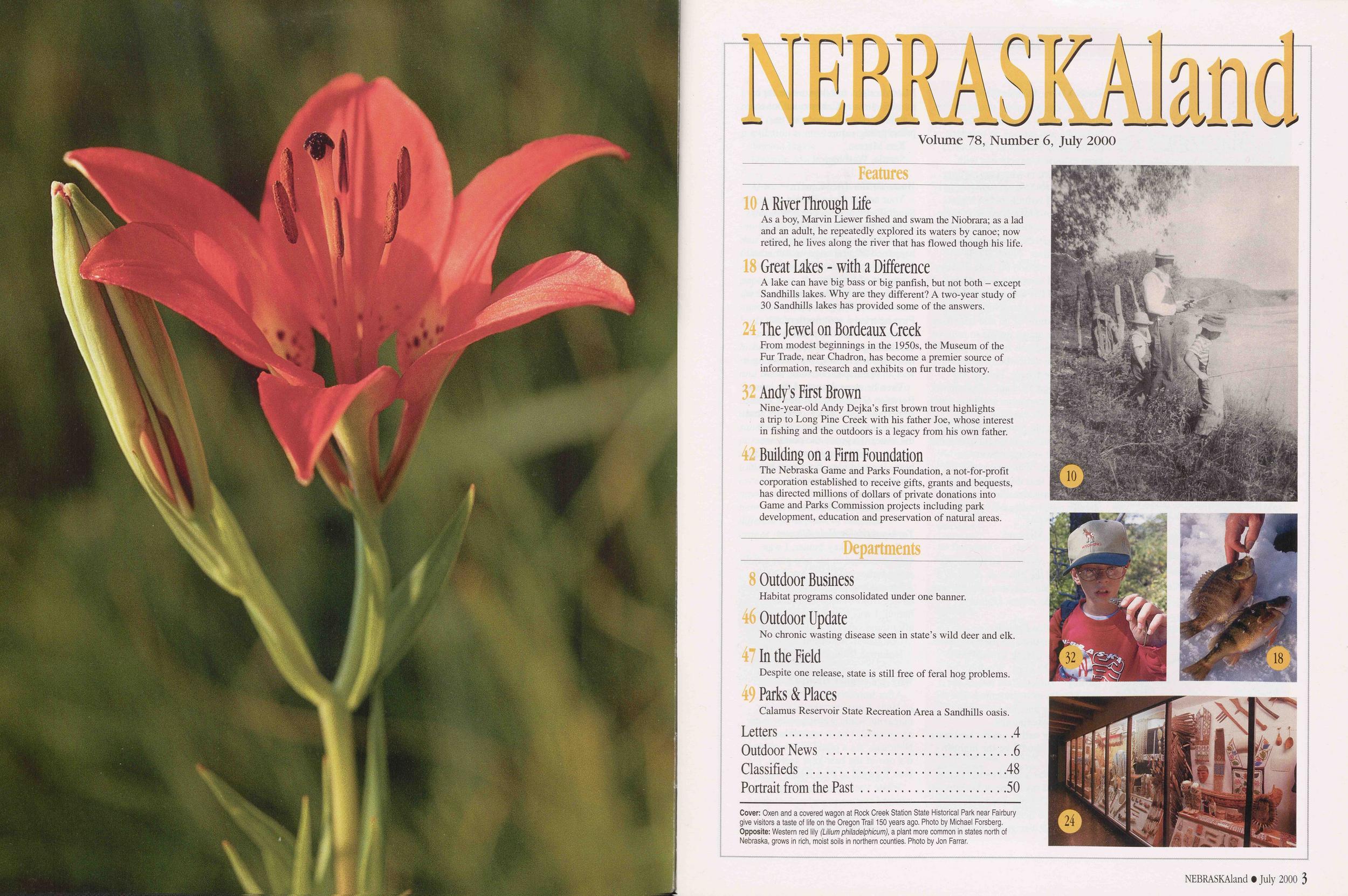
NEBRASKAland
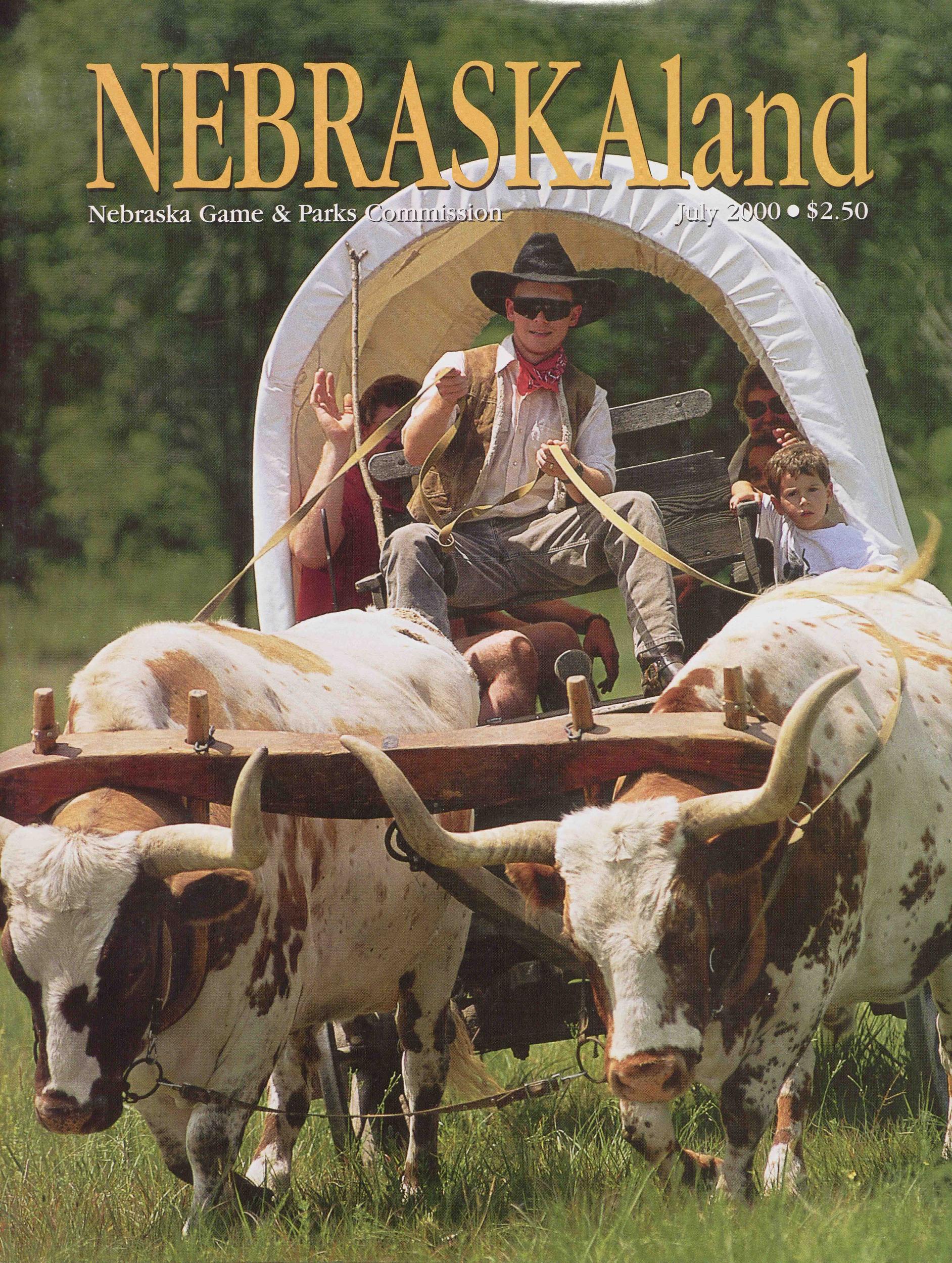
Volume 78, Number 7, August-September 2000 Features A River Through Life As a boy, Marvin Liewer fished and swam the Niobrara; as a lad and an adult, he repeatedly explored its waters by canoe; now retired, he fives along the river that has flowed though his life. Great Lakes - with a Difference A lake can have big bass or big panfish, but not both - except Sandhills lakes. Why are they different? A two-year study of 30 Sandhills lakes has provided some of the answers. The Jewel on Bordeaux Creek From modest beginnings in the 1950s, the Museum of the Fur Trade, near Chadron, has become a premier source of information, research and exhibits on fur trade history. Andy's First Brown Nine-year-old Andy Dejka's first brown trout highlights a trip to Long Pine Creek with his father Joe, whose interest in fishing and the outdoors is a legacy from his own father. Building on a Firm Foundation The Nebraska Game and Parks Foundation, a not-for-profit corporation established to receive gifts, grants and bequests, has directed millions of dollars of private donations into Game and Parks Cornmission projects including park development, education and preservation of natural areas. Departments Outdoor Business Habitat programs consolidated under one banner. 46 Outdoor Update No chronic wasting disease seen in state's wild deer and elk. 47 In the Field Despite one release, state is still free of feral hog problems. Parks & Places Calamus Reservoir State Recreation Area a Sandhills oasis. Letters..................................4 Outdoor News........................... .6 Classifieds..............................48 Portrait from the Past......................50 Cover: Oxen and a covered wagon at Rock Creek Station State Historical Park near Fairbury give visitors a taste of life on the Oregon Trail 150 years ago. Photo by Michael Forsberg. Opposite: Western red lily (Lilium philadelphicum), a plant more common in states north of Nebraska, grows in rich, moist soils in northern counties. Photo by Jon Farrar.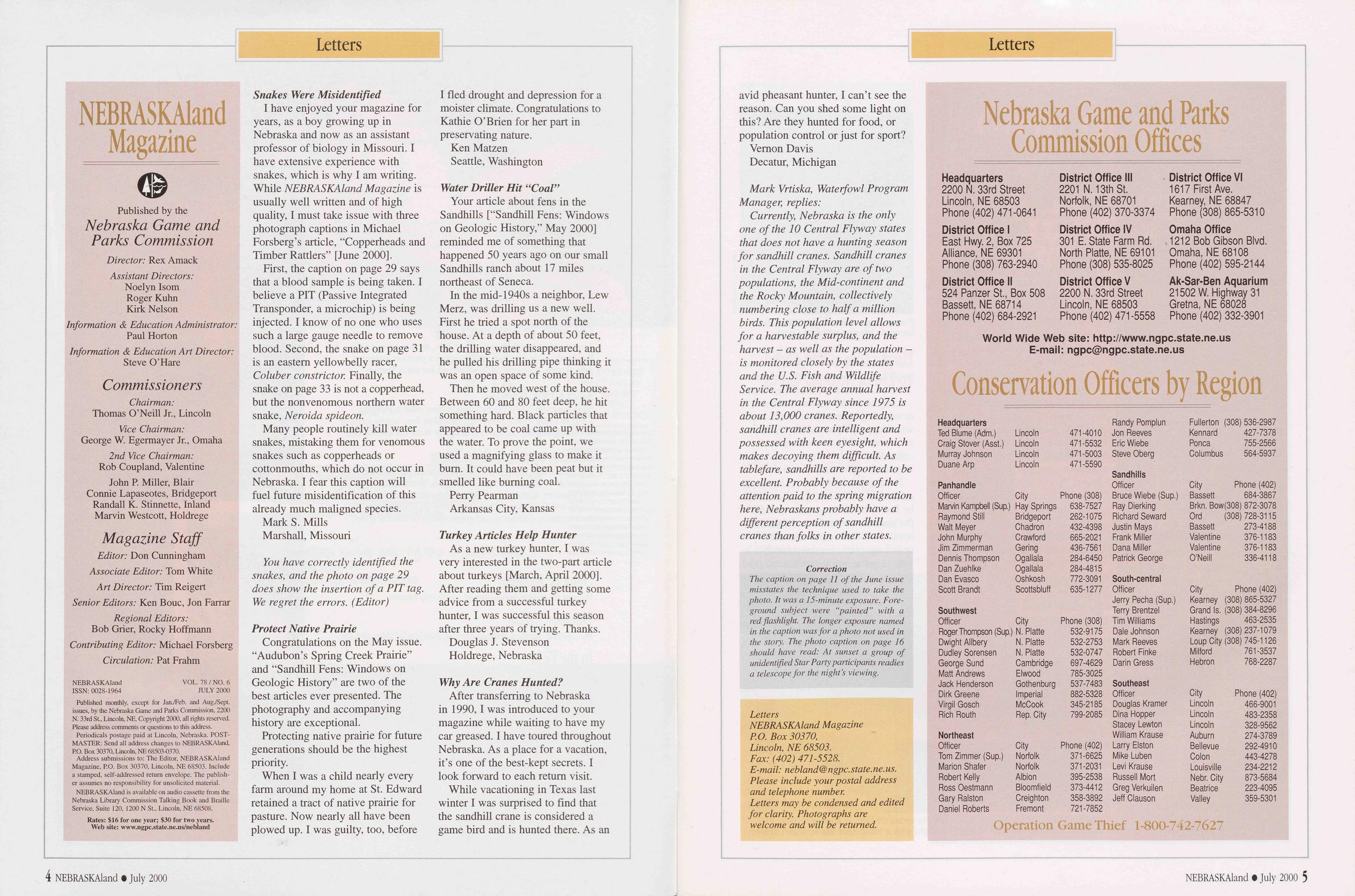 Letters
NEBRASKAland Mazine
Published by the
Nebraska Game and
Parks Commission
Director: Rex Amack
Assistant Directors:
Noelyn Isom
Roger Kuhn
Kirk Nelson
Information & Education Administrator:
Paul Horton
Information & Education Art Director:
Steve O'Hare
Commissioners
Chairman:
Thomas O'Neill Jr., Lincoln
Vice Chairman:
George W. Egermayer Jr., Omaha
2nd Vice Chairman:
Rob Coupland, Valentine
John P. Miller, Blair
Connie Lapaseotes, Bridgeport
Randall K. Stinnette, Inland
Marvin Westcott, Holdrege
Magazine Staff
Editor: Don Cunningham
Associate Editor: Tom White
Art Director: Tim Reigert
Senior Editors: Ken Bouc, Jon Farrar
Regional Editors:
Bob Grier, Rocky Hoffmann
Contributing Editor: Michael Forsberg
Circulation: Pat Frahm
NEBRASKAland
ISSN: 0028-1964
VOL. 78 / NO. 6
JULY 2000
Published monthly, except for Jan./Feb. and Aug./Sept.
issues, by the Nebraska Game and Parks Commission, 2200
N. 33rd St., Lincoln, NE. Copyright 2000, all rights reserved.
Please address comments or questions to this address.
Periodicals postage paid at Lincoln, Nebraska. POST-
MASTER: Send all address changes to NEBRASKAland,
P.O. Box 30370, Lincoln, NE 68503-0370.
Address submissions to: The Editor, NEBRASKAland
Magazine, P.O. Box 30370, Lincoln, NE 68503. Include
a stamped, self-addressed return envelope. The publish-
er assumes no responsibility for unsolicited material.
NEBRASKAland is available on audio cassette from the
Nebraska Library Commission Talking Book and Braille
Service, Suite 120, 1200 N St., Lincoln, NE 68508.
Rates: $16 for one year; $30 for two years.
Web site: www.ngpc.state.ne.us/nebland
Snakes Were Misidentified
Letters
NEBRASKAland Mazine
Published by the
Nebraska Game and
Parks Commission
Director: Rex Amack
Assistant Directors:
Noelyn Isom
Roger Kuhn
Kirk Nelson
Information & Education Administrator:
Paul Horton
Information & Education Art Director:
Steve O'Hare
Commissioners
Chairman:
Thomas O'Neill Jr., Lincoln
Vice Chairman:
George W. Egermayer Jr., Omaha
2nd Vice Chairman:
Rob Coupland, Valentine
John P. Miller, Blair
Connie Lapaseotes, Bridgeport
Randall K. Stinnette, Inland
Marvin Westcott, Holdrege
Magazine Staff
Editor: Don Cunningham
Associate Editor: Tom White
Art Director: Tim Reigert
Senior Editors: Ken Bouc, Jon Farrar
Regional Editors:
Bob Grier, Rocky Hoffmann
Contributing Editor: Michael Forsberg
Circulation: Pat Frahm
NEBRASKAland
ISSN: 0028-1964
VOL. 78 / NO. 6
JULY 2000
Published monthly, except for Jan./Feb. and Aug./Sept.
issues, by the Nebraska Game and Parks Commission, 2200
N. 33rd St., Lincoln, NE. Copyright 2000, all rights reserved.
Please address comments or questions to this address.
Periodicals postage paid at Lincoln, Nebraska. POST-
MASTER: Send all address changes to NEBRASKAland,
P.O. Box 30370, Lincoln, NE 68503-0370.
Address submissions to: The Editor, NEBRASKAland
Magazine, P.O. Box 30370, Lincoln, NE 68503. Include
a stamped, self-addressed return envelope. The publish-
er assumes no responsibility for unsolicited material.
NEBRASKAland is available on audio cassette from the
Nebraska Library Commission Talking Book and Braille
Service, Suite 120, 1200 N St., Lincoln, NE 68508.
Rates: $16 for one year; $30 for two years.
Web site: www.ngpc.state.ne.us/nebland
Snakes Were Misidentified
I have enjoyed your magazine for years, as a boy growing up in Nebraska and now as an assistant professor of biology in Missouri. I have extensive experience with snakes, which is why I am writing. While NEBRASKAland Magazine is usually well written and of high quality, I must take issue with three photograph captions in Michael Forsberg's article, "Copperheads and Timber Rattlers" [June 2000].
First, the caption on page 29 says that a blood sample is being taken. I believe a PIT (Passive Integrated Transponder, a microchip) is being injected. I know of no one who uses such a large gauge needle to remove blood. Second, the snake on page 31 is an eastern yellowbelly racer, Coluber constrictor. Finally, the snake on page 33 is not a copperhead, but the nonvenomous northern water snake, Neroida spideon.
Many people routinely kill water snakes, mistaking them for venomous snakes such as copperheads or cottonmouths, which do not occur in Nebraska. I fear this caption will fuel future misidentification of this already much maligned species.
Mark S. Mills Marshall, MissouriYou have correctly identified the snakes, and the photo on page 29 does show the insertion of a PIT tag. We regret the errors. (Editor)
Protect Native PrairieCongratulations on the May issue. "Audubon's Spring Creek Prairie" and "Sandhill Fens: Windows on Geologic History" are two of the best articles ever presented. The photography and accompanying history are exceptional.
Protecting native prairie for future generations should be the highest priority.
When I was a child nearly every farm around my home at St. Edward retained a tract of native prairie for pasture. Now nearly all have been plowed up. I was guilty, too, before I fled drought and depression for a moister climate. Congratulations to Kathie O'Brien for her part in preservating nature.
Ken Matzen Seattle, Washington Water Driller Hit "Coal"Your article about fens in the Sandhills ["Sandhill Fens: Windows on Geologic History," May 2000] reminded me of something that happened 50 years ago on our small Sandhills ranch about 17 miles northeast of Seneca.
In the mid-1940s a neighbor, Lew Merz, was drilling us a new well. First he tried a spot north of the house. At a depth of about 50 feet, the drilling water disappeared, and he pulled his drilling pipe thinking it was an open space of some kind.
Then he moved west of the house. Between 60 and 80 feet deep, he hit something hard. Black particles that appeared to be coal came up with the water. To prove the point, we used a magnifying glass to make it burn. It could have been peat but it smelled like burning coal.
Perry Pearman Arkansas City, Kansas Turkey Articles Help HunterAs a new turkey hunter, I was very interested in the two-part article about turkeys [March, April 2000]. After reading them and getting some advice from a successful turkey hunter, I was successful this season after three years of trying. Thanks.
Douglas J. Stevenson Holdrege, Nebraska Why Are Cranes Hunted?After transferring to Nebraska in 1990,1 was introduced to your magazine while waiting to have my car greased. I have toured throughout Nebraska. As a place for a vacation, it's one of the best-kept secrets. I look forward to each return visit.
While vacationing in Texas last winter I was surprised to find that the sandhill crane is considered a game bird and is hunted there. As an avid pheasant hunter, I can't see the reason. Can you shed some light on this? Are they hunted for food, or population control or just for sport?
Vernon Davis Decatur, MichiganMark Vrtiska, Waterfowl Program Manager, replies:
Currently, Nebraska is the only one of the 10 Central Fly way states that does not have a hunting season for sandhill cranes. Sandhill cranes in the Central Flyway are of two populations, the Mid-continent and the Rocky Mountain, collectively numbering close to half a million birds. This population level allows for a harvestable surplus, and the harvest - as well as the population - is monitored closely by the states and the U.S. Fish and Wildlife Service. The average annual harvest in the Central Flyway since 1975 is about 13,000 cranes. Reportedly, sandhill cranes are intelligent and possessed with keen eyesight, which makes decoying them difficult. As tablefare, sandhills are reported to be excellent. Probably because of the attention paid to the spring migration here, Nebraskans probably have a different perception of sandhill cranes than folks in other states.
Correction
The caption on page 11 of the June issue misstates the technique used to take the photo. It was a 15-minute exposure. Fore- ground subject were "painted" with a red flashlight. Die longer exposure named in the caption was for a photo not used in the story. The photo caption on page 16 should have read: At sunset a group of unidentified Star Party participants readies a telescope for the night's viewing.
LettersNEBRASKAland Magazine P.O. Box 30370, Lincoln, NE 68503. Fax: (402) 471-5528. E-mail: nebland@ngpc. state.ne.us. Please include your postal address and telephone number. Letters may be condensed and edited for clarity. Photographs are welcome and will be returned.
Nebraska Game and Parks Commission Offices Headquarters 2200 N. 33rd Street Lincoln, NE 68503 Phone (402) 471-0641 District Office I East Hwy. 2, Box 725 Alliance, NE 69301 Phone (308) 763-2940 District Office II 524 Panzer St., Box 508 Bassett, NE68714 Phone (402) 684-2921 District Office III 2201 N. 13th St. Norfolk, NE 68701 Phone (402) 370-3374 District Office IV 301 E. State Farm Rd. North Platte, NE 69101 Phone (308) 535-8025 District Office V 2200 N. 33rd Street Lincoln, NE 68503 Phone (402) 471-5558 District Office VI 1617 First Ave. Kearney, NE 68847 Phone (308) 865-5310 Omaha Office 1212 Bob Gibson Blvd. Omaha, NE 68108 Phone (402) 595-2144 Ak-Sar-Ben Aquarium 21502 W. Highway 31 Gretna, NE 68028 Phone (402) 332-3901 World Wide Web site: http://www.ngpc.state.ne.us E-mail: ngpc@ngpc.state.ne.usj Headquarters Randy Pom'plun Fullerton (308) 536-2987 Ted Blume (Adm.) Lincoln 471-4010 Jon Reeves Kennard 427-7378 Craig Stover (Asst.) Lincoln 471-5532 Eric Wiebe Ponca 755-2566 Murray Johnson Lincoln 471-5003 Steve Oberg Columbus 564-5937 Duane Arp Lincoln 471-5590 Sandhills Panhandle Officer City Phone (402) Officer City Phone (308) Bruce Wiebe (Sup.) Bassett 684-3867 Marvin Kampbeil (Sup.) Hay Springs 638-7527 Ray Dierking Brkn. Bow(308) 872-3078 Raymond Still Bridgeport 262-1075 Richard Seward Ord (308)728-3115 Walt Meyer Chadron 432-4398 Justin Mays Bassett 273-4188 John Murphy Crawford 665-2021 Frank Miller Valentine 376-1183 Jim Zimmerman Gering 436-7561 Dana Miller Valentine 376-1183 Dennis Thompson Ogallala 284-6450 Patrick George O'Neill 336-4118 Dan Zuehlke Ogallala 284-4815 Dan Evasco Oshkosh 772-3091 South-central Scott Brandt Scottsbluff 635-1277 Officer City Phone (402) Jerry Pecha (Sup.) Kearney (308) 865-5327 Southwest Terry Brentzel Grand Is. (308) 384-8296 Officer City Phone (308) Tim Williams Hastings 463-2535 Roger Thompson (Sup.) N. Platte 532-9175 Dale Johnson Kearney (308)237-1079 Dwight Allbery N. Platte 532-2753 Mark Reeves Loup City (308) 745-1126 Dudley Sorensen N. Platte 532-0747 Robert Finke Milford 761-3537 George Sund Cambridge 697-4629 Darin Gress Hebron 768-2287 Matt Andrews Elwood 785-3025 Jack Henderson Gothenburg 537-7483 Southeast Dirk Greene Imperial 882-5328 Officer City Phone (402) Virgil Gosch McCook 345-2185 Douglas Kramer Lincoln 466-9001 Rich Routh Rep. City 799-2085 Dina Hopper Lincoln 483-2358 Stacey Lewton Lincoln 328-9562 Northeast William Krause Auburn 274-3789 Officer City Phone (402) Larry Elston Bellevue 292-4910 Tom Zimmer (Sup.) Norfolk 371-6625 Mike Luben Colon 443-4278 Marion Shafer Norfolk 371-2031 Levi Krause Louisville 234-2212 Robert Kelly Albion 395-2538 Russell Mort Nebr. City 873-5684 Ross Oestmann Bloomfield 373-4412 Greg Verkuilen Beatrice 223-4095 Gary Ralston Creighton 358-3892 Jeff Clauson Valley 359-5301 Daniel Roberts Fremont 721-7852 NEBRASKAland • July 2000 5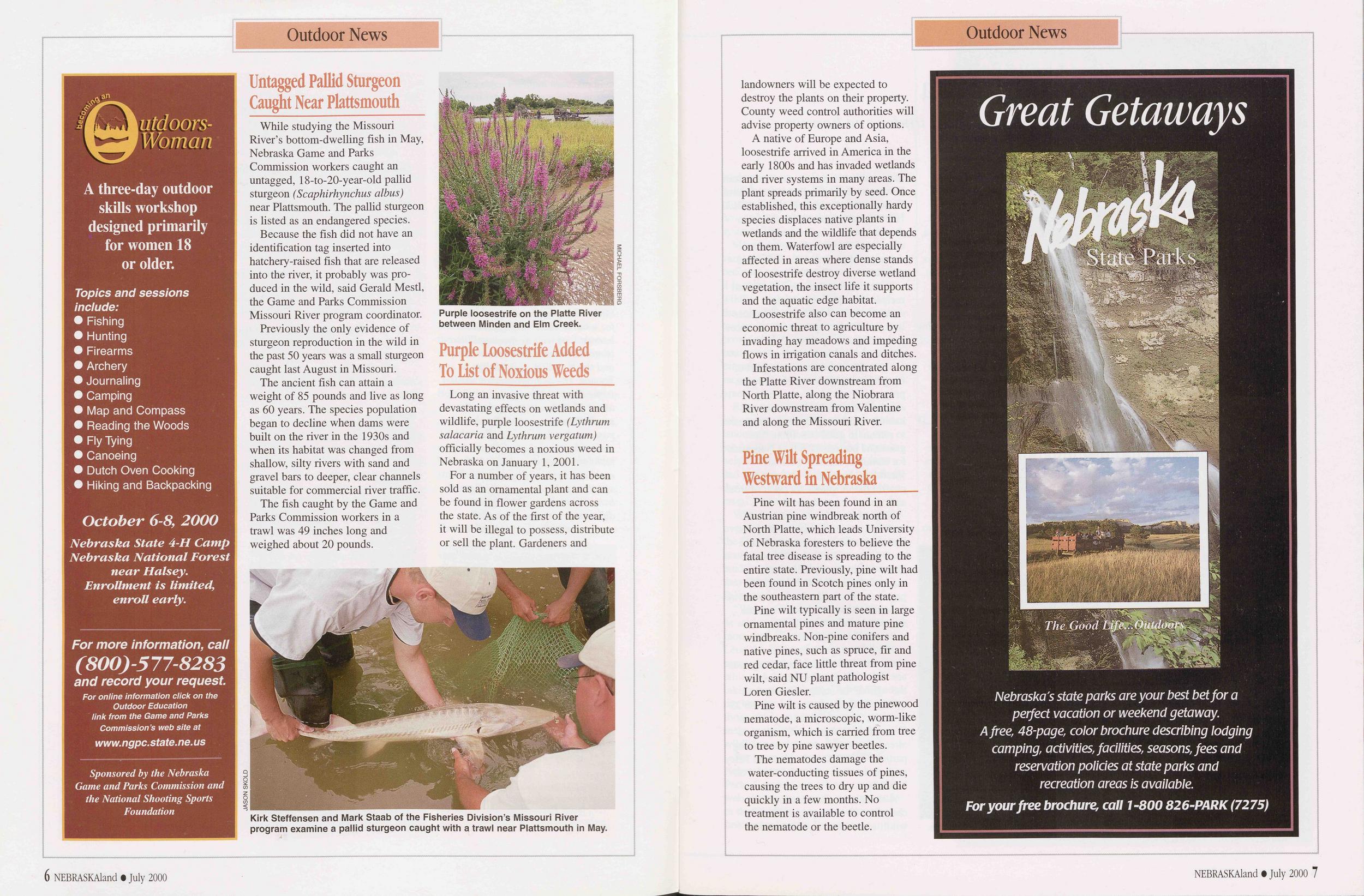
While studying the Missouri River's bottom-dwelling fish in May, Nebraska Game and Parks Commission workers caught an untagged, 18-to-20-year-old pallid sturgeon (Scaphirhynchus albus) near Plattsmouth. The pallid sturgeon is listed as an endangered species.
Because the fish did not have an identification tag inserted into hatchery-raised fish that are released into the river, it probably was pro- duced in the wild, said Gerald Mestl, the Game and Parks Commission Missouri River program coordinator.
Previously the only evidence of sturgeon reproduction in the wild in the past 50 years was a small sturgeon caught last August in Missouri.
The ancient fish can attain a weight of 85 pounds and live as long as 60 years. The species population began to decline when dams were built on the river in the 1930s and when its habitat was changed from shallow, silty rivers with sand and gravel bars to deeper, clear channels suitable for commercial river traffic.
The fish caught by the Game and Parks Commission workers in a trawl was 49 inches long and weighed about 20 pounds.
Long an invasive threat with devastating effects on wetlands and wildlife, purple loosestrife (Lythrum salacaria and Lythrum vergatum) officially becomes a noxious weed in Nebraska on January 1, 2001.
For a number of years, it has been sold as an ornamental plant and can be found in flower gardens across the state. As of the first of the year, it will be illegal to possess, distribute or sell the plant. Gardeners and landowners will be expected to destroy the plants on their property. County weed control authorities will advise property owners of options.
A native of Europe and Asia, loosestrife arrived in America in the early 1800s and has invaded wetlands and river systems in many areas. The plant spreads primarily by seed. Once established, this exceptionally hardy species displaces native plants in wetlands and the wildlife that depends on them. Waterfowl are especially affected in areas where dense stands of loosestrife destroy diverse wetland vegetation, the insect life it supports and the aquatic edge habitat.
Loosestrife also can become an economic threat to agriculture by invading hay meadows and impeding flows in irrigation canals and ditches.
Infestations are concentrated along the Platte River downstream from North Platte, along the Niobrara River downstream from Valentine and along the Missouri River.
Pine Wilt Spreading Westward in NebraskaPine wilt has been found in an Austrian pine windbreak north of North Platte, which leads University of Nebraska foresters to believe the fatal tree disease is spreading to the entire state. Previously, pine wilt had been found in Scotch pines only in the southeastern part of the state.
Pine wilt typically is seen in large ornamental pines and mature pine windbreaks. Non-pine conifers and native pines, such as spruce, fir and red cedar, face little threat from pine wilt, said NU plant pathologist Loren Giesler.
Pine wilt is caused by the pinewood nematode, a microscopic, worm-like organism, which is carried from tree to tree by pine sawyer beetles.
The nematodes damage the water-conducting tissues of pines, causing the trees to dry up and die quickly in a few months. No treatment is available to control the nematode or the beetle.
Nebraska's state parks are your best bet for a perfect vacation or weekend getaway. A free, 48-page, color brochure describing lodging camping, activities, facilities, seasons, fees and reservation policies at state parks and recreation areas is available. For your free brochure, call 1-800 826-PARK (7275) NEBRASKAland • July 2000 7 Outdoor Business
WILD Nebraska
Diverse habitat programs are consolidated under one banner
By Eric Fowler
Outdoor Business
WILD Nebraska
Diverse habitat programs are consolidated under one banner
By Eric Fowler
Since 1977, the Nebraska Game and Parks Commission has been working with landowners to | create, protect and improve wildlife habitat on private land. With 97 percent of the state's land in private ownership, it is easy to see the importance of this relationship.
But over the years, the number of state, federal and private land programs has grown, and with so many acronyms to choose from - WHIP for the Wildlife Habitat Improvement Program, WIP for the Wetland Initiative Program and many more - landowners and partner agencies were beginning to feel overwhelmed.
Another limitation was that the programs often didn't easily overlap when a project required several kinds of assistance. A landowner who want- ed to plant a shelterbelt and improve a wetland and upland nesting cover, for example, would have to sign up for three separate programs.
Thanks to a recent consolidation of Commission private lands programs, that landowner now would have to enroll in only one program: WILD Nebraska. That single umbrella now covers a dozen formerly separate programs offered by the Commission, and it includes more than $1 million in cost-share payments to landowners - most of the funds coming from the sale of Habitat Stamps - as well as technical support from Commission staff.
"It has been a cumbersome thing for landowners," said Steve Riley, head of the Wildlife Division's Habitat Partner's Section, which is in charge of implementing the Commission's habitat programs.
The four primary categories of habitat improvement included in WILD Nebraska are wetlands, woodlands, grasslands and general. Within those categories are more than 30 activities that can help create, restore, manage or protect habitat for wildlife. WILD Nebraska also provides for public access through programs such as CRP-MAP, which pays landowners to make habitat improvements and permit hunting on land enrolled in the federal Conservation Reserve Program. WILD Nebraska also is more flexible than the former list of narrower plans, allowing field biologists to make decisions appropriate for individual projects.
"You can't write a one-size-fits-all recipe and expect it to apply everywhere," said Riley. Differences in soils, climate, agricultural practices and social climate throughout the state make that impossible.
The habitat maintenance aspect of the program also is new. In the past, programs focused on converting cropland to grassland or woodland habitat, which must have maintenance to remain in good condition. The grassland portion of WILD Nebraska, for example, includes periodic shredding, burning or shearing to control the inevitable invasion of trees and other unwanted plants.
Programs will no longer include rental payments for habitat projects. Instead, transition payments will be used as incentive for landowners to remove land from production and maintain it as wildlife habitat. The payments also will take the pain away from the short-term loss of income while the landowner adjusts to the new use, Riley said.
The primary partners in the Commission's private lands programs are Natural Resources Districts throughout the state, which share a quarter of the project costs. Of the 23 districts, 20 participated in previous Commission programs. Six districts already have signed on as continuing partners in WILD Nebraska, and Riley said most others will officially be on board by August.
Although the Commission is charged with managing the state's wildlife populations, Riley said landowners are, in fact, the true wildlife managers. "We'll have as much wildlife as they can figure out how to have within their management systems," he said.
Most landowners appreciate and value wildlife, but as agriculture becomes more intensive and expansive, it is more challenging to maintain wildlife populations. Riley said it is the job of the Habitat Partners Section to demonstrate practical ways to provide habitat for wildlife, help landowners embrace and pay for those improvements and, in the long run, incorporate them into their farming practices.
Riley said the Commission takes its job and its relationship with private landowners very seriously. "It's our job and our challenge to find ways to help them make money on the farm and make a decent living at it while at the same time producing a wildlife crop," he said.
With just pennies per acre to spread over the state's 77,000 square miles, the Commission cannot effectively manage wildlife populations unless landowners and others change the way they think and act on the landscape, Riley said.
"We're in the land ethic business," he said, referring to the ideals promoted more than 50 years ago by Aldo Leopold, father of modern wildlife management. "We talk about the land ethic and the importance of people taking personal responsibility for the health of the land." Only through those ideals can wildlife managers make meaningful improvements in wildlife populations, Riley said.
For more information on WILD Nebraska, contact any Game and Parks Commission office or visit the web site at: www.ngpc.state.ne.us. Go to the Wildlife page and follow the link under Special Programs.
Nebraskaland Fishing Special Introducing the Shrade "Old-Timer"® fillet knife with etched NEBRASKAland logo, 6-inch stainless steel blade, comfortable molded handle and nylon sheath. Perfect for processing even the biggest catch. Just $24.95. For an even better deal, reel in the Walleye Combo! For just $5 more we'll throw in a walleye cap. Low profile, all cotton, embroidered design. Fits any size. Fillet knife only - $24.95 Walleye cap only - $14 Knife and Cap combo - $29.95 (save $9.00) Plus $3.75 shipping and handling Nebraska residents add sales tax For credit card orders (Visa or MasterCard only) call 1-800-NEB-LAND NEBRASKAland • July 2000 9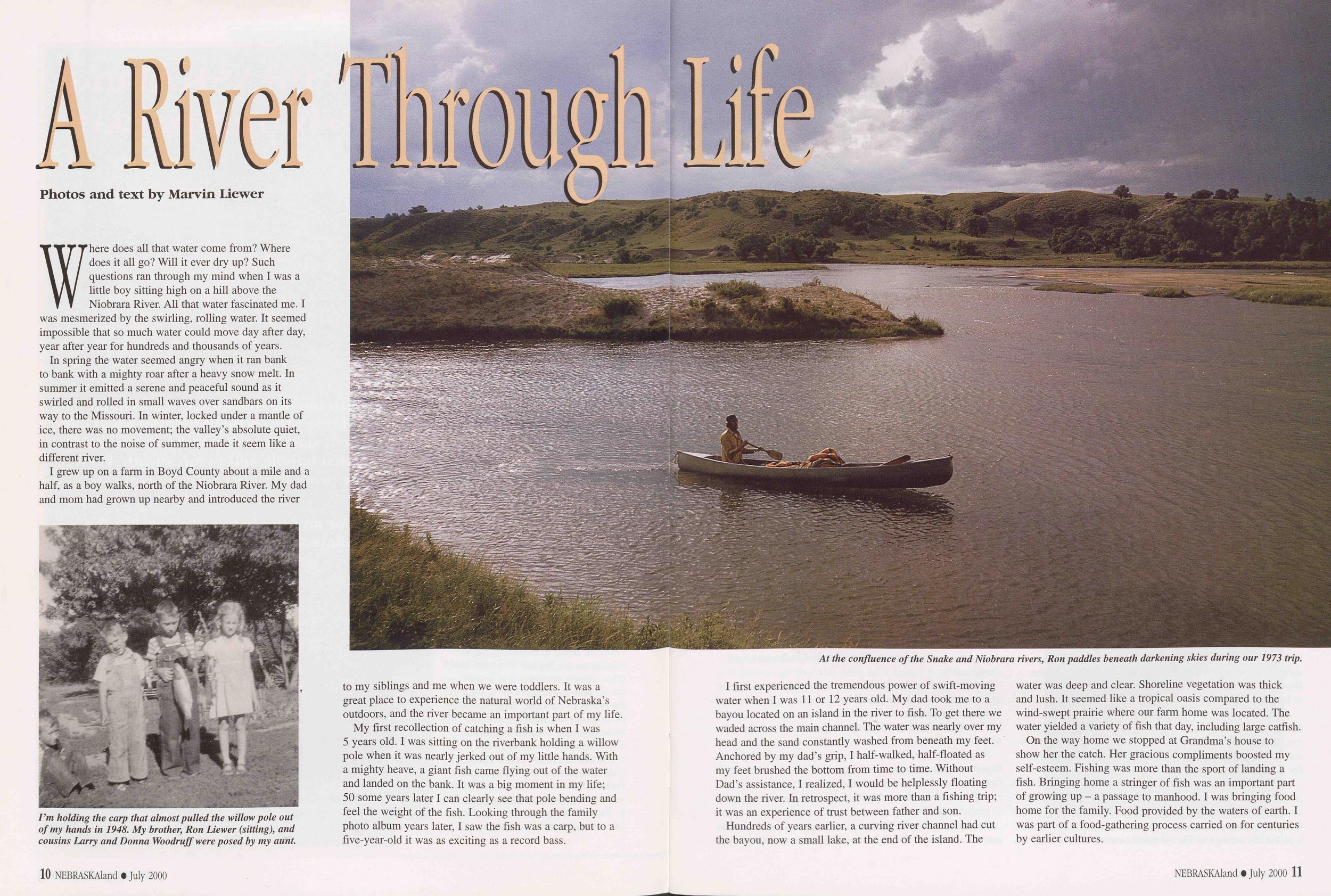
A River Through Life
Photos and text by Marvin LiewerWhere does all that water come from? Where does it all go? Will it ever dry up? Such questions ran through my mind when I was a little boy sitting high on a hill above the Niobrara River. All that water fascinated me. I was mesmerized by the swirling, rolling water. It seemed impossible that so much water could move day after day, year after year for hundreds and thousands of years. In spring the water seemed angry when it ran bank to bank with a mighty roar after a heavy snow melt. In summer it emitted a serene and peaceful sound as it swirled and rolled in small waves over sandbars on its way to the Missouri. In winter, locked under a mantle of ice, there was no movement; the valley's absolute quiet, in contrast to the noise of summer, made it seem like a different river.
I grew up on a farm in Boyd County about a mile and a half, as a boy walks, north of the Niobrara River. My dad and mom had grown up nearby and introduced the river I'm holding the carp that almost pulled the willow pole out of my hands in 1948. My brother, Ron Liewer (sitting), and cousins Larry and Donna Woodruff were posed by my aunt. to my siblings and me when we were toddlers. It was a great place to experience the natural world of Nebraska's outdoors, and the river became an important part of my life.
My first recollection of catching a fish is when I was 5 years old. I was sitting on the riverbank holding a willow pole when it was nearly jerked out of my little hands. With a mighty heave, a giant fish came flying out of the water and landed on the bank. It was a big moment in my life; 50 some years later I can clearly see that pole bending and feel the weight of the fish. Looking through the family photo album years later, I saw the fish was a carp, but to a five-year-old it was as exciting as a record bass.
I first experienced the tremendous power of swift-moving water when I was 11 or 12 years old. My dad took me to a bayou located on an island in the river to fish. To get there we waded across the main channel. The water was nearly over my head and the sand constantly washed from beneath my feet. Anchored by my dad's grip, I half-walked, half-floated as my feet brushed the bottom from time to time. Without Dad's assistance, I realized, I would be helplessly floating down the river. In retrospect, it was more than a fishing trip; it was an experience of trust between father and son.
Hundreds of years earlier, a curving river channel had cut the bayou, now a small lake, at the end of the island. The water was deep and clear. Shoreline vegetation was thick and lush. It seemed like a tropical oasis compared to the wind-swept prairie where our farm home was located. The water yielded a variety of fish that day, including large catfish.
On the way home we stopped at Grandma's house to show her the catch. Her gracious compliments boosted my self-esteem. Fishing was more than the sport of landing a fish. Bringing home a stringer of fish was an important part of growing up - a passage to manhood. I was bringing food home for the family. Food provided by the waters of earth. I was part of a food-gathering process carried on for centuries by earlier cultures.
10 NEBRASKAland • July 2000 NEBRASKAland • July 2000 11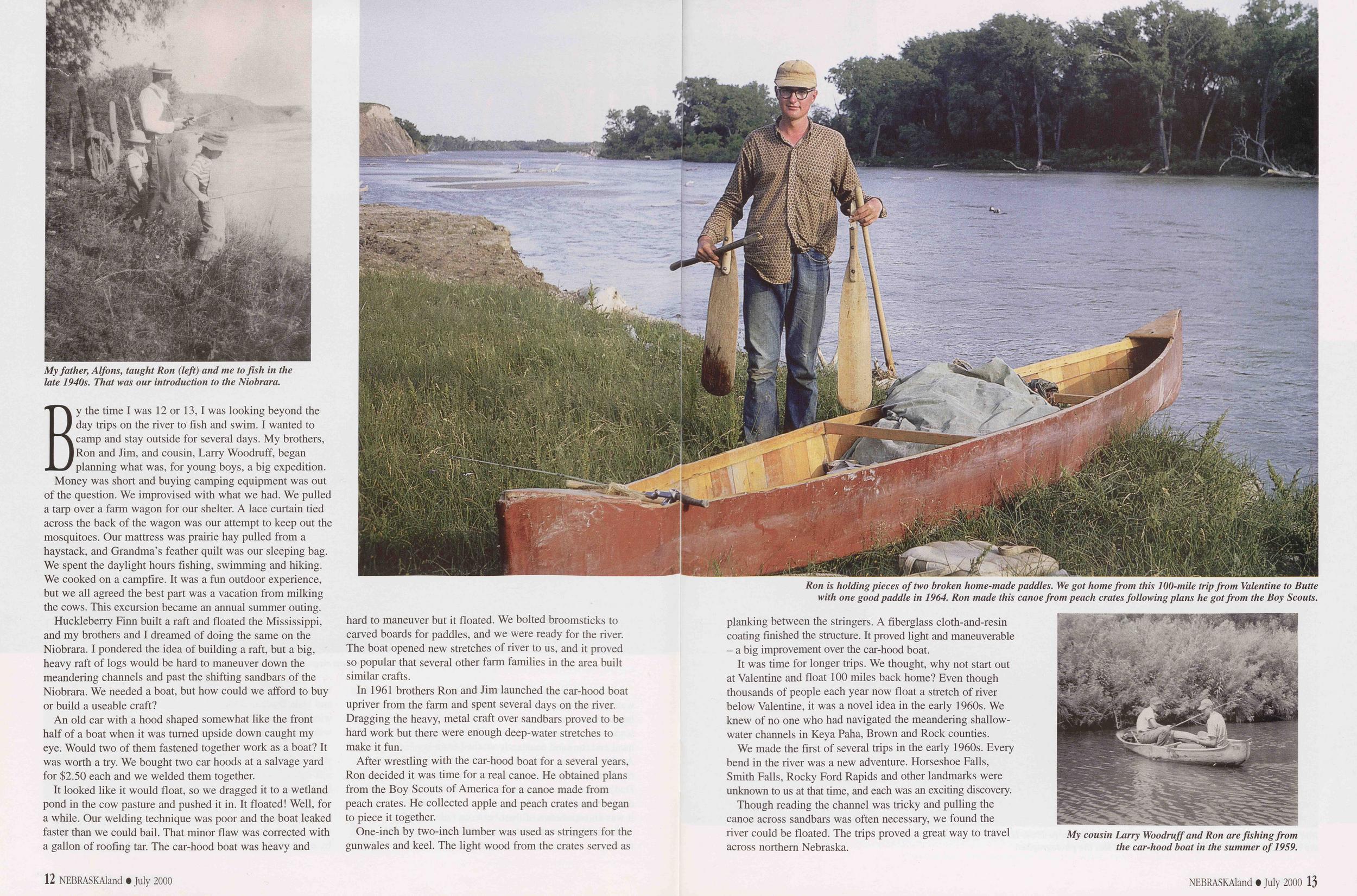
By the time I was 12 or 13,1 was looking beyond the day trips on the river to fish and swim. I wanted to camp and stay outside for several days. My brothers, Ron and Jim, and cousin, Larry Woodruff, began planning what was, for young boys, a big expedition. Money was short and buying camping equipment was out of the question. We improvised with what we had. We pulled a tarp over a farm wagon for our shelter. A lace curtain tied across the back of the wagon was our attempt to keep out the mosquitoes. Our mattress was prairie hay pulled from a haystack, and Grandma's feather quilt was our sleeping bag. We spent the daylight hours fishing, swimming and hiking. We cooked on a campfire. It was a fun outdoor experience, but we all agreed the best part was a vacation from milking the cows. This excursion became an annual summer outing.
Huckleberry Finn built a raft and floated the Mississippi, and my brothers and I dreamed of doing the same on the Niobrara. I pondered the idea of building a raft, but a big, heavy raft of logs would be hard to maneuver down the meandering channels and past the shifting sandbars of the Niobrara. We needed a boat, but how could we afford to buy or build a useable craft?
An old car with a hood shaped somewhat like the front half of a boat when it was turned upside down caught my eye. Would two of them fastened together work as a boat? It was worth a try. We bought two car hoods at a salvage yard for $2.50 each and we welded them together.
It looked like it would float, so we dragged it to a wetland pond in the cow pasture and pushed it in. It floated! Well, for a while. Our welding technique was poor and the boat leaked faster than we could bail. That minor flaw was corrected with a gallon of roofing tar. The car-hood boat was heavy and hard to maneuver but it floated. We bolted broomsticks to carved boards for paddles, and we were ready for the river. The boat opened new stretches of river to us, and it proved so popular that several other farm families in the area built similar crafts.
In 1961 brothers Ron and Jim launched the car-hood boat upriver from the farm and spent several days on the river. Dragging the heavy, metal craft over sandbars proved to be hard work but there were enough deep-water stretches to make it fun.
After wrestling with the car-hood boat for a several years, Ron decided it was time for a real canoe. He obtained plans from the Boy Scouts of America for a canoe made from peach crates. He collected apple and peach crates and began to piece it together.
One-inch by two-inch lumber was used as stringers for the gunwales and keel. The fight wood from the crates served as planking between the stringers. A fiberglass cloth-and-resin coating finished the structure. It proved fight and maneuverable - a big improvement over the car-hood boat.
It was time for longer trips. We thought, why not start out at Valentine and float 100 miles back home? Even though thousands of people each year now float a stretch of river below Valentine, it was a novel idea in the early 1960s. We knew of no one who had navigated the meandering shallow- water channels in Key a Paha, Brown and Rock counties.
We made the first of several trips in the early 1960s. Every bend in the river was a new adventure. Horseshoe Falls, Smith Falls, Rocky Ford Rapids and other landmarks were unknown to us at that time, and each was an exciting discovery.
Though reading the channel was tricky and pulling the canoe across sandbars was often necessary, we found the river could be floated. The trips proved a great way to travel across northern Nebraska.
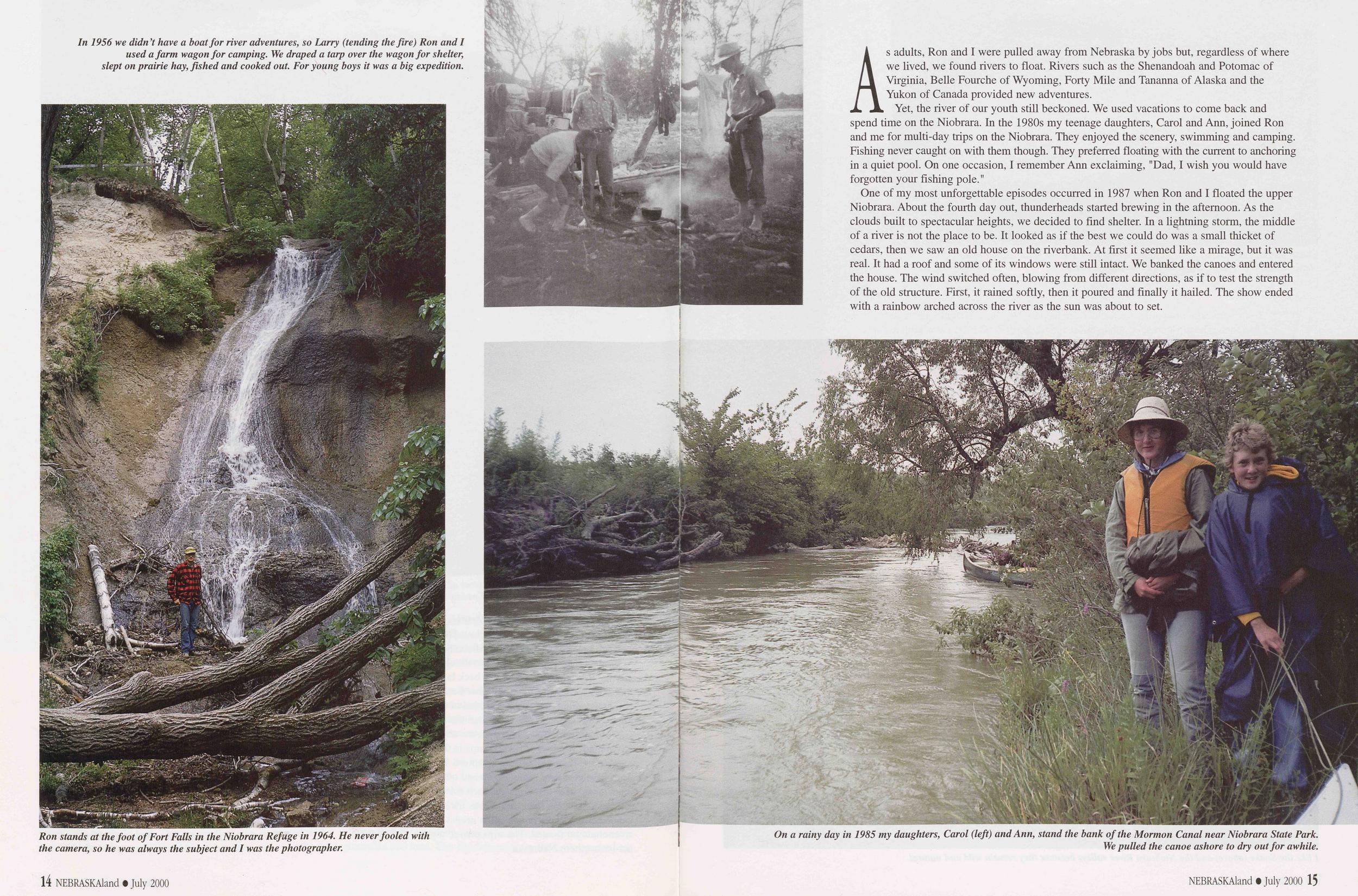
As adults, Ron and I were pulled away from Nebraska by jobs but, regardless of where we lived, we found rivers to float. Rivers such as the Shenandoah and Potomac of Virginia, Belle Fourche of Wyoming, Forty Mile and Tananna of Alaska and the Yukon of Canada provided new adventures.
Yet, the river of our youth still beckoned. We used vacations to come back and spend time on the Niobrara. In the 1980s my teenage daughters, Carol and Ann, joined Ron and me for multi-day trips on the Niobrara. They enjoyed the scenery, swimming and camping. Fishing never caught on with them though. They preferred floating with the current to anchoring in a quiet pool. On one occasion, I remember Ann exclaiming, "Dad, I wish you would have forgotten your fishing pole."
One of my most unforgettable episodes occurred in 1987 when Ron and I floated the upper Niobrara. About the fourth day out, thunderheads started brewing in the afternoon. As the clouds built to spectacular heights, we decided to find shelter. In a lightning storm, the middle of a river is not the place to be. It looked as if the best we could do was a small thicket of cedars, then we saw an old house on the riverbank. At first it seemed like a mirage, but it was real. It had a roof and some of its windows were still intact. We banked the canoes and entered the house. The wind switched often, blowing from different directions, as if to test the strength of the old structure. First, it rained softly, then it poured and finally it hailed. The show ended with a rainbow arched across the river as the sun was about to set.
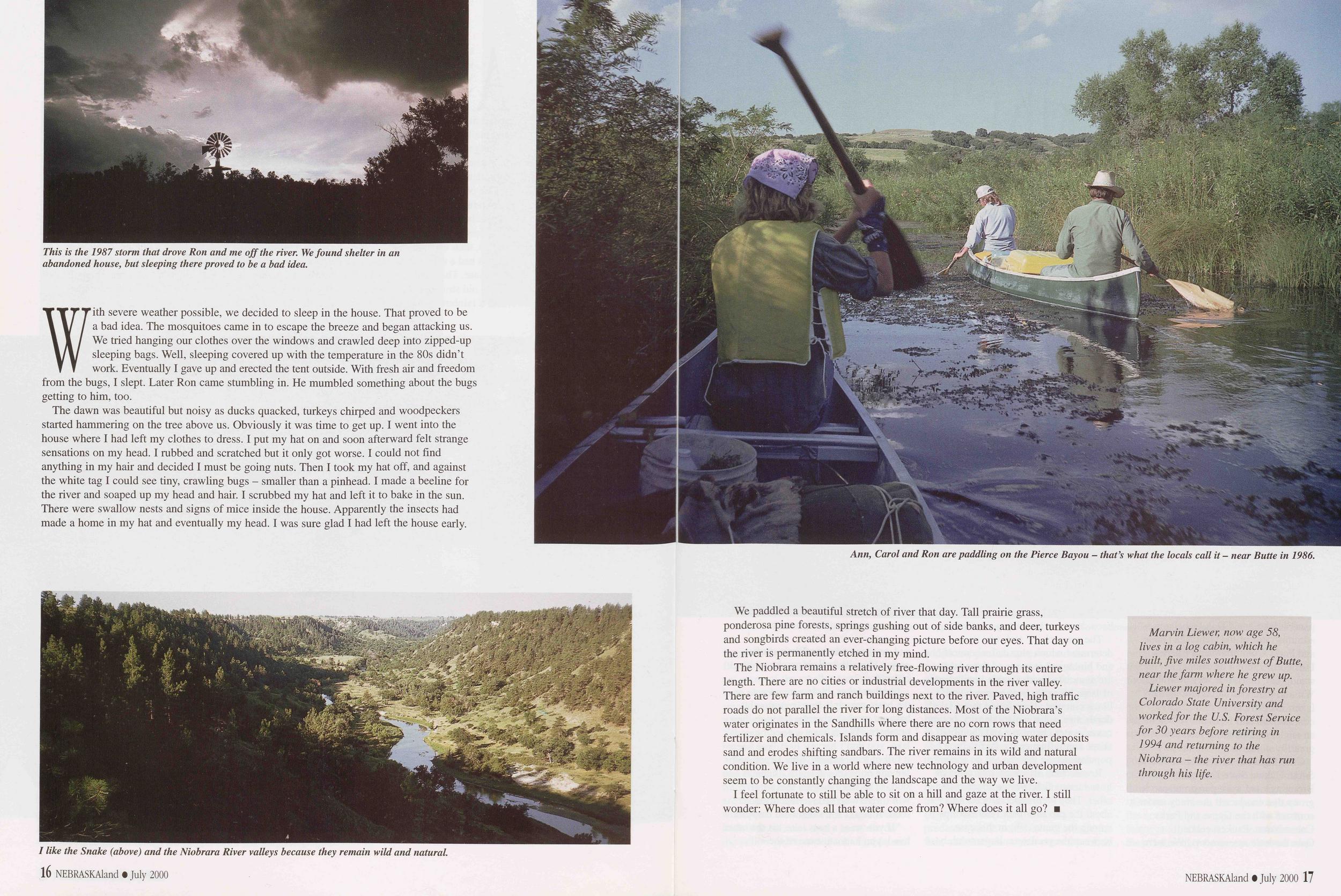
With severe weather possible, we decided to sleep in the house. That proved to be a bad idea. The mosquitoes came in to escape the breeze and began attacking us. We tried hanging our clothes over the windows and crawled deep into zipped-up sleeping bags. Well, sleeping covered up with the temperature in the 80s didn't work. Eventually I gave up and erected the tent outside. With fresh air and freedom from the bugs, I slept. Later Ron came stumbling in. He mumbled something about the bugs getting to him, too.
The dawn was beautiful but noisy as ducks quacked, turkeys chirped and woodpeckers started hammering on the tree above us. Obviously it was time to get up. I went into the house where I had left my clothes to dress. I put my hat on and soon afterward felt strange sensations on my head. I rubbed and scratched but it only got worse. I could not find anything in my hair and decided I must be going nuts. Then I took my hat off, and against the white tag I could see tiny, crawling bugs - smaller than a pinhead. I made a beeline for the river and soaped up my head and hair. I scrubbed my hat and left it to bake in the sun. There were swallow nests and signs of mice inside the house. Apparently the insects had made a home in my hat and eventually my head. I was sure glad I had left the house early.
We paddled a beautiful stretch of river that day. Tall prairie grass, ponderosa pine forests, springs gushing out of side banks, and deer, turkeys and songbirds created an ever-changing picture before our eyes. That day on the river is permanently etched in my mind.
The Niobrara remains a relatively free-flowing river through its entire length. There are no cities or industrial developments in the river valley. There are few farm and ranch buildings next to the river. Paved, high traffic roads do not parallel the river for long distances. Most of the Niobrara's water originates in the Sandhills where there are no corn rows that need fertilizer and chemicals. Islands form and disappear as moving water deposits sand and erodes shifting sandbars. The river remains in its wild and natural condition. We live in a world where new technology and urban development seem to be constantly changing the landscape and the way we live.
I feel fortunate to still be able to sit on a hill and gaze at the river. I still wonder: Where does all that water come from? Where does it all go? ■
Marvin Liewer, now age 58, lives in a log cabin, which he built, five miles southwest of Butte, near the farm where he grew up. Liewer majored in forestry at Colorado State University and worked for the U.S. Forest Service for 30 years before retiring in 1994 and returning to the Niobrara - the river that has run through his life.
NEBRASKAland • July 2000 17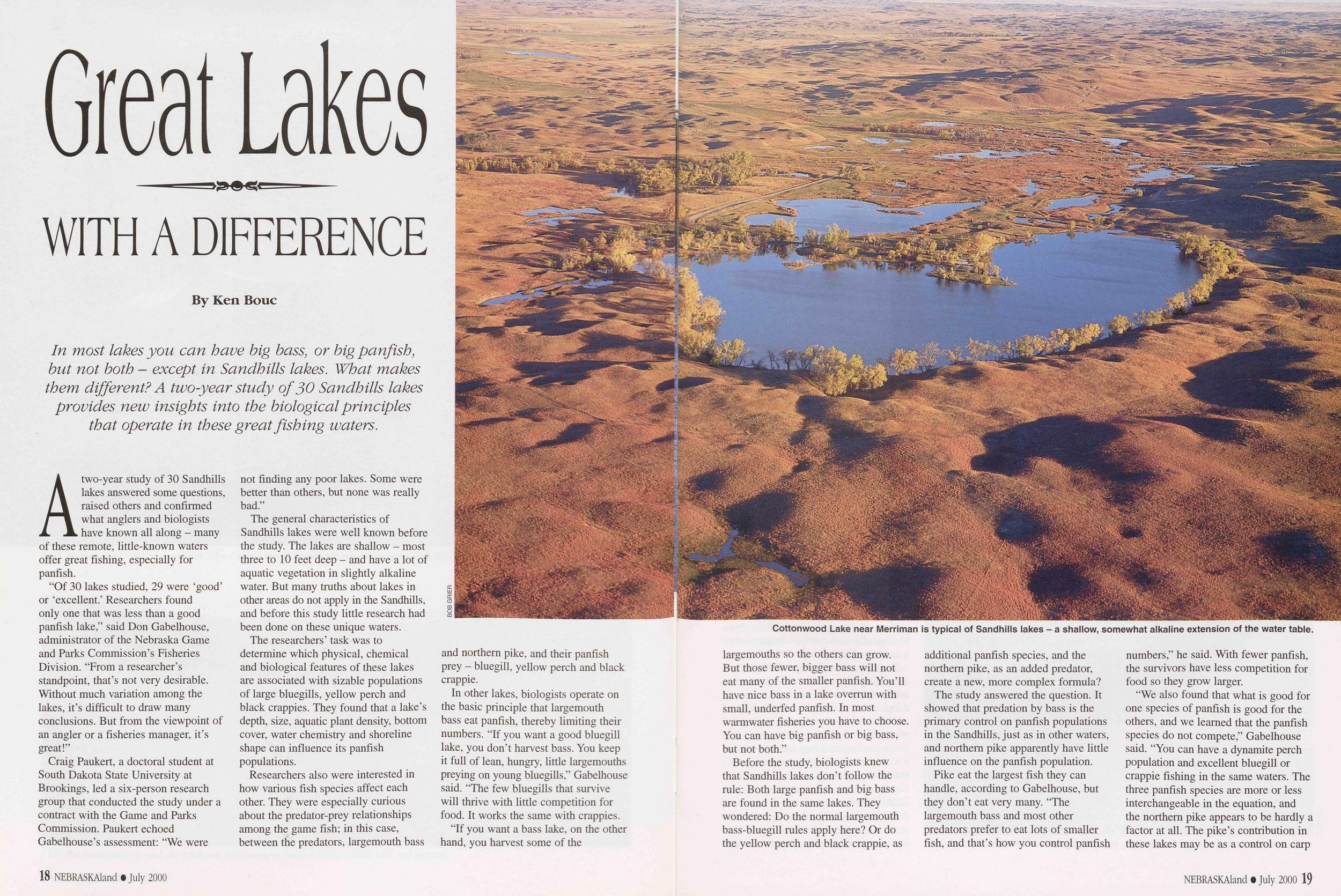
Great Lakes WITH A DIFFERENCE
By Ken Bouc In most lakes you can have big bass, or big panfish, but not both - except in Sandhills lakes. What makes them different? A two-year study of 30 Sandhills lakes provides new insights into the biological principles that operate in these great fishing waters.A two-year study of 30 Sandhills lakes answered some questions, raised others and confirmed what anglers and biologists have known all along - many of these remote, little-known waters offer great fishing, especially for panfish.
"Of 30 lakes studied, 29 were 'good' or 'excellent.' Researchers found only one that was less than a good panfish lake," said Don Gabelhouse, administrator of the Nebraska Game and Parks Conrrmission's Fisheries Division. "From a researcher's standpoint, that's not very desirable. Without much variation among the lakes, it's difficult to draw many conclusions. But from the viewpoint of an angler or a fisheries manager, it's great!"
Craig Paukert, a doctoral student at South Dakota State University at Brookings, led a six-person research group that conducted the study under a contract with the Game and Parks Commission. Paukert echoed Gabelhouse's assessment: "We were not finding any poor lakes. Some were better than others, but none was really bad."
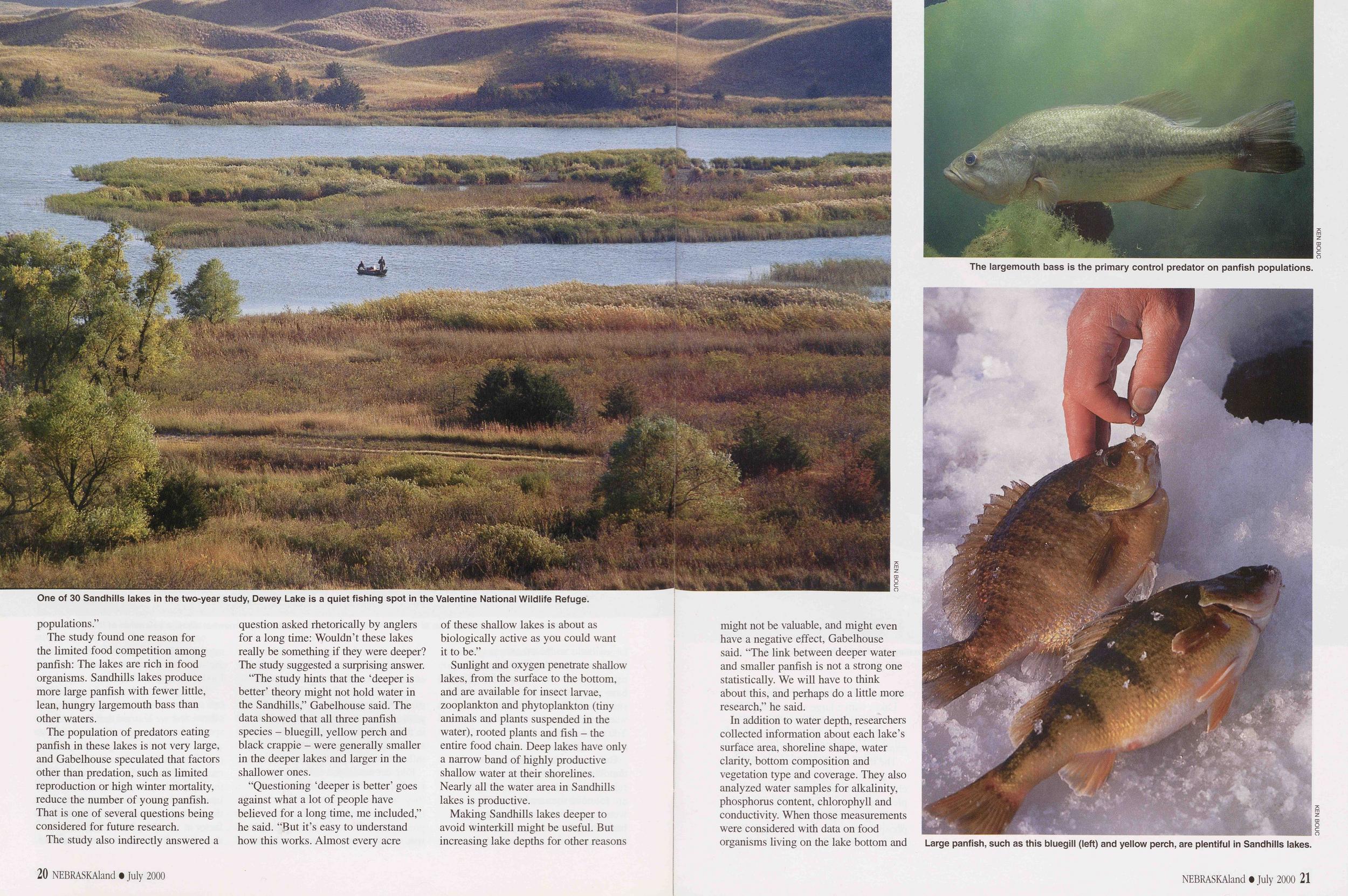
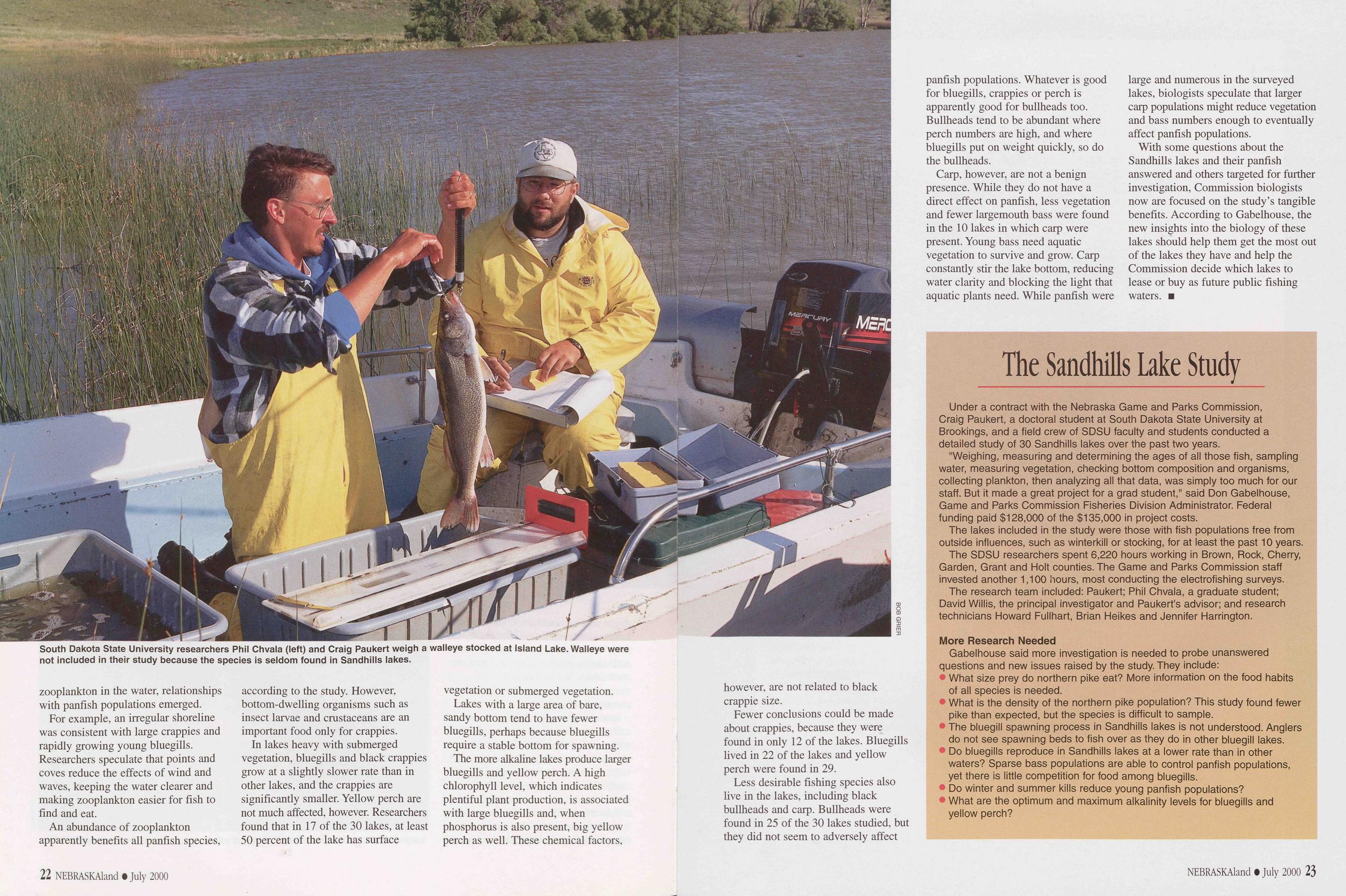
The general characteristics of Sandhills lakes were well known before the study. The lakes are shallow - most three to 10 feet deep - and have a lot of aquatic vegetation in slightly alkaline water. But many truths about lakes in other areas do not apply in the Sandhills, and before this study little research had been done on these unique waters.
The researchers' task was to determine which physical, chemical and biological features of these lakes are associated with sizable populations of large bluegills, yellow perch and black crappies. They found that a lake's depth, size, aquatic plant density, bottom cover, water chemistry and shoreline shape can influence its panfish populations.
Researchers also were interested in how various fish species affect each other. They were especially curious about the predator-prey relationships among the game fish; in this case, between the predators, largemouth bass and northern pike, and their panfish prey - bluegill, yellow perch and black crappie.
In other lakes, biologists operate on the basic principle that largemouth bass eat panfish, thereby limiting their numbers. "If you want a good bluegill lake, you don't harvest bass. You keep it full of lean, hungry, little largemouths preying on young bluegills," Gabelhouse said. "The few bluegills that survive will thrive with little competition for food. It works the same with crappies.
"If you want a bass lake, on the other hand, you harvest some of the largemouths so the others can grow. But those fewer, bigger bass will not eat many of the smaller panfish. You'll have nice bass in a lake overrun with small, underfed panfish. In most warmwater fisheries you have to choose. You can have big panfish or big bass, but not both."
Before the study, biologists knew that Sandhills lakes don't follow the rule: Both large panfish and big bass are found in the same lakes. They wondered: Do the normal largemouth bass-bluegill rules apply here? Or do the yellow perch and black crappie, as additional panfish species, and the northern pike, as an added predator, create a new, more complex formula?
The study answered the question. It showed that predation by bass is the primary control on panfish populations in the Sandhills, just as in other waters, and northern pike apparently have little influence on the panfish population.
Pike eat the largest fish they can handle, according to Gabelhouse, but they don't eat very many. "The largemouth bass and most other predators prefer to eat lots of smaller fish, and that's how you control panfish numbers," he said. With fewer panfish, the survivors have less competition for food so they grow larger.
"We also found that what is good for
one species of panfish is good for the
others, and we learned that the panfish
species do not compete," Gabelhouse
said. "You can have a dynamite perch
population and excellent bluegill or
crappie fishing in the same waters. The
three panfish species are more or less
interchangeable in the equation, and
the northern pike appears to be hardly a
factor at all. The pike's contribution in
these lakes may be as a control on carp
18 NEBRASKAland • July 2000
NEBRASKAland • July 2000 19
 populations."
The study found one reason for the limited food competition among panfish: The lakes are rich in food organisms. Sandhills lakes produce more large panfish with fewer little, lean, hungry largemouth bass than other waters.
The population of predators eating panfish in these lakes is not very large, and Gabelhouse speculated that factors other than predation, such as limited reproduction or high winter mortality, reduce the number of young panfish. That is one of several questions being considered for future research.
The study also indirectly answered a question asked rhetorically by anglers for a long time: Wouldn't these lakes really be something if they were deeper? The study suggested a surprising answer.
The study hints that the 'deeper is better' theory might not hold water in the Sandhills," Gabelhouse said. The data showed that all three panfish species - bluegill, yellow perch and black crappie - were generally smaller in the deeper lakes and larger in the shallower ones.
"Questioning 'deeper is better' goes against what a lot of people have believed for a long time, me included," he said. "But it's easy to understand how this works. Almost every acre of these shallow lakes is about as biologically active as you could want it to be."
Sunlight and oxygen penetrate shallow lakes, from the surface to the bottom, and are available for insect larvae, zooplankton and phytoplankton (tiny animals and plants suspended in the water), rooted plants and fish - the entire food chain. Deep lakes have only a narrow band of highly productive shallow water at their shorelines. Nearly all the water area in Sandhills lakes is productive.
Making Sandhills lakes deeper to avoid winterkill might be useful. But increasing lake depths for other reasons might not be valuable, and might even have a negative effect, Gabelhouse said. "The link between deeper water and smaller panfish is not a strong one statistically. We will have to think about this, and perhaps do a little more research," he said.
In addition to water depth, researchers
collected information about each lake's
surface area, shoreline shape, water
clarity, bottom composition and
vegetation type and coverage. They also
analyzed water samples for alkalinity,
phosphorus content, chlorophyll and
conductivity. When those measurements
were considered with data on food
organisms living on the lake bottom and
NEBRASKAland • July 2000 21
 zooplankton in the water, relationships
with panfish populations emerged.
zooplankton in the water, relationships
with panfish populations emerged.
For example, an irregular shoreline was consistent with large crappies and rapidly growing young bluegills. Researchers speculate that points and coves reduce the effects of wind and waves, keeping the water clearer and making zooplankton easier for fish to find and eat.
An abundance of zooplankton apparently benefits all panfish species, according to the study. However, bottom-dwelling organisms such as insect larvae and crustaceans are an important food only for crappies.
In lakes heavy with submerged vegetation, bluegills and black crappies grow at a slightly slower rate than in other lakes, and the crappies are significantly smaller. Yellow perch are not much affected, however. Researchers found that in 17 of the 30 lakes, at least 50 percent of the lake has surface vegetation or submerged vegetation.
Lakes with a large area of bare, sandy bottom tend to have fewer bluegills, perhaps because bluegills require a stable bottom for spawning.
The more alkaline lakes produce larger bluegills and yellow perch. A high chlorophyll level, which indicates plentiful plant production, is associated with large bluegills and, when phosphorus is also present, big yellow perch as well. These chemical factors, however, are not related to black crappie size.
Fewer conclusions could be made about crappies, because they were found in only 12 of the lakes. Bluegills lived in 22 of the lakes and yellow perch were found in 29.
Less desirable fishing species also live in the lakes, including black bullheads and carp. Bullheads were found in 25 of the 30 lakes studied, but they did not seem to adversely affect panfish populations. Whatever is good for bluegills, crappies or perch is apparently good for bullheads too. Bullheads tend to be abundant where perch numbers are high, and where bluegills put on weight quickly, so do the bullheads.
Carp, however, are not a benign presence. While they do not have a direct effect on panfish, less vegetation and fewer largemouth bass were found in the 10 lakes in which carp were present. Young bass need aquatic vegetation to survive and grow. Carp constantly stir the lake bottom, reducing water clarity and blocking the light that aquatic plants need. While panfish were large and numerous in the surveyed lakes, biologists speculate that larger carp populations might reduce vegetation and bass numbers enough to eventually affect panfish populations.
With some questions about the Sandhills lakes and their panfish answered and others targeted for further investigation, Commission biologists now are focused on the study's tangible benefits. According to Gabelhouse, the new insights into the biology of these lakes should help them get the most out of the lakes they have and help the Commission decide which lakes to lease or buy as future public fishing waters. ■
The Sandhills Lake StudyUnder a contract with the Nebraska Game and Parks Commission, Craig Paukert, a doctoral student at South Dakota State University at Brookings, and a field crew of SDSU faculty and students conducted a detailed study of 30 Sandhills lakes over the past two years.
"Weighing, measuring and determining the ages of all those fish, sampling water, measuring vegetation, checking bottom composition and organisms, collecting plankton, then analyzing all that data, was simply too much for our staff. But it made a great project for a grad student," said Don Gabelhouse, Game and Parks Commission Fisheries Division Administrator. Federal funding paid $128,000 of the $135,000 in project costs.
The lakes included in the study were those with fish populations free from outside influences, such as winterkill or stocking, for at least the past 10 years.
The SDSU researchers spent 6,220 hours working in Brown, Rock, Cherry, Garden, Grant and Holt counties. The Game and Parks Commission staff invested another 1,100 hours, most conducting the electrofishing surveys.
The research team included: Paukert; Phil Chvala, a graduate student; David Willis, the principal investigator and Paukerf s advisor; and research technicians Howard Fullhart, Brian Heikes and Jennifer Harrington.
More Research Needed
Gabelhouse said more investigation is needed to probe unanswered questions and new issues raised by the study. They include: • What size prey do northern pike eat? More information on the food habits of all species is needed. • What is the density of the northern pike population? This study found fewer pike than expected, but the species is difficult to sample. • The bluegill spawning process in Sandhills lakes is not understood. Anglers do not see spawning beds to fish over as they do in other bluegill lakes. • Do bluegills reproduce in Sandhills lakes at a lower rate than in other waters? Sparse bass populations are able to control panfish populations, yet there is little competition for food among bluegills. • Do winter and summer kills reduce young panfish populations? • What are the optimum and maximum alkalinity levels for bluegills and yellow perch?
22 NEBRASKAland • July 2000 NEBRASKAland • July 2000 23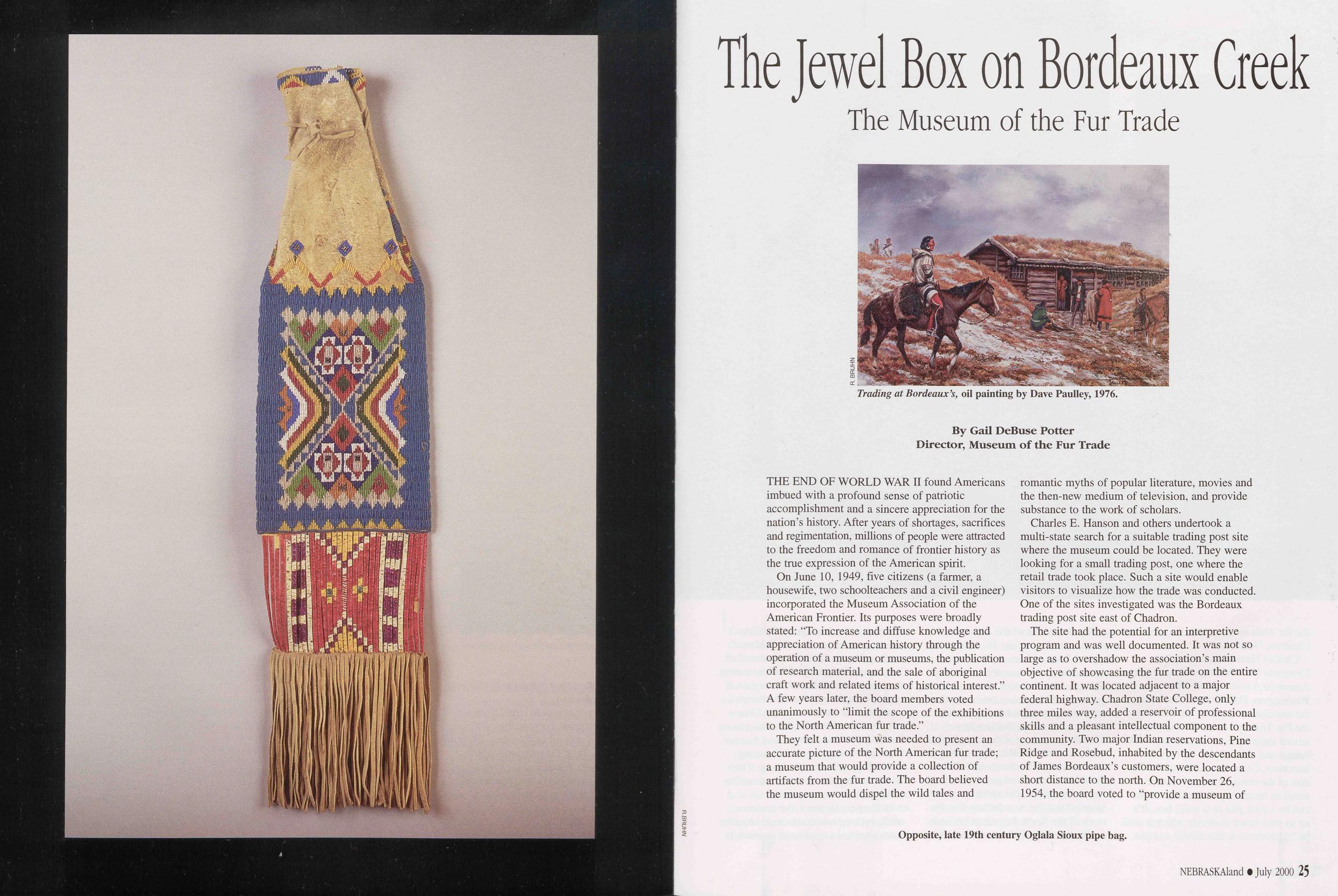
The Jewel Box on Bordeaux Creek
The Museum of the Fur TradeTHE END OF WORLD WAR II found Americans imbued with a profound sense of patriotic accomplishment and a sincere appreciation for the nation's history. After years of shortages, sacrifices and regimentation, millions of people were attracted to the freedom and romance of frontier history as the true expression of the American spirit.
On June 10, 1949, five citizens (a farmer, a housewife, two schoolteachers and a civil engineer) incorporated the Museum Association of the American Frontier. Its purposes were broadly stated: "To increase and diffuse knowledge and appreciation of American history through the operation of a museum or museums, the publication of research material, and the sale of aboriginal craft work and related items of historical interest." A few years later, the board members voted unanimously to "limit the scope of the exhibitions to the North American fur trade."
They felt a museum was needed to present an accurate picture of the North American fur trade; a museum that would provide a collection of artifacts from the fur trade. The board believed the museum would dispel the wild tales and romantic myths of popular literature, movies and the then-new medium of television, and provide substance to the work of scholars.
Charles E. Hanson and others undertook a multi-state search for a suitable trading post site where the museum could be located. They were looking for a small trading post, one where the retail trade took place. Such a site would enable visitors to visualize how the trade was conducted. One of the sites investigated was the Bordeaux trading post site east of Chadron.
The site had the potential for an interpretive
program and was well documented. It was not so
large as to overshadow the association's main
objective of showcasing the fur trade on the entire
continent. It was located adjacent to a major
federal highway. Chadron State College, only
three miles way, added a reservoir of professional
skills and a pleasant intellectual component to the
community. Two major Indian reservations, Pine
Ridge and Rosebud, inhabited by the descendants
of James Bordeaux's customers, were located a
short distance to the north. On November 26,
1954, the board voted to "provide a museum of
NEBRASKAland • July 2000 25
 the fur trade as an association project at
Chadron, Nebraska."
the fur trade as an association project at
Chadron, Nebraska."
Charles Hanson then visited Lawrence Vail Coleman, director of the American Association of Museums, in Washington, D.C. Coleman encouraged the association to pursue the Museum of the Fur Trade project, offering practical advice about collections, pohcies, exhibit design and other topics. Perhaps most important, Coleman told Hanson: "The size of the museum doesn't matter as much as its quality. A small museum can be a junk pile or a jewel box. It's up to your board to decide which it shah be." Hanson took that advice to heart.
The dedication of the Museum of the Fur Trade, on July 16, 1955, was a typical Western occasion with orators and Indian dancers under a clear sky. The speakers included Victor Anderson, governor of Nebraska; Dr. James Olson, superintendent of the Nebraska State Historical Society; William Fire Thunder, president of the Oglala Sioux tribe; Dr. Eric DeFlon, representing the citizens of Chadron; and William Bordeaux, author and grandson of trader James Bordeaux. The modest museum unveiled that day was dedicated to the story of the North American fur trade.
The foundation of the museum is its library and research program. The museum is unique because it started with an idea as its nucleus rather than with the collection of a wealthy patron. Ongoing research reveals the types of objects that the museum should obtain to tell the fur trade story. The library now contains about 10,000 volumes on fur trade, Indian, colonial and frontier history, commercial manufacturing, archeology and natural history. The books are supplemented by microfilm records from fur companies.
In the past 10 years, the museum staff, contract associates and volunteer associates have conducted research in England, Russia, Spain, Denmark, Greenland, Sweden, Germany, France, Belgium, the Netherlands, Canada, Mexico and the United States. Researchers examined surviving corporate records, correspondence, reminiscences, museum collections and archaeological collections made at trading posts and Indian village sites.
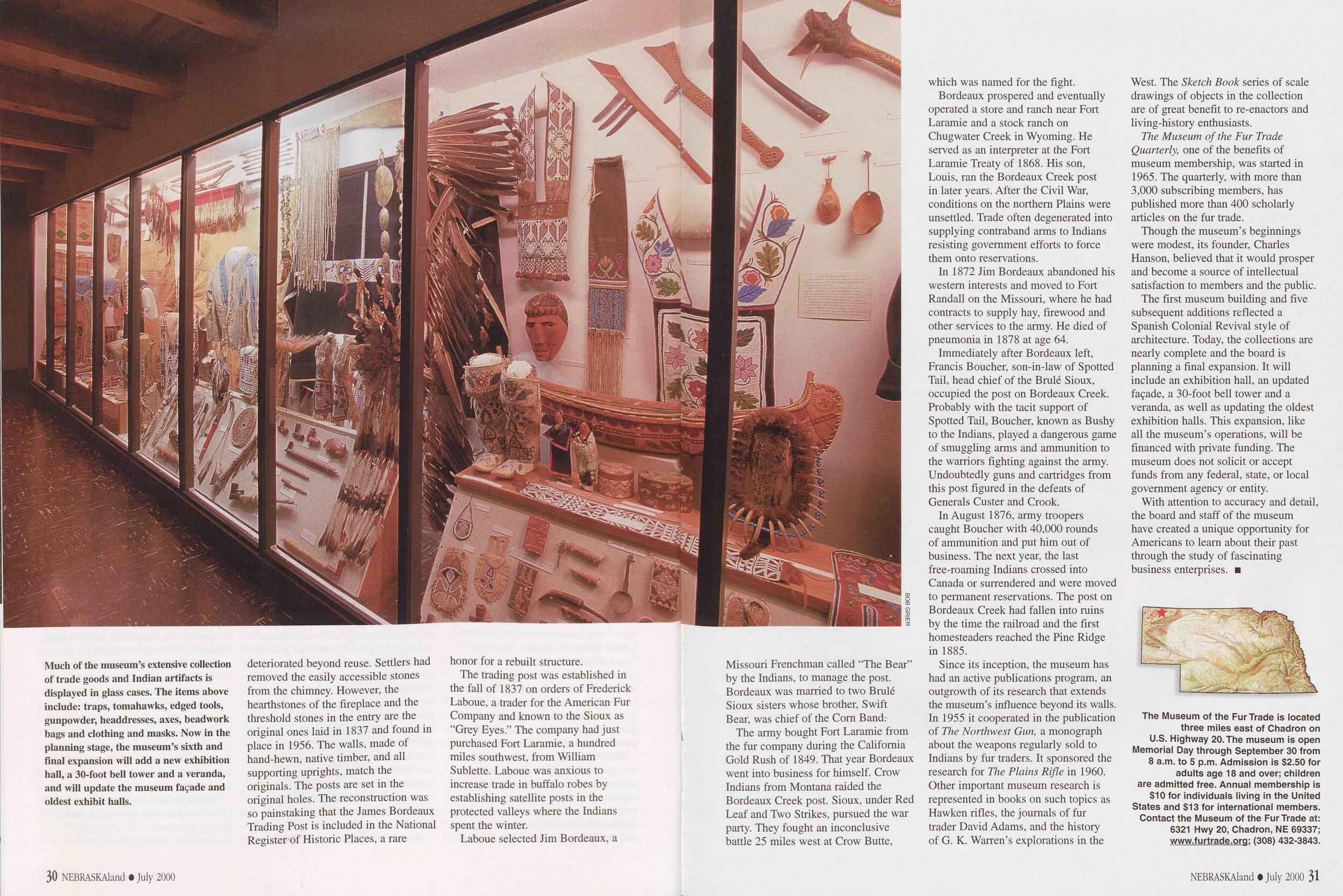
Visitors to the museum will discover that it is a jewel box. The research program uncovers information about how the fur trade was carried out from Greenland to Alaska and from Hudson Bay to the Gulf of Mexico during the five centuries of active trading with native people. The museum's acquisition program finds and acquires the artifacts needed to illustrate those diverse stories in exhibits. The collection of more than 6,000 primary objects has been gathered one piece at a time.
The scope of the museum's collection
is dazzling. It represents every type of
object exchanged by traders with the
native people of North America. The
expected kinds of artifacts, such as
guns, blankets, beads, axes, knives and
kettles, are represented but many
unusual goods, such as gimlets, quill
smoothers, playing cards, trunks,
tobacco boxes and jewelry, can be
26 NEBRASKAland • July 2000
NEBRASKAland • July 2000 27
 seen as well. The collection includes a
complete type-set of trade goods sold
by each nation operating in each of the
various trading areas of North America.
seen as well. The collection includes a
complete type-set of trade goods sold
by each nation operating in each of the
various trading areas of North America.
The development of the collection has proceeded rapidly, following a master plan coordinated with the research program. Supplementing the master type-collection of trade goods are a number of special representative collections on Plains and Woodland Indian life, articles associated with trappers throughout North American history and the world's most definitive collection of fur trade firearms.
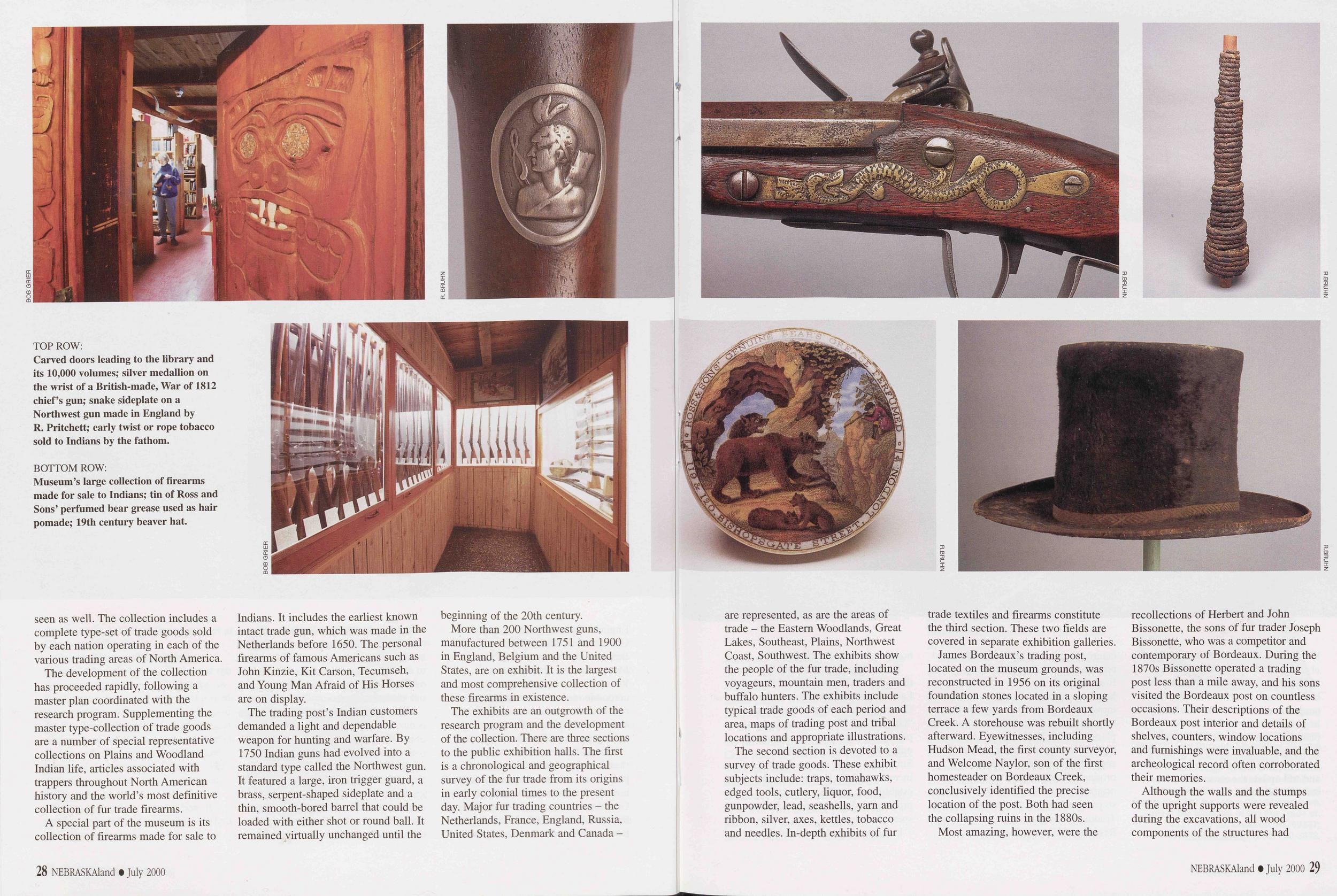
A special part of the museum is its collection of firearms made for sale to Indians. It includes the earliest known intact trade gun, which was made in the Netherlands before 1650. The personal firearms of famous Americans such as John Kinzie, Kit Carson, Tecumseh, and Young Man Afraid of His Horses are on display.
The trading post's Indian customers demanded a light and dependable weapon for hunting and warfare. By 1750 Indian guns had evolved into a standard type called the Northwest gun. It featured a large, iron trigger guard, a brass, serpent-shaped sideplate and a thin, smooth-bored barrel that could be loaded with either shot or round ball. It remained virtually unchanged until the beginning of the 20th century.
More than 200 Northwest guns, manufactured between 1751 and 1900 in England, Belgium and the United States, are on exhibit. It is the largest and most comprehensive collection of these firearms in existence.
The exhibits are an outgrowth of the research program and the development of the collection. There are three sections to the public exhibition halls. The first is a chronological and geographical survey of the fur trade from its origins in early colonial times to the present day. Major fur trading countries - the Netherlands, France, England, Russia, United States, Denmark and Canada - are represented, as are the areas of trade - the Eastern Woodlands, Great Lakes, Southeast, Plains, Northwest Coast, Southwest. The exhibits show the people of the fur trade, including voyageurs, mountain men, traders and buffalo hunters. The exhibits include typical trade goods of each period and area, maps of trading post and tribal locations and appropriate illustrations.
The second section is devoted to a survey of trade goods. These exhibit subjects include: traps, tomahawks, edged tools, cutlery, liquor, food, gunpowder, lead, seashells, yarn and ribbon, silver, axes, kettles, tobacco and needles. In-depth exhibits of fur trade textiles and firearms constitute the third section. These two fields are covered in separate exhibition galleries.
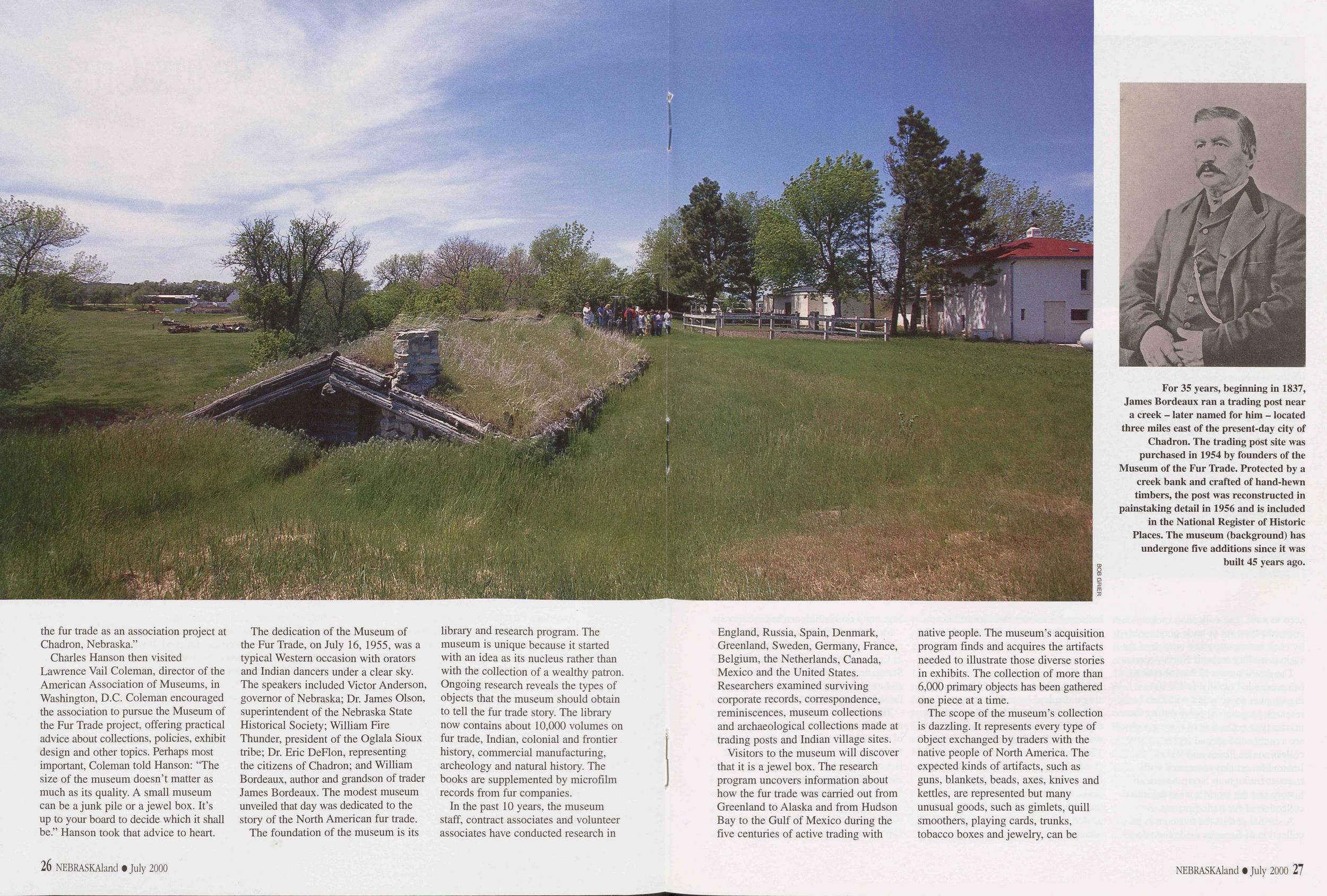
James Bordeaux's trading post, located on the museum grounds, was reconstructed in 1956 on its original foundation stones located in a sloping terrace a few yards from Bordeaux Creek. A storehouse was rebuilt shortly afterward. Eyewitnesses, including Hudson Mead, the first county surveyor, and Welcome Naylor, son of the first homesteader on Bordeaux Creek, conclusively identified the precise location of the post. Both had seen the collapsing ruins in the 1880s.
Most amazing, however, were the recollections of Herbert and John Bissonette, the sons of fur trader Joseph Bissonette, who was a competitor and contemporary of Bordeaux. During the 1870s Bissonette operated a trading post less than a mile away, and his sons visited the Bordeaux post on countless occasions. Their descriptions of the Bordeaux post interior and details of shelves, counters, window locations and furnishings were invaluable, and the archeological record often corroborated their memories.
Although the walls and the stumps
of the upright supports were revealed
during the excavations, all wood
components of the structures had
NEBRASKAland • July 2000 29
 deteriorated beyond reuse. Settlers had
removed the easily accessible stones
from the chimney. However, the
hearthstones of the fireplace and the
threshold stones in the entry are the
original ones laid in 1837 and found in
place in 1956. The walls, made of
hand-hewn, native timber, and all
supporting uprights, match the
originals. The posts are set in the
original holes. The reconstruction was
so painstaking that the James Bordeaux
Trading Post is included in the National
Register of Historic Places, a rare
honor for a rebuilt structure.
deteriorated beyond reuse. Settlers had
removed the easily accessible stones
from the chimney. However, the
hearthstones of the fireplace and the
threshold stones in the entry are the
original ones laid in 1837 and found in
place in 1956. The walls, made of
hand-hewn, native timber, and all
supporting uprights, match the
originals. The posts are set in the
original holes. The reconstruction was
so painstaking that the James Bordeaux
Trading Post is included in the National
Register of Historic Places, a rare
honor for a rebuilt structure.
The trading post was established in the fall of 1837 on orders of Frederick Laboue, a trader for the American Fur Company and known to the Sioux as "Grey Eyes." The company had just purchased Fort Laramie, a hundred miles southwest, from William Sublette. Laboue was anxious to increase trade in buffalo robes by establishing satellite posts in the protected valleys where the Indians spent the winter.
Laboue selected Jim Bordeaux, a Missouri Frenchman called "The Bear" by the Indians, to manage the post. Bordeaux was married to two Brule Sioux sisters whose brother, Swift Bear, was chief of the Corn Band.
The army bought Fort Laramie from the fur company during the California Gold Rush of 1849. That year Bordeaux went into business for himself. Crow Indians from Montana raided the Bordeaux Creek post. Sioux, under Red Leaf and Two Strikes, pursued the war party. They fought an inconclusive battle 25 miles west at Crow Butte, which was named for the fight.
Bordeaux prospered and eventually operated a store and ranch near Fort Laramie and a stock ranch on Chugwater Creek in Wyoming. He served as an interpreter at the Fort Laramie Treaty of 1868. His son, Louis, ran the Bordeaux Creek post in later years. After the Civil War, conditions on the northern Plains were unsettled. Trade often degenerated into supplying contraband arms to Indians resisting government efforts to force them onto reservations.
In 1872 Jim Bordeaux abandoned his western interests and moved to Fort Randall on the Missouri, where he had contracts to supply hay, firewood and other services to the army. He died of pneumonia in 1878 at age 64.
Immediately after Bordeaux left, Francis Boucher, son-in-law of Spotted Tail, head chief of the Brule Sioux, occupied the post on Bordeaux Creek. Probably with the tacit support of Spotted Tail, Boucher, known as Bushy to the Indians, played a dangerous game of smuggling arms and ammunition to the warriors fighting against the army. Undoubtedly guns and cartridges from this post figured in the defeats of Generals Custer and Crook.
In August 1876, army troopers caught Boucher with 40,000 rounds of ammunition and put him out of business. The next year, the last free-roaming Indians crossed into Canada or surrendered and were moved to permanent reservations. The post on Bordeaux Creek had fallen into ruins by the time the railroad and the first homesteaders reached the Pine Ridge in 1885.
Since its inception, the museum has had an active publications program, an outgrowth of its research that extends the museum's influence beyond its walls. In 1955 it cooperated in the publication of The Northwest Gun, a monograph about the weapons regularly sold to Indians by fur traders. It sponsored the research for The Plains Rifle in 1960. Other important museum research is represented in books on such topics as Hawken rifles, the journals of fur trader David Adams, and the history of G. K. Warren's explorations in the West. The Sketch Book series of scale drawings of objects in the collection are of great benefit to re-enactors and living-history enthusiasts.
The Museum of the Fur Trade Quarterly, one of the benefits of museum membership, was started in 1965. The quarterly, with more than 3,000 subscribing members, has published more than 400 scholarly articles on the fur trade.
Though the museum's beginnings were modest, its founder, Charles Hanson, believed that it would prosper and become a source of intellectual satisfaction to members and the public.
The first museum building and five subsequent additions reflected a Spanish Colonial Revival style of architecture. Today, the collections are nearly complete and the board is planning a final expansion. It will include an exhibition hall, an updated facade, a 30-foot bell tower and a veranda, as well as updating the oldest exhibition halls. This expansion, like all the museum's operations, will be financed with private funding. The museum does not solicit or accept funds from any federal, state, or local government agency or entity.
With attention to accuracy and detail, the board and staff of the museum have created a unique opportunity for Americans to learn about their past through the study of fascinating business enterprises. ■
Andy's First Brown
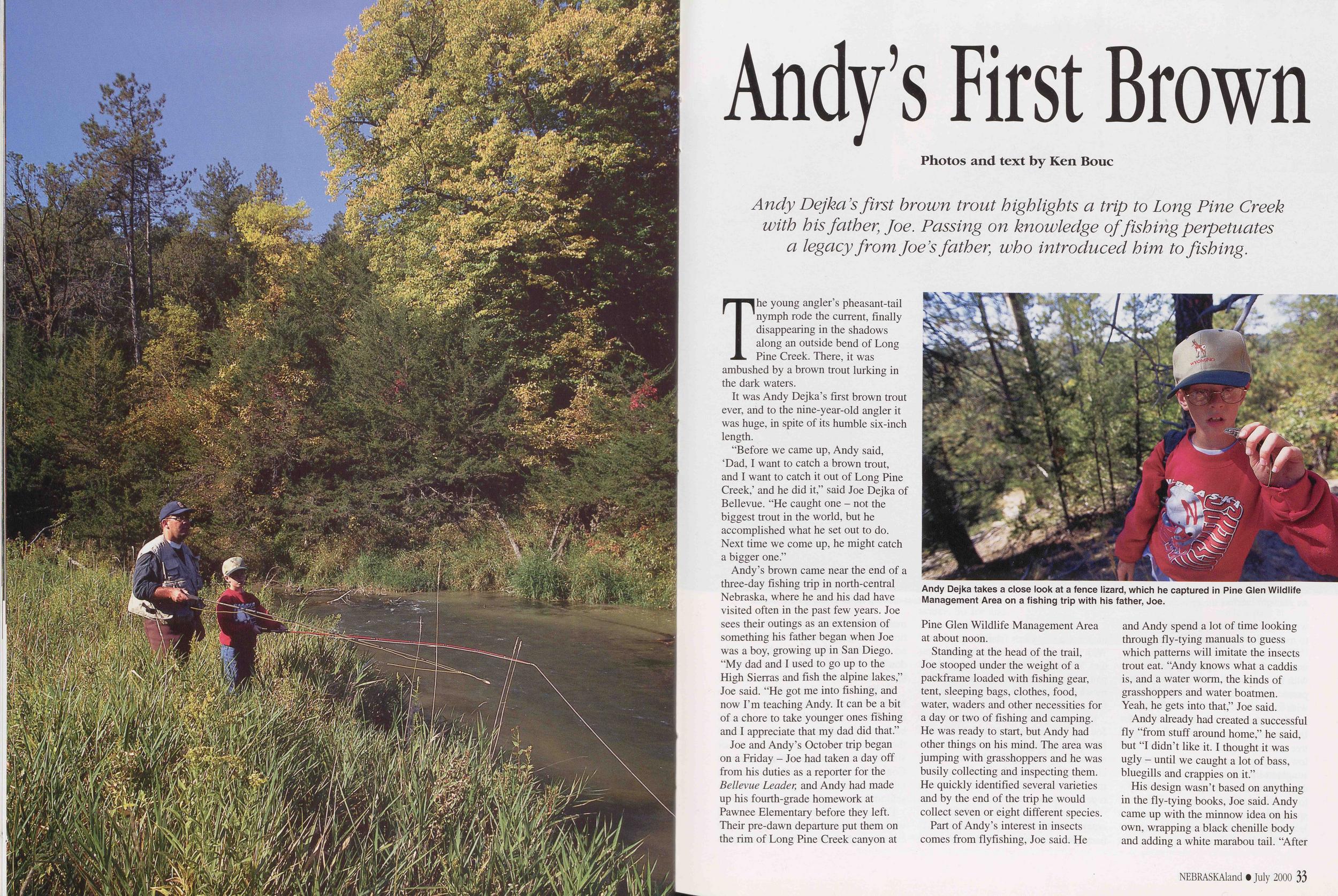
Photos and text by Ken Bouc Andy Dejka's first brown trout highlights a trip to Long Pine Creek with his father, Joe\ Passing on knowledge of fishing perpetuates a legacy from Joe's father, who introduced him to fishing.The young angler's pheasant-tail nymph rode the current, finally disappearing in the shadows along an outside bend of Long Pine Creek. There, it was ambushed by a brown trout lurking in the dark waters.
It was Andy Dejka's first brown trout ever, and to the nine-year-old angler it was huge, in spite of its humble six-inch length.
"Before we came up, Andy said, 'Dad, I want to catch a brown trout, and I want to catch it out of Long Pine Creek,' and he did it," said Joe Dejka of Bellevue. "He caught one - not the biggest trout in the world, but he accomplished what he set out to do. Next time we come up, he might catch a bigger one."
Andy's brown came near the end of a three-day fishing trip in north-central Nebraska, where he and his dad have visited often in the past few years. Joe sees their outings as an extension of something his father began when Joe was a boy, growing up in San Diego. "My dad and I used to go up to the High Sierras and fish the alpine lakes," Joe said. "He got me into fishing, and now I'm teaching Andy. It can be a bit of a chore to take younger ones fishing and I appreciate that my dad did that."
Joe and Andy's October trip began on a Friday - Joe had taken a day off from his duties as a reporter for the Bellevue Leader, and Andy had made up his fourth-grade homework at Pawnee Elementary before they left. Their pre-dawn departure put them on the rim of Long Pine Creek canyon at Pine Glen Wildlife Management Area at about noon.
Standing at the head of the trail, Joe stooped under the weight of a packframe loaded with fishing gear, tent, sleeping bags, clothes, food, water, waders and other necessities for a day or two of fishing and camping. He was ready to start, but Andy had other things on his mind. The area was jumping with grasshoppers and he was busily collecting and inspecting them. He quickly identified several varieties and by the end of the trip he would collect seven or eight different species.
Part of Andy's interest in insects comes from flyfishing, Joe said. He and Andy spend a lot of time looking through fly-tying manuals to guess which patterns will imitate the insects trout eat. "Andy knows what a caddis is, and a water worm, the kinds of grasshoppers and water boatmen. Yeah, he gets into that," Joe said.
Andy already had created a successful fly "from stuff around home," he said, but "I didn't like it. I thought it was ugly - until we caught a lot of bass, bluegills and crappies on it."
His design wasn't based on anything
in the fly-tying books, Joe said. Andy
came up with the minnow idea on his
own, wrapping a black chenille body
and adding a white marabou tail. "After
NEBRASKAland • July 2000 33
 we caught a bunch of fish with it, I had
to make some for myself," Joe said.
we caught a bunch of fish with it, I had
to make some for myself," Joe said.
The trip down the steep canyon wall was an adventure, especially for Joe with his top-heavy load. Parts of what passed for a trail were steep and littered with loose dirt and rocks, briefly requiring the skills of a downhill skier. In other stretches, exposed, ankle-high tree roots entangled the feet while low-hanging branches swiped at hats, sunglasses and backpacks. The last dozen feet included a precipitous drop to the canyon floor, where a small, springbranch stream marked a more leisurely route to the banks of Long Pine Creek.
Joe dropped his pack in a little meadow a few yards from the creek. With Andy's help, he set up the small tent. When they finished, Joe rigged a pair of fly rods while Andy scoured the meadow and nearby cedars and pines for more insects.
One variety, which neither Andy nor Joe had to look for, was soon apparent. Mosquitoes, singly and by the swarm, attacked any bit of skin not covered by clothing. Life along the creek was made bearable only by clouds of insect repellent spray.
"A lot of people would think it's crazy for Andy and me to come up here, stay in a tent and be devoured by mosquitoes. I think it's important. It's a time when we're together and there are no distractions, no places to hide. I don't know what the attraction is, but I know that it's worthwhile," Joe said.
Andy's rod was equipped with a Mickey Finn streamer, which he drifted downstream through holes and undercut banks, continually pumping it upstream, then letting it drift back down to simulate a swimming, darting minnow. Confined to banks snarled with shrubs, tall grass and horsetail plants, Andy seldom had room to cast.
Even if he had been able to find waders his size, the creek's swift current might have been too much for him because of his light weight. When he needed to cross the creek, his dad offered a piggyback ride.
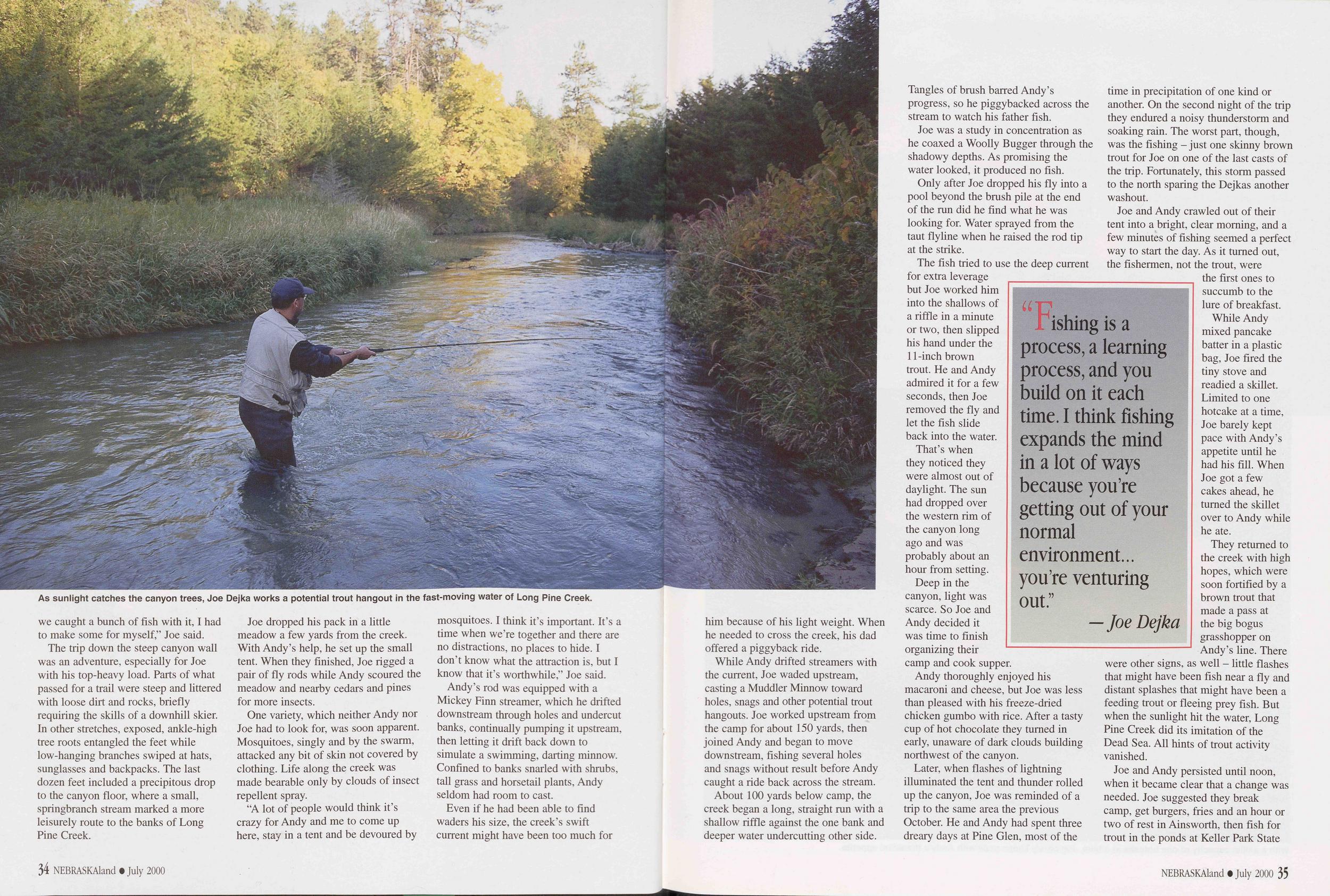
While Andy drifted streamers with the current, Joe waded upstream, casting a Muddler Minnow toward holes, snags and other potential trout hangouts. Joe worked upstream from the camp for about 150 yards, then joined Andy and began to move downstream, fishing several holes and snags without result before Andy caught a ride back across the stream.
About 100 yards below camp, the creek began a long, straight run with a shallow riffle against the one bank and deeper water undercutting other side. Tangles of brush barred Andy's progress, so he piggybacked across the stream to watch his father fish.
Joe was a study in concentration as he coaxed a Woolly Bugger through the shadowy depths. As promising the water looked, it produced no fish.
Only after Joe dropped his fly into a pool beyond the brush pile at the end of the run did he find what he was looking for. Water sprayed from the taut flyline when he raised the rod tip at the strike.
The fish tried to use the deep current for extra leverage but Joe worked him into the shallows of a riffle in a minute or two, then slipped his hand under the 11-inch brown trout. He and Andy admired it for a few seconds, then Joe removed the fly and let the fish slide back into the water.
That's when they noticed they were almost out of daylight. The sun had dropped over the western rim of the canyon long ago and was probably about an hour from setting.
Deep in the canyon, light was scarce. So Joe and Andy decided it was time to finish organizing their camp and cook supper.
Andy thoroughly enjoyed his macaroni and cheese, but Joe was less than pleased with his freeze-dried chicken gumbo with rice. After a tasty cup of hot chocolate they turned in early, unaware of dark clouds building northwest of the canyon.
Later, when flashes of lightning illuminated the tent and thunder rolled up the canyon, Joe was reminded of a trip to the same area the previous October. He and Andy had spent three dreary days at Pine Glen, most of the time in precipitation of one kind or another. On the second night of the trip they endured a noisy thunderstorm and soaking rain. The worst part, though, was the fishing - just one skinny brown trout for Joe on one of the last casts of the trip. Fortunately, this storm passed to the north sparing the Dejkas another washout.
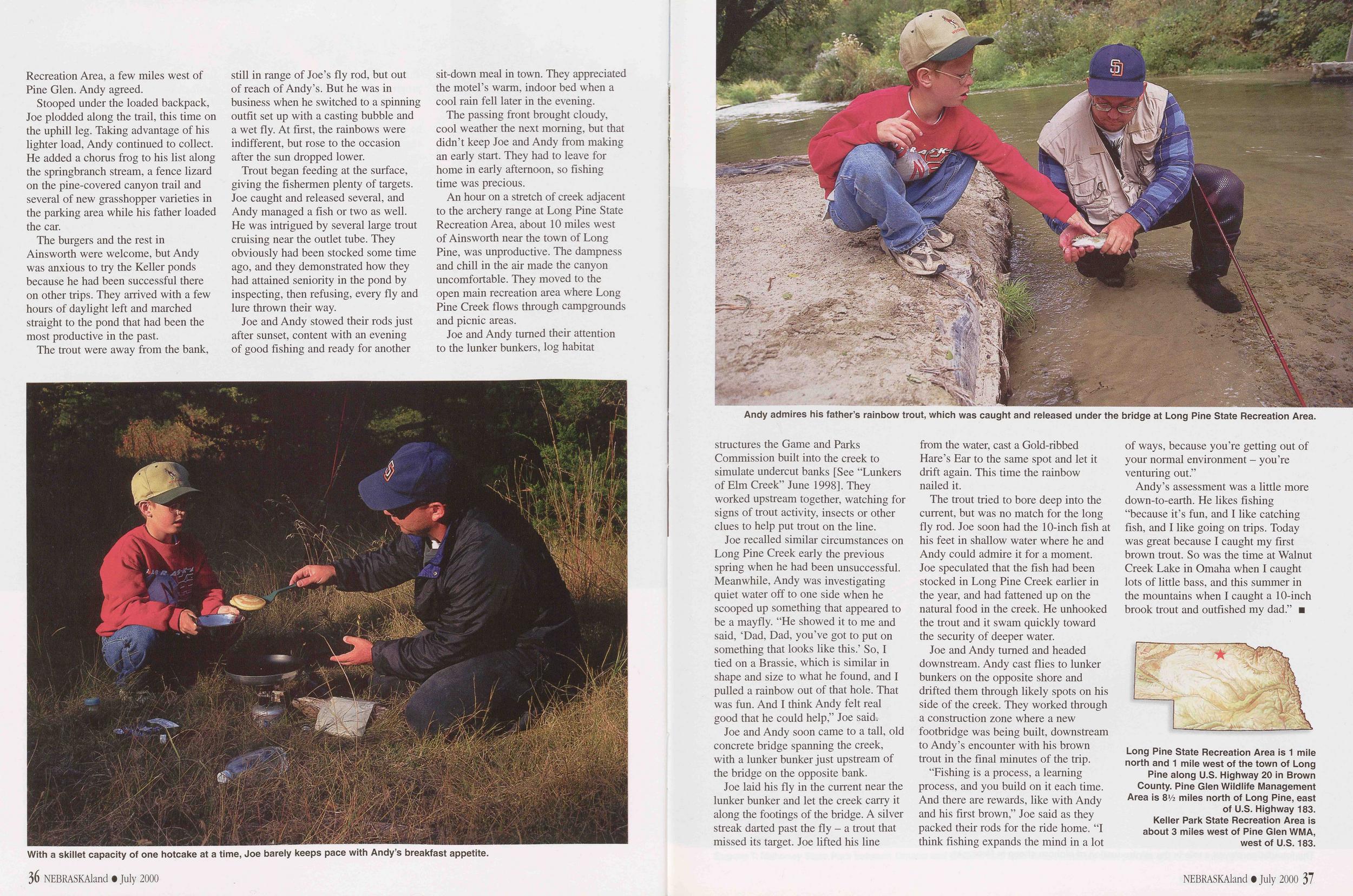
Joe and Andy crawled out of their tent into a bright, clear morning, and a few minutes of fishing seemed a perfect way to start the day. As it turned out, the fishermen, not the trout, were the first ones to succumb to the lure of breakfast. While Andy mixed pancake batter in a plastic bag, Joe fired the tiny stove and readied a skillet. Limited to one hotcake at a time, Joe barely kept pace with Andy's appetite until he had his fill. When Joe got a few cakes ahead, he turned the skillet over to Andy while he ate.
They returned to the creek with high hopes, which were soon fortified by a brown trout that made a pass at the big bogus grasshopper on Andy's line. There were other signs, as well - little flashes that might have been fish near a fly and distant splashes that might have been a feeding trout or fleeing prey fish. But when the sunlight hit the water, Long Pine Creek did its imitation of the Dead Sea. All hints of trout activity vanished.
Joe and Andy persisted until noon,
when it became clear that a change was
needed. Joe suggested they break
camp, get burgers, fries and an hour or
two of rest in Ainsworth, then fish for
trout in the ponds at Keller Park State
34 NEBRASKAland • July 2000
NEBRASKAland • July 2000 35
 Recreation Area, a few miles west of
Pine Glen. Andy agreed.
Recreation Area, a few miles west of
Pine Glen. Andy agreed.
Stooped under the loaded backpack, Joe plodded along the trail, this time on the uphill leg. Taking advantage of his lighter load, Andy continued to collect. He added a chorus frog to his list along the springbranch stream, a fence lizard on the pine-covered canyon trail and several of new grasshopper varieties in the parking area while his father loaded the car.
The burgers and the rest in Ainsworth were welcome, but Andy was anxious to try the Keller ponds because he had been successful there on other trips. They arrived with a few hours of daylight left and marched straight to the pond that had been the most productive in the past.
The trout were away from the bank, still in range of Joe's fly rod, but out of reach of Andy's. But he was in business when he switched to a spinning outfit set up with a casting bubble and a wet fly. At first, the rainbows were indifferent, but rose to the occasion after the sun dropped lower.
Trout began feeding at the surface, giving the fishermen plenty of targets. Joe caught and released several, and Andy managed a fish or two as well. He was intrigued by several large trout cruising near the outlet tube. They obviously had been stocked some time ago, and they demonstrated how they had attained seniority in the pond by inspecting, then refusing, every fly and lure thrown their way.
Joe and Andy stowed their rods just after sunset, content with an evening of good fishing and ready for another sit-down meal in town. They appreciated the motel's warm, indoor bed when a cool rain fell later in the evening.
The passing front brought cloudy, cool weather the next morning, but that didn't keep Joe and Andy from making an early start. They had to leave for home in early afternoon, so fishing time was precious.
An hour on a stretch of creek adjacent to the archery range at Long Pine State Recreation Area, about 10 miles west of Ainsworth near the town of Long Pine, was unproductive. The dampness and chill in the air made the canyon uncomfortable. They moved to the open main recreation area where Long Pine Creek flows through campgrounds and picnic areas.
Joe and Andy turned their attention to the lunker bunkers, log habitat structures the Game and Parks Commission built into the creek to simulate undercut banks [See "Lunkers of Elm Creek" June 1998]. They worked upstream together, watching for signs of trout activity, insects or other clues to help put trout on the line.
Joe recalled similar circumstances on Long Pine Creek early the previous spring when he had been unsuccessful. Meanwhile, Andy was investigating quiet water off to one side when he scooped up something that appeared to be a mayfly. "He showed it to me and said, 'Dad, Dad, you've got to put on something that looks like this.' So, I tied on a Brassie, which is similar in shape and size to what he found, and I pulled a rainbow out of that hole. That was fun. And I think Andy felt real good that he could help," Joe said.
Joe and Andy soon came to a tall, old concrete bridge spanning the creek, with a lunker bunker just upstream of the bridge on the opposite bank.
Joe laid his fly in the current near the lunker bunker and let the creek carry it along the footings of the bridge. A silver streak darted past the fly - a trout that missed its target. Joe lifted his line from the water, cast a Gold-ribbed Hare's Ear to the same spot and let it drift again. This time the rainbow nailed it.
The trout tried to bore deep into the current, but was no match for the long fly rod. Joe soon had the 10-inch fish at his feet in shallow water where he and Andy could admire it for a moment. Joe speculated that the fish had been stocked in Long Pine Creek earlier in the year, and had fattened up on the natural food in the creek. He unhooked the trout and it swam quickly toward the security of deeper water.
Joe and Andy turned and headed downstream. Andy cast flies to lunker bunkers on the opposite shore and drifted them through likely spots on his side of the creek. They worked through a construction zone where a new footbridge was being built, downstream to Andy's encounter with his brown trout in the final minutes of the trip.
"Fishing is a process, a learning process, and you build on it each time. And there are rewards, like with Andy and his first brown," Joe said as they packed their rods for the ride home. "I think fishing expands the mind in a lot of ways, because you're getting out of your normal environment - you're venturing out."
Andy's assessment was a little more down-to-earth. He likes fishing "because it's fun, and I like catching fish, and I like going on trips. Today was great because I caught my first brown trout. So was the time at Walnut Creek Lake in Omaha when I caught lots of little bass, and this summer in the mountains when I caught a 10-inch brook trout and outfished my dad." ■
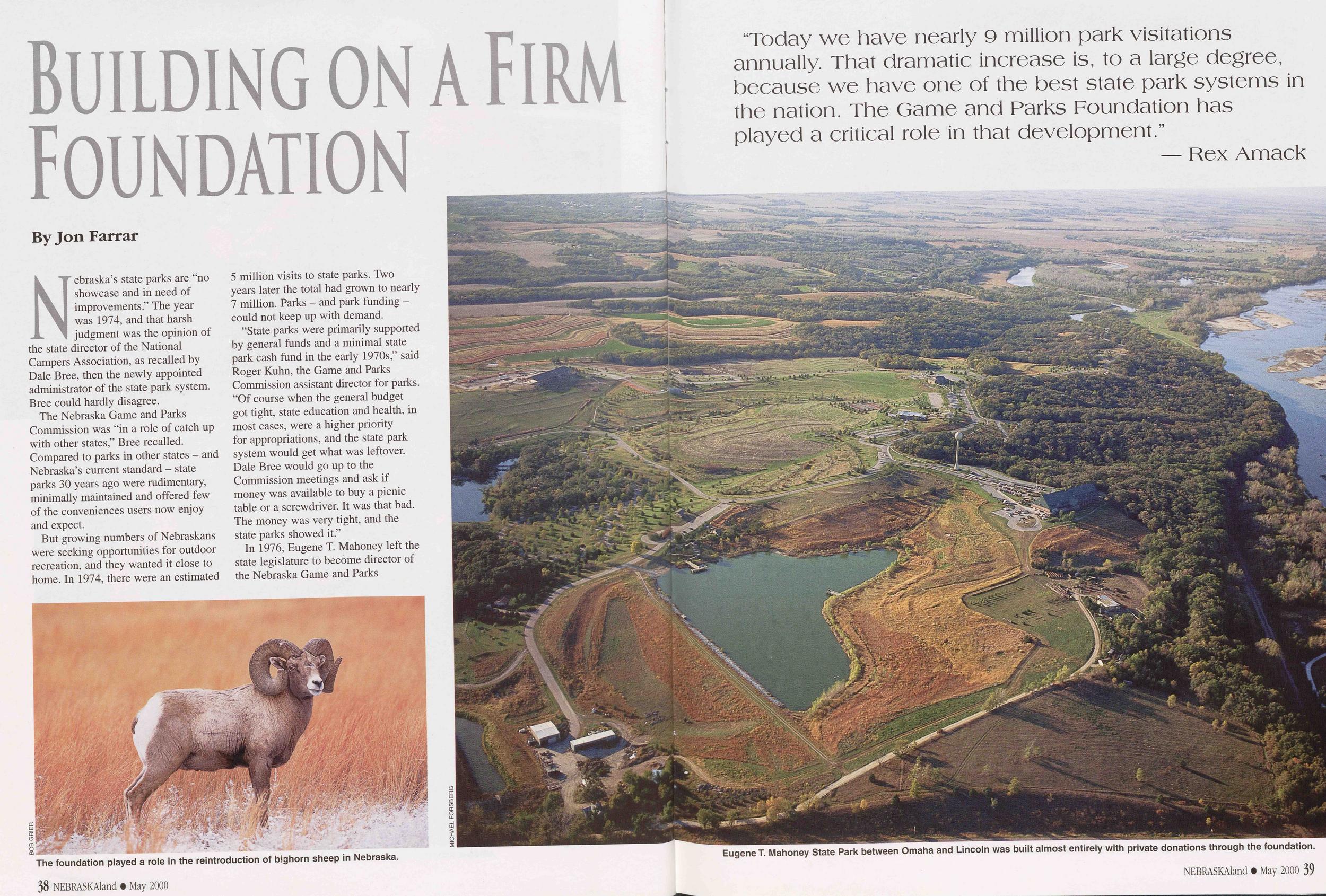
Building on a Firm Foundation
By Jon FarrarNebraska's state parks are "no showcase and in need of improvements." The year was 1974, and that harsh judgment was the opinion of the state director of the National Campers Association, as recalled by Dale Bree, then the newly appointed administrator of the state park system. Bree could hardly disagree.
The Nebraska Game and Parks Commission was "in a role of catch up with other states," Bree recalled. Compared to parks in other states - and Nebraska's current standard - state parks 30 years ago were rudimentary, minimally maintained and offered few of the conveniences users now enjoy and expect.
But growing numbers of Nebraskans were seeking opportunities for outdoor recreation, and they wanted it close to home. In 1974, there were an estimated 5 million visits to state parks. Two years later the total had grown to nearly 7 million. Parks - and park funding - could not keep up with demand.
"State parks were primarily supported by general funds and a minimal state park cash fund in the early 1970s," said Roger Kuhn, the Game and Parks Commission assistant director for parks. "Of course when the general budget got tight, state education and health, in most cases, were a higher priority for appropriations, and the state park system would get what was leftover. Dale Bree would go up to the Commission meetings and ask if money was available to buy a picnic table or a screwdriver. It was that bad. The money was very tight, and the state parks showed it."
In 1976, Eugene T. Mahoney left the
state legislature to become director of
the Nebraska Game and Parks
38 NEBRASKAland • May 2000
NEBRASKAland • May 2000 39
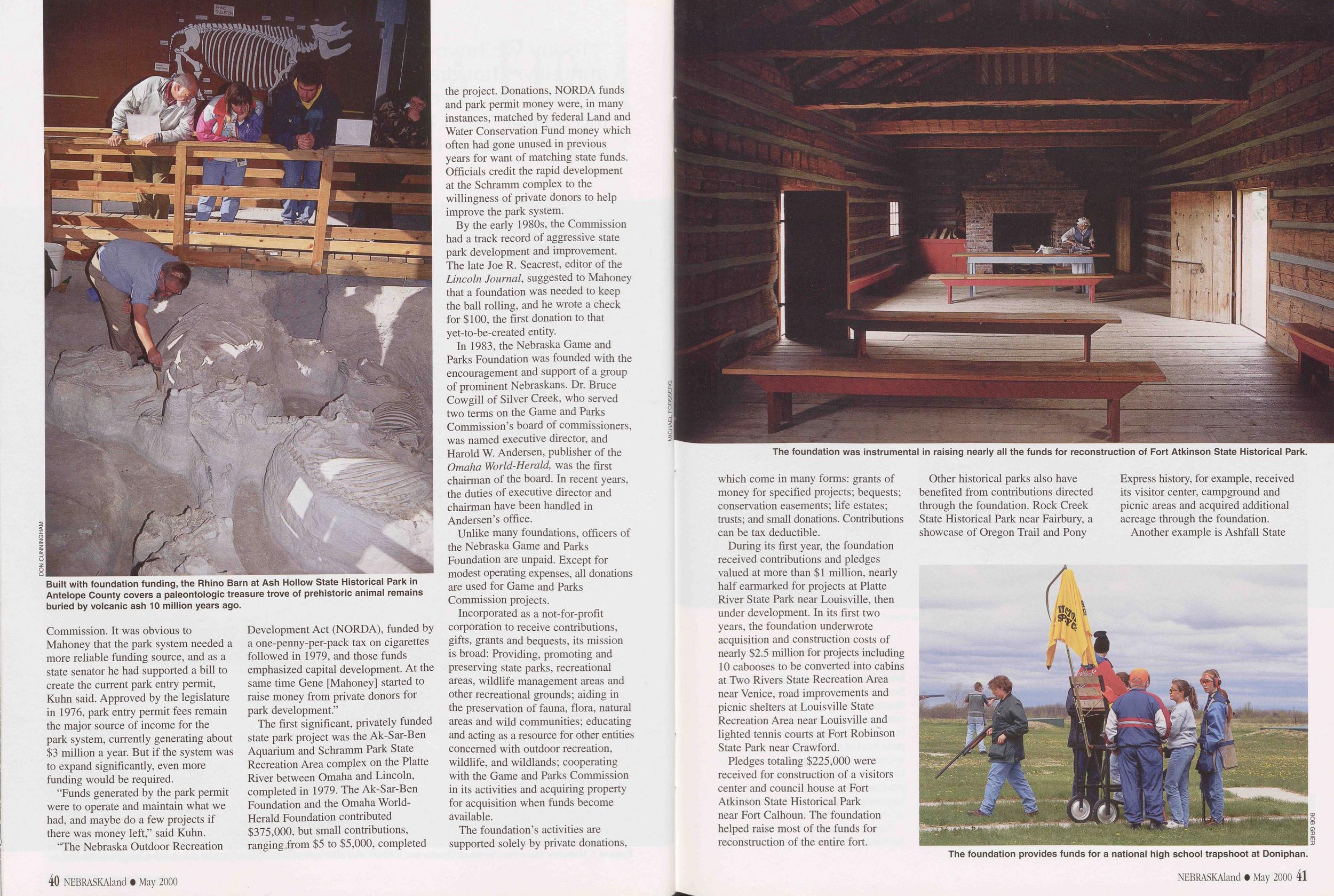 Commission. It was obvious to
Mahoney that the park system needed a
more reliable funding source, and as a
state senator he had supported a bill to
create the current park entry permit,
Kuhn said. Approved by the legislature
in 1976, park entry permit fees remain
the major source of income for the
park system, currently generating about
$3 million a year. But if the system was
to expand significantly, even more
funding would be required.
Commission. It was obvious to
Mahoney that the park system needed a
more reliable funding source, and as a
state senator he had supported a bill to
create the current park entry permit,
Kuhn said. Approved by the legislature
in 1976, park entry permit fees remain
the major source of income for the
park system, currently generating about
$3 million a year. But if the system was
to expand significantly, even more
funding would be required.
"Funds generated by the park permit were to operate and maintain what we had, and maybe do a few projects if there was money left," said Kuhn.
"The Nebraska Outdoor Recreation Development Act (NORDA), funded by a one-penny-per-pack tax on cigarettes followed in 1979, and those funds emphasized capital development. At the same time Gene [Mahoney] started to raise money from private donors for park development."
The first significant, privately funded state park project was the Ak-Sar-Ben Aquarium and Schramm Park State Recreation Area complex on the Platte River between Omaha and Lincoln, completed in 1979. The Ak-Sar-Ben Foundation and the Omaha World- Herald Foundation contributed $375,000, but small contributions, ranging from $5 to $5,000, completed the project. Donations, NORDA funds and park permit money were, in many instances, matched by federal Land and Water Conservation Fund money which often had gone unused in previous years for want of matching state funds. Officials credit the rapid development at the Schramm complex to the willingness of private donors to help improve the park system.
By the early 1980s, the Commission had a track record of aggressive state park development and improvement. The late Joe R. Seacrest, editor of the Lincoln Journal, suggested to Mahoney that a foundation was needed to keep the ball rolling, and he wrote a check for $100, the first donation to that yet-to-be-created entity.
In 1983, the Nebraska Game and Parks Foundation was founded with the encouragement and support of a group of prominent Nebraskans. Dr. Bruce Cowgill of Silver Creek, who served two terms on the Game and Parks Commission's board of commissioners, was named executive director, and Harold W. Andersen, publisher of the Omaha World-Herald, was the first chairman of the board. In recent years, the duties of executive director and chairman have been handled in Andersen's office.
Unlike many foundations, officers of the Nebraska Game and Parks Foundation are unpaid. Except for modest operating expenses, all donations are used for Game and Parks Commission projects.
Incorporated as a not-for-profit corporation to receive contributions, gifts, grants and bequests, its mission is broad: Providing, promoting and preserving state parks, recreational areas, wildlife management areas and other recreational grounds; aiding in the preservation of fauna, flora, natural areas and wild communities; educating and acting as a resource for other entities concerned with outdoor recreation, wildlife, and wildlands; cooperating with the Game and Parks Cornmission in its activities and acquiring property for acquisition when funds become available.
The foundation's activities are supported solely by private donations, which come in many forms: grants of money for specified projects; bequests; conservation easements; life estates; trusts; and small donations. Contributions can be tax deductible.
During its first year, the foundation received contributions and pledges valued at more than $1 million, nearly half earmarked for projects at Platte River State Park near Louisville, then under development. In its first two years, the foundation underwrote acquisition and construction costs of nearly $2.5 million for projects including 10 cabooses to be converted into cabins at Two Rivers State Recreation Area near Venice, road improvements and picnic shelters at Louisville State Recreation Area near Louisville and lighted tennis courts at Fort Robinson State Park near Crawford.
Pledges totaling $225,000 were received for construction of a visitors center and council house at Fort Atkinson State Historical Park near Fort Calhoun. The foundation helped raise most of the funds for reconstruction of the entire fort.
Other historical parks also have benefited from contributions directed through the foundation. Rock Creek State Historical Park near Fairbury, a showcase of Oregon Trail and Pony Express history, for example, received its visitor center, campground and picnic areas and acquired additional acreage through the foundation.
Another example is Ashfall State
NEBRASKAland • May 2000 4l
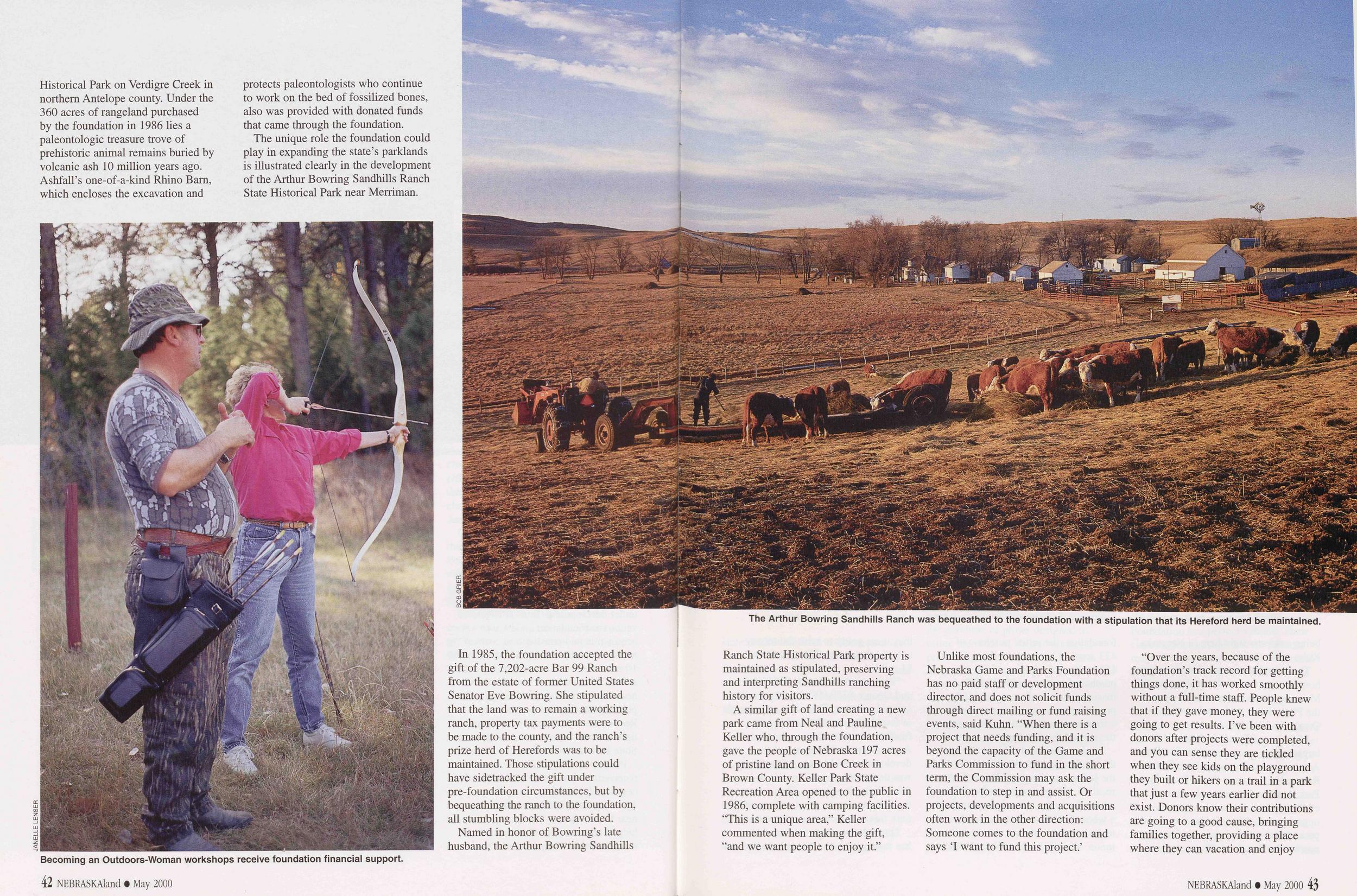 Historical Park on Verdigre Creek in
northern Antelope county. Under the
360 acres of rangeland purchased
by the foundation in 1986 lies a
paleontologic treasure trove of
prehistoric animal remains buried by
volcanic ash 10 million years ago.
Ashfall's one-of-a-kind Rhino Barn,
which encloses the excavation and
protects paleontologists who continue
to work on the bed of fossilized bones,
also was provided with donated funds
that came through the foundation.
Historical Park on Verdigre Creek in
northern Antelope county. Under the
360 acres of rangeland purchased
by the foundation in 1986 lies a
paleontologic treasure trove of
prehistoric animal remains buried by
volcanic ash 10 million years ago.
Ashfall's one-of-a-kind Rhino Barn,
which encloses the excavation and
protects paleontologists who continue
to work on the bed of fossilized bones,
also was provided with donated funds
that came through the foundation.
The unique role the foundation could play in expanding the state's parklands is illustrated clearly in the development of the Arthur Bowring Sandhills Ranch State Historical Park near Merriman.
In 1985, the foundation accepted the gift of the 7,202-acre Bar 99 Ranch from the estate of former United States Senator Eve Bowring. She stipulated that the land was to remain a working ranch, property tax payments were to be made to the county, and the ranch's prize herd of Herefords was to be maintained. Those stipulations could have sidetracked the gift under pre-foundation circumstances, but by bequeathing the ranch to the foundation, all stumbling blocks were avoided.
Named in honor of Bowling's late husband, the Arthur Bowring Sandhills Ranch State Historical Park property is maintained as stipulated, preserving and interpreting Sandhills ranching history for visitors.
A similar gift of land creating a new park came from Neal and Pauline Keller who, through the foundation, gave the people of Nebraska 197 acres of pristine land on Bone Creek in Brown County. Keller Park State Recreation Area opened to the public in 1986, complete with camping facilities. "This is a unique area," Keller commented when making the gift, and we want people to enjoy it."
Unlike most foundations, the Nebraska Game and Parks Foundation has no paid staff or development director, and does not solicit funds through direct mailing or fund raising events, said Kuhn. "When there is a project that needs funding, and it is beyond the capacity of the Game and Parks Commission to fund in the short term, the Commission may ask the foundation to step in and assist. Or projects, developments and acquisitions often work in the other direction: Someone comes to the foundation and says T want to fund this project.'
"Over the years, because of the
foundation's track record for getting
things done, it has worked smoothly
without a full-time staff. People knew
that if they gave money, they were
going to get results. I've been with
donors after projects were completed,
and you can sense they are tickled
when they see kids on the playground
they built or hikers on a trail in a park
that just a few years earlier did not
exist. Donors know their contributions
are going to a good cause, bringing
families together, providing a place
where they can vacation and enjoy
NEBRASKAland • May 2000 43
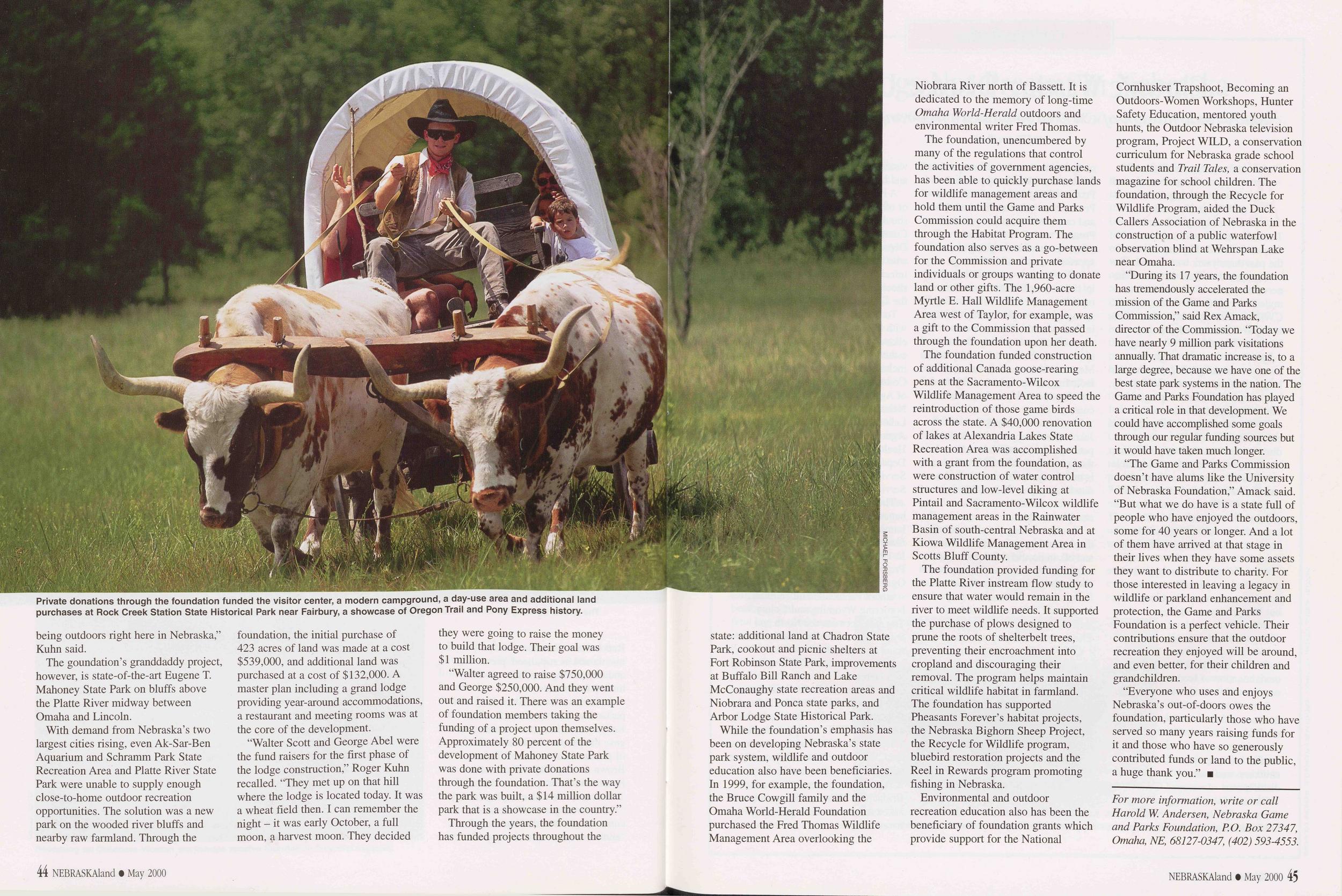 being outdoors right here in Nebraska,"
Kuhn said.
being outdoors right here in Nebraska,"
Kuhn said.
The goundation's granddaddy project, however, is state-of-the-art Eugene T. Mahoney State Park on bluffs above the Platte River midway between Omaha and Lincoln.
With demand from Nebraska's two largest cities rising, even Ak-Sar-Ben Aquarium and Schramm Park State Recreation Area and Platte River State Park were unable to supply enough close-to-home outdoor recreation opportunities. The solution was a new park on the wooded river bluffs and nearby raw farmland. Through the foundation, the initial purchase of 423 acres of land was made at a cost $539,000, and additional land was purchased at a cost of $132,000. A master plan including a grand lodge providing year-around accommodations, a restaurant and meeting rooms was at the core of the development.
"Walter Scott and George Abel were the fund raisers for the first phase of the lodge construction," Roger Kuhn recalled. "They met up on that hill where the lodge is located today. It was a wheat field then. I can remember the night - it was early October, a full moon, a harvest moon. They decided they were going to raise the money to build that lodge. Their goal was $1 million.
"Walter agreed to raise $750,000 and George $250,000. And they went out and raised it. There was an example of foundation members taking the funding of a project upon themselves. Approximately 80 percent of the development of Mahoney State Park was done with private donations through the foundation. That's the way the park was built, a $14 million dollar park that is a showcase in the country."
Through the years, the foundation has funded projects throughout the state: additional land at Chadron State Park, cookout and picnic shelters at Fort Robinson State Park, improvements at Buffalo Bill Ranch and Lake McConaughy state recreation areas and Niobrara and Ponca state parks, and Arbor Lodge State Historical Park.
While the foundation's emphasis has been on developing Nebraska's state park system, wildlife and outdoor education also have been beneficiaries. In 1999, for example, the foundation, the Bruce Cowgill family and the Omaha World-Herald Foundation purchased the Fred Thomas Wildlife Management Area overlooking the Niobrara River north of Bassett. It is dedicated to the memory of long-time Omaha World-Herald outdoors and environmental writer Fred Thomas.
The foundation, unencumbered by many of the regulations that control the activities of government agencies, has been able to quickly purchase lands for wildlife management areas and hold them until the Game and Parks Commission could acquire them through the Habitat Program. The foundation also serves as a go-between for the Commission and private individuals or groups wanting to donate land or other gifts. The 1,960-acre Myrtle E. Hall Wildlife Management Area west of Taylor, for example, was a gift to the Commission that passed through the foundation upon her death.
The foundation funded construction of additional Canada goose-rearing pens at the Sacramento-Wilcox Wildlife Management Area to speed the reintroduction of those game birds across the state. A $40,000 renovation of lakes at Alexandria Lakes State Recreation Area was accomplished with a grant from the foundation, as were construction of water control structures and low-level diking at Pintail and Sacramento-Wilcox wildlife management areas in the Rainwater Basin of south-central Nebraska and at Kiowa Wildlife Management Area in Scotts Bluff County.
The foundation provided funding for the Platte River instream flow study to ensure that water would remain in the river to meet wildlife needs. It supported the purchase of plows designed to prune the roots of shelterbelt trees, preventing their encroachment into cropland and discouraging their removal. The program helps maintain critical wildlife habitat in farmland. The foundation has supported Pheasants Forever's habitat projects, the Nebraska Bighorn Sheep Project, the Recycle for Wildlife program, bluebird restoration projects and the Reel in Rewards program promoting fishing in Nebraska.
Environmental and outdoor recreation education also has been the beneficiary of foundation grants which provide support for the National Cornhusker Trapshoot, Becoming an Outdoors-Women Workshops, Hunter Safety Education, mentored youth hunts, the Outdoor Nebraska television program, Project WILD, a conservation curriculum for Nebraska grade school students and Trail Tales, a conservation magazine for school children. The foundation, through the Recycle for Wildlife Program, aided the Duck Callers Association of Nebraska in the construction of a public waterfowl observation blind at Wehrspan Lake near Omaha.
"During its 17 years, the foundation has tremendously accelerated the mission of the Game and Parks Commission," said Rex Amack, director of the Commission. "Today we have nearly 9 million park visitations annually. That dramatic increase is, to a large degree, because we have one of the best state park systems in the nation. The Game and Parks Foundation has played a critical role in that development. We could have accomplished some goals through our regular funding sources but it would have taken much longer.
"The Game and Parks Commission doesn't have alums like the University of Nebraska Foundation," Amack said. "But what we do have is a state full of people who have enjoyed the outdoors, some for 40 years or longer. And a lot of them have arrived at that stage in their lives when they have some assets they want to distribute to charity. For those interested in leaving a legacy in wildlife or parkland enhancement and protection, the Game and Parks Foundation is a perfect vehicle. Their contributions ensure that the outdoor recreation they enjoyed will be around, and even better, for their children and grandchildren.
"Everyone who uses and enjoys Nebraska's out-of-doors owes the foundation, particularly those who have served so many years raising funds for it and those who have so generously contributed funds or land to the public, a huge thank you." ■
For more information, write or call Harold W. Andersen, Nebraska Game and Parks Foundation, P.O. Box 27347, Omaha, NE, 68127-0347, (402) 593-4553.
44 NEBRASKAland • May 2000 NEBRASKAland • May 2000 45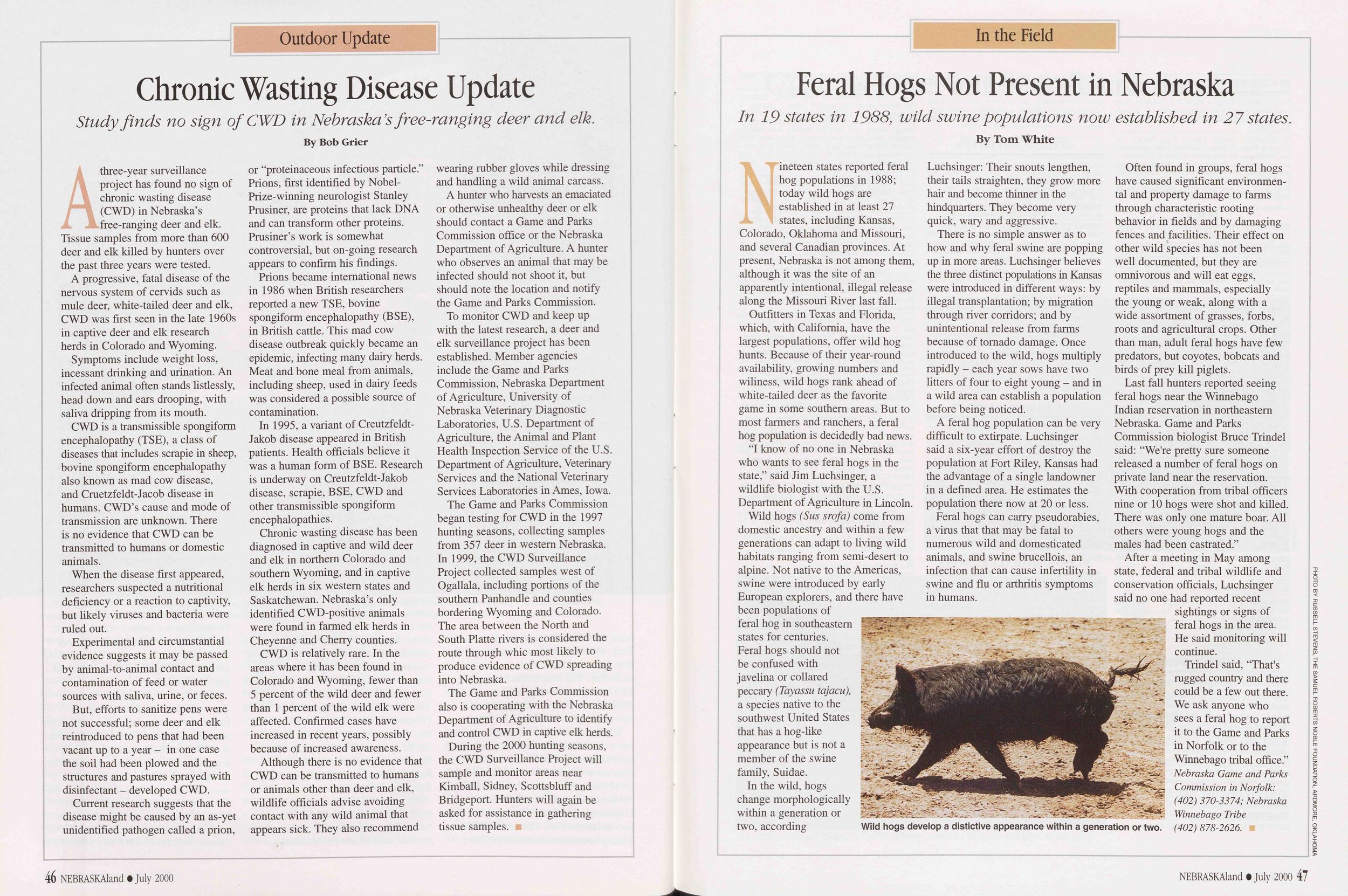
A three-year surveillance project has found no sign of chronic wasting disease (CWD) in Nebraska's free-ranging deer and elk. Tissue samples from more than 600 deer and elk killed by hunters over the past three years were tested.
A progressive, fatal disease of the nervous system of cervids such as mule deer, white-tailed deer and elk, CWD was first seen in the late 1960s in captive deer and elk research herds in Colorado and Wyoming.
Symptoms include weight loss, incessant drinking and urination. An infected animal often stands listlessly, head down and ears drooping, with saliva dripping from its mouth.
CWD is a transmissible spongiform encephalopathy (TSE), a class of diseases that includes scrapie in sheep, bovine spongiform encephalopathy also known as mad cow disease, and Cruetzfeldt-Jacob disease in humans. CWD's cause and mode of transmission are unknown. There is no evidence that CWD can be transmitted to humans or domestic animals.
When the disease first appeared, researchers suspected a nutritional deficiency or a reaction to captivity, but likely viruses and bacteria were ruled out.
Experimental and circumstantial evidence suggests it may be passed by animal-to-animal contact and contamination of feed or water sources with saliva, urine, or feces.
But, efforts to sanitize pens were not successful; some deer and elk reintroduced to pens that had been vacant up to a year - in one case the soil had been plowed and the structures and pastures sprayed with disinfectant - developed CWD.
Current research suggests that the disease might be caused by an as-yet unidentified pathogen called a prion, CWD in Nebraska's free or "proteinaceous infectious particle." Prions, first identified by Nobel- Prize-winning neurologist Stanley Prusiner, are proteins that lack DNA and can transform other proteins. Prusiner's work is somewhat controversial, but on-going research appears to confirm his findings.
Prions became international news in 1986 when British researchers reported a new TSE, bovine spongiform encephalopathy (BSE), in British cattle. This mad cow disease outbreak quickly became an epidemic, infecting many dairy herds. Meat and bone meal from animals, including sheep, used in dairy feeds was considered a possible source of contamination.
In 1995, a variant of Creutzfeldt- Jakob disease appeared in British patients. Health officials believe it was a human form of BSE. Research is underway on Creutzfeldt-Jakob disease, scrapie, BSE, CWD and other transmissible spongiform encephalopathies.
Chronic wasting disease has been diagnosed in captive and wild deer and elk in northern Colorado and southern Wyoming, and in captive elk herds in six western states and Saskatchewan. Nebraska's only identified CWD-positive animals were found in farmed elk herds in Cheyenne and Cherry counties.
CWD is relatively rare. In the areas where it has been found in Colorado and Wyoming, fewer than 5 percent of the wild deer and fewer than 1 percent of the wild elk were affected. Confirmed cases have increased in recent years, possibly because of increased awareness.
Although there is no evidence that CWD can be transmitted to humans or animals other than deer and elk, wildlife officials advise avoiding contact with any wild animal that appears sick. They also recommend wearing rubber gloves while dressing and handling a wild animal carcass.
A hunter who harvests an emaciated or otherwise unhealthy deer or elk should contact a Game and Parks Commission office or the Nebraska Department of Agriculture. A hunter who observes an animal that may be infected should not shoot it, but should note the location and notify the Game and Parks Commission.
To monitor CWD and keep up with the latest research, a deer and elk surveillance project has been established. Member agencies include the Game and Parks Commission, Nebraska Department of Agriculture, University of Nebraska Veterinary Diagnostic Laboratories, U.S. Department of Agriculture, the Animal and Plant Health Inspection Service of the U.S. Department of Agriculture, Veterinary Services and the National Veterinary Services Laboratories in Ames, Iowa.
The Game and Parks Commission began testing for CWD in the 1997 hunting seasons, collecting samples from 357 deer in western Nebraska. In 1999, the CWD Surveillance Project collected samples west of Ogallala, including portions of the southern Panhandle and counties bordering Wyoming and Colorado. The area between the North and South Platte rivers is considered the route through whic most likely to produce evidence of CWD spreading into Nebraska.
The Game and Parks Commission also is cooperating with the Nebraska Department of Agriculture to identify and control CWD in captive elk herds. During the 2000 hunting seasons, the CWD Surveillance Project will sample and monitor areas near Kimball, Sidney, Scottsbluff and Bridgeport. Hunters will again be asked for assistance in gathering tissue samples.
Feral Hogs Not Present in Nebraska In 19 states in 1988, wild swine populations now established in 27 states. By Tom WhiteNineteen states reported feral hog populations in 1988; today wild hogs are established in at least 27 states, including Kansas, Colorado, Oklahoma and Missouri, and several Canadian provinces. At present, Nebraska is not among them, although it was the site of an apparently intentional, illegal release along the Missouri River last fall.
Outfitters in Texas and Florida, which, with California, have the largest populations, offer wild hog hunts. Because of their year-round availability, growing numbers and wiliness, wild hogs rank ahead of white-tailed deer as the favorite game in some southern areas. But to most farmers and ranchers, a feral hog population is decidedly bad news.
"I know of no one in Nebraska who wants to see feral hogs in the state," said Jim Luchsinger, a wildlife biologist with the U.S. Department of Agriculture in Lincoln.
Wild hogs (Sus srofa) come from domestic ancestry and within a few generations can adapt to living wild habitats ranging from semi-desert to alpine. Not native to the Americas, swine were introduced by early European explorers, and there have been populations of feral hog in southeastern states for centuries. Feral hogs should not be confused with javelina or collared peccary (Tayassu tajacu), a species native to the southwest United States that has a hog-like appearance but is not a member of the swine family, Suidae.
In the wild, hogs change morphologically within a generation or two, according Luchsinger: Their snouts lengthen, their tails straighten, they grow more hair and become thinner in the hindquarters. They become very quick, wary and aggressive.
There is no simple answer as to how and why feral swine are popping up in more areas. Luchsinger believes the three distinct populations in Kansas were introduced in different ways: by illegal transplantation; by migration through river corridors; and by unintentional release from farms because of tornado damage. Once introduced to the wild, hogs multiply rapidly - each year sows have two Utters of four to eight young - and in a wild area can establish a population before being noticed.
A feral hog population can be very difficult to extirpate. Luchsinger said a six-year effort of destroy the population at Fort Riley, Kansas had the advantage of a single landowner in a defined area. He estimates the population there now at 20 or less.
Feral hogs can carry pseudorabies, a virus that that may be fatal to numerous wild and domesticated animals, and swine brucellois, an infection that can cause infertility in swine and flu or arthritis symptoms in humans.
Often found in groups, feral hogs have caused significant environmen- tal and property damage to farms through characteristic rooting behavior in fields and by damaging fences and facilities. Their effect on other wild species has not been well documented, but they are omnivorous and will eat eggs, reptiles and mammals, especially the young or weak, along with a wide assortment of grasses, forbs, roots and agricultural crops. Other than man, adult feral hogs have few predators, but coyotes, bobcats and birds of prey kill piglets.
Last fall hunters reported seeing feral hogs near the Winnebago Indian reservation in northeastern Nebraska. Game and Parks Commission biologist Bruce Trindel said: "We're pretty sure someone released a number of feral hogs on private land near the reservation. With cooperation from tribal officers nine or 10 hogs were shot and killed. There was only one mature boar. All others were young hogs and the males had been castrated."
After a meeting in May among state, federal and tribal wildlife and conservation officials, Luchsinger said no one had reported recent sightings or signs of feral hogs in the area. He said monitoring will continue.
Trindel said, "That's rugged country and there could be a few out there. We ask anyone who sees a feral hog to report it to the Game and Parks in Norfolk or to the Winnebago tribal office." Nebraska Game and Parks Commission in Norfolk: (402) 370-3374; Nebraska Winnebago Tribe (402) 878-2626.
NEBRASKAland • July 2000 47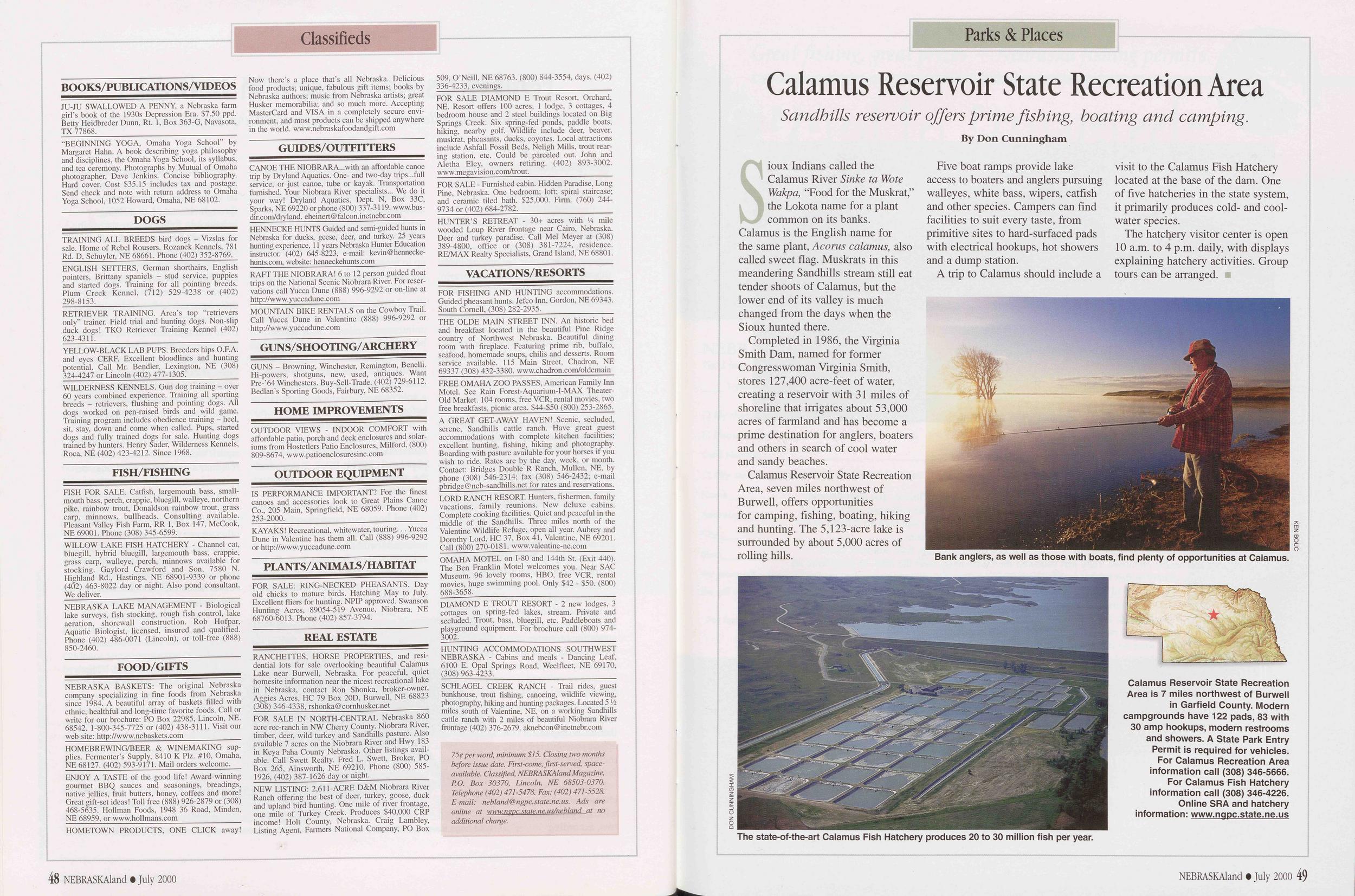
Classifieds
BOOKS/PUBLICATIONS/VIDEOSJU-JU SWALLOWED A PENNY, a Nebraska farm girl's book of the 1930s Depression Era. $7.50 ppd. Betty Heidbreder Dunn, Rt. 1, Box 363-G, Navasota, TX 77868.
"BEGINNING YOGA, Omaha Yoga School" by Margaret Hahn. A book describing yoga philosophy and disciplines, the Omaha Yoga School, its syllabus, and tea ceremony. Photographs by Mutual of Omaha photographer, Dave Jenkins. Concise bibliography. Hard cover. Cost $35.15 includes tax and postage. Send check and note with return address to Omaha Yoga School, 1052 Howard, Omaha, NE 68102.
DOGSTRAINING ALL BREEDS bird dogs - Vizslas for sale. Home of Rebel Rousers. Rozanek Kennels, 781 Rd. D, Schuyler, NE 68661. Phone (402) 352-8769.
ENGLISH SETTERS, German shorthairs, English pointers, Brittany spaniels - stud service, puppies and started dogs. Training for all pointing breeds. Plum Creek Kennel, (712) 529-4238 or (402) 298-8153.
RETRIEVER TRAINING. Area's top "retrievers only" trainer. Field trial and hunting dogs. Non-slip duck dogs! TKO Retriever Training Kennel (402) 623-43 if.
YELLOW-BLACK LAB PUPS. Breeders hips O.F.A. and eyes CERE Excellent bloodlines and hunting potential. Call Mr. Bendler, Lexington, NE (308) 324-4247 or Lincoln (402) 477-13057
WILDERNESS KENNELS. Gun dog training - over 60 years combined experience. Training all sporting breeds - retrievers, flushing and pointing dogs. All dogs worked on pen-raised birds and wild game. Training program includes obedience training - heel, sit, stay, down and come when called. Pups, started dogs and fully trained dogs for sale. Hunting dogs trained by hunters. Henry Sader, Wilderness Kennels, Roca, NE (402) 423-4212. Since 1968.
FISH/FISHINGFISH FOR SALE. Catfish, largemouth bass, small- mouth bass, perch, crappie, bluegill, walleye, northern pike, rainbow trout, Donaldson rainbow trout, grass carp, minnows, bullheads. Consulting available. Pleasant Valley Fish Farm, RR 1, Box 147, McCook, NE 69001. Phone (308) 345-6599.
WILLOW LAKE FISH HATCHERY - Channel cat, bluegill, hybrid bluegill, largemouth bass, crappie, grass carp, walleye, perch, minnows available for stocking. Gaylord Crawford and Son, 7580 N. Highland Rd., Hastings, NE 68901-9339 or phone (402) 463-8022 day or night. Also pond consultant. We deliver.
NEBRASKA LAKE MANAGEMENT - Biological lake surveys, fish stocking, rough fish control, lake aeration, shorewall construction. Rob Hofpar, Aquatic Biologist, licensed, insured and qualified. Phone (402) 486-0071 (Lincoln), or toll-free (888) 850-2460.
FOOD/GIFTSNEBRASKA BASKETS: The original Nebraska company specializing in fine foods from Nebraska since 1984. A beautiful array of baskets filled with ethnic, healthful and long-time favorite foods. Call or write for our brochure: PO Box 22985, Lincoln, NE. 68542. 1-800-345-7725 or (402) 438-3111. Visit our web site: http://www.nebaskets.com
HOMEBREWING/BEER & WINEMAKING sup- plies. Fermenter's Supply, 8410 K Plz. #10, Omaha, NE 68127. (402) 593-9171. Mail orders welcome. ENJOY A TASTE of the good life! Award-winning gourmet BBQ sauces and seasonings, breadings, native jellies, fruit butters, honey, coffees and more! Great gift-set ideas! Toll free (888) 926-2879 or (308) 468-5635. Hollman Foods, 1948 36 Road, Minden, NE 68959, or www.hollmans.com
HOMETOWN PRODUCTS, ONE CLICK away! Now there's a place that's all Nebraska. Delicious food products; unique, fabulous gift items; books by Nebraska authors; music from Nebraska artists; great Husker memorabilia; and so much more. Accepting MasterCard and VISA in a completely secure envi- ronment, and most products can be shipped anywhere in the world, www.nebraskafoodandgift.com
GUIDES/OUTFITTERSCANOE THE NIOBRARA...with an affordable canoe trip by Dryland Aquatics. One- and two-day trips...full service, or just canoe, tube or kayak. Transportation furnished. Your Niobrara River specialists... We do it your way! Dryland Aquatics, Dept. N, Box 33C, Sparks, NE 69220 or phone (800) 337-3119. www.bus- dir.com/dryland. eheinert@falcon.inetnebr.com
HENNECKE HUNTS Guided and semi-guided hunts in Nebraska for ducks, geese, deer, and turkey. 25 years hunting experience, 11 years Nebraska Hunter Education instructor. (402) 645-8223, e-mail: kevin@hennecke- hunts.com, website: henneckehunts.com
RAFT THE NIOBRARA! 6 to 12 person guided float trips on the National Scenic Niobrara River. For reser- vations call Yucca Dune (888) 996-9292 or on-line at http://www.yuccadune.com
MOUNTAIN BIKE RENTALS on the Cowboy Trail. Call Yucca Dune in Valentine (888) 996-9292 or http://www.yuccadune.com
GUNS/SHOOTING/ARCHERYGUNS - Browning, Winchester, Remington, Benelli. Hi-powers, shotguns, new, used, antiques. Want Pre-'64 Winchesters. Buy-Sell-Trade. (402) 729-6112. Bedlan's Sporting Goods, Fairbury, NE 68352.
HOME IMPROVEMENTSOUTDOOR VIEWS - INDOOR COMFORT with affordable patio, porch and deck enclosures and solar- iums from Hostetlers Patio Enclosures, Milford, (800) 809-8674, www.patioenclosuresinc.com
OUTDOOR EQUIPMENTIS PERFORMANCE IMPORTANT? For the finest canoes and accessories look to Great Plains Canoe Co., 205 Main, Springfield, NE 68059. Phone (402) 253-2000.
KAYAKS! Recreational, Whitewater, touring... Yucca Dune in Valentine has them all. Call (888) 996-9292 or http://www.yuccadune.com
PLANTS/ANIMALS/HABITATFOR SALE: RING-NECKED PHEASANTS. Day old chicks to mature birds. Hatching May to July. Excellent fliers for hunting. NPIP approved. Swanson Hunting Acres, 89054-519 Avenue, Niobrara, NE 68760-6013. Phone (402) 857-3794.
REAL ESTATERANCHETTES, HORSE PROPERTIES, and resi- dential lots for sale overlooking beautiful Calamus Lake near Burwell, Nebraska. Tor peaceful, quiet homesite information near the nicest recreational lake in Nebraska, contact Ron Shonka, broker-owner, Aggies Acres, HC 79 Box 20D, Burwell, NE 68823 (308) 346-4338, rshonka@cornhusker.net
FOR SALE IN NORTH-CENTRAL Nebraska 860 acre rec-ranch in NW Cherry County. Niobrara River, timber, deer, wild turkey and Sandhills pasture. Also available 7 acres on the Niobrara River and Hwy 183 in Keya Paha County Nebraska. Other listings avail- able. Call Swett Realty. Fred L. Swett, Broker, PO Box 265, Ainsworth, NE 69210. Phone (800) 585- 1926, (402) 387-1626 day or night.
NEW LISTING: 2,611-ACRE D&M Niobrara River Ranch offering the best of deer, turkey, goose, duck and upland bird hunting. One mile of river frontage, one mile of Turkey Creek. Produces $40,000 CRP income! Holt County, Nebraska. Craig Lambley, Listing Agent, Farmers National Company, PO Box 509, O'Neill, NE 68763. (800) 844-3554, days. (402) 336-4233, evenings.
FOR SALE DIAMOND E Trout Resort, Orchard, NE. Resort offers 100 acres, 1 lodge, 3 cottages, 4 bedroom house and 2 steel buildings located on Big Springs Creek. Six spring-fed ponds, paddle boats, hiking, nearby golf. Wildlife include deer, beaver, muskrat, pheasants, ducks, coyotes. Local attractions include Ashfall Fossil Beds, Neligh Mills, trout rear- ing station, etc. Could be parceled out. John and Afetha Eley, owners retiring. (402) 893-3002. www.megavision.com/trout.
FOR SALE - Furnished cabin. Hidden Paradise, Long Pine, Nebraska. One bedroom; loft; spiral staircase; and ceramic tiled bath. $25,000. Firm. (760) 244- 9734 or (402) 684-2782.
HUNTER'S RETREAT - 30+ acres with V4 mile wooded Loup River frontage near Cairo, Nebraska. Deer and turkey paradise. Call Mel Meyer at (308) 389-4800, office or (308) 381-7224, residence. RE/MAX Realty Specialists, Grand Island, NE 68801.
VACATIONS/RESORTSFOR FISHING AND HUNTING accommodations. Guided pheasant hunts. Jefco Inn, Gordon, NE 69343. South Cornell, (308) 282-2935.
THE OLDE MAIN STREET INN. An historic bed and breakfast located in the beautiful Pine Ridge country of Northwest Nebraska. Beautiful dining room with fireplace. Featuring prime rib, buffalo, seafood, homemade soups, chilis and desserts. Room service available. 115 Main Street, Chadron, NE 69337 (308) 432-3380. www.chadron.com/oldemain
FREE OMAHA ZOO PASSES, American Family Inn Motel. See Rain Forest-Aquarium-I-MAX Theater- Old Market. 104 rooms, free VCR, rental movies, two free breakfasts, picnic area. $44-$50 (800) 253-2865.
A GREAT GET-AWAY HAVEN! Scenic, secluded, serene, Sandhills cattle ranch. Have great guest accommodations with complete kitchen facilities; excellent hunting, fishing, hiking and photography. Boarding with pasture available for your horses if you wish to ride. Rates are by the day, week, or month. Contact: Bridges Double R Ranch, Mullen, NE, by phone (308) 546-2314; fax (308) 546-2432; e-mail pbridge@neb-sandhills.net for rates and reservations.
LORD RANCH RESORT. Hunters, fishermen, family vacations, family reunions. New deluxe cabins. Complete cooking facilities. Quiet and peaceful in the middle of the Sandhills. Three miles north of the Valentine Wildlife Refuge, open all year. Aubrey and Dorothy Lord, HC 37, Box 41, Valentine, NE 69201. Call (800) 270-0181. www.valentine-ne.com
OMAHA MOTEL on 1-80 and 144th St. (Exit 440). The Ben Franklin Motel welcomes you. Near SAC Museum. 96 lovely rooms, HBO, free VCR, rental movies, huge swimming pool. Only $42 - $50. (800) 688-3658.
DIAMOND E TROUT RESORT - 2 new lodges, 3 cottages on spring-fed lakes, stream. Private and secluded. Trout, bass, bluegill, etc. Paddleboats and playground equipment. Fofbrochure call (800) 974- 3002.
HUNTING ACCOMMODATIONS SOUTHWEST NEBRASKA - Cabins and meals - Dancing Leaf, 6100 E. Opal Springs Road, Weelfleet, NE 169170, (308) 963-4233.
SCHLAGEL CREEK RANCH - Trail rides, guest bunkhouse, trout fishing, canoeing, wildlife viewing, photography, hiking and hunting packages. Located 5 Vi miles south of Valentine, NE, on a working Sandhills cattle ranch with 2 miles of beautiful Niobrara River frontage (402) 376-2679. aknebcon@inetnebr.com
75per word, minimum $15. Closing two months before issue date. First-come, first-served, space- available. Classified, NEBRASKAland Magazine, P.O. Box 30370, Lincoln, NE 68503-0370. Telephone (402) 471-5478. Fax: (402) 471-5528. E-mail: nebland@ngpc.state.ne.us. Ads are online at www.ngpc.state.ne.us/nebland at no additional charge.
Parks & Places Calamus Reservoir State Recreation Area Sandhills reservoir offers prime fishing, boating and camping. By Don CunninghamSioux Indians called the Calamus River Sinke ta Wote Wakpa, "Food for the Muskrat," the Lokota name for a plant common on its banks. Calamus is the English name for the same plant, Acorus calamus, also called sweet flag. Muskrats in this meandering Sandhills stream still eat tender shoots of Calamus, but the lower end of its valley is much changed from the days when the Sioux hunted there.
Completed in 1986, the Virginia Smith Dam, named for former Congresswoman Virginia Smith, stores 127,400 acre-feet of water, creating a reservoir with 31 miles of shoreline that irrigates about 53,000 acres of farmland and has become a prime destination for anglers, boaters and others in search of cool water and sandy beaches.
Calamus Reservoir State Recreation Area, seven miles northwest of Burwell, offers opportunities for camping, fishing, boating, hiking and hunting. The 5,123-acre lake is surrounded by about 5,000 acres of rolling hills.
Five boat ramps provide lake access to boaters and anglers pursuing walleyes, white bass, wipers, catfish and other species. Campers can find facilities to suit every taste, from primitive sites to hard-surfaced pads with electrical hookups, hot showers and a dump station.
A trip to Calamus should include a visit to the Calamus Fish Hatchery located at the base of the dam. One of five hatcheries in the state system, it primarily produces cold- and cool- water species.
The hatchery visitor center is open 10 a.m. to 4 p.m. daily, with displays explaining hatchery activities. Group tours can be arranged.
Area is 7 miles northwest of Burwell in Garfield County. Modern campgrounds have 122 pads, 83 with 30 amp hookups, modern restrooms and showers. A State Park Entry Permit is required for vehicles. For Calamus Recreation Area information call (308) 346-5666. For Calamus Fish Hatchery information call (308) 346-4226. Online SRA and hatchery information: www.ngpc.state.ne.us
NEBRASKAland • July 2000 49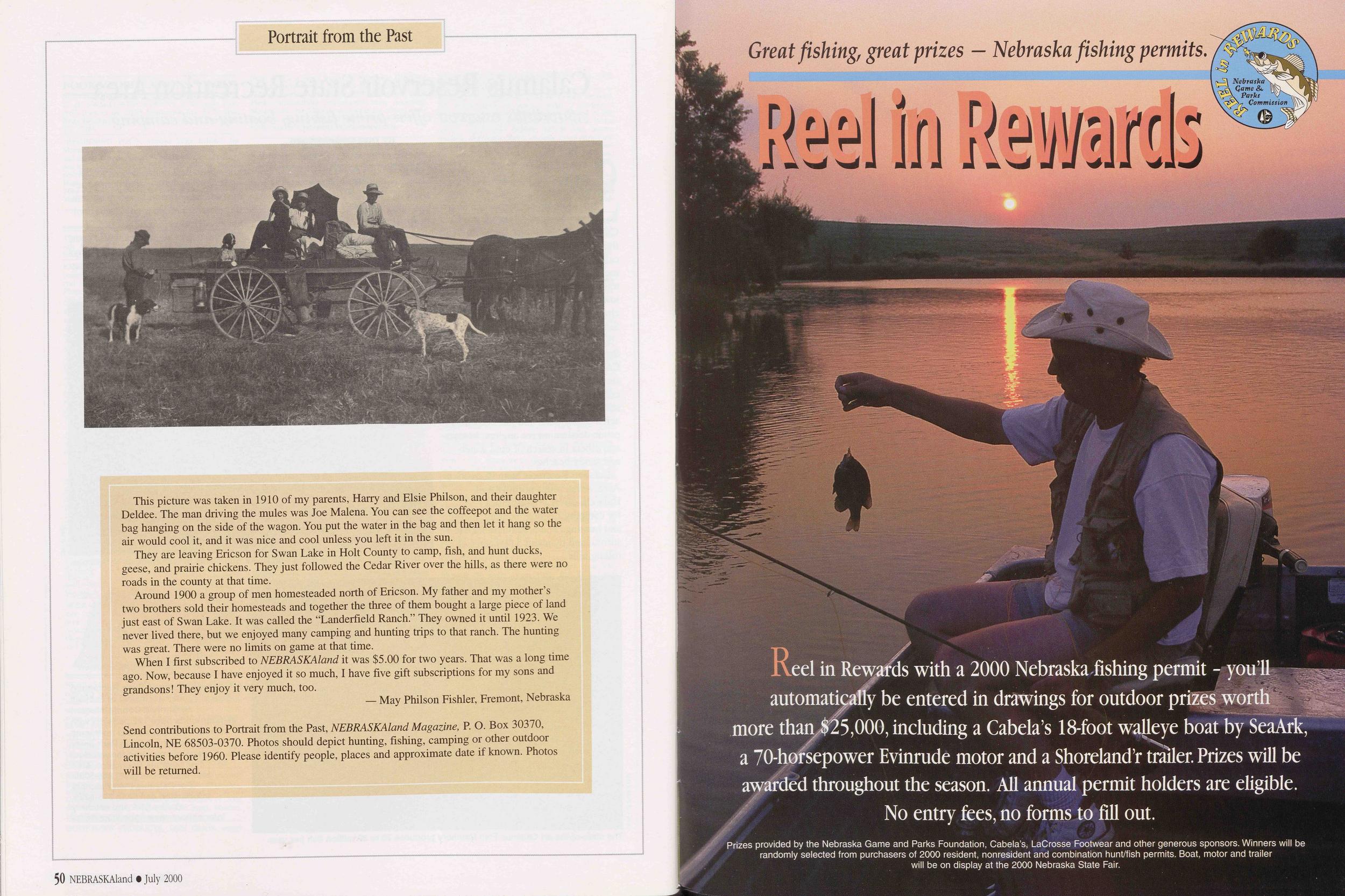
This picture was taken in 1910 of my parents, Harry and Elsie Philson, and their daughter Deldee. The man driving the mules was Joe Malena. You can see the coffeepot and the water bag hanging on the side of the wagon. You put the water in the bag and then let it hang so the air would cool it, and it was nice and cool unless you left it in the sun.
They are leaving Ericson for Swan Lake in Holt County to camp, fish, and hunt ducks, geese, and prairie chickens. They just followed the Cedar River over the hills, as there were no roads in the county at that time.
Around 1900 a group of men homesteaded north of Ericson. My father and my mother's two brothers sold their homesteads and together the three of them bought a large piece of land just east of Swan Lake. It was called the "Landerfield Ranch." They owned it until 1923. We never lived there, but we enjoyed many camping and hunting trips to that ranch. The hunting was great. There were no limits on game at that time.
When I first subscribed to NEBRASKAland it was $5.00 for two years. That was a long time ago. Now, because I have enjoyed it so much, I have five gift subscriptions for my sons and grandsons! They enjoy it very much, too.
— May Philson Fishier, Fremont, NebraskaSend contributions to Portrait from the Past, NEBRASKAland Magazine, P. O. Box 30370, Lincoln, NE 68503-0370. Photos should depict hunting, fishing, camping or other outdoor activities before 1960. Please identify people, places and approximate date if known. Photos will be returned.
50 NEBRASKAland • July 2000 Reel in Rewards with a 2000 Nebraska fishing permit automatically be entered in drawings for outdoor prizes worth more than 425,000, including a Cabela's 18-foot walleye boat by SeaArk, a 70-hofsepower Evinrude motor and a Shoreland'r trailer. Prizes will be awarded throughout the season. All annual permit holders are eligible. No entry fees, no forms to fill out. Prizes provided by the Nebraska Game and Parks Foundation, Cabela's, LaCrosse Footwear and other generous sponsors. Winners will be randomly selected from purchasers of 2000 resident, nonresident and combination hunt/fish permits. Boat, motor and trailer will be on display at the 2000 Nebraska State Fair.
Position: 353 (26 views)