Volume 78, Issue 5, 2000
NEBRASKAland
Nebraska Game & Parks Commission June 2000 • $2.50
NEBRASKAland
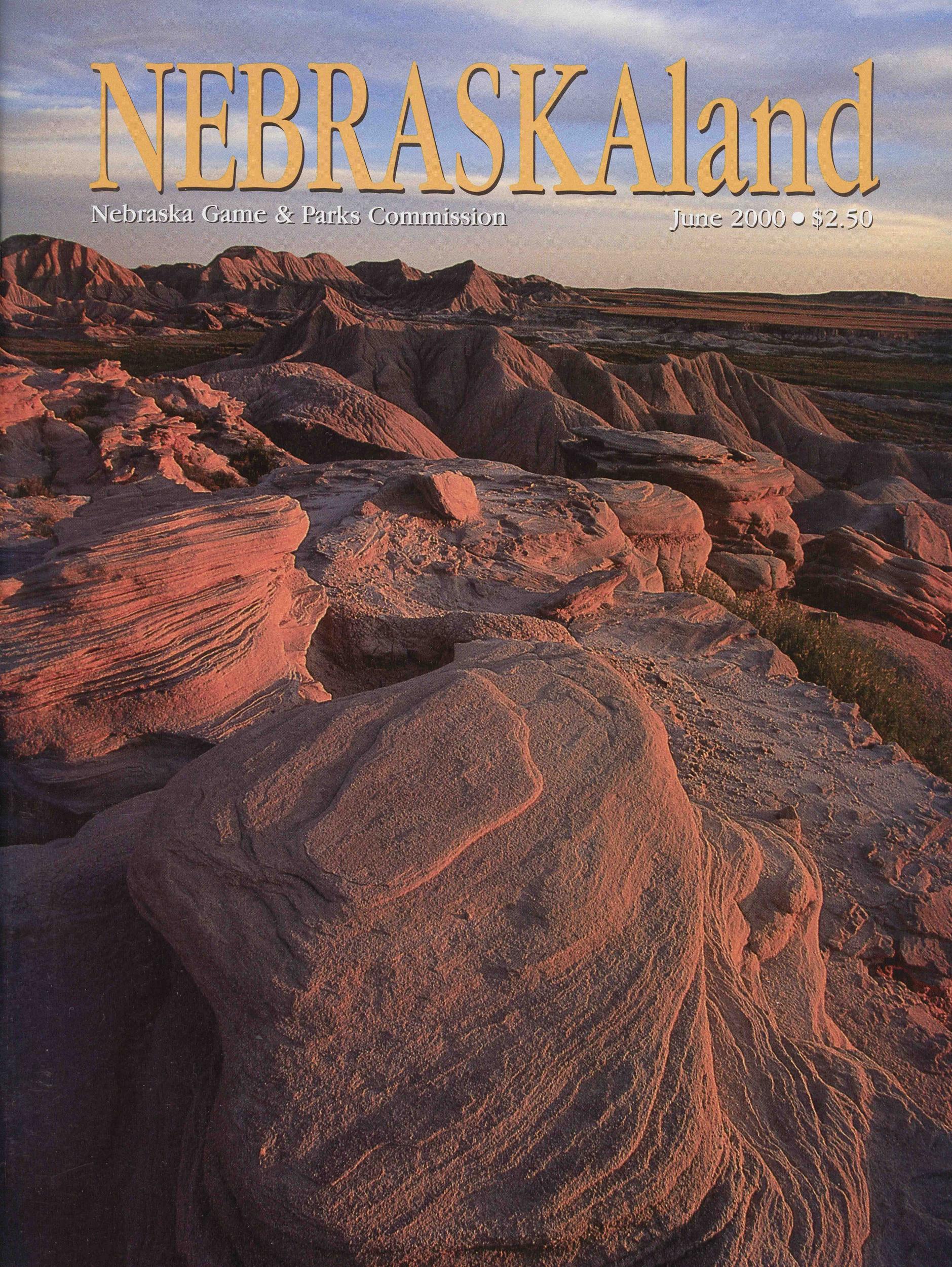
Volume 78, Number 5, June 2000 Features 10 The Nebraska Star Party Devoid of light pollution, Sandhills night skies are pristinely dark, creating an ideal site each summer for hundreds of amateur astronomers to enjoy the wonders of the universe. The Jewel of Coldwater Fishing In the past two years, with the installation of aeration systems in its North and South basins, Lake Ogallala has taken a step toward again becoming Nebraska’s premiere trout lake. 24 Copperheads and Timber Rattlers With many of their historical den sites destroyed and their limited Nebraska habitat threatened by encroaching red cedars, copperheads and timber rattlesnakes number only a few hundred in the state, according to a recent two-year study. z Three Great Hikes Ranging from the rugged Pine Ridge, through the hand-planted Nebraska National Forest, to the serene Missouri River bluffs, three great hikes highlight the best of Nebraska’s scenic outdoors. 42 High Tech on the High Plains Once decimated by unrestricted hunting and habitat changes, the ancient pronghorn - North America's fastest animal - now benefits from new, high-technology survey methods. A more accurate census may help improve species management. Departments Outdoor Business Thistle-eating insects attack noxious weeds. Outdoor Update Salvaging fish is often easier said than done. In the Kitchen Wooden cutting boards are safer than synthetic ones. Parks & Places Arbor Lodge - a legacy of Nebraska’s advocate for trees. Letters 4 Outdoor News 6 Classifieds 48 Portrait from the Past 50 Cover: Sunlight falls on the eroded clay-and-sandstone formations at Toadstool Geological Park in Sioux County on an early June morning. Photo by Michael Forsberg. Opposite: Under the blossoms of a standing milk-vetch plant at the base of Courthouse Rock in Morrill County, a desert cottontail finds refuge from the June sun. Photo by Michael Forsberg.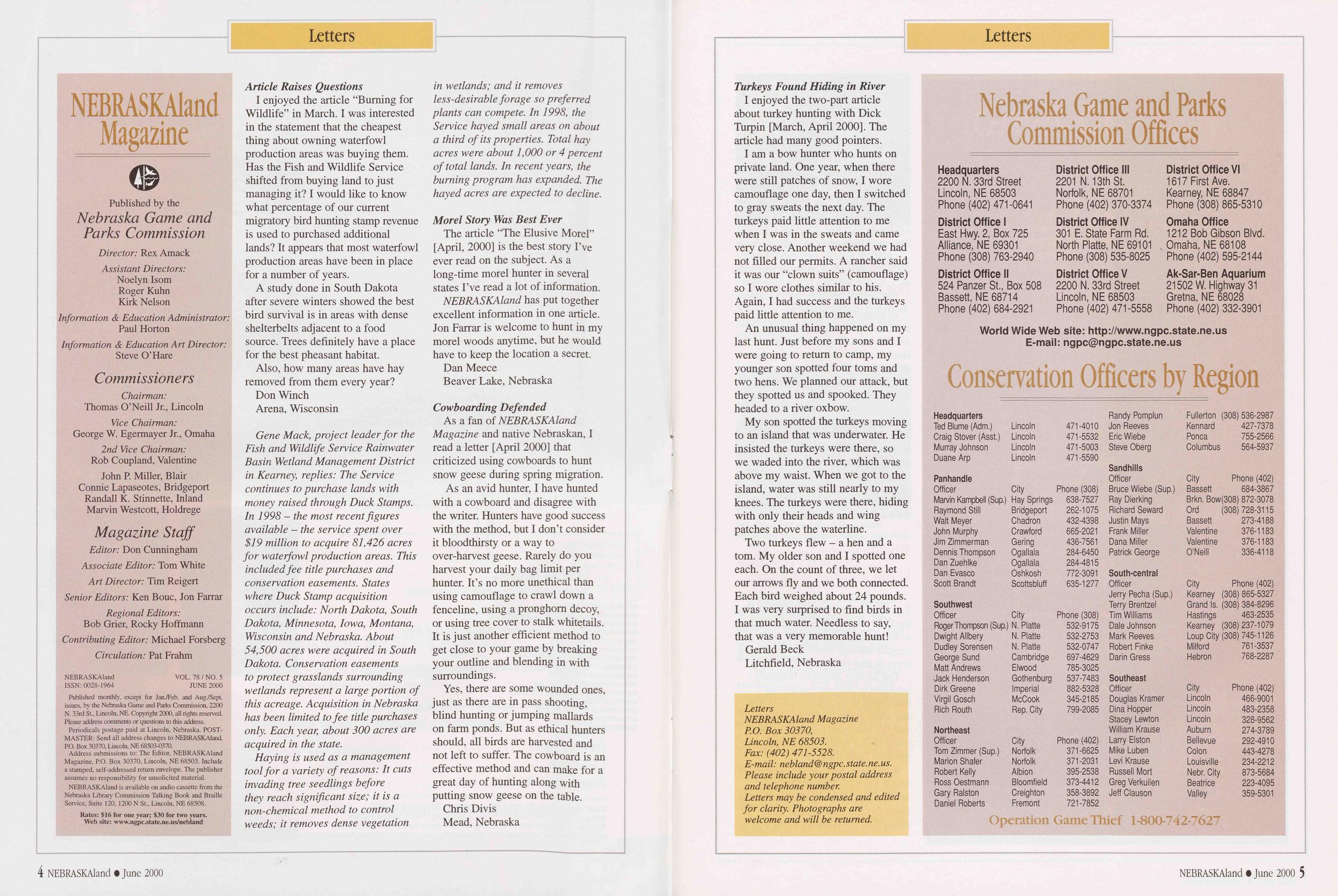 Letters
NEBRASKAland Mazine
Published by the
Nebraska Game and
Parks Commission
Director: Rex Amack
Assistant Directors:
Noelyn Isom
Roger Kuhn
Kirk Nelson
Information & Education Administrator:
Paul Horton
Information & Education Art Director:
Steve O’Hare
Commissioners
Chairman:
Thomas O’Neill Jr., Lincoln
Vice Chairman:
George W. Egermayer Jr., Omaha
2nd Vice Chairman:
Rob Coupland, Valentine
John P. Miller, Blair
Connie Lapaseotes, Bridgeport
Randall K. Stinnette, Inland
Marvin Westcott, Holdrege
Magazine Staff
Editor: Don Cunningham
Associate Editor: Tom White
Art Director: Tim Reigert
Senior Editors: Ken Bouc, Jon Farrar
Regional Editors:
Bob Grier, Rocky Hoffmann
Contributing Editor: Michael Forsberg
Circulation: Pat Frahm
NEBRASKAland VOL. 78 / NO. 5
ISSN: 0028-1964 JUNE 2000
Published monthly, except for Jan ./Feb. and Aug./Sept.
issues, by the Nebraska Game and Parks Commission, 2200
N. 33rd St., Lincoln, NE. Copyright 2000, all rights reserved.
Please address comments or questions to this address.
Periodicals postage paid at Lincoln, Nebraska. POST-
MASTER: Send all address changes to NEBRASKAland,
P.O. Box 30370, Lincoln, NE 68503-0370.
Address submissions to: The Editor, NEBRASKAland
Magazine, P.O. Box 30370, Lincoln, NE 68503. Include
a stamped, self-addressed return envelope. The publisher
assumes no responsibility for unsolicited material.
NEBRASKAland is available on audio cassette from the
Nebraska Library Commission Talking Book and Braille
Service, Suite 120, 1200 N St., Lincoln, NE 68508.
Rates: $16 for one year; $30 for two years.
Web site: www.ngpc.state.ne.us/nebland
Article Raises Questions
Letters
NEBRASKAland Mazine
Published by the
Nebraska Game and
Parks Commission
Director: Rex Amack
Assistant Directors:
Noelyn Isom
Roger Kuhn
Kirk Nelson
Information & Education Administrator:
Paul Horton
Information & Education Art Director:
Steve O’Hare
Commissioners
Chairman:
Thomas O’Neill Jr., Lincoln
Vice Chairman:
George W. Egermayer Jr., Omaha
2nd Vice Chairman:
Rob Coupland, Valentine
John P. Miller, Blair
Connie Lapaseotes, Bridgeport
Randall K. Stinnette, Inland
Marvin Westcott, Holdrege
Magazine Staff
Editor: Don Cunningham
Associate Editor: Tom White
Art Director: Tim Reigert
Senior Editors: Ken Bouc, Jon Farrar
Regional Editors:
Bob Grier, Rocky Hoffmann
Contributing Editor: Michael Forsberg
Circulation: Pat Frahm
NEBRASKAland VOL. 78 / NO. 5
ISSN: 0028-1964 JUNE 2000
Published monthly, except for Jan ./Feb. and Aug./Sept.
issues, by the Nebraska Game and Parks Commission, 2200
N. 33rd St., Lincoln, NE. Copyright 2000, all rights reserved.
Please address comments or questions to this address.
Periodicals postage paid at Lincoln, Nebraska. POST-
MASTER: Send all address changes to NEBRASKAland,
P.O. Box 30370, Lincoln, NE 68503-0370.
Address submissions to: The Editor, NEBRASKAland
Magazine, P.O. Box 30370, Lincoln, NE 68503. Include
a stamped, self-addressed return envelope. The publisher
assumes no responsibility for unsolicited material.
NEBRASKAland is available on audio cassette from the
Nebraska Library Commission Talking Book and Braille
Service, Suite 120, 1200 N St., Lincoln, NE 68508.
Rates: $16 for one year; $30 for two years.
Web site: www.ngpc.state.ne.us/nebland
Article Raises Questions
I enjoyed the article “Burning for Wildlife” in March. I was interested in the statement that the cheapest thing about owning waterfowl production areas was buying them. Has the Fish and Wildlife Service shifted from buying land to just managing it? I would like to know what percentage of our current migratory bird hunting stamp revenue is used to purchased additional lands? It appears that most waterfowl production areas have been in place for a number of years.
A study done in South Dakota after severe winters showed the best bird survival is in areas with dense shelterbelts adjacent to a food source. Trees definitely have a place for the best pheasant habitat.
Also, how many areas have hay removed from them every year?
Don Winch Arena, WisconsinGene Mack, project leader for the Fish and Wildlife Service Rainwater Basin Wetland Management District in Kearney, replies: The Service continues to purchase lands with money raised through Duck Stamps. In 1998 - the most recent figures available - the service spent over $19 million to acquire 81,426 acres for waterfowl production areas. This included fee title purchases and conservation easements. States where Duck Stamp acquisition occurs include: North Dakota, South Dakota, Minnesota, Iowa, Montana, Wisconsin and Nebraska. About 54,500 acres were acquired in South Dakota. Conservation easements to protect grasslands surrounding wetlands represent a large portion of this acreage. Acquisition in Nebraska has been limited to fee title purchases only. Each year, about 300 acres are acquired in the state.
Haying is used as a management tool for a variety of reasons: It cuts invading tree seedlings before they reach significant size; it is a non-chemical method to control weeds; it removes dense vegetation in wetlands; and it removes less-desirable forage so preferred plants can compete. In 1998, the Service hayed small areas on about a third of its properties. Total hay acres were about 1,000 or 4 percent of total lands. In recent years, the burning program has expanded. The hayed acres are expected to decline.
Morel Story Was Best EverThe article “The Elusive Morel” [April, 2000] is the best story I’ve ever read on the subject. As a long-time morel hunter in several states I’ve read a lot of information.
NEBRASKAland has put together excellent information in one article. Jon Farrar is welcome to hunt in my morel woods anytime, but he would have to keep the location a secret.
Dan Meece Beaver Lake, Nebraska Cowboarding DefendedAs a fan of NEBRASKAland Magazine and native Nebraskan, I read a letter [April 2000] that criticized using cowboards to hunt snow geese during spring migration.
As an avid hunter, I have hunted with a cowboard and disagree with the writer. Hunters have good success with the method, but I don’t consider it bloodthirsty or a way to over-harvest geese. Rarely do you harvest your daily bag limit per hunter. It’s no more unethical than using camouflage to crawl down a fenceline, using a pronghorn decoy, or using tree cover to stalk whitetails. It is just another efficient method to get close to your game by breaking your outline and blending in with surroundings.
Yes, there are some wounded ones, just as there are in pass shooting, blind hunting or jumping mallards on farm ponds. But as ethical hunters should, all birds are harvested and not left to suffer. The cowboard is an effective method and can make for a great day of hunting along with putting snow geese on the table.
Chris Divis Mead, Nebraska Turkeys Found Hiding in RiverI enjoyed the two-part article about turkey hunting with Dick Turpin [March, April 2000]. The article had many good pointers.
I am a bow hunter who hunts on private land. One year, when there were still patches of snow, I wore camouflage one day, then I switched to gray sweats the next day. The turkeys paid little attention to me when I was in the sweats and came very close. Another weekend we had not filled our permits. A rancher said it was our “clown suits” (camouflage) so I wore clothes similar to his. Again, I had success and the turkeys paid little attention to me.
An unusual thing happened on my last hunt. Just before my sons and I were going to return to camp, my younger son spotted four toms and two hens. We planned our attack, but they spotted us and spooked. They headed to a river oxbow.
My son spotted the turkeys moving to an island that was underwater. He insisted the turkeys were there, so we waded into the river, which was above my waist. When we got to the island, water was still nearly to my knees. The turkeys were there, hiding with only their heads and wing patches above the waterline.
Two turkeys flew - a hen and a tom. My older son and I spotted one each. On the count of three, we let our arrows fly and we both connected. Each bird weighed about 24 pounds. I was very surprised to find birds in that much water. Needless to say, that was a very memorable hunt!
Gerald Beck Litchfield, NebraskaLetters NEBRASKAland Magazine P.O. Box 30370, Lincoln, NE 68503. Fax: (402) 471-5528. E-mail: nebland@ ngpc. state, ne. us. Please include your postal address and telephone number. Letters may be condensed and edited for clarity. Photographs are welcome and will be returned.
Nebraska Game and Parks Commission Offices Headquarters District Office III District Office VI 2200 N. 33rd Street 2201 N. 13th St. 1617 First Ave. Lincoln, NE 68503 Norfolk, NE 68701 Kearney, NE 68847 Phone (402) 471-0641 Phone (402) 370-3374 Phone (308) 865-5310 District Office 1 District Office IV Omaha Office East Hwy. 2, Box 725 301 E. State Farm Rd. 1212 Bob Gibson Blvd. Alliance, NE 69301 North Platte, NE 69101 Omaha, NE 68108 Phone (308) 763-2940 Phone (308) 535-8025 Phone (402) 595-2144 District Office II District Office V Ak-Sar-Ben Aquarium 524 Panzer St., Box 508 2200 N. 33rd Street 21502 W. Highway 31 Bassett, NE 68714 Lincoln, NE 68503 Gretna, NE 68028 Phone (402) 684-2921 Phone (402) 471-5558 Phone (402) 332-3901 World Wide Web site: http://www.ngpc.state.ne.us Conse E-mail: ngpc@ngpc.state.ne.us ration Officers by Reg ion Headquarters Randy Pomplun Fullerton (308) 536-2987 Ted Blume (Adm.) Lincoln 471-4010 Jon Reeves Kennard 427-7378 Craig Stover (Asst.) Lincoln 471-5532 Eric Wiebe Ponca 755-2566 Murray Johnson Lincoln 471-5003 Steve Oberg Columbus 564-5937 Duane Arp Lincoln 471-5590 Sandhills Panhandle Officer City Phone (402) Officer City Phone (308) Bruce Wiebe (Sup.) Bassett 684-3867 Marvin Kampbell (Sup.) Hay Springs 638-7527 Ray Dierking Brkn. Bow(308) 872-3078 Raymond Still Bridgeport 262-1075 Richard Seward Ord (308) 728-3115 Walt Meyer Chadron 432-4398 Justin Mays Bassett 273-4188 John Murphy Crawford 665-2021 Frank Miller Valentine 376-1183 Jim Zimmerman Gering 436-7561 Dana Miller Valentine 376-1183 Dennis Thompson Ogallala 284-6450 Patrick George O’Neill 336-4118 Dan Zuehlke Ogallala 284-4815 Dan Evasco Oshkosh 772-3091 South-central Scott Brandt Scottsbluff 635-1277 Officer City Phone (402) Jerry Pecha (Sup.) Kearney (308) 865-5327 Southwest Terry Brentzel Grand Is. (308) 384-8296 Officer City Phone (308) Tim Williams Hastings 463-2535 Roger Thompson (Sup.) N. Platte 532-9175 Dale Johnson Kearney (308) 237-1079 Dwight Allbery N. Platte 532-2753 Mark Reeves Loup City (308) 745-1126 Dudley Sorensen N. Platte 532-0747 Robert Finke Milford 761-3537 George Sund Cambridge 697-4629 Darin Gress Hebron 768-2287 Matt Andrews Elwood 785-3025 Jack Henderson Gothenburg 537-7483 Southeast Phone (402) Dirk Greene Imperial 882-5328 Officer City Virgil Gosch McCook 345-2185 Douglas Kramer Lincoln 466-9001 Rich Routh Rep. City 799-2085 Dina Hopper Lincoln 483-2358 Stacey Lewton Lincoln 328-9562 Northeast William Krause Auburn 274-3789 Officer City Phone (402) Larry Elston Bellevue 292-4910 Tom Zimmer (Sup.) Norfolk 371-6625 Mike Luben Colon 443-4278 Marion Shafer Norfolk 371-2031 Levi Krause Louisville 234-2212 Robert Kelly Albion 395-2538 Russell Mort Nebr. City 873-5684 Ross Oestmann Bloomfield 373-4412 Greg Verkuilen Beatrice 223-4095 Gary Ralston Creighton 358-3892 Jeff Clauson Valley 359-5301 Daniel Roberts Fremont 721-7852 Operation Game Thief 1-800-742-7627 4 NEBRASKAland • June 2000 NEBRASKAland • June 2000 5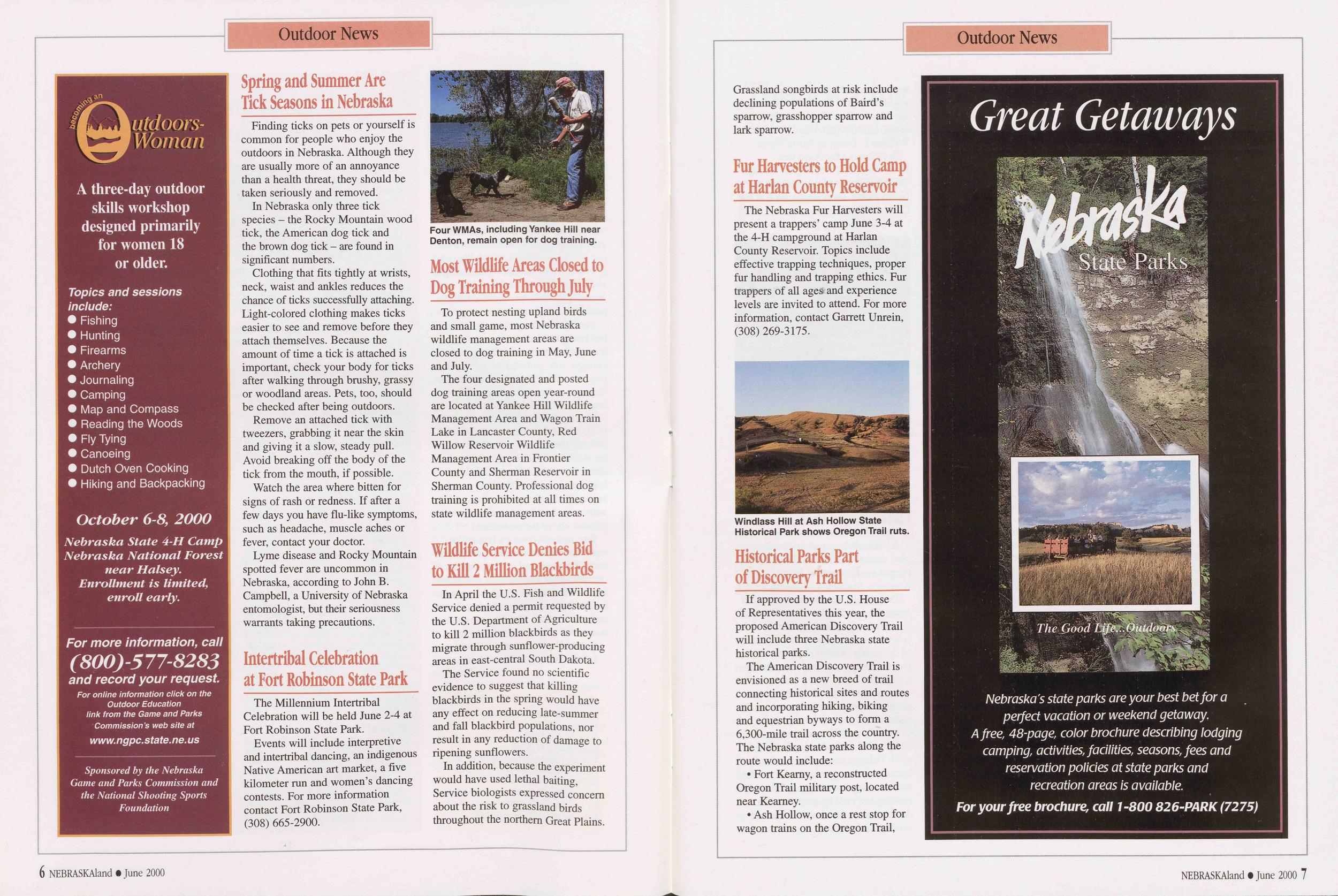
Finding ticks on pets or yourself is common for people who enjoy the outdoors in Nebraska. Although they are usually more of an annoyance than a health threat, they should be taken seriously and removed.
In Nebraska only three tick species - the Rocky Mountain wood tick, the American dog tick and the brown dog tick - are found in significant numbers.
Clothing that fits tightly at wrists, neck, waist and ankles reduces the chance of ticks successfully attaching. Light-colored clothing makes ticks easier to see and remove before they attach themselves. Because the amount of time a tick is attached is important, check your body for ticks after walking through brushy, grassy or woodland areas. Pets, too, should be checked after being outdoors.
Remove an attached tick with tweezers, grabbing it near the skin and giving it a slow, steady pull. Avoid breaking off the body of the tick from the mouth, if possible.
Watch the area where bitten for signs of rash or redness. If after a few days you have flu-like symptoms, such as headache, muscle aches or fever, contact your doctor.
Lyme disease and Rocky Mountain spotted fever are uncommon in Nebraska, according to John B. Campbell, a University of Nebraska entomologist, but their seriousness warrants taking precautions.
Intertribal Celebration at Fort Robinson State ParkThe Millennium Intertribal Celebration will be held June 2-4 at Fort Robinson State Park.
Events will include interpretive and intertribal dancing, an indigenous Native American art market, a five kilometer run and women’s dancing contests. For more information contact Fort Robinson State Park, (308) 665-2900.
To protect nesting upland birds and small game, most Nebraska wildlife management areas are closed to dog training in May, June and July.
The four designated and posted dog training areas open year-round are located at Yankee Hill Wildlife Management Area and Wagon Train Lake in Lancaster County, Red Willow Reservoir Wildlife Management Area in Frontier County and Sherman Reservoir in Sherman County. Professional dog training is prohibited at all times on state wildlife management areas.
Wildlife Service Denies Bid to Kill 2 Million BlackbirdsIn April the U.S. Fish and Wildlife Service denied a permit requested by the U.S. Department of Agriculture to kill 2 million blackbirds as they migrate through sunflower-producing areas in east-central South Dakota.
The Service found no scientific evidence to suggest that killing blackbirds in the spring would have any effect on reducing late-summer and fall blackbird populations, nor result in any reduction of damage to ripening sunflowers.
In addition, because the experiment would have used lethal baiting, Service biologists expressed concern about the risk to grassland birds throughout the northern Great Plains. Grassland songbirds at risk include declining populations of Baird’s sparrow, grasshopper sparrow and lark sparrow.
The Nebraska Fur Harvesters will present a trappers’ camp June 3-4 at the 4-H campground at Harlan County Reservoir. Topics include effective trapping techniques, proper fur handling and trapping ethics. Fur trappers of all ages and experience levels are invited to attend. For more information, contact Garrett Unrein, (308) 269-3175.
Great Getaways Nebraska's state parks are your best bet for a perfect vacation or weekend getaway. A free, 48-page, color brochure describing lodging camping, activities, facilities, seasons, fees and reservation policies at state parks and recreation areas is available. For your free brochure, call 1-800 826-PARK (7275) Historical Parks Part of Discovery TrailIf approved by the U.S. House of Representatives this year, the proposed American Discovery Trail will include three Nebraska state historical parks.
The American Discovery Trail is envisioned as a new breed of trail connecting historical sites and routes and incorporating hiking, biking and equestrian byways to form a 6,300-mile trail across the country. The Nebraska state parks along the route would include:
• Fort Kearny, a reconstructed Oregon Trail military post, located near Kearney. • Ash Hollow, once a rest stop for wagon trains on the Oregon Trail,
6 NEBRASKAland • June 2000 NEBRASKAland • June 2000 7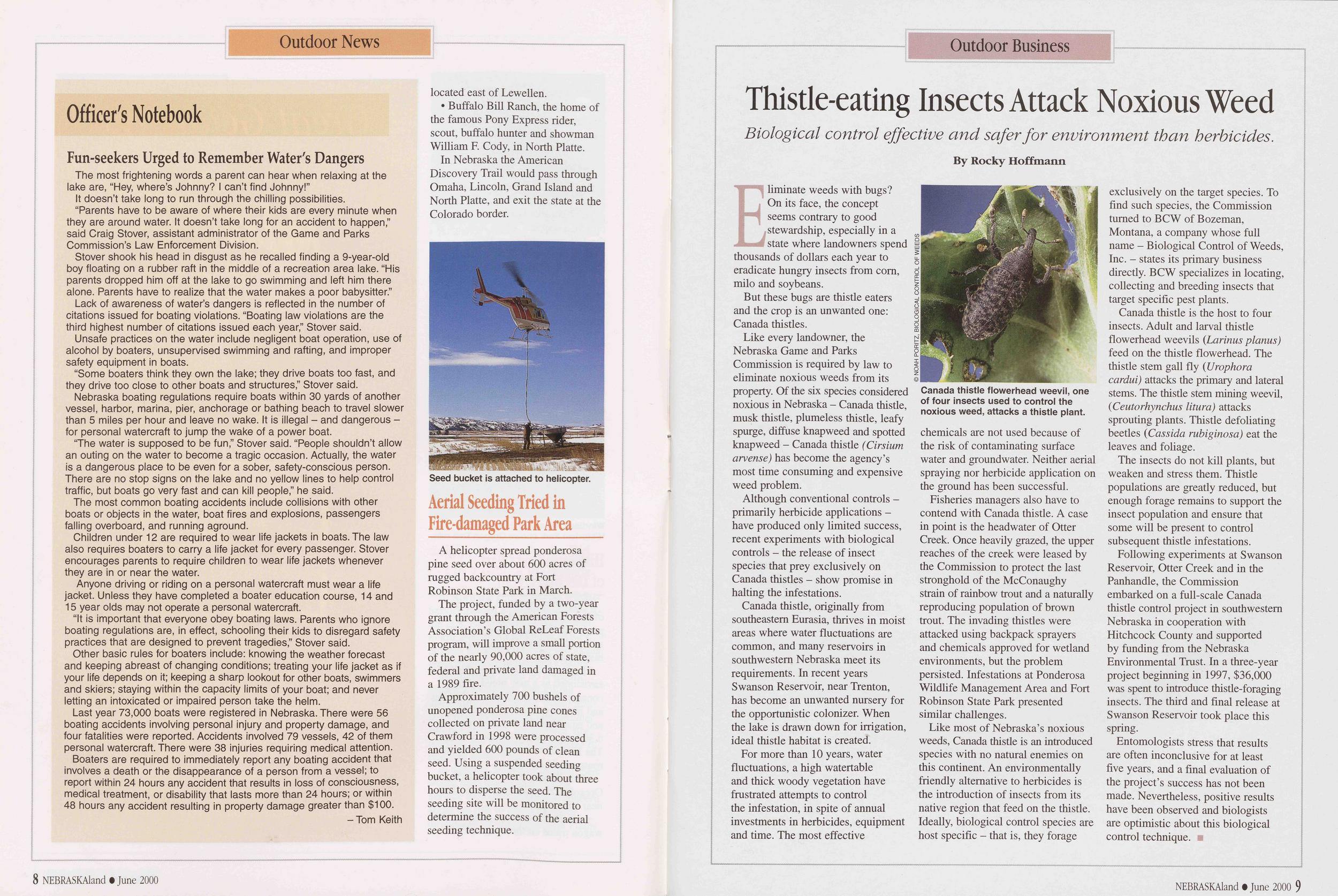 Officer's Notebook
Fun-seekers Urged to Remember Water's Dangers
Officer's Notebook
Fun-seekers Urged to Remember Water's Dangers
The most frightening words a parent can hear when relaxing at the lake are, “Hey, where’s Johnny? I can’t find Johnny!”
It doesn’t take long to run through the chilling possibilities.
“Parents have to be aware of where their kids are every minute when they are around water. It doesn’t take long for an accident to happen,” said Craig Stover, assistant administrator of the Game and Parks Commission’s Law Enforcement Division.
Stover shook his head in disgust as he recalled finding a 9-year-old boy floating on a rubber raft in the middle of a recreation area lake. “His parents dropped him off at the lake to go swimming and left him there alone. Parents have to realize that the water makes a poor babysitter.”
Lack of awareness of water’s dangers is reflected in the number of citations issued for boating violations. “Boating law violations are the third highest number of citations issued each year,” Stover said.
Unsafe practices on the water include negligent boat operation, use of alcohol by boaters, unsupervised swimming and rafting, and improper safety equipment in boats.
“Some boaters think they own the lake; they drive boats too fast, and they drive too close to other boats and structures,” Stover said.
Nebraska boating regulations require boats within 30 yards of another vessel, harbor, marina, pier, anchorage or bathing beach to travel slower than 5 miles per hour and leave no wake. It is illegal - and dangerous - for personal watercraft to jump the wake of a power boat.
“The water is supposed to be fun,” Stover said. “People shouldn’t allow an outing on the water to become a tragic occasion. Actually, the water is a dangerous place to be even for a sober, safety-conscious person. There are no stop signs on the lake and no yellow lines to help control traffic, but boats go very fast and can kill people,” he said.
The most common boating accidents include collisions with other boats or objects in the water, boat fires and explosions, passengers falling overboard, and running aground.
Children under 12 are required to wear life jackets in boats. The law also requires boaters to carry a life jacket for every passenger. Stover encourages parents to require children to wear life jackets whenever they are in or near the water.
Anyone driving or riding on a personal watercraft must wear a life jacket. Unless they have completed a boater education course, 14 and 15 year olds may not operate a personal watercraft.
“It is important that everyone obey boating laws. Parents who ignore boating regulations are, in effect, schooling their kids to disregard safety practices that are designed to prevent tragedies,” Stover said.
Other basic rules for boaters include: knowing the weather forecast and keeping abreast of changing conditions; treating your life jacket as if your life depends on it; keeping a sharp lookout for other boats, swimmers and skiers; staying within the capacity limits of your boat; and never letting an intoxicated or impaired person take the helm.
Last year 73,000 boats were registered in Nebraska. There were 56 boating accidents involving personal injury and property damage, and four fatalities were reported. Accidents involved 79 vessels, 42 of them personal watercraft. There were 38 injuries requiring medical attention.
Boaters are required to immediately report any boating accident that involves a death or the disappearance of a person from a vessel; to report within 24 hours any accident that results in loss of consciousness, medical treatment, or disability that lasts more than 24 hours; or within 48 hours any accident resulting in property damage greater than $100.
- Tom Keithlocated east of Lewellen. • Buffalo Bill Ranch, the home of the famous Pony Express rider, scout, buffalo hunter and showman William F. Cody, in North Platte. In Nebraska the American Discovery Trail would pass through Omaha, Lincoln, Grand Island and North Platte, and exit the state at the Colorado border.
A helicopter spread ponderosa pine seed over about 600 acres of rugged backcountry at Fort Robinson State Park in March.
The project, funded by a two-year grant through the American Forests Association’s Global ReLeaf Forests program, will improve a small portion of the nearly 90,000 acres of state, federal and private land damaged in a 1989 fire.
Approximately 700 bushels of unopened ponderosa pine cones collected on private land near Crawford in 1998 were processed and yielded 600 pounds of clean seed. Using a suspended seeding bucket, a helicopter took about three hours to disperse the seed. The seeding site will be monitored to determine the success of the aerial seeding technique.
Outdoor Business Thistle-eating Insects Attack Noxious Weed Biological control effective and safer for environment than herbicides. By Rocky HoffmannEliminate weeds with bugs? On its face, the concept seems contrary to good stewardship, especially in a state where landowners spend thousands of dollars each year to eradicate hungry insects from com, milo and soybeans.
But these bugs are thistle eaters and the crop is an unwanted one: Canada thistles.
Like every landowner, the Nebraska Game and Parks Commission is required by law to eliminate noxious weeds from its property. Of the six species considered noxious in Nebraska - Canada thistle, musk thistle, plumeless thistle, leafy spurge, diffuse knapweed and spotted knapweed - Canada thistle (Cirsium arvense) has become the agency’s most time consuming and expensive weed problem.
Although conventional controls - primarily herbicide applications - have produced only limited success, recent experiments with biological controls - the release of insect species that prey exclusively on Canada thistles - show promise in halting the infestations.
Canada thistle, originally from southeastern Eurasia, thrives in moist areas where water fluctuations are common, and many reservoirs in southwestern Nebraska meet its requirements. In recent years Swanson Reservoir, near Trenton, has become an unwanted nursery for the opportunistic colonizer. When the lake is drawn down for irrigation, ideal thistle habitat is created.
For more than 10 years, water fluctuations, a high watertable and thick woody vegetation have frustrated attempts to control the infestation, in spite of annual investments in herbicides, equipment and time. The most effective chemicals are not used because of the risk of contaminating surface water and groundwater. Neither aerial spraying nor herbicide application on the ground has been successful.
Fisheries managers also have to contend with Canada thistle. A case in point is the headwater of Otter Creek. Once heavily grazed, the upper reaches of the creek were leased by the Commission to protect the last stronghold of the McConaughy strain of rainbow trout and a naturally reproducing population of brown trout. The invading thistles were attacked using backpack sprayers and chemicals approved for wetland environments, but the problem persisted. Infestations at Ponderosa Wildlife Management Area and Fort Robinson State Park presented similar challenges.
Like most of Nebraska’s noxious weeds, Canada thistle is an introduced species with no natural enemies on this continent. An environmentally friendly alternative to herbicides is the introduction of insects from its native region that feed on the thistle. Ideally, biological control species are host specific - that is, they forage exclusively on the target species. To find such species, the Commission turned to BCW of Bozeman, Montana, a company whose full name - Biological Control of Weeds, Inc. - states its primary business directly. BCW specializes in locating, collecting and breeding insects that target specific pest plants.
Canada thistle is the host to four insects. Adult and larval thistle flowerhead weevils (Larinus planus) feed on the thistle flowerhead. The thistle stem gall fly (Urophora cardui) attacks the primary and lateral stems. The thistle stem mining weevil, (Ceutorhynchus litura) attacks sprouting plants. Thistle defoliating beetles (Cassida rubiginosa) eat the leaves and foliage.
The insects do not kill plants, but weaken and stress them. Thistle populations are greatly reduced, but enough forage remains to support the insect population and ensure that some will be present to control subsequent thistle infestations.
Following experiments at Swanson Reservoir, Otter Creek and in the Panhandle, the Commission embarked on a full-scale Canada thistle control project in southwestern Nebraska in cooperation with Hitchcock County and supported by funding from the Nebraska Environmental Trust. In a three-year project beginning in 1997, $36,000 was spent to introduce thistle-foraging insects. The third and final release at Swanson Reservoir took place this spring.
Entomologists stress that results are often inconclusive for at least five years, and a final evaluation of the project’s success has not been made. Nevertheless, positive results have been observed and biologists are optimistic about this biological control technique. ■
8 NEBRASKAland • June 2000 NEBRASKAland • June 2000 9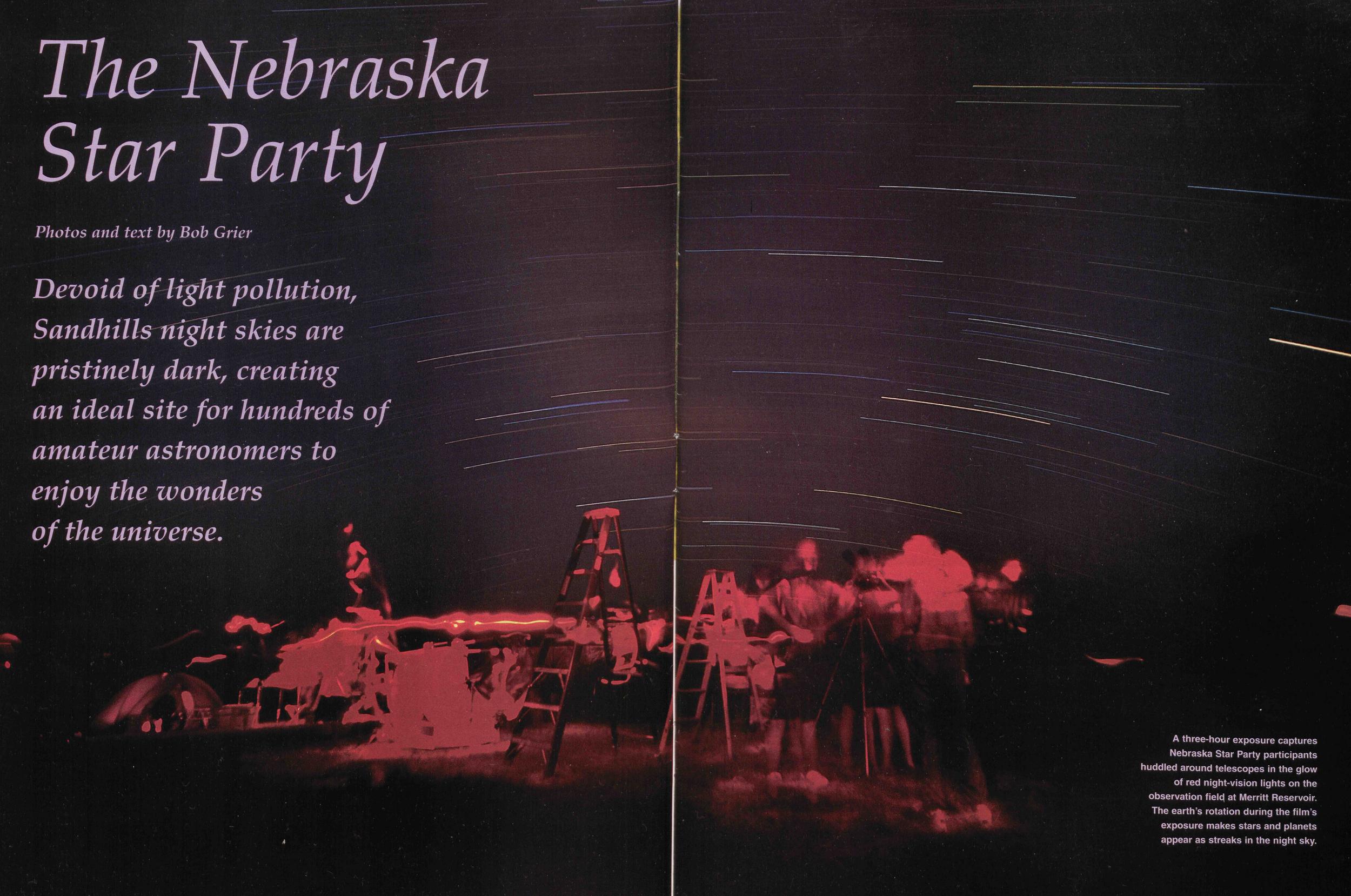
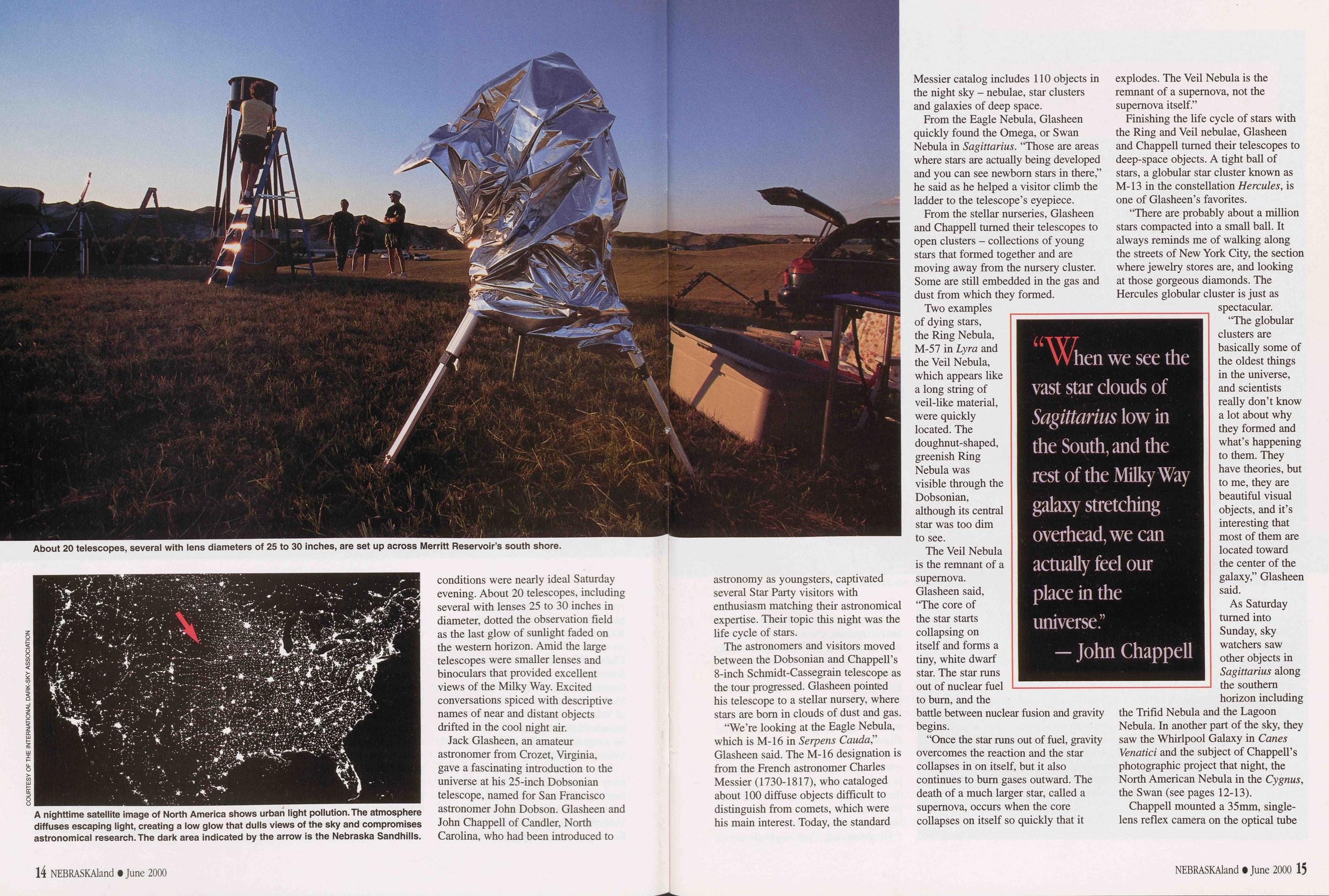
The Nebraska Star Party
Photos and text by Bob Grier Devoid of light pollution, Sandhills night skies are pristinely dark, creating an ideal site for hundreds of amateur astronomers to enjoy the wonders of the universe. JOHN CHAPPELL
One by one, the great and the near great arrived.
To the delight of nearly 300 astronomers and friends gathered at Merritt Reservoir south of Valentine, the luminaries made their predictable appearances at the sixth annual Nebraska Star Party. Some notables, such as the Whirlpool Galaxy in the constellation Canes Venatici, came early and left almost immediately, setting on the western horizon just as the party started. But old standards showed up on schedule: M-13, the globular star cluster in Hercules, the double stars in Lyra, the Dumbbell Nebula in Vulpecula and the Cat’s Eye Nebula in Draco.
As if it were a captivating symphony written overhead, the Milky Way dominated the breathtaking, midnight August sky, and flashing Perseid meteors provided orchestral punctuation. Across the observation field on the reservoir’s south shore, small night-vision lights glowed red, marking telescope locations.
Dark skies devoid of light pollution are prized by astronomers; the Nebraska Sandhills, with widely scattered, small communities and isolated ranches, is one of the best viewing sites in the country. Night photographs of North America taken from orbiting satellites show almost continuous bands of light on both coasts. Large cities and urban areas glow brightly, brilliant spider webs of light define travel corridors and even the smallest villages twinkle.
In a nighttime satellite photograph, available on the International Dark-Sky Association’s web site at http://www.darksky.org. light defines the edges of the Sandhills, but only three pinpoints of light from Thedford, Mullen and Hyannis can been seen in the center of the region. Organized in 1988, the association has more than 3,000 members from every state and 69 countries. The group’s purpose is to reduce light pollution by building awareness and proposing alternative lighting solutions.
For the past six years Merritt Reservoir State Recreation Area has been the site of the annual Nebraska Star Party, which began informally in 1994 with about 75 astronomers and their families from the Prairie Astronomy Club of Lincoln. The parties have grown to as many as 400 participants and have been co-sponsored by the Prairie Astronomy Club and the Omaha Astronomical Society with support from the Nebraska Game and Parks Commission, the Merritt Trading Post and the city of Valentine. In 1999 participants included astronomy enthusiasts from as far away as Puerto Rico, China and the United Arab Emirates.
This summer the seventh annual party will be held July 29 to August 5 (see page 17).
Located 27 miles southwest of Valentine, Merritt Reservoir State Recreation Area is a prize in the state park system with 9,000 acres including a 2,900-acre lake. In addition to pristine night skies, Merritt offers miles of white sand beaches, shaded campgrounds and activities including swimming, fishing, boating, hiking and sightseeing.
The Star Party includes daytime educational programs, speakers and a beginner’s astronomy field school. Participants receive instruction at the field school held in Valentine each day. On the observation field at night, newcomers are paired with friendly, experienced observers who have telescopes, which the students use to practice the skills and techniques learned in class.
About 3,000 light years from Earth, the North American Nebula - the red area in center of the photo shaped somewhat like the continent - is a glowing cloud of hydrogen, ionized by nearby stars. The generalized white glow is the Cygnus Star Cloud, part of the Milky Way. The star cluster M-39 of about 15 closely grouped blue stars is above and to the left of the North American Nebula. The line below and to the right of the nebula is a meteor streaking through the earth’s atmosphere. This 35mm image was taken at the Nebraska Star Party last August through an 8-inch Schmidt-Cassegrain telescope using a motor drive to track the stars during the a 20-minute explosure at f/2.8.In 1999 storms spoiled many
activities Friday night, but observation
12 NEBRASKAland • June 2000
NEBRASKAland • June 2000 13
 conditions were nearly ideal Saturday
evening. About 20 telescopes, including
several with lenses 25 to 30 inches in
diameter, dotted the observation field
as the last glow of sunlight faded on
the western horizon. Amid the large
telescopes were smaller lenses and
binoculars that provided excellent
views of the Milky Way. Excited
conversations spiced with descriptive
names of near and distant objects
drifted in the cool night air.
conditions were nearly ideal Saturday
evening. About 20 telescopes, including
several with lenses 25 to 30 inches in
diameter, dotted the observation field
as the last glow of sunlight faded on
the western horizon. Amid the large
telescopes were smaller lenses and
binoculars that provided excellent
views of the Milky Way. Excited
conversations spiced with descriptive
names of near and distant objects
drifted in the cool night air.
Jack Glasheen, an amateur astronomer from Crozet, Virginia, gave a fascinating introduction to the universe at his 25-inch Dobsonian telescope, named for San Francisco astronomer John Dobson. Glasheen and John Chappell of Candler, North Carolina, who had been introduced to astronomy as youngsters, captivated several Star Party visitors with enthusiasm matching their astronomical expertise. Their topic this night was the life cycle of stars.
The astronomers and visitors moved between the Dobsonian and Chappell’s 8-inch Schmidt-Cassegrain telescope as the tour progressed. Glasheen pointed his telescope to a stellar nursery, where stars are bom in clouds of dust and gas.
“We’re looking at the Eagle Nebula, which is M-16 in Serpens Cauda,” Glasheen said. The M-16 designation is from the French astronomer Charles Messier (1730-1817), who cataloged about 100 diffuse objects difficult to distinguish from comets, which were his main interest. Today, the standard Messier catalog includes 110 objects in the night sky - nebulae, star clusters and galaxies of deep space.
From the Eagle Nebula, Glasheen quickly found the Omega, or Swan Nebula in Sagittarius. “Those are areas where stars are actually being developed and you can see newborn stars in there,” he said as he helped a visitor climb the ladder to the telescope’s eyepiece.
From the stellar nurseries, Glasheen and Chappell turned their telescopes to open clusters - collections of young stars that formed together and are moving away from the nursery cluster. Some are still embedded in the gas and dust from which they formed.
Two examples of dying stars, the Ring Nebula, M-57 in Lyra and the Veil Nebula, which appears like a long string of veil-like material, were quickly located. The doughnut-shaped, greenish Ring Nebula was visible through the Dobsonian, although its central star was too dim to see.
The Veil Nebula is the remnant of a supernova. Glasheen said, “The core of the star starts collapsing on itself and forms a tiny, white dwarf star. The star runs out of nuclear fuel to bum, and the battle between nuclear fusion and gravity begins.
“When we see the vast star clouds of Sagittarius low in the South, and the rest of the Milky Way galaxy stretching overhead, we can actually feel our place in the universe.” — John Chappell“Once the star runs out of fuel, gravity overcomes the reaction and the star collapses in on itself, but it also continues to bum gases outward. The death of a much larger star, called a supernova, occurs when the core collapses on itself so quickly that it explodes. The Veil Nebula is the remnant of a supernova, not the supernova itself.”
Finishing the life cycle of stars with the Ring and Veil nebulae, Glasheen and Chappell turned their telescopes to deep-space objects. A tight ball of stars, a globular star cluster known as M-13 in the constellation Hercules, is one of dasheen’s favorites.
“There are probably about a million stars compacted into a small ball. It always reminds me of walking along the streets of New York City, the section where jewelry stores are, and looking at those gorgeous diamonds. The Hercules globular cluster is just as spectacular.
“The globular clusters are basically some of the oldest things in the universe, and scientists really don’t know a lot about why they formed and what’s happening to them. They have theories, but to me, they are beautiful visual objects, and it’s interesting that most of them are located toward the center of the galaxy,” Glasheen said.
As Saturday turned into Sunday, sky watchers saw other objects in Sagittarius along the southern horizon including the Trifid Nebula and the Lagoon Nebula. In another part of the sky, they saw the Whirlpool Galaxy in Canes Venatici and the subject of Chappell’s photographic project that night, the North American Nebula in the Cygnus, the Swan (see pages 12-13).
Chappell mounted a 35mm, single-
lens reflex camera on the optical tube
14 NEBRASKAland • June 2000
NEBRASKAland •June 2000 15
 assembly of the telescope. With the
55mm lens open to f/2.8, he made a
20-minute exposure while a motor
drive turned the telescope and camera
tracking the stars as the earth rotated,
capturing the faint North American
Nebula, so named because its shape
resembles the continent.
assembly of the telescope. With the
55mm lens open to f/2.8, he made a
20-minute exposure while a motor
drive turned the telescope and camera
tracking the stars as the earth rotated,
capturing the faint North American
Nebula, so named because its shape
resembles the continent.
“The nebula is about 3,000 light years away,” Chappell said as he waited during the exposure. “The general white glowing in the center is the Cygnus star cloud, part of the Milky Way, our galaxy. We are looking down the length of our spiral arm of the galaxy, which begins to curve toward the center. The darker areas are part of 16 NEBRASKAland • June 2000 the Great Rift, caused by interstellar dust blocking the light from the stars behind it.”
Glasheen and Chappell, who had each traveled more than 1,500 miles to attend the Star Party, said it was one of the best-organized, most fun and most educational amateur astronomy events they had attended.
“One of the best parts of a star party is making friends,” Chappell said. “Tell your readers that they don’t even have to have a telescope or binoculars to be welcome at a star party. There are plenty of folks eager to share their scopes and explain the night sky to newcomers.
“But tell them if they bring a flashlight, they need to have a red filter over it; nothing gets an astronomer more irate than losing vision to a white light.
“Besides appreciating the beauty of nebulae and star clusters, there is a feeling that astronomers share that we are part of something much greater than the usual world around us. When we see the vast star clouds of Sagittarius low in the south, and the rest of the Milky Way galaxy stretching overhead, we can actually feel our place in the universe. It isn’t just knowing that we get from a science book, but a physical feeling of our location in the solar system and galaxy.”
Glasheen said, “You might also suggest to your readers who are not from the Midwest that your local winds can make tent camping exciting.”
Jupiter and Saturn rose early Sunday morning and the number of Perseid meteors increased. As Glasheen and Chappell covered their telescopes and gathered their equipment, light from the Milky Way was strong enough to cast shadows.
Midsummer nights in the Nebraska Sandhills are filled with beauty, amazing objects and, at least once a year, with friendly astronomers. Star Party visitors walked away from the observation field with new enthusiasm for the beauty of the night sky. ■
Seventh Annual Star PartyThe seventh annual Nebraska Star Party will be held July 29 through August 5 at Merritt Reservoir State Recreation Area, a site known for its exceptionally dark night skies and outstanding visibility. Veteran observers report that at Merritt, astronomical objects ranging from individual stars to planets and constellations, as well as faint stars rising on the horizon, can can be seen with the unaided eye.
The Nebraska Star Party is well known as a gathering where helpful, friendly amateur and professional astronomers share their enthusiasm and knowledge of astronomy with visitors.
In addition to nighttime viewing, daytime activities include:
• Beginners Field School - Each afternoon class focuses on a new skill. In the evening participants are paired with experienced observers to practice and fine tune the new skills.
• Speakers - Including Tom Clark, Pete Smitka, Nick Schneider, Erica Ellingson, Bob Denny and Dave Knisely. Subjects range from amateur telescope making to Jupiter’s magnetosphere, to ASCOM, the Astronomy Common Object Model.
» Recreational activities - Star Party activities include: a half-day canoe and tubing trip on the Niobrara River; ice cream social; catered meals at the campgrounds; beach party with kites, games and a barbecue.
Registration fees: Before June 15, $25 for an individual and $35 for a family; after June 15, $35 for an individual and $45 for a family. For information about this summer’s Nebraska Star Party, call (402) 421-7855 or go to the web site at www.4w.com/nsp/
Merritt Reservoir State Recreation Area has 240 non-pad primitive camping sites, a dump station, water, picnic tables, shelters, vault toilets and boat ramps. A Nebraska State Park Entry Permit is required.
NEBRASKAland • June 2000 17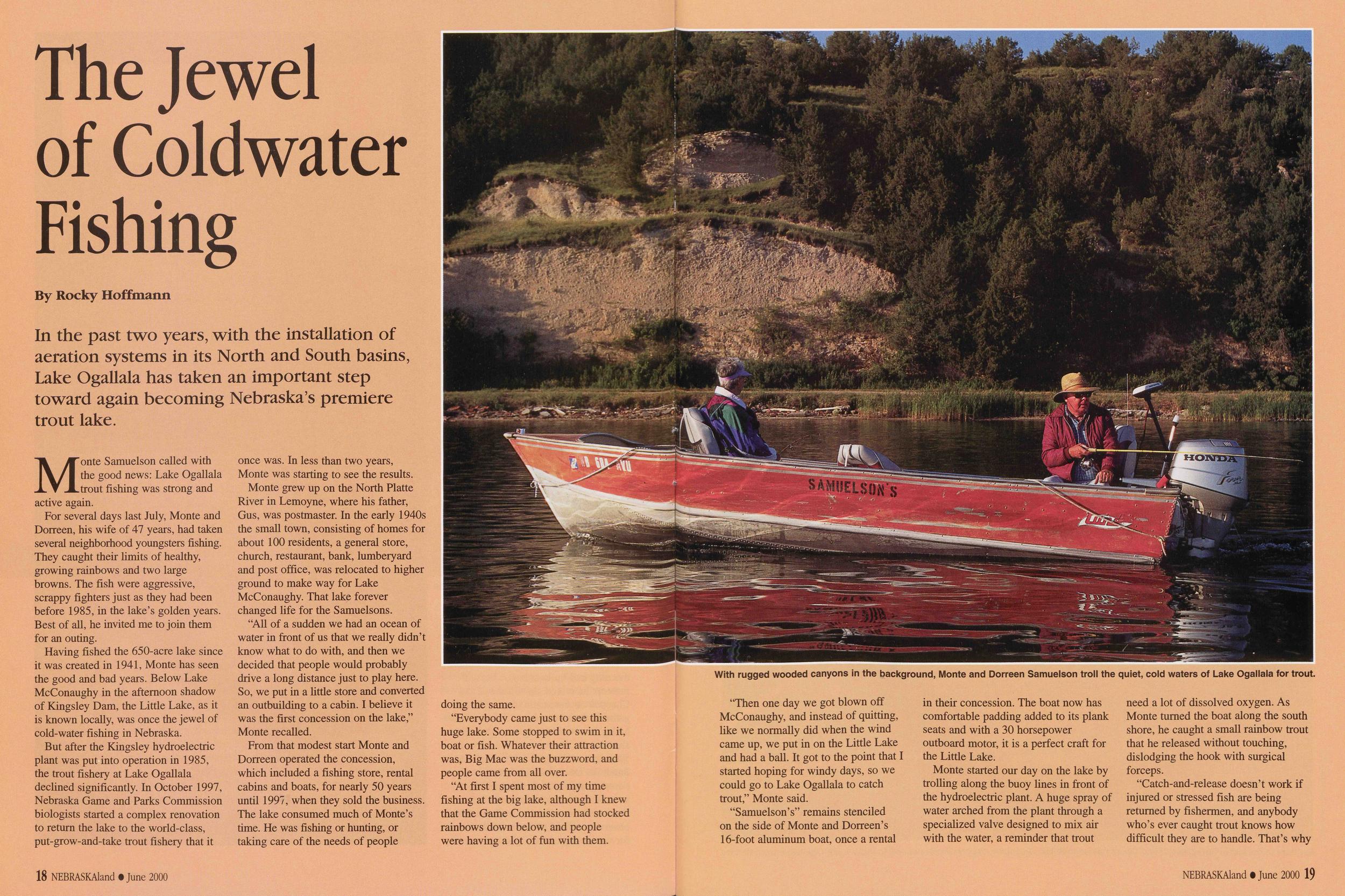
The Jewel of Coldwater Fishing
By Rocky Hoffmann In the past two years, with the installation of aeration systems in its North and South basins, Lake Ogallala has taken an important step toward again becoming Nebraska’s premiere trout lake.Monte Samuelson called with the good news: Lake Ogallala trout fishing was strong and active again.
For several days last July, Monte and Dorreen, his wife of 47 years, had taken several neighborhood youngsters fishing. They caught their limits of healthy, growing rainbows and two large browns. The fish were aggressive, scrappy fighters just as they had been before 1985, in the lake’s golden years. Best of all, he invited me to join them for an outing.
Having fished the 650-acre lake since it was created in 1941, Monte has seen the good and bad years. Below Lake McConaughy in the afternoon shadow of Kingsley Dam, the Little Lake, as it is known locally, was once the jewel of cold-water fishing in Nebraska.
But after the Kingsley hydroelectric plant was put into operation in 1985, the trout fishery at Lake Ogallala declined significantly. In October 1997, Nebraska Game and Parks Commission biologists started a complex renovation to return the lake to the world-class, put-grow-and-take trout fishery that it once was. In less than two years, Monte was starting to see the results.
Monte grew up on the North Platte River in Lemoyne, where his father, Gus, was postmaster. In the early 1940s the small town, consisting of homes for about 100 residents, a general store, church, restaurant, bank, lumberyard and post office, was relocated to higher ground to make way for Lake McConaughy. That lake forever changed life for the Samuelsons.
“All of a sudden we had an ocean of water in front of us that we really didn’t know what to do with, and then we decided that people would probably drive a long distance just to play here. So, we put in a little store and converted an outbuilding to a cabin. I believe it was the first concession on the lake,” Monte recalled.
From that modest start Monte and Dorreen operated the concession, which included a fishing store, rental cabins and boats, for nearly 50 years until 1997, when they sold the business. The lake consumed much of Monte’s time. He was fishing or hunting, or taking care of the needs of people doing the same.
“Everybody came just to see this huge lake. Some stopped to swim in it, boat or fish. Whatever their attraction was, Big Mac was the buzzword, and people came from all over.
“At first I spent most of my time fishing at the big lake, although I knew that the Game Commission had stocked rainbows down below, and people were having a lot of fun with them.
“Then one day we got blown off McConaughy, and instead of quitting, like we normally did when the wind came up, we put in on the Little Lake and had a ball. It got to the point that I started hoping for windy days, so we could go to Lake Ogallala to catch trout,” Monte said.
“Samuelson’s” remains stenciled on the side of Monte and Dorreen’s 16-foot aluminum boat, once a rental in their concession. The boat now has comfortable padding added to its plank seats and with a 30 horsepower outboard motor, it is a perfect craft for the Little Lake.
Monte started our day on the lake by trolling along the buoy lines in front of the hydroelectric plant. A huge spray of water arched from the plant through a specialized valve designed to mix air with the water, a reminder that trout need a lot of dissolved oxygen. As Monte turned the boat along the south shore, he caught a small rainbow trout that he released without touching, dislodging the hook with surgical forceps.
“Catch-and-release doesn’t work if
injured or stressed fish are being
returned by fishermen, and anybody
who’s ever caught trout knows how
difficult they are to handle. That’s why
18 NEBRASKAland • June 2000
NEBRASKAland • June 2000 19
 we don’t net the fish we plan to turn
back,” Monte said.
we don’t net the fish we plan to turn
back,” Monte said.
Monte and Dorreen keep a few fish, carrying a large, ice-filled cooler in the boat to keep them fresh. Dorreen said that keeper trout are immediately chilled and are never allowed to warm until they are put in the oven. Even when cleaning them, Monte uses ice water to rinse the fish.
Dorreen said they don’t skin, scale or fillet their trout. They simply extract the entrails through a long cut made in the belly, remove the head and scrape out the blood line. She sprinkles each fish generously with lemon pepper, inside and out, and bakes them, being careful not to over cook the delicate, pink flesh.
Monte has a specific recipe for catching trout as well: "I like to use a small trout spinner of about a quarter ounce. I buy a variety of colors and styles, because trout can be very selective, and oftentimes, a certain style is working well and the next minute trout won’t touch it. I change spinners, sometimes switching to spoons, to find what they’re wanting and then stick with it until their taste changes again.”
Monte guided the boat on a proven course close to a weedbed, trolling rapidly, up to about 2Vz miles per hour.
“These rainbows seem to like to chase a fast bait, and they’ll sometimes hit it two or three times. The fast speed also keeps the bait above the moss, so you don’t have to keep cleaning your lure.”
On this day, fishing was slower than when Monte called me. The small trout caught near the spillway was our only success for some time. I began to detect the uneasiness that comes over story subjects when their fishing or hunting success turns sour as soon as the photographer shows up. I assured Monte and Dorreen that I was used to not catching fish, and had concluded that’s why it’s called fishing instead of catching.
As we trolled the lake, the wind gradually picked up, eventually producing a substantial chop. Monte hooked a rainbow on a Panther Martin spinner as he passed over a shallow bed of sand. Then Dorreen followed quickly with a keeper on a Little Cleo spoon that sported a neon blue stripe over a silver finish. For trout the Samuelsons use soft rods, especially at the tip. These fast-tipped rods provide more sporting action from the fish, and firmly set the hook when the trout hits the swiftly moving lure.
Catches came rapidly now, and Monte was pleased.
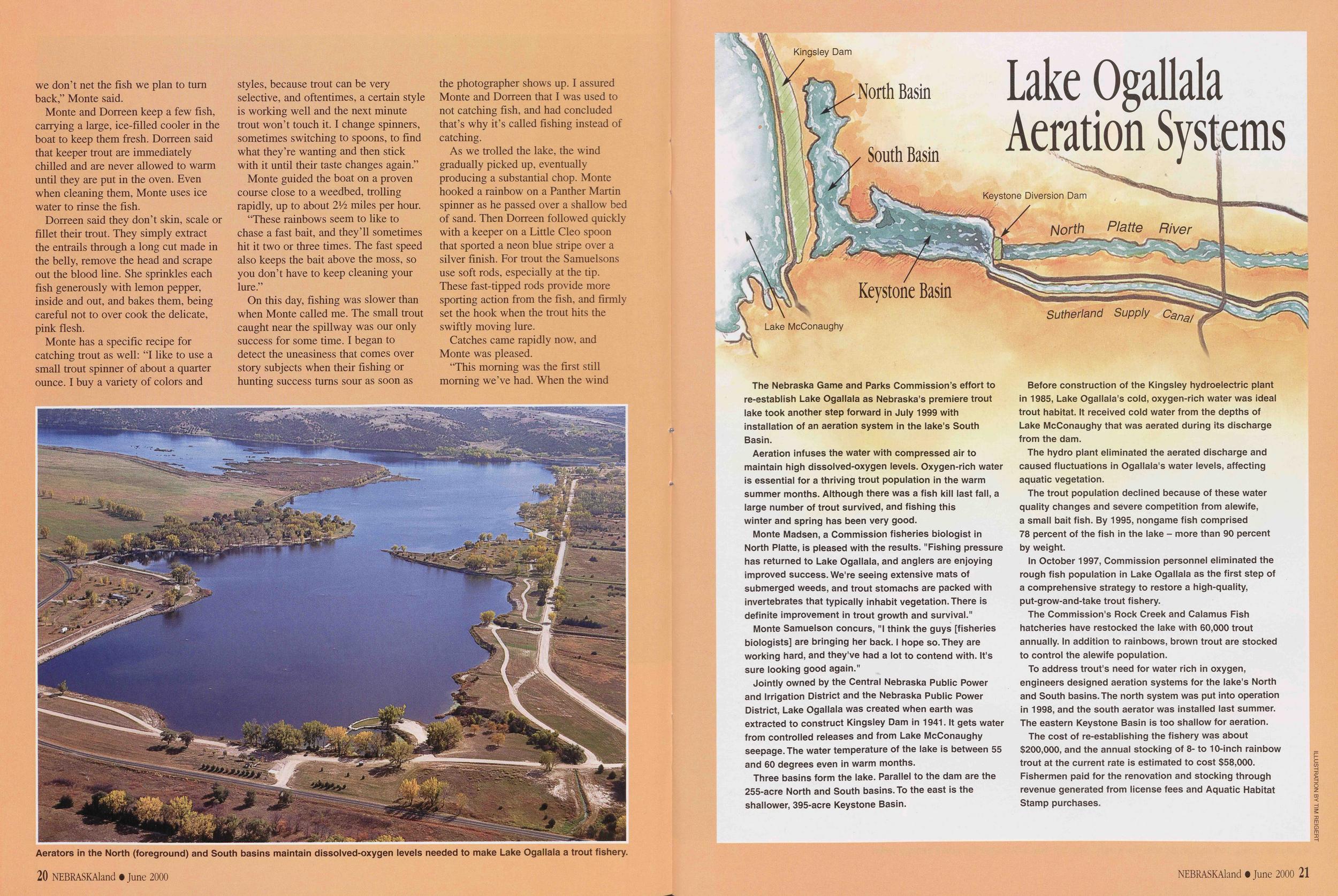
The Nebraska Game and Parks Commission’s effort to re-establish Lake Ogallala as Nebraska's premiere trout lake took another step forward in July 1999 with installation of an aeration system in the lake's South Basin.
Aeration infuses the water with compressed air to maintain high dissolved-oxygen levels. Oxygen-rich water is essential for a thriving trout population in the warm summer months. Although there was a fish kill last fall, a large number of trout survived, and fishing this winter and spring has been very good.
Monte Madsen, a Commission fisheries biologist in North Platte, is pleased with the results. "Fishing pressure has returned to Lake Ogallala, and anglers are enjoying improved success. We're seeing extensive mats of submerged weeds, and trout stomachs are packed with invertebrates that typically inhabit vegetation. There is definite improvement in trout growth and survival."
Monte Samuelson concurs, "I think the guys [fisheries biologists] are bringing her back. I hope so. They are working hard, and they've had a lot to contend with. It's sure looking good again."
Jointly owned by the Central Nebraska Public Power and Irrigation District and the Nebraska Public Power District, Lake Ogallala was created when earth was extracted to construct Kingsley Dam in 1941. It gets water from controlled releases and from Lake McConaughy seepage. The water temperature of the lake is between 55 and 60 degrees even in warm months.
Three basins form the lake. Parallel to the dam are the 255-acre North and South basins. To the east is the shallower, 395-acre Keystone Basin.
Before construction of the Kingsley hydroelectric plant in 1985, Lake Ogallala's cold, oxygen-rich water was ideal trout habitat. It received cold water from the depths of Lake McConaughy that was aerated during its discharge from the dam.
The hydro plant eliminated the aerated discharge and caused fluctuations in Ogallala's water levels, affecting aquatic vegetation.
The trout population declined because of these water quality changes and severe competition from alewife, a small bait fish. By 1995, nongame fish comprised 78 percent of the fish in the lake - more than 90 percent by weight.
In October 1997, Commission personnel eliminated the rough fish population in Lake Ogallala as the first step of a comprehensive strategy to restore a high-quality, put-grow-and-take trout fishery.
The Commission's Rock Creek and Calamus Fish hatcheries have restocked the lake with 60,000 trout annually. In addition to rainbows, brown trout are stocked to control the alewife population.
To address trout's need for water rich in oxygen, engineers designed aeration systems for the lake's North and South basins. The north system was put into operation in 1998, and the south aerator was installed last summer. The eastern Keystone Basin is too shallow for aeration.
The cost of re-establishing the fishery was about $200,000, and the annual stocking of 8- to 10-inch rainbow trout at the current rate is estimated to cost $58,000. Fishermen paid for the renovation and stocking through revenue generated from license fees and Aquatic Habitat Stamp purchases.
ILLUSTRATION BY TIM REIGERT“This morning was the first still
morning we’ve had. When the wind
20 NEBRASKAland • June 2000
NEBRASKAland • June 2000 21
 picked up, so did the fishing. As
shallow as we’re fishing in this clear
water, I think a good chop is necessary
to put the fish at ease. The wind and
waves also chum up feed down there,
and the presence of new feed often
starts a frenzy,” said Monte.
picked up, so did the fishing. As
shallow as we’re fishing in this clear
water, I think a good chop is necessary
to put the fish at ease. The wind and
waves also chum up feed down there,
and the presence of new feed often
starts a frenzy,” said Monte.
The long, soft rods and Monte’s adept boat handling encouraged action from the scrappy trout. Several jumps were spectacular - the trout clearing the water by several feet - and Monte and Dorreen both began to chuckle about an outing a day or two earlier. He told the story.
"Here I was fighting a nice trout that was putting on quite a show for us with jumps and runs, when he came out of the water close to the boat. I kept a good bend in my rod, but the trout managed to throw the spinner at the top of its jump. The bend in the rod snapped that spinner right at me at bullet speed. There was no ducking. The hook lodged squarely in my lip. Here I started out with a pound-and-a-half trout and ended up with a 150-pound sucker.”
It’s not just trout that raise havoc for anglers. Rapidly trolled spinner baits with fightweight monofilament line can cause messes, too.
"When you’re trolling a lure that rotates at high speed, it’s imperative that you spend a little more money and use ball-bearing swivels. The swivel has to keep up with the spinner, or the line will twist into a frazzled mess. Even with ball bearings, you have to stop now and then and straighten things out,” he said.
That’s what Monte was doing when Dorreen picked up her rod, tossed the spoon close to a raft of submerged algae and gave the reel handle two cranks. From the cover, a large trout darted out and intercepted the lure.
But this trout had no desire to be sprinkled with lemon pepper in Dorreen’s baking dish. It swam directly toward her at high speed, producing a loop of slack line, and then jumped, clearing the water, and with a shake of its head, it tossed the spoon away like an old-time ball player spitting tobacco.
Monte shook his head. "These wives are opportunists. When you’re struggling with a mess in your reel, they take advantage of the situation and try to get one up on you. Inevitably, she catches the biggest fish.
"The other day, we had decided to quit. Our fish were on ice, and I was straightening out the boat for the return trip to the dock when she threw that same spoon out there. She caught an absolute beauty with that cast, and I had already put my tackle away.”
Although Monte enjoys teasing Dorreen, it was apparent that he loves to see her catch fish. Monte could spend the entire day helping someone fish without wetting his own line, then leave the lake feeling as if he’d had the greatest fishing day of his life. He considers Lake Ogallala trout fishing an excellent family sport, and the Samuelsons frequently take youngsters with them for a morning or evening on the lake.
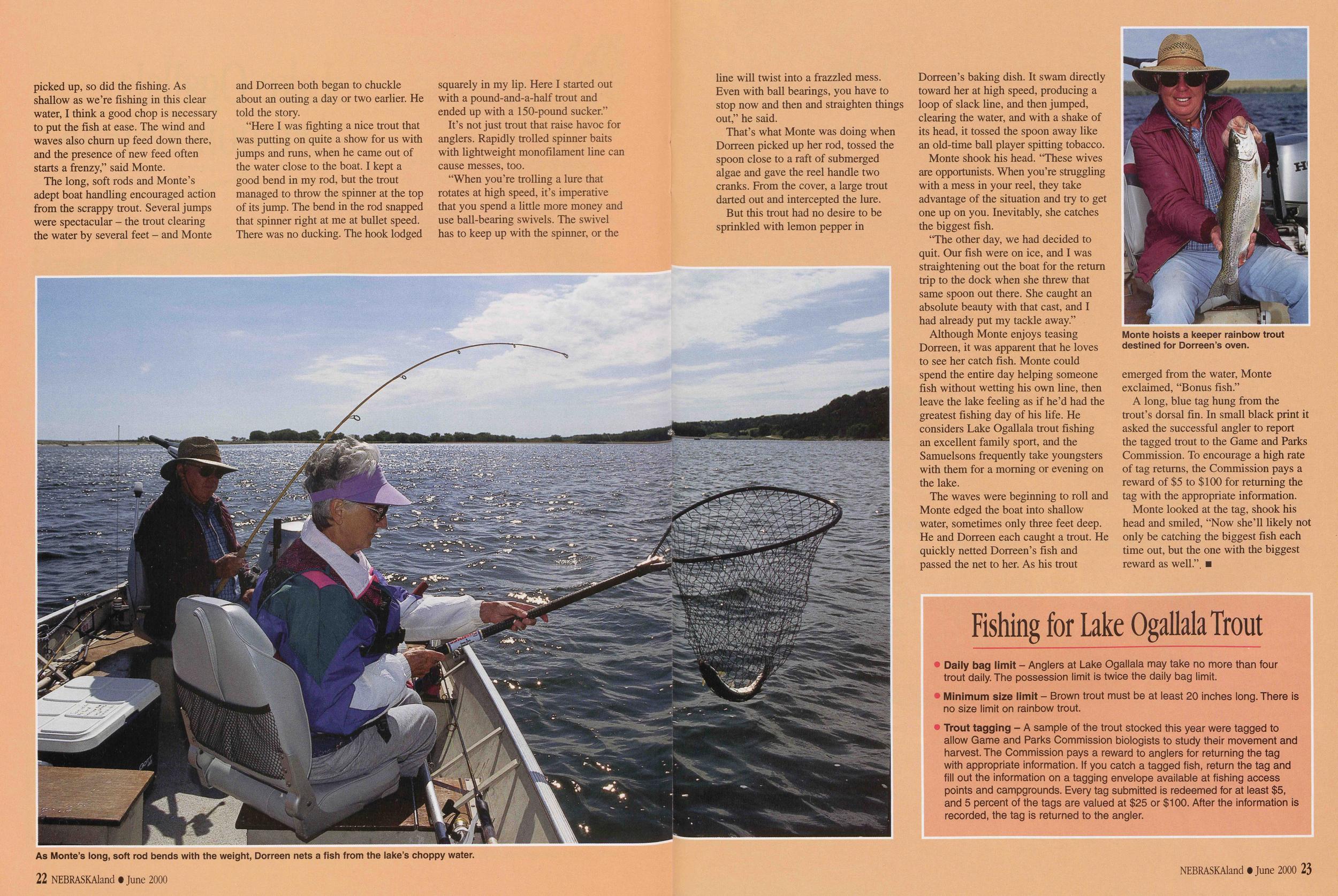
The waves were beginning to roll and Monte edged the boat into shallow water, sometimes only three feet deep. He and Dorreen each caught a trout. He quickly netted Dorreen’s fish and passed the net to her. As his trout emerged from the water, Monte exclaimed, "Bonus fish.”
A long, blue tag hung from the trout’s dorsal fin. In small black print it asked the successful angler to report the tagged trout to the Game and Parks Commission. To encourage a high rate of tag returns, the Commission pays a reward of $5 to $100 for returning the tag with the appropriate information.
Monte looked at the tag, shook his head and smiled, "Now she’ll likely not only be catching the biggest fish each time out, but the one with the biggest reward as well.”. ■
Fishing for Lake Ogallala Trout• Daily bag limit - Anglers at Lake Ogallala may take no more than four trout daily. The possession limit is twice the daily bag limit.
• Minimum size limit - Brown trout must be at least 20 inches long. There is no size limit on rainbow trout.
Trout tagging - A sample of the trout stocked this year were tagged to allow Game and Parks Commission biologists to study their movement and harvest. The Commission pays a reward to anglers for returning the tag with appropriate information. If you catch a tagged fish, return the tag and fill out the information on a tagging envelope available at fishing access points and campgrounds. Every tag submitted is redeemed for at least $5, and 5 percent of the tags are valued at $25 or $100. After the information is recorded, the tag is returned to the angler.
COPPERHEADS AND TIMBER RATTLERS
Photos and text by Michael Forsberg With many of their historical den sites destroyed and their limited habitat threatened by encroaching red cedars, copperheads and timber rattlesnakes number only a few hundred in the state, according to a new two-year study.By 9 a.m. on an unusually warm morning in mid-October, scattered showers had given way to high clouds, intermittent sun and a strong south wind. The temperature was nearly 80. It was perfect weather for finding snakes.
University of Nebraska-Omaha graduate student Dan Fogell and his assistant, Ted Leonard, were making their daily rounds, checking timber rattlesnake and copperhead dens in the limestone hill-country of southeastern Nebraska. Fogell's project is the first in-depth population study in Nebraska of these two species, and it will become his master’s thesis. The heart of his study area is near Barneston, a town three miles from the Kansas border in Gage County.
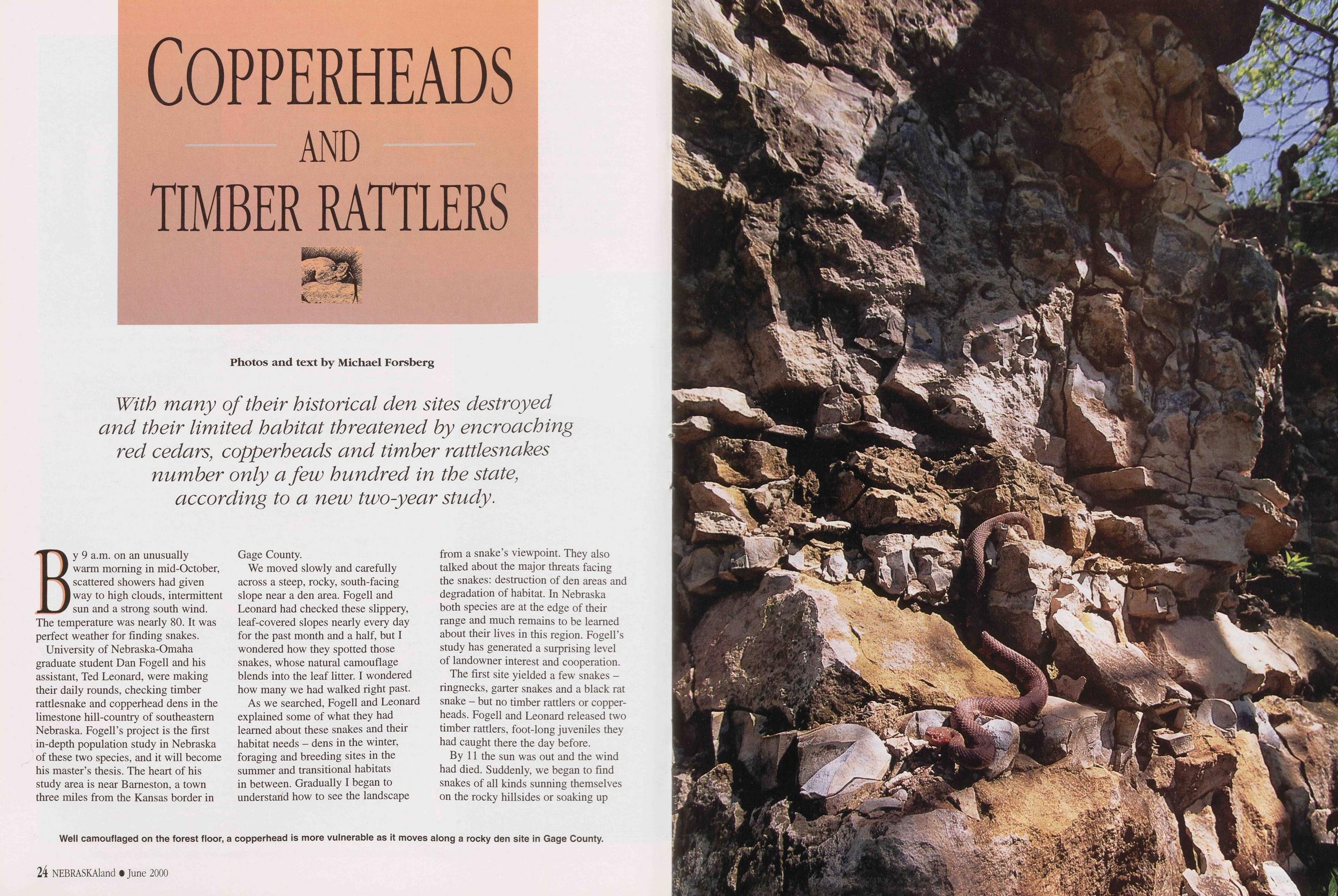
We moved slowly and carefully across a steep, rocky, south-facing slope near a den area. Fogell and Leonard had checked these slippery, leaf-covered slopes nearly every day for the past month and a half, but I wondered how they spotted those snakes, whose natural camouflage blends into the leaf litter. I wondered how many we had walked right past.
As we searched, Fogell and Leonard explained some of what they had learned about these snakes and their habitat needs - dens in the winter, foraging and breeding sites in the summer and transitional habitats in between. Gradually I began to understand how to see the landscape from a snake’s viewpoint. They also talked about the major threats facing the snakes: destruction of den areas and degradation of habitat. In Nebraska both species are at the edge of then- range and much remains to be learned about their lives in this region. Fogell’s study has generated a surprising level of landowner interest and cooperation.
The first site yielded a few snakes - ringnecks, garter snakes and a black rat snake - but no timber rattlers or copper- heads. Fogell and Leonard released two timber rattlers, foot-long juveniles they had caught there the day before.
By 11 the sun was out and the wind
had died. Suddenly, we began to find
snakes of all kinds sunning themselves
on the rocky hillsides or soaking up
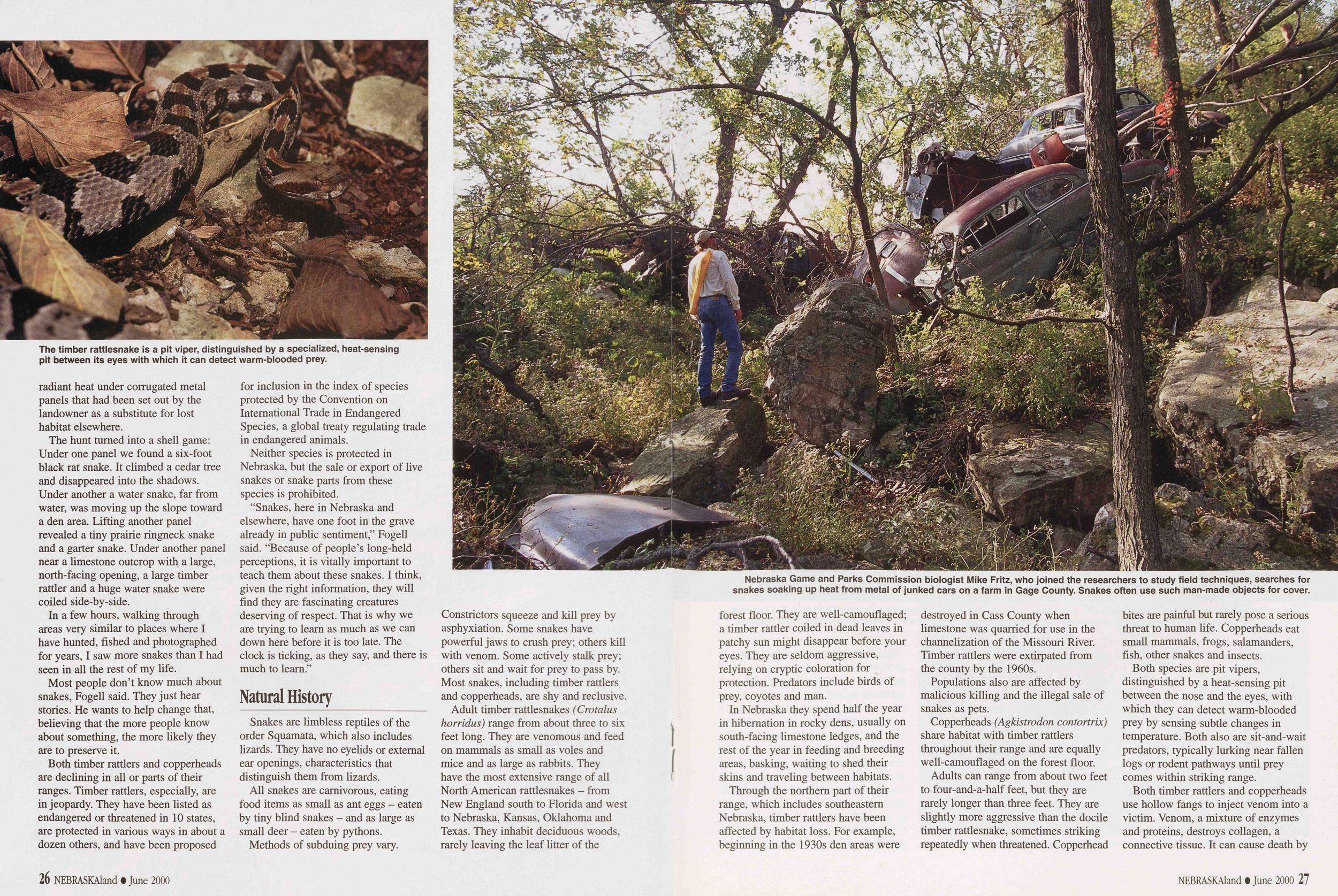 radiant heat under corrugated metal
panels that had been set out by the
landowner as a substitute for lost
habitat elsewhere.
radiant heat under corrugated metal
panels that had been set out by the
landowner as a substitute for lost
habitat elsewhere.
The hunt turned into a shell game: Under one panel we found a six-foot black rat snake. It climbed a cedar tree and disappeared into the shadows. Under another a water snake, far from water, was moving up the slope toward a den area. Lifting another panel revealed a tiny prairie ringneck snake and a garter snake. Under another panel near a limestone outcrop with a large, north-facing opening, a large timber rattler and a huge water snake were coiled side-by-side.
In a few hours, walking through areas very similar to places where I have hunted, fished and photographed for years, I saw more snakes than I had seen in all the rest of my life.
Most people don’t know much about snakes, Fogell said. They just hear stories. He wants to help change that, believing that the more people know about something, the more likely they are to preserve it.
Both timber rattlers and copperheads are declining in all or parts of their ranges. Timber rattlers, especially, are in jeopardy. They have been listed as endangered or threatened in 10 states, are protected in various ways in about a dozen others, and have been proposed for inclusion in the index of species protected by the Convention on International Trade in Endangered Species, a global treaty regulating trade in endangered animals.
Neither species is protected in Nebraska, but the sale or export of live snakes or snake parts from these species is prohibited.
“Snakes, here in Nebraska and elsewhere, have one foot in the grave already in public sentiment,” Fogell said. “Because of people’s long-held perceptions, it is vitally important to teach them about these snakes. I think, given the right information, they will find they are fascinating creatures deserving of respect. That is why we are trying to learn as much as we can down here before it is too late. The clock is ticking, as they say, and there is much to learn.”
Natural HistorySnakes are limbless reptiles of the order Squamata, which also includes lizards. They have no eyelids or external ear openings, characteristics that distinguish them from lizards.
All snakes are carnivorous, eating food items as small as ant eggs - eaten by tiny blind snakes - and as large as small deer - eaten by pythons.
Methods of subduing prey vary. Constrictors squeeze and kill prey by asphyxiation. Some snakes have powerful jaws to crush prey; others kill with venom. Some actively stalk prey; others sit and wait for prey to pass by. Most snakes, including timber rattlers and copperheads, are shy and reclusive.
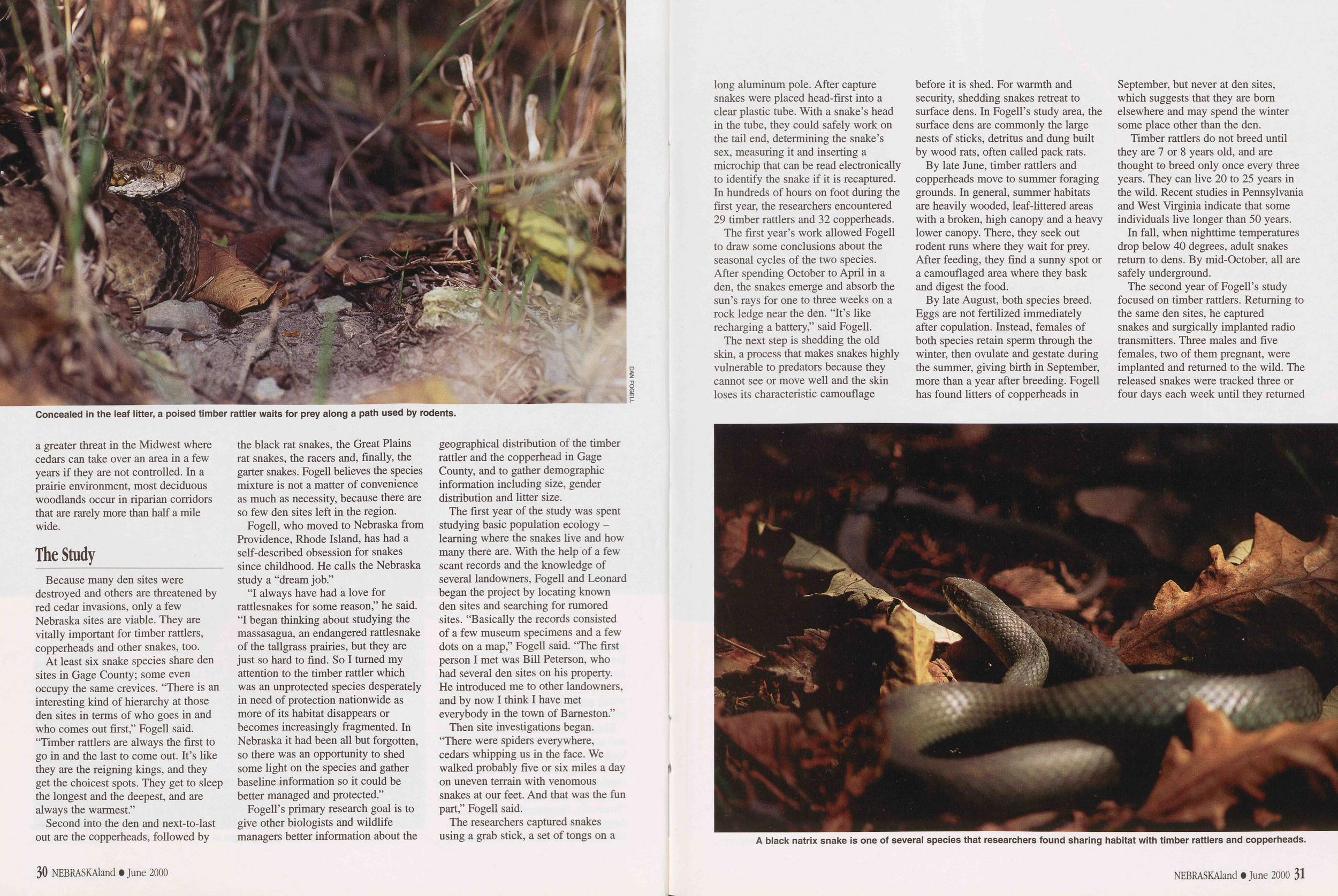
Adult timber rattlesnakes (Crotalus horridus) range from about three to six feet long. They are venomous and feed on mammals as small as voles and mice and as large as rabbits. They have the most extensive range of all North American rattlesnakes - from New England south to Florida and west to Nebraska, Kansas, Oklahoma and Texas. They inhabit deciduous woods, rarely leaving the leaf litter of the forest floor. They are well-camouflaged; a timber rattler coiled in dead leaves in patchy sun might disappear before your eyes. They are seldom aggressive, relying on cryptic coloration for protection. Predators include birds of prey, coyotes and man.
In Nebraska they spend half the year in hibernation in rocky dens, usually on south-facing limestone ledges, and the rest of the year in feeding and breeding areas, basking, waiting to shed their skins and traveling between habitats.
Through the northern part of their range, which includes southeastern Nebraska, timber rattlers have been affected by habitat loss. For example, beginning in the 1930s den areas were destroyed in Cass County when limestone was quarried for use in the channelization of the Missouri River. Timber rattlers were extirpated from the county by the 1960s.
Populations also are affected by malicious killing and the illegal sale of snakes as pets.
Copperheads (Agkistrodon contortrix) share habitat with timber rattlers throughout their range and are equally well-camouflaged on the forest floor.
Adults can range from about two feet to four-and-a-half feet, but they are rarely longer than three feet. They are slightly more aggressive than the docile timber rattlesnake, sometimes striking repeatedly when threatened. Copperhead bites are painful but rarely pose a serious threat to human fife. Copperheads eat small mammals, frogs, salamanders, fish, other snakes and insects.
Both species are pit vipers, distinguished by a heat-sensing pit between the nose and the eyes, with which they can detect warm-blooded prey by sensing subtle changes in temperature. Both also are sit-and-wait predators, typically lurking near fallen logs or rodent pathways until prey comes within striking range.
Both timber rattlers and copperheads
use hollow fangs to inject venom into a
victim. Venom, a mixture of enzymes
and proteins, destroys collagen, a
connective tissue. It can cause death by
26 NEBRASKAland • June 2000
NEBRASKAland • June 2000 27
 shock or asphyxiation. The venom of
young pit vipers is as toxic as that of
mature snakes, but the bite the young
often is more dangerous because they
inject all their venom at once. Adults
use only as much as is necessary.
shock or asphyxiation. The venom of
young pit vipers is as toxic as that of
mature snakes, but the bite the young
often is more dangerous because they
inject all their venom at once. Adults
use only as much as is necessary.
In Nebraska copperheads and timber rattlesnakes generally share the same seasonal cycles, but copperheads emerge from hibernation a little earlier and do not migrate as far as timber rattlers. In the northern part of their range, both species breed in late summer and bear live young in September of the following year.
Population Status and Risk FactorsBefore the 1930s timber rattlesnakes inhabited five counties in southeastern Nebraska: Gage, Cass, Richardson, Pawnee and Jefferson. Copperheads were reported only in Richardson and Gage Counties. No timber rattlesnakes have been reported in Cass County since the 1960s or in Richardson County since the 1980s. There are unconfirmed reports of timber rattlers in Pawnee and Jefferson counties.
Today, Gage County is the stronghold of Nebraska’s remnant population of timber rattlers. Fogell estimates there are fewer than 200 adult snakes in the county. During the past two years he has confirmed 12 dens and plans to investigate other sites. In two years of intensive investigation, he has never observed more than five snakes per day at a den site. That is a low number compared to reports of 35 to 80 snakes killed in a day for their skins and tails as recently as 20 years ago.
Copperheads appear to have a higher population and a greater density than timber rattlers in the areas they inhabit, but they are less likely to colonize new areas. Their populations are concentrated around a few den sites, unlike timbers, which are more dispersed. Both populations in Nebraska are at risk.
The primary threat to timber rattlers and copperheads in Nebraska is no longer malicious killing and the destruction of dens. Instead, Fogell considers encroachment of red cedar trees to be today’s greatest threat. “Ironically, the same thing that is destroying grasslands on the Plains is also having an adverse effect on these woodland snakes,” he said.
Fogell said to survive winter in a den, timber rattlers, like many other species, must have radiant heat. They can tolerate low but not freezing temperatures. They choose south-facing dens, surrounded by deciduous trees that drop their leaves in fall, allowing winter sunlight to reach the forest floor.
“The problem is, cedars don’t lose their leaves. So when cedars start taking over a denning area it is a bad deal for the snake,” he said. “I can take you to denning areas where landowners say there used to be dozens of snakes. Now there are none, because well-established cedars block out the light year round.”
In the northeastern United States,
where timber rattlers and copperheads
are more numerous and deciduous
woodlands more widespread, cedars are
not a serious problem. Encroachment is
28 NEBRASKAland • June 2000
NEBRASKAland • June 2000 29
 a greater threat in the Midwest where
cedars can take over an area in a few
years if they are not controlled. In a
prairie environment, most deciduous
woodlands occur in riparian corridors
that are rarely more than half a mile
wide.
a greater threat in the Midwest where
cedars can take over an area in a few
years if they are not controlled. In a
prairie environment, most deciduous
woodlands occur in riparian corridors
that are rarely more than half a mile
wide.
Because many den sites were destroyed and others are threatened by red cedar invasions, only a few Nebraska sites are viable. They are vitally important for timber rattlers, copperheads and other snakes, too.
At least six snake species share den sites in Gage County; some even occupy the same crevices. “There is an interesting kind of hierarchy at those den sites in terms of who goes in and who comes out first,” Fogell said. “Timber rattlers are always the first to go in and the last to come out. It’s like they are the reigning kings, and they get the choicest spots. They get to sleep the longest and the deepest, and are always the warmest.”
Second into the den and next-to-last out are the copperheads, followed by the black rat snakes, the Great Plains rat snakes, the racers and, finally, the garter snakes. Fogell believes the species mixture is not a matter of convenience as much as necessity, because there are so few den sites left in the region.
Fogell, who moved to Nebraska from Providence, Rhode Island, has had a self-described obsession for snakes since childhood. He calls the Nebraska study a “dream job.”
“I always have had a love for rattlesnakes for some reason,” he said. “I began thinking about studying the massasagua, an endangered rattlesnake of the tailgrass prairies, but they are just so hard to find. So I turned my attention to the timber rattler which was an unprotected species desperately in need of protection nationwide as more of its habitat disappears or becomes increasingly fragmented. In Nebraska it had been all but forgotten, so there was an opportunity to shed some light on the species and gather baseline information so it could be better managed and protected.”
Fogell’s primary research goal is to give other biologists and wildlife managers better information about the geographical distribution of the timber rattler and the copperhead in Gage County, and to gather demographic information including size, gender distribution and litter size.
The first year of the study was spent studying basic population ecology - learning where the snakes five and how many there are. With the help of a few scant records and the knowledge of several landowners, Fogell and Leonard began the project by locating known den sites and searching for rumored sites. “Basically the records consisted of a few museum specimens and a few dots on a map,” Fogell said. “The first person I met was Bill Peterson, who had several den sites on his property. He introduced me to other landowners, and by now I think I have met everybody in the town of Barneston.”
Then site investigations began.
“There were spiders everywhere, cedars whipping us in the face. We walked probably five or six miles a day on uneven terrain with venomous snakes at our feet. And that was the fun part,” Fogell said.
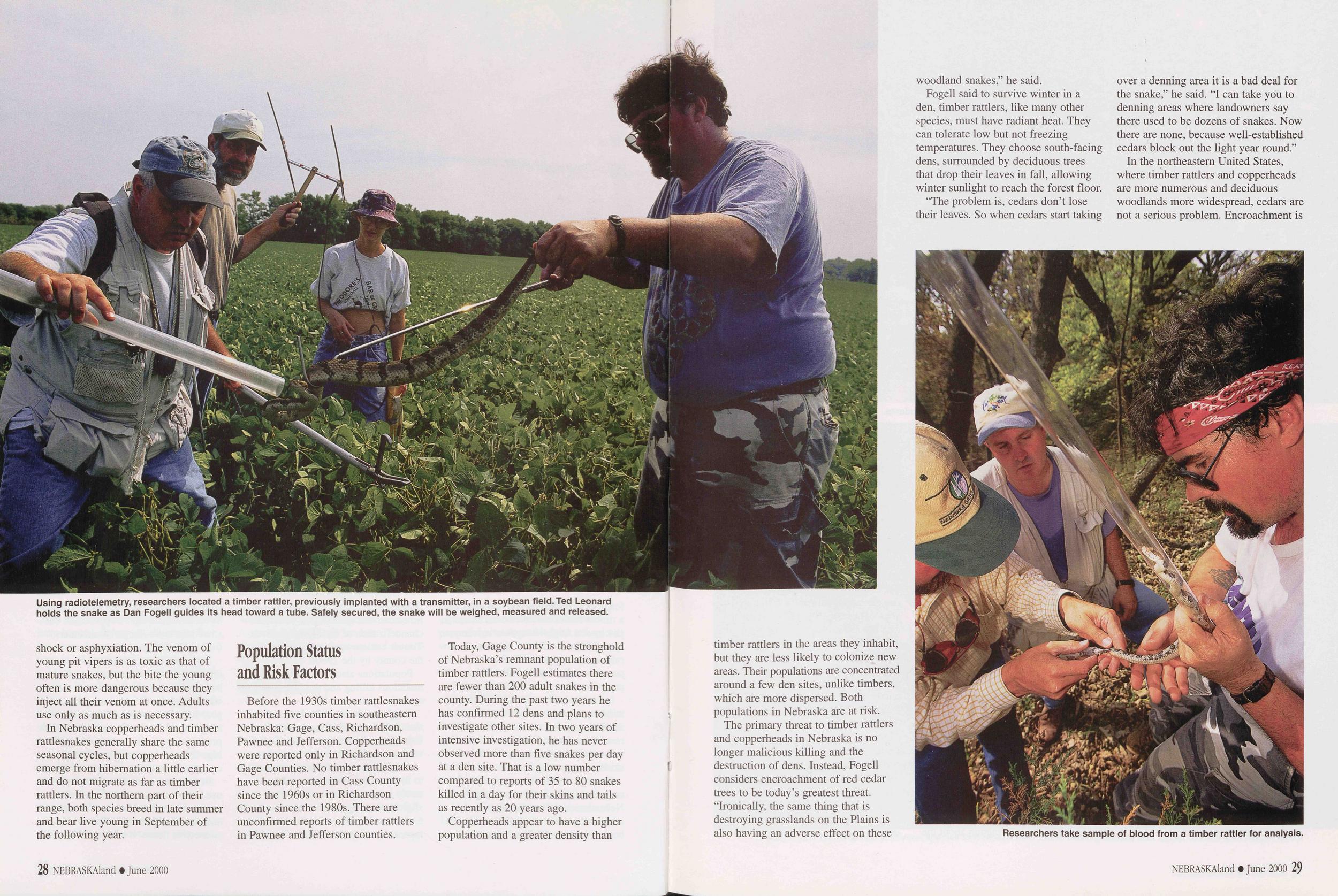
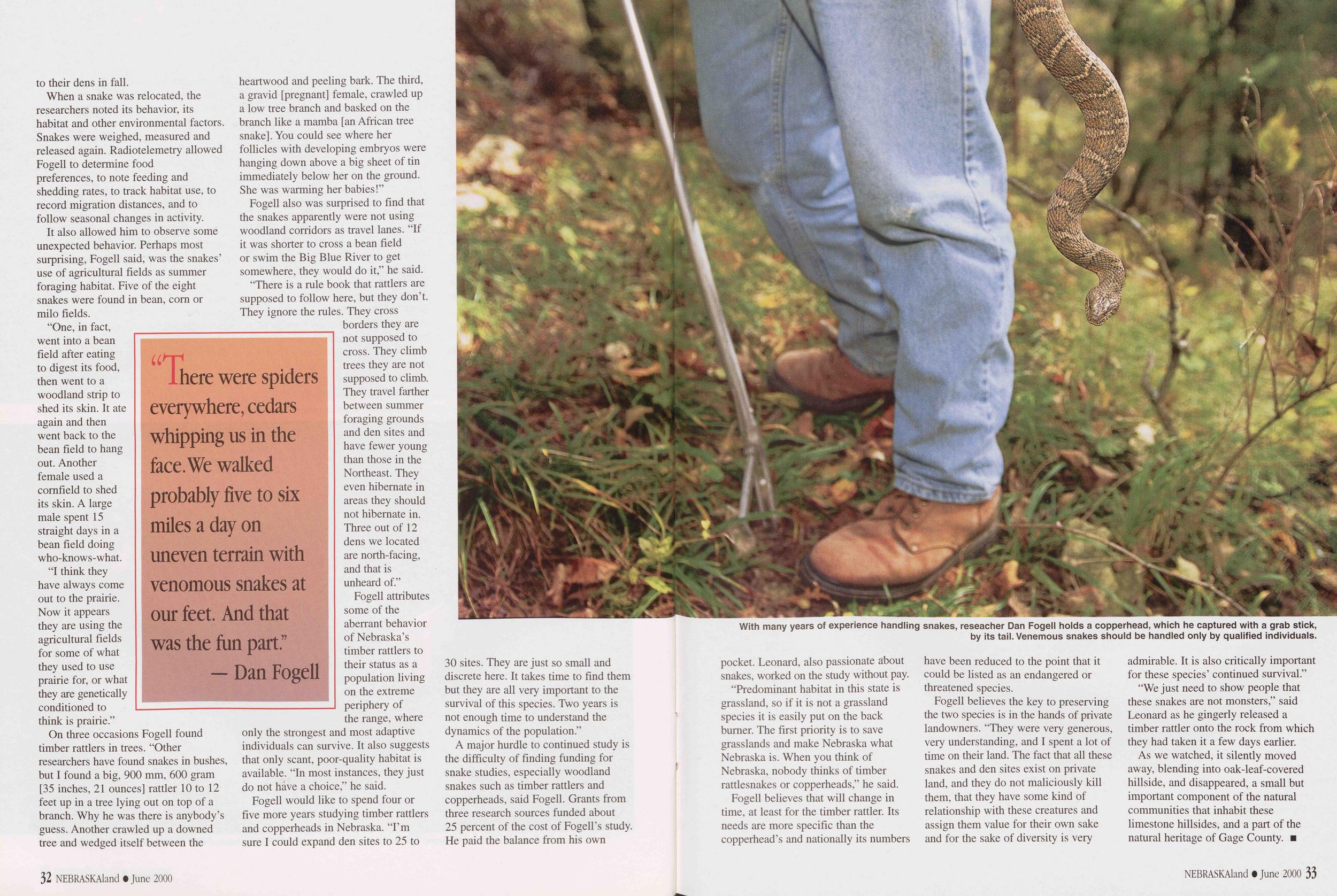
The researchers captured snakes using a grab stick, a set of tongs on a long aluminum pole. After capture snakes were placed head-first into a clear plastic tube. With a snake’s head in the tube, they could safely work on the tail end, determining the snake’s sex, measuring it and inserting a microchip that can be read electronically to identify the snake if it is recaptured. In hundreds of hours on foot during the first year, the researchers encountered 29 timber rattlers and 32 copperheads.
The first year’s work allowed Fogell to draw some conclusions about the seasonal cycles of the two species. After spending October to April in a den, the snakes emerge and absorb the sun’s rays for one to three weeks on a rock ledge near the den. “It’s like recharging a battery,” said Fogell.
The next step is shedding the old skin, a process that makes snakes highly vulnerable to predators because they cannot see or move well and the skin loses its characteristic camouflage before it is shed. For warmth and security, shedding snakes retreat to surface dens. In Fogell’s study area, the surface dens are commonly the large nests of sticks, detritus and dung built by wood rats, often called pack rats.
By late June, timber rattlers and copperheads move to summer foraging grounds. In general, summer habitats are heavily wooded, leaf-littered areas with a broken, high canopy and a heavy lower canopy. There, they seek out rodent runs where they wait for prey. After feeding, they find a sunny spot or a camouflaged area where they bask and digest the food.
By late August, both species breed. Eggs are not fertilized immediately after copulation. Instead, females of both species retain sperm through the winter, then ovulate and gestate during the summer, giving birth in September, more than a year after breeding. Fogell has found litters of copperheads in September, but never at den sites, which suggests that they are bom elsewhere and may spend the winter some place other than the den.
Timber rattlers do not breed until they are 7 or 8 years old, and are thought to breed only once every three years. They can live 20 to 25 years in the wild. Recent studies in Pennsylvania and West Virginia indicate that some individuals five longer than 50 years.
In fall, when nighttime temperatures drop below 40 degrees, adult snakes return to dens. By mid-October, all are safely underground.
The second year of Fogell’s study
focused on timber rattlers. Returning to
the same den sites, he captured
snakes and surgically implanted radio
transmitters. Three males and five
females, two of them pregnant, were
implanted and returned to the wild. The
released snakes were tracked three or
four days each week until they returned
30 NEBRASKAland • June 2000
NEBRASKAland • June 2000 Z1
 to their dens in fall.
When a snake was relocated, the researchers noted its behavior, its habitat and other environmental factors. Snakes were weighed, measured and released again. Radiotelemetry allowed Fogell to determine food preferences, to note feeding and shedding rates, to track habitat use, to record migration distances, and to follow seasonal changes in activity.
It also allowed him to observe some unexpected behavior. Perhaps most surprising, Fogell said, was the snakes’ use of agricultural fields as summer foraging habitat. Five of the eight snakes were found in bean, com or milo fields.
“One, in fact, went into a bean field after eating to digest its food, then went to a woodland strip to shed its skin. It ate again and then went back to the bean field to hang out. Another female used a cornfield to shed its skin. A large male spent 15 straight days in a bean field doing who-knows-what.
“I think they have always come out to the prairie. Now it appears they are using the agricultural fields for some of what they used to use prairie for, or what they are genetically conditioned to think is prairie.”
There were spiders everywhere, cedars whipping us in the face.We walked probably five to six miles a day on uneven terrain with venomous snakes at our feet. And that was the fun part.” — Dan FogellOn three occasions Fogell found timber rattlers in trees. “Other researchers have found snakes in bushes, but I found a big, 900 mm, 600 gram [35 inches, 21 ounces] rattler 10 to 12 feet up in a tree lying out on top of a branch. Why he was there is anybody’s guess. Another crawled up a downed tree and wedged itself between the heartwood and peeling bark. The third, a gravid [pregnant] female, crawled up a low tree branch and basked on the branch like a mamba [an African tree snake]. You could see where her follicles with developing embryos were hanging down above a big sheet of tin immediately below her on the ground. She was warming her babies!”
Fogell also was surprised to find that the snakes apparently were not using woodland corridors as travel lanes. “If it was shorter to cross a bean field or swim the Big Blue River to get somewhere, they would do it,” he said.
“There is a rule book that rattlers are supposed to follow here, but they don’t. They ignore the rules. They cross borders they are not supposed to cross. They climb trees they are not supposed to climb. They travel farther between summer foraging grounds and den sites and have fewer young than those in the Northeast. They even hibernate in areas they should not hibernate in. Three out of 12 dens we located are north-facing, and that is unheard of.”
Fogell attributes some of the aberrant behavior of Nebraska’s timber rattlers to their status as a population living on the extreme periphery of the range, where only the strongest and most adaptive individuals can survive. It also suggests that only scant, poor-quality habitat is available. “In most instances, they just do not have a choice,” he said.
Fogell would like to spend four or five more years studying timber rattlers and copperheads in Nebraska. “I’m sure I could expand den sites to 25 to 30 sites. They are just so small and discrete here. It takes time to find them but they are all very important to the survival of this species. Two years is not enough time to understand the dynamics of the population.”
A major hurdle to continued study is the difficulty of finding funding for snake studies, especially woodland snakes such as timber rattlers and copperheads, said Fogell. Grants from three research sources funded about 25 percent of the cost of Fogell’s study. He paid the balance from his own pocket. Leonard, also passionate about snakes, worked on the study without pay.
“Predominant habitat in this state is grassland, so if it is not a grassland species it is easily put on the back burner. The first priority is to save grasslands and make Nebraska what Nebraska is. When you think of Nebraska, nobody thinks of timber rattlesnakes or copperheads,” he said.
Fogell believes that will change in time, at least for the timber rattler. Its needs are more specific than the copperhead’s and nationally its numbers have been reduced to the point that it could be listed as an endangered or threatened species.
Fogell believes the key to preserving the two species is in the hands of private landowners. “They were very generous, very understanding, and I spent a lot of time on their land. The fact that all these snakes and den sites exist on private land, and they do not maliciously kill them, that they have some kind of relationship with these creatures and assign them value for their own sake and for the sake of diversity is very admirable. It is also critically important for these species’ continued survival.”
“We just need to show people that these snakes are not monsters,” said Leonard as he gingerly released a timber rattler onto the rock from which they had taken it a few days earlier.
As we watched, it silently moved away, blending into oak-leaf-covered hillside, and disappeared, a small but important component of the natural communities that inhabit these limestone hillsides, and a part of the natural heritage of Gage County. ■
32 NEBRASKAland • June 2000 NEBRASKAland • June 2000 33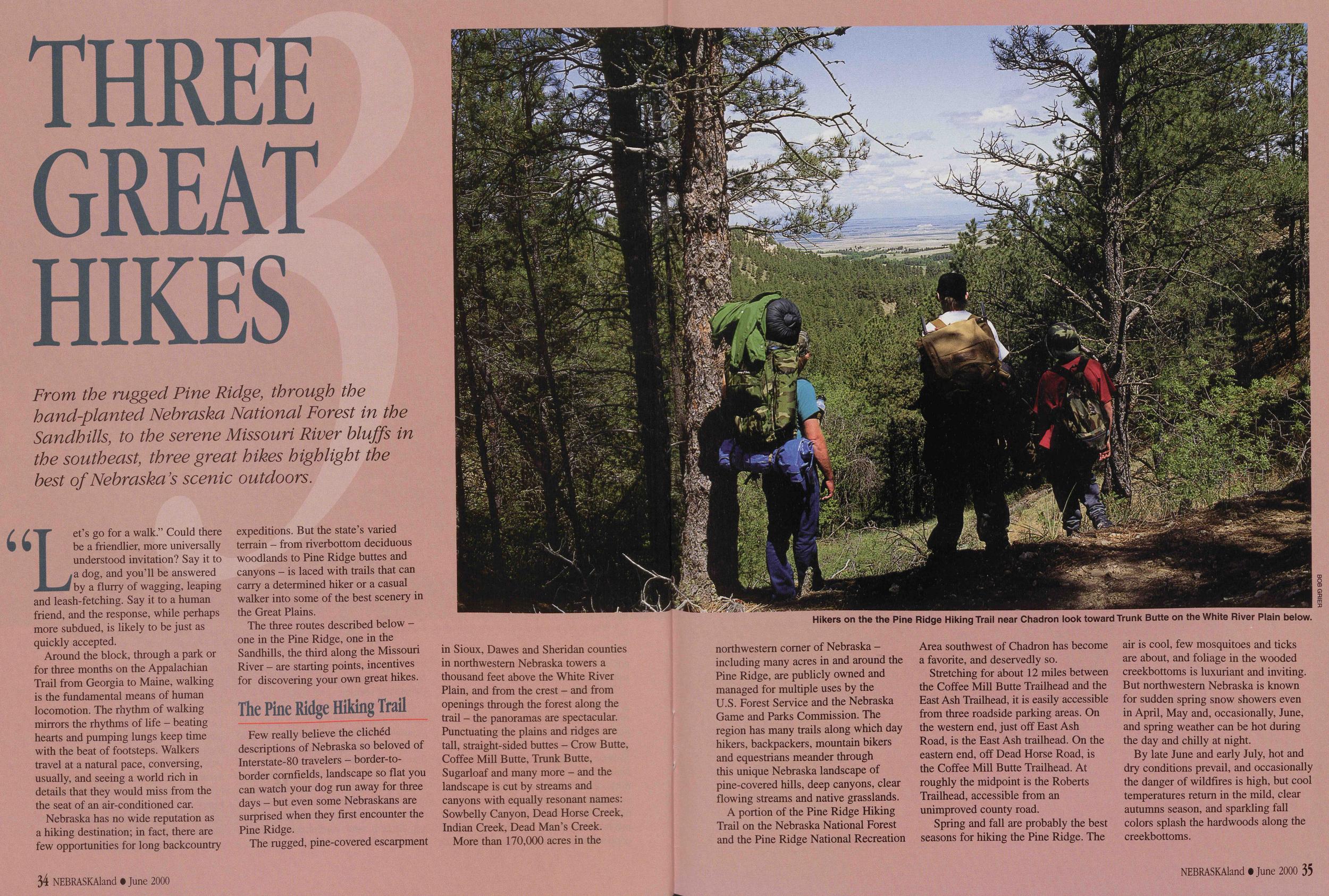
Three GREAT HIKES
From the rugged Pine Ridge, through the hand-planted Nebraska National Forest in the Sandhills, to the serene Missouri River bluffs in the southeast, three great hikes highlight the best of Nebraska’s scenic outdoors.Let’s go for a walk.” Could there be a friendlier, more universally understood invitation? Say it to a dog, and you’ll be answered by a flurry of wagging, leaping and leash-fetching. Say it to a human friend, and the response, while perhaps more subdued, is likely to be just as quickly accepted.
Around the block, through a park or for three months on the Appalachian Trail from Georgia to Maine, walking is the fundamental means of human locomotion. The rhythm of walking mirrors the rhythms of life - beating hearts and pumping lungs keep time with the beat of footsteps. Walkers travel at a natural pace, conversing, usually, and seeing a world rich in details that they would miss from the the seat of an air-conditioned car.
Nebraska has no wide reputation as a hiking destination; in fact, there are few opportunities for long backcountry expeditions. But the state’s varied terrain - from riverbottom deciduous woodlands to Pine Ridge buttes and canyons - is laced with trails that can carry a determined hiker or a casual walker into some of the best scenery in the Great Plains.
The three routes described below - one in the Pine Ridge, one in the Sandhills, the third along the Missouri River - are starting points, incentives for discovering your own great hikes.
The Pine Ridge Hiking TrailFew really believe the cliched descriptions of Nebraska so beloved of Interstate-80 travelers - border-to- border cornfields, landscape so flat you can watch your dog run away for three days - but even some Nebraskans are surprised when they first encounter the Pine Ridge.
The rugged, pine-covered escarpment in Sioux, Dawes and Sheridan counties in northwestern Nebraska towers a thousand feet above the White River Plain, and from the crest - and from openings through the forest along the trail - the panoramas are spectacular. Punctuating the plains and ridges are tall, straight-sided buttes - Crow Butte, Coffee Mill Butte, Trunk Butte, Sugarloaf and many more - and the landscape is cut by streams and canyons with equally resonant names: Sowbelly Canyon, Dead Horse Creek, Indian Creek, Dead Man’s Creek.
More than 170,000 acres in the northwestern comer of Nebraska - including many acres in and around the Pine Ridge, are publicly owned and managed for multiple uses by the U.S. Forest Service and the Nebraska Game and Parks Commission. The region has many trails along which day hikers, backpackers, mountain bikers and equestrians meander through this unique Nebraska landscape of pine-covered hills, deep canyons, clear flowing streams and native grasslands.
A portion of the Pine Ridge Hiking Trail on the Nebraska National Forest and the Pine Ridge National Recreation Area southwest of Chadron has become a favorite, and deservedly so.
Stretching for about 12 miles between the Coffee Mill Butte Trailhead and the East Ash Trailhead, it is easily accessible from three roadside parking areas. On the western end, just off East Ash Road, is the East Ash trailhead. On the eastern end, off Dead Horse Road, is the Coffee Mill Butte Trailhead. At roughly the midpoint is the Roberts Trailhead, accessible from an unimproved county road.
Spring and fall are probably the best seasons for hiking the Pine Ridge. The air is cool, few mosquitoes and ticks are about, and foliage in the wooded creekbottoms is luxuriant and inviting. But northwestern Nebraska is known for sudden spring snow showers even in April, May and, occasionally, June, and spring weather can be hot during the day and chilly at night.
By late June and early July, hot and dry conditions prevail, and occasionally the danger of wildfires is high, but cool temperatures return in the mild, clear autumns season, and sparkling fall colors splash the hardwoods along the creekbottoms.
34 NEBRASKAland • June 2000 NEBRASKAland • June 2000 35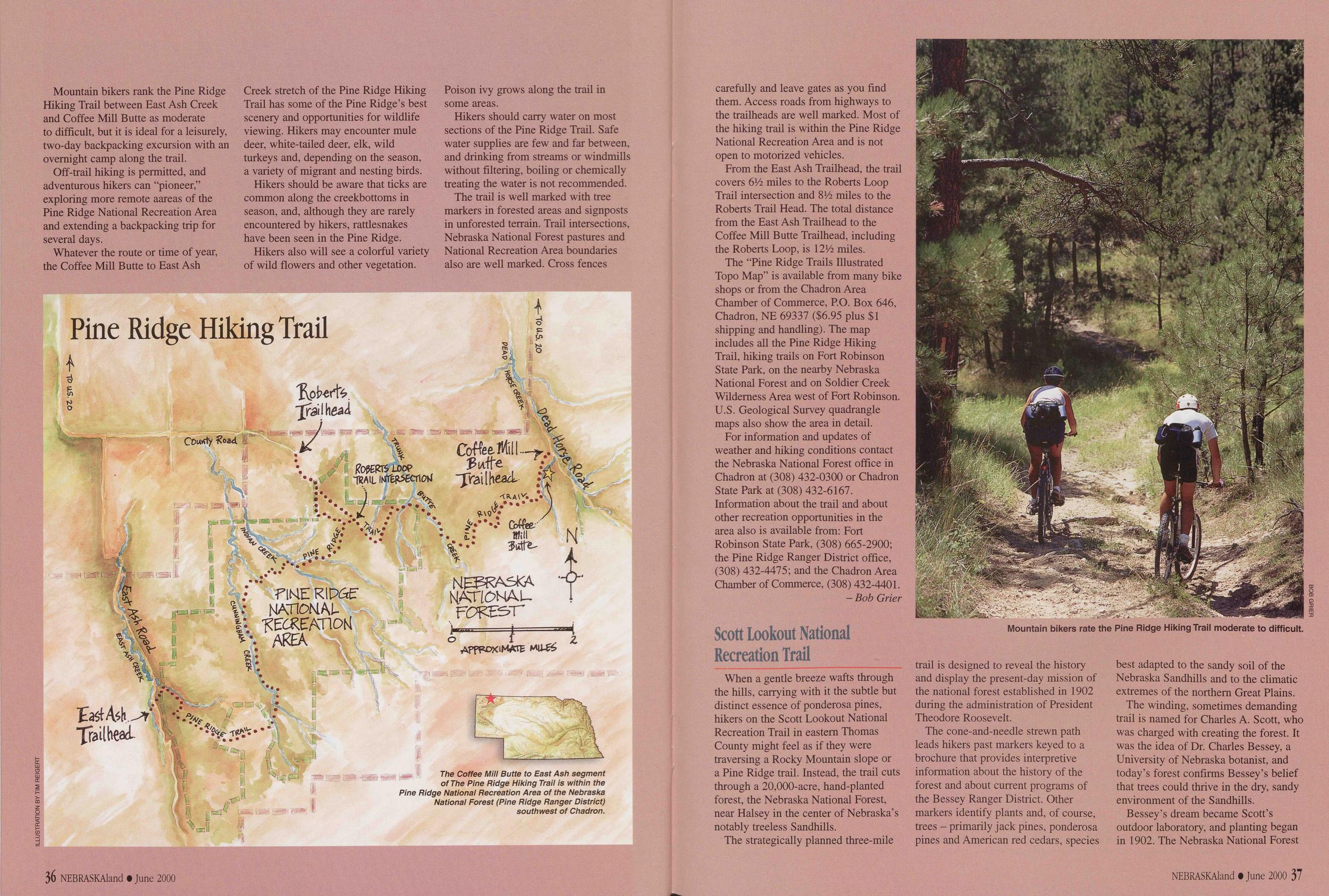
Mountain bikers rank the Pine Ridge Hiking Trail between East Ash Creek and Coffee Mill Butte as moderate to difficult, but it is ideal for a leisurely, two-day backpacking excursion with an overnight camp along the trail.
Off-trail hiking is permitted, and adventurous hikers can “pioneer,” exploring more remote aareas of the Pine Ridge National Recreation Area and extending a backpacking trip for several days.
ILLUSTRATION BY TIM REIGERTWhatever the route or time of year, the Coffee Mill Butte to East Ash Creek stretch of the Pine Ridge Hiking Trail has some of the Pine Ridge’s best scenery and opportunities for wildlife viewing. Hikers may encounter mule deer, white-tailed deer, elk, wild turkeys and, depending on the season, a variety of migrant and nesting birds.
Hikers should be aware that ticks are common along the creekbottoms in season, and, although they are rarely encountered by hikers, rattlesnakes have been seen in the Pine Ridge.
Hikers also will see a colorful variety of wild flowers and other vegetation. Poison ivy grows along the trail in some areas.
Hikers should carry water on most sections of the Pine Ridge Trail. Safe water supplies are few and far between, and drinking from streams or windmills without filtering, boiling or chemically treating the water is not recommended.
The trail is well marked with tree markers in forested areas and signposts in unforested terrain. Trail intersections, Nebraska National Forest pastures and National Recreation Area boundaries also are well marked. Cross fences carefully and leave gates as you find them. Access roads from highways to the trailheads are well marked. Most of the hiking trail is within the Pine Ridge National Recreation Area and is not open to motorized vehicles.
From the East Ash Trailhead, the trail covers 6V2 miles to the Roberts Loop Trail intersection and 814 miles to the Roberts Trail Head. The total distance from the East Ash Trailhead to the Coffee Mill Butte Trailhead, including the Roberts Loop, is 12 1/2 miles.
The “Pine Ridge Trails Illustrated Topo Map” is available from many bike shops or from the Chadron Area Chamber of Commerce, P.O. Box 646, Chadron, NE 69337 ($6.95 plus $1 shipping and handling). The map includes all the Pine Ridge Hiking Trail, hiking trails on Fort Robinson State Park, on the nearby Nebraska National Forest and on Soldier Creek Wilderness Area west of Fort Robinson. U.S. Geological Survey quadrangle maps also show the area in detail.
For information and updates of weather and hiking conditions contact the Nebraska National Forest office in Chadron at (308) 432-0300 or Chadron State Park at (308) 432-6167. Information about the trail and about other recreation opportunities in the area also is available from: Fort Robinson State Park, (308) 665-2900; the Pine Ridge Ranger District office, (308) 432-4475; and the Chadron Area Chamber of Commerce, (308) 432-4401.
- Bob Grier Scott Lookout National Recreation TrailWhen a gentle breeze wafts through the hills, carrying with it the subtle but distinct essence of ponderosa pines, hikers on the Scott Lookout National Recreation Trail in eastern Thomas County might feel as if they were traversing a Rocky Mountain slope or a Pine Ridge trail. Instead, the trail cuts through a 20,000-acre, hand-planted forest, the Nebraska National Forest, near Halsey in the center of Nebraska’s notably treeless Sandhills.
The strategically planned three-mile trail is designed to reveal the history and display the present-day mission of the national forest established in 1902 during the administration of President Theodore Roosevelt.
The cone-and-needle strewn path leads hikers past markers keyed to a brochure that provides interpretive information about the history of the forest and about current programs of the Bessey Ranger District. Other markers identify plants and, of course, trees - primarily jack pines, ponderosa pines and American red cedars, species best adapted to the sandy soil of the Nebraska Sandhills and to the climatic extremes of the northern Great Plains.
The winding, sometimes demanding trail is named for Charles A. Scott, who was charged with creating the forest. It was the idea of Dr. Charles Bessey, a University of Nebraska botanist, and today’s forest confirms Bessey’s belief that trees could thrive in the dry, sandy environment of the Sandhills.
Bessey’s dream became Scott’s
outdoor laboratory, and planting began
in 1902. The Nebraska National Forest
NEBRASKAland • June 2000 37
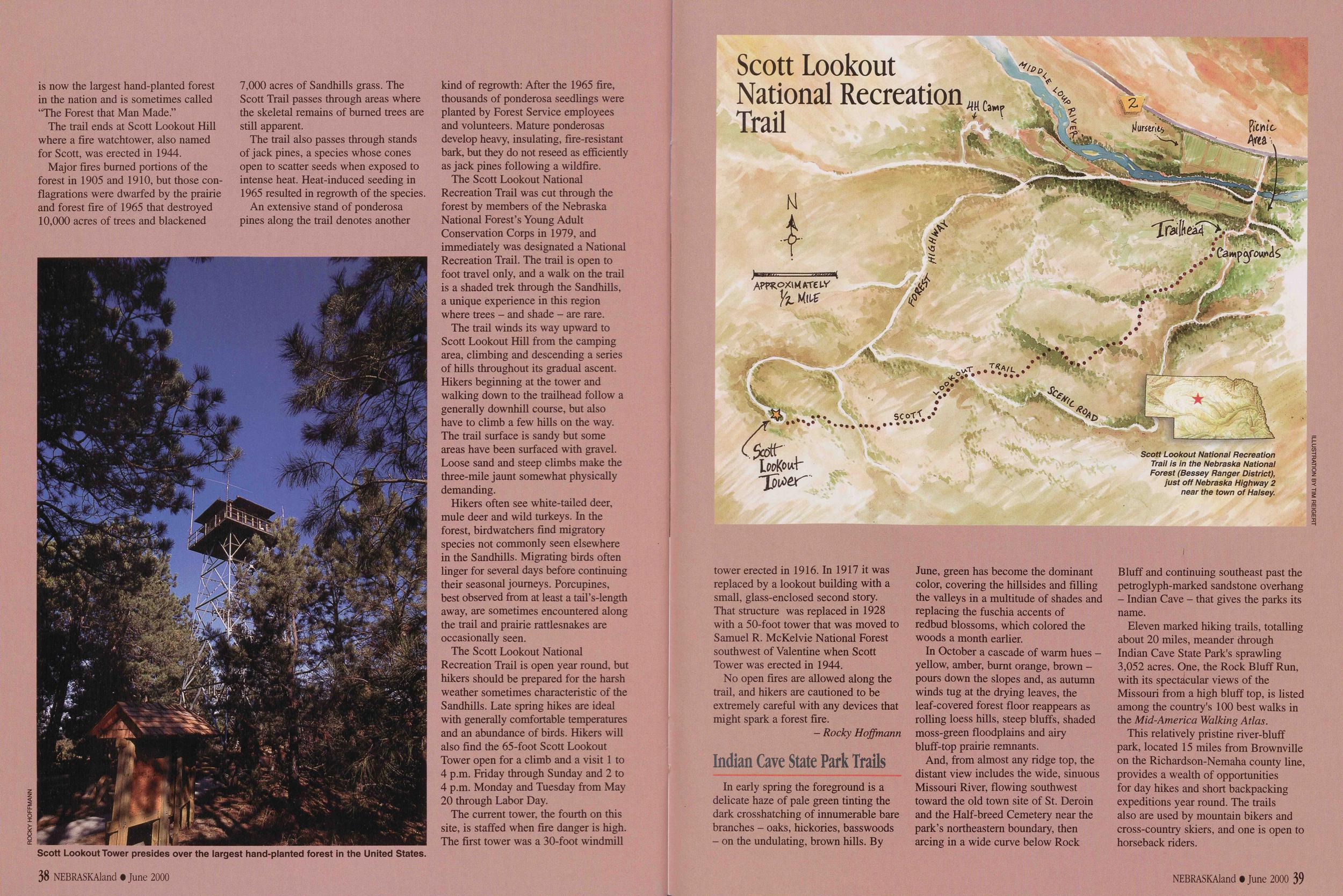 is now the largest hand-planted forest
in the nation and is sometimes called
“The Forest that Man Made.”
is now the largest hand-planted forest
in the nation and is sometimes called
“The Forest that Man Made.”
The trail ends at Scott Lookout Hill where a fire watchtower, also named for Scott, was erected in 1944.
ROCKY HOFFMANNMajor fires burned portions of the forest in 1905 and 1910, but those con- flagrations were dwarfed by the prairie and forest fire of 1965 that destroyed 10,000 acres of trees and blackened 7,000 acres of Sandhills grass. The Scott Trail passes through areas where the skeletal remains of burned trees are still apparent.
The trail also passes through stands of jack pines, a species whose cones open to scatter seeds when exposed to intense heat. Heat-induced seeding in 1965 resulted in regrowth of the species.
An extensive stand of ponderosa pines along the trail denotes another kind of regrowth: After the 1965 fire, thousands of ponderosa seedlings were planted by Forest Service employees and volunteers. Mature ponderosas develop heavy, insulating, fire-resistant bark, but they do not reseed as efficiently as jack pines following a wildfire.
The Scott Lookout National Recreation Trail was cut through the forest by members of the Nebraska National Forest’s Young Adult Conservation Corps in 1979, and immediately was designated a National Recreation Trail. The trail is open to foot travel only, and a walk on the trail is a shaded trek through the Sandhills, a unique experience in this region where trees - and shade - are rare.
The trail winds its way upward to Scott Lookout Hill from the camping area, climbing and descending a series of hills throughout its gradual ascent. Hikers beginning at the tower and walking down to the trailhead follow a generally downhill course, but also have to climb a few hills on the way. The trail surface is sandy but some areas have been surfaced with gravel. Loose sand and steep climbs make the three-mile jaunt somewhat physically demanding.
Hikers often see white-tailed deer, mule deer and wild turkeys. In the forest, birdwatchers find migratory species not commonly seen elsewhere in the Sandhills. Migrating birds often linger for several days before continuing their seasonal journeys. Porcupines, best observed from at least a tail’s-length away, are sometimes encountered along the trail and prairie rattlesnakes are occasionally seen.
The Scott Lookout National Recreation Trail is open year round, but hikers should be prepared for the harsh weather sometimes characteristic of the Sandhills. Late spring hikes are ideal with generally comfortable temperatures and an abundance of birds. Hikers will also find the 65-foot Scott Lookout Tower open for a climb and a visit 1 to 4 p.m. Friday through Sunday and 2 to 4 p.m. Monday and Tuesday from May 20 through Labor Day.
Scott Lookout National Recreation Trail is in the Nebraska National Forest (Bessey Ranger District), just off Nebraska Highway 2 near the town of Halsey.
ILLUSTRATION BY TIM REIGERTThe current tower, the fourth on this site, is staffed when fire danger is high. The first tower was a 30-foot windmill tower erected in 1916. In 1917 it was replaced by a lookout building with a small, glass-enclosed second story. That structure was replaced in 1928 with a 50-foot tower that was moved to Samuel R. McKelvie National Forest southwest of Valentine when Scott Tower was erected in 1944.
No open fires are allowed along the trail, and hikers are cautioned to be extremely careful with any devices that might spark a forest fire.
- Rocky Hoffmann Indian Cave State Park TrailsIn early spring the foreground is a delicate haze of pale green tinting the dark crosshatching of innumerable bare branches - oaks, hickories, basswoods - on the undulating, brown hills. By June, green has become the dominant color, covering the hillsides and filling the valleys in a multitude of shades and replacing the fuschia accents of redbud blossoms, which colored the woods a month earlier.
In October a cascade of warm hues - yellow, amber, burnt orange, brown - pours down the slopes and, as autumn winds tug at the drying leaves, the leaf-covered forest floor reappears as rolling loess hills, steep bluffs, shaded moss-green floodplains and airy bluff-top prairie remnants.
And, from almost any ridge top, the distant view includes the wide, sinuous Missouri River, flowing southwest toward the old town site of St. Deroin and the Half-breed Cemetery near the park’s northeastern boundary, then arcing in a wide curve below Rock Bluff and continuing southeast past the petroglyph-marked sandstone overhang - Indian Cave - that gives the parks its name.
Eleven marked hiking trails, totalling about 20 miles, meander through Indian Cave State Park's sprawling 3,052 acres. One, the Rock Bluff Run, with its spectacular views of the Missouri from a high bluff top, is listed among the country's 100 best walks in the Mid-America Walking Atlas.
This relatively pristine river-bluff park, located 15 miles from Brownville on the Richardson-Nemaha county line, provides a wealth of opportunities for day hikes and short backpacking expeditions year round. The trails also are used by mountain bikers and cross-country skiers, and one is open to horseback riders.
38 NEBRASKAland O June 2000 NEBRASKAland • June 2000 39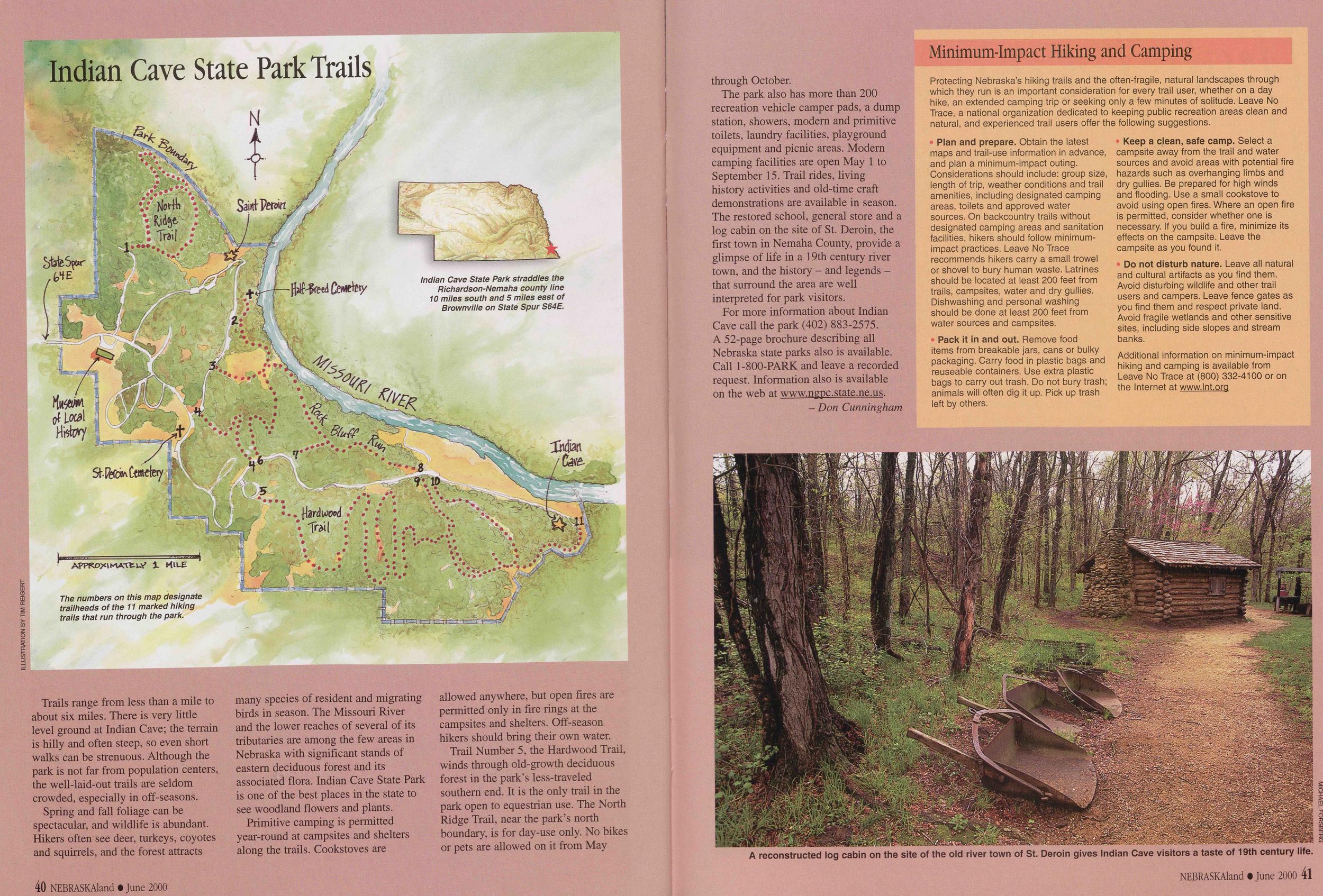
The numbers on this map designate trailheads of the 11 marked hiking trails that run through the park.
Indian Cave State Park straddles the Richardson-Nemaha county line 10 miles south and 5 miles east of Brownville on State Spur S64E.
Trails range from less than a mile to about six miles. There is very little level ground at Indian Cave; the terrain is hilly and often steep, so even short walks can be strenuous. Although the park is not far from population centers, the well-laid-out trails are seldom crowded, especially in off-seasons.
Spring and fall foliage can be spectacular, and wildlife is abundant. Hikers often see deer, turkeys, coyotes and squirrels, and the forest attracts many species of resident and migrating birds in season. The Missouri River and the lower reaches of several of its tributaries are among the few areas in Nebraska with significant stands of eastern deciduous forest and its associated flora. Indian Cave State Park is one of the best places in the state to see woodland flowers and plants.
Primitive camping is permitted year-round at campsites and shelters along the trails. Cookstoves are allowed anywhere, but open fires are permitted only in fire rings at the campsites and shelters. Off-season hikers should bring their own water.
Trail Number 5, the Hardwood Trail, winds through old-growth deciduous forest in the park’s less-traveled southern end. It is the only trail in the park open to equestrian use. The North Ridge Trail, near the park’s north boundary, is for day-use only. No bikes or pets are allowed on it from May through October.
The park also has more than 200 recreation vehicle camper pads, a dump station, showers, modem and primitive toilets, laundry facilities, playground equipment and picnic areas. Modem camping facilities are open May 1 to September 15. Trail rides, living history activities and old-time craft demonstrations are available in season. The restored school, general store and a log cabin on the site of St. Deroin, the first town in Nemaha County, provide a glimpse of life in a 19th century river town, and the history - and legends - that surround the area are well interpreted for park visitors.
For more information about Indian Cave call the park (402) 883-2575. A 52-page brochure describing all Nebraska state parks also is available. Call 1-800-PARK and leave a recorded request. Information also is available on the web at www.ngpc.state.ne.us.
- Don CunninghamProtecting Nebraska’s hiking trails and the often-fragile, natural landscapes through which they run is an important consideration for every trail user, whether on a day hike, an extended camping trip or seeking only a few minutes of solitude. Leave No Trace, a national organization dedicated to keeping public recreation areas clean and natural, and experienced trail users offer the following suggestions.
Keep a clean, safe camp. Select a campsite away from the trail and water sources and avoid areas with potential fire hazards such as overhanging limbs and dry gullies. Be prepared for high winds and flooding. Use a small cookstove to avoid using open fires. Where an open fire is permitted, consider whether one is necessary. If you build a fire, minimize its effects on the campsite. Leave the campsite as you found it.
Do not disturb nature. Leave all natural and cultural artifacts as you find them. Avoid disturbing wildlife and other trail users and campers. Leave fence gates as you find them and respect private land. Avoid fragile wetlands and other sensitive sites, including side slopes and stream banks.
Additional information on minimum-impact hiking and camping is available from Leave No Trace at (800) 332-4100 or on the Internet at www.lnt.org
Plan and prepare. Obtain the latest maps and trail-use information in advance, and plan a minimum-impact outing. Considerations should include: group size, length of trip, weather conditions and trail amenities, including designated camping areas, toilets and approved water sources. On backcountry trails without designated camping areas and sanitation facilities, hikers should follow minimum- impact practices. Leave No Trace recommends hikers carry a small trowel or shovel to bury human waste. Latrines should be located at least 200 feet from trails, campsites, water and dry gullies. Dishwashing and personal washing should be done at least 200 feet from water sources and campsites.
Pack it in and out. Remove food items from breakable jars, cans or bulky packaging. Carry food in plastic bags and reuseable containers. Use extra plastic bags to carry out trash. Do not bury trash; animals will often dig it up. Pick up trash left by others.
40 NEBRASKAland • June 2000 NEBRASKAJand • June 2000 41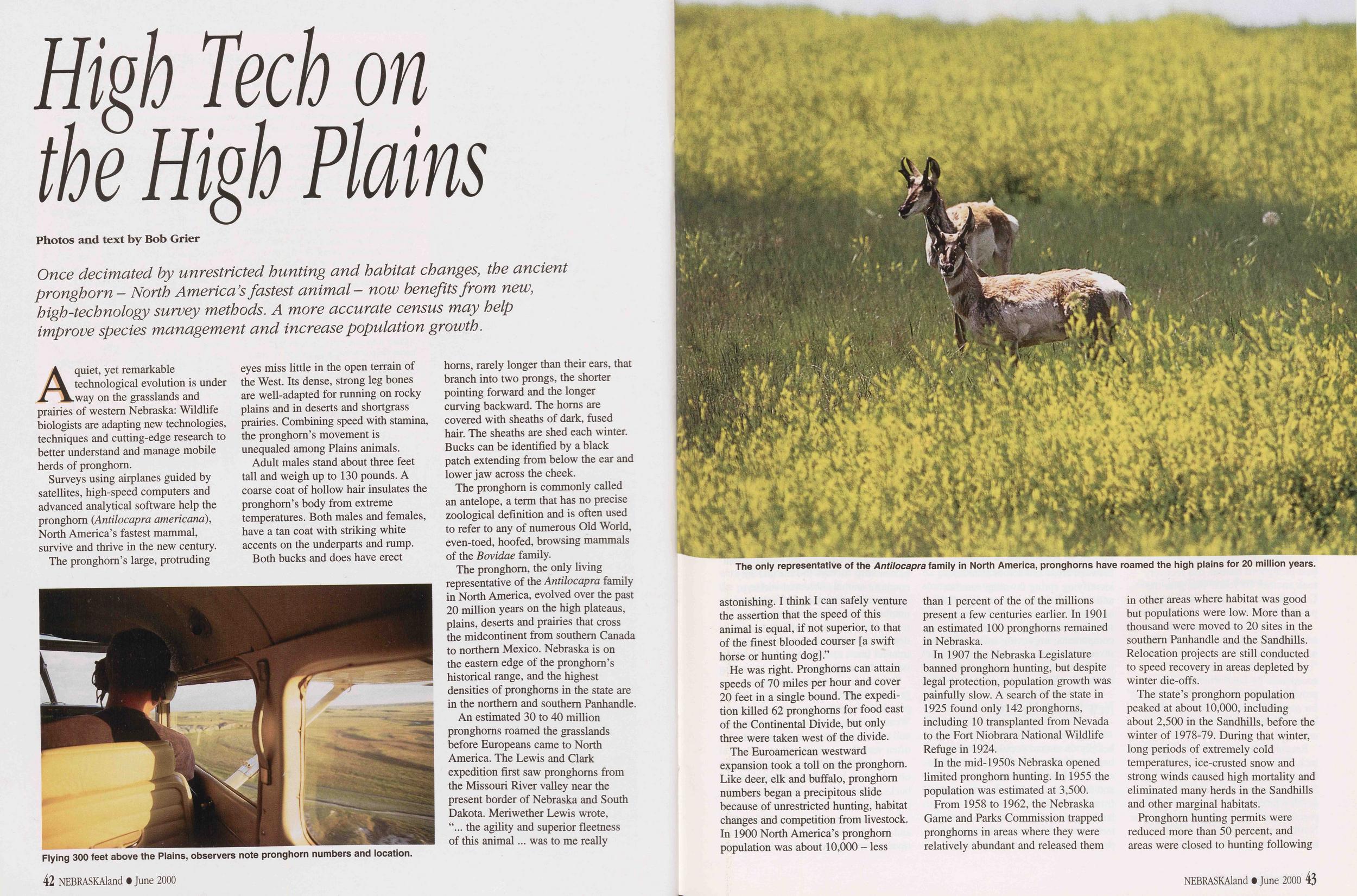
High Tech on the High Plains
Photos and text by Bob Grier Once decimated by unrestricted bunting and habitat changes, the ancient pronghorn - North America’s fastest animal - now benefits from new, high-technology survey methods. A more accurate census may help improve species management and increase population growth.A quiet, yet remarkable technological evolution is under way on the grasslands and prairies of western Nebraska: Wildlife biologists are adapting new technologies, techniques and cutting-edge research to better understand and manage mobile herds of pronghorn.
Surveys using airplanes guided by satellites, high-speed computers and advanced analytical software help the pronghorn (Antilocapra americana), North America’s fastest mammal, survive and thrive in the new century.
The pronghorn’s large, protruding eyes miss little in the open terrain of the West. Its dense, strong leg bones are well-adapted for running on rocky plains and in deserts and shortgrass prairies. Combining speed with stamina, the pronghorn’s movement is unequaled among Plains animals.
Adult males stand about three feet tall and weigh up to 130 pounds. A coarse coat of hollow hair insulates the pronghorn’s body from extreme temperatures. Both males and females, have a tan coat with striking white accents on the underparts and rump.
Both bucks and does have erect horns, rarely longer than their ears, that branch into two prongs, the shorter pointing forward and the longer curving backward. The horns are covered with sheaths of dark, fused hair. The sheaths are shed each winter. Bucks can be identified by a black patch extending from below the ear and lower jaw across the cheek.
The pronghorn is commonly called an antelope, a term that has no precise zoological definition and is often used to refer to any of numerous Old World, even-toed, hoofed, browsing mammals of the Bovidae family.
The pronghorn, the only living representative of the Antilocapra family in North America, evolved over the past 20 million years on the high plateaus, plains, deserts and prairies that cross the midcontinent from southern Canada to northern Mexico. Nebraska is on the eastern edge of the pronghorn’s historical range, and the highest densities of pronghorns in the state are in the northern and southern Panhandle.
An estimated 30 to 40 million pronghorns roamed the grasslands before Europeans came to North America. The Lewis and Clark expedition first saw pronghorns from the Missouri River valley near the present border of Nebraska and South Dakota. Meriwether Lewis wrote, "... the agility and superior fleetness of this animal... was to me really astonishing. I think I can safely venture the assertion that the speed of this animal is equal, if not superior, to that of the finest blooded courser [a swift horse or hunting dog].”
He was right. Pronghorns can attain speeds of 70 miles per hour and cover 20 feet in a single bound. The expedi- tion killed 62 pronghorns for food east of the Continental Divide, but only three were taken west of the divide.
The Euroamerican westward expansion took a toll on the pronghorn. Like deer, elk and buffalo, pronghorn numbers began a precipitous slide because of unrestricted hunting, habitat changes and competition from livestock. In 1900 North America’s pronghorn population was about 10,000 - less than 1 percent of the of the millions present a few centuries earlier. In 1901 an estimated 100 pronghorns remained in Nebraska.
In 1907 the Nebraska Legislature banned pronghorn hunting, but despite legal protection, population growth was painfully slow. A search of the state in 1925 found only 142 pronghorns, including 10 transplanted from Nevada to the Fort Niobrara National Wildlife Refuge in 1924.
In the mid-1950s Nebraska opened limited pronghorn hunting. In 1955 the population was estimated at 3,500.
From 1958 to 1962, the Nebraska Game and Parks Commission trapped pronghorns in areas where they were relatively abundant and released them in other areas where habitat was good but populations were low. More than a thousand were moved to 20 sites in the southern Panhandle and the Sandhills. Relocation projects are still conducted to speed recovery in areas depleted by winter die-offs.
The state’s pronghorn population peaked at about 10,000, including about 2,500 in the Sandhills, before the winter of 1978-79. During that winter, long periods of extremely cold temperatures, ice-crusted snow and strong winds caused high mortality and eliminated many herds in the Sandhills and other marginal habitats.
Pronghorn hunting permits were
reduced more than 50 percent, and
areas were closed to hunting following
NEBRASKAland • June 2000 43
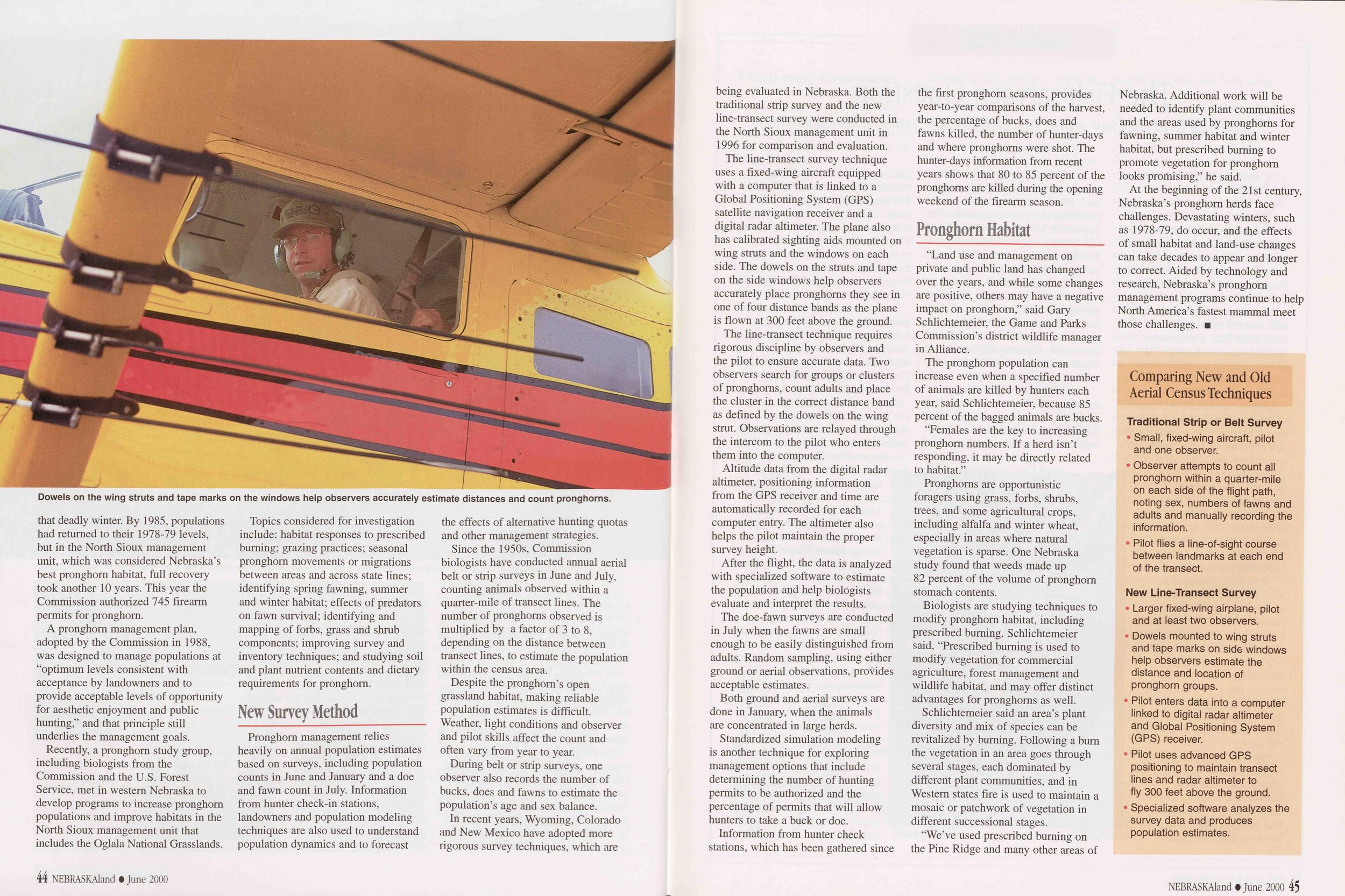 that deadly winter. By 1985, populations
had returned to their 1978-79 levels,
but in the North Sioux management
unit, which was considered Nebraska’s
best pronghorn habitat, full recovery
took another 10 years. This year the
Commission authorized 745 firearm
permits for pronghorn.
that deadly winter. By 1985, populations
had returned to their 1978-79 levels,
but in the North Sioux management
unit, which was considered Nebraska’s
best pronghorn habitat, full recovery
took another 10 years. This year the
Commission authorized 745 firearm
permits for pronghorn.
A pronghorn management plan, adopted by the Commission in 1988, was designed to manage populations at "optimum levels consistent with acceptance by landowners and to provide acceptable levels of opportunity for aesthetic enjoyment and public hunting,” and that principle still underlies the management goals.
Recently, a pronghorn study group, including biologists from the Commission and the U.S. Forest Service, met in western Nebraska to develop programs to increase pronghorn populations and improve habitats in the North Sioux management unit that includes the Oglala National Grasslands.
Topics considered for investigation include: habitat responses to prescribed burning; grazing practices; seasonal pronghorn movements or migrations between areas and across state lines; identifying spring fawning, summer and winter habitat; effects of predators on fawn survival; identifying and mapping of forbs, grass and shrub components; improving survey and inventory techniques; and studying soil and plant nutrient contents and dietary requirements for pronghorn.
New Survey MethodPronghorn management relies heavily on annual population estimates based on surveys, including population counts in June and January and a doe and fawn count in July. Information from hunter check-in stations, landowners and population modeling techniques are also used to understand population dynamics and to forecast the effects of alternative hunting quotas and other management strategies.
Since the 1950s, Commission biologists have conducted annual aerial belt or strip surveys in June and July, counting animals observed within a quarter-mile of transect lines. The number of pronghorns observed is multiplied by a factor of 3 to 8, depending on the distance between transect lines, to estimate the population within the census area.
Despite the pronghorn’s open grassland habitat, making reliable population estimates is difficult. Weather, light conditions and observer and pilot skills affect the count and often vary from year to year.
During belt or strip surveys, one observer also records the number of bucks, does and fawns to estimate the population’s age and sex balance.
In recent years, Wyoming, Colorado and New Mexico have adopted more rigorous survey techniques, which are being evaluated in Nebraska. Both the traditional strip survey and the new line-transect survey were conducted in the North Sioux management unit in 1996 for comparison and evaluation.
The line-transect survey technique uses a fixed-wing aircraft equipped with a computer that is linked to a Global Positioning System (GPS) satellite navigation receiver and a digital radar altimeter. The plane also has calibrated sighting aids mounted on wing struts and the windows on each side. The dowels on the struts and tape on the side windows help observers accurately place pronghorns they see in one of four distance bands as the plane is flown at 300 feet above the ground.
The line-transect technique requires rigorous discipline by observers and the pilot to ensure accurate data. Two observers search for groups or clusters of pronghorns, count adults and place the cluster in the correct distance band as defined by the dowels on the wing strut. Observations are relayed through the intercom to the pilot who enters them into the computer.
Altitude data from the digital radar altimeter, positioning information from the GPS receiver and time are automatically recorded for each computer entry. The altimeter also helps the pilot maintain the proper survey height.
After the flight, the data is analyzed with specialized software to estimate the population and help biologists evaluate and interpret the results.
The doe-fawn surveys are conducted in July when the fawns are small enough to be easily distinguished from adults. Random sampling, using either ground or aerial observations, provides acceptable estimates.
Both ground and aerial surveys are done in January, when the animals are concentrated in large herds.
Standardized simulation modeling is another technique for exploring management options that include determining the number of hunting permits to be authorized and the percentage of permits that will allow hunters to take a buck or doe.
Information from hunter check stations, which has been gathered since the first pronghorn seasons, provides year-to-year comparisons of the harvest, the percentage of bucks, does and fawns killed, the number of hunter-days and where pronghorns were shot. The hunter-days information from recent years shows that 80 to 85 percent of the pronghorns are killed during the opening weekend of the firearm season.
Pronghorn Habitat"Land use and management on private and public land has changed over the years, and while some changes are positive, others may have a negative impact on pronghorn,” said Gary Schlichtemeier, the Game and Parks Commission’s district wildlife manager in Alliance.
The pronghorn population can increase even when a specified number of animals are killed by hunters each year, said Schlichtemeier, because 85 percent of the bagged animals are bucks.
"Females are the key to increasing pronghorn numbers. If a herd isn’t responding, it may be directly related to habitat.”
Pronghorns are opportunistic foragers using grass, forbs, shrubs, trees, and some agricultural crops, including alfalfa and winter wheat, especially in areas where natural vegetation is sparse. One Nebraska study found that weeds made up 82 percent of the volume of pronghorn stomach contents.
Biologists are studying techniques to modify pronghorn habitat, including prescribed burning. Schlichtemeier said, "Prescribed burning is used to modify vegetation for commercial agriculture, forest management and wildlife habitat, and may offer distinct advantages for pronghorns as well.
Schlichtemeier said an area’s plant diversity and mix of species can be revitalized by burning. Following a bum the vegetation in an area goes through several stages, each dominated by different plant communities, and in Western states fire is used to maintain a mosaic or patchwork of vegetation in different successions stages.
“We’ve used prescribed burning on the Pine Ridge and many other areas of Nebraska. Additional work will be needed to identify plant communities and the areas used by pronghorns for fawning, summer habitat and winter habitat, but prescribed burning to promote vegetation for pronghorn looks promising,” he said.
At the beginning of the 21st century, Nebraska’s pronghorn herds face challenges. Devastating winters, such as 1978-79, do occur, and the effects of small habitat and land-use changes can take decades to appear and longer to correct. Aided by technology and research, Nebraska’s pronghorn management programs continue to help North America’s fastest mammal meet those challenges. ■
Comparing New and Old Aerial Census TechniquesTraditional Strip or Belt Survey
• Small, fixed-wing aircraft, pilot and one observer.
• Observer attempts to count all pronghorn within a quarter-mile on each side of the flight path, noting sex, numbers of fawns and adults and manually recording the information.
• Pilot flies a line-of-sight course between landmarks at each end of the transect.
New Line-Transect Survey
• Larger fixed-wing airplane, pilot and at least two observers.
• Dowels mounted to wing struts and tape marks on side windows help observers estimate the distance and location of pronghorn groups.
• Pilot enters data into a computer linked to digital radar altimeter and Global Positioning System (GPS) receiver.
• Pilot uses advanced GPS positioning to maintain transect lines and radar altimeter to fly 300 feet above the ground.
• Specialized software analyzes the survey data and produces population estimates.
44 NEBRASKAland • June 2000 NEBRASKAland • June 2000 43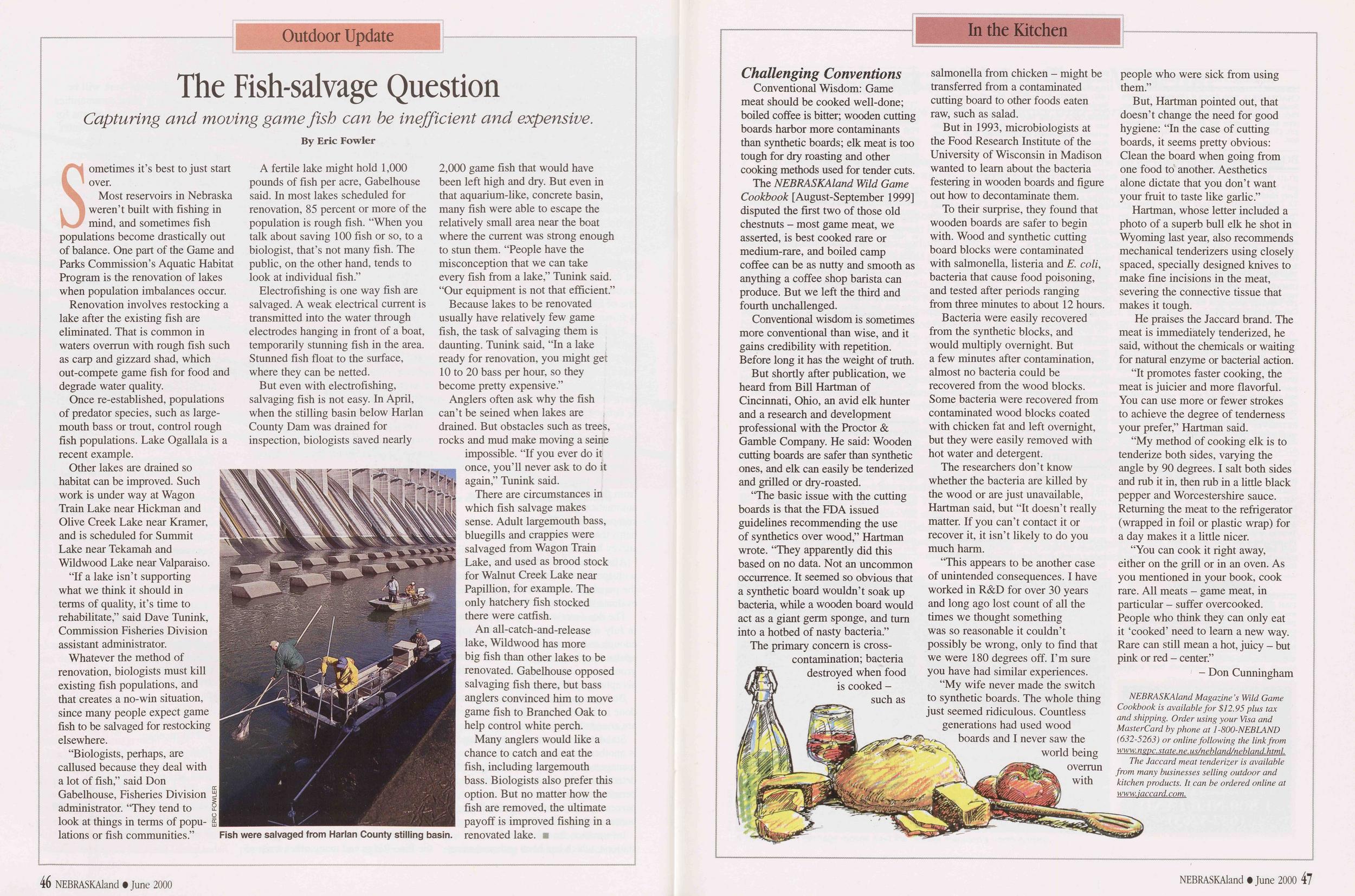
Sometimes it’s best to just start over.
Most reservoirs in Nebraska weren’t built with fishing in mind, and sometimes fish populations become drastically out of balance. One part of the Game and Parks Commission’s Aquatic Habitat Program is the renovation of lakes when population imbalances occur.
Renovation involves restocking a lake after the existing fish are eliminated. That is common in waters overrun with rough fish such as carp and gizzard shad, which out-compete game fish for food and degrade water quality.
Once re-established, populations of predator species, such as large- mouth bass or trout, control rough fish populations. Lake Ogallala is a recent example.
Other lakes are drained so habitat can be improved. Such work is under way at Wagon Train Lake near Hickman and Olive Creek Lake near Kramer, and is scheduled for Summit Lake near Tekamah and Wildwood Lake near Valparaiso.
"If a lake isn’t supporting what we think it should in terms of quality, it’s time to rehabilitate,” said Dave Tunink, Commission Fisheries Division assistant administrator.
Whatever the method of renovation, biologists must kill existing fish populations, and that creates a no-win situation, since many people expect game fish to be salvaged for restocking elsewhere.
"Biologists, perhaps, are callused because they deal with a lot of fish,” said Don Gabelhouse, Fisheries Division administrator. "They tend to look at things in terms of popu- ; lations or fish communities.”
A fertile lake might hold 1,000 pounds of fish per acre, Gabelhouse said. In most lakes scheduled for renovation, 85 percent or more of the population is rough fish. “When you talk about saving 100 fish or so, to a biologist, that’s not many fish. The public, on the other hand, tends to look at individual fish.”
Electrofishing is one way fish are salvaged. A weak electrical current is transmitted into the water through electrodes hanging in front of a boat, temporarily stunning fish in the area. Stunned fish float to the surface, where they can be netted.
But even with electrofishing, salvaging fish is not easy. In April, when the stilling basin below Harlan County Dam was drained for inspection, biologists saved nearly 2,000 game fish that would have been left high and dry. But even in that aquarium-like, concrete basin, many fish were able to escape the relatively small area near the boat where the current was strong enough to stun them. “People have the misconception that we can take every fish from a lake,” Tunink said. "Our equipment is not that efficient.”
Because lakes to be renovated usually have relatively few game fish, the task of salvaging them is daunting. Tunink said, "In a lake ready for renovation, you might get 10 to 20 bass per hour, so they become pretty expensive.”
Anglers often ask why the fish can’t be seined when lakes are drained. But obstacles such as trees, rocks and mud make moving a seine impossible. “If you ever do it once, you’ll never ask to do it again,” Tunink said.
There are circumstances in which fish salvage makes sense. Adult largemouth bass, bluegills and crappies were salvaged from Wagon Train Lake, and used as brood stock for Walnut Creek Lake near Papillion, for example. The only hatchery fish stocked there were catfish.
An all-catch-and-release lake, Wildwood has more big fish than other lakes to be renovated. Gabelhouse opposed salvaging fish there, but bass anglers convinced him to move game fish to Branched Oak to help control white perch.
Many anglers would like a chance to catch and eat the fish, including largemouth bass. Biologists also prefer this option. But no matter how the fish are removed, the ultimate payoff is improved fishing in a renovated lake. ■
In the Kitchen Challenging ConventionsConventional Wisdom: Game meat should be cooked well-done; boiled coffee is bitter; wooden cutting boards harbor more contaminants than synthetic boards; elk meat is too tough for dry roasting and other cooking methods used for tender cuts.
The NEBRASKAland Wild Game Cookbook [August-September 1999] disputed the first two of those old chestnuts - most game meat, we asserted, is best cooked rare or medium-rare, and boiled camp coffee can be as nutty and smooth as anything a coffee shop barista can produce. But we left the third and fourth unchallenged.
Conventional wisdom is sometimes more conventional than wise, and it gains credibility with repetition. Before long it has the weight of truth.
But shortly after publication, we heard from Bill Hartman of Cincinnati, Ohio, an avid elk hunter and a research and development professional with the Proctor & Gamble Company. He said: Wooden cutting boards are safer than synthetic ones, and elk can easily be tenderized and grilled or dry-roasted.
“The basic issue with the cutting boards is that the FDA issued guidelines recommending the use of synthetics over wood,” Hartman wrote. "They apparently did this based on no data. Not an uncommon occurrence. It seemed so obvious that a synthetic board wouldn’t soak up bacteria, while a wooden board would act as a giant germ sponge, and turn into a hotbed of nasty bacteria.” The primary concern is cross- contamination; bacteria destroyed when food is cooked - such as salmonella from chicken - might be transferred from a contaminated cutting board to other foods eaten raw, such as salad.
But in 1993, microbiologists at the Food Research Institute of the University of Wisconsin in Madison wanted to learn about the bacteria festering in wooden boards and figure out how to decontaminate them.
To their surprise, they found that wooden boards are safer to begin with. Wood and synthetic cutting board blocks were contaminated with salmonella, listeria and E. coli, bacteria that cause food poisoning, and tested after periods ranging from three minutes to about 12 hours.
Bacteria were easily recovered from the synthetic blocks, and would multiply overnight. But a few minutes after contamination, almost no bacteria could be recovered from the wood blocks. Some bacteria were recovered from contaminated wood blocks coated with chicken fat and left overnight, but they were easily removed with hot water and detergent.
The researchers don’t know whether the bacteria are killed by the wood or are just unavailable, Hartman said, but "It doesn’t really matter. If you can’t contact it or recover it, it isn’t likely to do you much harm.
"This appears to be another case of unintended consequences. I have worked in R&D for over 30 years and long ago lost count of all the times we thought something was so reasonable it couldn’t possibly be wrong, only to find that we were 180 degrees off. I’m sure you have had similar experiences. "My wife never made the switch to synthetic boards. The whole thing just seemed ridiculous. Countless generations had used wood boards and I never saw the world being overrun with people who were sick from using them.”
But, Hartman pointed out, that doesn’t change the need for good hygiene: "In the case of cutting boards, it seems pretty obvious: Clean the board when going from one food to another. Aesthetics alone dictate that you don’t want your fruit to taste like garlic.”
Hartman, whose letter included a photo of a superb bull elk he shot in Wyoming last year, also recommends mechanical tenderizers using closely spaced, specially designed knives to make fine incisions in the meat, severing the connective tissue that makes it tough.
He praises the Jaccard brand. The meat is immediately tenderized, he said, without the chemicals or waiting for natural enzyme or bacterial action.
"It promotes faster cooking, the meat is juicier and more flavorful. You can use more or fewer strokes to achieve the degree of tenderness your prefer,” Hartman said.
"My method of cooking elk is to tenderize both sides, varying the angle by 90 degrees. I salt both sides and rub it in, then rub in a little black pepper and Worcestershire sauce. Returning the meat to the refrigerator (wrapped in foil or plastic wrap) for a day makes it a little nicer.
"You can cook it right away, either on the grill or in an oven. As you mentioned in your book, cook rare. All meats - game meat, in particular - suffer overcooked. People who think they can only eat it ‘cooked’ need to learn a new way. Rare can still mean a hot, juicy - but pink or red - center.”
- Don CunninghamNEBRASKAland Magazine’s Wild Game Cookbook is available for $12.95 plus tax and shipping. Order using your Visa and MasterCard by phone at 1-800-NEBLAND (632-5263) or online following the link from www, n epc. state, ne, us/nebland/nebland. html.
The Jaccard meat tenderizer is available from many businesses selling outdoor and kitchen products. It can be ordered online at www, jaccard. com.
46 NEBRASKAland • June 2000 NEBRASKAland • June 2000 47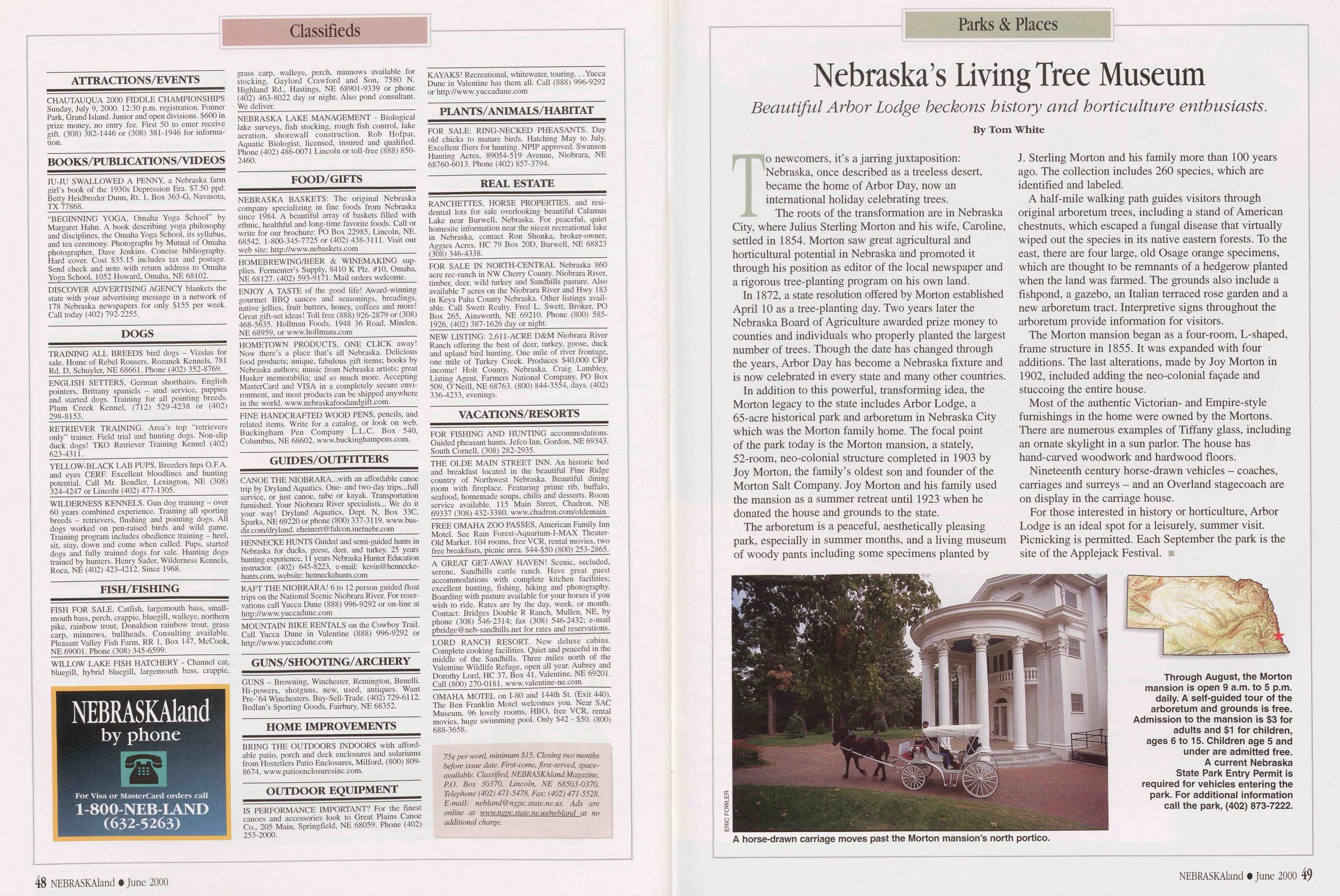
Classifieds
ATTRACTIONS/EVENTSCHAUTAUQUA 2000 FIDDLE CHAMPIONSHIPS Sunday, July 9, 2000. 12:30 p.m. registration. Former Park, Grand Island. Junior and open divisions. $600 in prize money, no entry fee. First 50 to enter receive gift. (308) 382-1446 or (308) 381-1946 for informa- tion.
BOOKS/PUBLICATIONS/VIDEOSJU-JU SWALLOWED A PENNY, a Nebraska farm girl’s book of the 1930s Depression Era. $7.50 ppd. Betty Heidbreder Dunn, Rt. 1, Box 363-G, Navasota, TX 77868.
“BEGINNING YOGA, Omaha Yoga School” by Margaret Hahn. A book describing yoga philosophy and disciplines, the Omaha Yoga School, its syllabus, and tea ceremony. Photographs by Mutual of Omaha photographer, Dave Jenkins. Concise bibliography. Hard cover. Cost $35.15 includes tax and postage. Send check and note with return address to Omaha Yoga School, 1052 Howard, Omaha, NE 68102.
DISCOVER ADVERTISING AGENCY blankets the state with your advertising message in a network of 178 Nebraska newspapers for only $155 per week. Call today (402) 792-2255.
DOGSTRAINING ALL BREEDS bird dogs - Vizslas for sale. Home of Rebel Rousers. Rozanek Kennels, 781 Rd. D, Schuyler, NE 68661. Phone (402) 352-8769.
ENGLISH SETTERS, German shorthairs, English pointers, Brittany spaniels - stud service, puppies and started dogs. Training for all pointing breeds. Plum Creek Kennel, (712) 529-4238 or (402) 298-8153.
RETRIEVER TRAINING. Area’s top “retrievers only” trainer. Field trial and hunting dogs. Non-slip duck dogs! TKO Retriever Training Kennel (402) 623-4311.
YELLOW-BLACK LAB PUPS. Breeders hips O.F.A. and eyes CERF. Excellent bloodlines and hunting potential. Call Mr. Bendler, Lexington, NE (308) 324-4247 or Lincoln (402) 477-1305?
WILDERNESS KENNELS. Gun dog training - over 60 years combined experience. Training all sporting breeds - retrievers, flushing and pointing dogs. All dogs worked on pen-raised birds and wild game. Training program includes obedience training - heel, sit, stay, down and come when called. Pups, started dogs and fully trained dogs for sale. Hunting dogs trained by hunters. Henry Sader, Wilderness Kennels, Roca, NE (402) 423-4212. Since 1968.
FISH/FISHINGFISH FOR SALE. Catfish, largemouth bass, small- mouth bass, perch, crappie, bluegill, walleye, northern pike, rainbow trout, Donaldson rainbow trout, grass carp, minnows, bullheads. Consulting available. Pleasant Valley Fish Farm, RR 1, Box 147, McCook, NE 69001. Phone (308) 345-6599.
WILLOW LAKE FISH HATCHERY - Channel cat, bluegill, hybrid bluegill, largemouth bass, crappie, GUNS - Browning, Winchester, Remington, Benelli. Hi-powers, shotguns, new, used, antiques. Want Pre-’64 Winchesters. Buy-Sell-Trade. (402) 729-6112. Bedlan’s Sporting Goods, Fairbury, NE 68352.
BRING THE OUTDOORS INDOORS with afford- able patio, porch and deck enclosures and solariums from Hostetlers Patio Enclosures, Milford, (800) 809- 8674, www.patioenclosuresinc.com.
IS PERFORMANCE IMPORTANT? For the finest canoes and accessories look to Great Plains Canoe Co., 205 Main, Springfield, NE 68059. Phone (402) 253-2000. grass carp, walleye, perch, minnows available for stocking. Gaylord Crawford and Son, 7580 N. Highland Rd., Hastings, NE 68901-9339 or phone (402) 463-8022 day or night. Also pond consultant. We deliver.
NEBRASKA LAKE MANAGEMENT - Biological lake surveys, fish stocking, rough fish control, lake aeration, shorewall construction. Rob Hofpar, Aquatic Biologist, licensed, insured and qualified. Phone (402) 486-0071 Lincoln or toll-free (888) 850- 2460.
KAYAKS! Recreational, whitewater, touring.. .Yucca Dune in Valentine has them all. Call (888) 996-9292 or http://www.yuccadune.com
PLANTS/ANIMALS/HABITATFOR SALE: RING-NECKED PHEASANTS. Day old chicks to mature birds. Hatching May to July. Excellent fliers for hunting. NPIP approved. Swanson Hunting Acres, 89054-519 Avenue, Niobrara, NE 68760-6013. Phone (402) 857-3794.
NEBRASKA BASKETS: The original Nebraska company specializing in fine foods from Nebraska since 1984. A beautiful array of baskets filled with ethnic, healthful and long-time favorite foods. Call or write for our brochure: PO Box 22985, Lincoln, NE. 68542. 1-800-345-7725 or (402) 438-3111. Visit our web site: http://www.nebaskets.com
HOMEBREWING/BEER & WINEMAKING sup- plies. Fermenter’s Supply, 8410 K Plz. #10, Omaha, NE 68127. (402) 593-9171. Mail orders welcome.
ENJOY A TASTE of the good life! Award-winning gourmet BBQ sauces and seasonings, breadings, native jellies, fruit butters, honey, coffees and more! Great gift-set ideas! Toll free (888) 926-2879 or (308) 468-5635. Hollman Foods, 1948 36 Road, Minden, NE 68959, or www.hollmans.com
HOMETOWN PRODUCTS, ONE CLICK away! Now there’s a place that’s all Nebraska. Delicious food products; unique, fabulous gift items; books by Nebraska authors; music from Nebraska artists; great Husker memorabilia; and so much more. Accepting MasterCard and VISA in a completely secure envi- ronment, and most products can be shipped anywhere in the world, www.nebraskafoodandgift.com.
FINE HANDCRAFTED WOOD PENS, pencils, and related items. Write for a catalog, or look on web. Buckingham Pen Company L.L.C. Box 540, Columbus, NE 68602. www.buckinghampens.com.
RANCHETTES, HORSE PROPERTIES, and resi- dential lots for sale overlooking beautiful Calamus Lake near Burwell, Nebraska. For peaceful, quiet homesite information near the nicest recreational lake in Nebraska, contact Ron Shonka, broker-owner, Aggies Acres, HC 79 Box 20D, Burwell, NE 68823 (308) 346-4338.
FOR SALE IN NORTH-CENTRAL Nebraska 860 acre rec-ranch in NW Cherry County. Niobrara River, timber, deer, wild turkey and Sandhills pasture. Also available 7 acres on the Niobrara River and Hwy 183 in Keya Paha County Nebraska. Other listings avail- able. Call Swett Realty. Fred L. Swett, Broker, PO Box 265, Ainsworth, NE 69210. Phone (800) 585- 1926, (402) 387-1626 day or night.
NEW LISTING: 2,611-ACRE D&M Niobrara River Ranch offering the best of deer, turkey, goose, duck and upland bird hunting. One mile of river frontage, one mile of Turkey Creek. Produces $40,000 CRP income! Holt County, Nebraska. Craig Lambley, Listing Agent, Farmers National Company, PO Box 509, O'Neill, NE 68763. (800) 844-3554, days. (402) 336-4233, evenings.
VACATION S/RESORTSCANOE THE NIOBRARA...with an affordable canoe trip by Dryland Aquatics. One- and two-day trips...full service, or just canoe, tube or kayak. Transportation furnished. Your Niobrara River specialists... We do it your way! Dryland Aquatics, Dept. N, Box 33C, Sparks, NE 69220 or phone (800) 337-3119. www.bus- dir.com/dryland. eheinert@falcon.inetnebr.com
HENNECKE HUNTS Guided and semi-guided hunts in Nebraska for ducks, geese, deer, and turkey. 25 years hunting experience, 11 years Nebraska Hunter Education instructor. (402) 645-8223, e-mail: kevin@tieruieeke- hunts.com, website: henneckehunts.com
RAFT THE NIOBRARA! 6 to 12 person guided float trips on the National Scenic Niobrara River. For reser- vations call Yucca Dune (888) 996-9292 or on-line at http://www.yuccadune.com
MOUNTAIN BIKE RENTALS on the Cowboy Trail. Call Yucca Dune in Valentine (888) 996-9292 or http://www.yuccadune.com
OUTDOOR EQUIPMENTFOR FISHING AND HUNTING accommodations. Guided pheasant hunts. Jefco Inn, Gordon, NE 69343. South Cornell, (308) 282-2935.
THE OLDE MAIN STREET INN. An historic bed and breakfast located in the beautiful Pine Ridge country of Northwest Nebraska. Beautiful dining room with fireplace. Featuring prime rib, buffalo, seafood, homemade soups, chilis and desserts. Room service available. 115 Main Street, Chadron, NE 69337 (308) 432-3380. www.chadron.com/oldemain
FREE OMAHA ZOO PASSES, American Family Inn Motel. See Rain Forest-Aquarium-I-MAX Theater- Old Market. 104 rooms, free VCR, rental movies, two free breakfasts, picnic area. $44-$50 (800) 253-2865.
A GREAT GET-AWAY HAVEN! Scenic, secluded, serene, Sandhills cattle ranch. Have great guest accommodations with complete kitchen facilities; excellent hunting, fishing, hiking and photography. Boarding with pasture available for your horses if you wish to ride. Rates are by the day, week, or month. Contact: Bridges Double R Ranch, Mullen, NE, by phone (308) 546-2314; fax (308) 546-2432; e-mail pbridge@neb-sandhills.net for rates and reservations.
LORD RANCH RESORT. New deluxe cabins. Complete cooking facilities. Quiet and peaceful in the middle of the Sandhills. Three miles north of the Valentine Wildlife Refuge, open all year. Aubrey and Dorothy Lord, HC 37, Box 41, Valentine, NE 69201. Call (800) 270-0181. www.valentine-ne.com
OMAHA MOTEL on 1-80 and 144th St. (Exit 440). The Ben Franklin Motel welcomes you. Near SAC Museum. 96 lovely rooms, HBO, free VCR, rental movies, huge swimming pool. Only $42 - $50. (800) 688-3658.
75 per word, minimum $15. Closing two months before issue date. First-come, first-served, space- available. Classified, NEBRASKAland Magazine, P.O. Box 30370, Lincoln, NE 68503-0370. Telephone (402) 471-5478. Fax: (402) 471-5528. E-mail: nebland@ngpc. state.ne. us. Ads are online at www.nsuc.state.ne.us/nehland at no additional charge.
REAL ESTATE Parks & Places Nebraska’s Living Tree Museum Beautiful Arbor Lodge beckons history and horticulture enthusiasts. By Tom WhiteTo newcomers, it’s a jarring juxtaposition: Nebraska, once described as a treeless desert, became the home of Arbor Day, now an international holiday celebrating trees.
The roots of the transformation are in Nebraska City, where Julius Sterling Morton and his wife, Caroline, settled in 1854. Morton saw great agricultural and horticultural potential in Nebraska and promoted it through his position as editor of the local newspaper and a rigorous tree-planting program on his own land.
In 1872, a state resolution offered by Morton established April 10 as a tree-planting day. Two years later the Nebraska Board of Agriculture awarded prize money to counties and individuals who properly planted the largest number of trees. Though the date has changed through the years, Arbor Day has become a Nebraska fixture and is now celebrated in every state and many other countries.
In addition to this powerful, transforming idea, the Morton legacy to the state includes Arbor Lodge, a 65-acre historical park and arboretum in Nebraska City which was the Morton family home. The focal point of the park today is the Morton mansion, a stately, 52-room, neo-colonial structure completed in 1903 by Joy Morton, the family’s oldest son and founder of the Morton Salt Company. Joy Morton and his family used the mansion as a summer retreat until 1923 when he donated the house and grounds to the state.
The arboretum is a peaceful, aesthetically pleasing park, especially in summer months, and a living museum of woody pants including some specimens planted by J. Sterling Morton and his family more than 100 years ago. The collection includes 260 species, which are identified and labeled.
A half-mile walking path guides visitors through original arboretum trees, including a stand of American chestnuts, which escaped a fungal disease that virtually wiped out the species in its native eastern forests. To the east, there are four large, old Osage orange specimens, which are thought to be remnants of a hedgerow planted when the land was farmed. The grounds also include a fishpond, a gazebo, an Italian terraced rose garden and a new arboretum tract. Interpretive signs throughout the arboretum provide information for visitors.
The Morton mansion began as a four-room, L-shaped, frame structure in 1855. It was expanded with four additions. The last alterations, made by Joy Morton in 1902, included adding the neo-colonial facade and stuccoing the entire house.
Most of the authentic Victorian- and Empire-style furnishings in the home were owned by the Mortons. There are numerous examples of Tiffany glass, including an ornate skylight in a sun parlor. The house has hand-carved woodwork and hardwood floors.
Nineteenth century horse-drawn vehicles - coaches, carriages and surreys - and an Overland stagecoach are on display in the carriage house.
For those interested in history or horticulture, Arbor Lodge is an ideal spot for a leisurely, summer visit. Picnicking is permitted. Each September the park is the site of the Applejack Festival. ■
Through August, the Morton mansion is open 9 a.m. to 5 p.m. daily. A self-guided tour of the arboretum and grounds is free. Admission to the mansion is $3 for adults and $1 for children, ages 6 to 15. Children age 5 and under are admitted free. A current Nebraska State Park Entry Permit is required for vehicles entering the park. For additional information call the park, (402) 873-7222.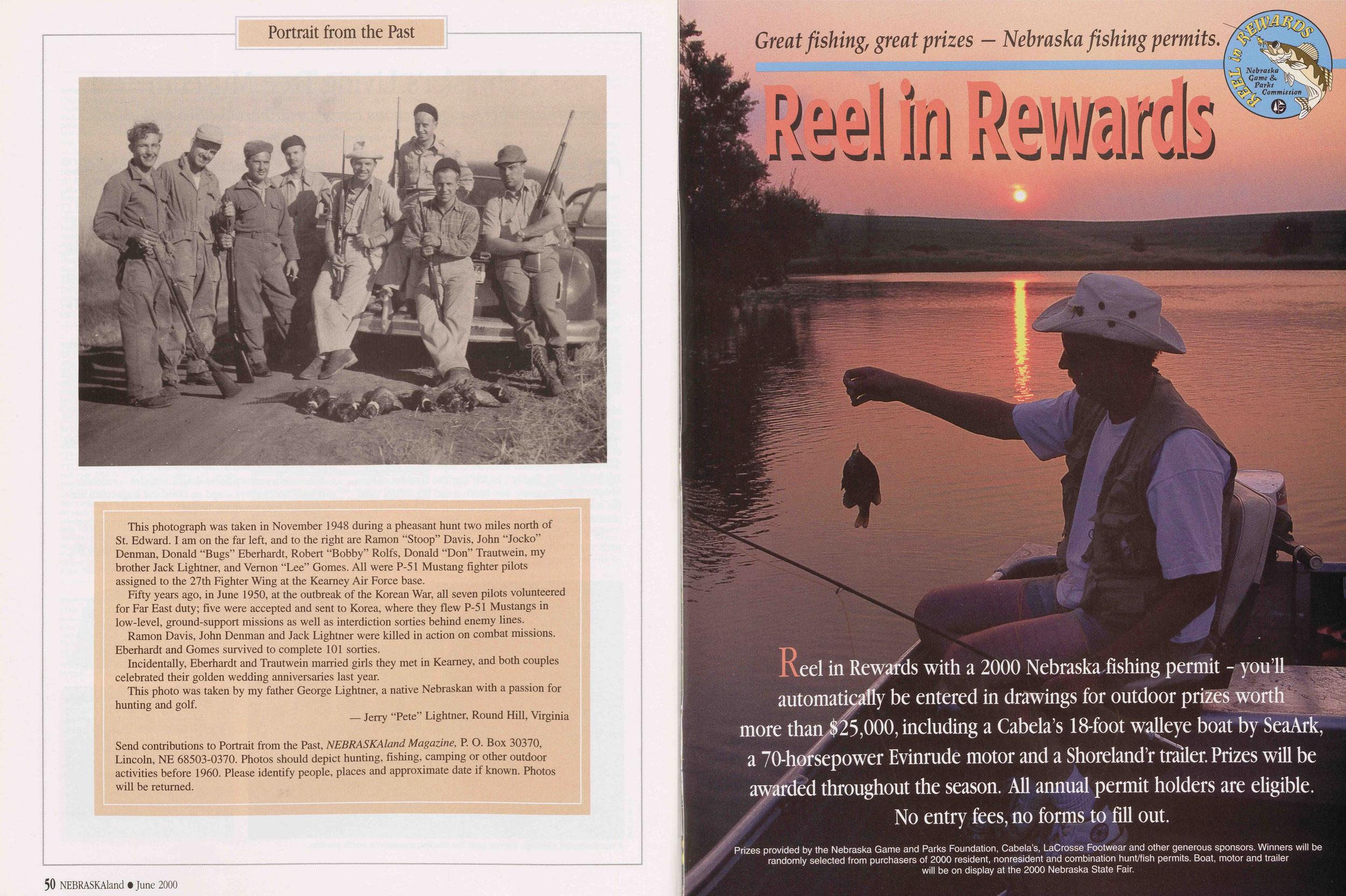
This photograph was taken in November 1948 during a pheasant hunt two miles north of St. Edward. I am on the far left, and to the right are Ramon “Stoop” Davis, John “Jocko” Denman, Donald “Bugs” Eberhardt, Robert “Bobby” Rolfs, Donald “Don” Trautwein, my brother Jack Lightner, and Vernon “Lee” Gomes. All were P-51 Mustang fighter pilots assigned to the 27th Fighter Wing at the Kearney Air Force base.
Fifty years ago, in June 1950, at the outbreak of the Korean War, all seven pilots volunteered for Far East duty; five were accepted and sent to Korea, where they flew P-51 Mustangs in low-level, ground-support missions as well as interdiction sorties behind enemy lines.
Ramon Davis, John Denman and Jack Lightner were killed in action on combat missions. Eberhardt and Gomes survived to complete 101 sorties.
Incidentally, Eberhardt and Trautwein married girls they met in Kearney, and both couples celebrated their golden wedding anniversaries last year.
This photo was taken by my father George Lightner, a native Nebraskan with a passion for hunting and golf.
— Jerry “Pete” Lightner, Round Hill, VirginiaSend contributions to Portrait from the Past, NEBRASKAland Magazine, P. O. Box 30370, Lincoln, NE 68503-0370. Photos should depict hunting, fishing, camping or other outdoor activities before 1960. Please identify people, places and approximate date if known. Photos will be returned.
50 NEBRASKAland • June 2000 Great fishing, great prizes — Nebraska fishing permits. Parks Reel in Rewards with a 2000 Nebraska fishing permit - you’ll automatically be entered in drawings for outdoor prizes worth more than $25,000, including a Cabela’s 18-foot walleye boat by SeaArk, a 70-horsepower Evinrude motor and a Shoreland’r trailer. Prizes will be awarded throughout the season. All annual permit holders are eligible. No entry fees, no forms to fill out. Prizes provided by the Nebraska Game and Parks Foundation, Cabela’s, LaCrosse Footwear and other generous sponsors. Winners will be randomly selected from purchasers of 2000 resident, nonresident and combination hunt/fish permits. Boat, motor and trailer will be on display at the 2000 Nebraska State Fair.
Position: 305 (29 views)