Volume 78, Issue 4, 2000
NEBRASKAland
Nebraska Game & Parks Commission May 2000 • $2.50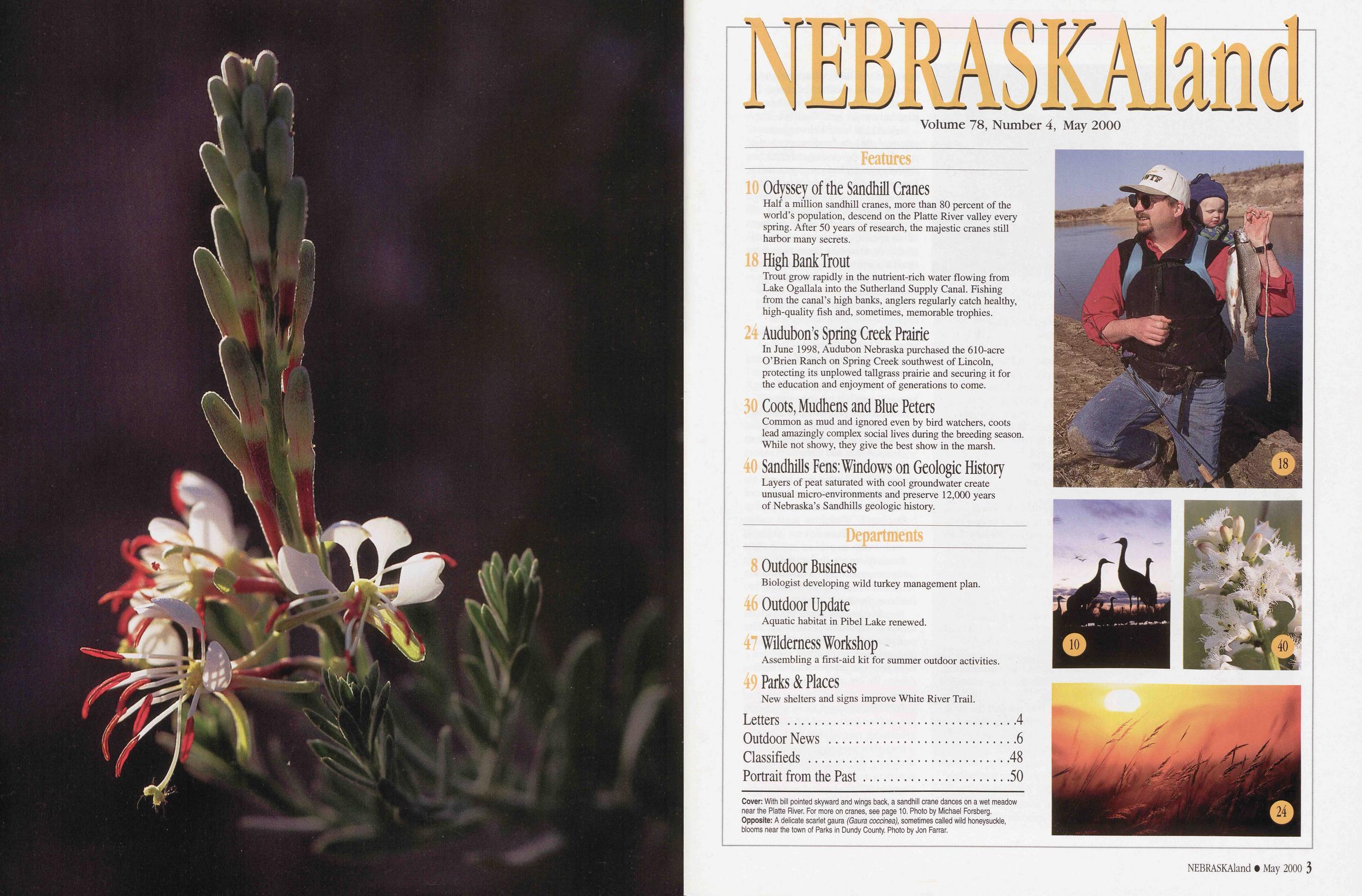
NEBRASKAland
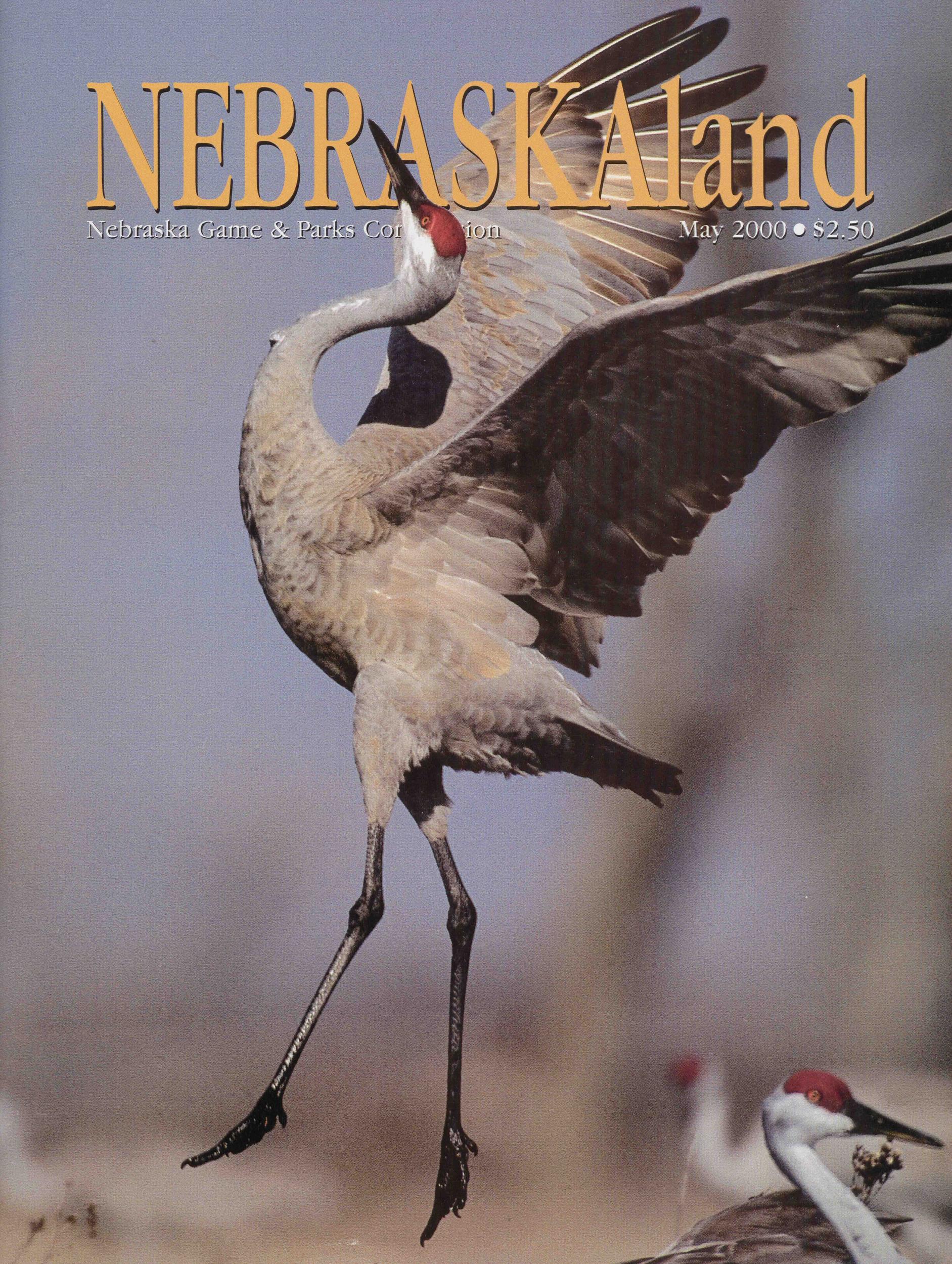
Volume 78, Number 4, May 2000 Features Odyssey of the Sandhill Cranes Half a million sandhill cranes, more than 80 percent of the world’s population, descend on the Platte River valley every spring. After 50 years of research, the majestic cranes still harbor many secrets. 18 High Bank Trout Trout grow rapidly in the nutrient-rich water flowing from Lake Ogallala into the Sutherland Supply Canal. Fishing from the canal’s high banks, anglers regularly catch healthy, high-quality fish and, sometimes, memorable trophies. Audubon’s Spring Creek Prairie In June 1998, Audubon Nebraska purchased the 610-acre O’Brien Ranch on Spring Creek southwest of Lincoln, protecting its unplowed tailgrass prairie and securing it for the education and enjoyment of generations to come. Coots, Mudhens and Blue Peters Common as mud and ignored even by bird watchers, coots lead amazingly complex social lives during the breeding season. While not showy, they give the best show in the marsh. Sandhills Fens:Windows on Geologic History Layers of peat saturated with cool groundwater create unusual micro-environments and preserve 12,000 years of Nebraska’s Sandhills geologic history. Departments Outdoor Business Biologist developing wild turkey management plan. Outdoor Update Aquatic habitat in Pibel Lake renewed. Wilderness Workshop Assembling a first-aid kit for summer outdoor activities. Parks & Places New shelters and signs improve White River Trail. Letters 4 Outdoor News 6 Classifieds 48 Portrait from the Past 50 Cover: With bill pointed skyward and wings back, a sandhill crane dances on a wet meadow near the Platte River. For more on cranes, see page 10. Photo by Michael Forsberg. Opposite: A delicate scarlet gaura (Gaura coccinea), sometimes called wild honeysuckle, blooms near the town of Parks in Dundy County. Photo by Jon Farrar.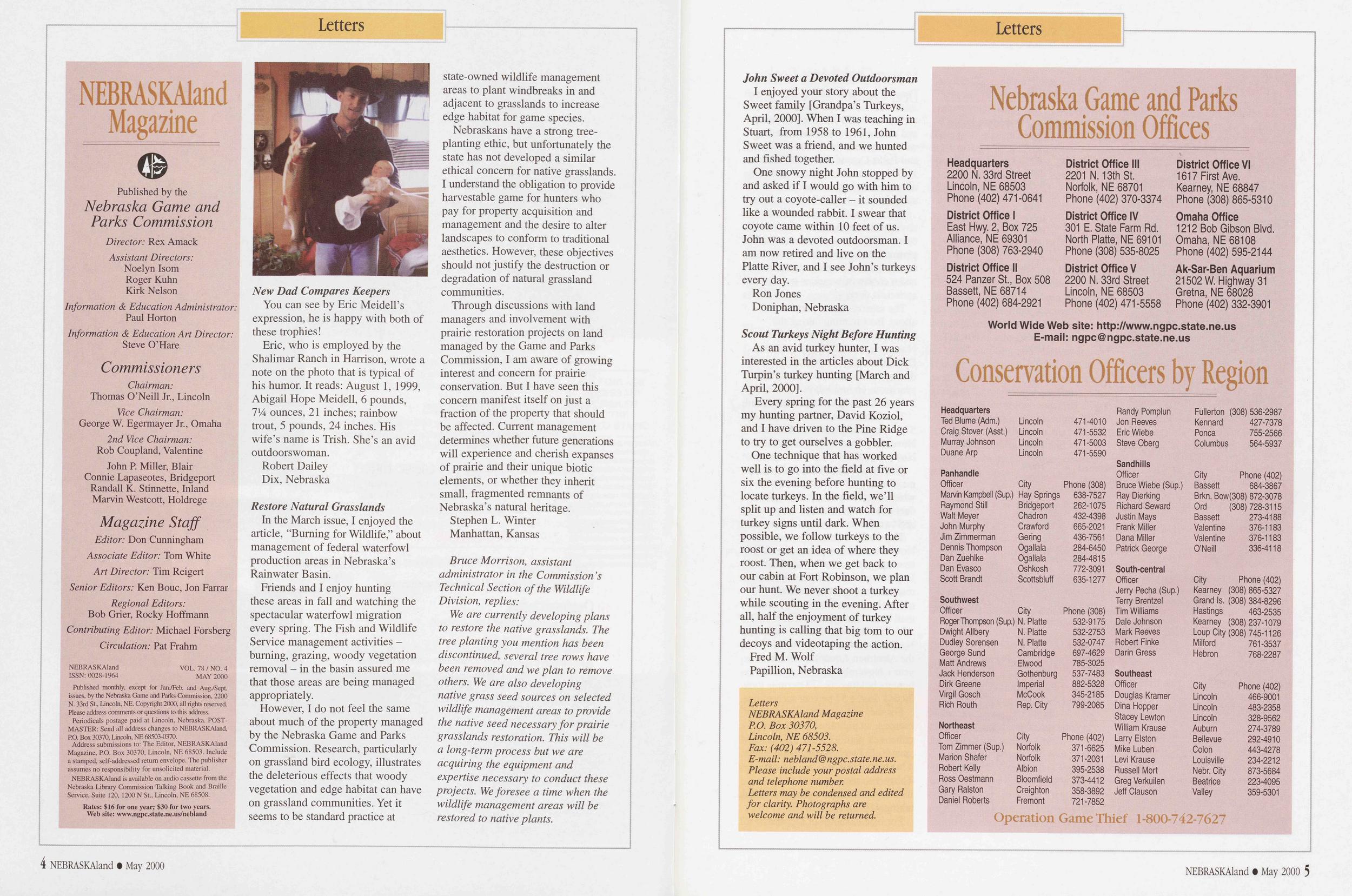 Letters
NEBRASKAland Mazine
Published by the
Nebraska Game and
Parks Commission
Director: Rex Amack
Assistant Directors:
Noelyn Isom
Roger Kuhn
Kirk Nelson
Information & Education Administrator:
Paul Horton
Information &Education Art Director:
Steve O’Hare
Commissioners
Chairman:
Thomas O’Neill Jr., Lincoln
Vice Chairman:
George W. Egermayer Jr., Omaha
2nd Vice Chairman:
Rob Coupland, Valentine
John P. Miller, Blair
Connie Lapaseotes, Bridgeport
Randall K. Stinnette, Inland
Marvin Westcott, Holdrege
Magazine Staff
Editor: Don Cunningham
Associate Editor: Tom White
Art Director: Tim Reigert
Senior Editors: Ken Bouc, Jon Farrar
Regional Editors:
Bob Grier, Rocky Hoffmann
Contributing Editor: Michael Forsberg
Circulation: Pat Frahm
NEBRASKAland VOL. 78 / NO. 4
ISSN: 0028-1964 MAY 2000
Published monthly, except for Jan./Feb. and Aug./Sept.
issues, by the Nebraska Game and Parks Commission, 2200
N. 33rd St., Lincoln, NE. Copyright 2000, all rights reserved.
Please address comments or questions to this address.
Periodicals postage paid at Lincoln, Nebraska. POST-
MASTER: Send all address changes to NEBRASKAland,
P.O. Box 30370, Lincoln, NE 68503-0370.
Address submissions to: The Editor, NEBRASKAland
Magazine. P.O. Box 30370, Lincoln, NE 68503. Include
a stamped, self-addressed return envelope. The publisher
assumes no responsibility for unsolicited material.
NEBRASKAland is available on audio cassette from the
Nebraska Library Commission Talking Book and Braille
Service, Suite 120, 1200 N St., Lincoln, NE 68508.
Rates: $16 for one year; $30 for two years.
Web site: www.ngpc.state.ne.us/nebland
New Dad Compares Keepers
Letters
NEBRASKAland Mazine
Published by the
Nebraska Game and
Parks Commission
Director: Rex Amack
Assistant Directors:
Noelyn Isom
Roger Kuhn
Kirk Nelson
Information & Education Administrator:
Paul Horton
Information &Education Art Director:
Steve O’Hare
Commissioners
Chairman:
Thomas O’Neill Jr., Lincoln
Vice Chairman:
George W. Egermayer Jr., Omaha
2nd Vice Chairman:
Rob Coupland, Valentine
John P. Miller, Blair
Connie Lapaseotes, Bridgeport
Randall K. Stinnette, Inland
Marvin Westcott, Holdrege
Magazine Staff
Editor: Don Cunningham
Associate Editor: Tom White
Art Director: Tim Reigert
Senior Editors: Ken Bouc, Jon Farrar
Regional Editors:
Bob Grier, Rocky Hoffmann
Contributing Editor: Michael Forsberg
Circulation: Pat Frahm
NEBRASKAland VOL. 78 / NO. 4
ISSN: 0028-1964 MAY 2000
Published monthly, except for Jan./Feb. and Aug./Sept.
issues, by the Nebraska Game and Parks Commission, 2200
N. 33rd St., Lincoln, NE. Copyright 2000, all rights reserved.
Please address comments or questions to this address.
Periodicals postage paid at Lincoln, Nebraska. POST-
MASTER: Send all address changes to NEBRASKAland,
P.O. Box 30370, Lincoln, NE 68503-0370.
Address submissions to: The Editor, NEBRASKAland
Magazine. P.O. Box 30370, Lincoln, NE 68503. Include
a stamped, self-addressed return envelope. The publisher
assumes no responsibility for unsolicited material.
NEBRASKAland is available on audio cassette from the
Nebraska Library Commission Talking Book and Braille
Service, Suite 120, 1200 N St., Lincoln, NE 68508.
Rates: $16 for one year; $30 for two years.
Web site: www.ngpc.state.ne.us/nebland
New Dad Compares Keepers
You can see by Eric Meidell’s expression, he is happy with both of these trophies!
Eric, who is employed by the Shalimar Ranch in Harrison, wrote a note on the photo that is typical of his humor. It reads: August 1, 1999, Abigail Hope Meidell, 6 pounds, 714 ounces, 21 inches; rainbow trout, 5 pounds, 24 inches. His wife’s name is Trish. She’s an avid outdoors woman.
Robert Dailey Dix, Nebraska Restore Natural GrasslandsIn the March issue, I enjoyed the article, “Burning for Wildlife,” about management of federal waterfowl production areas in Nebraska’s Rainwater Basin.
Friends and I enjoy hunting these areas in fall and watching the spectacular waterfowl migration every spring. The Fish and Wildlife Service management activities - burning, grazing, woody vegetation removal - in the basin assured me that those areas are being managed appropriately.
However, I do not feel the same about much of the property managed by the Nebraska Game and Parks Commission. Research, particularly on grassland bird ecology, illustrates the deleterious effects that woody vegetation and edge habitat can have on grassland communities. Yet it seems to be standard practice at state-owned wildlife management areas to plant windbreaks in and adjacent to grasslands to increase edge habitat for game species.
Nebraskans have a strong tree- planting ethic, but unfortunately the state has not developed a similar ethical concern for native grasslands. I understand the obligation to provide harvestable game for hunters who pay for property acquisition and management and the desire to alter landscapes to conform to traditional aesthetics. However, these objectives should not justify the destruction or degradation of natural grassland communities.
Through discussions with land managers and involvement with prairie restoration projects on land managed by the Game and Parks Commission, I am aware of growing interest and concern for prairie conservation. But I have seen this concern manifest itself on just a fraction of the property that should be affected. Current management determines whether future generations will experience and cherish expanses of prairie and their unique biotic elements, or whether they inherit small, fragmented remnants of Nebraska’s natural heritage.
Stephen L. Winter Manhattan, Kansas Bruce Morrison, assistant administrator in the Commission’s Technical Section of the Wildlife Division, replies: We are currently developing plans to restore the native grasslands. The tree planting you mention has been discontinued, several tree rows have been removed and we plan to remove others. We are also developing native grass seed sources on selected wildlife management areas to provide the native seed necessary for prairie grasslands restoration. This will be a long-term process but we are acquiring the equipment and expertise necessary to conduct these projects. We foresee a time when the wildlife management areas will be restored to native plants. John Sweet a Devoted OutdoorsmanI enjoyed your story about the Sweet family [Grandpa’s Turkeys, April, 2000]. When I was teaching in Stuart, from 1958 to 1961, John Sweet was a friend, and we hunted and fished together.
One snowy night John stopped by and asked if I would go with him to try out a coyote-caller - it sounded like a wounded rabbit. I swear that coyote came within 10 feet of us. John was a devoted outdoorsman. I am now retired and live on the Platte River, and I see John’s turkeys every day.
Ron Jones Doniphan, Nebraska Scout Turkeys Night Before HuntingAs an avid turkey hunter, I was interested in the articles about Dick Turpin’s turkey hunting [March and April, 2000].
Every spring for the past 26 years my hunting partner, David Koziol, and I have driven to the Pine Ridge to try to get ourselves a gobbler.
One technique that has worked well is to go into the field at five or six the evening before hunting to locate turkeys. In the field, we’ll split up and listen and watch for turkey signs until dark. When possible, we follow turkeys to the roost or get an idea of where they roost. Then, when we get back to our cabin at Fort Robinson, we plan our hunt. We never shoot a turkey while scouting in the evening. After all, half the enjoyment of turkey hunting is calling that big tom to our decoys and videotaping the action.
Fred M. Wolf Papillion, Nebraska NEBRASKAland Magazine P.O. Box 30370, Lincoln, NE 68503. Fax: (402) 471-5528. E-mail: nebland@ngpc.state, ne. us. Please include your postal address and telephone number. Letters may be condensed and edited for clarity. Photographs are welcome and will be returned. Nebraska Game and Parks Commission Offices Headquarters 2200 N. 33rd Street Lincoln, NE 68503 Phone (402) 471-0641 District Office III 2201 N. 13th St. Norfolk, NE 68701 Phone (402) 370-3374 District Office VI 1617 First Ave. Kearney, NE 68847 Phone (308) 865-5310 District Office 1 District Office IV Omaha Office East Hwy. 2, Box 725 301 E. State Farm Rd. 1212 Bob Gibson Blvd. Alliance, NE 69301 North Platte, NE 69101 Omaha, NE 68108 Phone (308) 763-2940 Phone (308) 535-8025 Phone (402) 595-2144 District Office II District Office V Ak-Sar-Ben Aquarium 524 Panzer St., Box 508 2200 N. 33rd Street 21502 W. Highway 31 Bassett, NE 68714 Lincoln, NE 68503 Gretna, NE 68028 Phone (402) 684-2921 Phone (402) 471-5558 Phone (402) 332-3901 World Wide Web site: http://www.ngpc.state.ne.us E-mail: ngpc@ngpc.state.ne.us Conservation Officers by Region Headquarters Randy Pomplun Fullerton (308) 536-2987 Ted Blume (Adm.) Lincoln 471-4010 Jon Reeves Kennard 427-7378 Craig Stover (Asst.) Lincoln 471-5532 Eric Wiebe Ponca 755-2566 Murray Johnson Lincoln 471-5003 Steve Oberg Columbus i 564-5937 Duane Arp Lincoln 471-5590 Sandhills Panhandle Officer City Phone (402) Officer City Phone (308) Bruce Wiebe (Sup.) Bassett 684-3867 Marvin Kampbell (Sup.) Hay Springs 638-7527 Ray Dierking Brkn. Bow(308) 872-3078 Raymond Still Bridgeport 262-1075 Richard Seward Ord (308) 728-3115 Walt Meyer Chadron 432-4398 Justin Mays Bassett 273-4188 John Murphy Crawford 665-2021 Frank Miller Valentine 376-1183 Jim Zimmerman Gering 436-7561 Dana Miller Valentine 376-1183 Dennis Thompson Ogallala 284-6450 Patrick George O’Neill 336-4118 Dan Zuehlke Ogallala 284-4815 Dan Evasco Oshkosh 772-3091 South-central Scott Brandt Scottsbluff 635-1277 Officer City Phone (402) Jerry Pecha (Sup.) Kearney (308) 865-5327 Southwest Terry Brentzel Grand Is. (308) 384-8296 Officer City Phone (308) Tim Williams Hastings 463-2535 Roger Thompson (Sup.) N. Platte 532-9175 Dale Johnson Kearney (308) 237-1079 Dwight Allbery N. Platte 532-2753 Mark Reeves Loup City (308) 745-1126 Dudley Sorensen N. Platte 532-0747 Robert Finke Milford 761-3537 George Sund Cambridge 697-4629 Darin Gress Hebron 768-2287 Matt Andrews Elwood 785-3025 Jack Henderson Gothenburg 537-7483 Southeast Dirk Greene Imperial 882-5328 Officer City Phone (402) Virgil Gosch McCook 345-2185 Douglas Kramer Lincoln 466-9001 Rich Routh Rep. City 799-2085 Dina Hopper Lincoln 483-2358 Stacey Lewton Lincoln 328-9562 Northeast William Krause Auburn 274-3789 Officer City Phone (402) Larry Elston Bellevue 292-4910 Tom Zimmer (Sup.) Norfolk 371-6625 Mike Luben Colon 443-4278 Marion Shafer Norfolk 371-2031 Levi Krause Louisville 234-2212 Robert Kelly Albion 395-2538 Russell Mort Nebr. City 873-5684 Ross Oestmann Bloomfield 373-4412 Greg Verkuilen Beatrice 223-4095 Gary Ralston Creighton 358-3892 Jeff Clauson Valley 359-5301 Daniel Roberts Fremont 721-7852 Operation Game Thief 1-800-742-7627 4 NEBRASKAland • May 2000 NEBRASKAland • May 2000 5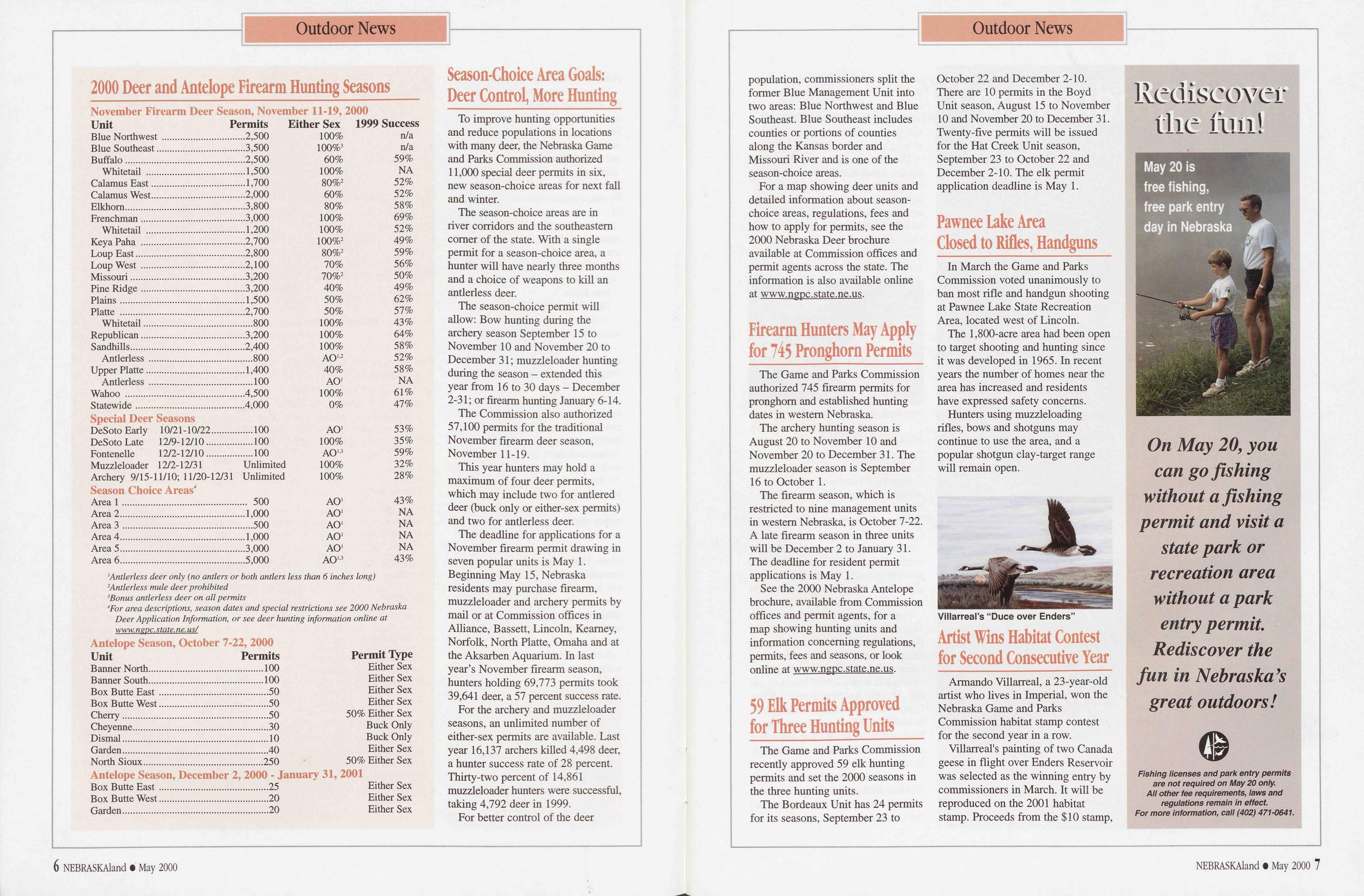
1Antlerless deer only (no antlers or both antlers less than 6 inches long) 2Antlerless mule deer prohibited 3Bonus antlerless deer on all permits 4For area descriptions, season dates and special restrictions see 2000 Nebraska Deer Application Information, or see deer hunting information online at www. n g pc, state, ne. us/
Antelope Season, October 7-22, 2000 Unit Banner North Permits 100 Permit T\pe Either Sex Banner South 100 Either Sex Box Butte East 50 Either Sex Box Butte West 50 Either Sex Cherry 50 50% Either Sex Cheyenne 30 Buck Only Dismal 10 Buck Only Garden 40 Either Sex North Sioux 250 50% Either Sex Antelope Season, December 2, 2000 - January 31, 2001 Box Butte East 25 Either Sex Box Butte West 20 Either Sex Garden 20 Either Sex Season-Choice Area Goals: Deer Control, More HuntingTo improve hunting opportunities and reduce populations in locations with many deer, the Nebraska Game and Parks Commission authorized 11,000 special deer permits in six, new season-choice areas for next fall and winter.
The season-choice areas are in river corridors and the southeastern comer of the state. With a single permit for a season-choice area, a hunter will have nearly three months and a choice of weapons to kill an antlerless deer.
The season-choice permit will allow: Bow hunting during the archery season September 15 to November 10 and November 20 to December 31; muzzleloader hunting during the season - extended this year from 16 to 30 days - December 2-31; or firearm hunting January 6-14.
The Commission also authorized 57,100 permits for the traditional November firearm deer season, November 11-19.
This year hunters may hold a maximum of four deer permits, which may include two for antlered deer (buck only or either-sex permits) and two for antlerless deer.
The deadline for applications for a November firearm permit drawing in seven popular units is May 1. Beginning May 15, Nebraska residents may purchase firearm, muzzleloader and archery permits by mail or at Commission offices in Alliance, Bassett, Lincoln, Kearney, Norfolk, North Platte, Omaha and at the Aksarben Aquarium. In last year’s November firearm season, hunters holding 69,773 permits took 39,641 deer, a 57 percent success rate.
For the archery and muzzleloader seasons, an unlimited number of either-sex permits are available. Last year 16,137 archers killed 4,498 deer, a hunter success rate of 28 percent. Thirty-two percent of 14,861 muzzleloader hunters were successful, taking 4,792 deer in 1999.
For better control of the deer population, commissioners split the former Blue Management Unit into two areas: Blue Northwest and Blue Southeast. Blue Southeast includes counties or portions of counties along the Kansas border and Missouri River and is one of the season-choice areas.
For a map showing deer units and detailed information about season- choice areas, regulations, fees and how to apply for permits, see the 2000 Nebraska Deer brochure available at Commission offices and permit agents across the state. The information is also available online at www.ngpc.state.ne.us.
Firearm Hunters May Apply for 745 Pronghorn PermitsThe Game and Parks Commission authorized 745 firearm permits for pronghorn and established hunting dates in western Nebraska.
The archery hunting season is August 20 to November 10 and November 20 to December 31. The muzzleloader season is September 16 to October 1.
The firearm season, which is restricted to nine management units in western Nebraska, is October 7-22. A late firearm season in three units will be December 2 to January 31. The deadline for resident permit applications is May 1.
See the 2000 Nebraska Antelope brochure, available from Commission offices and permit agents, for a map showing hunting units and information concerning regulations, permits, fees and seasons, or look online at www.ngpc.state.ne.us.
59 Elk Permits Approved for Three Hunting UnitsThe Game and Parks Commission recently approved 59 elk hunting permits and set the 2000 seasons in the three hunting units.
The Bordeaux Unit has 24 permits for its seasons, September 23 to October 22 and December 2-10. There are 10 permits in the Boyd Unit season, August 15 to November 10 and November 20 to December 31. Twenty-five permits will be issued for the Hat Creek Unit season, September 23 to October 22 and December 2-10. The elk permit application deadline is May 1.
Pawnee Lake Area Closed to Rifles, HandgunsIn March the Game and Parks Commission voted unanimously to ban most rifle and handgun shooting at Pawnee Lake State Recreation Area, located west of Lincoln.
The 1,800-acre area had been open to target shooting and hunting since it was developed in 1965. In recent years the number of homes near the area has increased and residents have expressed safety concerns.
Hunters using muzzleloading rifles, bows and shotguns may continue to use the area, and a popular shotgun clay-target range will remain open.
Artist Wins Habitat Contest for Second Consecutive YearArmando Villarreal, a 23-year-old artist who lives in Imperial, won the Nebraska Game and Parks Commission habitat stamp contest for the second year in a row.
Villarreal's painting of two Canada geese in flight over Enders Reservoir was selected as the winning entry by commissioners in March. It will be reproduced on the 2001 habitat stamp. Proceeds from the $10 stamp,
On May 20, you can go fishing without a fishing permit and visit a state park or recreation area without a park entry permit. Rediscover the fun in Nebraska’s great outdoors! Fishing licenses and park entry permits are not required on May 20 only. All other fee requirements, laws and regulations remain in effect. For more information, call (402) 471-0641. 6 NEBRASKAland • May 2000 NEBRASKAland • May 2000 7 Outdoor News
Treat your graduate to the
gift that lasts a lifetime ...
a Nebraska lifetime permit.
Available only to Nebraska
residents, lifetime permits
remain valid even if the
holder leaves the state —
your graduates may continue
to hunt and fish whenever
they’re back in Nebraska. It is
the ultimate gift for any angler
or hunter and an investment
in the future.
Kids Graduating?
Keep ’em
coming home
with a
Nebraska
lifetime permit!
For VISA and MasterCard orders call toll-free (1-800-632-5263)
Permits also are available at all Game and Parks Commission offices. To order by mail,
'"olude full nsm ,
address, date of birth, sex, eye and hair color, height and weight. Mail with payment
to P.O. Box
Lincoln, NE 68503. Lifetime permits are available only to Nebraska residents. Permits
remain valid even it tne
holder becomes a resident elsewhere. Lifetime permit costs do not include fees for
big game permits or me
costs of any special stamps that must be purchased annually.
Outdoor News
Treat your graduate to the
gift that lasts a lifetime ...
a Nebraska lifetime permit.
Available only to Nebraska
residents, lifetime permits
remain valid even if the
holder leaves the state —
your graduates may continue
to hunt and fish whenever
they’re back in Nebraska. It is
the ultimate gift for any angler
or hunter and an investment
in the future.
Kids Graduating?
Keep ’em
coming home
with a
Nebraska
lifetime permit!
For VISA and MasterCard orders call toll-free (1-800-632-5263)
Permits also are available at all Game and Parks Commission offices. To order by mail,
'"olude full nsm ,
address, date of birth, sex, eye and hair color, height and weight. Mail with payment
to P.O. Box
Lincoln, NE 68503. Lifetime permits are available only to Nebraska residents. Permits
remain valid even it tne
holder becomes a resident elsewhere. Lifetime permit costs do not include fees for
big game permits or me
costs of any special stamps that must be purchased annually.
which must be purchased by hunters in Nebraska, is used to acquire and improve habitat.
The Omaha Fish and Wildlife Club will present Villarreal a $200 award at the Commission meeting in May.
The 23rd annual contest drew 35 entries. Other finalists were Deb Gengler-Copple of Hubbard and Mary B. Hunt of Gering. Honorable mention winners were: Bruce Becher of Wilber; Rodney H. Johns, Oshkosh; David D. Dorsey, Newport; and Loren Goedeker, Hebron.
Brandon Mares, a 15-year-old student at Lincoln Southeast High School, won best of show in the Nebraska Federal Duck Stamp Contest.
Selected from more than 500 entries from across the state, his gouache painting will be displayed with 35 other top entries at nine sites across the state.
The remaining exhibit dates are: May 1-5, Rock County Library, Bassett; May 15-19, U.S. Post Office, Lincoln; May 29 to June 2, Game and Parks Commission office in Omaha; June 12-16, Cabela’s, Inc., store in Kearney; June 26-30, Game and Parks Commission office in Norfolk; July 10-14, Fort Niobrara National Wildlife Refuge in Valentine; July 24-31, Cabela’s, Inc., store in Sidney; August, Crescent Lake/North Platte National Wildlife Refuge, Scottsbluff.
Mares’ painting will be entered in the national competition.
Outdoor Business New Focus on Turkeys Biologist to outline management strategy for species after year of study.Focusing exclusively on wild turkeys for a year, wildlife biologist Brandon Houck hopes to outline a management strategy with long-term bene- fits for Nebraska’s largest game bird.
A partnership, including the National Wild Turkey Federation, its Nebraska chapters and the Nebraska Game and Parks Commission, funded Houck’s one-year contract, which began November 1.
"The whole idea of all this is to increase hunting opportunity. After all, hunters’ money is paying for this. We want to provide as much turkey hunting as possible without reducing the growth potential of the turkey population or decreasing the quality of the hunt,” Houck said.
"I won’t be rolling up my sleeves and working much in the field. That would be of value for just that year. Instead, I hope to be laying a foundation for the future.”
His most significant field work is trapping and transplanting turkeys that depredate grain. A wild turkey flock in a rural area could have five hundred birds and a flock around a town might include a hundred birds. On farms large flocks eat and contaminate feed and silage in win- ter months and are a nuisance in populated areas. Houck inspects potential sites to transplant turkeys and evaluates habitat on private land.
While visiting the Commission’s six district offices, Houck discussed turkeys with district wildlife managers. He also reviewed turkey management plans in other Plains states and gathered information about successful and failed turkey management strategies.
“It’s apparent that there are two principal unknowns in Nebraska’s turkey equation: Are turkeys living in all available habitats? And, will turkey habitat fill naturally, or is transplanting turkeys needed?” Houck said.
To help wildlife managers answer those questions, Houck suggested new techniques to monitor local and regional turkey populations. Brood surveys - the only method now used - are practical only in areas with extensive turkey habitat, such as the Pine Ridge and Niobrara Valley. Elsewhere, turkeys live in isolated pockets, and biologists waste time traveling between those habitat areas because they don’t see enough birds to produce reliable data.
To replace the brood surveys in those areas, Houck might recommend including turkeys on rural mail carrier surveys, a technique successfully used to survey pheasants and other small game populations for many years. He is also considering polling archery deer hunters on the number of turkeys they see while in the field.
Houck said biologists also must be able to identify factors that limit regional turkey populations. Factors might include a shortage of nesting and brood habitat, poaching and disease. Biologists also need to refine depredation management, primarily by teaching landowners to take simple but prompt action, such as, covering com piles and pit silos with netting or snow fence if turkeys begin to raid them.
During the winter Houck helped with a study of wild turkey diseases; Nebraska hunters submitted parts of birds they bagged for analysis by the Commission and the University of Nebraska. He also helped update a map showing the wild turkey distribution in the state.
Before Houck began his work in Nebraska, one Game and Parks Commission biologist split time among turkeys, deer and pronghorns. The idea to use a contract biologist to work full time on turkeys came from the Nebraska Wild Turkey Federation chapters. The national federation and its Nebraska chapters provided $10,000 for Houck’s contract and the Commission funded the balance and is providing a vehicle and office support.
The federation is dedicated to conservation of wild turkeys throughout the United States and the preservation of turkey hunting. It has more than 230,000 members, including 1,500 in 15 Nebraska chapters. The Nebraska chapters budgeted more than $40,000 for conservation projects this year.
Houck, who grew up in rural Kansas, has a master's degree in wildlife ecology from Mississippi State University, where he did graduate research on turkey predation.
He has worked on wildlife projects in Kansas, Oklahoma, Utah and Missouri. His contract for work in Nebraska is his first with the National Wild Turkey Federation.
ART BY DUANE WESTERHOLT 8 NEBRASKAland • May 2000 NEBRASKAland • May 2000 9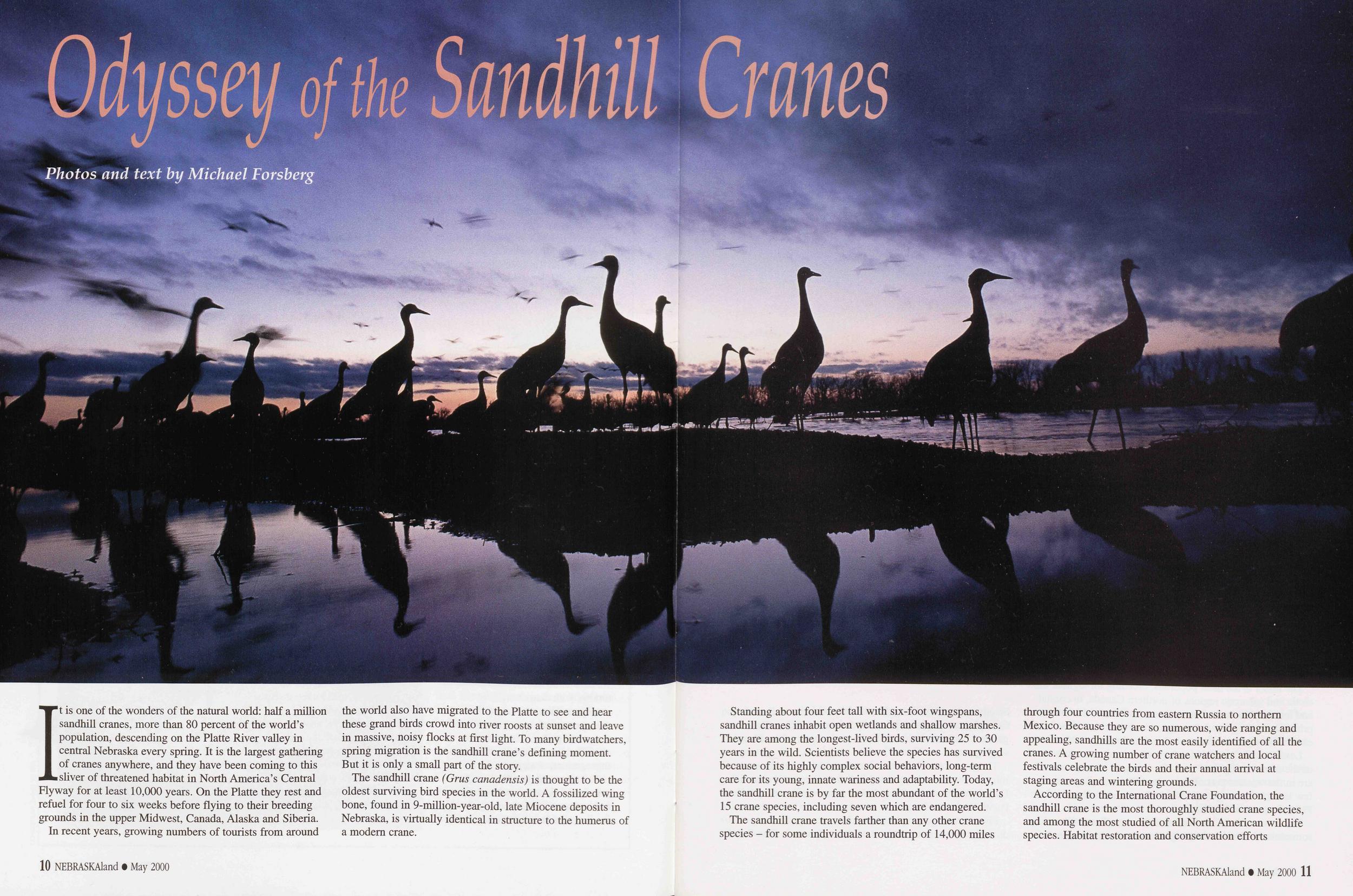
Odyssey of the Sandhill Cranes
Photos and text by Michael ForsbergIt is one of the wonders of the natural world: half a million sandhill cranes, more than 80 percent of the world’s population, descending on the Platte River valley in central Nebraska every spring. It is the largest gathering of cranes anywhere, and they have been coming to this sliver of threatened habitat in North America’s Central Flyway for at least 10,000 years. On the Platte they rest and refuel for four to six weeks before flying to their breeding grounds in the upper Midwest, Canada, Alaska and Siberia.
In recent years, growing numbers of tourists from around the world also have migrated to the Platte to see and hear these grand birds crowd into river roosts at sunset and leave in massive, noisy flocks at first light. To many birdwatchers, spring migration is the sandhill crane’s defining moment. But it is only a small part of the story.
The sandhill crane (Grus canadensis) is thought to be the oldest surviving bird species in the world. A fossilized wing bone, found in 9-million-year-old, late Miocene deposits in Nebraska, is virtually identical in structure to the humerus of a modem crane.
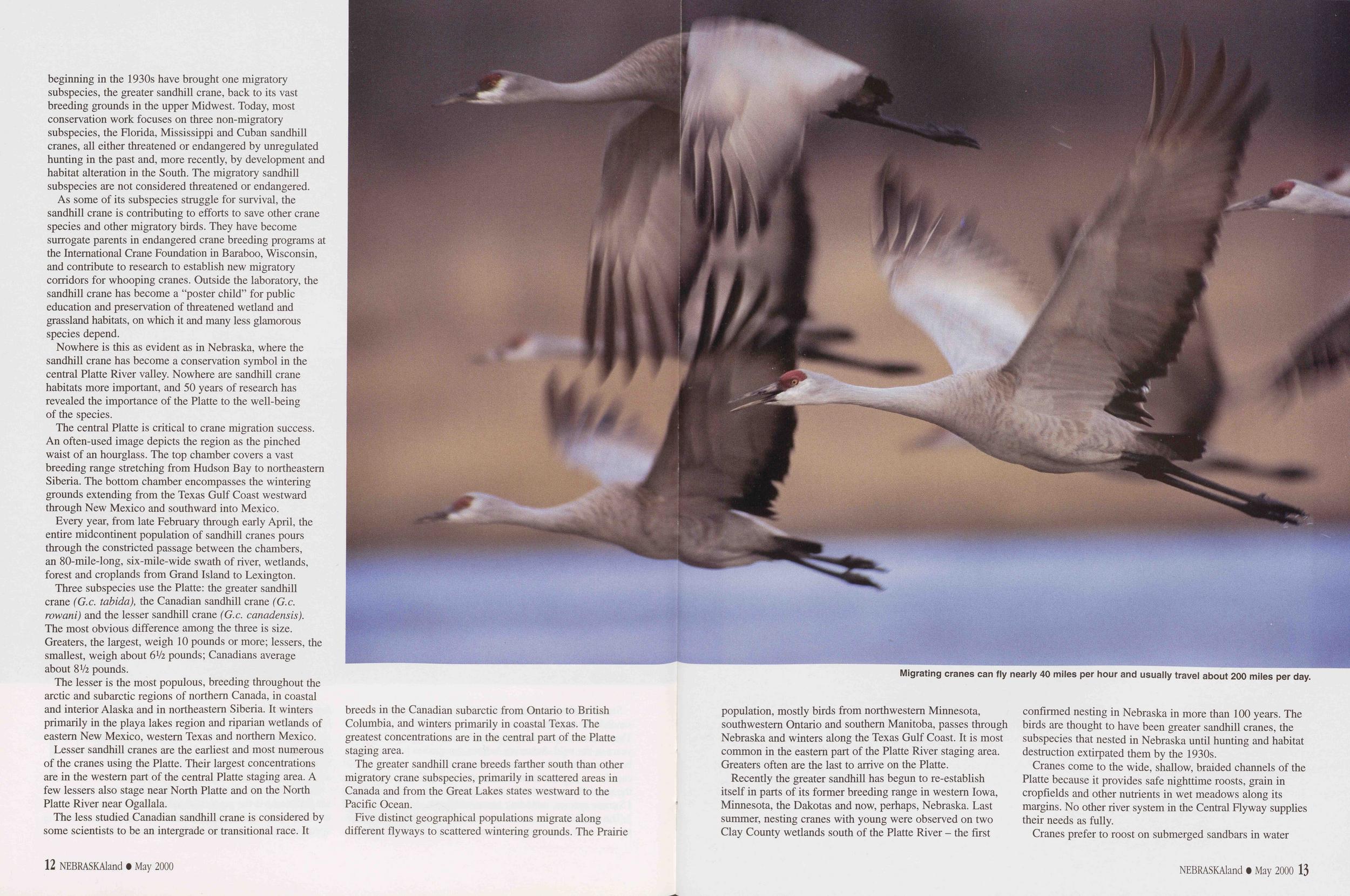
Standing about four feet tall with six-foot wingspans, sandhill cranes inhabit open wetlands and shallow marshes. They are among the longest-lived birds, surviving 25 to 30 years in the wild. Scientists believe the species has survived because of its highly complex social behaviors, long-term care for its young, innate wariness and adaptability. Today, the sandhill crane is by far the most abundant of the world’s 15 crane species, including seven which are endangered.
The sandhill crane travels farther than any other crane species - for some individuals a roundtrip of 14,000 miles through four countries from eastern Russia to northern Mexico. Because they are so numerous, wide ranging and appealing, sandhills are the most easily identified of all the cranes. A growing number of crane watchers and local festivals celebrate the birds and their annual arrival at staging areas and wintering grounds.
According to the International Crane Foundation, the
sandhill crane is the most thoroughly studied crane species,
and among the most studied of all North American wildlife
species. Habitat restoration and conservation efforts
NEBRASKAland • May 2000 11
10 NEBRASKAland • May 2000
 beginning in the 1930s have brought one migratory
subspecies, the greater sandhill crane, back to its vast
breeding grounds in the upper Midwest. Today, most
conservation work focuses on three non-migratory
subspecies, the Florida, Mississippi and Cuban sandhill
cranes, all either threatened or endangered by unregulated
hunting in the past and, more recently, by development and
habitat alteration in the South. The migratory sandhill
subspecies are not considered threatened or endangered.
beginning in the 1930s have brought one migratory
subspecies, the greater sandhill crane, back to its vast
breeding grounds in the upper Midwest. Today, most
conservation work focuses on three non-migratory
subspecies, the Florida, Mississippi and Cuban sandhill
cranes, all either threatened or endangered by unregulated
hunting in the past and, more recently, by development and
habitat alteration in the South. The migratory sandhill
subspecies are not considered threatened or endangered.
As some of its subspecies struggle for survival, the sandhill crane is contributing to efforts to save other crane species and other migratory birds. They have become surrogate parents in endangered crane breeding programs at the International Crane Foundation in Baraboo, Wisconsin, and contribute to research to establish new migratory corridors for whooping cranes. Outside the laboratory, the sandhill crane has become a “poster child” for public education and preservation of threatened wetland and grassland habitats, on which it and many less glamorous species depend.
Nowhere is this as evident as in Nebraska, where the sandhill crane has become a conservation symbol in the central Platte River valley. Nowhere are sandhill crane habitats more important, and 50 years of research has revealed the importance of the Platte to the well-being of the species.
The central Platte is critical to crane migration success. An often-used image depicts the region as the pinched waist of an hourglass. The top chamber covers a vast breeding range stretching from Hudson Bay to northeastern Siberia. The bottom chamber encompasses the wintering grounds extending from the Texas Gulf Coast westward through New Mexico and southward into Mexico.
Every year, from late February through early April, the entire midcontinent population of sandhill cranes pours through the constricted passage between the chambers, an 80-mile-long, six-mile-wide swath of river, wetlands, forest and croplands from Grand Island to Lexington.
Three subspecies use the Platte: the greater sandhill crane (G.c. tabida), the Canadian sandhill crane (G.c. rowani) and the lesser sandhill crane (G.c. canadensis). The most obvious difference among the three is size. Greaters, the largest, weigh 10 pounds or more; lessers, the smallest, weigh about 6V2 pounds; Canadians average about 8V2 pounds.
The lesser is the most populous, breeding throughout the arctic and subarctic regions of northern Canada, in coastal and interior Alaska and in northeastern Siberia. It winters primarily in the playa lakes region and riparian wetlands of eastern New Mexico, western Texas and northern Mexico.
Lesser sandhill cranes are the earliest and most numerous of the cranes using the Platte. Their largest concentrations are in the western part of the central Platte staging area. A few lessers also stage near North Platte and on the North Platte River near Ogallala.
The less studied Canadian sandhill crane is considered by some scientists to be an intergrade or transitional race. It breeds in the Canadian subarctic from Ontario to British Columbia, and winters primarily in coastal Texas. The greatest concentrations are in the central part of the Platte staging area.
The greater sandhill crane breeds farther south than other migratory crane subspecies, primarily in scattered areas in Canada and from the Great Lakes states westward to the Pacific Ocean.
Five distinct geographical populations migrate along different flyways to scattered wintering grounds. The Prairie population, mostly birds from northwestern Minnesota, southwestern Ontario and southern Manitoba, passes through Nebraska and winters along the Texas Gulf Coast. It is most common in the eastern part of the Platte River staging area. Greaters often are the last to arrive on the Platte.
Recently the greater sandhill has begun to re-establish itself in parts of its former breeding range in western Iowa, Minnesota, the Dakotas and now, perhaps, Nebraska. Last summer, nesting cranes with young were observed on two Clay County wetlands south of the Platte River - the first confirmed nesting in Nebraska in more than 100 years. The birds are thought to have been greater sandhill cranes, the subspecies that nested in Nebraska until hunting and habitat destruction extirpated them by the 1930s.
Cranes come to the wide, shallow, braided channels of the Platte because it provides safe nighttime roosts, grain in cropfields and other nutrients in wet meadows along its margins. No other river system in the Central Flyway supplies their needs as fully.
Cranes prefer to roost on submerged sandbars in water
12 NEBRASKAland • May 2000
NEBRASKAland • May 2000 13
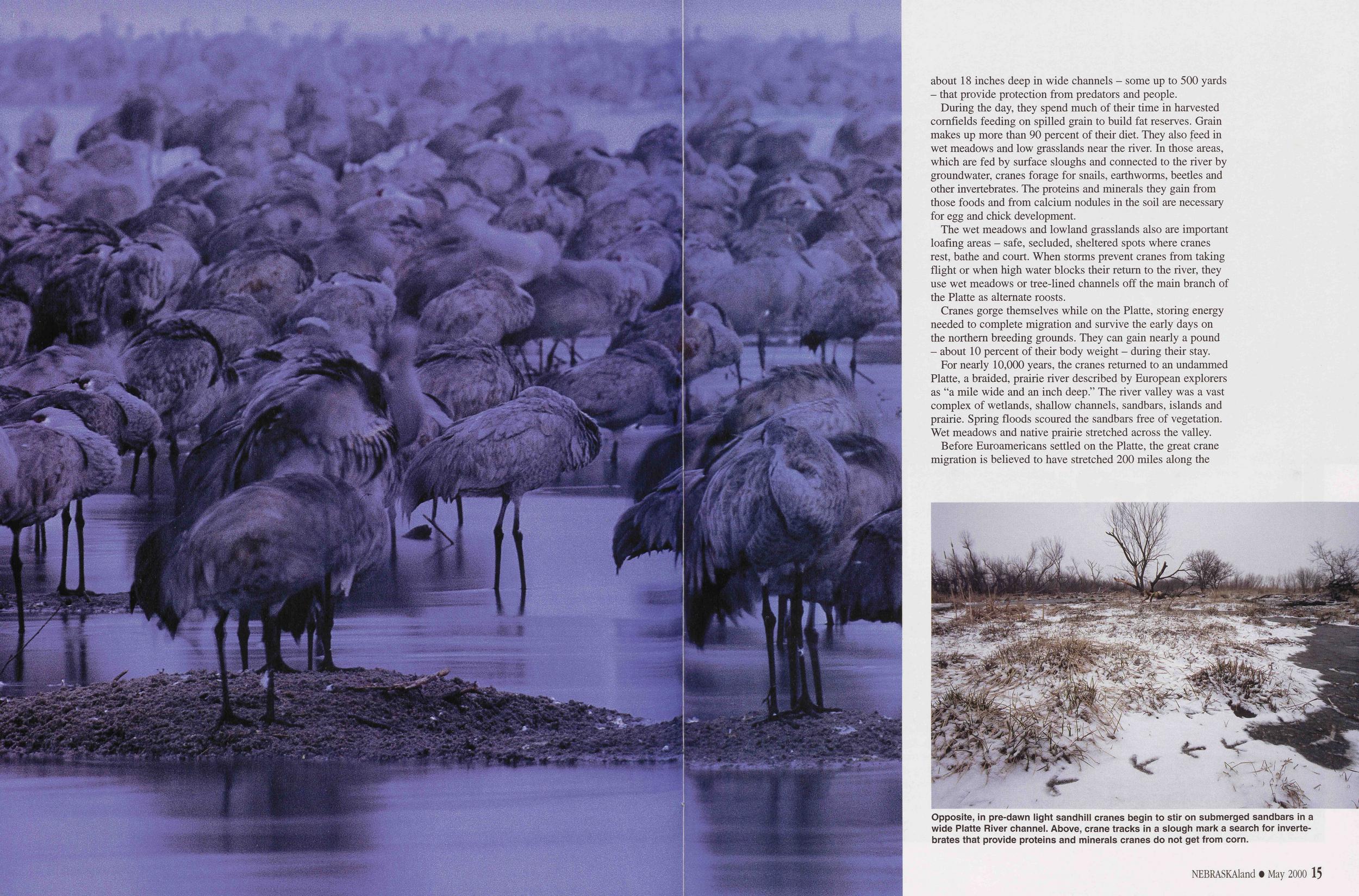 about 18 inches deep in wide channels - some up to 500 yards
- that provide protection from predators and people.
about 18 inches deep in wide channels - some up to 500 yards
- that provide protection from predators and people.
During the day, they spend much of their time in harvested cornfields feeding on spilled grain to build fat reserves. Grain makes up more than 90 percent of their diet. They also feed in wet meadows and low grasslands near the river. In those areas, which are fed by surface sloughs and connected to the river by groundwater, cranes forage for snails, earthworms, beetles and other invertebrates. The proteins and minerals they gain from those foods and from calcium nodules in the soil are necessary for egg and chick development.
The wet meadows and lowland grasslands also are important loafing areas - safe, secluded, sheltered spots where cranes rest, bathe and court. When storms prevent cranes from taking flight or when high water blocks their return to the river, they use wet meadows or tree-lined channels off the main branch of the Platte as alternate roosts.
Cranes gorge themselves while on the Platte, storing energy needed to complete migration and survive the early days on the northern breeding grounds. They can gain nearly a pound - about 10 percent of their body weight - during their stay.
For nearly 10,000 years, the cranes returned to an undammed Platte, a braided, prairie river described by European explorers as "a mile wide and an inch deep.” The river valley was a vast complex of wetlands, shallow channels, sandbars, islands and prairie. Spring floods scoured the sandbars free of vegetation. Wet meadows and native prairie stretched across the valley.
Before Euroamericans settled on the Platte, the great crane
migration is believed to have stretched 200 miles along the
NEBRASKAland • May 2000 15
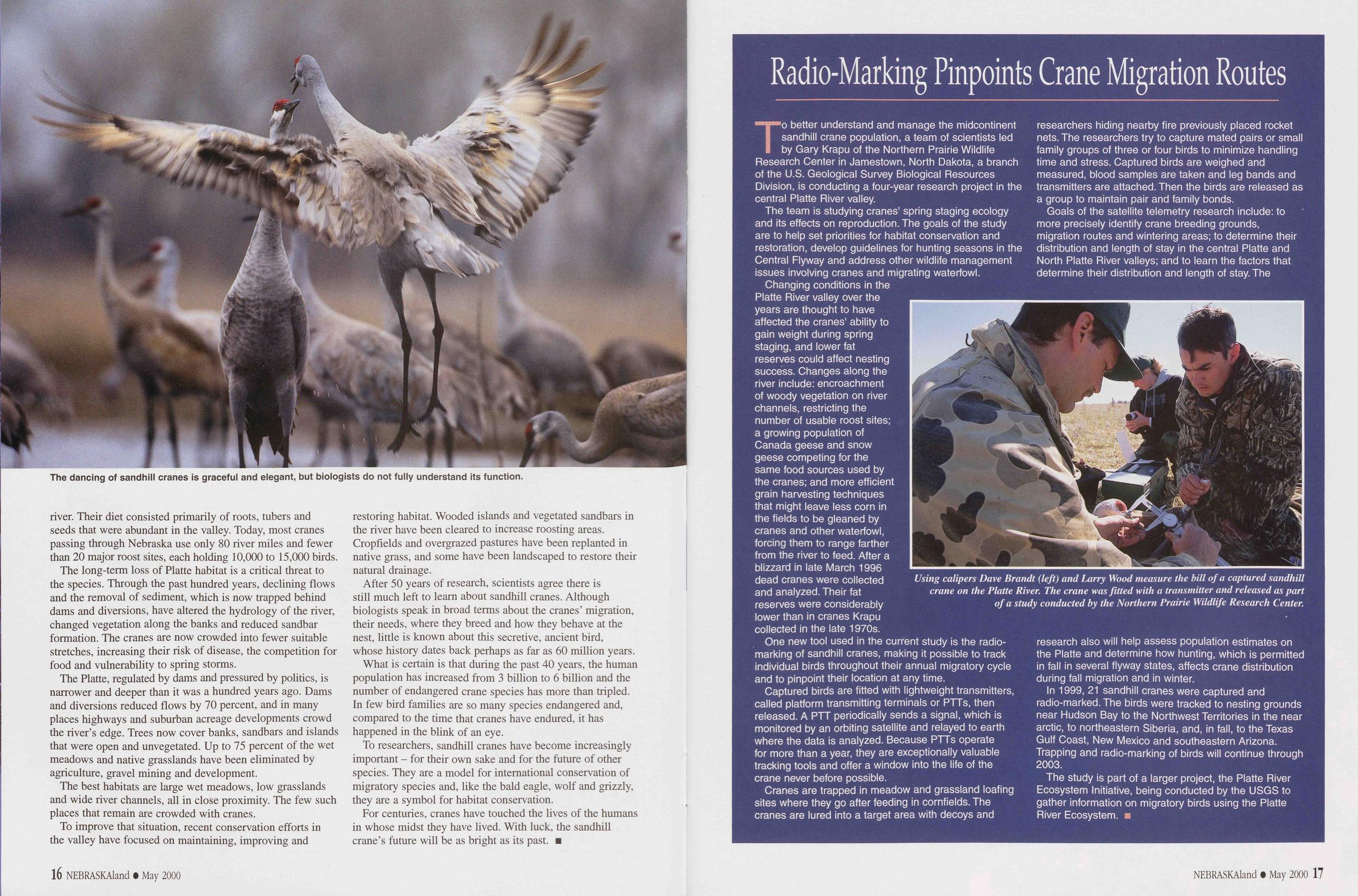 river. Their diet consisted primarily of roots, tubers and
seeds that were abundant in the valley. Today, most cranes
passing through Nebraska use only 80 river miles and fewer
than 20 major roost sites, each holding 10,000 to 15,000 birds.
river. Their diet consisted primarily of roots, tubers and
seeds that were abundant in the valley. Today, most cranes
passing through Nebraska use only 80 river miles and fewer
than 20 major roost sites, each holding 10,000 to 15,000 birds.
The long-term loss of Platte habitat is a critical threat to the species. Through the past hundred years, declining flows and the removal of sediment, which is now trapped behind dams and diversions, have altered the hydrology of the river, changed vegetation along the banks and reduced sandbar formation. The cranes are now crowded into fewer suitable stretches, increasing their risk of disease, the competition for food and vulnerability to spring storms.
The Platte, regulated by dams and pressured by politics, is narrower and deeper than it was a hundred years ago. Dams and diversions reduced flows by 70 percent, and in many places highways and suburban acreage developments crowd the river’s edge. Trees now cover banks, sandbars and islands that were open and unvegetated. Up to 75 percent of the wet meadows and native grasslands have been eliminated by agriculture, gravel mining and development.
The best habitats are large wet meadows, low grasslands and wide river channels, all in close proximity. The few such places that remain are crowded with cranes.
To improve that situation, recent conservation efforts in the valley have focused on maintaining, improving and restoring habitat. Wooded islands and vegetated sandbars in the river have been cleared to increase roosting areas. Cropfields and overgrazed pastures have been replanted in native grass, and some have been landscaped to restore their natural drainage.
After 50 years of research, scientists agree there is still much left to learn about sandhill cranes. Although biologists speak in broad terms about the cranes’ migration, their needs, where they breed and how they behave at the nest, little is known about this secretive, ancient bird, whose history dates back perhaps as far as 60 million years.
What is certain is that during the past 40 years, the human population has increased from 3 billion to 6 billion and the number of endangered crane species has more than tripled. In few bird families are so many species endangered and, compared to the time that cranes have endured, it has happened in the blink of an eye.
To researchers, sandhill cranes have become increasingly important - for their own sake and for the future of other species. They are a model for international conservation of migratory species and, like the bald eagle, wolf and grizzly, they are a symbol for habitat conservation. For centuries, cranes have touched the lives of the humans in whose midst they have lived. With luck, the sandhill crane’s future will be as bright as its past. ■
To better understand and manage the midcontinent sandhill crane population, a team of scientists led by Gary Krapu of the Northern Prairie Wildlife Research Center in Jamestown, North Dakota, a branch of the U.S. Geological Survey Biological Resources Division, is conducting a four-year research project in the central Platte River valley.
The team is studying cranes' spring staging ecology and its effects on reproduction. The goals of the study are to help set priorities for habitat conservation and restoration, develop guidelines for hunting seasons in the Central Flyway and address other wildlife management issues involving cranes and migrating waterfowl.
Changing conditions in the Platte River valley over the years are thought to have affected the cranes' ability to gain weight during spring staging, and lower fat reserves could affect nesting success. Changes along the river include: encroachment of woody vegetation on river channels, restricting the number of usable roost sites; a growing population of Canada geese and snow geese competing for the same food sources used by the cranes; and more efficient grain harvesting techniques that might leave less corn in the fields to be gleaned by cranes and other waterfowl, forcing them to range farther from the river to feed. After a blizzard in late March 1996 dead cranes were collected and analyzed. Their fat reserves were considerably lower than in cranes Krapu collected in the late 1970s.
One new tool used in the current study is the radio- marking of sandhill cranes, making it possible to track individual birds throughout their annual migratory cycle and to pinpoint their location at any time.
Captured birds are fitted with lightweight transmitters, called platform transmitting terminals or PTTs, then released. A PTT periodically sends a signal, which is monitored by an orbiting satellite and relayed to earth where the data is analyzed. Because PTTs operate for more than a year, they are exceptionally valuable tracking tools and offer a window into the life of the crane never before possible.
Cranes are trapped in meadow and grassland loafing sites where they go after feeding in cornfields. The cranes are lured into a target area with decoys and researchers hiding nearby fire previously placed rocket nets. The researchers try to capture mated pairs or small family groups of three or four birds to minimize handling time and stress. Captured birds are weighed and measured, blood samples are taken and leg bands and transmitters are attached. Then the birds are released as a group to maintain pair and family bonds.
Goals of the satellite telemetry research include: to more precisely identify crane breeding grounds, migration routes and wintering areas; to determine their distribution and length of stay in the central Platte and North Platte River valleys; and to learn the factors that determine their distribution and length of stay. The research also will help assess population estimates on the Platte and determine how hunting, which is permitted in fall in several flyway states, affects crane distribution during fall migration and in winter.
In 1999, 21 sandhill cranes were captured and radio-marked. The birds were tracked to nesting grounds near Hudson Bay to the Northwest Territories in the near arctic, to northeastern Siberia, and, in fall, to the Texas Gulf Coast, New Mexico and southeastern Arizona. Trapping and radio-marking of birds will continue through 2003.
The study is part of a larger project, the Platte River Ecosystem Initiative, being conducted by the USGS to gather information on migratory birds using the Platte River Ecosystem. ■
16 NEBRASKAland • May 2000 NEBRASKAland • May 2000 17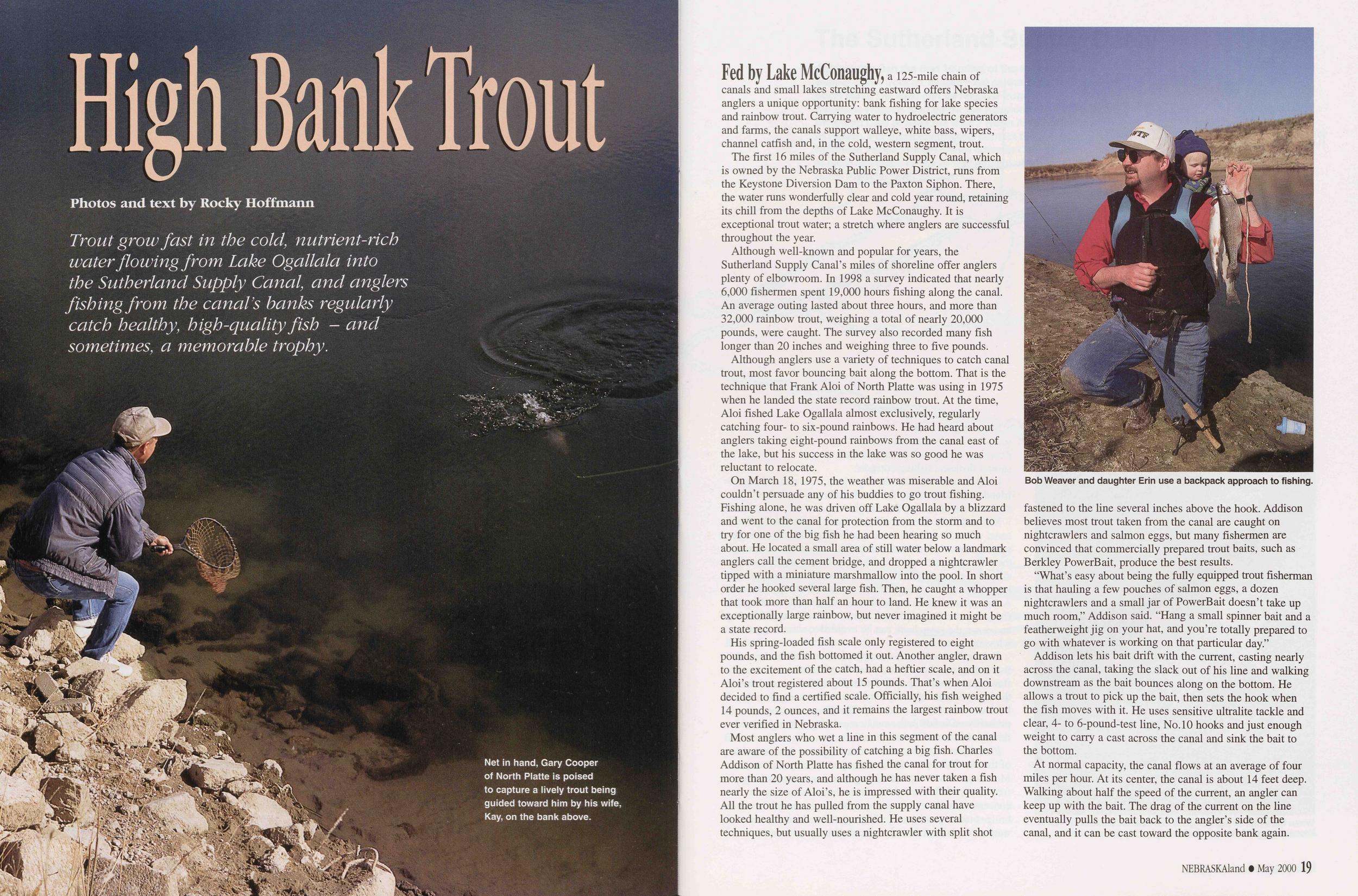
High Bank Trout
Photos and text by Rocky Hoffmann Trout grow fast in the cold, nutrient-rich water flowing from Lake Ogallala into the Sutherland Supply Canal, and anglers fishing from the canal’s hanks regularly catch healthy, high-quality fish - and sometimes, a memorable trophy.Fed by Lake McConaughy, a 125-mile chain of canals and small lakes stretching eastward offers Nebraska anglers a unique opportunity: bank fishing for lake species and rainbow trout. Carrying water to hydroelectric generators and farms, the canals support walleye, white bass, wipers, channel catfish and, in the cold, western segment, trout.
The first 16 miles of the Sutherland Supply Canal, which is owned by the Nebraska Public Power District, runs from the Keystone Diversion Dam to the Paxton Siphon. There, the water runs wonderfully clear and cold year round, retaining its chill from the depths of Lake McConaughy. It is exceptional trout water; a stretch where anglers are successful throughout the year.
Although well-known and popular for years, the Sutherland Supply Canal’s miles of shoreline offer anglers plenty of elbowroom. In 1998 a survey indicated that nearly 6,000 fishermen spent 19,000 hours fishing along the canal. An average outing lasted about three hours, and more than 32,000 rainbow trout, weighing a total of nearly 20,000 pounds, were caught. The survey also recorded many fish longer than 20 inches and weighing three to five pounds.
Although anglers use a variety of techniques to catch canal trout, most favor bouncing bait along the bottom. That is the technique that Frank Aloi of North Platte was using in 1975 when he landed the state record rainbow trout. At the time, Aloi fished Lake Ogallala almost exclusively, regularly catching four- to six-pound rainbows. He had heard about anglers taking eight-pound rainbows from the canal east of the lake, but his success in the lake was so good he was reluctant to relocate.
On March 18, 1975, the weather was miserable and Aloi couldn’t persuade any of his buddies to go trout fishing. Fishing alone, he was driven off Lake Ogallala by a blizzard and went to the canal for protection from the storm and to try for one of the big fish he had been hearing so much about. He located a small area of still water below a landmark anglers call the cement bridge, and dropped a nightcrawler tipped with a miniature marshmallow into the pool. In short order he hooked several large fish. Then, he caught a whopper that took more than half an hour to land. He knew it was an exceptionally large rainbow, but never imagined it might be a state record.
His spring-loaded fish scale only registered to eight pounds, and the fish bottomed it out. Another angler, drawn to the excitement of the catch, had a heftier scale, and on it Aloi’s trout registered about 15 pounds. That’s when Aloi decided to find a certified scale. Officially, his fish weighed 14 pounds, 2 ounces, and it remains the largest rainbow trout ever verified in Nebraska.
Most anglers who wet a line in this segment of the canal are aware of the possibility of catching a big fish. Charles Addison of North Platte has fished the canal for trout for more than 20 years, and although he has never taken a fish nearly the size of Aloi’s, he is impressed with their quality. All the trout he has pulled from the supply canal have looked healthy and well-nourished. He uses several techniques, but usually uses a nightcrawler with split shot Bob Weaver and daughter Erin use a backpack approach to fishing. fastened to the line several inches above the hook. Addison believes most trout taken from the canal are caught on nightcrawlers and salmon eggs, but many fishermen are convinced that commercially prepared trout baits, such as Berkley PowerBait, produce the best results.
“What’s easy about being the fully equipped trout fisherman is that hauling a few pouches of salmon eggs, a dozen nightcrawlers and a small jar of PowerBait doesn’t take up much room,” Addison said. “Hang a small spinner bait and a featherweight jig on your hat, and you’re totally prepared to go with whatever is working on that particular day.”
Addison lets his bait drift with the current, casting nearly across the canal, taking the slack out of his line and walking downstream as the bait bounces along on the bottom. He allows a trout to pick up the bait, then sets the hook when the fish moves with it. He uses sensitive ultralite tackle and clear, 4- to 6-pound-test line, No. 10 hooks and just enough weight to carry a cast across the canal and sink the bait to the bottom.
At normal capacity, the canal flows at an average of four miles per hour. At its center, the canal is about 14 feet deep. Walking about half the speed of the current, an angler can keep up with the bait. The drag of the current on the line eventually pulls the bait back to the angler’s side of the canal, and it can be cast toward the opposite bank again.
NEBRASKAland • May 2000 19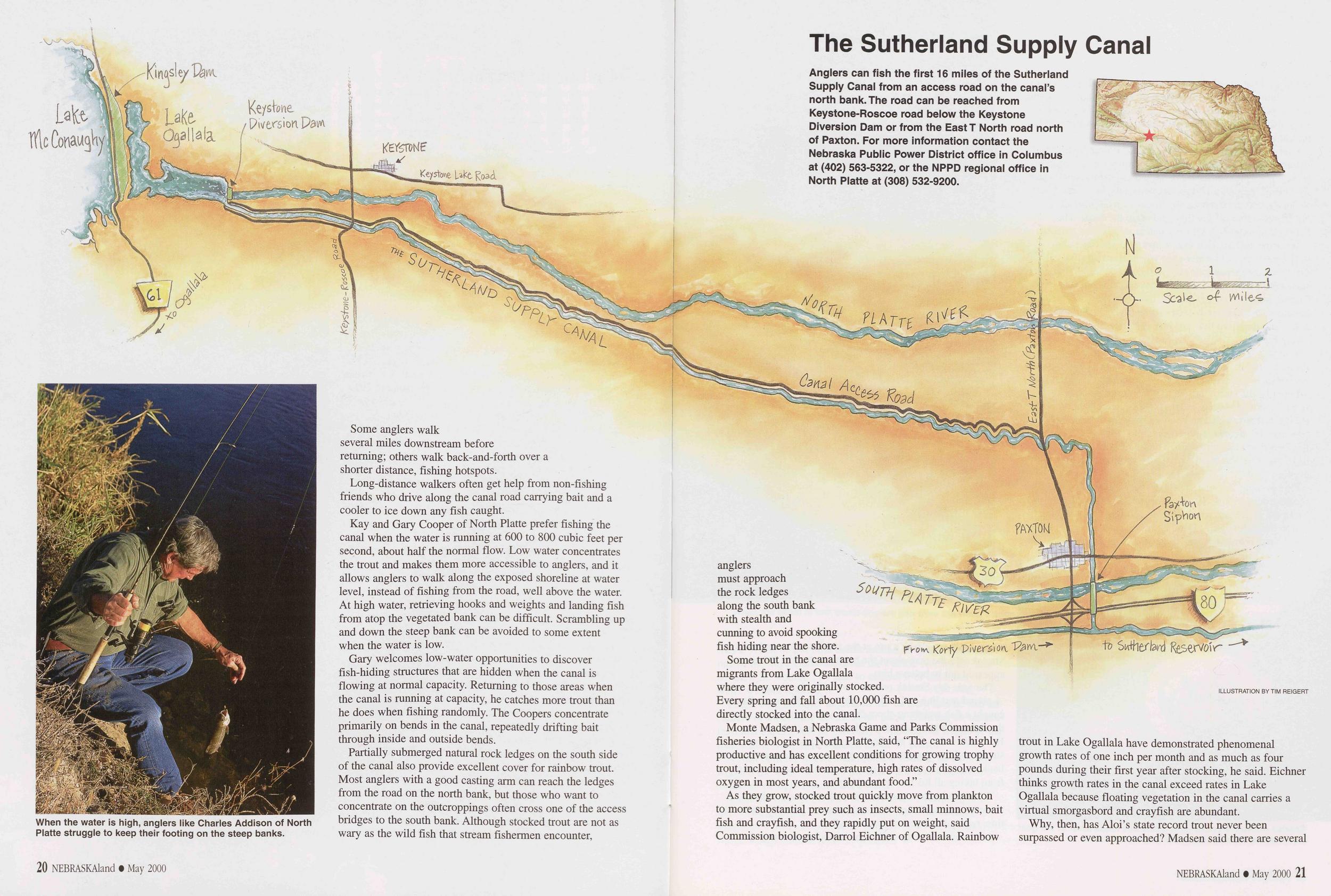
Some anglers walk several miles downstream before returning; others walk back-and-forth over a shorter distance, fishing hotspots.
Long-distance walkers often get help from non-fishing friends who drive along the canal road carrying bait and a cooler to ice down any fish caught.
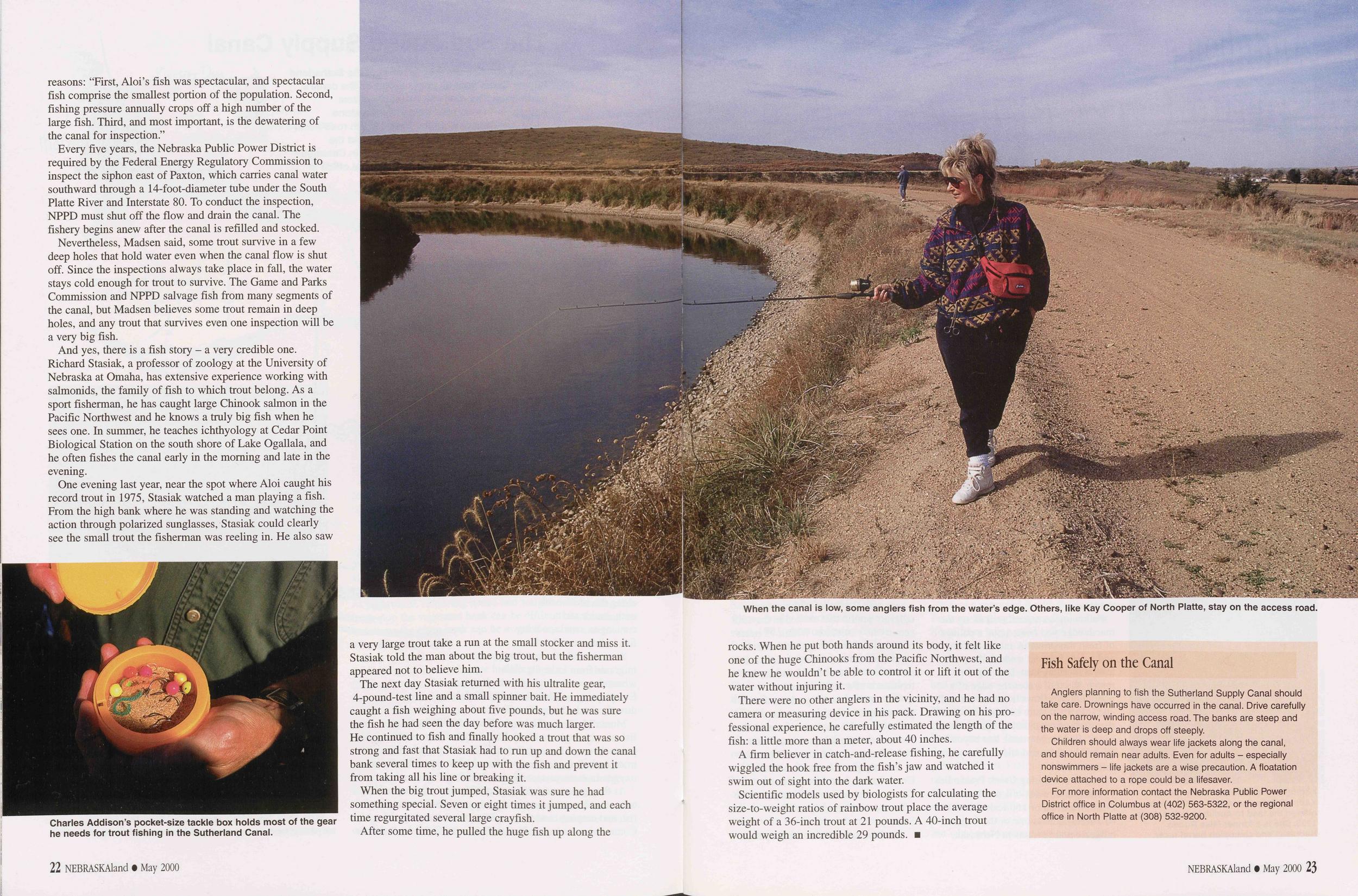
Kay and Gary Cooper of North Platte prefer fishing the canal when the water is running at 600 to 800 cubic feet per second, about half the normal flow. Low water concentrates the trout and makes them more accessible to anglers, and it allows anglers to walk along the exposed shoreline at water level, instead of fishing from the road, well above the water. At high water, retrieving hooks and weights and landing fish from atop the vegetated bank can be difficult. Scrambling up and down the steep bank can be avoided to some extent when the water is low.
Gary welcomes low-water opportunities to discover fish-hiding structures that are hidden when the canal is flowing at normal capacity. Returning to those areas when the canal is running at capacity, he catches more trout than he does when fishing randomly. The Coopers concentrate primarily on bends in the canal, repeatedly drifting bait through inside and outside bends.
Partially submerged natural rock ledges on the south side of the canal also provide excellent cover for rainbow trout. Most anglers with a good casting arm can reach the ledges from the road on the north bank, but those who want to concentrate on the outcroppings often cross one of the access bridges to the south bank. Although stocked trout are not as wary as the wild fish that stream fishermen encounter, anglers must approach the rock ledges along the south bank with stealth and cunning to avoid spooking fish hiding near the shore.
Some trout in the canal are migrants from Lake Ogallala where they were originally stocked. Every spring and fall about 10,000 fish are directly stocked into the canal.
Monte Madsen, a Nebraska Game and Parks Commission fisheries biologist in North Platte, said, “The canal is highly productive and has excellent conditions for growing trophy trout, including ideal temperature, high rates of dissolved oxygen in most years, and abundant food.”
As they grow, stocked trout quickly move from plankton to more substantial prey such as insects, small minnows, bait fish and crayfish, and they rapidly put on weight, said Commission biologist, Darrol Eichner of Ogallala. Rainbow trout in Lake Ogallala have demonstrated phenomenal growth rates of one inch per month and as much as four pounds during their first year after stocking, he said. Eichner thinks growth rates in the canal exceed rates in Lake Ogallala because floating vegetation in the canal carries a virtual smorgasbord and crayfish are abundant.
Why, then, has Aloi’s state record trout never been
surpassed or even approached? Madsen said there are several
20 NEBRASKAland • May 2000
NEBRASKAland • May 2000 21
 reasons: “First, Aloi’s fish was spectacular, and spectacular
fish comprise the smallest portion of the population. Second,
fishing pressure annually crops off a high number of the
large fish. Third, and most important, is the dewatering of
the canal for inspection.”
reasons: “First, Aloi’s fish was spectacular, and spectacular
fish comprise the smallest portion of the population. Second,
fishing pressure annually crops off a high number of the
large fish. Third, and most important, is the dewatering of
the canal for inspection.”
Every five years, the Nebraska Public Power District is required by the Federal Energy Regulatory Commission to inspect the siphon east of Paxton, which carries canal water southward through a 14-foot-diameter tube under the South Platte River and Interstate 80. To conduct the inspection, NPPD must shut off the flow and drain the canal. The fishery begins anew after the canal is refilled and stocked.
Nevertheless, Madsen said, some trout survive in a few deep holes that hold water even when the canal flow is shut off. Since the inspections always take place in fall, the water stays cold enough for trout to survive. The Game and Parks Commission and NPPD salvage fish from many segments of the canal, but Madsen believes some trout remain in deep holes, and any trout that survives even one inspection will be a very big fish.
And yes, there is a fish story - a very credible one. Richard Stasiak, a professor of zoology at the University of Nebraska at Omaha, has extensive experience working with salmonids, the family of fish to which trout belong. As a sport fisherman, he has caught large Chinook salmon in the Pacific Northwest and he knows a truly big fish when he sees one. In summer, he teaches ichthyology at Cedar Point Biological Station on the south shore of Lake Ogallala, and he often fishes the canal early in the morning and late in the evening.
One evening last year, near the spot where Aloi caught his record trout in 1975, Stasiak watched a man playing a fish. From the high bank where he was standing and watching the action through polarized sunglasses, Stasiak could clearly see the small trout the fisherman was reeling in. He also saw Charles Addison’s pocket-size tackle box holds most of the gear he needs for trout fishing in the Sutherland Canal. a very large trout take a run at the small Stocker and miss it. Stasiak told the man about the big trout, but the fisherman appeared not to believe him.
The next day Stasiak returned with his ultralite gear, 4-pound-test line and a small spinner bait. He immediately caught a fish weighing about five pounds, but he was sure the fish he had seen the day before was much larger. He continued to fish and finally hooked a trout that was so strong and fast that Stasiak had to run up and down the canal bank several times to keep up with the fish and prevent it from taking all his line or breaking it.
When the big trout jumped, Stasiak was sure he had something special. Seven or eight times it jumped, and each time regurgitated several large crayfish.
After some time, he pulled the huge fish up along the rocks. When he put both hands around its body, it felt like one of the huge Chinooks from the Pacific Northwest, and he knew he wouldn’t be able to control it or lift it out of the water without injuring it.
There were no other anglers in the vicinity, and he had no camera or measuring device in his pack. Drawing on his pro- fessional experience, he carefully estimated the length of the fish: a little more than a meter, about 40 inches.
A firm believer in catch-and-release fishing, he carefully wiggled the hook free from the fish’s jaw and watched it swim out of sight into the dark water.
Scientific models used by biologists for calculating the size-to-weight ratios of rainbow trout place the average weight of a 36-inch trout at 21 pounds. A 40-inch trout would weigh an incredible 29 pounds. ■
Fish Safely on the CanalAnglers planning to fish the Sutherland Supply Canal should take care. Drownings have occurred in the canal. Drive carefully on the narrow, winding access road. The banks are steep and the water is deep and drops off steeply.
Children should always wear life jackets along the canal, and should remain near adults. Even for adults - especially nonswimmers - life jackets are a wise precaution. A floatation device attached to a rope could be a lifesaver.
For more information contact the Nebraska Public Power District office in Columbus at (402) 563-5322, or the regional office in North Platte at (308) 532-9200.
22 NEBRASKAland • May 2000 NEBRASKAland • May 2000 23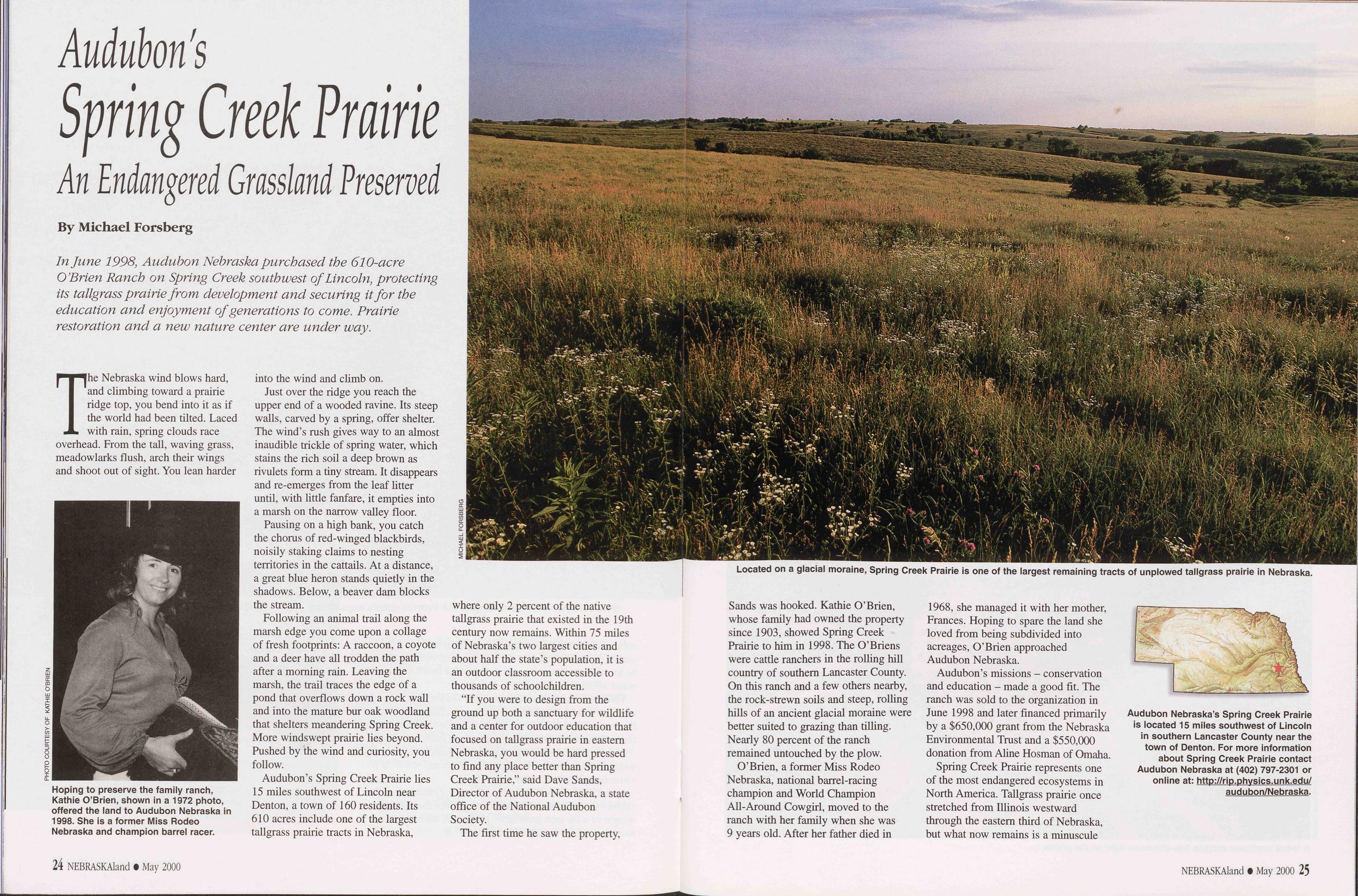
Audubon's Spring Creek Prairie An Endangered Grassland Preserved
By Michael Forsberg In June 1998, Audubon Nebraska purchased the 610-acre O’Brien Ranch on Spring Creek southwest of Lincoln, protecting its tailgrass prairie from development and securing it for the education and enjoyment of generations to come. Prairie restoration and a new nature center are under way. PHOTO COURTESY OF KATHIE O’BRIENThe Nebraska wind blows hard, and climbing toward a prairie ridge top, you bend into it as if the world had been tilted. Laced with rain, spring clouds race overhead. From the tall, waving grass, meadowlarks flush, arch their wings and shoot out of sight. You lean harder into the wind and climb on.
Just over the ridge you reach the upper end of a wooded ravine. Its steep walls, carved by a spring, offer shelter. The wind’s rush gives way to an almost inaudible trickle of spring water, which stains the rich soil a deep brown as rivulets form a tiny stream. It disappears and re-emerges from the leaf litter until, with little fanfare, it empties into a marsh on the narrow valley floor.
Pausing on a high bank, you catch the chorus of red-winged blackbirds, noisily staking claims to nesting territories in the cattails. At a distance, a great blue heron stands quietly in the shadows. Below, a beaver dam blocks the stream.
Following an animal trail along the marsh edge you come upon a collage of fresh footprints: A raccoon, a coyote and a deer have all trodden the path after a morning rain. Leaving the marsh, the trail traces the edge of a pond that overflows down a rock wall and into the mature bur oak woodland that shelters meandering Spring Creek. More windswept prairie lies beyond. Pushed by the wind and curiosity, you follow.
Audubon’s Spring Creek Prairie lies 15 miles southwest of Lincoln near Denton, a town of 160 residents. Its 610 acres include one of the largest tailgrass prairie tracts in Nebraska, where only 2 percent of the native tailgrass prairie that existed in the 19th century now remains. Within 75 miles of Nebraska’s two largest cities and about half the state’s population, it is an outdoor classroom accessible to thousands of schoolchildren.
“If you were to design from the ground up both a sanctuary for wildlife and a center for outdoor education that focused on tailgrass prairie in eastern Nebraska, you would be hard pressed to find any place better than Spring Creek Prairie,” said Dave Sands, Director of Audubon Nebraska, a state office of the National Audubon Society.
The first time he saw the property, Sands was hooked. Kathie O’Brien, whose family had owned the property since 1903, showed Spring Creek Prairie to him in 1998. The O’Briens were cattle ranchers in the rolling hill country of southern Lancaster County. On this ranch and a few others nearby, the rock-strewn soils and steep, rolling hills of an ancient glacial moraine were better suited to grazing than tilling. Nearly 80 percent of the ranch remained untouched by the plow.
O’Brien, a former Miss Rodeo Nebraska, national barrel-racing champion and World Champion All-Around Cowgirl, moved to the ranch with her family when she was 9 years old. After her father died in 1968, she managed it with her mother, Frances. Hoping to spare the land she loved from being subdivided into acreages, O’Brien approached Audubon Nebraska.
Audubon’s missions - conservation and education - made a good fit. The ranch was sold to the organization in June 1998 and later financed primarily by a $650,000 grant from the Nebraska Environmental Trust and a $550,000 donation from Aline Hosman of Omaha.
Audubon Nebraska’s Spring Creek Prairie is located 15 miles southwest of Lincoln in southern Lancaster County near the town of Denton. For more information about Spring Creek Prairie contact Audubon Nebraska at (402) 797-2301 or online at: http://rip.physics.unk.edu/ audubon/Nebraska.Spring Creek Prairie represents one
of the most endangered ecosystems in
North America. Tailgrass prairie once
stretched from Illinois westward
through the eastern third of Nebraska,
but what now remains is a minuscule
24 NEBRASKAland • May 2000
NEBRASKAland • May 2000 25
 remnant - primarily scattered fragments
of 20 acres or less that have escaped
agricultural and urban development.
The sheer size of Spring Creek makes
it unusual and especially valuable for
wildlife.
remnant - primarily scattered fragments
of 20 acres or less that have escaped
agricultural and urban development.
The sheer size of Spring Creek makes
it unusual and especially valuable for
wildlife.
“One of the big reasons this property was important for conservation was there is so little tailgrass left anywhere, and even fewer areas that are so big,” Sands said. “Smaller tailgrass prairie tracts are vitally important for plant diversity, but larger tracts are imperative for certain wildlife species to thrive and because more components of the tallgrass ecosystem are allowed to function. It is a valuable refuge.”
Five of the species on Audubon Nebraska’s watch-list of declining bird species have been confirmed at Spring Creek including the dickcissel, the field sparrow and the greater prairie chicken, all native grassland species, along with the bell’s vireo and the red-headed woodpecker, both found in the woodlands that border the prairie. In addition, the plains harvest mouse, a native species never previously found in tallgrass prairie in Nebraska, was recently discovered there.
In addition to the species with declining populations, deer, red foxes, coyotes, badgers, beavers and muskrats, along with migrating waterfowl and songbirds, call Spring Creek home for part or all of the year.
Spring Creek Prairie’s varied habitats include: wetlands, natural springs, creeks, ponds and a mature, mixed woodland with towering hackberries, American elms, cottonwoods and 150-year-old bur oaks.
The prairie is located in the upper reaches of the Spring Creek watershed, primarily a grassland that filters runoff. Nitrates, a common residue from agricultural fertilizer, are practically undetectable in the water, a rarity in heavily farmed eastern Nebraska.
To preserve the property’s habitats and assist in its stewardship, Audubon Nebraska has enlisted the expertise of institutions, agencies and individuals. The Land and Wildlife Advisory Committee, for example, assesses Spring Creek Prairie’s conservation and restoration needs. The committee includes members from the University of Nebraska, the Nebraska Game and Parks Commission, the Nebraska Cattlemen’s Association and area landowners.
The overriding goals are to improve the diversity of native species, minimize exotic species and restore native plant diversity that has been reduced or altered by years of intensive grazing.
The committee has developed a five-year plan for rotational grazing, burning and resting the more than 500 acres of native grassland, and has identified specific restoration projects. All interior barbed-wire fences are being removed and replaced with electric fences so the prairie can be divided into small pastures and cattle can be moved to replicate the grazing patterns of bison. Removing the fences creates unspoiled prairie vistas, another Audubon goal for the area.
Riparian areas include two streams, a marsh, several springs and six stock ponds. To maintain the integrity of the marsh, large ponds above and below it will remain intact, but the other ponds will be removed. Alternative water sources for cattle will be created to protect the riparian areas.
The mature oak woodlands need little restoration, but locusts, Siberian elms and European mulberries will be thinned or removed.
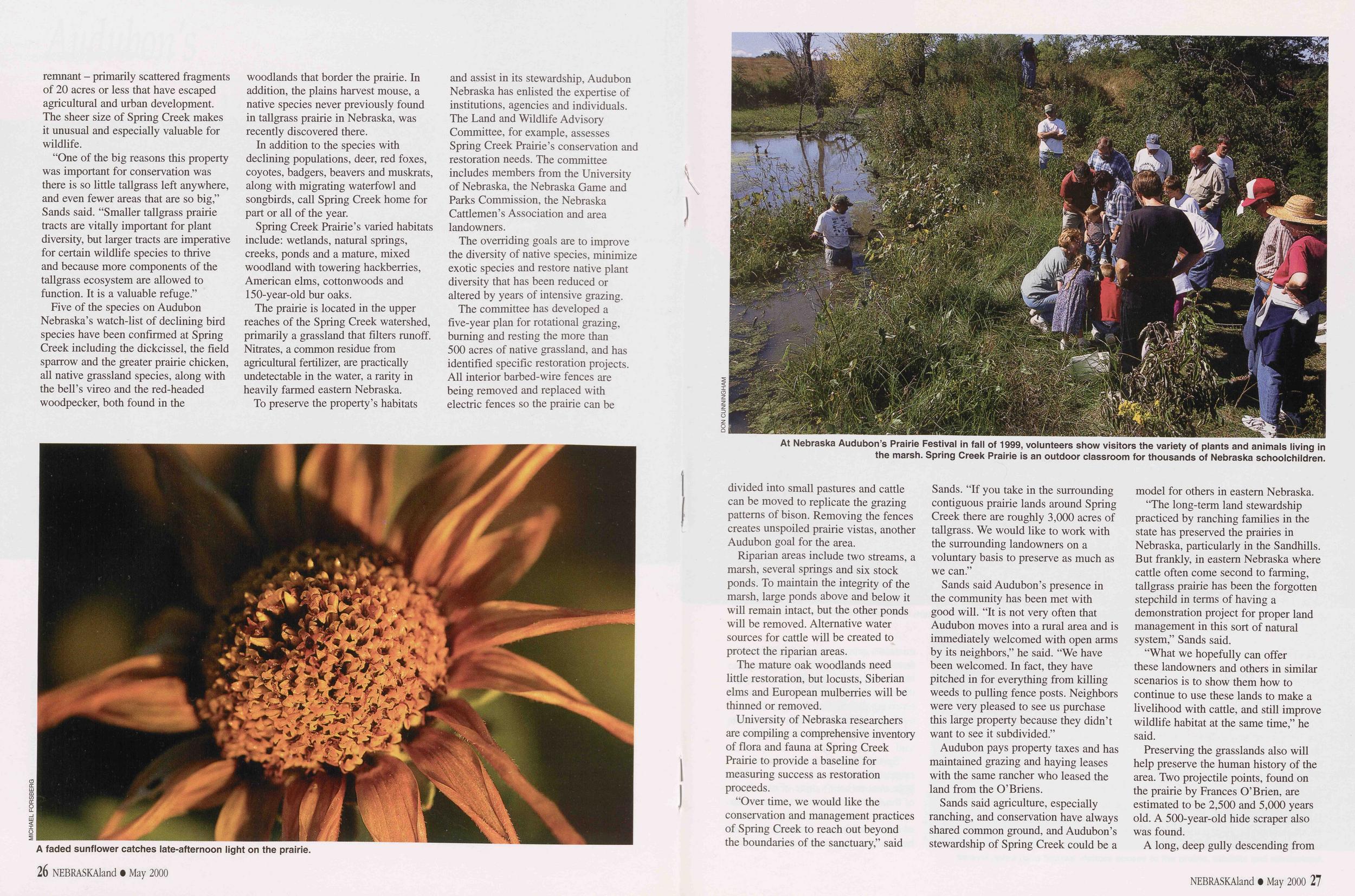
University of Nebraska researchers are compiling a comprehensive inventory of flora and fauna at Spring Creek Prairie to provide a baseline for measuring success as restoration proceeds.
“Over time, we would like the conservation and management practices of Spring Creek to reach out beyond the boundaries of the sanctuary,” said Sands. “If you take in the surrounding contiguous prairie lands around Spring Creek there are roughly 3,000 acres of tallgrass. We would like to work with the surrounding landowners on a voluntary basis to preserve as much as we can.”
Sands said Audubon’s presence in the community has been met with good will. “It is not very often that Audubon moves into a rural area and is immediately welcomed with open arms by its neighbors,” he said. “We have been welcomed. In fact, they have pitched in for everything from killing weeds to pulling fence posts. Neighbors were very pleased to see us purchase this large property because they didn’t want to see it subdivided.”
Audubon pays property taxes and has maintained grazing and haying leases with the same rancher who leased the land from the O’Briens.
Sands said agriculture, especially ranching, and conservation have always shared common ground, and Audubon’s stewardship of Spring Creek could be a model for others in eastern Nebraska.
“The long-term land stewardship practiced by ranching families in the state has preserved the prairies in Nebraska, particularly in the Sandhills. But frankly, in eastern Nebraska where cattle often come second to farming, tallgrass prairie has been the forgotten stepchild in terms of having a demonstration project for proper land management in this sort of natural system,” Sands said.
“What we hopefully can offer these landowners and others in similar scenarios is to show them how to continue to use these lands to make a livelihood with cattle, and still improve wildlife habitat at the same time,” he said.
Preserving the grasslands also will help preserve the human history of the area. Two projectile points, found on the prairie by Frances O’Brien, are estimated to be 2,500 and 5,000 years old. A 500-year-old hide scraper also was found.
A long, deep gully descending from
26 NEBRASKAland • May 2000
NEBRASKAland • May 2000 27
 a prairie ridge toward the ranch house
has been identified as a branch of the
Nebraska City to Ft. Kearny Cutoff,
one of the busiest branches of the
Oregon Trail in the mid-1860s. The
legacy of the O’Brien Ranch and the
ranching lifestyle also have left a mark
on the landscape. All are important
stories that Audubon wants to tell.
a prairie ridge toward the ranch house
has been identified as a branch of the
Nebraska City to Ft. Kearny Cutoff,
one of the busiest branches of the
Oregon Trail in the mid-1860s. The
legacy of the O’Brien Ranch and the
ranching lifestyle also have left a mark
on the landscape. All are important
stories that Audubon wants to tell.
Perhaps Audubon’s greatest vision for Spring Creek is to create a sanctuary where wildlife and native plants can flourish and be used to teach Nebraskans about natural history and their cultural heritage.
"I once asked my daughter if she learned more about the natural resources of the rainforest or about Nebraska’s prairies in school,” Sands said.
"She laughed at me and said, ‘No contest. We learned a lot more about the rainforest.’ Now, that certainly doesn’t mean they shouldn’t learn about the rainforest and it shouldn’t diminish its importance, but kids should have an improved opportunity to learn about the importance and value of what is in their own backyard first.”
Sands said that to fulfill Audubon’s missions, every generation will have to develop a conservation ethic through intimate experience with or knowledge of nature. “We don’t believe kids are receiving that firsthand experience outdoors, on the land, with a multitude of living things, that they should,” he said.
“Spring Creek Prairie can help to reverse some of that. First, it is within a little over an hour’s drive of two-thirds of the state’s population, so there is an opportunity to reach literally thousands of schoolchildren by bringing them out here to have an actual experience.
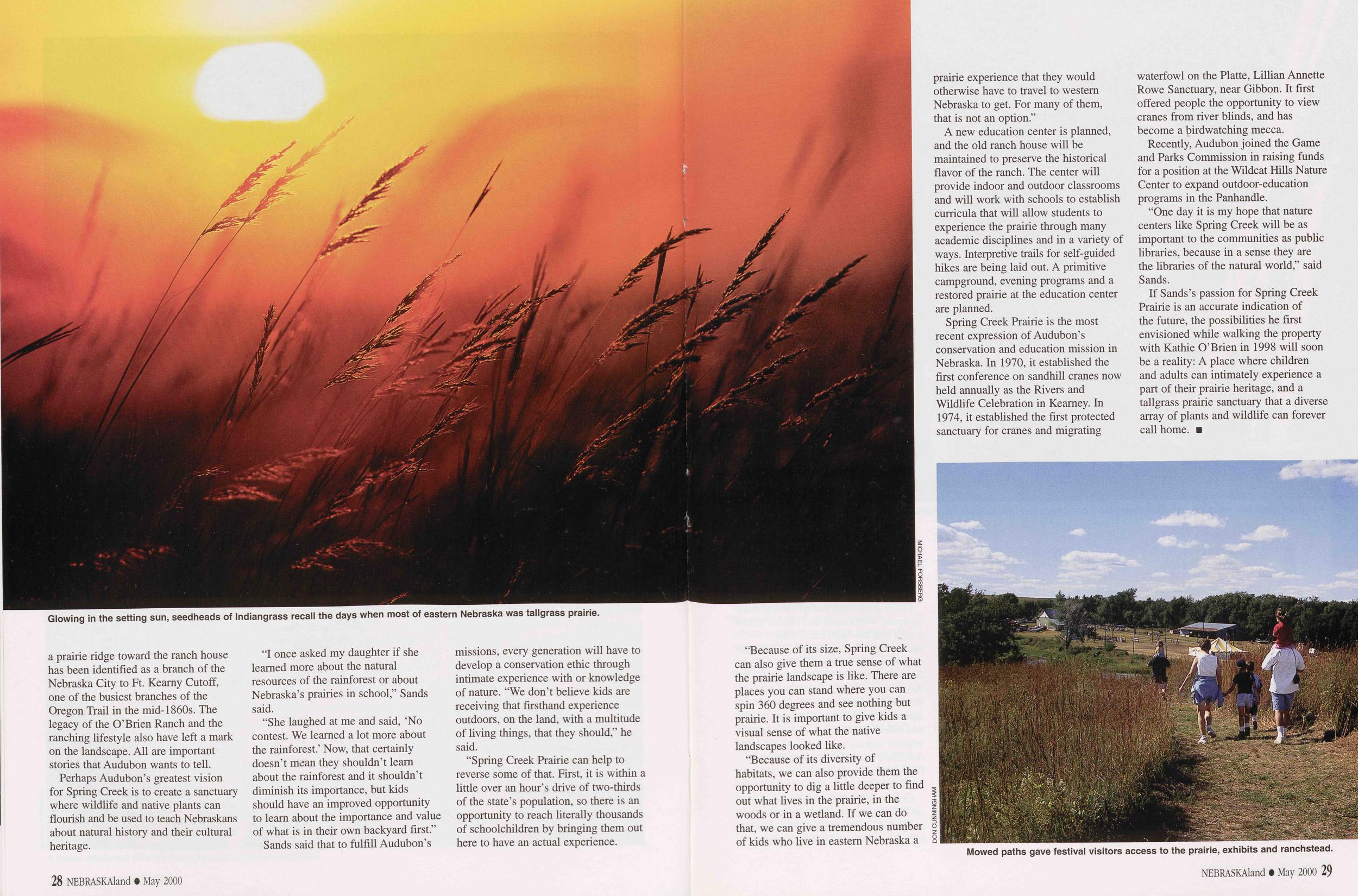
“Because of its size, Spring Creek can also give them a true sense of what the prairie landscape is like. There are places you can stand where you can spin 360 degrees and see nothing but prairie. It is important to give kids a visual sense of what the native landscapes looked like.
“Because of its diversity of habitats, we can also provide them the opportunity to dig a little deeper to find out what lives in the prairie, in the woods or in a wetland. If we can do that, we can give a tremendous number of kids who live in eastern Nebraska a prairie experience that they would otherwise have to travel to western Nebraska to get. For many of them, that is not an option.”
A new education center is planned, and the old ranch house will be maintained to preserve the historical flavor of the ranch. The center will provide indoor and outdoor classrooms and will work with schools to establish curricula that will allow students to experience the prairie through many academic disciplines and in a variety of ways. Interpretive trails for self-guided hikes are being laid out. A primitive campground, evening programs and a restored prairie at the education center are planned.
Spring Creek Prairie is the most recent expression of Audubon’s conservation and education mission in Nebraska. In 1970, it established the first conference on sandhill cranes now held annually as the Rivers and Wildlife Celebration in Kearney. In 1974, it established the first protected sanctuary for cranes and migrating waterfowl on the Platte, Lillian Annette Rowe Sanctuary, near Gibbon. It first offered people the opportunity to view cranes from river blinds, and has become a birdwatching mecca.
Recently, Audubon joined the Game and Parks Commission in raising funds for a position at the Wildcat Hills Nature Center to expand outdoor-education programs in the Panhandle.
“One day it is my hope that nature centers like Spring Creek will be as important to the communities as public libraries, because in a sense they are the libraries of the natural world,” said Sands.
If Sands’s passion for Spring Creek Prairie is an accurate indication of the future, the possibilities he first envisioned while walking the property with Kathie O’Brien in 1998 will soon be a reality: A place where children and adults can intimately experience a part of their prairie heritage, and a tallgrass prairie sanctuary that a diverse array of plants and wildlife can forever call home. ■
28 NEBRASKAland • May 2000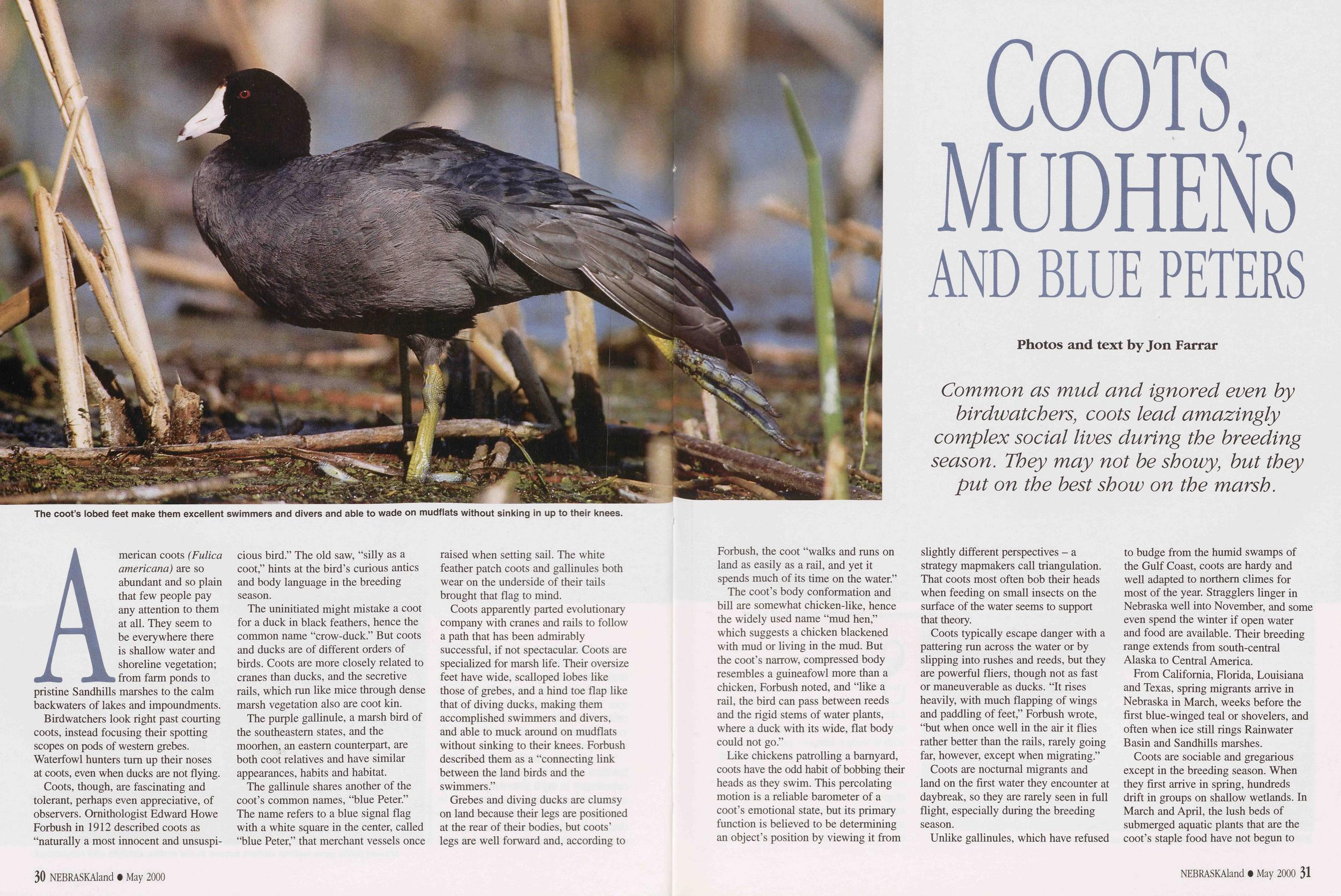
COOTS, MUDHENS AND BLUE PETERS
Photos and text by Jon Farrar Common as mud and ignored even by birdwatchers, coots lead amazingly complex social lives during the breeding season. They may not be showy, but they put on the best show on the marsh.American coots (Fulica americana) are so abundant and so plain that few people pay any attention to them at all. They seem to be everywhere there is shallow water and shoreline vegetation; from farm ponds to ndhills marshes to the calm of lakes and impoundments.
Birdwatchers look right past courting coots, instead focusing their spotting scopes on pods of western grebes. Waterfowl hunters turn up their noses at coots, even when ducks are not flying.
Coots, though, are fascinating and tolerant, perhaps even appreciative, of observers. Ornithologist Edward Howe Forbush in 1912 described coots as "naturally a most innocent and unsuspi- cious bird." The old saw, “silly as a coot,”hints at the bird’s curious antics and body language in the breeding season.
The uninitiated might mistake a coot for a duck in black feathers, hence the common name “crow-duck.”But coots and ducks are of different orders of birds. Coots are more closely related to cranes than ducks, and the secretive rails, which run like mice through dense marsh vegetation also are coot kin.
The purple gallinule, a marsh bird of the southeastern states, and the moorhen. an eastern counterpart, are both coot relatives and have similar appearances, habits and habitat.
The gallinule shares another of the of coot's common names, "blue Peter." The name refers to a blue signal flag with a white square in the center, called "blue Peter," that merchant vessels once raised when setting sail. The white feather patch coots and gallinules both wear on the underside of their tails brought that flag to mind.
Coots apparently parted evolutionary company with cranes and rails to follow a path that has been admirably successful, if not spectacular. Coots are specialized for marsh life. Their oversize feet have wide. scalloped lobes like that of diving ducks, making them accomplished swimmers and divers, and able to muck around on mudflats without sinking to their knees. Forbush described them as a "connecting link between the land birds and the swimmers."
Grebes and diving ducks are clumsy on land because their legs are positioned at the rear of their bodies, but coots' legs are well forward and, according to Forbush, the coot "walks and runs on land as easily as a rail, and yet it spends much of its time on the water."
The coot's body conformation and bill are somewhat chicken-like, hence the widelv used name "mud hen." which suggests a chicken blackened with mud or living in the mud. But the coot's narrow, compressed body resembles a guineafowl more than a chicken, Forbush noted, and "like a rail. the bird can pass between reeds and the rigid stems of water plants, where a duck with its wide, flat body could not go."
Like chickens patrolling a barnyard, coots have the odd habit of bobbing their heads as they swim. This percolating motion is a reliable barometer of a coot's emotional state, but its primary function is believed to be determining an object's position by viewing it from slightly different perspectives - a strategy mapmakers call triangulation. That coots most often bob their heads when feeding on small insects on the surface of the water seems to support that theory.
Coots typically escape danger with a pattering run across the water or by slipping into rushes and reeds, but they are powerful fliers, though not as fast or maneuverable as ducks. "It rises heavily, with much flapping of wings and paddling of feet," Forbush wrote, "but when once well in the air it flies rather better than the rails, rarely going far, however, except when migrating."
Coots are nocturnal migrants and land on the firet water thew encounter at daybreak, so they are rarely seen in full drift in flight, especially during the breeding season.
Unlike gallinules, which have refused to budge from the humid swamps of the Gulf Coast, coots are hardy and well adopted to northern climes for most of the year. Stragglers linger in Nebraska well into November, and some even spend the winter if food are available. Their breeding range extends from south-central Alaska to Central America.
From California, Florida, Lousiana and Texas, spring migrants arrive in Nebraska in March, weeks before the first blue-winged teal or shovelers, and often when ice still rings Rainwater Basin and Sandhill marshes.
Coots are sociable and gregarious
except in the breeding season. When
they first arrive in spring, hundreds
drift in groups and shallow wetlands. In
March and April, the lush beds
of submerged aquatic plants that are the
coot's staple food have not begun to
NEBRASKAland • May 2000 31
 grow, and gangs of coots chase about
grazing on shoreline meadows like
geese.
grow, and gangs of coots chase about
grazing on shoreline meadows like
geese.
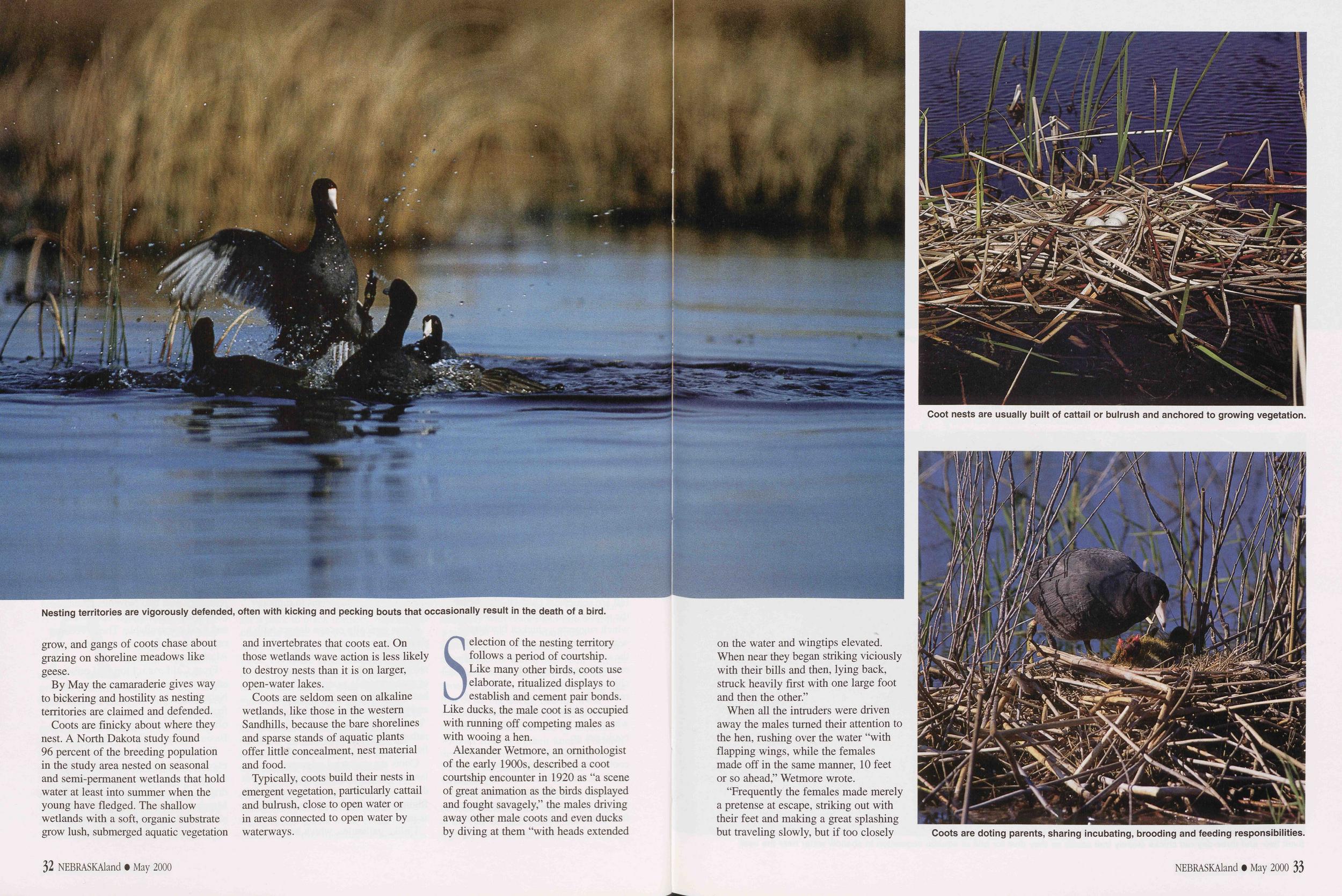
By May the camaraderie gives way to bickering and hostility as nesting territories are claimed and defended.
Coots are finicky about where they nest. A North Dakota study found 96 percent of the breeding population in the study area nested on seasonal and semi-permanent wetlands that hold water at least into summer when the young have fledged. The shallow wetlands with a soft, organic substrate grow lush, submerged aquatic vegetation and invertebrates that coots eat. On those wetlands wave action is less likely to destroy nests than it is on larger, open-water lakes.
Coots are seldom seen on alkaline wetlands, like those in the western Sandhills, because the bare shorelines and sparse stands of aquatic plants offer little concealment, nest material and food.
Typically, coots build their nests in emergent vegetation, particularly cattail and bulrush, close to open water or in areas connected to open water by waterways.
Selection of the nesting territory follows a period of courtship. Like many other birds, coots use elaborate, ritualized displays to establish and cement pair bonds. Like ducks, the male coot is as occupied with running off competing males as with wooing a hen.
Alexander Wetmore, an ornithologist of the early 1900s, described a coot courtship encounter in 1920 as "a scene of great animation as the birds displayed and fought savagely,” the males driving away other male coots and even ducks by diving at them “with heads extended on the water and wingtips elevated. When near they began striking viciously with their bills and then, lying back, struck heavily first with one large foot and then the other.”
When all the intruders were driven away the males turned their attention to the hen, rushing over the water “with flapping wings, while the females made off in the same manner, 10 feet or so ahead,” Wetmore wrote.
“Frequently the females made merely
a pretense at escape, striking out with
their feet and making a great splashing
but traveling slowly, but if too closely
32 NEBRASKAland • May 2000
NEBRASKAland • May 2000 33
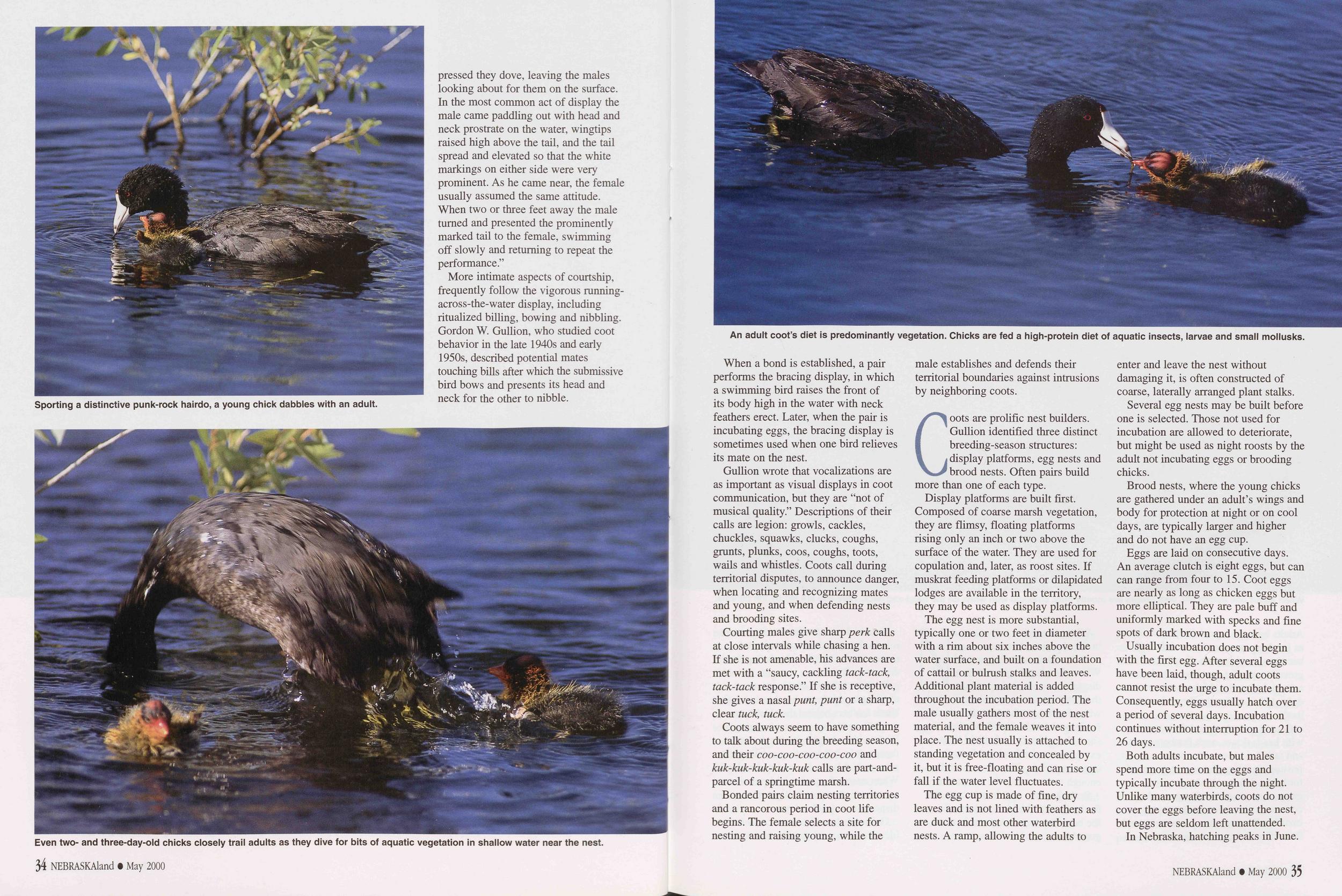 pressed they dove, leaving the males
looking about for them on the surface.
In the most common act of display the
male came paddling out with head and
neck prostrate on the water, wingtips
raised high above the tail, and the tail
spread and elevated so that the white
markings on either side were very
prominent. As he came near, the female
usually assumed the same attitude.
When two or three feet away the male
turned and presented the prominently
marked tail to the female, swimming
off slowly and returning to repeat the
performance.”
pressed they dove, leaving the males
looking about for them on the surface.
In the most common act of display the
male came paddling out with head and
neck prostrate on the water, wingtips
raised high above the tail, and the tail
spread and elevated so that the white
markings on either side were very
prominent. As he came near, the female
usually assumed the same attitude.
When two or three feet away the male
turned and presented the prominently
marked tail to the female, swimming
off slowly and returning to repeat the
performance.”
More intimate aspects of courtship, frequently follow the vigorous running- across-the-water display, including ritualized billing, bowing and nibbling. Gordon W. Gullion, who studied coot behavior in the late 1940s and early 1950s, described potential mates touching bills after which the submissive bird bows and presents its head and neck for the other to nibble.
When a bond is established, a pair performs the bracing display, in which a swimming bird raises the front of its body high in the water with neck feathers erect. Later, when the pair is incubating eggs, the bracing display is sometimes used when one bird relieves its mate on the nest.
Gullion wrote that vocalizations are as important as visual displays in coot communication, but they are "not of musical quality.” Descriptions of their calls are legion: growls, cackles, chuckles, squawks, clucks, coughs, grunts, plunks, coos, coughs, toots, wails and whistles. Coots call during territorial disputes, to announce danger, when locating and recognizing mates and young, and when defending nests and brooding sites.
Courting males give sharp perk calls at close intervals while chasing a hen. If she is not amenable, his advances are met with a “saucy, cackling tack-tack, tack-tack response.” If she is receptive, she gives a nasal punt, punt or a sharp, clear tuck, tuck.
Coots always seem to have something to talk about during the breeding season, and their coo-coo-coo-coo-coo and kuk-kuk-kuk-kuk-kuk calls are part-and- parcel of a springtime marsh.
Bonded pairs claim nesting territories and a rancorous period in coot life begins. The female selects a site for nesting and raising young, while the male establishes and defends their territorial boundaries against intrusions by neighboring coots.
Coots are prolific nest builders. Gullion identified three distinct breeding-season structures: display platforms, egg nests and brood nests. Often pairs build more than one of each type.
Display platforms are built first. Composed of coarse marsh vegetation, they are flimsy, floating platforms rising only an inch or two above the surface of the water. They are used for copulation and, later, as roost sites. If muskrat feeding platforms or dilapidated lodges are available in the territory, they may be used as display platforms.
The egg nest is more substantial, typically one or two feet in diameter with a rim about six inches above the water surface, and built on a foundation of cattail or bulrush stalks and leaves. Additional plant material is added throughout the incubation period. The male usually gathers most of the nest material, and the female weaves it into place. The nest usually is attached to standing vegetation and concealed by it, but it is free-floating and can rise or fall if the water level fluctuates.
The egg cup is made of fine, dry leaves and is not lined with feathers as are duck and most other waterbird nests. A ramp, allowing the adults to enter and leave the nest without damaging it, is often constructed of coarse, laterally arranged plant stalks.
Several egg nests may be built before one is selected. Those not used for incubation are allowed to deteriorate, but might be used as night roosts by the adult not incubating eggs or brooding chicks.
Brood nests, where the young chicks are gathered under an adult’s wings and body for protection at night or on cool days, are typically larger and higher and do not have an egg cup.
Eggs are laid on consecutive days. An average clutch is eight eggs, but can can range from four to 15. Coot eggs are nearly as long as chicken eggs but more elliptical. They are pale buff and uniformly marked with specks and fine spots of dark brown and black.
Usually incubation does not begin with the first egg. After several eggs have been laid, though, adult coots cannot resist the urge to incubate them. Consequently, eggs usually hatch over a period of several days. Incubation continues without interruption for 21 to 26 days.
Both adults incubate, but males spend more time on the eggs and typically incubate through the night. Unlike many waterbirds, coots do not cover the eggs before leaving the nest, but eggs are seldom left unattended.
In Nebraska, hatching peaks in June.
34 NEBRASKAland • May 2000
NEBRASKAland • May 2000 35
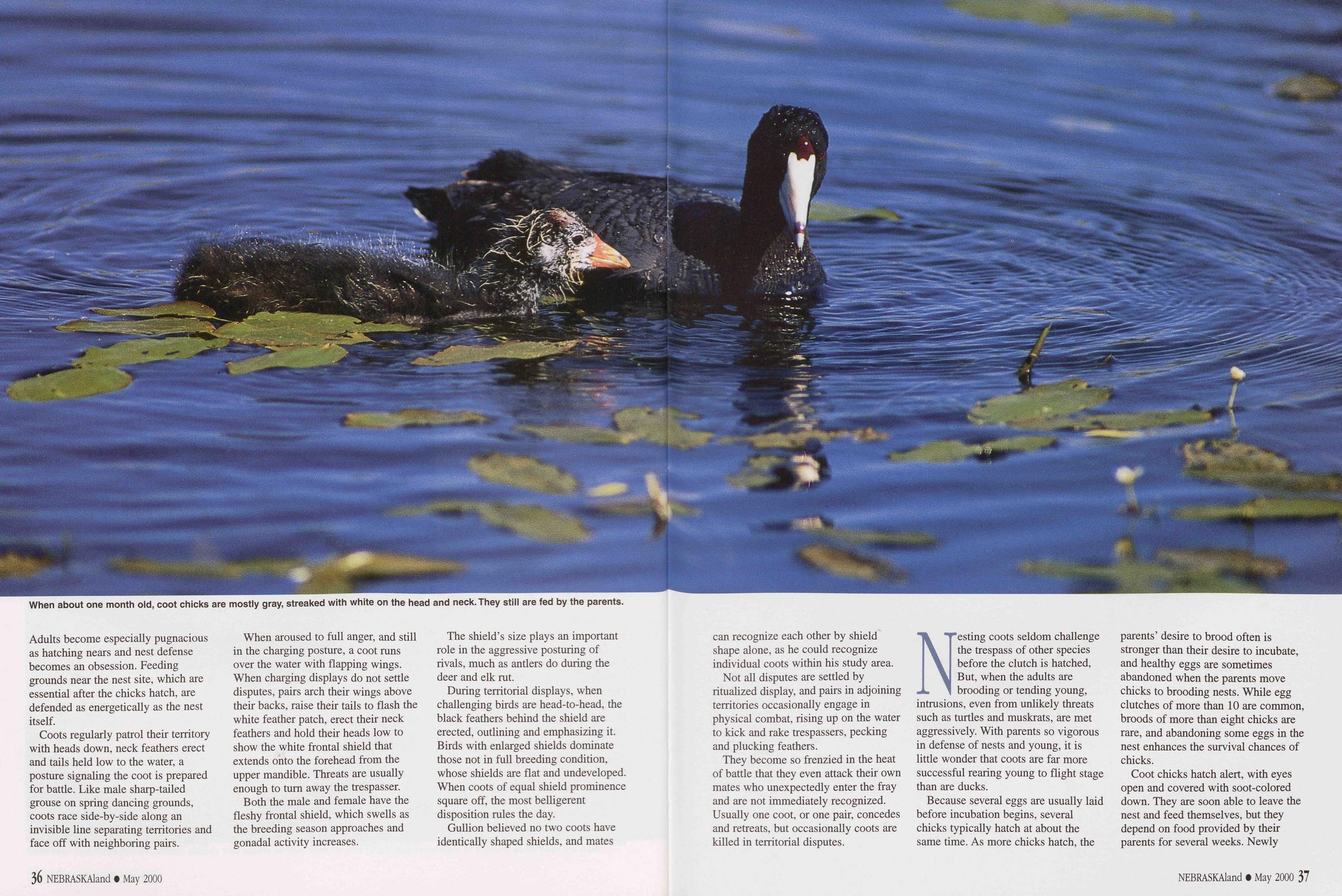 Adults become especially pugnacious
as hatching nears and nest defense
becomes an obsession. Feeding
grounds near the nest site, which are
essential after the chicks hatch, are
defended as energetically as the nest
itself.
Adults become especially pugnacious
as hatching nears and nest defense
becomes an obsession. Feeding
grounds near the nest site, which are
essential after the chicks hatch, are
defended as energetically as the nest
itself.
Coots regularly patrol their territory with heads down, neck feathers erect and tails held low to the water, a posture signaling the coot is prepared for battle. Like male sharp-tailed grouse on spring dancing grounds, coots race side-by-side along an invisible line separating territories and face off with neighboring pairs.
When aroused to full anger, and still in the charging posture, a coot runs over the water with flapping wings. When charging displays do not settle disputes, pairs arch their wings above their backs, raise their tails to flash the white feather patch, erect their neck feathers and hold their heads low to show the white frontal shield that extends onto the forehead from the upper mandible. Threats are usually enough to turn away the trespasser.
Both the male and female have the fleshy frontal shield, which swells as the breeding season approaches and gonadal activity increases.
The shield’s size plays an important role in the aggressive posturing of rivals, much as antlers do during the deer and elk rut.
During territorial displays, when challenging birds are head-to-head, the black feathers behind the shield are erected, outlining and emphasizing it. Birds with enlarged shields dominate those not in full breeding condition, whose shields are flat and undeveloped. When coots of equal shield prominence square off, the most belligerent disposition rules the day.
Gullion believed no two coots have identically shaped shields, and mates can recognize each other by shield shape alone, as he could recognize individual coots within his study area.
Not all disputes are settled by ritualized display, and pairs in adjoining territories occasionally engage in physical combat, rising up on the water to kick and rake trespassers, pecking and plucking feathers.
They become so frenzied in the heat of battle that they even attack their own mates who unexpectedly enter the fray and are not immediately recognized. Usually one coot, or one pair, concedes and retreats, but occasionally coots are killed in territorial disputes.
Nesting coots seldom challenge the trespass of other species before the clutch is hatched, But, when the adults are brooding or tending young, intrusions, even from unlikely threats such as turtles and muskrats, are met aggressively. With parents so vigorous in defense of nests and young, it is little wonder that coots are far more successful rearing young to flight stage than are ducks.
Because several eggs are usually laid before incubation begins, several chicks typically hatch at about the same time. As more chicks hatch, the parents’ desire to brood often is stronger than their desire to incubate, and healthy eggs are sometimes abandoned when the parents move chicks to brooding nests. While egg clutches of more than 10 are common, broods of more than eight chicks are rare, and abandoning some eggs in the nest enhances the survival chances of chicks.
Coot chicks hatch alert, with eyes
open and covered with soot-colored
down. They are soon able to leave the
nest and feed themselves, but they
depend on food provided by their
parents for several weeks. Newly
36 NEBRASKAland • May 2000
NEBRASKAland • May 2000 37
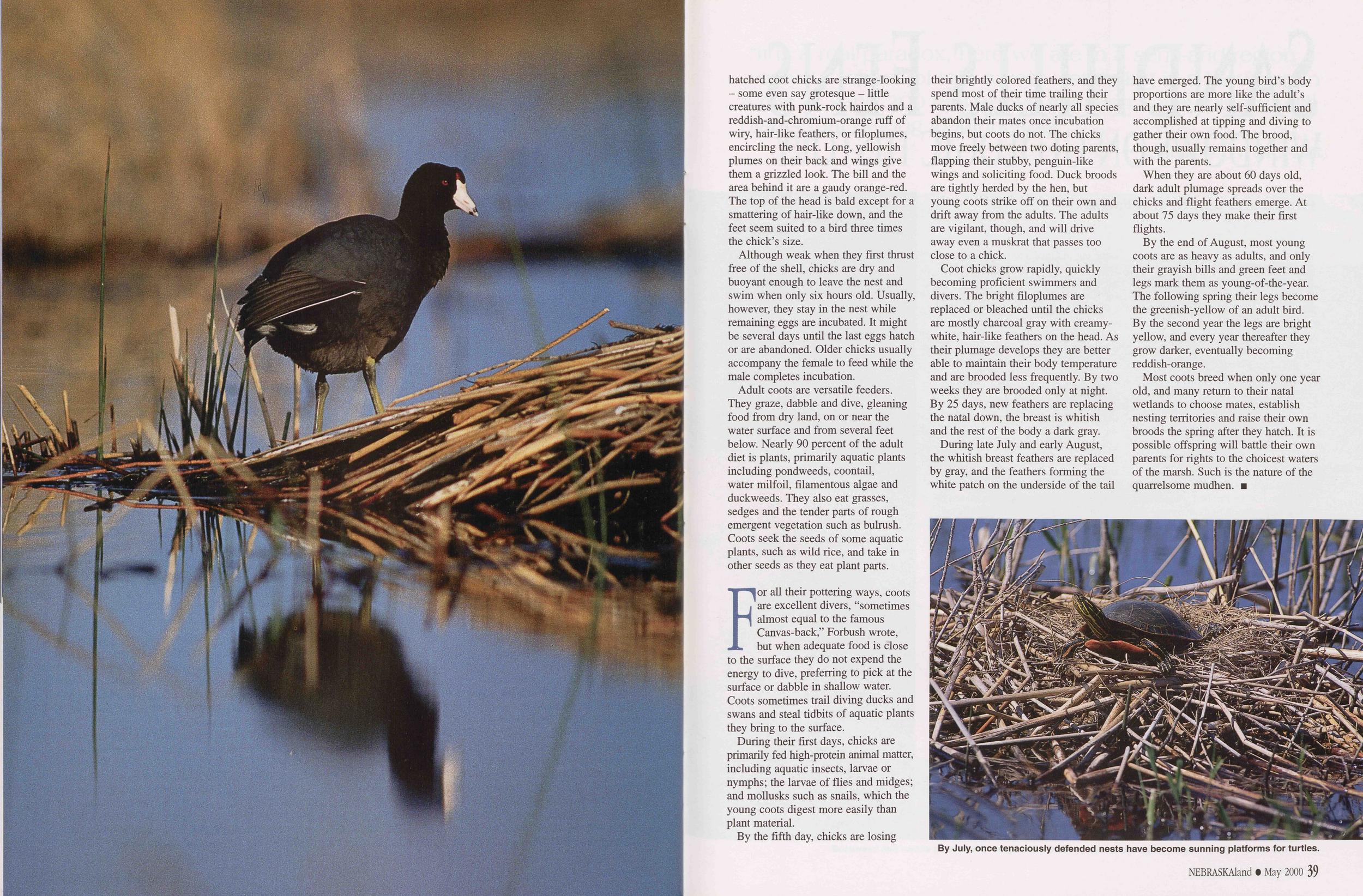 hatched coot chicks are strange-looking
- some even say grotesque - little
creatures with punk-rock hairdos and a
reddish-and-chromium-orange ruff of
wiry, hair-like feathers, or filoplumes,
encircling the neck. Long, yellowish
plumes on their back and wings give
them a grizzled look. The bill and the
area behind it are a gaudy orange-red.
The top of the head is bald except for a
smattering of hair-like down, and the
feet seem suited to a bird three times
the chick’s size.
hatched coot chicks are strange-looking
- some even say grotesque - little
creatures with punk-rock hairdos and a
reddish-and-chromium-orange ruff of
wiry, hair-like feathers, or filoplumes,
encircling the neck. Long, yellowish
plumes on their back and wings give
them a grizzled look. The bill and the
area behind it are a gaudy orange-red.
The top of the head is bald except for a
smattering of hair-like down, and the
feet seem suited to a bird three times
the chick’s size.
Although weak when they first thrust free of the shell, chicks are dry and buoyant enough to leave the nest and swim when only six hours old. Usually, however, they stay in the nest while remaining eggs are incubated. It might be several days until the last eggs hatch or are abandoned. Older chicks usually accompany the female to feed while the male completes incubation.
Adult coots are versatile feeders. They graze, dabble and dive, gleaning food from dry land, on or near the water surface and from several feet below. Nearly 90 percent of the adult diet is plants, primarily aquatic plants including pondweeds, coontail, water milfoil, filamentous algae and duckweeds. They also eat grasses, sedges and the tender parts of rough emergent vegetation such as bulrush. Coots seek the seeds of some aquatic plants, such as wild rice, and take in other seeds as they eat plant parts.
For all their pottering ways, coots are excellent divers, “sometimes almost equal to the famous Canvas-back,” Forbush wrote, but when adequate food is close to the surface they do not expend the energy to dive, preferring to pick at the surface or dabble in shallow water. Coots sometimes trail diving ducks and swans and steal tidbits of aquatic plants they bring to the surface.
During their first days, chicks are primarily fed high-protein animal matter, including aquatic insects, larvae or nymphs; the larvae of flies and midges; and mollusks such as snails, which the young coots digest more easily than plant material.
By the fifth day, chicks are losing their brightly colored feathers, and they spend most of their time trailing their parents. Male ducks of nearly all species abandon their mates once incubation begins, but coots do not. The chicks move freely between two doting parents, flapping their stubby, penguin-like wings and soliciting food. Duck broods are tightly herded by the hen, but young coots strike off on their own and drift away from the adults. The adults are vigilant, though, and will drive away even a muskrat that passes too close to a chick.
Coot chicks grow rapidly, quickly becoming proficient swimmers and divers. The bright filoplumes are replaced or bleached until the chicks are mostly charcoal gray with creamy- white, hair-like feathers on the head. As their plumage develops they are better able to maintain their body temperature and are brooded less frequently. By two weeks they are brooded only at night. By 25 days, new feathers are replacing the natal down, the breast is whitish and the rest of the body a dark gray.
During late July and early August, the whitish breast feathers are replaced by gray, and the feathers forming the white patch on the underside of the tail have emerged. The young bird’s body proportions are more like the adult’s and they are nearly self-sufficient and accomplished at tipping and diving to gather their own food. The brood, though, usually remains together and with the parents.
When they are about 60 days old, dark adult plumage spreads over the chicks and flight feathers emerge. At about 75 days they make their first flights.
By the end of August, most young coots are as heavy as adults, and only their grayish bills and green feet and legs mark them as young-of-the-year. The following spring their legs become the greenish-yellow of an adult bird. By the second year the legs are bright yellow, and every year thereafter they grow darker, eventually becoming reddish-orange.
Most coots breed when only one year old, and many return to their natal wetlands to choose mates, establish nesting territories and raise their own broods the spring after they hatch. It is possible offspring will battle their own parents for rights to the choicest waters of the marsh. Such is the nature of the quarrelsome mudhen. ■
NEBRASKAland • May 2000 39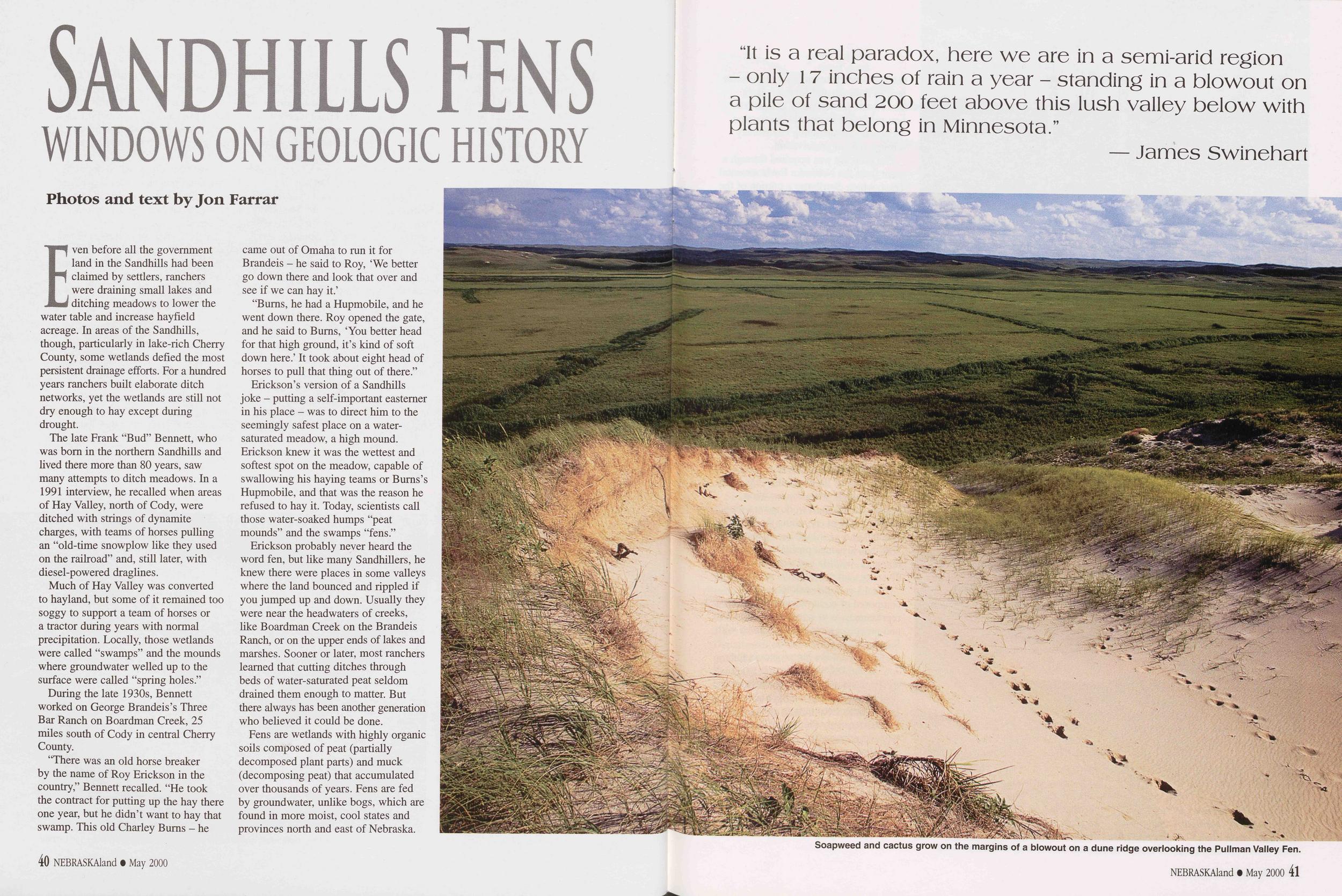
Sandhills Fens
WINDOWS ON GEOLOGIC HISTORY “It is a real paradox, here we are in a semi-arid region - only 17 inches of rain a year - standing in a blowout on a pile of sand 2OO feet above this lush valley below with plants that belong in Minnesota.” — James Swinehart Photos and text by Jon FarrarEven before all the government land in the Sandhills had been claimed by settlers, ranchers were draining small lakes and ditching meadows to lower the water table and increase hayfield acreage. In areas of the Sandhills, though, particularly in lake-rich Cherry County, some wetlands defied the most persistent drainage efforts. For a hundred years ranchers built elaborate ditch networks, yet the wetlands are still not dry enough to hay except during drought.
The late Frank “Bud” Bennett, who was bom in the northern Sandhills and lived there more than 80 years, saw many attempts to ditch meadows. In a 1991 interview, he recalled when areas of Hay Valley, north of Cody, were ditched with strings of dynamite charges, with teams of horses pulling an “old-time snowplow like they used on the railroad” and, still later, with diesel-powered draglines.
Much of Hay Valley was converted to hayland, but some of it remained too soggy to support a team of horses or a tractor during years with normal precipitation. Locally, those wetlands were called “swamps” and the mounds where groundwater welled up to the surface were called “spring holes.” During the late 1930s, Bennett worked on George Brandeis’s Three Bar Ranch on Boardman Creek, 25 miles south of Cody in central Cherry County.
“There was an old horse breaker by the name of Roy Erickson in the country,” Bennett recalled. “He took the contract for putting up the hay there one year, but he didn’t want to hay that swamp. This old Charley Bums - he came out of Omaha to run it for Brandeis - he said to Roy, ‘We better go down there and look that over and see if we can hay it.’
“Bums, he had a Hupmobile, and he went down there. Roy opened the gate, and he said to Bums, ‘You better head for that high ground, it’s kind of soft down here.’ It took about eight head of horses to pull that thing out of there.”
Erickson’s version of a Sandhills joke - putting a self-important easterner in his place - was to direct him to the seemingly safest place on a water- saturated meadow, a high mound. Erickson knew it was the wettest and softest spot on the meadow, capable of swallowing his haying teams or Bums’s Hupmobile, and that was the reason he refused to hay it. Today, scientists call those water-soaked humps “peat mounds” and the swamps “fens.”
Erickson probably never heard the word fen, but like many Sandhillers, he knew there were places in some valleys where the land bounced and rippled if you jumped up and down. Usually they were near the headwaters of creeks, like Boardman Creek on the Brandeis Ranch, or on the upper ends of lakes and marshes. Sooner or later, most ranchers learned that cutting ditches through beds of water-saturated peat seldom drained them enough to matter. But there always has been another generation who believed it could be done.
Fens are wetlands with highly organic soils composed of peat (partially decomposed plant parts) and muck (decomposing peat) that accumulated over thousands of years. Fens are fed by groundwater, unlike bogs, which are found in more moist, cool states and provinces north and east of Nebraska.
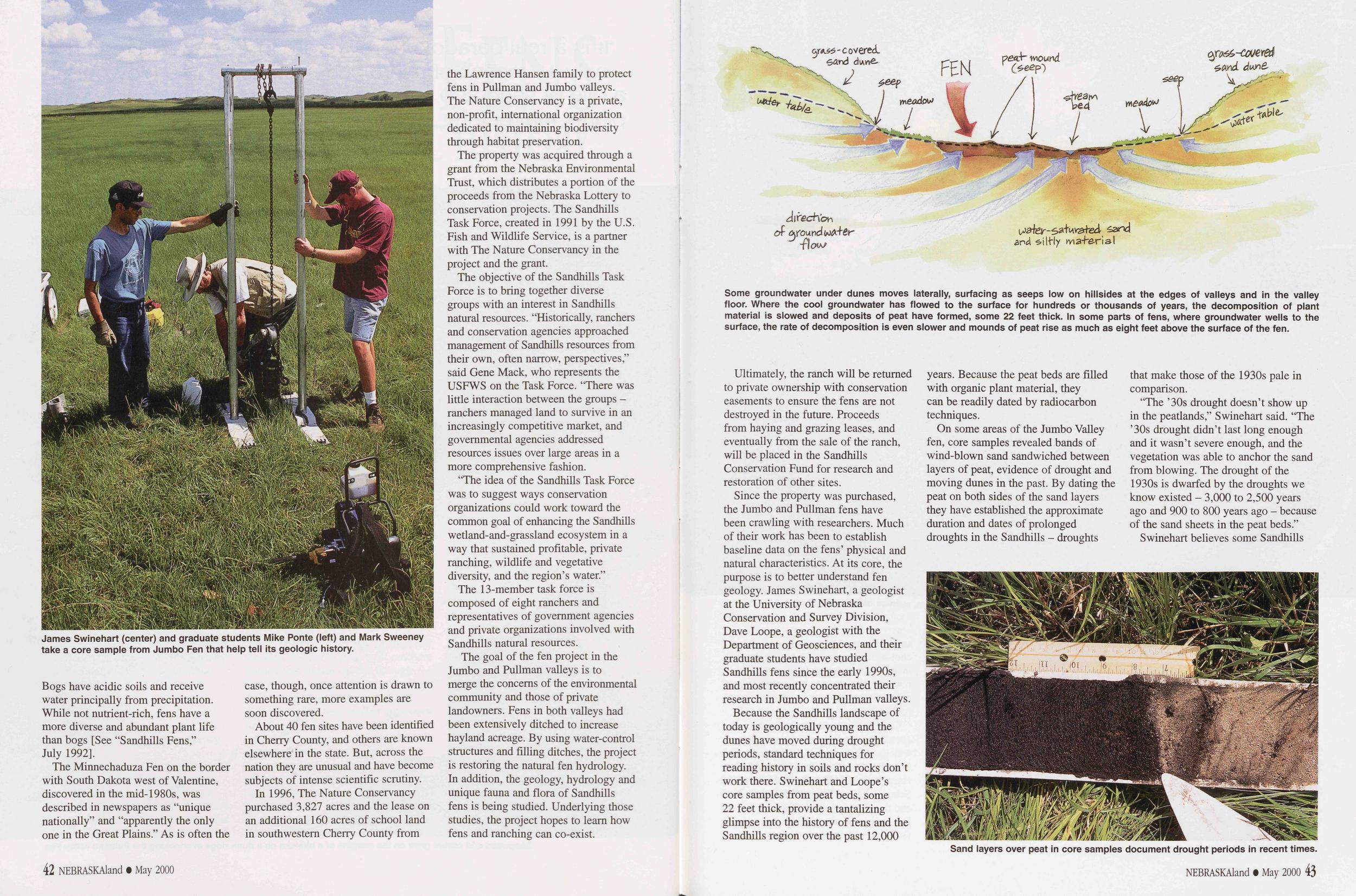
Bogs have acidic soils and receive water principally from precipitation. While not nutrient-rich, fens have a more diverse and abundant plant life than bogs [See “Sandhills Fens,” July 1992].
The Minnechaduza Fen on the border with South Dakota west of Valentine, discovered in the mid-1980s, was described in newspapers as “unique nationally” and “apparently the only one in the Great Plains.” As is often the case, though, once attention is drawn to something rare, more examples are soon discovered.
About 40 fen sites have been identified in Cherry County, and others are known elsewhere in the state. But, across the nation they are unusual and have become subjects of intense scientific scrutiny.
In 1996, The Nature Conservancy purchased 3,827 acres and the lease on an additional 160 acres of school land in southwestern Cherry County from the Lawrence Hansen family to protect fens in Pullman and Jumbo valleys. The Nature Conservancy is a private, non-profit, international organization dedicated to maintaining biodiversity through habitat preservation.
The property was acquired through a grant from the Nebraska Environmental Trust, which distributes a portion of the proceeds from the Nebraska Lottery to conservation projects. The Sandhills Task Force, created in 1991 by the U.S. Fish and Wildlife Service, is a partner with The Nature Conservancy in the project and the grant.
The objective of the Sandhills Task Force is to bring together diverse groups with an interest in Sandhills natural resources. “Historically, ranchers and conservation agencies approached management of Sandhills resources from their own, often narrow, perspectives,” said Gene Mack, who represents the USFWS on the Task Force. “There was little interaction between the groups - ranchers managed land to survive in an increasingly competitive market, and governmental agencies addressed resources issues over large areas in a more comprehensive fashion.
“The idea of the Sandhills Task Force was to suggest ways conservation organizations could work toward the common goal of enhancing the Sandhills wetland-and-grassland ecosystem in a way that sustained profitable, private ranching, wildlife and vegetative diversity, and the region’s water.”
The 13-member task force is composed of eight ranchers and representatives of government agencies and private organizations involved with Sandhills natural resources.
The goal of the fen project in the Jumbo and Pullman valleys is to merge the concerns of the environmental community and those of private landowners. Fens in both valleys had been extensively ditched to increase hayland acreage. By using water-control structures and filling ditches, the project is restoring the natural fen hydrology. In addition, the geology, hydrology and unique fauna and flora of Sandhills fens is being studied. Underlying those studies, the project hopes to learn how fens and ranching can co-exist.
Ultimately, the ranch will be returned to private ownership with conservation easements to ensure the fens are not destroyed in the future. Proceeds from haying and grazing leases, and eventually from the sale of the ranch, will be placed in the Sandhills Conservation Fund for research and restoration of other sites.
Since the property was purchased, the Jumbo and Pullman fens have been crawling with researchers. Much of their work has been to establish baseline data on the fens’ physical and natural characteristics. At its core, the purpose is to better understand fen geology. James Swinehart, a geologist at the University of Nebraska Conservation and Survey Division, Dave Loope, a geologist with the Department of Geosciences, and their graduate students have studied Sandhills fens since the early 1990s, and most recently concentrated their research in Jumbo and Pullman valleys.
Because the Sandhills landscape of today is geologically young and the dunes have moved during drought periods, standard techniques for reading history in soils and rocks don’t work there. Swinehart and Loope’s core samples from peat beds, some 22 feet thick, provide a tantalizing glimpse into the history of fens and the Sandhills region over the past 12,000 years. Because the peat beds are filled with organic plant material, they can be readily dated by radiocarbon techniques.
On some areas of the Jumbo Valley fen, core samples revealed bands of wind-blown sand sandwiched between layers of peat, evidence of drought and moving dunes in the past. By dating the peat on both sides of the sand layers they have established the approximate duration and dates of prolonged droughts in the Sandhills - droughts that make those of the 1930s pale in comparison.
“The ’30s drought doesn’t show up in the peatlands,” Swinehart said. “The ’30s drought didn’t last long enough and it wasn’t severe enough, and the vegetation was able to anchor the sand from blowing. The drought of the 1930s is dwarfed by the droughts we know existed - 3,000 to 2,500 years ago and 900 to 800 years ago - because of the sand sheets in the peat beds.”
Swinehart believes some Sandhills
42 NEBRASKAland • May 2000
NEBRASKAland • May 2000 43
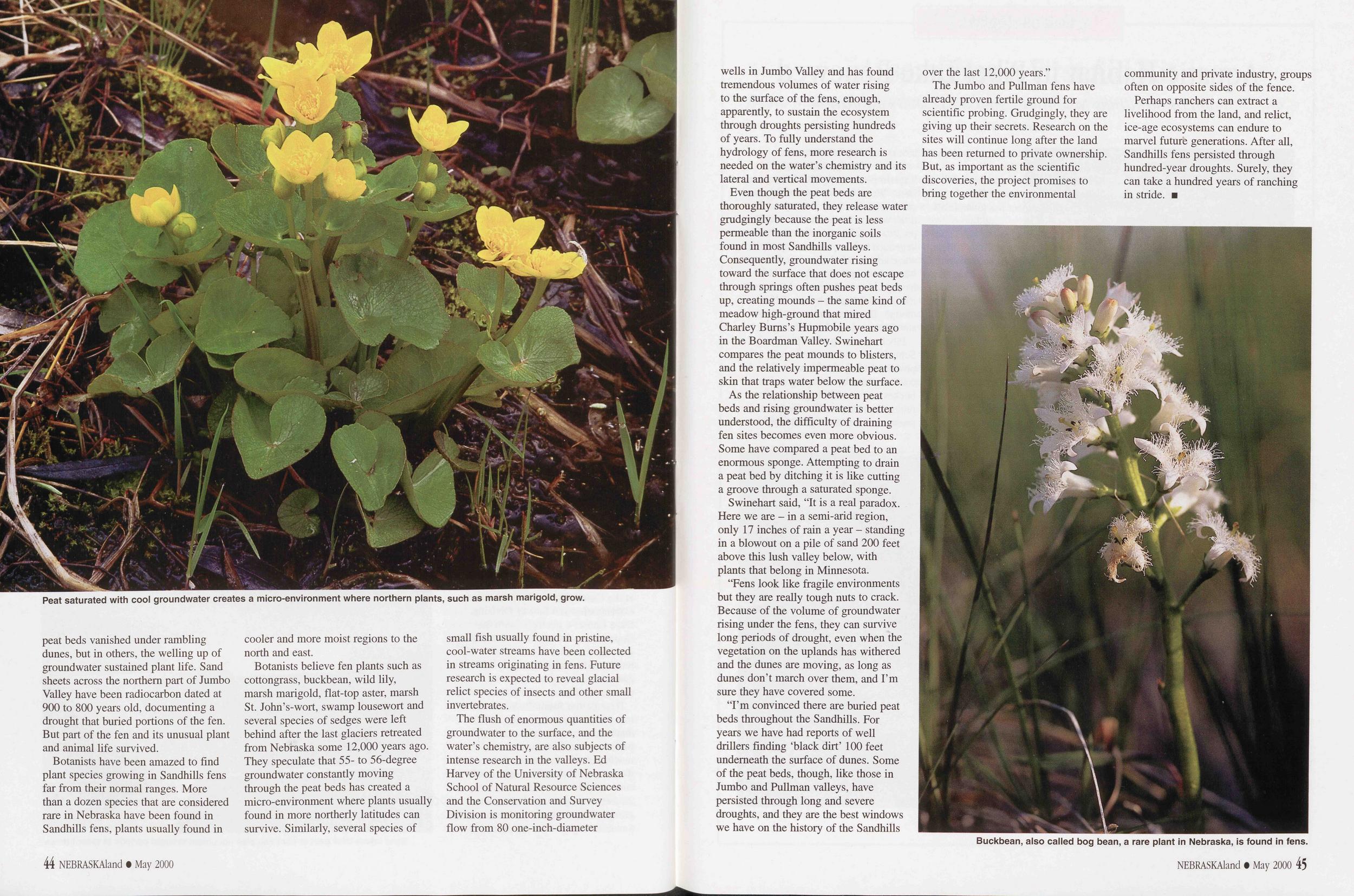 peat beds vanished under rambling
dunes, but in others, the welling up of
groundwater sustained plant life. Sand
sheets across the northern part of Jumbo
Valley have been radiocarbon dated at
900 to 800 years old, documenting a
drought that buried portions of the fen.
But part of the fen and its unusual plant
and animal life survived.
peat beds vanished under rambling
dunes, but in others, the welling up of
groundwater sustained plant life. Sand
sheets across the northern part of Jumbo
Valley have been radiocarbon dated at
900 to 800 years old, documenting a
drought that buried portions of the fen.
But part of the fen and its unusual plant
and animal life survived.
Botanists have been amazed to find plant species growing in Sandhills fens far from their normal ranges. More than a dozen species that are considered rare in Nebraska have been found in Sandhills fens, plants usually found in cooler and more moist regions to the north and east.
Botanists believe fen plants such as cottongrass, buckbean, wild lily, marsh marigold, flat-top aster, marsh St. John's-wort, swamp lousewort and several species of sedges were left behind after the last glaciers retreated from Nebraska some 12,000 years ago. They speculate that 55- to 56-degree groundwater constantly moving through the peat beds has created a micro-environment where plants usually found in more northerly latitudes can survive. Similarly, several species of small fish usually found in pristine, cool-water streams have been collected in streams originating in fens. Future research is expected to reveal glacial relict species of insects and other small invertebrates.
The flush of enormous quantities of groundwater to the surface, and the water’s chemistry, are also subjects of intense research in the valleys. Ed Harvey of the University of Nebraska School of Natural Resource Sciences and the Conservation and Survey Division is monitoring groundwater flow from 80 one-inch-diameter wells in Jumbo Valley and has found tremendous volumes of water rising to the surface of the fens, enough, apparently, to sustain the ecosystem through droughts persisting hundreds of years. To fully understand the hydrology of fens, more research is needed on the water’s chemistry and its lateral and vertical movements.
Even though the peat beds are thoroughly saturated, they release water grudgingly because the peat is less permeable than the inorganic soils found in most Sandhills valleys. Consequently, groundwater rising toward the surface that does not escape through springs often pushes peat beds up, creating mounds - the same kind of meadow high-ground that mired Charley Burns’s Hupmobile years ago in the Boardman Valley. Swinehart compares the peat mounds to blisters, and the relatively impermeable peat to skin that traps water below the surface.
As the relationship between peat beds and rising groundwater is better understood, the difficulty of draining fen sites becomes even more obvious. Some have compared a peat bed to an enormous sponge. Attempting to drain a peat bed by ditching it is like cutting a groove through a saturated sponge.
Swinehart said, "It is a real paradox. Here we are - in a semi-arid region, only 17 inches of rain a year - standing in a blowout on a pile of sand 200 feet above this lush valley below, with plants that belong in Minnesota.
"Fens look like fragile environments but they are really tough nuts to crack. Because of the volume of groundwater rising under the fens, they can survive long periods of drought, even when the vegetation on the uplands has withered and the dunes are moving, as long as dunes don’t march over them, and I’m sure they have covered some.
"I’m convinced there are buried peat beds throughout the Sandhills. For years we have had reports of well drillers finding ‘black dirt’ 100 feet underneath the surface of dunes. Some of the peat beds, though, like those in Jumbo and Pullman valleys, have persisted through long and severe droughts, and they are the best windows we have on the history of the Sandhills over the last 12,000 years.”
The Jumbo and Pullman fens have already proven fertile ground for scientific probing. Grudgingly, they are giving up their secrets. Research on the sites will continue long after the land has been returned to private ownership. But, as important as the scientific discoveries, the project promises to bring together the environmental community and private industry, groups often on opposite sides of the fence.
Perhaps ranchers can extract a livelihood from the land, and relict, ice-age ecosystems can endure to marvel future generations. After all, Sandhills fens persisted through hundred-year droughts. Surely, they can take a hundred years of ranching in stride. ■
44 NEBRASKAland • May 2000 NEBRASKAland • May 2000 45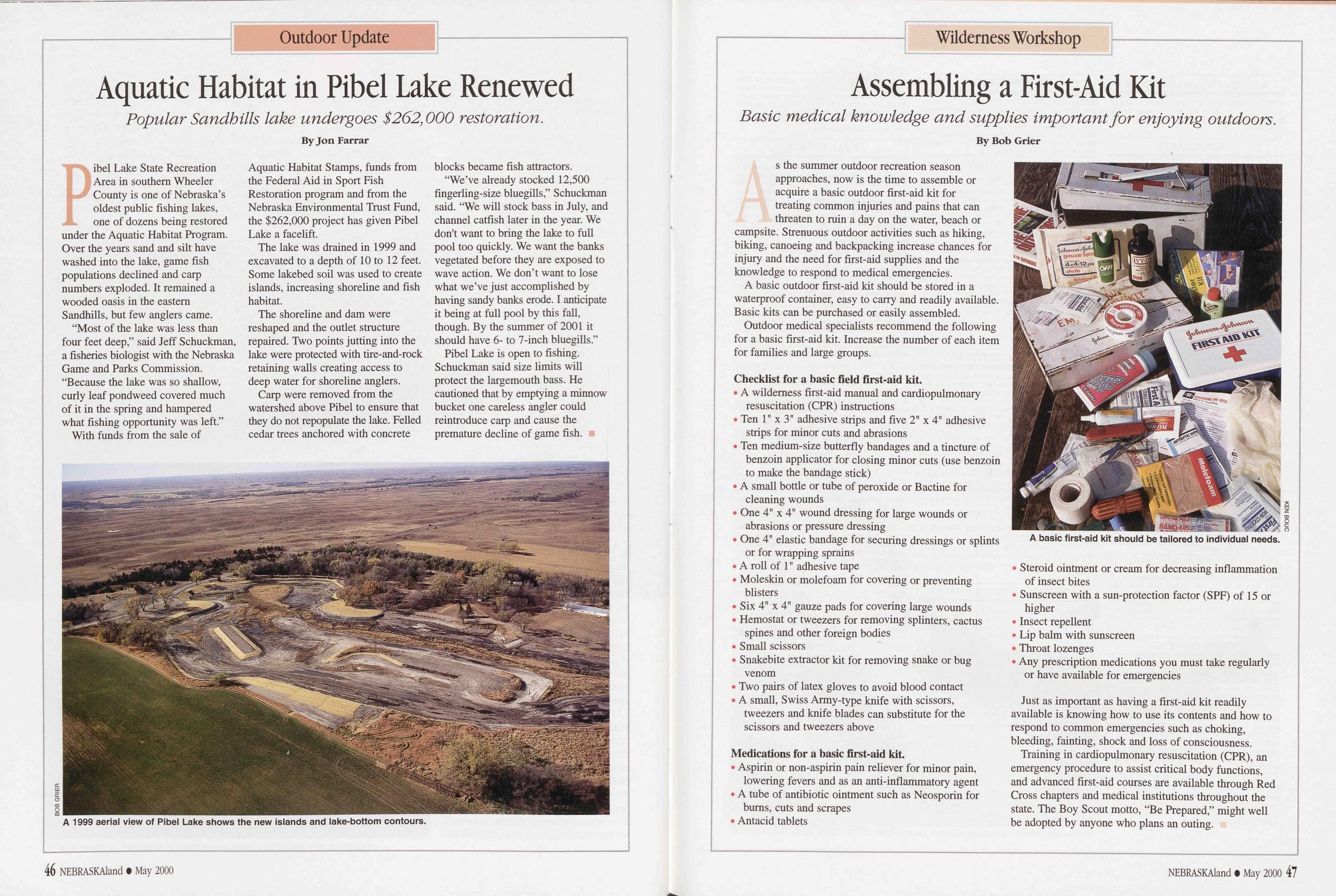
Pibel Lake State Recreation Area in southern Wheeler County is one of Nebraska’s oldest public fishing lakes, one of dozens being restored under the Aquatic Habitat Program. Over the years sand and silt have washed into the lake, game fish populations declined and carp numbers exploded. It remained a wooded oasis in the eastern Sandhills, but few anglers came.
“Most of the lake was less than four feet deep,” said Jeff Schuckman, a fisheries biologist with the Nebraska Game and Parks Commission. “Because the lake was so shallow, curly leaf pondweed covered much of it in the spring and hampered what fishing opportunity was left.”
With funds from the sale of Aquatic Habitat Stamps, funds from the Federal Aid in Sport Fish Restoration program and from the Nebraska Environmental Trust Fund, the $262,000 project has given Pibel Lake a facelift.
The lake was drained in 1999 and excavated to a depth of 10 to 12 feet. Some lakebed soil was used to create islands, increasing shoreline and fish habitat.
The shoreline and dam were reshaped and the outlet structure repaired. Two points jutting into the lake were protected with tire-and-rock retaining walls creating access to deep water for shoreline anglers.
Carp were removed from the watershed above Pibel to ensure that they do not repopulate the lake. Felled cedar trees anchored with concrete blocks became fish attractors.
“We’ve already stocked 12,500 fingerling-size bluegills,” Schuckman said. “We will stock bass in July, and channel catfish later in the year. We don't want to bring the lake to full pool too quickly. We want the banks vegetated before they are exposed to wave action. We don’t want to lose what we’ve just accomplished by having sandy banks erode. I anticipate it being at full pool by this fall, though. By the summer of 2001 it should have 6- to 7-inch bluegills.”
Pibel Lake is open to fishing. Schuckman said size limits will protect the largemouth bass. He cautioned that by emptying a minnow bucket one careless angler could reintroduce carp and cause the premature decline of game fish. ■
As the summer outdoor recreation season approaches, now is the time to assemble or acquire a basic outdoor first-aid kit for treating common injuries and pains that can threaten to ruin a day on the water, beach or campsite. Strenuous outdoor activities such as hiking, biking, canoeing and backpacking increase chances for injury and the need for first-aid supplies and the knowledge to respond to medical emergencies. A basic outdoor first-aid kit should be stored in a waterproof container, easy to carry and readily available. Basic kits can be purchased or easily assembled. Outdoor medical specialists recommend the following for a basic first-aid kit. Increase the number of each item for families and large groups.
Checklist for a basic field first-aid kit.• A wilderness first-aid manual and cardiopulmonary resuscitation (CPR) instructions • Ten 1" x 3" adhesive strips and five 2" x 4" adhesive strips for minor cuts and abrasions • Ten medium-size butterfly bandages and a tincture of benzoin applicator for closing minor cuts (use benzoin to make the bandage stick) • A small bottle or tube of peroxide or Bactine for cleaning wounds • One 4" x 4" wound dressing for large wounds or abrasions or pressure dressing • One 4" elastic bandage for securing dressings or splints or for wrapping sprains • A roll of 1" adhesive tape • Moleskin or molefoam for covering or preventing blisters • Six 4" x 4" gauze pads for covering large wounds • Hemostat or tweezers for removing splinters, cactus spines and other foreign bodies • Small scissors • Snakebite extractor kit for removing snake or bug venom • Two pairs of latex gloves to avoid blood contact • A small, Swiss Army-type knife with scissors, tweezers and knife blades can substitute for the scissors and tweezers above
• Aspirin or non-aspirin pain reliever for minor pain, lowering fevers and as an anti-inflammatory agent • A tube of antibiotic ointment such as Neosporin for bums, cuts and scrapes • Antacid tablets • Steroid ointment or cream for decreasing inflammation of insect bites • Sunscreen with a sun-protection factor (SPF) of 15 or higher • Insect repellent • Lip balm with sunscreen • Throat lozenges • Any prescription medications you must take regularly or have available for emergencies
Just as important as having a first-aid kit readily available is knowing how to use its contents and how to respond to common emergencies such as choking, bleeding, fainting, shock and loss of consciousness.
Training in cardiopulmonary resuscitation (CPR), an emergency procedure to assist critical body functions, and advanced first-aid courses are available through Red Cross chapters and medical institutions throughout the state. The Boy Scout motto, “Be Prepared,” might well be adopted by anyone who plans an outing.
46 NEBRASKAland • May 2000 NEBRASKAland • May 2000 47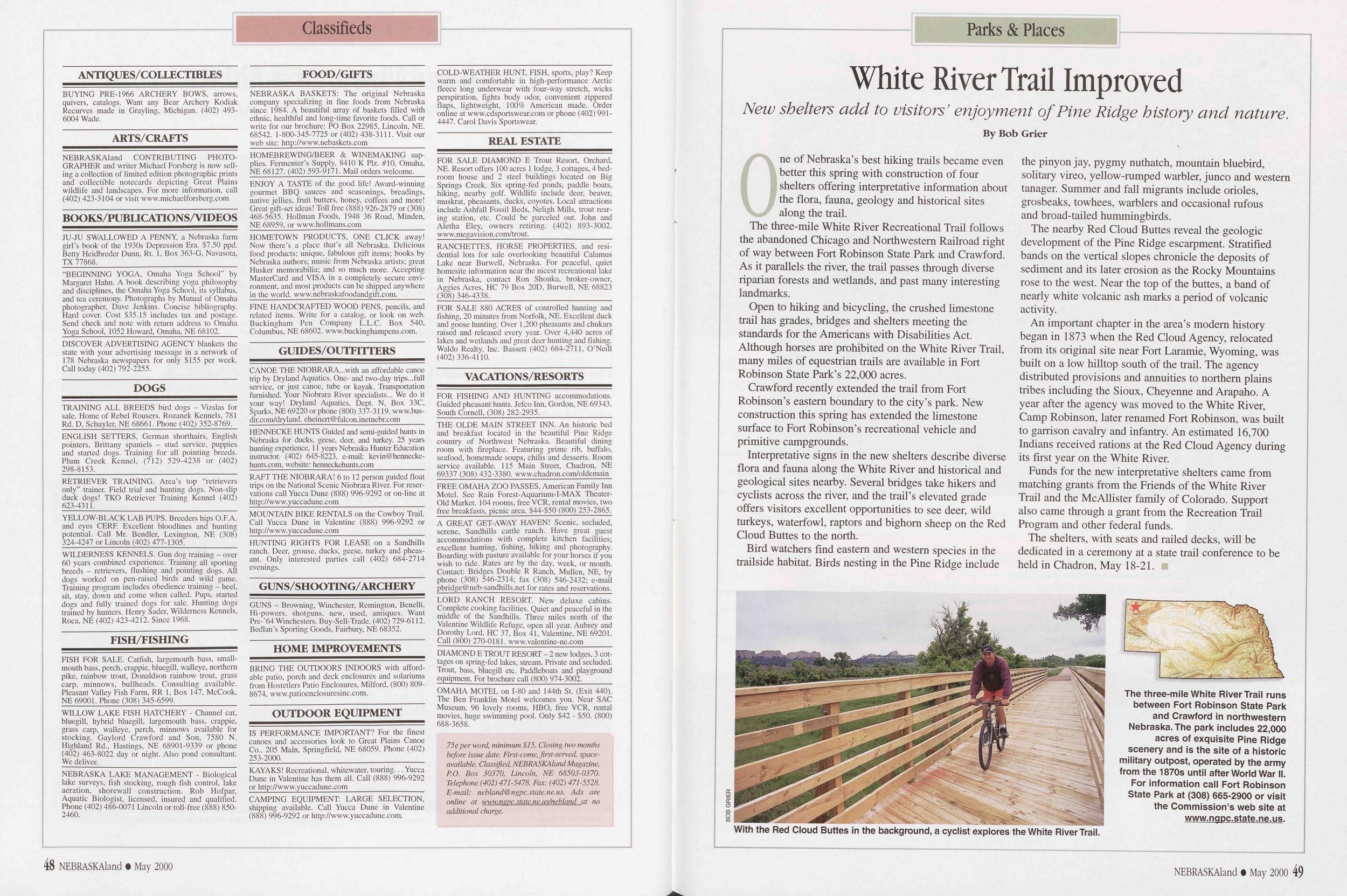
Classifieds
ANTIQUES/COLLECTIBLJESBUYING PRE-1966 ARCHERY BOWS, arrows, quivers, catalogs. Want any Bear Archery Kodiak Recurves made in Grayling, Michigan. (402) 493- 6004 Wade.
ARTS/CRAFTSNEBRASKAland CONTRIBUTING PHOTO- GRAPHER and writer Michael Forsberg is now sell- ing a collection of limited edition photographic prints and collectible notecards depicting Great Plains wildlife and landscapes. For more information, call (402) 423-3104 or visit www.michaelforsberg.com
BOOKS/PUBLIC ATION S/VIDEOSJU-JU SWALLOWED A PENNY, a Nebraska farm girl’s book of the 1930s Depression Era. $7.50 ppd. Betty Heidbreder Dunn, Rt. 1, Box 363-G, Navasota, TX 77868.
“BEGINNING YOGA, Omaha Yoga School" by Margaret Hahn. A book describing yoga philosophy and disciplines, the Omaha Yoga School, its syllabus, and tea ceremony. Photographs by Mutual of Omaha photographer, Dave Jenkins. Concise bibliography. Hard cover. Cost $35.15 includes tax and postage. Send check and note with return address to Omaha Yoga School, 1052 Howard, Omaha, NE 68102.
DISCOVER ADVERTISING AGENCY blankets the state with your advertising message in a network of 178 Nebraska newspapers for only $155 per week. Call today (402) 792-2255.
DOGSTRAINING ALL BREEDS bird dogs - Vizslas for sale. Home of Rebel Rousers. Rozanek Kennels, 781 Rd. D, Schuyler, NE 68661. Phone (402) 352-8769.
ENGLISH SETTERS, German shorthairs, English pointers, Brittany spaniels - stud service, puppies and started dogs. Training for all pointing breeds. Plum Creek Kennel, (712) 529-4238 or (402) 298-8153.
RETRIEVER TRAINING. Area’s top “retrievers only” trainer. Field trial and hunting dogs. Non-slip duck dogs! TKO Retriever Training Kennel (402) 623-4311.
YELLOW-BLACK LAB PUPS. Breeders hips O.F.A. and eyes CERF. Excellent bloodlines and hunting potential. Call Mr. Bendler, Lexington, NE (308) 324-4247 or Lincoln (402) 477-1305?
WILDERNESS KENNELS. Gun dog training — over 60 years combined experience. Training all sporting breeds - retrievers, flushing and pointing dogs. All dogs worked on pen-raised birds and wild game. Training program includes obedience training - heel, sit, stay, down and come when called. Pups, started doss and fully trained dogs for sale. Hunting dogs trained by hunters. Henry Sader, Wilderness Kennels, Roca, NE (402) 423-4212. Since 1968.
FISH/FISHINGFISH FOR SALE. Catfish, largemouth bass, small- mouth bass, perch, crappie, bluegill, walleye, northern pike, rainbow trout, Donaldson rainbow trout, grass carp, minnows, bullheads. Consulting available. Pleasant Valley Fish Farm, RR 1, Box 147, McCook, NE 69001. Phone (308) 345-6599.
WILLOW LAKE FISH HATCHERY - Channel cat, bluegill, hybrid bluegill, largemouth bass, crappie, grass carp, walleye, perch, minnows available for stocking. Gaylord Crawford and Son, 7580 N. Highland Rd., Hastings, NE 68901-9339 or phone (402) 463-8022 day or night. Also pond consultant. We deliver.
NEBRASKA LAKE MANAGEMENT - Biological lake surveys, fish stocking, rough fish control, lake aeration, shorewall construction. Rob Hofpar, Aquatic Biologist, licensed, insured and qualified. Phone (402) 486-0071 Lincoln or toll-free (888) 850- 2460.
FOOD/GIFTSNEBRASKA BASKETS: The original Nebraska company specializing in fine foods from Nebraska since 1984. A beautiful array of baskets filled with ethnic, healthful and long-time favorite foods. Call or write for our brochure: PO Box 22985, Lincoln, NE. 68542. 1-800-345-7725 or (402) 438-3111. Visit our web site: http://www.nebaskets.com
HOMEBREWING/BEER& WINEMAKING sup- plies. Fermenter’s Supply, 8410 K Plz. #10, Omaha, NE 68127, (402) 593-9171. Mail orders welcome. ENJOY A TASTE of the good life! Award-winning gourmet BBQ sauces and seasonings, breadings, native jellies, fruit butters, honey, coffees and more! Great gift-set ideas! Toll free (888) 926-2879 or (308) 468-5635. Hollman Foods, 1948 36 Road, Minden, NE 68959, or www.hollmans.com
HOMETOWN PRODUCTS, ONE CLICK away! Now there’s a place that’s all Nebraska. Delicious food products; unique, fabulous gift items; books by Nebraska authors; music from Nebraska artists; great Husker memorabilia; and so much more. Accepting MasterCard and VISA in a completely secure envi- ronment, and most products can be shipped anywhere in the world, www.nebraskafoodandgift.com.
FINE HANDCRAFTED WOOD PENS, pencils, and related items. Write for a catalog, or look on web. Buckingham Pen Company L.L.C. Box 540, Columbus, NE 68602. www.buckinghampens.com.
COLD-WEATHER HUNT, FISH, sports, play? Keep warm and comfortable in high-performance Arctic fleece long underwear with four-way stretch, wicks perspiration, fights body odor, convenient zippered flaps, lightweight, 100% American made. Order online at www.cdsportswear.com or phone (402) 991- 4447. Carol Davis Sportswear.
GUIDES/OUTFITTERSFOR SALE DIAMOND E Trout Resort, Orchard, NE. Resort offers 100 acres 1 lodge, 3 cottages, 4 bed- room house and 2 steel buildings located on Big Springs Creek. Six spring-fed ponds, paddle boats, hiking, nearby golf. Wildlife include deer, beaver, muskrat, pheasants, ducks, coyotes. Local attractions include Ashfall Fossil Beds, Neligh Mills, trout rear- ing station, etc. Could be parceled out. John and Aletha Eley, owners retiring. (402) 893-3002. www.megavision.com/trout.
RANCHETTES, HORSE PROPERTIES, and resi- dential lots for sale overlooking beautiful Calamus Lake near Burwell, Nebraska. For peaceful, quiet homesite information near the nicest recreational lake in Nebraska, contact Ron Shonka, broker-owner, Aggies Acres, HC 79 Box 20D, Burwell, NE 68823 (308) 346-4338.
FOR SALE 880 ACRES of controlled hunting and fishing, 20 minutes from Norfolk, NE. Excellent duck and goose hunting. Over 1,200 pheasants and chukars raised and released every year. Over 4,440 acres of lakes and wetlands and great deer hunting and fishing. Waldo Realty, Inc. Bassett (402) 684-2711, O’Neill (402) 336-4110.
CANOE THE NIOBRARA...with an affordable canoe trip by Dryland Aquatics. One- and two-day trips...full service, or just canoe, tube or kayak. Transportation furnished. Your Niobrara River specialists... We do it your way! Dryland Aquatics, Dept. N, Box 33C, Sparks, NE 69220 or phone (800) 337-3119. www.bus- dir.com/dryland. eheinert@falcon.inetnebr.com
HENNECKE HUNTS Guided and semi-guided hunts in Nebraska for ducks, geese, deer, and turkey. 25 years hunting experience, 11 years Nebraska Hunter Education instructor. (402) 645-8223, e-mail: kevin@hennecke- hunts.com, website: henneckehunts.com
RAFT THE NIOBRARA! 6 to 12 person guided float trips on the National Scenic Niobrara River. For reser- vations call Yucca Dune (888) 996-9292 or on-line at http://www.yuccadune.com
MOUNTAIN BIKE RENTALS on the Cowboy Trail. Call Yucca Dune in Valentine (888) 996-9292 or http://www.yuccadune.com
HUNTING RIGHTS FOR LEASE on a Sandhills ranch. Deer, grouse, ducks, geese, turkey and pheas- ant. Only interested parties call (402) 684-2714 evenings.
GUNS/SHOOTING/ARCHERYGUNS - Browning, Winchester, Remington, Benelli. Hi-powers, shotguns, new, used, antiques. Want Pre-’64 Winchesters. Buy-Sell-Trade. (402) 729-6112. Bedlan’s Sporting Goods, Fairbury, NE 68352.
HOME IMPROVEMENTSBRING THE OUTDOORS INDOORS with afford- able patio, porch and deck enclosures and solariums from Hostetlers Patio Enclosures, Milford, (800) 809- 8674, www.patioenclosuresinc.com.
OUTDOOR EQUIPMENTIS PERFORMANCE IMPORTANT? For the finest canoes and accessories look to Great Plains Canoe Co., 205 Main, Springfield, NE 68059. Phone (402) 253-2000.
KAYAKS! Recreational, whitewater, touring.. .Yucca Dune in Valentine has them all. Call (888) 996-9292 or http://www.yuccadune.com
CAMPING EQUIPMENT: LARGE SELECTION, shipping available. Call Yucca Dune in Valentine (888) 996-9292 or http://www.yuccadune.com.
FOR FISHING AND HUNTING accommodations. Guided pheasant hunts. Jefco Inn, Gordon, NE 69343. South Cornell, (308) 282-2935.
THE OLDE MAIN STREET INN. An historic bed and breakfast located in the beautiful Pine Ridge country of Northwest Nebraska. Beautiful dining room with fireplace. Featuring prime rib, buffalo, seafood, homemade soups, chilis and desserts. Room service available. 115 Main Street, Chadron, NE 69337 (308) 432-3380. www.chadron.com/oldemain
FREE OMAHA ZOO PASSES, American Family Inn Motel. See Rain Forest-Aquarium-I-MAX Theater- Old Market. 104 rooms, free VCR, rental movies, two free breakfasts, picnic area. $44-$50 (800) 253-2865.
A GREAT GET-AWAY HAVEN! Scenic, secluded, serene, Sandhills cattle ranch. Have great guest accommodations with complete kitchen facilities; excellent hunting, fishing, hiking and photography. Boarding with pasture available for your horses if you wish to ride. Rates are by the day, week, or month. Contact: Bridges Double R Ranch, Mullen, NE, by phone (308) 546-2314; fax (308) 546-2432; e-mail pbridge@neb-sandhills.net for rates and reservations.
LORD RANCH RESORT. New deluxe cabins. Complete cooking facilities. Quiet and peaceful in the middle of the Sandhills. Three miles north of the Valentine Wildlife Refuge, open all year. Aubrey and Dorothy Lord, HC 37, Box 41, Valentine, NE 69201. Call (800) 270-0181. www.valentine-ne.com
DIAMOND E TROUT RESORT - 2 new lodges, 3 cot- tages on spring-fed lakes, stream. Private and secluded. Trout, bass, bluegill etc. Paddleboats and playground equipment. For brochure call (800) 974-3002.
OMAHA MOTEL on 1-80 and 144th St. (Exit 440). The Ben Franklin Motel welcomes you. Near SAC Museum. 96 lovely rooms, HBO, free VCR, rental movies, huge swimming pool. Only $42 - $50. (800) 688-3658.
75 per word, minimum $15. Closing two months before issue date. First-come, first-served, space- available. Classified, NEBRASKAland Magazine, P.O. Box 30370, Lincoln, NE 68503-0370. Telephone (402) 471-5478. Fax: (402) 471-5528. E-mail: nebland@ngpc. state.ne.us. Ads are online at www.nspc.state.ne.us/nebland at no additional charge.
Parks & Places White River Trail Improved New shelters add to visitors’ enjoyment of Pine Ridge history and nature. By Bob GrierOne of Nebraska’s best hiking trails became even better this spring with construction of four shelters offering interpretative information about the flora, fauna, geology and historical sites along the trail.
The three-mile White River Recreational Trail follows the abandoned Chicago and Northwestern Railroad right of way between Fort Robinson State Park and Crawford. As it parallels the river, the trail passes through diverse riparian forests and wetlands, and past many interesting landmarks.
Open to hiking and bicycling, the crushed limestone trail has grades, bridges and shelters meeting the standards for the Americans with Disabilities Act. Although horses are prohibited on the White River Trail, many miles of equestrian trails are available in Fort Robinson State Park’s 22,000 acres.
Crawford recently extended the trail from Fort Robinson’s eastern boundary to the city’s park. New construction this spring has extended the limestone surface to Fort Robinson’s recreational vehicle and primitive campgrounds.
Interpretative signs in the new shelters describe diverse flora and fauna along the White River and historical and geological sites nearby. Several bridges take hikers and cyclists across the river, and the trail’s elevated grade offers visitors excellent opportunities to see deer, wild turkeys, waterfowl, raptors and bighorn sheep on the Red Cloud Buttes to the north.
Bird watchers find eastern and western species in the trailside habitat. Birds nesting in the Pine Ridge include the piny on jay, pygmy nuthatch, mountain bluebird, solitary vireo, yellow-rumped warbler, junco and western tanager. Summer and fall migrants include orioles, grosbeaks, towhees, warblers and occasional rufous and broad-tailed hummingbirds.
The nearby Red Cloud Buttes reveal the geologic development of the Pine Ridge escarpment. Stratified bands on the vertical slopes chronicle the deposits of sediment and its later erosion as the Rocky Mountains rose to the west. Near the top of the buttes, a band of nearly white volcanic ash marks a period of volcanic activity.
An important chapter in the area’s modem history began in 1873 when the Red Cloud Agency, relocated from its original site near Fort Laramie, Wyoming, was built on a low hilltop south of the trail. The agency distributed provisions and annuities to northern plains tribes including the Sioux, Cheyenne and Arapaho. A year after the agency was moved to the White River, Camp Robinson, later renamed Fort Robinson, was built to garrison cavalry and infantry. An estimated 16,700 Indians received rations at the Red Cloud Agency during its first year on the White River.
Funds for the new interpretative shelters came from matching grants from the Friends of the White River Trail and the McAllister family of Colorado. Support also came through a grant from the Recreation Trail Program and other federal funds.
The shelters, with seats and railed decks, will be dedicated in a ceremony at a state trail conference to be held in Chadron, May 18-21.
BOB GRIER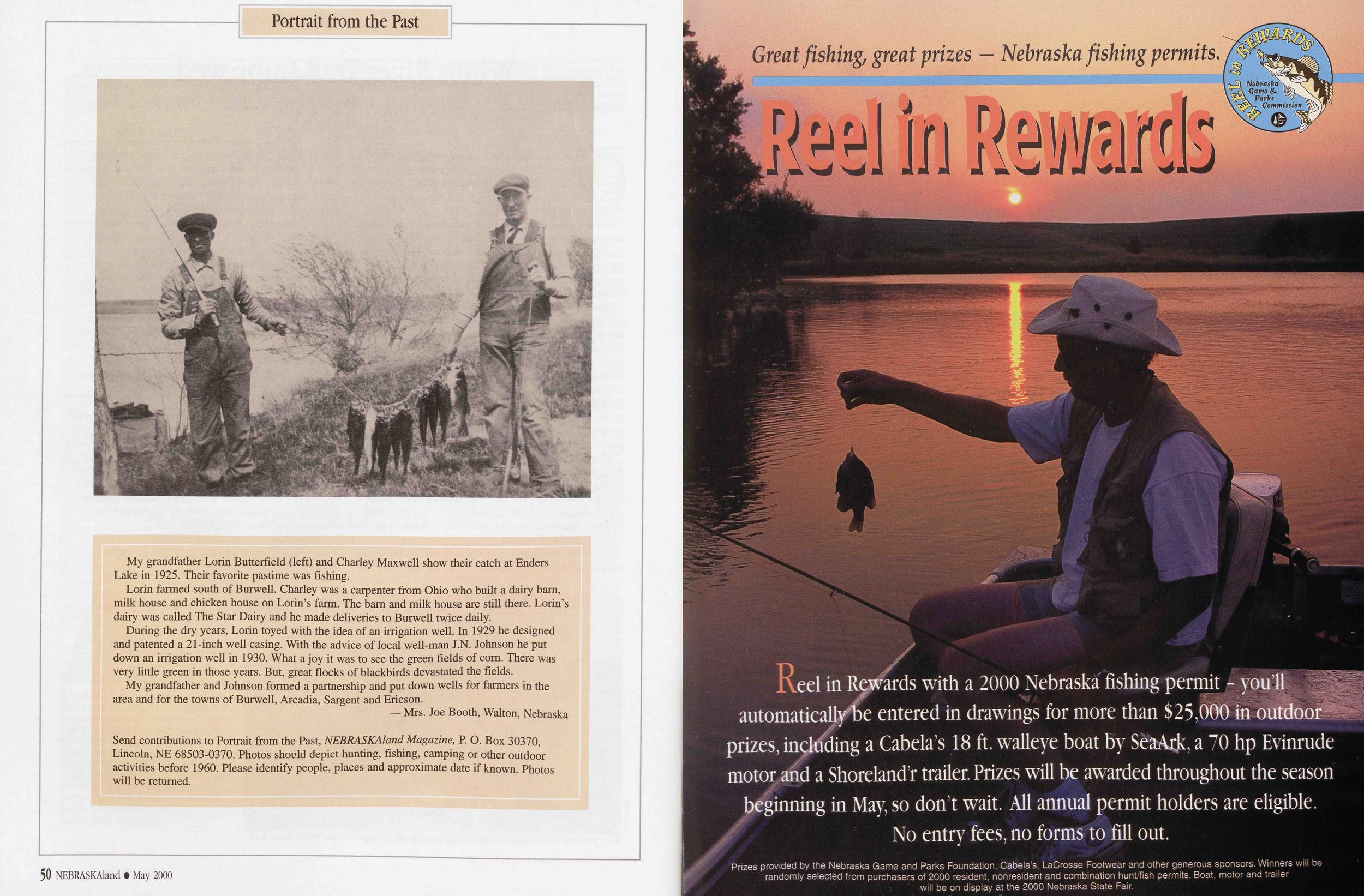
My grandfather Lorin Butterfield (left) and Charley Maxwell show their catch at Enders Lake in 1925. Their favorite pastime was fishing.
Lorin farmed south of Burwell. Charley was a carpenter from Ohio who built a dairy bam, milk house and chicken house on Lorin’s farm. The bam and milk house are still there. Lorin’s dairy was called The Star Dairy and he made deliveries to Burwell twice daily.
During the dry years, Lorin toyed with the idea of an irrigation well. In 1929 he designed and patented a 21-inch well casing. With the advice of local well-man J.N. Johnson he put down an irrigation well in 1930. What a joy it was to see the green fields of com. There was very little green in those years. But, great flocks of blackbirds devastated the fields.
My grandfather and Johnson formed a partnership and put down wells for farmers in the area and for the towns of Burwell, Arcadia, Sargent and Ericson.
— Mrs. Joe Booth, Walton, NebraskaSend contributions to Portrait from the Past, NEBRASKAland Magazine, P. O. Box 30370, Lincoln, NE 68503-0370. Photos should depict hunting, fishing, camping or other outdoor activities before 1960. Please identify people, places and approximate date if known. Photos will be returned.
Reel in Rewards with a 2000 Nebraska fishing permit - you’ll automatically be entered in drawings for more than $25,000 in outdoor prizes, including a Cabela’s 18 ft. walleye boat by SeaArk, a 70 hp Evinrude motor and a Shoreland’r trailer. Prizes will be awarded throughout the season beginning in May, so don’t wait. All annual permit holders are eligible. No entry fees, no forms to fill out. Prizes provided by the Nebraska Game and Parks Foundation, Cabela’s. LaCrosse Footwear and other generous sponsors. Winners will be randomly selected from purchasers of 2000 resident, nonresident and combination hunt/fish permits. Boat, motor and trailer will be on display at the 2000 Nebraska State Fair. 50 NEBRASKAland • May 2000
Position: 510 (21 views)