Volume 78, Issue 3, 2000
NEBRASKAland
Nebraska Game & Parks Commission April 2000 $2.50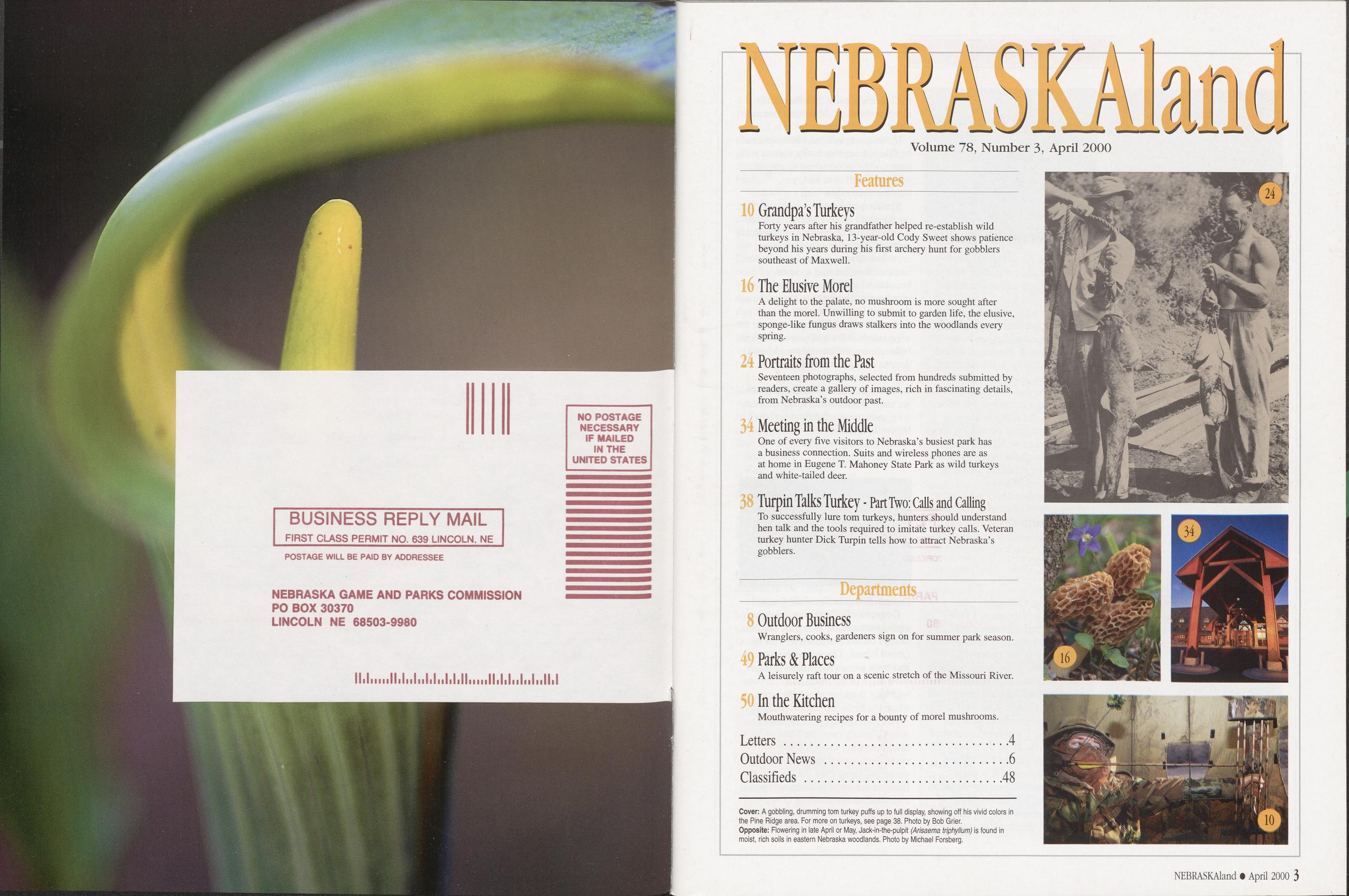
NEBRASKAland
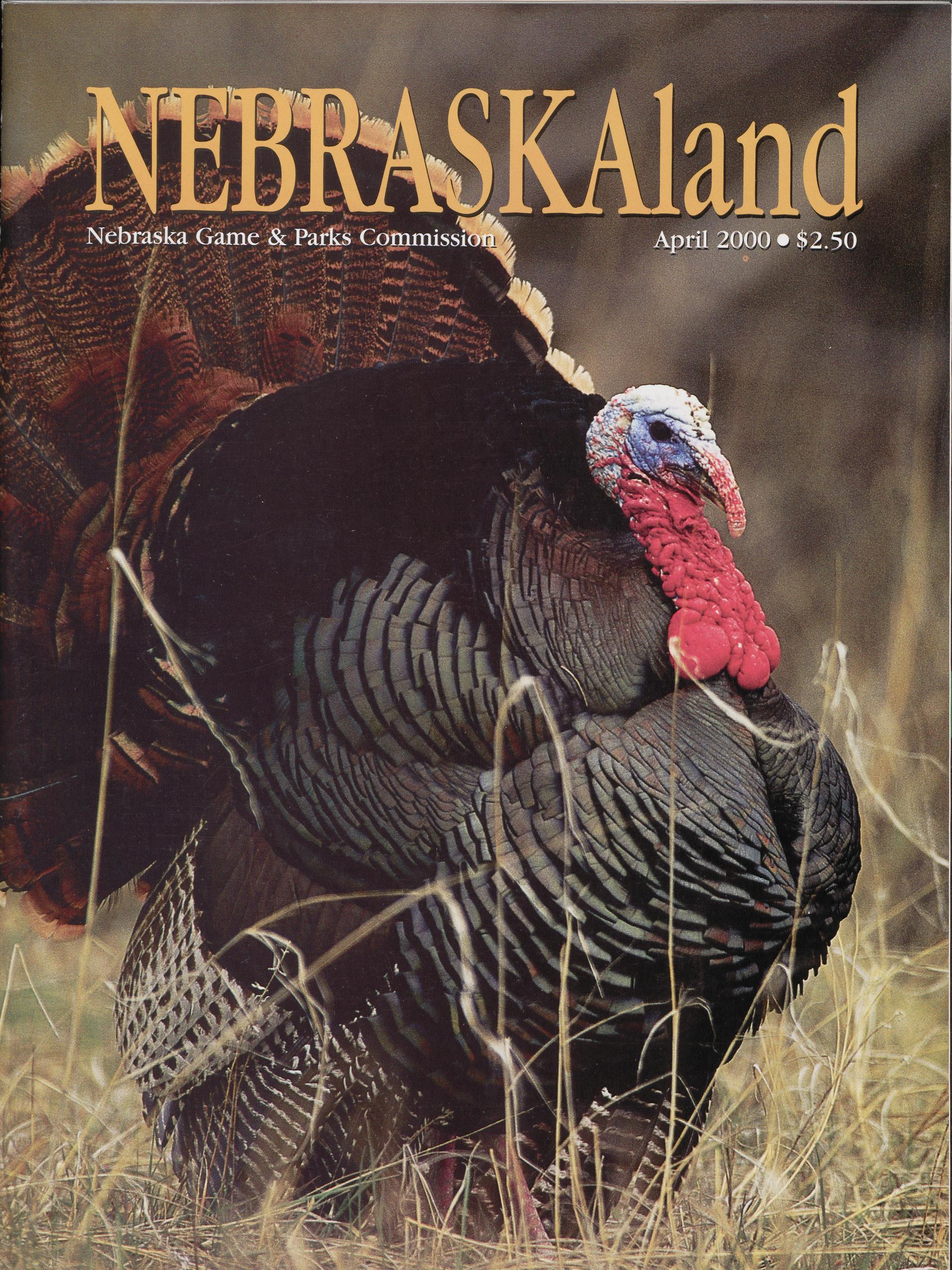
Volume 78, Number 3, April 2000 Features 10 Grandpa’s Turkeys Forty years after his grandfather helped re-establish wild turkeys in Nebraska, 13-year-old Cody Sweet shows patience beyond his years during his first archery hunt for gobblers southeast of Maxwell. 16 The Elusive Morel A delight to the palate, no mushroom is more sought after than the morel. Unwilling to submit to garden life, the elusive, sponge-like fungus draws stalkers into the woodlands every spring. 24 Portraits from the Past Seventeen photographs, selected from hundred submitted by readers, create a gallery of images, rich in fascinating details, from Nebraska's outdoor past. 34 Meeting in the Middle One of every five visitors to Nebraska's busiest park has a business connection. Suits and wireless phones are as at home in Eugene T. Mahoney State Park as wild turkeys and white-tailed deer. 38 Turpin Talks Turkey - Part Two: Calls and Calling To successfully lure tom turkeys, hunters should understand hen talk and the tools required to imitate turkey calls. Veteran turkey hunter Dick Turpin tells how to attract Nebraska's gobblers. Departments 8 Outdoor Business Wranglers, cooks, gardeners sign on for summer park season. 49 Parks & Places A leisurely raft tour on a scenic stretch of the Missouri River. 50 In the Kitchen Mouthwatering recipes for a bounty of morel mushrooms. Letters.............................................4 Outdoor News ..................................6 Classifieds ....................................48 Cover: A gobbling, drumming tom turkey puffs up to full display, showing off his vivid colors in the Pine Ridge area. For more on turkeys, see page 38. Photo by Bob Grier. Opposite: Flowering in late April or May, Jack-in-the-pulpit (Arisaema triphyllum) is found in moist, rich soils in eastern Nebraska woodlands. Photo by Michael Forsberg.24
16
34
10
Letters
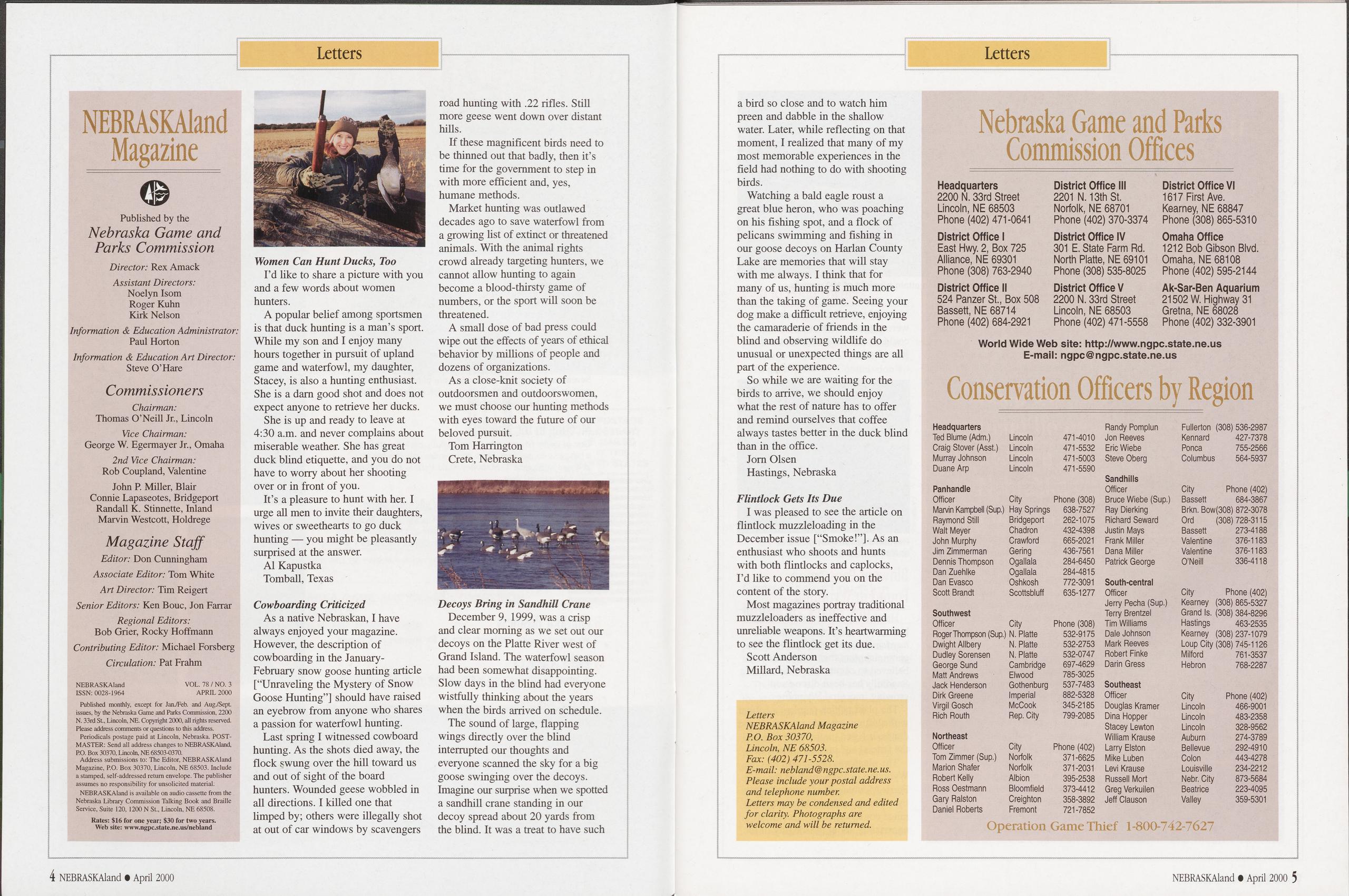
Women Can Hunt Ducks, TooI’d like to share a picture with you and a few words about women hunters.
A popular belief among sportsmen is that duck hunting is a man’s sport. While my son and I enjoy many hours together in pursuit of upland game and waterfowl, my daughter, Stacey, is also a hunting enthusiast. She is a dam good shot and does not expect anyone to retrieve her ducks.
She is up and ready to leave at 4:30 a.m. and never complains about miserable weather. She has great duck blind etiquette, and you do not have to worry about her shooting over or in front of you.
It’s a pleasure to hunt with her. I urge all men to invite their daughters, wives or sweethearts to go duck hunting — you might be pleasantly surprised at the answer.
Al Kapustka Tomball, Texas Cowboarding CriticizedAs a native Nebraskan, I have always enjoyed your magazine. However, the description of cowboarding in the January- February snow goose hunting article [“Unraveling the Mystery of Snow Goose Hunting”] should have raised an eyebrow from anyone who shares a passion for waterfowl hunting.
Last spring I witnessed cowboard hunting. As the shots died away, the flock swung over the hill toward us and out of sight of the board hunters. Wounded geese wobbled in all directions. I killed one that limped by; others were illegally shot at out of car windows by scavengers road hunting with .22 rifles. Still more geese went down over distant hills.
If these magnificent birds need to be thinned out that badly, then it’s time for the government to step in with more efficient and, yes, humane methods.
Market hunting was outlawed decades ago to save waterfowl from a growing list of extinct or threatened animals. With the animal rights crowd already targeting hunters, we cannot allow hunting to again become a blood-thirsty game of numbers, or the sport will soon be threatened.
A small dose of bad press could wipe out the effects of years of ethical behavior by millions of people and dozens of organizations.
As a close-knit society of outdoorsmen and outdoorswomen, we must choose our hunting methods with eyes toward the future of our beloved pursuit.
Tom Harrington Crete, Nebraska Decoys Bring in Sandhill CraneDecember 9, 1999, was a crisp and clear morning as we set out our decoys on the Platte River west of Grand Island. The waterfowl season had been somewhat disappointing. Slow days in the blind had everyone wistfully thinking about the years when the birds arrived on schedule.
The sound of large, flapping wings directly over the blind interrupted our thoughts and everyone scanned the sky for a big goose swinging over the decoys. Imagine our surprise when we spotted a sandhill crane standing in our decoy spread about 20 yards from the blind. It was a treat to have such a bird so close and to watch him preen and dabble in the shallow water. Later, while reflecting on that moment, I realized that many of my most memorable experiences in the field had nothing to do with shooting birds.
Watching a bald eagle roust a great blue heron, who was poaching on his fishing spot, and a flock of pelicans swimming and fishing in our goose decoys on Harlan County Lake are memories that will stay with me always. I think that for many of us, hunting is much more than the taking of game. Seeing your dog make a difficult retrieve, enjoying the camaraderie of friends in the blind and observing wildlife do unusual or unexpected things are all part of the experience.
So while we are waiting for the birds to arrive, we should enjoy what the rest of nature has to offer and remind ourselves that coffee always tastes better in the duck blind than in the office.
Jorn Olsen Hastings, Nebraska Flintlock Gets Its DueI was pleased to see the article on flintlock muzzleloading in the December issue [“Smoke!”]. As an enthusiast who shoots and hunts with both flintlocks and caplocks, I’d like to commend you on the content of the story.
Most magazines portray traditional muzzleloaders as ineffective and unreliable weapons. It’s heartwarming to see the flintlock get its due.
Scott Anderson Millard, NebraskaLetters NEBRASKAland Magazine RO. Box 30370, Lincoln, NE 68503. Fax: (402) 471-5528. E-mail: nebland@ngpc.state.ne.us. Please include your postal address and telephone number. Letters may be condensed and edited for clarity. Photographs are welcome and will be returned.
Nebraska Game and Parks Commission Offices Headquarters 2200 N. 33rd Street Lincoln, NE 68503 Phone (402) 471-0641 District Office I East Hwy. 2, Box 725 Alliance, NE 69301 Phone (308) 763-2940 District Office II 524 Panzer St., Box 508 Bassett, NE 68714 Phone (402) 684-2921 District Office III 2201 N. 13th St. Norfolk, NE 68701 Phone (402) 370-3374 District Office IV 301 E. State Farm Rd. North Platte, NE 69101 Phone (308) 535-8025 District Office V 2200 N. 33rd Street Lincoln, NE 68503 Phone (402) 471-5558 District Office VI 1617 First Ave. Kearney, NE 68847 Phone (308) 865-5310 Omaha Office 1212 Bob Gibson Blvd. Omaha, NE 68108 Phone (402) 595-2144 Ak-Sar-Ben Aquarium 21502 W. Highway 31 Gretna, NE 68028 Phone (402) 332-3901 World Wide Web site: outdoornebraska.org E-mail: ngpc@ngpc.state.ne.us Conservation Officers by Region Headquarters Randy Pomplun Fullerton (308)536-2987 Ted Blume (Adm.) Lincoln 471-4010 Jon Reeves Kennard 427-7378 Craig Stover (Asst.) Lincoln 471-5532 Eric Wiebe Ponca 755-2566 Murray Johnson Lincoln 471-5003 Steve Oberg Columbus 564-5937 Duane Arp Lincoln 471-5590 Sandhills Panhandle Officer City Phone (402) Officer City Phone (308) Bruce Wiebe (Sup.) Bassett 684-3867 Marvin Kampbell (Sup.) Hay Springs 638-7527 Ray Dierking Brkn. Bow(308) 872-3078 Raymond Still Bridgeport 262-1075 Richard Seward Ord (308)728-3115 Walt Meyer Chadron 432-4398 Justin Mays Bassett 273-4188 John Murphy Crawford 665-2021 Frank Miller Valentine 376-1183 Jim Zimmerman Gering 436-7561 Dana Miller Valentine 376-1183 Dennis Thompson Ogallala 284-6450 Patrick George O’Neill 336-4118 Dan Zuehlke Ogallala 284-4815 Dan Evasco Oshkosh 772-3091 South-central Scott Brandt Scottsbluff 635-1277 Officer City Phone (402) Jerry Pecha (Sup.) Kearney (308) 865-5327 Southwest Terry Brentzel Grand Is. (308) 384-8296 Officer City Phone (308) Tim Williams Hastings 463-2535 Roger Thompson (Sup.) N. Platte 532-9175 Dale Johnson Kearney (308)237-1079 Dwight Allbery N. Platte 532-2753 Mark Reeves Loup City (308) 745-1126 Dudley Sorensen N. Platte 532-0747 Robert Finke Milford 761-3537 George Sund Cambridge 697-4629 Darin Gress Hebron 768-2287 Matt Andrews Elwood 785-3025 Jack Henderson Gothenburg 537-7483 Southeast Dirk Greene Imperial 882-5328 Officer City Phone (402) Virgil Gosch McCook 345-2185 Douglas Kramer Lincoln 466-9001 Rich Routh Rep. City 799-2085 Dina Hopper Lincoln 483-2358 Stacey Lewton Lincoln 328-9562 Northeast William Krause Auburn 274-3789 Officer City Phone (402) Larry Elston Bellevue 292-4910 Tom Zimmer (Sup.) Norfolk 371-6625 Mike Luben Colon 443-4278 Marion Shafer Norfolk 371-2031 Levi Krause Louisville 234-2212 Robert Kelly Albion 395-2538 Russell Mort Nebr. City 873-5684 Ross Oestmann Bloomfield 373-4412 Greg Verkuilen Beatrice 223-4095 Gary Ralston Creighton 358-3892 Jeff Clauson Valley 359-5301 Daniel Roberts Fremont 721-7852 Operation Game Thief 1-800-742-7627 4 NEBRASKAland • April 2000 NEBRASKAland • April 2000 5
Outdoor News
The first known reproduction by the pallid sturgeon (Scaphirhynchus albus) in the lower Missouri River in at least 50 years has been confirmed by U.S. Fish and Wildlife Service biologists in Missouri.
The fish, which can attain a weight of 100 pounds, a length of 6 feet and can live as long as 60 years, has been listed on the federal and state endangered species lists since 1990.
Until this recent discovery, the only young pallid sturgeon known in the river were 3,000 hatchery sturgeon stocked to keep the species alive.
The species population began to drop when dams were built on the river beginning in the 1930s and when its habitat was altered from shallow, silty rivers with sand and gravel bars to deeper, clear channels favored by commercial river traffic.
The young sturgeon were found in shallow water habitat along a restored sandbar in a side channel of the Missouri that had been cut by the flood of 1993 and expanded by more flooding in 1995 and 1996.
"This indicates a ray of hope for the species,” said Gene Zuerlein of the Nebraska Game and Parks Commission Fisheries Division. "It’s really a big plus that individuals found both the right habitat and each other in the Missouri.”
In 1997 the Commission stocked 412 pallid sturgeon in the lower Platte River. All the 10-inch fish were tagged so their movements could be tracked in the Missouri River basin.
Hayden’s penstemon, also called blowout penstemon (Penstemon haydenii), a milky-blue, aromatic, perennial plant that was previously believed to occur only in Nebraska’s Sandhills has been discovered growing in central Wyoming.
The plant, which requires a habitat with shifting, sparsely vegetated sand dunes, is listed on the Nebraska and the federal endangered species lists.
The plant was discovered in Wyoming in 1996 south of the Ferris Mountains in Carbon County by a Bureau of Land Management range conservationist. Because of uncertainty about the identity of the plant, Wyoming conservationists revisited the site annually. Last July they found plants in full bloom and made positive identification.
The blowout penstemon was once relatively common in Nebraska but, because of habitat loss, now only 3,500-to-5,000 plants are found at about a dozen sites. The Wyoming population is limited to about 300-to-500 plants in a 20-acre area.
Commission Provides Fish to Pond OwnersThe Nebraska Game and Parks Commission provides stocking populations of bluegill and bass at no charge to owners of private ponds.
To qualify for the Commission’s stocking program, a pond must meet the following requirements: a minimum of one-half surface acre of water; a depth of at least 10 feet under a quarter of its surface area; no other fish present except for recently stocked channel catfish; and a minimum water clarity of 8 inches.
Bluegill are stocked in the first year and bass in the second year of the two-year program.
The application deadline is June 1. To apply or for more information, contact a Commission district office.
Grouse Spring Courtship Rituals are Under WayUntil the end of April, Nebraska’s prairie grouse can be seen dancing and courting in the Sandhills and the southeastern part of the state.
There are two species of grouse in the state, which are often confused. The greater prairie chicken (Tympanuchus cupido pinnatus) is slightly larger than the sharp-tailed grouse (Pedioecetes phasianellus) and both can be identified by distinctive breast markings. The sharptails have V-shaped markings and the prairie chicken have uniformly barred breasts.
In the early spring, flocks of both 6 NEBRASKAland • April 2000 NEBRASKAland • April 2000 7 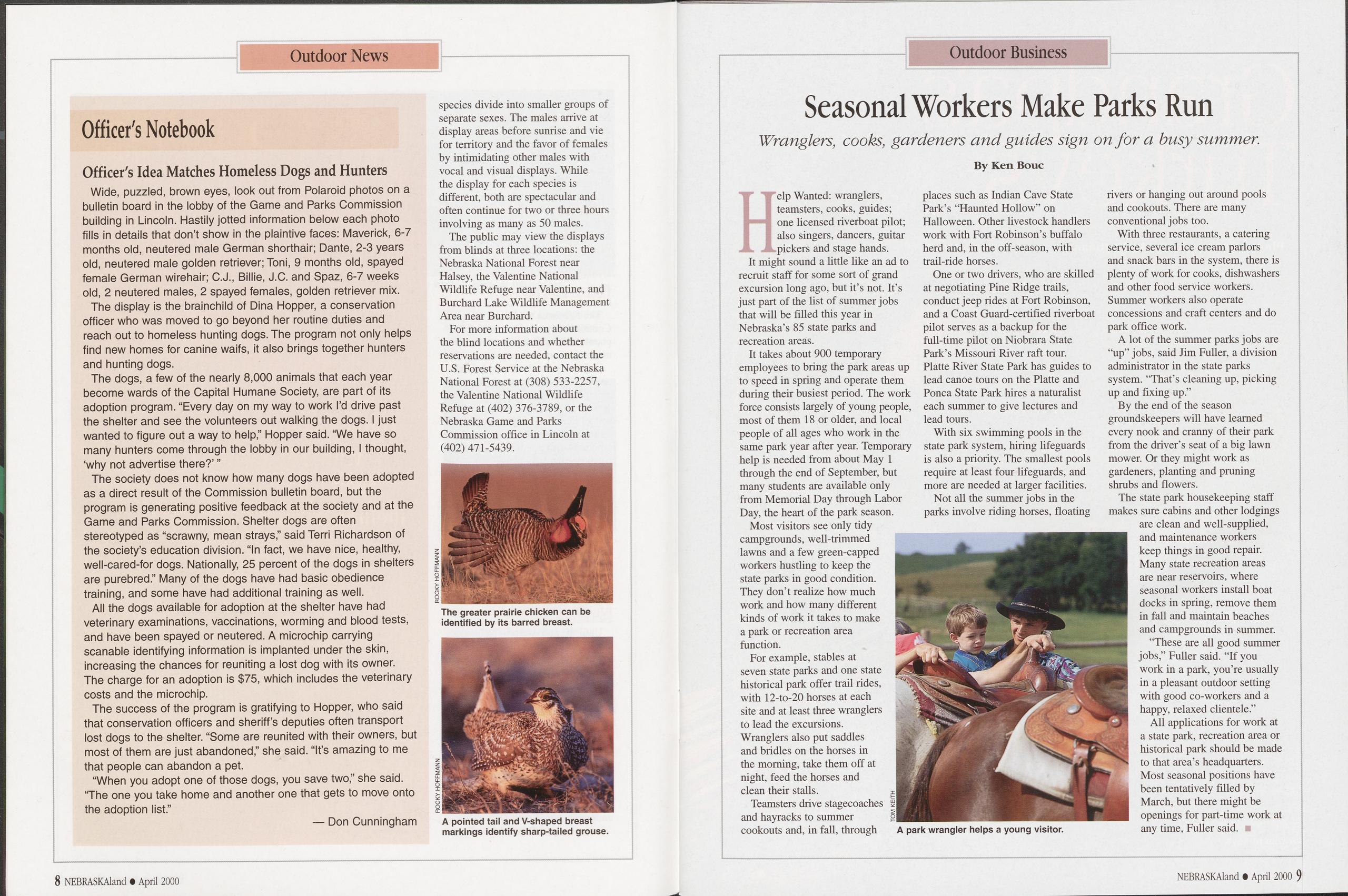 species divide into smaller groups of separate sexes. The males arrive at display areas before sunrise and vie for territory and the favor of females by intimidating other males with vocal and visual displays. While the display for each species is different, both are spectacular and often continue for two or three hours involving as many as 50 males.
The public may view the displays from blinds at three locations: the Nebraska National Forest near Halsey, the Valentine National Wildlife Refuge near Valentine, and Burchard Lake Wildlife Management Area near Burchard.
For more information about the blind locations and whether reservations are needed, contact the U.S. Forest Service at the Nebraska National Forest at (308) 533-2257, the Valentine National Wildlife Refuge at (402) 376-3789, or the Nebraska Game and Parks Commission office in Lincoln at (402) 471-5439.
Outdoor News
Officer's Notebook
Officer's Idea Matches Homeless Dogs and Hunters
Wide, puzzled, brown eyes, look out from Polaroid photos on a bulletin board in the lobby of the Game and Parks Commission building in Lincoln. Hastily jotted information below each photo fills in details that don’t show in the plaintive faces: Maverick, 6-7 months old, neutered male German shorthair; Dante, 2-3 years old, neutered male golden retriever; Toni, 9 months old, spayed female German wirehair; C.J., Billie, J.C. and Spaz, 6-7 weeks old, 2 neutered males, 2 spayed females, golden retriever mix.
The display is the brainchild of Dina Hopper, a conservation officer who was moved to go beyond her routine duties and reach out to homeless hunting dogs. The program not only helps find new homes for canine waifs, it also brings together hunters and hunting dogs.
The dogs, a few of the nearly 8,000 animals that each year become wards of the Capital Humane Society, are part of its adoption program. “Every day on my way to work I’d drive past the shelter and see the volunteers out walking the dogs. I just wanted to figure out a way to help,” Hopper said. “We have so many hunters come through the lobby in our building, I thought, ‘why not advertise there?’"
The society does not know how many dogs have been adopted as a direct result of the Commission bulletin board, but the program is generating positive feedback at the society and at the Game and Parks Commission. Shelter dogs are often stereotyped as “scrawny, mean strays,” said Terri Richardson of the society’s education division. “In fact, we have nice, healthy, well-cared-for dogs. Nationally, 25 percent of the dogs in shelters are purebred.” Many of the dogs have had basic obedience training, and some have had additional training as well.
All the dogs available for adoption at the shelter have had veterinary examinations, vaccinations, worming and blood tests, and have been spayed or neutered. A microchip carrying scanable identifying information is implanted under the skin, increasing the chances for reuniting a lost dog with its owner. The charge for an adoption is $75, which includes the veterinary costs and the microchip.
The success of the program is gratifying to Hopper, who said that conservation officers and sheriff’s deputies often transport lost dogs to the shelter. “Some are reunited with their owners, but most of them are just abandoned,” she said. “It’s amazing to me that people can abandon a pet.
“When you adopt one of those dogs, you save two,” she said. “The one you take home and another one that gets to move onto the adoption list.”
— Don CunninghamOutdoor Business
Seasonal Workers Make Parks Run
Wranglers, cooks, gardeners and guides sign on for a busy summer. By Ken BoucHelp Wanted: wranglers, teamsters, cooks, guides; one licensed riverboat pilot; also singers, dancers, guitar pickers and stage hands. It might sound a little like an ad to recruit staff for some sort of grand excursion long ago, but it’s not. It’s just part of the list of summer jobs that will be filled this year in Nebraska’s 85 state parks and recreation areas.
It takes about 900 temporary employees to bring the park areas up to speed in spring and operate them during their busiest period. The work force consists largely of young people, most of them 18 or older, and local people of all ages who work in the same park year after year. Temporary help is needed from about May 1 through the end of September, but many students are available only from Memorial Day through Labor Day, the heart of the park season.
Most visitors see only tidy campgrounds, well-trimmed lawns and a few green-capped workers hustling to keep the state parks in good condition. They don’t realize how much work and how many different kinds of work it takes to make a park or recreation area function.
For example, stables at seven state parks and one state historical park offer trail rides, with 12-to-20 horses at each site and at least three wranglers to lead the excursions. Wranglers also put saddles and bridles on the horses in the morning, take them off at night, feed the horses and clean their stalls.
Teamsters drive stagecoaches and hayracks to summer cookouts and, in fall, through places such as Indian Cave State Park’s “Haunted Hollow” on Halloween. Other livestock handlers work with Fort Robinson’s buffalo herd and, in the off-season, with trail-ride horses.
One or two drivers, who are skilled at negotiating Pine Ridge trails, conduct jeep rides at Fort Robinson, and a Coast Guard-certified riverboat pilot serves as a backup for the full-time pilot on Niobrara State Park’s Missouri River raft tour. Platte River State Park has guides to lead canoe tours on the Platte and Ponca State Park hires a naturalist each summer to give lectures and lead tours.
With six swimming pools in the state park system, hiring lifeguards is also a priority. The smallest pools require at least four lifeguards, and more are needed at larger facilities.
Not all the summer jobs in the parks involve riding horses, floating
With three restaurants, a catering service, several ice cream parlors and snack bars in the system, there is plenty of work for cooks, dishwashers and other food service workers. Summer workers also operate concessions and craft centers and do park office work.
A lot of the summer parks jobs are “up” jobs, said Jim Fuller, a division administrator in the state parks system. “That’s cleaning up, picking up and fixing up.”
By the end of the season groundskeepers will have learned every nook and cranny of their park from the driver’s seat of a big lawn mower. Or they might work as gardeners, planting and pruning shrubs and flowers.
The state park housekeeping staff makes sure cabins and other lodgings are clean and well-supplied, and maintenance workers keep things in good repair. Many state recreation areas are near reservoirs, where seasonal workers install boat docks in spring, remove them in fall and maintain beaches and campgrounds in summer.
“These are all good summer jobs,” Fuller said. “If you work in a park, you’re usually in a pleasant outdoor setting with good co-workers and a happy, relaxed clientele.”
All applications for work at a state park, recreation area or historical park should be made to that area’s headquarters. Most seasonal positions have been tentatively filled by March, but there might be openings for part-time work at any time, Fuller said.
8 NEBRASKAland • April 2000 NEBRASKAland • April 2000 9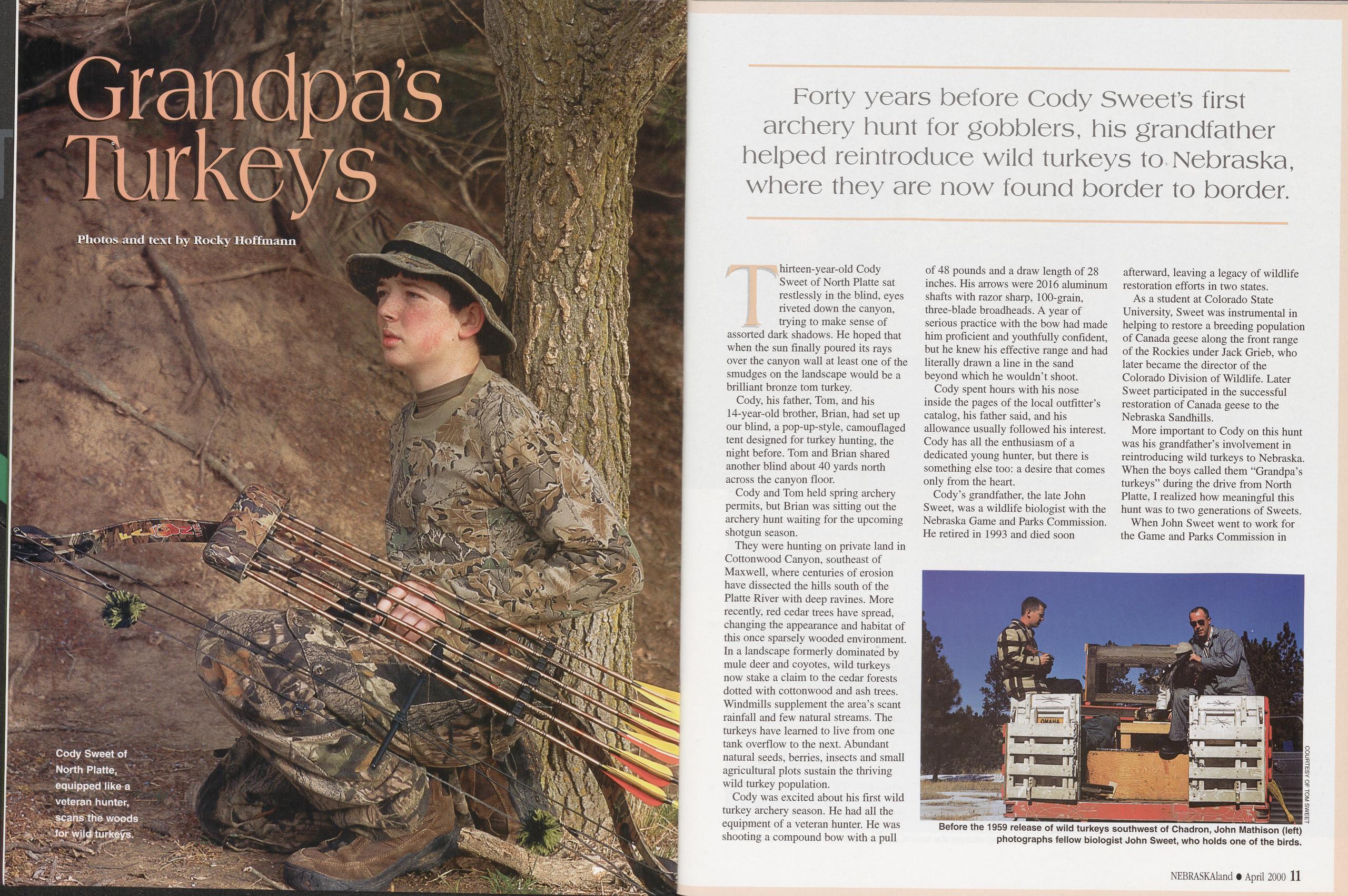
Grandpa's Turkeys
Photos and text by Rocky HoffmannThirteen-year-old Cody Sweet of North Platte sat restlessly in the blind, eyes riveted down the canyon, trying to make sense of assorted dark shadows. He hoped that when the sun finally poured its rays over the canyon wall at least one of the smudges on the landscape would be a brilliant bronze tom turkey.
Cody, his father, Tom, and his 14-year-old brother, Brian, had set up our blind, a pop-up-style, camouflaged tent designed for turkey hunting, the night before. Tom and Brian shared another blind about 40 yards north across the canyon floor.
Cody and Tom held spring archery permits, but Brian was sitting out the archery hunt waiting for the upcoming shotgun season.
They were hunting on private land in Cottonwood Canyon, southeast of Maxwell, where centuries of erosion have dissected the hills south of the Platte River with deep ravines. More recently, red cedar trees have spread, changing the appearance and habitat of this once sparsely wooded environment. In a landscape formerly dominated by mule deer and coyotes, wild turkeys now stake a claim to the cedar forests dotted with cottonwood and ash trees. Windmills supplement the area’s scant rainfall and few natural streams. The turkeys have learned to live from one tank overflow to the next. Abundant natural seeds, berries, insects and small agricultural plots sustain the thriving wild turkey population.
Cody was excited about his first wild turkey archery season. He had all the equipment of a veteran hunter. He was shooting a compound bow with a pull of 48 pounds and a draw length of 28 inches. His arrows were 2016 aluminum shafts with razor sharp, 100-grain, three-blade broadheads. A year of serious practice with the bow had made him proficient and youthfully confident, but he knew his effective range and had literally drawn a line in the sand beyond which he wouldn’t shoot.
Cody spent hours with his nose inside the pages of the local outfitter’s catalog, his father said, and his allowance usually followed his interest. Cody has all the enthusiasm of a dedicated young hunter, but there is something else too: a desire that comes only from the heart.
Cody’s grandfather, the late John Sweet, was a wildlife biologist with the Nebraska Game and Parks Commission. He retired in 1993 and died soon
As a student at Colorado State University, Sweet was instrumental in helping to restore a breeding population of Canada geese along the front range of the Rockies under Jack Grieb, who later became the director of the Colorado Division of Wildlife. Later Sweet participated in the successful restoration of Canada geese to the Nebraska Sandhills.
More important to Cody on this hunt was his grandfather’s involvement in reintroducing wild turkeys to Nebraska. When the boys called them "Grandpa’s turkeys” during the drive from North Platte, I realized how meaningful this hunt was to two generations of Sweets.
When John Sweet went to work for the Game and Parks Commission in NEBRASKAland • April 2000 11 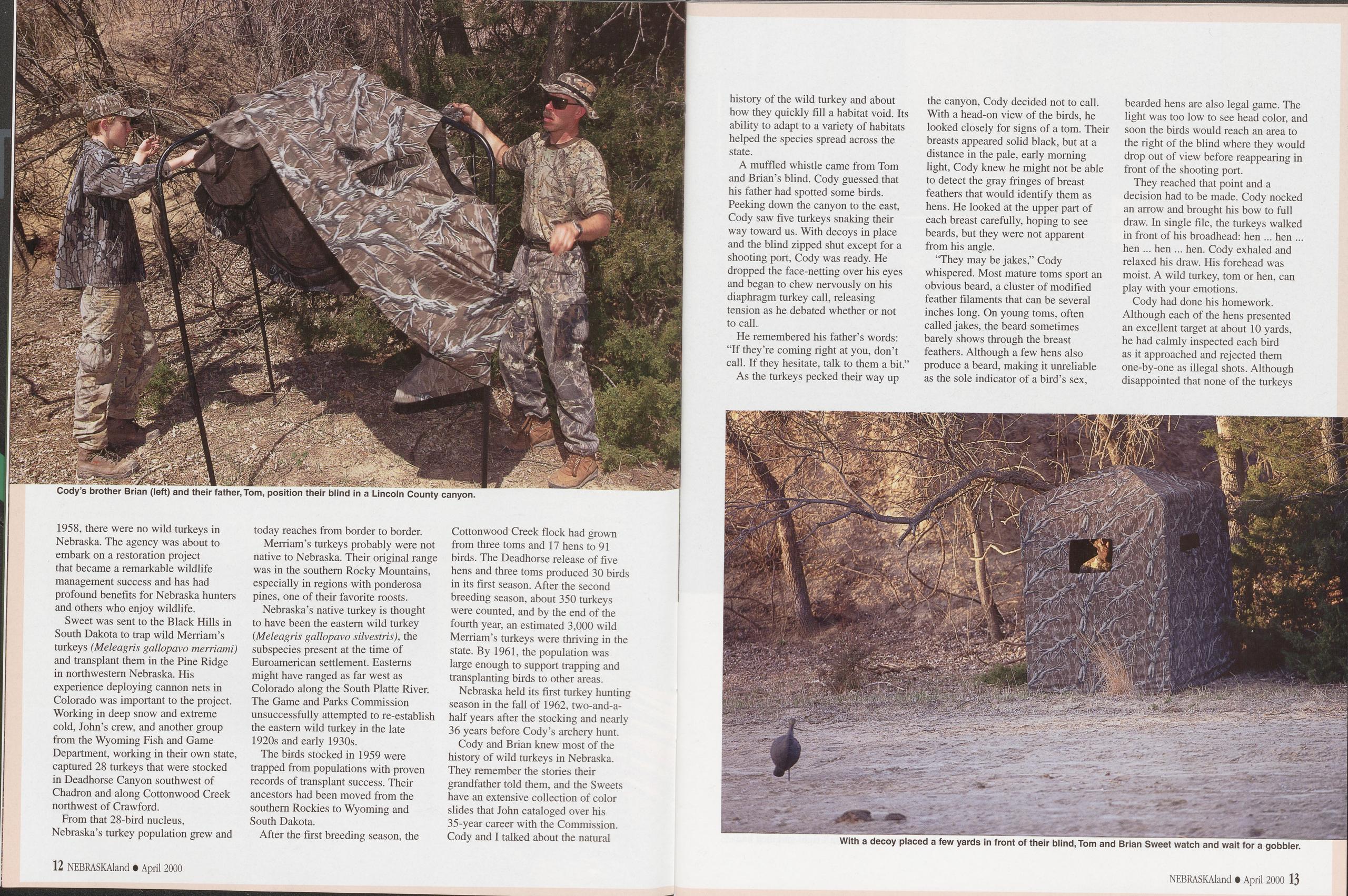
Sweet was sent to the Black Hills in South Dakota to trap wild Merriam’s turkeys (Meleagris gallopavo merriami) and transplant them in the Pine Ridge in northwestern Nebraska. His experience deploying cannon nets in Colorado was important to the project. Working in deep snow and extreme cold, John’s crew, and another group from the Wyoming Fish and Game Department, working in their own state, captured 28 turkeys that were stocked in Deadhorse Canyon southwest of Chadron and along Cottonwood Creek northwest of Crawford.
From that 28-bird nucleus, Nebraska’s turkey population grew and today reaches from border to border.
Merriam’s turkeys probably were not native to Nebraska. Their original range was in the southern Rocky Mountains, especially in regions with ponderosa pines, one of their favorite roosts.
Nebraska’s native turkey is thought to have been the eastern wild turkey (Meleagris gallopavo silvestris), the subspecies present at the time of Euroamerican settlement. Easterns might have ranged as far west as Colorado along the South Platte River. The Game and Parks Commission unsuccessfully attempted to re-establish the eastern wild turkey in the late 1920s and early 1930s.
The birds stocked in 1959 were trapped from populations with proven records of transplant success. Their ancestors had been moved from the southern Rockies to Wyoming and South Dakota.
After the first breeding season, the Cottonwood Creek flock had grown from three toms and 17 hens to 91 birds. The Deadhorse release of five hens and three toms produced 30 birds in its first season. After the second breeding season, about 350 turkeys were counted, and by the end of the fourth year, an estimated 3,000 wild Merriam’s turkeys were thriving in the state. By 1961, the population was large enough to support trapping and transplanting birds to other areas.
Nebraska held its first turkey hunting season in the fall of 1962, two-and-a- half years after the stocking and nearly 36 years before Cody’s archery hunt.
Cody and Brian knew most of the history of wild turkeys in Nebraska. They remember the stories their grandfather told them, and the Sweets have an extensive collection of color slides that John cataloged over his 35-year career with the Commission. Cody and I talked about the natural history of the wild turkey and about how they quickly fill a habitat void. Its ability to adapt to a variety of habitats helped the species spread across the state.
A muffled whistle came from Tom and Brian’s blind. Cody guessed that his father had spotted some birds. Peeking down the canyon to the east, Cody saw five turkeys snaking their way toward us. With decoys in place and the blind zipped shut except for a shooting port, Cody was ready. He dropped the face-netting over his eyes and began to chew nervously on his diaphragm turkey call, releasing tension as he debated whether or not to call.
He remembered his father’s words: “If they’re coming right at you, don’t call. If they hesitate, talk to them a bit.”
As the turkeys pecked their way up
“They may be jakes,” Cody whispered. Most mature toms sport an obvious beard, a cluster of modified feather filaments that can be several inches long. On young toms, often called jakes, the beard sometimes barely shows through the breast feathers. Although a few hens also produce a beard, making it unreliable as the sole indicator of a bird’s sex, bearded hens are also legal game. The light was too low to see head color, and soon the birds would reach an area to the right of the blind where they would drop out of view before reappearing in front of the shooting port.
They reached that point and a decision had to be made. Cody nocked an arrow and brought his bow to full draw. In single file, the turkeys walked in front of his broadhead: hen ... hen ... hen ... hen ... hen. Cody exhaled and relaxed his draw. His forehead was moist. A wild turkey, tom or hen, can play with your emotions.
Cody had done his homework. Although each of the hens presented an excellent target at about 10 yards, he had calmly inspected each bird as it approached and rejected them one-by-one as illegal shots. Although disappointed that none of the turkeys 12 NEBRASKAland • April 2000 NEBRASKAland • April 2000 13 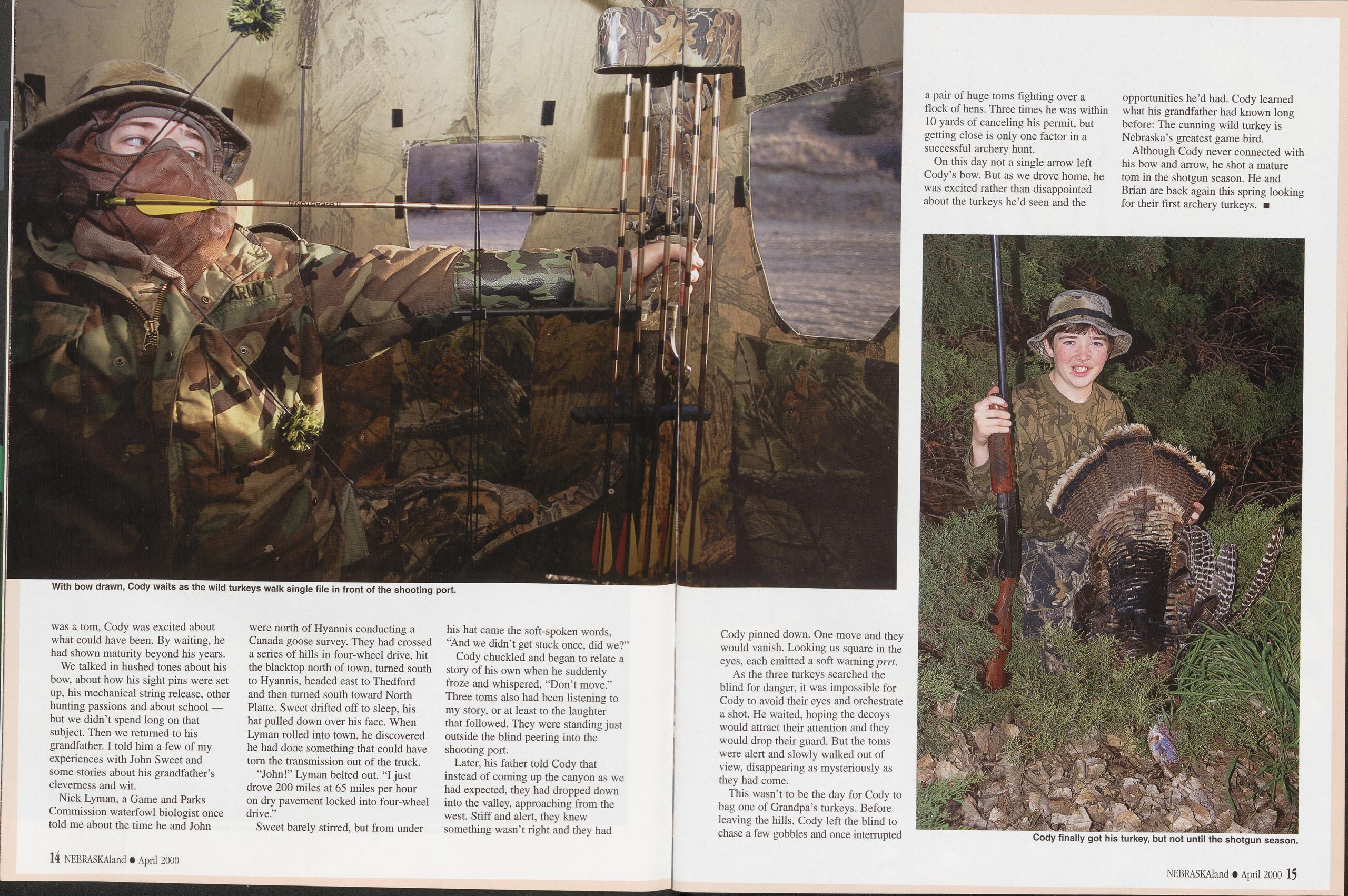
We talked in hushed tones about his bow, about how his sight pins were set up, his mechanical string release, other hunting passions and about school — but we didn’t spend long on that subject. Then we returned to his grandfather. I told him a few of my experiences with John Sweet and some stories about his grandfather’s cleverness and wit.
Nick Lyman, a Game and Parks Commission waterfowl biologist once told me about the time he and John were north of Hyannis conducting a Canada goose survey. They had crossed a series of hills in four-wheel drive, hit the blacktop north of town, turned south to Hyannis, headed east to Thedford and then turned south toward North Platte. Sweet drifted off to sleep, his hat pulled down over his face. When Lyman rolled into town, he discovered he had done something that could have tom the transmission out of the truck.
“John!” Lyman belted out. “I just drove 200 miles at 65 miles per hour on dry pavement locked into four-wheel drive.”
Sweet barely stirred, but from under his hat came the soft-spoken words, “And we didn’t get stuck once, did we?”
Cody chuckled and began to relate a story of his own when he suddenly froze and whispered, “Don’t move.” Three toms also had been listening to my story, or at least to the laughter that followed. They were standing just outside the blind peering into the shooting port.
Later, his father told Cody that instead of coming up the canyon as we had expected, they had dropped down into the valley, approaching from the west. Stiff and alert, they knew something wasn’t right and they had Cody pinned down. One move and they would vanish. Looking us square in the eyes, each emitted a soft warning prrt.
As the three turkeys searched the blind for danger, it was impossible for Cody to avoid their eyes and orchestrate a shot. He waited, hoping the decoys would attract their attention and they would drop their guard. But the toms were alert and slowly walked out of view, disappearing as mysteriously as they had come.
This wasn’t to be the day for Cody to bag one of Grandpa’s turkeys. Before leaving the hills, Cody left the blind to chase a few gobbles and once interrupted a pair of huge toms fighting over a flock of hens. Three times he was within 10 yards of canceling his permit, but getting close is only one factor in a successful archery hunt.
On this day not a single arrow left Cody’s bow. But as we drove home, he was excited rather than disappointed about the turkeys he’d seen and the
Although Cody never connected with his bow and arrow, he shot a mature tom in the shotgun season. He and Brian are back again this spring looking for their first archery turkeys.
14 NEBRASKAland • April 2000 NEBRASKAland • April 2000 15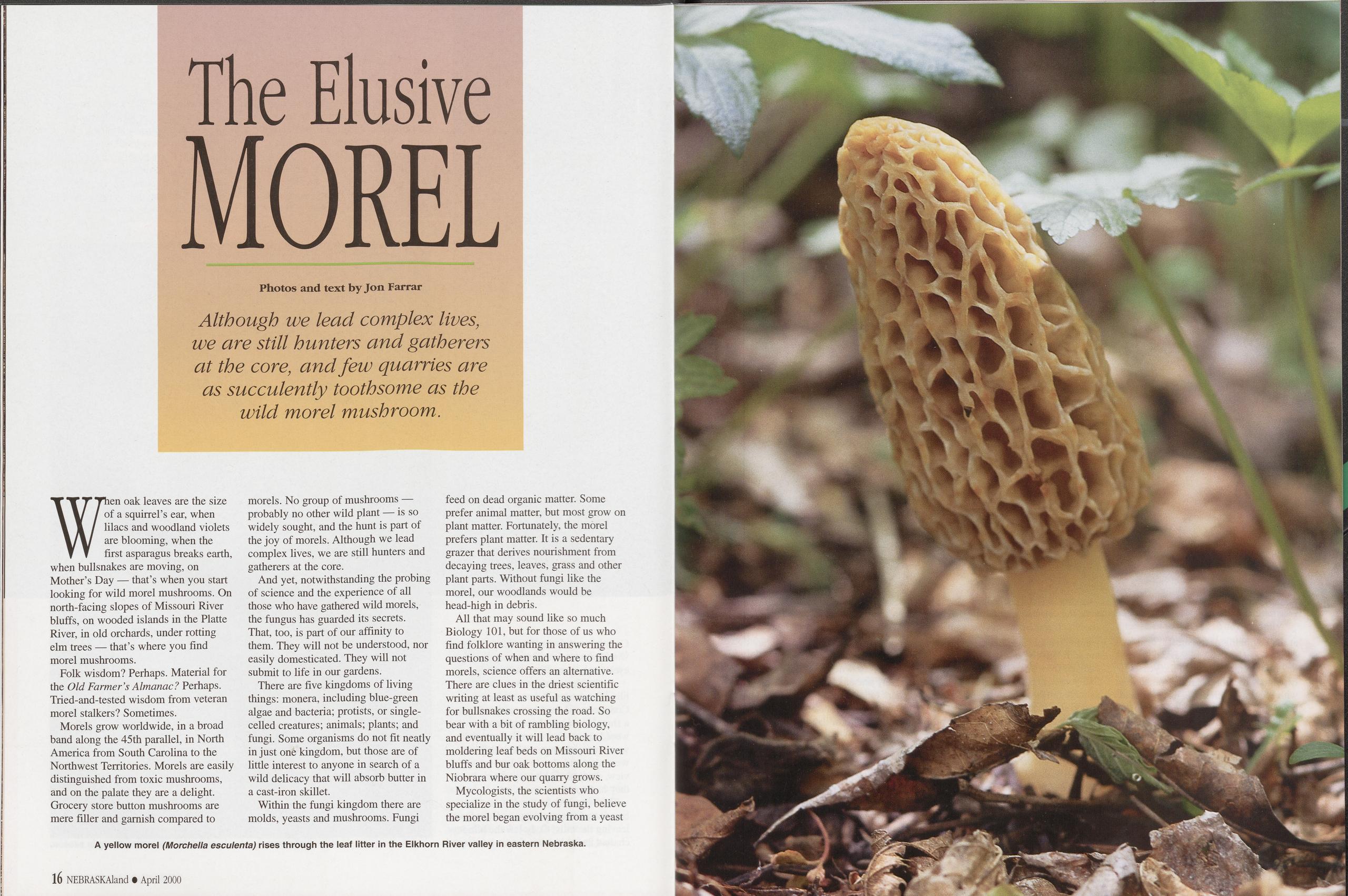
The Elusive MOREL
Photos and text by Jon Farrar Although we lead complex lives, we are still hunters and gatherers at the core, and few quarries are as succulently toothsome as the wild morel mushroom.When oak leaves are the size of a squirrel’s ear, when lilacs and woodland violets are blooming, when the first asparagus breaks earth, when bullsnakes are moving, on Mother’s Day — that’s when you start looking for wild morel mushrooms. On north-facing slopes of Missouri River bluffs, on wooded islands in the Platte River, in old orchards, under rotting elm trees — that’s where you find morel mushrooms.
Folk wisdom? Perhaps. Material for the Old Farmer's Almanac? Perhaps. Tried-and-tested wisdom from veteran morel stalkers? Sometimes.
Morels grow worldwide, in a broad band along the 45th parallel, in North America from South Carolina to the Northwest Territories. Morels are easily distinguished from toxic mushrooms, and on the palate they are a delight. Grocery store button mushrooms are mere filler and garnish compared to morels. No group of mushrooms — probably no other wild plant — is so widely sought, and the hunt is part of the joy of morels. Although we lead complex lives, we are still hunters and gatherers at the core.
And yet, notwithstanding the probing of science and the experience of all those who have gathered wild morels, the fungus has guarded its secrets. That, too, is part of our affinity to them. They will not be understood, nor easily domesticated. They will not submit to life in our gardens.
There are five kingdoms of living things: monera, including blue-green algae and bacteria; protists, or single- celled creatures; animals; plants; and fungi. Some organisms do not fit neatly in just one kingdom, but those are of little interest to anyone in search of a wild delicacy that will absorb butter in a cast-iron skillet.
Within the fungi kingdom there are molds, yeasts and mushrooms. Fungi feed on dead organic matter. Some prefer animal matter, but most grow on plant matter. Fortunately, the morel prefers plant matter. It is a sedentary grazer that derives nourishment from decaying trees, leaves, grass and other plant parts. Without fungi like the morel, our woodlands would be head-high in debris.
All that may sound like so much Biology 101, but for those of us who find folklore wanting in answering the questions of when and where to find morels, science offers an alternative. There are clues in the driest scientific writing at least as useful as watching for bullsnakes crossing the road. So bear with a bit of rambling biology, and eventually it will lead back to moldering leaf beds on Missouri River bluffs and bur oak bottoms along the Niobrara where our quarry grows.
Mycologists, the scientists who specialize in the study of fungi, believe the morel began evolving from a yeast
In the evolution of species, 100,000 years ago is yesterday. Some scientists speculate that the humid edges of great ice sheets created a local environment in which yeasts could survive, and it was there that the morel was born.
Here is the first clue morel hunters can glean from science: Morels require moist, humid growing conditions. Don’t bother searching the grassy, windblown hilltops. Because morels are so relatively young, so recently evolved from yeasts, they remain much like yeasts, and are not as well adapted as most mushrooms to the interglacial period in which we live.
Yeasts found their niche in the world by keeping their life cycle simple and by growing quickly when favorable conditions appear. The more highly evolved mushrooms, on the other hand, can cope with an environment that is not always ideal.
The morel survival plan is more like a yeast: Develop and reproduce rapidly when conditions are favorable; retreat underground when conditions are too warm or too dry.
Anyone who has chased morels for many seasons knows this: Morels are here today, gone tomorrow, and to find them a hunter must reconnoiter new grounds almost daily during the prime season. Some years, when spring weather is not to their liking, morels don’t appear at all in their usual haunts, or are few and far between.
Several other scientific observations offer clues about where and when morels might be found and why they sometimes can’t be found.
A morel is a much larger organism than the part we find above ground. The club-shaped, fleshy structure we pick is only its fruiting body. Under the leaf litter and underground is a complex of long, thread-like cells collectively called the mycelium. In favorable conditions, this mesh-like network of mycelia spreads, often joining with the mycelia of neighboring morels until a “mother fungus” covers an extensive area. That bit of biology explains, in part, why morels often are found in colonies and why, if growing conditions remain favorable, a morel patch can persist year after year.
On the surface of the mycelium most mushrooms produce enzymes that break down large molecules of the decaying matter on which the mushroom feeds. The more primitive morel does not produce such enzymes, and must feed on small molecules or those already processed by bacteria and molds. In part, that explains the difficulty of producing morels commercially. The mycelia of morels are less resistant to dehydration than other mushrooms, a possible reason why mushroom hunting grounds that have been productive year after year can literally dry up.
More highly-evolved fungi, such as the toadstool-shaped mushrooms, have caps. On the underside of the caps are row upon row of delicate gills on which spores are produced. The caps protect the delicate spores from being prematurely dislodged by rain. Morels produce their spores in pod-like sacs, called asci, which are enclosed in the tissue of the club-shaped fruiting body. The honeycombed, pitted surface of the morel provides maximum surface area on which spore-bearing asci can develop. Each morel fruiting body contains millions of asci.
Although they are microscopic, the four-to-eight morel spores in each ascus are large compared to those of other mushrooms. When the fruiting body has matured and begins to dry, the “lid” of the ascus opens and the spores spill out. If they fall on favorable soil, they give rise to a new morel mycelium, much like seeds give rise to new plants.
Because morel spores are relatively large, they are not carried on the wind as easily as those of other mushrooms, and are less likely to colonize new areas. That is the second reason morels are found in groups, often called herds by morel stalkers. Lone morels are likely to be pioneers growing from spores that were carried away from the mother fungus.
The fruiting body of the morel is first evident as a tiny knot on the threads of the mycelium. As the soil temperature rises in spring the knot enlarges rapidly, cell after cell, until a tiny club forms and pushes to the soil surface. The fleshy club, 90 percent water, is a delicate structure that can climb to sunlight only through loose, moist soil. That narrows a morel hunter’s search to sandy loam soils or heavier soils with a deep humus layer. Raw clay soils are not productive hunting grounds.
Above ground the fruiting body continues to swell, if its growing site remains warm and moist. In three-to- five days it reaches full size and begins to dry. At least one mycologist has speculated that morels in warmer and drier regions on the Great Plains are developing thicker tissue on the fruiting club than those in more humid regions as a way to resist desiccation. If you measure morel hunting success by the pound, not the peck, Nebraska may be among the best of places.
Depending upon what authority you accept, there are three, four or up to 60 species of morels. One mycologist flatly states that “morel types are so variable that nomenclature is in a state of confusion.” Such details are of little importance to those of us who only want to eat morels. There are, though, several readily distinguishable types.
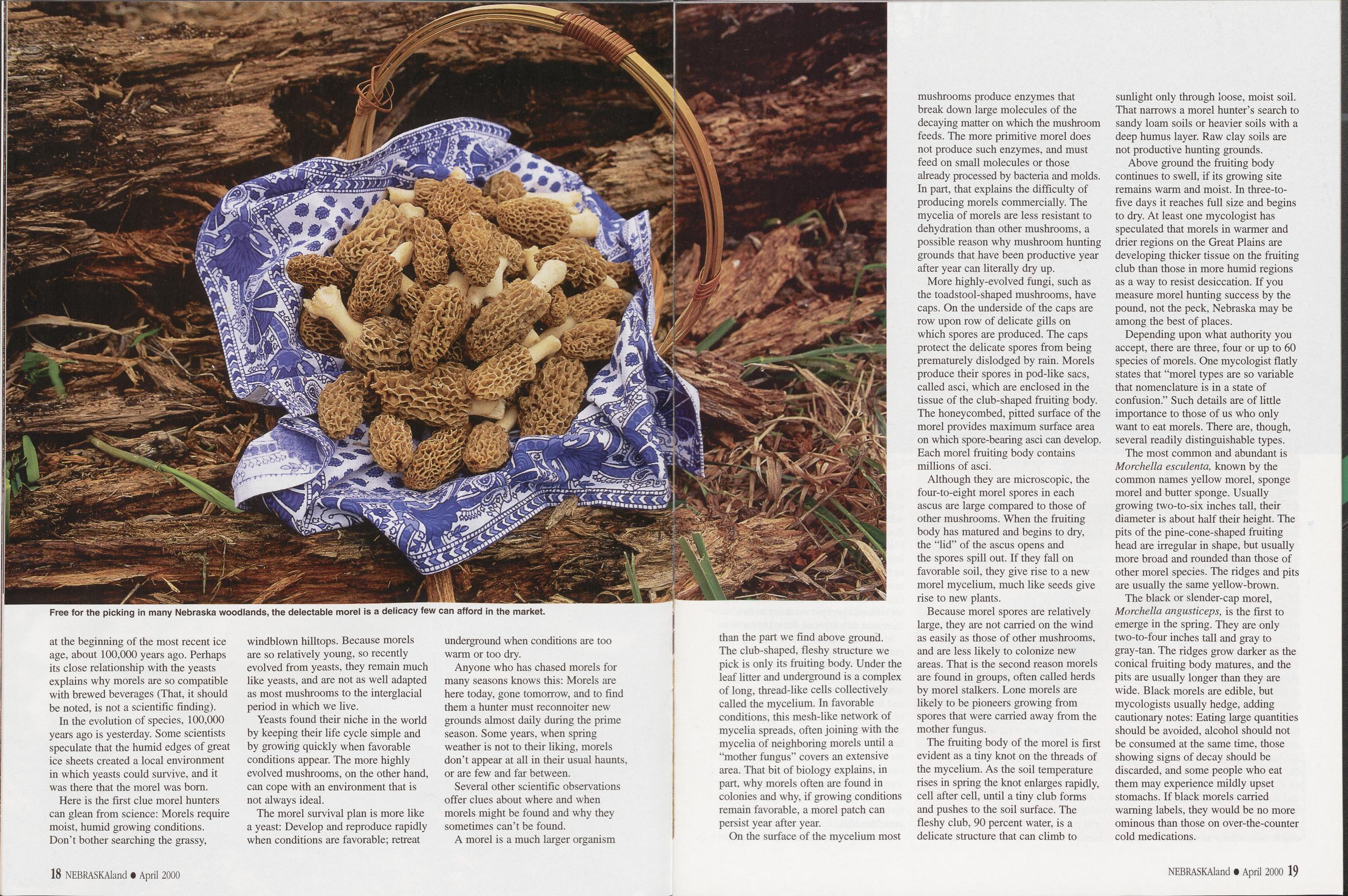
The most common and abundant is Morchella esculenta, known by the common names yellow morel, sponge morel and butter sponge. Usually growing two-to-six inches tall, their diameter is about half their height. The pits of the pine-cone-shaped fruiting head are irregular in shape, but usually more broad and rounded than those of other morel species. The ridges and pits are usually the same yellow-brown.
The black or slender-cap morel, Morchella angusticeps, is the first to emerge in the spring. They are only two-to-four inches tall and gray to gray-tan. The ridges grow darker as the conical fruiting body matures, and the pits are usually longer than they are wide. Black morels are edible, but mycologists usually hedge, adding cautionary notes: Eating large quantities should be avoided, alcohol should not be consumed at the same time, those showing signs of decay should be discarded, and some people who eat them may experience mildly upset stomachs. If black morels carried warning labels, they would be no more ominous than those on over-the-counter cold medications.
18 NEBRASKAland • April 2000 NEBRASKAland • April 2000 19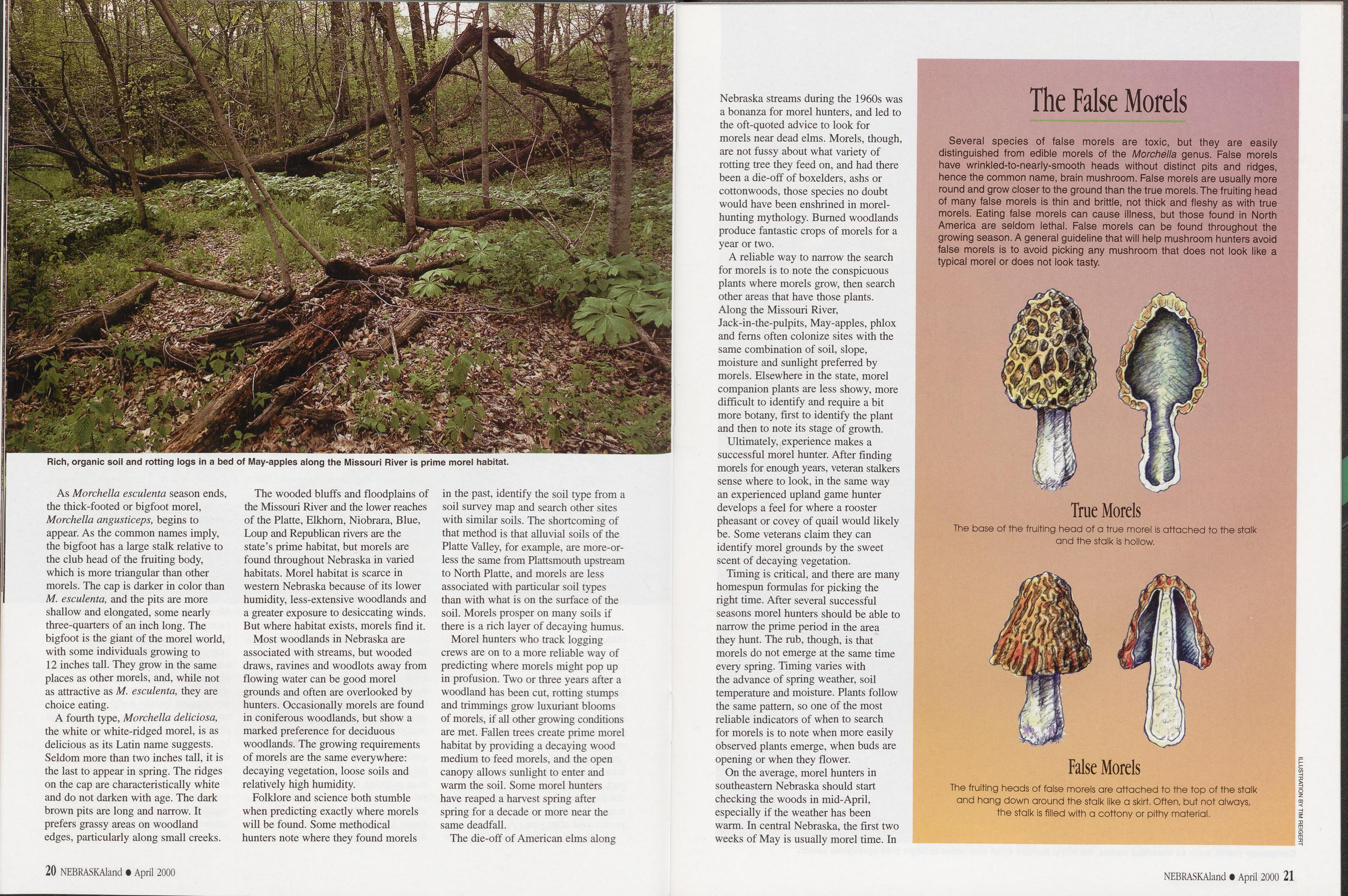
As Morchella esculenta season ends, the thick-footed or bigfoot morel, Morchella angusticeps, begins to appear. As the common names imply, the bigfoot has a large stalk relative to the club head of the fruiting body, which is more triangular than other morels. The cap is darker in color than M. esculenta, and the pits are more shallow and elongated, some nearly three-quarters of an inch long. The bigfoot is the giant of the morel world, with some individuals growing to 12 inches tall. They grow in the same places as other morels, and, while not as attractive as M. esculenta, they are choice eating.
A fourth type, Morchella deliciosa, the white or white-ridged morel, is as delicious as its Latin name suggests. Seldom more than two inches tall, it is the last to appear in spring. The ridges on the cap are characteristically white and do not darken with age. The dark brown pits are long and narrow. It prefers grassy areas on woodland edges, particularly along small creeks.
The wooded bluffs and floodplains of the Missouri River and the lower reaches of the Platte, Elkhorn, Niobrara, Blue, Loup and Republican rivers are the state’s prime habitat, but morels are found throughout Nebraska in varied habitats. Morel habitat is scarce in western Nebraska because of its lower humidity, less-extensive woodlands and a greater exposure to desiccating winds. But where habitat exists, morels find it.
Most woodlands in Nebraska are associated with streams, but wooded draws, ravines and woodlots away from flowing water can be good morel grounds and often are overlooked by hunters. Occasionally morels are found in coniferous woodlands, but show a marked preference for deciduous woodlands. The growing requirements of morels are the same everywhere: decaying vegetation, loose soils and relatively high humidity.
Folklore and science both stumble when predicting exactly where morels will be found. Some methodical hunters note where they found morels in the past, identify the soil type from a soil survey map and search other sites with similar soils. The shortcoming of that method is that alluvial soils of the Platte Valley, for example, are more-or- less the same from Plattsmouth upstream to North Platte, and morels are less associated with particular soil types than with what is on the surface of the soil. Morels prosper on many soils if there is a rich layer of decaying humus.
Morel hunters who track logging crews are on to a more reliable way of predicting where morels might pop up in profusion. Two or three years after a woodland has been cut, rotting stumps and trimmings grow luxuriant blooms of morels, if all other growing conditions are met. Fallen trees create prime morel habitat by providing a decaying wood medium to feed morels, and the open canopy allows sunlight to enter and warm the soil. Some morel hunters have reaped a harvest spring after spring for a decade or more near the same deadfall.
The die-off of American elms along Nebraska streams during the 1960s was a bonanza for morel hunters, and led to the oft-quoted advice to look for morels near dead elms. Morels, though, are not fussy about what variety of rotting tree they feed on, and had there been a die-off of boxelders, ashs or cottonwoods, those species no doubt would have been enshrined in morel- hunting mythology. Burned woodlands produce fantastic crops of morels for a year or two.
A reliable way to narrow the search for morels is to note the conspicuous plants where morels grow, then search other areas that have those plants. Along the Missouri River, Jack-in-the-pulpits, May-apples, phlox and fems often colonize sites with the same combination of soil, slope, moisture and sunlight preferred by morels. Elsewhere in the state, morel companion plants are less showy, more difficult to identify and require a bit more botany, first to identify the plant and then to note its stage of growth.
Ultimately, experience makes a successful morel hunter. After finding morels for enough years, veteran stalkers sense where to look, in the same way an experienced upland game hunter develops a feel for where a rooster pheasant or covey of quail would likely be. Some veterans claim they can identify morel grounds by the sweet scent of decaying vegetation.
Timing is critical, and there are many homespun formulas for picking the right time. After several successful seasons morel hunters should be able to narrow the prime period in the area they hunt. The rub, though, is that morels do not emerge at the same time every spring. Timing varies with the advance of spring weather, soil temperature and moisture. Plants follow the same pattern, so one of the most reliable indicators of when to search for morels is to note when more easily observed plants emerge, when buds are opening or when they flower.
On the average, morel hunters in southeastern Nebraska should start checking the woods in mid-April, especially if the weather has been warm. In central Nebraska, the first two weeks of May is usually morel time. In
The False Morels
Several species of false morels are toxic, but they are easily distinguished from edible morels of the Morchella genus. False morels have wrinkled-to-nearly-smooth heads without distinct pits and ridges, hence the common name, brain mushroom. False morels are usually more round and grow closer to the ground than the true morels. The fruiting head of many false morels is thin and brittle, not thick and fleshy as with true morels. Eating false morels can cause illness, but those found in North America are seldom lethal. False morels can be found throughout the growing season. A general guideline that will help mushroom hunters avoid false morels is to avoid picking any mushroom that does not look like a typical morel or does not look tasty.
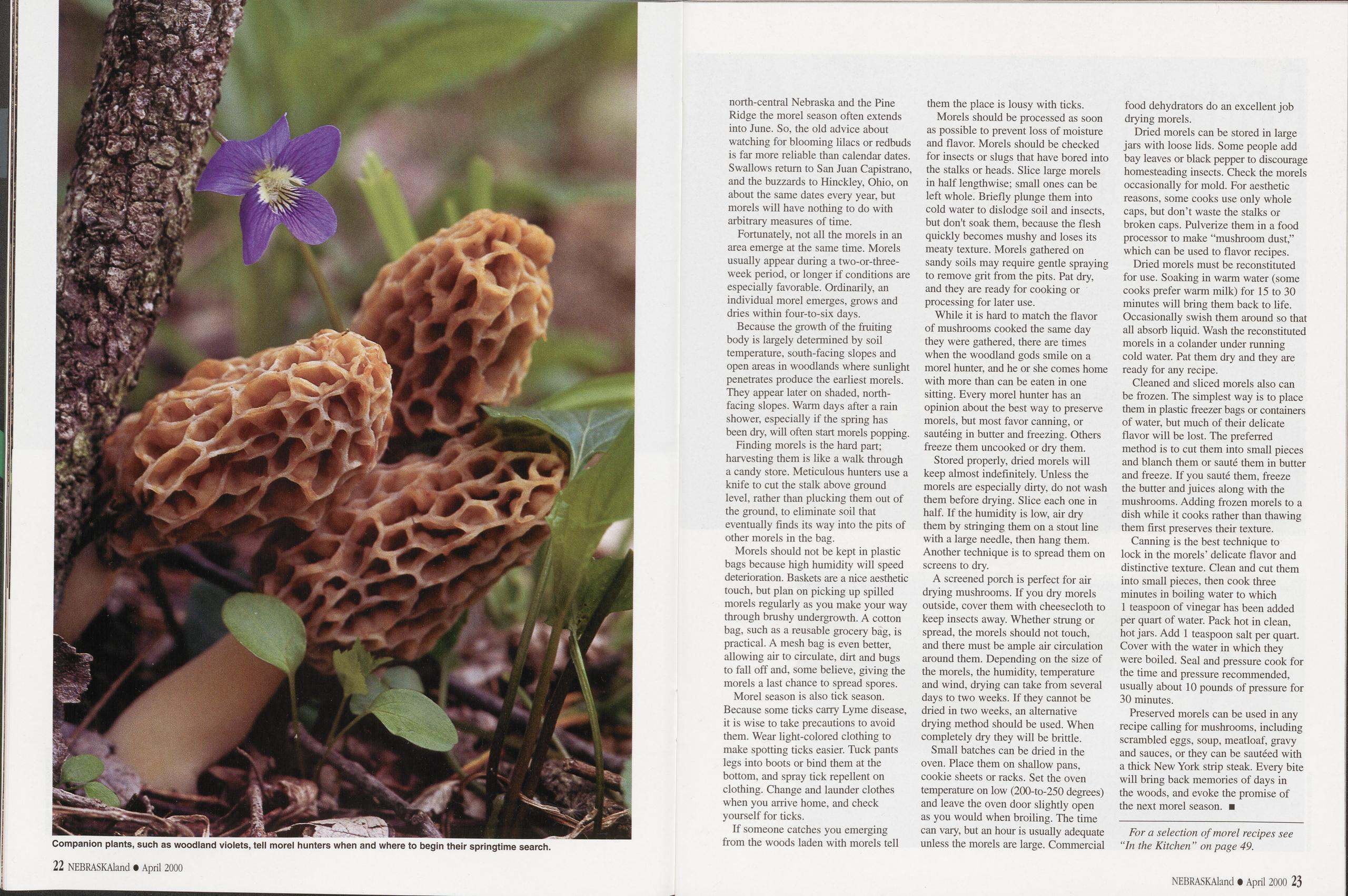
north-central Nebraska and the Pine Ridge the morel season often extends into June. So, the old advice about watching for blooming lilacs or redbuds is far more reliable than calendar dates. Swallows return to San Juan Capistrano, and the buzzards to Hinckley, Ohio, on about the same dates every year, but morels will have nothing to do with arbitrary measures of time.
Fortunately, not all the morels in an area emerge at the same time. Morels usually appear during a two-or-three- week period, or longer if conditions are especially favorable. Ordinarily, an individual morel emerges, grows and dries within four-to-six days.
Because the growth of the fruiting body is largely determined by soil temperature, south-facing slopes and open areas in woodlands where sunlight penetrates produce the earliest morels. They appear later on shaded, north- facing slopes. Warm days after a rain shower, especially if the spring has been dry, will often start morels popping.
Finding morels is the hard part; harvesting them is like a walk through a candy store. Meticulous hunters use a knife to cut the stalk above ground level, rather than plucking them out of the ground, to eliminate soil that eventually finds its way into the pits of other morels in the bag.
Morels should not be kept in plastic bags because high humidity will speed deterioration. Baskets are a nice aesthetic touch, but plan on picking up spilled morels regularly as you make your way through brushy undergrowth. A cotton bag, such as a reusable grocery bag, is practical. A mesh bag is even better, allowing air to circulate, dirt and bugs to fall off and, some believe, giving the morels a last chance to spread spores.
Morel season is also tick season. Because some ticks carry Lyme disease, it is wise to take precautions to avoid them. Wear light-colored clothing to make spotting ticks easier. Tuck pants legs into boots or bind them at the bottom, and spray tick repellent on clothing. Change and launder clothes when you arrive home, and check yourself for ticks.
If someone catches you emerging from the woods laden with morels tell them the place is lousy with ticks.
Morels should be processed as soon as possible to prevent loss of moisture and flavor. Morels should be checked for insects or slugs that have bored into the stalks or heads. Slice large morels in half lengthwise; small ones can be left whole. Briefly plunge them into cold water to dislodge soil and insects, but don't soak them, because the flesh quickly becomes mushy and loses its meaty texture. Morels gathered on sandy soils may require gentle spraying to remove grit from the pits. Pat dry, and they are ready for cooking or processing for later use.
While it is hard to match the flavor of mushrooms cooked the same day they were gathered, there are times when the woodland gods smile on a morel hunter, and he or she comes home with more than can be eaten in one sitting. Every morel hunter has an opinion about the best way to preserve morels, but most favor canning, or sauteing in butter and freezing. Others freeze them uncooked or dry them.
Stored properly, dried morels will keep almost indefinitely. Unless the morels are especially dirty, do not wash them before drying. Slice each one in half. If the humidity is low, air dry them by stringing them on a stout line with a large needle, then hang them. Another technique is to spread them on screens to dry.
A screened porch is perfect for air drying mushrooms. If you dry morels outside, cover them with cheesecloth to keep insects away. Whether strung or spread, the morels should not touch, and there must be ample air circulation around them. Depending on the size of the morels, the humidity, temperature and wind, drying can take from several days to two weeks. If they cannot be dried in two weeks, an alternative drying method should be used. When completely dry they will be brittle.
Small batches can be dried in the oven. Place them on shallow pans, cookie sheets or racks. Set the oven temperature on low (200-to-250 degrees) and leave the oven door slightly open as you would when broiling. The time can vary, but an hour is usually adequate unless the morels are large. Commercial food dehydrators do an excellent job drying morels.
Dried morels can be stored in large jars with loose lids. Some people add bay leaves or black pepper to discourage homesteading insects. Check the morels occasionally for mold. For aesthetic reasons, some cooks use only whole caps, but don’t waste the stalks or broken caps. Pulverize them in a food processor to make “mushroom dust,” which can be used to flavor recipes.
Dried morels must be reconstituted for use. Soaking in warm water (some cooks prefer warm milk) for 15 to 30 minutes will bring them back to life. Occasionally swish them around so that all absorb liquid. Wash the reconstituted morels in a colander under running cold water. Pat them dry and they are ready for any recipe.
Cleaned and sliced morels also can be frozen. The simplest way is to place them in plastic freezer bags or containers of water, but much of their delicate flavor will be lost. The preferred method is to cut them into small pieces and blanch them or saute them in butter and freeze. If you saute them, freeze the butter and juices along with the mushrooms. Adding frozen morels to a dish while it cooks rather than thawing them first preserves their texture.
Canning is the best technique to lock in the morels’ delicate flavor and distinctive texture. Clean and cut them into small pieces, then cook three minutes in boiling water to which 1 teaspoon of vinegar has been added per quart of water. Pack hot in clean, hot jars. Add 1 teaspoon salt per quart. Cover with the water in which they were boiled. Seal and pressure cook for the time and pressure recommended, usually about 10 pounds of pressure for 30 minutes.
Preserved morels can be used in any recipe calling for mushrooms, including scrambled eggs, soup, meatloaf, gravy and sauces, or they can be sauteed with a thick New York strip steak. Every bite will bring back memories of days in the woods, and evoke the promise of the next morel season. ■
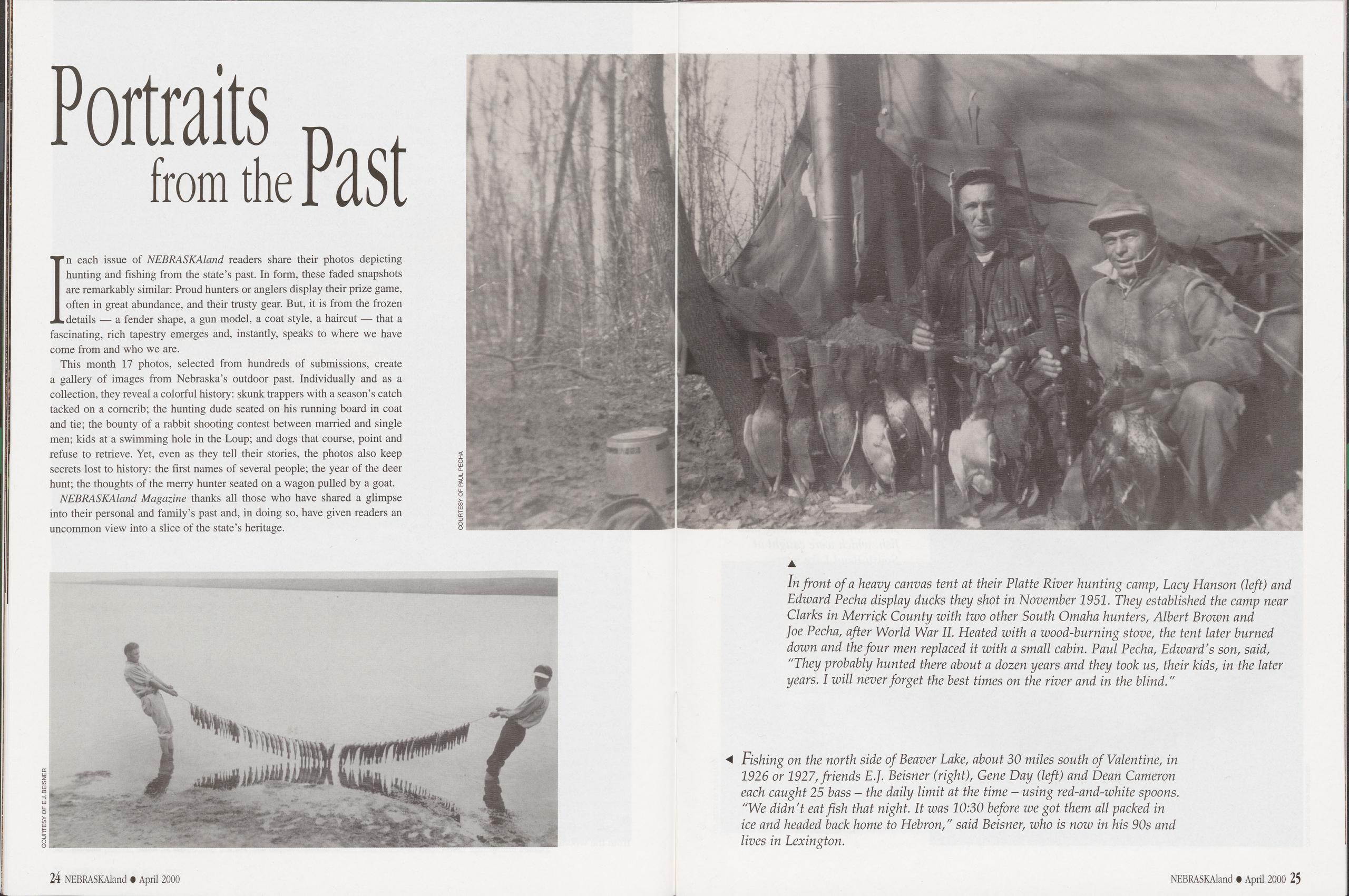
Portraits from the Past
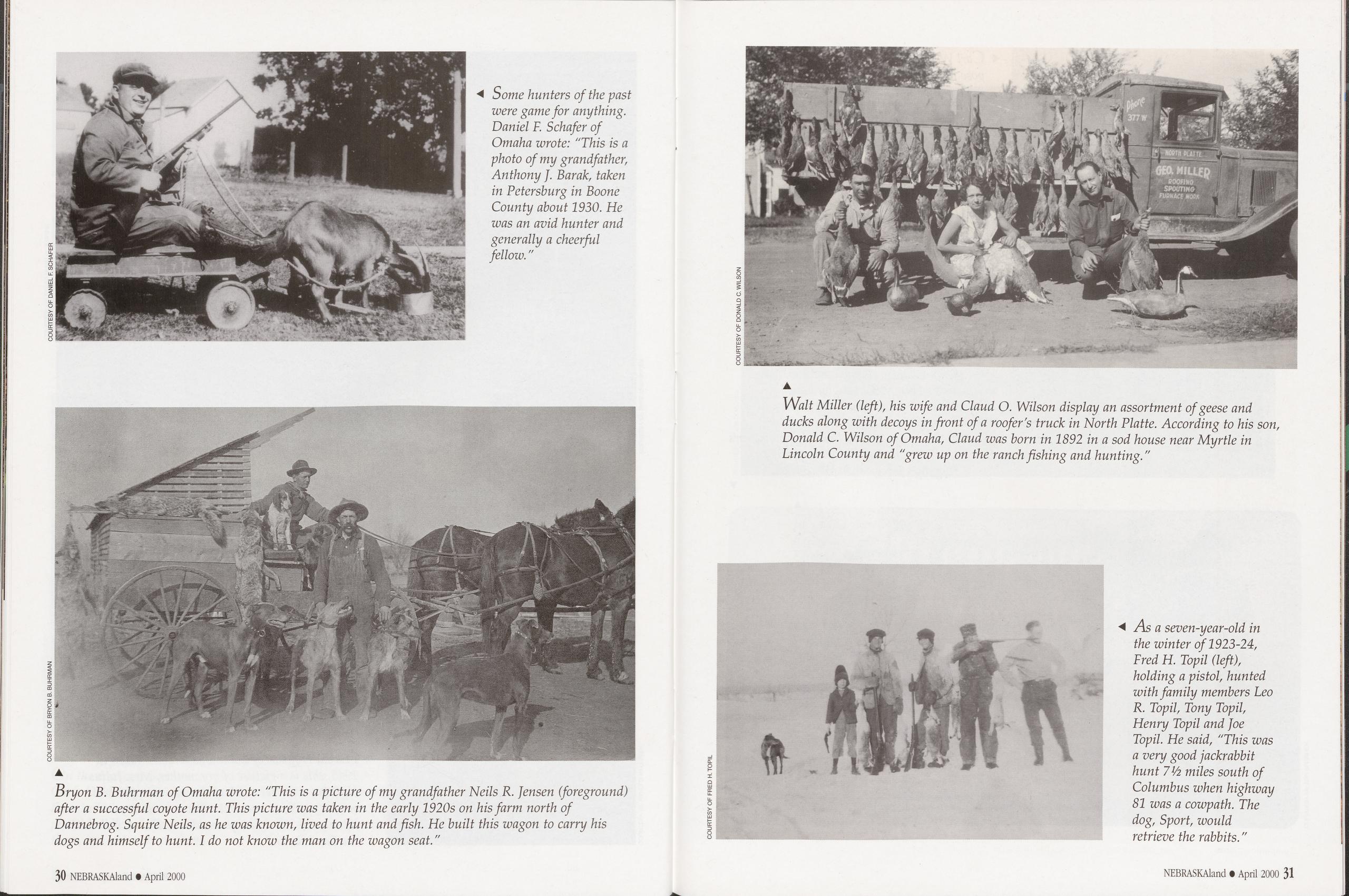
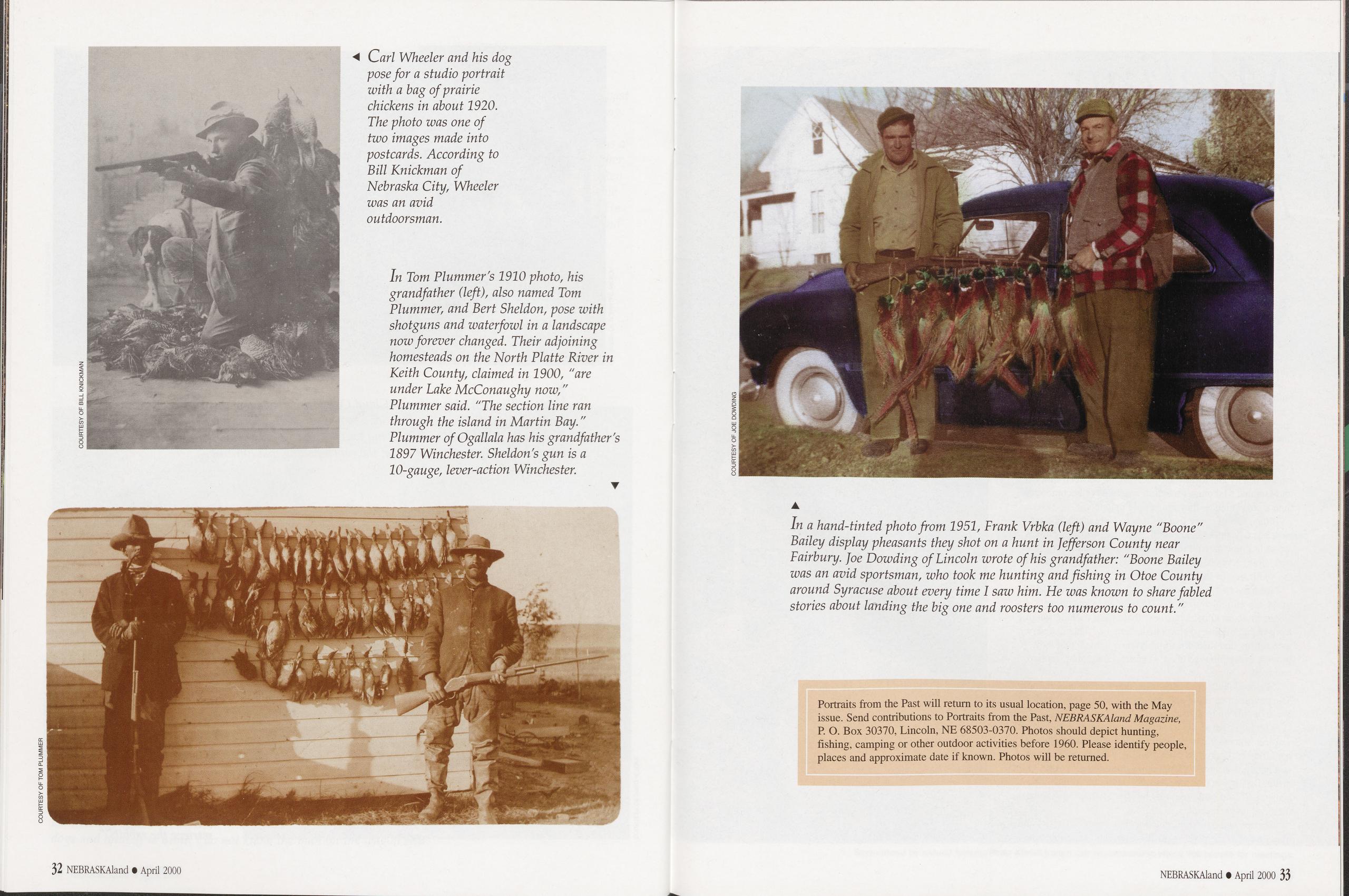
In each issue of NEBRASKAland W readers share their photos depicting hunting and fishing from the state’s . Past- In form, these faded snapshots are remarkably stnular: Proud hunters or anglers display their pnze game, often in great abundance, and their trusty gear. But. it is from the frozen d te details a fender shape, a gun model, a coat style, a haircut — that a fascinating, rich tapestry emerges and, instantly, speaks to where we have come from and who we are.
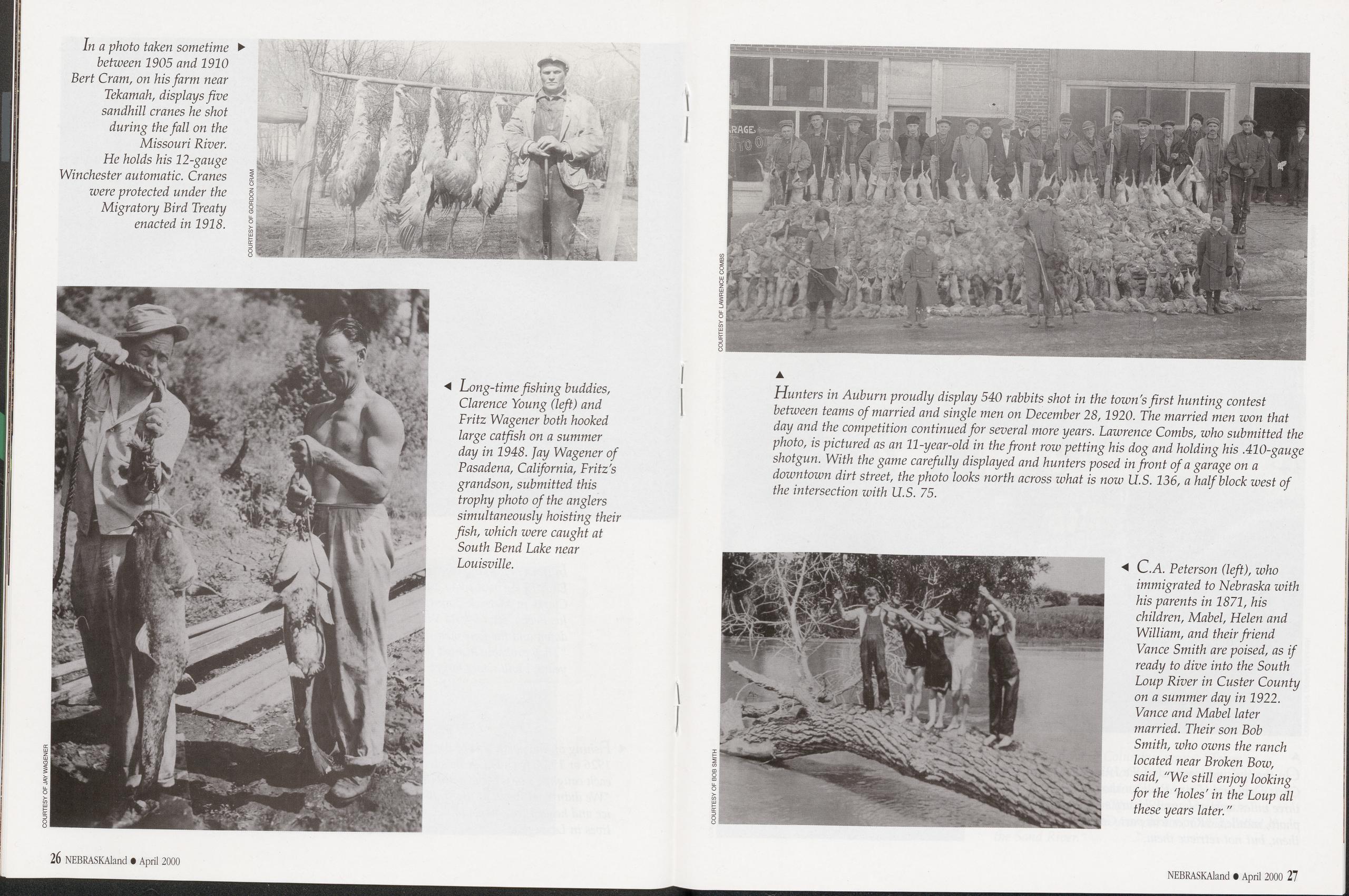
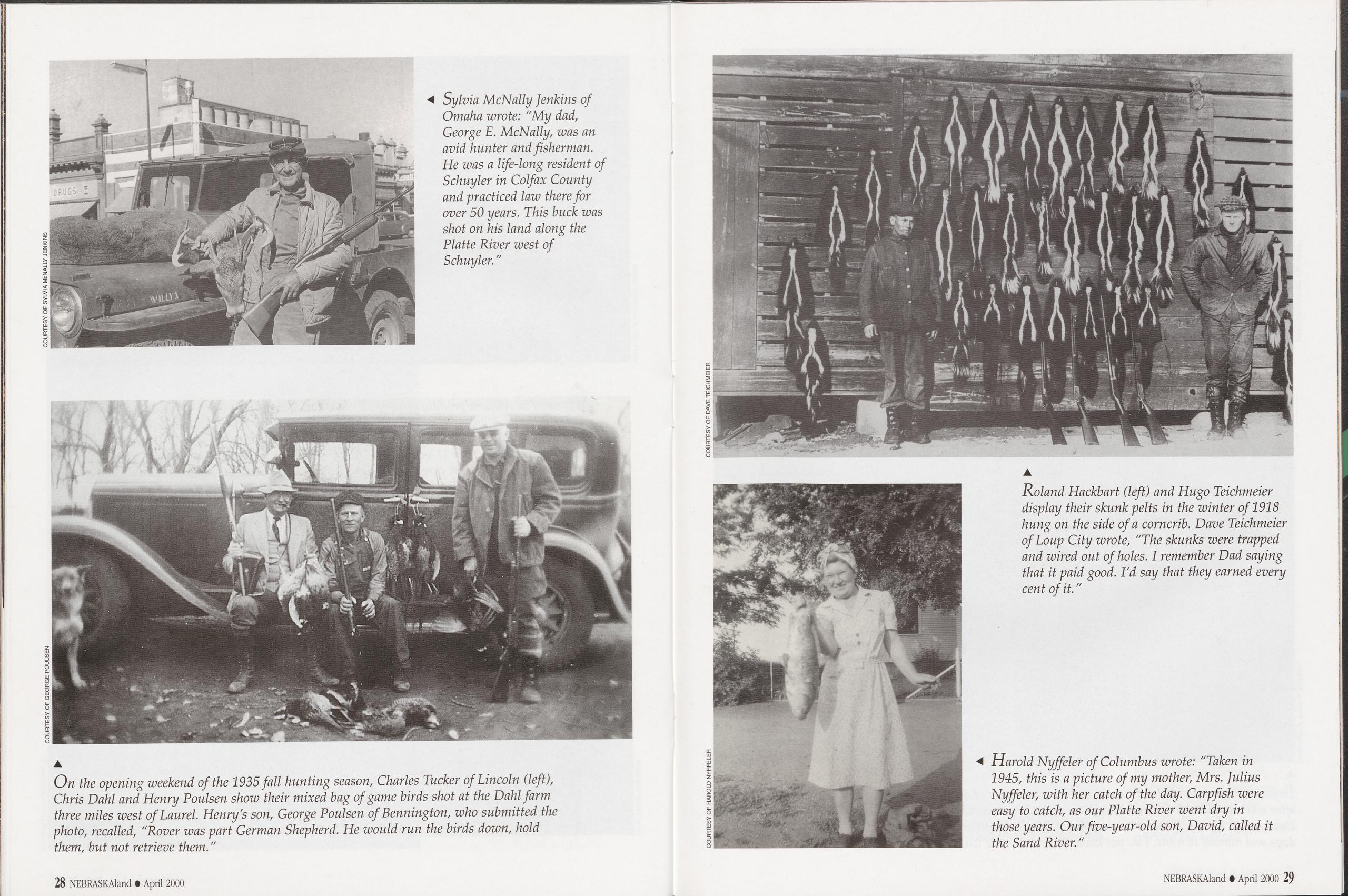
This month 17 photos, selected from hundreds of submissions, create a gallery of images from Nebraska’s outdoor past. Individually and as a collection, they reveal a colorful history: skunk trappers with a season’s catch tacked on a corncrib; the hunting dude seated on his running board in coat and tie; the bounty of a rabbit shooting contest between married and single men; kids at a swimming hole in the Loup; and dogs that course, point and refuse to retrieve. Yet, even as they tell their stories, the photos also keep secrets lost to history: the first names of several people, the ^ar of the deer hunt; the thoughts of the meny hun ttoe have shared a glimpse
NEBRASKAland Magazine t an have given readers an into their personal and family’s past an ’ fthe state’s heritage,
Meeting in the Middle
When a mysterious voice commands: “Build it and they will come,” an Iowa farmer turns a cornfield into a baseball diamond. And, long-dead ballplayers and crowds of fans do come in Field of Dreams, W.P. Kinsella’s allegorical novel, which became a movie.
A decade ago when Eugene T. Mahoney State Park was built, no mysterious voice ordered up meeting rooms. Common sense and experience dictated that such meeting spaces be included in the master plan as a convenience for families and groups visiting the park.
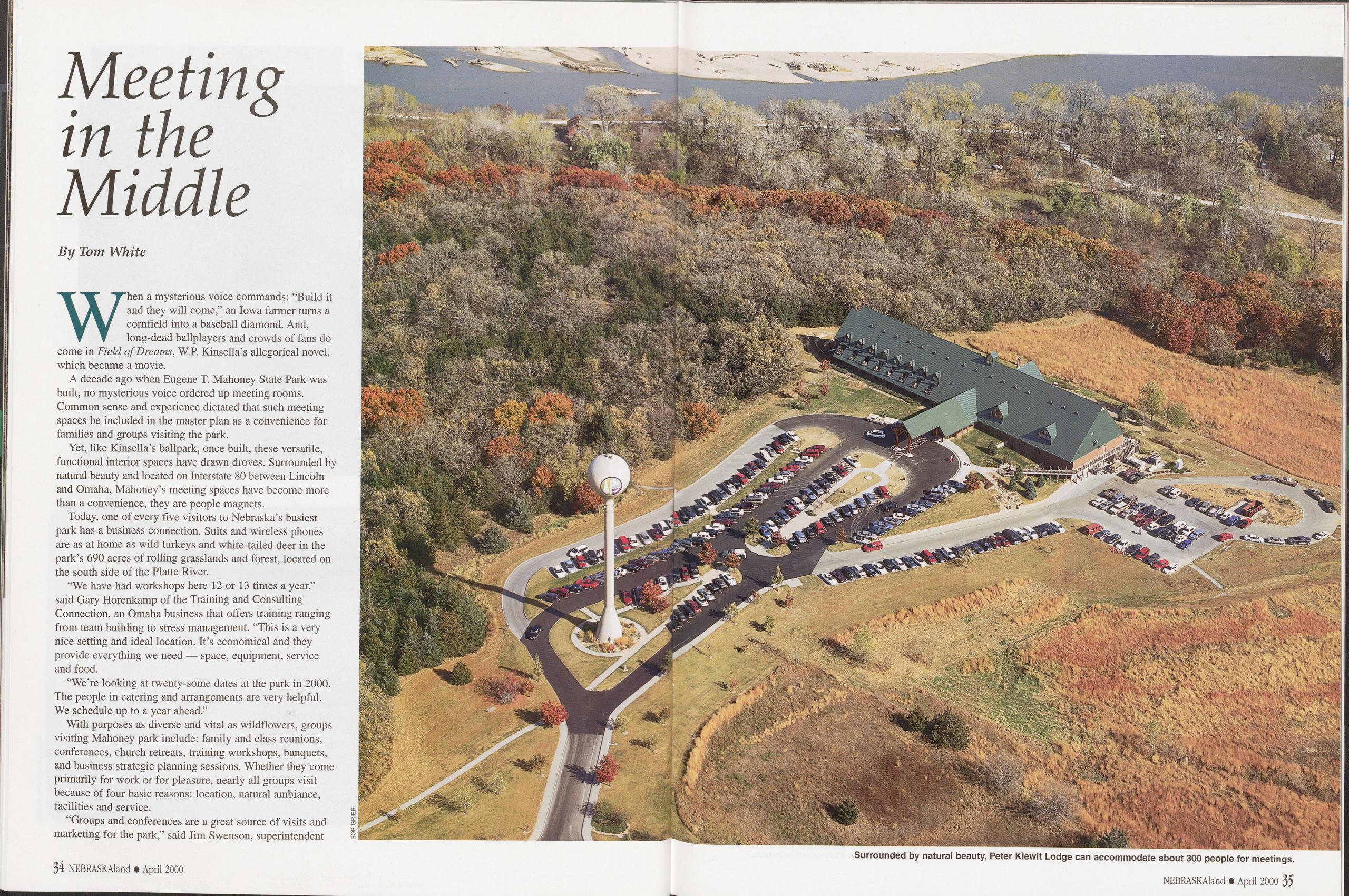
Yet, like Kinsella’s ballpark, once built, these versatile, functional interior spaces have drawn droves. Surrounded by natural beauty and located on Interstate 80 between Lincoln and Omaha, Mahoney’s meeting spaces have become more than a convenience, they are people magnets.
Today, one of every five visitors to Nebraska’s busiest park has a business connection. Suits and wireless phones are as at home as wild turkeys and white-tailed deer in the park’s 690 acres of rolling grasslands and forest, located on the south side of the Platte River.
“We have had workshops here 12 or 13 times a year,” said Gary Horenkamp of the Training and Consulting Connection, an Omaha business that offers training ranging from team building to stress management. “This is a very nice setting and ideal location. It’s economical and they provide everything we need — space, equipment, service and food.
“We’re looking at twenty-some dates at the park in 2000. The people in catering and arrangements are very helpful. We schedule up to a year ahead.”
With purposes as diverse and vital as wildflowers, groups visiting Mahoney park include: family and class reunions, conferences, church retreats, training workshops, banquets, and business strategic planning sessions. Whether they come primarily for work or for pleasure, nearly all groups visit because of four basic reasons: location, natural ambiance, facilities and service.
“Groups and conferences are a great source of visits and marketing for the park,” said Jim Swenson, superintendent
of Mahoney Park. “The park has had about a million visits for each of the last two years, and I believe about 200,000 of them are business-connected, directly or indirectly. Many people discover the park through attending a meeting and then come back with their family.”
Robin Herbon, vice president of Water Engineering, Inc. of Lincoln, organized two Mahoney meetings of about 100 people from throughout the state last year. He confirmed Swenson’s observation: “A lot of the guys didn’t know this place was here until we met here last spring. This room (Riverview Lodge) is just about the right size and we like the setting. In the spring, wild turkeys were gobbling just outside.”
Located 25 miles from both Lincoln and Omaha, Mahoney pulls the state’s two largest cities together. As a neutral turf and a relaxing, natural setting, the park helps defuse parochial tensions that visitors from the competing cities sometimes bring with them.
“Meeting in the middle makes everyone happy,” said Ruth Alley, Mahoney’s event coordinator. “It’s accessible and no one has to worry about parking or who’s in charge of food or chairs.”
Because Mahoney has both a location and a setting in demand, the Nebraska Game and Parks Commission has carefully balanced the park’s need for modem facilities while maintaining a natural ambiance.
Before the land for Mahoney was acquired, the Commission knew there was some demand for meeting and conference space because of its experience at Platte River State Park, located a few miles southeast of Mahoney. But, the area lacked an interchange from Interstate 80, and Platte River Park was smaller and had less-modern facilities, so it was difficult to predict how Mahoney would be used and how many visitors would come.
“When we developed the master plan we included meeting rooms as a convenience for groups — families, reunions, etcetera — but not necessarily for business groups,” recalled Roger Kuhn, assistant director of the Game and Parks Commission. “We didn’t design the park as a business conference center. We don’t have computer hookups, or satellite video conference equipment, or even corporate rates.
“For the first year we planned for 500,000 visitors and we got nearly 900,000, and the demand for meeting space was certainly part of that,” Kuhn said.
When the lodge’s kitchen and restaurant facilities were renovated in the mid-1990s, meeting space was also expanded by about 25 percent.
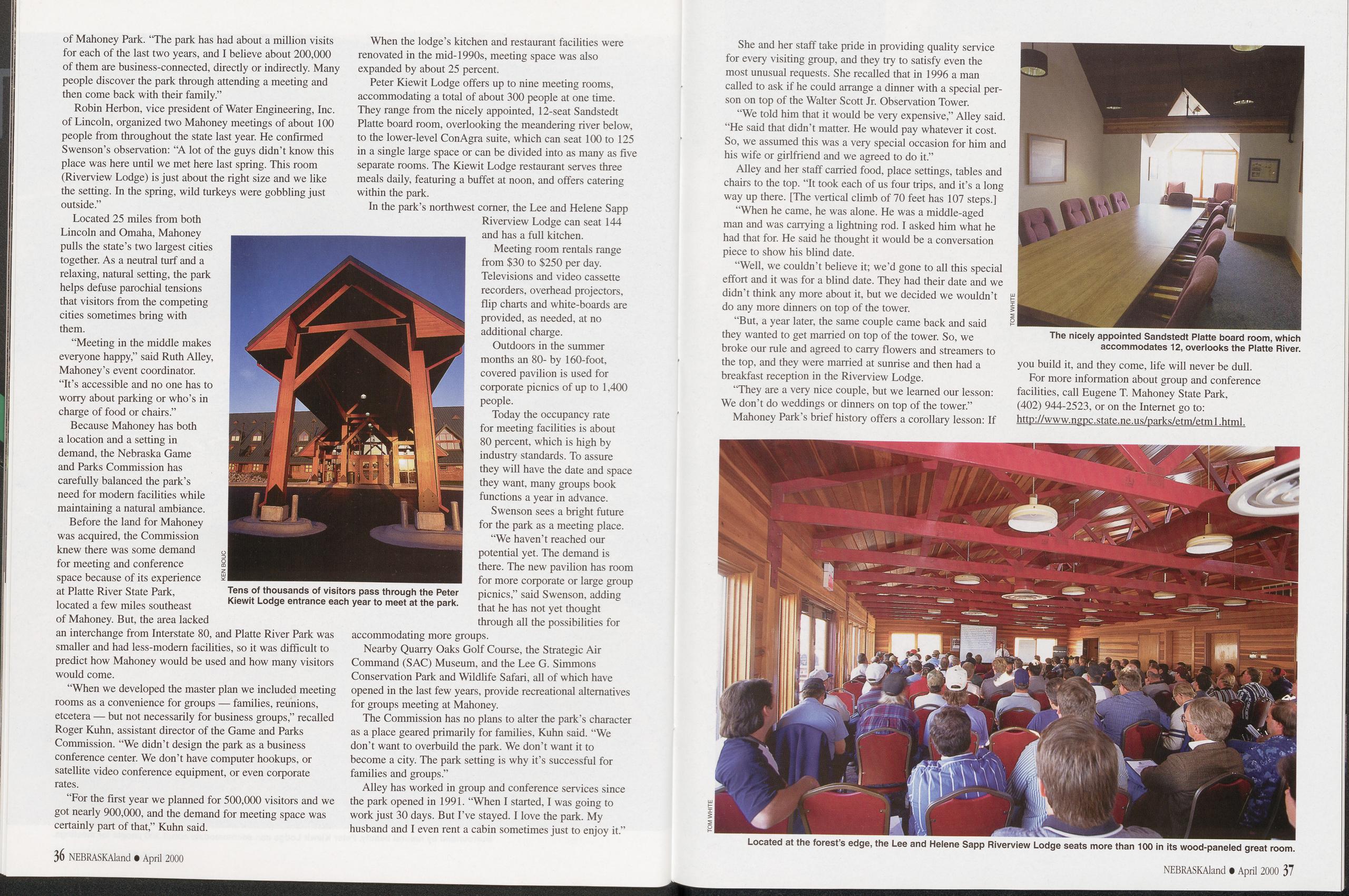
Peter Kiewit Lodge offers up to nine meeting rooms, accommodating a total of about 300 people at one time. They range from the nicely appointed, 12-seat Sandstedt Platte board room, overlooking the meandering river below, to the lower-level ConAgra suite, which can seat 100 to 125 in a single large space or can be divided into as many as five separate rooms. The Kiewit Lodge restaurant serves three meals daily, featuring a buffet at noon, and offers catering within the park.
In the park’s northwest comer, the Lee and Helene Sapp Riverview Lodge can seat 144 and has a full kitchen.
Meeting room rentals range from $30 to $250 per day. Televisions and video cassette recorders, overhead projectors, flip charts and white-boards are provided, as needed, at no additional charge.
Outdoors in the summer months an 80- by 160-foot, covered pavilion is used for corporate picnics of up to 1,400 people.
Today the occupancy rate for meeting facilities is about 80 percent, which is high by industry standards. To assure they will have the date and space they want, many groups book functions a year in advance.
Swenson sees a bright future for the park as a meeting place.
“We haven’t reached our potential yet. The demand is there. The new pavilion has room for more corporate or large group picnics,” said Swenson, adding that he has not yet thought through all the possibilities for accommodating more groups.
Nearby Quarry Oaks Golf Course, the Strategic Air Command (SAC) Museum, and the Lee G. Simmons Conservation Park and Wildlife Safari, all of which have opened in the last few years, provide recreational alternatives for groups meeting at Mahoney.
The Commission has no plans to alter the park’s character as a place geared primarily for families, Kuhn said. “We don’t want to overbuild the park. We don’t want it to become a city. The park setting is why it’s successful for families and groups.”
Alley has worked in group and conference services since the park opened in 1991. “When I started, I was going to work just 30 days. But I’ve stayed. I love the park. My husband and I even rent a cabin sometimes just to enjoy it.”
She and her staff take pride in providing quality service for every visiting group, and they try to satisfy even the most unusual requests. She recalled that in 1996 a man called to ask if he could arrange a dinner with a special per- son on top of the Walter Scott Jr. Observation Tower.
“We told him that it would be very expensive,” Alley said. “He said that didn’t matter. He would pay whatever it cost. So, we assumed this was a very special occasion for him and his wife or girlfriend and we agreed to do it.”
Alley and her staff carried food, place settings, tables and chairs to the top. “It took each of us four trips, and it’s a long way up there. [The vertical climb of 70 feet has 107 steps.]
“When he came, he was alone. He was a middle-aged man and was carrying a lightning rod. I asked him what he had that for. He said he thought it would be a conversation piece to show his blind date.
“Well, we couldn’t believe it; we’d gone to all this special effort and it was for a blind date. They had their date and we didn’t think any more about it, but we decided we wouldn’t do any more dinners on top of the tower.
“But, a year later, the same couple came back and said they wanted to get married on top of the tower. So, we broke our rule and agreed to carry flowers and streamers to the top, and they were married at sunrise and then had a breakfast reception in the Riverview Lodge.
“They are a very nice couple, but we learned our lesson: We don’t do weddings or dinners on top of the tower.”
Mahoney Park’s brief history offers a corollary lesson: If
Turpin Talks Turkey
Part Two: Calls and Calling
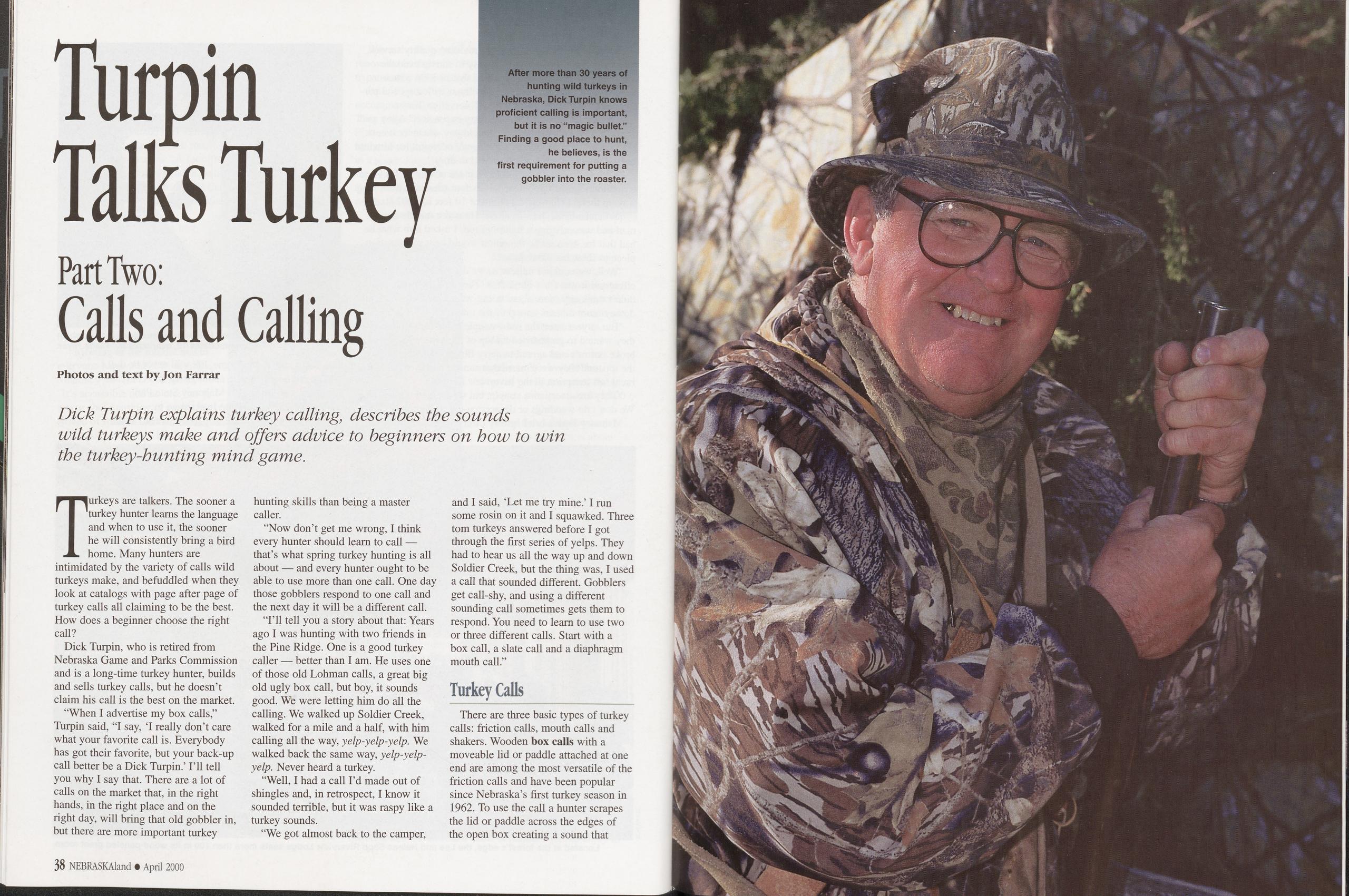
After more than 30 years of hunting wild turkeys in Nebraska, Dick Turpin knows proficient calling is important, but it is no “magic bullet.” Finding a good place to hunt, he believes, is the first requirement for putting a gobbler into the roaster. Dick Turpin explains turkey calling, describes the sounds wild turkeys make and offers advice to beginners on how to win the turkey-hunting mind game.Turkeys are talkers. The sooner a turkey hunter learns the language and when to use it, the sooner he will consistently bring a bird home. Many hunters are intimidated by the variety of calls wild turkeys make, and befuddled when they look at catalogs with page after page of turkey calls all claiming to be the best. How does a beginner choose the right call?
Dick Turpin, who is retired from Nebraska Game and Parks Commission and is a long-time turkey hunter, builds and sells turkey calls, but he doesn’t claim his call is the best on the market.
“When I advertise my box calls,” Turpin said, "I say, ‘I really don’t care what your favorite call is. Everybody has got their favorite, but your back-up call better be a Dick Turpin.’ I’ll tell you why I say that. There are a lot of calls on the market that, in the right hands, in the right place and on the right day, will bring that old gobbler in, but there are more important turkey hunting skills than being a master caller.
“Now don’t get me wrong, I think every hunter should learn to call — that’s what spring turkey hunting is all about — and every hunter ought to be able to use more than one call. One day those gobblers respond to one call and the next day it will be a different call.
“I’ll tell you a story about that: Years ago I was hunting with two friends in the Pine Ridge. One is a good turkey caller — better than I am. He uses one of those old Lohman calls, a great big old ugly box call, but boy, it sounds good. We were letting him do all the calling. We walked up Soldier Creek, walked for a mile and a half, with him calling all the way, yelp-yelp-yelp. We walked back the same way, yelp-yelp- yelp. Never heard a turkey.
“Well, I had a call I’d made out of shingles and, in retrospect, I know it sounded terrible, but it was raspy like a turkey sounds.
“We got almost back to the camper, and I said, ‘Let me try mine.’ I run some rosin on it and I squawked. Three tom turkeys answered before I got through the first series of yelps. They had to hear us all the way up and down Soldier Creek, but the thing was, I used a call that sounded different. Gobblers get call-shy, and using a different sounding call sometimes gets them to respond. You need to learn to use two or three different calls. Start with a box call, a slate call and a diaphragm mouth call.”
Turkey CallsThere are three basic types of turkey calls: friction calls, mouth calls and shakers. Wooden box calls with a moveable lid or paddle attached at one end are among the most versatile of the friction calls and have been popular since Nebraska’s first turkey season in 1962. To use the call a hunter scrapes the lid or paddle across the edges of the open box creating a sound that
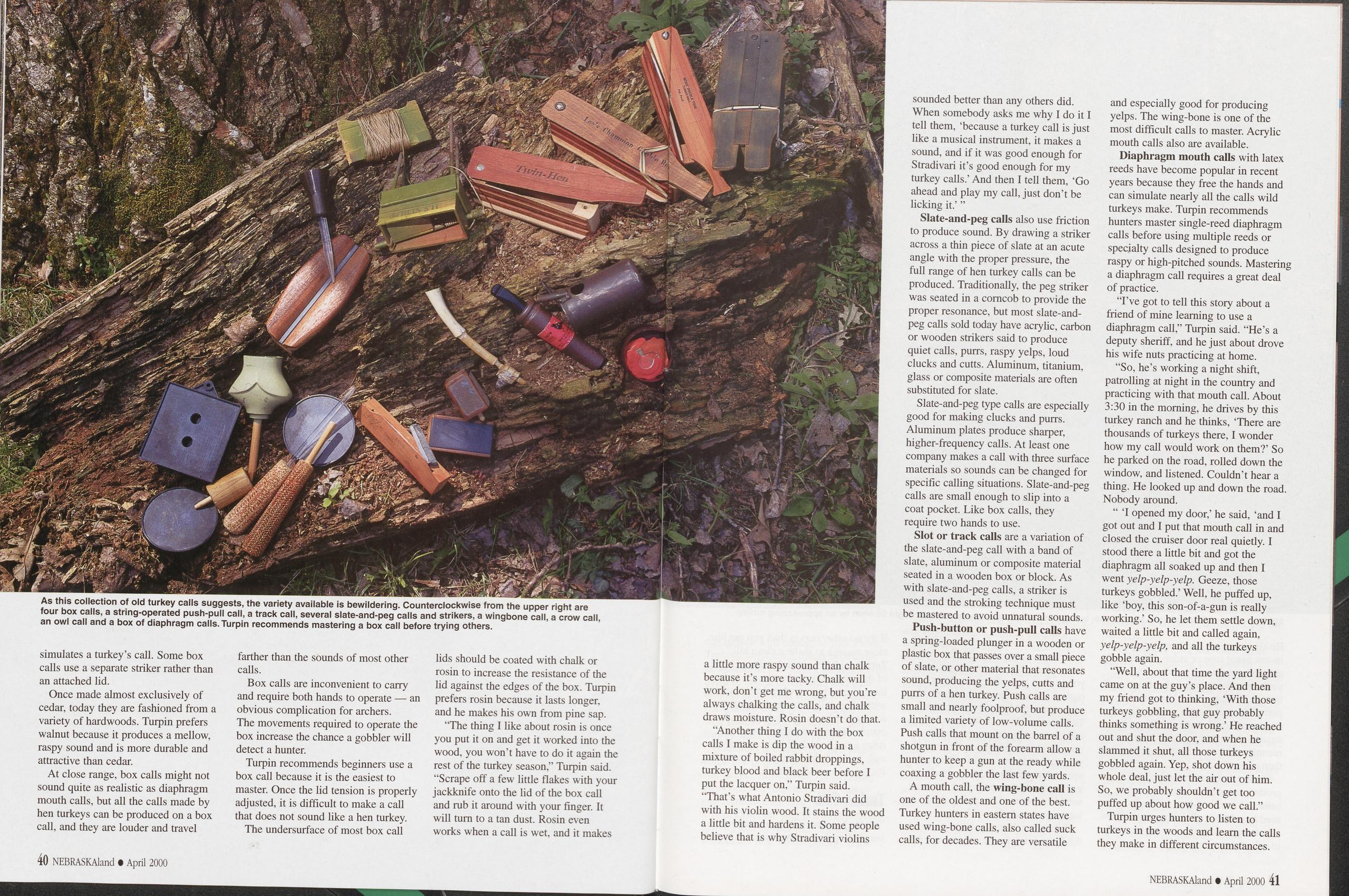
simulates a turkey’s call. Some box calls use a separate striker rather than an attached lid.
Once made almost exclusively of cedar, today they are fashioned from a variety of hardwoods. Turpin prefers walnut because it produces a mellow, raspy sound and is more durable and attractive than cedar.
At close range, box calls might not sound quite as realistic as diaphragm mouth calls, but all the calls made by hen turkeys can be produced on a box call, and they are louder and travel farther than the sounds of most other calls.
Box calls are inconvenient to carry and require both hands to operate — an obvious complication for archers. The movements required to operate the box increase the chance a gobbler will detect a hunter.
Turpin recommends beginners use a box call because it is the easiest to master. Once the lid tension is properly adjusted, it is difficult to make a call that does not sound like a hen turkey.
The undersurface of most box call lids should be coated with chalk or rosin to increase the resistance of the lid against the edges of the box. Turpin prefers rosin because it lasts longer, and he makes his own from pine sap.
“The thing I like about rosin is once you put it on and get it worked into the wood, you won’t have to do it again the rest of the turkey season,” Turpin said. “Scrape off a few little flakes with your jackknife onto the lid of the box call and rub it around with your finger. It will turn to a tan dust. Rosin even works when a call is wet, and it makes a little more raspy sound than chalk because it’s more tacky. Chalk will work, don’t get me wrong, but you’re always chalking the calls, and chalk draws moisture. Rosin doesn’t do that.
“Another thing I do with the box calls I make is dip the wood in a mixture of boiled rabbit droppings, turkey blood and black beer before I put the lacquer on,” Turpin said. “That’s what Antonio Stradivari did with his violin wood. It stains the wood a little bit and hardens it. Some people believe that is why Stradivari violins sounded better than any others did. When somebody asks me why I do it I tell them, ‘because a turkey call is just like a musical instrument, it makes a sound, and if it was good enough for Stradivari it’s good enough for my turkey calls.’ And then I tell them, ‘Go ahead and play my call, just don’t be licking it.’ ”
Slate-and-peg calls also use friction to produce sound. By drawing a striker across a thin piece of slate at an acute angle with the proper pressure, the full range of hen turkey calls can be produced. Traditionally, the peg striker was seated in a corncob to provide the proper resonance, but most slate-and- peg calls sold today have acrylic, carbon or wooden strikers said to produce quiet calls, purrs, raspy yelps, loud clucks and cutts. Aluminum, titanium, glass or composite materials are often substituted for slate.
Slate-and-peg type calls are especially good for making clucks and purrs. Aluminum plates produce sharper, higher-frequency calls. At least one company makes a call with three surface materials so sounds can be changed for specific calling situations. Slate-and-peg calls are small enough to slip into a coat pocket. Like box calls, they require two hands to use.
Slot or track calls are a variation of the slate-and-peg call with a band of slate, aluminum or composite material seated in a wooden box or block. As with slate-and-peg calls, a striker is used and the stroking technique must be mastered to avoid unnatural sounds.
Push-button or push-pull calls have a spring-loaded plunger in a wooden or plastic box that passes over a small piece of slate, or other material that resonates sound, producing the yelps, cutts and purrs of a hen turkey. Push calls are small and nearly foolproof, but produce a limited variety of low-volume calls. Push calls that mount on the barrel of a shotgun in front of the forearm allow a hunter to keep a gun at the ready while coaxing a gobbler the last few yards.
A mouth call, the wing-bone call is one of the oldest and one of the best. Turkey hunters in eastern states have used wing-bone calls, also called suck calls, for decades. They are versatile and especially good for producing yelps. The wing-bone is one of the most difficult calls to master. Acrylic mouth calls also are available.
Diaphragm mouth calls with latex reeds have become popular in recent years because they free the hands and can simulate nearly all the calls wild turkeys make. Turpin recommends hunters master single-reed diaphragm calls before using multiple reeds or specialty calls designed to produce raspy or high-pitched sounds. Mastering a diaphragm call requires a great deal of practice.
“I’ve got to tell this story about a friend of mine learning to use a diaphragm call,” Turpin said. “He’s a deputy sheriff, and he just about drove his wife nuts practicing at home.
“So, he’s working a night shift, patrolling at night in the country and practicing with that mouth call. About 3:30 in the morning, he drives by this turkey ranch and he thinks, ‘There are thousands of turkeys there, I wonder how my call would work on them?’ So he parked on the road, rolled down the window, and listened. Couldn’t hear a thing. He looked up and down the road. Nobody around.
“ I opened my door,’ he said, ‘and I got out and I put that mouth call in and closed the cruiser door real quietly. I stood there a little bit and got the diaphragm all soaked up and then I went yelp-yelp-yelp. Geeze, those turkeys gobbled.’ Well, he puffed up, like ‘boy, this son-of-a-gun is really working.’ So, he let them settle down, waited a little bit and called again, yelp-yelp-yelp, and all the turkeys gobble again.
“Well, about that time the yard light came on at the guy’s place. And then my friend got to thinking, ‘With those turkeys gobbling, that guy probably thinks something is wrong.’ He reached out and shut the door, and when he slammed it shut, all those turkeys gobbled again. Yep, shot down his whole deal, just let the air out of him. So, we probably shouldn’t get too puffed up about how good we call.”
Turpin urges hunters to listen to turkeys in the woods and learn the calls they make in different circumstances.
40 NEBRASKAland • April 2000 NEBRASKAland • April 2000 41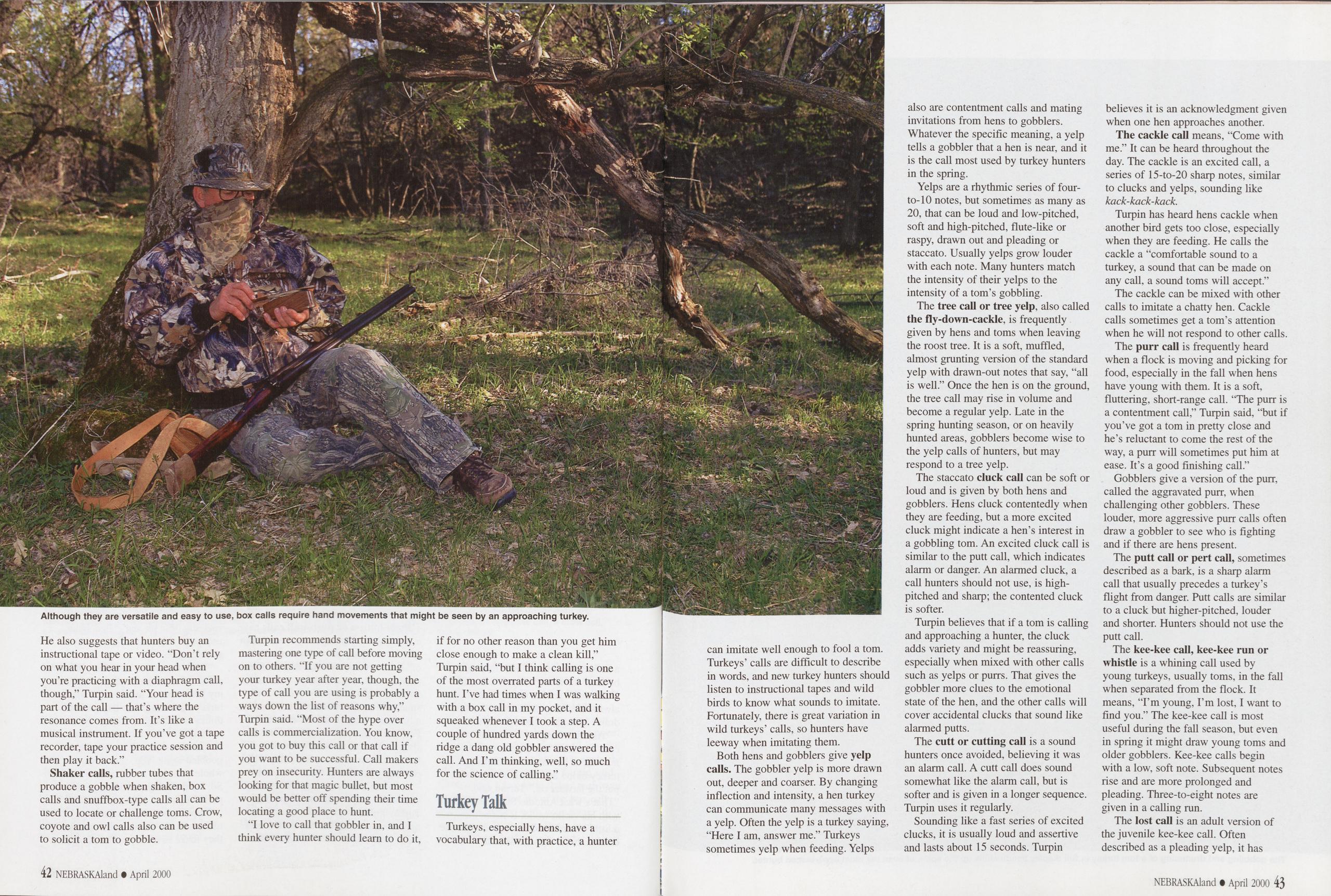
Although they are versatile and easy to use, box calls require hand movements that might be seen by an approaching turkey.
He also suggests that hunters buy an instructional tape or video. “Don’t rely on what you hear in your head when you’re practicing with a diaphragm call, though,” Turpin said. “Your head is part of the call — that’s where the resonance comes from. It’s like a musical instrument. If you’ve got a tape recorder, tape your practice session and then play it back.”
Shaker calls, rubber tubes that produce a gobble when shaken, box calls and snuffbox-type calls all can be used to locate or challenge toms. Crow, coyote and owl calls also can be used to solicit a tom to gobble.
Turpin recommends starting simply, mastering one type of call before moving on to others. “If you are not getting your turkey year after year, though, the type of call you are using is probably a ways down the list of reasons why,” Turpin said. “Most of the hype over calls is commercialization. You know, you got to buy this call or that call if you want to be successful. Call makers prey on insecurity. Hunters are always looking for that magic bullet, but most would be better off spending their time locating a good place to hunt.
“I love to call that gobbler in, and I think every hunter should learn to do it, if for no other reason than you get him close enough to make a clean kill,” Turpin said, “but I think calling is one of the most overrated parts of a turkey hunt. I’ve had times when I was walking with a box call in my pocket, and it squeaked whenever I took a step. A couple of hundred yards down the ridge a dang old gobbler answered the call. And I’m thinking, well, so much for the science of calling.”
Turkey TalkTurkeys, especially hens, have a vocabulary that, with practice, a hunter can imitate well enough to fool a tom. Turkeys’ calls are difficult to describe in words, and new turkey hunters should listen to instructional tapes and wild birds to know what sounds to imitate. Fortunately, there is great variation in wild turkeys’ calls, so hunters have leeway when imitating them.
Both hens and gobblers give yelp calls. The gobbler yelp is more drawn out, deeper and coarser. By changing inflection and intensity, a hen turkey can communicate many messages with a yelp. Often the yelp is a turkey saying, “Here I am, answer me.” Turkeys sometimes yelp when feeding. Yelps also are contentment calls and mating invitations from hens to gobblers. Whatever the specific meaning, a yelp tells a gobbler that a hen is near, and it is the call most used by turkey hunters in the spring.
Yelps are a rhythmic series of four-to-10 notes, but sometimes as many as 20, that can be loud and low-pitched, soft and high-pitched, flute-like or raspy, drawn out and pleading or staccato. Usually yelps grow louder with each note. Many hunters match the intensity of their yelps to the intensity of a tom’s gobbling.
The tree call or tree yelp, also called the fly-down-cackle, is frequently given by hens and toms when leaving the roost tree. It is a soft, muffled, almost grunting version of the standard yelp with drawn-out notes that say, “all is well.” Once the hen is on the ground, the tree call may rise in volume and become a regular yelp. Late in the spring hunting season, or on heavily hunted areas, gobblers become wise to the yelp calls of hunters, but may respond to a tree yelp.
The staccato cluck call can be soft or loud and is given by both hens and gobblers. Hens cluck contentedly when they are feeding, but a more excited cluck might indicate a hen’s interest in a gobbling tom. An excited cluck call is similar to the putt call, which indicates alarm or danger. An alarmed cluck, a call hunters should not use, is high-pitched and sharp; the contented cluck is softer.
Turpin believes that if a tom is calling and approaching a hunter, the cluck adds variety and might be reassuring, especially when mixed with other calls such as yelps or purrs. That gives the gobbler more clues to the emotional state of the hen, and the other calls will cover accidental clucks that sound like alarmed putts.
The cutt or cutting call is a sound hunters once avoided, believing it was an alarm call. A cutt call does sound somewhat like the alarm call, but is softer and is given in a longer sequence. Turpin uses it regularly.
Sounding like a fast series of excited clucks, it is usually loud and assertive and lasts about 15 seconds. Turpin believes it is an acknowledgment given when one hen approaches another. The cackle call means, “Come with me.” It can be heard throughout the day. The cackle is an excited call, a series of 15-to-20 sharp notes, similar to clucks and yelps, sounding like kack-kack-kack.
Turpin has heard hens cackle when another bird gets too close, especially when they are feeding. He calls the cackle a “comfortable sound to a turkey, a sound that can be made on any call, a sound toms will accept.”
The cackle can be mixed with other calls to imitate a chatty hen. Cackle calls sometimes get a tom’s attention when he will not respond to other calls.
The purr call is frequently heard when a flock is moving and picking for food, especially in the fall when hens have young with them. It is a soft, fluttering, short-range call. “The purr is a contentment call,” Turpin said, “but if you’ve got a tom in pretty close and he’s reluctant to come the rest of the way, a purr will sometimes put him at ease. It’s a good finishing call.”
Gobblers give a version of the purr, called the aggravated purr, when challenging other gobblers. These louder, more aggressive purr calls often draw a gobbler to see who is fighting and if there are hens present.
The putt call or pert call, sometimes described as a bark, is a sharp alarm call that usually precedes a turkey’s flight from danger. Putt calls are similar to a cluck but higher-pitched, louder and shorter. Hunters should not use the putt call.
The kee-kee call, kee-kee run or whistle is a whining call used by young turkeys, usually toms, in the fall when separated from the flock. It means, “I’m young, I’m lost, I want to find you.” The kee-kee call is most useful during the fall season, but even in spring it might draw young toms and older gobblers. Kee-kee calls begin with a low, soft note. Subsequent notes rise and are more prolonged and pleading. Three-to-eight notes are given in a calling run.
The lost call is an adult version of the juvenile kee-kee call. Often described as a pleading yelp, it has
42 NEBRASKAland • April 2000 NEBRASKAland • April 2000 43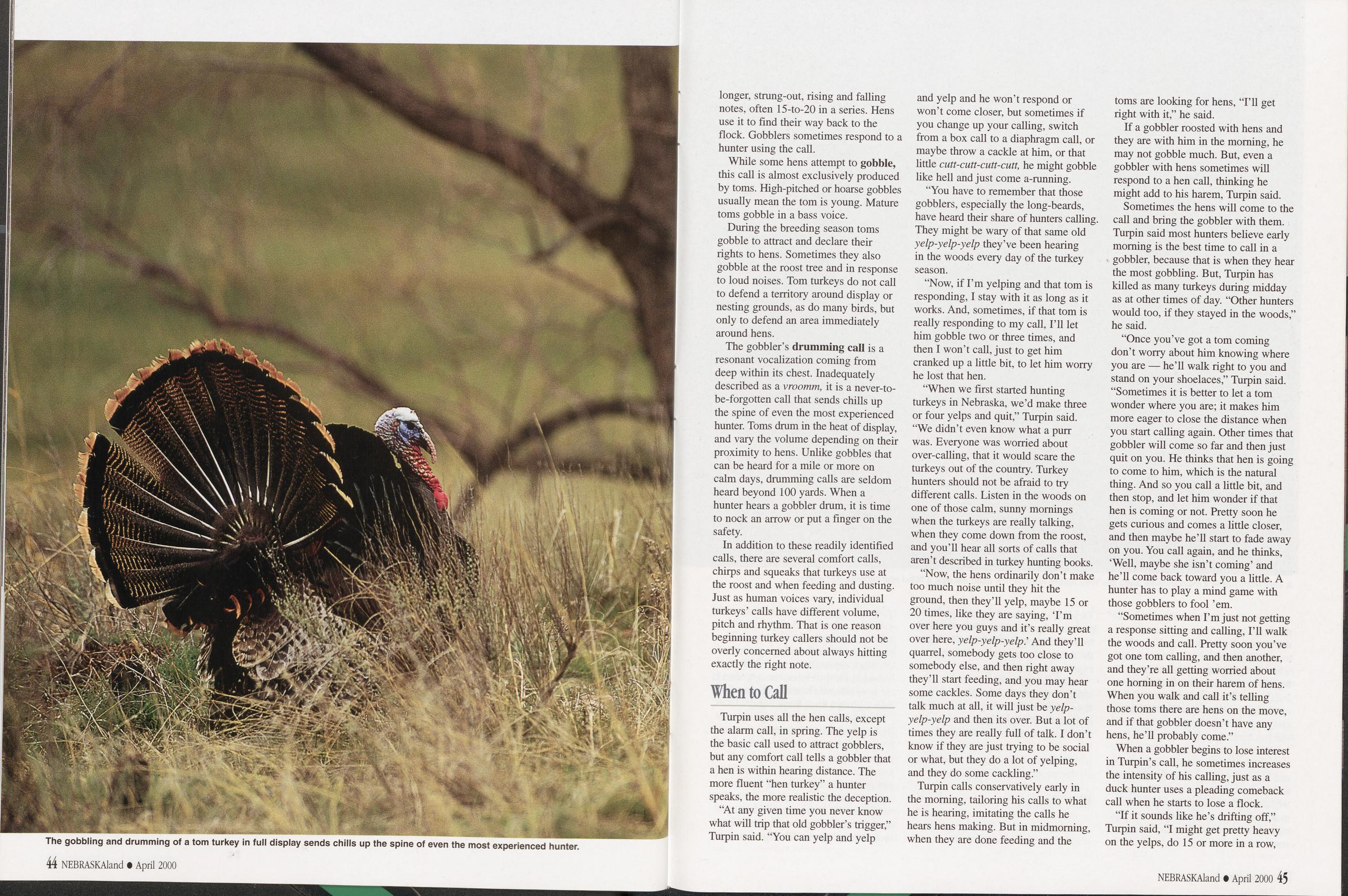
longer, strung-out, rising and falling notes, often 15-to-20 in a series. Hens use it to find their way back to the flock. Gobblers sometimes respond to a hunter using the call.
While some hens attempt to gobble, this call is almost exclusively produced by toms. High-pitched or hoarse gobbles usually mean the tom is young. Mature toms gobble in a bass voice.
During the breeding season toms gobble to attract and declare their rights to hens. Sometimes they also gobble at the roost tree and in response to loud noises. Tom turkeys do not call to defend a territory around display or nesting grounds, as do many birds, but only to defend an area immediately around hens.
The gobbler’s drumming call is a resonant vocalization coming from deep within its chest. Inadequately described as a vroomm, it is a never-to- be-forgotten call that sends chills up the spine of even the most experienced hunter. Toms drum in the heat of display, and vary the volume depending on their proximity to hens. Unlike gobbles that can be heard for a mile or more on calm days, drumming calls are seldom heard beyond 100 yards. When a hunter hears a gobbler drum, it is time to nock an arrow or put a finger on the safety.
In addition to these readily identified calls, there are several comfort calls, chirps and squeaks that turkeys use at the roost and when feeding and dusting. Just as human voices vary, individual turkeys’ calls have different volume, pitch and rhythm. That is one reason beginning turkey callers should not be overly concerned about always hitting exactly the right note.
When to CallTurpin uses all the hen calls, except the alarm call, in spring. The yelp is the basic call used to attract gobblers, but any comfort call tells a gobbler that a hen is within hearing distance. The more fluent "hen turkey” a hunter speaks, the more realistic the deception.
"At any given time you never know what will trip that old gobbler’s trigger,” Turpin said. "You can yelp and yelp and yelp and he won’t respond or won’t come closer, but sometimes if you change up your calling, switch from a box call to a diaphragm call, or maybe throw a cackle at him, or that little cutt-cutt-cutt-cutt, he might gobble like hell and just come a-running.
"You have to remember that those gobblers, especially the long-beards, have heard their share of hunters calling. They might be wary of that same old yelp-yelp-yelp they’ve been hearing in the woods every day of the turkey season.
“Now, if I’m yelping and that tom is responding, I stay with it as long as it works. And, sometimes, if that tom is really responding to my call, TH let him gobble two or three times, and then I won’t call, just to get him cranked up a little bit, to let him worry he lost that hen.
"When we first started hunting turkeys in Nebraska, we’d make three or four yelps and quit,” Turpin said. "We didn’t even know what a purr was. Everyone was worried about over-calling, that it would scare the turkeys out of the country. Turkey hunters should not be afraid to try different calls. Listen in the woods on one of those calm, sunny mornings when the turkeys are really talking, when they come down from the roost, and you’ll hear all sorts of calls that aren’t described in turkey hunting books.
"Now, the hens ordinarily don’t make too much noise until they hit the ground, then they’ll yelp, maybe 15 or 20 times, like they are saying, ‘I’m over here you guys and it’s really great over here, yelp-yelp-yelp: And they’ll quarrel, somebody gets too close to somebody else, and then right away they’ll start feeding, and you may hear some cackles. Some days they don’t talk much at all, it will just be yelp- yelp-yelp and then its over. But a lot of times they are really full of talk. I don’t know if they are just trying to be social or what, but they do a lot of yelping, and they do some cackling.”
Turpin calls conservatively early in the morning, tailoring his calls to what he is hearing, imitating the calls he hears hens making. But in midmoming, when they are done feeding and the toms are looking for hens, "TH get right with it,” he said.
If a gobbler roosted with hens and they are with him in the morning, he may not gobble much. But, even a gobbler with hens sometimes will respond to a hen call, thinking he might add to his harem, Turpin said. Sometimes the hens will come to the call and bring the gobbler with them. Turpin said most hunters believe early morning is the best time to call in a gobbler, because that is when they hear the most gobbling. But, Turpin has killed as many turkeys during midday as at other times of day. "Other hunters would too, if they stayed in the woods,” he said.
"Once you’ve got a tom coming don’t worry about him knowing where you are — he’ll walk right to you and stand on your shoelaces,” Turpin said. "Sometimes it is better to let a tom wonder where you are; it makes him more eager to close the distance when you start calling again. Other times that gobbler will come so far and then just quit on you. He thinks that hen is going to come to him, which is the natural thing. And so you call a little bit, and then stop, and let him wonder if that hen is coming or not. Pretty soon he gets curious and comes a little closer, and then maybe he’ll start to fade away on you. You call again, and he thinks, ‘Well, maybe she isn’t coming’ and he’ll come back toward you a little. A hunter has to play a mind game with those gobblers to fool ’em.
"Sometimes when I’m just not getting a response sitting and calling, I’ll walk the woods and call. Pretty soon you’ve got one tom calling, and then another, and they’re all getting worried about one homing in on their harem of hens. When you walk and call it’s telling those toms there are hens on the move, and if that gobbler doesn’t have any hens, he’ll probably come.”
When a gobbler begins to lose interest in Turpin’s call, he sometimes increases the intensity of his calling, just as a duck hunter uses a pleading comeback call when he starts to lose a flock.
"If it sounds like he’s drifting off,” Turpin said, "I might get pretty heavy on the yelps, do 15 or more in a row,
44 NEBRASKAland • April 2000 NEBRASKAland • April 2000 45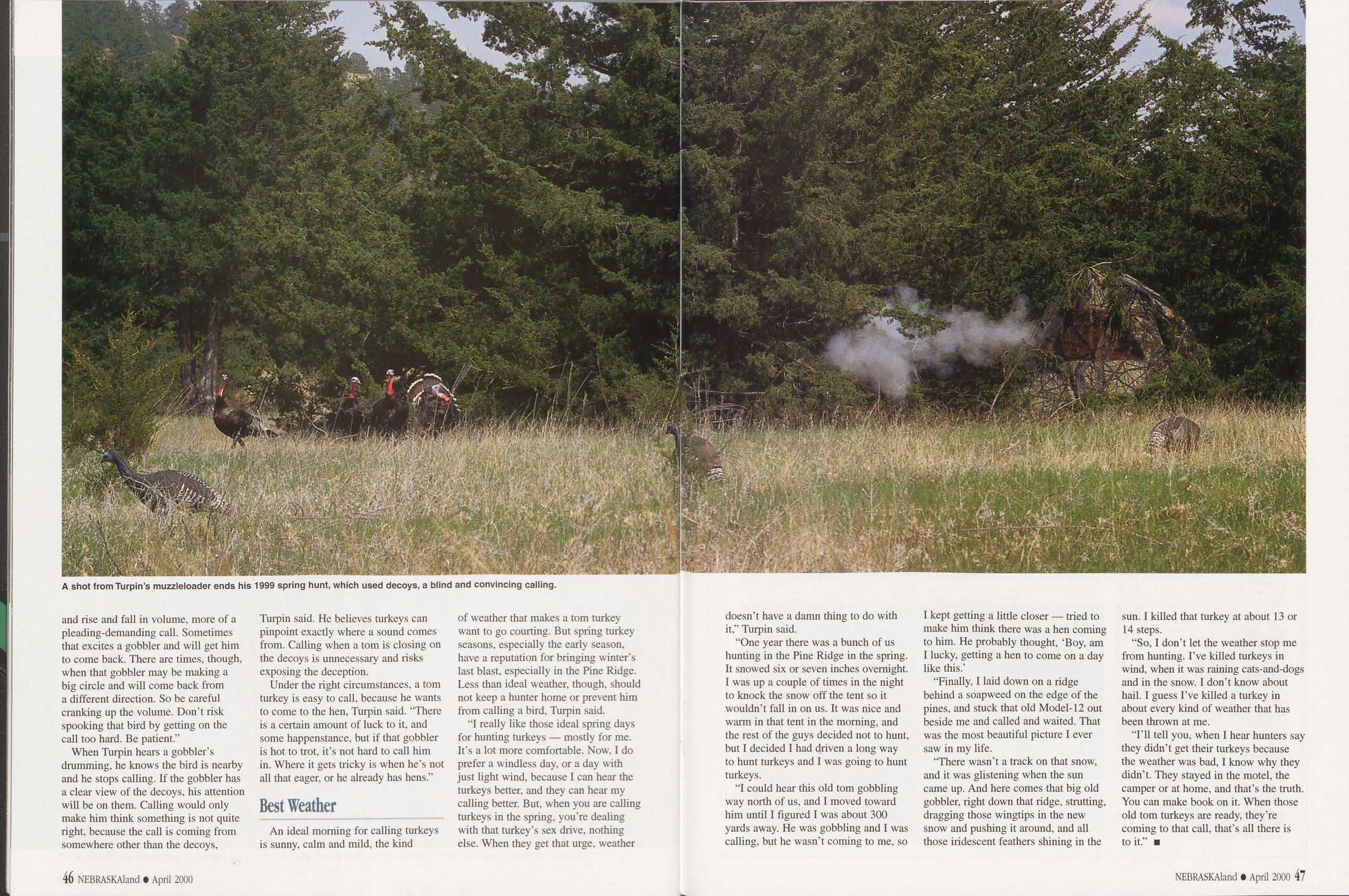
and rise and fall in volume, more of a pleading-demanding call. Sometimes that excites a gobbler and will get him to come back. There are times, though, when that gobbler may be making a big circle and will come back from a different direction. So be careful cranking up the volume. Don’t risk spooking that bird by getting on the call too hard. Be patient.”
When Turpin hears a gobbler’s drumming, he knows the bird is nearby and he stops calling. If the gobbler has a clear view of the decoys, his attention will be on them. Calling would only make him think something is not quite right, because the call is coming from somewhere other than the decoys, Turpin said. He believes turkeys can pinpoint exactly where a sound comes from. Calling when a tom is closing on the decoys is unnecessary and risks exposing the deception.
Under the right circumstances, a tom turkey is easy to call, because he wants to come to the hen, Turpin said. “There is a certain amount of luck to it, and some happenstance, but if that gobbler is hot to trot, it’s not hard to call him in. Where it gets tricky is when he’s not all that eager, or he already has hens.”
Best WeatherAn ideal morning for calling turkeys is sunny, calm and mild, the kind of weather that makes a tom turkey want to go courting. But spring turkey seasons, especially the early season, have a reputation for bringing winter’s last blast, especially in the Pine Ridge. Less than ideal weather, though, should not keep a hunter home or prevent him from calling a bird, Turpin said.
“I really like those ideal spring days for hunting turkeys — mostly for me. It’s a lot more comfortable. Now, I do prefer a windless day, or a day with just light wind, because I can hear the turkeys better, and they can hear my calling better. But, when you are calling turkeys in the spring, you’re dealing with that turkey’s sex drive, nothing else. When they get that urge, weather doesn’t have a damn thing to do with it,” Turpin said.
“One year there was a bunch of us hunting in the Pine Ridge in the spring. It snowed six or seven inches overnight. I was up a couple of times in the night to knock the snow off the tent so it wouldn’t fall in on us. It was nice and warm in that tent in the morning, and the rest of the guys decided not to hunt, but I decided I had driven a long way to hunt turkeys and I was going to hunt turkeys.
“I could hear this old tom gobbling way north of us, and I moved toward him until I figured I was about 300 yards away. He was gobbling and I was calling, but he wasn’t coming to me, so I kept getting a little closer — tried to make him think there was a hen coming to him. He probably thought, ‘Boy, am I lucky, getting a hen to come on a day like this.’
“Finally, I laid down on a ridge behind a soapweed on the edge of the pines, and stuck that old Model-12 out beside me and called and waited. That was the most beautiful picture I ever saw in my life.
“There wasn’t a track on that snow, and it was glistening when the sun came up. And here comes that big old gobbler, right down that ridge, strutting, dragging those wingtips in the new snow and pushing it around, and all those iridescent feathers shining in the sun. I killed that turkey at about 13 or 14 steps.
“So, I don’t let the weather stop me from hunting. I’ve killed turkeys in wind, when it was raining cats-and-dogs and in the snow. I don’t know about hail. I guess I’ve killed a turkey in about every kind of weather that has been thrown at me.
“I’ll tell you, when I hear hunters say they didn’t get their turkeys because the weather was bad, I know why they didn’t. They stayed in the motel, the camper or at home, and that’s the truth. You can make book on it. When those old tom turkeys are ready, they’re coming to that call, that’s all there is to it.” ■
46 NEBRASKAland • April 2000 NEBRASKAland • April 2000 47
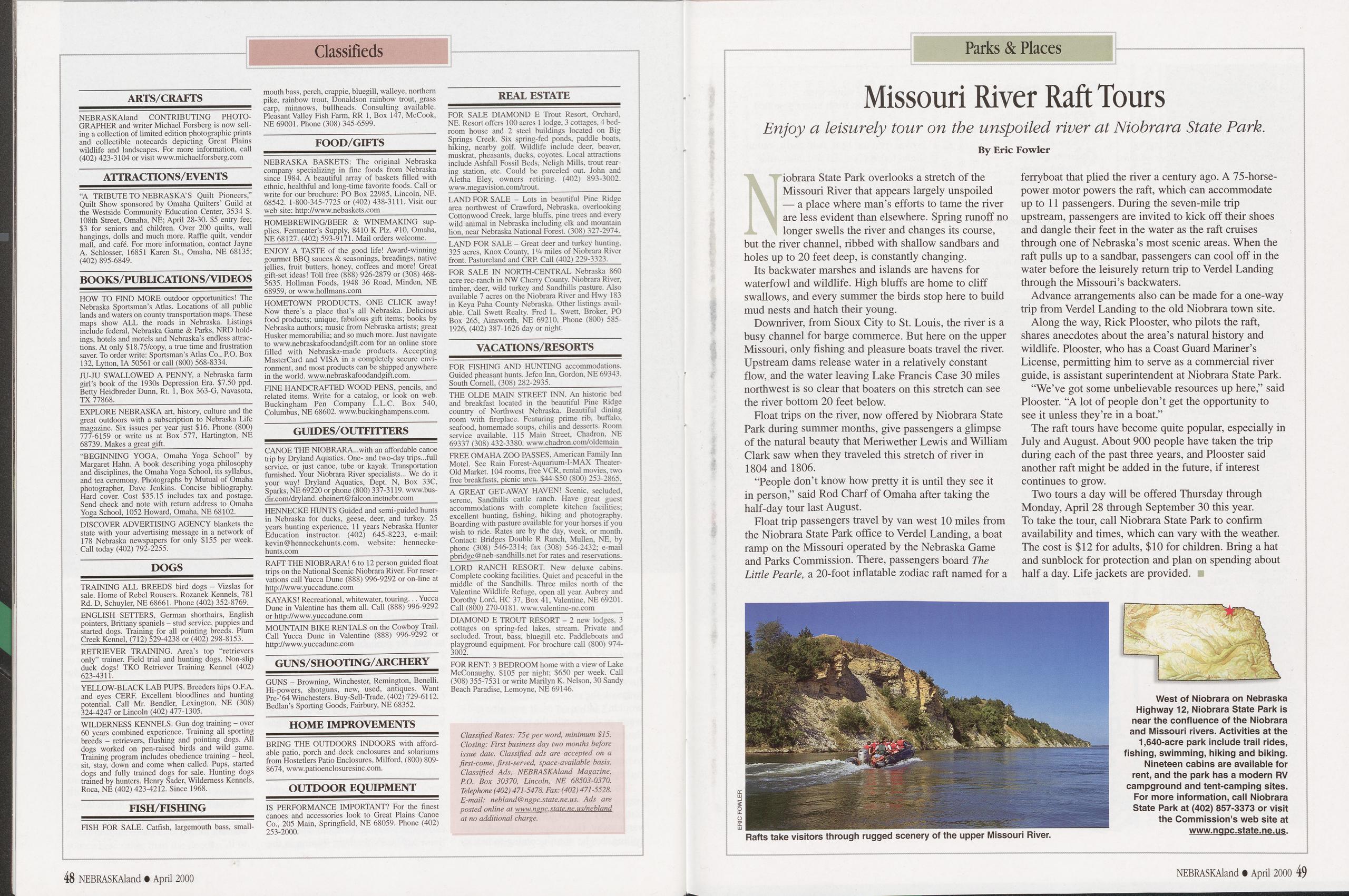
NEBRASKAland CONTRIBUTING PHOTO- GRAPHER and writer Michael Forsberg is now sell- ing a collection of limited edition photographic prints and collectible notecards depicting Great Plains wildlife and landscapes. For more information, call (402) 423-3104 or visit www.michaelforsberg.com
ATTRACTION S/EVENTS“A TRIBUTE TO NEBRASKA’S Quilt Pioneers,” Quilt Show sponsored by Omaha Quilters’ Guild at the Westside Community Education Center, 3534 S. 108th Street, Omaha, NE; April 28-30. $5 entry fee; $3 for seniors and children. Over 200 quilts, wall hangings, dolls and much more. Raffle quilt, vendor mall, and cafe. For more information, contact Jayne A. Schlosser, 16851 Karen St., Omaha, NE 68135; (402) 895-6849.
BOOKS/PUBLICATION S/VIDEOS HOW TO FIND MORE outdoor opportunities! The Nebraska Sportsman’s Atlas. Locations of all public lands and waters on county transportation maps. These maps show ALL the roads in Nebraska. Listings include federal, Nebraska Game & Parks, NRD hold- ings, hotels and motels and Nebraska’s endless attrac- tions. At only $18.75/copy, a true time and frustration saver. To order write: Sportsman’s Atlas Co., P.O. Box 132, Lytton, IA 50561 or call (800) 568-8334, JU-JU SWALLOWED A PENNY, a Nebraska farm girl’s book of the 1930s Depression Era. $7.50 ppd. Betty Heidbreder Dunn, Rt. 1, Box 363-G, Navasota, TX 77868. EXPLORE NEBRASKA art, history, culture and the great outdoors with a subscription to Nebraska Life magazine. Six issues per year just $16. Phone (800) 777-6159 or write us at Box 577, Hartington, NE 68739. Makes a great gift. “BEGINNING YOGA, Omaha Yoga School” by Margaret Hahn. A book describing yoga philosophy and disciplines, the Omaha Yoga School, its syllabus, and tea ceremony. Photographs by Mutual of Omaha photographer, Dave Jenkins. Concise bibliography. Hard cover. Cost $35.15 includes tax and postage. Send check and note with return address to Omaha Yoga School, 1052 Howard, Omaha, NE 68102. DISCOVER ADVERTISING AGENCY blankets the state with your advertising message in a network of 178 Nebraska newspapers for only $155 per week. Call today (402) 792-2255. DOGSTRAINING ALL BREEDS bird dogs - Vizslas for sale. Home of Rebel Rousers. Rozanek Kennels, 781 Rd. D, Schuyler, NE 68661. Phone (402) 352-8769. ENGLISH SETTERS, German shorthairs, English pointers, Brittany spaniels - stud service, puppies and started dogs. Training for all pointing breeds. Plum Creek Kennel, (712) 529-4238 or (402) 298-8153. RETRIEVER TRAINING. Area’s top “retrievers only” trainer. Field trial and hunting dogs. Non-slip duck dogs! TKO Retriever Training Kennel (402) 623-4311. YELLOW-BLACK LAB PUPS. Breeders hips O.F.A. and eyes CERF. Excellent bloodlines and hunting potential. Call Mr. Bendler, Lexington, NE (308) 324-4247 or Lincoln (402) 477-1305. WILDERNESS KENNELS. Gun dog training - over 60 years combined experience. Training all sporting breeds - retrievers, flushing and pointing dogs. All dogs worked on pen-raised birds and wild game. Training program includes obedience training - heel, sit, stay, down and come when called. Pups, started dogs and fully trained dogs for sale. Hunting dogs trained by hunters. Henry Sader, Wilderness Kennels, Roca, NE (402) 423-4212. Since 1968.
FISH/FISHINGFISH FOR SALE. Catfish, largemouth bass, small- Classifieds mouth bass, perch, crappie, bluegill, walleye, northern pike, rainbow trout, Donaldson rainbow trout, grass carp, minnows, bullheads. Consulting available. Pleasant Valley Fish Farm, RR 1, Box 147, McCook, NE 69001. Phone (308) 345-6599.
FOOD/GIFTSNEBRASKA BASKETS: The original Nebraska company specializing in fine foods from Nebraska since 1984. A beautiful array of baskets filled with ethnic, healthful and long-time favorite foods. Call or write for our brochure: PO Box 22985, Lincoln, NE. 68542. 1-800-345-7725 or (402) 438-3111. Visit our web site: http://www.nebaskets.com HOMEBREWING/BEER & WINEMAKING sup- plies. Fermenter’s Supply, 8410 K Plz. #10, Omaha, NE 68127. (402) 593-9171. Mail orders welcome. ENJOY A TASTE of the good life! Award-winning gourmet BBQ sauces & seasonings, breadings, native jellies, fruit butters, honey, coffees and more! Great gift-set ideas! Toll free (888) 926-2879 or (308) 468- 5635. Hollman Foods, 1948 36 Road, Minden, NE 68959, or www.hollmans.com HOMETOWN PRODUCTS, ONE CLICK away! Now there’s a place that’s all Nebraska. Delicious food products; unique, fabulous gift items; books by Nebraska authors; music from Nebraska artists; great Husker memorabilia; and so much more. Just navigate to www.nebraskafoodandgift.com for an online store filled with Nebraska-made products. Accepting MasterCard and VISA in a completely secure envi- ronment, and most products can be shipped anywhere in the world, www.nebraskafoodandgift.com. FINE HANDCRAFTED WOOD PENS, pencils, and related items. Write for a catalog, or look on web. Buckingham Pen Company L.L.C. Box 540, Columbus, NE 68602. www.buckinghampens.com.
REAL ESTATEFOR SALE DIAMOND E Trout Resort, Orchard, NE. Resort offers 100 acres 1 lodge, 3 cottages, 4 bed- room house and 2 steel buildings located on Big Springs Creek. Six spring-fed ponds, paddle boats, hiking, nearby golf. Wildlife include deer, beaver, muskrat, pheasants, ducks, coyotes. Local attractions include Ashfall Fossil Beds, Neligh Mills, trout rear- ing station, etc. Could be parceled out. John and Aletha Eley, owners retiring. (402) 893-3002. www.megavision.com/trout.____________________ LAND FOR SALE - Lots in beautiful Pine Ridge area northwest of Crawford, Nebraska, overlooking Cottonwood Creek, large bluffs, pine trees and every wild animal in Nebraska including elk and mountain lion, near Nebraska National Forest. (308) 327-2974. LAND FOR SALE - Great deer and turkey hunting. 325 acres, Knox County, 1 ¥4 miles of Niobrara River front. Pastureland and CRP. Call (402) 229-3323. FOR SALE IN NORTH-CENTRAL Nebraska 860 acre rec-ranch in NW Cherry County. Niobrara River, timber, deer, wild turkey and Sandhills pasture. Also available 7 acres on the Niobrara River and Hwy 183 in Keya Paha County Nebraska. Other listings avail- able. Call Swett Realty. Fred L. Swett, Broker, PO Box 265, Ainsworth, NE 69210, Phone (800) 585- 1926, (402) 387-1626 day or night.
GUIDES/OUTFITTERSCANOE THE NIOBRARA...with an affordable canoe trip by Dryland Aquatics. One- and two-day trips...full service, or just canoe, tube or kayak. Transportation furnished. Your Niobrara River specialists... We do it your way! Dryland Aquatics, Dept. N, Box 33C, Sparks, NE 69220 or phone (800) 337-3119. www.bus- dir.com/dryland. eheinert@falcon.inetnebr.com__ HENNECKE HUNTS Guided and semi-guided hunts in Nebraska for ducks, geese, deer, and turkey. 25 years hunting experience, 11 years Nebraska Hunter Education instructor. (402) 645-8223, e-mail: kevin@henneckehunts.com, website: hennecke- hunts.com RAFT THE NIOBRARA! 6 to 12 person guided float trips on the National Scenic Niobrara River. For reser- vations call Yucca Dune (888) 996-9292 or on-line at http://www.yuccadune.com KAYAKS! Recreational, whitewater, touring... Yucca Dune in Valentine has them all. Call (888) 996-9292 or http://www.yuccadune.com MOUNTAIN BIKE RENTALS on the Cowboy Trail. Call Yucca Dune in Valentine (888) 996-9292 or http://www.yuccadune.com
GUNS/SHOOTING/ARCHERYGUNS - Browning, Winchester, Remington, Benelli. Hi-powers, shotguns, new, used, antiques. Want Pre-’64 Winchesters. Buy-Sell-Trade. (402) 729-6112. Bedlan’s Sporting Goods, Fairbury, NE 68352.
VACATION S/RESORTSFOR FISHING AND HUNTING accommodations. Guided pheasant hunts. Jefco Inn, Gordon, NE 69343. South Cornell, (308) 282-2935. THE OLDE MAIN STREET INN. An historic bed and breakfast located in the beautiful Pine Ridge country of Northwest Nebraska. Beautiful dining room with fireplace. Featuring prime rib, buffalo, seafood, homemade soups, chilis and desserts. Room service available. 115 Main Street, Chadron, NE 69337 (308) 432-3380. www.chadron.com/oldemain FREE OMAHA ZOO PASSES, American Family Inn Motel. See Rain Forest-Aquarium-I-MAX Theater- Old Market. 104 rooms, free VCR, rental movies, two free breakfasts, picnic area. $44-$50 (800) 253-2865. A GREAT GET-AWAY HAVEN! Scenic, secluded, serene, Sandhills cattle ranch. Have great guest accommodations with complete kitchen facilities; excellent hunting, fishing, hiking and photography. Boarding with pasture available for your horses if you wish to ride. Rates are by the day, week, or month. Contact: Bridges Double R Ranch, Mullen, NE, by phone (308) 546-2314; fax (308) 546-2432; e-mail pbridge@neb-sandhills.net for rates and reservations. LORD RANCH RESORT. New deluxe cabins. Complete cooking facilities. Quiet and peaceful in the middle of the Sandhills. Three miles north of the Valentine Wildlife Refuge, open all year. Aubrey and Dorothy Lord, HC 37, Box 41, Valentine, NE 69201. Call (800) 270-0181. www.valentine-ne.com DIAMOND E TROUT RESORT - 2 new lodges, 3 cottages on spring-fed lakes, stream. Private and secluded. Trout, bass, bluegill etc. Paddleboats and playground equipment. For brochure call (800) 974- 3002._ FOR RENT: 3 BEDROOM home with a view of Lake McConaughy. $105 per night; $650 per week. Call (308) 355-7531 or write Marilyn K. Nelson, 30 Sandy Beach Paradise, Lemoyne, NE 69146.
HOME IMPROVEMENTSBRING THE OUTDOORS INDOORS with afford- able patio, porch and deck enclosures and solariums from Hostetlers Patio Enclosures, Milford, (800) 809- 8674, www.patioenclosuresinc.com.
OUTDOOR EQUIPMENTIS PERFORMANCE IMPORTANT? For the finest canoes and accessories look to Great Plains Canoe Co., 205 Main, Springfield, NE 68059. Phone (402) 253-2000.
Classified Rates: 75c per word, minimum $15. Closing: First business day two months before issue date. Classified ads are accepted on a first-come, first-served, space-available basis. Classified Ads, NEBRASKAland Magazine, P.O. Box 30370, Lincoln, NE 68503-0370. Telephone (402) 471-5478. Fax: (402) 471-5528. E-mail: nebland@ngpc.state.ne.us. Ads are posted online at www. nspc. state, ne. us/nebland at no additional charge.
Parks & Places
Missouri River Raft Tours
Enjoy a leisurely tour on the unspoiled river at Niobrara State Park.
Niobrara State Park overlooks a stretch of the Missouri River that appears largely unspoiled — a place where man’s efforts to tame the river are less evident than elsewhere. Spring runoff no longer swells the river and changes its course, but the river channel, ribbed with shallow sandbars and holes up to 20 feet deep, is constantly changing.
Its backwater marshes and islands are havens for waterfowl and wildlife. High bluffs are home to cliff swallows, and every summer the birds stop here to build mud nests and hatch their young.
Downriver, from Sioux City to St. Louis, the river is a busy channel for barge commerce. But here on the upper Missouri, only fishing and pleasure boats travel the river. Upstream dams release water in a relatively constant flow, and the water leaving Lake Francis Case 30 miles northwest is so clear that boaters on this stretch can see the river bottom 20 feet below.
Float trips on the river, now offered by Niobrara State Park during summer months, give passengers a glimpse of the natural beauty that Meriwether Lewis and William Clark saw when they traveled this stretch of river in 1804 and 1806.
“People don’t know how pretty it is until they see it in person,” said Rod Charf of Omaha after taking the half-day tour last August.
Float trip passengers travel by van west 10 miles from the Niobrara State Park office to Verdel Landing, a boat ramp on the Missouri operated by the Nebraska Game and Parks Commission. There, passengers board The Little Pearle, a 20-foot inflatable zodiac raft named for a ferryboat that plied the river a century ago. A 75-horse- power motor powers the raft, which can accommodate up to 11 passengers. During the seven-mile trip upstream, passengers are invited to kick off their shoes and dangle their feet in the water as the raft cruises through one of Nebraska’s most scenic areas. When the raft pulls up to a sandbar, passengers can cool off in the water before the leisurely return trip to Verdel Landing through the Missouri’s backwaters.
Advance arrangements also can be made for a one-way trip from Verdel Landing to the old Niobrara town site.
Along the way, Rick Plooster, who pilots the raft, shares anecdotes about the area’s natural history and wildlife. Plooster, who has a Coast Guard Mariner’s License, permitting him to serve as a commercial river guide, is assistant superintendent at Niobrara State Park.
“We’ve got some unbelievable resources up here,” said Plooster. “A lot of people don’t get the opportunity to see it unless they’re in a boat.”
The raft tours have become quite popular, especially in July and August. About 900 people have taken the trip during each of the past three years, and Plooster said another raft might be added in the future, if interest continues to grow.
Two tours a day will be offered Thursday through Monday, April 28 through September 30 this year. To take the tour, call Niobrara State Park to confirm availability and times, which can vary with the weather. The cost is $12 for adults, $10 for children. Bring a hat and sunblock for protection and plan on spending about half a day. Life jackets are provided.
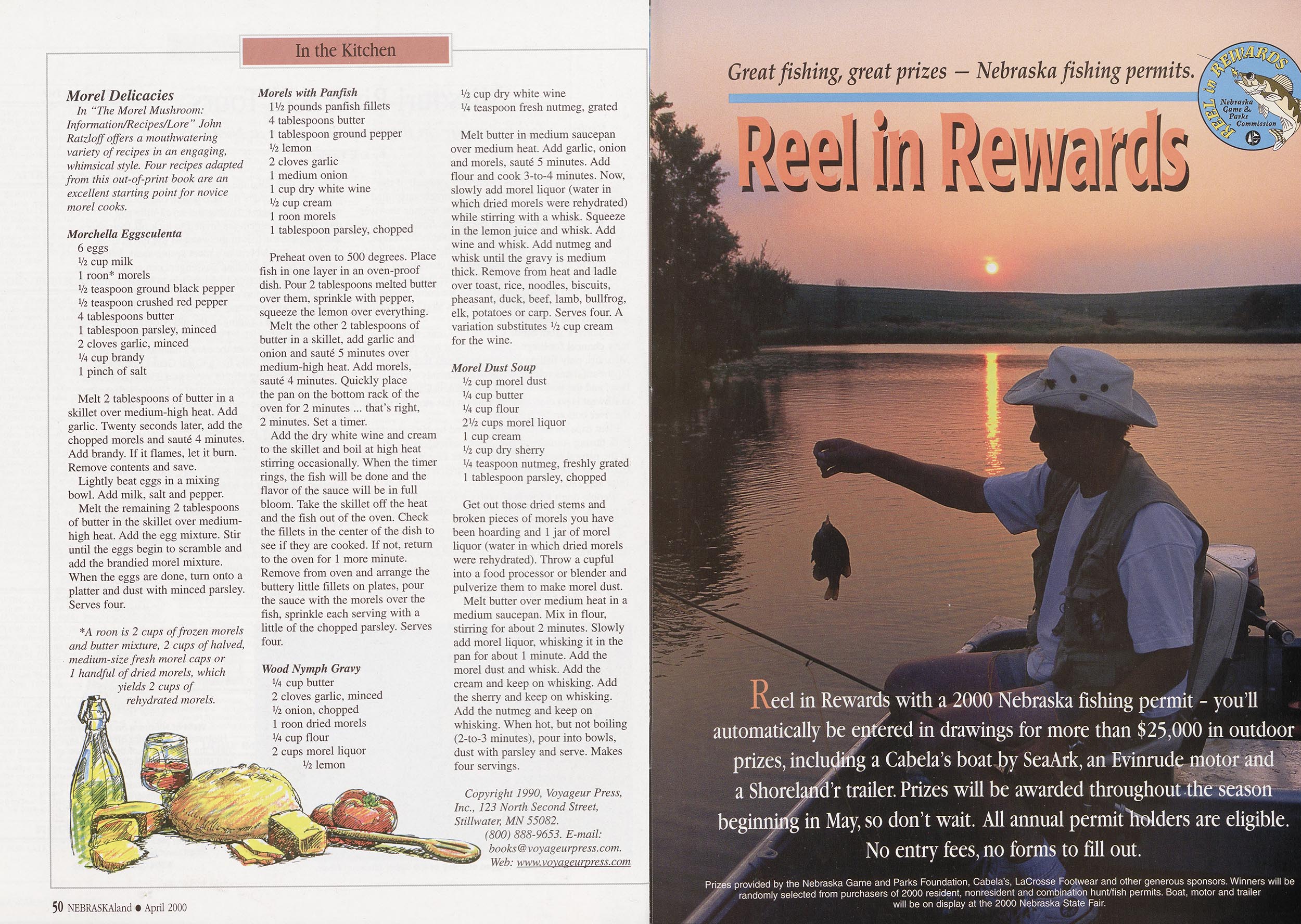
In the Kitchen
Morel Delicacies
In "The Morel Mushroom: Information/Recipes/Lore" John Ratzloff offers a mouthwatering variety of recipes in an engaging, whimsical style. Four recipes adapted from this out-of-print book re an excellent starting point for novice morel cooks.
Morchella Eggsculenta 6 eggs 1/2 cup milk 1 roon* morels 1/2 teaspoon ground black pepper 1/2 teaspoon crushed red pepper 4 tablespoons butter 1 tablespoon parsley, minced 2 cloves garlic, minced 1/4 cup brandy 1 pinch of salt.
Melt 2 tablespoons of butter in a skillet over medium-high heat. Add garlic. Twenty seconds later, add the chopped morels and sauté 4 minutes. Add brandy If it flames, let it burn. Remove contents and save.
Lightly beat eggs in a mixing bowl. Add milk, salt and pepper.
Melt the remaining 2 tablespoons of butter in the skillet over medium-high heat. Add the egg mixture. Stir until the eggs begin to scramble and add the brandied morel mixture.
When the eggs are done, turn onto a platter and dust with minced parsley.
Serves four.
*A roon is 2 cups of frozen morels and butter mixture, 2 cups of halved, medium-sized fresh morel caps or 1 handful of dried morels, which yields 2 cups of rehydrated morels.
Morels with Panfish 1 1/2 pounds panfish fillets 4 tablespoons butter 1 tablespoon ground pepper 1/2 lemon 2 cloves garlic 1 medium onion 1 cup dry white wine 1/2 cup cream 1/ roon morels 1 tablespoon parsley, chopped
Preheat over to 600 degrees. Place fish in one layer in an over-proof dish. Pour 2 tablespoons melted butter over them, spring with pepper, squeeze the lemon over everything.
Melt the other 2 tablespoons of butter in a skillet, add garlic and onion and sauté 5 minutes over medium-high heat. Add morels, sauté 4 minutes. Quickly place the pan on the bottom rack of the over for 2 minutes ... that's right, 2 minutes. Set a timer.
Add the dry white wine and cream to the skillet and boil at high heat stirring occasionally. When the timer rings, the fish will be done and the flavor of the sauce will be in full bloom. Take the skillet off the heat and the fish out of the oven. Check the fillets in the center of the dish to see if they are cooked. If not, return to the over for 1 more minute.
Remove from the over and arrange the buttery little fillets on plates, pour the sauce with the morels over the fish, sprinkle each serving with a little of the chopped parsley.
Severs four.
Wood Nymph Gravy 1/4 cup butter 2 cloves garlic, minced 1/2 onion, chopped 1 roon dried morels 1/4 cup flour 2 cups morel liquor 1/2 lemon 1/2 cup dry white wine 1/4 teaspoon fresh nutmeg, grated
Melt butter in medium saucepan over medium heat. Add garlic, onion and morels, sauté 5 minutes. add flour and cook 3-to-4 minutes. Now, slowly add morel liquor (water in which dried morels were rehydrated) while stirring with a whish. Squeeze in the lemon juice and whisk. Add wine and whisk. Add nutmeg and whisk until the gravy is medium thick. Remove from heat and ladle over toast, rice, noodles, biscuits, pheasant, duck, beef, lamb, bullfrog, elk, potatoes or carp. Serves four. A variation substitutes 1/2 cup crema for the wine.
Morel Dust Soup 1/2 cup morel dust 1/4 cup butter 1/4 cup flour 2 1/2 cups morel liquor 1 cup cream 1/2 cup dry sherry 1/4 teaspoon nutmeg, freshly grated 1 tablespoon parsley, chopped
Get out those dried stems and broken pieces of morels you have been hoarding and 1 jar of morel liquor (water in which dried morels were rehydrated). Throw a cupful into a food processor or blender and pulverize them to make morel dust.
Melt butter over medium heat in a medium saucepan. Mix in flour, stirring for about 2 minutes. Slowly add morel liquor, whisking it in the pan for about 1 minute. Add the morel dust and whisk. ad the cream and keep on whisking. Add the sherry and keep on whisking. Add the nutmeg and keep on whisking. When hot, but not boiling (2-to-3 minutes), pour into bowls, dust with parsley and serve. Makes four servings.
Copyright 1990, Voyageur Pres, Inc., 123 North Second Street, Stillwater, MN 55082. (800) 888-9653. E-mail: books@voyageurpress.com. Web: www.voyageurpress.com
Great fishing, great prizes -- Nebraska fishing permits
Reel in Rewards
Reel in Rewards with a 2000 Nebraska fishing permit -- you'll automatically be entered in drawings for more than $25,000 in outdoor prizes, including a Cabela's boat by SeaArk, an Evinrude motor and a Shoreland'r trailer. Prizes will be awarded throughout the season beginning in May, so don't wait. All annual permit holders are eligible. No entry fees, no forms to fill out.
Prizes provided by the Nebraska Game and Parks Foundation. Cabela's, Lacrosse Footwear and other generous sponsors. Winners will be randomly selected from purchasers of 2000 resident, nonresident and combination hunt/fish permits. Boat, motor and trailer will be on display at the 2000 Nebraska State Fair.
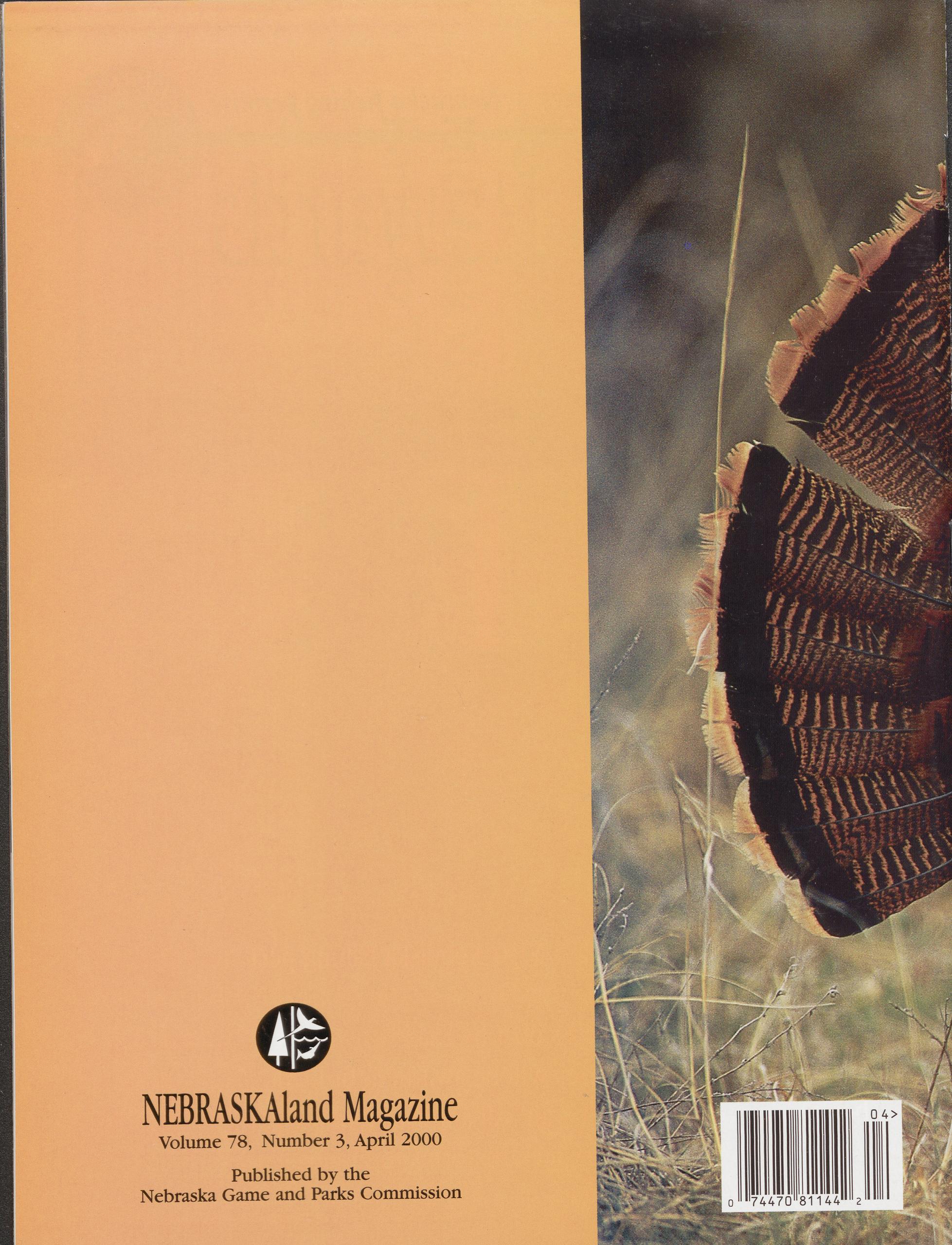
Position: 43 (192 views)