Volume 78, Issue 2, 2000
NEBRASKAland
Nebraska Game & Parks Commission March 2000 • $2.50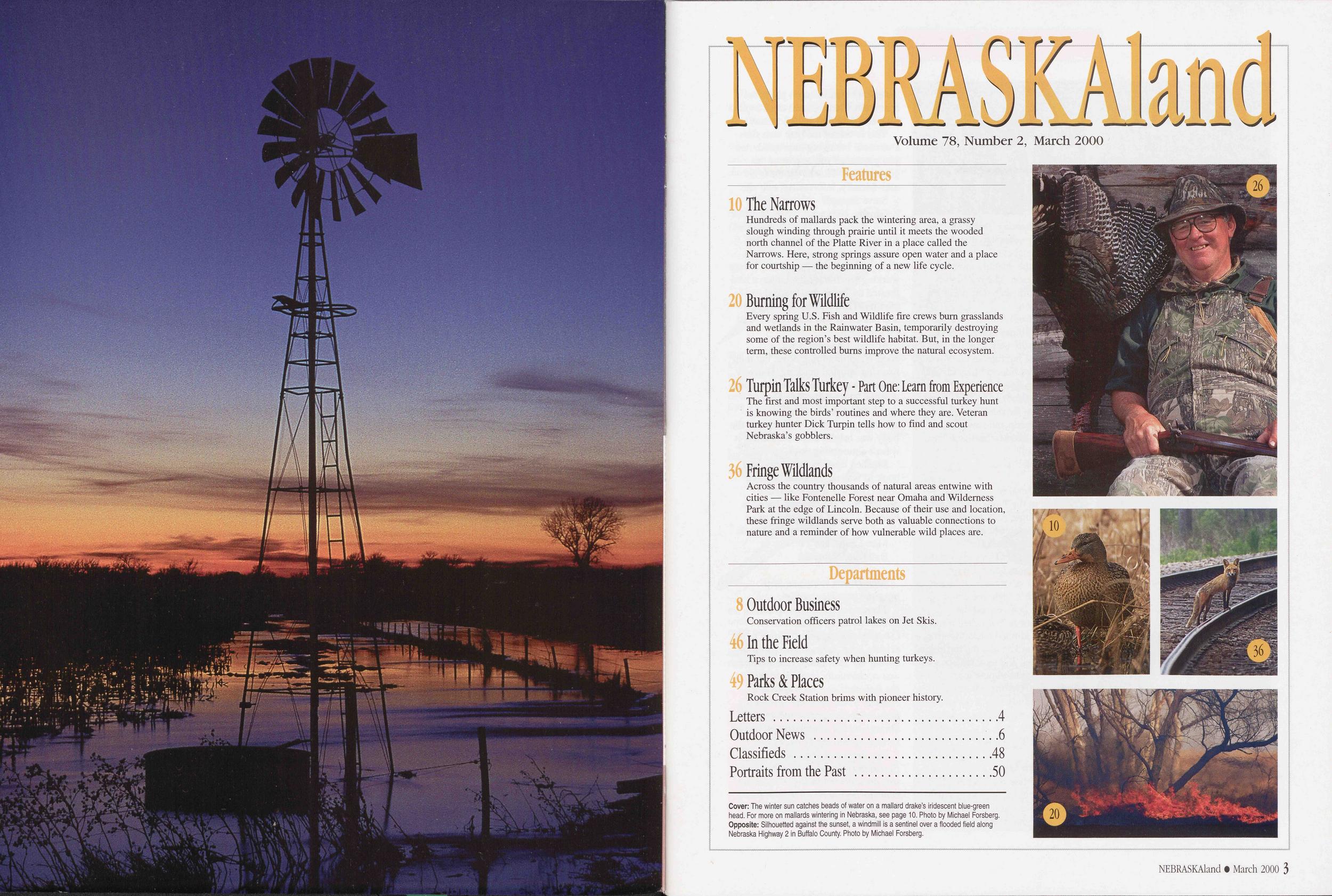
NEBRASKAland
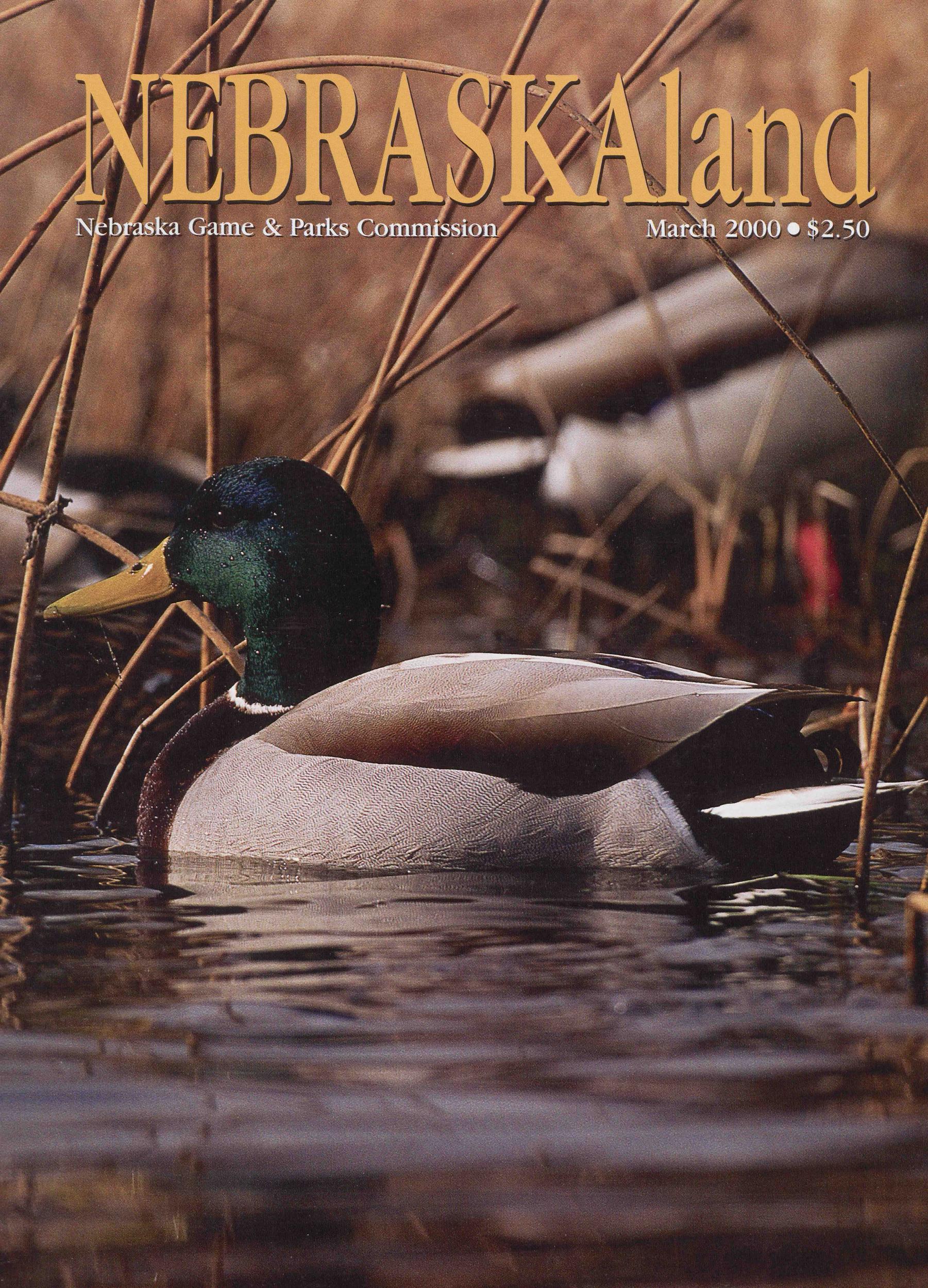
Volume 78, number 2, March 2000 Features The Narrows Hundreds of mallards pack the wintering area, a grassy slough winding through prairie until it meets the wooded north channel of the Platte River in a place called the Narrows. Here, strong springs assure open water and a place for courtship — the beginning of a new life cycle. 20 Burning for Wildlife Every spring U.S. Fish and Wildlife fire crews bum grasslands and wetlands in the Rainwater Basin, temporarily destroying some of the region’s best wildlife habitat. But, in the longer term, these controlled bums improve the natural ecosystem. Turpin Talks Turkey - Part One: Learn from Experience The first and most important step to a successful turkey hunt is knowing the birds’ routines and where they are. Veteran turkey hunter Dick Turpin tells how to find and scout Nebraska’s gobblers. Fringe Wildlands Across the country thousands of natural areas entwine with cities — like Fontenelle Forest near Omaha and Wilderness Park at the edge of Lincoln. Because of their use and location, these fringe wildlands serve both as valuable connections to nature and a reminder of how vulnerable wild places are. Outdoor Business Conservation officers patrol lakes on Jet Skis. In the Field Tips to increase safety when hunting turkeys. 49 Parks & Places Rock Creek Station brims with pioneer history. Letters 4 Outdoor News 6 Classifieds 48 Portraits from the Past 50 Cover: The winter sun catches beads of water on a mallard drake’s iridescent blue-green head. For more on mallards wintering in Nebraska, see page 10. Photo by Michael Forsberg. Opposite: Silhouetted against the sunset, a windmill is a sentinel over a flooded field along Nebraska Highway 2 in Buffalo County. Photo by Michael Forsberg.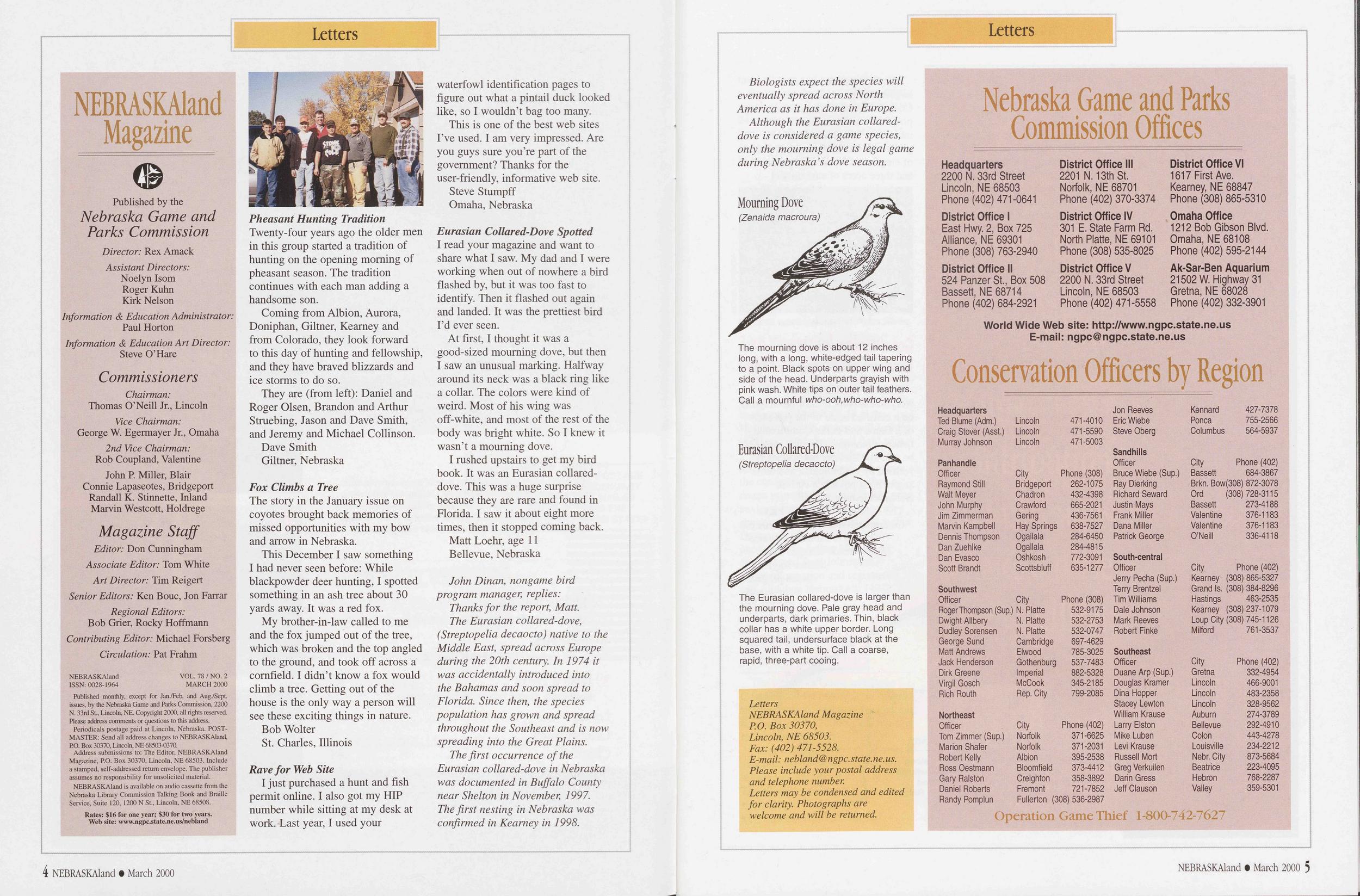 Letters NEBRASKAland Mazine Published by the Nebraska Game and Parks Commission Director: Rex Amack Assistant Directors: Noelyn Isom Roger Kuhn Kirk Nelson Information & Education Administrator: Paul Horton Information & Education Art Director: Steve O’Hare Commissioners Chairman: Thomas O’Neill Jr., Lincoln Vice Chairman: George W. Egermayer Jr., Omaha 2nd Vice Chairman: Rob Coupland, Valentine John P. Miller, Blair Connie Lapaseotes, Bridgeport Randall K. Stinnette, Inland Marvin Westcott, Holdrege Magazine Staff Editor: Don Cunningham Associate Editor: Tom White Art Director: Tim Reigert Senior Editors: Ken Bouc, Jon Farrar Regional Editors: Bob Grier, Rocky Hoffmann Contributing Editor: Michael Forsberg Circulation: Pat Frahm NEBRASKAland VOL. 78 / NO. 2 ISSN: 0028-1964 MARCH 2000 Published monthly, except for Jan./Feb. and Aug./Sept. issues, by the Nebraska Game and Parks Commission, 2200 N. 33rd St., Lincoln, NE. Copyright 2000, all rights reserved. Please address comments or questions to this address. Periodicals postage paid at Lincoln, Nebraska. POST- MASTER: Send all address changes to NEBRASKAland, P.O. Box 30370, Lincoln, NE 68503-0370. Address submissions to: The Editor, NEBRASKAland Magazine, P.O. Box 30370, Lincoln, NE 68503. Include a stamped, self-addressed return envelope. The publisher assumes no responsibility for unsolicited material. NEBRASKAland is available on audio cassette from the Nebraska Library Commission Talking Book and Braille Service, Suite 120, 1200 N St., Lincoln, NE 68508. Rates: $16 for one year; $30 for two years. Web site: www.ngpc.state.ne.us/nebland Pheasant Hunting Tradition
Twenty-four years ago the older men in this group started a tradition of hunting on the opening morning of pheasant season. The tradition continues with each man adding a handsome son.
Coming from Albion, Aurora, Doniphan, Giltner, Kearney and from Colorado, they look forward to this day of hunting and fellowship, and they have braved blizzards and ice storms to do so.
They are (from left): Daniel and Roger Olsen, Brandon and Arthur Struebing, Jason and Dave Smith, and Jeremy and Michael Collinson.
Dave Smith Giltner, Nebraska Fox Climbs a TreeThe story in the January issue on coyotes brought back memories of missed opportunities with my bow and arrow in Nebraska.
This December I saw something I had never seen before: While blackpowder deer hunting, I spotted something in an ash tree about 30 yards away. It was a red fox.
My brother-in-law called to me and the fox jumped out of the tree, which was broken and the top angled to the ground, and took off across a cornfield. I didn’t know a fox would climb a tree. Getting out of the house is the only way a person will see these exciting things in nature.
Bob Wolter St. Charles, Illinois Rave for Web SiteI just purchased a hunt and fish permit online. I also got my HIP number while sitting at my desk at work. Last year, I used your waterfowl identification pages to figure out what a pintail duck looked like, so I wouldn’t bag too many.
This is one of the best web sites I’ve used. I am very impressed. Are you guys sure you’re part of the government? Thanks for the user-friendly, informative web site.
Steve Stumpff Omaha, Nebraska Eurasian Collared-Dove SpottedI read your magazine and want to share what I saw. My dad and I were working when out of nowhere a bird flashed by, but it was too fast to identify. Then it flashed out again and landed. It was the prettiest bird I’d ever seen.
At first, I thought it was a good-sized mourning dove, but then I saw an unusual marking. Halfway around its neck was a black ring like a collar. The colors were kind of weird. Most of his wing was off-white, and most of the rest of the body was bright white. So I knew it wasn’t a mourning dove.
I rushed upstairs to get my bird book. It was an Eurasian collared- dove. This was a huge surprise because they are rare and found in Florida. I saw it about eight more times, then it stopped coming back.
Matt Loehr, age 11 Bellevue, NebraskaJohn Dinan, nongame bird program manager, replies:
Thanks for the report, Matt.
The Eurasian collared-dove, (Streptopelia decaocto) native to the Middle East, spread across Europe during the 20th century. In 1974 it was accidentally introduced into the Bahamas and soon spread to Florida. Since then, the species population has grown and spread throughout the Southeast and is now spreading into the Great Plains.
The first occurrence of the Eurasian collared-dove in Nebraska was documented in Buffalo County near Shelton in November, 1997. The first nesting in Nebraska was confirmed in Kearney in 1998.
Biologists expect the species will eventually spread across North America as it has done in Europe.
Although the Eurasian collared- dove is considered a game species, only the mourning dove is legal game during Nebraska’s dove season.
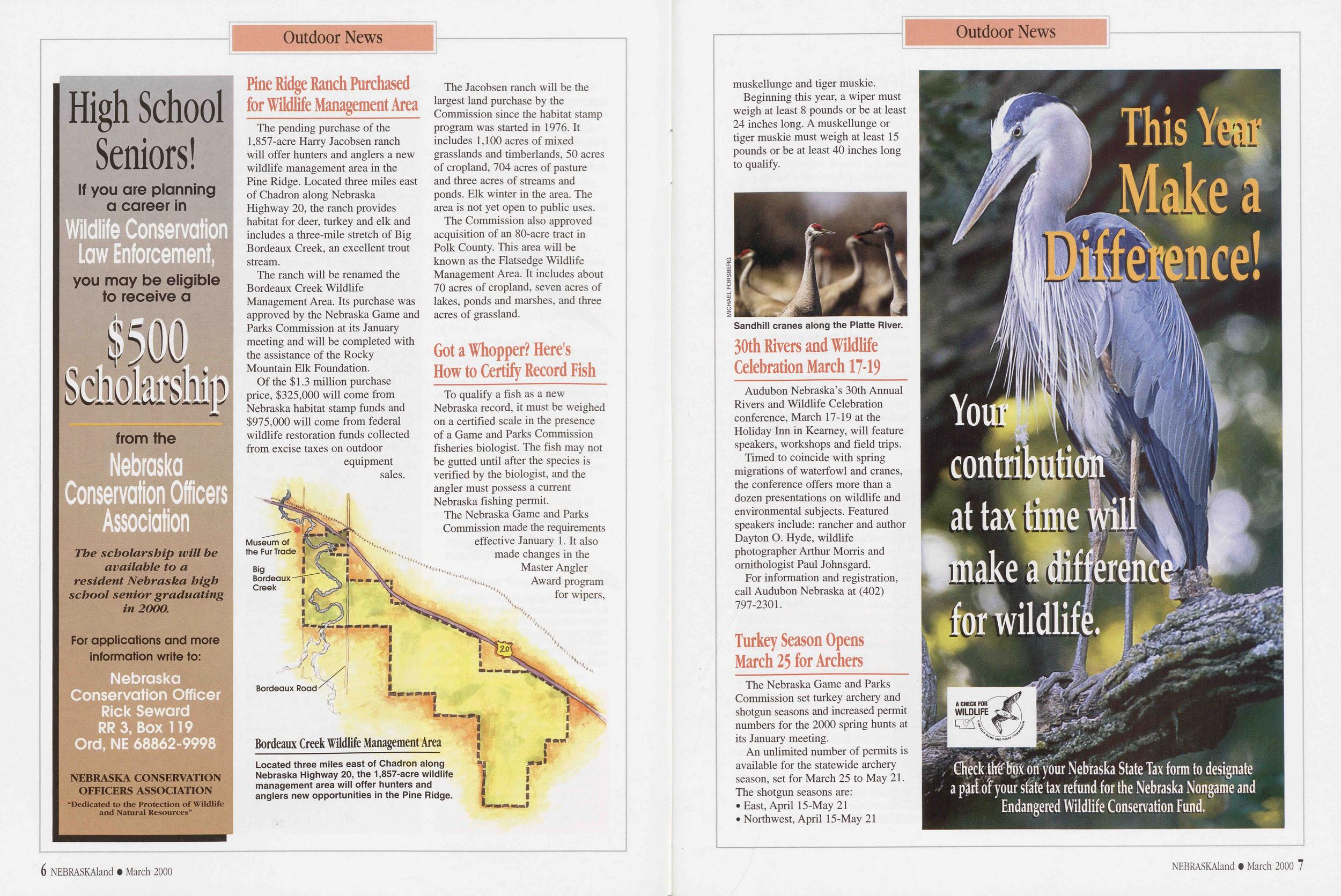
The pending purchase of the 1,857-acre Harry Jacobsen ranch will offer hunters and anglers a new wildlife management area in the Pine Ridge. Located three miles east of Chadron along Nebraska Highway 20, the ranch provides habitat for deer, turkey and elk and includes a three-mile stretch of Big Bordeaux Creek, an excellent trout stream.
The ranch will be renamed the Bordeaux Creek Wildlife Management Area. Its purchase was approved by the Nebraska Game and Parks Commission at its January meeting and will be completed with the assistance of the Rocky Mountain Elk Foundation.
Of the $1.3 million purchase price, $325,000 will come from Nebraska habitat stamp funds and $975,000 will come from federal wildlife restoration funds collected from excise taxes on outdoor equipment sales.
The Jacobsen ranch will be the largest land purchase by the Commission since the habitat stamp program was started in 1976. It includes 1,100 acres of mixed grasslands and timberlands, 50 acres of cropland, 704 acres of pasture and three acres of streams and ponds. Elk winter in the area. The area is not yet open to public uses.
The Commission also approved acquisition of an 80-acre tract in Polk County. This area will be known as the Flatsedge Wildlife Management Area. It includes about 70 acres of cropland, seven acres of lakes, ponds and marshes, and three acres of grassland.
Got a Whopper? Here’s How to Certify Record FishTo qualify a fish as a new Nebraska record, it must be weighed on a certified scale in the presence of a Game and Parks Commission Commission made the requirements effective January 1. It also made changes in the Master Angler Award program for wipers, muskellunge and tiger muskie.
Beginning this year, a wiper must weigh at least 8 pounds or be at least 24 inches long. A muskellunge or tiger muskie must weigh at least 15 pounds or be at least 40 inches long to qualify.
MICHAEL FORSBERGAudubon Nebraska’s 30th Annual Rivers and Wildlife Celebration conference, March 17-19 at the Holiday Inn in Kearney, will feature speakers, workshops and field trips.
Timed to coincide with spring migrations of waterfowl and cranes, the conference offers more than a dozen presentations on wildlife and environmental subjects. Featured speakers include: rancher and author Dayton 0. Hyde, wildlife photographer Arthur Morris and ornithologist Paul Johnsgard.
For information and registration, call Audubon Nebraska at (402) 797-2301.
Turkey Season Opens March 25 for ArchersThe Nebraska Game and Parks Commission set turkey archery and shotgun seasons and increased permit numbers for the 2000 spring hunts at its January meeting.
An unlimited number of permits is available for the statewide archery season, set for March 25 to May 21. The shotgun seasons are: • East, April 15-May 21 • Northwest, April 15-May 21
6 NEBRASKAland • March 2000 NEBRASKAland O March 2000 7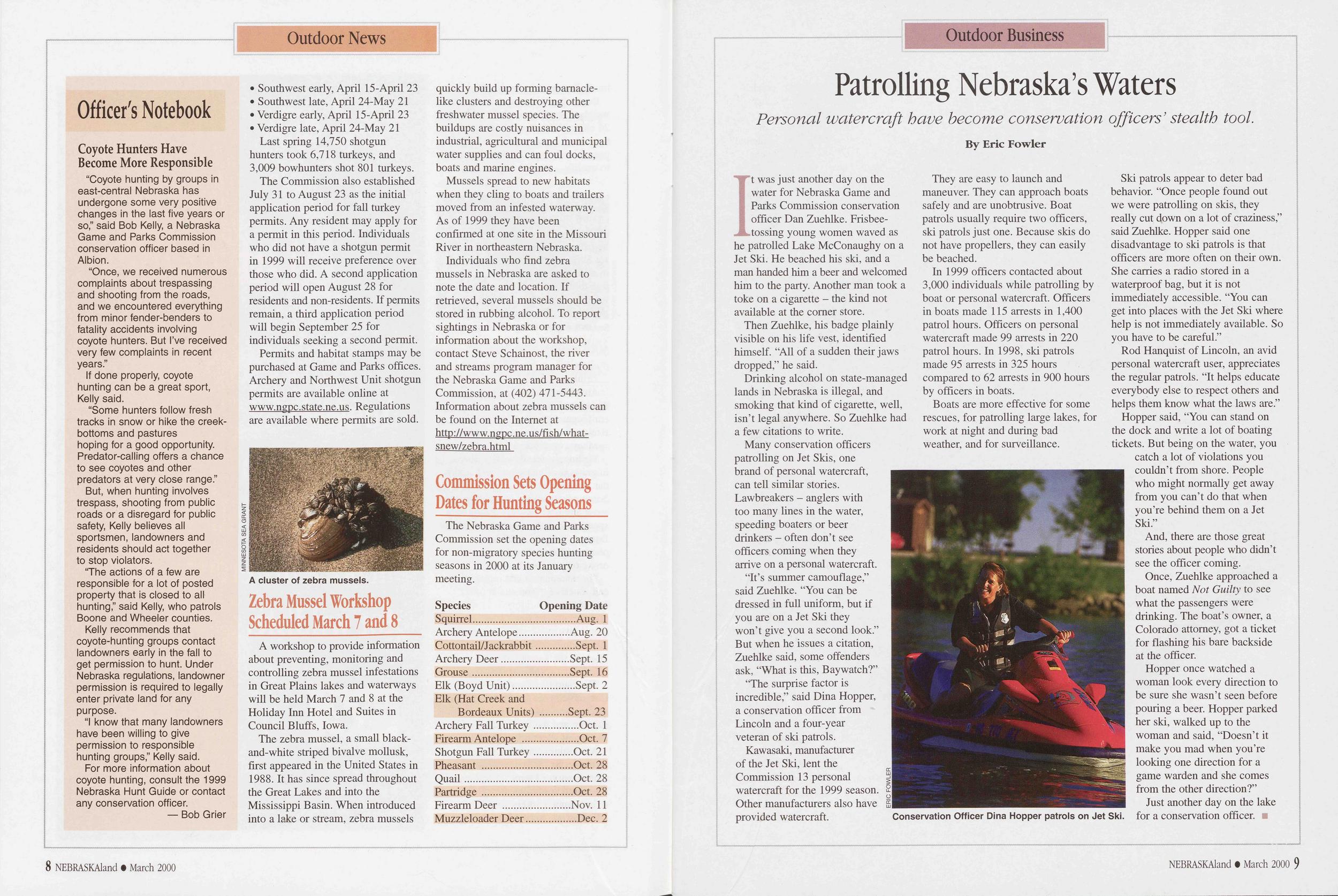 Outdoor News Officer's Notebook Coyote Hunters Have Become More Responsible
“Coyote hunting by groups in east-central Nebraska has undergone some very positive changes in the last five years or so,” said Bob Kelly, a Nebraska Game and Parks Commission conservation officer based in Albion.
“Once, we received numerous complaints about trespassing and shooting from the roads, and we encountered everything from minor fender-benders to fatality accidents involving coyote hunters. But I’ve received very few complaints in recent years.”
If done properly, coyote hunting can be a great sport, Kelly said.
“Some hunters follow fresh tracks in snow or hike the creek- bottoms and pastures hoping for a good opportunity. Predator-calling offers a chance to see coyotes and other predators at very close range.”
But, when hunting involves trespass, shooting from public roads or a disregard for public safety, Kelly believes all sportsmen, landowners and residents should act together to stop violators.
“The actions of a few are responsible for a lot of posted property that is closed to all hunting,” said Kelly, who patrols Boone and Wheeler counties.
Kelly recommends that coyote-hunting groups contact landowners early in the fall to get permission to hunt. Under Nebraska regulations, landowner permission is required to legally enter private land for any purpose.
“I know that many landowners have been willing to give permission to responsible hunting groups,” Kelly said.
For more information about coyote hunting, consult the 1999 Nebraska Hunt Guide or contact any conservation officer.
— Bob Grier• Southwest early, April 15-April 23 • Southwest late, April 24-May 21 • Verdigre early, April 15-April 23 • Verdigre late, April 24-May 21
Last spring 14,750 shotgun hunters took 6,718 turkeys, and 3,009 bowhunters shot 801 turkeys.
The Commission also established July 31 to August 23 as the initial application period for fall turkey permits. Any resident may apply for a permit in this period. Individuals who did not have a shotgun permit in 1999 will receive preference over those who did. A second application period will open August 28 for residents and non-residents. If permits remain, a third application period will begin September 25 for individuals seeking a second permit.
Permits and habitat stamps may be purchased at Game and Parks offices. Archery and Northwest Unit shotgun permits are available online at www.ngpc.state.ne.us. Regulations are available where permits are sold.
A workshop to provide information about preventing, monitoring and controlling zebra mussel infestations in Great Plains lakes and waterways will be held March 7 and 8 at the Holiday Inn Hotel and Suites in Council Bluffs, Iowa.
The zebra mussel, a small black- and-white striped bivalve mollusk, first appeared in the United States in 1988. It has since spread throughout the Great Lakes and into the Mississippi Basin. When introduced into a lake or stream, zebra mussels quickly build up forming barnacle- like clusters and destroying other freshwater mussel species. The buildups are costly nuisances in industrial, agricultural and municipal water supplies and can foul docks, boats and marine engines.
Mussels spread to new habitats when they cling to boats and trailers moved from an infested waterway. As of 1999 they have been confirmed at one site in the Missouri River in northeastern Nebraska.
Individuals who find zebra mussels in Nebraska are asked to note the date and location. If retrieved, several mussels should be stored in rubbing alcohol. To report sightings in Nebraska or for information about the workshop, contact Steve Schainost, the river and streams program manager for the Nebraska Game and Parks Commission, at (402) 471-5443. Information about zebra mussels can be found on the Internet at http://www.ngpc.ne.us/fish/what- snew/zebra.html
Commission Sets Opening Dates for Hunting SeasonsThe Nebraska Game and Parks Commission set the opening dates for non-migratory species hunting seasons in 2000 at its January meeting.
Species Opening DateSquirrel Aug. 1 Archery Antelope Aug. 20 Cottontail/Jackrabbit Sept. 1 Archery Deer Sept. 15 Grouse Sept. 16 Elk (Boyd Unit) Sept. 2 Elk (Hat Creek and Bordeaux Units) Sept. 23 Archery Fall Turkey Oct. 1 Firearm Antelope Oct. 7 Shotgun Fall TurkeyOct. 21 Pheasant Oct. 28 Quail Oct. 28 Partridge Oct. 28 Firearm Deer Nov. 11 Muzzleloader Deer Dec. 2
Outdoor Business Patrolling Nebraska’s Waters Personal watercraft have become conservation officers’ stealth tool. By Eric FowlerIt was just another day on the water for Nebraska Game and Parks Commission conservation officer Dan Zuehlke. Frisbee- tossing young women waved as he patrolled Lake McConaughy on a Jet Ski. He beached his ski, and a man handed him a beer and welcomed him to the party. Another man took a toke on a cigarette - the kind not available at the comer store.
Then Zuehlke, his badge plainly visible on his life vest, identified himself. "All of a sudden their jaws dropped,” he said.
Drinking alcohol on state-managed lands in Nebraska is illegal, and smoking that kind of cigarette, well, isn’t legal anywhere. So Zuehlke had a few citations to write.
Many conservation officers patrolling on Jet Skis, one brand of personal watercraft, can tell similar stories. Lawbreakers - anglers with too many lines in the water, speeding boaters or beer drinkers - often don’t see officers coming when they arrive on a personal watercraft.
"It’s summer camouflage,” said Zuehlke. "You can be dressed in full uniform, but if you are on a Jet Ski they won’t give you a second look.” But when he issues a citation, Zuehlke said, some offenders ask, "What is this, Bay watch?”
"The surprise factor is incredible,” said Dina Hopper, a conservation officer from Lincoln and a four-year veteran of ski patrols.
Kawasaki, manufacturer of the Jet Ski, lent the Commission 13 personal watercraft for the 1999 season. Other manufacturers also have provided watercraft.
They are easy to launch and maneuver. They can approach boats safely and are unobtrusive. Boat patrols usually require two officers, ski patrols just one. Because skis do not have propellers, they can easily be beached.
In 1999 officers contacted about 3,000 individuals while patrolling by boat or personal watercraft. Officers in boats made 115 arrests in 1,400 patrol hours. Officers on personal watercraft made 99 arrests in 220 patrol hours. In 1998, ski patrols made 95 arrests in 325 hours compared to 62 arrests in 900 hours by officers in boats.
Boats are more effective for some rescues, for patrolling large lakes, for work at night and during bad weather, and for surveillance.
Ski patrols appear to deter bad behavior. "Once people found out we were patrolling on skis, they really cut down on a lot of craziness,” said Zuehlke. Hopper said one disadvantage to ski patrols is that officers are more often on their own. She carries a radio stored in a waterproof bag, but it is not immediately accessible. "You can get into places with the Jet Ski where help is not immediately available. So you have to be careful.”
Rod Hanquist of Lincoln, an avid personal watercraft user, appreciates the regular patrols. "It helps educate everybody else to respect others and helps them know what the laws are.”
Hopper said, "You can stand on the dock and write a lot of boating tickets. But being on the water, you catch a lot of violations you couldn’t from shore. People who might normally get away from you can’t do that when you’re behind them on a Jet Ski.”
And, there are those great stories about people who didn’t see the officer coming.
Once, Zuehlke approached a boat named Not Guilty to see what the passengers were drinking. The boat’s owner, a Colorado attorney, got a ticket for flashing his bare backside at the officer.
Hopper once watched a woman look every direction to be sure she wasn’t seen before pouring a beer. Hopper parked her ski, walked up to the woman and said, "Doesn’t it make you mad when you’re looking one direction for a game warden and she comes from the other direction?”
Just another day on the lake for a conservation officer. ■
8 NEBRASKAland • March 2000 NEBRASKAland • March 2000 9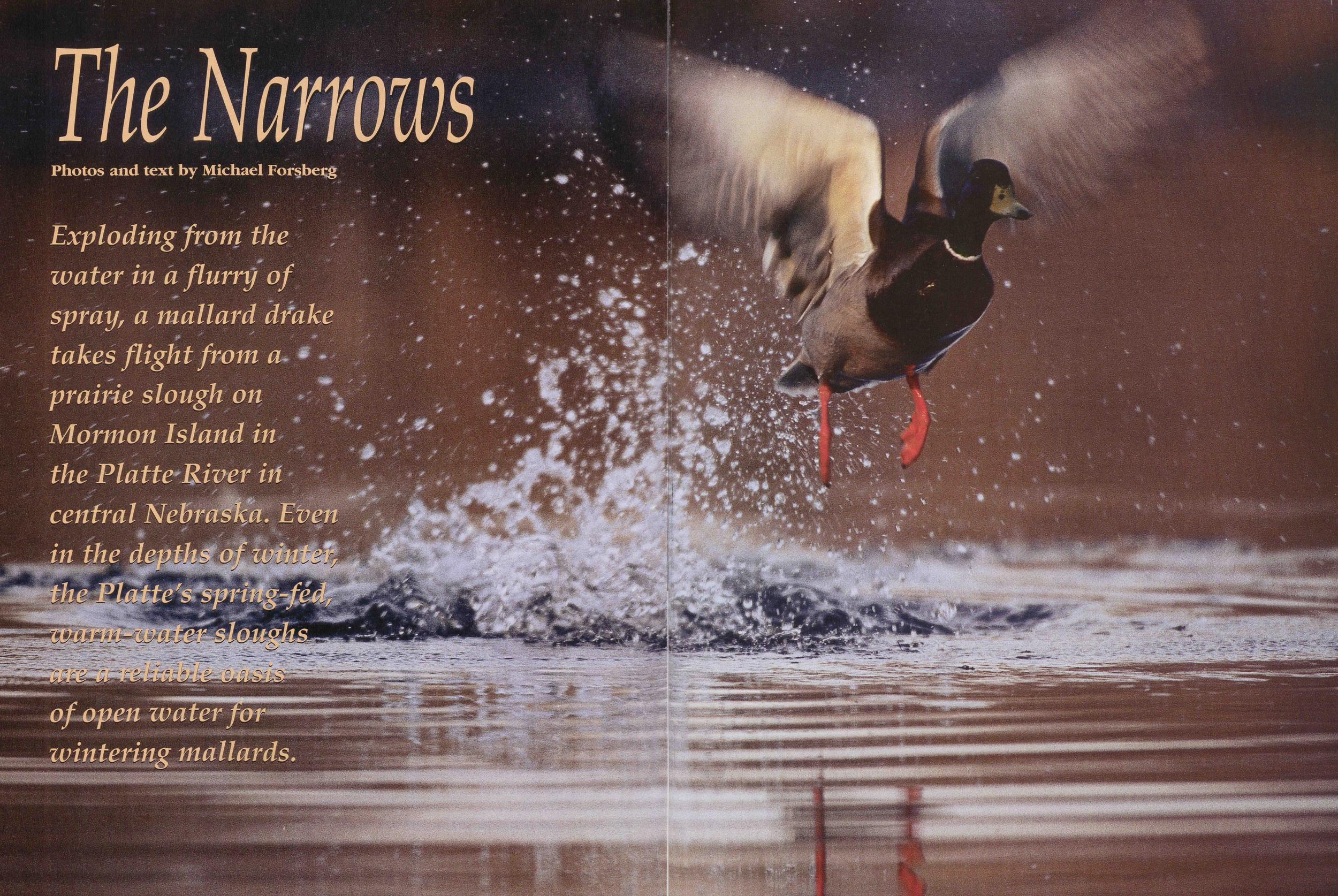
The Narrows
Photos and text by Michael Forsberg Exploding from the water in a flurry of spray, a mallard drake takes flight from a prairie slough on Mormon Island in the Platte River in central Nebraska. Even in the depths of winter the Platte's spring-fed warm-water sloughs are a reliable oasis of open water for wintering mallards.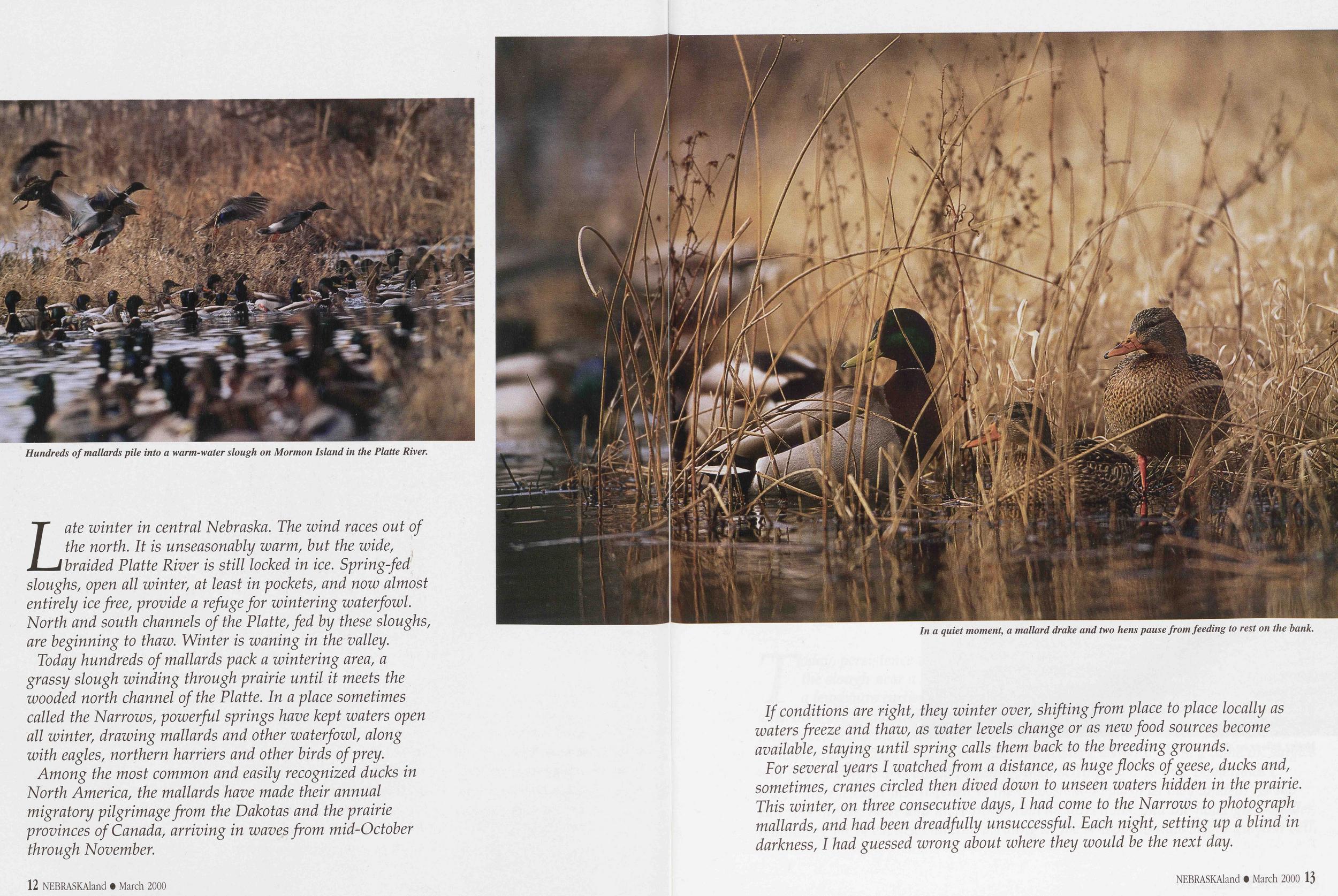
Late winter in central Nebraska. The wind races out of the north. It is unseasonably warm, but the wide, braided Platte River is still locked in ice. Spring-fed sloughs, open all winter, at least in pockets, and now almost entirely ice free, provide a refuge for wintering waterfowl. North and south channels of the Platte, fed by these sloughs, are beginning to thaw. Winter is waning in the valley.
Today hundreds of mallards pack a wintering area, a grassy slough winding through prairie until it meets the wooded north channel of the Platte. In a place sometimes called the Narrows, powerful springs have kept waters open all winter, drawing mallards and other waterfowl, along with eagles, northern harriers and other birds of prey.
Among the most common and easily recognized ducks in North America, the mallards have made their annual migratory pilgrimage from the Dakotas and the prairie provinces of Canada, arriving in waves from mid-October through November.
If conditions are right, they winter over, shifting from place to place locally as waters freeze and thaw, as water levels change or as new food sources become available, staying until spring calls them back to the breeding grounds.
For several years I watched from a distance, as huge flocks of geese, ducks and, sometimes, cranes circled then dived down to unseen waters hidden in the prairie. This winter, on three consecutive days, I had come to the Narrows to photograph mallards, and had been dreadfully unsuccessful. Each night, setting up a blind in darkness, I had guessed wrong about where they would be the next day.
12 NEBRASKAland • March 2000 NEBRASKAland • March 2000 13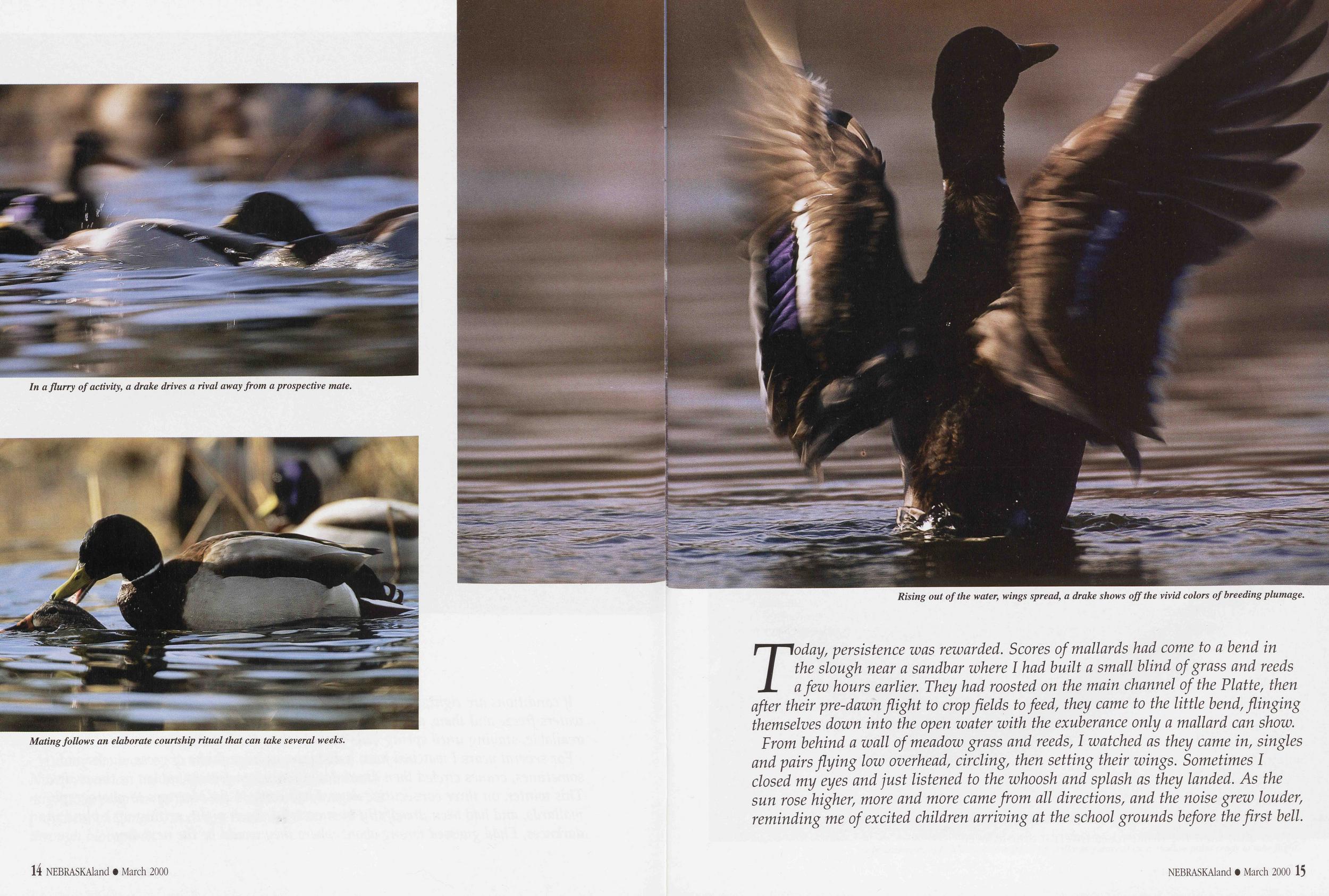
Today, persistence was rewarded. Scores of mallards had come to a bend in the slough near a sandbar where I had built a small blind of grass and reeds a few hours earlier. They had roosted on the main channel of the Platte, then after their pre-dawn flight to crop fields to feed, they came to the little bend, flinging themselves down into the open water with the exuberance only a mallard can show.
From behind a wall of meadow grass and reeds, I watched as they came in, singles and pairs flying low overhead, circling, then setting their wings. Sometimes I closed my eyes and just listened to the whoosh and splash as they landed. As the sun rose higher, more and more came from all directions, and the noise grew louder, reminding me of excited children arriving at the school grounds before the first bell.
14 NEBRASKAland • March 2000 NEBRASKAland • March 2000 15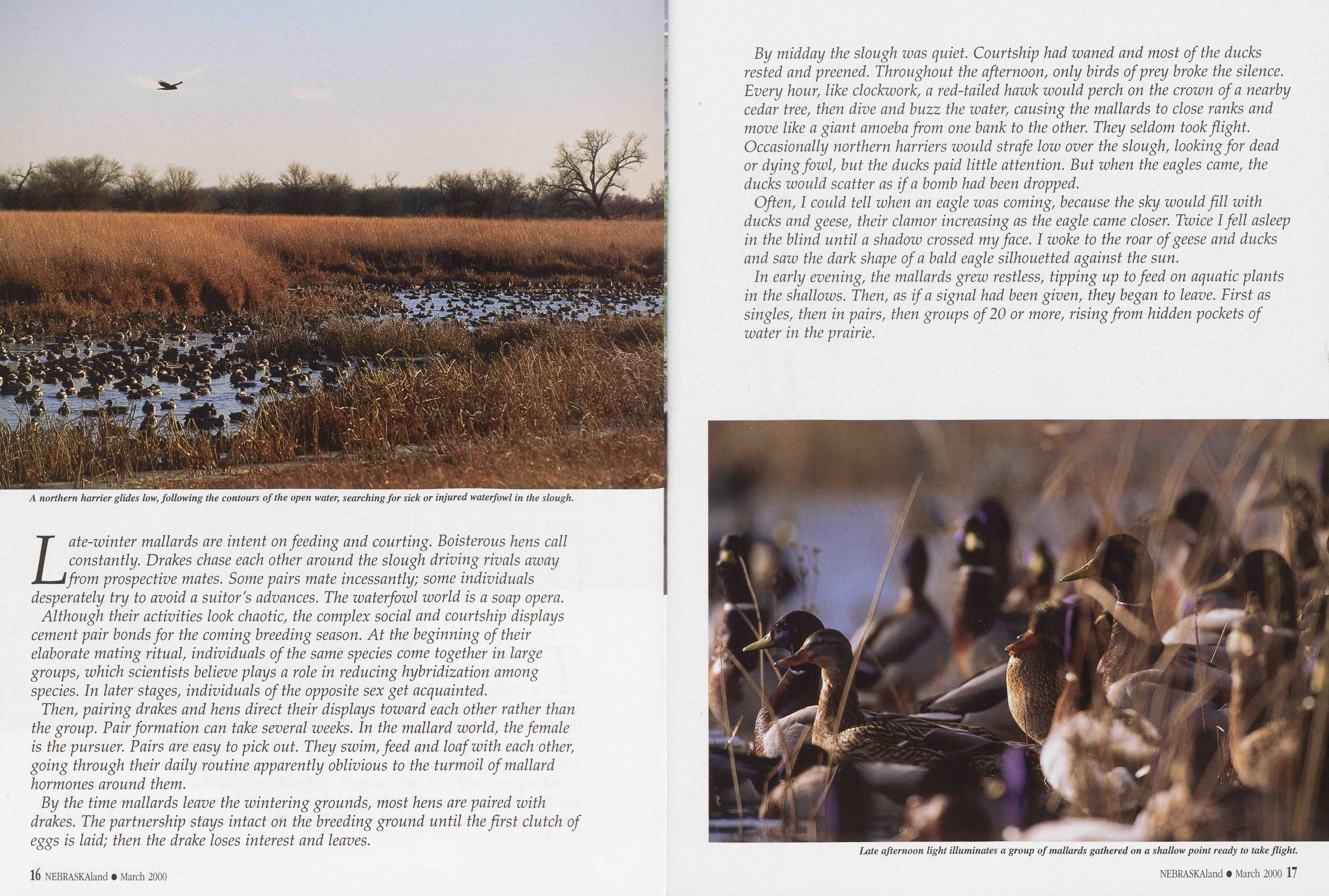
Late-winter mallards are intent on feeding and courting. Boisterous hens call constantly. Drakes chase each other around the slough driving rivals away from prospective mates. Some pairs mate incessantly; some individuals desperately try to avoid a suitor's advances. The waterfowl world is a soap opera.
Although their activities look chaotic, the complex social and courtship displays cement pair bonds for the coming breeding season. At the beginning of their elaborate mating ritual, individuals of the same species come together in large groups, which scientists believe plays a role in reducing hybridization among species. In later stages, individuals of the opposite sex get acquainted.
Then, pairing drakes and hens direct their displays toward each other rather than the group. Pair formation can take several weeks. In the mallard world, the female is the pursuer. Pairs are easy to pick out. They swim, feed and loaf with each other, going through their daily routine apparently oblivious to the turmoil of mallard hormones around them.
By the time mallards leave the wintering grounds, most hens are paired with drakes. The partnership stays intact on the breeding ground until the first clutch of eggs is laid; then the drake loses interest and leaves.
By midday the slough was quiet. Courtship had waned and most of the ducks rested and preened. Throughout the afternoon, only birds of prey broke the silence. Every hour, like clockwork, a red-tailed hawk would perch on the crown of a nearby cedar tree, then dive and buzz the water, causing the mallards to close ranks and move like a giant amoeba from one bank to the other. They seldom took flight. Occasionally northern harriers would strafe low over the slough, looking for dead or dying fowl, but the ducks paid little attention. But when the eagles came, the ducks would scatter as if a bomb had been dropped.
Often, I could tell when an eagle was coming, because the sky would fill with ducks and geese, their clamor increasing as the eagle came closer. Twice I fell asleep in the blind until a shadow crossed my face. I woke to the roar of geese and ducks and saw the dark shape of a bald eagle silhouetted against the sun.
In early evening, the mallards grew restless, tipping up to feed on aquatic plants in the shallows. Then, as if a signal had been given, they began to leave. First as singles, then in pairs, then groups of 20 or more, rising from hidden pockets of water in the prairie.
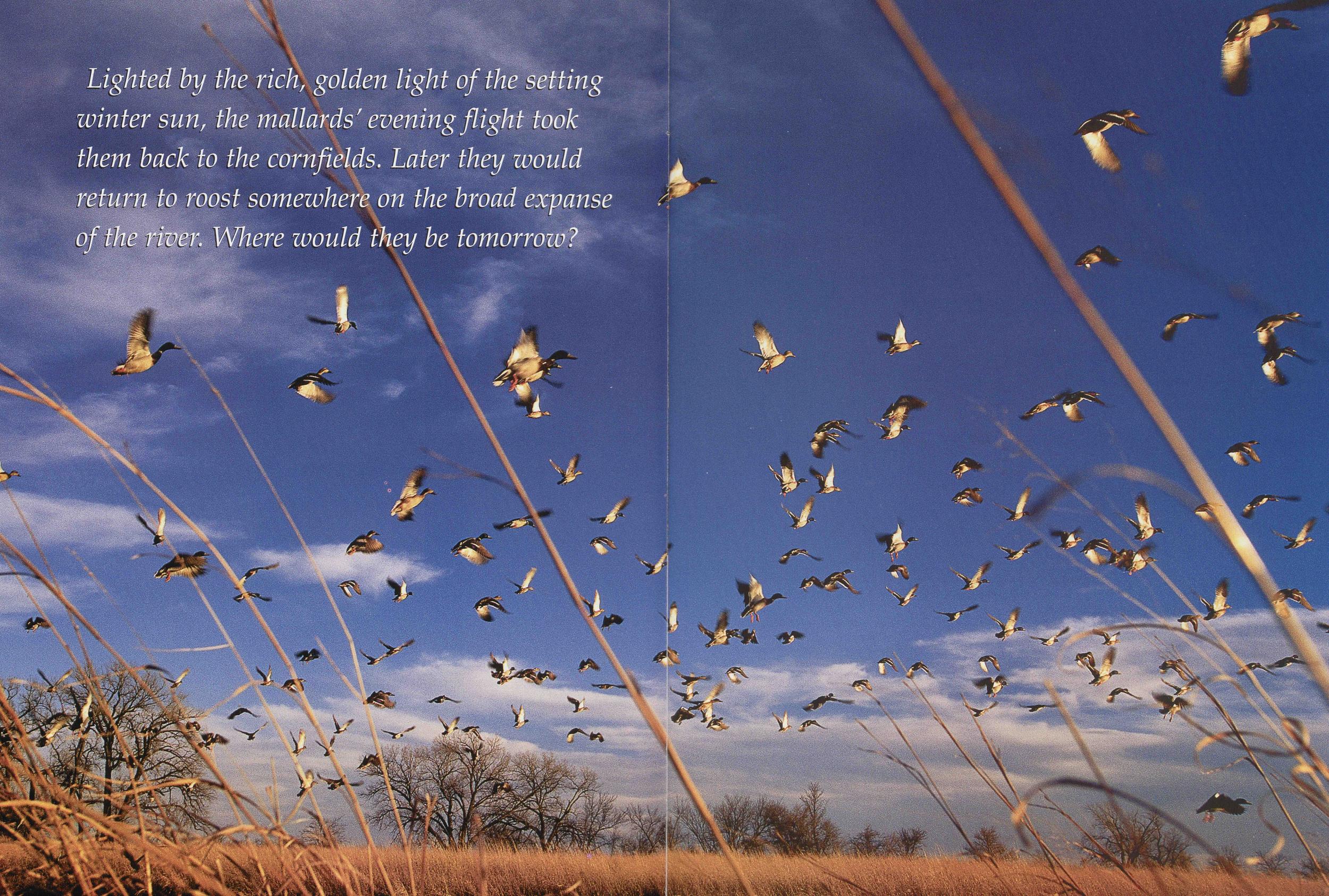 Lighted by the rich, golden light of the setting winter sun, the mallards' evening flight took them back to the cornfields. Later they would return to roost somewhere on the broad expanse of the river. Where would they be tomorrow?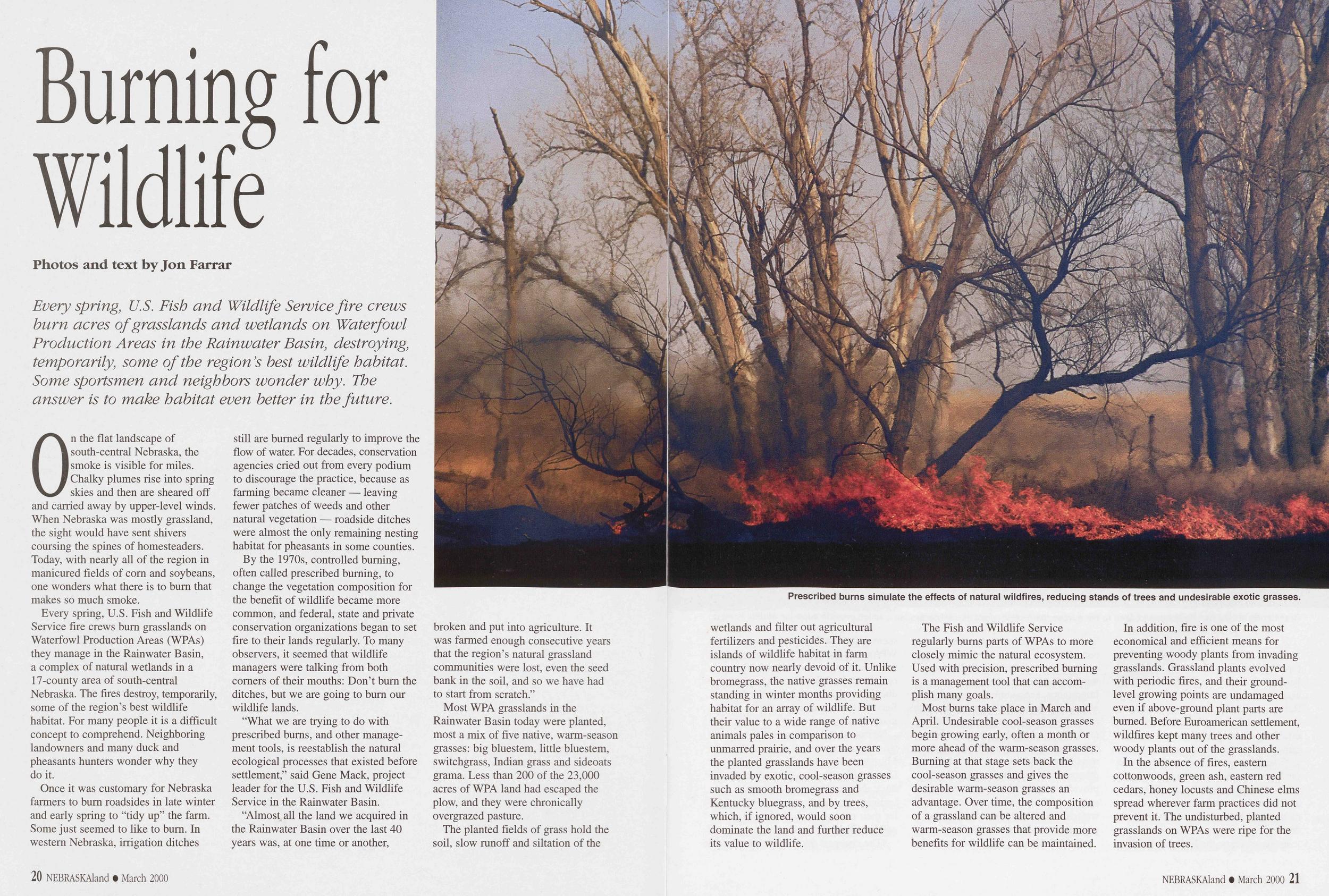
Burning for Wildlife
Photos and text by Jon Farrar Every spring, U.S. Fish and Wildlife Service fire crews burn acres of grasslands and wetlands on Waterfowl Production Areas in the Rainwater Basin, destroying, temporarily, some of the region s best wildlife habitat. Some sportsmen and neighbors wonder why. The answer is to make habitat even better in the future.On the flat landscape of south-central Nebraska, the smoke is visible for miles. Chalky plumes rise into spring skies and then are sheared off and carried away by upper-level winds. When Nebraska was mostly grassland, the sight would have sent shivers coursing the spines of homesteaders. Today, with nearly all of the region in manicured fields of com and soybeans, one wonders what there is to bum that makes so much smoke.
Every spring, U.S. Fish and Wildlife Service fire crews bum grasslands on Waterfowl Production Areas (WPAs) they manage in the Rainwater Basin, a complex of natural wetlands in a 17-county area of south-central Nebraska. The fires destroy, temporarily, some of the region’s best wildlife habitat. For many people it is a difficult concept to comprehend. Neighboring landowners and many duck and pheasants hunters wonder why they do it.
Once it was customary for Nebraska farmers to bum roadsides in late winter and early spring to “tidy up” the farm. Some just seemed to like to bum. In western Nebraska, irrigation ditches still are burned regularly to improve the flow of water. For decades, conservation agencies cried out from every podium to discourage the practice, because as farming became cleaner — leaving fewer patches of weeds and other natural vegetation — roadside ditches were almost the only remaining nesting habitat for pheasants in some counties.
By the 1970s, controlled burning, often called prescribed burning, to change the vegetation composition for the benefit of wildlife became more common, and federal, state and private conservation organizations began to set fire to their lands regularly. To many observers, it seemed that wildlife managers were talking from both comers of their mouths: Don’t bum the ditches, but we are going to bum our wildlife lands.
“What we are trying to do with prescribed bums, and other manage- ment tools, is reestablish the natural ecological processes that existed before settlement,” said Gene Mack, project leader for the U.S. Fish and Wildlife Service in the Rainwater Basin.
“Almost all the land we acquired in the Rainwater Basin over the last 40 years was, at one time or another, broken and put into agriculture. It was farmed enough consecutive years that the region’s natural grassland communities were lost, even the seed bank in the soil, and so we have had to start from scratch.”
Most WPA grasslands in the Rainwater Basin today were planted, most a mix of five native, warm-season grasses: big bluestem, little bluestem, switchgrass, Indian grass and sideoats grama. Less than 200 of the 23,000 acres of WPA land had escaped the plow, and they were chronically overgrazed pasture.
The planted fields of grass hold the soil, slow runoff and siltation of the wetlands and filter out agricultural fertilizers and pesticides. They are islands of wildlife habitat in farm country now nearly devoid of it. Unlike bromegrass, the native grasses remain standing in winter months providing habitat for an array of wildlife. But their value to a wide range of native animals pales in comparison to unmarred prairie, and over the years the planted grasslands have been invaded by exotic, cool-season grasses such as smooth bromegrass and Kentucky bluegrass, and by trees, which, if ignored, would soon dominate the land and further reduce its value to wildlife.
The Fish and Wildlife Service regularly bums parts of WPAs to more closely mimic the natural ecosystem. Used with precision, prescribed burning is a management tool that can accom- plish many goals.
Most bums take place in March and April. Undesirable cool-season grasses begin growing early, often a month or more ahead of the warm-season grasses. Burning at that stage sets back the cool-season grasses and gives the desirable warm-season grasses an advantage. Over time, the composition of a grassland can be altered and warm-season grasses that provide more benefits for wildlife can be maintained.
In addition, fire is one of the most economical and efficient means for preventing woody plants from invading grasslands. Grassland plants evolved with periodic fires, and their ground- level growing points are undamaged even if above-ground plant parts are burned. Before Euroamerican settlement, wildfires kept many trees and other woody plants out of the grasslands.
In the absence of fires, eastern cottonwoods, green ash, eastern red cedars, honey locusts and Chinese elms spread wherever farm practices did not prevent it. The undisturbed, planted grasslands on WPAs were ripe for the invasion of trees.
20 NEBRASKAland • March 2000 NEBRASKAland • March 2000 21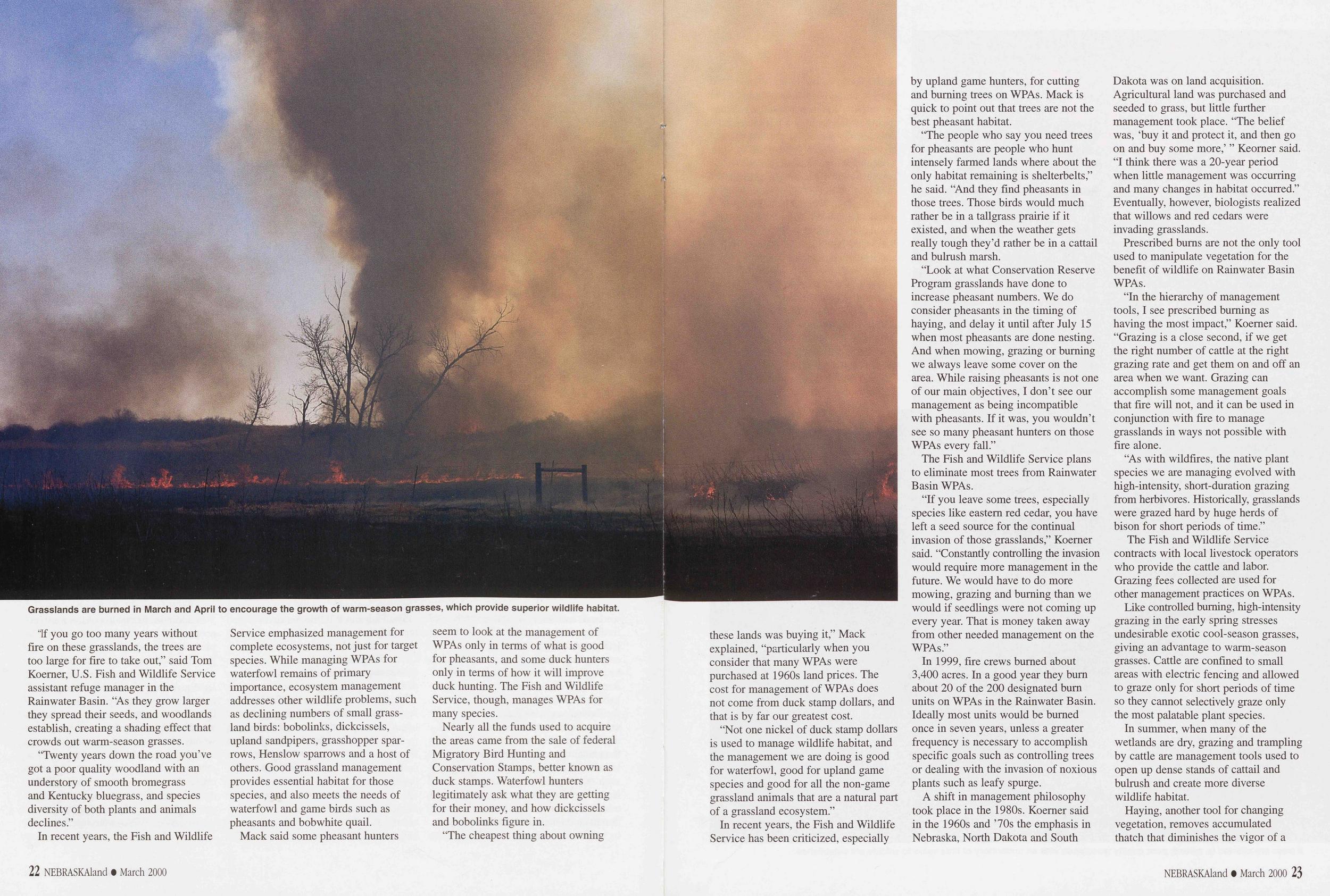
“If you go too many years without fire on these grasslands, the trees are too large for fire to take out,” said Tom Koerner, U.S. Fish and Wildlife Service assistant refuge manager in the Rainwater Basin. “As they grow larger they spread their seeds, and woodlands establish, creating a shading effect that crowds out warm-season grasses.
“Twenty years down the road you’ve got a poor quality woodland with an understory of smooth bromegrass and Kentucky bluegrass, and species diversity of both plants and animals declines.”
In recent years, the Fish and Wildlife Service emphasized management for complete ecosystems, not just for target species. While managing WPAs for waterfowl remains of primary importance, ecosystem management addresses other wildlife problems, such as declining numbers of small grass- land birds: bobolinks, dickcissels, upland sandpipers, grasshopper spar- rows, Henslow sparrows and a host of others. Good grassland management provides essential habitat for those species, and also meets the needs of waterfowl and game birds such as pheasants and bobwhite quail.
Mack said some pheasant hunters seem to look at the management of WPAs only in terms of what is good for pheasants, and some duck hunters only in terms of how it will improve duck hunting. The Fish and Wildlife Service, though, manages WPAs for many species.
Nearly all the funds used to acquire the areas came from the sale of federal Migratory Bird Hunting and Conservation Stamps, better known as duck stamps. Waterfowl hunters legitimately ask what they are getting for their money, and how dickcissels and bobolinks figure in.
“The cheapest thing about owning these lands was buying it,” Mack explained, “particularly when you consider that many WPAs were purchased at 1960s land prices. The cost for management of WPAs does not come from duck stamp dollars, and that is by far our greatest cost.
“Not one nickel of duck stamp dollars is used to manage wildlife habitat, and the management we are doing is good for waterfowl, good for upland game species and good for all the non-game grassland animals that are a natural part of a grassland ecosystem.”
In recent years, the Fish and Wildlife Service has been criticized, especially by upland game hunters, for cutting and burning trees on WPAs. Mack is quick to point out that trees are not the best pheasant habitat.
“The people who say you need trees for pheasants are people who hunt intensely farmed lands where about the only habitat remaining is shelterbelts” he said. “And they find pheasants in those trees. Those birds would much rather be in a tallgrass prairie if it existed, and when the weather gets really tough they’d rather be in a cattail and bulrush marsh.
“Look at what Conservation Reserve Program grasslands have done to increase pheasant numbers. We do consider pheasants in the timing of haying, and delay it until after July 15 when most pheasants are done nesting. And when mowing, grazing or burning we always leave some cover on the area. While raising pheasants is not one of our main objectives, I don’t see our management as being incompatible with pheasants. If it was, you wouldn’t see so many pheasant hunters on those WPAs every fall.”
The Fish and Wildlife Service plans to eliminate most trees from Rainwater Basin WPAs.
“If you leave some trees, especially species like eastern red cedar, you have left a seed source for the continual invasion of those grasslands,” Koerner said. “Constantly controlling the invasion would require more management in the future. We would have to do more mowing, grazing and burning than we would if seedlings were not coming up every year. That is money taken away from other needed management on the WPAs.”
In 1999, fire crews burned about 3,400 acres. In a good year they bum about 20 of the 200 designated bum units on WPAs in the Rainwater Basin. Ideally most units would be burned once in seven years, unless a greater frequency is necessary to accomplish specific goals such as controlling trees or dealing with the invasion of noxious plants such as leafy spurge.
A shift in management philosophy took place in the 1980s. Koerner said in the 1960s and ’70s the emphasis in Nebraska, North Dakota and South Dakota was on land acquisition. Agricultural land was purchased and seeded to grass, but little further management took place. “The belief was, ‘buy it and protect it, and then go on and buy some more,’ ” Keomer said. “I think there was a 20-year period when little management was occurring and many changes in habitat occurred.” Eventually, however, biologists realized that willows and red cedars were invading grasslands.
Prescribed bums are not the only tool used to manipulate vegetation for the benefit of wildlife on Rainwater Basin WPAs.
“In the hierarchy of management tools, I see prescribed burning as having the most impact,” Koerner said. “Grazing is a close second, if we get the right number of cattle at the right grazing rate and get them on and off an area when we want. Grazing can accomplish some management goals that fire will not, and it can be used in conjunction with fire to manage grasslands in ways not possible with fire alone.
“As with wildfires, the native plant species we are managing evolved with high-intensity, short-duration grazing from herbivores. Historically, grasslands were grazed hard by huge herds of bison for short periods of time.”
The Fish and Wildlife Service contracts with local livestock operators who provide the cattle and labor. Grazing fees collected are used for other management practices on WPAs.
Like controlled burning, high-intensity grazing in the early spring stresses undesirable exotic cool-season grasses, giving an advantage to warm-season grasses. Cattle are confined to small areas with electric fencing and allowed to graze only for short periods of time so they cannot selectively graze only the most palatable plant species.
In summer, when many of the wetlands are dry, grazing and trampling by cattle are management tools used to open up dense stands of cattail and bulrush and create more diverse wildlife habitat.
Haying, another tool for changing vegetation, removes accumulated thatch that diminishes the vigor of a 22 NEBRASKAland • March 2000 NEBRASKAland • March 2000 3 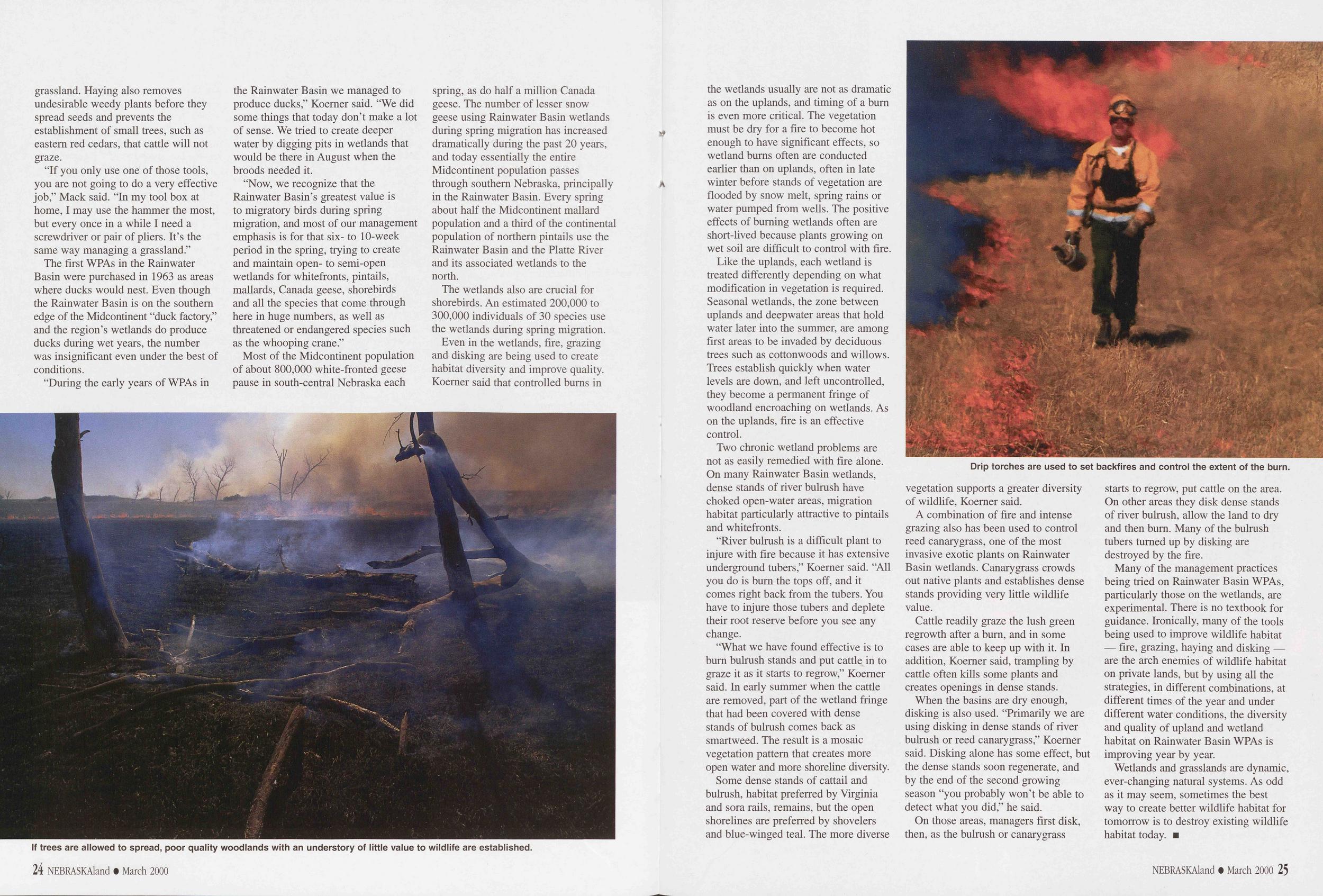 grassland. Haying also removes undesirable weedy plants before they spread seeds and prevents the establishment of small trees, such as eastern red cedars, that cattle will not graze.
"If you only use one of those tools, you are not going to do a very effective job,” Mack said. “In my tool box at home, I may use the hammer the most, but every once in a while I need a screwdriver or pair of pliers. It’s the same way managing a grassland.”
The first WPAs in the Rainwater Basin were purchased in 1963 as areas where ducks would nest. Even though the Rainwater Basin is on the southern edge of the Midcontinent "duck factory,” and the region’s wetlands do produce ducks during wet years, the number was insignificant even under the best of conditions.
"During the early years of WPAs in the Rainwater Basin we managed to produce ducks,” Koerner said. "We did some things that today don’t make a lot of sense. We tried to create deeper water by digging pits in wetlands that would be there in August when the broods needed it.
"Now, we recognize that the Rainwater Basin’s greatest value is to migratory birds during spring migration, and most of our management emphasis is for that six- to 10-week period in the spring, trying to create and maintain open- to semi-open wetlands for whitefronts, pintails, mallards, Canada geese, shorebirds and all the species that come through here in huge numbers, as well as threatened or endangered species such as the whooping crane.”
Most of the Midcontinent population of about 800,000 white-fronted geese pause in south-central Nebraska each spring, as do half a million Canada geese. The number of lesser snow geese using Rainwater Basin wetlands during spring migration has increased dramatically during the past 20 years, and today essentially the entire Midcontinent population passes through southern Nebraska, principally in the Rainwater Basin. Every spring about half the Midcontinent mallard population and a third of the continental population of northern pintails use the Rainwater Basin and the Platte River and its associated wetlands to the north.
The wetlands also are crucial for shorebirds. An estimated 200,000 to 300,000 individuals of 30 species use the wetlands during spring migration.
Even in the wetlands, fire, grazing and disking are being used to create habitat diversity and improve quality. Koerner said that controlled bums in the wetlands usually are not as dramatic as on the uplands, and timing of a bum is even more critical. The vegetation must be dry for a fire to become hot enough to have significant effects, so wetland bums often are conducted earlier than on uplands, often in late winter before stands of vegetation are flooded by snow melt, spring rains or water pumped from wells. The positive effects of burning wetlands often are short-lived because plants growing on wet soil are difficult to control with fire.
Like the uplands, each wetland is treated differently depending on what modification in vegetation is required. Seasonal wetlands, the zone between uplands and deepwater areas that hold water later into the summer, are among first areas to be invaded by deciduous trees such as cottonwoods and willows. Trees establish quickly when water levels are down, and left uncontrolled, they become a permanent fringe of woodland encroaching on wetlands. As on the uplands, fire is an effective control.
Two chronic wetland problems are not as easily remedied with fire alone. On many Rainwater Basin wetlands, dense stands of river bulrush have choked open-water areas, migration habitat particularly attractive to pintails and whitefronts.
"River bulrush is a difficult plant to injure with fire because it has extensive underground tubers,” Koerner said. "All you do is burn the tops off, and it comes right back from the tubers. You have to injure those tubers and deplete their root reserve before you see any change.
"What we have found effective is to bum bulrush stands and put cattle in to graze it as it starts to regrow,” Koerner said. In early summer when the cattle are removed, part of the wetland fringe that had been covered with dense stands of bulrush comes back as smartweed. The result is a mosaic vegetation pattern that creates more open water and more shoreline diversity.
Some dense stands of cattail and bulrush, habitat preferred by Virginia and sora rails, remains, but the open shorelines are preferred by shovelers and blue-winged teal. The more diverse vegetation supports a greater diversity of wildlife, Koerner said.
A combination of fire and intense grazing also has been used to control reed canarygrass, one of the most invasive exotic plants on Rainwater Basin wetlands. Canary grass crowds out native plants and establishes dense stands providing very little wildlife value.
Cattle readily graze the lush green regrowth after a bum, and in some cases are able to keep up with it. In addition, Koerner said, trampling by cattle often kills some plants and creates openings in dense stands.
When the basins are dry enough, disking is also used. "Primarily we are using disking in dense stands of river bulrush or reed canarygrass,” Koerner said. Disking alone has some effect, but the dense stands soon regenerate, and by the end of the second growing season "you probably won’t be able to detect what you did,” he said.
On those areas, managers first disk, then, as the bulrush or canarygrass starts to regrow, put cattle on the area. On other areas they disk dense stands of river bulrush, allow the land to dry and then bum. Many of the bulrush tubers turned up by disking are destroyed by the fire.
Many of the management practices being tried on Rainwater Basin WPAs, particularly those on the wetlands, are experimental. There is no textbook for guidance. Ironically, many of the tools being used to improve wildlife habitat — fire, grazing, haying and disking — are the arch enemies of wildlife habitat on private lands, but by using all the strategies, in different combinations, at different times of the year and under different water conditions, the diversity and quality of upland and wetland habitat on Rainwater Basin WPAs is improving year by year.
Wetlands and grasslands are dynamic, ever-changing natural systems. As odd as it may seem, sometimes the best way to create better wildlife habitat for tomorrow is to destroy existing wildlife habitat today. ■
24 NEBRASKAland • March 2000 NEBRASKAland • March 2000 25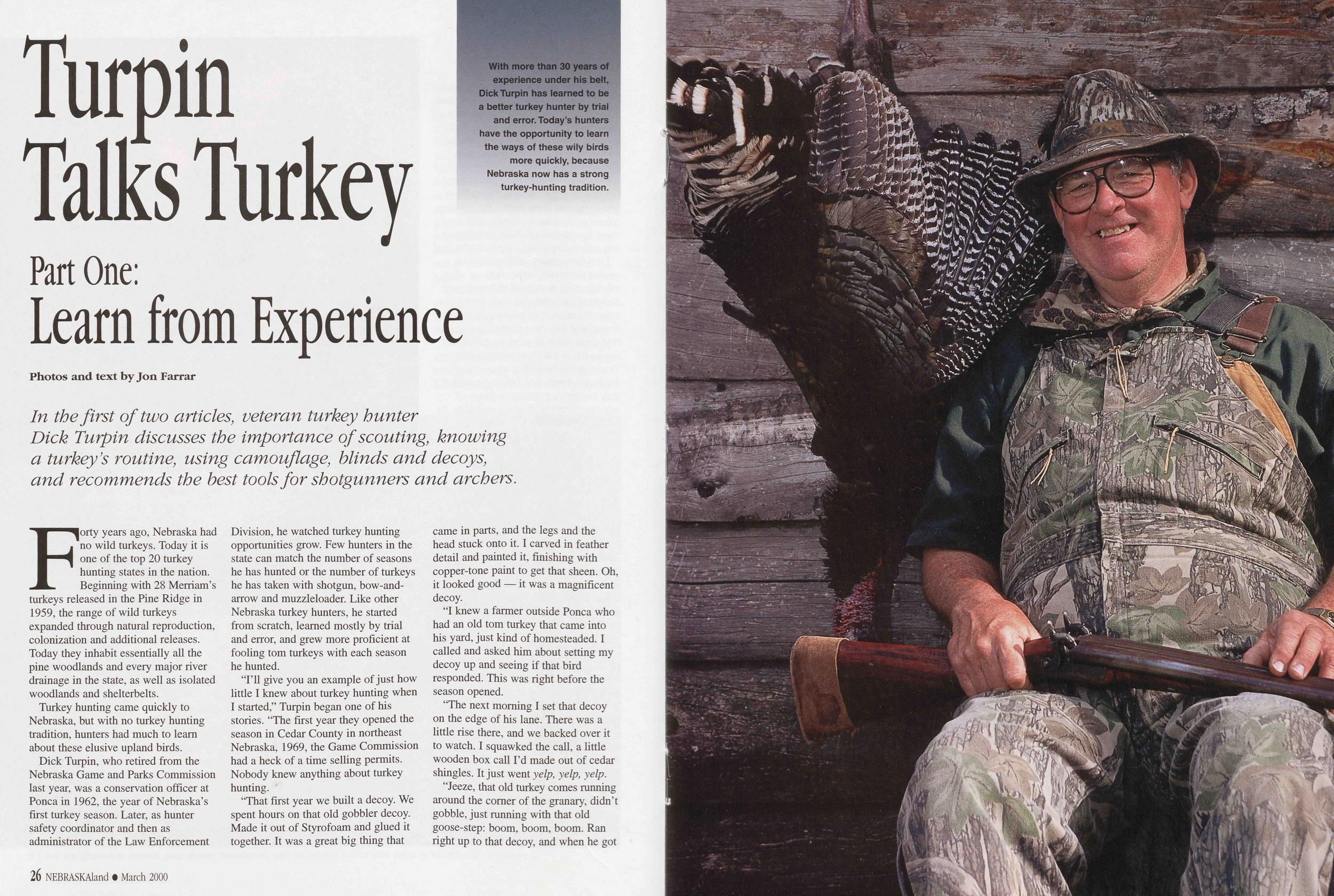
Turpin Talks Turkey
Part One: Learn from Experience Photos and text by Jon Farrar In the first of two articles, veteran turkey hunter Dick Turpin discusses the importance of scouting, knowing a turkey’s routine, using camouflage, blinds and decoys, and recommends the best tools for shotgunners and archers.Forty years ago, Nebraska had no wild turkeys. Today it is one of the top 20 turkey hunting states in the nation. Beginning with 28 Merriam’s turkeys released in the Pine Ridge in 1959, the range of wild turkeys expanded through natural reproduction, colonization and additional releases. Today they inhabit essentially all the pine woodlands and every major river drainage in the state, as well as isolated woodlands and shelterbelts.
Turkey hunting came quickly to Nebraska, but with no turkey hunting tradition, hunters had much to learn about these elusive upland birds.
Dick Turpin, who retired from the Nebraska Game and Parks Commission last year, was a conservation officer at Ponca in 1962, the year of Nebraska’s first turkey season. Later, as hunter safety coordinator and then as administrator of the Law Enforcement Division, he watched turkey hunting opportunities grow. Few hunters in the state can match the number of seasons he has hunted or the number of turkeys he has taken with shotgun, bow-and- arrow and muzzleloader. Like other Nebraska turkey hunters, he started from scratch, learned mostly by trial and error, and grew more proficient at fooling tom turkeys with each season he hunted.
"I’ll give you an example of just how little I knew about turkey hunting when I started,” Turpin began one of his stories. "The first year they opened the season in Cedar County in northeast Nebraska, 1969, the Game Commission had a heck of a time selling permits. Nobody knew anything about turkey hunting.
"That first year we built a decoy. We spent hours on that old gobbler decoy. Made it out of Styrofoam and glued it together. It was a great big thing that With more than 30 years of experience under his belt, Dick Turpin has learned to be a better turkey hunter by trial and error. Today’s hunters have the opportunity to learn the ways of these wily birds more quickly, because Nebraska now has a strong turkey-hunting tradition. came in parts, and the legs and the head stuck onto it. I carved in feather detail and painted it, finishing with copper-tone paint to get that sheen. Oh, it looked good — it was a magnificent decoy.
"I knew a farmer outside Ponca who had an old tom turkey that came into his yard, just kind of homesteaded. I called and asked him about setting my decoy up and seeing if that bird responded. This was right before the season opened.
"The next morning I set that decoy on the edge of his lane. There was a little rise there, and we backed over it to watch. I squawked the call, a little wooden box call I’d made out of cedar shingles. It just went yelp, yelp, yelp.
"Jeeze, that old turkey comes running around the comer of the granary, didn’t gobble, just running with that old goose-step: boom, boom, boom. Ran right up to that decoy, and when he got 26 NEBRASKAland • March 2000 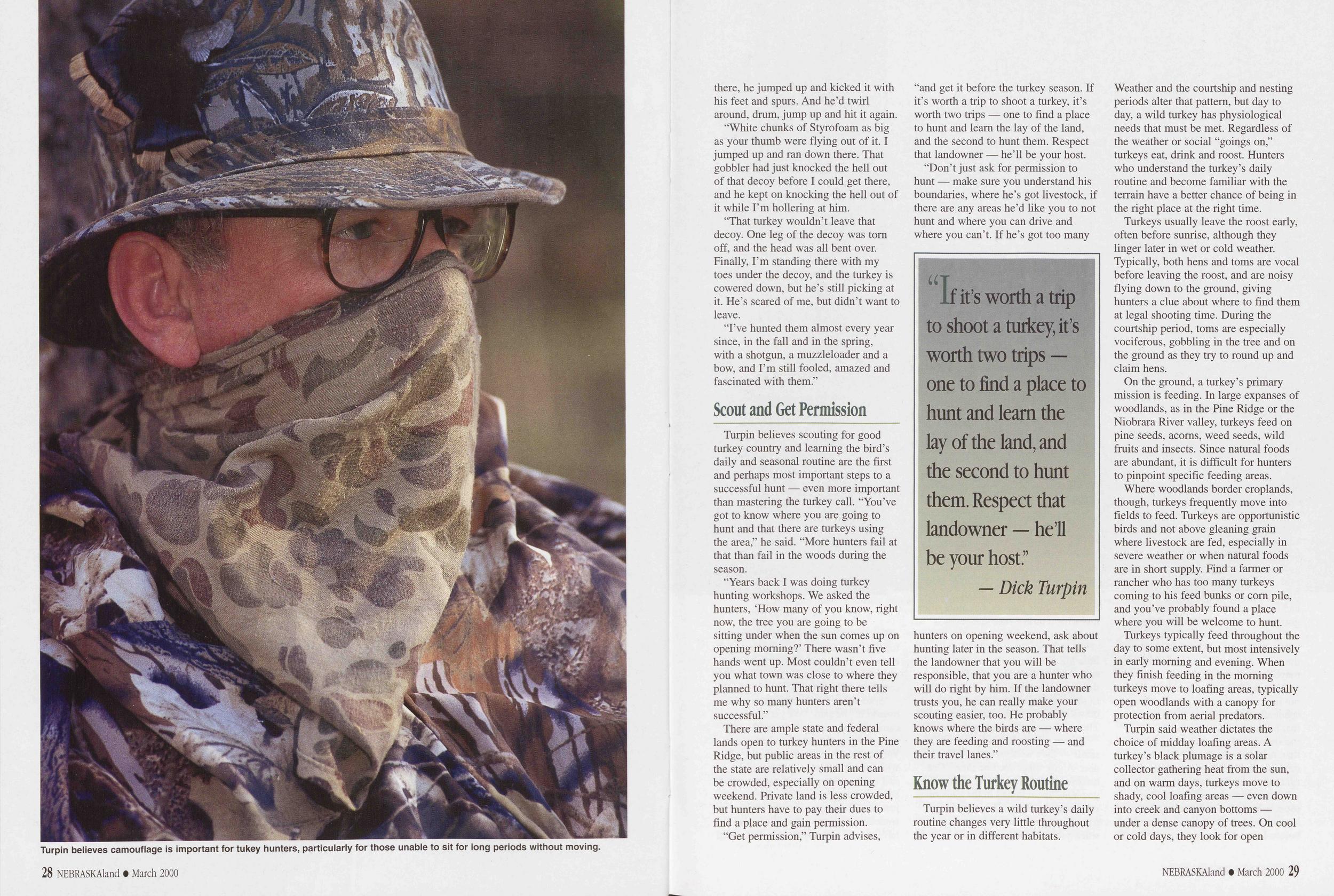 there, he jumped up and kicked it with his feet and spurs. And he’d twirl around, drum, jump up and hit it again.
“White chunks of Styrofoam as big as your thumb were flying out of it. I jumped up and ran down there. That gobbler had just knocked the hell out of that decoy before I could get there, and he kept on knocking the hell out of it while I’m hollering at him.
“That turkey wouldn’t leave that decoy. One leg of the decoy was torn off, and the head was all bent over. Finally, I’m standing there with my toes under the decoy, and the turkey is cowered down, but he’s still picking at it. He’s scared of me, but didn’t want to leave.
“I’ve hunted them almost every year since, in the fall and in the spring, with a shotgun, a muzzleloader and a bow, and I’m still fooled, amazed and fascinated with them.”
Scout and Get PermissionTurpin believes scouting for good turkey country and learning the bird’s daily and seasonal routine are the first and perhaps most important steps to a successful hunt — even more important than mastering the turkey call. “You’ve got to know where you are going to hunt and that there are turkeys using the area,” he said. “More hunters fail at that than fail in the woods during the season.
“Years back I was doing turkey hunting workshops. We asked the hunters, ‘How many of you know, right now, the tree you are going to be sitting under when the sun comes up on opening morning?’ There wasn’t five hands went up. Most couldn’t even tell you what town was close to where they planned to hunt. That right there tells me why so many hunters aren’t successful.”
There are ample state and federal lands open to turkey hunters in the Pine Ridge, but public areas in the rest of the state are relatively small and can be crowded, especially on opening weekend. Private land is less crowded, but hunters have to pay their dues to find a place and gain permission.
“Get permission,” Turpin advises, “and get it before the turkey season. If it’s worth a trip to shoot a turkey, it’s worth two trips — one to find a place to hunt and learn the lay of the land, and the second to hunt them. Respect that landowner — he’ll be your host.
“Don’t just ask for permission to hunt — make sure you understand his boundaries, where he’s got livestock, if there are any areas he’d like you to not hunt and where you can drive and where you can’t. If he’s got too many hunters on opening weekend, ask about hunting later in the season. That tells the landowner that you will be responsible, that you are a hunter who will do right by him. If the landowner trusts you, he can really make your scouting easier, too. He probably knows where the birds are — where they are feeding and roosting — and their travel lanes.”
If it’s worth a trip to shoot a turkey, it’s worth two trips — one to find a place to hunt and learn the lay of the land, and the second to hunt them. Respect that landowner — he’ll be your host.” — Dick Turpin Know the Turkey RoutineTurpin believes a wild turkey’s daily routine changes very little throughout the year or in different habitats. Weather and the courtship and nesting periods alter that pattern, but day to day, a wild turkey has physiological needs that must be met. Regardless of the weather or social “goings on,” turkeys eat, drink and roost. Hunters who understand the turkey’s daily routine and become familiar with the terrain have a better chance of being in the right place at the right time.
Turkeys usually leave the roost early, often before sunrise, although they linger later in wet or cold weather. Typically, both hens and toms are vocal before leaving the roost, and are noisy flying down to the ground, giving hunters a clue about where to find them at legal shooting time. During the courtship period, toms are especially vociferous, gobbling in the tree and on the ground as they try to round up and claim hens.
On the ground, a turkey’s primary mission is feeding. In large expanses of woodlands, as in the Pine Ridge or the Niobrara River valley, turkeys feed on pine seeds, acorns, weed seeds, wild fruits and insects. Since natural foods are abundant, it is difficult for hunters to pinpoint specific feeding areas.
Where woodlands border croplands, though, turkeys frequently move into fields to feed. Turkeys are opportunistic birds and not above gleaning grain where livestock are fed, especially in severe weather or when natural foods are in short supply. Find a farmer or rancher who has too many turkeys coming to his feed bunks or com pile, and you’ve probably found a place where you will be welcome to hunt.
Turkeys typically feed throughout the day to some extent, but most intensively in early morning and evening. When they finish feeding in the morning turkeys move to loafing areas, typically open woodlands with a canopy for protection from aerial predators.
Turpin said weather dictates the choice of midday loafing areas. A turkey’s black plumage is a solar collector gathering heat from the sun, and on warm days, turkeys move to shady, cool loafing areas — even down into creek and canyon bottoms — under a dense canopy of trees. On cool or cold days, they look for open 28 NEBRASKAland • March 2000 NEBRASKAland • March 2000 29 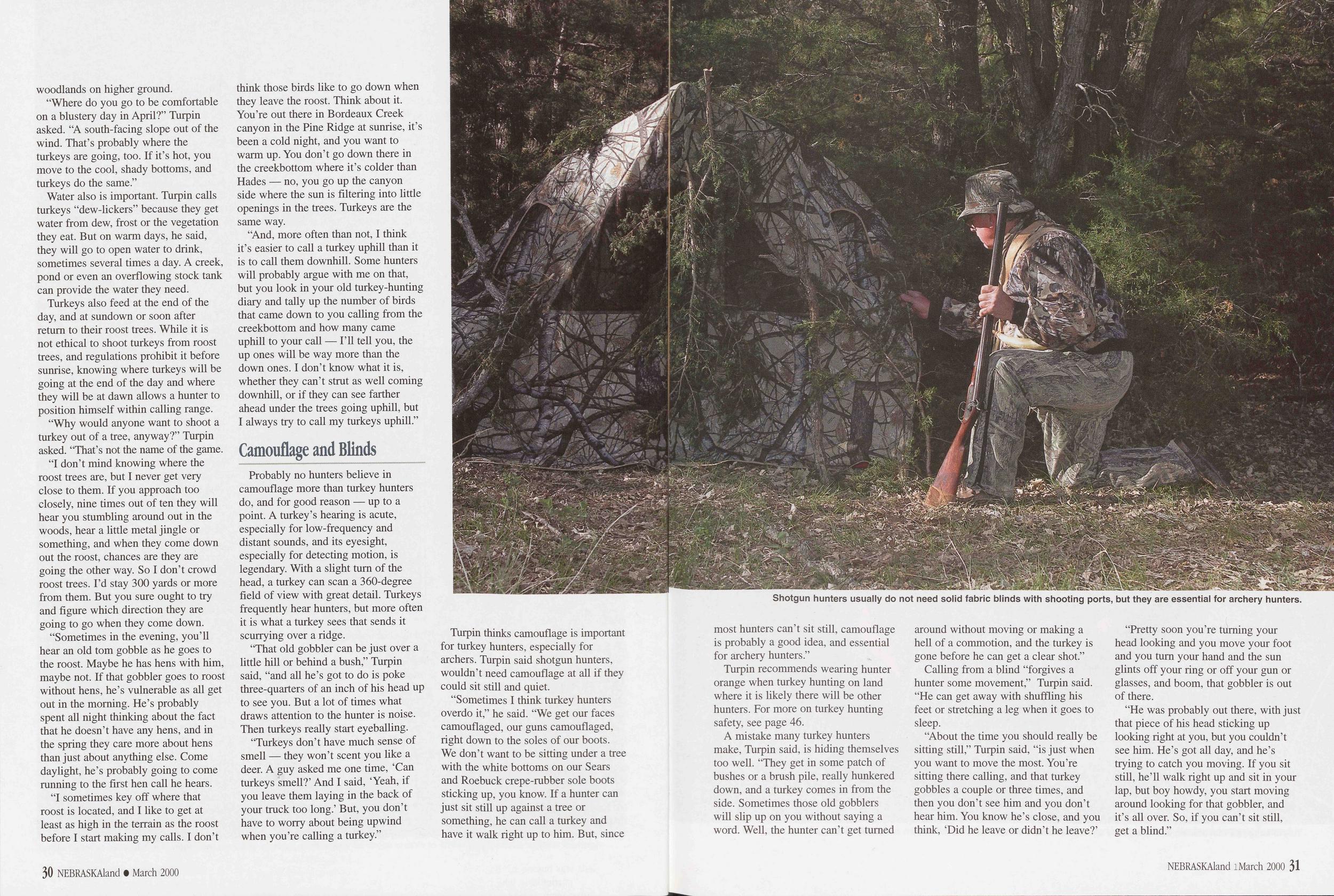 woodlands on higher ground.
“Where do you go to be comfortable on a blustery day in April?” Turpin asked. "A south-facing slope out of the wind. That’s probably where the turkeys are going, too. If it’s hot, you move to the cool, shady bottoms, and turkeys do the same.”
Water also is important. Turpin calls turkeys “dew-lickers” because they get water from dew, frost or the vegetation they eat. But on warm days, he said, they will go to open water to drink, sometimes several times a day. A creek, pond or even an overflowing stock tank can provide the water they need.
Turkeys also feed at the end of the day, and at sundown or soon after return to their roost trees. While it is not ethical to shoot turkeys from roost trees, and regulations prohibit it before sunrise, knowing where turkeys will be going at the end of the day and where they will be at dawn allows a hunter to position himself within calling range.
“Why would anyone want to shoot a turkey out of a tree, anyway?” Turpin asked. “That’s not the name of the game.
“I don’t mind knowing where the roost trees are, but I never get very close to them. If you approach too closely, nine times out of ten they will hear you stumbling around out in the woods, hear a little metal jingle or something, and when they come down out the roost, chances are they are going the other way. So I don’t crowd roost trees. I’d stay 300 yards or more from them. But you sure ought to try and figure which direction they are going to go when they come down.
“Sometimes in the evening, you’ll hear an old tom gobble as he goes to the roost. Maybe he has hens with him, maybe not. If that gobbler goes to roost without hens, he’s vulnerable as all get out in the morning. He’s probably spent all night thinking about the fact that he doesn’t have any hens, and in the spring they care more about hens than just about anything else. Come daylight, he’s probably going to come running to the first hen call he hears.
“I sometimes key off where that roost is located, and I like to get at least as high in the terrain as the roost before I start making my calls. I don’t think those birds like to go down when they leave the roost. Think about it. You’re out there in Bordeaux Creek canyon in the Pine Ridge at sunrise, it’s been a cold night, and you want to warm up. You don’t go down there in the creekbottom where it’s colder than Hades — no, you go up the canyon side where the sun is filtering into little openings in the trees. Turkeys are the same way.
“And, more often than not, I think it’s easier to call a turkey uphill than it is to call them downhill. Some hunters will probably argue with me on that, but you look in your old turkey-hunting diary and tally up the number of birds that came down to you calling from the creekbottom and how many came uphill to your call — I’ll tell you, the up ones will be way more than the down ones. I don’t know what it is, whether they can’t strut as well coming downhill, or if they can see farther ahead under the trees going uphill, but I always try to call my turkeys uphill.”
Camouflage and BlindsProbably no hunters believe in camouflage more than turkey hunters do, and for good reason — up to a point. A turkey’s hearing is acute, especially for low-frequency and distant sounds, and its eyesight, especially for detecting motion, is legendary. With a slight turn of the head, a turkey can scan a 360-degree field of view with great detail. Turkeys frequently hear hunters, but more often it is what a turkey sees that sends it scurrying over a ridge.
“That old gobbler can be just over a little hill or behind a bush,” Turpin said, “and all he’s got to do is poke three-quarters of an inch of his head up to see you. But a lot of times what draws attention to the hunter is noise. Then turkeys really start eyeballing.
“Turkeys don’t have much sense of smell — they won’t scent you like a deer. A guy asked me one time, ‘Can turkeys smell?’ And I said, ‘Yeah, if you leave them laying in the back of your truck too long.’ But, you don’t have to worry about being upwind when you’re calling a turkey.”
Turpin thinks camouflage is important for turkey hunters, especially for archers. Turpin said shotgun hunters, wouldn’t need camouflage at all if they could sit still and quiet.
“Sometimes I think turkey hunters overdo it,” he said. “We get our faces camouflaged, our guns camouflaged, right down to the soles of our boots. We don’t want to be sitting under a tree with the white bottoms on our Sears and Roebuck crepe-rubber sole boots sticking up, you know. If a hunter can just sit still up against a tree or something, he can call a turkey and have it walk right up to him. But, since most hunters can’t sit still, camouflage is probably a good idea, and essential for archery hunters.”
Turpin recommends wearing hunter orange when turkey hunting on land where it is likely there will be other hunters. For more on turkey hunting safety, see page 46.
A mistake many turkey hunters make, Turpin said, is hiding themselves too well. “They get in some patch of bushes or a brush pile, really hunkered down, and a turkey comes in from the side. Sometimes those old gobblers will slip up on you without saying a word. Well, the hunter can’t get turned around without moving or making a hell of a commotion, and the turkey is gone before he can get a clear shot.”
Calling from a blind “forgives a hunter some movement,” Turpin said. “He can get away with shuffling his feet or stretching a leg when it goes to sleep.
“About the time you should really be sitting still,” Turpin said, “is just when you want to move the most. You’re sitting there calling, and that turkey gobbles a couple or three times, and then you don’t see him and you don’t hear him. You know he’s close, and you think, ‘Did he leave or didn’t he leave?’
“Pretty soon you’re turning your head looking and you move your foot and you turn your hand and the sun glints off your ring or off your gun or glasses, and boom, that gobbler is out of there.
“He was probably out there, with just that piece of his head sticking up looking right at you, but you couldn’t see him. He’s got all day, and he’s trying to catch you moving. If you sit still, he’ll walk right up and sit in your lap, but boy howdy, you start moving around looking for that gobbler, and it’s all over. So, if you can’t sit still, get a blind.”
30 NEBRASKAland • March 2000 NEBRASKAland iMarch 2000 31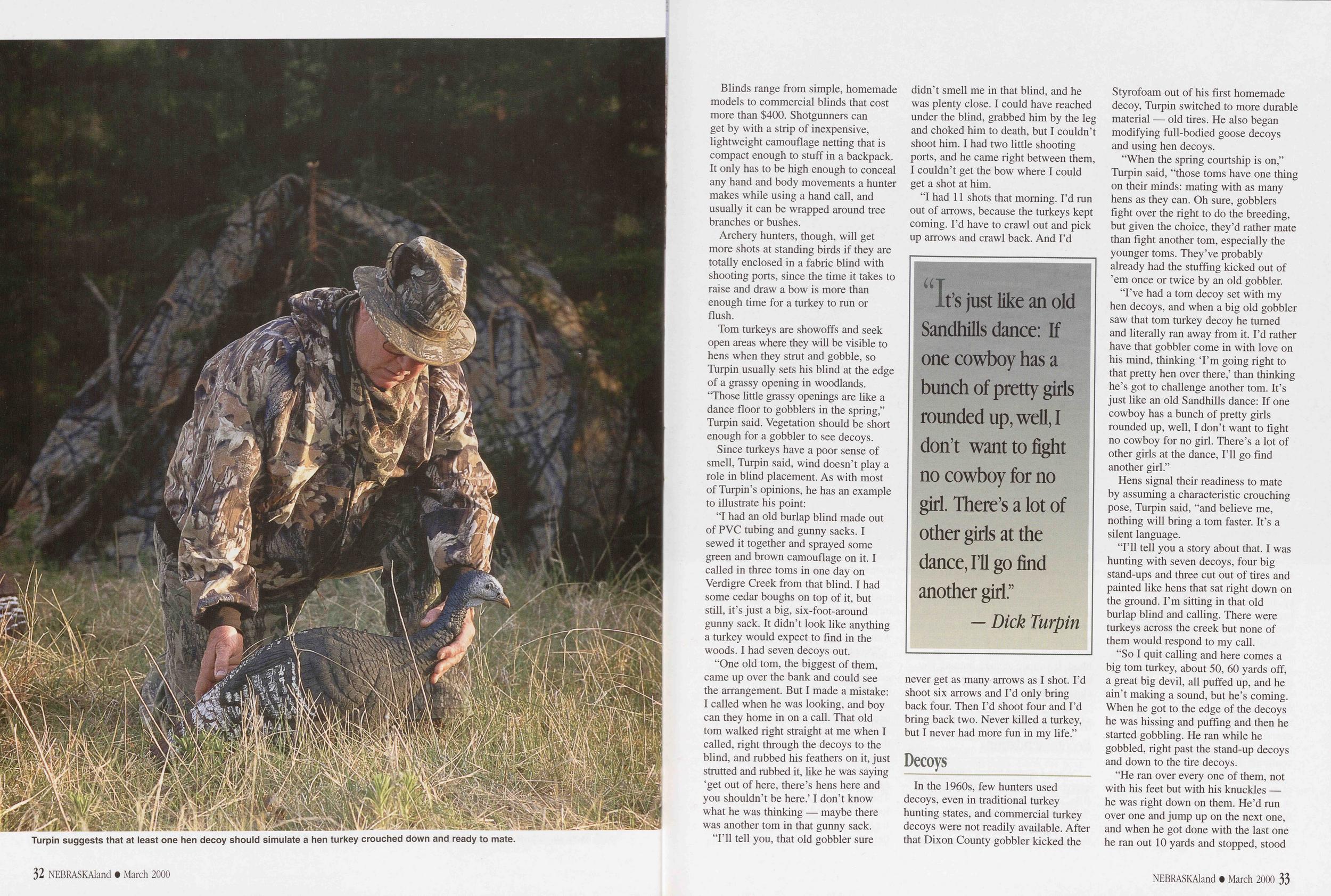
Blinds range from simple, homemade models to commercial blinds that cost more than $400. Shotgunners can get by with a strip of inexpensive, lightweight camouflage netting that is compact enough to stuff in a backpack. It only has to be high enough to conceal any hand and body movements a hunter makes while using a hand call, and usually it can be wrapped around tree branches or bushes.
Archery hunters, though, will get more shots at standing birds if they are totally enclosed in a fabric blind with shooting ports, since the time it takes to raise and draw a bow is more than enough time for a turkey to run or flush.
Tom turkeys are showoffs and seek open areas where they will be visible to hens when they strut and gobble, so Turpin usually sets his blind at the edge of a grassy opening in woodlands. “Those little grassy openings are like a dance floor to gobblers in the spring,” Turpin said. Vegetation should be short enough for a gobbler to see decoys.
Since turkeys have a poor sense of smell, Turpin said, wind doesn’t play a role in blind placement. As with most of Turpin’s opinions, he has an example to illustrate his point:
“I had an old burlap blind made out of PVC tubing and gunny sacks. I sewed it together and sprayed some green and brown camouflage on it. I called in three toms in one day on Verdigre Creek from that blind. I had some cedar boughs on top of it, but still, it’s just a big, six-foot-around gunny sack. It didn’t look like anything a turkey would expect to find in the woods. I had seven decoys out.
“One old tom, the biggest of them, came up over the bank and could see the arrangement. But I made a mistake: I called when he was looking, and boy can they home in on a call. That old tom walked right straight at me when I called, right through the decoys to the blind, and rubbed his feathers on it, just strutted and rubbed it, like he was saying ‘get out of here, there’s hens here and you shouldn’t be here.’ I don’t know what he was thinking — maybe there was another tom in that gunny sack.
“I'll tell you, that old gobbler sure didn’t smell me in that blind, and he was plenty close. I could have reached under the blind, grabbed him by the leg and choked him to death, but I couldn’t shoot him. I had two little shooting ports, and he came right between them, I couldn’t get the bow where I could get a shot at him.
“I had 11 shots that morning. I’d run out of arrows, because the turkeys kept coming. I’d have to crawl out and pick up arrows and crawl back. And I’d never get as many arrows as I shot. I’d shoot six arrows and I’d only bring back four. Then I’d shoot four and I’d bring back two. Never killed a turkey, but I never had more fun in my life.”
"It’s just like an old Sandhills dance: If one cowboy has a bunch of pretty girls rounded up, well, I don’t want to fight no cowboy for no girl. There’s a lot of other girls at the dance, I’ll go find another girl.” — Dick Turpin DecoysIn the 1960s, few hunters used decoys, even in traditional turkey hunting states, and commercial turkey decoys were not readily available. After that Dixon County gobbler kicked the Styrofoam out of his first homemade decoy, Turpin switched to more durable material — old tires. He also began modifying full-bodied goose decoys and using hen decoys.
“When the spring courtship is on,” Turpin said, “those toms have one thing on their minds: mating with as many hens as they can. Oh sure, gobblers fight over the right to do the breeding, but given the choice, they’d rather mate than fight another tom, especially the younger toms. They’ve probably already had the stuffing kicked out of ’em once or twice by an old gobbler.
“I’ve had a tom decoy set with my hen decoys, and when a big old gobbler saw that tom turkey decoy he turned and literally ran away from it. I’d rather have that gobbler come in with love on his mind, thinking ‘I’m going right to that pretty hen over there,’ than thinking he’s got to challenge another tom. It’s just like an old Sandhills dance: If one cowboy has a bunch of pretty girls rounded up, well, I don’t want to fight no cowboy for no girl. There’s a lot of other girls at the dance, I’ll go find another girl.”
Hens signal their readiness to mate by assuming a characteristic crouching pose, Turpin said, “and believe me, nothing will bring a tom faster. It’s a silent language.
“I’ll tell you a story about that. I was hunting with seven decoys, four big stand-ups and three cut out of tires and painted like hens that sat right down on the ground. I’m sitting in that old burlap blind and calling. There were turkeys across the creek but none of them would respond to my call.
“So I quit calling and here comes a big tom turkey, about 50, 60 yards off, a great big devil, all puffed up, and he ain’t making a sound, but he’s coming. When he got to the edge of the decoys he was hissing and puffing and then he started gobbling. He ran while he gobbled, right past the stand-up decoys and down to the tire decoys.
“He ran over every one of them, not with his feet but with his knuckles — he was right down on them. He’d run over one and jump up on the next one, and when he got done with the last one he ran out 10 yards and stopped, stood 32 NEBRASKAland • March 2000 NEBRASKAland • March 2000 33 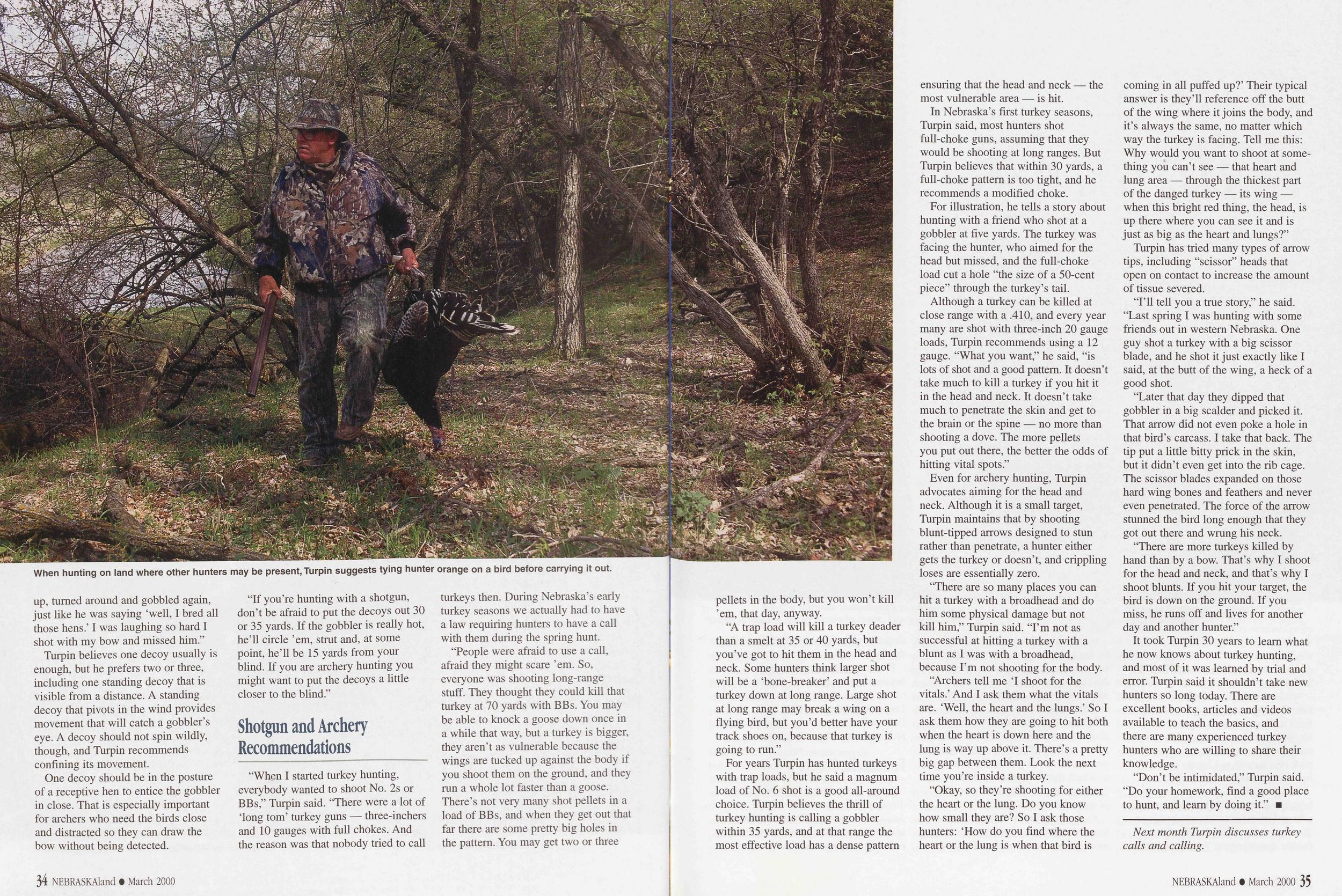 up, turned around and gobbled again, just like he was saying ‘well, I bred all those hens.’ I was laughing so hard I shot with my bow and missed him.”
Turpin believes one decoy usually is enough, but he prefers two or three, including one standing decoy that is visible from a distance. A standing decoy that pivots in the wind provides movement that will catch a gobbler’s eye. A decoy should not spin wildly, though, and Turpin recommends confining its movement.
One decoy should be in the posture of a receptive hen to entice the gobbler in close. That is especially important for archers who need the birds close and distracted so they can draw the bow without being detected.
“If you’re hunting with a shotgun, don’t be afraid to put the decoys out 30 or 35 yards. If the gobbler is really hot, he’ll circle ’em, strut and, at some point, he’ll be 15 yards from your blind. If you are archery hunting you might want to put the decoys a little closer to the blind.”
Shotgun and Archery Recommendations“When I started turkey hunting, everybody wanted to shoot No. 2s or BBs,” Turpin said. “There were a lot of ‘long tom’ turkey guns — three-inchers and 10 gauges with full chokes. And the reason was that nobody tried to call turkeys then. During Nebraska’s early turkey seasons we actually had to have a law requiring hunters to have a call with them during the spring hunt.
“People were afraid to use a call, afraid they might scare ’em. So, everyone was shooting long-range stuff. They thought they could kill that turkey at 70 yards with BBs. You may be able to knock a goose down once in a while that way, but a turkey is bigger, they aren’t as vulnerable because the wings are tucked up against the body if you shoot them on the ground, and they run a whole lot faster than a goose. There’s not very many shot pellets in a load of BBs, and when they get out that far there are some pretty big holes in the pattern. You may get two or three pellets in the body, but you won’t kill ’em, that day, anyway.
“A trap load will kill a turkey deader than a smelt at 35 or 40 yards, but you’ve got to hit them in the head and neck. Some hunters think larger shot will be a ‘bone-breaker’ and put a turkey down at long range. Large shot at long range may break a wing on a flying bird, but you’d better have your track shoes on, because that turkey is going to run.”
For years Turpin has hunted turkeys with trap loads, but he said a magnum load of No. 6 shot is a good all-around choice. Turpin believes the thrill of turkey hunting is calling a gobbler within 35 yards, and at that range the most effective load has a dense pattern ensuring that the head and neck — the most vulnerable area — is hit.
In Nebraska’s first turkey seasons, Turpin said, most hunters shot full-choke guns, assuming that they would be shooting at long ranges. But Turpin believes that within 30 yards, a full-choke pattern is too tight, and he recommends a modified choke.
For illustration, he tells a story about hunting with a friend who shot at a gobbler at five yards. The turkey was facing the hunter, who aimed for the head but missed, and the full-choke load cut a hole “the size of a 50-cent piece” through the turkey’s tail.
Although a turkey can be killed at close range with a .410, and every year many are shot with three-inch 20 gauge loads, Turpin recommends using a 12 gauge. “What you want,” he said, “is lots of shot and a good pattern. It doesn’t take much to kill a turkey if you hit it in the head and neck. It doesn’t take much to penetrate the skin and get to the brain or the spine — no more than shooting a dove. The more pellets you put out there, the better the odds of hitting vital spots.”
Even for archery hunting, Turpin advocates aiming for the head and neck. Although it is a small target, Turpin maintains that by shooting blunt-tipped arrows designed to stun rather than penetrate, a hunter either gets the turkey or doesn’t, and crippling loses are essentially zero.
“There are so many places you can hit a turkey with a broadhead and do him some physical damage but not kill him,” Turpin said. “I’m not as successful at hitting a turkey with a blunt as I was with a broadhead, because I’m not shooting for the body.
“Archers tell me I shoot for the vitals.’ And I ask them what the vitals are. ‘Well, the heart and the lungs.’ So I ask them how they are going to hit both when the heart is down here and the lung is way up above it. There’s a pretty big gap between them. Look the next time you’re inside a turkey.
“Okay, so they’re shooting for either the heart or the lung. Do you know how small they are? So I ask those hunters: ‘How do you find where the heart or the lung is when that bird is coming in all puffed up?’ Their typical answer is they’ll reference off the butt of the wing where it joins the body, and it’s always the same, no matter which way the turkey is facing. Tell me this: Why would you want to shoot at some- thing you can’t see — that heart and lung area — through the thickest part of the danged turkey — its wing — when this bright red thing, the head, is up there where you can see it and is just as big as the heart and lungs?”
Turpin has tried many types of arrow tips, including “scissor” heads that open on contact to increase the amount of tissue severed.
“I’ll tell you a true story,” he said. “Last spring I was hunting with some friends out in western Nebraska. One guy shot a turkey with a big scissor blade, and he shot it just exactly like I said, at the butt of the wing, a heck of a good shot.
“Later that day they dipped that gobbler in a big scalder and picked it. That arrow did not even poke a hole in that bird’s carcass. I take that back. The tip put a little bitty prick in the skin, but it didn’t even get into the rib cage. The scissor blades expanded on those hard wing bones and feathers and never even penetrated. The force of the arrow stunned the bird long enough that they got out there and wrung his neck.
“There are more turkeys killed by hand than by a bow. That’s why I shoot for the head and neck, and that’s why I shoot blunts. If you hit your target, the bird is down on the ground. If you miss, he runs off and lives for another day and another hunter.”
It took Turpin 30 years to learn what he now knows about turkey hunting, and most of it was learned by trial and error. Turpin said it shouldn’t take new hunters so long today. There are excellent books, articles and videos available to teach the basics, and there are many experienced turkey hunters who are willing to share their knowledge.
“Don’t be intimidated,” Turpin said. “Do your homework, find a good place to hunt, and learn by doing it.” ■
Next month Turpin discusses turkey calls and calling. 34 NEBRASKAland • March 2000 NEBRASKAland • March 2000 35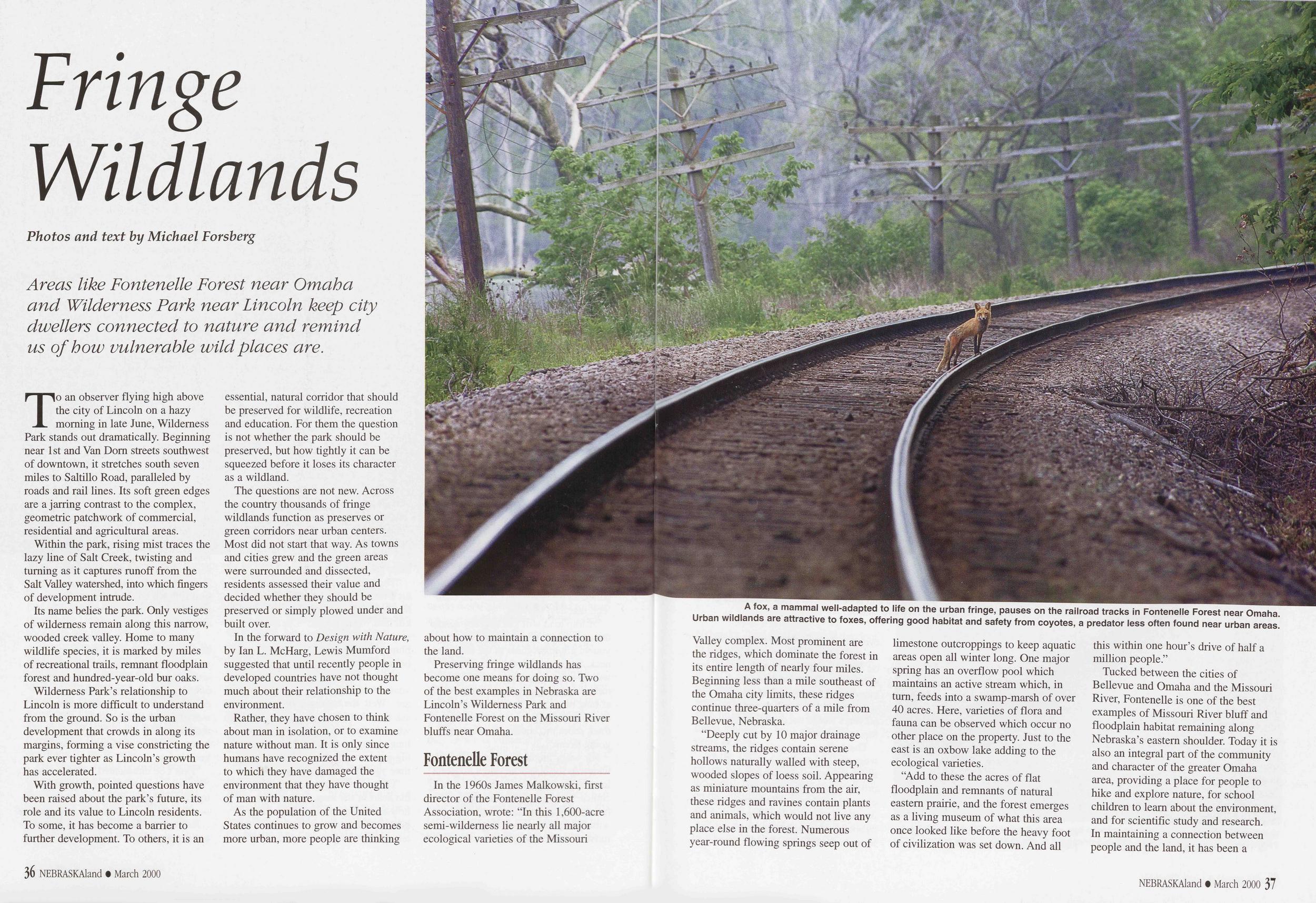
Fringe Wildlands
Photos and text by Michael Forsberg Areas like Fontenelle Forest near Omaha and Wilderness Park near Lincoln keep city dwellers connected to nature and remind us of how vulnerable wild places are.To an observer flying high above the city of Lincoln on a hazy morning in late June, Wilderness Park stands out dramatically. Beginning near 1st and Van Dorn streets southwest of downtown, it stretches south seven miles to Saltillo Road, paralleled by roads and rail lines. Its soft green edges are a jarring contrast to the complex, geometric patchwork of commercial, residential and agricultural areas.
Within the park, rising mist traces the lazy line of Salt Creek, twisting and turning as it captures runoff from the Salt Valley watershed, into which fingers of development intrude.
Its name belies the park. Only vestiges of wilderness remain along this narrow, wooded creek valley. Home to many wildlife species, it is marked by miles of recreational trails, remnant floodplain forest and hundred-year-old bur oaks.
Wilderness Park’s relationship to Lincoln is more difficult to understand from the ground. So is the urban development that crowds in along its margins, forming a vise constricting the park ever tighter as Lincoln’s growth has accelerated.
With growth, pointed questions have been raised about the park’s future, its role and its value to Lincoln residents. To some, it has become a bander to further development. To others, it is an essential, natural corridor that should be preserved for wildlife, recreation and education. For them the question is not whether the park should be preserved, but how tightly it can be squeezed before it loses its character as a wildland.
The questions are not new. Across the country thousands of fringe wildlands function as preserves or green corridors near urban centers. Most did not start that way. As towns and cities grew and the green areas were surrounded and dissected, residents assessed their value and decided whether they should be preserved or simply plowed under and built over.
In the forward to Design with Nature, by Ian L. McHarg, Lewis Mumford suggested that until recently people in developed countries have not thought much about their relationship to the environment.
Rather, they have chosen to think about man in isolation, or to examine nature without man. It is only since humans have recognized the extent to which they have damaged the environment that they have thought of man with nature.
As the population of the United States continues to grow and becomes more urban, more people are thinking about how to maintain a connection to the land.
Preserving fringe wildlands has become one means for doing so. Two of the best examples in Nebraska are Lincoln’s Wilderness Park and Fontenelle Forest on the Missouri River bluffs near Omaha.
Fontenelle ForestIn the 1960s James Malkowski, first director of the Fontenelle Forest Association, wrote: Tn this 1,600-acre semi-wilderness lie nearly all major ecological varieties of the Missouri Valley complex. Most prominent are the ridges, which dominate the forest in its entire length of nearly four miles. Beginning less than a mile southeast of the Omaha city limits, these ridges continue three-quarters of a mile from Bellevue, Nebraska.
“Deeply cut by 10 major drainage streams, the ridges contain serene hollows naturally walled with steep, wooded slopes of loess soil. Appearing as miniature mountains from the air, these ridges and ravines contain plants and animals, which would not live any place else in the forest. Numerous year-round flowing springs seep out of limestone outcroppings to keep aquatic areas open all winter long. One major spring has an overflow pool which maintains an active stream which, in turn, feeds into a swamp-marsh of over 40 acres. Here, varieties of flora and fauna can be observed which occur no other place on the property. Just to the east is an oxbow lake adding to the ecological varieties.
“Add to these the acres of flat floodplain and remnants of natural eastern prairie, and the forest emerges as a living museum of what this area once looked like before the heavy foot of civilization was set down. And all this within one hour’s drive of half a million people.”
Tucked between the cities of Bellevue and Omaha and the Missouri River, Fontenelle is one of the best examples of Missouri River bluff and floodplain habitat remaining along Nebraska’s eastern shoulder. Today it is also an integral part of the community and character of the greater Omaha area, providing a place for people to hike and explore nature, for school children to learn about the environment, and for scientific study and research. In maintaining a connection between people and the land, it has been a 36 NEBRASKAland • March 2000 NEBRASKAland • March 2000 37 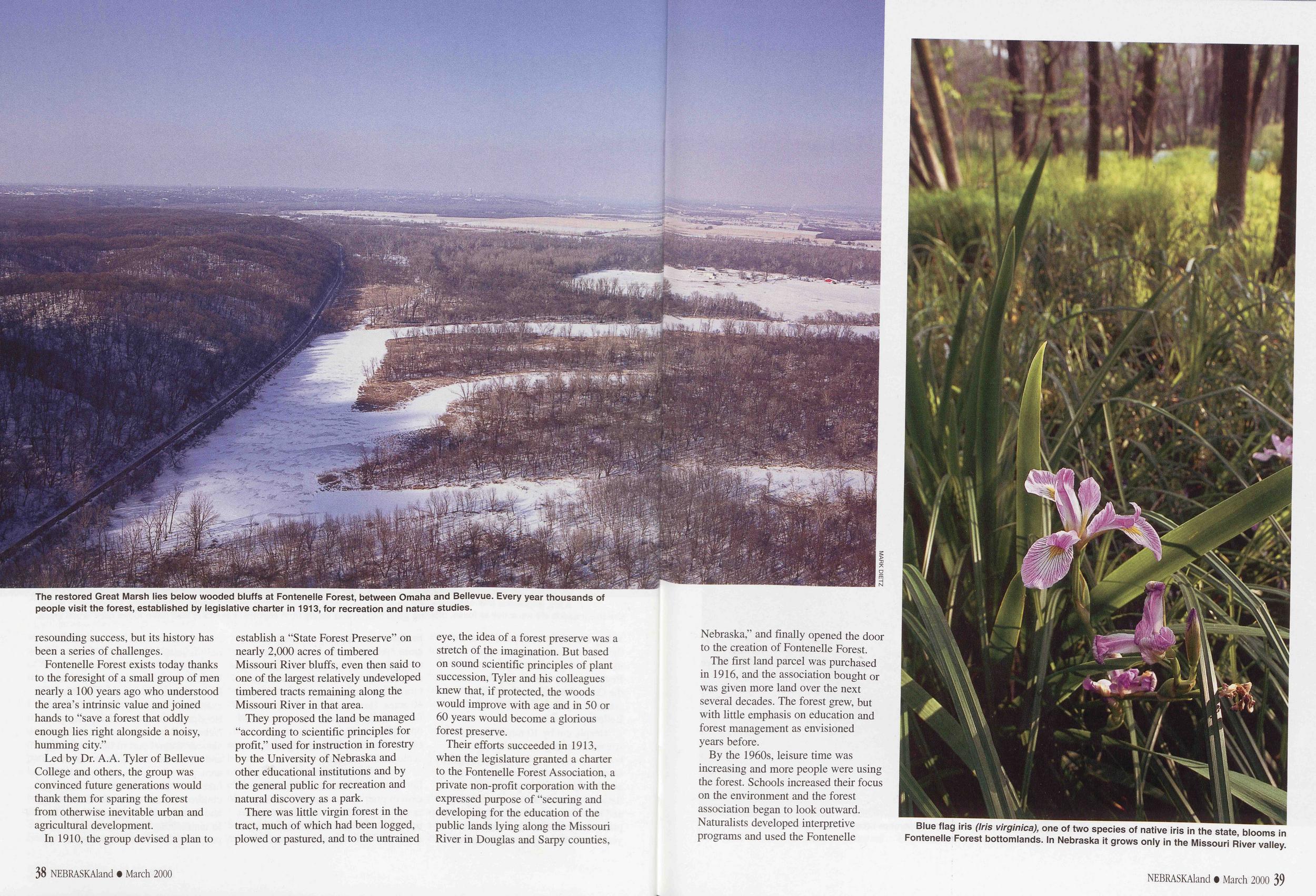 resounding success, but its history has been a series of challenges.
Fontenelle Forest exists today thanks to the foresight of a small group of men nearly a 100 years ago who understood the area’s intrinsic value and joined hands to "save a forest that oddly enough lies right alongside a noisy, humming city.”
Led by Dr. A. A. Tyler of Bellevue College and others, the group was convinced future generations would thank them for sparing the forest from otherwise inevitable urban and agricultural development.
In 1910, the group devised a plan to establish a "State Forest Preserve” on nearly 2,000 acres of timbered Missouri River bluffs, even then said to one of the largest relatively undeveloped timbered tracts remaining along the Missouri River in that area.
They proposed the land be managed "according to scientific principles for profit,” used for instruction in forestry by the University of Nebraska and other educational institutions and by the general public for recreation and natural discovery as a park.
There was little virgin forest in the tract, much of which had been logged, plowed or pastured, and to the untrained eye, the idea of a forest preserve was a stretch of the imagination. But based on sound scientific principles of plant succession, Tyler and his colleagues knew that, if protected, the woods would improve with age and in 50 or 60 years would become a glorious forest preserve.
Their efforts succeeded in 1913, when the legislature granted a charter to the Fontenelle Forest Association, a private non-profit corporation with the expressed purpose of "securing and developing for the education of the public lands lying along the Missouri River in Douglas and Sarpy counties, Nebraska,” and finally opened the door to the creation of Fontenelle Forest.
The first land parcel was purchased in 1916, and the association bought or was given more land over the next several decades. The forest grew, but with little emphasis on education and forest management as envisioned years before.
By the 1960s, leisure time was increasing and more people were using the forest. Schools increased their focus on the environment and the forest association began to look outward. Naturalists developed interpretive programs and used the Fontenelle 38 NEBRASKAland • March 2000 NEBRASKAland • March 2000 39 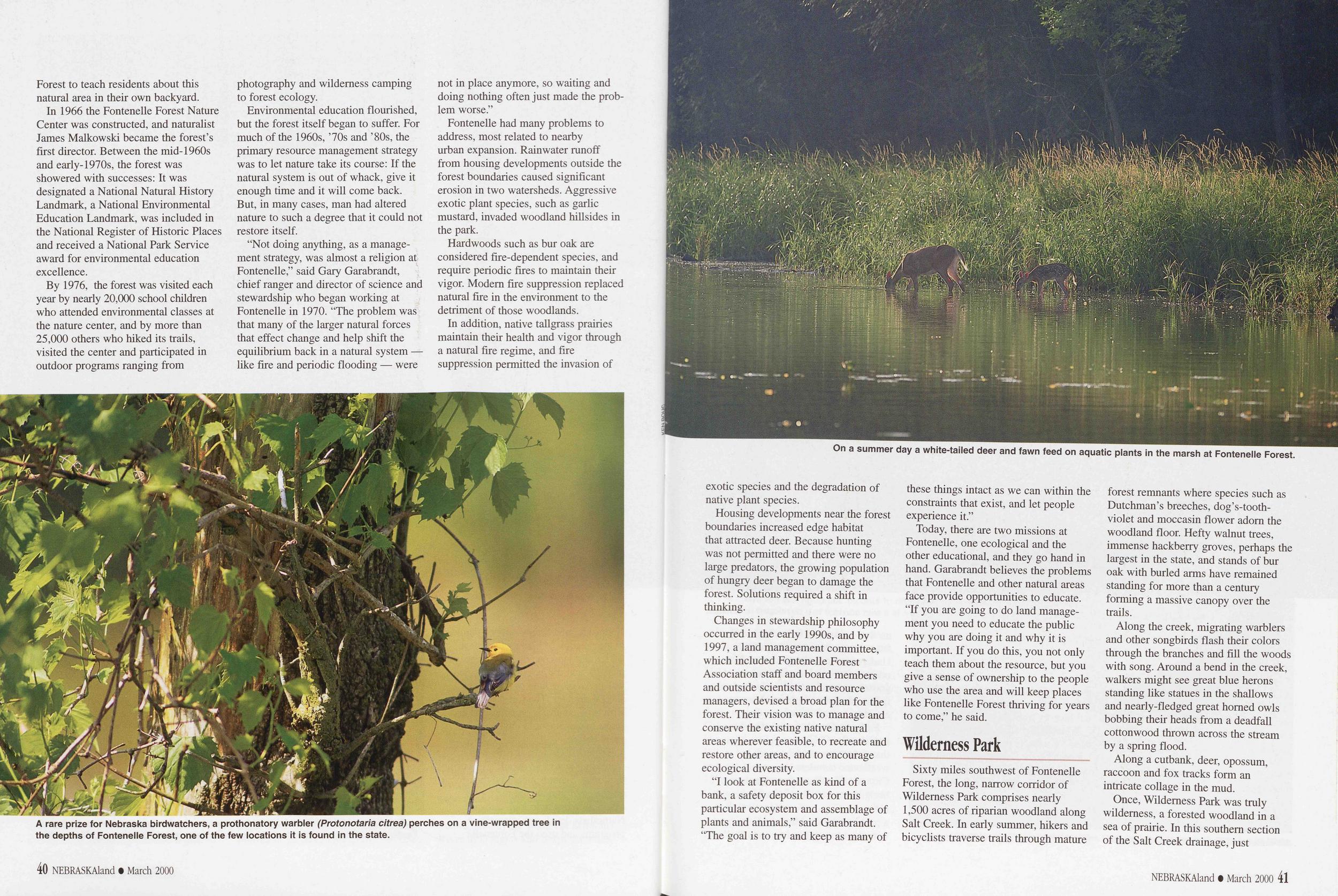 Forest to teach residents about this natural area in their own backyard.
In 1966 the Fontenelle Forest Nature Center was constructed, and naturalist James Malkowski became the forest’s first director. Between the mid-1960s and early-1970s, the forest was showered with successes: It was designated a National Natural History Landmark, a National Environmental Education Landmark, was included in the National Register of Historic Places and received a National Park Service award for environmental education excellence.
By 1976, the forest was visited each year by nearly 20,000 school children who attended environmental classes at the nature center, and by more than 25,000 others who hiked its trails, visited the center and participated in outdoor programs ranging from photography and wilderness camping to forest ecology.
Environmental education flourished, but the forest itself began to suffer. For much of the 1960s, ’70s and ’80s, the primary resource management strategy was to let nature take its course: If the natural system is out of whack, give it enough time and it will come back. But, in many cases, man had altered nature to such a degree that it could not restore itself.
"Not doing anything, as a manage- ment strategy, was almost a religion at Fontenelle,” said Gary Garabrandt, chief ranger and director of science and stewardship who began working at Fontenelle in 1970. "The problem was that many of the larger natural forces that effect change and help shift the equilibrium back in a natural system — like fire and periodic flooding — were not in place anymore, so waiting and doing nothing often just made the prob- lem worse.”
Fontenelle had many problems to address, most related to nearby urban expansion. Rainwater runoff from housing developments outside the forest boundaries caused significant erosion in two watersheds. Aggressive exotic plant species, such as garlic mustard, invaded woodland hillsides in the park.
Hardwoods such as bur oak are considered fire-dependent species, and require periodic fires to maintain their vigor. Modem fire suppression replaced natural fire in the environment to the detriment of those woodlands.
In addition, native tailgrass prairies maintain their health and vigor through a natural fire regime, and fire suppression permitted the invasion of exotic species and the degradation of native plant species.
Housing developments near the forest boundaries increased edge habitat that attracted deer. Because hunting was not permitted and there were no large predators, the growing population of hungry deer began to damage the forest. Solutions required a shift in thinking.
Changes in stewardship philosophy occurred in the early 1990s, and by 1997, a land management committee, which included Fontenelle Forest Association staff and board members and outside scientists and resource managers, devised a broad plan for the forest. Their vision was to manage and conserve the existing native natural areas wherever feasible, to recreate and restore other areas, and to encourage ecological diversity.
“I look at Fontenelle as kind of a bank, a safety deposit box for this particular ecosystem and assemblage of plants and animals,” said Garabrandt. “The goal is to try and keep as many of these things intact as we can within the constraints that exist, and let people experience it.”
Today, there are two missions at Fontenelle, one ecological and the other educational, and they go hand in hand. Garabrandt believes the problems that Fontenelle and other natural areas face provide opportunities to educate. "If you are going to do land manage- ment you need to educate the public why you are doing it and why it is important. If you do this, you not only teach them about the resource, but you give a sense of ownership to the people who use the area and will keep places like Fontenelle Forest thriving for years to come,” he said.
Wilderness ParkSixty miles southwest of Fontenelle Forest, the long, narrow corridor of Wilderness Park comprises nearly 1,500 acres of riparian woodland along Salt Creek. In early summer, hikers and bicyclists traverse trails through mature forest remnants where species such as Dutchman’s breeches, dog’s-tooth- violet and moccasin flower adorn the woodland floor. Hefty walnut trees, immense hackberry groves, perhaps the largest in the state, and stands of bur oak with burled arms have remained standing for more than a century forming a massive canopy over the trails.
Along the creek, migrating warblers and other songbirds flash their colors through the branches and fill the woods with song. Around a bend in the creek, walkers might see great blue herons standing like statues in the shallows and nearly-fledged great homed owls bobbing their heads from a deadfall cottonwood thrown across the stream by a spring flood.
Along a cutbank, deer, opossum, raccoon and fox tracks form an intricate collage in the mud. Once, Wilderness Park was truly wilderness, a forested woodland in a sea of prairie. In this southern section of the Salt Creek drainage, just NEBRASKAland • March 2000 41 40 NEBRASKAland • March 2000 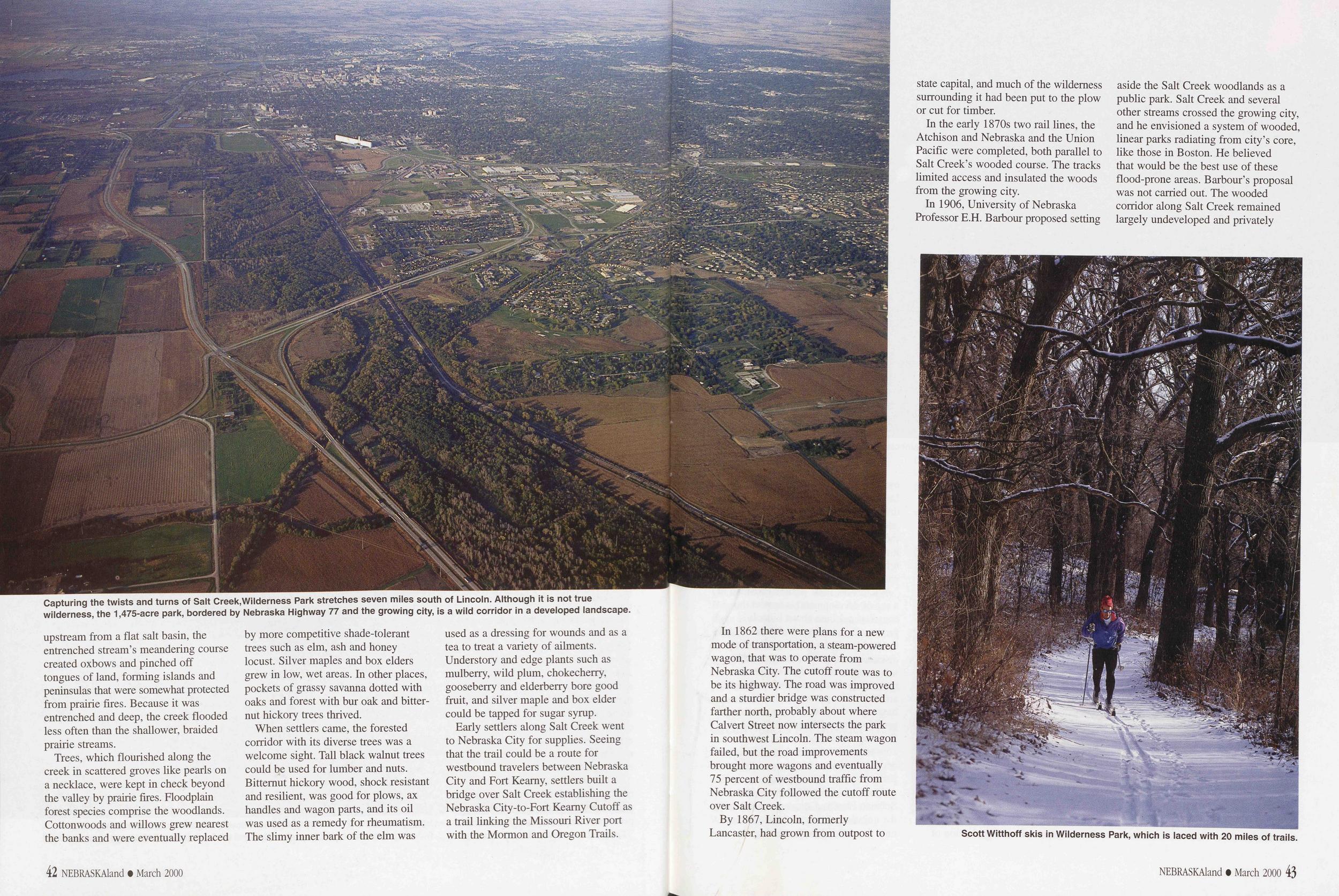 upstream from a flat salt basin, the entrenched stream’s meandering course created oxbows and pinched off tongues of land, forming islands and peninsulas that were somewhat protected from prairie fires. Because it was entrenched and deep, the creek flooded less often than the shallower, braided prairie streams.
Trees, which flourished along the creek in scattered groves like pearls on a necklace, were kept in check beyond the valley by prairie fires. Floodplain forest species comprise the woodlands. Cottonwoods and willows grew nearest the banks and were eventually replaced by more competitive shade-tolerant trees such as elm, ash and honey locust. Silver maples and box elders grew in low, wet areas. In other places, pockets of grassy savanna dotted with oaks and forest with bur oak and bitter- nut hickory trees thrived.
When settlers came, the forested corridor with its diverse trees was a welcome sight. Tall black walnut trees could be used for lumber and nuts. Bittemut hickory wood, shock resistant and resilient, was good for plows, ax handles and wagon parts, and its oil was used as a remedy for rheumatism. The slimy inner bark of the elm was used as a dressing for wounds and as a tea to treat a variety of ailments. Understory and edge plants such as mulberry, wild plum, chokecherry, gooseberry and elderberry bore good fruit, and silver maple and box elder could be tapped for sugar syrup.
Early settlers along Salt Creek went to Nebraska City for supplies. Seeing that the trail could be a route for westbound travelers between Nebraska City and Fort Kearny, settlers built a bridge over Salt Creek establishing the Nebraska City-to-Fort Kearny Cutoff as a trail linking the Missouri River port with the Mormon and Oregon Trails.
In 1862 there were plans for a new mode of transportation, a steam-powered wagon, that was to operate from Nebraska City. The cutoff route was to be its highway. The road was improved and a sturdier bridge was constructed farther north, probably about where Calvert Street now intersects the park in southwest Lincoln. The steam wagon failed, but the road improvements brought more wagons and eventually 75 percent of westbound traffic from Nebraska City followed the cutoff route over Salt Creek.
By 1867, Lincoln, formerly Lancaster, had grown from outpost to state capital, and much of the wilderness surrounding it had been put to the plow or cut for timber.
In the early 1870s two rail lines, the Atchison and Nebraska and the Union Pacific were completed, both parallel to Salt Creek’s wooded course. The tracks limited access and insulated the woods from the growing city.
In 1906, University of Nebraska Professor E.H. Barbour proposed setting aside the Salt Creek woodlands as a public park. Salt Creek and several other streams crossed the growing city, and he envisioned a system of wooded, linear parks radiating from city’s core, like those in Boston. He believed that would be the best use of these flood-prone areas. Barbour’s proposal was not carried out. The wooded corridor along Salt Creek remained largely undeveloped and privately 42 NEBRASKAland • March 2000 NEBRASKAland • March 2000 43 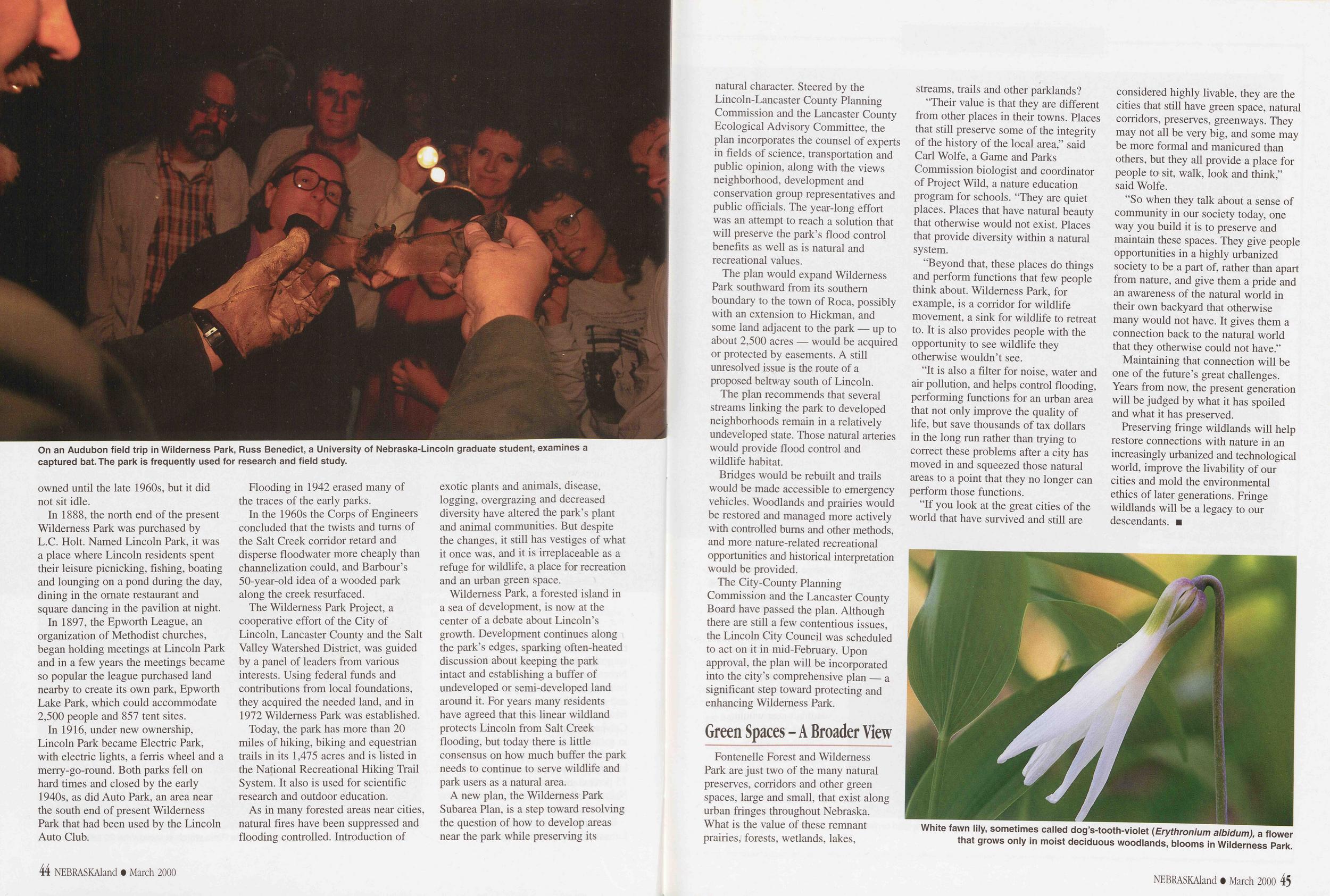 owned until the late 1960s, but it did not sit idle.
In 1888, the north end of the present Wilderness Park was purchased by L.C. Holt. Named Lincoln Park, it was a place where Lincoln residents spent their leisure picnicking, fishing, boating and lounging on a pond during the day, dining in the ornate restaurant and square dancing in the pavilion at night.
In 1897, the Epworth League, an organization of Methodist churches, began holding meetings at Lincoln Park and in a few years the meetings became so popular the league purchased land nearby to create its own park, Epworth Lake Park, which could accommodate 2,500 people and 857 tent sites.
In 1916, under new ownership, Lincoln Park became Electric Park, with electric lights, a ferris wheel and a merry-go-round. Both parks fell on hard times and closed by the early 1940s, as did Auto Park, an area near the south end of present Wilderness Park that had been used by the Lincoln Auto Club.
Flooding in 1942 erased many of the traces of the early parks.
In the 1960s the Corps of Engineers concluded that the twists and turns of the Salt Creek corridor retard and disperse floodwater more cheaply than channelization could, and Barbour’s 50-year-old idea of a wooded park along the creek resurfaced.
The Wilderness Park Project, a cooperative effort of the City of Lincoln, Lancaster County and the Salt Valley Watershed District, was guided by a panel of leaders from various interests. Using federal funds and contributions from local foundations, they acquired the needed land, and in 1972 Wilderness Park was established.
Today, the park has more than 20 miles of hiking, biking and equestrian trails in its 1,475 acres and is listed in the National Recreational Hiking Trail System. It also is used for scientific research and outdoor education.
As in many forested areas near cities, natural fires have been suppressed and flooding controlled. Introduction of exotic plants and animals, disease, logging, overgrazing and decreased diversity have altered the park’s plant and animal communities. But despite the changes, it still has vestiges of what it once was, and it is irreplaceable as a refuge for wildlife, a place for recreation and an urban green space.
Wilderness Park, a forested island in a sea of development, is now at the center of a debate about Lincoln’s growth. Development continues along the park’s edges, sparking often-heated discussion about keeping the park intact and establishing a buffer of undeveloped or semi-developed land around it. For years many residents have agreed that this linear wildland protects Lincoln from Salt Creek flooding, but today there is little consensus on how much buffer the park needs to continue to serve wildlife and park users as a natural area.
A new plan, the Wilderness Park Subarea Plan, is a step toward resolving the question of how to develop areas near the park while preserving its natural character. Steered by the Lincoln-Lancaster County Planning Commission and the Lancaster County Ecological Advisory Committee, the plan incorporates the counsel of experts in fields of science, transportation and public opinion, along with the views neighborhood, development and conservation group representatives and public officials. The year-long effort was an attempt to reach a solution that will preserve the park’s flood control benefits as well as is natural and recreational values.
The plan would expand Wilderness Park southward from its southern boundary to the town of Roca, possibly with an extension to Hickman, and some land adjacent to the park — up to about 2,500 acres — would be acquired or protected by easements. A still unresolved issue is the route of a proposed beltway south of Lincoln.
The plan recommends that several streams linking the park to developed neighborhoods remain in a relatively undeveloped state. Those natural arteries would provide flood control and wildlife habitat.
Bridges would be rebuilt and trails would be made accessible to emergency vehicles. Woodlands and prairies would be restored and managed more actively with controlled bums and other methods, and more nature-related recreational opportunities and historical interpretation would be provided.
The City-County Planning Commission and the Lancaster County Board have passed the plan. Although there are still a few contentious issues, the Lincoln City Council was scheduled to act on it in mid-February. Upon approval, the plan will be incorporated into the city’s comprehensive plan — a significant step toward protecting and enhancing Wilderness Park.
Green Spaces - A Broader ViewFontenelle Forest and Wilderness Park are just two of the many natural preserves, corridors and other green spaces, large and small, that exist along urban fringes throughout Nebraska. What is the value of these remnant prairies, forests, wetlands, lakes, streams, trails and other parklands?
“Their value is that they are different from other places in their towns. Places that still preserve some of the integrity of the history of the local area,” said Carl Wolfe, a Game and Parks Commission biologist and coordinator of Project Wild, a nature education program for schools. “They are quiet places. Places that have natural beauty that otherwise would not exist. Places that provide diversity within a natural system.
“Beyond that, these places do things and perform functions that few people think about. Wilderness Park, for example, is a corridor for wildlife movement, a sink for wildlife to retreat to. It is also provides people with the opportunity to see wildlife they otherwise wouldn’t see.
“It is also a filter for noise, water and air pollution, and helps control flooding, performing functions for an urban area that not only improve the quality of life, but save thousands of tax dollars in the long run rather than trying to correct these problems after a city has moved in and squeezed those natural areas to a point that they no longer can perform those functions.
“If you look at the great cities of the world that have survived and still are considered highly livable, they are the cities that still have green space, natural corridors, preserves, green ways. They may not all be very big, and some may be more formal and manicured than others, but they all provide a place for people to sit, walk, look and think,” said Wolfe.
“So when they talk about a sense of community in our society today, one way you build it is to preserve and maintain these spaces. They give people opportunities in a highly urbanized society to be a part of, rather than apart from nature, and give them a pride and an awareness of the natural world in their own backyard that otherwise many would not have. It gives them a connection back to the natural world that they otherwise could not have.”
Maintaining that connection will be one of the future’s great challenges. Years from now, the present generation will be judged by what it has spoiled and what it has preserved.
Preserving fringe wildlands will help restore connections with nature in an increasingly urbanized and technological world, improve the livability of our cities and mold the environmental ethics of later generations. Fringe wildlands will be a legacy to our descendants. ■
44 NEBRASKAland • March 2000 NEBRASKAland • March 2000 45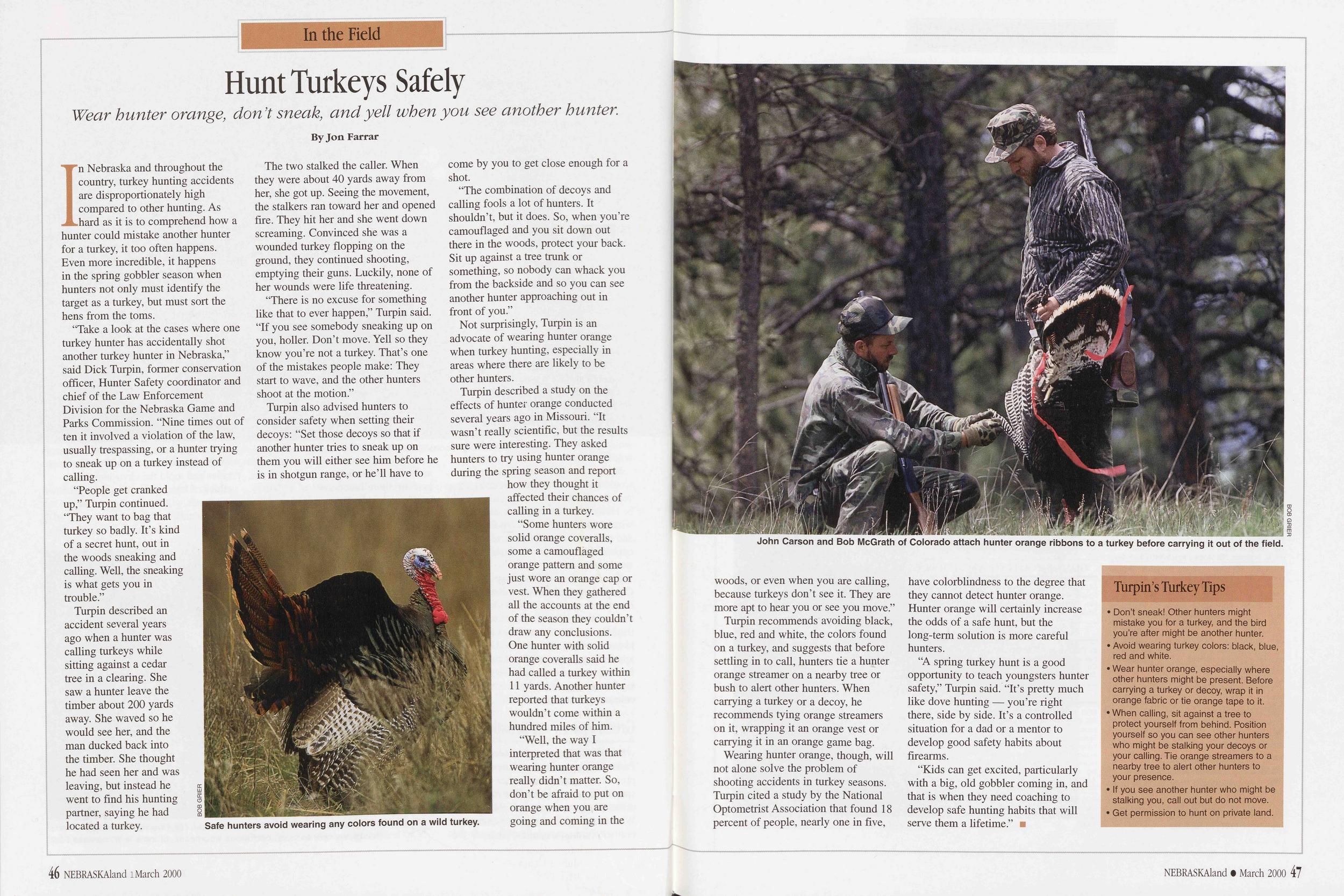
In Nebraska and throughout the country, turkey hunting accidents are disproportionately high I compared to other hunting. As hard as it is to comprehend how a hunter could mistake another hunter for a turkey, it too often happens. Even more incredible, it happens in the spring gobbler season when hunters not only must identify the target as a turkey, but must sort the hens from the toms.
“Take a look at the cases where one turkey hunter has accidentally shot another turkey hunter in Nebraska,” said Dick Turpin, former conservation officer, Hunter Safety coordinator and chief of the Law Enforcement Division for the Nebraska Game and Parks Commission. “Nine times out of ten it involved a violation of the law, usually trespassing, or a hunter trying to sneak up on a turkey instead of calling.
“People get cranked up,” Turpin continued. “They want to bag that turkey so badly. It’s kind of a secret hunt, out in the woods sneaking and calling. Well, the sneaking is what gets you in trouble”
Turpin described an accident several years ago when a hunter was calling turkeys while sitting against a cedar tree in a clearing. She saw a hunter leave the timber about 200 yards away. She waved so he would see her, and the man ducked back into the timber. She thought he had seen her and was leaving, but instead he went to find his hunting partner, saying he had located a turkey.
The two stalked the caller. When they were about 40 yards away from her, she got up. Seeing the movement, the stalkers ran toward her and opened fire. They hit her and she went down screaming. Convinced she was a wounded turkey flopping on the ground, they continued shooting, emptying their guns. Luckily, none of her wounds were life threatening.
“There is no excuse for something like that to ever happen,” Turpin said. “If you see somebody sneaking up on you, holler. Don’t move. Yell so they know you’re not a turkey. That’s one of the mistakes people make: They start to wave, and the other hunters shoot at the motion.”
Turpin also advised hunters to consider safety when setting their decoys: “Set those decoys so that if another hunter tries to sneak up on them you will either see him before he is in shotgun range, or he’ll have to come by you to get close enough for a shot.
“The combination of decoys and calling fools a lot of hunters. It shouldn’t, but it does. So, when you’re camouflaged and you sit down out there in the woods, protect your back. Sit up against a tree trunk or something, so nobody can whack you from the backside and so you can see another hunter approaching out in front of you.”
Not surprisingly, Turpin is an advocate of wearing hunter orange when turkey hunting, especially in areas where there are likely to be other hunters.
Turpin described a study on the effects of hunter orange conducted several years ago in Missouri. “It wasn’t really scientific, but the results sure were interesting. They asked hunters to try using hunter orange during the spring season and report how they thought it affected their chances of calling in a turkey. “Some hunters wore solid orange coveralls, some a camouflaged orange pattern and some just wore an orange cap or vest. When they gathered all the accounts at the end of the season they couldn’t draw any conclusions. One hunter with solid orange coveralls said he had called a turkey within 11 yards. Another hunter reported that turkeys wouldn’t come within a hundred miles of him.
“Well, the way I interpreted that was that wearing hunter orange really didn’t matter. So, don’t be afraid to put on orange when you are going and coming in the woods, or even when you are calling, because turkeys don’t see it. They are more apt to hear you or see you move.”
Turpin recommends avoiding black, blue, red and white, the colors found on a turkey, and suggests that before settling in to call, hunters tie a hunter orange streamer on a nearby tree or bush to alert other hunters. When carrying a turkey or a decoy, he recommends tying orange streamers on it, wrapping it an orange vest or carrying it in an orange game bag.
Wearing hunter orange, though, will not alone solve the problem of shooting accidents in turkey seasons. Turpin cited a study by the National Optometrist Association that found 18 percent of people, nearly one in five, have colorblindness to the degree that they cannot detect hunter orange. Hunter orange will certainly increase the odds of a safe hunt, but the long-term solution is more careful hunters.
“A spring turkey hunt is a good opportunity to teach youngsters hunter safety,” Turpin said. “It’s pretty much like dove hunting — you’re right there, side by side. It’s a controlled situation for a dad or a mentor to develop good safety habits about firearms.
“Kids can get excited, particularly with a big, old gobbler coming in, and that is when they need coaching to develop safe hunting habits that will serve them a lifetime.” »
Turpin’s Turkey Tips• Don’t sneak! Other hunters might mistake you for a turkey, and the bird you’re after might be another hunter.
• Avoid wearing turkey colors: black, blue, red and white.
• Wear hunter orange, especially where other hunters might be present. Before carrying a turkey or decoy, wrap it in orange fabric or tie orange tape to it.
• When calling, sit against a tree to protect yourself from behind. Position yourself so you can see other hunters who might be stalking your decoys or your calling. Tie orange streamers to a nearby tree to alert other hunters to your presence.
• If you see another hunter who might be stalking you, call out but do not move.
• Get permission to hunt on private land.
46 NEBRASKAland 1 March 2000 NEBRASKAland • March 2000 47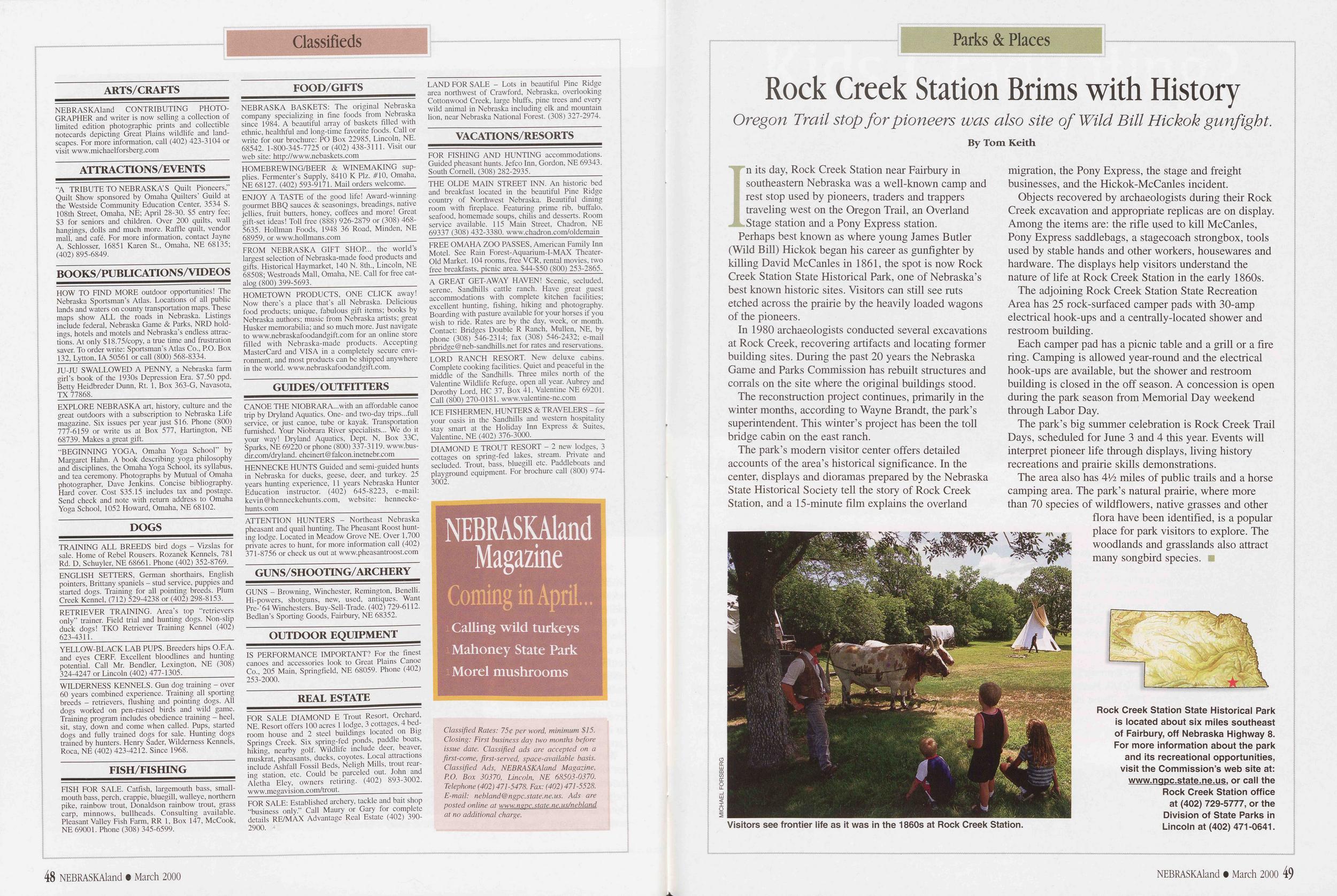
Classifieds
ARTS/CRAFTSNEBRASKAland CONTRIBUTING PHOTO- GRAPHER and writer is now selling a collection of limited edition photographic prints and collectible notecards depicting Great Plains wildlife and land- scapes. For more information, call (402) 423-3104 or visit www.michaelforsberg.com
ATTRACTION S/EVENTS“A TRIBUTE TO NEBRASKA’S Quilt Pioneers,” Quilt Show sponsored by Omaha Quilters’ Guild at the Westside Community Education Center, 3534 S. 108th Street, Omaha, NE; April 28-30. $5 entry fee; $3 for seniors and children. Over 200 quilts, wall hangings, dolls and much more. Raffle quilt, vendor mall, and cafe. For more information, contact Jayne A. Schlosser, 16851 Karen St., Omaha, NE 68135; (402) 895-6849.
BOOKS/PUBLICATION S/VIDEOSHOW TO FIND MORE outdoor opportunities! The Nebraska Sportsman’s Atlas. Locations of all public lands and waters on county transportation maps. These maps show ALL the roads in Nebraska. Listings include federal, Nebraska Game & Parks, NRD hold- ings, hotels and motels and Nebraska’s endless attrac- tions. At only $18.75/copy, a true time and frustration saver. To order write: Sportsman’s Atlas Co., P.O. Box 132, Lytton, IA 50561 or call (800) 568-8334.
JU-JU SWALLOWED A PENNY, a Nebraska farm girl’s book of the 1930s Depression Era. $7.50 ppd. Betty Heidbreder Dunn, Rt. 1, Box 363-G, Navasota, TX 77868
EXPLORE NEBRASKA art, history, culture and the great outdoors with a subscription to Nebraska Life magazine. Six issues per year just $16. Phone (800) 777-6159 or write us at Box 577, Hartington, NE 68739. Makes a great gift.
“BEGINNING YOGA, Omaha Yoga School” by Margaret Hahn. A book describing yoga philosophy and disciplines, the Omaha Yoga School, its syllabus, and tea ceremony. Photographs by Mutual of Omaha photographer, Dave Jenkins. Concise bibliography. Hard cover. Cost $35.15 includes tax and postage. Send check and note with return address to Omaha Yoga School, 1052 Howard, Omaha, NE 68102.
DOGSTRAINING ALL BREEDS bird dogs - Vizslas for sale. Home of Rebel Rousers. Rozanek Kennels, 781 Rd. D, Schuyler, NE 68661. Phone (402) 352-8769.
ENGLISH SETTERS, German shorthairs, English pointers, Brittany spaniels - stud service, puppies and started dogs. Training for all pointing breeds. Plum Creek Kennel, (712) 529-4238 or (402) 298-8153.
RETRIEVER TRAINING. Area’s top “retrievers only” trainer. Field trial and hunting dogs. Non-slip duck dogs! TKO Retriever Training Kennel (402) 623-4311
YELLOW-BLACK LAB PUPS. Breeders hips O.F.A. and eyes CERF. Excellent bloodlines and hunting potential. Call Mr. Bendler, Lexington, NE (308) 324-4247 or Lincoln (402) 477-1305.
WILDERNESS KENNELS. Gun dog training - over 60 years combined experience. Training all sporting breeds - retrievers, flushing and pointing dogs. All dogs worked on pen-raised birds and wild game. Training program includes obedience training - heel, sit, stay, down and come when called. Pups, started dogs and fully trained dogs for sale. Hunting dogs trained by hunters. Henry Sader, Wilderness Kennels, Roca, NE (402) 423-4212. Since 1968.
FISH/FISHINGFISH FOR SALE. Catfish, largemouth bass, small- mouth bass, perch, crappie, bluegill, walleye, northern pike, rainbow trout, Donaldson rainbow trout, grass carp, minnows, bullheads. Consulting available. Pleasant Valley Fish Farm, RR 1, Box 147, McCook, NE 69001. Phone (308) 345-6599.
FOOD/GIFTSNEBRASKA BASKETS: The original Nebraska company specializing in fine foods from Nebraska since 1984. A beautiful array of baskets filled with ethnic, healthful and long-time favorite foods. Call or write for our brochure: PO Box 22985, Lincoln, NE. 68542. 1-800-345-7725 or (402) 438-3111. Visit our web site: http://www.nebaskets.com
HOMEBREWING/BEER & WINEMAKING sup- plies. Fermenter’s Supply, 8410 K Plz. #10, Omaha, NE 68127. (402) 593-9171. Mail orders welcome. ENJOY A TASTE of the good life! Award-winning gourmet BBQ sauces & seasonings, breadings, native jellies, fruit butters, honey, coffees and more! Great gift-set ideas! Toll free (888) 926-2879 or (308) 468- 5635. Hollman Foods, 1948 36 Road, Minden, NE 68959, or www.hollmans.com
FROM NEBRASKA GIFT SHOP... the world’s largest selection of Nebraska-made food products and gifts. Historical Haymarket, 140 N. 8th., Lincoln, NE 68508; Westroads Mall, Omaha, NE. Call for free cat- alog (800) 399-5693.
HOMETOWN PRODUCTS, ONE CLICK away! Now there’s a place that’s all Nebraska. Delicious food products; unique, fabulous gift items; books by Nebraska authors; music from Nebraska artists; great Husker memorabilia; and so much more. Just navigate to www.nebraskafoodandgift.com for an online store filled with Nebraska-made products. Accepting MasterCard and VISA in a completely secure envi- ronment, and most products can be shipped anywhere in the world, www.nebraskafoodandgift.com.
LAND FOR SALE - Lots in beautiful Pine Ridge area northwest of Crawford, Nebraska, overlooking Cottonwood Creek, large bluffs, pine trees and every wild animal in Nebraska including elk and mountain lion, near Nebraska National Forest. (308) 327-2974.
VACATION S/RESORTS GUIDES/OUTFITTERSCANOE THE NIOBRARA...with an affordable canoe trip by Dryland Aquatics. One- and two-day trips...full service, or just canoe, tube or kayak. Transportation furnished. Your Niobrara River specialists... We do it your way! Dryland Aquatics, Dept. N, Box 33C, Sparks, NE 69220 or phone (800) 337-3119. www.bus- dir.com/dryland. eheinert@falcon.inetnebr.com
HENNECKE HUNTS Guided and semi-guided hunts in Nebraska for ducks, geese, deer, and turkey. 25 years hunting experience, 11 years Nebraska Hunter Education instructor. (402) 645-8223, e-mail: kevin@henneckehunts.com, website: hennecke- hunts.com
ATTENTION HUNTERS - Northeast Nebraska pheasant and quail hunting. The Pheasant Roost hunt- ing lodge. Located in Meadow Grove NE. Over 1,700 private acres to hunt, for more information call (402) 371-8756 or check us out at www.pheasantroost.com
GUNS/SHOOTING/ARCHERYGUNS - Browning, Winchester, Remington, Benelli. Hi-powers, shotguns, new, used, antiques. Want Pre-’64 Winchesters. Buy-Sell-Trade. (402) 729-6112. Bedlan’s Sporting Goods, Fairbury, NE 68352.
OUTDOOREQUIPMENTIS PERFORMANCE IMPORTANT? For the finest canoes and accessories look to Great Plains Canoe Co., 205 Main, Springfield, NE 68059. Phone (402) 253-2000.
REAL ESTATEFOR SALE DIAMOND E Trout Resort, Orchard, NE. Resort offers 100 acres 1 lodge, 3 cottages, 4 bed- room house and 2 steel buildings located on Big Springs Creek. Six spring-fed ponds, paddle boats, hiking, nearby golf. Wildlife include deer, beaver, muskrat, pheasants, ducks, coyotes. Local attractions include Ashfall Fossil Beds, Neligh Mills, trout rear- ing station, etc. Could be parceled out. John and Aletha Eley, owners retiring. (402) 893-3002. www.megavision.com/trout.
FOR SALE: Established archery, tackle and bait shop “business only.” Call Maury or Gary for complete details RE/MAX Advantage Real Estate (402) 390- 2900.
FOR FISHING AND HUNTING accommodations. Guided pheasant hunts. Jefco Inn, Gordon, NE 69343. South Cornell, (308) 282-2935.
THE OLDE MAIN STREET INN. An historic bed and breakfast located in the beautiful Pine Ridge country of Northwest Nebraska. Beautiful dining room with fireplace. Featuring prime rib, buffalo, seafood, homemade soups, chilis and desserts. Room service available. 115 Main Street, Chadron, NE 69337 (308) 432-3380. www.chadron.com/oldemain
FREE OMAHA ZOO PASSES, American Family Inn Motel. See Rain Forest-Aquarium-I-MAX Theater- Old Market. 104 rooms, free VCR, rental movies, two free breakfasts, picnic area. $44-$50 (800) 253-2865.
A GREAT GET-AWAY HAVEN! Scenic, secluded, serene, Sandhills cattle ranch. Have great guest accommodations with complete kitchen facilities; excellent hunting, fishing, hiking and photography. Boarding with pasture available for your horses if you wish to ride. Rates are by the day, week, or month. Contact: Bridges Double R Ranch, Mullen, NE, by phone (308) 546-2314; fax (308) 546-2432; e-mail pbridge@neb-sandhills.net for rates and reservations.
LORD RANCH RESORT. New deluxe cabins. Complete cooking facilities. Quiet and peaceful in the middle of the Sandhills. Three miles north of the Valentine Wildlife Refuge, open all year. Aubrey and Dorothy Lord, HC 37, Box 41, Valentine NE 69201. Call (800) 270-0181. www.valentine-ne.com_
ICE FISHERMEN, HUNTERS & TRAVELERS - for your oasis in the Sandhills and western hospitality stay smart at the Holiday Inn Express & Suites, Valentine, NE (402) 376-3000.
DIAMOND E TROUT RESORT - 2 new lodges, 3 cottages on spring-fed lakes, stream. Private and secluded. Trout, bass, bluegill etc. Paddleboats and playground equipment. For brochure call (800) 974- 3002.
NEBRASKAland Magazine Coming in April... Calling wild turkeys Mahoney State Park Morel mushroomsClassified Rates: 75$ per word, minimum $15. Closing: First business day two months before issue date. Classified ads are accepted on a first-come, first-served, space-available basis. Classified Ads, NEBRASKAland Magazine, P.O. Box 30370, Lincoln, NE 68503-0370. Telephone (402) 471-5478. Fax: (402)471-5528. E-mail: nebland@ngpc.state.ne.us. Ads are posted online at www. nspc. state, ne. us/nebland at no additional charge.
Parks & Places Rock Creek Station Brims with History Oregon Trail stop for pioneers was also site of Wild Bill Hickok gunfight. By Tom KeithIn its day, Rock Creek Station near Fairbury in southeastern Nebraska was a well-known camp and rest stop used by pioneers, traders and trappers traveling west on the Oregon Trail, an Overland Stage station and a Pony Express station. Perhaps best known as where young James Butler (Wild Bill) Hickok began his career as gunfighter by killing David McCanles in 1861, the spot is now Rock Creek Station State Historical Park, one of Nebraska’s best known historic sites. Visitors can still see ruts etched across the prairie by the heavily loaded wagons of the pioneers.
In 1980 archaeologists conducted several excavations at Rock Creek, recovering artifacts and locating former building sites. During the past 20 years the Nebraska Game and Parks Commission has rebuilt structures and corrals on the site where the original buildings stood.
The reconstruction project continues, primarily in the winter months, according to Wayne Brandt, the park’s superintendent. This winter’s project has been the toll bridge cabin on the east ranch.
The park’s modem visitor center offers detailed accounts of the area’s historical significance. In the center, displays and dioramas prepared by the Nebraska State Historical Society tell the story of Rock Creek Station, and a 15-minute film explains the overland migration, the Pony Express, the stage and freight businesses, and the Hickok-McCanles incident.
Objects recovered by archaeologists during their Rock Creek excavation and appropriate replicas are on display. Among the items are: the rifle used to kill McCanles, Pony Express saddlebags, a stagecoach strongbox, tools used by stable hands and other workers, housewares and hardware. The displays help visitors understand the nature of life at Rock Creek Station in the early 1860s.
The adjoining Rock Creek Station State Recreation Area has 25 rock-surfaced camper pads with 30-amp electrical hook-ups and a centrally-located shower and restroom building.
Each camper pad has a picnic table and a grill or a fire ring. Camping is allowed year-round and the electrical hook-ups are available, but the shower and restroom building is closed in the off season. A concession is open during the park season from Memorial Day weekend through Labor Day.
The park’s big summer celebration is Rock Creek Trail Days, scheduled for June 3 and 4 this year. Events will interpret pioneer life through displays, living history recreations and prairie skills demonstrations.
MICHAEL FORSBERGThe area also has 414 miles of public trails and a horse camping area. The park’s natural prairie, where more than 70 species of wildflowers, native grasses and other flora have been identified, is a popular place for park visitors to explore. The woodlands and grasslands also attract many songbird species.
Rock Creek Station State Historical Park is located about six miles southeast of Fairbury, off Nebraska Highway 8. For more information about the park and its recreational opportunities, visit the Commission’s web site at: www.nqpc.state.ne.us. or call the Rock Creek Station office at (402) 729-5777, or the Division of State Parks in Lincoln at (402) 471-0641.
48 NEBRASKAland • March 2000 NEBRASKAland • March 2000 49
My uncle Spud Kapustka gave me this photo of my uncles and my father. They are (from left): Anton, Spud, Frank and Steve Kapustka (my dad). It was taken during the 1942 pheasant season on my father's farm three miles northwest of Elyria in Valley County. It was Spud's last pheasant hunt for several years, as he left soon after for Army Air Corps pilot training. Upon completing the training he piloted B-25 bombers on missions over Japan until the war ended. My father, who turned 95 in June, is the only surviving brother from the photo. --Al Kapustka, Tomball, Texas
50 Nebraskaland March 2000
Keep 'em coming home with a Nebraska lifetime permit!
For VISA and MasterCard orders call toll-free 1-800-NEB-LAND (1-800-632-5263)
Treat your graduate to the gift that lasts a lifetime . . . a Nebraska lifetime permit. Available only to Nebraska residents, lifetime permits remain valid even if the holder leaves the state -- your graduates can continue to hunt and fish whenever they're back in Nebraska. It is the ultimate gift for any angler or hunter and an investment in the future.
A great gift for graduates or grandchildren! Attractive engraved brass plate Handsome carrying case Cards for mounting required stamps Gift Card on request Lifetime Hunt & Fish Permit $448 Lifetime Hunt $224 Lifetime Fish $257.50
Permits are also available at all Game and Parks Commission offices. To order by mail, include full name, address, date of birth, sex, eye and hair color, height and weight. Mail with payment to P.O. Box 30370, Lincoln, NE 68503. Lifetime permits are available only to Nebraska residents. Permits remain valid even if the holder becomes a resident elsewhere. Lifetime permit costs do not include fees for big game permits or the costs of any special stamps that must be purchased annually.
Position: 396 (24 views)