Volume 78, Issue 1, 2000
NEBRASKAland
Nebraska Game & Parks Commission January-February 2000 $2.50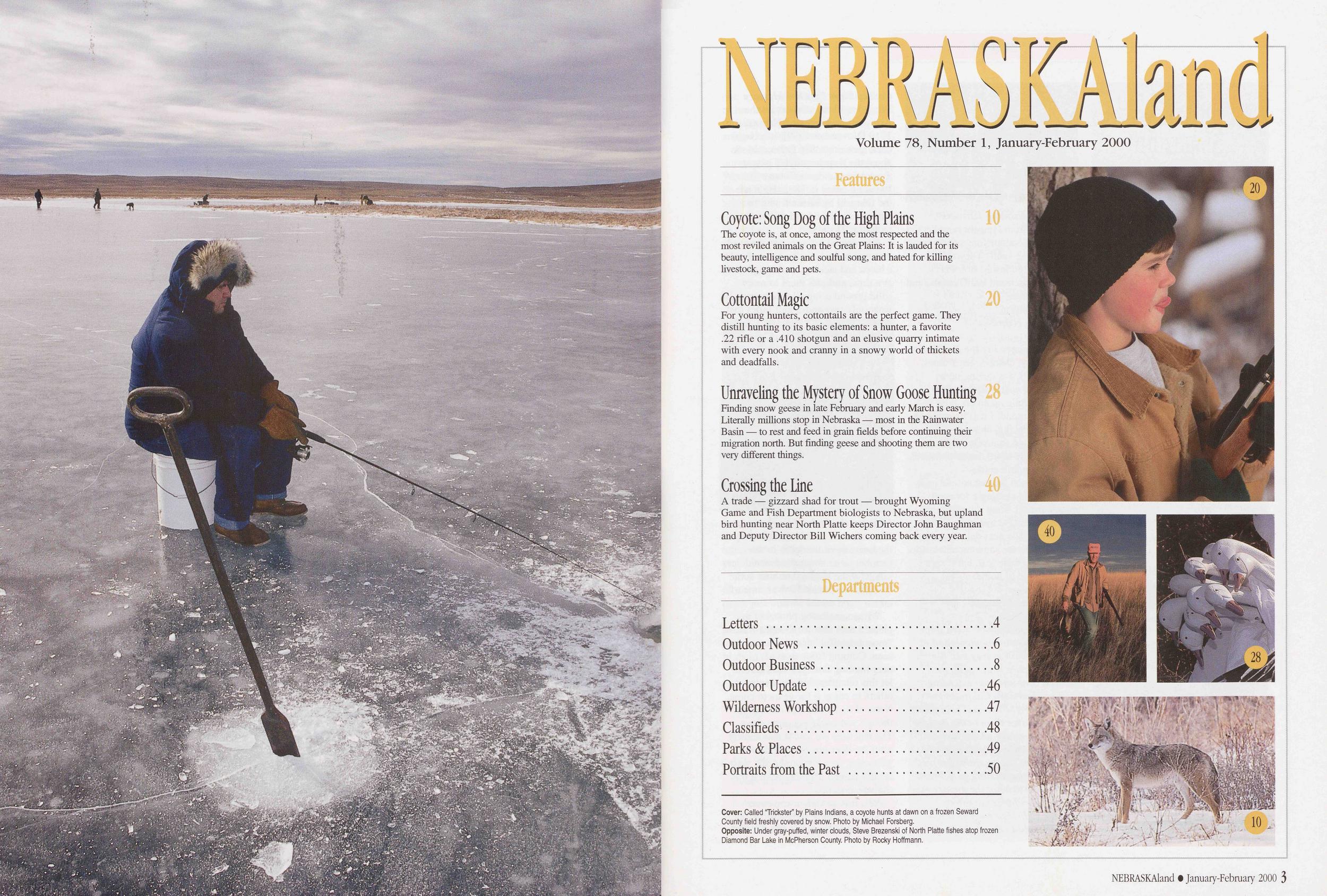
NEBRASKAland
Volume 78, Number 1, January-February 2000
Features Coyote: Song Dog of the High Plains 10 The coyote is, at once, among the most respected and the most reviled animals on the Great Plains: It is lauded for its beauty, intelligence and soulful song, and hated for killing livestock, game and pets. Cottontail Magic 20 For young hunters, cottontails are the perfect game. They distill hunting to its basic elements: a hunter, a favorite .22 rifle or a .410 shotgun and an elusive quarry intimate with every nook and cranny in a snowy world of thickets and deadfalls. 28 Unraveling the Mystery of Snow Goose Hunting Finding snow geese in late February and early March is easy. Literally millions stop in Nebraska — most in the Rainwater Basin — to rest and feed in grain fields before continuing their migration north. But finding geese and shooting them are two very different things. Crossing the Line 40 A trade — gizzard shad for trout — brought Wyoming Game and Fish Department biologists to Nebraska, but upland bird hunting near North Platte keeps Director John Baughman and Deputy Director Bill Wichers coming back every year. Departments Letters 4Outdoor News 6
Outdoor Business 8
Outdoor Update 46
Wilderness Workshop 47
Classifieds 48
Parks & Places 49
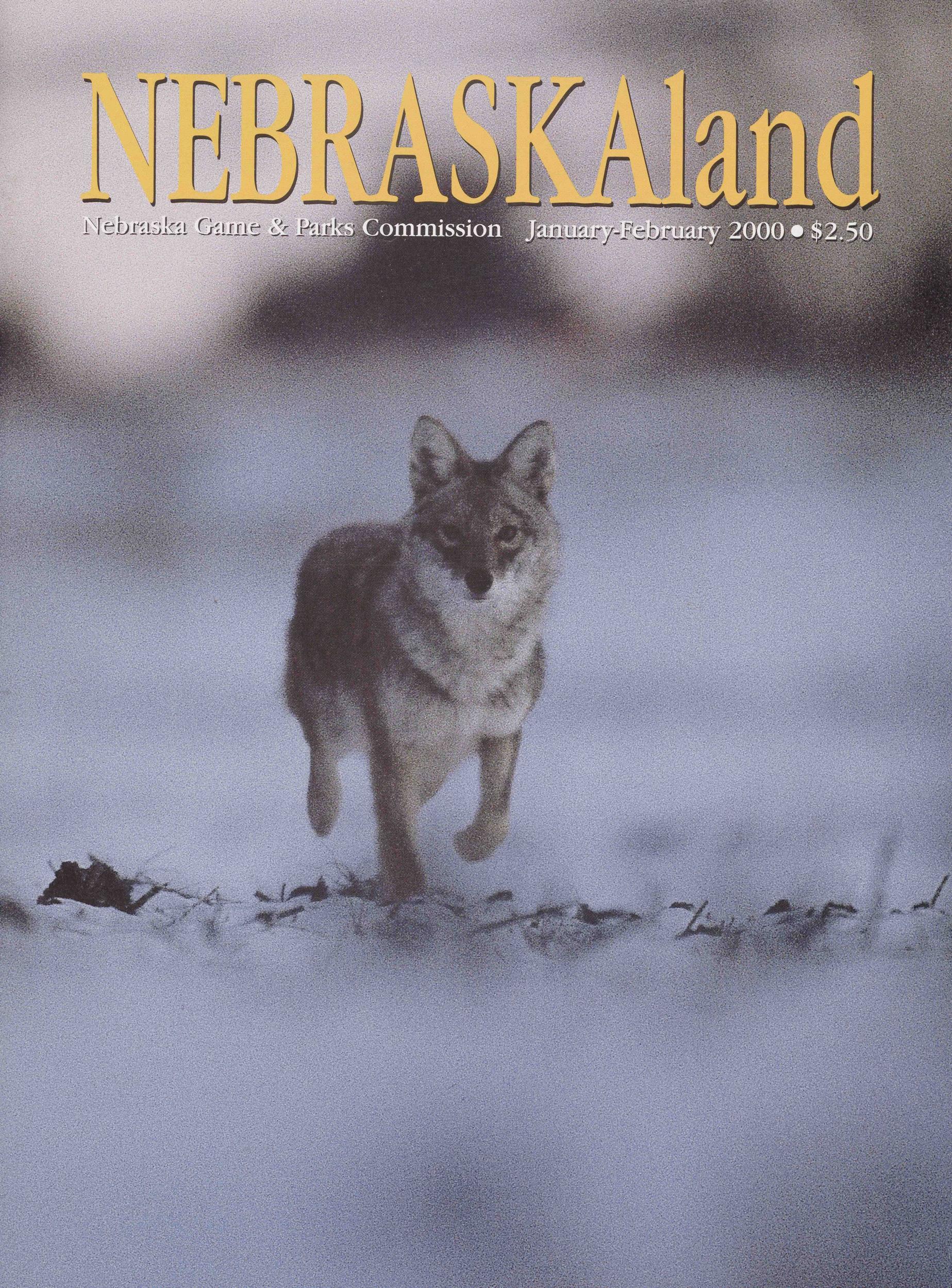
Portraits from the Past 50 Cover: Called 'Trickster" by Plains Indians, a coyote hunts at dawn on a frozen Seward County field freshly covered by snow. Photo by Michael Forsberg. Opposite: Under gray-puffed, winter clouds, Steve Brezenski of North Platte fishes atop frozen Diamond Bar Lake in McPherson County. Photo by Rocky Hoffmann.
20
40
28
10
 Letters
NEBRASKAland Magaine Published by the
Nebraska Game and
Parks Commission
Director: Rex Amack
Assistant Directors:
Noelyn Isom
Roger Kuhn
Kirk Nelson
Information & Education Administrator:
Paul Horton
Information & Education Art Director:
Steve O'Hare
Commissioners
Chairman:
Daniel Wallen, McCook
Vice Chairman:
Thomas O'Neill Jr., Lincoln
2nd Vice Chairman:
George W. Egermayer Jr., Omaha
Rob Coupland, Valentine
John P. Miller, Blair
Connie Lapaseotes, Bridgeport
Randall K. Stinnette, Inland
Magazine Staff
Editor: Don Cunningham
Associate Editor: Tom White
Art Director: Tim Reigert
Senior Editors: Ken Bouc, Jon Farrar
Regional Editors:
Bob Grier, Rocky Hoffmann
Contributing Editor: Michael Forsberg
Circulation: Pat Frahm
NEBRASKAland
ISSN: 0028-1964
VOL. 78 / NO. 1
JANUARY-FEBRUARY 2000
Published monthly, except for JanTFeb. and Aug./Sept.
issues, by the Nebraska Game and Parks Commission, 2200
N. 33rd St., Lincoln, NE. Copyright 2000, all rights reserved.
Please address comments or questions to this address.
Periodicals postage paid at Lincoln, Nebraska. POSTMASTER: Send all address changes
to NEBRASKAland,
P.O. Box 30370, Lincoln, NE 68503-0370.
Address submissions to: The Editor, NEBRASKAland
Magazine, P.O. Box 30370, Lincoln, NE 68503. Include
a stamped, self-addressed return envelope. The publisher
assumes no responsibility for unsolicited material.
NEBRASKAland is available on audio cassette from the
Nebraska Library Commission Talking Book and Braille
Service, Suite 120, 1200 N St., Lincoln, NE 68508.
Rates: $16 for one year,- $30 for two years.
Web site: www.ngpc.state.ne.us/nebland
Long-time Hunting Partners
Letters
NEBRASKAland Magaine Published by the
Nebraska Game and
Parks Commission
Director: Rex Amack
Assistant Directors:
Noelyn Isom
Roger Kuhn
Kirk Nelson
Information & Education Administrator:
Paul Horton
Information & Education Art Director:
Steve O'Hare
Commissioners
Chairman:
Daniel Wallen, McCook
Vice Chairman:
Thomas O'Neill Jr., Lincoln
2nd Vice Chairman:
George W. Egermayer Jr., Omaha
Rob Coupland, Valentine
John P. Miller, Blair
Connie Lapaseotes, Bridgeport
Randall K. Stinnette, Inland
Magazine Staff
Editor: Don Cunningham
Associate Editor: Tom White
Art Director: Tim Reigert
Senior Editors: Ken Bouc, Jon Farrar
Regional Editors:
Bob Grier, Rocky Hoffmann
Contributing Editor: Michael Forsberg
Circulation: Pat Frahm
NEBRASKAland
ISSN: 0028-1964
VOL. 78 / NO. 1
JANUARY-FEBRUARY 2000
Published monthly, except for JanTFeb. and Aug./Sept.
issues, by the Nebraska Game and Parks Commission, 2200
N. 33rd St., Lincoln, NE. Copyright 2000, all rights reserved.
Please address comments or questions to this address.
Periodicals postage paid at Lincoln, Nebraska. POSTMASTER: Send all address changes
to NEBRASKAland,
P.O. Box 30370, Lincoln, NE 68503-0370.
Address submissions to: The Editor, NEBRASKAland
Magazine, P.O. Box 30370, Lincoln, NE 68503. Include
a stamped, self-addressed return envelope. The publisher
assumes no responsibility for unsolicited material.
NEBRASKAland is available on audio cassette from the
Nebraska Library Commission Talking Book and Braille
Service, Suite 120, 1200 N St., Lincoln, NE 68508.
Rates: $16 for one year,- $30 for two years.
Web site: www.ngpc.state.ne.us/nebland
Long-time Hunting Partners
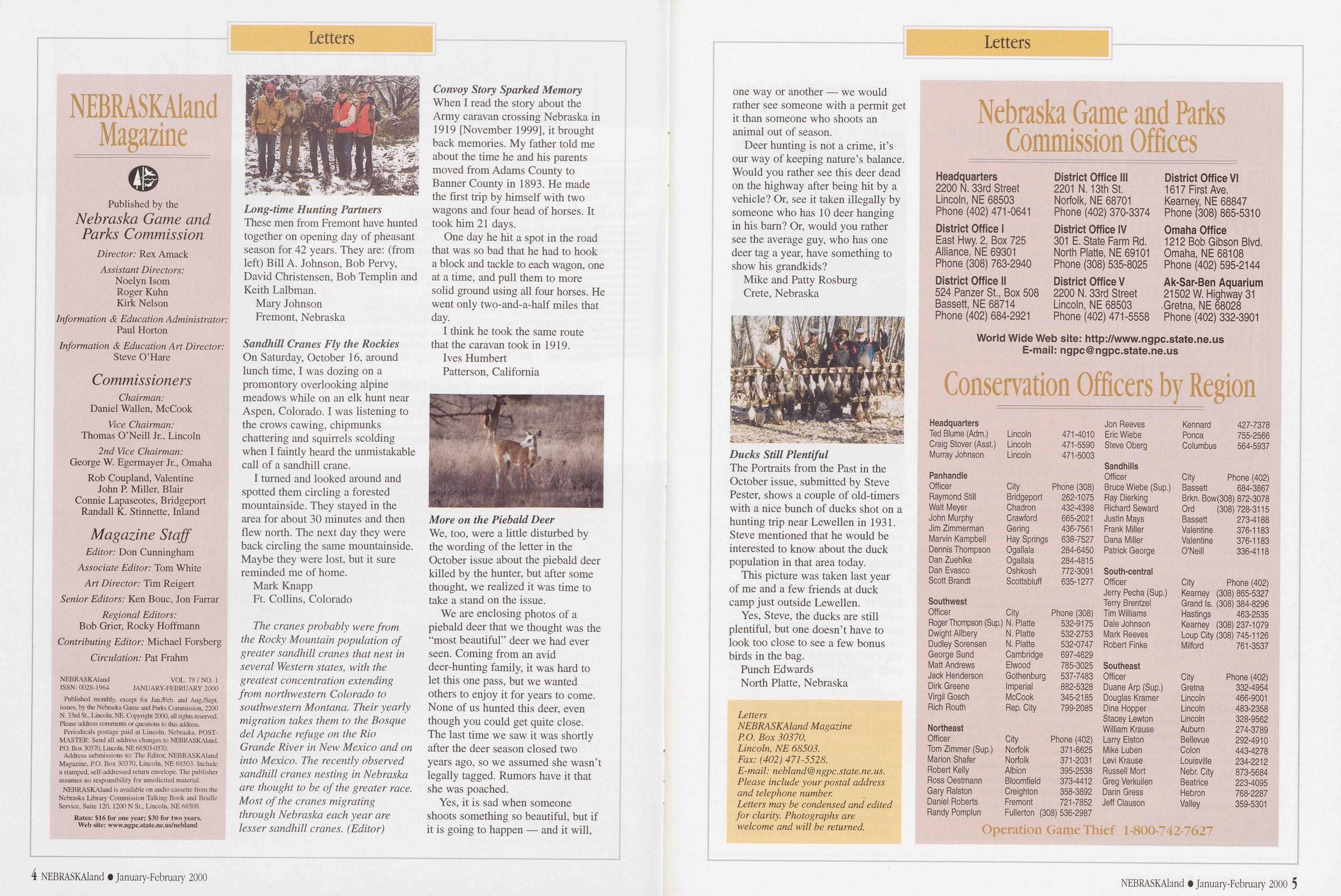
These men from Fremont have hunted together on opening day of pheasant season for 42 years. They are: (from left) Bill A. Johnson, Bob Pervy, David Christensen, Bob Templin and Keith Lalbman.
Mary Johnson
Fremont, Nebraska
Sandhill Cranes Fly the RockiesOn Saturday, October 16, around lunch time, I was dozing on a promontory overlooking alpine meadows while on an elk hunt near Aspen, Colorado. I was listening to the crows cawing, chipmunks chattering and squirrels scolding when I faintly heard the unmistakable call of a sandhill crane.
I turned and looked around and spotted them circling a forested mountainside. They stayed in the area for about 30 minutes and then flew north. The next day they were back circling the same mountainside. Maybe they were lost, but it sure reminded me of home.
Mark Knapp
Ft. Collins, Colorado
The cranes probably were from the Rocky Mountain population of greater sandhill cranes that nest in several Western states, with the greatest concentration extending from northwestern Colorado to southwestern Montana. Their yearly migration takes them to the Bosque del Apache refuge on the Rio Grande River in New Mexico and on into Mexico. The recently observed sandhill cranes nesting in Nebraska are thought to be of the greater race. Most of the cranes migrating through Nebraska each year are lesser sandhill cranes. (Editor) Convoy Story Sparked MemoryWhen I read the story about the Army caravan crossing Nebraska in 1919 [November 1999], it brought back memories. My father told me about the time he and his parents moved from Adams County to Banner County in 1893. He made the first trip by himself with two wagons and four head of horses. It took him 21 days.
One day he hit a spot in the road that was so bad that he had to hook a block and tackle to each wagon, one at a time, and pull them to more solid ground using all four horses. He went only two-and-a-half miles that day.
I think he took the same route that the caravan took in 1919.
Ives Humbert
Patterson, California
We, too, were a little disturbed by the wording of the letter in the October issue about the piebald deer killed by the hunter, but after some thought, we realized it was time to take a stand on the issue.
We are enclosing photos of a piebald deer that we thought was the "most beautiful" deer we had ever seen. Coming from an avid deer-hunting family, it was hard to let this one pass, but we wanted others to enjoy it for years to come. None of us hunted this deer, even though you could get quite close. The last time we saw it was shortly after the deer season closed two years ago, so we assumed she wasn't legally tagged. Rumors have it that she was poached.
Yes, it is sad when someone shoots something so beautiful, but if it is going to happen — and it will,
4 NEBRASKAland • January-February 2000 Lettersone way or another — we would rather see someone with a permit get it than someone who shoots an animal out of season.
Deer hunting is not a crime, it's our way of keeping nature's balance. Would you rather see this deer dead on the highway after being hit by a vehicle? Or, see it taken illegally by someone who has 10 deer hanging in his barn? Or, would you rather see the average guy, who has one deer tag a year, have something to show his grandkids?
Mike and Patty Rosburg
Crete, Nebraska
The Portraits from the Past in the October issue, submitted by Steve Pester, shows a couple of old-timers with a nice bunch of ducks shot on a hunting trip near Lewellen in 1931. Steve mentioned that he would be interested to know about the duck population in that area today.
This picture was taken last year of me and a few friends at duck camp just outside Lewellen.
Yes, Steve, the ducks are still plentiful, but one doesn't have to look too close to see a few bonus birds in the bag.
Punch Edwards
North Platte, Nebraska
LettersNEBRASKAland Magazine
P.O. Box 30370,
Lincoln, NE 68503.
Fax: (402)471-5528.
E-mail: nebland@ngpc.state.ne. us.
Please include your postal address and telephone number. Letters may be condensed and edited for clarity. Photographs are welcome and will be returned. Nebraska Game and Parks Commission Offices Headquarters 2200 N. 33rd Street Lincoln, NE 68503 Phone (402) 471-0641 District Office I East Hwy. 2, Box 725 Alliance, NE 69301 Phone (308) 763-2940 District Office II 524 Panzer St., Box 508 Bassett, NE 68714 Phone (402) 684-2921 District Office III 2201 N. 13th St. Norfolk, NE 68701 Phone (402) 370-3374 District Office IV 301 E. State Farm Rd. North Platte, NE 69101 Phone (308) 535-8025 District Office V 2200 N. 33rd Street Lincoln, NE 68503 Phone (402) 471-5558 District Office VI 1617 First Ave. Kearney, NE 68847 Phone (308) 865-5310 Omaha Office 1212 Bob Gibson Blvd. Omaha, NE 68108 Phone (402) 595-2144 Ak-Sar-Ben Aquarium 21502 W. Highway 31 Gretna, NE 68028 Phone (402) 332-3901 World Wide Web site: http://www.ngpc.state.ne.us E-mail: ngpc@ngpc.state.ne.us
Conservation Officers by Region Headquarters Ted Blume (Adm.) Craig Stover (Asst.) Murray Johnson Panhandle Officer Raymond Still Walt Meyer John Murphy Jim Zimmerman Marvin Kampbell Dennis Thompson Dan Zuehlke Dan Evasco Scott Brandt Southwest Officer Roger Thompson (Sup.) Dwight Allbery Dudley Sorensen George Sund Matt Andrews Jack Henderson Dirk Greene Virgil Gosch Rich Routh Northeast Officer Tom Zimmer (Sup.) Marion Shafer Robert Kelly Ross Oestmann Gary Ralston Daniel Roberts Randy Pomplun Lincoln Lincoln Lincoln City Bridgeport Chadron Crawford Gering Hay Springs Ogallala Ogallala Oshkosh Scottsbluff City N. Platte N. Platte N. Platte Cambridge Elwood Gothenburg Imperial McCook Rep. City City Norfolk Norfolk Albion Bloomfield Creighton Fremont 471-4010 471-5590 471-5003 Phone (308) 262-1075 432-4398 665-2021 436-7561 638-7527 284-6450 284-4815 772-3091 635-1277 Phone (308) 532-9175 532-2753 532-0747 697-4629 785-3025 537-7483 882-5328 345-2185 799-2085 Phone (402) 371-6625 371-2031 395-2538 373-4412 358-3892 721-7852 Jon Reeves Eric Wiebe Steve Oberg Sandhills Officer Bruce Wiebe (Sup.) Ray Dierking Richard Seward Justin Mays Frank Miller Dana Miller Patrick George South-central Officer Jerry Pecha (Sup.) Terry Brentzel Tim Williams Dale Johnson Mark Reeves Robert Finke Southeast Officer Duane Arp (Sup.) Douglas Kramer Dina Hopper Stacey Lewton William Krause Larry Elston Mike Luben Levi Krause Russell Mort Greg Verkuilen Darin Gress Jeff Clauson Kennard Ponca Columbus 427-7378 755-2566 564-5937 City Phone (402) Bassett 684-3867 Brkn. Bow(308) 872-3078 Ord (308)728-3115 Bassett 273-4188 Valentine 376-1183 Valentine 376-1183 O'Neill 336-4118 City Phone (402) Kearney (308)865-5327 Grand Is. (308) 384-8296 Hastings 463-2535 Kearney (308)237-1079 Loup City (308) 745-1126 Milford 761-3537 Fullerton (308) 536-2987 City Gretna Lincoln Lincoln Lincoln Auburn Bellevue Colon Louisville Nebr. City Beatrice Hebron Valley Phone (402) 332-4954 466-9001 483-2358 328-9562 274-3789 292-4910 443-4278 234-2212 873-5684 223-4095 768-2287 359-5301
NEBRASKAland • January-February 2000 5
Outdoor News
2000 Guide to Nebraska Fishing Now AvailableA complete listing of state fishing regulations is included in the Nebraska Game and Parks Commission's new fishing guide.
The 32-page, free guide is now available at Commission offices, which are listed on page 5, and more than 1,000 permit agents across the state.
In addition to detailing changes in species length and bag limit regulations that became effective January 1, the publication includes: the NEBRASKAland guide to good fishing, a list of record fish caught in the state, a map showing where to find public waters and access points, fish consumption advisories and a fist of safe fishing waters.
57% of Nebraska Firearm Deer Hunters SuccessfulFifty-seven percent of hunters who had a permit killed a deer in Nebraska's 1999 firearm season, according to preliminary figures.
Karl Menzel, big game specialist with the Nebraska Game and Parks Commission, reported that 69,961 permits were issued and 39,771 deer were taken. In the 1998 deer firearm season 61 percent of hunters were successful. Final figures for the 1999 season will be reported early this year.
2000 Symposium to Discuss Bison on the Great PlainsAn interdisciplinary, regional symposium, titled "Bison: The Past, Present, and Future on the Great Plains," is scheduled April 7 and 8 in Lincoln.
Dan Flores, a professor of history at the University of Montana, will be the keynote speaker. For information contact The Center for Great Plains Studies at the University of Nebraska at (402) 472-3082.
Photographic images from NEBRASKAland Magazine's 1995 special edition "The Road Home" and video from Nebraska Educational Television will form a visual backdrop for a performance by The Lincoln Symphony Orchestra at the Lied Center on February 5.
The symphony's musical homage to the Cornhusker state will include works by Aaron Copland, Leroy Anderson, Antonin Dvorak and Virgil Thomson interspersed with readings from Nebraska literature.
Inspired by NEBRASKAland's 130-page photographic journey, The Road Home performance, which starts at 8 p.m., will be videotaped and shown later on NETV. For information about tickets call The Lincoln Symphony Orchestra at (402)423-2211.
Mahoney Park Will Host 2000 Family Fest Feb, 5Eugene T. Mahoney State Park and the Strategic Air Command Museum will host 2000 Family Fest on Saturday, February 5 in cooperation with the 5th Annual Cornhusker State Winter Games.
At the park Family Fest activities
6 NEBRASKAland • January-February 2000 Outdoor Newsfrom 3 to 10 p.m. include: ice skating, sled and toboggan rides on a lighted run, virtual golf and archery, hayrack or sleigh rides, wall climbing and a magnetic kids' fun center.
At SAC the Fest includes a dinner, compliments of Taco Bell and Pepsi, and open exhibits from 5 to 10 p.m.
All registered Winter Games athletes who present a Family Fest pass will be issued a wristband entitling them to all activities, including dinner. Admission for non-athletes is $5 for adults and $2 for children 12 and under.
Shuttles will provide free transportation between the park and museum. Those who park at Mahoney must have a Nebraska state park entry permit.
Tyler Vettel of Phillips
Tyler Vettel, a 12-year-old boy from Phillips who won Nebraska's 1999 lottery bighorn sheep permit, killed a full-curl ram in the Cheyenne Buttes area above Fort Robinson State Park on Dec. 2.
Vettel, who was accompanied by his father, Dr. Kenneth Vettel, and Game and Parks Commission biologist Lon Lemmon, stalked two rams in rough country for four hours.
Vettel's first shot at the ram appeared to miss. After following the animal over several ridges, he was able to work to within 150 yards for a second shot that cleanly dropped the ram. When the hunting group examined the animal, they discovered that the first bullet had lodged in the ram's horn.
Outdoor Business
Personal Watercraft Safety
New law requires 14- and 15-year-olds to pass a course to operate jet skis.
It's not what some would have liked, but it's a start. Beginning May 1, all 14- and 15-year-olds will be required to pass a boater education course before operating a personal watercraft, commonly known as a jet ski, on Nebraska waters. The change is required by LB 176, passed by the Nebraska Legislature last May.
Herb Angell, Nebraska Game and Parks Commission boating safety administrator, would like to see the requirement apply to all boaters, regardless of age.
"It's because we've got a lot of people out there who don't know what they're doing," Angell said, citing inattention and inexperience as the causes of most boating accidents. Angell believes until more boaters become more knowledgeable about safety, the accident rate probably will continue to rise.
The focus now is on young PWC operators. In 1998, the speedy machines accounted for 67 percent of all boating accidents reported in Nebraska, while making up just 10 percent of the state's 72,000 registered boats. In 1997, PWCs were involved in 85 percent of the state's boating accidents — the highest percentage in the nation.
Nebraska boating accidents have increased every year since 1973, when only 33,000 boats were registered, but fatalities have not matched the record total of 10 in that year. Registration numbers do not include thousands of boats without motors, or those from surrounding states. The surface acres of Nebraska water available to boaters have not appreciably increased in the last 18 years, and some accidents, which under law must be reported, probably are not.
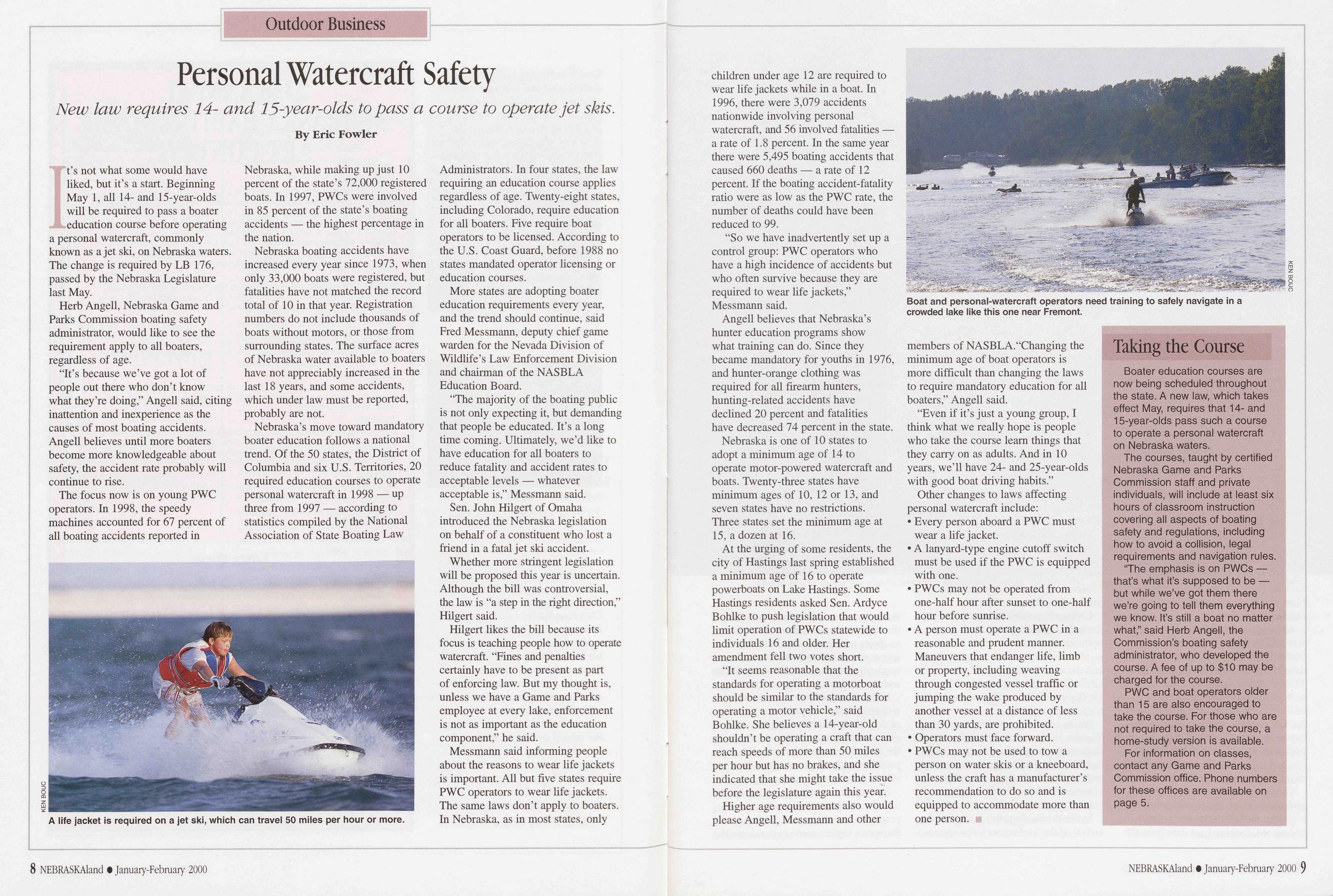
A life jacket is required on a jet ski, which can travel 50 miles per hour or more.
More states are adopting boater education requirements every year, and the trend should continue, said Fred Messmann, deputy chief game warden for the Nevada Division of Wildlife's Law Enforcement Division and chairman of the NASBLA Education Board.
"The majority of the boating public is not only expecting it, but demanding that people be educated. It's a long time coming. Ultimately, we'd like to have education for all boaters to reduce fatality and accident rates to acceptable levels — whatever acceptable is," Messmann said.
Sen. John Hilgert of Omaha introduced the Nebraska legislation on behalf of a constituent who lost a friend in a fatal jet ski accident.
Whether more stringent legislation will be proposed this year is uncertain. Although the bill was controversial, the law is "a step in the right direction," Hilgert said.
Hilgert likes the bill because its focus is teaching people how to operate watercraft. "Fines and penalties certainly have to be present as part of enforcing law. But my thought is, unless we have a Game and Parks employee at every lake, enforcement is not as important as the education component," he said.
Messmann said informing people about the reasons to wear life jackets is important. All but five states require PWC operators to wear life jackets. The same laws don't apply to boaters. In Nebraska, as in most states, only
8 NEBRASKAland • January-February 2000children under age 12 are required to wear life jackets while in a boat. In 1996, there were 3,079 accidents nationwide involving personal watercraft, and 56 involved fatalities - a rate of 1.8 percent. In the same year there were 5,495 boating accidents that caused 660 deaths — a rate of 12 percent. If the boating accident-fatality ratio were as low as the PWC rate, the number of deaths could have been reduced to 99.
"So we have inadvertently set up a control group: PWC operators who have a high incidence of accidents but who often survive because they are required to wear life jackets," Messmann said.
Angell believes that Nebraska's hunter education programs show what training can do. Since they became mandatory for youths in 1976, and hunter-orange clothing was required for all firearm hunters, hunting-related accidents have declined 20 percent and fatalities have decreased 74 percent in the state.
Nebraska is one of 10 states to adopt a minimum age of 14 to operate motor-powered watercraft and boats. Twenty-three states have minimum ages of 10, 12 or 13, and seven states have no restrictions. Three states set the minimum age at 15, a dozen at 16.
At the urging of some residents, the city of Hastings last spring established a minimum age of 16 to operate powerboats on Lake Hastings. Some Hastings residents asked Sen. Ardyce Bohlke to push legislation that would limit operation of PWCs statewide to individuals 16 and older. Her amendment fell two votes short.
Boat and personal-watercraft operators need training to safely navigate in a crowded lake like this one near Fremont.
"Even if it's just a young group, I think what we really hope is people who take the course learn things that they carry on as adults. And in 10 years, we'll have 24- and 25-year-olds with good boat driving habits."
Other changes to laws affecting personal watercraft include:
• Every person aboard a PWC must wear a life jacket.
• A lanyard-type engine cutoff switch must be used if the PWC is equipped with one.
• PWCs may not be operated from one-half hour after sunset to one-half hour before sunrise.
• A person must operate a PWC in a reasonable and prudent manner. Maneuvers that endanger life, limb or property, including weaving through congested vessel traffic or jumping the wake produced by another vessel at a distance of less than 30 yards, are prohibited.
• Operators must face forward.
• PWCs may not be used to tow a person on water skis or a kneeboard, unless the craft has a manufacturer's recommendation to do so and is equipped to accommodate more than one person.
Taking the CourseBoater education courses are now being scheduled throughout the state. A new law, which takes effect May, requires that 14- and 15-year-olds pass such a course to operate a personal watercraft on Nebraska waters.
The courses, taught by certified Nebraska Game and Parks Commission staff and private individuals, will include at least six hours of classroom instruction covering all aspects of boating safety and regulations, including how to avoid a collision, legal requirements and navigation rules.
"The emphasis is on PWCs — that's what it's supposed to be — but while we've got them there we're going to tell them everything we know. It's still a boat no matter what," said Herb Angell, the Commission's boating safety administrator, who developed the course. A fee of up to $10 may be charged for the course.
PWC and boat operators older than 15 are also encouraged to take the course. For those who are not required to take the course, a home-study version is available. For information on classes, contact any Game and Parks Commission office. Phone numbers for these offices are available on page 5.
NEBRASKAland • January-February 2000 9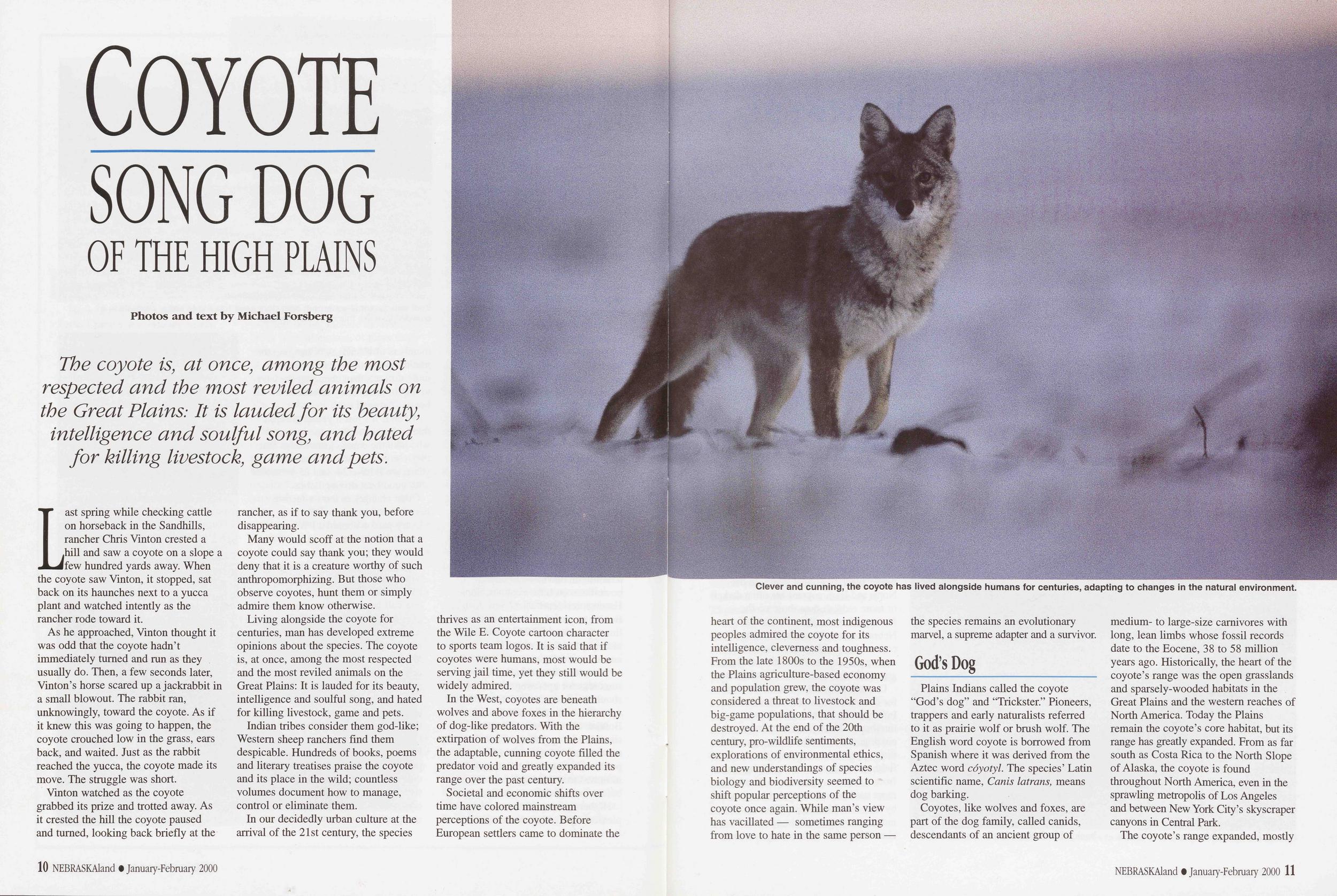
COYOTE
SONG DOG
OF THE HIGH PLAINS
The coyote is, at once, among the most respected and the most reviled animals on the Great Plains: It is lauded for its beauty, intelligence and soulful song, and hated for killing livestock, game and pets.
Last spring while checking cattle on horseback in the Sandhills, rancher Chris Vinton crested a hill and saw a coyote on a slope a few hundred yards away. When the coyote saw Vinton, it stopped, sat back on its haunches next to a yucca plant and watched intently as the rancher rode toward it.
As he approached, Vinton thought it was odd that the coyote hadn't immediately turned and run as they usually do. Then, a few seconds later, Vinton's horse scared up a jackrabbit in a small blowout. The rabbit ran, unknowingly, toward the coyote. As if it knew this was going to happen, the coyote crouched low in the grass, ears back, and waited. Just as the rabbit reached the yucca, the coyote made its move. The struggle was short.
Vinton watched as the coyote grabbed its prize and trotted away. As it crested the hill the coyote paused and turned, looking back briefly at the rancher, as if to say thank you, before disappearing.
Many would scoff at the notion that a coyote could say thank you; they would deny that it is a creature worthy of such anthropomorphizing. But those who observe coyotes, hunt them or simply admire them know otherwise.
Living alongside the coyote for centuries, man has developed extreme opinions about the species. The coyote is, at once, among the most respected and the most reviled animals on the Great Plains: It is lauded for its beauty, intelligence and soulful song, and hated for killing livestock, game and pets.
Indian tribes consider them god-like; Western sheep ranchers find them despicable. Hundreds of books, poems and literary treatises praise the coyote and its place in the wild; countless volumes document how to manage, control or eliminate them.
In our decidedly urban culture at the arrival of the 21st century, the species thrives as an entertainment icon, from the Wile E. Coyote cartoon character to sports team logos. It is said that if coyotes were humans, most would be serving jail time, yet they still would be widely admired.
In the West, coyotes are beneath wolves and above foxes in the hierarchy of dog-like predators. With the extirpation of wolves from the Plains, the adaptable, cunning coyote filled the predator void and greatly expanded its range over the past century.
Societal and economic shifts over time have colored mainstream perceptions of the coyote. Before European settlers came to dominate the
10 NEBRASKAland • January-February 2000Clever and cunning, the coyote has lived alongside humans for centuries, adapting to changes in the natural environment.
heart of the continent, most indigenous peoples admired the coyote for its intelligence, cleverness and toughness. From the late 1800s to the 1950s, when the Plains agriculture-based economy and population grew, the coyote was considered a threat to livestock and big-game populations, that should be destroyed. At the end of the 20th century, pro-wildlife sentiments, explorations of environmental ethics, and new understandings of species biology and biodiversity seemed to shift popular perceptions of the coyote once again. While man's view has vacillated — sometimes ranging from love to hate in the same person — the species remains an evolutionary marvel, a supreme adapter and a survivor.
God's DogPlains Indians called the coyote "God's dog" and "Trickster." Pioneers, trappers and early naturalists referred to it as prairie wolf or brush wolf. The English word coyote is borrowed from Spanish where it was derived from the Aztec word coyotyl. The species' Latin scientific name, Cams latrans, means dog barking.
Coyotes, like wolves and foxes, are part of the dog family, called canids, descendants of an ancient group of medium- to large-size carnivores with long, lean limbs whose fossil records date to the Eocene, 38 to 58 million years ago. Historically, the heart of the coyote's range was the open grasslands and sparsely-wooded habitats in the Great Plains and the western reaches of North America. Today the Plains remain the coyote's core habitat, but its range has greatly expanded. From as far south as Costa Rica to the North Slope of Alaska, the coyote is found throughout North America, even in the sprawling metropolis of Los Angeles and between New York City's skyscraper canyons in Central Park.
The coyote's range expanded, mostly
NEBRASKAland • January-February 2000 11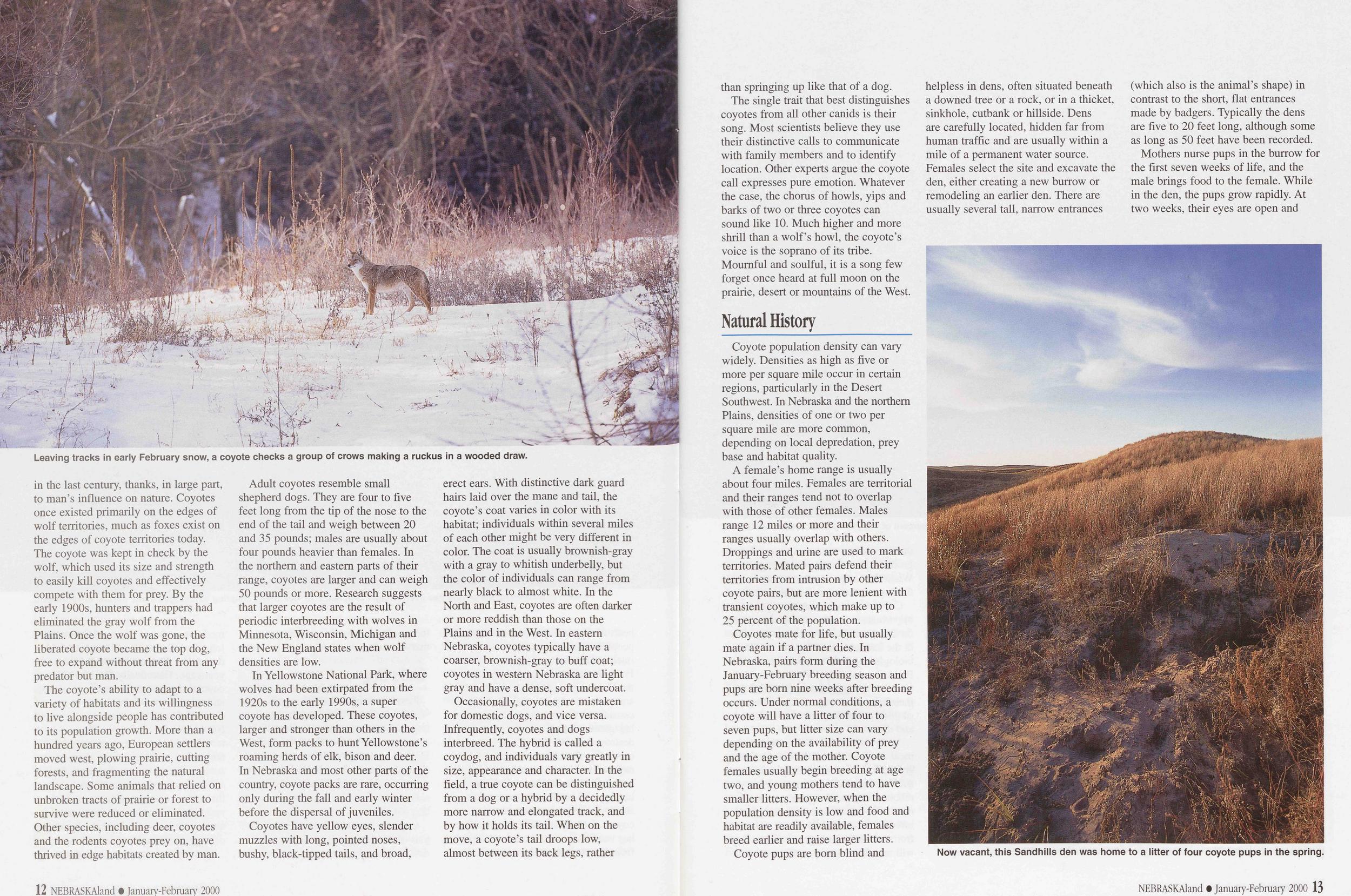
Leaving tracks in early February snow, a coyote checks a group of crows making a ruckus in a wooded draw.
in the last century, thanks, in large part, to man's influence on nature. Coyotes once existed primarily on the edges of wolf territories, much as foxes exist on the edges of coyote territories today. The coyote was kept in check by the wolf, which used its size and strength to easily kill coyotes and effectively compete with them for prey. By the early 1900s, hunters and trappers had eliminated the gray wolf from the Plains. Once the wolf was gone, the liberated coyote became the top dog, free to expand without threat from any predator but man.
The coyote's ability to adapt to a variety of habitats and its willingness to live alongside people has contributed to its population growth. More than a hundred years ago, European settlers moved west, plowing prairie, cutting forests, and fragmenting the natural landscape. Some animals that relied on unbroken tracts of prairie or forest to survive were reduced or eliminated. Other species, including deer, coyotes and the rodents coyotes prey on, have thrived in edge habitats created by man.
Adult coyotes resemble small shepherd dogs. They are four to five feet long from the tip of the nose to the end of the tail and weigh between 20 and 35 pounds; males are usually about four pounds heavier than females. In the northern and eastern parts of their range, coyotes are larger and can weigh 50 pounds or more. Research suggests that larger coyotes are the result of periodic interbreeding with wolves in Minnesota, Wisconsin, Michigan and the New England states when wolf densities are low.
In Yellowstone National Park, where wolves had been extirpated from the 1920s to the early 1990s, a super coyote has developed. These coyotes, larger and stronger than others in the West, form packs to hunt Yellowstone's roaming herds of elk, bison and deer. In Nebraska and most other parts of the country, coyote packs are rare, occurring only during the fall and early winter before the dispersal of juveniles.
Coyotes have yellow eyes, slender muzzles with long, pointed noses, bushy, black-tipped tails, and broad, erect ears. With distinctive dark guard hairs laid over the mane and tail, the coyote's coat varies in color with its habitat; individuals within several miles of each other might be very different in color. The coat is usually brownish-gray with a gray to whitish underbelly, but the color of individuals can range from nearly black to almost white. In the North and East, coyotes are often darker or more reddish than those on the Plains and in the West. In eastern Nebraska, coyotes typically have a coarser, brownish-gray to buff coat; coyotes in western Nebraska are light gray and have a dense, soft undercoat.
Occasionally, coyotes are mistaken for domestic dogs, and vice versa. Infrequently, coyotes and dogs interbreed. The hybrid is called a coydog, and individuals vary greatly in size, appearance and character. In the field, a true coyote can be distinguished from a dog or a hybrid by a decidedly more narrow and elongated track, and by how it holds its tail. When on the move, a coyote's tail droops low, almost between its back legs, rather 12 NEBRASKAland • January-February 2000 than springing up like that of a dog.
The single trait that best distinguishes coyotes from all other canids is their song. Most scientists believe they use their distinctive calls to communicate with family members and to identify location. Other experts argue the coyote call expresses pure emotion. Whatever the case, the chorus of howls, yips and barks of two or three coyotes can sound like 10. Much higher and more shrill than a wolf's howl, the coyote's voice is the soprano of its tribe.
Mournful and soulful, it is a song few forget once heard at full moon on the prairie, desert or mountains of the West.
Natural HistoryCoyote population density can vary widely. Densities as high as five or more per square mile occur in certain regions, particularly in the Desert Southwest. In Nebraska and the northern Plains, densities of one or two per square mile are more common, depending on local depredation, prey base and habitat quality.
A female's home range is usually about four miles. Females are territorial and their ranges tend not to overlap with those of other females. Males range 12 miles or more and their ranges usually overlap with others. Droppings and urine are used to mark territories. Mated pairs defend their territories from intrusion by other coyote pairs, but are more lenient with transient coyotes, which make up to 25 percent of the population.
Coyotes mate for life, but usually mate again if a partner dies. In Nebraska, pairs form during the January-February breeding season and pups are born nine weeks after breeding occurs. Under normal conditions, a coyote will have a litter of four to seven pups, but litter size can vary depending on the availability of prey and the age of the mother. Coyote females usually begin breeding at age two, and young mothers tend to have smaller litters. However, when the population density is low and food and habitat are readily available, females breed earlier and raise larger litters.
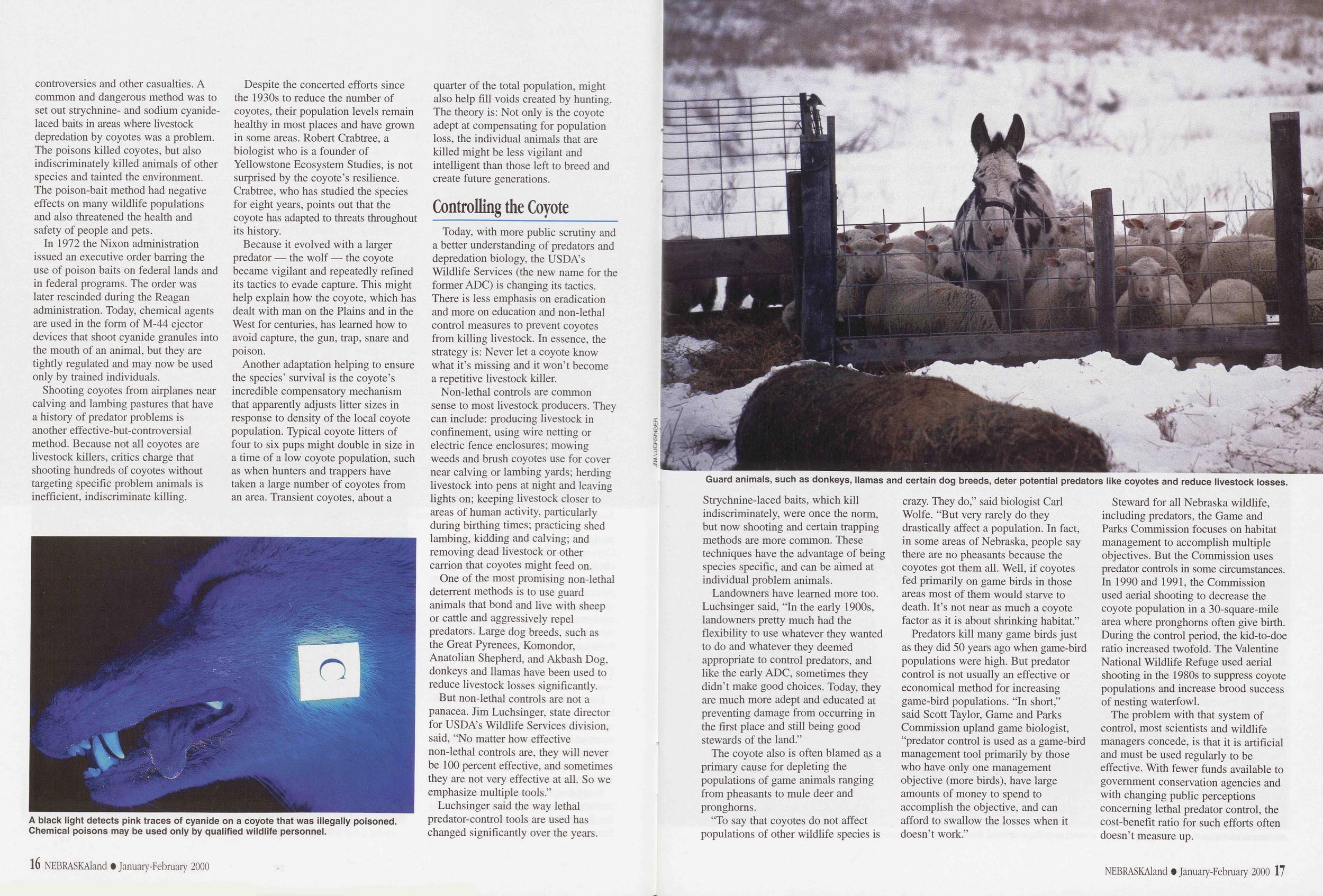
Coyote pups are born blind and helpless in dens, often situated beneath a downed tree or a rock, or in a thicket, sinkhole, cutbank or hillside. Dens are carefully located, hidden far from human traffic and are usually within a mile of a permanent water source. Females select the site and excavate the den, either creating a new burrow or remodeling an earlier den. There are usually several tall, narrow entrances (which also is the animal's shape) in contrast to the short, flat entrances made by badgers. Typically the dens are five to 20 feet long, although some as long as 50 feet have been recorded.
Mothers nurse pups in the burrow for the first seven weeks of life, and the male brings food to the female. While in the den, the pups grow rapidly. At two weeks, their eyes are open and
Now vacant, this Sandhills den was home to a litter of four coyote pups in the spring.
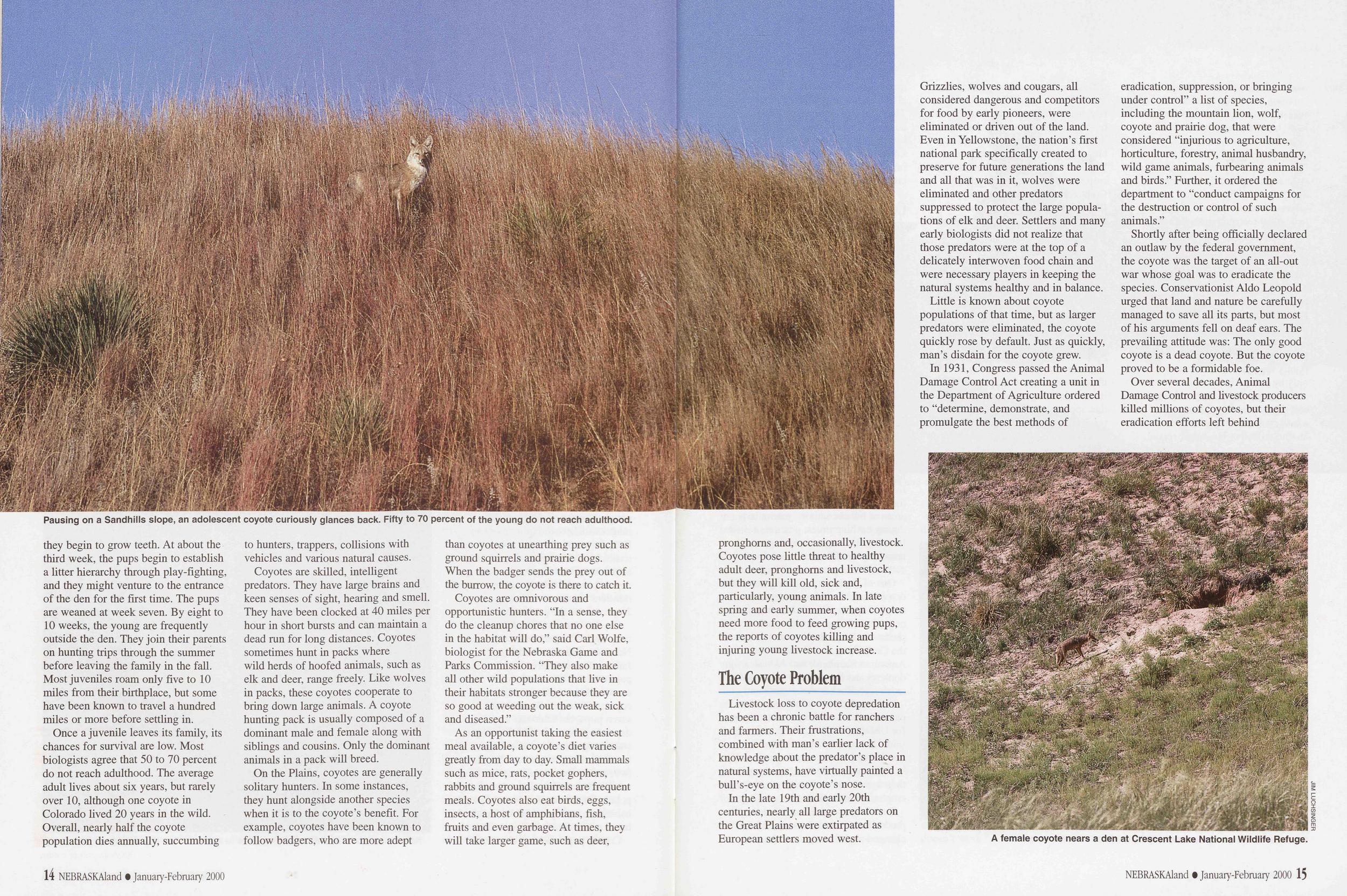
Pausing on a Sandhills slope, an adolescent coyote curiously glances back. Fifty to 70 percent of the young do not reach adulthood.
they begin to grow teeth. At about the third week, the pups begin to establish a litter hierarchy through play-fighting, and they might venture to the entrance of the den for the first time. The pups are weaned at week seven. By eight to 10 weeks, the young are frequently outside the den. They join their parents on hunting trips through the summer before leaving the family in the fall. Most juveniles roam only five to 10 miles from their birthplace, but some have been known to travel a hundred miles or more before settling in.
Once a juvenile leaves its family, its chances for survival are low. Most biologists agree that 50 to 70 percent do not reach adulthood. The average adult lives about six years, but rarely over 10, although one coyote in Colorado lived 20 years in the wild. Overall, nearly half the coyote population dies annually, succumbing to hunters, trappers, collisions with vehicles and various natural causes.
Coyotes are skilled, intelligent predators. They have large brains and keen senses of sight, hearing and smell. They have been clocked at 40 miles per hour in short bursts and can maintain a dead run for long distances. Coyotes sometimes hunt in packs where wild herds of hoofed animals, such as elk and deer, range freely. Like wolves in packs, these coyotes cooperate to bring down large animals. A coyote hunting pack is usually composed of a dominant male and female along with siblings and cousins. Only the dominant animals in a pack will breed.
On the Plains, coyotes are generally solitary hunters. In some instances, they hunt alongside another species when it is to the coyote's benefit. For example, coyotes have been known to follow badgers, who are more adept than coyotes at unearthing prey such as ground squirrels and prairie dogs. When the badger sends the prey out of the burrow, the coyote is there to catch it.
Coyotes are omnivorous and opportunistic hunters. "In a sense, they do the cleanup chores that no one else in the habitat will do," said Carl Wolfe, biologist for the Nebraska Game and Parks Commission. "They also make all other wild populations that five in their habitats stronger because they are so good at weeding out the weak, sick and diseased."
As an opportunist taking the easiest meal available, a coyote's diet varies greatly from day to day. Small mammals such as mice, rats, pocket gophers, rabbits and ground squirrels are frequent meals. Coyotes also eat birds, eggs, insects, a host of amphibians, fish, fruits and even garbage. At times, they will take larger game, such as deer,
14 NEBRASKAland • January-February 2000pronghorns and, occasionally, livestock. Coyotes pose little threat to healthy adult deer, pronghorns and livestock, but they will kill old, sick and, particularly, young animals. In late spring and early summer, when coyotes need more food to feed growing pups, the reports of coyotes killing and injuring young livestock increase.
The Coyote ProblemLivestock loss to coyote depredation has been a chronic battle for ranchers and farmers. Their frustrations, combined with man's earlier lack of knowledge about the predator's place in natural systems, have virtually painted a bull's-eye on the coyote's nose.
In the late 19th and early 20th centuries, nearly all large predators on the Great Plains were extirpated as European settlers moved west. Grizzlies, wolves and cougars, all considered dangerous and competitors for food by early pioneers, were eliminated or driven out of the land. Even in Yellowstone, the nation's first national park specifically created to preserve for future generations the land and all that was in it, wolves were eliminated and other predators suppressed to protect the large populations of elk and deer. Settlers and many early biologists did not realize that those predators were at the top of a delicately interwoven food chain and were necessary players in keeping the natural systems healthy and in balance.
Little is known about coyote populations of that time, but as larger predators were eliminated, the coyote quickly rose by default. Just as quickly, man's disdain for the coyote grew.
In 1931, Congress passed the Animal Damage Control Act creating a unit in the Department of Agriculture ordered to "determine, demonstrate, and promulgate the best methods of eradication, suppression, or bringing under control" a list of species, including the mountain lion, wolf, coyote and prairie dog, that were considered "injurious to agriculture, horticulture, forestry, animal husbandry, wild game animals, furbearing animals and birds." Further, it ordered the department to "conduct campaigns for the destruction or control of such animals."
Shortly after being officially declared an outlaw by the federal government, the coyote was the target of an all-out war whose goal was to eradicate the species. Conservationist Aldo Leopold urged that land and nature be carefully managed to save all its parts, but most of his arguments fell on deaf ears. The prevailing attitude was: The only good coyote is a dead coyote. But the coyote proved to be a formidable foe.
Over several decades, Animal Damage Control and hvestock producers killed millions of coyotes, but their eradication efforts left behind
A female coyote nears a den at Crescent Lake National Wildlife Refuge.
controversies and other casualties. A common and dangerous method was to set out strychnine- and sodium cyanide- laced baits in areas where livestock depredation by coyotes was a problem. The poisons killed coyotes, but also indiscriminately killed animals of other species and tainted the environment. The poison-bait method had negative effects on many wildlife populations and also threatened the health and safety of people and pets.
In 1972 the Nixon administration issued an executive order barring the use of poison baits on federal lands and in federal programs. The order was later rescinded during the Reagan administration. Today, chemical agents are used in the form of M-44 ejector devices that shoot cyanide granules into the mouth of an animal, but they are tightly regulated and may now be used only by trained individuals.
Shooting coyotes from airplanes near calving and lambing pastures that have a history of predator problems is another effective-but-controversial method. Because not all coyotes are livestock killers, critics charge that shooting hundreds of coyotes without targeting specific problem animals is inefficient, indiscriminate killing.
Despite the concerted efforts since the 1930s to reduce the number of coyotes, their population levels remain healthy in most places and have grown in some areas. Robert Crabtree, a biologist who is a founder of Yellowstone Ecosystem Studies, is not surprised by the coyote's resilience. Crabtree, who has studied the species for eight years, points out that the coyote has adapted to threats throughout its history.
Because it evolved with a larger predator — the wolf — the coyote became vigilant and repeatedly refined its tactics to evade capture. This might help explain how the coyote, which has dealt with man on the Plains and in the West for centuries, has learned how to avoid capture, the gun, trap, snare and poison.
A black light detects pink traces of cyanide on a coyote that was illegally poisoned. Chemical poisons may be used only by qualified wildlife personnel.
Today, with more public scrutiny and a better understanding of predators and depredation biology, the USDA's Wildlife Services (the new name for the former ADC) is changing its tactics. There is less emphasis on eradication and more on education and non-lethal control measures to prevent coyotes from killing livestock. In essence, the strategy is: Never let a coyote know what it's missing and it won't become a repetitive livestock killer.
Non-lethal controls are common sense to most livestock producers. They can include: producing livestock in confinement, using wire netting or electric fence enclosures; mowing weeds and brush coyotes use for cover near calving or lambing yards; herding livestock into pens at night and leaving lights on; keeping livestock closer to areas of human activity, particularly during birthing times; practicing shed lambing, kidding and calving; and removing dead livestock or other carrion that coyotes might feed on.
One of the most promising non-lethal deterrent methods is to use guard animals that bond and live with sheep or cattle and aggressively repel predators. Large dog breeds, such as the Great Pyrenees, Komondor, Anatolian Shepherd, and Akbash Dog, donkeys and llamas have been used to reduce livestock losses significantly.
But non-lethal controls are not a panacea. Jim Luchsinger, state director for USDA's Wildlife Services division, said, "No matter how effective non-lethal controls are, they will never be 100 percent effective, and sometimes they are not very effective at all. So we emphasize multiple tools."
Luchsinger said the way lethal predator-control tools are used has changed significantly over the years.
16 NEBRASKAland • January-February 2000Guard animals, such as donkeys, llamas and certain dog breeds, deter potential predators like coyotes and reduce livestock losses.
Strychnine-laced baits, which kill indiscriminately, were once the norm, but now shooting and certain trapping methods are more common. These techniques have the advantage of being species specific, and can be aimed at individual problem animals.
Landowners have learned more too. Luchsinger said, "In the early 1900s, landowners pretty much had the flexibility to use whatever they wanted to do and whatever they deemed appropriate to control predators, and like the early ADC, sometimes they didn't make good choices. Today, they are much more adept and educated at preventing damage from occurring in the first place and still being good stewards of the land."
The coyote also is often blamed as a primary cause for depleting the populations of game animals ranging from pheasants to mule deer and pronghorns.
"To say that coyotes do not affect populations of other wildlife species is crazy. They do," said biologist Carl Wolfe. "But very rarely do they drastically affect a population. In fact, in some areas of Nebraska, people say there are no pheasants because the coyotes got them all. Well, if coyotes fed primarily on game birds in those areas most of them would starve to death. It's not near as much a coyote factor as it is about shrinking habitat."
Predators kill many game birds just as they did 50 years ago when game-bird populations were high. But predator control is not usually an effective or economical method for increasing game-bird populations. "In short," said Scott Taylor, Game and Parks Commission upland game biologist, "predator control is used as a game-bird management tool primarily by those who have only one management objective (more birds), have large amounts of money to spend to accomplish the objective, and can afford to swallow the losses when it doesn't work."
Steward for all Nebraska wildlife, including predators, the Game and Parks Commission focuses on habitat management to accomplish multiple objectives. But the Commission uses predator controls in some circumstances. In 1990 and 1991, the Commission used aerial shooting to decrease the coyote population in a 30-square-mile area where pronghorns often give birth. During the control period, the kid-to-doe ratio increased twofold. The Valentine National Wildlife Refuge used aerial shooting in the 1980s to suppress coyote populations and increase brood success of nesting waterfowl.
The problem with that system of control, most scientists and wildlife managers concede, is that it is artificial and must be used regularly to be effective. With fewer funds available to government conservation agencies and with changing public perceptions concerning lethal predator control, the cost-benefit ratio for such efforts often doesn't measure up.
NEBRASKAland • January-February 2000 17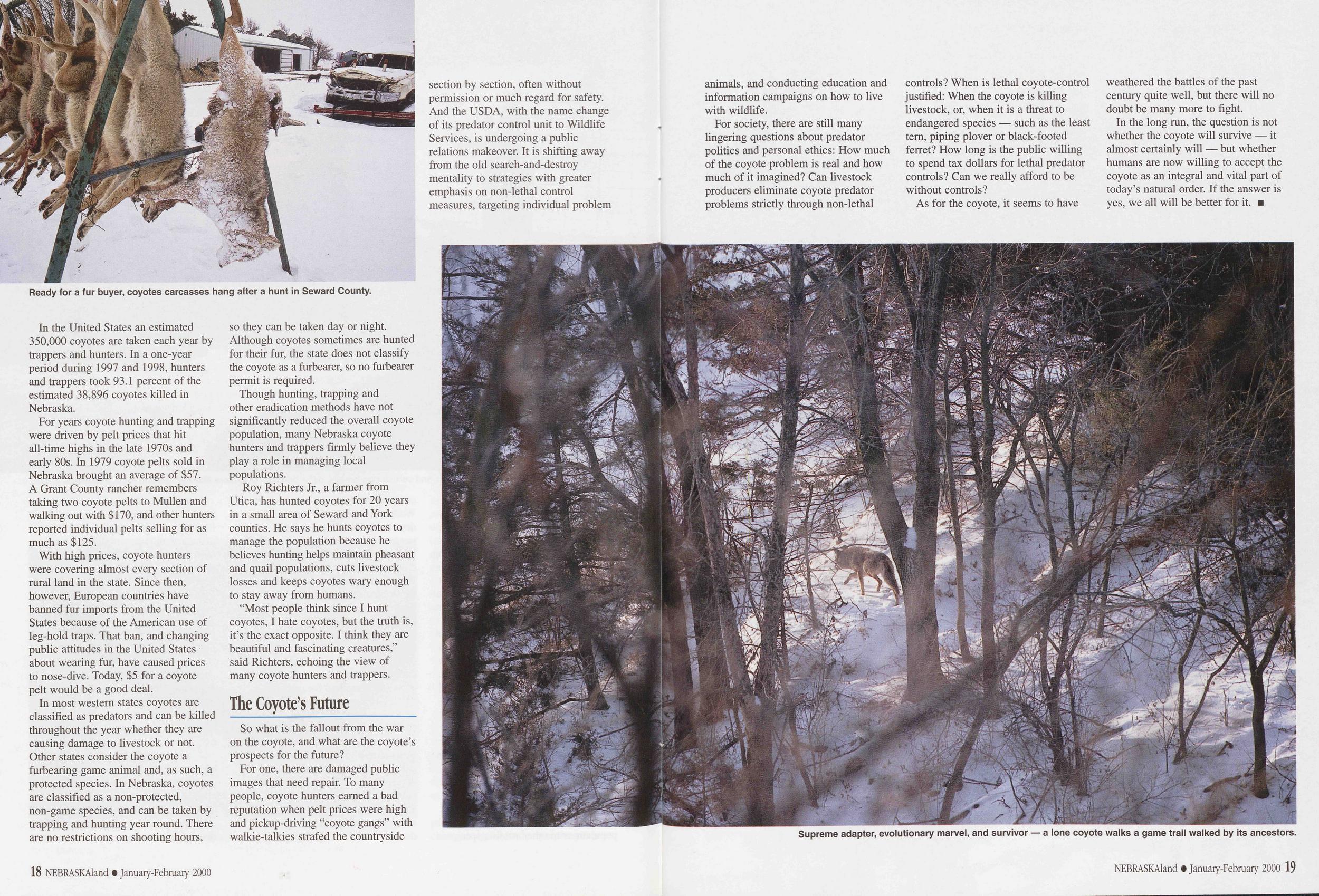
Ready for a fur buyer, coyotes carcasses hang after a hunt in Seward County.
In the United States an estimated 350,000 coyotes are taken each year by trappers and hunters. In a one-year period during 1997 and 1998, hunters and trappers took 93.1 percent of the estimated 38,896 coyotes killed in Nebraska.
For years coyote hunting and trapping were driven by pelt prices that hit all-time highs in the late 1970s and early 80s. In 1979 coyote pelts sold in Nebraska brought an average of $57. A Grant County rancher remembers taking two coyote pelts to Mullen and walking out with $170, and other hunters reported individual pelts selling for as much as $125.
With high prices, coyote hunters were covering almost every section of rural land in the state. Since then, however, European countries have banned fur imports from the United States because of the American use of leg-hold traps. That ban, and changing public attitudes in the United States about wearing fur, have caused prices to nose-dive. Today, $5 for a coyote pelt would be a good deal.
In most western states coyotes are classified as predators and can be killed throughout the year whether they are causing damage to livestock or not. Other states consider the coyote a furbearing game animal and, as such, a protected species. In Nebraska, coyotes are classified as a non-protected, non-game species, and can be taken by trapping and hunting year round. There are no restrictions on shooting hours, so they can be taken day or night. Although coyotes sometimes are hunted for their fur, the state does not classify the coyote as a furbearer, so no furbearer permit is required.
Though hunting, trapping and other eradication methods have not significantly reduced the overall coyote population, many Nebraska coyote hunters and trappers firmly believe they play a role in managing local populations.
Roy Richters Jr., a farmer from Utica, has hunted coyotes for 20 years in a small area of Seward and York counties. He says he hunts coyotes to manage the population because he believes hunting helps maintain pheasant and quail populations, cuts livestock losses and keeps coyotes wary enough to stay away from humans.
"Most people think since I hunt coyotes, I hate coyotes, but the truth is, it's the exact opposite. I think they are beautiful and fascinating creatures," said Richters, echoing the view of many coyote hunters and trappers.
The Coyote's FutureSo what is the fallout from the war on the coyote, and what are the coyote's prospects for the future?
For one, there are damaged public images that need repair. To many people, coyote hunters earned a bad reputation when pelt prices were high and pickup-driving "coyote gangs" with walkie-talkies strafed the countryside section by section, often without permission or much regard for safety. And the USDA, with the name change of its predator control unit to Wildlife Services, is undergoing a public relations makeover. It is shifting away from the old search-and-destroy mentality to strategies with greater emphasis on non-lethal control measures, targeting individual problem
18 NEBRASKAland • January-February 2000animals, and conducting education and information campaigns on how to live with wildlife.
For society, there are still many lingering questions about predator politics and personal ethics: How much of the coyote problem is real and how much of it imagined? Can livestock producers eliminate coyote predator problems strictly through non-lethal controls? When is lethal coyote-control justified: When the coyote is killing livestock, or, when it is a threat to endangered species — such as the least tern, piping plover or black-footed ferret? How long is the public willing to spend tax dollars for lethal predator controls? Can we really afford to be without controls?
As for the coyote, it seems to have weathered the battles of the past century quite well, but there will no doubt be many more to fight.
In the long run, the question is not whether the coyote will survive — it almost certainly will — but whether humans are now willing to accept the coyote as an integral and vital part of today's natural order. If the answer is yes, we all will be better for it.
Supreme adapter, evolutionary marvel, and survivor — a lone coyote walks a game trail walked by its ancestors.
Cottontail Magic
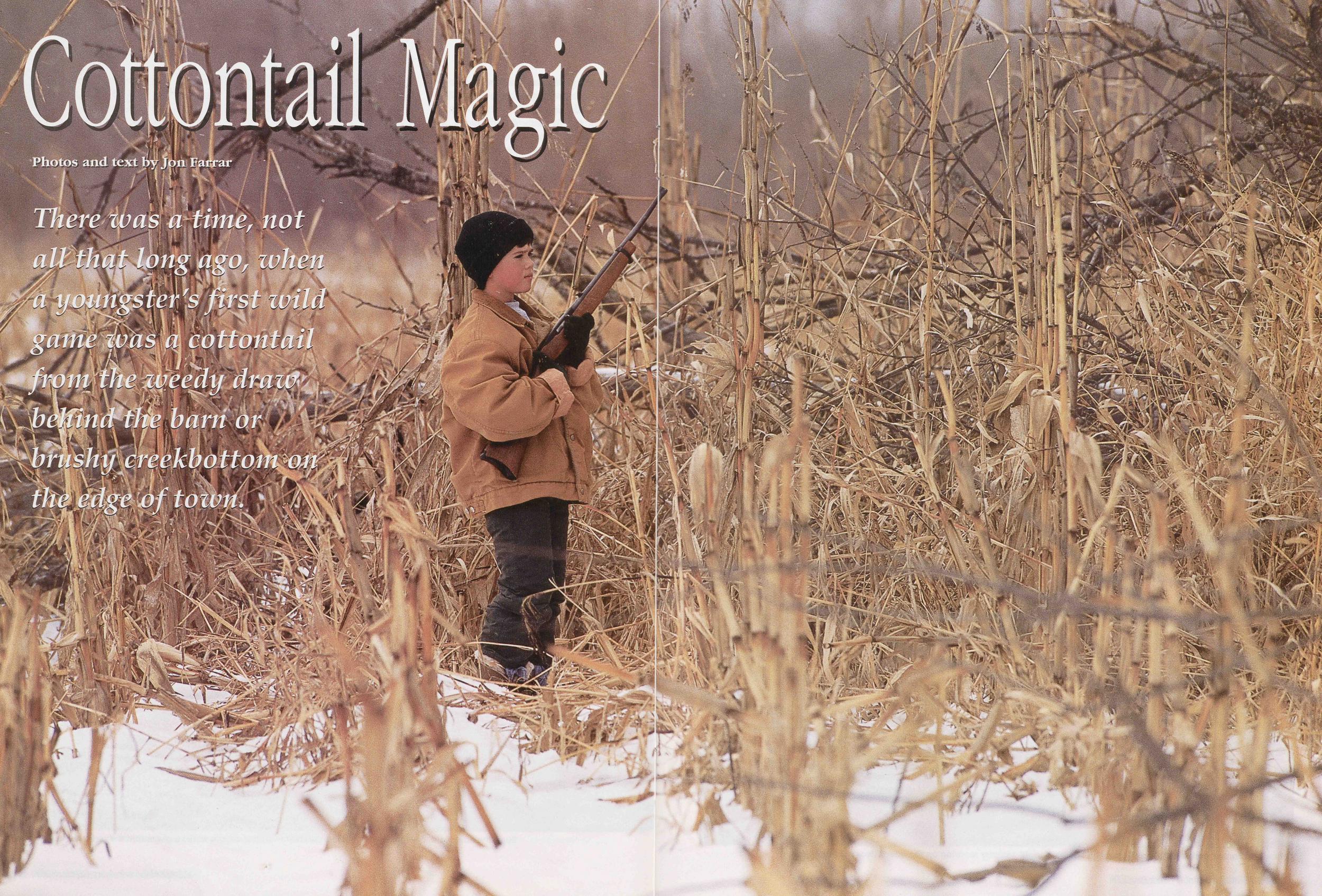
There was a time, not all that long ago, when a youngster's first wild game was a cottontail from the weedy draw behind the barn or brushy creekbottom on the edge of town.
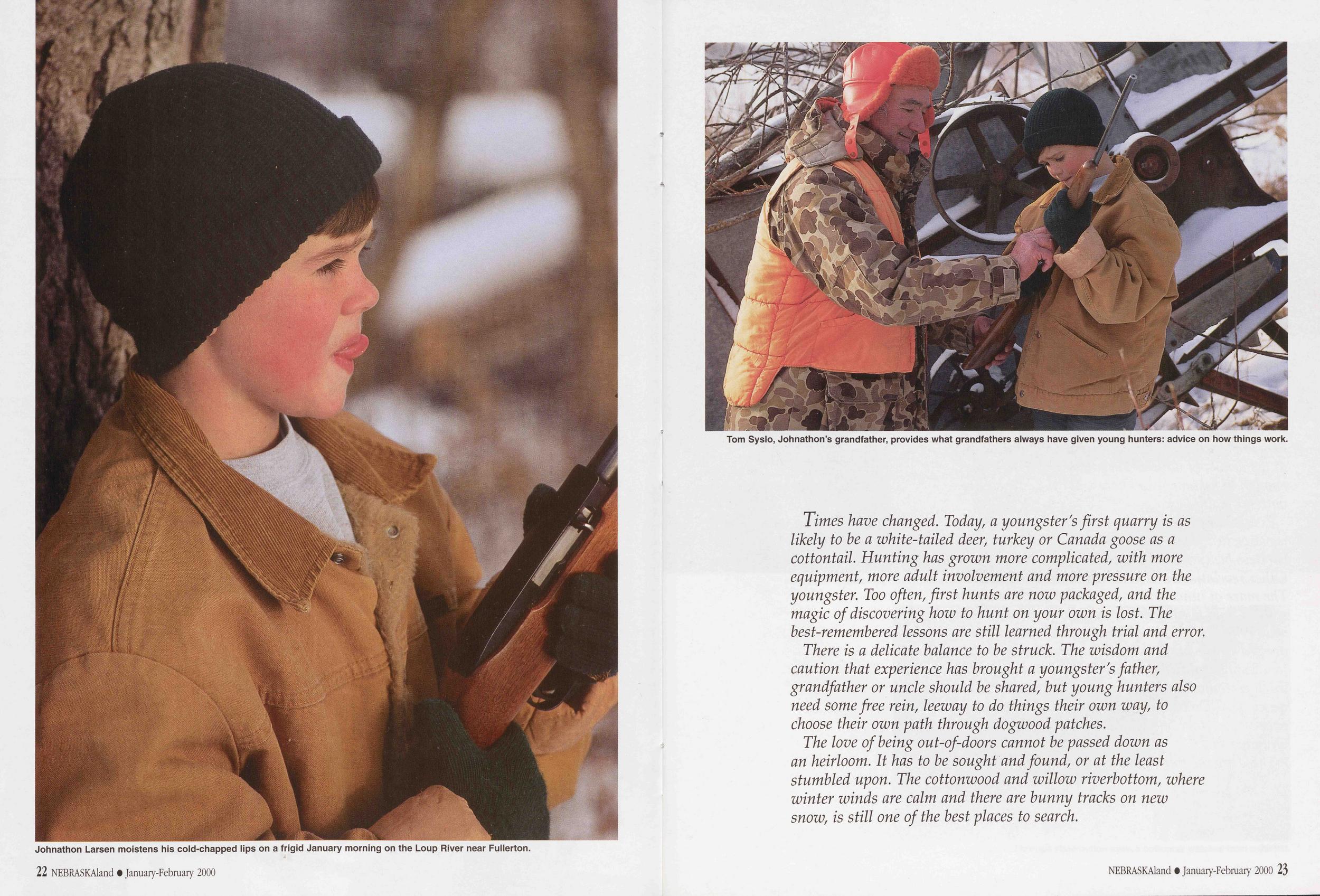
Johnathon Larsen moistens his cold-chapped lips on a frigid January morning on the Loup River near Fullerton.
Tom Syslo, Johnathon's grandfather, provides what grandfathers always have given young hunters: advice on how things work.
Times have changed. Today, a youngster's first quarry is as likely to be a white-tailed deer, turkey or Canada goose as a cottontail. Hunting has grown more complicated, with more equipment, more adult involvement and more pressure on the youngster. Too often, first hunts are now packaged, and the magic of discovering how to hunt on your own is lost. The best-remembered lessons are still learned through trial and error.
There is a delicate balance to be struck. The wisdom and caution that experience has brought a youngster's father, grandfather or uncle should be shared, but young hunters also need some free rein, leeway to do things their own way, to choose their own path through dogwood patches.
The love of being out-of-doors cannot be passed down as an heirloom. It has to be sought and found, or at the least stumbled upon. The cottonwood and willow riverbottom, where winter winds are calm and there are bunny tracks on new snow, is still one of the best places to search.
NEBRASKAland • January-February 2000 23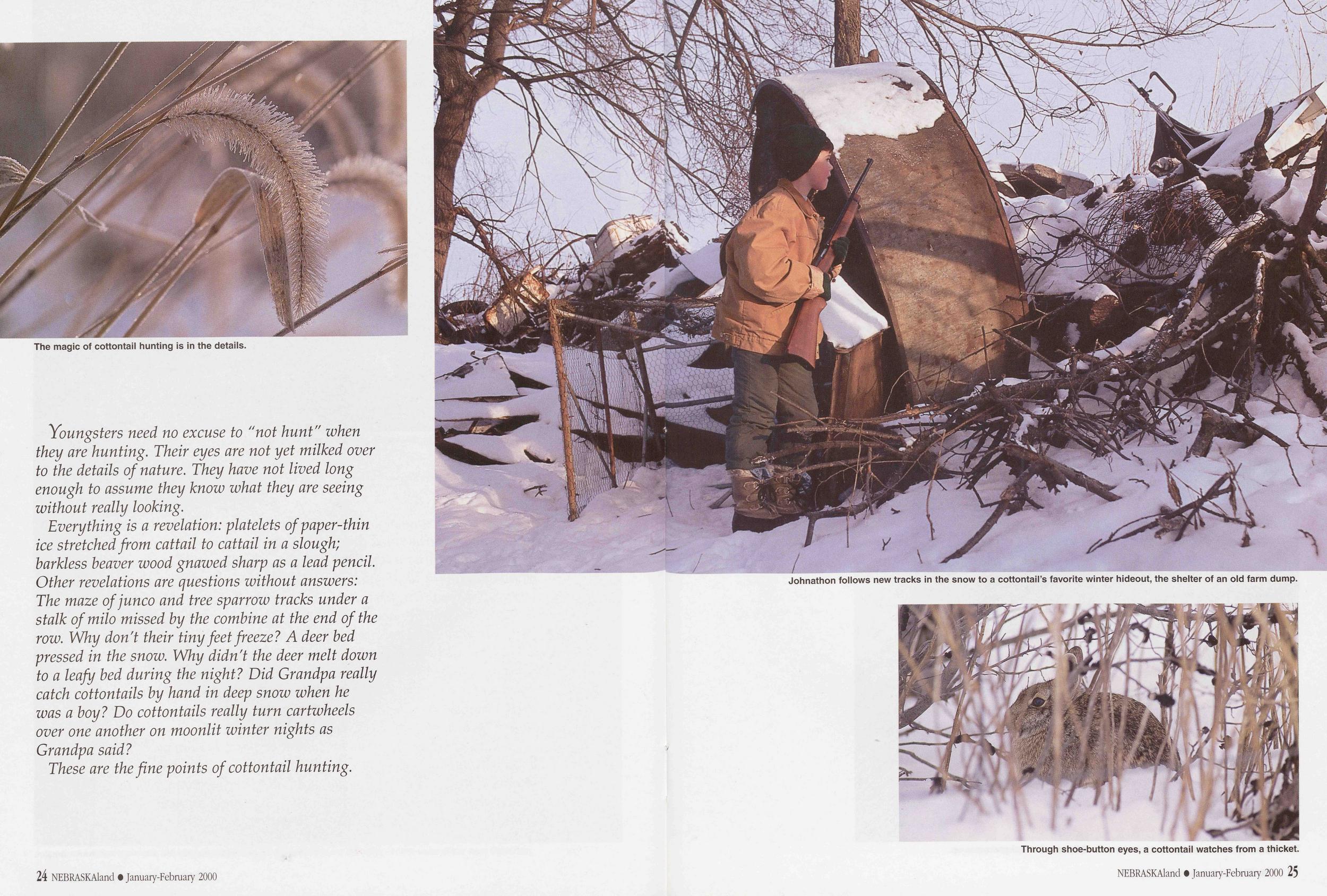
The magic of cottontail hunting is in the details.
Youngsters need no excuse to "not hunt" when they are hunting. Their eyes are not yet milked over to the details of nature. They have not lived long enough to assume they know what they are seeing without really looking.
Everything is a revelation: platelets of paper-thin ice stretched from cattail to cattail in a slough; barkless beaver wood gnawed sharp as a lead pencil. Other revelations are questions without answers: The maze ofjunco and tree sparrow tracks under a stalk ofmilo missed by the combine at the end of the row. Why don't their tiny feet freeze? A deer bed pressed in the snow. Why didn't the deer melt down to a leafy bed during the night? Did Grandpa really catch cottontails by hand in deep snow when he was a boy? Do cottontails really turn cartwheels over one another on moonlit winter nights as Grandpa said?
These are the fine points of cottontail hunting.
24 NEBRASKAland • January-February 2000Johnathon follows new tracks in the snow to a cottontail's favorite winter hideout, the shelter of an old farm dump.
Through shoe-button eyes, a cottontail watches from a thicket.
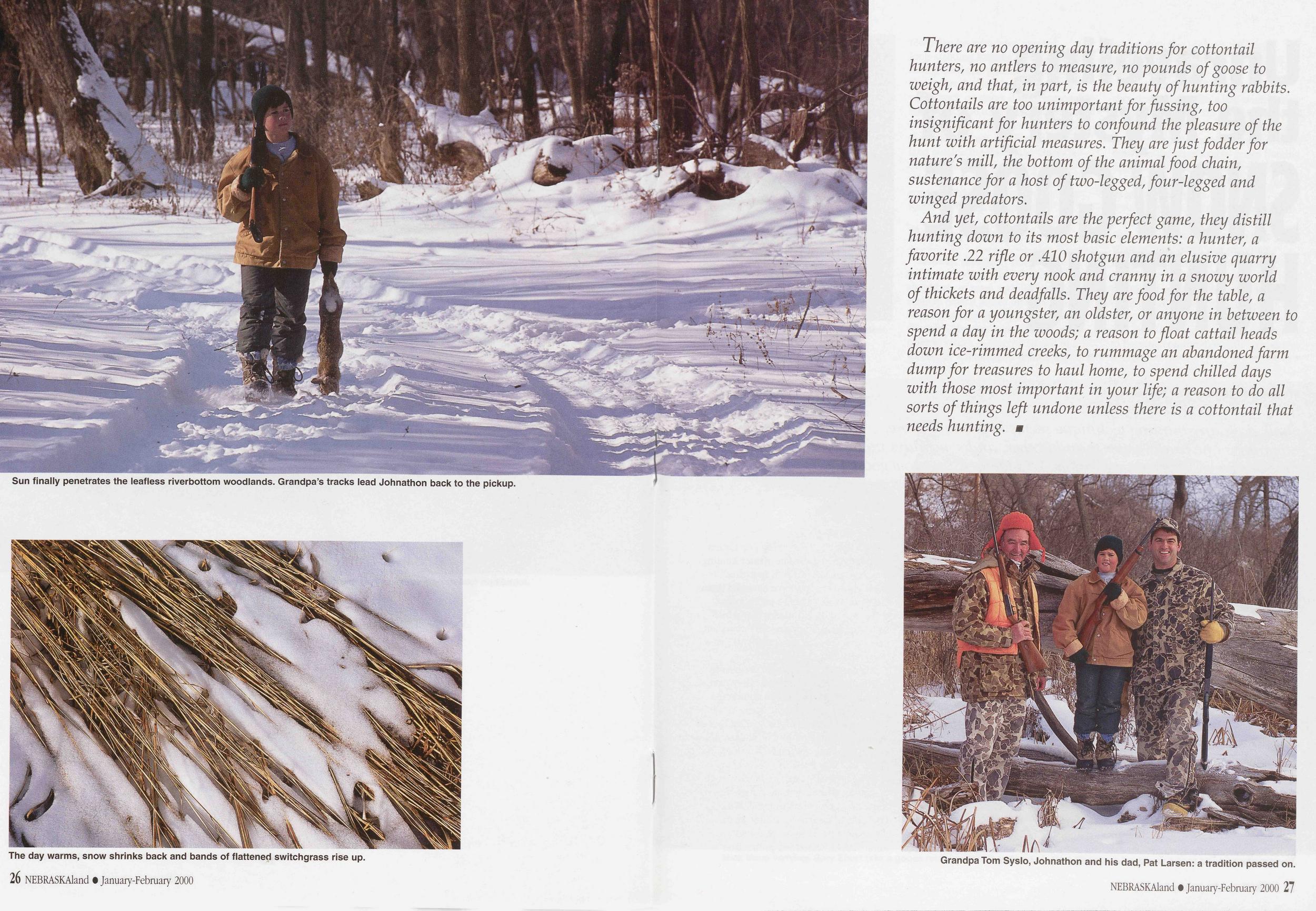
Sun finally penetrates the leafless riverbottom woodlands. Grandpa's tracks lead Johnathon back to the pickup.
The day warms, snow shrinks back and bands of flattened switchgrass rise up.
There are no opening day traditions for cottontail hunters, no antlers to measure, no pounds of goose to weigh, and that, in part, is the beauty of hunting rabbits. Cottontails are too unimportant for fussing, too insignificant for hunters to confound the pleasure of the hunt with artificial measures. They are just fodder for nature's mill, the bottom of the animal food chain, sustenance for a host of two-legged, four-legged and winged predators.
And yet, cottontails are the perfect game, they distill hunting down to its most basic elements: a hunter, a favorite .22 rifle or .410 shotgun and an elusive quarry intimate with every nook and cranny in a snowy world of thickets and deadfalls. They are food for the table, a reason for a youngster, an oldster, or anyone in between to spend a day in the woods; a reason to float cattail heads down ice-rimmed creeks, to rummage an abandoned farm dump for treasures to haul home, to spend chilled days with those most important in your life; a reason to do all sorts of things left undone unless there is a cottontail that needs hunting.
Grandpa Tom Syslo, Johnathon and his dad, Pat Larsen: a tradition passed on.
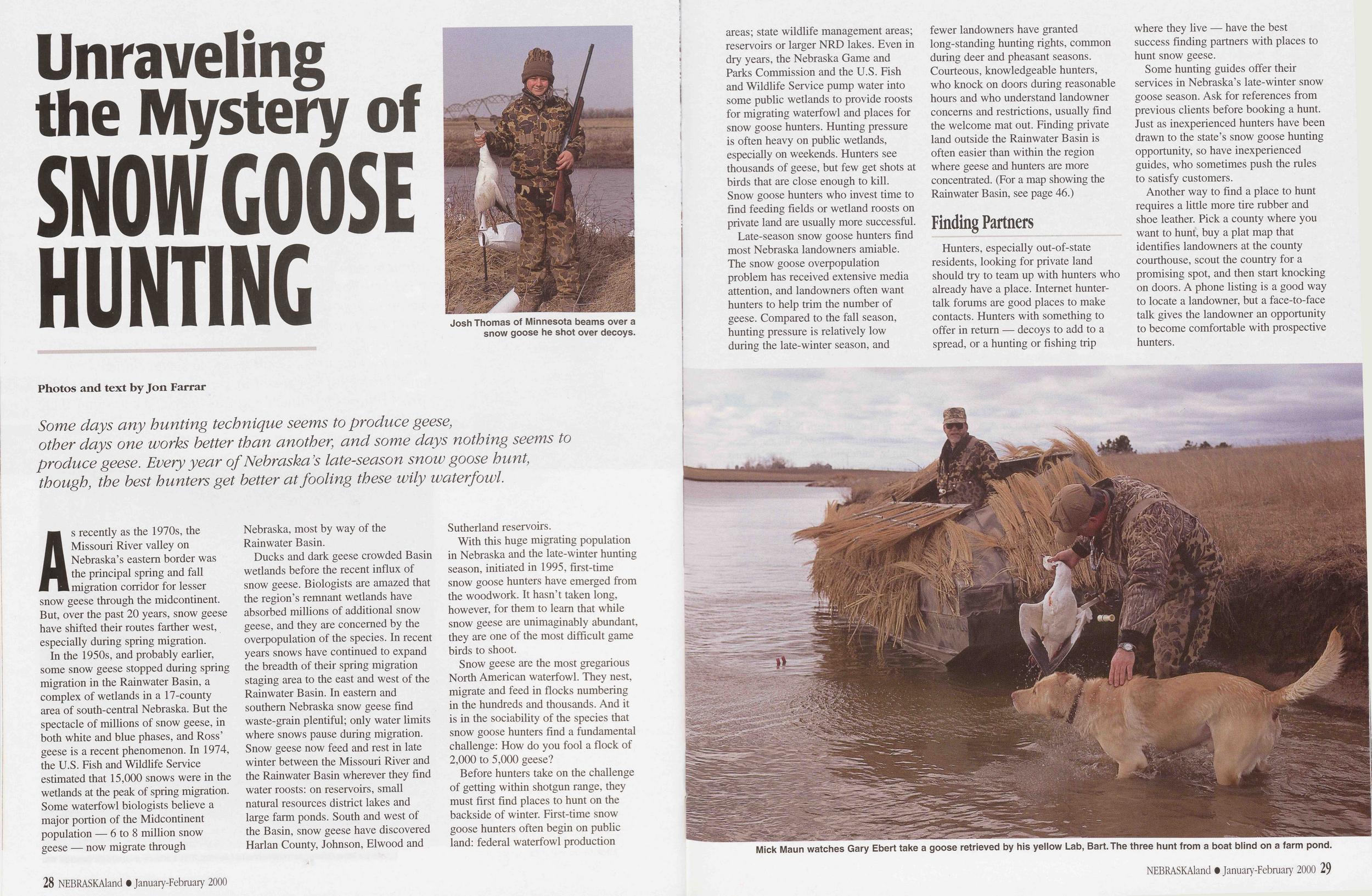
Unraveling the Mystery of SNOW GOOSE HUNTING
Josh Thomas of Minnesota beams over a snow goose he shot over decoys.
Some days any hunting technique seems to produce geese, other days one works better than another, and some days nothing seems to produce geese. Every year of Nebraska's late-season snow goose hunt, though, the best hunters get better at fooling these wily waterfowl.
As recently as the 1970s, the Missouri River valley on Nebraska's eastern border was the principal spring and fall migration corridor for lesser snow geese through the midcontinent. But, over the past 20 years, snow geese have shifted their routes farther west, especially during spring migration.
In the 1950s, and probably earlier, some snow geese stopped during spring migration in the Rainwater Basin, a complex of wetlands in a 17-county area of south-central Nebraska. But the spectacle of millions of snow geese, in both white and blue phases, and Ross' geese is a recent phenomenon. In 1974, the U.S. Fish and Wildlife Service estimated that 15,000 snows were in the wetlands at the peak of spring migration. Some waterfowl biologists believe a major portion of the Midcontinent population — 6 to 8 million snow geese — now migrate through Nebraska, most by way of the Rainwater Basin.
Ducks and dark geese crowded Basin wetlands before the recent influx of snow geese. Biologists are amazed that the region's remnant wetlands have absorbed millions of additional snow geese, and they are concerned by the overpopulation of the species. In recent years snows have continued to expand the breadth of their spring migration staging area to the east and west of the Rainwater Basin. In eastern and southern Nebraska snow geese find waste-grain plentiful; only water limits where snows pause during migration. Snow geese now feed and rest in late winter between the Missouri River and the Rainwater Basin wherever they find water roosts: on reservoirs, small natural resources district lakes and large farm ponds. South and west of the Basin, snow geese have discovered Harlan County, Johnson, Elwood and Sutherland reservoirs.
With this huge migrating population in Nebraska and the late-winter hunting season, initiated in 1995, first-time snow goose hunters have emerged from the woodwork. It hasn't taken long, however, for them to learn that while snow geese are unimaginably abundant, they are one of the most difficult game birds to shoot.
Snow geese are the most gregarious North American waterfowl. They nest, migrate and feed in flocks numbering in the hundreds and thousands. And it is in the sociability of the species that snow goose hunters find a fundamental challenge: How do you fool a flock of 2,000 to 5,000 geese?
Before hunters take on the challenge of getting within shotgun range, they must first find places to hunt on the backside of winter. First-time snow goose hunters often begin on public land: federal waterfowl production
28 NEBRASKAland • January-February 2000areas; state wildlife management areas; reservoirs or larger NRD lakes. Even in dry years, the Nebraska Game and Parks Commission and the U.S. Fish and Wildlife Service pump water into some public wetlands to provide roosts for migrating waterfowl and places for snow goose hunters. Hunting pressure is often heavy on public wetlands, especially on weekends. Hunters see thousands of geese, but few get shots at birds that are close enough to kill. Snow goose hunters who invest time to find feeding fields or wetland roosts on private land are usually more successful.
Late-season snow goose hunters find most Nebraska landowners amiable. The snow goose overpopulation problem has received extensive media attention, and landowners often want hunters to help trim the number of geese. Compared to the fall season, hunting pressure is relatively low during the late-winter season, and fewer landowners have granted long-standing hunting rights, common during deer and pheasant seasons. Courteous, knowledgeable hunters, who knock on doors during reasonable hours and who understand landowner concerns and restrictions, usually find the welcome mat out. Finding private land outside the Rainwater Basin is often easier than within the region where geese and hunters are more concentrated. (For a map showing the Rainwater Basin, see page 46.)
Finding PartnersHunters, especially out-of-state residents, looking for private land should try to team up with hunters who already have a place. Internet hunter- talk forums are good places to make contacts. Hunters with something to offer in return — decoys to add to a spread, or a hunting or fishing trip where they live — have the best success finding partners with places to hunt snow geese.
Some hunting guides offer their services in Nebraska's late-winter snow goose season. Ask for references from previous clients before booking a hunt. Just as inexperienced hunters have been drawn to the state's snow goose hunting opportunity, so have inexperienced guides, who sometimes push the rules to satisfy customers.
Another way to find a place to hunt requires a little more tire rubber and shoe leather. Pick a county where you want to hunt, buy a plat map that identifies landowners at the county courthouse, scout the country for a promising spot, and then start knocking on doors. A phone listing is a good way to locate a landowner, but a face-to-face talk gives the landowner an opportunity to become comfortable with prospective hunters.
Mick Maun watches Gary Ebert take a goose retrieved by his yellow Lab, Bart. The three hunt from a boat blind on a farm pond.
 Pushing Winter North
Snow geese are among the earliest migrant species to push north every year. In Nebraska the vanguard usually arrives in mid-February or even earlier, if open water and snow-free grain fields are available. But betting on a successful hunt early in the season is like rolling dice: Hungry, weary geese fall out of the sky into decoys on some mid-February days, but hunters can just as likely roll snake eyes and spend three days snowed-in at a small-town motel watching soap operas.
There are always more snow geese in southern Nebraska at the end of the late-winter season than at the beginning, but by March geese know the lay of the land and are more difficult to lure within shotgun range. Weather, both locally and along the migration route, can make or break a hunt.
When winter relents early, there are enough snow geese in Nebraska for a good hunt from the beginning to the end of the late-winter season. In 1998 and 1999, large numbers of snow geese were in the state for the season opener on February 11. By the first week of March 1999, most Central Fly way snow geese were in Nebraska, but there were still some birds in Texas and other birds were moving into South Dakota. In some years, however, snow geese don't arrive until the end of February, effectively cutting the season to only 10 days or two weeks.
Experienced snow goose hunters agree that newly-arriving geese are the best decoying birds. Migrating geese are tired, hungry and want water. It takes them several days to learn which spreads of white spots in corn stubble are fakes, and which wetlands are open to hunting and which are not. In most years, birds are moving into Nebraska throughout the season, so there is always the potential for new arrivals everyday, but the best days for hunters are when large numbers are moving in. Planning a hunting trip to coincide with big migration days is no more reliable than long-range weather forecasting. On average, though, the last week of February and first week of March are good times to hunt.
Daily weather plays a critical role in the vulnerability of snow geese to the gun. Ideal conditions for migration days are clear skies, a south wind and warming weather, particularly after several cold days that have thwarted northward migration. While south winds and balmy temperatures bring new birds into Nebraska, it is not the best weather for decoying. Geese work the decoys better in cooler weather with cloud cover and a brisk wind. Pass-shooters fare best when the weather is blustery with snow and strong winds that keep geese flying close to the ground.
Snow geese and other waterfowl that feed in grain fields typically leave wetlands roosts early in the morning, before or at sunrise, unless there is severe weather. Recent arrivals often spend most or all of the day in grain fields feeding, building the fat reserves that will carry them north and through nesting. Unless water is available where geese feed, they usually return to wetlands during the day to drink. Midmoming through midday is often a good time for hunters shooting over wetlands.
After geese have been in the state for two weeks or more, they are more inclined to loaf longer on wetlands at midday. On moonlit nights and when geese are feeding heavily, they might linger in the fields until well after dark. During inclement weather — snow, sleet, rain, high winds and cold temperatures — geese fly as little as possible. They might not leave wetland roosts; if they do move to nearby grain fields, they might remain there all day. When severe weather limits their ability to feed for a day or two, snow geese are especially eager to spend time in grain fields.
Many veteran snow goose hunters who shoot over decoys believe midday is the best hunting time. On migrating days, flocks of snow geese begin arriving in southeastern Nebraska by midmorning and in the Rainwater Basin by midday. Migrating flocks are often large, and drawing them down within shooting range is never a given.
Ways to HuntSnow geese can be hunted in the late-winter season using all the traditional waterfowl hunting methods: stalking, pass-shooting and decoying over water or grain fields. There are days when any technique will work, days when one works better than another, and days when nothing seems to produce many geese. How to hunt snow geese is a matter of personal preference and how much time and money a hunter is willing to invest. Someone who hunts once or twice a season is probably going to stalk or pass-shoot unless they wrangle an invitation to shoot over someone else's decoys.
Stalking is an effective way to kill geese feeding or roosting in a location that provides cover for a hunter to make an approach. Farm pond dams often allow hunters to move within a few yards of the birds. Snow geese
Hunters from three states, who met on the Internet, show their bag of 40 snow geese.
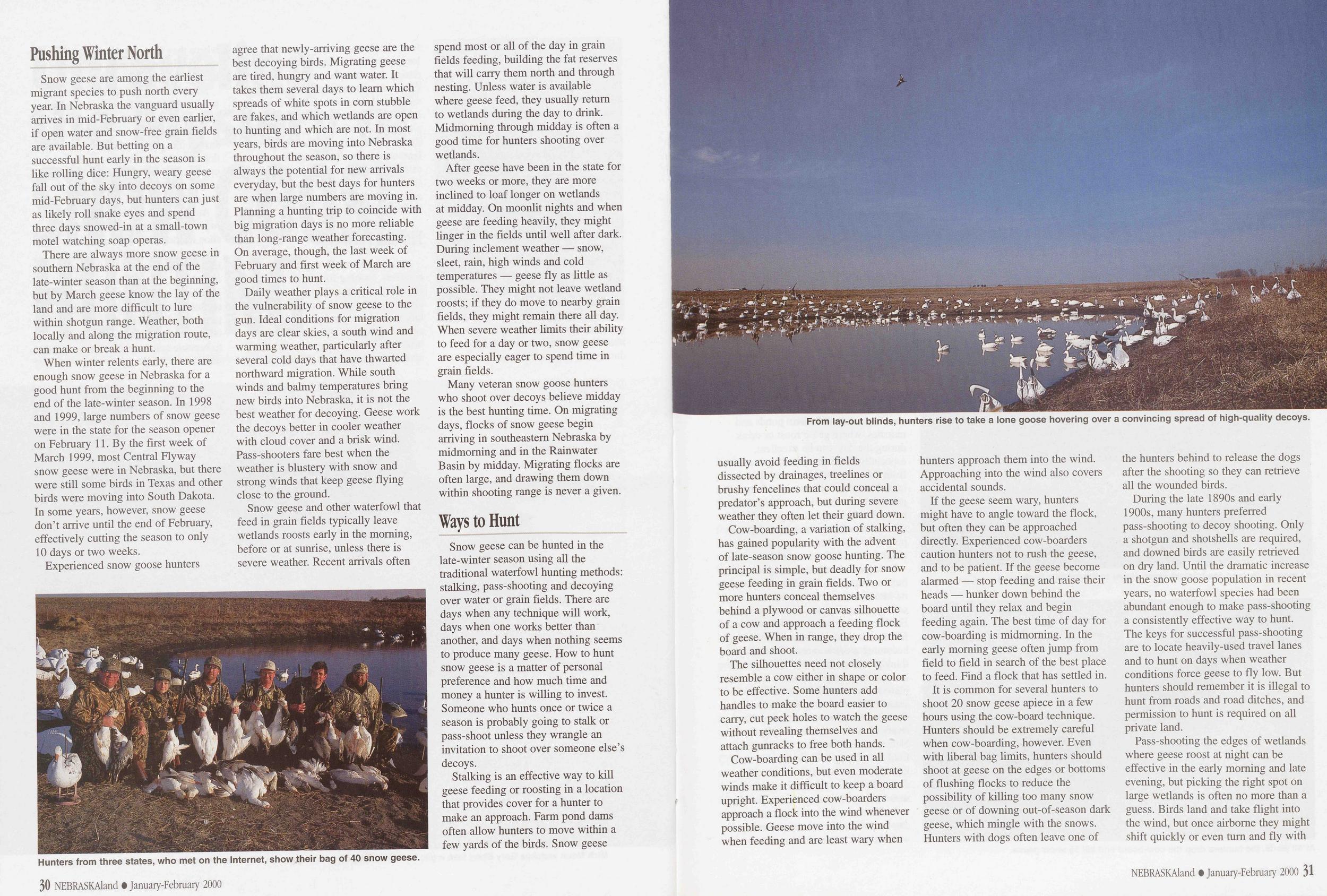
From lay-out blinds, hunters rise to take a lone goose hovering over a convincing spread of high-quality decoys.
usually avoid feeding in fields dissected by drainages, treelines or brushy fencelines that could conceal a predator's approach, but during severe weather they often let their guard down.
Cow-boarding, a variation of stalking, has gained popularity with the advent of late-season snow goose hunting. The principal is simple, but deadly for snow geese feeding in grain fields. Two or more hunters conceal themselves behind a plywood or canvas silhouette of a cow and approach a feeding flock of geese. When in range, they drop the board and shoot.
The silhouettes need not closely resemble a cow either in shape or color to be effective. Some hunters add handles to make the board easier to carry, cut peek holes to watch the geese without revealing themselves and attach gunracks to free both hands.
Cow-boarding can be used in all weather conditions, but even moderate winds make it difficult to keep a board upright. Experienced cow-boarders approach a flock into the wind whenever possible. Geese move into the wind when feeding and are least wary when hunters approach them into the wind. Approaching into the wind also covers accidental sounds.
If the geese seem wary, hunters might have to angle toward the flock, but often they can be approached directly. Experienced cow-boarders caution hunters not to rush the geese, and to be patient. If the geese become alarmed — stop feeding and raise their heads — hunker down behind the board until they relax and begin feeding again. The best time of day for cow-boarding is midmorning. In the early morning geese often jump from field to field in search of the best place to feed. Find a flock that has settled in.
It is common for several hunters to shoot 20 snow geese apiece in a few hours using the cow-board technique. Hunters should be extremely careful when cow-boarding, however. Even with liberal bag limits, hunters should shoot at geese on the edges or bottoms of flushing flocks to reduce the possibility of killing too many snow geese or of downing out-of-season dark geese, which mingle with the snows. Hunters with dogs often leave one of the hunters behind to release the dogs after the shooting so they can retrieve all the wounded birds.
During the late 1890s and early 1900s, many hunters preferred pass-shooting to decoy shooting. Only a shotgun and shotshells are required, and downed birds are easily retrieved on dry land. Until the dramatic increase in the snow goose population in recent years, no waterfowl species had been abundant enough to make pass-shooting a consistently effective way to hunt. The keys for successful pass-shooting are to locate heavily-used travel lanes and to hunt on days when weather conditions force geese to fly low. But hunters should remember it is illegal to hunt from roads and road ditches, and permission to hunt is required on all private land.
Pass-shooting the edges of wetlands where geese roost at night can be effective in the early morning and late evening, but picking the right spot on large wetlands is often no more than a guess. Birds land and take flight into the wind, but once airborne they might shift quickly or even turn and fly with
NEBRASKAland • January-February 2000 31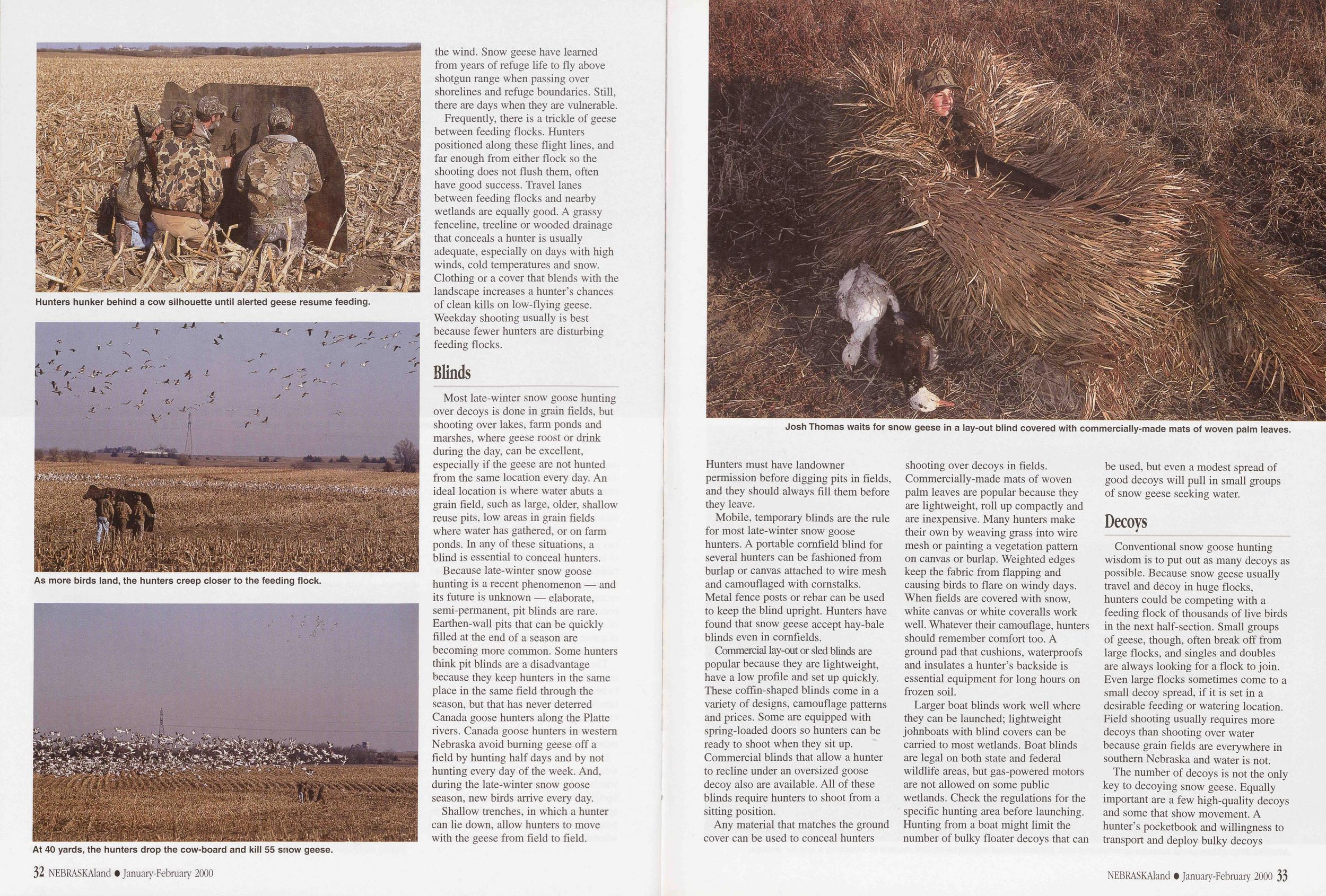
Hunters hunker behind a cow silhouette until alerted geese resume feeding.
As more birds land, the hunters creep closer to the feeding flock.
At 40 yards, the hunters drop the cow-board and kill 55 snow geese.
the wind. Snow geese have learned from years of refuge life to fly above shotgun range when passing over shorelines and refuge boundaries. Still, there are days when they are vulnerable.
Frequently, there is a trickle of geese between feeding flocks. Hunters positioned along these flight lines, and far enough from either flock so the shooting does not flush them, often have good success. Travel lanes between feeding flocks and nearby wetlands are equally good. A grassy fenceline, treeline or wooded drainage that conceals a hunter is usually adequate, especially on days with high winds, cold temperatures and snow. Clothing or a cover that blends with the landscape increases a hunter's chances of clean kills on low-flying geese. Weekday shooting usually is best because fewer hunters are disturbing feeding flocks.
BlindsMost late-winter snow goose hunting over decoys is done in grain fields, but shooting over lakes, farm ponds and marshes, where geese roost or drink during the day, can be excellent, especially if the geese are not hunted from the same location every day. An ideal location is where water abuts a grain field, such as large, older, shallow reuse pits, low areas in grain fields where water has gathered, or on farm ponds. In any of these situations, a blind is essential to conceal hunters.
Because late-winter snow goose hunting is a recent phenomenon — and its future is unknown — elaborate, semi-permanent, pit blinds are rare. Earthen-wall pits that can be quickly filled at the end of a season are becoming more common. Some hunters think pit blinds are a disadvantage because they keep hunters in the same place in the same field through the season, but that has never deterred Canada goose hunters along the Platte rivers. Canada goose hunters in western Nebraska avoid burning geese off a field by hunting half days and by not hunting every day of the week. And, during the late-winter snow goose season, new birds arrive every day.
Shallow trenches, in which a hunter can lie down, allow hunters to move with the geese from field to field.
32 NEBRASKAland • January-February 2000
Josh Thomas waits for snow geese in a lay-out blind covered with commercially-made mats of woven palm leaves.
Hunters must have landowner permission before digging pits in fields, and they should always fill them before they leave.
Mobile, temporary blinds are the rule for most late-winter snow goose hunters. A portable cornfield blind for several hunters can be fashioned from burlap or canvas attached to wire mesh and camouflaged with cornstalks. Metal fence posts or rebar can be used to keep the blind upright. Hunters have found that snow geese accept hay-bale blinds even in cornfields.
Commercial lay-out or sled blinds are popular because they are lightweight, have a low profile and set up quickly. These coffin-shaped blinds come in a variety of designs, camouflage patterns and prices. Some are equipped with spring-loaded doors so hunters can be ready to shoot when they sit up. Commercial blinds that allow a hunter to recline under an oversized goose decoy also are available. All of these blinds require hunters to shoot from a sitting position.
Any material that matches the ground cover can be used to conceal hunters shooting over decoys in fields. Commercially-made mats of woven palm leaves are popular because they are lightweight, roll up compactly and are inexpensive. Many hunters make their own by weaving grass into wire mesh or painting a vegetation pattern on canvas or burlap. Weighted edges keep the fabric from flapping and causing birds to flare on windy days. When fields are covered with snow, white canvas or white coveralls work well. Whatever their camouflage, hunters should remember comfort too. A ground pad that cushions, waterproofs and insulates a hunter's backside is essential equipment for long hours on frozen soil.
Larger boat blinds work well where they can be launched; lightweight johnboats with blind covers can be carried to most wetlands. Boat blinds are legal on both state and federal wildlife areas, but gas-powered motors are not allowed on some public wetlands. Check the regulations for the specific hunting area before launching. Hunting from a boat might limit the number of bulky floater decoys that can be used, but even a modest spread of good decoys will pull in small groups of snow geese seeking water.
DecoysConventional snow goose hunting wisdom is to put out as many decoys as possible. Because snow geese usually travel and decoy in huge flocks, hunters could be competing with a feeding flock of thousands of live birds in the next half-section. Small groups of geese, though, often break off from large flocks, and singles and doubles are always looking for a flock to join. Even large flocks sometimes come to a small decoy spread, if it is set in a desirable feeding or watering location. Field shooting usually requires more decoys than shooting over water because grain fields are everywhere in southern Nebraska and water is not.
The number of decoys is not the only key to decoying snow geese. Equally important are a few high-quality decoys and some that show movement. A hunter's pocketbook and willingness to transport and deploy bulky decoys
NEBRASKAland • January-February 2000 33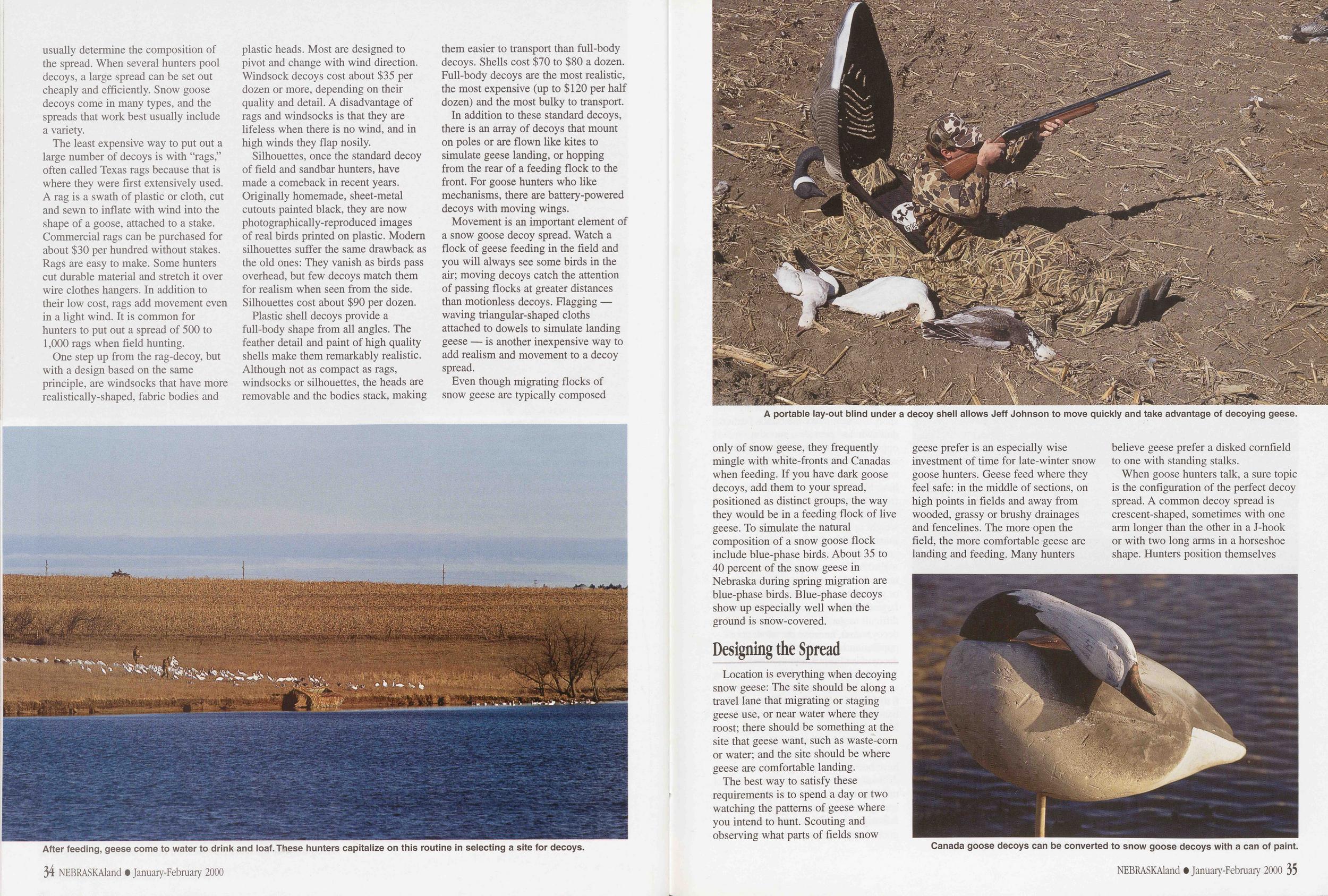
usually determine the composition of the spread. When several hunters pool decoys, a large spread can be set out cheaply and efficiently. Snow goose decoys come in many types, and the spreads that work best usually include a variety.
The least expensive way to put out a large number of decoys is with "rags," often called Texas rags because that is where they were first extensively used. A rag is a swath of plastic or cloth, cut and sewn to inflate with wind into the shape of a goose, attached to a stake. Commercial rags can be purchased for about $30 per hundred without stakes. Rags are easy to make. Some hunters cut durable material and stretch it over wire clothes hangers. In addition to their low cost, rags add movement even in a light wind. It is common for hunters to put out a spread of 500 to 1,000 rags when field hunting.
One step up from the rag-decoy, but with a design based on the same principle, are windsocks that have more realistically-shaped, fabric bodies and plastic heads. Most are designed to pivot and change with wind direction. Windsock decoys cost about $35 per dozen or more, depending on their quality and detail. A disadvantage of rags and windsocks is that they are lifeless when there is no wind, and in high winds they flap nosily.
Silhouettes, once the standard decoy of field and sandbar hunters, have made a comeback in recent years. Originally homemade, sheet-metal cutouts painted black, they are now photographically-reproduced images of real birds printed on plastic. Modern silhouettes suffer the same drawback as the old ones: They vanish as birds pass overhead, but few decoys match them for realism when seen from the side. Silhouettes cost about $90 per dozen.
Plastic shell decoys provide a full-body shape from all angles. The feather detail and paint of high quality shells make them remarkably realistic. Although not as compact as rags, windsocks or silhouettes, the heads are removable and the bodies stack, making them easier to transport than full-body decoys. Shells cost $70 to $80 a dozen. Full-body decoys are the most realistic, the most expensive (up to $120 per half dozen) and the most bulky to transport.
In addition to these standard decoys, there is an array of decoys that mount on poles or are flown like kites to simulate geese landing, or hopping from the rear of a feeding flock to the front. For goose hunters who like mechanisms, there are battery-powered decoys with moving wings.
Movement is an important element of a snow goose decoy spread. Watch a flock of geese feeding in the field and you will always see some birds in the air; moving decoys catch the attention of passing flocks at greater distances than motionless decoys. Flagging — waving triangular-shaped cloths attached to dowels to simulate landing geese — is another inexpensive way to add realism and movement to a decoy spread.
Even though migrating flocks of snow geese are typically composed
After feeding, geese come to water to drink and loaf. These hunters capitalize on this routine in selecting a site for decoys.
A portable lay-out blind under a decoy shell allows Jeff Johnson to move quickly and take advantage of decoying geese.
only of snow geese, they frequently mingle with white-fronts and Canadas when feeding. If you have dark goose decoys, add them to your spread, positioned as distinct groups, the way they would be in a feeding flock of live geese. To simulate the natural composition of a snow goose flock include blue-phase birds. About 35 to 40 percent of the snow geese in Nebraska during spring migration are blue-phase birds. Blue-phase decoys show up especially well when the ground is snow-covered.
Designing the SpreadLocation is everything when decoying snow geese: The site should be along a travel lane that migrating or staging geese use, or near water where they roost; there should be something at the site that geese want, such as waste-corn or water; and the site should be where geese are comfortable landing.
The best way to satisfy these requirements is to spend a day or two watching the patterns of geese where you intend to hunt. Scouting and observing what parts of fields snow geese prefer is an especially wise investment of time for late-winter snow goose hunters. Geese feed where they feel safe: in the middle of sections, on high points in fields and away from wooded, grassy or brushy drainages and fencelines. The more open the field, the more comfortable geese are landing and feeding. Many hunters believe geese prefer a disked cornfield to one with standing stalks.
When goose hunters talk, a sure topic is the configuration of the perfect decoy spread. A common decoy spread is crescent-shaped, sometimes with one arm longer than the other in a J-hook or with two long arms in a horseshoe shape. Hunters position themselves
Canada goose decoys can be converted to snow goose decoys with a can of paint.
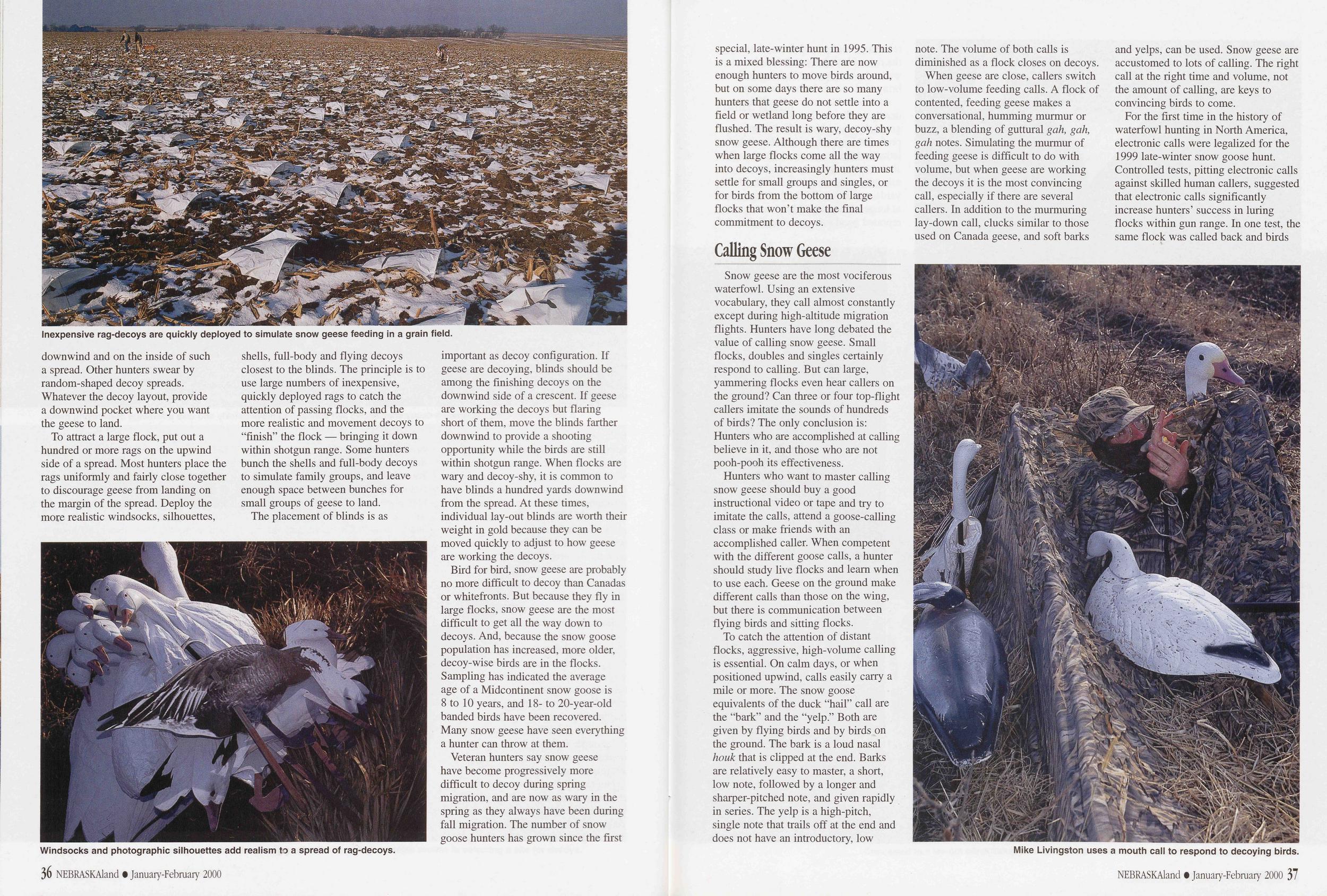
Inexpensive rag-decoys are quickly deployed to simulate snow geese feeding in a grain field.
downwind and on the inside of such a spread. Other hunters swear by random-shaped decoy spreads. Whatever the decoy layout, provide a downwind pocket where you want the geese to land.
To attract a large flock, put out a hundred or more rags on the upwind side of a spread. Most hunters place the rags uniformly and fairly close together to discourage geese from landing on the margin of the spread. Deploy the more realistic windsocks, silhouettes, shells, full-body and flying decoys closest to the blinds. The principle is to use large numbers of inexpensive, quickly deployed rags to catch the attention of passing flocks, and the more realistic and movement decoys to "finish" the flock — bringing it down within shotgun range. Some hunters bunch the shells and full-body decoys to simulate family groups, and leave enough space between bunches for small groups of geese to land.
The placement of blinds is as
Windsocks and photographic silhouettes add realism to a spread of rag-decoys.
important as decoy configuration. If geese are decoying, blinds should be among the finishing decoys on the downwind side of a crescent. If geese are working the decoys but flaring short of them, move the blinds farther downwind to provide a shooting opportunity while the birds are still within shotgun range. When flocks are wary and decoy-shy, it is common to have blinds a hundred yards downwind from the spread. At these times, individual lay-out blinds are worth their weight in gold because they can be moved quickly to adjust to how geese are working the decoys.
Bird for bird, snow geese are probably no more difficult to decoy than Canadas or whitefronts. But because they fly in large flocks, snow geese are the most difficult to get all the way down to decoys. And, because the snow goose population has increased, more older, decoy-wise birds are in the flocks. Sampling has indicated the average age of a Midcontinent snow goose is 8 to 10 years, and 18- to 20-year-old banded birds have been recovered. Many snow geese have seen everything a hunter can throw at them.
Veteran hunters say snow geese have become progressively more difficult to decoy during spring migration, and are now as wary in the spring as they always have been during fall migration. The number of snow goose hunters has grown since the first
36 NEBRASKAland • January-February 2000special, late-winter hunt in 1995. This is a mixed blessing: There are now enough hunters to move birds around, but on some days there are so many hunters that geese do not settle into a field or wetland long before they are flushed. The result is wary, decoy-shy snow geese. Although there are times when large flocks come all the way into decoys, increasingly hunters must settle for small groups and singles, or for birds from the bottom of large flocks that won't make the final commitment to decoys.
Calling Snow GeeseSnow geese are the most vociferous waterfowl. Using an extensive vocabulary, they call almost constantly except during high-altitude migration flights. Hunters have long debated the value of calling snow geese. Small flocks, doubles and singles certainly respond to calling. But can large, yammering flocks even hear callers on the ground? Can three or four top-flight callers imitate the sounds of hundreds of birds? The only conclusion is: Hunters who are accomplished at calling believe in it, and those who are not pooh-pooh its effectiveness.
Hunters who want to master calling snow geese should buy a good instructional video or tape and try to imitate the calls, attend a goose-calling class or make friends with an accomplished caller. When competent with the different goose calls, a hunter should study live flocks and learn when to use each. Geese on the ground make different calls than those on the wing, but there is communication between flying birds and sitting flocks.
To catch the attention of distant flocks, aggressive, high-volume calling is essential. On calm days, or when positioned upwind, calls easily carry a mile or more. The snow goose equivalents of the duck "hail" call are the "bark" and the "yelp." Both are given by flying birds and by birds on the ground. The bark is a loud nasal houk that is clipped at the end. Barks are relatively easy to master, a short, low note, followed by a longer and sharper-pitched note, and given rapidly in series. The yelp is a high-pitch, single note that trails off at the end and does not have an introductory, low note. The volume of both calls is diminished as a flock closes on decoys.
When geese are close, callers switch to low-volume feeding calls. A flock of contented, feeding geese makes a conversational, humming murmur or buzz, a blending of guttural gah, gah, gah notes. Simulating the murmur of feeding geese is difficult to do with volume, but when geese are working the decoys it is the most convincing call, especially if there are several callers. In addition to the murmuring lay-down call, clucks similar to those used on Canada geese, and soft barks and yelps, can be used. Snow geese are accustomed to lots of calling. The right call at the right time and volume, not the amount of calling, are keys to convincing birds to come.
For the first time in the history of waterfowl hunting in North America, electronic calls were legalized for the 1999 late-winter snow goose hunt. Controlled tests, pitting electronic calls against skilled human callers, suggested that electronic calls significantly increase hunters' success in luring flocks within gun range. In one test, the same flock was called back and birds
Mike Livingston uses a mouth call to respond to decoying birds.
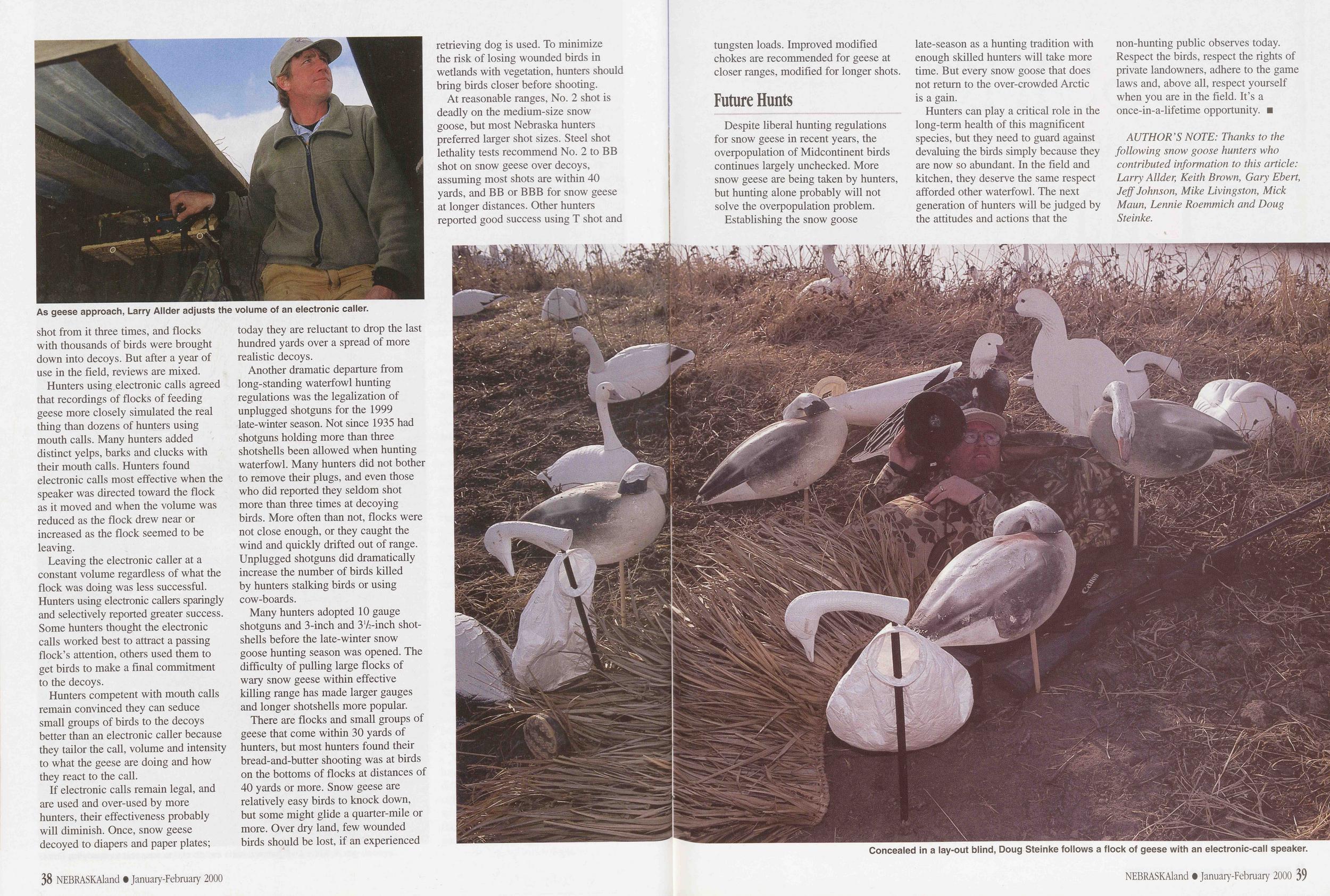
As geese approach, Larry Allder adjusts the volume of an electronic caller.
shot from it three times, and flocks with thousands of birds were brought down into decoys. But after a year of use in the field, reviews are mixed.
Hunters using electronic calls agreed that recordings of flocks of feeding geese more closely simulated the real thing than dozens of hunters using mouth calls. Many hunters added distinct yelps, barks and clucks with their mouth calls. Hunters found electronic calls most effective when the speaker was directed toward the flock as it moved and when the volume was reduced as the flock drew near or increased as the flock seemed to be leaving.
Leaving the electronic caller at a constant volume regardless of what the flock was doing was less successful. Hunters using electronic callers sparingly and selectively reported greater success. Some hunters thought the electronic calls worked best to attract a passing flock's attention, others used them to get birds to make a final commitment to the decoys.
Hunters competent with mouth calls remain convinced they can seduce small groups of birds to the decoys better than an electronic caller because they tailor the call, volume and intensity to what the geese are doing and how they react to the call.
If electronic calls remain legal, and are used and over-used by more hunters, their effectiveness probably will diminish. Once, snow geese decoyed to diapers and paper plates; today they are reluctant to drop the last hundred yards over a spread of more realistic decoys.
Another dramatic departure from long-standing waterfowl hunting regulations was the legalization of unplugged shotguns for the 1999 late-winter season. Not since 1935 had shotguns holding more than three shotshells been allowed when hunting waterfowl. Many hunters did not bother to remove their plugs, and even those who did reported they seldom shot more than three times at decoying birds. More often than not, flocks were not close enough, or they caught the wind and quickly drifted out of range. Unplugged shotguns did dramatically increase the number of birds killed by hunters stalking birds or using cow-boards.
Many hunters adopted 10 gauge shotguns and 3-inch and 372-inch shot- shells before the late-winter snow goose hunting season was opened. The difficulty of pulling large flocks of wary snow geese within effective killing range has made larger gauges and longer shotshells more popular.
There are flocks and small groups of geese that come within 30 yards of hunters, but most hunters found their bread-and-butter shooting was at birds on the bottoms of flocks at distances of 40 yards or more. Snow geese are relatively easy birds to knock down, but some might glide a quarter-mile or more. Over dry land, few wounded birds should be lost, if an experienced retrieving dog is used. To minimize the risk of losing wounded birds in wetlands with vegetation, hunters should bring birds closer before shooting.
At reasonable ranges, No. 2 shot is deadly on the medium-size snow goose, but most Nebraska hunters preferred larger shot sizes. Steel shot lethality tests recommend No. 2 to BB shot on snow geese over decoys, assuming most shots are within 40 yards, and BB or BBB for snow geese at longer distances. Other hunters reported good success using T shot and
38 NEBRASKAland • January-February 2000tungsten loads. Improved modified chokes are recommended for geese at closer ranges, modified for longer shots.
Future HuntsDespite liberal hunting regulations for snow geese in recent years, the overpopulation of Midcontinent birds continues largely unchecked. More snow geese are being taken by hunters, but hunting alone probably will not solve the overpopulation problem.
Establishing the snow goose late-season as a hunting tradition with enough skilled hunters will take more time. But every snow goose that does not return to the over-crowded Arctic is a gain.
Hunters can play a critical role in the long-term health of this magnificent species, but they need to guard against devaluing the birds simply because they are now so abundant. In the field and kitchen, they deserve the same respect afforded other waterfowl. The next generation of hunters will be judged by the attitudes and actions that the non-hunting public observes today. Respect the birds, respect the rights of private landowners, adhere to the game laws and, above all, respect yourself when you are in the field. It's a once-in-a-lifetime opportunity. ■
AUTHOR'S NOTE: Thanks to the following snow goose hunters who contributed information to this article: Larry Allder, Keith Brown, Gary Ebert, Jeff Johnson, Mike Livingston, Mick Maun, Lennie Roemmich and Doug Steinke.Concealed in a lay-out blind, Doug Steinke follows a flock of geese with an electronic-call speaker.
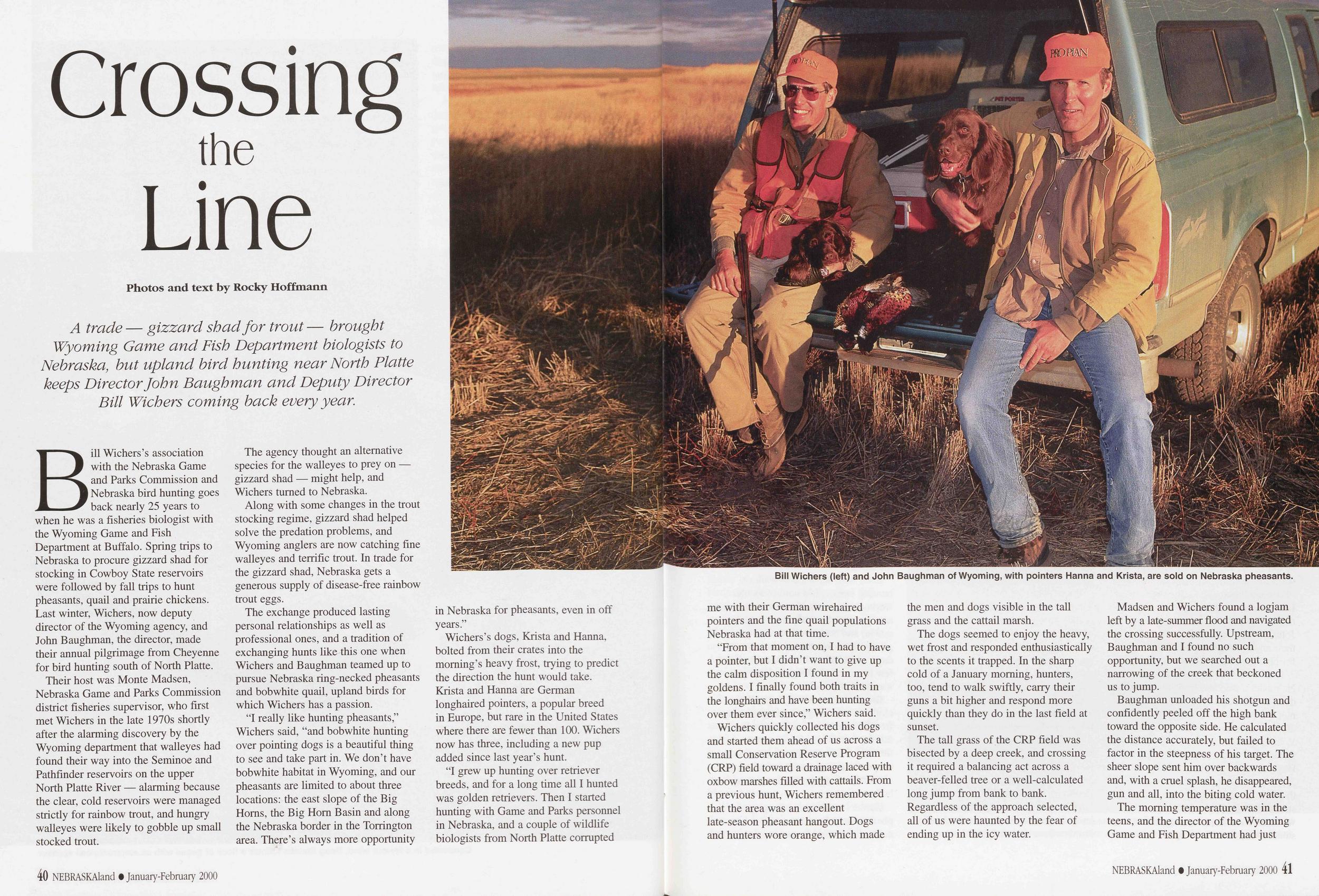
Crossing the Line
A trade — gizzard shad for trout— brought Wyoming Game and Fish Department biologists to Nebraska, but upland bird hunting near North Platte keeps Director John Baughman and Deputy Director Bill Wichers coming back every year.
Bill Wichers's association with the Nebraska Game and Parks Commission and Nebraska bird hunting goes back nearly 25 years to when he was a fisheries biologist with the Wyoming Game and Fish Department at Buffalo. Spring trips to Nebraska to procure gizzard shad for stocking in Cowboy State reservoirs were followed by fall trips to hunt pheasants, quail and prairie chickens. Last winter, Wichers, now deputy director of the Wyoming agency, and John Baughman, the director, made their annual pilgrimage from Cheyenne for bird hunting south of North Platte.
Their host was Monte Madsen, Nebraska Game and Parks Commission district fisheries supervisor, who first met Wichers in the late 1970s shortly after the alarming discovery by the Wyoming department that walleyes had found their way into the Seminoe and Pathfinder reservoirs on the upper North Platte River — alarming because the clear, cold reservoirs were managed strictly for rainbow trout, and hungry walleyes were likely to gobble up small stocked trout.
The agency thought an alternative species for the walleyes to prey on — gizzard shad — might help, and Wichers turned to Nebraska.
Along with some changes in the trout stocking regime, gizzard shad helped solve the predation problems, and Wyoming anglers are now catching fine walleyes and terrific trout. In trade for the gizzard shad, Nebraska gets a generous supply of disease-free rainbow trout eggs.
The exchange produced lasting personal relationships as well as professional ones, and a tradition of exchanging hunts like this one when Wichers and Baughman teamed up to pursue Nebraska ring-necked pheasants and bobwhite quail, upland birds for which Wichers has a passion.
"I really like hunting pheasants," Wichers said, "and bobwhite hunting over pointing dogs is a beautiful thing to see and take part in. We don't have bobwhite habitat in Wyoming, and our pheasants are limited to about three locations: the east slope of the Big Horns, the Big Horn Basin and along the Nebraska border in the Torrington area. There's always more opportunity in Nebraska for pheasants, even in off years."
Wichers's dogs, Krista and Hanna, bolted from their crates into the morning's heavy frost, trying to predict the direction the hunt would take. Krista and Hanna are German longhaired pointers, a popular breed in Europe, but rare in the United States where there are fewer than 100. Wichers now has three, including a new pup added since last year's hunt.
"I grew up hunting over retriever breeds, and for a long time all I hunted was golden retrievers. Then I started hunting with Game and Parks personnel in Nebraska, and a couple of wildlife biologists from North Platte corrupted
40 NEBRASKAland • January-February 2000Bill Wichers (left) and John Baughman of Wyoming, with pointers Hanna and Krista, are sold on Nebraska pheasants.
me with their German wirehaired pointers and the fine quail populations Nebraska had at that time.
"From that moment on, I had to have a pointer, but I didn't want to give up the calm disposition I found in my goldens. I finally found both traits in the longhairs and have been hunting over them ever since," Wichers said.
Wichers quickly collected his dogs and started them ahead of us across a small Conservation Reserve Program (CRP) field toward a drainage laced with oxbow marshes filled with cattails. From a previous hunt, Wichers remembered that the area was an excellent late-season pheasant hangout. Dogs and hunters wore orange, which made the men and dogs visible in the tall grass and the cattail marsh.
The dogs seemed to enjoy the heavy, wet frost and responded enthusiastically to the scents it trapped. In the sharp cold of a January morning, hunters, too, tend to walk swiftly, carry their guns a bit higher and respond more quickly than they do in the last field at sunset.
The tall grass of the CRP field was bisected by a deep creek, and crossing it required a balancing act across a beaver-felled tree or a well-calculated long jump from bank to bank. Regardless of the approach selected, all of us were haunted by the fear of ending up in the icy water.
Madsen and Wichers found a logjam left by a late-summer flood and navigated the crossing successfully. Upstream, Baughman and I found no such opportunity, but we searched out a narrowing of the creek that beckoned us to jump.
Baughman unloaded his shotgun and confidently peeled off the high bank toward the opposite side. He calculated the distance accurately, but failed to factor in the steepness of his target. The sheer slope sent him over backwards and, with a cruel splash, he disappeared, gun and all, into the biting cold water.
The morning temperature was in the teens, and the director of the Wyoming Game and Fish Department had just
NEBRASKAland • January-February 2000 41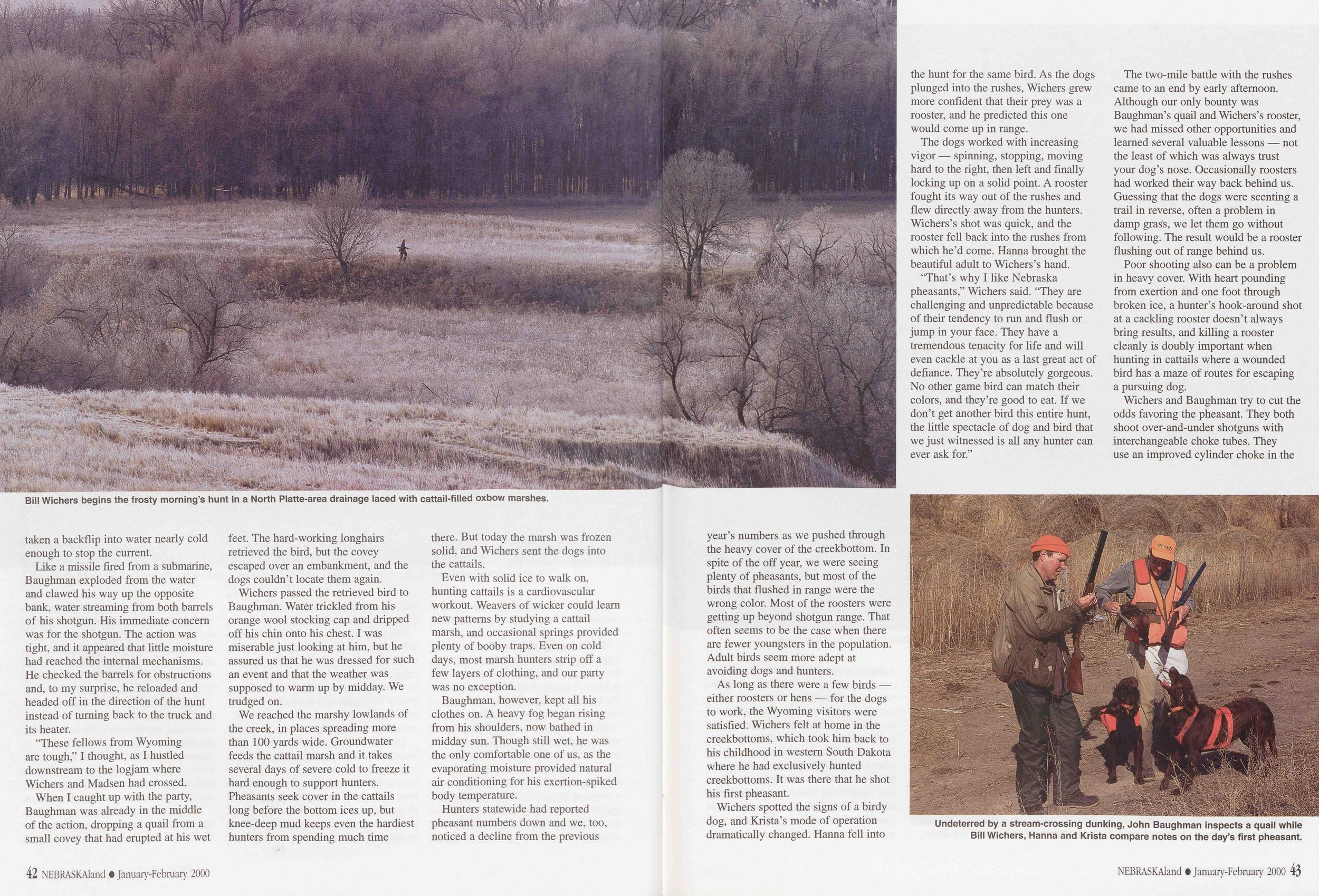
Bill Wichers begins the frosty morning's hunt in a North Platte-area drainage laced with cattail-filled oxbow marshes.
taken a backflip into water nearly cold enough to stop the current.
Like a missile fired from a submarine, Baughman exploded from the water and clawed his way up the opposite bank, water streaming from both barrels of his shotgun. His immediate concern was for the shotgun. The action was tight, and it appeared that little moisture had reached the internal mechanisms. He checked the barrels for obstructions and, to my surprise, he reloaded and headed off in the direction of the hunt instead of turning back to the truck and its heater.
"These fellows from Wyoming are tough," I thought, as I hustled downstream to the logjam where Wichers and Madsen had crossed.
When I caught up with the party, Baughman was already in the middle of the action, dropping a quail from a small covey that had erupted at his wet feet. The hard-working longhairs retrieved the bird, but the covey escaped over an embankment, and the dogs couldn't locate them again.
Wichers passed the retrieved bird to Baughman. Water trickled from his orange wool stocking cap and dripped off his chin onto his chest. I was miserable just looking at him, but he assured us that he was dressed for such an event and that the weather was supposed to warm up by midday. We trudged on.
We reached the marshy lowlands of the creek, in places spreading more than 100 yards wide. Groundwater feeds the cattail marsh and it takes several days of severe cold to freeze it hard enough to support hunters. Pheasants seek cover in the cattails long before the bottom ices up, but knee-deep mud keeps even the hardiest hunters from spending much time there. But today the marsh was frozen solid, and Wichers sent the dogs into the cattails.
Even with solid ice to walk on, hunting cattails is a cardiovascular workout. Weavers of wicker could learn new patterns by studying a cattail marsh, and occasional springs provided plenty of booby traps. Even on cold days, most marsh hunters strip off a few layers of clothing, and our party was no exception.
Baughman, however, kept all his clothes on. A heavy fog began rising from his shoulders, now bathed in midday sun. Though still wet, he was the only comfortable one of us, as the evaporating moisture provided natural air conditioning for his exertion-spiked body temperature.
Hunters statewide had reported pheasant numbers down and we, too, noticed a decline from the previous
42 NEBRASKAland • January-February 2000year's numbers as we pushed through the heavy cover of the creekbottom. In spite of the off year, we were seeing plenty of pheasants, but most of the birds that flushed in range were the wrong color. Most of the roosters were getting up beyond shotgun range. That often seems to be the case when there are fewer youngsters in the population. Adult birds seem more adept at avoiding dogs and hunters.
As long as there were a few birds — either roosters or hens — for the dogs to work, the Wyoming visitors were satisfied. Wichers felt at home in the creekbottoms, which took him back to his childhood in western South Dakota where he had exclusively hunted creekbottoms. It was there that he shot his first pheasant.
Wichers spotted the signs of a birdy dog, and Krista's mode of operation dramatically changed. Hanna fell into the hunt for the same bird. As the dogs plunged into the rushes, Wichers grew more confident that their prey was a rooster, and he predicted this one would come up in range.
The dogs worked with increasing vigor — spinning, stopping, moving hard to the right, then left and finally locking up on a solid point. A rooster fought its way out of the rushes and flew directly away from the hunters. Wichers's shot was quick, and the rooster fell back into the rushes from which he'd come. Hanna brought the beautiful adult to Wichers's hand.
"That's why I like Nebraska pheasants," Wichers said. "They are challenging and unpredictable because of their tendency to run and flush or jump in your face. They have a tremendous tenacity for life and will even cackle at you as a last great act of defiance. They're absolutely gorgeous. No other game bird can match their colors, and they're good to eat. If we don't get another bird this entire hunt, the little spectacle of dog and bird that we just witnessed is all any hunter can ever ask for."
The two-mile battle with the rushes came to an end by early afternoon. Although our only bounty was Baughman's quail and Wichers's rooster, we had missed other opportunities and learned several valuable lessons — not the least of which was always trust your dog's nose. Occasionally roosters had worked their way back behind us. Guessing that the dogs were scenting a trail in reverse, often a problem in damp grass, we let them go without following. The result would be a rooster flushing out of range behind us.
Poor shooting also can be a problem in heavy cover. With heart pounding from exertion and one foot through broken ice, a hunter's hook-around shot at a cackling rooster doesn't always bring results, and killing a rooster cleanly is doubly important when hunting in cattails where a wounded bird has a maze of routes for escaping a pursuing dog.
Wichers and Baughman try to cut the odds favoring the pheasant. They both shoot over-and-under shotguns with interchangeable choke tubes. They use an improved cylinder choke in the
Undeterred by a stream-crossing dunking, John Baughman inspects a quail while Bill Wichers, Hanna and Krista compare notes on the day's first pheasant.
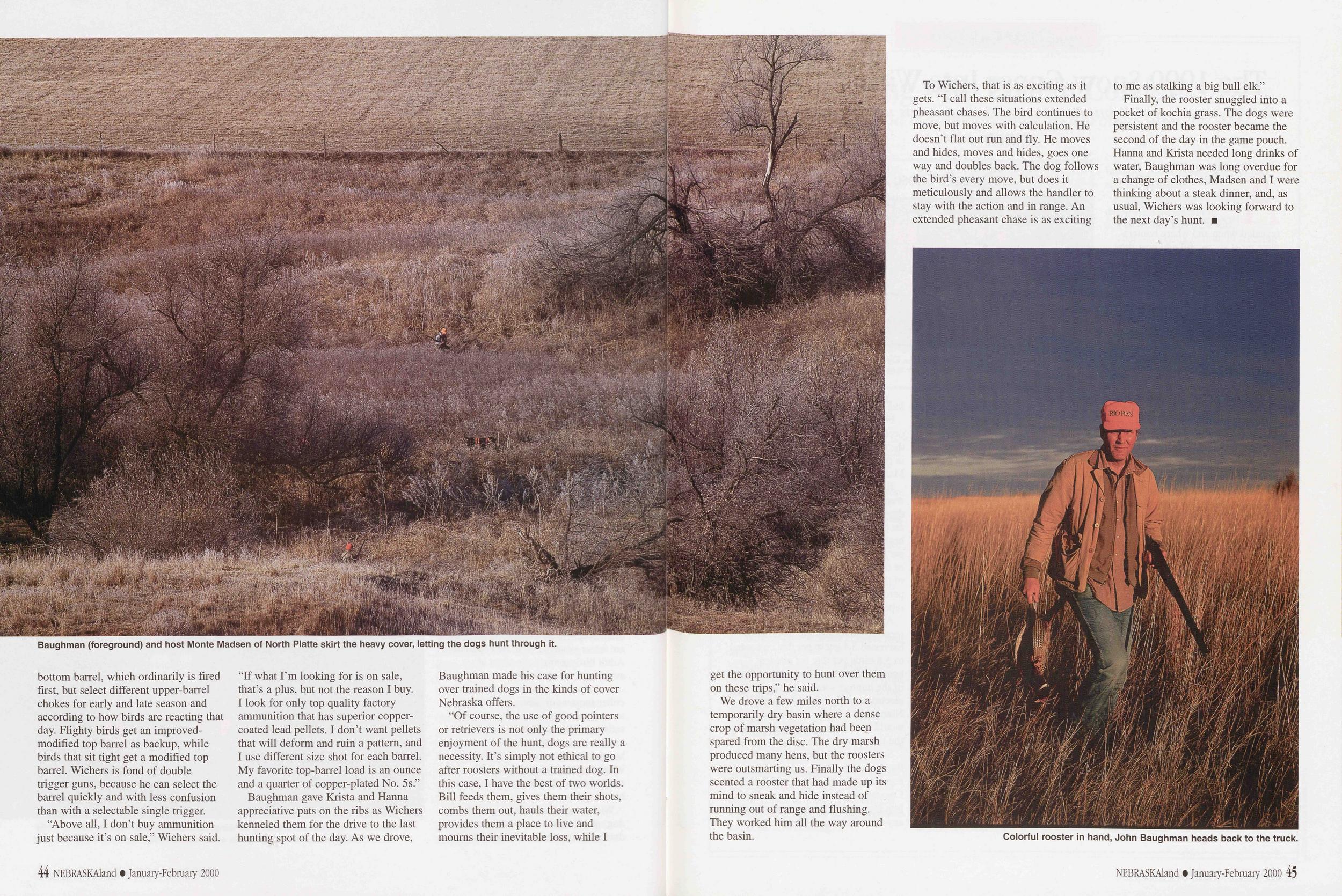
Baughman (foreground) and host Monte Madsen of North Platte skirt the heavy cover, letting the dogs hunt through it.
bottom barrel, which ordinarily is fired first, but select different upper-barrel chokes for early and late season and according to how birds are reacting that day. Flighty birds get an improved- modified top barrel as backup, while birds that sit tight get a modified top barrel. Wichers is fond of double trigger guns, because he can select the barrel quickly and with less confusion than with a selectable single trigger.
"Above all, I don't buy ammunition just because it's on sale," Wichers said. "If what I'm looking for is on sale, that's a plus, but not the reason I buy. I look for only top quality factory ammunition that has superior copper- coated lead pellets. I don't want pellets that will deform and ruin a pattern, and I use different size shot for each barrel. My favorite top-barrel load is an ounce and a quarter of copper-plated No. 5s."
Baughman gave Krista and Hanna appreciative pats on the ribs as Wichers kenneled them for the drive to the last hunting spot of the day. As we drove, Baughman made his case for hunting over trained dogs in the kinds of cover Nebraska offers.
"Of course, the use of good pointers or retrievers is not only the primary enjoyment of the hunt, dogs are really a necessity. It's simply not ethical to go after roosters without a trained dog. In this case, I have the best of two worlds. Bill feeds them, gives them their shots, combs them out, hauls their water, provides them a place to live and mourns their inevitable loss, while I
44 NEBRASKAland • January-February 2000get the opportunity to hunt over them on these trips," he said.
We drove a few miles north to a temporarily dry basin where a dense crop of marsh vegetation had been spared from the disc. The dry marsh produced many hens, but the roosters were outsmarting us. Finally the dogs scented a rooster that had made up its mind to sneak and hide instead of running out of range and flushing. They worked him all the way around the basin.
To Wichers, that is as exciting as it gets. "I call these situations extended pheasant chases. The bird continues to move, but moves with calculation. He doesn't flat out run and fly. He moves and hides, moves and hides, goes one way and doubles back. The dog follows the bird's every move, but does it meticulously and allows the handler to stay with the action and in range. An extended pheasant chase is as exciting to me as stalking a big bull elk."
Finally, the rooster snuggled into a pocket of kochia grass. The dogs were persistent and the rooster became the second of the day in the game pouch. Hanna and Krista needed long drinks of water, Baughman was long overdue for a change of clothes, Madsen and I were thinking about a steak dinner, and, as usual, Wichers was looking forward to the next day's hunt. ■
Colorful rooster in hand, John Baughman heads back to the truck.
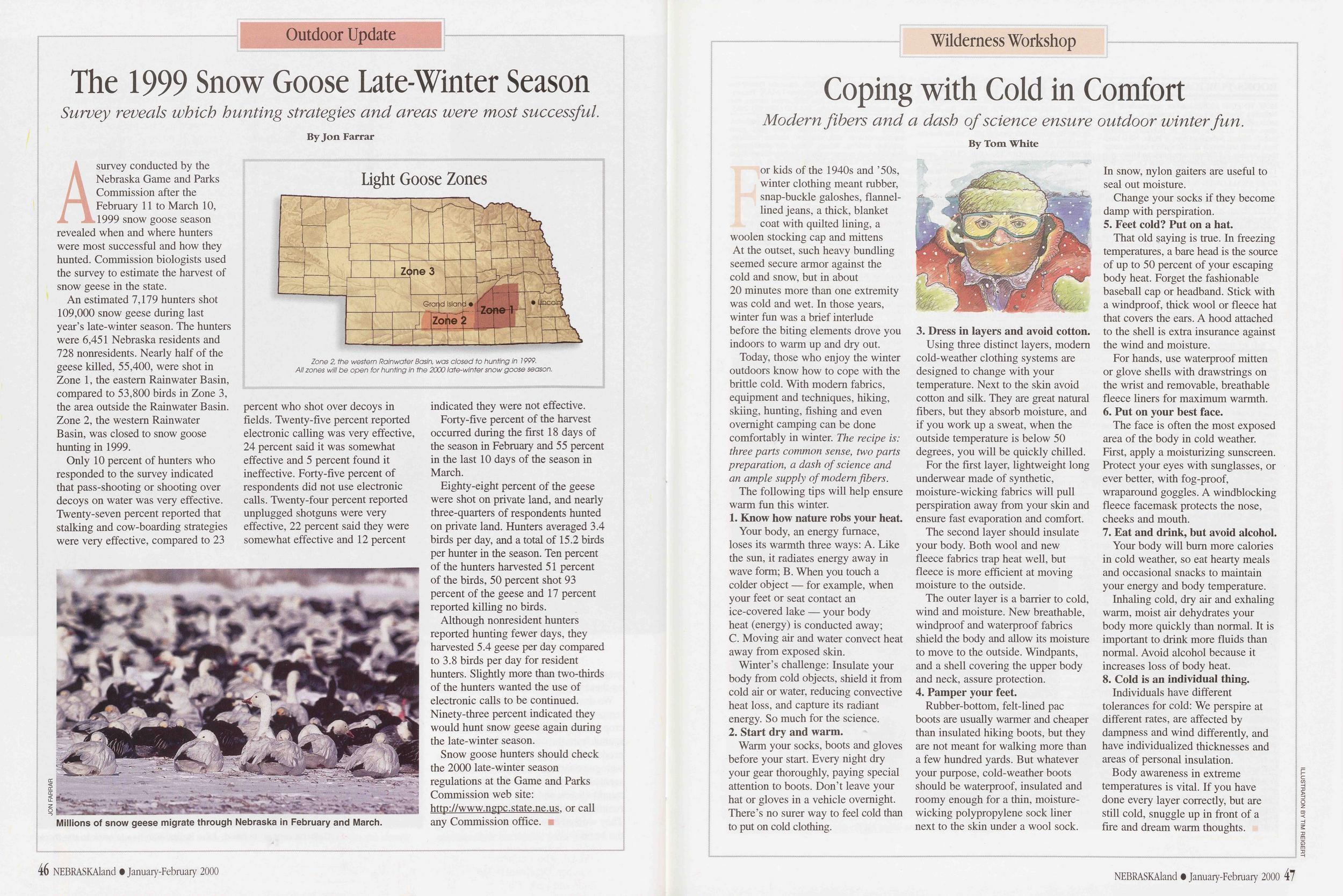
Outdoor Update
The 1999 Snow Goose Late-Winter Season
Survey reveals which hunting strategies and areas were most successful.
A survey conducted by the Nebraska Game and Parks Cornmission after the February 11 to March 10, 1999 snow goose season revealed when and where hunters were most successful and how they hunted. Commission biologists used the survey to estimate the harvest of snow geese in the state.
An estimated 7,179 hunters shot 109,000 snow geese during last year's late-winter season. The hunters were 6,451 Nebraska residents and 728 nonresidents. Nearly half of the geese killed, 55,400, were shot in Zone 1, the eastern Rainwater Basin, compared to 53,800 birds in Zone 3, the area outside the Rainwater Basin. Zone 2, the western Rainwater Basin, was closed to snow goose hunting in 1999.
Only 10 percent of hunters who responded to the survey indicated that pass-shooting or shooting over decoys on water was very effective. Twenty-seven percent reported that stalking and cow-boarding strategies were very effective, compared to 23
percent who shot over decoys in fields. Twenty-five percent reported electronic calling was very effective, 24 percent said it was somewhat effective and 5 percent found it ineffective. Forty-five percent of respondents did not use electronic calls. Twenty-four percent reported unplugged shotguns were very effective, 22 percent said they were somewhat effective and 12 percent
Millions of snow geese migrate through Nebraska in February and March.
indicated they were not effective.
Forty-five percent of the harvest occurred during the first 18 days of the season in February and 55 percent in the last 10 days of the season in March.
Eighty-eight percent of the geese were shot on private land, and nearly three-quarters of respondents hunted on private land. Hunters averaged 3.4 birds per day, and a total of 15.2 birds per hunter in the season. Ten percent of the hunters harvested 51 percent of the birds, 50 percent shot 93 percent of the geese and 17 percent reported killing no birds.
Although nonresident hunters reported hunting fewer days, they harvested 5.4 geese per day compared to 3.8 birds per day for resident hunters. Slightly more than two-thirds of the hunters wanted the use of electronic calls to be continued. Ninety-three percent indicated they would hunt snow geese again during the late-winter season.
Snow goose hunters should check the 2000 late-winter season regulations at the Game and Parks Commission web site: http://www.ngpc.state.ne.us. or call any Commission office.
46 NEBRASKAland • January-February 2000Wilderness Workshop
Coping with Cold in Comfort
Modern fibers and a dash of science ensure outdoor winter fun.
For kids of the 1940s and '50s, winter clothing meant rubber, snap-buckle galoshes, flannel-lined jeans, a thick, blanket coat with quilted lining, a woolen stocking cap and mittens At the outset, such heavy bundling seemed secure armor against the cold and snow, but in about 20 minutes more than one extremity was cold and wet. In those years, winter fun was a brief interlude before the biting elements drove you indoors to warm up and dry out.
Today, those who enjoy the winter outdoors know how to cope with the brittle cold. With modern fabrics, equipment and techniques, hiking, skiing, hunting, fishing and even overnight camping can be done comfortably in winter. The recipe is: three parts common sense, two parts preparation, a dash of science and an ample supply of modern fibers.
The following tips will help ensure warm fun this winter.
1. Know how nature robs your heat.Your body, an energy furnace, loses its warmth three ways: A. Like the sun, it radiates energy away in wave form; B. When you touch a colder object — for example, when your feet or seat contact an ice-covered lake — your body heat (energy) is conducted away; C. Moving air and water convect heat away from exposed skin.
Winter's challenge: Insulate your body from cold objects, shield it from cold air or water, reducing convective heat loss, and capture its radiant energy. So much for the science.
2. Start dry and warm.Warm your socks, boots and gloves before your start. Every night dry your gear thoroughly, paying special attention to boots. Don't leave your hat or gloves in a vehicle overnight. There's no surer way to feel cold than to put on cold clothing.
Using three distinct layers, modern cold-weather clothing systems are designed to change with your temperature. Next to the skin avoid cotton and silk. They are great natural fibers, but they absorb moisture, and if you work up a sweat, when the outside temperature is below 50 degrees, you will be quickly chilled.
For the first layer, lightweight long underwear made of synthetic, moisture-wicking fabrics will pull perspiration away from your skin and ensure fast evaporation and comfort.
The second layer should insulate your body. Both wool and new fleece fabrics trap heat well, but fleece is more efficient at moving moisture to the outside.
The outer layer is a barrier to cold, wind and moisture. New breathable, windproof and waterproof fabrics shield the body and allow its moisture to move to the outside. Windpants, and a shell covering the upper body and neck, assure protection.
4. Pamper your feet.Rubber-bottom, felt-lined pac boots are usually warmer and cheaper than insulated hiking boots, but they are not meant for walking more than a few hundred yards. But whatever your purpose, cold-weather boots should be waterproof, insulated and roomy enough for a thin, moisture- wicking polypropylene sock liner next to the skin under a wool sock. In snow, nylon gaiters are useful to seal out moisture.
Change your socks if they become damp with perspiration.
5. Feet cold? Put on a hat.That old saying is true. In freezing temperatures, a bare head is the source of up to 50 percent of your escaping body heat. Forget the fashionable baseball cap or headband. Stick with a windproof, thick wool or fleece hat that covers the ears. A hood attached to the shell is extra insurance against the wind and moisture.
For hands, use waterproof mitten or glove shells with drawstrings on the wrist and removable, breathable fleece liners for maximum warmth.
6. Put on your best face.The face is often the most exposed area of the body in cold weather. First, apply a moisturizing sunscreen. Protect your eyes with sunglasses, or ever better, with fog-proof, wraparound goggles. A windblocking fleece facemask protects the nose, cheeks and mouth.
7. Eat and drink, but avoid alcohol.Your body will burn more calories in cold weather, so eat hearty meals and occasional snacks to maintain your energy and body temperature.
Inhaling cold, dry air and exhaling warm, moist air dehydrates your body more quickly than normal. It is important to drink more fluids than normal. Avoid alcohol because it increases loss of body heat.
8. Cold is an individual thing.Individuals have different tolerances for cold: We perspire at different rates, are affected by dampness and wind differently, and have individualized thicknesses and areas of personal insulation.
Body awareness in extreme temperatures is vital. If you have done every layer correctly, but are still cold, snuggle up in front of a fire and dream warm thoughts.
ILLUSTRATION BY TIM REIGERT NEBRASKAland • January-February 2000 47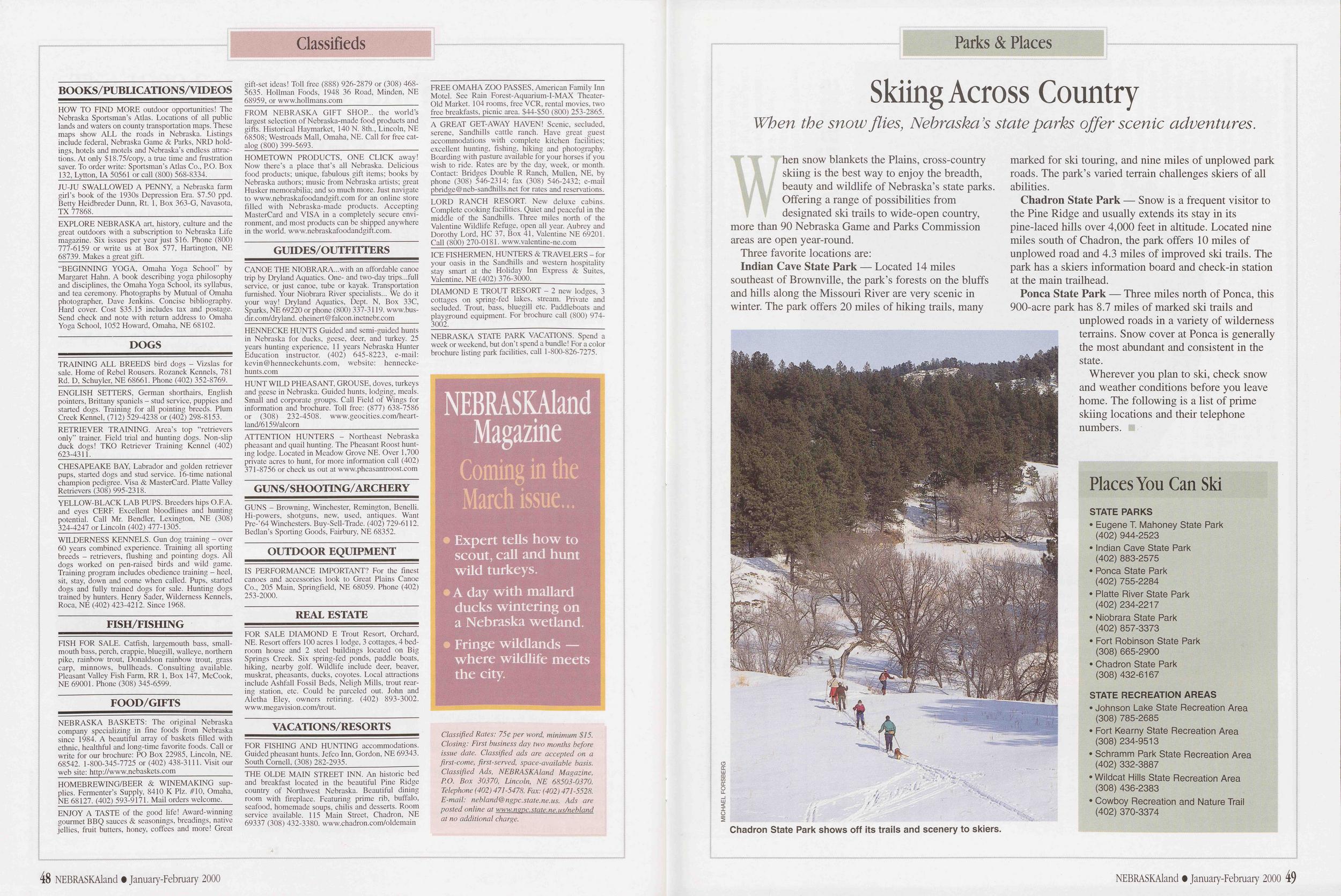
Classifieds
BOOKS/PUBLICATIONS/VIDEOS HOW TO FIND MORE outdoor opportunities! The Nebraska Sportsman's Atlas. Locations of all public lands and waters on county transportation maps. These maps show ALL the roads in Nebraska. Listings include federal, Nebraska Game & Parks, NRD hold- ings, hotels and motels and Nebraska's endless attrac- tions. At only $18.75/copy, a true time and frustration saver. To order write: Sportsman's Atlas Co., P.O. Box 132, Lytton, IA 50561 or call (800) 568-8334. JU-JU SWALLOWED A PENNY, a Nebraska farm girl's book of the 1930s Depression Era. $7.50 ppd. Betty Heidbreder Dunn, Rt. 1, Box 363-G, Navasota, TX 77868. EXPLORE NEBRASKA art, history, culture and the great outdoors with a subscription to Nebraska Life magazine. Six issues per year just $16. Phone (800) 777-6159 or write us at Box 577, Hartington, NE 68739. Makes a great gift. "BEGINNING YOGA, Omaha Yoga School" by Margaret Hahn. A book describing yoga philosophy and disciplines, the Omaha Yoga School, its syllabus, and tea ceremony. Photographs by Mutual of Omaha photographer, Dave Jenkins. Concise bibliography. Hard cover. Cost $35.15 includes tax and postage. Send check and note with return address to Omaha Yoga School, 1052 Howard, Omaha, NE 68102. DOGS TRAINING ALL BREEDS bird dogs - Vizslas for sale. Home of Rebel Rousers. Rozanek Kennels, 781 Rd. D, Schuyler, NE 68661. Phone (402) 352-8769. ENGLISH SETTERS, German shorthairs, English pointers, Brittany spaniels - stud service, puppies and started dogs. Training for all pointing breeds. Plum Creek Kennel, (712) 529-4238 or (402) 298-8153. RETRIEVER TRAINING. Area's top "retrievers only" trainer. Field trial and hunting dogs. Non-slip duck dogs! TKO Retriever Training Kennel (402) 623-431L CHESAPEAKE BAY, Labrador and golden retriever pups, started dogs and stud service. 16-time national champion pedigree. Visa & MasterCard. Platte Valley Retrievers (308) 995-2318. YELLOW-BLACK LAB PUPS. Breeders hips O.F.A. and eyes CERF. Excellent bloodlines and hunting potential. Call Mr. Bendler, Lexington, NE (308) 324-4247 or Lincoln (402) 477-1305. WILDERNESS KENNELS. Gun dog training - over 60 years combined experience. Training all sporting breeds - retrievers, flushing and pointing dogs. All dogs worked on pen-raised birds and wild game. Training program includes obedience training - heel, sit, stay, down and come when called. Pups, started dogs and fully trained dogs for sale. Hunting dogs trained by hunters. Henry Sader, Wilderness Kennels, Roca, NE (402) 423-4212. Since 1968. FISH/FISHING FISH FOR SALE. Catfish, largemouth bass, small- mouth bass, perch, crappie, bluegill, walleye, northern pike, rainbow trout, Donaldson rainbow trout, grass carp, minnows, bullheads. Consulting available. Pleasant Valley Fish Farm, RR 1, Box 147, McCook, NE 69001. Phone (308) 345-6599. FOOD/GIFTS NEBRASKA BASKETS: The original Nebraska company specializing in fine foods from Nebraska since 1984. A beautiful array of baskets filled with ethnic, healthful and long-time favorite foods. Call or write for our brochure: PO Box 22985, Lincoln, NE. 68542. 1-800-345-7725 or (402) 438-3111. Visit our web site: http://www.nebaskets.com HOMEBREWING/BEER & WINEMAKING sup- plies. Fermenter's Supply, 8410 K Plz. #10, Omaha, NE 68127. (402) 593-9171. Mail orders welcome. ENJOY A TASTE of the good life! Award-winning gourmet BBQ sauces & seasonings, breadings, native jellies, fruit butters, honey, coffees and more! Great gift-set ideas! Toll free (888) 926-2879 or (308) 468- 5635. Hollman Foods, 1948 36 Road, Minden, NE 68959, or www.hollmans.com FROM NEBRASKA GIFT SHOP... the world's largest selection of Nebraska-made food products and gifts. Historical Haymarket, 140 N. 8th., Lincoln, NE 68508; Westroads Mall, Omaha, NE. Call for free cat- alog (800) 399-5693. HOMETOWN PRODUCTS, ONE CLICK away! Now there's a place that's all Nebraska. Delicious food products; unique, fabulous gift items; books by Nebraska authors; music from Nebraska artists; great Husker memorabilia; and so much more. Just navigate to www.nebraskafoodandgift.com for an online store filled with Nebraska-made products. Accepting MasterCard and VISA in a completely secure envi- ronment, and most products can be shipped anywhere in the world, www.nebraskafoodandgift.com. GUIDES/OUTFITTERS CANOE THE NIOBRARA...with an affordable canoe trip by Dryland Aquatics. One- and two-day trips...full service, or just canoe, tube or kayak. Transportation furnished. Your Niobrara River specialists... We do it your way! Dryland Aquatics, Dept. N, Box 33C, Sparks, NE 69220 or phone (800) 337-3119. www.bus- dir.com/d17land. eheinert@falcon.inetnebr.com HENNECKE HUNTS Guided and semi-guided hunts in Nebraska for ducks, geese, deer, and turkey. 25 years hunting experience, 11 years Nebraska Hunter Education Instructor. (402) 645-8223, e-mail: kevin@henneckehunts.com, website: hennecke- hunts.com HUNT WILD PHEASANT, GROUSE, doves, turkeys and geese in Nebraska. Guided hunts, lodging, meals. Small and corporate groups. Call Field of Wings for information and brochure. Toll free: (877) 638-7586 or (308) 232-4508. www.geocities.com/heart- land/6159/alcorn ATTENTION HUNTERS - Northeast Nebraska pheasant and quail hunting. The Pheasant Roost hunt- ing lodge. Located in Meadow Grove NE. Over 1,700 private acres to hunt, for more information call (402) 371-8756 or check us out at www.pheasantroost.com GUNS/SHOQTING/ARCHERY GUNS - Browning, Winchester, Remington, Benelli. Hi-powers, shotguns, new, used, antiques. Want Pre-'64 Winchesters. Buy-Sell-Trade. (402) 729-6112. Bedlan's Sporting Goods, Fairbury, NE 68352. OUTDOOR EQUIPMENT IS PERFORMANCE IMPORTANT? For the finest canoes and accessories look to Great Plains Canoe Co., 205 Main, Springfield, NE 68059. Phone (402) 253-2000. REAL ESTATE FOR SALE DIAMOND E Trout Resort, Orchard, NE. Resort offers 100 acres 1 lodge, 3 cottages, 4 bed- room house and 2 steel buildings located on Big Springs Creek. Six spring-fed ponds, paddle boats, hiking, nearby golf. Wildlife include deer, beaver, muskrat, pheasants, ducks, coyotes. Local attractions include Ashfall Fossil Beds, Neligh Mills, trout rear- ing station, etc. Could be parceled out. John and Afetha Eley, owners retiring. (402) 893-3002. www.megavision.com/trout. VACATIONS/RESORTS FOR FISHING AND HUNTING accommodations. Guided pheasant hunts. Jefco Inn, Gordon, NE 69343. South Cornell, (308) 282-2935. THE OLDE MAIN STREET INN. An historic bed and breakfast located in the beautiful Pine Ridge country of Northwest Nebraska. Beautiful dining room with fireplace. Featuring prime rib, buffalo, seafood, homemade soups, chilis and desserts. Room service available. 115 Main Street, Chadron, NE 69337 (308) 432-3380. www.chadron.com/oldemain FREE OMAHA ZOO PASSES, American Family Inn Motel. See Rain Forest-Aquarium-I-MAX Theater- Old Market. 104 rooms, free VCR, rental movies, two free breakfasts, picnic area. $44-$50 (800) 253-2865. A GREAT GET-AWAY HAVEN! Scenic, secluded, serene, Sandhills cattle ranch. Have great guest accommodations with complete kitchen facilities; excellent hunting, fishing, hiking and photography. Boarding with pasture available for your horses if you wish to ride. Rates are by the day, week, or month. Contact: Bridges Double R Ranch, Mullen, NE, by phone (308) 546-2314; fax (308) 546-2432; e-mail pbridge@neb-sandhills.net for rates and reservations. LORD RANCH RESORT. New deluxe cabins. Complete cooking facilities. Quiet and peaceful in the middle of the Sandhills. Three miles north of the Valentine Wildlife Refuge, open all year. Aubrey and Dorothy Lord, HC 37, Box 41, Valentine NE 69201. Call (800) 270-0181. www.valentine-ne.com ICE FISHERMEN, HUNTERS & TRAVELERS - for your oasis in the Sandhills and western hospitality stay smart at the Holiday Inn Express & Suites, Valentine, NE (402) 376-3000. DIAMOND E TROUT RESORT - 2 new lodges, 3 cottages on spring-fed lakes, stream. Private and secluded. Trout, bass, bluegill etc. Paddleboats and playground equipment. For brochure call (800) 974- 30021 NEBRASKA STATE PARK VACATIONS. Spend a week or weekend, but don't spend a bundle! For a color brochure listing park facilities, call 1-800-826-7275. NEBRASKAland expert tells how to icout, call and hunt wild turkeys. l day with mallard lucks wintering on 1 Nebraska wetland. Tinge wildlands — wbere wildlife meets the city. Classified Rates: 75c per word, minimum $15. Closing: First business day two months before issue date. Classified ads are accepted on a first-come, first-served, space-available basis. Classified Ads, NEBRASKAland Magazine, P.O. Box 30370, Lincoln, NE 68503-0370. Telephone (402) 471-5478. Fax: (402) 471-5528. E-mail: nebland@ngpc.state.ne. us. Ads are posted online at www, n cpc.state, ne. us/nebland at no additional charge. 48 NEBRASKAland • January-February 2000Parks & Places
Skiing Across Country
When the snow flies, Nebraska's state parks offer scenic adventures.
When snow blankets the Plains, cross-country skiing is the best way to enjoy the breadth, beauty and wildlife of Nebraska's state parks. Offering a range of possibilities from designated ski trails to wide-open country, more than 90 Nebraska Game and Parks Commission areas are open year-round.
Three favorite locations are:
Indian Cave State Park — Located 14 miles southeast of Brownville, the park's forests on the bluffs and hills along the Missouri River are very scenic in winter. The park offers 20 miles of hiking trails, many marked for ski touring, and nine miles of unplowed park roads. The park's varied terrain challenges skiers of all abilities.
Chadron State Park — Snow is a frequent visitor to the Pine Ridge and usually extends its stay in its pine-laced hills over 4,000 feet in altitude. Located nine miles south of Chadron, the park offers 10 miles of unplowed road and 4.3 miles of improved ski trails. The park has a skiers information board and check-in station at the main trailhead.
Ponca State Park — Three miles north of Ponca, this 900-acre park has 8.7 miles of marked ski trails and unplowed roads in a variety of wilderness terrains. Snow cover at Ponca is generally the most abundant and consistent in the state.
Wherever you plan to ski, check snow and weather conditions before you leave home. The following is a list of prime skiing locations and their telephone numbers.
Places You Can SkiSTATE PARKS
• Eugene T. Mahoney State Park
(402)944-2523
• Indian Cave State Park
(402) 883-2575
• Ponca State Park
(402) 755-2284
• Platte River State Park
(402) 234-2217
• Niobrara State Park
(402)857-3373
• Fort Robinson State Park
(308) 665-2900
• Chadron State Park
(308) 432-6167
STATE RECREATION AREAS
• Johnson Lake State Recreation Area
(308) 785-2685
• Fort Kearny State Recreation Area
(308)234-9513
• Schramm Park State Recreation Area
(402) 332-3887
• Wildcat Hills State Recreation Area
(308) 436-2383
• Cowboy Recreation and Nature Trail
(402) 370-3374
Chadron State Park shows off its trails and scenery to skiers.
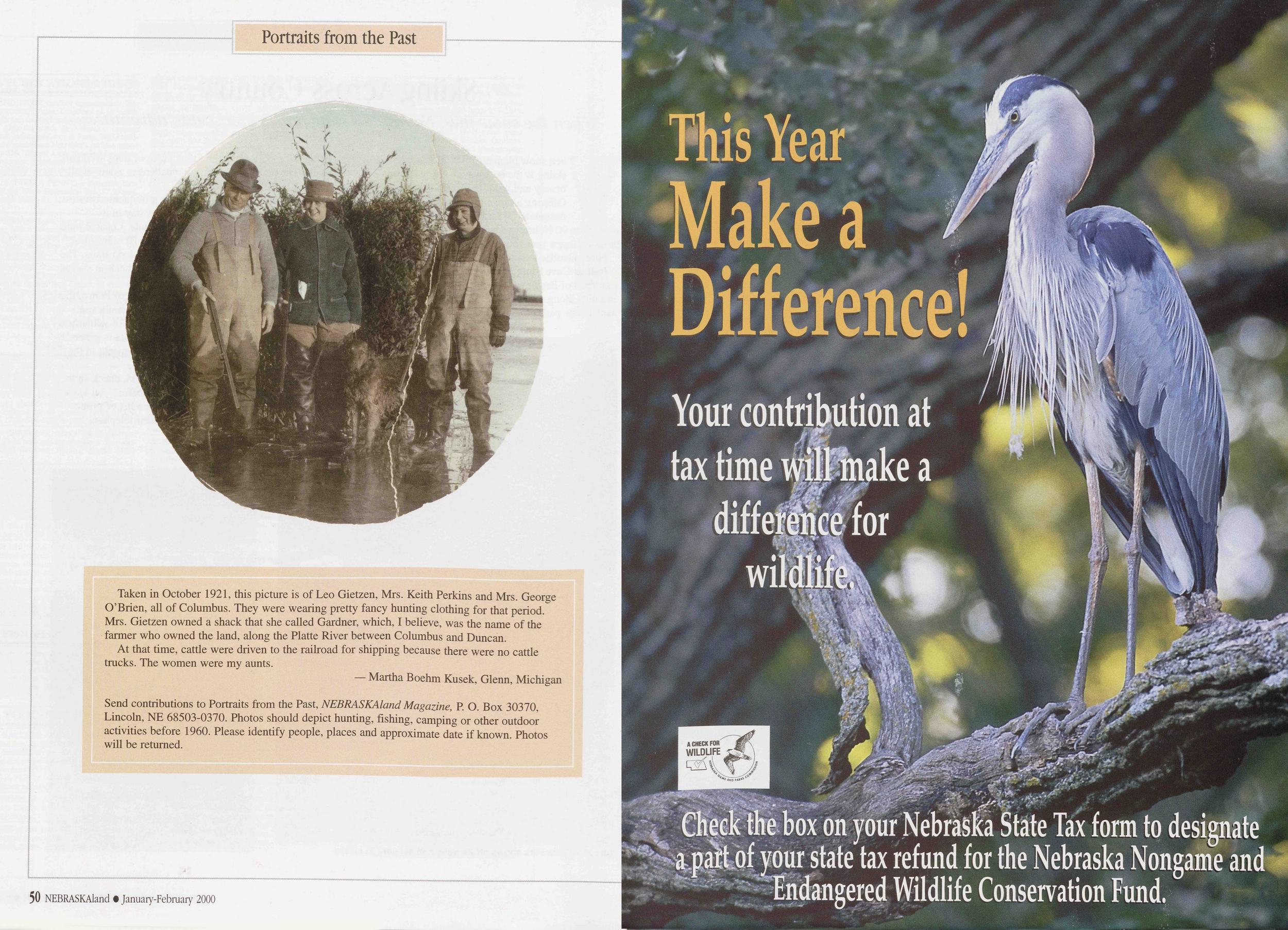
Portraits from the Past
 NEBRASKAland Magazine
Volume 78, Number 1, January-February 2000
Published by the
Nebraska Game and Parks Commission
NEBRASKAland Magazine
Volume 78, Number 1, January-February 2000
Published by the
Nebraska Game and Parks Commission
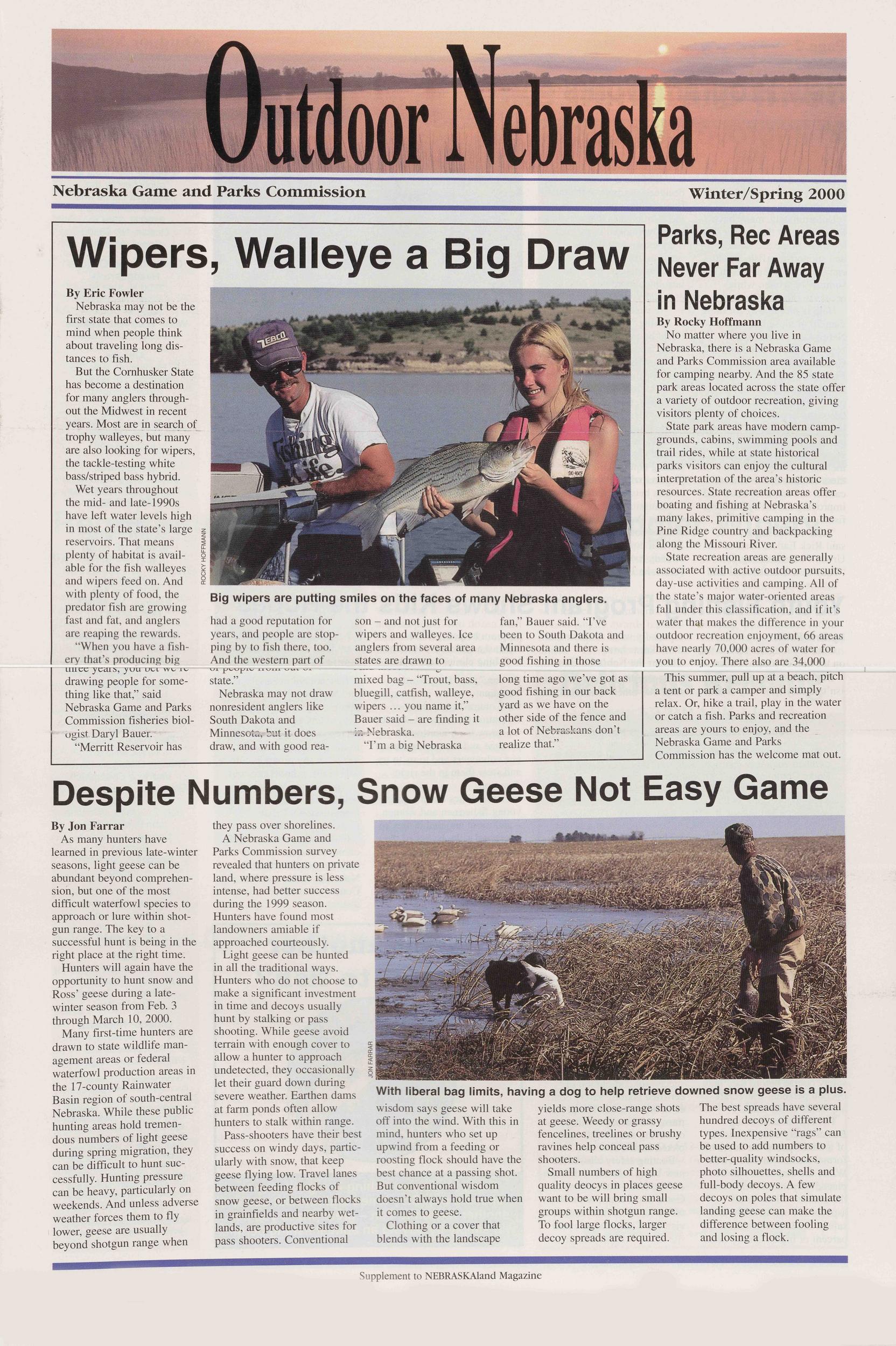
Outdoor Nebraska
Nebraska Game and Parks Commission Winter/Spring 2000Wipers, Walleye a Big Draw
Nebraska may not be the first state that comes to mind when people think about traveling long distances to fish.
But the Cornhusker State has become a destination for many anglers through- out the Midwest in recent years. Most are in search of trophy walleyes, but many are also looking for wipers, the tackle-testing white bass/striped bass hybrid.
Wet years throughout the mid- and late-1990s have left water levels high in most of the state's large reservoirs. That means plenty of habitat is available for the fish walleyes and wipers feed on. And with plenty of food, the predator fish are growing fast and fat, and anglers are reaping the rewards.
'When you have a fishery that's producing big three years, you bet we're drawing people for something like that," said Nebraska Game and Parks Commission fisheries biologist Daryl Bauer.
"Merritt Reservoir has
Big wipers are putting smiles on the faces of many Nebraska anglers.
had a good reputation for years, and people are stopping by to fish there, too. And the western part of state."
Nebraska may not draw nonresident anglers like South Dakota and Minnesota, but it does draw, and with good reason - and not just for wipers and walleyes. Ice anglers from several area states are drawn to mixed bag - "Trout, bass, bluegill, catfish, walleye, wipers ... you name it," Bauer said - are finding it in Nebraska.
"I'm a big Nebraska fan," Bauer said. "I've been to South Dakota and Minnesota and there is good fishing in those long time ago we've got as good fishing in our back yard as we have on the other side of the fence and a lot of Nebraskans don't realize that."
Parks, Rec Areas Never Far Away in Nebraska
No matter where you live in Nebraska, there is a Nebraska Game and Parks Commission area available for camping nearby. And the 85 state park areas located across the state offer a variety of outdoor recreation, giving visitors plenty of choices.
State park areas have modern camp- grounds, cabins, swimming pools and trail rides, while at state historical parks visitors can enjoy the cultural interpretation of the area's historic resources. State recreation areas offer boating and fishing at Nebraska's many lakes, primitive camping in the Pine Ridge country and backpacking along the Missouri River.
State recreation areas are generally associated with active outdoor pursuits, day-use activities and camping. All of the state's major water-oriented areas fall under this classification, and if it's water that makes the difference in your outdoor recreation enjoyment, 66 areas have nearly 70,000 acres of water for you to enjoy. There also are 34,000
This summer, pull up at a beach, pitch a tent or park a camper and simply relax. Or, hike a trail, play in the water or catch a fish. Parks and recreation areas are yours to enjoy, and the Nebraska Game and Parks Commission has the welcome mat out.
Despite Numbers, Snow Geese Not Easy Game
As many hunters have learned in previous late-winter seasons, light geese can be abundant beyond comprehension, but one of the most difficult waterfowl species to approach or lure within shotgun range. The key to a successful hunt is being in the right place at the right time.
Hunters will again have the opportunity to hunt snow and Ross' geese during a late-winter season from Feb. 3 through March 10,2000.
Many first-time hunters are drawn to state wildlife management areas or federal waterfowl production areas in the 17-county Rainwater Basin region of south-central Nebraska. While these public hunting areas hold tremendous numbers of light geese during spring migration, they can be difficult to hunt successfully. Hunting pressure can be heavy, particularly on weekends. And unless adverse weather forces them to fly lower, geese are usually beyond shotgun range when they pass over shorelines.
A Nebraska Game and Parks Commission survey revealed that hunters on private land, where pressure is less intense, had better success during the 1999 season. Hunters have found most landowners amiable if approached courteously.
Light geese can be hunted in all the traditional ways. Hunters who do not choose to make a significant investment in time and decoys usually hunt by stalking or pass shooting. While geese avoid terrain with enough cover to allow a hunter to approach undetected, they occasionally let their guard down during severe weather. Earthen dams at farm ponds often allow hunters to stalk within range.
With liberal bag limits, having a dog to help retrieve downed snow geese is a plus.
Clothing or a cover that blends with the landscape yields more close-range shots at geese. Weedy or grassy fencelines, treelines or brushy ravines help conceal pass shooters.
Small numbers of high quality deocys in places geese want to be will bring small groups within shotgun range. To fool large flocks, larger decoy spreads are required. The best spreads have several hundred decoys of different types. Inexpensive "rags" can be used to add numbers to better-quality windsocks, photo silhouettes, shells and full-body decoys. A few decoys on poles that simulate landing geese can make the difference between fooling and losing a flock.
Supplement to NEBRASKAland Magazine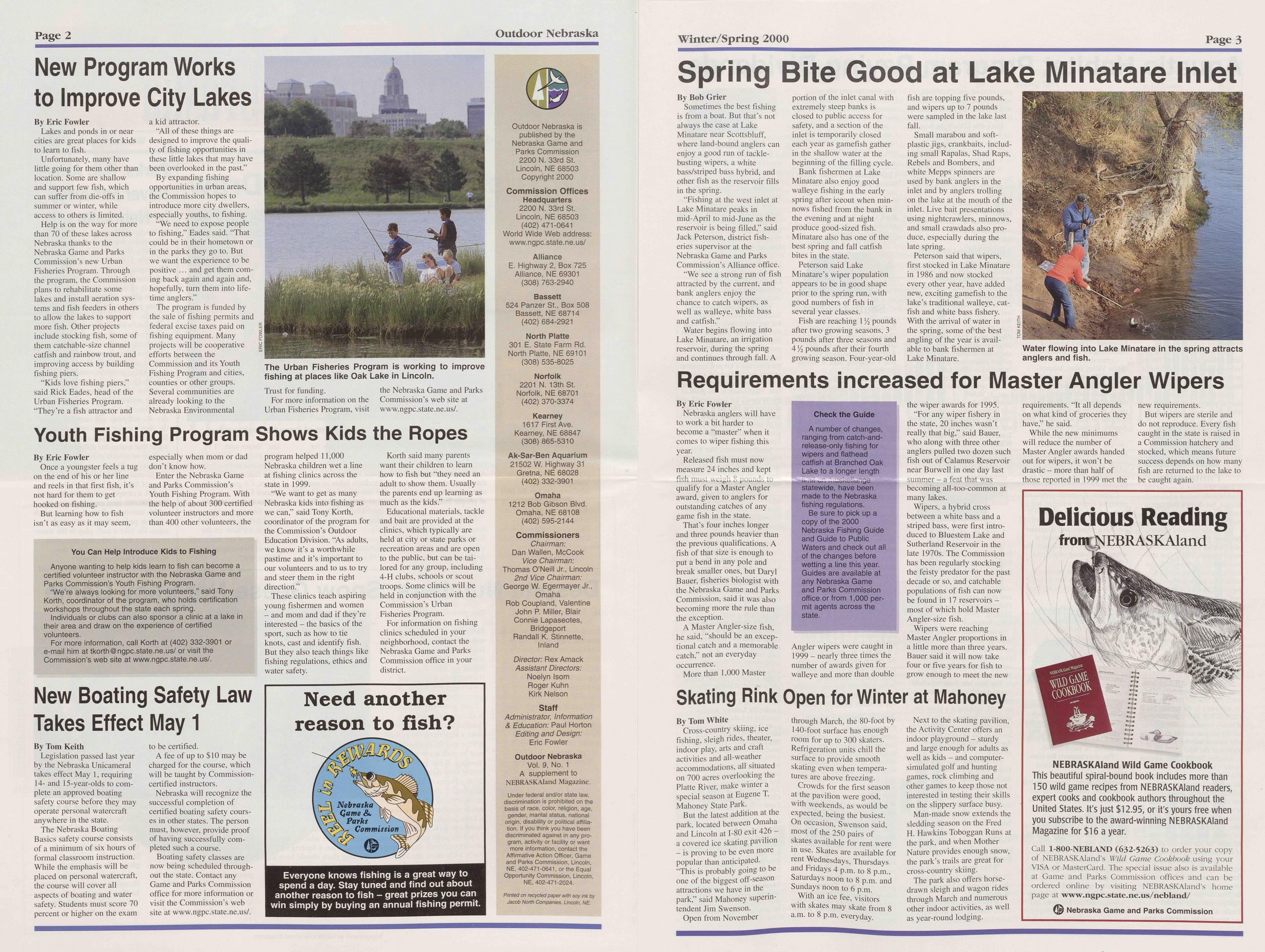 Page 2
Outdoor Nebraska
Page 2
Outdoor Nebraska
New Program Works to Improve City Lakes
Lakes and ponds in or near cities are great places for kids to learn to fish.
Unfortunately, many have little going for them other than location. Some are shallow and support few fish, which can suffer from die-offs in summer or winter, while access to others is limited.
Help is on the way for more than 70 of these lakes across Nebraska thanks to the Nebraska Game and Parks Commission's new Urban Fisheries Program. Through the program, the Commission plans to rehabilitate some lakes and install aeration systems and fish feeders in others to allow the lakes to support more fish. Other projects include stocking fish, some of them catchable-size channel catfish and rainbow trout, and improving access by building fishing piers.
"Kids love fishing piers," said Rick Eades, head of the Urban Fisheries Program. "They're a fish attractor and a kid attractor.
"All of these things are designed to improve the quality of fishing opportunities in these little lakes that may have been overlooked in the past."
By expanding fishing opportunities in urban areas, the Commission hopes to introduce more city dwellers, especially youths, to fishing.
"We need to expose people to fishing," Eades said. "That could be in their hometown or in the parks they go to. But we want the experience to be positive ... and get them coming back again and again and, hopefully, turn them into life- time anglers."
The program is funded by the sale of fishing permits and federal excise taxes paid on fishing equipment. Many projects will be cooperative efforts between the Commission and its Youth Fishing Program and cities, counties or other groups. Several communities are already looking to the Nebraska Environmental
For more information on the Urban Fisheries Program, visit the Nebraska Game and Parks Commission's web site at www.ngpc.state.ne.us/.
Youth Fishing Program Shows Kids the Ropes
Once a youngster feels a tug on the end of his or her line and reels in that first fish, it's not hard for them to get hooked on fishing. But learning how to fish isn't as easy as it may seem, especially when mom or dad don't know how.
Enter the Nebraska Game and Parks Commission's Youth Fishing Program. With the help of about 300 certified volunteer instructors and more than 400 other volunteers, the
You Can Help Introduce Kids to FishingAnyone wanting to help kids learn to fish can become a certified volunteer instructor with the Nebraska Game and Parks Commission's Youth Fishing Program.
"We're always looking for more volunteers," said Tony Korth, coordinator of the program, who holds certification workshops throughout the state each spring.
Individuals or clubs can also sponsor a clinic at a lake in their area and draw on the experience of certified volunteers.
For more information, call Korth at (402) 332-3901 or e-mail him at tkorth@ngpc.state.ne.us/ or visit the Commission's web site at www.ngpc.state.ne.us/.program helped 11,000 Nebraska children wet a line at fishing clinics across the state in 1999.
"We want to get as many Nebraska kids into fishing as we can," said Tony Korth, coordinator of the program for the Commission's Outdoor Education Division. "As adults, we know it's a worthwhile pastime and it's important to our volunteers and to us to try and steer them in the right direction."
These clinics teach aspiring young fishermen and women - and mom and dad if they're interested - the basics of the sport, such as how to tie knots, cast and identify fish. But they also teach things like fishing regulations, ethics and water safety.
Korth said many parents want their children to learn how to fish but "they need an adult to show them. Usually the parents end up learning as much as the kids."
Educational materials, tackle and bait are provided at the clinics, which typically are held at city or state parks or recreation areas and are open to the public, but can be tai- lored for any group, including 4-H clubs, schools or scout troops. Some clinics will be held in conjunction with the Commission's Urban Fisheries Program.
For information on fishing clinics scheduled in your neighborhood, contact the Nebraska Game and Parks Commission office in your district.
New Boating Safety Law Takes Effect May 1
Legislation passed last year by the Nebraska Unicameral takes effect May 1, requiring 14- and 15-year-olds to com- plete an approved boating safety course before they may operate personal watercraft anywhere in the state.
The Nebraska Boating Basics safety course consists of a minimum of six hours of formal classroom instruction. While the emphasis will be placed on personal watercraft, the course will cover all aspects of boating and water safety. Students must score 70 percent or higher on the exam to be certified.
A fee of up to $10 may be charged for the course, which will be taught by Commission- certified instructors.
Nebraska will recognize the successful completion of certified boating safety cours- es in other states. The person must, however, provide proof of having successfully com- pleted such a course.
Boating safety classes are now being scheduled through- out the state. Contact any Game and Parks Commission office for more information or visit the Commission's web site at www.ngpc.state.ne.us/.
Need another reason to fish?Spring Bite Good at Lake Minatare Inlet
Sometimes the best fishing is from a boat. But that's not always the case at Lake Minatare near Scottsbluff, where land-bound anglers can enjoy a good run of tackle- busting wipers, a white bass/striped bass hybrid, and other fish as the reservoir fills in the spring.
"Fishing at the west inlet at Lake Minatare peaks in mid-April to mid-June as the reservoir is being filled," said Jack Peterson, district fisheries supervisor at the Nebraska Game and Parks Commission's Alliance office.
"We see a strong run of fish attracted by the current, and bank anglers enjoy the chance to catch wipers, as well as walleye, white bass and catfish."
Water begins flowing into Lake Minatare, an irrigation reservoir, during the spring and continues through fall. A portion of the inlet canal with extremely steep banks is closed to public access for safety, and a section of the inlet is temporarily closed each year as gamefish gather in the shallow water at the beginning of the filling cycle.
Bank fishermen at Lake Minatare also enjoy good walleye fishing in the early spring after iceout when minnows fished from the bank in the evening and at night produce good-sized fish. Minatare also has one of the best spring and fall catfish bites in the state.
Peterson said Lake Minatare's wiper population appears to be in good shape prior to the spring run, with good numbers of fish in several year classes.
Fish are reaching 1 1/2 pounds after two growing seasons, 3 pounds after three seasons and 4 1/2 pounds after their fourth growing season. Four-year-old fish are topping five pounds, and wipers up to 7 pounds were sampled in the lake last fall.
Small marabou and soft- plastic jigs, crankbaits, including small Rapalas, Shad Raps, Rebels and Bombers, and white Mepps spinners are used by bank anglers in the inlet and by anglers trolling on the lake at the mouth of the inlet. Live bait presentations using nightcrawlers, minnows, and small crawdads also produce, especially during the late spring.
Peterson said that wipers, first stocked in Lake Minatare in 1986 and now stocked every other year, have added new, exciting gamefish to the lake's traditional walleye, catfish and white bass fishery. With the arrival of water in the spring, some of the best angling of the year is available to bank fishermen at Lake Minatare.
TOM KEITHWater flowing into Lake Minatare in the spring attracts anglers and fish.
Requirements increased for Master Angler Wipers
Nebraska anglers will have to work a bit harder to become a "master" when it comes to wiper fishing this year.
Released fish must now measure 24 inches and kept fish must weigh 8 pounds to qualify for a Master Angler award, given to anglers for outstanding catches of any game fish in the state.
That's four inches longer and three pounds heavier than the previous qualifications. A fish of that size is enough to put a bend in any pole and break smaller ones, but Daryl Bauer, fisheries biologist with the Nebraska Game and Parks Commission, said it was also becoming more the rule than the exception.
A Master Angler-size fish, he said, "should be an exceptional catch and a memorable catch," not an everyday occurrence.
More than 1,000 Master
Check the Guide A number of changes, ranging from catch-and- elease-only fishing for wipers and flathead catfish at Branched Oak Lake to a longer length limit on muskellunge statewide, have been made to the Nebraska fishing regulations. Be sure to pick up a copy of the 2000 Nebraska Fishing Guide and Guide to Public Waters and check out all of the changes before wetting a line this year. Guides are available at any Nebraska Game and Parks Commission office or from 1,000 permit agents across the state.Angler wipers were caught in 1999 - nearly three times the number of awards given for walleye and more than double the wiper awards for 1995.
"For any wiper fishery in the state, 20 inches wasn't really that big," said Bauer, who along with three other anglers pulled two dozen such fish out of Calamus Reservoir near Burwell in one day last summer - a feat that was becoming all-too-common at many lakes.
Wipers, a hybrid cross between a white bass and a striped bass, were first intro- duced to Bluestem Lake and Sutherland Reservoir in the late 1970s. The Commission has been regularly stocking the feisty predator for the past decade or so, and catchable populations of fish can now be found in 17 reservoirs - most of which hold Master Angler-size fish.
Wipers were reaching Master Angler proportions in a little more than three years. Bauer said it will now take four or five years for fish to grow enough to meet the new requirements. "It all depends on what kind of groceries they have," he said.
While the new minimums will reduce the number of Master Angler awards handed out for wipers, it won't be drastic - more than half of those reported in 1999 met the new requirements.
But wipers are sterile and do not reproduce. Every fish caught in the state is raised in a Commission hatchery and stocked, which means future success depends on how many fish are returned to the lake to be caught again.
Skating Rink Open for Winter at Mahoney
Cross-country skiing, ice fishing, sleigh rides, theater, indoor play, arts and craft activities and all-weather accommodations, all situated on 700 acres overlooking the Platte River, make winter a special season at Eugene T. Mahoney State Park.
But the latest addition at the park, located between Omaha and Lincoln at 1-80 exit 426 - a covered ice skating pavilion - is proving to be even more popular than anticipated. "This is probably going to be one of the biggest off-season attractions we have in the park," said Mahoney superintendent Jim Swenson.
Open from November through March, the 80-foot by 140-foot surface has enough room for up to 300 skaters. Refrigeration units chill the surface to provide smooth skating even when temperatures are above freezing.
Crowds for the first season at the pavilion were good, with weekends, as would be expected, being the busiest. On occasion, Swenson said, most of the 250 pairs of skates available for rent were in use. Skates are available for rent Wednesdays, Thursdays and Fridays 4 p.m. t0 8 p.m., Saturdays noon to 8 p.m. and Sundays noon to 6 p.m.
With an ice fee, visitors with skates may skate from 8 a.m. to 8 p.m. everyday.
Next to the skating pavilion, the Activity Center offers an indoor playground - sturdy and large enough for adults as well as kids - and computer- simulated golf and hunting games, rock climbing and other games to keep those not interested in testing their skills on the slippery surface busy.
Man-made snow extends the sledding season on the Fred H. Hawkins Toboggan Runs at the park, and when Mother Nature provides enough snow, the park's trails are great for cross-country skiing.
The park also offers horse- drawn sleigh and wagon rides through March and numerous other indoor activities, as well as year-round lodging.

Aquatic Habitat Program Paying Dividends
With just three years complete and at least seven to go, Nebraska's Aquatic Habitat Program is already paying dividends with improved fishing.
The proceeds of $5 Aquatic Habitat Stamps, a requirement for most anglers, and matching funds from a number of local, state and federal programs have been or will soon be used on 25 projects, and about 20 more planned for the coming years.
The placement of aerators in sandpits - one of the simpler projects - has already led to improved growth rates in bass and panfish in several lakes.
Other projects involve draining lakes, removing silt buildup, taking steps to prevent future silt buildup, creating habitat, stabilizing shorelines and restocking the lakes after rough fish are removed. This type of work may put a lake out of commission for a few years, but will improve fishing for years to come.
Even without the habitat projects, fishing in the late '90s in Nebraska has been excellent in most reservoirs, lakes and ponds thanks to high water levels.
Here is a look across the state at potential fishing hot spots and aquatic habitat work:
Lake Minatare is one of the most heavily fished lakes in this district, but despite that fact, it produced some excellent walleyes in 1999.
"From the opening gun to the close, they caught walleyes," said District Fisheries Biologist Jack Peterson. While that suc- cess should continue, the lake also has a fair population of white bass and wipers, a growing population of smallmouth bass and an underutilized catfish population.
Most lakes have up years and down years, but that's not the case with Box Butte Reservoir. "People can always catch fish there," Peterson said of the lake, which holds northern pike, perch, bluegill, largemouth bass and rock bass.
Smith Lake near Rushville is good for largemouth bass, pike, perch and bluegill through the ice and early in the spring, but is tough to fish after June because of heavy vegetation. An aquatic habitat project now in its second year should help by deepening a portion of the lake.
Another Smith Lake, located on the Crescent Lake National Wildlife Refuge, will be open for just the second year to ice fishing. Peterson said anglers can expect good bluegill and perch fishing until the lake closes Feb. 15. Another refuge lake, Island Lake, is also good for perch, bluegill and crappie through the ice and has plenty of nice bass and a few walleyes.
The spring catfish run in the North Platte River is excellent, Peterson said. And there are plenty of good trout streams in the Pine Ridge and North Platte Valley, especially Soldier Creek, which has wild brown and brook trout, and Nine Mile Creek. "If a guy wants to walk streams for trout, there are lots of places to fish," Peterson said.
Aquatic Habitat Projects:Lake Minatare - 8,600 tons of mud-rock and crushed concrete placed around the lake in 1998 and 1999 for walleye spawning habitat. Cost: $171,000.
For variety and quality, it's hard to top the fishing found at Merritt Reservoir and the Valentine National Wildlife Refuge lakes.
"It's a nice central location with a variety of lakes and opportunities - everything from walleye fishing at Merritt to northern pike and panfish on the refuge," said District Fisheries Biologist Joel Klammer. "There's kind of something for everybody."
Cottonwood, Steverson and Home Valley lakes, located north of Hyannis were renovated in 1998 and restocked with largemouth bass, walleye, muskellunge, bluegill, yellow perch and black crappie. The $79,000 project was part of the Aquatic Habitat Program.
"A lot of people have been circling like vultures waiting for those fish to grow big enough to eat," Klammer said, adding that this should be the year, at least for perch and bluegill.
Calamus Reservoir produced plenty of keeper walleyes last year and should do so again. It will also be a good place to catch big wipers, and Klammer said he thinks after having a few years to get established, the white bass fishing might take off this summer.
Big Alkali Lake produced some big crappies last spring. Also don't overlook Long Pine Creek for trout.
Aquatic Habitat Projects:Shell Lake - Lake deepened in 1997. Cost: $210,000.
Largemouth bass and panfish are the prime species throughout most of this district, but the Missouri River and Lewis and Clark Lake offer plenty of fish and plenty of room to fish.
"The river remains the number one saugeye and walleye fishery in the northeast," said District Fisheries Supervisor Jeff Shuckman, pointing to the tailwaters and areas near Niobrara and Verdel as the top spots. Smallmouth bass fishing is excellent from Lewis and Clark Lake upriver into South Dakota. The river also provides plenty of catfishing - both for channel cats and flatheads - as well as northern pike in the spring and early summer, buffalo, carp and, in season, paddlefish.
Grove Lake holds some big largemouth bass and pike and plenty of bluegills and crappies. The introduction of carp and gizzard shad into Chalkrock, once a prime largemouth lake, will probably result in a renovation project there this summer.
Buckskin Hills is the best bet for big bluegills, and while Sky view doesn't have the big bluegills, it is chocked full of 6- to 8-inch fish.
Willow Creek should be the best crappie lake in the district and Goose Lake is the best bet for pike.
For trout fishermen, the east branch of Verdigre Creek is stocked with 200 rainbows each week and has plenty of public access.
Aquatic Habitat Projects:Fremont Lakes - Aerators installed in Lakes 1 and 3 in 1998 and 1999. Similar systems planned for lakes 2, 4, 11 and 18 by this summer. Cost: $35,000.
Lewis and Clark Lake - Jetties and offshore breakwaters built in Weigand-Burbach area in 1998. Cost: $220,000.
Pibel Lake - Lake deepened, shoreline stabilized, drainage and outlet structure reworked, habitat created and access improved in 1999. Lake restocked with largemouth bass, bluegill and channel catfish. Cost: $170,000
Summit Lake - Construct jetties and sediment dikes, stabilize shoreline, modify outlet structure and remove rough fish. Tentatively set for 2000/2001.
Willow Creek Lake - Breakwater jetty now being built. Second jetty and shoreline stabilization tentatively set for 2001/2002.
Aquatic habitat work has brought Lake Ogallala back from the dead and made it once again a premier trout fishery.
"The fish are in excellent condition, with good numbers and good quality," said District Fisheries Supervisor Monte Madsen. "Now we just need some fishermen."
Anglers were boating rainbow trout up to 3 pounds, with 12- to 14-inch fish weighing 1 to 2 pounds common through the summer and well into fall, Madsen said.
The lake has been regularly stocked with rainbows and browns since it was renovated in 1997, making it a great put-and-grow fishery. Aerators were installed to boost oxygen levels in the summer as part of the $350,000 aquatic habitat project.
On the other side of Kingsley Dam, walleye continues to be the king at Lake McConaughy, which is still producing trophy fish and has a healthy population. Wiper growth rates are good in Big Mac, but white bass numbers are down.
Other surprises in Lake McConaughy include a boom in bullhead and northern pike populations.
"When the lake reaches high levels annually, we get these shoreline species coming in," Madsen said.
Of the other southwest reservoirs, Madsen said Red Willow have been consistent for white bass over the past few years, Swanson has been good for wipers and Medicine Creek has been good for both.
McConaughy, the Tri-County Canal and Jeffrey Reservoir have been good bets for catfish and smallmouth bass.
Aquatic Habitat Projects:Lake Maloney - Deepen supply holding pond, remove rough fish and install filter to keep rough fish out of pond. Tentatively set for 2000/2001.
Rock Creek Lake - Remove sediment from the upper end and stabilize east shoreline. Tentatively set for 2000/2001.
District Fisheries Biologist Brad Newcomb considers Sherman Reservoir the best crappie reservoir in the state. And from the looks of this year's sampling data, it should get better.
"We saw a significant rise in the numbers of crappie sampled from Sherman," he said, adding there are plenty of fish over the 10-inch size limit.
Newcomb said Sherman is also a sleeper when it comes to 20-inch-plus walleyes.
Of the three other major walleye reservoirs in the district - Harlan County, Johnson and Elwood - Elwood is also good for big fish and also has a high density. Harlan County's walleye population is still down, but Newcomb said a good 1998 class should help fishing in the future.
With plenty of bigger fish, Harlan should continue to be one of the top white bass fisheries in the state. The lake also produced good samples of wipers and catfish.
Newcomb said Elwood looks like it could become one of the top wiper fisheries in the state. A few fish from the first stocking in 1996 have already reached 10 pounds. Good things are also expected from muskies stocked in the lake.
And the 30 interstate lakes in the region provide easy access to good fishing for largemouth bass, bluegill and catfish. Newcomb said big carp in these clear lakes also provide good opportunities for archery anglers.
Aquatic Habitat Projects:Cottonmill Lake - Lake deepened, shoreline stabilized, islands and jetties built and filter installed to keep rough fish and sediment out in 1999. Restocked with bluegill, largemouth bass and channel catfish. Cost: $1.5 million.
Fort Kearny - Aerator installed in Lake No. 4 in 1997. Additional aerators planned for Lakes 1, 2, 3, 5 and 6 using federal funding. Cost: $5,000.
Windmill Lake - Aerators installed in Lake No. 4 in 1997. Cost: $5,000.
Ravenna Lake - If agreement can be reached with Buffalo County to keep lake open to public for at least 20 years, oxbow lake will be deepened, renovated and steps taken to keep rough fish out. Tentatively set for 2000/2001.
Southeast Nebraska anglers won't find two of the best lakes in the district - Burchard and Iron Horse Trail - in this year's sampling data. They simply weren't sampled.
But District Fisheries Supervisor Jeff Jackson said the two are "consistently some of the best lakes we've got for crappie, bluegill, channel catfish and largemouth bass."
Crappie is the "bread and butter fish around the district," Jackson said. Branched Oak Lake has good numbers of white crappies, including 10-inch-plus fish.
Wehrspann and Zorinsky lakes hold plenty of crappies, but not many over the 10-inch size limit. This year, the length limit will be lifted for the month of April only. "We're targeting those fish to reduce the densities a bit and improve growth rates," Jackson said.
With good numbers and big fish, Stagecoach is "as good as any around" for largemouth and also has big bluegills, Jackson said. Walnut Creek Lake is full of 8- to 12-inch bass. "That's a good place to take kids to catch fish," Jackson said.
Small reservoirs like Wild Plum, Merganser, Hedgefield and Cottontail "are really coming on and producing some bass," Jackson said.
Alexandria's east and west lakes were renovated a few years ago and are just starting to produce some quality bluegills, Jackson said.
Catfishing is good in many southeast lakes. Jackson said for those who simply want to catch fish, Pawnee is the place. Branched Oak has larger cats.
Aquatic Habitat Projects:Hitchcock Park Pond, Benson Park Pond, Omaha - Ponds deepened, shoreline stabilized and habitat built in 1998 (Hitchcock) and 1999 (Benson). Restocked with catchable channel catfish by Urban Fisheries Program in 1999.
Branched Oak Lake - Five A-Jack breakwaters, two tire-bale breakwaters and three 500-foot long jetties constructed to create fringe wetlands, provide habitat and stabilize shoreline. Three-year evaluation underway. Cost: $1.67 million.
Louisville Lakes - Aerator installed in Lake 1A in 1998. Lake 2 renovated, three aerators installed and restocked with largemouth bass, channel catfish, bluegill and redear sunfish in 1999. Cost: $29,000.
Memphis Lake - Deepen lake, improve habitat, stabilize shoreline and remove rough fish. Tentatively set for 2000/2001.
Olive Creek Lake, Wagon Train Lake - Work underway to deepen lake, stabilize shoreline, construct islands and/or jetties and sediment dikes and ponds and remove rough fish. Lake levels have been lowered. Both should be complete this year.
Two Rivers - Aerators installed in Lakes 1, 2, 3 and 5 from 1997 to 1999. Cost: $32,000.
Verdon Lake - Lake deepened, shoreline stabilized, island and jetty built, dike repaired and outlet structure rehabilitated in 1999. Cost: $483,000.
1999 Fish Sampling Results
With about 450 lakes and streams open to public fishing, deciding where to fish is one challenge Nebraska anglers face.
The following graphs, which show sampling rates for seven important sport fish from Nebraska lakes and reservoirs in 1999, can help make that decision easier.
Fisheries biologists use a variety of methods to collect these samples, including electrofishing for large- mouth bass, trap nets for bluegill and crappie and gill nets for walleye, white bass, wipers and channel catfish. Sampling rates can be influenced by a variety of factors, most notably weath- er. However, they provide anglers with at least a "ballpark" idea of fish densi- ties in some waters.
The ascending order of the graphs, based on total catch rate for all sizes of fish, might seem to suggest more is better, but a closer examination is required. At each lake, samples for a given species are divided into different length categories. For all species, high catch rates for large sizes indicate good fishing for big fish in 2000. High catch rates of smaller walleye, white bass and wiper indicate good fishing for the future.
If you don't find your favorite fish- ing hole in the graphs, it's not because it doesn't hold any fish. Not every lake sampled every year. And whether a lake shows high densities of fish or not, it's still up to the angler to be in the right place at the right time and using the right techniques to catch fish.
Crappie Fall 1999Many of the lakes sampled for crappie in 1999 produced fish 10 inches and longer. While Branched Oak and Yankee Hill had the highest catch rates for large fish, no one lake distinguished itself. Removal of the 10-inch size limit during April should reduce competition among tisn at Wehrspann and produce bigger fish next year.
Largemouth Bass Spring 1999Most lakes sampled produced largemouth bass 15 inches and longer. Those pro- ducing the highest catch rates of 15-inch-plus bass were all Two Rivers lakes, especially Lake 2, Grove, West Wood River, Stagecoach, Duck and Czechland. At Walnut Creek, a new impoundment, there are plenty of small, young bass.
White Bass Fall 1999Most lakes sampled produced at least some white bass 12 inches and longer, but for the third year in a row, Enders, Sherman, and Harlan produced among the high- est catch rates of white bass 12 inches and longer. In 1999, Swanson produced the most white bass and among the highest catch rates of large white bass.
Bluegill Spring 1999Fourty-two lakes were sampled for bluegill. Of the 36 included here, 25 produced fish 8 inches and longer. Stagecoach yielded the highest number of bluegills per trap net, due in part to supplemental feeding. Other lakes with good numbers of 8-inch and longer bluegills include Island, Czechland, Alexandria East, Ansley and Killdeer.
Channel Catfish Fall 1999Lakes that contained moderate densities of channel catfish produced the highest catch rates for fish 24 inches and longer. Big channel cats were sampled in the highest quantities at Winters Creek, Stagecoach (perhaps due to supplemental feeding) and Calamus.
Walleye Spring 1999High catch rates for fish 15 to 25 inches long vaulted Elwood to the top of the list for walleye. Maloney, Merritt, Calamus and McConaughy continue to produce good walleye populations, but Branched Oak, Sherman, Davis Creek, Pawnee and Johnson yielded more fish per gill net 25 inches and longer.
Wiper Fall 1999Most lakes produced some fish 20 inches and longer, but the highest catches of big wipers occurred at Swanson, Elwood and Harlan. Lakes where these stocked fish continue to recruit well have bright futures. Calamus and Enders produced the highest catch rates of small wipers, an indication of good things to come.
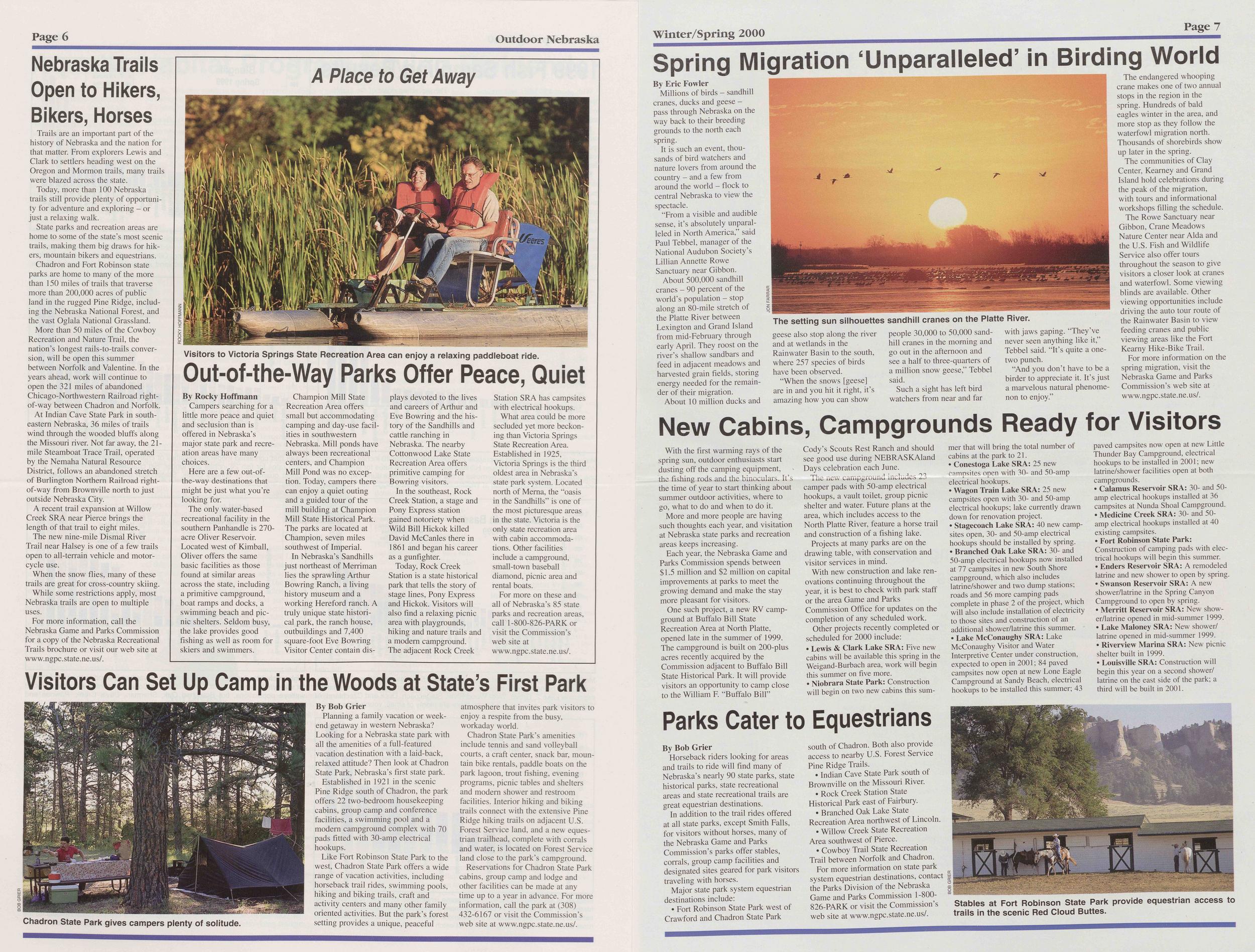 Page 6
Outdoor Nebraska
Page 6
Outdoor Nebraska
Nebraska Trails Open to Hikers, Bikers, Horses
Trails are an important part of the history of Nebraska and the nation for that matter. From explorers Lewis and Clark to settlers heading west on the Oregon and Mormon trails, many trails were blazed across the state.
Today, more than 100 Nebraska trails still provide plenty of opportunity for adventure and exploring - or just a relaxing walk.
State parks and recreation areas are home to some of the state's most scenic trails, making them big draws for hikers, mountain bikers and equestrians.
Chadron and Fort Robinson state parks are home to many of the more than 150 miles of trails that traverse more than 200,000 acres of public land in the rugged Pine Ridge, including the Nebraska National Forest, and the vast Oglala National Grassland.
More than 50 miles of the Cowboy Recreation and Nature Trail, the nation's longest rails-to-trails conversion, will be open this summer between Norfolk and Valentine. In the years ahead, work will continue to open the 321 miles of abandoned Chicago-Northwestern Railroad right-of-way between Chadron and Norfolk.
At Indian Cave State Park in south- eastern Nebraska, 36 miles of trails wind through the wooded bluffs along the Missouri river. Not far away, the 21-mile Steamboat Trace Trail, operated by the Nemaha Natural Resource District, follows an abandoned stretch of Burlington Northern Railroad right-of-way from Brownville north to just outside Nebraska City.
A recent trail expansion at Willow Creek SRA near Pierce brings the length of that trail to eight miles.
The new nine-mile Dismal River Trail near Halsey is one of a few trails open to all-terrain vehicle and motor- cycle use.
When the snow flies, many of these trails are great for cross-country skiing.
While some restrictions apply, most Nebraska trails are open to multiple uses.
For more information, call the Nebraska Game and Parks Commission for a copy of the Nebraska Recreational Trails brochure or visit our web site at www.ngpc.state.ne.us/.
A Place to Get Away
Visitors to Victoria Springs State Recreation Area can enjoy a relaxing paddleboat ride.
Out-of-the-Way Parks Offer Peace, Quiet
Campers searching for a little more peace and quiet and seclusion than is offered in Nebraska's major state park and recreation areas have many choices.
Here are a few out-of-the-way destinations that might be just what you're looking for.
The only water-based recreational facility in the southern Panhandle is 270-acre Oliver Reservoir. Located west of Kimball, Oliver offers the same basic facilities as those found at similar areas across the state, including a primitive campground, boat ramps and docks, a swimming beach and picnic shelters. Seldom busy, the lake provides good fishing as well as room for skiers and swimmers.
Champion Mill State Recreation Area offers small but accommodating camping and day-use facilities in southwestern Nebraska. Mill ponds have always been recreational centers, and Champion Mill Pond was no exception. Today, campers there can enjoy a quiet outing and a guided tour of the mill building at Champion Mill State Historical Park. The parks are located at Champion, seven miles southwest of Imperial.
In Nebraska's Sandhills just northeast of Merriman lies the sprawling Arthur Bowring Ranch, a living history museum and a working Hereford ranch. A truly unique state historical park, the ranch house, outbuildings and 7,400 square-foot Eve Bowring Visitor Center contain displays devoted to the lives and careers of Arthur and Eve Bowring and the history of the Sandhills and cattle ranching in Nebraska. The nearby Cottonwood Lake State Recreation Area offers primitive camping for Bowring visitors.
In the southeast, Rock Creek Station, a stage and Pony Express station gained notoriety when Wild Bill Hickok killed David McCanles there in 1861 and began his career as a gunfighter.
Today, Rock Creek Station is a state historical park that tells the story of stage lines, Pony Express and Hickok. Visitors will also find a relaxing picnic area with playgrounds, hiking and nature trails and a modern campground. The adjacent Rock Creek Station SRA has campsites with electrical hookups.
What area could be more secluded yet more beckoning than Victoria Springs State Recreation Area. Established in 1925, Victoria Springs is the third oldest area in Nebraska's state park system. Located north of Merna, the "oasis in the Sandhills" is one of the most picturesque areas in the state. Victoria is the only state recreation area with cabin accommodations. Other facilities include a campground, small-town baseball diamond, picnic area and rental boats.
For more on these and all of Nebraska's 85 state parks and recreation areas, call 1-800-826-PARKor visit the Commission's web site at www.ngpc.state.ne.us/.
Visitors Can Set Up Camp in the Woods at State's First Park
Chadron State Park gives campers plenty of solitude.
Planning a family vacation or weekend getaway in western Nebraska? Looking for a Nebraska state park with all the amenities of a full-featured vacation destination with a laid-back, relaxed attitude? Then look at Chadron State Park, Nebraska's first state park.
Established in 1921 in the scenic Pine Ridge south of Chadron, the park offers 22 two-bedroom housekeeping cabins, group camp and conference facilities, a swimming pool and a modern campground complex with 70 pads fitted with 30-amp electrical hookups.
Like Fort Robinson State Park to the west, Chadron State Park offers a wide range of vacation activities, including horseback trail rides, swimming pools, hiking and biking trails, craft and activity centers and many other family oriented activities. But the park's forest setting provides a unique, peaceful atmosphere that invites park visitors to enjoy a respite from the busy, workaday world.
Chadron State Park's amenities include tennis and sand volleyball courts, a craft center, snack bar, mountain bike rentals, paddle boats on the park lagoon, trout fishing, evening programs, picnic tables and shelters and modern shower and restroom facilities. Interior hiking and biking trails connect with the extensive Pine Ridge hiking trails on adjacent U.S. Forest Service land, and a new equestrian trailhead, complete with corrals and water, is located on Forest Service land close to the park's campground.
Reservations for Chadron State Park cabins, group camp and lodge and other facilities can be made at any time up to a year in advance. For more information, call the park at (308) 432-6167 or visit the Commission's web site at www.ngpc.state.ne.us/.
Spring Migration 'Unparalleled' in Birding World
Millions of birds - sandhill cranes, ducks and geese - pass through Nebraska on the way back to their breeding grounds to the north each spring.
It is such an event, thousands of bird watchers and nature lovers from around the country - and a few from around the world - flock to central Nebraska to view the spectacle.
"From a visible and audible sense, it's absolutely unparalleled in North America," said Paul Tebbel, manager of the National Audubon Society's Lillian Annette Rowe Sanctuary near Gibbon.
About 500,000 sandhill cranes - 90 percent of the world's population - stop along an 80-mile stretch of the Platte River between Lexington and Grand Island from mid-February through early April. They roost on the river's shallow sandbars and feed in adjacent meadows and harvested grain fields, storing energy needed for the remainder of their migration.
About 10 million ducks and
JON FARRARThe setting sun silhouettes sandhill cranes on the Platte River.
geese also stop along the river and at wetlands in the Rainwater Basin to the south, where 257 species of birds have been observed.
"When the snows [geese] are in and you hit it right, it's amazing how you can show people 30,000 to 50,000 sandhill cranes in the morning and go out in the afternoon and see a half to three-quarters of a million snow geese," Tebbel said.
Such a sight has left bird watchers from near and far with jaws gaping. "They've never seen anything like it," Tebbel said. "It's quite a one-two punch.
"And you don't have to be a birder to appreciate it. It's just a marvelous natural phenomenon to enjoy."
The endangered whooping crane makes one of two annual stops in the region in the spring. Hundreds of bald eagles winter in the area, and more stop as they follow the waterfowl migration north. Thousands of shorebirds show up later in the spring.
The communities of Clay Center, Kearney and Grand Island hold celebrations during the peak of the migration, with tours and informational workshops filling the schedule.
The Rowe Sanctuary near Gibbon, Crane Meadows Nature Center near Alda and the U.S. Fish and Wildlife Service also offer tours throughout the season to give visitors a closer look at cranes and waterfowl. Some viewing blinds are available. Other viewing opportunities include driving the auto tour route of the Rainwater Basin to view feeding cranes and public viewing areas like the Fort Kearny Hike-Bike Trail.
For more information on the spring migration, visit the Nebraska Game and Parks Commission's web site at www.ngpc.state.ne.us/.
New Cabins, Campgrounds Ready
With the first warming rays of the spring sun, outdoor enthusiasts start dusting off the camping equipment, the fishing rods and the binoculars. It's the time of year to start thinking about summer outdoor activities, where to go, what to do and when to do it.
More and more people are having such thoughts each year, and visitation at Nebraska state parks and recreation areas keeps increasing.
Each year, the Nebraska Game and Parks Commission spends between $1.5 million and $2 million on capital improvements at parks to meet the growing demand and make the stay more pleasant for visitors.
One such project, a new RV campground at Buffalo Bill State Recreation Area at North Platte, opened late in the summer of 1999. The campground is built on 200-plus acres recently acquired by the Commission adjacent to Buffalo Bill State Historical Park. It will provide visitors an opportunity to camp close to the William F. "Buffalo Bill" Cody's Scouts Rest Ranch and should see good use during NEBRASKAland Days celebration each June.
The new campground includes 23 camper pads with 50-amp electrical hookups, a vault toilet, group picnic shelter and water. Future plans at the area, which includes access to the North Platte River, feature a horse trail and construction of a fishing lake.
Projects at many parks are on the drawing table, with conservation and visitor services in mind.
With new construction and lake renovations continuing throughout the year, it is best to check with park staff or the area Game and Parks Commission Office for updates on the completion of any scheduled work.
Other projects recently completed or scheduled for 2000 include:
• Lewis & Clark Lake SRA: Five new cabins will be available this spring in the Weigand-Burbach area, work will begin this summer on five more.
• Niobrara State Park: Construction will begin on two new cabins this summer that will bring the total number of cabins at the park to 21.
• Conestoga Lake SRA: 25 new Campsites onen with 30- and 50-amp electrical hookups.
• Wagon Train Lake SRA: 25 new campsites open with 30- and 50-amp electrical hookups; lake currently drawn down for renovation project.
• Stagecoach Lake SRA: 40 new campsites open, 30- and 50-amp electrical hookups should be installed by spring.
• Branched Oak Lake SRA: 30- and 50-amp electrical hookups now installed at 77 campsites in new South Shore campground, which also includes latrine/shower and two dump stations; roads and 56 more camping pads complete in phase 2 of the project, which will also include installation of electricity to those sites and construction of an additional shower/latrine this summer.
• Lake McConaughy SRA: Lake McConaughy Visitor and Water Interpretive Center under construction, expected to open in 2001; 84 paved campsites now open at new Lone Eagle Campground at Sandy Beach, electrical hookups to be installed this summer; 43 paved campsites now open at new Little Thunder Bay Campground, electrical hookups to be installed in 2001; new latrine/shower facilities open at both campgrounds.
• Calamus Reservoir SRA: 30- and 50- amp electrical hookups installed at 36 campsites at Nunda Shoal Campground.
• Medicine Creek SRA: 30- and 50- amp electrical hookups installed at 40 existing campsites.
• Fort Robinson State Park: Construction of camping pads with electrical hookups will begin this summer.
• Enders Reservoir SRA: A remodeled latrine and new shower to open by spring.
• Swanson Reservoir SRA: A new shower/latrine in the Spring Canyon Campground to open by spring.
• Merritt Reservoir SRA: New shower/latrine opened in mid-summer 1999.
• Lake Maloney SRA: New shower/ latrine opened in mid-summer 1999.
• Riverview Marina SRA: New picnic shelter built in 1999.
• Louisville SRA: Construction will begin this year on a second shower/ latrine on the east side of the park; a third will be built in 2001.
Parks Cater to Equestrians
Horseback riders looking for areas and trails to ride will find many of Nebraska's nearly 90 state parks, state historical parks, state recreational areas and state recreational trails are great equestrian destinations.
In addition to the trail rides offered at all state parks, except Smith Falls, for visitors without horses, many of the Nebraska Game and Parks Commission's parks offer stables, corrals, group camp facilities and designated sites geared for park visitors traveling with horses.
Major state park system equestrian destinations include:
• Fort Robinson State Park west of Crawford and Chadron State Park south of Chadron. Both also provide access to nearby U.S. Forest Service Pine Ridge Trails.
• Indian Cave State Park south ot Brownville on the Missouri River.
• Rock Creek Station State Historical Park east of Fairbury.
• Branched Oak Lake State Recreation Area northwest of Lincoln.
• Willow Creek State Recreation Area southwest of Pierce.
• Cowboy Trail State Recreation Trail between Norfolk and Chadron.
For more information on state park system equestrian destinations, contact | the Parks Division of the Nebraska Game and Parks Commission 1-800- 826-PARK or visit the Commission's web site at www.ngpc.state.ne.us/.
Stables at Fort Robinson State Park provide equestrian access to trails in the scenic Red Cloud Buttes.
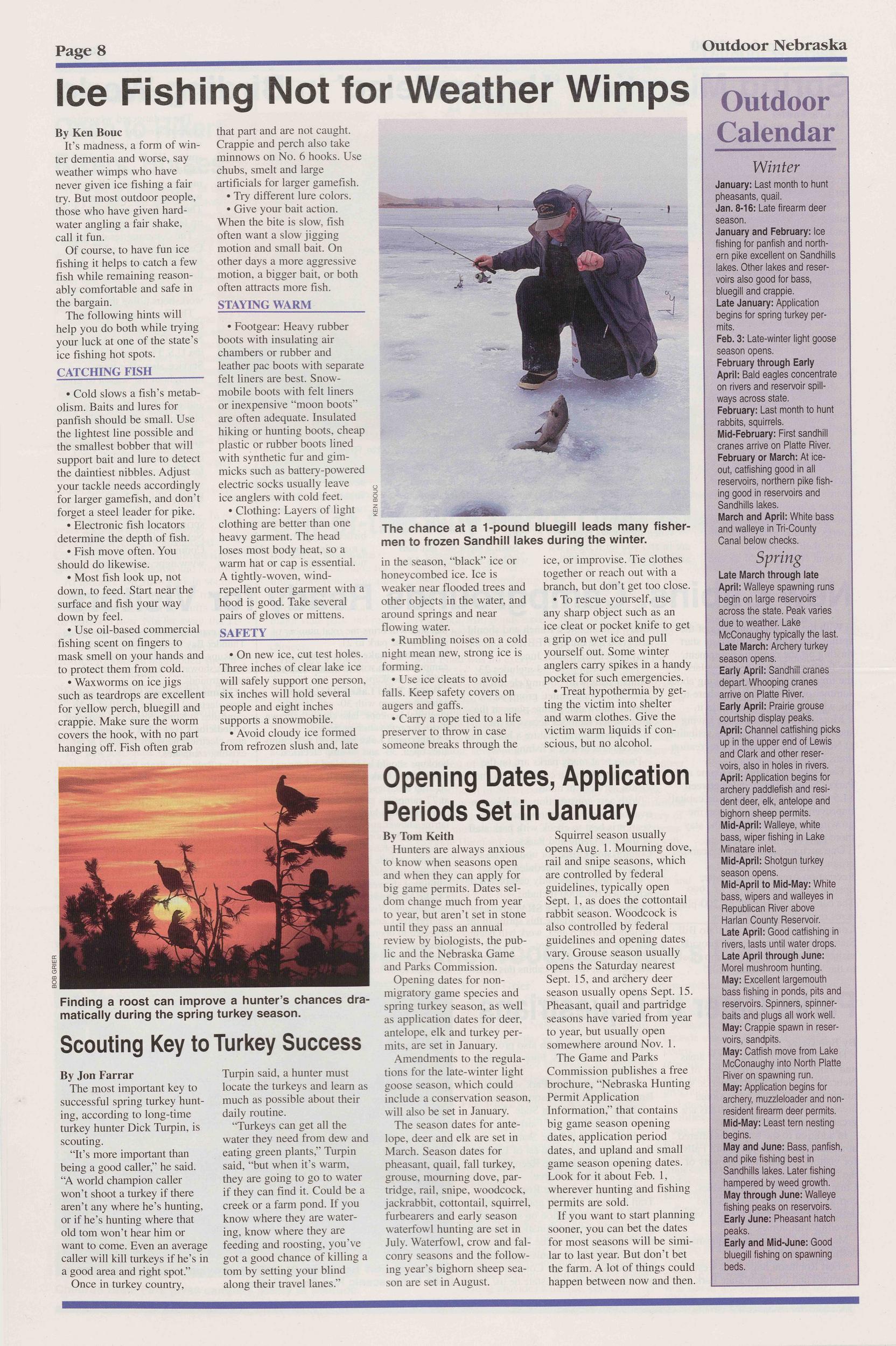
Ice Fishing Not for Weather Wimps
It's madness, a form of win- ter dementia and worse, say weather wimps who have never given ice fishing a fair try. But most outdoor people, those who have given hard- water angling a fair shake, call it fun.
Of course, to have fun ice fishing it helps to catch a few fish while remaining reason- ably comfortable and safe in the bargain.
The following hints will help you do both while trying your luck at one of the state's ice fishing hot spots.
CATCHING FISH• Cold slows a fish's metab- olism. Baits and lures for panfish should be small. Use the lightest line possible and the smallest bobber that will support bait and lure to detect the daintiest nibbles. Adjust your tackle needs accordingly for larger gamefish, and don't forget a steel leader for pike.
• Electronic fish locators determine the depth of fish.
• Fish move often. You should do likewise.
• Most fish look up, not down, to feed. Start near the surface and fish your way down by feel.
• Use oil-based commercial fishing scent on fingers to mask smell on your hands and to protect them from cold.
• Wax worms on ice jigs such as teardrops are excellent for yellow perch, bluegill and crappie. Make sure the worm covers the hook, with no part hanging off. Fish often grab that part and are not caught. Crappie and perch also take minnows on No. 6 hooks. Use chubs, smelt and large artificials for larger gamefish.
• Try different lure colors.
• Give your bait action. When the bite is slow, fish often want a slow jigging motion and small bait. On other days a more aggressive motion, a bigger bait, or both often attracts more fish.
STAYING WARM• Footgear: Heavy rubber boots with insulating air chambers or rubber and leather pac boots with separate felt liners are best. Snow- mobile boots with felt liners or inexpensive "moon boots" are often adequate. Insulated hiking or hunting boots, cheap plastic or rubber boots lined with synthetic fur and gim- micks such as battery-powered electric socks usually leave ice anglers with cold feet.
• Clothing: Fayers of light clothing are better than one heavy garment. The head loses most body heat, so a warm hat or cap is essential. A tightly-woven, wind- repellent outer garment with a hood is good. Take several pairs of gloves or mittens.
SAFETY• On new ice, cut test holes. Three inches of clear lake ice will safely support one person, six inches will hold several people and eight inches supports a snowmobile.
• Avoid cloudy ice formed from refrozen slush and, late
The chance at a 1-pound bluegill leads many fishermen to frozen Sandhill lakes during the winter.
in the season, "black" ice or honeycombed ice. Ice is weaker near flooded trees and other objects in the water, and around springs and near flowing water.
• Rumbling noises on a cold night mean new, strong ice is forming.
• Use ice cleats to avoid falls. Keep safety covers on augers and gaffs.
• Carry a rope tied to a life preserver to throw in case someone breaks through the
ice, or improvise. Tie clothes together or reach out with a branch, but don't get too close.
• To rescue yourself, use any sharp object such as an ice cleat or pocket knife to get a grip on wet ice and pull yourself out. Some winter anglers carry spikes in a handy pocket for such emergencies.
• Treat hypothermia by get- ting the victim into shelter and warm clothes. Give the victim warm liquids if con- scious, but no alcohol.
Finding a roost can improve a hunter's chances dra- matically during the spring turkey season.
Scouting Key to Turkey Success
The most important key to successful spring turkey hunt- ing, according to long-time turkey hunter Dick Turpin, is scouting.
"It's more important than being a good caller," he said.
"A world champion caller won't shoot a turkey if there aren't any where he's hunting, or if he's hunting where that old torn won't hear him or want to come. Even an average caller will kill turkeys if he's in a good area and right spot."
Once in turkey country, Turpin said, a hunter must locate the turkeys and learn as much as possible about their daily routine.
"Turkeys can get all the water they need from dew and eating green plants," Turpin said, "but when it's warm, they are going to go to water if they can find it. Could be a creek or a farm pond. If you know where they are water- ing, know where they are feeding and roosting, you've got a good chance of killing a torn by setting your blind along their travel lanes."
Opening Dates, Application Periods Set in January
Hunters are always anxious to know when seasons open and when they can apply for big game permits. Dates seldom change much from year to year, but aren't set in stone until they pass an annual review by biologists, the public and the Nebraska Game and Parks Commission.
Opening dates for non- migratory game species and spring turkey season, as well as application dates for deer, antelope, elk and turkey per- mits, are set in January.
Amendments to the regulations for the late-winter light goose season, which could include a conservation season, will also be set in January.
The season dates for antelope, deer and elk are set in March. Season dates for pheasant, quail, fall turkey, grouse, mourning dove, partridge, rail, snipe, woodcock, jackrabbit, cottontail, squirrel, furbearers and early season waterfowl hunting are set in July. Waterfowl, crow and falconry seasons and the following year's bighorn sheep sea- son are set in August.
Squirrel season usually opens Aug. 1. Mourning dove, rail and snipe seasons, which are controlled by federal guidelines, typically open Sept. 1, as does the cottontail rabbit season. Woodcock is also controlled by federal guidelines and opening dates vary. Grouse season usually opens the Saturday nearest Sept. 15, and archery deer season usually opens Sept. 15. Pheasant, quail and partridge seasons have varied from year to year, but usually open somewhere around Nov. 1.
The Game and Parks Commission publishes a free brochure, "Nebraska Hunting Permit Application Information," that contains big game season opening dates, application period dates, and upland and small game season opening dates. Took for it about Feb. 1, wherever hunting and fishing permits are sold.
If you want to start planning sooner, you can bet the dates for most seasons will be similar to last year. But don't bet the farm. A lot of things could happen between now and then.
Outdoor Calendar
Winter January: Last month to hunt pheasants, quail. Jan. 8-16: Late firearm deer season. January and February: Ice fishing for panfish and northern pike excellent on Sandhills lakes. Other lakes and reservoirs also good for bass, bluegill and crappie. Late January: Application begins for spring turkey permits. Feb. 3: Late-winter light goose season opens. February through Early April: Bald eagles concentrate on rivers and reservoir spillways across state. February: Last month to hunt rabbits, squirrels. Mid-February: First sandhill cranes arrive on Platte River. February or March: At ice- out, catfishing good in all reservoirs, northern pike fishing good in reservoirs and Sandhills lakes. March and April: White bass and walleye in Tri-County Canal below checks. Spring Late March through late April: Walleye spawning runs begin on large reservoirs across the state. Peak varies due to weather. Lake McConaughy typically the last. Late March: Archery turkey season opens. Early April: Sandhill cranes depart. Whooping cranes arrive on Platte River. Early April: Prairie grouse courtship display peaks. April: Channel catfishing picks up in the upper end of Lewis and Clark and other reservoirs, also in holes in rivers. April: Application begins for archery paddlefish and resident deer, elk, antelope and bighorn sheep permits. Mid-April: Walleye, white bass, wiper fishing in Lake Minatare inlet. Mid-April: Shotgun turkey season opens. Mid-April to Mid-May: White bass, wipers and walleyes in Republican River above Harlan County Reservoir. Late April: Good catfishing in rivers, lasts until water drops. Late April through June: Morel mushroom hunting. May: Excellent largemouth bass fishing in ponds, pits and reservoirs. Spinners, spinner- baits and plugs all work well. May: Crappie spawn in reservoirs, sandpits. May: Catfish move from Lake McConaughy into North Platte River on spawning run. May: Application begins for archery, muzzleloader and non-resident firearm deer permits. Mid-May: Least tern nesting begins. May and June: Bass, panfish, and pike fishing best in Sandhills lakes. Later fishing hampered by weed growth. May through June: Walleye fishing peaks on reservoirs. Early June: Pheasant hatch peaks. Early and Mid-June: Good bluegill fishing on spawning beds.Position: 412 (24 views)