Volume 77, Issue 10, 1999
NEBRASKAland
Nebraska Game & Parks Commission December 1999 $2.51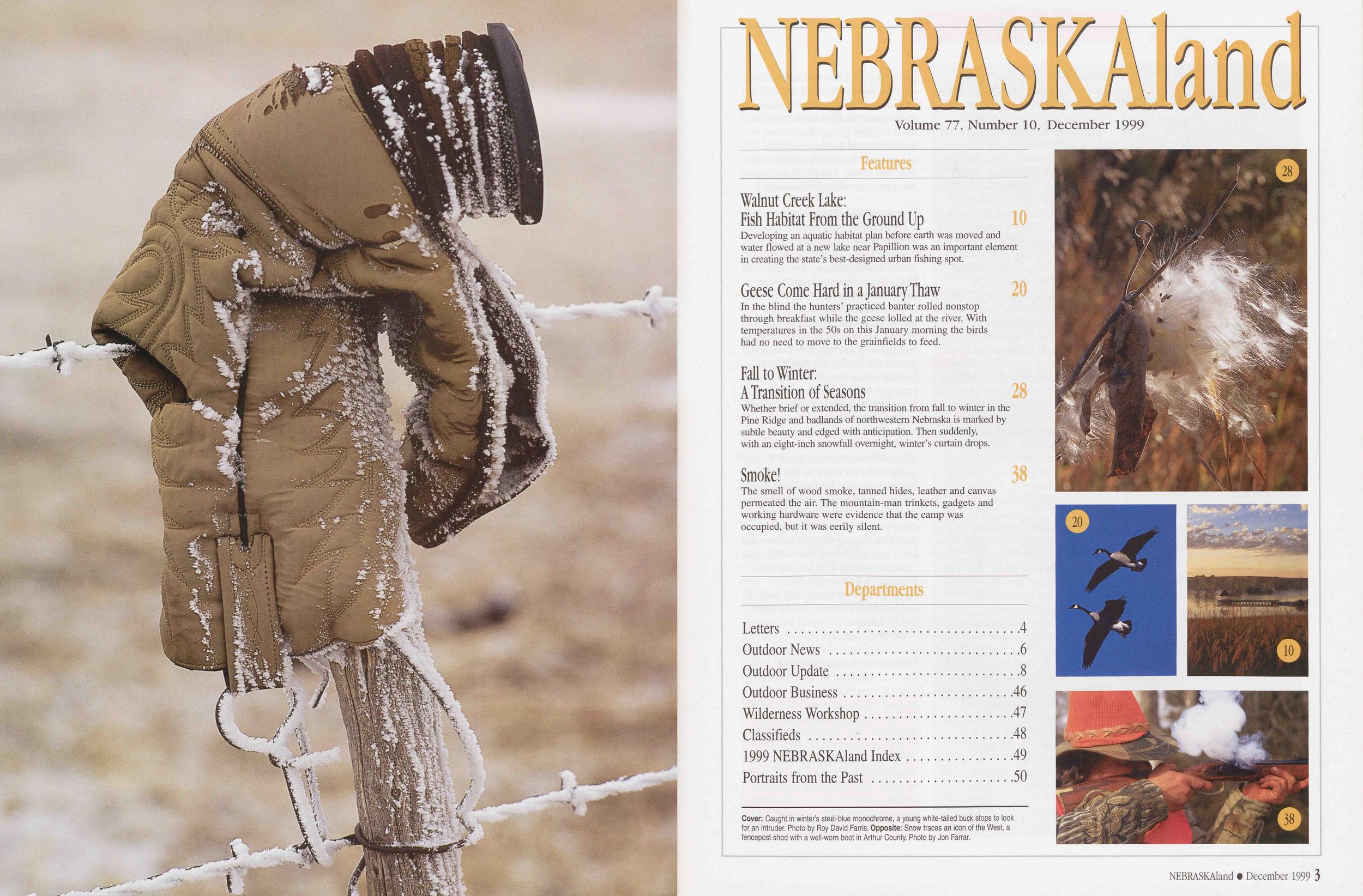
NEBRASKAland
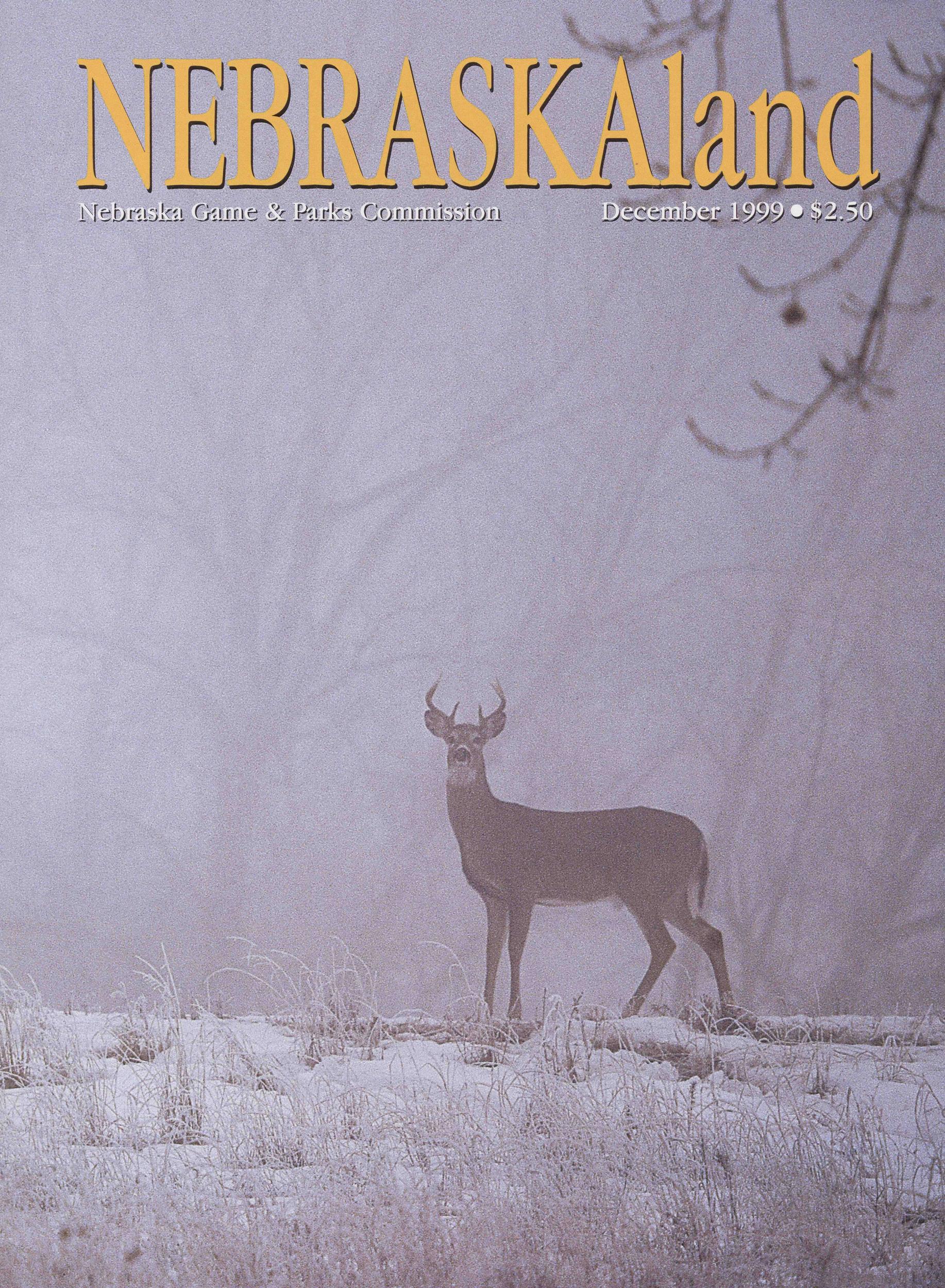
Volume 77, Number 10, December 1999 Features Walnut Creek Lake: Fish Habitat From the Ground Up Developing an aquatic habitat plan before earth was moved and water flowed at a new lake near Papillion was an important element in creating the state's best-designed urban fishing spot. Geese Come Hard in a January Thaw In the blind the hunters' practiced banter rolled nonstop through breakfast while the geese lolled at the river. With temperatures in the 50s on this January morning the birds had no need to move to the grain fields to feed. Fall to Winter: A Transition of Seasons Whether brief or extended, the transition from fall to winter in the Pine Ridge and badlands of northwestern Nebraska is marked by subtle beauty and edged with anticipation. Then suddenly, with an eight-inch snowfall overnight, winter's curtain drops. Smoke! The smell of wood smoke, tanned hides, leather and canvas permeated the air. The mountain-man trinkets, gadgets and working hardware were evidence that the camp was occupied, but it was eerily silent. Departments Letters 4 Outdoor News 6 Outdoor Update 8 Outdoor Business 46 Wilderness Workshop 47 Classifieds 48 1999 NEBRASKAland Index 49 Portraits from the Past 50 Cover: Caught in winter's steel-blue monochrome, a young white-tailed buck stops to look for an intruder. Photo by Roy David Farris. Opposite: Snow traces an icon of the West, a fencepost shod with a well-worn boot in Arthur County. Photo by Jon Farrar.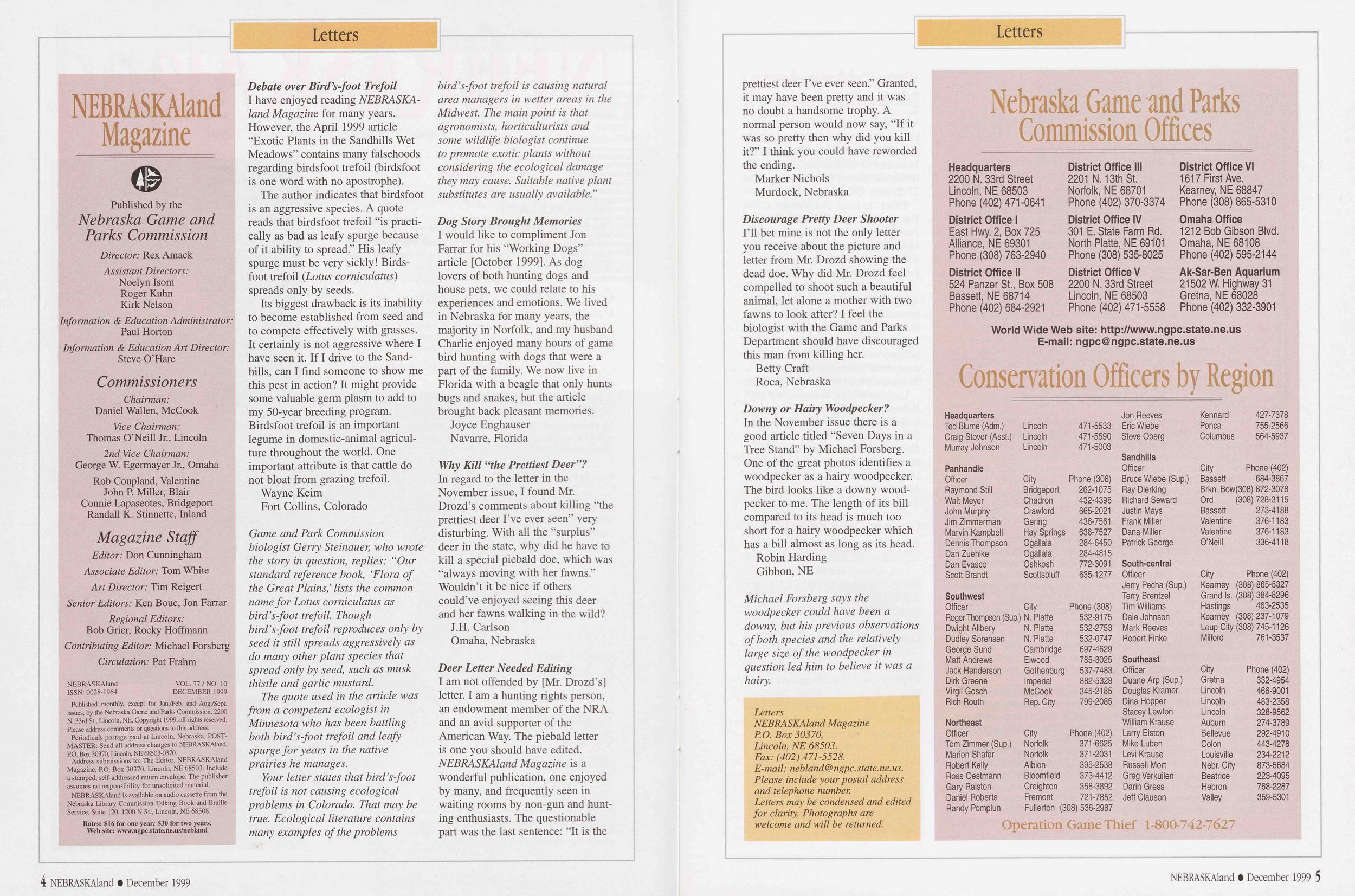
Letters
Published by the Nebraska Game and Parks Commission Director: Rex Amack Assistant Directors: Noelyn Isom Roger Kuhn Kirk Nelson Information & Education Administrator: Paul Horton Information & Education Art Director: Steve O'Hare Commissioners Chairman: Daniel Wallen, McCook Vice Chairman: Thomas O'Neill Jr., Lincoln 2nd Vice Chairman: George W. Egermayer Jr., Omaha Rob Coupland, Valentine John P. Miller, Blair Connie Lapaseotes, Bridgeport Randall K. Stinnette, Inland Magazine Staff Editor: Don Cunningham Associate Editor: Tom White Art Director: Tim Reigert Senior Editors: Ken Bouc, Jon Farrar Regional Editors: Bob Grier, Rocky Hoffmann Contributing Editor: Michael Forsberg Circulation: Pat Frahm NEBRASKAland ISSN: 0028-1964 VOL. 77 / NO. 10 DECEMBER 1999 Published monthly, except for Jan./Feb. and Aug./Sept. issues, by the Nebraska Game and Parks Commission, 2200 N. 33rd St., Lincoln, NE. Copyright 1999, all rights reserved. Please address comments or questions to this address. Periodicals postage paid at Lincoln, Nebraska. POSTMASTER: Send all address changes to NEBRASKAland, P.O. Box 30370, Lincoln, NE 68503-0370. Address submissions to: The Editor, NEBRASKAland Magazine, P.O. Box 30370, Lincoln, NE 68503. Include a stamped, self-addressed return envelope. The publisher assumes no responsibility for unsolicited material. NEBRASKAland is available on audio cassette from the Nebraska Library Commission Talking Book and Braille Service, Suite 120, 1200 N St., Lincoln, NE 68508. Rates: $16 for one year; $30 for two years. Web site: www.ngpc.state.ne.us/nebland Debate over Bird's-foot TrefoilI have enjoyed reading NEBRASKAland Magazine for many years. However, the April 1999 article "Exotic Plants in the Sandhills Wet Meadows" contains many falsehoods regarding birdsfoot trefoil (birdsfoot is one word with no apostrophe).
The author indicates that birdsfoot is an aggressive species. A quote reads that birdsfoot trefoil "is practically as bad as leafy spurge because of it ability to spread." His leafy spurge must be very sickly! Birds foot trefoil (Lotus corniculatus) spreads only by seeds.
Its biggest drawback is its inability to become established from seed and to compete effectively with grasses. It certainly is not aggressive where I have seen it. If I drive to the Sandhills, can I find someone to show me this pest in action? It might provide some valuable germ plasm to add to my 50-year breeding program. Birdsfoot trefoil is an important legume in domestic-animal agriculture throughout the world. One important attribute is that cattle do not bloat from grazing trefoil.
Wayne Keim Fort Collins, ColoradoGame and Park Commission biologist Gerry Steinauer, who wrote the story in question, replies: "Our standard reference book, 'Flora of the Great Plains,' lists the common name for Lotus corniculatus as bird's-foot trefoil. Though bird's-foot trefoil reproduces only by seed it still spreads aggressively as do many other plant species that spread only by seed, such as musk thistle and garlic mustard.
The quote used in the article was from a competent ecologist in Minnesota who has been battling both bird's-foot trefoil and leafy spurge for years in the native prairies he manages.
Your letter states that bird's-foot trefoil is not causing ecological problems in Colorado. That may be true. Ecological literature contains many examples of the problems bird's-foot trefoil is causing natural area managers in wetter areas in the Midwest. The main point is that agronomists, horticulturists and some wildlife biologist continue to promote exotic plants without considering the ecological damage they may cause. Suitable native plant substitutes are usually available."
Dog Story Brought MemoriesI would like to compliment Jon Farrar for his "Working Dogs" article [October 1999]. As dog lovers of both hunting dogs and house pets, we could relate to his experiences and emotions. We lived in Nebraska for many years, the majority in Norfolk, and my husband Charlie enjoyed many hours of game bird hunting with dogs that were a part of the family. We now live in Florida with a beagle that only hunts bugs and snakes, but the article brought back pleasant memories.
Joyce Enghauser Navarre, Florida Why Kill the Prettiest Deer"?In regard to the letter in the November issue, I found Mr. Drozd's comments about killing "the prettiest deer I've ever seen" very disturbing. With all the "surplus" deer in the state, why did he have to kill a special piebald doe, which was "always moving with her fawns." Wouldn't it be nice if others could've enjoyed seeing this deer and her fawns walking in the wild?
J.H. Carlson Omaha, Nebraska Deer Letter Needed EditingI am not offended by [Mr. Drozd's letter. I am a hunting rights person, an endowment member of the NRA and an avid supporter of the American Way. The piebald letter is one you should have edited. NEBRASKAland Magazine is a wonderful publication, one enjoyed by many, and frequently seen in waiting rooms by non-gun and hunting enthusiasts. The questionable part was the last sentence: "It is the prettiest deer I've ever seen." Granted, it may have been pretty and it was no doubt a handsome trophy. A normal person would now say, "If it was so pretty then why did you kill it?" I think you could have reworded the ending.
Marker Nichols Murdock, Nebraska Discourage Pretty Deer ShooterI'll bet mine is not the only letter you receive about the picture and letter from Mr. Drozd showing the dead doe. Why did Mr. Drozd feel compelled to shoot such a beautiful animal, let alone a mother with two fawns to look after? I feel the biologist with the Game and Parks Department should have discouraged this man from killing her.
Betty Craft Roca, Nebraska Downy or Hairy Woodpecker?In the November issue there is a good article titled "Seven Days in a Tree Stand" by Michael Forsberg. One of the great photos identifies a woodpecker as a hairy woodpecker. The bird looks like a downy woodpecker to me. The length of its bill compared to its head is much too short for a hairy woodpecker which has a bill almost as long as its head.
Robin Harding Gibbon, NEMichael Forsberg says the woodpecker could have been a downy, but his previous observations of both species and the relatively large size of the woodpecker in question led him to believe it was a hairy.
Letters NEBRASKAland Magazine P.O. Box 30370, Lincoln, NE 68503. Fax: (402) 471-5528. E-mail: nebland@ngpc. state, ne. us. Please include your postal address and telephone number. Letters may be condensed and edited for clarity. Photographs are welcome and will be returned. Nebraska Game and Parks Commission Offices Headquarters 2200 N. 33rd Street Lincoln, NE 68503 Phone (402) 471-0641 District Office I East Hwy. 2, Box 725 Alliance, NE 69301 Phone (308) 763-2940 District Office II 524 Panzer St., Box 508 Bassett, NE 68714 Phone (402) 684-2921 District Office III 2201 N. 13th St. Norfolk, NE 68701 Phone (402) 370-3374 District Office IV 301 E. State Farm Rd. North Platte, NE 69101 Phone (308) 535-8025 District Office V 2200 N. 33rd Street Lincoln, NE 68503 Phone (402) 471-5558 District Office VI 1617 First Ave. Kearney, NE 68847 Phone (308) 865-5310 Omaha Office 1212 Bob Gibson Blvd. Omaha, NE 68108 Phone (402) 595-2144 Ak-Sar-Ben Aquarium 21502 W. Highway 31 Gretna, NE 68028 Phone (402) 332-3901 World Wide Web site: http://www.ngpc.state.ne.us E-mail: ngpc@ngpc.state.ne.us Conservation Officers by Region Headquarters Ted Blume (Adm.) Craig Stover (Asst.) Murray Johnson Panhandle Officer Raymond Still Walt Meyer John Murphy Jim Zimmerman Marvin Kampbell Dennis Thompson Dan Zuehlke Dan Evasco Scott Brandt Southwest Officer Roger Thompson (Sup.) Dwight Allbery Dudley Sorensen George Sund Matt Andrews Jack Henderson Dirk Greene Virgil Gosch Rich Routh Northeast Officer Tom Zimmer (Sup.) Marion Shafer Robert Kelly Ross Oestmann Gary Ralston Daniel Roberts Randy Pomplun Lincoln Lincoln Lincoln City Bridgeport Chadron Crawford Gering Hay Springs Ogallala Ogallala Oshkosh Scottsbluff City N. Platte N. Platte N. Platte Cambridge Elwood Gothenburg Imperial McCook Rep. City City Norfolk Norfolk Albion Bloomfield Creighton Fremont 471-5533 471-5590 471-5003 Phone (308) 262-1075 432-4398 665-2021 436-7561 638-7527 284-6450 284-4815 772-3091 635-1277 Phone (308) 532-9175 532-2753 532-0747 697-4629 785-3025 537-7483 882-5328 345-2185 799-2085 Phone (402) 371-6625 371-2031 395-2538 373-4412 358-3892 721-7852 Jon Reeves EricWiebe Steve Oberg Sandhills Officer Bruce Wiebe (Sup.) Ray Dierking Richard Seward Justin Mays Frank Miller Dana Miller Patrick George South-central Officer Jerry Pecha (Sup.) Terry Brentzel Tim Williams Dale Johnson Mark Reeves Robert Finke Southeast Officer Duane Arp (Sup.) Douglas Kramer Dina Hopper Stacey Lewton William Krause Larry Elston Mike Luben Levi Krause Russell Mort Greg Verkuilen Darin Gress Jeff Clauson Kennard Ponca Columbus 427-7378 755-2566 564-5937 City Phone (402) Bassett 684-3867 Brkn. Bow (308) 872-3078 Ord (308)728-3115 Bassett 273-4188 Valentine 376-1183 Valentine 376-1183 O'Neill 336-4118 City Phone (402) Kearney (308)865-5327 Grand Is. (308) 384-8296 Hastings 463-2535 Kearney (308)237-1079 Loup City (308) 745-1126 Milford 761-3537 Fullerton (308) 536-2987 City Gretna Lincoln Lincoln Lincoln Auburn Bellevue Colon Louisville Nebr. City Beatrice Hebron Valley Phone (402) 332-4954 466-9001 483-2358 328-9562 274-3789 292-4910 443-4278 234-2212 873-5684 223-4095 768-2287 359-5301\ NEBRASKAland • December 1999 5
Outdoor News
Officer's Notebook Conservation Officer's ChristmasIt was a nice gift, and it came as a surprise — conservation officers don't often get Christmas presents. But there it was, a 100 percent airtight legal case, and it came without stakeouts, warrants or chases.
Santa, in this case, was a caller from a meat processing plant. As a deer was being skinned, a flattened, copper-jacketed bullet from a high-powered rifle slipped from under the hide and dropped to the floor. In itself, nothing unusual. But it was mid-December, the firearm season had been closed for more than a month, and the only deer being brought in were from the archery and muzzleloading seasons, which were still open.
It made a tidy little package, almost worthy of wrapping paper and bright red ribbon. The officer had the deer, the incriminating bullet and the tag bearing a permit number and the signature of the offender.
But conservation officers know better than to count on gifts, even during the holidays. This time of year they work as hard as Santa checking on who's naughty and who's nice.
If potential game law violators think the law takes a holiday, they should check arrest records for Christmas Eve the past four years. A lot of outdoor activity takes place around the holidays, since many hunting seasons are still open and family and friends get together and the holiday activities often include hunting. With the increased outdoor activity comes a rise in violations.
Waterfowl hunters have accounted for most of the Christmas Eve infractions in recent years, with violations including trespassing, hunting in closed seasons, hunting with lead shot, waste of game, hunting without a federal waterfowl stamp and hunting without a habitat stamp.
Lead is no longer being scattered wholesale over lakes and marshes, but even a few lead pellets can pose a danger to waterfowl for many years in some hard-bottom wetlands. Nebraska was a leader in eliminating lead shot from waterfowl hunting, but despite the long-standing regulations, some hunters, including upland game hunters hunting in steel shot zones, still use lead shot where it is prohibited.
Hunting on private property without permission is a persistent complaint and produces many arrests. Disregarding landowner rights makes access more difficult for law-abiding hunters who ask permission.
Some hunters believe that unless land is posted with "No Hunting" or "No Trespassing" signs, it is open. In fact, hunters must have permission from the landowner or tenant even if the land is not posted.
Furbearer violations also are common in December. The most frequent infraction is hunting at night using a light from a vehicle. It is an effective way to take raccoons, but it depends on gadgets to provide excessive advantage over the animal. Because spotlighting almost invariably includes trespass, unsafe gun handling and shooting from a vehicle, road or right-of-way, the game laws take a dim view of it, specifying a fine of $150.
Although they are more common later in winter, coyote hunting violations begin to appear by Christmas. Usually the complaints involve trespassing and shooting from a vehicle, road or right-of-way. Deer hunting violations include failure to check deer. Other holiday violations involve small game hunting, fishing and even littering.
The vast majority of holiday hunters will abide by the law. They owe it to other ethical hunters and to landowners to report any violations they see. Think of it as a holiday gift. To report violations anonymously, call Operation Game Thief at 800-742-7627.
Of course, conservation officers will not sit at home waiting for "gift" cases. But if one comes along, they'll take it. Merry Christmas.
- Ken Bouc History Conference Set at Fort Robinson State ParkDouglas D. Scott of the National Park Service will speak about the search for the site of the Sand Creek Massacre of 1864 at the Third Fort Robinson History Conference April 27-29 near Crawford.
Titled "Indians, Soldiers & Bureaucrats: A New Look at Old Foes," the conference is co-sponsored by the Nebraska State Historical Society and the Nebraska Game and Parks Commission.
In addition to Scott's banquet address, the conference will include presentation of scholarly papers on the history of Fort Robinson and Indian wars, demonstrations of military music, artillery and camp equipment, and tours of Fort Robinson's historical sites.
Lodging will be available at Fort Robinson State Park. Advance registration is required. For a registration form write to Fort Robinson History Conference, Nebraska State Historical Society, P.O. Box 82554, Lincoln, NE 82554, or call (402) 471-4747.
Geese-in-Space Project Tracks Canadas OnlineLast summer scientists from Ducks Unlimited and the U.S. Fish and Wildlife Service attached satellite transmitters to a dozen migrating Canada geese in Newfoundland, Labrador and Greenland.
Using a Teflon harness, the scientists fixed a transmitter, weighing 35 grams, and a small antenna to each bird. The radio sends signals every 65 seconds to French Argos satellites. The signal is transferred by internet to the researchers' laboratory where each bird's movement is tracked.
Their daily movements will be tracked for about 18 months. The information is available to the public through the Ducks Unlimited web site at www.ducks.org.
6 NEBRASKAland • December 1999 Course Required for Young Teens to Operate WatercraftBeginning next May, an individual must be at least 16 years old to operate a personal watercraft in Nebraska. The only exception will be for 14 and 15 year olds who have satisfactorily completed a boating safety course.
The Nebraska Boating Basics safety course will include a minimum of six classroom hours of instruction. Students must score 70 percent or higher on an exam to be certified.
Information about boating safety classes will be available from Nebraska Game and Parks offices and online at www.ngpc.state.ne.us beginning in January.
The new regulations were approved in October by the Nebraska Game and Parks Commissioners under authority of LB 176, a bill passed this year by the Nebraska Legislature.
The Commissioners also approved the use of gasoline powered motorboat engines at all Fish and Wildlife Service managed waterfowl production areas (WPA), but limited them to 5 mph/no wake unless otherwise posted. Boats used at Pintail WMA and Kissinger will be limited to electric motors.
Statement of ownership and monthly circulation of NEBRASKAland Magazine Owner and publisher: Nebraska Game and Parks Commission Editor: Donald B. Cunningham Headquarters of Publisher and Publication: 2200 N. 33rd St., Lincoln, NE 68503 Stockholders, Bondholders, Mortgage and Security Holders: None Average number of copies Single issue of each issue during nearest to preceding 12 months filing date A. Total Copies Printed {net press run) 44,832 55,474 B. Paid Circulation 1. Single-copy sales 2,427 2,454 2. Mail subscriptions 36,458 36,284 C. Total Paid Circulation 38,885 38,738 D. Free Distribution by Mail 475 387 E. Free Distribution Outside the Mail 1,552 917 F.Total Free Distribution 2,02 1,304 G. Total Distribution 40,912 40,042 H. Copies Not Distributed 3,920 15,432 I. Total 44,832 55,474 J. Percent Paid and/or Requested Circulation 95% 97% 23nd ANNUAL NEBRASKA HABITAT STAMP ART CONTEST Submission Entries may be protected by a covering but will not be accepted in frames, under glass or in plastic kitchen wrap. Wrap securely and send to: Habitat Stamp Contest, Game and Parks Commission, 2200 N. 33rd Street, P.O. Box 30370, Lincoln, NE 68503-0370. A completed entry form and reproduction agreement, or a facsimile thereof, must be attached to the back of the entry. Name and address of the artist must appear only on the reverse side of the entry. The Game and Parks Commission is not responsible for any entry lost or damaged in transit. Entries will not be returned unless specifically requested and a self-addressed mailer with proper return postage is included. Prizes Adult division first-place winner receives $200 from the Omaha Fish and Wildlife Club. Youth division first-place winners in each section receive $50 from the Omaha Fish and Wildlife Club. Runners-up in all divisions receive a subscription to NEBRASKAland Magazine. Technical Requirements Design must be 7% inches by 4n/!6 inches. It may be matted, but mats must not exceed 10 inches by 7 inches. Any medium is acceptable. No scrollwork or lettering may appear on the design. Color is preferred. Subject Matter Any Nebraska wildlife species in an appropriate habitat setting, except for ringnecked pheasant, white-tailed deer, mourning dove, sandhill crane and wild turkey, which are ineligible this year. Eligibility Contest is open to Nebraska residents only, and winning entry in the adult division will appear on the 2001 Nebraska Habitat Stamp, Employees of the Game and Parks Commission and their immediate families are not eligible to enter the adult division of the contest. Only one entry allowed per person. Divisions Adult: Amateur or professional artists. Youth: Senior Section - Grades 9-12; Junior Section - Grades 5-8; Primary Section - Grades K-4. Entry Deadline March 1,2000. Entry Form Please accept my entry in the 2000 Habitat Stamp Art Contest. I hereby certify that I have complied with all the rules governing this competition and that the work submitted is my own creation. Further, the Nebraska Game and Parks Commission is hereby authorized to reproduce my design on the 2001 Habitat Stamp or in any other fashion it may deem appropriate. Division/Section Title of Entry Name Grade in School Medium Age (if under 19) Parent or guardian (if under 19) Address City State ZIP Home Phone School Phone Name of School School Address. City, State, ZIP Please return my entry. I have included the appropriate postage. Please hold my entry for pickup. Artist's Signature NEBRASKAland • December 1999 7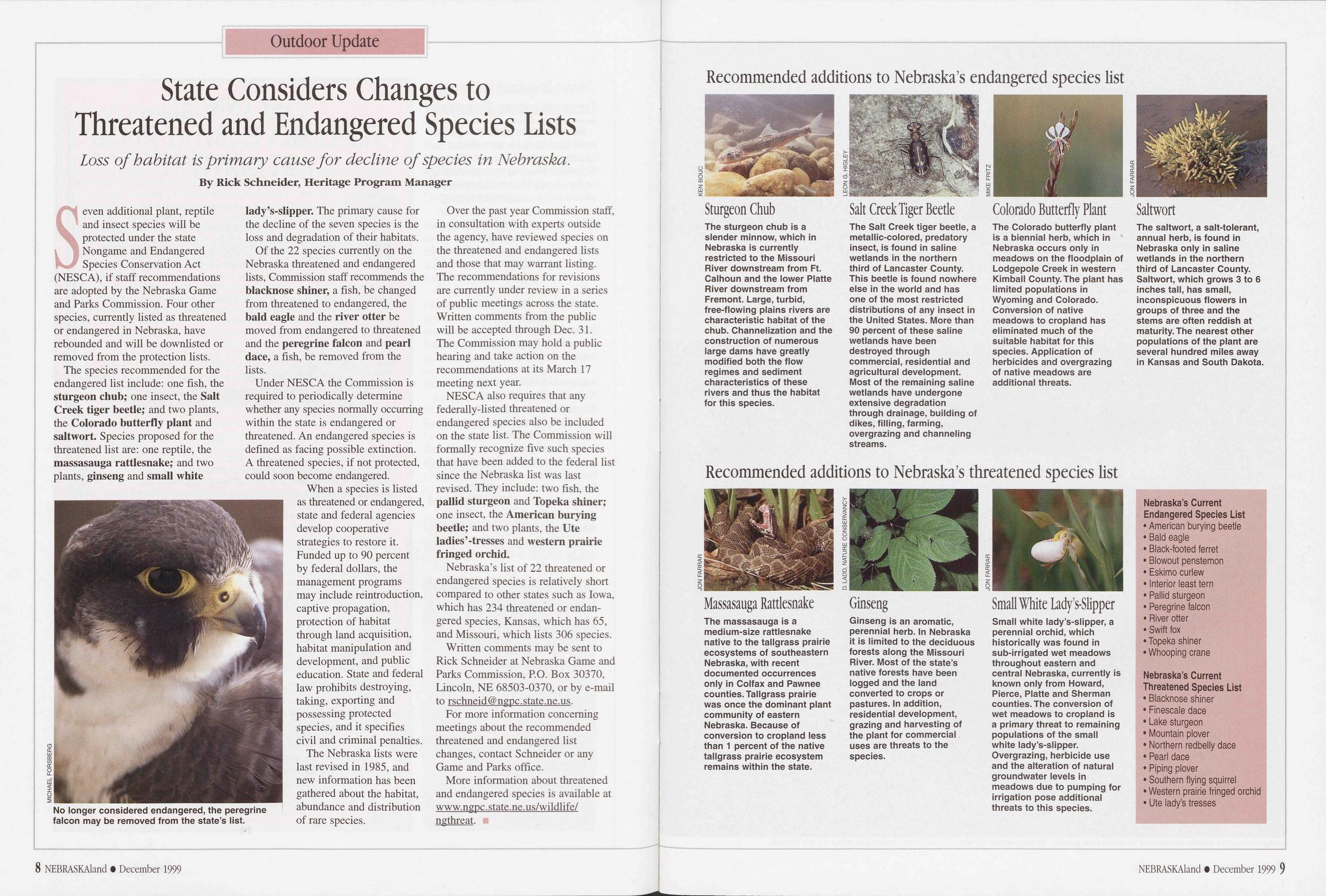
Outdoor Update
State Considers Changes to Threatened and Endangered Species Lists
Loss of habitat is primary cause for decline of species in Nebraska. By Rick Schneider, Heritage Program Managereven additional plant, reptile and insect species will be protected under the state Nongame and Endangered Species Conservation Act (NESCA), if staff recommendations are adopted by the Nebraska Game and Parks Commission. Four other species, currently listed as threatened or endangered in Nebraska, have rebounded and will be down listed or removed from the protection lists.
The species recommended for the endangered list include: one fish, the sturgeon chub; one insect, the Salt Creek tiger beetle; and two plants, the Colorado butterfly plant and saltwort. Species proposed for the threatened list are: one reptile, the massasauga rattlesnake; and two plants, ginseng and small white lady's-slipper. The primary cause for the decline of the seven species is the loss and degradation of their habitats.
Of the 22 species currently on the Nebraska threatened and endangered lists, Commission staff recommends the blacknose shiner, a fish, be changed from threatened to endangered, the bald eagle and the river otter be moved from endangered to threatened and the peregrine falcon and pearl dace, a fish, be removed from the lists.
Under NESCA the Commission is required to periodically determine whether any species normally occurring within the state is endangered or threatened. An endangered species is defined as facing possible extinction. A threatened species, if not protected, could soon become endangered.
When a species is listed as threatened or endangered, state and federal agencies develop cooperative strategies to restore it. Funded up to 90 percent by federal dollars, the management programs may include reintroduction, captive propagation, protection of habitat through land acquisition, habitat manipulation and development, and public education. State and federal law prohibits destroying, taking, exporting and possessing protected species, and it specifies civil and criminal penalties.
The Nebraska lists were last revised in 1985, and new information has been gathered about the habitat, abundance and distribution of rare species.
Over the past year Commission staff, in consultation with experts outside the agency, have reviewed species on the threatened and endangered lists and those that may warrant listing. The recommendations for revisions are currently under review in a series of public meetings across the state. Written comments from the public will be accepted through Dec. 31. The Commission may hold a public hearing and take action on the recommendations at its March 17 meeting next year.
NESCA also requires that any federally-listed threatened or endangered species also be included on the state list. The Commission will formally recognize five such species that have been added to the federal list since the Nebraska list was last revised. They include: two fish, the pallid sturgeon and Topeka shiner; one insect, the American burying beetle; and two plants, the Ute ladies'-tresses and western prairie fringed orchid.
Nebraska's list of 22 threatened or endangered species is relatively short compared to other states such as Iowa, which has 234 threatened or endangered species, Kansas, which has 65, and Missouri, which lists 306 species.
Written comments may be sent to Rick Schneider at Nebraska Game and Parks Commission, P.O. Box 30370, Lincoln, NE 68503-0370, or by e-mail to rschneid@ngpc.state.ne.us.
For more information concerning meetings about the recommended threatened and endangered list changes, contact Schneider or any Game and Parks office.
More information about threatened and endangered species is available at www.ngpc.state.ne.us/wildlife/
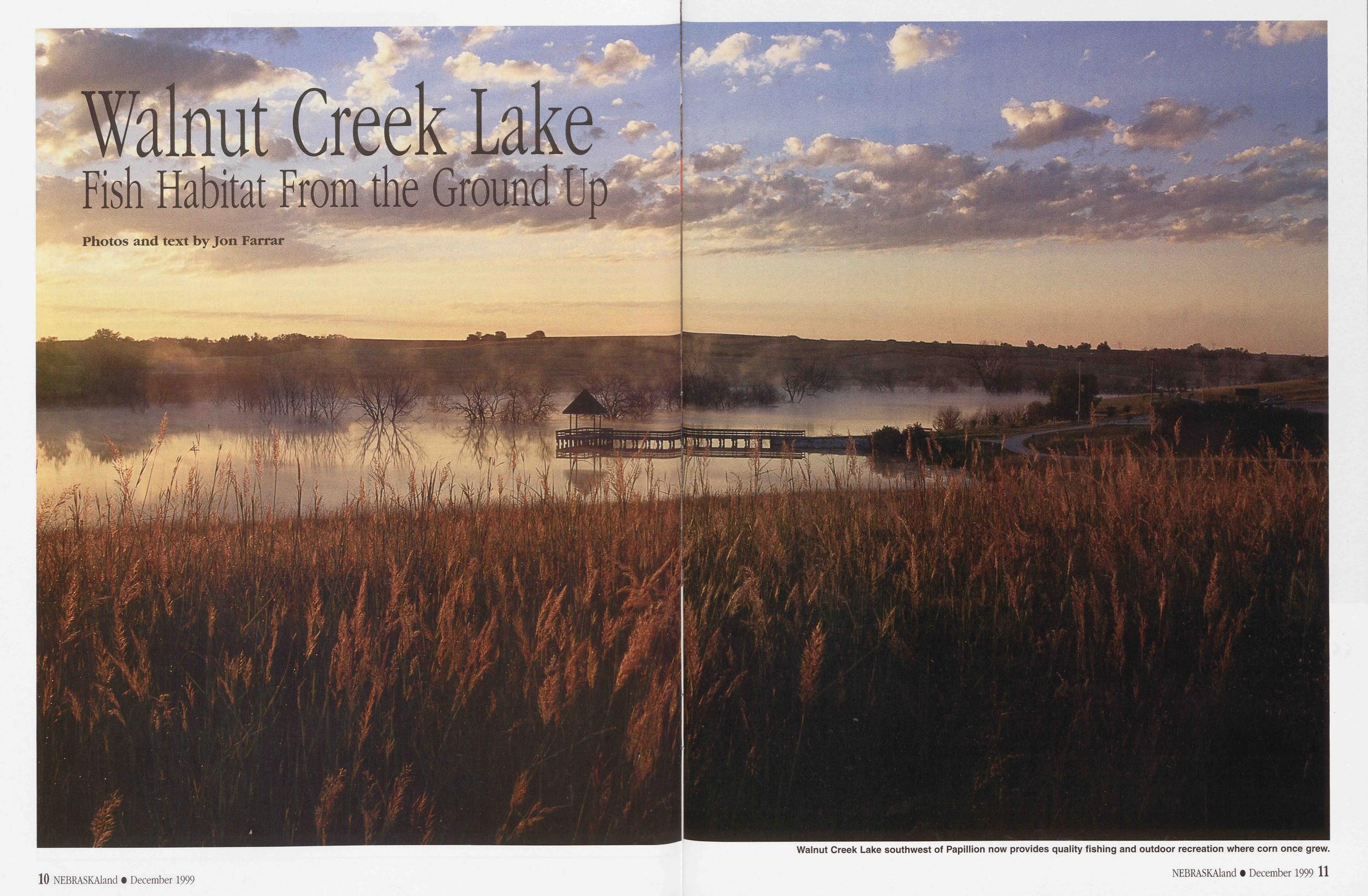
Walnut Creek Lake
Fish Habitat From the Ground Uo Photos and text by Jon Farrar 10 NEBRASKAland • December 1999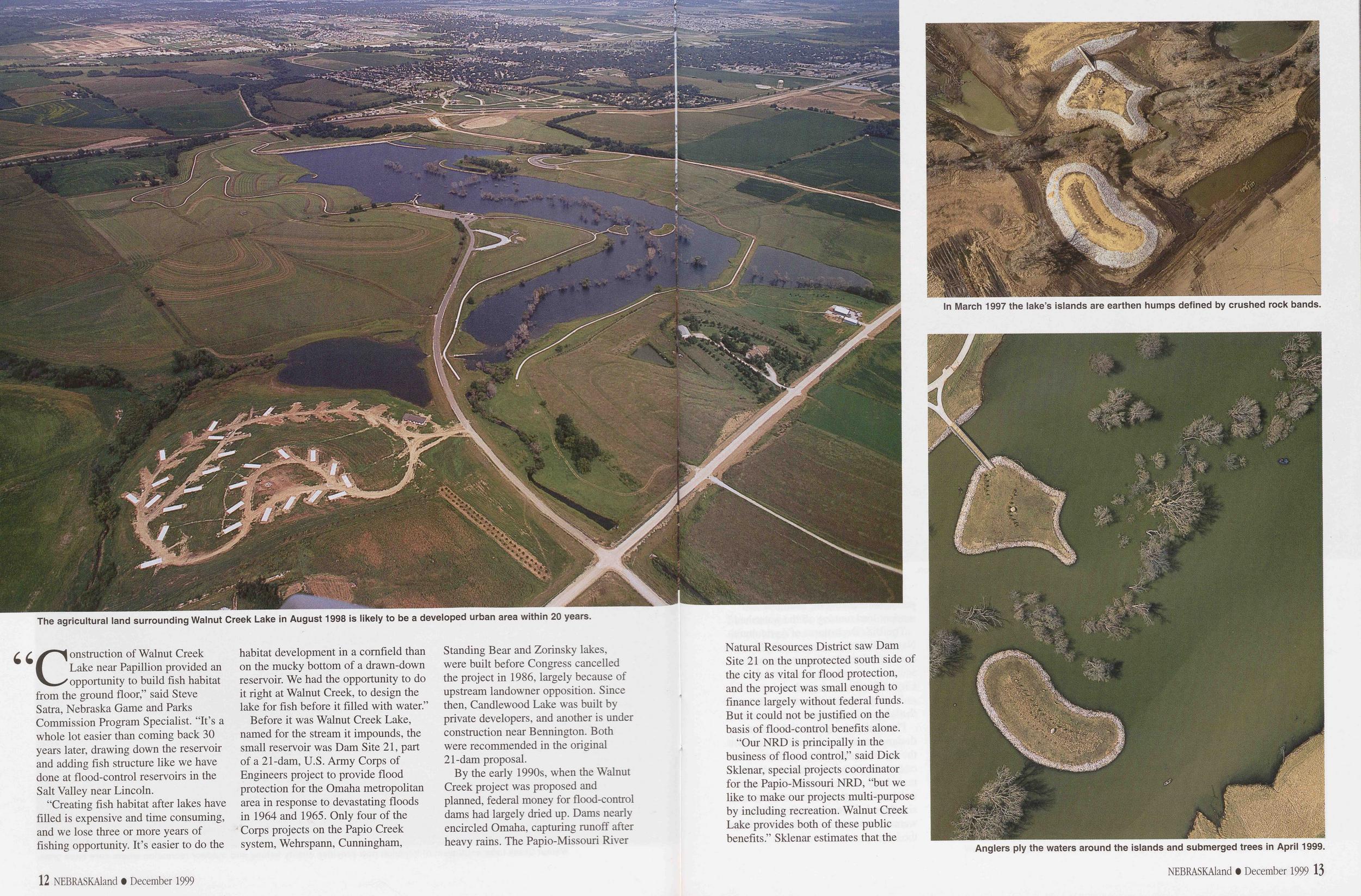
onstruction of Walnut Creek Lake near Papillion provided an opportunity to build fish habitat from the ground floor," said Steve Satra, Nebraska Game and Parks Commission Program Specialist. "It's a whole lot easier than coming back 30 years later, drawing down the reservoir and adding fish structure like we have done at flood-control reservoirs in the Salt Valley near Lincoln.
"Creating fish habitat after lakes have filled is expensive and time consuming, and we lose three or more years of fishing opportunity. It's easier to do the habitat development in a cornfield than on the mucky bottom of a drawn-down reservoir. We had the opportunity to do it right at Walnut Creek, to design the lake for fish before it filled with water."
Before it was Walnut Creek Lake, named for the stream it impounds, the small reservoir was Dam Site 21, part of a 21-dam, U.S. Army Corps of Engineers project to provide flood protection for the Omaha metropolitan area in response to devastating floods in 1964 and 1965. Only four of the Corps projects on the Papio Creek system, Wehrspann, Cunningham, Standing Bear and Zorinsky lakes, were built before Congress cancelled the project in 1986, largely because of upstream landowner opposition. Since then, Candlewood Lake was built by private developers, and another is under construction near Bennington. Both were recommended in the original 21-dam proposal.
By the early 1990s, when the Walnut Creek project was proposed and planned, federal money for flood-control dams had largely dried up. Dams nearly encircled Omaha, capturing runoff after heavy rains. The Papio-Missouri River 12 NEBRASKAland • December 1999 Natural Resources District saw Dam Site 21 on the unprotected south side of the city as vital for flood protection, and the project was small enough to finance largely without federal funds. But it could not be justified on the basis of flood-control benefits alone.
"Our NRD is principally in the business of flood control," said Dick Sklenar, special projects coordinator for the Papio-Missouri NRD, "but we like to make our projects multi-purpose by including recreation. Walnut Creek Lake provides both of these public benefits." Sklenar estimates that the
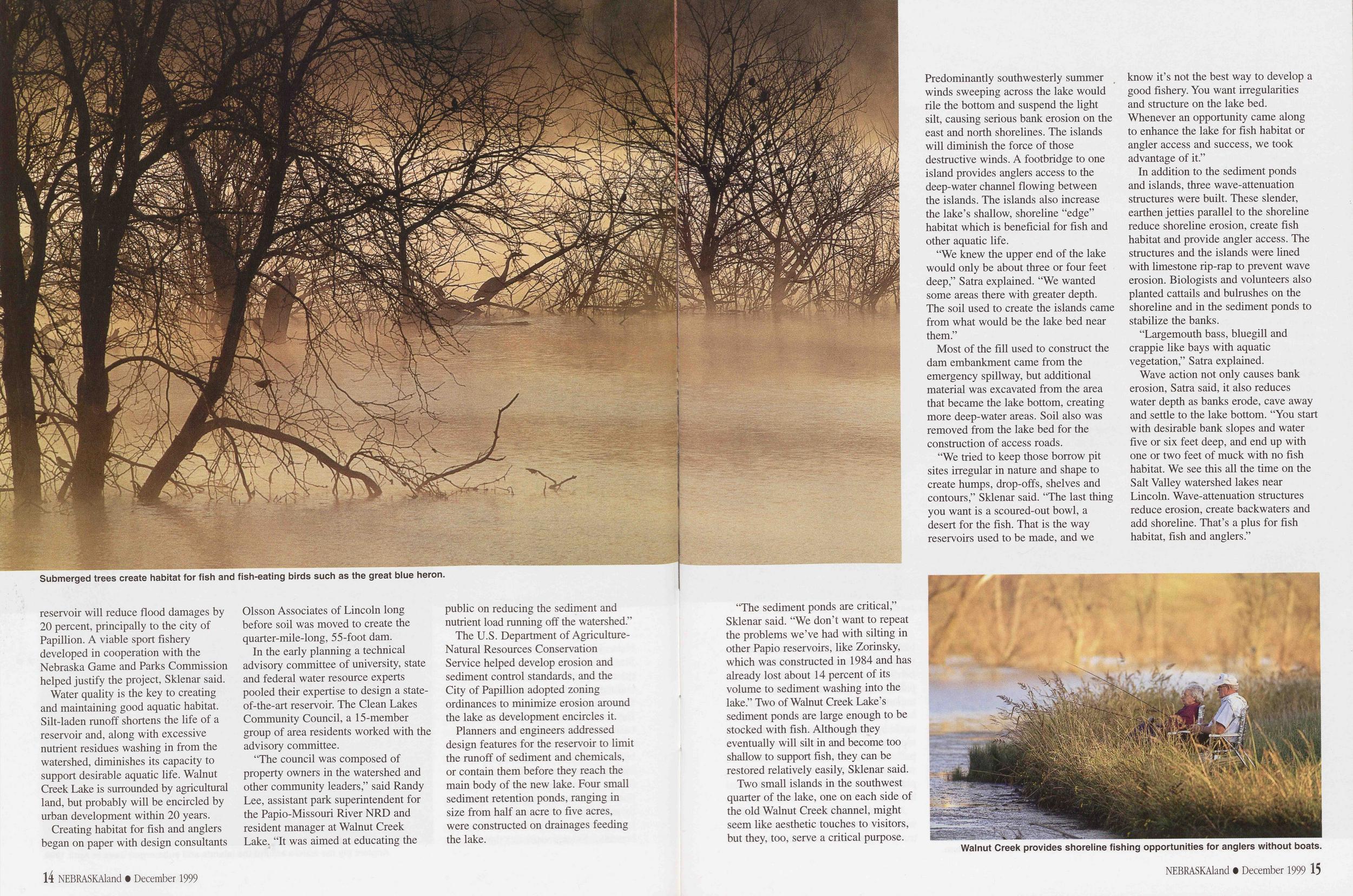
Water quality is the key to creating and maintaining good aquatic habitat. Silt-laden runoff shortens the life of a reservoir and, along with excessive nutrient residues washing in from the watershed, diminishes its capacity to support desirable aquatic life. Walnut Creek Lake is surrounded by agricultural land, but probably will be encircled by urban development within 20 years. Creating habitat for fish and anglers began on paper with design consultants Olsson Associates of Lincoln long before soil was moved to create the quarter-mile-long, 55-foot dam.
In the early planning a technical advisory committee of university, state and federal water resource experts pooled their expertise to design a state-of-the-art reservoir. The Clean Lakes Community Council, a 15-member group of area residents worked with the advisory committee.
"The council was composed of property owners in the watershed and other community leaders," said Randy Lee, assistant park superintendent for the Papio-Missouri River NRD and resident manager at Walnut Creek Lake. "It was aimed at educating the public on reducing the sediment and nutrient load running off the watershed."
The U.S. Department of Agriculture- Natural Resources Conservation Service helped develop erosion and sediment control standards, and the City of Papillion adopted zoning ordinances to minimize erosion around the lake as development encircles it.
Planners and engineers addressed design features for the reservoir to limit the runoff of sediment and chemicals, or contain them before they reach the main body of the new lake. Four small sediment retention ponds, ranging in size from half an acre to five acres, were constructed on drainages feeding the lake.
14 NEBRASKAland • December 1999"The sediment ponds are critical," Sklenar said. "We don't want to repeat the problems we've had with silting in other Papio reservoirs, like Zorinsky, which was constructed in 1984 and has already lost about 14 percent of its volume to sediment washing into the lake." Two of Walnut Creek Lake's sediment ponds are large enough to be stocked with fish. Although they eventually will silt in and become too shallow to support fish, they can be restored relatively easily, Sklenar said.
Two small islands in the southwest quarter of the lake, one on each side of the old Walnut Creek channel, might seem like aesthetic touches to visitors, but they, too, serve a critical purpose. Predominantly southwesterly summer winds sweeping across the lake would rile the bottom and suspend the light silt, causing serious bank erosion on the east and north shorelines. The islands will diminish the force of those destructive winds. A footbridge to one island provides anglers access to the deep-water channel flowing between the islands. The islands also increase the lake's shallow, shoreline "edge" habitat which is beneficial for fish and other aquatic life.
"We knew the upper end of the lake would only be about three or four feet deep," Satra explained. "We wanted some areas there with greater depth. The soil used to create the islands came from what would be the lake bed near them."
Most of the fill used to construct the dam embankment came from the emergency spillway, but additional material was excavated from the area that became the lake bottom, creating more deep-water areas. Soil also was removed from the lake bed for the construction of access roads.
"We tried to keep those borrow pit sites irregular in nature and shape to create humps, drop-offs, shelves and contours," Sklenar said. "The last thing you want is a scoured-out bowl, a desert for the fish. That is the way reservoirs used to be made, and we know it's not the best way to develop a good fishery. You want irregularities and structure on the lake bed. Whenever an opportunity came along to enhance the lake for fish habitat or angler access and success, we took advantage of it."
In addition to the sediment ponds and islands, three wave-attenuation structures were built. These slender, earthen jetties parallel to the shoreline reduce shoreline erosion, create fish habitat and provide angler access. The structures and the islands were fined with limestone rip-rap to prevent wave erosion. Biologists and volunteers also planted cattails and bulrushes on the shoreline and in the sediment ponds to stabilize the banks.
"Largemouth bass, bluegill and crappie like bays with aquatic vegetation," Satra explained.
Wave action not only causes bank erosion, Satra said, it also reduces water depth as banks erode, cave away and settle to the lake bottom. "You start with desirable bank slopes and water five or six feet deep, and end up with one or two feet of muck with no fish habitat. We see this all the time on the Salt Valley watershed lakes near Lincoln. Wave-attenuation structures reduce erosion, create backwaters and add shoreline. That's a plus for fish habitat, fish and anglers."
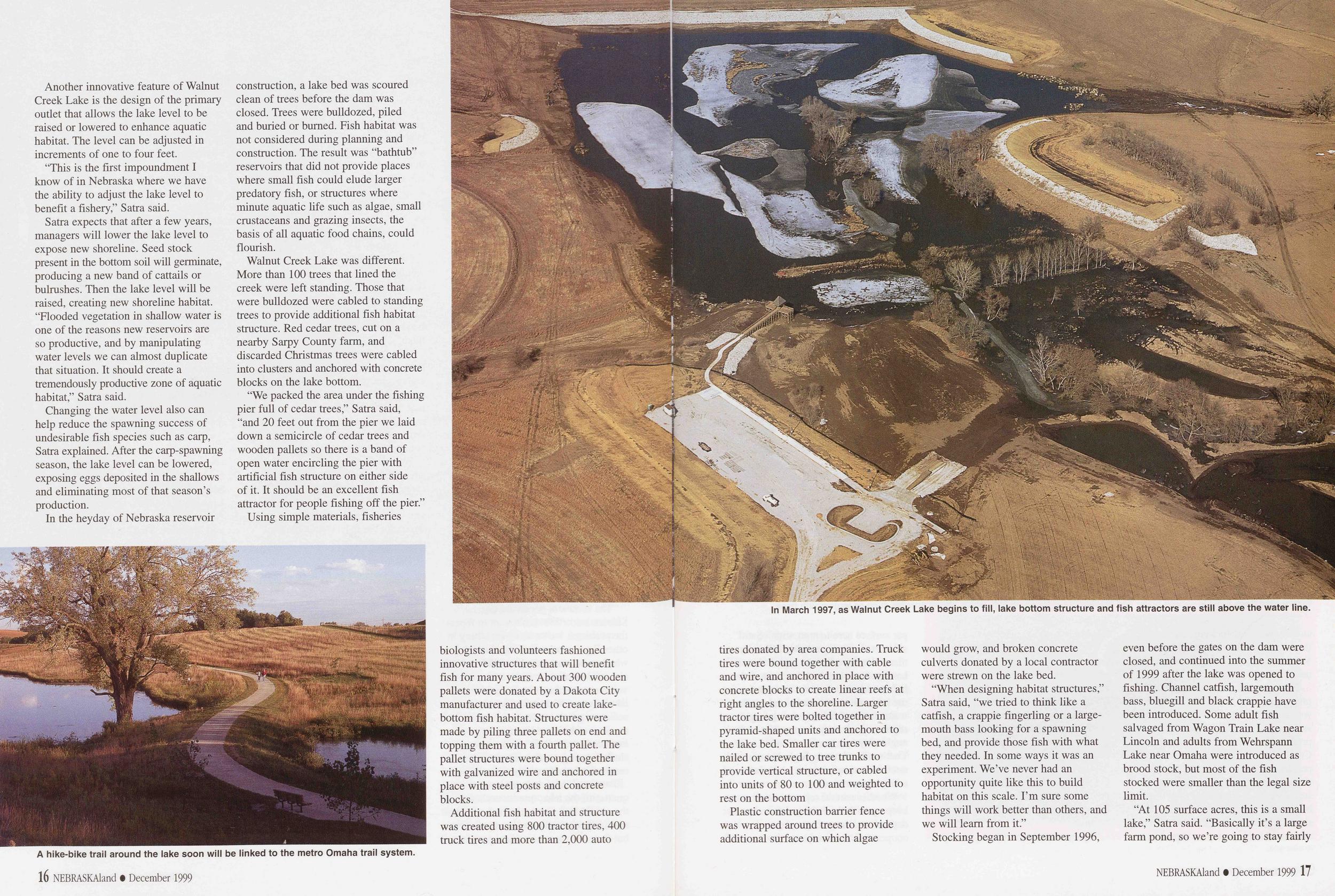
Another innovative feature of Walnut Creek Lake is the design of the primary outlet that allows the lake level to be raised or lowered to enhance aquatic habitat. The level can be adjusted in increments of one to four feet.
"This is the first impoundment I know of in Nebraska where we have the ability to adjust the lake level to benefit a fishery," Satra said.
Satra expects that after a few years, managers will lower the lake level to expose new shoreline. Seed stock present in the bottom soil will germinate, producing a new band of cattails or bulrushes. Then the lake level will be raised, creating new shoreline habitat. "Flooded vegetation in shallow water is one of the reasons new reservoirs are so productive, and by manipulating water levels we can almost duplicate that situation. It should create a tremendously productive zone of aquatic habitat," Satra said.
Changing the water level also can help reduce the spawning success of undesirable fish species such as carp, Satra explained. After the carp-spawning season, the lake level can be lowered, exposing eggs deposited in the shallows and eliminating most of that season's production.
In the heyday of Nebraska reservoir construction, a lake bed was scoured clean of trees before the dam was closed. Trees were bulldozed, piled and buried or burned. Fish habitat was not considered during planning and construction. The result was "bathtub" reservoirs that did not provide places where small fish could elude larger predatory fish, or structures where minute aquatic life such as algae, small crustaceans and grazing insects, the basis of all aquatic food chains, could flourish.
Walnut Creek Lake was different. More than 100 trees that lined the creek were left standing. Those that were bulldozed were cabled to standing trees to provide additional fish habitat structure. Red cedar trees, cut on a nearby Sarpy County farm, and discarded Christmas trees were cabled into clusters and anchored with concrete blocks on the lake bottom.
"We packed the area under the fishing pier full of cedar trees," Satra said, "and 20 feet out from the pier we laid down a semicircle of cedar trees and wooden pallets so there is a band of open water encircling the pier with artificial fish structure on either side of it. It should be an excellent fish attractor for people fishing off the pier."
Using simple materials, fisheries biologists and volunteers fashioned innovative structures that will benefit fish for many years. About 300 wooden pallets were donated by a Dakota City manufacturer and used to create lake bottom fish habitat. Structures were made by piling three pallets on end and topping them with a fourth pallet. The pallet structures were bound together with galvanized wire and anchored in place with steel posts and concrete blocks.
Additional fish habitat and structure was created using 800 tractor tires, 400 truck tires and more than 2,000 auto
Plastic construction barrier fence was wrapped around trees to provide additional surface on which algae would grow, and broken concrete culverts donated by a local contractor were strewn on the lake bed.
"When designing habitat structures," Satra said, "we tried to think like a catfish, a crappie fingerling or a largemouth bass looking for a spawning bed, and provide those fish with what they needed. In some ways it was an experiment. We've never had an opportunity quite like this to build habitat on this scale. I'm sure some things will work better than others, and we will learn from it."
Stocking began in September 1996, even before the gates on the dam were closed, and continued into the summer of 1999 after the lake was opened to fishing. Channel catfish, largemouth bass, bluegill and black crappie have been introduced. Some adult fish salvaged from Wagon Train Lake near Lincoln and adults from Wehrspann Lake near Omaha were introduced as brood stock, but most of the fish stocked were smaller than the legal size limit.
"At 105 surface acres, this is a small
lake," Satra said. "Basically it's a large
farm pond, so we're going to stay fairly
NEBRASKAland • December 1999 17
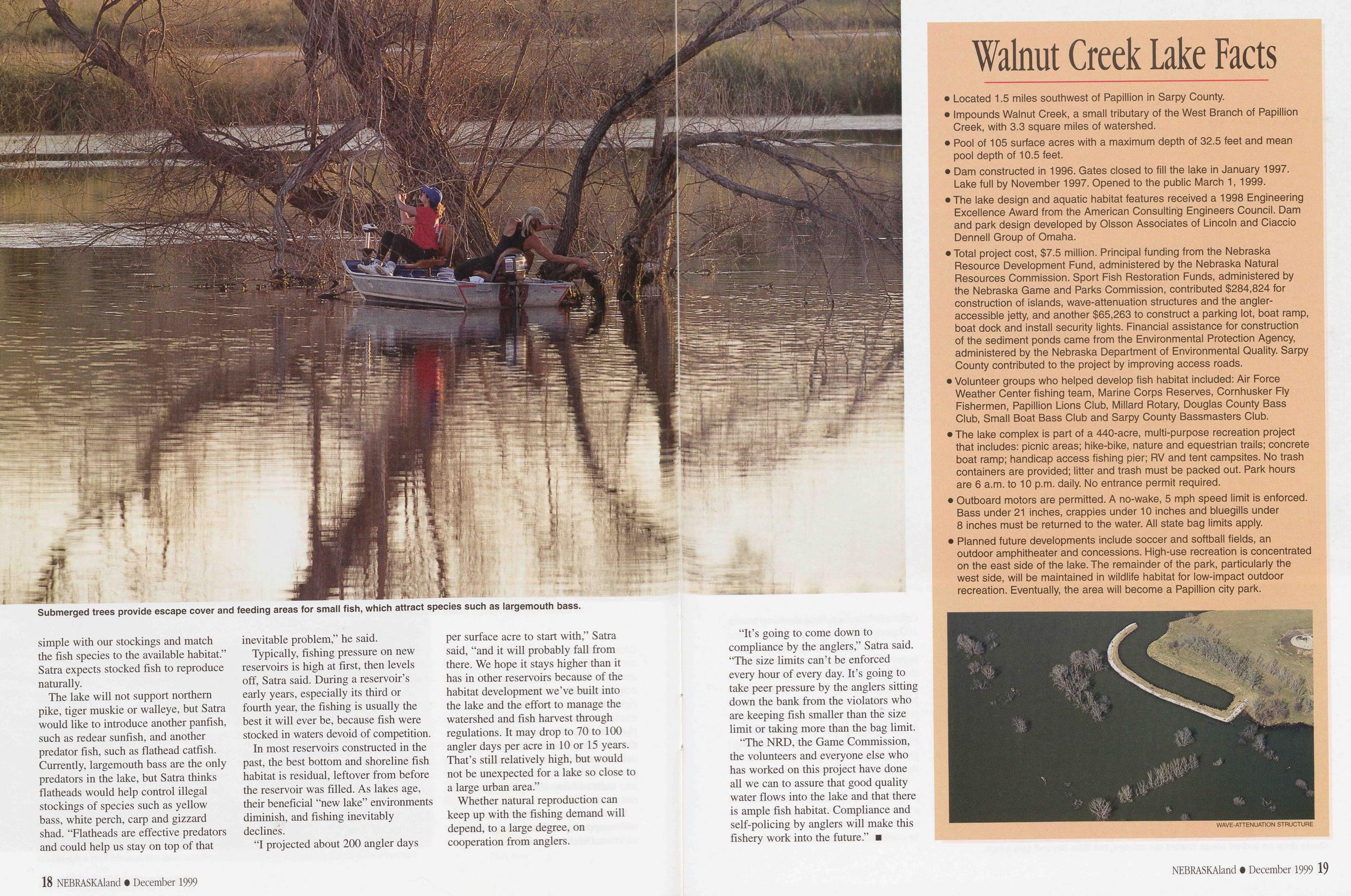
The lake will not support northern pike, tiger muskie or walleye, but Satra would like to introduce another panfish, such as redear sunfish, and another predator fish, such as flathead catfish. Currently, largemouth bass are the only predators in the lake, but Satra thinks flatheads would help control illegal stockings of species such as yellow bass, white perch, carp and gizzard shad. "Flatheads are effective predators and could help us stay on top of that inevitable problem," he said.
Typically, fishing pressure on new reservoirs is high at first, then levels off, Satra said. During a reservoir's early years, especially its third or fourth year, the fishing is usually the best it will ever be, because fish were stocked in waters devoid of competition.
In most reservoirs constructed in the past, the best bottom and shoreline fish habitat is residual, leftover from before the reservoir was filled. As lakes age, their beneficial "new lake" environments diminish, and fishing inevitably declines.
"I projected about 200 angler days per surface acre to start with," Satra said, "and it will probably fall from there. We hope it stays higher than it has in other reservoirs because of the habitat development we've built into the lake and the effort to manage the watershed and fish harvest through regulations. It may drop to 70 to 100 angler days per acre in 10 or 15 years. That's still relatively high, but would not be unexpected for a lake so close to a large urban area."
Whether natural reproduction can keep up with the fishing demand will depend, to a large degree, on cooperation from anglers.
18 NEBRASKAland • December 1999"It's going to come down to compliance by the anglers," Satra said. "The size limits can't be enforced every hour of every day. It's going to take peer pressure by the anglers sitting down the bank from the violators who are keeping fish smaller than the size limit or taking more than the bag limit.
"The NRD, the Game Commission, the volunteers and everyone else who has worked on this project have done all we can to assure that good quality water flows into the lake and that there is ample fish habitat. Compliance and self-policing by anglers will make this fishery work into the future."
Walnut Creek Lake Facts• Located 1.5 miles southwest of Papillion in Sarpy County.
• Impounds Walnut Creek, a small tributary of the West Branch of Papillion Creek, with 3.3 square miles of watershed.
• Pool of 105 surface acres with a maximum depth of 32.5 feet and mean pool depth of 10.5 feet.
• Dam constructed in 1996. Gates closed to fill the lake in January 1997. Lake full by November 1997. Opened to the public March 1, 1999.
• The lake design and aquatic habitat features received a 1998 Engineering Excellence Award from the American Consulting Engineers Council. Dam and park design developed by Olsson Associates of Lincoln and Ciaccio Dennell Group of Omaha.
• Total project cost, $7.5 million. Principal funding from the Nebraska Resource Development Fund, administered by the Nebraska Natural Resources Commission. Sport Fish Restoration Funds, administered by the Nebraska Game and Parks Commission, contributed $284,824 for construction of islands, wave-attenuation structures and the angler accessible jetty, and another $65,263 to construct a parking lot, boat ramp, boat dock and install security lights. Financial assistance for construction of the sediment ponds came from the Environmental Protection Agency, administered by the Nebraska Department of Environmental Quality. Sarpy County contributed to the project by improving access roads.
• Volunteer groups who helped develop fish habitat included: Air Force Weather Center fishing team, Marine Corps Reserves, Cornhusker Fly Fishermen, Papillion Lions Club, Millard Rotary, Douglas County Bass Club, Small Boat Bass Club and Sarpy County Bassmasters Club.
• The lake complex is part of a 440-acre, multi-purpose recreation project that includes: picnic areas; hike-bike, nature and equestrian trails; concrete boat ramp; handicap access fishing pier; RV and tent campsites. No trash containers are provided; litter and trash must be packed out. Park hours are 6 a.m. to 10 p.m. daily. No entrance permit required.
• Outboard motors are permitted. A no-wake, 5 mph speed limit is enforced. Bass under 21 inches, crappies under 10 inches and bluegills under 8 inches must be returned to the water. All state bag limits apply.
• Planned future developments include soccer and softball fields, an outdoor amphitheater and concessions. High-use recreation is concentrated on the east side of the lake. The remainder of the park, particularly the west side, will be maintained in wildlife habitat for low-impact outdoor recreation. Eventually, the area will become a Papillion city park.
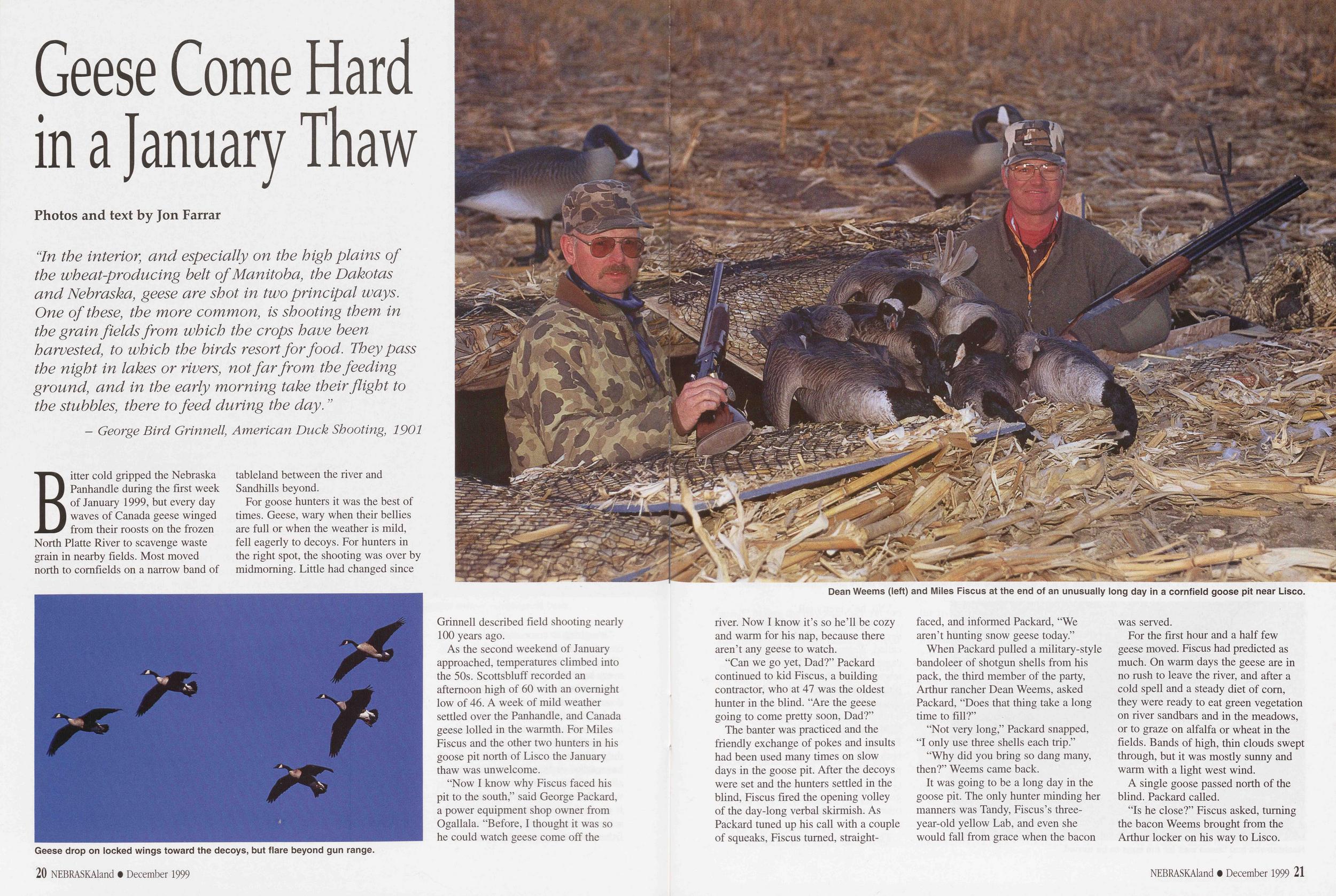
Geese Come Hard in a January Thaw
Photos and text by Jon Farrar "In the interior, and especially on the high plains of the wheat-producing belt of Manitoba, the Dakotas and Nebraska, geese are shot in two principal ways. One of these, the more common, is shooting them in the grain fields from which the crops have been harvested, to which the birds resort for food. They pass the night in lakes or rivers, not far from the feeding ground, and in the early morning take their flight to the stubbles, there to feed during the day." - George Bird Grinnell, American Duck Shooting, 1901Bitter cold gripped the Nebraska Panhandle during the first week of January 1999, but every day waves of Canada geese winged from their roosts on the frozen North Platte River to scavenge waste grain in nearby fields. Most moved north to cornfields on a narrow band of tableland between the river and Sandhills beyond.
For goose hunters it was the best of times. Geese, wary when their bellies are full or when the weather is mild, fell eagerly to decoys. For hunters in the right spot, the shooting was over by midmorning. Little had changed since Grinnell described field shooting nearly 100 years ago.
As the second weekend of January approached, temperatures climbed into the 50s. Scottsbluff recorded an afternoon high of 60 with an overnight low of 46. A week of mild weather settled over the Panhandle, and Canada geese lolled in the warmth. For Miles Fiscus and the other two hunters in his goose pit north of Lisco the January thaw was unwelcome.
"Now I know why Fiscus faced his pit to the south," said George Packard, a power equipment shop owner from Ogallala. "Before, I thought it was so he could watch geese come off the
"Can we go yet, Dad?" Packard continued to kid Fiscus, a building contractor, who at 47 was the oldest hunter in the blind. "Are the geese going to come pretty soon, Dad?"
The banter was practiced and the friendly exchange of pokes and insults had been used many times on slow days in the goose pit. After the decoys were set and the hunters settled in the blind, Fiscus fired the opening volley of the day-long verbal skirmish. As Packard tuned up his call with a couple of squeaks, Fiscus turned, straight faced, and informed Packard, "We aren't hunting snow geese today."
When Packard pulled a military-style bandoleer of shotgun shells from his pack, the third member of the party, Arthur rancher Dean Weems, asked Packard, "Does that thing take a long time to fill?"
"Not very long," Packard snapped, "I only use three shells each trip."
"Why did you bring so dang many, then?" Weems came back.
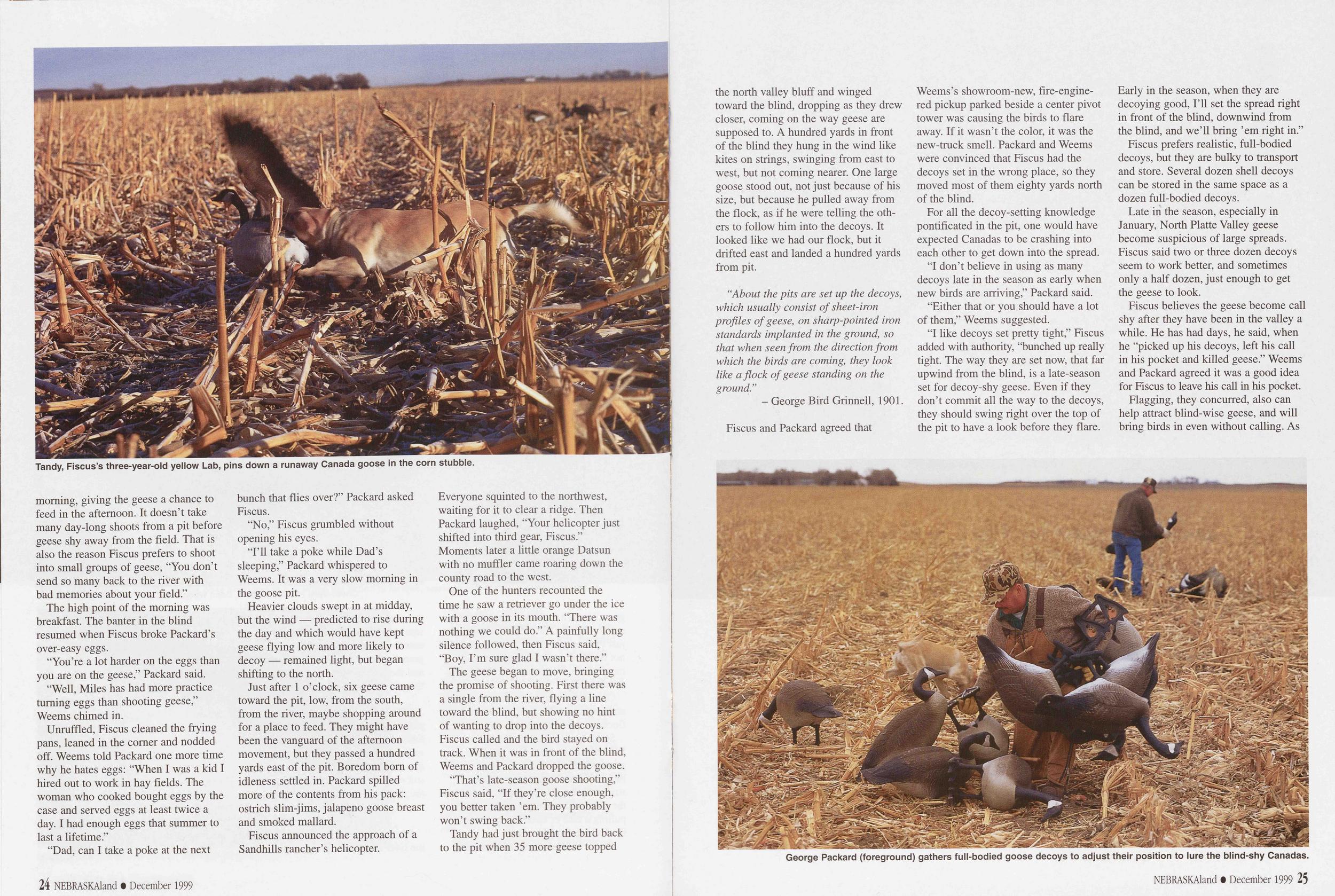
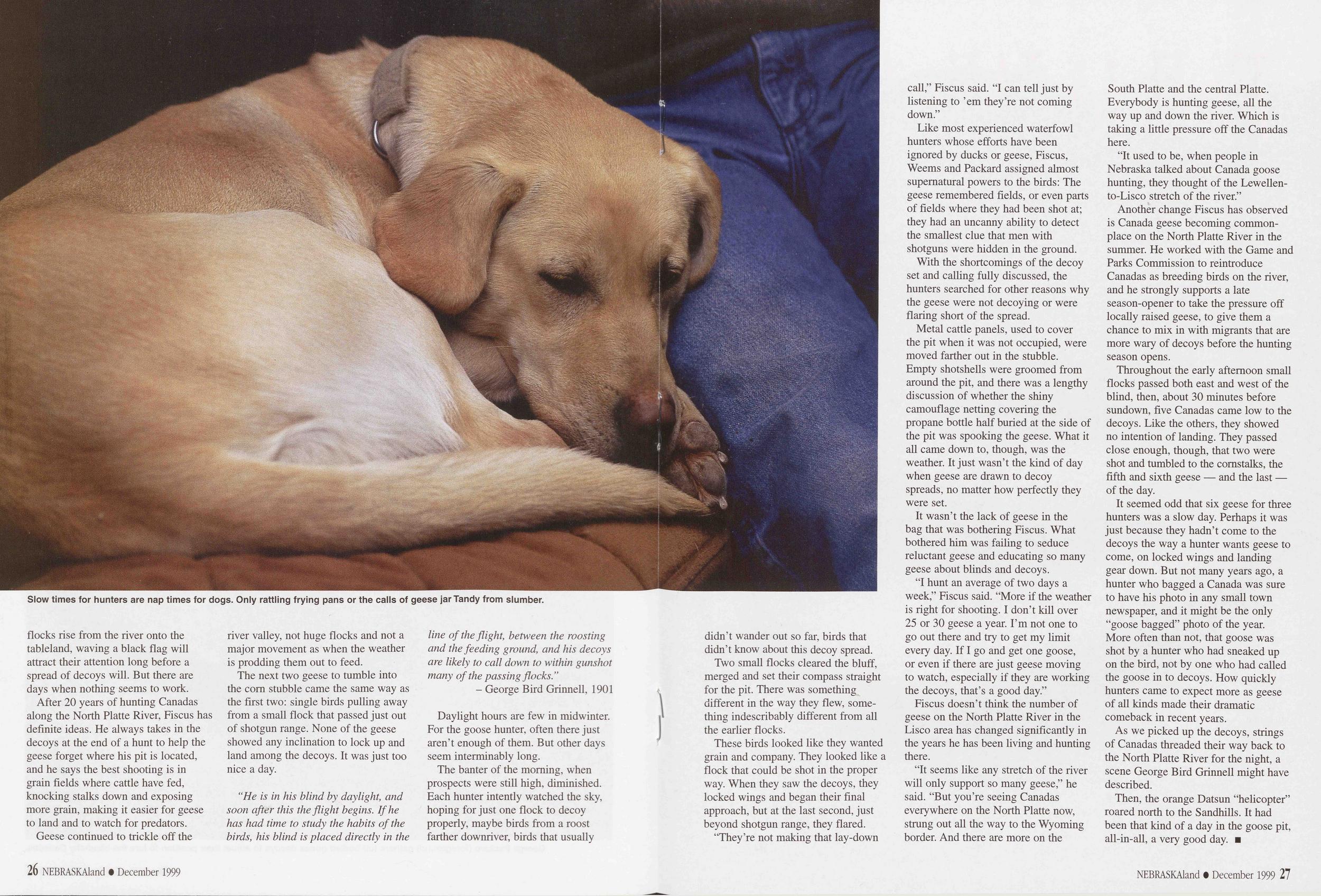
It was going to be a long day in the goose pit. The only hunter minding her manners was Tandy, Fiscus's three-year-old yellow Lab, and even she would fall from grace when the bacon was served.
For the first hour and a half few geese moved. Fiscus had predicted as much. On warm days the geese are in no rush to leave the river, and after a cold spell and a steady diet of corn, they were ready to eat green vegetation on river sandbars and in the meadows, or to graze on alfalfa or wheat in the fields. Bands of high, thin clouds swept through, but it was mostly sunny and warm with a light west wind.
A single goose passed north of the blind. Packard called.
"Is he close?" Fiscus asked, turning the bacon Weems brought from the Arthur locker on his way to Lisco.
NEBRASKAland • December 1999 21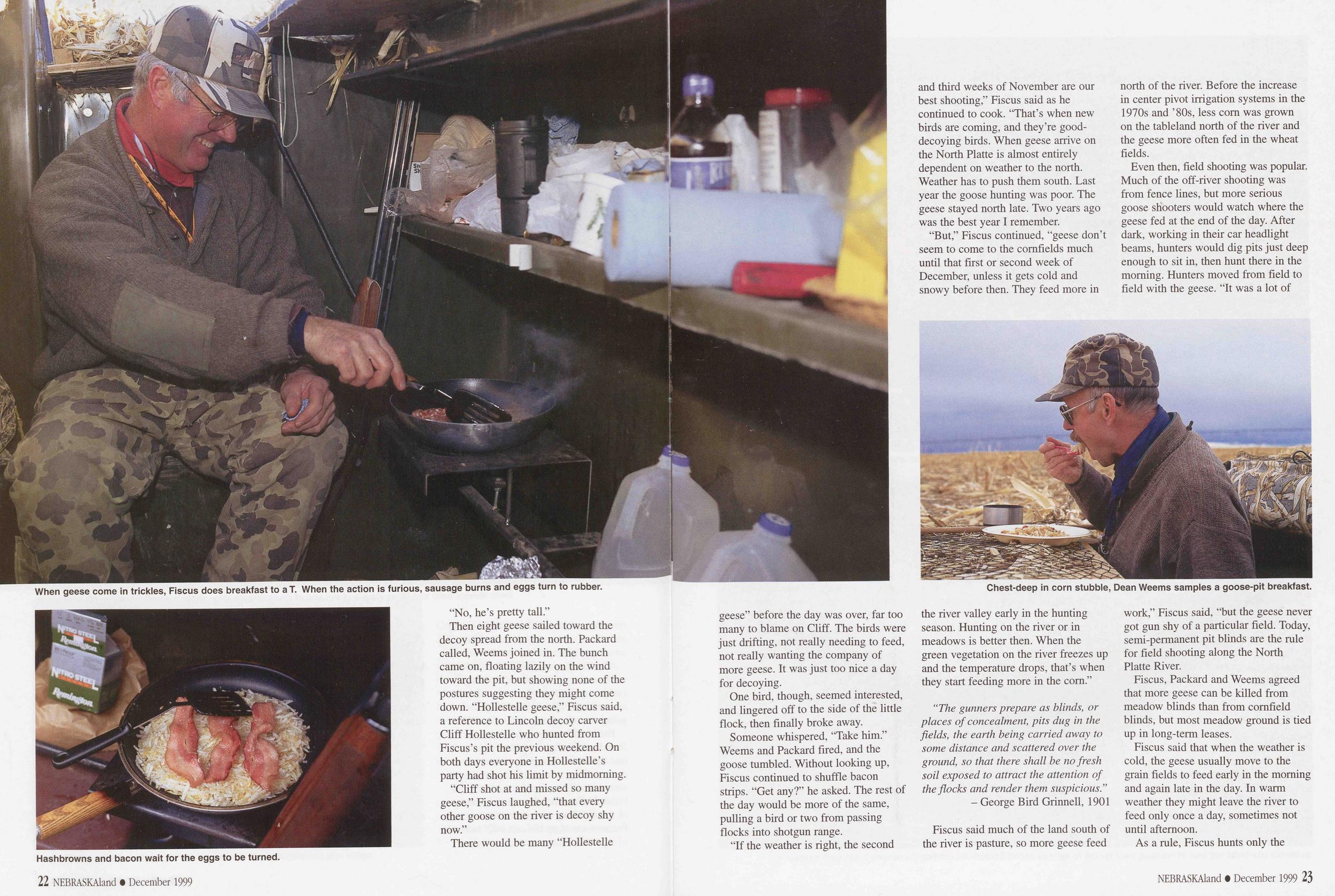
"No, he's pretty tall."
Then eight geese sailed toward the decoy spread from the north. Packard called, Weems joined in. The bunch came on, floating lazily on the wind toward the pit, but showing none of the postures suggesting they might come down. "Hollestelle geese," Fiscus said, a reference to Lincoln decoy carver Cliff Hollestelle who hunted from Fiscus's pit the previous weekend. On both days everyone in Hollestelle's party had shot his limit by midmorning.
"Cliff shot at and missed so many geese," Fiscus laughed, "that every other goose on the river is decoy shy now."
There would be many "Hollestelle 22 NEBRASKAland • December 1999 geese" before the day was over, far too many to blame on Cliff. The birds were just drifting, not really needing to feed, not really wanting the company of more geese. It was just too nice a day for decoying.
One bird, though, seemed interested, and lingered off to the side of the little flock, then finally broke away.
Someone whispered, "Take him." Weems and Packard fired, and the goose tumbled. Without looking up, Fiscus continued to shuffle bacon strips. "Get any?" he asked. The rest of the day would be more of the same, pulling a bird or two from passing flocks into shotgun range.
"If the weather is right, the second and third weeks of November are our best shooting," Fiscus said as he continued to cook. "That's when new birds are coming, and they're good decoying birds. When geese arrive on the North Platte is almost entirely dependent on weather to the north. Weather has to push them south. Last year the goose hunting was poor. The geese stayed north late. Two years ago was the best year I remember.
"But," Fiscus continued, "geese don't seem to come to the cornfields much until that first or second week of December, unless it gets cold and snowy before then. They feed more in the river valley early in the hunting season. Hunting on the river or in meadows is better then. When the green vegetation on the river freezes up and the temperature drops, that's when they start feeding more in the corn."
"The gunners prepare as blinds, or places of concealment, pits dug in the fields, the earth being carried away to some distance and scattered over the ground, so that there shall be no fresh soil exposed to attract the attention of the flocks and render them suspicious."
- George Bird Grinnell, 1901Fiscus said much of the land south of the river is pasture, so more geese feed north of the river. Before the increase in center pivot irrigation systems in the 1970s and '80s, less corn was grown on the tableland north of the river and the geese more often fed in the wheat fields.
Even then, field shooting was popular. Much of the off-river shooting was from fence lines, but more serious goose shooters would watch where the geese fed at the end of the day. After dark, working in their car headlight beams, hunters would dig pits just deep enough to sit in, then hunt there in the morning. Hunters moved from field to field with the geese. "It was a lot of work," Fiscus said, "but the geese never got gun shy of a particular field. Today, semi-permanent pit blinds are the rule for field shooting along the North Platte River.
Fiscus, Packard and Weems agreed that more geese can be killed from meadow blinds than from cornfield blinds, but most meadow ground is tied up in long-term leases.
Fiscus said that when the weather is cold, the geese usually move to the grain fields to feed early in the morning and again late in the day. In warm weather they might leave the river to feed only once a day, sometimes not until afternoon.
As a rule, Fiscus hunts only the
NEBRASKAland • December 1999 23
The high point of the morning was breakfast. The banter in the blind resumed when Fiscus broke Packard's over-easy eggs.
"You're a lot harder on the eggs than you are on the geese," Packard said.
"Well, Miles has had more practice turning eggs than shooting geese," Weems chimed in.
Unruffled, Fiscus cleaned the frying pans, leaned in the corner and nodded off. Weems told Packard one more time why he hates eggs: "When I was a kid I hired out to work in hay fields. The woman who cooked bought eggs by the case and served eggs at least twice a day. I had enough eggs that summer to last a lifetime."
"Dad, can I take a poke at the next bunch that flies over?" Packard asked Fiscus.
"No," Fiscus grumbled without opening his eyes.
"I'll take a poke while Dad's sleeping," Packard whispered to Weems. It was a very slow morning in the goose pit.
Heavier clouds swept in at midday, but the wind — predicted to rise during the day and which would have kept geese flying low and more likely to decoy — remained light, but began shifting to the north.
Just after 1 o'clock, six geese came toward the pit, low, from the south, from the river, maybe shopping around for a place to feed. They might have been the vanguard of the afternoon movement, but they passed a hundred yards east of the pit. Boredom born of idleness settled in. Packard spilled more of the contents from his pack: ostrich slim-jims, jalapeno goose breast and smoked mallard.
Fiscus announced the approach of a Sandhills rancher's helicopter. Everyone squinted to the northwest, waiting for it to clear a ridge. Then Packard laughed, "Your helicopter just shifted into third gear, Fiscus." Moments later a little orange Datsun with no muffler came roaring down the county road to the west.
One of the hunters recounted the time he saw a retriever go under the ice with a goose in its mouth. "There was nothing we could do." A painfully long silence followed, then Fiscus said, "Boy, I'm sure glad I wasn't there."
The geese began to move, bringing the promise of shooting. First there was a single from the river, flying a line toward the blind, but showing no hint of wanting to drop into the decoys. Fiscus called and the bird stayed on track. When it was in front of the blind, Weems and Packard dropped the goose.
"That's late-season goose shooting," Fiscus said, "If they're close enough, you better taken 'em. They probably won't swing back."
Tandy had just brought the bird back to the pit when 35 more geese topped 24 NEBRASKAland • December 1999 the north valley bluff and winged toward the blind, dropping as they drew closer, coming on the way geese are supposed to. A hundred yards in front of the blind they hung in the wind like kites on strings, swinging from east to west, but not coming nearer. One large goose stood out, not just because of his size, but because he pulled away from the flock, as if he were telling the others to follow him into the decoys. It looked like we had our flock, but it drifted east and landed a hundred yards from pit.
''About the pits are set up the decoys, which usually consist of sheet-iron profiles of geese, on sharp-pointed iron standards implanted in the ground, so that when seen from the direction from which the birds are coming, they look like a flock of geese standing on the ground."
- George Bird Grinnell, 1901.Fiscus and Packard agreed that Weems's showroom-new, fire-engine- red pickup parked beside a center pivot tower was causing the birds to flare away. If it wasn't the color, it was the new-truck smell. Packard and Weems were convinced that Fiscus had the decoys set in the wrong place, so they moved most of them eighty yards north of the blind.
For all the decoy-setting knowledge pontificated in the pit, one would have expected Canadas to be crashing into each other to get down into the spread.
"I don't believe in using as many decoys late in the season as early when new birds are arriving," Packard said.
"Either that or you should have a lot of them," Weems suggested.
"I like decoys set pretty tight," Fiscus added with authority, "bunched up really tight. The way they are set now, that far upwind from the blind, is a late-season set for decoy-shy geese. Even if they don't commit all the way to the decoys, they should swing right over the top of the pit to have a look before they flare. Early in the season, when they are decoying good, I'll set the spread right in front of the blind, downwind from the blind, and we'll bring 'em right in."
Fiscus prefers realistic, full-bodied decoys, but they are bulky to transport and store. Several dozen shell decoys can be stored in the same space as a dozen full-bodied decoys.
Late in the season, especially in January, North Platte Valley geese become suspicious of large spreads. Fiscus said two or three dozen decoys seem to work better, and sometimes only a half dozen, just enough to get the geese to look.
Fiscus believes the geese become call shy after they have been in the valley a while. He has had days, he said, when he "picked up his decoys, left his call in his pocket and killed geese." Weems and Packard agreed it was a good idea for Fiscus to leave his call in his pocket.
Flagging, they concurred, also can help attract blind-wise geese, and will bring birds in even without calling. As
After 20 years of hunting Canadas along the North Platte River, Fiscus has definite ideas. He always takes in the decoys at the end of a hunt to help the geese forget where his pit is located, and he says the best shooting is in grain fields where cattle have fed, knocking stalks down and exposing more grain, making it easier for geese to land and to watch for predators.
Geese continued to trickle off the river valley, not huge flocks and not a major movement as when the weather is prodding them out to feed.
The next two geese to tumble into the corn stubble came the same way as the first two: single birds pulling away from a small flock that passed just out of shotgun range. None of the geese showed any inclination to lock up and land among the decoys. It was just too nice a day.
"He is in his blind by daylight, and soon after this the flight begins. If he has had time to study the habits of the birds, his blind is placed directly in the line of the flight, between the roosting and the feeding ground, and his decoys are likely to call down to within gunshot many of the passing flocks."
- George Bird Grinnell, 1901Daylight hours are few in midwinter. For the goose hunter, often there just aren't enough of them. But other days seem interminably long.
The banter of the morning, when prospects were still high, diminished. Each hunter intently watched the sky, hoping for just one flock to decoy properly, maybe birds from a roost farther downriver, birds that usually 26 NEBRASKAland • December 1999 didn't wander out so far, birds that didn't know about this decoy spread.
Two small flocks cleared the bluff, merged and set their compass straight for the pit. There was something different in the way they flew, something indescribably different from all the earlier flocks.
These birds looked like they wanted grain and company. They looked like a flock that could be shot in the proper way. When they saw the decoys, they locked wings and began their final approach, but at the last second, just beyond shotgun range, they flared.
'They're not making that lay-down call," Fiscus said. "I can tell just by listening to 'em they're not coming down."
Like most experienced waterfowl hunters whose efforts have been ignored by ducks or geese, Fiscus, Weems and Packard assigned almost supernatural powers to the birds: The geese remembered fields, or even parts of fields where they had been shot at; they had an uncanny ability to detect the smallest clue that men with shotguns were hidden in the ground.
With the shortcomings of the decoy set and calling fully discussed, the hunters searched for other reasons why the geese were not decoying or were flaring short of the spread.
Metal cattle panels, used to cover the pit when it was not occupied, were moved farther out in the stubble. Empty shotshells were groomed from around the pit, and there was a lengthy discussion of whether the shiny camouflage netting covering the propane bottle half buried at the side of the pit was spooking the geese. What it all came down to, though, was the weather. It just wasn't the kind of day when geese are drawn to decoy spreads, no matter how perfectly they were set.
It wasn't the lack of geese in the bag that was bothering Fiscus. What bothered him was failing to seduce reluctant geese and educating so many geese about blinds and decoys.
"I hunt an average of two days a week," Fiscus said. "More if the weather is right for shooting. I don't kill over 25 or 30 geese a year. I'm not one to go out there and try to get my limit every day. If I go and get one goose, or even if there are just geese moving to watch, especially if they are working the decoys, that's a good day."
Fiscus doesn't think the number of geese on the North Platte River in the Lisco area has changed significantly in the years he has been living and hunting there.
"It seems like any stretch of the river will only support so many geese," he said. "But you're seeing Canadas everywhere on the North Platte now, strung out all the way to the Wyoming border. And there are more on the South Platte and the central Platte. Everybody is hunting geese, all the way up and down the river. Which is taking a little pressure off the Canadas here.
"It used to be, when people in Nebraska talked about Canada goose hunting, they thought of the Lewellento-Lisco stretch of the river."
Another change Fiscus has observed is Canada geese becoming common- place on the North Platte River in the summer. He worked with the Game and Parks Commission to reintroduce Canadas as breeding birds on the river, and he strongly supports a late season-opener to take the pressure off locally raised geese, to give them a chance to mix in with migrants that are more wary of decoys before the hunting season opens.
Throughout the early afternoon small flocks passed both east and west of the blind, then, about 30 minutes before sundown, five Canadas came low to the decoys. Like the others, they showed no intention of landing. They passed close enough, though, that two were shot and tumbled to the cornstalks, the fifth and sixth geese — and the last — of the day.
It seemed odd that six geese for three hunters was a slow day. Perhaps it was just because they hadn't come to the decoys the way a hunter wants geese to come, on locked wings and landing gear down. But not many years ago, a hunter who bagged a Canada was sure to have his photo in any small town newspaper, and it might be the only "goose bagged" photo of the year. More often than not, that goose was shot by a hunter who had sneaked up on the bird, not by one who had called the goose in to decoys. How quickly hunters came to expect more as geese of all kinds made their dramatic comeback in recent years.
As we picked up the decoys, strings of Canadas threaded their way back to the North Platte River for the night, a scene George Bird Grinnell might have described.
Then, the orange Datsun "helicopter" roared north to the Sandhills. It had been that kind of a day in the goose pit, all-in-all, a very good day.
NEBRASKAland • December 1999 27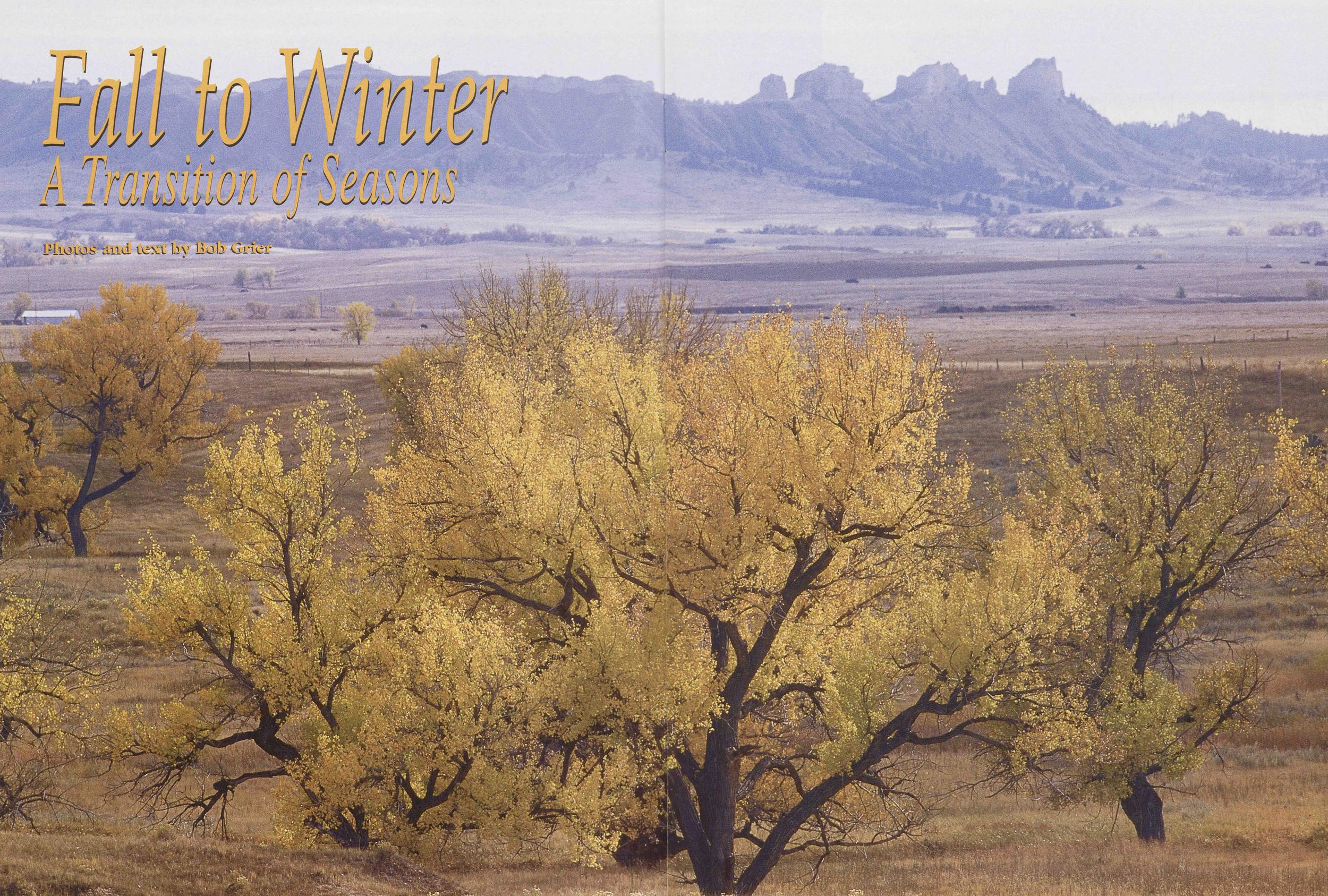
Fall to Winter
A Transition of Seasons Photos and text by Bob Grier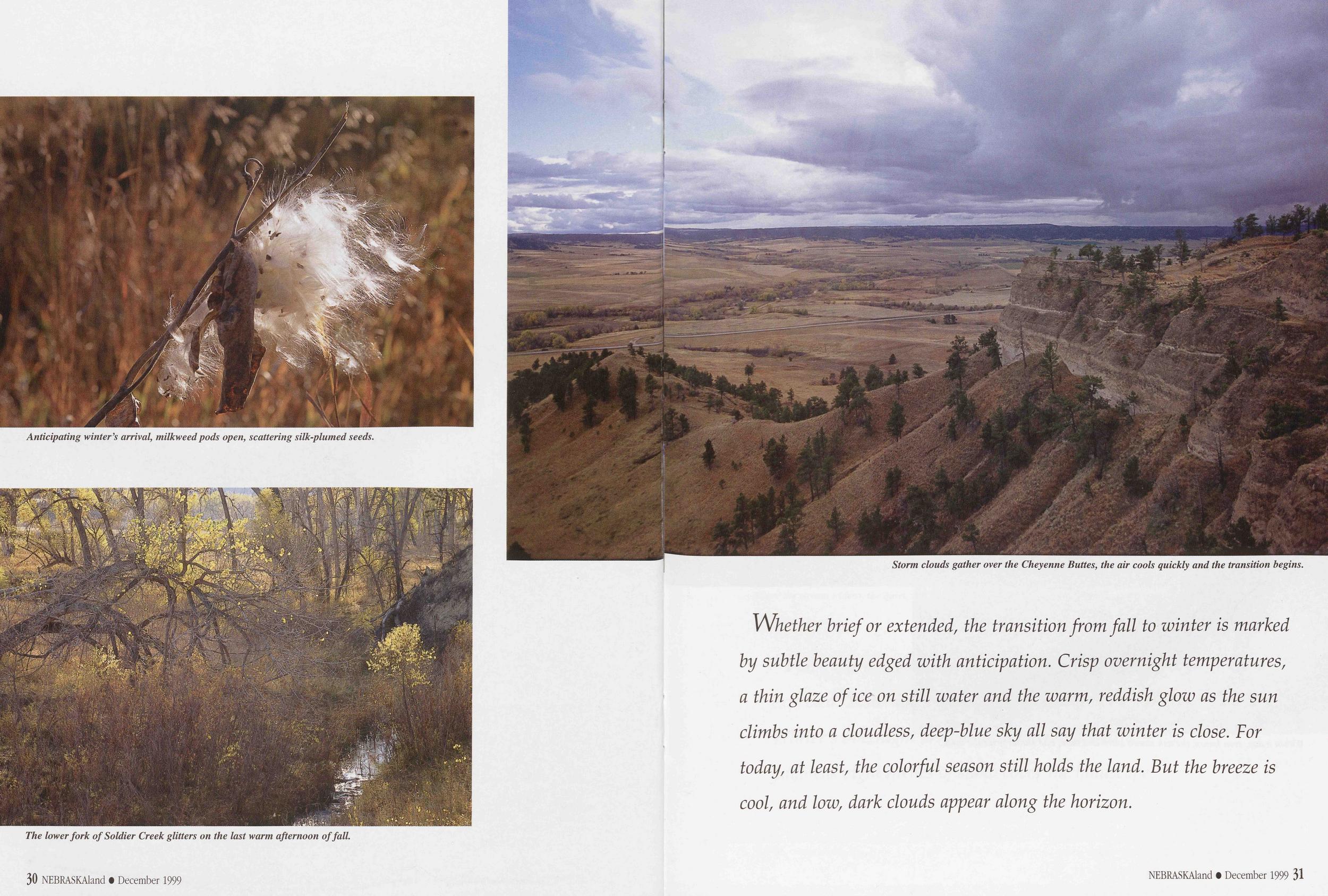
Whether brief or extended, the transition from fall to winter is marked by subtle beauty edged with anticipation. Crisp overnight temperatures, a thin glaze of ice on still water and the warm, reddish glow as the sun climbs into a cloudless, deep-blue sky all say that winter is close. For today, at least, the colorful season still holds the land. But the breeze is cool, and low, dark clouds appear along the horizon.
NEBRASKAland • December 1999 31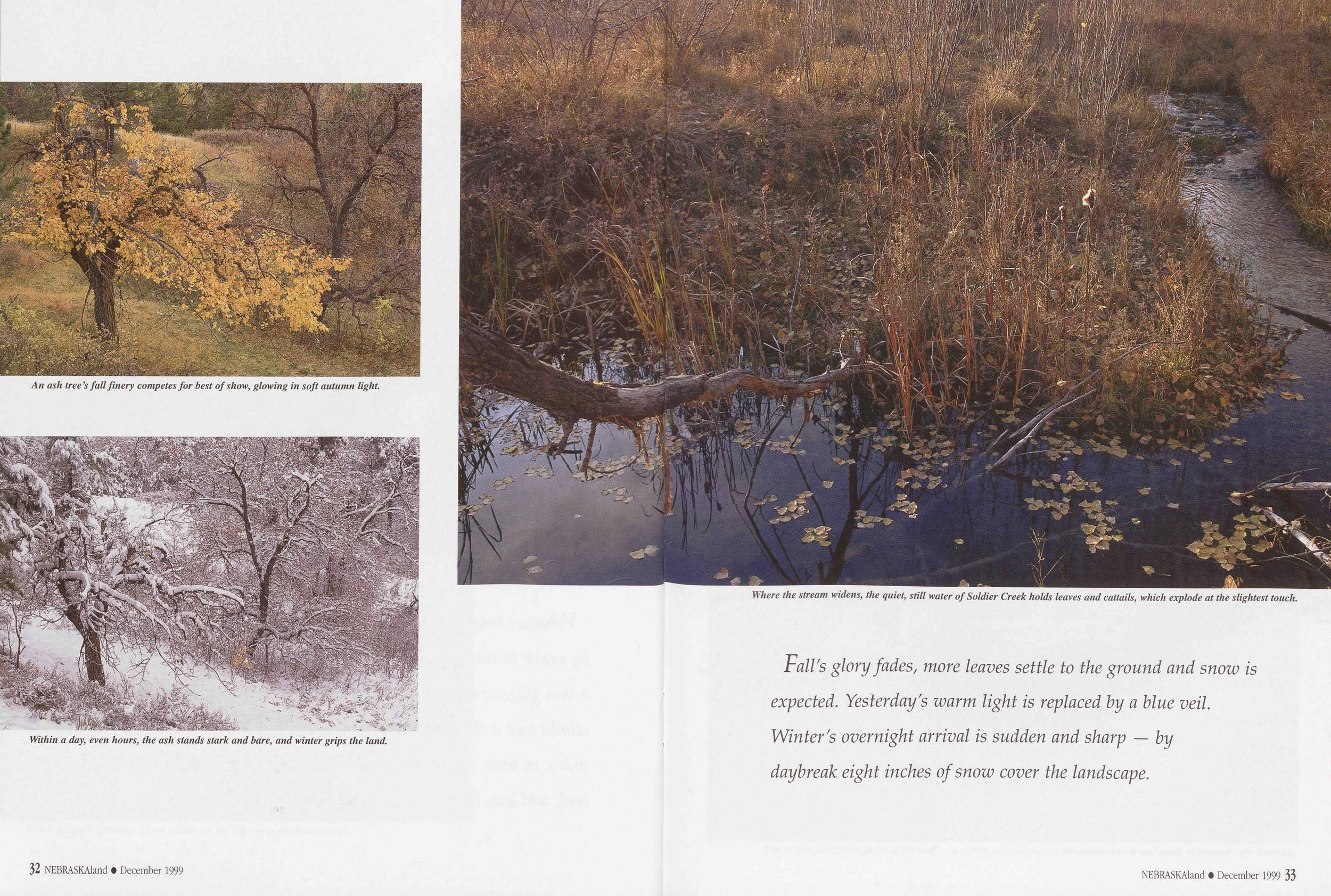
rail's glory fades, more leaves settle to the ground and snow is expected. Yesterday's warm light is replaced by a blue veil. Winter's overnight arrival is sudden and sharp — by daybreak eight inches of snow cover the landscape.
NEBRASKAland • December 1999 33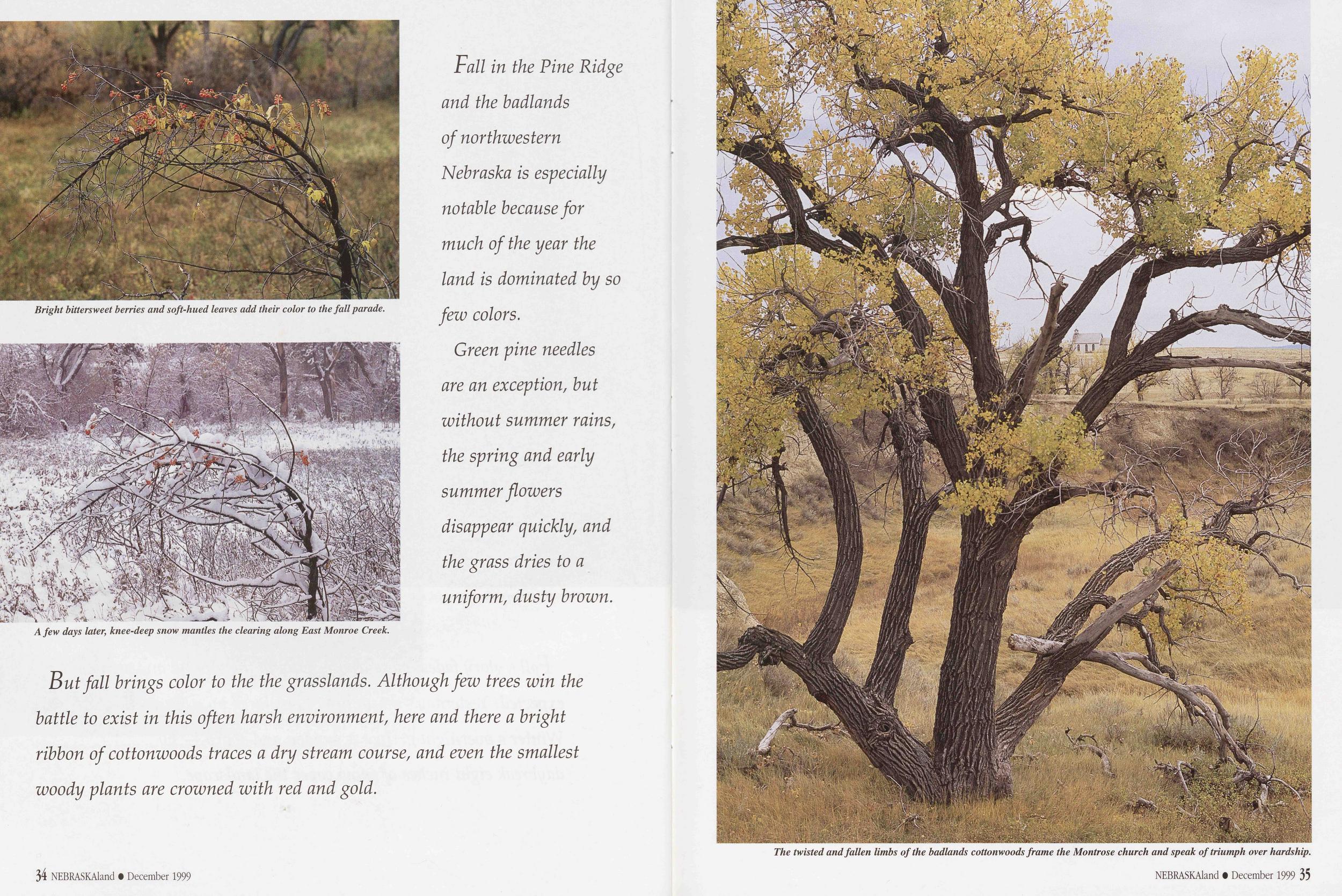
Fall in the Pine Ridge and the badlands of northwestern Nebraska is especially notable because for much of the year the land is dominated by so few colors.
Green pine needles are an exception, but without summer rains, the spring and early summer flowers disappear quickly, and the grass dries to a uniform, dusty brown.
But fall brings color to the the grasslands. Although few trees win the battle to exist in this often harsh environment, here and there a bright ribbon of cottonwoods traces a dry stream course, and even the smallest woody plants are crowned with red and gold.
34 NEBRASKAland • December 1999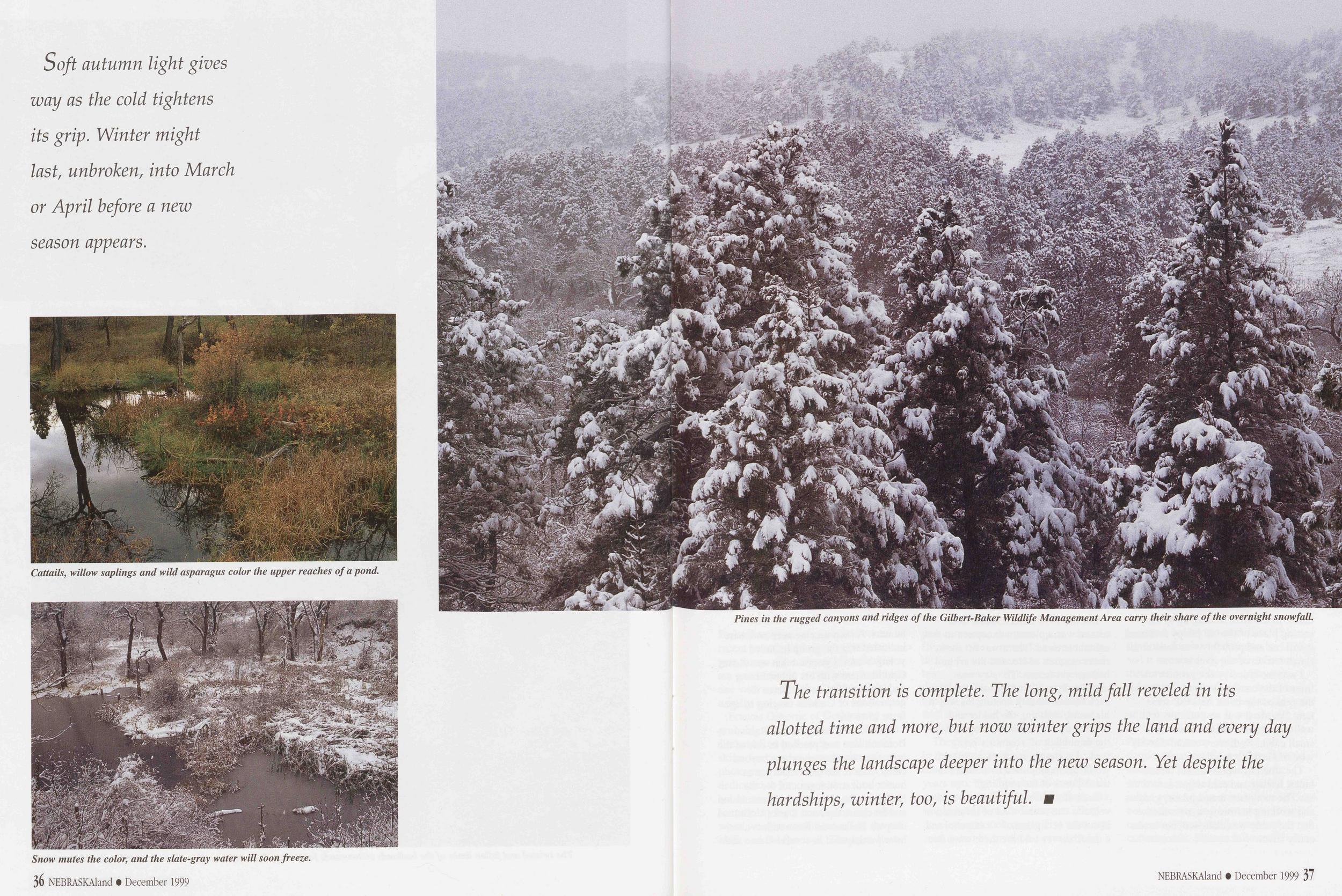
Soft autumn light gives way as the cold tightens its grip. Winter might last, unbroken, into March or April before a new season appears,
The transition is complete. The long, mild fall reveled in its allotted time and more, but now winter grips the land and every day plunges the landscape deeper into the new season. Yet despite the hardships, winter, too, is beautiful,
NEBRASKAland • December 1999 37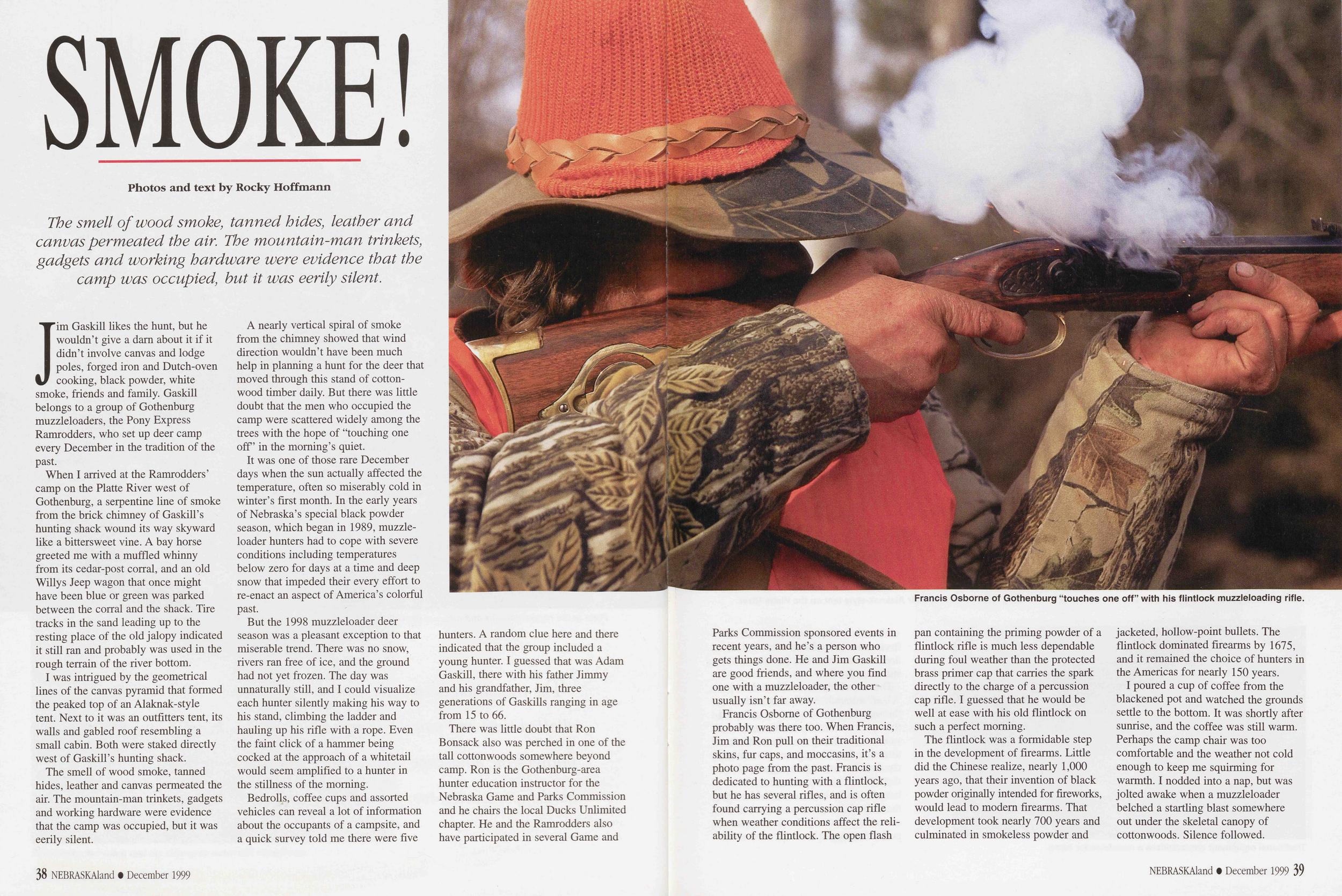
SMOKE!
Photos and text by Rocky Hoffmann The smell of wood smoke, tanned hides, leather and canvas permeated the air. The mountain-man trinkets, gadgets and working hardware were evidence that the camp was occupied, but it was eerily silent.Jim Gaskill likes the hunt, but he wouldn't give a darn about it if it didn't involve canvas and lodge poles, forged iron and Dutch-oven cooking, black powder, white smoke, friends and family. Gaskill belongs to a group of Gothenburg muzzleloaders, the Pony Express Ramrodders, who set up deer camp every December in the tradition of the past.
When I arrived at the Ramrodders' camp on the Platte River west of Gothenburg, a serpentine line of smoke from the brick chimney of Gaskill's hunting shack wound its way skyward like a bittersweet vine. A bay horse greeted me with a muffled whinny from its cedar-post corral, and an old Willys Jeep wagon that once might have been blue or green was parked between the corral and the shack. Tire tracks in the sand leading up to the resting place of the old jalopy indicated it still ran and probably was used in the rough terrain of the river bottom.
I was intrigued by the geometrical lines of the canvas pyramid that formed the peaked top of an Alaknak-style tent. Next to it was an outfitters tent, its walls and gabled roof resembling a small cabin. Both were staked directly west of Gaskill's hunting shack.
The smell of wood smoke, tanned hides, leather and canvas permeated the air. The mountain-man trinkets, gadgets and working hardware were evidence that the camp was occupied, but it was eerily silent.
A nearly vertical spiral of smoke from the chimney showed that wind direction wouldn't have been much help in planning a hunt for the deer that moved through this stand of cotton- wood timber daily. But there was little doubt that the men who occupied the camp were scattered widely among the trees with the hope of "touching one off' in the morning's quiet.
It was one of those rare December days when the sun actually affected the temperature, often so miserably cold in winter's first month. In the early years of Nebraska's special black powder season, which began in 1989, muzzleloader hunters had to cope with severe conditions including temperatures below zero for days at a time and deep snow that impeded their every effort to re-enact an aspect of America's colorful past.
But the 1998 muzzleloader deer season was a pleasant exception to that miserable trend. There was no snow, rivers ran free of ice, and the ground had not yet frozen. The day was unnaturally still, and I could visualize each hunter silently making his way to his stand, climbing the ladder and hauling up his rifle with a rope. Even the faint click of a hammer being cocked at the approach of a whitetail would seem amplified to a hunter in the stillness of the morning.
Bedrolls, coffee cups and assorted vehicles can reveal a lot of information about the occupants of a campsite, and a quick survey told me there were five hunters. A random clue here and there indicated that the group included a young hunter. I guessed that was Adam Gaskill, there with his father Jimmy and his grandfather, Jim, three generations of Gaskills ranging in age from 15 to 66.
There was little doubt that Ron Bonsack also was perched in one of the tall cottonwoods somewhere beyond camp. Ron is the Gothenburg-area hunter education instructor for the Nebraska Game and Parks Commission and he chairs the local Ducks Unlimited chapter. He and the Ramrodders also have participated in several Game and 38 NEBRASKAland • December 1999
Francis Osborne of Gothenburg probably was there too. When Francis, Jim and Ron pull on their traditional skins, fur caps, and moccasins, it's a photo page from the past. Francis is dedicated to hunting with a flintlock, but he has several rifles, and is often found carrying a percussion cap rifle when weather conditions affect the reliability of the flintlock. The open flash pan containing the priming powder of a flintlock rifle is much less dependable during foul weather than the protected brass primer cap that carries the spark directly to the charge of a percussion cap rifle. I guessed that he would be well at ease with his old flintlock on such a perfect morning.
The flintlock was a formidable step in the development of firearms. Little did the Chinese realize, nearly 1,000 years ago, that their invention of black powder originally intended for fireworks, would lead to modern firearms. That development took nearly 700 years and culminated in smokeless powder and jacketed, hollow-point bullets. The flintlock dominated firearms by 1675, and it remained the choice of hunters in the Americas for nearly 150 years.
I poured a cup of coffee from the blackened pot and watched the grounds settle to the bottom. It was shortly after sunrise, and the coffee was still warm. Perhaps the camp chair was too comfortable and the weather not cold enough to keep me squirming for warmth. I nodded into a nap, but was jolted awake when a muzzleloader belched a startling blast somewhere out under the skeletal canopy of cottonwoods. Silence followed.
NEBRASKAland • December 1999 39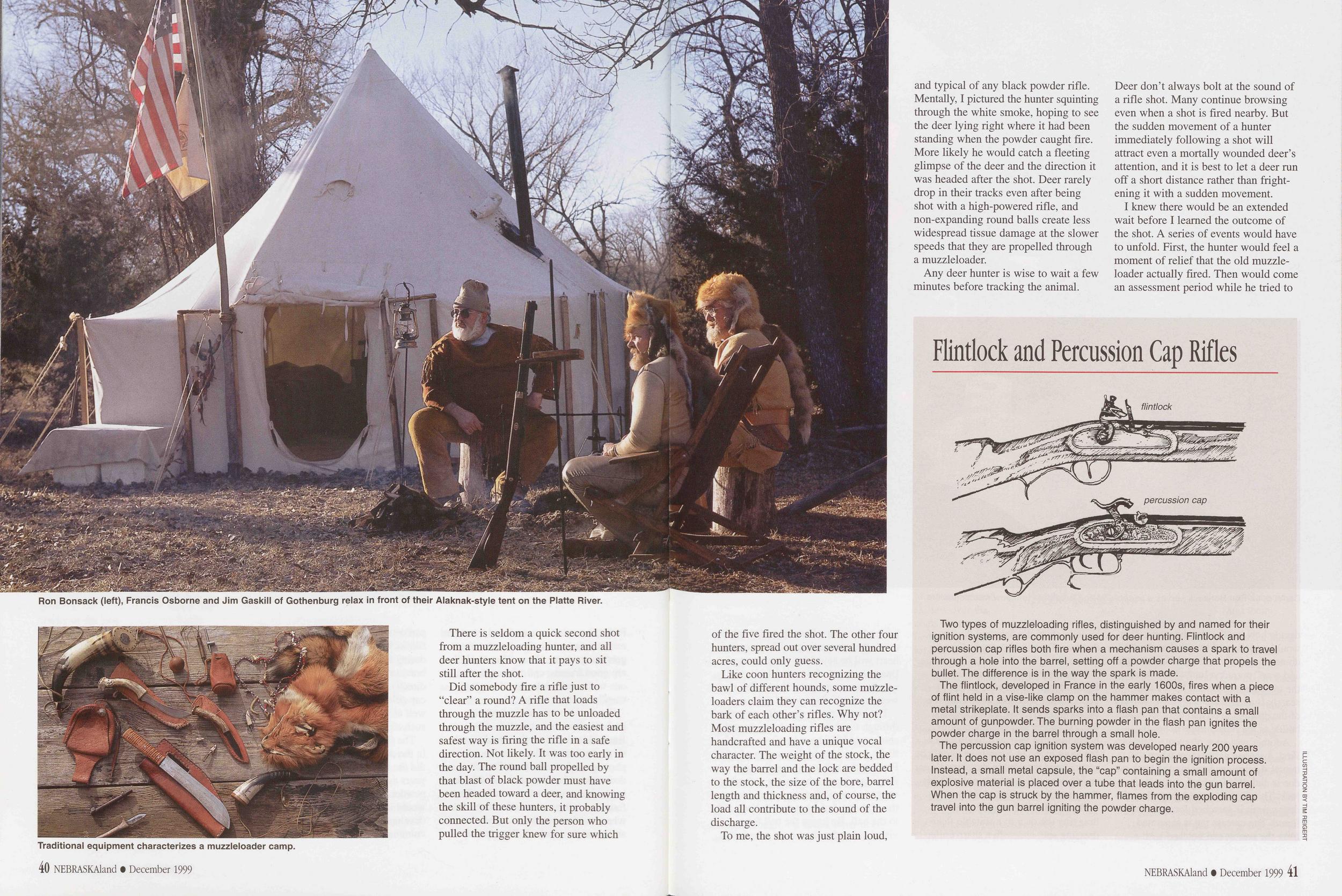
There is seldom a quick second shot from a muzzleloading hunter, and all deer hunters know that it pays to sit still after the shot.
Did somebody fire a rifle just to "clear" a round? A rifle that loads through the muzzle has to be unloaded through the muzzle, and the easiest and safest way is firing the rifle in a safe direction. Not likely. It was too early in the day. The round ball propelled by that blast of black powder must have been headed toward a deer, and knowing the skill of these hunters, it probably connected. But only the person who pulled the trigger knew for sure which 40 NEBRASKAland • December 1999 of the five fired the shot. The other four hunters, spread out over several hundred acres, could only guess.
Like coon hunters recognizing the bawl of different hounds, some muzzleloaders claim they can recognize the bark of each other's rifles. Why not? Most muzzleloading rifles are handcrafted and have a unique vocal character. The weight of the stock, the way the barrel and the lock are bedded to the stock, the size of the bore, barrel length and thickness and, of course, the load all contribute to the sound of the discharge.
To me, the shot was just plain loud, and typical of any black powder rifle. Mentally, I pictured the hunter squinting through the white smoke, hoping to see the deer lying right where it had been standing when the powder caught fire. More likely he would catch a fleeting glimpse of the deer and the direction it was headed after the shot. Deer rarely drop in their tracks even after being shot with a high-powered rifle, and non-expanding round balls create less widespread tissue damage at the slower speeds that they are propelled through a muzzleloader.
Any deer hunter is wise to wait a few minutes before tracking the animal. Deer don't always bolt at the sound of a rifle shot. Many continue browsing even when a shot is fired nearby. But the sudden movement of a hunter immediately following a shot will attract even a mortally wounded deer's attention, and it is best to let a deer run off a short distance rather than frightening it with a sudden movement.
I knew there would be an extended wait before I learned the outcome of the shot. A series of events would have to unfold. First, the hunter would feel a moment of relief that the old muzzle- loader actually fired. Then would come an assessment period while he tried to decide how good a shot he made. That would be followed by a "what should I do now" period, a painstaking "sit tight and wait" period, a long climb down the tree, the reload, and finally the search. It culminates with the discovery of the downed deer, and the excitement builds as the hunter approaches it.
Flintlock and Percussion Cap RiflesTwo types of muzzleloading rifles, distinguished by and named for their ignition systems, are commonly used for deer hunting. Flintlock and percussion cap rifles both fire when a mechanism causes a spark to travel through a hole into the barrel, setting off a powder charge that propels the bullet. The difference is in the way the spark is made.
The flintlock, developed in France in the early 1600s, fires when a piece of flint held in a vise-like clamp on the hammer makes contact with a metal strike plate. It sends sparks into a flash pan that contains a small amount of gunpowder. The burning powder in the flash pan ignites the powder charge in the barrel through a small hole.
The percussion cap ignition system was developed nearly 200 years later. It does not use an exposed flash pan to begin the ignition process. Instead, a small metal capsule, the "cap" containing a small amount of explosive material is placed over a tube that leads into the gun barrel. When the cap is struck by the hammer, flames from the exploding cap travel into the gun barrel igniting the powder charge.
NEBRASKAland • December 1999 4l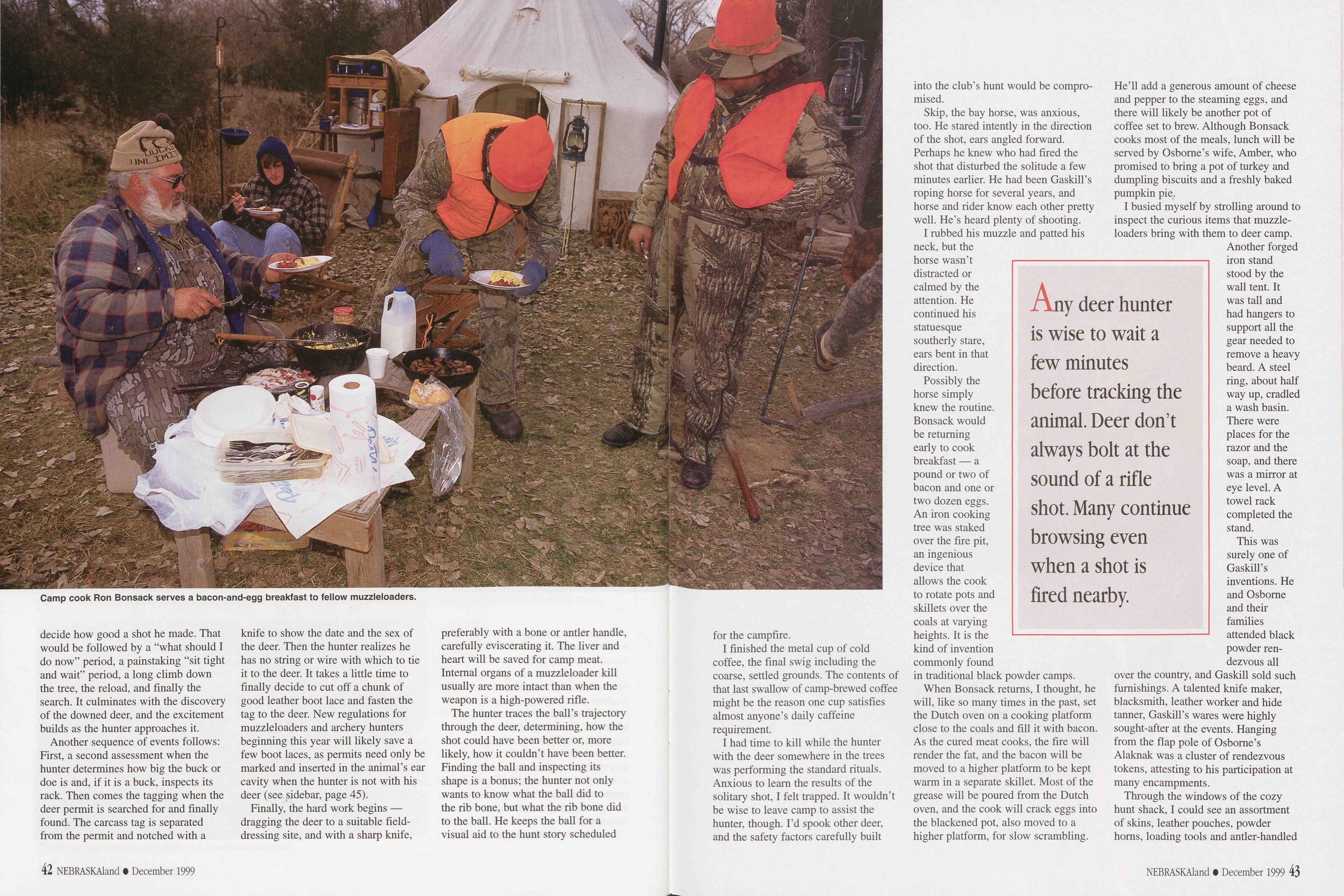
Another sequence of events follows: First, a second assessment when the hunter determines how big the buck or doe is and, if it is a buck, inspects its rack. Then comes the tagging when the deer permit is searched for and finally found. The carcass tag is separated from the permit and notched with a knife to show the date and the sex of the deer. Then the hunter realizes he has no string or wire with which to tie it to the deer. It takes a little time to finally decide to cut off a chunk of good leather boot lace and fasten the tag to the deer. New regulations for muzzleloaders and archery hunters beginning this year will likely save a few boot laces, as permits need only be marked and inserted in the animal's ear cavity when the hunter is not with his deer (see sidebar, page 45).
Finally, the hard work begins — dragging the deer to a suitable field dressing site, and with a sharp knife, preferably with a bone or antler handle, carefully eviscerating it. The liver and heart will be saved for camp meat. Internal organs of a muzzleloader kill usually are more intact than when the weapon is a high-powered rifle.
The hunter traces the ball's trajectory through the deer, determining, how the shot could have been better or, more likely, how it couldn't have been better. Finding the ball and inspecting its shape is a bonus; the hunter not only wants to know what the ball did to the rib bone, but what the rib bone did to the ball. He keeps the ball for a visual aid to the hunt story scheduled 42 NEBRASKAland • December 1999 for the campfire.
I finished the metal cup of cold coffee, the final swig including the coarse, settled grounds. The contents of that last swallow of camp-brewed coffee might be the reason one cup satisfies almost anyone's daily caffeine requirement.
I had time to kill while the hunter with the deer somewhere in the trees was performing the standard rituals. Anxious to learn the results of the solitary shot, I felt trapped. It wouldn't be wise to leave camp to assist the hunter, though. I'd spook other deer, and the safety factors carefully built An into the club's hunt would be compromised.
Skip, the bay horse, was anxious, too. He stared intently in the direction of the shot, ears angled forward. Perhaps he knew who had fired the shot that disturbed the solitude a few minutes earlier. He had been Gaskill's roping horse for several years, and horse and rider know each other pretty well. He's heard plenty of shooting.
I rubbed his muzzle and patted his neck, but the horse wasn't distracted or calmed by the attention. He continued his statuesque southerly stare, ears bent in that direction.
Possibly the horse simply knew the routine. Bonsack would be returning early to cook breakfast — a pound or two of bacon and one or two dozen eggs. An iron cooking tree was staked over the fire pit, an ingenious device that allows the cook to rotate pots and skillets over the coals at varying heights. It is the kind of invention commonly found in traditional black powder camps.
When Bonsack returns, I thought, he will, like so many times in the past, set the Dutch oven on a cooking platform close to the coals and fill it with bacon. As the cured meat cooks, the fire will render the fat, and the bacon will be moved to a higher platform to be kept warm in a separate skillet. Most of the grease will be poured from the Dutch oven, and the cook will crack eggs into the blackened pot, also moved to a higher platform, for slow scrambling. He'll add a generous amount of cheese and pepper to the steaming eggs, and there will likely be another pot of coffee set to brew. Although Bonsack cooks most of the meals, lunch will be served by Osborne's wife, Amber, who promised to bring a pot of turkey and dumpling biscuits and a freshly baked pumpkin pie.
y deer hunter is wise to wait a few minutes before tracking the animal. Deer don't always bolt at the sound of a rifle shot. Many continue browsing even when a shot is fired nearby.I busied myself by strolling around to inspect the curious items that muzzleloaders bring with them to deer camp. Another forged iron stand stood by the wall tent. It was tall and had hangers to support all the gear needed to remove a heavy beard. A steel ring, about half way up, cradled a wash basin. There were places for the razor and the soap, and there was a mirror at eye level. A towel rack completed the stand.
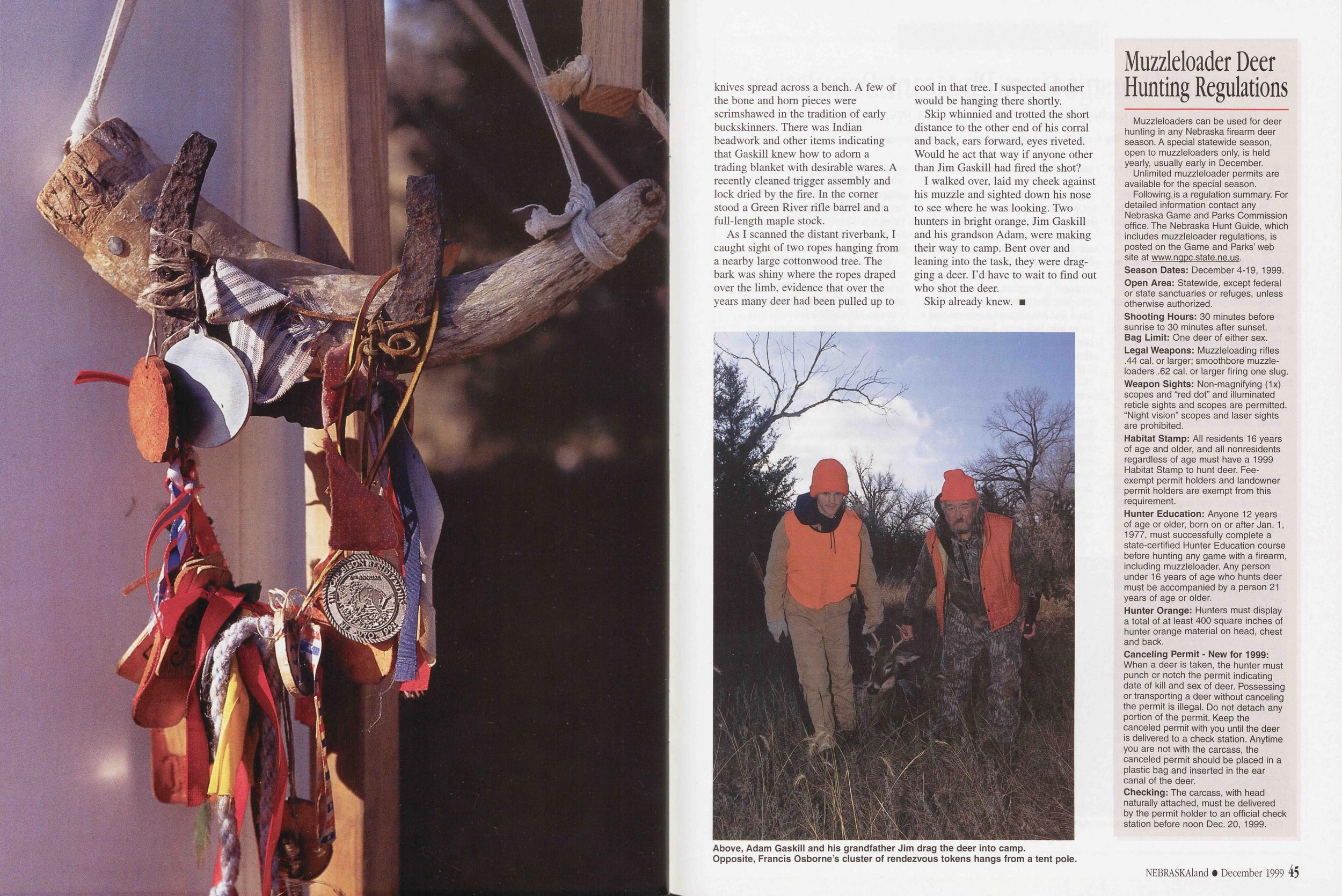
This was surely one of Gaskill's inventions. He and Osborne and their families attended black powder ren- dezvous all over the country, and Gaskill sold such furnishings. A talented knife maker, blacksmith, leather worker and hide tanner, Gaskill's wares were highly sought-after at the events. Hanging from the flap pole of Osborne's Alaknak was a cluster of rendezvous tokens, attesting to his participation at many encampments.
Through the windows of the cozy
hunt shack, I could see an assortment
of skins, leather pouches, powder
horns, loading tools and antler-handled
NEBRASKAland • December 1999 43
As I scanned the distant riverbank, I caught sight of two ropes hanging from a nearby large cottonwood tree. The bark was shiny where the ropes draped over the limb, evidence that over the years many deer had been pulled up to cool in that tree. I suspected another would be hanging there shortly.
Skip whinnied and trotted the short distance to the other end of his corral and back, ears forward, eyes riveted. Would he act that way if anyone other than Jim Gaskill had fired the shot?
I walked over, laid my cheek against his muzzle and sighted down his nose to see where he was looking. Two hunters in bright orange, Jim Gaskill and his grandson Adam, were making their way to camp. Bent over and leaning into the task, they were dragging a deer. I'd have to wait to find out who shot the deer.
Skip already knew.
Muzzleloader Deer Hunting RegulationsMuzzleloaders can be used for deer hunting in any Nebraska firearm deer season. A special statewide season, open to muzzleloaders only, is held yearly, usually early in December.
Unlimited muzzleloader permits are available for the special season.
Following is a regulation summary. For detailed information contact any Nebraska Game and Parks Commission office. The Nebraska Hunt Guide, which includes muzzleloader regulations, is posted on the Game and Parks' web site at www.ngpc.state.ne.us.
Season Dates: December 4-19, 1999.
Open Area: Statewide, except federal or state sanctuaries or refuges, unless otherwise authorized.
Shooting Hours: 30 minutes before sunrise to 30 minutes after sunset.
Bag Limit: One deer of either sex.
Legal Weapons: Muzzleloading rifles .44 cal. or larger; smoothbore muzzleloaders .62 cal. or larger firing one slug.
Weapon Sights: Non-magnifying (1x) scopes and "red dot" and illuminated reticle sights and scopes are permitted. "Night vision" scopes and laser sights are prohibited.
Habitat Stamp: All residents 16 years of age and older, and all nonresidents regardless of age must have a 1999 Habitat Stamp to hunt deer. Fee-exempt permit holders and landowner permit holders are exempt from this requirement.
Hunter Education: Anyone 12 years of age or older, born on or after Jan. 1, 1977, must successfully complete a state-certified Hunter Education course before hunting any game with a firearm, including muzzleloader. Any person under 16 years of age who hunts deer must be accompanied by a person 21 years of age or older.
Hunter Orange: Hunters must display a total of at least 400 square inches of hunter orange material on head, chest and back.
Canceling Permit - New for 1999: When a deer is taken, the hunter must punch or notch the permit indicating date of kill and sex of deer. Possessing or transporting a deer without canceling the permit is illegal. Do not detach any portion of the permit. Keep the canceled permit with you until the deer is delivered to a check station. Anytime you are not with the carcass, the canceled permit should be placed in a plastic bag and inserted in the ear canal of the deer.
Checking: The carcass, with head naturally attached, must be delivered by the permit holder to an official check station before noon Dec. 20, 1999.
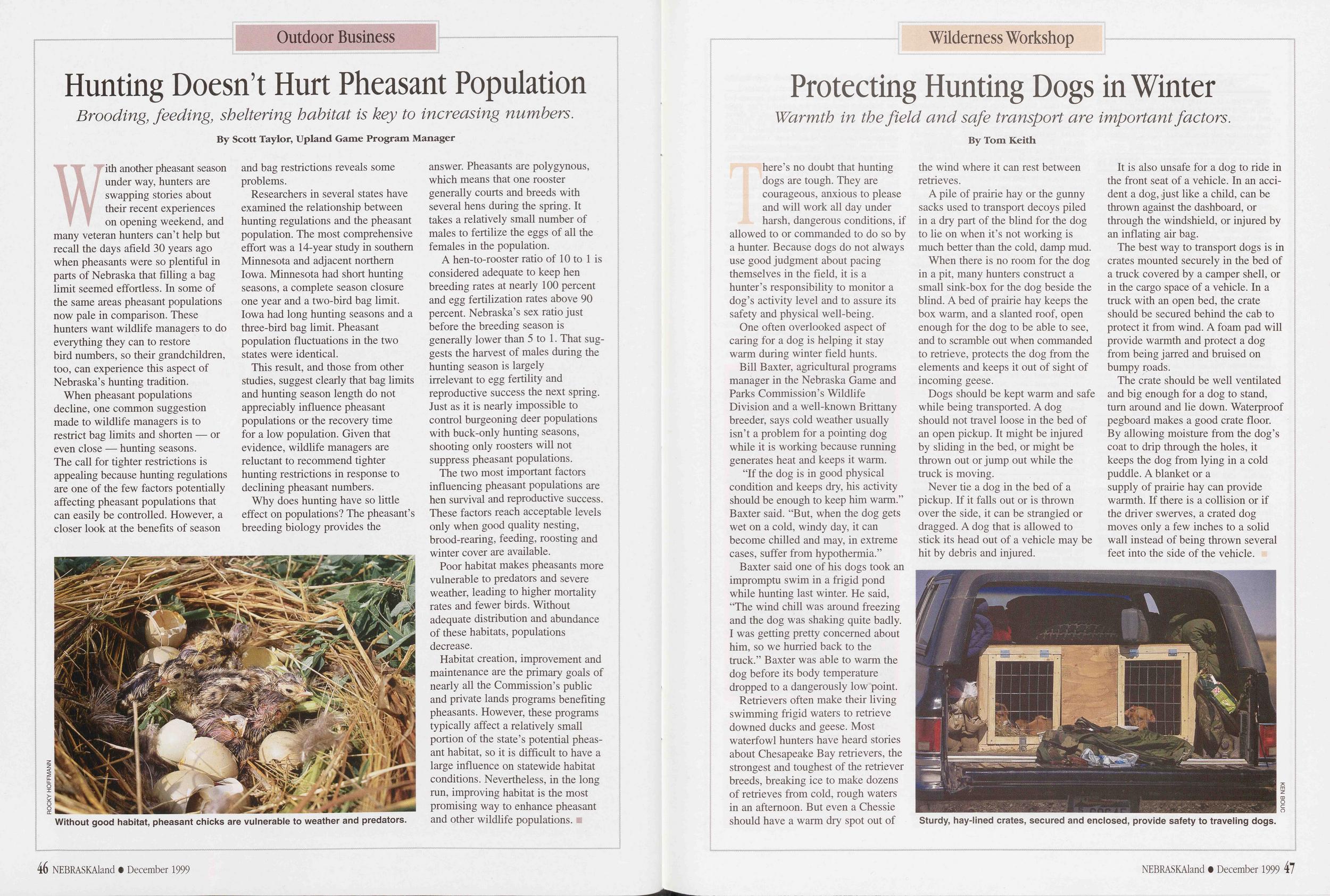
Outdoor Business
Hunting Doesn't Hurt Pheasant Population
Brooding, feeding, sheltering habitat is key to increasing numbers. By Scott Taylor, Upland Game Program Managerith another pheasant season under way, hunters are swapping stories about their recent experiences on opening weekend, and many veteran hunters can't help but recall the days afield 30 years ago when pheasants were so plentiful in parts of Nebraska that filling a bag limit seemed effortless. In some of the same areas pheasant populations now pale in comparison. These hunters want wildlife managers to do everything they can to restore bird numbers, so their grandchildren, too, can experience this aspect of Nebraska's hunting tradition.
When pheasant populations decline, one common suggestion made to wildlife managers is to restrict bag limits and shorten — or even close — hunting seasons. The call for tighter restrictions is appealing because hunting regulations are one of the few factors potentially affecting pheasant populations that can easily be controlled. However, a closer look at the benefits of season and bag restrictions reveals some problems.
Researchers in several states have examined the relationship between hunting regulations and the pheasant population. The most comprehensive effort was a 14-year study in southern Minnesota and adjacent northern Iowa. Minnesota had short hunting seasons, a complete season closure one year and a two-bird bag limit. Iowa had long hunting seasons and a three-bird bag limit. Pheasant population fluctuations in the two states were identical.
This result, and those from other studies, suggest clearly that bag limits and hunting season length do not appreciably influence pheasant populations or the recovery time for a low population. Given that evidence, wildlife managers are reluctant to recommend tighter hunting restrictions in response to declining pheasant numbers.
Why does hunting have so little effect on populations? The pheasant's breeding biology provides the answer. Pheasants are polygynous, which means that one rooster generally courts and breeds with several hens during the spring. It takes a relatively small number of males to fertilize the eggs of all the females in the population.
A hen-to-rooster ratio of 10 to 1 is considered adequate to keep hen breeding rates at nearly 100 percent and egg fertilization rates above 90 percent. Nebraska's sex ratio just before the breeding season is generally lower than 5 to 1. That suggests the harvest of males during the hunting season is largely irrelevant to egg fertility and reproductive success the next spring. Just as it is nearly impossible to control burgeoning deer populations with buck-only hunting seasons, shooting only roosters will not suppress pheasant populations.
The two most important factors influencing pheasant populations are hen survival and reproductive success. These factors reach acceptable levels only when good quality nesting, brood-rearing, feeding, roosting and winter cover are available.
Poor habitat makes pheasants more vulnerable to predators and severe weather, leading to higher mortality rates and fewer birds. Without adequate distribution and abundance of these habitats, populations decrease.
Habitat creation, improvement and maintenance are the primary goals of nearly all the Commission's public and private lands programs benefiting pheasants. However, these programs typically affect a relatively small portion of the state's potential pheasant habitat, so it is difficult to have a large influence on statewide habitat conditions. Nevertheless, in the long run, improving habitat is the most promising way to enhance pheasant and other wildlife populations
Wilderness Workshop
Protecting Hunting Dogs in Winter
Warmth in the field and safe transport are important factors. By Tom Keithhere's no doubt that hunting dogs are tough. They are courageous, anxious to please and will work all day under harsh, dangerous conditions, if allowed to or commanded to do so by a hunter. Because dogs do not always use good judgment about pacing themselves in the field, it is a hunter's responsibility to monitor a dog's activity level and to assure its safety and physical well-being.
One often overlooked aspect of caring for a dog is helping it stay warm during winter field hunts.
Bill Baxter, agricultural programs manager in the Nebraska Game and Parks Commission's Wildlife Division and a well-known Brittany breeder, says cold weather usually isn't a problem for a pointing dog while it is working because running generates heat and keeps it warm.
"If the dog is in good physical condition and keeps dry, his activity should be enough to keep him warm." Baxter said. "But, when the dog gets wet on a cold, windy day, it can become chilled and may, in extreme cases, suffer from hypothermia."
Baxter said one of his dogs took an impromptu swim in a frigid pond while hunting last winter. He said, "The wind chill was around freezing and the dog was shaking quite badly. I was getting pretty concerned about him, so we hurried back to the truck." Baxter was able to warm the dog before its body temperature dropped to a dangerously low point.
Retrievers often make their living swimming frigid waters to retrieve downed ducks and geese. Most waterfowl hunters have heard stories about Chesapeake Bay retrievers, the strongest and toughest of the retriever breeds, breaking ice to make dozens of retrieves from cold, rough waters in an afternoon. But even a Chessie should have a warm dry spot out of the wind where it can rest between retrieves.
A pile of prairie hay or the gunny sacks used to transport decoys piled in a dry part of the blind for the dog to lie on when it's not working is much better than the cold, damp mud.
When there is no room for the dog in a pit, many hunters construct a small sink-box for the dog beside the blind. A bed of prairie hay keeps the box warm, and a slanted roof, open enough for the dog to be able to see, and to scramble out when commanded to retrieve, protects the dog from the elements and keeps it out of sight of incoming geese.
Dogs should be kept warm and safe while being transported. A dog should not travel loose in the bed of an open pickup. It might be injured by sliding in the bed, or might be thrown out or jump out while the truck is moving.
Never tie a dog in the bed of a pickup. If it falls out or is thrown over the side, it can be strangled or dragged. A dog that is allowed to stick its head out of a vehicle may be hit by debris and injured.
It is also unsafe for a dog to ride in the front seat of a vehicle. In an acci- dent a dog, just like a child, can be thrown against the dashboard, or through the windshield, or injured by an inflating air bag.
The best way to transport dogs is in crates mounted securely in the bed of a truck covered by a camper shell, or in the cargo space of a vehicle. In a truck with an open bed, the crate should be secured behind the cab to protect it from wind. A foam pad will provide warmth and protect a dog from being jarred and bruised on bumpy roads.
The crate should be well ventilated and big enough for a dog to stand, turn around and lie down. Waterproof pegboard makes a good crate floor. By allowing moisture from the dog's coat to drip through the holes, it keeps the dog from lying in a cold puddle. A blanket or a supply of prairie hay can provide warmth. If there is a collision or if the driver swerves, a crated dog moves only a few inches to a solid wall instead of being thrown several feet into the side of the vehicle.
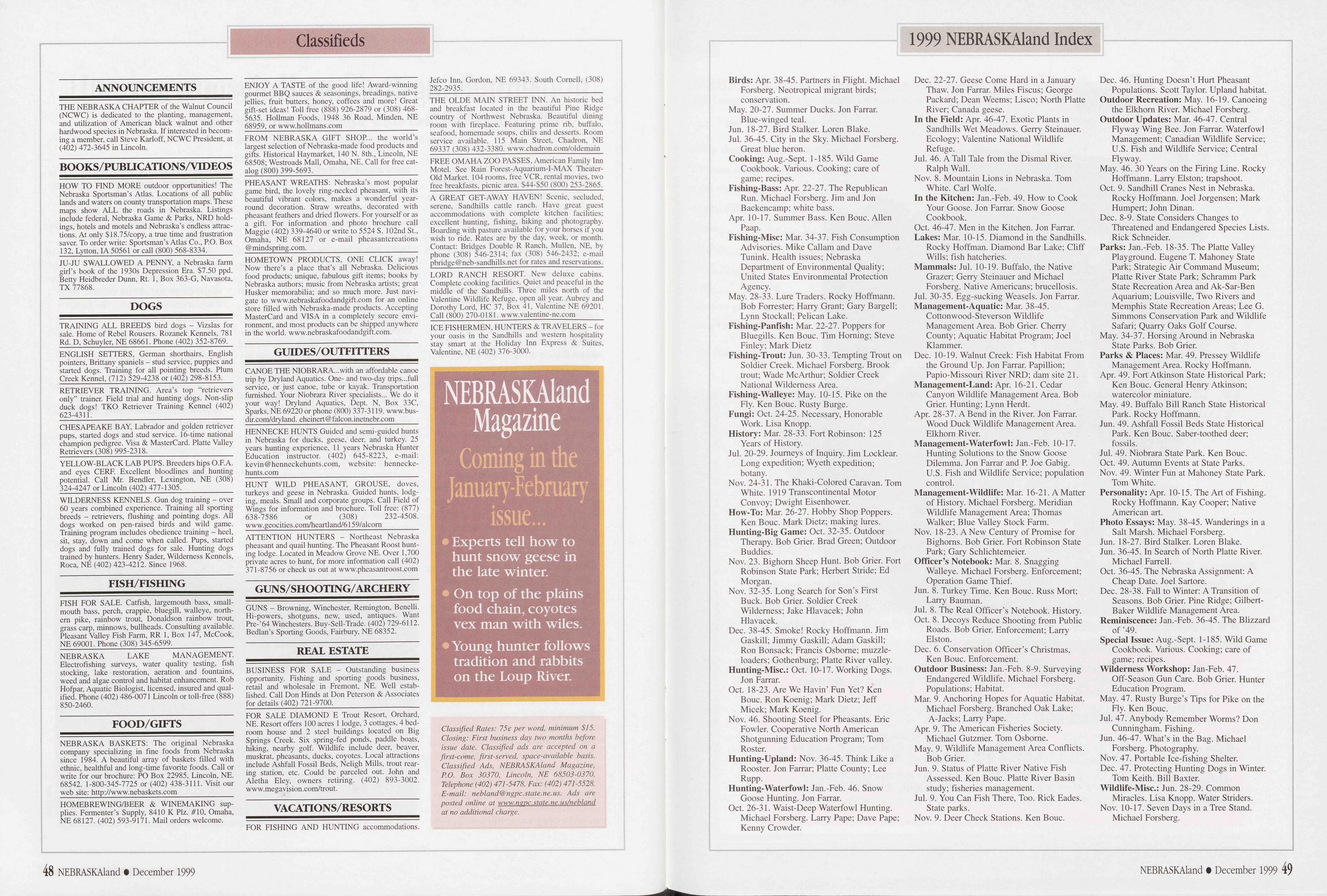
Classifieds
ANNOUNCEMENTSTHE NEBRASKA CHAPTER of the Walnut Council (NCWC) is dedicated to the planting, management, and utilization of American black walnut and other hardwood species in Nebraska. If interested in becoming a member, call Steve Karloff, NCWC President, at (402) 472-3645 in Lincoln.
BOOKS/PUBLICATIONS/VIDEOSHOW TO FIND MORE outdoor opportunities! The Nebraska Sportsman's Atlas. Locations of all public lands and waters on county transportation maps. These maps show ALL the roads in Nebraska. Listings include federal, Nebraska Game & Parks, NRD holdings, hotels and motels and Nebraska's endless attractions. At only $18.75/copy, a true time and frustration saver. To order write: Sportsman's Atlas Co., P.O. Box 132, Lytton, IA 50561 or call (800) 568-8334.
JU-JU SWALLOWED A PENNY, a Nebraska farm girl's book of the 1930s Depression Era. $7.50 ppd. Betty Heidbreder Dunn, Rt. 1, Box 363-G, Navasota, TX 77868.
DOGSTRAINING ALL BREEDS bird dogs - Vizslas for sale. Home of Rebel Rousers. Rozanek Kennels, 781 Rd. D, Schuyler, NE 68661. Phone (402) 352-8769.
ENGLISH SETTERS, German shorthairs, English pointers, Brittany spaniels - stud service, puppies and started dogs. Training for all pointing breeds. Plum Creek Kennel, (712) 529-4238 or (402) 298-8153.
RETRIEVER TRAINING. Area's top "retrievers only" trainer. Field trial and hunting dogs. Non-slip duck dogs! TKO Retriever Training Kennel (402) 623-4311.
CHESAPEAKE BAY, Labrador and golden retriever pups, started dogs and stud service. 16-time national champion pedigree. Visa & MasterCard. Platte Valley Retrievers (308) 995-2318.
YELLOW-BLACK LAB PUPS. Breeders hips O.F.A. and eyes CERE. Excellent bloodlines and hunting potential. Call Mr. Bendler, Lexington, NE (308) 324-4247 or Lincoln (402) 477-1305.
WILDERNESS KENNELS. Gun dog training - over 60 years combined experience. Training all sporting breeds - retrievers, flushing and pointing dogs. All dogs worked on pen-raised birds and wild game. Training program includes obedience training - heel, sit, stay, down and come when called. Pups, started dogs and fully trained dogs for sale. Hunting dogs trained by hunters. Henry Sader, Wilderness Kennels, Roca, NE (402) 423-4212. Since 1968.
FISH/FISHINGFISH FOR SALE. Catfish, largemouth bass, smallmouth bass, perch, crappie, bluegill, walleye, northern pike, rainbow trout, Donaldson rainbow trout, grass carp, minnows, bullheads. Consulting available. Pleasant Valley Fish Farm, RR 1, Box 147, McCook, NE 69001. Phone (308) 345-6599.
NEBRASKA LAKE MANAGEMENT. Electrofishing surveys, water quality testing, fish stocking, lake restoration, aeration and fountains, weed and algae control and habitat enhancement. Rob Hofpar, Aquatic Biologist, licensed, insured and qualified. Phone (402) 486-0071 Lincoln or toll-free (888) 850-2460.
FOOD/GIFTSNEBRASKA BASKETS: The original Nebraska company specializing in fine foods from Nebraska since 1984. A beautiful array of baskets filled with ethnic, healthful and long-time favorite foods. Call or write for our brochure: PO Box 22985, Lincoln, NE. 68542. 1-800-345-7725 or (402) 438-3111. Visit our web site: http://www.nebaskets.com
HOMEBREWING/BEER & WINEMAKING supplies. Fermenter's Supply, 8410 K Plz. #10, Omaha, NE 68127. (402) 593-9171. Mail orders welcome. ENJOY A TASTE of the good life! Award-winning gourmet BBQ sauces & seasonings, breadings, native jellies, fruit butters, honey, coffees and more! Great gift-set ideas! Toll free (888) 926-2879 or (308) 468- 5635. Hollman Foods, 1948 36 Road, Minden, NE 68959, or www.hollmans.com
FROM NEBRASKA GIFT SHOP... the world's largest selection of Nebraska-made food products and gifts. Historical Haymarket, 140 N. 8th., Lincoln, NE 68508; Westroads Mall, Omaha, NE. Call for free catalog (800) 399-5693.
PHEASANT WREATHS: Nebraska's most popular game bird, the lovely ring-necked pheasant, with its beautiful vibrant colors, makes a wonderful yearround decoration. Straw wreaths, decorated with pheasant feathers and dried flowers. For yourself or as a gift. For information and photo brochure call Maggie (402) 339-4640 or write to 5524 S. 102nd St., Omaha, NE 68127 or e-mail pheasant creations @ mindspring.com.
HOMETOWN PRODUCTS, ONE CLICK away! Now there's a place that's all Nebraska. Delicious food products; unique, fabulous gift items; books by Nebraska authors; music from Nebraska artists; great Husker memorabilia; and so much more. Just navigate to www.nebraskafoodandgift.com for an online store filled with Nebraska-made products. Accepting MasterCard and VISA in a completely secure environment, and most products can be shipped anywhere in the world, www.nebraskafoodandgift.com.
GUIDES/OUTFITTERSCANOE THE NIOBRARA...with an affordable canoe trip by Dryland Aquatics. One- and two-day trips...full service, or just canoe, tube or kayak. Transportation furnished. Your Niobrara River specialists... We do it your way! Dryland Aquatics, Dept. N, Box 33C, Sparks, NE 69220 or phone (800) 337-3119. www.busdir. com/dry land. eheinert @ falcon.inetnebr.com
HENNECKE HUNTS Guided and semi-guided hunts in Nebraska for ducks, geese, deer, and turkey. 25 years hunting experience, 11 years Nebraska Hunter Education instructor. (402) 645-8223, e-mail: kevin@henneckehunts.com, website: henneckehunts.com
HUNT WILD PHEASANT, GROUSE, doves, turkeys and geese in Nebraska. Guided hunts, lodging, meals. Small and corporate groups. Call Field of Wings for information and brochure. Toll free: (877) 638-7586 or (308) 232-4508. www.geocities.com/heartland/6159/alcorn.
ATTENTION HUNTERS - Northeast Nebraska pheasant and quail hunting. The Pheasant Roost hunting lodge. Located in Meadow Grove NE. Over 1,700 private acres to hunt, for more information call (402) 371-8756 or check us out at www.pheasantroost.com
GUNS/SHOOTING/ARCHERYGUNS - Browning, Winchester, Remington, Benelli. Hi-powers, shotguns, new, used, antiques. Want Pre-'64 Winchesters. Buy-Sell-Trade. (402) 729-6112. Bedlan's Sporting Goods, Fairbury, NE 68352.
REAL ESTATEBUSINESS FOR SALE - Outstanding business opportunity. Fishing and sporting goods business, retail and wholesale in Fremont, NE. Well established. Call Don Hinds at Don Peterson & Associates for details (402) 721-9700.
FOR SALE DIAMOND E Trout Resort, Orchard, NE. Resort offers 100 acres 1 lodge, 3 cottages, 4 bedroom house and 2 steel buildings located on Big Springs Creek. Six spring-fed ponds, paddle boats, hiking, nearby golf. Wildlife include deer, beaver, muskrat, pheasants, ducks, coyotes. Local attractions include Ashfall Fossil Beds, Neligh Mills, trout rearing station, etc. Could be parceled out. John and Aletha Eley, owners retiring. (402) 893-3002. www.megavision.com/trout.
VACATIONS/RESORTSFOR FISHING AND HUNTING accommodations. Jefco Inn, Gordon, NE 69343. South Cornell, (308) 282-2935.
THE OLDE MAIN STREET INN. An historic bed and breakfast located in the beautiful Pine Ridge country of Northwest Nebraska. Beautiful dining room with fireplace. Featuring prime rib, buffalo, seafood, homemade soups, chilis and desserts. Room service available. 115 Main Street, Chadron, NE 69337 (308) 432-3380. www.chadron.com/oldemain FREE OMAHA ZOO PASSES, American Family Inn Motel. See Rain Forest-Aquarium-I-MAX Theater- Old Market. 104 rooms, free VCR, rental movies, two free breakfasts, picnic area. $44-$50 (800) 253-2865.
A GREAT GET-AWAY HAVEN! Scenic, secluded, serene, Sandhills cattle ranch. Have great guest accommodations with complete kitchen facilities; excellent hunting, fishing, hiking and photography. Boarding with pasture available for your horses if you wish to ride. Rates are by the day, week, or month. Contact: Bridges Double R Ranch, Mullen, NE, by phone (308) 546-2314; fax (308) 546-2432; e-mail pbridge@neb-sandhills.net for rates and reservations.
LORD RANCH RESORT. New deluxe cabins. Complete cooking facilities. Quiet and peaceful in the middle of the Sandhills. Three miles north of the Valentine Wildlife Refuge, open all year. Aubrey and Dorothy Lord, HC 37, Box 41, Valentine NE 69201. Call (800) 270-0181. www.valentine-ne.com
ICE FISHERMEN, HUNTERS & TRAVELERS - for your oasis in the Sandhills and western hospitality stay smart at the Holiday Inn Express & Suites, Valentine, NE (402) 376-3000.
NEBRASKAland magazine hunt snow geese in the late winter. On top of the plains food chain, coyotes vex man with wiles. Young hunter follows tradition and rabbits on the Loup River. Classified Rates: 75$ per word, minimum $15. Closing: First business day two months before issue date. Classified ads are accepted on a first-come, first-served, space-available basis. Classified Ads, NEBRASKAland Magazine, P.O. Box 30370, Lincoln, NE 68503-0370. Telephone (402) 471-5478. Fax: (402) 471-5528. E-mail: nebland@ngpc.state.ne.us. Ads are posted online at www.ngpc.state.ne. us/nebland at no additional charge. 48 NEBRASKAland • December 19991999 NEBRASKAland Index
Birds: Apr. 38-45. Partners in Flight. Michael Forsberg. Neotropical migrant birds; conservation. May. 20-27. Summer Ducks. Jon Farrar. Blue-winged teal. Jun. 18-27. Bird Stalker. Loren Blake. Jul. 36-45. City in the Sky. Michael Forsberg. Great blue heron.
Cooking: Aug.-Sept. 1-185. Wild Game Cookbook. Various. Cooking; care of game; recipes
Fishing-Bass: Apr. 22-27. The Republican Run. Michael Forsberg. Jim and Jon Backencamp; white bass. Apr. 10-17. Summer Bass. Ken Bouc. Allen Paap.
Fishing-Misc: Mar. 34-37. Fish Consumption Advisories. Mike Callam and Dave Tunink. Health issues; Nebraska Department of Environmental Quality; United States Environmental Protection Agency. May. 28-33. Lure Traders. Rocky Hoffmann. Bob Forrester; Harry Grant; Gary Bargell; Lynn Stockall; Pelican Lake.
Fishing-Panfish: Mar. 22-27. Poppers for Bluegills. Ken Bouc. Tim Horning; Steve Finley; Mark Dietz
Fishing-Trout: Jun. 30-33. Tempting Trout on Soldier Creek. Michael Forsberg. Brook trout; Wade McArthur; Soldier Creek National Wilderness Area.
Fishing-Walleye: May. 10-15. Pike on the Fly. Ken Bouc. Rusty Burge.
Fungi: Oct. 24-25. Necessary, Honorable Work. Lisa Knopp.
History: Mar. 28-33. Fort Robinson: 125 Years of History. Jul. 20-29. Journeys of Inquiry. Jim Locklear. Long expedition; Wyeth expedition; botany. Nov. 24-31. The Khaki-Colored Caravan. Tom White. 1919 Transcontinental Motor Convoy; Dwight Eisenhower.
How-To: Mar. 26-27. Hobby Shop Poppers. Ken Bouc. Mark Dietz; making lures.
Hunting-Big Game: Oct. 32-35. Outdoor Therapy. Bob Grier. Brad Green; Outdoor Buddies. Nov. 23. Bighorn Sheep Hunt. Bob Grier. Fort Robinson State Park; Herbert Stride; Ed Morgan. Nov. 32-35. Long Search for Son's First Buck. Bob Grier. Soldier Creek Wilderness; Jake Hlavacek; John Hlavacek. Dec. 38-45. Smoke! Rocky Hoffmann. Jim Gaskill; Jimmy Gaskill; Adam Gaskill; Ron Bonsack; Francis Osborne; muzzle- loaders; Gothenburg; Platte River valley.
Hunting-Misc: Oct. 10-17. Working Dogs. Jon Farrar. Oct. 18-23. Are We Havin' Fun Yet? Ken Bouc. Ron Koenig; Mark Dietz; Jeff Micek; Mark Koenig. Nov. 46. Shooting Steel for Pheasants. Eric Fowler. Cooperative North American Shotgunning Education Program; Tom Roster.
Hunting-Upland: Nov. 36-45. Think Like a Rooster. Jon Farrar; Platte County; Lee Rupp.
Hunting-Waterfowl: Jan.-Feb. 46. Snow Goose Hunting. Jon Farrar. Oct. 26-31. Waist-Deep Waterfowl Hunting. Michael Forsberg. Larry Pape; Dave Pape; Kenny Crowder Dec. 22-21. Geese Come Hard in a January Thaw. Jon Farrar. Miles Fiscus; George Packard; Dean Weems; Lisco; North Platte River; Canada geese.
In the Field: Apr. 46-47. Exotic Plants in Sandhills Wet Meadows. Gerry Steinauer. Ecology; Valentine National Wildlife Refuge. Jul. 46. A Tall Tale from the Dismal River. Ralph Wall. Nov. 8. Mountain Lions in Nebraska. Tom White. Carl Wolfe.
In the Kitchen: Jan.-Feb. 49. How to Cook Your Goose. Jon Farrar. Snow Goose Cookbook. Oct. 46-47. Men in the Kitchen. Jon Farrar.
Lakes: Mar. 10-15. Diamond in the Sandhills. Rocky Hoffman. Diamond Bar Lake; Cliff Wills; fish hatcheries.
Mammals: Jul. 10-19. Buffalo, the Native Grazer; Gerry Steinauer and Michael Forsberg. Native Americans; brucellosis. Jul. 30-35. Egg-sucking Weasels. Jon Farrar.
Management-Aquatic: Mar. 38-45. Cottonwood-Steverson Wildlife Management Area. Bob Grier. Cherry County; Aquatic Habitat Program; Joel Klammer. Dec. 10-19. Walnut Creek: Fish Habitat From the Ground Up. Jon Farrar. Papillion; Papio-Missouri River NRD; dam site 21.
Management-Land: Apr. 16-21. Cedar Canyon Wildlife Management Area. Bob Grier. Hunting; Lynn Herdt. Apr. 28-37. A Bend in the River. Jon Farrar. Wood Duck Wildlife Management Area. Elkhorn River.
Management-Waterfowl: Jan.-Feb. 10-17. Hunting Solutions to the Snow Goose Dilemma. Jon Farrar and P. Joe Gabig. U.S. Fish and Wildlife Service; population control.
Management-Wildlife: Mar. 16-21. A Matter of History. Michael Forsberg. Meridian Wildlife Management Area; Thomas Walker; Blue Valley Stock Farm. Nov. 18-23. A New Century of Promise for Bighorns. Bob Grier. Fort Robinson State Park; Gary Schlichtemeier.
Officer's Notebook: Mar. 8. Snagging Walleye. Michael Forsberg. Enforcement; Operation Game Thief. Jun. 8. Turkey Time. Ken Bouc. Russ Mort; Larry Bauman. Jul. 8. The Real Officer's Notebook. History. Oct. 8. Decoys Reduce Shooting from Public Roads. Bob Grier. Enforcement; Larry Elston. Dec. 6. Conservation Officer's Christmas, Ken Bouc. Enforcement.
Outdoor Business: Jan.-Feb. 8-9. Surveying Endangered Wildlife. Michael Forsberg. Populations; Habitat. Mar. 9. Anchoring Hopes for Aquatic Habitat. Michael Forsberg. Branched Oak Lake; A-Jacks; Larry Pape. Apr. 9. The American Fisheries Society. Michael Gutzmer. Tom Osborne. May. 9. Wildlife Management Area Conflicts. Bob Grier. Jun. 9. Status of Platte River Native Fish Assessed. Ken Bouc. Platte River Basin study; fisheries management. Jul. 9. You Can Fish There, Too. Rick Eades. State parks. Nov. 9. Deer Check Stations. Ken Bouc. Dec. 46. Hunting Doesn't Hurt Pheasant Populations. Scott Taylor. Upland habitat.
Outdoor Recreation: May. 16-19. Canoeing the Elkhorn River. Michael Forsberg.
Outdoor Updates: Mar. 46-47. Central Fly way Wing Bee. Jon Farrar. Waterfowl Management; Canadian Wildlife Service; U.S. Fish and Wildlife Service; Central Flyway. May. 46. 30 Years on the Firing Line. Rocky Hoffmann. Larry Elston; trap shoot. Oct. 9. Sandhill Cranes Nest in Nebraska. Rocky Hoffmann. Joel Jorgensen; Mark Humpert; John Dinan. Dec. 8-9. State Considers Changes to Threatened and Endangered Species Lists. Rick Schneider.
Parks: Jan.-Feb. 18-35. The Platte Valley Playground. Eugene T. Mahoney State Park; Strategic Air Command Museum; Platte River State Park; Schramm Park State Recreation Area and Ak-Sar-Ben Aquarium; Louisville, Two Rivers and Memphis State Recreation Areas; Lee G. Simmons Conservation Park and Wildlife Safari; Quarry Oaks Golf Course. May. 34-37. Horsing Around in Nebraska State Parks. Bob Grier.
Parks & Places: Mar. 49. Pressey Wildlife Management Area. Rocky Hoffmann. Apr. 49. Fort Atkinson State Historical Park; Ken Bouc. General Henry Atkinson; watercolor miniature. May. 49. Buffalo Bill Ranch State Historical Park. Rocky Hoffmann. Jun. 49. Ashfall Fossil Beds State Historical Park. Ken Bouc. Saber-toothed deer; fossils. Jul. 49. Niobrara State Park. Ken Bouc. Oct. 49. Autumn Events at State Parks. Nov. 49. Winter Fun at Mahoney State Park. Tom White.
Personality: Apr. 10-15. The Art of Fishing. Rocky Hoffmann. Kay Cooper; Native American art.
Photo Essays: May. 38-45. Wanderings in a Salt Marsh. Michael Forsberg. Jun. 18-27. Bird Stalker. Loren Blake. Jun. 36-45. In Search of North Platte River. Michael Farrell. Oct. 36-45. The Nebraska Assignment: A Cheap Date. Joel Sartore. Dec. 28-38. Fall to Winter: A Transition of Seasons. Bob Grier. Pine Ridge; Gilbert- Baker Wildlife Management Area.
Reminiscence: Jan.-Feb. 36-45. The Blizzard of '49.
Special Issue: Aug.-Sept. 1-185. Wild Game Cookbook. Various. Cooking; care of game; recipes.
Wilderness Workshop: Jan-Feb. 47. Off-Season Gun Care. Bob Grier. Hunter Education Program. May. 47. Rusty Burge's Tips for Pike on the Fly. Ken Bouc. Jul. 47. Anybody Remember Worms? Don Cunningham. Fishing. Jun. 46-47. What's in the Bag. Michael Forsberg. Photography. Nov. 47. Portable Ice-fishing Shelter. Dec. 47. Protecting Hunting Dogs in Winter. Tom Keith. Bill Baxter." Wildlife-Misc: Jun. 28-29. Common Miracles. Lisa Knopp. Water Striders. Nov. 10-17. Seven Days in a Tree Stand. Michael Forsberg.
NEBRASKAland • December 1999 49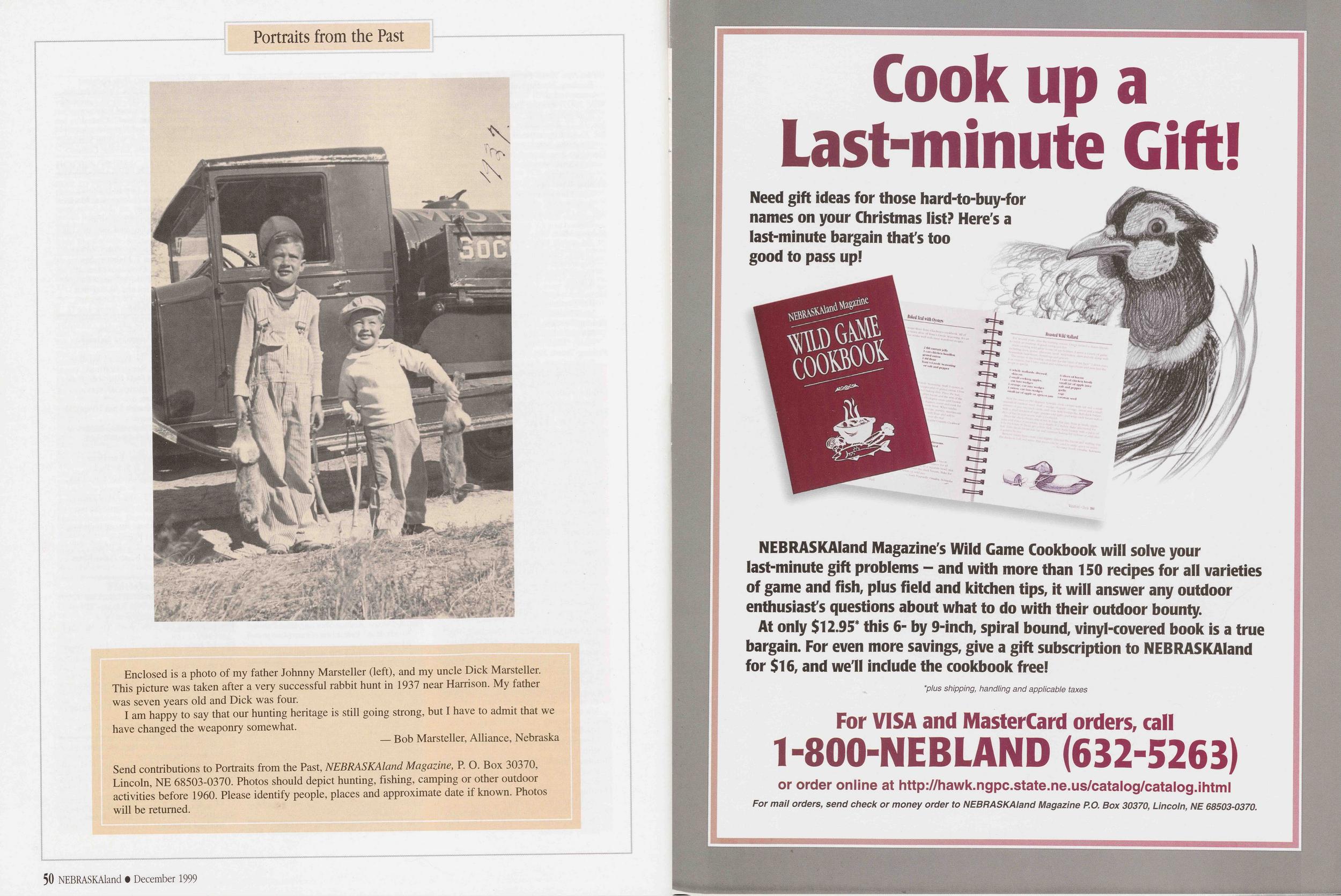
Portraits from the Past
Enclosed is a photo of my father Johnny Marsteller (left), and my uncle Dick Marsteller. This picture was taken after a very successful rabbit hunt in 1937 near Harrison. My father was seven years old and Dick was four.
I am happy to say that our hunting heritage is still going strong, but I have to admit that we have changed the weaponry somewhat.
— Bob Marsteller, Alliance, NebraskaSend contributions to Portraits from the Past, NEBRASKAland Magazine, P. O. Box 30370, Lincoln, NE 68503-0370. Photos should depict hunting, fishing, camping or other outdoor activities before 1960. Please identify people, places and approximate date if known. Photos will be returned.
50 NEBRASKAland • December 1999 Cook up a Last-minute Gift! Need gift ideas for those hard-to-buy-for names on your Christmas list? Here's a last-minute bargain that's too good to pass up! NEBRASKAland Magazine's Wild Game Cookbook will solve your last-minute gift problems - and with more than 150 recipes for all varieties of game and fish, plus field and kitchen tips, it will answer any outdoor enthusiast's questions about what to do with their outdoor bounty. At only $12.95* this 6- by 9-inch, spiral bound, vinyl-covered book is a true bargain. For even more savings, give a gift subscription to NEBRASKAland for $16, and we'll include the cookbook free! *plus shipping, handling and applicable taxes For VISA and MasterCard orders, call 1-800-NEBLAND (632-5263) or order online at http://hawk.ngpc.state.ne.us/catalog/catalog.ihtml For mail orders, send check or money order to NEBRASKAland Magazine P.O. Box 30370, Lincoln, NE 68503-0370.
Position: 97 (61 views)