Volume 77, Issue 9, 1999
NEBRASKAland
Nebraska Game & Parks Commission November 1999 $2.50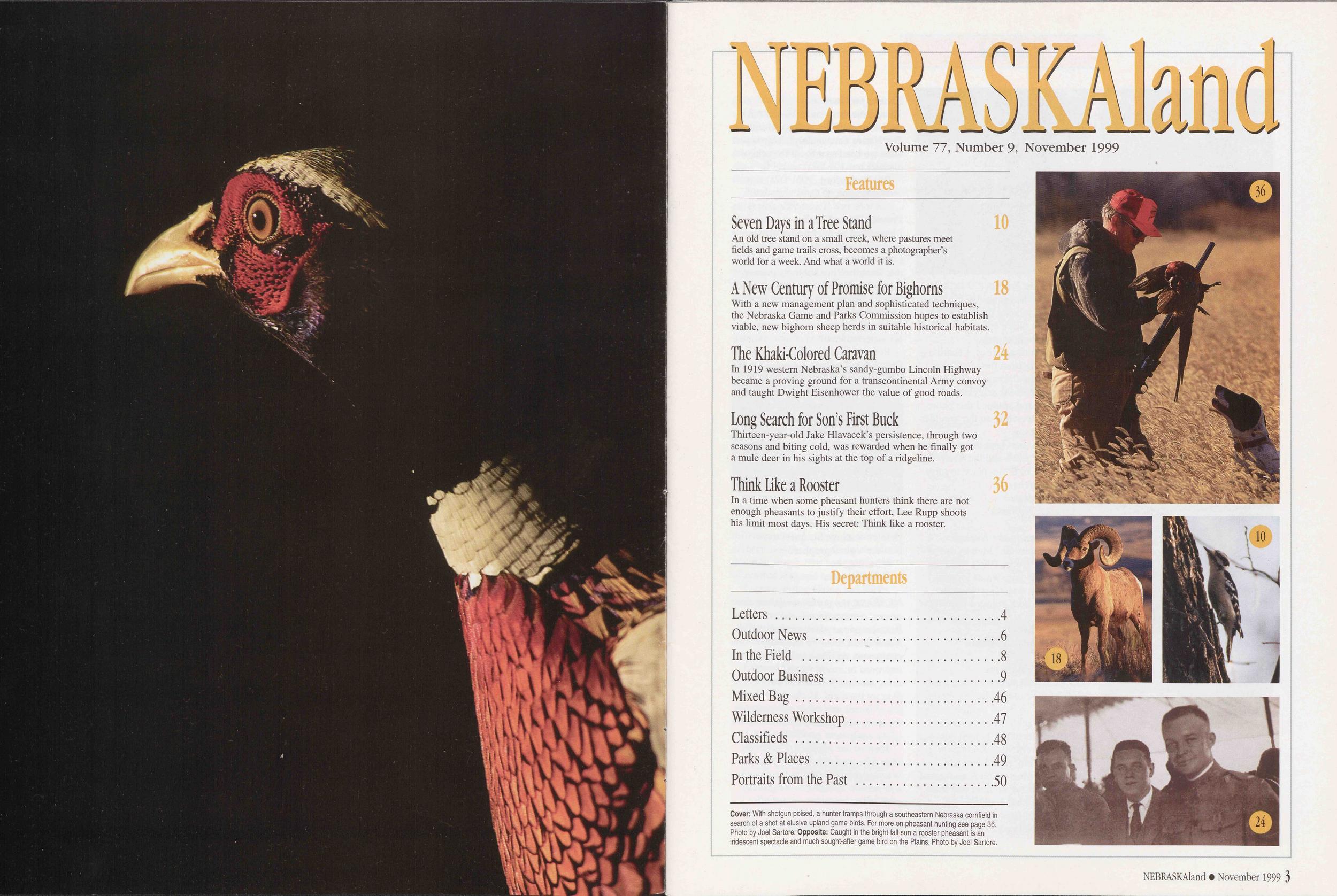
NEBRASKAland
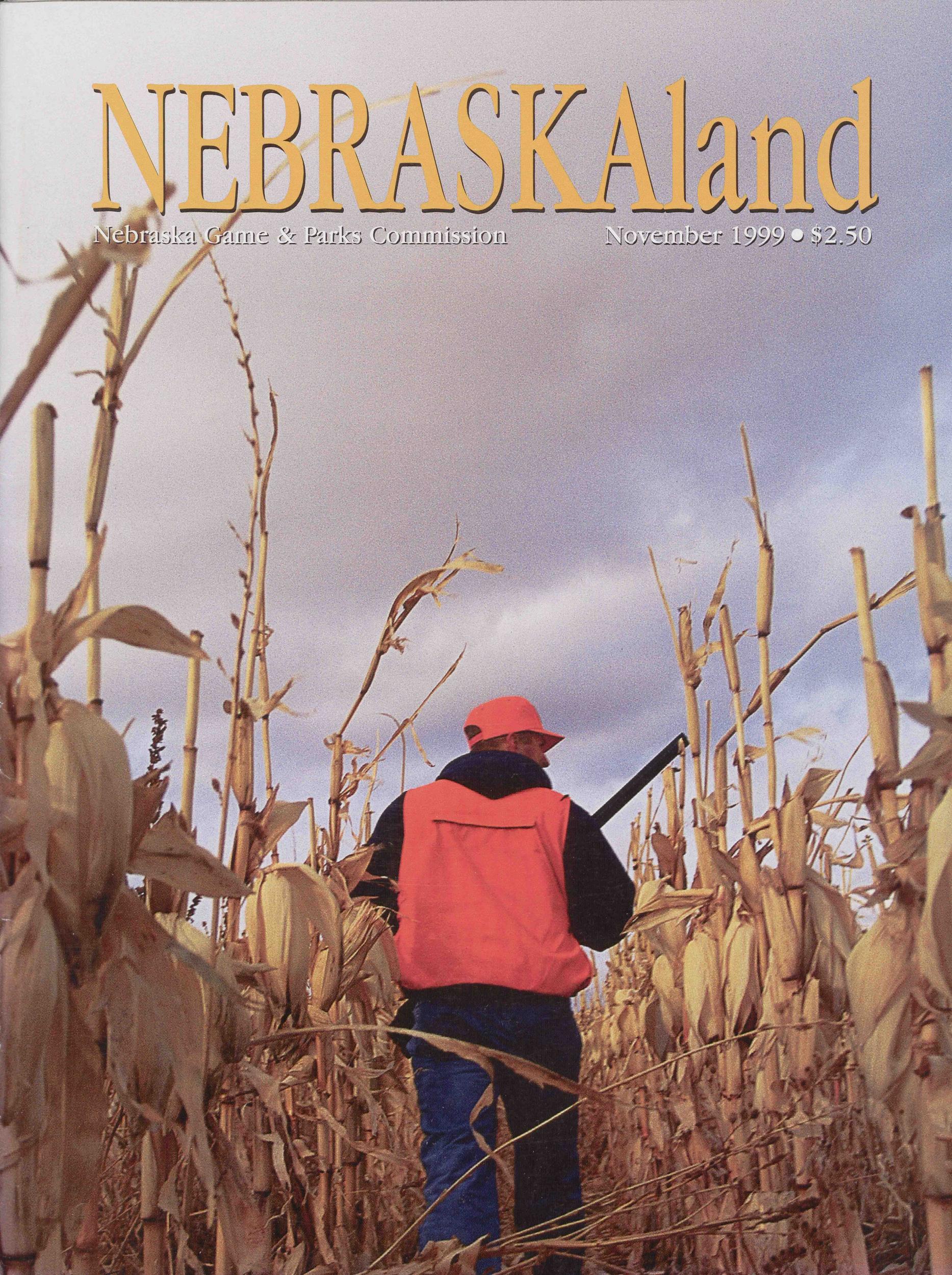
Volume 77, Number 9, November 1999 Features Seven Days in a Tree Stand An old tree stand on a small creek, where pastures meet fields and game trails cross, becomes a photographer's world for a week. And what a world it is. A New Century of Promise for Bighorns With a new management plan and sophisticated techniques, the Nebraska Game and Parks Commission hopes to establish viable, new bighorn sheep herds in suitable historical habitats. The Khaki-Colored Caravan In 1919 western Nebraska's sandy-gumbo Lincoln Highway became a proving ground for a transcontinental Army convoy and taught Dwight Eisenhower the value of good roads. Long Search for Son's First Buck Thirteen-year-old Jake Hlavacek's persistence, through two seasons and biting cold, was rewarded when he finally got a mule deer in his sights at the top of a ridgeline. Think Like a Rooster In a time when some pheasant hunters think there are not enough pheasants to justify their effort, Lee Rupp shoots his limit most days. His secret: Think like a rooster. Departments Letters Outdoor News In the Field Outdoor Business Mixed Bag Wilderness Workshop Classifieds Parks & Places Portraits from the Past 8 9 46 47 48 50 Cover: With shotgun poised, a hunter tramps through a southeastern Nebraska cornfield in search of a shot at elusive upland game birds. For more on pheasant hunting see page 36. Photo by Joel Sartore. Opposite: Caught in the bright fall sun a rooster pheasant is an iridescent spectacle and much sought-after game bird on the Plains. Photo by Joel Sartore.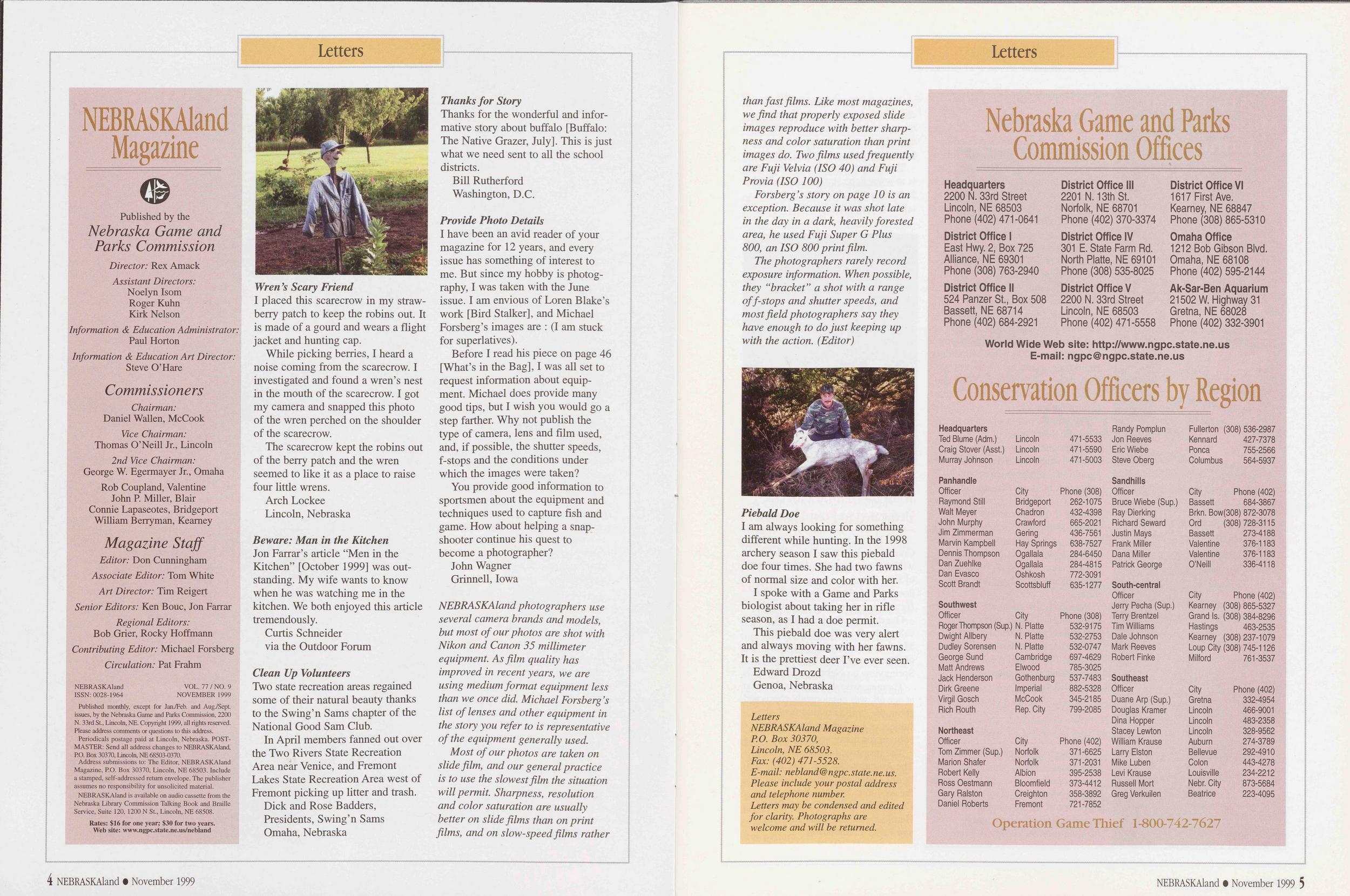
Letters
Published by the Nebraska Game and Parks Commission Director: Rex Amack Assistant Directors: Noelyn Isom Roger Kuhn Kirk Nelson Information & Education Administrator: Paul Norton Information & Education Art Director: Steve O'Hare Commissioners Chairman: Daniel Wallen, McCook Vice Chairman: Thomas O'Neill Jr., Lincoln 2nd Vice Chairman: George W. Egermayer Jr., Omaha Rob Coupland, Valentine John P. Miller, Blair Connie Lapaseotes, Bridgeport William Berryman, Kearney Magazine Staff Editor: Don Cunningham Associate Editor: Tom White Art Director: Tim Reigert Senior Editors: Ken Bouc, Jon Farrar Regional Editors: Bob Grier, Rocky Hoffmann Contributing Editor: Michael Forsberg Circulation: Pat Frahm NEBRASKAland ISSN: 0028-1964 VOL. 77 / NO. 9 NOVEMBER 1999 Published monthly, except for JanTFeb. and AugVSept. issues, by the Nebraska Game and Parks Commission, 2200 N. 33rd St., Lincoln, NE. Copyright 1999, all rights reserved. Please address comments or questions to this address. Periodicals postage paid at Lincoln, Nebraska. POST- MASTER: Send all address changes to NEBRASKAland, P.O. Box 30370, Lincoln, NE 68503-0370. Address submissions to: The Editor, NEBRASKAland Magazine, P.O. Box 30370, Lincoln, NE 68503. Include a stamped, self-addressed return envelope. The publisher assumes no responsibility for unsolicited material. NEBRASKAland is available on audio cassette from the Nebraska Library Commission Talking Book and Braille Service, Suite 120, 1200 N St., Lincoln, NE 68508. Rates: $16 for one year; $30 for two years. Web site: www.ngpc.state.ne.us/neblandI placed this scarecrow in my straw- berry patch to keep the robins out. It is made of a gourd and wears a flight jacket and hunting cap.
While picking berries, I heard a noise coming from the scarecrow. I investigated and found a wren's nest in the mouth of the scarecrow. I got my camera and snapped this photo of the wren perched on the shoulder of the scarecrow.
The scarecrow kept the robins out of the berry patch and the wren seemed to like it as a place to raise four little wrens.
Arch Lockee Lincoln, Nebraska Beware: Man in the KitchenJon Farrar's article "Men in the Kitchen" [October 1999] was outstanding. My wife wants to know when he was watching me in the kitchen. We both enjoyed this article tremendously.
Curtis Schneider via the Outdoor Forum Clean Up VolunteersTwo state recreation areas regained some of their natural beauty thanks to the Swing'n Sams chapter of the National Good Sam Club.
In April members fanned out over the Two Rivers State Recreation Area near Venice, and Fremont Lakes State Recreation Area west of Fremont picking up litter and trash.
Dick and Rose Badders, Presidents, Swing'n Sams Omaha, Nebraska Thanks for StoryThanks for the wonderful and informative story about buffalo [Buffalo: The Native Grazer, July]. This is just what we need sent to all the school districts.
Bill Rutherford Washington, D.C. Provide Photo DetailsI have been an avid reader of your magazine for 12 years, and every issue has something of interest to me. But since my hobby is photography, I was taken with the June issue. I am envious of Loren Blake's work [Bird Stalker], and Michael Forsberg's images are : (I am stuck for superlatives).
Before I read his piece on page 46 [What's in the Bag], I was all set to request information about equipment. Michael does provide many good tips, but I wish you would go a step farther. Why not publish the type of camera, lens and film used, and, if possible, the shutter speeds, f-stops and the conditions under which the images were taken?
You provide good information to sportsmen about the equipment and techniques used to capture fish and game. How about helping a snap- shooter continue his quest to become a photographer?
John Wagner Grinnell, IowaNEBRASKAland photographers use several camera brands and models, but most of our photos are shot with Nikon and Canon 35 millimeter equipment As film quality has improved in recent years, we are using medium format equipment less than we once did. Michael Forsberg's list of lenses and other equipment in the story you refer to is representative of the equipment generally used.
Most of our photos are taken on slide film, and our general practice is to use the slowest film the situation will permit. Sharpness, resolution and color saturation are usually better on slide films than on print films, and on slow-speed films rather 4 NEBRASKAland • November 1999 than fast films. Like most magazines, we find that properly exposed slide images reproduce with better sharp- ness and color saturation than print images do. Two films used frequently are Fuji Velvia (ISO 40) and Fuji Provia (ISO 100)
Forsberg's story on page 10 is an exception. Because it was shot late in the day in a dark, heavily forested area, he used Fuji Super G Plus 800, an ISO 800 print film.
The photographers rarely record exposure information. When possible, they (ibracket" a shot with a range off-stops and shutter speeds, and most field photographers say they have enough to do just keeping up with the action. (Editor)
I am always looking for something different while hunting. In the 1998 archery season I saw this piebald doe four times. She had two fawns of normal size and color with her.
I spoke with a Game and Parks biologist about taking her in rifle season, as I had a doe permit.
This piebald doe was very alert and always moving with her fawns. It is the prettiest deer I've ever seen.
Edward Drozd Genoa, Nebraska Letters NEBRASKAland Magazine P.O. Box 30370, Lincoln, NE 68503. Fax: (402) 471-5528. E-mail: nebland@ngpc.state.ne.us. Please include your postal address and telephone number. Letters may be condensed and edited for clarity. Photographs are welcome and will be returned. Nebraska Game and PArks Commission Offices Headquarters 2200 N. 33rd Street Lincoln, NE 68503 Phone (402) 471-0641 District Office I East Hwy. 2, Box 725 Alliance, NE 69301 Phone (308) 763-2940 District Office II 524 Panzer St., Box 508 Bassett, NE 68714 Phone (402) 684-2921 District Office III 2201 N. 13th St. Norfolk, NE 68701 Phone (402) 370-3374 District Office IV 301 E. State Farm Rd. North Platte, NE 69101 Phone (308) 535-8025 District Office V 2200 N. 33rd Street Lincoln, NE 68503 Phone (402) 471-5558 District Office VI 1617 First Ave. Kearney, NE 68847 Phone (308) 865-5310 Omaha Office 1212 Bob Gibson Blvd. Omaha, NE 68108 Phone (402) 595-2144 Ak-Sar-Ben Aquarium 21502 W. Highway 31 Gretna, NE 68028 Phone (402) 332-3901 World Wide Web site: http://www.ngpc.state.ne.us E-mail: ngpc@ngpc.state.ne.us Conservation Officers by Region Headquarters Ted Blume (Adm.) Craig Stover (Asst.) Murray Johnson Panhandle Officer Raymond Still Walt Meyer John Murphy Jim Zimmerman Marvin Kampbell Dennis Thompson Dan Zuehlke Dan Evasco Scott Brandt Southwest Officer Roger Thompson (Sup.) Dwight Allbery Dudley Sorensen George Sund Matt Andrews Jack Henderson Dirk Greene Virgil Gosch Rich Routh Northeast Officer Tom Zimmer (Sup.) Marion Shafer Robert Kelly Ross Oestmann Gary Ralston Daniel Roberts Lincoln Lincoln Lincoln City Bridgeport Chadron Crawford Gering Hay Springs Ogallala Ogallala Oshkosh Scottsbluff City N. Platte N. Platte N. Platte Cambridge Elwood Gothenburg Imperial McCook Rep. City Randy Pomplun 471-5533 Jon Reeves 471-5590 EricWiebe 471-5003 Steve Oberg City Norfolk Norfolk Albion Bloomfield Creighton Fremont Phone (308) 262-1075 432-4398 665-2021 436-7561 638-7527 284-6450 284-4815 772-3091 635-1277 Phone (308) 532-9175 532-2753 532-0747 697-4629 785-3025 537-7483 882-5328 345-2185 799-2085 Phone (402) 371-6625 371-2031 395-2538 373-4412 358-3892 721-7852 Sandhills Officer Bruce Wiebe (Sup.) Ray Dierking Richard Seward Justin Mays Frank Miller Dana Miller Patrick George South-central Officer Jerry Pecha (Sup.) Terry Brentzel Tim Williams Dale Johnson Mark Reeves Robert Finke Southeast Officer Duane Arp (Sup.) Douglas Kramer Dina Hopper Stacey Lewton William Krause Larry Elston Mike Luben Levi Krause Russell Mort Greg Verkuilen Fullerton (308) 536-2987 Kennard 427-7378 Ponca 755-2566 Columbus 564-5937 City Phone (402) Bassett 684-3867 Brkn. Bow(308) 872-3078 Ord (308)728-3115 Bassett 273-4188 Valentine 376-1183 Valentine 376-1183 O'Neill 336-4118 City Phone (402) Kearney (308)865-5327 Grand Is. (308) 384-8296 Hastings 463-2535 Kearney (308)237-1079 Loup City (308) 745-1126 Milford 761-3537 City Gretna Lincoln Lincoln Lincoln Auburn Bellevue Colon Louisville Nebr. City Beatrice Phone 332 466 483 328 274 292 443 234 873 223 (402) 4954 9001 358 562 3789 4910 4278 2212 5684 4095 NEBRASKAland • November 1999 5
Outdoor News
Attention Migratory Bird Hunters... You Must HIP carves* inform program Dove, duck, goose, woodcock hunters must register with the Harvest Information Program (HIP) before hunting and must carry the registration number in the field. 1998 numbers are no longer valid. Call the toll-free number below to register for the 1999 season. 1-800-WETLAND (938-5263) or register online from the Game and Parks Commission's web site: http://www.ngpc.state.ne.us Few Deer Found to Carry E. coli and SalmonellaResearch from deer harvested in Nebraska last year shows that very few carry E.coli 0157.H7 and Salmonella organisms in their feces. The study found less than 0.5 percent, fewer than 1 out of 200, of the deer samples collected were positive for the E.coli and 1 percent, or 1 out of 100, were positive for Salmonella.
Faculty and students from the University of Nebraska-Lincoln and members of the Nebraska Game and Parks Commission assisted researchers from Kansas State University's Food Animal Health and Management Center in a study of more than 1,600 white-tailed deer. Hunters collected fecal samples from deer harvested in the Blue and Wahoo Management Units in southeastern Nebraska.
The study's purpose was to determine the distribution of the E.coli and Salmonella organisms in the feces of white-tailed deer ranging in agricultural environments.
Food contaminated with these bacteria can cause serious illness in humans if the bacteria are not destroyed through thorough cooking. Hunters and consumers of venison should prevent fecal contamination of deer carcasses with proper field dressing and meat handling techniques
Whole cuts of meat are unlikely to cause illness if basic principles of cleanliness are followed and the surface temperature reaches 160 degrees. For ground meat the inter- nal cooking temperature should reach 160 degrees.
Nebraska Fish and Trails Information Now OnlineThe Nebraska Game and Parks Commission has expanded information available to users of its web site at www.ngpc.state.ne.us with a directory of the 60 most common fish species in the state and a detailed recreational trails guide.
Online visitors to the fish directory can search for species by family name, common name or fishing area. The site can be reached at www.ngpc.state.ne.us/fish/fishes.
The recreational trails guide, which is at www.ngpc.state.ne./parks/trails. features a clickable state map that takes the user to a specific trail.
The Nebraska Game and Parks Commission dedicated a 218-acre wildlife management area in honor of Fred Thomas, a long-time outdoors writer for the Omaha World- Herald, in a ceremony October 16.
Overlooking the Niobrara River valley, the Fred Thomas Wildlife Management Area is 11 miles north of Bassett and 15 miles south of Spring view on Nebraska Highway 7.
Thomas, who died earlier this year at age 68, was passionately concerned about the state's environment, the subject of his Sunday newspaper column for many years.
The property, formerly owned by The Audubon Society, was acquired by the Game and Parks Foundation, the Audubon Society, Bruce Cowgill family, the Omaha World- Herald Foundation and the Game and Parks Commission.
6 NEBRASKAland • November 1999 Deer, Pheasant Season Prospects Appear GoodNebraska's prime hunting seasons have arrived, and prospects for favorite game species are good.
Pheasant and quail seasons opened October 30 and run through January 31. The firearm deer season opens Saturday, Nov. 13 and continues through Sunday, Nov. 21.
With 115,000 acres enrolled in the Conservation Reserve Program- Management Access Program (CRP- MAP) this year — up from 20,000 acres in 1997 — hunting pressure should be spread over more acres.
Deer and waterfowl hunters will benefit from CRP-MAP this year. Landowners were permitted to enroll large tracts of wildlife habitat adjacent to CRP acres. Many of the adjacent habitat acreages include wooded areas and wetlands.
Archery deer hunters have reported seeing many deer throughout the state this fall. The summer roadside survey indicated pheasant numbers were slightly down this year due to a wet spring.
A CRP-MAP atlas is available from Commission offices and permit vendors. It is online at www.ngpc. state.ne.us/hunting/crp/crpatlas.html.
Hunters Allowed Only Two Permits for Antlered DeerHunters who have purchased more than two permits for antlered deer this year are asked to return the additional permits to the Nebraska Game and Parks Commission. With proof of payment, such as a can- celled check, the cost of the permit will be refunded.
This year, for the first time, the Commission sold deer permits both through its internet site and through Commission offices and permit ven- dors. When the two data bases were merged, the Commission discovered that some people had purchased more than two permits. It is illegal to possess more than two antlered deer permits.
Ready for Hunting? Don't Forget Your Resident Hunt and Fish$21.75 Resident Hunt$9.50 Resident Fish $12.75 Nonresident Hunt $55.00 Nonresident Fish $35.00 Habitat Stamp $10.00 Aquatic Habitat Stamp $5.00 For a lifetime of outdoor fun, consider a lifetime permit. Lifetime Hunt and Fish $448.00 Lifetime Hunt $224.00 Lifetime Fish $257.50 Hunting and fishing permits are available at all Nebraska Game and Parks Commission offices and from sporting goods stores, outfitters, bait shops and many other vendors throughout the state. For more information call (402) 471-0641. Permits also are available on the Commission's web site: www.ngpc.state.ne.us Nebraska Game and Parks Commission NEBRASKAland • November 1999 7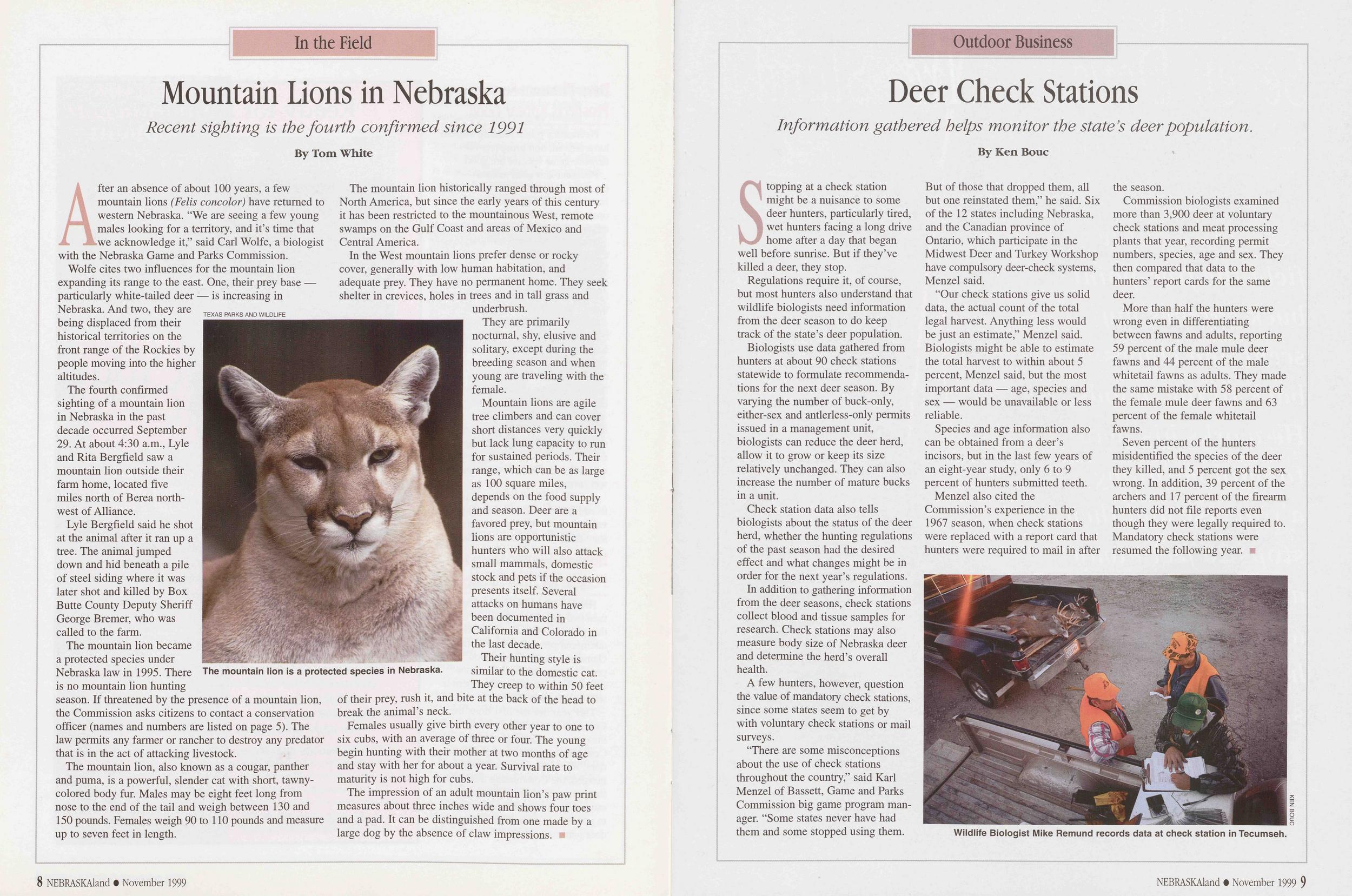
In the Field
Mountain Lions in Nebraska
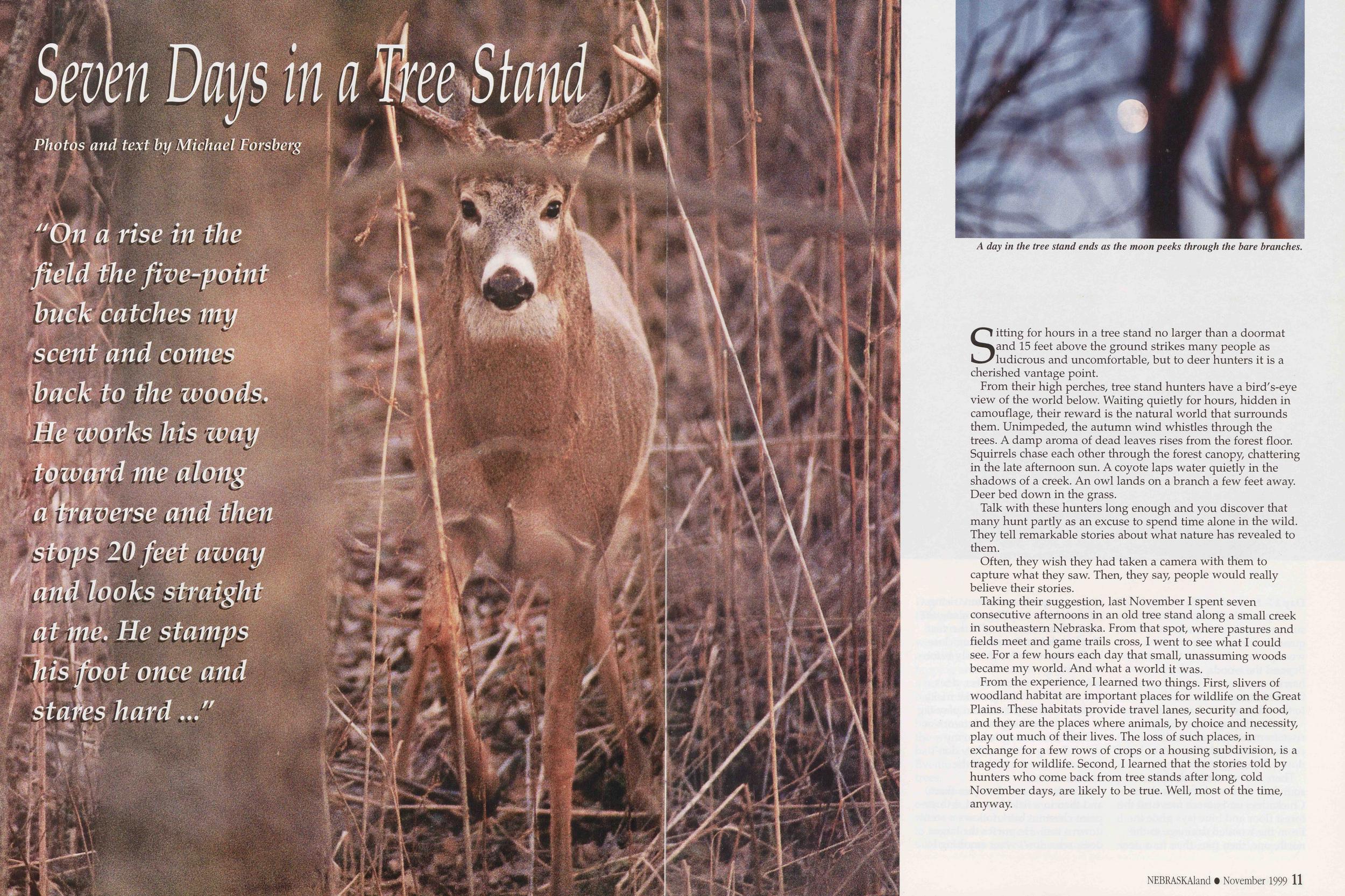
Recent sighting is the fourth confirmed since 1991 By Tom Whitefter an absence of about 100 years, a few mountain lions {Fells concolor) have returned to western Nebraska. "We are seeing a few young males looking for a territory, and it's time that ,we acknowledge it," said Carl Wolfe, a biologist with the Nebraska Game and Parks Cornmission.
Wolfe cites two influences for the mountain lion expanding its range to the east. One, their prey base — particularly white-tailed deer — is increasing in Nebraska. And two, they are being displaced from their historical territories on the front range of the Rockies by people moving into the higher altitudes.
The fourth confirmed sighting of a mountain lion in Nebraska in the past decade occurred September 29. At about 4:30 a.m., Lyle and Rita Bergfield saw a mountain lion outside their farm home, located five miles north of Berea northwest of Alliance.
Lyle Bergfield said he shot at the animal after it ran up a tree. The animal jumped down and hid beneath a pile of steel siding where it was later shot and killed by Box Butte County Deputy Sheriff George Bremer, who was called to the farm.
The mountain lion became a protected species under Nebraska law in 1995. There is no mountain lion hunting season. If threatened by the presence of a mountain lion, the Commission asks citizens to contact a conservation officer (names and numbers are listed on page 5). The law permits any farmer or rancher to destroy any predator that is in the act of attacking livestock.
The mountain lion, also known as a cougar, panther and puma, is a powerful, slender cat with short, tawny- colored body fur. Males may be eight feet long from nose to the end of the tail and weigh between 130 and 150 pounds. Females weigh 90 to 110 pounds and measure up to seven feet in length.
The mountain lion historically ranged through most of North America, but since the early years of this century it has been restricted to the mountainous West, remote swamps on the Gulf Coast and areas of Mexico and Central America.
In the West mountain lions prefer dense or rocky cover, generally with low human habitation, and adequate prey. They have no permanent home. They seek shelter in crevices, holes in trees and in tall grass and underbrush.
They are primarily nocturnal, shy, elusive and solitary, except during the breeding season and when young are traveling with the female.
Mountain lions are agile tree climbers and can cover short distances very quickly but lack lung capacity to run for sustained periods. Their range, which can be as large as 100 square miles, depends on the food supply and season. Deer are a favored prey, but mountain lions are opportunistic hunters who will also attack small mammals, domestic stock and pets if the occasion presents itself. Several attacks on humans have been documented in California and Colorado in the last decade.
Their hunting style is similar to the domestic cat. They creep to within 50 feet of their prey, rush it, and bite at the back of the head to break the animal's neck.
Females usually give birth every other year to one to six cubs, with an average of three or four. The young begin hunting with their mother at two months of age and stay with her for about a year. Survival rate to maturity is not high for cubs.
The impression of an adult mountain lion's paw print measures about three inches wide and shows four toes and a pad. It can be distinguished from one made by a large dog by the absence of claw impressions.
8 NEBRASKAiand • November 1999Outdoor Business
Deer Check Stations
Information gathered helps monitor the state's deer population. By Ken Bouctopping at a check station might be a nuisance to some deer hunters, particularly tired, wet hunters facing a long drive home after a day that began well before sunrise. But if they've killed a deer, they stop.
Regulations require it, of course, but most hunters also understand that wildlife biologists need information from the deer season to do keep track of the state's deer population.
Biologists use data gathered from hunters at about 90 check stations statewide to formulate recommendations for the next deer season. By varying the number of buck-only, either-sex and antlerless-only permits issued in a management unit, biologists can reduce the deer herd, allow it to grow or keep its size relatively unchanged. They can also increase the number of mature bucks in a unit.
Check station data also tells biologists about the status of the deer herd, whether the hunting regulations of the past season had the desired effect and what changes might be in order for the next year's regulations.
In addition to gathering information from the deer seasons, check stations collect blood and tissue samples for research. Check stations may also measure body size of Nebraska deer and determine the herd's overall health.
A few hunters, however, question the value of mandatory check stations, since some states seem to get by with voluntary check stations or mail surveys.
"There are some misconceptions about the use of check stations throughout the country," said Karl Menzel of Bassett, Game and Parks Commission big game program man- ager. "Some states never have had them and some stopped using them. But of those that dropped them, all but one reinstated them," he said. Six of the 12 states including Nebraska, and the Canadian province of Ontario, which participate in the Midwest Deer and Turkey Workshop have compulsory deer-check systems, Menzel said.
"Our check stations give us solid data, the actual count of the total legal harvest. Anything less would be just an estimate," Menzel said. Biologists might be able to estimate the total harvest to within about 5 percent, Menzel said, but the most important data — age, species and sex — would be unavailable or less reliable.
Species and age information also can be obtained from a deer's incisors, but in the last few years of an eight-year study, only 6 to 9 percent of hunters submitted teeth.
Menzel also cited the Commission's experience in the 1967 season, when check stations were replaced with a report card that hunters were required to mail in after the season.
Commission biologists examined more than 3,900 deer at voluntary check stations and meat processing plants that year, recording permit numbers, species, age and sex. They then compared that data to the hunters' report cards for the same deer.
More than half the hunters were wrong even in differentiating between fawns and adults, reporting 59 percent of the male mule deer fawns and 44 percent of the male whitetail fawns as adults. They made the same mistake with 58 percent of the female mule deer fawns and 63 percent of the female whitetail fawns.
Seven percent of the hunters misidentified the species of the deer they killed, and 5 percent got the sex wrong. In addition, 39 percent of the archers and 17 percent of the firearm hunters did not file reports even though they were legally required to. Mandatory check stations were resumed the following year,
Seven Days in a Tree Stand
Photos and text by Michael Forsberg "On a rise in the field the five-point buck catches my scent and comes back to the woods. He works his way toward me along a traverse and then stops 20 feet away and looks straight at me. He stamps his foot once and stares hardSitting for hours in a tree stand no larger than a doormat and 15 feet above the ground strikes many people as ludicrous and uncomfortable, but to deer hunters it is a cherished vantage point.
From their high perches, tree stand hunters have a bird's-eye view of the world below. Waiting quietly for hours, hidden in camouflage, their reward is the natural world that surrounds them. Unimpeded, the autumn wind whistles through the trees. A damp aroma of dead leaves rises from the forest floor. Squirrels chase each other through the forest canopy, chattering in the late afternoon sun. A coyote laps water quietly in the shadows of a creek. An owl lands on a branch a few feet away. Deer bed down in the grass.
Talk with these hunters long enough and you discover that many hunt partly as an excuse to spend time alone in the wild. They tell remarkable stories about what nature has revealed to them.
Often, they wish they had taken a camera with them to capture what they saw. Then, they say, people would really believe their stories.
Taking their suggestion, last November I spent seven consecutive afternoons in an old tree stand along a small creek in southeastern Nebraska. From that spot, where pastures and fields meet and game trails cross, I went to see what I could see. For a few hours each day that small, unassuming woods became my world. And what a world it was.
From the experience, I learned two things. First, slivers of woodland habitat are important places for wildlife on the Great Plains. These habitats provide travel lanes, security and food, and they are the places where animals, by choice and necessity, play out much of their lives. The loss of such places, in exchange for a few rows of crops or a housing subdivision, is a tragedy for wildlife. Second, I learned that the stories told by hunters who come back from tree stands after long, cold November days, are likely to be true. Well, most of the time, anyway.
NEBRASKAland • November 1999 11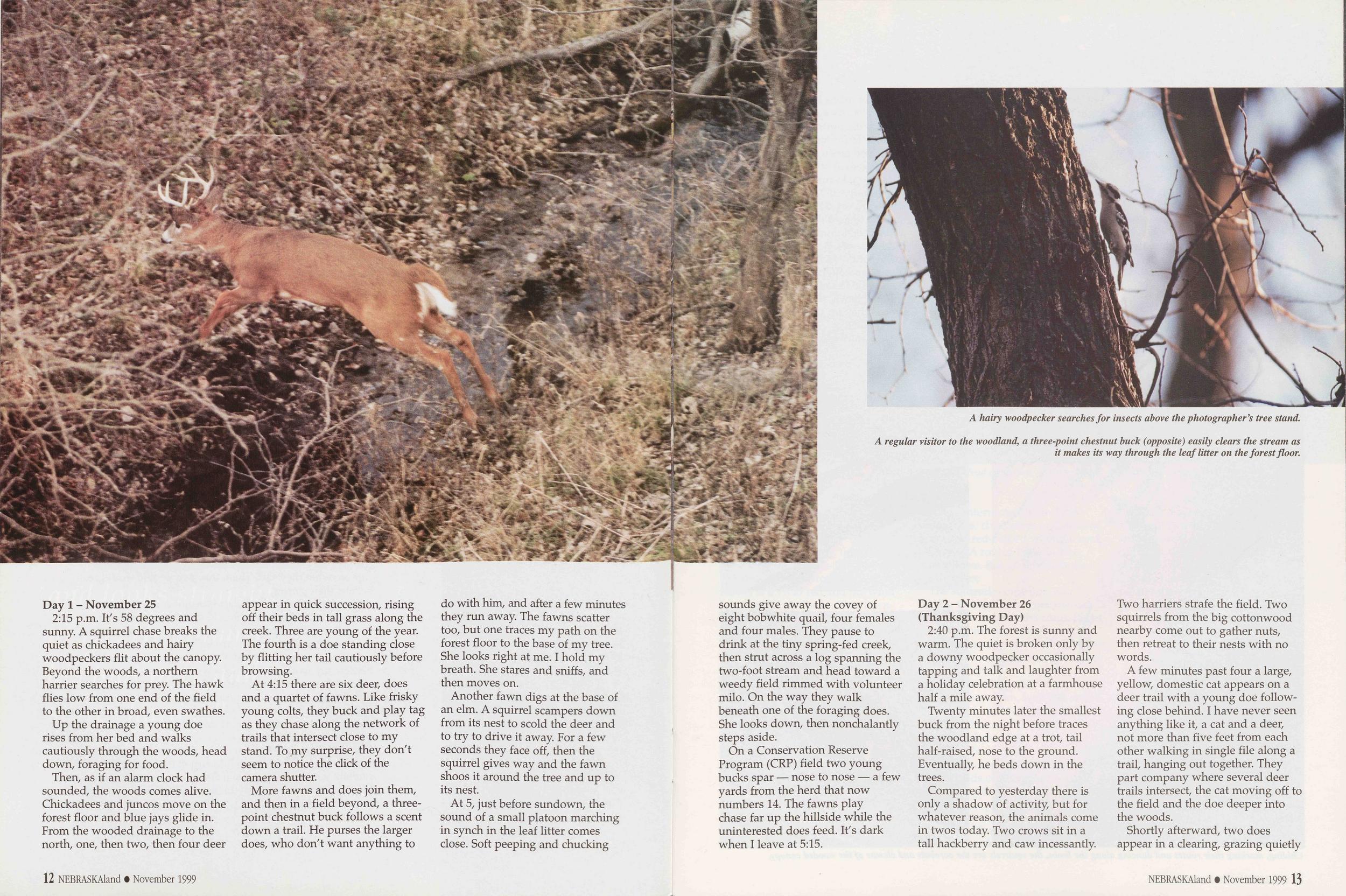
2:15 p.m. It's 58 degrees and sunny. A squirrel chase breaks the quiet as chickadees and hairy woodpeckers flit about the canopy. Beyond the woods, a northern harrier searches for prey. The hawk flies low from one end of the field to the other in broad, even swathes.
Up the drainage a young doe rises from her bed and walks cautiously through the woods, head down, foraging for food.
Then, as if an alarm clock had sounded, the woods comes alive. Chickadees and juncos move on the forest floor and blue jays glide in. From the wooded drainage to the north, one, then two, then four deer appear in quick succession, rising off their beds in tall grass along the creek. Three are young of the year. The fourth is a doe standing close by flitting her tail cautiously before browsing.
At 4:15 there are six deer, does and a quartet of fawns. Like frisky young colts, they buck and play tag as they chase along the network of trails that intersect close to my stand. To my surprise, they don't seem to notice the click of the camera shutter.
More fawns and does join them, and then in a field beyond, a three- point chestnut buck follows a scent down a trail. He purses the larger does, who don't want anything to do with him, and after a few minutes they run away. The fawns scatter too, but one traces my path on the forest floor to the base of my tree. She looks right at me. I hold my breath. She stares and sniffs, and then moves on.
Another fawn digs at the base of an elm. A squirrel scampers down from its nest to scold the deer and to try to drive it away. For a few seconds they face off, then the squirrel gives way and the fawn shoos it around the tree and up to its nest.
At 5, just before sundown, the sound of a small platoon marching in synch in the leaf litter comes close. Soft peeping and chucking 12 NEBRASKAland • November 1999
On a Conservation Reserve Program (CRP) field two young bucks spar — nose to nose — a few yards from the herd that now numbers 14. The fawns play chase far up the hillside while the uninterested does feed. It's dark when I leave at 5:15.
Day 2 - November 26 (Thanksgiving Day)2:40 p.m. The forest is sunny and warm. The quiet is broken only by a downy woodpecker occasionally tapping and talk and laughter from a holiday celebration at a farmhouse half a mile away.
Twenty minutes later the smallest buck from the night before traces the woodland edge at a trot, tail half-raised, nose to the ground. Eventually, he beds down in the trees.
Compared to yesterday there is only a shadow of activity, but for whatever reason, the animals come in twos today. Two crows sit in a tall hackberry and caw incessantly. Two harriers strafe the field. Two squirrels from the big cottonwood nearby come out to gather nuts, then retreat to their nests with no words.
A few minutes past four a large, yellow, domestic cat appears on a deer trail with a young doe follow- ing close behind. I have never seen anything like it, a cat and a deer, not more than five feet from each other walking in single file along a trail, hanging out together. They part company where several deer trails intersect, the cat moving off to the field and the doe deeper into the woods.
Shortly afterward, two does
appear in a clearing, grazing quietly
NEBRASKAland • November 1999 13
 while they watch a second cat, one
with long white hair, hunt. Twice
the deer move toward the cat and
stamp their front feet trying to scare
it away. The cat looks at them as if
they were crazed and continues to
hunt.
while they watch a second cat, one
with long white hair, hunt. Twice
the deer move toward the cat and
stamp their front feet trying to scare
it away. The cat looks at them as if
they were crazed and continues to
hunt.
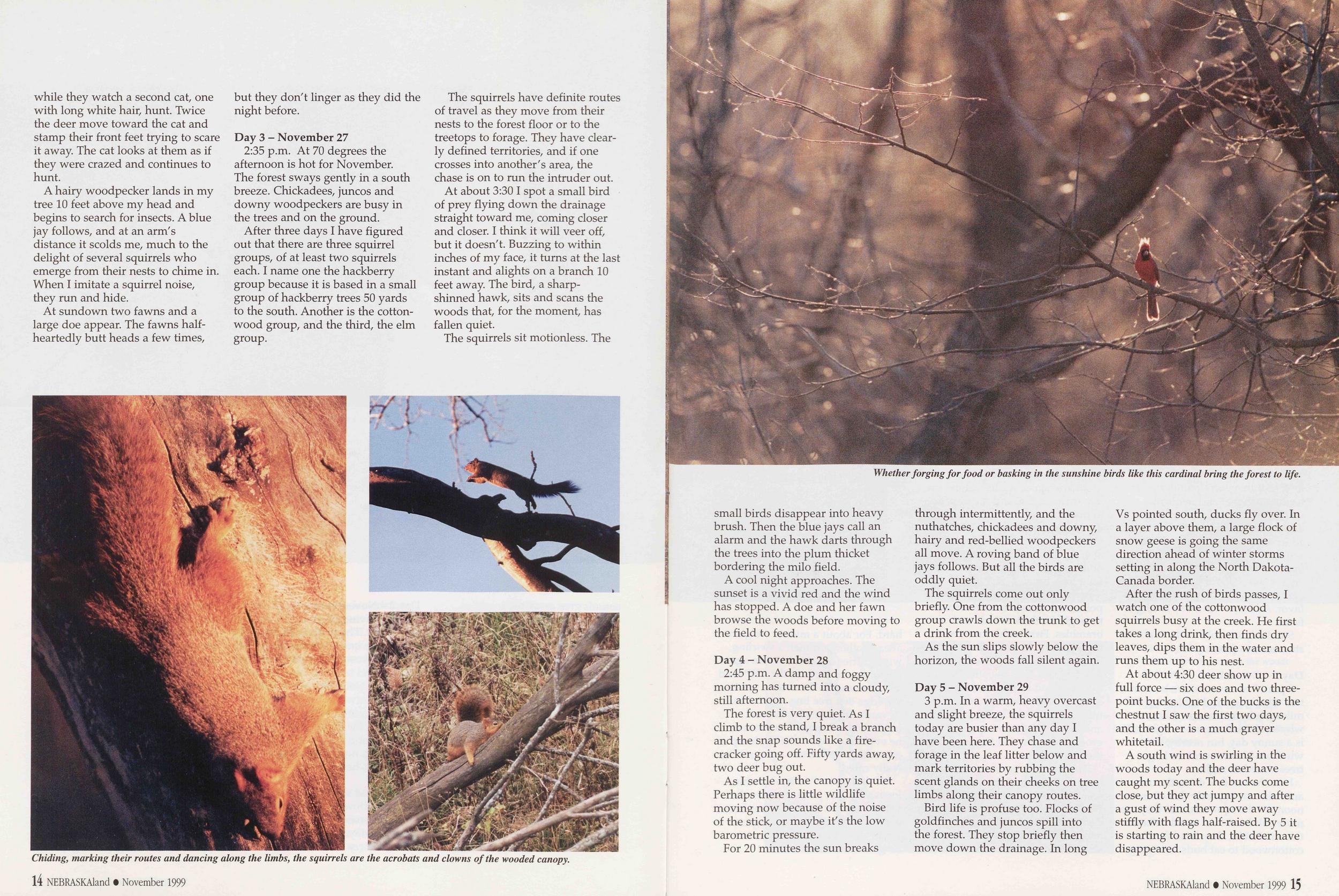
A hairy woodpecker lands in my tree 10 feet above my head and begins to search for insects. A blue jay follows, and at an arm's distance it scolds me, much to the delight of several squirrels who emerge from their nests to chime in. When I imitate a squirrel noise, they run and hide.
At sundown two fawns and a large doe appear. The fawns half- heartedly butt heads a few times, but they don't linger as they did the night before.
Day 3 - November 272:35 p.m. At 70 degrees the afternoon is hot for November. The forest sways gently in a south breeze. Chickadees, juncos and downy woodpeckers are busy in the trees and on the ground.
After three days I have figured out that there are three squirrel groups, of at least two squirrels each. I name one the hackberry group because it is based in a small group of hackberry trees 50 yards to the south. Another is the cotton- wood group, and the third, the elm group.
The squirrels have definite routes of travel as they move from their nests to the forest floor or to the treetops to forage. They have clear- ly defined territories, and if one crosses into another's area, the chase is on to run the intruder out.
At about 3:30 I spot a small bird of prey flying down the drainage straight toward me, coming closer and closer. I think it will veer off, but it doesn't. Buzzing to within inches of my face, it turns at the last instant and alights on a branch 10 feet away. The bird, a sharp- shinned hawk, sits and scans the woods that, for the moment, has fallen quiet.
The squirrels sit motionless. The
A cool night approaches. The sunset is a vivid red and the wind has stopped. A doe and her fawn browse the woods before moving to the field to feed.
Day 4 - November 282:45 p.m. A damp and foggy morning has turned into a cloudy, still afternoon.
The forest is very quiet. As I climb to the stand, I break a branch and the snap sounds like a firecracker going off. Fifty yards away, two deer bug out.
As I settle in, the canopy is quiet. Perhaps there is little wildlife moving now because of the noise of the stick, or maybe it's the low barometric pressure.
For 20 minutes the sun breaks through intermittently, and the nuthatches, chickadees and downy, hairy and red-bellied woodpeckers all move. A roving band of blue jays follows. But all the birds are oddly quiet.
The squirrels come out only briefly. One from the cottonwood group crawls down the trunk to get a drink from the creek.
As the sun slips slowly below the horizon, the woods fall silent again.
Day 5 - November 293 p.m. In a warm, heavy overcast and slight breeze, the squirrels today are busier than any day I have been here. They chase and forage in the leaf litter below and mark territories by rubbing the scent glands on their cheeks on tree limbs along their canopy routes.
Bird life is profuse too. Flocks of goldfinches and juncos spill into the forest. They stop briefly then move down the drainage. In long Vs pointed south, ducks fly over. In a layer above them, a large flock of snow geese is going the same direction ahead of winter storms setting in along the North Dakota- Canada border.
After the rush of birds passes, I watch one of the cottonwood squirrels busy at the creek. He first takes a long drink, then finds dry leaves, dips them in the water and runs them up to his nest.
At about 4:30 deer show up in full force — six does and two three- point bucks. One of the bucks is the chestnut I saw the first two days, and the other is a much grayer whitetail.
A south wind is swirling in the woods today and the deer have caught my scent. The bucks come close, but they act jumpy and after a gust of wind they move away stiffly with flags half-raised. By 5 it is starting to rain and the deer have disappeared.
NEBRASKAland • November 1999 15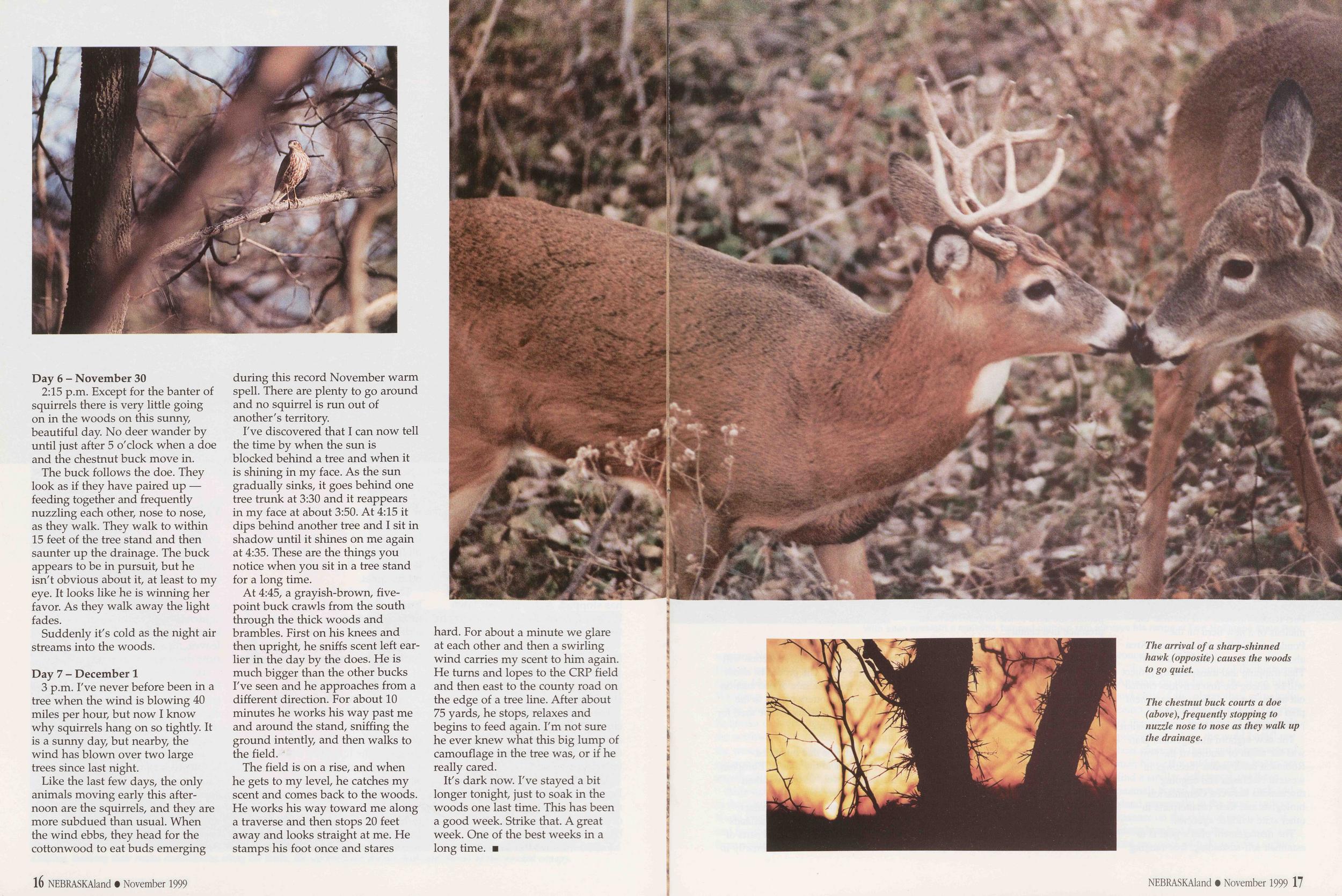
2:15 p.m. Except for the banter of squirrels there is very little going on in the woods on this sunny, beautiful day. No deer wander by until just after 5 o'clock when a doe and the chestnut buck move in.
The buck follows the doe. They look as if they have paired up — feeding together and frequently nuzzling each other, nose to nose, as they walk. They walk to within 15 feet of the tree stand and then saunter up the drainage. The buck appears to be in pursuit, but he isn't obvious about it, at least to my eye. It looks like he is winning her favor. As they walk away the light fades.
Suddenly it's cold as the night air streams into the woods.
Day 7 - December 13 p.m. I've never before been in a tree when the wind is blowing 40 miles per hour, but now I know why squirrels hang on so tightly. It is a sunny day, but nearby, the wind has blown over two large trees since last night.
Like the last few days, the only animals moving early this afternoon are the squirrels, and they are more subdued than usual. When the wind ebbs, they head for the cottonwood to eat buds emerging during this record November warm spell. There are plenty to go around and no squirrel is run out of another's territory.
I've discovered that I can now tell the time by when the sun is blocked behind a tree and when it is shining in my face. As the sun gradually sinks, it goes behind one tree trunk at 3:30 and it reappears in my face at about 3:50. At 4:15 it dips behind another tree and I sit in shadow until it shines on me again at 4:35. These are the things you notice when you sit in a tree stand for a long time.
At 4:45, a grayish-brown, five- point buck crawls from the south through the thick woods and brambles. First on his knees and then upright, he sniffs scent left earlier in the day by the does. He is much bigger than the other bucks I've seen and he approaches from a different direction. For about 10 minutes he works his way past me and around the stand, sniffing the ground intently, and then walks to the field.
The field is on a rise, and when he gets to my level, he catches my scent and comes back to the woods. He works his way toward me along a traverse and then stops 20 feet away and looks straight at me. He stamps his foot once and stares hard. For about a minute we glare at each other and then a swirling wind carries my scent to him again. He turns and lopes to the CRP field and then east to the county road on the edge of a tree line. After about 75 yards, he stops, relaxes and begins to feed again. I'm not sure he ever knew what this big lump of camouflage in the tree was, or if he really cared.
It's dark now. I've stayed a bit longer tonight, just to soak in the woods one last time. This has been a good week. Strike that. A great week. One of the best weeks in a long time.
16 NEBRASKAland • November 1999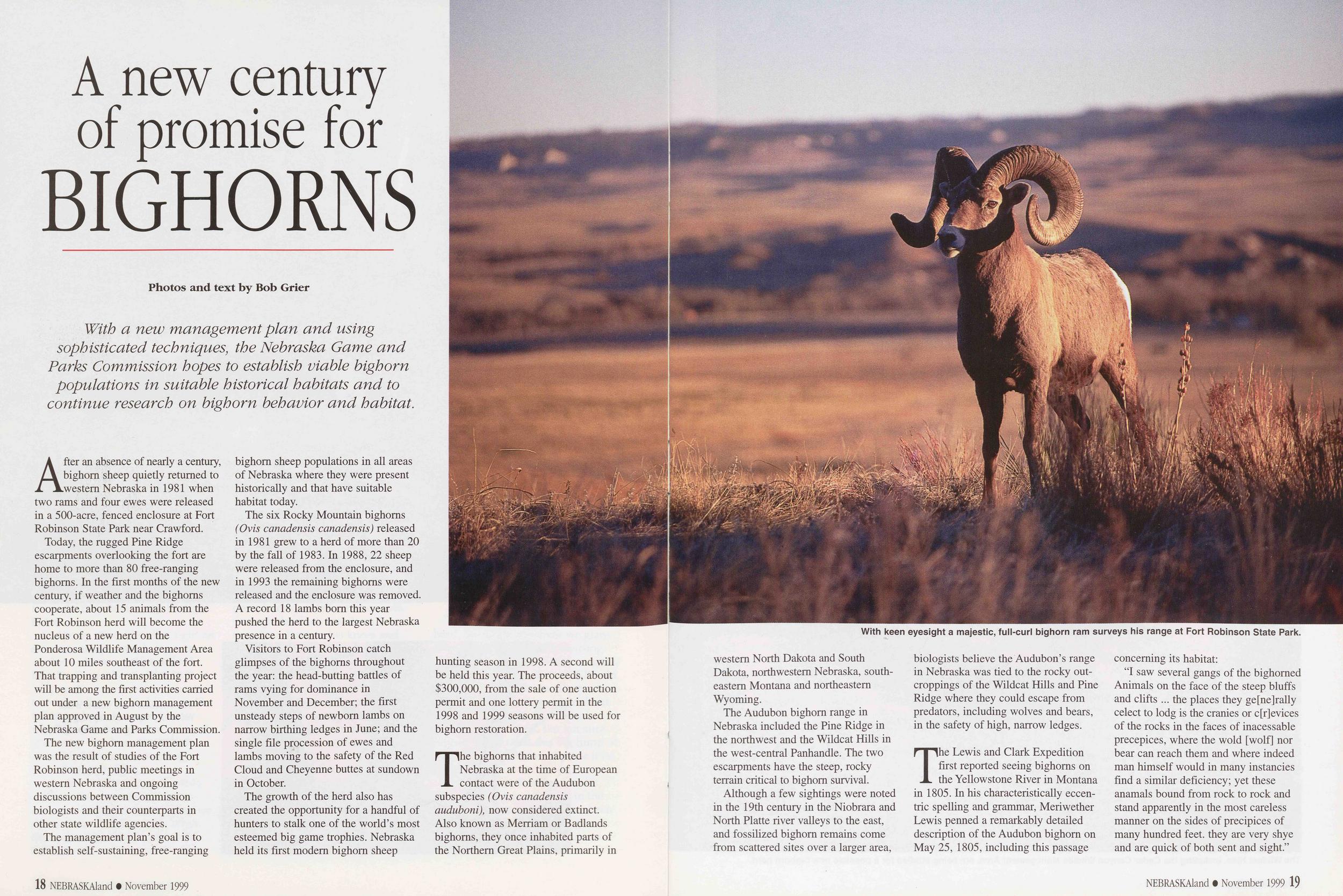
A new century of promise for BIGHORNS
Photos and text by Bob Grier With a new management plan and using sophisticated techniques, the Nebraska Game and Parks Commission hopes to establish viable bighorn populations in suitable historical habitats and to continue research on bighorn behavior and habitat.After an absence of nearly a century, bighorn sheep quietly returned to western Nebraska in 1981 when two rams and four ewes were released in a 500-acre, fenced enclosure at Fort Robinson State Park near Crawford.
Today, the rugged Pine Ridge escarpments overlooking the fort are home to more than 80 free-ranging bighorns. In the first months of the new century, if weather and the bighorns cooperate, about 15 animals from the Fort Robinson herd will become the nucleus of a new herd on the Ponderosa Wildlife Management Area about 10 miles southeast of the fort. That trapping and transplanting project will be among the first activities carried out under a new bighorn management plan approved in August by the Nebraska Game and Parks Commission.
The new bighorn management plan was the result of studies of the Fort Robinson herd, public meetings in western Nebraska and ongoing discussions between Commission biologists and their counterparts in other state wildlife agencies.
The management plan's goal is to establish self-sustaining, free-ranging bighorn sheep populations in all areas of Nebraska where they were present historically and that have suitable habitat today.
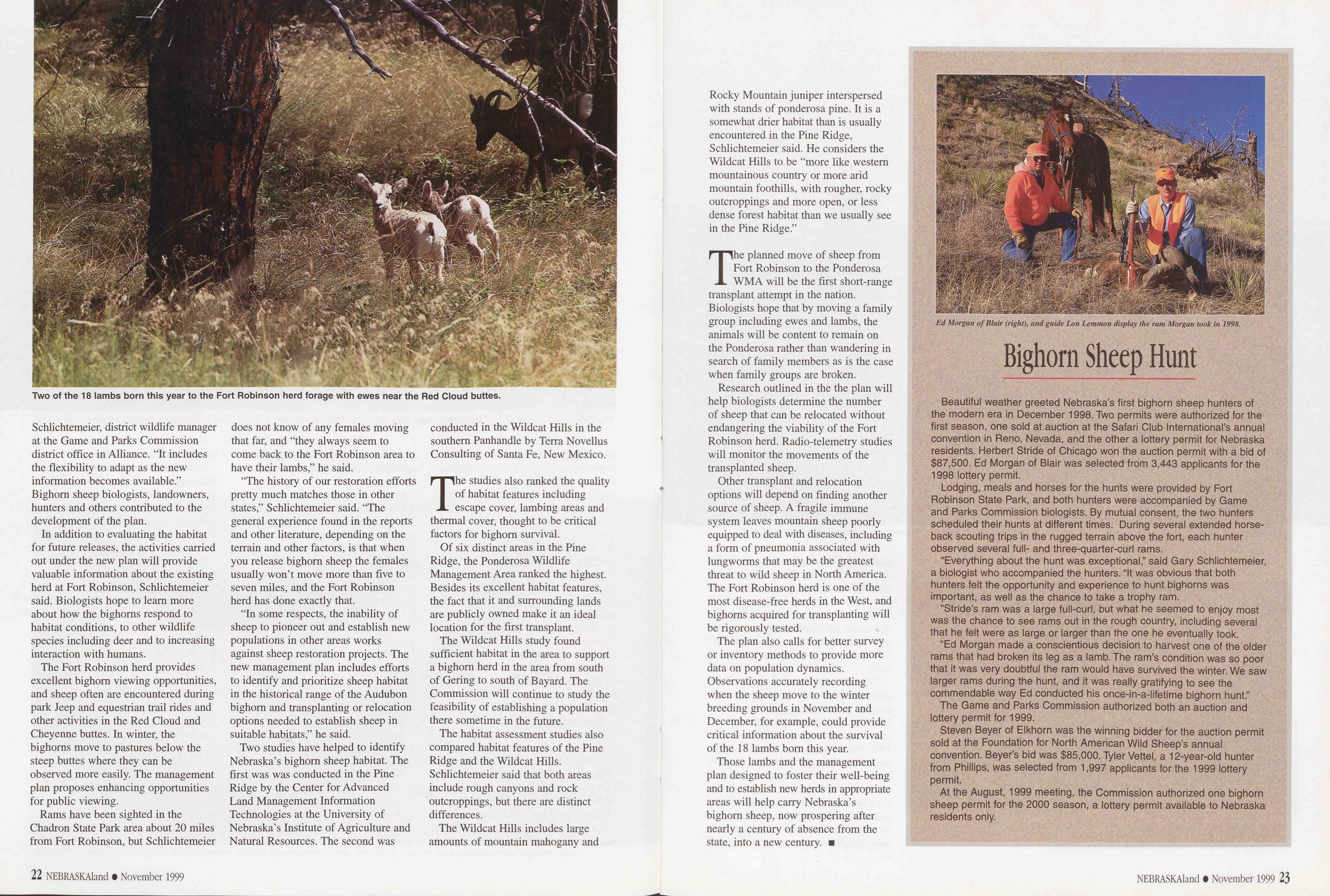
The six Rocky Mountain bighorns (Ovis canadensis canadensis) released in 1981 grew to a herd of more than 20 by the fall of 1983. In 1988, 22 sheep were released from the enclosure, and in 1993 the remaining bighorns were released and the enclosure was removed. A record 18 lambs born this year pushed the herd to the largest Nebraska presence in a century.
Visitors to Fort Robinson catch glimpses of the bighorns throughout the year: the head-butting battles of rams vying for dominance in November and December; the first unsteady steps of newborn lambs on narrow birthing ledges in June; and the single file procession of ewes and lambs moving to the safety of the Red Cloud and Cheyenne buttes at sundown in October.
The growth of the herd also has created the opportunity for a handful of hunters to stalk one of the world's most esteemed big game trophies. Nebraska held its first modern bighorn sheep hunting season in 1998. A second will be held this year. The proceeds, about $300,000, from the sale of one auction permit and one lottery permit in the 1998 and 1999 seasons will be used for bighorn restoration.
The bighorns that inhabited Nebraska at the time of European contact were of the Audubon subspecies (Ovis canadensis auduboni), now considered extinct. Also known as Merriam or Badlands bighorns, they once inhabited parts of the Northern Great Plains, primarily in 18 NEBRASKAland • November 1999
The Audubon bighorn range in Nebraska included the Pine Ridge in the northwest and the Wildcat Hills in the west-central Panhandle. The two escarpments have the steep, rocky terrain critical to bighorn survival.
Although a few sightings were noted in the 19th century in the Niobrara and North Platte river valleys to the east, and fossilized bighorn remains come from scattered sites over a larger area, biologists believe the Audubon's range in Nebraska was tied to the rocky out- croppings of the Wildcat Hills and Pine Ridge where they could escape from predators, including wolves and bears, in the safety of high, narrow ledges.
The Lewis and Clark Expedition first reported seeing bighorns on the Yellowstone River in Montana in 1805. In his characteristically eccentric spelling and grammar, Meriwether Lewis penned a remarkably detailed description of the Audubon bighorn on May 25, 1805, including this passage concerning its habitat:
"I saw several gangs of the bighorned Animals on the face of the steep bluffs and clifts ... the places they ge[ne]rally celect to lodg is the cranies or c[r]evices of the rocks in the faces of inacessable precepices, where the wold [wolf] nor bear can reach them and where indeed man himself would in many instancies find a similar deficiency; yet these anamals bound from rock to rock and stand apparently in the most careless manner on the sides of precipices of many hundred feet, they are very shye and are quick of both sent and sight."
NEBRASKAland • November 1999 19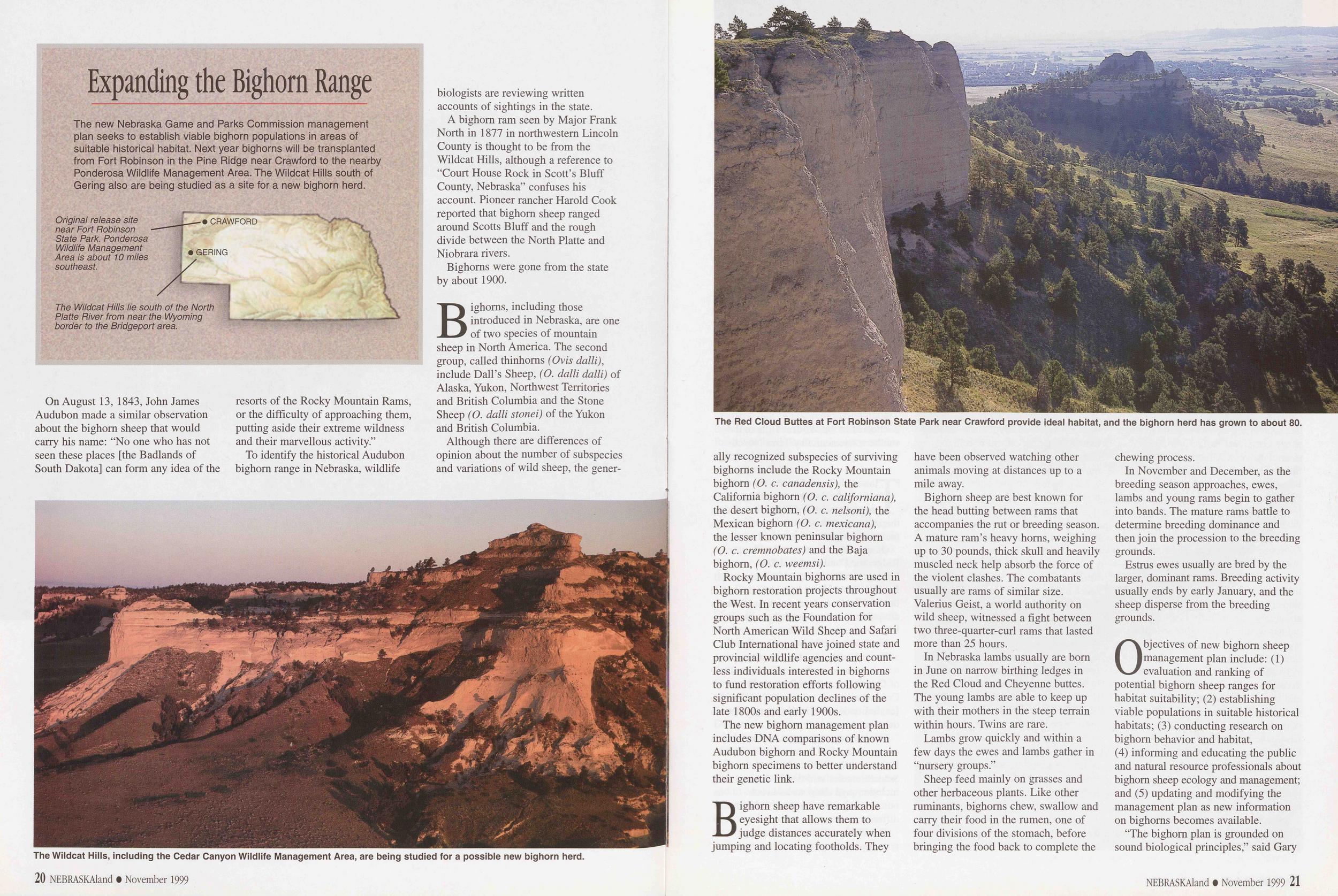 Expanding the Bighorn Range
The new Nebraska Game and Parks Commission management plan seeks to establish viable bighorn populations in areas of suitable historical habitat. Next year bighorns will be transplanted from Fort Robinson in the Pine Ridge near Crawford to the nearby Ponderosa Wildlife Management Area. The Wildcat Hills south of Gering also are being studied as a site for a new bighorn herd.
On August 13, 1843, John James Audubon made a similar observation about the bighorn sheep that would carry his name: "No one who has not seen these places [the Badlands of South Dakota] can form any idea of the resorts of the Rocky Mountain Rams, or the difficulty of approaching them, putting aside their extreme wildness and their marvellous activity."
To identify the historical Audubon bighorn range in Nebraska, wildlife biologists are reviewing written accounts of sightings in the state.
A bighorn ram seen by Major Frank North in 1877 in northwestern Lincoln County is thought to be from the Wildcat Hills, although a reference to "Court House Rock in Scott's Bluff County, Nebraska" confuses his account. Pioneer rancher Harold Cook reported that bighorn sheep ranged around Scotts Bluff and the rough divide between the North Platte and Niobrara rivers.
Bighorns were gone from the state by about 1900.
Bighorns, including those introduced in Nebraska, are one of two species of mountain sheep in North America. The second group, called thinhorns (Ovis dalli), include Dall's Sheep, (O. dalli dalli) of Alaska, Yukon, Northwest Territories and British Columbia and the Stone Sheep (O. dalli stonei) of the Yukon and British Columbia.
Although there are differences of opinion about the number of subspecies and variations of wild sheep, the generally
Rocky Mountain bighorns are used in bighorn restoration projects throughout the West. In recent years conservation groups such as the Foundation for North American Wild Sheep and Safari Club International have joined state and provincial wildlife agencies and count- less individuals interested in bighorns to fund restoration efforts following significant population declines of the late 1800s and early 1900s.
The new bighorn management plan includes DNA comparisons of known Audubon bighorn and Rocky Mountain bighorn specimens to better understand their genetic link.
Bighorn sheep have remarkable eyesight that allows them to judge distances accurately when jumping and locating footholds. They have been observed watching other animals moving at distances up to a mile away.
Bighorn sheep are best known for the head butting between rams that accompanies the rut or breeding season. A mature ram's heavy horns, weighing up to 30 pounds, thick skull and heavily muscled neck help absorb the force of the violent clashes. The combatants usually are rams of similar size. Valerius Geist, a world authority on wild sheep, witnessed a fight between two three-quarter-curl rams that lasted more than 25 hours.
In Nebraska lambs usually are born in June on narrow birthing ledges in the Red Cloud and Cheyenne buttes. The young lambs are able to keep up with their mothers in the steep terrain within hours. Twins are rare.
Lambs grow quickly and within a few days the ewes and lambs gather in "nursery groups."
Sheep feed mainly on grasses and other herbaceous plants. Like other ruminants, bighorns chew, swallow and carry their food in the rumen, one of four divisions of the stomach, before bringing the food back to complete the chewing process.
In November and December, as the breeding season approaches, ewes, lambs and young rams begin to gather into bands. The mature rams battle to determine breeding dominance and then join the procession to the breeding grounds.
Estrus ewes usually are bred by the larger, dominant rams. Breeding activity usually ends by early January, and the sheep disperse from the breeding grounds.
Objectives of new bighorn sheep management plan include: (1) evaluation and ranking of potential bighorn sheep ranges for habitat suitability; (2) establishing viable populations in suitable historical habitats; (3) conducting research on bighorn behavior and habitat, (4) informing and educating the public and natural resource professionals about bighorn sheep ecology and management; and (5) updating and modifying the management plan as new information on bighorns becomes available.
The bighorn plan is grounded on
sound biological principles," said Gary
NEBRASKAland • November 1999 21
In addition to evaluating the habitat for future releases, the activities carried out under the new plan will provide valuable information about the existing herd at Fort Robinson, Schlichtemeier said. Biologists hope to learn more about how the bighorns respond to habitat conditions, to other wildlife species including deer and to increasing interaction with humans.
The Fort Robinson herd provides excellent bighorn viewing opportunities, and sheep often are encountered during park Jeep and equestrian trail rides and other activities in the Red Cloud and Cheyenne buttes. In winter, the bighorns move to pastures below the steep buttes where they can be observed more easily. The management plan proposes enhancing opportunities for public viewing.
Rams have been sighted in the Chadron State Park area about 20 miles from Fort Robinson, but Schlichtemeier does not know of any females moving that far, and "they always seem to come back to the Fort Robinson area to have their lambs," he said.
"The history of our restoration efforts pretty much matches those in other states," Schlichtemeier said. "The general experience found in the reports and other literature, depending on the terrain and other factors, is that when you release bighorn sheep the females usually won't move more than five to seven miles, and the Fort Robinson herd has done exactly that.
"In some respects, the inability of sheep to pioneer out and establish new populations in other areas works against sheep restoration projects. The new management plan includes efforts to identify and prioritize sheep habitat in the historical range of the Audubon bighorn and transplanting or relocation options needed to establish sheep in suitable habitats," he said.
Two studies have helped to identify Nebraska's bighorn sheep habitat. The first was was conducted in the Pine Ridge by the Center for Advanced Land Management Information Technologies at the University of Nebraska's Institute of Agriculture and Natural Resources. The second was conducted in the Wildcat Hills in the southern Panhandle by Terra Novellus Consulting of Santa Fe, New Mexico.
The studies also ranked the quality of habitat features including escape cover, lambing areas and thermal cover, thought to be critical factors for bighorn survival. Of six distinct areas in the Pine Ridge, the Ponderosa Wildlife Management Area ranked the highest. Besides its excellent habitat features, the fact that it and surrounding lands are publicly owned make it an ideal location for the first transplant.
The Wildcat Hills study found sufficient habitat in the area to support a bighorn herd in the area from south of Gering to south of Bayard. The Commission will continue to study the feasibility of establishing a population there sometime in the future.
The habitat assessment studies also compared habitat features of the Pine Ridge and the Wildcat Hills. Schlichtemeier said that both areas include rough canyons and rock outcroppings, but there are distinct differences.
The Wildcat Hills includes large amounts of mountain mahogany and 22 NEBRASKAland • November 1999 Rocky Mountain juniper interspersed with stands of ponderosa pine. It is a somewhat drier habitat than is usually encountered in the Pine Ridge, Schlichtemeier said. He considers the Wildcat Hills to be "more like western mountainous country or more arid mountain foothills, with rougher, rocky outcroppings and more open, or less dense forest habitat than we usually see in the Pine Ridge."
The planned move of sheep from Fort Robinson to the Ponderosa WMA will be the first short-range transplant attempt in the nation. Biologists hope that by moving a family group including ewes and lambs, the animals will be content to remain on the Ponderosa rather than wandering in search of family members as is the case when family groups are broken.
Research outlined in the the plan will help biologists determine the number of sheep that can be relocated without endangering the viability of the Fort Robinson herd. Radio-telemetry studies will monitor the movements of the transplanted sheep.
Other transplant and relocation options will depend on finding another source of sheep. A fragile immune system leaves mountain sheep poorly equipped to deal with diseases, including a form of pneumonia associated with lungworms that may be the greatest threat to wild sheep in North America. The Fort Robinson herd is one of the most disease-free herds in the West, and bighorns acquired for transplanting will be rigorously tested.
The plan also calls for better survey or inventory methods to provide more data on population dynamics. Observations accurately recording when the sheep move to the winter breeding grounds in November and December, for example, could provide critical information about the survival of the 18 lambs born this year.
Those lambs and the management plan designed to foster their well-being and to establish new herds in appropriate areas will help carry Nebraska's bighorn sheep, now prospering after nearly a century of absence from the state, into a new century.
Beautiful weather greeted Nebraska's first bighorn sheep hunters of the modern era in December 1998. Two permits were authorized for the first season, one sold at auction at the Safari Club International's annual convention in Reno, Nevada, and the other a lottery permit for Nebraska residents. Herbert Stride of Chicago won the auction permit with a bid of $87,500. Ed Morgan of Blair was selected from 3,443 applicants for the 1998 lottery permit.
Lodging, meals and horses for the hunts were provided by Fort Robinson State Park, and both hunters were accompanied by Game and Parks Commission biologists. By mutual consent, the two hunters scheduled their hunts at different times. During several extended horse- back scouting trips in the rugged terrain above the fort, each hunter observed several full- and three-quarter-curl rams.
"Everything about the hunt was exceptional," said Gary Schlichtemeier, a biologist who accompanied the hunters. "It was obvious that both hunters felt the opportunity and experience to hunt bighorns was important, as well as the chance to take a trophy ram.
"Stride's ram was a large full-curl, but what he seemed to enjoy most was the chance to see rams out in the rough country, including several that he felt were as large or larger than the one he eventually took.
"Ed Morgan made a conscientious decision to harvest one of the older rams that had broken its leg as a lamb. The ram's condition was so poor that it was very doubtful the ram would have survived the winter. We saw larger rams during the hunt, and it was really gratifying to see the commendable way Ed conducted his once-in-a-lifetime bighorn hunt."
The Game and Parks Commission authorized both an auction and lottery permit for 1999.
Steven Beyer of Elkhorn was the winning bidder for the auction permit sold at the Foundation for North American Wild Sheep's annual convention. Beyer's bid was $85,000. Tyler Vettel, a 12-year-old hunter from Phillips, was selected from 1,997 applicants for the 1999 lottery permit.
At the August, 1999 meeting, the Commission authorized one bighorn sheep permit for the 2000 season, a lottery permit available to Nebraska residents only.
NEBRASKAland • November 1999 23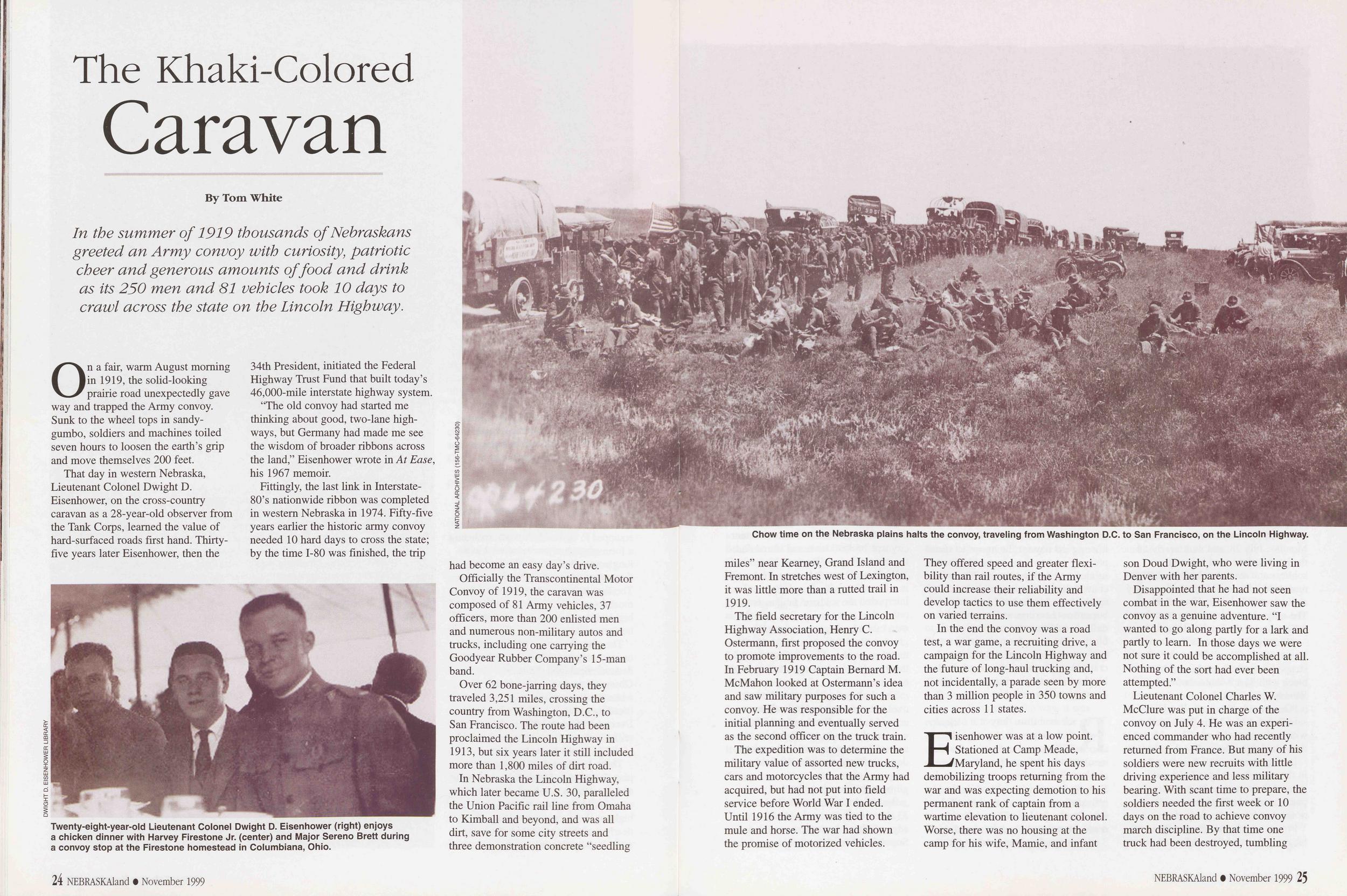
The Khaki-Colored Caravan
By Tom White In the summer of 1919 thousands ofNebraskans greeted an Army convoy with curiosity, patriotic cheer and generous amounts of food and drink as its 250 men and 81 vehicles took 10 days to crawl across the state on the Lincoln Highway.On a fair, warm August morning in 1919, the solid-looking prairie road unexpectedly gave way and trapped the Army convoy. Sunk to the wheel tops in sandy- gumbo, soldiers and machines toiled seven hours to loosen the earth's grip and move themselves 200 feet.
That day in western Nebraska, Lieutenant Colonel Dwight D. Eisenhower, on the cross-country caravan as a 28-year-old observer from the Tank Corps, learned the value of hard-surfaced roads first hand. Thirty- five years later Eisenhower, then the 34th President, initiated the Federal Highway Trust Fund that built today's 46,000-mile interstate highway system.
"The old convoy had started me thinking about good, two-lane highways, but Germany had made me see the wisdom of broader ribbons across the land," Eisenhower wrote in At Ease, his 1967 memoir.
Fittingly, the last link in Interstate- 80's nationwide ribbon was completed in western Nebraska in 1974. Fifty-five years earlier the historic army convoy needed 10 hard days to cross the state; by the time 1-80 was finished, the trip had become an easy day's drive.
Officially the Transcontinental Motor Convoy of 1919, the caravan was composed of 81 Army vehicles, 37 officers, more than 200 enlisted men and numerous non-military autos and trucks, including one carrying the Goodyear Rubber Company's 15-man band.
Over 62 bone-jarring days, they traveled 3,251 miles, crossing the country from Washington, D.C, to San Francisco. The route had been proclaimed the Lincoln Highway in 1913, but six years later it still included more than 1,800 miles of dirt road.
In Nebraska the Lincoln Highway, which later became U.S. 30, paralleled the Union Pacific rail line from Omaha to Kimball and beyond, and was all dirt, save for some city streets and three demonstration concrete "seedling
The field secretary for the Lincoln Highway Association, Henry C. Ostermann, first proposed the convoy to promote improvements to the road. In February 1919 Captain Bernard M. McMahon looked at Ostermann's idea and saw military purposes for such a convoy. He was responsible for the initial planning and eventually served as the second officer on the truck train.
The expedition was to determine the military value of assorted new trucks, cars and motorcycles that the Army had acquired, but had not put into field service before World War I ended. Until 1916 the Army was tied to the mule and horse. The war had shown the promise of motorized vehicles. They offered speed and greater flexibility than rail routes, if the Army could increase their reliability and develop tactics to use them effectively on varied terrains.
In the end the convoy was a road test, a war game, a recruiting drive, a campaign for the Lincoln Highway and the future of long-haul trucking and, not incidentally, a parade seen by more than 3 million people in 350 towns and cities across 11 states.
Eisenhower was at a low point. Stationed at Camp Meade, Maryland, he spent his days demobilizing troops returning from the war and was expecting demotion to his permanent rank of captain from a wartime elevation to lieutenant colonel. Worse, there was no housing at the camp for his wife, Mamie, and infant son Doud Dwight, who were living in Denver with her parents.
Disappointed that he had not seen combat in the war, Eisenhower saw the convoy as a genuine adventure. "I wanted to go along partly for a lark and partly to learn. In those days we were not sure it could be accomplished at all. Nothing of the sort had ever been attempted."
Lieutenant Colonel Charles W.
McClure was put in charge of the
convoy on July 4. He was an experienced
commander who had recently
returned from France. But many of his
soldiers were new recruits with little
driving experience and less military
bearing. With scant time to prepare, the
soldiers needed the first week or 10
days on the road to achieve convoy
march discipline. By that time one
truck had been destroyed, tumbling
NEBRASKAland • November 1999 25
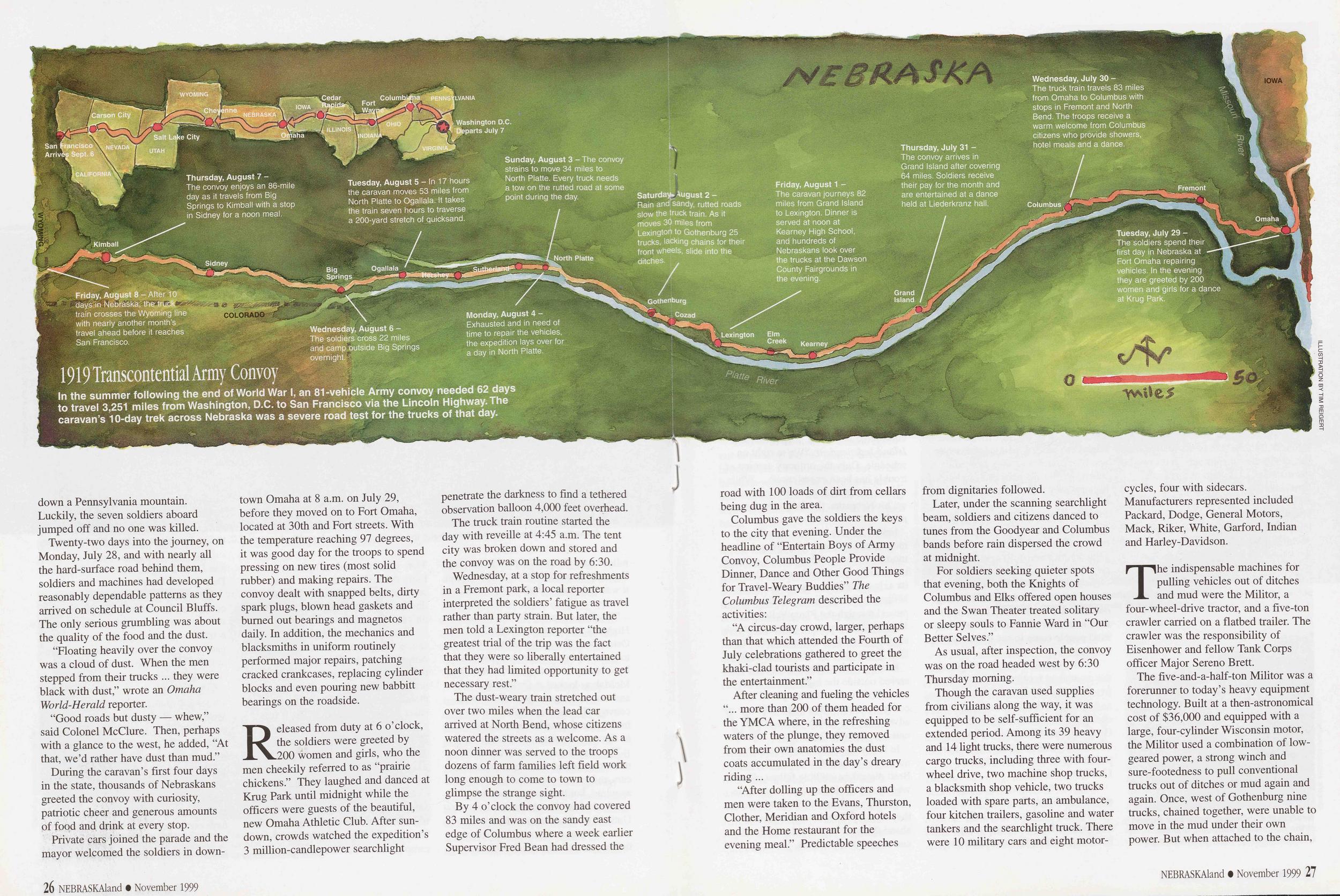
Twenty-two days into the journey, on Monday, July 28, and with nearly all the hard-surface road behind them, soldiers and machines had developed reasonably dependable patterns as they arrived on schedule at Council Bluffs. The only serious grumbling was about the quality of the food and the dust.
"Floating heavily over the convoy was a cloud of dust. When the men stepped from their trucks ... they were black with dust," wrote an Omaha World-Herald reporter.
"Good roads but dusty — whew," said Colonel McClure. Then, perhaps with a glance to the west, he added, "At that, we'd rather have dust than mud."
During the caravan's first four days in the state, thousands of Nebraskans greeted the convoy with curiosity, patriotic cheer and generous amounts of food and drink at every stop.
Private cars joined the parade and the mayor welcomed the soldiers in downtown Omaha at 8 a.m. on July 29, before they moved on to Fort Omaha, located at 30th and Fort streets. With the temperature reaching 97 degrees, it was good day for the troops to spend pressing on new tires (most solid rubber) and making repairs. The convoy dealt with snapped belts, dirty spark plugs, blown head gaskets and burned out bearings and magnetos daily. In addition, the mechanics and blacksmiths in uniform routinely performed major repairs, patching cracked crankcases, replacing cylinder blocks and even pouring new babbitt bearings on the roadside.
Released from duty at 6 o'clock, the soldiers were greeted by 200 women and girls, who the men cheekily referred to as "prairie chickens." They laughed and danced at Krug Park until midnight while the officers were guests of the beautiful, new Omaha Athletic Club. After sundown, crowds watched the expedition's 3 million-candlepower searchlight penetrate the darkness to find a tethered observation balloon 4,000 feet overhead.
The truck train routine started the day with reveille at 4:45 a.m. The tent city was broken down and stored and the convoy was on the road by 6:30.
Wednesday, at a stop for refreshments in a Fremont park, a local reporter interpreted the soldiers' fatigue as travel rather than party strain. But later, the men told a Lexington reporter "the greatest trial of the trip was the fact that they were so liberally entertained that they had limited opportunity to get necessary rest."
The dust-weary train stretched out over two miles when the lead car arrived at North Bend, whose citizens watered the streets as a welcome. As a noon dinner was served to the troops dozens of farm families left field work long enough to come to town to glimpse the strange sight.
By 4 o'clock the convoy had covered 83 miles and was on the sandy east edge of Columbus where a week earlier Supervisor Fred Bean had dressed the road with 100 loads of dirt from cellars being dug in the area.
Columbus gave the soldiers the keys to the city that evening. Under the headline of "Entertain Boys of Army Convoy, Columbus People Provide Dinner, Dance and Other Good Things for Travel-Weary Buddies" The Columbus Telegram described the activities:
"A circus-day crowd, larger, perhaps than that which attended the Fourth of July celebrations gathered to greet the khaki-clad tourists and participate in the entertainment."
After cleaning and fueling the vehicles "... more than 200 of them headed for the YMCA where, in the refreshing waters of the plunge, they removed from their own anatomies the dust coats accumulated in the day's dreary riding ...
"After dolling up the officers and men were taken to the Evans, Thurston, Clother, Meridian and Oxford hotels and the Home restaurant for the evening meal." Predictable speeches from dignitaries followed.
Later, under the scanning searchlight beam, soldiers and citizens danced to tunes from the Goodyear and Columbus bands before rain dispersed the crowd at midnight.
For soldiers seeking quieter spots that evening, both the Knights of Columbus and Elks offered open houses and the Swan Theater treated solitary or sleepy souls to Fannie Ward in "Our Better Selves."
As usual, after inspection, the convoy was on the road headed west by 6:30 Thursday morning.
Though the caravan used supplies from civilians along the way, it was equipped to be self-sufficient for an extended period. Among its 39 heavy and 14 light trucks, there were numerous cargo trucks, including three with four- wheel drive, two machine shop trucks, a blacksmith shop vehicle, two trucks loaded with spare parts, an ambulance, four kitchen trailers, gasoline and water tankers and the searchlight truck. There were 10 military cars and eight motorcycles, four with sidecars. Manufacturers represented included Packard, Dodge, General Motors, Mack, Riker, White, Garford, Indian and Harley-Davidson.
The indispensable machines for pulling vehicles out of ditches and mud were the Militor, a four-wheel-drive tractor, and a five-ton crawler carried on a flatbed trailer. The crawler was the responsibility of Eisenhower and fellow Tank Corps officer Major Sereno Brett.
The five-and-a-half-ton Militor was a
forerunner to today's heavy equipment
technology. Built at a then-astronomical
cost of $36,000 and equipped with a
large, four-cylinder Wisconsin motor,
the Militor used a combination of low-
geared power, a strong winch and
sure-footedness to pull conventional
trucks out of ditches or mud again and
again. Once, west of Gothenburg nine
trucks, chained together, were unable to
move in the mud under their own
power. But when attached to the chain,
NEBRASKAland • November 1999 27
Civilian vehicles included: Goodyear's three-and-a-half ton Packard truck equipped with large pneumatic tires, 44x10s on the back and 38x8s in front; the official Lincoln Highway Packard, painted red, white and blue beneath its dust coat; and several Willys mystery cars, so named because they were not yet released for sale.
Ideally moving at 12 miles per hour with the vehicles 20 yards apart, the convoy advertised that it used 100 gallons of oil and 1,400 gallons of gas on a typical day.
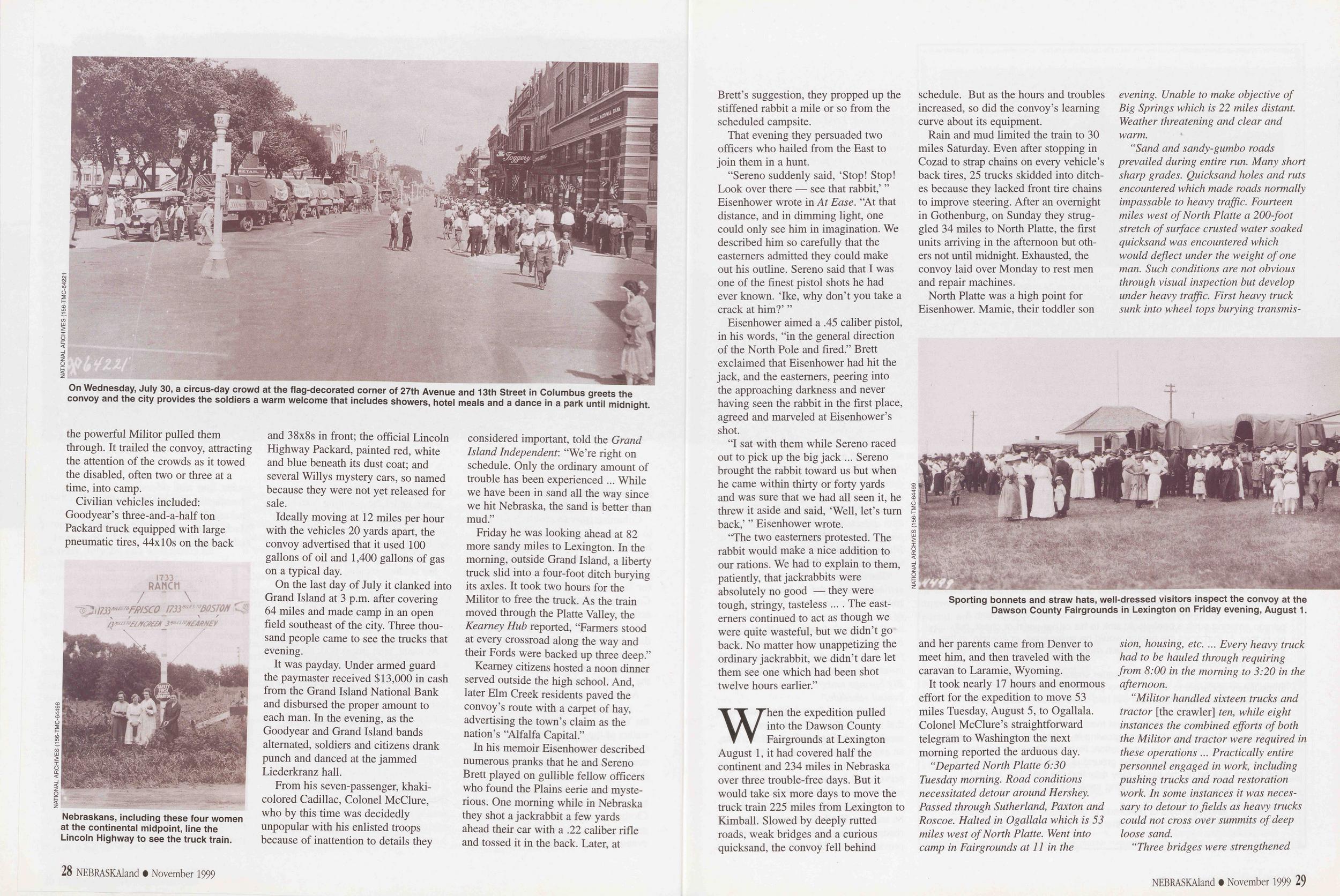
On the last day of July it clanked into Grand Island at 3 p.m. after covering 64 miles and made camp in an open field southeast of the city. Three thou- sand people came to see the trucks that evening.
It was payday. Under armed guard the paymaster received $13,000 in cash from the Grand Island National Bank and disbursed the proper amount to each man. In the evening, as the Goodyear and Grand Island bands alternated, soldiers and citizens drank punch and danced at the jammed Liederkranz hall.
From his seven-passenger, khaki- colored Cadillac, Colonel McClure, who by this time was decidedly unpopular with his enlisted troops because of inattention to details they considered important, told the Grand Island Independent: "We're right on schedule. Only the ordinary amount of trouble has been experienced ... While we have been in sand all the way since we hit Nebraska, the sand is better than mud."
Friday he was looking ahead at 82 more sandy miles to Lexington. In the morning, outside Grand Island, a liberty truck slid into a four-foot ditch burying its axles. It took two hours for the Militor to free the truck. As the train moved through the Platte Valley, the Kearney Hub reported, "Farmers stood at every crossroad along the way and their Fords were backed up three deep."
Kearney citizens hosted a noon dinner served outside the high school. And, later Elm Creek residents paved the convoy's route with a carpet of hay, advertising the town's claim as the nation's "Alfalfa Capital."
In his memoir Eisenhower described numerous pranks that he and Sereno Brett played on gullible fellow officers who found the Plains eerie and mysterious. One morning while in Nebraska they shot a jackrabbit a few yards ahead their car with a .22 caliber rifle and tossed it in the back. Later, at
That evening they persuaded two officers who hailed from the East to join them in a hunt.
"Sereno suddenly said, 'Stop! Stop! Look over there — see that rabbit,' " Eisenhower wrote in At Ease. "At that distance, and in dimming light, one could only see him in imagination. We described him so carefully that the easterners admitted they could make out his outline. Sereno said that I was one of the finest pistol shots he had ever known. Tke, why don't you take a crack at him?' "
Eisenhower aimed a .45 caliber pistol, in his words, "in the general direction of the North Pole and fired." Brett exclaimed that Eisenhower had hit the jack, and the easterners, peering into the approaching darkness and never having seen the rabbit in the first place, agreed and marveled at Eisenhower's shot.
"I sat with them while Sereno raced out to pick up the big jack ... Sereno brought the rabbit toward us but when he came within thirty or forty yards and was sure that we had all seen it, he threw it aside and said, 'Well, let's turn back,' " Eisenhower wrote.
"The two easterners protested. The rabbit would make a nice addition to our rations. We had to explain to them, patiently, that jackrabbits were absolutely no good — they were tough, stringy, tasteless .... The east- erners continued to act as though we were quite wasteful, but we didn't go back. No matter how unappetizing the ordinary jackrabbit, we didn't dare let them see one which had been shot twelve hours earlier."
When the expedition pulled into the Dawson County Fairgrounds at Lexington August 1, it had covered half the continent and 234 miles in Nebraska over three trouble-free days. But it would take six more days to move the truck train 225 miles from Lexington to Kimball. Slowed by deeply rutted roads, weak bridges and a curious quicksand, the convoy fell behind schedule. But as the hours and troubles increased, so did the convoy's learning curve about its equipment.
Rain and mud limited the train to 30 miles Saturday. Even after stopping in Cozad to strap chains on every vehicle's back tires, 25 trucks skidded into ditch- es because they lacked front tire chains to improve steering. After an overnight in Gothenburg, on Sunday they strug- gled 34 miles to North Platte, the first units arriving in the afternoon but oth- ers not until midnight. Exhausted, the convoy laid over Monday to rest men and repair machines.
North Platte was a high point for Eisenhower. Mamie, their toddler son and her parents came from Denver to meet him, and then traveled with the caravan to Laramie, Wyoming.
It took nearly 17 hours and enormous effort for the expedition to move 53 miles Tuesday, August 5, to Ogallala. Colonel McClure's straightforward telegram to Washington the next morning reported the arduous day.
"Departed North Platte 6:30 Tuesday morning. Road conditions necessitated detour around Hershey. Passed through Sutherland, Paxton and Roscoe. Halted in Ogallala which is 53 miles west of North Platte. Went into camp in Fairgrounds at II in the evening. Unable to make objective of Big Springs which is 22 miles distant. Weather threatening and clear and warm.
"Sand and sandy-gumbo roads prevailed during entire run. Many short sharp grades. Quicksand holes and ruts encountered which made roads normally impassable to heavy traffic. Fourteen miles west of North Platte a 200-foot stretch of surface crusted water soaked quicksand was encountered which would deflect under the weight of one man. Such conditions are not obvious through visual inspection but develop under heavy traffic. First heavy truck sunk into wheel tops burying transmission, housing, etc. ... Every heavy truck had to be hauled through requiring from 8:00 in the morning to 3:20 in the afternoon.
"Militor handled sixteen trucks and tractor [the crawler] ten, while eight instances the combined efforts of both the Militor and tractor were required in these operations ... Practically entire personnel engaged in work, including pushing trucks and road restoration work. In some instances it was neces- sary to detour to fields as heavy trucks could not cross over summits of deep loose sand.
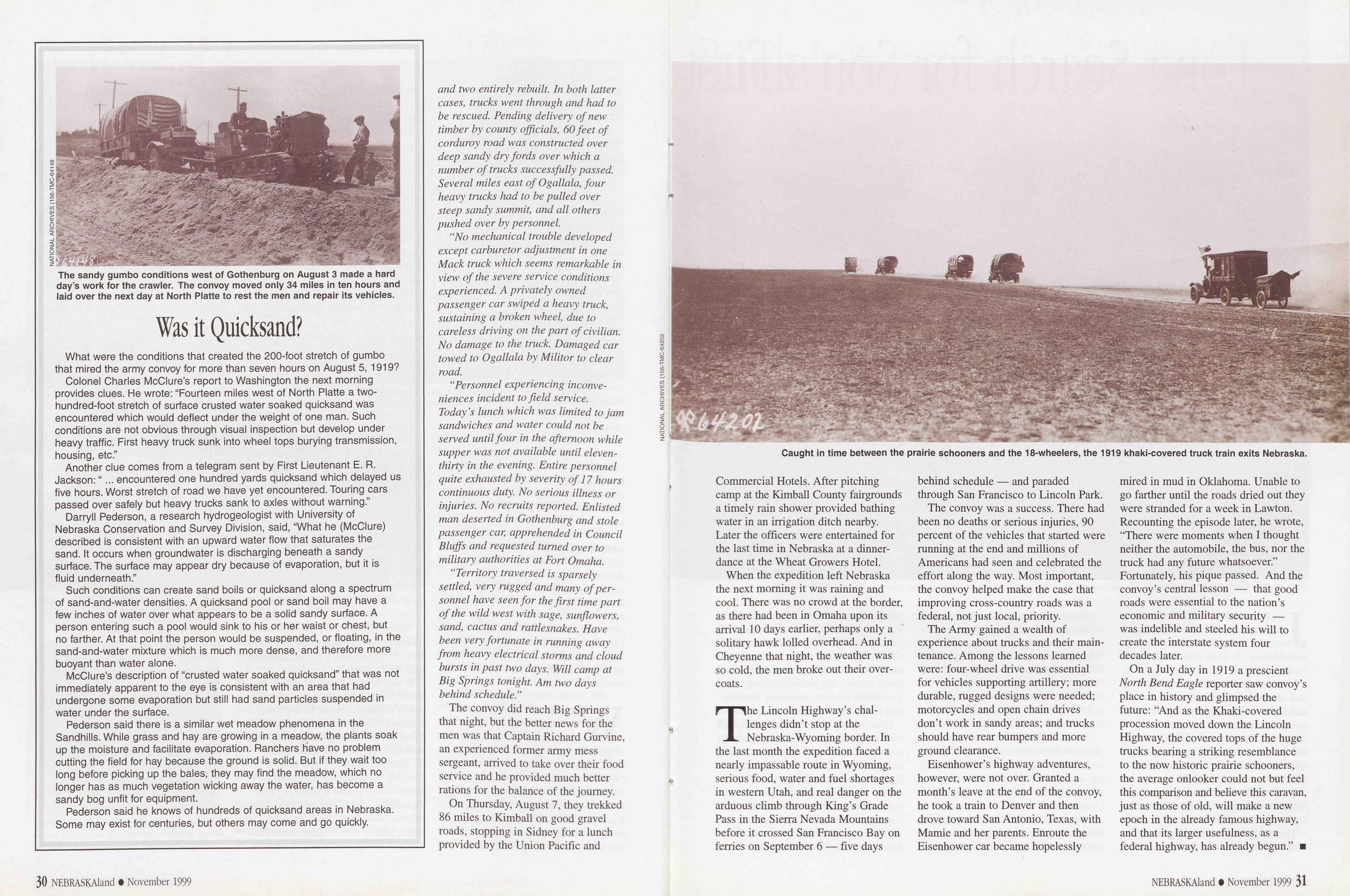
What were the conditions that created the 200-foot stretch of gumbo that mired the army convoy for more than seven hours on August 5, 1919?
Colonel Charles McClure's report to Washington the next morning provides clues. He wrote: "Fourteen miles west of North Platte a two- hundred-foot stretch of surface crusted water soaked quicksand was encountered which would deflect under the weight of one man. Such conditions are not obvious through visual inspection but develop under heavy traffic. First heavy truck sunk into wheel tops burying transmission, housing, etc."
Another clue comes from a telegram sent by First Lieutenant E. R. Jackson:"... encountered one hundred yards quicksand which delayed us five hours. Worst stretch of road we have yet encountered. Touring cars passed over safely but heavy trucks sank to axles without warning."
Darryll Pederson, a research hydrogeologist with University of Nebraska Conservation and Survey Division, said, "What he (McClure) described is consistent with an upward water flow that saturates the sand. It occurs when groundwater is discharging beneath a sandy surface. The surface may appear dry because of evaporation, but it is fluid underneath."
Such conditions can create sand boils or quicksand along a spectrum of sand-and-water densities. A quicksand pool or sand boil may have a few inches of water over what appears to be a solid sandy surface. A person entering such a pool would sink to his or her waist or chest, but no farther. At that point the person would be suspended, or floating, in the sand-and-water mixture which is much more dense, and therefore more buoyant than water alone.
McClure's description of "crusted water soaked quicksand" that was not immediately apparent to the eye is consistent with an area that had undergone some evaporation but still had sand particles suspended in water under the surface.
Pederson said there is a similar wet meadow phenomena in the Sandhills. While grass and hay are growing in a meadow, the plants soak up the moisture and facilitate evaporation. Ranchers have no problem cutting the field for hay because the ground is solid. But if they wait too long before picking up the bales, they may find the meadow, which no longer has as much vegetation wicking away the water, has become a sandy bog unfit for equipment.
Pederson said he knows of hundreds of quicksand areas in Nebraska. Some may exist for centuries, but others may come and go quickly.
"Three bridges were strengthened and two entirely rebuilt. In both latter cases, trucks went through and had to be rescued. Pending delivery of new timber by county officials, 60 feet of corduroy road was constructed over deep sandy dry fords over which a number of trucks successfully passed. Several miles east of Ogallala, four heavy trucks had to be pulled over steep sandy summit, and all others pushed over by personnel.
"No mechanical trouble developed except carburetor adjustment in one Mack truck which seems remarkable in view of the severe service conditions experienced. A privately owned passenger car swiped a heavy truck, sustaining a broken wheel, due to careless driving on the part of civilian. No damage to the truck. Damaged car towed to Ogallala by Militor to clear road.
"Personnel experiencing inconve- niences incident to field service. Today's lunch which was limited to jam sandwiches and water could not be served until four in the afternoon while supper was not available until eleven- thirty in the evening. Entire personnel quite exhausted by severity of 17 hours continuous duty. No serious illness or injuries. No recruits reported. Enlisted man deserted in Gothenburg and stole passenger car, apprehended in Council Bluffs and requested turned over to military authorities at Fort Omaha.
"Territory traversed is sparsely settled, very rugged and many of personnel have seen for the first time part of the wild west with sage, sunflowers, sand, cactus and rattlesnakes. Have been very fortunate in running away from heavy electrical storms and cloud bursts in past two days. Will camp at Big Springs tonight. Am two days behind schedule."
The convoy did reach Big Springs that night, but the better news for the men was that Captain Richard Gurvine, an experienced former army mess sergeant, arrived to take over their food service and he provided much better rations for the balance of the journey.
On Thursday, August 7, they trekked 86 miles to Kimball on good gravel roads, stopping in Sidney for a lunch provided by the Union Pacific and 30 NEBRASKAland • November 1999
When the expedition left Nebraska the next morning it was raining and cool. There was no crowd at the border, as there had been in Omaha upon its arrival 10 days earlier, perhaps only a solitary hawk lolled overhead. And in Cheyenne that night, the weather was so cold, the men broke out their overcoats.
The Lincoln Highway's challenges didn't stop at the Nebraska-Wyoming border. In the last month the expedition faced a nearly impassable route in Wyoming, serious food, water and fuel shortages in western Utah, and real danger on the arduous climb through King's Grade Pass in the Sierra Nevada Mountains before it crossed San Francisco Bay on ferries on September 6 — five days behind schedule — and paraded through San Francisco to Lincoln Park.
The convoy was a success. There had been no deaths or serious injuries, 90 percent of the vehicles that started were running at the end and millions of Americans had seen and celebrated the effort along the way. Most important, the convoy helped make the case that improving cross-country roads was a federal, not just local, priority.
The Army gained a wealth of experience about trucks and their maintenance. Among the lessons learned were: four-wheel drive was essential for vehicles supporting artillery; more durable, rugged designs were needed; motorcycles and open chain drives don't work in sandy areas; and trucks should have rear bumpers and more ground clearance.
Eisenhower's highway adventures, however, were not over. Granted a month's leave at the end of the convoy, he took a train to Denver and then drove toward San Antonio, Texas, with Mamie and her parents. Enroute the Eisenhower car became hopelessly mired in mud in Oklahoma. Unable to go farther until the roads dried out they were stranded for a week in Lawton. Recounting the episode later, he wrote, "There were moments when I thought neither the automobile, the bus, nor the truck had any future whatsoever." Fortunately, his pique passed. And the convoy's central lesson — that good roads were essential to the nation's economic and military security — was indelible and steeled his will to create the interstate system four decades later.
On a July day in 1919 a prescient North Bend Eagle reporter saw convoy's place in history and glimpsed the future: "And as the Khaki-covered procession moved down the Lincoln Highway, the covered tops of the huge trucks bearing a striking resemblance to the now historic prairie schooners, the average onlooker could not but feel this comparison and beheve this caravan, just as those of old, will make a new epoch in the already famous highway, and that its larger usefulness, as a federal highway, has already begun."
NEBRASKAland • November 1999 31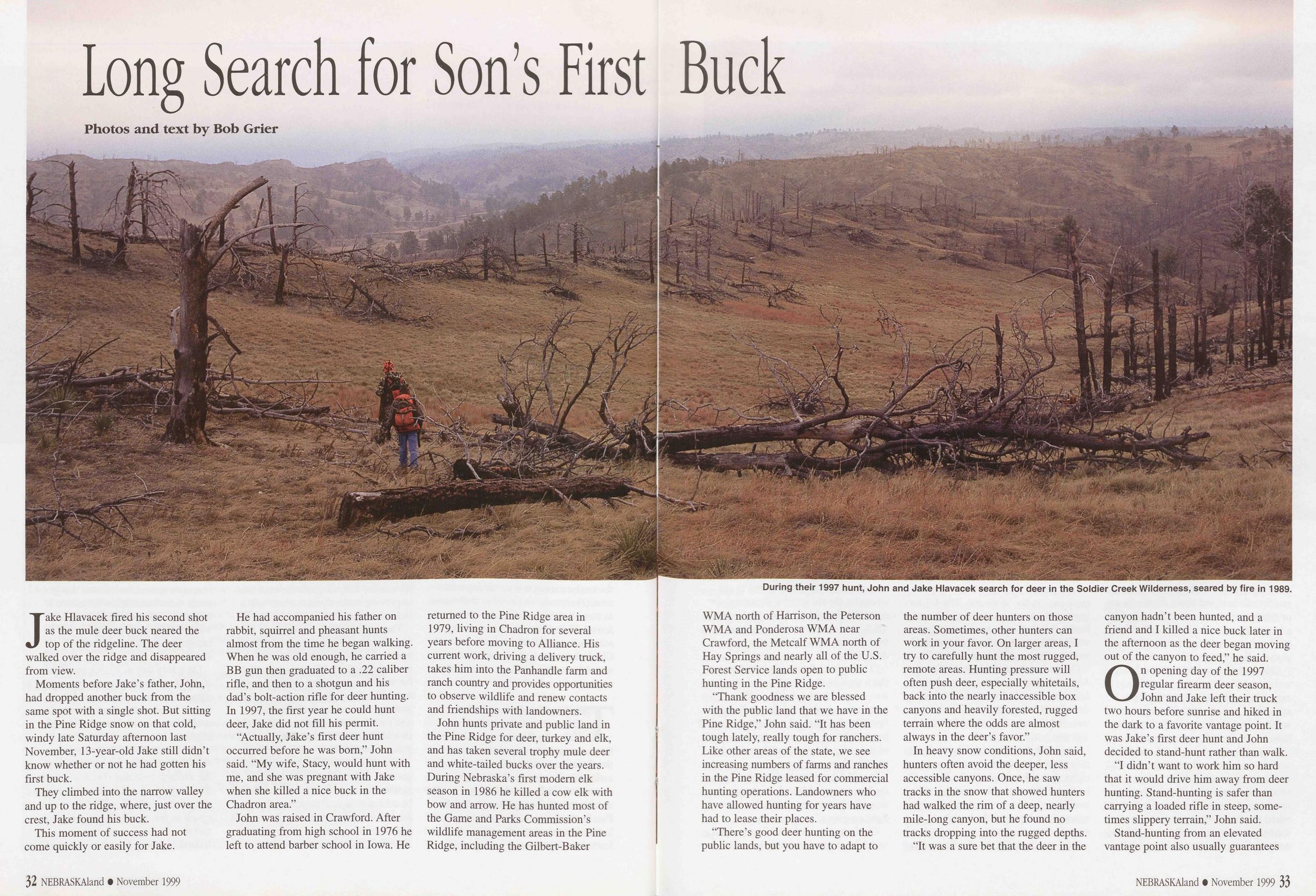
Long Search for Son's First Buck
Photos and text by Bob GrierJake Hlavacek fired his second shot as the mule deer buck neared the top of the ridgeline. The deer walked over the ridge and disappeared from view.
Moments before Jake's father, John, had dropped another buck from the same spot with a single shot. But sitting in the Pine Ridge snow on that cold, windy late Saturday afternoon last November, 13-year-old Jake still didn't know whether or not he had gotten his first buck.
They climbed into the narrow valley and up to the ridge, where, just over the crest, Jake found his buck.
This moment of success had not come quickly or easily for Jake.
He had accompanied his father on rabbit, squirrel and pheasant hunts almost from the time he began walking. When he was old enough, he carried a BB gun then graduated to a .22 caliber rifle, and then to a shotgun and his dad's bolt-action rifle for deer hunting. In 1997, the first year he could hunt deer, Jake did not fill his permit.
"Actually, Jake's first deer hunt occurred before he was born," John said. "My wife, Stacy, would hunt with me, and she was pregnant with Jake when she killed a nice buck in the Chadron area."
John was raised in Crawford. After graduating from high school in 1976 he left to attend barber school in Iowa. He returned to the Pine Ridge area in 1979, living in Chadron for several years before moving to Alliance. His current work, driving a dehvery truck, takes him into the Panhandle farm and ranch country and provides opportunities to observe wildlife and renew contacts and friendships with landowners.
John hunts private and public land in the Pine Ridge for deer, turkey and elk, and has taken several trophy mule deer and white-tailed bucks over the years. During Nebraska's first modern elk season in 1986 he killed a cow elk with bow and arrow. He has hunted most of the Game and Parks Commission's wildlife management areas in the Pine Ridge, including the Gilbert-Baker 32 NEBRASKAland • November 1999 WMA north of Harrison, the Peterson WMA and Ponderosa WMA near Crawford, the Metcalf WMA north of Hay Springs and nearly all of the U.S. Forest Service lands open to public hunting in the Pine Ridge.
"Thank goodness we are blessed with the public land that we have in the Pine Ridge," John said. "It has been tough lately, really tough for ranchers. Like other areas of the state, we see increasing numbers of farms and ranches in the Pine Ridge leased for commercial hunting operations. Landowners who have allowed hunting for years have had to lease their places.
"There's good deer hunting on the public lands, but you have to adapt to the number of deer hunters on those areas. Sometimes, other hunters can work in your favor. On larger areas, I try to carefully hunt the most rugged, remote areas. Hunting pressure will often push deer, especially whitetails, back into the nearly inaccessible box canyons and heavily forested, rugged terrain where the odds are almost always in the deer's favor."
In heavy snow conditions, John said, hunters often avoid the deeper, less accessible canyons. Once, he saw tracks in the snow that showed hunters had walked the rim of a deep, nearly mile-long canyon, but he found no tracks dropping into the rugged depths.
"It was a sure bet that the deer in the canyon hadn't been hunted, and a friend and I killed a nice buck later in the afternoon as the deer began moving out of the canyon to feed," he said.
On opening day of the 1997
regular firearm deer season,
John and Jake left their truck
two hours before sunrise and hiked in
the dark to a favorite vantage point. It
was Jake's first deer hunt and John
decided to stand-hunt rather than walk.
"I didn't want to work him so hard
that it would drive him away from deer
hunting. Stand-hunting is safer than
carrying a loaded rifle in steep, sometimes
slippery terrain," John said.
Stand-hunting from an elevated
vantage point also usually guarantees
NEBRASKAland • November 1999 33
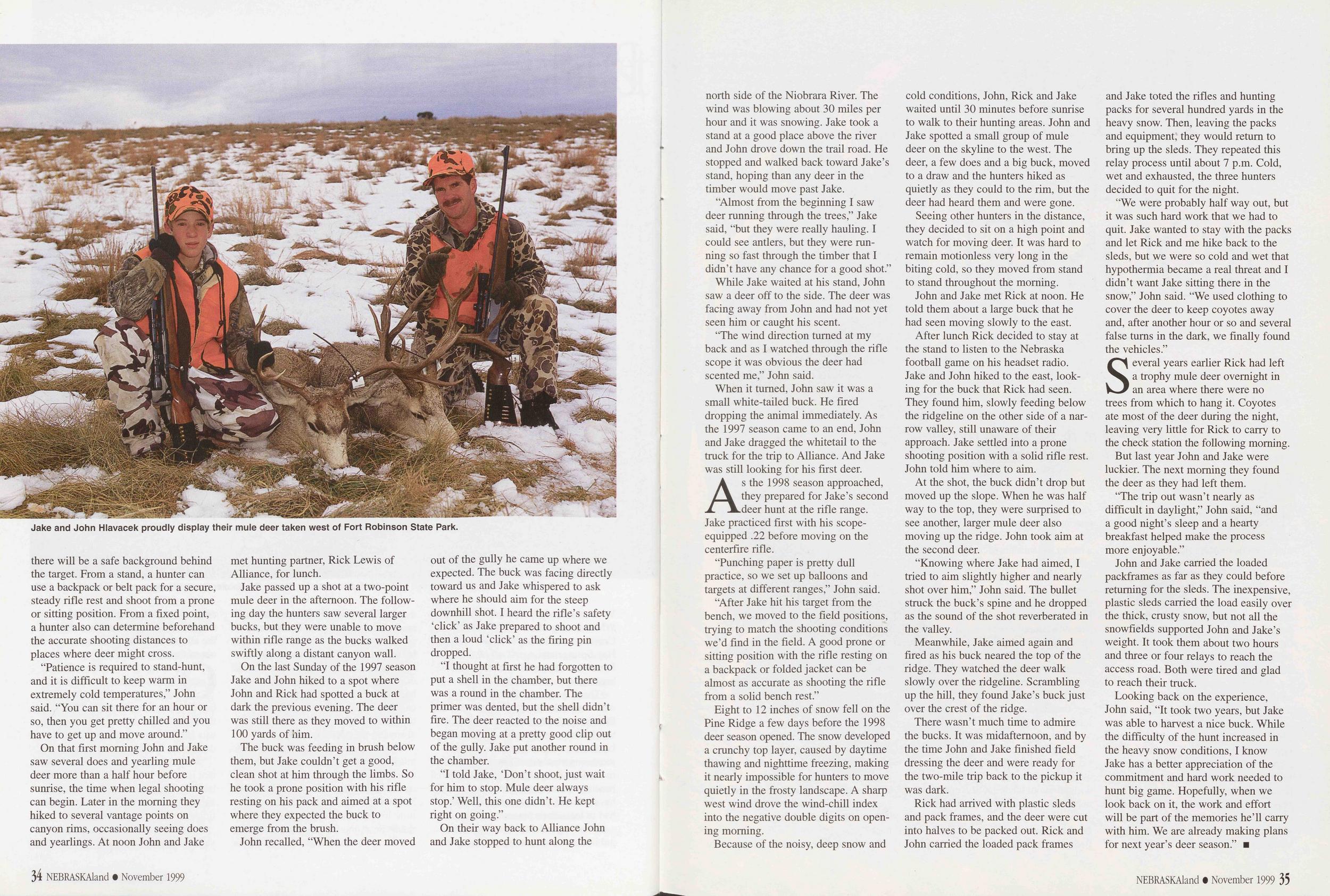
"Patience is required to stand-hunt, and it is difficult to keep warm in extremely cold temperatures," John said. "You can sit there for an hour or so, then you get pretty chilled and you have to get up and move around."
On that first morning John and Jake saw several does and yearling mule deer more than a half hour before sunrise, the time when legal shooting can begin. Later in the morning they hiked to several vantage points on canyon rims, occasionally seeing does and yearlings. At noon John and Jake met hunting partner, Rick Lewis of Alliance, for lunch.
Jake passed up a shot at a two-point mule deer in the afternoon. The following day the hunters saw several larger bucks, but they were unable to move within rifle range as the bucks walked swiftly along a distant canyon wall.
On the last Sunday of the 1997 season Jake and John hiked to a spot where John and Rick had spotted a buck at dark the previous evening. The deer was still there as they moved to within 100 yards of him.
The buck was feeding in brush below them, but Jake couldn't get a good, clean shot at him through the limbs. So he took a prone position with his rifle resting on his pack and aimed at a spot where they expected the buck to emerge from the brush.
John recalled, "When the deer moved out of the gully he came up where we expected. The buck was facing directly toward us and Jake whispered to ask where he should aim for the steep downhill shot. I heard the rifle's safety 'click' as Jake prepared to shoot and then a loud 'click' as the firing pin dropped.
"I thought at first he had forgotten to put a shell in the chamber, but there was a round in the chamber. The primer was dented, but the shell didn't fire. The deer reacted to the noise and began moving at a pretty good clip out of the gully. Jake put another round in the chamber.
"I told Jake, 'Don't shoot, just wait for him to stop. Mule deer always stop.' Well, this one didn't. He kept right on going."
On their way back to Alliance John and Jake stopped to hunt along the 34 NEBRASKAland • November 1999 north side of the Niobrara River. The wind was blowing about 30 miles per hour and it was snowing. Jake took a stand at a good place above the river and John drove down the trail road. He stopped and walked back toward Jake's stand, hoping than any deer in the timber would move past Jake.
"Almost from the beginning I saw deer running through the trees," Jake said, "but they were really hauling. I could see antlers, but they were running so fast through the timber that I didn't have any chance for a good shot."
While Jake waited at his stand, John saw a deer off to the side. The deer was facing away from John and had not yet seen him or caught his scent.
"The wind direction turned at my back and as I watched through the rifle scope it was obvious the deer had scented me," John said.
When it turned, John saw it was a small white-tailed buck. He fired dropping the animal immediately. As the 1997 season came to an end, John and Jake dragged the whitetail to the truck for the trip to Alliance. And Jake was still looking for his first deer.
As the 1998 season approached, they prepared for Jake's second deer hunt at the rifle range. Jake practiced first with his scope- equipped .22 before moving on the centerfire rifle.
"Punching paper is pretty dull practice, so we set up balloons and targets at different ranges," John said.
"After Jake hit his target from the bench, we moved to the field positions, trying to match the shooting conditions we'd find in the field. A good prone or sitting position with the rifle resting on a backpack or folded jacket can be almost as accurate as shooting the rifle from a solid bench rest."
Eight to 12 inches of snow fell on the Pine Ridge a few days before the 1998 deer season opened. The snow developed a crunchy top layer, caused by daytime thawing and nighttime freezing, making it nearly impossible for hunters to move quietly in the frosty landscape. A sharp west wind drove the wind-chill index into the negative double digits on opening morning.
Because of the noisy, deep snow and cold conditions, John, Rick and Jake waited until 30 minutes before sunrise to walk to their hunting areas. John and Jake spotted a small group of mule deer on the skyline to the west. The deer, a few does and a big buck, moved to a draw and the hunters hiked as quietly as they could to the rim, but the deer had heard them and were gone.
Seeing other hunters in the distance, they decided to sit on a high point and watch for moving deer. It was hard to remain motionless very long in the biting cold, so they moved from stand to stand throughout the morning.
John and Jake met Rick at noon. He told them about a large buck that he had seen moving slowly to the east.
After lunch Rick decided to stay at the stand to listen to the Nebraska football game on his headset radio. Jake and John hiked to the east, looking for the buck that Rick had seen. They found him, slowly feeding below the ridgeline on the other side of a narrow valley, still unaware of their approach. Jake settled into a prone shooting position with a solid rifle rest. John told him where to aim.
At the shot, the buck didn't drop but moved up the slope. When he was half way to the top, they were surprised to see another, larger mule deer also moving up the ridge. John took aim at the second deer.
"Knowing where Jake had aimed, I tried to aim slightly higher and nearly shot over him," John said. The bullet struck the buck's spine and he dropped as the sound of the shot reverberated in the valley.
Meanwhile, Jake aimed again and fired as his buck neared the top of the ridge. They watched the deer walk slowly over the ridgeline. Scrambling up the hill, they found Jake's buck just over the crest of the ridge.
There wasn't much time to admire the bucks. It was midafternoon, and by the time John and Jake finished field dressing the deer and were ready for the two-mile trip back to the pickup it was dark.
Rick had arrived with plastic sleds and pack frames, and the deer were cut into halves to be packed out. Rick and John carried the loaded pack frames and Jake toted the rifles and hunting packs for several hundred yards in the heavy snow. Then, leaving the packs and equipment, they would return to bring up the sleds. They repeated this relay process until about 7 p.m. Cold, wet and exhausted, the three hunters decided to quit for the night.
"We were probably half way out, but it was such hard work that we had to quit. Jake wanted to stay with the packs and let Rick and me hike back to the sleds, but we were so cold and wet that hypothermia became a real threat and I didn't want Jake sitting there in the snow," John said. "We used clothing to cover the deer to keep coyotes away and, after another hour or so and several false turns in the dark, we finally found the vehicles."
Several years earlier Rick had left a trophy mule deer overnight in an area where there were no trees from which to hang it. Coyotes ate most of the deer during the night, leaving very little for Rick to carry to the check station the following morning.
But last year John and Jake were luckier. The next morning they found the deer as they had left them.
"The trip out wasn't nearly as difficult in daylight," John said, "and a good night's sleep and a hearty breakfast helped make the process more enjoyable."
John and Jake carried the loaded packframes as far as they could before returning for the sleds. The inexpensive, plastic sleds carried the load easily over the thick, crusty snow, but not all the snowfields supported John and Jake's weight. It took them about two hours and three or four relays to reach the access road. Both were tired and glad to reach their truck.
Looking back on the experience, John said, "It took two years, but Jake was able to harvest a nice buck. While the difficulty of the hunt increased in the heavy snow conditions, I know Jake has a better appreciation of the commitment and hard work needed to hunt big game. Hopefully, when we look back on it, the work and effort will be part of the memories he'll carry with him. We are already making plans for next year's deer season."
NEBRASKAland • November 1999 35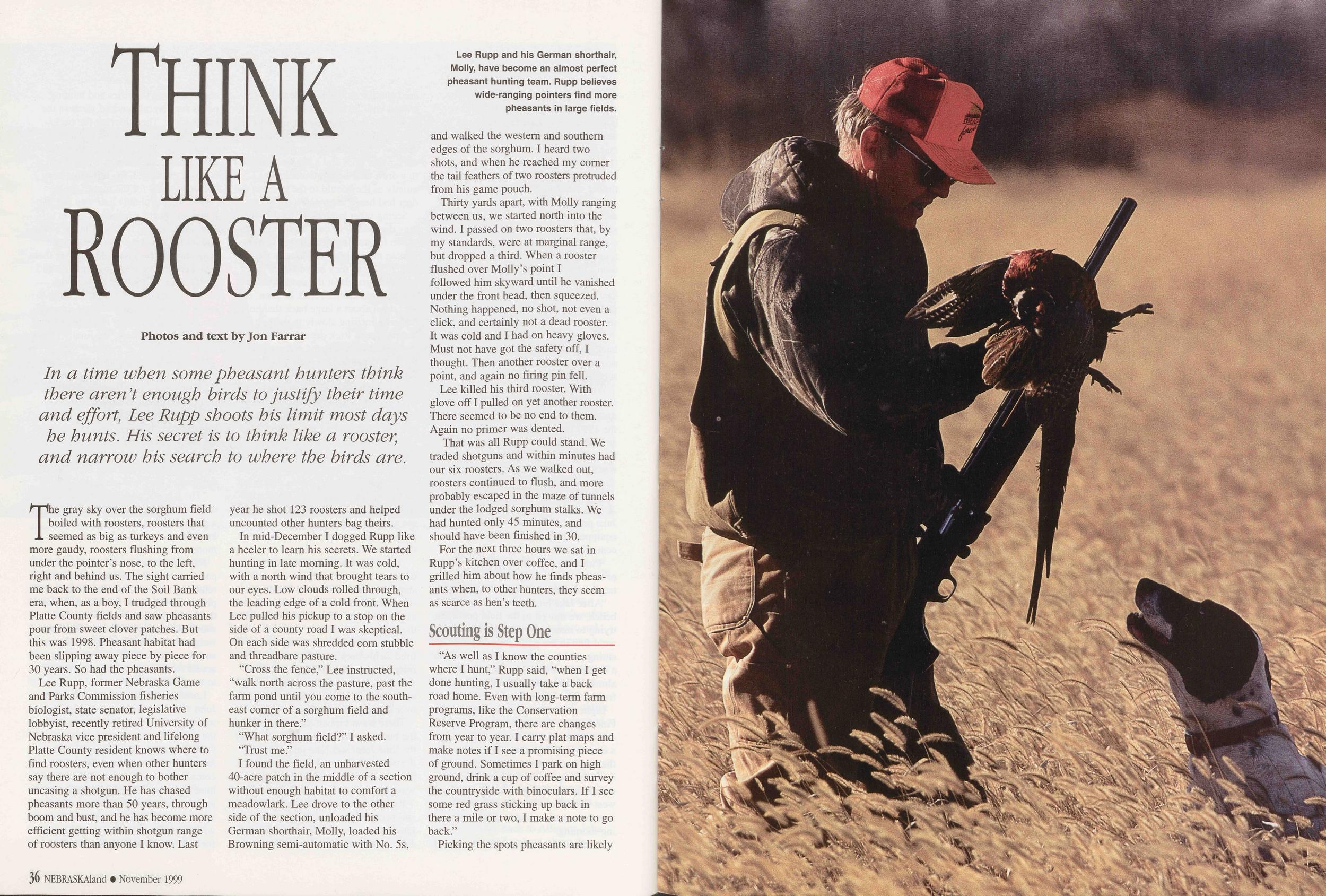
Think LIKE A ROOSTER
Photos and text by Jon Farrar In a time when some pheasant hunters think there aren't enough birds to justify their time and effort, Lee Rupp shoots his limit most days he hunts. His secret is to think like a rooster, and narrow his search to where the birds are.The gray sky over the sorghum field boiled with roosters, roosters that seemed as big as turkeys and even more gaudy, roosters flushing from under the pointer's nose, to the left, right and behind us. The sight carried me back to the end of the Soil Bank era, when, as a boy, I trudged through Platte County fields and saw pheasants pour from sweet clover patches. But this was 1998. Pheasant habitat had been slipping away piece by piece for 30 years. So had the pheasants.
Lee Rupp, former Nebraska Game and Parks Commission fisheries biologist, state senator, legislative lobbyist, recently retired University of Nebraska vice president and lifelong Platte County resident knows where to find roosters, even when other hunters say there are not enough to bother uncasing a shotgun. He has chased pheasants more than 50 years, through boom and bust, and he has become more efficient getting within shotgun range of roosters than anyone I know. Last year he shot 123 roosters and helped uncounted other hunters bag theirs.
In mid-December I dogged Rupp like a heeler to learn his secrets. We started hunting in late morning. It was cold, with a north wind that brought tears to our eyes. Low clouds rolled through, the leading edge of a cold front. When Lee pulled his pickup to a stop on the side of a county road I was skeptical. On each side was shredded corn stubble and threadbare pasture.
"Cross the fence," Lee instructed, "walk north across the pasture, past the farm pond until you come to the southeast corner of a sorghum field and hunker in there."
'What sorghum field?" I asked.
'Trust me."
I found the field, an unharvested 40-acre patch in the middle of a section without enough habitat to comfort a meadowlark. Lee drove to the other side of the section, unloaded his German shorthair, Molly, loaded his Browning semi-automatic with No. 5s, and walked the western and southern edges of the sorghum. I heard two shots, and when he reached my corner the tail feathers of two roosters protruded from his game pouch.
Thirty yards apart, with Molly ranging between us, we started north into the wind. I passed on two roosters that, by my standards, were at marginal range, but dropped a third. When a rooster flushed over Molly's point I followed him skyward until he vanished under the front bead, then squeezed. Nothing happened, no shot, not even a click, and certainly not a dead rooster. It was cold and I had on heavy gloves. Must not have got the safety off, I thought. Then another rooster over a point, and again no firing pin fell.
Lee killed his third rooster. With glove off I pulled on yet another rooster. There seemed to be no end to them. Again no primer was dented.
That was all Rupp could stand. We traded shotguns and within minutes had our six roosters. As we walked out, roosters continued to flush, and more probably escaped in the maze of tunnels under the lodged sorghum stalks. We had hunted only 45 minutes, and should have been finished in 30.
For the next three hours we sat in Rupp's kitchen over coffee, and I grilled him about how he finds pheas- ants when, to other hunters, they seem as scarce as hen's teeth.
Scouting is Step One"As well as I know the counties where I hunt," Rupp said, "when I get done hunting, I usually take a back road home. Even with long-term farm programs, like the Conservation Reserve Program, there are changes from year to year. I carry plat maps and make notes if I see a promising piece of ground. Sometimes I park on high ground, drink a cup of coffee and survey the countryside with binoculars. If I see some red grass sticking up back in there a mile or two, I make a note to go back."
Picking the spots pheasants are likely 36 NEBRASKAland • November 1999
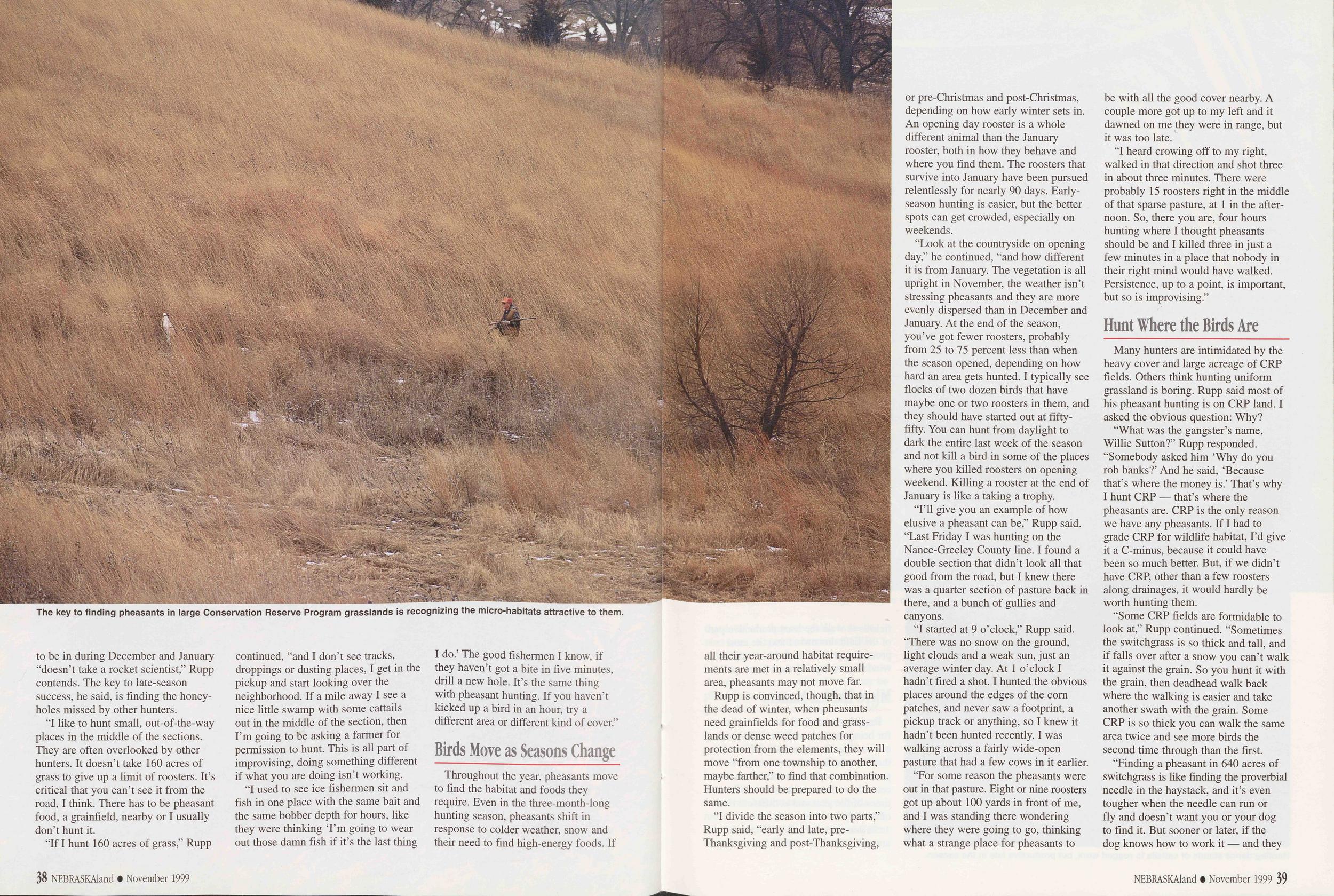
"I like to hunt small, out-of-the-way places in the middle of the sections. They are often overlooked by other hunters. It doesn't take 160 acres of grass to give up a limit of roosters. It's critical that you can't see it from the road, I think. There has to be pheasant food, a grainfield, nearby or I usually don't hunt it.
"If I hunt 160 acres of grass," Rupp continued, "and I don't see tracks, droppings or dusting places, I get in the pickup and start looking over the neighborhood. If a mile away I see a nice little swamp with some cattails out in the middle of the section, then I'm going to be asking a farmer for permission to hunt. This is all part of improvising, doing something different if what you are doing isn't working.
"I used to see ice fishermen sit and fish in one place with the same bait and the same bobber depth for hours, like they were thinking T'm going to wear out those damn fish if it's the last thing I do.' The good fishermen I know, if they haven't got a bite in five minutes, drill a new hole. It's the same thing with pheasant hunting. If you haven't kicked up a bird in an hour, try a different area or different kind of cover."
Birds Move as Seasons ChangeThroughout the year, pheasants move to find the habitat and foods they require. Even in the three-month-long hunting season, pheasants shift in response to colder weather, snow and their need to find high-energy foods. If 38 NEBRASKAland • November 1999 all their year-around habitat requirements are met in a relatively small area, pheasants may not move far.
Rupp is convinced, though, that in the dead of winter, when pheasants need grainfields for food and grasslands or dense weed patches for protection from the elements, they will move "from one township to another, maybe farther," to find that combination. Hunters should be prepared to do the same.
"I divide the season into two parts," Rupp said, "early and late, pre- Thanksgiving and post-Thanksgiving, or pre-Christmas and post-Christmas, depending on how early winter sets in. An opening day rooster is a whole different animal than the January rooster, both in how they behave and where you find them. The roosters that survive into January have been pursued relentlessly for nearly 90 days. Early- season hunting is easier, but the better spots can get crowded, especially on weekends.
"Look at the countryside on opening day," he continued, "and how different it is from January. The vegetation is all upright in November, the weather isn't stressing pheasants and they are more evenly dispersed than in December and January. At the end of the season, you've got fewer roosters, probably from 25 to 75 percent less than when the season opened, depending on how hard an area gets hunted. I typically see flocks of two dozen birds that have maybe one or two roosters in them, and they should have started out at fifty- fifty. You can hunt from daylight to dark the entire last week of the season and not kill a bird in some of the places where you killed roosters on opening weekend. Killing a rooster at the end of January is like a taking a trophy.
"I'll give you an example of how elusive a pheasant can be," Rupp said. "Last Friday I was hunting on the Nance-Greeley County line. I found a double section that didn't look all that good from the road, but I knew there was a quarter section of pasture back in there, and a bunch of gullies and canyons.
"I started at 9 o'clock," Rupp said. "There was no snow on the ground, light clouds and a weak sun, just an average winter day. At 1 o'clock I hadn't fired a shot. I hunted the obvious places around the edges of the corn patches, and never saw a footprint, a pickup track or anything, so I knew it hadn't been hunted recently. I was walking across a fairly wide-open pasture that had a few cows in it earlier.
"For some reason the pheasants were out in that pasture. Eight or nine roosters got up about 100 yards in front of me, and I was standing there wondering where they were going to go, thinking what a strange place for pheasants to be with all the good cover nearby. A couple more got up to my left and it dawned on me they were in range, but it was too late.
"I heard crowing off to my right, walked in that direction and shot three in about three minutes. There were probably 15 roosters right in the middle of that sparse pasture, at 1 in the afternoon. So, there you are, four hours hunting where I thought pheasants should be and I killed three in just a few minutes in a place that nobody in their right mind would have walked. Persistence, up to a point, is important, but so is improvising."
Hunt Where the Birds AreMany hunters are intimidated by the heavy cover and large acreage of CRP fields. Others think hunting uniform grassland is boring. Rupp said most of his pheasant hunting is on CRP land. I asked the obvious question: Why?
"What was the gangster's name, Willie Sutton?" Rupp responded.
"Somebody asked him 'Why do you rob banks?' And he said, 'Because that's where the money is.' That's why I hunt CRP — that's where the pheasants are. CRP is the only reason we have any pheasants. If I had to grade CRP for wildlife habitat, I'd give it a C-minus, because it could have been so much better. But, if we didn't have CRP, other than a few roosters along drainages, it would hardly be worth hunting them.
"Some CRP fields are formidable to look at," Rupp continued. "Sometimes the switchgrass is so thick and tall, and if falls over after a snow you can't walk it against the grain. So you hunt it with the grain, then deadhead walk back where the walking is easier and take another swath with the grain. Some CRP is so thick you can walk the same area twice and see more birds the second time through than the first.
"Finding a pheasant in 640 acres of
switchgrass is like finding the proverbial
needle in the haystack, and it's even
tougher when the needle can run or
fly and doesn't want you or your dog
to find it. But sooner or later, if the
dog knows how to work it — and they
NEBRASKAland • November 1999 39
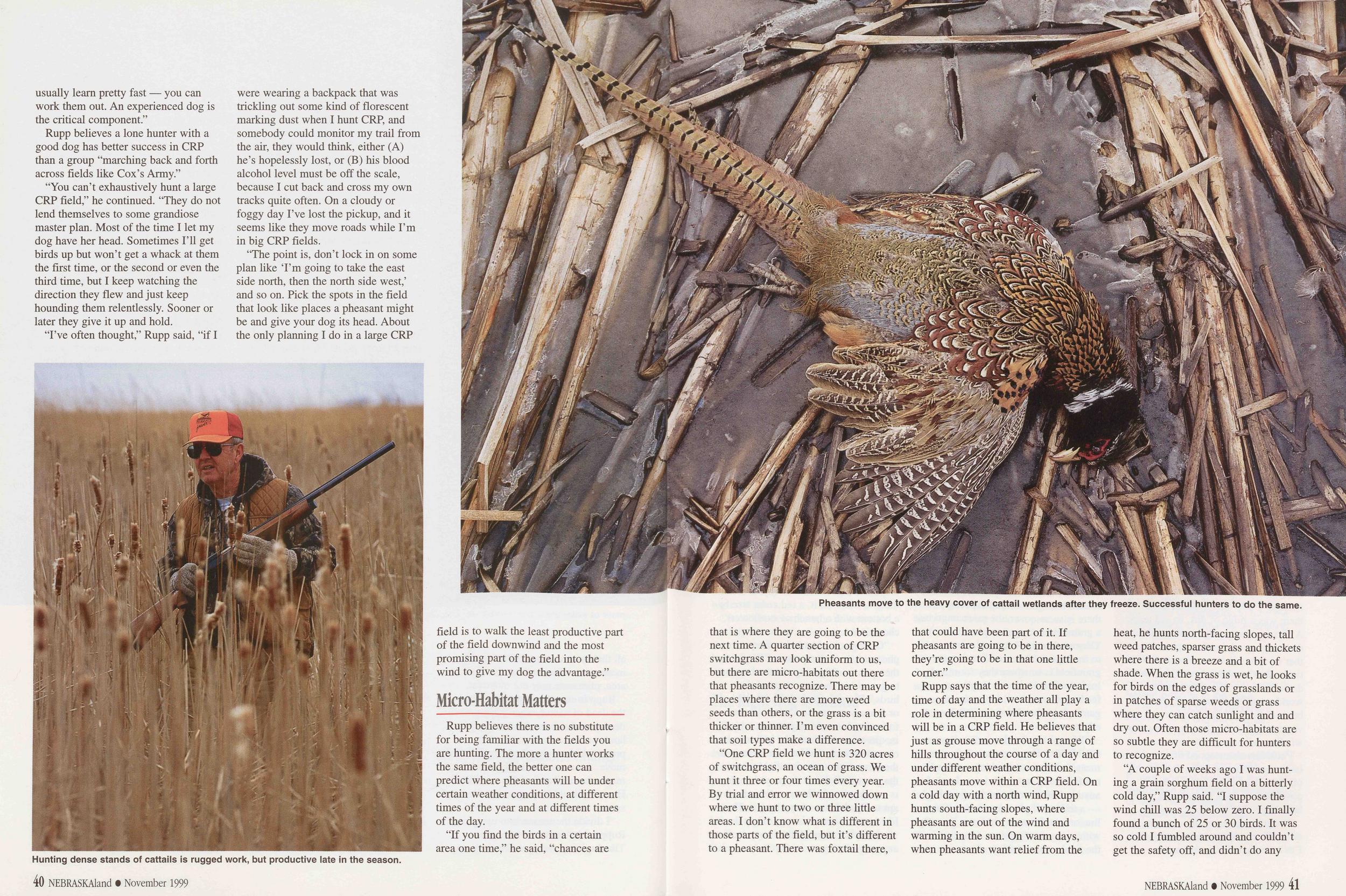 usually learn pretty fast — you can
work them out. An experienced dog is
the critical component."
usually learn pretty fast — you can
work them out. An experienced dog is
the critical component."
Rupp believes a lone hunter with a good dog has better success in CRP than a group "marching back and forth across fields like Cox's Army."
"You can't exhaustively hunt a large CRP field," he continued. "They do not lend themselves to some grandiose master plan. Most of the time I let my dog have her head. Sometimes I'll get birds up but won't get a whack at them the first time, or the second or even the third time, but I keep watching the direction they flew and just keep hounding them relentlessly. Sooner or later they give it up and hold.
"I've often thought," Rupp said, "if I were wearing a backpack that was trickling out some kind of florescent marking dust when I hunt CRP, and somebody could monitor my trail from the air, they would think, either (A) he's hopelessly lost, or (B) his blood alcohol level must be off the scale, because I cut back and cross my own tracks quite often. On a cloudy or foggy day I've lost the pickup, and it seems like they move roads while I'm in big CRP fields.
"The point is, don't lock in on some plan like T'm going to take the east side north, then the north side west,' and so on. Pick the spots in the field that look like places a pheasant might be and give your dog its head. About the only planning I do in a large CRP field is to walk the least productive part of the field downwind and the most promising part of the field into the wind to give my dog the advantage."
Micro-Habitat MattersRupp believes there is no substitute for being familiar with the fields you are hunting. The more a hunter works the same field, the better one can predict where pheasants will be under certain weather conditions, at different times of the year and at different times of the day.
"If you find the birds in a certain area one time," he said, "chances are
"One CRP field we hunt is 320 acres of switchgrass, an ocean of grass. We hunt it three or four times every year. By trial and error we winnowed down where we hunt to two or three little areas. I don't know what is different in those parts of the field, but it's different to a pheasant. There was foxtail there, that could have been part of it. If pheasants are going to be in there, they're going to be in that one little corner."
Rupp says that the time of the year, time of day and the weather all play a role in determining where pheasants will be in a CRP field. He believes that just as grouse move through a range of hills throughout the course of a day and under different weather conditions, pheasants move within a CRP field. On a cold day with a north wind, Rupp hunts south-facing slopes, where pheasants are out of the wind and warming in the sun. On warm days, when pheasants want relief from the heat, he hunts north-facing slopes, tall weed patches, sparser grass and thickets where there is a breeze and a bit of shade. When the grass is wet, he looks for birds on the edges of grasslands or in patches of sparse weeds or grass where they can catch sunlight and and dry out. Often those micro-habitats are so subtle they are difficult for hunters to recognize.
"A couple of weeks ago I was hunting
a grain sorghum field on a bitterly
cold day," Rupp said. "I suppose the
wind chill was 25 below zero. I finally
found a bunch of 25 or 30 birds. It was
so cold I fumbled around and couldn't
get the safety off, and didn't do any
NEBRASKAland • November 1999 4l
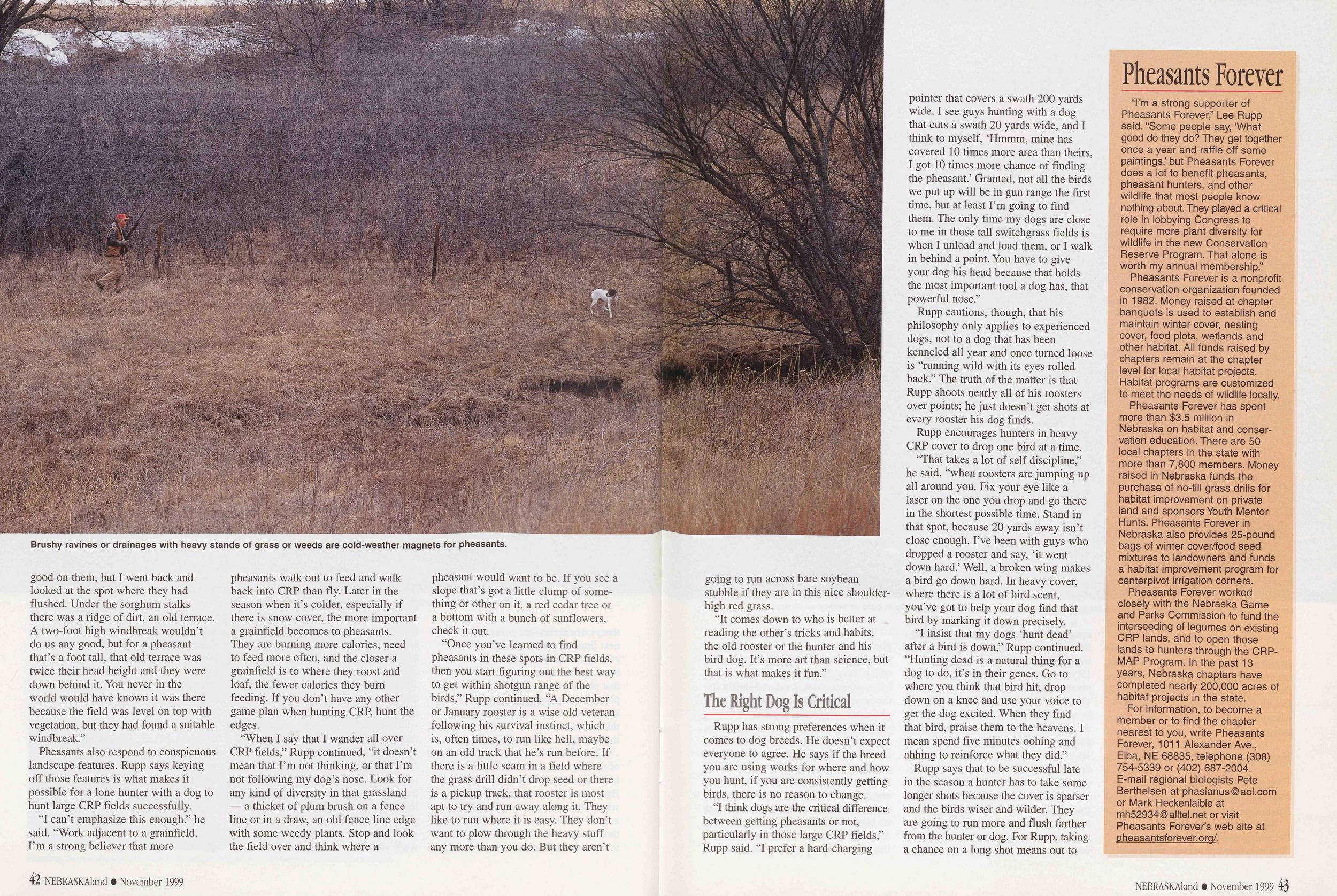
Pheasants also respond to conspicuous landscape features. Rupp says keying off those features is what makes it possible for a lone hunter with a dog to hunt large CRP fields successfully.
"I can't emphasize this enough." he said. "Work adjacent to a grainfield. I'm a strong believer that more pheasants walk out to feed and walk back into CRP than fly. Later in the season when it's colder, especially if there is snow cover, the more important a grainfield becomes to pheasants. They are burning more calories, need to feed more often, and the closer a grainfield is to where they roost and loaf, the fewer calories they burn feeding. If you don't have any other game plan when hunting CRP, hunt the edges.
"When I say that I wander all over CRP fields," Rupp continued, "it doesn't mean that I'm not thinking, or that I'm not following my dog's nose. Look for any kind of diversity in that grassland — a thicket of plum brush on a fence line or in a draw, an old fence line edge with some weedy plants. Stop and look the field over and think where a pheasant would want to be. If you see a slope that's got a little clump of something or other on it, a red cedar tree or a bottom with a bunch of sunflowers, check it out.
"Once you've learned to find pheasants in these spots in CRP fields, then you start figuring out the best way to get within shotgun range of the birds," Rupp continued. "A December or January rooster is a wise old veteran following his survival instinct, which is, often times, to run like hell, maybe on an old track that he's run before. If there is a little seam in a field where the grass drill didn't drop seed or there is a pickup track, that rooster is most apt to try and run away along it. They like to run where it is easy. They don't want to plow through the heavy stuff any more than you do. But they aren't 42 NEBRASKAland • November 1999 going to run across bare soybean stubble if they are in this nice shoulder- high red grass.
"It comes down to who is better at reading the other's tricks and habits, the old rooster or the hunter and his bird dog. It's more art than science, but that is what makes it fun."
The Right Dog Is Critica/Rupp has strong preferences when it comes to dog breeds. He doesn't expect everyone to agree. He says if the breed you are using works for where and how you hunt, if you are consistently getting birds, there is no reason to change.
"I think dogs are the critical difference between getting pheasants or not, particularly in those large CRP fields," Rupp said. "I prefer a hard-charging pointer that covers a swath 200 yards wide. I see guys hunting with a dog that cuts a swath 20 yards wide, and I think to myself, 'Hmmm, mine has covered 10 times more area than theirs, I got 10 times more chance of finding the pheasant.' Granted, not all the birds we put up will be in gun range the first time, but at least I'm going to find them. The only time my dogs are close to me in those tall switchgrass fields is when I unload and load them, or I walk in behind a point. You have to give your dog his head because that holds the most important tool a dog has, that powerful nose."
Rupp cautions, though, that his philosophy only applies to experienced dogs, not to a dog that has been kenneled all year and once turned loose is "running wild with its eyes rolled back." The truth of the matter is that Rupp shoots nearly all of his roosters over points; he just doesn't get shots at every rooster his dog finds.
Rupp encourages hunters in heavy CRP cover to drop one bird at a time.
"That takes a lot of self discipline," he said, "when roosters are jumping up all around you. Fix your eye like a laser on the one you drop and go there in the shortest possible time. Stand in that spot, because 20 yards away isn't close enough. I've been with guys who dropped a rooster and say, it went down hard.' Well, a broken wing makes a bird go down hard. In heavy cover, where there is a lot of bird scent, you've got to help your dog find that bird by marking it down precisely.
"I insist that my dogs 'hunt dead' after a bird is down," Rupp continued. "Hunting dead is a natural thing for a dog to do, it's in their genes. Go to where you think that bird hit, drop down on a knee and use your voice to get the dog excited. When they find that bird, praise them to the heavens. I mean spend five minutes oohing and ahhing to reinforce what they did."
Rupp says that to be successful late in the season a hunter has to take some longer shots because the cover is sparser and the birds wiser and wilder. They are going to run more and flush farther from the hunter or dog. For Rupp, taking a chance on a long shot means out to 40 yards. Early in the season he hunts with No. 6 shot loads, then goes to No. 5 s and by the end of the season is using magnum three-inch No. 4s. Longer shots increase the risk of winged birds that hit the ground running, and that is where a dog that hunts dead becomes indispensable.
Pheasants Foreverm a strong supporter of Pheasants Forever" Lee Rupp said. "Some people say, 'What good do they do? They get together once a year and raffle off some paintings,' but Pheasants Forever does a lot to benefit pheasants, pheasant hunters, and other wildlife that most people know nothing about. They played a critical role in lobbying Congress to require more plant diversity for wildlife in the new Conservation Reserve Program. That alone is worth my annual membership."
Pheasants Forever is a nonprofit conservation organization founded in 1982. Money raised at chapter banquets is used to establish and maintain winter cover, nesting cover, food plots, wetlands and other habitat. All funds raised by chapters remain at the chapter level for local habitat projects. Habitat programs are customized to meet the needs of wildlife locally.
Pheasants Forever has spent more than $3.5 million in Nebraska on habitat and conservation education. There are 50 local chapters in the state with more than 7,800 members. Money raised in Nebraska funds the purchase of no-till grass drills for habitat improvement on private land and sponsors Youth Mentor Hunts. Pheasants Forever in Nebraska also provides 25-pound bags of winter cover/food seed mixtures to landowners and funds a habitat improvement program for centerpivot irrigation corners.
Pheasants Forever worked closely with the Nebraska Game and Parks Commission to fund the interseeding of legumes on existing CRP lands, and to open those lands to hunters through the CRP- MAP Program. In the past 13 years, Nebraska chapters have completed nearly 200,000 acres of habitat projects in the state.
For information, to become a member or to find the chapter nearest to you, write Pheasants Forever, 1011 Alexander Ave., Elba, NE 68835, telephone (308) 754-5339 or (402) 687-2004. E-mail regional biologists Pete Berthelsen at phasianus@aol.com or Mark Heckenlaible at mh52934@alltel.net or visit Pheasants Forever's web site at pheasantsforever.org/.
NEBRASKAland • November 1999 43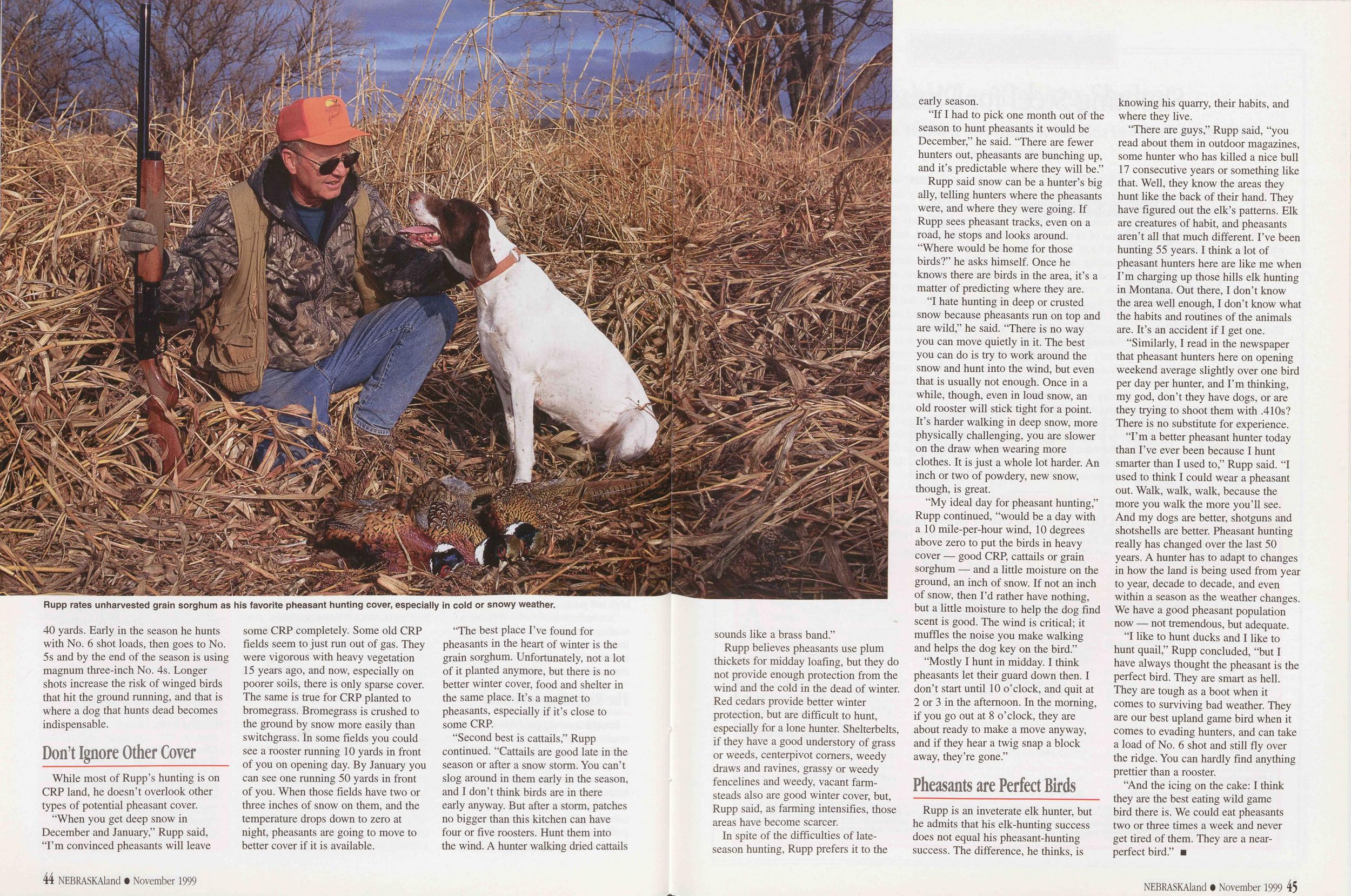
While most of Rupp's hunting is on CRP land, he doesn't overlook other types of potential pheasant cover.
"When you get deep snow in December and January," Rupp said, "I'm convinced pheasants will leave some CRP completely. Some old CRP fields seem to just run out of gas. They were vigorous with heavy vegetation 15 years ago, and now, especially on poorer soils, there is only sparse cover. The same is true for CRP planted to bromegrass. Bromegrass is crushed to the ground by snow more easily than switchgrass. In some fields you could see a rooster running 10 yards in front of you on opening day. By January you can see one running 50 yards in front of you. When those fields have two or three inches of snow on them, and the temperature drops down to zero at night, pheasants are going to move to better cover if it is available.
"The best place I've found for pheasants in the heart of winter is the grain sorghum. Unfortunately, not a lot of it planted anymore, but there is no better winter cover, food and shelter in the same place. It's a magnet to pheasants, especially if it's close to some CRP.
"Second best is cattails," Rupp continued. "Cattails are good late in the season or after a snow storm. You can't slog around in them early in the season, and I don't think birds are in there early anyway. But after a storm, patches no bigger than this kitchen can have four or five roosters. Hunt them into the wind. A hunter walking dried cattails 44 NEBRASKAland • November 1999 sounds like a brass band."
Rupp believes pheasants use plum thickets for midday loafing, but they do not provide enough protection from the wind and the cold in the dead of winter. Red cedars provide better winter protection, but are difficult to hunt, especially for a lone hunter. Shelterbelts, if they have a good understory of grass or weeds, centerpivot corners, weedy draws and ravines, grassy or weedy fencelines and weedy, vacant farmsteads also are good winter cover, but, Rupp said, as farming intensifies, those areas have become scarcer.
In spite of the difficulties of late- season hunting, Rupp prefers it to the early season.
"If I had to pick one month out of the season to hunt pheasants it would be December," he said. "There are fewer hunters out, pheasants are bunching up, and it's predictable where they will be."
Rupp said snow can be a hunter's big ally, telling hunters where the pheasants were, and where they were going. If Rupp sees pheasant tracks, even on a road, he stops and looks around. "Where would be home for those birds?" he asks himself. Once he knows there are birds in the area, it's a matter of predicting where they are.
"I hate hunting in deep or crusted snow because pheasants run on top and are wild," he said. "There is no way you can move quietly in it. The best you can do is try to work around the snow and hunt into the wind, but even that is usually not enough. Once in a while, though, even in loud snow, an old rooster will stick tight for a point. It's harder walking in deep snow, more physically challenging, you are slower on the draw when wearing more clothes. It is just a whole lot harder. An inch or two of powdery, new snow, though, is great.
"My ideal day for pheasant hunting," Rupp continued, "would be a day with a 10 mile-per-hour wind, 10 degrees above zero to put the birds in heavy cover — good CRP, cattails or grain sorghum — and a little moisture on the ground, an inch of snow. If not an inch of snow, then I'd rather have nothing, but a little moisture to help the dog find scent is good. The wind is critical; it muffles the noise you make walking and helps the dog key on the bird."
"Mostly I hunt in midday. I think pheasants let their guard down then. I don't start until 10 o'clock, and quit at 2 or 3 in the afternoon. In the morning, if you go out at 8 o'clock, they are about ready to make a move anyway, and if they hear a twig snap a block away, they're gone."
Pheasants are Perfect BirdsRupp is an inveterate elk hunter, but he admits that his elk-hunting success does not equal his pheasant-hunting success. The difference, he thinks, is knowing his quarry, their habits, and where they live.
"There are guys," Rupp said, "you read about them in outdoor magazines, some hunter who has killed a nice bull 17 consecutive years or something like that. Well, they know the areas they hunt like the back of their hand. They have figured out the elk's patterns. Elk are creatures of habit, and pheasants aren't all that much different. I've been hunting 55 years. I think a lot of pheasant hunters here are like me when I'm charging up those hills elk hunting in Montana. Out there, I don't know the area well enough, I don't know what the habits and routines of the animals are. It's an accident if I get one.
"Similarly, I read in the newspaper that pheasant hunters here on opening weekend average slightly over one bird per day per hunter, and I'm thinking, my god, don't they have dogs, or are they trying to shoot them with .410s? There is no substitute for experience.
"I'm a better pheasant hunter today than I've ever been because I hunt smarter than I used to," Rupp said. "I used to think I could wear a pheasant out. Walk, walk, walk, because the more you walk the more you'll see. And my dogs are better, shotguns and shotshells are better. Pheasant hunting really has changed over the last 50 years. A hunter has to adapt to changes in how the land is being used from year to year, decade to decade, and even within a season as the weather changes. We have a good pheasant population now — not tremendous, but adequate.
"I like to hunt ducks and I like to hunt quail," Rupp concluded, "but I have always thought the pheasant is the perfect bird. They are smart as hell. They are tough as a boot when it comes to surviving bad weather. They are our best upland game bird when it comes to evading hunters, and can take a load of No. 6 shot and still fly over the ridge. You can hardly find anything prettier than a rooster.
"And the icing on the cake: I think they are the best eating wild game bird there is. We could eat pheasants two or three times a week and never get tired of them. They are a near- perfect bird."
NEBRASKAland • November 1999 45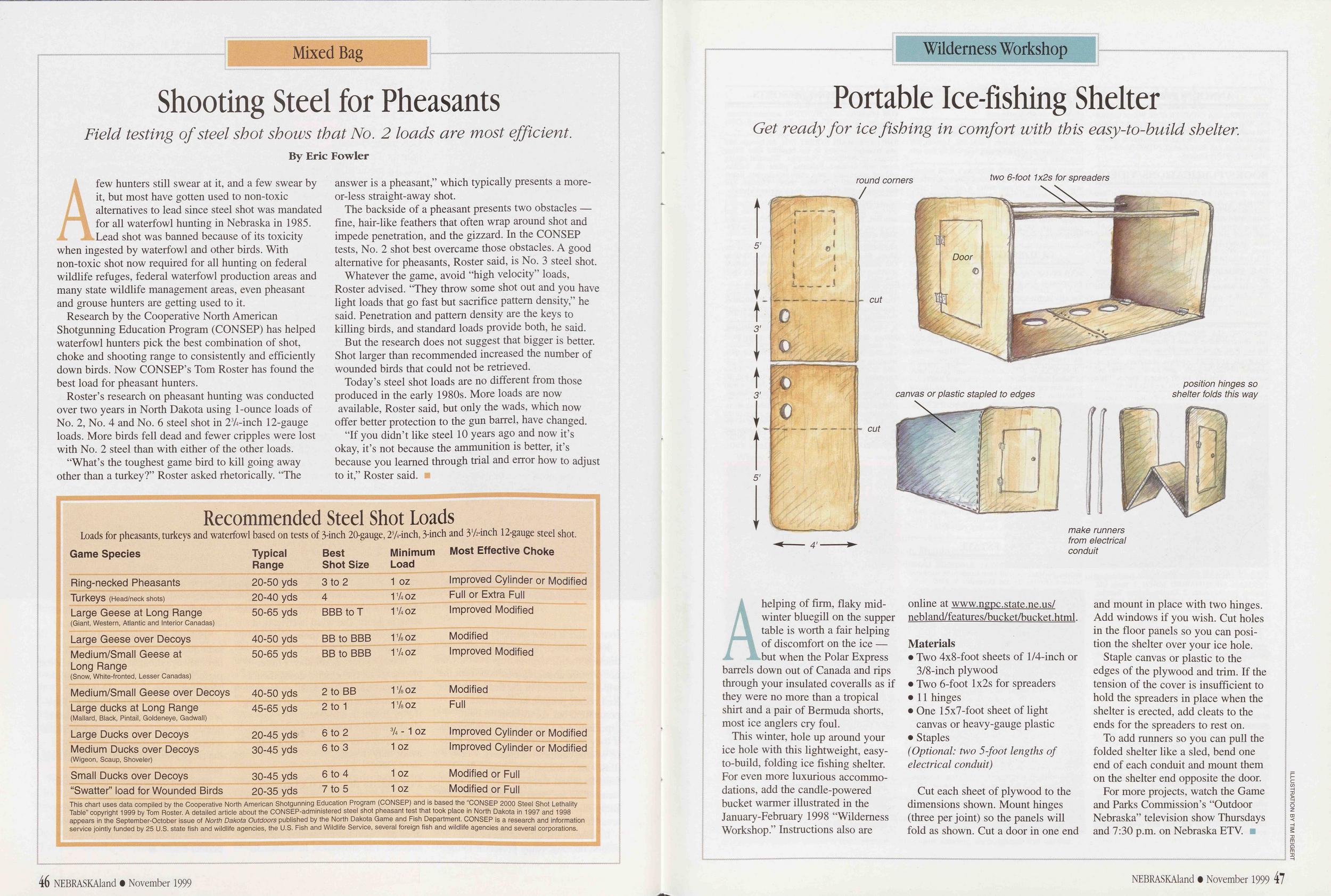
Mixed Bag
Shooting Steel for Pheasants
Field testing of steel shot shows that No. 2 loads are most efficient. By Eric Fowlerfew hunters still swear at it, and a few swear by it, but most have gotten used to non-toxic alternatives to lead since steel shot was mandated for all waterfowl hunting in Nebraska in 1985. Lead shot was banned because of its toxicity when ingested by waterfowl and other birds. With non-toxic shot now required for all hunting on federal wildlife refuges, federal waterfowl production areas and many state wildlife management areas, even pheasant and grouse hunters are getting used to it.
Research by the Cooperative North American Shotgunning Education Program (CONSEP) has helped waterfowl hunters pick the best combination of shot, choke and shooting range to consistently and efficiently down birds. Now CONSEP's Tom Roster has found the best load for pheasant hunters.
Roster's research on pheasant hunting was conducted over two years in North Dakota using 1-ounce loads of No. 2, No. 4 and No. 6 steel shot in 23/4-inch 12-gauge loads. More birds fell dead and fewer cripples were lost with No. 2 steel than with either of the other loads.
"What's the toughest game bird to kill going away other than a turkey?" Roster asked rhetorically. "The answer is a pheasant," which typically presents a more- or-less straight-away shot.
The backside of a pheasant presents two obstacles — fine, hair-like feathers that often wrap around shot and impede penetration, and the gizzard. In the CONSEP tests, No. 2 shot best overcame those obstacles. A good alternative for pheasants, Roster said, is No. 3 steel shot.
Whatever the game, avoid "high velocity" loads, Roster advised. "They throw some shot out and you have light loads that go fast but sacrifice pattern density," he said. Penetration and pattern density are the keys to killing birds, and standard loads provide both, he said.
But the research does not suggest that bigger is better. Shot larger than recommended increased the number of wounded birds that could not be retrieved.
Today's steel shot loads are no different from those produced in the early 1980s. More loads are now available, Roster said, but only the wads, which now offer better protection to the gun barrel, have changed.
"If you didn't like steel 10 years ago and now it's okay, it's not because the ammunition is better, it's because you learned through trial and error how to adjust to it," Roster said.
Recommended Steel Shot Loads Loads for pheasants, turkeys and waterfowl based on tests of 3-inch 20-gauge, 23A-inch, 3-inch and 3 Winch 12-gauge steel shot. Game Species Ring-necked Pheasants Turkeys (Head/neck shots) Large Geese at Long Range (Giant, Western, Atlantic and Interior Canadas) Large Geese over Decoys Medium/Small Geese at Long Range (Snow, White-fronted, Lesser Canadas) Medium/Small Geese over Decoys Large ducks at Long Range (Mallard, Black, Pintail, Goldeneye, Gadwall) Large Ducks over Decoys Medium Ducks over Decoys (Wigeon, Scaup, Shoveler) Small Ducks over Decoys "Swattef load for Wounded Birds This chart uses data compiled by the Cooperative North American Shotgunning Education Program (CONSEP) and is based the "CONSEP 2000 Steel Shot Lethality Table" copyright 1999 by Tom Roster. A detailed article about the CONSEP-administered steel shot pheasant test that took place in North Dakota in 1997 and 1998 appears in the September-October issue of North Dakota Outdoors published by the North Dakota Game and Fish Department. CONSEP is a research and information service jointly funded by 25 U.S. state fish and wildlife agencies, the U.S. Fish and Wildlife Service, several foreign fish and wildlife agencies and several corporations Typical Range 20-50 yds Best Shot Size 3 to 2 Minimum Load 1 oz Most tnective Choke Improved Cylinder or Modified 20-40 yds 4 1 y4 oz 174 oz ii/8oz 11Aoz Full or Extra Full ~~~ 50-65 yds BBB to T Improved Modified 40-50 yds BB to BBB Modified 50-65 yds BB to BBB Improved Modified 40-50 yds 2toBB 1 Vs oz vAoz Modified 45-65 yds 2 to 1 Full ——_ 20-45 yds 6 to 2 3A - 1 oz Improved Cylinder or Modified 30-45 yds 6 to 3 1oz Improved Cylinder or Modified 30-45 yds 6 to 4 1oz Modified or Full 20-35 yds 7 to 5 1oz Modified or Full 46 NEBRASKAland • November 1999Wilderness Workshop
Portable Ice-fishing Shelter
Get ready for ice fishing in comfort with this easy-to-build shelter.A helping of firm, flaky mid- winter bluegill on the supper table is worth a fair helping of discomfort on the ice — but when the Polar Express barrels down out of Canada and rips through your insulated coveralls as if they were no more than a tropical shirt and a pair of Bermuda shorts, most ice anglers cry foul.
This winter, hole up around your ice hole with this lightweight, easy- to-build, folding ice fishing shelter. For even more luxurious accommo- dations, add the candle-powered bucket warmer illustrated in the January-February 1998 "Wilderness Workshop." Instructions also are online at www.ngpc.state.ne.us/ nebland/features/bucket/bucket.html.
Materials • Two 4x8-foot sheets of 1/4-inch or 3/8-inch plywood • Two 6-foot 1x2s for spreaders • 11 hinges • One 15x7-foot sheet of light canvas or heavy-gauge plastic • Staples (Optional: two 5-foot lengths of electrical conduit)Cut each sheet of plywood to the dimensions shown. Mount hinges (three per joint) so the panels will fold as shown. Cut a door in one end and mount in place with two hinges. Add windows if you wish. Cut holes in the floor panels so you can position the shelter over your ice hole.
Staple canvas or plastic to the edges of the plywood and trim. If the tension of the cover is insufficient to hold the spreaders in place when the shelter is erected, add cleats to the ends for the spreaders to rest on.
To add runners so you can pull the folded shelter like a sled, bend one end of each conduit and mount them on the shelter end opposite the door.
For more projects, watch the Game and Parks Commission's "Outdoor Nebraska" television show Thursdays and 7:30 p.m. on Nebraska ETV.
NEBRASKAland • November 1999 47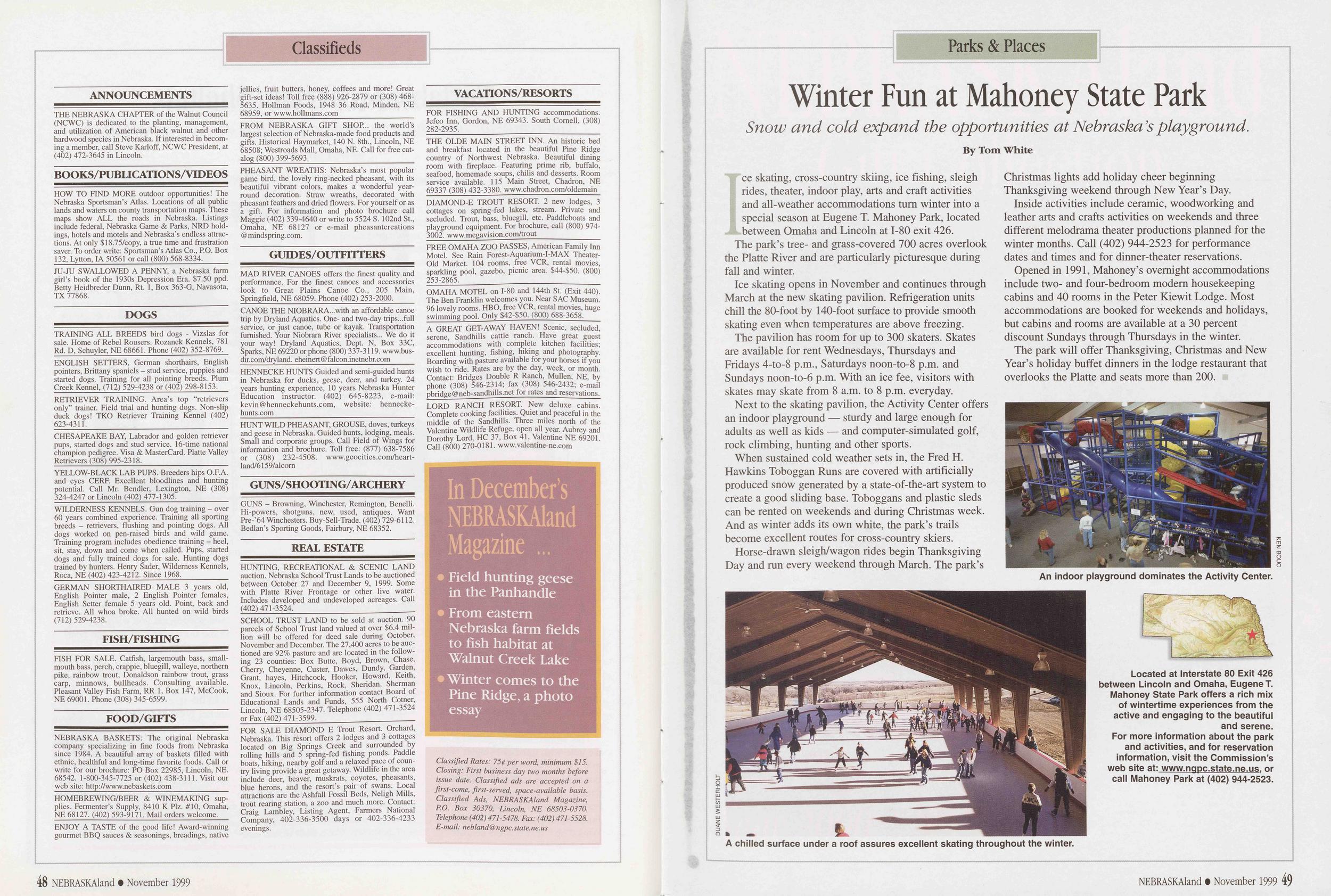
Classifieds
ANNOUNCEMENTSTHE NEBRASKA CHAPTER of the Walnut Council (NCWC) is dedicated to the planting, management, and utilization of American black walnut and other hardwood species in Nebraska. If interested in becom- ing a member, call Steve Karloff, NCWC President, at (402) 472-3645 in Lincoln.
BOOKS/PUBLICATIONS/VIDEOSHOW TO FIND MORE outdoor opportunities! The Nebraska Sportsman's Atlas. Locations of all public lands and waters on county transportation maps. These maps show ALL the roads in Nebraska. Listings include federal, Nebraska Game & Parks, NRD hold- ings, hotels and motels and Nebraska's endless attractions. At only $18.75/copy, a true time and frustration saver. To order write: Sportsman's Atlas Co., P.O. Box 132, Lytton, IA 50561 or call (800) 568-8334.
JU-JU SWALLOWED A PENNY, a Nebraska farm girl's book of the 1930s Depression Era. $7.50 ppd. Betty Heidbreder Dunn, Rt. 1, Box 363-G, Navasota, TX 77868.
DOGSTRAINING ALL BREEDS bird dogs - Vizslas for sale. Home of Rebel Rousers. Rozanek Kennels, 781 Rd. D, Schuyler, NE 68661. Phone (402) 352-8769.
ENGLISH SETTERS, German shorthairs, English pointers, Brittany spaniels - stud service, puppies and started dogs. Training for all pointing breeds. Plum Creek Kennel, (712) 529-4238 or (402) 298-8153.
RETRIEVER TRAINING. Area's top "retrievers only" trainer. Field trial and hunting dogs. Non-slip duck dogs! TKO Retriever Training Kennel (402) 623-4311.
CHESAPEAKE BAY, Labrador and golden retriever pups, started dogs and stud service. 16-time national champion pedigree. Visa & MasterCard. Platte Valley Retrievers (308) 995-2318.
YELLOW-BLACK LAB PUPS. Breeders hips O.F.A. and eyes CERE Excellent bloodlines and hunting potential. Call Mr. Bendler, Lexington, NE (308) 324-4247 or Lincoln (402) 477-1305.
WILDERNESS KENNELS. Gun dog training - over 60 years combined experience. Training all sporting breeds - retrievers, flushing and pointing dogs. All dogs worked on pen-raised birds and wild game. Training program includes obedience training - heel, sit, stay, down and come when called. Pups, started dogs and fully trained dogs for sale. Hunting dogs trained by hunters. Henry Sader, Wilderness Kennels, Roca, NE (402) 423-4212. Since 1968.
GERMAN SHORTHAIRED MALE 3 years old, English Pointer male, 2 English Pointer females, English Setter female 5 years old. Point, back and retrieve. All whoa broke. All hunted on wild birds (712) 529-4238.
FISH/FISHINGFISH FOR SALE. Catfish, largemouth bass, small- mouth bass, perch, crappie, bluegill, walleye, northern pike, rainbow trout, Donaldson rainbow trout, grass carp, minnows, bullheads. Consulting available. Pleasant Valley Fish Farm, RR 1, Box 147, McCook, NE 69001. Phone (308) 345-6599.
FOOD/GIFTSNEBRASKA BASKETS: The original Nebraska company specializing in fine foods from Nebraska since 1984. A beautiful array of baskets filled with ethnic, healthful and long-time favorite foods. Call or write for our brochure: PO Box 22985, Lincoln, NE. 68542. 1-800-345-7725 or (402) 438-3111. Visit our web site: http://www.nebaskets.com
HOMEBREWING/BEER & WINEMAKING supplies. Fermenter's Supply, 8410 K Plz. #10, Omaha, NE 68127. (402) 593-9171. Mail orders welcome.
ENJOY A TASTE of the good life! Award-winning gourmet BBQ sauces & seasonings, breadings, native jellies, fruit butters, honey, coffees and more! Great gift-set ideas! Toll free (888) 926-2879 or (308) 468- 5635. Hollman Foods, 1948 36 Road, Minden, NE 68959, or www.hollmans.com
FROM NEBRASKA GIFT SHOP... the world's largest selection of Nebraska-made food products and gifts. Historical Haymarket, 140 N. 8th., Lincoln, NE 68508; Westroads Mall, Omaha, NE. Call for free catalog ( 800) 399-5693.
PHEASANT WREATHS: Nebraska's most popular game bird, the lovely ring-necked pheasant, with its beautiful vibrant colors, makes a wonderful year- round decoration. Straw wreaths, decorated with pheasant feathers and dried flowers. For yourself or as a gift. For information and photo brochure call Maggie (402) 339-4640 or write to 5524 S. 102nd St., Omaha, NE 68127 or e-mail pheasantcreations @ mindspring.com.
GUIDES/OUTFITTERSMAD RIVER CANOES offers the finest quality and performance. For the finest canoes and accessories look to Great Plains Canoe Co., 205 Main, Springfield, NE 68059. Phone (402) 253-2000.
CANOE THE NIOBRARA...with an affordable canoe trip by Dryland Aquatics. One- and two-day trips...full service, or just canoe, tube or kayak. Transportation furnished. Your Niobrara River specialists... We do it your way! Dryland Aquatics, Dept. N, Box 33C, Sparks, NE 69220 or phone (800) 337-3119. www.busdir.com/dryland. eheinert@falcon.inetnebr.com
HENNECKE HUNTS Guided and semi-guided hunts in Nebraska for ducks, geese, deer, and turkey. 24 years hunting experience, 10 years Nebraska Hunter Education instructor. (402) 645-8223, e-mail: kevin@henneckehunts.com, website: hennecke- hunts.com
HUNT WILD PHEASANT, GROUSE, doves, turkeys and geese in Nebraska. Guided hunts, lodging, meals. Small and corporate groups. Call Field of Wings for information and brochure. Toll free: (877) 638-7586 or (308) 232-4508. www.geocities.com/heart- land/6159/alcorn
GUNS/SHOOTING/ARCHERYGUNS - Browning, Winchester, Remington, Benelli. Hi-powers, shotguns, new, used, antiques. Want Pre-'64 Winchesters. Buy-Sell-Trade. (402) 729-6112. Bedlan's Sporting Goods, Fairbury, NE 68352.
REAL ESTATEHUNTING, RECREATIONAL & SCENIC LAND auction. Nebraska School Trust Lands to be auctioned between October 27 and December 9, 1999. Some with Platte River Frontage or other live water. Includes developed and undeveloped acreages. Call (402)471-3524.
SCHOOL TRUST LAND to be sold at auction. 90 parcels of School Trust land valued at over $6.4 million will be offered for deed sale during October, November and December. The 27,400 acres to be auctioned are 92% pasture and are located in the following 23 counties: Box Butte, Boyd, Brown, Chase, Cherry, Cheyenne, Custer, Dawes, Dundy, Garden, Grant, hayes, Hitchcock, Hooker, Howard, Keith, Knox, Lincoln, Perkins, Rock, Sheridan, Sherman and Sioux. For further information contact Board of Educational Lands and Funds, 555 North Cotner, Lincoln, NE 68505-2347. Telephone (402) 471-3524 or Fax (402) 471-3599.
FOR SALE DIAMOND E Trout Resort. Orchard, Nebraska. This resort offers 2 lodges and 3 cottages located on Big Springs Creek and surrounded by rolling hills and 5 spring-fed fishing ponds. Paddle boats, hiking, nearby golf and a relaxed pace of country living provide a great getaway. Wildlife in the area include deer, beaver, muskrats, coyotes, pheasants, blue herons, and the resort's pair of swans. Local attractions are the Ashfall Fossil Beds, Neligh Mills, trout rearing station, a zoo and much more. Contact: Craig Lambley, Listing Agent, Farmers National Company, 402-336-3500 days or 402-336-4233 evenings.
VACATIONS/RESORTSFOR FISHING AND HUNTING accommodations. Jefco Inn, Gordon, NE 69343. South Cornell, (308) 282-2935.
THE OLDE MAIN STREET INN. An historic bed and breakfast located in the beautiful Pine Ridge country of Northwest Nebraska. Beautiful dining room with fireplace. Featuring prime rib, buffalo, seafood, homemade soups, chilis and desserts. Room service available. 115 Main Street, Chadron, NE 69337 (308) 432-3380. www.chadron.com/oldemain
DIAMOND-E TROUT RESORT. 2 new lodges, 3 cottages on spring-fed lakes, stream. Private and secluded. Trout, bass, bluegill, etc. Paddleboats and playground equipment. For brochure, call (800) 974- 3002. www.megavision.com/trout
FREE OMAHA ZOO PASSES, American Family Inn Motel. See Rain Forest-Aquarium-I-MAX Theater- Old Market. 104 rooms, free VCR, rental movies, sparkling pool, gazebo, picnic area. $44-$50. (800) 253-2865.
OMAHA MOTEL on 1-80 and 144th St. (Exit 440). The Ben Franklin welcomes you. Near SAC Museum. 96 lovely rooms. HBO, free VCR, rental movies, huge swimming pool. Only $42-$50. (800) 688-3658.
A GREAT GET-AWAY HAVEN! Scenic, secluded, serene, Sandhills cattle ranch. Have great guest accommodations with complete kitchen facilities; excellent hunting, fishing, hiking and photography. Boarding with pasture available for your horses if you wish to ride. Rates are by the day, week, or month. Contact: Bridges Double R Ranch, Mullen, NE, by phone (308) 546-2314; fax (308) 546-2432; e-mail pbridge@neb-sandhills.net for rates and reservations.
LORD RANCH RESORT. New deluxe cabins. Complete cooking facilities. Quiet and peaceful in the middle of the Sandhills. Three miles north of the Valentine Wildlife Refuge, open all year. Aubrey and Dorothy Lord, HC 37, Box 41, Valentine NE 69201. Call (800) 270-0181. www.valentine-ne.com
Field hunting geese in the Panhandle From eastern Nebraska farm fields to fish habitat at Walnut Creek Lake Winter comes to the Pine Ridge, a photo essay Classified Rates: 75? per word, minimum $15. Closing: First business day two months before issue date. Classified ads are accepted on a first-come, first-served, space-available basis. Classified Ads, NEBRASKAland Magazine, P.O. Box 30370, Lincoln, NE 68503-0370. Telephone (402) 471-5478. Fax: (402) 471-5528. E-mail: nebland® ngpc.state, ne. us 48 NEBRASKAland • November 1999Parks & Places
Winter Fun at Mahoney State Park
Snow and cold expand the opportunities at Nebraska's playground. By Tom Whitece skating, cross-country skiing, ice fishing, sleigh rides, theater, indoor play, arts and craft activities and all-weather accommodations turn winter into a special season at Eugene T. Mahoney Park, located between Omaha and Lincoln at 1-80 exit 426.
The park's tree- and grass-covered 700 acres overlook the Platte River and are particularly picturesque during fall and winter.
Ice skating opens in November and continues through March at the new skating pavilion. Refrigeration units chill the 80-foot by 140-foot surface to provide smooth skating even when temperatures are above freezing.
The pavilion has room for up to 300 skaters. Skates are available for rent Wednesdays, Thursdays and Fridays 4-to-8 p.m., Saturdays noon-to-8 p.m. and Sundays noon-to-6 p.m. With an ice fee, visitors with skates may skate from 8 a.m. to 8 p.m. everyday.
Next to the skating pavilion, the Activity Center offers an indoor playground — sturdy and large enough for adults as well as kids — and computer-simulated golf, rock chmbing, hunting and other sports.
When sustained cold weather sets in, the Fred H. Hawkins Toboggan Runs are covered with artificially produced snow generated by a state-of-the-art system to create a good sliding base. Toboggans and plastic sleds can be rented on weekends and during Christmas week. And as winter adds its own white, the park's trails become excellent routes for cross-country skiers.
Horse-drawn sleigh/wagon rides begin Thanksgiving Day and run every weekend through March. The park's Christmas lights add holiday cheer beginning Thanksgiving weekend through New Year's Day.
Inside activities include ceramic, woodworking and leather arts and crafts activities on weekends and three different melodrama theater productions planned for the winter months. Call (402) 944-2523 for performance dates and times and for dinner-theater reservations.
Opened in 1991, Mahoney's overnight accommodations include two- and four-bedroom modern housekeeping cabins and 40 rooms in the Peter Kiewit Lodge. Most accommodations are booked for weekends and holidays, but cabins and rooms are available at a 30 percent discount Sundays through Thursdays in the winter.
The park will offer Thanksgiving, Christmas and New Year's holiday buffet dinners in the lodge restaurant that overlooks the Platte and seats more than 200.
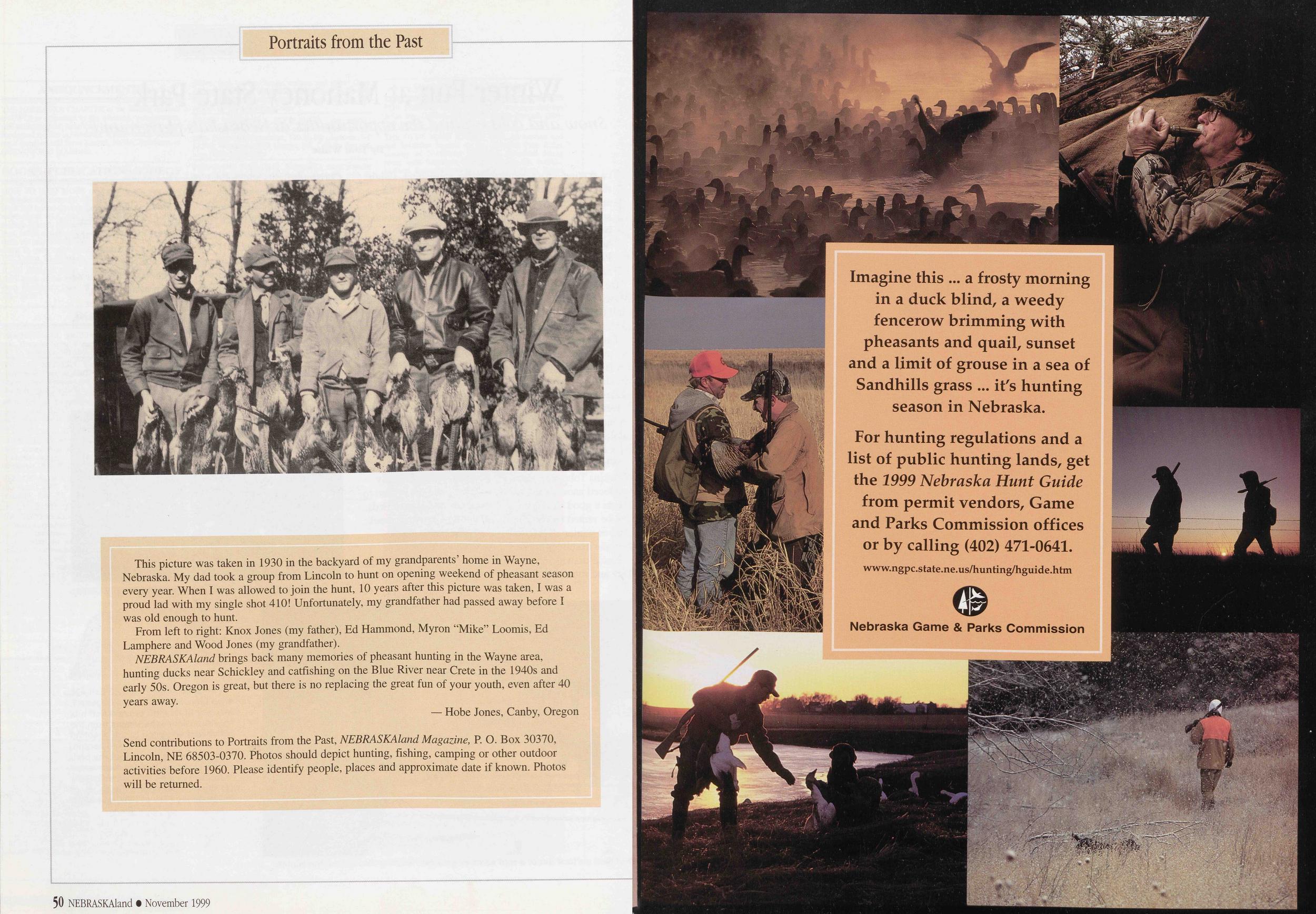
Portraits from the Past
This picture was taken in 1930 in the backyard of my grandparents' home in Wayne, Nebraska. My dad took a group from Lincoln to hunt on opening weekend of pheasant season every year. When I was allowed to join the hunt, 10 years after this picture was taken, I was a proud lad with my single shot 410! Unfortunately, my grandfather had passed away before I was old enough to hunt.
From left to right: Knox Jones (my father), Ed Hammond, Myron "Mike" Loomis, Ed Lamphere and Wood Jones (my grandfather).
NEBRASKAland brings back many memories of pheasant hunting in the Wayne area, hunting ducks near Schickley and catfishing on the Blue River near Crete in the 1940s and early 50s. Oregon is great, but there is no replacing the great fun of your youth, even after 40 years away.
— Hobe Jones, Canby, OregonSend contributions to Portraits from the Past, NEBRASKAland Magazine, P. O. Box 30370, Lincoln, NE 68503-0370. Photos should depict hunting, fishing, camping or other outdoor activities before 1960. Please identify people, places and approximate date if known. Photos will be returned.
Imagine this ... a frosty morning in a duck blind, a weedy fencerow brimming with pheasants and quail, sunset and a limit of grouse in a sea of Sandhills grass ... it's hunting season in Nebraska. For hunting regulations and a list of public hunting lands, get the 1999 Nebraska Hunt Guide from permit vendors, Game and Parks Commission offices or by calling (402) 471-0641. www.ngpc.state.ne.us/hunting/hguide.htm Nebraska Game & Parks Commission
Position: 664 (17 views)