Volume 77, Issue 8, 1999
NEBRASKAland
Nebraska Game & Parks Comission October 1999 $2.50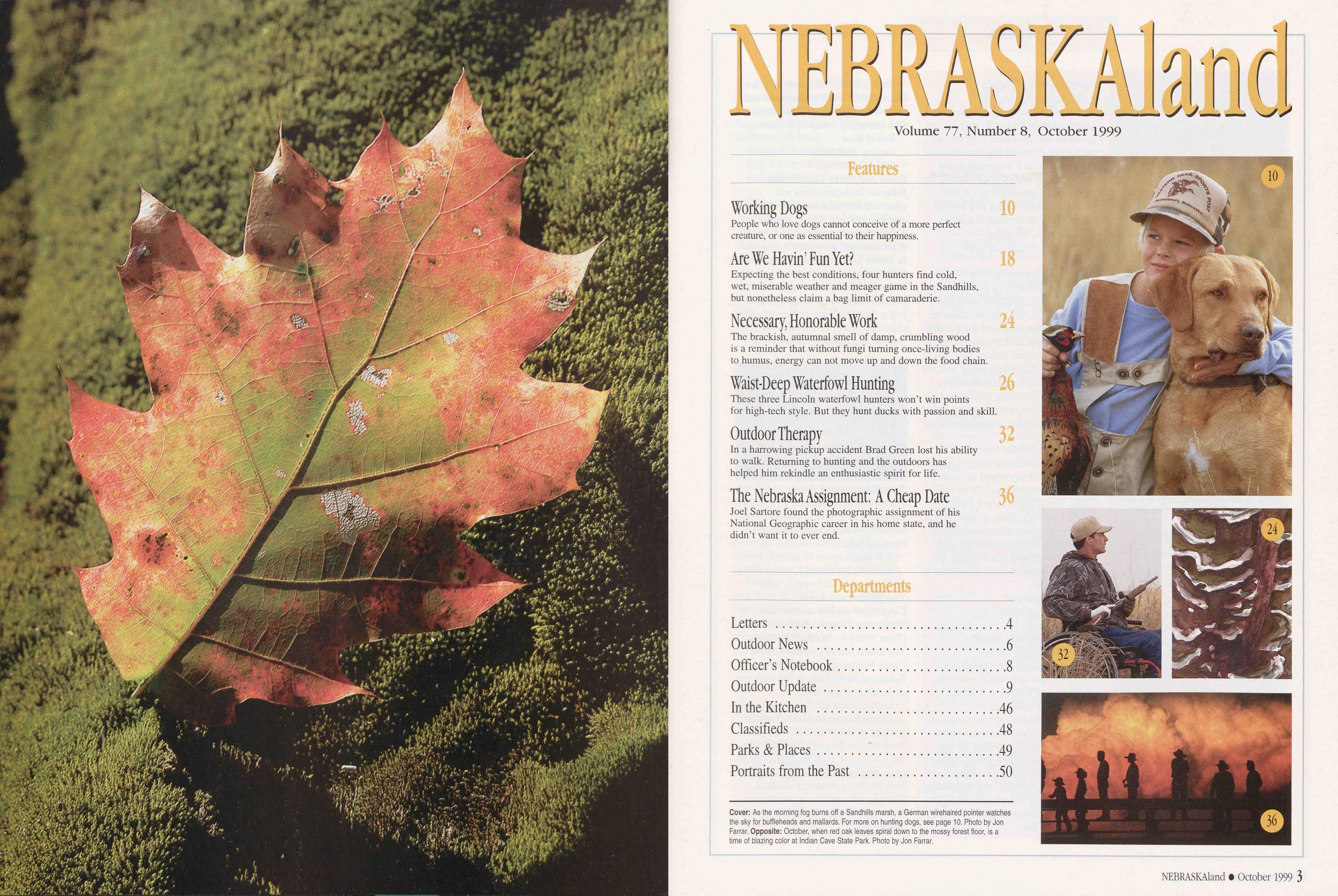
NEBRASKAland
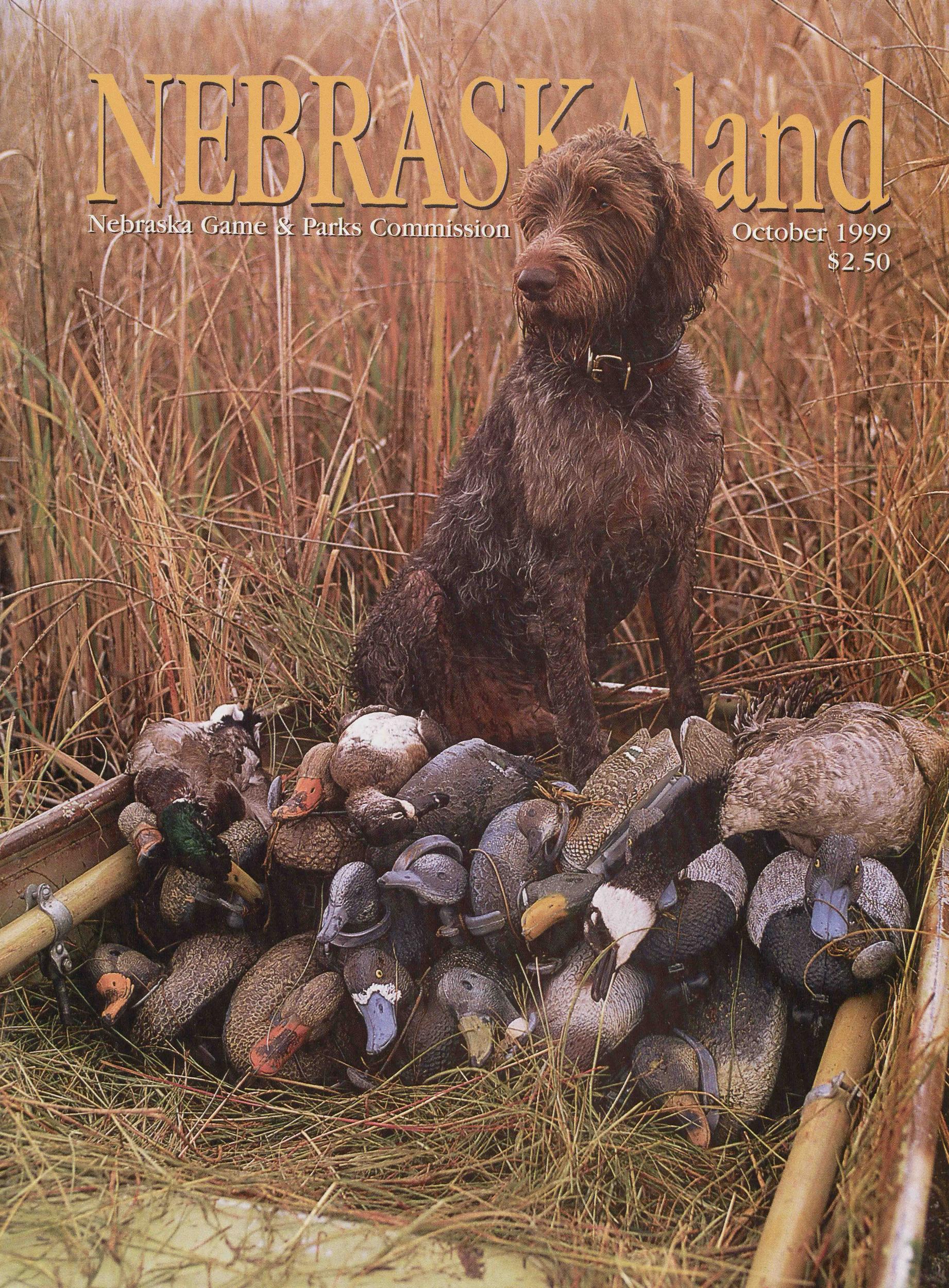
Volume 77, Number 8, October 1999 Features Working Dogs People who love dogs cannot conceive of a more perfect creature, or one as essential to their happiness. Are We Havin' Fun Yet? Expecting the best conditions, four hunters find cold, wet, miserable weather and meager game in the Sandhills, but nonetheless claim a bag limit of camaraderie. Necessary, Honorable Work The brackish, autumnal smell of damp, crumbling wood is a reminder that without fungi turning once-living bodies to humus, energy can not move up and down the food chain. Waist-Deep Waterfowl Hunting These three Lincoln waterfowl hunters won't win points for high-tech style. But they hunt ducks with passion and skill. Outdoor Therapy In a harrowing pickup accident Brad Green lost his ability to walk. Returning to hunting and the outdoors has helped him rekindle an enthusiastic spirit for life. The Nebraska Assignment: A Cheap Date Joel Sartore found the photographic assignment of his National Geographic career in his home state, and he didn't want it to ever end. Departments Letters 4 Outdoor News 6 Officer's Notebook 8 Outdoor Update 9 In the Kitchen 46 Classifieds 48 Parks & Places 49 Portraits from the Past 50 Cover: As the morning fog burns off a Sandhills marsh, a German wire haired pointer watches the sky for buffleheads and mallards. For more on hunting dogs, see page 10. Photo by Jon Farrar. Opposite: October, when red oak leaves spiral down to the mossy forest floor, is a time of blazing color at Indian Cave State Park. Photo by Jon Farrar.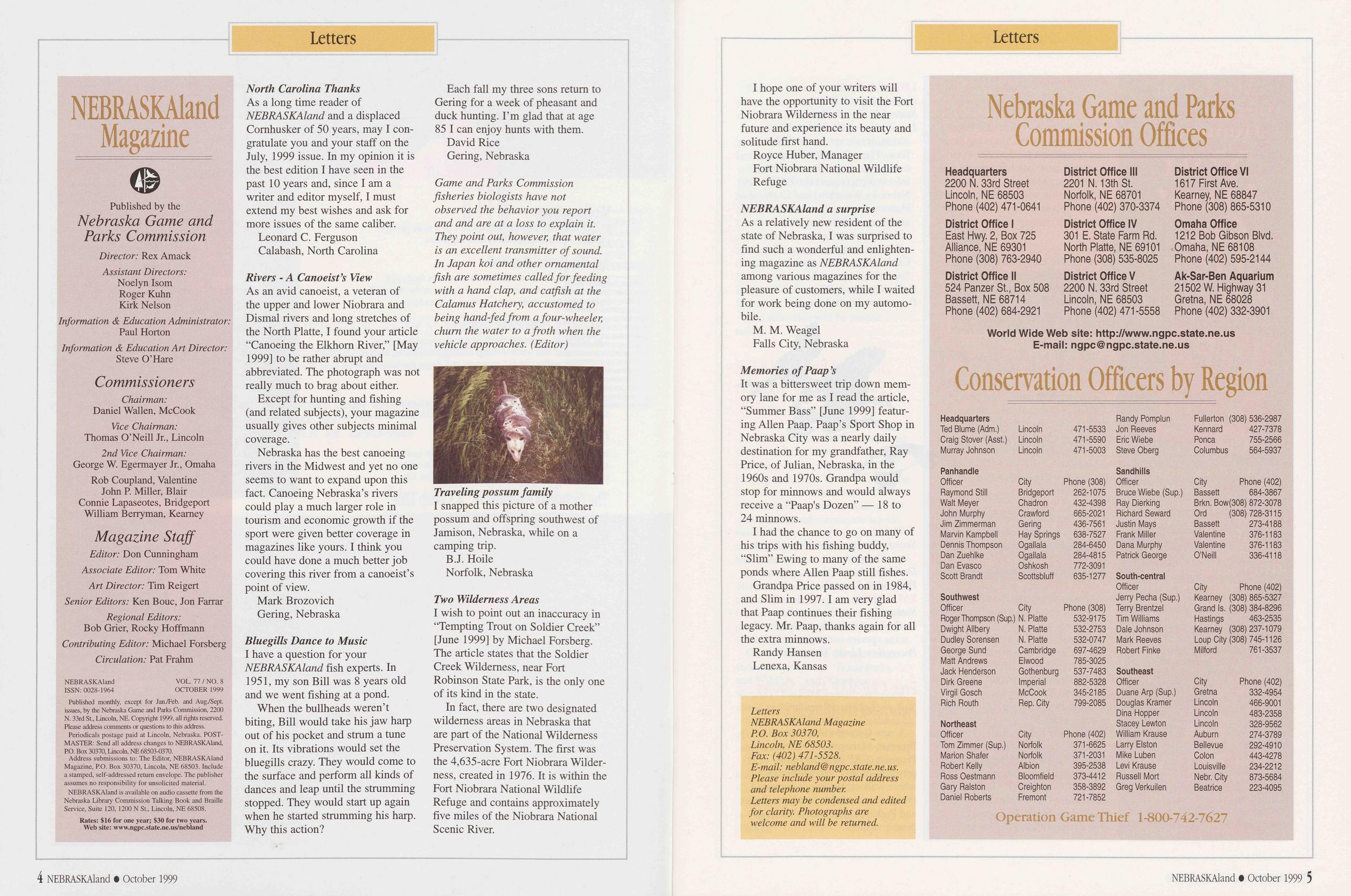
Letters
Published by the Nebraska Game and Parks Commission Director: Rex Amack Assistant Directors: Noelyn Isom Roger Kuhn Kirk Nelson Information & Education Administrator: Paul Horton Information & Education Art Director: Steve O'Hare Commissioners Chairman: Daniel Wallen, McCook Vice Chairman: Thomas O'Neill Jr., Lincoln 2nd Vice Chairman: George W. Egermayer Jr., Omaha Rob Coupland, Valentine John P. Miller, Blair Connie Lapaseotes, Bridgeport William Berryman, Kearney Magazine Staff Editor: Don Cunningham Associate Editor: Tom White Art Director: Tim Reigert Senior Editors: Ken Bouc, Jon Farrar Regional Editors: Bob Grier, Rocky Hoffmann Contributing Editor: Michael Forsberg Circulation: Pat Frahm NEBRASKAland ISSN: 0028-1964 VOL. 77 / NO. 8 OCTOBER 1999 Published monthly, except for Jan/Feb. and Aug./Sept. issues, by the Nebraska Game and Parks Commission, 2200 N. 33rd St., Lincoln, NE. Copyright 1999, all rights reserved. Please address comments or questions to this address. Periodicals postage paid at Lincoln, Nebraska. POSTMASTER: Send all address changes to NEBRASKAland, P.O. Box 30370, Lincoln, NE 68503-0370. Address submissions to: The Editor, NEBRASKAland Magazine, P.O. Box 30370, Lincoln, NE 68503. Include a stamped, self-addressed return envelope. The publisher assumes no responsibility for unsolicited material. NEBRASKAland is available on audio cassette from the Nebraska Library Commission Talking Book and Braille Service, Suite 120, 1200 N St., Lincoln, NE 68508. Rates: $16 for one year; $30 for two years. Web site: www.ngpc.state.ne.us/nebland North Carolina ThanksAs a long time reader of NEBRASKAland and a displaced Cornhusker of 50 years, may I congratulate you and your staff on the July, 1999 issue. In my opinion it is the best edition I have seen in the past 10 years and, since I am a writer and editor myself, I must extend my best wishes and ask for more issues of the same caliber.
Leonard C. Ferguson Calabash, North Carolina Rivers - A Canoeist's ViewAs an avid canoeist, a veteran of the upper and lower Niobrara and Dismal rivers and long stretches of the North Platte, I found your article "Canoeing the Elkhorn River," [May 1999] to be rather abrupt and abbreviated. The photograph was not really much to brag about either.
Except for hunting and fishing (and related subjects), your magazine usually gives other subjects minimal coverage.
Nebraska has the best canoeing rivers in the Midwest and yet no one seems to want to expand upon this fact. Canoeing Nebraska's rivers could play a much larger role in tourism and economic growth if the sport were given better coverage in magazines like yours. I think you could have done a much better job covering this river from a canoeist's point of view.
Mark Brozovich Gering, Nebraska Bluegills Dance to MusicI have a question for your NEBRASKAland fish experts. In 1951, my son Bill was 8 years old and we went fishing at a pond.
When the bullheads weren't biting, Bill would take his jaw harp out of his pocket and strum a tune on it. Its vibrations would set the bluegills crazy. They would come to the surface and perform all kinds of dances and leap until the strumming stopped. They would start up again when he started strummung his harp. Why this action?
Each fall my three sons return to Gering for a week of pheasant and duck hunting. I'm glad that at age 85 I can enjoy hunts with them.
David Rice Gering, NebraskaGame and Parks Commission fisheries biologists have not observed the behavior you report and and are at a loss to explain it. They point out, however, that water is an excellent transmitter of sound. In Japan koi and other ornamental fish are sometimes called for feeding with a hand clap, and catfish at the Calamus Hatchery, accustomed to being hand-fed from a four-wheeler, churn the water to a froth when the vehicle approaches. (Editor)
I snapped this picture of a mother possum and offspring southwest of Jamison, Nebraska, while on a camping trip.
B.J. Hoile Norfolk, Nebraska Two Wilderness AreasI wish to point out an inaccuracy in "Tempting Trout on Soldier Creek" [June 1999] by Michael Forsberg. The article states that the Soldier Creek Wilderness, near Fort Robinson State Park, is the only one of its kind in the state.
In fact, there are two designated wilderness areas in Nebraska that are part of the National Wilderness Preservation System. The first was the 4,635-acre Fort Niobrara Wilder- ness, created in 1976. It is within the Fort Niobrara National Wildlife Refuge and contains approximately five miles of the Niobrara National Scenic River.
4 NEBRASKAland • October 1999I hope one of your writers will have the opportunity to visit the Fort Niobrara Wilderness in the near future and experience its beauty and solitude first hand.
Royce Huber, Manager Fort Niobrara National Wildlife Refuge NEBRASKAland a surpriseAs a relatively new resident of the state of Nebraska, I was surprised to find such a wonderful and enlighten- ing magazine as NEBRASKAland among various magazines for the pleasure of customers, while I waited for work being done on my automobile.
M. M. Weagel Falls City, Nebraska Memories of Paap'sIt was a bittersweet trip down memory lane for me as I read the article, "Summer Bass" [June 1999] featuring Allen Paap. Paap's Sport Shop in Nebraska City was a nearly daily destination for my grandfather, Ray Price, of Julian, Nebraska, in the 1960s and 1970s. Grandpa would stop for minnows and would always receive a "Paap's Dozen" — 18 to 24 minnows.
I had the chance to go on many of his trips with his fishing buddy, "Slim" Ewing to many of the same ponds where Allen Paap still fishes.
Grandpa Price passed on in 1984, and Slim in 1997. I am very glad that Paap continues their fishing legacy. Mr. Paap, thanks again for all the extra minnows.
Randy Hansen Lenexa, Kansas Letters NEBRASKAland Magazine P.O. Box 30370, Lincoln, NE 68503. Fax: (402) 471-5528. E-mail: nebland@ngpc.state.ne. us. Please include your postal address and telephone number. Letters may be condensed and edited for clarity. Photographs are welcome and will be returned. Nebraska Game and Parks Commission Offices Headquarters 2200 N. 33rd Street Lincoln, NE 68503 Phone (402) 471-0641 District Office I East Hwy. 2, Box 725 Alliance, NE 69301 Phone (308) 763-2940 District Office II 524 Panzer St., Box 508 Bassett, NE 68714 Phone (402) 684-2921 District Office III 2201 N. 13th St. Norfolk, NE 68701 Phone (402) 370-3374 District Office IV 301 E. State Farm Rd. North Platte, NE 69101 Phone (308) 535-8025 District Office V 2200 N. 33rd Street Lincoln, NE 68503 Phone (402) 471-5558 District Office VI 1617 First Ave. Kearney, NE 68847 Phone (308) 865-5310 Omaha Office 1212 Bob Gibson Blvd. Omaha, NE 68108 Phone (402) 595-2144 Ak-Sar-Ben Aquarium 21502 W. Highway 31 Gretna, NE 68028 Phone (402) 332-3901 World Wide Web site: http://www.ngpc.state.ne.us E-mail: ngpc@ngpc.state.ne.us Conservation Officers by Region Headquarters Ted Blume (Adm.) Craig Stover (Asst.) Murray Johnson Panhandle Officer Raymond Still Walt Meyer John Murphy Jim Zimmerman Marvin Kampbell Dennis Thompson Dan Zuehlke Dan Evasco Scott Brandt Southwest Officer Roger Thompson (Sup.) Dwight Allbery Dudley Sorensen George Sund Matt Andrews Jack Henderson Dirk Greene Virgil Gosch Rich Routh Northeast Officer Tom Zimmer (Sup.) Marion Shafer Robert Kelly Ross Oestmann Gary Ralston Daniel Roberts Lincoln Lincoln Lincoln City Bridgeport Chadron Crawford Gering Hay Springs Ogallala Ogallala Oshkosh Scottsbluff City N. Platte N. Platte N.Platte Cambridge Elwood Gothenburg Imperial McCook Rep. City City Norfolk Norfolk Albion Bloomfield Creighton Fremont 471-5533 471-5590 471-5003 Phone (308) 262-1075 432-4398 665-2021 436-7561 638-7527 284-6450 284-4815 772-3091 635-1277 Phone (308) 532-9175 532-2753 532-0747 697-4629 785-3025 537-7483 882-5328 345-2185 799-2085 Phone (402) 371-6625 371-2031 395-2538 373-4412 358-3892 721-7852 Randy Pomplun Jon Reeves Eric Wiebe Steve Oberg Sandhills Officer Bruce Wiebe (Sup.) Ray Dierking Richard Seward Justin Mays Frank Miller Dana Murphy Patrick George South-central Officer Jerry Pecha (Sup.) Terry Brentzel Tim Williams Dale Johnson Mark Reeves Robert Finke Southeast Officer Duane Arp (Sup.) Douglas Kramer Dina Hopper Stacey Lewton William Krause Larry Elston Mike Luben Levi Krause Russell Mort Greg Verkuilen Fullerton (308) 536-2987 Kennard 427-7378 Ponca 755-2566 Columbus 564-5937 City Phone (402) Bassett 684-3867 Brkn. Bow (308) 872-3078 Ord (308)728-3115 Bassett 273-4188 Valentine 376-1183 Valentine 376-1183 O'Neill 336-4118 City Phone (402) Kearney (308)865-5327 Grand Is. (308) 384-8296 Hastings 463-2535 Kearney (308)237-1079 Loup City (308) 745-1126 Milford 761-3537 City Gretna Lincoln Lincoln Lincoln Auburn Bellevue Colon Louisville Nebr. City Beatrice Phone (402) 332-4954 466-9001 483-2358 328-9562 274-3789 292-4910 443-4278 234-2212 873-5684 223-4095
Outdoor News
Attention Migratory Bird Hunters... You Must HIP Again Harvest informal program Dove, duck, goose snipe, rail, coot an woodcock hunters must register with the Harvest information Program (HIP) before hunting and must carry the registration number in the field. 1998 numbers are no longer valid. Call the toll-free number below to register for the 1999 season. 1-800-WETLAND (938-5263) or register online from the Game and Parks Commission's web site: http://www.ngpc.state.ne.us Commission Sets Dates for the 1999 Waterfowl SeasonThe Nebraska Game and Parks Commission set the following dates and regulations for the 1999 waterfowl and crow hunting seasons and the falconry season.
The season will provide both early and late periods in each of the state's three duck hunting units.
DUCKSLow Plains Early: Oct. 2-Dec. 12 and Dec. 18-19.
Low Plains Late: Oct. 9-Dec. 19 and Dec. 25-26.
High Plains: Oct. 2-Dec. 13 and Dec. 17-Jan. 9.
Daily Bag Limit: The daily bag is six ducks, which may include no more than: five mallards of which no more than two can be females, one mottled duck, one pintail, one canvasback, two wood ducks, two redheads, and three scaup (greater and lesser combined).
Possession Limit: Two daily bag limits.
MERGANSERSDaily Bag Limit: The daily bag limit is five mergansers, one of which may be a hooded merganser
Season: Concurrent with duck dates.
DARK GEESE(Canadas, brant and all other goose species, except for white-fronted and light geese.)
East Unit: Oct. 2-3 and Oct. 9-Jan. 9.
North Central Unit: Oct. 2-Jan. 2 and Jan. 8-9.
South Central Unit: Oct. 23-Jan. 23 and Jan. 29-30.
Panhandle Unit: Nov. 13-Jan. 23 and Jan. 29-30.
North Unit: Oct. 23-Jan. 23 and Jan. 29-30.
Daily Bag Limit: Three geese.
Possession Limit: Six geese.
WHITE-FRONTED GEESEStatewide: Oct. 2-Dec. 26.
Daily Bag Limit: Two geese.
Possession Limit: Four geese.
LIGHT GEESE(Snow, blue and Ross' geese)
Statewide: Oct. 9-Dec. 16.
Late Season: Feb. 3-Mar. 10 statewide, except for the Rainwater Basin/Platte River where special regulations apply. For complete information, request the 1999 Nebraska Waterfowl and Crow Hunting Seasons brochure from any Game and Parks Commission office or permit vendor, or see online at: www.ngpc.state.ne.us. Click on "hunting," then on "waterfowl seasons."
Daily Bag Limit: 20 geese.
Possession Limit: None.
Season Dates: Oct. 1-Nov. 15 and Jan. 20-Apr. 6.
Daily Bag Limit: None.
Possession Limit: None.
FALCONRYStatewide: Sept. 27-Jan. 10.
Daily Bag Limit: Three ducks with some species constraints.
Possession Limit: Twice daily bag.
Free CRP-MAP Atlas Shows Nebraska Hunting AreasA new Conservation Reserve Program-Management Access Program (CRP-MAP) atlas of privately-owned Nebraska lands where walk-in hunting is permitted this year is available free from Game and Parks Commission offices and permit vendors.
6 NEBRASKAland • October 1999Walk-in hunting is allowed on private land enrolled in the program until Feb. 29, 2000.
Lands enrolled in the program can be identified by yellow and black entrance and boundary signs.
The CRP-MAP project began in 1997 with 20,000 acres in 28 Nebraska counties. This year 115,000 acres are enrolled. Landowners enrolled in the program are required to improve wildlife habitat. They are compensated through funds generated by the Nebraska Habitat Stamp and money from the Nebraska chapters of Pheasants Forever.
The atlas also will be posted online.
NEBRASKAland Magazine* Outdoor Nebraska TV Win National Contest AwardsNEBRASKAland Magazine placed second and the "Outdoor Nebraska" television series placed third in judging sponsored by the Association for Conservation Information, a national professional association for state and federal conservation journalists. There were 24 magazine entries and seven entries in the television series competition.
In the magazine competition, Missouri Conservationist, published by the Missouri Department of Conservation, placed first with 546 points, one point ahead of NEBRASKAland.
Overall winner in the television series category was "Texas Parks and Wildlife," and "Outdoor Virginia" finished second, one point ahead of "Outdoor Nebraska."
Several NEBRASKAland articles placed in the top five in their categories.
They were: "Bighorn Sheep" by Bob Grier (Wildlife); "Missouri River Restoration" by Ken Bouc (Fisheries); "Cowboy Trail: A Work in Progress," by Michael Forsberg (Parks).
Ready for Hunting? Don't Forget Your Permit! Resident Hunt and Fish $21.75 Aquatic Habitat Stamp $5.00 For a lifetime of outdoor fun, consideraet Mepermit. Lifetime Hunt and Fish $448.00 Hunting and fishing permits are amilableatall Nebraska Game and Parks Commission offices and from sporting goods stores, outfitters, bait shops and many other vendors throughout the state. For more information call (402) 471-0641. Permits also are available on the Commission's website: www.ngpc.state.ne.us Nebraska Game and Parks Commission NEBRASKAland • October 1999 7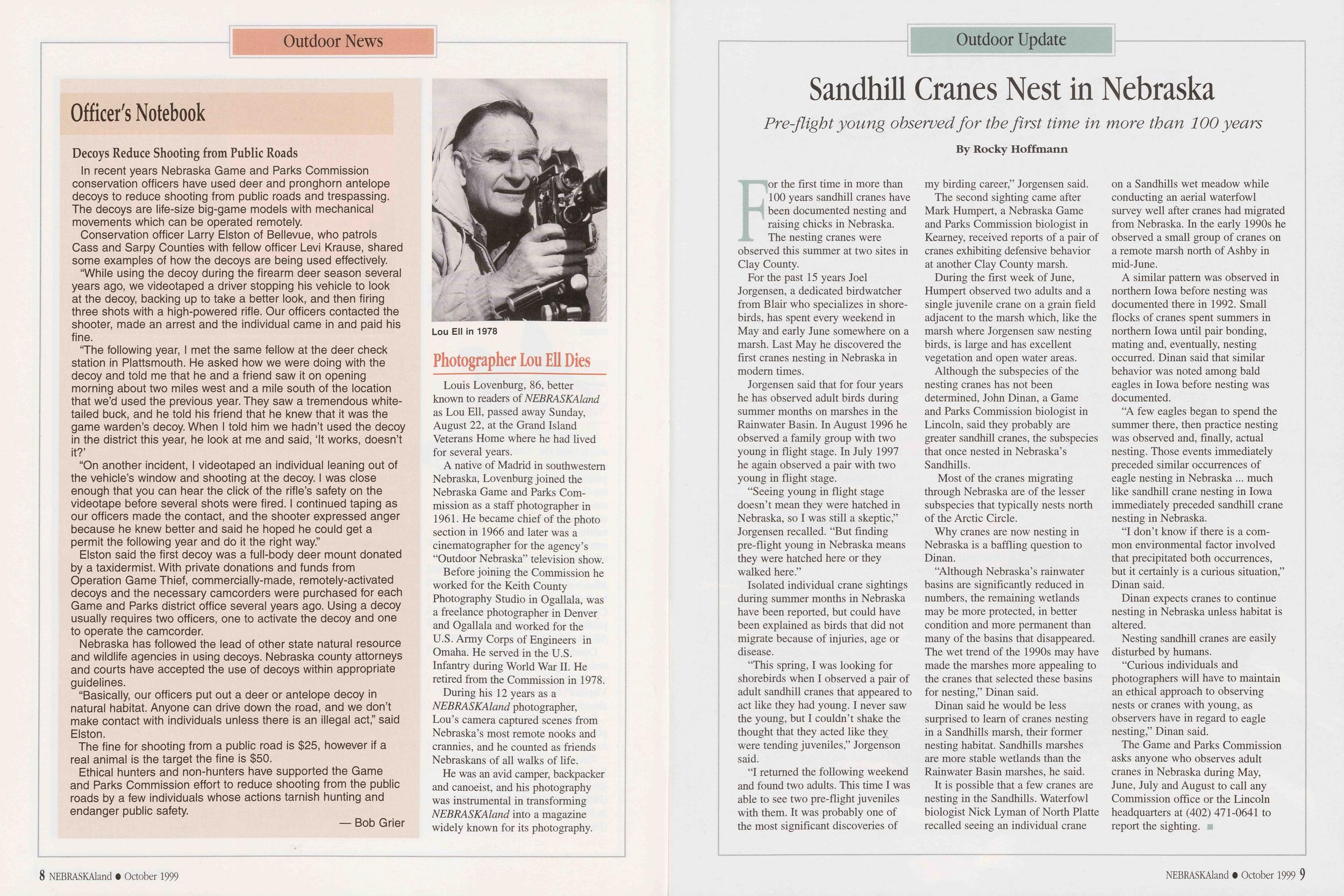 Officer's Notebook
Decoys Reduce Shooting from Public Roads
Officer's Notebook
Decoys Reduce Shooting from Public Roads
In recent years Nebraska Game and Parks Commission conservation officers have used deer and pronghorn antelope decoys to reduce shooting from public roads and trespassing. The decoys are life-size big-game models with mechanical movements which can be operated remotely.
Conservation officer Larry Elston of Bellevue, who patrols Cass and Sarpy Counties with fellow officer Levi Krause, shared some examples of how the decoys are being used effectively.
"While using the decoy during the firearm deer season several years ago, we videotaped a driver stopping his vehicle to look at the decoy, backing up to take a better look, and then firing three shots with a high-powered rifle. Our officers contacted the shooter, made an arrest and the individual came in and paid his fine.
"The following year, I met the same fellow at the deer check station in Plattsmouth. He asked how we were doing with the decoy and told me that he and a friend saw it on opening morning about two miles west and a mile south of the location that we'd used the previous year. They saw a tremendous whitetailed buck, and he told his friend that he knew that it was the game warden's decoy. When I told him we hadn't used the decoy in the district this year, he look at me and said, 'It works, doesn't it?'
"On another incident, I videotaped an individual leaning out of the vehicle's window and shooting at the decoy. I was close enough that you can hear the click of the rifle's safety on the videotape before several shots were fired. I continued taping as our officers made the contact, and the shooter expressed anger because he knew better and said he hoped he could get a permit the following year and do it the right way."
Elston said the first decoy was a full-body deer mount donated by a taxidermist. With private donations and funds from Operation Game Thief, commercially-made, remotely-activated decoys and the necessary camcorders were purchased for each Game and Parks district office several years ago. Using a decoy usually requires two officers, one to activate the decoy and one to operate the camcorder.
Nebraska has followed the lead of other state natural resource and wildlife agencies in using decoys. Nebraska county attorneys and courts have accepted the use of decoys within appropriate guidelines.
"Basically, our officers put out a deer or antelope decoy in natural habitat. Anyone can drive down the road, and we don't make contact with individuals unless there is an illegal act," said Elston.
The fine for shooting from a public road is $25, however if a real animal is the target the fine is $50.
Ethical hunters and non-hunters have supported the Game and Parks Commission effort to reduce shooting from the public roads by a few individuals whose actions tarnish hunting and endanger public safety.
— Bob GrierLouis Lovenburg, 86, better known to readers of NEBRASKAland as Lou Ell, passed away Sunday, August 22, at the Grand Island Veterans Home where he had lived for several years.
A native of Madrid in southwestern Nebraska, Lovenburg joined the Nebraska Game and Parks Com- mission as a staff photographer in 1961. He became chief of the photo section in 1966 and later was a cinematographer for the agency's "Outdoor Nebraska" television show.
Before joining the Commission he worked for the Keith County Photography Studio in Ogallala, was a freelance photographer in Denver and Ogallala and worked for the U.S. Army Corps of Engineers in Omaha. He served in the U.S. Infantry during World War II. He retired from the Commission in 1978.
During his 12 years as a NEBRASKAland photographer, Lou's camera captured scenes from Nebraska's most remote nooks and crannies, and he counted as friends Nebraskans of all walks of life.
He was an avid camper, backpacker and canoeist, and his photography was instrumental in transforming NEBRASKAland into a magazine widely known for its photography.
8 NEBRASKAland • October 1999Outdoor Update
Sandhill Cranes Nest in Nebraska
Pre-flight young observed for the first time in more than 100 years By Rocky Hoffmannor the first time in more than 100 years sandhill cranes have been documented nesting and raising chicks in Nebraska. The nesting cranes were observed this summer at two sites in Clay County.
For the past 15 years Joel Jorgensen, a dedicated birdwatcher from Blair who specializes in shorebirds, has spent every weekend in May and early June somewhere on a marsh. Last May he discovered the first cranes nesting in Nebraska in modern times.
Jorgensen said that for four years he has observed adult birds during summer months on marshes in the Rainwater Basin. In August 1996 he observed a family group with two young in flight stage. In July 1997 he again observed a pair with two young in flight stage.
"Seeing young in flight stage doesn't mean they were hatched in Nebraska, so I was still a skeptic," Jorgensen recalled. "But finding pre-flight young in Nebraska means they were hatched here or they walked here."
Isolated individual crane sightings during summer months in Nebraska have been reported, but could have been explained as birds that did not migrate because of injuries, age or disease.
"This spring, I was looking for shorebirds when I observed a pair of adult sandhill cranes that appeared to act like they had young. I never saw the young, but I couldn't shake the thought that they acted like they were tending juveniles," Jorgenson said.
"I returned the following weekend and found two adults. This time I was able to see two pre-flight juveniles with them. It was probably one of the most significant discoveries of my birding career," Jorgensen said.
The second sighting came after Mark Humpert, a Nebraska Game and Parks Commission biologist in Kearney, received reports of a pair of cranes exhibiting defensive behavior at another Clay County marsh.
During the first week of June, Humpert observed two adults and a single juvenile crane on a grain field adjacent to the marsh which, like the marsh where Jorgensen saw nesting birds, is large and has excellent vegetation and open water areas.
Although the subspecies of the nesting cranes has not been determined, John Dinan, a Game and Parks Commission biologist in Lincoln, said they probably are greater sandhill cranes, the subspecies that once nested in Nebraska's Sandhills.
Most of the cranes migrating through Nebraska are of the lesser subspecies that typically nests north of the Arctic Circle.
Why cranes are now nesting in Nebraska is a baffling question to Dinan.
"Although Nebraska's rainwater basins are significantly reduced in numbers, the remaining wetlands may be more protected, in better condition and more permanent than many of the basins that disappeared. The wet trend of the 1990s may have made the marshes more appealing to the cranes that selected these basins for nesting," Dinan said.
Dinan said he would be less surprised to learn of cranes nesting in a Sandhills marsh, their former nesting habitat. Sandhills marshes are more stable wetlands than the Rainwater Basin marshes, he said.
It is possible that a few cranes are nesting in the Sandhills. Waterfowl biologist Nick Lyman of North Platte recalled seeing an individual crane on a Sandhills wet meadow while conducting an aerial waterfowl survey well after cranes had migrated from Nebraska. In the early 1990s he observed a small group of cranes on a remote marsh north of Ashby in mid-June.
A similar pattern was observed in northern Iowa before nesting was documented there in 1992. Small flocks of cranes spent summers in northern Iowa until pair bonding, mating and, eventually, nesting occurred. Dinan said that similar behavior was noted among bald eagles in Iowa before nesting was documented.
"A few eagles began to spend the summer there, then practice nesting was observed and, finally, actual nesting. Those events immediately preceded similar occurrences of eagle nesting in Nebraska ... much like sandhill crane nesting in Iowa immediately preceded sandhill crane nesting in Nebraska.
"I don't know if there is a common environmental factor involved that precipitated both occurrences, but it certainly is a curious situation," Dinan said.
Dinan expects cranes to continue nesting in Nebraska unless habitat is altered.
Nesting sandhill cranes are easily disturbed by humans.
"Curious individuals and photographers will have to maintain an ethical approach to observing nests or cranes with young, as observers have in regard to eagle nesting," Dinan said.
The Game and Parks Commission asks anyone who observes adult cranes in Nebraska during May, June, July and August to call any Commission office or the Lincoln headquarters at (402) 471-0641 to report the sighting.
NEBRASKAland • October 1999 9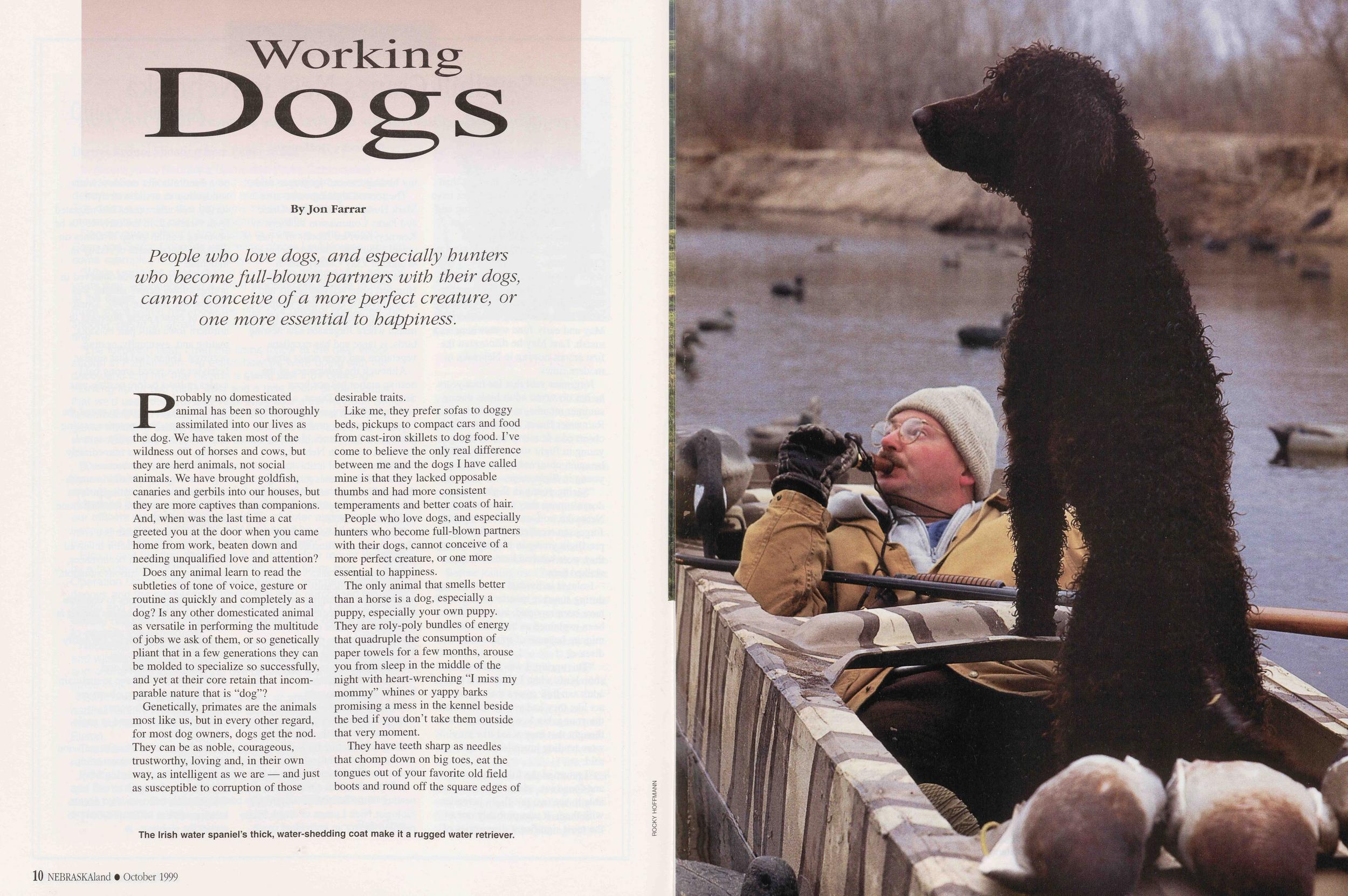
Working Dogs
By Jon Farrar People who love dogs, and especially hunters who become full-blown partners with their dogs, cannot conceive of a more perfect creature, or one more essential to happiness.Probably no domesticated animal has been so thoroughly assimilated into our lives as the dog. We have taken most of the wildness out of horses and cows, but they are herd animals, not social animals. We have brought goldfish, canaries and gerbils into our houses, but they are more captives than companions. And, when was the last time a cat greeted you at the door when you came home from work, beaten down and needing unqualified love and attention?
Does any animal learn to read the subtleties of tone of voice, gesture or routine as quickly and completely as a dog? Is any other domesticated animal as versatile in performing the multitude of jobs we ask of them, or so genetically pliant that in a few generations they can be molded to specialize so successfully, and yet at their core retain that incomparable nature that is "dog"?
Genetically, primates are the animals most like us, but in every other regard, for most dog owners, dogs get the nod. They can be as noble, courageous, trustworthy, loving and, in their own way, as intelligent as we are — and just as susceptible to corruption of those desirable traits.
Like me, they prefer sofas to doggy beds, pickups to compact cars and food from cast-iron skillets to dog food. I've come to believe the only real difference between me and the dogs I have called mine is that they lacked opposable thumbs and had more consistent temperaments and better coats of hair.
People who love dogs, and especially hunters who become full-blown partners with their dogs, cannot conceive of a more perfect creature, or one more essential to happiness.
The only animal that smells better than a horse is a dog, especially a puppy, especially your own puppy. They are roly-poly bundles of energy that quadruple the consumption of paper towels for a few months, arouse you from sleep in the middle of the night with heart-wrenching "I miss my mommy" whines or yappy barks promising a mess in the kennel beside the bed if you don't take them outside that very moment.
They have teeth sharp as needles that chomp down on big toes, eat the tongues out of your favorite old field boots and round off the square edges of 10 NEBRASKAland • October 1999
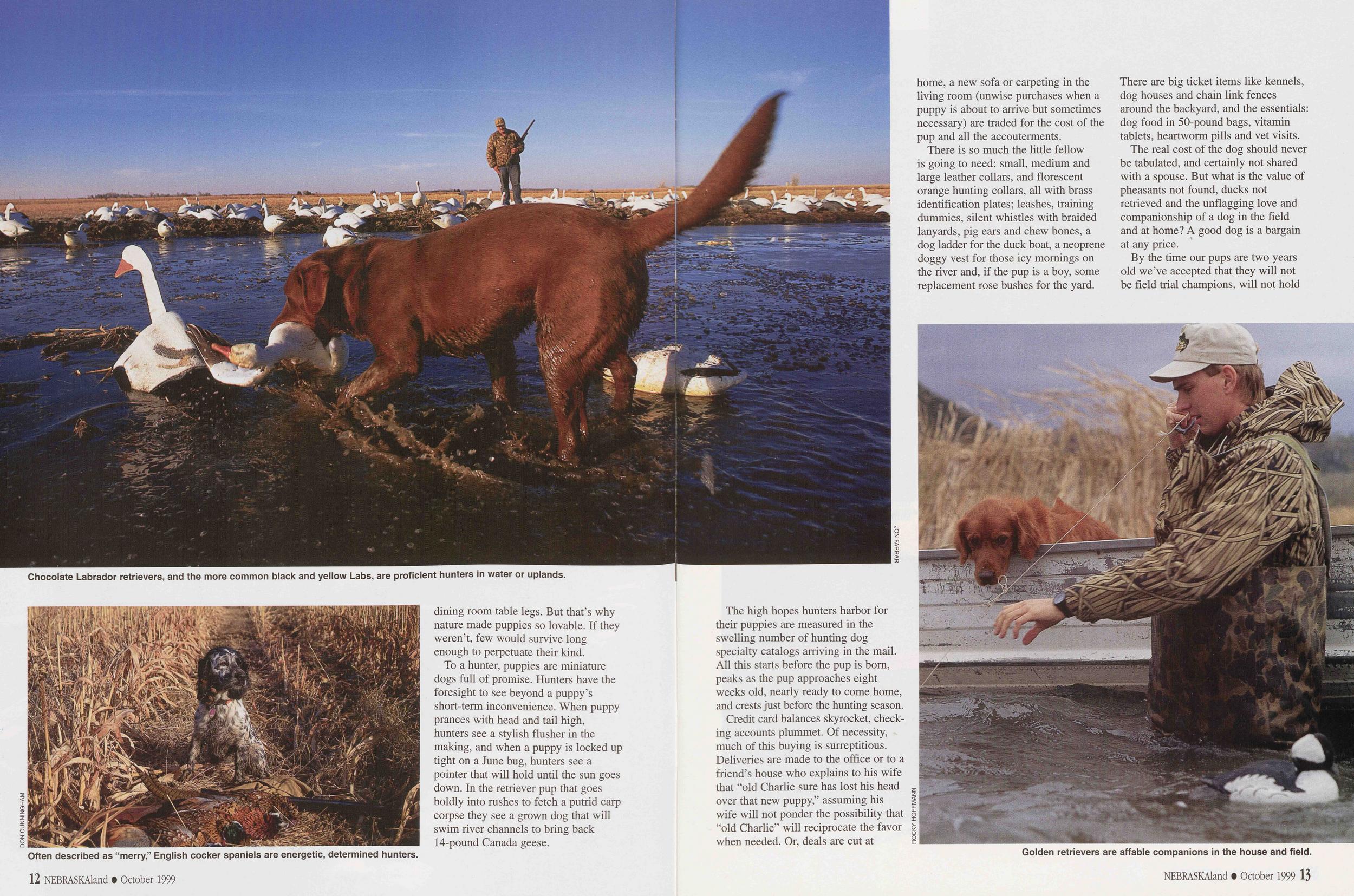
To a hunter, puppies are miniature dogs full of promise. Hunters have the foresight to see beyond a puppy's short-term inconvenience. When puppy prances with head and tail high, hunters see a stylish flusher in the making, and when a puppy is locked up tight on a June bug, hunters see a pointer that will hold until the sun goes down. In the retriever pup that goes boldly into rushes to fetch a putrid carp corpse they see a grown dog that will swim river channels to bring back 14-pound Canada geese.
12 NEBRASKAland • October 1999The high hopes hunters harbor for their puppies are measured in the swelling number of hunting dog specialty catalogs arriving in the mail. All this starts before the pup is born, peaks as the pup approaches eight weeks old, nearly ready to come home, and crests just before the hunting season.
Credit card balances skyrocket, checking accounts plummet. Of necessity, much of this buying is surreptitious. Deliveries are made to the office or to a friend's house who explains to his wife that "old Charlie sure has lost his head over that new puppy," assuming his wife will not ponder the possibility that "old Charlie" will reciprocate the favor when needed. Or, deals are cut at home, a new sofa or carpeting in the living room (unwise purchases when a puppy is about to arrive but sometimes necessary) are traded for the cost of the pup and all the accouterments.
There is so much the little fellow is going to need: small, medium and large leather collars, and florescent orange hunting collars, all with brass identification plates; leashes, training dummies, silent whistles with braided lanyards, pig ears and chew bones, a dog ladder for the duck boat, a neoprene doggy vest for those icy mornings on the river and, if the pup is a boy, some replacement rose bushes for the yard. There are big ticket items like kennels, dog houses and chain link fences around the backyard, and the essentials: dog food in 50-pound bags, vitamin tablets, heart worm pills and vet visits.
The real cost of the dog should never be tabulated, and certainly not shared with a spouse. But what is the value of pheasants not found, ducks not retrieved and the unflagging love and companionship of a dog in the field and at home? A good dog is a bargain at any price.
By the time our pups are two years old we've accepted that they will not be field trial champions, will not hold
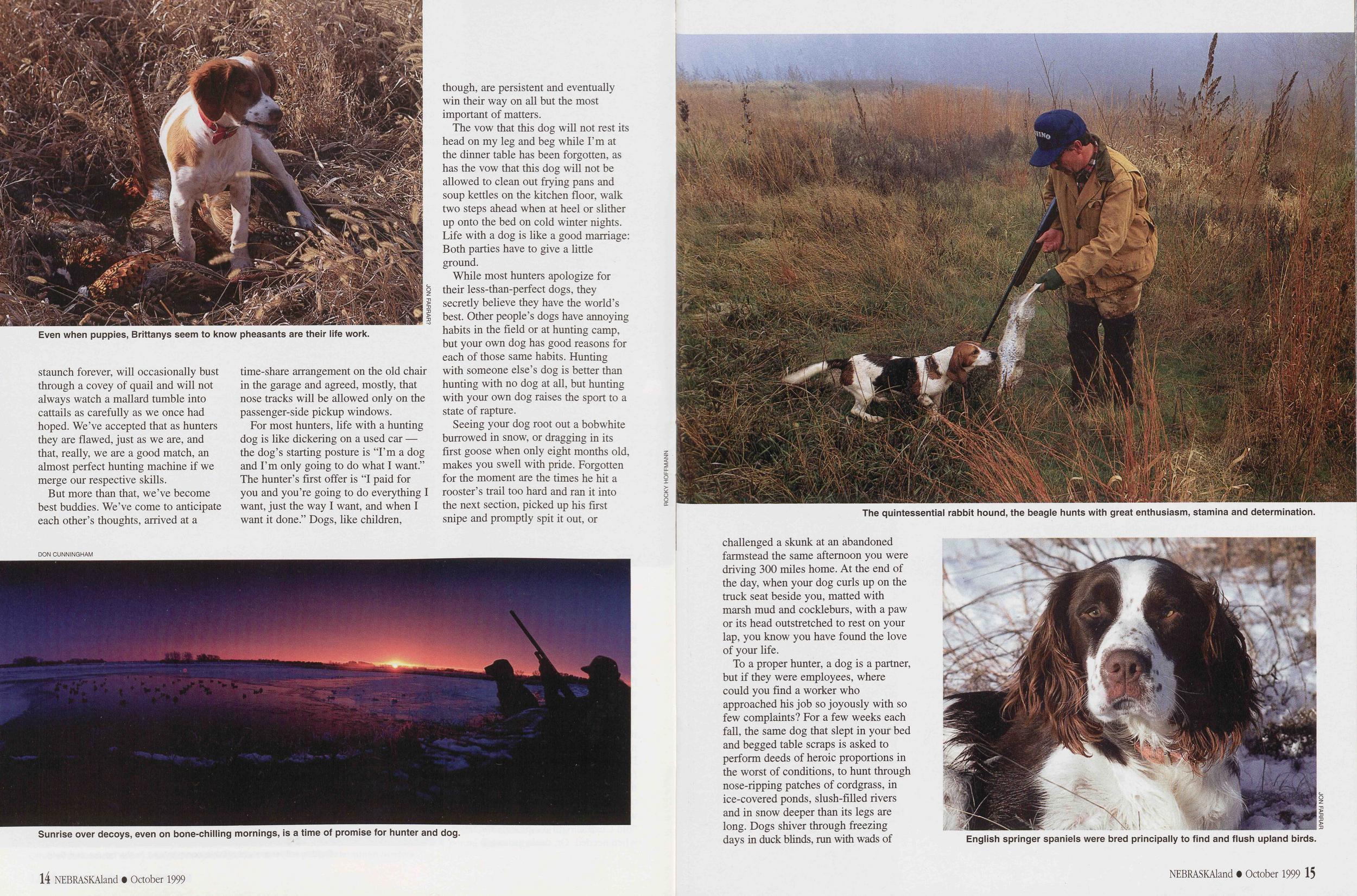
But more than that, we've become best buddies. We've come to anticipate each other's thoughts, arrived at a time-share arrangement on the old chair in the garage and agreed, mostly, that nose tracks will be allowed only on the passenger-side pickup windows.
For most hunters, life with a hunting dog is like dickering on a used car — the dog's starting posture is "I'm a dog and I'm only going to do what I want." The hunter's first offer is "I paid for you and you're going to do everything I want, just the way I want, and when I want it done." Dogs, like children, though, are persistent and eventually win their way on all but the most important of matters.
The vow that this dog will not rest its head on my leg and beg while I'm at the dinner table has been forgotten, as has the vow that this dog will not be allowed to clean out frying pans and soup kettles on the kitchen floor, walk two steps ahead when at heel or slither up onto the bed on cold winter nights. Life with a dog is like a good marriage: Both parties have to give a little ground.
While most hunters apologize for their less-than-perfect dogs, they secretly believe they have the world's best. Other people's dogs have annoying habits in the field or at hunting camp, but your own dog has good reasons for each of those same habits. Hunting with someone else's dog is better than hunting with no dog at all, but hunting with your own dog raises the sport to a state of rapture.
Seeing your dog root out a bobwhite burrowed in snow, or dragging in its first goose when only eight months old, makes you swell with pride. Forgotten for the moment are the times he hit a rooster's trail too hard and ran it into the next section, picked up his first snipe and promptly spit it out, or
To a proper hunter, a dog is a partner, but if they were employees, where could you find a worker who approached his job so joyously with so few complaints? For a few weeks each fall, the same dog that slept in your bed and begged table scraps is asked to perform deeds of heroic proportions in the worst of conditions, to hunt through nose-ripping patches of cordgrass, in ice-covered ponds, slush-filled rivers and in snow deeper than its legs are long. Dogs shiver through freezing days in duck blinds, run with wads of
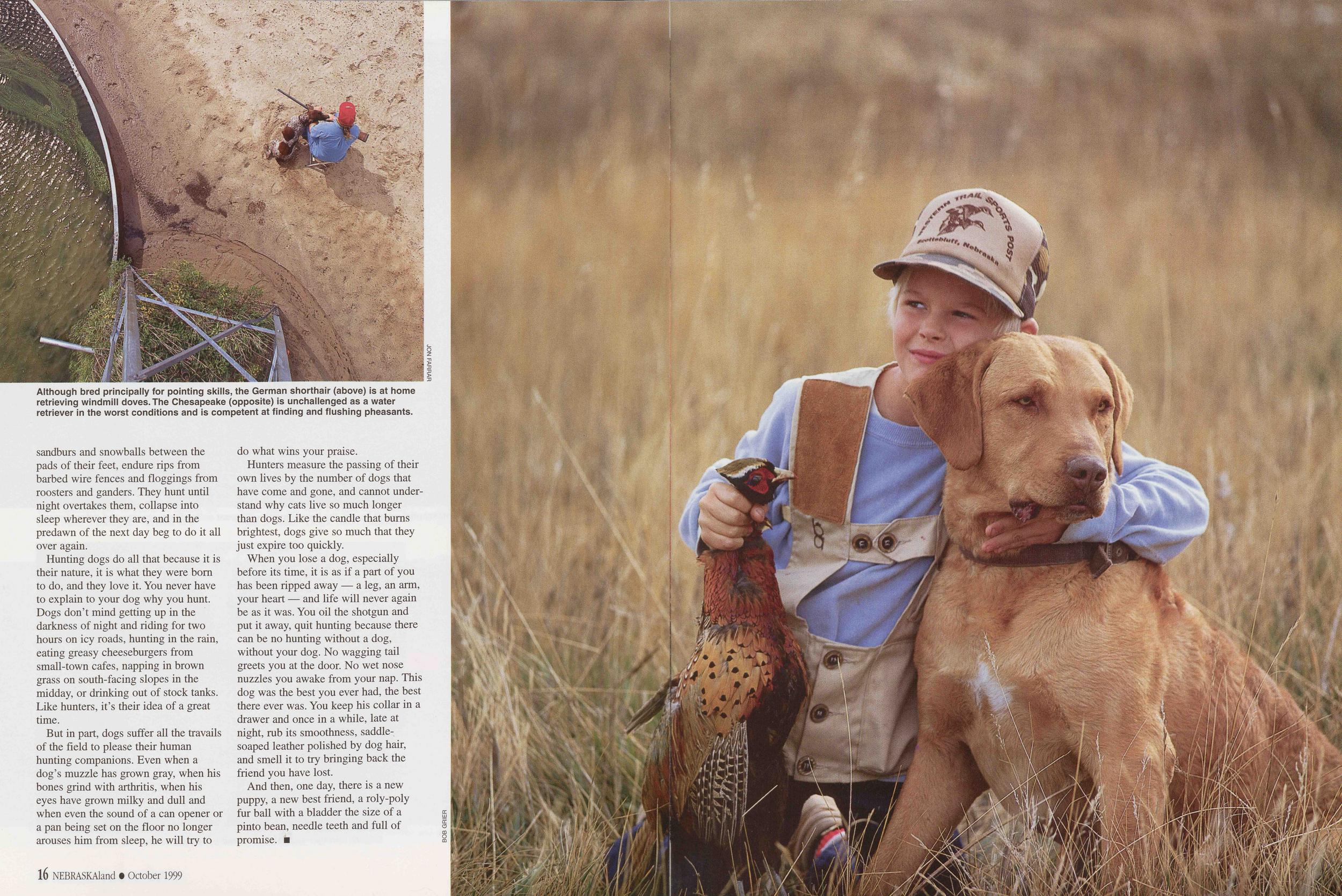
Hunting dogs do all that because it is their nature, it is what they were born to do, and they love it. You never have to explain to your dog why you hunt. Dogs don't mind getting up in the darkness of night and riding for two hours on icy roads, hunting in the rain, eating greasy cheeseburgers from small-town cafes, napping in brown grass on south-facing slopes in the midday, or drinking out of stock tanks. Like hunters, it's their idea of a great time.
But in part, dogs suffer all the travails of the field to please their human hunting companions. Even when a dog's muzzle has grown gray, when his bones grind with arthritis, when his eyes have grown milky and dull and when even the sound of a can opener or a pan being set on the floor no longer arouses him from sleep, he will try to do what wins your praise.
Hunters measure the passing of their own lives by the number of dogs that have come and gone, and cannot understand why cats live so much longer than dogs. Like the candle that burns brightest, dogs give so much that they just expire too quickly.
When you lose a dog, especially before its time, it is as if a part of you has been ripped away — a leg, an arm, your heart — and life will never again be as it was. You oil the shotgun and put it away, quit hunting because there can be no hunting without a dog, without your dog. No wagging tail greets you at the door. No wet nose nuzzles you awake from your nap. This dog was the best you ever had, the best there ever was. You keep his collar in a drawer and once in a while, late at night, rub its smoothness, saddle soaped leather polished by dog hair, and smell it to try bringing back the friend you have lost.
And then, one day, there is a new puppy, a new best friend, a roly-poly fur ball with a bladder the size of a pinto bean, needle teeth and full of promise.
16 NEBRASKAland • October 1999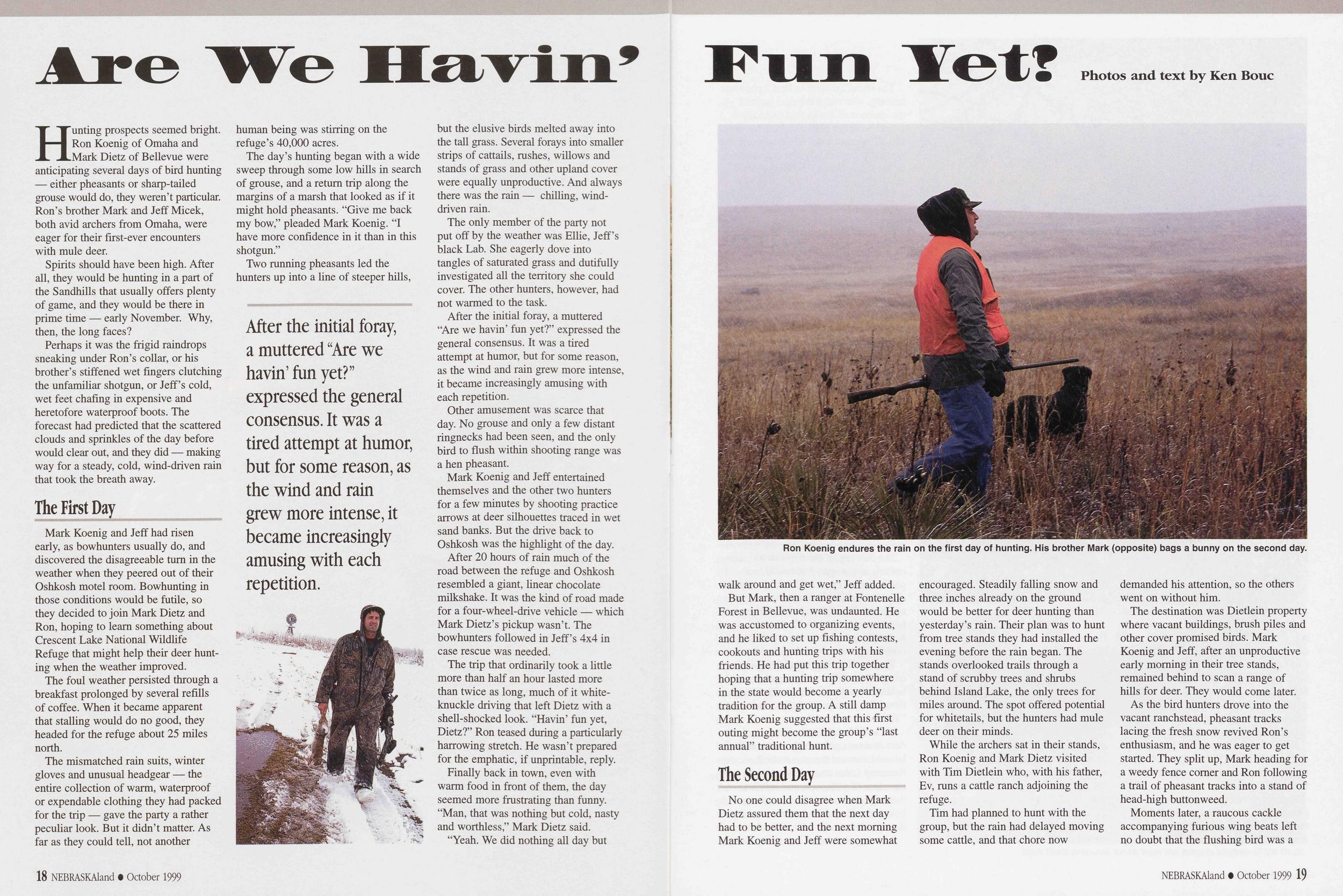
Are We Havin' Fun Yet?
Photos and text by Ken BoucHunting prospects seemed bright. Ron Koenig of Omaha and Mark Dietz of Bellevue were anticipating several days of bird hunting — either pheasants or sharp-tailed grouse would do, they weren't particular. Ron's brother Mark and Jeff Micek, both avid archers from Omaha, were eager for their first-ever encounters with mule deer.
Spirits should have been high. After all, they would be hunting in a part of the Sandhills that usually offers plenty of game, and they would be there in prime time — early November. Why, then, the long faces?
Perhaps it was the frigid raindrops sneaking under Ron's collar, or his brother's stiffened wet fingers clutching the unfamiliar shotgun, or Jeff's cold, wet feet chafing in expensive and heretofore waterproof boots. The forecast had predicted that the scattered clouds and sprinkles of the day before would clear out, and they did — making way for a steady, cold, wind-driven rain that took the breath away.
The First DayMark Koenig and Jeff had risen early, as bowhunters usually do, and discovered the disagreeable turn in the weather when they peered out of their Oshkosh motel room. Bowhunting in those conditions would be futile, so they decided to join Mark Dietz and Ron, hoping to learn something about Crescent Lake National Wildlife Refuge that might help their deer hunting when the weather improved.
The foul weather persisted through a breakfast prolonged by several refills of coffee. When it became apparent that stalling would do no good, they headed for the refuge about 25 miles north.
The mismatched rain suits, winter gloves and unusual headgear — the entire collection of warm, waterproof or expendable clothing they had packed for the trip — gave the party a rather peculiar look. But it didn't matter. As far as they could tell, not another human being was stirring on the refuge's 40,000 acres.
The day's hunting began with a wide sweep through some low hills in search of grouse, and a return trip along the margins of a marsh that looked as if it might hold pheasants. "Give me back my bow," pleaded Mark Koenig. "I have more confidence in it than in this shotgun."
After the initial foray, a muttered "Are we havin' fun yet?" expressed the general consensus. It was a tired attempt at humor, but for some reason, as the wind and rain grew more intense, it became increasingly amusing with each repetition.Two running pheasants led the hunters up into a line of steeper hills, but the elusive birds melted away into the tall grass. Several forays into smaller strips of cattails, rushes, willows and stands of grass and other upland cover were equally unproductive. And always there was the rain — chilling, wind driven rain.
The only member of the party not put off by the weather was Ellie, Jeff's black Lab. She eagerly dove into tangles of saturated grass and dutifully investigated all the territory she could cover. The other hunters, however, had not warmed to the task.
After the initial foray, a muttered "Are we havin' fun yet?" expressed the general consensus. It was a tired attempt at humor, but for some reason, as the wind and rain grew more intense, it became increasingly amusing with each repetition.
Other amusement was scarce that day. No grouse and only a few distant ringnecks had been seen, and the only bird to flush within shooting range was a hen pheasant.
Mark Koenig and Jeff entertained themselves and the other two hunters for a few minutes by shooting practice arrows at deer silhouettes traced in wet sand banks. But the drive back to Oshkosh was the highlight of the day.
After 20 hours of rain much of the road between the refuge and Oshkosh resembled a giant, linear chocolate milkshake. It was the kind of road made for a four-wheel-drive vehicle — which Mark Dietz's pickup wasn't. The bowhunters followed in Jeff's 4x4 in case rescue was needed.
The trip that ordinarily took a little more than half an hour lasted more than twice as long, much of it white knuckle driving that left Dietz with a shell-shocked look. "Havin' fun yet, Dietz?" Ron teased during a particularly harrowing stretch. He wasn't prepared for the emphatic, if unprintable, reply.
Finally back in town, even with warm food in front of them, the day seemed more frustrating than funny. "Man, that was nothing but cold, nasty and worthless," Mark Dietz said.
"Yeah. We did nothing all day but 18 NEBRASKAland • October 1999
But Mark, then a ranger at Fontenelle Forest in Bellevue, was undaunted. He was accustomed to organizing events, and he liked to set up fishing contests, cookouts and hunting trips with his friends. He had put this trip together hoping that a hunting trip somewhere in the state would become a yearly tradition for the group. A still damp Mark Koenig suggested that this first outing might become the group's "last annual" traditional hunt.
The Second DayNo one could disagree when Mark Dietz assured them that the next day had to be better, and the next morning Mark Koenig and Jeff were somewhat encouraged. Steadily falling snow and three inches already on the ground would be better for deer hunting than yesterday's rain. Their plan was to hunt from tree stands they had installed the evening before the rain began. The stands overlooked trails through a stand of scrubby trees and shrubs behind Island Lake, the only trees for miles around. The spot offered potential for whitetails, but the hunters had mule deer on their minds.
While the archers sat in their stands, Ron Koenig and Mark Dietz visited with Tim Dietlein who, with his father, Ev, runs a cattle ranch adjoining the refuge.
Tim had planned to hunt with the group, but the rain had delayed moving some cattle, and that chore now demanded his attention, so the others went on without him.
The destination was Dietlein property where vacant buildings, brush piles and other cover promised birds. Mark Koenig and Jeff, after an unproductive early morning in their tree stands, remained behind to scan a range of hills for deer. They would come later.
As the bird hunters drove into the vacant ranchstead, pheasant tracks lacing the fresh snow revived Ron's enthusiasm, and he was eager to get started. They split up, Mark heading for a weedy fence corner and Ron following a trail of pheasant tracks into a stand of head-high buttonweed.
Moments later, a raucous cackle
accompanying furious wing beats left
no doubt that the flushing bird was a
NEBRASKAland • October 1999 19
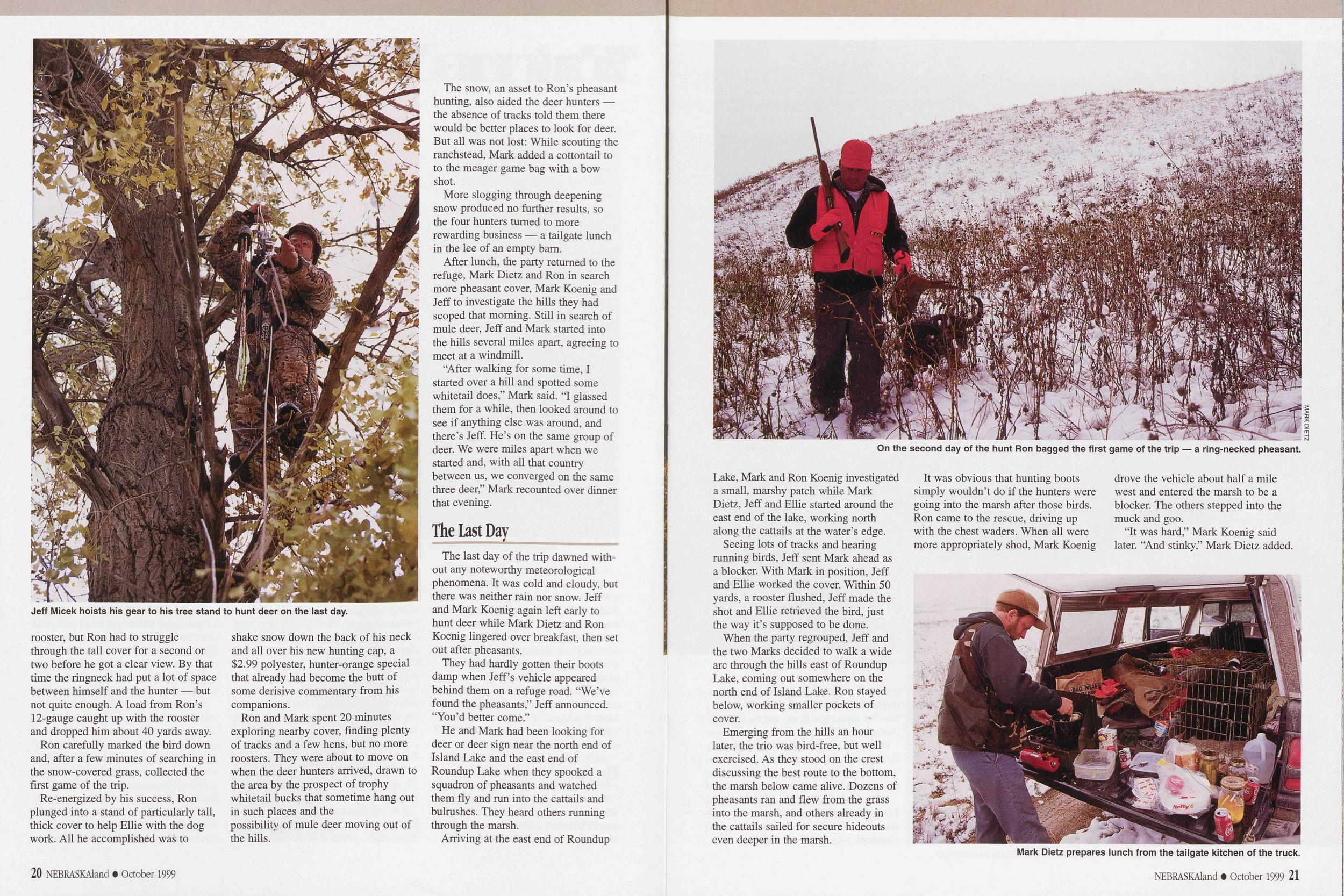
Ron carefully marked the bird down and, after a few minutes of searching in the snow-covered grass, collected the first game of the trip.
Re-energized by his success, Ron plunged into a stand of particularly tall, thick cover to help Ellie with the dog work. All he accomplished was to shake snow down the back of his neck and all over his new hunting cap, a $2.99 polyester, hunter-orange special that already had become the butt of some derisive commentary from his companions.
Ron and Mark spent 20 minutes exploring nearby cover, finding plenty of tracks and a few hens, but no more roosters. They were about to move on when the deer hunters arrived, drawn to the area by the prospect of trophy whitetail bucks that sometime hang out in such places and the possibility of mule deer moving out of the hills.
The snow, an asset to Ron's pheasant hunting, also aided the deer hunters — the absence of tracks told them there would be better places to look for deer. But all was not lost: While scouting the ranch stead, Mark added a cottontail to to the meager game bag with a bow shot.
More slogging through deepening snow produced no further results, so the four hunters turned to more rewarding business — a tailgate lunch in the lee of an empty barn.
After lunch, the party returned to the refuge, Mark Dietz and Ron in search more pheasant cover, Mark Koenig and Jeff to investigate the hills they had scoped that morning. Still in search of mule deer, Jeff and Mark started into the hills several miles apart, agreeing to meet at a windmill.
'After walking for some time, I started over a hill and spotted some whitetail does," Mark said. "I glassed them for a while, then looked around to see if anything else was around, and there's Jeff. He's on the same group of deer. We were miles apart when we started and, with all that country between us, we converged on the same three deer," Mark recounted over dinner that evening.
The Last DayThe last day of the trip dawned without any noteworthy meteorological phenomena. It was cold and cloudy, but there was neither rain nor snow. Jeff and Mark Koenig again left early to hunt deer while Mark Dietz and Ron Koenig lingered over breakfast, then set out after pheasants.
They had hardly gotten their boots damp when Jeff's vehicle appeared behind them on a refuge road. "We've found the pheasants," Jeff announced. "You'd better come."
He and Mark had been looking for deer or deer sign near the north end of Island Lake and the east end of Roundup Lake when they spooked a squadron of pheasants and watched them fly and run into the cattails and bulrushes. They heard others running through the marsh.
Arriving at the east end of Roundup
Seeing lots of tracks and hearing running birds, Jeff sent Mark ahead as a blocker. With Mark in position, Jeff and Ellie worked the cover. Within 50 yards, a rooster flushed, Jeff made the shot and Ellie retrieved the bird, just the way it's supposed to be done.
When the party regrouped, Jeff and the two Marks decided to walk a wide arc through the hills east of Roundup Lake, coming out somewhere on the north end of Island Lake. Ron stayed below, working smaller pockets of cover.
Emerging from the hills an hour later, the trio was bird-free, but well exercised. As they stood on the crest discussing the best route to the bottom, the marsh below came alive. Dozens of pheasants ran and flew from the grass into the marsh, and others already in the cattails sailed for secure hideouts even deeper in the marsh.
It was obvious that hunting boots simply wouldn't do if the hunters were going into the marsh after those birds. Ron came to the rescue, driving up with the chest waders. When all were more appropriately shod, Mark Koenig drove the vehicle about half a mile west and entered the marsh to be a blocker. The others stepped into the muck and goo.
"It was hard," Mark Koenig said later. "And stinky," Mark Dietz added.
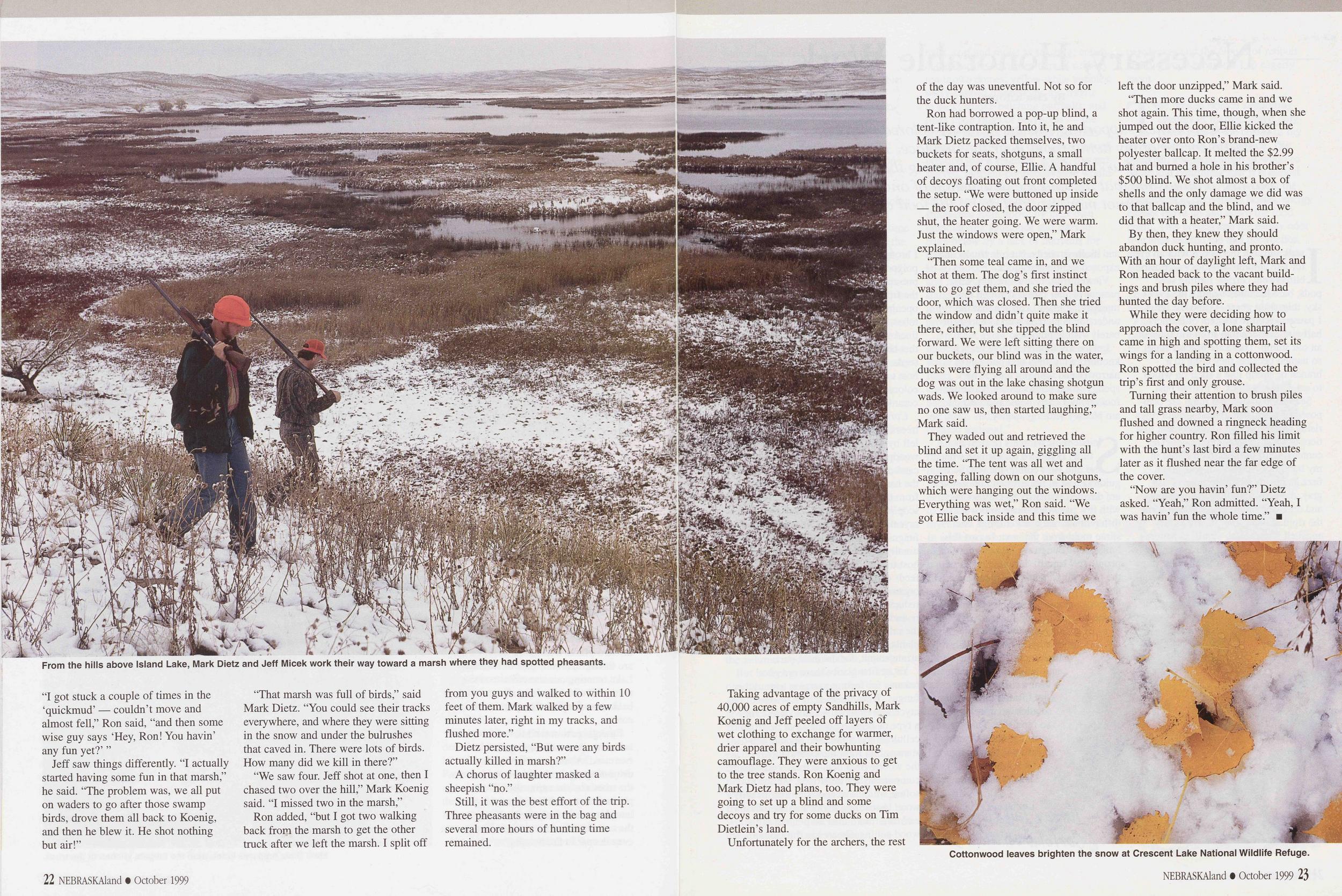
Jeff saw things differently. "I actually started having some fun in that marsh," he said. "The problem was, we all put on waders to go after those swamp birds, drove them all back to Koenig, and then he blew it. He shot nothing but air!"
"That marsh was full of birds," said Mark Dietz. "You could see their tracks everywhere, and where they were sitting in the snow and under the bulrushes that caved in. There were lots of birds. How many did we kill in there?"
"We saw four. Jeff shot at one, then I chased two over the hill," Mark Koenig said. "I missed two in the marsh,"
Ron added, "but I got two walking back from the marsh to get the other truck after we left the marsh. I split off from you guys and walked to within 10 feet of them. Mark walked by a few minutes later, right in my tracks, and flushed more."
Dietz persisted, "But were any birds actually killed in marsh?"
A chorus of laughter masked a sheepish "no."
Still, it was the best effort of the trip. Three pheasants were in the bag and several more hours of hunting time remained.
22 NEBRASKAland • October 1999Taking advantage of the privacy of 40,000 acres of empty Sandhills, Mark Koenig and Jeff peeled off layers of wet clothing to exchange for warmer, drier apparel and their bowhunting camouflage. They were anxious to get to the tree stands. Ron Koenig and Mark Dietz had plans, too. They were going to set up a blind and some decoys and try for some ducks on Tim Dietlein's land.
Unfortunately for the archers, the rest of the day was uneventful. Not so for the duck hunters.
Ron had borrowed a pop-up blind, a tent-like contraption. Into it, he and Mark Dietz packed themselves, two buckets for seats, shotguns, a small heater and, of course, Ellie. A handful of decoys floating out front completed the setup. "We were buttoned up inside — the roof closed, the door zipped shut, the heater going. We were warm. Just the windows were open," Mark explained.
"Then some teal came in, and we shot at them. The dog's first instinct was to go get them, and she tried the door, which was closed. Then she tried the window and didn't quite make it there, either, but she tipped the blind forward. We were left sitting there on our buckets, our blind was in the water, ducks were flying all around and the dog was out in the lake chasing shotgun wads. We looked around to make sure no one saw us, then started laughing," Mark said.
They waded out and retrieved the blind and set it up again, giggling all the time. "The tent was all wet and sagging, falling down on our shotguns, which were hanging out the windows. Everything was wet," Ron said. "We got Ellie back inside and this time we left the door unzipped," Mark said.
"Then more ducks came in and we shot again. This time, though, when she jumped out the door, Ellie kicked the heater over onto Ron's brand-new polyester ballcap. It melted the $2.99 hat and burned a hole in his brother's $500 blind. We shot almost a box of shells and the only damage we did was to that ballcap and the blind, and we did that with a heater," Mark said.
By then, they knew they should abandon duck hunting, and pronto. With an hour of daylight left, Mark and Ron headed back to the vacant buildings and brush piles where they had hunted the day before.
While they were deciding how to approach the cover, a lone sharptail came in high and spotting them, set its wings for a landing in a cottonwood. Ron spotted the bird and collected the trip's first and only grouse.
Turning their attention to brush piles and tall grass nearby, Mark soon flushed and downed a ringneck heading for higher country. Ron filled his limit with the hunt's last bird a few minutes later as it flushed near the far edge of the cover.
"Now are you havin' fun?" Dietz asked. "Yeah," Ron admitted. "Yeah, I was havin' fun the whole time."
Necessary, Honorable Work
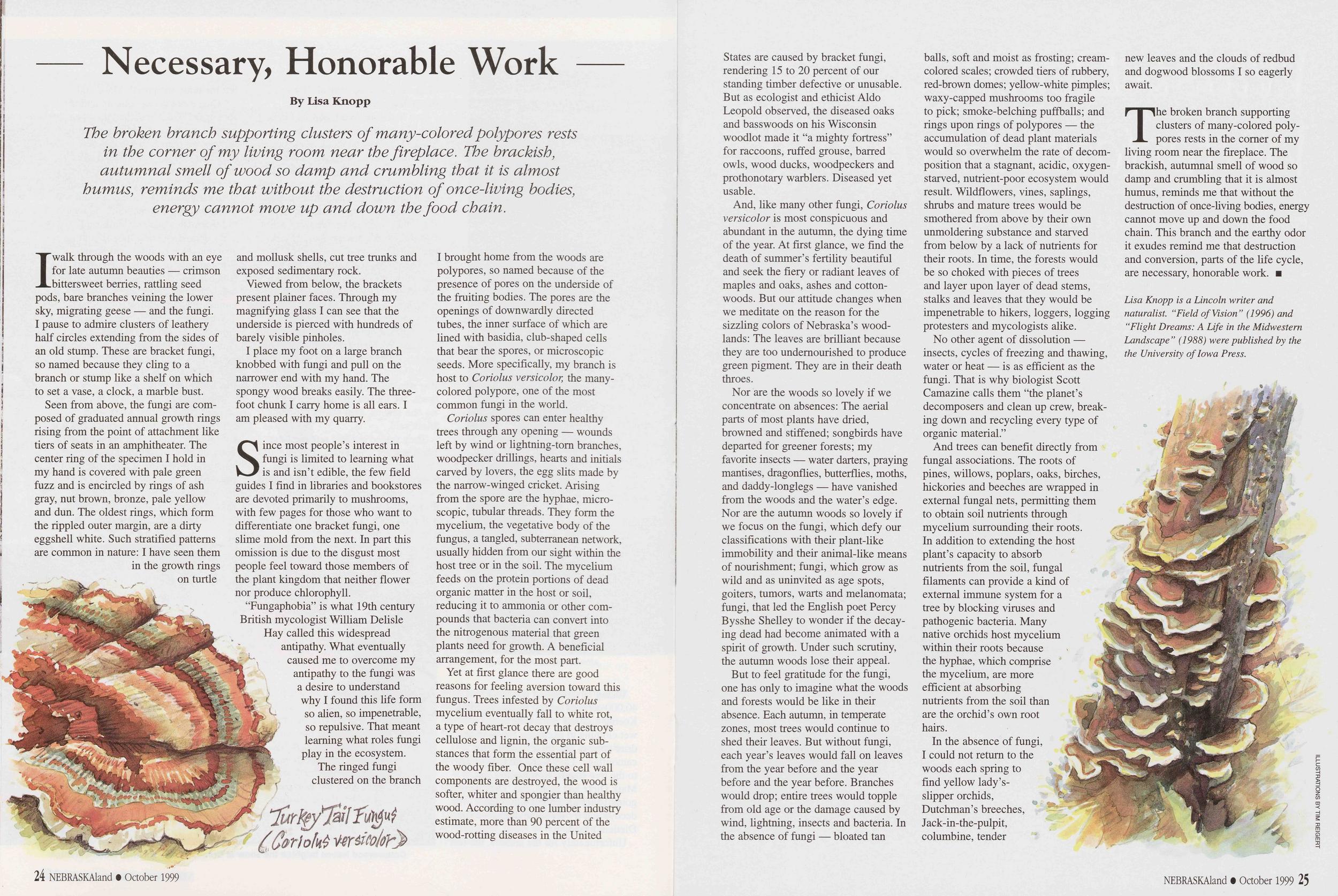
By Lisa Knopp The broken branch supporting clusters of many-colored polypores rests in the corner of my living room near the fireplace. The brackish, autumnal smell of wood so damp and crumbling that it is almost humus, reminds me that without the destruction of once-living bodies, energy cannot move up and down the food chain.walk through the woods with an eye for late autumn beauties — crimson .bittersweet berries, rattling seed pods, bare branches veining the lower sky, migrating geese — and the fungi. I pause to admire clusters of leathery half circles extending from the sides of an old stump. These are bracket fungi, so named because they cling to a branch or stump like a shelf on which to set a vase, a clock, a marble bust.
Seen from above, the fungi are composed of graduated annual growth rings rising from the point of attachment like tiers of seats in an amphitheater. The center ring of the specimen I hold in my hand is covered with pale green fuzz and is encircled by rings of ash gray, nut brown, bronze, pale yellow and dun. The oldest rings, which form the rippled outer margin, are a dirty eggshell white. Such stratified patterns are common in nature: I have seen them in the growth rings on turtle and mollusk shells, cut tree trunks and exposed sedimentary rock.
Viewed from below, the brackets present plainer faces. Through my magnifying glass I can see that the underside is pierced with hundreds of barely visible pinholes.
I place my foot on a large branch knobbed with fungi and pull on the narrower end with my hand. The spongy wood breaks easily. The three- foot chunk I carry home is all ears. I am pleased with my quarry.
Since most people's interest in fungi is limited to learning what is and isn't edible, the few field guides I find in libraries and bookstores are devoted primarily to mushrooms, with few pages for those who want to differentiate one bracket fungi, one slime mold from the next. In part this omission is due to the disgust most people feel toward those members of the plant kingdom that neither flower nor produce chlorophyll.
'Fungaphobia" is what 19th century British mycologist William Delisle Hay called this widespread antipathy. What eventually caused me to overcome my antipathy to the fungi was a desire to understand why I found this life form so alien, so impenetrable, so repulsive. That meant learning what roles fungi play in the ecosystem. The ringed fungi clustered on the branch I brought home from the woods are polypores, so named because of the presence of pores on the underside of the fruiting bodies. The pores are the openings of downwardly directed tubes, the inner surface of which are lined with basidia, club-shaped cells that bear the spores, or microscopic seeds. More specifically, my branch is host to Coriolus versicolor, the many colored polypore, one of the most common fungi in the world.
Coriolus spores can enter healthy trees through any opening — wounds left by wind or lightning-torn branches, woodpecker drillings, hearts and initials carved by lovers, the egg slits made by the narrow-winged cricket. Arising from the spore are the hyphae, microscopic, tubular threads. They form the mycelium, the vegetative body of the fungus, a tangled, subterranean network, usually hidden from our sight within the host tree or in the soil. The mycelium feeds on the protein portions of dead organic matter in the host or soil, reducing it to ammonia or other compounds that bacteria can convert into the nitrogenous material that green plants need for growth. A beneficial arrangement, for the most part.
Yet at first glance there are good reasons for feeling aversion toward this fungus. Trees infested by Coriolus mycelium eventually fall to white rot, a type of heart-rot decay that destroys cellulose and lignin, the organic substances that form the essential part of the woody fiber. Once these cell wall components are destroyed, the wood is softer, whiter and spongier than healthy wood. According to one lumber industry estimate, more than 90 percent of the wood-rotting diseases in the United
And, like many other fungi, Coriolus versicolor is most conspicuous and abundant in the autumn, the dying time of the year. At first glance, we find the death of summer's fertility beautiful and seek the fiery or radiant leaves of maples and oaks, ashes and cottonwoods. But our attitude changes when we meditate on the reason for the sizzling colors of Nebraska's wood lands: The leaves are brilliant because they are too undernourished to produce green pigment. They are in their death throes.
Nor are the woods so lovely if we concentrate on absences: The aerial parts of most plants have dried, browned and stiffened; songbirds have departed for greener forests; my favorite insects — water darters, praying mantises, dragonflies, butterflies, moths, and daddy-longlegs — have vanished from the woods and the water's edge. Nor are the autumn woods so lovely if we focus on the fungi, which defy our classifications with their plant-like immobility and their animal-like means of nourishment; fungi, which grow as wild and as uninvited as age spots, goiters, tumors, warts and melanomata; fungi, that led the English poet Percy Bysshe Shelley to wonder if the decaying dead had become animated with a spirit of growth. Under such scrutiny, the autumn woods lose their appeal.
But to feel gratitude for the fungi, one has only to imagine what the woods and forests would be like in their absence. Each autumn, in temperate zones, most trees would continue to shed their leaves. But without fungi, each year's leaves would fall on leaves from the year before and the year before and the year before. Branches would drop; entire trees would topple from old age or the damage caused by wind, lightning, insects and bacteria. In the absence of fungi — bloated tan balls, soft and moist as frosting; cream- colored scales; crowded tiers of rubbery, red-brown domes; yellow-white pimples; waxy-capped mushrooms too fragile to pick; smoke-belching puffballs; and rings upon rings of polypores — the accumulation of dead plant materials would so overwhelm the rate of decomposition that a stagnant, acidic, oxygen- starved, nutrient-poor ecosystem would result. Wildflowers, vines, saplings, shrubs and mature trees would be smothered from above by their own unsmoldering substance and starved from below by a lack of nutrients for their roots. In time, the forests would be so choked with pieces of trees and layer upon layer of dead stems, stalks and leaves that they would be impenetrable to hikers, loggers, logging protesters and mycologists alike.
No other agent of dissolution — insects, cycles of freezing and thawing, water or heat — is as efficient as the fungi. That is why biologist Scott Camazine calls them "the planet's decomposers and clean up crew, breaking down and recycling every type of organic material."
And trees can benefit directly from fungal associations. The roots of pines, willows, poplars, oaks, birches, hickories and beeches are wrapped in external fungal nets, permitting them to obtain soil nutrients through mycelium surrounding their roots. In addition to extending the host plant's capacity to absorb nutrients from the soil, fungal filaments can provide a kind of external immune system for a tree by blocking viruses and pathogenic bacteria. Many native orchids host mycelium within their roots because the hyphae, which comprise the mycelium, are more efficient at absorbing nutrients from the soil than are the orchid's own root hairs.
In the absence of fungi, I could not return to the woods each spring to find yellow lady's- slipper orchids, Dutchman's breeches, Jack-in-the-pulpit, columbine, tender new leaves and the clouds of redbud and dogwood blossoms I so eagerly await.
The broken branch supporting clusters of many-colored polypores rests in the corner of my living room near the fireplace. The brackish, autumnal smell of wood so damp and crumbling that it is almost humus, reminds me that without the destruction of once-living bodies, energy cannot move up and down the food chain. This branch and the earthy odor it exudes remind me that destruction and conversion, parts of the life cycle, are necessary, honorable work.
Lisa Knopp is a Lincoln writer and naturalist. "Field of Vision" (1996) and "Flight Dreams: A Life in the Midwestern Landscape" (1988) were published by the the University of Iowa Press.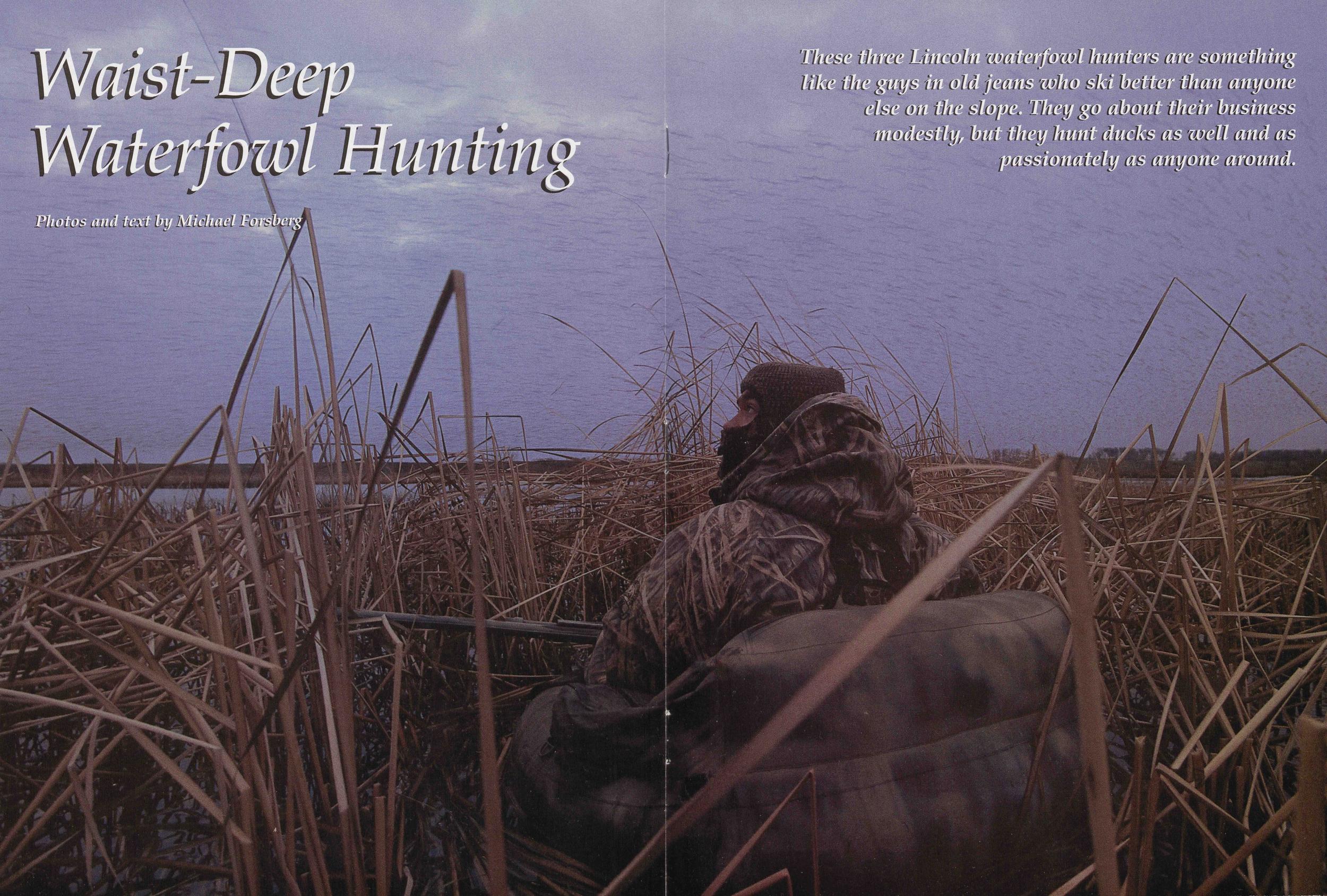
Wait-Deep Waterfowl Hunting
Photos and text by Michael Forsberg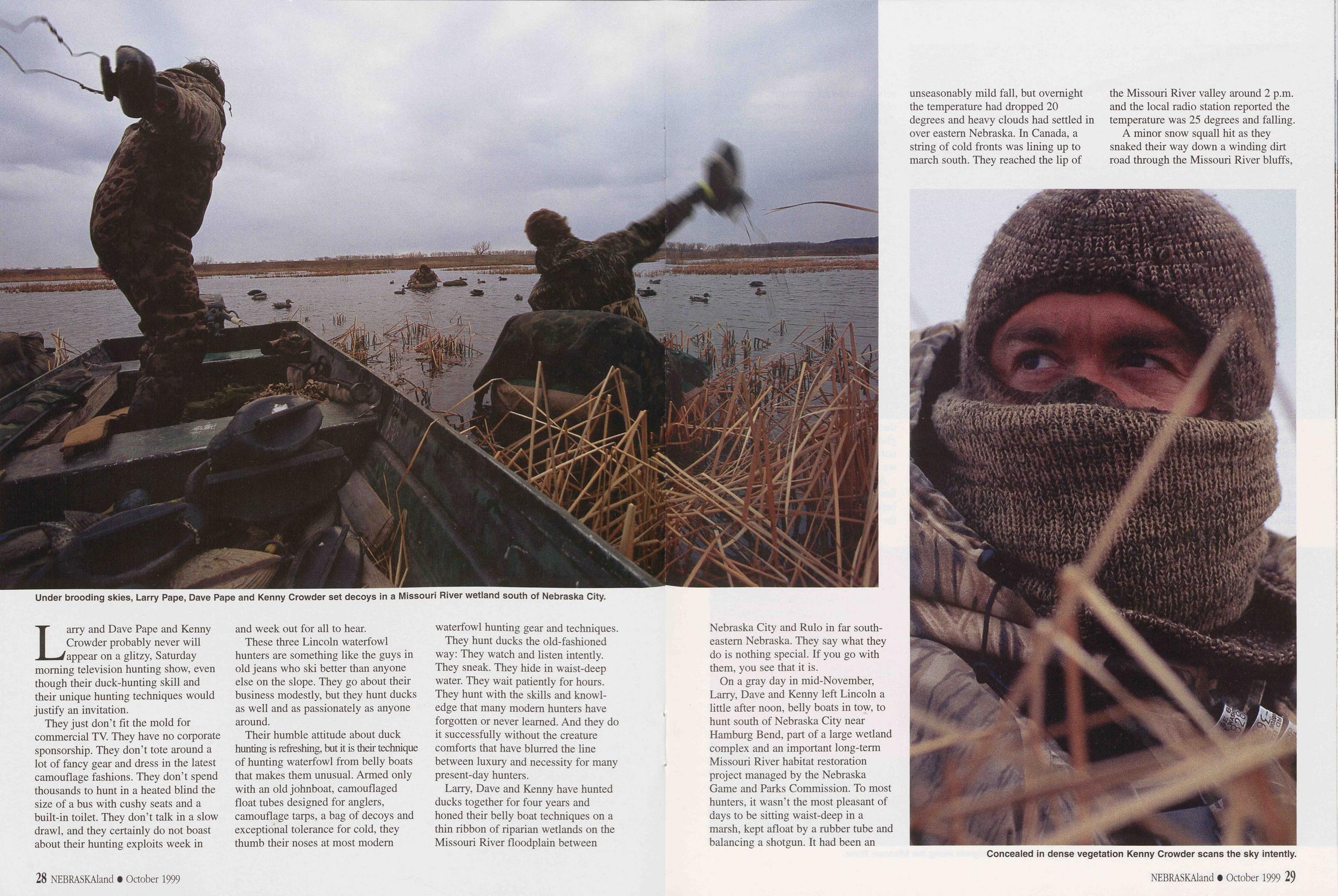
Larry and Dave Pape and Kenny Crowder probably never will appear on a glitzy, Saturday morning television hunting show, even though their duck-hunting skill and their unique hunting techniques would justify an invitation.
These three Lincoln waterfowl hunters are something like the guys in old jeans who ski better than anyone else on the slope. They go about their business modestly, but they hunt ducks as well and as passionately as anyone around.
They just don't fit the mold for commercial TV. They have no corporate sponsorship. They don't tote around a lot of fancy gear and dress in the latest camouflage fashions. They don't spend thousands to hunt in a heated blind the size of a bus with cushy seats and a built-in toilet. They don't talk in a slow drawl, and they certainly do not boast about their hunting exploits week in and week out for all to hear.
Their humble attitude about duck hunting is refreshing, but it is their technique of hunting waterfowl from belly boats that makes them unusual. Armed only with an old johnboat, camouflaged float tubes designed for anglers, camouflage tarps, a bag of decoys and exceptional tolerance for cold, they thumb their noses at most modern waterfowl hunting gear and techniques.
They hunt ducks the old-fashioned way: They watch and listen intently. They sneak. They hide in waist-deep water. They wait patiently for hours. They hunt with the skills and knowledge that many modern hunters have forgotten or never learned. And they do it successfully without the creature comforts that have blurred the line between luxury and necessity for many present-day hunters.
Larry, Dave and Kenny have hunted ducks together for four years and honed their belly boat techniques on a thin ribbon of riparian wetlands on the Missouri River floodplain between 28 NEBRASKAland • October 1999 Nebraska City and Rulo in far southeastern Nebraska. They say what they do is nothing special. If you go with them, you see that it is.
On a gray day in mid-November, Larry, Dave and Kenny left Lincoln a little after noon, belly boats in tow, to hunt south of Nebraska City near Hamburg Bend, part of a large wetland complex and an important long-term Missouri River habitat restoration project managed by the Nebraska Game and Parks Commission. To most hunters, it wasn't the most pleasant of days to be sitting waist-deep in a marsh, kept afloat by a rubber tube and balancing a shotgun. It had been an unseasonably mild fall, but overnight the temperature had dropped 20 degrees and heavy clouds had settled in over eastern Nebraska. In Canada, a string of cold fronts was lining up to march south. They reached the lip of the Missouri River valley around 2 p.m. and the local radio station reported the temperature was 25 degrees and falling. A minor snow squall hit as they snaked their way down a winding dirt road through the Missouri River bluffs,
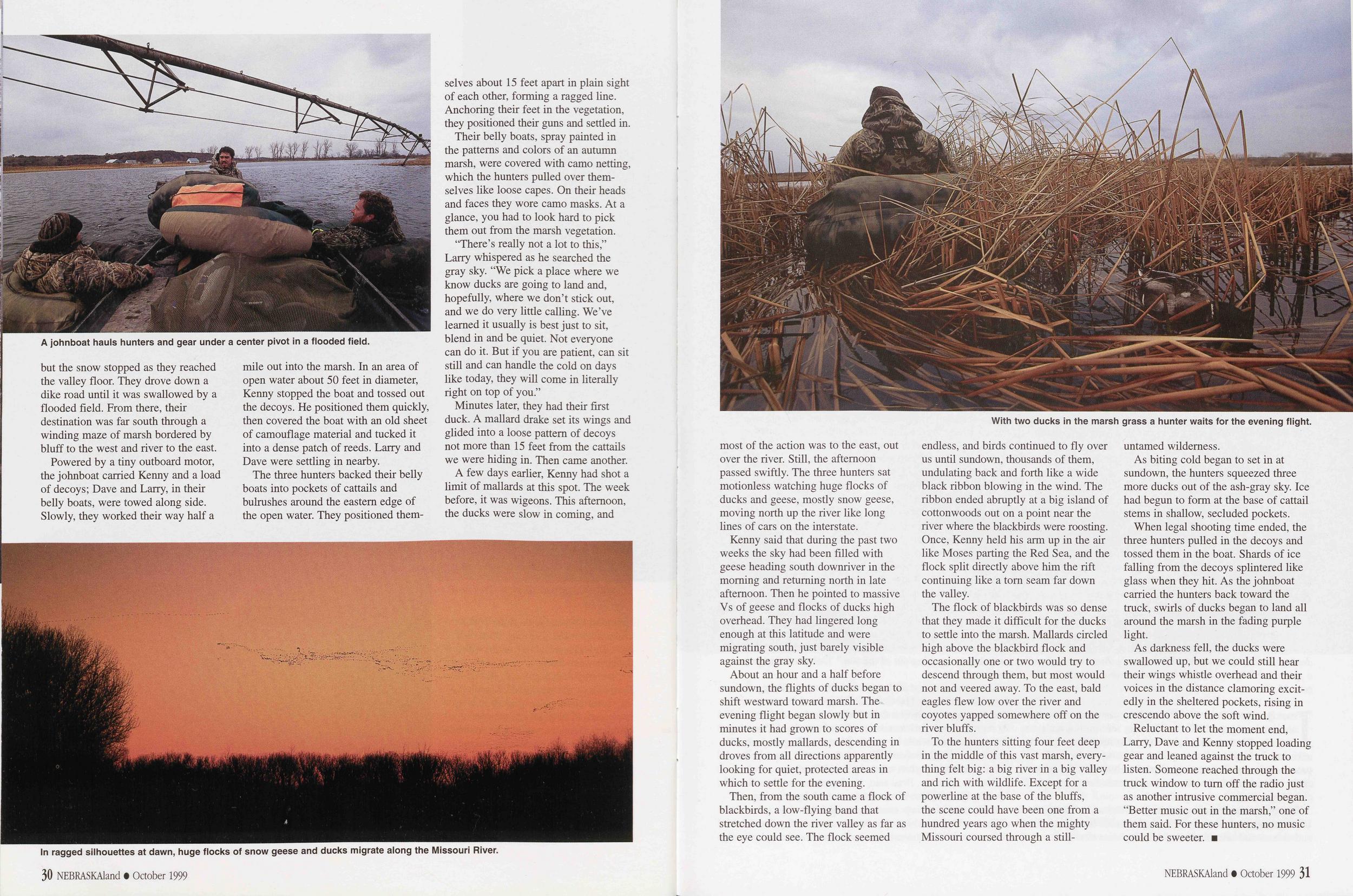
Powered by a tiny outboard motor, the johnboat carried Kenny and a load of decoys; Dave and Larry, in their belly boats, were towed along side. Slowly, they worked their way half a mile out into the marsh. In an area of open water about 50 feet in diameter, Kenny stopped the boat and tossed out the decoys. He positioned them quickly, then covered the boat with an old sheet of camouflage material and tucked it into a dense patch of reeds. Larry and Dave were settling in nearby.
The three hunters backed their belly boats into pockets of cattails and bulrushes around the eastern edge of the open water. They positioned themselves about 15 feet apart in plain sight of each other, forming a ragged line. Anchoring their feet in the vegetation, they positioned their guns and settled in.
Their belly boats, spray painted in the patterns and colors of an autumn marsh, were covered with camo netting, which the hunters pulled over themselves like loose capes. On their heads and faces they wore camo masks. At a glance, you had to look hard to pick them out from the marsh vegetation.
"There's really not a lot to this," Larry whispered as he searched the gray sky. "We pick a place where we know ducks are going to land and, hopefully, where we don't stick out, and we do very little calling. We've learned it usually is best just to sit, blend in and be quiet. Not everyone can do it. But if you are patient, can sit still and can handle the cold on days like today, they will come in literally right on top of you."
Minutes later, they had their first duck. A mallard drake set its wings and glided into a loose pattern of decoys not more than 15 feet from the cattails we were hiding in. Then came another.
A few days earlier, Kenny had shot a limit of mallards at this spot. The week before, it was wigeons. This afternoon, the ducks were slow in coming, and
Kenny said that during the past two weeks the sky had been filled with geese heading south downriver in the morning and returning north in late afternoon. Then he pointed to massive Vs of geese and flocks of ducks high overhead. They had lingered long enough at this latitude and were migrating south, just barely visible against the gray sky.
About an hour and a half before sundown, the flights of ducks began to shift westward toward marsh. The evening flight began slowly but in minutes it had grown to scores of ducks, mostly mallards, descending in droves from all directions apparently looking for quiet, protected areas in which to settle for the evening.
Then, from the south came a flock of blackbirds, a low-flying band that stretched down the river valley as far as the eye could see. The flock seemed endless, and birds continued to fly over us until sundown, thousands of them, undulating back and forth like a wide black ribbon blowing in the wind. The ribbon ended abruptly at a big island of cottonwoods out on a point near the river where the blackbirds were roosting. Once, Kenny held his arm up in the air like Moses parting the Red Sea, and the flock split directly above him the rift continuing like a torn seam far down the valley.
The flock of blackbirds was so dense that they made it difficult for the ducks to settle into the marsh. Mallards circled high above the blackbird flock and occasionally one or two would try to descend through them, but most would not and veered away. To the east, bald eagles flew low over the river and coyotes yapped somewhere off on the river bluffs.
To the hunters sitting four feet deep in the middle of this vast marsh, everything felt big: a big river in a big valley and rich with wildlife. Except for a power line at the base of the bluffs, the scene could have been one from a hundred years ago when the mighty Missouri coursed through a still- untamed wilderness.
As biting cold began to set in at sundown, the hunters squeezed three more ducks out of the ash-gray sky. Ice had begun to form at the base of cattail stems in shallow, secluded pockets.
When legal shooting time ended, the three hunters pulled in the decoys and tossed them in the boat. Shards of ice falling from the decoys splintered like glass when they hit. As the johnboat carried the hunters back toward the truck, swirls of ducks began to land all around the marsh in the fading purple light.
As darkness fell, the ducks were swallowed up, but we could still hear their wings whistle overhead and their voices in the distance clamoring excitedly in the sheltered pockets, rising in crescendo above the soft wind.
Reluctant to let the moment end, Larry, Dave and Kenny stopped loading gear and leaned against the truck to listen. Someone reached through the truck window to turn off the radio just as another intrusive commercial began. "Better music out in the marsh," one of them said. For these hunters, no music could be sweeter.
NEBRASKAland • October 1999 31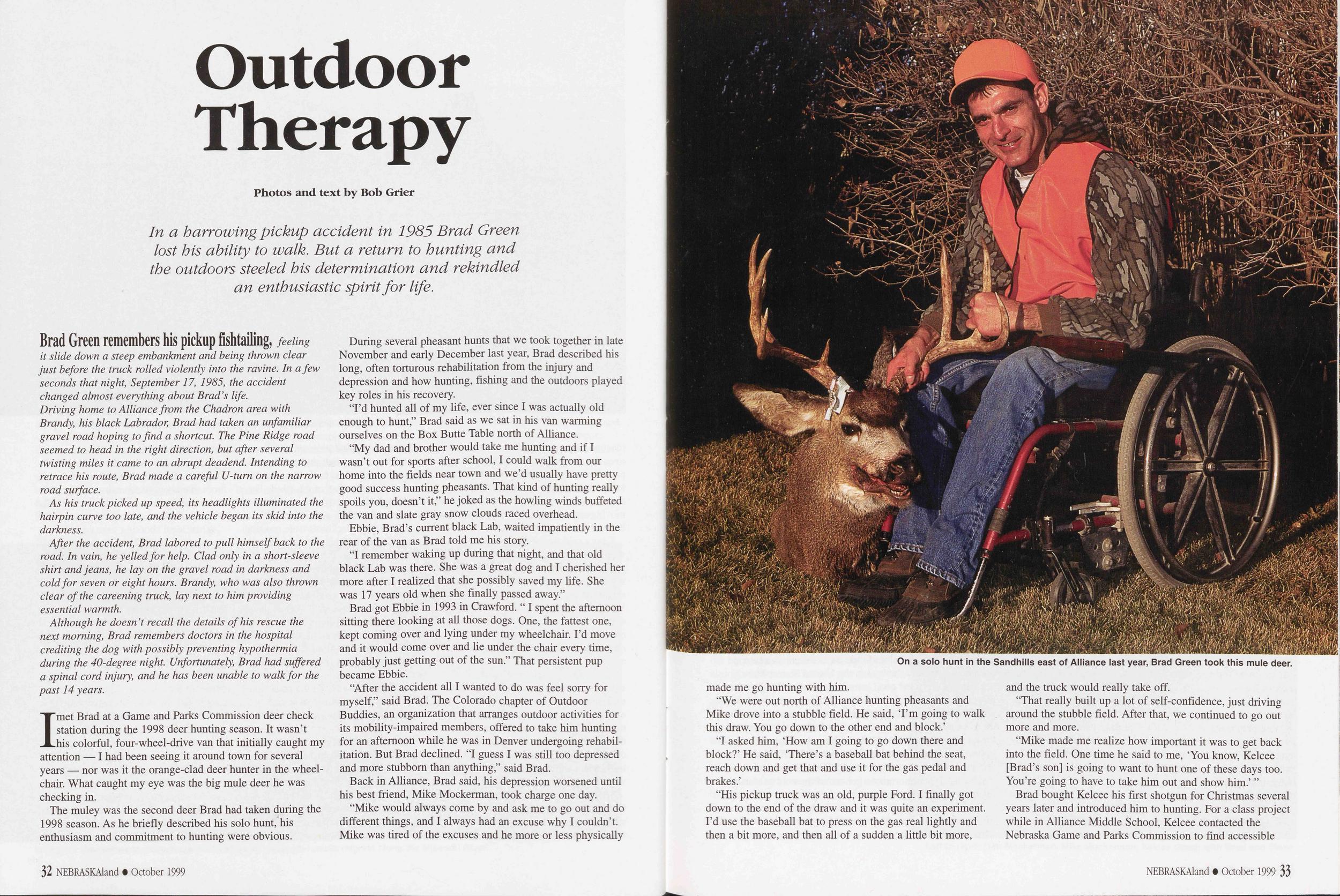
Outdoor Therapy
Photos and text by Bob Grier In a harrowing pickup accident in 1985 Brad Green lost his ability to walk. But a return to hunting and the outdoors steeled his determination and rekindled an enthusiastic spirit for life.Brad Green remembers his pickup fishtailing, feeling it slide down a steep embankment and being thrown clear just before the truck rolled violently into the ravine. In a few seconds that night, September 17, 1985, the accident changed almost everything about Brad's life.
Driving home to Alliance from the Chadron area with Brandy, his black Labrador, Brad had taken an unfamiliar gravel road hoping to find a shortcut. The Pine Ridge road seemed to head in the right direction, but after several twisting miles it came to an abrupt dead end. Intending to retrace his route, Brad made a careful U-turn on the narrow road surface.
As his truck picked up speed, its headlights illuminated the hairpin curve too late, and the vehicle began its skid into the darkness.
After the accident, Brad labored to pull himself back to the road. In vain, he yelled for help. Clad only in a short-sleeve shirt and jeans, he lay on the gravel road in darkness and cold for seven or eight hours. Brandy, who was also thrown clear of the careening truck, lay next to him providing essential warmth.
Although he doesn't recall the details of his rescue the next morning, Brad remembers doctors in the hospital crediting the dog with possibly preventing hypothermia during the 40-degree night. Unfortunately, Brad had suffered a spinal cord injury, and he has been unable to walk for the past 14 years.
I met Brad at a Game and Parks Commission deer check station during the 1998 deer hunting season. It wasn't his colorful, four-wheel-drive van that initially caught my attention — I had been seeing it around town for several years — nor was it the orange-clad deer hunter in the wheelchair. What caught my eye was the big mule deer he was checking in.
The muley was the second deer Brad had taken during the 1998 season. As he briefly described his solo hunt, his enthusiasm and commitment to hunting were obvious.
During several pheasant hunts that we took together in late November and early December last year, Brad described his long, often torturous rehabilitation from the injury and depression and how hunting, fishing and the outdoors played key roles in his recovery.
"I'd hunted all of my life, ever since I was actually old enough to hunt," Brad said as we sat in his van warming ourselves on the Box Butte Table north of Alliance.
"My dad and brother would take me hunting and if I wasn't out for sports after school, I could walk from our home into the fields near town and we'd usually have pretty good success hunting pheasants. That kind of hunting really spoils you, doesn't it," he joked as the howling winds buffeted the van and slate gray snow clouds raced overhead.
Ebbie, Brad's current black Lab, waited impatiently in the rear of the van as Brad told me his story.
"I remember waking up during that night, and that old black Lab was there. She was a great dog and I cherished her more after I realized that she possibly saved my life. She was 17 years old when she finally passed away."
Brad got Ebbie in 1993 in Crawford. " I spent the afternoon sitting there looking at all those dogs. One, the fattest one, kept coming over and lying under my wheelchair. I'd move and it would come over and lie under the chair every time, probably just getting out of the sun." That persistent pup became Ebbie.
"After the accident all I wanted to do was feel sorry for myself," said Brad. The Colorado chapter of Outdoor Buddies, an organization that arranges outdoor activities for its mobility-impaired members, offered to take him hunting for an afternoon while he was in Denver undergoing rehabilitation. But Brad declined. "I guess I was still too depressed and more stubborn than anything," said Brad.
Back in Alliance, Brad said, his depression worsened until his best friend, Mike Mockerman, took charge one day.
"Mike would always come by and ask me to go out and do different things, and I always had an excuse why I couldn't. Mike was tired of the excuses and he more or less physically 32 NEBRASKAland • October 1999
"We were out north of Alliance hunting pheasants and Mike drove into a stubble field. He said, T'm going to walk this draw. You go down to the other end and block.'
"I asked him, 'How am I going to go down there and block?' He said, There's a baseball bat behind the seat, reach down and get that and use it for the gas pedal and brakes.'
"His pickup truck was an old, purple Ford. I finally got down to the end of the draw and it was quite an experiment. I'd use the baseball bat to press on the gas real lightly and then a bit more, and then all of a sudden a little bit more, and the truck would really take off.
"That really built up a lot of self-confidence, just driving around the stubble field. After that, we continued to go out more and more.
"Mike made me realize how important it was to get back into the field. One time he said to me, 'You know, Kelcee [Brad's son] is going to want to hunt one of these days too. You're going to have to take him out and show him.' "
Brad bought Kelcee his first shotgun for Christmas several
years later and introduced him to hunting. For a class project
while in Alliance Middle School, Kelcee contacted the
Nebraska Game and Parks Commission to find accessible
NEBRASKAland • October 1999 33
Kelcee, Mike and his son, Matt, stopped by the van to tell us that other hunters were going to walk one of the nearby switchgrass fields for pheasants. Kelcee, Mike, Brad and I moved into position to block the opposite edge of the field.
The mature, nearly chest-high stand of switchgrass had been planted when the landowners enrolled several dry land areas of their irrigated farm in the Conservation Reserve Program nearly 10 years earlier. Switchgrass is valuable winter cover for pheasants and other wildlife species, although costly to establish and not often used in the early CRP sign-ups. The fields we were hunting held exceptional numbers of pheasants.
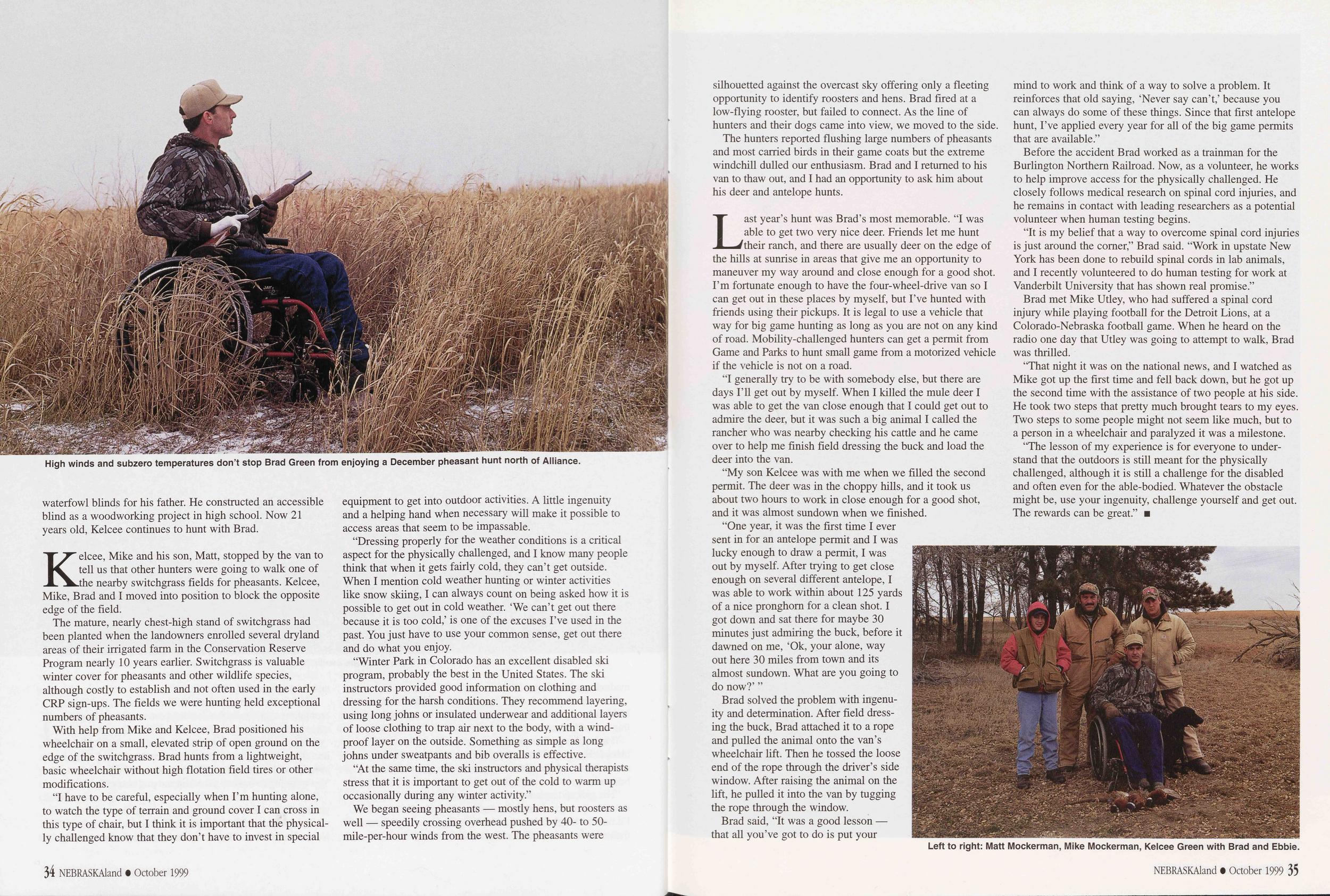
With help from Mike and Kelcee, Brad positioned his wheelchair on a small, elevated strip of open ground on the edge of the switchgrass. Brad hunts from a lightweight, basic wheelchair without high flotation field tires or other modifications.
"I have to be careful, especially when I'm hunting alone, to watch the type of terrain and ground cover I can cross in this type of chair, but I think it is important that the physically challenged know that they don't have to invest in special equipment to get into outdoor activities. A little ingenuity and a helping hand when necessary will make it possible to access areas that seem to be impassable.
"Dressing properly for the weather conditions is a critical aspect for the physically challenged, and I know many people think that when it gets fairly cold, they can't get outside. When I mention cold weather hunting or winter activities like snow skiing, I can always count on being asked how it is possible to get out in cold weather. 'We can't get out there because it is too cold,' is one of the excuses I've used in the past. You just have to use your common sense, get out there and do what you enjoy.
"Winter Park in Colorado has an excellent disabled ski program, probably the best in the United States. The ski instructors provided good information on clothing and dressing for the harsh conditions. They recommend layering, using long Johns or insulated underwear and additional layers of loose clothing to trap air next to the body, with a wind proof layer on the outside. Something as simple as long Johns under sweatpants and bib overalls is effective.
"At the same time, the ski instructors and physical therapists stress that it is important to get out of the cold to warm up occasionally during any winter activity."
We began seeing pheasants — mostly hens, but roosters as well — speedily crossing overhead pushed by 40- to 50-mile-per-hour winds from the west. The pheasants were 34 NEBRASKAland • October 1999 silhouetted against the overcast sky offering only a fleeting opportunity to identify roosters and hens. Brad fired at a low-flying rooster, but failed to connect. As the line of hunters and their dogs came into view, we moved to the side.
The hunters reported flushing large numbers of pheasants and most carried birds in their game coats but the extreme windchill dulled our enthusiasm. Brad and I returned to his van to thaw out, and I had an opportunity to ask him about his deer and antelope hunts.
Last year's hunt was Brad's most memorable. "I was able to get two very nice deer. Friends let me hunt their ranch, and there are usually deer on the edge of the hills at sunrise in areas that give me an opportunity to maneuver my way around and close enough for a good shot. I'm fortunate enough to have the four-wheel-drive van so I can get out in these places by myself, but I've hunted with friends using their pickups. It is legal to use a vehicle that way for big game hunting as long as you are not on any kind of road. Mobility-challenged hunters can get a permit from Game and Parks to hunt small game from a motorized vehicle if the vehicle is not on a road.
"I generally try to be with somebody else, but there are days I'll get out by myself. When I killed the mule deer I was able to get the van close enough that I could get out to admire the deer, but it was such a big animal I called the rancher who was nearby checking his cattle and he came over to help me finish field dressing the buck and load the deer into the van.
"My son Kelcee was with me when we filled the second permit. The deer was in the choppy hills, and it took us about two hours to work in close enough for a good shot, and it was almost sundown when we finished.
"One year, it was the first time I ever sent in for an antelope permit and I was lucky enough to draw a permit, I was out by myself. After trying to get close enough on several different antelope, I was able to work within about 125 yards of a nice pronghorn for a clean shot. I got down and sat there for maybe 30 minutes just admiring the buck, before it dawned on me, 'Ok, your alone, way out here 30 miles from town and its almost sundown. What are you going to do now?'"
Brad solved the problem with ingenuity and determination. After field dressing the buck, Brad attached it to a rope and pulled the animal onto the van's wheelchair lift. Then he tossed the loose end of the rope through the driver's side window. After raising the animal on the lift, he pulled it into the van by tugging the rope through the window.
Brad said, "It was a good lesson — that all you've got to do is put your Left to right: Matt mind to work and think of a way to solve a problem. It reinforces that old saying, 'Never say can't,' because you can always do some of these things. Since that first antelope hunt, I've applied every year for all of the big game permits that are available."
Before the accident Brad worked as a trainman for the Burlington Northern Railroad. Now, as a volunteer, he works to help improve access for the physically challenged. He closely follows medical research on spinal cord injuries, and he remains in contact with leading researchers as a potential volunteer when human testing begins.
"It is my belief that a way to overcome spinal cord injuries is just around the corner," Brad said. "Work in upstate New York has been done to rebuild spinal cords in lab animals, and I recently volunteered to do human testing for work at Vanderbilt University that has shown real promise."
Brad met Mike Utley, who had suffered a spinal cord injury while playing football for the Detroit Lions, at a Colorado-Nebraska football game. When he heard on the radio one day that Utley was going to attempt to walk, Brad was thrilled.
"That night it was on the national news, and I watched as Mike got up the first time and fell back down, but he got up the second time with the assistance of two people at his side. He took two steps that pretty much brought tears to my eyes. Two steps to some people might not seem like much, but to a person in a wheelchair and paralyzed it was a milestone.
"The lesson of my experience is for everyone to under- stand that the outdoors is still meant for the physically challenged, although it is still a challenge for the disabled and often even for the able-bodied. Whatever the obstacle might be, use your ingenuity, challenge yourself and get out. The rewards can be great."
The Nebraska Assignment: A Cheap Date
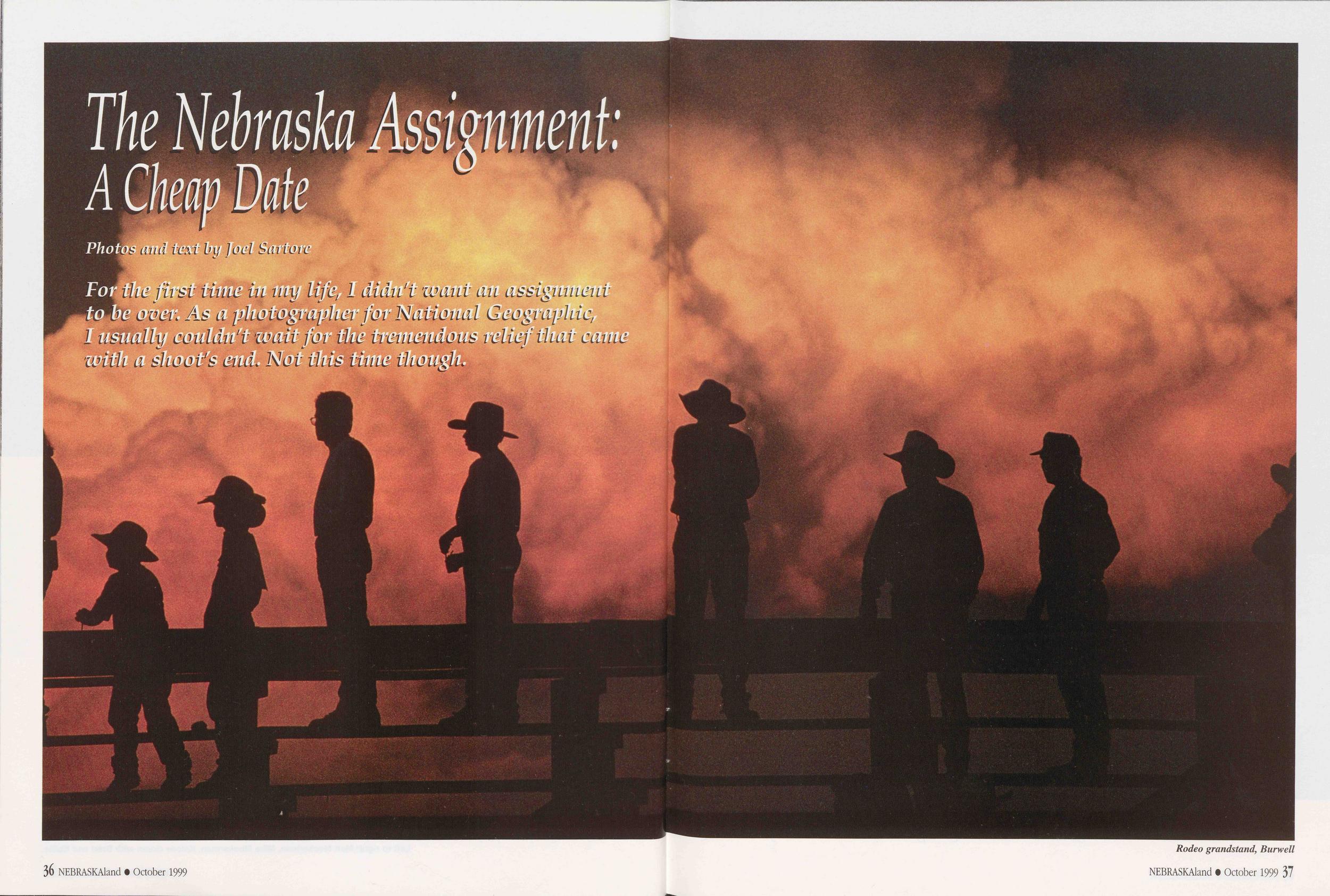
Photos and text by Joel Sartore For the first time in my life, I didn't want an assignment National Geographic I usually couldn't wait for the tremendous relief that came with a shoot's end. Not this time though. 36 NEBRASKAland • October 1999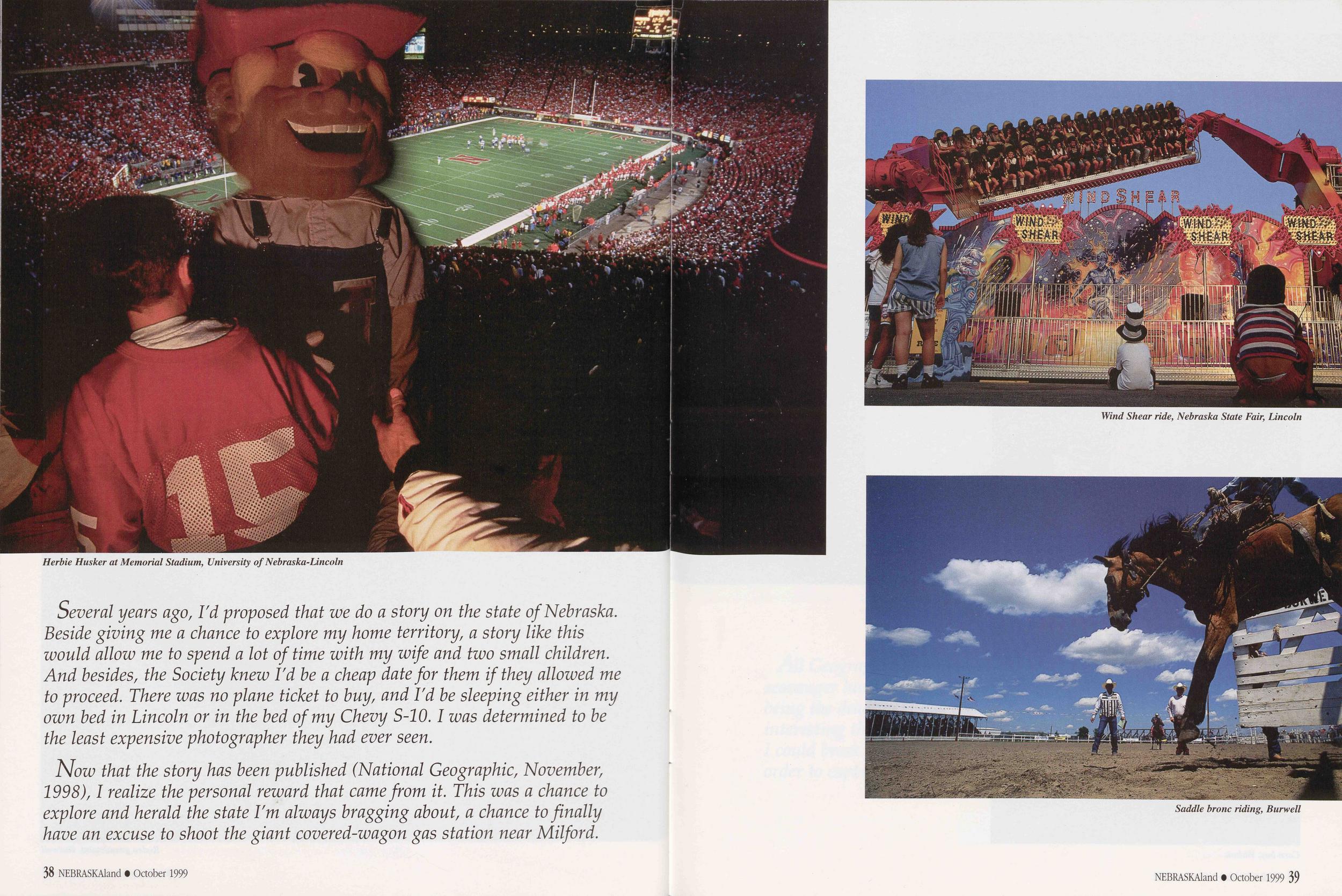
Several years ago, I'd proposed that we do a story on the state of Nebraska. Beside giving me a chance to explore my home territory, a story like this would allow me to spend a lot of time with my wife and two small children. And besides, the Society knew I'd be a cheap date for them if they allowed me to proceed. There was no plane ticket to buy, and I'd be sleeping either in my own bed in Lincoln or in the bed of my Chevy S-10.1 was determined to be the least expensive photographer they had ever seen.
Now that the story has been published (National Geographic, November, 1998), I realize the personal reward that came from it. This was a chance to explore and herald the state I'm always bragging about, a chance to finally have an excuse to shoot the giant covered-wagon gas station near Milford.
38 NEBRASKAland • October 1999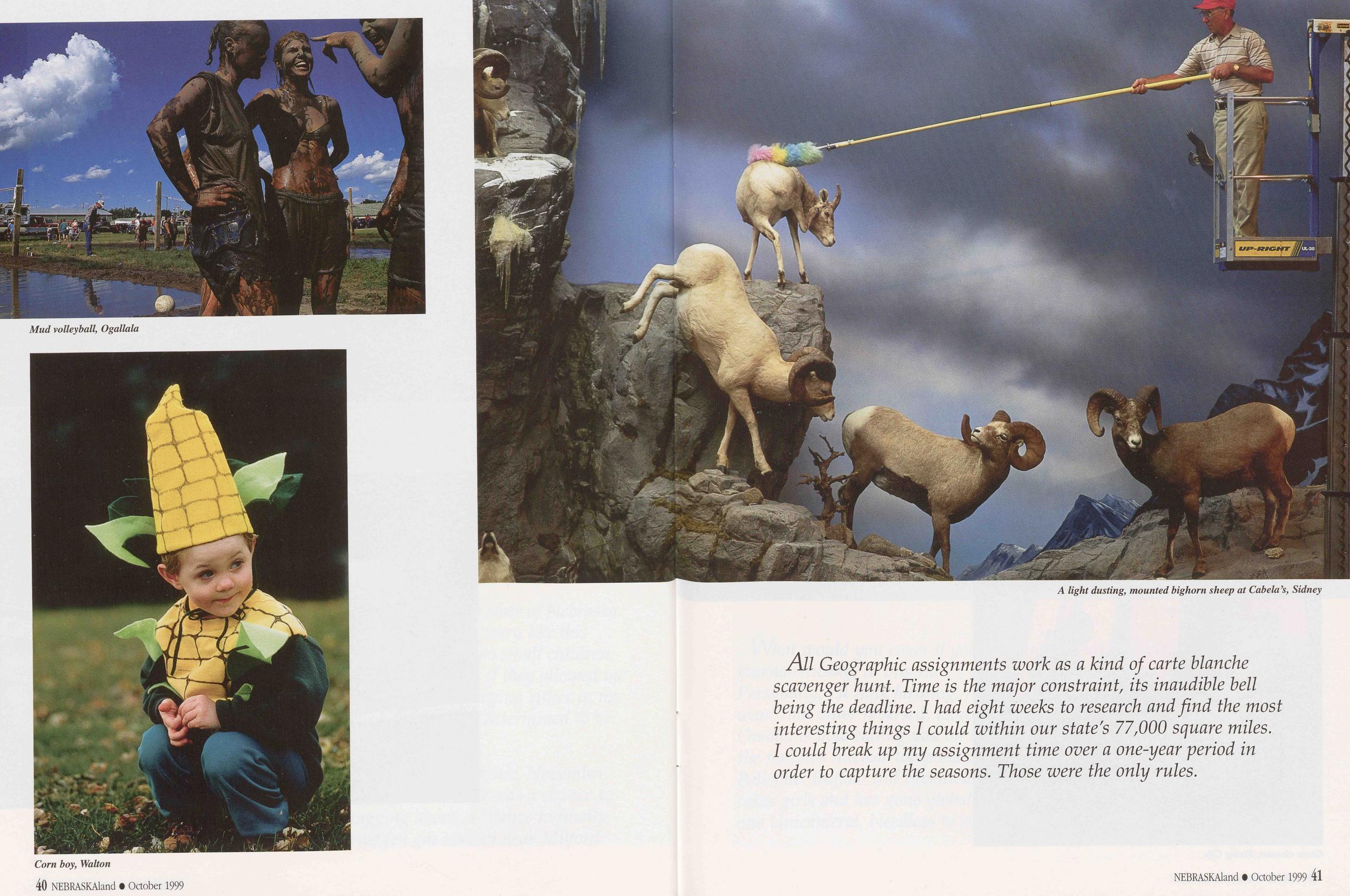
Ail Geographic assignments work as a kind of carte blanche scavenger hunt. Time is the major constraint, its inaudible bell being the deadline. I had eight weeks to research and find the most interesting things I could within our state's 77,000 square miles. I could break up my assignment time over a one-year period in order to capture the seasons. Those were the only rules.
NEBRASKAland • October 1999 41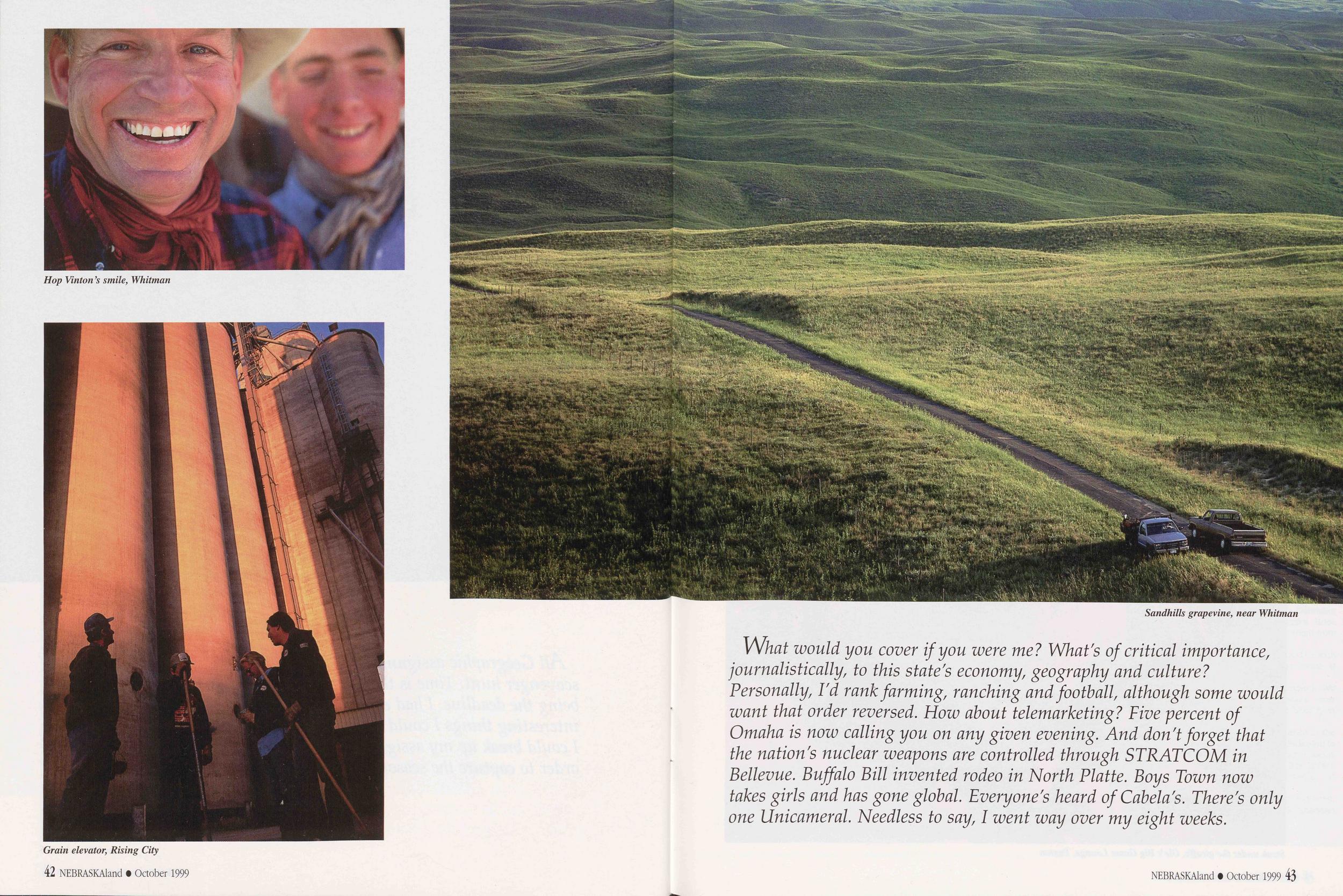
What would you cover if you were me? What's of critical importance, journalistically, to this state's economy, geography and culture? Personally, I'd rank farming, ranching and football, although some would want that order reversed. How about telemarketing? Five percent of Omaha is now calling you on any given evening. And don't forget that the nation's nuclear weapons are controlled through STRATCOM in Bellevue. Buffalo Bill invented rodeo in North Platte. Boys Town now takes girls and has gone global. Everyone's heard of Cabela's. There's only one Unicameral. Needless to say, I went way over my eight weeks.
NEBRASKAland October 1999 43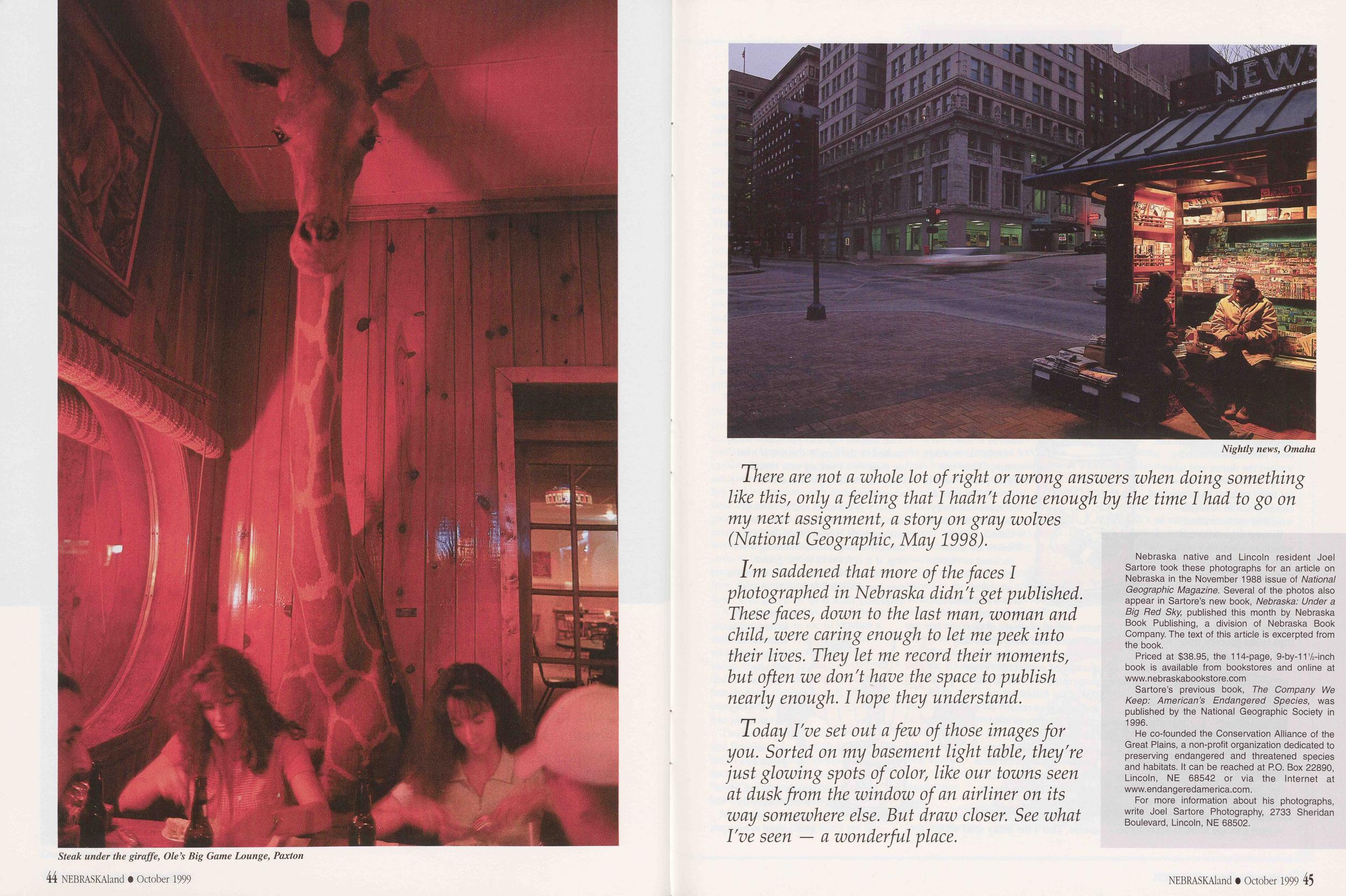
There are not a whole lot of right or wrong answers when doing something like this, only a feeling that I hadn't done enough by the time I had to go on my next assignment, a story on gray wolves (National Geographic, May 1998).
I'm saddened that more of the faces I photographed in Nebraska didn't get published. These faces, down to the last man, woman and child, were caring enough to let me peek into their lives. They let me record their moments, but often we don't have the space to publish nearly enough. I hope they understand.
Today I've set out a few of those images for you. Sorted on my basement light table, they're just glowing spots of color, like our towns seen at dusk from the window of an airliner on its way somewhere else. But draw closer. See what I've seen — a wonderful place.
Nebraska native and Lincoln resident Joel Sartore took these photographs for an article on Nebraska in the November 1988 issue of National Geographic Magazine. Several of the photos also appear in Sartore's new book, Nebraska: Under a Big Red Sky, published this month by Nebraska Book Publishing, a division of Nebraska Book Company. The text of this article is excerpted from the book.
Priced at $38.95, the 114-page, 9-by-11 1/2-inch book is available from bookstores and online at www.nebraskabookstore.com
Sartore's previous book, The Company We Keep: American's Endangered Species, was published by the National Geographic Society in 1996.
He co-founded the Conservation Alliance of the Great Plains, a non-profit organization dedicated to preserving endangered and threatened species and habitats. It can be reached at P.O. Box 22890, Lincoln, NE 68542 or via the Internet at www.endangeredamerica.com.
For more information about his photographs, write Joel Sartore Photography, 2733 Sheridan Boulevard, Lincoln, NE 68502.
NEBRASKAland • October 1999 45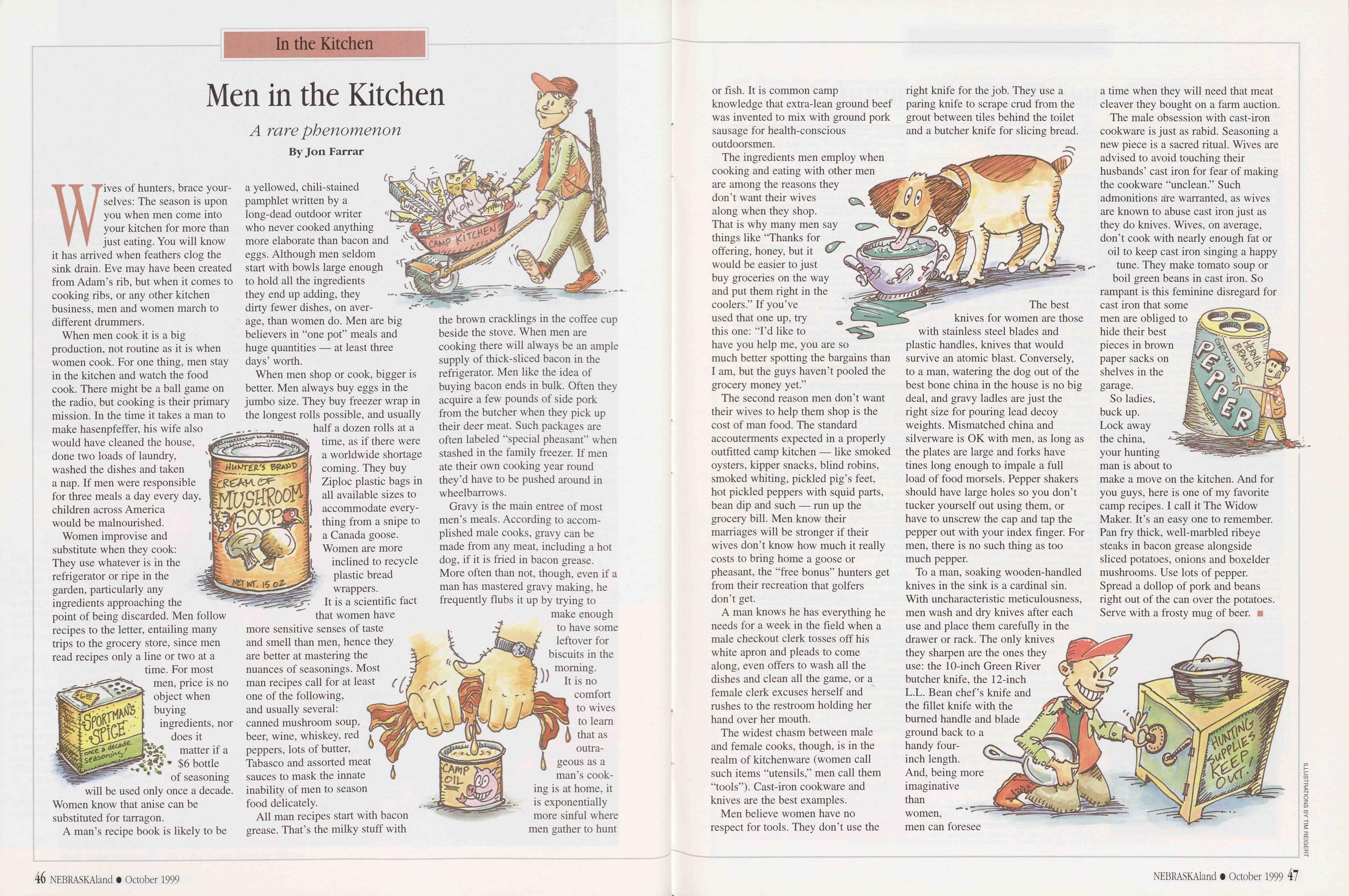
In the Kitchen
Men in the Kitchen
A rare phenomenon By Jon FarrarWives of hunters, brace yourselves: The season is upon you when men come into your kitchen for more than just eating. You will know it has arrived when feathers clog the sink drain. Eve may have been created from Adam's rib, but when it comes to cooking ribs, or any other kitchen business, men and women march to different drummers.
When men cook it is a big production, not routine as it is when women cook. For one thing, men stay in the kitchen and watch the food cook. There might be a ball game on the radio, but cooking is their primary mission. In the time it takes a man to make hasenpfeffer, his wife also would have cleaned the house, done two loads of laundry, washed the dishes and taken a nap. If men were responsible for three meals a day every day, children across America would be malnourished.
Women improvise and substitute when they cook: They use whatever is in the refrigerator or ripe in the garden, particularly any ingredients approaching the point of being discarded. Men follow recipes to the letter, entailing many trips to the grocery store, since men read recipes only a line or two at a time. For most men, price is no object when buying ingredients, nor does it matter if a $6 bottle of seasoning will be used only once a decade. Women know that anise can be substituted for tarragon.
A man's recipe book is likely to be a yellowed, chili-stained pamphlet written by a long-dead outdoor writer who never cooked anything more elaborate than bacon and eggs. Although men seldom start with bowls large enough to hold all the ingredients they end up adding, they dirty fewer dishes, on average, than women do. Men are big believers in "one pot" meals and huge quantities — at least three days' worth.
When men shop or cook, bigger is better. Men always buy eggs in the jumbo size. They buy freezer wrap in the longest rolls possible, and usually half a dozen rolls at a time, as if there were a worldwide shortage coming. They buy Ziploc plastic bags in all available sizes to accommodate everything from a snipe to a Canada goose. Women are more inclined to recycle plastic bread wrappers. It is a scientific fact that women have more sensitive senses of taste and smell than men, hence they are better at mastering the nuances of seasonings. Most man recipes call for at least one of the following, and usually several: canned mushroom soup, beer, wine, whiskey, red peppers, lots of butter, Tabasco and assorted meat sauces to mask the innate inability of men to season food delicately.
All man recipes start with bacon grease. That's the milky stuff with the brown cracklings in the coffee cup beside the stove. When men are cooking there will always be an ample supply of thick-sliced bacon in the refrigerator. Men like the idea of buying bacon ends in bulk. Often they acquire a few pounds of side pork from the butcher when they pick up their deer meat. Such packages are often labeled "special pheasant" when stashed in the family freezer. If men ate their own cooking year round they'd have to be pushed around in wheelbarrows.
Gravy is the main entree of most men's meals. According to accomplished male cooks, gravy can be made from any meat, including a hot dog, if it is fried in bacon grease. More often than not, though, even if a man has mastered gravy making, he frequently flubs it up by trying to make enough to have some leftover for biscuits in the morning. It is no comfort to wives to learn that as outrageous as a man's cook- ing is at home, it is exponentially more sinful where men gather to hunt
The ingredients men employ when cooking and eating with other men are among the reasons they don't want their wives along when they shop. That is why many men say things like "Thanks for offering, honey, but it would be easier to just buy groceries on the way and put them right in the coolers." If you've used that one up, try this one: "I'd like to have you help me, you are so much better spotting the bargains than I am, but the guys haven't pooled the grocery money yet."
The second reason men don't want their wives to help them shop is the cost of man food. The standard accouterments expected in a properly outfitted camp kitchen — like smoked oysters, kipper snacks, blind robins, smoked whiting, pickled pig's feet, hot pickled peppers with squid parts, bean dip and such — run up the grocery bill. Men know their marriages will be stronger if their wives don't know how much it really costs to bring home a goose or pheasant, the "free bonus" hunters get from their recreation that golfers don't get.
A man knows he has everything he needs for a week in the field when a male checkout clerk tosses off his white apron and pleads to come along, even offers to wash all the dishes and clean all the game, or a female clerk excuses herself and rushes to the restroom holding her hand over her mouth.
The widest chasm between male and female cooks, though, is in the realm of kitchenware (women call such items "utensils," men call them "tools"). Cast-iron cookware and knives are the best examples.
Men believe women have no respect for tools. They don't use the right knife for the job. They use a paring knife to scrape crud from the grout between tiles behind the toilet and a butcher knife for slicing bread.
The best knives for women are those with stainless steel blades and plastic handles, knives that would survive an atomic blast. Conversely, to a man, watering the dog out of the best bone china in the house is no big deal, and gravy ladles are just the right size for pouring lead decoy weights. Mismatched china and silverware is OK with men, as long as the plates are large and forks have tines long enough to impale a full load of food morsels. Pepper shakers should have large holes so you don't tucker yourself out using them, or have to unscrew the cap and tap the pepper out with your index finger. For men, there is no such thing as too much pepper.
To a man, soaking wooden-handled knives in the sink is a cardinal sin. With uncharacteristic meticulousness, men wash and dry knives after each use and place them carefully in the drawer or rack. The only knives they sharpen are the ones they use: the 10-inch Green River butcher knife, the 12-inch L.L. Bean chef's knife and the fillet knife with the burned handle and blade ground back to handy four-inch length. And, being more imaginative than women, men can foresee a time when they will need that meat cleaver they bought on a farm auction.
The male obsession with cast-iron cookware is just as rabid. Seasoning a new piece is a sacred ritual. Wives are advised to avoid touching their husbands' cast iron for fear of making the cookware "unclean." Such admonitions are warranted, as wives are known to abuse cast iron just as they do knives. Wives, on average, don't cook with nearly enough fat or oil to keep cast iron singing a happy tune. They make tomato soup or boil green beans in cast iron. So rampant is this feminine disregard for cast iron that some men are obliged to hide their best pieces in brown paper sacks on shelves in the garage.
So ladies, buck up. Lock away the china, your hunting man is about to make a move on the kitchen. And for you guys, here is one of my favorite camp recipes. I call it The Widow Maker. It's an easy one to remember. Pan fry thick, well-marbled ribeye steaks in bacon grease alongside sliced potatoes, onions and boxelder mushrooms. Use lots of pepper. Spread a dollop of pork and beans right out of the can over the potatoes. Serve with a frosty mug of beer.
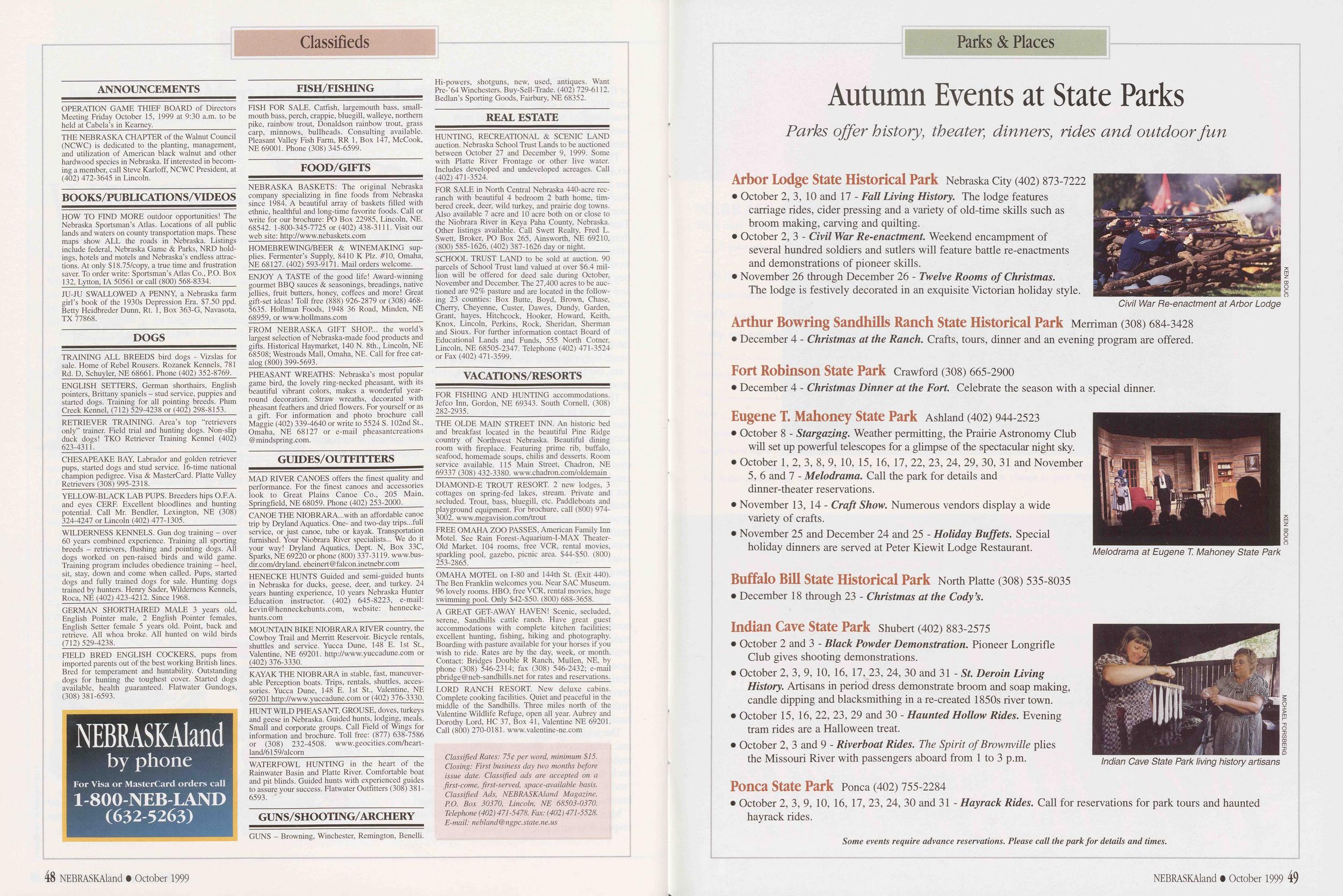
Classifieds
ANNOUNCEMENTSOPERATION GAME THIEF BOARD of Directors Meeting Friday October 15, 1999 at 9:30 a.m. to be held at Cabela's in Kearney.
THE NEBRASKA CHAPTER of the Walnut Council (NCWC) is dedicated to the planting, management, and utilization of American black walnut and other hardwood species in Nebraska. If interested in becoming a member, call Steve Karloff, NCWC President, at (402) 472-3645 in Lincoln.
BOOKS/PUBLICATIONS/VIDEOSHOW TO FIND MORE outdoor opportunities! The Nebraska Sportsman's Atlas. Locations of all public lands and waters on county transportation maps. These maps show ALL the roads in Nebraska. Listings include federal, Nebraska Game & Parks, NRD holdings, hotels and motels and Nebraska's endless attractions. At only $18.75/copy, a true time and frustration saver. To order write: Sportsman's Atlas Co., P.O. Box 132, Lytton, IA 50561 or call (800) 568-8334.
JU-JU SWALLOWED A PENNY, a Nebraska farm girl's book of the 1930s Depression Era. $7.50 ppd. Betty Heidbreder Dunn, Rt. 1, Box 363-G, Navasota, TX 77868.
DOGSTRAINING ALL BREEDS bird dogs - Vizslas for sale. Home of Rebel Rousers. Rozanek Kennels, 781 Rd. D, Schuyler, NE 68661. Phone (402) 352-8769.
ENGLISH SETTERS, German shorthairs, English pointers, Brittany spaniels - stud service, puppies and started dogs. Training for all pointing breeds. Plum Creek Kennel, (712) 529-4238 or (402) 298-8153.
RETRIEVER TRAINING. Area's top "retrievers only" trainer. Field trial and hunting dogs. Non-slip duck dogs! TKO Retriever Training Kennel (402) 623-4311.
CHESAPEAKE BAY, Labrador and golden retriever pups, started dogs and stud service. 16-time national champion pedigree. Visa & MasterCard. Platte Valley Retrievers (308) 995-2318.
YELLOW-BLACK LAB PUPS. Breeders hips O.F.A. and eyes CERE Excellent bloodlines and hunting potential. Call Mr. Bendler, Lexington, NE (308) 324-4247 or Lincoln (402) 477-1305
WILDERNESS KENNELS. Gun dog training - over 60 years combined experience. Training all sporting breeds - retrievers, flushing and pointing dogs. All dogs worked on pen-raised birds and wild game. Training program includes obedience training - heel, sit, stay, down and come when called. Pups, started dogs and fully trained dogs for sale. Hunting dogs trained by hunters. Henry Sader, Wilderness Kennels, Roca, NE (402) 423-4212. Since 1968.
GERMAN SHORTHAIRED MALE 3 years old, English Pointer male, 2 English Pointer females, English Setter female 5 years old. Point, back and retrieve. All whoa broke. All hunted on wild birds (712) 529-4238.
HELD BRED ENGLISH COCKERS, pups from imported parents out of the best working British lines. Bred for temperament and huntability. Outstanding dogs for hunting the toughest cover. Started dogs available, health guaranteed. Flatwater Gundogs, (308)381-6593.
NEBRASKAland by phone For Visa or MasterCard orders call 1-800-NEB-LAND (632-5263) FISH/FISHINGFISH FOR SALE. Catfish, largemouth bass, smallmouth bass, perch, crappie, bluegill, walleye, northern pike, rainbow trout, Donaldson rainbow trout, grass carp, minnows, bullheads. Consulting available. Pleasant Valley Fish Farm, RR 1, Box 147, McCook, NE 69001. Phone (308) 345-6599.
FOOD/GIFTSNEBRASKA BASKETS: The original Nebraska company specializing in fine foods from Nebraska since 1984. A beautiful array of baskets filled with ethnic, healthful and long-time favorite foods. Call or write for our brochure: PO Box 22985, Lincoln, NE. 68542. 1-800-345-7725 or (402) 438-3111. Visit our web site: http://www.nebaskets.com
HOMEBREWING/BEER & WINEMAKING supplies. Fermenter's Supply, 8410 K Plz. #10, Omaha, NE 68127. (402) 593-9171. Mail orders welcome.
ENJOY A TASTE of the good life! Award-winning gourmet BBQ sauces & seasonings, breadings, native jellies, fruit butters, honey, coffees and more! Great gift-set ideas! Toll free (888) 926-2879 or (308) 468- 5635. Hollman Foods, 1948 36 Road, Minden, NE 68959, or www.hollmans.com
FROM NEBRASKA GIFT SHOP... the world's largest selection of Nebraska-made food products and gifts. Historical Haymarket, 140 N. 8th., Lincoln, NE 68508; Westroads Mall, Omaha, NE. Call for free catalog (800) 399-5693.
PHEASANT WREATHS: Nebraska's most popular game bird, the lovely ring-necked pheasant, with its beautiful vibrant colors, makes a wonderful year round decoration. Straw wreaths, decorated with pheasant feathers and dried flowers. For yourself or as a gift. For information and photo brochure call Maggie (402) 339-4640 or write to 5524 S. 102nd St., Omaha, NE 68127 or e-mail pheasant creations @ mindspring.com.
GUIDES/OUTFITTERSMAD RIVER CANOES offers the finest quality and performance. For the finest canoes and accessories look to Great Plains Canoe Co., 205 Main, Springfield, NE 68059. Phone (402) 253-2000.
CANOE THE NIOBRARA...with an affordable canoe trip by Dry land Aquatics. One- and two-day trips...full service, or just canoe, tube or kayak. Transportation furnished. Your Niobrara River specialists... We do it your way! Dry land Aquatics, Dept. N, Box 33C, Sparks, NE 69220 or phone (800) 337-3119. www.busdir.com/dryland. eheinert@falcon.inetnebr.com
HENECKE HUNTS Guided and semi-guided hunts in Nebraska for ducks, geese, deer, and turkey. 24 years hunting experience, 10 years Nebraska Hunter Education instructor. (402) 645-8223, e-mail: kevin@henneckehunts.com, website: henneckehunts.com
MOUNTAIN BIKE NIOBRARA RIVER country, the Cowboy Trail and Merritt Reservoir. Bicycle rentals, shuttles and service. Yucca Dune, 148 E. 1st St., Valentine, NE 69201. http://www.yuccadune.com or (402) 376-3330.
KAYAK THE NIOBRARA in stable, fast, maneuver- able Perception boats. Trips, rentals, shuttles, accessories. Yucca Dune, 148 E. 1st St., Valentine, NE 69201 http://www.yuccadune.com or (402) 376-3330.
HUNT WILD PHEASANT, GROUSE, doves, turkeys and geese in Nebraska. Guided hunts, lodging, meals. Small and corporate groups. Call Field of Wings for information and brochure. Toll free: (877) 638-7586 or (308) 232-4508. www.geocities.com/heartland/6159/alcorn
WATERFOWL HUNTING in the heart of the Rainwater Basin and Platte River. Comfortable boat and pit blinds. Guided hunts with experienced guides to assure your success. Flatwater Outfitters (308) 381- 6593.
GUNS/SHOOTING/ARCHERYGUNS - Browning, Winchester, Remington, Benelli. Hi-powers, shotguns, new, used, antiques. Want Pre-'64 Winchesters. Buy-Sell-Trade. (402) 729-6112. Bedlan's Sporting Goods, Fairbury, NE 68352.
REAL ESTATEHUNTING, RECREATIONAL & SCENIC LAND auction. Nebraska School Trust Lands to be auctioned between October 27 and December 9, 1999. Some with Platte River Frontage or other live water. Includes developed and undeveloped acreages. Call (402)471-3524.
FOR SALE in North Central Nebraska 440-acre rec-ranch with beautiful 4 bedroom 2 bath home, timbered creek, deer, wild turkey, and prairie dog towns. Also available 7 acre and 10 acre both on or close to the Niobrara River in Keya Paha County, Nebraska. Other listings available. Call Swett Realty, Fred L. Swett, Broker, PO Box 265, Ainsworth, NE 69210, (800) 585-1626, (402) 387-1626 day or night.
SCHOOL TRUST LAND to be sold at auction. 90 parcels of School Trust land valued at over $6.4 million will be offered for deed sale during October, November and December. The 27,400 acres to be auctioned are 92% pasture and are located in the following 23 counties: Box Butte, Boyd, Brown, Chase, Cherry, Cheyenne, Custer, Dawes, Dundy, Garden, Grant, hayes, Hitchcock, Hooker, Howard, Keith, Knox, Lincoln, Perkins, Rock, Sheridan, Sherman and Sioux. For further information contact Board of Educational Lands and Funds, 555 North Cotner. Lincoln, NE 68505-2347. Telephone (402) 471-3524 or Fax (402) 471-3599.
VACATIONS/RESORTSFOR FISHING AND HUNTING accommodations. Jefco Inn, Gordon, NE 69343. South Cornell, (308) 282-2935.
THE OLDE MAIN STREET INN. An historic bed and breakfast located in the beautiful Pine Ridge country of Northwest Nebraska. Beautiful dining room with fireplace. Featuring prime rib, buffalo, seafood, homemade soups, chilis and desserts. Room service available. 115 Main Street, Chadron, NE 69337 (308) 432-3380. www.chadron.com/oldemain
DIAMOND-E TROUT RESORT. 2 new lodges, 3 cottages on spring-fed lakes, stream. Private and secluded. Trout, bass, bluegill, etc. Paddle boats and playground equipment. For brochure, call (800) 974- 3002. www.megavision.com/trout
FREE OMAHA ZOO PASSES, American Family Inn Motel. See Rain Forest-Aquarium-I-MAX Theater- Old Market. 104 rooms, free VCR, rental movies, sparkling pool, gazebo, picnic area. $44-$50. (800) 253-2865.
OMAHA MOTEL on 1-80 and 144th St. (Exit 440). The Ben Franklin welcomes you. Near SAC Museum. 96 lovely rooms. HBO, free VCR, rental movies, huge swimming pool. Only $42-$50. (800) 688-3658.
A GREAT GET-AWAY HAVEN! Scenic, secluded, serene, Sandhills cattle ranch. Have great guest accommodations with complete kitchen facilities; excellent hunting, fishing, hiking and photography. Boarding with pasture available for your horses if you wish to ride. Rates are by the day, week, or month. Contact: Bridges Double R Ranch, Mullen, NE, by phone (308) 546-2314; fax (308) 546-2432; e-mail pbridge@neb-sandhills.net for rates and reservations.
LORD RANCH RESORT. New deluxe cabins. Complete cooking facilities. Quiet and peaceful in the middle of the Sandhills. Three miles north of the Valentine Wildlife Refuge, open all year. Aubrey and Dorothy Lord, HC 37, Box 41, Valentine NE 69201. Call (800) 270-0181. www.valentine-ne.com
Classified Rates: 750 per word, minimum $15. Closing: First business day two months before issue date. Classified ads are accepted on a first-come, first-served, space-available basis. Classified Ads, NEBRASKAland Magazine, P.O. Box 30370, Lincoln, NE 68503-0370. Telephone (402) 471-5478. Fax: (402) 471-5528. E-mail: nebland@ngpc.state.ne.us 48 NEBRASKAland • October 1999Parks & Places
Autumn Events at State Parks
Parks offer history, theater, dinners, rides and outdoor funArbor Lodge State Historical Park Nebraska city (402) 873-7222 • October 2, 3, 10 and 17 - Fall Living History. The lodge features carriage rides, cider pressing and a variety of old-time skills such as broom making, carving and quilting. • October 2, 3 - Civil War Re-enactment. Weekend encampment of several hundred soldiers and sutlers will feature battle re-enactments and demonstrations of pioneer skills. • November 26 through December 26 - Twelve Rooms of Christmas. The lodge is festively decorated in an exquisite Victorian holiday style.
Arthur Bowring Sandhills Ranch State Historical Park Merriman (308) 684 3428 • December 4 - Christmas at the Ranch. Crafts, tours, dinner and an evening program are offered.
Fort Robinson State Park Crawford (308) 665-2900 • December 4 - Christmas Dinner at the Fort. Celebrate the season with a special dinner.
Eugene T. Mahoney State Park Ashland (402) 944-2523 • October 8 - Stargazing. Weather permitting, the Prairie Astronomy Club will set up powerful telescopes for a glimpse of the spectacular night sky. • October 1, 2, 3, 8, 9, 10, 15, 16, 17, 22, 23, 24, 29, 30, 31 and November 5, 6 and 7 - Melodrama. Call the park for details and dinner-theater reservations. • November 13, 14 - Craft Show. Numerous vendors display a wide variety of crafts. • November 25 and December 24 and 25 - Holiday Buffets. Special holiday dinners are served at Peter Kiewit Lodge Restaurant.
Buffalo Bill State Historical Park North Platte (308) 535-8035 • December 18 through 23 - Christmas at the Cody's.
Indian Cave State Park shubert (402) 883-2575 • October 2 and 3 - Black Powder Demonstration. Pioneer Long rifle Club gives shooting demonstrations. • October 2, 3, 9, 10, 16, 17, 23, 24, 30 and 31 - St. Deroin Living History. Artisans in period dress demonstrate broom and soap making, candle dipping and blacksmithing in a re-created 1850s river town. • October 15, 16, 22, 23, 29 and 30 - Haunted Hollow Rides. Evening tram rides are a Halloween treat. • October 2, 3 and 9 - Riverboat Rides. The Spirit of Brownville plies the Missouri River with passengers aboard from 1 to 3 p.m.
Ponca State Park Ponca (402) 755-2284 • October 2, 3, 9, 10, 16, 17, 23, 24, 30 and 31 - Hayrack Rides. Call for reservations for park tours and haunted hayrack rides.
Some events require advance reservations. Please call the park for details and times.
NEBRASKAland • October 1999 49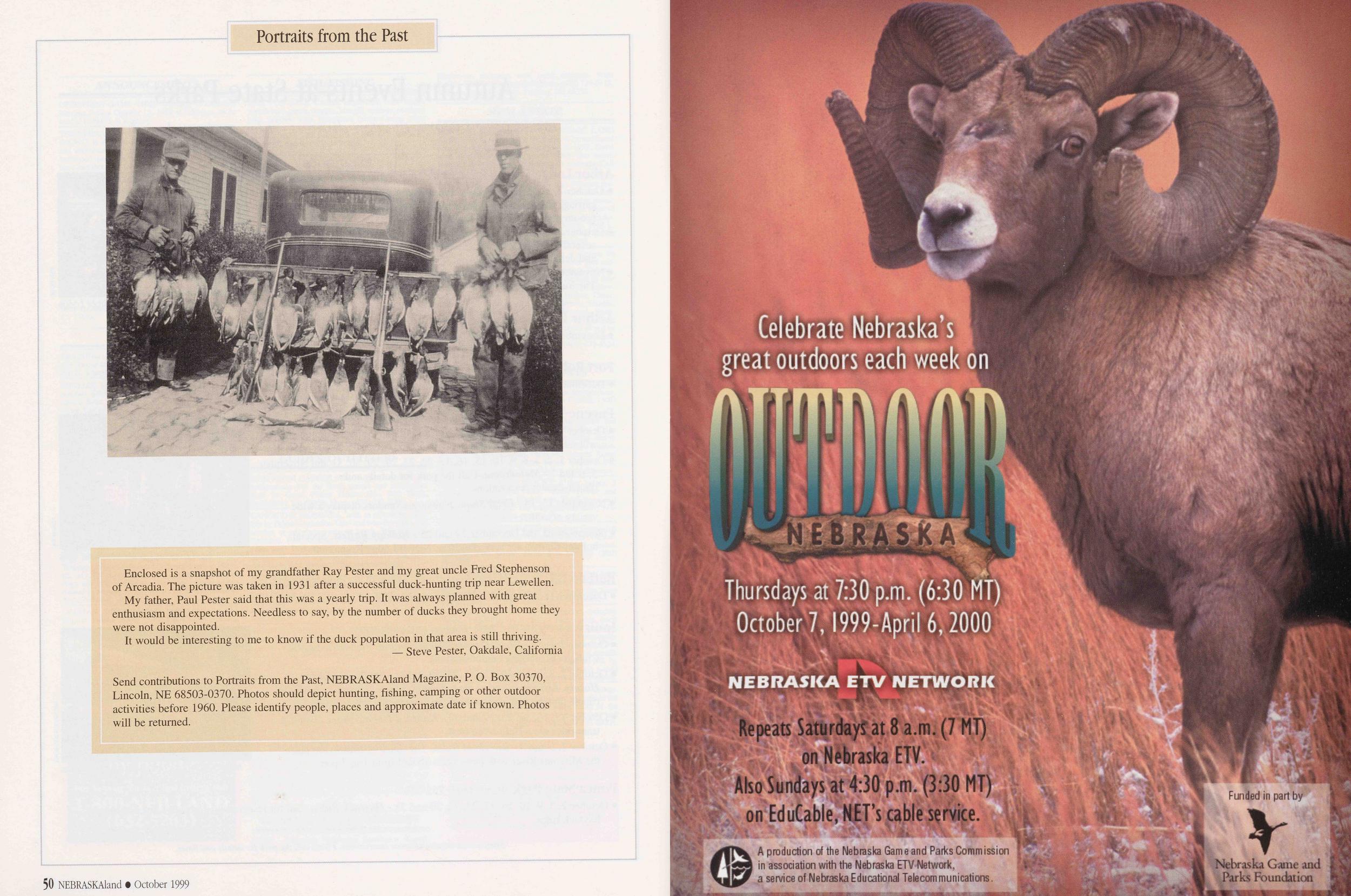
Portraits from the Past
Enclosed is a snapshot of my grandfather Ray Pester and my great uncle Fred Stephenson of Arcadia. The picture was taken in 1931 after a successful duck-hunting trip near Lewellen.
My father, Paul Pester said that this was a yearly trip. It was always planned with great enthusiasm and expectations. Needless to say, by the number of ducks they brought home they were not disappointed.
It would be interesting to me to know if the duck population in that area is still thriving.
— Steve Pester, Oakdale, CaliforniaSend contributions to Portraits from the Past, NEBRASKAland Magazine, P. O. Box 30370, Lincoln, NE 68503-0370. Photos should depict hunting, fishing, camping or other outdoor activities before 1960. Please identify people, places and approximate date if known. Photos will be returned.
50 NEBRASKAland • October 1999 Great outdoors each week on October 7,1999-April 6,20 EBRASKA ETV NETWORK Repeats Saturday* at 8 a.m. (7 HI] on Nebraska ETV. Also Sundays at 4:30 p.m. (3:30 HT) on EduCable, NET's cable service. A production of the Neb Game and Parks Commission in association with the Nebraska ETV Network, a service of Nebraska Education Telecommunications.
Position: 704 (16 views)