Volume 77, Issue 7, 1999
NEBRASKAland Magazine WILDGAME COOKBOOK
 NEBRASKAland Magazine
WILD GAME
COOKBOOK
NEBRASKAland Magazine
Volume 77, Number 7, August-September 1999
Published monthly except for combined January-February and
August-September issues by the Nebraska Game and Parks Commission,
2200 N. 33rd Street, Lincoln, NE 68503.
Copyright 1999 by the Nebraska Game and Parks Commission,
all rights reserved. Subscription rates: One year, $16; two years, $30.
http ://w w w. ngpc. state. ne. us/nebland
ISSN: 0028-1964
Periodicals postage paid at Lincoln, Nebraska
NEBRASKAland Magazine
WILD GAME
COOKBOOK
NEBRASKAland Magazine
Volume 77, Number 7, August-September 1999
Published monthly except for combined January-February and
August-September issues by the Nebraska Game and Parks Commission,
2200 N. 33rd Street, Lincoln, NE 68503.
Copyright 1999 by the Nebraska Game and Parks Commission,
all rights reserved. Subscription rates: One year, $16; two years, $30.
http ://w w w. ngpc. state. ne. us/nebland
ISSN: 0028-1964
Periodicals postage paid at Lincoln, Nebraska
Introduction......................................vii
Big Game............................................1
Venison............................................5
Pronghorn (antelope)..............................21
Elk...............................................25
Bighorn Sheep ....................................29
Game Birds ........................................35
Pheasant .........................................37
Quail.............................................51
Grouse............................................57
Dove .............................................63
Wild Turkey ......................................69
Snipe, Woodcock, Rail.............................75
Small Mammals......................................77
Rabbit ...........................................78
Squirrel .........................................87
Waterfowl..........................................91
Duck..............................................93
Goose ...........................................105
Fish...............................................HI
Panfish..........................................113
Bass.............................................117
Catfish..........................................119
Bullhead ........................................122
Walleye .........................................123
Pike.............................................125
5 Trout ...................................................127
Carp.............................................129
Fish Fixin’s ....................................132
 Field to Kitchen...............................................137
After the Hunt...............................................138
Field Care of Mammals .....................................138
Field Care of Fish ........................................140
Field Care of Birds .......................................143
Determining the Age of Your Game..........................144
Aging Wild Game ...........................................146
Tools of the Trade ..........................................149
Kitchen Knives............................................149
Cast-iron Cookware........................................152
Dutch Ovens ...............................................155
Enhancing Flavors ...........................................157
Herbs and Spices ..........................................157
Cooking Oils and Fats.....................................161
Fragrant Lillies ..........................................163
Marinades ................................................164
Wild Edibles..............................................164
In the Kitchen...............................................167
Larding and Barding ......................................167
Roasting Methods .........................................168
Grilling Tips.............................................170
Making Sausage ...........................................173
Camp Coffee ..............................................175
Kitchen Essentials .......................................177
Acknowledgments...............................................180
Staff.........................................................181
Index.........................................................182
Hunters and anglers reap many rewards. Even if there were no game at all, the land abounds with pleasures: duck-blind sunrises, midday naps under the only tree on a windy Sandhills slope, the dimple in still water under a royal coachman fly and tailgate liars’ conventions at the edge of a CRP field.
But there is game — the final reward, a renewing gift of still-wild treasures from the once-wild land. Sitting down to a meal of wild game is the hunt’s denouement, the final revelation of the drama.
Nebraska, once called the country’s “mixed-bag capital” is uniquely rich in its variety of game and in its opportunities for carefree hours of hunting and fishing. Unfortunate, then, that the bounty of those carefree hours should ever bring confusion to the kitchen.
Once, when wild game meat was as common as today’s plastic tray of pork chops or a frosty bag of Gulf Stream prawns, we were subsistence hunters — and subsistence cooks. But times have changed: Now some cooks are daunted by pheasants on the cutting board or walleyes in the sink, and others want new ways to serve wild delicacies, no longer subsistence food but the raw material for special feasts.
So, for the final special issue of this century, NEBRASKAland presents its readers this wild game cookbook, a tribute to the past and to the land and its bounty, and a message to the future imploring those who follow us into new centuries to preserve, protect and cherish the land and respect the long traditions that have made its wild game our heritage.
This book is for the kitchen and camp, not for the coffee table. Its recipes range from simple to complex, its flavors from the everyday to the exotic. In addition to recipes, this book includes kitchen tips and information about cleaning, preparing and storing game and about the tools and techniques of wild game cooking, indoors and out.
We hope you use it often. When you use it, add your thanks to ours to all the readers who contributed their favorites to the book. We could not include every recipe that readers sent; many worthy ones were left behind. But to all contributors, we send our deepest thanks and a hearty bon appetit! Use the book, keep good notes on your successes and if, in years to come, we publish another cookbook, we hope you’ll share with us again.
— Don Cunningham, Editor
 Big Game
"...are fruits of Paradise
Sweeter than those dainty pies
Of venison? O generous food!
— John Keats, "Lines on the Mermaid Tavern," 1818
Big Game
"...are fruits of Paradise
Sweeter than those dainty pies
Of venison? O generous food!
— John Keats, "Lines on the Mermaid Tavern," 1818
The word “venison,” from the Middle English veneson, came to the language through Old French from the Latin venatio, hunting. Originally it referred to the flesh of any game animal used for food. By 1818, when Keats praised the venison pies that he imagined William Shakespeare and his cronies eating at the Mermaid Tavern 200 years earlier, the word was commonly used in the modern sense to mean the flesh of large, horned or antlered game animals, particularly deer.
In Nebraska white-tailed deer, mule deer and pronghorn (antelope) and, to a lesser degree elk and bighorn sheep, are the ultimate game animals, and for many wild game fanciers the distinctive, earthy flavor of venison is the true taste of the wild.
But, as Angus Cameron and Judith Jones point out in their estimable L.L. Bean Game and Fish Cookbook (Random House, 1983), all meat might be thought of as venison in the original sense of the word. For thousands of years humans hunted the ancestors of today’s barnyard animals, and all meat has its own “gamey,” or distinctive, flavor.
“In a sense the difference, say, between veal and beef — meat from the same animal — is that the latter is ‘gamier’ than the former,” write Cameron and Jones. “The person who prefers the lustiness of a rare rack of mutton on occasion to the delicacy of spring lamb is in fact preferring the ‘gaminess’ of the former.”
That said, however, it also must be acknowledged that the taste of game meat is likely to vary more from animal to animal than is domestic meat, and all meat is greatly affected by the quality of field care, aging and handling. Unattractive flavors often are a consequence of poor handling, not the inherent qualities of the meat.
That point is made by a story making the rounds of hunting camps and Internet sites: As part of a blind taste-test, a prime yearling Hereford is led into the woods and shot several times, Most of its entrails are removed and the carcass is dragged across an alfalfa field, through a stream and under a barbed wire fence, then tossed into the bed of a pickup. It is driven for 100 miles on dusty roads, then hung in a tree for a week.
Big Game 2
During this aging period, the temperature ranges from 25 to 60 degrees. Then the carcass is dragged into a garage, skinned out on the floor and dismembered with a dull knife and a cleaver.
Steaks are fried in a skillet with three pounds of sliced onions and half a bottle of habanera pepper sauce. A panel of blindfolded volunteers unanimously judges it to be venison, and one declares it to be identical to the venison he has eaten at his hunting camp for more than 20 years. The point is that mishandled, meat, whether domestic or wild, is likely to be dominated by unattractive flavors that cover its characteristic and distinctive taste.
Some game fanciers believe that any animal that is run or must be tracked for a significant distance before it dies is likely to taste stronger than an unstressed animal dropped with a single killing shot. Scientific evidence for the effects of exertion before death and the coursing of blood and hormones through the system is hard to find. Nor is it inevitably true that old animals are tough and strong tasting and young animals are tender and mild. Condition is more important than age, and game animals, like the rest of us, are what they eat.
Field DressingImmediately after the kill, big game should be field dressed and cooled. Opinions vary about the value of bleeding game. Some hunters assert that a well bled animal produces the mildest, most succulent meat. Others consider the blood drained in the dressing process to be sufficient, especially if the animal is killed with a heart-lung shot, which often causes copious bleeding into the chest cavity, and if it is field dressed immediately.
In any case, keep any bloody flesh, such as that near a wound or a bullet path, in separate packages from undamaged meat. It is significantly stronger smelling and tasting, and can profit from soaking in brine or even parboiling before use. For more information on field dressing see page 138.
Aging and MarinatingIn general, aging, hanging game for a period of time, tenderizes meat and intensifies flavor (see page 146), though some writers recommend against aging pronghorns longer than three days to avoid a mushy or liver-like texture.
Marinades, which usually contain acetic ingredients (wine, vinegar, lemon juice and the like) also tenderize meat if the process is allowed to continue for several days (refrigerated and, because of the acetic ingredients, in glass, porcelain or ceramic containers), but marinades add flavor — or alter and cover flavor, purists would say — and some cooks complement the flavor of the meat with accompaniments, sauces and condiments instead of marinades.
CookingThe principle of big game cookery that is most often violated — and the cooking error responsible for more ruined meat and unsatisfied diners than any other — is this: Big game meats, especially steaks, roasts and loins, are best when cooked rare. That fact alone is justification for careful handling
3 Big Game
and sanitary butchering. Well-done makes for poor eating and is a poor substitute for careful field care, clean hands and a clean cutting board. In any case, whole cuts, like loins, roasts and steaks, are unlikely to pose a threat. Cooks new to game — or sensitive to the danger of trichinosis from under- cooked pork and the possibility of E. coli contamination in ground beef — often cook it a few extra minutes per pound, “just to be on the safe side.” But deer, elk, pronghorn and bighorn are not known trichinosis carriers (bears and wild boars are). E. coli contamination is possible, especially since the possibility of contact with fecal matter is present during field dressing. But the greatest danger from E. coli is in ground meat. Grinding can cause surface bacteria to be mixed and spread through the meat, and if it is not thoroughly cooked it can cause illness.
Loins, roasts, steaks and other whole cuts are unlikely to cause illness if basic principles of cleanliness are followed and the surface temperature reaches 160 degrees. That level is reached on the seared surface of even a rare roast, and the E. coli organisms do not penetrate the meat. Careful washing of hands and utensils is an obvious precaution.
RoastingBig game meat is lean, and roasts profit from larding or barding. Larding, the insertion of strips of fat, usually salt pork or bacon, deep into the interior of the meat for internal basting, is best accomplished with a larding needle. Barding involves draping thin strips of fat — salt pork or bacon slices — over and around a roast. The bacon flavor complements the venison, but barding does not provide internal basting, and bacon fat dripping onto the coals can produce spectacular flare-ups when a barded roast is grilled. For more information on barding and larding, see page 167.
If you butcher your own game, add salt pork or bacon when you roll and tie the roasts. If you have your game commercially processed, ask the butcher to do it. It is worth the extra cost.
Traditionally, roasts, pot roasts, and stew meat are braised, browned or seared before roasting to seal the surface and keep juices in. The effectiveness of searing for sealing the meat is now questioned, but the added flavor of the browned or seared surface is undeniable. For more on roasting, see page 168. Many cooks add liquid to the roasting pan, a method that also provides a base for gravies and sauces.
The recipes that follow are grouped by species, but most are appropriate for all big game. In reviewing recipes, one might conclude that venison fanciers also like the tang of fruits and berries, while green herbs — thyme, parsley, rosemary and especially sage — seem to complement pronghorn. Elk strikes most cooks as relatively mild and beefy, amenable to virtually any seasoning. Bighorn sheep, a rare treat, is savory and fine textured and is complemented by sharp condiments like Worcestershire sauce and mustard. But those are broad generalizations, and for most recipes meats can be freely interchanged. All of them blossom under the urging of garlic, black pepper and red wine. Butter brings sauces to life.
— Don Cunningham Big Game 4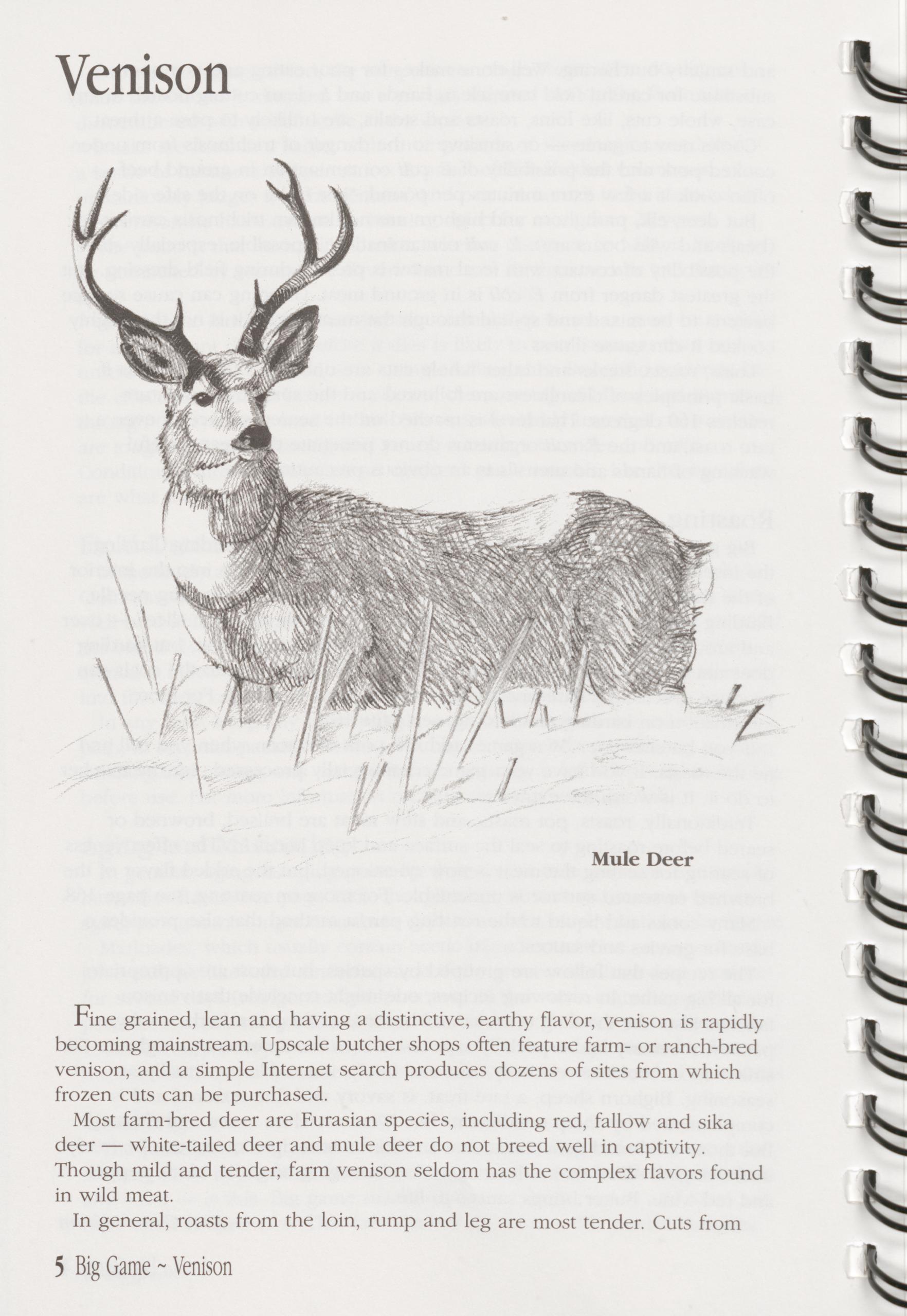
Venison
Fine grained, lean and having a distinctive, earthy flavor, venison is rapidly becoming mainstream. Upscale butcher shops often feature farm- or ranch-bred venison, and a simple Internet search produces dozens of sites from which frozen cuts can be purchased.
Most farm-bred deer are Eurasian species, including red, fallow and sika deer — white-tailed deer and mule deer do not breed well in captivity. Though mild and tender, farm venison seldom has the complex flavors found in wild meat.
In general, roasts from the loin, rump and leg are most tender. Cuts from
5 Big Game ~ Venison
the shoulder, neck and shank are tougher and benefit from moist-heat cooking methods such as braising and stewing. The ribs, often left for the dogs by hunters who bone out their deer, are exquisite, and braised or barbecued venison ribs are mouthwatering.
Venison is fairly dense meat, and because it is lean tends to be dry after cooking. Roasts should be barded or larded. Trim fat from steaks and chops; it is strong tasting and, like lamb fat, it congeals quickly as it cools, leaving an inelegant film on plates, utensils and teeth. Serve venison hot, direct from the stove or grill. Preheated plates help keep cuts attractive longer.
Deer liver seldom makes it home from a hunting camp, and it is a common gift from hunters to landowners who have given permission to hunt. Cook deer liver as you would beef liver — but not for too long: It should be pink at the center. Heart, kidneys and brains are delicacies, too, and can be pre- pared using any recipe for domestic specialty meats.
Leg bones often are wasted. Instead of boning the shanks and using the relatively tough cuts in stews, consider cutting the hind leg shanks into short lengths and make osso buco, see page 11. The marrow is delicious; some devotees pan-roast the leg bones with a little liquid and use the marrow as a spread on toast.
Venison Vegetable Oven StewThis stew cooks itself with little attention once it is in the oven, perfect for those Nebraska football Saturdays.
4 venison steaks (large cuts can be cut into smaller pieces) 2 qt canned tomatoes (reserve juice) 2 onions, chopped 2 green peppers, chopped 1 head green cabbage, cut into 8 wedges 3 tbl vegetable oil cup flour salt, pepper, chili pepper, ground cumin, basil, oregano or other herbs and spicesHeat a deep cast-iron pan or Dutch oven on stove top. Dredge meat in flour seasoned with herbs and spices. Add enough oil to cover bottom of pan and heat. Flour steaks and brown both sides. Remove to a plate. Return meat and remaining ingredients to pan, layering them in. Arrange the cabbage wedges like spokes of a wheel on top, pressing them down into liquid. Reserved tomato juice can be added to cover. Cover and bake in 350-degree oven for 1 hour. Remove cover and continue baking until done, about D/2 to 2 hours. Check occasionally to see that the cabbage is submerged or it will burn.
Serve over rice, bulgur or couscous, with a green salad, hot fresh bread or cornbread and a Merlot or other red wine.
— Jeffrey Johnson, Eugene, Oregon Big Game ~ Venison 6 Grilled Loin of Venison
There is, perhaps, no finer venison than a loin and no other cut is so likely to make a believer out of a venison doubter. It can be roasted, broiled whole over coals or in an indoor broiler or cut into thick medallions or butterfly steaks and pan fried or broiled. In any case, loin should be cooked quickly over high heat and remain rare at the center.
This simple but satisfying recipe for grilled loin uses garlic and black pepper to enhance the distinctive venison flavor. It can be prepared in the broiler, but the pungent, crisp surface characteristic of charcoal grilling makes it an ideal outdoor recipe.
boneless venison loin (about * 2 3 *A lb per person) 10 or more garlic cloves, finely chopped black pepper, freshly ground olive oilThoroughly coat the meat with good olive oil. Grind black pepper onto it, then roll the loin in finely chopped garlic. Grill it over hot coals turning frequently so the outside is uniformly crusty and brown. Add a few soaked hickory chips, if desired. Serve when the center is warm and pink.
— Dave Williams, Benedict, Nebraska Venison Mincemeat PieThis is a great tasting pie. I've had lots of compliments on it.
2 lb ground venison (or any Vi tsp ground cloves ground big game meat) 1 tsp pumpkin pie spice 4 lb apples, peeled and chopped ¥i tsp nutmeg 2 lb raisins 2 tsp salt 2 cups white sugar iy2 tsp cinnamon 2 cups brown sugar orange juice 3/4 cup low-fat margarineIn a large pot, boil ground venison in 1 cup water until the water is gone. Separate the meat with a fork and add the remaining ingredients, using enough orange juice to cover 5A of the ingredients. Cook slowly over low heat until fruit is tender, about 30 minutes. Stir frequently to prevent sugar from scorching.
Make your favorite double pie crust and add mincemeat for filling. Cut slits in top crust and sprinkle with sugar. Place in a pre-heated 425-degree oven and bake for 15 minutes. Reduce heat to 350 degrees and bake 40 minutes more. Serve with vanilla ice cream.
— Doris Rempe, Lawrence, Nebraska 7 Big Game ~ Venison Chicken Fried Venison Steaks
1 1/2 lb deer steak 1 cup milk
2 cups saltine crackers, crushed salt and pepper
3 eggs, beaten cooking oil
Chicken Fried Venison Steaks
1 1/2 lb deer steak 1 cup milk
2 cups saltine crackers, crushed salt and pepper
3 eggs, beaten cooking oil
Pound steaks with a mallet until they are about ¥2 inch thick. Combine milk and eggs in a bowl. Coat tenderized steaks with egg mixture and then with crushed crackers. Salt and pepper to taste. Fry in hot oil until golden brown, about 5 minutes per side.
— Conny Herdt, Scottsbluff, Nebraska Curt’s Sauteed Deer Medallions 2 deer tenderloins 1 tsp salt 1/2 tsp pepper 2 tbl olive oil 1/2 cup chopped onion 6 cloves garlic, chopped 1/2 cup whole mushrooms 1/2 cup course Dijon mustard 1/2 cup sour cream 1 tbl cornstarchRemove silver skin from tenderloins and cut them into slices 1 inch thick. Pound to % inch with a mallet or the flat side of chefs knife. In a 10-inch or larger cast-iron skillet, heat oil until it shimmers. Sear medallions without moving them until brown on one side, about 80 seconds. Turn medallions with tongs to avoid scraping off sear. Sear other side about 80 seconds. Transfer to a plate. In the same skillet, saute mushrooms, onions and garlic until the onions are translucent. Add mustard and sour cream. Mix until smooth and hot. Add cornstarch mixed in enough water to make a thick sauce. Return venison medallions and simmer until hot. Serve with garlic bread or garlic Parmesan bread as an appetizer. Enjoy with Merlot wine.
— Curt Barr, Fort Calhoun, Nebraska Big Game ~ Venison 8 Scalopine of Venison
Serves 8 to 10
2 1/2 lb venison flour seasoned with salt, pepper, paprika butter or oil for frying 2 medium onions, peeled and sliced 1 tsp sugar 4 oz mushrooms 1 1/4 cups tomato puree 1 1/4 cups hot waterCut the meat into serving pieces and dredge in seasoned flour. Flatten with a mallet or the flat side of a cleaver. In a skillet, heat butter until it is fragrant and saute one side until golden brown. Turn, add onions and saute the second side. Place in a greased casserole, add remaining ingredients and bake at 350 degrees for about 2 hours or until tender.
— Audrey Polenske, Norfolk, Nebraska Venison Salad Serves 6 4 cups cooked venison, cut into 1/2 inch cubes French dressing 1 cup celery, sliced 1 cup cooked green beans, cut in thirds ¥2 cup stuffed olives, sliced 4 hard-boiled eggs, sliced mayonnaise salt and pepper lettuceCoat the cubed venison with French dressing. Refrigerate for 1 hour, stirring occasionally. Drain venison, add celery, green beans, stuffed olives and eggs with enough mayonnaise to moisten all ingredients. Season to taste with salt and pepper. Arrange in a lettuce-lined bowl.
— Audrey Polenske, Norfolk, Nebraska 9 Big Game ~ Venison East Indian Style Venison Stew
This recipe is adapted from Madhur Jaffery’s classic recipe for rogan josh, a spicy, red, lamb stew in which islands of meat rise up out of a thick sea of dark red sauce. The distinct flavor of venison is hearty enough to shine through the piquant east Indian spices, which, in turn, give an exotic warmth to the venison.
2 lb venison cut in 1-inch cubes 1 cup onion, finely chopped 1 to 2 tbl fresh ginger, coarsely chopped 8 cloves garlic, peeled 10 cardamom pods 2 bay leaves 6 cloves 10 peppercorns 1-inch stick cinnamon 1 tsp ground coriander 2 tsp ground cumin 4 tsp bright red paprika mixed with l4 to 1 tsp cayenne pepper 1 tsp salt 6 tbl yogurt V4 tsp garam masala (see below) freshly ground black pepperBlend ginger, garlic and 4 tablespoons water into a smooth paste. Heat oil in a wide, heavy pan over medium-high heat. Brown meat in several batches to avoid crowding the pan. Set aside. Put cardamom, bay leaves, cloves, peppercorns and cinnamon in the hot oil, stir once, and wait a few seconds until the cloves swell and the bay leaves begin to color. Add onions and fry for about 5 minutes until they become medium brown.
Add ginger-garlic paste and stir for 30 seconds. Add coriander, cumin, paprika-cayenne mixture and salt. Stir for another 30 seconds. Add the yogurt 1 tablespoon at a time, stirring each for about 30 seconds. Cook, stirring constantly, for about 4 minutes.
Add IVi cups water, bring to a boil and scrape up all the browned spices from the bottom and sides of the pan. Cover, lower heat and simmer 1 to 2 hours or until meat is fork tender. Stir every 10 minutes.
When meat is tender, remove lid and reduce the liquid to a thick reddish- brown sauce. Degrease, if necessary. Stir in garam masala and serve with rice.
Garam Masala is a mixture of aromatic spices usually including cardamom, cinnamon, black cumin, cloves, black peppercorns and nutmeg. It is used sparingly and usually added to food near the end of the cooking period. There are many regional and family varieties throughout India and Pakistan. Packaged varieties are available at imported food stores. To make your own, place 1 tablespoon cardamom seed, 2 inches of stick cinnamon, 1 teaspoon cumin seeds, 1 teaspoon cloves, 1 teaspoon peppercorns and V* of a nutmeg in a spice grinder or clean electric coffee mill. Grind fine and store tightly covered away from heat and sunlight.
— Mel Bucklin, Lincoln, Nebraska Big Game ~ Venison 10 Grilled Venison Meatloaf
Serves 4
1 lb ground venison, elk or buffalo ¥2 lb sweet Italian sausage ¥2 lb ground beef (sirloin) 1 egg 1 cup Burgundy 3/4 cup orange peel, shreddedIn a crockery bowl, mix the meats, egg and wine. Meats should be cold. Fat from the sausage will adhere to the sides of the bowl and can be used to keep the mixture moist. Turn the mixture out and form a Z-inch by 4-inch rectangle about 1 inch thick. Salt and pepper, if desired. Sprinkle the meat with grated orange peel and roll it into a cylinder. Wrap the roll in heavy- duty aluminum foil and place on a hot grill, turning the roll at 15 minutes, 25 minutes and 30 minutes. Lower heat and cook for another 30 minutes, turning every 5 or 10 minutes, until internal temperature reaches 165 to 170.
— Jerry Cain, Lincoln, Nebraska Venison Osso Buco (Braised Venison Shanks)Serves 6
Osso is bone and buco is round. The round bones are the shanks, preferably the hind shanks, and this braised stew, commonly prepared with veal, is a favorite in Italy and Provence in southern France. Moist cooking suits the relatively tough leg muscles, and the method releases the exciting flavor of the marrow.
4 to 6 lb venison shanks (hind shanks preferred) cut into 3 inch lengths 2 onions, chopped 1 large carrot, peeled and chopped 1 celery stalk, chopped 2 bay leaves 4 cloves 1 sprig fresh rosemary 10 to 15 juniper berries 1/2 cup flour 1/4 cup olive oil 2 tsp tomato paste 1 cup red wine 1 cup vegetable stock 1 cup tomatoes, skinned, seeded and diced 2 cups chicken stock zest of 1 orange juice of 1 orange zest of 1 lemonHeat oil in a deep, heavy pot or Dutch oven. Saute onions until soft, add carrot, celery, bay leaves, cloves, rosemary and juniper berries. Cook, stirring frequently, 10 to 15 minutes until vegetables are lightly browned. Set aside. Salt and pepper the venison generously, then dredge in flour. Add oil to the same pot, raise heat and brown venison shanks on all sides. Place the
11 Big Game ~ Venison
shanks upright to keep the marrow intact. Return the vegetables to pot, reduce heat, add tomato paste and cook for about 5 minutes. Add wine, bring to a boil and deglaze the pot. Add carrot juice or vegetable stock and orange juice. Add half the orange zest and all the lemon zest. Boil vigorously for a few minutes to reduce sauce and cook vegetables. Add tomatoes, reduce heat and simmer uncovered for 30 minutes. Stir in heated chicken stock and simmer partially covered for P/2 hours or until fork tender.
Remove meat, set aside. Strain liquid, pressing to extract liquid, discard solids. Return shanks to pot with sauce and keep warm until ready to serve. Garnish with remaining orange zest.
— Mike Cartwright, Whitney, Nebraska Venison RoastI came here as a GI bride from England, a farmer’s daughter, whose mother, an excellent cook, cooked many a wonderful meal for me and my seven brothers. We ate lots of game birds, mostly pheasant, partridge and grouse — very, very good. I like to cook good venison, too, and I’ll tell you how:
1 3 to 4 lb venison roast 1 cup salad oil juice of 1 large lemon or 2 to 3 tbl vinegar 1 pkg dried onion soup mix 1 can mushroom soup 1 cup red wine mushrooms (optional) 1 bay leaf garlic (optional) black pepperWash roast well and dry. Mix salad oil and lemon juice. Roll meat in oil and juice until it is well covered. Place in a bowl with the remaining juice and oil and refrigerate overnight. In the morning, remove meat from marinade. Dust meat with flour on all sides. Brown well in oil. Put meat and all the brown material from the browning pan into a slow cooker, electric frying pan or Dutch oven. Mix 1 package of dried onion soup mix with specified amount of water, add undiluted mushroom soup, red wine, bay leaf, pepper and garlic, if desired.
Big Game ~ Venison 12
Cover the meat and cook for 7 to 8 hours. Use low setting for crockpot. Check it after about 4 hours to see if it is cooking well. If not, set on high for a couple of hours to get it simmering. Frying pan should be on low, Dutch oven should be simmering. Serve when meat is fork tender. You may add extra mushrooms if you like. There should be some wonderful gravy with this recipe, so make lots of mashed potatoes and vegetables to go with it. Bon appetit.
— Alice Heck, Aptos, California Roast Loin of Venison with Cranberries 4 lb boneless loin of venison 2 thick slices of lemon 2 thick slices of orange 2 slices fresh ginger, peeled IVi cups sugar 1 bay leaf 2 cups fresh cranberries 2 tbl olive oil 1 tsp salt 1% tsp freshly ground pepper % tsp juniper berries, finely chopped 2 cups dry red wine 2 cups venison stock or beef stock 2 tbl cold butter, cut into pieces fresh thyme sprigs for garnishIn a medium, nonreactive saucepan, combine the lemon, orange, ginger, sugar and bay leaf with 1 cup cold water. Bring to a boil over high heat, stirring to dissolve the sugar. Reduce the heat and boil uncovered until syrupy, 10 to 15 minutes. Stir in the cranberries, then remove from heat and cool. Transfer the mixture to a glass container, cover and refrigerate for 1 to 2 days, stirring once or twice.
Preheat oven to 400 degrees. Rub venison with olive oil, 5A teaspoon salt, 1 teaspoon pepper and Vi teaspoon chopped juniper berries, pressing the seasonings into the meat. Set the loin on a rack in a roasting pan and roast, basting frequently with the pan juices, until medium-rare (about 135 degrees), 25 to 30 minutes. Cover the venison loosely with foil and set aside for 10 to 15 minutes before carving.
Meanwhile, remove bay leaf, lemon, orange and ginger slices from the cranberries. In a food processor or blender, puree half the cranberries and half the liquid until smooth. In a medium nonreactive saucepan, boil the wine over high heat until reduced to Vi cup, about 5 minutes.
Add the stock and bring to a boil. Add the cranberry puree, reduce the heat simmer uncovered until slightly thickened, about 10 minutes. Remove from heat. Strain the remaining whole cranberries and add them to the sauce with the remaining XA teaspoon each of salt, pepper and chopped juniper berries.
Swirl in the cold butter. Slice the venison thinly (stir any juices into the sauce) and serve with the sauce, reheated if necessary.
— Jim Speirs, Thornbill, Ontario 13 Big Game ~ Venison Deer Bologna
I lived in Wyoming for a few years in the 1960s. I hunted all fall, and deer, antelope and elk meat filled our freezer. I enjoyed hunting and processing the game. It was a good feeling to work with food that came directly from the field, and it forged a connection with the earth. We used this recipe, modified from one in A Complete Guide to Home Meat Curing published by the Morton Salt Company, to make deer bologna. When it came time to mix the pork and deer, we dumped it all on the kitchen table, rolled up our sleeves and worked it with our bare hands. Our young daughters Carol and Ann thought this was fun. Our little dog, Sunny, licked up whatever fell on the floor. When the floor was clean he would look up and wag his tail until another bit fell.
After the casings were stuffed we smoked the bologna in an old metal barrel I found in the Bearlodge Mountains. It worked so well that I moved it when we relocated to Chadron, Nebraska.
18 lb ground deer meat 1 oz black pepper 12 lb ground pork % oz coriander I Vs cup Morton’s Tender Quick Vz oz mace for the deer meat Vs cup Morton’s Tender Quick for the porkThe seasoning amounts are maximums. We usually used less. Thoroughly mix IVS cups Tender Quick with the deer meat. Spread in a cool place and let cure for 48 hours. Mix 5/s cup Tender Quick with the pork and cure 48 hours.
After curing, thoroughly mix the pork and deer, adding the seasonings. Mixing the cold meat can take 30 or 40 minutes and is not easy. Stuff the sausage into casings. My wife sewed our casings, about 14 inches long and 244 inches in diameter, from unbleached muslin.
Hang the sausage for 2 to 3 hours in a smokehouse or barrel smoker heated to 110 to 120 degrees. After smoking, the casings should be a rich brown color. A small amount of fat will drip from the meat.
Immediately put the hot, smoked sausages in 160- to 175-degree water and cook until they float, usually 20 to 90 minutes. Plunge the cooked sausage into cold water to chill. Hang in a cool place for a day or two, then wrap and freeze. They lose flavor in the freezer and are best eaten within 6 months. They can be sliced and eaten cold or warmed in the skillet.
— Marvin Liewer, Butte, Nebraska Big Game ~ Venison 14 Moist Venison Roast
This recipe is tasty and easy, which makes it popular at our deer-hunting camp every year. I like this method for cooking a roast because the meat is moist, makes its own gravy and is easy to clean up, most important at camp.
3 to 4 lb chuck-style venison roast 1 large oven roasting bag % cup flour IO1/! oz canned mushroom gravy small can sliced mushrooms carrots, sliced onions, sliced potatoes, quartered 1 bay leaf salt and pepperPut flour into an oven bag and shake to coat the sides. Place bag in a 13-inch by 9-inch baking dish. Add mushroom gravy and 2 cans of water. Squeeze bag to blend. Add roast, salt, pepper, bay leaf and mushrooms. Place vegetables in bag around roast. Close with the tie provided with the bag. Cut 6 small slits in top of bag for ventilation. Bake for 2 to ZYi hours at 325 degrees. Let stand 5 minutes and serve on a heated platter.
— George Soemann, Appleton, New York King’s Arms Tavern Colonial Game PieServes 12 to 15
The King’s Arms Tavern opened in 1772 in Williamsburg, Virginia.
2 ¥2 lb venison, cut into large cubes 1 duck (5 lb) or 2 wild mallards 1 rabbit (2 lb) ¥2 cup vegetable oil 2 cups port I ¥2 qt brown sauce, or beef consomme 1 tbl Worcestershire sauce 1 clove garlic, minced ¥2 tsp pepper, freshly ground 1 cup currant jelly I ¥2 lb mushrooms, quartered ¥2 cup butter 1 lb slab bacon, cut into V4 inch cubes 1 lb pearl onions, cooked 1 egg 2 tbl milk salt pastry crustPreheat oven to 400 degrees. Salt the cavity of the duck and place it on a rack in a shallow roasting pan, breast-side up. Bake for 30 minutes, reduce heat to 325 degrees and bake until the duck tests done (legs should move freely).
Simmer the rabbit in small amount of water for 1 hour, or until tender. Set aside. In a skillet saute venison in vegetable oil until browned. Remove venison and drain the oil. Add port to the skillet and boil 2 to 3 minutes
15 Big Game ~ Venisonscraping up the brown particles. Return venison to the skillet, add brown sauce and simmer 45 to 60 minutes or until the meat is tender. Cut the duck and rabbit into medium-size pieces. Add pieces to the skillet and keep warm. Season with Worcestershire sauce, garlic, pepper and currant jelly.
Saute the mushrooms in butter until lightly brown. Fry the bacon until crisp and drain. Heat the onions and drain.
Divide the meat mixture into individual, greased casserole dishes and garnish with mushrooms, bacon and onions. Cover each dish with pastry crust, trim the edges and prick the tops to allow steam to escape.
Beat the egg lightly with milk to make an egg wash and brush the pastry with the mixture. Bake in a 350-degree oven for 20 to 25 minutes or until the crust is golden brown. Serve piping hot.
— King's Arms Tavern, Williamsburg, Virginia Medallions of Venison Glazed with Rosemary, Wild Cherries and BourbonServes 1
2 3-oz medallions of venison 1 ¥2 tbl whole, unsalted butter l/i clove garlic 10 rosemary leaves 10 sun dried wild cherries % teaspoon thyme % tsp sage 3 tbl bourbon 3 tbl venison or beef stock 1 tbl tamariLightly dredge the venison in flour.
Heat a dry skillet and add V2 tablespoon of butter. Sear the venison on one side for 2 minutes, flip over and sear one minute more. Add garlic, rosemary, wild cherries, thyme and sage. Fry rapidly for 30 seconds, then add and flame the bourbon, stock and tamari. Reduce the sauce and finish cooking the venison. Plate the venison and finish sauce by incorporating the remaining butter.
— The 1785 Inn, North Conway, New Hampshire Big Game ~ Venison 16 Prairie Venison Cabbage Rolls
1 lb ground venison
Yz cup chopped onion
1 medium apple, chopped
8 oz tomato sauce
1 cup quick brown rice
Yz tsp ground nutmeg
Yz tsp salt
1 tbl chopped fresh cilantro
cabbage leaves
1 cup grated cheese
Coca-Cola (optional)
Prairie Venison Cabbage Rolls
1 lb ground venison
Yz cup chopped onion
1 medium apple, chopped
8 oz tomato sauce
1 cup quick brown rice
Yz tsp ground nutmeg
Yz tsp salt
1 tbl chopped fresh cilantro
cabbage leaves
1 cup grated cheese
Coca-Cola (optional)
Blend V3 cup onion and apple, adding some Coca-Cola for additional moisture if you wish. Mix with meat, seasonings and uncooked rice. Drop cabbage leaves in boiling water for 3 minutes, drain. Form meat mixture into patties that can be rolled up in the cabbage leaves. Place rolls in a pan and pour tomato sauce over them. Top with remaining onion and the chopped cilantro and sprinkle with grated cheese. Bake covered in a preheated 350-degree oven.
— Dave Kula, Food Service Director, Eugene T. Mahoney State Park Curt’s Venison ChiliServes 6
1 lb venison, cut in bite-size pieces Yz cup onion, chopped 16 oz red beans 16 oz refried beans 8 oz tomato sauce 16 oz picante sauce, mild or hot 1 tsp hot red peppers, chopped Yz tsp salt 1 tsp garlic salt flour 2 oz olive oil Ys tsp white pepper Ys tsp cayenne pepper 3 tbl chili powder 1 tbl molassesDredge venison and brown with onions in olive oil. Pour off excess oil. Add remaining ingredients, cover and simmer for at least 1 hour, stirring occasionally.
— Curt Barr, Fort Calhoun, Nebraska 17 Big Game ~ Venison Big Game Carnitas
Serves 6 as appetizers, or fills 12 tacos Traditionally, carnitas, or “little meats,” found throughout Mexico, are made from pork or, less frequently, lamb. The slow boiling in lard tempered with orange slices is a good way to prepare any tough but flavorful cut of game. Carnitas are crisp on the outside but dry and succulent inside and not at all greasy, as the cooking technique might first suggest. They can be served several ways. Small carnitas (1-inch cubes of meat), with the usual garnishes, can be used as taco filling, or they can be skewered on toothpicks and served as an appetizer with guacamole or salsa dips. Larger carnitas, (3-inch cubes) are picked up with a tortilla and eaten from the hand with salsa, sour cream, onions, cheese and fresh cilantro garnishes.
2 to 3 lb lard (no substitute) Z Vr lb roast, butt or shoulder of venison, antelope or elk 1 orange with peel, sliced ¥2 cup fresh cilantro leaves, coarsely choppedTrim fat from meat and cut into 3-inch (or 1-inch) cubes and salt lightly. Place lard over medium heat in a heavy, deep pot. When it has melted, add meat, orange slices and cilantro. The melted lard should completely cover the meat. Cook over medium heat for 2 to 2 ¥2 hours for 3-inch cubes or P/2 to 2 hours for 1-inch cubes. Moisture from the orange slices will begin to boil through it in about 30 minutes. Continue to boil gently. As the moisture boils away, the lard temperature will rise, browning the meat. If it is not brown by the specified cooking time, remove orange slices. Watch closely and remove meat as soon as it is brown. Drain meat on paper towels and serve.
Venison Stew 4 lb venison, cut in 1-inch cubes 15 oz stewed tomatoes or 4 medium tomatoes, cubed 1 cup chopped onion 1 green pepper, chopped 1 lb fresh mushrooms, thinly sliced 4 cups beef broth 1/4 lb butter 1 cup flour salt and pepperMelt butter in large skillet over medium heat. Saute onion and pepper. Set aside. In the same skillet, saute mushrooms, set aside. Dredge venison in flour, salt and pepper. Brown on all sides over high heat in the same skillet. Place all ingredients in a crockpot and slow cook for 6 to 8 hours.
— Helen Vach, Hooper, Nebraska Big Game ~ Venison 18 Venison Meatballs
Serves 5
1 1/2 lb ground venison
4 oz onion, finely diced
2 oz celery, finely diced
4 oz breadcrumbs
4 oz tomato juice
2 oz olive oil
2 eggs, beaten
1 tsp dry basil
1 tsp dry parsley
Mi tsp salt
pepper
Venison Meatballs
Serves 5
1 1/2 lb ground venison
4 oz onion, finely diced
2 oz celery, finely diced
4 oz breadcrumbs
4 oz tomato juice
2 oz olive oil
2 eggs, beaten
1 tsp dry basil
1 tsp dry parsley
Mi tsp salt
pepper
Dice onions and celery finely, saute in a little olive oil and let cool. In a bowl, beat eggs and add tomato juice. Add all remaining ingredients and mix well. With a small scoop or tablespoon, form into round meatballs and line them up on a waxpaper-lined sheet pan. Bake at 350 degrees about 30 minutes, or until browned. Serve with your favorite sauce and pasta.
— Chef Edward Zita, Chinese American Service League, Chicago, Illinois Venison with Green Peppercorns 4 6-oz venison fillets 1 tbl green peppercorns 3 oz bourbon whiskey salt freshly ground pepper 1 shallot, chopped Mi cup red wine Mi cup heavy cream 2 tbl butter 1 tbl chopped fresh chives, thyme or parsleySoak green peppercorns in bourbon for 30 minutes or longer. Heat butter in a saute pan. Salt and pepper the venison on both sides and saute quickly, about 2 minutes per side (depending on thickness) for medium rare. Remove from pan and keep warm.
Add shallots to pan juices; cook 1 minute. Add green peppercorns and bourbon; boil 1 minute. Add wine and cook down to a fine glaze. Add heavy cream and continue cooking until sauce coats the back of a spoon. Add herbs and any meat juices. Serve sauce over venison.
—Jim Speirs, Thornhill, Ontario 19 Big Game ~ Venison Notes
Big Game - Notes 20
Notes
Big Game - Notes 20
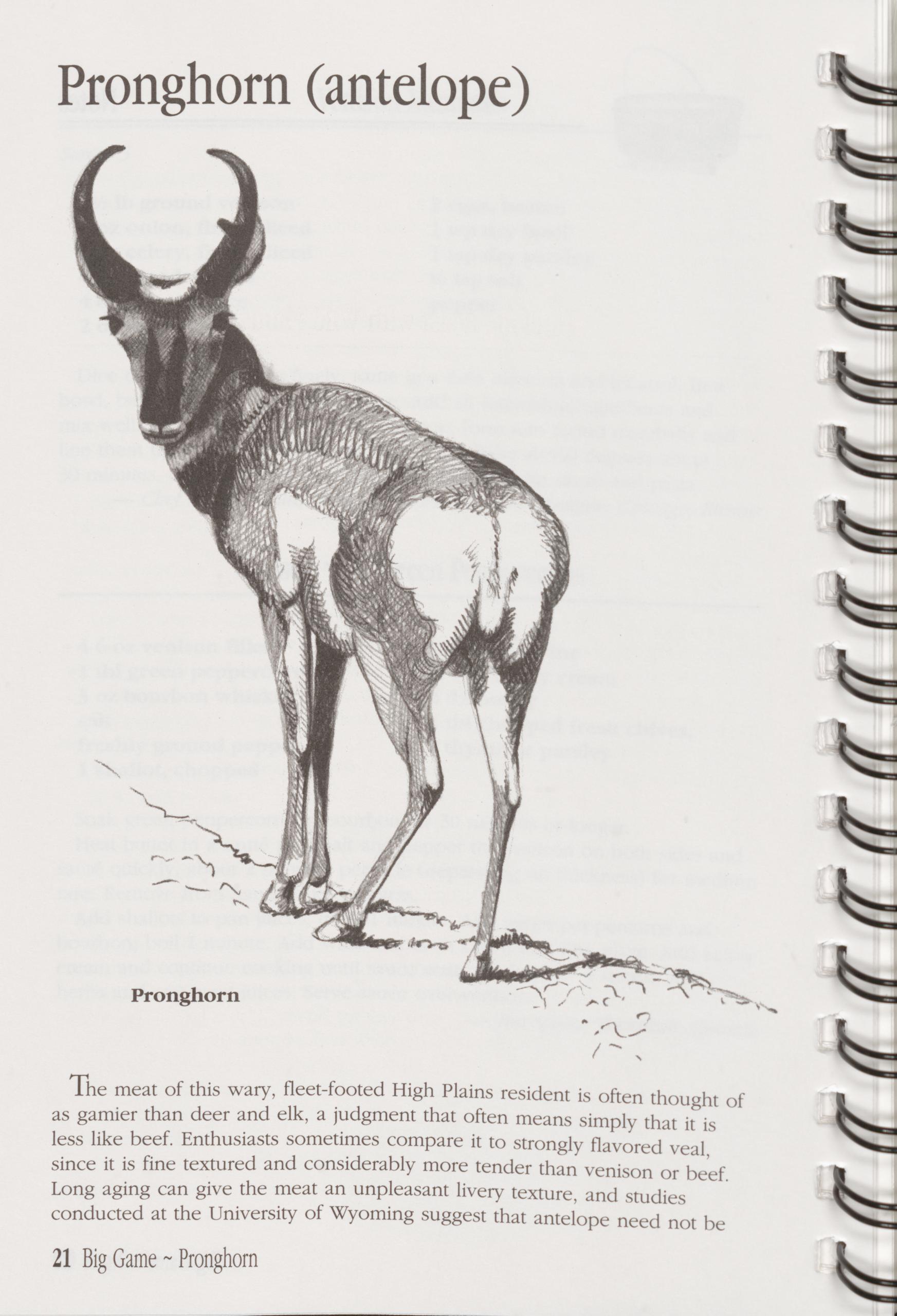
The meat of this wary, fleet-footed High Plains resident is often thought of as gamier than deer and elk, a judgment that often means simply that it is less like beef. Enthusiasts sometimes compare it to strongly flavored veal, since it is fine textured and considerably more tender than venison or beef. Long aging can give the meat an unpleasant livery texture, and studies conducted at the University of Wyoming suggest that antelope need not be
21 Big Game * Pronghorn
aged at all. The Wyoming study recommends that carcasses be cut, packaged and frozen within three days of the kill.
Antelope have a pungent odor, but the smell is primarily associated with the hide. Some diners complain of a somewhat greasy taste, a consequence of the high concentration of saturated fatty acids in antelope fat. The taste can be moderated by trimming away as much fat as possible from the meat and larding or barding with pork fat which offsets the highly saturated intermuscular antelope fat.
Antelope Roast with Wild PlumsWild plums, bountiful in field borders and in road ditches throughout Nebraska, have a unique, tart flavor unmatched by any domestic variety. Whole plums simmered in the roasting pan bring a wild, earthy flavor to meat unlike the jellies or preserves often called for in game recipes. The skins are particularly tart.
4 to 6 lb antelope roast bacon or salt pork for larding or barding 2 ribs of celery, with leaves, chopped juice of ¥2 lemon or % cup balsamic vinegar 1 bay leaf, crumbled 10 whole allspice berries 10 whole black peppercorns 2 cups whole wild plums or 3/4 cup wild plum jelly 1 tbl brown sugar 2 tsp Dijon mustard or 1 tbl capers 1 tbl butter 1 to 2 tbl cornstarch salt and pepperLard the roast or bard it after seasoning the surface as follows: Rub well with half the lemon juice, crumbled bay leaf and the whole allspice and peppercorns. Cover with the chopped celery and sprinkle on the remaining lemon juice. Place on a rack in a roasting pan. Roast in a 350-degree oven for about 16 minutes per pound for rare (125 degrees at the center). Baste frequently, adding a little water to the roasting pan if it begins to dry out.
About 30 to 45 minutes before the meat is done, add whole, washed plums (or jelly) to the roasting pan along with % cup water. When ready to serve remove the celery and spices and set aside. Rub the plums and other contents of the roasting pan through a sieve. If the result is too thick for a smooth sauce, add water and stock and simmer briefly. If it is too thin, thicken it with a little cornstarch well mixed in a few tablespoons of water or stock. Simmer to thicken, stir in butter, mustard or capers and serve over slices of roast garnished with reserved celery.
— David Cunningham, Kirkland, Washington Big Game ~ Pronghorn 22 Dutch Oven Antelope
Serves 4
4- to 5-lb antelope shoulder roast 1 onion, sliced 1 green pepper, coarsely sliced 4 to 6 cloves garlic, minced 3 to 4 fresh tomatoes, skinned, seeded, chopped 1 tbl dark molasses 1 cup red wine 1 tsp sage 1 sprig parsley 4 whole cloves 20 whole black peppercorns 2 bay leaves, crushed 12 juniper berries, crushed 1 qt buttermilk flour seasoned with salt and pepper 3 tbl oil sugar thymeMarinate meat overnight in buttermilk. Discard marinade. Pat dry. Roll roast in seasoned flour and brown on all sides in hot cooking oil in a Dutch oven. Remove the roast. In the Dutch oven, saute the onion, green pepper and garlic over moderate heat for 5 minutes, stirring often. Add tomatoes, sugar, wine and thyme and heat. Place the parsley, cloves, peppercorns and bay leaves on a piece of double-thickness cheese cloth, and tie with a string to make a bag. Add the bag to pot. When the mixture is boiling, add the browned roast and baste with sauce. Cover and cook at 350 degrees for about 2Yi hours, until tender. Baste several times with pan juices during the roasting. Slice thinly and serve with pan juices.
— Roy Farris, Fremont, Nebraska Antelope Salisbury Steak 1 lb ground antelope (add suet, 14 cup milk if desired) 1 egg, beaten 1 pkg onion soup mix oil for browning % cup dry bread crumbs (1 slice bread)Mix lA cup soup mix into the ground meat. Mix crumbs, milk and egg and add to the meat mixture. Form patties and brown. Remove patties and set aside. Add 2 tablespoons hour and the remaining soup mix to skillet. Brown and add IVi cup water. Simmer 20 minutes. Add patties and simmer 15 minutes.
— Jeanette Koch, Monroe, Nebraska 23 Big Game ~ Pronghorn Cold Smoked Antelope with Orzo
Serves 4
Cold Smoked Antelope with Orzo
Serves 4
This cold, main-course salad is a great picnic dish, combining the veal-like texture of antelope steaks with the dark flavors of anise and smoke. It is served with orzo, a barley-shaped pasta often accompanying Greek and Italian dishes. It holds well and can be prepared the day before serving.
4 3/4 lb antelope steaks 12 oz orzo 1 small red onion, finely chopped 1 cup beer 2 tbl anisette liqueur l4 cup honey l4 cup soy sauce 3 tbl olive oil 2 tbl sesame oil 1 tbl parsley, chopped I1h tbl black pepper 1 tsp cayenne pepper 5 star anise pods (optional)Place beer, onion, anisette, soy sauce, honey, sesame oil, parsley, cayenne, 1 tablespoon black pepper and star anise, if desired, in a large glass bowl or other nonreactive container. Mix well, add meat and refrigerate for 24 hours or more in the bowl or a locking plastic bag.
Drain meat and reserve marinade. Dry with paper towels. When smoker coals are covered with gray ash, add a generous handful of fruitwood chips, well soaked in water. Place steaks high in the smoker and smoke for about 2 hours, adding charcoal and wood chips if needed.
In a saucepan, simmer marinade for about 15 minutes, covered. Refrigerate until well chilled. In a large saucepan bring 4 quarts of water to a boil and add the orzo. Boil 3 to 4 minutes. Drain, rinse in cold water and drain well. Toss with 1 tablespoon olive oil and refrigerate for at least 30 minutes. When the meat has been smoked for about 2 hours, cool it and refrigerate until well chilled.
Remove the meat from the refrigerator and cut into V's-inch by Vi-inch chunks. Combine meat, orzo and marinade in a large bowl. Serve topped with a drizzle of olive oil and a generous grind of black pepper.
— Steve Farris, Woodland Hills, California Big Game ~ Pronghorn 24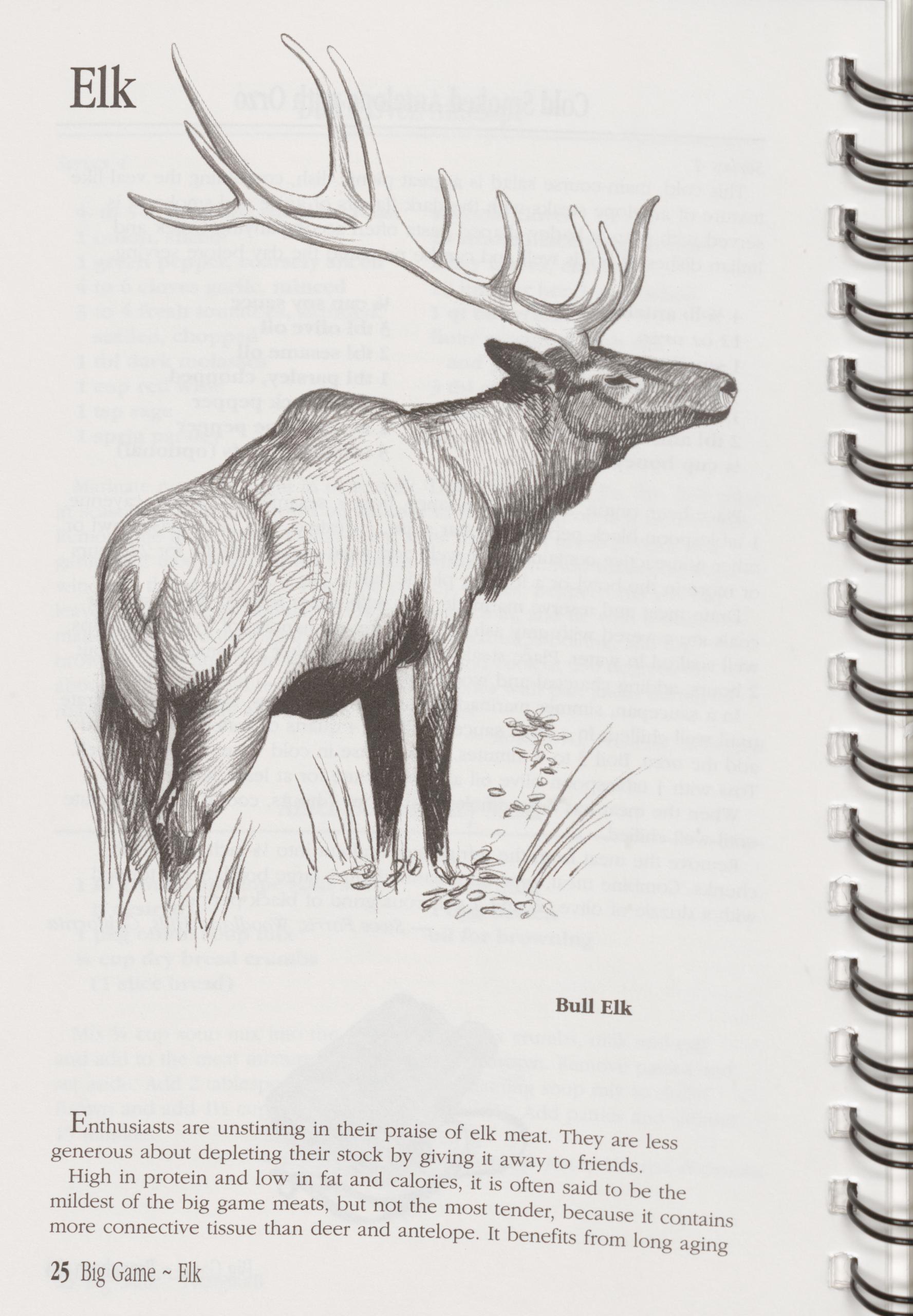 Bull Elk
Enthusiasts are unstinting in their praise of elk meat. They are less generous about depleting their stock by giving it away to friends. High in protein and low in fat and calories, it is often said to be the mildest of the big game meats, but not the most tender, because it contains more connective tissue than deer and antelope. It benefits from long aging
25 Big Game ~ Elk
and moist-heat cooking methods such as stewing, pot roasting or braising. Only in recent years and in a few relatively small areas have elk populations in Nebraska reached levels that will sustain controlled hunting, and at present a Nebraska elk permit is a once-in-a-lifetime privilege for most hunters — all the more reason to cook it with care.
Swiss Elk SteakOf the big game recipes that have passed through our kitchen over the years, a personal favorite comes from an old Bradford Angier cookbook “borrowed” from NEBRASKAland photographer and friend Lou Ell nearly 30 years ago. The book is dedicated to Colonel Townsend Whelen, “For years the Commanding Officer at Frankford Arsenal — from where in 1804 his great-great-grandfather, Commissary General of the Army Israel Whelen, equipped the Lewis and Clark Expedition.”
The recipe, as Angier says, “is good for both a change and for those days when you’re confronted with the tougher cuts.”
3 lb elk flank, steak or roast 3 or 4 carrots, thickly sliced 2 or 3 onions, thickly sliced 1 large can tomatoes or 2 or 3 fresh tomatoes, chopped several small potatoes, peeled (optional) salt and pepper flour cooking oilAngier recommended flank, but the recipe really shines with elk steak or roast cut in strips about 2 inches thick before the meat is completely thawed. “For about a 3-pound slab,” Angier wrote, “mix 2 teaspoons salt with Vi teaspoon black pepper. Season one side of the steak with half of this. Then with the back of your camping knife, pound all the flour you can into the meat. Turn the steak and repeat the process.” I use less salt, adding it and the pepper to the flour before coating the steak.
Angier calls for “5 tablespoons of bacon drippings, bear grease, lard or margarine, or the like.” Brown the steak on both sides in oil, then reduce the heat and spread thickly sliced onions and carrots over it. Top it with the tomatoes.
Cover the skillet and simmer for several hours, checking occasionally to be sure there is enough liquid to simmer the meat for several hours without sticking or burning.
Angier suggested “banking” the meat with small, peeled potatoes and cooking for an additional half hour or until the potatoes are tender. The recipe also can be used for venison or beef. Prepare it in the morning or at noon and allow to simmer until dinnertime.
— Bob Grier, Alliance, Nebraska Big Game-Elk 26 Hearty Elk Stew
Serves 6 to 8
2 lb elk, cut in 1 inch cubes
2 onions, coarsely chopped
3 potatoes, skin on, cut in
medium chunks
3 or 4 carrots, coarsely chopped
3 or 4 ribs of celery,
coarsely chopped
10 to 12 large fresh mushrooms,
coarsely chopped
1 green pepper, coarsely
chopped
4 to 6 cloves garlic, minced
1 can beef consomme
2 cups red wine
Vs cup pearled barley
1 bay leaf
10 whole black peppercorns
5 whole allspice berries
10 whole juniper berries
2 tsp basil leaves
1 tsp oregano leaves
1/4 tsp thyme leaves
1/4 tsp cayenne pepper
2 tbl Kitchen Bouquet or other
browning and seasoning sauce
salt
butter
flour
bacon grease or olive oil
Hearty Elk Stew
Serves 6 to 8
2 lb elk, cut in 1 inch cubes
2 onions, coarsely chopped
3 potatoes, skin on, cut in
medium chunks
3 or 4 carrots, coarsely chopped
3 or 4 ribs of celery,
coarsely chopped
10 to 12 large fresh mushrooms,
coarsely chopped
1 green pepper, coarsely
chopped
4 to 6 cloves garlic, minced
1 can beef consomme
2 cups red wine
Vs cup pearled barley
1 bay leaf
10 whole black peppercorns
5 whole allspice berries
10 whole juniper berries
2 tsp basil leaves
1 tsp oregano leaves
1/4 tsp thyme leaves
1/4 tsp cayenne pepper
2 tbl Kitchen Bouquet or other
browning and seasoning sauce
salt
butter
flour
bacon grease or olive oil
Place meat in a large bowl. Add Kitchen Bouquet and mix until meat is thoroughly coated. Heat bacon grease or oil in a heavy, deep pot. Saute the onions until translucent, then add garlic and continue to saute for a minute or two. Remove onion and garlic and set aside. Add oil if needed and brown the meat on all sides. When it is well browned, return onions and garlic to the pot, add the consomme and wine and all the seasonings. Reduce heat and simmer covered 45 minutes to 1 hour.
Meanwhile, in a separate pan lightly saute the carrots, celery, potatoes, carrots and green pepper over high heat. Cook in several batches to avoid crowding the pan and set aside. When the meat has simmered the required time, add barley, and sauteed vegetables. Add liquid (consomme, wine or water) if needed to cover. Bring to a boil, reduce heat and simmer another hour. Just before serving, saute mushrooms in butter and add. If the broth seems to thin, whisk 1 or 2 tablespoons of flour in 4 or 5 tablespoons of cooled broth and stir into the stew. Simmer to thicken, adjust seasonings and serve. Warn your guests about the peppercorns, allspice berries and juniper berries. When chewed they release an intense burst of flavor that many diners enjoy, but is too strong for others.
— Don Cunningham, Lincoln, Nebraska 27 Big Game ~ Elk Elk (or Venison) Sauerbraten
6 servings
Elk (or Venison) Sauerbraten
6 servings
This widely known German-style “pickled” roast recipe came to Nebraska with central European immigrants and lends an Old World taste to the big game of the New World. A highly acetic marinade and pot-roast-style moist cooking, which quickly tenderize a cheap cut of beef, help to make a toothsome dish from tough cuts of elk or venison.
3 lb elk (or venison) roast 4 to 6 cloves garlic 2 1/2 cups cider vinegar 3 cups water 2 medium onions, sliced 1 medium onion, whole 1 carrot, chopped 1 rib celery, chopped 1/4 cup chopped green pepper 1/2 lemon, sliced 12 whole cloves 3 bay leaves 6 whole black peppercorns 6 whole juniper berries 1 1/2 tsp salt 1 tsp oil 1 1/2 tbl flourRub the roast well with crushed garlic gloves. Combine vinegar, water, onions, 6 cloves, pepper and salt. Heat but do not boil. Pour the hot marinade over the roast in a glass or enamel bowl. Turn roast in the marinade to coat, cover bowl and refrigerate 2 to 4 days. The longer you leave it, the more sour it will be. Turn roast and recoat with marinade several times a day. Remove the roast, saving the marinade. Brown in hot oil in a heavy pot. When browning is about half completed, add carrot, celery and green pepper. Add 2 cups of the marinade and bring to a boil. Add meat and a whole onion studded with 6 cloves, reduce heat and simmer for 2 hours or more until meat is tender, adding marinade as needed. Remove meat and hold warm. Thicken the stock with flour and add 1 cup sweet or sour cream. To serve, slice roast and ladle gravy over the slices.
— Clyde Burkholder, Lincoln, Nebraska Big Game ~ Elk 28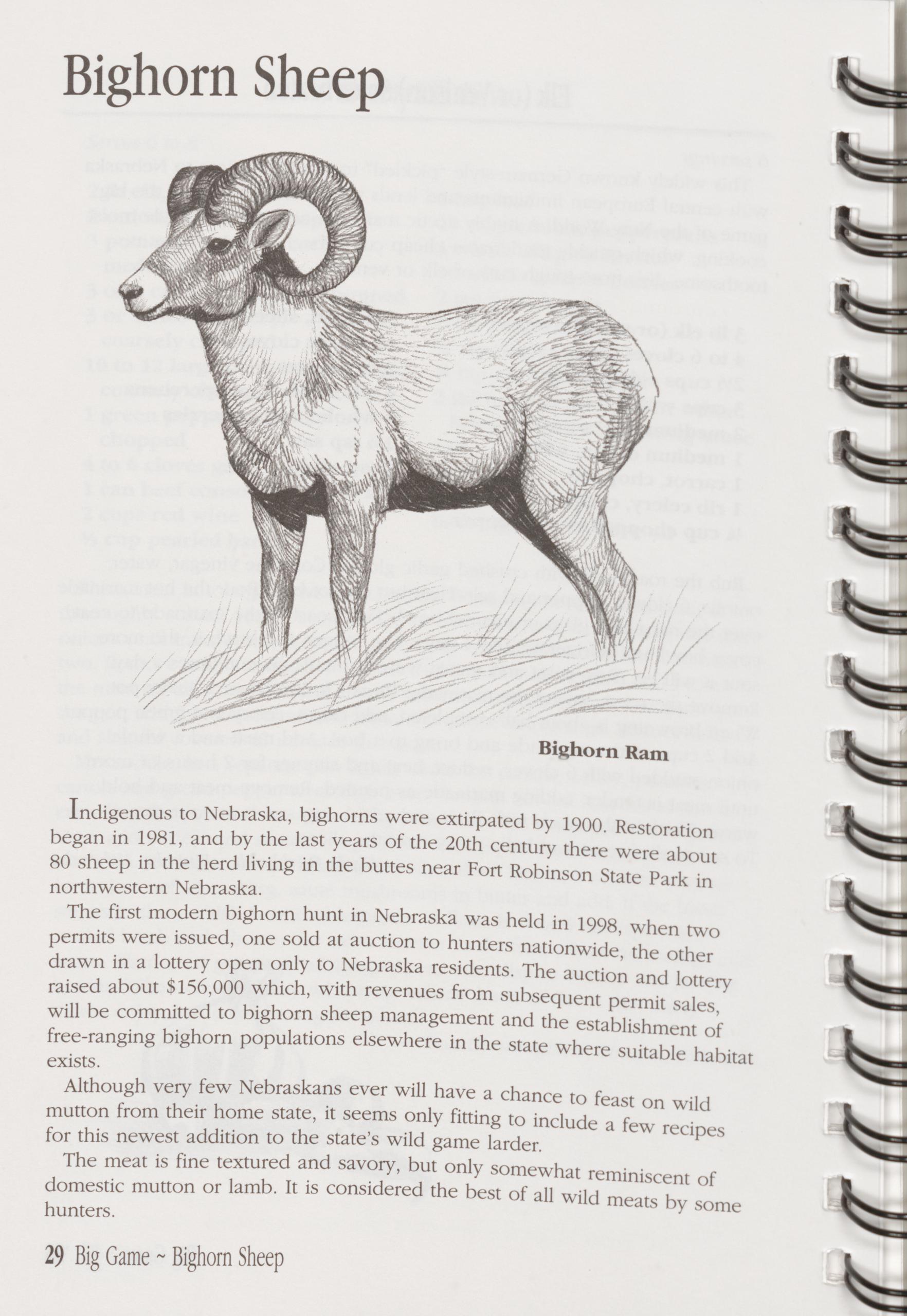 Bighorn Sheep
Indigenous to Nebraska, bighorns were extirpated by 1900. Restoration began in 1981, and by the last years of the 20th century there were about 80 sheep in the herd living in the buttes near Fort Robinson State Park in northwestern Nebraska.
The first modern bighorn hunt in Nebraska was held in 1998, when two permits were issued, one sold at auction to hunters nationwide, the other drawn in a lottery open only to Nebraska residents. The auction and lottery raised about $156,000 which, with revenues from subsequent permit sales, will be committed to bighorn sheep management and the establishment of free-ranging bighorn populations elsewhere in the state where suitable habitat exists.
Although very few Nebraskans ever will have a chance to feast on wild mutton from their home state, it seems only fitting to include a few recipes for this newest addition to the state’s wild game larder. The meat is fine textured and savory, but only somewhat reminiscent of domestic mutton or lamb. It is considered the best of all wild meats by some hunters.
29 Big Game ~ Bighorn Sheep Bighorn Roast with Rosemary and Wild Plum Sauce
5 to 7 lb boned bighorn
sheep roast
1 onion, chopped
bacon slices
m cups beef broth or
consomme
1 cup red wine
4 cloves garlic, sliced
1 tsp powdered rosemary or
IVi tsp dry rosemary leaves,
crumbled
V2 tsp thyme
1 tbl steak sauce or
Worcestershire sauce
1 tsp anchovy paste
*4 cup wild plum jelly
(substitute: chokecherry or
red currant)
flour
salt and pepper
Bighorn Roast with Rosemary and Wild Plum Sauce
5 to 7 lb boned bighorn
sheep roast
1 onion, chopped
bacon slices
m cups beef broth or
consomme
1 cup red wine
4 cloves garlic, sliced
1 tsp powdered rosemary or
IVi tsp dry rosemary leaves,
crumbled
V2 tsp thyme
1 tbl steak sauce or
Worcestershire sauce
1 tsp anchovy paste
*4 cup wild plum jelly
(substitute: chokecherry or
red currant)
flour
salt and pepper
Lard the roast with salt pork or bacon and garlic slices. If you do not have a larding needle, make a cut every square inch or two and insert garlic slices. Dust the surface with rosemary, black pepper and salt. If it is not larded, cover it with bacon slices held in place with wooden toothpicks. If it is larded, place one or two slices of bacon on top, holding them with toothpicks. Place on a rack in a roasting pan. Roast in a preheated 475-degree oven for 30 minutes. Meanwhile combine broth, wine, steak sauce, anchovy paste and thyme and mix well. Remove roast from oven and add broth mixture to the roasting pan. Reduce heat to 400 degrees and return roast to the oven for about an hour, basting several times. Total roasting time will be about 12 minutes per pound. Test frequently with a meat thermometer. Bighorn is rare at about 125 degrees.
Remove meat to a hot serving platter. Remove most of the fat from the roaster with a spoon or bulb baster. Thicken remaining liquid with flour whisked into a few tablespoons of water. Simmer until the sauce is at desired consistency, adding stock or water if it is too thick. Just before serving, stir in the jelly. Slice the roast and serve topped with sauce.
— Mike Adams, Fremont, Nebraska Big Game ~ Bighorn Sheep 30 Bighorn Sheep Stew
Serves 4 to 6
Bighorn Sheep Stew
Serves 4 to 6
This simple, unthickened stew of cubed meat and onions highlights the unique taste of “mountain mutton.” It is meant to be served on a bed of pasta rather than in a bowl.
1 1/2 lb bighorn sheep meat, cut into 1 inch cubes 1 large sweet onion (Vidalia or Walla Walla) cut in 1/8 inch slices 4 tbl butter olive oil 1 cup beer salt and pepper Parmesan or Asiago cheese for gratingIn a large, heavy skillet, melt butter mixed with a little oil over medium- high heat. Add onion, saute for about 30 seconds, then reduce heat and simmer for 40 minutes or until onion is well browned and caramelized, but not burned. Remove from pan and set aside.
Raise heat to high and add about 1 tablespoon oil to the skillet. Brown the meat on all sides for about 5 minutes. Reduce heat, add beer and simmer, covered, for about 30 minutes. Add cayenne, salt, black pepper and the cooked onions. Heat for about 10 minutes over medium heat. Ladle onto a bed of pasta (spaetzle or noodles) and sprinkle with grated Parmesan or Asiago cheese. Accompany with a bottle of red Zinfandel or merlot.
— David Farris, Portland, Oregon 31 Big Game ~ Bighorn Sheep Notes
Big Game ~ Notes 32
Notes
Big Game ~ Notes 32
 Notes
33 Big Game ~ Notes
Notes
33 Big Game ~ Notes
 Notes
Big Game ~ Notes 34
Notes
Big Game ~ Notes 34
 Game Birds
Upland game stalkers hunt for many reasons: the camaraderie, the thrill of the hunt, the frosty morning walks, the sunrises and sunsets, the dogs afield. But the final reward is the meal. Whether succulent, piquant grouse, tenderly braised quail or a moist, perfectly roasted turkey, game birds provide a main course that satisfies a hunter’s taste and affirms the effort.
Upland game can produce amazing culinary fare, but the meat can vary greatly from domestic counterparts. Experience and good cooking advice can bring out the best in the bird.
Because wild birds have less fat than domestic fowl, moist cooking is essential. Wild birds are more flavorful than domestic birds, and the best recipes compliment the natural taste rather than covering it up. How an upland bird should be cooked depends on its size, age, color of meat and whether it has been plucked or skinned.
Generally, larger birds — turkey, pheasant and grouse — can be roasted whole, split and grilled or cut up for frying and braising. Smaller birds such as quail, dove and woodcock often are baked in a moist casserole, marinated or wrapped for grilling
Older birds can be tough and often are cooked differently than younger birds. Mature birds usually are braised or stewed to keep them moist. If roasted, a marinade made with an acetic base such as wine or citrus will tenderize older birds. Avoid frying or broiling mature fowl. Tender, younger birds can be cooked in a variety of ways without marinating.
An age-old debate in hunting circles is whether to pluck or skin upland birds. Ultimately, it’s a personal choice. Plucking takes time, but retaining the skin allows the fat layer beneath it to self baste the bird, keeping the meat moist during cooking. Skinned birds should be basted frequently, barded with bacon or cooked with moist heat.
The breast meat of most upland game birds is lighter than leg and thigh meat, but dove, woodcock and grouse have dark meat throughout. Birds with mostly white meat usually are cooked longer than birds with dark meat, which are commonly served rare.
Many cooks cut up and portion larger birds so they can separate, label and package light and dark meat.
— Michael Forsberg Game Birds 35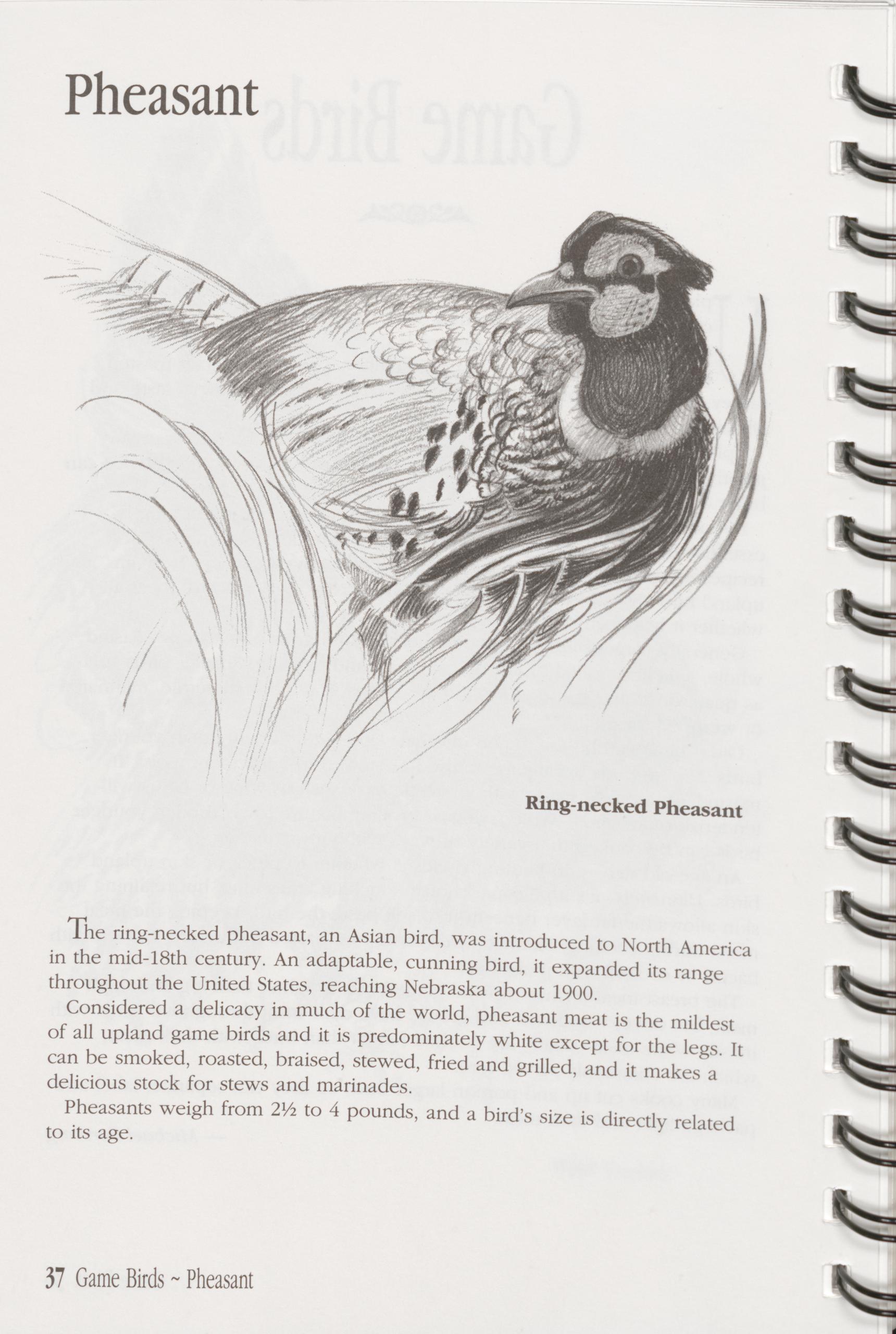 Pheasant
Ring-necked Pheasant
Pheasant
Ring-necked Pheasant
The ring-necked pheasant, an Asian bird, was introduced to North America in the mid-18th century. An adaptable, cunning bird, it expanded its range throughout the United States, reaching Nebraska about 1900.
Considered a delicacy in much of the world, pheasant meat is the mildest of all upland game birds and it is predominately white except for the legs. It can be smoked, roasted, braised, stewed, fried and grilled, and it makes a delicious stock for stews and marinades.
Pheasants weigh from 2 1/2 to 4 pounds, and a bird’s size is directly related to its age.
37 Game Birds ~ Pheasant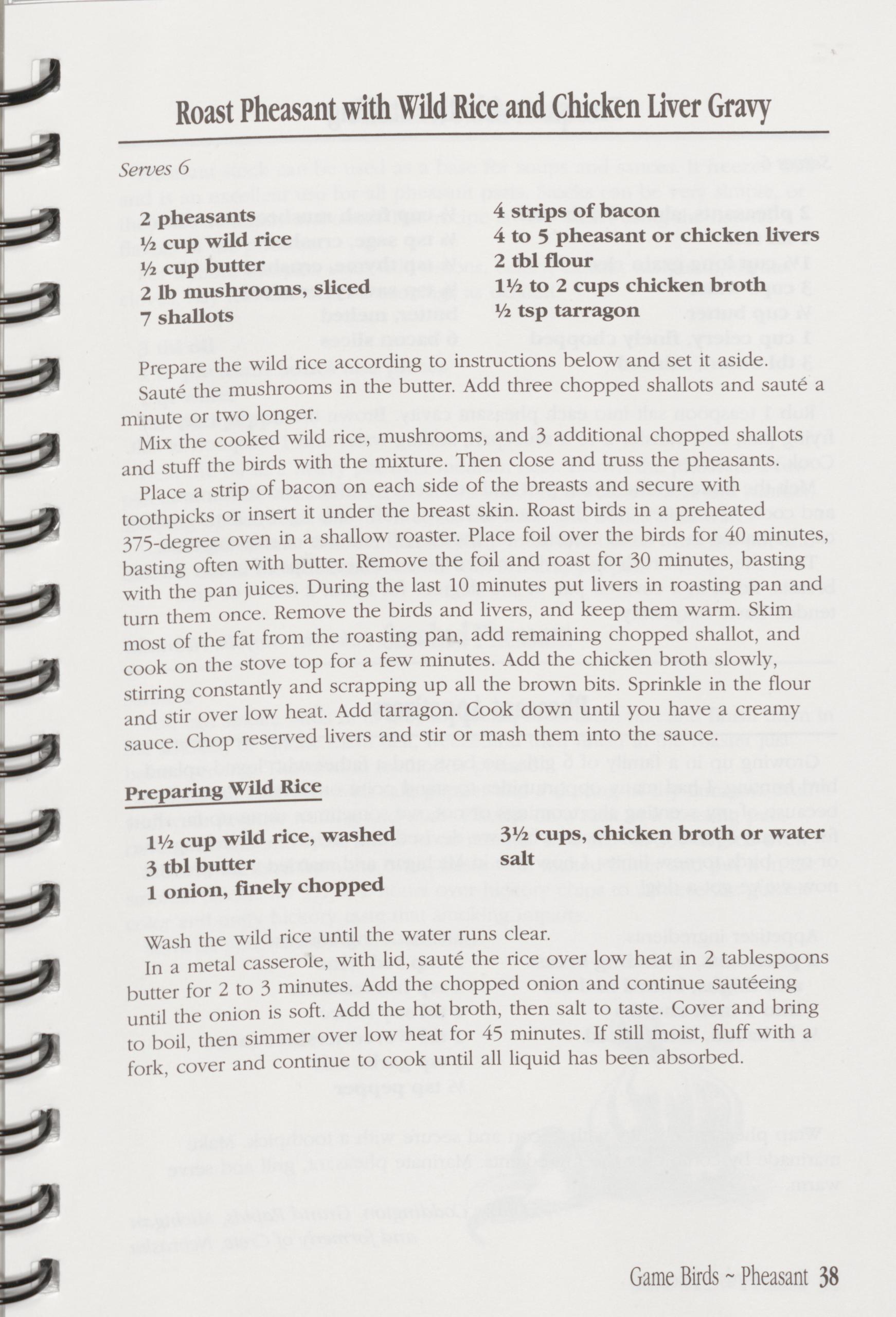 Roast Pheasant with Wild Rice and Chicken Liver Gravy
Serves 6
2 pheasants
1/2 cup wild rice
1/2 cup butter
2 lb mushrooms, sliced
7 shallots
4 strips of bacon
4 to 5 pheasant or chicken livers
2 tbl flour
1 1/2 to 2 cups chicken broth
1/2 tsp tarragon
Roast Pheasant with Wild Rice and Chicken Liver Gravy
Serves 6
2 pheasants
1/2 cup wild rice
1/2 cup butter
2 lb mushrooms, sliced
7 shallots
4 strips of bacon
4 to 5 pheasant or chicken livers
2 tbl flour
1 1/2 to 2 cups chicken broth
1/2 tsp tarragon
Prepare the wild rice according to instructions below and set it aside. Saute the mushrooms in the butter. Add three chopped shallots and saute a minute or two longer.
Mix the cooked wild rice, mushrooms, and 3 additional chopped shallots and stuff the birds with the mixture. Then close and truss the pheasants. Place a strip of bacon on each side of the breasts and secure with toothpicks or insert it under the breast skin. Roast birds in a preheated 375-degree oven in a shallow roaster. Place foil over the birds for 40 minutes, basting often with butter. Remove the foil and roast for 30 minutes, basting with the pan juices. During the last 10 minutes put livers in roasting pan and turn them once. Remove the birds and livers, and keep them warm. Skim most of the fat from the roasting pan, add remaining chopped shallot, and cook on the stove top for a few minutes. Add the chicken broth slowly, stirring constantly and scrapping up all the brown bits. Sprinkle in the flour and stir over low heat. Add tarragon. Cook down until you have a creamy sauce. Chop reserved livers and stir or mash them into the sauce.
Preparing Wild Rice 1 1/2 cup wild rice, washed 3 tbl butter 1 onion, finely chopped 3 1/2 cups, chicken broth or water saltWash the wild rice until the water runs clear.
In a metal casserole, with lid, saute the rice over low heat in 2 tablespoons butter for 2 to 3 minutes. Add the chopped onion and continue sauteeing until the onion is soft. Add the hot broth, then salt to taste. Cover and bring to boil, then simmer over low heat for 45 minutes. If still moist, fluff with a fork, cover and continue to cook until all liquid has been absorbed.
Game Birds ~ Pheasant 38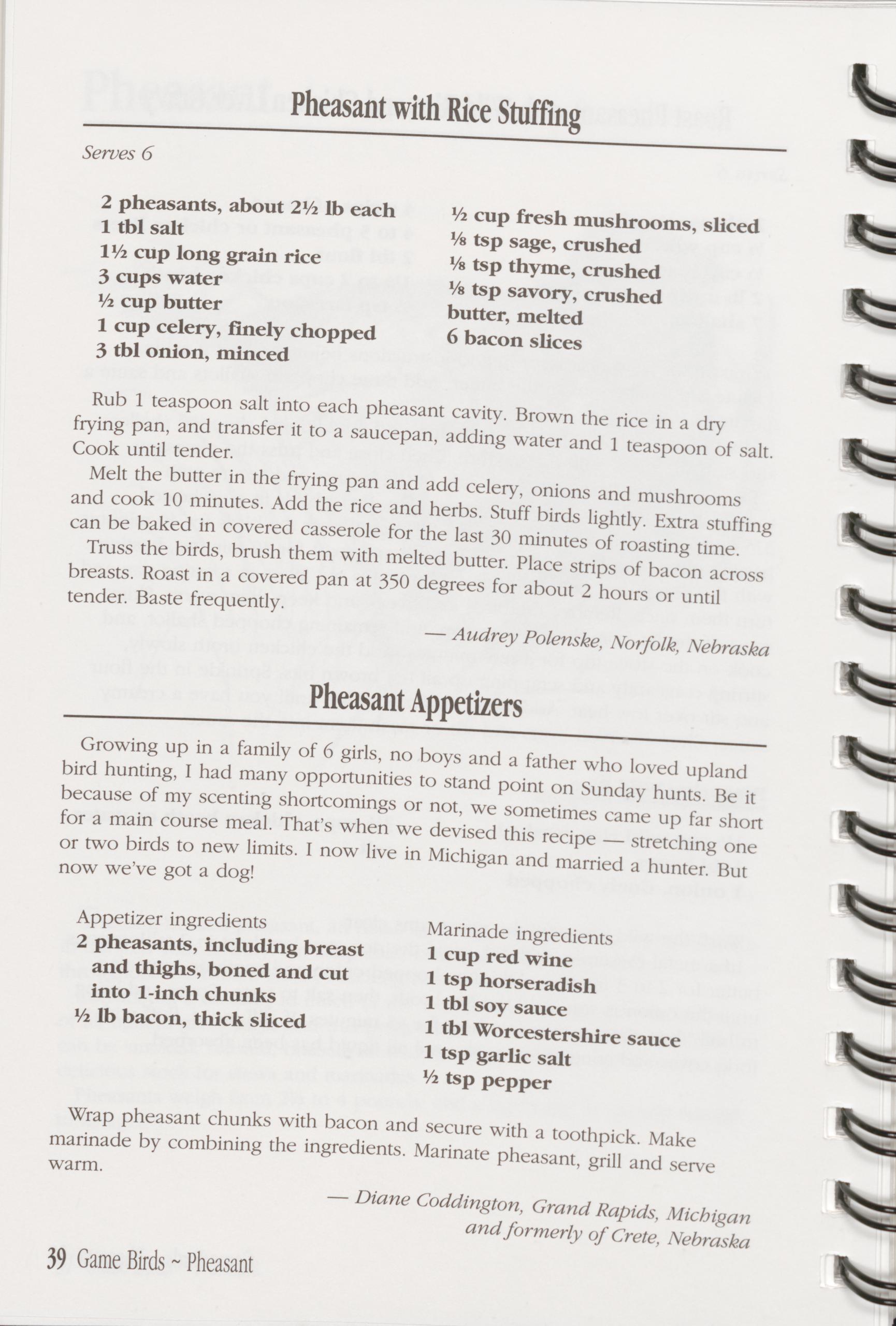 Pheasant with Rice Stuffing
Serves 6
2 pheasants, about 21h lb each
1 tbl salt
1 1/2 cup long grain rice
3 cups water
1/2 cup butter
1 cup celery, finely chopped
3 tbl onion, minced
1/2 cup fresh mushrooms, sliced
1/8 tsp sage, crushed
1/8 tsp thyme, crushed
1/8 tsp savory, crushed
butter, melted
6 bacon slices
Pheasant with Rice Stuffing
Serves 6
2 pheasants, about 21h lb each
1 tbl salt
1 1/2 cup long grain rice
3 cups water
1/2 cup butter
1 cup celery, finely chopped
3 tbl onion, minced
1/2 cup fresh mushrooms, sliced
1/8 tsp sage, crushed
1/8 tsp thyme, crushed
1/8 tsp savory, crushed
butter, melted
6 bacon slices
Rub 1 teaspoon salt into each pheasant cavity. Brown the rice in a dry frying pan, and transfer it to a saucepan, adding water and 1 teaspoon of salt. Cook until tender.
Melt the butter in the frying pan and add celery, onions and mushrooms and cook 10 minutes. Add the rice and herbs. Stuff birds lightly. Extra stuffing can be baked in covered casserole for the last 30 minutes of roasting time. Truss the birds, brush them with melted butter. Place strips of bacon across breasts. Roast in a covered pan at 350 degrees for about 2 hours or until tender. Baste frequently.
— Audrey Polenske, Norfolk, Nebraska Pheasant Appetizers Growing up in a family of 6 girls, no boys and a father who loved upland bird hunting, I had many opportunities to stand point on Sunday hunts. Be it because of my scenting shortcomings or not, we sometimes came up far short for a main course meal. That’s when we devised this recipe — stretching one or two birds to new limits. I now live in Michigan and married a hunter. But now we’ve got a dog! Appetizer ingredients 2 pheasants, including breast and thighs, boned and cut into 1 inch chunks 1/2 lb bacon, thick sliced Marinade ingredients 1 cup red wine I tsp horseradish 1 tbl soy sauce 1 tbl Worcestershire sauce 1 tsp garlic salt 1/2 tsp pepperWrap pheasant chunks with bacon and secure with a toothpick. Make marinade by combining the ingredients. Marinate pheasant, grill and serve warm.
— Diane Coddington, Grand Rapids, Michigan and formerly of Crete, Nebraska 39 Game Birds ~ Pheasant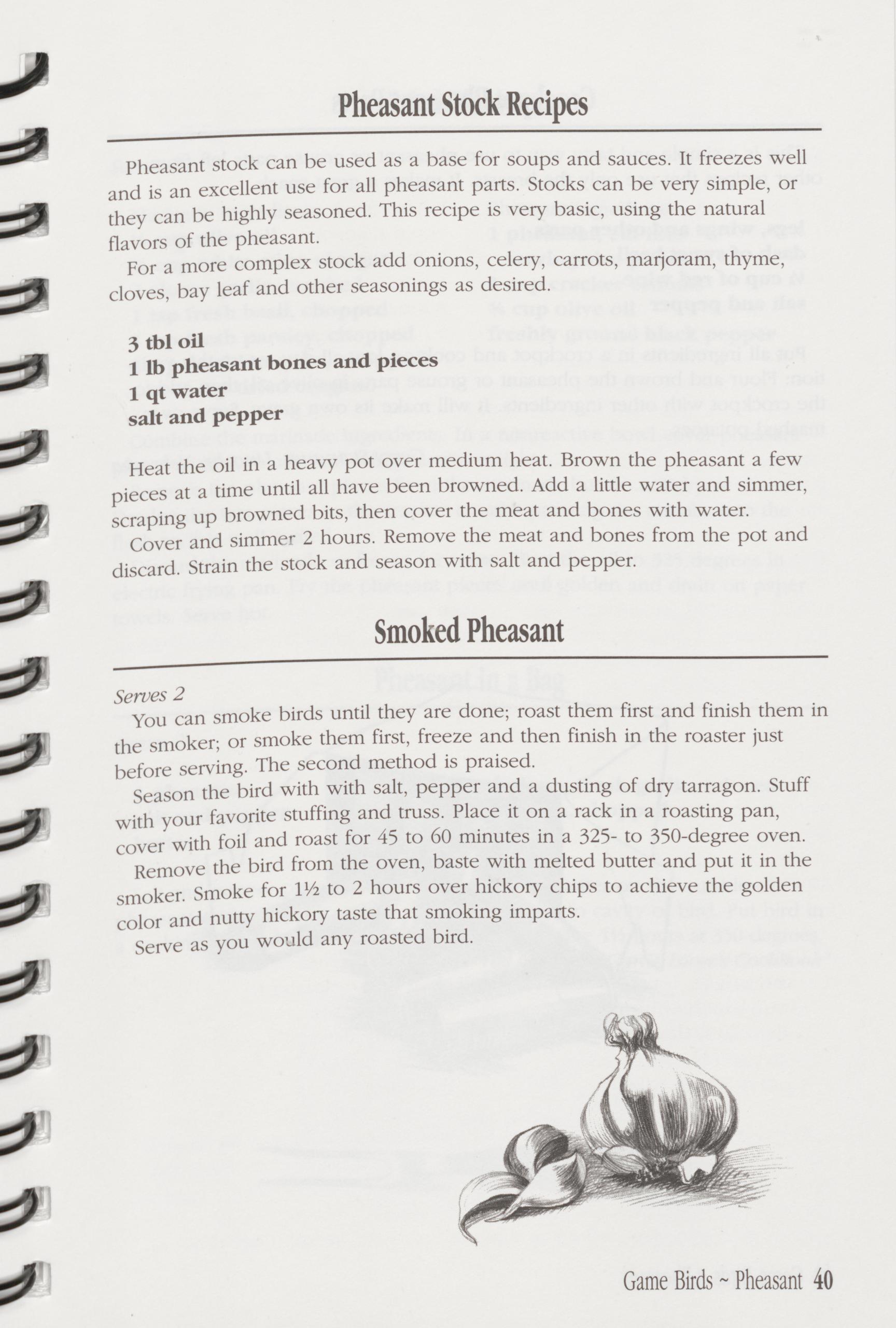 Pheasant Stock Recipes
Pheasant stock can be used as a base for soups and sauces. It freezes well and is an excellent use for all pheasant parts. Stocks can be very simple, or they can be highly seasoned. This recipe is very basic, using the natural flavors of the pheasant.
For a more complex stock add onions, celery, carrots, marjoram, thyme, cloves, bay leaf and other seasonings as desired.
3 tbl oil 1 lb pheasant bones and pieces 1 qt water salt and pepper Heat the oil in a heavy pot over medium heat. Brown the pheasant a few pieces at a time until all have been browned. Add a little water and simmer, scraping up browned bits, then cover the meat and bones with water.Cover and simmer 2 hours. Remove the meat and bones from the pot and discard. Strain the stock and season with salt and pepper.
Smoked Pheasant Serves 2You can smoke birds until they are done; roast them first and finish them in the smoker; or smoke them first, freeze and then finish in the roaster just before serving. The second method is praised.
Season the bird with with salt, pepper and a dusting of dry tarragon. Stuff with your favorite stuffing and truss. Place it on a rack in a roasting pan, cover with foil and roast for 45 to 60 minutes in a 325- to 350-degree oven. Remove the bird from the oven, baste with melted butter and put it in the smoker. Smoke for IVi to 2 hours over hickory chips to achieve the golden color and nutty hickory taste that smoking imparts.
Serve as you would any roasted bird.
Game Birds ~ Pheasant 40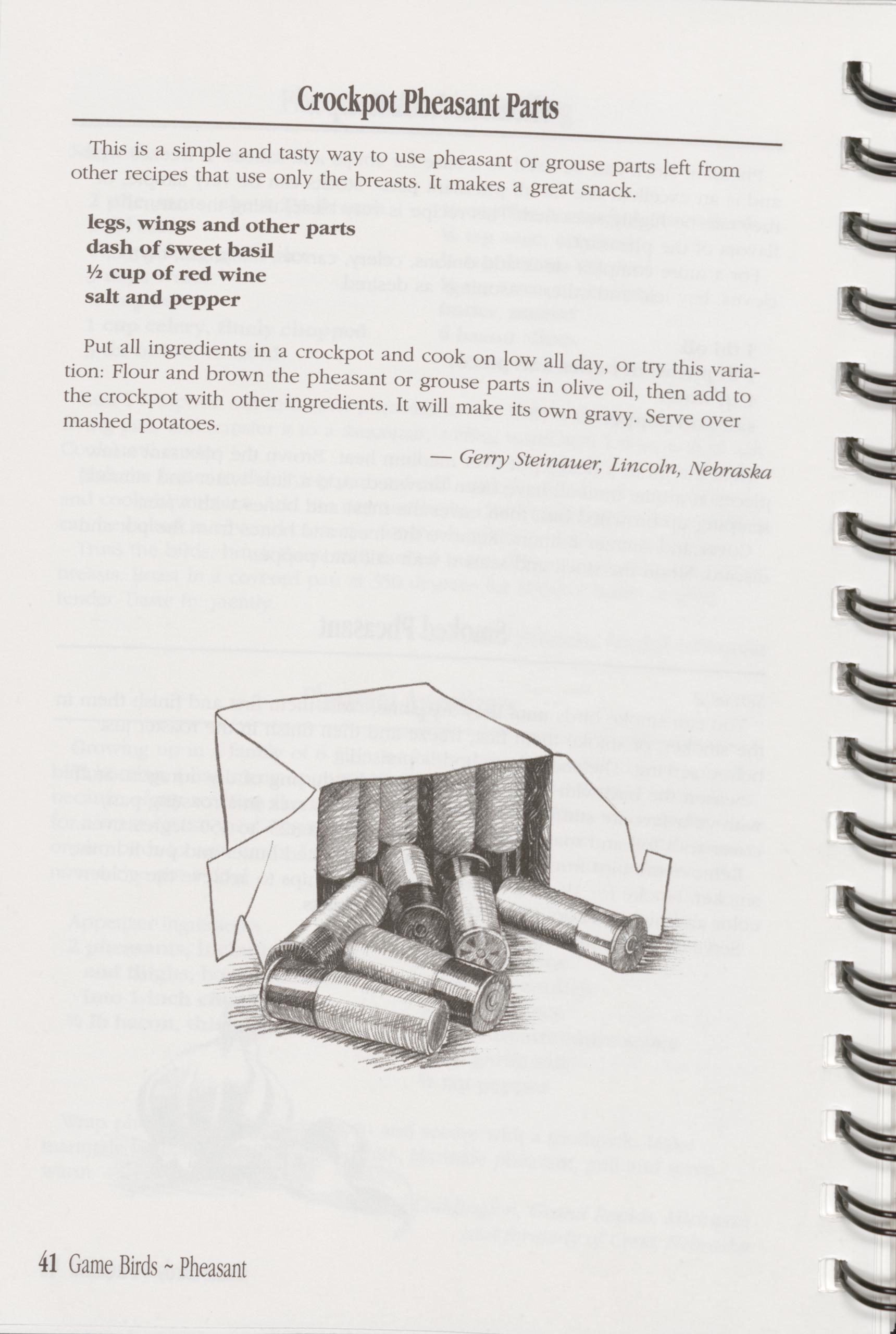 Crockpot Pheasant Parts
This is a simple and tasty way to use pheasant or grouse parts left from other recipes that use only the breasts. It makes a great snack.
legs, wings and other parts dash of sweet basil Vi cup of red wine salt and pepperPut all ingredients in a crockpot and cook on low all day, or try this varia- tion: Flour and brown the pheasant or grouse parts in olive oil, then add to the crockpot with other ingredients. It will make its own gravy. Serve over mashed potatoes.
— Gerry Steinauer, Lincoln, Nebraska 41 Game Birds ~ Pheasant Fried Pheasant
Serves 2
Marinade ingredients
1/2 cup olive oil
% cup white wine vinegar
2 cloves garlic, crushed
1 tsp fresh basil, chopped
1 tsp fresh parsley, chopped
1 tsp fresh oregano, chopped,
or ¥2 tsp dried oregano
Pheasant ingredients
1 pheasant, cut into
serving-size pieces
1 cup cracker crumbs
cup olive oil
freshly ground black pepper
Fried Pheasant
Serves 2
Marinade ingredients
1/2 cup olive oil
% cup white wine vinegar
2 cloves garlic, crushed
1 tsp fresh basil, chopped
1 tsp fresh parsley, chopped
1 tsp fresh oregano, chopped,
or ¥2 tsp dried oregano
Pheasant ingredients
1 pheasant, cut into
serving-size pieces
1 cup cracker crumbs
cup olive oil
freshly ground black pepper
Combine the marinade ingredients. In a nonreactive bowl cover pheasant pieces with marinade and refrigerate overnight.
Remove the pheasant pieces from the marinade but do not dry or drain.
Dredge the wet pieces in the cracker crumbs pressing the crumbs into the flesh so it is well coated.
Discard the marinade or freeze for reuse. Heat the oil to 325 degrees in electric frying pan. Fry the pheasant pieces until golden and drain on paper towels. Serve hot.
Pheasant in a Bag Serves 2 1 pheasant salt and pepper butter 4 cloves fresh garlic, minced 1 onion, choppedSalt and pepper pheasant inside and out. Rub butter on the outside of pheasant and add garlic, onion and a little butter to cavity of bird. Put bird in a cooking bag and seal. Set on cookie sheet and bake 1 1/2 hours at 350 degrees.
— “The Complete Garlic Lover's Cookbook” Game Birds ~ Pheasant 42 Lemon Pheasant
Serves 4
4 pheasant breasts, boned
and skinned
8 eggs
cup Parmesan cheese
l/z cup clarified butter
(see note below)
1 cup flour, seasoned with salt
and pepper
2 cup fresh bread crumbs
1 tbl fresh lemon juice
2 tsp lemon pepper seasoning
Lemon Pheasant
Serves 4
4 pheasant breasts, boned
and skinned
8 eggs
cup Parmesan cheese
l/z cup clarified butter
(see note below)
1 cup flour, seasoned with salt
and pepper
2 cup fresh bread crumbs
1 tbl fresh lemon juice
2 tsp lemon pepper seasoning
Slice each breast into 6 strips about the size of a forefinger. Set aside. Combine the eggs and Parmesan cheese, and beat to a smooth consistency.
Dredge the pheasant fingers in flour, dip into the egg batter and roll in bread crumbs. Heat the butter in a large saute pan. Saute fingers until golden brown. Splash with lemon juice and sprinkle with lemon pepper. Reduce heat and cook for 3 minutes, turning fingers to brown evenly.
How to Clarify ButterMelt butter in a saucepan over low heat and remove foam as it rises to the top. Remove from heat, and let stand until all milk solids have settled. With a ladle, remove clear oil and refrigerate. One pound of butter yields about 1% cups clarified butter.
— Adapted from “Wild Game Cooking Made Easy” Simmered Pheasant Serves 4 This dish, with its tangy sauce, is a tougher birds. 1 pheasant 1 tbl olive oil 1 tbl butter 2/3 cup stock or broth 2 onions, sliced 1/2 lb carrots, sliced 4 potatoes, quartered good method for making use of older, 2 medium bay leaves 1 tsp powdered thyme 2 slices bacon, cut in small pieces 4 to 6 tsp flour 1/2 cup red wineIn a Dutch oven, brown pheasant on all sides in olive oil and butter. Add the broth, vegetables and spices, and cover the bird with bacon. Bring the broth to a boil and reduce heat. Simmer, covered, for about 1 hour. Remove the bird and vegetables, set aside and keep warm.
Mix 2 or 3 tablespoons flour in wine and stir until smooth. Add wine
43 Game Birds ~ Pheasant
mixture to the juices in the Dutch oven and scrap up the browned bits from the bottom. Simmer, stirring continuously until the sauce thickens. Serve the pheasant quartered with a bit of bacon over each piece and the vegetables and sauce over all.
Wine Country Pheasant Serves 4 1 large pheasant 1 oz olive oil 1 large onion, julienned 3 garlic cloves, minced 2 tomatoes, diced 6 oz white wine 4 oz chicken stock 2 oz tomato paste 1 tbl parsley, chopped or dry salt and pepperCut pheasant into 8 pieces, sprinkle with salt and pepper. Heat a large saute pan until very hot, add olive oil and pheasant and brown on both sides. Place pheasant in a small roasting pan, add onions and garlic and cook until onions are transparent. Add all remaining ingredients and cover with foil. Bake at 350 degrees for 1 to 2 hours or until pheasant is tender (check the legs). Place on a platter and pour sauce over it.
— Chef Edward Zita, Chinese American Service League, Chicago, Illinois Game Birds ~ Pheasant 44 Pheasant Mulligan with Dumplings
Mulligan ingredients
2 young pheasants
2 cups carrots, diced
1 cup onion, diced
1 cup cabbage, finely shredded
2 cups potatoes, diced in large
chunks
2 tbl margarine
salt and pepper
Dumpling ingredients
2 cups flour, sifted
3 tsp baking powder
1/2 tsp salt
1 egg
3/4 cup milk
Pheasant Mulligan with Dumplings
Mulligan ingredients
2 young pheasants
2 cups carrots, diced
1 cup onion, diced
1 cup cabbage, finely shredded
2 cups potatoes, diced in large
chunks
2 tbl margarine
salt and pepper
Dumpling ingredients
2 cups flour, sifted
3 tsp baking powder
1/2 tsp salt
1 egg
3/4 cup milk
Cut the pheasants into serving pieces, put them in a kettle and cover with water. Add the carrots, onions and cabbage and cook slowly until almost tender. Add potatoes, margarine, salt and pepper. Cook until meat and vegetables are tender.
To make the dumplings, sift the flour, baking powder and salt together. Beat the eggs, add milk and stir into dry ingredients, adding more milk if necessary to form a batter. Drop tablespoons of batter into kettle with meat and vegetables. Cover tightly. Cook for 15 minutes or until dumplings are done.
If there is too much liquid, spoon some off about 5 minutes before dumplings are ready.
— Betty Scheer, Arlington, Nebraska Pheasant Creole 3 or 4 pheasants or 12 to 15 quail ¥z cup butter 4 tbl hot sherry 1 clove garlic ¥2 cup onion, chopped 4 or 5 tomatoes, skinned and chopped 1 tbl tomato paste 1 tsp pepper 1 tsp salt 1 ¥2 cup chicken stock or broth from parboiling 1 bay leaf % cup sour cream ¥2 cup sharp cheddar cheese, grated flourParboil the pheasants, bone, cut meat into small pieces and set aside. Saute the garlic, onions and tomatoes for 3 minutes in melted butter. Stir in the tomato paste, add the chicken stock and bring to a boil. Reduce heat, add 2 tablespoons of sherry, salt and pepper to taste. Add flour to desired thickness. Pour into casserole over pheasants. Cook for 1 1/2 hours at 275 or 3OO degrees.
45 Game Birds ~ Pheasant
Add the sour cream and cheese and stir until smooth. Heat for 15 minutes, then add the remaining 2 tablespoons of sherry. Serve over rice.
— Henry Cech, Lincoln, Nebraska Rolled Pheasant Breasts in Mushroom Wine Sauce Serves 4This is a beautiful and elegant entree.
5 whole pheasant breasts, boned 3 tbl butter 1/2 cup onions, chopped 1/4 cup green onions including tops, chopped 1 cup mushrooms, sliced 1/4 tsp cayenne pepper 1/2 cup dry vermouth 1/2 cup chicken or pheasant stock 2 tbl cornstarch 1/4 cup waterIn a heavy skillet, melt the butter. Saute the onions and mushrooms until lightly browned. Sprinkle with cayenne, then remove the onions and mushrooms with a slotted spoon and allow to cool. Halve the pheasant breasts and pound lightly to flatten.
Spread the breasts with the mushroom mixture, then roll up and fasten with string or poultry pins. In a skillet brown the breasts on both sides, adding butter if necessary. Pour the vermouth and stock into the pan, cover, and simmer for Z0 to 35 minutes, or until breasts are tender. Add water if the pan becomes dry. Remove breasts to a platter. Add the cornstarch to the water and stir until blended. Pour into the pan and scrape up any browned particles. Stir over medium heat until a smooth sauce forms. Return the breasts to the pan, reheat and serve.
— Adapted from “Wild Game Cookery” Smothered Rosemary Pheasant 1 pheasant flour 2 tbl ofl 1 can cream of celery soup mixed with 1 ¥2 cans milk 2 tsp dried rosemary 1 tsp paprika salt and pepper 2 medium onions 2 or 3 tbl sherryCut the pheasant into pieces. Combine the flour, paprika, salt and pepper. Coat the pheasant in flour mixture and brown in oil in a frying pan or skillet.
Place the browned pheasant in a baking dish and cover with sliced onions. Blend soup, milk, rosemary and sherry. Pour over the pheasant and onions. Cover the baking dish and cook at 325 degrees for P/2 hours or until done.
— Dallas Austin, Meadow Grove, Nebraska Game Birds ~ Pheasant 46 Pheasant Braised in Wine (Coq Au Vin)
Serves 2
Pheasant Braised in Wine (Coq Au Vin)
Serves 2
A young-of-the-year bird is best for this recipe. Traditionally the blood of the bird is added to the gravy as a thickener. The dark brown color produced by the blood is often imitated by the addition of caramel coloring.
1 whole pheasant, cut in serving pieces 3 tbl butter or olive oil 1/4 lb minced bacon or salt pork cup onions, chopped 1 carrot, sliced 3 shallots, minced 1 clove garlic, peeled 2 tbl flour 2 tbl parsley, minced 1 tbl marjoram 1 bay leaf 1/2 tsp thyme 1 tsp salt 1/4 tsp black pepper 1 tbl brandy 1 1/2 cups red wineIn a large, heavy pot, lightly brown onions, carrot, shallots and the whole peeled garlic clove. Set vegetables aside, and in the same pot, adding oil if necessary, brown the pheasant pieces. Add flour, parsley, marjoram, bay leaf, thyme, salt, pepper, brandy and the browned vegetables. Stir until thick and smooth.
Add wine and bring to a boil. Reduce heat, add pheasant pieces and simmer about 1 hour, covered. For the last 5 minutes of cooking, add ¥2 lb sliced mushrooms. Skim excess fat, and serve the pheasant on a hot platter with the sauce and vegetables poured over it.
Wild Game StuffingThis recipe goes well with any wild game.
1/4 cup butter 1/4 cup onion, chopped 1 cup tart apple, chopped 1 cup dried apricots, chopped 3 cups bread crumbs 1/2 tsp salt 1/4 tsp pepperMelt the butter in heavy skillet or saucepan. Saute the onion until soft and clear, then mix in apple, apricots, crumbs, salt and pepper. Spoon into cavity of bird and bake.
— Audrey Polenske, Norfolk, Nebraska 47 Game Birds ~ Pheasant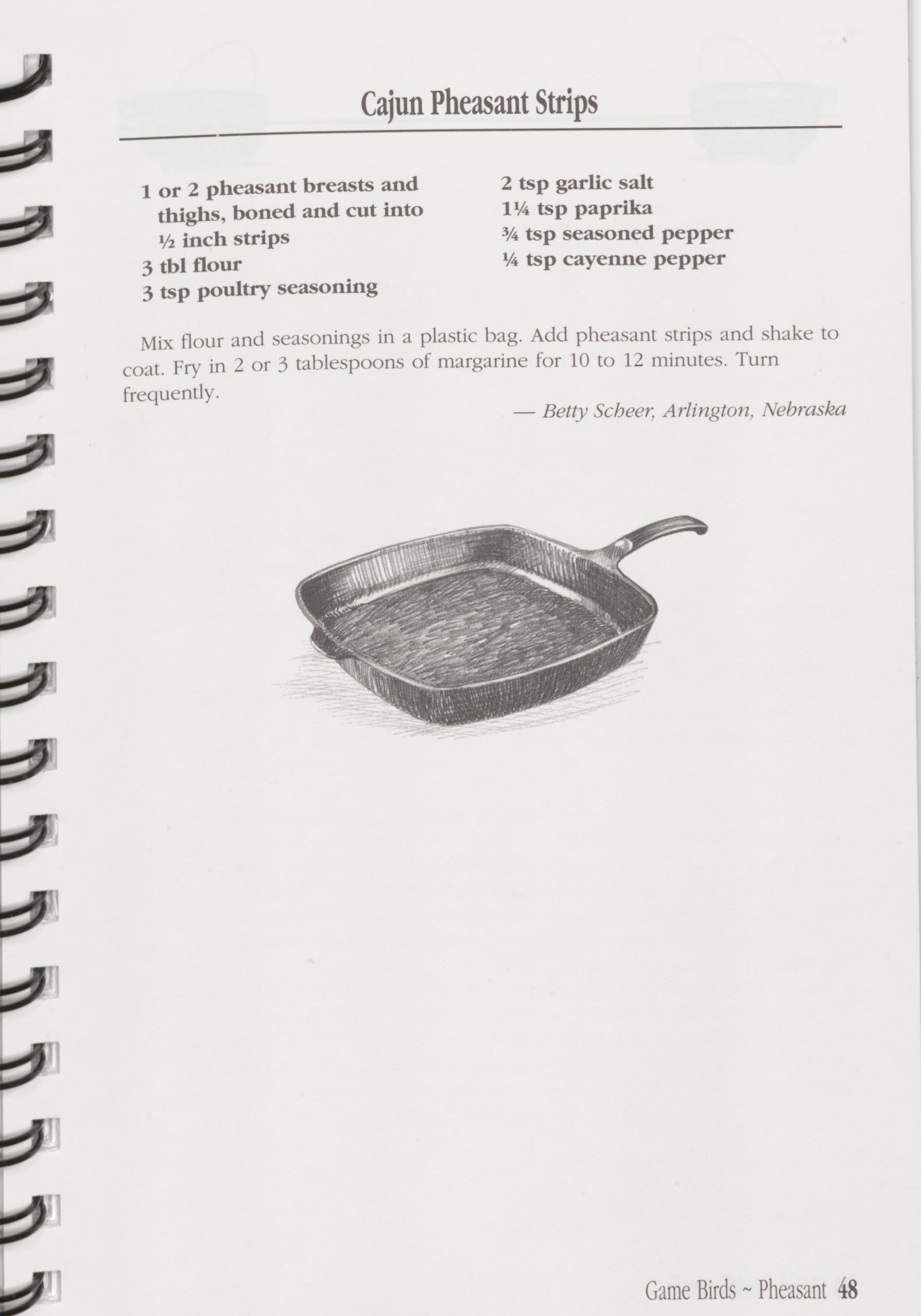 Cajun Pheasant Strips
1 or 2 pheasant breasts and
thighs, boned and cut into
1/2 inch strips
3 tbl flour
3 tsp poultry seasoning
2 tsp garlic salt
1 1/4 tsp paprika
tsp seasoned pepper
Mt tsp cayenne pepper
Cajun Pheasant Strips
1 or 2 pheasant breasts and
thighs, boned and cut into
1/2 inch strips
3 tbl flour
3 tsp poultry seasoning
2 tsp garlic salt
1 1/4 tsp paprika
tsp seasoned pepper
Mt tsp cayenne pepper
Mix flour and seasonings in a plastic bag. Add pheasant strips and shake to coat. Fry in 2 or 3 tablespoons of margarine for 10 to 12 minutes. Turn frequently.
— Betty Scheer, Arlington, Nebraska Game Birds ~ Pheasant 48 Notes
49 Game Birds ~ Notes
Notes
49 Game Birds ~ Notes
 Notes
Game Birds ~ Notes 50
Notes
Game Birds ~ Notes 50
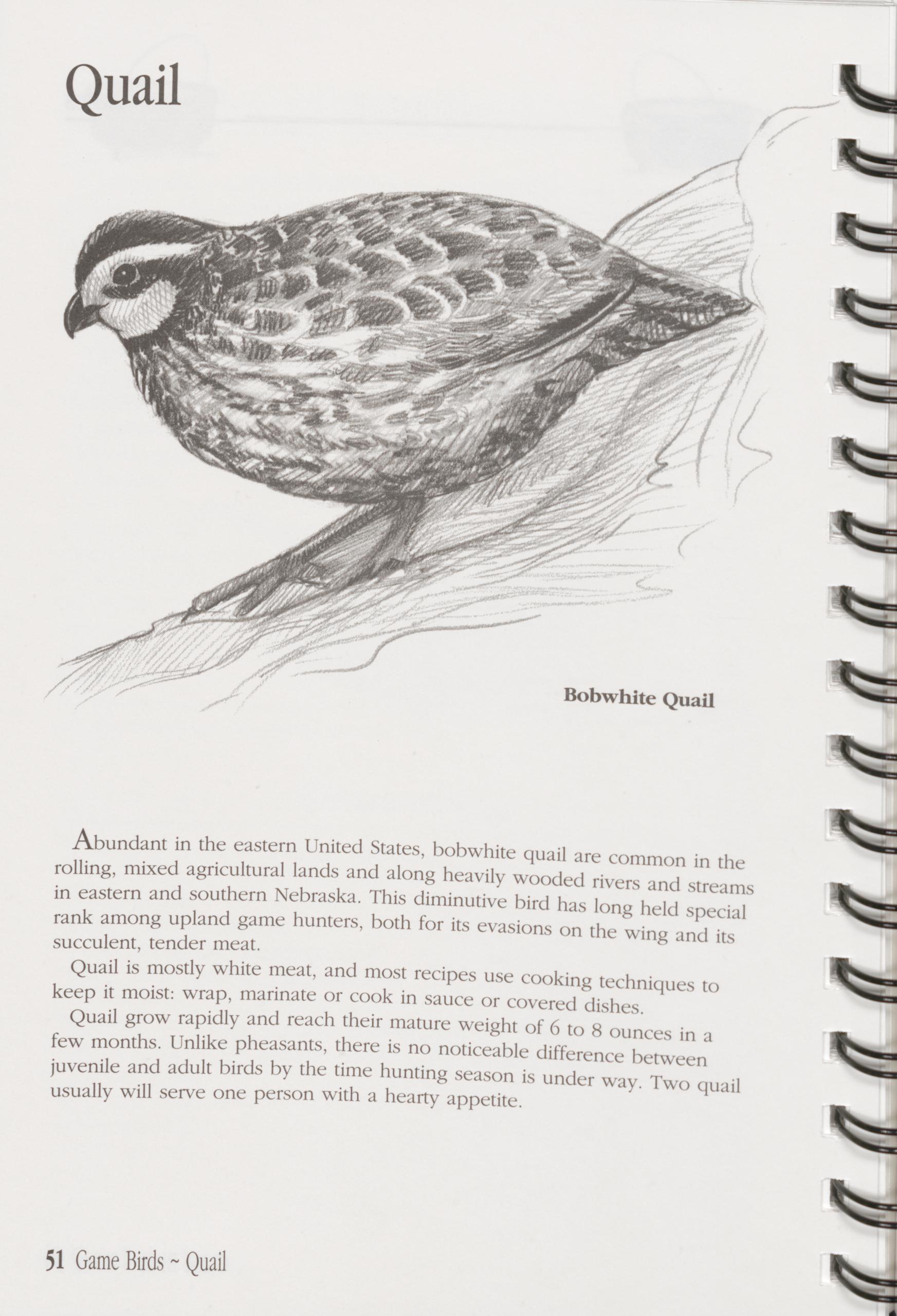 Quail
Quail
Abundant in the eastern United States, bobwhite quail are common in the rolling, mixed agricultural lands and along heavily wooded rivers and streams in eastern and southern Nebraska. This diminutive bird has long held special rank among upland game hunters, both for its evasions on the wing and its succulent, tender meat.
Quail is mostly white meat, and most recipes use cooking techniques to keep it moist: wrap, marinate or cook in sauce or covered dishes.
Quail grow rapidly and reach their mature weight of 6 to 8 ounces in a few months. Unlike pheasants, there is no noticeable difference between juvenile and adult birds by the time hunting season is under way. Two quail usually will serve one person with a hearty appetite.
51 Game Birds ~ Quail Baked Quail
Serves 4
4 quail, dressed
salt and pepper
4 giblets, ground
1 onion, chopped
1 egg, beaten
Tabasco sauce
1/2 tsp ground sage
8 slices dry bread, cubed
and moistened
1 cup cream
butter
Baked Quail
Serves 4
4 quail, dressed
salt and pepper
4 giblets, ground
1 onion, chopped
1 egg, beaten
Tabasco sauce
1/2 tsp ground sage
8 slices dry bread, cubed
and moistened
1 cup cream
butter
Place each quail on its back on a square of foil. Season with salt and pepper. Mix the remaining ingredients except the cream and butter. Fill quail with the dressing mixture. Pour V* cup cream over the dressing in each bird. Wrap each quail in foil. Bake at 325 degrees for P/2 hours. Remove from the oven and brush birds with butter, then broil for 3 or 4 minutes
— Audrey Polenske, Norfolk, Nebraska Oven-Fried Quail 12 quail 2 tsp salt 1 1/2 cup sauterne 1 tsp pepper 4 eggs 3 cloves fresh garlic, minced 1/2 cup milk ¥3 cup butter or margarine 1 1/2 cup fine dry bread crumbsTie legs of quail together; marinate in sauterne overnight. Drain and dry thoroughly. Combine eggs and milk. Dip quail in this mixture and then into bread crumbs that have been mixed with salt, pepper and garlic. Saute quail in butter until golden brown on all sides. Arrange quail in a large, shallow baking dish or roasting pan. Cover and cook 20 minutes in a 400-degree oven or until quail are fork tender.
— “The Complete Garlic Lover’s Cookbook” Game Birds ~ Quail 52 Greek-Style Grilled Quail
This is a simple Greek-style recipe appropriate for many game birds. The technique is easily adapted to a backyard barbecue grill.
3 quail per person 2 tbl olive oil 1/2 tsp coarse salt pepper, freshly ground 1 or 2 cloves garlic, mashed 1/2 tsp thyme (optional)Make a paste of olive oil, garlic, thyme, salt and pepper. Coat the quail with the mixture and place any that that remains inside the birds. Grill the birds about 5 minutes on each side.
Roasted Quail with Fennel Serves 2 or 3The pungent, licorice-flavored fennel seeds are an excellent complement to any of the smaller game birds such as doves, quail, woodcock or snipe.
8 quail or 6 to 8 doves 3 to 4 tbl olive oil 4 cloves garlic 1 tbl coarse salt or 2 tsp table salt 2 tbl chopped fresh tarragon or about P/2 tsp dried tarragon pepper, freshly ground juice of 2 limes 3 tbl soft butter 2 tsp fennel seeds 1/2 cup dry white wine 1/2 cup game bird or chicken broth ¥2 lb mushrooms, quarteredDress the birds and split lengthwise along the back so they will lie flat. Rub both sides with olive oil. Make a paste of garlic cloves and salt. Rub the mixture over the birds and sprinkle them with tarragon and pepper. Place the birds in a large baking dish. Pour the lime juice over the birds and marinate overnight in the refrigerator. Remove from marinade, pat dry and rub soft butter over the birds. Sprinkle fennel seeds on top, pour the wine and broth around the birds and roast skin-side up in a pre-heated 450-degree oven for 15 minutes. Scatter the mushrooms on the birds and baste with pan juices. Roast for another 10 minutes. Baste again, adding more broth if needed. Serve immediately.
53 Game Birds ~ Quail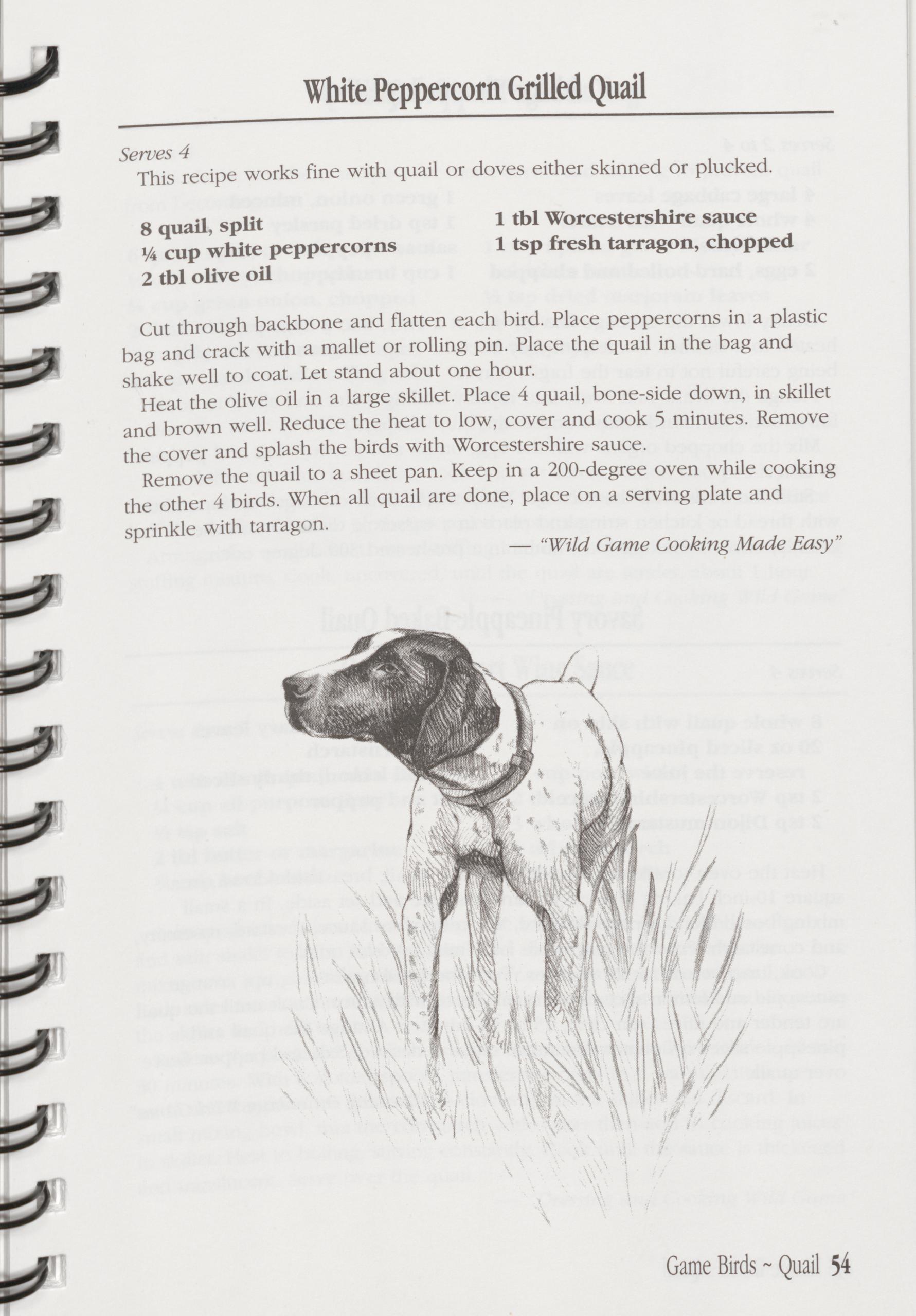 White Peppercorn Grilled Quail
Serves 4
White Peppercorn Grilled Quail
Serves 4
This recipe works fine with quail or doves either skinned or plucked.
8 quail, split 1 tbl Worcestershire sauce 1/4 cup white peppercorns 1 tsp fresh tarragon, chopped 2 tbl olive oilCut through backbone and flatten each bird. Place peppercorns in a plastic bag and crack with a mallet or rolling pin. Place the quail in the bag and shake well to coat. Let stand about one hour.
Heat the olive oil in a large skillet. Place 4 quail, bone-side down, in skillet and brown well. Reduce the heat to low, cover and cook 5 minutes. Remove the cover and splash the birds with Worcestershire sauce.
Remove the quail to a sheet pan. Keep in a 200-degree oven while cooking the other 4 birds. When all quail are done, place on a serving plate and sprinkle with tarragon.
— “Wild Game Cooking Made Easy ” Game Birds ~ Quail 54 Cabbage Wrapped Quail
Serves 2 to 4
4 large cabbage leaves 1 green onion, minced
4 whole quail with hearts 1 tsp dried parsley
and livers salt and pepper
2 eggs, hard-boiled and chopped 1 cup brandy
Cabbage Wrapped Quail
Serves 2 to 4
4 large cabbage leaves 1 green onion, minced
4 whole quail with hearts 1 tsp dried parsley
and livers salt and pepper
2 eggs, hard-boiled and chopped 1 cup brandy
Gently lower the cabbage leaves, one at a time, into a large pot of water heated to a simmer. Cook until they become limp. Remove and set aside being careful not to tear the fragile leaves.
Plunge the hearts and livers into rapidly boiling water and allow to cook for about 1 minute. Remove and drain, then chop.
Mix the chopped organs with the egg, onion and parsley. Salt and pepper to taste.
Stuff the birds with the mixture. Wrap the birds in cabbage leaves, and tie with thread or kitchen string and place in a casserole dish. Pour in the brandy, cover and cook for 2 hours in a pre-heated 300-degree oven.
Savory Pineapple-Baked Quail Serves 4 8 whole quail with skin on 20 oz sliced pineapple, reserve the juice 2 tsp Worcestershire sauce 2 tsp Dijon mustard 1 tsp dried rosemary leaves 1 tbl cornstarch 1 small lemon, thinly sliced salt and pepperHeat the oven to 400 degrees. Arrange the quail, breast-side down, in a square 10-inch baking dish or Z-quart casserole and set aside. In a small mixing bowl, blend pineapple juice, Worcestershire sauce, mustard, rosemary, and cornstarch. Pour the pineapple juice mixture over quail.
Cook, uncovered, for 20 minutes. Turn the quail breast-side up; arrange pineapple and lemon slices over quail. Baste with sauce. Cook until the quail are tender and juices run clear, 15 to 30 minutes. Arrange the quail and pineapple slices on platter. Strain the sauce if desired. Salt and pepper. Serve over quail.
“Dressing & Cooking Wild Game” 55 Game Birds ~ Quail Quail and Cornbread Stuffing
Serves 4
Quail and Cornbread Stuffing
Serves 4
This classic Southern recipe uses moist cornbread stuffing to prevent quail from becoming dry.
6 quail, split, or 8 dove breasts ¥2 cup celery, chopped cup green onion, chopped 2 tbl fresh parsley % cup butter or margarine 3 cups cornbread stuffing mix 1 cup upland game bird stock or chicken broth ¥2 tsp dried marjoram leaves ¥2 tsp salt Vs tsp pepper Heat the oven to 350 degrees. Lightly grease a 2-quart casserole, then set it aside.In a skillet over medium heat, cook and stir celery, onion and parsley in butter until tender. Add remaining stuffing ingredients. Mix until moist. Place half the stuffing mixture in the prepared casserole.
Arrange the quail breasts over stuffing and cover completely with remaining stuffing mixture. Cook, uncovered, until the quail are tender, about 1 hour.
— “Dressing and Cooking Wild Game” Quail with Port Wine Sauce Serves 2 or 3 4 to 6 whole quail, skin on 1/4 cup all-purpose flour 1/2 tsp salt 2 tbl butter or margarine cup beef broth cup port wine 2 tbl raisins 3 whole cloves 1 tbl cornstarch 3 tbl cold waterSplit quail into halves. In a large plastic food-storage bag, combine flour and salt; shake to mix. Add the quail and shake to coat them with the mixture. In a large skillet, melt butter over medium heat. Brown quail on both sides over medium-high heat. Add beef broth, port, raisins and cloves to the skillet and heat to boil.
Reduce the heat and cover the skillet. Simmer until quail are tender, 20 to 30 minutes. With a slotted spoon, transfer the quail to a warm platter; set aside and keep warm. Remove the cloves from the skillet and discard. In small mixing bowl, mix the cornstarch with water then add to cooking juices in skillet. Heat to boiling, stirring constantly. Cook until the sauce is thickened and translucent. Serve over the quail.
— “Dressing and Cooking Wild Game” Game Birds ~ Quail 56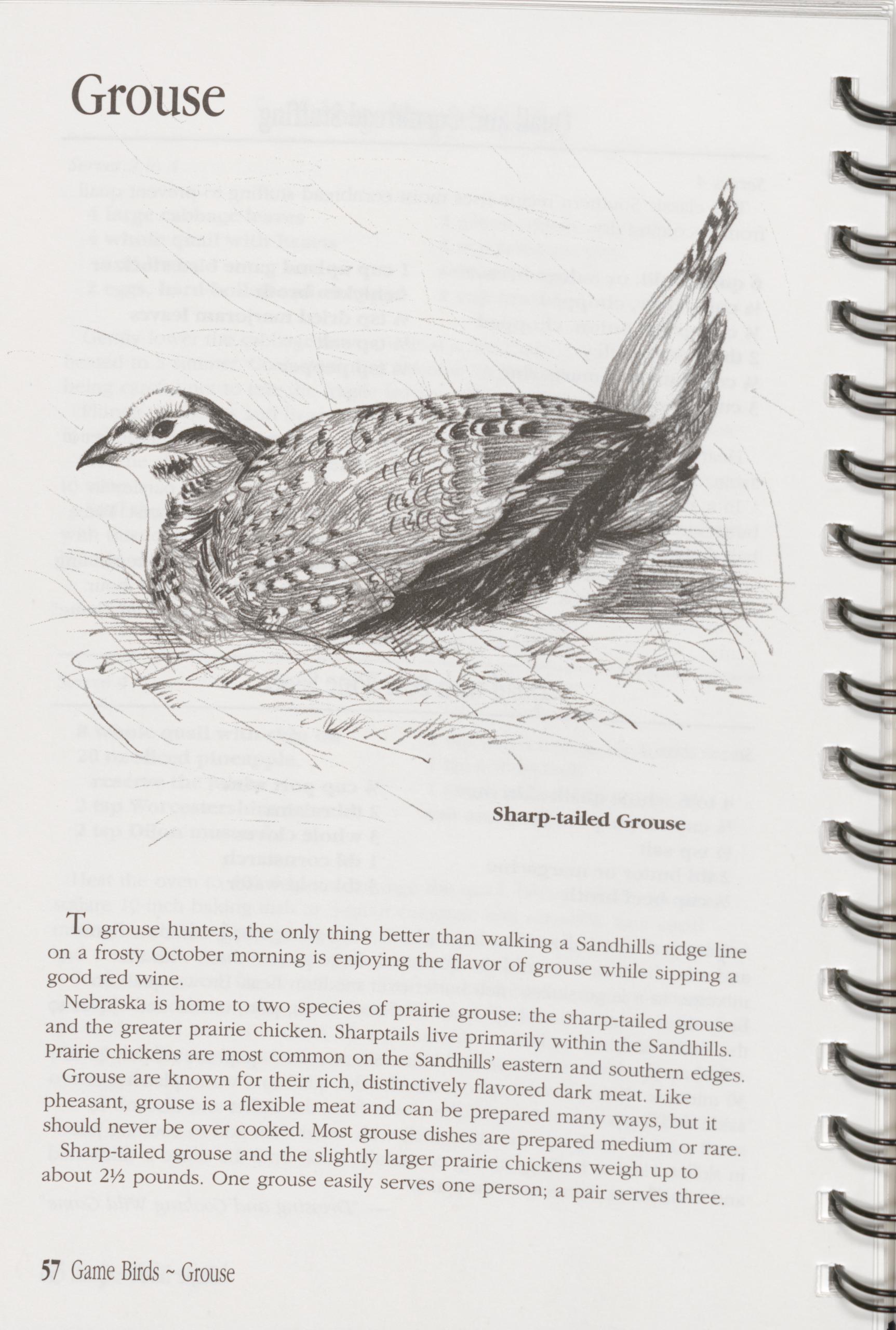 Grouse
lo grouse hunters, the only thing better than walking a Sandhills ridge line on a frosty October morning is enjoying the flavor of grouse while sipping a good red wine.
Nebraska is home to two species of prairie grouse: the sharp-tailed grouse and the greater prairie chicken. Sharptails live primarily within the Sandhills. Prairie chickens are most common on the Sandhills’ eastern and southern edges. Grouse are known for their rich, distinctively flavored dark meat. Like pheasant, grouse is a flexible meat and can be prepared many ways, but it should never be over cooked. Most grouse dishes are prepared medium or rare. Sharp-tailed grouse and the slightly larger prairie chickens weigh up to about 2Vi pounds. One grouse easily serves one person; a pair serves three.
57 Game Birds ~ Grouse Orange Grouse
6 grouse
salt pork or bacon
6 to 8 Florida oranges
2 tbl butter
3 green onions
tsp. dried tarragon leaves
6 tbl currant jelly
1/4 tsp dry mustard
1/4 tsp salt
Orange Grouse
6 grouse
salt pork or bacon
6 to 8 Florida oranges
2 tbl butter
3 green onions
tsp. dried tarragon leaves
6 tbl currant jelly
1/4 tsp dry mustard
1/4 tsp salt
Tie each bird’s legs and wings close to the body with string. Season with salt and pepper. Completely cover breast with slices of salt pork or bacon and tie in place with string. Roast in a 425-degree oven for 30 minutes. Prepare sauce while birds are cooking.
Using a vegetable peeler, remove the zest of 1 orange. Cut it into fine pieces to make Z tablespoons. Section Z or 4 oranges until you have about V/i cups. Drain the sections and add the juice from remaining oranges to make 1V4 cups. Set aside.
In a large skillet melt the butter, and add onion and tarragon and cook 2 to 3 minutes. Add orange juice, orange zest, currant jelly, dry mustard and salt. Stir and bring to a boil. Remove the birds from oven and place in the skillet. Cover and simmer them gently for 15 to 20 minutes. Remove the birds to a platter. Add the orange sections to sauce. Heat quickly and serve with birds.
— Audrey Polenske, Norfolk, Nebraska Grouse Baked in Sour Cream Serves 4 This recipe can also be used with pheasant pieces. 4 grouse, halved flour salt and pepper 1 tsp thyme or 1/2 tsp rosemary lb butter 4 shallots 1/2 lb mushrooms, sliced 2 cups sour cream, at room temperature 1/2 cup chicken broth 1 tsp wild plum jellyDredge the grouse halves in flour seasoned with salt, pepper and herbs. In a casserole or skillet, saute the meat in 6 tablespoons of butter. Remove and set aside. In the same skillet melt the remaining butter and saute the shallots and mushrooms.
Mix sour cream, chicken broth and jelly and add to the shallots and mush- rooms. Return grouse to the skillet, cover and bake in 350-degree oven for about 1 hour. Serve with wild rice.
Game Birds ~ Grouse 58 Spicy Grouse Soup
Serves 4 to 6
Spicy Grouse Soup
Serves 4 to 6
This hearty soup is spicy enough spices to complement the strong flavored, dark meat without hiding its distinctive taste.
2 grouse, cut into 2-inch chunks 2 tbl cooking oil 2 large onions, coarsely chopped 2 cups celery, chopped % cup ginger, freshly grated 1 tsp ground cumin 1 tsp ground cardamom 1 tsp ground coriander ¥2 to 1 tsp chili powder, to taste 2 cups chickpeas, canned or precooked and drained 2 cups chicken stockIn a heavy deep pot, heat 1 tablespoon of oil and brown the grouse chunks quickly. Remove the meat and set aside. Add one tablespoon of oil and saute the onions and celery for a few minutes. Add the seasonings and cook a few minutes longer.
Return the browned meat to the pot. Add chickpeas, stock and salt and pepper to taste. Bring to a boil, reduce heat and simmer, covered about 1 hour or until the meat is tender.
Stuffed Breasts of Grouse Serves 4 8 grouse breast halves, boned 8 slices of bacon 1 recipe onion bread dressing (see opposite) 3 tbl game stock or chicken broth 1 recipe veloute sauce (see opposite)To increase servings add two strips of bacon and one cup of dressing for each additional breast.
Prepare the onion bread dressing as directed. Heat oven to 350 degrees. Place 14 of the dressing on each of four breast halves and top with remaining four breast halves. Wrap 2 slices of bacon around each breast-and-stuffing bundle. Secure the bacon slices with toothpicks. Arrange the bacon-wrapped bundles in an 8-inch square baking dish. Cover the baking dish with foil. Bake for 45 minutes. Remove the foil, and bake for 15 minutes longer. Transfer to a serving platter or individual plates. Spoon veloute sauce over each serving.
59 Game Birds ~ Grouse Onion Bread Dressing
1 medium onion, cut in half
lengthwise and thinly sliced
¥4 cup butter or margarine
4¥r cups herb seasoned croutons
2 tsp dried parsley flakes
¥2 tsp salt
¥2 tsp dried sage leaves, crushed
¥2 tsp dried basil leaves
¥4 tsp dried marjoram leaves
1 cup and Z tbl of game bird
stock or chicken broth
1 egg
Onion Bread Dressing
1 medium onion, cut in half
lengthwise and thinly sliced
¥4 cup butter or margarine
4¥r cups herb seasoned croutons
2 tsp dried parsley flakes
¥2 tsp salt
¥2 tsp dried sage leaves, crushed
¥2 tsp dried basil leaves
¥4 tsp dried marjoram leaves
1 cup and Z tbl of game bird
stock or chicken broth
1 egg
In a medium skillet, cook and stir the onion in butter over medium heat until tender. Remove the skillet from heat and set aside. In a mixing bowl, combine croutons, parsley, salt, sage, basil, and marjoram and mix well. Stir in the onions and butter. In small mixing bowl, blend stock and egg. Add to crouton mixture, mix well.
Veloute Sauce 2 tbl butter or margarine 2 tbl flour 1/4 tsp salt dash of white pepper ¥4 cup game bird stock or chicken broth ¥4 cup whipping cream or half-and-halfIn small saucepan, melt butter over medium-low heat. Stir in the flour, salt, and pepper. Blend in the stock and cream. Cook over medium heat, stirring constantly, until thickened and bubbly, about 5 to 7 minutes. Serve sauce warm.
— “Dressing and Cooking Wild Game” Game Birds ~ Grouse 60 Sauteed Grouse Breasts with Juniper Berries
Serves 2
The delicate, dark-fleshed grouse breasts are enhanced by a wine sauce flavored with the astringent tastes of juniper berries and shallots.
1 grouse breast (2 fillets) 2 cloves garlic, minced 6 tbl butter 1 tbl olive oil 2 or 3 shallots, sliced very thin 5 or 6 juniper berries, crushed freshly ground black pepper dash paprika ¥2 cup red wine ¥2 cup game bird stock or chicken broth flour fresh cilantro leavesDredge grouse breasts lightly in flour seasoned with pepper, paprika and half the crushed juniper berries.
In a medium skillet, heat 2 tablespoons of butter and 1 tablespoon of olive oil. Saute the garlic until it is tender but not brown. Remove and set aside. Add butter if necessary and saute the grouse breasts until very rare at the center. Remove and keep warm. They will continue to cook, so remove them when they are pinker at the center than you want them to be when served.
In the same skillet, saute the shallots until they are translucent. Raise the heat to high and begin adding wine, a little at a time, scraping up the brown particles from the pan. Add the stock, the remaining juniper berries and the reserved garlic, and boil to reduce the liquid to about half. Add any additional juice from the meat. Thicken the sauce with flour and stir in 1 tablespoon butter. Serve the breasts with sauce. Garnish with cilantro leaves.
—Tom Hoban, Columbus, Ohio 61 Game Birds ~ Grouse Notes
Game Birds ~ Notes 62
Notes
Game Birds ~ Notes 62
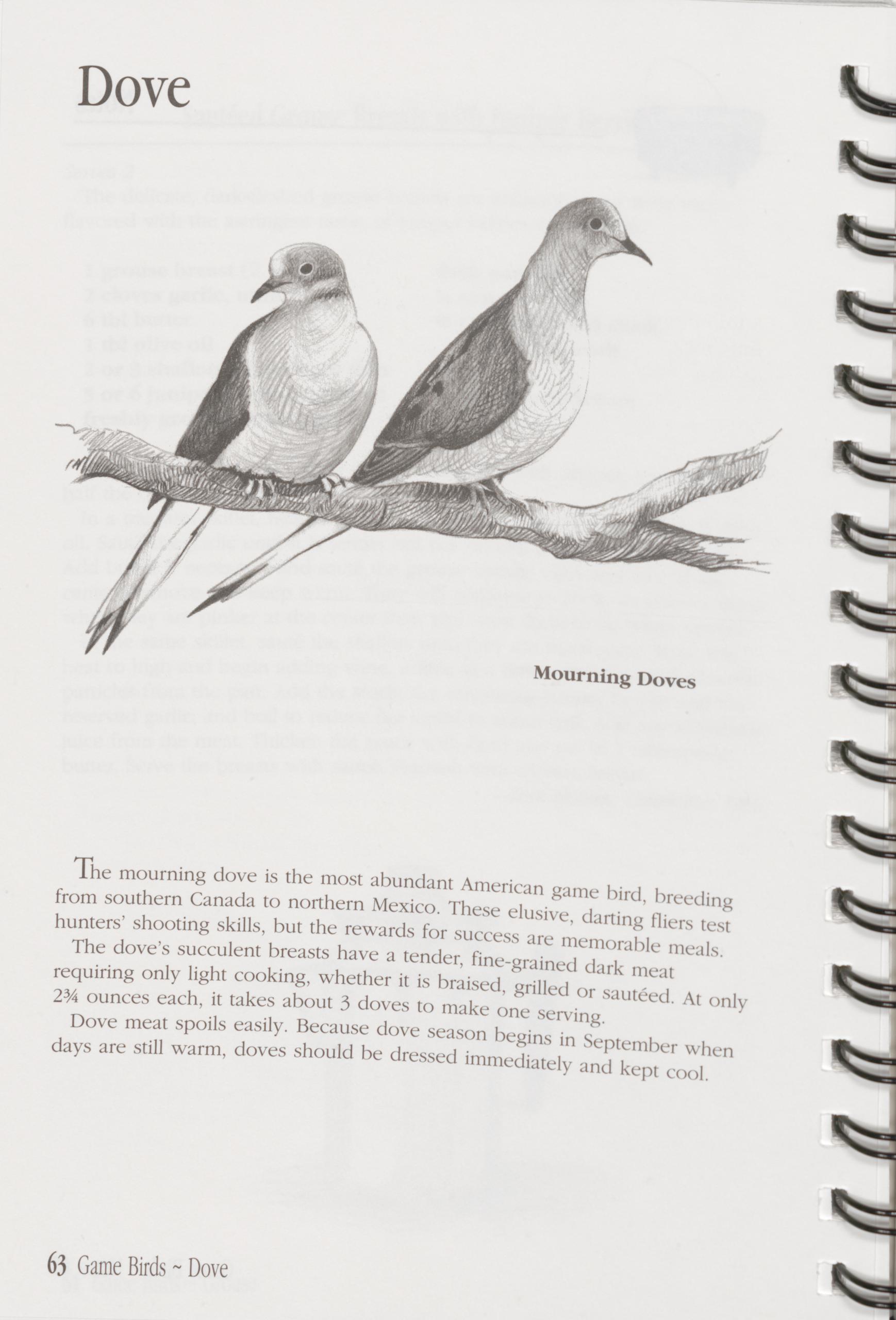 Dove
Dove
The mourning dove is the most abundant American game bird, breeding from southern Canada to northern Mexico. These elusive, darting fliers test hunters’ shooting skills, but the rewards for success are memorable meals. The dove’s succulent breasts have a tender, fine-grained dark meat requiring only light cooking, whether it is braised, grilled or sauteed. At only 2% ounces each, it takes about Z doves to make one serving.
Dove meat spoils easily. Because dove season begins in September when days are still warm, doves should be dressed immediately and kept cool.
63 Game Birds ~ Dove Limed Doves in Madeira
Serves 2
This recipe offers full flavor in exchange for short preparation time. It can
also be prepared with woodcock.
4 doves
1 cup uncooked rice
5 tbl butter
lime juice
salt and pepper
¥2 tsp rosemary, crumbled
10 pearl onions
¥2 lb mushrooms
1 cup chicken broth
1 cup Madeira
Limed Doves in Madeira
Serves 2
This recipe offers full flavor in exchange for short preparation time. It can
also be prepared with woodcock.
4 doves
1 cup uncooked rice
5 tbl butter
lime juice
salt and pepper
¥2 tsp rosemary, crumbled
10 pearl onions
¥2 lb mushrooms
1 cup chicken broth
1 cup Madeira
Brown rice in 3 tablespoons of butter. Place in a casserole dish. Rub the doves with lime juice, salt, rosemary and pepper and place on the rice. Surround the birds with onions and mushrooms. Add broth and wine and dot the remaining butter on the birds. Cover and cook in a 350-degree oven for about 40 minutes.
Dove Gumbo Serves 4 to 6 This recipe should be served over rice and can be used with any fowl. 4 tbl vegetable oil 4 to 6 doves, halved 1 large onion, chopped 6 cups game bird or chicken stock 4 to 6 green onions including tops, chopped 2 tbl dried thyme, or 3 fresh sprigs 3 tbl fresh parsley, chopped % tsp pepper 1 pound smoked venison sausage or andouille sausage 10 oz okra 1 pint raw oysters, shucked 1 tbl file powder 1 clove garlic, mincedIn a heavy pot, heat the oil and brown the doves. Remove the doves and saute the onion in the remaining oil until soft. Return the doves to the pot, cover with stock and add the green onions, parsley, thyme and pepper. Cook over low heat until the doves are tender, 30 to 45 minutes.
Cut the sausage into 1-inch slices and add with okra to the pot. Cook for 15 minutes over medium heat. Add the oysters and their liquid and cook 6 minutes more. Skim off the excess fat. Remove from heat and add the file powder and garlic, stirring well to combine.
File is powdered sassafras leaf. Add it after the gumbo is removed from the heat or it will thicken the stew too much.
— Adapted from “Wild Game Cookery” Game Birds ~ Dove 64 Lemon Doves
Serves 2 to 4
This dish takes only about half an hour. Use the same technique with
adjusted cooking times for any upland bird breast fillets.
8 dove breasts
1/2 cup lemon juice
4 to 6 drops jalapeno sauce
1 tbl butter
Lemon Doves
Serves 2 to 4
This dish takes only about half an hour. Use the same technique with
adjusted cooking times for any upland bird breast fillets.
8 dove breasts
1/2 cup lemon juice
4 to 6 drops jalapeno sauce
1 tbl butter
Fillet dove breast. Leave both sides connected at the breastbone, creating a meat “butterfly” about the size of your palm.
In a bowl, pour lemon juice over the meat, add the jalapeno sauce and marinate for 30 minutes. Heat a frying pan, coat it with butter and cook the fillets 1 minute on each side.
Dove Breast Kabobs Serves 4 Basting ingredients 1/4 cup butter 1/2 tsp paprika 1/4 tsp salt 1/4 tsp pepper 1/8 tsp powdered cloves 1/8 tsp cayenne 1/8 tsp nutmeg 1/8 tsp celery salt Kabob ingredients Mr pound bacon, cut in 2-inch lengths 8 doves breasts 2 whole tomatoes, quartered 1 onion, quartered 1 zucchini or yellow summer squash, cut into chunks 8 oz pineapple chunks, drainedCombine the spices and mix with melted butter. Place the breasts, vegetables and pineapple chucks on skewers separating each with a bacon slice folded in two. Baste the kabobs with the butter mixture. Grill slowly, basting at least twice for 15 to 20 minutes. The breasts are done when juices run clear.
65 Game Birds ~ Dove Smothered Doves
Serves 2 or 3
This recipe can also be used with 6 whole quail, 2 cut-up grouse, or
1 cut-up pheasant. Adjust cooking times as indicated below.
8 to 10 whole doves
¥2 cup flour
¥2 tsp salt
¥s tsp pepper
% cup butter
IV4 cups upland game bird stock
or chicken broth
Smothered Doves
Serves 2 or 3
This recipe can also be used with 6 whole quail, 2 cut-up grouse, or
1 cut-up pheasant. Adjust cooking times as indicated below.
8 to 10 whole doves
¥2 cup flour
¥2 tsp salt
¥s tsp pepper
% cup butter
IV4 cups upland game bird stock
or chicken broth
Pat doves dry. In large plastic bag, combine flour, salt and pepper. Add the doves and shake until they are coated. Remove the doves and set aside. Reserve 2 tablespoons of the flour mixture and discard the rest.
In a skillet melt the butter over medium heat. Add the doves, browning each on both sides. Add * * 3A cup of the stock to the skillet. Reduce the heat, cover and simmer until birds are tender, about 35 to 45 minutes for doves or quail. Grouse will take 40 to 50 minutes, pheasants 50 to 60 minutes. Transfer birds to a heated platter. Set aside and keep warm. Blend the reserved flour into the remaining. Blend with the drippings in skillet. Cook over medium heat, stirring constantly, until thickened and bubbly. Serve over the birds.
— “Dressing & Cooking Wild Game” Dove Breasts in Smoked Gravy 10 dove breasts, filleted flour 3 tbl butter l¥z cups milk ¥> cup water salt and pepper 1 tsp liquid smoke 2 tbl cornstarchMix the flour, salt and pepper. Melt the butter in a skillet and add liquid smoke. Coat dove breast with flour mixture and fry until done. Remove and set aside.
Heat the milk in skillet with butter and liquid smoke mixture. Mix in cornstarch and water to thicken. Return the dove breasts to the gravy. Serve over rice, potatoes, biscuits or noodles.
— Dallas Austin, Meadow Grove, Nebraska Game Birds ~ Dove 66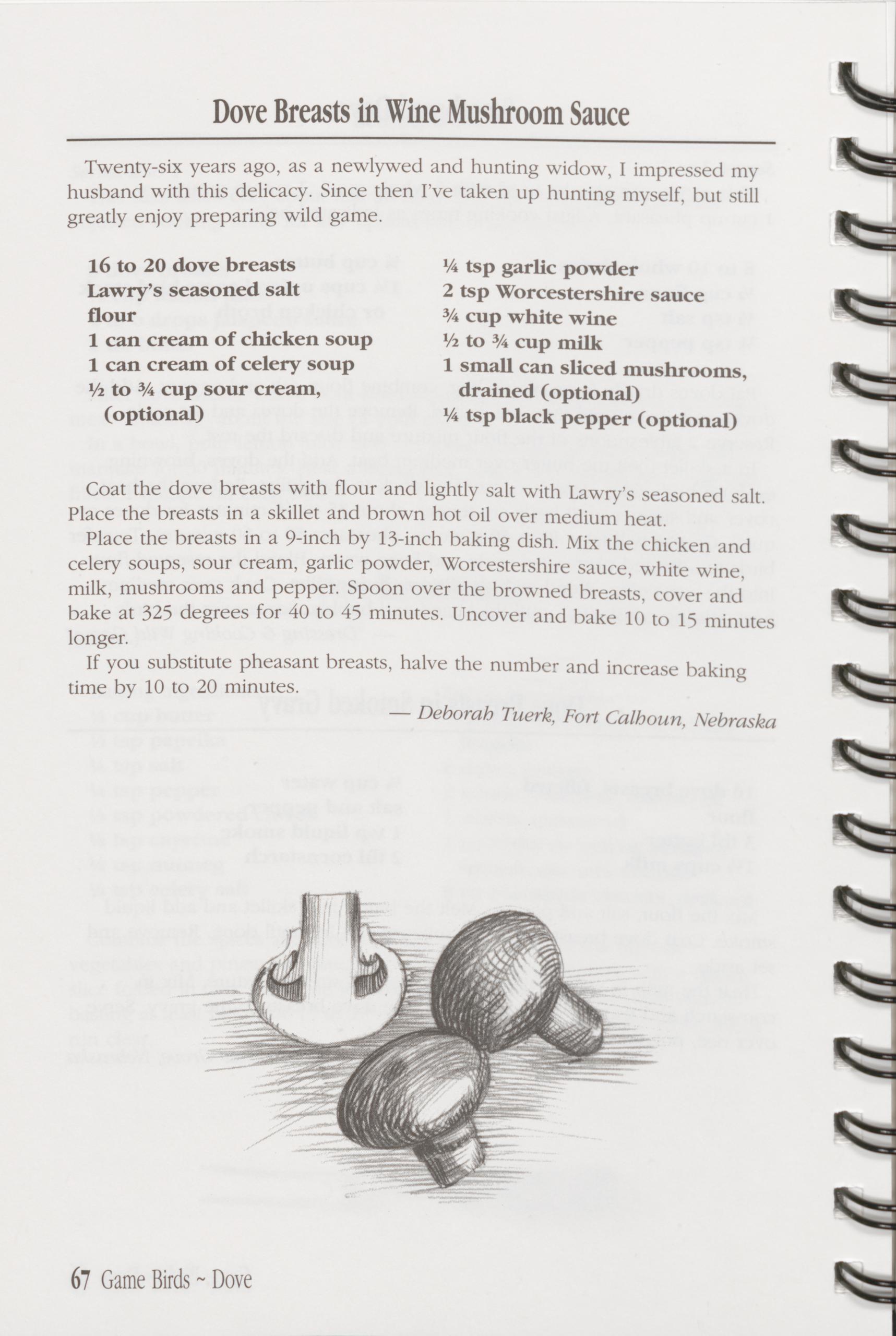 Dove Breasts in Wine Mushroom Sauce
Twenty-six years ago, as a newlywed and hunting widow, I impressed my
husband with this delicacy. Since then I've taken up hunting myself, but still
greatly enjoy preparing wild game.
16 to 20 dove breasts
Lawry’s seasoned salt
flour
1 can cream of chicken soup
1 can cream of celery soup
¥2 to 3/4 cup sour cream,
(optional)
Mi tsp garlic powder
2 tsp Worcestershire sauce
3A cup white wine
¥2 to ¥4 cup milk
1 small can sliced mushrooms,
drained (optional)
lA tsp black pepper (optional)
Dove Breasts in Wine Mushroom Sauce
Twenty-six years ago, as a newlywed and hunting widow, I impressed my
husband with this delicacy. Since then I've taken up hunting myself, but still
greatly enjoy preparing wild game.
16 to 20 dove breasts
Lawry’s seasoned salt
flour
1 can cream of chicken soup
1 can cream of celery soup
¥2 to 3/4 cup sour cream,
(optional)
Mi tsp garlic powder
2 tsp Worcestershire sauce
3A cup white wine
¥2 to ¥4 cup milk
1 small can sliced mushrooms,
drained (optional)
lA tsp black pepper (optional)
Coat the dove breasts with flour and lightly salt with Lawry’s seasoned salt. Place the breasts in a skillet and brown hot oil over medium heat. Place the breasts in a 9-inch by 13-inch baking dish. Mix the chicken and celery soups, sour cream, garlic powder, Worcestershire sauce, white wine, milk, mushrooms and pepper. Spoon over the browned breasts, cover and bake at 325 degrees for 40 to 45 minutes. Uncover and bake 10 to 15 minutes longer.
If you substitute pheasant breasts, halve the number and increase baking time by 10 to 20 minutes.
— Deborah Tuerk, Fort Calhoun, Nebraska 67 Game Birds ~ Dove Game Birds ~ Notes 68
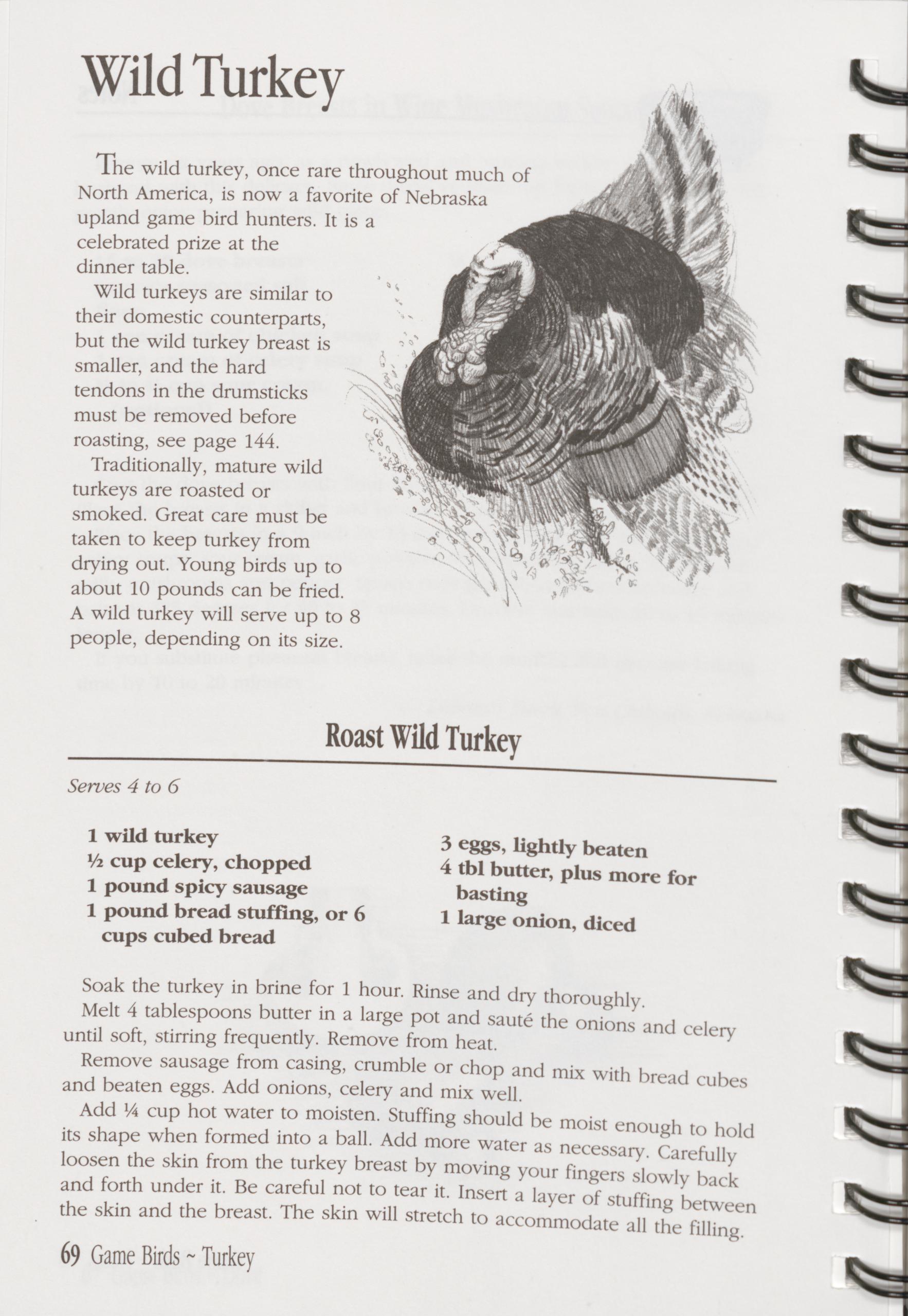 Wild Turkey
The wild turkey, once rare throughout much of North America, is now a favorite of Nebraska upland game bird hunters. It is a celebrated prize at the dinner table.
Wild turkeys are similar to their domestic counterparts, but the wild turkey breast is smaller, and the hard tendons in the drumsticks must be removed before roasting, see page 144.
Traditionally, mature wild turkeys are roasted or smoked. Great care must be taken to keep turkey from drying out. Young birds up to about 10 pounds can be fried.
A wild turkey will serve up to 8 people, depending on its size.
Roast Wild Turkey Serves 4 to 6 1 wild turkey Vr cup celery, chopped 1 pound spicy sausage 1 pound bread stuffing, or 6 cups cubed bread 3 eggs, lightly beaten 4 tbl butter, plus more for basting 1 large onion, dicedSoak the turkey in brine for 1 hour. Rinse and dry thoroughly. Melt 4 tablespoons butter in a large pot and saute the onions and celery until soft, stirring frequently. Remove from heat.
Remove sausage from casing, crumble or chop and mix with bread cubes and beaten eggs. Add onions, celery and mix well.
Add l/4 cup hot water to moisten. Stuffing should be moist enough to hold its shape when formed into a ball. Add more water as necessary. Carefully loosen the skin from the turkey breast by moving your fingers slowly back and forth under it. Be careful not to tear it. Insert a layer of stuffing between the skin and the breast. The skin will stretch to accommodate all the filling.
69 Game Birds ~ Turkey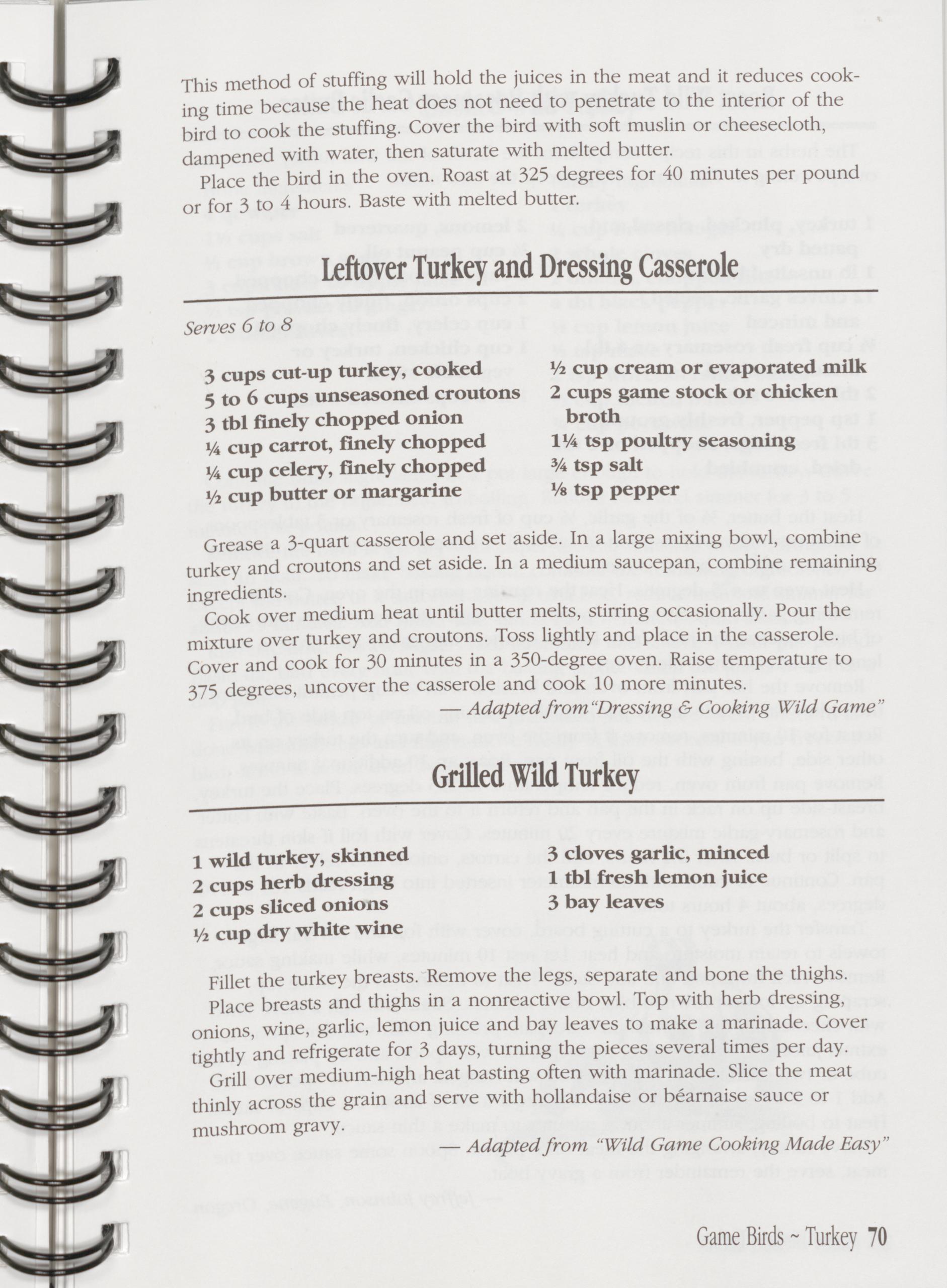
This method of stuffing will hold the juices in the meat and it reduces cook- ing time because the heat does not need to penetrate to the interior of the bird to cook the stuffing. Cover the bird with soft muslin or cheesecloth, dampened with water, then saturate with melted butter.
Place the bird in the oven. Roast at 325 degrees for 40 minutes per pound or for 3 to 4 hours. Baste with melted butter.
Leftover Turkey and Dressing Casserole Serves 6 to 8 3 cups cut-up turkey, cooked 5 to 6 cups unseasoned croutons 3 tbl finely chopped onion 1/4 cup carrot, finely chopped 1/4 cup celery, finely chopped 1/2 cup butter or margarine 1/2 cup cream or evaporated milk 2 cups game stock or chicken broth 1/4 tsp poultry seasoning 1/4 tsp salt 1/8 tsp pepperGrease a 3-quart casserole and set aside. In a large mixing bowl, combine turkey and croutons and set aside. In a medium saucepan, combine remaining ingredients.
Cook over medium heat until butter melts, stirring occasionally. Pour the mixture over turkey and croutons. Toss lightly and place in the casserole. Cover and cook for 30 minutes in a 350-degree oven. Raise temperature to 375 degrees, uncover the casserole and cook 10 more minutes. — Adapted from “Dressing & Cooking Wild Game”
Grilled Wild Turkey 1 wild turkey, skinned 2 cups herb dressing 2 cups sliced onions ¥2 cup dry white wine 3 cloves garlic, minced 1 tbl fresh lemon juice 3 bay leavesFillet the turkey breasts. Remove the legs, separate and bone the thighs. Place breasts and thighs in a nonreactive bowl. Top with herb dressing, onions, wine, garlic, lemon juice and bay leaves to make a marinade. Cover tightly and refrigerate for 3 days, turning the pieces several times per day. Grill over medium-high heat basting often with marinade. Slice the meat thinly across the grain and serve with hollandaise or bearnaise sauce or mushroom gravy.
— Adapted from “Wild Game Cooking Made Easy” Game Birds ~ Turkey 70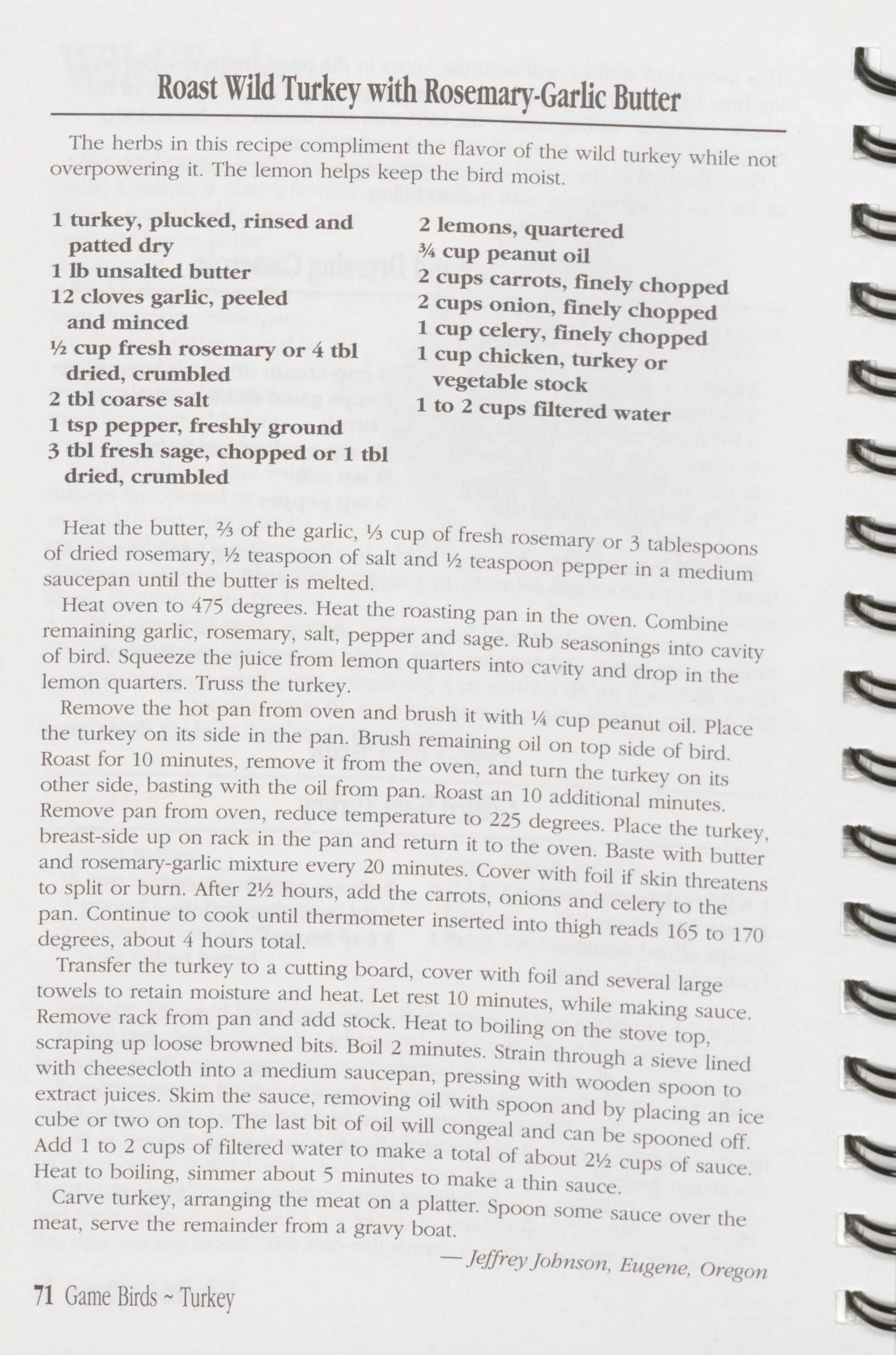 Roast Wild Turkey with Rosemary-Garlic Butter
The herbs in this recipe compliment the flavor of the wild turkey while not
overpowering it. The lemon helps keep the bird moist.
1 turkey, plucked, rinsed and
patted dry
1 lb unsalted butter
12 cloves garlic, peeled
and minced
1/2 cup fresh rosemary or 4 tbl
dried, crumbled
2 tbl coarse salt
1 tsp pepper, freshly ground
3 tbl fresh sage, chopped or 1 tbl
dried, crumbled
2 lemons, quartered
cup peanut oil
2 cups carrots, finely chopped
2 cups onion, finely chopped
1 cup celery, finely chopped
1 cup chicken, turkey or
vegetable stock
1 to 2 cups filtered water
Roast Wild Turkey with Rosemary-Garlic Butter
The herbs in this recipe compliment the flavor of the wild turkey while not
overpowering it. The lemon helps keep the bird moist.
1 turkey, plucked, rinsed and
patted dry
1 lb unsalted butter
12 cloves garlic, peeled
and minced
1/2 cup fresh rosemary or 4 tbl
dried, crumbled
2 tbl coarse salt
1 tsp pepper, freshly ground
3 tbl fresh sage, chopped or 1 tbl
dried, crumbled
2 lemons, quartered
cup peanut oil
2 cups carrots, finely chopped
2 cups onion, finely chopped
1 cup celery, finely chopped
1 cup chicken, turkey or
vegetable stock
1 to 2 cups filtered water
Heat the butter, 2/3 of the garlic, 1/3 cup of fresh rosemary or 3 tablespoons of dried rosemary, 1/2 teaspoon of salt and ¥2 teaspoon pepper in a medium saucepan until the butter is melted.
Heat oven to 475 degrees. Heat the roasting pan in the oven. Combine remaining garlic, rosemary, salt, pepper and sage. Rub seasonings into cavity of bird. Squeeze the juice from lemon quarters into cavity and drop in the lemon quarters. Truss the turkey.
Remove the hot pan from oven and brush it with 1/4 cup peanut oil. Place the turkey on its side in the pan. Brush remaining oil on top side of bird. Roast for 10 minutes, remove it from the oven, and turn the turkey on its other side, basting with the oil from pan. Roast an 10 additional minutes. Remove pan from oven, reduce temperature to 225 degrees. Place the turkey, breast-side up on rack in the pan and return it to the oven. Baste with butter and rosemary-garlic mixture every 20 minutes. Cover with foil if skin threatens to split or burn. After 2 1/2 hours, add the carrots, onions and celery to the pan. Continue to cook until thermometer inserted into thigh reads 165 to 170 degrees, about 4 hours total.
Transfer the turkey to a cutting board, cover with foil and several large towels to retain moisture and heat. Let rest 10 minutes, while making sauce. Remove rack from pan and add stock. Heat to boiling on the stove top, scraping up loose browned bits. Boil 2 minutes. Strain through a sieve lined with cheesecloth into a medium saucepan, pressing with wooden spoon to extract juices. Skim the sauce, removing oil with spoon and by placing an ice cube or two on top. The last bit of oil will congeal and can be spooned off. Add 1 to 2 cups of filtered water to make a total of about 2 1/2 cups of sauce. Heat to boiling, simmer about 5 minutes to make a thin sauce.
Carve turkey, arranging the meat on a platter. Spoon some sauce over the meat, serve the remainder from a gravy boat.
— Jeffrey Johnson, Eugene, Oregon 71 Game Birds ~ Turkey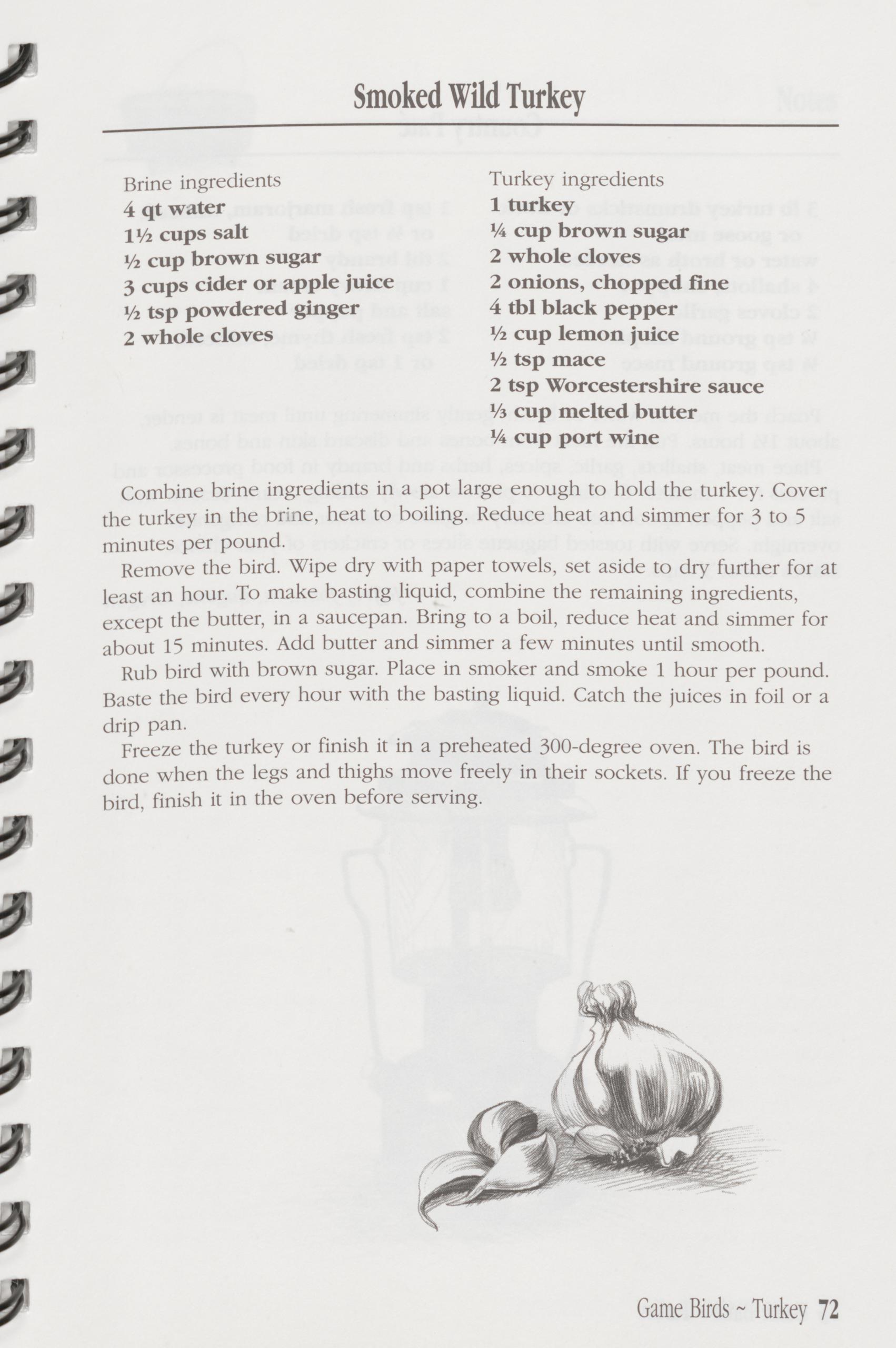 Smoked Wild Turkey
Brine ingredients
4 qt water
1 1/4 cups salt
1/2 cup brown sugar
3 cups cider or apple juice
1/2 tsp powdered ginger
2 whole cloves
Turkey ingredients
1 turkey
cup brown sugar
2 whole cloves
2 onions, chopped fine
4 tbl black pepper
1/2 cup lemon juice
1/2 tsp mace
2 tsp Worcestershire sauce
1/3 cup melted butter
1/4 cup port wine
Smoked Wild Turkey
Brine ingredients
4 qt water
1 1/4 cups salt
1/2 cup brown sugar
3 cups cider or apple juice
1/2 tsp powdered ginger
2 whole cloves
Turkey ingredients
1 turkey
cup brown sugar
2 whole cloves
2 onions, chopped fine
4 tbl black pepper
1/2 cup lemon juice
1/2 tsp mace
2 tsp Worcestershire sauce
1/3 cup melted butter
1/4 cup port wine
Combine brine ingredients in a pot large enough to hold the turkey. Cover the turkey in the brine, heat to boiling. Reduce heat and simmer for 3 to 5 minutes per pound.
Remove the bird. Wipe dry with paper towels, set aside to dry further for at least an hour. To make basting liquid, combine the remaining ingredients, except the butter, in a saucepan. Bring to a boil, reduce heat and simmer for about 15 minutes. Add butter and simmer a few minutes until smooth. Rub bird with brown sugar. Place in smoker and smoke 1 hour per pound. Baste the bird every hour with the basting liquid. Catch the juices in foil or a drip pan.
Freeze the turkey or finish it in a preheated 300-degree oven. The bird is done when the legs and thighs move freely in their sockets. If you freeze the bird, finish it in the oven before serving.
Game Birds ~ Turkey 72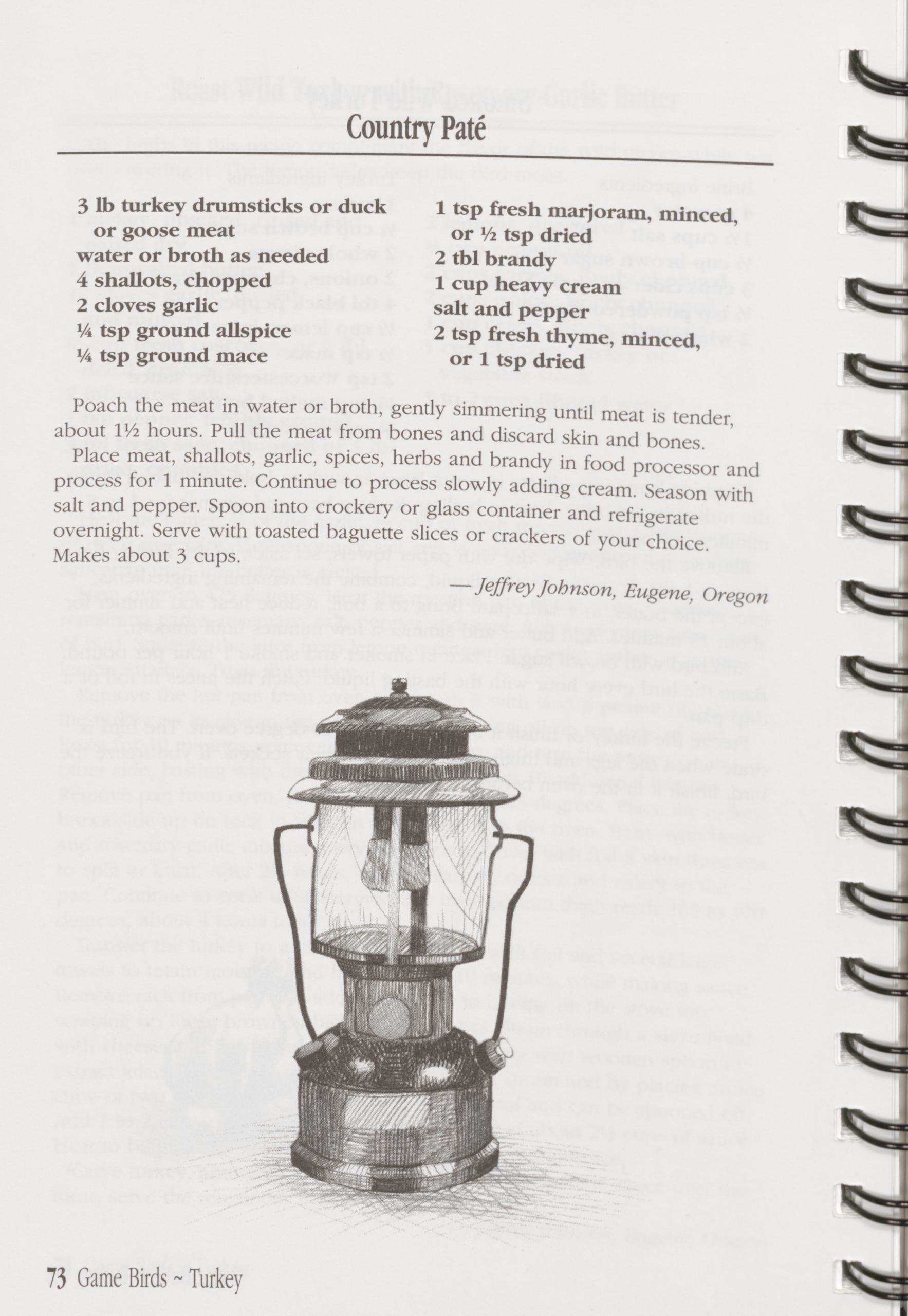 Country Pate
3 lb turkey drumsticks or duck
or goose meat
water or broth as needed
4 shallots, chopped
2 cloves garlic
¥t tsp ground allspice
¥4 tsp ground mace
1 tsp fresh marjoram, minced,
or ¥2 tsp dried
2 tbl brandy
1 cup heavy cream
salt and pepper
2 tsp fresh thyme, minced,
or 1 tsp dried
Country Pate
3 lb turkey drumsticks or duck
or goose meat
water or broth as needed
4 shallots, chopped
2 cloves garlic
¥t tsp ground allspice
¥4 tsp ground mace
1 tsp fresh marjoram, minced,
or ¥2 tsp dried
2 tbl brandy
1 cup heavy cream
salt and pepper
2 tsp fresh thyme, minced,
or 1 tsp dried
Poach the meat in water or broth, gently simmering until meat is tender, about IV2 hours. Pull the meat from bones and discard skin and bones.
Place meat, shallots, garlic, spices, herbs and brandy in food processor and process for 1 minute. Continue to process slowly adding cream. Season with salt and pepper. Spoon into crockery or glass container and refrigerate overnight. Serve with toasted baguette slices or crackers of your choice.
Makes about 3 cups.
— Jeffrey Johnson, Eugene, Oregon 73 Game Birds ~ Turkey Notes
Game Birds ~ Notes 74
Notes
Game Birds ~ Notes 74
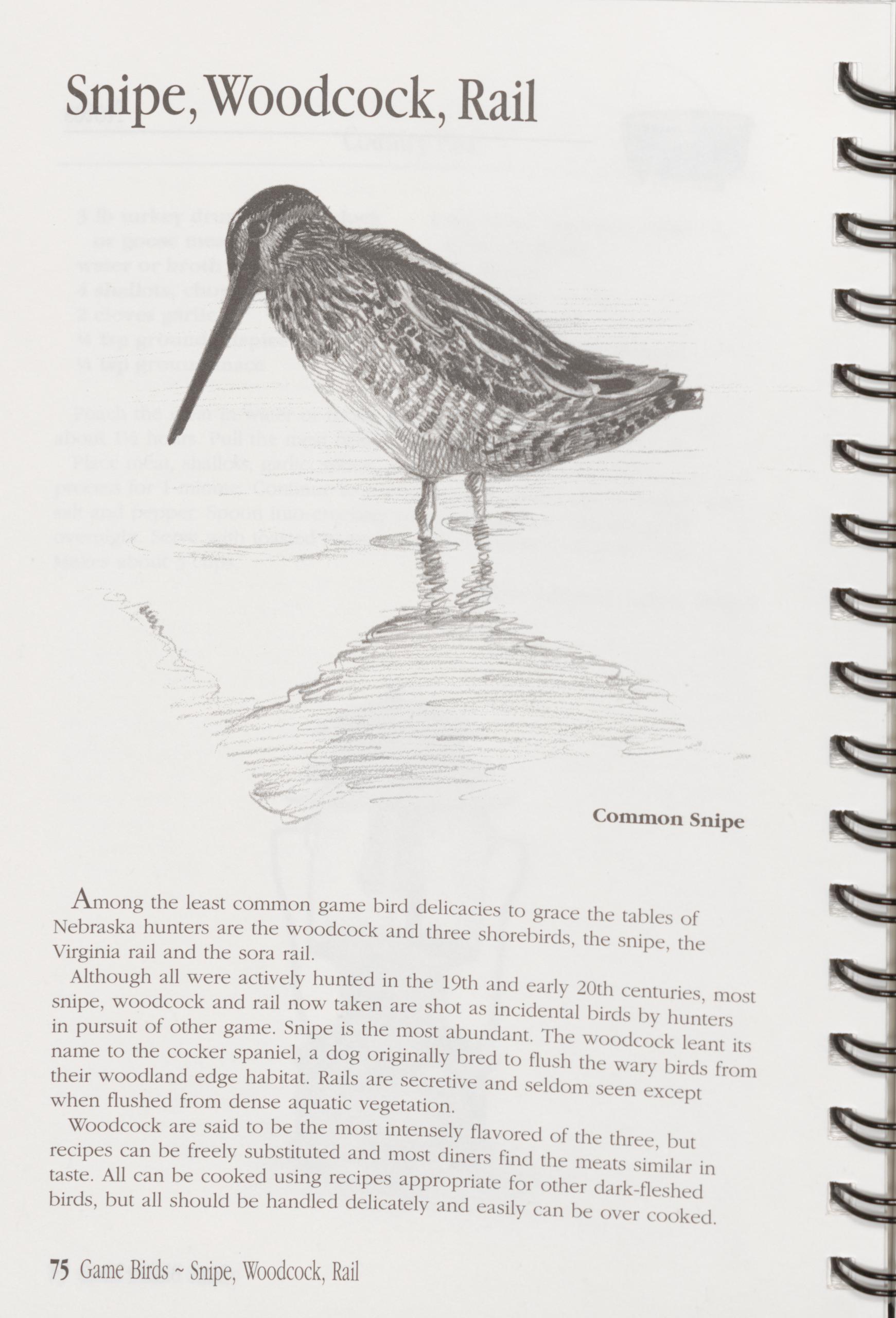
Among the least common game bird delicacies to grace the tables of Nebraska hunters are the woodcock and three shorebirds, the snipe, the Virginia rail and the sora rail.
Although all were actively hunted in the 19th and early 20th centuries, most snipe, woodcock and rail now taken are shot as incidental birds by hunters in pursuit of other game. Snipe is the most abundant. The woodcock leant its name to the cocker spaniel, a dog originally bred to flush the wary birds from their woodland edge habitat. Rails are secretive and seldom seen except when flushed from dense aquatic vegetation.
Woodcock are said to be the most intensely flavored of the three, but recipes can be freely substituted and most diners find the meats similar in taste. All can be cooked using recipes appropriate for other dark-fleshed birds, but all should be handled delicately and easily can be over cooked.
75 Game Birds ~ Snipe, Woodcock, Rail Sauteed Snipe
Serves 3 to 4
This recipe can also be used with woodcock or rail.
4 snipe, with livers
1/2 lemon, juiced
salt and pepper
1 tangerine, sectioned
2 shallots, chopped
2 tsp olive oil
1/2 cup vermouth
1/2 cup strong chicken stock
1/8 tsp tarragon (optional)
Sauteed Snipe
Serves 3 to 4
This recipe can also be used with woodcock or rail.
4 snipe, with livers
1/2 lemon, juiced
salt and pepper
1 tangerine, sectioned
2 shallots, chopped
2 tsp olive oil
1/2 cup vermouth
1/2 cup strong chicken stock
1/8 tsp tarragon (optional)
Rub the birds inside and out with lemon juice, salt and pepper. Place a tangerine section and liver in each bird. Truss. Saute the shallots in oil, then brown the birds on all sides.
Add vermouth, chicken stock and tarragon, cover and simmer 15 minutes.
Woodcock in Cream Serves 2 This recipe also can be used with snipe or rail. 4 woodcocks, plucked with hearts and livers 4 tbl butter salt and pepper fresh nutmeg, grated 1/2 cup heavy creamPlace liver, heart and 1 tablespoon butter inside each bird. Sew or skewer birds shut. Rub birds with butter, salt, pepper and nutmeg. Place in a baking dish and pour 2 or Z tablespoons cream on each bird. Bake in a 375-degree oven for 25 minutes, basting frequently with melted butter and pan juices. Serve each bird with a generous spoonful of hot cream and juices over rice or wild rice.
Game Birds ~ Snipe, Woodcock, Rail 76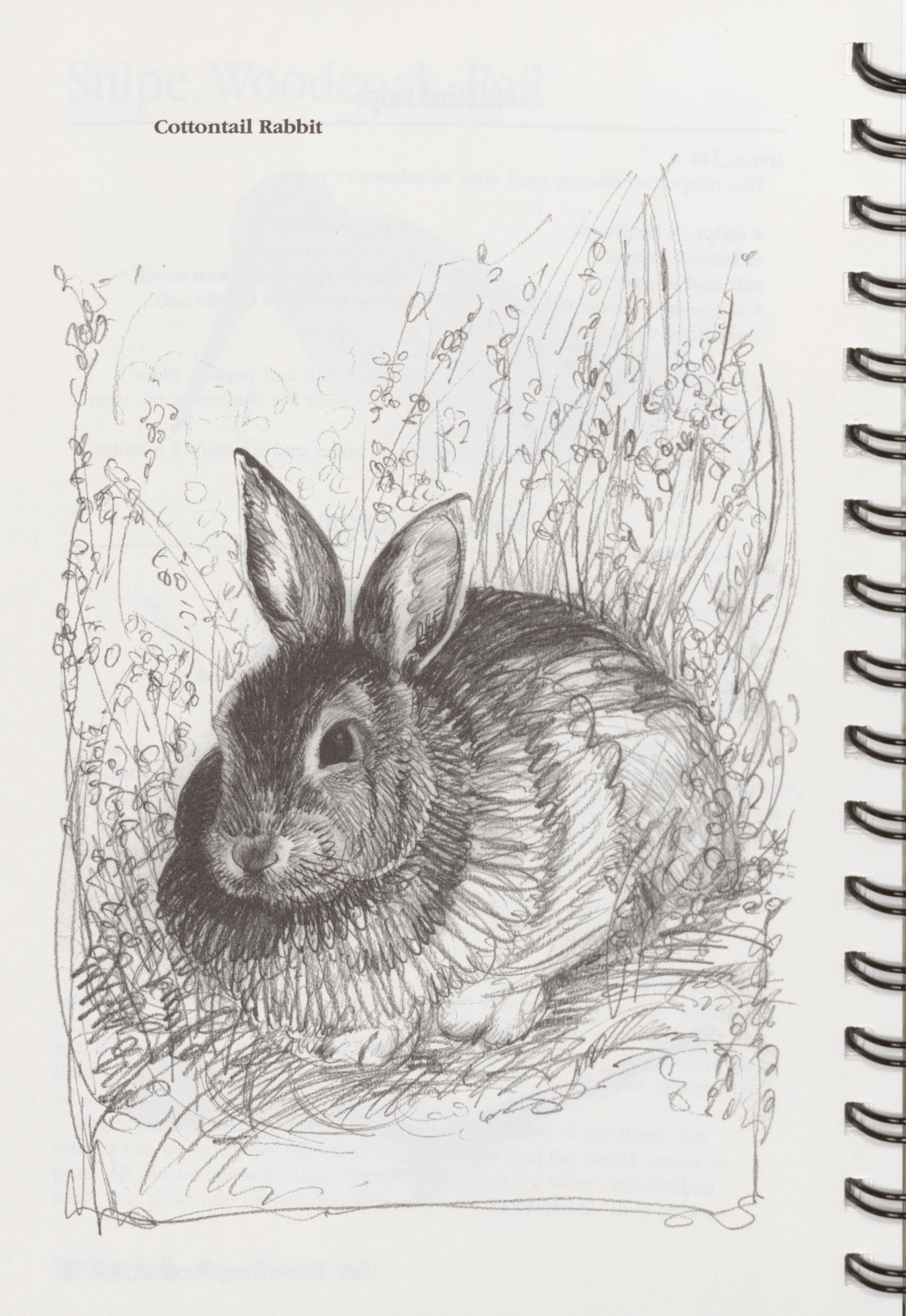
 Cottontail Rabbit
Small Mammals
Cottontail Rabbit
Small Mammals
Cottontail rabbits and fox squirrels are among the most plentiful game animals in America, but despite long seasons and liberal bag limits few Nebraska hunters take advantage of the state’s thriving rabbit and squirrel populations. That is, until they eat their first steaming bowl of rabbit stew or plate of sizzling, chicken-fried squirrel. Then they realize the hunting seasons aren’t long enough.
The first hunting experience for many youngsters is tagging along with dad or an older brother in pursuit of rabbits or squirrels. Whether it’s sitting in the woods staring into the treetops looking for the telltale movement of leaves that betrays the squirrel, or slogging through fresh, ankle-deep snow following rabbit tracks into a shelterbelt, small game hunting provides excitement, adventure and good eating for all ages.
Some of North America’s oldest recipes feature cottontails and squirrels. Indians learned to snare rabbits long before Davey Crockett perfected the art of “barking” squirrels with his flintlock rifle, a tricky method of grazing a squirrel with his bullet to avoid wasting meat. In those days as today, the prize of collecting a couple of bunnies or bushytails is a delicious meal for the hunter and his family.
Squirrel and rabbit hunting seldom requires long-distance travel or expensive equipment. Both species thrive near people, sometimes to the point of becoming pests. Many landowners welcome small game hunters to help control rabbit and squirrel numbers.
The flesh of rabbits and squirrels is versatile and can be fried, baked, grilled, broiled, smoked or steamed. Rabbit and squirrel meat also combines well with other meats and vegetables in casseroles, soups or stews.
— Tom Keith RabbitBecause cottontails and jackrabbits supplemented the larders of many rural and small-town families in the lean and hungry days of the Great Depression, rabbits today are often regarded as lowly fare, a dinner of last resort. In truth, rabbit meat is versatile, adaptable and delicious. Mildly wild, the meat can be cooked using any recipe for game birds, and it appeals to almost any palate.
Small Mammals 78 Papillion Rabbit Pie
There’s a good rabbit hunting club in the Omaha area, the Great Plains
Roundsmen, and they know plain and fancy ways to cook rabbits.
Dan Horton, one of the Roundsmen, offered the following recipe, which
he named for the creek along which he hunted bunnies years ago.
2 cottontails, boned
and cut into 3A-inch chunks
1 cup flour
1 tsp Italian seasoning
1 cup onions, chopped
1 cup carrots, diced
3 potatoes, skin on, diced
2 tbl vegetable oil
2 cans cream of mushroom soup
1 can water
2 cans brown and serve biscuits
Papillion Rabbit Pie
There’s a good rabbit hunting club in the Omaha area, the Great Plains
Roundsmen, and they know plain and fancy ways to cook rabbits.
Dan Horton, one of the Roundsmen, offered the following recipe, which
he named for the creek along which he hunted bunnies years ago.
2 cottontails, boned
and cut into 3A-inch chunks
1 cup flour
1 tsp Italian seasoning
1 cup onions, chopped
1 cup carrots, diced
3 potatoes, skin on, diced
2 tbl vegetable oil
2 cans cream of mushroom soup
1 can water
2 cans brown and serve biscuits
Place rabbit pieces, flour and Italian seasoning in a bag and shake. Brown rabbit pieces in cooking oil in a cast-iron skillet. Add onion, carrots and potatoes. Mix canned soup and water and pour over rabbit and vegetables. Place lid on skillet and bake in a 300-degree oven U/2 hours or until tender. Check every half hour. When meat is tender, remove skillet from oven and arrange biscuits on top of the rabbit. Return to oven and cook uncovered until biscuits are brown.
— Dan Horton, Council Bluffs, Iowa Hearty Pan-Barbecued Bunny Dan Horton’s sister-in-law, Patricia, developed this heart-friendly creation after the doctor gave her husband, Terry, a list of foods that were off limits. The only meats remaining on his menu were poultry and rabbit. Unfortunately, the succulent cottontail dish he once savored also was off limits because it was fried. But when Patricia sets a plate of pan-barbecued bunny on the table, he forgets all about the fried version. 1 rabbit cut into serving pieces 1/2 tsp garlic salt 1/2 cup flour 1 1/2 tbl cooking oil 1/2 tsp salt 1 1/2 cup water 1/2 tsp black pepper Cookie’s Barbecue SauceCombine flour, salt, pepper and garlic salt in shaker bag. Pat rabbit pieces dry, place in bag and shake. Lightly brown rabbit in oil in a Dutch oven or heavy iron skillet. Add U/2 cups water and place uncovered in a preheated 325-degree oven. After about 1 hour, pour Cookie’s Barbecue Sauce over rabbit. Cover and return to oven for 45 minutes, then remove lid for an additional 15 minutes to glaze the sauce on the rabbit.
— Patricia Horton, Omaha, Nebraska 79 Small Mammals ~ Rabbit Rabbit Chili
Ken Tubbesing, another Great Plains Roundsman, has a way with
cottontails in the kitchen as well as in the field. This recipe first appeared in
NEBRASKAland’s Country Cookbook in 1988, and it is still his favorite.
1 rabbit 1 tbl chili pepper
V-8 juice 1 tsp black pepper
1 can red beans, drained 1 tsp cumin
6 to 10 whole cherry tomatoes dash of garlic salt
1/2 onion, chopped
1/2 jalapeno pepper,
finely chopped
Boil rabbit for 1 hour, debone and grind the meat. Mix in all other
ingredients and cook in a crockpot for 10 to 12 hours
— Ken Tubbesing, Cook, Nebraska
Sicilian Rabbit (Stimpadadu)
While hunting in the Fairbury area (hunting rabbits, of course), Ken
Tubbesing met two pheasant hunters from Monrovia, Maryland. One of them,
Ron Gravitt, wanted rabbits for his Christmas pie, and Tubbesing promptly
bestowed several cottontails upon him.
Gravitt’s Christmas pie recipe, “King’s Arms Tavern Colonial Game Pie,” is
on page 15. The recipe below comes from Gravitt’s wife.
1 rabbit cut into serving pieces 1 to 2 cups Sicilian style
1/2 cup wine vinegar olives, pitted
1 tbl oregano 1/2 cup mint leaves, fresh
1/4 cup olive oil or dried
1/4 cup vegetable oil
Rabbit Chili
Ken Tubbesing, another Great Plains Roundsman, has a way with
cottontails in the kitchen as well as in the field. This recipe first appeared in
NEBRASKAland’s Country Cookbook in 1988, and it is still his favorite.
1 rabbit 1 tbl chili pepper
V-8 juice 1 tsp black pepper
1 can red beans, drained 1 tsp cumin
6 to 10 whole cherry tomatoes dash of garlic salt
1/2 onion, chopped
1/2 jalapeno pepper,
finely chopped
Boil rabbit for 1 hour, debone and grind the meat. Mix in all other
ingredients and cook in a crockpot for 10 to 12 hours
— Ken Tubbesing, Cook, Nebraska
Sicilian Rabbit (Stimpadadu)
While hunting in the Fairbury area (hunting rabbits, of course), Ken
Tubbesing met two pheasant hunters from Monrovia, Maryland. One of them,
Ron Gravitt, wanted rabbits for his Christmas pie, and Tubbesing promptly
bestowed several cottontails upon him.
Gravitt’s Christmas pie recipe, “King’s Arms Tavern Colonial Game Pie,” is
on page 15. The recipe below comes from Gravitt’s wife.
1 rabbit cut into serving pieces 1 to 2 cups Sicilian style
1/2 cup wine vinegar olives, pitted
1 tbl oregano 1/2 cup mint leaves, fresh
1/4 cup olive oil or dried
1/4 cup vegetable oil
Bake rabbit in water at 250 to ZOO degrees until tender. Remove rabbit to a large skillet and combine with other ingredients. Saute until rabbit is golden brown. Place rabbit on platter, pour liquid over it and serve.
— Linda Gravitt, Monrovia, Maryland Small Mammals ~ Rabbit 80 Crockpot Rabbit (or Squirrel)
Serves 6 to 8
2 rabbits (or 3 squirrels),
cut into serving pieces
1 cup celery, sliced
1 cup carrots, peeled and sliced
1 onion, chopped
1 can water chestnuts, sliced
2 cups fresh mushrooms, sliced
3 cups chicken broth
2 tsp juniper berries, crushed
dash of basil
salt and pepper
2 tbl cornstarch
1/2 cup sherry
Crockpot Rabbit (or Squirrel)
Serves 6 to 8
2 rabbits (or 3 squirrels),
cut into serving pieces
1 cup celery, sliced
1 cup carrots, peeled and sliced
1 onion, chopped
1 can water chestnuts, sliced
2 cups fresh mushrooms, sliced
3 cups chicken broth
2 tsp juniper berries, crushed
dash of basil
salt and pepper
2 tbl cornstarch
1/2 cup sherry
Simmer all ingredients except the cornstarch and sherry in a crockpot on low for 6 hours. Remove the meat. Combine sherry and cornstarch and pour into crockpot to thicken sauce. Return meat to crockpot and cover with sauce.
— Adapted from “Game Care & Cookery” Baked Rabbit with Sour Cream Gravy (Peceny zajic v kysele smetane) This recipe of Old World derivation is from a Czech-language cookbook, Domaci Kucharka (Home Cookbook), published in Omaha in about 1910 by Narodni Tiskarna. Ingredients for rabbit 1 rabbit, cut into serving pieces salt bacon strips 2 onions, sliced butter flour thick sour cream Ingredients for brine 1 cup vinegar 1 cup water 1 large onion, coarsely chopped thyme 2 bay leaves a few black peppercorns whole allspice berries several clovesWash and salt rabbit. Mix brine ingredients and boil for 15 minutes, then let cool and pour over rabbit pieces in a glass container. Cover and refrigerate 4 to 8 days.* Turn rabbit pieces daily. Save brine when rabbit is removed. To bake rabbit, cover bottom of pan with bacon strips and a little butter, add a layer of onion slices, followed by rabbit. Thicken some of the brine with white flour, making enough to pour around and beneath meat. Cover and bake.** Turn rabbit often and baste by pouring sour cream over pieces and topping them with pats of butter. If gravy evaporates or gets too thick, add more brine or sour cream. Rabbit is done when meat turns red on top and gravy thickens. Serve rabbit covered with strained gravy.
81 Small Mammals ~ Rabbit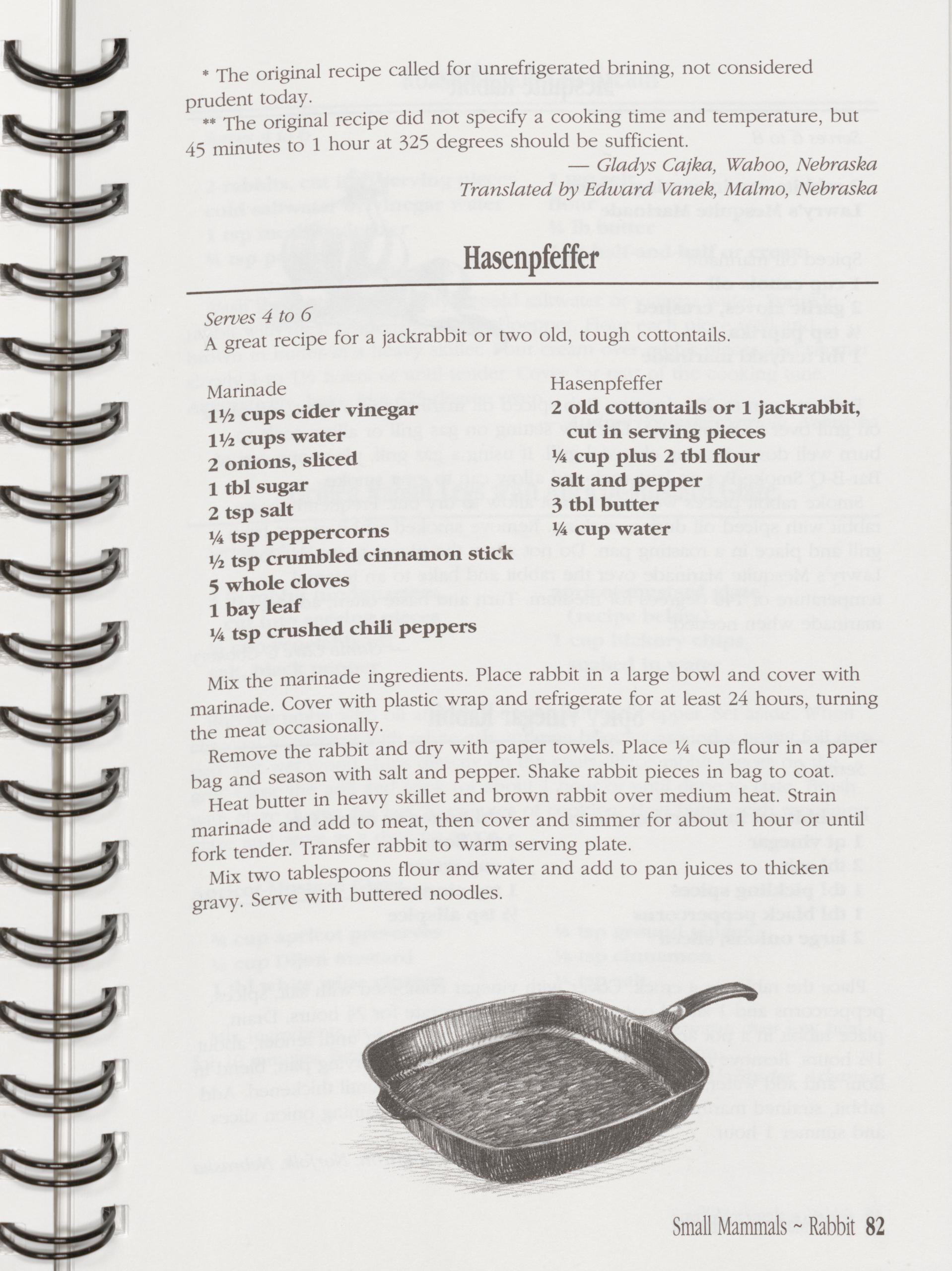 * The original recipe called for unrefrigerated brining, not considered
prudent today.
** The original recipe did not specify a cooking time and temperature, but
45 minutes to 1 hour at 325 degrees should be sufficient.
— Gladys Cajka, Wahoo, Nebraska
Translated by Edward Vanek, Malmo, Nebraska
Hasenpfeffer
Serves 4 to 6
A great recipe for a jackrabbit or two old, tough cottontails.
Marinade
1 1/2 cups cider vinegar
1 1/2 cups water
2 onions, sliced
1 tbl sugar
2 tsp salt
1/4 tsp peppercorns
1/2 tsp crumbled cinnamon stick
5 whole cloves
1 bay leaf
tsp crushed chili peppers
Hasenpfeffer
2 old cottontails or 1 jackrabbit,
cut in serving pieces
1/4 cup plus 2 tbl flour
salt and pepper
3 tbl butter
cup water
* The original recipe called for unrefrigerated brining, not considered
prudent today.
** The original recipe did not specify a cooking time and temperature, but
45 minutes to 1 hour at 325 degrees should be sufficient.
— Gladys Cajka, Wahoo, Nebraska
Translated by Edward Vanek, Malmo, Nebraska
Hasenpfeffer
Serves 4 to 6
A great recipe for a jackrabbit or two old, tough cottontails.
Marinade
1 1/2 cups cider vinegar
1 1/2 cups water
2 onions, sliced
1 tbl sugar
2 tsp salt
1/4 tsp peppercorns
1/2 tsp crumbled cinnamon stick
5 whole cloves
1 bay leaf
tsp crushed chili peppers
Hasenpfeffer
2 old cottontails or 1 jackrabbit,
cut in serving pieces
1/4 cup plus 2 tbl flour
salt and pepper
3 tbl butter
cup water
Mix the marinade ingredients. Place rabbit in a large bowl and cover with marinade. Cover with plastic wrap and refrigerate for at least 24 hours, turning the meat occasionally.
Remove the rabbit and dry with paper towels. Place 1/4 cup flour in a paper bag and season with salt and pepper. Shake rabbit pieces in bag to coat. Heat butter in heavy skillet and brown rabbit over medium heat. Strain marinade and add to meat, then cover and simmer for about 1 hour or until fork tender. Transfer rabbit to warm serving plate.
Mix two tablespoons flour and water and add to pan juices to thicken gravy. Serve with buttered noodles.
Small Mammals ~ Rabbit 82 Mesquite Rabbit
Serves 6 to 8
2 rabbits, cut in serving pieces
Lawry’s Mesquite Marinade
Spiced oil marinade
1 cup canola oil
2 garlic cloves, crushed
% tsp paprika
1 tbl teriyaki marinade
Mesquite Rabbit
Serves 6 to 8
2 rabbits, cut in serving pieces
Lawry’s Mesquite Marinade
Spiced oil marinade
1 cup canola oil
2 garlic cloves, crushed
% tsp paprika
1 tbl teriyaki marinade
Preheat oven to 200 degrees. Rub spiced oil marinade into meat and place on grill over very low heat. Use low setting on gas grill or allow coals to burn well down if using charcoal grill. If using a gas grill, place one can of Bar-B-Q Smoke Pot on lava rock and allow can to emit smoke.
Smoke rabbit pieces well but do not allow to dry out. Frequently baste rabbit with spiced oil during cooking. Remove smoked rabbit pieces from grill and place in a roasting pan. Do not allow the pieces to touch. Pour Lawry’s Mesquite Marinade over the rabbit and bake to an internal temperature of 140 degrees for medium. Turn and baste often, adding marinade when needed.
— Game Care & Cookery Spicy Vinegar Rabbit Serves 6 1 rabbit cut into serving pieces 1 qt vinegar 2 tbl salt 1 tbl pickling spices 1 tbl black peppercorns 2 large onions, sliced 2 tbl butter or other fat 2 tbl flour 1 cup water 1 tsp cinnamon tsp allspicePlace the rabbit in a crock. Cover with vinegar combined with salt, spices, peppercorns and 1 sliced onion. Cover and refrigerate for 24 hours. Drain, place rabbit in a pot and cover with boiling water. Simmer until tender, about IV2 hours. Remove meat and strain broth. Melt butter in a frying pan, blend in flour and add water, stirring constantly, add broth. Cook until thickened. Add rabbit, strained marinade, cinnamon, allspice and the remaining onion slices and simmer 1 hour.
— Maudia Coldiron, Norfolk, Nebraska 83 Small Mammals ~ Rabbit Roasted Rabbit in Cream
Serves 4 to 6
2 rabbits, cut into serving pieces
cold saltwater or vinegar water
1 tsp meat tenderizer
1/4 tsp pepper
1 tsp salt
flour
1/4 lb butter
1 qt half-and-half or cream
Roasted Rabbit in Cream
Serves 4 to 6
2 rabbits, cut into serving pieces
cold saltwater or vinegar water
1 tsp meat tenderizer
1/4 tsp pepper
1 tsp salt
flour
1/4 lb butter
1 qt half-and-half or cream
Wash the rabbits thoroughly in cold saltwater or vinegar water. Sprinkle rabbit with meat tenderizer, salt and pepper. Flour each piece well and brown in butter in a heavy skillet. Pour cream over rabbit pieces and simmer slowly 1 to V/2 hours or until tender. Cover for part of the cooking time.
Alternatively, bake in a 325-degree oven.
— Audrey Polenske, Norfolk, Nebraska Grilled Rabbit Legs with Apricot-Mustard Glaze Serves 4 to 6 3 lb rabbit hindquarters, cut into serving pieces 1/2 cup vegetable oil salt, black pepper apricot-mustard glaze (recipe below) 1 cup hickory chips, soaked in waterRub the rabbit with oil and season with salt and pepper. Set aside. When charcoal is covered with white ash, arrange briquets around a heavy foil drip pan. Put wet wood chips directly on the coals. Place rabbit pieces on the grill. Close the grill and cook for about 1 hour or until done to taste. Brush with glaze during the last 20 minutes of cooking. Heat butter with remaining glaze and serve as a dipping sauce.
Apricot-Mustard Glaze 3/4 cup apricot preserves 1/3 cup Dijon mustard 1 tbl white wine vinegar % tsp ground ginger ¥s tsp cinnamon ¥s tsp saltMix ingredients in a small, nonreactive saucepan and warm over low heat for 10 minutes. Remove from heat and cover to keep warm.
— Keith Sutton, Alexander, Arkansas Small Mammals ~ Rabbit 84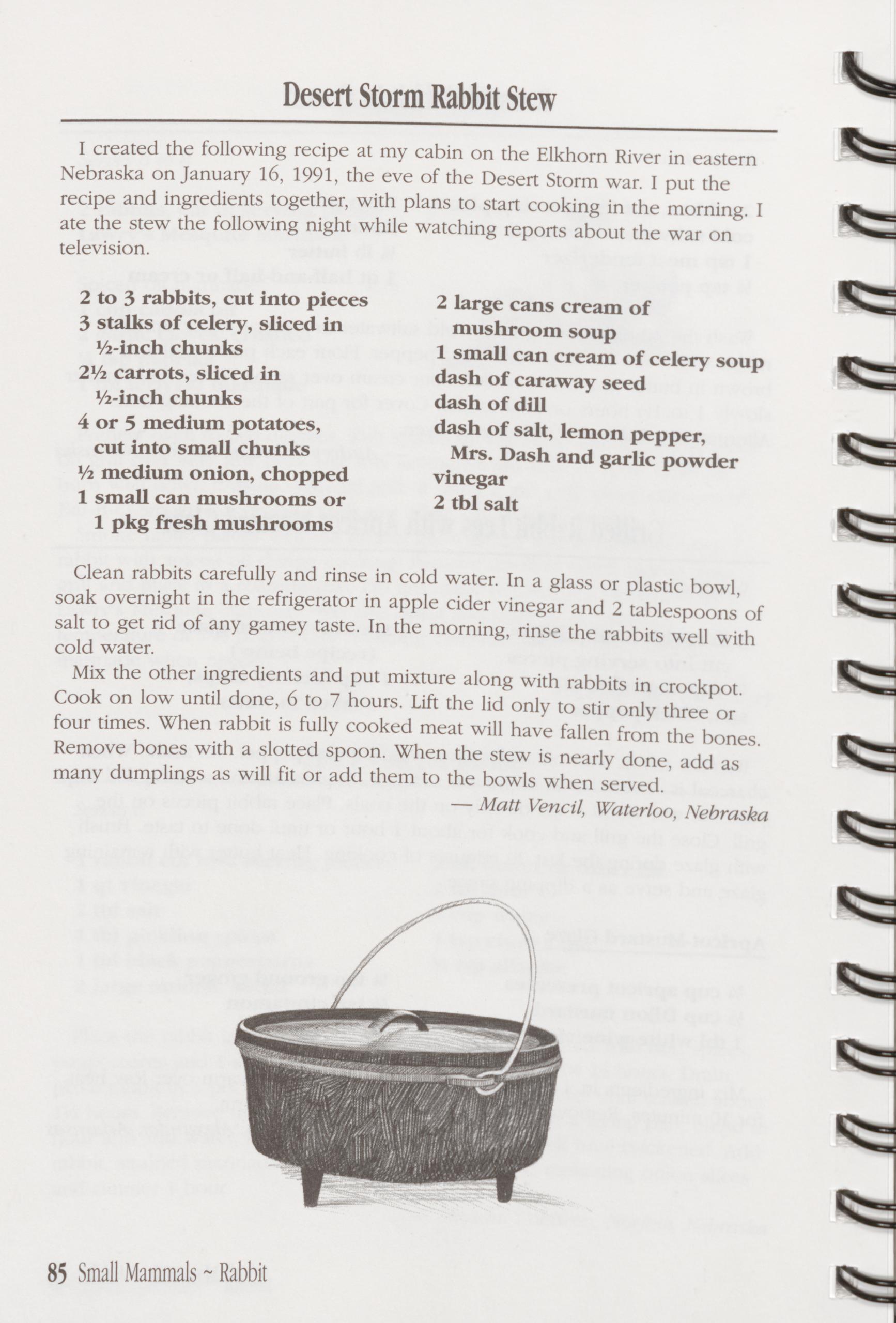 Desert Storm Rabbit Stew
I created the following recipe at my cabin on the Elkhorn River in eastern
Nebraska on January 16, 1991, the eve of the Desert Storm war. I put the
recipe and ingredients together, with plans to start cooking in the morning. I
ate the stew the following night while watching reports about the war on
television.
2 to 3 rabbits, cut into pieces
3 stalks of celery, sliced in
1/2-inch chunks
2 1/2 carrots, sliced in
1/2-inch chunks
4 or 5 medium potatoes,
cut into small chunks
1/2 medium onion, chopped
1 small can mushrooms or
1 pkg fresh mushrooms
2 large cans cream of
mushroom soup
1 small can cream of celery soup
dash of caraway seed
dash of dill
dash of salt, lemon pepper,
Mrs. Dash and garlic powder
vinegar
2 tbl salt
Desert Storm Rabbit Stew
I created the following recipe at my cabin on the Elkhorn River in eastern
Nebraska on January 16, 1991, the eve of the Desert Storm war. I put the
recipe and ingredients together, with plans to start cooking in the morning. I
ate the stew the following night while watching reports about the war on
television.
2 to 3 rabbits, cut into pieces
3 stalks of celery, sliced in
1/2-inch chunks
2 1/2 carrots, sliced in
1/2-inch chunks
4 or 5 medium potatoes,
cut into small chunks
1/2 medium onion, chopped
1 small can mushrooms or
1 pkg fresh mushrooms
2 large cans cream of
mushroom soup
1 small can cream of celery soup
dash of caraway seed
dash of dill
dash of salt, lemon pepper,
Mrs. Dash and garlic powder
vinegar
2 tbl salt
Clean rabbits carefully and rinse in cold water. In a glass or plastic bowl, soak overnight in the refrigerator in apple cider vinegar and 2 tablespoons of salt to get rid of any gamey taste. In the morning, rinse the rabbits well with cold water.
Mix the other ingredients and put mixture along with rabbits in crockpot. Cook on low until done, 6 to 7 hours. Lift the lid only to stir only three or four times. When rabbit is fully cooked meat will have fallen from the bones. Remove bones with a slotted spoon. When the stew is nearly done, add as many dumplings as will fit or add them to the bowls when served.
— Matt Vencil, Waterloo, Nebraska 85 Small Mammals ~ Rabbit Rabbit Stroganoff
6 or 7 slices bacon, fried and
crumbed
2 rabbits, cut into pieces
3/4 cup flour
2 1/2 tsp dry mustard
1 1/2 tsp thyme
1 1/2 tsp pepper
1 1/2 tsp salt
3/4 cup chicken broth
1 onion, chopped
1/4 lb mushrooms, sliced
3 tsp butter
2 2 1/2 cups sour cream
1/3 cup sherry
Rabbit Stroganoff
6 or 7 slices bacon, fried and
crumbed
2 rabbits, cut into pieces
3/4 cup flour
2 1/2 tsp dry mustard
1 1/2 tsp thyme
1 1/2 tsp pepper
1 1/2 tsp salt
3/4 cup chicken broth
1 onion, chopped
1/4 lb mushrooms, sliced
3 tsp butter
2 2 1/2 cups sour cream
1/3 cup sherry
Roll rabbit pieces in flour mixed with mustard, thyme, pepper and salt using all the mixture if possible. Brown pieces over medium heat. Add chicken broth, cover and simmer about 15 minutes or until the pieces are tender. While the rabbit is simmering, saute onion and mushrooms in butter and set aside. When rabbit pieces are done, stir in sour cream, onion and mushrooms. Simmer for 5 minutes without allowing the mixture to boil. Stir in sherry, bacon and rabbit pieces. Simmer to reheat rabbit.
— Ron Melbye, Waverly, Nebraska Tips for Small Game Cooks • When dressing rabbits, judge their age by checking the pelvic bone. Cartilage in the seam indicates a young animal, but in adults the pelvis is all bone. Young rabbits skin easily, but the hide on an old rabbit is tougher and harder to remove. Cottontail mortality is high, so most of population is made up of young animals, but the age composition of the jackrabbit population is uncertain. • Determine the age of squirrels by the tail shape. Tails of young squirrels taper to a point; the tail of an older animal is a uniform width. • Dry mustard adds a pleasant flavor to many rabbit and squirrel recipes. For recipes needing a little more gusto, try 1 to 3 teaspoons of dry mustard per animal added to flour or other coatings, or half that amount in sauces. • Try hasenpfeffer or “jugged” rabbit recipes for jackrabbit. • Cottontails weigh 2 to 3 pounds; black-tailed jackrabbits, 4 to 7 pounds; white-tailed jackrabbits, 5 to 10 pounds. Thus, the average blacktail in the pot is roughly equivalent to two cottontails, and the average whitetail might equal three cottontails. Small Mammals - Rabbit 86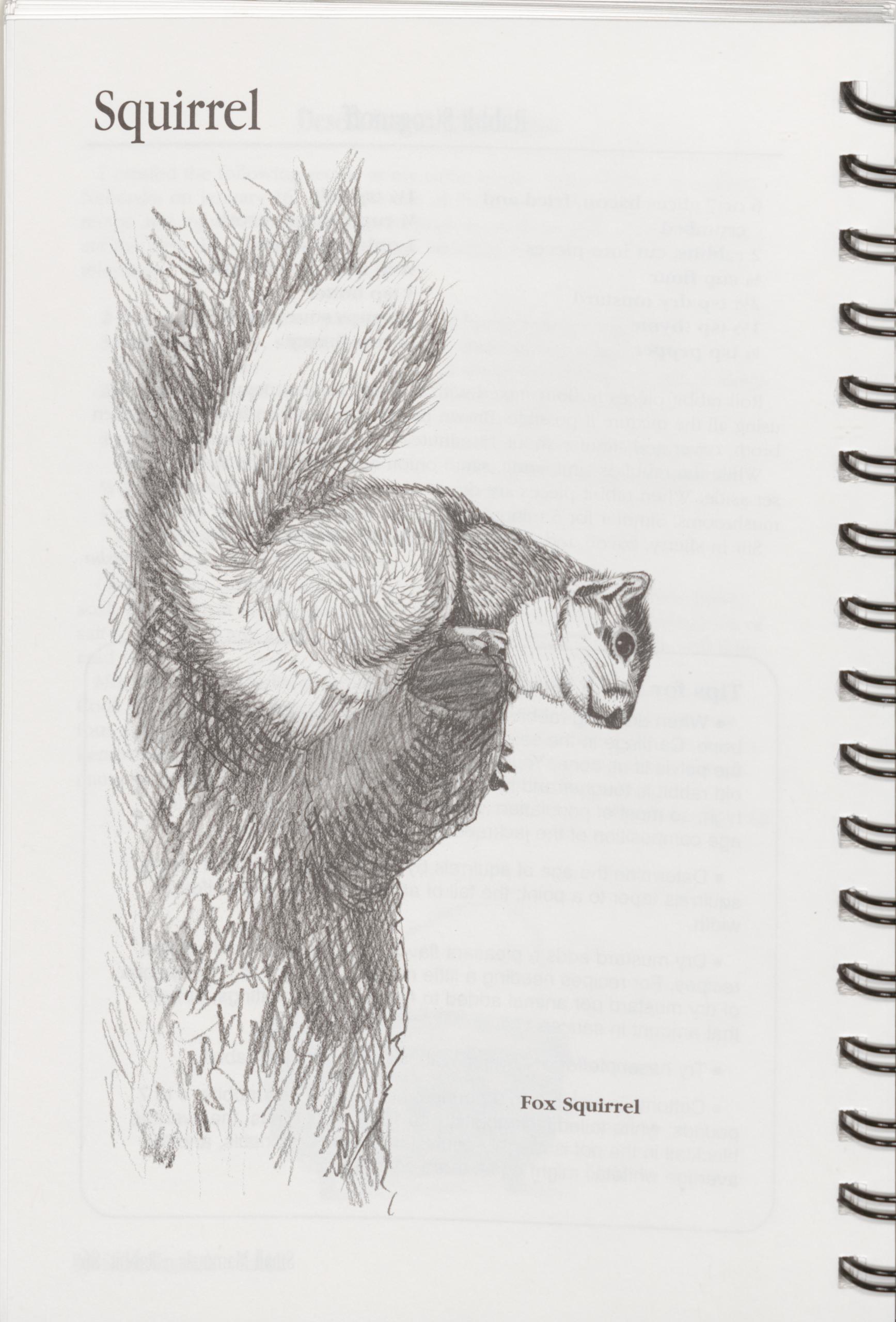 Squirrel
Like rabbits, fox squirrels are abundant but “under utilized” in the jargon of professional game managers. Succulent and savory, they are delicious small game animals, and they are a worthy quarry for the hunter, as well. Squirrel meat lends itself to stewing, braising and frying. To add variety to your squirrel eating, try it as a substitute for pheasant or grouse in the recipes listed for those species.
Tony’s Smothered SquirrelTony Horton suggests trying this recipe with rabbits and squirrels.
1 squirrel, cut into serving pieces flour salt and pepper cooking oil ¥2 onion, diced milk water Worcestershire sauce or Red Devil hot sauceCoat squirrel pieces in flour seasoned with salt and pepper and brown on both sides in a hot skillet. Reduce the heat to medium and continue cooking until tender. Remove squirrel and set aside. Add onions to the drippings and cook until translucent. Remove onions and set aside. Mix flour and milk in a bowl until mixture is a little thicker than cream. Gradually add mixture to drippings in skillet over medium-low heat. Thicken to make gravy. Add seasonings, salt and pepper. Return squirrel to skillet and cover with onions. Add water to cover the squirrel and simmer until meat falls from the bones.
— Tony Horton, Omaha, Nebraska Brunswick Stew Serves 4 1 squirrel, cut into 6 pieces flour salt and pepper 3 tbl butter 8 cups boiling water 1 tsp thyme 1 cup fresh corn 1 cup lima beans 3 potatoes, quartered ¥4 tsp cayenne 2 onions, sliced 2 cups canned tomatoes with juiceRoll squirrel pieces in flour, salt and pepper and brown in butter. Boil water in a large pot. Add meat and all other ingredients, except tomatoes. Cover and simmer P/2 to 2 hours. Add tomatoes and simmer for another hour. Very slow simmering is the secret to this recipe.
— Stan Krause, Lincoln, Nebraska Small Mammals ~ Squirrel 88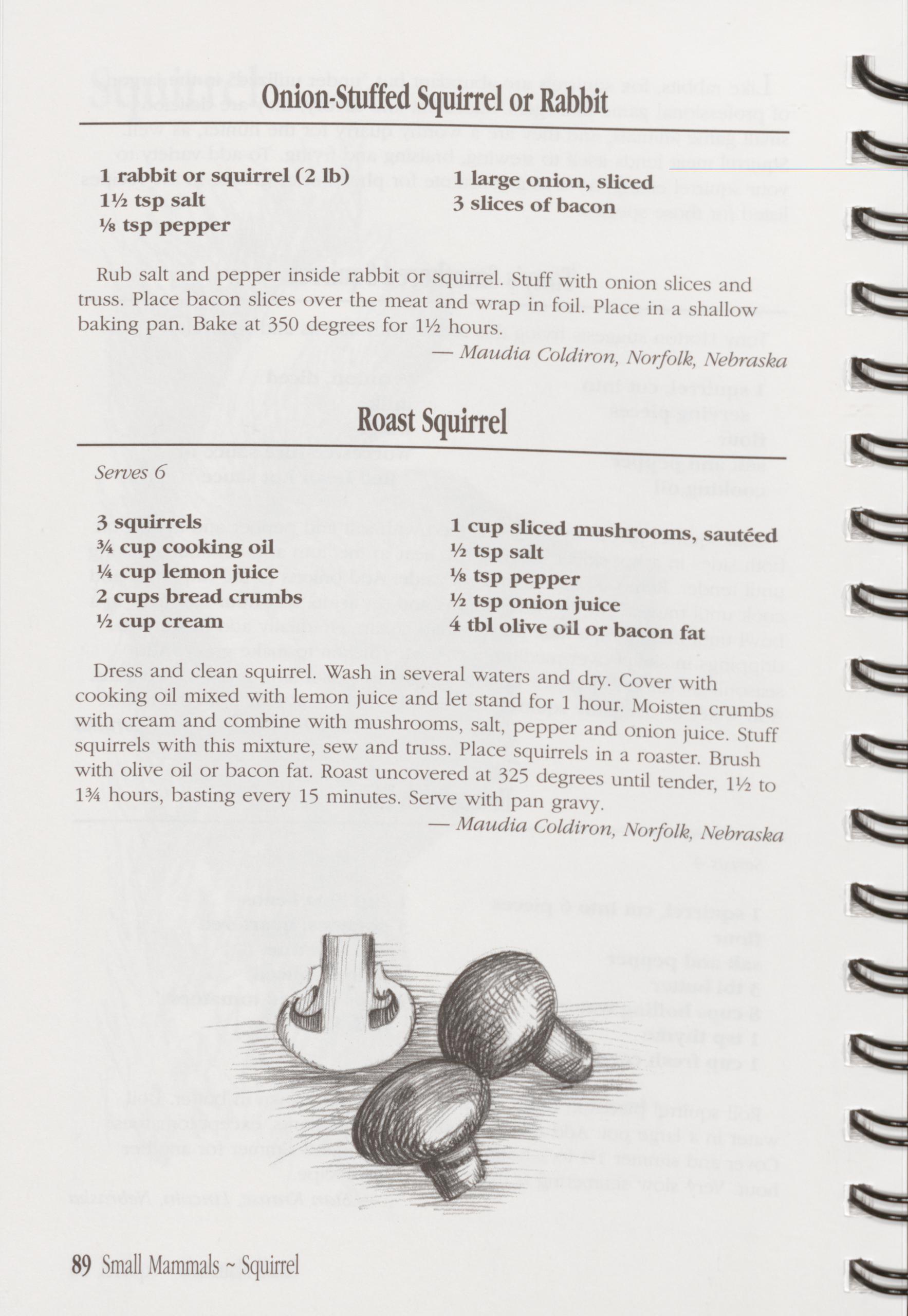 Onion-Stuffed Squirrel or Rabbit
1 rabbit or squirrel (2 lb)
1 1/2 tsp salt
1/8 tsp pepper
1 large onion, sliced
3 slices of bacon
Onion-Stuffed Squirrel or Rabbit
1 rabbit or squirrel (2 lb)
1 1/2 tsp salt
1/8 tsp pepper
1 large onion, sliced
3 slices of bacon
Rub salt and pepper inside rabbit or squirrel. Stuff with onion slices and truss. Place bacon slices over the meat and wrap in foil. Place in a shallow baking pan. Bake at 350 degrees for 1 1/2 hours.
— Maudia Coldiron, Norfolk, Nebraska Roast Squirrel Serves 6 3 squirrels 3/4 cup cooking oil 1/4 cup lemon juice 2 cups bread crumbs 1/2 cup cream 1 cup sliced mushrooms, sauteed 1/2 tsp salt 1/8 tsp pepper 1/2 tsp onion juice 4 tbl olive oil or bacon fatDress and clean squirrel. Wash in several waters and dry. Cover with cooking oil mixed with lemon juice and let stand for 1 hour. Moisten crumbs with cream and combine with mushrooms, salt, pepper and onion juice. Stuff squirrels with this mixture, sew and truss. Place squirrels in a roaster. Brush with olive oil or bacon fat. Roast uncovered at 325 degrees until tender, IV2 to hours, basting every 15 minutes. Serve with pan gravy.
— Maudia Coldiron, Norfolk, Nebraska 89 Small Mammals ~ Squirrel Notes
Small Mammals ~ Notes 90
Notes
Small Mammals ~ Notes 90
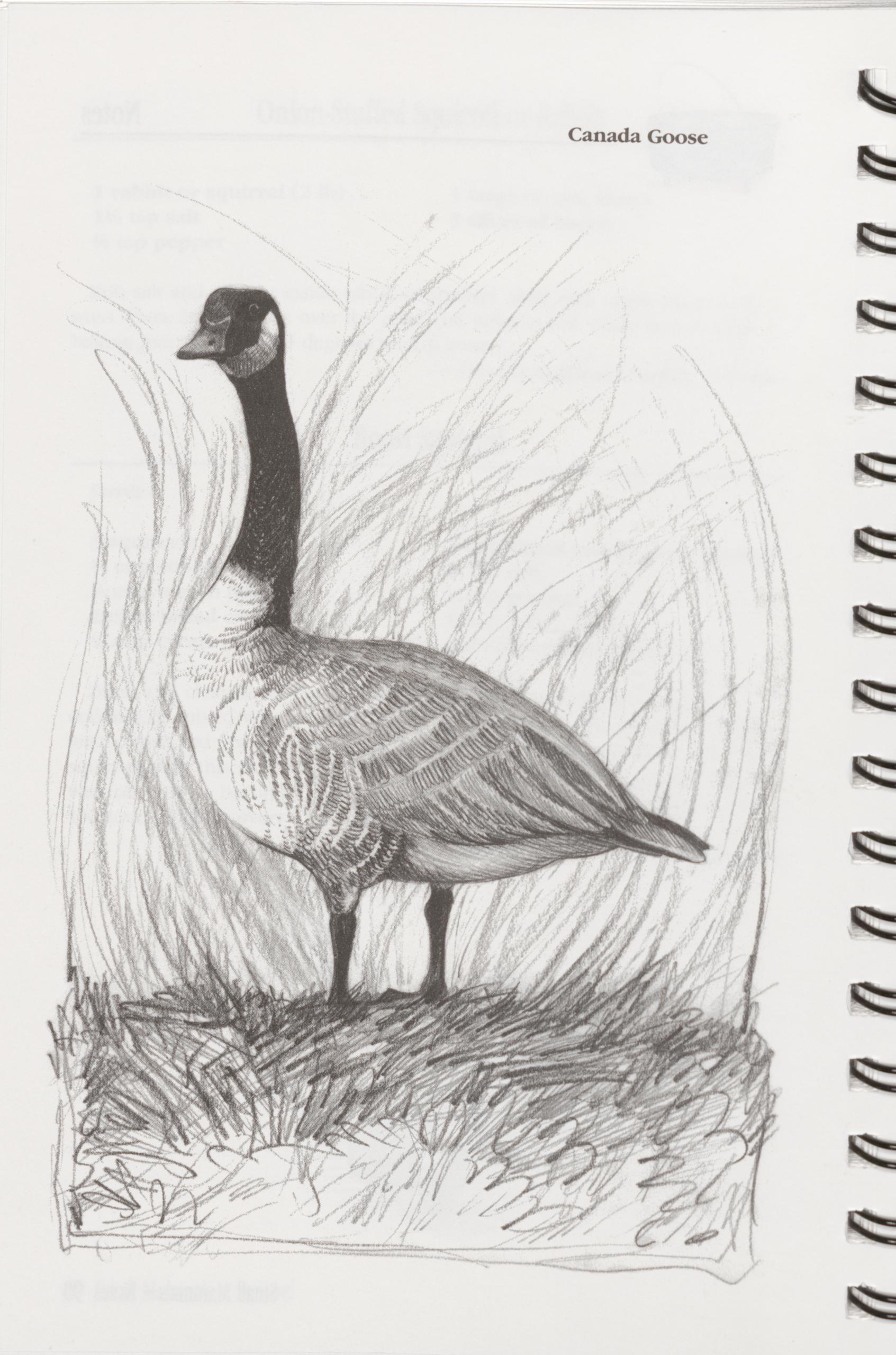
 Waterfowl
Waterfowl present unique and pleasant wild flavors, textures and aromas that should not be disguised by culinary trickery. The meat of ducks and geese should be gently enhanced through seasoning and careful cooking.
The texture and flavor of waterfowl is enhanced by wine-based marinades, fruit stuffings and sugary glazes. Cherry-flavored wines and fruity sangrias are pleasant finishes. The measure of a fruit stuffing is found in the tartness of crisp fall apples, quince, apricots and citrus, while sugary glazes rest on the consistency of jellied preserves, aromatic honeys and, perhaps, some added body by Jack from Tennessee.
The Cleaning BenchThe decision whether to pluck or fillet a plump mallard or young goose, is a crucial one. A whole, plucked bird offers the cook all the possibilities of preparation, including fillets for the recipes that call for them. But once a breast is gone the possibility of a whole bird centerpiece is lost.
I pluck all of my waterfowl.
Good waterfowl cuisine begins with the selection of shot. A duck or goose heavily salted with pellets is less palatable and appealing than one downed with a sparse shot pattern. Shot ruptures blood vessels, breaks bones, pulls feathers into the meat and deposits steel pellets where one is likely to take a bite. Cleaning should address these issues by removing shattered bones, extracting feathers from wounds, picking out shot and cleansing blood deposits. The result is well worth the effort.
Plucking should remove all feathers and down. It is easiest to pluck a bird that is thoroughly chilled.
Singe a bird after it is thoroughly plucked and only the sparse, hair-like pin feathers remain. If feathers and down are burned, the smell will linger in the meat. Do not singe a bird until you are ready to cook it, because the heat of singeing breaks down fat beneath the skin. To singe a plucked bird, hold it by the legs and turn it over a gas or candle flame so that all the skin is exposed to heat.
Feet should be separated at the joint where leg feathering ends. If not fully picked, wings should be separated at the first joint, the elbow. Crops, tracheas, and lungs should be completely removed, as well as the oiling glands on the dorsal side of the tail. Hearts, livers and gizzard lobes should be retained. The neck skin should be rolled back and the neck removed with shears, leaving a skin flap to tuck into the front body cavity after it is stuffed.
Invest in a good, deep stainless steel or aluminum roaster with adjustable
Waterfowl 92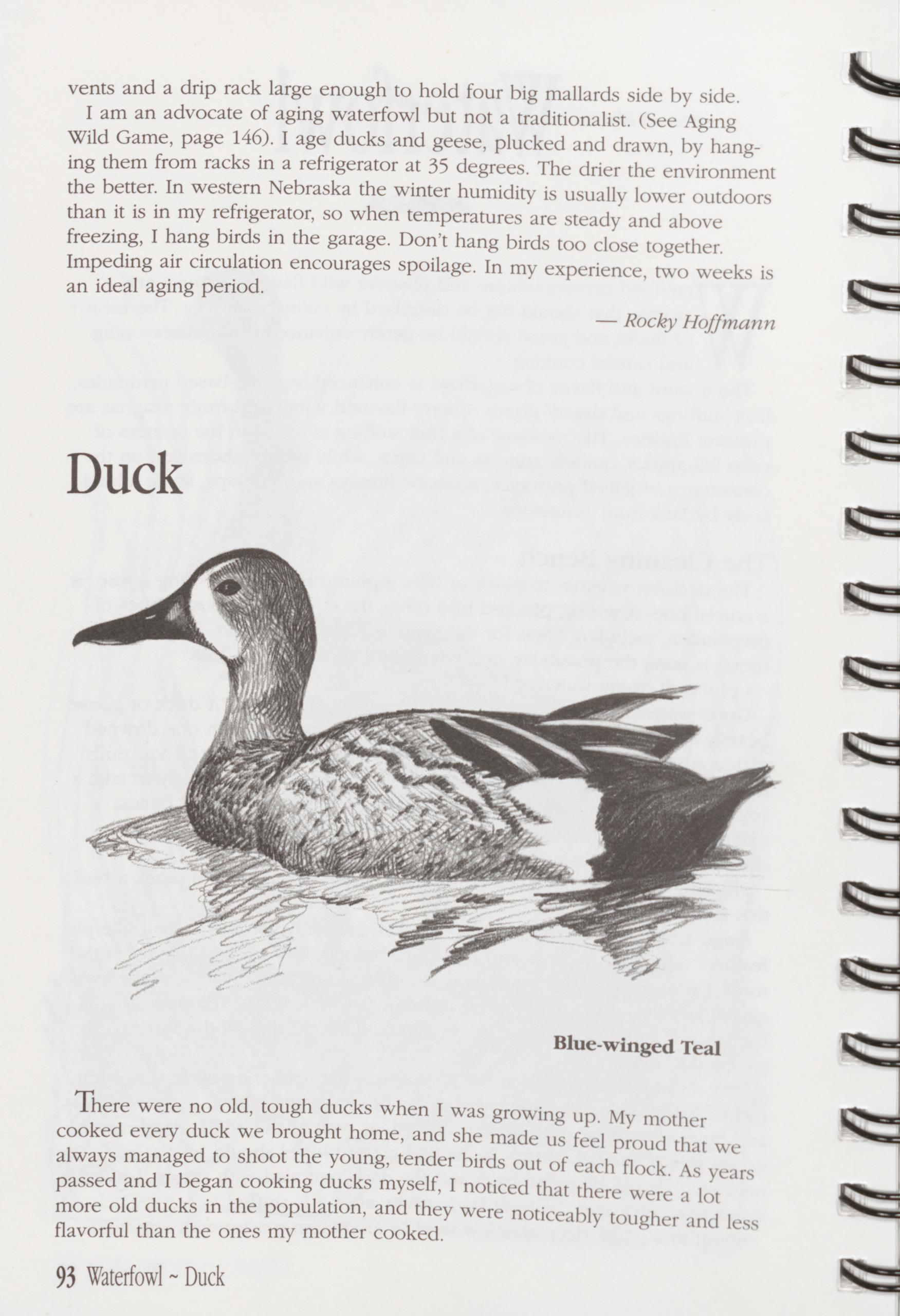
vents and a drip rack large enough to hold four big mallards side by side.
I am an advocate of aging waterfowl but not a traditionalist. (See Aging Wild Game, page 146). I age ducks and geese, plucked and drawn, by hang- ing them from racks in a refrigerator at 35 degrees. The drier the environment the better. In western Nebraska the winter humidity is usually lower outdoors than it is in my refrigerator, so when temperatures are steady and above freezing, I hang birds in the garage. Don’t hang birds too close together. Impeding air circulation encourages spoilage. In my experience, two weeks is an ideal aging period.
— Rocky Hoffmann Duck Blue-winged TealI here were no old, tough ducks when I was growing up. My mother cooked every duck we brought home, and she made us feel proud that we always managed to shoot the young, tender birds out of each flock. As years passed and I began cooking ducks myself, I noticed that there were a lot more old ducks in the population, and they were noticeably tougher and less flavorful than the ones my mother cooked.
93 Waterfowl ~ Duck Mom’s Traditional Roast Duck
4 plucked mallards
with giblets
6 unpeeled Jonathan apples,
quartered
4 tbl butter
salt and pepper
1/2 cup cherry wine
Mom’s Traditional Roast Duck
4 plucked mallards
with giblets
6 unpeeled Jonathan apples,
quartered
4 tbl butter
salt and pepper
1/2 cup cherry wine
Thoroughly clean the body cavity of each duck and pat the bird dry. Sprinkle generously inside and out with salt and less generously with black pepper. Place one tablespoon butter and six apple quarters inside each duck. Place the ducks and giblets on a rack in a roasting pan. Add water to just below the rack. Cover and slightly vent the roaster. Place the roaster on the bottom rack of a preheated 400-degree oven for 45 minutes. Reduce heat to 325 degrees and roast for 2 hours, basting frequently with juices from the roaster. When ducks begin to brown, drizzle Vi cup wine over breasts. When legs wiggle freely, remove the lid and finish browning. Prepare gravy from pan drippings and minced giblets.
Place one roast duck at a time on a carving board and with a sharp knife remove legs, thighs and wings. Fillet the breasts, with skin on, slice diagonally across the grain in Vi inch strips. Serve a wing, leg, thigh and one sliced breast on each plate. Nestle a scoop of mashed potatoes close to the duck and cover everything with gravy. Oh my!
— Rocky Hoffmann, North Platte, Nebraska Giblets and Gravy over Rice This is a great way to use up frozen packages of gizzards and hearts, which should be slow cooked to tenderize the meat. a season’s supply of gizzards and hearts 1 cup onion, chopped beef broth to cover gizzards and hearts in crockpot black pepper 2 cloves garlic, minced 2 cups rice, cooked cornstarchPut giblets, onions and garlic in a crockpot and add enough beef broth to cover. Season with salt and pepper. Cook 8 hours on low heat, then add enough cornstarch to slightly thicken the broth. Serve over white rice and garnish with fresh cilantro and a dash of soy sauce.
— Rocky Hoffmann, North Platte, Nebraska Waterfowl ~ Duck 94 Roast Duck with Sauerkraut and Mrs. Jacobs’ Dumplings
With sauerkraut or dumplings, roast duck is true a German dish. Serve it
with both, and dinner guests will be speaking the language before the
German chocolate cake is served. This recipe tends to tame the kraut with
the sweetness of apple and the fruitiness of sangria.
2 to 4 mallard ducks, plucked
and dressed
salt and pepper
2 large cans Bavarian style
sauerkraut, washed and
drained
1 cup sangria
1/2 cup butter
1 Granny Smith apple, peeled,
cored and chopped
1 cup raw potatoes, grated
1 cup onions, chopped
Roast Duck with Sauerkraut and Mrs. Jacobs’ Dumplings
With sauerkraut or dumplings, roast duck is true a German dish. Serve it
with both, and dinner guests will be speaking the language before the
German chocolate cake is served. This recipe tends to tame the kraut with
the sweetness of apple and the fruitiness of sangria.
2 to 4 mallard ducks, plucked
and dressed
salt and pepper
2 large cans Bavarian style
sauerkraut, washed and
drained
1 cup sangria
1/2 cup butter
1 Granny Smith apple, peeled,
cored and chopped
1 cup raw potatoes, grated
1 cup onions, chopped
Divide butter and place inside ducks. Sprinkle with salt and pepper. Mix the apple, potatoes and onion with sauerkraut. Stuff ducks sparingly with sauerkraut mixture and place the ducks on a rack in a roaster. Distribute remaining sauerkraut mixture around the ducks as a bed for the dumplings. Roast covered for 45 minutes at 400 degrees. Reduce the heat to 350 degrees for D/2 hours. Uncover and brown for 15 minutes. Place dumplings on the kraut, cover and cook for 8 to 10 more minutes without peeking. Halve the ducks with shears and serve with kraut and dumplings.
— Rocky Hoffmann, North Platte, Nebraska Mrs. Jacobs’ Potato Dumplings 1/4 cup flour cup mashed potatoes 2 tsp baking powder pinch of salt 1 egg splash of milkMix the flour, mashed potatoes, baking powder and salt. Stir the egg and milk together and add to mixture, stirring quickly. Spread flour on a plate and scoop out spoonfuls of mixture onto flour. Mixture is quite runny, but can be rolled around in the flour to make balls. Leave them on the plate until ready to add to ducks and kraut for steaming. Good dumplings require fat. Natural duck fat and butter in this recipe provide sufficient fat for excellent potato dumplings. This recipe was designed for use with pork roast, but it is excellent with ducks and geese.
— Marion Jacobs, Plattsmouth, Nebraska 95 Waterfowl ~ Duck Duck Blind Breakfast Sandwich
An old duck hunter along the Platte with whom I’ve occasionally shared
a blind, companionship and breakfasts, once told me never to have my
cholesterol checked at the end of the season.
“The shock would likely kill you,” he said. “Just change your ways during
the summer, and all that crud built up in your pipes from these duck blind
breakfasts will likely go away by October.”
His breakfasts usually consisted of huge venison steaks fried in bacon
grease with three eggs, hash browns and toast. He also served the bacon that
provided the drippings for cooking the venison.
More appropriate for the duck blind are these fried duck breast sandwiches
which require no utensils.
duck breasts (each fillet makes
two sandwiches)
1 onion, sliced
1 loaf caraway light rye bread,
sliced
1 stick butter
1 cup flour
salt and pepper
1 jar jalapeno slices
Cajun seasoning
Duck Blind Breakfast Sandwich
An old duck hunter along the Platte with whom I’ve occasionally shared
a blind, companionship and breakfasts, once told me never to have my
cholesterol checked at the end of the season.
“The shock would likely kill you,” he said. “Just change your ways during
the summer, and all that crud built up in your pipes from these duck blind
breakfasts will likely go away by October.”
His breakfasts usually consisted of huge venison steaks fried in bacon
grease with three eggs, hash browns and toast. He also served the bacon that
provided the drippings for cooking the venison.
More appropriate for the duck blind are these fried duck breast sandwiches
which require no utensils.
duck breasts (each fillet makes
two sandwiches)
1 onion, sliced
1 loaf caraway light rye bread,
sliced
1 stick butter
1 cup flour
salt and pepper
1 jar jalapeno slices
Cajun seasoning
Cut the duck breasts in half and dredge in seasoned flour. A good Cajun seasoning with some lingering fire adds a nice quality to the sandwich. Place in heavy skillet in bubbly-hot butter. Fry until brown on the outside, but still pink at the center.
A properly finished sandwich rarely occurs in a duck blind, as ducks inevitably begin decoying exactly when the breasts should be removed from the heat. Make the sandwiches with breasts, a slice of onion and several jalapeno slices.
Keep the pan hot, because a second sandwich will likely be in order.
— Rocky Hoffmann, North Platte, Nebraska Sauerkraut and Duck This recipe has been a favorite for many years. Regular kraut can be used, but Bavarian kraut produces a slightly sweeter taste. 2 whole ducks 1 large cooking bag 3 lb Bavarian sauerkrautDrain the sauerkraut and stuff it into the cavities of the ducks. Add salt and pepper. Place remaining sauerkraut in bottom of a cooking bag and place the ducks on top of kraut. Seal the bag. Bake at 325 degrees for 2 1/2 hours, or slightly less for smaller ducks.
— Gary Fournelle, Omaha, Nebraska Waterfowl ~ Duck 96 Grilled Duck Breast over Duck Risotto
With duck numbers high and hunting success good in recent years, I have
sought variations for preparing birds. Most of our waterfowl are roasted
whole with skin on, stuffed generously with apples and seasoning, and
frequently splashed with wine. The duck gravy that accompanies it is superb,
but a steady diet of it can lead to a noticeable increase in belt size.
The following recipe from Walt Weaver of North Platte is labor intensive
and includes the preparation of authentic duck stock and risotto, and
instructions for grilling duck breasts.
Risotto is an Italian rice dish. For best results use Arborio rice.
The Stock
2 mallards
1 onion, quartered
2 bunches celery tops
3 or 4 peppercorns
2 bay leaves
2 carrots
1 pinch of basil
1V4 cups chicken broth
2 to 4 cloves garlic
salt and pepper
2 quarts spring water
Grilled Duck Breast over Duck Risotto
With duck numbers high and hunting success good in recent years, I have
sought variations for preparing birds. Most of our waterfowl are roasted
whole with skin on, stuffed generously with apples and seasoning, and
frequently splashed with wine. The duck gravy that accompanies it is superb,
but a steady diet of it can lead to a noticeable increase in belt size.
The following recipe from Walt Weaver of North Platte is labor intensive
and includes the preparation of authentic duck stock and risotto, and
instructions for grilling duck breasts.
Risotto is an Italian rice dish. For best results use Arborio rice.
The Stock
2 mallards
1 onion, quartered
2 bunches celery tops
3 or 4 peppercorns
2 bay leaves
2 carrots
1 pinch of basil
1V4 cups chicken broth
2 to 4 cloves garlic
salt and pepper
2 quarts spring water
Use young, tender mallards with few breast wounds. The birds should be plucked, not skinned. Retain the giblets. Carefully fillet the four breasts and set aside for grilling. Cut the remaining carcasses into pieces and season with salt and pepper. Coat the bottom of a stock pot with oil. Brown the duck pieces and giblets. Add the water, onions, celery tops, carrots, peppercorns, bay leaves, basil, garlic and chicken broth. Add salt to taste.
Simmer the stock for 30 minutes to 1 hour, skimming the foam as it forms. Strain into a saucepan and retain the meat and bones. This step can be done in advance, as the stock freezes well.
The Risotto meat and bones strained from stock 2 oz salt pork 1 onion, diced 1 stalk celery, diced 2 to 4 cloves garlic, minced 2 to 4 chilies, minced and seeded 2 cups risotto rice, uncooked 1 pinch saffron threads 1 handful fresh cilantro, chopped ¥4 cup Romano cheese, freshly gratedSeparate the meat from the skin and bones. Shred the meat and giblets and set aside. Render 2 ounces of salt pork or bacon in an iron skillet. Remove and discard the pork. Saute the diced onion, celery, garlic and chilies in the fat until tender. Add the shredded duck meat. Salt and pepper to taste. Cover and remove from heat.
97 Waterfowl ~ Duck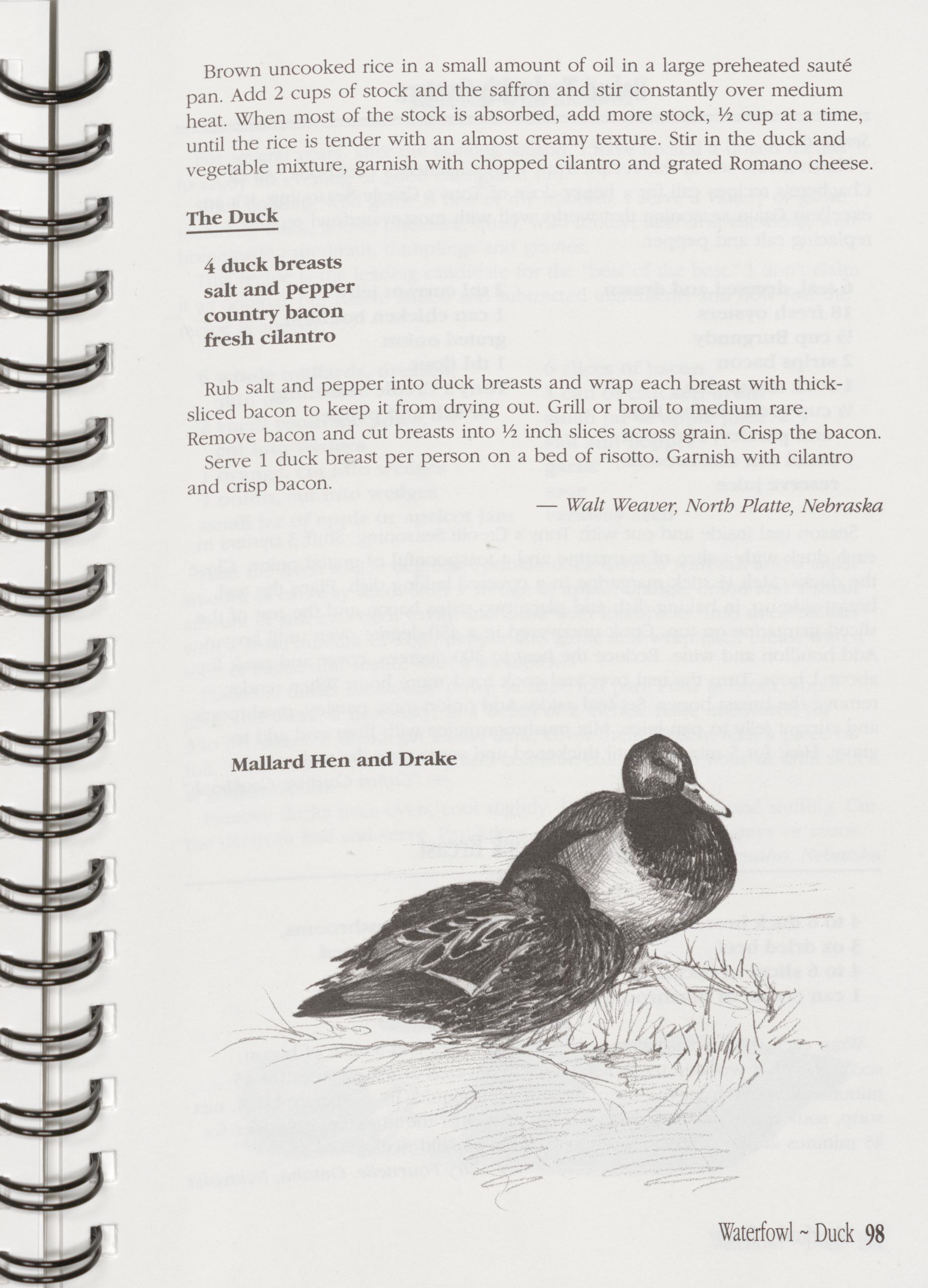
Brown uncooked rice in a small amount of oil in a large preheated saute pan. Add 2 cups of stock and the saffron and stir constantly over medium heat. When most of the stock is absorbed, add more stock, ¥2 cup at a time, until the rice is tender with an almost creamy texture. Stir in the duck and vegetable mixture, garnish with chopped cilantro and grated Romano cheese.
The Duck 4 duck breasts salt and pepper country bacon fresh cilantroRub salt and pepper into duck breasts and wrap each breast with thick- sliced bacon to keep it from drying out. Grill or broil to medium rare.
Remove bacon and cut breasts into ¥2 inch slices across grain. Crisp the bacon. Serve 1 duck breast per person on a bed of risotto. Garnish with cilantro and crisp bacon.
— Walt Weaver, North Platte, Nebraska Waterfowl ~ Duck 98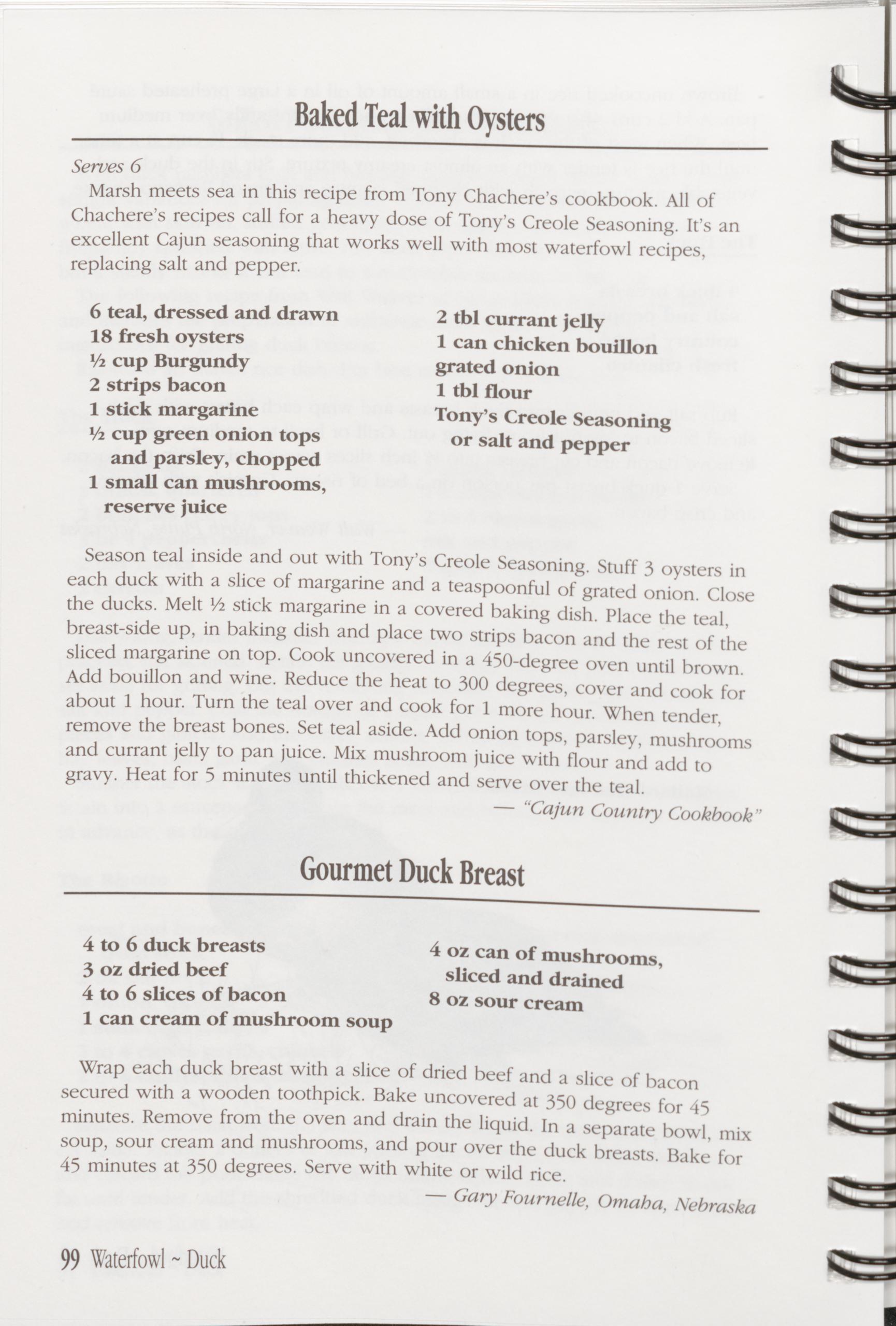 Baked Teal with Oysters
>Serves 6
Marsh meets sea in this recipe from Tony Chachere’s cookbook. All of
Chachere’s recipes call for a heavy dose of Tony’s Creole Seasoning. It’s an
excellent Cajun seasoning that works well with most waterfowl recipes,
replacing salt and pepper.
6 teal, dressed and drawn
18 fresh oysters
1/2 cup Burgundy
2 strips bacon
1 stick margarine
1/2 cup green onion tops
and parsley, chopped
1 small can mushrooms,
reserve juice
2 tbl currant jelly
1 can chicken bouillon
grated onion
1 tbl flour
Tony’s Creole Seasoning
or salt and pepper
Baked Teal with Oysters
>Serves 6
Marsh meets sea in this recipe from Tony Chachere’s cookbook. All of
Chachere’s recipes call for a heavy dose of Tony’s Creole Seasoning. It’s an
excellent Cajun seasoning that works well with most waterfowl recipes,
replacing salt and pepper.
6 teal, dressed and drawn
18 fresh oysters
1/2 cup Burgundy
2 strips bacon
1 stick margarine
1/2 cup green onion tops
and parsley, chopped
1 small can mushrooms,
reserve juice
2 tbl currant jelly
1 can chicken bouillon
grated onion
1 tbl flour
Tony’s Creole Seasoning
or salt and pepper
Season teal inside and out with Tony’s Creole Seasoning. Stuff 3 oysters in each duck with a slice of margarine and a teaspoonful of grated onion. Close the ducks. Melt ¥2 stick margarine in a covered baking dish. Place the teal, breast-side up, in baking dish and place two strips bacon and the rest of the sliced margarine on top. Cook uncovered in a 450-degree oven until brown. Add bouillon and wine. Reduce the heat to ZOO degrees, cover and cook for about 1 hour. Turn the teal over and cook for 1 more hour. When tender, remove the breast bones. Set teal aside. Add onion tops, parsley, mushrooms and currant jelly to pan juice. Mix mushroom juice with flour and add to gravy. Heat for 5 minutes until thickened and serve over the teal.
— “Cajun Country Cookbook” Gourmet Duck Breast 4 to 6 duck breasts 4 oz can of mushrooms, 3 oz dried beef sliced and drained 4 to 6 slices of bacon 8 oz sour cream 1 can cream of mushroom soupWrap each duck breast with a slice of dried beef and a slice of bacon secured with a wooden toothpick. Bake uncovered at 350 degrees for 45 minutes. Remove from the oven and drain the liquid. In a separate bowl, mix soup, sour cream and mushrooms, and pour over the duck breasts. Bake for 45 minutes at 350 degrees. Serve with white or wild rice.
— Gary Fournelle, Omaha, Nebraska 99 Waterfowl ~ Duck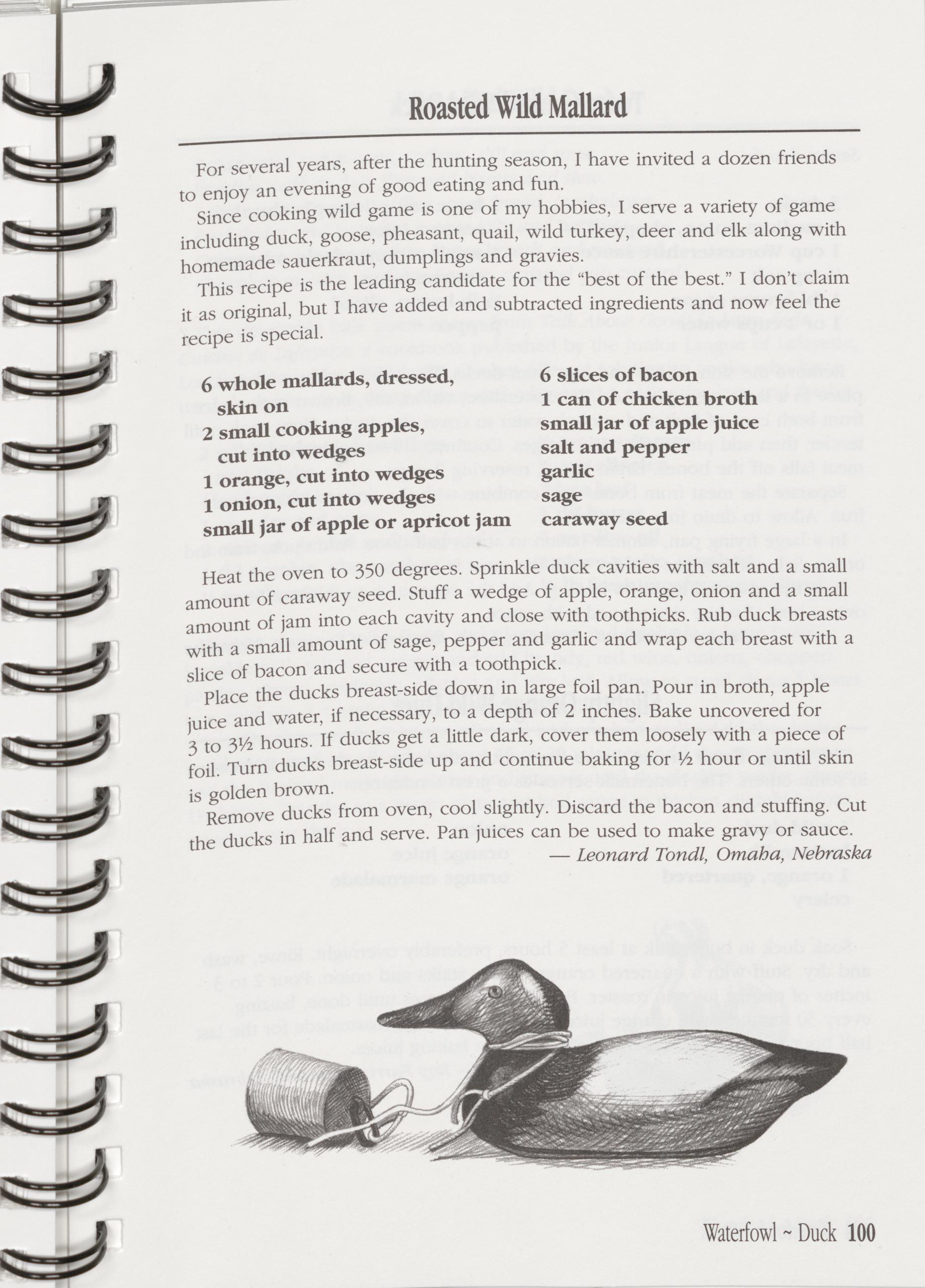 Roasted Wild Mallard
For several years, after the hunting season, I have invited a dozen friends
to enjoy an evening of good eating and fun.
Since cooking wild game is one of my hobbies, I serve a variety of game
including duck, goose, pheasant, quail, wild turkey, deer and elk along with
homemade sauerkraut, dumplings and gravies.
This recipe is the leading candidate for the “best of the best.” I don’t claim
it as original, but I have added and subtracted ingredients and now feel the
recipe is special.
6 whole mallards, dressed,
skin on
2 small cooking apples,
cut into wedges
1 orange, cut into wedges
1 onion, cut into wedges
small jar of apple or apricot jam
6 slices of bacon
1 can of chicken broth
small jar of apple juice
salt and pepper
garlic
sage
caraway seed
Roasted Wild Mallard
For several years, after the hunting season, I have invited a dozen friends
to enjoy an evening of good eating and fun.
Since cooking wild game is one of my hobbies, I serve a variety of game
including duck, goose, pheasant, quail, wild turkey, deer and elk along with
homemade sauerkraut, dumplings and gravies.
This recipe is the leading candidate for the “best of the best.” I don’t claim
it as original, but I have added and subtracted ingredients and now feel the
recipe is special.
6 whole mallards, dressed,
skin on
2 small cooking apples,
cut into wedges
1 orange, cut into wedges
1 onion, cut into wedges
small jar of apple or apricot jam
6 slices of bacon
1 can of chicken broth
small jar of apple juice
salt and pepper
garlic
sage
caraway seed
Heat the oven to 350 degrees. Sprinkle duck cavities with salt and a small amount of caraway seed. Stuff a wedge of apple, orange, onion and a small amount of jam into each cavity and close with toothpicks. Rub duck breasts with a small amount of sage, pepper and garlic and wrap each breast with a slice of bacon and secure with a toothpick.
Place the ducks breast-side down in large foil pan. Pour in broth, apple juice and water, if necessary, to a depth of 2 inches. Bake uncovered for 3 to y/2 hours. If ducks get a little dark, cover them loosely with a piece of foil. Turn ducks breast-side up and continue baking for Vi hour or until skin is golden brown.
Remove ducks from oven, cool slightly. Discard the bacon and stuffing. Cut the ducks in half and serve. Pan juices can be used to make gravy or sauce.
>— Leonard Tondl, Omaha, Nebraska Waterfowl ~ Duck 100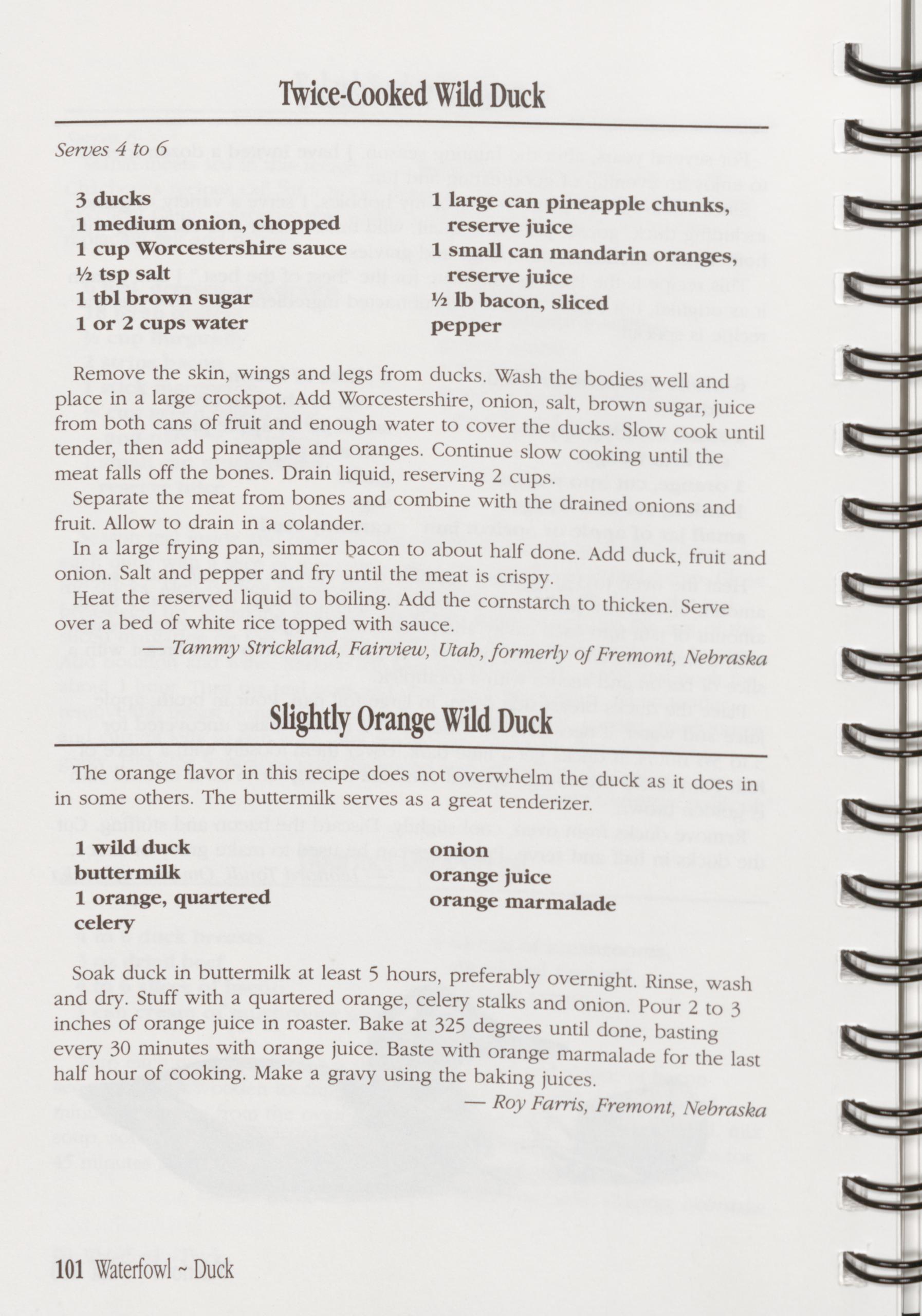 >Twice-Cooked Wild Duck
Serves 4 to 6
3 ducks
1 medium onion, chopped
1 cup Worcestershire sauce
¥2 tsp salt
1 tbl brown sugar
1 or 2 cups water
I large can pineapple chunks,
reserve juice
1 small can mandarin oranges,
reserve juice
¥2 lb bacon, sliced
pepper
>Twice-Cooked Wild Duck
Serves 4 to 6
3 ducks
1 medium onion, chopped
1 cup Worcestershire sauce
¥2 tsp salt
1 tbl brown sugar
1 or 2 cups water
I large can pineapple chunks,
reserve juice
1 small can mandarin oranges,
reserve juice
¥2 lb bacon, sliced
pepper
Remove the skin, wings and legs from ducks. Wash the bodies well and place in a large crockpot. Add Worcestershire, onion, salt, brown sugar, juice from both cans of fruit and enough water to cover the ducks. Slow cook until tender, then add pineapple and oranges. Continue slow cooking until the meat falls off the bones. Drain liquid, reserving 2 cups.
Separate the meat from bones and combine with the drained onions and fruit. Allow to drain in a colander.
In a large frying pan, simmer bacon to about half done. Add duck, fruit and onion. Salt and pepper and fry until the meat is crispy.
Heat the reserved liquid to boiling. Add the cornstarch to thicken. Serve over a bed of white rice topped with sauce.
— Tammy Strickland, Fairview, Utah, formerly of Fremont, Nebraska Slightly Orange Wild Duck The orange flavor in this recipe does not overwhelm the duck as it does in in some others. The buttermilk serves as a great tenderizer. 1 wild duck buttermilk 1 orange, quartered celery onion orange juice orange marmaladeSoak duck in buttermilk at least 5 hours, preferably overnight. Rinse, wash and dry. Stuff with a quartered orange, celery stalks and onion. Pour 2 to 3 inches of orange juice in roaster. Bake at 325 degrees until done, basting every 30 minutes with orange juice. Baste with orange marmalade for the last half hour of cooking. Make a gravy using the baking juices.
— Roy Farris, Fremont, Nebraska 101 Waterfowl ~ Duck Brandied Wild Duck
Sugar cane, syrup cane, saffron, dill and roux,
Etouffee, cafe au lait, flan and bisque and stew.
Sabayon and court bouillon, corn bread, jambalayas,
Enchiladas and tostadas, pepper jelly and papayas.
Creme glace, sweet parfait, batter breads and mustard.
Chocolate mousse, duck and goose, caramel cup custard!
This delectable little poem comes from Talk About Good! Le Livre de la
Cuisine de Lafayette, a cookbook published by the Junior League of Lafayette,
Louisiana. In it Mrs. William W. Coulter offers a solution to cooks who have
used duck breasts in other dishes and who need a recipe for legs and thighs.
2 wild ducks or 6 to 8 legs
and thighs
4 oz brandy
1 cup dry red wine
2 onions, peeled and chopped
1 tbl parsley, chopped
1/2 tsp thyme
1/2 tsp marjoram
1/4 tsp allspice
1 bay leaf
1 tbl butter
3 oz olive oil
1 clove garlic, crushed
1/2 lb fresh mushrooms, sliced
Brandied Wild Duck
Sugar cane, syrup cane, saffron, dill and roux,
Etouffee, cafe au lait, flan and bisque and stew.
Sabayon and court bouillon, corn bread, jambalayas,
Enchiladas and tostadas, pepper jelly and papayas.
Creme glace, sweet parfait, batter breads and mustard.
Chocolate mousse, duck and goose, caramel cup custard!
This delectable little poem comes from Talk About Good! Le Livre de la
Cuisine de Lafayette, a cookbook published by the Junior League of Lafayette,
Louisiana. In it Mrs. William W. Coulter offers a solution to cooks who have
used duck breasts in other dishes and who need a recipe for legs and thighs.
2 wild ducks or 6 to 8 legs
and thighs
4 oz brandy
1 cup dry red wine
2 onions, peeled and chopped
1 tbl parsley, chopped
1/2 tsp thyme
1/2 tsp marjoram
1/4 tsp allspice
1 bay leaf
1 tbl butter
3 oz olive oil
1 clove garlic, crushed
1/2 lb fresh mushrooms, sliced
Disjoint a pair of wild ducks and place legs and thighs in a large bowl. Sprinkle with salt and pepper and add brandy, red wine, onions, chopped parsley, thyme, marjoram, allspice and bay leaf. Allow to stand about 5 hours in a cool place, turning the pieces occasionally. In a Dutch oven, heat butter, olive oil and crushed garlic. Add the duck, and brown well on all sides, about 15 to 20 minutes. Add the mushrooms and the strained marinade. Cover and simmer until the duck is tender, about D/2 hours. Transfer to a warm plate and boil sauce to thicken slightly before pouring over duck.
Waterfowl ~ Duck 102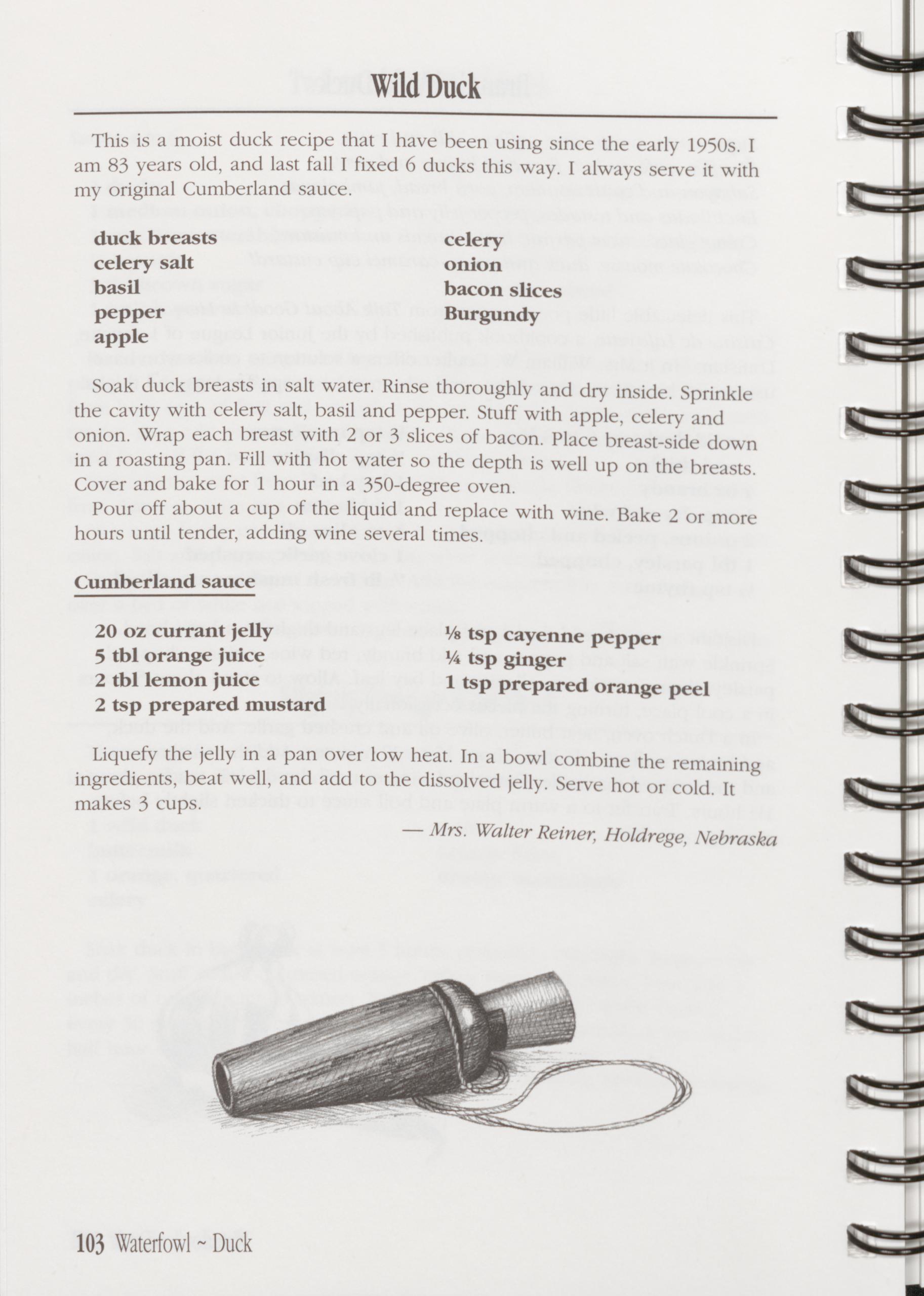 Wild Duck
This is a moist duck recipe that I have been using since the early 1950s. I
am 83 years old, and last fall I fixed 6 ducks this way. I always serve it with
my original Cumberland sauce.
duck breasts
celery salt
basil
pepper
apple
celery
onion
bacon slices
Burgundy
Wild Duck
This is a moist duck recipe that I have been using since the early 1950s. I
am 83 years old, and last fall I fixed 6 ducks this way. I always serve it with
my original Cumberland sauce.
duck breasts
celery salt
basil
pepper
apple
celery
onion
bacon slices
Burgundy
Soak duck breasts in salt water. Rinse thoroughly and dry inside. Sprinkle the cavity with celery salt, basil and pepper. Stuff with apple, celery and onion. Wrap each breast with 2 or 3 slices of bacon. Place breast-side down in a roasting pan. Fill with hot water so the depth is well up on the breasts. Cover and bake for 1 hour in a 350-degree oven.
Pour off about a cup of the liquid and replace with wine. Bake 2 or more hours until tender, adding wine several times.
Cumberland sauce 20 oz currant jelly 5 tbl orange juice 2 tbl lemon juice 2 tsp prepared mustard 1/8 tsp cayenne pepper 1/4 tsp ginger 1 tsp prepared orange peelLiquefy the jelly in a pan over low heat. In a bowl combine the remaining ingredients, beat well, and add to the dissolved jelly. Serve hot or cold. It makes 3 cups.
— Mrs. Walter Reiner, Holdrege, Nebraska 103 Waterfowl ~ Duck Notes
Waterfowl ~ Notes 104
Notes
Waterfowl ~ Notes 104
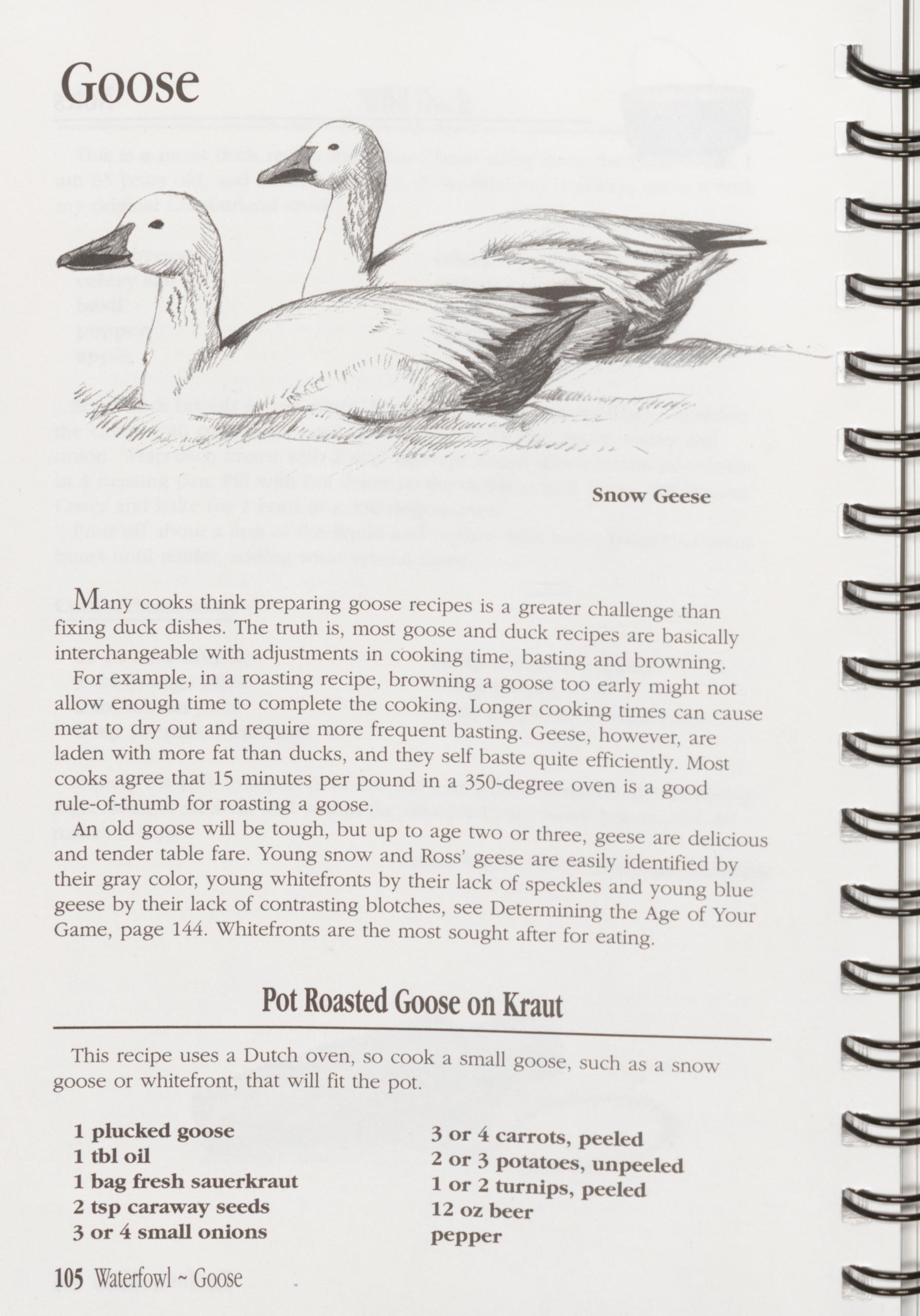
Many cooks think preparing goose recipes is a greater challenge than fixing duck dishes. The truth is, most goose and duck recipes are basically interchangeable with adjustments in cooking time, basting and browning.
For example, in a roasting recipe, browning a goose too early might not allow enough time to complete the cooking. Longer cooking times can cause meat to dry out and require more frequent basting. Geese, however, are laden with more fat than ducks, and they self baste quite efficiently. Most cooks agree that 15 minutes per pound in a 350-degree oven is a good rule-of-thumb for roasting a goose.
An old goose will be tough, but up to age two or three, geese are delicious and tender table fare. Young snow and Ross’ geese are easily identified by their gray color, young whitefronts by their lack of speckles and young blue geese by their lack of contrasting blotches, see Determining the Age of Your Game, page 144. Whitefronts are the most sought after for eating.
Pot Roasted Goose on Kraut This recipe uses a Dutch oven, so cook a small goose, such as a snow goose or whitefront, that will fit the pot. 1 plucked goose 1 tbl oil 1 bag fresh sauerkraut 2 tsp caraway seeds 3 or 4 small onions 3 or 4 carrots, peeled 2 or 3 potatoes, unpeeled 1 or 2 turnips, peeled 12 oz beer pepper 105 Waterfowl ~ Goose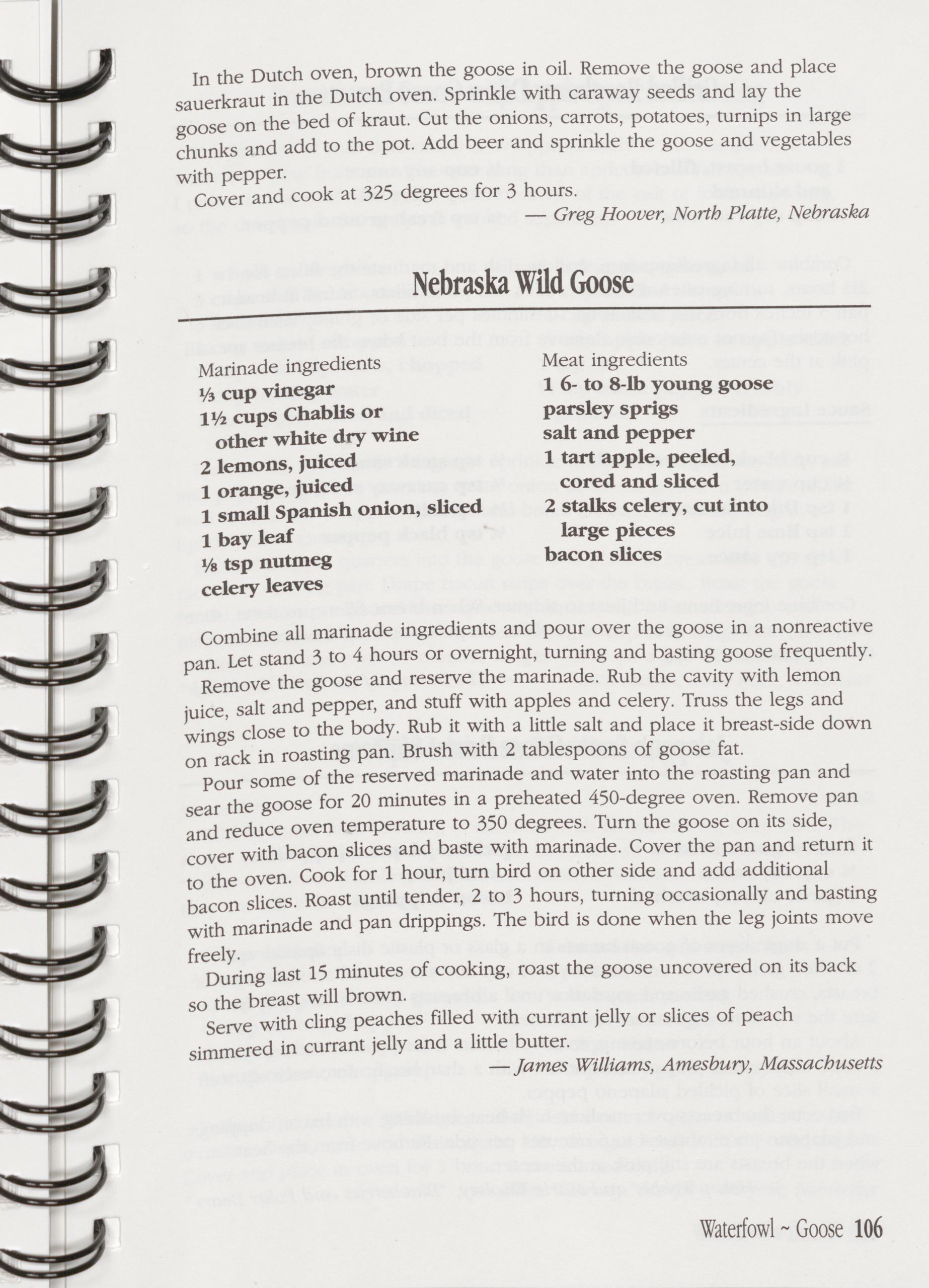
In the Dutch oven, brown the goose in oil. Remove the goose and place sauerkraut in the Dutch oven. Sprinkle with caraway seeds and lay the goose on the bed of kraut. Cut the onions, carrots, potatoes, turnips in large chunks and add to the pot. Add beer and sprinkle the goose and vegetables with pepper.
Cover and cook at 325 degrees for 2 hours.
— Greg Hoover, North Platte, Nebraska Nebraska Wild Goose Marinade ingredients 1/3 cup vinegar 1 1/2 cups Chablis or other white dry wine 2 lemons, juiced 1 orange, juiced 1 small Spanish onion, sliced 1 bay leaf 1/8 tsp nutmeg celery leaves Meat ingredients 1 6- to 8 lb young goose parsley sprigs salt and pepper 1 tart apple, peeled, cored and sliced 2 stalks celery, cut into large pieces bacon slicesCombine all marinade ingredients and pour over the goose in a nonreactive pan. Let stand 3 to 4 hours or overnight, turning and basting goose frequently.
Remove the goose and reserve the marinade. Rub the cavity with lemon juice, salt and pepper, and stuff with apples and celery. Truss the legs and wings close to the body. Rub it with a little salt and place it breast-side down on rack in roasting pan. Brush with 2 tablespoons of goose fat.
Pour some of the reserved marinade and water into the roasting pan and sear the goose for 20 minutes in a preheated 450-degree oven. Remove pan and reduce oven temperature to 350 degrees. Turn the goose on its side, cover with bacon slices and baste with marinade. Cover the pan and return it to the oven. Cook for 1 hour, turn bird on other side and add additional bacon slices. Roast until tender, 2 to 3 hours, turning occasionally and basting with marinade and pan drippings. The bird is done when the leg joints move freely.
During last 15 minutes of cooking, roast the goose uncovered on its back so the breast will brown.
Serve with cling peaches filled with currant jelly or slices of peach simmered in currant jelly and a little butter.
— James Williams, Amesbury, Massachusetts Waterfowl ~ Goose 106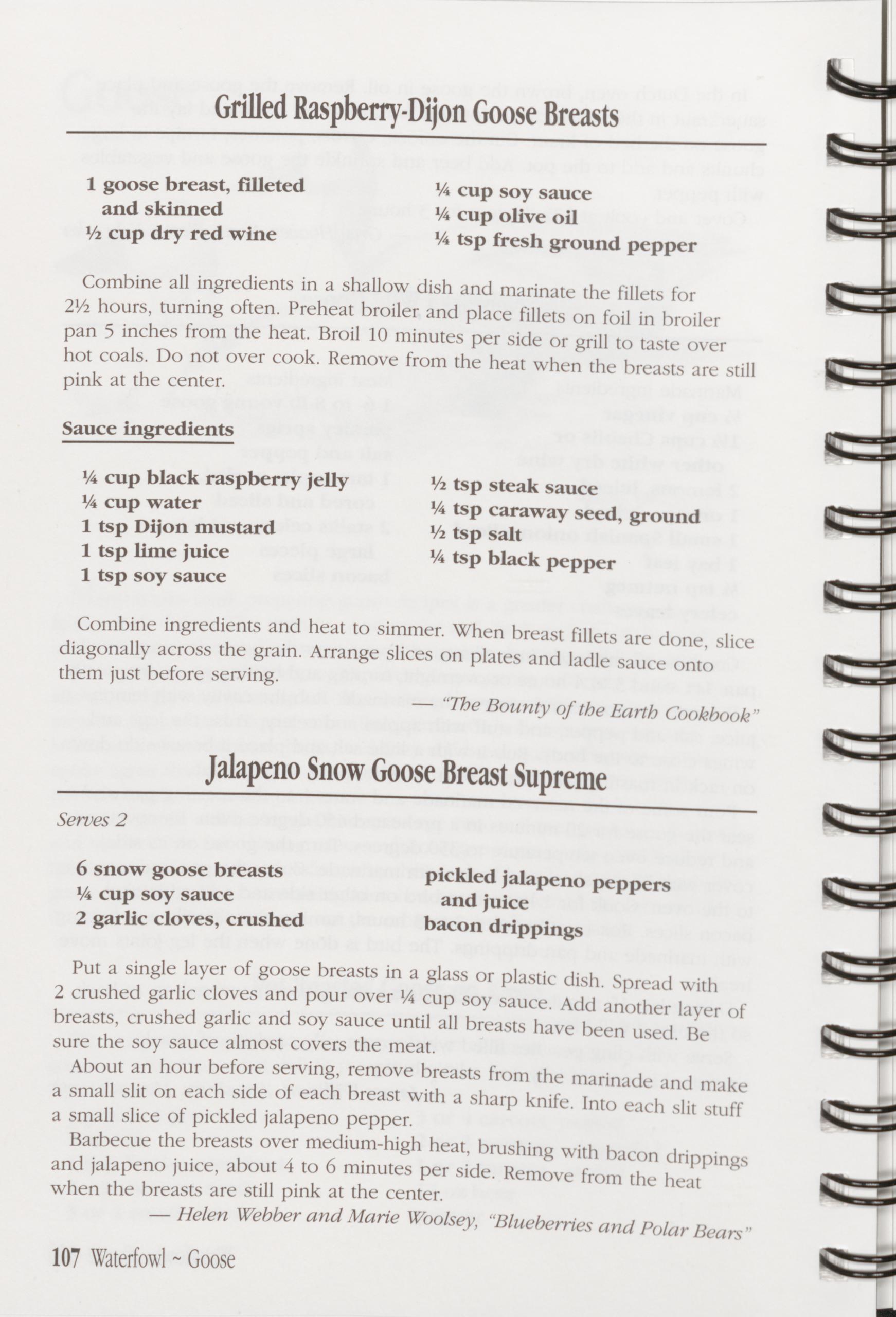 Grilled Raspberry-Dijon Goose Breasts
1 goose breast, filleted
and skinned
1/2 cup dry red wine
1/4 cup soy sauce
1/4 cup olive oil
1/4 tsp fresh ground pepper
Grilled Raspberry-Dijon Goose Breasts
1 goose breast, filleted
and skinned
1/2 cup dry red wine
1/4 cup soy sauce
1/4 cup olive oil
1/4 tsp fresh ground pepper
Combine all ingredients in a shallow dish and marinate the fillets for 2 1/2 hours, turning often. Preheat broiler and place fillets on foil in broiler pan 5 inches from the heat. Broil 10 minutes per side or grill to taste over hot coals. Do not over cook. Remove from the heat when the breasts are still pink at the center.
Sauce ingredients 1/4 cup black raspberry jelly 1/4 cup water 1 tsp Dijon mustard 1 tsp lime juice 1 tsp soy sauce 1/2 tsp steak sauce 1/4 tsp caraway seed, ground 1/2 tsp salt 1/4 tsp black pepperCombine ingredients and heat to simmer. When breast fillets are done, slice diagonally across the grain. Arrange slices on plates and ladle sauce onto them just before serving.
— “The Bounty of the Earth Cookbook'' Jalapeno Snow Goose Breast Supreme Serves 2 6 snow goose breasts 1/4 cup soy sauce 2 garlic cloves, crushed pickled jalapeno peppers and juice bacon drippingsPut a single layer of goose breasts in a glass or plastic dish. Spread with 2 crushed garlic cloves and pour over 1/4 cup soy sauce. Add another layer of breasts, crushed garlic and soy sauce until all breasts have been used. Be sure the soy sauce almost covers the meat.
About an hour before serving, remove breasts from the marinade and make a small slit on each side of each breast with a sharp knife. Into each slit stuff a small slice of pickled jalapeno pepper.
Barbecue the breasts over medium-high heat, brushing with bacon drippings and jalapeno juice, about 4 to 6 minutes per side. Remove from the heat when the breasts are still pink at the center.
— Helen Webber and Marie Woolsey, “Blueberries and Polar Bears" 107 Waterfowl - Goose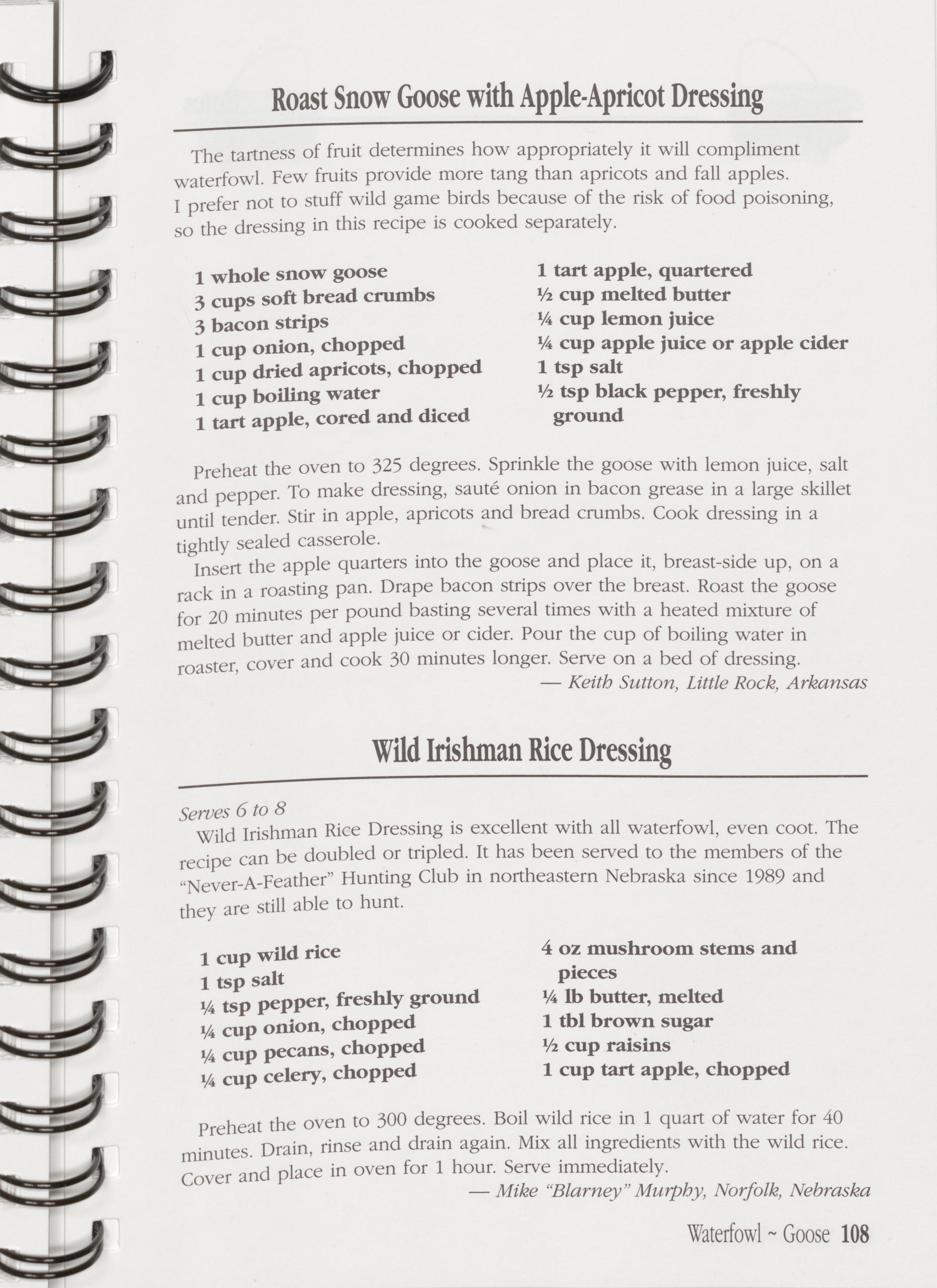 Roast Snow Goose with Apple-Apricot Dressing
The tartness of fruit determines how appropriately it will compliment
waterfowl. Few fruits provide more tang than apricots and fall apples.
I prefer not to stuff wild game birds because of the risk of food poisoning,
so the dressing in this recipe is cooked separately.
1 whole snow goose
3 cups soft bread crumbs
3 bacon strips
1 cup onion, chopped
1 cup dried apricots, chopped
1 cup boiling water
1 tart apple, cored and diced
1 tart apple, quartered
¥z cup melted butter
Mi cup lemon juice
Mi cup apple juice or apple cider
1 tsp salt
¥2 tsp black pepper, freshly
ground
Roast Snow Goose with Apple-Apricot Dressing
The tartness of fruit determines how appropriately it will compliment
waterfowl. Few fruits provide more tang than apricots and fall apples.
I prefer not to stuff wild game birds because of the risk of food poisoning,
so the dressing in this recipe is cooked separately.
1 whole snow goose
3 cups soft bread crumbs
3 bacon strips
1 cup onion, chopped
1 cup dried apricots, chopped
1 cup boiling water
1 tart apple, cored and diced
1 tart apple, quartered
¥z cup melted butter
Mi cup lemon juice
Mi cup apple juice or apple cider
1 tsp salt
¥2 tsp black pepper, freshly
ground
Preheat the oven to 325 degrees. Sprinkle the goose with lemon juice, salt and pepper. To make dressing, saute onion in bacon grease in a large skillet until tender. Stir in apple, apricots and bread crumbs. Cook dressing in a tightly sealed casserole.
Insert the apple quarters into the goose and place it, breast-side up, on a rack in a roasting pan. Drape bacon strips over the breast. Roast the goose for 20 minutes per pound basting several times with a heated mixture of melted butter and apple juice or cider. Pour the cup of boiling water in roaster, cover and cook 30 minutes longer. Serve on a bed of dressing.
— Keith Sutton, Little Rock, Arkansas Wild Irishman Rice Dressing Serves 6 to 8 Wild Irishman Rice Dressing is excellent with all waterfowl, even coot. The recipe can be doubled or tripled. It has been served to the members of the “Never-A-Feather” Hunting Club in northeastern Nebraska since 1989 and they are still able to hunt. 1 cup wild rice 1 tsp salt 1/4 tsp pepper, freshly ground 1/4 cup onion, chopped 1/4 cup pecans, chopped 1/4 cup celery, chopped 4 oz mushroom stems and pieces 1/4 lb butter, melted 1 tbl brown sugar 1/2 cup raisins 1 cup tart apple, choppedPreheat the oven to 300 degrees. Boil wild rice in 1 quart of water for 40 minutes. Drain, rinse and drain again. Mix all ingredients with the wild rice. Cover and place in oven for 1 hour. Serve immediately.
>— Mike “Blarney” Murphy, Norfolk, Nebraska Waterfowl ~ Goose 108 Notes
109 Waterfowl ~ Notes
Notes
109 Waterfowl ~ Notes
 Notes
Waterfowl ~ Notes 110
Notes
Waterfowl ~ Notes 110
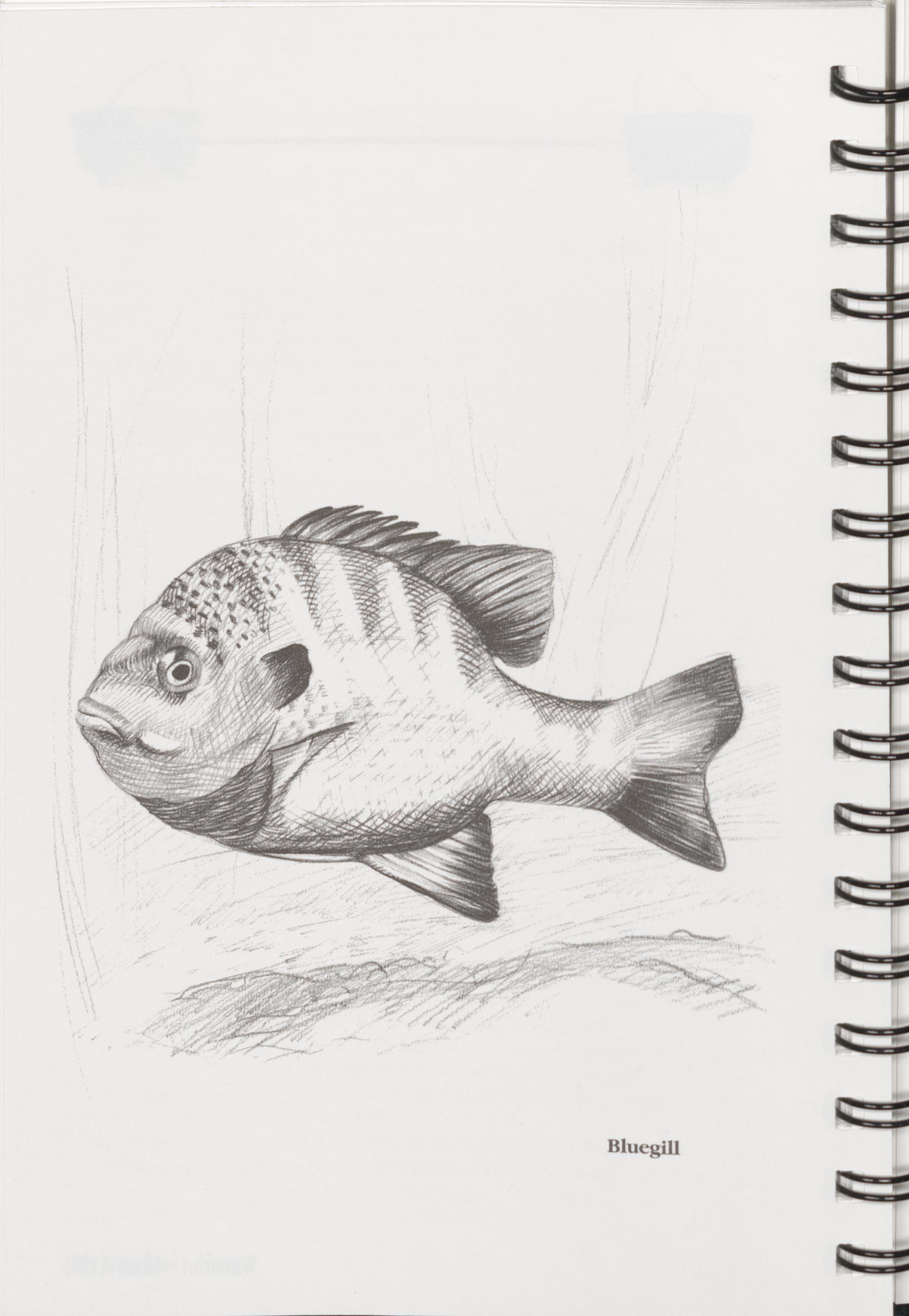
Despite the increasing popularity of catch-and-release fishing, anglers today are catching, keeping and eating more fish than ever before. The reason for our love affair with fish is simple: Fish taste good. Properly handled, from catch to cleaning to cooking, fish offer a wonderful range of delicate and savory flavors pleasing nearly every taste. The satisfactions and lessons of fishing are many. Of course, it starts with the catch. By gosh, you did everything right and fooled the fish into thinking your bait was its next meal.
Cleaning and preparing fish reinforces self-sufficiency, and it teaches youngsters that food doesn’t magically appear in the refrigerator or at fast- food drive-ins. They also learn the responsibility inherent in the taking the life of game to help sustain other living things.
Cooking is your chance to be an individual, to season the fish exactly as you like it, to cook it precisely to your taste, and to serve it with your choice of side dishes.
Fish can be prepared by frying, grilling, baking, boiling, broiling, drying, smoking, pickling or by building chowders, stews and soups around its hearty flavor.
But there is one cardinal rule: Never, ever over cook!
Despite its image, even properly cooked “blackened fish” isn’t over cooked.
The blackening is created by singeing a combination of Cajun spices coating the fish, not by careless frying.
Ideally, fish should be cleaned immediately after being caught, quickly cooled and cooked on the spot. The rule-of-thumb is: The more time between catching and cooking, the more the flavor suffers.
Fish spoil rapidly. Freeze fish that won’t be eaten soon. But, flavor also is diminished by freezing. The longer a fish is frozen, the less palatable it becomes. Of all game, fish is the one that should be eaten fresh.
A splash of malt vinegar, a few drops of lemon juice or a glass of pale wine enhance the flavor of fish rich in fat such as trout, catfish and striped bass. Ice cold beer, hot sauces, charcoal-filtered whiskeys or full-bodied red wines often accompany meals featuring leaner species.
Eating fish is healthful. The American Heart Association says a heavy fish diet is better than a strictly vegetarian diet in reducing fats in the bloodstream, and it helps reduce the risk of heart attack. Other research has found that omega-3 polyunsaturated fatty acid found in some fish species can inhibit the development of some cancers. Fish is also a good source for vitamins and provides complete protein.
— Tom Keith Fish 112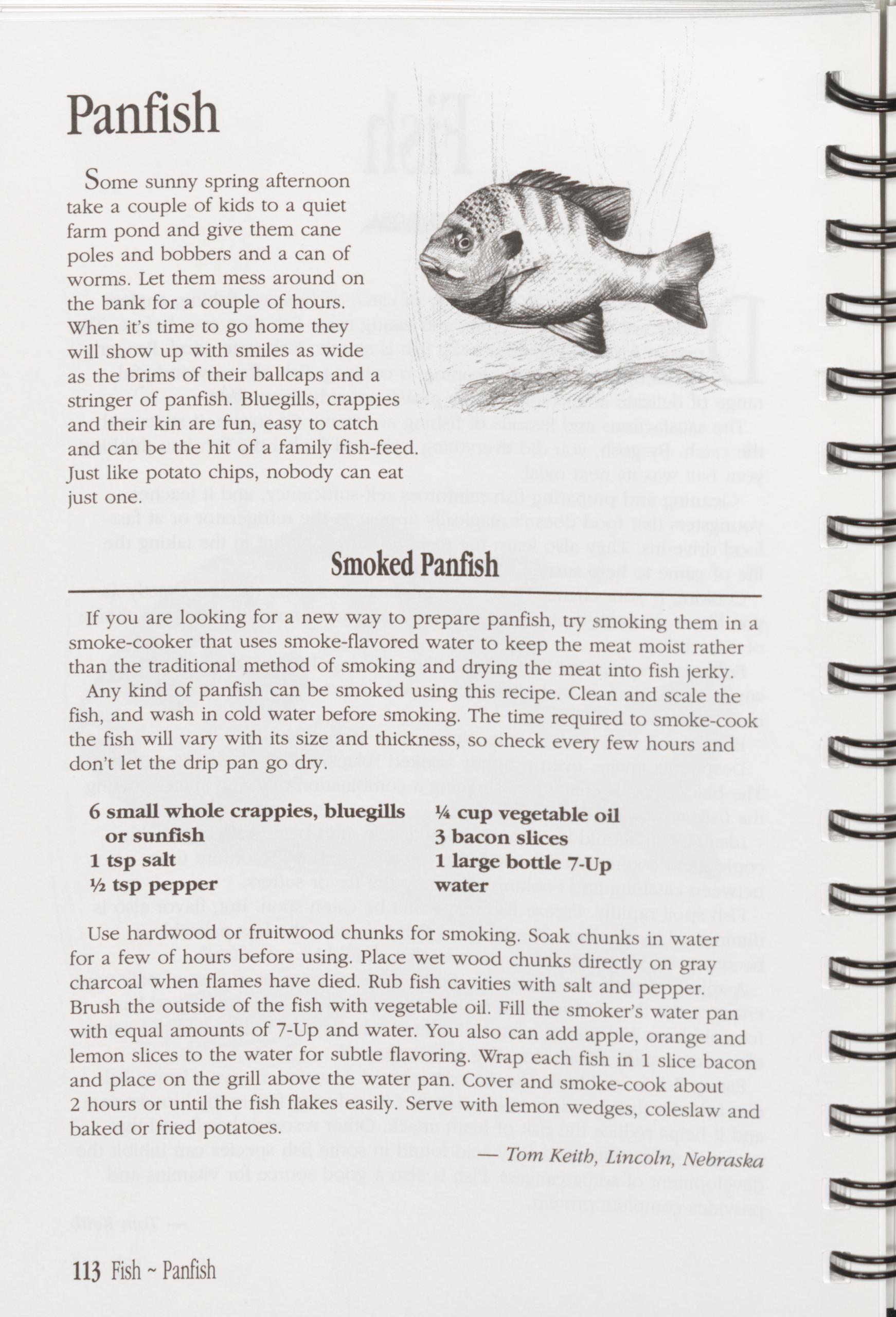 Panfish
Some sunny spring afternoon take a couple of kids to a quiet farm pond and give them cane poles and bobbers and a can of worms. Let them mess around on the bank for a couple of hours. When it’s time to go home they will show up with smiles as wide as the brims of their ballcaps and a stringer of panfish. Bluegills, crappies and their kin are fun, easy to catch and can be the hit of a family fish-feed. Just like potato chips, nobody can eat just one.
Smoked PanfishIf you are looking for a new way to prepare panfish, try smoking them in a smoke-cooker that uses smoke-flavored water to keep the meat moist rather than the traditional method of smoking and drying the meat into fish jerky.
Any kind of panfish can be smoked using this recipe. Clean and scale the fish, and wash in cold water before smoking. The time required to smoke-cook the fish will vary with its size and thickness, so check every few hours and don’t let the drip pan go dry.
6 small whole crappies, bluegills 1/4 cup vegetable oil or sunfish 3 bacon slices 1 tsp salt 1 large bottle 7-Up 1/2 tsp pepper waterUse hardwood or fruitwood chunks for smoking. Soak chunks in water for a few of hours before using. Place wet wood chunks directly on gray charcoal when flames have died. Rub fish cavities with salt and pepper. Brush the outside of the fish with vegetable oil. Fill the smoker’s water pan with equal amounts of 7-Up and water. You also can add apple, orange and lemon slices to the water for subtle flavoring. Wrap each fish in 1 slice bacon and place on the grill above the water pan. Cover and smoke-cook about 2 hours or until the fish flakes easily. Serve with lemon wedges, coleslaw and baked or fried potatoes.
— Tom Keith, Lincoln, Nebraska 113 Fish ~ Panfish Tangy Crappie
6 large crappie fillets
1/2 lb butter, melted
juice of 6 limes
salt and pepper
12 raw shrimp, peeled,
deveined and minced
black pepper, ground
Tangy Crappie
6 large crappie fillets
1/2 lb butter, melted
juice of 6 limes
salt and pepper
12 raw shrimp, peeled,
deveined and minced
black pepper, ground
Mix cup butter, juice of 4 limes, shrimp and ground pepper. Blend these sauce ingredients well. Place the fillets on the broiler, spoon sauce over fish and broil for 12 minutes, basting with sauce often. Sprinkle hot lime juice over hot plates, place fish on plates, brush with hot melted butter and sprinkle with salt and pepper.
— “The Strictly Fish Cookbook ” Flaked-Fish Omelet Serves 4 to 6 1/2 to 1 cup cooked fish, flaked 1 tsp olive oil 1 tsp onion, finely minced 2 tbl butter 1 tbl cooking oil 4 to 6 eggs salt and pepper 1 tbl garlic, minced 1 tsp fresh basil, minced 2 tbl beer, water, milk or wineHeat the olive oil in a small skillet. Add the minced onion and garlic and lightly saute. Turn off the heat and add the flaked fish to the skillet, stir, cover and set aside. In a large skillet heat butter and cooking oil until sizzling but not smoking. In a mixing bowl, lightly beat the eggs and stir in salt, pepper, basil and the liquid.
Pour the omelet mixture into the first skillet, and cook over medium heat, gently lifting the edges of the omelet so uncooked liquid will run underneath. The omelet should be pale gold and soft but not runny on top. Serve on preheated plates
Fish-Panfish 114 Fish Cakes
1 1/2 cups canned or boiled
fresh fish
3 tbl evaporated milk
2 eggs, beaten
1 tsp minced onion (optional)
salt and pepper
1 cup hot fat
Fish Cakes
1 1/2 cups canned or boiled
fresh fish
3 tbl evaporated milk
2 eggs, beaten
1 tsp minced onion (optional)
salt and pepper
1 cup hot fat
Flake the fish and combine with milk, eggs, onion and seasoning. Drop large spoonfuls of the mixture into a skillet of hot fat. Fry until almost golden brown. Drain on absorbent paper before serving.
Although this recipe does not call for potato, it can be added. Add a dash of curry powder if you like.
— "The Outdoor Cook's Bible” Broiled Fish Kabobs Appetizers for 6 or dinner for 2 or 3. 1 lb small white fish fillets 1/2 lb bacon, sliced 1 green bell pepper, seeded and chunked 1 onion, peeled, quartered and sectioned 18 cherry tomatoes 1/2 cup margarine or butter, melted salt black pepper, ground spray cooking oilCut strips of bacon in half or to lengths equal to the fillets. Salt and pepper the fillets and lay each on top of a strip of bacon. Roll the bacon and fillets so the fillets are wrapped with the bacon. Arrange rolled fillets, green pepper chunks, onion sections and cherry tomatoes alternately on skewers. Spray a broiler pan rack with oil. Brush kabobs with melted butter and arrange on racks. Sprinkle lightly with salt and pepper. Broil for 5 minutes. Carefully turn the kabobs, brush with butter, sprinkle with salt and pepper, and broil for another 4 or 5 minutes.
— "Fish and Shellfish Care and Cookery ” 115 Fish ~ Panfish Notes
Fish ~ Notes 116
Notes
Fish ~ Notes 116
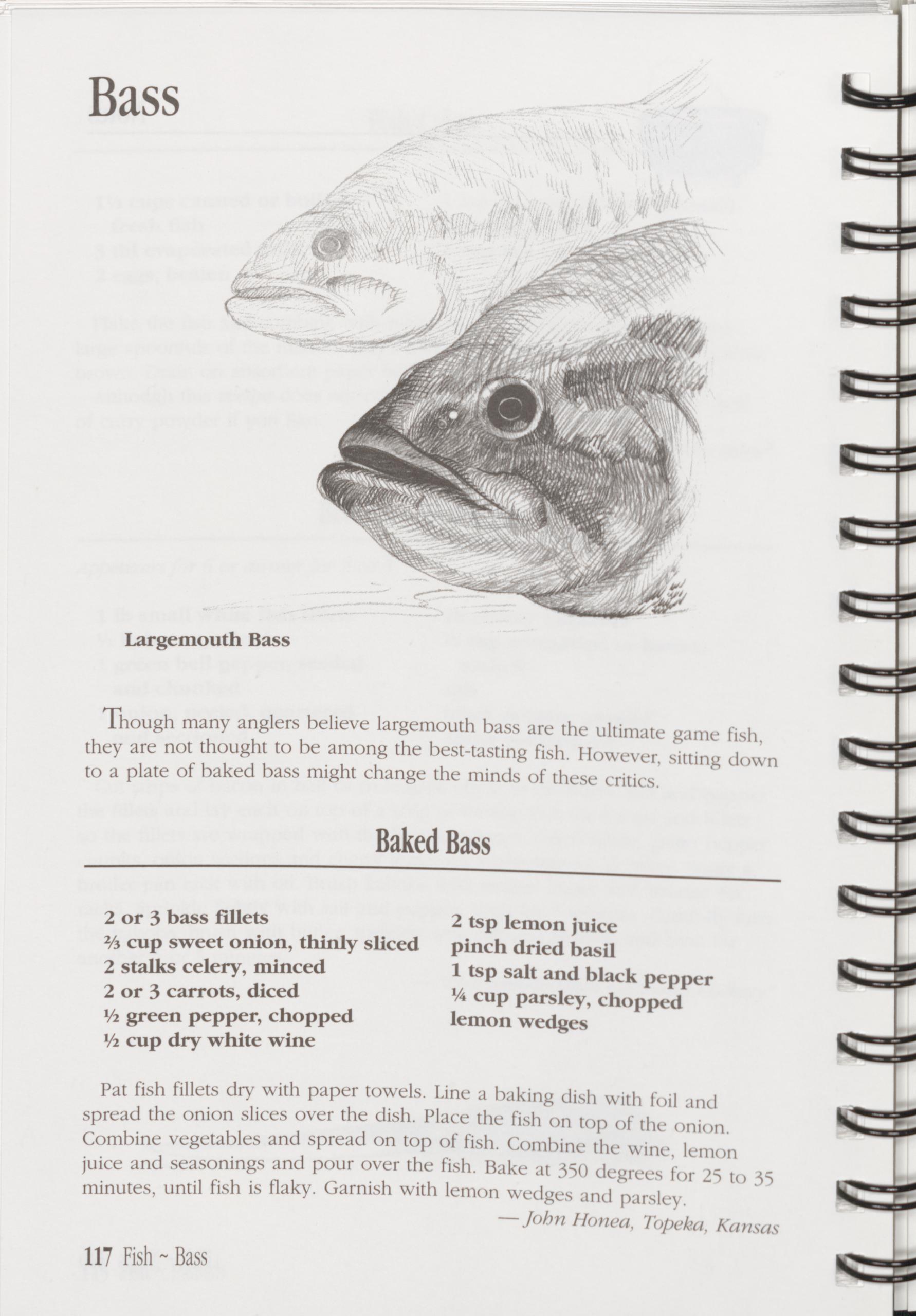 Bass
Largemouth Bass
Bass
Largemouth Bass
Though many anglers believe largemouth bass are the ultimate game fish, they are not thought to be among the best-tasting fish. However, sitting down to a plate of baked bass might change the minds of these critics.
Baked Bass 2 or 3 bass fillets 2/3 cup sweet onion, thinly sliced 2 stalks celery, minced 2 or 3 carrots, diced ¥2 green pepper, chopped 1/2 cup dry white wine 2 tsp lemon juice pinch dried basil 1 tsp salt and black pepper 1/4 cup parsley, chopped lemon wedgesPat fish fillets dry with paper towels. Line a baking dish with foil and spread the onion slices over the dish. Place the fish on top of the onion. Combine vegetables and spread on top of fish. Combine the wine, lemon juice and seasonings and pour over the fish. Bake at 350 degrees for 25 to 35 minutes, until fish is flaky. Garnish with lemon wedges and parsley.
— John Honea, Topeka, Kansas 117 Fish ~ Bass Fish Ole
1 lb fish fillets
1 onion, sliced thin
2 tbl olive or vegetable oil
4 oz green chilies,
chopped and drained
10 pimento-stuffed green olives
1/4 cup dry white wine
1 tbl lemon juice
lemon wedges
1/2 tsp salt
1/4 tsp coarsely ground pepper
Fish Ole
1 lb fish fillets
1 onion, sliced thin
2 tbl olive or vegetable oil
4 oz green chilies,
chopped and drained
10 pimento-stuffed green olives
1/4 cup dry white wine
1 tbl lemon juice
lemon wedges
1/2 tsp salt
1/4 tsp coarsely ground pepper
Cut fish into 5 serving pieces. In a 10-inch skillet, saute the onion in oil. Put the fish on the onion, sprinkle with salt and pepper. Mix chilies, olives, wine and lemon juice and pour over the fish. Heat to boiling. Reduce heat, cover and simmer until fish flakes easily with fork, about 10 minutes. Garnish with lemon wedges.
— “The Strictly Fish Cookbook ” Fish-Bass 118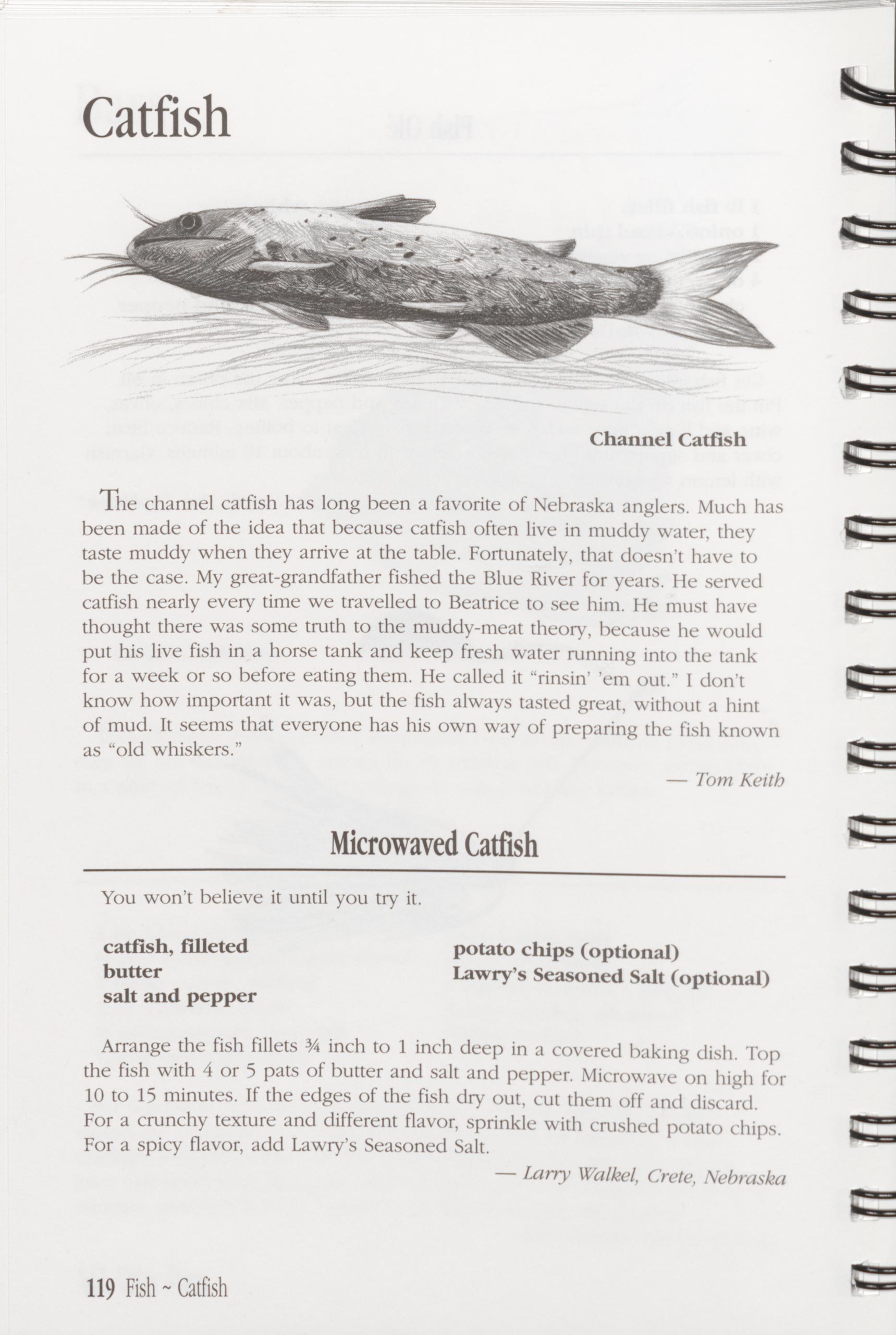 Catfish
Channel Catfish
Catfish
Channel Catfish
The channel catfish has long been a favorite of Nebraska anglers. Much has been made of the idea that because catfish often live in muddy water, they taste muddy when they arrive at the table. Fortunately, that doesn't have to be the case. My great-grandfather fished the Blue River for years. He served catfish nearly every time we travelled to Beatrice to see him. He must have thought there was some truth to the muddy-meat theory, because he would put his live fish in a horse tank and keep fresh water running into the tank for a week or so before eating them. He called it “rinsin’ ’em out.” I don’t know how important it was, but the fish always tasted great, without a hint of mud. It seems that everyone has his own way of preparing the fish known as “old whiskers.”
— Tom Keith Microwaved Catfish You won’t believe it until you try it. catfish, filleted butter salt and pepper potato chips (optional) Lawry’s Seasoned Salt (optional)Arrange the fish fillets inch to 1 inch deep in a covered baking dish. Top the fish with 4 or 5 pats of butter and salt and pepper. Microwave on high for 10 to 15 minutes. If the edges of the fish dry out, cut them off and discard. For a crunchy texture and different flavor, sprinkle with crushed potato chips. For a spicy flavor, add Lawry’s Seasoned Salt.
— Larry Walkel, Crete, Nebraska 119 Fish ~ Catfish Pan Fried Catfish
This is a simple but delicious recipe.
4 to 6 small catfish about
1 lb each or 2 to 3 lb thick
fillets from larger catfish
1/2 cup flour
1 tsp salt
1/2 tsp coarsely ground
black pepper
2 eggs
1 tbl water
1 cup white cornmeal
Pan Fried Catfish
This is a simple but delicious recipe.
4 to 6 small catfish about
1 lb each or 2 to 3 lb thick
fillets from larger catfish
1/2 cup flour
1 tsp salt
1/2 tsp coarsely ground
black pepper
2 eggs
1 tbl water
1 cup white cornmeal
Rinse catfish in cold water and dry with paper towels. Mix flour, salt and pepper. Dredge the fish and shake off surplus. Place on wax paper. Place the eggs in a pie pan, add water and beat lightly to combine. Spread the cornmeal on large plate. Heat lA inch of oil in a heavy skillet. While oil is heating, dip fish in egg mixture then roll in the cornmeal, pressing the meal against fish to make sure it is well coated. When the oil is hot, cook fish 2 to 3 minutes per side. Drain on paper towels.
— Gladys Jackson, Hershey, Nebraska Barbecued Catfish 2 lb catfish fillets, skinned l/i cup catsup or prepared barbecue sauce l/i cup onion, finely chopped 1 tbl garlic, finely minced lA cup water 2 drops to tsp hot sauce 3 tbl butterIn a heavy saucepan, saute onion and garlic in butter until tender. Add all other ingredients except the fish and simmer for 5 to 10 minutes, stirring frequently.
Put fillets in a nonreactive dish and cover with the sauce for at least 30 minutes in the refrigerator. Turn once or twice and brush both sides with sauce.
Remove the fillets, arrange on a well-greased, hinged, wire grill and cook 3 or 4 inches above the coals for about 4 minutes on each side or until fish flakes easily. Baste frequently with the remaining sauce.
Fish-Catfish 120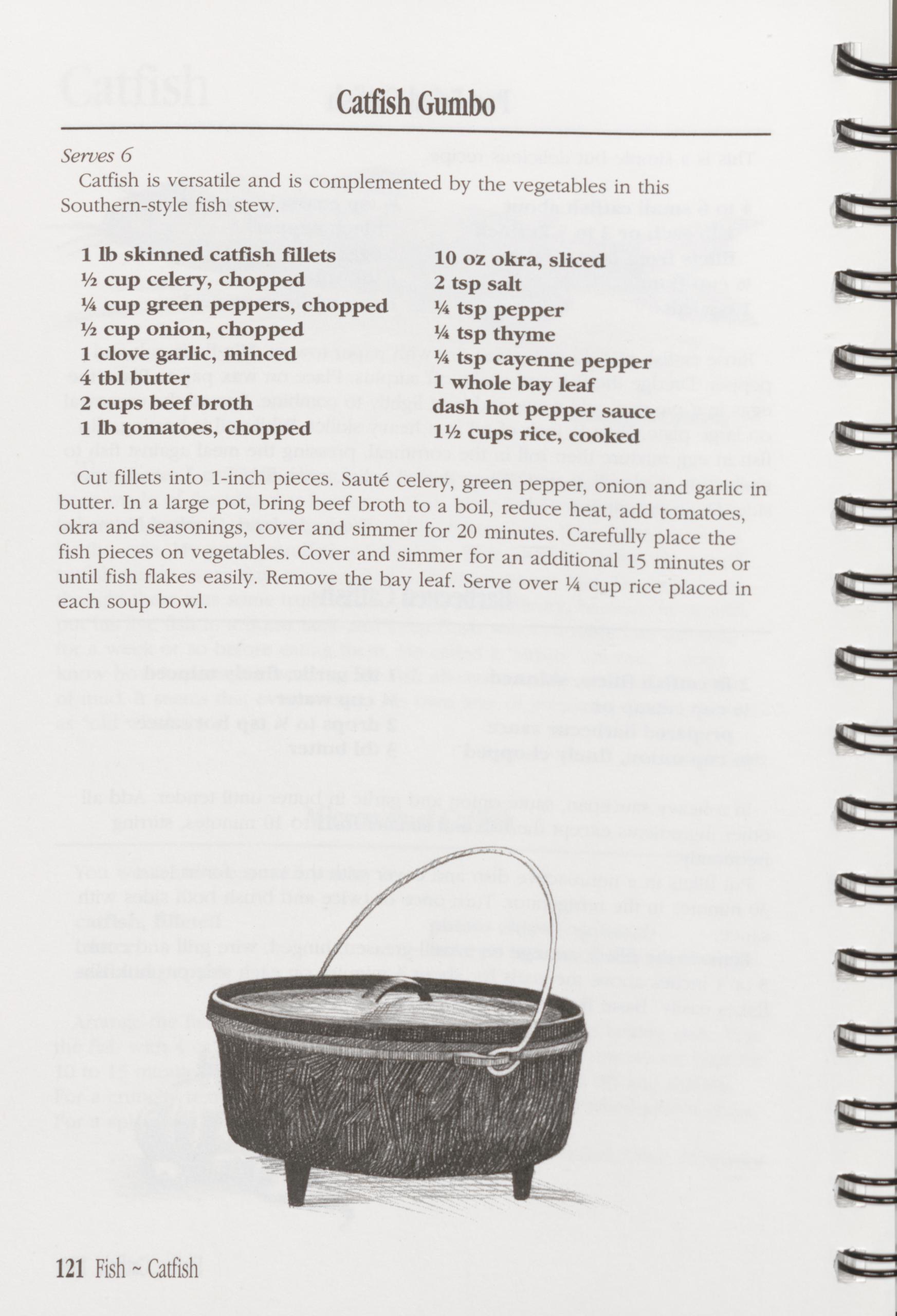 Catfish Gumbo
Serves 6
Catfish is versatile and is complemented by the vegetables in this
Southern-style fish stew.
1 lb skinned catfish fillets
1/2 cup celery, chopped
cup green peppers, chopped
1/2 cup onion, chopped
1 clove garlic, minced
4 tbl butter
2 cups beef broth
1 lb tomatoes, chopped
10 oz okra, sliced
2 tsp salt
1/4 tsp pepper
1/4 tsp thyme
1/4 tsp cayenne pepper
1 whole bay leaf
dash hot pepper sauce
1 1/2 cups rice, cooked
Catfish Gumbo
Serves 6
Catfish is versatile and is complemented by the vegetables in this
Southern-style fish stew.
1 lb skinned catfish fillets
1/2 cup celery, chopped
cup green peppers, chopped
1/2 cup onion, chopped
1 clove garlic, minced
4 tbl butter
2 cups beef broth
1 lb tomatoes, chopped
10 oz okra, sliced
2 tsp salt
1/4 tsp pepper
1/4 tsp thyme
1/4 tsp cayenne pepper
1 whole bay leaf
dash hot pepper sauce
1 1/2 cups rice, cooked
Cut fillets into 1-inch pieces. Saute celery, green pepper, onion and garlic in butter. In a large pot, bring beef broth to a boil, reduce heat, add tomatoes, okra and seasonings, cover and simmer for 20 minutes. Carefully place the fish pieces on vegetables. Cover and simmer for an additional 15 minutes or until fish flakes easily. Remove the bay leaf. Serve over 14 cup rice placed in each soup bowl.
121 Fish-Catfish
When I was a kid, bullheads were the fallback fish in our neck of the woods. When nothing else was biting, my buddy and I could always count on heading home with stringers of bullheads dangling from our bike handlebars. Years later it dawned on me why my mom was sometimes less than thrilled to find a dozen or so sloppily cleaned bullheads soaking in the kitchen sink when she started to cook supper. But rather than complain, she cooked or froze the fish and encouraged me to spend as much time fishing as I wanted. She knew where I was when I was at the lake.
Some of the best picnics I've ever had featured fish caught minutes before. Keith Sutton’s recipe reminds me of my first try at cooking bullheads over a campfire. His recipe is more sophisticated than my attempts at frying the fish in bacon grease in an old cast-iron skillet.
— Tom Keith Riverside Bullheads 1 tbl butter or margarine, softened 6 whole drawn bullheads (4 to 6 oz each), skinned and heads removed 2 cups fresh mushrooms, sliced 2/3 cup dry white wine 1/4 cup chopped onion 2 tbl vegetable oil 1 1/2 tbl dried parsley flakes 1 1/2 tbl fresh lemon juice 1/4 tsp salt 1/4 tsp freshly ground black pepper 1/4 tsp dried thyme leavesBuild a campfire and allow it to burn down to glowing coals. Cut 6 sheets of heavy-duty foil, 18- by 14-inches. Spread Vi teaspoon of butter on each sheet, place a bullhead in the center and turn up the edges slightly. In a mixing bowl, combine the remaining ingredients. Spread lA cup of mixture evenly over each fish.
Seal the fish in foil packets. Place packets on a grate over the campfire. Cook for 9 minutes, then turn and cook 5 to 9 additional minutes or until fish begins to flake at its thickest point.
— Keith Sutton, Alexander, Arkansas Fish ~ Bullhead 122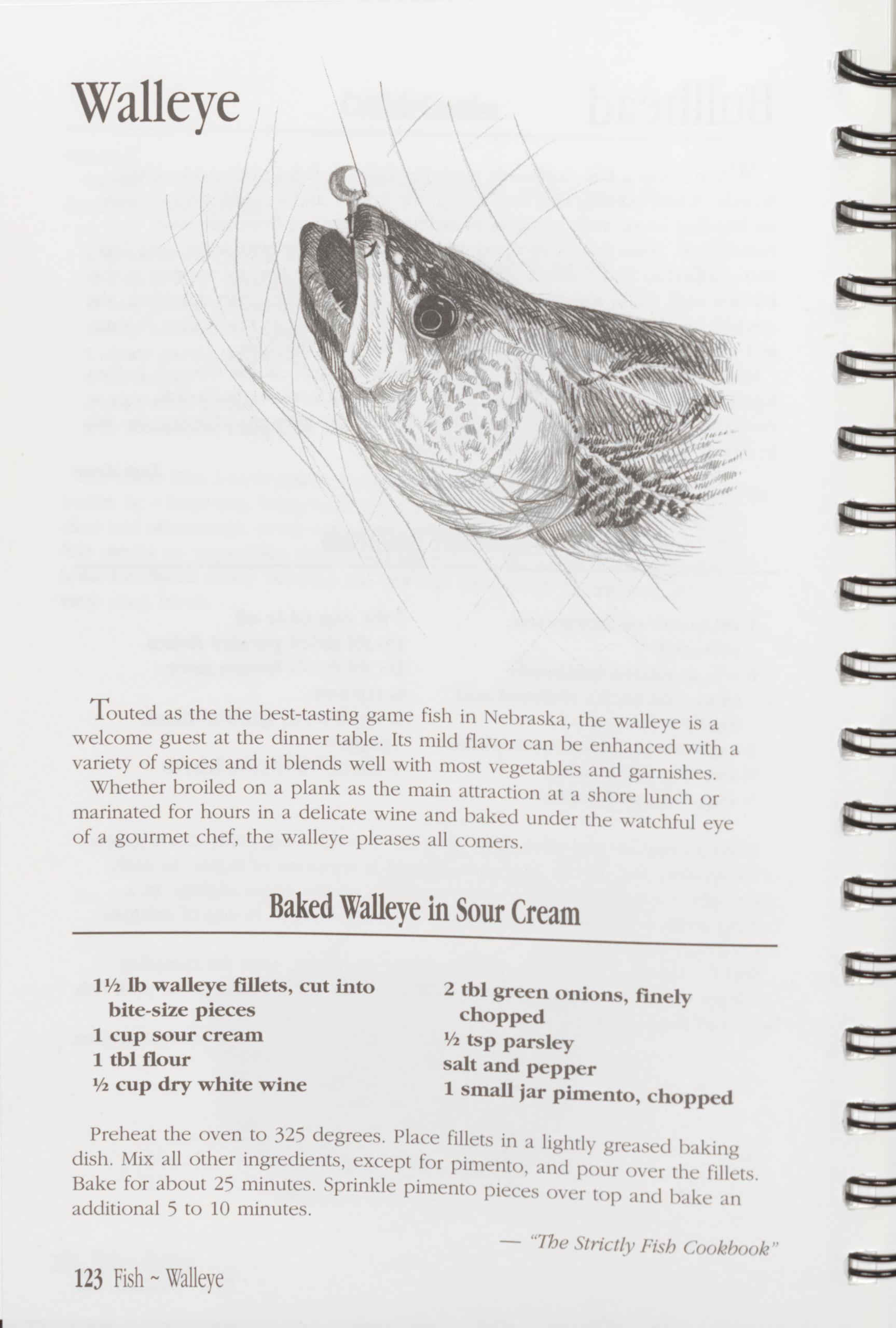
Touted as the the best-tasting game fish in Nebraska, the walleye is a welcome guest at the dinner table. Its mild flavor can be enhanced with a variety of spices and it blends well with most vegetables and garnishes. Whether broiled on a plank as the main attraction at a shore lunch or marinated for hours in a delicate wine and baked under the watchful eye of a gourmet chef, the walleye pleases all comers.
Baked Walleye in Sour Cream 1 1/2 lb walleye fillets, cut into bite-size pieces 1 cup sour cream 1 tbl flour 1/2 cup dry white wine 2 tbl green onions, finely chopped 1/2 tsp parsley salt and pepper 1 small jar pimento, choppedPreheat the oven to 325 degrees. Place fillets in a lightly greased baking dish. Mix all other ingredients, except for pimento, and pour over the fillets. Bake for about 25 minutes. Sprinkle pimento pieces over top and bake an additional 5 to 10 minutes.
— "The Strictly Fish Cookhook ” 123 Fish ~ Walleye Ginger-Sesame Fillets
Serves 4
1 1/2 lb walleye fillets cut in
serving-size pieces
1/2 cup light soy sauce
1 tbl ginger root, peeled
and grated
2 tbl dark brown sugar
1 tsp Worcestershire sauce
1 cup flour
1 tsp salt
1/2 tsp ground white pepper
1/2 tsp dried ground lemon peel
peanut oil
1 tbl sesame oil
1 tbl dry sherry
2 tsp cornstarch
1/4 cup cold water
1 tbl toasted sesame seeds
Ginger-Sesame Fillets
Serves 4
1 1/2 lb walleye fillets cut in
serving-size pieces
1/2 cup light soy sauce
1 tbl ginger root, peeled
and grated
2 tbl dark brown sugar
1 tsp Worcestershire sauce
1 cup flour
1 tsp salt
1/2 tsp ground white pepper
1/2 tsp dried ground lemon peel
peanut oil
1 tbl sesame oil
1 tbl dry sherry
2 tsp cornstarch
1/4 cup cold water
1 tbl toasted sesame seeds
Mix soy sauce with ginger root, brown sugar and Worcestershire sauce. Marinate the fish for at least 15 minutes. Combine flour with salt, white pepper and ground lemon peel. Drain the fish, reserving the liquid, and dredge the fillets in the seasoned flour.
Arrange the fish on a platter or cookie sheet and chill in the refrigerator for 30 minutes. Pour about ¥s inch of peanut oil into a large, heated skillet, add sesame oil and stir. Fry fish until browned on both sides, drain on paper towels. Place fillets on a platter and keep warm in a 200-degree oven. Remove the oil and deglaze the skillet with sherry. Add the reserved soy sauce mixture. Mix the cornstarch in cold water and add to the mixture in the skillet. Stirring constantly, bring the sauce to a boil. Remove skillet from heat. Put each piece of fish in the sauce, turn once and remove to a warm platter. Sprinkle with sesame seeds and serve at once with steamed rice and Oriental vegetables.
— “Fish and Shellfish Care and Cookery ” Planked Broiled FishScale a large fish and remove the head. Split the fish down its back, leaving the belly skin intact. Remove the entrails and dark material under the back- bone. Wash and wipe dry.
Tack the fish, skin-side down, to a clean hardwood plank or a short split log. Prop up the planked fish facing a campfire. While it is cooking, brush it with bacon fat or barbecue sauce. Adjust the plank as necessary to be sure the fish broils evenly. When the flesh flakes from the skin, add salt and pepper and serve it on the plank. The cooking time will be 20 to 30 minutes, depending on the fire and the size of the fish.
— “The Outdoor Cook’s Bible” Fish-Walleye 124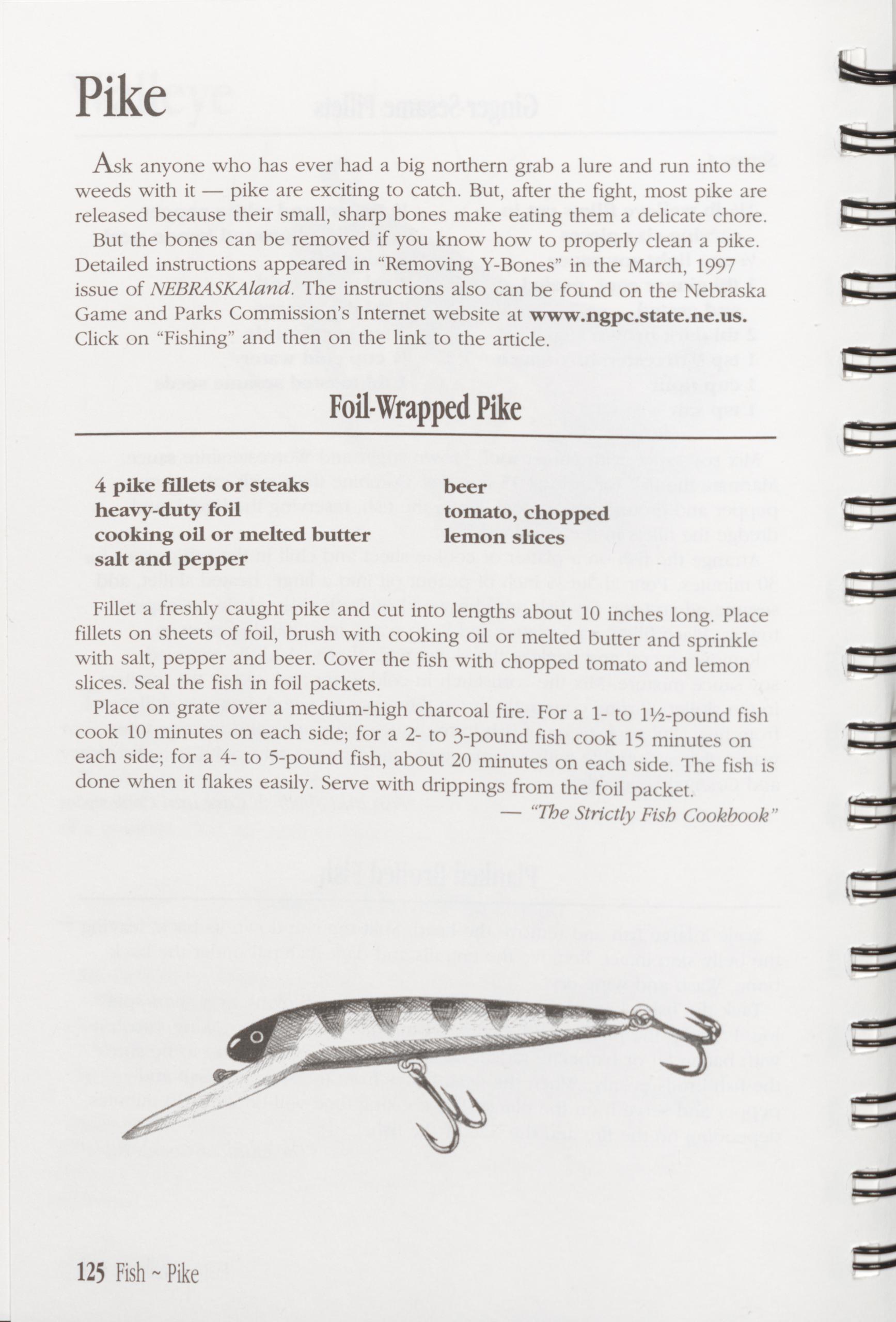
Ask anyone who has ever had a big northern grab a lure and run into the weeds with it — pike are exciting to catch. But, after the fight, most pike are released because their small, sharp bones make eating them a delicate chore. But the bones can be removed if you know how to properly clean a pike. Detailed instructions appeared in “Removing Y-Bones” in the March, 1997 issue of NEBRASKAland. The instructions also can be found on the Nebraska Game and Parks Commission’s Internet website at www.ngpc.state.ne.us. Click on “Fishing” and then on the link to the article.
Foil-Wrapped Pike 4 pike fillets or steaks heavy-duty foil cooking oil or melted butter salt and pepper beer tomato, chopped lemon slicesFillet a freshly caught pike and cut into lengths about 10 inches long. Place fillets on sheets of foil, brush with cooking oil or melted butter and sprinkle with salt, pepper and beer. Cover the fish with chopped tomato and lemon slices. Seal the fish in foil packets.
Place on grate over a medium-high charcoal fire. For a 1- to lYi-pound fish cook 10 minutes on each side; for a 2- to 3-pound fish cook 15 minutes on each side; for a 4- to 5-pound fish, about 20 minutes on each side. The fish is done when it flakes easily. Serve with drippings from the foil packet.
— “The Strictly Fish Cookbook ” 125 Fish ~ Pike Pine Bark Stew
2 lb fish fillets
6 slices bacon
1 cup onion, chopped or
finely sliced
3 cup potatoes, diced
1 to l¥i quarts canned tomatoes
2 tsp salt
Mi lb butter
2 tbl Worcestershire sauce
¥2 bottle catsup
¥2 cup chili sauce
¥2 tsp pepper
1 tsp herbs
Pine Bark Stew
2 lb fish fillets
6 slices bacon
1 cup onion, chopped or
finely sliced
3 cup potatoes, diced
1 to l¥i quarts canned tomatoes
2 tsp salt
Mi lb butter
2 tbl Worcestershire sauce
¥2 bottle catsup
¥2 cup chili sauce
¥2 tsp pepper
1 tsp herbs
In a Dutch oven over a hot fire, fry fat from the bacon. Remove the bacon. Saute the onion until tender and then add hot water to a depth of about 2 inches.
Add a layer of fish fillets, then a layer of potatoes and onions. If the pot is large, you can double or triple the recipe, adding layers of fish, potatoes, and onions until the pot is full.
Salt liberally, bring to a boil, then cover and reduce to a slow simmer for 25 to 30 minutes.
While the stew is cooking, melt the butter in a small pan. Stir in a ladle of liquid from the stew and add the Worcestershire sauce, catsup, tomatoes, chili sauce, pepper and herbs. Simmer slowly, adding liquid from the stew from time to time.
Serve the stew in deep bowls with sauce poured on top.
Alternatively, add everything to one pot, without bothering to make the sauce separately.
— “The Outdoor Cook’s Bible” Fish-Pike 126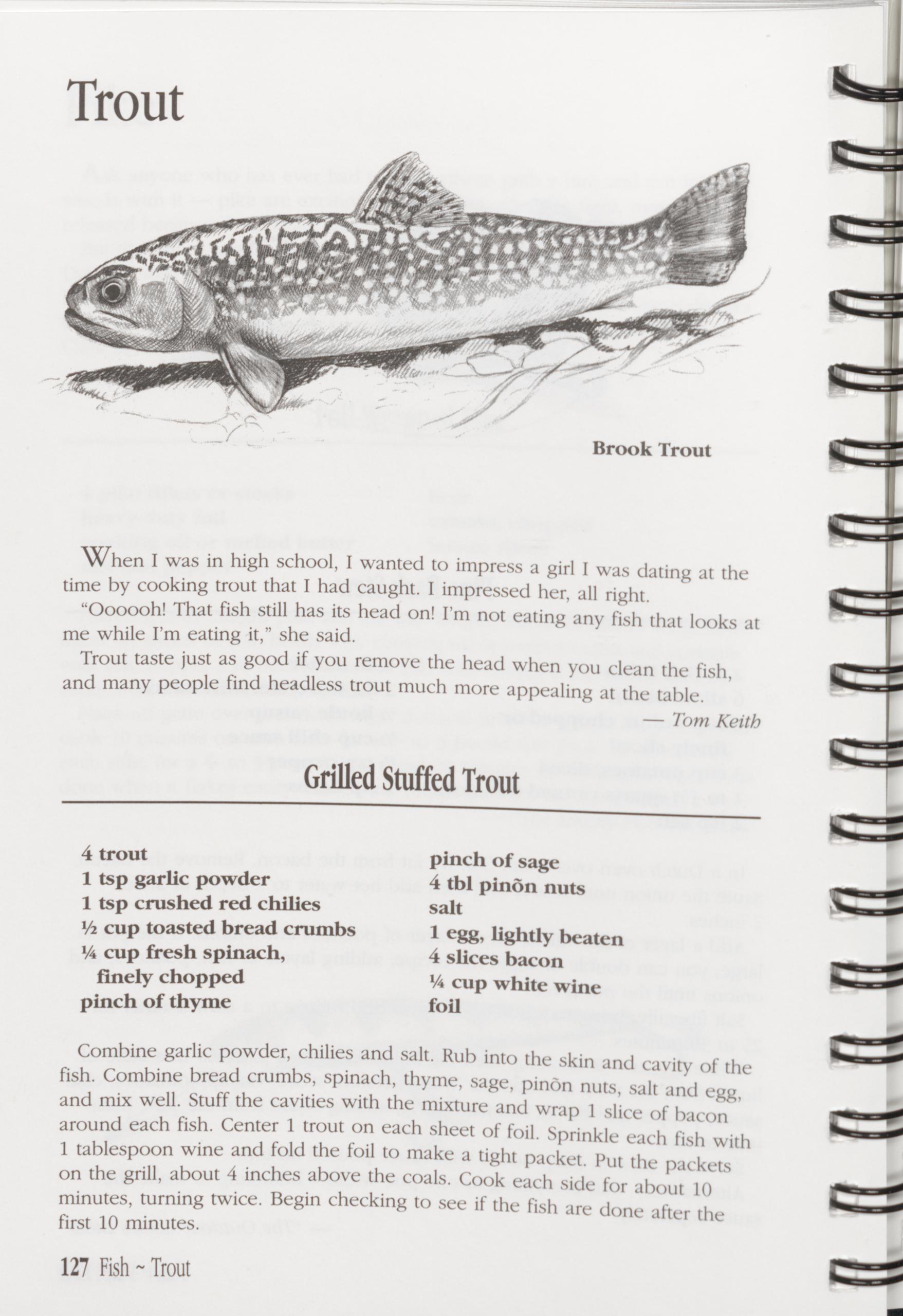 Trout
Trout
When I was in high school, I wanted to impress a girl I was dating at the time by cooking trout that I had caught. I impressed her, all right.
“Oooooh! That fish still has its head on! I’m not eating any fish that looks at me while I'm eating it,” she said.
Trout taste just as good if you remove the head when you clean the fish, and many people find headless trout much more appealing at the table.
— Tom Keith Grilled Stuffed Trout 4 trout 1 tsp garlic powder 1 tsp crushed red chilies 1/2 cup toasted bread crumbs 1/4 cup fresh spinach, finely chopped pinch of thyme pinch of sage 4 tbl pinon nuts salt 1 egg, lightly beaten 4 slices bacon 1/4 cup white wine foilCombine garlic powder, chilies and salt. Rub into the skin and cavity of the fish. Combine bread crumbs, spinach, thyme, sage, pinon nuts, salt and egg, and mix well. Stuff the cavities with the mixture and wrap 1 slice of bacon around each fish. Center 1 trout on each sheet of foil. Sprinkle each fish with 1 tablespoon wine and fold the foil to make a tight packet. Put the packets on the grill, about 4 inches above the coals. Cook each side for about 10 minutes, turning twice. Begin checking to see if the fish are done after the first 10 minutes.
127 Fish ~ Trout Campfire Trout Serves 2 to 4 6 freshly-caught rainbow trout sage salt and pepper 2 tbl butter or margarine garlic powder lemon wedgesPut the trout in long-handled hinged grill and broil about 4 inches above the coals of your campfire. Cook about 3 or 4 minutes on each side turning frequently, until fish flakes easily. Let the diners butter and season their own fish with salt, pepper, garlic powder, sage and lemon juice.
Poached Trout Serves 2 to 4 1 1/2 lb frozen trout 14 oz chicken broth 1 tbl red wine vinegar dash pepper dash garlic powder 1/4 cup butter, melted 4 lemon wedgesWash fish but do not thaw. Wrap in cheesecloth. Combine broth, vinegar, pepper and garlic powder in a pot or skillet and bring to a boil. Reduce heat to a simmer and gently lowering the wrapped fish into the liquid. Poach, carefully, turning after 3 minutes. Cover and poach for an additional 5 to 7 minutes or until flesh flakes easily. Serve with melted butter and lemon wedges.
Fish-Trout 128
Don't cuss that carp or throw it on the bank to rot in the sun. Though many anglers despise the carp and never give it a chance, others admire the “golden salmon” for both its sporting qualities and fine taste.
Canned Carp Carp prepared this way taste like salmon and can be substituted for canned salmon in any recipe. carp 1 tsp canning salt 2 tsp catsup 3 tsp vinegarFillet fish and cut meat into 1-inch chunks. Pack into pint canning jars and cover with salt, catsup and vinegar. Process the jars in a pressure cooker for ll/2 hours at 15 pounds pressure.
— Patty Harms, Adams, Nebraska Buffalo Cakes Buffalo fish rank among the most delicious of all the creatures swimming in fresh water. This old-time recipe has been passed down from generation to generation in my family. 1 small buffalo fish 3 eggs 1/4 cup onion, chopped 1/4 cup green pepper, chopped 1/2 tsp garlic salt 1 tsp salt 1 tsp black pepper 1 egg, beaten with 1 tbl milk cracker meal l/4 cup vegetable shorteningCook fish in a preheated 350-degree oven until meat flakes easily. Remove the meat from bones, allow to cool and crumble in a bowl. In a blender, mix onion, green pepper, garlic salt, salt and pepper and liquefy. Add the liquid to the crumbled fish. Shape into patties. Dip each patty in egg-and-milk mixture and dredge in the cracker meal. Heat shortening in a skillet and fry until brown on both sides.
— Keith Sutton, Alexander, Arkansas 129 Fish-Carp Carp in Beer
Serves 6 to 8
4 to 5 lb carp 11 oz beer
1 cup salt 1 tbl butter
2 medium onions, thinly sliced 1 tbl flour
1 lemon, thinly sliced 1 tsp sugar
1 bay leaf 1/4 tsp powdered ginger
6 cracked peppercorns
Carp in Beer
Serves 6 to 8
4 to 5 lb carp 11 oz beer
1 cup salt 1 tbl butter
2 medium onions, thinly sliced 1 tbl flour
1 lemon, thinly sliced 1 tsp sugar
1 bay leaf 1/4 tsp powdered ginger
6 cracked peppercorns
Cut fish across body into 1-inch slices. Cover both sides with salt and let the fish stand 30 minutes. Wipe the pieces clean and put them in a large, lightly greased skillet. Over the slices place a piece of cheesecloth big enough to double back and form a bag. Put onions, lemon, bay leaf and peppercorns on the cloth. Fold it over to make the bag and tie the ends. Pour in beer to cover the fish. Cover pan and simmer gently over low heat for 30 minutes or until fish flakes easily.
Remove and discard bag containing onions and lemon. Lift fish pieces with a spatula and place on a warmed platter. Work the butter, flour, sugar and ginger into a smooth paste and add it to the skillet liquids. Stir until smooth. Pour over fish and serve. If a thicker, spicier sauce is desired, substitute 6 ginger snaps for the powdered ginger; crumble into pan liquid and stir until dissolved.
— Adapted from “Cooking Over Coals” >Carp Spread 1 large carp, skinned 1 cup salt 1 gallon water 1 tbl vinegar 1 tsp saltCut carp into chunks. Soak fish overnight, refrigerated, in a brine made of 1 cup salt dissolved in 1 gallon of water. Drain and pack chunks tightly into jars. Add vinegar and salt to each jar. Process in a pressure cooker at 10 pounds pressure for 1 hour and 40 minutes. Use as you would salmon for spread or patties.
— John Honea, Topeka, Kansas Fish-Carp 130 Fried Carp
Carp have a lot of bones. To reduce problems with the bones and to cook
the thick meat thoroughly, score, or slit, the meat deeply between the ribs
with a sharp knife. Roll the fish in flour, forcing it into each slit. This ensures
the cooking oil will be penetrate and the meat will be thoroughly cooked.
carp, cleaned and scored
flour
salt
black pepper
cayenne pepper
lemon
Fried Carp
Carp have a lot of bones. To reduce problems with the bones and to cook
the thick meat thoroughly, score, or slit, the meat deeply between the ribs
with a sharp knife. Roll the fish in flour, forcing it into each slit. This ensures
the cooking oil will be penetrate and the meat will be thoroughly cooked.
carp, cleaned and scored
flour
salt
black pepper
cayenne pepper
lemon
Season the flour with salt and peppers. Flour the fish, being sure to cover both sides of the scored cuts. Place the fish in a wire basket and deep fry until the flour turns golden brown and the meat flakes easily. Serve with rye bread or sesame rolls and a lemon wedge, and have plenty of hot sauce available to enhance the flavor.
— Tom Keith, Lincoln, Nebraska 131 Fish-Carp
Mix the cornmeal and salt and blend in the drippings or lard. Stir in the hot water a little at a time to make a batter. Using an large spoon, drop batter into the kettle of hot fat. Turn to cook evenly. When the outside is a rich tan, they are done. Remove and drain on paper towels. Break open and eat while steaming hot.
Some cooks add an egg to the hush puppy batter to make them lighter, but hush puppies without eggs are traditional.
— Adapted from “Cooking Over Coals” Basic Tartar Sauce 1 cup mayonnaise 1/4 cup sweet pickles, finely chopped 1 tbl onion, minced 2 tsp dried parsley flakes, crushed 1 tsp prepared mustard 1 tbl lemon juice Mix all ingredients and store refrigerated in a covered container. Makes about 1 1/2 cups. — “Fish and Shellfish Care and Cookery ” Basic Cocktail Sauce 12 oz chili sauce 3 tbl prepared horseradish 1 tbl Worcestershire sauce 1 tbl lemon juice 1 tsp fines herbes, crushed (a blend of parsley, chives, tarragon and thyme) 1/4 tsp Tabasco sauceMix ingredients and refrigerate in a covered container. Makes about 2 cups.
— “Fish and Shellfish Care and Cookery ” Fish ~ Fish Fixin's 132 Quick and Easy Fish Patties
1 pint canned fish and juice
1 egg
1/3 cup onion, minced
1/2 cup flour
1 1/2 tsp baking powder
1 1/2 cup shortening
Quick and Easy Fish Patties
1 pint canned fish and juice
1 egg
1/3 cup onion, minced
1/2 cup flour
1 1/2 tsp baking powder
1 1/2 cup shortening
Drain the fish, saving 2 tablespoons of juice. In a bowl mix fish, egg and onion until sticky. Combine the flour, baking powder and fish juice and stir it into the fish-and-egg mixture. Form patties or drop teaspoonfuls into hot shortening. Fry until golden brown and serve.
— Gladys Jackson, Hershey, Nebraska Smoked Fish We started using this recipe in I960. Use whole small fish or large fish cut in chunks. fish 1 qt water 1 cup salt ¥2 cup sugar 1 tsp black pepper brineBoil water, salt, sugar and black pepper and allow to cool. Soak fish in brine 1 hour or longer if fish are quite thick.
Drain fish skin-side down on paper towels. Place on foil on smoker racks. Do not crowd the fish. Keep the foil in the center of the racks, allowing smoke to circulate freely around the fish. Smoke for about 8 hours depending on the size of fish.
— Vince and Vlema Smith, Monroe, Washington Pickled Fish 7 lb carp, cut in small pieces 3 cups vinegar 2 cups sugar 1 cup pickling salt 3/4 cup white port 8 cups water several onions, thinly sliced 1 tbl pickling spiceSoak the fish pieces for 48 hours in brine made of 1 cup pickling salt and 8 cups water. Drain but do not rinse. Add enough white vinegar to cover fish and refrigerate for 24 hours. Combine remaining ingredients, bring to boil, pour over drained fish, add 3/4 cup of white port. Mix well, pack in jars with a lot of onion. Cover with brine and refrigerate for a week before serving.
— Helen Vach, Hooper, Nebraska 133 Fish ~ Fish Fixin's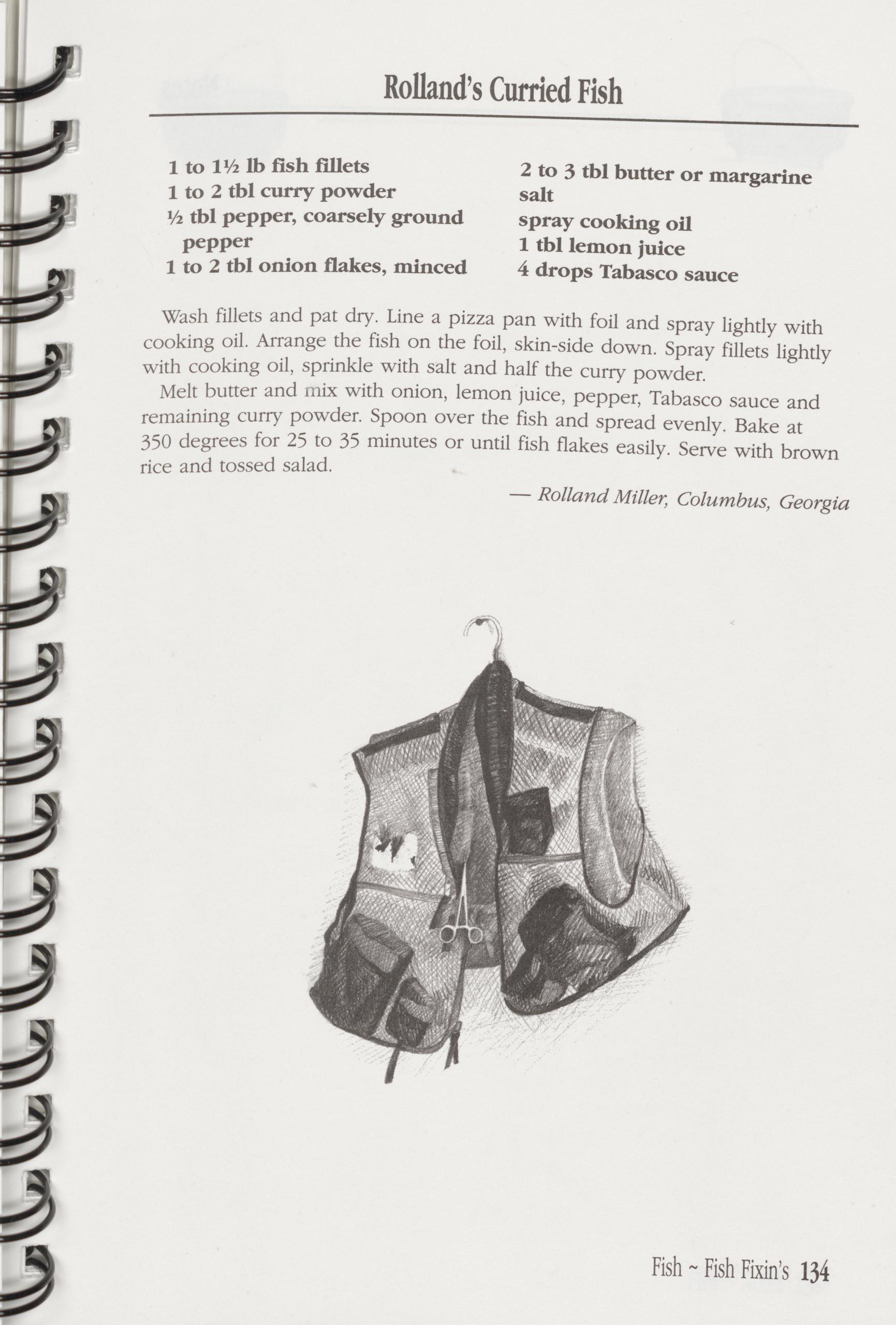 Rolland’s Curried Fish
1 to V/2 lb fish fillets
1 to 2 tbl curry powder
1/2 tbl pepper, coarsely ground
pepper
1 to 2 tbl onion flakes, minced
2 to 3 tbl butter or margarine
salt
spray cooking oil
1 tbl lemon juice
4 drops Tabasco sauce
Rolland’s Curried Fish
1 to V/2 lb fish fillets
1 to 2 tbl curry powder
1/2 tbl pepper, coarsely ground
pepper
1 to 2 tbl onion flakes, minced
2 to 3 tbl butter or margarine
salt
spray cooking oil
1 tbl lemon juice
4 drops Tabasco sauce
Wash fillets and pat dry. Line a pizza pan with foil and spray lightly with cooking oil. Arrange the fish on the foil, skin-side down. Spray fillets lightly with cooking oil, sprinkle with salt and half the curry powder.
Melt butter and mix with onion, lemon juice, pepper, Tabasco sauce and remaining curry powder. Spoon over the fish and spread evenly. Bake at 350 degrees for 25 to 35 minutes or until fish flakes easily. Serve with brown rice and tossed salad.
— Rolland Miller, Columbus, Georgia Fish ~ Fish Fixin’s 134 Notes
135 Fish ~ Notes
Notes
135 Fish ~ Notes
 Notes
Fish-Notes 136
Notes
Fish-Notes 136
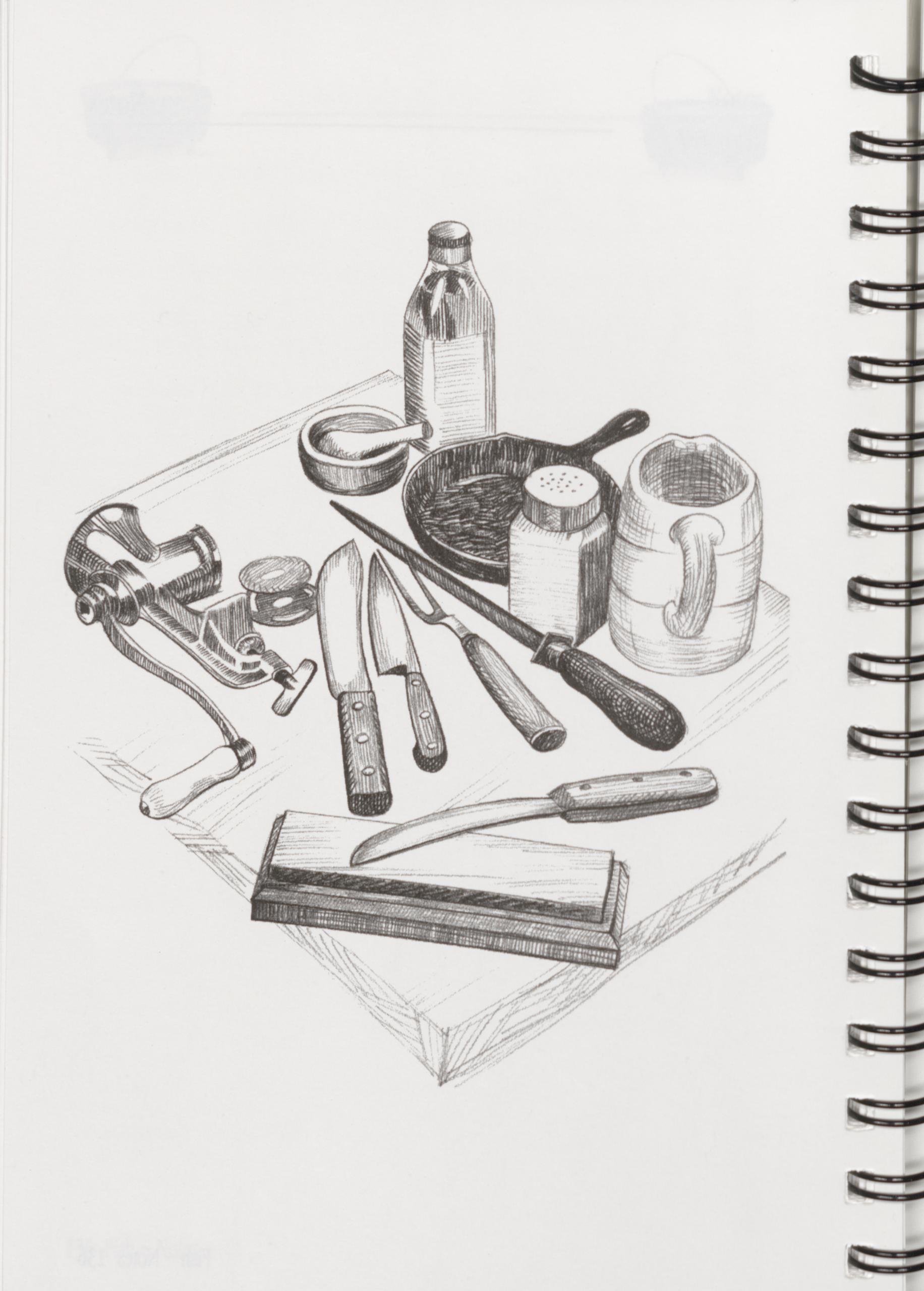
The adage “you can’t make a silk purse from a sow’s ear” aptly applies to preparing game for the table. If game is not properly cared for in the field and kitchen, the best recipe cannot rescue it. While there always will be contrary opinions about the best way to prepare meat, wild or domestic, the proper utensils and techniques make preparation more efficient. Mastering the full range of seasonings, oils, marinades and sauces will open a new world of flavors for game cooks who have seldom ventured beyond fried rabbit and roast duck.
—After the Hunt —It is often said that hunting is the easy part and the real work begins after the shot is fired and the animal is down.
The time between pulling the trigger and packing properly prepared meat into the freezer has the greatest effect on the quality of wild game meals. Many of Nebraska’s hunting seasons begin during warm weather. That makes hunting more comfortable, but caring for the game more challenging. In processing game, time and temperature are the two key factors. All game species should be field dressed as quickly and carefully as possible to keep the meat from spoiling or being contaminated. University of Nebraska meat specialists recommend that game be hung or stored at temperatures below 40 degrees. At higher temperatures, meat deteriorates rapidly.
Field Care of MammalsOnce a deer or antelope is down, the hunter must tag it, field dress it and have it checked in at a check station.
Field dressing a large animal for the first time can be a real challenge, but with experience the job gets easier. Most hunters can field dress a deer or antelope in about 30 minutes, and more experienced hunters can cut that time in half, although speed should not be a primary consideration when processing meat for the family table. An elk usually takes longer to field dress and prepare for transport. Because of its size, it may have to be quartered to be packed to camp or to a vehicle.
Big game should be field dressed as soon as possible after the animal is killed. When you are sure the animal is dead, open the body and remove the
Field to Kitchen ~ After the Hunt 138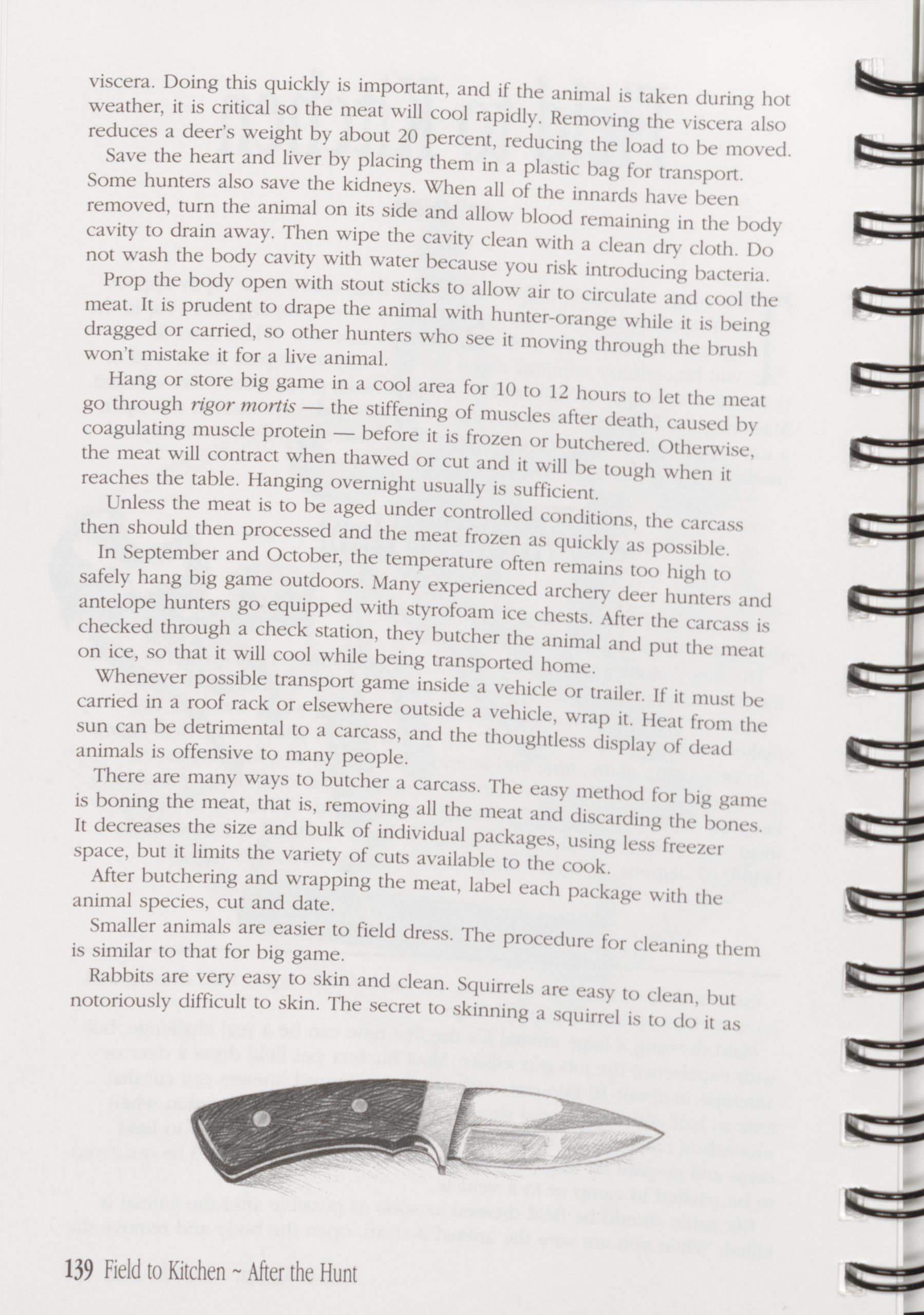
viscera. Doing this quickly is important, and if the animal is taken during hot weather, it is critical so the meat will cool rapidly. Removing the viscera also reduces a deer’s weight by about 20 percent, reducing the load to be moved.
Save the heart and liver by placing them in a plastic bag for transport. Some hunters also save the kidneys. When all of the innards have been removed, turn the animal on its side and allow blood remaining in the body cavity to drain away. Then wipe the cavity clean with a clean dry cloth. Do not wash the body cavity with water because you risk introducing bacteria. Prop the body open with stout sticks to allow air to circulate and cool the meat. It is prudent to drape the animal with hunter-orange while it is being dragged or carried, so other hunters who see it moving through the brush won’t mistake it for a live animal.
Hang or store big game in a cool area for 10 to 12 hours to let the meat go through rigor mortis — the stiffening of muscles after death, caused by coagulating muscle protein — before it is frozen or butchered. Otherwise, the meat will contract when thawed or cut and it will be tough when it reaches the table. Hanging overnight usually is sufficient.
Unless the meat is to be aged under controlled conditions, the carcass then should then processed and the meat frozen as quickly as possible. In September and October, the temperature often remains too high to safely hang big game outdoors. Many experienced archery deer hunters and antelope hunters go equipped with styrofoam ice chests. After the carcass is checked through a check station, they butcher the animal and put the meat on ice, so that it will cool while being transported home.
Whenever possible transport game inside a vehicle or trailer. If it must be carried in a roof rack or elsewhere outside a vehicle, wrap it. Heat from the sun can be detrimental to a carcass, and the thoughtless display of dead animals is offensive to many people.
There are many ways to butcher a carcass. The easy method for big game is boning the meat, that is, removing all the meat and discarding the bones. It decreases the size and bulk of individual packages, using less freezer space, but it limits the variety of cuts available to the cook.
After butchering and wrapping the meat, label each package with the animal species, cut and date.
Smaller animals are easier to field dress. The procedure for cleaning them is similar to that for big game.
Rabbits are very easy to skin and clean. Squirrels are easy to clean, but notoriously difficult to skin. The secret to skinning a squirrel is to do it as
139 Field to Kitchen ~ After the Hunt
soon as it hits the ground — while it is still warm, before it has been gutted, and before the muscles go through rigor mortis. If you wait, the job will be more difficult. When skinning, take pains to keep the hair off the skinned meat. Squirrel hair sloughs off easily and sticks to the bare meat as if it were attached with super glue.
All small game should be gutted, field dressed and cooled quickly. An ice chest in the vehicle will pay big dividends at the table.
— Tom Keith Field Care of FishProper handling techniques and processing speed are more critical in preserving the delicate flavor and quality of fish than of any other wild game. Unfortunately, fish usually receive the least care.
Flush with success and anxious to catch another, many anglers forget about the fish they already have caught. Many fish are left on stringers for hours, often in warm, shallow water, before being processed.
Anglers spend hours fussing with their gear before a trip, but too many neglect the fish during the drive home from the lake. And too many fish, left on the stringer on the floor of the boat or on a newspaper in the trunk of the car, end up in the trash.
Some dead or dying fish are cleaned and cooked, but they have been robbed of flavor, and the flesh is of poor quality. It’s no wonder that fish doesn’t appeal to some.
Fresh fish have bright, clear eyes and the gills are clean and bright red. If you press on a fresh fish’s side, the flesh should return to its normal shape when you release the pressure. The scales should be firmly attached, bright and shiny.
The best way to preserve a fish’s rich flavor and ensure top quality meat is to kill the fish immediately after it is caught, quickly fillet or gut it and put it on ice. An experienced angler with a proper knife can fillet most fish in less than a minute.
Scaling or skinning whole fish can wait until you get home. Fish that must meet size limits should not be filleted until you get home. See your state’s fishing regulations.
Trout usually are gutted and the gills are removed because they deteriorate rapidly. Traditionally, trout are kept in a wicker creel on a bed of wet grass. Air that passes through the sides of the creel and the moist grass keep the fish cool.
Here are a few more fish care tips:
• Catfish should be skinned soon after they are killed and gutted. Cut through the skin behind the head and make another cut along the backbone to the tail. Grab the skin behind the head with a pair of pliers and pull it toward the tail. The skin has a rather unpleasant taste and should be removed before cooking.
Continued on page 143) Field to Kitchen ~ After the Hunt 140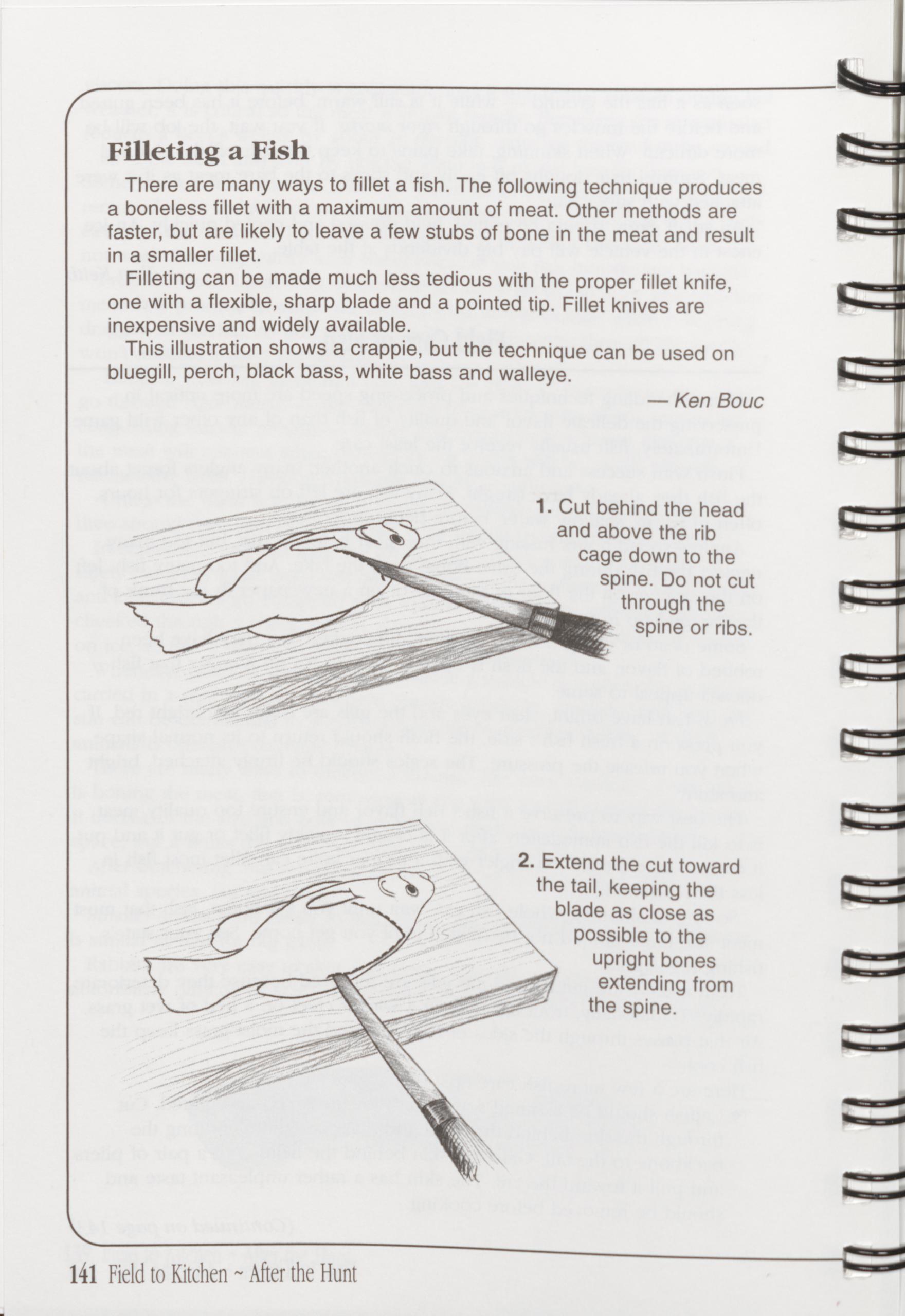 Filleting a Fish
There are many ways to fillet a fish. The following technique produces a boneless fillet with a maximum amount of meat. Other methods are faster, but are likely to leave a few stubs of bone in the meat and result in a smaller fillet.
Filleting can be made much less tedious with the proper fillet knife, one with a flexible, sharp blade and a pointed tip. Fillet knives are inexpensive and widely available.
This illustration shows a crappie, but the technique can be used on bluegill, perch, black bass, white bass and walleye.
— Ken Bouc1. Cut behind the head and above the rib cage down to the spine. Do not cut through the spine or ribs.
2. Extend the cut toward the tail, keeping the blade as close as possible to the upright bones extending from the spine.
141 Field to Kitchen ~ After the Hunt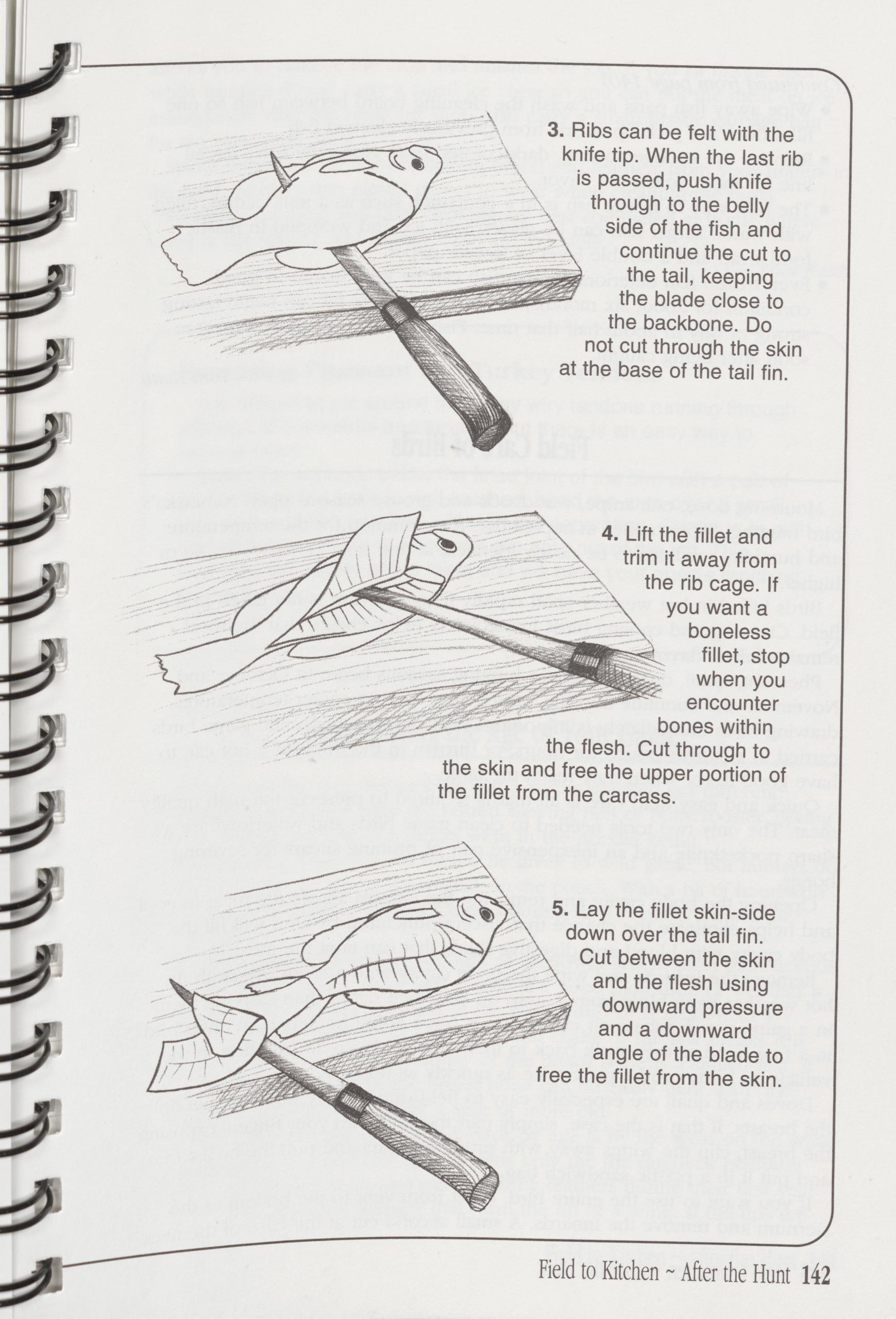
3. Ribs can be felt with the knife tip. When the last rib is passed, push knife through to the belly side of the fish and continue the cut to the tail, keeping the blade close to the backbone. Do not cut through the skin at the base of the tail fin.
4. Lift the fillet and trim it away from the rib cage. If you want a boneless fillet, stop when you encounter bones within the flesh. Cut through to the skin and free the upper portion of the fillet from the carcass.
5. Lay the fillet skin-side down over the tail fin. Cut between the skin and the flesh using downward pressure and a downward angle of the blade to free the fillet from the skin.
Field to Kitchen ~ After the Hunt 142 (Continued from page 140)
• Wipe away fish parts and wash the cleaning board between fish so one fillet does not pick up debris from previously cleaned fish.
• Remove the stronger-tasting, dark-colored flesh along the fish’s lateral line for more consistent flavor.
• The best way to freeze fish is in a container, such as a milk carton, filled with water. Larger fish can be glazed with ice and wrapped in plastic food wrap and a double layer of freezer paper.
• Even frozen fish deteriorate. Lean fish can be kept frozen in good condition for about six months, but fish with more fat can begin tasting strong or oily in about half that time. Fish are always best when eaten soon after being caught.
— Tom Keith Field Care of BirdsMourning dove, rail, snipe, woodcock and grouse seasons open Nebraska’s bird hunting opportunities in September. It is common for the temperature and humidity readings to be nearly identical at that time of year — at 90 or higher.
Birds killed in hot weather spoil rapidly if special care is not taken in the field. Cleaning and cooling birds immediately helps ensure that the meat remains full of flavor and safe to eat.
Pheasant, quail, duck and goose hunting seasons begin in October and November and continue into the winter. But, even in cooler temperatures, drawing birds immediately is important. Don’t expect uncleaned game birds carried in a canvas pouch for hours, or thrown in the trunk of a hot car, to have good flavor when they reach the table.
Quick and easy field care is all that is required to preserve the high quality meat. The only two tools needed to clean game birds and waterfowl are a sharp pocketknife and an inexpensive pair of pruning shears for severing bones.
Opening the body cavity and removing the entrails allows the meat to cool and helps eliminate the chance that viscera punctured by shot will fill the body cavity with blood and digestive fluids that can taint the meat.
Remove the innards and wipe the body cavity with a clean dry cloth. In hot weather hang birds from a strap on your belt rather than carrying them in a game pouch where air circulation is poor. Some hunters carry their birds in a free hand as they walk back to their vehicle. Keep an ice chest in the vehicle so birds can be put on ice as quickly as possible.
Doves and quail are especially easy to field dress. Many hunters save only the breasts. If that is the case, simply part the skin with your fingers exposing the breast, clip the wings away with pruning shears and pull the breast free and put it in a plastic sandwich bag.
If you want to use the entire bird, cut it from vent to the bottom of the sternum and remove the innards. A small second cut at the base of the neck
143 Field to Kitchen ~ After the Hunt
allows you to remove the crop and finishes the job. If you sit in one spot while hunting doves, carry a small ice chest so you can put the meat on ice immediately after the birds are shot. Also carry a small plastic garbage bag for the unwanted parts.
Handi-wipes are ideal for removing blood and feathers from your fingers in the field, or carry thin plastic gloves to wear when cleaning the birds. Plucking, skinning and final cleaning are best completed at home where water, a flat surface and freezer wrap are available.
— Tom Keith Removing Pheasant and Turkey TendonsIt is difficult to eat around the many wiry tendons running through the legs of pheasants and turkeys, but there is an easy way to remove them.
Crush the leg bone below the knee joint of the bird with a pair of pliers. When the bone is well crushed, bend the area over a small pipe or round iron bar. This will start the separation. Continue to pull and all but two of the tendons will slip right out of the leg. This improves the quality of the meat and will have your guests reaching for another leg.
Determining the Age of Your GameAnyone from the farm remembers that a spring chicken got different treatment in the kitchen than the retired stewing hen or bully rooster. Spring chickens were for frying, the others went in the noodle kettle. Ideally, similar consideration should be given to wild game, but hunters do not always know the age of the animals in the pouch. With a bit of homework, age can be determined for most game, assuring rave reviews around the dining table.
Upland game birds — The strength of the lower jaw of most gallinaceous birds such as pheasants, quail and grouse is a good indication of whether a bird is young-of-the-year (hatched in the last spring) or is more than a year old. Grasp the bird by its lower jaw and shake. If the jaw breaks it is probably a young bird. The flexibility of the breast bone is a similar test. If the bird is young, the tip of the breast bone can be easily bent with one finger. If it is rigid, it is probably a year or more old.
An even more reliable way to sort birds by age is by the wear on the wing feathers. Of all of Nebraska’s upland birds only the the ringneck pheasant does not replace the outer two primary wing feathers during their first year. Look at the longest two feathers that form the tip of a wing. If the tips are
Field to Kitchen ~ After the Hunt 144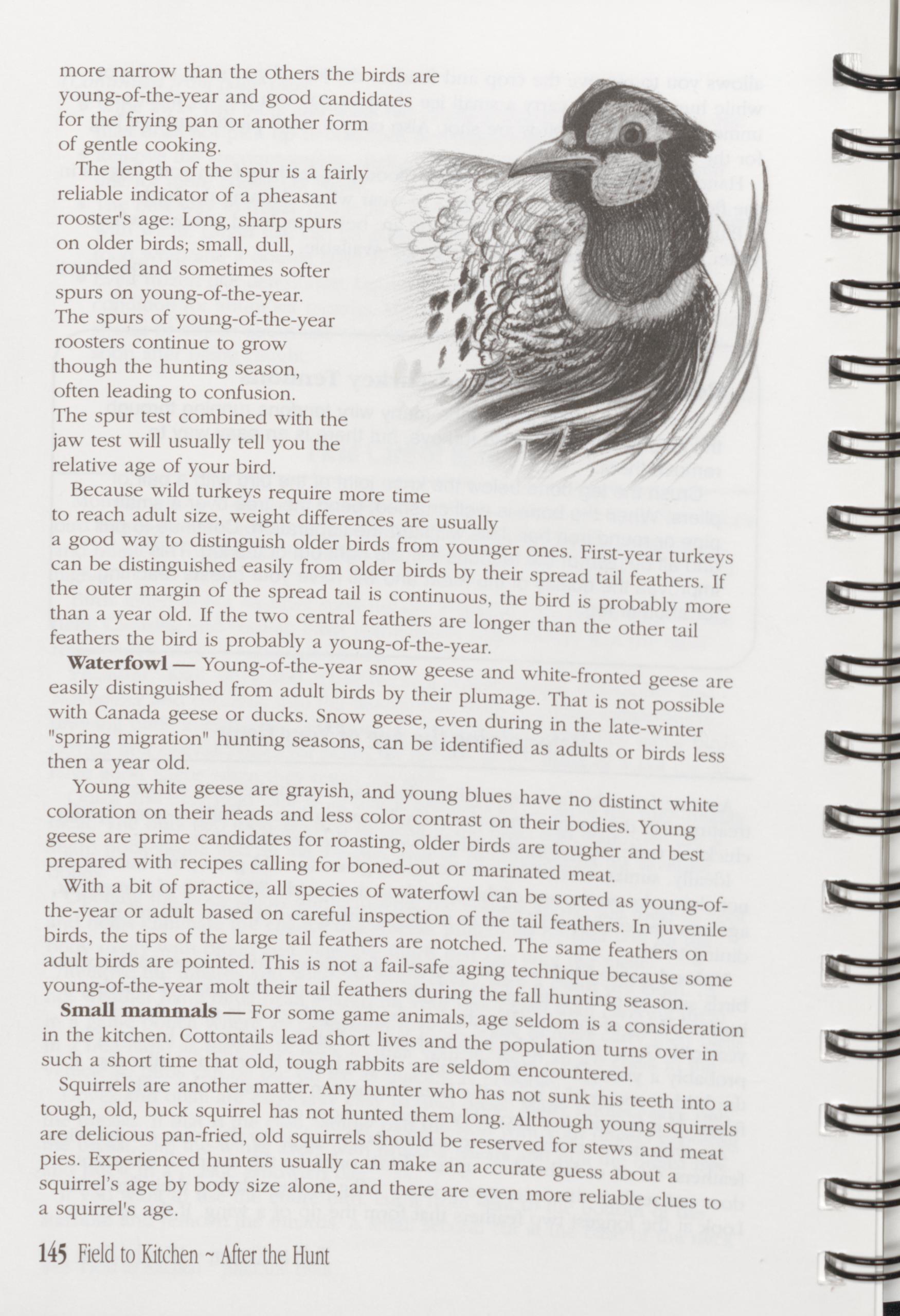
more narrow than the others the birds are young-of-the-year and good candidates for the frying pan or another form of gentle cooking.
The length of the spur is a fairly reliable indicator of a pheasant rooster's age: Long, sharp spurs on older birds; small, dull, rounded and sometimes softer spurs on young-of-the-year. The spurs of young-of-the-year roosters continue to grow though the hunting season, often leading to confusion. The spur test combined with the jaw test will usually tell you the relative age of your bird.
Because wild turkeys require more time to reach adult size, weight differences are usually a good way to distinguish older birds from younger ones. First-year turkeys can be distinguished easily from older birds by their spread tail feathers. If the outer margin of the spread tail is continuous, the bird is probably more than a year old. If the two central feathers are longer than the other tail feathers the bird is probably a young-of-the-year.
Waterfowl — Young-of-the-year snow geese and white-fronted geese are easily distinguished from adult birds by their plumage. That is not possible with Canada geese or ducks. Snow geese, even during in the late-winter "spring migration" hunting seasons, can be identified as adults or birds less then a year old.
Young white geese are grayish, and young blues have no distinct white coloration on their heads and less color contrast on their bodies. Young geese are prime candidates for roasting, older birds are tougher and best prepared with recipes calling for boned-out or marinated meat.
With a bit of practice, all species of waterfowl can be sorted as young-of- the-year or adult based on careful inspection of the tail feathers. In juvenile birds, the tips of the large tail feathers are notched. The same feathers on adult birds are pointed. This is not a fail-safe aging technique because some young-of-the-year molt their tail feathers during the fall hunting season.
Small mammals — For some game animals, age seldom is a consideration in the kitchen. Cottontails lead short lives and the population turns over in such a short time that old, tough rabbits are seldom encountered.
Squirrels are another matter. Any hunter who has not sunk his teeth into a tough, old, buck squirrel has not hunted them long. Although young squirrels are delicious pan-fried, old squirrels should be reserved for stews and meat pies. Experienced hunters usually can make an accurate guess about a squirrel’s age by body size alone, and there are even more reliable clues to a squirrel's age.
145 Field to Kitchen ~ After the Hunt
Each fall there are squirrels of three general age classes: spring-born juveniles, summer-born juveniles and adults more than a year old. The underside of the tail reveals to which group an animal belongs, although hunters will need practice to become proficient at recognizing the signs. Summer-born squirrels have two or three dark lines running through the reddish-brown primary hairs, and the lower end of the tail is hairless. Spring-born squirrels also have dark lines on the underside of the tail, but the lower part is covered with short hairs lying closely against the skin. On adults, the skin on the underside of the tail near the base is obscured by secondary hairs that radiate over and partly cover the longer hairs of the tail. Also, the obvious dark lines on the underside of the tails of young-of- the-year squirrels are less evident on adults.
Big game animals — The size of the body and antlers of deer give hunters a hint of an animal’s age, but actual age is determined by tooth replacement and wear. This is often done by biologists at check stations. As with deer, the age of a pronghorn is determined by tooth wear and replacement, but an animal with horns longer than its ears is an adult male. The age of large game mammals, such as deer and pronghorns, is less important in cooking than the condition of the animal. Older animals in good condition are likely to be as tender as yearlings and dry does.
— Jon Farrar Aging Wild GameAging meat — also called conditioning, ripening and seasoning — before preparing it for the table or freezing has ardent advocates; others find the practice repugnant. Although most people regularly eat aged beef, many are repelled by the thought of hanging a pheasant or a deer before butchering. The principle behind aging meat is simple: Muscles contract as the tissue fibers begin to shorten and harden and, from the culinary point of view, lose their tenderness. The process begins immediately after an animal is killed and rigor mortis sets in.
Hanging a carcass for several days to two weeks at 34 to Z8 degrees allows the flesh to relax and naturally occurring enzymes in the meat to break down the complex proteins in muscle tissue. As old hunters, most Europeans and university beef researchers know, aged meat is more tender and flavorful.
Big game, such as elk and deer are traditionally hung for seven to 14 days. The carcass should be field dressed and cleaned of debris. It is better to wipe the body cavity with dry paper towels before hanging to age rather than washing with water. The faster exposed tissue dries the better. As the meat dries, a dark rind will build on the exposed meat, locking moisture in and undesirable bacteria and insects out. The rind should be trimmed off and discarded when the animal is butchered.
The carcass should not be skinned. The hide stabilizes the temperature of the flesh and slows dehydration. If a carcass cannot be maintained at the recommended temperature, it should be put in cold storage or cut and
Field to Kitchen ~ After the Hunt 146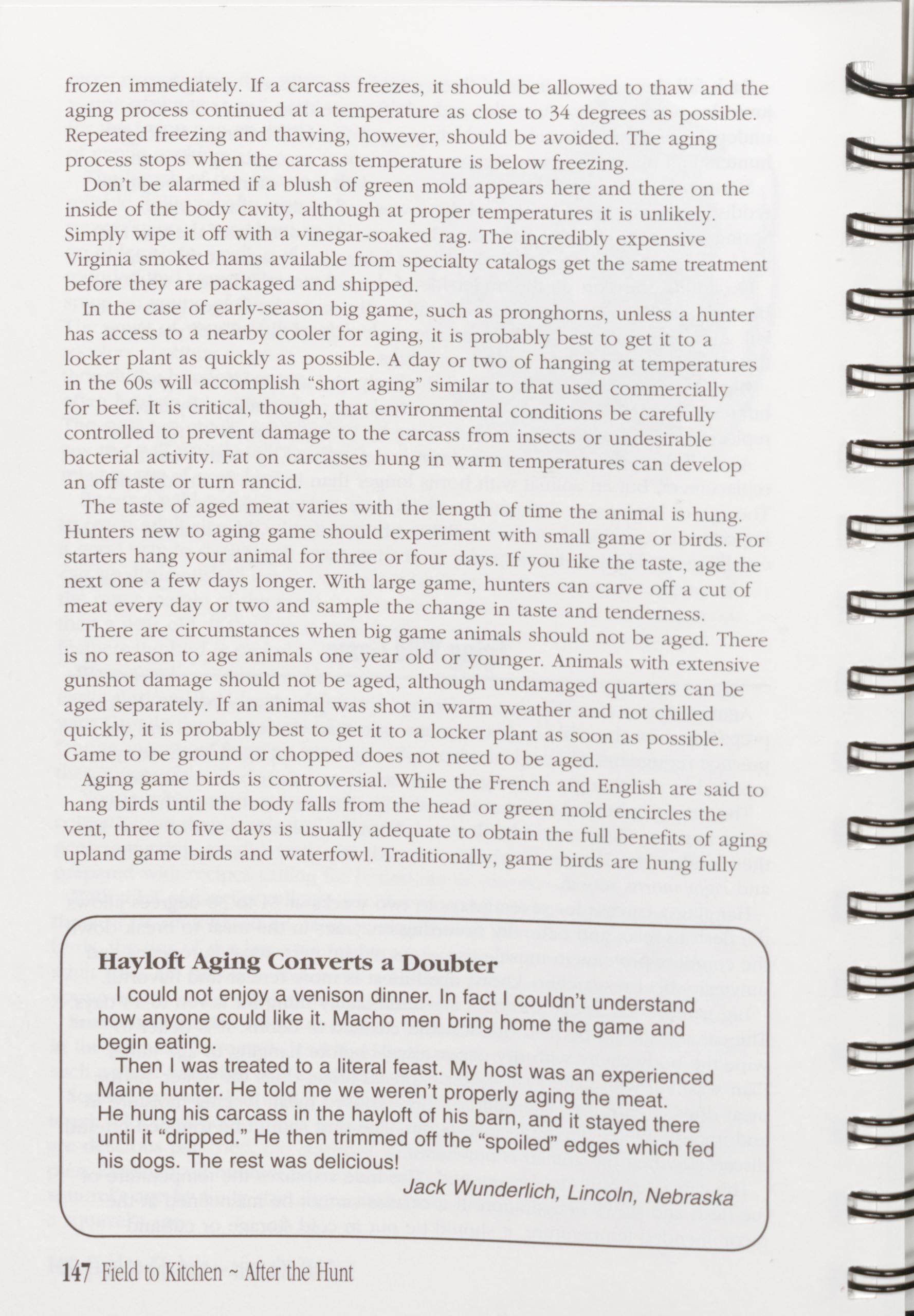
frozen immediately. If a carcass freezes, it should be allowed to thaw and the aging process continued at a temperature as close to 34 degrees as possible. Repeated freezing and thawing, however, should be avoided. The aging process stops when the carcass temperature is below freezing.
Don’t be alarmed if a blush of green mold appears here and there on the inside of the body cavity, although at proper temperatures it is unlikely. Simply wipe it off with a vinegar-soaked rag. The incredibly expensive Virginia smoked hams available from specialty catalogs get the same treatment before they are packaged and shipped.
In the case of early-season big game, such as pronghorns, unless a hunter has access to a nearby cooler for aging, it is probably best to get it to a locker plant as quickly as possible. A day or two of hanging at temperatures in the 60s will accomplish “short aging” similar to that used commercially for beef. It is critical, though, that environmental conditions be carefully controlled to prevent damage to the carcass from insects or undesirable bacterial activity. Fat on carcasses hung in warm temperatures can develop an off taste or turn rancid.
The taste of aged meat varies with the length of time the animal is hung. Hunters new to aging game should experiment with small game or birds. For starters hang your animal for three or four days. If you like the taste, age the next one a few days longer. With large game, hunters can carve off a cut of meat every day or two and sample the change in taste and tenderness.
There are circumstances when big game animals should not be aged. There is no reason to age animals one year old or younger. Animals with extensive gunshot damage should not be aged, although undamaged quarters can be aged separately. If an animal was shot in warm weather and not chilled quickly, it is probably best to get it to a locker plant as soon as possible. Game to be ground or chopped does not need to be aged.
Aging game birds is controversial. While the French and English are said to hang birds until the body falls from the head or green mold encircles the vent, three to five days is usually adequate to obtain the full benefits of aging upland game birds and waterfowl. Traditionally, game birds are hung fully
Hayloft Aging Converts a DoubterI could not enjoy a venison dinner. In fact I couldn’t understand how anyone could like it. Macho men bring home the game and begin eating.
Then I was treated to a literal feast. My host was an experienced Maine hunter. He told me we weren’t properly aging the meat. He hung his carcass in the hayloft of his barn, and it stayed there until it “dripped.” He then trimmed off the “spoiled” edges which fed his dogs. The rest was delicious!
Jack Wunderlich, Lincoln, Nebraska 147 Field to Kitchen ~ After the Hunt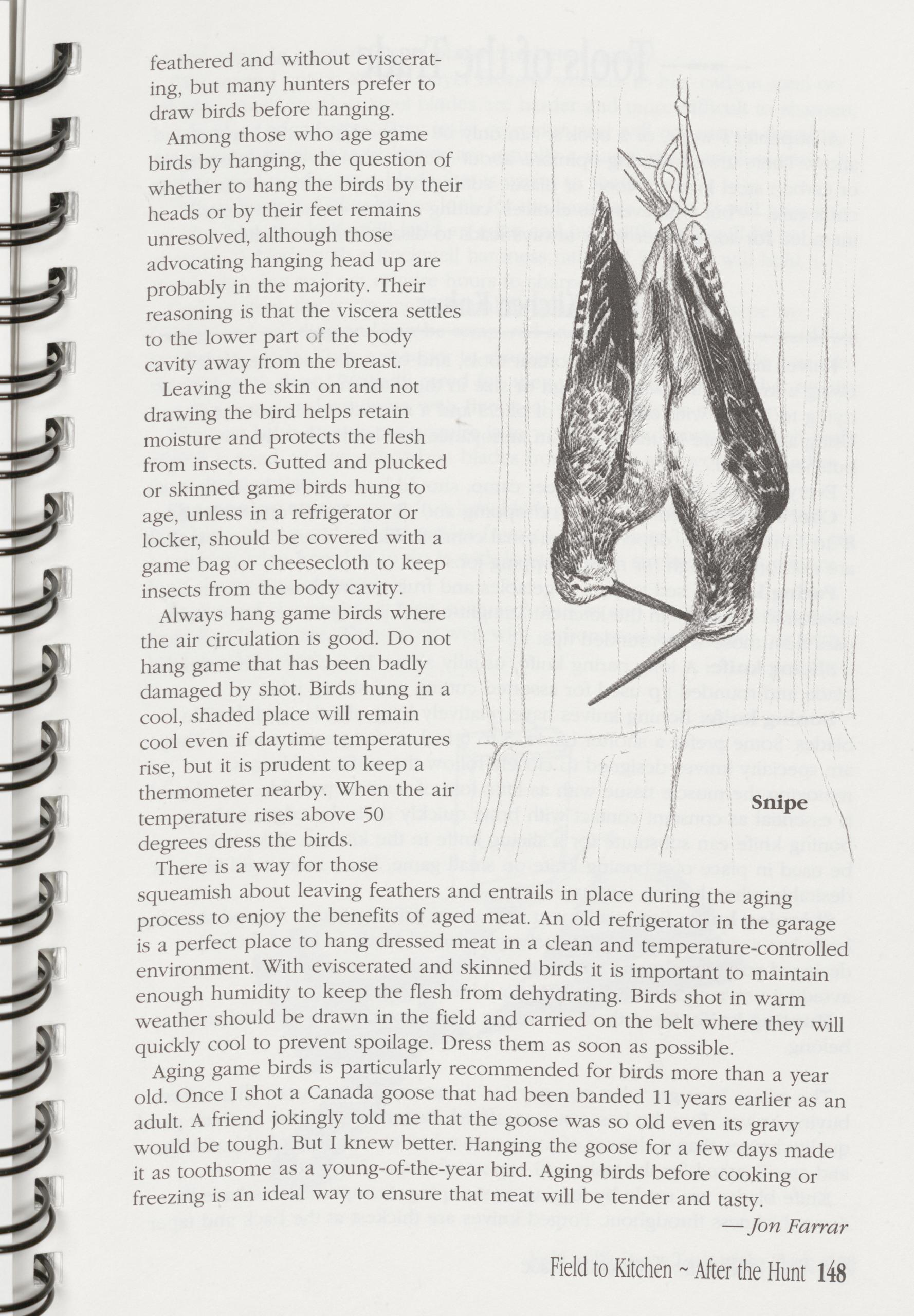
feathered and without eviscerat- ing, but many hunters prefer to draw birds before hanging.
Among those who age game birds by hanging, the question of whether to hang the birds by their heads or by their feet remains unresolved, although those advocating hanging head up are probably in the majority. Their reasoning is that the viscera settles to the lower part of the body cavity away from the breast.
Leaving the skin on and not drawing the bird helps retain moisture and protects the flesh from insects. Gutted and plucked or skinned game birds hung to age, unless in a refrigerator or locker, should be covered with a game bag or cheesecloth to keep insects from the body cavity.
Always hang game birds where the air circulation is good. Do not hang game that has been badly damaged by shot. Birds hung in a cool, shaded place will remain cool even if daytime temperatures rise, but it is prudent to keep a thermometer nearby. When the air temperature rises above 50 degrees dress the birds.
There is a way for those
Snipesqueamish about leaving feathers and entrails in place during the aging process to enjoy the benefits of aged meat. An old refrigerator in the garage is a perfect place to hang dressed meat in a clean and temperature-controlled environment. With eviscerated and skinned birds it is important to maintain enough humidity to keep the flesh from dehydrating. Birds shot in warm weather should be drawn in the field and carried on the belt where they will quickly cool to prevent spoilage. Dress them as soon as possible.
Aging game birds is particularly recommended for birds more than a year old. Once I shot a Canada goose that had been banded 11 years earlier as an adult. A friend jokingly told me that the goose was so old even its gravy would be tough. But I knew better. Hanging the goose for a few days made it as toothsome as a young-of-the-year bird. Aging birds before cooking or freezing is an ideal way to ensure that meat will be tender and tasty.
—Jon Farrar Field to Kitchen ~ After the Hunt 148 —Tools of the Trade —
A carpenter’s work, or a cook’s, can only be as good as his or her tools allow. There are conflicting opinions about specific choices — stainless steel or carbon steel knives, wood or plastic cutting boards, cast-iron or anodized cookware — but whatever the choices, cutting corners or using a utensil intended for some other work always leads to disappointing results.
Kitchen KnivesKnives are a cook’s most important tools, and often the most neglected. Using a knife of the wrong design or size in the kitchen is just as foolish as trying to get by with only a pair of pliers and a screwdriver in your toolbox. Using a dull knife is unsafe and an annoyance that leads, literally, to butchered food.
Every kitchen, at home or at deer camp, should have several basic knives. Chefs knife: Used for slicing, chopping and dicing. Select one with an 8- to 12-inch blade, depending personal comfort. Blades shorter than 8 inches are not long enough for most chopping jobs.
Paring knife: Used to peel vegetables and fruit, paring knives are an all-around necessity in the kitchen. Straight-edged paring knives have more uses than those with rounded tips.
Slicing knife: A long paring knife, usually about 10 inches, with a slender blade and rounded tip used for assorted cutting and slicing jobs.
Boning knife: Boning knives have relatively long, slender and flexible blades. Some prefer a shorter blade, 5 to 6 inches, for greater control. They are specialty knives designed to closely follow the surface of bones, removing the muscle tissue with as little loss of meat as possible. Good steel is essential as constant contact with bone quickly dulls the edge. A sharp boning knife can substitute for a slicing knife in the kitchen. Fillet knives can be used in place of a boning knife on small game, but a more rigid blade is desirable when boning out large game.
Skinning knife: Essential if you skin your own big game. A good skinning knife has a rigid, relatively thick, sharply curved blade (a lot of “belly”) designed so that only one part of the blade makes contact at any time, avoiding unwanted slashes and cuts in hide or meat.
Hunting knife: Keep them out of the kitchen and in the field where they belong.
The adage “you get what you pay for” is never more accurate than when buying knives. Buy the best you can afford. Better to have two or three good quality knives than a drawer of inexpensive knives that won’t hold an edge and are ill-suited for the tasks you expect of them.
Knife blades are made by forging or stamping. Stamped blades have the same thickness throughout. Forged knives are thickest at the back and taper
149 Field to Kitchen ~ Tools of the Trade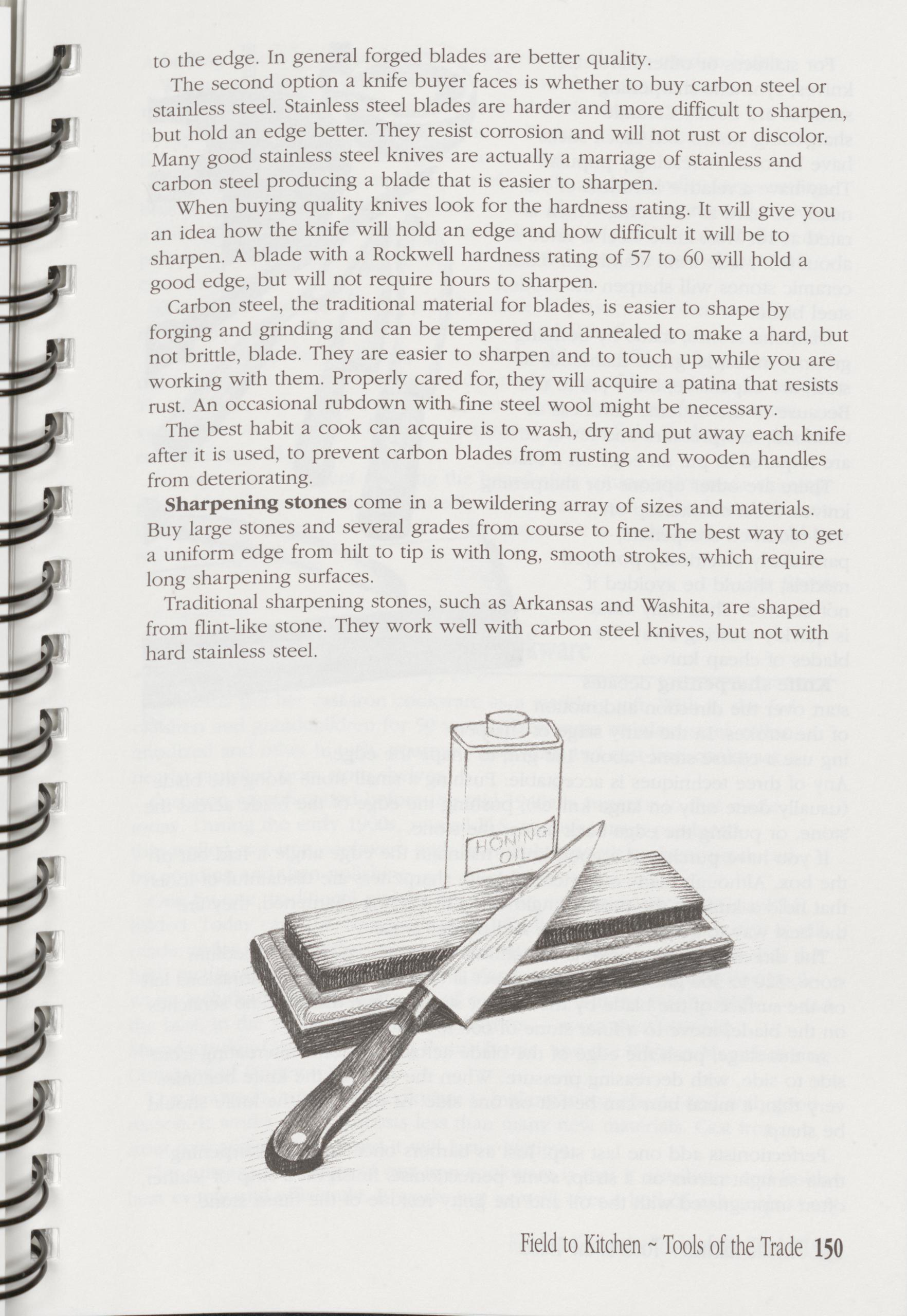
to the edge. In general forged blades are better quality.
The second option a knife buyer faces is whether to buy carbon steel or stainless steel. Stainless steel blades are harder and more difficult to sharpen, but hold an edge better. They resist corrosion and will not rust or discolor. Many good stainless steel knives are actually a marriage of stainless and carbon steel producing a blade that is easier to sharpen.
When buying quality knives look for the hardness rating. It will give you an idea how the knife will hold an edge and how difficult it will be to sharpen. A blade with a Rockwell hardness rating of 57 to 60 will hold a good edge, but will not require hours to sharpen.
Carbon steel, the traditional material for blades, is easier to shape by forging and grinding and can be tempered and annealed to make a hard, but not brittle, blade. They are easier to sharpen and to touch up while you are working with them. Properly cared for, they will acquire a patina that resists rust. An occasional rubdown with fine steel wool might be necessary.
The best habit a cook can acquire is to wash, dry and put away each knife after it is used, to prevent carbon blades from rusting and wooden handles from deteriorating.
Sharpening stones come in a bewildering array of sizes and materials. Buy large stones and several grades from course to fine. The best way to get a uniform edge from hilt to tip is with long, smooth strokes, which require long sharpening surfaces.
Traditional sharpening stones, such as Arkansas and Washita, are shaped from flint-like stone. They work well with carbon steel knives, but not with hard stainless steel.
Field to Kitchen ~ Tools of the Trade 150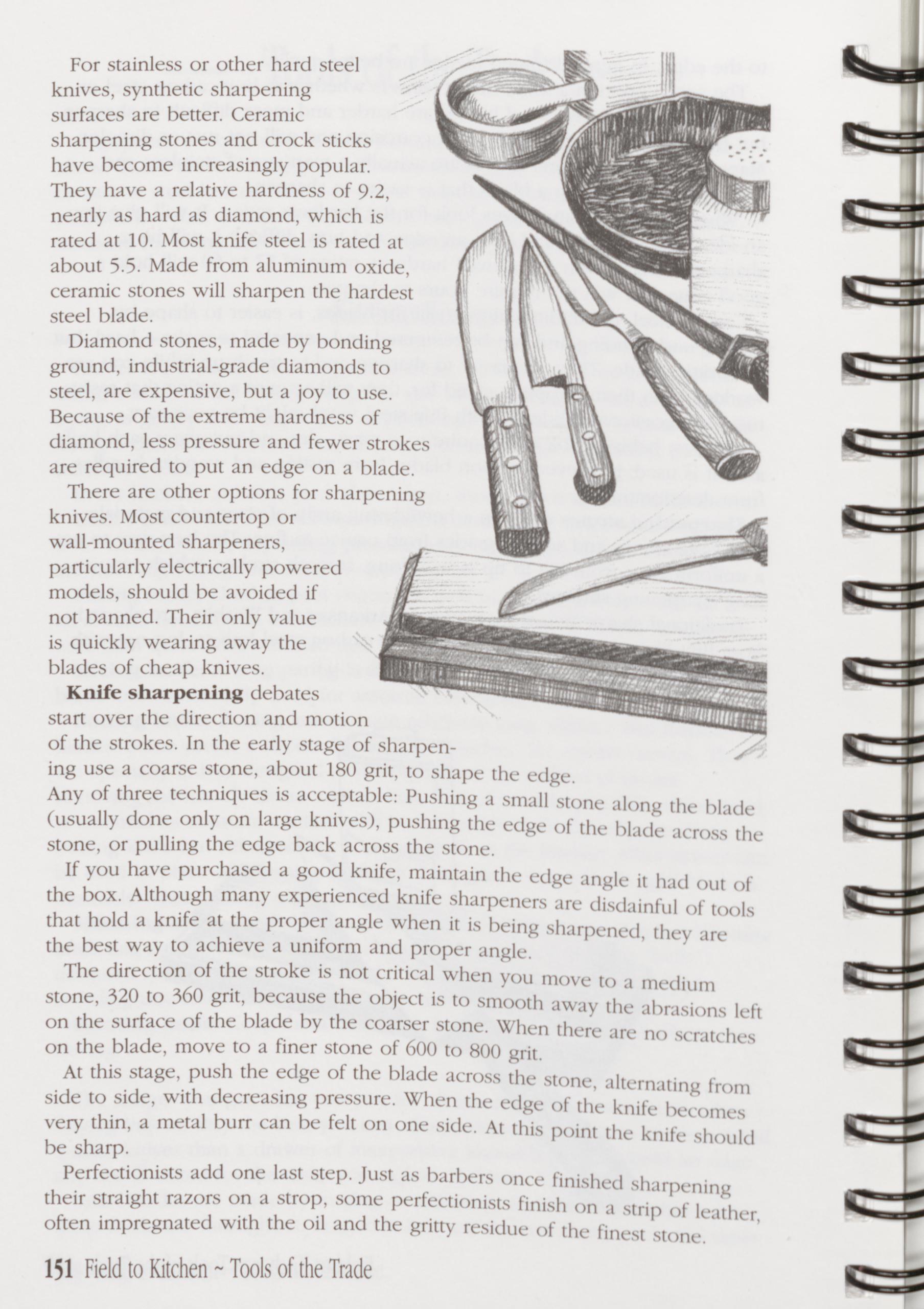
For stainless or other hard steel knives, synthetic sharpening surfaces are better. Ceramic sharpening stones and crock sticks have become increasingly popular. They have a relative hardness of 9.2, nearly as hard as diamond, which is rated at 10. Most knife steel is rated at about 5.5. Made from aluminum oxide, ceramic stones will sharpen the hardest steel blade.
Diamond stones, made by bonding ground, industrial-grade diamonds to steel, are expensive, but a joy to use. Because of the extreme hardness of diamond, less pressure and fewer strokes are required to put an edge on a blade.
There are other options for sharpening knives. Most countertop or wall-mounted sharpeners, particularly electrically powered models, should be avoided if not banned. Their only value is quickly wearing away the blades of cheap knives.
Knife sharpening debates start over the direction and motion of the strokes. In the early stage of sharpen- ing use a coarse stone, about 180 grit, to shape the edge. Any of three techniques is acceptable.- Pushing a small stone along the blade (usually done only on large knives), pushing the edge of the blade across the stone, or pulling the edge back across the stone.
If you have purchased a good knife, maintain the edge angle it had out of the box. Although many experienced knife sharpeners are disdainful of tools that hold a knife at the proper angle when it is being sharpened, they are the best way to achieve a uniform and proper angle.
The direction of the stroke is not critical when you move to a medium stone, 320 to 360 grit, because the object is to smooth away the abrasions left on the surface of the blade by the coarser stone. When there are no scratches on the blade, move to a finer stone of 600 to 800 grit.
At this stage, push the edge of the blade across the stone, alternating from side to side, with decreasing pressure. When the edge of the knife becomes very thin, a metal burr can be felt on one side. At this point the knife should be sharp.
Perfectionists add one last step. Just as barbers once finished sharpening their straight razors on a strop, some perfectionists finish on a strip of leather, D often impregnated with the oil and the gritty residue of the finest stone.
151 Field to Kitchen ~ Tools of the Trade
A buffing wheel and fine abrasive, 1200 grit, can also be used to finish. Whatever technique and material you use to sharpen your knives, remember that a good edge requires considerable time to achieve, but it can be maintained with only regular attention. Because it protects your knives’ fine edges, a storage rack is a good investment.
Cutting boards are as much a part of a knife as the handle. Large cutting boards are more convenient and safe to use. Health services recommend that a cutting board made of synthetic materials such as plastic (polyethylene or polypropylene) or glass, not wood, be used to lessen the risk of bacterial contamination.
Compressed rubber boards, actually made of plastic, are often used in restaurants. Glass and marble boards quickly dull knife edges.
Those who prefer the beauty of wood should use different boards for different foods: One for cutting bread, one for vegetables and one for meats. That will prevent contamination from raw meats being transferred to raw vegetables, and keep the flavor or garlic and onions from finding its way to strawberries and pineapple.
Be particularly diligent cleaning the board after cutting chicken or shaping ground beef. Avoid cutting repeatedly on the same part of the board. Once a board is deeply grooved, regardless the material it is made from, it should be replaced.
— Jon Farrar Cast-iron CookwareGrandma got her cast-iron cookware as a wedding gift. With it, she fed children and grandchildren for 50 years. Then came stainless steel, teflon, anodized and other hi-tech, gourmet cookware, and cast-iron cookware nearly vanished from store shelves.
Cast iron manufactured before the mid-1940s is superior to that made today. During the early 1900s, several U.S. manufacturers produced thin-walled cast-iron cookware with incredibly smooth surfaces produced by grinding and then polishing
One by one, traditional makers of cast-iron cookware, such as Griswold, folded. Today cast-iron cookware, called "hollow-ware in the industry, is still made under some familiar brand names, such as Wagner and Lodge, but the high quality of old is difficult to find. Many companies made cast-iron cook- ware, including the manufacturers of cookstoves, but the most prolific — and the best, in the judgment of many collectors — were the Griswold Manufacturing Company of Erie Pennsylvania, and the Wagner Manufacturing Company of Sidney, Ohio.
This low-tech, traditional cookware is making a comeback, and with good reason. It works well and costs less than many new materials. Cast iron is a stout tool and properly used it will last a lifetime.
The primary advantage of cast-iron cookware is that it distributes and holds heat evenly and efficiently. It works just as well over a bed of oak coals at a
Field to Kitchen ~ Tools of the Trade 152
river camp as on the kitchen range. Once a cast-iron implement is properly seasoned, food rarely sticks, and clean-up can be as simple as wiping it out with a paper towel. Advocates claim that food cooked in cast iron tastes better, although what is cooked, where it is cooked and who cooks it might influence that judgment.
The best way to get started in cast-iron cookware is to inherit pots and skillets with a smooth layer of carbon baked on by previous generations. Second choice is to snap up some at an auction or farm sale. If you are lucky, the cast iron will come well-seasoned with a glossy, obsidian-like patina and ready for your first batch of squirrel Stroganoff.
Often, though, second-hand cast iron has been abused. The carbon layer is chipped and the surface is intolerably rough, or the cookware has rusted. The old wisdom on rehabilitating such cookware was to toss it in a bed of hot coals or bake it in an oven at a high temperature until all the old carbon is burned off. That might work, or it might crack or warp a utensil.
Some suggest putting the pot or skillet in a self-cleaning oven for an hour to burn away all the old carbon. The disadvantage of this method is that afterwards you will be seasoning the utensil from scratch. Others recommend using oven cleaner to remove some of the carbonized layer to smooth the surface.
A safe method is to scrape the inner surface with a stiff scraper or an old chisel. Then smooth the surface with wet emery paper, the type used by autobody repairmen. Start with a medium or coarse emery paper and work down to a fine grit until the surface is smooth. The cookware then can be seasoned just like a new utensil.
If you are buying new iron cookware, get the best and check the inner surface for smoothness. Check the seal between the base and the lid of covered skillets and Dutch ovens. If there are burrs or raised areas, file them down so that steam, essential to cast-iron cooking, does not slip away.
153 Field to Kitchen ~ Tools of the Trade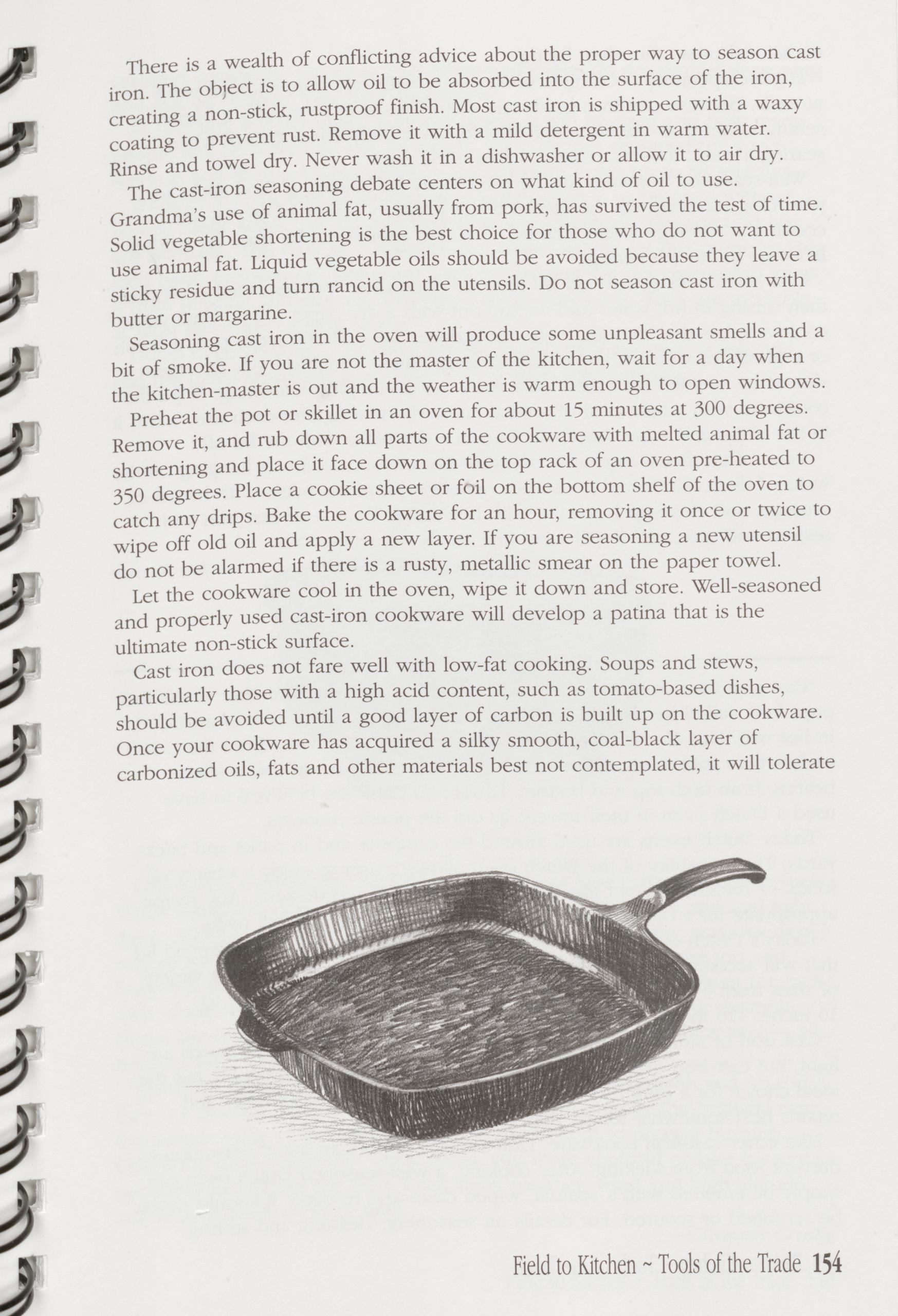
There is a wealth of conflicting advice about the proper way to season cast iron. The object is to allow oil to be absorbed into the surface of the iron, creating a non-stick, rustproof finish. Most cast iron is shipped with a waxy coating to prevent rust. Remove it with a mild detergent in warm water. Rinse and towel dry. Never wash it in a dishwasher or allow it to air dry.
The cast-iron seasoning debate centers on what kind of oil to use. Grandma’s use of animal fat, usually from pork, has survived the test of time. Solid vegetable shortening is the best choice for those who do not want to use animal fat. Liquid vegetable oils should be avoided because they leave a sticky residue and turn rancid on the utensils. Do not season cast iron with butter or margarine.
Seasoning cast iron in the oven will produce some unpleasant smells and a bit of smoke. If you are not the master of the kitchen, wait for a day when the kitchen-master is out and the weather is warm enough to open windows.
Preheat the pot or skillet in an oven for about 15 minutes at 300 degrees. Remove it, and rub down all parts of the cookware with melted animal fat or shortening and place it face down on the top rack of an oven pre-heated to 350 degrees. Place a cookie sheet or foil on the bottom shelf of the oven to catch any drips. Bake the cookware for an hour, removing it once or twice to wipe off old oil and apply a new layer. If you are seasoning a new utensil do not be alarmed if there is a rusty, metallic smear on the paper towel.
Let the cookware cool in the oven, wipe it down and store. Well-seasoned and properly used cast-iron cookware will develop a patina that is the ultimate non-stick surface.
Cast iron does not fare well with low-fat cooking. Soups and stews, particularly those with a high acid content, such as tomato-based dishes, should be avoided until a good layer of carbon is built up on the cookware. Once your cookware has acquired a silky smooth, coal-black layer of carbonized oils, fats and other materials best not contemplated, it will tolerate
Field to Kitchen ~ Tools of the Trade 154
occasional uses other than frying.
High-temperature cooking is unnecessary with cast iron, and can warp utensils. Because cast iron holds and distributes heat so evenly, a burner setting hotter than medium-high should never be needed. Except when searing a roast, low temperatures should be used.
Well-seasoned ironware can be used freely for baking. If food sticks to your cast iron it means the utensil is not properly seasoned or you are cooking at too high a temperature. Cast iron should not be used for storing leftovers in the refrigerator.
Cast-iron cooks usually do no more to clean their well-seasoned cookware than rinsing in hot water and wiping out with a dry paper towel. Until your cookware has that smooth, wipe-out surface, use a plastic scrub pad, a brush or a plastic or wooden implement to scrape away clinging food. Detergent should be avoided because it cuts away the developing seasoning. Wipe the cookware with a light coat of animal fat or shortening after each use, warm it in the oven, and wipe. Store cast iron in a dry place with the lid off.
Some of the finest cast-iron cookware I’ve encountered was hanging on the walls of duck blinds and goose pits, where most meals begin with bacon or sausage, and clean-up is a wipe with hot water. Treat your cast iron with respect and care, and it will yield fine meals for generations.
— Jon Farrar Dutch Ovens“Cast-iron kitchen furniture” was what Mary Washington, mother of the first president, called her Dutch oven, and she thought enough of it to include it in her will. This classic piece of cookery, which got its name from the Dutch traders who sold them, differs from other pots and pans in that it allows heating from both top and bottom. Lewis and Clark are believed to have used a Dutch oven in their travels, as did the prairie pioneers.
Today Dutch ovens are used around the campsite and in parks and back- yards. The versatility of the Dutch oven allows a user to enjoy a variety of foods — breads, one-pot meals, meats, vegetables and desserts. Any recipe appropriate for a conventional oven can be cooked in a Dutch oven.
Today’s Dutch ovens have a flat bottom, three short legs and a flanged lid that will accommodate hot coals or briquets. They are available in a variety of sizes from 5 inches (5 inches in diameter and 2Yi inches deep), to 16 inches (16 inches in diameter and 41/2 inches deep) and larger.
Cast iron or aluminum? Each has advantages. Aluminum Dutch ovens are light, but cast-iron ovens can weigh more than 10 pounds, probably not the ideal choice for a long hike. Cast-iron distributes heat more evenly and retains heat somewhat longer than aluminum.
Like other cast-iron cookware, Dutch ovens require an initial seasoning to prevent food from sticking. After cooking, a well-seasoned Dutch oven can simply be emptied with a spatula, wiped clean and re-oiled. It should never be scrubbed or scoured. For details on seasoning, cleaning and storing
155 Field to Kitchen ~ Tools of the Trade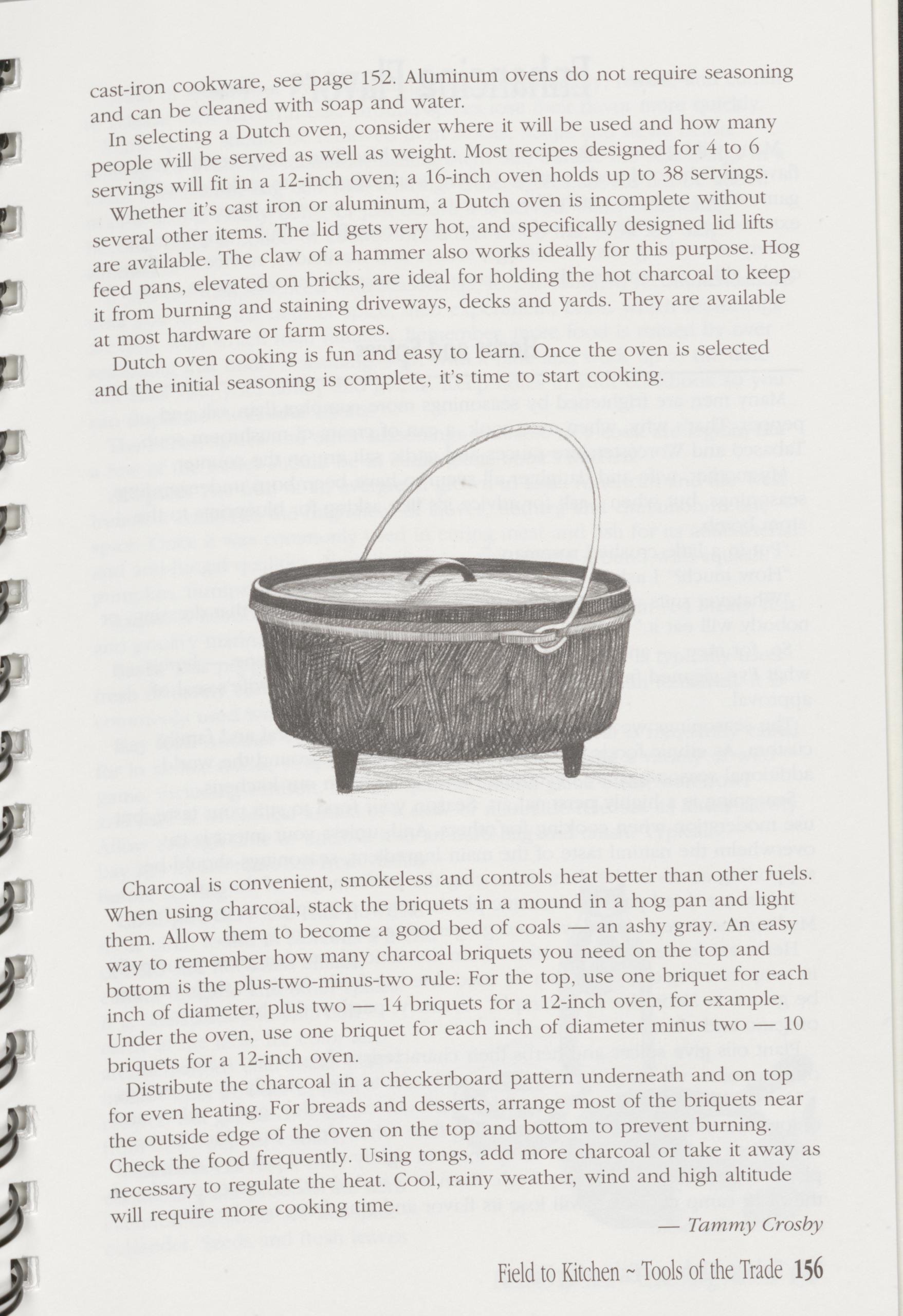
cast-iron cookware, see page 152. Aluminum ovens do not require seasoning and can be cleaned with soap and water.
In selecting a Dutch oven, consider where it will be used and how many people will be served as well as weight. Most recipes designed for 4 to 6 servings will fit in a 12-inch oven; a 16-inch oven holds up to 38 servings.
Whether it’s cast iron or aluminum, a Dutch oven is incomplete without several other items. The lid gets very hot, and specifically designed lid lifts are available. The claw of a hammer also works ideally for this purpose. Hog feed pans, elevated on bricks, are ideal for holding the hot charcoal to keep it from burning and staining driveways, decks and yards. They are available at most hardware or farm stores.
Dutch oven cooking is fun and easy to learn. Once the oven is selected and the initial seasoning is complete, it’s time to start cooking.
Charcoal is convenient, smokeless and controls heat better than other fuels. When using charcoal, stack the briquets in a mound in a hog pan and light them. Allow them to become a good bed of coals — an ashy gray. An easy way to remember how many charcoal briquets you need on the top and bottom is the plus-two-minus-two rule: For the top, use one briquet for each inch of diameter, plus two — 14 briquets for a 12-inch oven, for example. Under the oven, use one briquet for each inch of diameter minus two — 10 briquets for a 12-inch oven.
Distribute the charcoal in a checkerboard pattern underneath and on top for even heating. For breads and desserts, arrange most of the briquets near the outside edge of the oven on the top and bottom to prevent burning. Check the food frequently. Using tongs, add more charcoal or take it away as necessary to regulate the heat. Cool, rainy weather, wind and high altitude will require more cooking time.
— Tammy Crosby Field to Kitchen ~ Tools of the Trade 156 — Enhancing Flavors —■
Many wild game cooks consider it akin to blasphemy to cover the natural flavor of fish, fowl and venison. Others work diligently to make all wild game meats taste as much like domestic meats as possible. Between those extremes are a wide range of seasoning options. By skillfully employing a variety of cooking oils, seasonings, sauces and marinades, novice and expert cooks alike can uncover the full flavor and versatility of wild game meat.
Herbs and SpicesMany men are frightened by seasonings more complex than salt and pepper. That’s why, when men cook, a can of cream-of-mushroom soup, Tabasco and Worcestershire sauces and garlic salt are on the counter. My mother, wife and daughter all seem to have been born understanding seasonings, but when I ask for advice it’s like asking for blueprints to the atom bomb.
“Put in a little crushed rosemary.”
“How much?” I ask.
“Whatever suits your taste. But don’t put too much sage in that dressing, or nobody will eat it.”
So, for men — and women born without the seasoning gene — here’s what I’ve gleaned from reading cookbooks. And it has my wife’s seal of approval.
The seasonings we use are initially determined by cultural and family custom. As ethnic foods become more widely shared around the world, additional seasonings are becoming more common in our kitchens.
Seasoning is a highly personal art. Season your food to suit your taste, but use moderation when cooking for others. And, unless your intent is to overwhelm the natural taste of the main ingredient, seasonings should be supporting actors in the dish, enhancing the performance of the star.
Spices are dried parts of aromatic plants grown principally in tropical or Mediterranean regions. Cloves and ginger are examples of spices.
Herbs are leaves or tender stems from aromatic plants that grow principally in temperate regions. They can be used dried or fresh. Many basic herbs can be grown in Nebraska: for example, rosemary, parsley, dill, basil, thyme, oregano and cilantro.
Plant oils give spices and herbs their characteristic favors and odors. For our purposes, we lump them together and refer to them simply as seasonings.
Use fresh herbs whenever possible. Fresh chives, parsley, garlic, celery and onions are more flavorful and appealing than when dried. Buy dried herbs and spices in small quantities. Keep them in tightly closed jars in a dark cool place, if possible, so they stay fresh. Even in a sealed jar, thyme or paprika in the duck camp cupboard will lose its flavor and zing from one hunting season to the next.
157 Field to Kitchen ~ Enhancing Flavors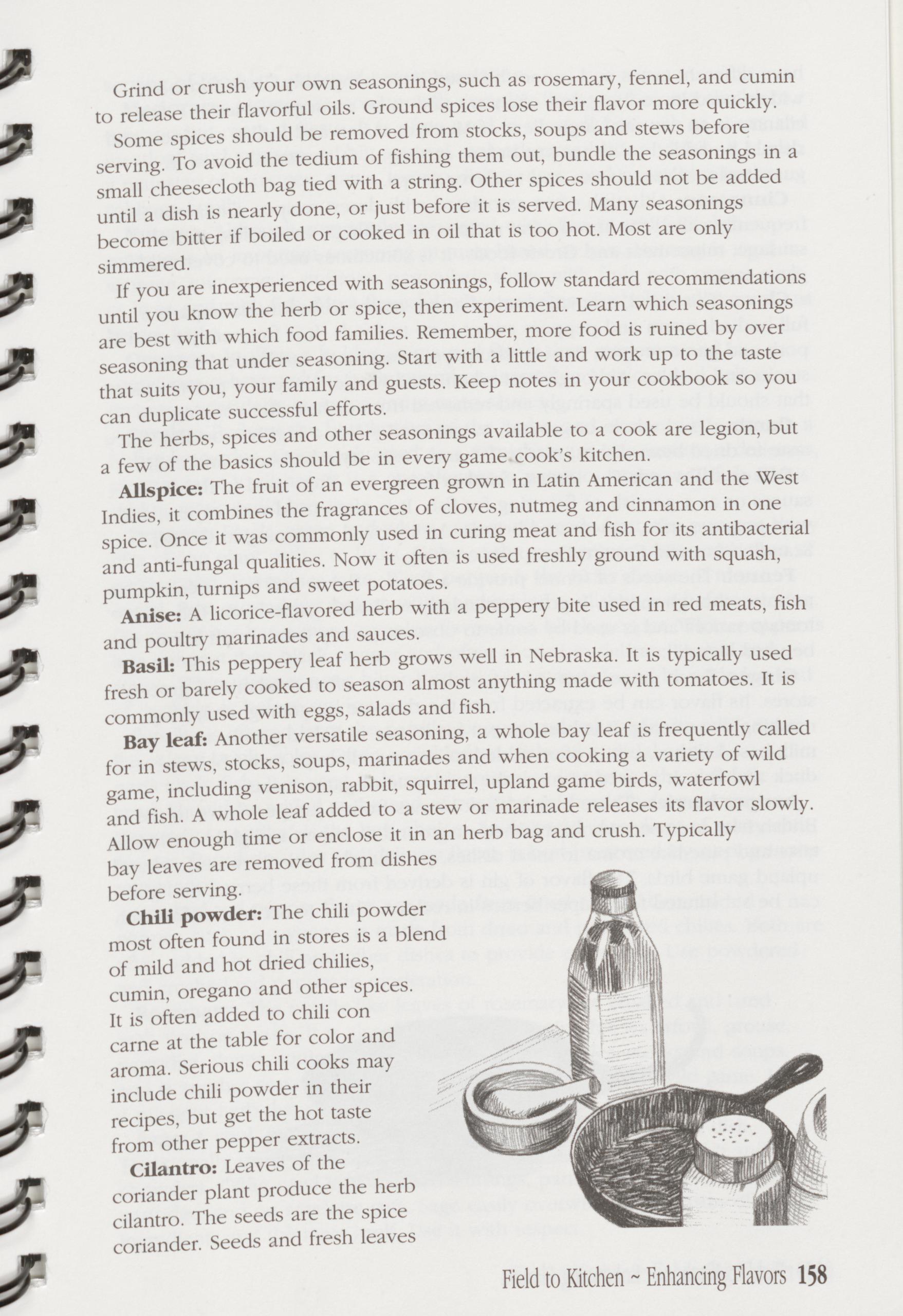
Grind or crush your own seasonings, such as rosemary, fennel, and cumin to release their flavorful oils. Ground spices lose their flavor more quickly. Some spices should be removed from stocks, soups and stews before serving. To avoid the tedium of fishing them out, bundle the seasonings in a small cheesecloth bag tied with a string. Other spices should not be added until a dish is nearly done, or just before it is served. Many seasonings become bitter if boiled or cooked in oil that is too hot. Most are only simmered.
If you are inexperienced with seasonings, follow standard recommendations until you know the herb or spice, then experiment. Learn which seasonings are best with which food families. Remember, more food is ruined by over seasoning that under seasoning. Start with a little and work up to the taste that suits you, your family and guests. Keep notes in your cookbook so you can duplicate successful efforts.
The herbs, spices and other seasonings available to a cook are legion, but a few of the basics should be in every game cook’s kitchen.
Allspice: The fruit of an evergreen grown in La tin American and the West Indies, it combines the fragrances of cloves, nutmeg and cinnamon in one spice. Once it was commonly used in curing meat and fish for its antibacterial and anti-fungal qualities. Now it often is used freshly ground with squash, pumpkin, turnips and sweet potatoes.
Anise: A licorice-flavored herb with a peppery bite used in red meats, fish and poultry marinades and sauces.
Basil: This peppery leaf herb grows well in Nebraska. It is typically used fresh or barely cooked to season almost anything made with tomatoes. It is commonly used with eggs, salads and fish.
Bay leaf: Another versatile seasoning, a whole bay leaf is frequently called for in stews, stocks, soups, marinades and when cooking a variety of wild game, including venison, rabbit, squirrel, upland game birds, waterfowl and fish. A whole leaf added to a stew or marinade releases its flavor slowly. Allow enough time or enclose it in an herb bag and crush. Typically bay leaves are removed from dishes before serving.
Chili powder: The chili powder most often found in stores is a blend of mild and hot dried chilies, cumin, oregano and other spices. It is often added to chili con carne at the table for color and aroma. Serious chili cooks may include chili powder in their recipes, but get the hot taste from other pepper extracts.
Cilantro: Leaves of the coriander plant produce the herb cilantro. The seeds are the spice coriander. Seeds and fresh leaves
Field to Kitchen ~ Enhancing Flavors 158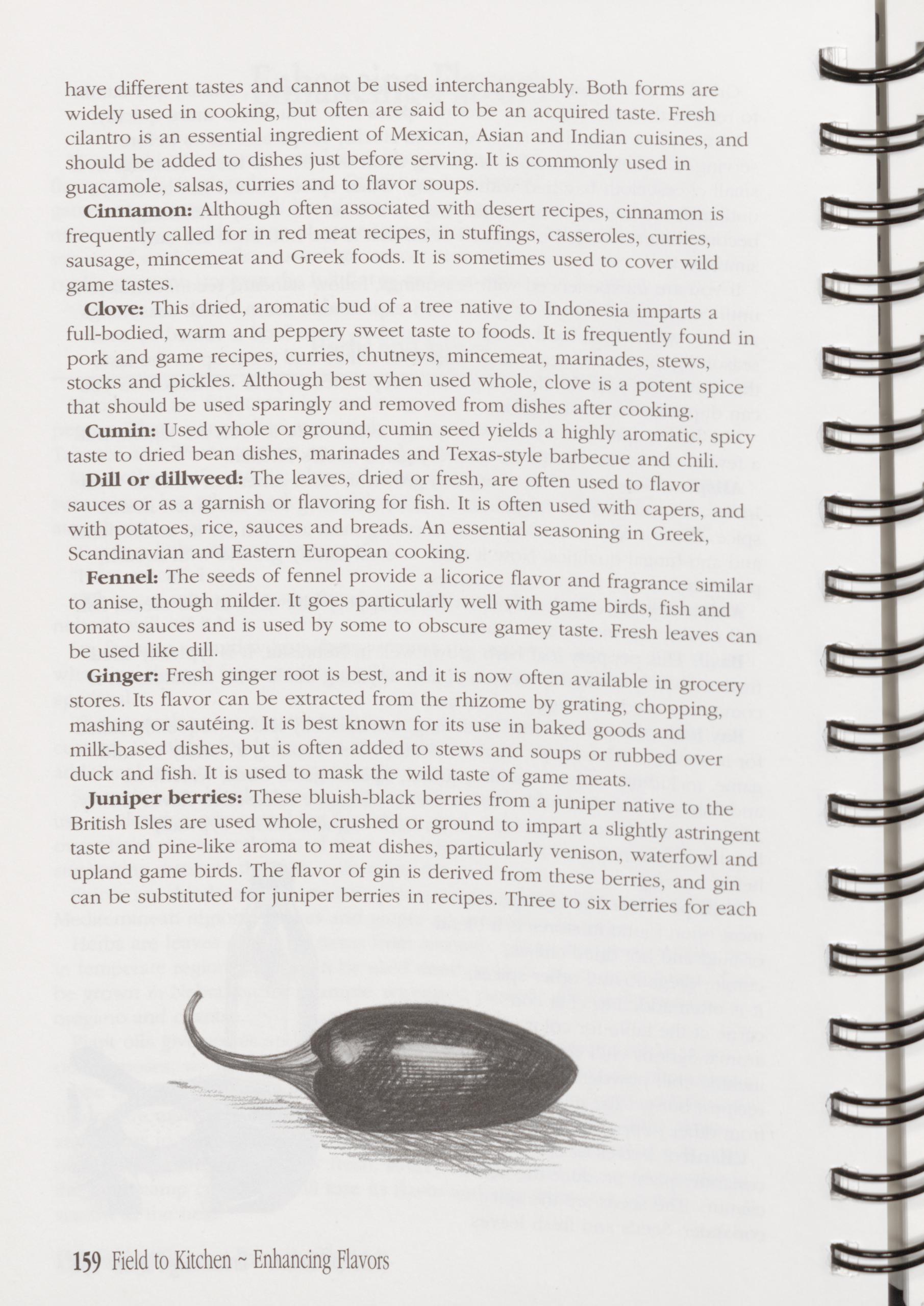
have different tastes and cannot be used interchangeably. Both forms are widely used in cooking, but often are said to be an acquired taste. Fresh cilantro is an essential ingredient of Mexican, Asian and Indian cuisines, and should be added to dishes just before serving. It is commonly used in guacamole, salsas, curries and to flavor soups.
Cinnamon: Although often associated with desert recipes, cinnamon is frequently called for in red meat recipes, in stuffings, casseroles, curries, sausage, mincemeat and Greek foods. It is sometimes used to cover wild game tastes.
Clove: This dried, aromatic bud of a tree native to Indonesia imparts a full-bodied, warm and peppery sweet taste to foods. It is frequently found in pork and game recipes, curries, chutneys, mincemeat, marinades, stews, stocks and pickles. Although best when used whole, clove is a potent spice that should be used sparingly and removed from dishes after cooking.
Cumin: Used whole or ground, cumin seed yields a highly aromatic, spicy taste to dried bean dishes, marinades and Texas-style barbecue and chili.
Dill or dillweed: The leaves, dried or fresh, are often used to flavor sauces or as a garnish or flavoring for fish. It is often used with capers, and with potatoes, rice, sauces and breads. An essential seasoning in Greek, Scandinavian and Eastern European cooking.
Fennel: The seeds of fennel provide a licorice flavor and fragrance similar to anise, though milder. It goes particularly well with game birds, fish and tomato sauces and is used by some to obscure gamey taste. Fresh leaves can be used like dill.
Ginger: Fresh ginger root is best, and it is now often available in grocery stores. Its flavor can be extracted from the rhizome by grating, chopping, mashing or sauteing. It is best known for its use in baked goods and milk-based dishes, but is often added to stews and soups or rubbed over duck and fish. It is used to mask the wild taste of game meats.
Juniper berries: These bluish-black berries from a juniper native to the British Isles are used whole, crushed or ground to impart a slightly astringent taste and pine-like aroma to meat dishes, particularly venison, waterfowl and upland game birds. The flavor of gin is derived from these berries, and gin can be substituted for juniper berries in recipes. Three to six berries for each
159 Field to Kitchen ~ Enhancing Flavors
serving of food is a standard recommendation.
Marjoram: A sunny seasoning with complex flavor and aroma similar to oregano but more delicate. It is often used in meat dishes such as roasts and meatloaf, and venison, rabbit, squirrel, upland game birds and fish. It is also a mainstay of sausages, stews, tomato dishes, eggs, and vegetables in the cabbage family.
Nutmeg: Although commonly associated with deserts and fruit dishes, nutmeg is an important seasoning in meat-based recipes. Nutmeg is used in sausage, mincemeat, stuffings, particularly those with fruit, with organs such as liver, and with fish. Most flavorful when purchased whole and ground just before using.
Oregano: It offers a bolder aroma and flavor than marjoram and is sometimes substituted for it. Frequently it is used in Mexican and Italian recipes, particularly in soups and tomato sauces.
Parsley: Perhaps the best known of the herbs, and one readily grown in a Nebraska garden. Commonly used as a garnish, but it also imparts a delicious, piquant taste to dishes. It is a compliment to potatoes, soups and fish and is said to mask garlic breath.
Peppers: Black, green and white pepper are made from the pungent berry of a vining plant native to India. Color of the peppercorn varies with time of picking and determines taste. Black pepper is the basic choice of most cooks. Best ground just before using and added to dishes just before serving. Green pepper has a more complex flavor than black pepper. White pepper is less pungent than black pepper and often is used in delicate sauces and soups. White pepper turns bitter if soaked long and should be added at end of cooking or before serving.
Paprika is ground from the paprika pepper and valued for its mild, warm flavor and bright color. Often sprinkled on dishes for visual appeal, particularly fish. It is used in larger quantities to impart its characteristic taste. Should be added at the end of cooking or shortly before serving. “Sweet hot paprika” is the best choice. An essential ingredient of many chili recipes. Paprika’s color and delicate flavor is best preserved by storing in the refrigerator.
Crushed red pepper flakes are made from dried chilies. Ground red pepper, such as cayenne, is made from dried and powdered chilies. Both are often added to chili and other dishes to provide extra zing. Use powdered and crushed red pepper in moderation.
Rosemary: The needle-like leaves of rosemary are crushed and used with venison roasts. It is also a common seasoning for waterfowl, grouse, partridge, doves, squirrel and rabbit, and in marinades, stocks and soups, and is another seasoning used to mask the natural taste of wild game. It is a pungent herb that should be used in moderation.
Sage: A cool, pungently aromatic herb that adds depth to any dish. Traditionally used with fatty fish, waterfowl, pork, sausages, rabbit and chowders. Often used in game bird stuffings, particularly turkey, grouse and partridge, and on antelope cuts. Sage easily overwhelms the tastes of other ingredients and the meat itself. Use it with respect.
Field to Kitchen ~ Enhancing Flavors 160
Savory: A strongly flavored and dominant herb. Often called for in meatloaf, with beans, stews, stuffings and with fatty fish such as catfish, it is also frequently used in venison, upland game bird and waterfowl recipes.
Tarragon: This widely used herb finds its way into recipes for venison, small game, upland game birds and waterfowl. It is also a good seasoning for fish, chicken, eggs, mushrooms and tomato-based sauces. Tarragon is a delicate herb with a sweet fragrance and delicate licorice flavor. Use the fresh leaves whole or chopped, or substitute anise for a similar flavor.
Thyme: A versatile and widely used seasoning with a peppery taste and pine fragrance, it is traditionally used in stocks, stews, soups and stuffings; also with fatty fish, most vegetables and especially tomatoes, gumbos and other creole foods, venison, rabbit, squirrel, upland game birds and water- fowl. Thyme is best added to dishes at the last minute.
In addition to spices and herbs, there are a host of seasonings, some natural, some commercial blends, that every good cook should be familiar with.
Bottled meat sauces and mustard sauces can be used to add flavor to many dishes. The juices or fine gratings of the outer rind, or zest, of the citrus fruits are traditionally used in waterfowl recipes.
— Jon Farrar Cooking Oils and FatsFats and oils form a shield to protect foods from burning or sticking to utensils, and like seasonings, can impart a characteristic flavor of their own. Today, cooks have an array of oils.
Animal fats, such as lard and butter, have been condemned by the medical community because they are high in saturated fats. Some recent studies, however, suggest they might have advantages over some highly processed alternatives.
Butter has 61 percent saturated fat, beef fat 49 percent and lard 40 percent. Naughty or not, these fats have their places, in moderation. Pie crusts made with lard still walk away with the ribbons at county fairs, pork fat gravy is incomparable, and mushrooms or snipe sauteed in butter are a hunter’s delight. When and how to use animal fats needs little elaboration.
Vegetable shortening is vegetable oil in the solid form. It is made from a variety or blend of refined and deodorized oils such as soybeans, corn, cottonseed or peanut, and has about 32 percent saturated fat. Some vegetable shortenings have animal fats added. Vegetable shortenings are essentially tasteless and preferred for baking.
Confusion comes when selecting the appropriate vegetable oil for cooking. There are many varieties, each with a claim for superior flavor, applications and healthful benefits. The American Heart Association recommends oils low in saturated fats and high in polyunsaturated or monounsaturated fat.
The following is a list of most commonly used vegetable oils.
Canola: Low in saturated fat, about 6 percent, this bland oil is made from rape seeds. It is good for cooking and salad dressings.
161 Field to Kitchen ~ Enhancing Flavors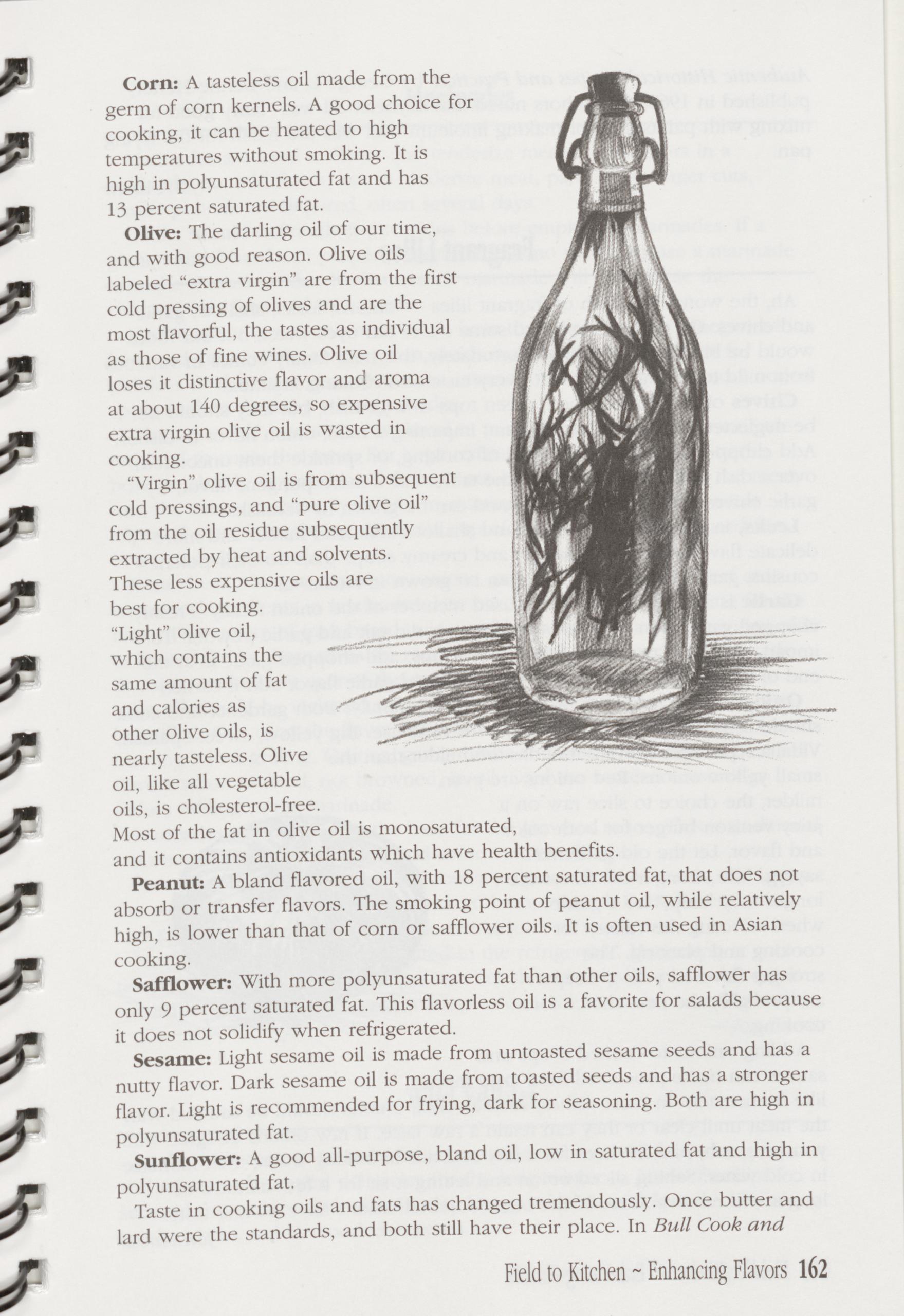
Corn: A tasteless oil made from the germ of corn kernels. A good choice for cooking, it can be heated to high temperatures without smoking. It is high in polyunsaturated fat and has 13 percent saturated fat.
Olive: The darling oil of our time, and with good reason. Olive oils labeled “extra virgin” are from the first cold pressing of olives and are the most flavorful, the tastes as individual as those of fine wines. Olive oil loses it distinctive flavor and aroma at about 140 degrees, so expensive extra virgin olive oil is wasted in cooking.
“Virgin” olive oil is from subsequent cold pressings, and “pure olive oil” from the oil residue subsequently extracted by heat and solvents. These less expensive oils are best for cooking. “Light” olive oil, which contains the same amount of fat and calories as other olive oils, is nearly tasteless. Olive oil, like all vegetable oils, is cholesterol-free.
Most of the fat in olive oil is monosaturated, and it contains antioxidants which have health benefits. Peanut: A bland flavored oil, with 18 percent saturated fat, that does not absorb or transfer flavors. The smoking point of peanut oil, while relatively high, is lower than that of corn or safflower oils. It is often used in Asian cooking.
Safflower: With more polyunsaturated fat than other oils, safflower has only 9 percent saturated fat. This flavorless oil is a favorite for salads because it does not solidify when refrigerated.
Sesame: Light sesame oil is made from untoasted sesame seeds and has a nutty flavor. Dark sesame oil is made from toasted seeds and has a stronger flavor. Light is recommended for frying, dark for seasoning. Both are high in polyunsaturated fat.
Sunflower: A good all-purpose, bland oil, low in saturated fat and high in polyunsaturated fat.
Taste in cooking oils and fats has changed tremendously. Once butter and lard were the standards, and both still have their place. In Bull Cook and
Field to Kitchen ~ Enhancing Flavors 162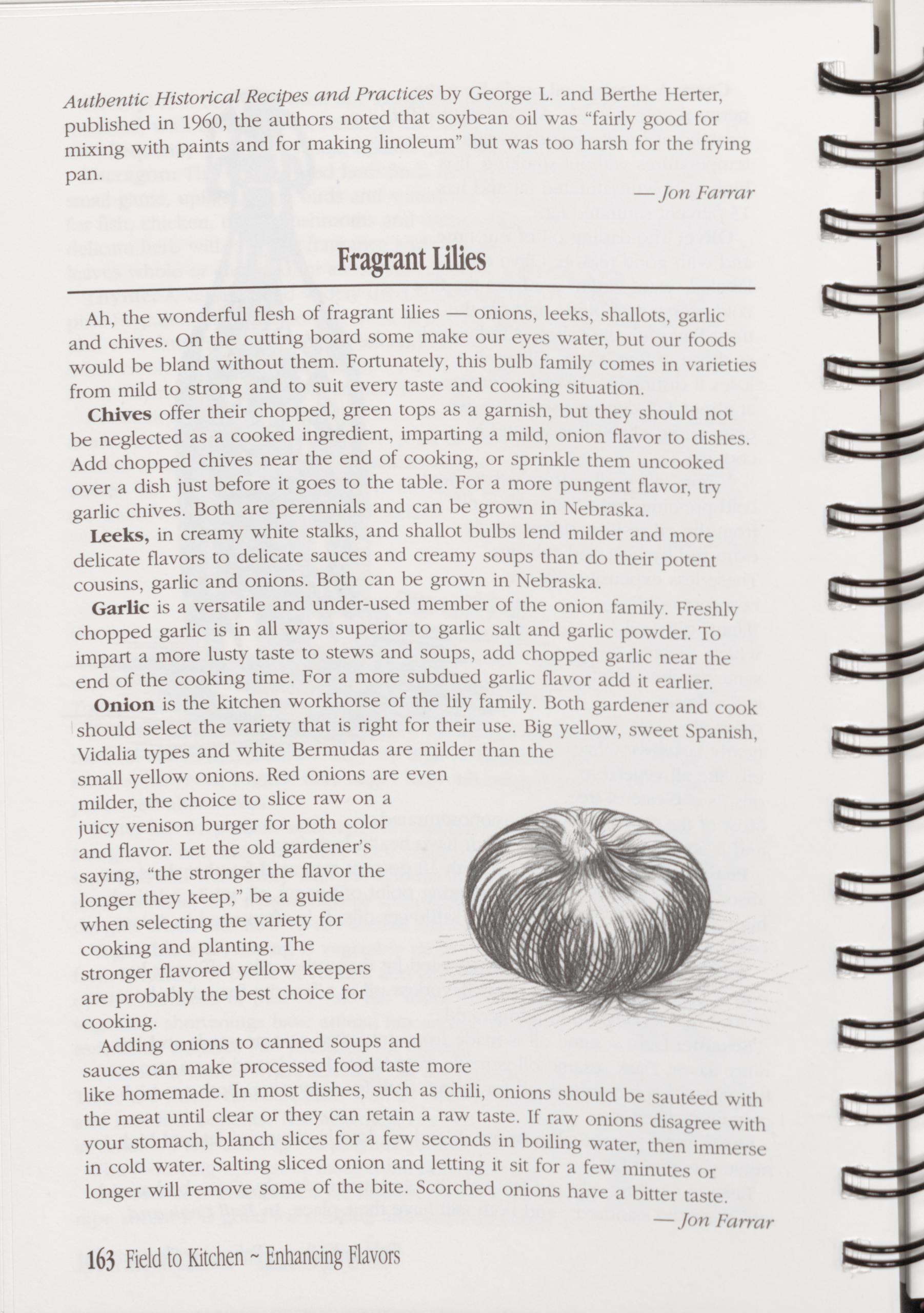
Authentic Historical Recipes and Practices by George L. and Berthe Herter, published in I960, the authors noted that soybean oil was “fairly good for mixing with paints and for making linoleum” but was too harsh for the frying pan.
— Jon Farrar Fragrant Lilies?Ah, the wonderful flesh of fragrant lilies — onions, leeks, shallots, garlic and chives. On the cutting board some make our eyes water, but our foods would be bland without them. Fortunately, this bulb family comes in varieties from mild to strong and to suit every taste and cooking situation.
Chives offer their chopped, green tops as a garnish, but they should not be neglected as a cooked ingredient, imparting a mild, onion flavor to dishes. Add chopped chives near the end of cooking, or sprinkle them uncooked over a dish just before it goes to the table. For a more pungent flavor, try garlic chives. Both are perennials and can be grown in Nebraska.
Leeks, in creamy white stalks, and shallot bulbs lend milder and more delicate flavors to delicate sauces and creamy soups than do their potent cousins, garlic and onions. Both can be grown in Nebraska.
Garlic is a versatile and under-used member of the onion family. Freshly chopped garlic is in all ways superior to garlic salt and garlic powder. To impart a more lusty taste to stews and soups, add chopped garlic near the end of the cooking time. For a more subdued garlic flavor add it earlier.
Onion is the kitchen workhorse of the lily family. Both gardener and cook should select the variety that is right for their use. Big yellow, sweet Spanish, Vidalia types and white Bermudas are milder than the small yellow onions. Red onions are even milder, the choice to slice raw on a juicy venison burger for both color and flavor. Let the old gardener’s saying, “the stronger the flavor the longer they keep,” be a guide when selecting the variety for cooking and planting. The stronger flavored yellow keepers are probably the best choice for cooking.
Adding onions to canned soups and sauces can make processed food taste more like homemade. In most dishes, such as chili, onions should be sauteed with the meat until clear or they can retain a raw taste. If raw onions disagree with your stomach, blanch slices for a few seconds in boiling water, then immerse in cold water. Salting sliced onion and letting it sit for a few minutes or longer will remove some of the bite. Scorched onions have a bitter taste.
— Jon Farrar 163 Field to Kitchen ~ Enhancing Flavors Marinades
Marinades are used to flavor and tenderize meat. A few hours in a marinade can add flavor, but to tenderize meat, particularly larger cuts, longer periods are required, often several days.
Cooks should define their intentions before employing marinades. If a game animal has been properly aged, there is no reason to use a marinade to make it more tender. In that case, a marinade will only dilute the characteristic flavor of wild game.
Most marinades use an acetic liquid base to tenderize meat. Vinegar, wine, beer and citrus juices are common. Acids react with metals, except for stainless steel, so use glass, porcelain, enamel or crockery bowls and wooden spoons when working with marinades.
When possible, use a shallow bowl to minimize the amount of marinade required to cover the meat. For large roasts try to match the roast to the bowl as closely as possible. If there is not enough liquid to cover the meat, turn the meat occasionally. While marinating, cover the dish to prevent exposed meat from drying. About Vi cup of marinade should be used for every pound of meat.
Wine, beer, vinegar, soy sauce, onions, pepper, garlic and bay leaf are common ingredients in marinades. Use other seasonings appropriate for the meat. The variety of malt-based, wine and herb vinegars available today offer unlimited flavor alternatives for marinades. Heavily seasoned Italian salad dressings make easy spur-of-the-moment marinades.
An oil should be included in most marinades, especially if the meat is to be grilled. Oils carry the flavors of seasonings and protect the meat from burning when grilling. Onions, garlic, herbs and spices will release their full flavors when sauteed, not browned, in oil. Cool the sauteed seasonings before adding to the marinade.
Marinades can be used as the base for the gravy or sauce. This is traditional with hasenpfeffer, sauerbraten and some venison dishes.
How long to marinate meat is a cook’s judgment-call. As a rule, the larger the piece of meat, the longer it needs to be marinated. Cubed meat, steaks and small game, cut into pieces, do not require as much time.
Meats usually should be marinated in the refrigerator. Marinating at room temperature will speed up the process but should only be used with quick marinades. Long periods at room temperature will increase bacteria growth.
— Jon Farrar Wild EdiblesIn the 19th century summer fruits were the raw material for jams, syrups and wines — treasured delicacies for the long winter to come. Families scoured the prairies and took Sunday buggy rides to wild fruit thickets along creeks, rivers and in wooded canyons.
Field to Kitchen ~ Enhancing Flavors 164
Searching for wild fruit remains a tradition today, long after grocery stores have become the usual year-round source of fruits and berries, and the same bounty that inspired pioneers waits to be found today. All you need is a bucket and the knowledge of when and where to look.
Wild Strawberry (Fragaria virginiana and F. vesca) — Range: Statewide. Habitat: Patches of native grassland, open woodlands, stream valleys, road- sides. Time of fruit: Mid-June into July. Low-growing herbaceous plant bears fruit that is smaller than the domestic strawberry but with a more intense flavor. Uses: Jams, ice cream topping, shortcake.
Missouri Gooseberry (Ribes missouriense) — Range: Eastern half of Nebraska. Habitat: Dry to moist woodlands, stream banks, rocky outcrops, thickets. Time of fruit: July. The shrub of up to 3 feet produces a spherical, “beaked” berry, turning red-purple at maturity. Uses: Pies, cobblers and jelly. Golden Currant (Ribes odoratum) — Range: Western half of Nebraska.
Where gooseberry reaches its western habitat limit, the currant becomes more abundant. Habitat: Woodland and thicket edges, rock outcrops, ravines and on the banks of lakes and streams. Time of fruit: July into August. A shrub of up to Z feet bears a small spherical berry that turns from yellow to red or purplish-black. Uses: Pies, jam and jelly. It is sometimes blended with larger, more abundant fruits such as gooseberries.
Black Raspberry (Rubus occidentalis) — Range: Eastern half of Nebraska and extending westward in stream valleys. Habitat: Rich soils in woods, thickets, ravines, roadsides and fence lines. Time of fruit: Mid-June into July. Arching, thorned canes yield a fruit is more flavorful than the domestic raspberry, though usually smaller. Uses: Pies, cobblers, jelly, jam and syrup. Leaves used to make a tea.
Blackberry (Rubus ostryifolius and R. allegbeniensis) — Range: Extreme southeastern Nebraska. Habitat: Open woodlands and woodland edge, ravines, thickets, roadsides and railways. Time of fruit: Late June into July. Spreading canes are densely covered with spines. Uses: Pies, cobblers, syrup, jam and wine.
Buffaloberry (Sbepberdia argentea) — Range: Statewide except in the southeast, but more common in central and west. Habitat: Hillsides, ravines, streambanks and roadsides, particularly in rocky, sandy and clay soils. Time of fruit: Late July into August. Shrub or small tree up to 12 feet has plum-like spines and silvery green leaves. Fruit, bright red when ripe, is usually found in clusters. Uses: Jelly, chutneys and mixes with larger wild fruits.
Wild Plum (Prunus americana) — Range: Statewide and most common east and central. Habitat: Woodland and stream edges, shelterbelts, thickets, ravines, fence lines and roadsides. Time of fruit: Late August into September. This shrub or small tree forms dense thickets. Yellow-red to near-black purple fruit is about 1 inch long. Uses: Pies, jam, jelly, syrup and wine.
Sand Cherry (Prunus besseyi) — Range: Principally in Sandhills, but also in sandy soils elsewhere. Habitat: Grasslands with sandy soils, particularly on ungrazed roadsides. Time of fruit: Mid-July into August. Sprawling small shrub with glossy, deep green leaves do not bear fruit every year because their blossoms are frequently nipped by frost. Fruit turns black when ripe.
165 Field to Kitchen ~ Enhancing Flavors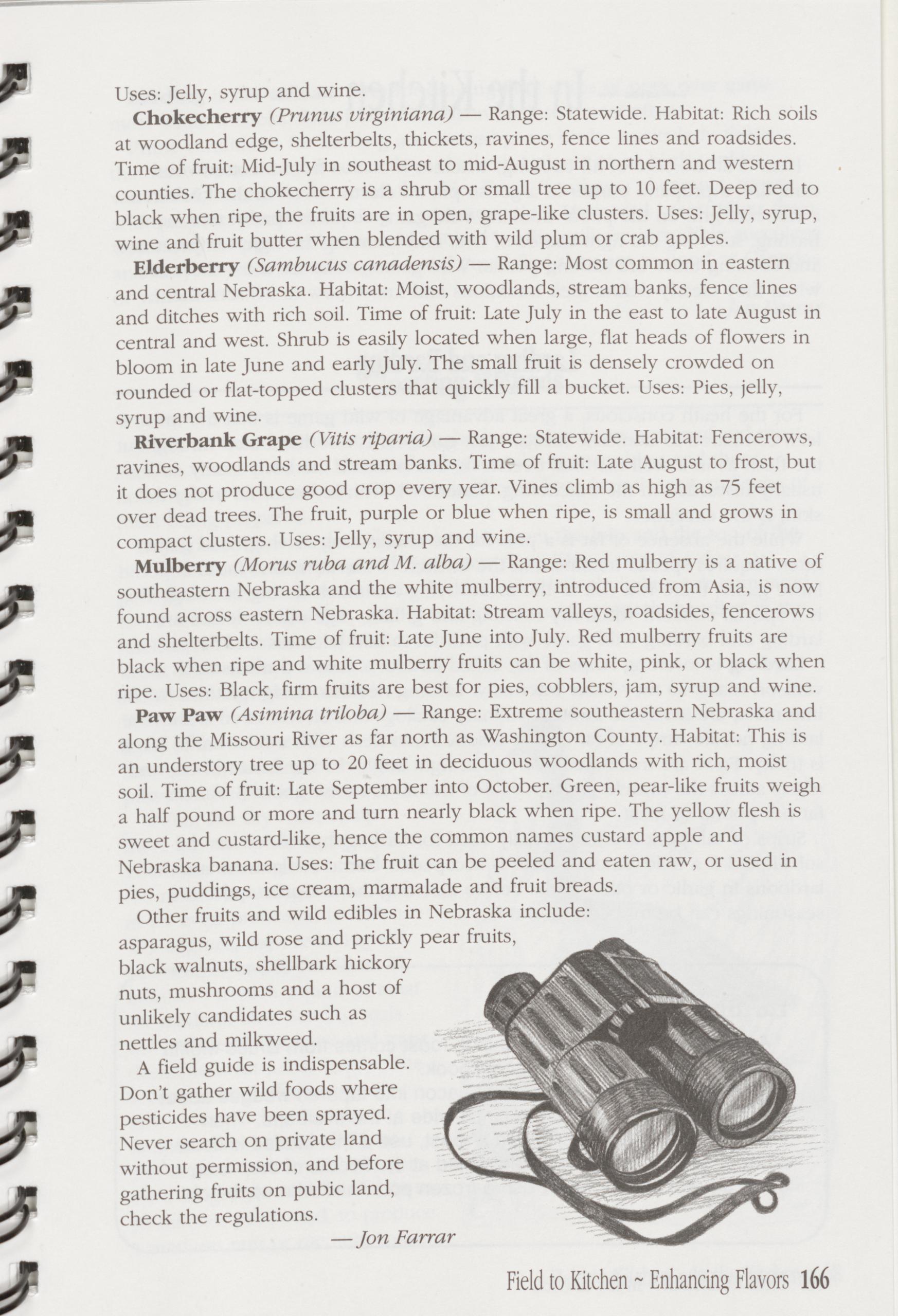
Uses: Jelly, syrup and wine.
Chokecherry (Primus virginiana) — Range: Statewide. Habitat: Rich soils at woodland edge, shelterbelts, thickets, ravines, fence lines and roadsides. Time of fruit: Mid-July in southeast to mid-August in northern and western counties. The chokecherry is a shrub or small tree up to 10 feet. Deep red to black when ripe, the fruits are in open, grape-like clusters. Uses: Jelly, syrup, wine and fruit butter when blended with wild plum or crab apples.
Elderberry (Sambucus canadensis) — Range: Most common in eastern and central Nebraska. Habitat: Moist, woodlands, stream banks, fence lines and ditches with rich soil. Time of fruit: Late July in the east to late August in central and west. Shrub is easily located when large, flat heads of flowers in bloom in late June and early July. The small fruit is densely crowded on rounded or flat-topped clusters that quickly fill a bucket. Uses: Pies, jelly, syrup and wine.
Riverbank Grape (Vitis riparia) — Range: Statewide. Habitat: Fencerows, ravines, woodlands and stream banks. Time of fruit: Late August to frost, but it does not produce good crop every year. Vines climb as high as 75 feet over dead trees. The fruit, purple or blue when ripe, is small and grows in compact clusters. Uses: Jelly, syrup and wine.
Mulberry (Morus ruba and M. alba) — Range: Red mulberry is a native of southeastern Nebraska and the white mulberry, introduced from Asia, is now found across eastern Nebraska. Habitat: Stream valleys, roadsides, fencerows and shelterbelts. Time of fruit: Late June into July. Red mulberry fruits are black when ripe and white mulberry fruits can be white, pink, or black when ripe. Uses: Black, firm fruits are best for pies, cobblers, jam, syrup and wine.
Paw Paw (Asimina triloba) — Range: Extreme southeastern Nebraska and along the Missouri River as far north as Washington County. Habitat: This is an understory tree up to 20 feet in deciduous woodlands with rich, moist soil. Time of fruit: Late September into October. Green, pear-like fruits weigh a half pound or more and turn nearly black when ripe. The yellow flesh is sweet and custard-like, hence the common names custard apple and Nebraska banana. Uses: The fruit can be peeled and eaten raw, or used in pies, puddings, ice cream, marmalade and fruit breads. Other fruits and wild edibles in Nebraska include: asparagus, wild rose and prickly pear fruits, black walnuts, shellbark hickory nuts, mushrooms and a host of unlikely candidates such as nettles and milkweed. A field guide is indispensable. Don’t gather wild foods where pesticides have been sprayed. Never search on private land without permission, and before gathering fruits on pubic land, check the regulations.
— Jon Farrar Field to Kitchen ~ Enhancing Flavors 166 — In the Kitchen —
Heat is at the core of all cooking, whether it comes from a cottonwood campfire, a propane burner in a goose pit, an electric oven in the kitchen or a charcoal grill on the patio. Cooking wild game requires special treatment. Basting, selecting the right source of heat and knowing the right temperatures and cooking times are starting points. Wild game cooks are most successful when they clearly define their intentions and know how to achieve them.
Larding and LardingFor the heath conscious, a great advantage of wild game is that the meat is lean compared to domestic meats. Most game fat is not distributed throughout the flesh as in a well-marbled beefsteak, but is inside the body cavity and usually discarded in the butchering. Waterfowl, with layers of fat under the skin, is the exception.
While the absence of fat is a plus for the cholesterol watcher, wild game often requires special treatment in the kitchen. Without natural fat to self baste game, there is a risk of the meat drying too much during cooking. This is a special concern when dry roasting and grilling. Age-old remedies are larding and barding wild game with pork fat to add juiciness and flavor.
Larding is inserting strips of fat, called lardoons, into red meats such as venison roasts so they baste internally. Larding needles, designed to “sew” fat into meat, are available through culinary catalogs and stores. Even without a larding needle, strips of fat can be inserted into flesh with a fillet knife, but it is tricky. Fowl are traditionally larded at right angles to the breast bone, and roasts across the muscle grain. A rule-of-thumb is to use about 3 ounces of fat per pound of meat.
Strips of salt pork are traditionally used for larding, but bacon can be substituted if a mild, smoked taste is acceptable. Some cooks marinate the lardoons in garlic or other herbs before inserting them. Garlic and other seasonings can be rubbed into the fat.
Larding with Pork “Nails”
An easy trick for larding a venison roast comes from Bruce Moffitt in The Venison Chef’s Finest cookbook.
He suggests cutting salt pork or bacon into tapered wedges about 2 inches long and less than an inch wide at the thick end. Then freeze the wedges hard. To lard a roast, use a thin-bladed knife or other sharp tool to make a hole aimed at the middle of the roast every square inch or two. Push a frozen pork “nail” into each hole.
167 Field to Kitchen ~ In the Kitchen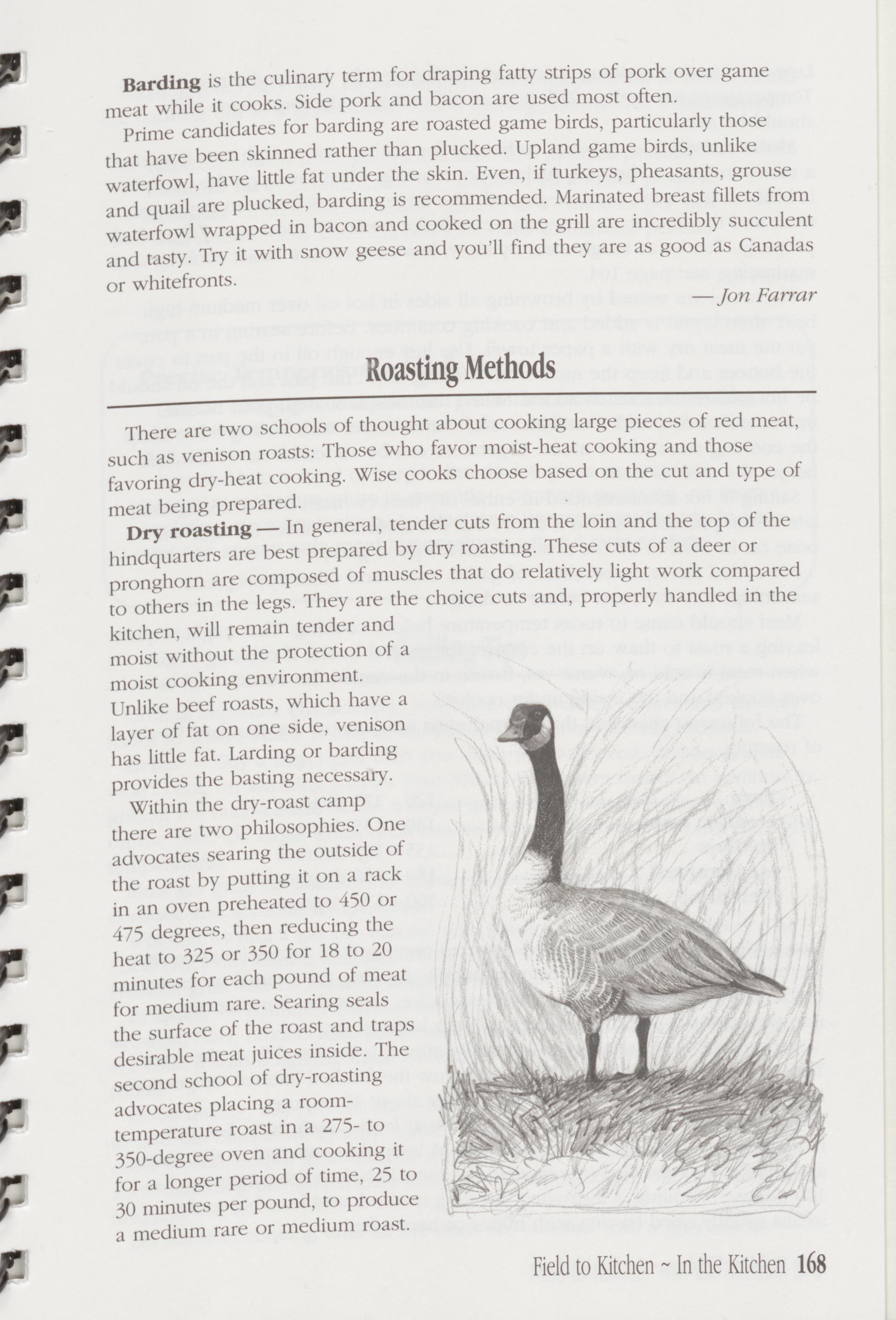
Barding is the culinary term for draping fatty strips of pork over game meat while it cooks. Side pork and bacon are used most often.
Prime candidates for barding are roasted game birds, particularly those that have been skinned rather than plucked. Upland game birds, unlike waterfowl, have little fat under the skin. Even, if turkeys, pheasants, grouse and quail are plucked, barding is recommended. Marinated breast fillets from waterfowl wrapped in bacon and cooked on the grill are incredibly succulent and tasty. Try it with snow geese and you’ll find they are as good as Canadas or whitefronts.
— Jon Farrar Roasting MethodsThere are two schools of thought about cooking large pieces of red meat, such as venison roasts: Those who favor moist-heat cooking and those favoring dry-heat cooking. Wise cooks choose based on the cut and type of meat being prepared.
Dry roasting — In general, tender cuts from the loin and the top of the hindquarters are best prepared by dry roasting. These cuts of a deer or pronghorn are composed of muscles that do relatively light work compared to others in the legs. They are the choice cuts and, properly handled in the kitchen, will remain tender and moist without the protection of a moist cooking environment.
Unlike beef roasts, which have a layer of fat on one side, venison has little fat. Larding or barding provides the basting necessary.
Within the dry-roast camp there are two philosophies. One advocates searing the outside of the roast by putting it on a rack in an oven preheated to 450 or 475 degrees, then reducing the heat to 325 or 350 for 18 to 20 minutes for each pound of meat for medium rare. Searing seals the surface of the roast and traps desirable meat juices inside. The second school of dry-roasting advocates placing a room- temperature roast in a 275- to 350-degree oven and cooking it for a longer period of time, 25 to 30 minutes per pound, to produce a medium rare or medium roast.
Field to Kitchen ~ In the Kitchen 168
Low-temperature cooking is often recommended for less tender roasts. Temperatures lower than 275 degrees will not kill microorganisms and should be avoided.
Moist roasting — A better technique for dealing with tough cuts is to use a moist-cooking technique, such as pot roasting. Meat lower on the quarters is best cut into stew meat or ground. The large muscles between the burger meat and the tender, choice, rump cuts make perfectly good roasts if cooked properly. Tenderize tough meat by slow, low-temperature moist cooking and marinating, see page 164.
Pot roasts are seared by browning all sides in hot oil over medium-high heat, then liquid is added and cooking continues. Before searing in a pan, pat the meat dry with a paper towel. Use just enough oil in the pan to cover the bottom and keep the meat from sticking. Both the pan and the oil should be hot before the meat is added. When the roast is seared, pour off the unwanted oil and add 1 or 2 inches of water. Cover with a snug lid to keep the cooking atmosphere moist. Vegetables can be added about 20 minutes before the meat is done.
Salting is not recommended in either dry-heat or moist-heat cooking until late in the process because it draws out the delectable juice. Enough will ooze on its own to be the raw material for good gravy.
For added flavor, insert slices of garlic, onion and other appropriate seasonings into the roast before cooking.
Meat should come to room temperature before cooking. That might require leaving a roast to thaw on the counter for several hours. If cooking begins when meat is cold or, worse yet, frozen in the center, the outside will be over cooked and the inside under cooked.
The following chart lists the internal meat temperature for standard levels of roasting:
Rare.............................120 - 125 degrees Medium rare....................130 - 135 degrees Medium .........................135 - 145 degrees Medium well....................150 - 155 degrees Well done........................160 - 170 degreesUse a meat thermometer to check internal temperature. Professional cooks’ thermometers that begin at 0 degrees permit checking the internal temperature before cooking begins and are the best choice. Insert the thermometer tip into the center of the meat, but away from bone or fat.
A roast will continue to cook internally after it is removed from the oven. Take it out when it is about 10 degrees below the finished internal temperature. Meat is easier to carve if allowed to rest for about 10 minutes.
Broiling— Cuts to be broiled should be at least 1-inch thick, but not much thicker than 2 inches. It is difficult to keep thin cuts rare at the center, and thicker cuts are likely to char on the outside before the center reaches 120 degrees. Broiling is a dry-heat cooking method, and lean big game steaks usually need basting with butter or bacon fat.
169 Field to Kitchen ~ In the Kitchen
Broiling times vary with thickness of the meat temperature at which steaks are cooked, but as a general rule follow these guidelines for 2-inch steaks:
Rare.............................7 to 9 minutes per side Medium rare....................10 to 12 minutes per side Medium .........................1Z to 17 minutes per side Well done........................18 to 20 minutes per side — Jon Farrar Precise Temperatures Made EasyClassic cooking techniques can profit from modern devices. One of best recent kitchen improvements in our view is the electronic digital thermometer.
Inserted into a roast or burger, the device gives an accurate internal meat temperature in seconds - no more guessing, no more squinting, no more waiting. An electronic thermometer is easy to use and can assure safe meat temperatures without over cooking.
Grilling TipsGrilling imparts a characteristic browned, caramelized surface and smokey flavor to foods, and it is one of the country’s favorite cooking methods.
Grills — Buy a larger grill than you think you will need. Serious grillers won’t cook on anything smaller than 350 to 400 square inches. In addition to grilling the main-course meats, a larger grill allows vegetables to be grilled on the side. On larger grills, meat can be moved around to find just the right temperatures.
Most gas grills do not burn as hot as charcoal, but they provide quick, constant and accurate temperatures.
Whether buying a gas or charcoal grill, always buy one with a hood. The hood efficiently retains heat and allows more accurate temperature regulation. Hooded grills can be used for smoking meat.
Briquets — Common charcoal briquets are made of charcoal from sawdust, filler, binders and, sometimes, coal dust. “Match-starting” briquets are coated with a lighting fluid. Both types can impart undesirable flavors to foods.
Good quality, 100-percent charcoal briquets cost a bit more and are harder to find but burn more cleanly. Natural charcoal, made of oak, mesquite and other woods, comes in irregularly shaped pieces. It burns hotter and faster, and controlling the temperature is more difficult than with the common briquets.
Do not start cooking until all the coals are covered with a gray ash to
Field to Kitchen ~ In the Kitchen 170
avoid contaminating food with unwanted flavors.
Because lighting fluid may linger and flavor foods, it’s better to use wood kindling or rolled newspaper twisted into a knot to start your charcoal. Many grillers use a chimney starter, a metal container with two compartments, one to hold the briquets and another for crumpled newspaper used to ignite the briquets. After lighting, coals usually take 15 to 20 minutes to burn to the gray ash, red glow cooking stage. Electric charcoal starters also are available.
The lava rocks or ceramic briquets used to radiate heat in gas grills usually become soaked with fat and oils and should be replaced every year. Techniques — Grilling food is an art and requires special techniques. The perimeter of the briquets should extend at least 2 inches beyond the food being grilled.
A hooded grill is required for indirect cooking of large pieces of meat, or whole and halved birds. Place the briquets on one side of the grill and the meat on the other side. Most gas grills have two side-by-side burners. Turn one burner on and place the meat over the other side of the rack for low-heat cooking. A pan or foil filled with water should be placed under the meat to catch drippings and create a moist cooking environment. Use a meat thermometer to check the internal temperature.
Cooking times will be extended in cold weather, and if the lid of the grill is lifted often. Coals ignite more reluctantly and burn more slowly and cooler when the humidity is high.
Lightly oil the grill rack before cooking fish, fowl and other meats likely to stick. A wire brush works well to scrub a grill rack. Charred food stuck to the rack is most easily removed immediately after it has cooked on, or after the rack is reheated. A dirty grill can impart undesirable flavors to grilled food.
Clean it regularly.
To make the characteristic grill marks, preheat the grill before placing meat on it.
The optimum distance between the heat source and meat is 6 inches. Some grill racks do not extend that high. Buy one that does.
Temperature — The temperature of the coals can be determined by holding your hand, palm down, 6 inches away. If you can hold your hand there for only 3 to 4 seconds, the fire is hot, ideal for searing meat. If you can hold your hand over the coals for 5 to 7 seconds the fire is medium-hot, a good temperature for cooking in a covered grill.
When the coals have a thick coating of gray ash and there is no red glow visible, the fire is producing a low heat, ideal for slow cooking but too cool for true grilling. For low-temperature cooking, use an oven thermometer to monitor the grill temperature. Bacteria can survive at cooking temperatures below 200 degrees.
The best way to regulate the temperature in a kettle-style charcoal grill is by adjusting the air vents. Open the vents wide and more oxygen feeds a hotter fire, closing vents lowers the temperature. Cooks who play their grill vents like a flute often have inconsistent temperatures and uneven cooking. Adjusting the vents is a matter of experience. For a hotter fire pile the coals in a thick layer close together and keep the lid down as much as possible.
171 Field to Kitchen ~ In the Kitchen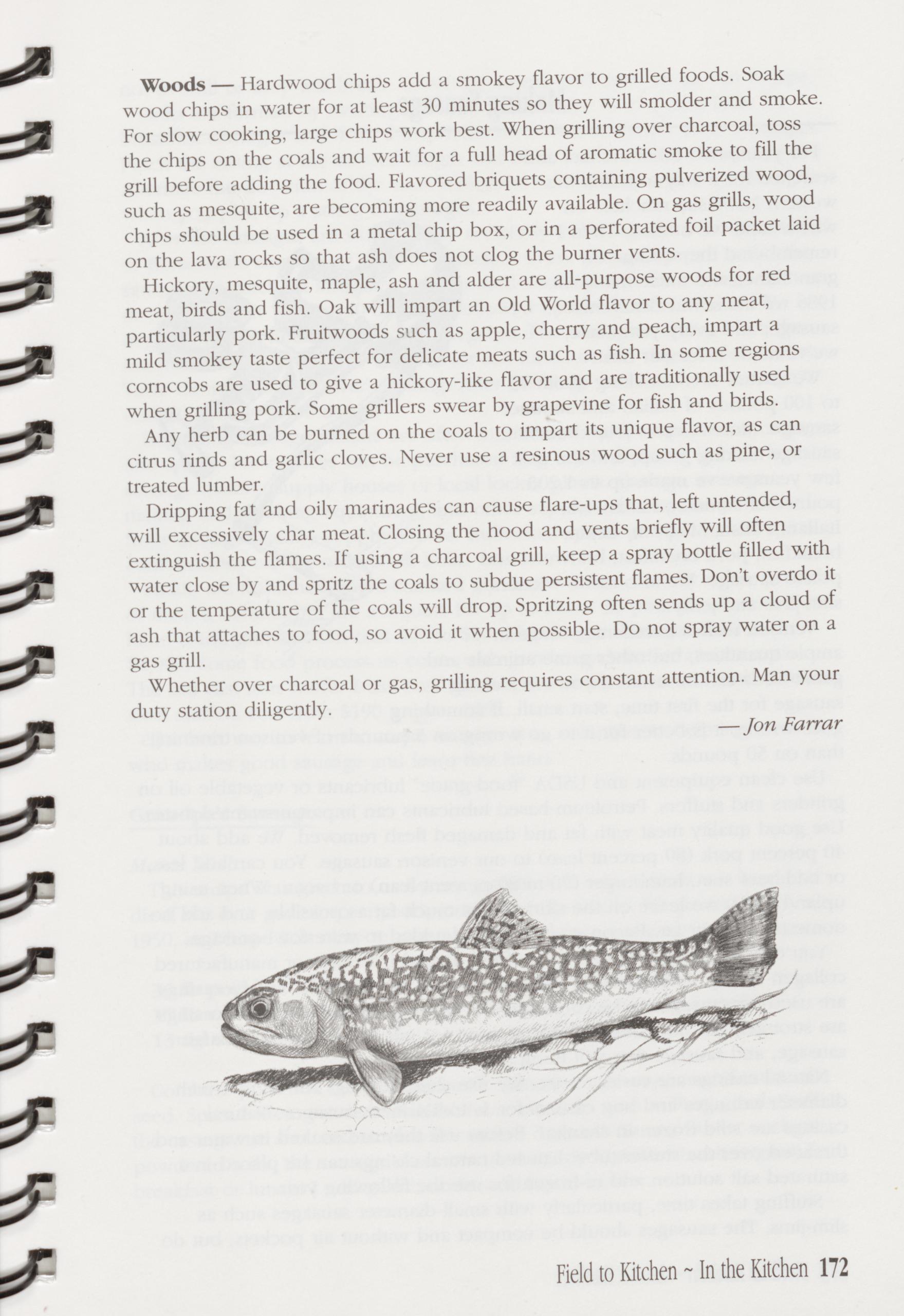
Woods — Hardwood chips add a smokey flavor to grilled foods. Soak wood chips in water for at least 30 minutes so they will smolder and smoke. For slow cooking, large chips work best. When grilling over charcoal, toss the chips on the coals and wait for a full head of aromatic smoke to fill the grill before adding the food. Flavored briquets containing pulverized wood, such as mesquite, are becoming more readily available. On gas grills, wood chips should be used in a metal chip box, or in a perforated foil packet laid on the lava rocks so that ash does not clog the burner vents.
Hickory, mesquite, maple, ash and alder are all-purpose woods for red meat, birds and fish. Oak will impart an Old World flavor to any meat, particularly pork. Fruitwoods such as apple, cherry and peach, impart a mild smokey taste perfect for delicate meats such as fish. In some regions corncobs are used to give a hickory-like flavor and are traditionally used when grilling pork. Some grillers swear by grapevine for fish and birds. Any herb can be burned on the coals to impart its unique flavor, as can citrus rinds and garlic cloves. Never use a resinous wood such as pine, or treated lumber.
Dripping fat and oily marinades can cause flare-ups that, left untended, will excessively char meat. Closing the hood and vents briefly will often extinguish the flames. If using a charcoal grill, keep a spray bottle filled with water close by and spritz the coals to subdue persistent flames. Don’t overdo it or the temperature of the coals will drop. Spritzing often sends up a cloud of ash that attaches to food, so avoid it when possible. Do not spray water on a gas grill.
Whether over charcoal or gas, grilling requires constant attention. Man your duty station diligently.
— Jon Farrar Field to Kitchen ~ In the Kitchen 172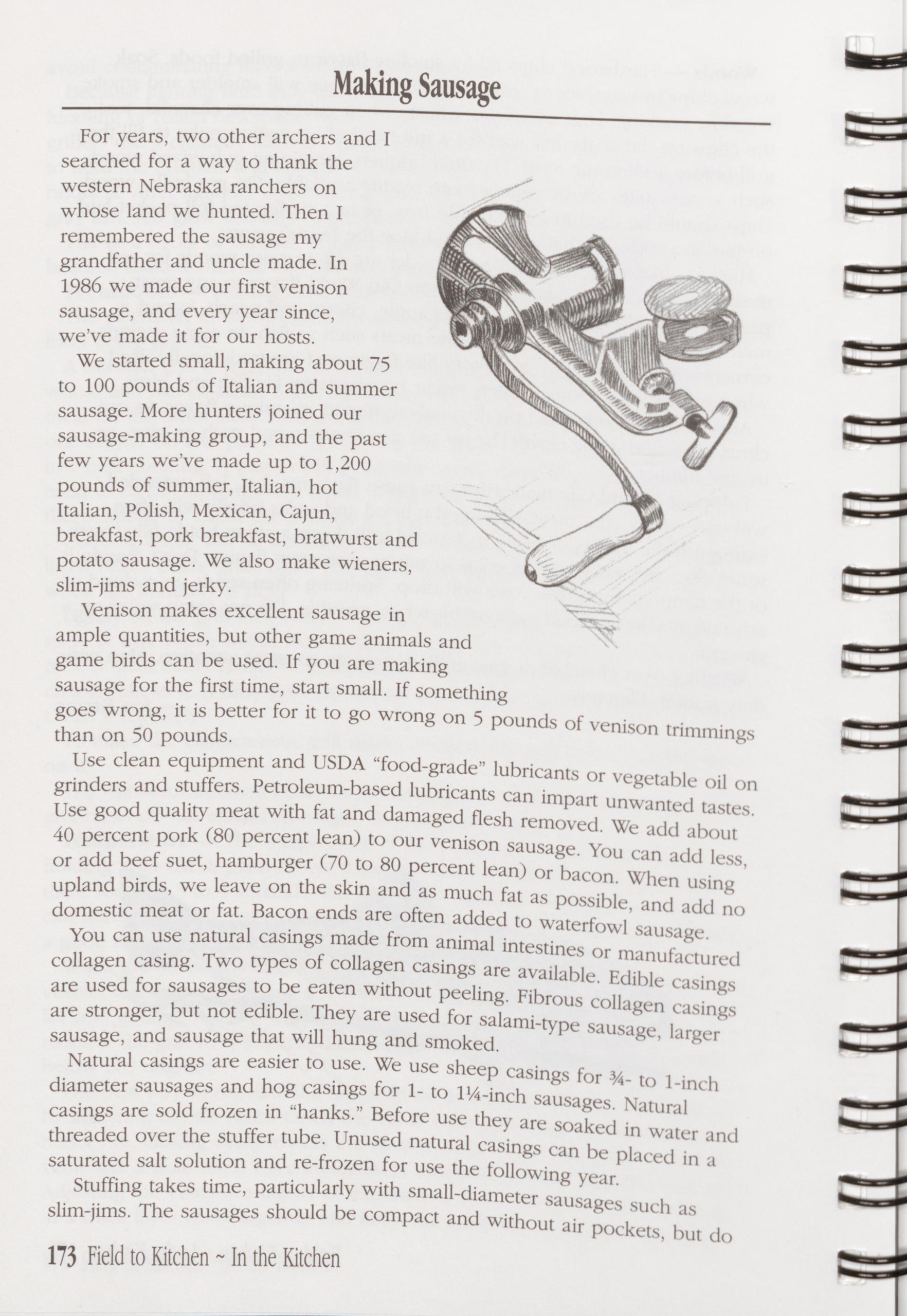 Making Sausage
For years, two other archers and I searched for a way to thank the western Nebraska ranchers on whose land we hunted. Then I remembered the sausage my grandfather and uncle made. In 1986 we made our first venison sausage, and every year since, we’ve made it for our hosts.
We started small, making about 75 to 100 pounds of Italian and summer sausage. More hunters joined our sausage-making group, and the past few years we’ve made up to 1,200 pounds of summer, Italian, hot Italian, Polish, Mexican, Cajun, breakfast, pork breakfast, bratwurst and potato sausage. We also make wieners, slim-jims and jerky.
Venison makes excellent sausage in ample quantities, but other game animals and game birds can be used. If you are making sausage for the first time, start small. If something goes wrong, it is better for it to go wrong on 5 pounds of venison trimmings than on 50 pounds.
Use clean equipment and USDA “food-grade” lubricants or vegetable oil on grinders and stuffers. Petroleum-based lubricants can impart unwanted tastes. Use good quality meat with fat and damaged flesh removed. We add about 40 percent pork (80 percent lean) to our venison sausage. You can add less, or add beef suet, hamburger (70 to 80 percent lean) or bacon. When using upland birds, we leave on the skin and as much fat as possible, and add no domestic meat or fat. Bacon ends are often added to waterfowl sausage.
You can use natural casings made from animal intestines or manufactured collagen casing. Two types of collagen casings are available. Edible casings are used for sausages to be eaten without peeling. Fibrous collagen casings are stronger, but not edible. They are used for salami-type sausage, larger sausage, and sausage that will hung and smoked.
Natural casings are easier to use. We use sheep casings for 3A- to 1-inch diameter sausages and hog casings for 1- to 1 1/4-inch sausages. Natural casings are sold frozen in “hanks.” Before use they are soaked in water and threaded over the stuffer tube. Unused natural casings can be placed in a saturated salt solution and re-frozen for use the following year. Stuffing takes time, particularly with small-diameter sausages such as slim-jims. The sausages should be compact and without air pockets, but do
173 Field to Kitchen ~ In the Kitchen
not overfill or they will break. Leave the casing end open so air can escape. Links are formed by twisting the casing. We make 4- to 5-inch links for breakfast sausages and 4- to 6-inch links for Polish and most other sausages.
Pinch the casing at the desired length and twist it two or more times. Alternate the direction of the twist with each link so they will not twist open when you pick up a string of sausages.
After the sausages are stuffed, they are ready to be cooked in a commercial or homemade smoker, or even in a kitchen oven. Use a drip pan under the sausages to catch fat and juices. A standard cooking time for sausages is one or two hours at 120 to 140 degrees, followed by one hour at 150 to 170 degrees and an hour at 170 to 200 degrees. The sausage is done when the internal temperature is 160 degrees for red meats or 165 degrees for poultry. Taste diminishes with over cooking. After cooking, we freeze our sausage until it is ready to be used.
Beginning sausage makers are often intimidated by the equipment, casings and spices. Most spices can be purchased at grocery stores or in bulk from sausage-making supply houses or local locker plants. Casings, sausage- making and smoking equipment, and other supplies also can be purchased from sausage-making supply houses. Individual spices and pre-mixed spice combinations can be ordered in bulk.
Small, old-fashioned, hand-cranked grinders will handle only a few pounds of meat a minute, but are adequate for up to about 30 pounds of meat. New hand-crank grinders can cost $40 to $80. Electric grinders cost $100 to $4,000. Some food processors come with grinder and stuffer attachments. The old cast-iron stuffer I use cost about $50 at a farm auction. New stainless steel stuffers cost from $190 to over $300.
The best way to learn to make sausage is to volunteer to help someone who makes good sausage and learn first hand.
Grandpa’s Sausage Makes 50 lb This recipe was given to us by my grandfather, who told us we would all die if we ever gave it to anybody outside of the family. He passed away in 1950, so I hope it is okay to pass along this easy-to-make recipe. 33 lb pork 2 to 3 tbl pepper 17 lb venison or beef 13A to 2 oz mustard seed 13 tbl salt bologna casingCombine pork and venison (or beef). Combine salt, pepper and mustard seed. Spread the meat and sprinkle the seasonings over it, then grind. Stuff the casings, tie shut and smoke. Because it does not have a binder such as powdered milk, the sausage does not bind tightly together, but it is great for breakfast or lunch. I add garlic, onion and liquid smoke.
Field to Kitchen ~ In the Kitchen 174 Dave’s Potato and Venison Sausage
12 lb venison and pork
10 lb frozen french fries
5 lb onions
4 oz salt
1/2 oz allspice
3/4 oz black pepper
1 oz onion powder
1/2 oz garlic powder
1 lb nonfat powdered milk
liquid smoke
hog or ring bologna casings
Dave’s Potato and Venison Sausage
12 lb venison and pork
10 lb frozen french fries
5 lb onions
4 oz salt
1/2 oz allspice
3/4 oz black pepper
1 oz onion powder
1/2 oz garlic powder
1 lb nonfat powdered milk
liquid smoke
hog or ring bologna casings
Grind venison, pork, frozen french fries and onions. Separately mix salt, allspice, black pepper, onion powder and garlic powder. Add spices to powdered milk (used as a binder). Add spices, milk and liquid smoke in the quantity recommended on the bottle to the meat and mix by hand. Grind the mixture again and stuff the casings. Cook or smoke, then freeze the sausages.
Keith Brown’s Snow Goose SalamiWaverly waterfowl hunter Keith Brown gave me this recipe for snow goose sausage, and I think you’ll like it as much as I do.
breast meat of 5 snow geese 2 to 3 lb bacon ends or 1 to 2 lb pork sausage 3 tbl Morton’s Tender Quick 1 tsp garlic powder 1 tsp onion powder 2 tsp black pepper 1 tbl whole black peppercorns 1 tbl liquid smoke 2 tbl mustard seedGrind the meat. Mix the seasonings and meat by hand and grind again. Refrigerate for 24 hours, then form into logs of about one pound each and bake for Wi hours in a 300 degree oven, or cook in a smoker.
— Dave Oates, Seward, Nebraska Camp CoffeeIs there any cup of coffee as wonderful as the first one in the morning around a campfire? Whether you are backpacking, canoeing, fishing or hunting, an outdoor cup of coffee is hard-earned and more appreciated than one from the kitchen. After a hard day in the field, or a long night sleeping on the ground, the warmth, aroma and caffeine are pure luxury.
Camp coffee is often made differently than coffee at home or the office. Perking on the stove top or dripping through a filter just doesn’t extract the full body and aroma of ground coffee. Boiled coffee does.
Fill your pot — an enamelware piece with a few chips is the perfect aesthetic tool — about three-quarters full of cold water. It’s important to start with cold water. Warm or hot water will come to a boil too quickly, before all the grounds are soaked and ready to release their flavor. Some claim the secret of good coffee is as much in the water as the beans. Soft water,
175 Field to Kitchen ~ In the Kitchen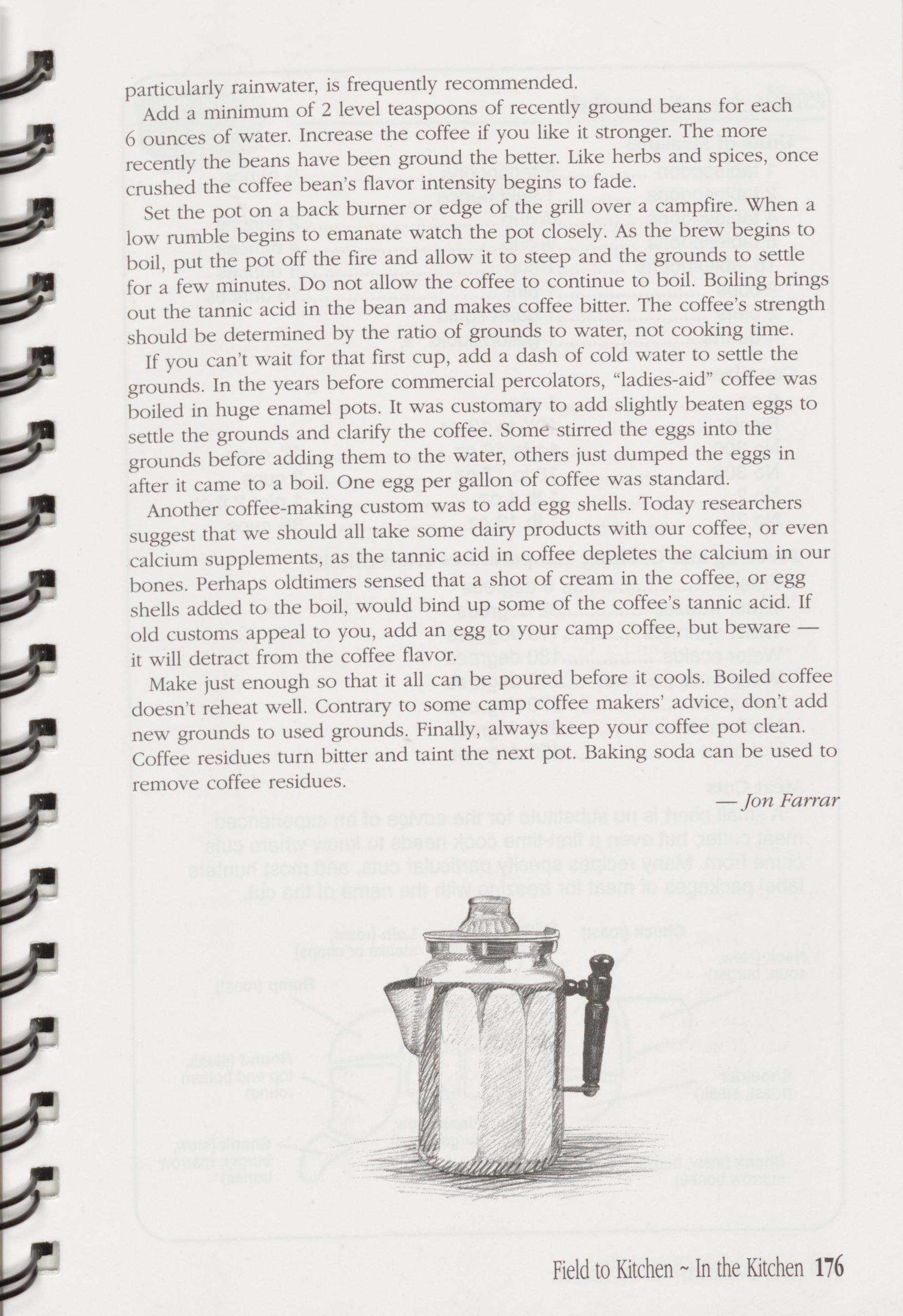
particularly rainwater, is frequently recommended.
Add a minimum of 2 level teaspoons of recently ground beans for each 6 ounces of water. Increase the coffee if you like it stronger. The more recently the beans have been ground the better. Like herbs and spices, once crushed the coffee bean’s flavor intensity begins to fade.
Set the pot on a back burner or edge of the grill over a campfire. When a low rumble begins to emanate watch the pot closely. As the brew begins to boil, put the pot off the fire and allow it to steep and the grounds to settle for a few minutes. Do not allow the coffee to continue to boil. Boiling brings out the tannic acid in the bean and makes coffee bitter. The coffee’s strength should be determined by the ratio of grounds to water, not cooking time.
If you can’t wait for that first cup, add a dash of cold water to settle the grounds. In the years before commercial percolators, “ladies-aid” coffee was boiled in huge enamel pots. It was customary to add slightly beaten eggs to settle the grounds and clarify the coffee. Some stirred the eggs into the grounds before adding them to the water, others just dumped the eggs in after it came to a boil. One egg per gallon of coffee was standard.
Another coffee-making custom was to add egg shells. Today researchers suggest that we should all take some dairy products with our coffee, or even calcium supplements, as the tannic acid in coffee depletes the calcium in our bones. Perhaps oldtimers sensed that a shot of cream in the coffee, or egg shells added to the boil, would bind up some of the coffee’s tannic acid. If old customs appeal to you, add an egg to your camp coffee, but beware — it will detract from the coffee flavor.
Make just enough so that it all can be poured before it cools. Boiled coffee doesn’t reheat well. Contrary to some camp coffee makers’ advice, don’t add new grounds to used grounds. Finally, always keep your coffee pot clean. Coffee residues turn bitter and taint the next pot. Baking soda can be used to remove coffee residues.
— Jon Farrar Field to Kitchen ~ In the Kitchen 176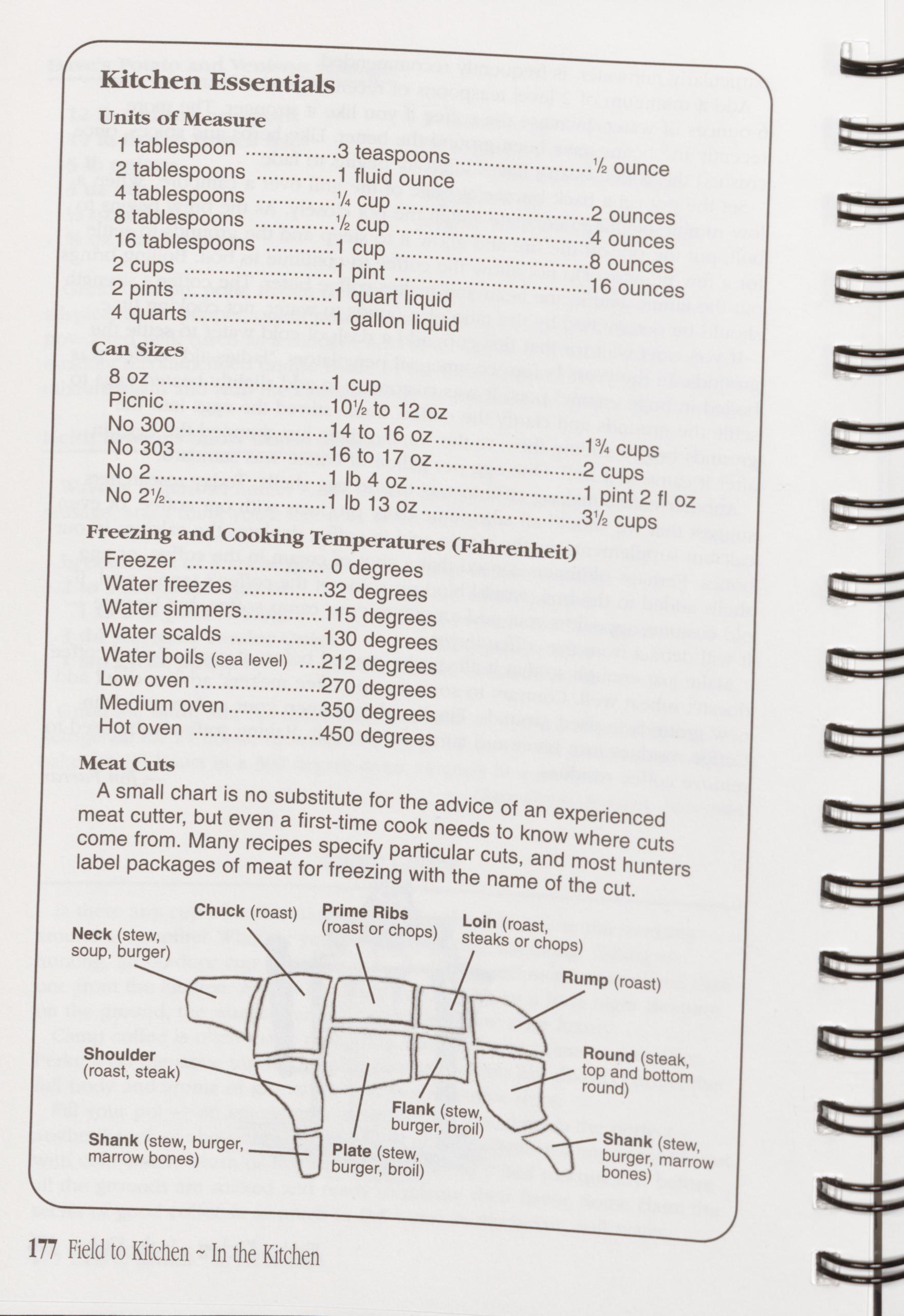 Kitchen Essentials
Units of Measure
1 tablespoon .3 teaspoons V- ounce
2 tablespoons .1 fluid ounce
4 tablespoons .'/>cup 2 ounces
8 tablespoons cup 4 ounces
16 tablespoons .1 cup 8 ounces
2 cups .1 pint 16 ounces
2 pints .1 quart liquid
4 quarts .1 gallon liquid
Can Sizes
8 oz .1 cup
Picnic .10'/-to 12 oz
No 300 .14 to 16 oz 1% cups
No 303 .16 to 17 oz 2 cups
No 2 .1 lb 4 oz 1 pint 2 fl oz
No 2’/a .1 lb 13 oz 3 1/2 - cups
Freezing and Cooking Temperatures (Fahrenheit)
Freezer ..............0 degrees
Water freezes ........32 degrees
Water simmers..........115 degrees
Water scalds ..........130 degrees
Water boils (sea level) ....212 degrees
Low oven...............270 degrees
Medium oven............350 degrees
Hot oven ..............450 degrees
Meat Cuts
Kitchen Essentials
Units of Measure
1 tablespoon .3 teaspoons V- ounce
2 tablespoons .1 fluid ounce
4 tablespoons .'/>cup 2 ounces
8 tablespoons cup 4 ounces
16 tablespoons .1 cup 8 ounces
2 cups .1 pint 16 ounces
2 pints .1 quart liquid
4 quarts .1 gallon liquid
Can Sizes
8 oz .1 cup
Picnic .10'/-to 12 oz
No 300 .14 to 16 oz 1% cups
No 303 .16 to 17 oz 2 cups
No 2 .1 lb 4 oz 1 pint 2 fl oz
No 2’/a .1 lb 13 oz 3 1/2 - cups
Freezing and Cooking Temperatures (Fahrenheit)
Freezer ..............0 degrees
Water freezes ........32 degrees
Water simmers..........115 degrees
Water scalds ..........130 degrees
Water boils (sea level) ....212 degrees
Low oven...............270 degrees
Medium oven............350 degrees
Hot oven ..............450 degrees
Meat Cuts
A small chart is no substitute for the advice of an experienced meat cutter, but even a first-time cook needs to know where cuts come from. Many recipes specify particular cuts, and most hunters label packages of meat for freezing with the name of the cut.
Neck (stew, soup, burger) Shoulder (roast, steak) Chuck (roast) Prime Ribs Loin (roast, (roast or chops) steaks or chops) Shank (stew, burger, marrow bones) Round (steak, top and bottom round) Shank (stew, burger, marrow bones) Rump (roast) 177 Field to Kitchen ~ In the Kitchen Notes
Field to Kitchen ~ Notes 178
Notes
Field to Kitchen ~ Notes 178
 Notes
179 Notes
Notes
179 Notes
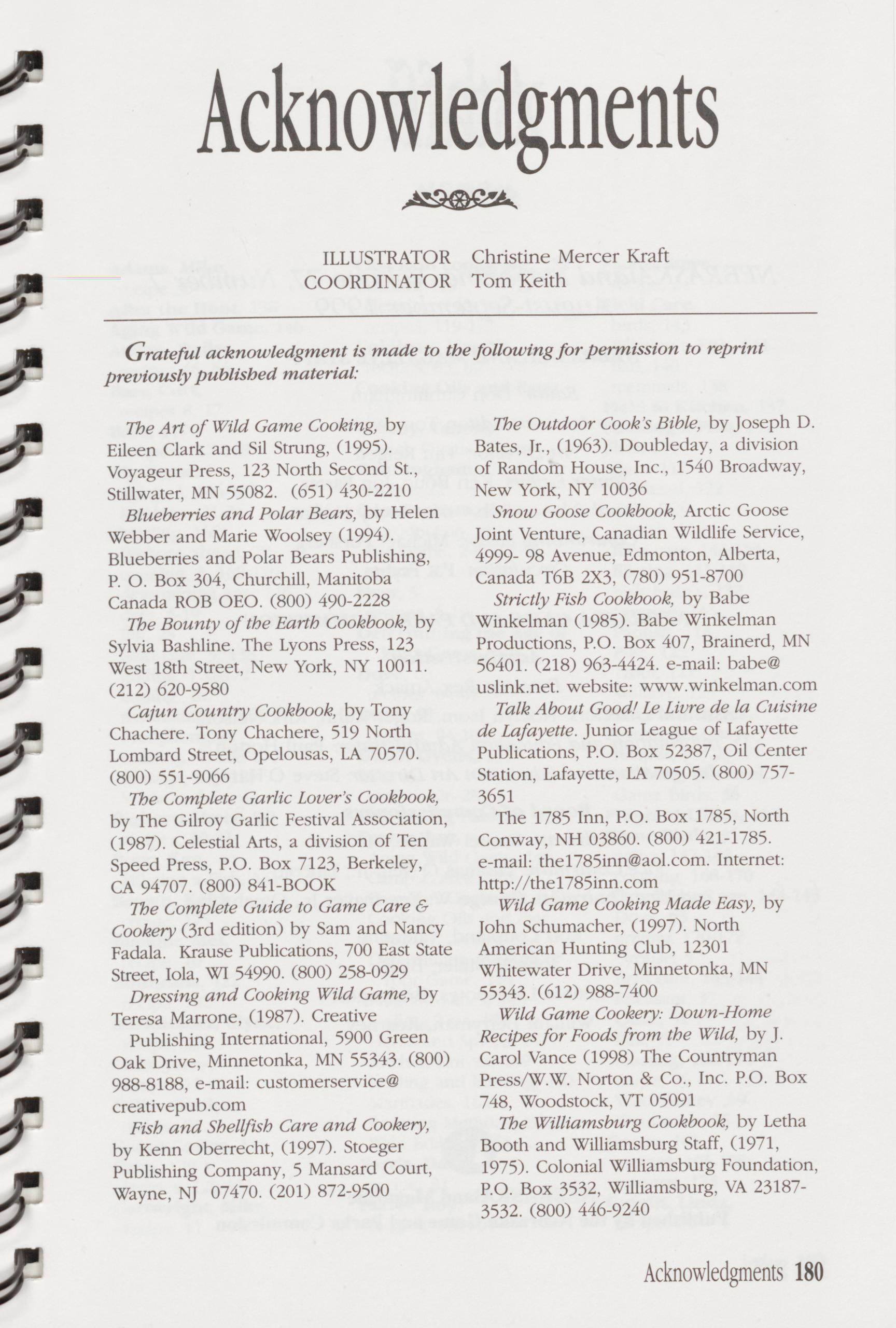
 NEBRASKAland Magazine, Volume 77, Number 7
August-September 1999
NEBRASKALAND MAGAZINE STAFF
Editor: Don Cunningham
Associate Editor: Tom White
Art Director: Tim Reigert
Senior Editors: Ken Bouc, Jon Farrar
Regional Editors: Bob Grier, Rocky Hoffmann
Contributing Editor: Michael Forsberg
Circulation: Pat Frahm
NEBRASKA GAME AND PARKS COMMISSION
Administration
Director: Rex Amack
Assistant Directors: Noelyn Isom, Roger Kuhn, Kirk Nelson
Information and Education Administrator: Paul Horton
Information and Education Art Director: Steve O’Hare
Board of Commissioners
Chairman: Daniel Wallen, McCook
Vice Chairman: Thomas O’Neill Jr., Lincoln
2nd Vice Chairman: George W. Egermayer Jr., Omaha
Rob Coupland, Valentine
John P. Miller, Blair
Connie Lapaseotes, Bridgeport
William Berryman, Kearney
NEBRASKAland Magazine
Published by the Nebraska Game and Parks Commission
181 Staff
NEBRASKAland Magazine, Volume 77, Number 7
August-September 1999
NEBRASKALAND MAGAZINE STAFF
Editor: Don Cunningham
Associate Editor: Tom White
Art Director: Tim Reigert
Senior Editors: Ken Bouc, Jon Farrar
Regional Editors: Bob Grier, Rocky Hoffmann
Contributing Editor: Michael Forsberg
Circulation: Pat Frahm
NEBRASKA GAME AND PARKS COMMISSION
Administration
Director: Rex Amack
Assistant Directors: Noelyn Isom, Roger Kuhn, Kirk Nelson
Information and Education Administrator: Paul Horton
Information and Education Art Director: Steve O’Hare
Board of Commissioners
Chairman: Daniel Wallen, McCook
Vice Chairman: Thomas O’Neill Jr., Lincoln
2nd Vice Chairman: George W. Egermayer Jr., Omaha
Rob Coupland, Valentine
John P. Miller, Blair
Connie Lapaseotes, Bridgeport
William Berryman, Kearney
NEBRASKAland Magazine
Published by the Nebraska Game and Parks Commission
181 Staff
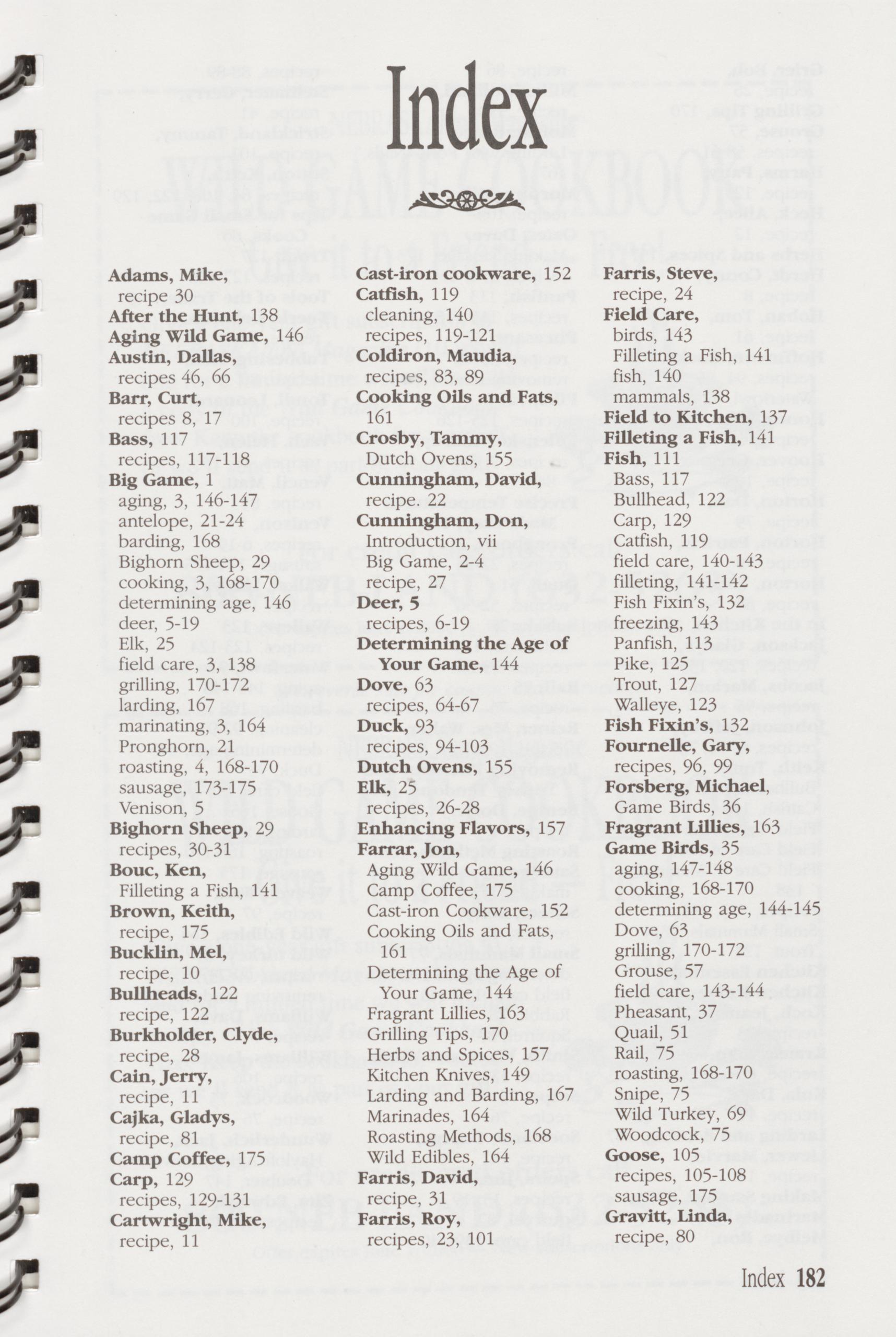 Index
Adams, Mike,
recipe 30
After the Hunt, 1Z8
Aging Wild Game, 146
Austin, Dallas,
recipes 46, 66
Barr, Curt,
recipes 8, 17
Bass, 117
recipes, 117-118
Big Game, 1
aging, 3, 146-147
antelope, 21-24
barding, 168
Bighorn Sheep, 29
cooking, 3, 168-170
determining age, 146
deer, 5-19
Elk, 25
field care, 3, 138
grilling, 170-172
larding, 167
marinating, 3, 164
Pronghorn, 21
roasting, 4, 168-170
sausage, 173-175
Venison, 5
Bighorn Sheep, 29
recipes, 30-31
Bouc, Ken,
Filleting a Fish, 141
Brown, Keith,
recipe, 175
Bucklin, Mel,
recipe, 10
Bullheads, 122
recipe, 122
Burkholder, Clyde,
recipe, 28
Cain, Jerry,
recipe, 11
Cajka, Gladys,
recipe, 81
Camp Coffee, 175
Carp, 129
recipes, 129-131
Cartwright, Mike,
recipe, 11
Cast-iron cookware, 152
Catfish, 119
cleaning, 140
recipes, 119-121
Coldiron, Maudia,
recipes, 83, 89
Cooking Oils and Fats,
161
Crosby, Tammy,
Dutch Ovens, 155
Cunningham, David,
recipe. 22
Cunningham, Don,
Introduction, vii
Big Game, 2-4
recipe, 27
Deer, 5
recipes, 6-19
Determining the Age of
Your Game, 144
Dove, 63
recipes, 64-67
Duck, 93
recipes, 94-103
Dutch Ovens, 155
Elk, 25
recipes, 26-28
Enhancing Flavors, 157
Farrar, Jon,
Aging Wild Game, 146
Camp Coffee, 175
Cast-iron Cookware, 152
Cooking Oils and Fats,
161
Determining the Age of
Your Game, 144
Fragrant Lillies, 163
Grilling Tips, 170
Herbs and Spices, 157
Kitchen Knives, 149
Larding and Barding, 167
Marinades, 164
Roasting Methods, 168
Wild Edibles, 164
Farris, David,
recipe, 31
Farris, Roy,
recipes, 23, 101
Farris, Steve,
recipe, 24
Field Care,
birds, 143
Filleting a Fish, 141
fish, 140
mammals, 138
Field to Kitchen, 137
Filleting a Fish, 141
Fish, 111
Bass, 117
Bullhead, 122
Carp, 129
Catfish, 119
field care, 140-143
filleting, 141-142
Fish Fixin’s, 132
freezing, 143
Panfish, 113
Pike, 125
Trout, 127
Walleye, 123
Fish Fixin’s, 132
Fournelle, Gary,
recipes, 96, 99
Forsberg, Michael,
Game Birds, 36
Fragrant Lillies, 163
Game Birds, 35
aging, 147-148
cooking, 168-170
determining age, 144-145
Dove, 63
grilling, 170-172
Grouse, 57
field care, 143-144
Pheasant, 37
Quail, 51
Rail, 75
roasting, 168-170
Snipe, 75
Wild Turkey, 69
Woodcock, 75
Goose, 105
recipes, 105-108
sausage, 175
Gravitt, Linda,
recipe, 80
Index 182
Index
Adams, Mike,
recipe 30
After the Hunt, 1Z8
Aging Wild Game, 146
Austin, Dallas,
recipes 46, 66
Barr, Curt,
recipes 8, 17
Bass, 117
recipes, 117-118
Big Game, 1
aging, 3, 146-147
antelope, 21-24
barding, 168
Bighorn Sheep, 29
cooking, 3, 168-170
determining age, 146
deer, 5-19
Elk, 25
field care, 3, 138
grilling, 170-172
larding, 167
marinating, 3, 164
Pronghorn, 21
roasting, 4, 168-170
sausage, 173-175
Venison, 5
Bighorn Sheep, 29
recipes, 30-31
Bouc, Ken,
Filleting a Fish, 141
Brown, Keith,
recipe, 175
Bucklin, Mel,
recipe, 10
Bullheads, 122
recipe, 122
Burkholder, Clyde,
recipe, 28
Cain, Jerry,
recipe, 11
Cajka, Gladys,
recipe, 81
Camp Coffee, 175
Carp, 129
recipes, 129-131
Cartwright, Mike,
recipe, 11
Cast-iron cookware, 152
Catfish, 119
cleaning, 140
recipes, 119-121
Coldiron, Maudia,
recipes, 83, 89
Cooking Oils and Fats,
161
Crosby, Tammy,
Dutch Ovens, 155
Cunningham, David,
recipe. 22
Cunningham, Don,
Introduction, vii
Big Game, 2-4
recipe, 27
Deer, 5
recipes, 6-19
Determining the Age of
Your Game, 144
Dove, 63
recipes, 64-67
Duck, 93
recipes, 94-103
Dutch Ovens, 155
Elk, 25
recipes, 26-28
Enhancing Flavors, 157
Farrar, Jon,
Aging Wild Game, 146
Camp Coffee, 175
Cast-iron Cookware, 152
Cooking Oils and Fats,
161
Determining the Age of
Your Game, 144
Fragrant Lillies, 163
Grilling Tips, 170
Herbs and Spices, 157
Kitchen Knives, 149
Larding and Barding, 167
Marinades, 164
Roasting Methods, 168
Wild Edibles, 164
Farris, David,
recipe, 31
Farris, Roy,
recipes, 23, 101
Farris, Steve,
recipe, 24
Field Care,
birds, 143
Filleting a Fish, 141
fish, 140
mammals, 138
Field to Kitchen, 137
Filleting a Fish, 141
Fish, 111
Bass, 117
Bullhead, 122
Carp, 129
Catfish, 119
field care, 140-143
filleting, 141-142
Fish Fixin’s, 132
freezing, 143
Panfish, 113
Pike, 125
Trout, 127
Walleye, 123
Fish Fixin’s, 132
Fournelle, Gary,
recipes, 96, 99
Forsberg, Michael,
Game Birds, 36
Fragrant Lillies, 163
Game Birds, 35
aging, 147-148
cooking, 168-170
determining age, 144-145
Dove, 63
grilling, 170-172
Grouse, 57
field care, 143-144
Pheasant, 37
Quail, 51
Rail, 75
roasting, 168-170
Snipe, 75
Wild Turkey, 69
Woodcock, 75
Goose, 105
recipes, 105-108
sausage, 175
Gravitt, Linda,
recipe, 80
Index 182
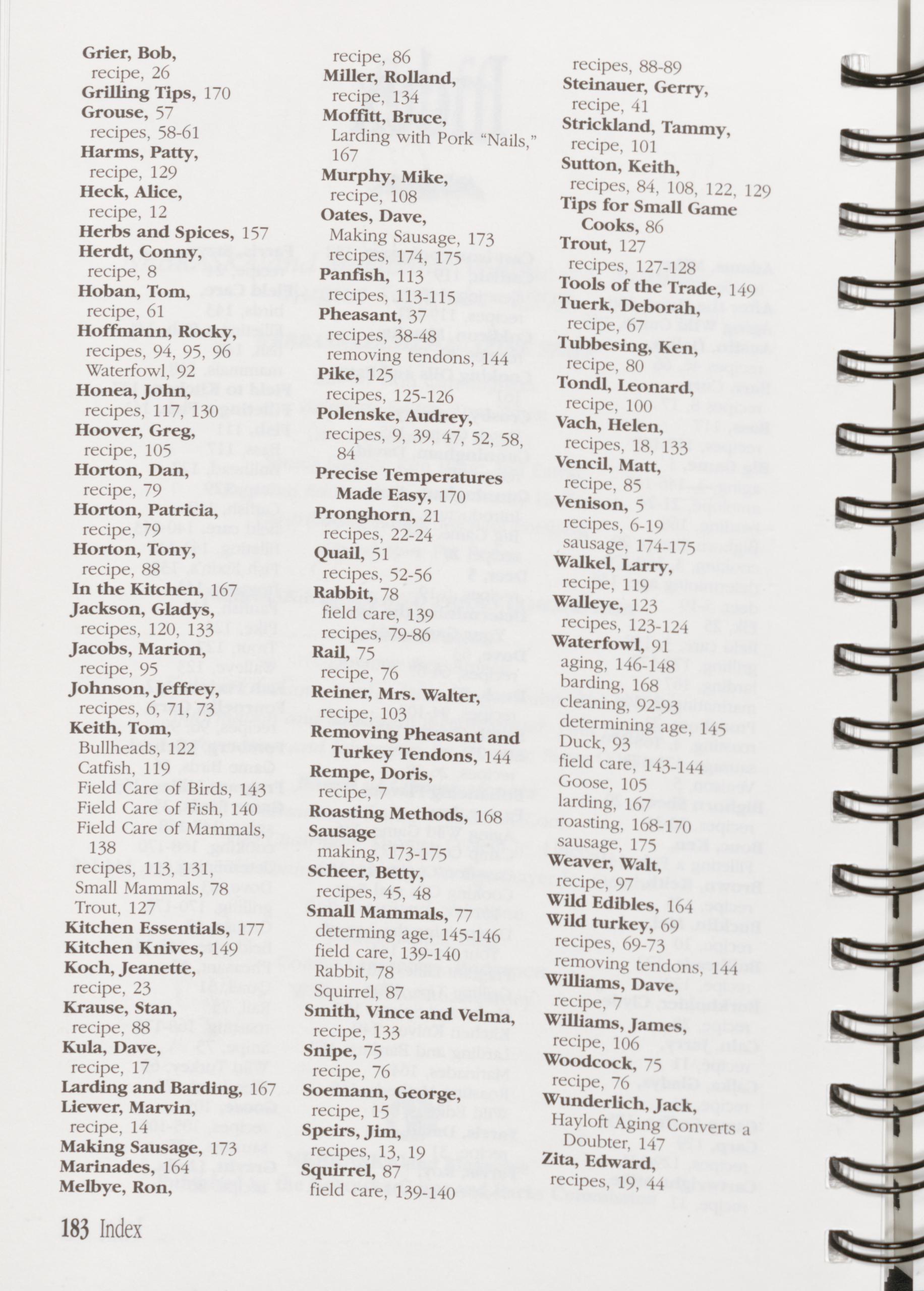 Grier, Bob,
recipe, 26
Grilling Tips, 170
Grouse, 57
recipes, 58-61
Harms, Patty,
recipe, 129
Heck, Alice,
recipe, 12
Herbs and Spices, 157
Herdt, Conny,
recipe, 8
Hoban, Tom,
recipe, 61
Hoffmann, Rocky,
recipes, 94, 95, 96
Waterfowl, 92
Honea, John,
recipes, 117, 130
Hoover, Greg,
recipe, 105
Horton, Dan,
recipe, 79
Horton, Patricia,
recipe, 79
Horton, Tony,
recipe, 88
In the Kitchen, 167
Jackson, Gladys,
recipes, 120, 133
Jacobs, Marion,
recipe, 95
Johnson, Jeffrey,
recipes, 6, 71, 73
Keith, Tom,
Bullheads, 122
Catfish, 119
Field Care of Birds, 143
Field Care of Fish, 140
Field Care of Mammals,
138
recipes, 113, 131,
Small Mammals, 78
Trout, 127
Kitchen Essentials, 177
Kitchen Knives, 149
Koch, Jeanette,
recipe, 23
Krause, Stan,
recipe, 88
Kula, Dave,
recipe, 17
Larding and Barding, 167
Liewer, Marvin,
recipe, 14
Making Sausage, 173
Marinades, 164
Melbye, Ron,
recipe, 86
Miller, Rolland,
recipe, 134
Moffitt, Bruce,
Larding with Pork “Nails,”
167
Murphy, Mike,
recipe, 108
Oates, Dave,
Making Sausage, 173
recipes, 174, 175
Panfish, 113
recipes, 113-115
Pheasant, 37
recipes, 38-48
removing tendons, 144
Pike, 125
recipes, 125-126
Polenske, Audrey,
recipes, 9, 39, 47, 52, 58,
84
Precise Temperatures
Made Easy, 170
Pronghorn, 21
recipes, 22-24
Quail, 51
recipes, 52-56
Rabbit, 78
field care, 139
recipes, 79-86
Rail, 75
recipe, 76
Reiner, Mrs. Walter,
recipe, 103
Removing Pheasant and
Turkey Tendons, 144
Rempe, Doris,
recipe, 7
Roasting Methods, 168
Sausage
making, 173-175
Scheer, Betty,
recipes, 45, 48
Small Mammals, 77
determing age, 145-146
field care, 139-140
Rabbit, 78
Squirrel, 87
Smith, Vince and Velma,
recipe, 133
Snipe, 75
recipe, 76
Soemann, George,
recipe, 15
Speirs, Jim,
recipes, 13, 19
Squirrel, 87
field care, 139-140
recipes, 88-89
Steinauer, Gerry,
recipe, 41
Strickland, Tammy,
recipe, 101
Sutton, Keith,
recipes, 84, 108, 122, 129
Tips for Small Game
Cooks, 86
Trout, 127
recipes, 127-128
Tools of the Trade, 149
Tuerk, Deborah,
recipe, 67
Tubbesing, Ken,
recipe, 80
Tondl, Leonard,
recipe, 100
Vach, Helen,
recipes, 18, 133
Vencil, Matt,
recipe, 85
Venison, 5
recipes, 6-19
sausage, 174-175
Walkel, Larry,
recipe, 119
Walleye, 123
recipes, 123-124
Waterfowl, 91
aging, 146-148
barding, 168
cleaning, 92-93
determining age, 145
Duck, 93
field care, 143-144
Goose, 105
larding, 167
roasting, 168-170
sausage, 175
Weaver, Walt,
recipe, 97
Wild Edibles, 164
Wild turkey, 69
recipes, 69-73
removing tendons, 144
Williams, Dave,
recipe, 7
Williams, James,
recipe, 106
Woodcock, 75
recipe, 76
Wunderlich, Jack,
Hayloft Aging Converts a
Doubter, 147
Zita, Edward,
recipes, 19, 44
183 Index
Grier, Bob,
recipe, 26
Grilling Tips, 170
Grouse, 57
recipes, 58-61
Harms, Patty,
recipe, 129
Heck, Alice,
recipe, 12
Herbs and Spices, 157
Herdt, Conny,
recipe, 8
Hoban, Tom,
recipe, 61
Hoffmann, Rocky,
recipes, 94, 95, 96
Waterfowl, 92
Honea, John,
recipes, 117, 130
Hoover, Greg,
recipe, 105
Horton, Dan,
recipe, 79
Horton, Patricia,
recipe, 79
Horton, Tony,
recipe, 88
In the Kitchen, 167
Jackson, Gladys,
recipes, 120, 133
Jacobs, Marion,
recipe, 95
Johnson, Jeffrey,
recipes, 6, 71, 73
Keith, Tom,
Bullheads, 122
Catfish, 119
Field Care of Birds, 143
Field Care of Fish, 140
Field Care of Mammals,
138
recipes, 113, 131,
Small Mammals, 78
Trout, 127
Kitchen Essentials, 177
Kitchen Knives, 149
Koch, Jeanette,
recipe, 23
Krause, Stan,
recipe, 88
Kula, Dave,
recipe, 17
Larding and Barding, 167
Liewer, Marvin,
recipe, 14
Making Sausage, 173
Marinades, 164
Melbye, Ron,
recipe, 86
Miller, Rolland,
recipe, 134
Moffitt, Bruce,
Larding with Pork “Nails,”
167
Murphy, Mike,
recipe, 108
Oates, Dave,
Making Sausage, 173
recipes, 174, 175
Panfish, 113
recipes, 113-115
Pheasant, 37
recipes, 38-48
removing tendons, 144
Pike, 125
recipes, 125-126
Polenske, Audrey,
recipes, 9, 39, 47, 52, 58,
84
Precise Temperatures
Made Easy, 170
Pronghorn, 21
recipes, 22-24
Quail, 51
recipes, 52-56
Rabbit, 78
field care, 139
recipes, 79-86
Rail, 75
recipe, 76
Reiner, Mrs. Walter,
recipe, 103
Removing Pheasant and
Turkey Tendons, 144
Rempe, Doris,
recipe, 7
Roasting Methods, 168
Sausage
making, 173-175
Scheer, Betty,
recipes, 45, 48
Small Mammals, 77
determing age, 145-146
field care, 139-140
Rabbit, 78
Squirrel, 87
Smith, Vince and Velma,
recipe, 133
Snipe, 75
recipe, 76
Soemann, George,
recipe, 15
Speirs, Jim,
recipes, 13, 19
Squirrel, 87
field care, 139-140
recipes, 88-89
Steinauer, Gerry,
recipe, 41
Strickland, Tammy,
recipe, 101
Sutton, Keith,
recipes, 84, 108, 122, 129
Tips for Small Game
Cooks, 86
Trout, 127
recipes, 127-128
Tools of the Trade, 149
Tuerk, Deborah,
recipe, 67
Tubbesing, Ken,
recipe, 80
Tondl, Leonard,
recipe, 100
Vach, Helen,
recipes, 18, 133
Vencil, Matt,
recipe, 85
Venison, 5
recipes, 6-19
sausage, 174-175
Walkel, Larry,
recipe, 119
Walleye, 123
recipes, 123-124
Waterfowl, 91
aging, 146-148
barding, 168
cleaning, 92-93
determining age, 145
Duck, 93
field care, 143-144
Goose, 105
larding, 167
roasting, 168-170
sausage, 175
Weaver, Walt,
recipe, 97
Wild Edibles, 164
Wild turkey, 69
recipes, 69-73
removing tendons, 144
Williams, Dave,
recipe, 7
Williams, James,
recipe, 106
Woodcock, 75
recipe, 76
Wunderlich, Jack,
Hayloft Aging Converts a
Doubter, 147
Zita, Edward,
recipes, 19, 44
183 Index
 SUBSCRIBE NOW and get a FREE Cookbook!
Until June 1, 2000, new subscribers will receive a free
copy of the Wild Game Cookbook as well as a full year
(10 issues) of NEBRASKAIand Magazine, published by
the Nebraska Game and Parks Commission. You can
keep the cookbook for yourself or give it to a friend!
Send a subscription to:
Name
Address
City State Zip
Check enclosed One year $16 Two years $30
Charge to my VISA MasterCard
Acct. No Exp. Date
Donor’s name (for gift subscriptions)
Address
City State Zip
Send me the cookbook, or Send the cookbook as part of the gift subscription
Complete coupon, cut out and mail in envelope with payment
SUBSCRIBE NOW and get a FREE Cookbook!
Until June 1, 2000, new subscribers will receive a free
copy of the Wild Game Cookbook as well as a full year
(10 issues) of NEBRASKAIand Magazine, published by
the Nebraska Game and Parks Commission. You can
keep the cookbook for yourself or give it to a friend!
Send a subscription to:
Name
Address
City State Zip
Check enclosed One year $16 Two years $30
l~~) Charge to my VISA MasterCard
Acct. No Exp. Date
Donor’s name (for gift subscriptions)
Address
City State Zip
Send me the cookbook, or Send the cookbook as part of the gift subscription
SUBSCRIBE NOW and get a FREE Cookbook!
Until June 1, 2000, new subscribers will receive a free
copy of the Wild Game Cookbook as well as a full year
(10 issues) of NEBRASKAIand Magazine, published by
the Nebraska Game and Parks Commission. You can
keep the cookbook for yourself or give it to a friend!
Send a subscription to:
Name
Address
City State Zip
Check enclosed One year $16 Two years $30
Charge to my VISA MasterCard
Acct. No Exp. Date
Donor’s name (for gift subscriptions)
Address
City State Zip
Send me the cookbook, or Send the cookbook as part of the gift subscription
Complete coupon, cut out and mail in envelope with payment
SUBSCRIBE NOW and get a FREE Cookbook!
Until June 1, 2000, new subscribers will receive a free
copy of the Wild Game Cookbook as well as a full year
(10 issues) of NEBRASKAIand Magazine, published by
the Nebraska Game and Parks Commission. You can
keep the cookbook for yourself or give it to a friend!
Send a subscription to:
Name
Address
City State Zip
Check enclosed One year $16 Two years $30
l~~) Charge to my VISA MasterCard
Acct. No Exp. Date
Donor’s name (for gift subscriptions)
Address
City State Zip
Send me the cookbook, or Send the cookbook as part of the gift subscription
Position: 378 (25 views)