Volume 77, Issue 6, 1999
NEBRASKAland
Nebraska Game & Parks Commission July 1999 $2.50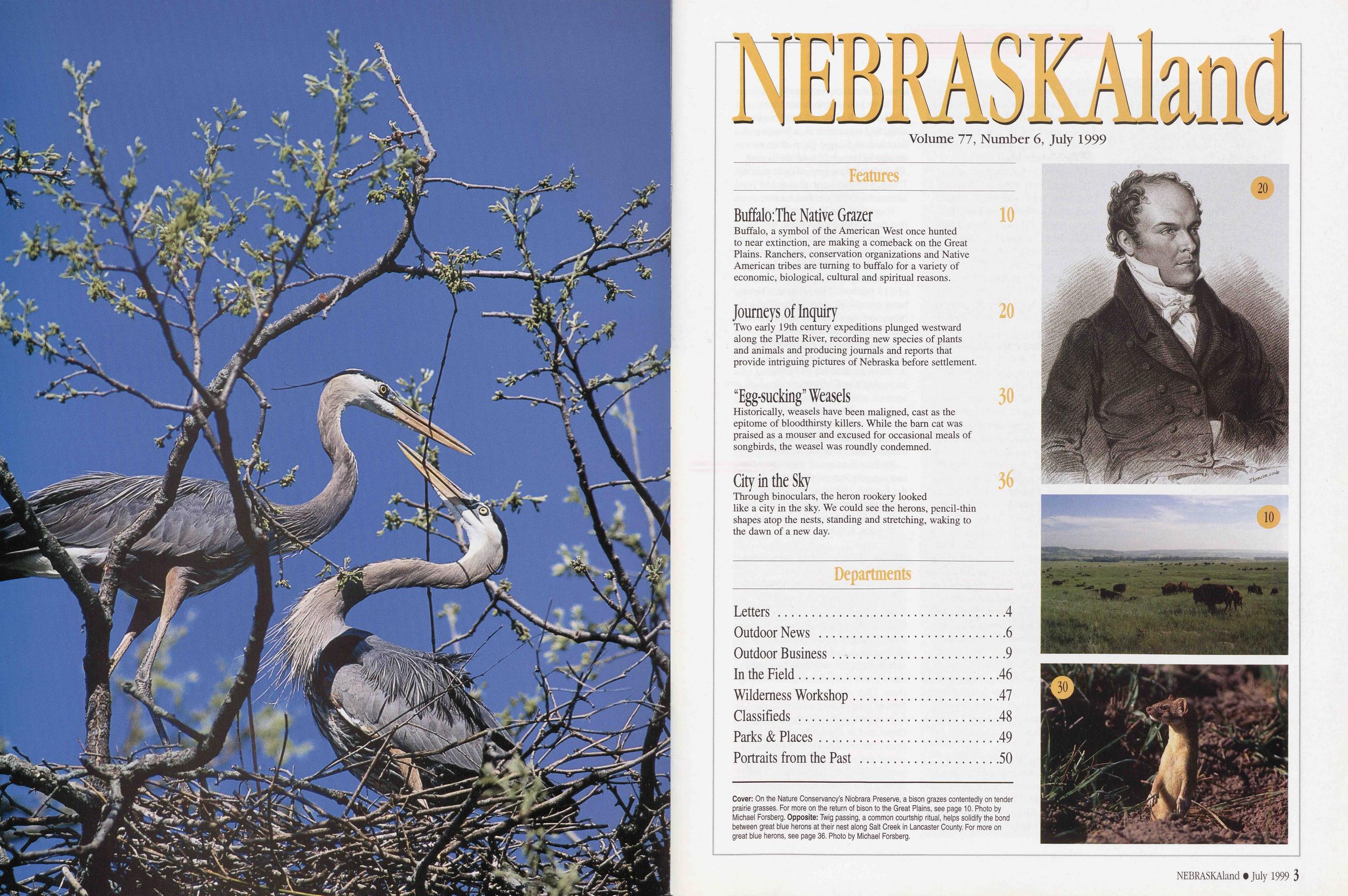
NEBRASKAland
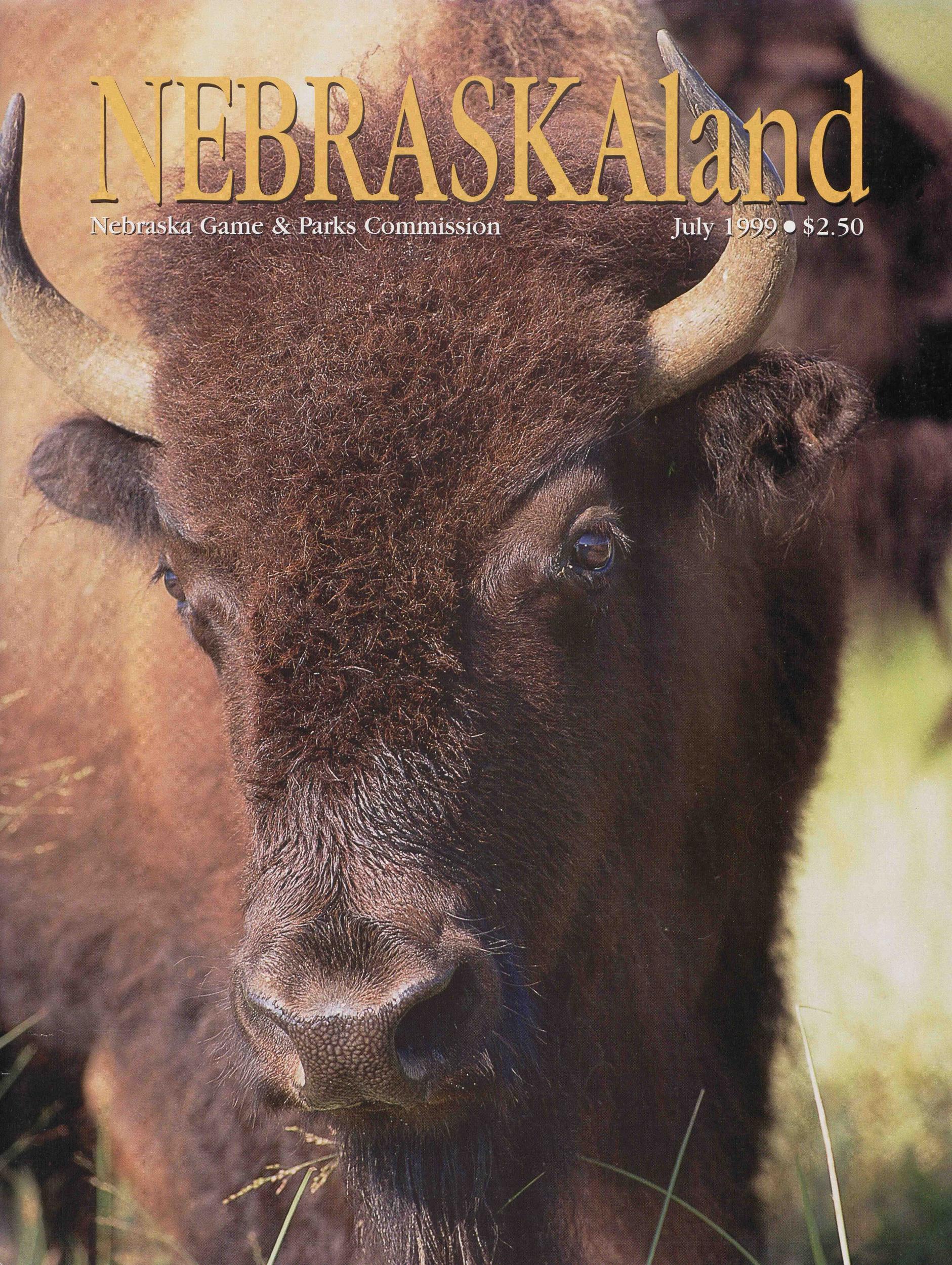
Volume 77, Number 6, July 1999 Features BuffalonThe Native Grazer Buffalo, a symbol of the American West once hunted to near extinction, are making a comeback on the Great Plains. Ranchers, conservation organizations and Native American tribes are turning to buffalo for a variety of economic, biological, cultural and spiritual reasons. Journeys of Inquiry Two early 19th century expeditions plunged westward along the Platte River, recording new species of plants and animals and producing journals and reports that provide intriguing pictures of Nebraska before settlement. "Egg-sucking" Weasels Historically, weasels have been maligned, cast as the epitome of bloodthirsty killers. While the barn cat was praised as a mouser and excused for occasional meals of songbirds, the weasel was roundly condemned. City in the Sky Through binoculars, the heron rookery looked like a city in the sky. We could see the herons, pencil-thin shapes atop the nests, standing and stretching, waking to the dawn of a new day. Departments Outdoor News 6 Outdoor Business 9 In the Field 46 Wilderness Workshop 47 Classifieds 48 Parks & Places 49 Portraits from the Past 50 Cover: On the Nature Conservancy's Niobrara Preserve, a bison grazes contentedly on tender prairie grasses. For more on the return of bison to the Great Plains, see page 10. Photo by Michael Forsberg. Opposite: Twig passing, a common courtship ritual, helps solidify the bond between great blue herons at their nest along Salt Creek in Lancaster County. For more on great blue herons, see page 36. Photo by Michael Forsberg.
Letters
Published by the Nebraska Game and Parks Commission Director: Rex Amack Assistant Directors: Noelyn Isom Roger Kuhn Kirk Nelson Information & Education Administrator: Paul Horton Information & Education Art Director: Steve O'Hare Commissioners Chairman: William Berryman, Kearney Vice Chairman: Daniel Wallen, McCook 2nd Vice Chairman: Thomas O'Neill Jr., Lincoln George W. Egermayer Jr., Omaha Rob Coupland, Valentine John P. Miller, Blair Connie Lapaseotes, Bridgeport Magazine Staff Editor: Don Cunningham Associate Editor: Tom White Art Director: Tim Reigert Senior Editors: Ken Bouc, Jon Farrar Regional Editors: Bob Grier, Rocky Hoffmann Circulation: Pat Frahm NEBRASKAland ISSN: 0028-1964 VOL. 77 / NO. 6 JULY 1999 Published monthly, except for Jan/Feb. and Aug./Sept. issues, by the Nebraska Game and Parks Commission, 2200 N. 33rd St., Lincoln, NE. Copyright 1999, all rights reserved. Please address comments or questions to this address. Periodicals postage paid at Lincoln, Nebraska. POST- MASTER: Send all address changes to NEBRASKAland, P.O. Box 30370, Lincoln, NE 68503-0370. Rates: $16 for one year; $30 for two years. Address submissions to: The Editor, NEBRASKAland Magazine, P.O. Box 30370, Lincoln, NE 68503. Include a stamped, self-addressed return envelope. The publisher assumes no responsibility for unsolicited material. NEBRASKAland is available on audio cassette from the Nebraska Library Commission Talking Book and Braille Service, Suite 120, 1200 N St., Lincoln, NE 68508. Rates: $16 for one year; $30 for two years. Web site: www.ngpc.state.ne.us/nebland Bird StalkerAs a photographer deeply involved with raptors for more than 30 years, I was captivated by Loren Blake's photo of a sharp-shinned hawk in the June issue ["Bird Stalker"].
These birds are quite secretive and not an easy subject. They are also quite small (females 7 to 8 ounces). This bird apparently has fed recently. I'd like to hear a little background on how Mr. Blake made this superb shot.
Steve Duecker Waverly, NebraskaBlake described taking the photo in his backyard in Chambers, Nebraska, as follows:
"It was January, and I had bird feeders out. It was cloudy, windy, and had snowed. The temperature was about 4 degrees.
"I looked out the window and saw the sharp-shinned, so I grabbed my camera and tripod and went out to see if it would let me get a picture. I was so sure it would fly away, I didn't bother to put on a coat or mittens.
"The bird never paid any attention to me. I started working closer and closer. I got up to where I was at minimum focus, 20 feet, when I ran out of film. By that time my hands were so cold I couldn't feel anything at all. I had to look to see if I still had my finger on the shutter button. The bird didn't fly until I was walking back toward the house.
"It came back several times during the day, and every time I'd go out with my camera and take another half roll of pictures. If you look at that picture, you should be able to see some blood on the breast or neck or belly. I think it had just fed. In the backyard it was sheltered from the wind, so I think it just wasn't wanting to go anywhere."
Snow Geese -A Hunter's ViewAs I read of the impending disaster for snow geese, and the many remedial proposals ["Hunting Solutions to the Snow Goose Dilemma," Jan.-Feb.], I can't help but remember how the disaster was created.
I have been a goose hunter in Kansas for 40 years. At the beginning, as I remember it, a hunting license cost $2 and there were no stamps to buy. A box of shells cost .88 and gasoline cost .20 per gallon. Today, you can hunt all day and never encounter another hunter.
To protect the birds and ensure that the flocks would grow, new laws and regulations were passed. All were costly, and hunters paid the bills. License fees climbed. Lead shot was replaced by steel at a cost of $15 per box. The programs have been successful, populations have increased, and wildlife agencies are now trying to reduce them.
I have yet to see a program to reduce the cost of hunting and increase the number of hunters. Increased bag limits and extended seasons will do no good if there are no hunters. Wouldn't it be more practical to reverse the programs that created the surplus and pass regulations that favor the hunter?
Reduce the cost of hunting and encourage more participation. Let the hunters eliminate the surplus rather than invite disastrous disease.
R. C. Shankland Topeka, KansasWildlife Division Administrator Jim Douglas replies:
"State and federal wildlife agencies share some of the credit (or blame, depending on your perspective) for the growth of goose populations. Refuges, created and supported by stamp and license fees, provide habitat for many species, and snow geese have taken advantage of them. They also have taken advantage of tons of waste grain in the former grasslands along the Gulf Coast and in the Midwest that have been converted to rice, corn and cereal grain fields over the past 50 years by private landowners. These factors and others have caused goose numbers to rise.
We agree that hunters should be used to the fullest extent to help 4 NEBRASKAland • July 1999 reduce the population. We and other states have extended seasons, increased bag limits and relaxed other restrictions in an attempt to maximize hunting opportunities.
Hunter numbers generally reflect the size of game populations and the level of hunting opportunity; huge increases in deer and turkey hunters in the past 20 years are cases in point. We expect that snow goose hunters will follow the same pattern.
Although we always will try to keep stamp and license fees within the means of the average hunter, cost will be a factor for some people. However, survey results consistently show that lack of time and opportunity, rather than license costs, are the biggest barriers pre- venting people from hunting. That is why we have tried to attract more hunters, primarily by maximizing goose hunting opportunity.
Historically, we have spent virtually no money specifically to "protect" snow geese, so lowering our license and stamp fees at this point would seriously hamper our ability to manage the dozens of species that are still in need of help.
Please feel free to contact me if you have more questions."
NEBRASKAland On-lineNEBRASKAland's web site has a new address, www.ngpcstateme.us/nebland, and has been updated and redesigned. It includes previews of current issues, on-line articles and subscription services, an article index and other features. You can send a postcard from NEBRASKA- land and write an e-mail letter to the editor or any staff member.
Letters NEBRASKAland Magazine P.O. Box 30370, Lincoln, NE 68503. Fax: (402) 471-5528. E-mail: nebland©ngpc.state.ne. us. Please include your postal address and telephone number. Letters may be condensed and edited for clarity. Photographs are welcome and will be returned. Nebraska Game and Parks Comission Offices Headquarters 2200 N. 33rd Street Lincoln, NE 68503 Phone (402) 471-0641 District Office I East Hwy. 2, Box 725 Alliance, NE 69301 Phone (308) 763-2940 District Office II 524 Panzer St., Box 508 Bassett, NE 68714 Phone (402) 684-2921 District Office III 2201 N. 13th St. Norfolk, NE 68701 Phone (402) 370-3374 District Office IV 301 E. State Farm Rd. North Platte, NE 69101 Phone (308) 535-8025 District Office V 2200 N. 33rd Street Lincoln, NE 68503 Phone (402) 471-5558 District Office VI 1617 First Ave. Kearney, NE 68847 Phone (308) 865-5310 Omaha Office 1212 Bob Gibson Blvd. Omaha, NE 68108 Phone (402) 595-2144 Ak-Sar-Ben Aquarium 21502 W. Highway 31 Gretna, NE 68028 Phone (402) 332-3901 World Wide Web site: http://www.ngpc.state.ne.us E-mail: ngpc@ngpc.state.ne.us Conservation Officers by Region Headquarters Ted Blume (Adm.) Murray Johnson Panhandle Officer Raymond Still Walt Meyer John Murphy Jim Zimmerman Marvin Kampbell Dennis Thompson Dan Zuehlke Dan Evasco Scott Brandt Southwest Officer Roger Thompson (Sup.) Dwight Allbery Dudley Sorensen George Sund Matt Andrews Jack Henderson Dirk Greene Virgil Gosch Rich Routh Northeast Officer Tom Zimmer (Sup.) Marion Shafer Robert Kelly Ross Oestmann Gary Ralston Daniel Roberts Randy Pomplun Lincoln Lincoln City Bridgeport Chadron Crawford Gering Hay Springs Ogallala Ogallala Oshkosh Scottsbluff City N. Platte N. Platte N. Platte Cambridge Elwood Gothenburg Imperial McCook Rep. City City Norfolk Norfolk Albion Bloom-field Creighton Fremont Jon Reeves 471-5533 EricWiebe 471-5003 Steve Oberg Kennard Ponca Columbus 427-7378 755-2566 564-5937 Phone (308) 262-1075 432-4398 665-2021 436-7561 638-7527 284-6450 284-4815 772-3091 635-1277 Phone (308) 532-9175 532-2753 532-0747 697-4629 785-3025 537-7483 882-5328 345-2185 799-2085 Phone (402) 371-6625 371-2031 395-2538 373-4412 358-3892 721-7852 Fullerton (308) 536-2987 Sandhills Officer Bruce Wiebe (Sup.) Ray Dierking Richard Seward Justin Mays Frank Miller Dana Murphy Patrick George South-central Officer Jerry Pecha (Sup.) Terry Brentzel Tim Williams Dale Johnson Mark Reeves Robert Finke Southeast Officer Craig Stover (Sup.) Douglas Kramer Dina Hopper Stacey Lewton William Krause Larry Elston Mike Luben Duane Arp Levi Krause Russell Mort Greg Verkuilen City Phone (402) Bassett 684-3867 Brkn. Bow (308) 872-3078 Ord (308)728-3115 Bassett 273-4188 Valentine 376-5909 Valentine 376-1183 O'Neill 336-4118 City Phone (402) Kearney (308)865-5327 Grand Is. (308) 384-8296 Hastings 463-2535 Kearney (308)237-1079 Loup City (308) 745-1126 Milford 761-3537 City Lincoln Lincoln Lincoln Lincoln Auburn Bellevue Colon Gretna Louisville Nebr. City Beatrice Phone (402) 471-5590 466-9001 483-2358 328-9562 274-3789 292-4910 443-4278 332-4954 234-2212 873-5684 223-4095 -en. NEBRASKAland • July 1999 5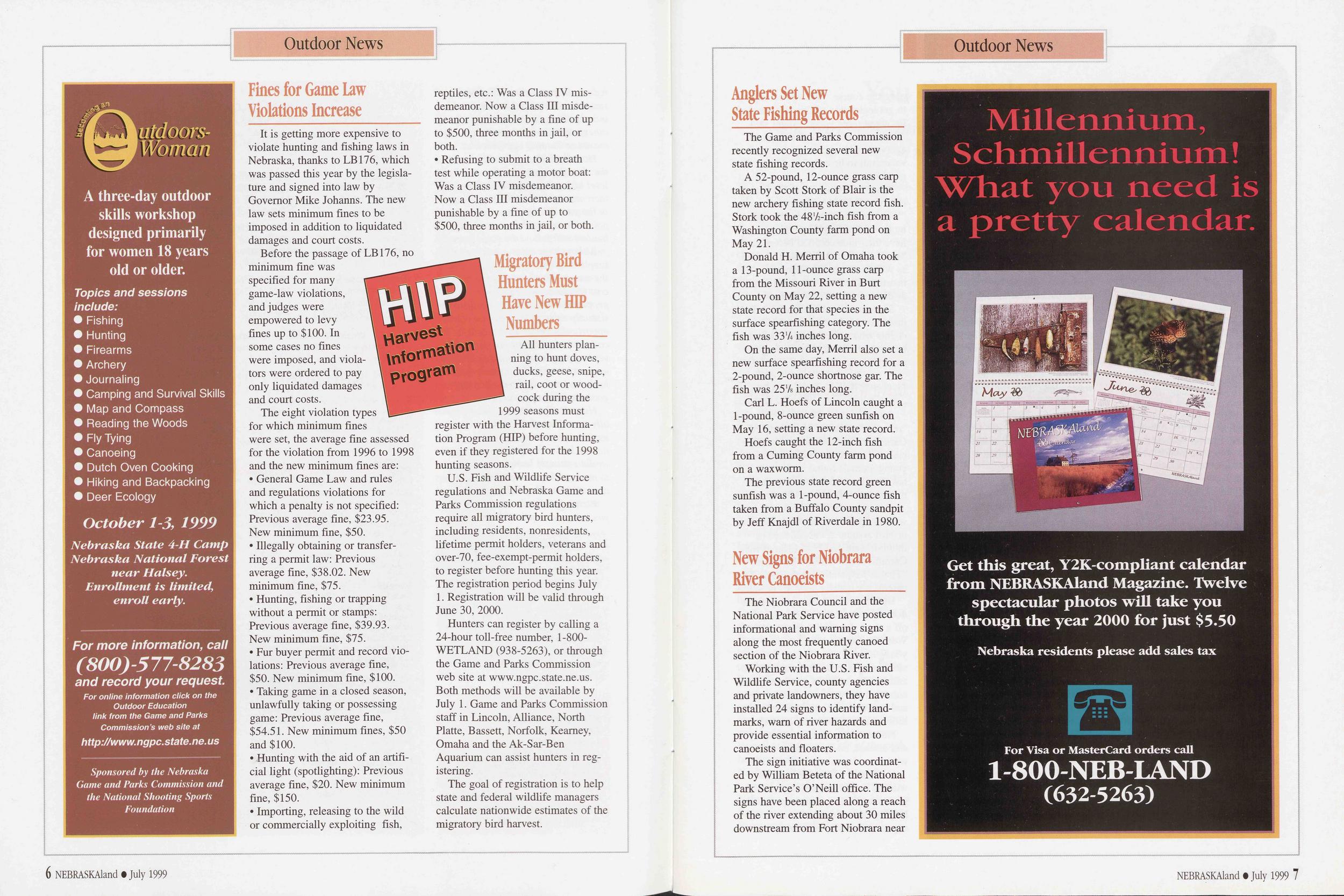
Outdoor News
Outdoors Woman A three-day outdoor skills workshop designed primarily for women 18 years old or older. Topics and sessions include: - Fishing - Hunting - Firearms - Archery - Journaling - Camping and Survival Skills - Map and Compass - Reading the Woods - Fly Tying - Canoeing - Dutch Oven Cooking - Hiking and Backpacking - Deer Ecology October 1-3, 1999 Nebraska State 4-H Camp Nebraska National Forest near Halsey. Enrollment is limited, enroll early. For more information, call (800)-577-8283 and record your request For online information click on the Outdoor Education link from the Game and Parks Commissions web site at http://www.ngpc.state.ne.us Sponsored by the Nebraska Game and Parks Commission and the National Shooting Sports Foundation Fines for Game Law Violations IncreaseIt is getting more expensive to violate hunting and fishing laws in Nebraska, thanks to LB 176, which was passed this year by the l egislature and signed into law by Governor Mike Johanns. The new law sets minimum fines to be imposed in addition to liquidated damages and court costs.
Before the passage of LB 176, no minimum fine was specified for many game-law violations, and judges were empowered to levy fines up to $100. In some cases no fines were imposed, and violators were ordered to pay only liquidated damages and court costs.
The eight violation types for which minimum fines were set, the average fine assessed for the violation from 1996 to 1998 and the new minimum fines are:
• General Game Law and rules and regulations violations for which a penalty is not specified: Previous average fine, $23.95. New minimum fine, $50.
• Illegally obtaining or transferring a permit law: Previous average fine, $38.02. New minimum fine, $75.
• Hunting, fishing or trapping without a permit or stamps: Previous average fine, $39.93. New minimum fine, $75.
• Fur buyer permit and record violations: Previous average fine, $50. New minimum fine, $100.
• Taking game in a closed season, unlawfully taking or possessing game: Previous average fine, $54.51. New minimum fines, $50 and $100.
• Hunting with the aid of an artificial light (spotlighting): Previous average fine, $20. New minimum fine, $150.
• Importing, releasing to the wild or commercially exploiting fish, reptiles, etc.: Was a Class IV misdemeanor. Now a Class III misdemeanor punishable by a fine of up to $500, three months in jail, or both.
• Refusing to submit to a breath test while operating a motor boat: Was a Class IV misdemeanor. Now a Class III misdemeanor punishable by a fine of up to $500, three months in jail, or both.
All hunters planning to hunt doves, ducks, geese, snipe, rail, coot or woodcock during the 1999 seasons must register with the Harvest Information Program (HIP) before hunting, even if they registered for the 1998 hunting seasons.
U.S. Fish and Wildlife Service regulations and Nebraska Game and Parks Commission regulations require all migratory bird hunters, including residents, nonresidents, lifetime permit holders, veterans and over-70, fee-exempt-permit holders, to register before hunting this year. The registration period begins July 1. Registration will be valid through June 30, 2000.
Hunters can register by calling a 24-hour toll-free number, 1-800- WETLAND (938-5263), or through the Game and Parks Commission web site at www.ngpc.state.ne.us. Both methods will be available by July 1. Game and Parks Commission staff in Lincoln, Alliance, North Platte, Bassett, Norfolk, Kearney, Omaha and the Ak-Sar-Ben Aquarium can assist hunters in registering.
The goal of registration is to help state and federal wildlife managers calculate nationwide estimates of the migratory bird harvest.
6 NEBRASKAland • July 1999 Anglers Set New State Fishing RecordsThe Game and Parks Commission recently recognized several new state fishing records.
A 52-pound, 12-ounce grass carp taken by Scott Stork of Blair is the new archery fishing state record fish. Stork took the 4872-inch fish from a Washington County farm pond on May 21.
Donald H. Merril of Omaha took a 13-pound, 11-ounce grass carp from the Missouri River in Burt County on May 22, setting a new state record for that species in the surface spearfishing category. The fish was 3374 inches long.
On the same day, Merril also set a new surface spearfishing record for a 2-pound, 2-ounce shortnose gar. The fish was 257s inches long.
Carl L. Hoefs of Lincoln caught a 1-pound, 8-ounce green sunfish on May 16, setting a new state record. Hoefs caught the 12-inch fish from a Cuming County farm pond on a waxworm.
The previous state record green sunfish was a 1-pound, 4-ounce fish taken from a Buffalo County sandpit by Jeff Knajdl of Riverdale in 1980.
New Signs for Niobrara River CanoeistsThe Niobrara Council and the National Park Service have posted informational and warning signs along the most frequently canoed section of the Niobrara River.
Working with the U.S. Fish and Wildlife Service, county agencies and private landowners, they have installed 24 signs to identify land- marks, warn of river hazards and provide essential information to canoeists and floaters.
The sign initiative was coordinated by William Beteta of the National Park Service's O'Neill office. The signs have been placed along a reach of the river extending about 30 miles downstream from Fort Niobrara near the town of Valentine. That reach was named one of the nation's top 10 canoe rivers by Backpacker Magazine.
Millennium, Sehmillennium What you need is a pretty calendar Get this great, Y2K-compliant calendar from NEBRASKAland Magazine. Twelve spectacular photos will take you through the year 2000 for just $5.50 Nebraska residents please add sales tax For Visa or MasterCard orders call 1-800-NEB-LAND (632-5263) NEBRASKAland • July 1999 7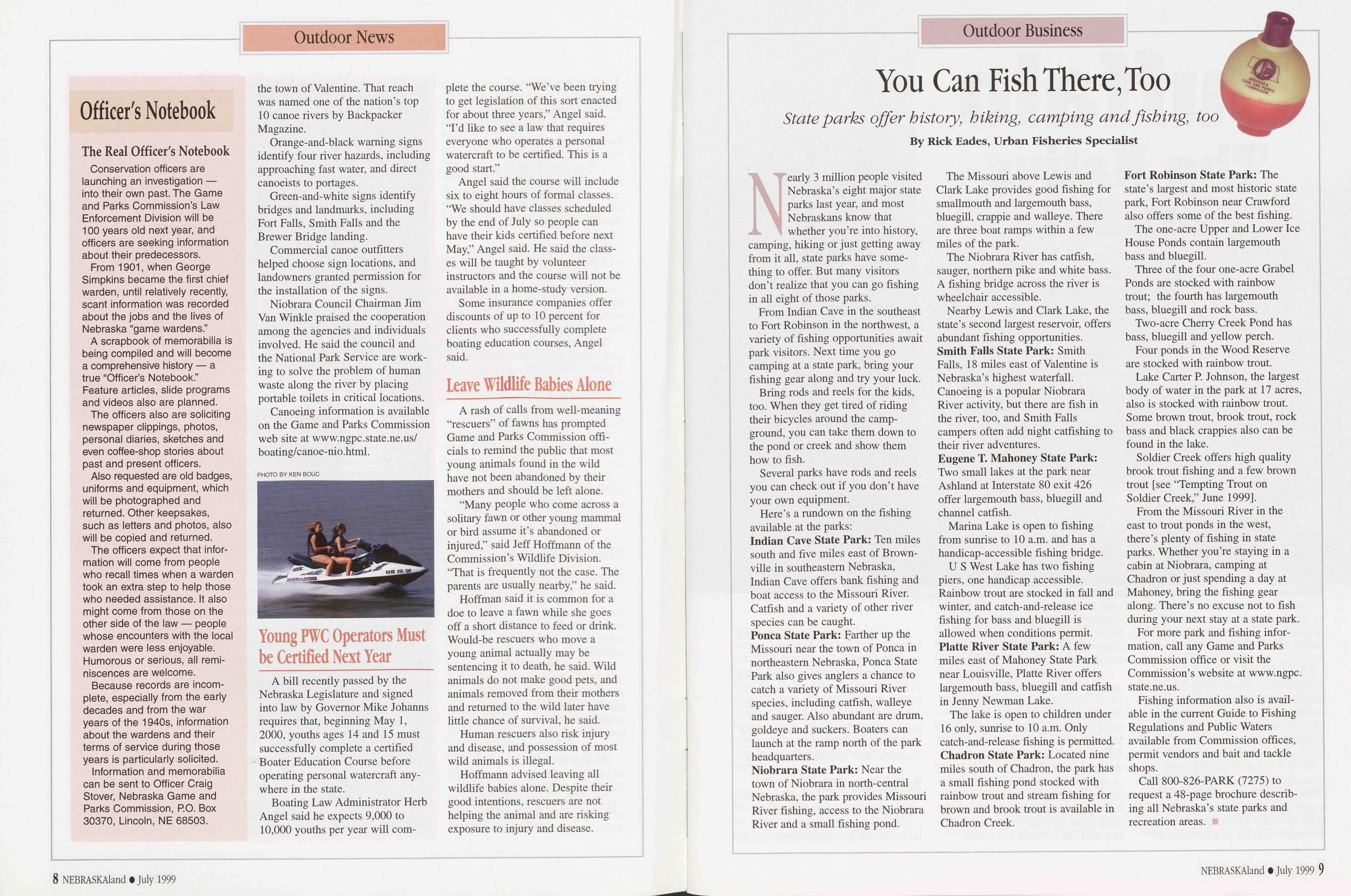 Officer's Notebook
The Real Officer's Notebook
Officer's Notebook
The Real Officer's Notebook
Conservation officers are launching an investigation — into their own past. The Game and Parks Commission's Law Enforcement Division will be 100 years old next year, and officers are seeking information about their predecessors.
From 1901, when George Simpkins became the first chief warden, until relatively recently, scant information was recorded about the jobs and the lives of Nebraska "game wardens."
A scrapbook of memorabilia is being compiled and will become a comprehensive history — a true "Officer's Notebook." Feature articles, slide programs and videos also are planned.
The officers also are soliciting newspaper clippings, photos, personal diaries, sketches and even coffee-shop stories about past and present officers.
Also requested are old badges, uniforms and equipment, which will be photographed and returned. Other keepsakes, such as letters and photos, also will be copied and returned.
The officers expect that information will come from people who recall times when a warden took an extra step to help those who needed assistance. It also might come from those on the other side of the law — people whose encounters with the local warden were less enjoyable. Humorous or serious, all reminiscences are welcome.
Because records are incomplete, especially from the early decades and from the war years of the 1940s, information about the wardens and their terms of service during those years is particularly solicited.
Information and memorabilia can be sent to Officer Craig Stover, Nebraska Game and Parks Commission, P.O. Box 30370, Lincoln, NE 68503.
Orange-and-black warning signs identify four river hazards, including approaching fast water, and direct canoeists to portages.
Green-and-white signs identify bridges and landmarks, including Fort Falls, Smith Falls and the Brewer Bridge landing.
Commercial canoe outfitters helped choose sign locations, and landowners granted permission for the installation of the signs.
Niobrara Council Chairman Jim Van Winkle praised the cooperation among the agencies and individuals involved. He said the council and the National Park Service are working to solve the problem of human waste along the river by placing portable toilets in critical locations.
Canoeing information is available on the Game and Parks Commission web site at www.ngpc.state.ne.us/ boating/canoe-nio.html.
A bill recently passed by the Nebraska Legislature and signed into law by Governor Mike Johanns requires that, beginning May 1, 2000, youths ages 14 and 15 must successfully complete a certified Boater Education Course before operating personal watercraft anywhere in the state.
Boating Law Administrator Herb Angel said he expects 9,000 to 10,000 youths per year will complete the course. "We've been trying to get legislation of this sort enacted for about three years," Angel said. "I'd like to see a law that requires everyone who operates a personal watercraft to be certified. This is a good start."
Angel said the course will include six to eight hours of formal classes. "We should have classes scheduled by the end of July so people can have their kids certified before next May," Angel said. He said the classes will be taught by volunteer instructors and the course will not be available in a home-study version.
Some insurance companies offer discounts of up to 10 percent for clients who successfully complete boating education courses, Angel said.
Leave Wildlife Babies AloneA rash of calls from well-meaning "rescuers" of fawns has prompted Game and Parks Commission officials to remind the public that most young animals found in the wild have not been abandoned by their mothers and should be left alone.
"Many people who come across a solitary fawn or other young mammal or bird assume it's abandoned or injured," said Jeff Hoffmann of the Commission's Wildlife Division. "That is frequently not the case. The parents are usually nearby," he said.
Hoffman said it is common for a doe to leave a fawn while she goes off a short distance to feed or drink. Would-be rescuers who move a young animal actually may be sentencing it to death, he said. Wild animals do not make good pets, and animals removed from their mothers and returned to the wild later have little chance of survival, he said.
Human rescuers also risk injury and disease, and possession of most wild animals is illegal.
Hoffmann advised leaving all wildlife babies alone. Despite their good intentions, rescuers are not helping the animal and are risking exposure to injury and disease.
8 NEBRASKAland • July 1999Outdoor Business
You Can Fish There, Too
State parks offer history, hiking, camping and fishing, too By Rick Eades, Urban Fisheries SpecialistEarly 3 million people visited Nebraska's eight major state parks last year, and most Nebraskans know that whether you're into history, camping, hiking or just getting away from it all, state parks have something to offer. But many visitors don't realize that you can go fishing in all eight of those parks.
From Indian Cave in the southeast to Fort Robinson in the northwest, a variety of fishing opportunities await park visitors. Next time you go camping at a state park, bring your fishing gear along and try your luck.
Bring rods and reels for the kids, too. When they get tired of riding their bicycles around the campground, you can take them down to the pond or creek and show them how to fish.
Several parks have rods and reels you can check out if you don't have your own equipment.
Here's a rundown on the fishing available at the parks:
Indian Cave State Park: Ten miles south and five miles east of Brownville in southeastern Nebraska, Indian Cave offers bank fishing and boat access to the Missouri River. Catfish and a variety of other river species can be caught.
Ponca State Park: Farther up the Missouri near the town of Ponca in northeastern Nebraska, Ponca State Park also gives anglers a chance to catch a variety of Missouri River species, including catfish, walleye and sauger. Also abundant are drum, goldeye and suckers. Boaters can launch at the ramp north of the park headquarters.
Niobrara State Park: Near the town of Niobrara in north-central Nebraska, the park provides Missouri River fishing, access to the Niobrara River and a small fishing pond.
The Missouri above Lewis and Clark Lake provides good fishing for smallmouth and largemouth bass, bluegill, crappie and walleye. There are three boat ramps within a few miles of the park.
The Niobrara River has catfish, sauger, northern pike and white bass. A fishing bridge across the river is wheelchair accessible.
Nearby Lewis and Clark Lake, the state's second largest reservoir, offers abundant fishing opportunities.
Smith Falls State Park: Smith Falls, 18 miles east of Valentine is Nebraska's highest waterfall. Canoeing is a popular Niobrara River activity, but there are fish in the river, too, and Smith Falls campers often add night catfishing to their river adventures.
Eugene T. Mahoney State Park: Two small lakes at the park near Ashland at Interstate 80 exit 426 offer largemouth bass, bluegill and channel catfish.
Marina Lake is open to fishing from sunrise to 10 a.m. and has a handicap-accessible fishing bridge.
U S West Lake has two fishing piers, one handicap accessible. Rainbow trout are stocked in fall and winter, and catch-and-release ice fishing for bass and bluegill is allowed when conditions permit.
Platte River State Park: A few miles east of Mahoney State Park near Louisville, Platte River offers largemouth bass, bluegill and catfish in Jenny Newman Lake.
The lake is open to children under 16 only, sunrise to 10 a.m. Only catch-and-release fishing is permitted.
Chadron State Park: Located nine miles south of Chadron, the park has a small fishing pond stocked with rainbow trout and stream fishing for brown and brook trout is available in Chadron Creek.
Fort Robinson State Park: The state's largest and most historic state park, Fort Robinson near Crawford also offers some of the best fishing.
The one-acre Upper and Lower Ice House Ponds contain largemouth bass and bluegill.
Three of the four one-acre Grabel Ponds are stocked with rainbow trout; the fourth has largemouth bass, bluegill and rock bass.
Two-acre Cherry Creek Pond has bass, bluegill and yellow perch.
Four ponds in the Wood Reserve are stocked with rainbow trout.
Lake Carter P. Johnson, the largest body of water in the park at 17 acres, also is stocked with rainbow trout. Some brown trout, brook trout, rock bass and black crappies also can be found in the lake.
Soldier Creek offers high quality brook trout fishing and a few brown trout [see "Tempting Trout on Soldier Creek," June 1999].
From the Missouri River in the east to trout ponds in the west, there's plenty of fishing in state parks. Whether you're staying in a cabin at Niobrara, camping at Chadron or just spending a day at Mahoney, bring the fishing gear along. There's no excuse not to fish during your next stay at a state park.
For more park and fishing information, call any Game and Parks Commission office or visit the Commission's website at www.ngpc. state.ne.us.
Fishing information also is avail- able in the current Guide to Fishing Regulations and Public Waters available from Commission offices, permit vendors and bait and tackle shops.
Call 800-826-PARK (7275) to request a 48-page brochure describing all Nebraska's state parks and recreation areas.
NEBRASKAland • July 1999 9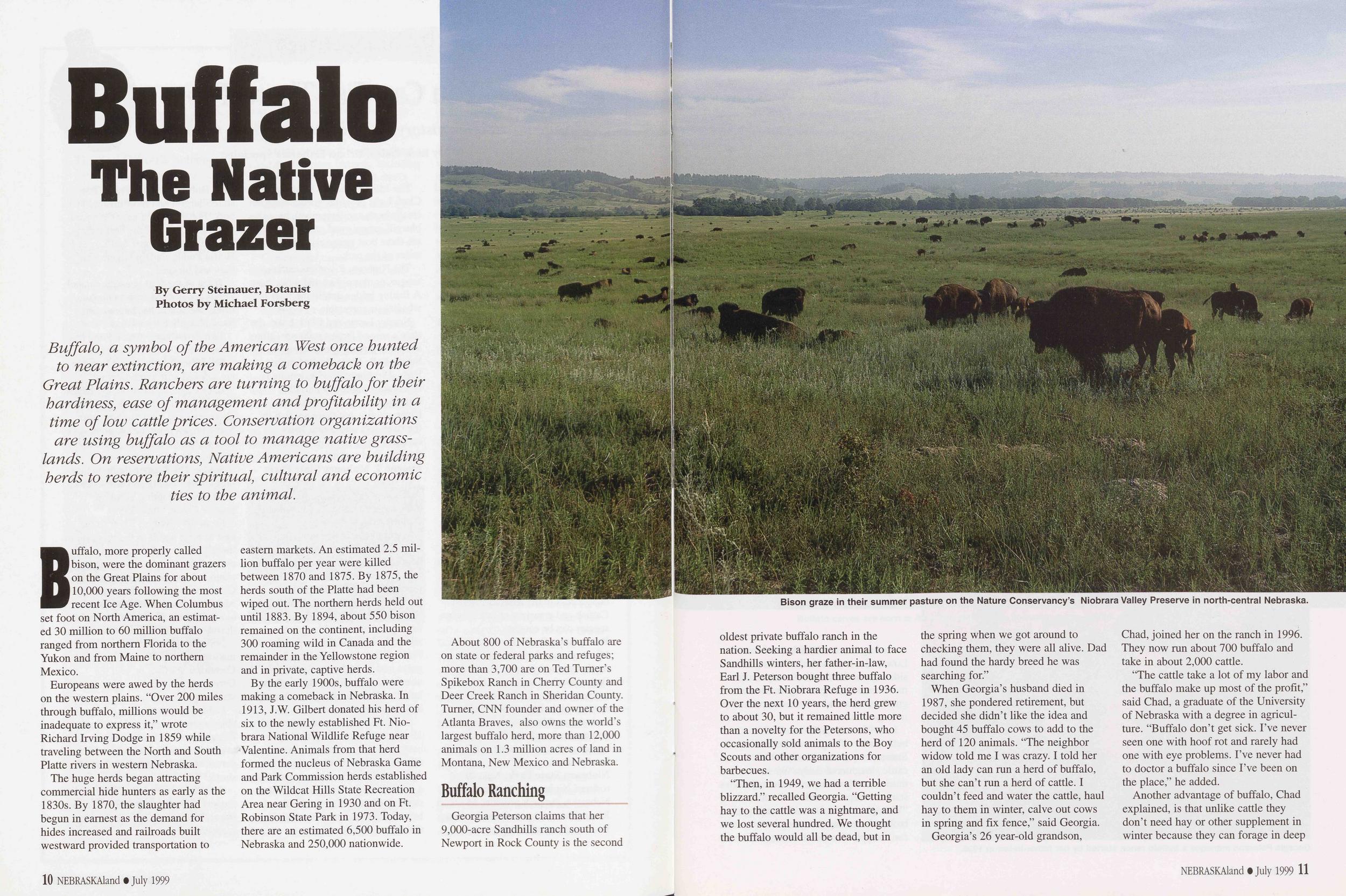
Buffalo The Native Grazer
By Gerry Steinauer, Botanist Photos by Michael Forsberg Buffalo, a symbol of the American West once hunted to near extinction, are making a comeback on the Great Plains. Ranchers are turning to buffalo for their hardiness, ease of management and profitability in a time of low cattle prices. Conservation organizations are using buffalo as a tool to manage native grasslands. On reservations, Native Americans are building herds to restore their spiritual, cultural and economic ties to the animal.Buffalo, more properly called bison, were the dominant grazers on the Great Plains for about 10,000 years following the most recent Ice Age. When Columbus set foot on North America, an estimated 30 million to 60 million buffalo ranged from northern Florida to the Yukon and from Maine to northern Mexico.
Europeans were awed by the herds on the western plains. "Over 200 miles through buffalo, millions would be inadequate to express it," wrote Richard Irving Dodge in 1859 while traveling between the North and South Platte rivers in western Nebraska.
The huge herds began attracting commercial hide hunters as early as the 1830s. By 1870, the slaughter had begun in earnest as the demand for hides increased and railroads built westward provided transportation to eastern markets. An estimated 2.5 million buffalo per year were killed between 1870 and 1875. By 1875, the herds south of the Platte had been wiped out. The northern herds held out until 1883. By 1894, about 550 bison remained on the continent, including 300 roaming wild in Canada and the remainder in the Yellowstone region and in private, captive herds.
By the early 1900s, buffalo were making a comeback in Nebraska. In 1913, J.W. Gilbert donated his herd of six to the newly established Ft. Niobrara National Wildlife Refuge near Valentine. Animals from that herd formed the nucleus of Nebraska Game and Park Commission herds established on the Wildcat Hills State Recreation Area near Gering in 1930 and on Ft. Robinson State Park in 1973. Today, there are an estimated 6,500 buffalo in Nebraska and 250,000 nationwide.
About 800 of Nebraska's buffalo are on state or federal parks and refuges; more than 3,700 are on Ted Turner's Spikebox Ranch in Cherry County and Deer Creek Ranch in Sheridan County. Turner, CNN founder and owner of the Atlanta Braves, also owns the world's largest buffalo herd, more than 12,000 animals on 1.3 million acres of land in Montana, New Mexico and Nebraska.
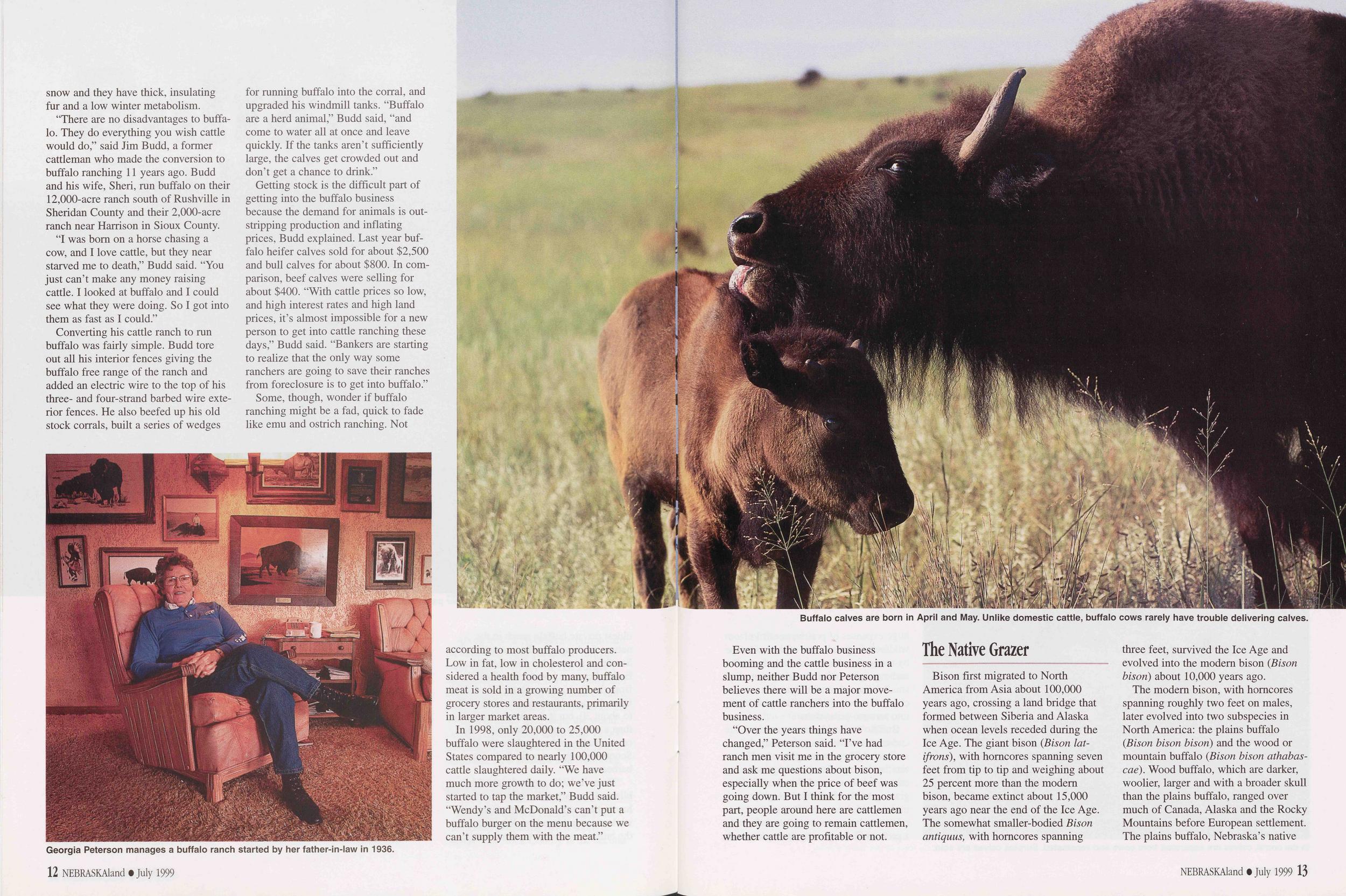
Buffalo RanchingGeorgia Peterson claims that her 9,000-acre Sandhills ranch south of Newport in Rock County is the second 10 NEBRASKAland • July 1999
"Then, in 1949, we had a terrible blizzard." recalled Georgia. "Getting hay to the cattle was a nightmare, and we lost several hundred. We thought the buffalo would all be dead, but in the spring when we got around to checking them, they were all alive. Dad had found the hardy breed he was searching for."
When Georgia's husband died in 1987, she pondered retirement, but decided she didn't like the idea and bought 45 buffalo cows to add to the herd of 120 animals. "The neighbor widow told me I was crazy. I told her an old lady can run a herd of buffalo, but she can't run a herd of cattle. I couldn't feed and water the cattle, haul hay to them in winter, calve out cows in spring and fix fence," said Georgia.
Georgia's 26 year-old grandson, Chad, joined her on the ranch in 1996. They now run about 700 buffalo and take in about 2,000 cattle.
The cattle take a lot of my labor and the buffalo make up most of the profit," said Chad, a graduate of the University of Nebraska with a degree in agriculture. "Buffalo don't get sick. I've never seen one with hoof rot and rarely had one with eye problems. I've never had to doctor a buffalo since I've been on the place," he added.
Another advantage of buffalo, Chad
explained, is that unlike cattle they
don't need hay or other supplement in
winter because they can forage in deep
NEBRASKAland • July 1999 11
 snow and they have thick, insulating
fur and a low winter metabolism.
snow and they have thick, insulating
fur and a low winter metabolism.
"There are no disadvantages to buffalo. They do everything you wish cattle would do," said Jim Budd, a former cattleman who made the conversion to buffalo ranching 11 years ago. Budd and his wife, Sheri, run buffalo on their 12,000-acre ranch south of Rushville in Sheridan County and their 2,000-acre ranch near Harrison in Sioux County.
"I was born on a horse chasing a cow, and I love cattle, but they near starved me to death," Budd said. "You just can't make any money raising cattle. I looked at buffalo and I could see what they were doing. So I got into them as fast as I could."
Converting his cattle ranch to run buffalo was fairly simple. Budd tore out all his interior fences giving the buffalo free range of the ranch and added an electric wire to the top of his three- and four-strand barbed wire exterior fences. He also beefed up his old stock corrals, built a series of wedges for running buffalo into the corral, and upgraded his windmill tanks. "Buffalo are a herd animal," Budd said, "and come to water all at once and leave quickly. If the tanks aren't sufficiently large, the calves get crowded out and don't get a chance to drink."
Getting stock is the difficult part of getting into the buffalo business because the demand for animals is out-stripping production and inflating prices, Budd explained. Last year buffalo heifer calves sold for about $2,500 and bull calves for about $800. In comparison, beef calves were selling for about $400. "With cattle prices so low, and high interest rates and high land prices, it's almost impossible for a new person to get into cattle ranching these days," Budd said. "Bankers are starting to realize that the only way some ranchers are going to save their ranches from foreclosure is to get into buffalo."
Some, though, wonder if buffalo ranching might be a fad, quick to fade like emu and ostrich ranching. Not according to most buffalo producers. Low in fat, low in cholesterol and considered a health food by many, buffalo meat is sold in a growing number of grocery stores and restaurants, primarily in larger market areas.
In 1998, only 20,000 to 25,000 buffalo were slaughtered in the United States compared to nearly 100,000 cattle slaughtered daily. "We have much more growth to do; we've just started to tap the market," Budd said. "Wendy's and McDonald's can't put a buffalo burger on the menu because we can't supply them with the meat."
Even with the buffalo business booming and the cattle business in a slump, neither Budd nor Peterson believes there will be a major movement of cattle ranchers into the buffalo business.
"Over the years things have changed," Peterson said. "I've had ranch men visit me in the grocery store and ask me questions about bison, especially when the price of beef was going down. But I think for the most part, people around here are cattlemen and they are going to remain cattlemen, whether cattle are profitable or not.
The Native GrazerBison first migrated to North America from Asia about 100,000 years ago, crossing a land bridge that formed between Siberia and Alaska when ocean levels receded during the Ice Age. The giant bison (Bison latifrons), with horncores spanning seven feet from tip to tip and weighing about 25 percent more than the modern bison, became extinct about 15,000 years ago near the end of the Ice Age. The somewhat smaller-bodied Bison antiquus, with horncores spanning three feet, survived the Ice Age and evolved into the modern bison (Bison bison) about 10,000 years ago.
The modern bison, with horncores
spanning roughly two feet on males,
later evolved into two subspecies in
North America: the plains buffalo
(Bison bison bison) and the wood or
mountain buffalo (Bison bison
athabascae). Wood buffalo, which are darker,
woolier, larger and with a broader skull
than the plains buffalo, ranged over
much of Canada, Alaska and the Rocky
Mountains before European settlement.
The plains buffalo, Nebraska's native
NEBRASKAland • July 1999 13
 subspecies, occupied more temperate
grasslands. In the 1920s, the last
population of wood buffalo was virtually
wiped out when plains buffalo were
introduced into Wood Buffalo National
Park in Canada and crossbreeding
occurred.
subspecies, occupied more temperate
grasslands. In the 1920s, the last
population of wood buffalo was virtually
wiped out when plains buffalo were
introduced into Wood Buffalo National
Park in Canada and crossbreeding
occurred.
The European bison, or wisent (Bison bison bonasus), and the American bison are descended from common ancestors, and now are considered subspecies rather than separate species. Though similar in general appearance, skeletal structure, and other features, the wisent has a longer and lighter body, longer legs, and a less pronounced hump than the American bison.
Feeding habits also differ. American bison are primarily grazers of grass; wisent are browsers of shrub and tree leaves. Wisent were exterminated from most of their native range 300 to 500 years ago, when forest habitats in France, Austria, Hungary and Germany were cleared. The last wild herd, in the Bialowieza Forest of Poland, was slaughtered during a period of lawlessness near the end of World War I. That herd has since been re-established with animals from European zoos.
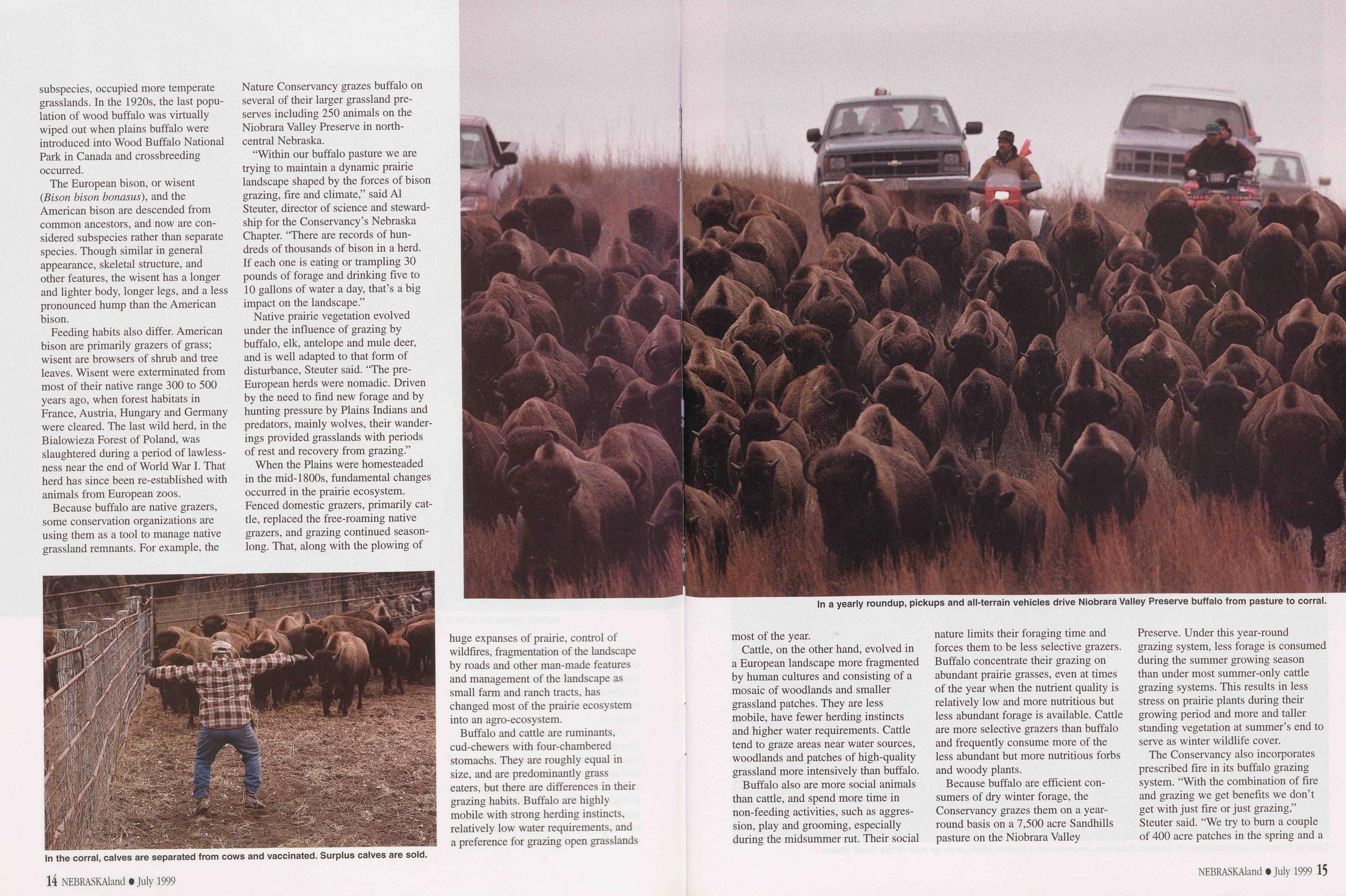
Because buffalo are native grazers, some conservation organizations are using them as a tool to manage native grassland remnants. For example, the Nature Conservancy grazes buffalo on several of their larger grassland preserves including 250 animals on the Niobrara Valley Preserve in north- central Nebraska.
"Within our buffalo pasture we are trying to maintain a dynamic prairie landscape shaped by the forces of bison grazing, fire and climate," said Al Steuter, director of science and stewardship for the Conservancy's Nebraska Chapter. "There are records of hundreds of thousands of bison in a herd. If each one is eating or trampling 30 pounds of forage and drinking five to 10 gallons of water a day, that's a big impact on the landscape."
Native prairie vegetation evolved under the influence of grazing by buffalo, elk, antelope and mule deer, and is well adapted to that form of disturbance, Steuter said. "The pre-European herds were nomadic. Driven by the need to find new forage and by hunting pressure by Plains Indians and predators, mainly wolves, their wanderings provided grasslands with periods of rest and recovery from grazing."
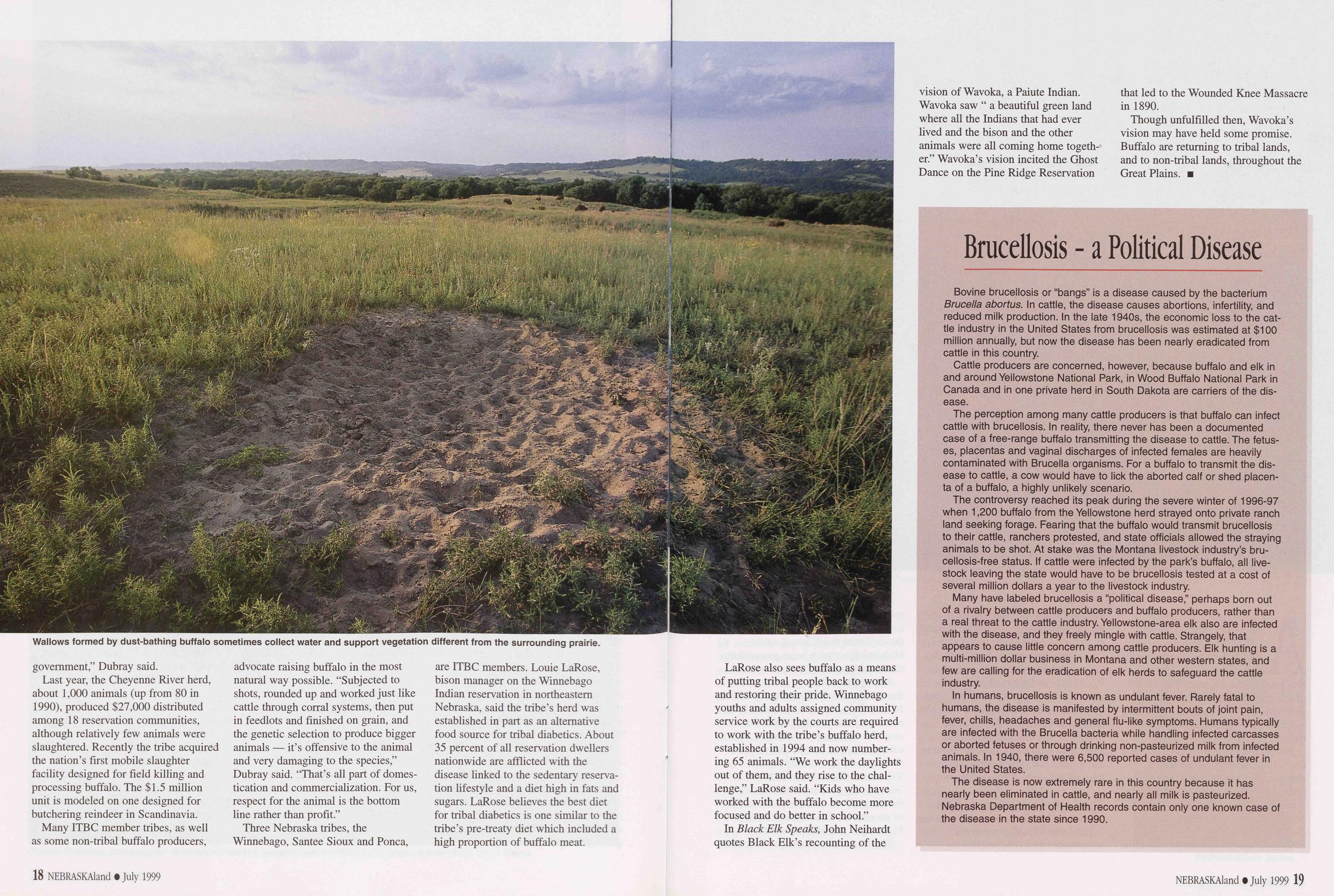
When the Plains were homesteaded in the mid-1800s, fundamental changes occurred in the prairie ecosystem. Fenced domestic grazers, primarily cattle, replaced the free-roaming native grazers, and grazing continued season long. That, along with the plowing of huge expanses of prairie, control of wildfires, fragmentation of the landscape by roads and other man-made features and management of the landscape as small farm and ranch tracts, has changed most of the prairie ecosystem into an agro-ecosystem.
Buffalo and cattle are ruminants, cud-chewers with four-chambered stomachs. They are roughly equal in size, and are predominantly grass eaters, but there are differences in their grazing habits. Buffalo are highly mobile with strong herding instincts, relatively low water requirements, and a preference for grazing open grasslands
Cattle, on the other hand, evolved in a European landscape more fragmented by human cultures and consisting of a mosaic of woodlands and smaller grassland patches. They are less mobile, have fewer herding instincts and higher water requirements. Cattle tend to graze areas near water sources, woodlands and patches of high-quality grassland more intensively than buffalo.
Buffalo also are more social animals than cattle, and spend more time in non-feeding activities, such as aggression, play and grooming, especially during the midsummer rut. Their social nature limits their foraging time and forces them to be less selective grazers. Buffalo concentrate their grazing on abundant prairie grasses, even at times of the year when the nutrient quality is relatively low and more nutritious but less abundant forage is available. Cattle are more selective grazers than buffalo and frequently consume more of the less abundant but more nutritious forbs and woody plants.
Because buffalo are efficient consumers of dry winter forage, the Conservancy grazes them on a year round basis on a 7,500 acre Sandhills pasture on the Niobrara Valley Preserve. Under this year-round grazing system, less forage is consumed during the summer growing season than under most summer-only cattle grazing systems. This results in less stress on prairie plants during their growing period and more and taller standing vegetation at summer's end to serve as winter wildlife cover.
The Conservancy also incorporates
prescribed fire in its buffalo grazing
system. "With the combination of fire
and grazing we get benefits we don't
get with just fire or just grazing,"
Steuter said. "We try to burn a couple
of 400 acre patches in the spring and a
NEBRASKAland • July 1999 15
Steuter explained that buffalo are attracted to the fresh re-growth of grasses after a fire. Their heavy grazing and trampling of burned areas reduces the dominance of prairie grasses for one to three years after the fires. Because of the reduced competition with grasses, the native forbs, including nitrogen-fixing legumes, increase after the burns. The flush of forbs provides an abundance of seeds and high-quality forage for wildlife.
Steuter said the combination of fire and grazing produces a mosaic of habitats including vegetation of varying density and composition. It is used by different groups of grassland birds, mammals and insects, and the forage quality for bison improves. Fire and grazing also prevent woody plants from encroaching on the prairie.
The Conservancy has found that buffalo are not practical on smaller grassland preserves typical of highly farmed landscapes. However, some methods of cattle grazing on smaller preserves accomplish ecological objectives similar to those achieved with buffalo on larger preserves.
Steuter said most of today's landscape is more similar to the patchy European landscape to which cattle are adapted than to the open prairie landscape to which buffalo are adapted. Fortunately, because of the foresight of early conservationist, buffalo survive as a tool for managing large grasslands.
The InterTribal Bison Cooperative"Restoring buffalo back to health will help restore our people back to health," said Fred Dubray, a member of South Dakota's Cheyenne River Sioux Tribe and founder of the InterTribal Bison Cooperative (ITBC). "They are the life blood of our people. We are both natives to the country and our history says at one time we were all the same. That is the spiritual viewpoint of tribal people."
Established in 1992 and based in Rapid City, South Dakota, the ITBC's mission is to restore buffalo to tribal lands in a manner compatible with the spiritual beliefs and practices of Indian people. The ITBC provides its 48 member tribes in 17 states with technical assistance, aid in seeking financial support for herd development and outlets for tribal buffalo products.
Most ITBC member herds are small
and not intended as money-making
operations, but some tribes are trying
to rebuild their economies by raising
buffalo. "When the buffalo herds were
destroyed, and that was done purposely
to weaken the tribes and force them
into submission, it had a devastating
impact on our economy. We went
from a self-sufficient economy to
one that was dependent on the federal
NEBRASKAland • July 1999 17
Last year, the Cheyenne River herd, about 1,000 animals (up from 80 in 1990), produced $27,000 distributed among 18 reservation communities, although relatively few animals were slaughtered. Recently the tribe acquired the nation's first mobile slaughter facility designed for field killing and processing buffalo. The $1.5 million unit is modeled on one designed for butchering reindeer in Scandinavia.
Many ITBC member tribes, as well as some non-tribal buffalo producers, advocate raising buffalo in the most natural way possible. "Subjected to shots, rounded up and worked just like cattle through corral systems, then put in feedlots and finished on grain, and the genetic selection to produce bigger animals — it's offensive to the animal and very damaging to the species," Dubray said. "That's all part of domestication and commercialization. For us, respect for the animal is the bottom line rather than profit."
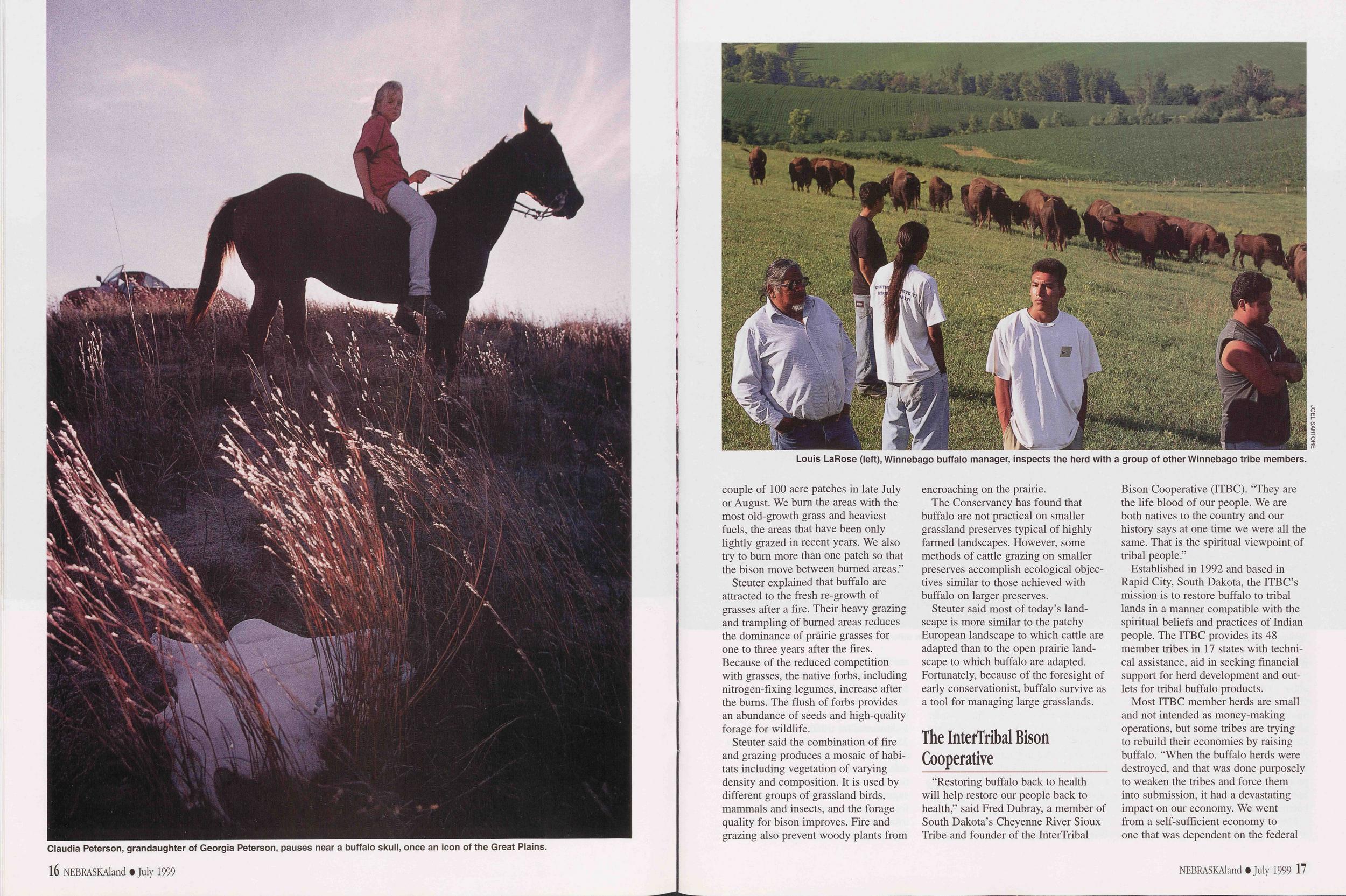
Three Nebraska tribes, the Winnebago, Santee Sioux and Ponca, are ITBC members. Louie LaRose, bison manager on the Winnebago Indian reservation in northeastern Nebraska, said the tribe's herd was established in part as an alternative food source for tribal diabetics. About 35 percent of all reservation dwellers nationwide are afflicted with the disease linked to the sedentary reservation lifestyle and a diet high in fats and sugars. LaRose believes the best diet for tribal diabetics is one similar to the tribe's pre-treaty diet which included a high proportion of buffalo meat.
18 NEBRASKAland • July 1999LaRose also sees buffalo as a means of putting tribal people back to work and restoring their pride. Winnebago youths and adults assigned community service work by the courts are required to work with the tribe's buffalo herd, established in 1994 and now number- ing 65 animals. "We work the daylights out of them, and they rise to the challenge," LaRose said. "Kids who have worked with the buffalo become more focused and do better in school."
In Black Elk Speaks, John Neihardt quotes Black Elk's recounting of the vision of Wavoka, a Paiute Indian. Wavoka saw " a beautiful green land where all the Indians that had ever lived and the bison and the other animals were all coming home together." Wavoka's vision incited the Ghost Dance on the Pine Ridge Reservation that led to the Wounded Knee Massacre in 1890.
Though unfulfilled then, Wavoka's vision may have held some promise. Buffalo are returning to tribal lands, and to non-tribal lands, throughout the Great Plains.
Brucellosis - a Political DiseaseBovine brucellosis or "bangs" is a disease caused by the bacterium Brucella abortus. In cattle, the disease causes abortions, infertility, and reduced milk production. In the late 1940s, the economic loss to the cattle industry in the United States from brucellosis was estimated at $100 million annually, but now the disease has been nearly eradicated from cattle in this country
Cattle producers are concerned, however, because buffalo and elk in and around Yellowstone National Park, in Wood Buffalo National Park in Canada and in one private herd in South Dakota are carriers of the disease.
The perception among many cattle producers is that buffalo can infect cattle with brucellosis. In reality, there never has been a documented case of a free-range buffalo transmitting the disease to cattle. The fetuses, placentas and vaginal discharges of infected females are heavily contaminated with Brucella organisms. For a buffalo to transmit the disease to cattle, a cow would have to lick the aborted calf or shed placenta of a buffalo, a highly unlikely scenario.
The controversy reached its peak during the severe winter of 1996-97 when 1,200 buffalo from the Yellowstone herd strayed onto private ranch land seeking forage. Fearing that the buffalo would transmit brucellosis to their cattle, ranchers protested, and state officials allowed the straying animals to be shot. At stake was the Montana livestock industry's brucellosis-free status. If cattle were infected by the park's buffalo, all livestock leaving the state would have to be brucellosis tested at a cost of several million dollars a year to the livestock industry.
Many have labeled brucellosis a "political disease," perhaps born out of a rivalry between cattle producers and buffalo producers, rather than a real threat to the cattle industry. Yellowstone-area elk also are infected with the disease, and they freely mingle with cattle. Strangely, that appears to cause little concern among cattle producers. Elk hunting is a multi-million dollar business in Montana and other western states, and few are calling for the eradication of elk herds to safeguard the cattle industry.
In humans, brucellosis is known as undulant fever. Rarely fatal to humans, the disease is manifested by intermittent bouts of joint pain, fever, chills, headaches and general flu-like symptoms. Humans typically are infected with the Brucella bacteria while handling infected carcasses or aborted fetuses or through drinking non-pasteurized milk from infected animals. In 1940, there were 6,500 reported cases of undulant fever in the United States.
The disease is now extremely rare in this country because it has nearly been eliminated in cattle, and nearly all milk is pasteurized. Nebraska Department of Health records contain only one known case of the disease in the state since 1990.
NEBRASKAland • July 1999 19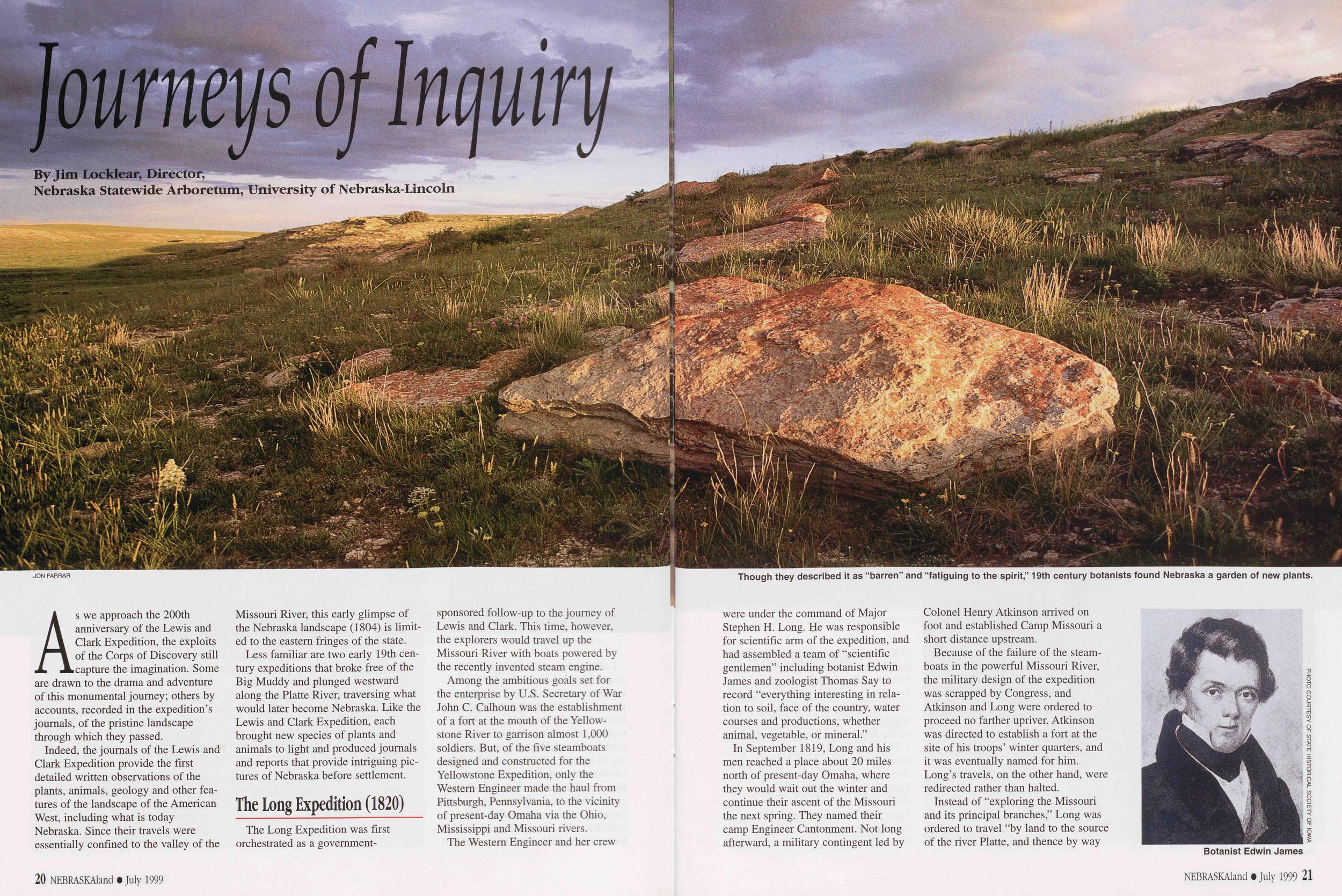
Journeys of Inquiry
By Jim Lockleaiy Directory Nebraska Statewide Arboretum, University of Nebraska-LincolnAs we approach the 200th anniversary of the Lewis and Clark Expedition, the exploits of the Corps of Discovery still capture the imagination. Some are drawn to the drama and adventure of this monumental journey; others by accounts, recorded in the expedition's journals, of the pristine landscape through which they passed.
Indeed, the journals of the Lewis and Clark Expedition provide the first detailed written observations of the plants, animals, geology and other features of the landscape of the American West, including what is today Nebraska. Since their travels were essentially confined to the valley of the Missouri River, this early glimpse of the Nebraska landscape (1804) is limited to the eastern fringes of the state.
Less familiar are two early 19th century expeditions that broke free of the Big Muddy and plunged westward along the Platte River, traversing what would later become Nebraska. Like the Lewis and Clark Expedition, each brought new species of plants and animals to light and produced journals and reports that provide intriguing pictures of Nebraska before settlement.
The Long Expedition (1820)The Long Expedition was first orchestrated as a government- sponsored follow-up to the journey of Lewis and Clark. This time, however, the explorers would travel up the Missouri River with boats powered by the recently invented steam engine.
Among the ambitious goals set for the enterprise by U.S. Secretary of War John C. Calhoun was the establishment of a fort at the mouth of the Yellowstone River to garrison almost 1,000 soldiers. But, of the five steamboats designed and constructed for the Yellowstone Expedition, only the Western Engineer made the haul from Pittsburgh, Pennsylvania, to the vicinity of present-day Omaha via the Ohio, Mississippi and Missouri rivers.
The Western Engineer and her crew 20 NEBRASKAland • July 1999 were under the command of Major Stephen H. Long. He was responsible for scientific arm of the expedition, and had assembled a team of "scientific gentlemen" including botanist Edwin James and zoologist Thomas Say to record "everything interesting in relation to soil, face of the country, water courses and productions, whether animal, vegetable, or mineral."
In September 1819, Long and his men reached a place about 20 miles north of present-day Omaha, where they would wait out the winter and continue their ascent of the Missouri the next spring. They named their camp Engineer Cantonment. Not long afterward, a military contingent led by Colonel Henry Atkinson arrived on foot and established Camp Missouri a short distance upstream.
Because of the failure of the steamboats in the powerful Missouri River, the military design of the expedition was scrapped by Congress, and Atkinson and Long were ordered to proceed no farther upriver. Atkinson was directed to establish a fort at the site of his troops' winter quarters, and it was eventually named for him. Long's travels, on the other hand, were redirected rather than halted.
Instead of "exploring the Missouri and its principal branches," Long was ordered to travel "by land to the source of the river Platte, and thence by way
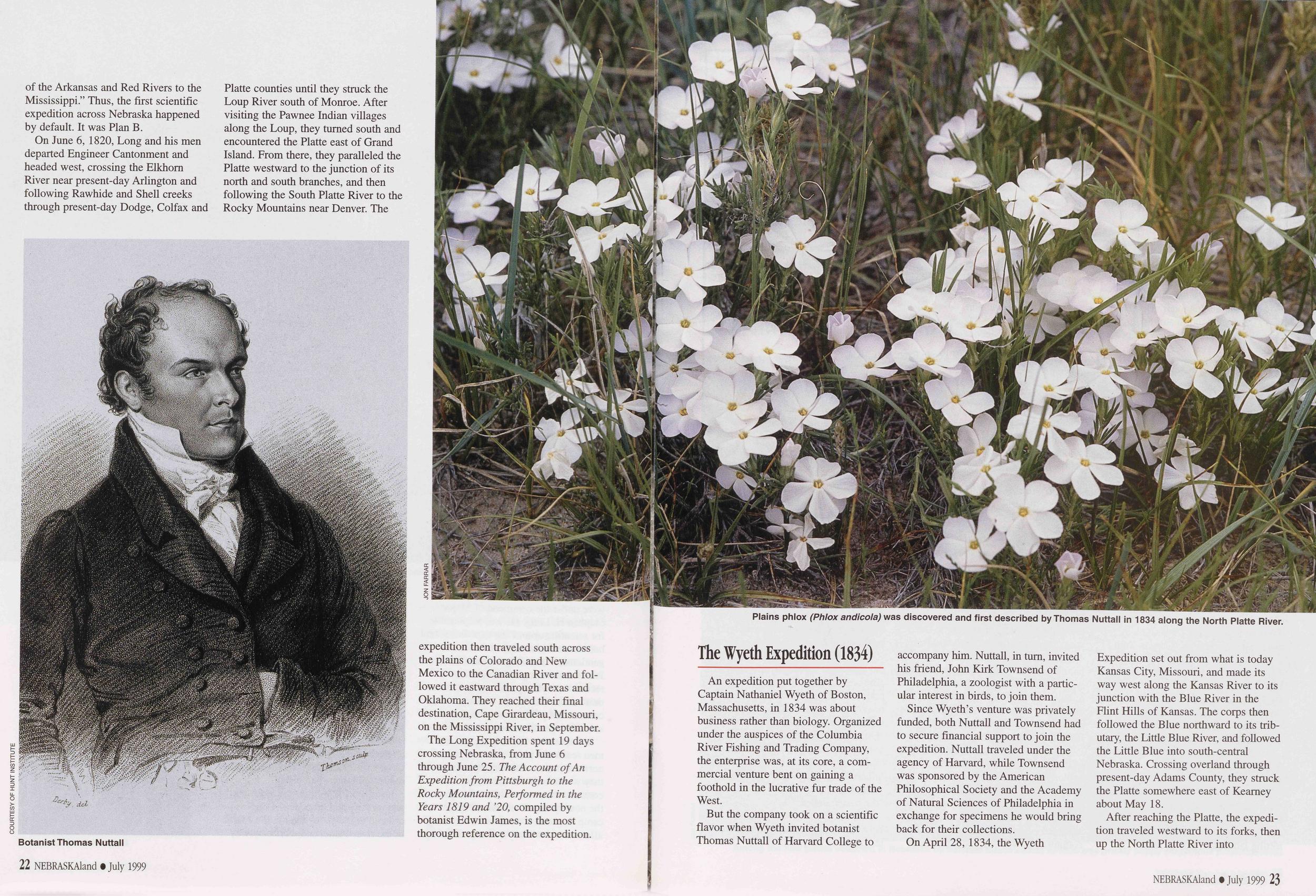 of the Arkansas and Red Rivers to the
Mississippi." Thus, the first scientific
expedition across Nebraska happened
by default. It was Plan B.
of the Arkansas and Red Rivers to the
Mississippi." Thus, the first scientific
expedition across Nebraska happened
by default. It was Plan B.
On June 6, 1820, Long and his men departed Engineer Cantonment and headed west, crossing the Elkhorn River near present-day Arlington and following Rawhide and Shell creeks through present-day Dodge, Colfax and Platte counties until they struck the Loup River south of Monroe. After visiting the Pawnee Indian villages along the Loup, they turned south and encountered the Platte east of Grand Island. From there, they paralleled the Platte westward to the junction of its north and south branches, and then following the South Platte River to the Rocky Mountains near Denver. The expedition then traveled south across the plains of Colorado and New Mexico to the Canadian River and followed it eastward through Texas and Oklahoma. They reached their final destination, Cape Girardeau, Missouri, on the Mississippi River, in September.
The Long Expedition spent 19 days crossing Nebraska, from June 6 through June 25. The Account of An Expedition from Pittsburgh to the Rocky Mountains, Performed in the Years 1819 and '20, compiled by botanist Edwin James, is the most thorough reference on the expedition.
An expedition put together by Captain Nathaniel Wyeth of Boston, Massachusetts, in 1834 was about business rather than biology. Organized under the auspices of the Columbia River Fishing and Trading Company, the enterprise was, at its core, a commercial venture bent on gaining a foothold in the lucrative fur trade of the West.
But the company took on a scientific flavor when Wyeth invited botanist Thomas Nuttall of Harvard College to accompany him. Nuttall, in turn, invited his friend, John Kirk Townsend of Philadelphia, a zoologist with a particular interest in birds, to join them.
Since Wyeth's venture was privately funded, both Nuttall and Townsend had to secure financial support to join the expedition. Nuttall traveled under the agency of Harvard, while Townsend was sponsored by the American Philosophical Society and the Academy of Natural Sciences of Philadelphia in exchange for specimens he would bring back for their collections.
On April 28, 1834, the Wyeth Expedition set out from what is today Kansas City, Missouri, and made its way west along the Kansas River to its junction with the Blue River in the Flint Hills of Kansas. The corps then followed the Blue northward to its tributary, the Little Blue River, and followed the Little Blue into south-central Nebraska. Crossing overland through present-day Adams County, they struck the Platte somewhere east of Kearney about May 18.
After reaching the Platte, the expedition traveled westward to its forks, then up the North Platte River into Wyoming. They reached their destination, Fort Vancouver on the Oregon coast, in September. The route they followed later became the Oregon Trail.
NEBRASKAland • July 1999 23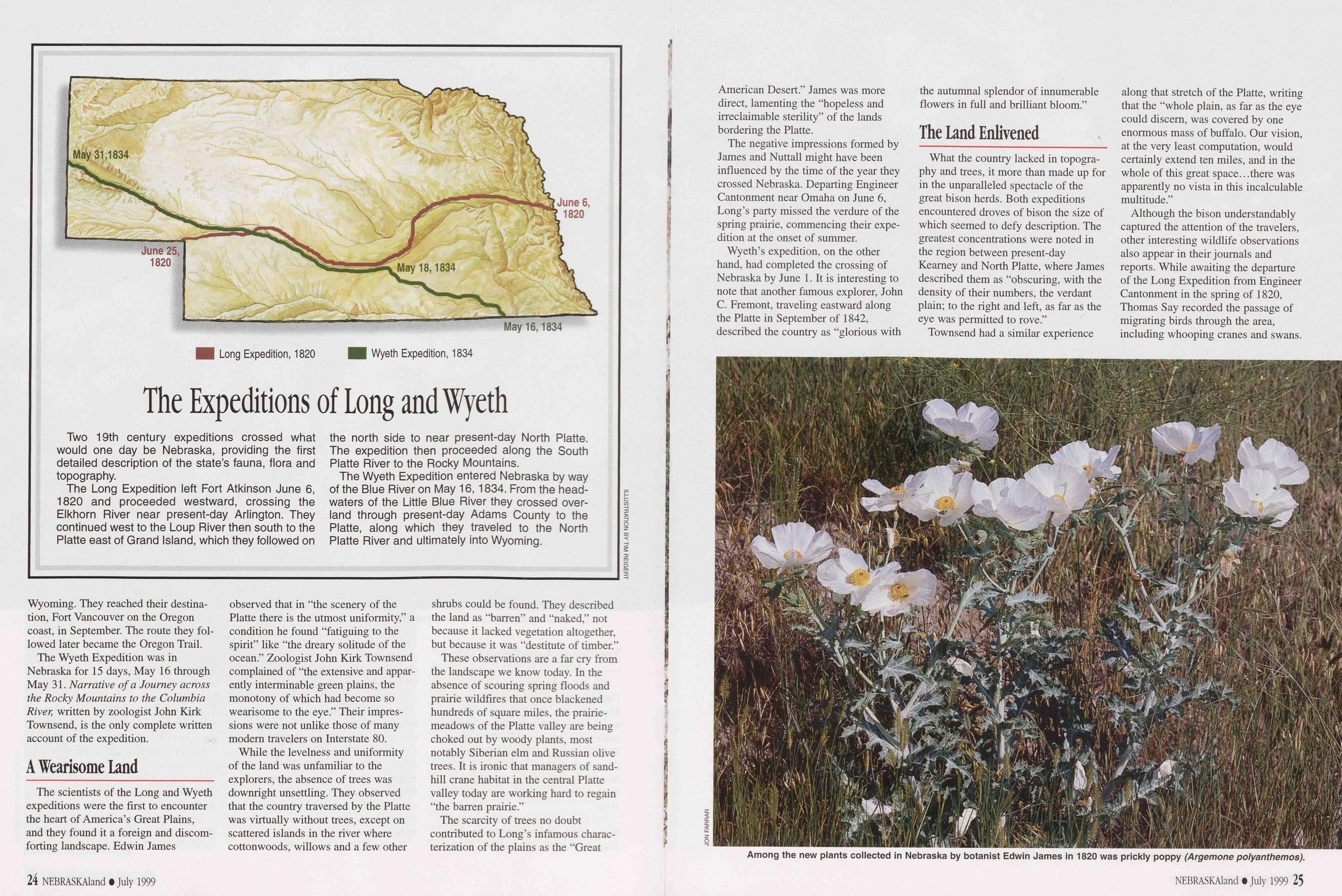
Two 19th century expeditions crossed what would one day be Nebraska, providing the first detailed description of the state's fauna, flora and topography.
The Long Expedition left Fort Atkinson June 6, 1820 and proceeded westward, crossing the Elkhorn River near present-day Arlington. They continued west to the Loup River then south to the Platte east of Grand Island, which they followed on the north side to near present-day North Platte. The expedition then proceeded along the South Platte River to the Rocky Mountains.
The Wyeth Expedition entered Nebraska by way of the Blue River on May 16,1834. From the headwaters of the Little Blue River they crossed overland through present-day Adams County to the Platte, along which they traveled to the North Platte River and ultimately into Wyoming.
The Wyeth Expedition was in Nebraska for 15 days, May 16 through May 31. Narrative of a Journey across the Rocky Mountains to the Columbia River, written by zoologist John Kirk Townsend, is the only complete written account of the expedition.
A Wearisome LandThe scientists of the Long and Wyeth expeditions were the first to encounter the heart of America's Great Plains, and they found it a foreign and discomforting landscape. Edwin James observed that in "the scenery of the Platte there is the utmost uniformity," a condition he found "fatiguing to the spirit" like "the dreary solitude of the ocean." Zoologist John Kirk Townsend complained of "the extensive and apparently interminable green plains, the monotony of which had become so wearisome to the eye." Their impressions were not unlike those of many modern travelers on Interstate 80.
While the levelness and uniformity of the land was unfamiliar to the explorers, the absence of trees was downright unsettling. They observed that the country traversed by the Platte was virtually without trees, except on scattered islands in the river where cottonwoods, willows and a few other shrubs could be found. They described the land as "barren" and "naked," not because it lacked vegetation altogether, but because it was "destitute of timber."
These observations are a far cry from the landscape we know today. In the absence of scouring spring floods and prairie wildfires that once blackened hundreds of square miles, the prairie meadows of the Platte valley are being choked out by woody plants, most notably Siberian elm and Russian olive trees. It is ironic that managers of sandhill crane habitat in the central Platte valley today are working hard to regain "the barren prairie."
The scarcity of trees no doubt contributed to Long's infamous characterization of the plains as the "Great 24 NEBRASKAland • July 1999 or American Desert." James was more direct, lamenting the "hopeless and irreclaimable sterility" of the lands bordering the Platte.
The negative impressions formed by James and Nuttall might have been influenced by the time of the year they crossed Nebraska. Departing Engineer Cantonment near Omaha on June 6, Long's party missed the verdure of the spring prairie, commencing their expedition at the onset of summer.
Wyeth's expedition, on the other hand, had completed the crossing of Nebraska by June 1. It is interesting to note that another famous explorer, John C. Fremont, traveling eastward along the Platte in September of 1842, described the country as "glorious with the autumnal splendor of innumerable flowers in full and brilliant bloom."
The Land EnlivenedWhat the country lacked in topography and trees, it more than made up for in the unparalleled spectacle of the great bison herds. Both expeditions encountered droves of bison the size of which seemed to defy description. The greatest concentrations were noted in the region between present-day Kearney and North Platte, where James described them as "obscuring, with the density of their numbers, the verdant plain; to the right and left, as far as the eye was permitted to rove."
Townsend had a similar experience along that stretch of the Platte, writing that the "whole plain, as far as the eye could discern, was covered by one enormous mass of buffalo. Our vision, at the very least computation, would certainly extend ten miles, and in the whole of this great space.. .there was apparently no vista in this incalculable multitude."
Although the bison understandably captured the attention of the travelers, other interesting wildlife observations also appear in their journals and reports. While awaiting the departure of the Long Expedition from Engineer Cantonment in the spring of 1820, Thomas Say recorded the passage of migrating birds through the area, including whooping cranes and swans.
Townsend noted "wolves and antelopes were in great abundance" where the Wyeth Expedition struck the Platte near present-day Kearney, and casually mentioned encountering a "large band of elk" in the same general area. Perhaps most surprising to modern readers of Townsend's journal is his sighting of a herd of wild horses near Chimney Rock in present-day Morrill County.
El Dorado on the PlatteHardships encountered on the expeditions were many, including hunger (a party from the Long Expedition survived for two days in New Mexico on a badger and burrowing owl), thirst, heat, cold, swarms of insects and innumerable other minor discomforts and actual dangers.
What would motivate a "scientific gentleman" to leave the comforts of the East and endure such travails, let alone the company of men "as rough as the grizzly bear?"
"None but a naturalist can appreciate a naturalist's feelings - his delight amounting to ecstacy - when a specimen such as he has never before seen, meets his eye," wrote Townsend, echoing a passion no doubt shared by scientists of both expeditions. Indeed, toward the end of his life botanist Edwin James said he would still "walk 100 miles to see a new plant."
The discovery of new species of plants and animals energized men like James, Say, Nuttall and Townsend. The unknown reaches of the Platte, never before scrutinized by trained naturalists, 26 NEBRASKAland • July 1999 did not disappoint them, and Townsend called one place along the North Platte River in Nebraska that was particularly rich in bird life, "the El Dorado of my fond anticipations."
The business of discovering new species requires a bit of explanation. To be officially recognized, a voucher specimen of the newly discovered plant or animal must be collected, preserved and deposited at a reputable museum, university or similar institution. Then it must be described in a scientific publication. The description must include a new, Latinized name, discussion of where the new species fits into current schemes of classification and details of where it was collected.
In scientific parlance, the collection upon which the description of a new species is based becomes the "type specimen." The collector of the type specimen is then recognized as the discoverer of the new species. The collector may publish the description of the new species, or someone else may do it based on their specimens.
For the Long Expedition, the discoveries began soon after arrival at Engineer Cantonment. Based on his later publications, it is estimated that Thomas Say collected at least 12 new species of beetles and six new species of true bugs while at the camp near Omaha. Among them was the colorful
 and well-known box elder bug
(Leptocoris trivitattus), delight of
children and bane of housekeepers. He
also became the first scientist to collect
and describe the least shrew (Blarina
brevicauda), a tiny, mouse-like
mammal, and two birds, the orange
crowned warbler (Vermivora celata)
and the long-billed dowitcher
(Limnodromus scolopaceus), all taken
while at Engineer Cantonment.
and well-known box elder bug
(Leptocoris trivitattus), delight of
children and bane of housekeepers. He
also became the first scientist to collect
and describe the least shrew (Blarina
brevicauda), a tiny, mouse-like
mammal, and two birds, the orange
crowned warbler (Vermivora celata)
and the long-billed dowitcher
(Limnodromus scolopaceus), all taken
while at Engineer Cantonment.
Of the 700 plant specimens collected by Edwin James along the route of the Long Expedition, about 140 were new species. Of that astounding number, perhaps his most famous discovery was an elegant sky-blue columbine (Aquilegia coerulea) that later became the state flower of Colorado.
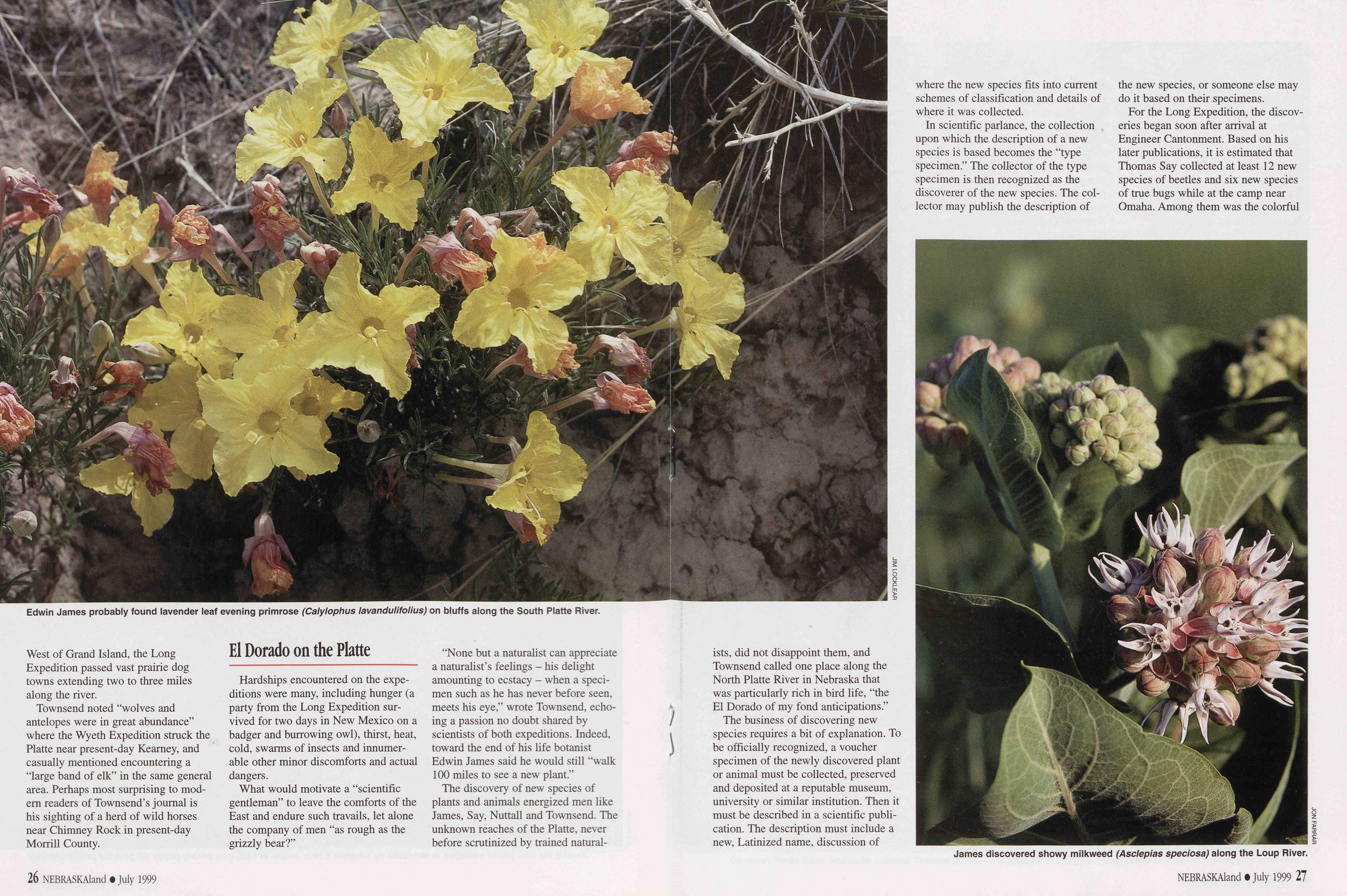
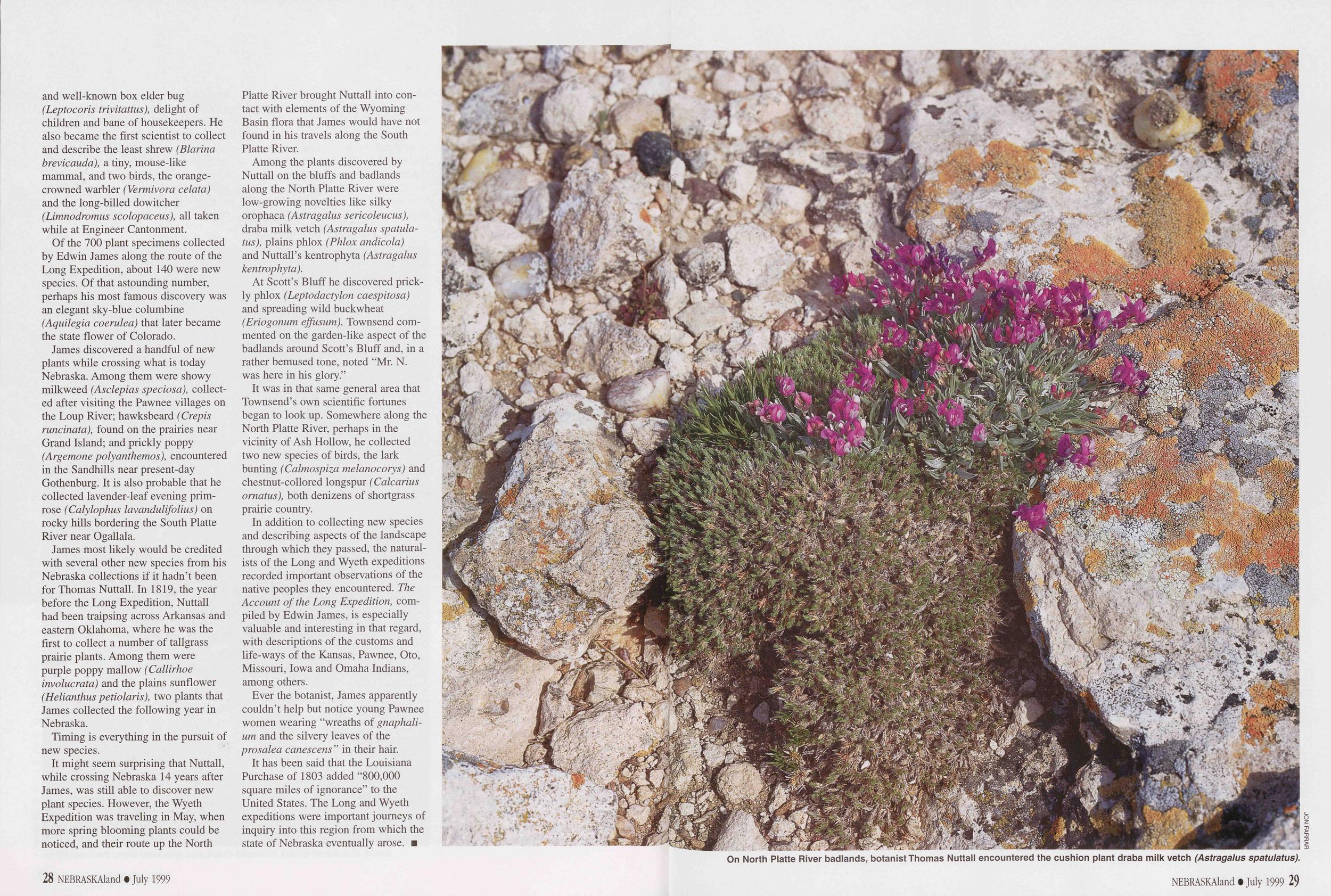
James discovered a handful of new plants while crossing what is today Nebraska. Among them were showy milkweed (Asclepias speciosa), collected after visiting the Pawnee villages on the Loup River; hawksbeard (Crepis runcinata), found on the prairies near Grand Island; and prickly poppy (Argemone polyanthemos), encountered in the Sandhills near present-day Gothenburg. It is also probable that he collected lavender-leaf evening primrose (Calylophus lavandulifolius) on rocky hills bordering the South Platte River near Ogallala.
James most likely would be credited with several other new species from his Nebraska collections if it hadn't been for Thomas Nuttall. In 1819, the year before the Long Expedition, Nuttall had been traipsing across Arkansas and eastern Oklahoma, where he was the first to collect a number of tallgrass prairie plants. Among them were purple poppy mallow (Callirhoe involucrata) and the plains sunflower (Helianthus petiolaris), two plants that James collected the following year in Nebraska.
Timing is everything in the pursuit of new species.
It might seem surprising that Nuttall, while crossing Nebraska 14 years after James, was still able to discover new plant species. However, the Wyeth Expedition was traveling in May, when more spring blooming plants could be noticed, and their route up the North Platte River brought Nuttall into contact with elements of the Wyoming Basin flora that James would have not found in his travels along the South Platte River.
Among the plants discovered by Nuttall on the bluffs and badlands along the North Platte River were low-growing novelties like silky orophaca (Astragalus sericoleucus), draba milk vetch (Astragalus spatulatus), plains phlox (Phlox andicola) and Nuttall's kentrophyta (Astragalus kentrophyta).
At Scott's Bluff he discovered prickly phlox (Leptodactylon caespitosa) and spreading wild buckwheat (Eriogonum effusum). Townsend commented on the garden-like aspect of the badlands around Scott's Bluff and, in a rather bemused tone, noted "Mr. N. was here in his glory."
It was in that same general area that Townsend's own scientific fortunes began to look up. Somewhere along the North Platte River, perhaps in the vicinity of Ash Hollow, he collected two new species of birds, the lark bunting (Calmospiza melanocorys) and chestnut-collored longspur (Calcarius ornatus), both denizens of shortgrass prairie country.
In addition to collecting new species and describing aspects of the landscape through which they passed, the naturalists of the Long and Wyeth expeditions recorded important observations of the native peoples they encountered. The Account of the Long Expedition, com- piled by Edwin James, is especially valuable and interesting in that regard, with descriptions of the customs and life-ways of the Kansas, Pawnee, Oto, Missouri, Iowa and Omaha Indians, among others.
Ever the botanist, James apparently couldn't help but notice young Pawnee women wearing "wreaths of gnaphalium and the silvery leaves of the prosalea canescens " in their hair.
It has been said that the Louisiana Purchase of 1803 added "800,000 square miles of ignorance" to the United States. The Long and Wyeth expeditions were important journeys of inquiry into this region from which the state of Nebraska eventually arose.
28 NEBRASKAland • July 1999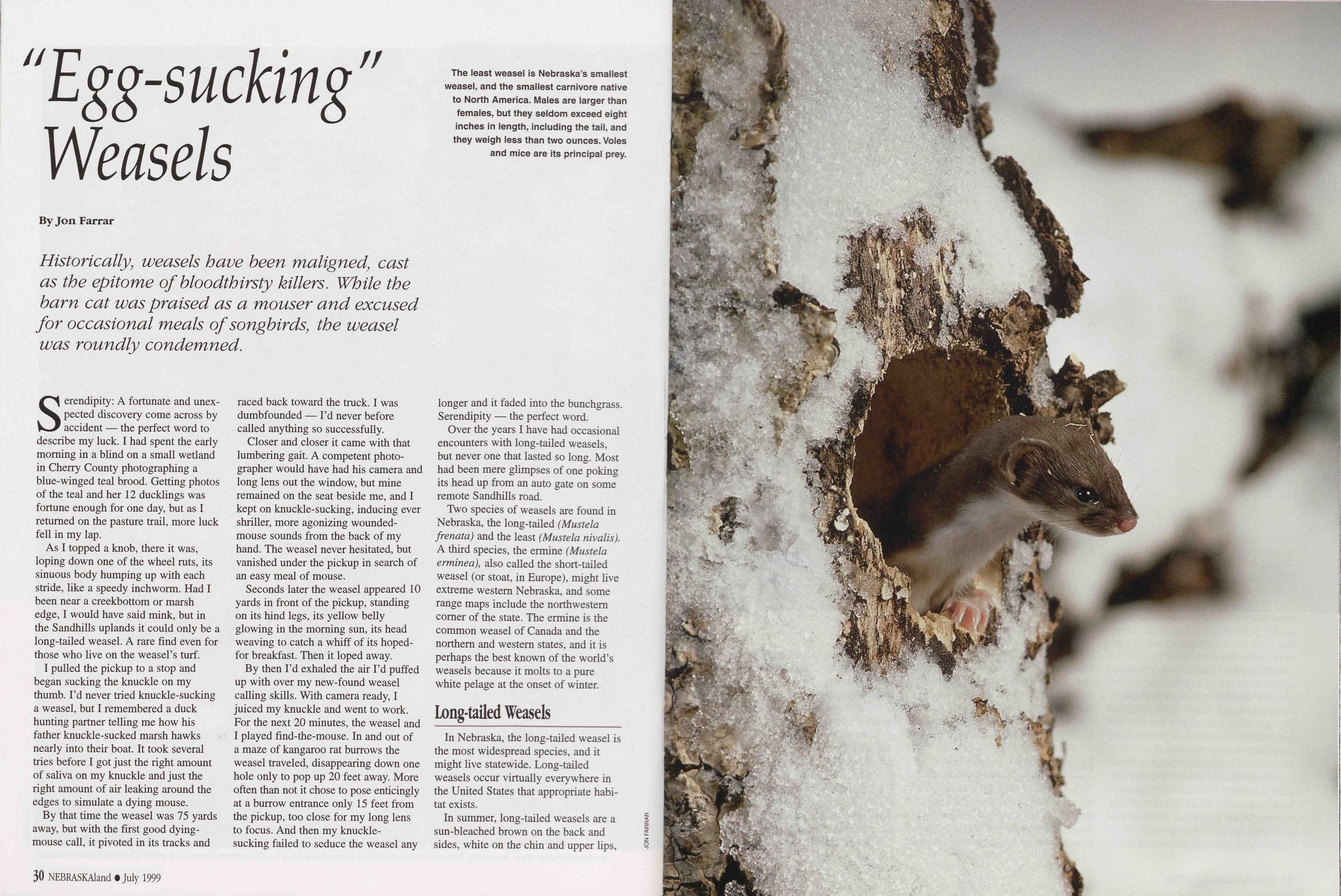
Egg-sucking Weasels
By Jon Farrar Historically, weasels have been maligned, cast as the epitome of bloodthirsty killers. While the barn cat was praised as a mouser and excused for occasional meals of songbirds, the weasel was roundly condemned.Serendipity: A fortunate and unexpected discovery come across by accident — the perfect word to describe my luck. I had spent the early morning in a blind on a small wetland in Cherry County photographing a blue-winged teal brood. Getting photos of the teal and her 12 ducklings was fortune enough for one day, but as I returned on the pasture trail, more luck fell in my lap.
As I topped a knob, there it was, loping down one of the wheel ruts, its sinuous body humping up with each stride, like a speedy inchworm. Had I been near a creek bottom or marsh edge, I would have said mink, but in the Sandhills uplands it could only be a long-tailed weasel. A rare find even for those who live on the weasel's turf.
I pulled the pickup to a stop and began sucking the knuckle on my thumb. I'd never tried knuckle-sucking a weasel, but I remembered a duck hunting partner telling me how his father knuckle-sucked marsh hawks nearly into their boat. It took several tries before I got just the right amount of saliva on my knuckle and just the right amount of air leaking around the edges to simulate a dying mouse.
By that time the weasel was 75 yards away, but with the first good dying mouse call, it pivoted in its tracks and raced back toward the truck. I was dumbfounded — I'd never before called anything so successfully.
Closer and closer it came with that lumbering gait. A competent photographer would have had his camera and long lens out the window, but mine remained on the seat beside me, and I kept on knuckle-sucking, inducing ever shriller, more agonizing wounded mouse sounds from the back of my hand. The weasel never hesitated, but vanished under the pickup in search of an easy meal of mouse.
Seconds later the weasel appeared 10 yards in front of the pickup, standing on its hind legs, its yellow belly glowing in the morning sun, its head weaving to catch a whiff of its hoped for breakfast. Then it loped away.
By then I'd exhaled the air I'd puffed up with over my new-found weasel calling skills. With camera ready, I juiced my knuckle and went to work. For the next 20 minutes, the weasel and I played find-the-mouse. In and out of a maze of kangaroo rat burrows the weasel traveled, disappearing down one hole only to pop up 20 feet away. More often than not it chose to pose enticingly at a burrow entrance only 15 feet from the pickup, too close for my long lens to focus. And then my knuckle sucking failed to seduce the weasel any longer and it faded into the bunchgrass. Serendipity — the perfect word.
Over the years I have had occasional encounters with long-tailed weasels, but never one that lasted so long. Most had been mere glimpses of one poking its head up from an auto gate on some remote Sandhills road.
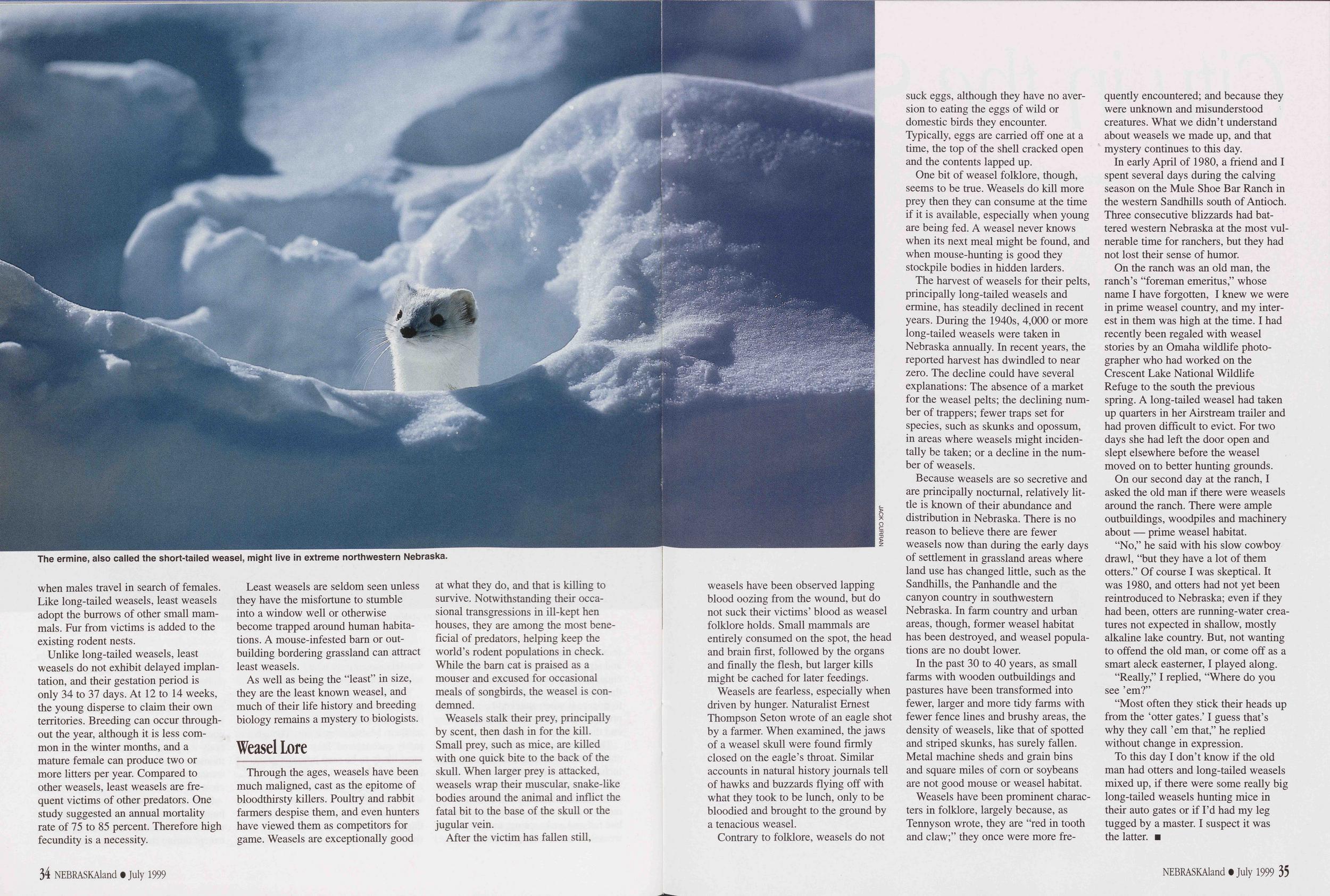
Two species of weasels are found in Nebraska, the long-tailed (Mustela frenata) and the least (Mustela nivalis). A third species, the ermine (Mustela erminea), also called the short-tailed weasel (or stoat, in Europe), might live extreme western Nebraska, and some range maps include the northwestern corner of the state. The ermine is the common weasel of Canada and the northern and western states, and it is perhaps the best known of the world's weasels because it molts to a pure white pelage at the onset of winter.
Long-tailed WeaselsIn Nebraska, the long-tailed weasel is the most widespread species, and it might live statewide. Long-tailed weasels occur virtually everywhere in the United States that appropriate habitat exists.
In summer, long-tailed weasels are a sun-bleached brown on the back and sides, white on the chin and upper hips,
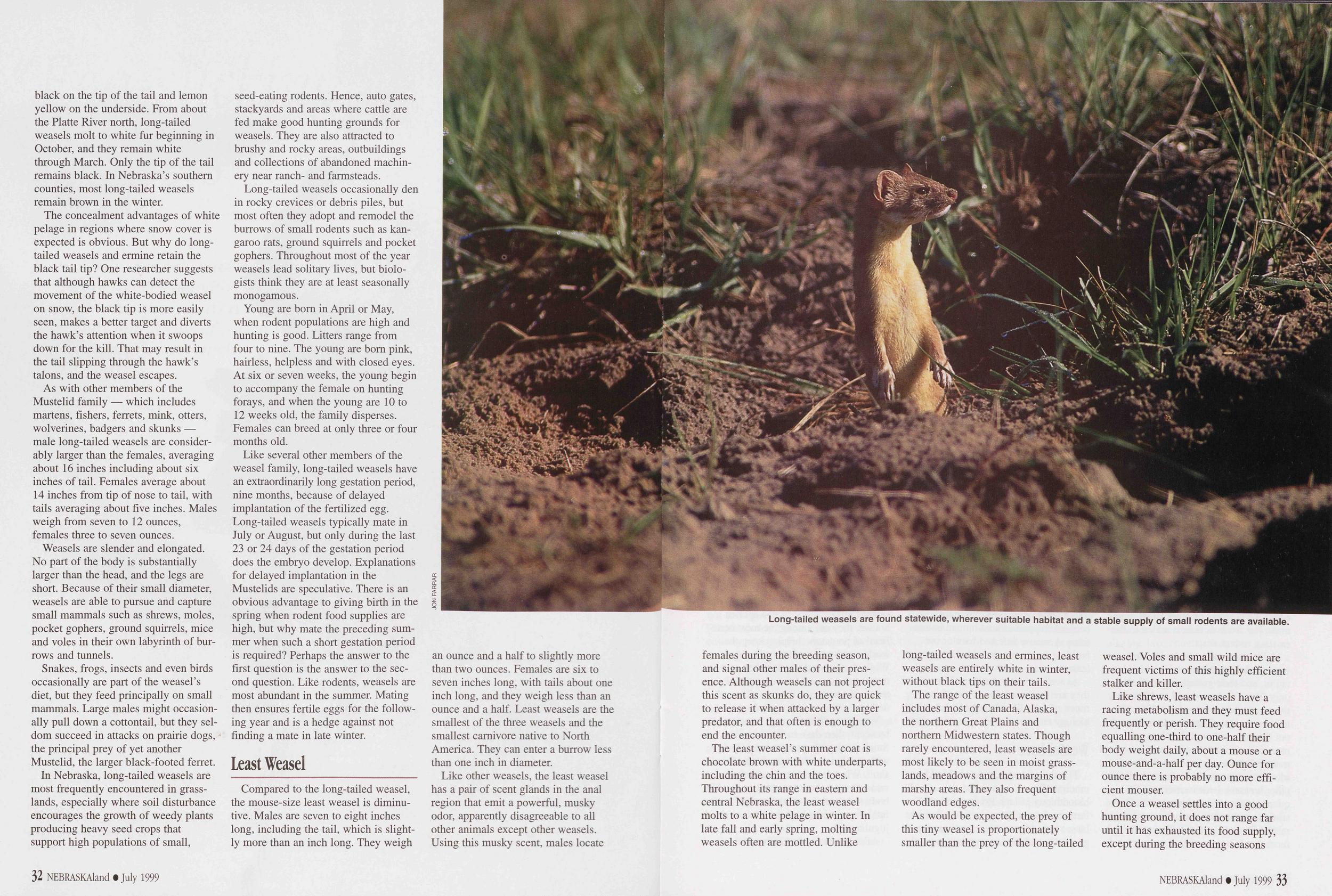 black on the tip of the tail and lemon
yellow on the underside. From about
the Platte River north, long-tailed
weasels molt to white fur beginning in
October, and they remain white
through March. Only the tip of the tail
remains black. In Nebraska's southern
counties, most long-tailed weasels
remain brown in the winter.
black on the tip of the tail and lemon
yellow on the underside. From about
the Platte River north, long-tailed
weasels molt to white fur beginning in
October, and they remain white
through March. Only the tip of the tail
remains black. In Nebraska's southern
counties, most long-tailed weasels
remain brown in the winter.
The concealment advantages of white pelage in regions where snow cover is expected is obvious. But why do longtailed weasels and ermine retain the black tail tip? One researcher suggests that although hawks can detect the movement of the white-bodied weasel on snow, the black tip is more easily seen, makes a better target and diverts the hawk's attention when it swoops down for the kill. That may result in the tail slipping through the hawk's talons, and the weasel escapes.
As with other members of the Mustelid family — which includes martens, fishers, ferrets, mink, otters, wolverines, badgers and skunks — male long-tailed weasels are considerably larger than the females, averaging about 16 inches including about six inches of tail. Females average about 14 inches from tip of nose to tail, with tails averaging about five inches. Males weigh from seven to 12 ounces, females three to seven ounces.
Weasels are slender and elongated. No part of the body is substantially larger than the head, and the legs are short. Because of their small diameter, weasels are able to pursue and capture small mammals such as shrews, moles, pocket gophers, ground squirrels, mice and voles in their own labyrinth of burrows and tunnels.
Snakes, frogs, insects and even birds occasionally are part of the weasel's diet, but they feed principally on small mammals. Large males might occasionally pull down a cottontail, but they seldom succeed in attacks on prairie dogs, the principal prey of yet another Mustelid, the larger black-footed ferret.
In Nebraska, long-tailed weasels are most frequently encountered in grasslands, especially where soil disturbance encourages the growth of weedy plants producing heavy seed crops that support high populations of small, seed-eating rodents. Hence, auto gates, stack yards and areas where cattle are fed make good hunting grounds for weasels. They are also attracted to brushy and rocky areas, outbuildings and collections of abandoned machinery near ranch- and farmsteads.
Long-tailed weasels occasionally den in rocky crevices or debris piles, but most often they adopt and remodel the burrows of small rodents such as kangaroo rats, ground squirrels and pocket gophers. Throughout most of the year weasels lead solitary lives, but biologists think they are at least seasonally monogamous.
Young are born in April or May, when rodent populations are high and hunting is good. Litters range from four to nine. The young are born pink, hairless, helpless and with closed eyes. At six or seven weeks, the young begin to accompany the female on hunting forays, and when the young are 10 to 12 weeks old, the family disperses. Females can breed at only three or four months old.
Like several other members of the weasel family, long-tailed weasels have an extraordinarily long gestation period, nine months, because of delayed implantation of the fertilized egg. Long-tailed weasels typically mate in July or August, but only during the last 23 or 24 days of the gestation period does the embryo develop. Explanations for delayed implantation in the Mustelids are speculative. There is an obvious advantage to giving birth in the spring when rodent food supplies are high, but why mate the preceding summer when such a short gestation period is required? Perhaps the answer to the first question is the answer to the second question. Like rodents, weasels are most abundant in the summer. Mating then ensures fertile eggs for the following year and is a hedge against not finding a mate in late winter.
Least WeaselCompared to the long-tailed weasel, the mouse-size least weasel is diminutive. Males are seven to eight inches long, including the tail, which is slightly more than an inch long. They weigh an ounce and a half to slightly more than two ounces. Females are six to seven inches long, with tails about one inch long, and they weigh less than an ounce and a half. Least weasels are the smallest of the three weasels and the smallest carnivore native to North America. They can enter a burrow less than one inch in diameter.
Like other weasels, the least weasel has a pair of scent glands in the anal region that emit a powerful, musky odor, apparently disagreeable to all other animals except other weasels. Using this musky scent, males locate 32 NEBRASKAland • July 1999
The least weasel's summer coat is chocolate brown with white underparts, including the chin and the toes. Throughout its range in eastern and central Nebraska, the least weasel molts to a white pelage in winter. In late fall and early spring, molting weasels often are mottled. Unlike long-tailed weasels and ermines, least weasels are entirely white in winter, without black tips on their tails.
The range of the least weasel includes most of Canada, Alaska, the northern Great Plains and northern Midwestern states. Though rarely encountered, least weasels are most likely to be seen in moist grasslands, meadows and the margins of marshy areas. They also frequent woodland edges.
As would be expected, the prey of this tiny weasel is proportionately smaller than the prey of the long-tailed weasel. Voles and small wild mice are frequent victims of this highly efficient stalker and killer.
Like shrews, least weasels have a racing metabolism and they must feed frequently or perish. They require food equalling one-third to one-half their body weight daily, about a mouse or a mouse-and-a-half per day. Ounce for ounce there is probably no more efficient mouser.
Once a weasel settles into a good
hunting ground, it does not range far
until it has exhausted its food supply,
except during the breeding seasons
NEBRASKAland • July 1999 33
Unlike long-tailed weasels, least weasels do not exhibit delayed implantation, and their gestation period is only 34 to 37 days. At 12 to 14 weeks, the young disperse to claim their own territories. Breeding can occur throughout the year, although it is less common in the winter months, and a mature female can produce two or more litters per year. Compared to other weasels, least weasels are frequent victims of other predators. One study suggested an annual mortality rate of 75 to 85 percent. Therefore high fecundity is a necessity.
Least weasels are seldom seen unless they have the misfortune to stumble into a window well or otherwise become trapped around human habitations. A mouse-infested barn or out- building bordering grassland can attract least weasels.
As well as being the "least" in size, they are the least known weasel, and much of their life history and breeding biology remains a mystery to biologists.
Weasel LoreThrough the ages, weasels have been much maligned, cast as the epitome of bloodthirsty killers. Poultry and rabbit fanners despise them, and even hunters have viewed them as competitors for game. Weasels are exceptionally good at what they do, and that is killing to survive. Notwithstanding their occasional transgressions in ill-kept hen houses, they are among the most beneficial of predators, helping keep the world's rodent populations in check. While the barn cat is praised as a mouser and excused for occasional meals of songbirds, the weasel is condemned.
Weasels stalk their prey, principally by scent, then dash in for the kill. Small prey, such as mice, are killed with one quick bite to the back of the skull. When larger prey is attacked, weasels wrap their muscular, snake-like bodies around the animal and inflict the fatal bit to the base of the skull or the jugular vein.
After the victim has fallen still, 34 NEBRASKAland • July 1999 weasels have been observed lapping blood oozing from the wound, but do not suck their victims' blood as weasel folklore holds. Small mammals are entirely consumed on the spot, the head and brain first, followed by the organs and finally the flesh, but larger kills might be cached for later feedings.
Weasels are fearless, especially when driven by hunger. Naturalist Ernest Thompson Seton wrote of an eagle shot by a farmer. When examined, the jaws of a weasel skull were found firmly closed on the eagle's throat. Similar accounts in natural history journals tell of hawks and buzzards flying off with what they took to be lunch, only to be bloodied and brought to the ground by a tenacious weasel.
Contrary to folklore, weasels do not suck eggs, although they have no aversion to eating the eggs of wild or domestic birds they encounter. Typically, eggs are carried off one at a time, the top of the shell cracked open and the contents lapped up.
One bit of weasel folklore, though, seems to be true. Weasels do kill more prey then they can consume at the time if it is available, especially when young are being fed. A weasel never knows when its next meal might be found, and when mouse-hunting is good they stockpile bodies in hidden larders.
The harvest of weasels for their pelts, principally long-tailed weasels and ermine, has steadily declined in recent years. During the 1940s, 4,000 or more long-tailed weasels were taken in Nebraska annually. In recent years, the reported harvest has dwindled to near zero. The decline could have several explanations: The absence of a market for the weasel pelts; the declining number of trappers; fewer traps set for species, such as skunks and opossum, in areas where weasels might incidentally be taken; or a decline in the number of weasels.
Because weasels are so secretive and are principally nocturnal, relatively little is known of their abundance and distribution in Nebraska. There is no reason to believe there are fewer weasels now than during the early days of settlement in grassland areas where land use has changed little, such as the Sandhills, the Panhandle and the canyon country in southwestern Nebraska. In farm country and urban areas, though, former weasel habitat has been destroyed, and weasel populations are no doubt lower.
In the past 30 to 40 years, as small farms with wooden outbuildings and pastures have been transformed into fewer, larger and more tidy farms with fewer fence lines and brushy areas, the density of weasels, like that of spotted and striped skunks, has surely fallen. Metal machine sheds and grain bins and square miles of corn or soybeans are not good mouse or weasel habitat.
Weasels have been prominent characters in folklore, largely because, as Tennyson wrote, they are "red in tooth and claw;" they once were more frequently encountered; and because they were unknown and misunderstood creatures. What we didn't understand about weasels we made up, and that mystery continues to this day.
In early April of 1980, a friend and I spent several days during the calving season on the Mule Shoe Bar Ranch in the western Sandhills south of Antioch. Three consecutive blizzards had battered western Nebraska at the most vulnerable time for ranchers, but they had not lost their sense of humor.
On the ranch was an old man, the ranch's "foreman emeritus," whose name I have forgotten, I knew we were in prime weasel country, and my interest in them was high at the time. I had recently been regaled with weasel stories by an Omaha wildlife photographer who had worked on the Crescent Lake National Wildlife Refuge to the south the previous spring. A long-tailed weasel had taken up quarters in her Airstream trailer and had proven difficult to evict. For two days she had left the door open and slept elsewhere before the weasel moved on to better hunting grounds.
On our second day at the ranch, I asked the old man if there were weasels around the ranch. There were ample outbuildings, woodpiles and machinery about — prime weasel habitat.
"No," he said with his slow cowboy drawl, "but they have a lot of them otters." Of course I was skeptical. It was 1980, and otters had not yet been reintroduced to Nebraska; even if they had been, otters are running-water creatures not expected in shallow, mostly alkaline lake country. But, not wanting to offend the old man, or come off as a smart aleck easterner, I played along.
"Really," I replied, "Where do you see 'em?"
"Most often they stick their heads up from the 'otter gates.' I guess that's why they call 'em that," he replied without change in expression.
To this day I don't know if the old man had otters and long-tailed weasels mixed up, if there were some really big long-tailed weasels hunting mice in their auto gates or if I'd had my leg tugged by a master. I suspect it was the latter.
NEBRASKAland • July 1999 35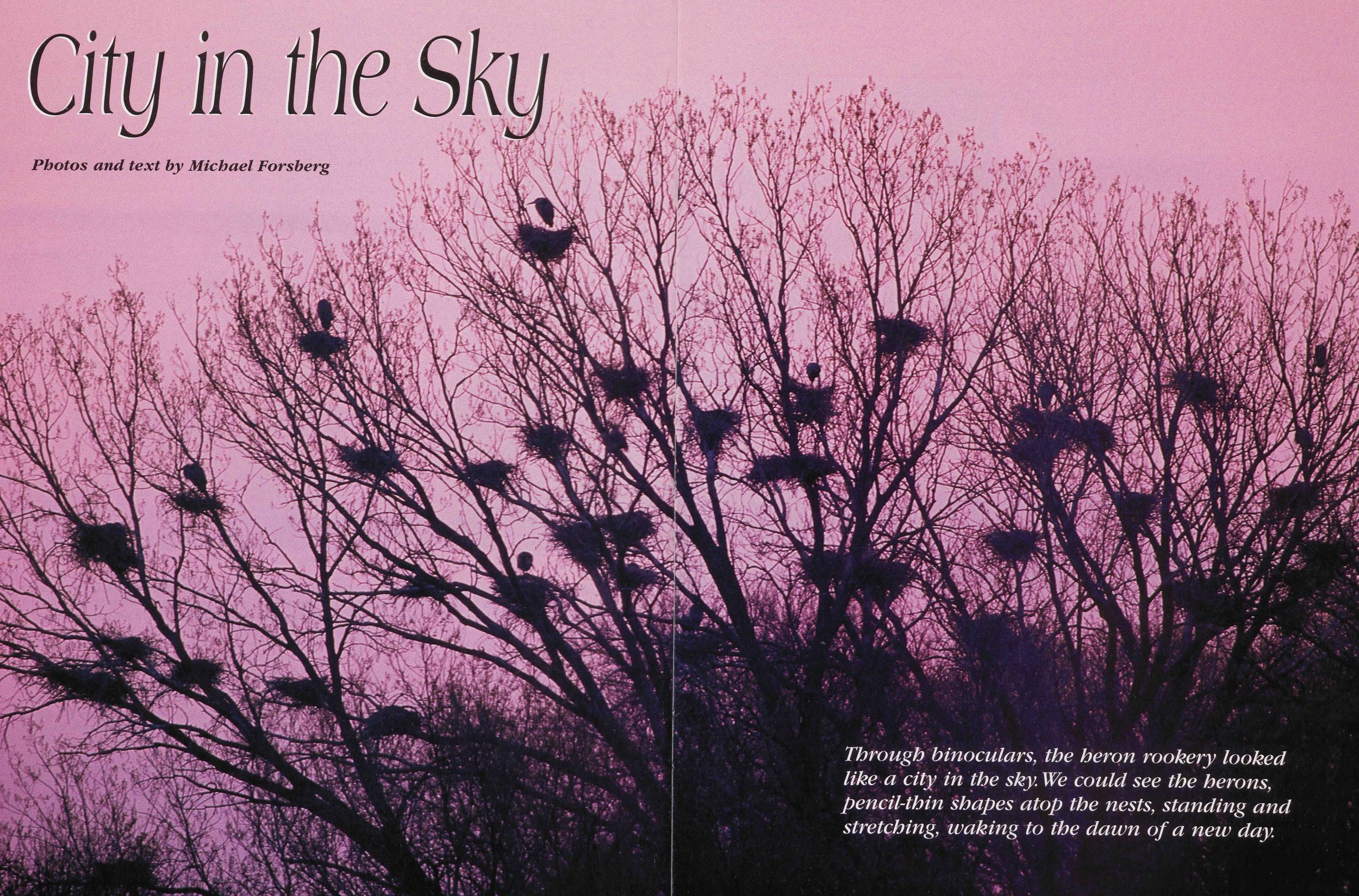
City in the Sky
Photos and text by Michael Forsberg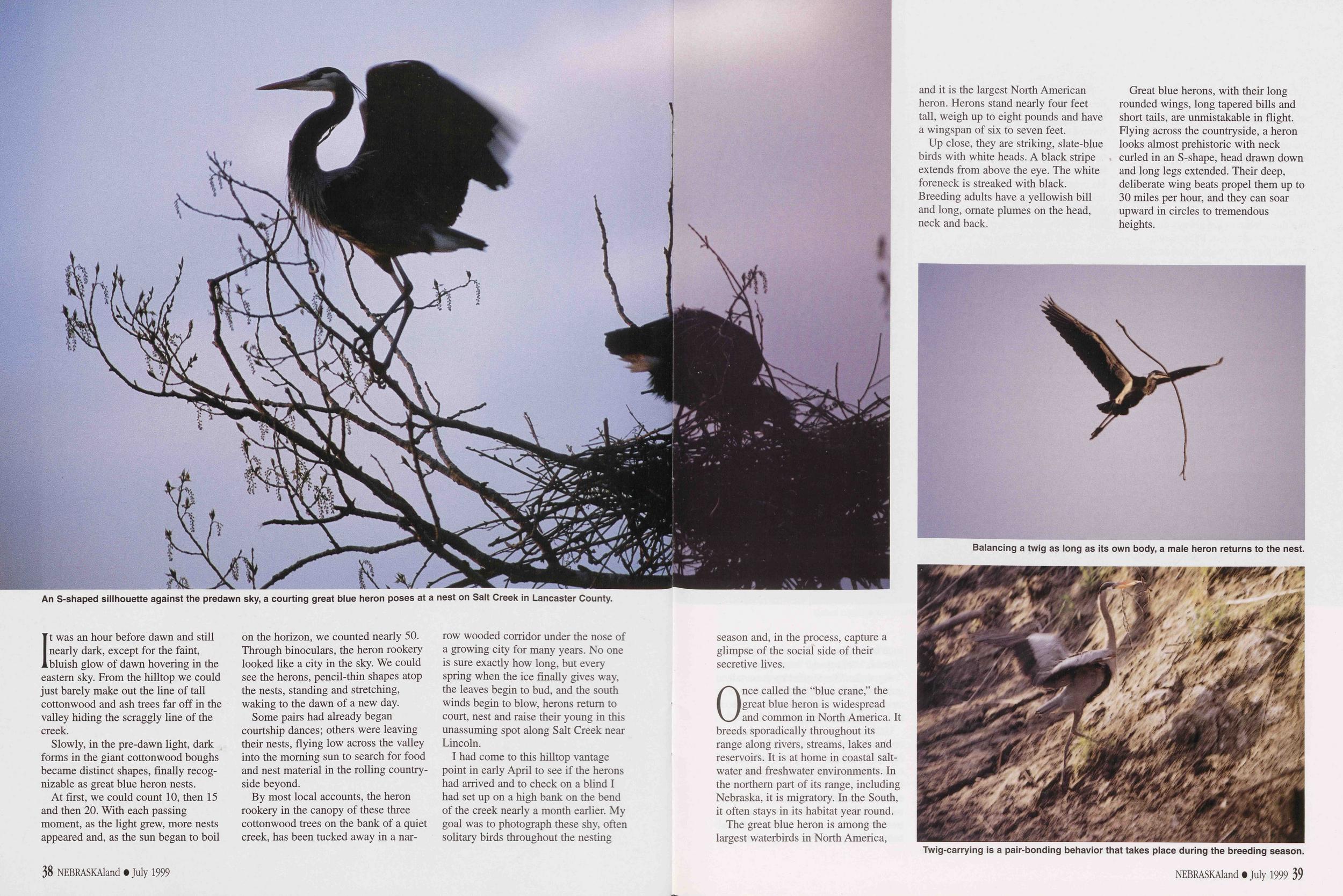
It was an hour before dawn and still nearly dark, except for the faint, bluish glow of dawn hovering in the eastern sky. From the hilltop we could just barely make out the line of tall cottonwood and ash trees far off in the valley hiding the scraggly line of the creek.
Slowly, in the pre-dawn light, dark forms in the giant cottonwood boughs became distinct shapes, finally recognizable as great blue heron nests.
At first, we could count 10, then 15 and then 20. With each passing moment, as the light grew, more nests appeared and, as the sun began to boil on the horizon, we counted nearly 50. Through binoculars, the heron rookery looked like a city in the sky. We could see the herons, pencil-thin shapes atop the nests, standing and stretching, waking to the dawn of a new day.
Some pairs had already began courtship dances; others were leaving their nests, flying low across the valley into the morning sun to search for food and nest material in the rolling countryside beyond.
By most local accounts, the heron rookery in the canopy of these three cottonwood trees on the bank of a quiet creek, has been tucked away in a narrow wooded corridor under the nose of a growing city for many years. No one is sure exactly how long, but every spring when the ice finally gives way, the leaves begin to bud, and the south winds begin to blow, herons return to court, nest and raise their young in this unassuming spot along Salt Creek near Lincoln.
I had come to this hilltop vantage point in early April to see if the herons had arrived and to check on a blind I had set up on a high bank on the bend of the creek nearly a month earlier. My goal was to photograph these shy, often solitary birds throughout the nesting 38 NEBRASKAland • July 1999 season and, in the process, capture a glimpse of the social side of their secretive lives.
Once called the "blue crane," the great blue heron is widespread and common in North America. It breeds sporadically throughout its range along rivers, streams, lakes and reservoirs. It is at home in coastal saltwater and freshwater environments. In the northern part of its range, including Nebraska, it is migratory. In the South, it often stays in its habitat year round.
The great blue heron is among the largest waterbirds in North America, and it is the largest North American heron. Herons stand nearly four feet tall, weigh up to eight pounds and have a wingspan of six to seven feet.
Up close, they are striking, slate-blue birds with white heads. A black stripe extends from above the eye. The white foreneck is streaked with black. Breeding adults have a yellowish bill and long, ornate plumes on the head, neck and back.
Great blue herons, with their long rounded wings, long tapered bills and short tails, are unmistakable in flight. Flying across the countryside, a heron looks almost prehistoric with neck curled in an S-shape, head drawn down and long legs extended. Their deep, deliberate wing beats propel them up to 30 miles per hour, and they can soar upward in circles to tremendous heights.
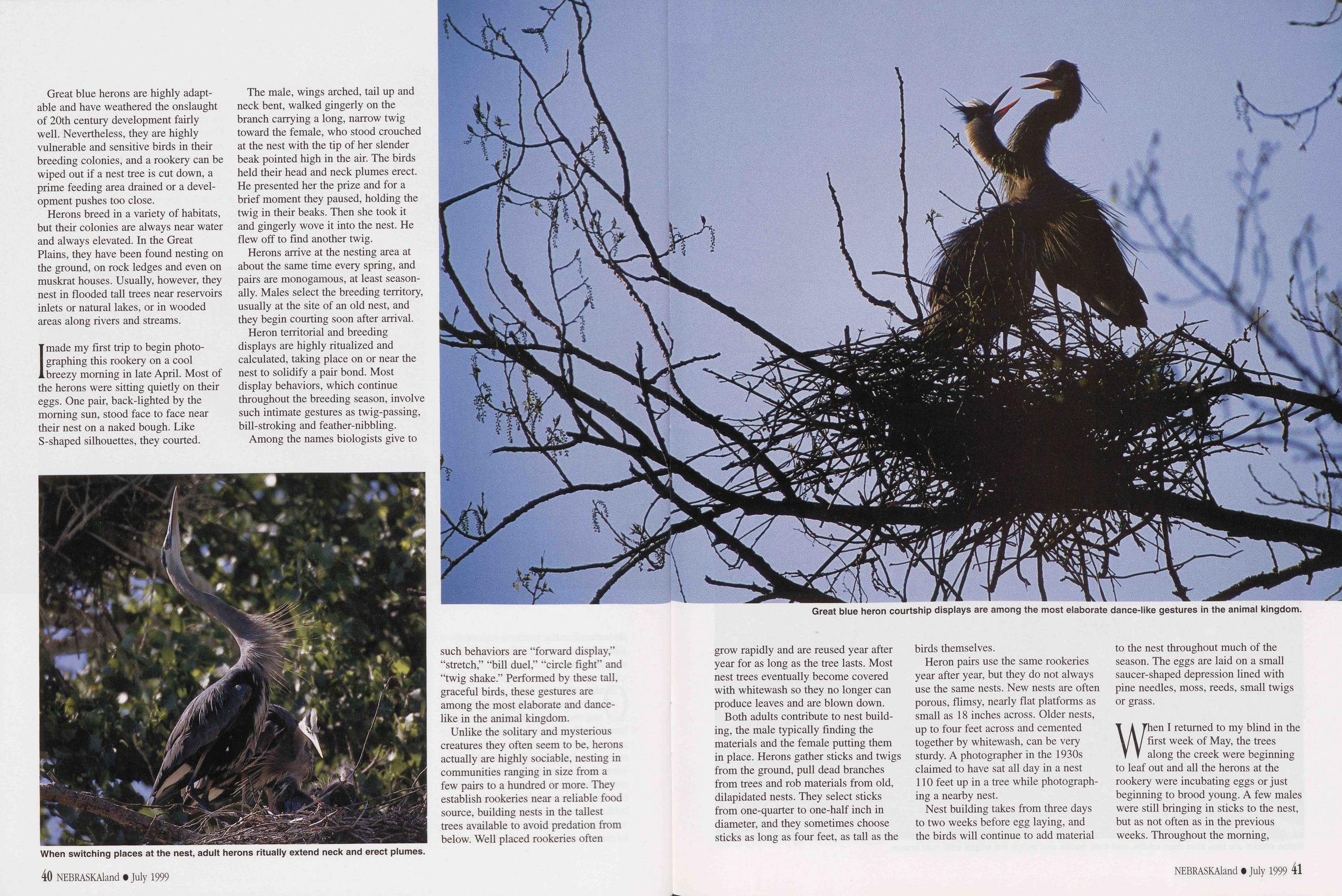
Great blue herons are highly adaptable and have weathered the onslaught of 20th century development fairly well. Nevertheless, they are highly vulnerable and sensitive birds in their breeding colonies, and a rookery can be wiped out if a nest tree is cut down, a prime feeding area drained or a development pushes too close.
Herons breed in a variety of habitats, but their colonies are always near water and always elevated. In the Great Plains, they have been found nesting on the ground, on rock ledges and even on muskrat houses. Usually, however, they nest in flooded tall trees near reservoirs inlets or natural lakes, or in wooded areas along rivers and streams.
I made my first trip to begin photographing this rookery on a cool breezy morning in late April. Most of the herons were sitting quietly on their eggs. One pair, back-lighted by the morning sun, stood face to face near their nest on a naked bough. Like S-shaped silhouettes, they courted.
The male, wings arched, tail up and neck bent, walked gingerly on the branch carrying a long, narrow twig toward the female, who stood crouched at the nest with the tip of her slender beak pointed high in the air. The birds held their head and neck plumes erect. He presented her the prize and for a brief moment they paused, holding the twig in their beaks. Then she took it and gingerly wove it into the nest. He flew off to find another twig.
Herons arrive at the nesting area at about the same time every spring, and pairs are monogamous, at least seasonally. Males select the breeding territory, usually at the site of an old nest, and they begin courting soon after arrival.
Heron territorial and breeding displays are highly ritualized and calculated, taking place on or near the nest to solidify a pair bond. Most display behaviors, which continue throughout the breeding season, involve such intimate gestures as twig-passing, bill-stroking and feather-nibbling.
Among the names biologists give to such behaviors are "forward display," stretch," "bill duel," "circle fight" and twig shake." Performed by these tall, graceful birds, these gestures are among the most elaborate and dance like in the animal kingdom.
Unlike the solitary and mysterious creatures they often seem to be, herons actually are highly sociable, nesting in communities ranging in size from a few pairs to a hundred or more. They establish rookeries near a reliable food source, building nests in the tallest trees available to avoid predation from below. Well placed rookeries often
Both adults contribute to nest building, the male typically finding the materials and the female putting them in place. Herons gather sticks and twigs from the ground, pull dead branches from trees and rob materials from old, dilapidated nests. They select sticks from one-quarter to one-half inch in diameter, and they sometimes choose sticks as long as four feet, as tall as the birds themselves.
Heron pairs use the same rookeries year after year, but they do not always use the same nests. New nests are often porous, flimsy, nearly flat platforms as small as 18 inches across. Older nests, up to four feet across and cemented together by whitewash, can be very sturdy. A photographer in the 1930s claimed to have sat all day in a nest 110 feet up in a tree while photographing a nearby nest.
Nest building takes from three days to two weeks before egg laying, and the birds will continue to add material to the nest throughout much of the season. The eggs are laid on a small saucer-shaped depression lined with pine needles, moss, reeds, small twigs or grass.
I returned to my blind in the
week of May, the trees
the creek were beginning
to leaf out and all the herons at the
rookery were incubating eggs or just
beginning to brood young. A few males
were still bringing in sticks to the nest,
but as not often as in the previous
weeks. Throughout the morning,
NEBRASKAland • July 1999 41
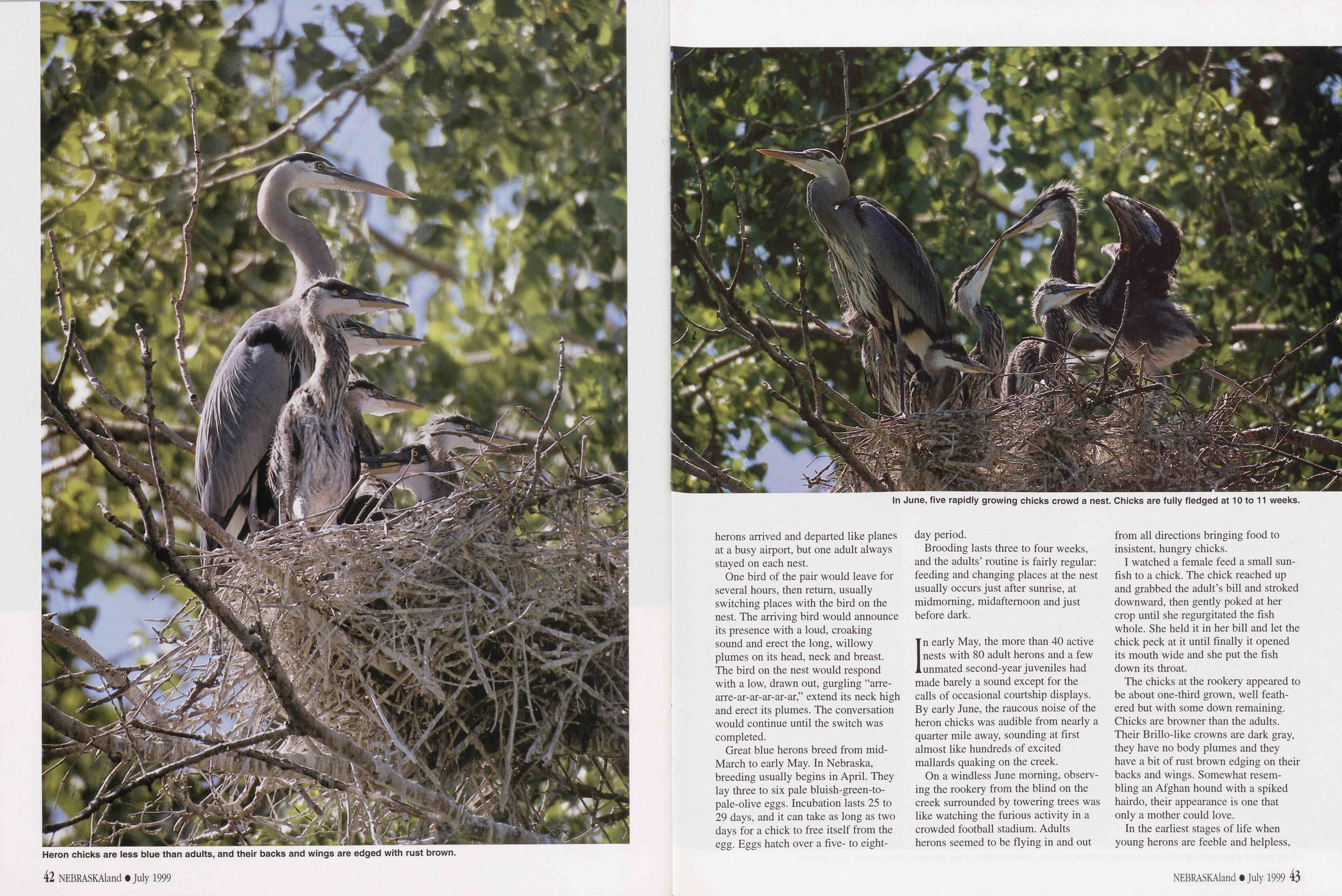
One bird of the pair would leave for several hours, then return, usually switching places with the bird on the nest. The arriving bird would announce its presence with a loud, croaking sound and erect the long, willowy plumes on its head, neck and breast. The bird on the nest would respond with a low, drawn out, gurgling "arre-arre-ar-ar-ar-ar-ar," extend its neck high and erect its plumes. The conversation would continue until the switch was completed.
Great blue herons breed from mid- March to early May. In Nebraska, breeding usually begins in April. They lay three to six pale bluish-green-to-pale-olive eggs. Incubation lasts 25 to 29 days, and it can take as long as two days for a chick to free itself from the egg. Eggs hatch over a five- to eight- day period.
Brooding lasts three to four weeks, and the adults' routine is fairly regular: feeding and changing places at the nest usually occurs just after sunrise, at midmorning, midafternoon and just before dark.
In early May, the more than 40 active nests with 80 adult herons and a few unmated second-year juveniles had made barely a sound except for the calls of occasional courtship displays. By early June, the raucous noise of the heron chicks was audible from nearly a quarter mile away, sounding at first almost like hundreds of excited mallards quaking on the creek.
On a windless June morning, observing the rookery from the blind on the creek surrounded by towering trees was like watching the furious activity in a crowded football stadium. Adults herons seemed to be flying in and out from all directions bringing food to insistent, hungry chicks.
I watched a female feed a small sunfish to a chick. The chick reached up and grabbed the adult's bill and stroked downward, then gently poked at her crop until she regurgitated the fish whole. She held it in her bill and let the chick peck at it until finally it opened its mouth wide and she put the fish down its throat.
The chicks at the rookery appeared to be about one-third grown, well feathered but with some down remaining. Chicks are browner than the adults. Their Brillo-like crowns are dark gray, they have no body plumes and they have a bit of rust brown edging on their backs and wings. Somewhat resembling an Afghan hound with a spiked hairdo, their appearance is one that only a mother could love.
In the earliest stages of life when
young herons are feeble and helpless,
NEBRASKAland • July 1999 43
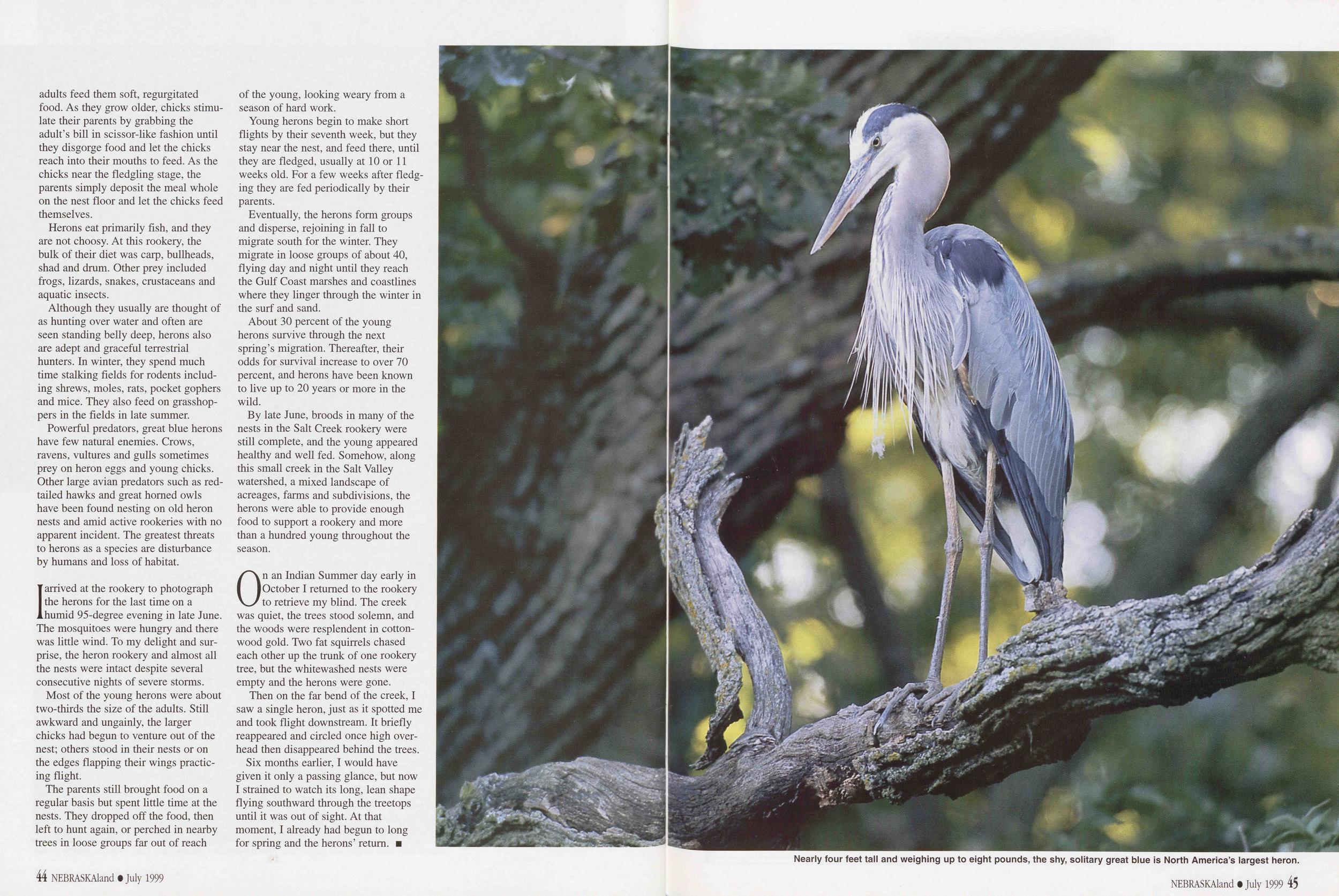 adults feed them soft, regurgitated
food. As they grow older, chicks
stimulate their parents by grabbing the
adult's bill in scissor-like fashion until
they disgorge food and let the chicks
reach into their mouths to feed. As the
chicks near the fledgling stage, the
parents simply deposit the meal whole
on the nest floor and let the chicks feed
themselves.
adults feed them soft, regurgitated
food. As they grow older, chicks
stimulate their parents by grabbing the
adult's bill in scissor-like fashion until
they disgorge food and let the chicks
reach into their mouths to feed. As the
chicks near the fledgling stage, the
parents simply deposit the meal whole
on the nest floor and let the chicks feed
themselves.
Herons eat primarily fish, and they are not choosy. At this rookery, the bulk of their diet was carp, bullheads, shad and drum. Other prey included frogs, lizards, snakes, crustaceans and aquatic insects.
Although they usually are thought of as hunting over water and often are seen standing belly deep, herons also are adept and graceful terrestrial hunters. In winter, they spend much time stalking fields for rodents including shrews, moles, rats, pocket gophers and mice. They also feed on grasshoppers in the fields in late summer.
Powerful predators, great blue herons have few natural enemies. Crows, ravens, vultures and gulls sometimes prey on heron eggs and young chicks. Other large avian predators such as redtailed hawks and great horned owls have been found nesting on old heron nests and amid active rookeries with no apparent incident. The greatest threats to herons as a species are disturbance by humans and loss of habitat.
I arrived at the rookery to photograph the herons for the last time on a humid 95-degree evening in late June. The mosquitoes were hungry and there was little wind. To my delight and surprise, the heron rookery and almost all the nests were intact despite several consecutive nights of severe storms.
Most of the young herons were about two-thirds the size of the adults. Still awkward and ungainly, the larger chicks had begun to venture out of the nest; others stood in their nests or on the edges flapping their wings practicing flight.
The parents still brought food on a regular basis but spent little time at the nests. They dropped off the food, then left to hunt again, or perched in nearby trees in loose groups far out of reach of the young, looking weary from a season of hard work.
Young herons begin to make short flights by their seventh week, but they stay near the nest, and feed there, until they are fledged, usually at 10 or 11 weeks old. For a few weeks after fledging they are fed periodically by their parents.
Eventually, the herons form groups and disperse, rejoining in fall to migrate south for the winter. They migrate in loose groups of about 40, flying day and night until they reach the Gulf Coast marshes and coastlines where they linger through the winter in the surf and sand.
About 30 percent of the young herons survive through the next spring's migration. Thereafter, their odds for survival increase to over 70 percent, and herons have been known to live up to 20 years or more in the wild.
By late June, broods in many of the nests in the Salt Creek rookery were still complete, and the young appeared healthy and well fed. Somehow, along this small creek in the Salt Valley watershed, a mixed landscape of acreages, farms and subdivisions, the herons were able to provide enough food to support a rookery and more than a hundred young throughout the season.
On an Indian Summer day early in October I returned to the rookery to retrieve my blind. The creek was quiet, the trees stood solemn, and the woods were resplendent in cotton- wood gold. Two fat squirrels chased each other up the trunk of one rookery tree, but the whitewashed nests were empty and the herons were gone.
Then on the far bend of the creek, I saw a single heron, just as it spotted me and took flight downstream. It briefly reappeared and circled once high over- head then disappeared behind the trees.
Six months earlier, I would have given it only a passing glance, but now I strained to watch its long, lean shape flying southward through the treetops until it was out of sight. At that moment, I already had begun to long for spring and the herons' return.
44 NEBRASKAland • July 1999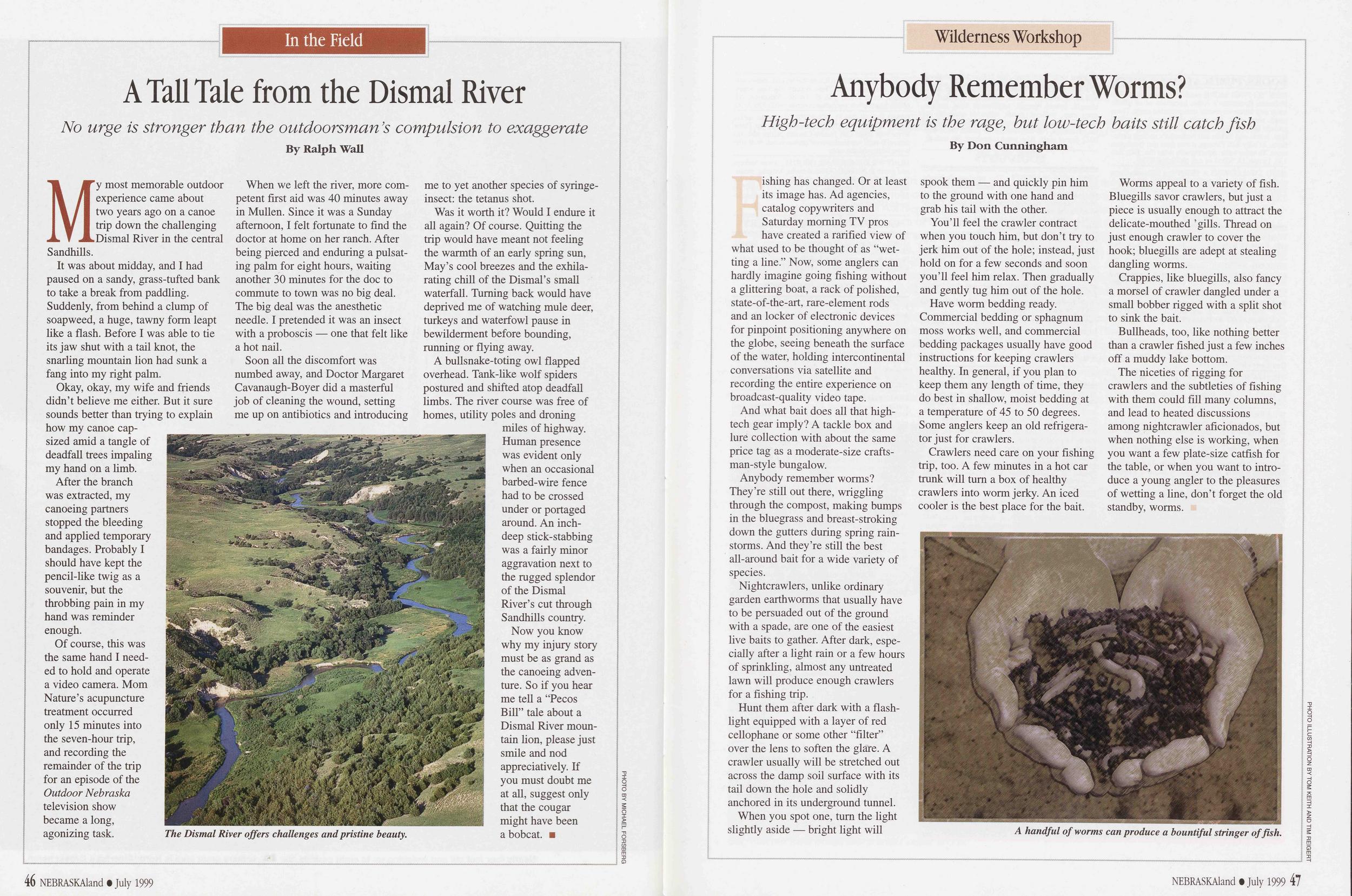
In the Field
A Tall Tale from the Dismal River
No urge is stronger than the outdoorsman's compulsion to exaggerate By Ralph WallMy most memorable outdoor experience came about two years ago on a canoe trip down the challenging Dismal River in the central Sandhills.
It was about midday, and I had paused on a sandy, grass-tufted bank to take a break from paddling. Suddenly, from behind a clump of soapweed, a huge, tawny form leapt like a flash. Before I was able to tie its jaw shut with a tail knot, the snarling mountain lion had sunk a fang into my right palm.
Okay, okay, my wife and friends didn't believe me either. But it sure sounds better than trying to explain how my canoe capsized amid a tangle of deadfall trees impaling my hand on a limb.
After the branch was extracted, my canoeing partners stopped the bleeding and applied temporary bandages. Probably I should have kept the pencil-like twig as a souvenir, but the throbbing pain in my hand was reminder enough.
Of course, this was the same hand I needed to hold and operate a video camera. Mom Nature's acupuncture treatment occurred only 15 minutes into the seven-hour trip, and recording the remainder of the trip for an episode of the Outdoor Nebraska television show became a long, agonizing task.
When we left the river, more competent first aid was 40 minutes away in Mullen. Since it was a Sunday afternoon, I felt fortunate to find the doctor at home on her ranch. After being pierced and enduring a pulsating palm for eight hours, waiting another 30 minutes for the doc to commute to town was no big deal. The big deal was the anesthetic needle. I pretended it was an insect with a proboscis — one that felt like a hot nail.
Soon all the discomfort was numbed away, and Doctor Margaret Cavanaugh-Boyer did a masterful job of cleaning the wound, setting me up on antibiotics and introducing me to yet another species of syringe- insect: the tetanus shot.
Was it worth it? Would I endure it all again? Of course. Quitting the trip would have meant not feeling the warmth of an early spring sun, May's cool breezes and the exhilarating chill of the Dismal's small waterfall. Turning back would have deprived me of watching mule deer, turkeys and waterfowl pause in bewilderment before bounding, running or flying away.
A bullsnake-toting owl flapped overhead. Tank-like wolf spiders postured and shifted atop deadfall limbs. The river course was free of homes, utility poles and droning miles of highway. Human presence was evident only when an occasional barbed-wire fence had to be crossed under or portaged around. An inch- deep stick-stabbing was a fairly minor aggravation next to the rugged splendor of the Dismal River's cut through Sandhills country.
Now you know why my injury story must be as grand as the canoeing adventure. So if you hear me tell a "Pecos Bill" tale about a Dismal River mountain lion, please just smile and nod appreciatively. If you must doubt me at all, suggest only that the cougar might have been a bobcat.
Wilderness Workshop
Anybody Remember Worms?
High-tech equipment is the rage, but low-tech baits still catch fish By Don CunninghamFishing has changed. Or at least its image has. Ad agencies, catalog copywriters and Saturday morning TV pros have created a rarified view of what used to be thought of as "wetting a line." Now, some anglers can hardly imagine going fishing without a glittering boat, a rack of polished, state-of-the-art, rare-element rods and an locker of electronic devices for pinpoint positioning anywhere on the globe, seeing beneath the surface of the water, holding intercontinental conversations via satellite and recording the entire experience on broadcast-quality video tape.
And what bait does all that hightech gear imply? A tackle box and lure collection with about the same price tag as a moderate-size craftsman-style bungalow.
Anybody remember worms? They're still out there, wriggling through the compost, making bumps in the bluegrass and breast-stroking down the gutters during spring rainstorms. And they're still the best all-around bait for a wide variety of species.
Nightcrawlers, unlike ordinary garden earthworms that usually have to be persuaded out of the ground with a spade, are one of the easiest live baits to gather. After dark, especially after a light rain or a few hours of sprinkling, almost any untreated lawn will produce enough crawlers for a fishing trip.
Hunt them after dark with a flashlight equipped with a layer of red cellophane or some other "filter" over the lens to soften the glare. A crawler usually will be stretched out across the damp soil surface with its tail down the hole and solidly anchored in its underground tunnel.
When you spot one, turn the light slightly aside — bright light will spook them — and quickly pin him to the ground with one hand and grab his tail with the other.
You'll feel the crawler contract when you touch him, but don't try to jerk him out of the hole; instead, just hold on for a few seconds and soon you'll feel him relax. Then gradually and gently tug him out of the hole.
Have worm bedding ready.
Commercial bedding or sphagnum moss works well, and commercial bedding packages usually have good instructions for keeping crawlers healthy. In general, if you plan to keep them any length of time, they do best in shallow, moist bedding at a temperature of 45 to 50 degrees. Some anglers keep an old refrigerator just for crawlers.
Crawlers need care on your fishing trip, too. A few minutes in a hot car trunk will turn a box of healthy crawlers into worm jerky. An iced cooler is the best place for the bait.
Worms appeal to a variety of fish. Bluegills savor crawlers, but just a piece is usually enough to attract the delicate-mouthed 'gills. Thread on just enough crawler to cover the hook; bluegills are adept at stealing dangling worms.
Crappies, like bluegills, also fancy a morsel of crawler dangled under a small bobber rigged with a split shot to sink the bait.
Bullheads, too, like nothing better than a crawler fished just a few inches off a muddy lake bottom.
The niceties of rigging for crawlers and the subtleties of fishing with them could fill many columns, and lead to heated discussions among nightcrawler aficionados, but when nothing else is working, when you want a few plate-size catfish for the table, or when you want to introduce a young angler to the pleasures of wetting a line, don't forget the old standby, worms.
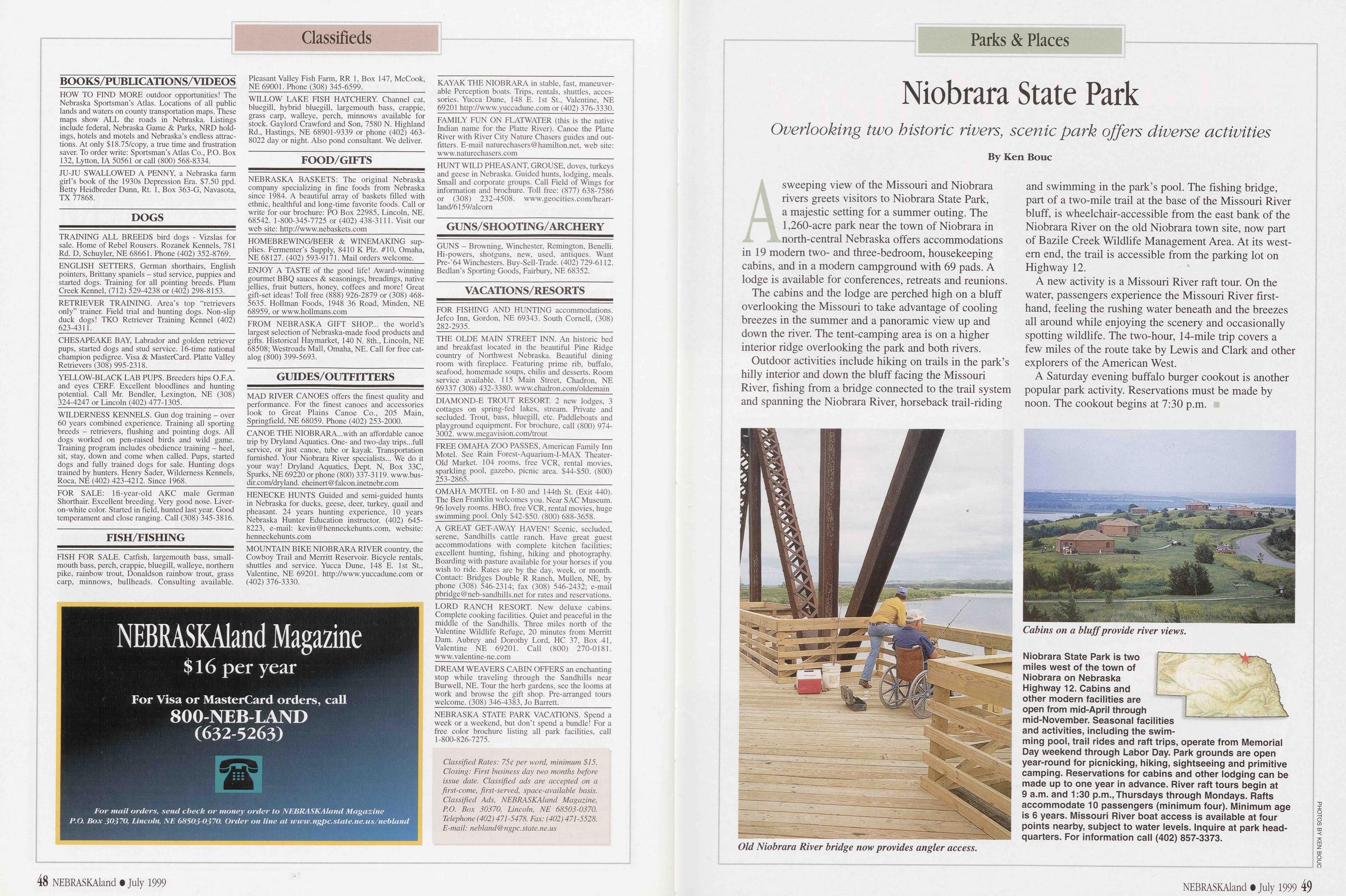
Classifieds
BOOKS/PUBLICATIONS/VIDEOSHOW TO FIND MORE outdoor opportunities! The Nebraska Sportsman's Atlas. Locations of all public lands and waters on county transportation maps. These maps show ALL the roads in Nebraska. Listings include federal, Nebraska Game & Parks, NRD holdings, hotels and motels and Nebraska's endless attractions. At only $18.75/copy, a true time and frustration saver. To order write: Sportsman's Atlas Co., P.O. Box 132, Lytton, IA 50561 or call (800) 568-8334.
JU-JU SWALLOWED A PENNY, a Nebraska farm girl's book of the 1930s Depression Era. $7.50 ppd. Betty Heidbreder Dunn, Rt. 1, Box 363-G, Navasota, TX 77868.
DOGSTRAINING ALL BREEDS bird dogs - Vizslas for sale. Home of Rebel Rousers. Rozanek Kennels, 781 Rd. D, Schuyler, NE 68661. Phone (402) 352-8769.
ENGLISH SETTERS, German shorthairs, English pointers, Brittany spaniels - stud service, puppies and started dogs. Training for all pointing breeds. Plum Creek Kennel, (712) 529-4238 or (402) 298-8153.
RETRIEVER TRAINING. Area's top "retrievers only" trainer. Field trial and hunting dogs. Non-slip duck dogs! TKO Retriever Training Kennel (402) 623-4311.
CHESAPEAKE BAY, Labrador and golden retriever pups, started dogs and stud service. 16-time national champion pedigree. Visa & MasterCard. Platte Valley Retrievers (308) 995-2318.
YELLOW-BLACK LAB PUPS. Breeders hips O.F.A. and eyes CERE Excellent bloodlines and hunting potential. Call Mr. Bendler, Lexington, NE (308) 324-4247 or Lincoln (402) 477-1305.
WILDERNESS KENNELS. Gun dog training - over 60 years combined experience. Training all sporting breeds - retrievers, flushing and pointing dogs. All dogs worked on pen-raised birds and wild game. Training program includes obedience training - heel, sit, stay, down and come when called. Pups, started dogs and fully trained dogs for sale. Hunting dogs trained by hunters. Henry Sader, Wilderness Kennels, Roca, NE (402) 423-4212. Since 1968.
FOR SALE: five-year-old AKC male German Shorthair. Excellent breeding. Very good nose. Liver-on-white color. Started in field, hunted last year. Good temperament and close ranging. Call (308) 345-3816.
FISH/FISHINGFISH FOR SALE. Catfish, largemouth bass, smallmouth bass, perch, crappie, bluegill, walleye, northern pike, rainbow trout, Donaldson rainbow trout, grass carp, minnows, bullheads. Consulting available. Pleasant Valley Fish Farm, RR 1, Box 147, McCook, NE 69001. Phone (308) 345-6599.
WILLOW LAKE FISH HATCHERY. Channel cat, bluegill, hybrid bluegill, largemouth bass, crappie, grass carp, walleye, perch, minnows available for stock. Gay lord Crawford and Son, 7580 N. Highland Rd., Hastings, NE 68901-9339 or phone (402) 463- 8022 day or night. Also pond consultant. We deliver.
FOOD/GIFTSNEBRASKA BASKETS: The original Nebraska company specializing in fine foods from Nebraska since 1984. A beautiful array of baskets filled with ethnic, healthful and long-time favorite foods. Call or write for our brochure: PO Box 22985, Lincoln, NE. 68542. 1-800-345-7725 or (402) 438-3111. Visit our web site: http://www.nebaskets.com
HOMEBREWING/BEER & WINEMAKING supplies. Fermenter's Supply, 8410 K Plz. #10, Omaha, NE 68127. (402) 593-9171. Mail orders welcome.
ENJOY A TASTE of the good life! Award-winning gourmet BBQ sauces & seasonings, breadings, native jellies, fruit butters, honey, coffees and more! Great gift-set ideas! Toll free (888) 926-2879 or (308) 468- 5635. Hollman Foods, 1948 36 Road, Minden, NE 68959, or www.hollmans.com
FROM NEBRASKA GIFT SHOP... the world's largest selection of Nebraska-made food products and gifts. Historical Haymarket, 140 N. 8th., Lincoln, NE 68508; Westroads Mall, Omaha, NE. Call for free cat- alog (800) 399-5693.
GUIDES/OUTFITTERSMAD RIVER CANOES offers the finest quality and performance. For the finest canoes and accessories look to Great Plains Canoe Co., 205 Main, Springfield, NE 68059. Phone (402) 253-2000.
CANOE THE NIOBRARA...with an affordable canoe trip by Dryland Aquatics. One- and two-day trips...full service, or just canoe, tube or kayak. Transportation furnished. Your Niobrara River specialists... We do it your way! Dryland Aquatics, Dept. N, Box 33C, Sparks, NE 69220 or phone (800) 337-3119. www.busdir.com/dryland. eheinert@falcon.inetnebr.com
HENECKE HUNTS Guided and semi-guided hunts in Nebraska for ducks, geese, deer, turkey, quail and pheasant. 24 years hunting experience, 10 years Nebraska Hunter Education instructor. (402) 645- 8223, e-mail: kevin@henneckehunts.com, website: henneckehunts .com
MOUNTAIN BIKE NIOBRARA RIVER country, the Cowboy Trail and Merritt Reservoir. Bicycle rentals, shuttles and service. Yucca Dune, 148 E. 1st St., Valentine, NE 69201. http://www.yuccadune.com or (402) 376-3330.
NEBRASKAland Magazine $16 per year For Visa or MasterCard orders, call 800-NEB-LAND (632-5263) For mail orders, send check or money order to NEBRASKAland Magazine P.O. Box 30370, Lincoln, NF 685030370. Order on line at www.ngpc.state.ne.us/neblandKAYAK THE NIOBRARA in stable, fast, maneuverable Perception boats. Trips, rentals, shuttles, accessories. Yucca Dune, 148 E. 1st St., Valentine, NE 69201 http://www.yuccadune.com or (402) 376-3330.
FAMILY FUN ON FLATWATER (this is the native Indian name for the Platte River). Canoe the Platte River with River City Nature Chasers guides and outfitters. E-mail naturechasers@hamilton.net, web site: www.naturechasers.com
HUNT WILD PHEASANT, GROUSE, doves, turkeys and geese in Nebraska. Guided hunts, lodging, meals. Small and corporate groups. Call Field of Wings for information and brochure. Toll free: (877) 638-7586 or (308) 232-4508. www.geocities.com/heartland/6159/alcorn
GUNS/SHOOTING/ARCHERYGUNS - Browning, Winchester, Remington, Benelli. Hi-powers, shotguns, new, used, antiques. Want Pre-'64 Winchesters. Buy-Sell-Trade. (402) 729-6112. Bedlan's Sporting Goods, Fairbury, NE 68352.
VACATIONS/RESORTSFOR FISHING AND HUNTING accommodations. Jefco Inn, Gordon, NE 69343. South Cornell, (308) 282-2935.
THE OLDE MAIN STREET INN. An historic bed and breakfast located in the beautiful Pine Ridge country of Northwest Nebraska. Beautiful dining room with fireplace. Featuring prime rib, buffalo, seafood, homemade soups, chilis and desserts. Room service available. 115 Main Street, Chadron, NE 69337 (308) 432-3380. www.chadron.com/oldemain
DIAMOND-E TROUT RESORT. 2 new lodges, 3 cottages on spring-fed lakes, stream. Private and secluded. Trout, bass, bluegill, etc. Paddle boats and playground equipment. For brochure, call (800) 974- 3002. www.megavision.com/trout
FREE OMAHA ZOO PASSES, American Family Inn Motel. See Rain Forest-Aquarium-I-MAX Theater- Old Market. 104 rooms, free VCR, rental movies, sparkling pool, gazebo, picnic area. $44-$50. (800) 253-2865.
OMAHA MOTEL on 1-80 and 144th St. (Exit 440). The Ben Franklin welcomes you. Near SAC Museum. 96 lovely rooms. HBO, free VCR, rental movies, huge swimming pool. Only $42-$50. (800) 688-3658.
A GREAT GET-AWAY HAVEN! Scenic, secluded, serene, Sandhills cattle ranch. Have great guest accommodations with complete kitchen facilities; excellent hunting, fishing, hiking and photography. Boarding with pasture available for your horses if you wish to ride. Rates are by the day, week, or month. Contact: Bridges Double R Ranch, Mullen, NE, by phone (308) 546-2314; fax (308) 546-2432; e-mail pbridge@neb-sandhills.net for rates and reservations.
LORD RANCH RESORT. New deluxe cabins. Complete cooking facilities. Quiet and peaceful in the middle of the Sandhills. Three miles north of the Valentine Wildlife Refuge, 20 minutes from Merritt Dam. Aubrey and Dorothy Lord, HC 37, Box 41, Valentine NE 69201. Call (800) 270-0181. www.valentine-ne.com
DREAM WEAVERS CABIN OFFERS an enchanting stop while traveling through the Sandhills near Burwell, NE. Tour the herb gardens, see the looms at work and browse the gift shop. Pre-arranged tours welcome. (308) 346-4383, Jo Barrett.
NEBRASKA STATE PARK VACATIONS. Spend a week or a weekend, but don't spend a bundle! For a free color brochure listing all park facilities, call 1-800-826-7275.
Classified Rates: 75$ per word, minimum $15. Closing: First business day two months before issue date. Classified ads are accepted on a first-come, first-served, space-available basis. Classified Ads, NEBRASKAland Magazine, P.O. Box 30370, Lincoln, NE 68503-0370. Telephone (402) 471-5478. Fax: (402) 471-5528. E-mail: nebland@ngpc.state.ne.us 48 NEBRASKAland • July 1999Parks & Places
Niobrara State Park
Overlooking two historic rivers, scenic park offers diverse activities By Ken BoucSweeping view of the Missouri and Niobrara rivers greets visitors to Niobrara State Park, a majestic setting for a summer outing. The 1,260-acre park near the town of Niobrara in north-central Nebraska offers accommodations in 19 modern two- and three-bedroom, housekeeping cabins, and in a modern campground with 69 pads. A lodge is available for conferences, retreats and reunions.
The cabins and the lodge are perched high on a bluff overlooking the Missouri to take advantage of cooling breezes in the summer and a panoramic view up and down the river. The tent-camping area is on a higher interior ridge overlooking the park and both rivers.
Outdoor activities include hiking on trails in the park's hilly interior and down the bluff facing the Missouri River, fishing from a bridge connected to the trail system and spanning the Niobrara River, horseback trail-riding and swimming in the park's pool. The fishing bridge, part of a two-mile trail at the base of the Missouri River bluff, is wheelchair-accessible from the east bank of the Niobrara River on the old Niobrara town site, now part of Bazile Creek Wildlife Management Area. At its western end, the trail is accessible from the parking lot on Highway 12.
A new activity is a Missouri River raft tour. On the water, passengers experience the Missouri River first hand, feeling the rushing water beneath and the breezes all around while enjoying the scenery and occasionally spotting wildlife. The two-hour, 14-mile trip covers a few miles of the route take by Lewis and Clark and other explorers of the American West.
A Saturday evening buffalo burger cookout is another popular park activity. Reservations must be made by noon. The cookout begins at 7:30 p.m.
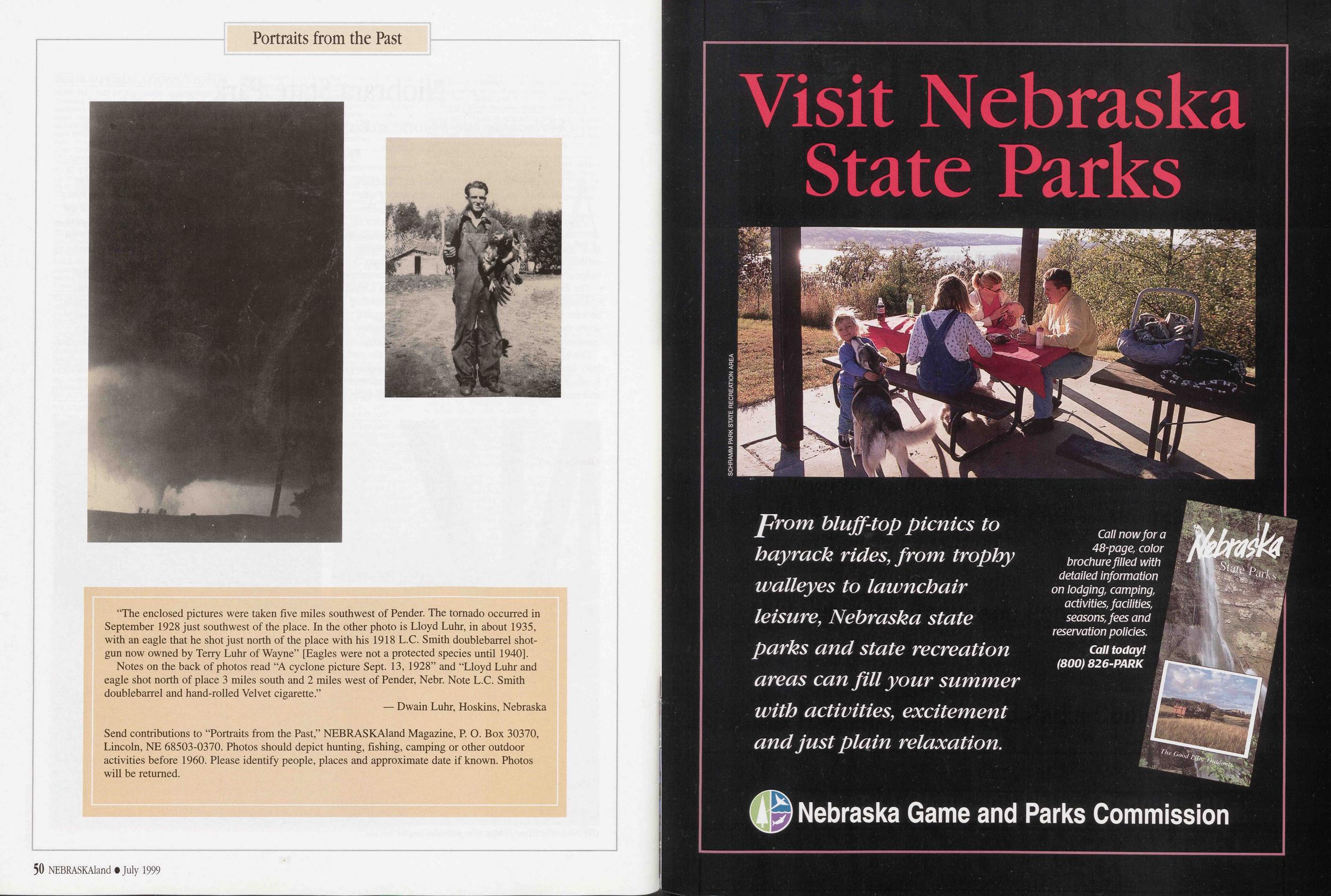
Portraits from the Past
"The enclosed pictures were taken five miles southwest of Pender. The tornado occurred in September 1928 just southwest of the place. In the other photo is Lloyd Luhr, in about 1935, with an eagle that he shot just north of the place with his 1918 L.C. Smith double barrel shotgun now owned by Terry Luhr of Wayne" [Eagles were not a protected species until 1940].
Notes on the back of photos read "A cyclone picture Sept. 13, 1928" and "Lloyd Luhr and eagle shot north of place 3 miles south and 2 miles west of Pender, Nebr. Note L.C. Smith double barrel and hand-rolled Velvet cigarette."
— Dwain Luhr, Hoskins, NebraskaSend contributions to "Portraits from the Past," NEBRASKAland Magazine, P. O. Box 30370, Lincoln, NE 68503-0370. Photos should depict hunting, fishing, camping or other outdoor activities before 1960. Please identify people, places and approximate date if known. Photos will be returned.
50 NEBRSKAland • July 1999 prom bluff-top picnics to hayrack rides, from trophy walleyes to lawn chair leisure, Nebraska state parks and state recreation areas can fill your summer with activities, excitement and just plain relaxation. Call now for a 48-page, color brochure filled with detailed information on lodging, camping, activities, facilities, seasons, fees and reservation policies. Call today! (800) 826-PARK
Position: 23 (322 views)