Volume 77, Issue 5, 1999
NEBRASKAland
Nebraska Game & Parks Commission June 1999 $2.50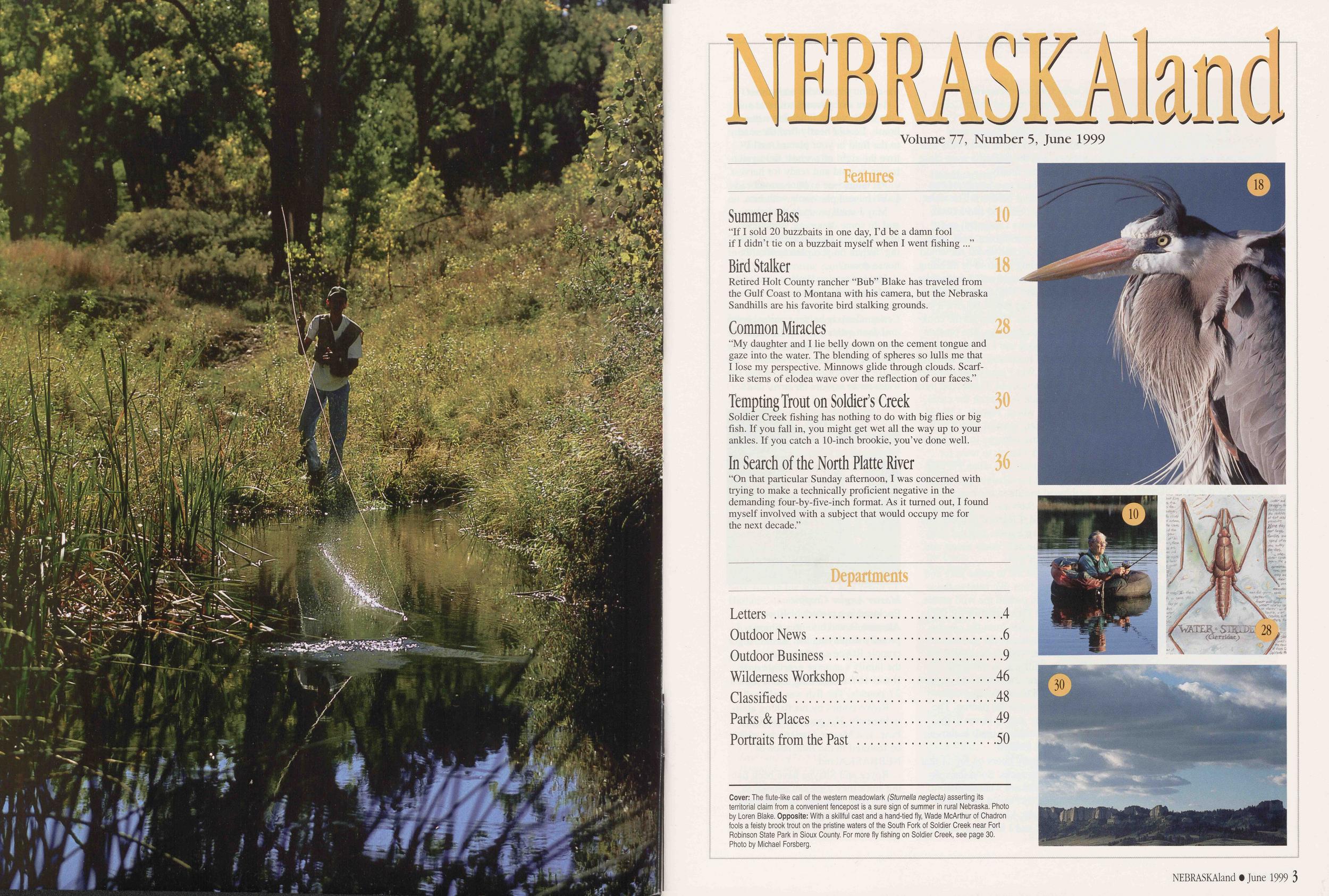
NEBRASKAland
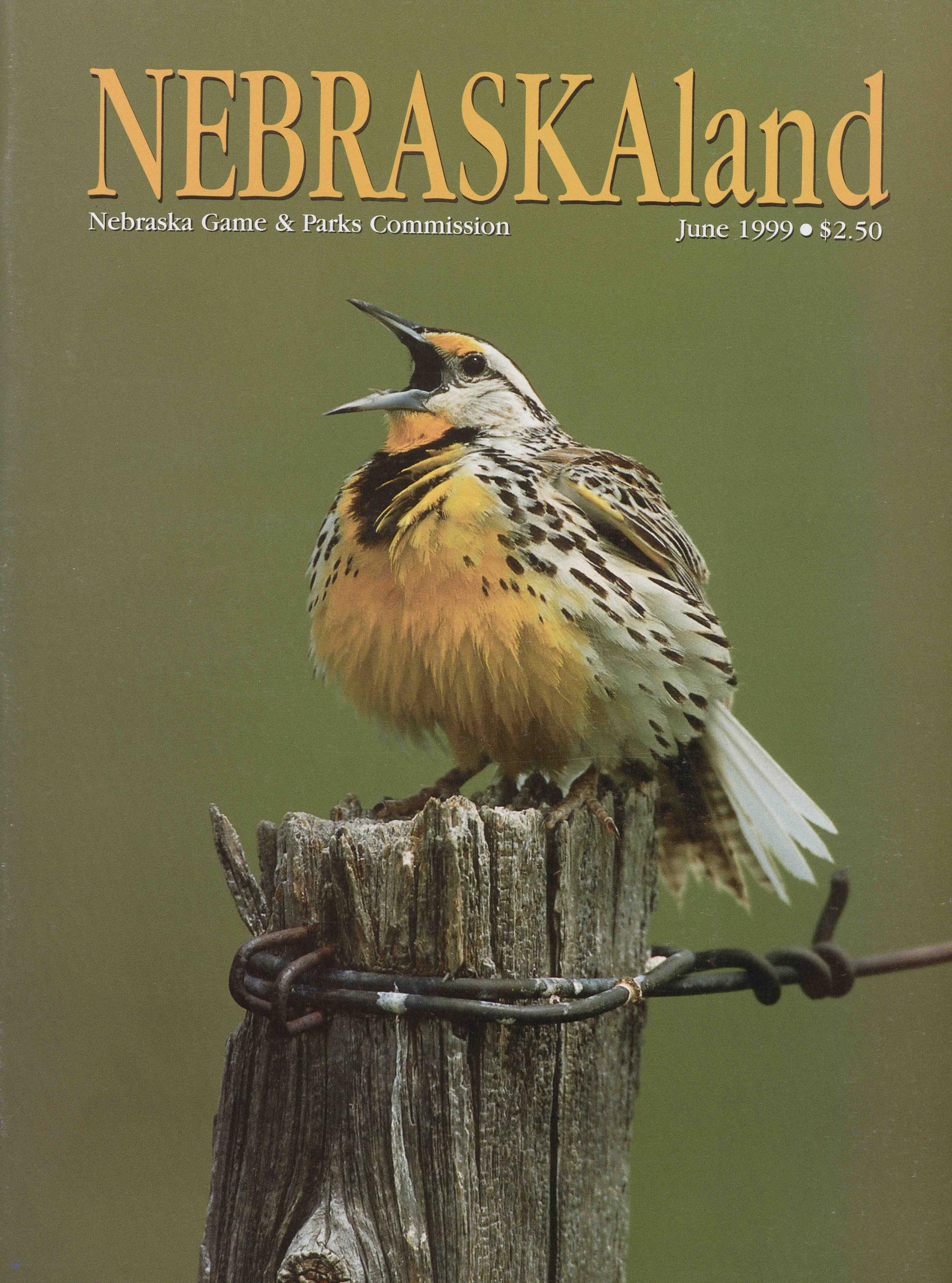
Volume 77, Number 5, June 1999 Features Summer Bass "If I sold 20 buzzbaits in one day, I'd be a damn fool if I didn't tie on a buzzbait myself when I went fishing ..." Bird Stalker Retired Holt County rancher "Bub" Blake has traveled from the Gulf Coast to Montana with his camera, but the Nebraska Sandhills are his favorite bird stalking grounds. Common Miracles "My daughter and I lie belly down on the cement tongue and gaze into the water. The blending of spheres so lulls me that I lose my perspective. Minnows glide through clouds. Scarf- like stems of elodea wave over the reflection of our faces." Tempting Trout on Soldier's Creek Soldier Creek fishing has nothing to do with big flies or big fish. If you fall in, you might get wet all the way up to your ankles. If you catch a 10-inch brookie, you've done well. In Search of the North Platte River "On that particular Sunday afternoon, I was concerned with trying to make a technically proficient negative in the demanding four-by-five-inch format. As it turned out, I found myself involved with a subject that would occupy me for the next decade." Departments Letters 4 Outdoor News 9 Wilderness Workshop 46 Classifieds 48 Portraits from the Past 50 Cover: The flute-like call of the western meadowlark (Sturnella neglecta) asserting its territorial claim from a convenient fencepost is a sure sign of summer in rural Nebraska. Photo by Loren Blake. Opposite: With a skillful cast and a hand-tied fly, Wade McArthur of Chadron fools a feisty brook trout on the pristine waters of the South Fork of Soldier Creek near Fort Robinson State Park in Sioux County. For more fly fishing on Soldier Creek, see page 30. Photo by Michael Forsberg.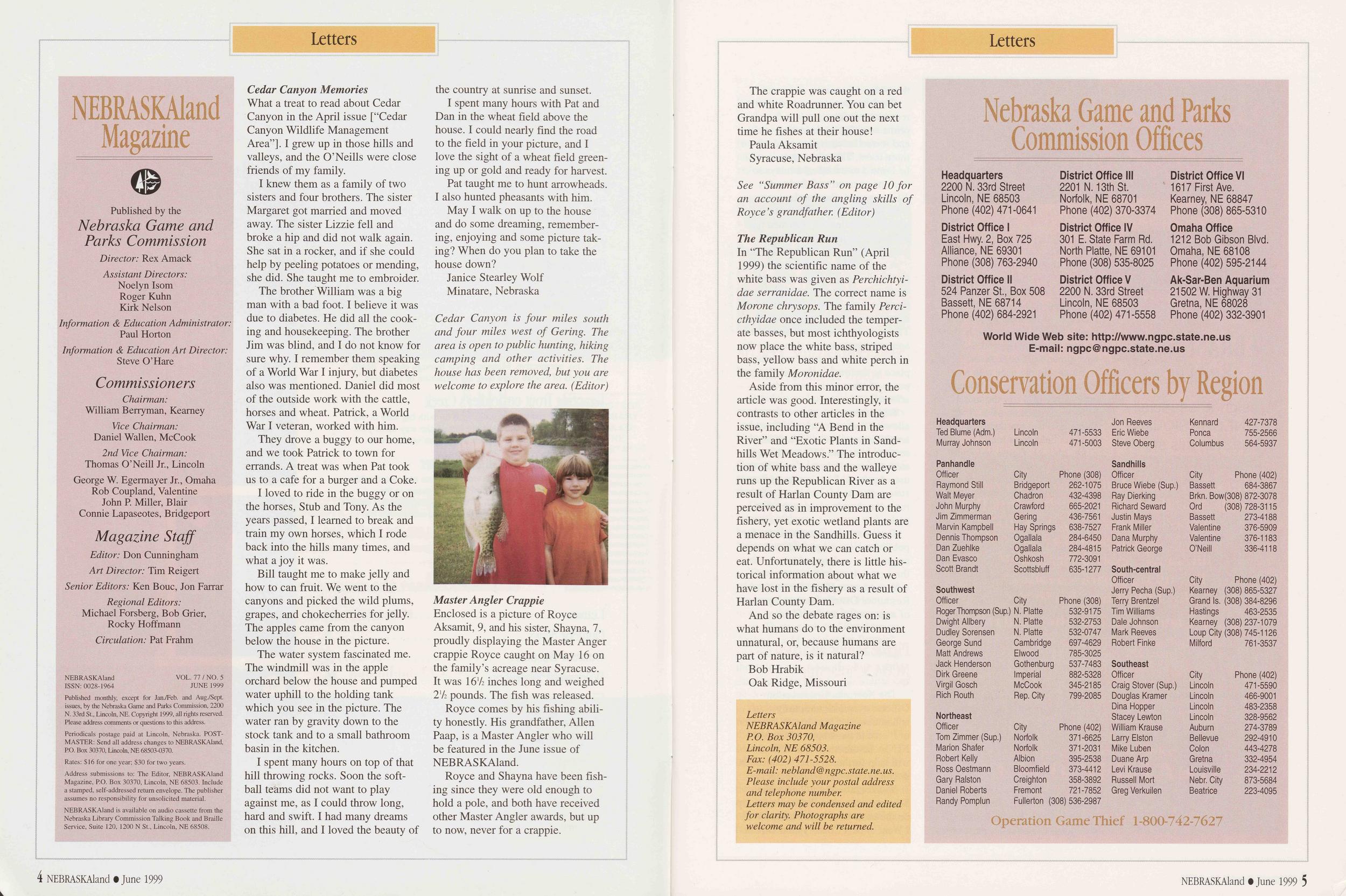
Letters
Published by the Nebraska Game and Parks Commission Director: Rex Amack Assistant Directors: Noelyn Isom Roger Kuhn Kirk Nelson Information & Education Administrator: Paul Horton Information & Education Art Director: Steve O'Hare Commissioners Chairman: William Berryman, Kearney Vice Chairman: Daniel Wallen, McCook 2nd Vice Chairman: Thomas O'Neill Jr., Lincoln George W. Egermayer Jr., Omaha Rob Coupland, Valentine John P. Miller, Blair Connie Lapaseotes, Bridgeport Magazine Staff Editor: Don Cunningham Art Director: Tim Reigert Senior Editors: Ken Bouc, Jon Farrar Regional Editors: Michael Forsberg, Bob Grier, Rocky Hoffmann Circulation: Pat Frahm NEBRASKAland ISSN: 0028-1964 VOL. 77 / NO. 5 JUNE 1999 Published monthly, except for Jan./Feb. and Aug/Sept. issues, by the Nebraska Game and Parks Commission, 2200 N. 33rd St., Lincoln, NE. Copyright 1999, all rights reserved. Please address comments or questions to this address. Periodicals postage paid at Lincoln, Nebraska. POSTMASTER: Send all address changes to NEBRASKAland, P.O. Box 30370, Lincoln, NE 68503-0370. Rates: $16 for one year; $30 for two years. Address submissions to: The Editor, NEBRASKAland Magazine, P.O. Box 30370, Lincoln, NE 68503. Include a stamped, self-addressed return envelope. The publisher assumes no responsibility for unsolicited material. NEBRASKAland is available on audio cassette from the Nebraska Library Commission Talking Book and Braille Service, Suite 120, 1200 N St., Lincoln, NE 68508. Cedar Canyon MemoriesWhat a treat to read about Cedar Canyon in the April issue ["Cedar Canyon Wildlife Management Area"]. I grew up in those hills and valleys, and the O'Neills were close friends of my family.
I knew them as a family of two sisters and four brothers. The sister Margaret got married and moved away. The sister Lizzie fell and broke a hip and did not walk again. She sat in a rocker, and if she could help by peeling potatoes or mending, she did. She taught me to embroider.
The brother William was a big man with a bad foot. I believe it was due to diabetes. He did all the cooking and housekeeping. The brother Jim was blind, and I do not know for sure why. I remember them speaking of a World War I injury, but diabetes also was mentioned. Daniel did most of the outside work with the cattle, horses and wheat. Patrick, a World War I veteran, worked with him.
They drove a buggy to our home, and we took Patrick to town for errands. A treat was when Pat took us to a cafe for a burger and a Coke.
I loved to ride in the buggy or on the horses, Stub and Tony. As the years passed, I learned to break and train my own horses, which I rode back into the hills many times, and what a joy it was.
Bill taught me to make jelly and how to can fruit. We went to the canyons and picked the wild plums, grapes, and chokecherries for jelly. The apples came from the canyon below the house in the picture.
The water system fascinated me. The windmill was in the apple orchard below the house and pumped water uphill to the holding tank which you see in the picture. The water ran by gravity down to the stock tank and to a small bathroom basin in the kitchen.
I spent many hours on top of that hill throwing rocks. Soon the softball teams did not want to play against me, as I could throw long, hard and swift. I had many dreams on this hill, and I loved the beauty of the country at sunrise and sunset.
I spent many hours with Pat and Dan in the wheat field above the house. I could nearly find the road to the field in your picture, and I love the sight of a wheat field greening up or gold and ready for harvest.
Pat taught me to hunt arrowheads. I also hunted pheasants with him.
May I walk on up to the house and do some dreaming, remembering, enjoying and some picture taking? When do you plan to take the house down?
Janice Stearley Wolf Minatare, NebraskaCedar Canyon is four miles south and four miles west of Gering. The area is open to public hunting, hiking camping and other activities. The house has been removed, but you are welcome to explore the area. (Editor)
Enclosed is a picture of Royce Aksamit, 9, and his sister, Shayna, 7, proudly displaying the Master Anger crappie Royce caught on May 16 on the family's acreage near Syracuse. It was I6V2 inches long and weighed 272 pounds. The fish was released.
Royce comes by his fishing ability honestly. His grandfather, Allen Paap, is a Master Angler who will be featured in the June issue of NEBRASKAland.
Royce and Shayna have been fishing since they were old enough to hold a pole, and both have received other Master Angler awards, but up to now, never for a crappie.
4 NEBRASKAland • June 1999The crappie was caught on a red and white Roadrunner. You can bet Grandpa will pull one out the next time he fishes at their house!
Paula Aksamit Syracuse, NebraskaSee "Summer Bass" on page 10 for an account of the angling skills of Royce's grandfather. (Editor)
The Republican RunIn "The Republican Run" (April 1999) the scientific name of the white bass was given as Perchichtyidae serranidae. The correct name is Morone chrysops. The family Percicthyidae once included the temperate basses, but most ichthyologists now place the white bass, striped bass, yellow bass and white perch in the family Moronidae.
Aside from this minor error, the article was good. Interestingly, it contrasts to other articles in the issue, including "A Bend in the River" and "Exotic Plants in Sandhills Wet Meadows." The introduction of white bass and the walleye runs up the Republican River as a result of Harlan County Dam are perceived as in improvement to the fishery, yet exotic wetland plants are a menace in the Sandhills. Guess it depends on what we can catch or eat. Unfortunately, there is little historical information about what we have lost in the fishery as a result of Harlan County Dam.
And so the debate rages on: is what humans do to the environment unnatural, or, because humans are part of nature, is it natural?
Bob Hrabik Oak Ridge, Missouri Letters NEBRASKAland Magazine P.O. Box 30370, Lincoln, NE 68503. Fax: (402) 471-5528. E-mail: nebland@ngpc.state.ne.us. Please include your postal address and telephone number. Letters may be condensed and edited for clarity. Photographs are welcome and will be returned. Headquarters 2200 N. 33rd Street Lincoln, NE 68503 Phone (402) 471-0641 District Office I East Hwy. 2, Box 725 Alliance, NE 69301 Phone (308) 763-2940 District Office II 524 Panzer St., Box 508 Bassett, NE 68714 Phone (402) 684-2921 District Office III 2201 N. 13th St. Norfolk, NE 68701 Phone (402) 370-3374 District Office IV 301 E. State Farm Rd. North Platte, NE 69101 Phone (308) 535-8025 District Office V 2200 N. 33rd Street Lincoln, NE 68503 Phone (402) 471-5558 District Office VI 1617 First Ave. Kearney, NE 68847 Phone (308) 865-5310 Omaha Office 1212 Bob Gibson Blvd. Omaha, NE 68108 Phone (402) 595-2144 Ak-Sar-Ben Aquarium 21502 W. Highway 31 Gretna, NE 68028 Phone (402) 332-3901 World Wide Web site: http://www.ngpc.state.ne.us E-mail: ngpc@ ngpc.state.ne.us Conservation Officers by Region Headquarters Jon Reeves Kennard 427-7378 Ted Blume (Adm.)Lincoln 471-5533 Eric Wiebe Ponca 755-2566 Murray Johnson Lincoln 471-5003 Steve Oberg Columbus 564-5937 Panhandle Sandhills Officer City Phone (308) Officer City Phone (402) Raymond Still Bridgeport 262-1075 Bruce Wiebe (Sup.) Bassett 684-3867 Walt Meyer Chadron 432-4398 Ray Dierking Brkn. Bow (308) 872-3078 John Murphy Crawford 665-2021 Richard Seward Ord (308)728-3115 Jim Zimmerman Gering 436-7561 Justin Mays Bassett 273-4188 Marvin Kampbell Hay Springs 638-7527 Frank Miller Valentine 376-5909 Dennis Thompson Ogallala 284-6450 Dana Murphy Valentine 376-1183 Dan Zuehlke Ogallala 284-4815 Patrick George O'Neill 336-4118 Dan Evasco Oshkosh 772-3091 Scott Brandt Scottsbluff 635-1277 South-central Officer City Phone (402) Southwest Jerry Pecha (Sup.) Kearney (308) 865-5327 Officer City Phone (308) Terry Brentzel Grand Is. (308) 384-8296 Roger Thompson (Sup.) N. Platte 532-9175 Tim Williams Hastings 463-2535 Dwight Allbery N. Platte 532-2753 Dale Johnson Kearney (308)237-1079 Dudley Sorensen N. Platte 532-0747 Mark Reeves Loup City (308) 745-1126 George Sund Cambridge 697-4629 Robert Finke Milford 761-3537 Matt Andrews Elwood 785-3025 Jack Henderson Gothenburg 537-7483 Southeast Dirk Greene Imperial 882-5328 Officer City Phone (402) Virgil Gosch McCook 345-2185 Craig Stover (Sup.) Lincoln 471-5590 Rich Routh Rep. City 799-2085 Douglas Kramer Lincoln 466-9001 Dina Hopper Lincoln 483-2358 Northeast Stacey Lewton Lincoln 328-9562 Officer City Phone (402) William Krause Auburn 274-3789 Tom Zimmer (Sup.)Norfolk 371-6625 Larry Elston Bellevue 292-4910 Marion Shafer Norfolk 371-2031 Mike Luben Colon 443-4278 Robert Kelly Albion 395-2538 Duane Arp Gretna 332-4954 Ross Oestmann Bloomfield 373-4412 Levi Krause Louisville 234-2212 Gary Ralston Creighton 358-3892 Russell Mort Nebr. City 873-5684 Daniel Roberts Fremont 721-7852 Greg Verkuilen Beatrice 223-4095 Randy Pomplun Fullerton (308) 536-2987 NEBRASKAland • June 1999 5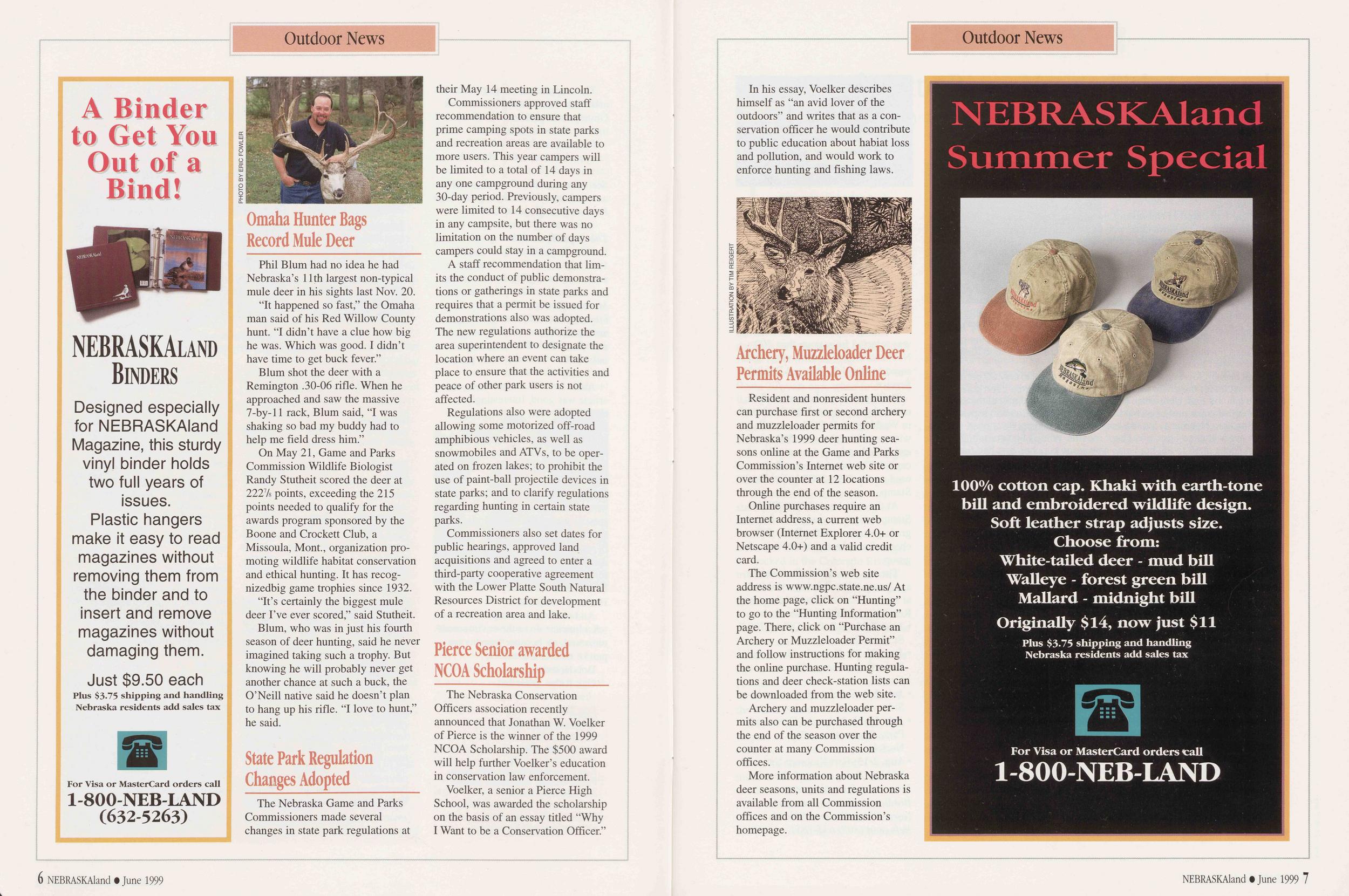
Outdoor News
NEBRASKAland Binders Designed especially for NEBRASKAland Magazine, this sturdy vinyl binder holds two full years of issues. Plastic hangers make it easy to read magazines without removing them from the binder and to insert and remove magazines without damaging them. Just $9.50 each Plus $3.75 shipping and handling Nebraska residents add sales tax For Visa or MasterCard orders call 1-800-NEB-LAND (632-5263)Phil Blum had no idea he had Nebraska's 11th largest non-typical mule deer in his sights last Nov. 20.
"It happened so fast," the Omaha man said of his Red Willow County hunt. "I didn't have a clue how big he was. Which was good. I didn't have time to get buck fever."
Blum shot the deer with a Remington .30-06 rifle. When he approached and saw the massive 7-by-ll rack, Blum said, "I was shaking so bad my buddy had to help me field dress him."
On May 21, Game and Parks Commission Wildlife Biologist Randy Stutheit scored the deer at 2227s points, exceeding the 215 points needed to qualify for the awards program sponsored by the Boone and Crockett Club, a Missoula, Mont., organization promoting wildlife habitat conservation and ethical hunting. It has recognizedbig game trophies since 1932.
"It's certainly the biggest mule deer I've ever scored," said Stutheit.
Blum, who was in just his fourth season of deer hunting, said he never imagined taking such a trophy. But knowing he will probably never get another chance at such a buck, the O'Neill native said he doesn't plan to hang up his rifle. "I love to hunt," he said.
State Park Regulation Changes AdoptedThe Nebraska Game and Parks Commissioners made several changes in state park regulations at their May 14 meeting in Lincoln.
Commissioners approved staff recommendation to ensure that prime camping spots in state parks and recreation areas are available to more users. This year campers will be limited to a total of 14 days in any one campground during any 30-day period. Previously, campers were limited to 14 consecutive days in any campsite, but there was no limitation on the number of days campers could stay in a campground.
A staff recommendation that limits the conduct of public demonstrations or gatherings in state parks and requires that a permit be issued for demonstrations also was adopted. The new regulations authorize the area superintendent to designate the location where an event can take place to ensure that the activities and peace of other park users is not affected.
Regulations also were adopted allowing some motorized off-road amphibious vehicles, as well as snowmobiles and ATVs, to be operated on frozen lakes; to prohibit the use of paint-ball projectile devices in state parks; and to clarify regulations regarding hunting in certain state parks.
Commissioners also set dates for public hearings, approved land acquisitions and agreed to enter a third-party cooperative agreement with the Lower Platte South Natural Resources District for development of a recreation area and lake.
Pierce Senior awarded NCOA ScholarshipThe Nebraska Conservation Officers association recently announced that Jonathan W. Voelker of Pierce is the winner of the 1999 NCOA Scholarship. The $500 award will help further Voelker's education in conservation law enforcement.
Voelker, a senior a Pierce High School, was awarded the scholarship on the basis of an essay titled "Why I Want to be a Conservation Officer."
6 NEBRASKAland • June 1999In his essay, Voelker describes himself as "an avid lover of the outdoors" and writes that as a conservation officer he would contribute to public education about habitat loss and pollution, and would work to enforce hunting and fishing laws.
Resident and nonresident hunters can purchase first or second archery and muzzleloader permits for Nebraska's 1999 deer hunting seasons online at the Game and Parks Commission's Internet web site or over the counter at 12 locations through the end of the season.
Online purchases require an Internet address, a current web browser (Internet Explorer 4.0+ or Netscape 4.0+) and a valid credit card.
The Commission's web site address is www.ngpc.state.ne.us/At the home page, click on "Hunting" to go to the "Hunting Information" page. There, click on "Purchase an Archery or Muzzleloader Permit" and follow instructions for making the online purchase. Hunting regulations and deer check-station lists can be downloaded from the web site.
Archery and muzzleloader permits also can be purchased through the end of the season over the counter at many Commission offices.
More information about Nebraska deer seasons, units and regulations is available from all Commission offices and on the Commission's homepage.
NEBRASKAland Summer Special 100% cotton cap. Khaki with earth-tone bill and embroidered wildlife design. Soft leather strap adjusts size. Choose from: White-tailed deer - mud bill Walleye - forest green bill Mallard - midnight bill Originally $14, now just $11 Plus $3.75 shipping and handling Nebraska residents add sales tax For Visa or MasterCard orders call 1-800-NEB-LAND NEBRASKAland • June 1999 7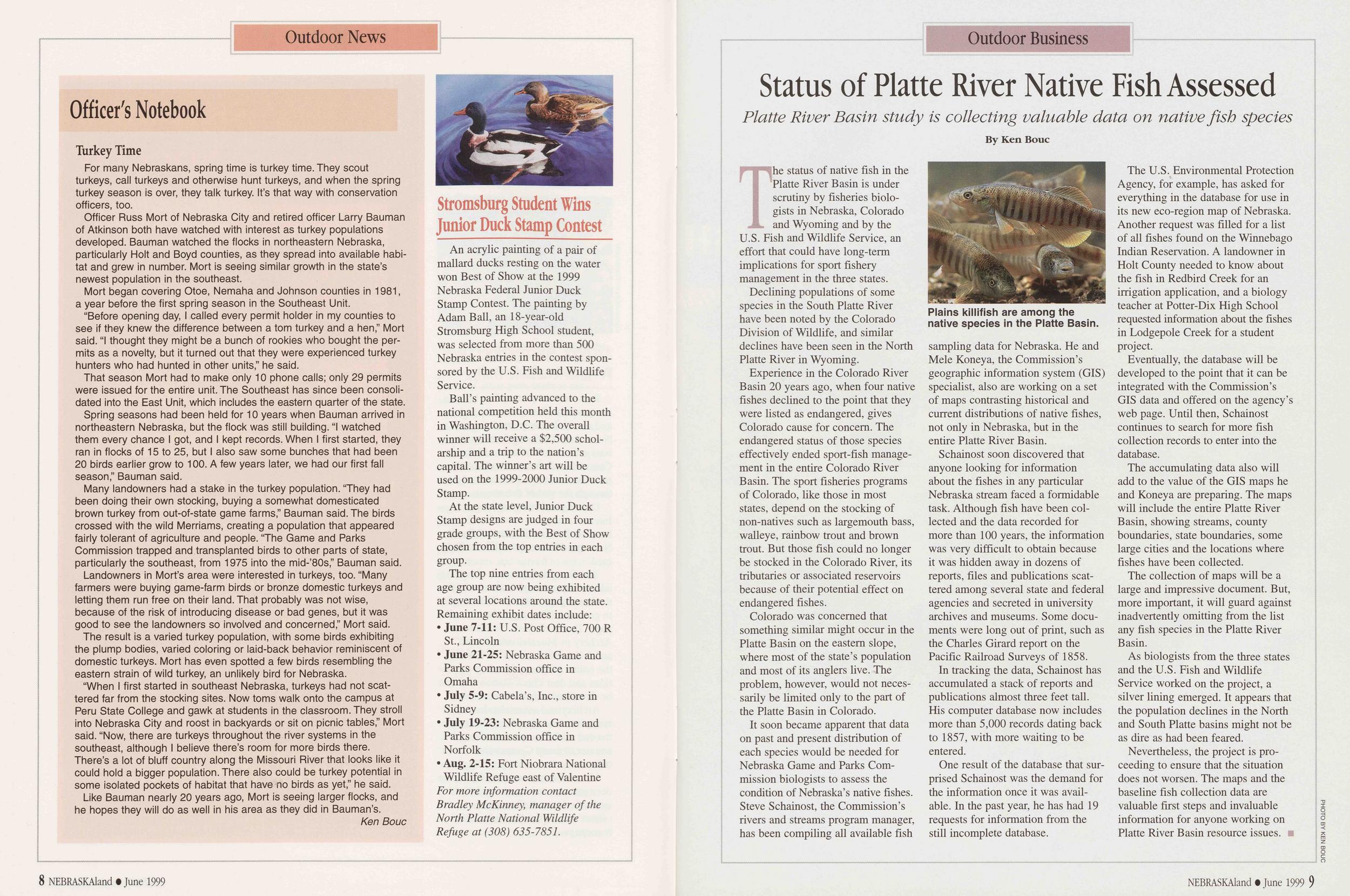 Officer's Notebook
Turkey Time
Officer's Notebook
Turkey Time
For many Nebraskans, spring time is turkey time. They scout turkeys, call turkeys and otherwise hunt turkeys, and when the spring turkey season is over, they talk turkey. It's that way with conservation officers, too.
Officer Russ Mort of Nebraska City and retired officer Larry Bauman of Atkinson both have watched with interest as turkey populations developed. Bauman watched the flocks in northeastern Nebraska, particularly Holt and Boyd counties, as they spread into available habitat and grew in number. Mort is seeing similar growth in the state's newest population in the southeast.
Mort began covering Otoe, Nemaha and Johnson counties in 1981, a year before the first spring season in the Southeast Unit.
"Before opening day, I called every permit holder in my counties to see if they knew the difference between a torn turkey and a hen," Mort said. "I thought they might be a bunch of rookies who bought the permits as a novelty, but it turned out that they were experienced turkey hunters who had hunted in other units," he said.
That season Mort had to make only 10 phone calls; only 29 permits were issued for the entire unit. The Southeast has since been consolidated into the East Unit, which includes the eastern quarter of the state.
Spring seasons had been held for 10 years when Bauman arrived in northeastern Nebraska, but the flock was still building. "I watched them every chance I got, and I kept records. When I first started, they ran in flocks of 15 to 25, but I also saw some bunches that had been 20 birds earlier grow to 100. A few years later, we had our first fall season," Bauman said.
Many landowners had a stake in the turkey population. "They had been doing their own stocking, buying a somewhat domesticated brown turkey from out-of-state game farms," Bauman said. The birds crossed with the wild Merriams, creating a population that appeared fairly tolerant of agriculture and people. "The Game and Parks Commission trapped and transplanted birds to other parts of state, particularly the southeast, from 1975 into the mid-'80s," Bauman said.
Landowners in Mort's area were interested in turkeys, too. "Many farmers were buying game-farm birds or bronze domestic turkeys and letting them run free on their land. That probably was not wise, because of the risk of introducing disease or bad genes, but it was good to see the landowners so involved and concerned," Mort said.
The result is a varied turkey population, with some birds exhibiting the plump bodies, varied coloring or laid-back behavior reminiscent of domestic turkeys. Mort has even spotted a few birds resembling the eastern strain of wild turkey, an unlikely bird for Nebraska.
"When I first started in southeast Nebraska, turkeys had not scattered far from the stocking sites. Now toms walk onto the campus at Peru State College and gawk at students in the classroom. They stroll into Nebraska City and roost in backyards or sit on picnic tables," Mort said. "Now, there are turkeys throughout the river systems in the southeast, although I believe there's room for more birds there. There's a lot of bluff country along the Missouri River that looks like it could hold a bigger population. There also could be turkey potential in some isolated pockets of habitat that have no birds as yet," he said.
Like Bauman nearly 20 years ago, Mort is seeing larger flocks, and he hopes they will do as well in his area as they did in Bauman's.
Ken BoucAn acrylic painting of a pair of mallard ducks resting on the water won Best of Show at the 1999 Nebraska Federal Junior Duck Stamp Contest. The painting by Adam Ball, an 18-year-old Stromsburg High School student, was selected from more than 500 Nebraska entries in the contest sponsored by the U.S. Fish and Wildlife Service.
Ball's painting advanced to the national competition held this month in Washington, D.C. The overall winner will receive a $2,500 scholarship and a trip to the nation's capital. The winner's art will be used on the 1999-2000 Junior Duck Stamp.
At the state level, Junior Duck Stamp designs are judged in four grade groups, with the Best of Show chosen from the top entries in each group.
The top nine entries from each age group are now being exhibited at several locations around the state. Remaining exhibit dates include:
• June 7-11: U.S. Post Office, 700 R St., Lincoln
• June 21-25: Nebraska Game and Parks Commission office in Omaha
• July 5-9: Cabela's, Inc., store in Sidney
• July 19-23: Nebraska Game and Parks Commission office in Norfolk
• Aug. 2-15: Fort Niobrara National Wildlife Refuge east of Valentine
For more information contact Bradley McKinney, manager of the North Platte National Wildlife Refuge at (308) 635-7851. 8 NEBRASKAland • June 1999Outdoor Business
Status of Platte River Native Fish Assessed
Platte River Basin study is collecting valuable data on native fish species By Ken Bouc|he status of native fish in the Platte River Basin is under scrutiny by fisheries biologists in Nebraska, Colorado and Wyoming and by the U.S. Fish and Wildlife Service, an effort that could have long-term implications for sport fishery management in the three states.
Declining populations of some species in the South Platte River have been noted by the Colorado Division of Wildlife, and similar declines have been seen in the North Platte River in Wyoming.
Experience in the Colorado River Basin 20 years ago, when four native fishes declined to the point that they were listed as endangered, gives Colorado cause for concern. The endangered status of those species effectively ended sport-fish management in the entire Colorado River Basin. The sport fisheries programs of Colorado, like those in most states, depend on the stocking of non-natives such as largemouth bass, walleye, rainbow trout and brown trout. But those fish could no longer be stocked in the Colorado River, its tributaries or associated reservoirs because of their potential effect on endangered fishes.
Colorado was concerned that something similar might occur in the Platte Basin on the eastern slope, where most of the state's population and most of its anglers live. The problem, however, would not necessarily be limited only to the part of the Platte Basin in Colorado.
It soon became apparent that data on past and present distribution of each species would be needed for Nebraska Game and Parks Commission biologists to assess the condition of Nebraska's native fishes. Steve Schainost, the Commission's rivers and streams program manager, has been compiling all available fish sampling data for Nebraska. He and Mele Koneya, the Commission's geographic information system (GIS) specialist, also are working on a set of maps contrasting historical and current distributions of native fishes, not only in Nebraska, but in the entire Platte River Basin.
Schainost soon discovered that anyone looking for information about the fishes in any particular Nebraska stream faced a formidable task. Although fish have been collected and the data recorded for more than 100 years, the information was very difficult to obtain because it was hidden away in dozens of reports, files and publications scattered among several state and federal agencies and secreted in university archives and museums. Some documents were long out of print, such as the Charles Girard report on the Pacific Railroad Surveys of 1858.
In tracking the data, Schainost has accumulated a stack of reports and publications almost three feet tall. His computer database now includes more than 5,000 records dating back to 1857, with more waiting to be entered.
One result of the database that surprised Schainost was the demand for the information once it was avail- able. In the past year, he has had 19 requests for information from the still incomplete database.
The U.S. Environmental Protection Agency, for example, has asked for everything in the database for use in its new eco-region map of Nebraska. Another request was filled for a list of all fishes found on the Winnebago Indian Reservation. A landowner in Holt County needed to know about the fish in Redbird Creek for an irrigation application, and a biology teacher at Potter-Dix High School requested information about the fishes in Lodgepole Creek for a student project.
Eventually, the database will be developed to the point that it can be integrated with the Commission's GIS data and offered on the agency's web page. Until then, Schainost continues to search for more fish collection records to enter into the database.
The accumulating data also will add to the value of the GIS maps he and Koneya are preparing. The maps will include the entire Platte River Basin, showing streams, county boundaries, state boundaries, some large cities and the locations where fishes have been collected.
The collection of maps will be a large and impressive document. But, more important, it will guard against inadvertently omitting from the list any fish species in the Platte River Basin.
As biologists from the three states and the U.S. Fish and Wildlife Service worked on the project, a silver lining emerged. It appears that the population declines in the North and South Platte basins might not be as dire as had been feared.
Nevertheless, the project is proceeding to ensure that the situation does not worsen. The maps and the baseline fish collection data are valuable first steps and invaluable information for anyone working on Platte River Basin resource issues.
NEBRASKAland • June 1999 9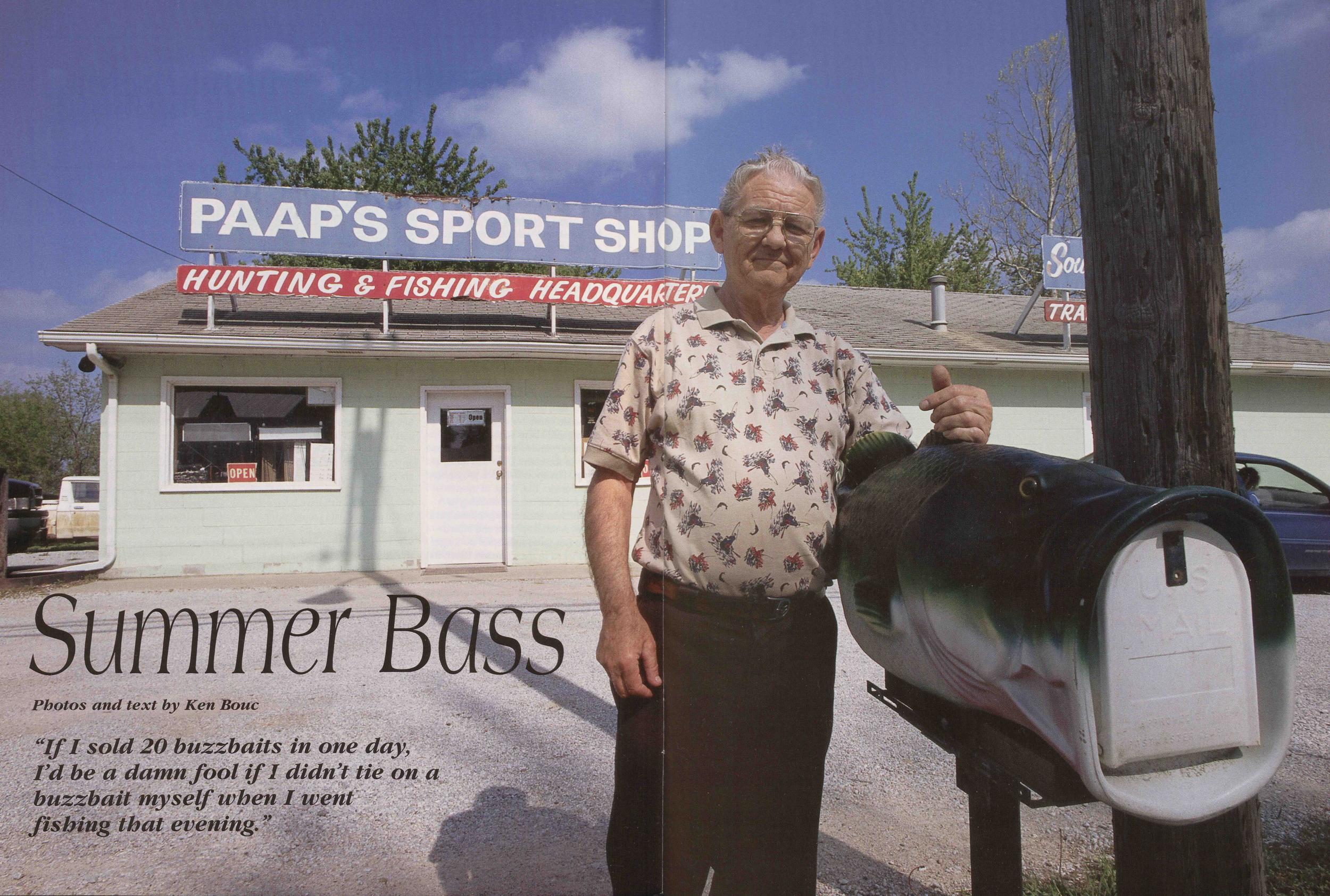
Summer Bass
Photos and text by Ken Bouc "If I sold 20 buzzboms in one day, I'd be a damn fool if I didn't tie on a buzzbait myself when I went fishing that evening."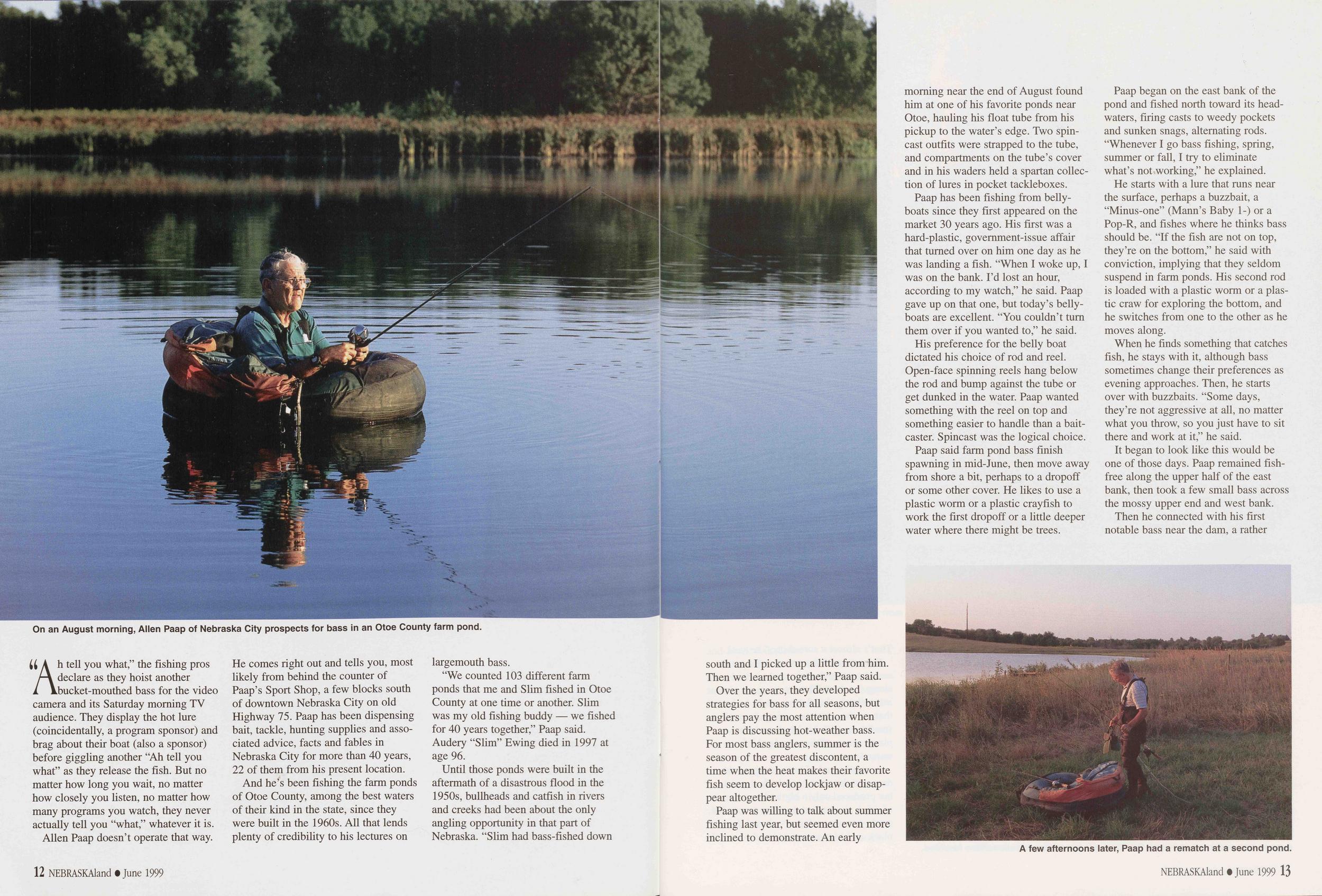
tell you what," the fishing pros A declare as they hoist another bucket-mouthed bass for the video camera and its Saturday morning TV audience. They display the hot lure (coincidentally, a program sponsor) and brag about their boat (also a sponsor) before giggling another "Ah tell you what" as they release the fish. But no matter how long you wait, no matter how closely you listen, no matter how many programs you watch, they never actually tell you "what," whatever it is.
Allen Paap doesn't operate that way. He comes right out and tells you, most likely from behind the counter of Paap's Sport Shop, a few blocks south of downtown Nebraska City on old Highway 75. Paap has been dispensing bait, tackle, hunting supplies and associated advice, facts and fables in Nebraska City for more than 40 years, 22 of them from his present location.
And he's been fishing the farm ponds of Otoe County, among the best waters of their kind in the state, since they were built in the 1960s. All that lends plenty of credibility to his lectures on largemouth bass.
"We counted 103 different farm ponds that me and Slim fished in Otoe County at one time or another. Slim was my old fishing buddy — we fished for 40 years together," Paap said. Audery "Slim" Ewing died in 1997 at age 96.
Until those ponds were built in the aftermath of a disastrous flood in the 1950s, bullheads and catfish in rivers and creeks had been about the only angling opportunity in that part of Nebraska. "Slim had bass-fished down 12 NEBRASKAland • June 1999 south and I picked up a little from him. Then we learned together," Paap said.
Over the years, they developed strategies for bass for all seasons, but anglers pay the most attention when Paap is discussing hot-weather bass. For most bass anglers, summer is the season of the greatest discontent, a time when the heat makes their favorite fish seem to develop lockjaw or disappear altogether.
Paap was willing to talk about summer fishing last year, but seemed even more inclined to demonstrate. An early morning near the end of August found him at one of his favorite ponds near Otoe, hauling his float tube from his pickup to the water's edge. Two spincast outfits were strapped to the tube, and compartments on the tube's cover and in his waders held a spartan collection of lures in pocket tackle boxes.
Paap has been fishing from belly boats since they first appeared on the market 30 years ago. His first was a hard-plastic, government-issue affair that turned over on him one day as he was landing a fish. "When I woke up, I was on the bank. I'd lost an hour, according to my watch," he said. Paap gave up on that one, but today's belly boats are excellent. "You couldn't turn them over if you wanted to," he said.
His preference for the belly boat dictated his choice of rod and reel. Open-face spinning reels hang below the rod and bump against the tube or get dunked in the water. Paap wanted something with the reel on top and something easier to handle than a baitcaster. Spincast was the logical choice.
Paap said farm pond bass finish spawning in mid-June, then move away from shore a bit, perhaps to a drop off or some other cover. He likes to use a plastic worm or a plastic crayfish to work the first drop off or a little deeper water where there might be trees.
Paap began on the east bank of the pond and fished north toward its headwaters, firing casts to weedy pockets and sunken snags, alternating rods. "Whenever I go bass fishing, spring, summer or fall, I try to eliminate what's not working," he explained.
He starts with a lure that runs near the surface, perhaps a buzzbait, a "Minus-one" (Mann's Baby 1-) or a Pop-R, and fishes where he thinks bass should be. "If the fish are not on top, they're on the bottom," he said with conviction, implying that they seldom suspend in farm ponds. His second rod is loaded with a plastic worm or a plastic craw for exploring the bottom, and he switches from one to the other as he moves along.
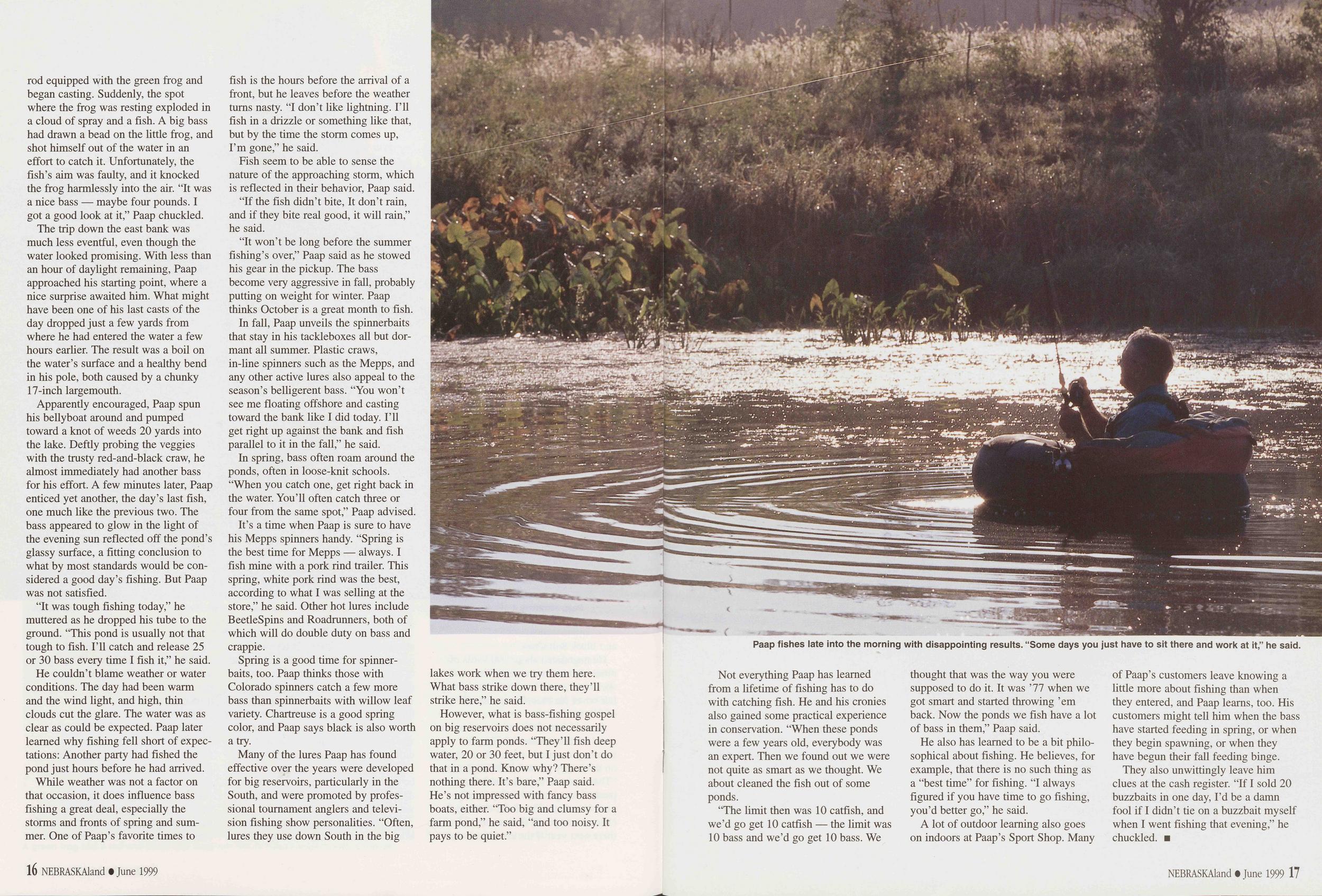
When he finds something that catches fish, he stays with it, although bass sometimes change their preferences as evening approaches. Then, he starts over with buzzbaits. "Some days, they're not aggressive at all, no matter what you throw, so you just have to sit there and work at it," he said.
It began to look like this would be one of those days. Paap remained fish free along the upper half of the east bank, then took a few small bass across the mossy upper end and west bank.
Then he connected with his first notable bass near the dam, a rather
 ordinary fish a bit under two pounds. A
half-dozen more like it followed over
the next hour, all taking plastic worms.
ordinary fish a bit under two pounds. A
half-dozen more like it followed over
the next hour, all taking plastic worms.
Without much more action, Paap finished his circuit of the 29-acre pond about noon. The morning's effort had resulted in about a dozen bass, none over two pounds. He was disappointed in the outing and insisted on a re-match.
That came a few afternoons later on another pond near Otoe. Reaching that one involved a bit of a stroll from the gravel road and gave Paap a chance to expound on artificial lures, a favorite topic of most bass anglers.
"I throw a Baby Minus-one an awful lot. That's a little plug, a crankbait that runs about a foot deep. I like a red or red-and-black one in hot weather, a red-and-black craw and a red shad- colored plastic worm," he said. He also goes to red-and-black anytime the water is a little dirty.
In July and August, Paap also likes to fish a green plastic frog on top of the weeds. He said it works best with the sun high, shining down on it, so he uses it only at midday. "When that plastic frog was new in the early '70s, it was the biggest thing in bass fishing, and I catch a lot of bass on green frogs to this day," he said.
Paap leaves one popular bass lure in the tacklebox in hot weather, however. "I use spinnerbaits a lot in the spring, and they're great in the fall, but I don't catch much with them in July and August," he said.
The second pond was a nine-acre affair with a grass-covered dam at its south end, a deep tangle of canary grass along the west bank and upper end and shorter, less dense pasture grass along the east bank. The lake had a "fishy" look, with downed trees and brush along the far bank and several interesting points of land along the east bank.
The band of shoreline weeds typical of farm ponds in summer was present, but it was not as dense or wide as in other ponds. Other clumps of weeds in slightly deeper water were isolated from those along the shoreline. It was one of Paap's favorites, a pond he had once called "an easy lake."
"I like to fish weeds a lot in July and August," Paap mused as he checked his gear. He stays alert for signs of activity on the surface and fishes the site if he sees a little commotion. He assumes that a bass is chasing baitfish there and might take a lure. "When I'm floating, if I feel cool water that means there's a spring there. I back off and fish it because the bass are usually there. That's almost a sure thing," he said.
Paap entered the water at the southeast corner of the lake and worked west along the dam. There were signs almost immediately that fishing might be better than on the previous outing. Several small bass took his black-and-blue plastic worm. Others nudged it but missed.
A small stand of cattails where the dam met the west bank looked good but produced only a big boil as a bruiser of a fish skedaddled, so Paap proceeded north, but not until he pocketed the black-and-blue worm and tied on a red-and-black Salt Craw.
He negotiated about 100 yards of relatively shallow water with weeds, sticks and a soft bottom. It was pretty fair cover for bass, but seemed devoid of fish at the time.
Ahead loomed the remains of a small stand of trees, some dead but still standing at water's edge, others toppled on the boggy ground or in the water. The same old log piles and weed patches are good for fish year after year. You find a fish there once, and chances are you'll find another like him there next year if the conditions don't change," he said. Paap obviously had previous experience with that collection of structure, because it drew him like a magnet.
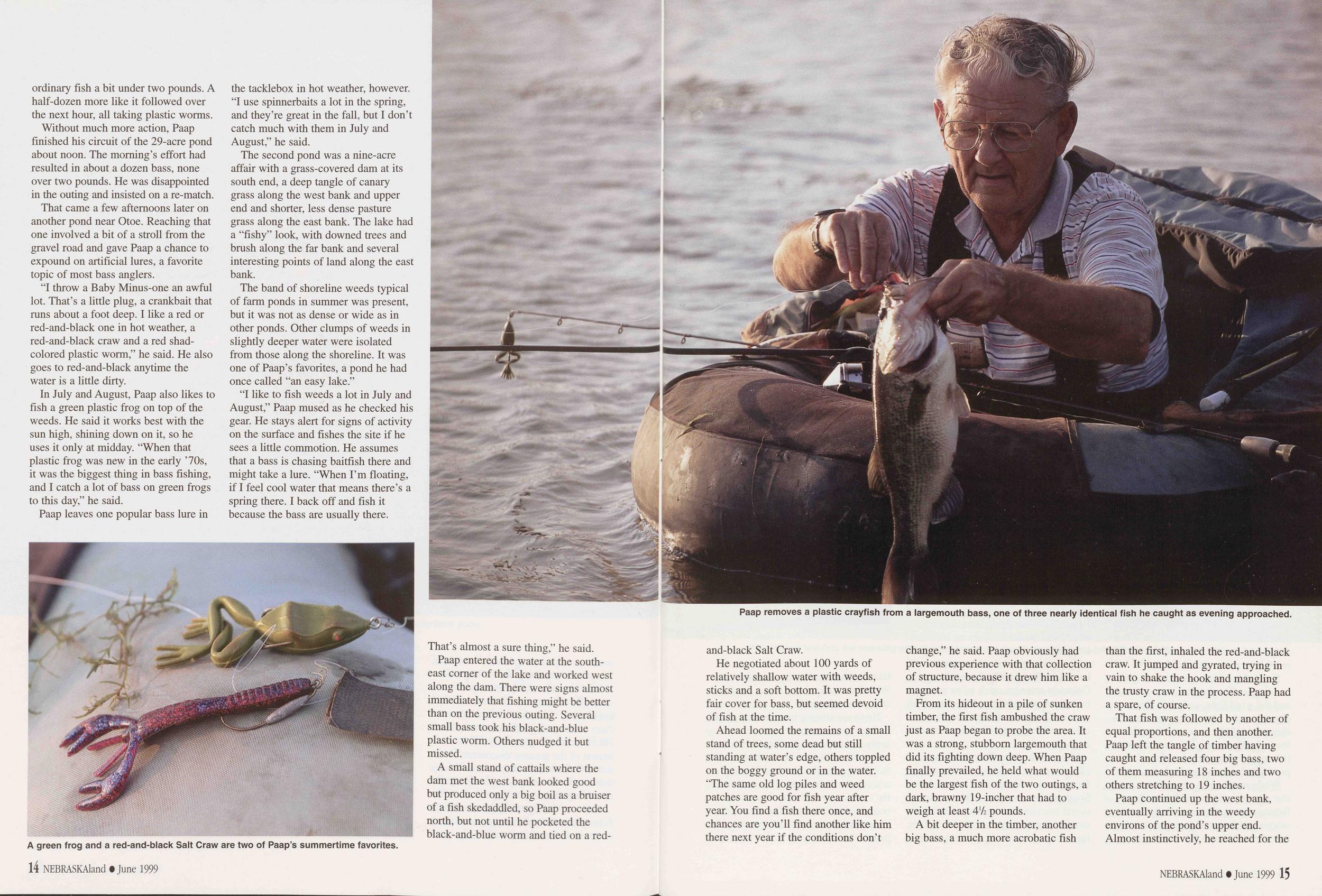
From its hideout in a pile of sunken timber, the first fish ambushed the craw just as Paap began to probe the area. It was a strong, stubborn largemouth that did its fighting down deep. When Paap finally prevailed, he held what would be the largest fish of the two outings, a dark, brawny 19-incher that had to weigh at least 4- pounds.
A bit deeper in the timber, another big bass, a much more acrobatic fish than the first, inhaled the red-and-black craw. It jumped and gyrated, trying in vain to shake the hook and mangling the trusty craw in the process. Paap had a spare, of course.
That fish was followed by another of equal proportions, and then another. Paap left the tangle of timber having caught and released four big bass, two of them measuring 18 inches and two others stretching to 19 inches.
Paap continued up the west bank,
eventually arriving in the weedy
environs of the pond's upper end.
Almost instinctively, he reached for the
NEBRASKAland • June 1999 15
 rod equipped with the green frog and
began casting. Suddenly, the spot
where the frog was resting exploded in
a cloud of spray and a fish. A big bass
had drawn a bead on the little frog, and
shot himself out of the water in an
effort to catch it. Unfortunately, the
fish's aim was faulty, and it knocked
the frog harmlessly into the air. "It was
a nice bass — maybe four pounds. I
got a good look at it," Paap chuckled.
rod equipped with the green frog and
began casting. Suddenly, the spot
where the frog was resting exploded in
a cloud of spray and a fish. A big bass
had drawn a bead on the little frog, and
shot himself out of the water in an
effort to catch it. Unfortunately, the
fish's aim was faulty, and it knocked
the frog harmlessly into the air. "It was
a nice bass — maybe four pounds. I
got a good look at it," Paap chuckled.
The trip down the east bank was much less eventful, even though the water looked promising. With less than an hour of daylight remaining, Paap approached his starting point, where a nice surprise awaited him. What might have been one of his last casts of the day dropped just a few yards from where he had entered the water a few hours earlier. The result was a boil on the water's surface and a healthy bend in his pole, both caused by a chunky 17-inch largemouth.
Apparently encouraged, Paap spun his bellyboat around and pumped toward a knot of weeds 20 yards into the lake. Deftly probing the veggies with the trusty red-and-black craw, he almost immediately had another bass for his effort. A few minutes later, Paap enticed yet another, the day's last fish, one much like the previous two. The bass appeared to glow in the light of the evening sun reflected off the pond's glassy surface, a fitting conclusion to what by most standards would be considered a good day's fishing. But Paap was not satisfied.
"It was tough fishing today," he muttered as he dropped his tube to the ground. "This pond is usually not that tough to fish. I'll catch and release 25 or 30 bass every time I fish it," he said.
He couldn't blame weather or water conditions. The day had been warm and the wind light, and high, thin clouds cut the glare. The water was as clear as could be expected. Paap later learned why fishing fell short of expectations: Another party had fished the pond just hours before he had arrived.
While weather was not a factor on that occasion, it does influence bass fishing a great deal, especially the storms and fronts of spring and sum- mer. One of Paap's favorite times to fish is the hours before the arrival of a front, but he leaves before the weather turns nasty. "I don't like lightning. I'll fish in a drizzle or something like that, but by the time the storm comes up, I'm gone," he said.
Fish seem to be able to sense the nature of the approaching storm, which is reflected in their behavior, Paap said.
"If the fish didn't bite, It don't rain, and if they bite real good, it will rain," he said.
"It won't be long before the summer fishing's over," Paap said as he stowed his gear in the pickup. The bass become very aggressive in fall, probably putting on weight for winter. Paap thinks October is a great month to fish.
In fall, Paap unveils the spinnerbaits that stay in his tackle boxes all but dormant all summer. Plastic craws, in-line spinners such as the Mepps, and any other active lures also appeal to the season's belligerent bass. "You won't see me floating offshore and casting toward the bank like I did today. I'll get right up against the bank and fish parallel to it in the fall," he said.
In spring, bass often roam around the ponds, often in loose-knit schools. "When you catch one, get right back in the water. You'll often catch three or four from the same spot," Paap advised.
It's a time when Paap is sure to have his Mepps spinners handy. "Spring is the best time for Mepps — always. I fish mine with a pork rind trailer. This spring, white pork rind was the best, according to what I was selling at the store," he said. Other hot lures include BeetleSpins and Roadrunners, both of which will do double duty on bass and crappie.
Spring is a good time for spinner baits, too. Paap thinks those with Colorado spinners catch a few more bass than spinnerbaits with willow leaf variety. Chartreuse is a good spring color, and Paap says black is also worth a try.
Many of the lures Paap has found effective over the years were developed for big reservoirs, particularly in the South, and were promoted by professional tournament anglers and television fishing show personalities. "Often, lures they use down South in the big lakes work when we try them here. What bass strike down there, they'll strike here," he said.
However, what is bass-fishing gospel on big reservoirs does not necessarily apply to farm ponds. "They'll fish deep water, 20 or 30 feet, but I just don't do that in a pond. Know why? There's nothing there. It's bare," Paap said. He's not impressed with fancy bass boats, either. "Too big and clumsy for a farm pond," he said, "and too noisy. It pays to be quiet."
16 NEBRASKAland • June 1999Not everything Paap has learned from a lifetime of fishing has to do with catching fish. He and his cronies also gained some practical experience in conservation. "When these ponds were a few years old, everybody was an expert. Then we found out we were not quite as smart as we thought. We about cleaned the fish out of some ponds."
"The limit then was 10 catfish, and we'd go get 10 catfish — the limit was 10 bass and we'd go get 10 bass. We thought that was the way you were supposed to do it. It was '77 when we got smart and started throwing 'em back. Now the ponds we fish have a lot of bass in them," Paap said.
He also has learned to be a bit philosophical about fishing. He believes, for example, that there is no such thing as a "best time" for fishing. "I always figured if you have time to go fishing, you'd better go," he said.
A lot of outdoor learning also goes on indoors at Paap's Sport Shop. Many of Paap's customers leave knowing a little more about fishing than when they entered, and Paap learns, too. His customers might tell him when the bass have started feeding in spring, or when they begin spawning, or when they have begun their fall feeding binge.
They also unwittingly leave him clues at the cash register. "If I sold 20 buzzbaits in one day, I'd be a damn fool if I didn't tie on a buzzbait myself when I went fishing that evening," he chuckled.
NEBRASKAland • June 1999 17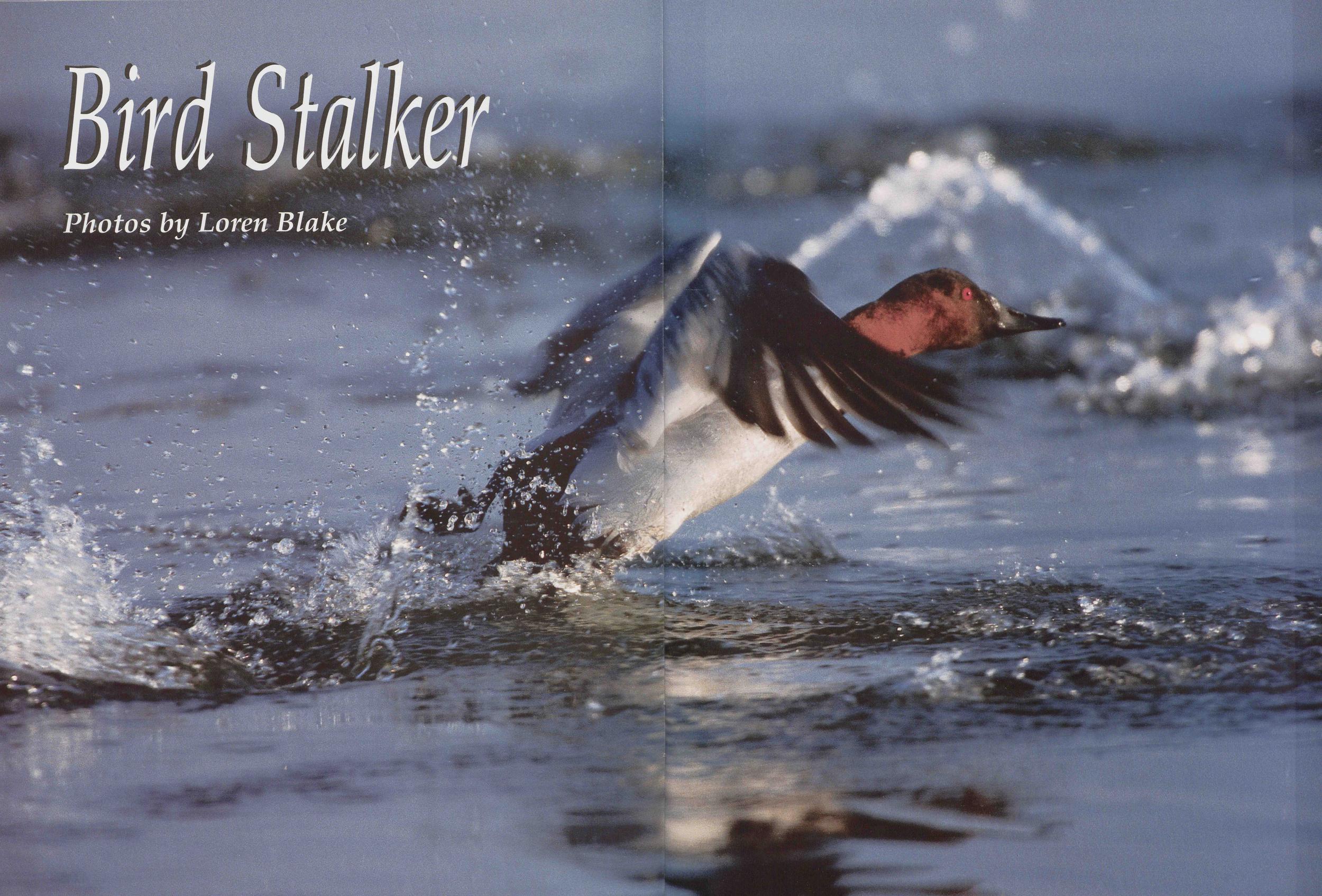
Bird Stalker
Photos by Loren Blake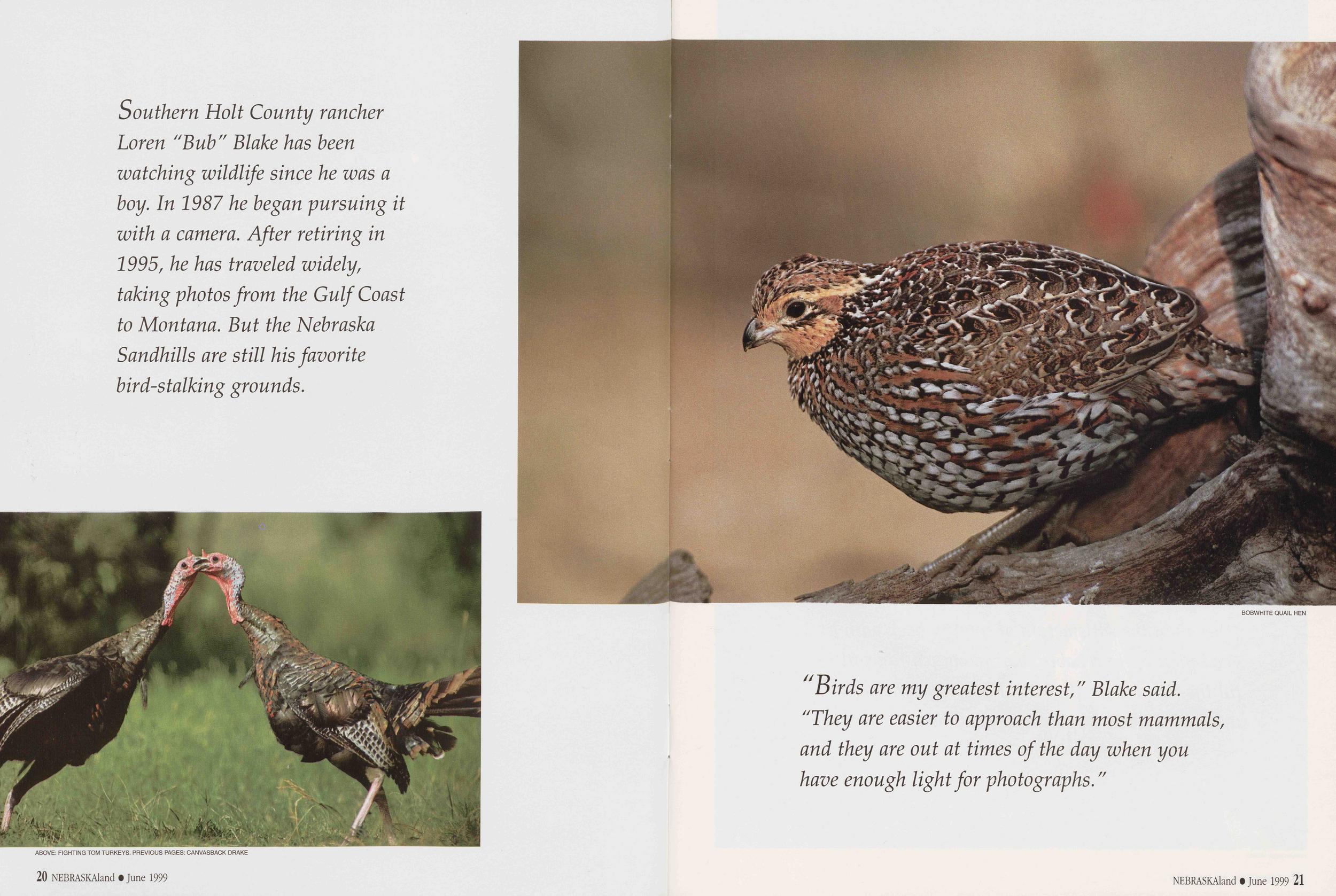
Southern Holt County rancher Loren "Bub" Blake has been watching wildlife since he was a boy. In 1987 he began pursuing it with a camera. After retiring in 1995', he has traveled widely, taking photos from the Gulf Coast to Montana. But the Nebraska Sandhills are still his favorite bird-stalking grounds.
"Birds are my greatest interest," Blake said. "They are easier to approach than most mammals, and they are out at times of the day when you have enough light for photographs."
NEBRASKAland t June 1999 21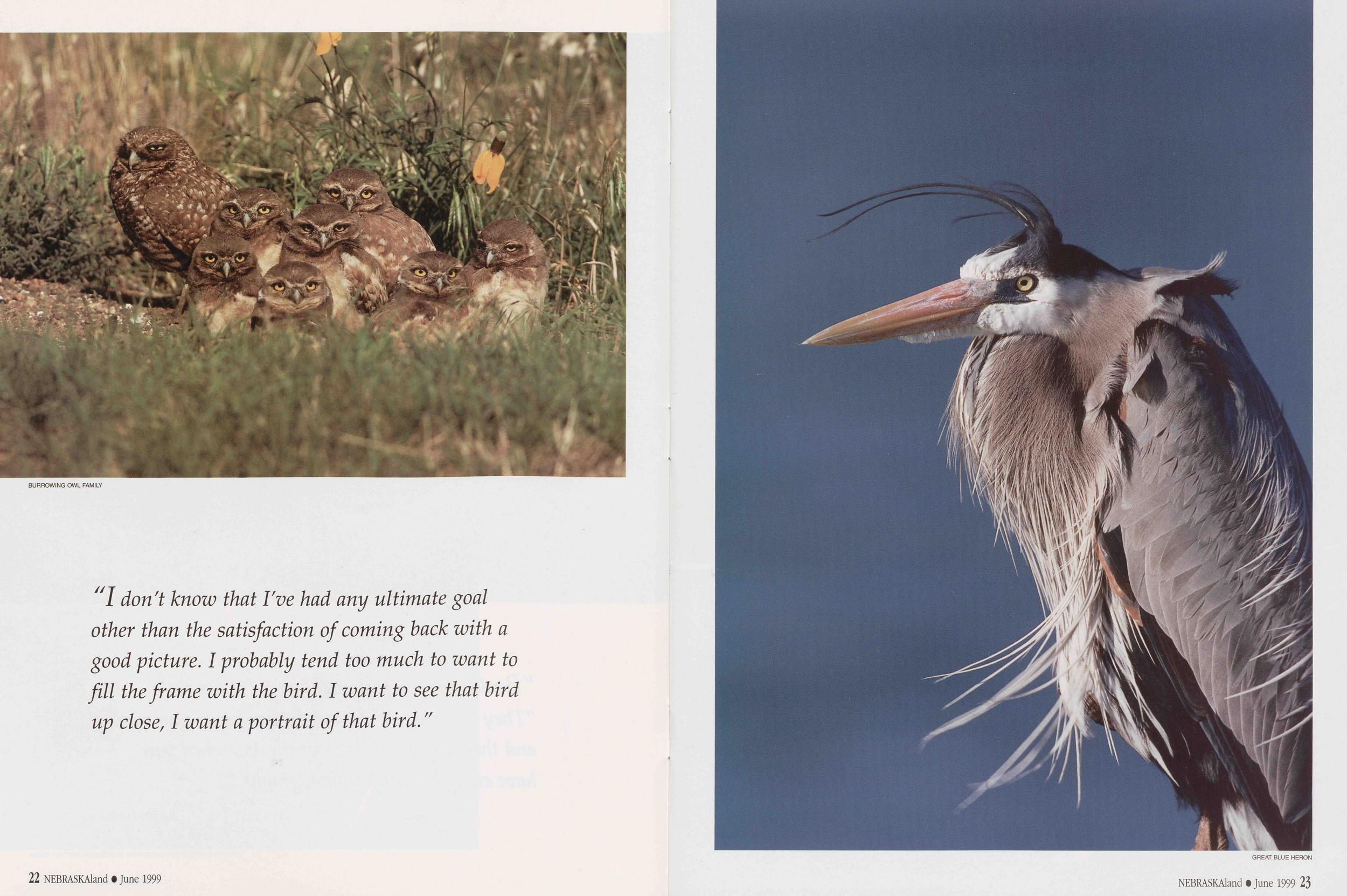
"I don't know that I've had any ultimate goal other than the satisfaction of coming hack with a good picture. I probably tend too much to want to fill the frame with the bird. I want to see that bird up close, I want a portrait of that bird."
22 NEBRASKAland • June 1999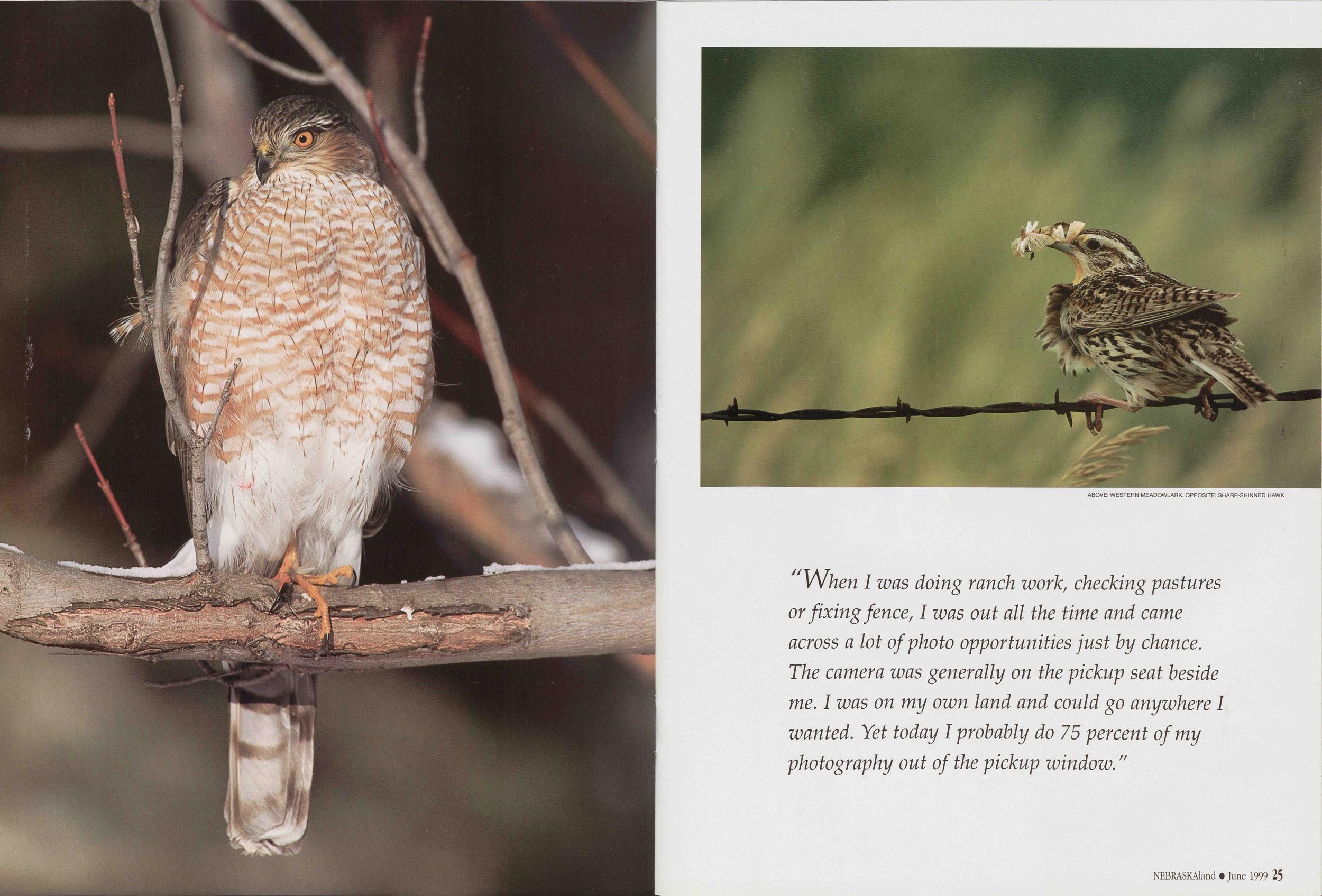
"When I was doing ranch work, checking pastures or fixing fence, I was out all the time and came across a lot of photo opportunities just by chance. The camera was generally on the pickup seat beside me. I was on my own land and could go anywhere I wanted. Yet today I probably do 75 percent of my photography out of the pickup window."
NEBRASKAland • June 1999 25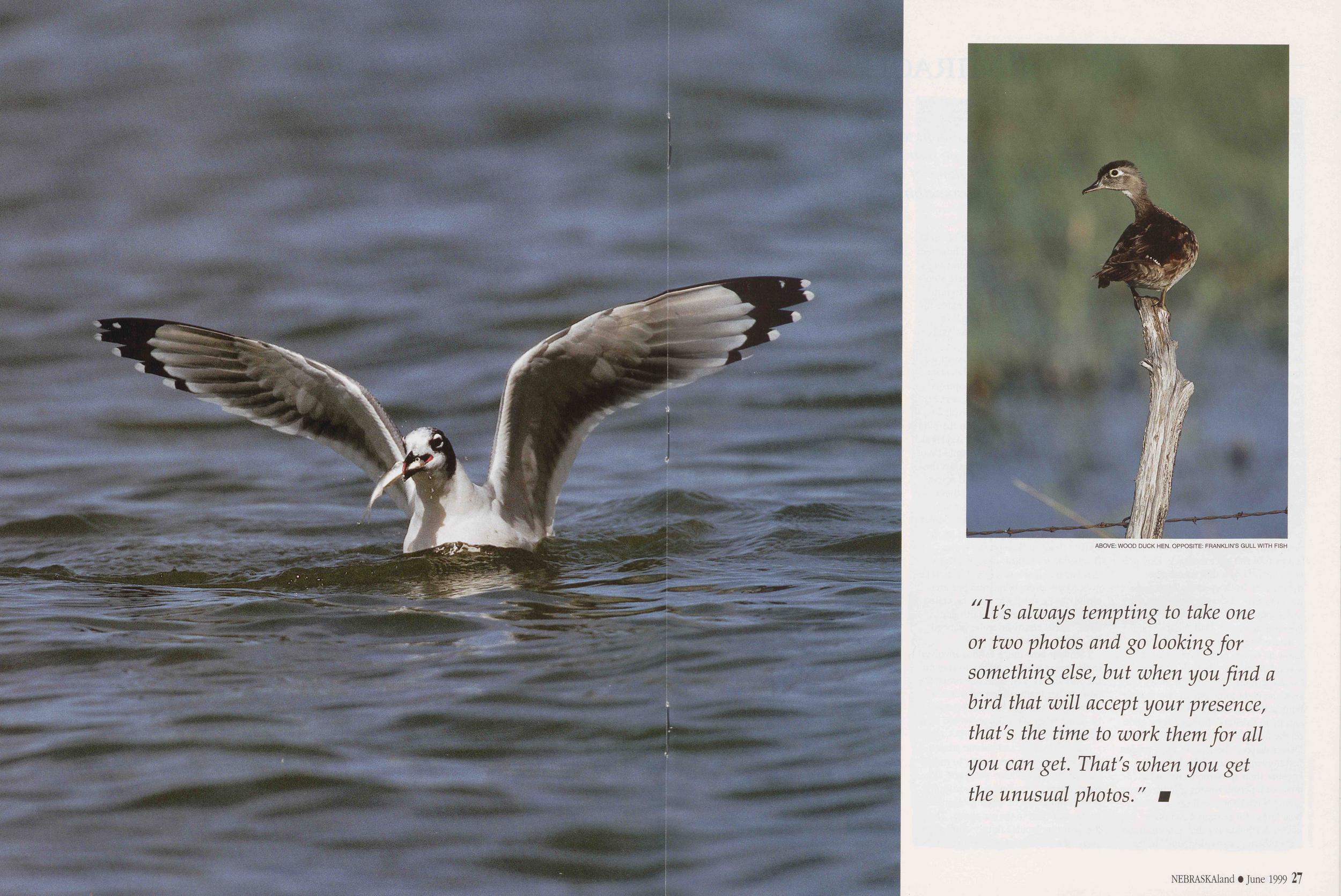
"It's always tempting to take one or two photos and go looking for something else, hut when you find a bird that will accept your presence, that's the time to work them for all you can get. That's when you get the unusual photos."
NEBRASKAland • June 1999 27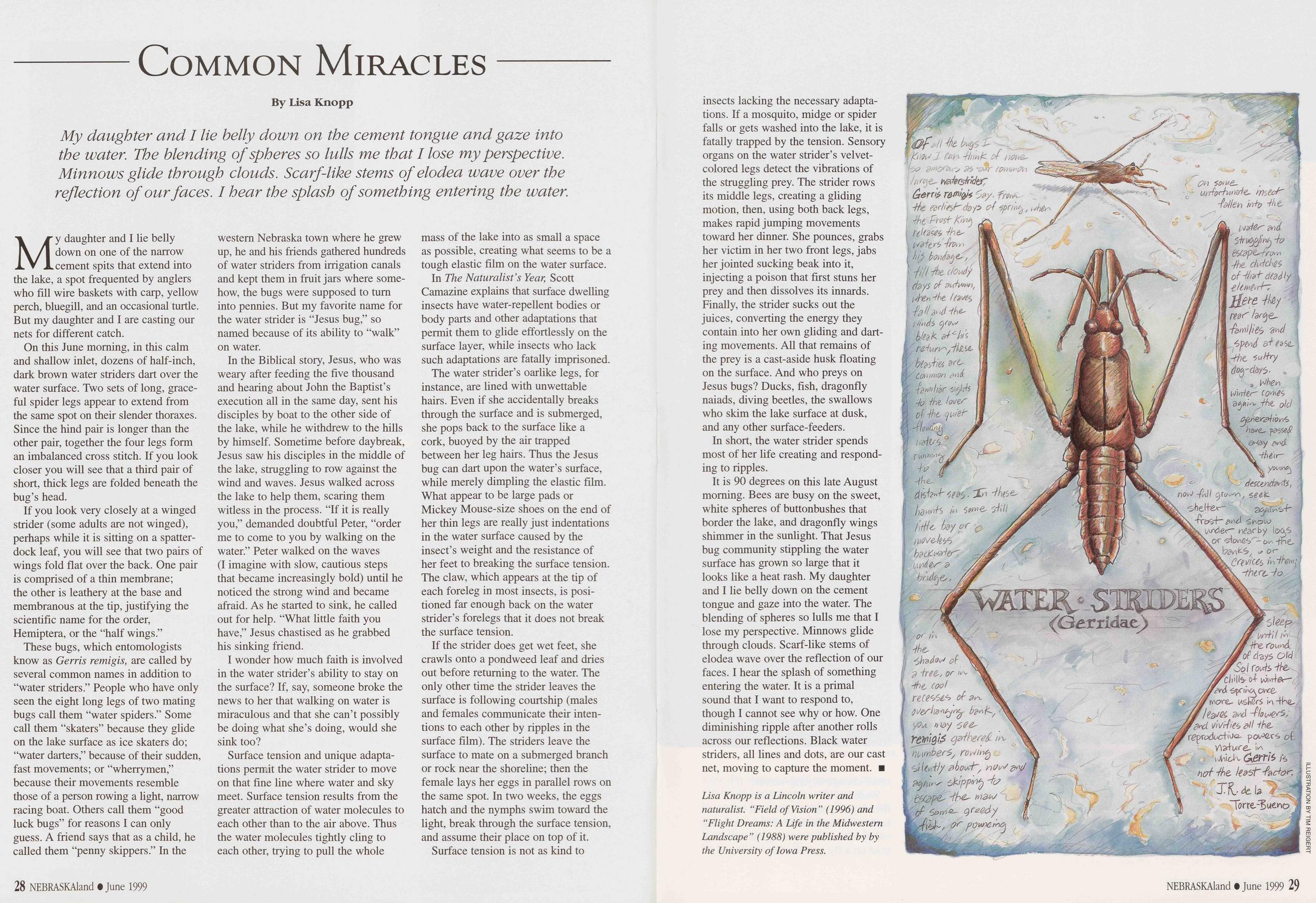
Common Miracles
By Lisa Knopp My daughter and I lie belly down on the cement tongue and gaze into the water The blending of spheres so lulls me that I lose my perspective. Minnows glide through clouds. Scarf-like stems of elodea wave over the reflection of our faces. I hear the splash of something entering the water.My daughter and I lie belly down on one of the narrow cement spits that extend into the lake, a spot frequented by anglers who fill wire baskets with carp, yellow perch, bluegill, and an occasional turtle. But my daughter and I are casting our nets for different catch.
On this June morning, in this calm and shallow inlet, dozens of half-inch, dark brown water striders dart over the water surface. Two sets of long, graceful spider legs appear to extend from the same spot on their slender thoraxes. Since the hind pair is longer than the other pair, together the four legs form an imbalanced cross stitch. If you look closer you will see that a third pair of short, thick legs are folded beneath the bug's head.
If you look very closely at a winged strider (some adults are not winged), perhaps while it is sitting on a spatter- dock leaf, you will see that two pairs of wings fold flat over the back. One pair is comprised of a thin membrane; the other is leathery at the base and membranous at the tip, justifying the scientific name for the order, Hemiptera, or the "half wings."
These bugs, which entomologists know as Gerris remigis, are called by several common names in addition to "water striders." People who have only seen the eight long legs of two mating bugs call them "water spiders." Some call them "skaters" because they glide on the lake surface as ice skaters do; "water darters," because of their sudden, fast movements; or "wherrymen," because their movements resemble those of a person rowing a light, narrow racing boat. Others call them "good luck bugs" for reasons I can only guess. A friend says that as a child, he called them "penny skippers." In the western Nebraska town where he grew up, he and his friends gathered hundreds of water striders from irrigation canals and kept them in fruit jars where somehow, the bugs were supposed to turn into pennies. But my favorite name for the water strider is "Jesus bug," so named because of its ability to "walk" on water.
In the Biblical story, Jesus, who was weary after feeding the five thousand and hearing about John the Baptist's execution all in the same day, sent his disciples by boat to the other side of the lake, while he withdrew to the hills by himself. Sometime before daybreak, Jesus saw his disciples in the middle of the lake, struggling to row against the wind and waves. Jesus walked across the lake to help them, scaring them witless in the process. "If it is really you," demanded doubtful Peter, "order me to come to you by walking on the water." Peter walked on the waves (I imagine with slow, cautious steps that became increasingly bold) until he noticed the strong wind and became afraid. As he started to sink, he called out for help. "What little faith you have," Jesus chastised as he grabbed his sinking friend.
I wonder how much faith is involved in the water strider's ability to stay on the surface? If, say, someone broke the news to her that walking on water is miraculous and that she can't possibly be doing what she's doing, would she sink too?
Surface tension and unique adaptations permit the water strider to move on that fine line where water and sky meet. Surface tension results from the greater attraction of water molecules to each other than to the air above. Thus the water molecules tightly cling to each other, trying to pull the whole mass of the lake into as small a space as possible, creating what seems to be a tough elastic film on the water surface.
In The Naturalist's Year, Scott Camazine explains that surface dwelling insects have water-repellent bodies or body parts and other adaptations that permit them to glide effortlessly on the surface layer, while insects who lack such adaptations are fatally imprisoned.
The water strider's oarlike legs, for instance, are lined with unwettable hairs. Even if she accidentally breaks through the surface and is submerged, she pops back to the surface like a cork, buoyed by the air trapped between her leg hairs. Thus the Jesus bug can dart upon the water's surface, while merely dimpling the elastic film. What appear to be large pads or Mickey Mouse-size shoes on the end of her thin legs are really just indentations in the water surface caused by the insect's weight and the resistance of her feet to breaking the surface tension. The claw, which appears at the tip of each foreleg in most insects, is positioned far enough back on the water strider's forelegs that it does not break the surface tension.
If the strider does get wet feet, she crawls onto a pondweed leaf and dries out before returning to the water. The only other time the strider leaves the surface is following courtship (males and females communicate their intentions to each other by ripples in the surface film). The striders leave the surface to mate on a submerged branch or rock near the shoreline; then the female lays her eggs in parallel rows on the same spot. In two weeks, the eggs hatch and the nymphs swim toward the light, break through the surface tension, and assume their place on top of it.
Surface tension is not as kind to 28 NEBRASKAland • June 1999 insects lacking the necessary adaptations. If a mosquito, midge or spider falls or gets washed into the lake, it is fatally trapped by the tension. Sensory organs on the water strider's velvet colored legs detect the vibrations of the struggling prey. The strider rows its middle legs, creating a gliding motion, then, using both back legs, makes rapid jumping movements toward her dinner. She pounces, grabs her victim in her two front legs, jabs her jointed sucking beak into it, injecting a poison that first stuns her prey and then dissolves its innards. Finally, the strider sucks out the juices, converting the energy they contain into her own gliding and darting movements. All that remains of the prey is a cast-aside husk floating on the surface. And who preys on Jesus bugs? Ducks, fish, dragonfly naiads, diving beetles, the swallows who skim the lake surface at dusk, and any other surface-feeders.
In short, the water strider spends most of her life creating and responding to ripples.
It is 90 degrees on this late August morning. Bees are busy on the sweet, white spheres of buttonbushes that border the lake, and dragonfly wings shimmer in the sunlight. That Jesus bug community stippling the water surface has grown so large that it looks like a heat rash. My daughter and I lie belly down on the cement tongue and gaze into the water. The blending of spheres so lulls me that I lose my perspective. Minnows glide through clouds. Scarf-like stems of elodea wave over the reflection of our faces. I hear the splash of something entering the water. It is a primal sound that I want to respond to, though I cannot see why or how. One diminishing ripple after another rolls across our reflections. Black water striders, all lines and dots, are our cast net, moving to capture the moment.
Lisa Knopp is a Lincoln writer and naturalist. "Field of Vision" (1996) and "Flight Dreams: A Life in the Midwestern Landscape " (1988) were published by by the University of Iowa Press.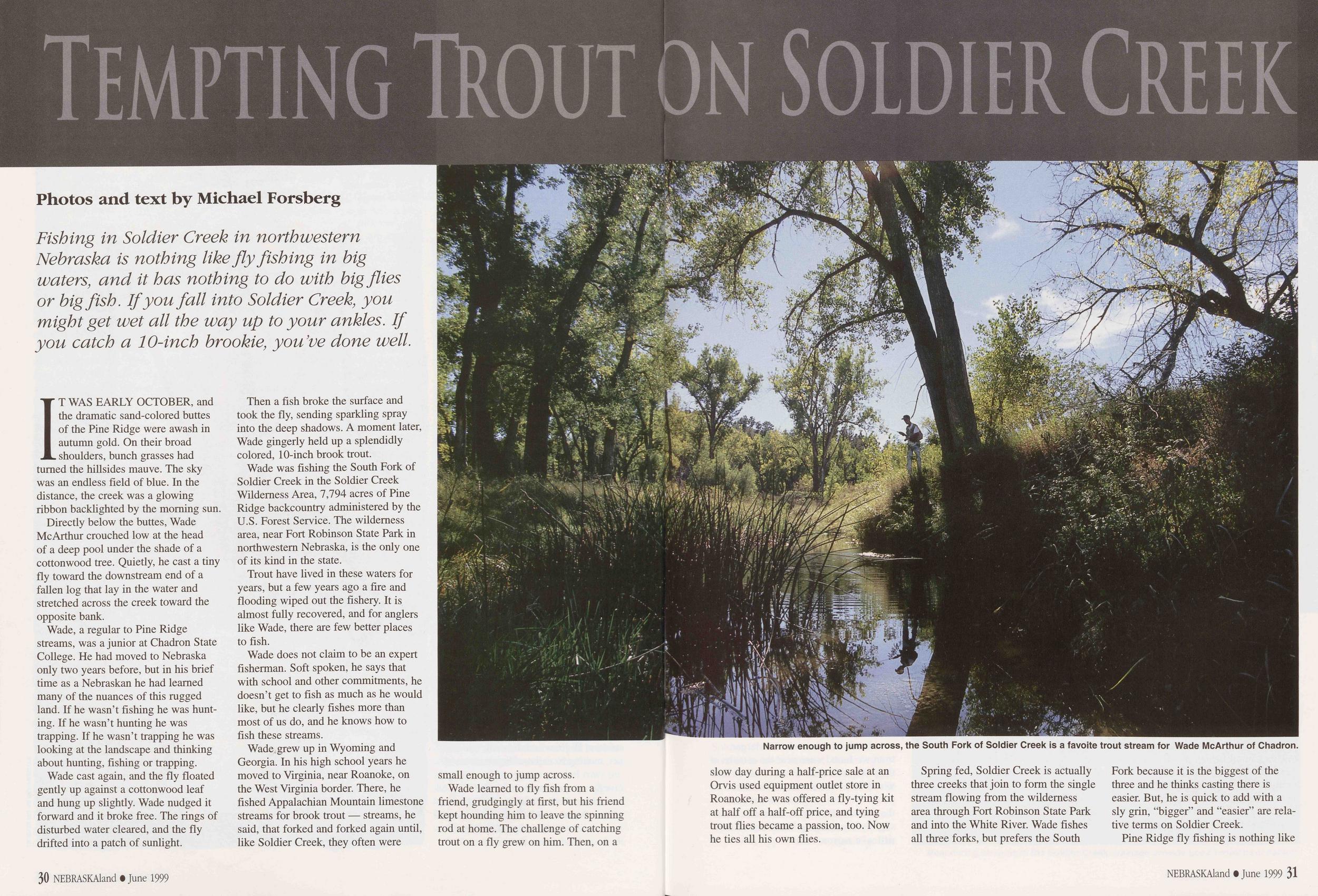
Tempting Trout on Soldier Creek
Photos and text by Michael Forsberg Fishing in Soldier Creek in northwestern Nebraska is nothing like fly fishing in big waters, and it has nothing to do with big flies or big fish. If you fall into Soldier Creek, you might get wet all the way up to your ankles. If you catch a 10-inch brookie, you've done well.IT WAS EARLY OCTOBER, and the dramatic sand-colored buttes of the Pine Ridge were awash in autumn gold. On their broad shoulders, bunch grasses had turned the hillsides mauve. The sky was an endless field of blue. In the distance, the creek was a glowing ribbon backlighted by the morning sun.
Directly below the buttes, Wade McArthur crouched low at the head of a deep pool under the shade of a cottonwood tree. Quietly, he cast a tiny fly toward the downstream end of a fallen log that lay in the water and stretched across the creek toward the opposite bank.
Wade, a regular to Pine Ridge streams, was a junior at Chadron State College. He had moved to Nebraska only two years before, but in his brief time as a Nebraskan he had learned many of the nuances of this rugged land. If he wasn't fishing he was hunting. If he wasn't hunting he was trapping. If he wasn't trapping he was looking at the landscape and thinking about hunting, fishing or trapping.
Wade cast again, and the fly floated gently up against a cottonwood leaf and hung up slightly. Wade nudged it forward and it broke free. The rings of disturbed water cleared, and the fly drifted into a patch of sunlight.
Then a fish broke the surface and took the fly, sending sparkling spray into the deep shadows. A moment later, Wade gingerly held up a splendidly colored, 10-inch brook trout.
Wade was fishing the South Fork of Soldier Creek in the Soldier Creek Wilderness Area, 7,794 acres of Pine Ridge backcountry administered by the U.S. Forest Service. The wilderness area, near Fort Robinson State Park in northwestern Nebraska, is the only one of its kind in the state.
Trout have lived in these waters for years, but a few years ago a fire and flooding wiped out the fishery. It is almost fully recovered, and for anglers like Wade, there are few better places to fish.
Wade does not claim to be an expert fisherman. Soft spoken, he says that with school and other commitments, he doesn't get to fish as much as he would like, but he clearly fishes more than most of us do, and he knows how to fish these streams.
Wade grew up in Wyoming and Georgia. In his high school years he moved to Virginia, near Roanoke, on the West Virginia border. There, he fished Appalachian Mountain limestone streams for brook trout — streams, he said, that forked and forked again until, like Soldier Creek, they often were Narrow enough to jump across, the South Fork of Soldier Creek is a favorite trout stream for Wade McArthur of Chadron. small enough to jump across.
Wade learned to fly fish from a friend, grudgingly at first, but his friend kept hounding him to leave the spinning rod at home. The challenge of catching trout on a fly grew on him. Then, on a 30 NEBRASKAland • June 1999
Spring fed, Soldier Creek is actually three creeks that join to form the single stream flowing from the wilderness area through Fort Robinson State Park and into the White River. Wade fishes all three forks, but prefers the South Fork because it is the biggest of the three and he thinks casting there is easier. But, he is quick to add with a sly grin, "bigger" and "easier" are relative terms on Soldier Creek.
Pine Ridge fly fishing is nothing like
NEBRASKAland • June 1999 31
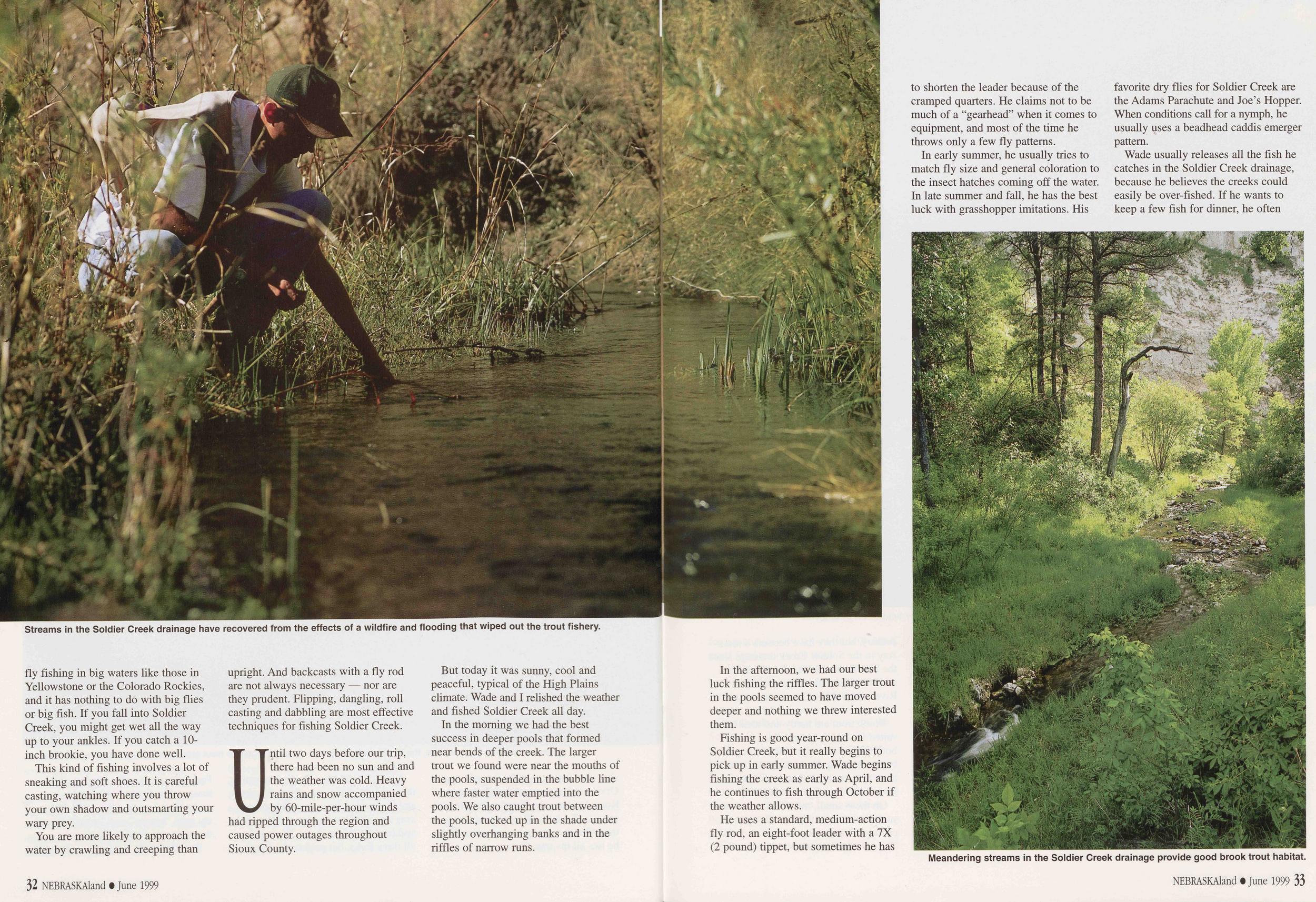
This kind of fishing involves a lot of sneaking and soft shoes. It is careful casting, watching where you throw your own shadow and outsmarting your wary prey.
You are more likely to approach the water by crawling and creeping than upright. And backcasts with a fly rod are not always necessary — nor are they prudent. Flipping, dangling, roll casting and dabbling are most effective techniques for fishing Soldier Creek.
Until two days before our trip, there had been no sun and and the weather was cold. Heavy rains and snow accompanied by 60-mile-per-hour winds had ripped through the region and caused power outages throughout Sioux County.
But today it was sunny, cool and peaceful, typical of the High Plains climate. Wade and I relished the weather and fished Soldier Creek all day.
In the morning we had the best success in deeper pools that formed near bends of the creek. The larger trout we found were near the mouths of the pools, suspended in the bubble line where faster water emptied into the pools. We also caught trout between the pools, tucked up in the shade under slightly overhanging banks and in the riffles of narrow runs.
32 NEBRASKAland • June 1999In the afternoon, we had our best luck fishing the riffles. The larger trout in the pools seemed to have moved deeper and nothing we threw interested them.
Fishing is good year-round on Soldier Creek, but it really begins to pick up in early summer. Wade begins fishing the creek as early as April, and he continues to fish through October if the weather allows.
He uses a standard, medium-action fly rod, an eight-foot leader with a 7X (2 pound) tippet, but sometimes he has to shorten the leader because of the cramped quarters. He claims not to be much of a "gearhead" when it comes to equipment, and most of the time he throws only a few fly patterns.
In early summer, he usually tries to match fly size and general coloration to the insect hatches coming off the water. In late summer and fall, he has the best luck with grasshopper imitations. His favorite dry flies for Soldier Creek are the Adams Parachute and Joe's Hopper. When conditions call for a nymph, he usually uses a beadhead caddis emerger pattern.
Wade usually releases all the fish he catches in the Soldier Creek drainage, because he believes the creeks could easily be over-fished. If he wants to keep a few fish for dinner, he often
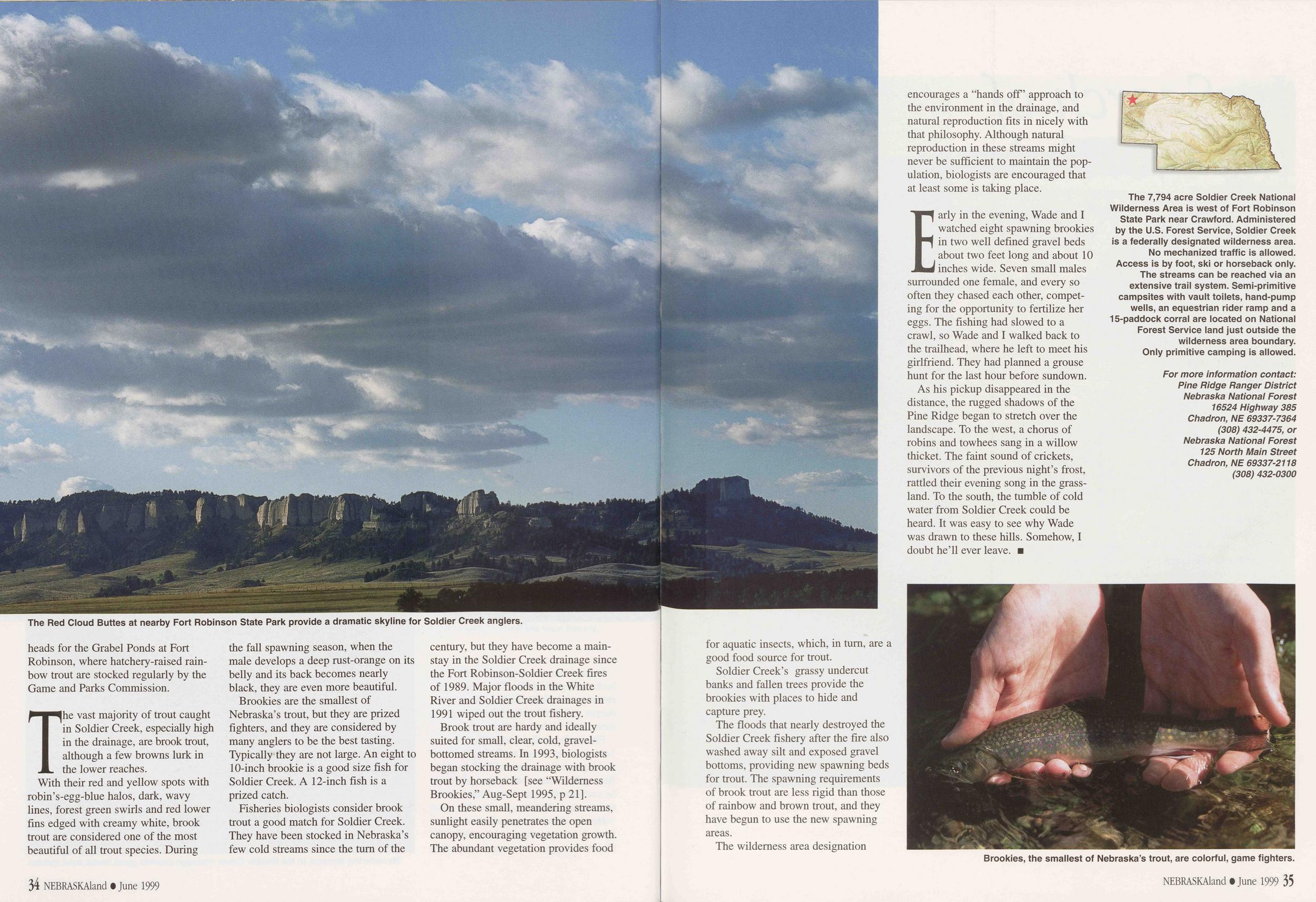
The vast majority of trout caught in Soldier Creek, especially high in the drainage, are brook trout, although a few browns lurk in the lower reaches.
With their red and yellow spots with robin's-egg-blue halos, dark, wavy lines, forest green swirls and red lower fins edged with creamy white, brook trout are considered one of the most beautiful of all trout species. During the fall spawning season, when the male develops a deep rust-orange on its belly and its back becomes nearly black, they are even more beautiful.
Brookies are the smallest of Nebraska's trout, but they are prized fighters, and they are considered by many anglers to be the best tasting. Typically they are not large. An eight to 10-inch brookie is a good size fish for Soldier Creek. A 12-inch fish is a prized catch.
Fisheries biologists consider brook trout a good match for Soldier Creek. They have been stocked in Nebraska's few cold streams since the turn of the century, but they have become a main stay in the Soldier Creek drainage since the Fort Robinson-Soldier Creek fires of 1989. Major floods in the White River and Soldier Creek drainages in 1991 wiped out the trout fishery.
Brook trout are hardy and ideally suited for small, clear, cold, gravel bottomed streams. In 1993, biologists began stocking the drainage with brook trout by horseback [see "Wilderness Brookies," Aug-Sept 1995, p 21].
On these small, meandering streams, sunlight easily penetrates the open canopy, encouraging vegetation growth. The abundant vegetation provides food 34 NEBRASKAland • June 1999 for aquatic insects, which, in turn, are a good food source for trout.
Soldier Creek's grassy undercut banks and fallen trees provide the brookies with places to hide and capture prey.
The floods that nearly destroyed the Soldier Creek fishery after the fire also washed away silt and exposed gravel bottoms, providing new spawning beds for trout. The spawning requirements of brook trout are less rigid than those of rainbow and brown trout, and they have begun to use the new spawning areas.
The wilderness area designation encourages a "hands off' approach to the environment in the drainage, and natural reproduction fits in nicely with that philosophy. Although natural reproduction in these streams might never be sufficient to maintain the population, biologists are encouraged that at least some is taking place.
Early in the evening, Wade and I watched eight spawning brookies in two well defined gravel beds about two feet long and about 10 inches wide. Seven small males surrounded one female, and every so often they chased each other, competing for the opportunity to fertilize her eggs. The fishing had slowed to a crawl, so Wade and I walked back to the trailhead, where he left to meet his girlfriend. They had planned a grouse hunt for the last hour before sundown.
As his pickup disappeared in the distance, the rugged shadows of the Pine Ridge began to stretch over the landscape. To the west, a chorus of robins and towhees sang in a willow thicket. The faint sound of crickets, survivors of the previous night's frost, rattled their evening song in the grassland. To the south, the tumble of cold water from Soldier Creek could be heard. It was easy to see why Wade was drawn to these hills. Somehow, I doubt he'll ever leave.
In Search of the North Platte River
Photos and text by Michael Farrell"In the fall of 1989, I took my new Sinar 4x5 camera up to Whitetail Wildlife Management Area on the north side of the Platte River in Colfax County. I was in search of new photo opportunities.
Fd been making photographs since 1967 when I took my first art school class at Indiana University. Until then, most of my work had been personal, using a 35mm still camera to document the odd moments of daily life or, more lucratively, a 16mm motion picture camera to shoot film for public television documentaries.
In the late '70s I began to direct and write documentaries. I had to let my photographic desires take a back seat while I focused on the craft of storytelling for television. Now, after a decade, I was trying to get back to my visual roots.
On that particular Sunday afternoon, I was concerned with trying to make a technically proficient negative in the demanding four-by-five-inch format. As it turned out, I found myself involved with a subject that would occupy me for the next decade. It seems to me that's how important things tend to happen: When the world speaks to us, offering an intense experience, one is lucky to be able to listen and hear.
As I worked my way through the brush and willows down to the river, I saw beaver sign and coyote and deer scat. I smelled the river before I could see it.
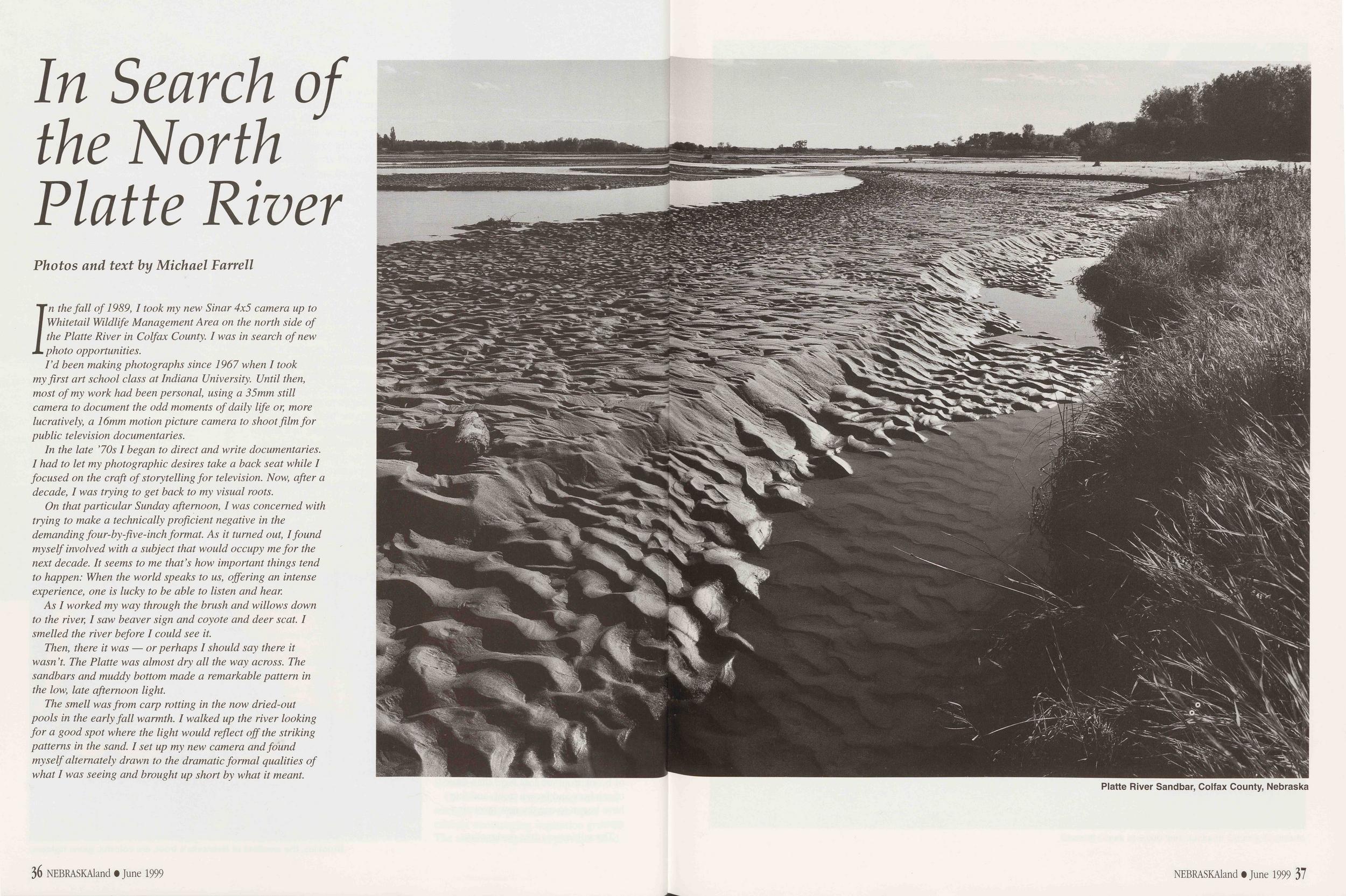
Then, there it was — or perhaps I should say there it wasn 't. The Platte was almost dry all the way across. The sandbars and muddy bottom made a remarkable pattern in the low, late afternoon light.
The smell was from carp rotting in the now dried-out pools in the early fall warmth. I walked up the river looking for a good spot where the light would reflect off the striking patterns in the sand. I set up my new camera and found myself alternately drawn to the dramatic formal qualities of what I was seeing and brought up short by what it meant.
36 NEBRASKAland • June 1999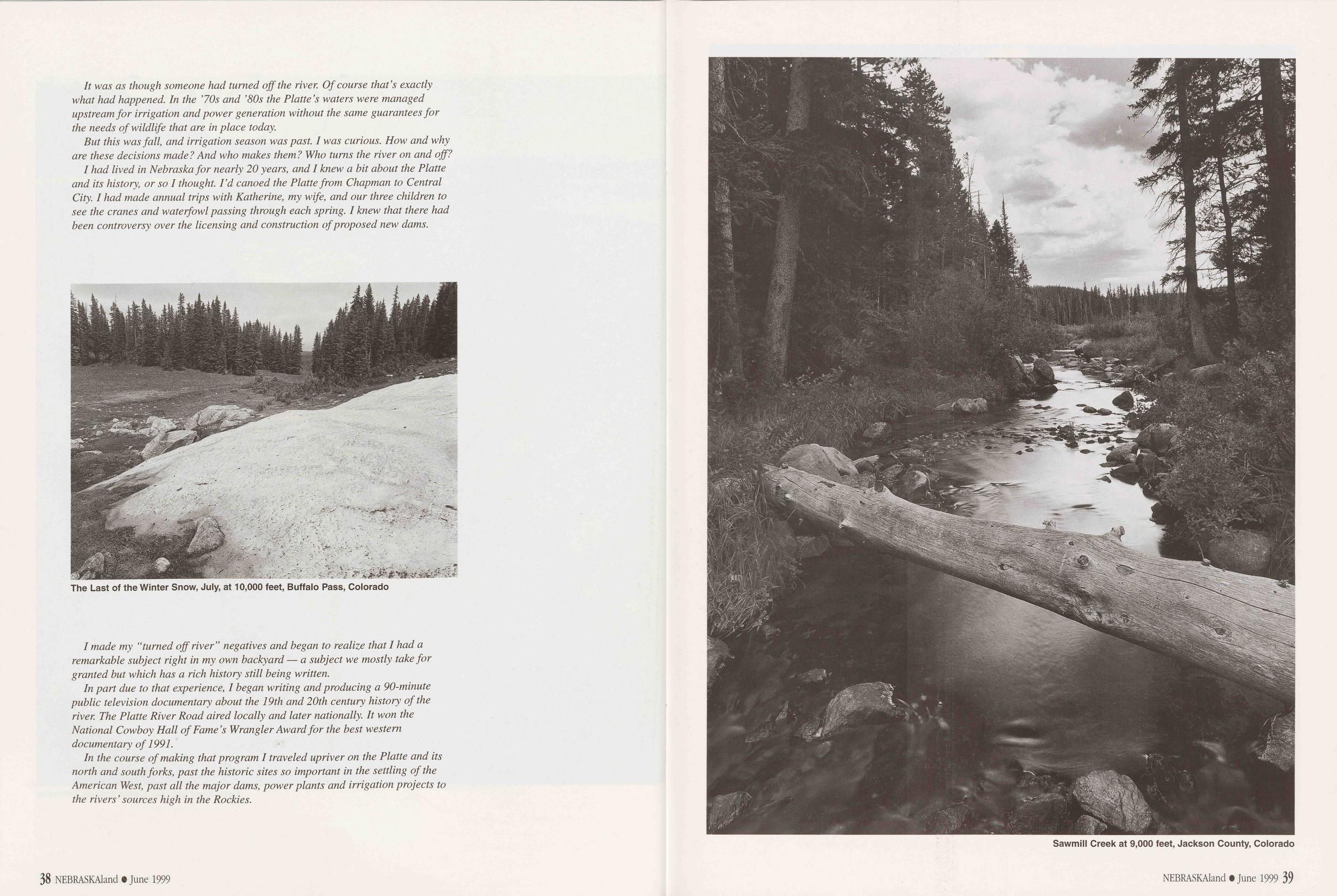
It was as though someone had turned off the river. Of course that's exactly what had happened. In the '70s and '80s the Platte's waters were managed upstream for irrigation and power generation without the same guarantees for the needs of wildlife that are in place today.
But this was fall, and irrigation season was past. I was curious. How and why are these decisions made? And who makes them? Who turns the river on and off?
I had lived in Nebraska for nearly 20 years, and I knew a bit about the Platte and its history, or so I thought. I'd canoed the Platte from Chapman to Central City. I had made annual trips with Katherine, my wife, and our three children to see the cranes and waterfowl passing through each spring. I knew that there had been controversy over the licensing and construction of proposed new dams.
made my "turned off river" negatives and began to realize that I had a remarkable subject right in my own backyard — a subject we mostly take for granted but which has a rich history still being written.
In part due to that experience, I began writing and producing a 90-minute public television documentary about the 19th and 20th century history of the river. The Platte River Road aired locally and later nationally. It won the National Cowboy Hall of Fame's Wrangler Award for the best western documentary of 1991.
In the course of making that program I traveled upriver on the Platte and its north and south forks, past the historic sites so important in the settling of the American West, past all the major dams, power plants and irrigation projects to the rivers' sources high in the Rockies.
38 NEBRASKAland • June 1999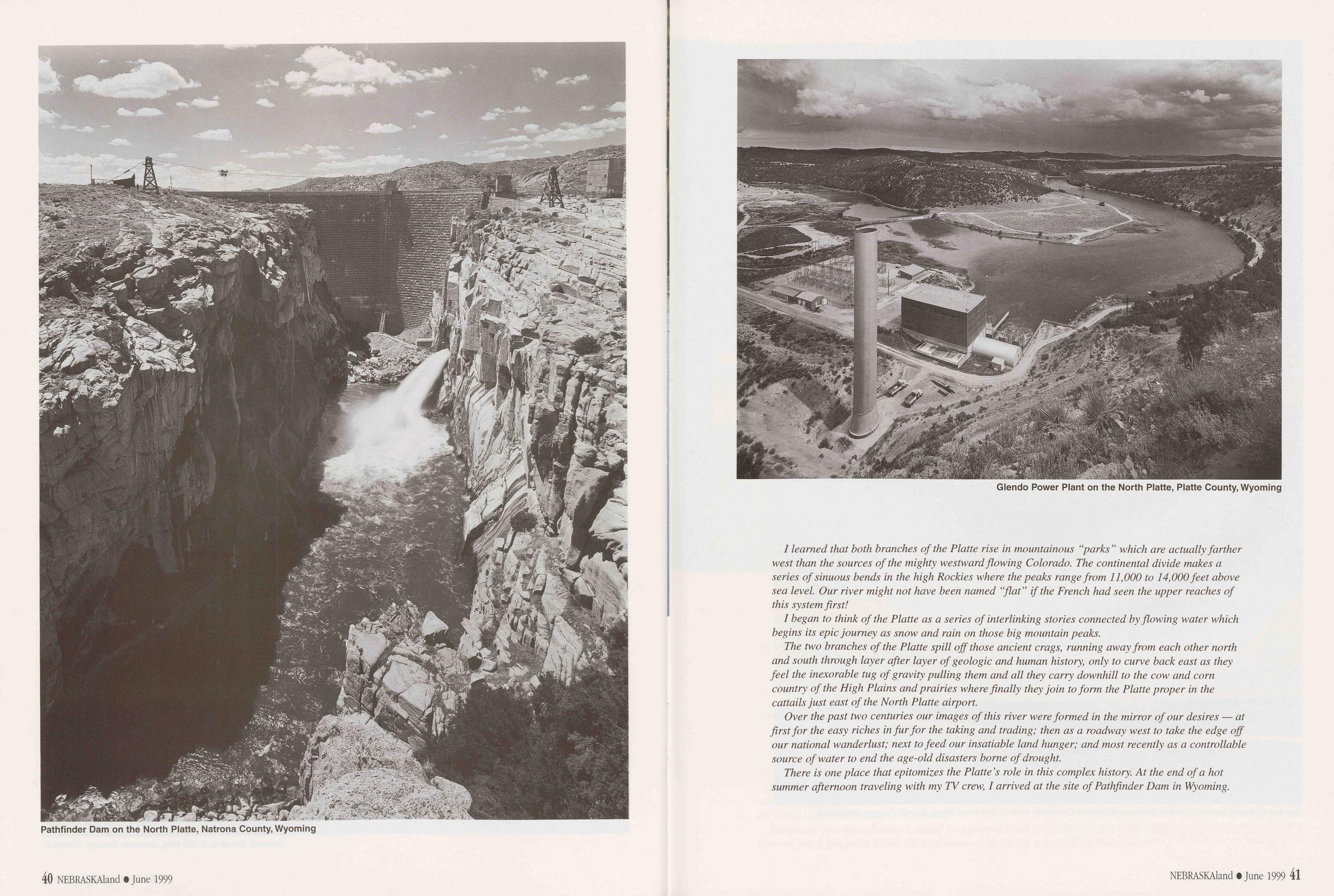
I learned that both branches of the Platte rise in mountainous "parks" which are actually farther west than the sources of the mighty westward flowing Colorado. The continental divide makes a series of sinuous bends in the high Rockies where the peaks range from 11,000 to 14,000 feet above sea level. Our river might not have been named "flat" if the French had seen the upper reaches of this system first!
I began to think of the Platte as a series of interlinking stories connected by flowing water which begins its epic journey as snow and rain on those big mountain peaks.
The two branches of the Platte spill off those ancient crags, running away from each other north and south through layer after layer of geologic and human history, only to curve back east as they feel the inexorable tug of gravity pulling them and all they carry downhill to the cow and corn country of the High Plains and prairies where finally they join to form the Platte proper in the cattails just east of the North Platte airport.
Over the past two centuries our images of this river were formed in the mirror of our desires — at first for the easy riches in fur for the taking and trading; then as a roadway west to take the edge off our national wanderlust; next to feed our insatiable land hunger; and most recently as a controllable source of water to end the age-old disasters borne of drought.
There is one place that epitomizes the Platte's role in this complex history. At the end of a hot summer afternoon traveling with my TV crew, I arrived at the site of Pathfinder Dam in Wyoming.
NEBRASKAland • June 1999 41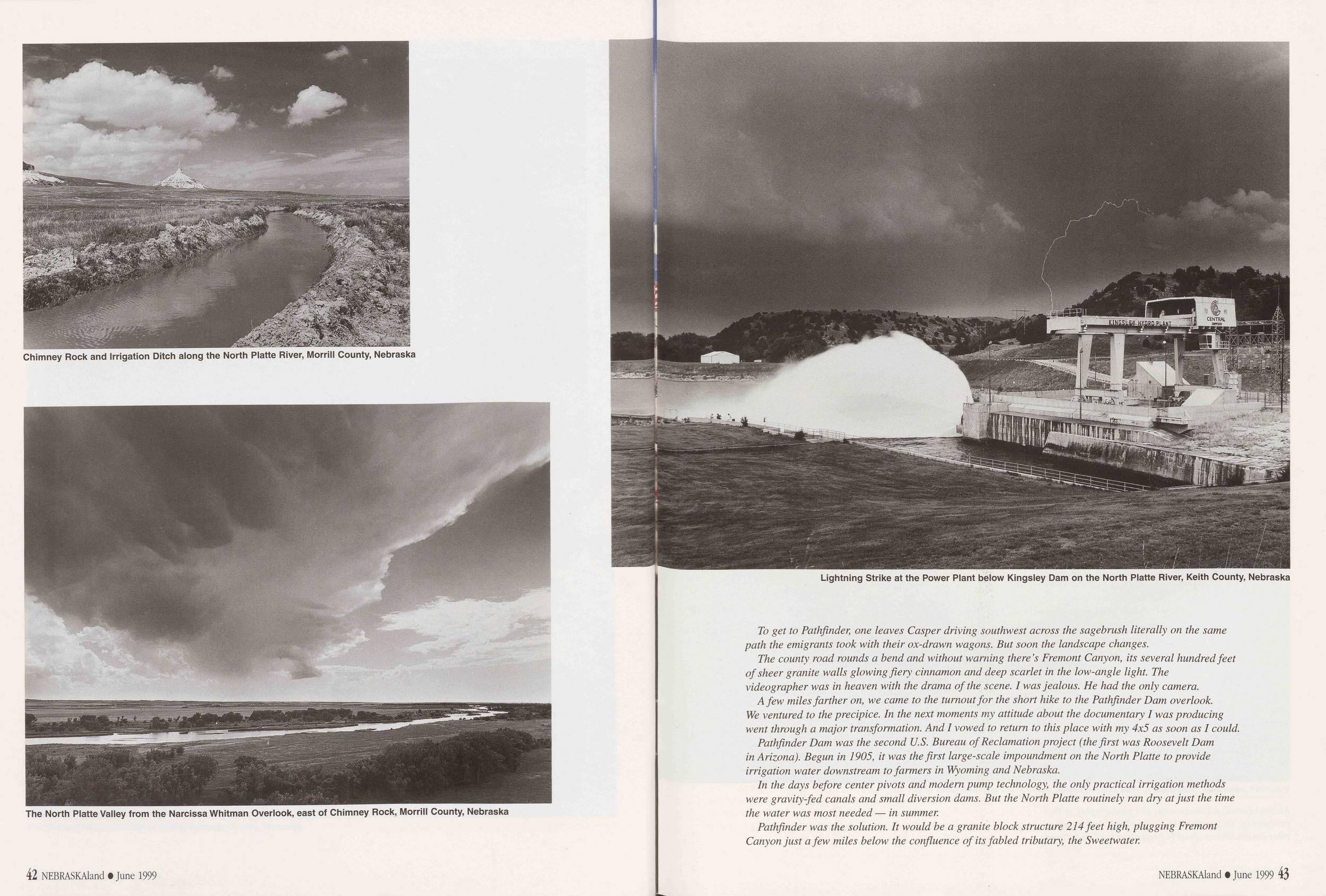
To get to Pathfinder, one leaves Casper driving southwest across the sagebrush literally on the same path the emigrants took with their ox-drawn wagons. But soon the landscape changes.
The county road rounds a bend and without warning there's Fremont Canyon, its several hundred feet of sheer granite walls glowing fiery cinnamon and deep scarlet in the low-angle light. The videographer was in heaven with the drama of the scene. I was jealous. He had the only camera.
A few miles farther on, we came to the turnout for the short hike to the Pathfinder Dam overlook. We ventured to the precipice. In the next moments my attitude about the documentary I was producing went through a major transformation. And I vowed to return to this place with my 4x5 as soon as I could.
Pathfinder Dam was the second U.S. Bureau of Reclamation project (the first was Roosevelt Dam in Arizona). Begun in 1905, it was the first large-scale impoundment on the North Platte to provide irrigation water downstream to farmers in Wyoming and Nebraska.
In the days before center pivots and modern pump technology, the only practical irrigation methods were gravity-fed canals and small diversion dams. But the North Platte routinely ran dry at just the time the water was most needed — in summer.
Pathfinder was the solution. It would be a granite block structure 214 feet high, plugging Fremont Canyon just a few miles below the confluence of its fabled tributary, the Sweet water.
NEBRASKAland • June 1999 43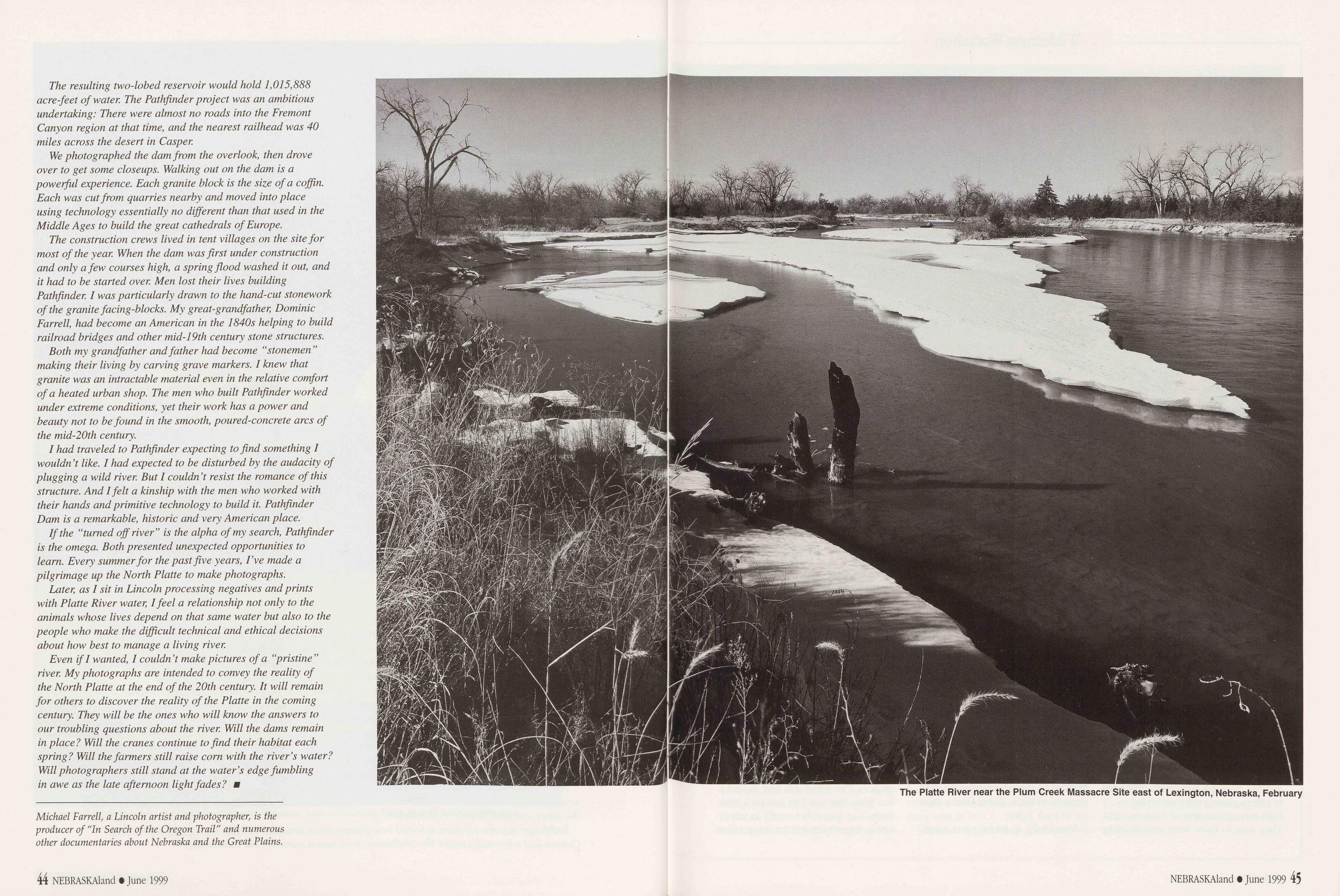
The resulting two-lobed reservoir would hold 1,015,888 acre-feet of water. The Pathfinder project was an ambitious undertaking: There were almost no roads into the Fremont Canyon region at that time, and the nearest railhead was 40 miles across the desert in Casper.
We photographed the dam from the overlook, then drove over to get some closeups. Walking out on the dam is a powerful experience. Each granite block is the size of a coffin. Each was cut from quarries nearby and moved into place using technology essentially no different than that used in the Middle Ages to build the great cathedrals of Europe.
The construction crews lived in tent villages on the site for most of the year. When the dam was first under construction and only a few courses high, a spring flood washed it out, and it had to be started over. Men lost their lives building Pathfinder. I was particularly drawn to the hand-cut stonework of the granite facing-blocks. My great-grandfather, Dominic Farrell, had become an American in the 1840s helping to build railroad bridges and other mid-19th century stone structures.
Both my grandfather and father had become "stonemen" making their living by carving grave markers. I knew that granite was an intractable material even in the relative comfort of a heated urban shop. The men who built Pathfinder worked under extreme conditions, yet their work has a power and beauty not to be found in the smooth, poured-concrete arcs of the mid-20th century.
I had traveled to Pathfinder expecting to find something I wouldn't like. I had expected to be disturbed by the audacity of plugging a wild river. But I couldn't resist the romance of this structure. And I felt a kinship with the men who worked with their hands and primitive technology to build it. Pathfinder Dam is a remarkable, historic and very American place.
If the "turned off river" is the alpha of my search, Pathfinder is the omega. Both presented unexpected opportunities to learn. Every summer for the past five years, Eve made a pilgrimage up the North Platte to make photographs.
Later, as I sit in Lincoln processing negatives and prints with Platte River water, I feel a relationship not only to the animals whose lives depend on that same water but also to the people who make the difficult technical and ethical decisions about how best to manage a living river.
Even if I wanted, I couldn't make pictures of a "pristine" river. My photographs are intended to convey the reality of the North Platte at the end of the 20th century. It will remain for others to discover the reality of the Platte in the coming century. They will be the ones who will know the answers to our troubling questions about the river. Will the dams remain in place? Will the cranes continue to find their habitat each spring? Will the farmers still raise corn with the river's water? Will photographers still stand at the water's edge fumbling in awe as the late afternoon light fades?
Michael Farrell, a Lincoln artist and photographer, is the producer of "In Search of the Oregon Trail" and numerous other documentaries about Nebraska and the Great Plains. 44 NEBRASKAland • June 1999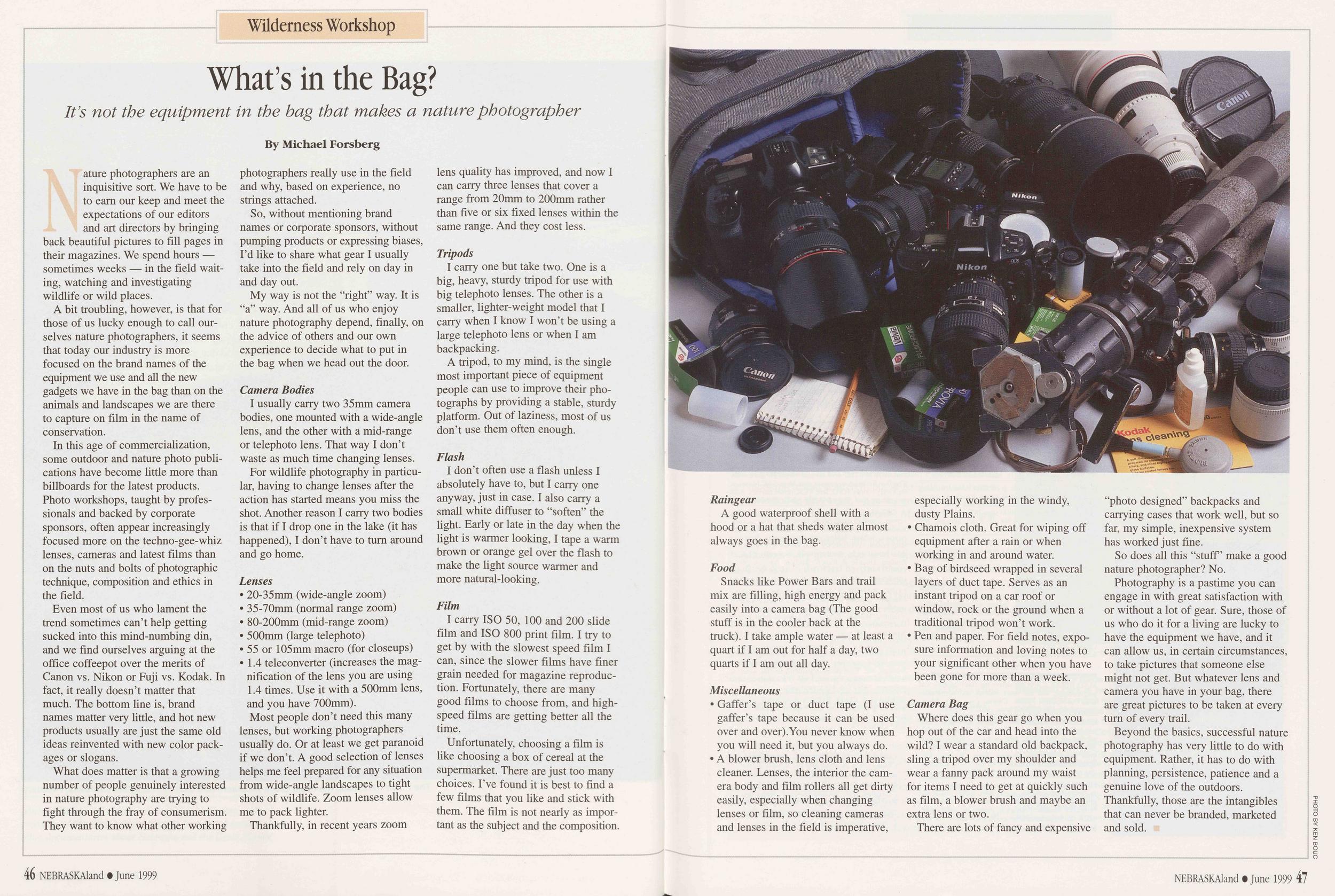
Wilderness Workshop
What's in the Bag;
It's not the equipment in the bag that makes a nature photographer By Michael Forsbergnature photographers are an inquisitive sort. We have to be to earn our keep and meet the expectations of our editors and art directors by bringing back beautiful pictures to fill pages in their magazines. We spend hours — sometimes weeks — in the field waiting, watching and investigating wildlife or wild places.
A bit troubling, however, is that for those of us lucky enough to call ourselves nature photographers, it seems that today our industry is more focused on the brand names of the equipment we use and all the new gadgets we have in the bag than on the animals and landscapes we are there to capture on film in the name of conservation.
In this age of commercialization, some outdoor and nature photo publications have become little more than billboards for the latest products. Photo workshops, taught by professionals and backed by corporate sponsors, often appear increasingly focused more on the techno-gee-whiz lenses, cameras and latest films than on the nuts and bolts of photographic technique, composition and ethics in the field.
Even most of us who lament the trend sometimes can't help getting sucked into this mind-numbing din, and we find ourselves arguing at the office coffeepot over the merits of Canon vs. Nikon or Fuji vs. Kodak. In fact, it really doesn't matter that much. The bottom line is, brand names matter very little, and hot new products usually are just the same old ideas reinvented with new color packages or slogans.
What does matter is that a growing number of people genuinely interested in nature photography are trying to fight through the fray of consumerism. They want to know what other working photographers really use in the field and why, based on experience, no strings attached.
So, without mentioning brand names or corporate sponsors, without pumping products or expressing biases, I'd like to share what gear I usually take into the field and rely on day in and day out.
My way is not the "right" way. It is "a" way. And all of us who enjoy nature photography depend, finally, on the advice of others and our own experience to decide what to put in the bag when we head out the door.
Camera BodiesI usually carry two 35mm camera bodies, one mounted with a wide-angle lens, and the other with a mid-range or telephoto lens. That way I don't waste as much time changing lenses.
For wildlife photography in particular, having to change lenses after the action has started means you miss the shot. Another reason I carry two bodies is that if I drop one in the lake (it has happened), I don't have to turn around and go home.
Lenses• 20-35mm (wide-angle zoom)
• 35-70mm (normal range zoom)
• 80-200mm (mid-range zoom)
• 500mm (large telephoto)
• 55 or 105mm macro (for closeups)
• 1.4 teleconverter (increases the magnification of the lens you are using 1.4 times. Use it with a 500mm lens, and you have 700mm).
Most people don't need this many lenses, but working photographers usually do. Or at least we get paranoid if we don't. A good selection of lenses helps me feel prepared for any situation from wide-angle landscapes to tight shots of wildlife. Zoom lenses allow me to pack lighter.
Thankfully, in recent years zoom lens quality has improved, and now I can carry three lenses that cover a range from 20mm to 200mm rather than five or six fixed lenses within the same range. And they cost less.
TripodsI carry one but take two. One is a big, heavy, sturdy tripod for use with big telephoto lenses. The other is a smaller, lighter-weight model that I carry when I know I won't be using a large telephoto lens or when I am backpacking.
A tripod, to my mind, is the single most important piece of equipment people can use to improve their photographs by providing a stable, sturdy platform. Out of laziness, most of us don't use them often enough.
FlashI don't often use a flash unless I absolutely have to, but I carry one anyway, just in case. I also carry a small white diffuser to "soften" the light. Early or late in the day when the light is warmer looking, I tape a warm brown or orange gel over the flash to make the light source warmer and more natural-looking.
FilmI carry ISO 50, 100 and 200 slide film and ISO 800 print film. I try to get by with the slowest speed film I can, since the slower films have finer grain needed for magazine reproduction. Fortunately, there are many good films to choose from, and high- speed films are getting better all the time.
Unfortunately, choosing a film is like choosing a box of cereal at the supermarket. There are just too many choices. I've found it is best to find a few films that you like and stick with them. The film is not nearly as important as the subject and the composition.
46 NEBRASKAland • June 1999A good waterproof shell with a hood or a hat that sheds water almost always goes in the bag.
FoodSnacks like Power Bars and trail mix are filling, high energy and pack easily into a camera bag (The good stuff is in the cooler back at the truck). I take ample water — at least a quart if I am out for half a day, two quarts if I am out all day.
Miscellaneous• Gaffer's tape or duct tape (I use gaffer's tape because it can be used over and over).You never know when you will need it, but you always do.
• A blower brush, lens cloth and lens cleaner. Lenses, the interior the camera body and film rollers all get dirty easily, especially when changing lenses or film, so cleaning cameras and lenses in the field is imperative, especially working in the windy, dusty Plains.
• Chamois cloth. Great for wiping off equipment after a rain or when working in and around water.
• Bag of birdseed wrapped in several layers of duct tape. Serves as an instant tripod on a car roof or window, rock or the ground when a traditional tripod won't work.
• Pen and paper. For field notes, exposure information and loving notes to your significant other when you have been gone for more than a week.
Camera BagWhere does this gear go when you hop out of the car and head into the wild? I wear a standard old backpack, sling a tripod over my shoulder and wear a fanny pack around my waist for items I need to get at quickly such as film, a blower brush and maybe an extra lens or two.
There are lots of fancy and expensive "photo designed" backpacks and carrying cases that work well, but so far, my simple, inexpensive system has worked just fine.
So does all this "stuff make a good nature photographer? No.
Photography is a pastime you can engage in with great satisfaction with or without a lot of gear. Sure, those of us who do it for a living are lucky to have the equipment we have, and it can allow us, in certain circumstances, to take pictures that someone else might not get. But whatever lens and camera you have in your bag, there are great pictures to be taken at every turn of every trail.
Beyond the basics, successful nature photography has very little to do with equipment. Rather, it has to do with planning, persistence, patience and a genuine love of the outdoors. Thankfully, those are the intangibles that can never be branded, marketed and sold.
NEBRASKAland • June 1999 47
Classifieds
ATTRACTIONS/EVENTSWOMEN'S WILDERNESS WEEKEND. Outdoor educational workshop for women. August 20-22, Harlan County Reservoir near Alma, Nebraska. Learn skills in camping, boating, hunting, fishing, bird watching, duch oven cooking, outdoor photography and canoeing. New this year, the Women's Wilderness Weekend Olympics. Call Trailblazer RC&D for registration information at (402) 746-2268.
BOOKS/PUBLICATIONS/VTOEOSHOW TO FIND MORE outdoor opportunities! The Nebraska Sportsman's Atlas. Locations of all public lands and waters on county transportation maps. These maps show ALL the roads in Nebraska. Listings include federal, Nebraska Game & Parks, NRD holdings, hotels and motels and Nebraska's endless attractions. At only $18.75/copy, a true time and frustration saver. To order write: Sportsman's Atlas Co., P.O. Box 132, Lytton, IA 50561 or call (800) 568-8334.
JU-JU SWALLOWED A PENNY, a Nebraska farm girl's book of the 1930s Depression Era. $7.50 ppd. Betty Heidbreder Dunn, Rt. 1, Box 363-G, Navasota, TX 77868.
FREE VIDEOTAPE Nebraska Dredging is offering a free videotape, which explains dredging, and its benefits. To receive the tape or have any questions answered, call Travis at Nebraska Dredging toll free at (877) 4-DREDGE. If you are in a lake association or own either commercial or private property containing a lake, this is a must see.
THE BOOK, "The Rise and Fall of the United States" is now available. This remarkable book reveals how and why this once great nation destroyed itself and references the Bible to find hope for salvation and humanity. Call (800) 882-3273.
DOGSTRAINING ALL BREEDS bird dogs - Vizslas for sale. Home of Rebel Rousers. Rozanek Kennels, 781 Rd. D, Schuyler, NE 68661. Phone (402) 352-8769.
ENGLISH SETTERS, German shorthairs, English pointers, Brittany spaniels - stud service, puppies and started dogs. Training for all pointing breeds. Plum Creek Kennel, (712) 529-4238 or (402) 298-8153.
RETRIEVER TRAINING. Area's top "retrievers only" trainer. Field trial and hunting dogs. Non-slip duck dogs! TKO Retriever Training Keilnel (402) 623-4311.
NEBRASKAland $16 per year For Visa or MasterCard orders, call 800-NEB-LAND (632-5263) For mail orders, send check or money order to NEBRASKAland Magazine P.O. Box 30370, Lincoln, NE 68503-O37O. Order online at http://wiviv. ngpc. state.ne. usCHESAPEAKE BAY, Labrador and golden retriever pups, started dogs and stud service. 16-time national champion pedigree. Visa & MasterCard. Platte Valley Retrievers (308) 995-2318.
YELLOW-BLACK LAB PUPS. Breeders hips O.F.A. and eyes CERE Excellent bloodlines and hunting potential. Call Mr. Bendler, Lexington, NE (308) 324-4247 or Lincoln (402) 477-1305.
WILDERNESS KENNELS. Gun dog training - over 60 years combined experience. Training all sporting breeds - retrievers, flushing and pointing dogs. All dogs worked on pen-raised birds and wild game. Training program includes obedience training - heel, sit, stay, down and come when called. Pups, started dogs and fully trained dogs for sale. Hunting dogs trained by hunters. Henry Sader, Wilderness Kennels, Roca, NE (402) 423-4212. Since 1968.
FISH/FISHINGFISH FOR SALE. Catfish, largemouth bass, small- mouth bass, perch, crappie, bluegill, walleye, northern pike, rainbow trout, Donaldson rainbow trout, grass carp, minnows, bullheads. Consulting available. Pleasant Valley Fish Farm, RR 1, Box 147, McCook, NE 69001. Phone (308) 345-6599.
WILLOW LAKE FISH HATCHERY. Channel cat, bluegill, hybrid bluegill, largemouth bass, crappie, grass carp, walleye, perch, minnows available for stock. Gaylord Crawford and Son, 7580 N. Highland Rd., Hastings, NE 68901 or phone (402) 463-8022 day or night. Also pond consultant. We deliver, grower price.
FOOD/GIFTSNEBRASKA BASKETS: The original Nebraska company specializing in fine foods from Nebraska since 1984. A beautiful array of baskets filled with ethnic, healthful and long-time favorite foods. Call or write for our brochure: PO Box 22985, Lincoln, NE. 68542. 1-800-345-7725 or (402) 438-3111. Visit our web site: http://www.nebaskets.com
HOMEBREWING/BEER & WINEMAKING supplies. Fermenter's Supply, 8410 K Plz. #10, Omaha, NE 68127. (402) 593-9171. Mail orders welcome.
ENJOY A TASTE of the good life! Award-winning gourmet BBQ sauces & seasonings, breading, native jellies, fruit butters, honey, coffees and more! Great gift-set ideas! Toll free (888) 926-2879 or (308) 468- 5635. Hollman Foods, 1948 36 Road, Minden, NE 68959, or www.hollmans.com
FROM NEBRASKA GIFT SHOP... the world's largest selection of Nebraska-made food products and gifts. Historical Haymarket, 140 N. 8th., Lincoln, NE 68508; Westroads Mall, Omaha, NE. Call for free catalog (800) 399-5693.
PHEASANT WREATHS: Nebraska's most popular game bird, the lovely ring-necked pheasant, with its beautiful vibrant colors, makes a wonderful year round decoration. Straw wreaths, decorated with pheasant feathers and dried flowers. For yourself or as a gift. For information and photo brochure call Maggie (402) 339-4640 or write to 5524 S. 102nd St., Omaha, NE 68127.
GUIDES/OUTFITTERSMAD RIVER CANOES offers the finest quality and performance. For the finest canoes and accessories look to Great Plains Canoe Co., 205 Main, Springfield, NE 68059. Phone (402) 253-2000.
CANOE THE NIOBRARA...with an affordable canoe trip by Dry land Aquatics. One- and two-day trips...full service, or just canoe, tube or kayak. Transportation furnished. Your Niobrara River specialists... We do it your way! Dry land Aquatics, Dept. N, Box 33C, Sparks, NE 69220 or phone (800) 337-3119. www.busdir.com/dryland. eheinert®falcon.inetnebr.com
HENECKE HUNTS Guided and semi-guided hunts in Nebraska for ducks, geese, deer, turkey, quail and pheasant. 24 years hunting experience, 10 years Nebraska Hunter Education instructor. (402) 645- 8223, e-mail: kevin@henneckehunts.com, website: henneckehunts .com
MOUNTAIN BIKE NIOBRARA RIVER country, the Cowboy Trail and Merritt Reservoir. Bicycle rentals, shuttles and service. Yucca Dune, 148 E. 1st St., Valentine, NE 69201. http://www.yuccadune.com or (402) 376-3330.
KAYAK THE NIOBRARA in stable, fast, maneuver- able Perception boats. Trips, rentals, shuttles, accessories. Yucca Dune, 148 E. 1st St., Valentine, NE 69201 http://www.yuccadune.com or (402) 376-3330.
FAMILY FUN ON FLAT WATER (this is the native Indian name for the Platte River). Canoe the Platte River with River City Nature Chasers guides and outfitters. E-mail naturechasers@hamilton.net, web site: www.naturechasers.com
GUNS/SHOOTING/ARCHERYGUNS - Browning, Winchester, Remington, Benelli. Hi-powers, shotguns, new, used, antiques. Want pre-'64 Winchesters. Buy-Sell-Trade. (402) 729-6112. Bedlan's Sporting Goods, Fairbury, NE 68352.
VACATIONS/RESORTSFOR FISHING AND HUNTING accommodations. Jefco Inn, Gordon, NE 69343. South Cornell, (308) 282-2935.
THE OLDE MAIN STREET INN. An historic bed and breakfast located in the beautiful Pine Ridge country of Northwest Nebraska. Beautiful dining room with fireplace. Featuring prime rib, buffalo, seafood, homemade soups, chilis and desserts. Room service available. 115 Main Street, Chadron, NE 69337 (308) 432-3380. www.chadron.com/oldemain
DIAMOND-E TROUT RESORT. 2 new lodges, 3 cottages on spring-fed lakes, stream. Private and secluded. Trout, bass, bluegill, etc. Paddle boats and playground equipment. For brochure, call (800) 974- 3002.
FREE OMAHA ZOO PASSES, American Family Inn Motel. See Rain Forest-Aquarium-I-MAX Theater- Old Market. 104 rooms, free VCR, rental movies, sparkling pool, gazebo, picnic area. $44-$50. (800) 253-2865.
OMAHA MOTEL on 1-80 and 144th St. (Exit 440). The Ben Franklin welcomes you. Near SAC Museum. 96 lovely rooms. HBO, free VCR, rental movies, huge swimming pool. Only $42-$50. (800) 688-3658.
A GREAT GET-AWAY HAVEN! Scenic, secluded, serene, Sandhill cattle ranch. Have great guest accommodations with complete kitchen facilities; excellent hunting, fishing, hiking and photography. Boarding with pasture available for your horses if you wish to ride. Rates are by the day, week, or month. Contact: Bridges Double R Ranch, Mullen, NE, by phone (308) 546-2314; fax (308) 546-2432; e-mail pbridge@neb-sandhills.net for rates and reservations.
LORD RANCH RESORT. New deluxe cabins. Complete cooking facilities. Quiet and peaceful in the middle of the Sandhills. Three miles north of the Valentine Wildlife Refuge, 20 minutes from Merritt Dam. Aubrey and Dorothy Lord, HC 37, Box 41, Valentine NE 69201. Call (800) 270-0181. www.valentine-ne.com
DREAM WEAVERS CABIN OFFERS an enchanting stop while traveling through the Sandhills near Burwell, NE. Tour the herb gardens, see the looms at work and browse the gift shop. Pre-arranged tours welcome. (308) 346-4383, Jo Barrett.
NEBRASKA STATE PARK VACATIONS. Spend a week or a weekend, but don't spend a bundle! For a free color brochure listing all park facilities, call 1-800-826-7275.
Classified Rates: 75 per word, minimum $15. Closing: First business day two months before issue date. Classified ads are accepted on a first-come, first-served, space-available basis. Classified Ads, NEBRASKAland Magazine, P.O. Box 30370, Lincoln, NE 68503-0370. Telephone (402) 471-5478. Fax: (402) 471-5528. E-mail: nebland@ ngpc.state.ne.us 48 NEBRASKAland • June 1999Parks & Places
Ashfall Fossil Beds State Historical Park
A saber-toothed deer is the latest find at Nebraska's premier bonebed By Ken BoucThe menagerie of unusual animals at Ashfall Fossil Beds State Historical Park continues to grow with the discovery of the fossilized remains of a little deer lying among the rhinos, camels and horses entombed in 10-million-year-old volcanic ash. The skeleton of a saber-toothed deer, Longirostromeryx wellsi, has been exposed in the 2,000-square-foot "rhino barn," protecting fossils displayed as they were found.
Ashfall is a time capsule from 10 million years ago when Nebraska was covered by subtropical grassland and jungle. A volcanic eruption to the west produced a cloud of volcanic ash that drifted eastward, covering northeastern Nebraska with fine, abrasive volcanic glass.
The fossils are those of animals at a shallow water hole. As fine ash began to fill their lungs, animals died. First the smaller birds, pond turtles, carnivores and saber-toothed deer, then horses and camels and, finally, hundreds of huge barrel-bodied rhinos. Blowing off the land like a blizzard, the ash filled low spots in the landscape, including the water hole, entombing the dead animals in a layer of ash up to eight feet thick.
Ashfall is unusual for the large number of well preserved, complete skeletons. Fossils found elsewhere often are incomplete and scattered, but at Ashfall, most bones are arranged as they were when the animals died, and the ash has preserved even tiny details. Many skeletons contain the remains of the animal's last mouthful of grass, and inside many females are the bones of unborn young.
Although fully grown, the newly discovered saber- toothed deer is dwarfed by the rhinos. It was only 16 to 18 inches tall and 16 to 18 inches long from rump to shoulder, and it weighed about 20 pounds.
A form of this primitive, antlerless deer, the Asian musk deer, exists today. The sabers of the ancient deer, like those of the modern example, are modified upper canine teeth slightly longer than two inches.
The Ashfall deer is unusual in several respects. Evidence of soft tissue suggests the animal's shape. Discolored ash along one leg shows the probable outline of skin, and a cavity remains where neck muscles had been. Analysis of plant material found with the skeleton will reveal the animal's last meal.
Paleontologists are puzzled by the presence of the deer. The area was savannah, open grassland with a few trees, and most mammals at the site were grazers. The saber-toothed deer, however, was a browser, eating softer food such as the leaves and buds of shrubs and trees.
Ashfall is the only location with complete skeletons of Longirostromeryx. One specimen, taken to the University of Nebraska State Museum in Lincoln before Ashfall became a state park, was found beneath a large rhino skeleton. Others are less well preserved. The one now exposed in the rhino barn was scrambled, apparently trampled by huge rhinos in their death throes, and the hindquarters were gnawed by scavengers.
The park visitor center includes interpretive displays and a fossil preparation laboratory. The rhino barn, where visitors can view scores of fossils and observe and visit with paleontologists at work, is nearby.
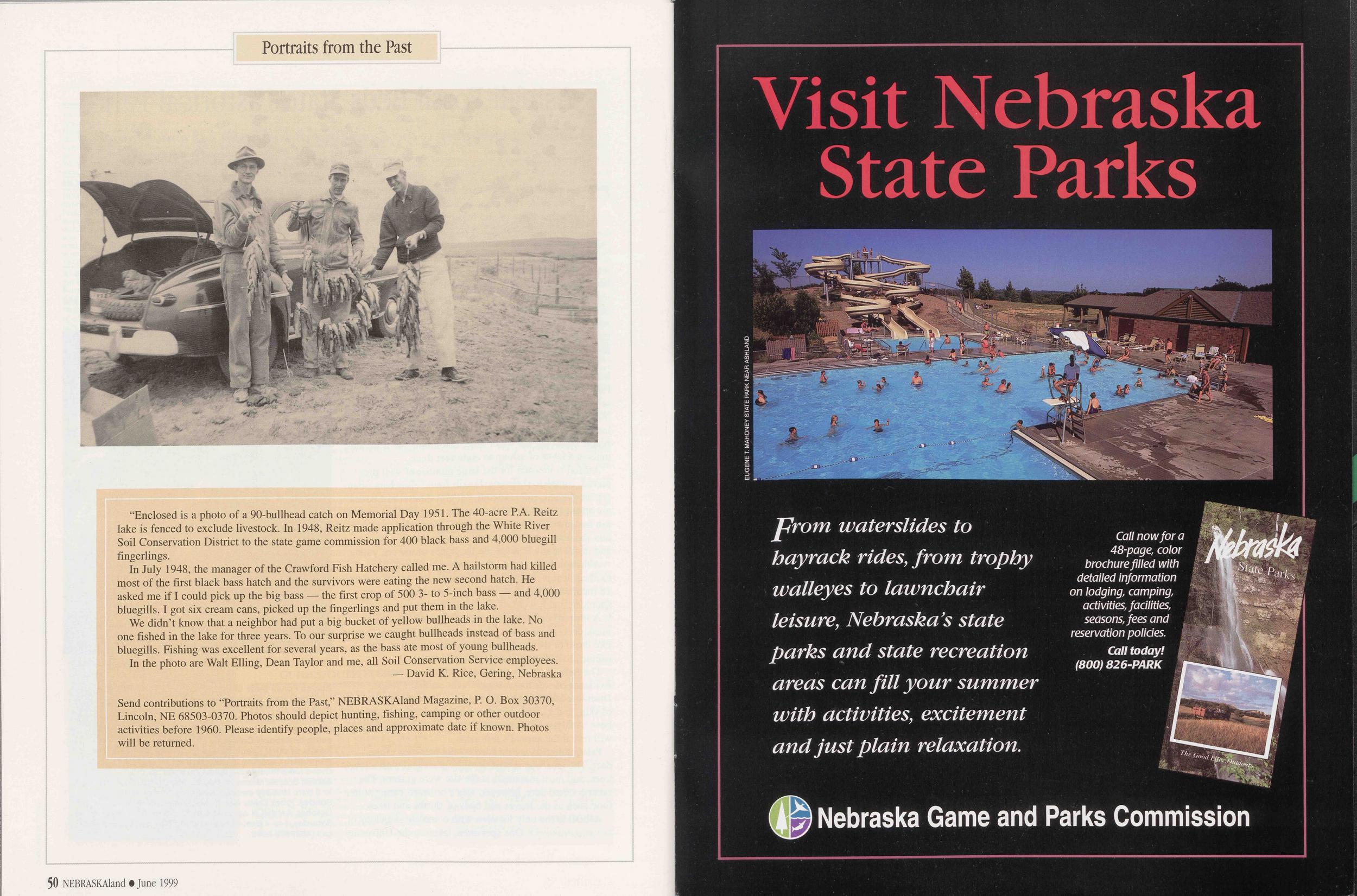
Portraits from the Past
"Enclosed is a photo of a 90-bullhead catch on Memorial Day 1951. The 40-acre PA. Reitz lake is fenced to exclude livestock. In 1948, Reitz made application through the White River Soil Conservation District to the state game commission for 400 black bass and 4,000 bluegill fingerlings.
In July 1948, the manager of the Crawford Fish Hatchery called me. A hailstorm had killed most of the first black bass hatch and the survivors were eating the new second hatch. He asked me if I could pick up the big bass — the first crop of 500 3- to 5-inch bass — and 4,000 bluegills. I got six cream cans, picked up the fingerlings and put them in the lake.
We didn't know that a neighbor had put a big bucket of yellow bullheads in the lake. No one fished in the lake for three years. To our surprise we caught bullheads instead of bass and bluegills. Fishing was excellent for several years, as the bass ate most of young bullheads.
In the photo are Walt Elling, Dean Taylor and me, all Soil Conservation Service employees.
— David K. Rice, Gering, Nebraska Send contributions to "Portraits from the Past," NEBRASKAland Magazine, P. O. Box 30370, Lincoln, NE 68503-0370. Photos should depict hunting, fishing, camping or other outdoor activities before 1960. Please identify people, places and approximate date if known. Photos will be returned. 50 NEBRASKAland • June 1999 From waterslides to hayrack rides, from trophy walleyes to lawn chair leisure, Nebraska's state parks and state recreation areas can fill your summer with activities, excitement and just plain relaxation. Call now for a 48-page, color brochure filled with detailed information on lodging, camping, activities, facilities, seasons, fees and reservation policies. Call today. (800) 826-PARK Nebraska Game and Parks Commission
Position: 820 (12 views)