Volume 77, Issue 4, 1999
NEBRASKAland
Nebraska Game & Parks Co May 1999* $2.50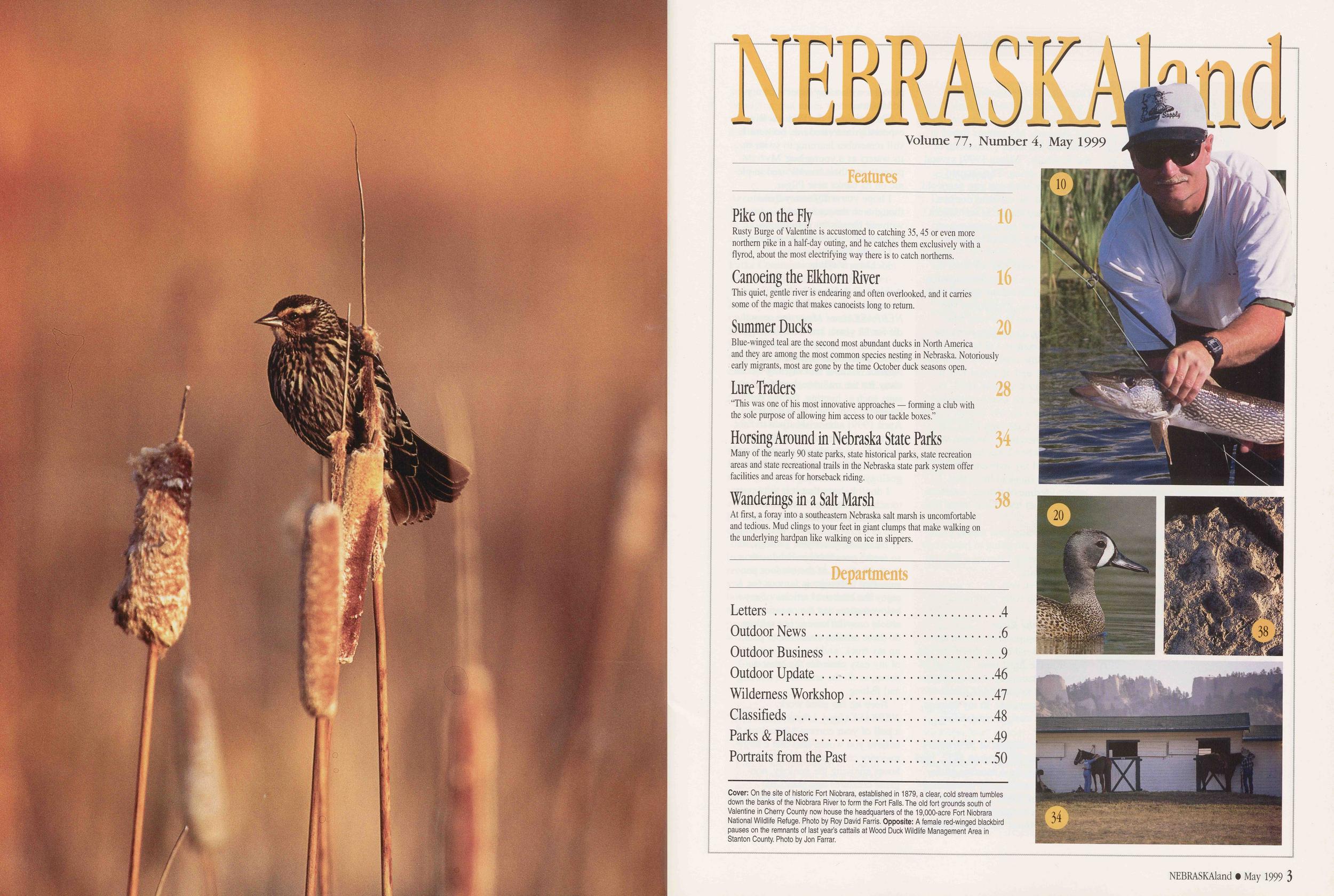
NEBRASKAland
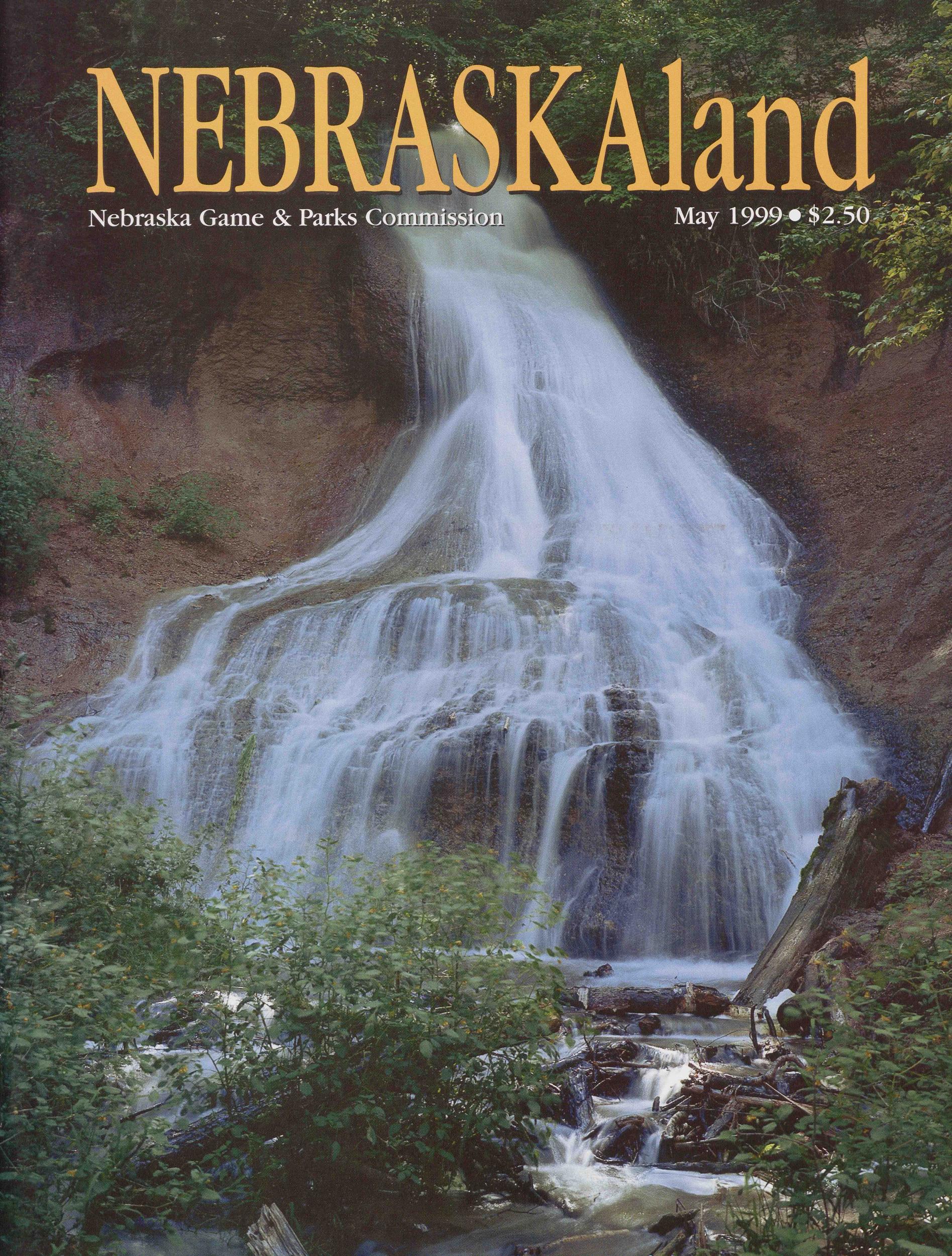
Volume 77, Number 4, May 1999 Features Pike on the Fly Rusty Burge of Valentine is accustomed to catching 35,45 or even more northern pike in a half-day outing, and he catches them exclusively with a flyrod, about the most electrifying way there is to catch northerns. Canoeing the Elkhom River This quiet, gentle river is endearing and often overlooked, and it carries some of the magic that makes canoeists long to return. Summer Ducks Blue-winged teal are the second most abundant ducks in North America and they are among the most common species nesting in Nebraska. Notoriously early migrants, most are gone by the time October duck seasons open. Lure Traders "This was one of his most innovative approaches — forming a club with the sole purpose of allowing him access to our tackle boxes." Horsing Around in Nebraska State Parks Many of the nearly 90 state parks, state historical parks, state recreation areas and state recreational trails in the Nebraska state park system offer facilities and areas for horseback riding. Wanderings in a Salt Marsh At first, a foray into a southeastern Nebraska salt marsh is uncomfortable and tedious. Mud clings to your feet in giant clumps that make walking on the underlying hardpan like walking on ice in slippers. Departments Letters..................................4 Outdoor News ............................6 Outdoor Business..........................9 Outdoor Update..........................46 Wilderness Workshop..................___47 Classifieds ..............................48 Parks & Places...........................49 Portraits from the Past .....................50 Cover: On the site of historic Fort Niobrara, established in 1879, a clear, cold stream tumbles down the banks of the Niobrara River to form the Fort Falls. The old fort grounds soutn of Valentine in Cherry County now house the headquarters of the 19,000-acre Fort Niobrara National Wildlife Refuge. Photo by Roy David Farris. Opposite: A female red-winged blackbird pauses on the remnants of last year's cattails at Wood Duck Wildlife Management Area in Stanton County. Photo by Jon Farrar
Letters
Published by the Nebraska Game and Parks Commission Director: Rex Amack Assistant Directors: Noelyn Isom Roger Kuhn Kirk Nelson Information & Education Administrator: Paul Horton Information & Education Art Director: Steve O'Hare Commissioners Chairman: William Berryman, Kearney Vice Chairman: Daniel Wallen, McCook 2nd Vice Chairman: Thomas O'Neill Jr., Lincoln George W. Egermayer Jr., Omaha Rob Coupland, Valentine John P. Miller, Blair Connie Lapaseotes, Bridgeport Magazine Staff Editor: Don Cunningham Art Director: Tim Reigert Senior Editors: Ken Bouc, Jon Farrar Regional Editors: Michael Forsberg, Bob Grier, Rocky Hoffmann Circulation: Pat Frahm NEBRASKAland ISSN: 0028-1964 VOL. 77 / NO. 4 MAY 1999 Published monthly, except for Jan/Feb. and Aug./Sept. issues, by the Nebraska Game and Parks Commission, 2200 N. 33rd St., Lincoln, NE. Copyright 1999, all rights reserved. Please address comments or questions to this address. Periodicals postage paid at Lincoln, Nebraska. POSTMASTER: Send all address changes to NEBRASKAland, P.O. Box 30370, Lincoln, NE 68503-0370. Rates: $16 for one year; $30 for two years. Address submissions to: The Editor, NEBRASKAland Magazine, P.O. Box 30370, Lincoln, NE 68503. Include a stamped, self-addressed return envelope. The publisher assumes no responsibility for unsolicited material. NEBRASKAland is available on audio cassette from the Nebraska Library Commission Talking Book and Braille Service, Suite 120, 1200 N St., Lincoln, NE 68508. Diamond Bar MemoriesI was born and raised in North Platte, went away to college and now live in California. My parents fished at Diamond Bar Lake ["Diamond in the Sandhills," March 1999] several times each spring. They started taking me when I was two years old. Mother told me we went out in a boat and they sat me in the bottom of the boat and gave me a can of worms to play with to keep me occupied.
My first memories are from the time I was five or six. We stayed in one of the little cabins and ate at the bar in the store. I remember the Magnusons and their sons who helped clean all the fish everyone caught. Of course, I didn't remember their name until I read the article.
From the end of World War II until he passed away in 1949, my father leased the store/conmissary from Archie Lue. My mother continued to lease it through 1953. Mr. Lue continued to let me hunt there a few times when I was home from college, and my wife and I fished there a few times in the 1980s. I have a lifetime of fishing and hunting memories and stories from Diamond Bar.
After reading your article I told my wife we are going to have to go back to Diamond Bar on a day trip and go fishing.
Carl H. Backers, Jr. El Dorado Hills, California A Bend in the RiverI want to compliment you on the article "A Bend in the River" by Jon Farrar in the April issue. It is one of the most beautifully written articles I have seen in NEBRASKAland or any other magazine. In my opinion, it is truly a work of outstanding literary art.
A former resident of Nebraska, I moved to the Washington, D.C., area 75 years ago. As a member of the Nebraska State Society of Washington for many years, I have been an appreciative recipient of NEBRASKAland, and it has kept me in touch with many aspects of my home state.
The article on the Elkhorn River especially interested me, because I still remember learning to swim in its waters as a young boy. My parents and their friends used to picnic on its banks near Pilger.
I hope you will convey these thoughts to the author of this article with my thanks for helping me relive fond memories of long ago.
Dwight Pinion McLean, Virginia Achieving BalanceI have been a subscriber to NEBRASKAland Magazine on and off for 22 years, and occasionally, when I have let my subscription lapse, it has been because I felt NEBRASKAland was drifting too far away for the traditional outdoor pursuits such as hunting, fishing and trapping. Tobi Van Dyck [Letters, April 1999] admonishes you to "not put too much emphasis on hunting and fishing, giving not enough coverage to plants, nongame creatures, geology and so forth."
I don't believe that it is necessary to achieve "balance" in an outdoor magazine, particularly such a fine one as NEBRASKAland, as coverage of "nongame creatures, geology, and so forth" goes hand in hand with most, if not all, of the outdoor pursuits that Nebraska is famous for. I enjoy the historical articles of my beloved state, and the occasional article on wildflowers, but seldom do these articles cause me to pack up my truck, and leave the comfort of my easy chair for the great outdoors, as do the articles on hunting and fishing.
Keep up the good work, NEBRASKAland. I think if you took a poll of your current subscribers, I believe you would find that a large majority continue to spend many hours enjoying the geology, nongame creatures and plants of Nebraska, while hunting, fishing and trapping.
As for "needing more women on 4 NEBRASKAland • May 1999 your staff," Tobi Van Dyck seems to be saying that more women would mean fewer articles on hunting and fishing. She obviously hasn't met my wife!
Mark A. Young Fremont, Nebraska Accolade for an OfficerI have been enjoying your fine publication for years, and would like to submit a small accolade regarding one of the Nebraska Game and Parks Commission officers, Mr. Jim Zimmerman, the Nebraska Conservation Officer of the Year. Countless hours of true devotion to the Nebraska outdoors, over many years have brought this fine and richly deserved honor. The Nebraska Parks and Game Commission has chosen exactly the right one to shine some light on. Hooray for Jim, NGPC and Nebraska.
Joe E. Jeter Scottsbluff, Nebraska Now Write to your MotherHaving hunted turkeys with the same group of guys for the past 13 years, I felt compelled to write to everyone all at once, I guess that's a bit lazy, but I don't even write my dear mother.
Nebraska's hospitality is second to none, and I would like to go on record as saying so. A quick thank you to all of the people that let us bowhunt your land for deer and turkeys. Camo hats off to these people for taking care of the wildlife. God bless you all.
Ray Seelbinder Carbondale, Colorado Letters NEBRASKAland Magazine P.O. Box 30370, Lincoln, NE 68503. Fax: (402) 471-5528. E-mail: nehland@ ngpc. state, ne. us. Please include your postal address and telephone number. Letters may be condensed and edited for clarity. Photographs are welcome and will be returned. Nebraska Game and Parks Commission Offices Headquarters 2200 N. 33rd Street Lincoln, NE 68503 Phone (402) 471-0641 District Office I East Hwy. 2, Box 725 Alliance, NE 69301 Phone (308) 763-2940 District Office II 524 Panzer St., Box 508 Bassett, NE 68714 Phone (402) 684-2921 District Office III 2201 N. 13th St. Norfolk, NE 68701 Phone (402) 370-3374 District Office IV 301 E. State Farm Rd. North Platte, NE 69101 Phone (308) 535-8025 District Office V 2200 N. 33rd Street Lincoln, NE 68503 Phone (402) 471 -5558 District Office VI 1617 First Ave. Kearney, NE 68847 Phone (308) 865-5310 Omaha Office 1212 Bob Gibson Blvd. Omaha, NE 68108 Phone (402) 595-2144 Ak-Sar-Ben Aquarium 21502 W. Highway 31 Gretna, NE 68028 Phone (402) 332-3901 World Wide Web site: http://www.ngpc.state.ne.us E-mail: ngpc@ngpc.state.ne.us Conservation Officers by Region Headquarters Ted Blume (Asst. Adm.) Lincoln Murray Johnson Lincoln Jon Reeves 471-5532 EricWiebe 471-5003 Steve Oberg Kennard Ponca Columbus 427-7378 755-2566 564-5937 Panhandle Officer Raymond Still Walt Meyer John Murphy Jim Zimmerman Marvin Kampbell Dennis Thompson Dan Zuehlke Dan Evasco Scott Brandt Southwest Officer Roger Thompson (Sup.) Dwight Allbery Dudley Sorensen George Sund Matt Andrews Jack Henderson Dirk Greene Virgil Gosch Rich Routh Northeast Officer Tom Zimmer (Sup.) Marion Shafer Robert Kelly Ross Oestmann Gary Ralston Daniel Roberts Randy Pomplun City Bridgeport Chadron Crawford Gering Hay Springs OgaJlala Ogallaia Oshkosh Scottsbluff City N. Platte N. Platte N. Platte Cambridge Elwood Gothenburg Imperial McCook Rep. City City Norfolk Norfolk Albion Bloomfield Creighton Fremont Phone (308) 262-1075 432-4398 665-2021 436-7561 638-7527 284-6450 284-4815 772-3091 635-1277 Phone (308) 532-9175 532-2753 532-0747 697-4629 785-3025 537-7483 882-5328 345-2185 799-2085 Phone (402) 371-6625 371-2031 395-2538 373-4412 358-3892 721-7852 Fullerton (308) 536-2987 Sandhills Officer Bruce Wiebe (Sup.) Ray Dierking Richard Seward Justin Mays Frank Miller Dana Murphy Patrick George South-central Officer Jerry Pecha (Sup.) Terry Brentzel Tim Williams Dale Johnson Mark Reeves Robert Finke Southeast Officer Craig Stover (Sup.) Douglas Kramer Dina Hopper Stacey Lewton William Krause Larry Elston Mike Luben Duane Arp Levi Krause Russell Mort Greg Verkuilen City Phone (402) Bassett 684-3867 Brkn. Bow (308) 872-3078 Ord (308) 728-3115 Bassett 273-4188 Valentine 376-5909 Valentine 376-1183 O'Neill 336-4118 City Kearney Grand Is. Hastings Kearney Loup City Milford Phone (402) (308) 865-5327 (308) 384-8296 463-2535 (308)237-1079 (308)745-1126 761-3537 City Lincoln Lincoln Lincoln Lincoln Auburn Bellevue Colon Gretna Louisville Nebr. City Beatrice Phone (402) 471-5590 466-9001 483-2358 328-9562 274-3789 292-4910 443-4278 332-4954 234-2212 873-5684 223-4095 JV '1. NEBRASKAland • May 1999 5
Outdoor News
Outdoors- Woman A three-day outdoor skills workshop designed primarily for women 18 years old or older. Topics and sessions include: J Fishing Hunting 1 Firearms Archery > Journaling Camping and Survival Skills 1 Map and Compass 1 Reading the Woods 1 Fly Tying 1 Canoeing 1 Dutch Oven Cooking 1 Hiking and Backpacking October 1-3, 1999 Nebraska State 4-H Camp Nebraska National Forest near Halsey. Enrollment is limited, enroll early. For more information, call (800)- and record your request For online information click on the Outdoor Education link from the Game and Parks Commission's web site at http://www.ngpc.state.ne.us Sponsored by the Nebraska Game and Parks Commission and the National Shooting Sports Foundation New State Record Grass Carp Weighs 51 PoundsNebraska's new state record grass carp is a 51-pound fish caught by David Milton of Madison. Milton caught the record fish on April 7 from Sky view Lake in Norfolk using a nightcrawler for bait.
The huge fish was 43 inches long and had a girth of 30 inches.
The previous state record grass carp, caught the fish from Rock Creek Lake in 1997 weighed 40 pounds, 8 ounces.
Paddlefish Tag Application Period Opens July 1The initial application period for paddlefish snagging tags will be July 1-31. Applications postmarked before July 1 or later than July 31 will be returned
Snagging tags are free, but the number is limited to 1,200. The 1999 paddlefish snagging season will be Oct. 1-30.
A drawing for permits will be held in August. Any tags remaining will be distributed on a first-come, first-served basis through an open application period beginning Sept. 1, during which snaggers can apply for a first or second tag. Applications for remaining tags postmarked before Sept. 1 will be returned.
It is unlawful to submit more than one application. Individuals who failed to draw a paddlefish snagging tag last year will be given preference in this year's tag drawing.
The application period for 1999 archery paddlefish harvest tags closed April 30.
Dredging Under Way at Smith LakeDredging is now under way at Smith Lake south of Rushville and will continue until November 1, said Marv Colson, project supervisor for the Nebraska Game and Parks Commission. The two year, $400,000 project to deepen Smith Lake is designed to reduce the potential for a disastrous winter kill.
"A winter kill can destroy a lake's fishery and require several years of lost fishing and expensive restocking efforts," said Jack Peterson Game and Parks Commission district fisheries supervisor from Alliance.
Peterson said the area being dredged, now about nine feet deep, will be deepened to about 14 feet over an area about 1,200 feet long by 500 feet wide.
The project is funded by revenue from the sale of Aquatic Habitat Stamps, grants from the Nebraska Environmental Trust and the Game and Parks Commission game fund, money raised by the sale of fishing and hunting licenses.
The lake will remain open for fishing, camping and the other outdoor recreation during the dredging, but lake users will be required to remain outside the dredging area marked by buoys.
30th Annual Cornhusker Traps hoot Begins May 7The 30th Annual National High School Cornhusker Trap shoot will be held May 7 and 8 at the Central Nebraska Gun Club near Doniphan, said Rocky Hoffmann, shoot director and public information officer for the Nebraska Game and Parks Commission.
High school contestants (grades 9-12) will shoot 100 16-yard targets on the first day of competition and 100 handicap targets on the second day. Junior high students (grades 7-8) will shoot 100 16-yard targets on the first day of the meet only. Hoffmann expects about 700 entrants. All competitors must have completed a hunter education course.
Entry deadline for the shoot was April 23.
Since 1970, more than 10,000 junior and senior high school students 6 NEBRASKAland • May 1999 dents have competed in the event, sponsored by the Commission and the Nebraska Trapshooting Association.
Boat Ramps Under Construction at Refuge LakesNew parking lots and boat ramps are being constructed at three lake on the Valentine National Wildlife Refuge thanks to a $41,000 Sport Fish Restoration grant received by the Nebraska Game and Parks Commission.
Commission Fisheries Division Program Specialist Steve Satra said the construction of rock parking lots and rock boat ramps is under way at Pelican Lake, West Long Lake and Hackberry Lake. The new facilities should be available for use June 1. The Pelican Lake parking area also will have an accessible parking pad and sidewalk of crushed limestone.
Fishing access to the lakes will be unaffected by the construction.
Two Rivers Trout Anglers Catching LimitsTrout season at Two Rivers State Recreation Area near Venice, open since April 1, has been a "great success," said Game and Parks Commission biologist Jeff Jackson.
Anglers purchased 1,779 trout tags on opening weekend and caught 6,072 trout, an average catch rate of about 3.8 fish per angler, Jackson said. Four fish per tag are permitted.
Jackson said 16,600 trout were stocked for opening day and a similar stocking will be made soon.
The trout lake is open to fishing daily from 7 a.m. to sunset. Anglers must purchase a $4 tag from the Two Rivers office. Two tags per day can be purchased.
Two Rivers trout anglers also must possess a valid Nebraska fish- ing license and an Aquatic Habitat Stamp. All vehicles must have a valid park entry permit.
NEBRASKAland T-shirt Close out NEBRASKAland Special closeout prices on heavyweight, short-sleeved, cotton, pocket T-shirts from NEBRASKAland. M, L, XL originally $15, now just $10 XXL originally $16, now just $11 (plus shipping and handling - Nebraska residents add sales tax) Choose from: White-tailed deer on forest green Walleye on ash Mallard on natural (white-tailed deer available in M, XL, XXL only) For Visa or MasterCard orders caU 1-800-NEB-LAND NEBRASKAland t May 1999 7 Want to
The.Good Lit^.Outdoors
Nebraska's state parks are
still your best bet for a
perfect vacation or weekend
break. Get the new
48-page, color brochure
highlighting state parks,
recreation areas and historic
parks. You'll get detailed
information on lodging,
camping, activities, facilities,
seasons, fees and reservation
policies.
Call today!
1-800-826-PARK
Anglers Reminded to
Release Rare Sturgeon
Want to
The.Good Lit^.Outdoors
Nebraska's state parks are
still your best bet for a
perfect vacation or weekend
break. Get the new
48-page, color brochure
highlighting state parks,
recreation areas and historic
parks. You'll get detailed
information on lodging,
camping, activities, facilities,
seasons, fees and reservation
policies.
Call today!
1-800-826-PARK
Anglers Reminded to
Release Rare Sturgeon
Three species of sturgeon are found in the Missouri River and the lower reaches of some tributaries, but only the shovelnose sturgeon (Scaphirhynchus platorynchus) can be possessed legally by anglers.
The pallid sturgeon (Scaphirhynchus albus) is a federally listed endangered species must be returned to the water immediately if caught. The lake sturgeon (Acipenser fulvescens) is listed as a threatened species and also must be returned to the water immediately.
The shovelnose, the only one of the three with bony belly plates, is relatively easy to identify. The other two species are distinguished by features including lip lobes, barbels, and fin rays.
As a general rule, if a sturgeon weighs more than four pounds, it probably is a pallid or lake sturgeon and cannot be kept by an angler.
Game and Parks Commission biologists ask that anyone catching either of the protected species call the Ak-Sar-Ben Aquarium at (402) 332-3901; the Game and Parks Commission office in Norfolk at (402) 370-3374; or the Commission headquarters in Lincoln at (402) 471-5447. Biologists want to know the date of the catch, the location, the length and approximate weight of the fish, and the bait used.
For more information see "Identifying Sturgeon," March 1998 or request the brochure "Pallid and Lake Sturgeons" from the Game and Parks Commission. Read about them online at http://www.ngpc.state.neus/ fish/fishbook/spec020.html.
Outdoor Business
Wildlife Management Area Conflicts
Open to a variety of uses, WMAs are first and foremost for wildlife By Bob Grierecently, in less than 100 yards on a wildlife management area, two Game and Parks Commission employees .picked up "double handfuls" of unburst paintballs, paint-filled, gelatin projectiles fired by the C02-powered guns used in paintball games. Similar reports from elsewhere led to statewide regulations outlawing paintball games on wildlife management areas.
From three-quarter-acre Burton's Bend in Red Willow County to 6,244-acre Clear Creek in Keith County, the Commission manages more than 350 wildlife management areas used for a growing number and variety of outdoor activities.
"The first thing to remember is that WMAs are not multiple-use areas as that term is commonly understood," said Bruce Morrision, Assistant Administrator of the Commission's Wildlife Division. "WMAs are more correctly identified as "single-use" areas acquired and managed for wildlife and wildlife associated recreation."
On most areas, other activities, including hiking, biking and horseback riding, are permitted if they do not degrade habitat or affect wildlife.
Reports of conflict are evaluated to determine whether they represent isolated incidents or a pattern, Morrison said. "Sportsmen's dollars and funds from the Nebraska Environmental Trust are used to pur- chase the areas. "I feel an obligation to manage WMAs for wildlife and not allow overuse or misuse," he said.
In a few specific cases, such as the use of areas for paintball games, statewide regulations were needed to reduce conflicts and prevent long- term damage. On some areas, site- specific regulations restrict activities such as target shooting, mountain biking and equestrian use if they affect wildlife habitat and wildlife.
Commission habitat managers say the activities of most visitors are low impact, and most visitors are careful to prevent damage to hiking trails, stream banks and other heavily used areas and sensitive sites.
"WMAs are used for hunting, fishing, hiking and a wide range of other recreational activities," said Gary Schlichtemeier, district wildlife manager at the Game and Parks Commission's office in Alliance. "Preventing damage and wildlife conflicts is as easy as practicing common-sense land stewardship."
Schlichtemeier advised users to stay on established trails and avoid use when the ground is soft or wet, conditions in which trail damage could be severe and could initiate erosion and permanent scarring. Vegetation is the basis of habitat for all wildlife species, and "the better we care for the land, the higher the quality of the environment," he said.
Schlichtemeier recommended viewing wildlife from a distance. "Activities during the reproduction season should be scaled back, as young wildlife are especially vulnerable to human activity," he said.
Nebraska's wildlife management areas are listed in the current Nebraska Hunt Guide available from Game and Parks Commission offices and most permit vendors. A brochure listing wildlife management areas also is available, and they are listed on the Commission's web site at http://www.ngpc.state.ne.us. Follow the "Hunting" link, then the "NGPC Land Atlas" link.
Wildlife management areas are among the wildlife viewing sites listed in NEBRASKAland Magazine's "Wildlife Viewing Guide" (January-February 1997). The guide lists these wildlife viewing tips:
• Keep your distance. If your presence causes animals to change their behavior, you are too close.
• Respect nests. Intrusive visitors can cause parents to flee, leaving the young vulnerable to the elements or predators.
• Leave young animals alone. Young animals that appear alone usually have parents waiting nearby.
• Leave pets at home. They may chase, startle or even kill wildlife.
• Don't feed the animals. Animals hooked on handouts can lose their fear of cars, campers and poachers.
• Respect private land. Do not venture onto private property unless you have permission from the landowner. Respect fences and gates.
• Respect other viewers' rights. Leave places in better condition than you found them.
The "Wildlife Viewing Guide" is available from Game and Parks Commission offices or can be ordered online.
Nebraska's wildlife management areas will continue to attract hunters, hikers, trail users, and other wildlife and outdoor recreational enthusiasts. Reducing user conflicts and impacts on wildlife habitat and wildlife will help ensure that the areas continue to provide for wildlife and wildlife associated recreation and remain a Nebraska treasure for the future.
NEBRASKAland • May 1999 9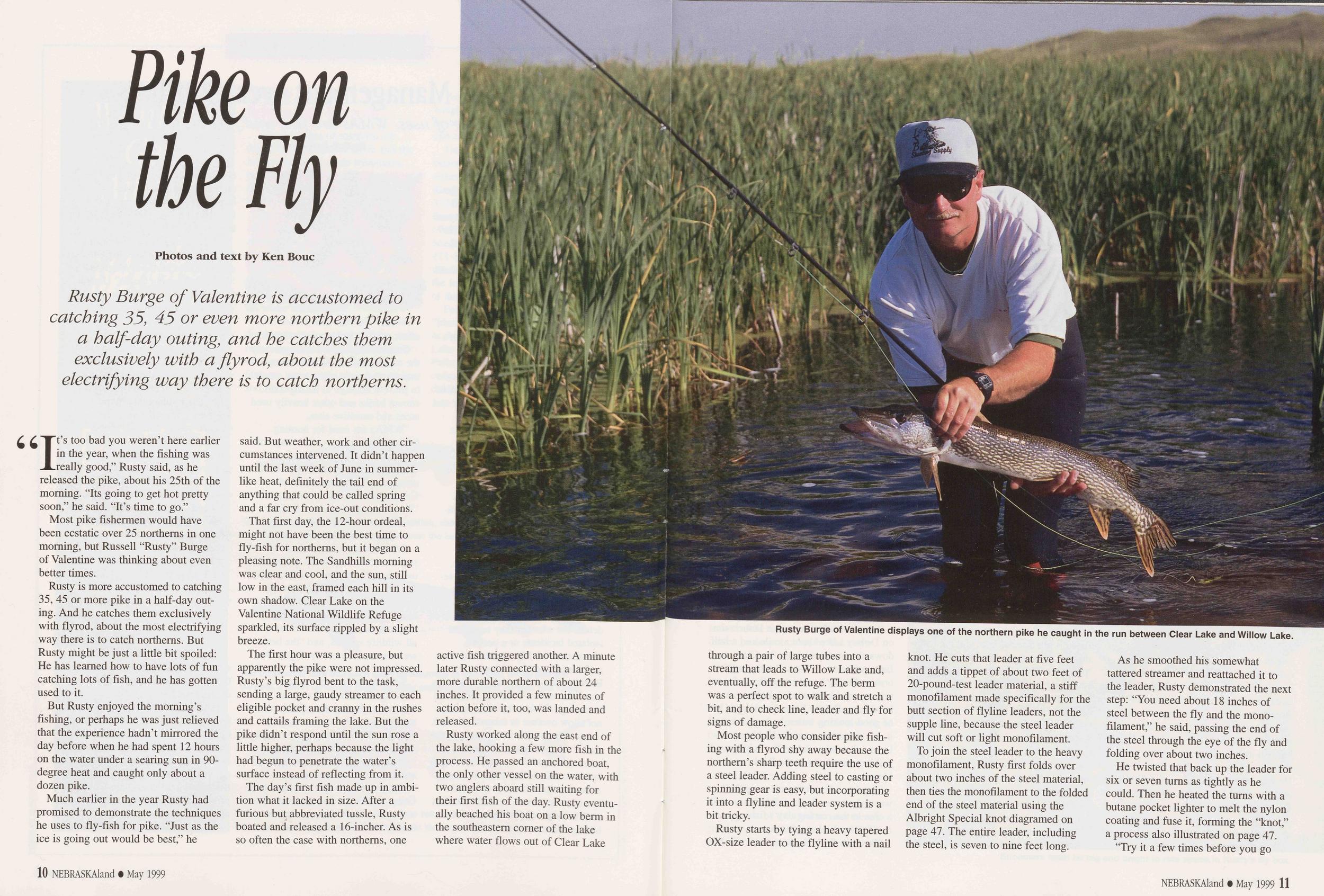
Pike on the Fly
Photos and text by Ken Bouc Rusty Burge of Valentine is accustomed to catching 35, 45 or even more northern pike in a half-day outing, and he catches them exclusively with a flyrod, about the most electrifying way there is to catch northerns.t's too bad you weren't here earlier in the year, when the fishing was really good," Rusty said, as he released the pike, about his 25th of the morning. "Its going to get hot pretty soon," he said. "It's time to go."
Most pike fishermen would have been ecstatic over 25 northerns in one morning, but Russell "Rusty" Burge of Valentine was thinking about even better times.
Rusty is more accustomed to catching 35, 45 or more pike in a half-day out- ing. And he catches them exclusively with flyrod, about the most electrifying way there is to catch northerns. But Rusty might be just a little bit spoiled: He has learned how to have lots of fun catching lots of fish, and he has gotten used to it.
But Rusty enjoyed the morning's fishing, or perhaps he was just relieved that the experience hadn't mirrored the day before when he had spent 12 hours on the water under a searing sun in 90-degree heat and caught only about a dozen pike.
Much earlier in the year Rusty had promised to demonstrate the techniques he uses to fly-fish for pike. "Just as the ice is going out would be best," he said. But weather, work and other circumstances intervened. It didn't happen until the last week of June in summer-like heat, definitely the tail end of anything that could be called spring and a far cry from ice-out conditions.
That first day, the 12-hour ordeal, might not have been the best time to fly-fish for northerns, but it began on a pleasing note. The Sandhills morning was clear and cool, and the sun, still low in the east, framed each hill in its own shadow. Clear Lake on the Valentine National Wildlife Refuge sparkled, its surface rippled by a slight breeze.
The first hour was a pleasure, but apparently the pike were not impressed. Rusty's big flyrod bent to the task, sending a large, gaudy streamer to each eligible pocket and cranny in the rushes and cattails framing the lake. But the pike didn't respond until the sun rose a little higher, perhaps because the light had begun to penetrate the water's surface instead of reflecting from it.
The day's first fish made up in ambition what it lacked in size. After a furious but abbreviated tussle, Rusty boated and released a 16-incher. As is so often the case with northerns, one active fish triggered another. A minute later Rusty connected with a larger, more durable northern of about 24 inches. It provided a few minutes of action before it, too, was landed and released.
Rusty worked along the east end of the lake, hooking a few more fish in the process. He passed an anchored boat, the only other vessel on the water, with two anglers aboard still waiting for their first fish of the day. Rusty eventually beached his boat on a low berm in the southeastern corner of the lake where water flows out of Clear Lake 10 NEBRASKAland • May 1999
Most people who consider pike fishing with a flyrod shy away because the northern's sharp teeth require the use of a steel leader. Adding steel to casting or spinning gear is easy, but incorporating it into a flyline and leader system is a bit tricky.
Rusty starts by tying a heavy tapered OX-size leader to the flyline with a nail knot. He cuts that leader at five feet and adds a tippet of about two feet of 20-pound-test leader material, a stiff monofilament made specifically for the butt section of flyline leaders, not the supple line, because the steel leader will cut soft or light monofilament.
To join the steel leader to the heavy monofilament, Rusty first folds over about two inches of the steel material, then ties the monofilament to the folded end of the steel material using the Albright Special knot diagramed on page 47. The entire leader, including the steel, is seven to nine feet long.
As he smoothed his somewhat tattered streamer and reattached it to the leader, Rusty demonstrated the next step: "You need about 18 inches of steel between the fly and the monofilament," he said, passing the end of the steel through the eye of the fly and folding over about two inches.
He twisted that back up the leader for six or seven turns as tightly as he could. Then he heated the turns with a butane pocket lighter to melt the nylon coating and fuse it, forming the "knot," a process also illustrated on page 47.
"Try it a few times before you go
NEBRASKAland • May 1999 11
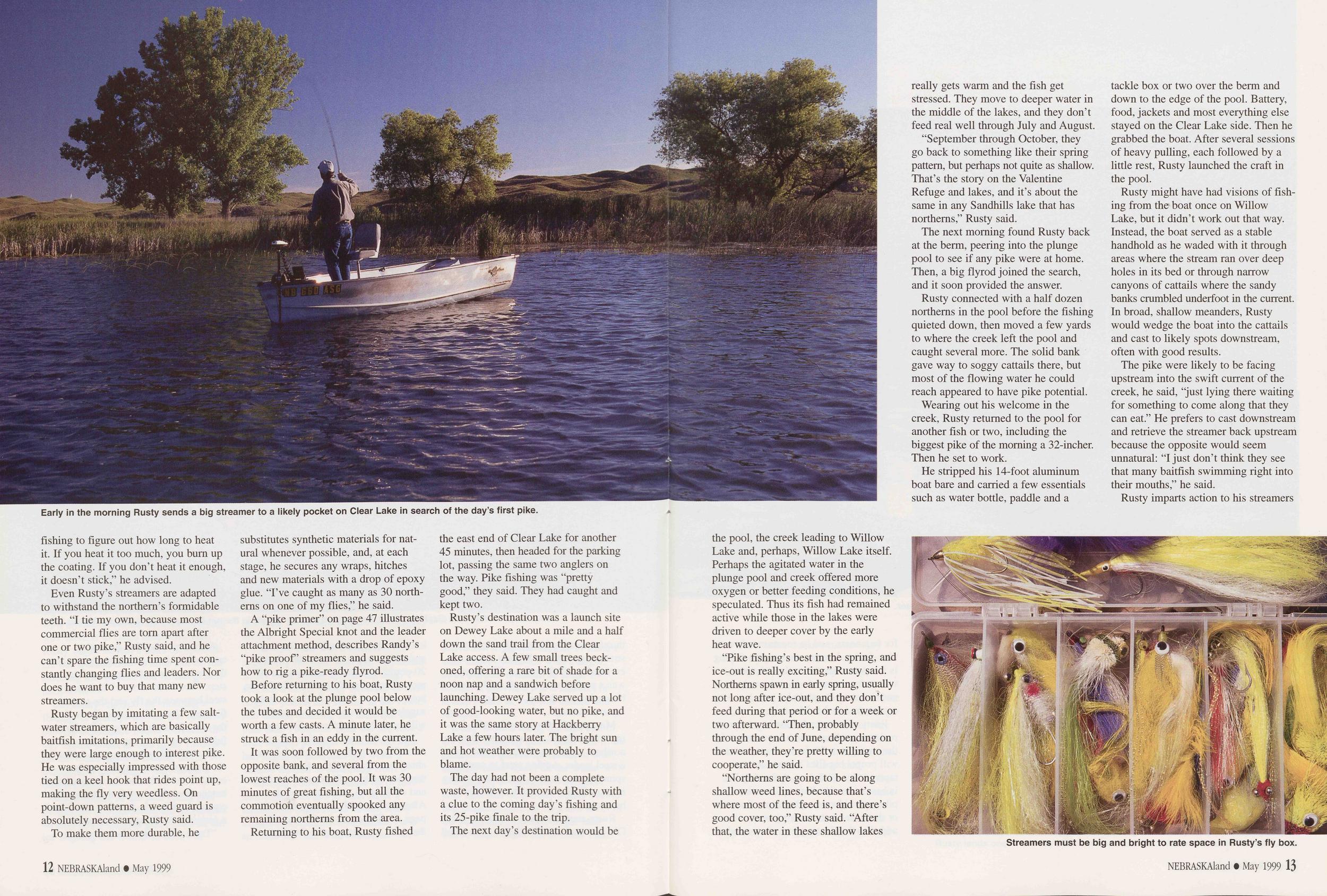
Even Rusty's streamers are adapted to withstand the northern's formidable teeth. "I tie my own, because most commercial flies are torn apart after one or two pike," Rusty said, and he can't spare the fishing time spent constantly changing flies and leaders. Nor does he want to buy that many new streamers.
Rusty began by imitating a few salt- water streamers, which are basically baitfish imitations, primarily because they were large enough to interest pike. He was especially impressed with those tied on a keel hook that rides point up, making the fly very weedless. On point-down patterns, a weed guard is absolutely necessary, Rusty said.
To make them more durable, he substitutes synthetic materials for natural whenever possible, and, at each stage, he secures any wraps, hitches and new materials with a drop of epoxy glue. "I've caught as many as 30 northerns on one of my flies," he said.
A "pike primer" on page 47 illustrates the Albright Special knot and the leader attachment method, describes Randy's "pike proof streamers and suggests how to rig a pike-ready flyrod.
Before returning to his boat, Rusty took a look at the plunge pool below the tubes and decided it would be worth a few casts. A minute later, he struck a fish in an eddy in the current.
It was soon followed by two from the opposite bank, and several from the lowest reaches of the pool. It was 30 minutes of great fishing, but all the commotion eventually spooked any remaining northerns from the area.
Returning to his boat, Rusty fished the east end of Clear Lake for another 45 minutes, then headed for the parking lot, passing the same two anglers on the way. Pike fishing was "pretty good," they said. They had caught and kept two.
Rusty's destination was a launch site on Dewey Lake about a mile and a half down the sand trail from the Clear Lake access. A few small trees beckoned, offering a rare bit of shade for a noon nap and a sandwich before launching. Dewey Lake served up a lot of good-looking water, but no pike, and it was the same story at Hackberry Lake a few hours later. The bright sun and hot weather were probably to blame.
The day had not been a complete waste, however. It provided Rusty with a clue to the coming day's fishing and its 25-pike finale to the trip. The next day's destination would be 12 NEBRASKAland • May 1999 the pool, the creek leading to Willow Lake and, perhaps, Willow Lake itself. Perhaps the agitated water in the plunge pool and creek offered more oxygen or better feeding conditions, he speculated. Thus its fish had remained active while those in the lakes were driven to deeper cover by the early heat wave.
"Pike fishing's best in the spring, and ice-out is really exciting," Rusty said. Northerns spawn in early spring, usually not long after ice-out, and they don't feed during that period or for a week or two afterward. "Then, probably through the end of June, depending on the weather, they're pretty willing to cooperate," he said.
"Northerns are going to be along shallow weed lines, because that's where most of the feed is, and there's good cover, too," Rusty said. "After that, the water in these shallow lakes really gets warm and the fish get stressed. They move to deeper water in the middle of the lakes, and they don't feed real well through July and August.
"September through October, they go back to something like their spring pattern, but perhaps not quite as shallow. That's the story on the Valentine Refuge and lakes, and it's about the same in any Sandhills lake that has northerns," Rusty said.
The next morning found Rusty back at the berm, peering into the plunge pool to see if any pike were at home. Then, a big flyrod joined the search, and it soon provided the answer.
Rusty connected with a half dozen northerns in the pool before the fishing quieted down, then moved a few yards to where the creek left the pool and caught several more. The solid bank gave way to soggy cattails there, but most of the flowing water he could reach appeared to have pike potential.
Wearing out his welcome in the creek, Rusty returned to the pool for another fish or two, including the biggest pike of the morning a 32-incher. Then he set to work.
He stripped his 14-foot aluminum boat bare and carried a few essentials such as water bottle, paddle and a tackle box or two over the berm and down to the edge of the pool. Battery, food, jackets and most everything else stayed on the Clear Lake side. Then he grabbed the boat. After several sessions of heavy pulling, each followed by a little rest, Rusty launched the craft in the pool.
Rusty might have had visions of fishing from the boat once on Willow Lake, but it didn't work out that way. Instead, the boat served as a stable handhold as he waded with it through areas where the stream ran over deep holes in its bed or through narrow canyons of cattails where the sandy banks crumbled underfoot in the current. In broad, shallow meanders, Rusty would wedge the boat into the cattails and cast to likely spots downstream, often with good results.
The pike were likely to be facing upstream into the swift current of the creek, he said, "just lying there waiting for something to come along that they can eat." He prefers to cast downstream and retrieve the streamer back upstream because the opposite would seem unnatural: "I just don't think they see that many baitfish swimming right into their mouths," he said.
Rusty imparts action to his streamers
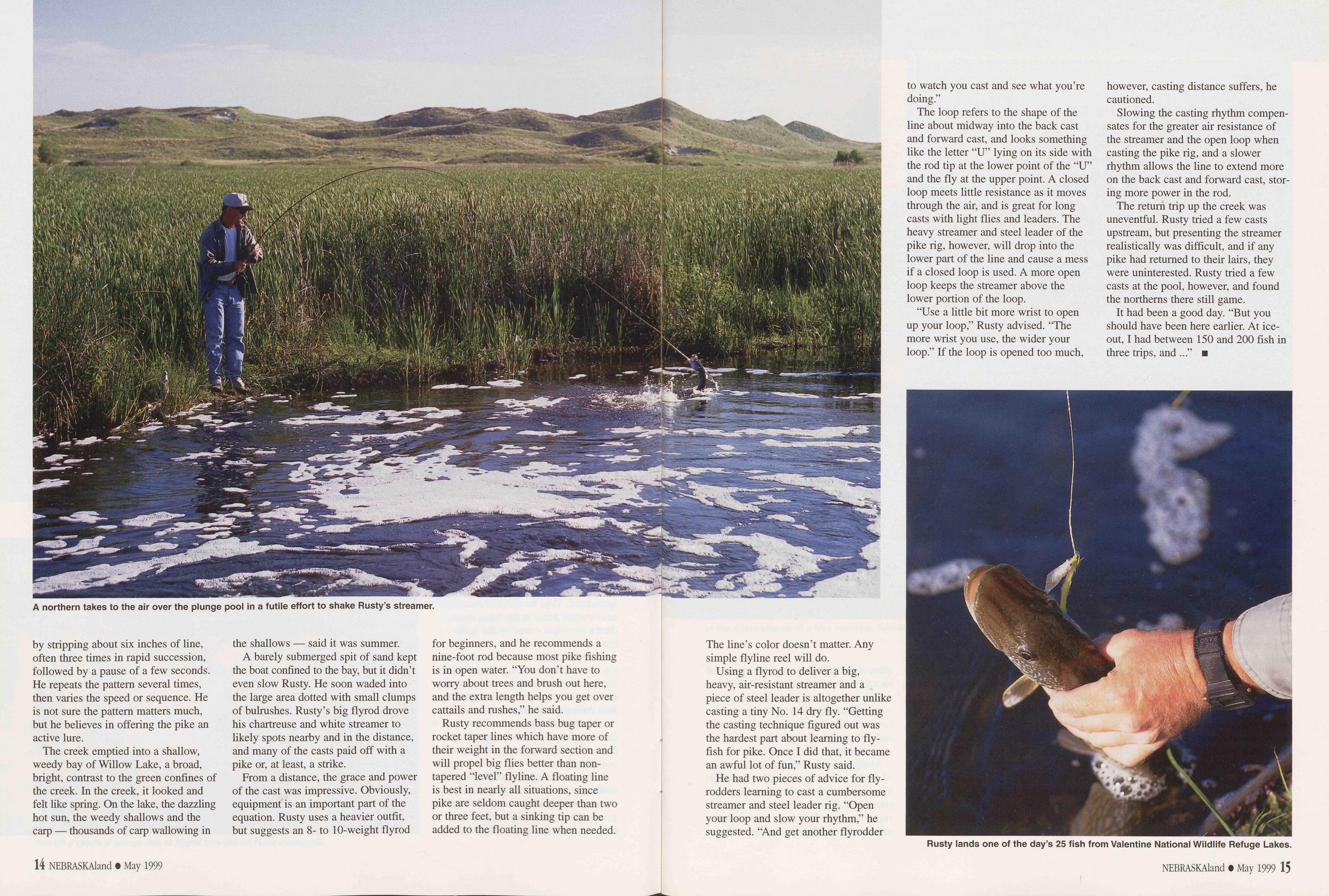
The creek emptied into a shallow, weedy bay of Willow Lake, a broad, bright, contrast to the green confines of the creek. In the creek, it looked and felt like spring. On the lake, the dazzling hot sun, the weedy shallows and the carp — thousands of carp wallowing in the shallows — said it was summer.
A barely submerged spit of sand kept the boat confined to the bay, but it didn't even slow Rusty. He soon waded into the large area dotted with small clumps of bulrushes. Rusty's big flyrod drove his chartreuse and white streamer to likely spots nearby and in the distance, and many of the casts paid off with a pike or, at least, a strike.
From a distance, the grace and power of the cast was impressive. Obviously, equipment is an important part of the equation. Rusty uses a heavier outfit, but suggests an 8- to 10-weight flyrod for beginners, and he recommends a nine-foot rod because most pike fishing is in open water. "You don't have to worry about trees and brush out here, and the extra length helps you get over cattails and rushes," he said.
Rusty recommends bass bug taper or rocket taper lines which have more of their weight in the forward section and will propel big flies better than non- tapered "level" flyline. A floating line is best in nearly all situations, since pike are seldom caught deeper than two or three feet, but a sinking tip can be added to the floating line when needed. 14 NEBRASKAland • May 1999 The line's color doesn't matter. Any simple flyline reel will do.
Using a flyrod to deliver a big, heavy, air-resistant streamer and a piece of steel leader is altogether unlike casting a tiny No. 14 dry fly. "Getting the casting technique figured out was the hardest part about learning to flyfish for pike. Once I did that, it became an awful lot of fun," Rusty said.
He had two pieces of advice for flyrodders learning to cast a cumbersome streamer and steel leader rig. "Open your loop and slow your rhythm," he suggested. "And get another flyrodder to watch you cast and see what you're doing."
The loop refers to the shape of the line about midway into the back cast and forward cast, and looks something like the letter "U" lying on its side with the rod tip at the lower point of the "U" and the fly at the upper point. A closed loop meets little resistance as it moves through the air, and is great for long casts with light flies and leaders. The heavy streamer and steel leader of the pike rig, however, will drop into the lower part of the line and cause a mess if a closed loop is used. A more open loop keeps the streamer above the lower portion of the loop.
"Use a little bit more wrist to open up your loop," Rusty advised. "The more wrist you use, the wider your loop." If the loop is opened too much, however, casting distance suffers, he cautioned.
Slowing the casting rhythm compensates for the greater air resistance of the streamer and the open loop when casting the pike rig, and a slower rhythm allows the line to extend more on the back cast and forward cast, storing more power in the rod.
The return trip up the creek was uneventful. Rusty tried a few casts upstream, but presenting the streamer realistically was difficult, and if any pike had returned to their lairs, they were uninterested. Rusty tried a few casts at the pool, however, and found the northerns there still game.
It had been a good day. "But you should have been here earlier. At iceout, I had between 150 and 200 fish in three trips, and ..."
Canoeing the Elkhorn River
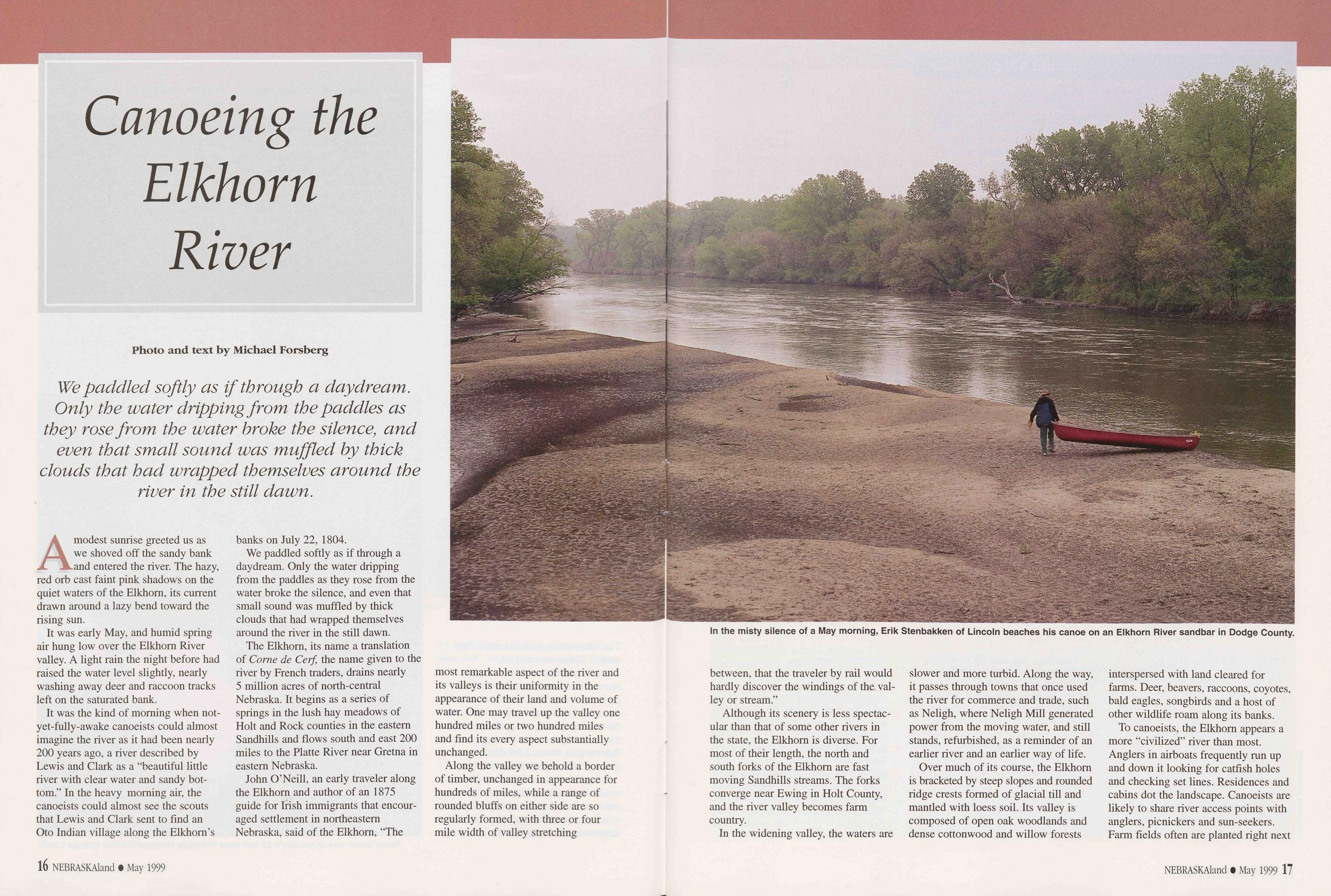
Photo and text by Michael Forsberg We paddled softly as if through a daydream. Only the water dripping from the paddles as they rose from the water broke the silence, and even that small sound was muffled by thick clouds that had wrapped themselves around the river in the still dawn.modest sunrise greeted us as we shoved off the sandy bank .and entered the river. The hazy, red orb cast faint pink shadows on the quiet waters of the Eikhorn, its current drawn around a lazy bend toward the rising sun.
It was early May, and humid spring air hung low over the Eikhorn River valley. A light rain the night before had raised the water level slightly, nearly washing away deer and raccoon tracks left on the saturated bank.
It was the kind of morning when not yet-fully-awake canoeists could almost imagine the river as it had been nearly 200 years ago, a river described by Lewis and Clark as a "beautiful little river with clear water and sandy bottom." In the heavy morning air, the canoeists could almost see the scouts that Lewis and Clark sent to find an Oto Indian village along the Elkhorn's banks on July 22, 1804.
We paddled softly as if through a daydream. Only the water dripping from the paddles as they rose from the water broke the silence, and even that small sound was muffled by thick clouds that had wrapped themselves around the river in the still dawn.
The Elkhorn, its name a translation of Come de Cerf, the name given to the river by French traders, drains nearly 5 million acres of north-central Nebraska. It begins as a series of springs in the lush hay meadows of Holt and Rock counties in the eastern Sandhills and flows south and east 200 miles to the Platte River near Gretna in eastern Nebraska.
John O'Neill, an early traveler along the Elkhorn and author of an 1875 guide for Irish immigrants that encouraged settlement in northeastern Nebraska, said of the Elkhorn, "The most remarkable aspect of the river and its valleys is their uniformity in the appearance of their land and volume of water. One may travel up the valley one hundred miles or two hundred miles and find its every aspect substantially unchanged.
Along the valley we behold a border of timber, unchanged in appearance for hundreds of miles, while a range of rounded bluffs on either side are so regularly formed, with three or four mile width of valley stretching 16 NEBRASKAland • May 1999
Although its scenery is less spectacular than that of some other rivers in the state, the Elkhorn is diverse. For most of their length, the north and south forks of the Elkhorn are fast moving Sandhills streams. The forks converge near Ewing in Holt County, and the river valley becomes farm country.
In the widening valley, the waters are slower and more turbid. Along the way, it passes through towns that once used the river for commerce and trade, such as Neligh, where Neligh Mill generated power from the moving water, and still stands, refurbished, as a reminder of an earlier river and an earlier way of life.
Over much of its course, the Elkhorn is bracketed by steep slopes and rounded ridge crests formed of glacial till and mantled with loess soil. Its valley is composed of open oak woodlands and dense cottonwood and willow forests interspersed with land cleared for farms. Deer, beavers, raccoons, coyotes, bald eagles, songbirds and a host of other wildlife roam along its banks.
To canoeists, the Elkhorn appears a
more "civilized" river than most.
Anglers in afrboats frequently run up
and down it looking for catfish holes
and checking set lines. Residences and
cabins dot the landscape. Canoeists are
likely to share river access points with
anglers, picnickers and sun-seekers.
Farm fields often are planted right next
NEBRASKAland • May 1999 17
Still, there are places along the river that seem remote from the everyday sights and sounds that most canoeists hope to escape.
By midmorning we were floating through one such place. The heavy haze that had lingered in the valley much of the morning had burned off to high clouds. The temperature was near 60 and a north breeze began to blow across the stream. We had just passed Scribner, and after several miles of endless lazy bends, the river began to change.
As it narrowed and deepened, the faint sounds of highway traffic and farm machinery were replaced by silence. Open cottonwood forest became high, rolling oak woodlands atop steep, 20- to 50-foot sandstone or shale walls with a layer of burnt- rose-colored rocks at base.
The river suddenly became more intimate as we watched cliff swallows dart in and out of their nest cavities, highrise apartments dug into the mustard-colored cliffs. We lay back and listened to an endless trill of Baltimore orioles.
Rose-breasted grosbeaks and yellowthroat warblers pierced the blue sky with splashes of color high in the treetops, racing along the river from tall, dark cedars lining the cliffs on the north to the bright new greens of cottonwood leaves on the south bank. There seemed to be a beaver bank den around every C-shaped bend, new ones marked by freshly girdled trees and beaver slides still wet from a morning's work. Kingfishers perched on fallen logs in the river.
For the rest of the morning we were pushed luxuriously by the north wind as we took in the river and watched the valley again sprawl out before us. It was good to be on the river, cradled in the arms of the gentle current and chasing the clouds downstream.
Canoeing the ElkhornFor much of the Elkhorn's canoeable length, it is broad and usually has a narrow, deeper channel. Flows vary considerably throughout the year depending on snowmelt, runoff, rainfall and irrigation demands. Typically, the best flows for canoeists usually begin in March after ice-out and end by mid-June with the start of the irrigation season.
When the water is high, reading the river to find the channel is relatively easy. In mid- and late summer, irrigation and low rainfall can decrease flows and finding a channel can be more difficult. High temperatures and summer winds can greatly extend time and effort on the river. From mid-September through October, the river often is canoeable again.
Hazards ObstructionsFlowing water carries awesome force, and even in the slow-moving Elkhorn, the current can pin a canoe against an obstruction. Encountering submerged and fallen logs and bridge pilings is possible. If you can't avoid an obstruction and dump your canoe, stay upstream of the swamped boat to avoid being pinned against the obstruction.
Spring rains can produce destructive floods, and the Elkhorn River basin sustains more annual flood damage than any other basin in the state. Watch the weather closely and call ahead to check river levels.
Heat-related IllnessHeat-related illnesses such as dehydration, heat exhaustion and heat stroke are possible in summer. They occur when exertion, exposure and insufficient liquid intake cause the body's core temperature to rise.
Dehydration and heat exhaustion are not life threatening, but can lead to heat stroke, which can be fatal. To prevent heat-related emergencies, drink plenty of water, eat salty foods, don't overexert and wear loose cotton clothing and a hat. During the hottest part of the day, take a break or a swim.
HypothermiaHypothermia occurs when the body's core temperature drops and vital organs malfunction. It can be fatal. On hot days, hypothermia is seldom likely, but it can be a danger in spring and fall. Water cools the body 25 times more rapidly than air, and even in 60-degree weather, hypothermia is possible. Take extra clothing in a waterproof bag and change if you get wet.
Canoeing Regulations Canoe accessExcept at designated pullouts, it is illegal to launch canoes or take them out of the water at county road bridges or highway bridges.
TrespassingStreambeds and banks belong to the owner of the land through which the water flows. Canoeists may portage around fences and other obstructions, but they are responsible for property damage. Permission is required to picnic or camp. Do not discard trash on shore or in the water.
Life jacketsCanoes must have a U.S. Coast Guard approved life jacket for each person, a throwable flotation device, a bailing bucket or sponge and a whistle or similar noisemaker. Children under 12 are required to wear life jackets. The Game and Parks Commission recommends that all canoeists wear life jackets at all times while on the water.
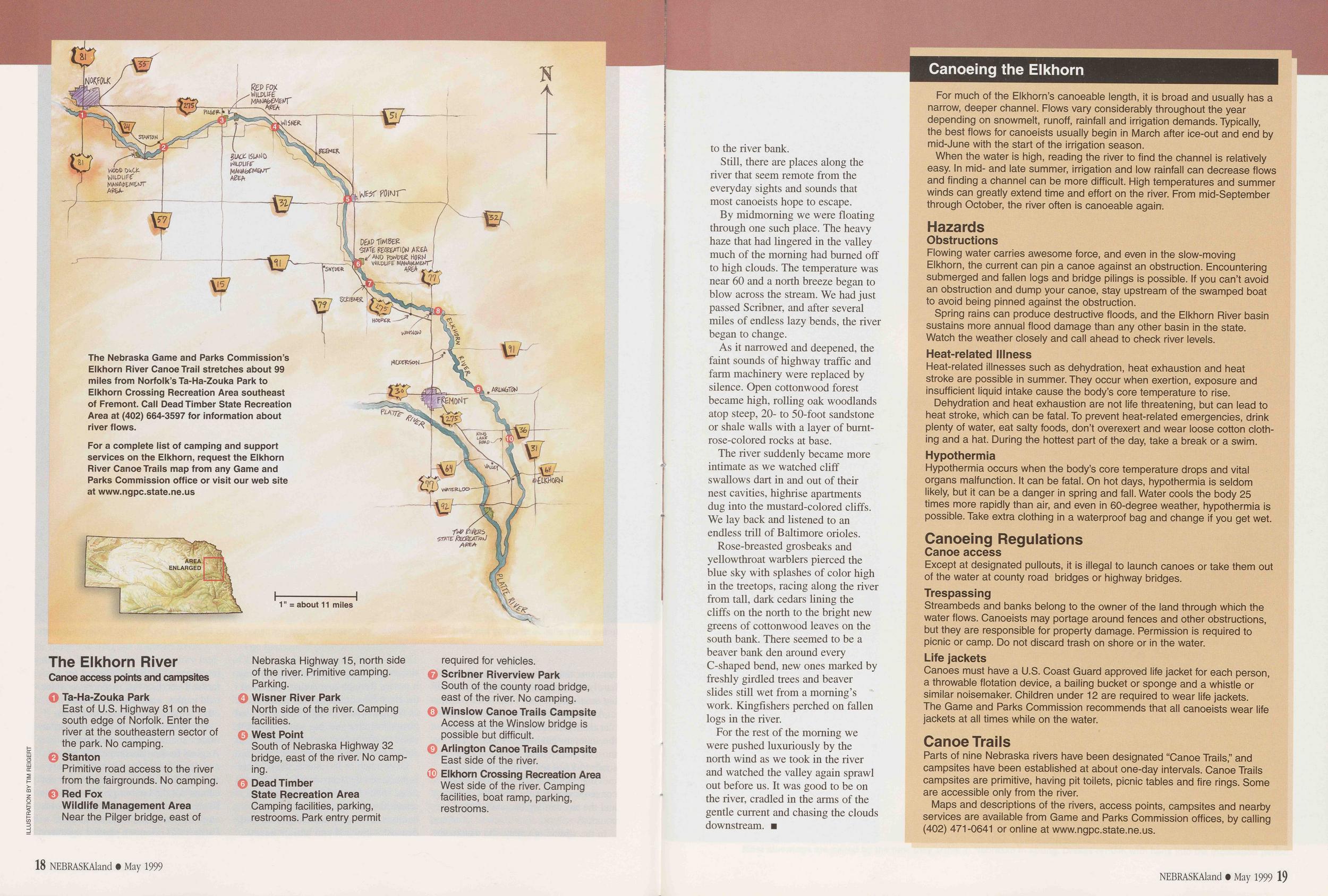
Canoe TrailsParts of nine Nebraska rivers have been designated "Canoe Trails," and campsites have been established at about one-day intervals. Canoe Trails campsites are primitive, having pit toilets, picnic tables and fire rings. Some are accessible only from the river.
Maps and descriptions of the rivers, access points, campsites and nearby services are available from Game and Parks Commission offices, by calling (402) 471-0641 or online at www.ngpc.state.ne.us.
NEBRASKAland • May 1999 19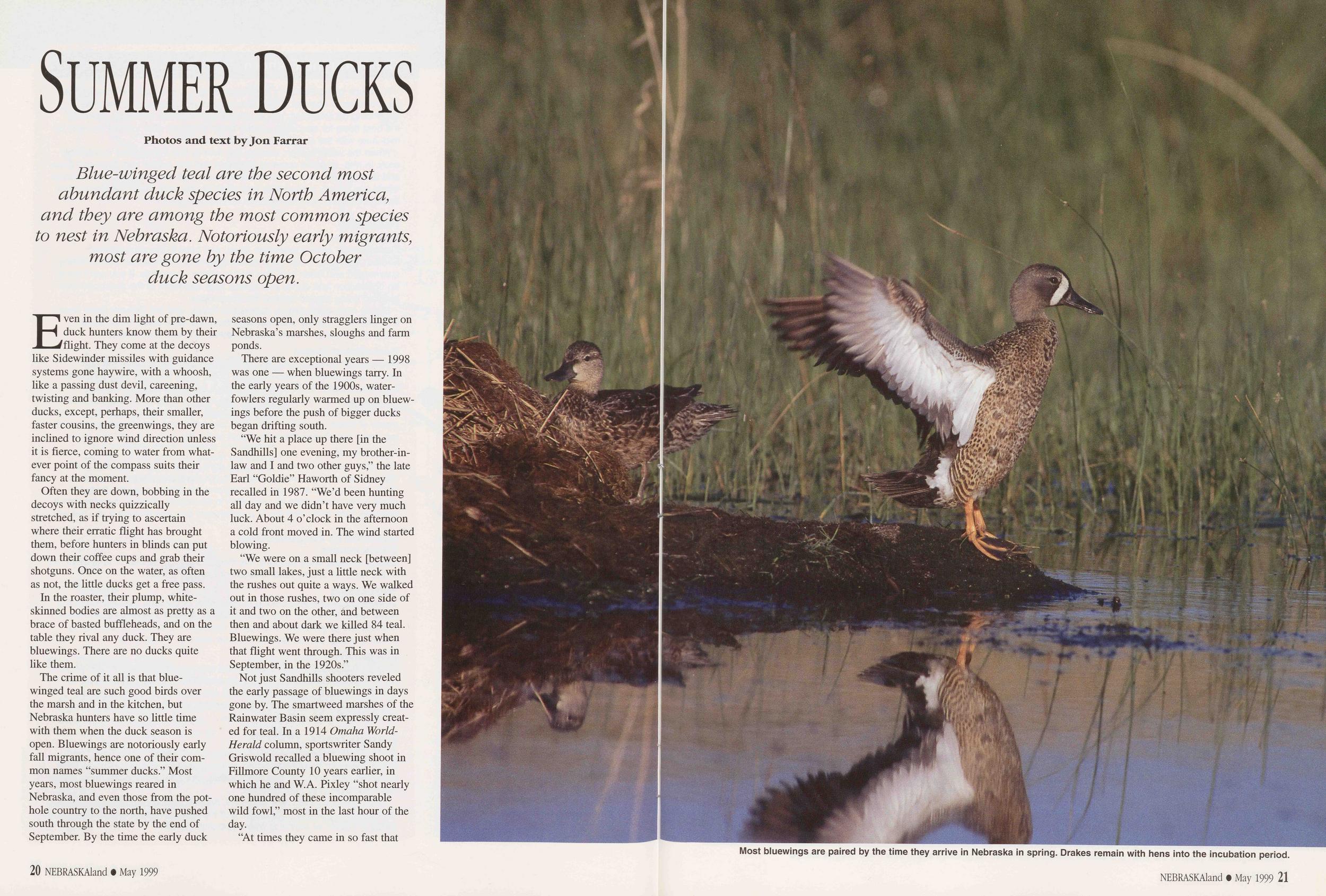
Summer Ducks
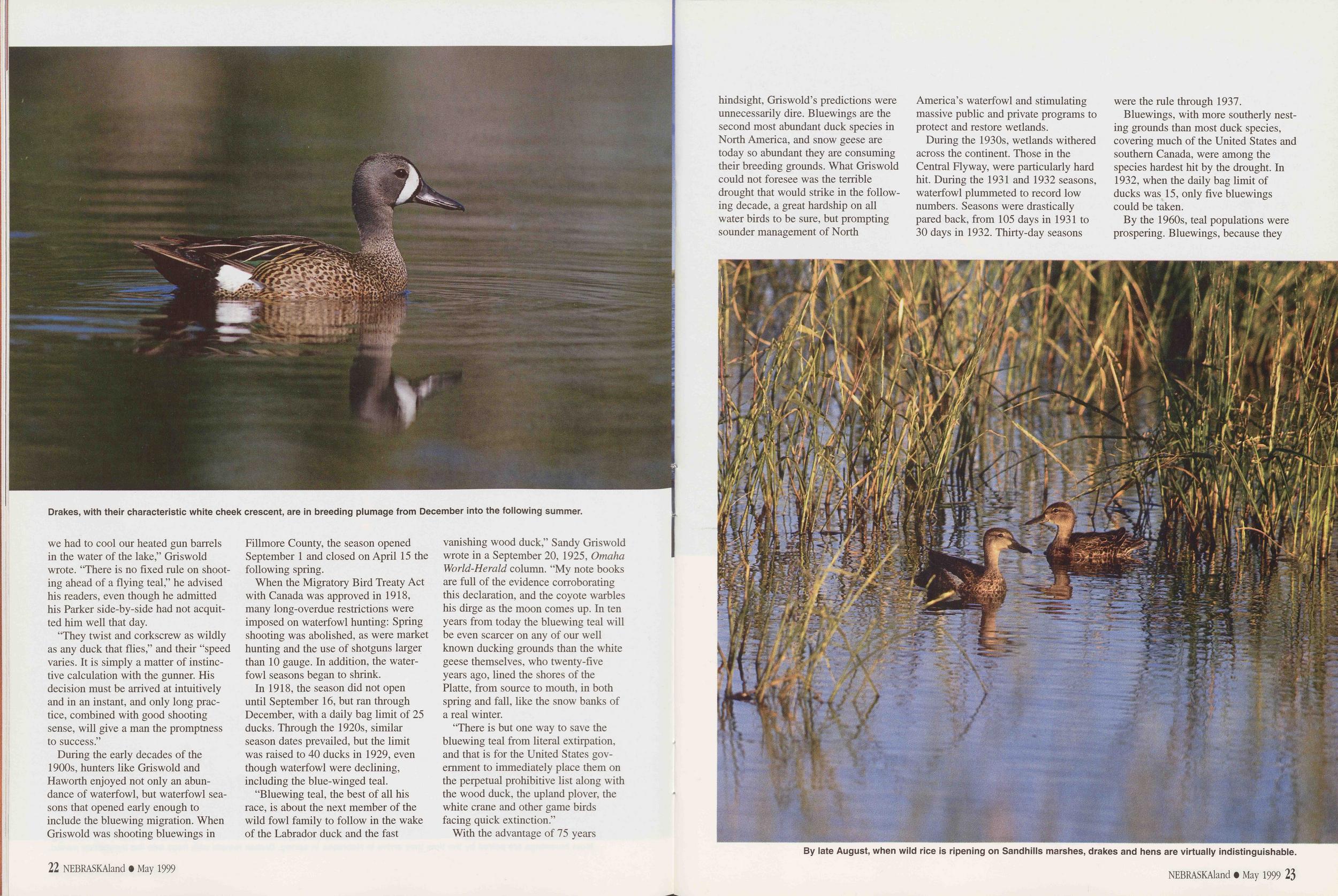
Photos and text by Jon Farrar Blue-winged teal are the second most abundant duck species in North America, and they are among the most common species to nest in Nebraska. Notoriously early migrants, most are gone by the time October duck seasons open.Even in the dim light of pre-dawn, duck hunters know them by their flight. They come at the decoys like Sidewinder missiles with guidance systems gone haywire, with a whoosh, like a passing dust devil, careening, twisting and banking. More than other ducks, except, perhaps, their smaller, faster cousins, the greenwings, they are inclined to ignore wind direction unless it is fierce, coming to water from what- ever point of the compass suits their fancy at the moment.
Often they are down, bobbing in the decoys with necks quizzically stretched, as if trying to ascertain where their erratic flight has brought them, before hunters in blinds can put down their coffee cups and grab their shotguns. Once on the water, as often as not, the little ducks get a free pass.
In the roaster, their plump, white- skinned bodies are almost as pretty as a brace of basted buffleheads, and on the table they rival any duck. They are bluewings. There are no ducks quite like them.
The crime of it all is that blue- winged teal are such good birds over the marsh and in the kitchen, but Nebraska hunters have so little time with them when the duck season is open. Bluewings are notoriously early fall migrants, hence one of their common names "summer ducks." Most years, most bluewings reared in Nebraska, and even those from the pothole country to the north, have pushed south through the state by the end of September. By the time the early duck seasons open, only stragglers linger on Nebraska's marshes, sloughs and farm ponds.
There are exceptional years — 1998 was one — when bluewings tarry. In the early years of the 1900s, waterfowlers regularly warmed up on bluewings before the push of bigger ducks began drifting south.
"We hit a place up there [in the Sandhills] one evening, my brother-inlaw and I and two other guys," the late Earl "Goldie" Haworth of Sidney recalled in 1987. "We'd been hunting all day and we didn't have very much luck. About 4 o'clock in the afternoon a cold front moved in. The wind started blowing.
"We were on a small neck [between] two small lakes, just a little neck with the rushes out quite a ways. We walked out in those rushes, two on one side of it and two on the other, and between then and about dark we killed 84 teal. Bluewings. We were there just when that flight went through. This was in September, in the 1920s."
Not just Sandhills shooters reveled the early passage of bluewings in days gone by. The smartweed marshes of the Rainwater Basin seem expressly created for teal. In a 1914 Omaha World Herald column, sportswriter Sandy Griswold recalled a bluewing shoot in Fillmore County 10 years earlier, in which he and W.A. Pixley "shot nearly one hundred of these incomparable wild fowl," most in the last hour of the day.
"At times they came in so fast that 20 NEBRASKAland • May 1999
"They twist and corkscrew as wildly as any duck that flies," and their "speed varies. It is simply a matter of instinctive calculation with the gunner. His decision must be arrived at intuitiveland in an instant, and only long practice, combined with good shooting sense, will give a man the promptness to success."
During the early decades of the 1900s, hunters like Griswold and Haworth enjoyed not only an abundance of waterfowl, but waterfowl seasons that opened early enough to include the bluewing migration. When Griswold was shooting bluewings in Fillmore County, the season opened September 1 and closed on April 15 the following spring.
When the Migratory Bird Treaty Act with Canada was approved in 1918, many long-overdue restrictions were imposed on waterfowl hunting: Spring shooting was abolished, as were market hunting and the use of shotguns larger than 10 gauge. In addition, the waterfowl seasons began to shrink.
In 1918, the season did not open until September 16, but ran through December, with a daily bag limit of 25 ducks. Through the 1920s, similar season dates prevailed, but the limit was raised to 40 ducks in 1929, even though waterfowl were declining, including the blue-winged teal.
"Bluewing teal, the best of all his race, is about the next member of the wild fowl family to follow in the wake of the Labrador duck and the fast vanishing wood duck," Sandy Griswold wrote in a September 20, 1925, Omaha World-Herald column. "My note books are full of the evidence corroborating this declaration, and the coyote warbles his dirge as the moon comes up. In ten years from today the bluewing teal will be even scarcer on any of our well known ducking grounds than the white geese themselves, who twenty-five years ago, lined the shores of the Platte, from source to mouth, in both spring and fall, like the snow banks of a real winter.
"There is but one way to save the bluewing teal from literal extirpation, and that is for the United States government to immediately place them on the perpetual prohibitive list along with the wood duck, the upland plover, the white crane and other game birds facing quick extinction."
With the advantage of 75 years 22 NEBRASKAland • May 1999 hindsight, Griswold's predictions were unnecessarily dire. Bluewings are the second most abundant duck species in North America, and snow geese are today so abundant they are consuming their breeding grounds. What Griswold could not foresee was the terrible drought that would strike in the following decade, a great hardship on all water birds to be sure, but prompting sounder management of North America's waterfowl and stimulating massive public and private programs to protect and restore wetlands.
During the 1930s, wetlands withered across the continent. Those in the Central Flyway, were particularly hard hit. During the 1931 and 1932 seasons, waterfowl plummeted to record low numbers. Seasons were drastically pared back, from 105 days in 1931 to 30 days in 1932. Thirty-day seasons were the rule through 1937.
Bluewings, with more southerly nesting grounds than most duck species, covering much of the United States and southern Canada, were among the species hardest hit by the drought. In 1932, when the daily bag limit of ducks was 15, only five bluewings could be taken.
By the 1960s, teal populations were prospering. Bluewings, because they
 migrate before regular duck seasons
opened in northern states, were subject
to light hunting pressure. State
waterfowl biologists encouraged the Fish
and Wildlife Service to open a
September season.
migrate before regular duck seasons
opened in northern states, were subject
to light hunting pressure. State
waterfowl biologists encouraged the Fish
and Wildlife Service to open a
September season.
Finally, in 1965, hunters again had a duck season open when bluewings were still in Nebraska. The first-ever, statewide "early-teal season," opened September 4 and closed September 12. Four teal of any species were allowed daily, with eight in possession. Similar teal seasons were allowed in 1966, 1967, 1969 and 1970.
Observations of hunters by biologists and game wardens during those seasons suggested that too many "non-teal" species were shot or shot at. For that reason, and because Nebraska is a waterfowl production state where duck species other than teal are commonly present in September, the U.S. Fish and Wildlife Service never again offered Nebraska an early teal season option.
Other studies conducted during the 1965-67 seasons, though, documented that the incidental harvest of non-target duck species did not have significant consequences, and was within acceptable limits as established by the Fish and Wildlife Service.
Only twice since those early teal seasons has Nebraska's duck season opened in September: in 1995 when the Low Plains Early season opened September 30, and in 1996 when the same unit opened September 28. Under the federal waterfowl hunting framework, the earliest a Nebraska season can open is the weekend nearest October 1. In both 1995 and 1996 that was the last weekend of September. Even in those years, most of the flyway's bluewings had already passed through en route to southerly wintering grounds.
Some Central Flyway states south of Nebraska (Colorado, Kansas, New Mexico, Oklahoma and Texas) were allowed to continue September teal seasons to take advantage of early migrating bluewings. Waterfowl biologists representing northern states continue to encourage the Fish and Wildlife Service to modify the federal framework to allow northern states, which contribute significantly to the production of bluewings, to open seasons in September and distribute the bluewing harvest more equitably within the flyway.
Although duck season dates have not been favorable to Nebraska bluewing shooters, bag limits have been generous for the past 30 years. The introduction of the point system in 1970, designed to allow larger bags of species that were prospering and provide degrees of protection for species needing it, generally allowed liberal teal limits.
From 1970 through 1984, 10 teal of any species were allowed daily, except in 1974, when only seven were allowed. Since 1985, the daily bag limit of teal has been either five or six, except in 1988, a year when the conventional bag limit system was used and the teal limit was three.
Liberal limits on teal, though, had little effect on the bluewing harvest in Nebraska, because most years there were so few bluewings in the state when the season opened. Bluewings comprised only 6.31 percent of the state's duck harvest between 1961 and 1996. Since 1969, 30 percent to 45 percent of the total U.S. bluewing harvest has occurred in states with September teal seasons. While more bluewings are taken by hunters in states south of Nebraska, bluewings have one of the lowest hunting mortality rates of all duck species in the Central Flyway.
Even though faced with a continent wide decline in habitat over the past 50 years, blue-winged teal have fared better than many duck species. Since 1955, when comprehensive breeding ground surveys were initiated, North America's blue-winged teal numbers have fluctuated in response to the availability of nesting habit and water conditions on the breeding grounds. They have not, like some species, experienced long-term declines.
During the late 1980s and early 1990s, though, when drought reduced the quality of breeding habitat, bluewing numbers fell to a 30-year low. As water conditions improved in the Prairie-Pothole region, and Conservation Reserve Program grasslands provided better nesting cover in the north-central states, they rebounded to 30-year record highs. Their future, it seems, will not be determined by the harvest, but by the availability of breeding ground habitat.
Blue-winged teal and mallards are the most abundant duck species breeding in Nebraska. On the Valentine National Wildlife Refuge in recent years, mallards and bluewings have accounted for nearly 90 percent of the duck broods surveyed. The two species seesaw back and forth as the most abundant breeding ducks from year to year as nesting cover, water conditions and weather conditions favor the success of one over the other.
Since 1960, when aerial surveys in the Sandhills began, bluewings 24 NEBRASKAland • May 1999
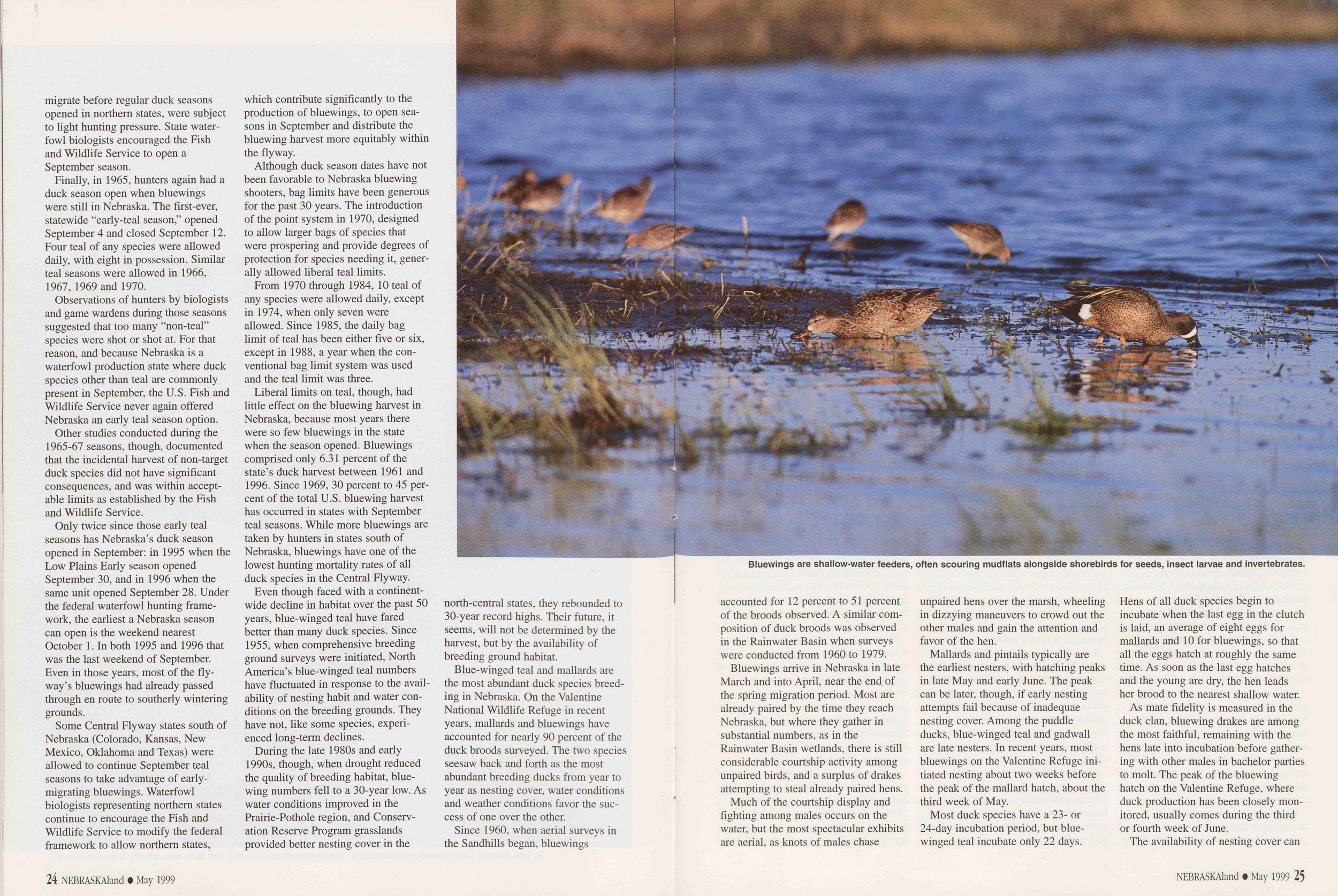
Bluewings arrive in Nebraska in late March and into April, near the end of the spring migration period. Most are already paired by the time they reach Nebraska, but where they gather in substantial numbers, as in the Rainwater Basin wetlands, there is still considerable courtship activity among unpaired birds, and a surplus of drakes attempting to steal already paired hens.
Much of the courtship display and fighting among males occurs on the water, but the most spectacular exhibits are aerial, as knots of males chase unpaired hens over the marsh, wheeling in dizzying maneuvers to crowd out the other males and gain the attention and favor of the hen.
Mallards and pintails typically are the earliest nesters, with hatching peaks in late May and early June. The peak can be later, though, if early nesting attempts fail because of inadequate nesting cover. Among the puddle ducks, blue-winged teal and gadwall are late nesters. In recent years, most bluewings on the Valentine Refuge initiated nesting about two weeks before the peak of the mallard hatch, about the third week of May.
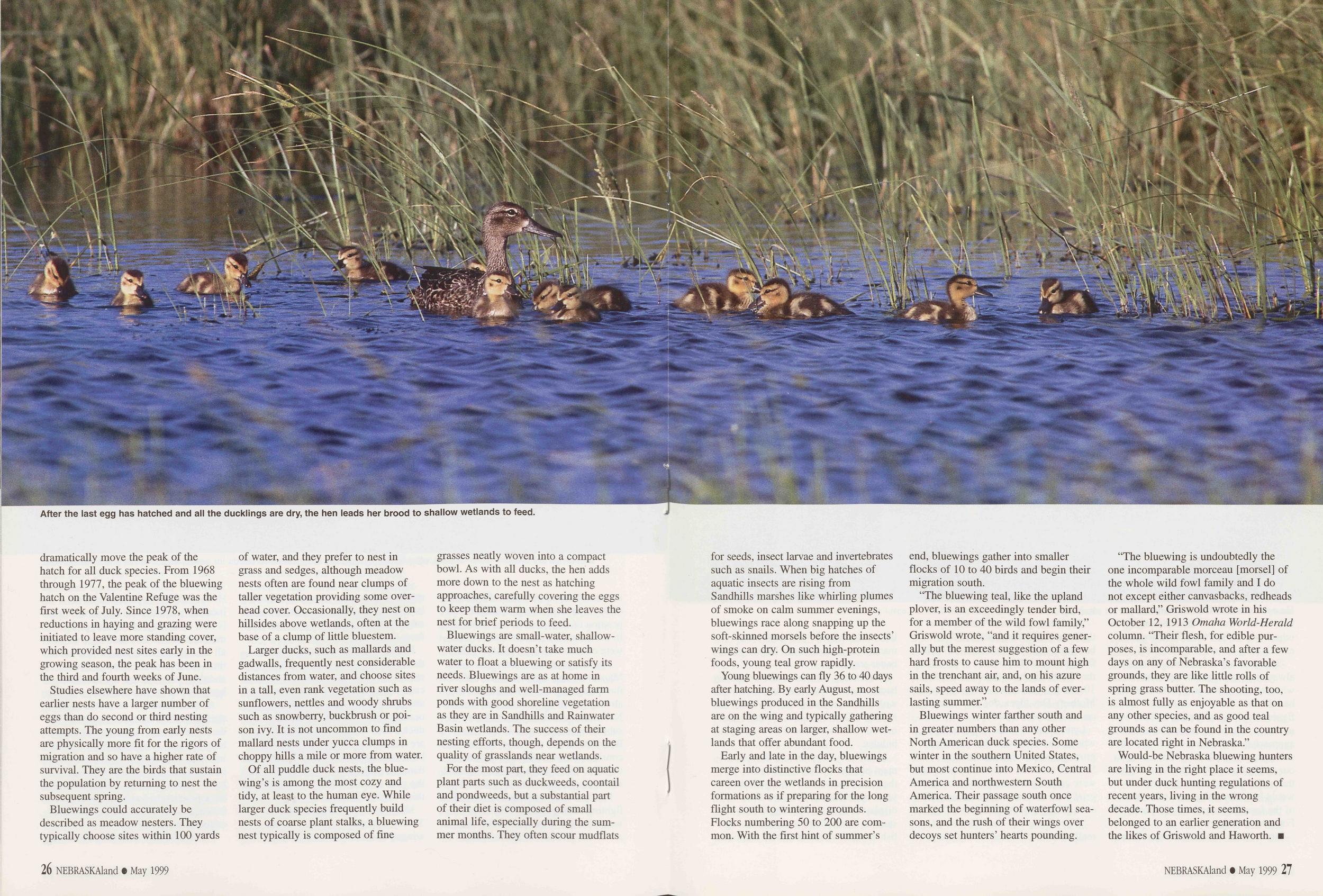
Most duck species have a 23- or 24-day incubation period, but bluewinged teal incubate only 22 days. Hens of all duck species begin to incubate when the last egg in the clutch is laid, an average of eight eggs for mallards and 10 for bluewings, so that all the eggs hatch at roughly the same time. As soon as the last egg hatches and the young are dry, the hen leads her brood to the nearest shallow water.
As mate fidelity is measured in the duck clan, bluewing drakes are among the most faithful, remaining with the hens late into incubation before gathering with other males in bachelor parties to molt. The peak of the bluewing hatch on the Valentine Refuge, where duck production has been closely monitored, usually comes during the third or fourth week of June.
The availability of nesting cover can
NEBRASKAland • May 1999 25
Studies elsewhere have shown that earlier nests have a larger number of eggs than do second or third nesting attempts. The young from early nests are physically more fit for the rigors of migration and so have a higher rate of survival. They are the birds that sustain the population by returning to nest the subsequent spring.
Bluewings could accurately be described as meadow nesters. They typically choose sites within 100 yards of water, and they prefer to nest in grass and sedges, although meadow nests often are found near clumps of taller vegetation providing some overhead cover. Occasionally, they nest on hillsides above wetlands, often at the base of a clump of little bluestem.
Larger ducks, such as mallards and gadwalls, frequently nest considerable distances from water, and choose sites in a tall, even rank vegetation such as sunflowers, nettles and woody shrubs such as snowberry, buckbrush or poison ivy. It is not uncommon to find mallard nests under yucca clumps in choppy hills a mile or more from water.
Of all puddle duck nests, the bluewing's is among the most cozy and tidy, at least to the human eye. While larger duck species frequently build nests of coarse plant stalks, a bluewing nest typically is composed of fine grasses neatly woven into a compact bowl. As with all ducks, the hen adds more down to the nest as hatching approaches, carefully covering the eggs to keep them warm when she leaves the nest for brief periods to feed.
Bluewings are small-water, shallow water ducks. It doesn't take much water to float a bluewing or satisfy its needs. Bluewings are as at home in river sloughs and well-managed farm ponds with good shoreline vegetation as they are in Sandhills and Rainwater Basin wetlands. The success of their nesting efforts, though, depends on the quality of grasslands near wetlands.
For the most part, they feed on aquatic plant parts such as duckweeds, coontail and pondweeds, but a substantial part of their diet is composed of small animal life, especially during the summer months. They often scour mudflats 26 NEBRASKAland • May 1999 for seeds, insect larvae and invertebrates such as snails. When big hatches of aquatic insects are rising from Sandhills marshes like whirling plumes of smoke on calm summer evenings, bluewings race along snapping up the soft-skinned morsels before the insects' wings can dry. On such high-protein foods, young teal grow rapidly.
Young bluewings can fly 36 to 40 days after hatching. By early August, most bluewings produced in the Sandhills are on the wing and typically gathering at staging areas on larger, shallow wetlands that offer abundant food.
Early and late in the day, bluewings merge into distinctive flocks that careen over the wetlands in precision formations as if preparing for the long flight south to wintering grounds. Flocks numbering 50 to 200 are common. With the first hint of summer's end, bluewings gather into smaller flocks of 10 to 40 birds and begin their migration south.
"The bluewing teal, like the upland plover, is an exceedingly tender bird, for a member of the wild fowl family," Griswold wrote, "and it requires generally but the merest suggestion of a few hard frosts to cause him to mount high in the trenchant air, and, on his azure sails, speed away to the lands of everlasting summer."
Bluewings winter farther south and in greater numbers than any other North American duck species. Some winter in the southern United States, but most continue into Mexico, Central America and northwestern South America. Their passage south once marked the beginning of waterfowl seasons, and the rush of their wings over decoys set hunters' hearts pounding.
"The bluewing is undoubtedly the one incomparable morceau [morsel] of the whole wild fowl family and I do not except either canvasbacks, redheads or mallard," Griswold wrote in his October 12, 1913 Omaha World-Herald column. "Their flesh, for edible purposes, is incomparable, and after a few days on any of Nebraska's favorable grounds, they are like little rolls of spring grass butter. The shooting, too, is almost fully as enjoyable as that on any other species, and as good teal grounds as can be found in the country are located right in Nebraska."
Would-be Nebraska bluewing hunters are living in the right place it seems, but under duck hunting regulations of recent years, living in the wrong decade. Those times, it seems, belonged to an earlier generation and the likes of Griswold and Haworth.
NEBRASKAland • May 1999 27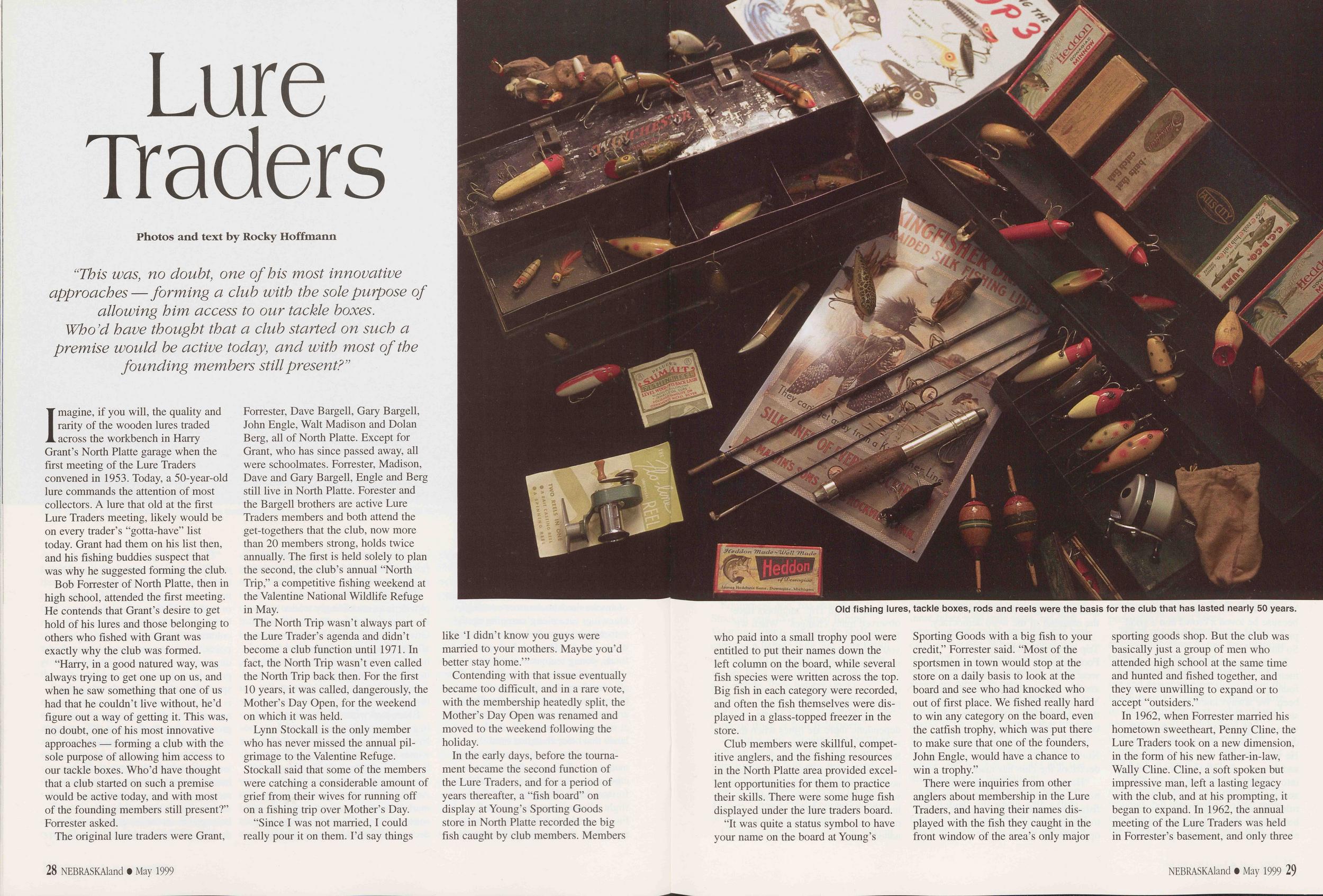
Lure Traders
Photos and text by Rocky Hoffmann "This was, no doubt, one of his most innovative approaches — forming a club with the sole purpose of allowing him access to our tackle boxes. Who'd have thought that a club started on such a premise would be active today, and with most of the founding members still present?"Imagine, if you will, the quality and rarity of the wooden lures traded across the workbench in Harry Grant's North Platte garage when the first meeting of the Lure Traders convened in 1953. Today, a 50-year-old lure commands the attention of most collectors. A lure that old at the first Lure Traders meeting, likely would be on every trader's "gotta-have" list today. Grant had them on his list then, and his fishing buddies suspect that was why he suggested forming the club.
Bob Forrester of North Platte, then in high school, attended the first meeting. He contends that Grant's desire to get hold of his lures and those belonging to others who fished with Grant was exactly why the club was formed.
"Harry, in a good natured way, was always trying to get one up on us, and when he saw something that one of us had that he couldn't live without, he'd figure out a way of getting it. This was, no doubt, one of his most innovative approaches — forming a club with the sole purpose of allowing him access to our tackle boxes. Who'd have thought that a club started on such a premise would be active today, and with most of the founding members still present?" Forrester asked.
The original lure traders were Grant, Forrester, Dave Bargell, Gary Bargell, John Engle, Walt Madison and Dolan Berg, all of North Platte. Except for Grant, who has since passed away, all were schoolmates. Forrester, Madison, Dave and Gary Bargell, Engle and Berg still live in North Platte. Forester and the Bargell brothers are active Lure Traders members and both attend the get-togethers that the club, now more than 20 members strong, holds twice annually. The first is held solely to plan the second, the club's annual "North Trip," a competitive fishing weekend at the Valentine National Wildlife Refuge in May.
The North Trip wasn't always part of the Lure Trader's agenda and didn't become a club function until 1971. In fact, the North Trip wasn't even called the North Trip back then. For the first 10 years, it was called, dangerously, the Mother's Day Open, for the weekend on which it was held.
Lynn Stockall is the only member who has never missed the annual pilgrimage to the Valentine Refuge. Stockall said that some of the members were catching a considerable amount of grief from their wives for running off on a fishing trip over Mother's Day.
"Since I was not married, I could really pour it on them. I'd say things like T didn't know you guys were married to your mothers. Maybe you'd better stay home.'"
Contending with that issue eventually became too difficult, and in a rare vote, with the membership heatedly split, the Mother's Day Open was renamed and moved to the weekend following the holiday.
In the early days, before the tournament became the second function of the Lure Traders, and for a period of years thereafter, a "fish board" on display at Young's Sporting Goods store in North Platte recorded the big fish caught by club members. Members 28 NEBRASKAland • May 1999
Club members were skillful, competitive anglers, and the fishing resources in the North Platte area provided excellent opportunities for them to practice their skills. There were some huge fish displayed under the lure traders board.
"It was quite a status symbol to have your name on the board at Young's Sporting Goods with a big fish to your credit," Forrester said. "Most of the sportsmen in town would stop at the store on a daily basis to look at the board and see who had knocked who out of first place. We fished really hard to win any category on the board, even the catfish trophy, which was put there to make sure that one of the founders, John Engle, would have a chance to win a trophy."
There were inquiries from other anglers about membership in the Lure Traders, and having their names displayed with the fish they caught in the front window of the area's only major sporting goods shop. But the club was basically just a group of men who attended high school at the same time and hunted and fished together, and they were unwilling to expand or to accept "outsiders."
In 1962, when Forrester married his
hometown sweetheart, Penny Cline, the
Lure Traders took on a new dimension,
in the form of his new father-in-law,
Wally Cline. Cline, a soft spoken but
impressive man, left a lasting legacy
with the club, and at his prompting, it
began to expand. In 1962, the annual
meeting of the Lure Traders was held
in Forrester's basement, and only three
NEBRASKAland • May 1999 29
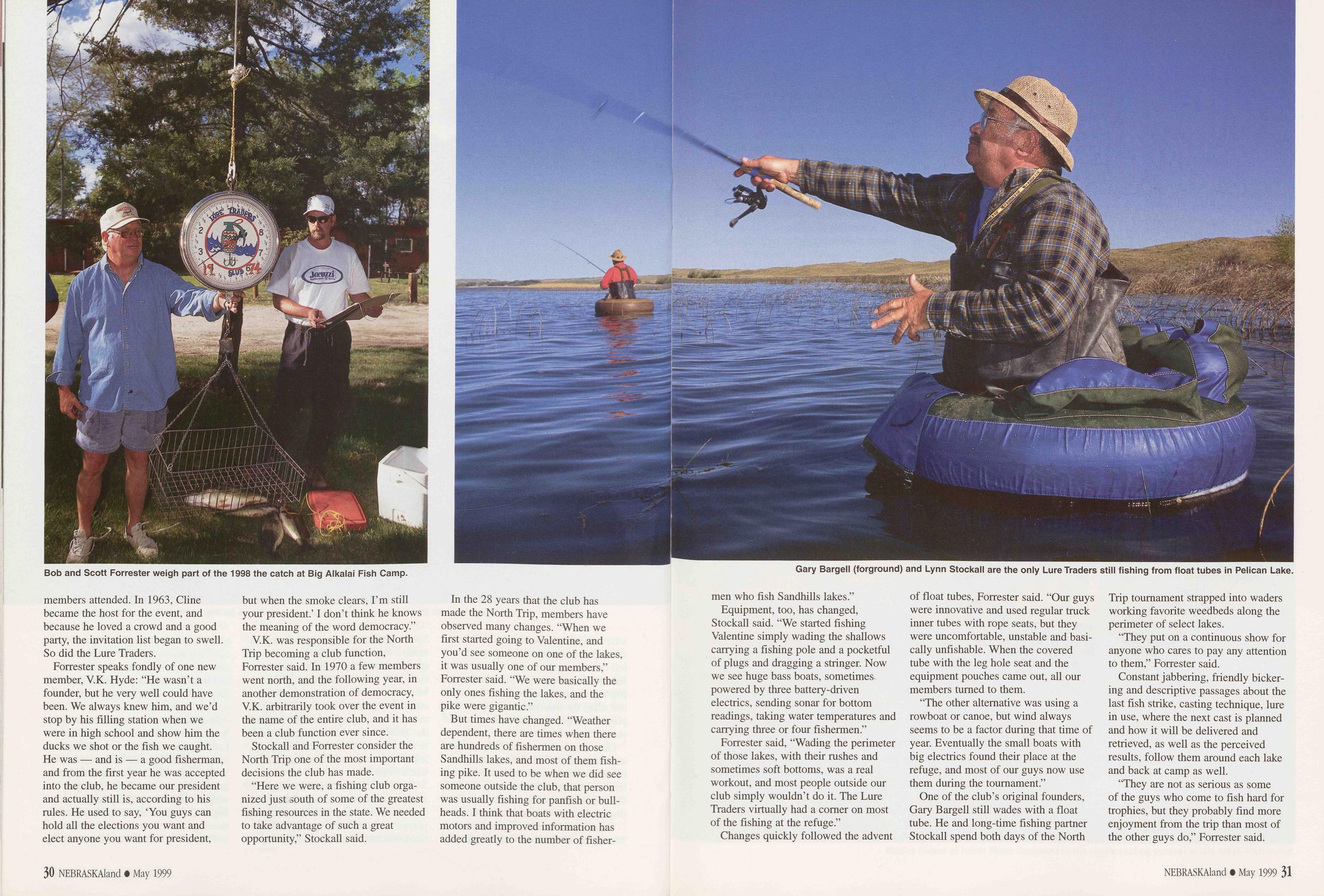
Forrester speaks fondly of one new member, V.K. Hyde: "He wasn't a founder, but he very well could have been. We always knew him, and we'd stop by his filling station when we were in high school and show him the ducks we shot or the fish we caught. He was — and is — a good fisherman, and from the first year he was accepted into the club, he became our president and actually still is, according to his rules. He used to say, 'You guys can hold all the elections you want and elect anyone you want for president, but when the smoke clears, I'm still your president.' I don't think he knows the meaning of the word democracy."
V.K. was responsible for the North Trip becoming a club function, Forrester said. In 1970 a few members went north, and the following year, in another demonstration of democracy, V.K. arbitrarily took over the event in the name of the entire club, and it has been a club function ever since.
Stockall and Forrester consider the North Trip one of the most important decisions the club has made.
"Here we were, a fishing club organized just south of some of the greatest fishing resources in the state. We needed to take advantage of such a great opportunity," Stockall said.
In the 28 years that the club has made the North Trip, members have observed many changes. "When we first started going to Valentine, and you'd see someone on one of the lakes, it was usually one of our members," Forrester said. "We were basically the only ones fishing the lakes, and the pike were gigantic."
But times have changed. "Weather dependent, there are times when there are hundreds of fishermen on those Sandhills lakes, and most of them fishing pike. It used to be when we did see someone outside the club, that person was usually fishing for panfish or bullheads. I think that boats with electric motors and improved information has added greatly to the number of 30 NEBRASKAland • May 1999
Equipment, too, has changed, Stockall said. "We started fishing Valentine simply wading the shallows carrying a fishing pole and a pocketful of plugs and dragging a stringer. Now we see huge bass boats, sometimes powered by three battery-driven electrics, sending sonar for bottom readings, taking water temperatures and carrying three or four fishermen."
Forrester said, "Wading the perimeter of those lakes, with their rushes and sometimes soft bottoms, was a real workout, and most people outside our club simply wouldn't do it. The Lure Traders virtually had a corner on most of the fishing at the refuge."
Changes quickly followed the advent of float tubes, Forrester said. "Our guys were innovative and used regular truck inner tubes with rope seats, but they were uncomfortable, unstable and basically unfishable. When the covered tube with the leg hole seat and the equipment pouches came out, all our members turned to them.
"The other alternative was using a rowboat or canoe, but wind always seems to be a factor during that time of year. Eventually the small boats with big electrics found their place at the refuge, and most of our guys now use them during the tournament."
One of the club's original founders, Gary Bargell still wades with a float tube. He and long-time fishing partner Stockall spend both days of the North Trip tournament strapped into waders working favorite weedbeds along the perimeter of select lakes.
"They put on a continuous show for anyone who cares to pay any attention to them," Forrester said.
Constant jabbering, friendly bickering and descriptive passages about the last fish strike, casting technique, lure in use, where the next cast is planned and how it will be delivered and retrieved, as well as the perceived results, follow them around each lake and back at camp as well.
'They are not as serious as some of the guys who come to fish hard for trophies, but they probably find more enjoyment from the trip than most of the other guys do," Forrester said.
NEBRASKAland • May 1999 31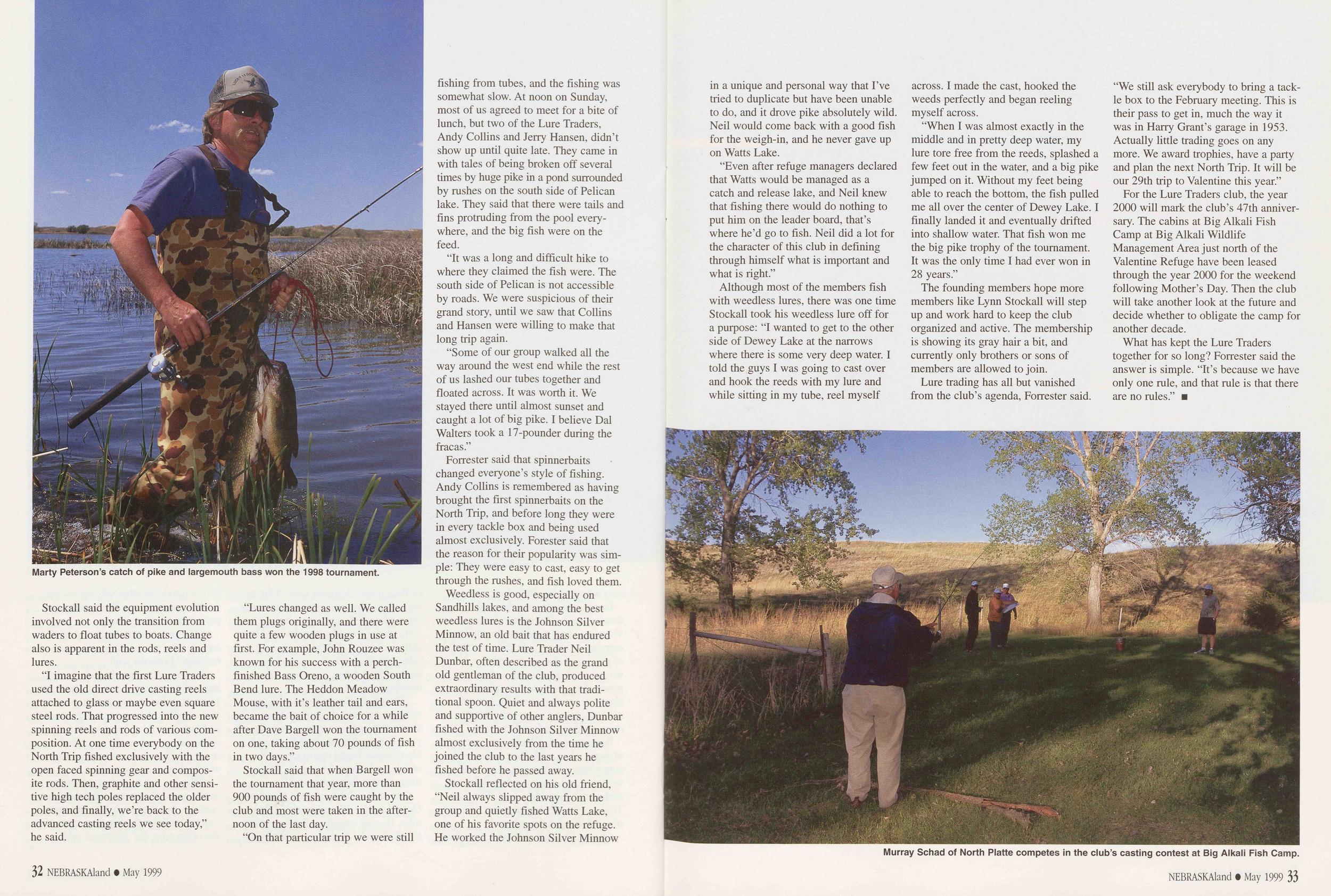
Stockall said the equipment evolution involved not only the transition from waders to float tubes to boats. Change also is apparent in the rods, reels and lures.
"I imagine that the first Lure Traders used the old direct drive casting reels attached to glass or maybe even square steel rods. That progressed into the new spinning reels and rods of various composition. At one time everybody on the North Trip fished exclusively with the open faced spinning gear and composite rods. Then, graphite and other sensitive high tech poles replaced the older poles, and finally, we're back to the advanced casting reels we see today," he said.
"Lures changed as well. We called them plugs originally, and there were quite a few wooden plugs in use at first. For example, John Rouzee was known for his success with a perchfinished Bass Oreno, a wooden South Bend lure. The Heddon Meadow Mouse, with it's leather tail and ears, became the bait of choice for a while after Dave Bargell won the tournament on one, taking about 70 pounds of fish in two days."
Stockall said that when Bargell won the tournament that year, more than 900 pounds of fish were caught by the club and most were taken in the afternoon of the last day.
"On that particular trip we were still fishing from tubes, and the fishing was somewhat slow. At noon on Sunday, most of us agreed to meet for a bite of lunch, but two of the Lure Traders, Andy Collins and Jerry Hansen, didn't show up until quite late. They came in with tales of being broken off several times by huge pike in a pond surrounded by rushes on the south side of Pelican lake. They said that there were tails and fins protruding from the pool everywhere, and the big fish were on the feed.
"It was a long and difficult hike to where they claimed the fish were. The south side of Pelican is not accessible by roads. We were suspicious of their grand story, until we saw that Collins and Hansen were willing to make that long trip again.
"Some of our group walked all the way around the west end while the rest of us lashed our tubes together and floated across. It was worth it. We stayed there until almost sunset and caught a lot of big pike. I believe Dal Walters took a 17-pounder during the fracas."
Forrester said that spinnerbaits changed everyone's style of fishing. Andy Collins is remembered as having brought the first spinnerbaits on the North Trip, and before long they were in every tackle box and being used almost exclusively. Forester said that the reason for their popularity was simple: They were easy to cast, easy to get through the rushes, and fish loved them.
Weedless is good, especially on Sandhills lakes, and among the best weedless lures is the Johnson Silver Minnow, an old bait that has endured the test of time. Lure Trader Neil Dunbar, often described as the grand old gentleman of the club, produced extraordinary results with that traditional spoon. Quiet and always polite and supportive of other anglers, Dunbar fished with the Johnson Silver Minnow almost exclusively from the time he joined the club to the last years he fished before he passed away.
Stockall reflected on his old friend, "Neil always slipped away from the group and quietly fished Watts Lake, one of his favorite spots on the refuge. He worked the Johnson Silver Minnow 32 NEBRASKAland • May 1999 in a unique and personal way that I've tried to duplicate but have been unable to do, and it drove pike absolutely wild. Neil would come back with a good fish for the weigh-in, and he never gave up on Watts Lake.
"Even after refuge managers declared that Watts would be managed as a catch and release lake, and Neil knew that fishing there would do nothing to put him on the leader board, that's where he'd go to fish. Neil did a lot for the character of this club in defining through himself what is important and what is right."
Although most of the members fish with weedless lures, there was one time Stockall took his weedless lure off for a purpose: "I wanted to get to the other side of Dewey Lake at the narrows where there is some very deep water. I told the guys I was going to cast over and hook the reeds with my lure and while sitting in my tube, reel myself across. I made the cast, hooked the weeds perfectly and began reeling myself across.
"When I was almost exactly in the middle and in pretty deep water, my lure tore free from the reeds, splashed a few feet out in the water, and a big pike jumped on it. Without my feet being able to reach the bottom, the fish pulled me all over the center of Dewey Lake. I finally landed it and eventually drifted into shallow water. That fish won me the big pike trophy of the tournament. It was the only time I had ever won in 28 years."
The founding members hope more members like Lynn Stockall will step up and work hard to keep the club organized and active. The membership is showing its gray hair a bit, and currently only brothers or sons of members are allowed to join.
Lure trading has all but vanished from the club's agenda, Forrester said. "We still ask everybody to bring a tackle box to the February meeting. This is their pass to get in, much the way it was in Harry Grant's garage in 1953. Actually little trading goes on any more. We award trophies, have a party and plan the next North Trip. It will be our 29th trip to Valentine this year."
For the Lure Traders club, the year 2000 will mark the club's 47th anniversary. The cabins at Big Alkali Fish Camp at Big Alkali Wildlife Management Area just north of the Valentine Refuge have been leased through the year 2000 for the weekend following Mother's Day. Then the club will take another look at the future and decide whether to obligate the camp for another decade.
What has kept the Lure Traders together for so long? Forrester said the answer is simple. "It's because we have only one rule, and that rule is that there are no rules."
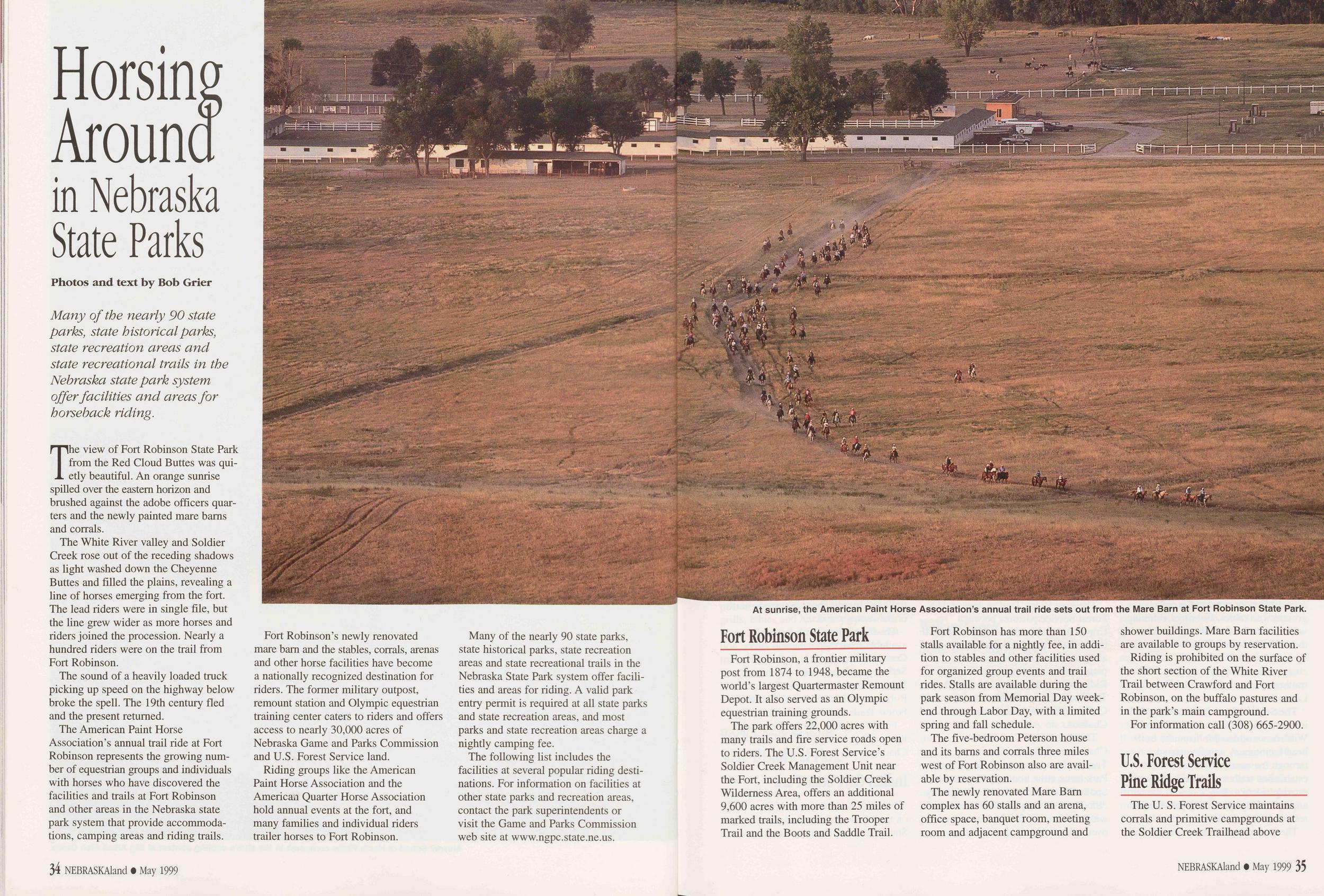
Horsin Aroun in Nebraska State Parks
Photos and text by Bob Grier Many of the nearly 90 state parks, state historical parks, state recreation areas and state recreational trails in the Nebraska state park system offer facilities and areas for horseback riding.The view of Fort Robinson State Park from the Red Cloud Buttes was quietly beautiful. An orange sunrise spilled over the eastern horizon and brushed against the adobe officers quarters and the newly painted mare barns and corrals.
The White River valley and Soldier Creek rose out of the receding shadows as light washed down the Cheyenne Buttes and filled the plains, revealing a line of horses emerging from the fort. The lead riders were in single file, but the line grew wider as more horses and riders joined the procession. Nearly a hundred riders were on the trail from Fort Robinson.
The sound of a heavily loaded truck picking up speed on the highway below broke the spell. The 19th century fled and the present returned.
The American Paint Horse Association's annual trail ride at Fort Robinson represents the growing number of equestrian groups and individuals with horses who have discovered the facilities and trails at Fort Robinson and other areas in the Nebraska state park system that provide accommodations, camping areas and riding trails.
Fort Robinson's newly renovated mare barn and the stables, corrals, arenas and other horse facilities have become a nationally recognized destination for riders. The former military outpost, remount station and Olympic equestrian training center caters to riders and offers access to nearly 30,000 acres of Nebraska Game and Parks Commission and U.S. Forest Service land.
Riding groups like the American Paint Horse Association and the American Quarter Horse Association hold annual events at the fort, and many families and individual riders trailer horses to Fort Robinson.
Many of the nearly 90 state parks, state historical parks, state recreation areas and state recreational trails in the Nebraska State Park system offer facilities and areas for riding. A valid park entry permit is required at all state parks and state recreation areas, and most parks and state recreation areas charge a nightly camping fee.
The following list includes the facilities at several popular riding destinations. For information on facilities at other state parks and recreation areas, contact the park superintendents or visit the Game and Parks Commission web site at www.ngpc.state.ne.us.
34 NEBRASKAland • May 1999Fort Robinson, a frontier military post from 1874 to 1948, became the world's largest Quartermaster Remount Depot. It also served as an Olympic equestrian training grounds.
The park offers 22,000 acres with many trails and fire service roads open to riders. The U.S. Forest Service's Soldier Creek Management Unit near the Fort, including the Soldier Creek Wilderness Area, offers an additional 9,600 acres with more than 25 miles of marked trails, including the Trooper Trail and the Boots and Saddle Trail.
Fort Robinson has more than 150 stalls available for a nightly fee, in addition to stables and other facilities used for organized group events and trail rides. Stalls are available during the park season from Memorial Day weekend through Labor Day, with a limited spring and fall schedule.
The five-bedroom Peterson house and its barns and corrals three miles west of Fort Robinson also are available by reservation.
The newly renovated Mare Barn complex has 60 stalls and an arena, office space, banquet room, meeting room and adjacent campground and shower buildings. Mare Barn facilities are available to groups by reservation.
Riding is prohibited on the surface of the short section of the White River Trail between Crawford and Fort Robinson, on the buffalo pastures and in the park's main campground.
For information call (308) 665-2900.
U.S. Forest Service Pine Ridge TrailsThe U. S. Forest Service maintains
corrals and primitive campgrounds at
the Soldier Creek Trailhead above
NEBRASKAland t May 1999 35
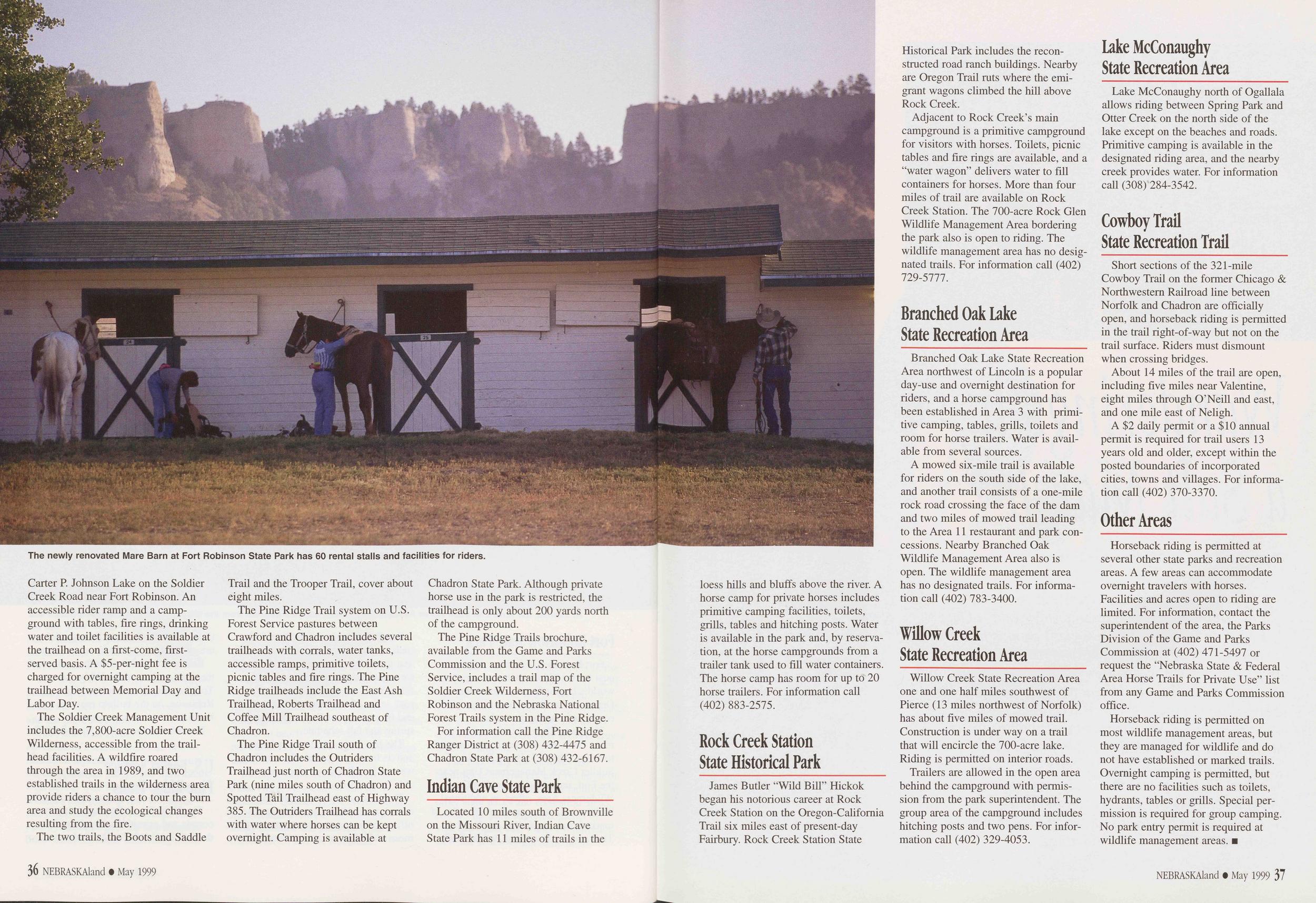
The Soldier Creek Management Unit includes the 7,800-acre Soldier Creek Wilderness, accessible from the trailhead facilities. A wildfire roared through the area in 1989, and two established trails in the wilderness area provide riders a chance to tour the burn area and study the ecological changes resulting from the fire.
The two trails, the Boots and Saddle Trail and the Trooper Trail, cover about eight miles.
The Pine Ridge Trail system on U.S. Forest Service pastures between Crawford and Chadron includes several trailheads with corrals, water tanks, accessible ramps, primitive toilets, picnic tables and fire rings. The Pine Ridge trailheads include the East Ash Trailhead, Roberts Trailhead and Coffee Mill Trailhead southeast of Chadron.
The Pine Ridge Trail south of Chadron includes the Outriders Trailhead just north of Chadron State Park (nine miles south of Chadron) and Spotted Tail Trailhead east of Highway 385. The Outriders Trailhead has corrals with water where horses can be kept overnight. Camping is available at Chadron State Park. Although private horse use in the park is restricted, the trailhead is only about 200 yards north of the campground.
The Pine Ridge Trails brochure, available from the Game and Parks Commission and the U.S. Forest Service, includes a trail map of the Soldier Creek Wilderness, Fort Robinson and the Nebraska National Forest Trails system in the Pine Ridge.
For information call the Pine Ridge Ranger District at (308) 432-4475 and Chadron State Park at (308) 432-6167.
Indian Cave State ParkLocated 10 miles south of Brownville on the Missouri River, Indian Cave State Park has 11 miles of trails in the 36 NEBRASKAland • May 1999 loess hills and bluffs above the river. A horse camp for private horses includes primitive camping facilities, toilets, grills, tables and hitching posts. Water is available in the park and, by reservation, at the horse campgrounds from a trailer tank used to fill water containers. The horse camp has room for up to 20 horse trailers. For information call (402) 883-2575.
Rock Creek Station State Historical ParkJames Butler "Wild Bill" Hickok began his notorious career at Rock Creek Station on the Oregon-California Trail six miles east of present-day Fairbury. Rock Creek Station State Historical Park includes the reconstructed road ranch buildings. Nearby are Oregon Trail ruts where the emigrant wagons climbed the hill above Rock Creek.
Adjacent to Rock Creek's main campground is a primitive campground for visitors with horses. Toilets, picnic tables and fire rings are available, and a "water wagon" delivers water to fill containers for horses. More than four miles of trail are available on Rock Creek Station. The 700-acre Rock Glen Wildlife Management Area bordering the park also is open to riding. The wildlife management area has no designated trails. For information call (402) 729-5777.
Branched Oak Lake State Recreation AreaBranched Oak Lake State Recreation Area northwest of Lincoln is a popular day-use and overnight destination for riders, and a horse campground has been established in Area 3 with primitive camping, tables, grills, toilets and room for horse trailers. Water is avail- able from several sources.
A mowed six-mile trail is available for riders on the south side of the lake, and another trail consists of a one-mile rock road crossing the face of the dam and two miles of mowed trail leading to the Area 11 restaurant and park concessions. Nearby Branched Oak Wildlife Management Area also is open. The wildlife management area has no designated trails. For information call (402) 783-3400.
Willow Creek State Recreation AreaWillow Creek State Recreation Area one and one half miles southwest of Pierce (13 miles northwest of Norfolk) has about five miles of mowed trail. Construction is under way on a trail that will encircle the 700-acre lake. Riding is permitted on interior roads.
Trailers are allowed in the open area behind the campground with permission from the park superintendent. The group area of the campground includes hitching posts and two pens. For information call (402) 329-4053.
Lake McConaughy State Recreation AreaLake McConaughy north of Ogallala allows riding between Spring Park and Otter Creek on the north side of the lake except on the beaches and roads. Primitive camping is available in the designated riding area, and the nearby creek provides water. For information call (308) 284-3542.
Cowboy Trail State Recreation TrailShort sections of the 321-mile Cowboy Trail on the former Chicago & Northwestern Railroad line between Norfolk and Chadron are officially open, and horseback riding is permitted in the trail right-of-way but not on the trail surface. Riders must dismount when crossing bridges.
About 14 miles of the trail are open, including five miles near Valentine, eight miles through O'Neill and east, and one mile east of Neligh.
A $2 daily permit or a $10 annual permit is required for trail users 13 years old and older, except within the posted boundaries of incorporated cities, towns and villages. For information call (402) 370-3370.
Other AreasHorseback riding is permitted at several other state parks and recreation areas. A few areas can accommodate overnight travelers with horses. Facilities and acres open to riding are limited. For information, contact the superintendent of the area, the Parks Division of the Game and Parks Commission at (402) 471-5497 or request the "Nebraska State & Federal Area Horse Trails for Private Use" list from any Game and Parks Commission office.
Horseback riding is permitted on most wildlife management areas, but they are managed for wildlife and do not have established or marked trails. Overnight camping is permitted, but there are no facilities such as toilets, hydrants, tables or grills. Special permission is required for group camping. No park entry permit is required at wildlife management areas.
NEBRASKAland • May 1999 37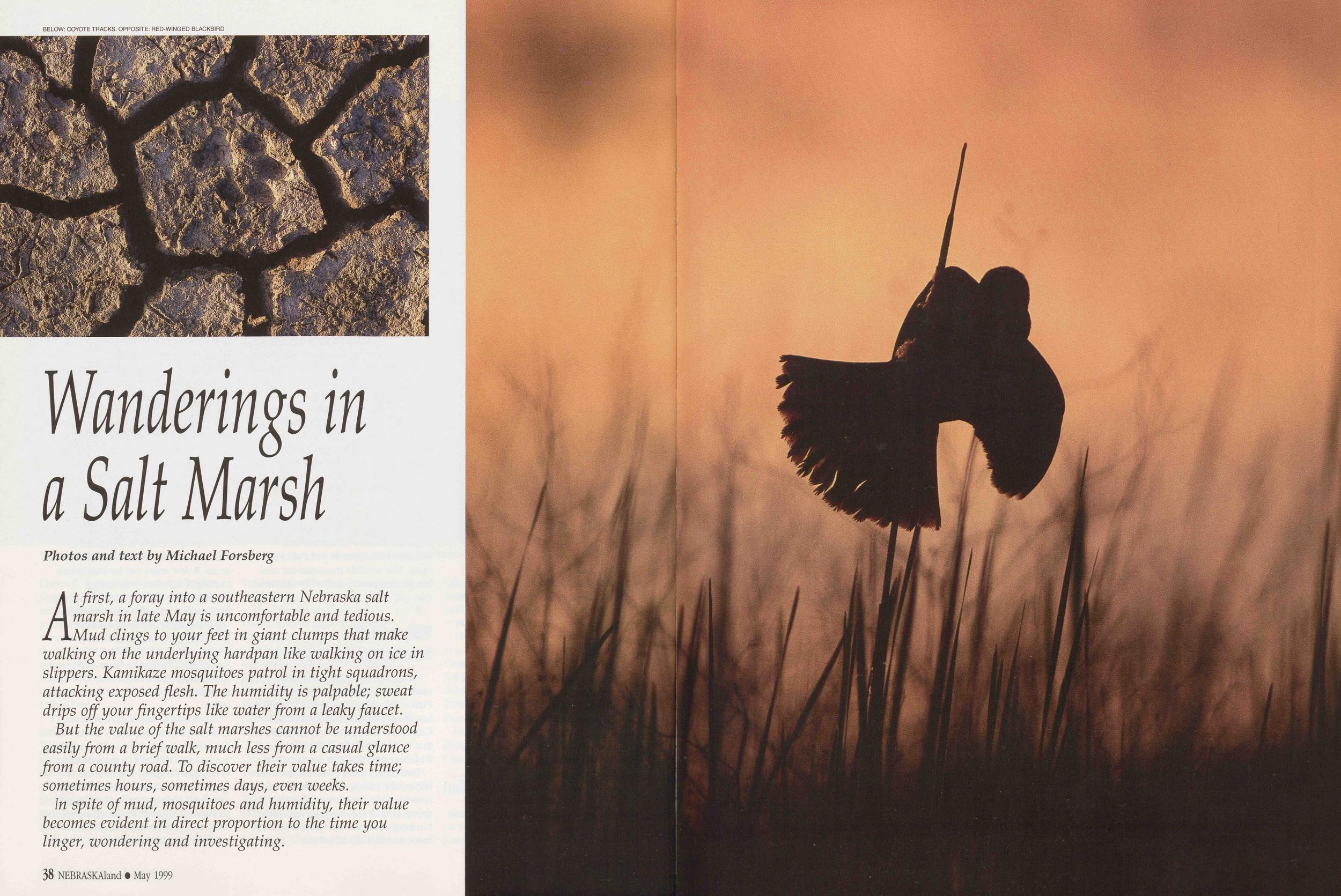
Wanderings in a Salt Marsh
Photos and text by Michael ForsbergAt first, a foray into a southeastern Nebraska salt marsh in late May is uncomfortable and tedious. Mud clings to your feet in giant clumps that make walking on the underlying hardpan like walking on ice in slippers. Kamikaze mosquitoes patrol in tight squadrons, attacking exposed flesh. The humidity is palpable; sweat drips off your fingertips like water from a leaky faucet.
But the value of the salt marshes cannot be understood easily from a brief walk, much less from a casual glance from a county road. To discover their value takes time; sometimes hours, sometimes days, even weeks.
In spite of mud, mosquitoes and humidity, their value becomes evident in direct proportion to the time you linger, wondering and investigating.
38 NEBRASKAland • May 1999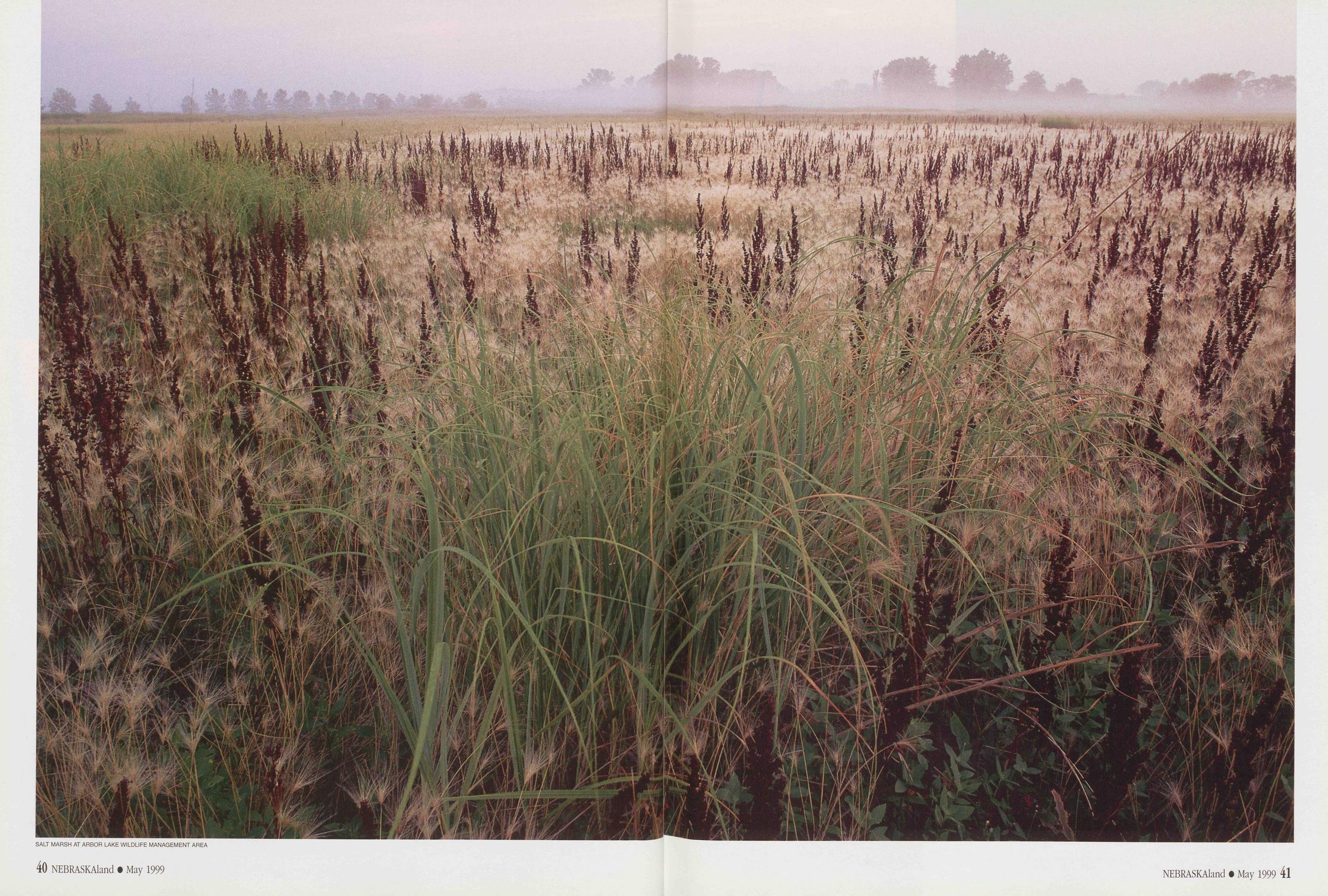
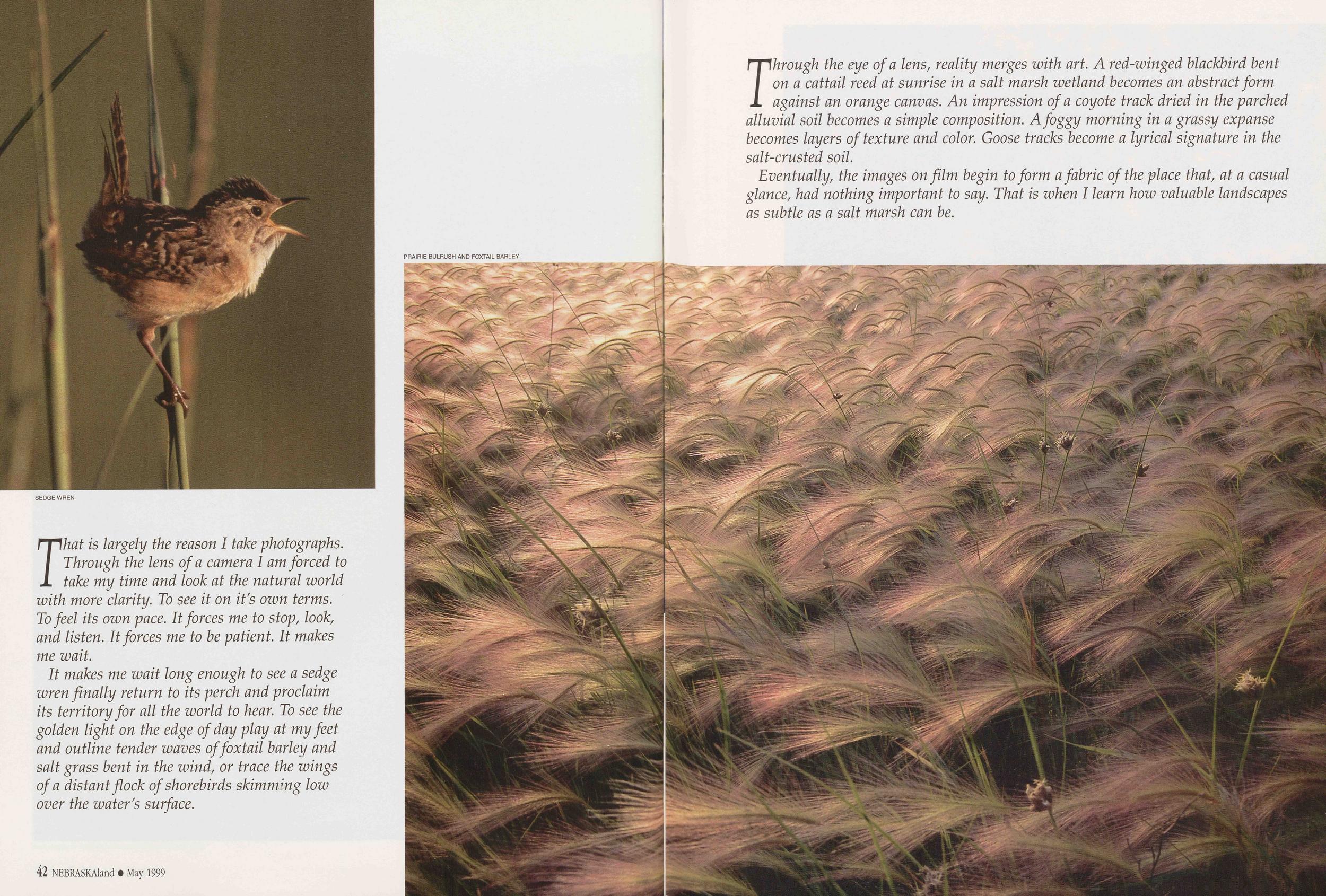
That is largely the reason I take photographs. Through the lens of a camera I am forced to take my time and look at the natural world with more clarity. To see it on it's own terms. To feel its own pace. It forces me to stop, look, and listen. It forces me to be patient. It makes me wait.
It makes me wait long enough to see a sedge wren finally return to its perch and proclaim its territory for all the world to hear. To see the golden light on the edge of day play at my feet and outline tender waves of foxtail barley and salt grass bent in the wind, or trace the wings of a distant flock of shorebirds skimming low over the water's surface.
42 NEBRASKAland • May 1999Through the eye of a lens, reality merges with art. A red-winged blackbird bent on a cattail reed at sunrise in a salt marsh wetland becomes an abstract form against an orange canvas. An impression of a coyote track dried in the parched alluvial soil becomes a simple composition. A foggy morning in a grassy expanse becomes layers of texture and color. Goose tracks become a lyrical signature in the salt-crusted soil.
Eventually, the images on film begin to form a fabric of the place that, at a casual glance, had nothing important to say. That is when I learn how valuable landscapes as subtle as a salt marsh can be.
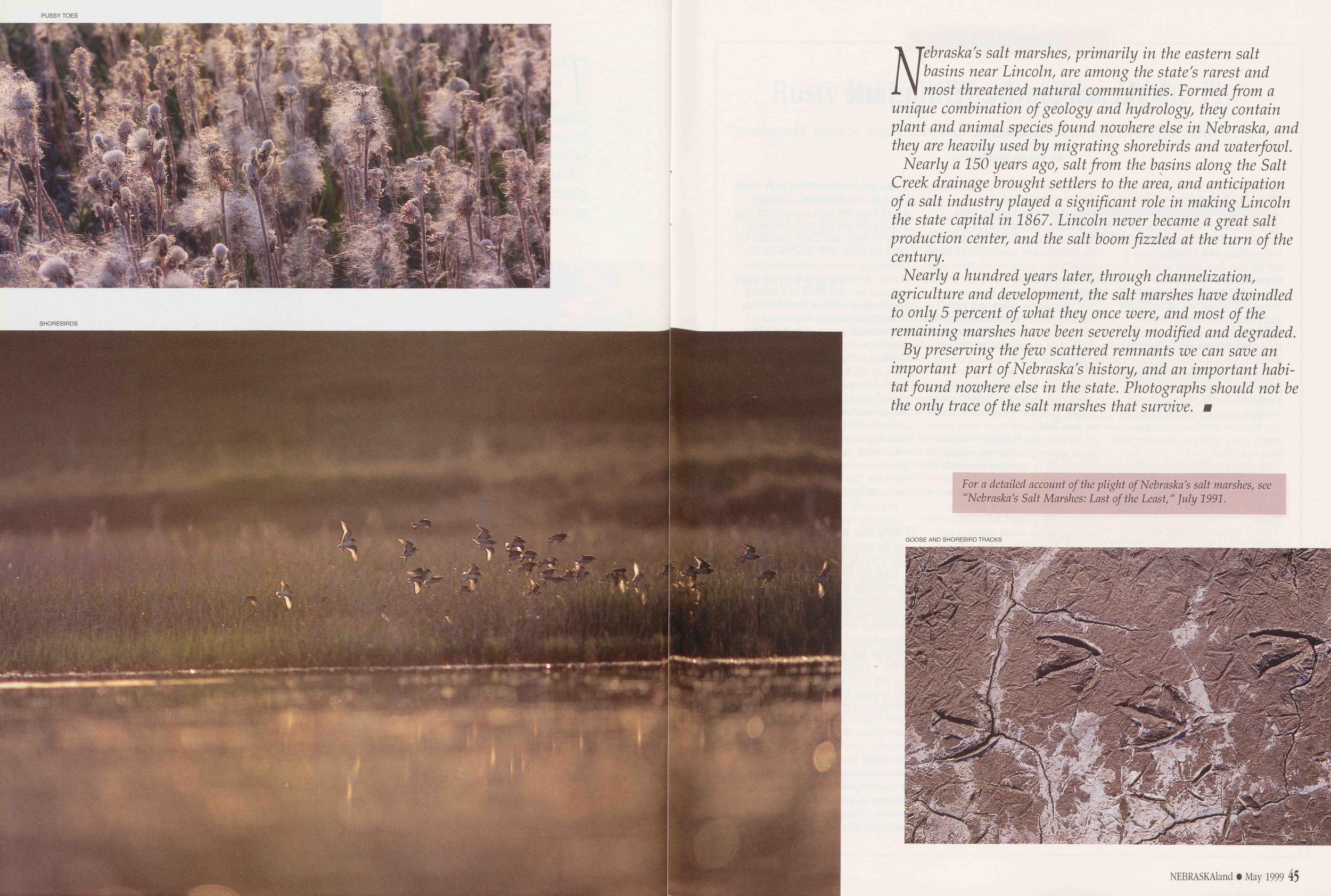
Nebraska's salt marshes, primarily in the eastern salt basins near Lincoln, are among the state's rarest and most threatened natural communities. Formed from a unique combination of geology and hydrology, they contain plant and animal species found nowhere else in Nebraska, and they are heavily used by migrating shorebirds and waterfowl.
Nearly a 150 years ago, salt from the basins along the Salt Creek drainage brought settlers to the area, and anticipation of a salt industry played a significant role in making Lincoln the state capital in 1867. Lincoln never became a great salt production center, and the salt boom fizzled at the turn of the century.
Nearly a hundred years later, through channelization, agriculture and development, the salt marshes have dwindled to only 5 percent of what they once were, and most of the remaining marshes have been severely modified and degraded.
By preserving the few scattered remnants we can save an important part of Nebraska's history, and an important habitat found nowhere else in the state. Photographs should not be the only trace of the salt marshes that survive,
For a detailed account of the plight of Nebraska's salt marshes, see "Nebraska's Salt Marshes: Last of the Least," July 1991.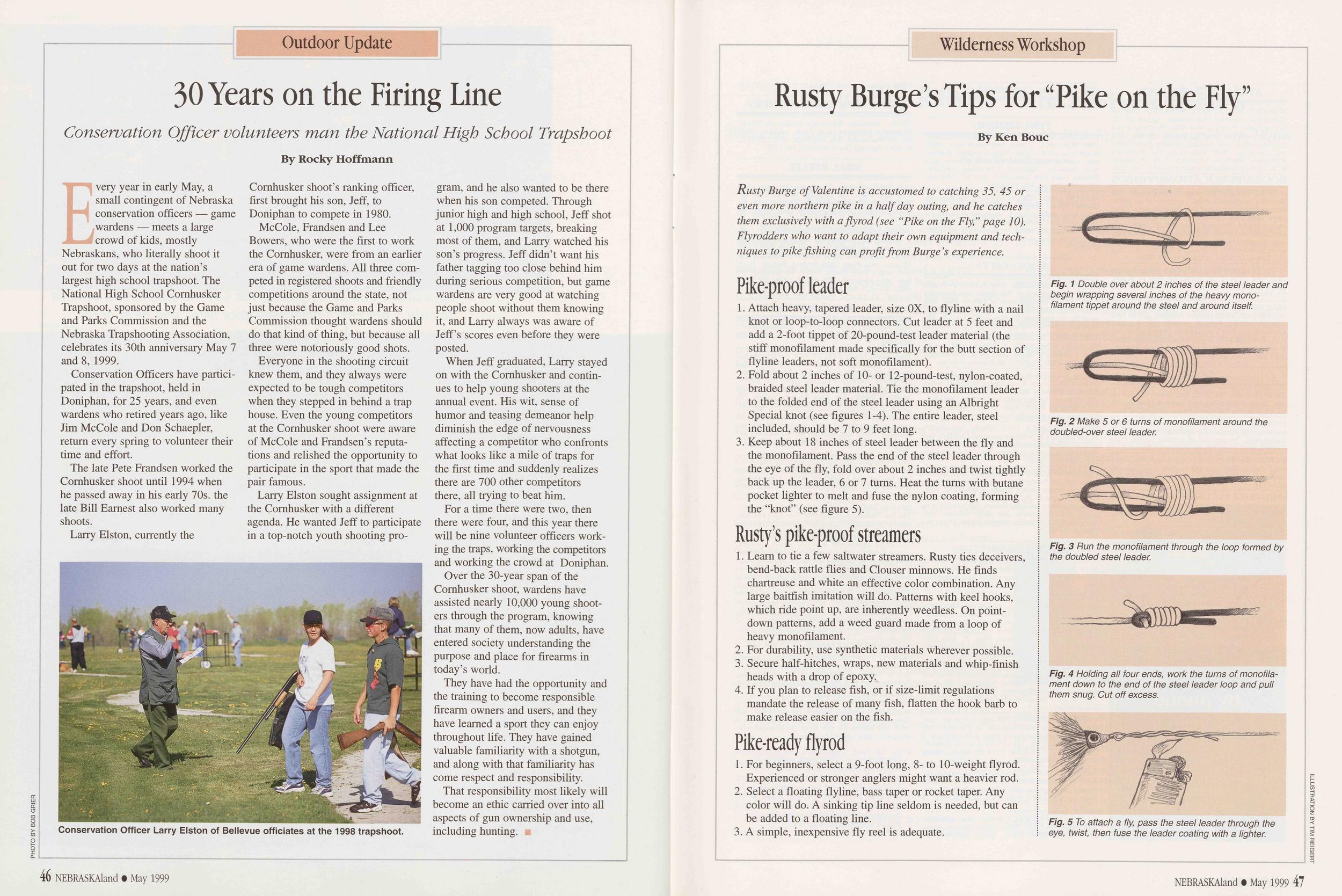
Outdoor Update
30 Years on the Firing Line
Conservation Officer volunteers man the National High School Trap shoot By Rocky Hoffmannvery year in early May, a small contingent of Nebraska conservation officers — game wardens — meets a large crowd of kids, mostly Nebraskans, who literally shoot it out for two days at the nation's largest high school trap shoot. The National High School Cornhusker Trap shoot, sponsored by the Game and Parks Commission and the Nebraska Trapshooting Association, celebrates its 30th anniversary May 7 and 8, 1999.
Conservation Officers have participated in the trap shoot, held in Doniphan, for 25 years, and even wardens who retired years ago, like Jim McCole and Don Schaepler, return every spring to volunteer their time and effort.
The late Pete Frandse>n worked the Cornhusker shoot until 1994 when he passed away in his early 70s. the late Bill Earnest also worked many shoots.
Larry Elston, currently the Cornhusker shoot's ranking officer, first brought his son, Jeff, to Doniphan to compete in 1980.
McCole, Frandsen and Lee Bowers, who were the first to work the Cornhusker, were from an earlier era of game wardens. All three competed in registered shoots and friendly competitions around the state, not just because the Game and Parks Commission thought wardens should do that kind of thing, but because all three were notoriously good shots.
Everyone in the shooting circuit knew them, and they always were expected to be tough competitors when they stepped in behind a trap house. Even the young competitors at the Cornhusker shoot were aware of McCole and Frandsen's reputations and relished the opportunity to participate in the sport that made the pair famous.
Larry Elston sought assignment at the Cornhusker with a different agenda. He wanted Jeff to participate in a top-notch youth shooting program, and he also wanted to be there when his son competed. Through junior high and high school, Jeff shot at 1,000 program targets, breaking most of them, and Larry watched his son's progress. Jeff didn't want his father tagging too close behind him during serious competition, but game wardens are very good at watching people shoot without them knowing it, and Larry always was aware of Jeff's scores even before they were posted.
When Jeff graduated, Larry stayed on with the Cornhusker and continues to help young shooters at the annual event. His wit, sense of humor and teasing demeanor help diminish the edge of nervousness affecting a competitor who confronts what looks like a mile of traps for the first time and suddenly realizes there are 700 other competitors there, all trying to beat him.
For a time there were two, then there were four, and this year there will be nine volunteer officers working the traps, working the competitors and working the crowd at Doniphan.
Over the 30-year span of the Cornhusker shoot, wardens have assisted nearly 10,000 young shooters through the program, knowing that many of them, now adults, have entered society understanding the purpose and place for firearms in today's world.
They have had the opportunity and the training to become responsible firearm owners and users, and they have learned a sport they can enjoy throughout life. They have gained valuable familiarity with a shotgun, and along with that familiarity has come respect and responsibility.
That responsibility most likely will become an ethic carried over into all aspects of gun ownership and use, including hunting.
Wilderness Workshop
Rusty Burge's Tips for "Pike on the Fly"
By Ken BoucRusty Burge of Valentine is accustomed to catching 35, 45 or even more northern pike in a half day outing, and he catches them exclusively with a fly rod (see uPike on the Fly," page 10). Flyrodders who want to adapt their own equipment and techniques to pike fishing can profit from Burge's experience.
Pike-proof leader1. Attach heavy, tapered leader, size OX, to flyline with a nail knot or loop-to-loop connectors. Cut leader at 5 feet and add a 2-foot tippet of 20-pound-test leader material (the stiff monofilament made specifically for the butt section of flyline leaders, not soft monofilament).
2. Fold about 2 inches of 10- or 12-pound-test, nylon-coated, braided steel leader material. Tie the monofilament leader to the folded end of the steel leader using an Albright Special knot (see figures 1-4). The entire leader, steel included, should be 7 to 9 feet long.
3. Keep about 18 inches of steel leader between the fly and the monofilament. Pass the end of the steel leader through the eye of the fly, fold over about 2 inches and twist tightly back up the leader, 6 or 7 turns. Heat the turns with butane pocket lighter to melt and fuse the nylon coating, forming the "knot" (see figure 5).
Rusty's pike-proof streamers1. Learn to tie a few saltwater streamers. Rusty ties deceivers, bend-back rattle flies and Clouser minnows. He finds chartreuse and white an effective color combination. Any large baitfish imitation will do. Patterns with keel hooks, which ride point up, are inherently weedless. On point- down patterns, add a weed guard made from a loop of heavy monofilament.
2. For durability, use synthetic materials wherever possible.
3. Secure half-hitches, wraps, new materials and whip-finish heads with a drop of epoxy.
4. If you plan to release fish, or if size-limit regulations mandate the release of many fish, flatten the hook barb to make release easier on the fish.
Pike-ready flyrod1. For beginners, select a 9-foot long, 8- to 10-weight flyrod. Experienced or stronger anglers might want a heavier rod.
2. Select a floating flyline, bass taper or rocket taper. Any color will do. A sinking tip line seldom is needed, but can be added to a floating line.
3. A simple, inexpensive fly reel is adequate.
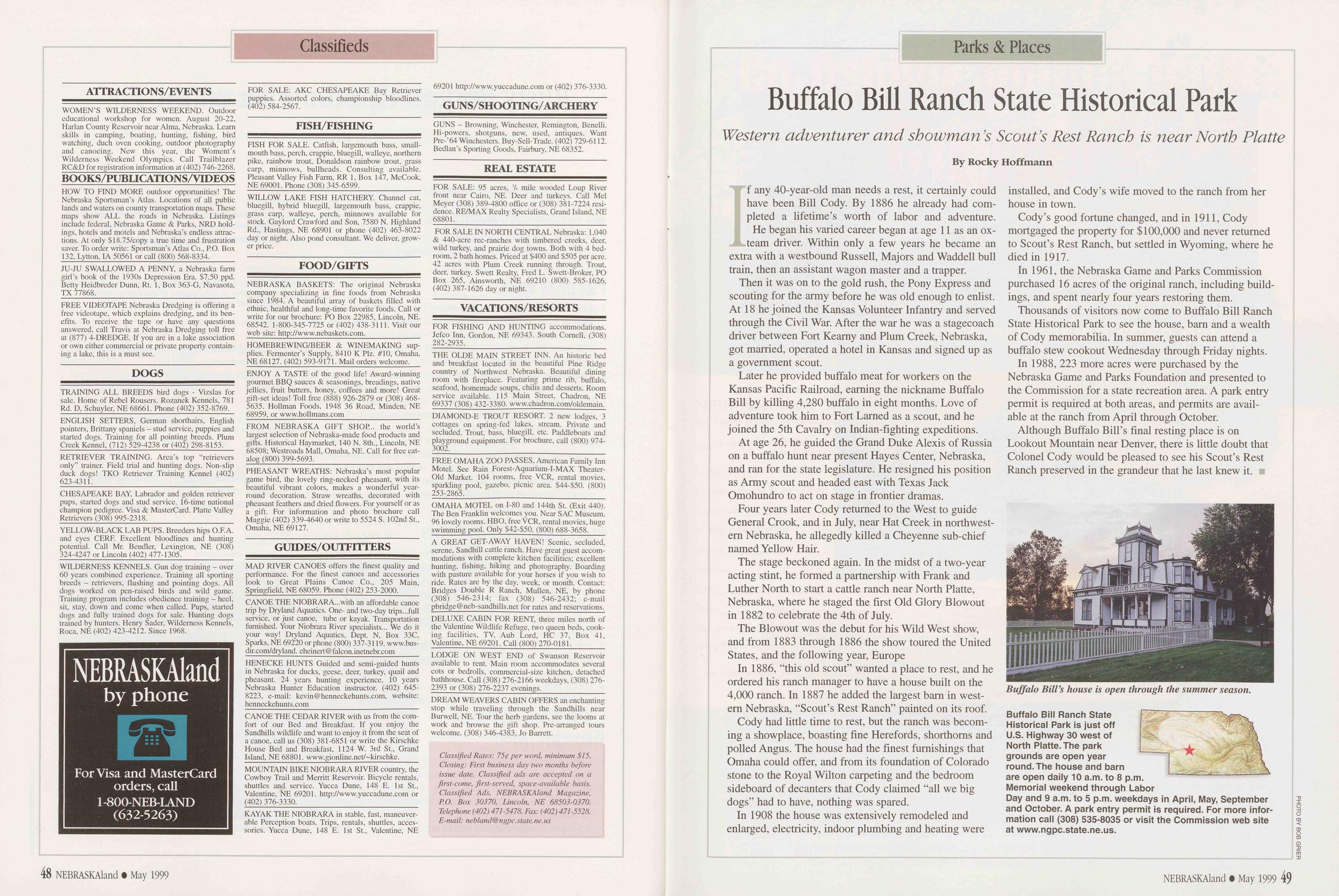
Classifieds
ATTRACTIONS/EVENTSWOMEN'S WILDERNESS WEEKEND. Outdoor educational workshop for women. August 20-22, Harlan County Reservoir near Alma, Nebraska. Learn skills in camping, boating, hunting, fishing, bird watching, duch oven cooking, outdoor photography and canoeing. New this year, the Woment's Wilderness Weekend Olympics. Call Trailblazer RC&D for registration information at (402) 746-2268.
BOQKS/PUBLICATIQNS/VIDEQSHOW TO FIND MORE outdoor opportunities! The Nebraska Sportsman's Atlas. Locations of all public lands and waters on county transportation maps. These maps show ALL the roads in Nebraska. Listings include federal, Nebraska Game & Parks, NRD holdings, hotels and motels and Nebraska's endless attractions. At only $18.75/copy a true time and frustration saver. To order write: Sportsman's Atlas Co., P.O. Box 132, Lytton, IA 50561 or call (800) 568-8334.
JU-JU SWALLOWED A PENNY, a Nebraska farm girl's book of the 1930s Depression Era. $7.50 ppd. Betty Heidbreder Dunn, Rt. 1, Box 363-G, Navasota, TX 77868.
FREE VIDEOTAPE Nebraska Dredging is offering a free videotape, which explains dredging, and its benefits. To receive the tape or have any questions answered, call Travis at Nebraska Dredging toll free at (877) 4-DREDGE. If you are in a lake association or own either commercial or private property containing a lake, this is a must see.
DOGSTRAINING ALL BREEDS bird doss - Vizslas for sale. Home of Rebel Rousers. Rozanek Kennels, 781 Rd. D, Schuyler, NE 68661. Phone (402) 352-8769.
ENGLISH SETTERS, German shorthairs, English pointers, Brittany spaniels - stud service, puppies and started dogs. Trainins; for all pointing breeds. Plum Creek Kennel, (712) 529-4238 or (402) 298-8153.
RETRIEVER TRAINING. Area's top "retrievers only" trainer. Field trial and hunting dogs. Non-slip duck doss! TKO Retriever Training Kennel (402) 623-43 if.
CHESAPEAKE BAY, Labrador and golden retriever pups, started dogs and stud service. 16-time national champion pedigree. Visa & MasterCard. Platte Valley Retrievers (308) 995-2318.
YELLOW-BLACK LAB PUPS. Breeders hips O.F.A. and eyes CERE Excellent bloodlines and hunting potential. Call Mr. Bendler, Lexington, NE (308) 324-4247 or Lincoln (402) 477-1305.
WILDERNESS KENNELS. Gun dog training - over 60 years combined experience. Training all sporting breeds - retrievers, flushing and pointing dogs. All dogs worked on pen-raised birds and wild game. Training program includes obedience training - heel, sit, stay, down and come when called. Pups, started dogs and fully trained dogs for sale. Hunting dogs trained by hunters. Henry Sader, Wilderness Kennels, Roca, NE (402) 423-4212. Since 1968.
NEBRASKAland by phone For Visa and MasterCard orders, call 1-800-NEB-LAND (632-5263)FOR SALE: AKC CHESAPEAKE Bay Retriever puppies. Assorted colors, championship bloodlines. (402) 584-2567.
FISH/FISHINGFISH FOR SALE. Catfish, largemouth bass, smallmouth bass, perch, crappie, bluegill, walleye, northern pike, rainbow trout, Donaldson rainbow trout, grass carp, minnows, bullheads. Consulting available. Pleasant Valley Fish Farm, RR 1, Box 147, McCook, NE 69001. Phone (308) 345-6599.
WILLOW LAKE FISH HATCHERY. Channel cat, bluegill, hybrid bluegill, largemouth bass, crappie, grass carp, walleye, perch, minnows available for stock. Gaylord Crawford and Son, 7580 N. Highland Rd., Hastings, NE 68901 or phone (402) 463-8022 day or night. Also pond consultant. We deliver, grower price.
FOOD/GIFTSNEBRASKA BASKETS: The original Nebraska company specializing in fine foods from Nebraska since 1984. A beautiful array of baskets filled with ethnic, healthful and long-time favorite foods. Call or write for our brochure: PO Box 22985, Lincoln, NE. 68542. 1-800-345-7725 or (402) 438-3111. Visit our web site: http://www.nebaskets.com.
HOMEBREWING/BEER & WINEMAKING supplies. Fermenter's Supply, 8410 K Plz. #10, Omaha, NE 68127. (402) 593-9171. Mail orders welcome. ENJOY A TASTE of the good life! Award-winning gourmet BBQ sauces & seasonings, breadings, native jellies, fruit butters, honey, coffees and more! Great gift-set ideas! Toll free (888) 926-2879 or (308) 468- 5635. Hollman Foods, 1948 36 Road, Minden, NE 68959, or www.hollmans.com
FROM NEBRASKA GIFT SHOP... the world's largest selection of Nebraska-made food products and gifts. Historical Haymarket, 140 N. 8th., Lincoln, NE 68508; Westroads Mall, Omaha, NE. Call for free catalog (800) 399-5693.
PHEASANT WREATHS: Nebraska's most popular game bird, the lovely ring-necked pheasant, with its beautiful vibrant colors, makes a wonderful year round decoration. Straw wreaths, decorated with pheasant feathers and dried flowers. For yourself or as a gift. For information and photo brochure call Maggie (402) 339-4640 or write to 5524 S. 102nd St., Omaha, NE 69127.
GUIDES/OUTFITTERSMAD RIVER CANOES offers the finest quality and performance. For the finest canoes and accessories look to Great Plains Canoe Co., 205 Main, Springfield, NE 68059. Phone (402) 253-2000.
CANOE THE NIOBRARA...with an affordable canoe trip by Dryland Aquatics. One- and two-day trips...full service, or just canoe, tube or kayak. Transportation furnished. Your Niobrara River specialists... We do it your way! Dryland Aquatics, Dept. N, Box 33C, Sparks, NE 69220 or phone (800) 337-3119. www.busdir.com/dryland. eheinert@falcon.inetnebr.com
HENECKE HUNTS Guided and semi-guided hunts in Nebraska for ducks, geese, deer, turkey, quail and pheasant. 24 years hunting experience, 10 years Nebraska Hunter Education instructor. (402) 645- 8223, e-mail: kevin@henneckehunts.com, website: henneckehunts.com
CANOE THE CEDAR RIVER with us from the comfort of our Bed and Breakfast. If you enjoy the Sandhills wildlife and want to enjoy it from the seat of a canoe, call us (308) 381-6851 or write the Kirschke House Bed and Breakfast, 1124 W. 3rd St., Grand Island, NE 68801. www.gionline.net/~kirschke.
MOUNTAIN BIKE NIOBRARA RIVER country, the Cowboy Trail and Merritt Reservoir. Bicycle rentals, shuttles and service. Yucca Dune, 148 E. 1st St., Valentine, NE 69201. http://www.yuccadune.com or (402) 376-3330.
KAYAK THE NIOBRARA in stable, fast, maneuver- able Perception boats. Trips, rentals, shuttles, accessories. Yucca Dune, 148 E. 1st St., Valentine, NE 69201 http://www.yuccadune.com or (402) 376-3330.
GUNS/SHOOTING/ARCHERYGUNS - Browning, Winchester, Remington, Benelli. Hi-powers, shotguns, new, used, antiques. Want Pre-'64 Winchesters. Buy-Sell-Trade. (402) 729-6112. Bedlan's Sporting Goods, Fairbury, NE 68352.
REAL ESTATEFOR SALE: 95 acres, 3A mile wooded Loup River front near Cairo, NE. Deer and turkeys. Call Mel Meyer (308) 389-4800 office or (308) 381-7224 residence. RE/MAX Realty Specialists, Grand Island, NE 68801.
FOR SALE IN NORTH CENTRAL Nebraska: 1,040 & 440-acre rec-ranches with timbered creeks, deer, wild turkey, and prairie dog towns. Both with 4 bed- room, 2 bath homes. Priced at $400 and $505 per acre. 42 acres with Plum Creek running through. Trout, deer, turkey. Swett Realty, Fred L. Swett-Broker, PO Box 265, Ainsworth, NE 69210 (800) 585-1626, (402) 387-1626 day or night.
VACATIONS/RESORTSFOR FISHING AND HUNTING accommodations. Jefco Inn, Gordon, NE 69343. South Cornell, (308) 282-2935.
THE OLDE MAIN STREET INN. An historic bed and breakfast located in the beautiful Pine Ridge country of Northwest Nebraska. Beautiful dining room with fireplace. Featuring prime rib, buffalo, seafood, homemade soups, chilis and desserts. Room service available. 115 Main Street, Chadron, NE 69337 (308) 432-3380. www.chadron.com/oldemain.
DIAMOND-E TROUT RESORT. 2 new lodges, 3 cottages on spring-fed lakes, stream. Private and secluded. Trout, bass, bluegill, etc. Paddle boats and playground equipment. For brochure, call (800) 974- 3002.
FREE OMAHA ZOO PASSES, American Family Inn Motel. See Rain Forest-Aquarium-I-MAX Theater- Old Market. 104 rooms, free VCR, rental movies, sparkling pool, gazebo, picnic area. $44-$50. (800) 253-2865.
OMAHA MOTEL on 1-80 and 144th St. (Exit 440). The Ben Franklin welcomes you. Near SAC Museum. 96 lovely rooms. HBO, free VCR, rental movies, huge swimming pool. Only $42-$50. (800) 688-3658.
A GREAT GET-AWAY HAVEN! Scenic, secluded, serene, Sandhill cattle ranch. Have great guest accommodations with complete kitchen facilities; excellent hunting, fishing, hiking and photography. Boarding with pasture available for your horses if you wish to ride. Rates are by the day, week, or month. Contact: Bridges Double R Ranch, Mullen, NE, by phone (308) 546-2314; fax (308) 546-2432; e-mail pbridge@neb-sandhills.net for rates and reservations.
DELUXE CABIN FOR RENT, three miles north of the Valentine Wildlife Refuge, two queen beds, cooking facilities, TV, Aub Lord, HC 37, Box 41, Valentine, NE 69201. Call (800) 270-0181.
LODGE ON WEST END of Swanson Reservoir available to rent. Main room accommodates several cots or bedrolls, commercial-size kitchen, detached bathhouse. Call (308) 276-2166 weekdays, (308) 276- 2393 or (308) 276-2237 evenings.
DREAM WEAVERS CABIN OFFERS an enchanting stop while traveling through the Sandhills near Burwell, NE. Tour the herb gardens, see the looms at work and browse the gift shop. Pre-arranged tours welcome. (308) 346-4383, Jo Barrett.
Classified Rates: 75j: per word, minimum $15. Closing: First business day two months before issue date. Classified ads are accepted on a first-come, first-served, space-available basis. Classified Ads, NEBRASKAland Magazine, P.O. Box 30370, Lincoln, NE 68503-0370. Telephone (402) 471-5478. Fax: (402) 471-5528. E-ma il: neb land© ngpc. state, ne. us 48 NEBRASKAland • May 1999Parks & Places
Buffalo Bill Ranch State Historical Park
Western adventurer and showman's Scout's Rest Ranch is near North Platte By Rocky Hoffmannf any 40-year-old man needs a rest, it certainly could have been Bill Cody. By 1886 he already had com- pleted a lifetime's worth of labor and adventure. He began his varied career began at age 11 as an oxteam driver. Within only a few years he became an extra with a westbound Russell, Majors and Waddell bull train, then an assistant wagon master and a trapper.
Then it was on to the gold rush, the Pony Express and scouting for the army before he was old enough to enlist. At 18 he joined the Kansas Volunteer Infantry and served through the Civil War. After the war he was a stagecoach driver between Fort Kearny and Plum Creek, Nebraska, got married, operated a hotel in Kansas and signed up as a government scout.
Later he provided buffalo meat for workers on the Kansas Pacific Railroad, earning the nickname Buffalo Bill by killing 4,280 buffalo in eight months. Love of adventure took him to Fort Larned as a scout, and he joined the 5th Cavalry on Indian-fighting expeditions.
At age 26, he guided the Grand Duke Alexis of Russia on a buffalo hunt near present Hayes Center, Nebraska, and ran for the state legislature. He resigned his position as Army scout and headed east with Texas Jack Omohundro to act on stage in frontier dramas.
Four years later Cody returned to the West to guide General Crook, and in July, near Hat Creek in northwestern Nebraska, he allegedly killed a Cheyenne sub-chief named Yellow Hair.
The stage beckoned again. In the midst of a two-year acting stint, he formed a partnership with Frank and Luther North to start a cattle ranch near North Platte, Nebraska, where he staged the first Old Glory Blowout in 1882 to celebrate the 4th of July.
The Blowout was the debut for his Wild West show, and from 1883 through 1886 the show toured the United States, and the following year, Europe
In 1886, "this old scout" wanted a place to rest, and he ordered his ranch manager to have a house built on the 4,000 ranch. In 1887 he added the largest barn in western Nebraska, "Scout's Rest Ranch" painted on its roof.
Cody had little time to rest, but the ranch was becoming a showplace, boasting fine Herefords, shorthorns and polled Angus. The house had the finest furnishings that Omaha could offer, and from its foundation of Colorado stone to the Royal Wilton carpeting and the bedroom sideboard of decanters that Cody claimed "all we big dogs" had to have, nothing was spared.
In 1908 the house was extensively remodeled and enlarged, electricity, indoor plumbing and heating were installed, and Cody's wife moved to the ranch from her house in town.
Cody's good fortune changed, and in 1911, Cody mortgaged the property for $100,000 and never returned to Scout's Rest Ranch, but settled in Wyoming, where he died in 1917.
In 1961, the Nebraska Game and Parks Commission purchased 16 acres of the original ranch, including buildings, and spent nearly four years restoring them.
Thousands of visitors now come to Buffalo Bill Ranch State Historical Park to see the house, barn and a wealth of Cody memorabilia. In summer, guests can attend a buffalo stew cookout Wednesday through Friday nights.
In 1988, 223 more acres were purchased by the Nebraska Game and Parks Foundation and presented to the Commission for a state recreation area. A park entry permit is required at both areas, and permits are available at the ranch from April through October.
Although Buffalo Bill's final resting place is on Lookout Mountain near Denver, there is little doubt that Colonel Cody would be pleased to see his Scout's Rest Ranch preserved in the grandeur that he last knew it.
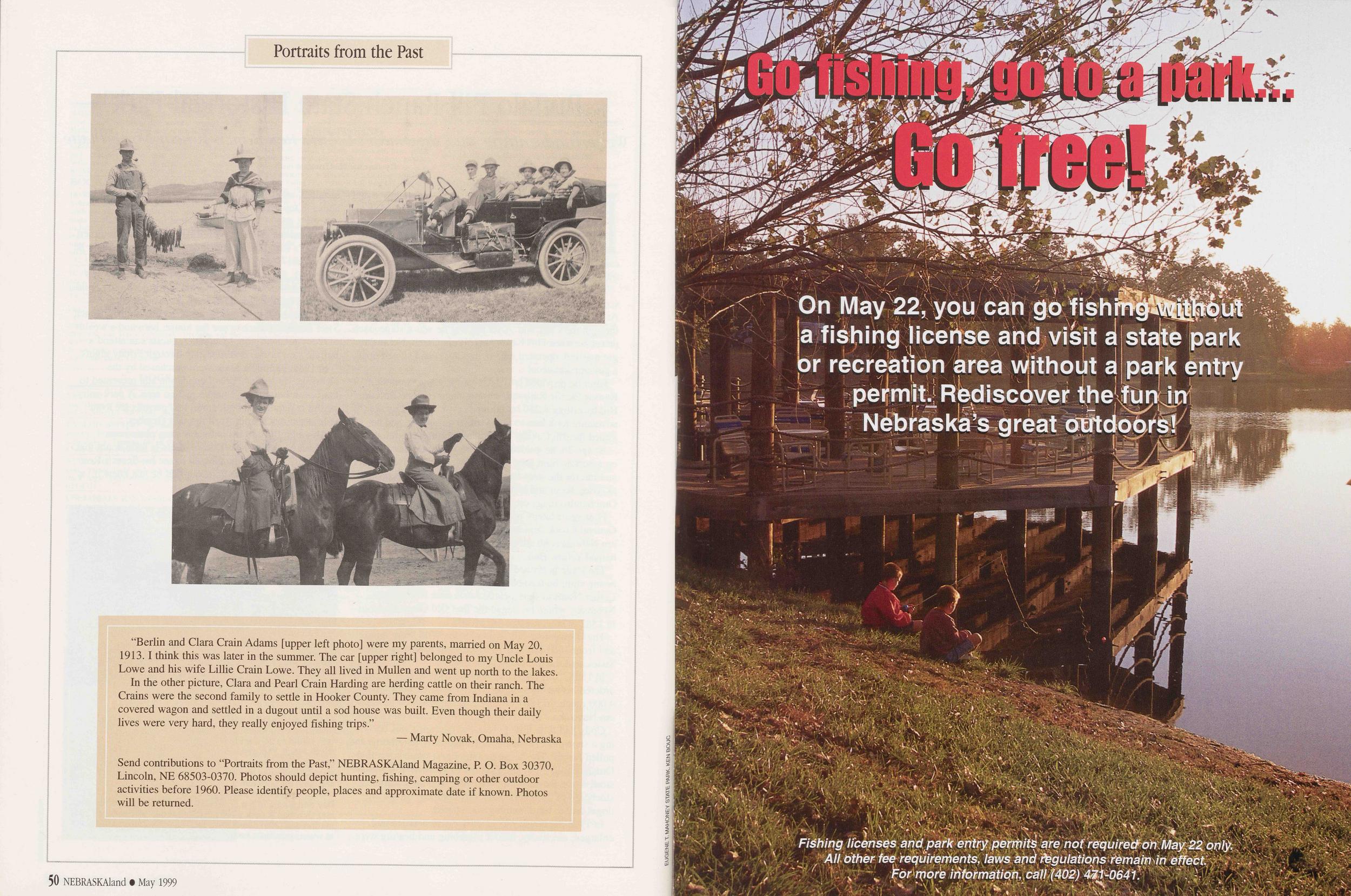
Portraits from the Past
"Berlin and Clara Crain Adams [upper left photo] were my parents, married on May 20, 1913.1 think this was later in the summer. The car [upper right] belonged to my Uncle Louis Lowe and his wife Lillie Crain Lowe. They all lived in Mullen and went up north to the lakes.
In the other picture, Clara and Pearl Crain Harding are herding cattle on their ranch. The Crains were the second family to settle in Hooker County. They came from Indiana in a covered wagon and settled in a dugout until a sod house was built. Even though their daily lives were very hard, they really enjoyed fishing trips."
— Marty Novak, Omaha, NebraskaSend contributions to "Portraits from the Past," NEBRASKAland Magazine, P. O. Box 30370, Lincoln, NE 68503-0370. Photos should depict hunting, fishing, camping or other outdoor activities before 1960. Please identify people, places and approximate date if known. Photos will be returned.
On May 22, you can do fish la fishing license and visit allstate park recreation area Without a parker" Rediscover the Nebraska's great outdoors Fishing airpark e All other features
Position: 820 (12 views)