Volume 77, Issue 3, 1999
NEBRASKAland
Nebraska Game & Parks Commission April 1999 • $2.50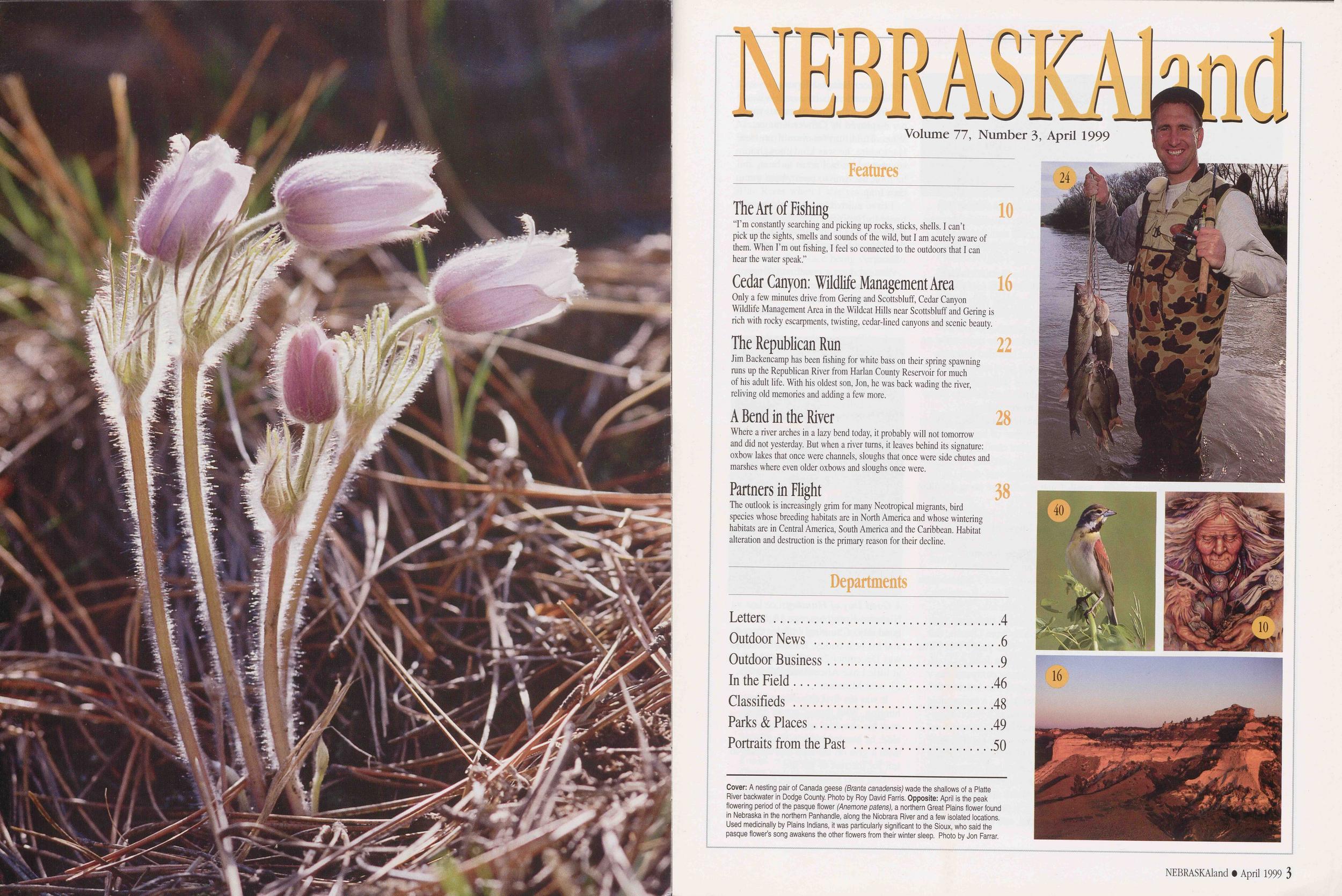
NEBRASKAland
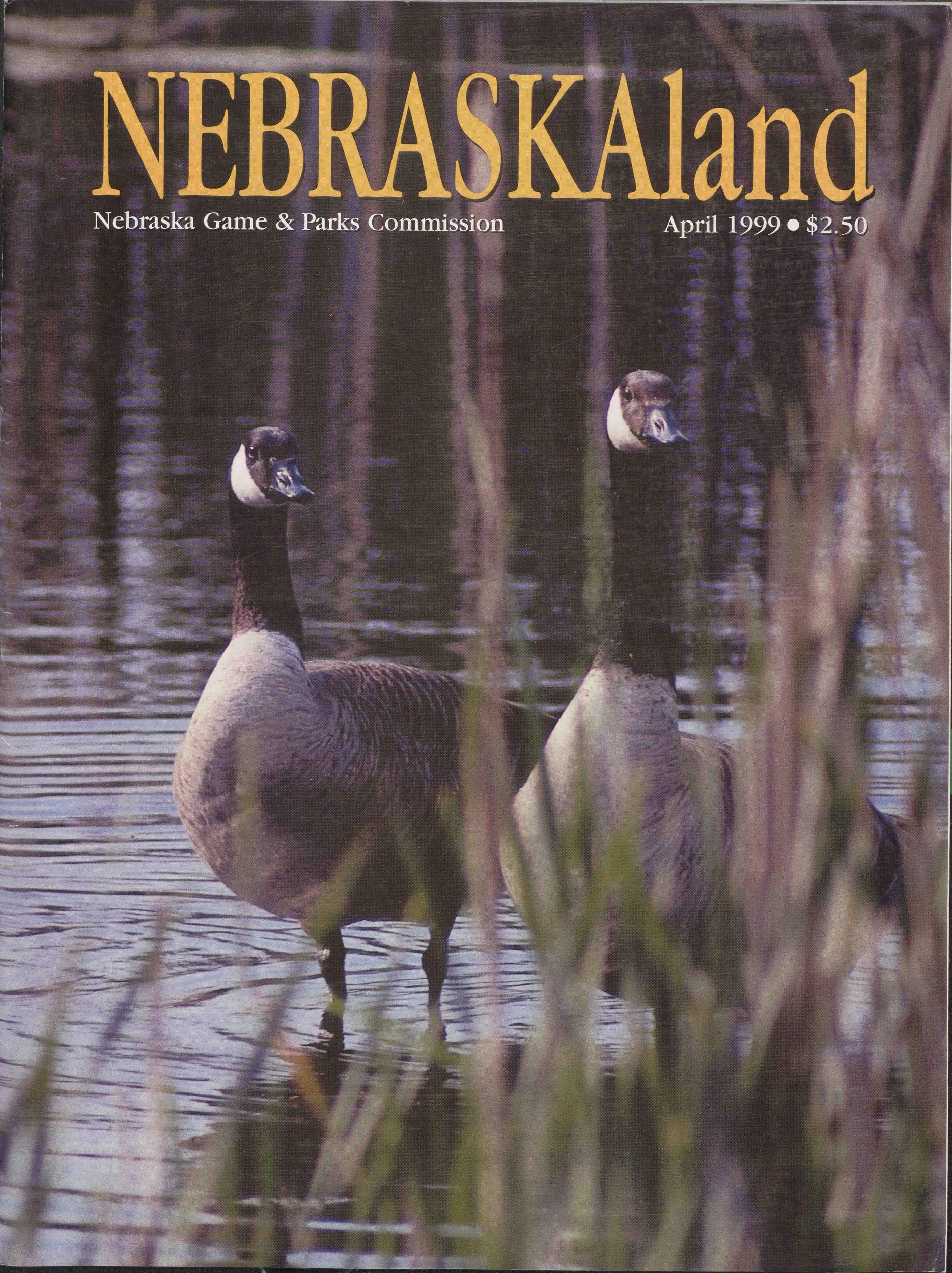
Volume 77, Number 3, April 1999 Features The Art of Fishing "I'm constantly searching and picking up rocks, sticks, shells. I can't pick up the sights, smells and sounds of the wild, but I am acutely aware of them. When I'm out fishing, I feel so connected to the outdoors that I can hear the water speak." Cedar Canyon: Wildlife Management Area Only a few minutes drive from Gering and Scottsbluff, Cedar Canyon Wildlife Management Area in the Wildcat Hills near Scottsbluff and Gering is rich with rocky escarpments, twisting, cedar-lined canyons and scenic beauty. The Republican Run Jim Backencamp has been fishing for white bass on their spring spawning runs up the Republican River from Harlan County Reservoir for much of his adult life. With his oldest son, Jon, he was back wading the river, reliving old memories and adding a few more. A Bend in the River Where a river arches in a lazy bend today, it probably will not tomorrow and did not yesterday. But when a river turns, it leaves behind its signature: oxbow lakes that once were channels, sloughs that once were side chutes and marshes where even older oxbows and sloughs once were. Partners in Flight The outlook is increasingly grim for many Neotropical migrants, bird species whose breeding habitats are in North America and whose wintering habitats are in Central America, South America and the Caribbean. Habitat alteration and destruction is the primary reason for their decline. Department Letters...................... ............4 Outdoor News ................ ............6 Outdoor Business.............. 9 In the Field................... ...........46 Classifieds ................... ...........48 Parks & Places................ ...........49 Portraits from the Past .......... ...........50 Cover: A nesting pair of Canada geese (Branta canadensis) wade the shallows of a Platte River backwater in Dodge County. Photo by Roy David Farris. Opposite: April is the peak flowering period of the pasque flower (Anemone patens), a northern Great Plains flower found in Nebraska in the northern Panhandle, along the Niobrara River and a few isolated locations. Used medicinally by Plains Indians, it was particularly significant to the Sioux, who said the pasque flower's song awakens the other flowers from their winter sleep. Photo by Jon Farrar.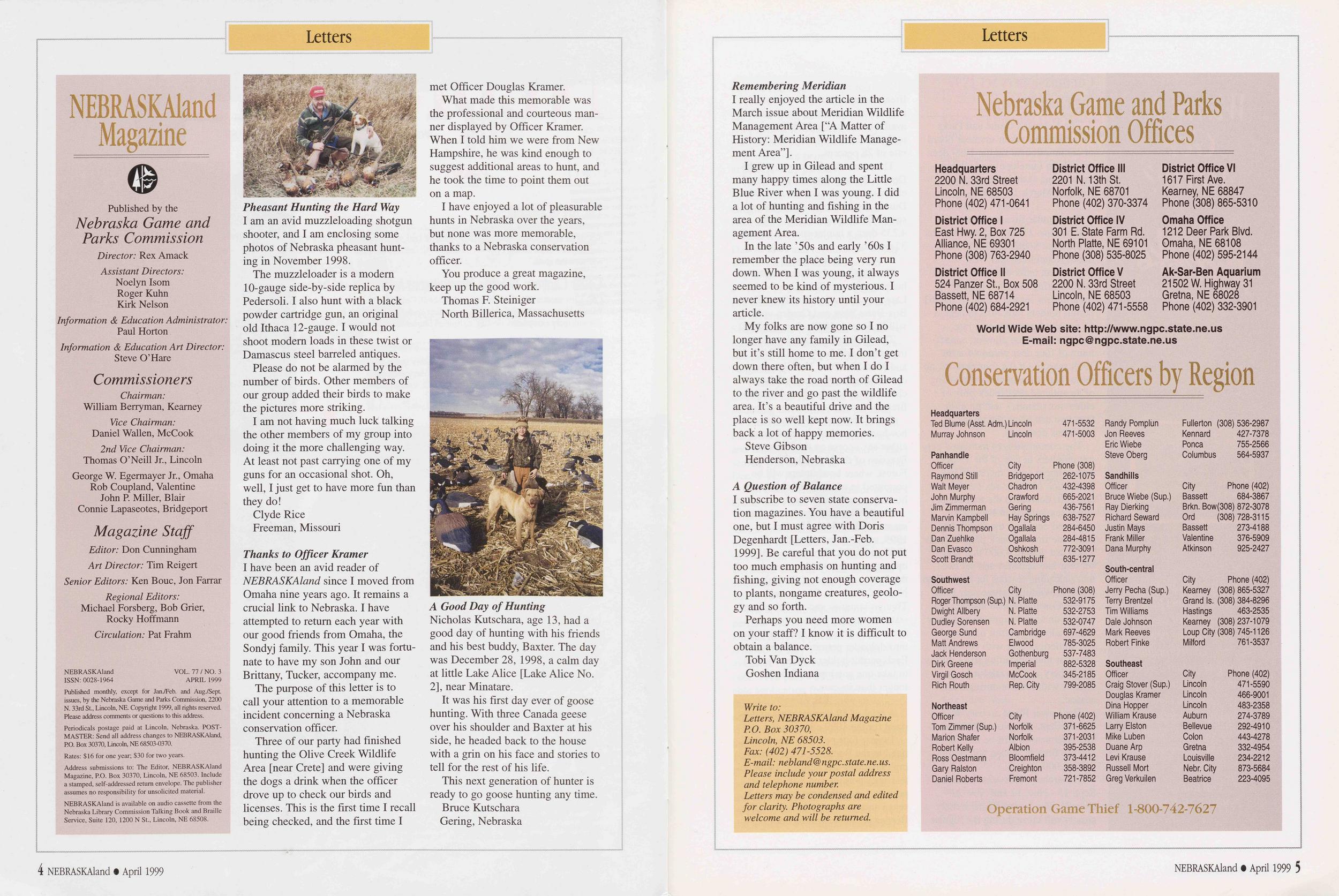
Letters
Published by the Nebraska Game and Parks Commission Director: Rex Amack Assistant Directors: Noelyn Isom Roger Kuhn Kirk Nelson Information & Education Administrator: Paul Horton Information & Education Art Director: Steve O'Hare Commissioners Chairman: William Berryman, Kearney Vice Chairman: Daniel Wallen, McCook 2nd Vice Chairman: Thomas O'Neill Jr., Lincoln George W. Egermayer Jr., Omaha Rob Coupland, Valentine John P. Miller, Blair Connie Lapaseotes, Bridgeport Magazine Staff Editor: Don Cunningham Art Director: Tim Reigert Senior Editors: Ken Bouc, Jon Farrar Regional Editors: Michael Forsberg, Bob Grier, Rocky Hoffmann Circulation: Pat Frahm NEBRASKAland ISSN: 0028-1964 VOL. 77 / NO. 3 APRIL 1999 Published monthly, except for JanVFeb. and AugVSept. issues, by the Nebraska Game and Parks Commission, 2200 N. 33rd St., Lincoln, NE. Copyright 1999, all rights reserved. Please address comments or questions to this address. Periodicals postage paid at Lincoln, Nebraska. POSTMASTER: Send all address changes to NEBRASKAland, P.O. Box 30370, Lincoln, NE 68503-0370. Rates: $16 for one year; $30 for two years. Address submissions to: The Editor, NEBRASKAland Magazine, P.O. Box 30370, Lincoln, NE 68503. Include a stamped, self-addressed return envelope. The publisher assumes no responsibility for unsolicited material. NEBRASKAland is available on audio cassette from the Nebraska Library Commission Talking Book and Braille Service, Suite 120, 1200 N St., Lincoln, NE 68508.I am an avid muzzleloading shotgun shooter, and I am enclosing some photos of Nebraska pheasant hunting in November 1998.
The muzzleloader is a modern 10-gauge side-by-side replica by Pedersoli. I also hunt with a black powder cartridge gun, an original old Ithaca 12-gauge. I would not shoot modern loads in these twist or Damascus steel barreled antiques.
Please do not be alarmed by the number of birds. Other members of our group added their birds to make the pictures more striking.
I am not having much luck talking the other members of my group into doing it the more challenging way. At least not past carrying one of my guns for an occasional shot. Oh, well, I just get to have more fun than they do!
Clyde Rice Freeman, Missouri Thanks to Officer KramerI have been an avid reader of NEBRASKAland since I moved from Omaha nine years ago. It remains a crucial link to Nebraska. I have attempted to return each year with our good friends from Omaha, the Sondyj family. This year I was fortunate to have my son John and our Brittany, Tucker, accompany me.
The purpose of this letter is to call your attention to a memorable incident concerning a Nebraska conservation officer.
Three of our party had finished hunting the Olive Creek Wildlife Area [near Crete] and were giving the dogs a drink when the officer drove up to check our birds and licenses. This is the first time I recall being checked, and the first time I met Officer Douglas Kramer.
What made this memorable was the professional and courteous manner displayed by Officer Kramer. When I told him we were from New Hampshire, he was kind enough to suggest additional areas to hunt, and he took the time to point them out on a map.
I have enjoyed a lot of pleasurable hunts in Nebraska over the years, but none was more memorable, thanks to a Nebraska conservation officer.
You produce a great magazine, keep up the good work.
Thomas F. Steiniger North Billerica, MassachusettsNicholas Kutschara, age 13, had a good day of hunting with his friends and his best buddy, Baxter. The day was December 28, 1998, a calm day at little Lake Alice [Lake Alice No. 2], near Minatare.
It was his first day ever of goose hunting. With three Canada geese over his shoulder and Baxter at his side, he headed back to the house with a grin on his face and stories to tell for the rest of his life.
This next generation of hunter is ready to go goose hunting any time.
Bruce Kutschara Gering, Nebraska 4 NEBRASKAland • April 1999 Remembering MeridianI really enjoyed the article in the March issue about Meridian Wildlife Management Area ['A Matter of History: Meridian Wildlife Management Area"].
I grew up in Gilead and spent many happy times along the Little Blue River when I was young. I did a lot of hunting and fishing in the area of the Meridian Wildlife Management Area.
In the late '50s and early '60s I remember the place being very run down. When I was young, it always seemed to be kind of mysterious. I never knew its history until your article.
My folks are now gone so I no longer have any family in Gilead, but it's still home to me. I don't get down there often, but when I do I always take the road north of Gilead to the river and go past the wildlife area. It's a beautiful drive and the place is so well kept now. It brings back a lot of happy memories.
Steve Gibson Henderson, Nebraska Question of Balancesubscribe to seven state conservation magazines. You have a beautiful one, but I must agree with Doris Degenhardt [Letters, Jan.-Feb. 1999]. Be careful that you do not put too much emphasis on hunting and fishing, giving not enough coverage to plants, nongame creatures, geology and so forth.
Perhaps you need more women on your staff? I know it is difficult to obtain a balance.
Tobi Van Dyck Goshen Indiana Write to: Letters, NEBRASKAland Magazine RO. Box 30370, Lincoln, NE 68503. Fax: (402) 471-5528. E-mail: nebland@ngpc.state.ne. us. Please include your postal address and telephone number. Letters may be condensed and edited for clarity. Photographs are welcome and will be returned. Nebraska Game and Parks Commission Offices Headquarters 2200 N. 33rd Street Lincoln, NE 68503 Phone (402) 471-0641 District Office I East Hwy. 2, Box 725 Alliance, NE 69301 Phone (308) 763-2940 District Office II 524 Panzer St., Box 508 Bassett, NE 68714 Phone (402) 684-2921 District Office III 2201 N. 13th St. Norfolk, NE 68701 Phone (402) 370-3374 District Office IV 301 E. State Farm Rd. North Platte, NE 69101 Phone (308) 535-8025 District Office V 2200 N. 33rd Street Lincoln, NE 68503 Phone (402) 471-5558 District Office VI 1617 First Ave. Kearney, NE 68847 Phone (308) 865-5310 Omaha Office 1212 Deer Park Blvd. Omaha, NE 68108 Phone (402) 595-2144 Ak-Sar-Ben Aquarium 21502 W. Highway 31 Gretna, NE 68028 Phone (402) 332-3901 World Wide Web site: http://www.ngpc.state.ne.us E-mail: ngpc@ngpc.state.ne.us Conversations Officers by Region Headquarters Ted Blume (Asst. Adm.) Lincoln 471-5532 Randy Pomplun Fullerton (308) 536-2987 Murray Johnson Lincoln 471-5003 Jon Reeves Kennard 427-7378 Eric Wiebe Ponca 755-2566 Panhandle Steve Oberg Columbus 564-5937 Officer City Phone (308) Raymond Still Bridgeport 262-1075 Sandhills Walt Meyer Chadron 432-4398 Officer City Phone (402) John Murphy Crawford 665-2021 Bruce Wiebe (Sup.)Bassett 684-3867 Jim Zimmerman Gering 436-7561 Ray Dierking Brkn. Bow (308) 872-3078 Marvin Kampbell Hay Springs 638-7527 Richard Seward Ord (308)728-3115 Dennis Thompson Ogallala 284-6450 Justin Mays Bassett 273-4188 Dan Zuehlke Ogallala 284-4815 Frank Miller Valentine 376-5909 Dan Evasco Oshkosh 772-3091 Dana Murphy Atkinson 925-2427 Scott Brandt Scottsbluff 635-1277 South-central Southwest Officer City Phone (402) Officer City Phone (308) Jerry Pecha (Sup.) Kearney (308) 865-5327 Roger Thompson (Sup.) N. Platte 532-9175 Terry Brentzel Grand Is. (308) 384-8296 Dwight Allbery N. Platte 532-2753 Tim Williams Hastings 463-2535 Dudley Sorensen N. Platte 532-0747 Dale Johnson Kearney (308)237-1079 George Sund Cambridge 697-4629 Mark Reeves Loup City (308) 745-1126 Matt Andrews Elwood 785-3025 Robert Finke Milford 761-3537 Jack Henderson Gothenburg 537-7483 Dirk Greene Imperial 882-5328 Southeast Virgil Gosch McCook 345-2185 Officer City Phone (402) Rich Routh Rep. City 799-2085 Craig Stover (Sup.) Lincoln 471-5590 Douglas Kramer Lincoln 466-9001 Northeast Dina Hopper Lincoln 483-2358 Officer City Phone (402) William Krause Auburn 274-3789 Tom Zimmer (Sup.)Norfolk 371-6625 Larry Elston Bellevue 292-4910 Marion Shafer Norfolk 371-2031 Mike Luben Colon 443-4278 Robert Kelly . Albion 395-2538 Duane Arp Gretna 332-4954 Ross Oestmann Bloomfield 373-4412 Levi Krause Louisville 234-2212 Gary Ralston Creighton 358-3892 Russell Mort Nebr. City 873-5684 Daniel Roberts Fremont 721-7852 Greg Verkuilen Beatrice 223-4095 NEBRASKAland • April 1999 5
Outdoor News
Want to State Parks The Good life: Nebraska's state parks are still your best bet for a perfect vacation or weekend break. Get the new 48-page, color brochure highlighting state parks, recreation areas and historic parks. You'll get detailed information on lodging, camping, activities, facilities, seasons, fees and reservation policies. Call today! 1-800-826-PARK commissioners Set 1999 Big Game SeasonsThe Nebraska Game and Parks Commission's seven-member board of commissioners set the 1999 deer, pronghorn (antelope) and elk hunting seasons at their meeting in Kearney March 12, 1999.
DeerThe regular firearm deer season will be Nov. 13-21, and late seasons in the Blue Southeast, Mid Platte, South Republican and West Republican units will be Jan. 8-16, 2000. During the 1998 regular firearm deer season a total of 65,561 permit holders took 40,276 deer, a 61 percent hunter success rate.
Hunters will be allowed a maximum of four deer permits for the 1999 season. Of the four permits, no more than two can allow the taking of an antlered deer (buck only or either-sex permits), and no more than two can allow the taking of antlerless deer only.
The commissioners increased permit numbers in five of the 17 deer management units; increased the proportion of either-sex permits in one unit; decreased the number of either-sex permits in two units; approved doubling the number of statewide firearm buck permits from 2,000 last year to 4,000 this year; set four late seasons; and set two muzzleloading seasons for the DeSoto National Wildlife Refuge near Blair.
The Commissioners also set seasons in an area designated as Lower Platte, allowing permit holders to take antlerless deer with bow-and-arrow or muzzleloading rifles during the archery and muzzleloader seasons or with firearm during a late season.
The Lower Platte archery season will be Sept. 15 - Nov. 22; the muzzleloader season will be Dec. 4-19; and the firearm season will be Jan. 8-16, 2,000.
The archery deer season will be Sept. 15 - Nov. 12 and Nov. 22 - Dec. 31. The Lower Platte archery season will close during the regular firearm deer season. An unlimited number of either-sex permits will be available. Last year 14,866 archers took 4,102 deer, a hunter success rate of 28 percent.
The muzzleloader season will be Dec. 4-19. An unlimited number of either-sex permits will be available. During the 1998 muzzleloader season 13,070 permit holders took 4,235 deer, a hunter success rate of 32 percent.
AntelopeThe 1999 regular firearm antelope hunting season will be Oct. 9-24. Late seasons in the Box Butte East, Box Butte West and Garden units will be Dec. 4, 1999 - Jan. 31, 2000.
The 1999 archery antelope hunt- ing season will be Aug. 20 - Nov. 12 and Nov. 22 - Dec. 31. All areas open to firearm hunting will be closed to archery hunting during the firearm season.
An archery permit will allow a bowhunter to take one antelope of either sex except on the Bessey Division of the Nebraska National Forest, where bowhunters will be permitted to take one antelope with horns longer than its ears.
The 1999 muzzleloader antelope season will be Sept. 18 - Oct. 3, 1999, seven days longer than in 1997 and 1998. The season will be open statewide with the exception of the Bessey Division of the Nebraska National Forest in Blaine and Thomas counties and all federal and state sanctuaries unless otherwise authorized. One hundred twenty five muzzleloader permits will be issued. Each permit holder will be allowed to take one antelope with horns longer than its ears.
ElkA total of 59 permits were authorized for the 1999 elk season.
Twenty four permits were authorized in the Bordeaux Unit, including two either-sex permits, 14 antlerless-only permits and 8 landowner permits (one either-sex permit and seven antlerless-only permits). The Bordeaux season will be Sept. 25 6 NEBRASKAland • April 1999 Oct. 24 and Dec. 1 - 12, 1999.
Ten permits were authorized for the Boyd Unit, including two either sex permits, five antlerless-only permits and three landowner permits (one either-sex permit and two antlerless-only permits).
Boyd Unit elk permit holders will be permitted to hunt in a portion of Gregory County, South Dakota. Nebraska hunters who hunt in South Dakota must conform to South Dakota laws and regulations, which will be included with the permit.
The Boyd Unit will be open Sept. 4 - Nov. 12 and Nov. 22 - Dec. 31. Elk hunting in the unit is closed for the firearm deer season, Nov. 13-21. South Dakota regulations will not be established until mid-April, and season dates might not correspond to Nebraska's.
Twenty-five permits will be issued for the Hat Creek Unit, including three either-sex permits, 14 antlerless-only permits and eight landowner permits (two either-sex and six antlerless-only permits). The season will be Sept. 25 - Oct. 24 and Dec. 1-12, 1999.
Jim Douglas, administrator of the Game and Parks Commission's Wildlife Division, said the 1999 season recommendations were intended to stabilize or slightly increase elk numbers in the Bordeaux and Hat Creek units and stabilize or reduce the population in the Boyd Unit.
The application period for elk permits will be April 1-May 10. Unsuccessful applicants will be notified by July 13. Elk permits, available only to Nebraska residents, cost $112 plus a $5.50, non-refundable application fee. Landowner permits cost $22.40 plus a $5.50 nonrefundable application fee.
For more information on elk, deer and antelope permits, consult the 1999 guides available from all Game and Parks Commission offices and permit vendors. Big game permit and application information also will be posted on the Commission's web site at http://www.ngpc.state.ne.us.
1999 Deer and Antelope Firearm Hunting November Firearm Deer Season, Nov. 13-21,1999 Unit Permits Either Sex 1998 Success Blue ..................................................6,000 100% 63% Blue Southeast5 ................................2,000 AO2 47% Buffalo..............................................3,500 80% 65% Calamus East....................................1,700 80%3 54% Calamus West....................................2,000 60% 59% Elkhorn..............................................3,800 80% 62% Frenchman........................................3,000 100% 77% Frenchman Antlerless..........................300 AO2 Frenchman Whitetail........................1,200 100% 57% KeyaPaha ........................................2,500 100% 57% Keya Paha Antlerless ..........................500 AO2 Loup East..........................................2,700 80%3 61% Loup West ........................................2,100 70% 63% Missouri............................................3,200 70%3 55% Pine Ridge........................................3,200 40% 56% Plains...............................................500 50% 67% Platte ................................................2,700 50% 63% Platte Whitetail....................................400 100% Republican........................................3,200 100% 67% Sandhills............................................2,400 100% 69% Sandhills Antlerless ............................700 AO2 67% Upper Platte......................................1,400 40% 60% Wahoo..............................................4,500 100% 65% Statewide..........................................4,000 0% 57% Special Deer Season DeSoto Early. Oct. 23-25, 1999..........100 AO2 44% DeSoto Late. Dec. 11-13, 1999 ..........100 100% 34% Fontenelle. Dec. 4-12, 1999................100 AO2 39% Late Deer Season, Jan. 8-16, 2000 Blue Southeast5 .............................. 3,000 AO2 51%4 Mid Platte5............................................500 AO2 45% South Republican5............................1,000 100% 49% West Republican..................................700 100% 44% 'Excesses of permits sold over number authorized are limited landowner permits 2 Antlerless deer only (no antlers or both antlers less than 6 inches long) 3 Anterless mule deer prohibited 4Success of permit holders; Blue Late allowed two deer per permit 5Boundary modified from previous year Antelope Season, Oct. 9-24,1999 Unit Permits Banner North............................................100 Banner South............................................125 Box Butte East..........................................50 Box Butte West..........................................50 Cherry........................................................50 Cheyenne....................................................30 Dismal........................................................10 Garden........................................................40 North Sioux..............................................250 Antelope Season, Dec. 4,1999 - Jan. 3.1, 2000 Box Butte East..........................................35 Box Butte West..........................................20 Garden........................................................20 Permit Type Either Sex Either Sex Either Sex Either Sex 50% Either Sex Buck Only Buck Only Either Sex 50% Either Sex Either Sex Either Sex Either Sex NEBRASKAland • April 1999 7 WE WANT
YOUR RECIPES!
"^^feti^^vg^
FOR A NEW WILD GAME
COOKBOOK
Send us your best wild game
recipes and cleverest cabin, camp
and kitchen tips.
August-September issue will be
an all-new wild game cookbook
and you can help — Send us one or
two of your favorite recipes and tips
(be sure to credit sources if you
know them) and we'll include a
selection of readers' favorites along
with some of the best game recipes
from around the country.
If your recipe is an old family
favorite or if a brief story
goes with it, we want,
to know that, too.
Send your recipes to:
WILD GAME COOKBOOK
NEBRASKAland MAGAZINE
P.O. Box 30370
Lincoln, Nebraska 68503
Submissions must arrive by May 1.
WE WANT
YOUR RECIPES!
"^^feti^^vg^
FOR A NEW WILD GAME
COOKBOOK
Send us your best wild game
recipes and cleverest cabin, camp
and kitchen tips.
August-September issue will be
an all-new wild game cookbook
and you can help — Send us one or
two of your favorite recipes and tips
(be sure to credit sources if you
know them) and we'll include a
selection of readers' favorites along
with some of the best game recipes
from around the country.
If your recipe is an old family
favorite or if a brief story
goes with it, we want,
to know that, too.
Send your recipes to:
WILD GAME COOKBOOK
NEBRASKAland MAGAZINE
P.O. Box 30370
Lincoln, Nebraska 68503
Submissions must arrive by May 1.
A mixed media painting of wild turkeys by Armando Villareal of Lincoln, has been chosen as the winner of the 22nd annual Nebraska Habitat Stamp Art Contest.
The seven-member governing board of the Nebraska Game and Parks Commission chose Villareal's painting from 50 entries in the adult division of the contest. Other finalists were David Dorsey of Newport and Mary Hunt of Gering.
Villareal's painting will appear on the year 2000 Habitat Stamp. A Habitat Stamp is required for all resident hunters and fur harvesters age 16 and older and all nonresident hunters and fur harvesters. Money raised from the sale of stamps goes into the Habitat Fund, used for acquisition and enhancement of habitat on state and private lands.
Villareal will be invited to the Commissioners' May meeting to accept a $200 cash award from the Omaha Fish and Wildlife Club, which helps sponsor the contest. Finalists will receive free subscriptions to NEBRASKAland Magazine.
Paul Horton, Information and Education Division administrator said the Commission sponsors the contest to foster wildlife appreciation and to choose a design for the following year's Habitat Stamp.
Adult entries are on display through April 30 at the Commission's Lincoln office at 2200 North 33rd Street.
Honorable Mention winners were Nancy L. Holsten of Greenwood, Bruce Becher of Wilbur and Larry Peterson of Omaha.
8 NEBRASKAland • April 1999Outdoor Business
The American Fisheries Society
Society of fisheries scientists works to improve fishing opportunity By Michael Gutzmerfishing in North America is as old as the people who evolved here. Fishing truly is ingrained in our cultural fabric. No one knows that better than one of Nebraska's most well-known anglers, Tom Osborne, former head football coach of the University of Nebraska-Lincoln.
Many Nebraskans know that one of Osborne's favorite pastimes is fishing. Thanks to the Nebraska Chapter of the American Fisheries Society, Osborne now can fish all he wants. On April 27, 1998, the chapter presented Osborne with a Nebraska lifetime fishing permit.
"It's great," Osborne said. "I love to fish, so a lifetime fishing license is great. I hope I live long enough to use it. The thought behind it is nice."
Osborne recently retired after coaching the Cornhuskers to 255 wins and three national championships in 25 years as head coach. But it's what he has done as an angler that sparked the gesture.
"I have enjoyed fishing since I was six or seven years old and have done all kinds of fishing," Osborne said. "I first started fishing with my Uncle Virgil during World War II, and it has been my chief form of relaxation since. I like fishing for cold water species such as trout and salmon, and I particularly enjoy fly fishing."
The American Fisheries Society, founded in 1870, is a professional society representing fisheries scientists. The Nebraska Chapter has about 100 members. Most are resource professionals from a variety of agencies and entities across the state including the Nebraska Game and Parks Commission, the U.S. Fish and Wildlife Service, the U.S. Army Corps of Engineers, the Nebraska Department of Environmental Quality, university faculty and students, electric utility companies and consulting firms.
Nebraska's fisheries resources are plentiful and abundant. With 142,00 surface acres of impounded water, about 12,000 miles of fishable rivers and streams and more than 400,000 anglers making 10 million fishing trips each year, water-associated challenges also are abundant.
The symptoms of human activity are apparent in many Nebraska streams. Intensive agriculture and land clearing causes rapid runoff and drastic fluctuations in stream flow. Excessive nutrients and sediment invade waterways.
Erosion of stream courses increases following channelization and other stream modification. Municipal and industrial discharges also make their way into streams. The result is fluctuating and declining populations of fish and other organisms.
The society has many public education and resource conservation programs, and the society's role in communicating fisheries information will grow in coming years as pressures on fisheries resources increases.
New information must be conveyed not only within the profession, but also to the public and to public policy makers, as well. One of the biggest challenges is promoting awareness and becoming more visible in the belief that public support is as crucial to conservation as restoration, protection and management.
By sharing science-based information, we can work together in helping other organizations and individual accomplish their own resource conservation goals and continue the opportunities for good fishing.
Presenting the lifetime permit to Osborne has generated many positive comments, and we've had several articles in area newspapers. That is a lot of exposure for the Nebraska Chapter and the parent society.
Michael Gutzmer is president of the Nebraska Chapter of the American Fisheries Society. He can be reached at (402) 563-5742.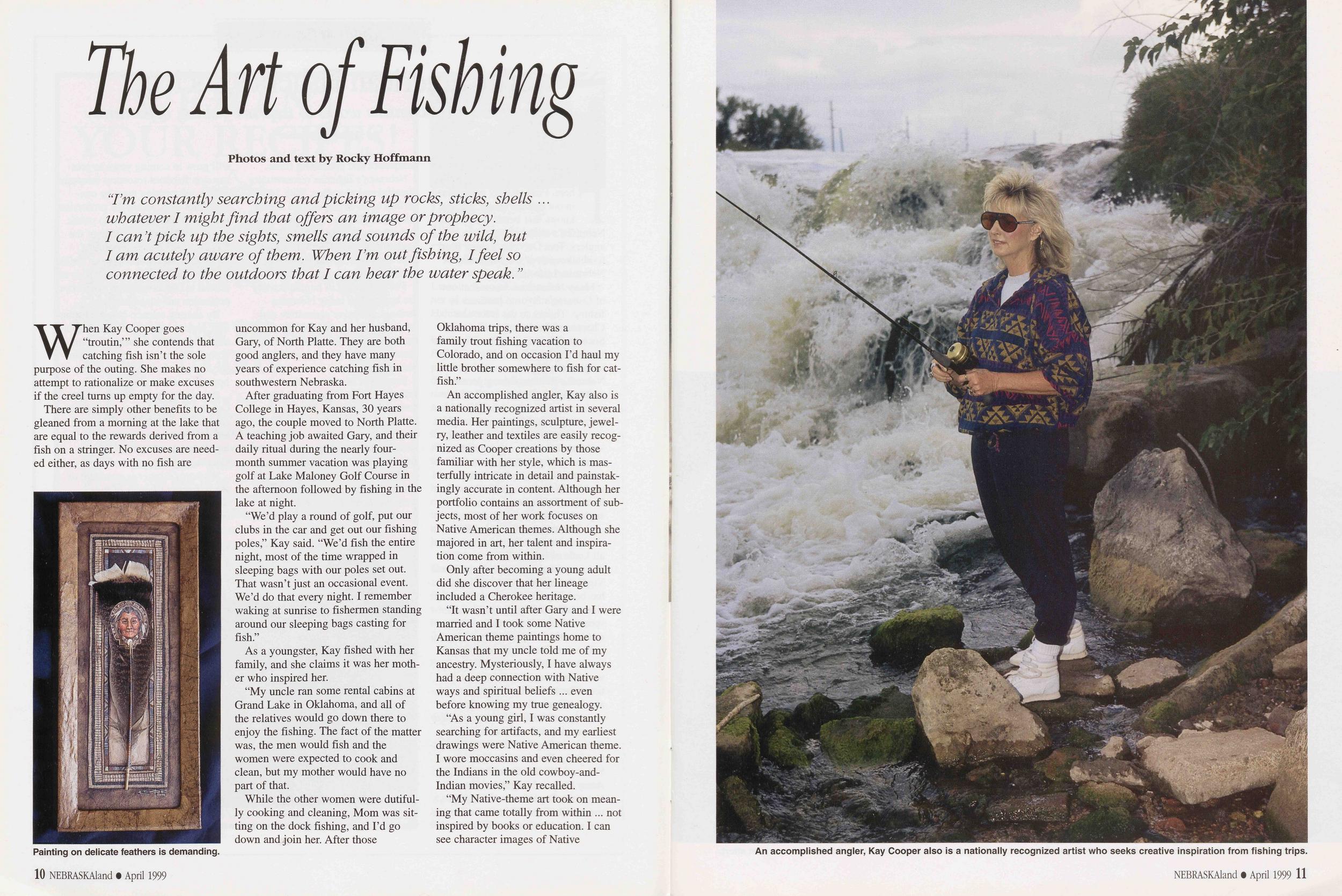
The Art of Fish ing
Photos and text by Rocky Hoffmann "Vm constantly searching and picking up rocks, sticks, shells ... whatever I might find that offers an image or prophecy. I can't pick up the sights, smells and sounds of the wild, but I am acutely aware of them. When Tm out fishing, I feel so connected to the outdoors that I can hear the water speak."When Kay Cooper goes "troutin,'" she contends that catching fish isn't the sole purpose of the outing. She makes no attempt to rationalize or make excuses if the creel turns up empty for the day.
There are simply other benefits to be gleaned from a morning at the lake that are equal to the rewards derived from a fish on a stringer. No excuses are needed either, as days with no fish are uncommon for Kay and her husband, Gary, of North Platte. They are both good anglers, and they have many years of experience catching fish in southwestern Nebraska.
After graduating from Fort Hayes College in Hayes, Kansas, 30 years ago, the couple moved to North Platte. A teaching job awaited Gary, and their daily ritual during the nearly four month summer vacation was playing golf at Lake Maloney Golf Course in the afternoon followed by fishing in the lake at night.
"We'd play a round of golf, put our clubs in the car and get out our fishing poles," Kay said. "We'd fish the entire night, most of the time wrapped in sleeping bags with our poles set out. That wasn't just an occasional event. We'd do that every night. I remember waking at sunrise to fishermen standing around our sleeping bags casting for fish."
As a youngster, Kay fished with her family, and she claims it was her mother who inspired her.
"My uncle ran some rental cabins at Grand Lake in Oklahoma, and all of the relatives would go down there to enjoy the fishing. The fact of the matter was, the men would fish and the women were expected to cook and clean, but my mother would have no part of that.
While the other women were dutifully cooking and cleaning, Mom was sitting on the dock fishing, and I'd go down and join her. After those Oklahoma trips, there was a family trout fishing vacation to Colorado, and on occasion I'd haul my little brother somewhere to fish for catfish."
An accomplished angler, Kay also is a nationally recognized artist in several media. Her paintings, sculpture, jewelry, leather and textiles are easily recognized as Cooper creations by those familiar with her style, which is masterfully intricate in detail and painstakingly accurate in content. Although her portfolio contains an assortment of subjects, most of her work focuses on Native American themes. Although she majored in art, her talent and inspiration come from within.
Only after becoming a young adult did she discover that her lineage included a Cherokee heritage.
"It wasn't until after Gary and I were married and I took some Native American theme paintings home to Kansas that my uncle told me of my ancestry. Mysteriously, I have always had a deep connection with Native ways and spiritual beliefs ... even before knowing my true genealogy.
"As a young girl, I was constantly searching for artifacts, and my earliest drawings were Native American theme. I wore moccasins and even cheered for the Indians in the old cowboy-and-Indian movies," Kay recalled.
"My Native-theme art took on meaning that came totally from within ... not inspired by books or education. I can see character images of Native
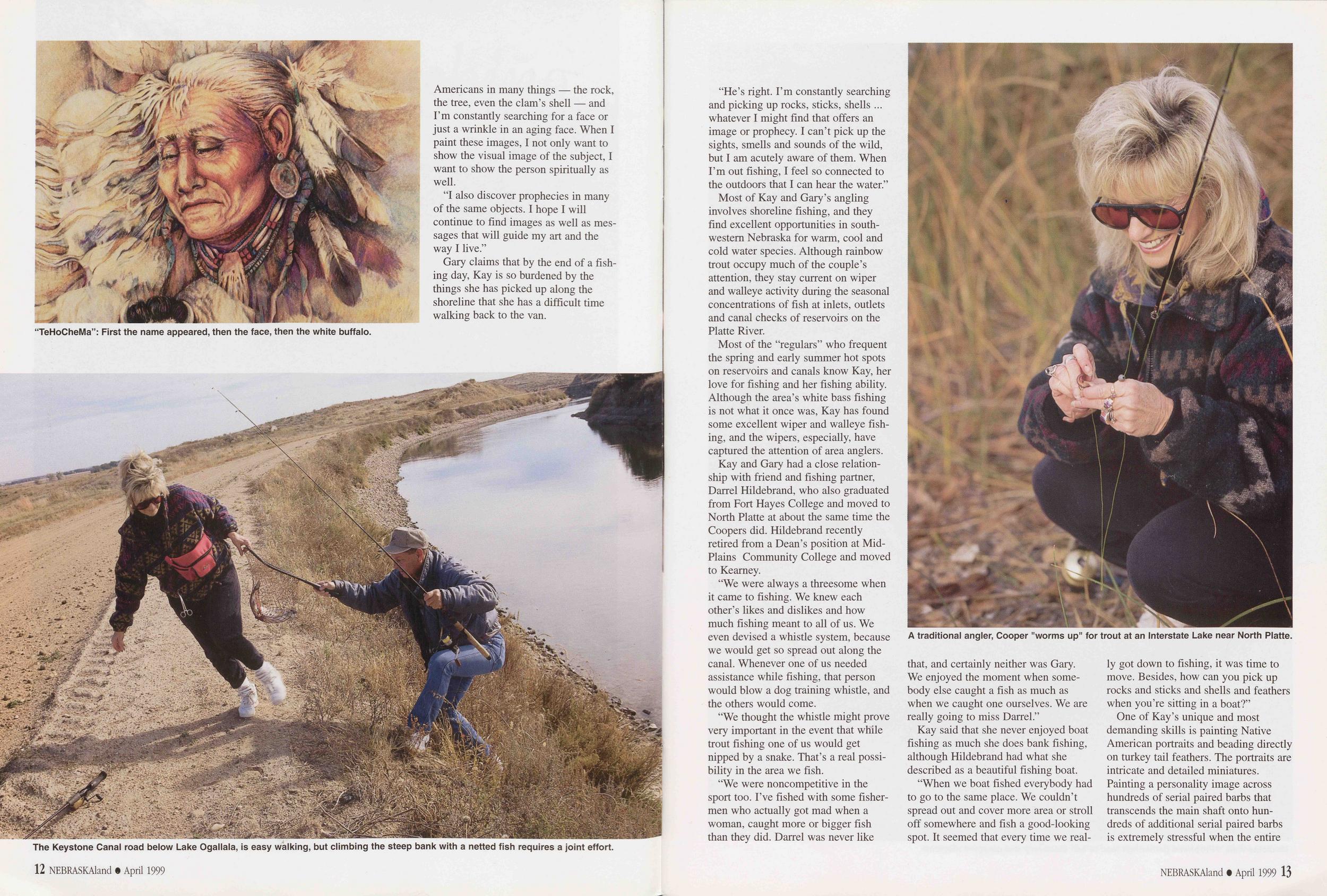
"I also discover prophecies in many of the same objects. I hope I will continue to find images as well as messages that will guide my art and the way I live."
Gary claims that by the end of a fishing day, Kay is so burdened by the things she has picked up along the shoreline that she has a difficult time walking back to the van.
"He's right. I'm constantly searching and picking up rocks, sticks, shells ... whatever I might find that offers an image or prophecy. I can't pick up the sights, smells and sounds of the wild, but I am acutely aware of them. When I'm out fishing, I feel so connected to the outdoors that I can hear the water."
Most of Kay and Gary's angling involves shoreline fishing, and they find excellent opportunities in southwestern Nebraska for warm, cool and cold water species. Although rainbow trout occupy much of the couple's attention, they stay current on wiper and walleye activity during the seasonal concentrations of fish at inlets, outlets and canal checks of reservoirs on the Platte River.
Most of the "regulars" who frequent the spring and early summer hot spots on reservoirs and canals know Kay, her love for fishing and her fishing ability. Although the area's white bass fishing is not what it once was, Kay has found some excellent wiper and walleye fishing, and the wipers, especially, have captured the attention of area anglers.
Kay and Gary had a close relationship with friend and fishing partner, Darrel Hildebrand, who also graduated from Fort Hayes College and moved to North Platte at about the same time the Coopers did. Hildebrand recently retired from a Dean's position at Mid-Plains Community College and moved to Kearney.
"We were always a threesome when it came to fishing. We knew each other's likes and dislikes and how much fishing meant to all of us. We even devised a whistle system, because we would get so spread out along the canal. Whenever one of us needed assistance while fishing, that person would blow a dog training whistle, and the others would come.
"We thought the whistle might prove very important in the event that while trout fishing one of us would get nipped by a snake. That's a real possibility in the area we fish.
"We were noncompetitive in the sport too. I've fished with some fishermen who actually got mad when a woman, caught more or bigger fish than they did. Darrel was never like that, and certainly neither was Gary. We enjoyed the moment when somebody else caught a fish as much as when we caught one ourselves. We are really going to miss Darrel."
Kay said that she never enjoyed boat fishing as much she does bank fishing, although Hildebrand had what she described as a beautiful fishing boat.
"When we boat fished everybody had to go to the same place. We couldn't spread out and cover more area or stroll off somewhere and fish a good-looking spot. It seemed that every time we really got down to fishing, it was time to move. Besides, how can you pick up rocks and sticks and shells and feathers when you're sitting in a boat?"
One of Kay's unique and most
demanding skills is painting Native
American portraits and beading directly
on turkey tail feathers. The portraits are
intricate and detailed miniatures.
Painting a personality image across
hundreds of serial paired barbs that
transcends the main shaft onto
hundreds of additional serial paired barbs
is extremely stressful when the entire
NEBRASKAland ft April 1999 13
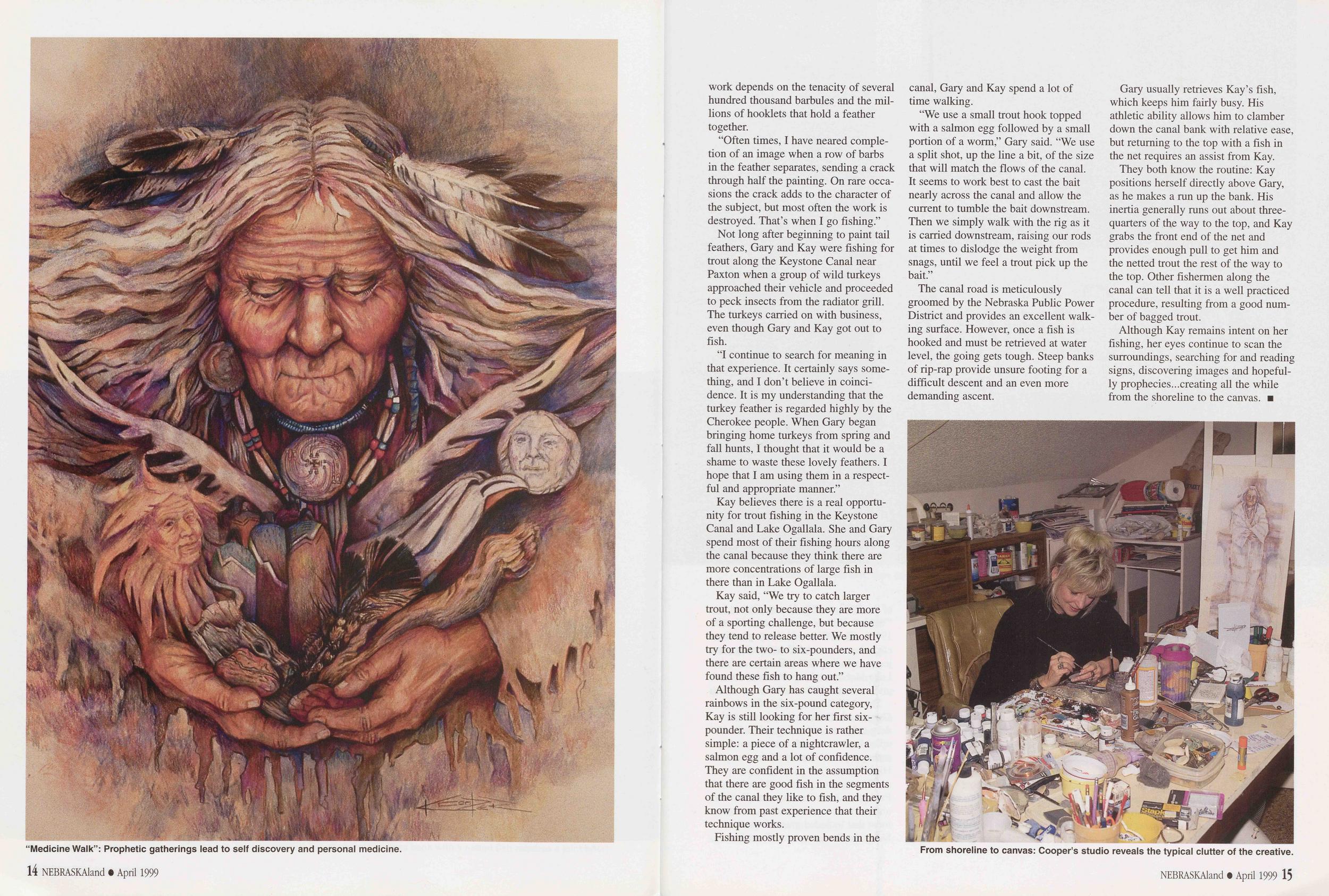
"Often times, I have neared completion of an image when a row of barbs in the feather separates, sending a crack through half the painting. On rare occasions the crack adds to the character of the subject, but most often the work is destroyed. That's when I go fishing."
Not long after beginning to paint tail feathers, Gary and Kay were fishing for trout along the Keystone Canal near Paxton when a group of wild turkeys approached their vehicle and proceeded to peck insects from the radiator grill. The turkeys carried on with business, even though Gary and Kay got out to fish.
"I continue to search for meaning in that experience. It certainly says something, and I don't believe in coincidence. It is my understanding that the turkey feather is regarded highly by the Cherokee people. When Gary began bringing home turkeys from spring and fall hunts, I thought that it would be a shame to waste these lovely feathers. I hope that I am using them in a respectful and appropriate manner."
Kay believes there is a real opportunity for trout fishing in the Keystone Canal and Lake Ogallala. She and Gary spend most of their fishing hours along the canal because they think there are more concentrations of large fish in there than in Lake Ogallala.
Kay said, "We try to catch larger trout, not only because they are more of a sporting challenge, but because they tend to release better. We mostly try for the two- to six-pounders, and there are certain areas where we have found these fish to hang out."
Although Gary has caught several rainbows in the six-pound category, Kay is still looking for her first six-pounder. Their technique is rather simple: a piece of a nightcrawler, a salmon egg and a lot of confidence. They are confident in the assumption that there are good fish in the segments of the canal they like to fish, and they know from past experience that their technique works.
Fishing mostly proven bends in the canal, Gary and Kay spend a lot of time walking.
'We use a small trout hook topped with a salmon egg followed by a small portion of a worm," Gary said. "We use a split shot, up the line a bit, of the size that will match the flows of the canal. It seems to work best to cast the bait nearly across the canal and allow the current to tumble the bait downstream. Then we simply walk with the rig as it is carried downstream, raising our rods at times to dislodge the weight from snags, until we feel a trout pick up the bait."
The canal road is meticulously groomed by the Nebraska Public Power District and provides an excellent walking surface. However, once a fish is hooked and must be retrieved at water level, the going gets tough. Steep banks of rip-rap provide unsure footing for a difficult descent and an even more demanding ascent.
Gary usually retrieves Kay's fish, which keeps him fairly busy. His athletic ability allows him to clamber down the canal bank with relative ease, but returning to the top with a fish in the net requires an assist from Kay.
They both know the routine: Kay positions herself directly above Gary, as he makes a run up the bank. His inertia generally runs out about three-quarters of the way to the top, and Kay grabs the front end of the net and provides enough pull to get him and the netted trout the rest of the way to the top. Other fishermen along the canal can tell that it is a well practiced procedure, resulting from a good number of bagged trout.
Although Kay remains intent on her fishing, her eyes continue to scan the surroundings, searching for and reading signs, discovering images and hopefully prophecies...creating all the while from the shoreline to the canvas.
Cedar Canyon Wildlife Management Area
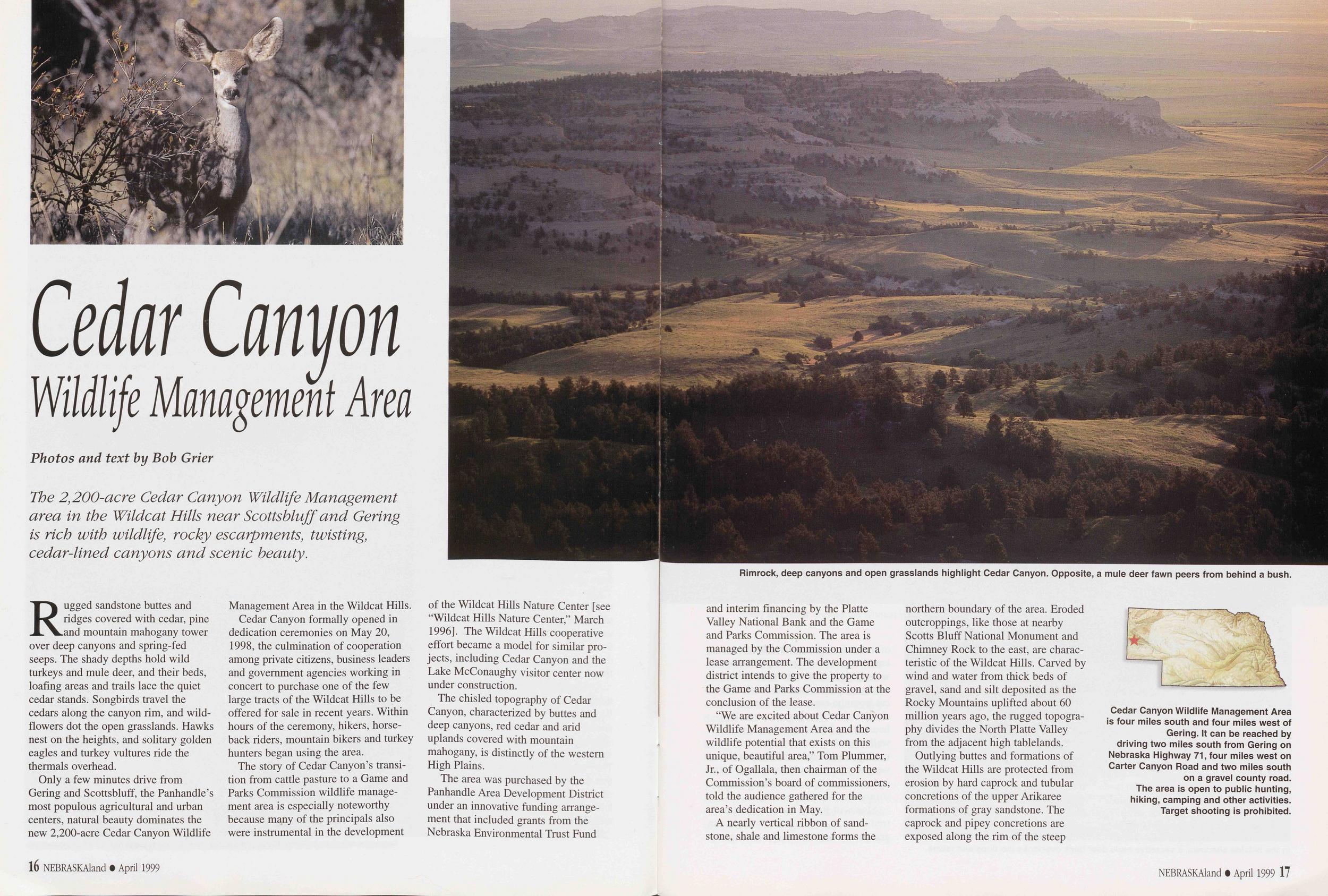
Photos and text by Bob Grier The 2,200-acre Cedar Canyon Wildlife Management area in the Wildcat Hills near Scottsbluff and Gering is rich with wildlife, rocky escarpments, twisting, cedar-lined canyons and scenic beauty.Rugged sandstone buttes and ridges covered with cedar, pine and mountain mahogany tower over deep canyons and spring-fed seeps. The shady depths hold wild turkeys and mule deer, and their beds, loafing areas and trails lace the quiet cedar stands. Songbirds travel the cedars along the canyon rim, and wildflowers dot the open grasslands. Hawks nest on the heights, and solitary golden eagles and turkey vultures ride the thermals overhead.
Only a few minutes drive from Gering and Scottsbluff, the Panhandle's most populous agricultural and urban centers, natural beauty dominates the new 2,200-acre Cedar Canyon Wildlife Management Area in the Wildcat Hills.
Cedar Canyon formally opened in dedication ceremonies on May 20, 1998, the culmination of cooperation among private citizens, business leaders and government agencies working in concert to purchase one of the few large tracts of the Wildcat Hills to be offered for sale in recent years. Within hours of the ceremony, hikers, horseback riders, mountain bikers and turkey hunters began using the area.
The story of Cedar Canyon's transition from cattle pasture to a Game and Parks Commission wildlife management area is especially noteworthy because many of the principals also were instrumental in the development of the Wildcat Hills Nature Center [see "Wildcat Hills Nature Center," March 1996]. The Wildcat Hills cooperative effort became a model for similar projects, including Cedar Canyon and the Lake McConaughy visitor center now under construction.
The chisled topography of Cedar Canyon, characterized by buttes and deep canyons, red cedar and arid uplands covered with mountain mahogany, is distinctly of the western High Plains.
The area was purchased by the Panhandle Area Development District under an innovative funding arrangement that included grants from the Nebraska Environmental Trust Fund 16 NEBRASKAland • April 1999
"We are excited about Cedar Canyon Wildlife Management Area and the wildlife potential that exists on this unique, beautiful area," Tom Plummer, Jr., of Ogallala, then chairman of the Commission's board of commissioners, told the audience gathered for the area's dedication in May.
A nearly vertical ribbon of sandstone, shale and limestone forms the northern boundary of the area. Eroded outcroppings, like those at nearby Scotts Bluff National Monument and Chimney Rock to the east, are characteristic of the Wildcat Hills. Carved by wind and water from thick beds of gravel, sand and silt deposited as the Rocky Mountains uplifted about 60 million years ago, the rugged topography divides the North Platte Valley from the adjacent high tablelands.
Outlying buttes and formations of the Wildcat Hills are protected from erosion by hard caprock and tubular concretions of the upper Arikaree formations of gray sandstone. The caprock and pipey concretions are exposed along the rim of the steep
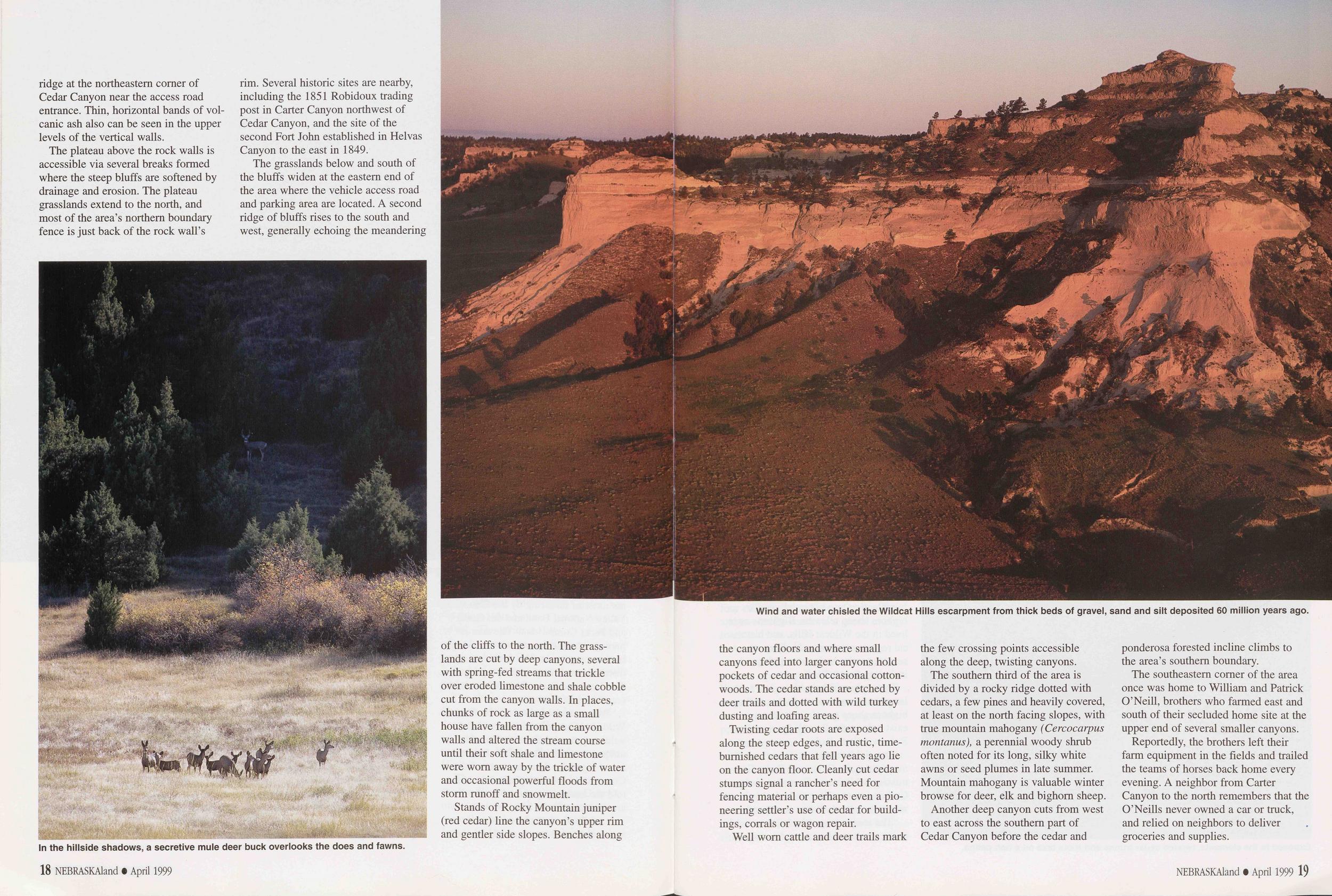 ridge at the northeastern corner of
Cedar Canyon near the access road
entrance. Thin, horizontal bands of
volcanic ash also can be seen in the upper
levels of the vertical walls.
ridge at the northeastern corner of
Cedar Canyon near the access road
entrance. Thin, horizontal bands of
volcanic ash also can be seen in the upper
levels of the vertical walls.
The plateau above the rock walls is accessible via several breaks formed where the steep bluffs are softened by drainage and erosion. The plateau grasslands extend to the north, and most of the area's northern boundary fence is just back of the rock wall's rim. Several historic sites are nearby, including the 1851 Robidoux trading post in Carter Canyon northwest of Cedar Canyon, and the site of the second Fort John established in Helvas Canyon to the east in 1849.
The grasslands below and south of the bluffs widen at the eastern end of the area where the vehicle access road and parking area are located. A second ridge of bluffs rises to the south and west, generally echoing the meandering of the cliffs to the north. The grasslands are cut by deep canyons, several with spring-fed streams that trickle over eroded limestone and shale cobble cut from the canyon walls. In places, chunks of rock as large as a small house have fallen from the canyon walls and altered the stream course until their soft shale and limestone were worn away by the trickle of water and occasional powerful floods from storm runoff and snowmelt.
Stands of Rocky Mountain juniper (red cedar) line the canyon's upper rim and gentler side slopes. Benches along
Twisting cedar roots are exposed along the steep edges, and rustic, time burnished cedars that fell years ago lie on the canyon floor. Cleanly cut cedar stumps signal a rancher's need for fencing material or perhaps even a pioneering settler's use of cedar for buildings, corrals or wagon repair.
Well worn cattle and deer trails mark the few crossing points accessible along the deep, twisting canyons.
The southern third of the area is divided by a rocky ridge dotted with cedars, a few pines and heavily covered, at least on the north facing slopes, with true mountain mahogany (Cercocarpus montanus), a perennial woody shrub often noted for its long, silky white awns or seed plumes in late summer. Mountain mahogany is valuable winter browse for deer, elk and bighorn sheep.
Another deep canyon cuts from west to east across the southern part of Cedar Canyon before the cedar and ponderosa forested incline climbs to the area's southern boundary.
The southeastern corner of the area once was home to William and Patrick O'Neill, brothers who farmed east and south of their secluded home site at the upper end of several smaller canyons.
Reportedly, the brothers left their farm equipment in the fields and trailed the teams of horses back home every evening. A neighbor from Carter Canyon to the north remembers that the O'Neills never owned a car or truck, and relied on neighbors to deliver groceries and supplies.
NEBRASKAland • April 1999 19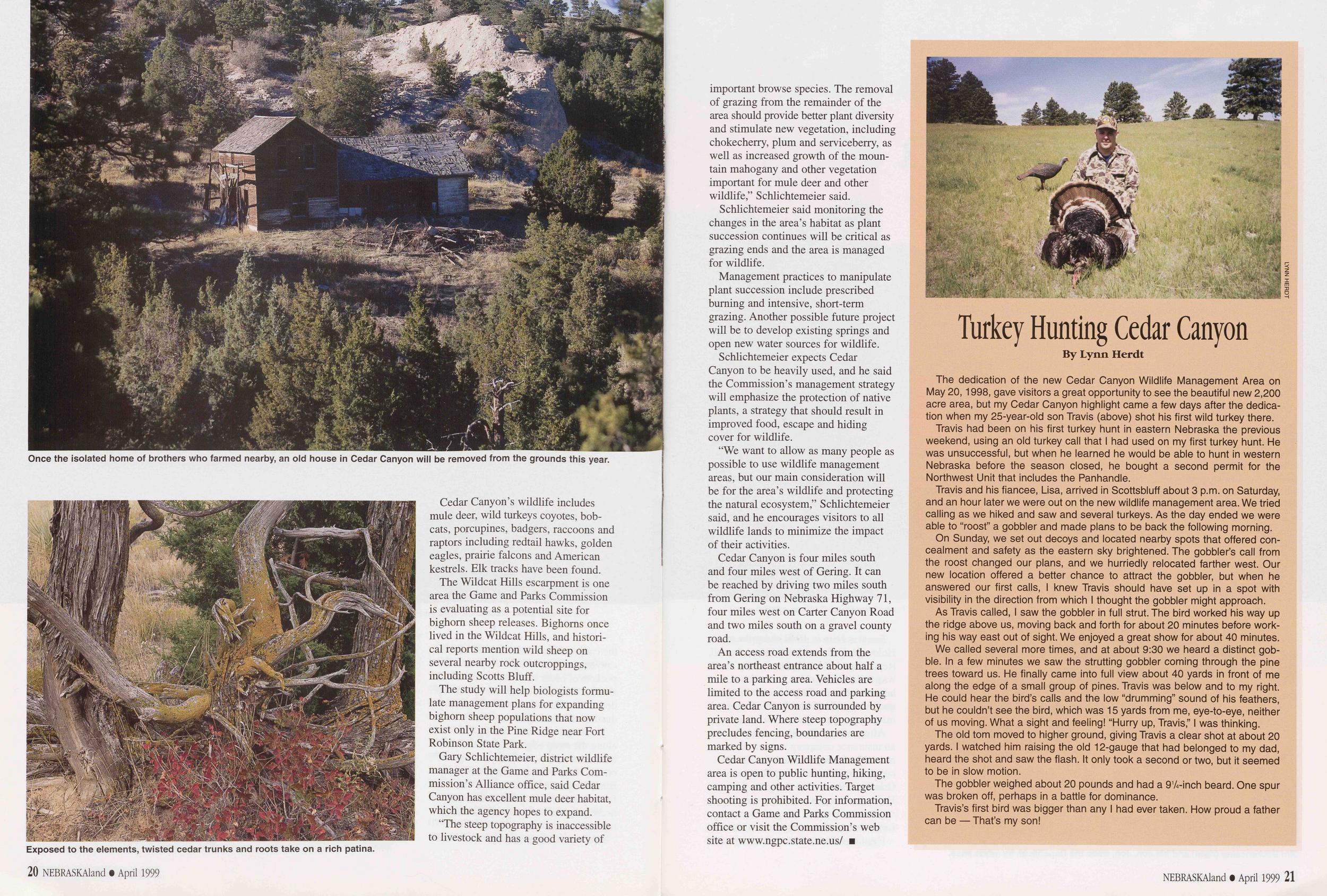
Cedar Canyon's wildlife includes mule deer, wild turkeys coyotes, bobcats, porcupines, badgers, raccoons and raptors including redtail hawks, golden eagles, prairie falcons and American kestrels. Elk tracks have been found.
The Wildcat Hills escarpment is one area the Game and Parks Commission is evaluating as a potential site for bighorn sheep releases. Bighorns once lived in the Wildcat Hills, and historical reports mention wild sheep on several nearby rock outcroppings, including Scotts Bluff.
The study will help biologists formulate management plans for expanding bighorn sheep populations that now exist only in the Pine Ridge near Fort Robinson State Park.
Gary Schlichtemeier, district wildlife manager at the Game and Parks Commission's Alliance office, said Cedar Canyon has excellent mule deer habitat, which the agency hopes to expand.
"The steep topography is inaccessible to livestock and has a good variety of 20 NEBRASKAland • April 1999 important browse species. The removal of grazing from the remainder of the area should provide better plant diversity and stimulate new vegetation, including chokecherry, plum and serviceberry, as well as increased growth of the mountain mahogany and other vegetation important for mule deer and other wildlife," Schlichtemeier said.
Schlichtemeier said monitoring the changes in the area's habitat as plant succession continues will be critical as grazing ends and the area is managed for wildlife.
Management practices to manipulate plant succession include prescribed burning and intensive, short-term grazing. Another possible future project will be to develop existing springs and open new water sources for wildlife.
Schlichtemeier expects Cedar Canyon to be heavily used, and he said the Commission's management strategy will emphasize the protection of native plants, a strategy that should result in improved food, escape and hiding cover for wildlife.
"We want to allow as many people as possible to use wildlife management areas, but our main consideration will be for the area's wildlife and protecting the natural ecosystem," Schlichtemeier said, and he encourages visitors to all wildlife lands to minimize the impact of their activities.
Cedar Canyon is four miles south and four miles west of Gering. It can be reached by driving two miles south from Gering on Nebraska Highway 71, four miles west on Carter Canyon Road and two miles south on a gravel county road.
An access road extends from the area's northeast entrance about half a mile to a parking area. Vehicles are limited to the access road and parking area. Cedar Canyon is surrounded by private land. Where steep topography precludes fencing, boundaries are marked by signs.
Cedar Canyon Wildlife Management area is open to public hunting, hiking, camping and other activities. Target shooting is prohibited. For information, contact a Game and Parks Commission office or visit the Commission's web site at www.ngpc.state.ne.us/
The dedication of the new Cedar Canyon Wildlife Management Area on May 20,1998, gave visitors a great opportunity to see the beautiful new 2,200 acre area, but my Cedar Canyon highlight came a few days after the dedication when my 25-year-old son Travis (above) shot his first wild turkey there.
Travis had been on his first turkey hunt in eastern Nebraska the previous weekend, using an old turkey call that I had used on my first turkey hunt. He was unsuccessful, but when he learned he would be able to hunt in western Nebraska before the season closed, he bought a second permit for the Northwest Unit that includes the Panhandle.
Travis and his fiancee, Lisa, arrived in Scottsbluff about 3 p.m. on Saturday, and an hour later we were out on the new wildlife management area. We tried calling as we hiked and saw and several turkeys. As the day ended we were able to "roost" a gobbler and made plans to be back the following morning.
On Sunday, we set out decoys and located nearby spots that offered concealment and safety as the eastern sky brightened. The gobbler's call from the roost changed our plans, and we hurriedly relocated farther west. Our new location offered a better chance to attract the gobbler, but when he answered our first calls, I knew Travis should have set up in a spot with visibility in the direction from which I thought the gobbler might approach.
As Travis called, I saw the gobbler in full strut. The bird worked his way up the ridge above us, moving back and forth for about 20 minutes before working his way east out of sight. We enjoyed a great show for about 40 minutes.
We called several more times, and at about 9:30 we heard a distinct gobble. In a few minutes we saw the strutting gobbler coming through the pine trees toward us. He finally came into full view about 40 yards in front of me along the edge of a small group of pines. Travis was below and to my right. He could hear the bird's calls and the low "drumming" sound of his feathers, but he couldn't see the bird, which was 15 yards from me, eye-to-eye, neither of us moving. What a sight and feeling! "Hurry up, Travis," I was thinking.
The old torn moved to higher ground, giving Travis a clear shot at about 20 yards. I watched him raising the old 12-gauge that had belonged to my dad, heard the shot and saw the flash. It only took a second or two, but it seemed to be in slow motion.
The gobbler weighed about 20 pounds and had a 91A-inch beard. One spur was broken off, perhaps in a battle for dominance.
Travis's first bird was bigger than any I had ever taken. How proud a father can be —That's my son!
NEBRASKAland t April 1999 21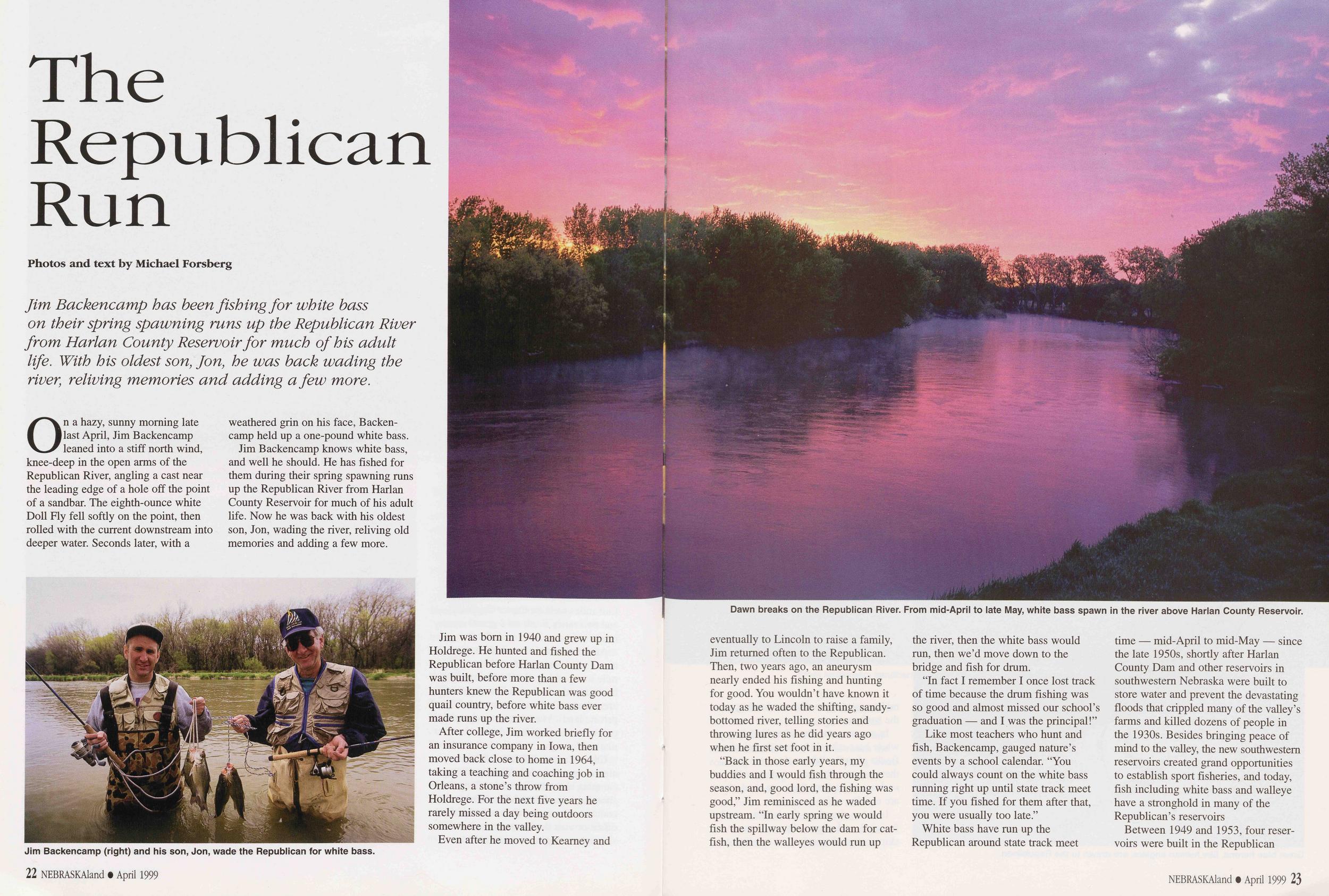
The Republican Run
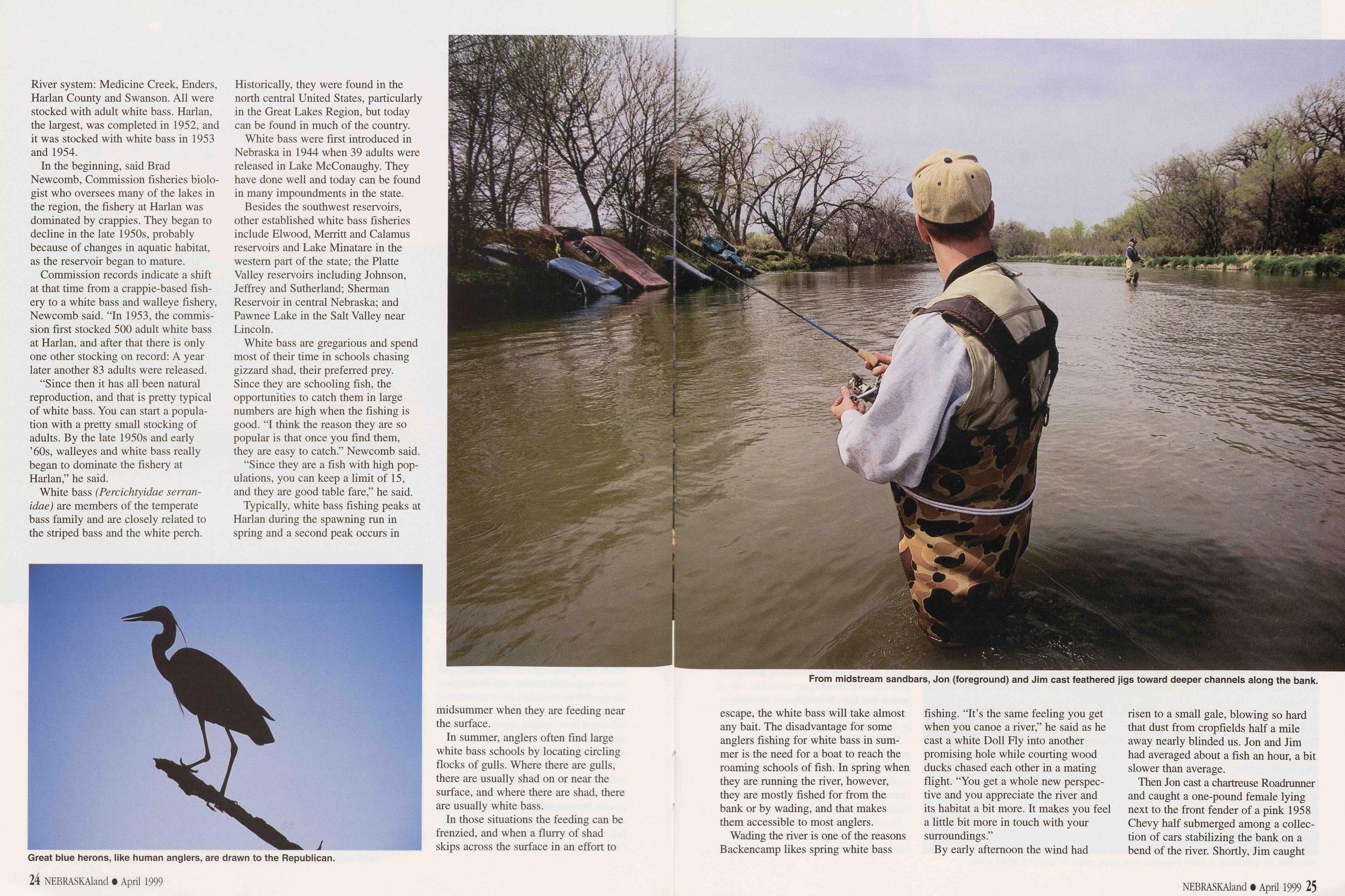
Photos and text by Michael Forsberg Jim Backencamp has been fishing for white bass on their spring spawning runs up the Republican River from Harlan County Reservoir for much of his adult life. With his oldest son, Jon, he was back wading the river, reliving memories and adding a few more.On a hazy, sunny morning late last April, Jim Backencamp leaned into a stiff north wind, knee-deep in the open arms of the Republican River, angling a cast near the leading edge of a hole off the point of a sandbar. The eighth-ounce white Doll Fly fell softly on the point, then rolled with the current downstream into deeper water. Seconds later, with a weathered grin on his face, Backencamp held up a one-pound white bass.
Jim Backencamp knows white bass, and well he should. He has fished for them during their spring spawning runs up the Republican River from Harlan County Reservoir for much of his adult life. Now he was back with his oldest son, Jon, wading the river, reliving old memories and adding a few more.
Jim was born in 1940 and grew up in Holdrege. He hunted and fished the Republican before Harlan County Dam was built, before more than a few hunters knew the Republican was good quail country, before white bass ever made runs up the river.
After college, Jim worked briefly for an insurance company in Iowa, then moved back close to home in 1964, taking a teaching and coaching job in Orleans, a stone's throw from Holdrege. For the next five years he rarely missed a day being outdoors somewhere in the valley.
Even after he moved to Kearney and
"Back in those early years, my buddies and I would fish through the season, and, good lord, the fishing was good," Jim reminisced as he waded upstream. "In early spring we would fish the spillway below the dam for catfish, then the walleyes would run up the river, then the white bass would run, then we'd move down to the bridge and fish for drum.
"In fact I remember I once lost track of time because the drum fishing was so good and almost missed our school's graduation — and I was the principal!"
Like most teachers who hunt and fish, Backencamp, gauged nature's events by a school calendar. "You could always count on the white bass running right up until state track meet time. If you fished for them after that, you were usually too late."
White bass have run up the Republican around state track meet time — mid-April to mid-May — since the late 1950s, shortly after Harlan County Dam and other reservoirs in southwestern Nebraska were built to store water and prevent the devastating floods that crippled many of the valley's farms and killed dozens of people in the 1930s. Besides bringing peace of mind to the valley, the new southwestern reservoirs created grand opportunities to establish sport fisheries, and today, fish including white bass and walleye have a stronghold in many of the Republican's reservoirs
Between 1949 and 1953, four
reservoirs were built in the Republican
NEBRASKAland • April 1999 23
 River system: Medicine Creek, Enders,
Harlan County and Swanson. All were
stocked with adult white bass. Harlan,
the largest, was completed in 1952, and
it was stocked with white bass in 1953
and 1954.
River system: Medicine Creek, Enders,
Harlan County and Swanson. All were
stocked with adult white bass. Harlan,
the largest, was completed in 1952, and
it was stocked with white bass in 1953
and 1954.
In the beginning, said Brad Newcomb, Commission fisheries biologist who oversees many of the lakes in the region, the fishery at Harlan was dominated by crappies. They began to decline in the late 1950s, probably because of changes in aquatic habitat, as the reservoir began to mature.
Commission records indicate a shift at that time from a crappie-based fishery to a white bass and walleye fishery, Newcomb said. "In 1953, the commission first stocked 500 adult white bass at Harlan, and after that there is only one other stocking on record: A year later another 83 adults were released.
"Since then it has all been natural reproduction, and that is pretty typical of white bass. You can start a population with a pretty small stocking of adults. By the late 1950s and early '60s, walleyes and white bass really began to dominate the fishery at Harlan," he said.
White bass (Percichtyidae serranidae) are members of the temperate bass family and are closely related to the striped bass and the white perch. Historically, they were found in the north central United States, particularly in the Great Lakes Region, but today can be found in much of the country.
White bass were first introduced in Nebraska in 1944 when 39 adults were released in Lake McConaughy. They have done well and today can be found in many impoundments in the state.
Besides the southwest reservoirs, other established white bass fisheries include Elwood, Merritt and Calamus reservoirs and Lake Minatare in the western part of the state; the Platte Valley reservoirs including Johnson, Jeffrey and Sutherland; Sherman Reservoir in central Nebraska; and Pawnee Lake in the Salt Valley near Lincoln.
White bass are gregarious and spend most of their time in schools chasing gizzard shad, their preferred prey. Since they are schooling fish, the opportunities to catch them in large numbers are high when the fishing is good. "I think the reason they are so popular is that once you find them, they are easy to catch." Newcomb said.
"Since they are a fish with high populations, you can keep a limit of 15, and they are good table fare," he said.
Typically, white bass fishing peaks at Harlan during the spawning run in spring and a second peak occurs in midsummer when they are feeding near the surface.
In summer, anglers often find large white bass schools by locating circling flocks of gulls. Where there are gulls, there are usually shad on or near the surface, and where there are shad, there are usually white bass.
In those situations the feeding can be frenzied, and when a flurry of shad skips across the surface in an effort to
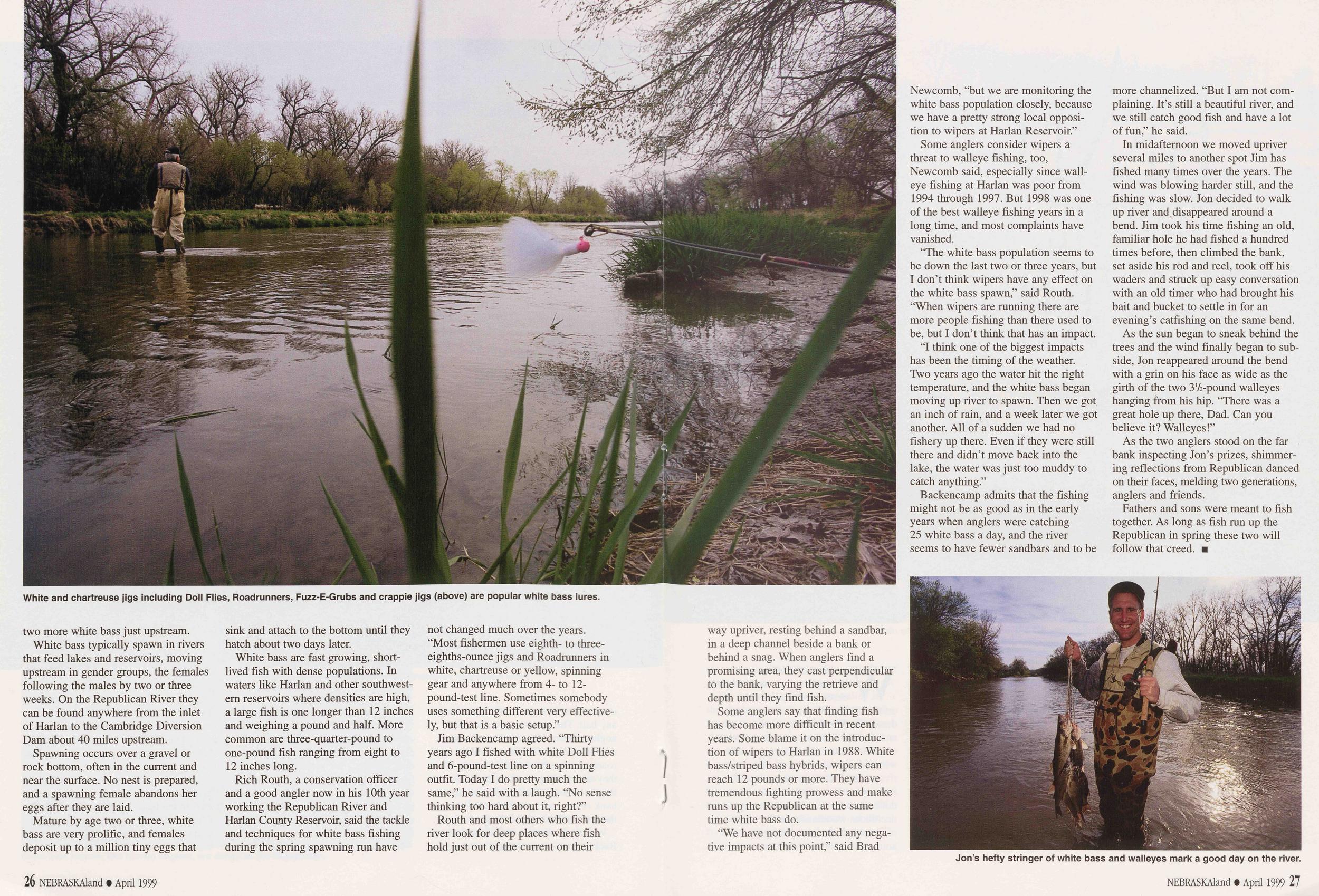
Wading the river is one of the reasons Backencamp likes spring white bass fishing. "It's the same feeling you get when you canoe a river," he said as he cast a white Doll Fly into another promising hole while courting wood ducks chased each other in a mating flight. "You get a whole new perspective and you appreciate the river and its habitat a bit more. It makes you feel a little bit more in touch with your surroundings."
By early afternoon the wind had risen to a small gale, blowing so hard that dust from crop fields half a mile away nearly blinded us. Jon and Jim had averaged about a fish an hour, a bit slower than average.
Then Jon cast a chartreuse Roadrunner
and caught a one-pound female lying
next to the front fender of a pink 1958
Chevy half submerged among a
collection of cars stabilizing the bank on a
bend of the river. Shortly, Jim caught
NEBRASKAland • April 1999 25
White bass typically spawn in rivers that feed lakes and reservoirs, moving upstream in gender groups, the females following the males by two or three weeks. On the Republican River they can be found anywhere from the inlet of Harlan to the Cambridge Diversion Dam about 40 miles upstream.
Spawning occurs over a gravel or rock bottom, often in the current and near the surface. No nest is prepared, and a spawning female abandons her eggs after they are laid.
Mature by age two or three, white bass are very prolific, and females deposit up to a million tiny eggs that sink and attach to the bottom until they hatch about two days later.
White bass are fast growing, short-lived fish with dense populations. In waters like Harlan and other southwestern reservoirs where densities are high, a large fish is one longer than 12 inches and weighing a pound and half. More common are three-quarter-pound to one-pound fish ranging from eight to 12 inches long.
Rich Routh, a conservation officer and a good angler now in his 10th year working the Republican River and Harlan County Reservoir, said the tackle and techniques for white bass fishing during the spring spawning run have not changed much over the years. "Most fishermen use eighth- to three-eighths-ounce jigs and Roadrunners in white, chartreuse or yellow, spinning gear and anywhere from 4- to 12- pound-test line. Sometimes somebody uses something different very effectively, but that is a basic setup."
Jim Backencamp agreed. "Thirty years ago I fished with white Doll Flies and 6-pound-test line on a spinning outfit. Today I do pretty much the same," he said with a laugh. "No sense thinking too hard about it, right?"
Routh and most others who fish the river look for deep places where fish hold just out of the current on their 26 NEBRASKAland t April 1999 way upriver, resting behind a sandbar, in a deep channel beside a bank or behind a snag. When anglers find a promising area, they cast perpendicular to the bank, varying the retrieve and depth until they find fish.
Some anglers say that finding fish has become more difficult in recent years. Some blame it on the introduction of wipers to Harlan in 1988. White bass/striped bass hybrids, wipers can reach 12 pounds or more. They have tremendous fighting prowess and make runs up the Republican at the same time white bass do.
"We have not documented any negative impacts at this point," said Brad Newcomb, "but we are monitoring the white bass population closely, because we have a pretty strong local opposition to wipers at Harlan Reservoir."
Some anglers consider wipers a threat to walleye fishing, too, Newcomb said, especially since walleye fishing at Harlan was poor from 1994 through 1997. But 1998 was one of the best walleye fishing years in a long time, and most complaints have vanished.
"The white bass population seems to be down the last two or three years, but I don't think wipers have any effect on the white bass spawn," said Routh. "When wipers are running there are more people fishing than there used to be, but I don't think that has an impact.
"I think one of the biggest impacts has been the timing of the weather. Two years ago the water hit the right temperature, and the white bass began moving up river to spawn. Then we got an inch of rain, and a week later we got another. All of a sudden we had no fishery up there. Even if they were still there and didn't move back into the lake, the water was just too muddy to catch anything."
Backencamp admits that the fishing might not be as good as in the early years when anglers were catching 25 white bass a day, and the river seems to have fewer sandbars and to be more channelized. "But I am not complaining. It's still a beautiful river, and we still catch good fish and have a lot of fun," he said.
In midafternoon we moved upriver several miles to another spot Jim has fished many times over the years. The wind was blowing harder still, and the fishing was slow. Jon decided to walk up river and disappeared around a bend. Jim took his time fishing an old, familiar hole he had fished a hundred times before, then climbed the bank, set aside his rod and reel, took off his waders and struck up easy conversation with an old timer who had brought his bait and bucket to settle in for an evening's catfishing on the same bend.
As the sun began to sneak behind the trees and the wind finally began to subside, Jon reappeared around the bend with a grin on his face as wide as the girth of the two 372-pound walleyes hanging from his hip. "There was a great hole up there, Dad. Can you believe it? Walleyes!"
As the two anglers stood on the far bank inspecting Jon's prizes, shimmering reflections from Republican danced on their faces, melding two generations, anglers and friends.
Fathers and sons were meant to fish together. As long as fish run up the Republican in spring these two will follow that creed.
IN THE RIVER
Photos and text by Jon Farrar Where a river arches in a lazy bend today, it probably will not tomorrow and did not yesterday. But when a river turns, it leaves behind its signature: Oxbow lakes that once were channels, sloughs that once were side chutes and marshes where even older oxbows and sloughs once were.A river's course is ever changing. Rivers make no long-term plans. Their futures are determined by whim and by chance. Where a river runs straight, which is never for long if it has its way, it is predictable.
In the soft mantle of the Great Plains, few rock formations are substantial enough or extensive enough to confine a river. A river may turn away from a bluff it has gnawed for a hundred years and shift across its floodplain on a course less troublesome, but one day it will be back gnawing at the bluff. Ice jams may turn a river long enough for it to carve a new channel, or a spring flood may rage long enough to obliterate an old channel and cut a new one.
Where a river arches in a lazy bend today, it probably will not tomorrow and did not yesterday. But when a river turns, it leaves behind its signature: Oxbow lakes that once were channels, sloughs that once were side chutes, and marshlands where even older oxbows and sloughs once were. To each of these still waters is drawn a distinct community of plants and animals.
Wood Duck Wildlife Management Area in north- eastern Nebraska is at a bend on the Elkhorn River. It is no coincidence. On Wood Duck, the old Elkhorn and the new Elkhorn coexist and have created a natural diversity not found where rivers run straight or where no rivers run at all. Over the course of a few yards, riverbeds become willow thickets and willow thickets merge into deciduous woodlands. And within each of those broad zones, wild plants and animals sort by what environmental 28 NEBRASKAland • April 1999
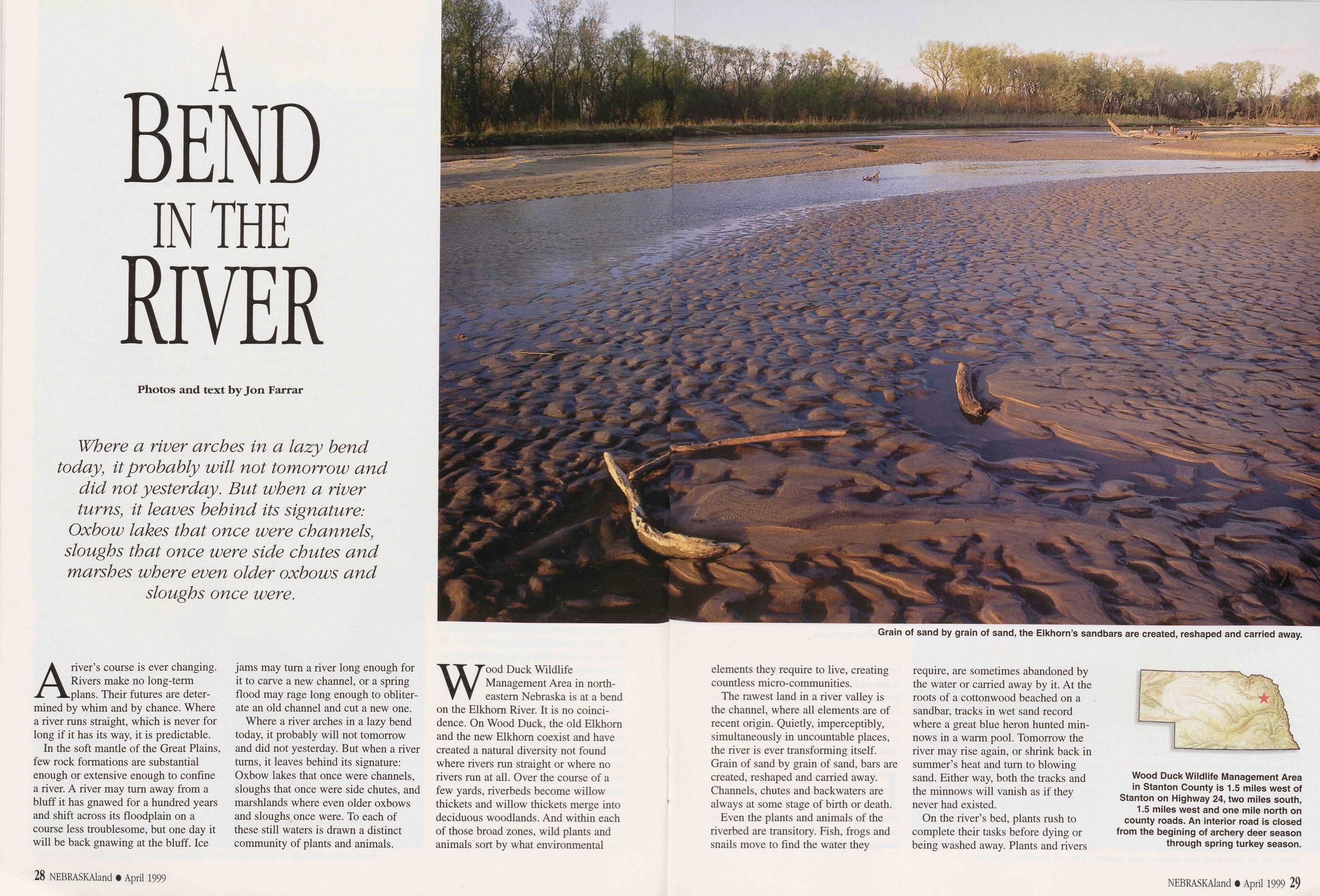
The rawest land in a river valley is the channel, where all elements are of recent origin. Quietly, imperceptibly, simultaneously in uncountable places, the river is ever transforming itself. Grain of sand by grain of sand, bars are created, reshaped and carried away. Channels, chutes and backwaters are always at some stage of birth or death.
Even the plants and animals of the riverbed are transitory. Fish, frogs and snails move to find the water they require, are sometimes abandoned by the water or carried away by it. At the roots of a cottonwood beached on a sandbar, tracks in wet sand record where a great blue heron hunted minnows in a warm pool. Tomorrow the river may rise again, or shrink back in summer's heat and turn to blowing sand. Either way, both the tracks and the minnows will vanish as if they never had existed.
On the river's bed, plants rush to complete their tasks before dying or being washed away. Plants and rivers
Hundreds, perhaps thousands of kinds of plants can prosper in a river's floodplain. Each has its own time and place in the growing season and in the evolution of a river. Weed seeds and willow sprouts can send a rush of green across dry, plantless sand in one summer. They are pioneers, putting down shallow, tentative roots, investing in the short-term, dispersing their offspring quickly before the sandbar is again scoured clean by surging water.
Other plants gamble on the long term. A flyspeck cottonwood seed can send an 80-foot tree towering overhead, if the river allows it. Farther from the river, longer-lived trees grow to take the place of cottonwoods that fall to old age or lightning strikes. This is the natural progression of floodplain woodlands, but it can all be stopped, sent back to its beginning by the rush of water and ice. The wild rye and monkey flower, prickly ash and gooseberry, cottonwood and box elder belong to the river, and so, too, do the crayfish, raccoons and white-tailed deer. A river is more than just running water.
Few Nebraska rivers can rival the Elkhorn's profusion of oxbows and sloughs. Perhaps the Elkhorn was lucky — was just the right size river at the right time, with a floodplain broad enough to allow frequent channel 30 NEBRASKAland t April 1999 meanderings that created oxbows and sloughs, but a floodplain not so broad as the Platte's that invited the wholesale draining and filling of off-channel waters to create farmland.
Wood Duck, because it is at a bend in the river, has its oxbow, a sliver of shallow water arching through the heart of the area, a cool, shadowy spot of water where cottonwoods and wild grape drape the shorelines. Smaller woodland pools are even more secluded, hidden under vaulted ceilings that close out the sky; deep, dark woodland ponds where fog-fruit, bellflower and horse- tail fern grow; their waters laced with fallen branches where reclusive greenbacked herons perch.
Once the big oxbow on Wood Duck was called Loe's lake, the name of the landowner who, in the courthouse at least, owned it. Fishermen of all sorts have long frequented its banks. Accountants from Norfolk come to escape the daytime ring of telephones and shuffle of spreadsheets. Old men in bib overalls come at the end of days in the cornfields to sit on buckets and catch whatever the river has left behind — catfish and carp mostly, but some years, bass and northerns. Kingfishers and great blue herons come for the same catches, and mink and raccoon for frogs and crayfish.
Fed by springs and seeps, the Elkhorn's unseen, underground flow, the oxbow could be dredged deeper and stocked with gamefish, but when the river rises, its water and its burden — silt, debris and river fish — wash into the oxbow, and what man stocks the river washes out. The river has abandoned the oxbow, but has not relinquished ownership.
Woodland wetlands like Loe's Lake, while aesthetically satisfying, have a weak pull on wild creatures. Acre for acre, square inch for square inch, few places on earth can match the abundance and diversity of life found on a freshwater marsh. More biomass, the scientist's term for pounds of plant and animal, is produced on these sun-flooded wetlands than in woodlands or wheat fields. And so it is on Wood Duck.
The first parcel of the Wood Duck Wildlife Management Area was acquired in 1966, when wood ducks were still a relatively rare sight in the state. Wood ducks nest in tree hollows near shallow waters, and so Wood Duck, a premier breeding ground for these sharp-toed, branch-grasping ducks, was aptly named.
Wood Duck's cattail marshes also are attractive to blue-winged teal, mallards and other puddle ducks that seek small waters during the migration and breeding seasons. The marshes are way-stations for migrating water birds. Sandpipers probe mudflats for minute invertebrates. Terns dip for small fish in shallows or hatchling Mayflies and
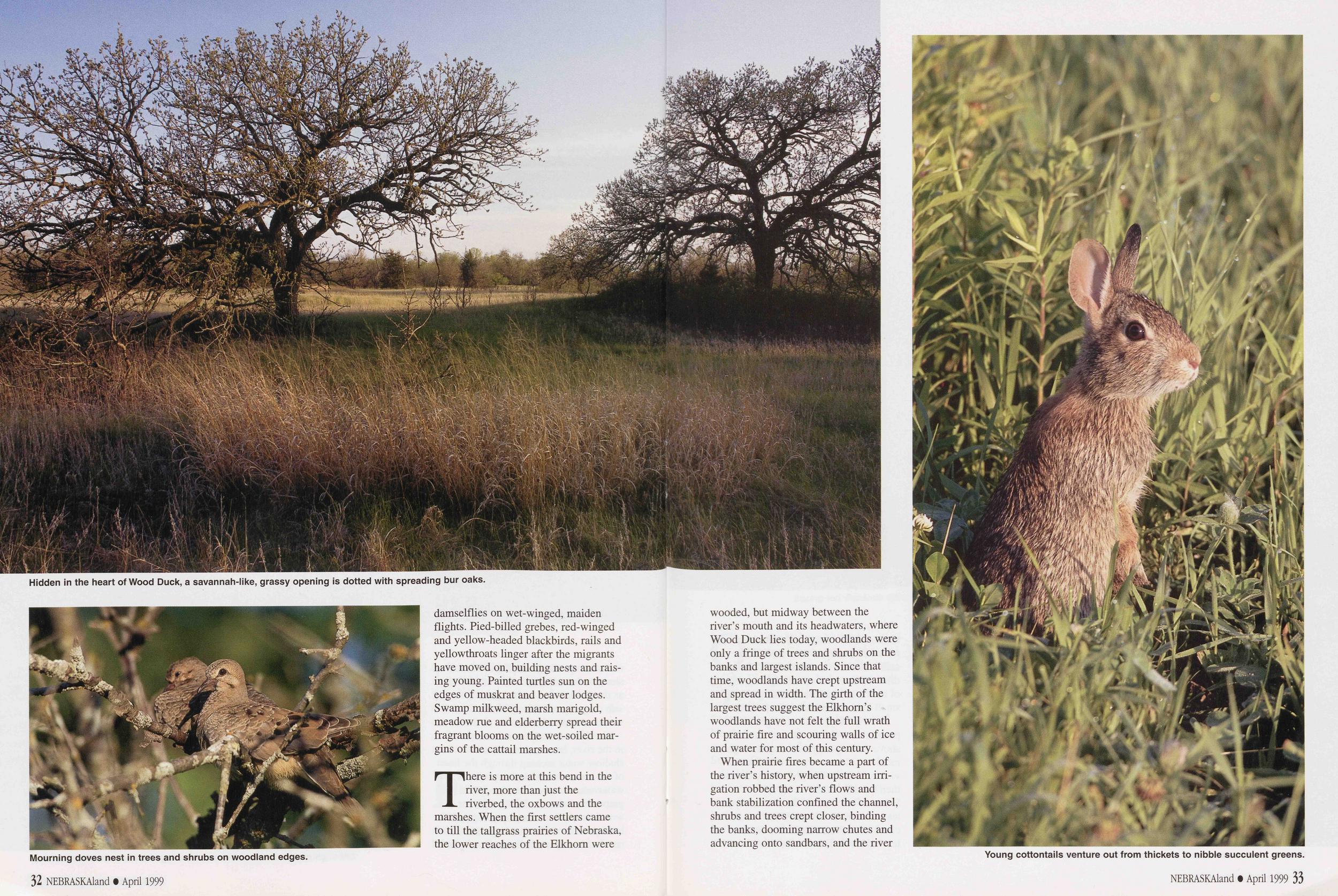
There is more at this bend in the river, more than just the riverbed, the oxbows and the marshes. When the first settlers came to till the tallgrass prairies of Nebraska, the lower reaches of the Elkhorn were 32 NEBRASKAland t April 1999 wooded, but midway between the river's mouth and its headwaters, where Wood Duck lies today, woodlands were only a fringe of trees and shrubs on the banks and largest islands. Since that time, woodlands have crept upstream and spread in width. The girth of the largest trees suggest the Elkhorn's woodlands have not felt the full wrath of prairie fire and scouring walls of ice and water for most of this century.
When prairie fires became a part of the river's history, when upstream irrigation robbed the river's flows and bank stabilization confined the channel, shrubs and trees crept closer, binding the banks, dooming narrow chutes and advancing onto sandbars, and the river
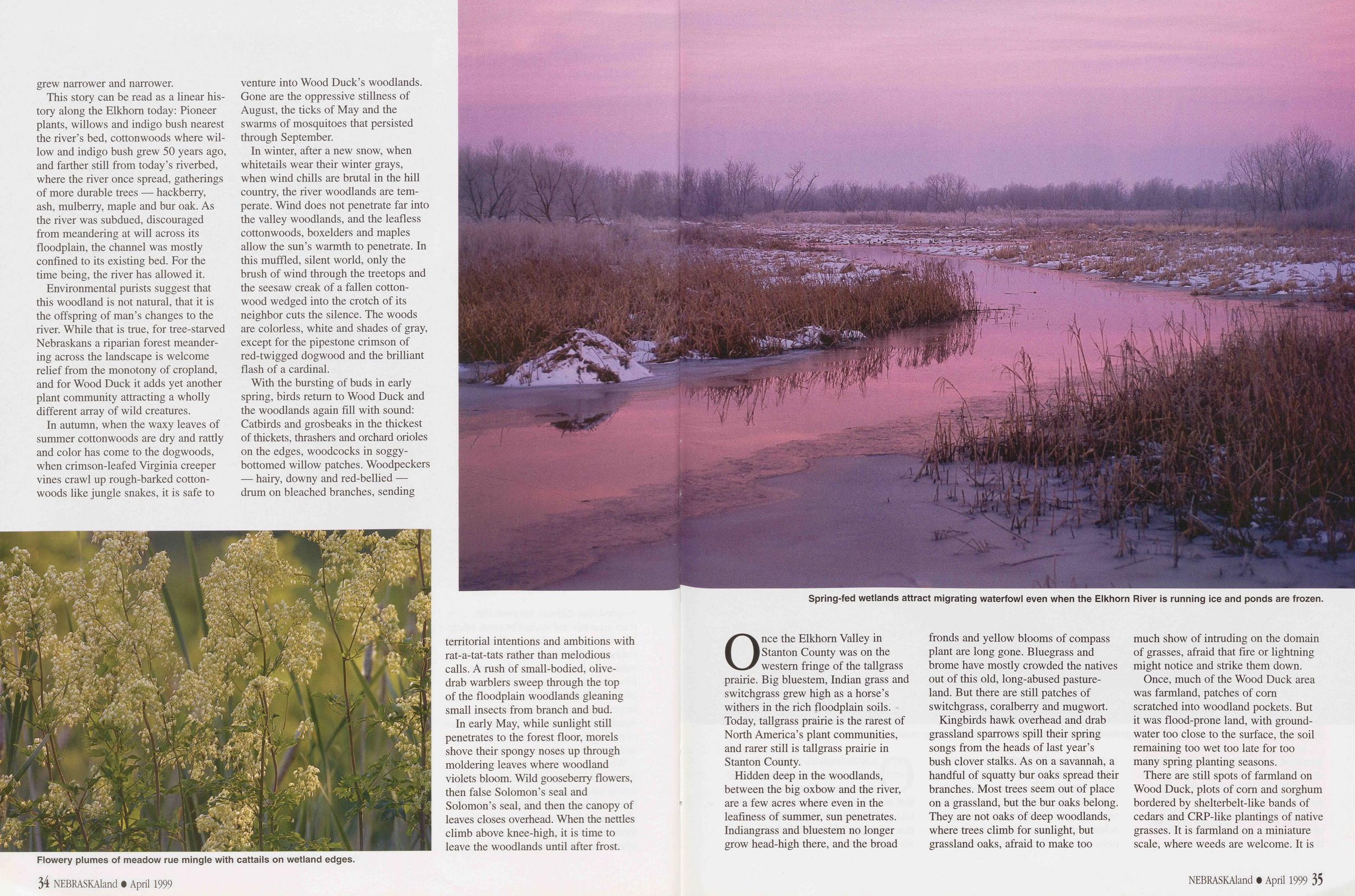 grew narrower and narrower.
This story can be read as a linear history along the Elkhorn today: Pioneer plants, willows and indigo bush nearest the river's bed, cotton woods where willow and indigo bush grew 50 years ago, and farther still from today's riverbed, where the river once spread, gatherings of more durable trees — hackberry, ash, mulberry, maple and bur oak. As the river was subdued, discouraged from meandering at will across its floodplain, the channel was mostly confined to its existing bed. For the time being, the river has allowed it.
Environmental purists suggest that this woodland is not natural, that it is the offspring of man's changes to the river. While that is time, for tree-starved Nebraskans a riparian forest meandering across the landscape is welcome relief from the monotony of cropland, and for Wood Duck it adds yet another plant community attracting a wholly different array of wild creatures.
In autumn, when the waxy leaves of summer cottonwoods are dry and rattly and color has come to the dogwoods, when crimson-leafed Virginia creeper vines crawl up rough-barked cottonwoods like jungle snakes, it is safe to venture into Wood Duck's woodlands. Gone are the oppressive stillness of August, the ticks of May and the swarms of mosquitoes that persisted through September.
In winter, after a new snow, when whitetails wear their winter grays, when wind chills are brutal in the hill country, the river woodlands are temperate. Wind does not penetrate far into the valley woodlands, and the leafless cottonwoods, boxelders and maples allow the sun's warmth to penetrate. In this muffled, silent world, only the bmsh of wind through the treetops and the seesaw creak of a fallen cottonwood wedged into the crotch of its neighbor cuts the silence. The woods are colorless, white and shades of gray, except for the pipestone crimson of red-twigged dogwood and the brilliant flash of a cardinal.
With the bursting of buds in early spring, birds return to Wood Duck and the woodlands again fill with sound: Catbirds and grosbeaks in the thickest of thickets, thrashers and orchard orioles on the edges, woodcocks in soggy bottomed willow patches. Woodpeckers — hairy, downy and red-bellied — drum on bleached branches, sending territorial intentions and ambitions with rat-a-tat-tats rather than melodious calls. A mash of small-bodied, olive drab warblers sweep through the top of the floodplain woodlands gleaning small insects from branch and bud.
In early May, while sunlight still penetrates to the forest floor, morels shove their spongy noses up through moldering leaves where woodland violets bloom. Wild gooseberry flowers, then false Solomon's seal and Solomon's seal, and then the canopy of leaves closes overhead. When the nettles climb above knee-high, it is time to leave the woodlands until after frost.
Once the Elkhorn Valley in Stanton County was on the western fringe of the tallgrass prairie. Big bluestem, Indian grass and switchgrass grew high as a horse's withers in the rich floodplain soils. Today, tallgrass prairie is the rarest of North America's plant communities, and rarer still is tallgrass prairie in Stanton County.
Hidden deep in the woodlands, between the big oxbow and the river, are a few acres where even in the leafiness of summer, sun penetrates. Indiangrass and bluestem no longer grow head-high there, and the broad fronds and yellow blooms of compass plant are long gone. Bluegrass and brome have mostly crowded the natives out of this old, long-abused pasture land. But there are still patches of switchgrass, coralberry and mugwort.
Kingbirds hawk overhead and drab grassland sparrows spill their spring songs from the heads of last year's bush clover stalks. As on a savannah, a handful of squatty bur oaks spread their branches. Most trees seem out of place on a grassland, but the bur oaks belong. They are not oaks of deep woodlands, where trees climb for sunlight, but grassland oaks, afraid to make too much show of intruding on the domain of grasses, afraid that fire or lightning might notice and strike them down.
Once, much of the Wood Duck area was farmland, patches of corn scratched into woodland pockets. But it was flood-prone land, with groundwater too close to the surface, the soil remaining too wet too late for too many spring planting seasons.
There are still spots of farmland on
Wood Duck, plots of corn and sorghum
bordered by shelter belt like bands of
cedars and CRP-like plantings of native
grasses. It is farmland on a miniature
scale, where weeds are welcome. It is
NEBRASKAland • April 1999 35
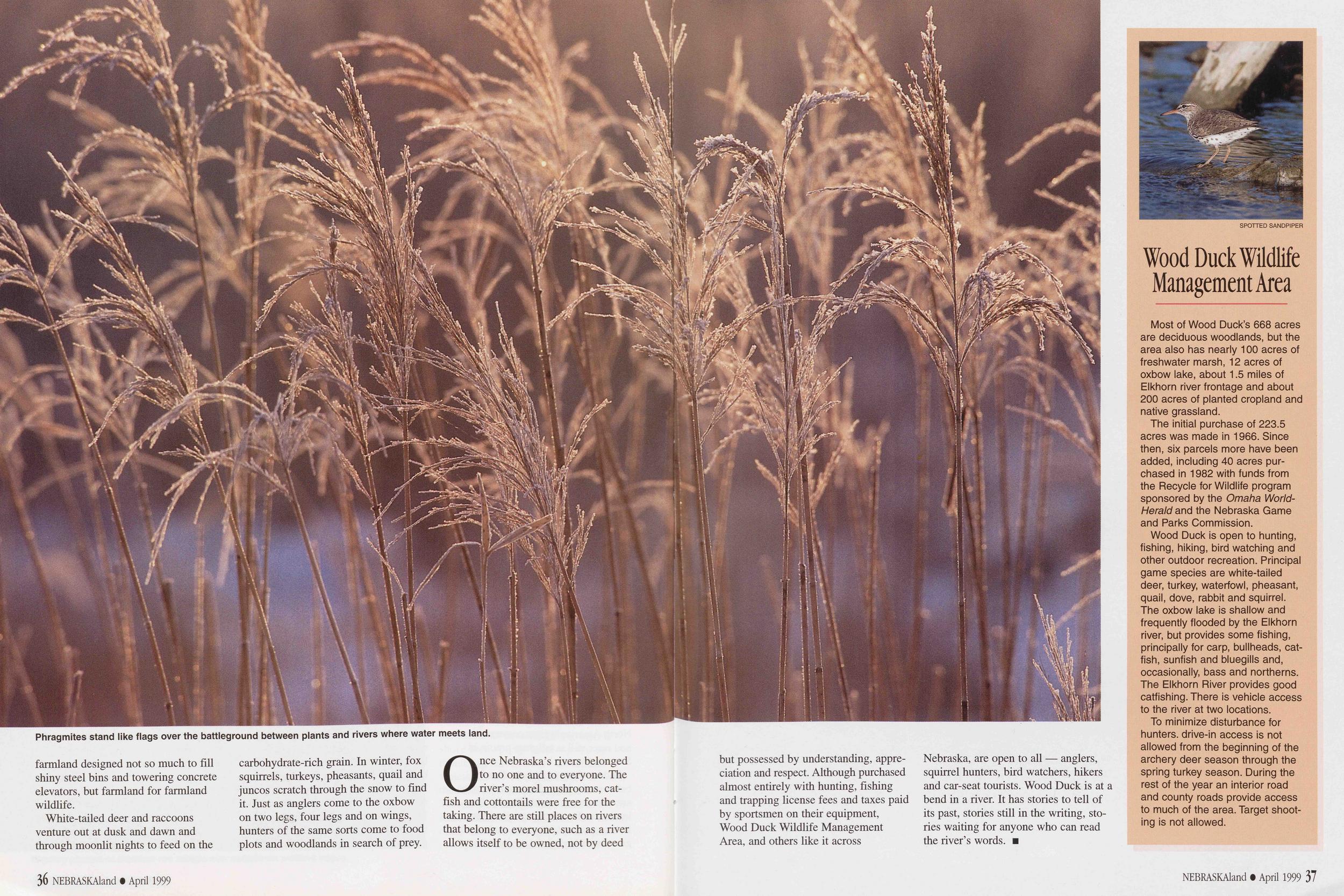
White-tailed deer and raccoons venture out at dusk and dawn and through moonlit nights to feed on the carbohydrate-rich grain. In winter, fox squirrels, turkeys, pheasants, quail and juncos scratch through the snow to find it. Just as anglers come to the oxbow on two legs, four legs and on wings, hunters of the same sorts come to food plots and woodlands in search of prey.
Once Nebraska's rivers belonged to no one and to everyone. The river's morel mushrooms, cat- fish and cottontails were free for the taking. There are still places on rivers that belong to everyone, such as a river allows itself to be owned, not by deed 36 NEBRASKAland • April 1999 but possessed by understanding, appreciation and respect. Although purchased almost entirely with hunting, fishing and trapping license fees and taxes paid by sportsmen on their equipment, Wood Duck Wildlife Management Area, and others like it across Nebraska, are open to all — anglers, squirrel hunters, bird watchers, hikers and car-seat tourists. Wood Duck is at a bend in a river. It has stories to tell of its past, stories still in the writing, stories waiting for anyone who can read the river's words.
Most of Wood Duck's 668 acres are deciduous woodlands, but the area also has nearly 100 acres of freshwater marsh, 12 acres of oxbow lake, about 1.5 miles of Elkhorn river frontage and about 200 acres of planted cropland and native grassland.
The initial purchase of 223.5 acres was made in 1966. Since then, six parcels more have been added, including 40 acres purchased in 1982 with funds from the Recycle for Wildlife program sponsored by the Omaha World- Herald and the Nebraska Game and Parks Commission.
Wood Duck is open to hunting, fishing, hiking, bird watching and other outdoor recreation. Principal game species are white-tailed deer, turkey, waterfowl, pheasant, quail, dove, rabbit and squirrel. The oxbow lake is shallow and frequently flooded by the Elkhorn river, but provides some fishing, principally for carp, bullheads, catfish, sunfish and bluegills and, occasionally, bass and northerns. The Elkhorn River provides good catfishing. There is vehicle access to the river at two locations.
To minimize disturbance for hunters, drive-in access is not allowed from the beginning of the archery deer season through the spring turkey season. During the rest of the year an interior road and county roads provide access to much of the area. Target shooting is not allowed.
NEBRASKAland • April 1999 37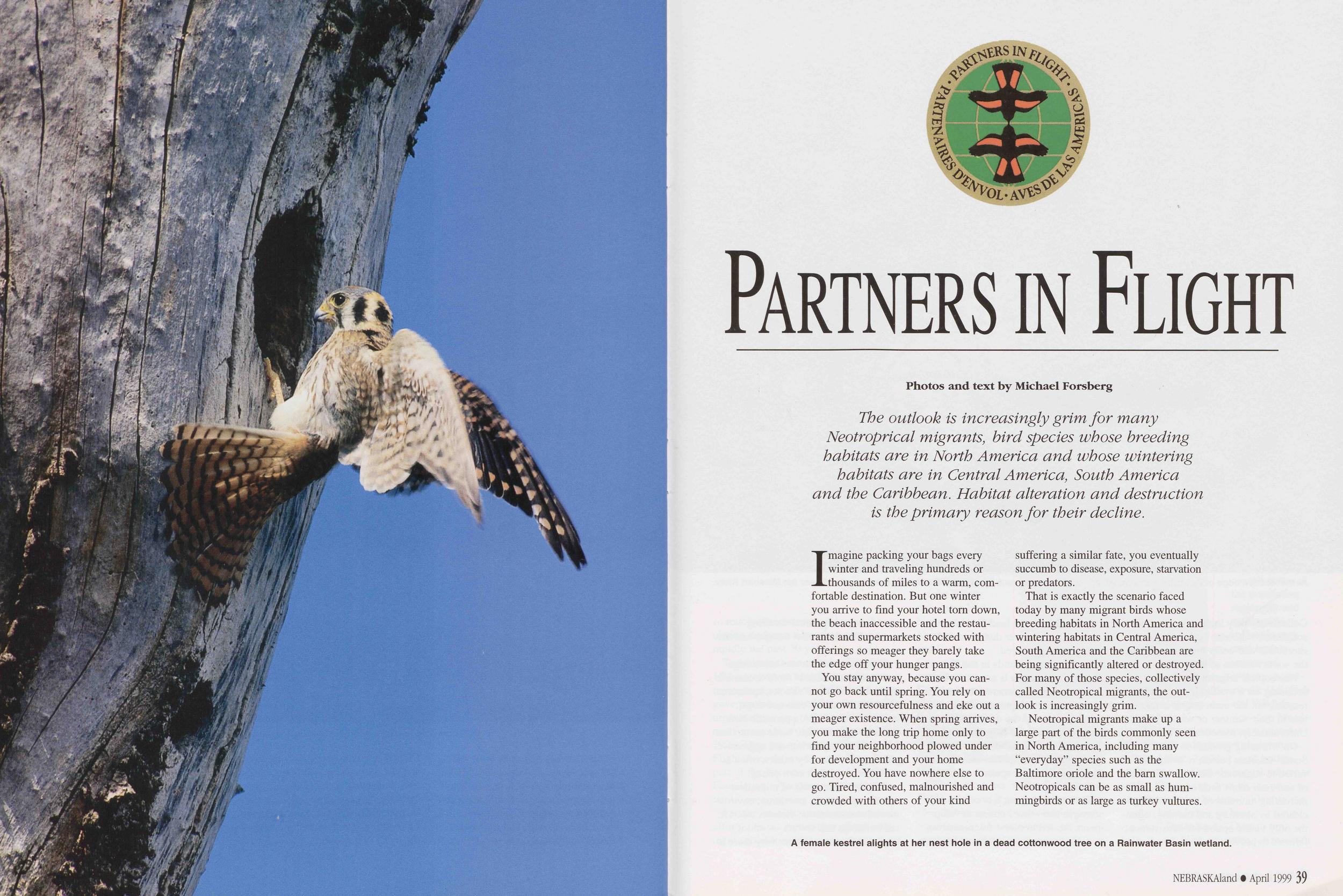
Partners in Flight
Photos and text by Michael Forsberg The outlook is increasingly grim for many Neotroprical migrants, bird species whose breeding habitats are in North America and whose wintering habitats are in Central America, South America and the Caribbean, Habitat alteration and destruction is the primary reason for their decline.Imagine packing your bags every winter and traveling hundreds or thousands of miles to a warm, comfortable destination. But one winter you arrive to find your hotel torn down, the beach inaccessible and the restaurants and supermarkets stocked with offerings so meager they barely take the edge off your hunger pangs.
You stay anyway, because you cannot go back until spring. You rely on your own resourcefulness and eke out a meager existence. When spring arrives, you make the long trip home only to find your neighborhood plowed under for development and your home destroyed. You have nowhere else to go. Tired, confused, malnourished and crowded with others of your kind suffering a similar fate, you eventually succumb to disease, exposure, starvation or predators.
That is exactly the scenario faced today by many migrant birds whose breeding habitats in North America and wintering habitats in Central America, South America and the Caribbean are being significantly altered or destroyed. For many of those species, collectively called Neotropical migrants, the outlook is increasingly grim.
Neotropical migrants make up a large part of the birds commonly seen in North America, including many "everyday" species such as the Baltimore oriole and the barn swallow. Neotropicals can be as small as hummingbirds or as large as turkey vultures. NEBRASKAland • April 1999 39
Neotropical migrant populations are declining for a multitude of complex reasons, but the main culprit is habitat loss in their summer or winter homes. Unfortunately, sometimes it is both.
On wintering grounds in Central and South America, habitat is being converted to sugarcane fields, cattle ranches and cash crops such as coffee, and increasing amounts of land are being cleared by slashing and burning, often the only viable option for subsistence farmers to provide for their families. Clearing leaves the land permanently scarred, soils forever disturbed and forests forever altered.
On breeding grounds in the United States, the situation is not much better. In some regions, fencerow-to-fencerow agricultural development, suburban development and the drainage of wetlands has destroyed large tracts of grassland nesting habitat upon which many prairie bird species like the dickcissel, grasshopper sparrow and bobolink depend.
In woodland areas, a boom in acreages and other housing developments has led to forest fragmentation that eliminates the deep forest habitat needed by many forest-dwelling species like the scarlet tanager and the ovenbird.
Fragmentation creates more edge and makes woodlands more accessible to predators such as skunks, opossums, raccoons, domestic cats and dogs, crows and cowbirds, a parasitic bird that lays eggs in other birds nests, then leaves the fast-growing and aggressive young to be raised by others, often at the expense of their own young.
Add the other perils of migration — weather, predators, starvation, environmental contaminants, disease, aircraft, tall buildings and towers — and it begins to become evident why there is 40 NEBRASKAland • April 1999 so much concern over widespread population declines, a trend accelerating rapidly the past 30 years.
To address those growing concerns, 150 scientists and resource managers representing a variety federal and state governments, universities, conservation organizations and private industries met for a week in Atlanta, Georgia, in 1990. They organized the "Partners in Flight/Aves de las Americas" program, part of the National Fish and Wildlife Foundation's Neotropical Migratory Bird Conservation Initiative.
Partners in Flight is an international effort, a broad partnership of government and non-government agencies and institutions. Its primary goals are to determine the status of Neotropical migrant birds and determine why their numbers are declining; to maintain forest and grassland species that are still common and avoid more costly measures to bring them back from the verge of extinction later; and to restore and protect the habitats of species in decline. At the time it was established, Partners in Flight was touted as one of the most far-reaching conservation efforts ever attempted, and nearly a decade later it still is.
Unlike the Endangered Species Act, which tries to restore species and their habitats that are already on the brink of extinction, Partners in Flight's fundamental principal is to stay one step ahead, maintaining or enhancing populations of bird species before they reach the point of no return, a much less expensive expedient than trying to restore species later. To many scientists, Partners in Flight's approach is good preventative medicine.
John Dinan, non-game bird biologist for the Nebraska Game and Parks Commission, said Partners in Flight not only draws attention to bird species often taken for granted, it also helps pull together various sources of information about the birds and their habitats in Nebraska.
meotropical migrant populations are declining for a multitude of complex reasons, but the main culprit is habitat loss in their summer or winter homes... sometimes both.""The bottom line is, the Partners in Flight program develops a conservation plan that identifies species and habitats most in need of conservation, so it gives us and every other agency or individual doing work on birds in Nebraska some common guidelines to follow while studying and managing these species. In essence, it sets up a strategic plan for non-game birds, and provides a kind of road map for conservation," Dinan said.
He said biologists in Nebraska have just finished the first phase of the program by ranking all the Neotropical migrant species in the state.
Of roughly 400 species of birds that pass through or reside in Nebraska, 259 are considered Neotropical migrants. Based on the rankings, the upland sandpiper, lark bunting, western kingbird, chimney swift, grasshopper sparrow, yellow-billed cuckoo and Bell's vireo are considered priorities in the Partners in Flight program for Nebraska.
The rankings reflect information gathered based on seven criteria. The overall number is then calculated and reflects the importance a species' population and its habitat range in the state to the overall status of the population regionally and nationwide.
Data is
gathered from a
variety of
sources
including the U.S. Fish
and Wildlife
Service's breed-
ing bird surveys, the annual Christmas
Bird Count, independent observations
solicited from various expert birders
in the state, and ornithological reference
books. "Just going through the process
of ranking helps biologists identify the
gaps in knowledge we have for some
species," Dinan said. "That, in turn,
helps us establish priorities for research
NEBRASKAland • April 1999 4l
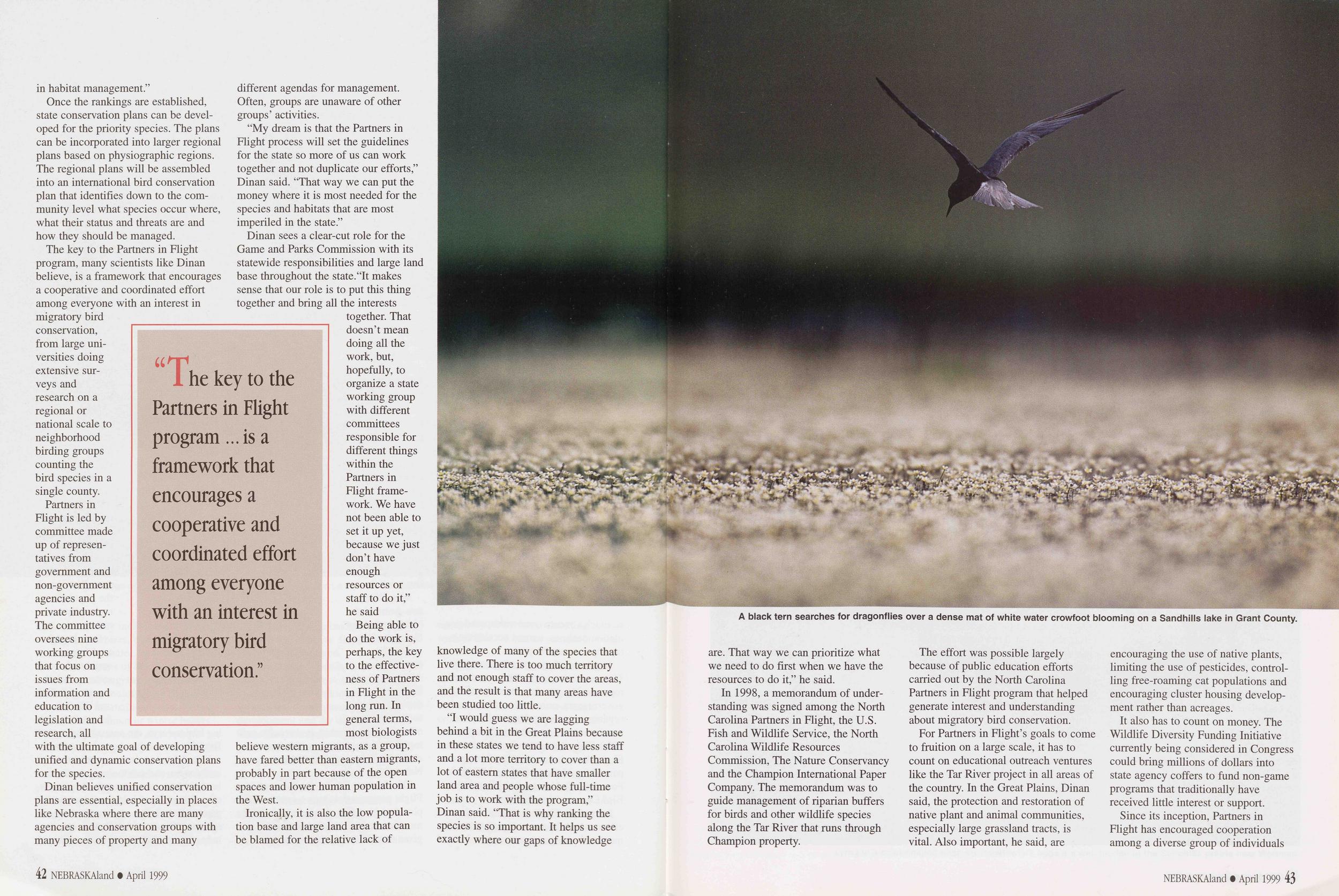 in habitat management."
Once the rankings are established, state conservation plans can be developed for the priority species. The plans can be incorporated into larger regional plans based on physiographic regions. The regional plans will be assembled into an international bird conservation plan that identifies down to the community level what species occur where, what their status and threats are and how they should be managed.
The key to the Partners in Flight program, many scientists like Dinan believe, is a framework that encourages a cooperative and coordinated effort among everyone with an interest in migratory bird conservation, from large universities doing extensive surveys and research on a regional or national scale to neighborhood birding groups counting the bird species in a single county.
Partners in Flight is led by committee made up of representatives from government and non-government agencies and private industry. The committee oversees nine working groups that focus on issues from information and education to legislation and research, all with the ultimate goal of developing unified and dynamic conservation plans for the species.
Dinan believes unified conservation plans are essential, especially in places like Nebraska where there are many agencies and conservation groups with many pieces of property and many different agendas for management. Often, groups are unaware of other groups' activities.
1 he key to the Partners in Flight program... is a framework that encourages a cooperative and coordinated effort among everyone with an interest in migratory bird conservation.""My dream is that the Partners in Flight process will set the guidelines for the state so more of us can work together and not duplicate our efforts," Dinan said. "That way we can put the money where it is most needed for the species and habitats that are most imperiled in the state."
Dinan sees a clear-cut role for the Game and Parks Commission with its statewide responsibilities and large land base throughout the state."It makes sense that our role is to put this thing together and bring all the interests together. That doesn't mean doing all the work, but, hopefully, to organize a state working group with different committees responsible for different things within the Partners in Flight framework. We have not been able to set it up yet, because we just don't have enough resources or staff to do it," he said
Being able to do the work is, perhaps, the key to the effective- ness of Partners in Flight in the long run. In general terms, most biologists believe western migrants, as a group, have fared better than eastern migrants, probably in part because of the open spaces and lower human population in the West.
Ironically, it is also the low population base and large land area that can be blamed for the relative lack of knowledge of many of the species that live there. There is too much territory and not enough staff to cover the areas, and the result is that many areas have been studied too little.
"I would guess we are lagging behind a bit in the Great Plains because in these states we tend to have less staff and a lot more territory to cover than a lot of eastern states that have smaller land area and people whose full-time job is to work with the program," Dinan said. "That is why ranking the species is so important. It helps us see exactly where our gaps of knowledge 42 NEBRASKAland • April 1999
In 1998, a memorandum of understanding was signed among the North Carolina Partners in Flight, the U.S. Fish and Wildlife Service, the North Carolina Wildlife Resources Commission, The Nature Conservancy and the Champion International Paper Company. The memorandum was to guide management of riparian buffers for birds and other wildlife species along the Tar River that runs through Champion property.
The effort was possible largely because of public education efforts carried out by the North Carolina Partners in Flight program that helped generate interest and understanding about migratory bird conservation.
For Partners in Flight's goals to come to fruition on a large scale, it has to count on educational outreach ventures like the Tar River project in all areas of the country. In the Great Plains, Dinan said, the protection and restoration of native plant and animal communities, especially large grassland tracts, is vital. Also important, he said, are encouraging the use of native plants, limiting the use of pesticides, controlling free-roaming cat populations and encouraging cluster housing development rather than acreages.
It also has to count on money. The Wildlife Diversity Funding Initiative currently being considered in Congress could bring millions of dollars into state agency coffers to fund non-game programs that traditionally have received little interest or support.
Since its inception, Partners in
Flight has encouraged cooperation
among a diverse group of individuals
NEBRASKAland • April 1999 43
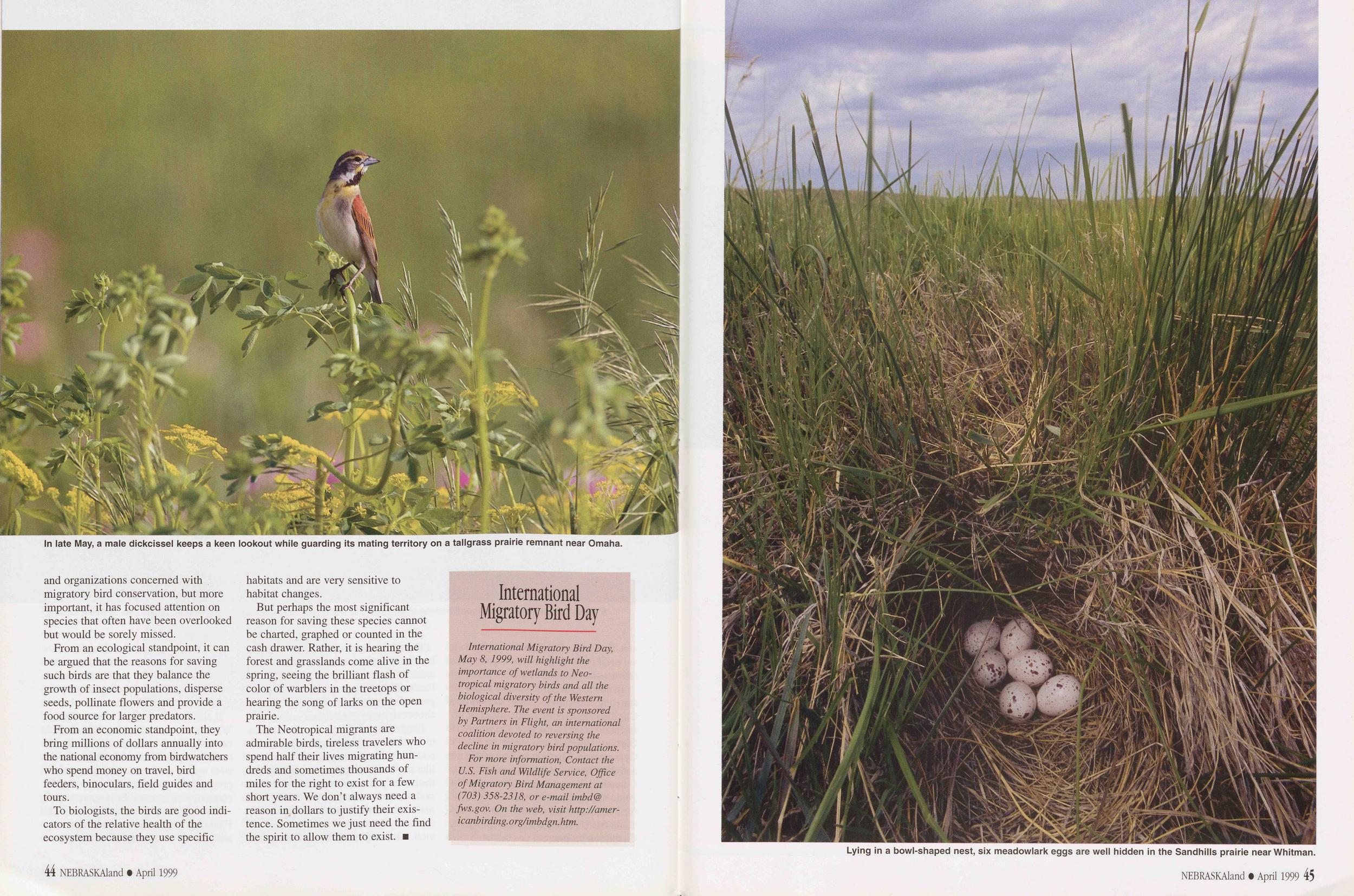
From an ecological standpoint, it can be argued that the reasons for saving such birds are that they balance the growth of insect populations, disperse seeds, pollinate flowers and provide a food source for larger predators.
From an economic standpoint, they bring millions of dollars annually into the national economy from birdwatchers who spend money on travel, bird feeders, binoculars, field guides and tours.
To biologists, the birds are good indicators of the relative health of the ecosystem because they use specific habitats and are very sensitive to habitat changes.
But perhaps the most significant reason for saving these species cannot be charted, graphed or counted in the cash drawer. Rather, it is hearing the forest and grasslands come alive in the spring, seeing the brilliant flash of color of warblers in the treetops or hearing the song of larks on the open prairie.
The Neotropical migrants are admirable birds, tireless travelers who spend half their lives migrating hundreds and sometimes thousands of miles for the right to exist for a few short years. We don't always need a reason in dollars to justify their existence. Sometimes we just need the find the spirit to allow them to exist.
International Migratory Bird DayInternational Migratory Bird Day, May 8, 1999, will highlight the importance of wetlands to Neo- tropical migratory birds and all the biological diversity of the Western Hemisphere. The event is sponsored by Partners in Flight, an international coalition devoted to reversing the decline in migratory bird populations.
For more information, Contact the U.S. Fish and Wildlife Service, Office of Migratory Bird Management at (703)358-2318, or e-mail imbd@fws.gov. On the web, visit http://americanbirding. org/imbdgn.htm.
44 NEBRASKAland • April 1999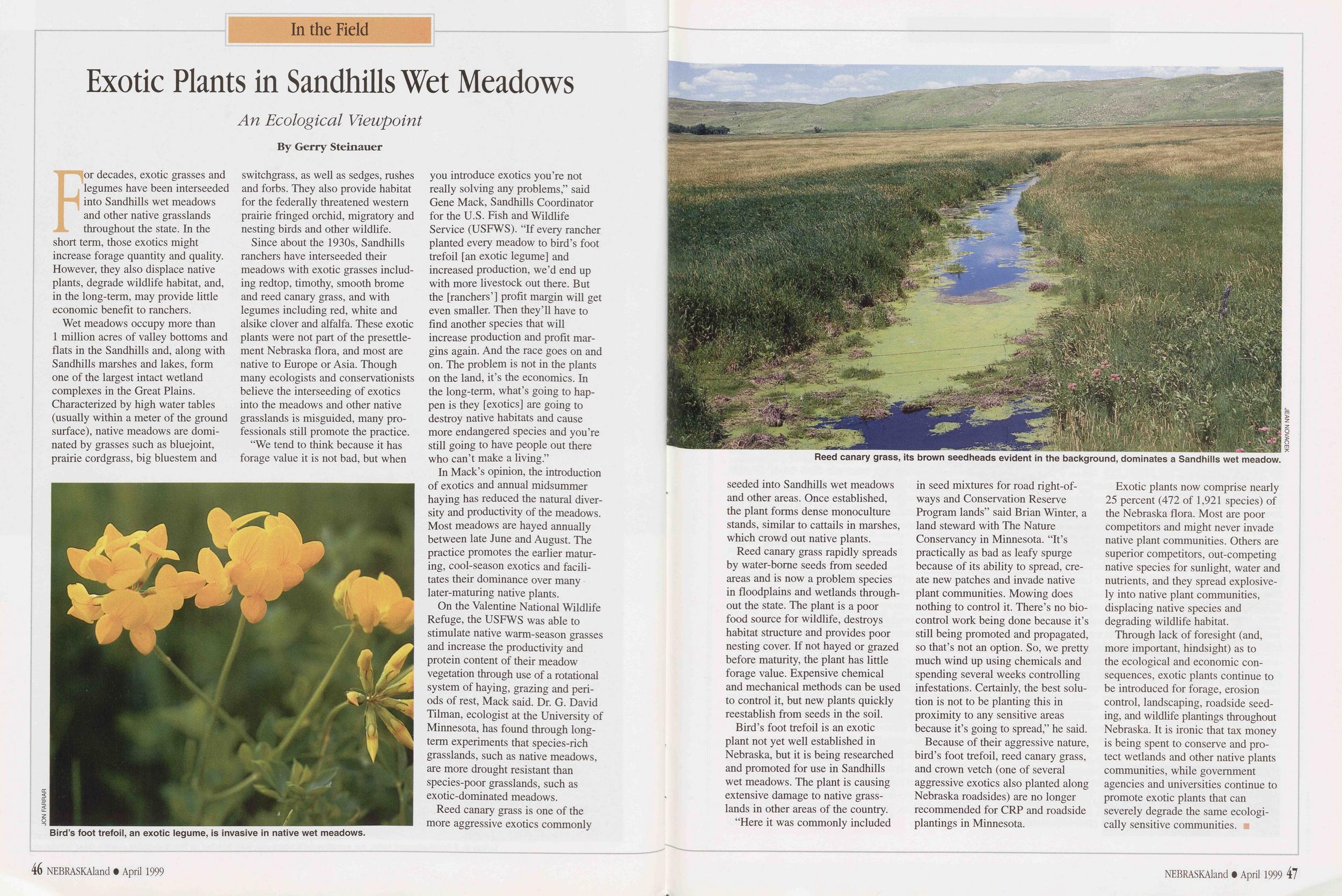
In the Field
Exotic Plants in Sandhills Wet Meadows
An Ecological Viewpoint By Gerry Steinaueror decades, exotic grasses and legumes have been interseeded into Sandhills wet meadows and other native grasslands throughout the state. In the short term, those exotics might increase forage quantity and quality. However, they also displace native plants, degrade wildlife habitat, and, in the long-term, may provide little economic benefit to ranchers.
Wet meadows occupy more than 1 million acres of valley bottoms and flats in the Sandhills and, along with Sandhills marshes and lakes, form one of the largest intact wetland complexes in the Great Plains. Characterized by high water tables (usually within a meter of the ground surface), native meadows are dominated by grasses such as bluejoint, prairie cordgrass, big bluestem and switchgrass, as well as sedges, rushes and forbs. They also provide habitat for the federally threatened western prairie fringed orchid, migratory and nesting birds and other wildlife.
Since about the 1930s, Sandhills ranchers have interseeded their meadows with exotic grasses including redtop, timothy, smooth brome and reed canary grass, and with legumes including red, white and alsike clover and alfalfa. These exotic plants were not part of the presettlement Nebraska flora, and most are native to Europe or Asia. Though many ecologists and conservationists believe the interseeding of exotics into the meadows and other native grasslands is misguided, many professionals still promote the practice.
"We tend to think because it has forage value it is not bad, but when you introduce exotics you're not really solving any problems," said Gene Mack, Sandhills Coordinator for the U.S. Fish and Wildlife Service (USFWS). "If every rancher planted every meadow to bird's foot trefoil [an exotic legume] and increased production, we'd end up with more livestock out there. But the [ranchers'] profit margin will get even smaller. Then they'll have to find another species that will increase production and profit margins again. And the race goes on and on. The problem is not in the plants on the land, it's the economics. In the long-term, what's going to happen is they [exotics] are going to destroy native habitats and cause more endangered species and you're still going to have people out there who can't make a living."
In Mack's opinion, the introduction of exotics and annual midsummer haying has reduced the natural diversity and productivity of the meadows. Most meadows are hayed annually between late June and August. The practice promotes the earlier maturing, cool-season exotics and facilitates their dominance over many later-maturing native plants.
On the Valentine National Wildlife Refuge, the USFWS was able to stimulate native warm-season grasses and increase the productivity and protein content of their meadow vegetation through use of a rotational system of haying, grazing and periods of rest, Mack said. Dr. G. David Tilman, ecologist at the University of Minnesota, has found through longterm experiments that species-rich grasslands, such as native meadows, are more drought resistant than species-poor grasslands, such as exotic-dominated meadows.
Reed canary grass is one of the more aggressive exotics commonly
Reed canary grass rapidly spreads by water-borne seeds from seeded areas and is now a problem species in floodplains and wetlands throughout the state. The plant is a poor food source for wildlife, destroys habitat structure and provides poor nesting cover. If not hayed or grazed before maturity, the plant has little forage value. Expensive chemical and mechanical methods can be used to control it, but new plants quickly reestablish from seeds in the soil.
Bird's foot trefoil is an exotic plant not yet well established in Nebraska, but it is being researched and promoted for use in Sandhills wet meadows. The plant is causing extensive damage to native grasslands in other areas of the country.
"Here it was commonly included in seed mixtures for road right-of-ways and Conservation Reserve Program lands" said Brian Winter, a land steward with The Nature Conservancy in Minnesota. "It's practically as bad as leafy spurge because of its ability to spread, create new patches and invade native plant communities. Mowing does nothing to control it. There's no biocontrol work being done because it's still being promoted and propagated, so that's not an option. So, we pretty much wind up using chemicals and spending several weeks controlling infestations. Certainly, the best solution is not to be planting this in proximity to any sensitive areas because it's going to spread," he said.
Because of their aggressive nature, bird's foot trefoil, reed canary grass, and crown vetch (one of several aggressive exotics also planted along Nebraska roadsides) are no longer recommended for CRP and roadside plantings in Minnesota.
Exotic plants now comprise nearly 25 percent (472 of 1,921 species) of the Nebraska flora. Most are poor competitors and might never invade native plant communities. Others are superior competitors, out-competing native species for sunlight, water and nutrients, and they spread explosively into native plant communities, displacing native species and degrading wildlife habitat.
Through lack of foresight (and, more important, hindsight) as to the ecological and economic consequences, exotic plants continue to be introduced for forage, erosion control, landscaping, roadside seeding, and wildlife plantings throughout Nebraska. It is ironic that tax money is being spent to conserve and protect wetlands and other native plants communities, while government agencies and universities continue to promote exotic plants that can severely degrade the same ecologically sensitive communities,
NEBRASKAland • April 1999 47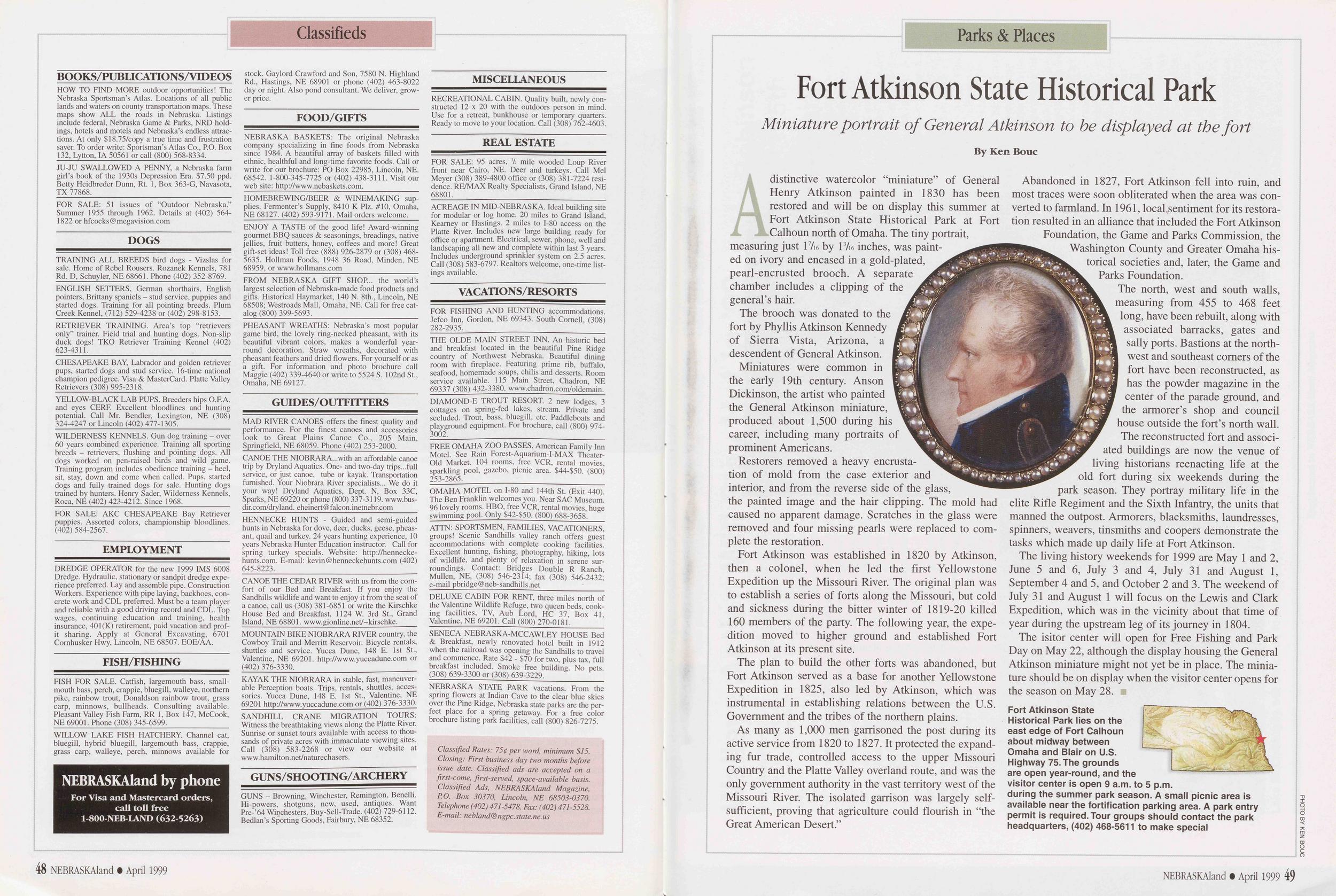
Classifieds
BOOKS/PUBLICATIONS/VIDEOSHOW TO FIND MORE outdoor opportunities! The Nebraska Sportsman's Atlas. Locations of all public lands and waters on county transportation maps. These maps show ALL the roads in Nebraska. Listings include federal, Nebraska Game & Parks, NRD holdings, hotels and motels and Nebraska's endless attractions. At only $18.75/copy a true time and frustration saver. To order write: Sportsman's Atlas Co., P.O. Box 132, Lytton, IA 50561 or call (800) 568-8334.
JU-JU SWALLOWED A PENNY, a Nebraska farm girl's book of the 1930s Depression Era. $7.50 ppd. Betty Heidbreder Dunn, Rt. 1, Box 363-G, Navasota, TX 77868.
FOR SALE: 51 issues of "Outdoor Nebraska." Summer 1955 through 1962. Details at (402) 564- 1822 or hfcocks@megavision.com
DOGSTRAINING ALL BREEDS bird dogs - Vizslas for sale. Home of Rebel Rousers. Rozanek Kennels, 781 Rd. D, Schuyler, NE 68661. Phone (402) 352-8769.
ENGLISH SETTERS, German shorthairs, English pointers, Brittany spaniels - stud service, puppies and started dogs. Training for all pointing breeds. Plum Creek Kennel, (712) 529-4238 or (402) 298-8153.
RETRIEVER TRAINING. Area's top "retrievers only" trainer. Field trial and hunting dogs. Non-slip duck dogs! TKO Retriever Training Kennel (402) 623-4311.
CHESAPEAKE BAY, Labrador and golden retriever pups, started dogs and stud service. 16-time national champion pedigree. Visa & MasterCard. Platte Valley Retrievers (308) 995-2318.
YELLOW-BLACK LAB PUPS. Breeders hips O.F.A. and eyes CERE Excellent bloodlines and hunting potential. Call Mr. Bendler, Lexington, NE (308) 324-4247 or Lincoln (402) 477-1305.
WILDERNESS KENNELS. Gun dog training - over 60 years combined experience. Training all sporting breeds - retrievers, flushing and pointing dogs. All dogs worked on pen-raised birds and wild game. Training program includes obedience training - heel, sit, stay, down and come when called. Pups, started dogs and fully trained dogs for sale. Hunting dogs trained by hunters. Henry Sader, Wilderness Kennels, Roca, NE (402) 423-4212. Since 1968.
FOR SALE: AKC CHESAPEAKE Bay Retriever puppies. Assorted colors, championship bloodlines. (402) 584-2567.
EMPLOYMENTDREDGE OPERATOR for the new 1999 IMS 6008 Dredge. Hydraulic, stationary or sandpit dredge experience preferred. Lay and assemble pipe. Construction Workers. Experience with pipe laying, backhoes, concrete work and CDL preferred. Must be a team player and reliable with a good driving record and CDL. Top wages, continuing education and training, health insurance, 401(K) retirement, paid vacation and profit sharing. Apply at General Excavating, 6701 Cornhusker Hwy, Lincoln, NE 68507. EOE/AA.
FISH/FISHINGFISH FOR SALE. Catfish, largemouth bass, small- mouth bass, perch, crappie, bluegill, walleye, northern pike, rainbow trout, Donaldson rainbow trout, grass carp, minnows, bullheads. Consulting available. Pleasant Valley Fish Farm, RR 1, Box 147, McCook, NE 69001. Phone (308) 345-6599.
WILLOW LAKE FISH HATCHERY. Channel cat, bluegill, hybrid bluegill, largemouth bass, crappie, grass carp, walleye, perch, minnows available for stock. Gaylord Crawford and Son, 7580 N. Highland Rd., Hastings, NE 68901 or phone (402) 463-8022 day or night. Also pond consultant. We deliver, grower price.
NEBRASKAland by phone For Visa and Mastercard orders, call toll free 1-800-NEB-LAND (632-5263) FOOD/GIFTSNEBRASKA BASKETS: The original Nebraska company specializing in fine foods from Nebraska since 1984. A beautiful array of baskets filled with ethnic, healthful and long-time favorite foods. Call or write for our brochure: PO Box 22985, Lincoln, NE. 68542. 1-800-345-7725 or (402) 438-3111. Visit our web site: http://www.nebaskets.com.
HOMEBREWING/BEER & WINEMAKING sup- plies. Fermenter's Supply, 8410 K Plz. #10, Omaha, NE 68127. (402) 593-9171. Mail orders welcome.
ENJOY A TASTE of the good life! Award-winning gourmet BBQ sauces & seasonings, breadings, native jellies, fruit butters, honey, coffees and more! Great gift-set ideas! Toll free (888) 926-2879 or (308) 468- 5635. Hollman Foods, 1948 36 Road, Minden, NE 68959, or www.hollmans.com
FROM NEBRASKA GIFT SHOP... the world's largest selection of Nebraska-made food products and gifts. Historical Haymarket, 140 N. 8th., Lincoln, NE 68508; Westroads Mall, Omaha, NE. Call for free catalog (800) 399-5693.
PHEASANT WREATHS: Nebraska's most popular game bird, the lovely ring-necked pheasant, with its beautiful vibrant colors, makes a wonderful year round decoration. Straw wreaths, decorated with pheasant feathers and dried flowers. For yourself or as a gift. For information and photo brochure call Maggie (402) 339-4640 or write to 5524 S. 102nd St., Omaha, NE 69127.
GUTOES/OUTFITTERSMAD RIVER CANOES offers the finest quality and performance. For the finest canoes and accessories look to Great Plains Canoe Co., 205 Main, Springfield, NE 68059. Phone (402) 253-2000.
CANOE THE NIOBRARA...with an affordable canoe trip by Dry land Aquatics. One- and two-day trips...full service, or just canoe, tube or kayak. Transportation furnished. Your Niobrara River specialists... We do it your way! Dry land Aquatics, Dept. N, Box 33C, Sparks, NE 69220 or phone (800) 337-3119. www.busdir.com/dryland. eheinert@falcon.inetnebr.com
HENNECKE HUNTS - Guided and semi-guided hunts in Nebraska for dove, deer, ducks, geese, pheasant, quail and turkey. 24 years hunting experience, 10 years Nebraska Hunter Education instructor. Call for spring turkey specials. Website: http://hennecke- hunts.com. E-mail: kevin@henneckehunts.com (402) 645-8223.
CANOE THE CEDAR RIVER with us from the comfort of our Bed and Breakfast. If you enjoy the Sandhills wildlife and want to enjoy it from the seat of a canoe, call us (308) 381-6851 or write the Kirschke House Bed and Breakfast, 1124 W. 3rd St., Grand Island, NE 68801. www.gionline.net/~kirschke.
MOUNTAIN BIKE NIOBRARA RIVER country, the Cowboy Trail and Merritt Reservoir. Bicycle rentals, shuttles and service. Yucca Dune, 148 E. 1st St., Valentine, NE 69201. http://www.yuccadune.com or (402) 376-3330.
KAYAK THE NIOBRARA in stable, fast, maneuverable Perception boats. Trips, rentals, shuttles, accessories. Yucca Dune, 148 E. 1st St., Valentine, NE 69201 http://www.yuccadune.com or (402) 376-3330.
SANDHILL CRANE MIGRATION TOURS: Witness the breathtaking views along the Platte River. Sunrise or sunset tours available with access to thousands of private acres with immaculate viewing sites. Call (308) 583-2268 or view our website at www.hamilton.net/naturechasers.
GUNS/SHOOTING/ARCHERYGUNS - Browning, Winchester, Remington, Benelli. Hi-powers, shotguns, new, used, antiques. Want Pre-'64 Winchesters. Buy-Sell-Trade. (402) 729-6112. Bedlan's Sporting Goods, Fairbury, NE 68352.
MISCELLANEOUSRECREATIONAL CABIN. Quality built, newly constructed 12 x 20 with the outdoors person in mind. Use for a retreat, bunkhouse or temporary quarters. Ready to move to your location. Call (308) 762-4603.
REAL ESTATEFOR SALE: 95 acres, 3A mile wooded Loup River front near Cairo, NE. Deer and turkeys. Call Mel Meyer (308) 389-4800 office or (308) 381-7224 residence. RE/MAX Realty Specialists, Grand Island, NE 68801.
ACREAGE IN MID-NEBRASKA. Ideal building site for modular or log home. 20 miles to Grand Island, Kearney or Hastings. 2 miles to 1-80 access on the Platte River. Includes new large building ready for office or apartment. Electrical, sewer, phone, well and landscaping all new and complete within last 3 years. Includes underground sprinkler system on 2.5 acres. Call (308) 583-6797. Realtors welcome, one-time listings available.
VACATIONS/RESORTSFOR FISHING AND HUNTING accommodations. Jefco Inn, Gordon, NE 69343. South Cornell, (308) 282-2935.
THE OLDE MAIN STREET INN. An historic bed and breakfast located in the beautiful Pine Ridge country of Northwest Nebraska. Beautiful dining room with fireplace. Featuring prime rib, buffalo, seafood, homemade soups, chilis and desserts. Room service available. 115 Main Street, Chadron, NE 69337 (308) 432-3380. www.chadron.com/oldemain.
DIAMOND-E TROUT RESORT. 2 new lodges, 3 cottages on spring-fed lakes, stream. Private and secluded. Trout, bass, bluegill, etc. Paddle boats and playground equipment. For brochure, call (800) 974- 3002.
FREE OMAHA ZOO PASSES, American Family Inn Motel. See Rain Forest-Aquarium-I-MAX Theater- Old Market. 104 rooms, free VCR, rental movies, sparkling pool, gazebo, picnic area. $44-$50. (800) 253-2865.
OMAHA MOTEL on 1-80 and 144th St. (Exit 440). The Ben Franklin welcomes you. Near SAC Museum. 96 lovely rooms. HBO, free VCR, rental movies, huge swimming pool. Only $42-$50. (800) 688-3658.
ATTN: SPORTSMEN, FAMILIES, VACATIONERS, groups! Scenic Sandhills valley ranch offers guest accommodations with complete cooking facilities. Excellent hunting, fishing, photography, hiking, lots of wildlife, and plenty of relaxation in serene surroundings. Contact: Bridges Double R Ranch, Mullen, NE, (308) 546-2314; fax (308) 546-2432; e-mail pbridge@neb-sandhills.net
DELUXE CABIN FOR RENT, three miles north of the Valentine Wildlife Refuge, two queen beds, cooking facilities, TV, Aub Lord, HC 37, Box 41, Valentine, NE 69201. Call (800) 270-0181.
SENECA NEBRASKA-MCCAWLEY HOUSE Bed & Breakfast, newly renovated hotel built in 1912 when the railroad was opening the Sandhills to travel and commence. Rate $42 - $70 for two, plus tax, full breakfast included. Smoke free building. No pets (308) 639-3300 or (308) 639-3229.
NEBRASKA STATE PARK vacations. From the spring flowers at Indian Cave to the clear blue skies over the Pine Ridge, Nebraska state parks are the perfect place for a spring getaway. For a free color brochure listing park facilities, call (800) 826-7275.
Classified Rates: 75$ per word, minimum $15. Closing: First business day two months before issue date. Classified ads are accepted on a first-come, first-served, space-available basis. Classified Ads, NEBRASKAland Magazine, RO. Box 30370, Lincoln, NE 68503-0370. Telephone (402) 471-5478. Fax: (402) 471-5528. E-mail: nebland@ngpc.state.ne.us 48 NEBRASKAland • April 1999Parks & Places
Fort Atkinson State Historical Park
Miniature portrait of General Atkinson to be displayed at the fort >By Ken Boucdistinctive watercolor "miniature" of General Henry Atkinson painted in 1830 has been restored and will be on display this summer at Fort Atkinson State Historical Park at Fort Calhoun north of Omaha. The tiny portrait, measuring just lVie by P/i6 inches, was painted on ivory and encased in a gold-plated pearl-encrusted brooch. A separate chamber includes a clipping of the general's hair.
The brooch was donated to the fort by Phyllis Atkinson Kennedy of Sierra Vista, Arizona, a descendent of General Atkinson.
Miniatures were common in the early 19th century. Anson Dickinson, the artist who painted the General Atkinson miniature, produced about 1,500 during his career, including many portraits of prominent Americans.
Restorers removed a heavy encrustation of mold from the case exterior and interior, and from the reverse side of the glass, the painted image and the hair clipping. The mold had caused no apparent damage. Scratches in the glass were removed and four missing pearls were replaced to complete the restoration.
Fort Atkinson was established in 1820 by Atkinson, then a colonel, when he led the first Yellowstone Expedition up the Missouri River. The original plan was to establish a series of forts along the Missouri, but cold and sickness during the bitter winter of 1819-20 killed 160 members of the party. The following year, the expedition moved to higher ground and established Fort Atkinson at its present site.
The plan to build the other forts was abandoned, but Fort Atkinson served as a base for another Yellowstone Expedition in 1825, also led by Atkinson, which was instrumental in establishing relations between the U.S. Government and the tribes of the northern plains.
As many as 1,000 men garrisoned the post during its active service from 1820 to 1827. It protected the expanding fur trade, controlled access to the upper Missouri Country and the Platte Valley overland route, and was the only government authority in the vast territory west of the Missouri River. The isolated garrison was largely self- sufficient, proving that agriculture could flourish in "the Great American Desert."
Abandoned in 1827, Fort Atkinson fell into ruin, and most traces were soon obliterated when the area was converted to farmland. In 1961, local sentiment for its restoration resulted in an alliance that included the Fort Atkinson Foundation, the Game and Parks Commission, the Washington County and Greater Omaha historical societies and, later, the Game and Parks Foundation.
The north, west and south walls, measuring from 455 to 468 feet long, have been rebuilt, along with associated barracks, gates and sally ports. Bastions at the north- west and southeast corners of the fort have been reconstructed, as has the powder magazine in the center of the parade ground, and the armorer's shop and council house outside the fort's north wall. The reconstructed fort and associated buildings are now the venue of living historians reenacting life at the old fort during six weekends during the park season. They portray military life in the elite Rifle Regiment and the Sixth Infantry, the units that manned the outpost. Armorers, blacksmiths, laundresses, spinners, weavers, tinsmiths and coopers demonstrate the tasks which made up daily life at Fort Atkinson.
The living history weekends for 1999 are May 1 and 2, June 5 and 6, July 3 and 4, July 31 and August 1, September 4 and 5, and October 2 and 3. The weekend of July 31 and August 1 will focus on the Lewis and Clark Expedition, which was in the vicinity about that time of year during the upstream leg of its journey in 1804.
The visitor center will open for Free Fishing and Park Day on May 22, although the display housing the General Atkinson miniature might not yet be in place. The miniature should be on display when the visitor center opens for the season on May 28.
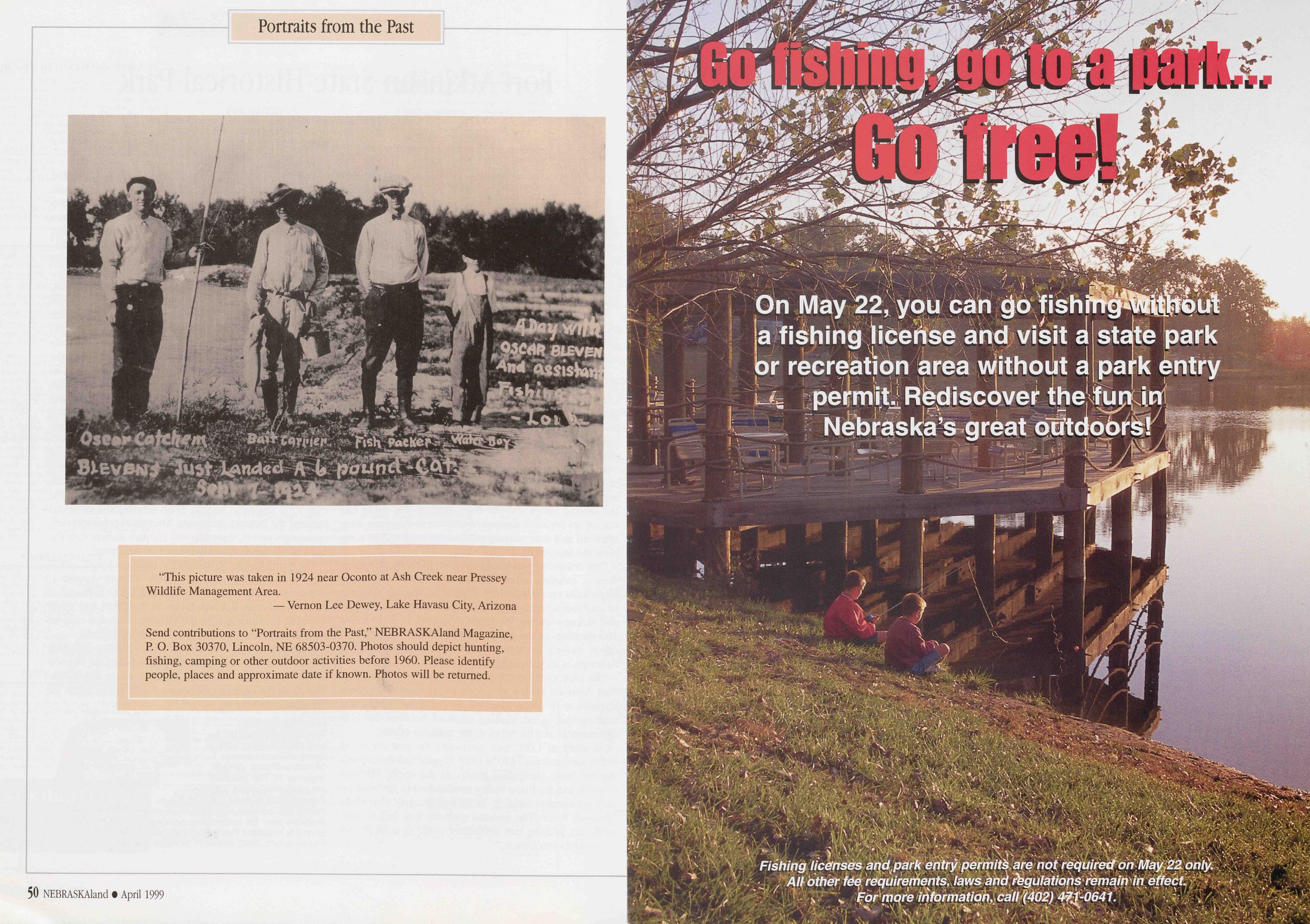
Portraits from the Past
Send contributions to "Portraits from the Past," NEBRASKAland Magazine, P. O. Box 30370, Lincoln, NE 68503-0370. Photos should depict hunting, fishing, camping or other outdoor activities before 1960. Please identify people, places and approximate date if known. Photos will be returned.
50 NEBRASKAland • April 1999 On May 22 a fishing license and visit a state par or recreation area without a park entry permit Nebraska's great j*SKSB3tS3Sn£:;v::
Position: 843 (11 views)