Volume 77, Issue 2, 1999
NEBRASKAland
Nebraska Game & Parks Commision March 199 $2.50
NEBRASKAland
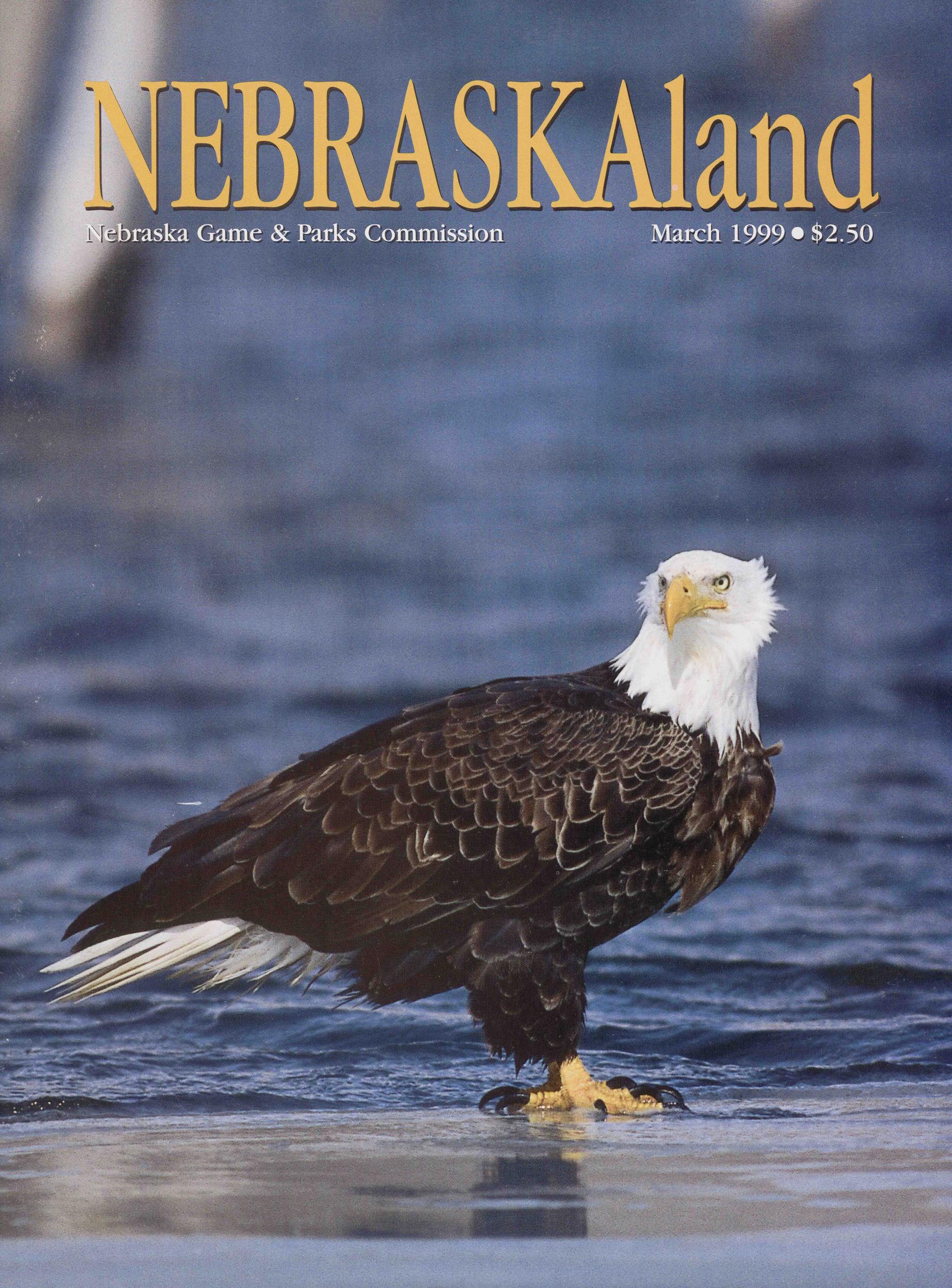
Volume 77, Number 2, March 1999 Diamond in the Sandhills "When we finally came over the top of the last hill, we'd see that little lake sitting down in the valley sparkling like the diamond that's part of its name." A Matter of History: Meridian Wildlife Area They say true beauty is in the eye of the beholder, and to hog aficionados, true beauty was "Blue Valley," a 920-pound Poland China breeding boar. Poppers for Bluegills Flyrods, poppers and bluegills are a sure-fire combination. Just about any flyrod will do, but finding big bluegills sometimes is tough, and coming up with the proper popper can be the most difficult of all. Fort Robinson: 125 Years of History Soldiers arrived at Red Cloud Agency in March 1874. Their camp evolved into Fort Robinson, a venerable institution in the history of the West and an active post through two world wars. Now a state park, its 125th anniversary will be celebrated this summer. Fish Consumption Advisories: What are the Risks? Fish consumption advisories are not bans on eating fish, but are warnings to the public about possible health issues related to long-term consumption of fish from affected bodies of water. Cottonwood-Steverson Wildlife Area This three-lake complex in Cherry County includes two of the deepest lakes in the Sandhills region and has the potential for excellent largemouth bass, walleye, bluegill, yellow perch and crappie fishing. Letters 4 Outdoor News 6 Outdoor Business 9 Outdoor Update 46 Classifieds 48 Parks & Places 49 Portraits from the Past 50 Cover: A stately bald eagle pauses on the ice near the Otter Creek inlet at Lake McConaughy. Once rarely seen in Nebraska, bald eagles are becoming more common in the state, and wintering eagles have become an attraction at several locations. Photo by Michael Forsberg. Opposite: By March, migration in the Central Flyway is in full swing, and the arrival of sandhill cranes in the central Platte River valley marks the return of spring. Photo by Ken Bouc.
Letters
Published by the Nebraska Game and Parks Commission Director: Rex Amack Assistant Directors: Noelyn Isom Roger Kuhn Kirk Nelson Information & Education Administrator: Paul Horton Information & Education Art Director: Steve O'Hare Commissioners Chairman: William Berryman, Kearney Vice Chairman: Daniel Wallen, McCook 2nd Vice Chairman: Thomas O'Neill Jr., Lincoln George W. Egermayer Jr., Omaha Rob Coupland, Valentine John P. Miller, Blair Tom J. Plummer Jr., Ogallala Magazine Staff Editor: Don Cunningham Associate Editor: Troy Kroeger Art Director: Tim Reigert Senior Editors: Ken Bouc, Jon Farrar Regional Editors: Michael Forsberg, Bob Grier, Rocky Hoffmann Circulation: Pat Frahm NEBRASKAland ISSN: 0028-1964 VOL. 77 / NO. 2 MARCH 1999 Published monthly, except for Jan./Feb. and Aug-Sept. issues, by the Nebraska Game and Parks Commission, 2200 N. 33rd St., Lincoln, NE. Copyright 1999, all rights reserved. Please address comments or questions to this address. Periodicals postage paid at Lincoln, Nebraska. POSTMASTER: Send all address changes to NEBRASKAland, P.O. Box 30370, Lincoln, NE 68503-0370. Rates: $16 for one year; $30 for two years. Address submissions to: The Editor, NEBRASKAland Magazine, P.O. Box 30370, Lincoln, NE 68503. Include a stamped, self-addressed return envelope. The publisher assumes no responsibility for unsolicited material. NEBRASKAland is available on audio cassette from the Nebraska Library Commission Talking Book and Braille Service, Suite 120, 1200 N St., Lincoln, NE 68508. The Blizzard of '49What a wonderful January-February issue of NEBRASKAland!
We are proud natives of the Brunswick-Creighton area, and we find your magazine to be fascinating along so many lines of personal interest.
"The Blizzard of '49" article was particularly special to us as it conjured up memories of parents and grandparents relaying the most amazing personal happenings associated with the storm.
Asked to define the soul of a photograph, someone once said "Something that speaks to you — the vision, not just the subject." The photos in this story certainly accomplished that mission. Thanks for such an informative and eye- appealing magazine.
Dr. and Mrs. Mylon Filkins Bakersfield, California A Great IdeaWhat a great idea of putting together "The Blizzard of '49" article using photos and quotes from your readers. I am not a hunter or fisherman, but I take your magazine because I love the plains and people of Nebraska.
While I do enjoy all of your articles and photos, that one was the best ever. I encourage you to do that sort of article again.
Ron Jones Colorado Springs, ColoradoThough we have not lived in Nebraska since 1954, we come back several times a year to central Nebraska to visit, and we always enjoy the beauty of the state.
This picture was taken on the irrigation canal about 13 miles west of Sargent in the heart of the Middle Loup River Valley, near what was once known as Walworth.
In 1992, we established a 19 acre wildlife habitat about a mile south of this canal, and we enjoy it each time we come to Nebraska.
James A. Schmidt Washington, IowaWhen the one-weekend pheasant hunt for kids 16 and under was held [October 24-25, 1998], I got two roosters by 8:30 a.m. I am 12 years old and live in Sargent, and I would like to tell you about my experience.
When I first started walking a heavy weed patch, I knew that I was going to get a rooster. About halfway down the weed patch, I scared up a rooster behind me. I turned around and missed the shot. After I came to the end, I told my dad I wished I could have that shot back. He just laughed.
About 20 yards down the second patch of weeds, my dog scared up two roosters and three hens, but I missed both shots. When I reached the end of that ditch, my dog scared up a rooster and two hens, but by the time I got my shot off, they were pretty far away. Along another ditch with great cover, I scared up two more hens.
On my way back to the house I turned in our driveway and scared up a rooster into our trees and took a shot and finally got one. When I got back to the house, my dad said he was proud of me and took a few pictures.
While we were driving up to our pasture to look for more pheasants, I looked over in the cornfield and there was a rooster. I started walking up the corn row, and the rooster flew up and I got him. My dad took a few more pictures like the one I sent. That concludes my great and fun- filled pheasant hunt.
Jared Mauler Sargent, Nebraska Correction"Hunting Solutions to the Snow Goose Dilemma " (January-February 1999) incorrectly stated that the U.S. Fish and Wildlife Service had authorized states to permit the use of unplugged shotguns and electronic calls in the late winter light goose season (February 11 through March 10 in Nebraska).
At their January meeting, the board of commissioners of the Nebraska Game and Parks Commission voted to permit unplugged shotguns and electronic calls contingent on final approval by the USFWS.
On February 16, the USFWS announced its decision to permit the use of electronic calls and unplugged shotguns, making their use legal for snow goose hunting in Nebraska. The changes apply to the late winter light goose season only, and will not be in effect in the normal waterfowl season.
Current information is available from any Game and Parks Commission office or the Commission website at http://www. ngpc.state.ne.us or the U.S. Fish and Wildlife Service website at http://www.fws. gov/
Write to: Letters, NEBRASKAland Magazine, P.O. Box 30370, Lincoln, NE 68503. Fax: (402) 471-5528. E-mail: nebland@ngpc. state.ne. us. Please include your postal address and telephone number. Letters may be condensed and edited for clarity. Photographs are welcome. Nebraska Game and Parks Commission Offices Headquarters 2200 N. 33rd Street Lincoln, NE 68503 Phone (402) 471-0641 District Office I East Hwy. 2, Box 725 Alliance, NE 69301 Phone (308) 763-2940 District Office II 524 Panzer St., Box 508 Bassett, NE 68714 Phone (402) 684-2921 District Office III 2201 N. 13th St. Norfolk, NE 68701 Phone (402) 370-3374 District Office IV 301 E. State Farm Rd. North Platte, NE 69101 Phone (308) 535-8025 District Office V 2200 N. 33rd Street Lincoln, NE 68503 Phone (402) 471-5558 District Office VI 1617 First Ave. Kearney, NE 68847 Phone (308) 865-5310 Omaha Office 1212 Deer Park Blvd. Omaha, NE 68108 Phone (402) 595-2144 Ak-Sar-Ben Aquarium 21502 W. Highway 31 Gretna, NE 68028 Phone (402) 332-3901 World Wide Web site: http://www.ngpc.state.ne.us E-mail: ngpc@ngpc.state.ne.us Conservation Officers by Region Headquarters Ted Blume (Asst. Adm.) Lincoln Murray Johnson Lincoln Panhandle Officer Raymond Still Walt Meyer John Murphy Jim Zimmerman Marvin Kampbell Dennis Thompson Dan Zuehlke Dan Evasco Scott Brandt Southwest Officer Roger Thompson (Sup.) Dwight Allbery Dudley Sorensen George Sund Matt Andrews Jack Henderson Dirk Greene Virgil Gosch Rich Routh Northeast Officer Tom Zimmer (Sup.) Marion Shafer Robert Kelly Ross Oestmann Gary Ralston Daniel Roberts City Bridgeport Chadron Crawford Gering Hay Springs Ogallala Ogallala Oshkosh Scottsbluff City N. Platte N. Platte N. Platte Cambridge Elwood Gothenburg Imperial McCook Rep. City City Norfolk Norfolk Albion Bloomfield Creighton Fremont 471-5532 471-5003 Phone (308) 262-1075 432-4398 665-2021 436-7561 638-7527 284-6450 284-4815 772-3091 635-1277 Phone (308) 532-9175 532-2753 532-0747 697-4629 785-3025 537-7483 882-5328 345-2185 799-2085 Phone (402) 371-6625 371-2031 395-2538 373-4412 358-3892 721-7852 Randy Pomplun Jon Reeves Eric Wiebe Steve Oberg Sandhills Officer Bruce Wiebe (Sup.) Ray Dierking Richard Seward Justin Mays Frank Miller Dana Murphy South-central Officer Jerry Pecha (Sup.) Terry Brentzel Tim Williams Dale Johnson Mark Reeves Robert Finke Southeast Officer Craig Stover (Sup.) Douglas Kramer Dina Hopper William Krause Larry Elston Mike Luben Duane Arp Levi Krause Russell Mort Greg Verkuilen Fullerton (308) 536-2987 Kennard 427-7378 Ponca 755-2566 Columbus 564-5937 City Phone (402) Bassett 684-3867 Brkn. Bow(308) 872-3078 Ord (308)728-3115 Bassett 273-4188 Valentine 376-5909 Atkinson 925-2427 City Phone (402) Kearney (308)865-5327 Grand Is. (308) 384-8296 Hastings 463-2535 Kearney (308)237-1079 Loup City (308) 745-1126 Milford 761-3537 City Lincoln Lincoln Lincoln Auburn Bellevue Colon Gretna Louisville Nebr. City Beatrice Phone (402) 471-5590 466-9001 483-2358 274-3789 292-4910 443-4278 332-4954 234-2212 873-5684 223-4095 4 NEBRASKAland • March 1999
Outdoor News
PHEASANTS Nebraska Pheasants Forever chapters are working with farmers and landowners to establish wildlife habitat. The goal of Pheasants Forever is to restore upland wildlife populations through quality habitat. We are paying landowners to plant food plots, nesting cover, shelter belts and other quality habitat projects. Nebraska currently has 49 chapters and more than 7,800 members throughout the state looking to work with local farmers and landowners for the benefit of all upland wildlife. In just 12 years, these chapters have planted more than 1.7 million trees, created more than 117,500 acres of new habitat, and spent over $2.7 million on habitat and conservation education in the state. For help planting wildlife habitat or more information about Pheasants Forever, contact Fax (308) 754-5339, (402) 687-2004 or write to: Pheasants Forever 1011 Alexander Ave. Elba, NE 68835 Taxpayers Urged to Remember WildlifeContributions to the Nongame Wildlife Checkoff, which have averaged $90,000 annually for the past five years, are critical to the Game and Parks Commission's nongame and natural heritage program, said Ross Lock, wildlife diversity program manager for the Nebraska Game and Parks Commission.
The program allows taxpayers to donate part of their state tax refunds to the Nongame and Endangered Species Conservation Fund when they file their tax returns.
"Your donation will be earmarked for the conservation and management of the 85 percent of our state's wildlife species that are not commonly hunted, trapped or taken by hook and line," Lock said.
Whenever possible, checkoff contributions are combined with additional funds from federal or other state sources, Lock said.
State General Fund appropriations are used only to pay salaries for program personnel, and no hunting or fishing license money is spent directly on the program.
Projects supported by checkoff funds include research into the status and distribution of rare and unique wetlands, woodlands, and prairies; restoration of the endangered blowout penstemon; restoration and management of Sandhills stream habitat for four species of threatened fish; and monitoring and protecting bald eagle nest sites and winter roosting areas.
Checkoff funds also are being used in a cooperative venture to develop wildlife viewing interpretive displays on eight state and federal wildlife areas in the state and have been used for land acquisition and to support publications including the Nebraska Wildlife Viewing Guide.
The checkoff also supports research on the status, distribution and life requirements of rare and declining plant and animal species.
Taxpayers who are not entitled to a refund can make a direct donation to the Nongame and Endangered Species Conservation Fund through the Game and Parks Commission.
Beatrice Man Fined $488, Loses Hunting PrivilegesA Beatrice man found guilty of multiple game law violations was fined $488 and lost his hunting privileges for a year under Nebraska's new permit revocation law, which went into effect July 15, 1998.
Conservation Officer Greg Verkuilen first arrested the man in October 1998 for possession of a raccoon in a closed season, not having a permit and the theft of signs from a wildlife area.
In January Verkuilen again arrested the man and charged him with four offenses. He was fined $100 for hunting without permission; $50 for shooting from the road; $50 for a loaded shotgun in his vehicle; and $40 for hunting without a license. He also was ordered to pay $23 in court costs and $225 in liquidated damages.
Noting the man's previous offenses, the judge revoked his privilege to possess a hunting, fishing or fur harvest permit for a year.
The revocation law permits a judge to order the surrender of all permits to hunt, fish and harvest fur, and a defendant's privileges to hunt, fish, and harvest fur and to purchase such permits can be revoked for up to three years.
Former Commissioner is Sportsman of the YearGloria Erickson, a Holdrege farm operator who served from 1990 through 1995 on the Nebraska Game and Parks Commission board of commissioners, was named Budweiser Outdoorsman of the Year.
The award, presented in Atlanta in February, recognizes hunters and
6 NEBRASKAland • March 1999 Outdoor Newsanglers for their contributions to conservation. A $50,000 award accompanies the honor. Winners are selected nationally through ballots printed in outdoor magazines.
Erickson, an avid hunter and angler, has been active with the Safari Club International and is the current vice president of its executive committee.
She also has worked with several outdoor education programs, including Becoming an Outdoors-Woman, a popular outdoor activity seminar for women.
Erickson will use the $50,000 award as seed money with which to secure additional grants from other conservation organizations. She intends to donate the money to education programs including Becoming an Outdoors-Woman and to programs that benefit mule deer, paddlefish, bighorn sheep, and the Rainwater Basin wetlands in central Nebraska.
Conservation Officers Announce ScholarshipHigh school seniors graduating in 1999 and planning a career in wildlife conservation law enforcement are eligible to apply for a $500 scholarship from the Nebraska Conservation Officers Association.
One scholarship will be awarded to a graduating Nebraska high school senior. To be eligible, applicants must be Nebraska residents.
The scholarship winner will be selected on the basis of a written essay titled "Why I Want to be a Conservation Officer."
The scholarship will be paid to any fully-accredited institution of higher education in the United States upon the submission of evidence that the student is registered to attend classes there.
Information is available from most high school financial aid offices. Applications can be requested from Nebraska Conservation Officer Rick Seward, RR 3, Box 119, Ord,NE 68862-9998.
WE WANT YOUR RECIPES! Send us your best wild game recipes and cleverest cabin, camp and kitchen tips. Our August-September issue will be an all-new wild game cookbook and you can help — Send us one or two of your favorite recipes and tips (be sure to credit sources if you know them) and we'll include a selection of readers' favorites along with some of the best game recipes from around the country. If your recipe is an old family favorite or if a brief story goes with it, we want, to know that, too. Send your recipes to: WILD GAME COOKBOOK NEBRASKAland MAGAZINE P.O. Box 30370 Lincoln, Nebraska 68503 Submissions must arrive by May 1. NEBRASKAland • March 1999 7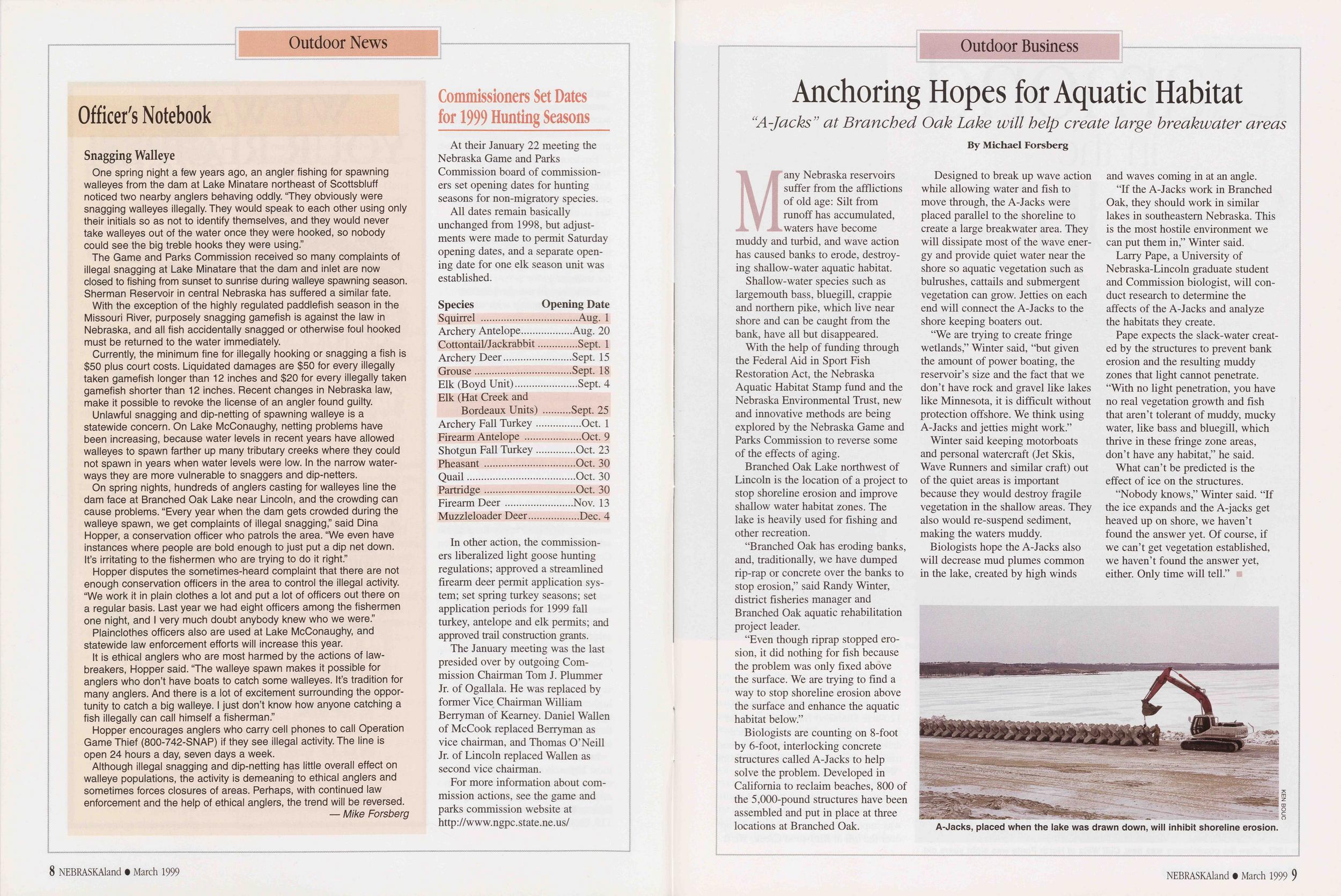 Officer's Notebook
Snagging Walleye
Officer's Notebook
Snagging Walleye
One spring night a few years ago, an angler fishing for spawning walleyes from the dam at Lake Minatare northeast of Scottsbluff noticed two nearby anglers behaving oddly. "They obviously were snagging walleyes illegally. They would speak to each other using only their initials so as not to identify themselves, and they would never take walleyes out of the water once they were hooked, so nobody could see the big treble hooks they were using."
The Game and Parks Commission received so many complaints of illegal snagging at Lake Minatare that the dam and inlet are now closed to fishing from sunset to sunrise during walleye spawning season. Sherman Reservoir in central Nebraska has suffered a similar fate.
With the exception of the highly regulated paddlefish season in the Missouri River, purposely snagging gamefish is against the law in Nebraska, and all fish accidentally snagged or otherwise foul hooked must be returned to the water immediately.
Currently, the minimum fine for illegally hooking or snagging a fish is $50 plus court costs. Liquidated damages are $50 for every illegally taken gamefish longer than 12 inches and $20 for every illegally taken gamefish shorter than 12 inches. Recent changes in Nebraska law, make it possible to revoke the license of an angler found guilty.
Unlawful snagging and dip-netting of spawning walleye is a statewide concern. On Lake McConaughy, netting problems have been increasing, because water levels in recent years have allowed walleyes to spawn farther up many tributary creeks where they could not spawn in years when water levels were low. In the narrow waterways they are more vulnerable to snaggers and dip-netters.
On spring nights, hundreds of anglers casting for walleyes line the dam face at Branched Oak Lake near Lincoln, and the crowding can cause problems. "Every year when the dam gets crowded during the walleye spawn, we get complaints of illegal snagging," said Dina Hopper, a conservation officer who patrols the area. "We even have instances where people are bold enough to just put a dip net down. It's irritating to the fishermen who are trying to do it right."
Hopper disputes the sometimes-heard complaint that there are not enough conservation officers in the area to control the illegal activity. "We work it in plain clothes a lot and put a lot of officers out there on a regular basis. Last year we had eight officers among the fishermen one night, and I very much doubt anybody knew who we were."
Plainclothes officers also are used at Lake McConaughy, and statewide law enforcement efforts will increase this year.
It is ethical anglers who are most harmed by the actions of lawbreakers, Hopper said. "The walleye spawn makes it possible for anglers who don't have boats to catch some walleyes. It's tradition for many anglers. And there is a lot of excitement surrounding the opportunity to catch a big walleye. I just don't know how anyone catching a fish illegally can call himself a fisherman."
Hopper encourages anglers who carry cell phones to call Operation Game Thief (800-742-SNAP) if they see illegal activity. The line is open 24 hours a day, seven days a week.
Although illegal snagging and dip-netting has little overall effect on walleye populations, the activity is demeaning to ethical anglers and sometimes forces closures of areas. Perhaps, with continued law enforcement and the help of ethical anglers, the trend will be reversed.
— Mike Forsberg Commissioners Set Dates for 1999 Hunting SeasonsAt their January 22 meeting the Nebraska Game and Parks Commission board of commissioners set opening dates for hunting seasons for non-migratory species.
All dates remain basically unchanged from 1998, but adjustments were made to permit Saturday opening dates, and a separate opening date for one elk season unit was established.
Species Opening Date Squirrel ..................................Aug. 1 Archery Antelope..................Aug. 20 Cottontail/Jackrabbit..............Sept. 1 Archery Deer........................Sept. 15 Grouse..................................Sept. 18 Elk (Boyd Unit)......................Sept. 4 Elk (Hat Creek and Bordeaux Units) ..........Sept. 25 Archery Fall Turkey................Oct. 1 Firearm Antelope ....................Oct. 9 Shotgun Fall Turkey..............Oct. 23 Pheasant ................................Oct. 30 Quail......................................Oct. 30 Partridge................................Oct. 30 Firearm Deer........................Nov. 13 Muzzleloader Deer..................Dec. 4In other action, the commissioners liberalized light goose hunting regulations; approved a streamlined firearm deer permit application system; set spring turkey seasons; set application periods for 1999 fall turkey, antelope and elk permits; and approved trail construction grants.
The January meeting was the last presided over by outgoing Commission Chairman Tom J. Plummer Jr. of Ogallala. He was replaced by former Vice Chairman William Berryman of Kearney. Daniel Wallen of McCook replaced Berryman as vice chairman, and Thomas O'Neill Jr. of Lincoln replaced Wallen as second vice chairman.
For more information about com- mission actions, see the game and parks commission website at http://www.ngpc.state.ne.us/
8 NEBRASKAland • March 1999Outdoor Business
Anchoring Hopes for Aquatic Habitat
"A-Jacks" at Branched Oak Lake will help create large breakwater areas By Michael Forsbergany Nebraska reservoirs suffer from the afflictions of old age: Silt from runoff has accumulated, waters have become muddy and turbid, and wave action has caused banks to erode, destroying shallow-water aquatic habitat.
Shallow-water species such as largemouth bass, bluegill, crappie and northern pike, which live near shore and can be caught from the bank, have all but disappeared.
With the help of funding through the Federal Aid in Sport Fish Restoration Act, the Nebraska Aquatic Habitat Stamp fund and the Nebraska Environmental Trust, new and innovative methods are being explored by the Nebraska Game and Parks Commission to reverse some of the effects of aging.
Branched Oak Lake northwest of Lincoln is the location of a project to stop shoreline erosion and improve shallow water habitat zones. The lake is heavily used for fishing and other recreation.
"Branched Oak has eroding banks, and, traditionally, we have dumped rip-rap or concrete over the banks to stop erosion," said Randy Winter, district fisheries manager and Branched Oak aquatic rehabilitation project leader.
"Even though riprap stopped erosion, it did nothing for fish because the problem was only fixed above the surface. We are trying to find a way to stop shoreline erosion above the surface and enhance the aquatic habitat below."
Biologists are counting on 8-foot by 6-foot, interlocking concrete structures called A-Jacks to help solve the problem. Developed in California to reclaim beaches, 800 of the 5,000-pound structures have been assembled and put in place at three locations at Branched Oak.
Designed to break up wave action while allowing water and fish to move through, the A-Jacks were placed parallel to the shoreline to create a large breakwater area. They will dissipate most of the wave energy and provide quiet water near the shore so aquatic vegetation such as bulrushes, cattails and submergent vegetation can grow. Jetties on each end will connect the A-Jacks to the shore keeping boaters out.
"We are trying to create fringe wetlands," Winter said, "but given the amount of power boating, the reservoir's size and the fact that we don't have rock and gravel like lakes like Minnesota, it is difficult without protection offshore. We think using A-Jacks and jetties might work."
Winter said keeping motorboats and personal watercraft (Jet Skis, Wave Runners and similar craft) out of the quiet areas is important because they would destroy fragile vegetation in the shallow areas. They also would re-suspend sediment, making the waters muddy.
Biologists hope the A-Jacks also will decrease mud plumes common in the lake, created by high winds and waves coming in at an angle.
"If the A-Jacks work in Branched Oak, they should work in similar lakes in southeastern Nebraska. This is the most hostile environment we can put them in," Winter said.
Larry Pape, a University of Nebraska-Lincoln graduate student and Commission biologist, will conduct research to determine the affects of the A-Jacks and analyze the habitats they create.
Pape expects the slack-water created by the structures to prevent bank erosion and the resulting muddy zones that light cannot penetrate. "With no light penetration, you have no real vegetation growth and fish that aren't tolerant of muddy, mucky water, like bass and bluegill, which thrive in these fringe zone areas, don't have any habitat," he said.
What can't be predicted is the effect of ice on the structures.
"Nobody knows," Winter said. "If the ice expands and the A-jacks get heaved up on shore, we haven't found the answer yet. Of course, if we can't get vegetation established, we haven't found the answer yet, either. Only time will tell."
Diamond in the Sandhills
Photos and text by Rocky Hoffmann "When we finally came over the top of the last hill, we'd see that little lake sitting down in the valley sparkling like the diamond that's part of its name.Last fall, when Cliff Wills of North Platte crested the last, long hill and looked down at Diamond Bar Lake, his feelings were like those from 71 years ago when he looked down from that same hill at just eight years old.
Sandhills lakes usually generate some emotion in those who happen upon them. Water in a sea of sand and grass is particularly pleasing, and Diamond Bar provides a striking contrast to the drab colors of the High Plains. Sparkling blue water, emerald green fringe of cattails and a surface, speckled with coots and other water birds, seem to beckon.
Wills' first trip to Diamond Bar was in 1927, the year Buster Magnuson leased the lake for trapping, hunting and fishing. Magnuson immediately discovered the popularity of the Sandhills retreat among fishermen like Wills, and he began building rental cabins on the lake's east bank.
Just 18 miles west and two miles south of Try on in McPherson County, 120-acre Diamond Bar Lake is not far from North Platte, but in 1927, when driving a Model-T Ford over blow-sand trail was the only way to get there from "the city," a weekend fishing trip became an arduous journey.
"Most of the time we'd come from the south through Sutherland, and it was impossible to get the Model-Ts up over the hill at Birdwood Creek. We'd
"In fact there were several hills that presented us problems, but the last hill was our reward. When we finally came over the top, we'd see that little lake sitting down in the valley sparkling like the diamond that's part of its name," Wills recalls.
Why did so many people drive old cars over horrible roads for so many hours just to get to Diamond Bar Lake? Wills explains it this way:
"Those cars weren't old cars, they were new, 1927 cars and trucks, and the roads weren't horrible, they were just the way roads were back then. We didn't know that someday there'd be four-wheel-drive and pavement, so it was no big deal.
"But most of all, we went to Diamond Bar Lake for the fishing. You could catch big crappies, stringers of
About three weeks after the blizzard of 1931, Magnuson moved his family into the back of the store and commissary he had built and came up with a plan to rent wooden boats to fishermen. Boat rental was 50 cents, and cabins went for a $1.50. The rent was steep, but it beat the alternative, making the torturous drive twice on the same day.
Magnuson's son DeWayne was about 8 years old when the family moved into the commissary. "All of the cabins got good use in those days, and Diamond Bar became the place to go if the purpose was to get away and catch some fish," he recalled.
"You see, there weren't many places to fish in those days. We had no reservoirs or farm ponds in this part of the state, so people fished the river or one of these Sandhills lakes. Diamond Bar was one of the better lakes."
John Den, who sold sporting goods and cigars in North Platte and kept a gambling room in the back of the store, is sometimes credited with the crappie population in Diamond Bar. Den claimed to have released several adult crappies into the lake that he had caught in other lakes. True or not, the fishing was excellent.
"We caught crappies on flies, trolling them from cane poles with nothing more than string for line. The cane pole was the fishing pole of choice then, and it worked really well for bullheads too," Wills said.
"Those cane poles would split and dry out, and most people would go down to Den's store and buy new ones. I didn't have any money, so I kept 12 NEBRASKAland • March 1999
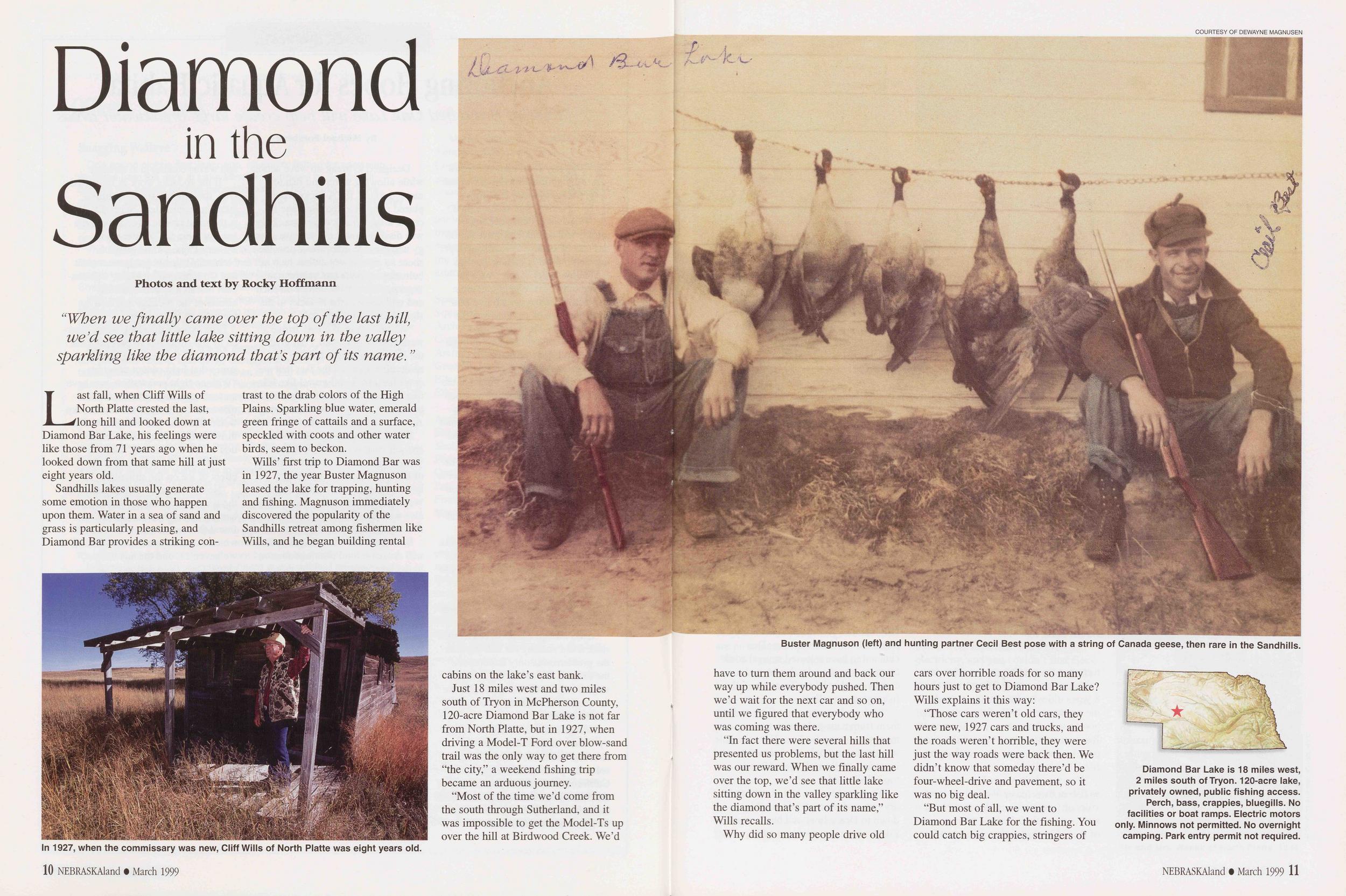
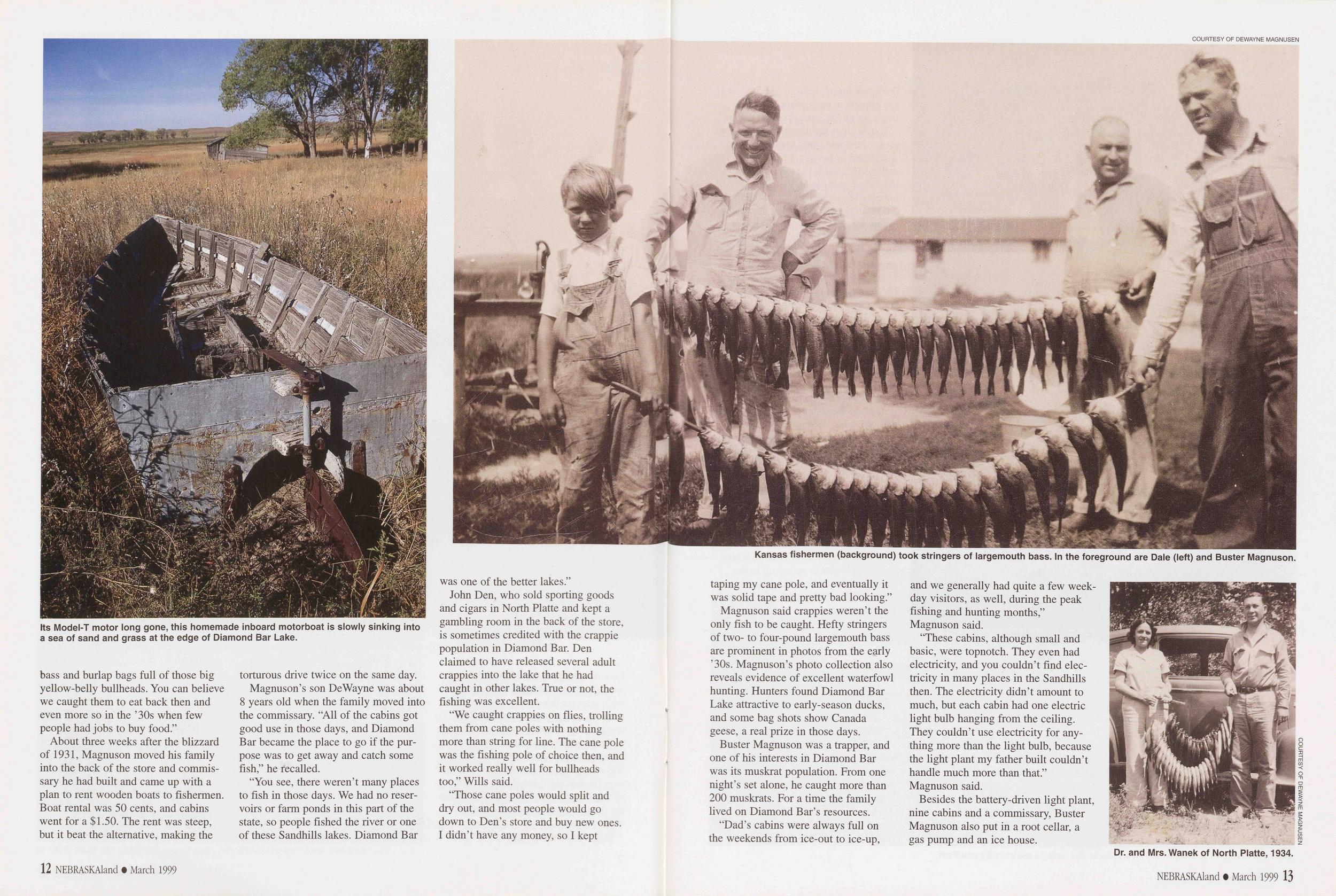
Magnuson said crappies weren't the only fish to be caught. Hefty stringers of two- to four-pound largemouth bass are prominent in photos from the early '30s. Magnuson's photo collection also reveals evidence of excellent waterfowl hunting. Hunters found Diamond Bar Lake attractive to early-season ducks, and some bag shots show Canada geese, a real prize in those days.
Buster Magnuson was a trapper, and one of his interests in Diamond Bar was its muskrat population. From one night's set alone, he caught more than 200 muskrats. For a time the family lived on Diamond Bar's resources.
"Dad's cabins were always full on the weekends from ice-out to ice-up, and we generally had quite a few weekday visitors, as well, during the peak fishing and hunting months," Magnuson said.
"These cabins, although small and basic, were topnotch. They even had electricity, and you couldn't find electricity in many places in the Sandhills then. The electricity didn't amount to much, but each cabin had one electric light bulb hanging from the ceiling. They couldn't use electricity for anything more than the light bulb, because the light plant my father built couldn't handle much more than that." Magnuson said.
Besides the battery-driven light plant, nine cabins and a commissary, Buster Magnuson also put in a root cellar, a gas pump and an ice house.
"He cut ice not only for use by guests in the summer but for ranchers and sand farmers from miles around," Magnuson said. "People would come and buy ice that we kept cold in the ice house and haul it off to their places in the hills. Diamond Bar Lake had good clean water that you could drink, and Dad helped keep it clear by forbidding the use of live minnows that might result in carp getting into the lake."
Wills remembers when he first learned to drink from the lake while out in one of Buster's boats.
"They taught me to dip the paddle real deep and then hold it above my head, allowing the water to run off the paddle, down the handle and into my mouth. On a hot day, you'd see paddles sticking up in the air every once in a while out on the lake," Wills recalled.
DeWayne's mother cooked meals for the boarders in the commissary. "There wasn't really any seating available, but we had a serving counter and people made do," he said. "She pretty much cooked whatever they wanted, breakfast, lunch or dinner. People could cook their own meals, because we provided gas burners in each cabin, and there was a lot of fish eaten in those cabins."
Tough times went with the good, and most of the bad times came in winter. A blizzard in January 1931 resulted in cattle drifting into the lake. Most of them died, and the dark mounds remained frozen in the ice till spring.
The 1931 blizzard buried the cabins except for their peaks, and so did another blizzard in 1942, but neither one compared to the 1949 blizzard that gripped western Nebraska for months.
The snow and cold were so extreme for so long that most of the fishing came to an end. Bernard Bollish of North Platte remembers the effects of the blizzard.
"We were so relieved in the spring when the snow finally melted that we planned a fishing trip to Diamond Bar. About six of us got a big, old grain truck, loaded several old boats in it and headed up through the hills for a weekend of fishing. When we got to the lake, we found bloated fish drifting in waves along the shore. Even the bullheads had died," Bollish recalls.
Some fishing continued into the '50s, but dry years diminished the lake and winter kills continued. The fishing was all but over at Diamond Bar well before the blizzards and the droughts, however. It wasn't because there were no fish in the lake, but because reservoirs had begun to spring up in the Platte and Republican River valleys. There were good roads to the new big lakes, and fishing was good. Diamond Bar gradually fell by the wayside except for local interest.
"In 1942 my father began selling the nine cabins, Magnuson said. "You still find them on ranches around the area. Eventually we all moved out, leaving only the commissary, a couple of outhouses and lots of memories."
To many people, Diamond Bar Lake remained just a memory and the subject of countless stories until 1994 when the Leu family, who currently own Diamond Bar Ranch and Lake, approached the Game and Parks Commission about rejuvenating the fishing. Gifford and Marion Leu hoped that visitors could enjoy the area as 14 NEBRASKAland • March 1999 they had in the past. With improved roads and modern vehicles, many more people were seeking remote areas far from the busy reservoirs that had once claimed their attention.
After water chemistry analysis, depth mapping and fish population surveys, the Game and Parks Commission agreed to restock the lake with desirable game fish and to supplementally stock and manage the fishery as necessary. In return, the Leus agreed to allow year-round angler access to the lake for 10 years, at no charge.
Surveys indicated that only black bullheads, fathead minnows and salamanders populated Diamond Bar. Since there were no carp and sunfish, chemical renovation was not necessary. With a maximum depth of 6V2 feet, the lake is still vulnerable to winter kill, and if the problem persists, the Commission will consider winter aeration.
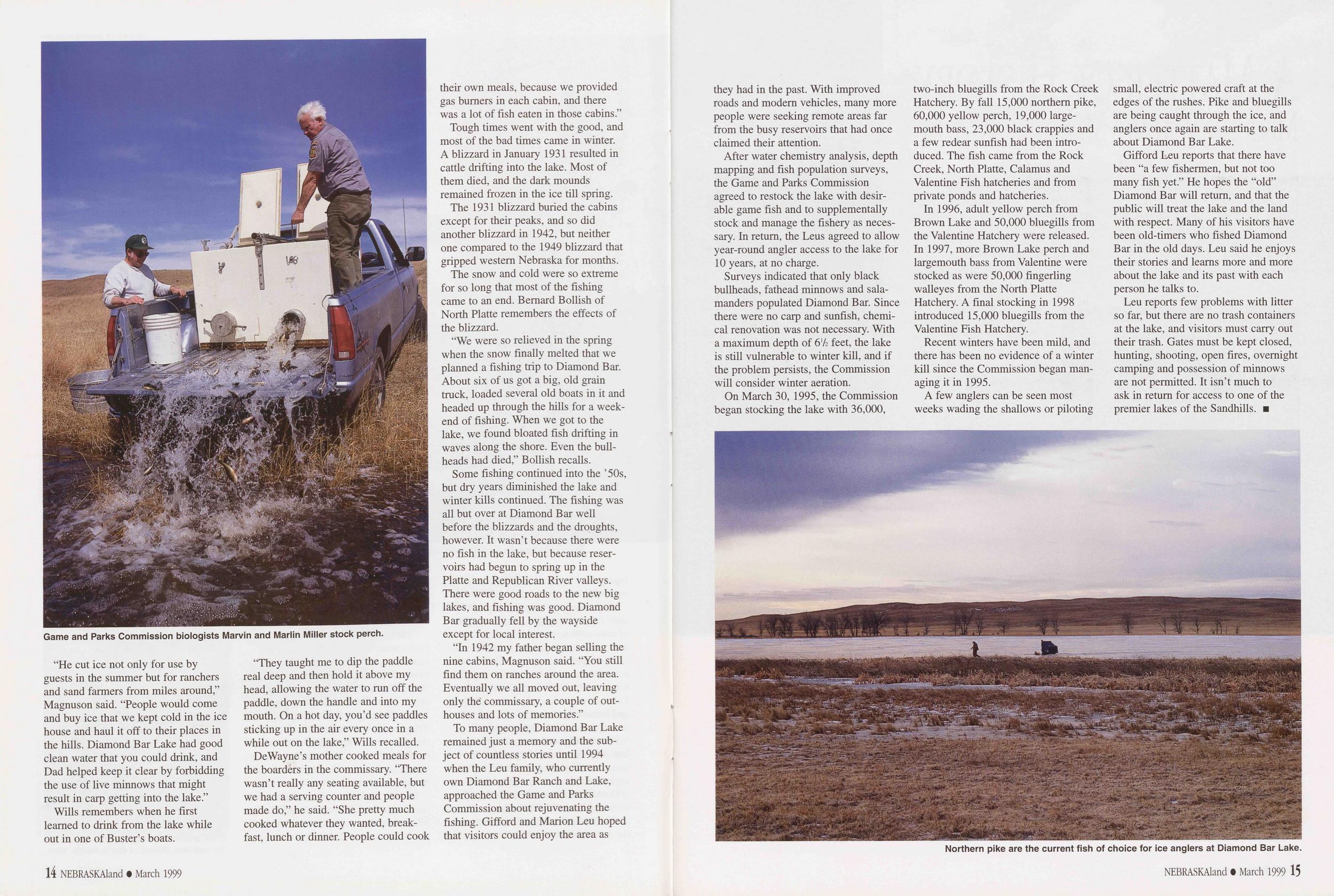
On March 30, 1995, the Commission began stocking the lake with 36,000, two-inch bluegills from the Rock Creek Hatchery. By fall 15,000 northern pike, 60,000 yellow perch, 19,000 largemouth bass, 23,000 black crappies and a few redear sunfish had been introduced. The fish came from the Rock Creek, North Platte, Calamus and Valentine Fish hatcheries and from private ponds and hatcheries.
In 1996, adult yellow perch from Brown Lake and 50,000 bluegills from the Valentine Hatchery were released. In 1997, more Brown Lake perch and largemouth bass from Valentine were stocked as were 50,000 fingerling walleyes from the North Platte Hatchery. A final stocking in 1998 introduced 15,000 bluegills from the Valentine Fish Hatchery.
Recent winters have been mild, and there has been no evidence of a winter kill since the Commission began managing it in 1995.
A few anglers can be seen most weeks wading the shallows or piloting small, electric powered craft at the edges of the rushes. Pike and bluegills are being caught through the ice, and anglers once again are starting to talk about Diamond Bar Lake.
Gifford Leu reports that there have been "a few fishermen, but not too many fish yet." He hopes the "old" Diamond Bar will return, and that the public will treat the lake and the land with respect. Many of his visitors have been old-timers who fished Diamond Bar in the old days. Leu said he enjoys their stories and learns more and more about the lake and its past with each person he talks to.
Leu reports few problems with litter so far, but there are no trash containers at the lake, and visitors must carry out their trash. Gates must be kept closed, hunting, shooting, open fires, overnight camping and possession of minnows are not permitted. It isn't much to ask in return for access to one of the premier lakes of the Sandhills.
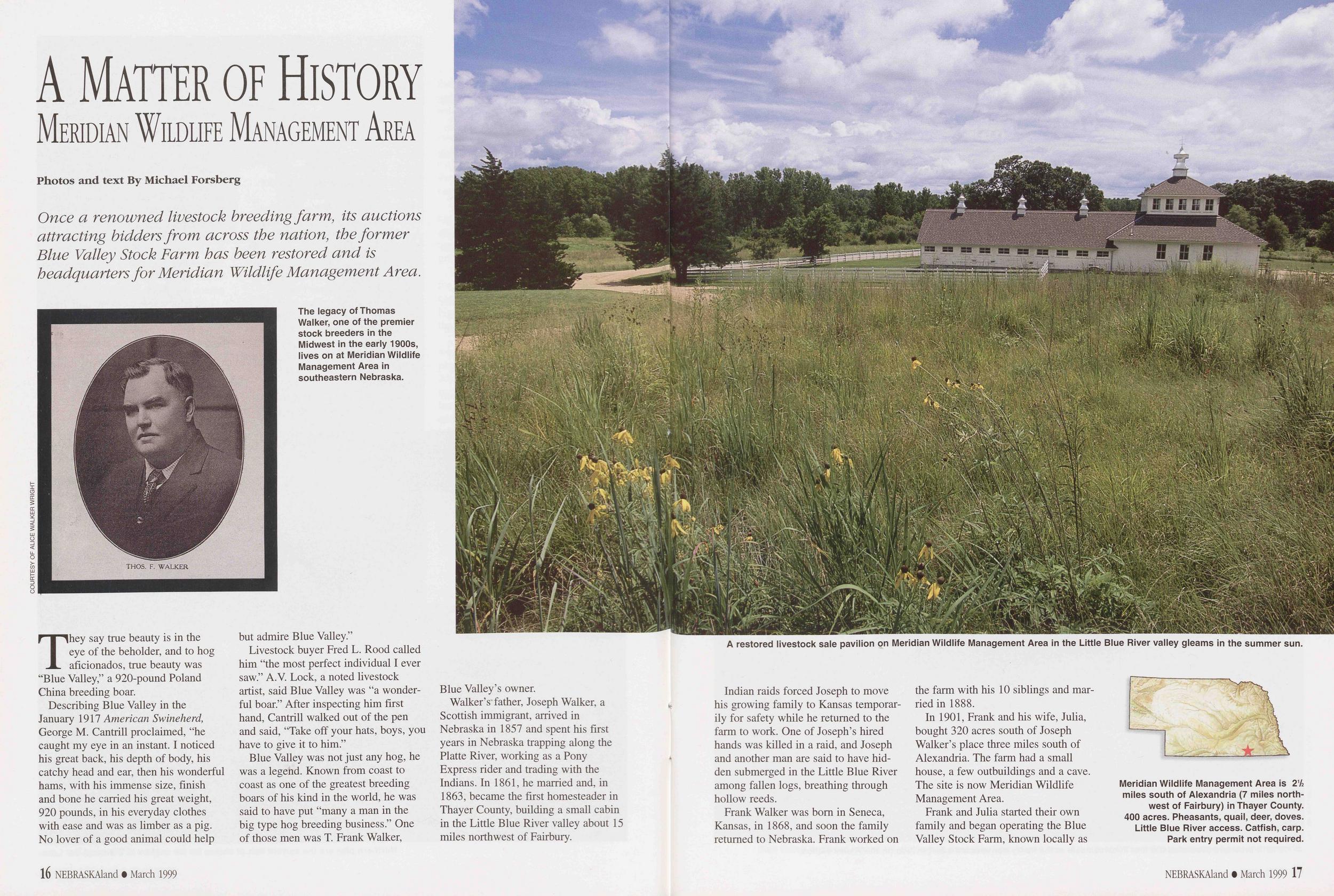
A Matter of History Meridian Wildlife Management Area
Photos and text By Michael Forsberg Once a renowned livestock breeding farm, its auctions attracting bidders from across the nation, the former Blue Valley Stock Farm has been restored and is headquarters for Meridian Wildlife Management Area.They say true beauty is in the eye of the beholder, and to hog aficionados, true beauty was "Blue Valley," a 920-pound Poland China breeding boar.
Describing Blue Valley in the January 1917 American Swineherd, George M. Cantrill proclaimed, "he caught my eye in an instant. I noticed his great back, his depth of body, his catchy head and ear, then his wonderful hams, with his immense size, finish and bone he carried his great weight, 920 pounds, in his everyday clothes with ease and was as limber as a pig. No lover of a good animal could help but admire Blue Valley."
Livestock buyer Fred L. Rood called him "the most perfect individual I ever saw." A.V Lock, a noted livestock artist, said Blue Valley was "a wonderful boar." After inspecting him first hand, Cantrill walked out of the pen and said, "Take off your hats, boys, you have to give it to him."
Blue Valley was not just any hog, he was a legend. Known from coast to coast as one of the greatest breeding boars of his kind in the world, he was said to have put "many a man in the big type hog breeding business." One of those men was T. Frank Walker, A restored livestock sale pavilion on Meridian Wildlife Management Area in the Little Blue River valley gleams in the summer sun. Blue Valley's owner.
Walker's father, Joseph Walker, a Scottish immigrant, arrived in Nebraska in 1857 and spent his first years in Nebraska trapping along the Platte River, working as a Pony Express rider and trading with the Indians. In 1861, he married and, in 1863, became the first homesteader in Thayer County, building a small cabin in the Little Blue River valley about 15 miles northwest of Fairbury.
16 NEBRASKAland • March 1999Indian raids forced Joseph to move his growing family to Kansas temporarily for safety while he returned to the farm to work. One of Joseph's hired hands was killed in a raid, and Joseph and another man are said to have hidden submerged in the Little Blue River among fallen logs, breathing through hollow reeds.
Frank Walker was born in Seneca, Kansas, in 1868, and soon the family returned to Nebraska. Frank worked on the farm with his 10 siblings and married in 1888.
In 1901, Frank and his wife, Julia, bought 320 acres south of Joseph Walker's place three miles south of Alexandria. The farm had a small house, a few outbuildings and a cave. The site is now Meridian Wildlife Management Area.
Frank and Julia started their own family and began operating the Blue Valley Stock Farm, known locally as
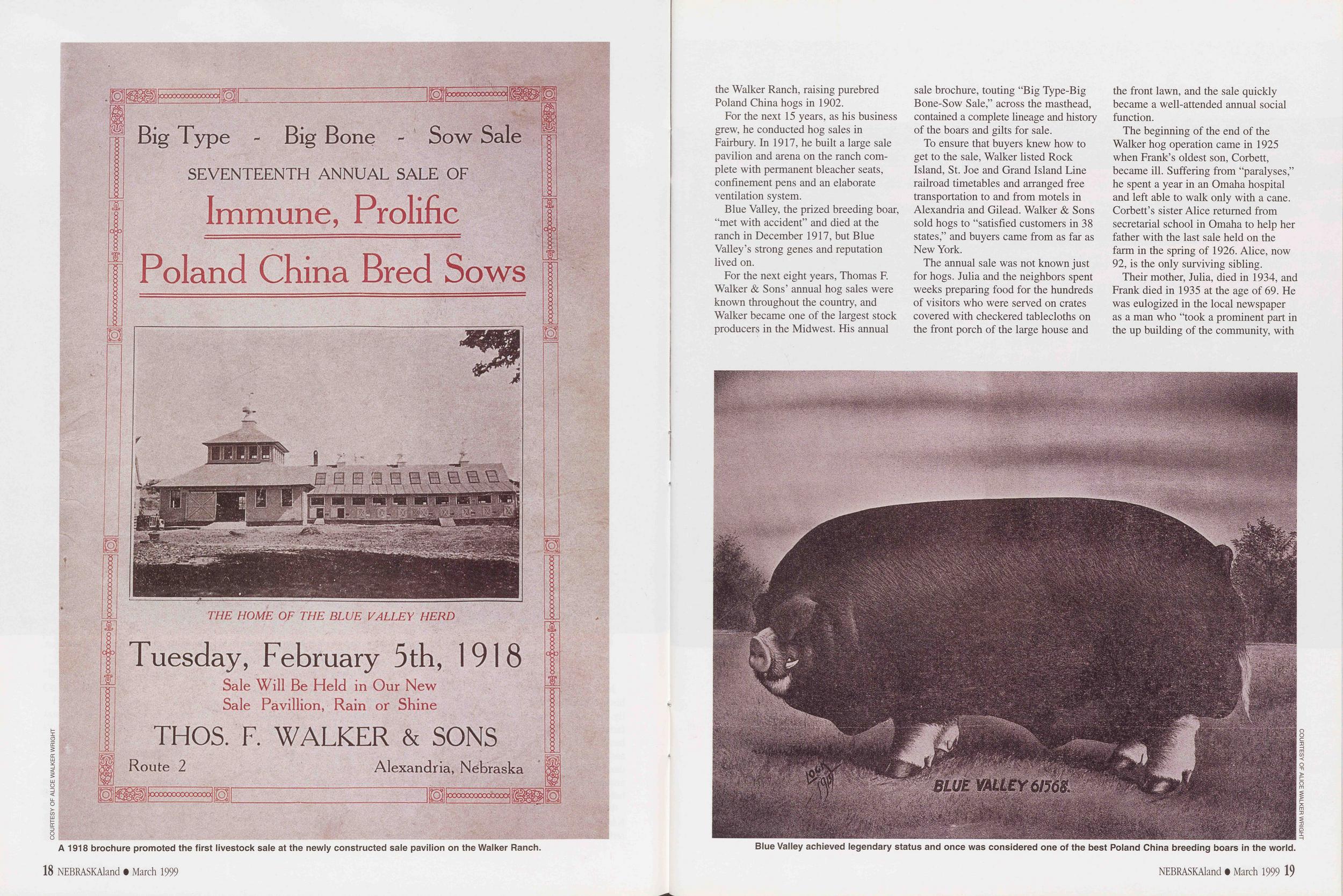
For the next 15 years, as his business grew, he conducted hog sales in Fairbury. In 1917, he built a large sale pavilion and arena on the ranch complete with permanent bleacher seats, confinement pens and an elaborate ventilation system.
Blue Valley, the prized breeding boar, "met with accident" and died at the ranch in December 1917, but Blue Valley's strong genes and reputation lived on.
For the next eight years, Thomas F. Walker & Sons' annual hog sales were known throughout the country, and Walker became one of the largest stock producers in the Midwest. His annual sale brochure, touting "Big Type-Big Bone-Sow Sale," across the masthead, contained a complete lineage and history of the boars and gilts for sale.
To ensure that buyers knew how to get to the sale, Walker listed Rock Island, St. Joe and Grand Island Line railroad timetables and arranged free transportation to and from motels in Alexandria and Gilead. Walker & Sons sold hogs to "satisfied customers in 38 states," and buyers came from as far as New York.
The annual sale was not known just for hogs. Julia and the neighbors spent weeks preparing food for the hundreds of visitors who were served on crates covered with checkered tablecloths on the front porch of the large house and the front lawn, and the sale quickly became a well-attended annual social function.
The beginning of the end of the Walker hog operation came in 1925 when Frank's oldest son, Corbett, became ill. Suffering from "paralyses," he spent a year in an Omaha hospital and left able to walk only with a cane. Corbett's sister Alice returned from secretarial school in Omaha to help her father with the last sale held on the farm in the spring of 1926. Alice, now 92, is the only surviving sibling.
Their mother, Julia, died in 1934, and Frank died in 1935 at the age of 69. He was eulogized in the local newspaper as a man who "took a prominent part in the up building of the community, with
Frank's family lost the farm during the Great Depression. For the next 50 years the farm was rented and slowly fell into disrepair.
In 1987, the Nebraska Game and Parks Commission purchased the 320-acre property on the Little Blue River for a wildlife management area, and it became the management headquarters for several other wildlife areas in the region. The house, the hay barn and the sale pavilion built by Frank Walker between 1907 and 1917 were still intact, and are now listed in the National Register of Historic Places.
Shortly after purchase of the property, Brad Seitz, Commission wildlife biologist, and several workers began a meticulous 15-month restoration of the residence, where Seitz and his family now live. Conducted in consultation with the Nebraska State Historical Society, the restoration preserved as many historic features of the house as possible.
For its day, the house was a bit avant garde, having sliding pocket doors, a telephone closest and ceiling lights using a carbide lighting system, a forerunner of electric lighting. Commission horticulturists consulted with Alice 20 NEBRASKAland • March 1999 Walker about the landscaping to match the original plant materials as closely as possible.
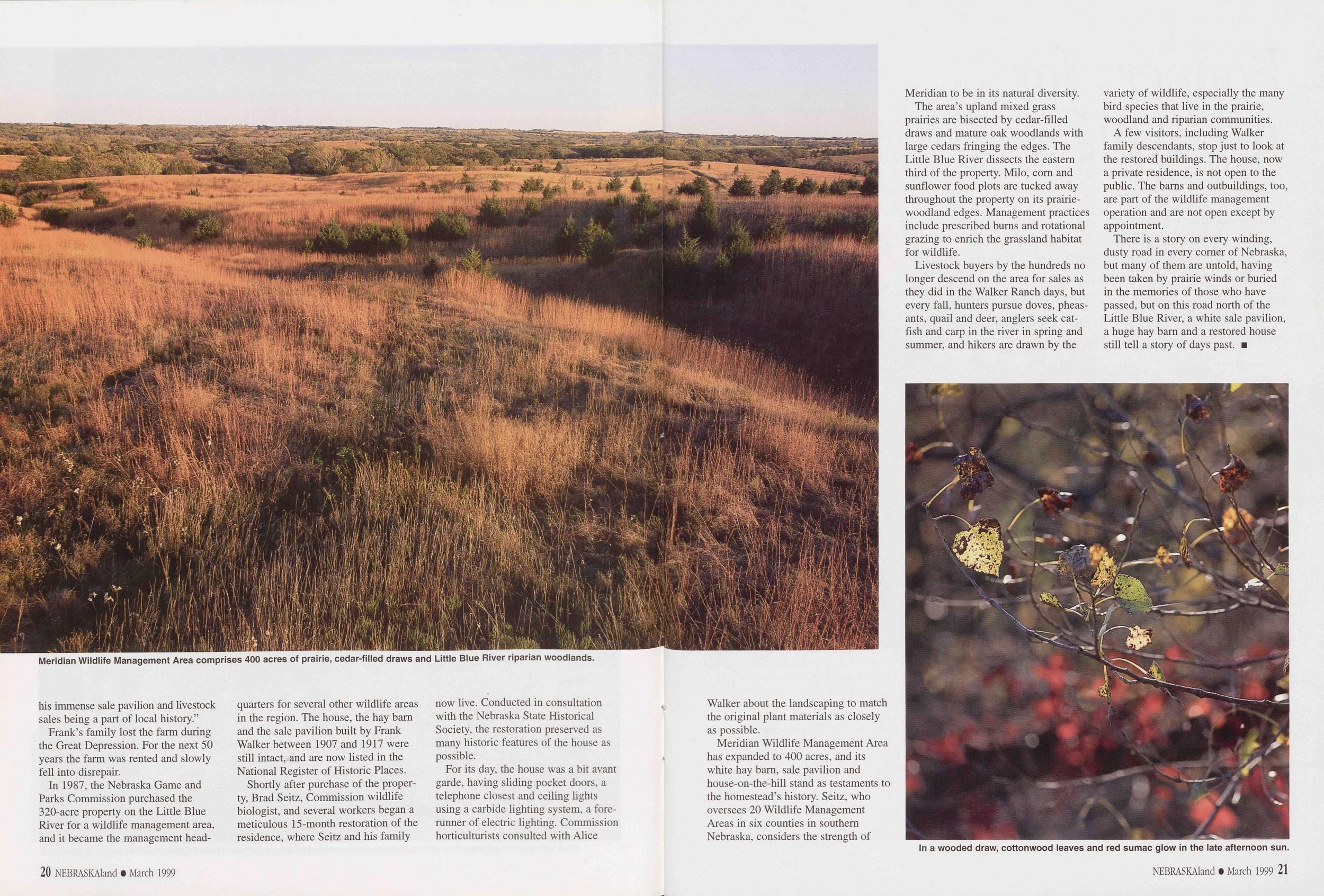
Meridian Wildlife Management Area has expanded to 400 acres, and its white hay barn, sale pavilion and house-on-the-hill stand as testaments to the homestead's history. Seitz, who oversees 20 Wildlife Management Areas in six counties in southern Nebraska, considers the strength of Meridian to be in its natural diversity.
The area's upland mixed grass prairies are bisected by cedar-filled draws and mature oak woodlands with large cedars fringing the edges. The Little Blue River dissects the eastern third of the property. Milo, corn and sunflower food plots are tucked away throughout the property on its prairie woodland edges. Management practices include prescribed burns and rotational grazing to enrich the grassland habitat for wildlife.
Livestock buyers by the hundreds no longer descend on the area for sales as they did in the Walker Ranch days, but every fall, hunters pursue doves, pheasants, quail and deer, anglers seek catfish and carp in the river in spring and summer, and hikers are drawn by the variety of wildlife, especially the many bird species that live in the prairie, woodland and riparian communities.
A few visitors, including Walker family descendants, stop just to look at the restored buildings. The house, now a private residence, is not open to the public. The barns and outbuildings, too, are part of the wildlife management operation and are not open except by appointment.
There is a story on every winding, dusty road in every corner of Nebraska, but many of them are untold, having been taken by prairie winds or buried in the memories of those who have passed, but on this road north of the Little Blue River, a white sale pavilion, a huge hay barn and a restored house still tell a story of days past.
Poppers for Bluegills
Photos and text by Ken Bouc Flyrods, poppers and bluegills are a sure-fire combination for fun. Just about any flyrod will do, but finding big bluegills sometimes is tough, and coming up with the proper popper can be the most difficult of all.Dimples on the glassy water promised great fishing — the surface action that most anglers lust after beyond all other kinds of fishing. Obviously, anything as delicate as a dry fly would be quickly mauled beyond recognition. Stronger medicine was indicated: poppers.
The four-acre pond, set among clumps of cattails spotted along its margins and fed by springs that flowed in through a grassy slough, was a jewel. It sparkled in the golden light at the end of the summer day, a perfect setting for great bluegill fishing.
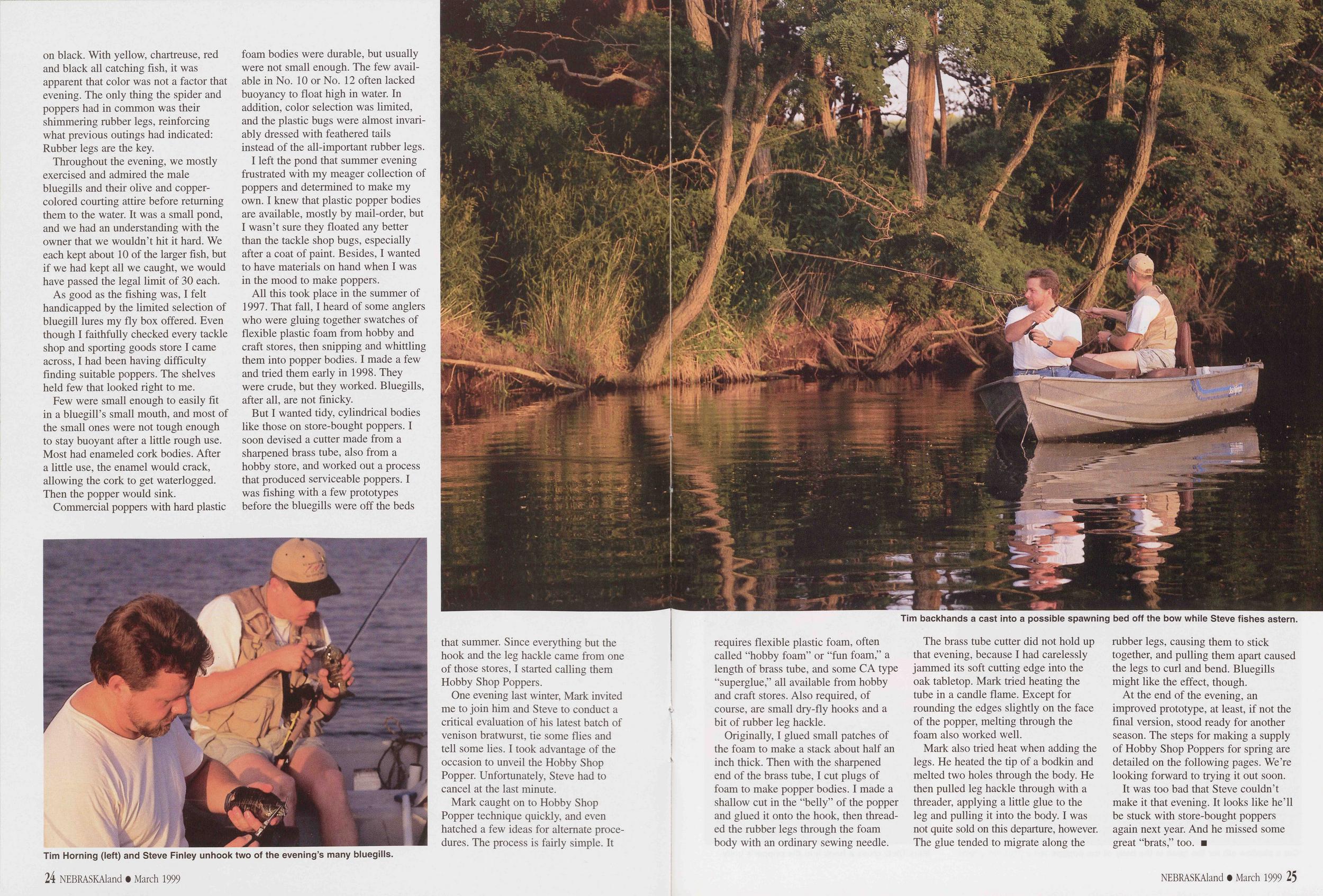
Tim Horning of Omaha and Steve Finley of LaVista pushed off in a small boat, Mark Dietz of Bellevue and I followed in another. Small panfish poppers dangled from all but one flyrod. In a contrary mood, Tim chose to defy reason and fish with a sponge spider.
According to the calendar and the thermometer, the bluegills should have finished spawning, but the big males in this lake obviously didn't agree. Although it was well into June and the evening temperature hovered in the high 80s, many "bulls" still protected nests scooped out of the pond's bed and clustered in several colonies in the shallows. Steve likened them to a crater-pocked lunar landscape.
His popper hooked up with the first bluegill of the evening, even before Mark and I left shore. A few minutes later Mark boated our first fish. It took a little longer for Tim and me to connect. I discovered a bent hook point on my popper and it took a minute or two to select and tie on a new one. I suggested to Tim that his tardiness had something to do with his spider.
Earlier in the year, Mark might have tried spiders and wet flies, too. But now, wet flies would foul in the aquatic vegetation beginning to proliferate in lake, as would sponge spiders, once they became waterlogged and began to sink.
Steve likes to try flies, too, and between poppers, he even tossed a Madam X, which is a dry fly imitation of a grasshopper, but without results.
Tim uses spiders most of the time. I am equally stubborn about poppers, throwing them whenever possible to get all the surface action I can. On this outing, it appeared that durable, buoyant poppers would have the advantage.
Poppers originated as a flyrodder's largemouth bass lure, a contraption much larger than those used for bluegills. The bass versions usually have a deeply-dished face that causes a loud commotion in the water when jerked or twitched. That "pop" often triggers a violent response from bass.
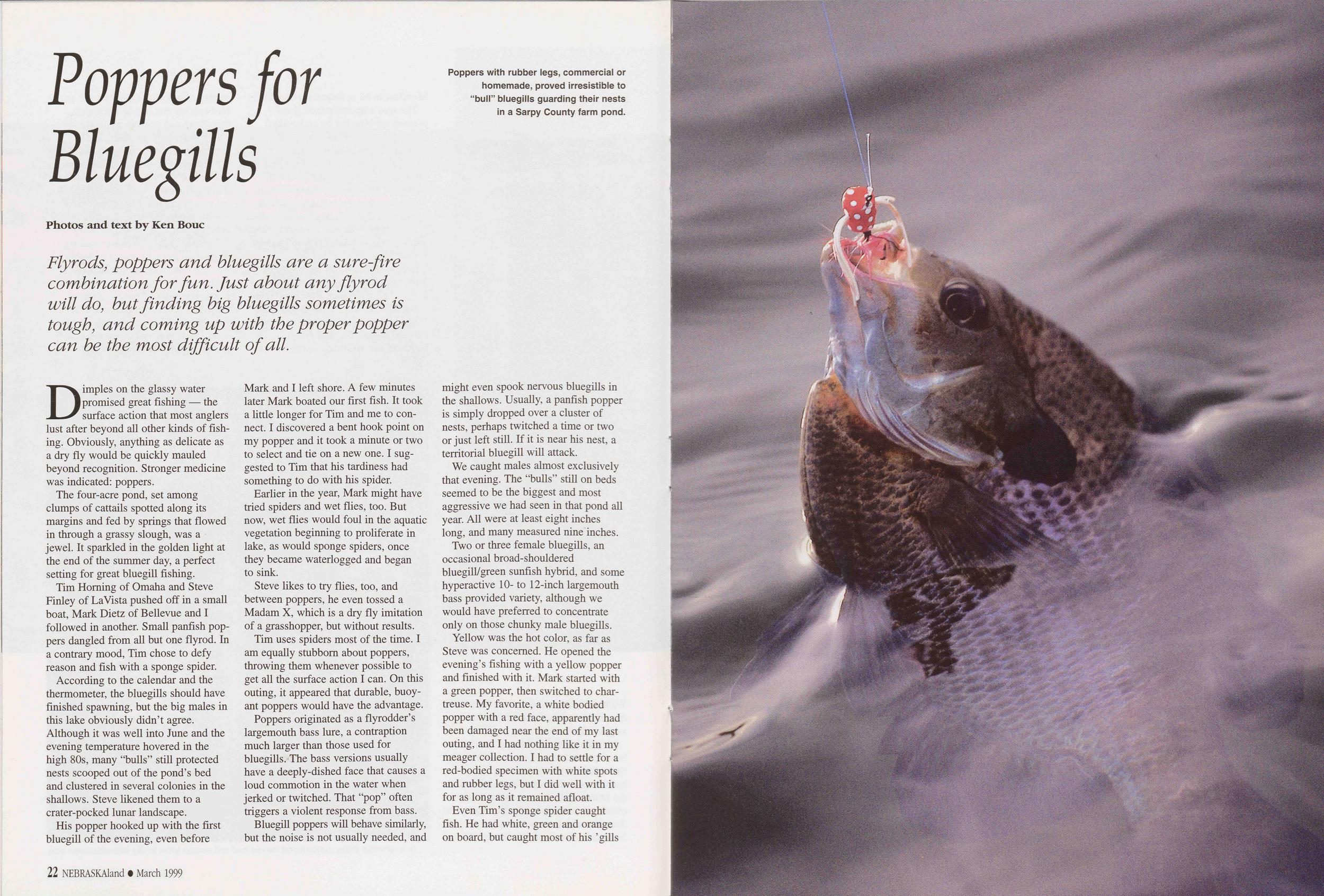
Bluegill poppers will behave similarly, but the noise is not usually needed, and Poppers with rubber legs, commercial or homemade, proved irresistible to "bull" bluegills guarding their nests in a Sarpy County farm pond. might even spook nervous bluegills in the shallows. Usually, a panfish popper is simply dropped over a cluster of nests, perhaps twitched a time or two or just left still. If it is near his nest, a territorial bluegill will attack.
We caught males almost exclusively that evening. The "bulls" still on beds seemed to be the biggest and most aggressive we had seen in that pond all year. All were at least eight inches long, and many measured nine inches.
Two or three female bluegills, an occasional broad-shouldered bluegill/green sunfish hybrid, and some hyperactive 10- to 12-inch largemouth bass provided variety, although we would have preferred to concentrate only on those chunky male bluegills.
Yellow was the hot color, as far as Steve was concerned. He opened the evening's fishing with a yellow popper and finished with it. Mark started with a green popper, then switched to chartreuse. My favorite, a white bodied popper with a red face, apparently had been damaged near the end of my last outing, and I had nothing like it in my meager collection. I had to settle for a red-bodied specimen with white spots and rubber legs, but I did well with it for as long as it remained afloat.
Even Tim's sponge spider caught fish. He had white, green and orange on board, but caught most of his 'gills 22 NEBRASKAland • March 1999
 on black. With yellow, chartreuse, red
and black all catching fish, it was
apparent that color was not a factor that
evening. The only thing the spider and
poppers had in common was their
shimmering rubber legs, reinforcing
what previous outings had indicated:
Rubber legs are the key.
on black. With yellow, chartreuse, red
and black all catching fish, it was
apparent that color was not a factor that
evening. The only thing the spider and
poppers had in common was their
shimmering rubber legs, reinforcing
what previous outings had indicated:
Rubber legs are the key.
Throughout the evening, we mostly exercised and admired the male bluegills and their olive and copper-colored courting attire before returning them to the water. It was a small pond, and we had an understanding with the owner that we wouldn't hit it hard. We each kept about 10 of the larger fish, but if we had kept all we caught, we would have passed the legal limit of 30 each.
As good as the fishing was, I felt handicapped by the limited selection of bluegill lures my fly box offered. Even though I faithfully checked every tackle shop and sporting goods store I came across, I had been having difficulty finding suitable poppers. The shelves held few that looked right to me.
Few were small enough to easily fit in a bluegill's small mouth, and most of the small ones were not tough enough to stay buoyant after a little rough use. Most had enameled cork bodies. After a little use, the enamel would crack, allowing the cork to get waterlogged. Then the popper would sink.
Commercial poppers with hard plastic foam bodies were durable, but usually were not small enough. The few available in No. 10 or No. 12 often lacked buoyancy to float high in water. In addition, color selection was limited, and the plastic bugs were almost invariably dressed with feathered tails instead of the all-important rubber legs.
I left the pond that summer evening frustrated with my meager collection of poppers and determined to make my own. I knew that plastic popper bodies are available, mostly by mail-order, but I wasn't sure they floated any better than the tackle shop bugs, especially after a coat of paint. Besides, I wanted to have materials on hand when I was in the mood to make poppers.
All this took place in the summer of 1997. That fall, I heard of some anglers who were gluing together swatches of flexible plastic foam from hobby and craft stores, then snipping and whittling them into popper bodies. I made a few and tried them early in 1998. They were crude, but they worked. Bluegills, after all, are not finicky.
But I wanted tidy, cylindrical bodies like those on store-bought poppers. I soon devised a cutter made from a sharpened brass tube, also from a hobby store, and worked out a process that produced serviceable poppers. I was fishing with a few prototypes before the bluegills were off the beds that summer. Since everything but the hook and the leg hackle came from one of those stores, I started calling them Hobby Shop Poppers.
One evening last winter, Mark invited me to join him and Steve to conduct a critical evaluation of his latest batch of venison bratwurst, tie some flies and tell some lies. I took advantage of the occasion to unveil the Hobby Shop Popper. Unfortunately, Steve had to cancel at the last minute.
Mark caught on to Hobby Shop Popper technique quickly, and even hatched a few ideas for alternate procedures. The process is fairly simple. It
Originally, I glued small patches of the foam to make a stack about half an inch thick. Then with the sharpened end of the brass tube, I cut plugs of foam to make popper bodies. I made a shallow cut in the "belly" of the popper and glued it onto the hook, then threaded the rubber legs through the foam body with an ordinary sewing needle.
The brass tube cutter did not hold up that evening, because I had carelessly jammed its soft cutting edge into the oak tabletop. Mark tried heating the tube in a candle flame. Except for rounding the edges slightly on the face of the popper, melting through the foam also worked well.
Mark also tried heat when adding the legs. He heated the tip of a bodkin and melted two holes through the body. He then pulled leg hackle through with a threader, applying a little glue to the leg and pulling it into the body. I was not quite sold on this departure, however. The glue tended to migrate along the rubber legs, causing them to stick together, and pulling them apart caused the legs to curl and bend. Bluegills might like the effect, though.
At the end of the evening, an improved prototype, at least, if not the final version, stood ready for another season. The steps for making a supply of Hobby Shop Poppers for spring are detailed on the following pages. We're looking forward to trying it out soon.
It was too bad that Steve couldn't make it that evening. It looks like he'll be stuck with store-bought poppers again next year. And he missed some great "brats," too.
NEBRASKAland • March 1999 25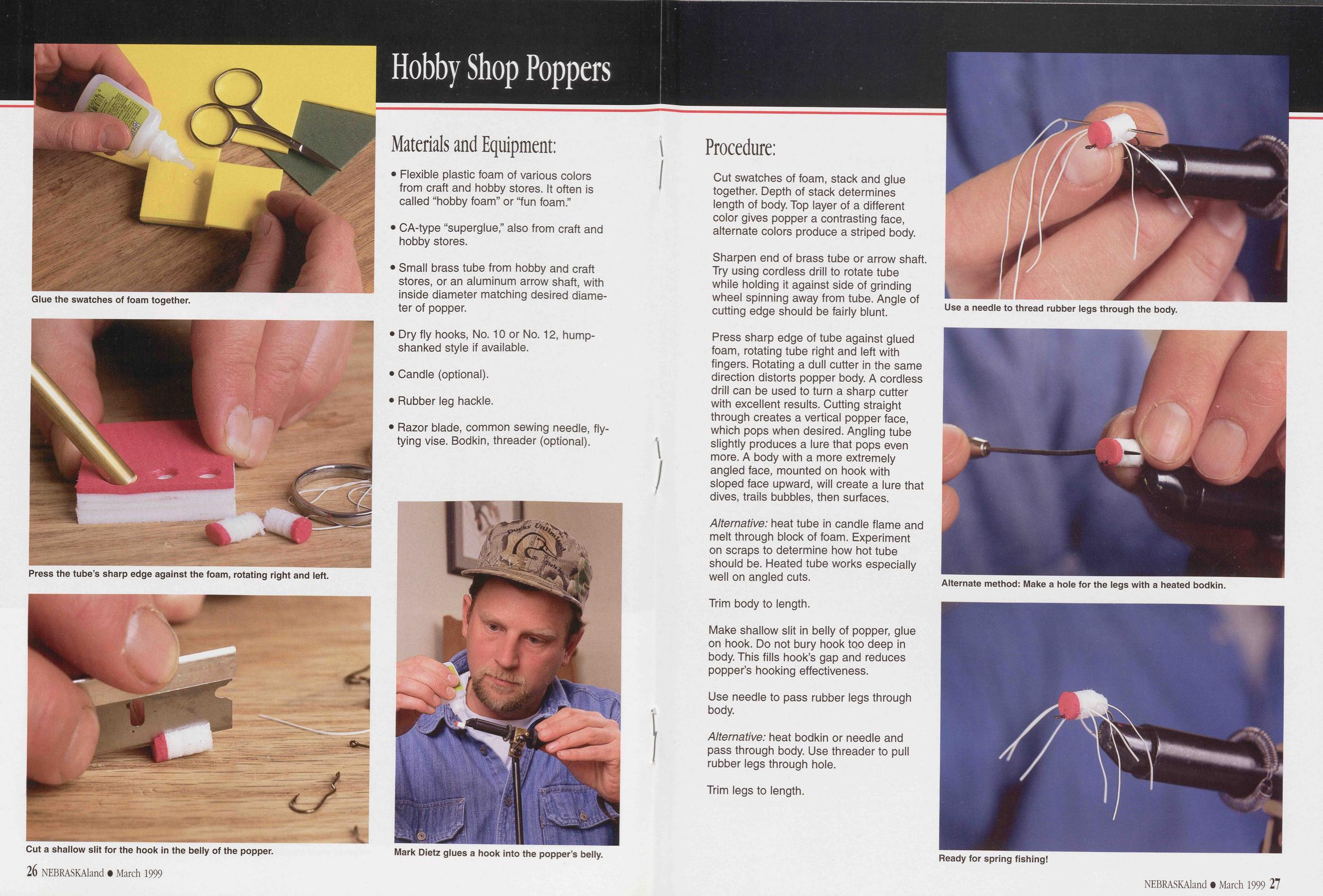
Hobby Shop Poppers
Cut swatches of foam, stack and glue together. Depth of stack determines length of body. Top layer of a different color gives popper a contrasting face, alternate colors produce a striped body.
Sharpen end of brass tube or arrow shaft. Try using cordless drill to rotate tube while holding it against side of grinding wheel spinning away from tube. Angle of cutting edge should be fairly blunt.
Press sharp edge of tube against glued foam, rotating tube right and left with fingers. Rotating a dull cutter in the same direction distorts popper body. A cordless drill can be used to turn a sharp cutter with excellent results. Cutting straight through creates a vertical popper face, which pops when desired. Angling tube slightly produces a lure that pops even more. A body with a more extremely angled face, mounted on hook with sloped face upward, will create a lure that dives, trails bubbles, then surfaces.
Alternative: heat tube in candle flame and melt through block of foam. Experiment on scraps to determine how hot tube should be. Heated tube works especially well on angled cuts.
Trim body to length.
Make shallow slit in belly of popper, glue on hook. Do not bury hook too deep in body. This fills hook's gap and reduces popper's hooking effectiveness.
Use needle to pass rubber legs through body.
Alternative: heat bodkin or needle and pass through body. Use threader to pull rubber legs through hole.
Trim legs to length.
Fort Robinson: 125 Years of History
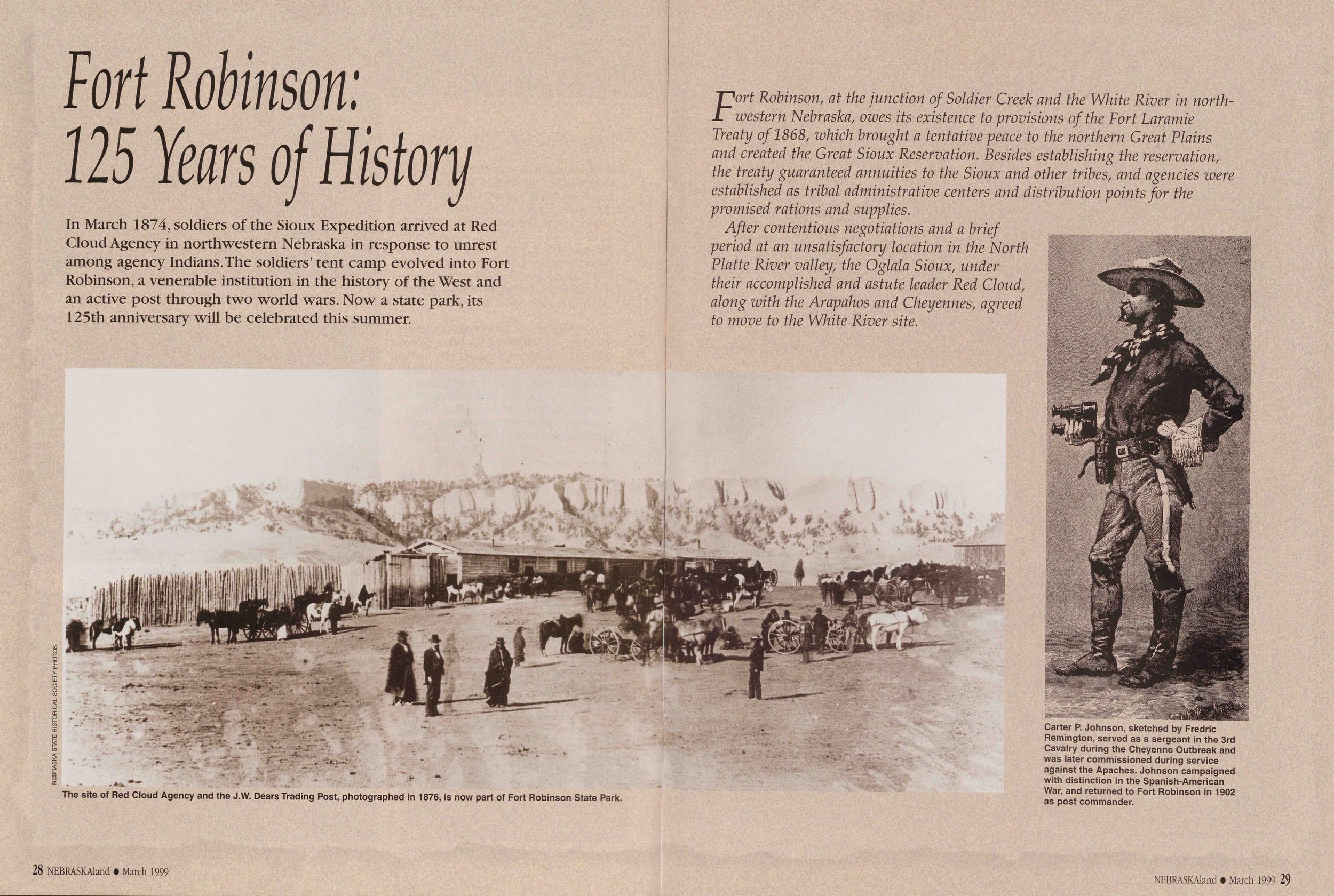
In March 1874, soldiers of the Sioux Expedition arrived at Red Cloud Agency in northwestern Nebraska in response to unrest among agency Indians.The soldiers' tent camp evolved into Fort Robinson, a venerable institution in the history of the West and an active post through two world wars. Now a state park, its 125th anniversary will be celebrated this summer.
Fort Robinson, at the junction of Soldier Creek and the White River in northwestern Nebraska, owes its existence to provisions of the Fort Laramie Treaty of 1868, which brought a tentative peace to the northern Great Plains and created the Great Sioux Reservation. Resides establishing the reservation, the treaty guaranteed annuities to the Sioux and other tribes, and agencies were established as tribal administrative centers and distribution points for the promised rations and supplies.
After contentious negotiations and a brief period at an unsatisfactory location in the North Platte River valley/the Oglala Sioux, under their accomplished and astute leader Red Cloud, along with the Arapahos and Cheyennes, agreed to move to the White River site.
After World War I, the future of the neglected fort was in question, hut in jlJl1919 it was designated a Quartermaster Remount Depot and eventually became the Army's largest training, care and breeding center for horses and mules. Equestrian training brought horse racing, jumping events, polo games and even a hunt club, for which coyotes, not foxes, were the quarry.
Fort Robinson's country club reputation changed with the coming of World War II. Thousands of horses and mules were readied for war service, and in 1942 a War Dog Reception and Training Center trained 14,000 dogs for duty at home and abroad. A prisoner of war camp held as many as 3,000 inmates.
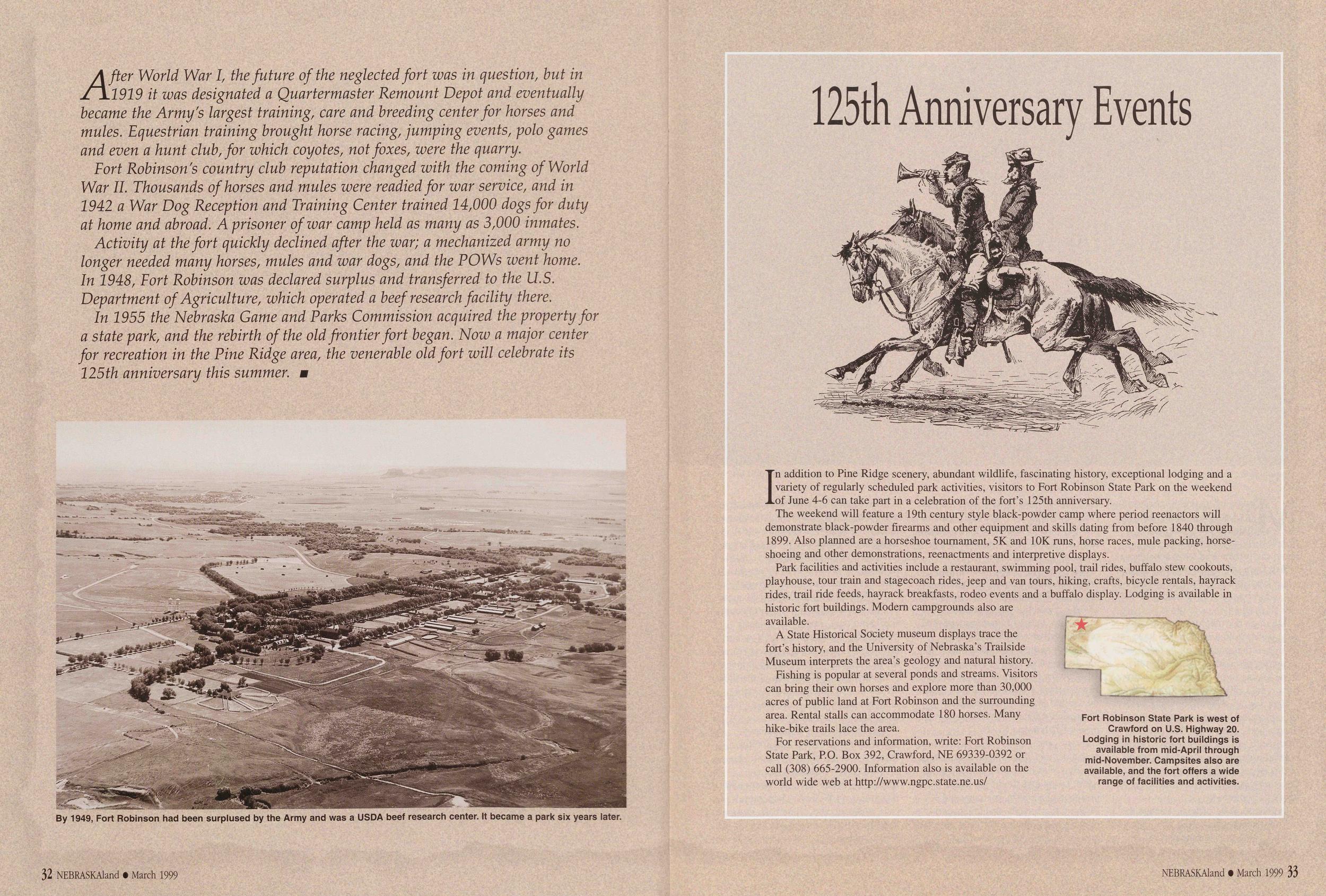
Activity at the fort quickly declined after the war; a mechanized army no longer needed many horses, mules and war dogs, and the POWs went home. In 1948, Fort Robinson was declared surplus and transferred to the U.S. Department of Agriculture, which operated a beef research facility there.
In 1955 the Nebraska Game and Parks Commission acquired the property for a state park, and the rebirth of the old frontier fort began. Now a major center for recreation in the Pine Ridge area, the venerable old fort will celebrate its 125th anniversary this summer,
In addition to Pine Ridge scenery, abundant wildlife, fascinating history, exceptional lodging and a variety of regularly scheduled park activities, visitors to Fort Robinson State Park on the weekend of June 4-6 can take part in a celebration of the fort's 125th anniversary.
The weekend will feature a 19th century style black-powder camp where period reenactors will demonstrate black-powder firearms and other equipment and skills dating from before 1840 through 1899. Also planned are a horseshoe tournament, 5K and 10K runs, horse races, mule packing, horse- shoeing and other demonstrations, reenactments and interpretive displays.
Park facilities and activities include a restaurant, swimming pool, trail rides, buffalo stew cookouts, playhouse, tour train and stagecoach rides, jeep and van tours, hiking, crafts, bicycle rentals, hayrack rides, trail ride feeds, hayrack breakfasts, rodeo events and a buffalo display. Lodging is available in historic fort buildings. Modern campgrounds also are available.
A State Historical Society museum displays trace the fort's history, and the University of Nebraska's Trailside Museum interprets the area's geology and natural history.
Fishing is popular at several ponds and streams. Visitor can bring their own horses and explore more than 30,000 acres of public land at Fort Robinson and the surrounding area. Rental stalls can accommodate 180 horses. Many hike-bike trails lace the area.
For reservations and information, write: Fort Robinson State Park, P.O. Box 392, Crawford, NE 69339-0392 or call (308) 665-2900. Information also is available on the world wide web at http://www.ngpc.state.ne.us/
Fish Consumption Advisories
What are the Risks? By Mike Callam, Nebraska Department of Environmental Quality and Dave Tunink, Nebraska Game and Parks Commission Fish consumption advisories are not bans on eating fish, but are warnings the public about possible health issues related to long-term consumption of fish from affected bodies of water. In general the risks are low, and fish from Nebraska waters remain a tasty, safe and healthful food source.Many anglers dream of returning home with a stringer of fish like those hanging in Cabela's showroom, but advisories about the presence of toxic substances in fish from several Nebraska bodies of water have left some of them wondering, after the pictures are taken, if it is safe to eat the fish.
Although the fish look normal and taste good, contaminant levels have prompted the issuance of 36 fish consumption advisories because there is some reason for concern about chemicals found in fish from those waters.
However, a fish consumption advisory should not discourage anglers from fishing and eating what they catch. Advisories are not bans. Their purpose is to advise and educate anglers about health issues regarding fish consumption; consumption of fish from advisory waters is permitted.
In general, state officials believe the risk of occasionally eating fish from advisory waters is extremely low. In fact, eating fish is highly recommended, since fish is an excellent high protein, low fat food. In addition, fish contain fatty acids that promote good health by lowering blood cholesterol.
Advisories are directed at anglers who repeatedly consume fish from an advisory waterbody over a long period of time, a practice that could lead to the accumulation of contaminants and produce adverse health effects.
The advisories, first issued in 1990, are the result of a program begun in 1977 by the Nebraska Department of Environmental Quality (NDEQ) and the United States Environmental Protection Agency (EPA) to collect and monitor fish tissue.
Every year, 70 to 90 fish samples are collected, and since the program began, 36 advisories have been issued for lakes, rivers and streams warning of the presence of dieldrin, mercury and PCBs. Other metals, pesticides and organic compounds have been detected, but not at levels of concern.
Sites to be monitored are based primarily on fishing pressure, and aside from a few tributary streams, most sampling is conducted on larger lakes and reservoirs and mainsrtaem sections of rivers. Over the past 20 years the state has monitored about 175 sites.
The NDEQ's Surface Water Section is currently conducting program activities based on a rotating river-basin monitoring approach in which two or three river basins are targeted for monitoring annually. The sampling strategy allows NDEQ staff to concentrate their efforts in a smaller geographic area, and provides a good picture of the entire state within five years.
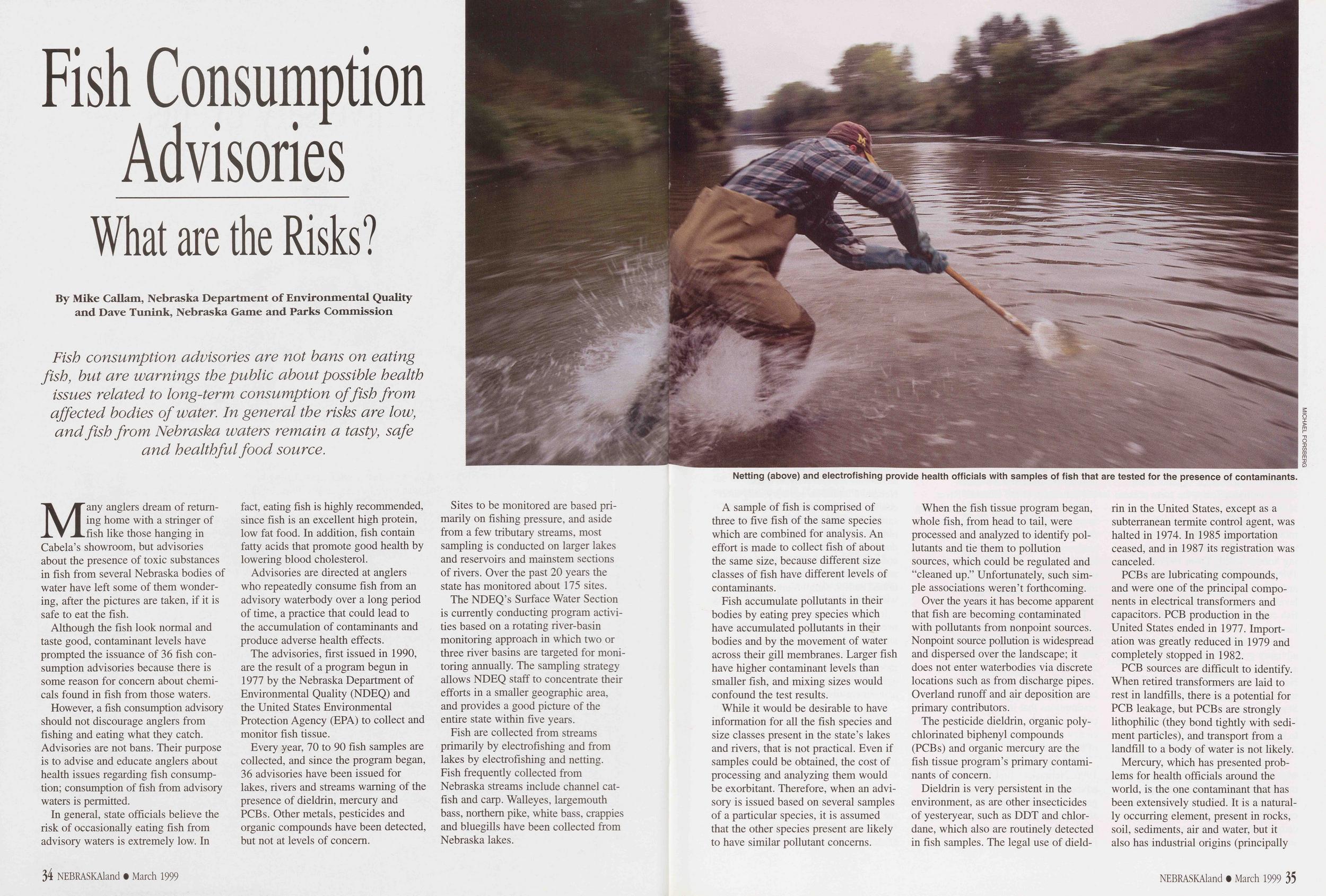
Fish are collected from streams primarily by electrofishing and from lakes by electrofishing and netting. Fish frequently collected from Nebraska streams include channel catfish and carp. Walleyes, largemouth bass, northern pike, white bass, crappies and bluegills have been collected from Nebraska lakes.
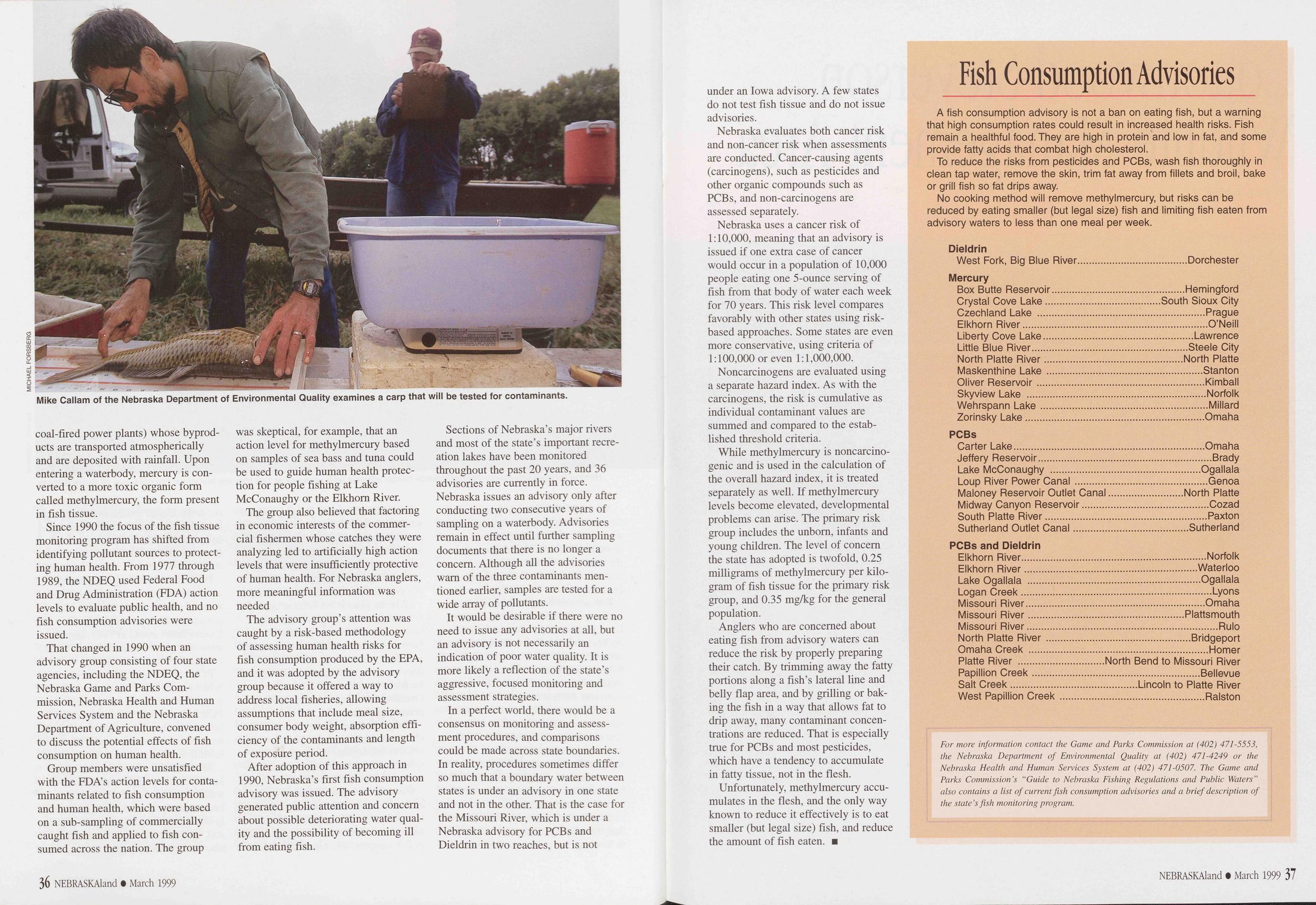
34 NEBRASKAland • March 1999A sample of fish is comprised of three to five fish of the same species which are combined for analysis. An effort is made to collect fish of about the same size, because different size classes of fish have different levels of contaminants.
Fish accumulate pollutants in their bodies by eating prey species which have accumulated pollutants in their bodies and by the movement of water across their gill membranes. Larger fish have higher contaminant levels than smaller fish, and mixing sizes would confound the test results.
While it would be desirable to have information for all the fish species and size classes present in the state's lakes and rivers, that is not practical. Even if samples could be obtained, the cost of processing and analyzing them would be exorbitant. Therefore, when an advisory is issued based on several samples of a particular species, it is assumed that the other species present are likely to have similar pollutant concerns.
When the fish tissue program began, whole fish, from head to tail, were processed and analyzed to identify pollutants and tie them to pollution sources, which could be regulated and "cleaned up." Unfortunately, such simple associations weren't forthcoming.
Over the years it has become apparent that fish are becoming contaminated with pollutants from nonpoint sources. Nonpoint source pollution is widespread and dispersed over the landscape; it does not enter waterbodies via discrete locations such as from discharge pipes. Overland runoff and air deposition are primary contributors.
The pesticide dieldrin, organic polychlorinated biphenyl compounds (PCBs) and organic mercury are the fish tissue program's primary contaminants of concern.
Dieldrin is very persistent in the environment, as are other insecticides of yesteryear, such as DDT and chlordane, which also are routinely detected in fish samples. The legal use of dieldrin in the United States, except as a subterranean termite control agent, was halted in 1974. In 1985 importation ceased, and in 1987 its registration was canceled.
PCBs are lubricating compounds, and were one of the principal components in electrical transformers and capacitors. PCB production in the United States ended in 1977. Importation was greatly reduced in 1979 and completely stopped in 1982.
PCB sources are difficult to identify. When retired transformers are laid to rest in landfills, there is a potential for PCB leakage, but PCBs are strongly lithophilic (they bond tightly with sediment particles), and transport from a landfill to a body of water is not likely.
Mercury, which has presented
problems for health officials around the
world, is the one contaminant that has
been extensively studied. It is a
naturally occurring element, present in rocks,
soil, sediments, air and water, but it
also has industrial origins (principally
NEBRASKAland • March 1999 35
Since 1990 the focus of the fish tissue monitoring program has shifted from identifying pollutant sources to protecting human health. From 1977 through 1989, the NDEQ used Federal Food and Drug Administration (FDA) action levels to evaluate public health, and no fish consumption advisories were issued.
That changed in 1990 when an advisory group consisting of four state agencies, including the NDEQ, the Nebraska Game and Parks Com- mission, Nebraska Health and Human Services System and the Nebraska Department of Agriculture, convened to discuss the potential effects of fish consumption on human health.
Group members were unsatisfied with the FDA's action levels for contaminants related to fish consumption and human health, which were based on a sub-sampling of commercially caught fish and applied to fish consumed across the nation. The group was skeptical, for example, that an action level for methylmercury based on samples of sea bass and tuna could be used to guide human health protection for people fishing at Lake McConaughy or the Elkhorn River.
The group also believed that factoring in economic interests of the commercial fishermen whose catches they were analyzing led to artificially high action levels that were insufficiently protective of human health. For Nebraska anglers, more meaningful information was needed
The advisory group's attention was caught by a risk-based methodology of assessing human health risks for fish consumption produced by the EPA, and it was adopted by the advisory group because it offered a way to address local fisheries, allowing assumptions that include meal size, consumer body weight, absorption efficiency of the contaminants and length of exposure period.
After adoption of this approach in 1990, Nebraska's first fish consumption advisory was issued. The advisory generated public attention and concern about possible deteriorating water quality and the possibility of becoming ill from eating fish.
Sections of Nebraska's major rivers and most of the state's important recreation lakes have been monitored throughout the past 20 years, and 36 advisories are currently in force. Nebraska issues an advisory only after conducting two consecutive years of sampling on a waterbody. Advisories remain in effect until further sampling documents that there is no longer a concern. Although all the advisories warn of the three contaminants mentioned earlier, samples are tested for a wide array of pollutants.
It would be desirable if there were no need to issue any advisories at all, but an advisory is not necessarily an indication of poor water quality. It is more likely a reflection of the state's aggressive, focused monitoring and assessment strategies.
In a perfect world, there would be a consensus on monitoring and assessment procedures, and comparisons could be made across state boundaries. In reality, procedures sometimes differ so much that a boundary water between states is under an advisory in one state and not in the other. That is the case for the Missouri River, which is under a Nebraska advisory for PCBs and Dieldrin in two reaches, but is not 36 NEBRASKAland • March 1999 under an Iowa advisory. A few states do not test fish tissue and do not issue advisories.
Nebraska evaluates both cancer risk and non-cancer risk when assessments are conducted. Cancer-causing agents (carcinogens), such as pesticides and other organic compounds such as PCBs, and non-carcinogens are assessed separately.
Nebraska uses a cancer risk of 1:10,000, meaning that an advisory is issued if one extra case of cancer would occur in a population of 10,000 people eating one 5-ounce serving of fish from that body of water each week for 70 years. This risk level compares favorably with other states using risk based approaches. Some states are even more conservative, using criteria of 1:100,000 or even 1:1,000,000.
Noncarcinogens are evaluated using a separate hazard index. As with the carcinogens, the risk is cumulative as individual contaminant values are iummed and compared to the established threshold criteria.
While methylmercury is noncarcinogenic and is used in the calculation of the overall hazard index, it is treated separately as well. If methylmercury levels become elevated, developmental problems can arise. The primary risk group includes the unborn, infants and young children. The level of concern the state has adopted is twofold, 0.25 milligrams of methylmercury per kilogram of fish tissue for the primary risk group, and 0.35 mg/kg for the general population.
Anglers who are concerned about eating fish from advisory waters can reduce the risk by properly preparing their catch. By trimming away the fatty portions along a fish's lateral line and belly flap area, and by grilling or baking the fish in a way that allows fat to drip away, many contaminant concentrations are reduced. That is especially true for PCBs and most pesticides, which have a tendency to accumulate in fatty tissue, not in the flesh.
Unfortunately, methylmercury accumulates in the flesh, and the only way known to reduce it effectively is to eat smaller (but legal size) fish, and reduce the amount of fish eaten.
Fish Consumption AdvisoriesA fish consumption advisory is not a ban on eating fish, but a warning that high consumption rates could result in increased health risks. Fish remain a healthful food. They are high in protein and low in fat, and some provide fatty acids that combat high cholesterol.
To reduce the risks from pesticides and PCBs, wash fish thoroughly in clean tap water, remove the skin, trim fat away from fillets and broil, bake or grill fish so fat drips away.
No cooking method will remove methylmercury, but risks can be reduced by eating smaller (but legal size) fish and limiting fish eaten from advisory waters to less than one meal per week.
Dieldrin West Fork, Big Blue River......................................Dorchester Mercury Box Butte Reservoir..............................................Hemingford Crystal Cove Lake........................................South Sioux City Czechland Lake..........................................................Prague Elkhorn River................................................................O'Neill Liberty Cove Lake....................................................Lawrence Little Blue River......................................................Steele City North Platte River................................................North Platte Maskenthine Lake......................................................Stanton Oliver Reservoir..........................................................Kimball Skyview Lake..............................................................Norfolk Wehrspann Lake..........................................................Millard Zorinsky Lake.............................................................Omaha PCBs Carter Lake..................................................................Omaha Jeffery Reservoir............................................................Brady Lake McConaughy....................................................Ogallala Loup River Power Canal..............................................Genoa Maloney Reservoir Outlet Canal..........................North Platte Midway Canyon Reservoir............................................Cozad South Platte River........................................................Paxton Sutherland Outlet Canal........................................Sutherland PCBs and Dieldrin Elkhorn River................................................................Norfolk Elkhorn River............................................................Waterloo Lake Ogallala............................................................Ogallala Logan Creek..................................................................Lyons Missouri River..............................................................Omaha Missouri River......................................................Plattsmouth Missouri River..................................................................Rulo North Platte River..................................................Bridgeport Omaha Creek..............................................................Homer Platte River..............................North Bend to Missouri River Papillion Creek..........................................................Bellevue Salt Creek............................................Lincoln to Platte River West Papillion Creek..........................____................Ralston For more information contact the Game and Parks Commission at (402) 471-5553, the Nebraska Department of Environmental Quality at (402) 471-4249 or the Nebraska Health and Human Services System at (402) 471-0507. The Game and Parks Commission's "Guide to Nebraska Fishing Regulations and Public Waters" also contains a list of current fish consumption advisories and a brief description of the state's fish monitoring program. NEBRASKAland • March 1999 37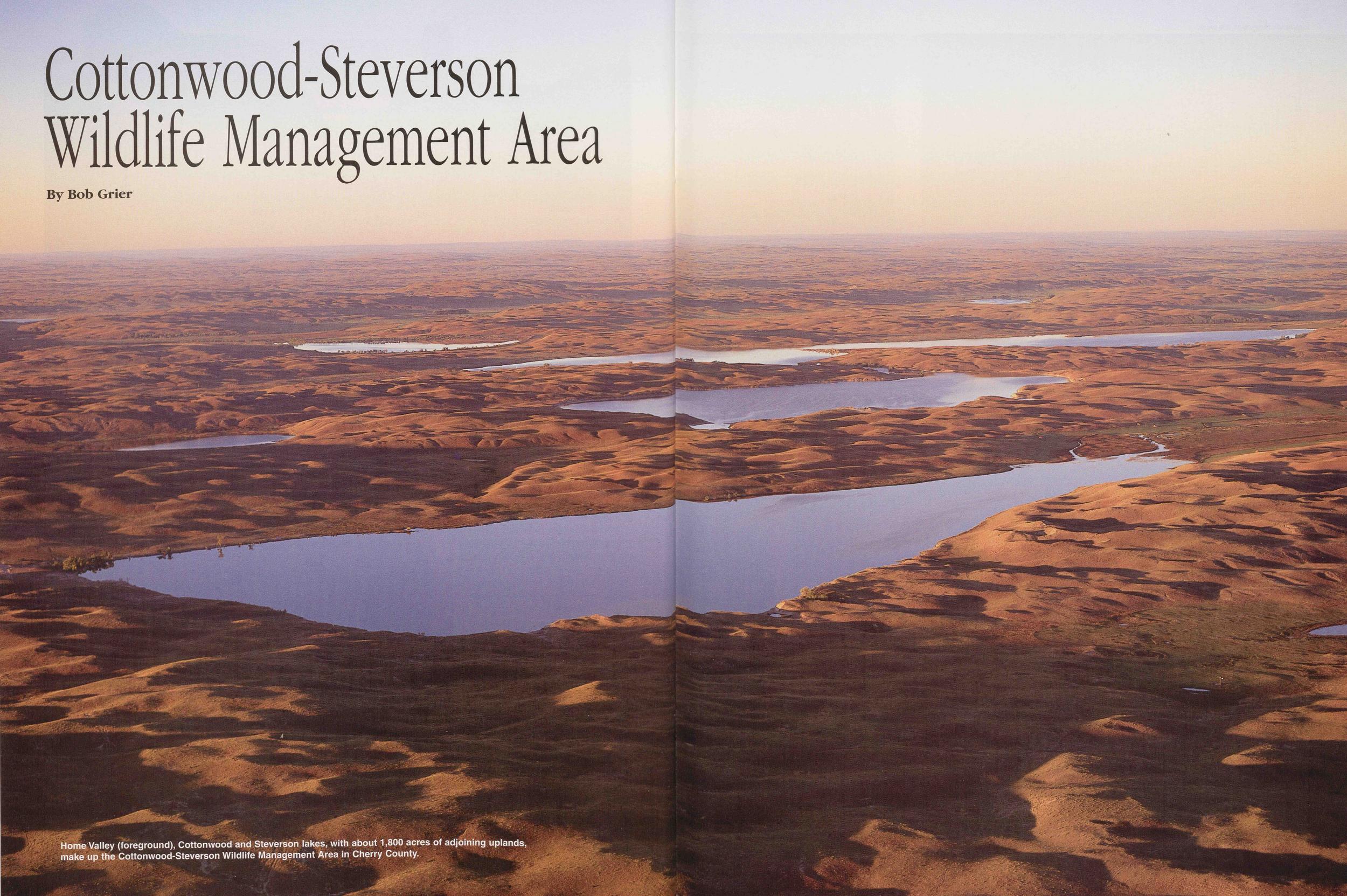
Cottonwood-Steverson Wildlife Management Area
By Bob Grier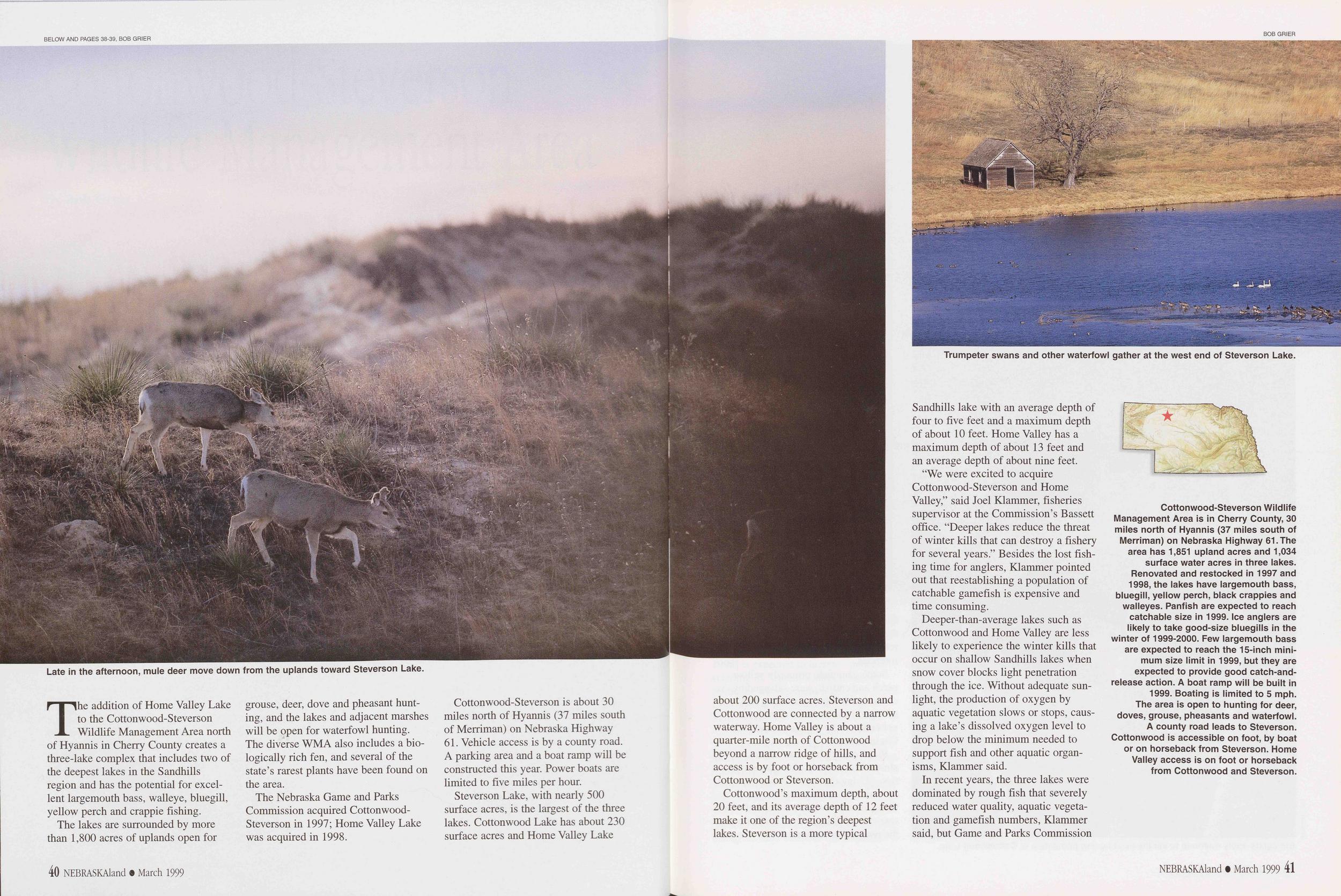
The addition of Home Valley Lake to the Cottonwood-Steverson Wildlife Management Area north of Hyannis in Cherry County creates a three-lake complex that includes two of the deepest lakes in the Sandhills region and has the potential for excellent largemouth bass, walleye, bluegill, yellow perch and crappie fishing.
The lakes are surrounded by more than 1,800 acres of uplands open for grouse, deer, dove and pheasant hunting, and the lakes and adjacent marshes will be open for waterfowl hunting. The diverse WMA also includes a biologically rich fen, and several of the state's rarest plants have been found on the area.
The Nebraska Game and Parks Commission acquired Cottonwood-Steverson in 1997; Home Valley Lake was acquired in 1998.
Cottonwood-Steverson is about 30 miles north of Hyannis (37 miles south of Merriman) on Nebraska Highway 61. Vehicle access is by a county road. A parking area and a boat ramp will be constructed this year. Power boats are limited to five miles per hour.
Steverson Lake, with nearly 500 surface acres, is the largest of the three lakes. Cottonwood Lake has about 230 surface acres and Home Valley Lake 40 NEBRASKAland • March 1999
Cottonwood's maximum depth, about 20 feet, and its average depth of 12 feet make it one of the region's deepest lakes. Steverson is a more typical Sandhills lake with an average depth of four to five feet and a maximum depth of about 10 feet. Home Valley has a maximum depth of about 13 feet and an average depth of about nine feet.
"We were excited to acquire Cottonwood-Steverson and Home Valley," said Joel Klammer, fisheries supervisor at the Commission's Bassett office. "Deeper lakes reduce the threat of winter kills that can destroy a fishery for several years." Besides the lost fishing time for anglers, Klammer pointed out that reestablishing a population of catchable gamefish is expensive and time consuming.
Deeper-than-average lakes such as Cottonwood and Home Valley are less likely to experience the winter kills that occur on shallow Sandhills lakes when snow cover blocks light penetration through the ice. Without adequate sunlight, the production of oxygen by aquatic vegetation slows or stops, causing a lake's dissolved oxygen level to drop below the minimum needed to support fish and other aquatic organisms, Klammer said.
In recent years, the three lakes were dominated by rough fish that severely reduced water quality, aquatic vegetation and gamefish numbers, Klammer said, but Game and Parks Commission
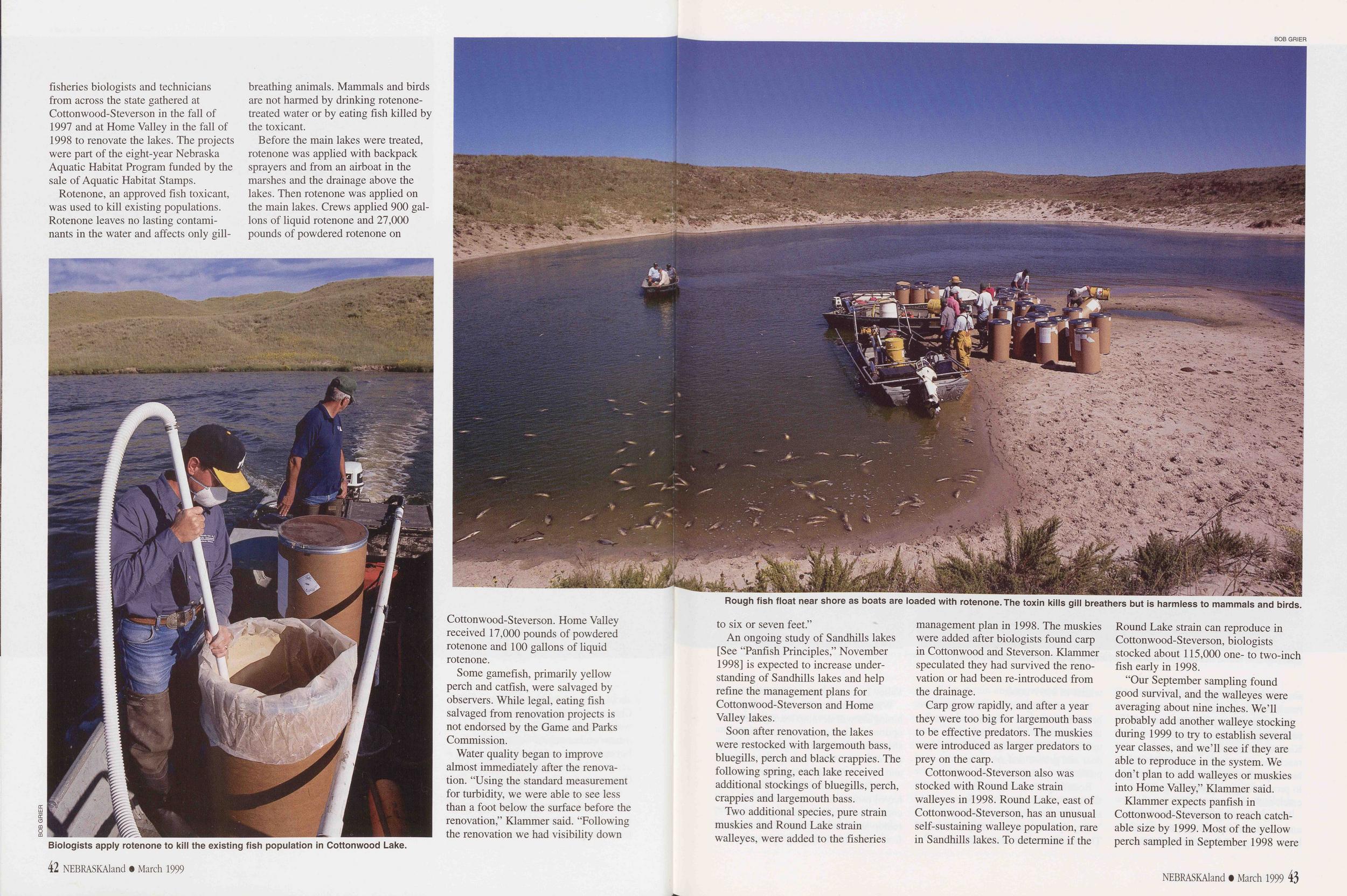 fisheries biologists and technicians
from across the state gathered at
Cottonwood-Steverson in the fall of
1997 and at Home Valley in the fall of
1998 to renovate the lakes. The projects
were part of the eight-year Nebraska
Aquatic Habitat Program funded by the
sale of Aquatic Habitat Stamps.
fisheries biologists and technicians
from across the state gathered at
Cottonwood-Steverson in the fall of
1997 and at Home Valley in the fall of
1998 to renovate the lakes. The projects
were part of the eight-year Nebraska
Aquatic Habitat Program funded by the
sale of Aquatic Habitat Stamps.
Rotenone, an approved fish toxicant, was used to kill existing populations. Rotenone leaves no lasting contaminants in the water and affects only gillbreathing animals. Mammals and birds are not harmed by drinking rotenone- treated water or by eating fish killed by the toxicant.
Before the main lakes were treated, rotenone was applied with backpack sprayers and from an airboat in the marshes and the drainage above the lakes. Then rotenone was applied on the main lakes. Crews applied 900 gallons of liquid rotenone and 27,000 pounds of powdered rotenone on Cottonwood-Steverson. Home Valley received 17,000 pounds of powdered rotenone and 100 gallons of liquid rotenone.
Some gamefish, primarily yellow perch and catfish, were salvaged by observers. While legal, eating fish salvaged from renovation projects is not endorsed by the Game and Parks Commission.
Water quality began to improve almost immediately after the renovation. "Using the standard measurement for turbidity, we were able to see less than a foot below the surface before the renovation," Klammer said. "Following the renovation we had visibility down
An ongoing study of Sandhills lakes [See "Panfish Principles," November 1998] is expected to increase understanding of Sandhills lakes and help refine the management plans for Cottonwood-Steverson and Home Valley lakes.
Soon after renovation, the lakes were restocked with largemouth bass, bluegills, perch and black crappies. The following spring, each lake received additional stockings of bluegills, perch, crappies and largemouth bass.
Two additional species, pure strain muskies and Round Lake strain walleyes, were added to the fisheries management plan in 1998. The muskies were added after biologists found carp in Cottonwood and Steverson. Klammer speculated they had survived the renovation or had been re-introduced from the drainage.
Carp grow rapidly, and after a year they were too big for largemouth bass to be effective predators. The muskies were introduced as larger predators to prey on the carp.
Cottonwood-Steverson also was stocked with Round Lake strain walleyes in 1998. Round Lake, east of Cottonwood-Steverson, has an unusual self-sustaining walleye population, rare in Sandhills lakes. To determine if the Round Lake strain can reproduce in Cottonwood-Steverson, biologists stocked about 115,000 one- to two-inch fish early in 1998.
"Our September sampling found good survival, and the walleyes were averaging about nine inches. We'll probably add another walleye stocking during 1999 to try to establish several year classes, and we'll see if they are able to reproduce in the system. We don't plan to add walleyes or muskies into Home Valley," Klammer said.
Klammer expects panfish in
Cottonwood-Steverson to reach
catchable size by 1999. Most of the yellow
perch sampled in September 1998 were
NEBRASKAland • March 1999 43
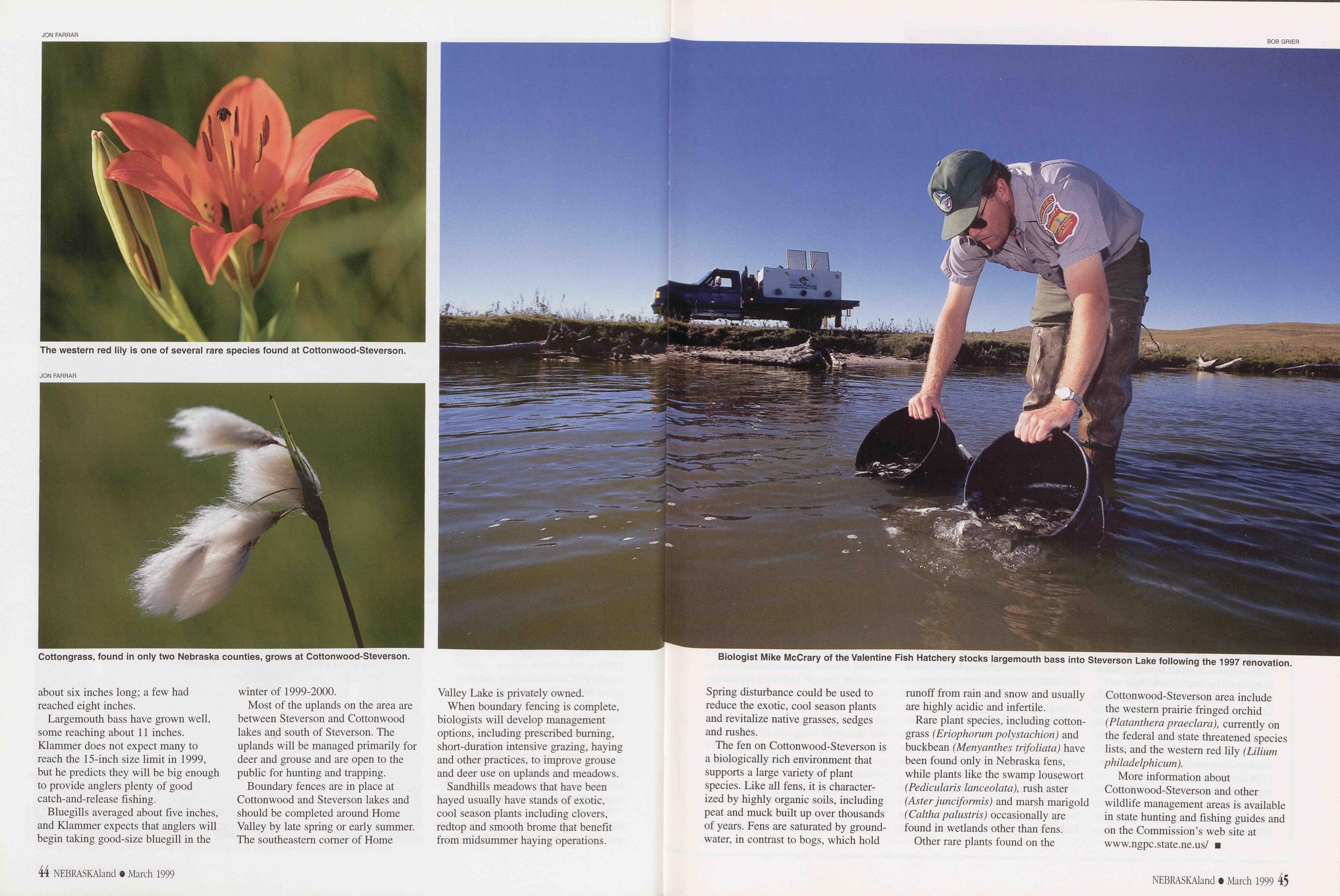
Largemouth bass have grown well, some reaching about 11 inches. Klammer does not expect many to reach the 15-inch size limit in 1999, but he predicts they will be big enough to provide anglers plenty of good catch-and-release fishing.
Bluegills averaged about five inches, and Klammer expects that anglers will begin taking good-size bluegill in the winter of 1999-2000.
Most of the uplands on the area are between Steverson and Cottonwood lakes and south of Steverson. The uplands will be managed primarily for deer and grouse and are open to the public for hunting and trapping.
Boundary fences are in place at Cottonwood and Steverson lakes and should be completed around Home Valley by late spring or early summer. The southeastern corner of Home Valley Lake is privately owned.
When boundary fencing is complete, biologists will develop management options, including prescribed burning, short-duration intensive grazing, haying and other practices, to improve grouse and deer use on uplands and meadows.
Sandhills meadows that have been hayed usually have stands of exotic, cool season plants including clovers, redtop and smooth brome that benefit from midsummer haying operations. 44 NEBRASKAland • 9 March 1999
The fen on Cottonwood-Steverson is a biologically rich environment that supports a large variety of plant species. Like all fens, it is characterized by highly organic soils, including peat and muck built up over thousands of years. Fens are saturated by groundwater, in contrast to bogs, which hold runoff from rain and snow and usually are highly acidic and infertile.
Rare plant species, including cottongrass (Eriophorum polystachion) and buckbean (Menyanthes trifoliata) have been found only in Nebraska fens, while plants like the swamp lousewort (Pedicularis lanceolata), rush aster (Aster junciformis) and marsh marigold (Caltha palustris) occasionally are found in wetlands other than fens.
Other rare plants found on the Cottonwood-Steverson area include the western prairie fringed orchid (Platanthera praeclara), currently on the federal and state threatened species lists, and the western red lily (Lilium philadelphicum).
More information about Cottonwood-Steverson and other wildlife management areas is available in state hunting and fishing guides and on the Commission's web site at www.ngpc.state.ne.us
NEBRASKAland • March 1999 45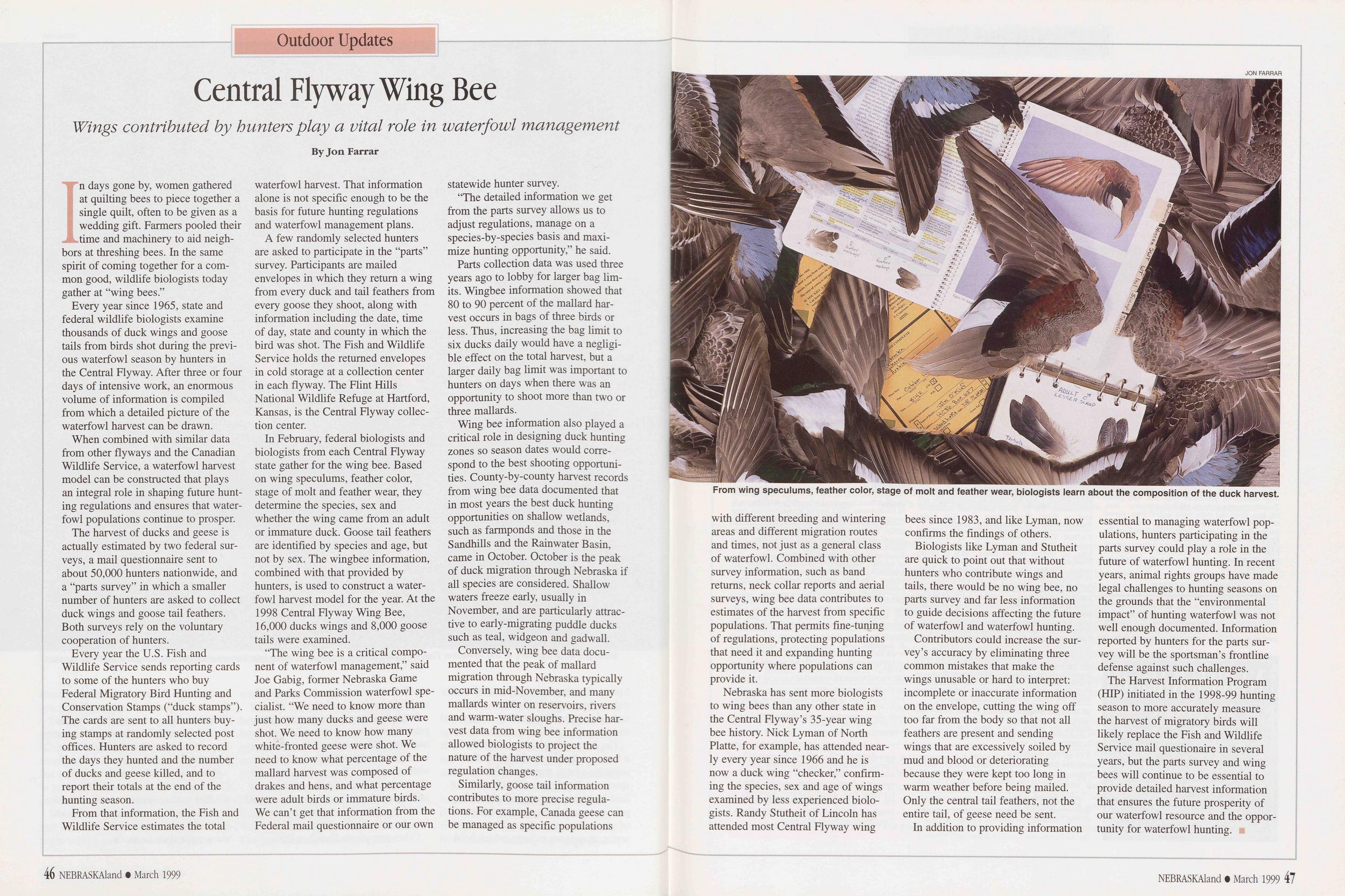
Outdoor Updates
Central Flyway Wing Bee
Wings contributed by hunters play a vital role in waterfowl management By Jon Farrarn days gone by, women gathered at quilting bees to piece together a single quilt, often to be given as a wedding gift. Farmers pooled their .time and machinery to aid neighbors at threshing bees. In the same spirit of coming together for a common good, wildlife biologists today gather at "wing bees."
Every year since 1965, state and federal wildlife biologists examine thousands of duck wings and goose tails from birds shot during the previous waterfowl season by hunters in the Central Flyway. After three or four days of intensive work, an enormous volume of information is compiled from which a detailed picture of the waterfowl harvest can be drawn.
When combined with similar data from other flyways and the Canadian Wildlife Service, a waterfowl harvest model can be constructed that plays an integral role in shaping future hunting regulations and ensures that waterfowl populations continue to prosper.
The harvest of ducks and geese is actually estimated by two federal surveys, a mail questionnaire sent to about 50,000 hunters nationwide, and a "parts survey" in which a smaller number of hunters are asked to collect duck wings and goose tail feathers. Both surveys rely on the voluntary cooperation of hunters.
Every year the U.S. Fish and Wildlife Service sends reporting cards to some of the hunters who buy Federal Migratory Bird Hunting and Conservation Stamps ("duck stamps"). The cards are sent to all hunters buying stamps at randomly selected post offices. Hunters are asked to record the days they hunted and the number of ducks and geese killed, and to report their totals at the end of the hunting season.
From that information, the Fish and Wildlife Service estimates the total waterfowl harvest. That information alone is not specific enough to be the basis for future hunting regulations and waterfowl management plans.
A few randomly selected hunters are asked to participate in the "parts" survey. Participants are mailed envelopes in which they return a wing from every duck and tail feathers from every goose they shoot, along with information including the date, time of day, state and county in which the bird was shot. The Fish and Wildlife Service holds the returned envelopes in cold storage at a collection center in each flyway. The Flint Hills National Wildlife Refuge at Hartford, Kansas, is the Central Flyway collection center.
In February, federal biologists and biologists from each Central Flyway state gather for the wing bee. Based on wing speculums, feather color, stage of molt and feather wear, they determine the species, sex and whether the wing came from an adult or immature duck. Goose tail feathers are identified by species and age, but not by sex. The wingbee information, combined with that provided by hunters, is used to construct a waterfowl harvest model for the year. At the 1998 Central Flyway Wing Bee, 16,000 ducks wings and 8,000 goose tails were examined.
"The wing bee is a critical component of waterfowl management," said Joe Gabig, former Nebraska Game and Parks Commission waterfowl specialist. "We need to know more than just how many ducks and geese were shot. We need to know how many white-fronted geese were shot. We need to know what percentage of the mallard harvest was composed of drakes and hens, and what percentage were adult birds or immature birds. We can't get that information from the Federal mail questionnaire or our own statewide hunter survey.
"The detailed information we get from the parts survey allows us to adjust regulations, manage on a species-by-species basis and maximize hunting opportunity," he said.
Parts collection data was used three years ago to lobby for larger bag limits. Wingbee information showed that 80 to 90 percent of the mallard harvest occurs in bags of three birds or less. Thus, increasing the bag limit to six ducks daily would have a negligible effect on the total harvest, but a larger daily bag limit was important to hunters on days when there was an opportunity to shoot more than two or three mallards.
Wing bee information also played a critical role in designing duck hunting zones so season dates would correspond to the best shooting opportunities. County-by-county harvest records from wing bee data documented that in most years the best duck hunting opportunities on shallow wetlands, such as farmponds and those in the Sandhills and the Rainwater Basin, came in October. October is the peak of duck migration through Nebraska if all species are considered. Shallow waters freeze early, usually in November, and are particularly attractive to early-migrating puddle ducks such as teal, widgeon and gadwall.
Conversely, wing bee data documented that the peak of mallard migration through Nebraska typically occurs in mid-November, and many mallards winter on reservoirs, rivers and warm-water sloughs. Precise harvest data from wing bee information allowed biologists to project the nature of the harvest under proposed regulation changes.
Similarly, goose tail information contributes to more precise regulations. For example, Canada geese can be managed as specific populations
Nebraska has sent more biologists to wing bees than any other state in the Central Flyway's 35-year wing bee history. Nick Lyman of North Platte, for example, has attended nearly every year since 1966 and he is now a duck wing "checker," confirming the species, sex and age of wings examined by less experienced biologists. Randy Stutheit of Lincoln has attended most Central Flyway wing bees since 1983, and like Lyman, now confirms the findings of others.
Biologists like Lyman and Stutheit are quick to point out that without hunters who contribute wings and tails, there would be no wing bee, no parts survey and far less information to guide decisions affecting the future of waterfowl and waterfowl hunting.
Contributors could increase the survey's accuracy by eliminating three common mistakes that make the wings unusable or hard to interpret: incomplete or inaccurate information on the envelope, cutting the wing off too far from the body so that not all feathers are present and sending wings that are excessively soiled by mud and blood or deteriorating because they were kept too long in warm weather before being mailed. Only the central tail feathers, not the entire tail, of geese need be sent.
In addition to providing information essential to managing waterfowl populations, hunters participating in the parts survey could play a role in the future of waterfowl hunting. In recent years, animal rights groups have made legal challenges to hunting seasons on the grounds that the "environmental impact" of hunting waterfowl was not well enough documented. Information reported by hunters for the parts survey will be the sportsman's frontline defense against such challenges.
The Harvest Information Program (HIP) initiated in the 1998-99 hunting season to more accurately measure the harvest of migratory birds will likely replace the Fish and Wildlife Service mail questionnaire in several years, but the parts survey and wing bees will continue to be essential to provide detailed harvest information that ensures the future prosperity of our waterfowl resource and the opportunity for waterfowl hunting
NEBRASKAland • March 1999 47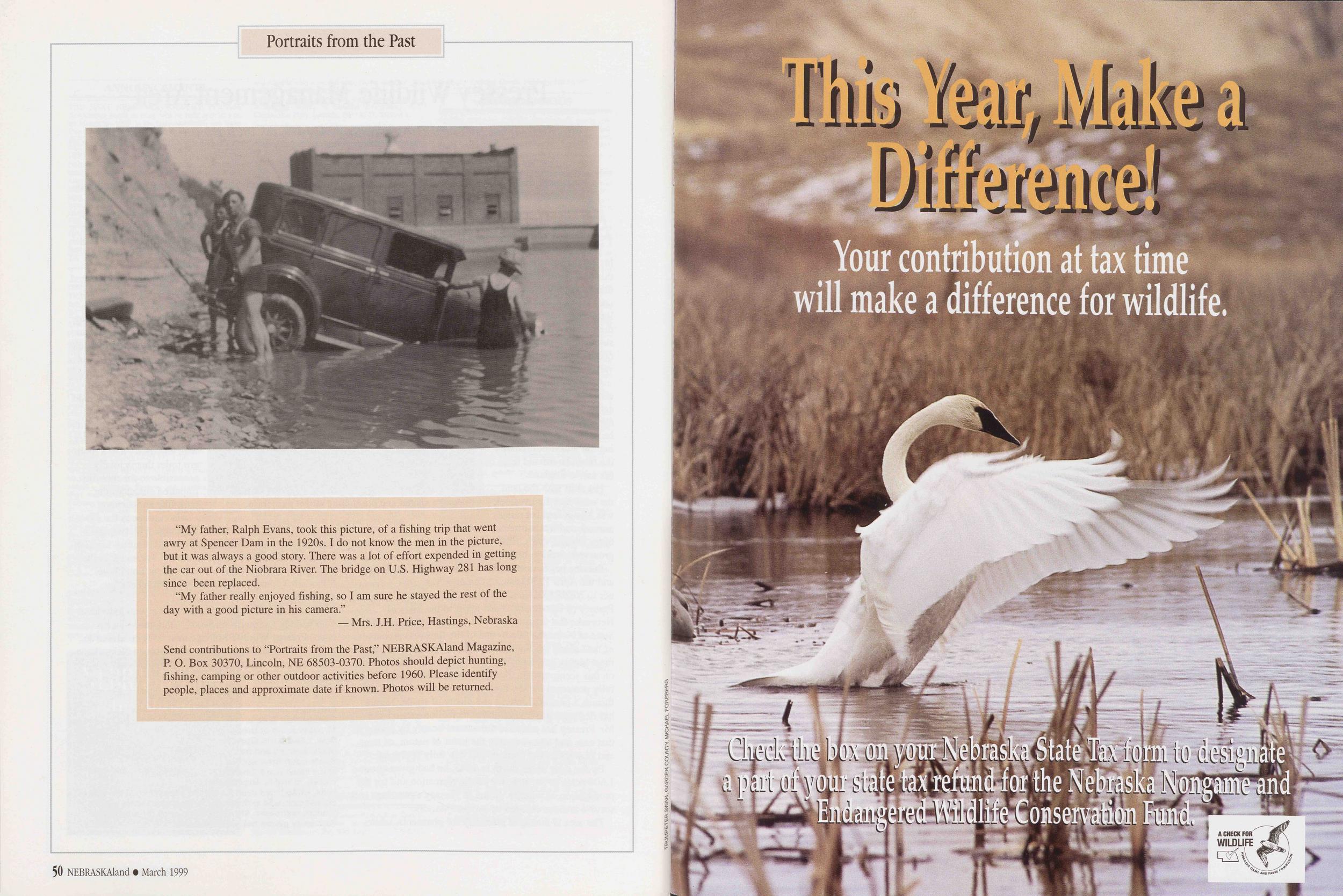
Portraits of the Past
"My father, Ralph Evans, took this picture, of a fishing trip that went awry at Spencer Dam in the 1920s. I do not know the men in the picture, but it was always a good story. There was a lot of effort expended in getting the car out of the Niobrara River. The bridge on U.S. Highway 281 has long since been replaced.
"My father really enjoyed fishing, so I am sure he stayed the rest of the day with a good picture in his camera."
— Mrs. J.H. Price, Hastings, Nebraska Send contributions to "Portraits from the Past," NEBRASKAland Magazine, P. O. Box 30370, Lincoln, NE 68503-0370. Photos should depict hunting, fishing, camping or other outdoor activities before 1960. Please identify people, places and approximate date if known. Photos will be returned. This Year, Make a Difference!
Position: 820 (12 views)