Volume 77, Issue 1, 1999
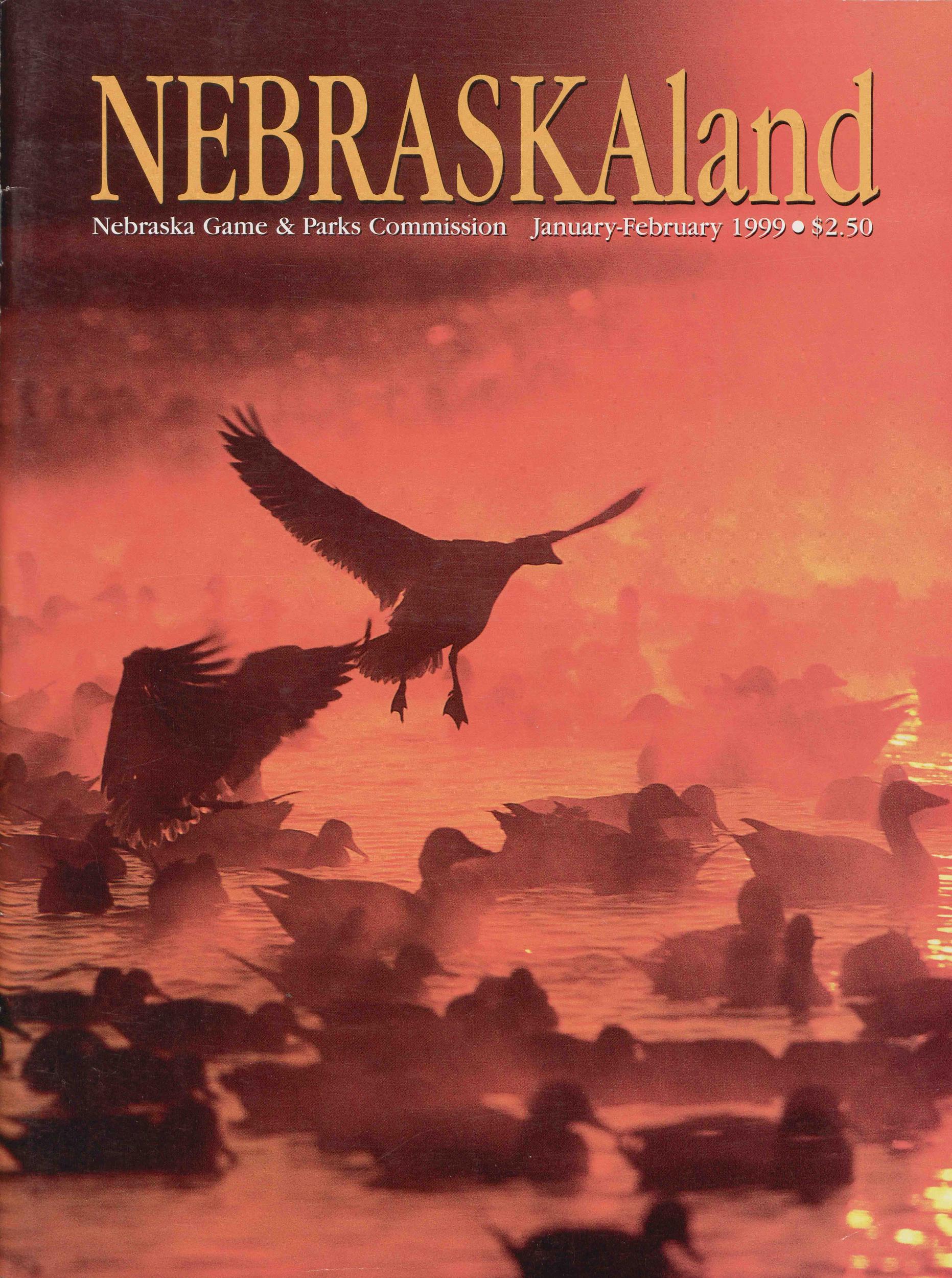
NEBRASKAland
Nebraska Game & Parks Commission January-February 1999 $2.50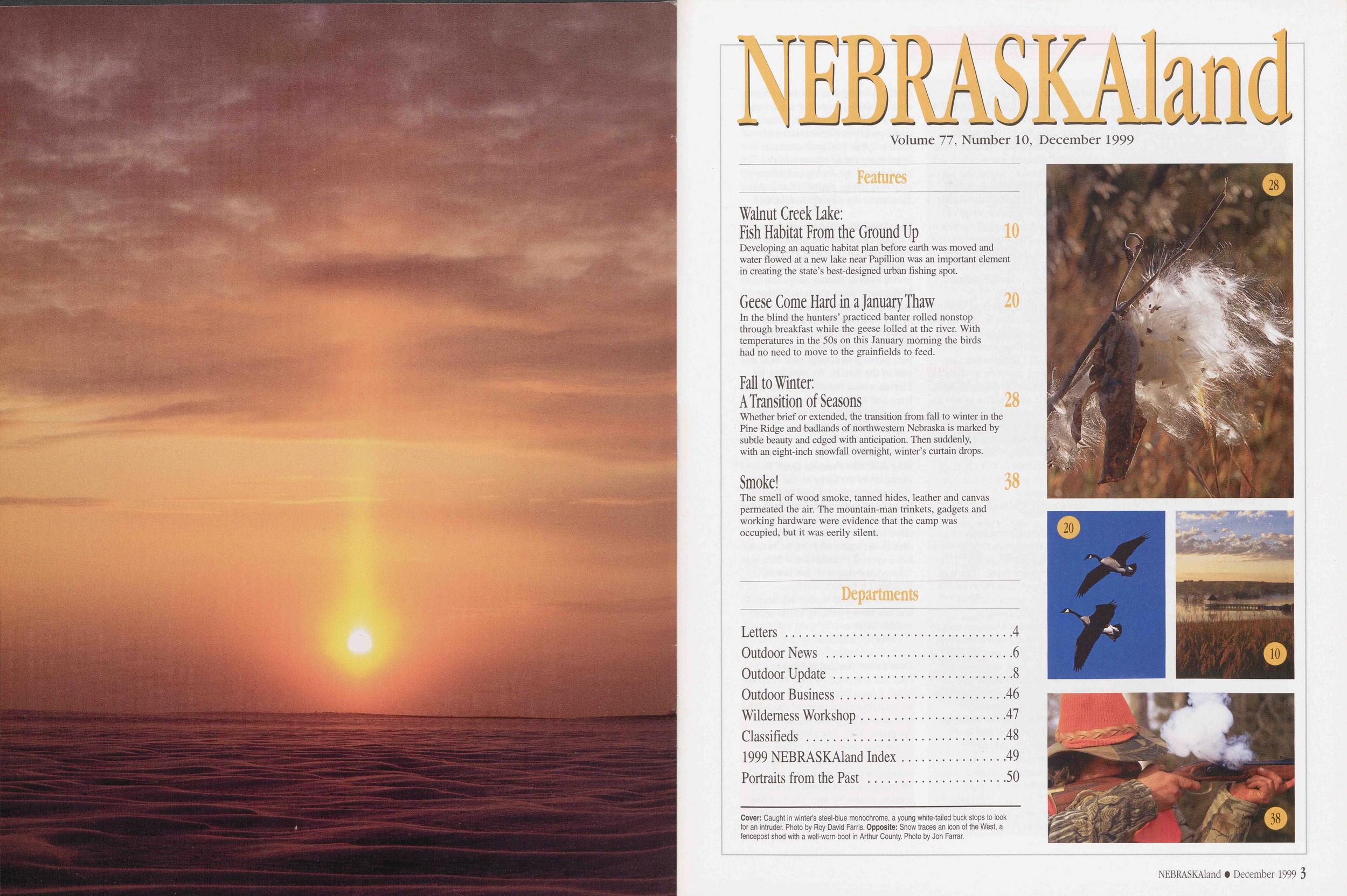
NEBRASKAland
Volume 77, Number 10, December 1999 Walnut Creek Lake: Fish Habitat From the Ground Up 1 Developing an aquatic habitat plan before earth was moved and water flowed at a new lake near PapiUion was an important element in creating the state's best-designed urban fishing spot. Geese Come Hard in a January Thaw 2 In the blind the hunters' practiced banter rolled nonstop through breakfast while the geese lolled at the river. With temperatures in the 50s on this January morning the birds had no need to move to the grainfields to feed. Fall to Winter: A Transition of Seasons 1 Whether brief or extended, the transition from faU to winter in the Pine Ridge and badlands of northwestern Nebraska is marked by subtle beauty and edged with anticipation. Then suddenly, with an eight-inch snowfall overnight, winter's curtain drops. Smoke! 3 The smell of wood smoke, tanned hides, leather and canvas permeated the air. The mountain-man trinkets, gadgets and working hardware were evidence that the camp was occupied, but it was eerily silent. Letters 4 Outdoor News 6 Outdoor Update 8 Outdoor Business 46 Wilderness Workshop 47 Classifieds 48 1999 NEBRASKAland Index 49 Portraits from the Past 50 Cover: Caught in winter's steel-blue monochrome, a young white-tailed buck stops to look tor an intruder. Photo by Roy David Farris. Opposite: Snow traces an icon of the West, a fencepost shod with a well-worn boot in Arthur County. Photo by Jon Farrar.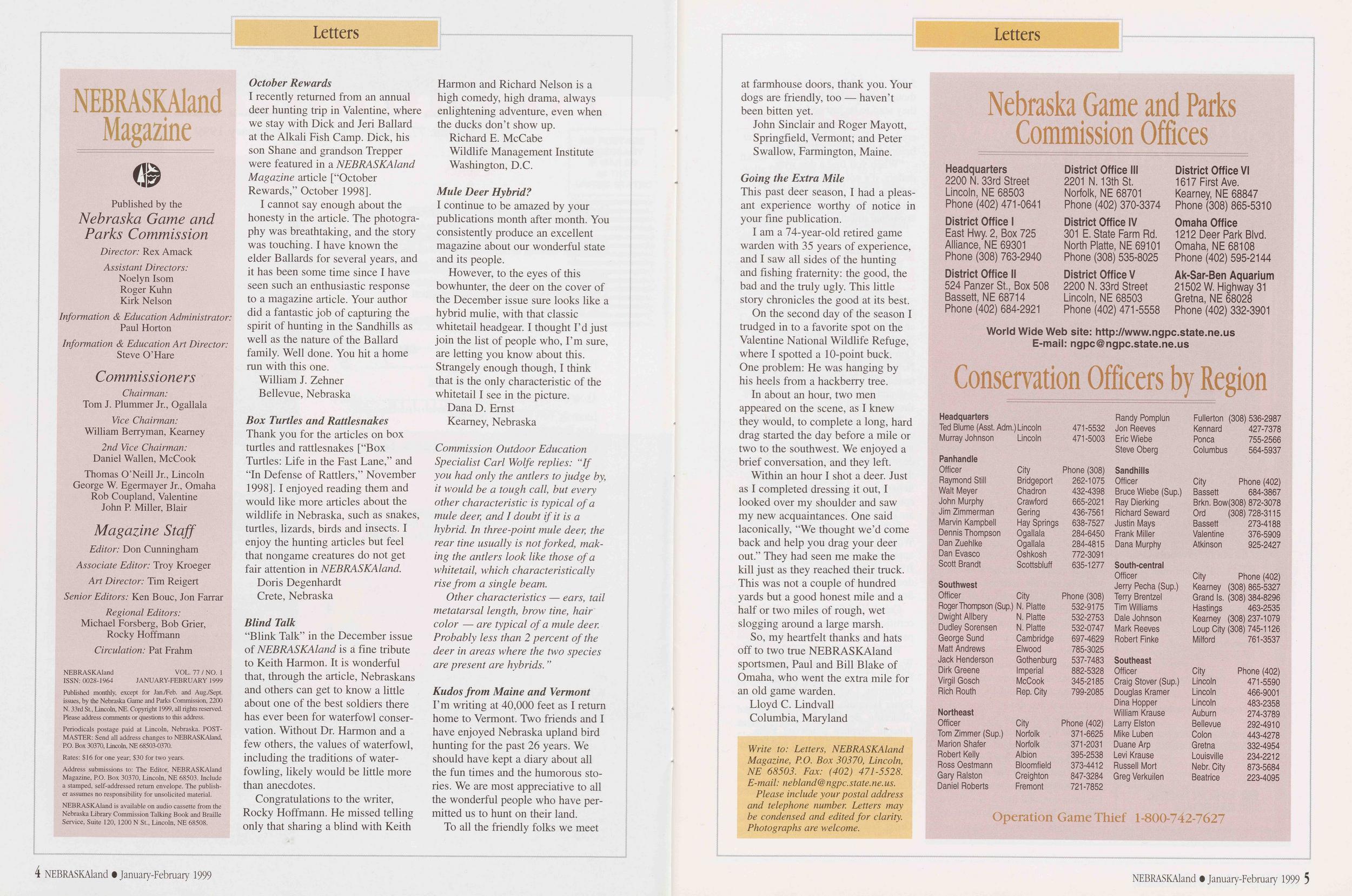
Letters
Published by the Nebraska Game and Parks Commission Director: Rex Amack Assistant Directors: Noelyn Isom Roger Kuhn Kirk Nelson Information & Education Administrator: Paul Horton Information & Education Art Director: Steve O'Hare Commissioners Chairman: Tom J. Plummer Jr., Ogallala Vice Chairman: William Berry man, Kearney 2nd Vice Chairman: Daniel Wallen, McCook Thomas O'Neill Jr., Lincoln George W. Egermayer Jr., Omaha Rob Coupland, Valentine John P. Miller, Blair Magazine Staff Editor: Don Cunningham Associate Editor: Troy Kroeger Art Director: Tim Reigert Senior Editors: Ken Bouc, Jon Farrar Regional Editors: Michael Forsberg, Bob Grier, Rocky Hoffmann Circulation: Pat Frahm NEBRASKAland ISSN: 0028-1964 VOL. 77 / NO. 1 JANUARY-FEBRUARY 1999 Published monthly, except for Jan./Feb. and Aug./Sept. issues, by the Nebraska Game and Parks Commission, 2200 N. 33rd St., Lincoln, NE. Copyright 1999, all rights reserved. Please address comments or questions to this address. Periodicals postage paid at Lincoln, Nebraska. POSTMASTER: Send all address changes to NEBRASKAland, RO. Box 30370, Lincoln, NE 68503-0370. Rates: $16 for one year; $30 for two years. Address submissions to: The Editor, NEBRASKAland Magazine, P.O. Box 30370, Lincoln, NE 68503. Include a stamped, self-addressed return envelope. The publish assumes no responsibility for unsolicited material. NEBRASKAland is available on audio cassette from the Nebraska Library Commission Talking Book and Braille Service, Suite 120, 1200 N St., Lincoln, NE 68508. October RewardsI recently returned from an annual deer hunting trip in Valentine, where we stay with Dick and Jeri Ballard at the Alkali Fish Camp. Dick, his son Shane and grandson Trepper were featured in a NEBRASKAland Magazine article ["October Rewards," October 1998].
I cannot say enough about the honesty in the article. The photography was breathtaking, and the story was touching. I have known the elder Ballards for several years, and it has been some time since I have seen such an enthusiastic response to a magazine article. Your author did a fantastic job of capturing the spirit of hunting in the Sandhills as well as the nature of the Ballard family. Well done. You hit a home run with this one.
William J. Zehner Bellevue, Nebraska Box Turtles and RattlesnakesThank you for the articles on box turtles and rattlesnakes ["Box Turtles: Life in the Fast Lane," and "In Defense of Rattlers," November 1998]. I enjoyed reading them and would like more articles about the wildlife in Nebraska, such as snakes, turtles, lizards, birds and insects. I enjoy the hunting articles but feel that nongame creatures do not get fair attention in NEBRASKAland.
Doris Degenhardt Crete, Nebraska Blind Talk"Blink Talk" in the December issue of NEBRASKAland is a fine tribute to Keith Harmon. It is wonderful that, through the article, Nebraskans and others can get to know a little about one of the best soldiers there has ever been for waterfowl conservation. Without Dr. Harmon and a few others, the values of waterfowl, including the traditions of waterfowling, likely would be little more than anecdotes.
Congratulations to the writer, Rocky Hoffmann. He missed telling only that sharing a blind with Keith Harmon and Richard Nelson is a high comedy, high drama, always enlightening adventure, even when the ducks don't show up.
Richard E. McCabe Wildlife Management Institute Washington, D.C. Mule Deer Hybrid?I continue to be amazed by your publications month after month. You consistently produce an excellent magazine about our wonderful state and its people.
However, to the eyes of this bowhunter, the deer on the cover of the December issue sure looks like a hybrid mulie, with that classic whitetail headgear. I thought I'd just join the list of people who, I'm sure, are letting you know about this. Strangely enough though, I think that is the only characteristic of the whitetail I see in the picture.
Dana D. Ernst Kearney, NebraskaCommission Outdoor Education Specialist Carl Wolfe replies: "If you had only the antlers to judge by, it would be a tough call, but every other characteristic is typical of a mule deer, and I doubt if it is a hybrid. In three-point mule deer, the rear tine usually is not forked, making the antlers look like those of a whitetail, which characteristically rise from a single beam.
Other characteristics — ears, tail metatarsal length, brow tine, hair color — are typical of a mule deer. Probably less than 2 percent of the deer in areas where the two species are present are hybrids. "
Kudos from Maine and VermontI'm writing at 40,000 feet as I return home to Vermont. Two friends and I have enjoyed Nebraska upland bird hunting for the past 26 years. We should have kept a diary about all the fun times and the humorous stories. We are most appreciative to all the wonderful people who have permitted us to hunt on their land.
To all the friendly folks we meet 4 NEBRASKAland • January-February 1999 at farmhouse doors, thank you. Your dogs are friendly, too — haven't been bitten yet.
John Sinclair and Roger Mayott, Springfield, Vermont; and Peter Swallow, Farmington, Maine. Going the Extra MileThis past deer season, I had a pleasant experience worthy of notice in your fine publication.
I am a 74-year-old retired game warden with 35 years of experience, and I saw all sides of the hunting and fishing fraternity: the good, the bad and the truly ugly. This little story chronicles the good at its best.
On the second day of the season I trudged in to a favorite spot on the Valentine National Wildlife Refuge, where I spotted a 10-point buck. One problem: He was hanging by his heels from a hackberry tree.
In about an hour, two men appeared on the scene, as I knew they would, to complete a long, hard drag started the day before a mile or two to the southwest. We enjoyed a brief conversation, and they left.
Within an hour I shot a deer. Just as I completed dressing it out, I looked over my shoulder and saw my new acquaintances. One said laconically, "We thought we'd come back and help you drag your deer out." They had seen me make the kill just as they reached their truck. This was not a couple of hundred yards but a good honest mile and a half or two miles of rough, wet slogging around a large marsh.
So, my heartfelt thanks and hats off to two true NEBRASKAland sportsmen, Paul and Bill Blake of Omaha, who went the extra mile for an old game warden.
Lloyd C. Lindvall Columbia, Maryland Write to: Letters, NEBRASKAland Magazine, P.O. Box 30370, Lincoln, NE 68503. Fax: (402) 471-5528. E-mail: nebland@ngpc.state.ne. us. Please include your postal address and telephone number. Letters may be condensed and edited for clarity. Photographs are welcome. Headquarters 2200 N. 33rd Street Lincoln, NE 68503 Phone (402) 471-0641 District Office I East Hwy. 2, Box 725 Alliance, NE 69301 Phone (308) 763-2940 District Off ice II 524 Panzer St., Box 508 Bassett, NE 68714 Phone (402) 684-2921 District Office III 2201 N. 13th St. Norfolk, NE 68701 Phone (402) 370-3374 District Office IV 301 E. State Farm Rd. North Platte, NE 69101 Phone (308) 535-8025 District Office V 2200 N. 33rd Street Lincoln, NE 68503 Phone (402) 471-5558 District Office VI 1617 First Ave. Kearney, NE 68847 Phone (308) 865-5310 Omaha Office 1212 Deer Park Blvd. Omaha, NE 68108 Phone (402) 595-2144 Ak-Sar-Ben Aquarium 21502 W. Highway 31 Gretna, NE 68028 Phone (402) 332-3901 World Wide Web site: http://www.ngpc.state.ne.us E-mail: ngpc@ngpc.state.ne.us Headquarters Randy Pomplun Fullerton (308) 536-2987 Ted Blume (Asst. Adm.) Lincoln 471-5532 Jon Reeves Kennard 427-7378 Murray Johnson Lincoln 471-5003 Eric Wiebe Ponca 755-2566 Steve Oberg Columbus 564-5937 Panhandle Officer City Phone (308) Sandhills Raymond Still Bridgeport 262-1075 Officer City Phone (402) Walt Meyer Chadron 432-4398 Bruce Wiebe (Sup.) Bassett 684-3867 John Murphy Crawford 665-2021 Ray Dierking Brkn. Bow(308) 872-3078 Jim Zimmerman Gering 436-7561 Richard Seward Ord (308)728-3115 Marvin Kampbell Hay Springs 638-7527 Justin Mays Bassett 273-4188 Dennis Thompson Ogallala 284-6450 Frank Miller Valentine 376-5909 Dan Zuehlke Ogallala 284-4815 Dana Murphy Atkinson 925-2427 Dan Evasco Oshkosh 772-3091 Scott Brandt Scottsbluff 635-1277 South-central Officer City Phone (402) Southwest Jerry Pecha (Sup.) Kearney (308) 865-5327 Officer City Phone (308) Terry Brentzel Grand Is. (308) 384-8296 Roger Thompson (Sup.) N. Platte 532-9175 Tim Williams Hastings 463-2535 Dwight Allbery N. Platte 532-2753 Dale Johnson Kearney (308)237-1079 Dudley Sorensen N. Platte 532-0747 Mark Reeves Loup City (308) 745-1126 George Sund Cambridge 697-4629 Robert Finke Milford 761-3537 Matt Andrews Elwood 785-3025 Jack Henderson Gothenburg 537-7483 Southeast Dirk Greene Imperial 882-5328 Officer City Phone (402) Virgil Gosch McCook 345-2185 Craig Stover (Sup.) Lincoln 471-5590 Rich Routh Rep. City 799-2085 Douglas Kramer Lincoln 466-9001 Dina Hopper Lincoln 483-2358 Northeast William Krause Auburn 274-3789 Officer City Phone (402) Larry Elston Bellevue 292-4910 Tom Zimmer (Sup.) Norfolk 371-6625 Mike Luben Colon 443-4278 Marion Shafer Norfolk 371-2031 Duane Arp Gretna 332-4954 Robert Kelly Albion 395-2538 Levi Krause Louisville 234-2212 Ross Oestmann Bloomfield 373-4412 Russell Mort Nebr. City 873-5684 Gary Ralston Creighton 847-3284 Greg Verkuilen Beatrice 223-4095 Daniel Roberts Fremont 721-7852 NEBRASKAland • January-February 1999 5
Outdoor News
Celebrate Nebraska's great outdoors each week on Thursdays on NETV 7:30 p.m. (CST) 6:30 p.m. (MST) through April 15. Repeats Saturdays at 8 a.m. on the Nebraska ETV network. Also Sundays at 2:30 p.m. on EduCable, Nebraska ETV's cable service. A production of the Nebraska Game and Parks Commission in association with the Nebraska ETV Network, a service of Nebraska Educational Telecommunications, with major funding from Union Pacific. Nebraska Game and Parks Commission Nebraska Educational Telecommunications rv m UNION PACIFIC (HP RAILROAD Ducks Unlimited Supports Snow Goose Reduction PlanDucks Unlimited has joined a large group of wildlife organizations supporting proposals by the U.S. and Canadian governments to reduce snow goose populations to a level that their habitat can sustain.
The plan, endorsed by the U.S. Fish and Wildlife Service, would allow hunters to take more snow geese through extended seasons, electronic calls and other methods.
Researchers estimate that snow goose numbers in the Mid-continent flock have tripled since the 1960s to 6 million or more. The birds are destroying their Arctic breeding habitat.
Ducks Unlimited, with about 1 million supporters, is the world's largest wetland and waterfowl conservation organization. Since its founding in 1937, DU has reported raising more than $1 billion to conserve more than 8.2 million acres of wildlife habitat in the United States, Canada and Mexico.
Cedar Bluffs Deer Hunter Takes Rare Antlered DoeConservation Officer Mike Luben said he checked and checked again when he saw the antlered deer with a 4x5 rack that had been taken by a local hunter.
Luben had responded to a report that a hunter with a permit to take a buck had, in fact, taken a doe.
"I saw that 4x5 rack, and I thought there must have been a misunderstanding," Luben said. "I examined that animal five times. It was a doe."
The doe was taken by Mark Wolf of Cedar Bluffs on the closing weekend of the firearm deer season, which was held November 14-22.
Big Game Specialist Karl Menzel of the Nebraska Game and Parks Commission said that in his 40-year career he has seen few antlered does.
"It might happen once in every 5,000 does," Menzel said. "Usually, though, even when they have antlers, they tend to be just spikes."
The doe's antlers were still covered in velvet. Bucks shed the velvet before the height of the fall rut.
"When you find a doe with antlers, it's not uncommon for them to have velvet on them," Menzel said, describing the condition as a hormonal imbalance.
Researchers Test 1,600 Deer for I mil and SalmonellaResearchers at Kansas State University's Food Animal Health and Management Center, the Nebraska Game and Parks Commission and the University of Nebraska at Lincoln collected and tested more than 1,600 deer for E. coli and Salmonella during the 1998 firearm season.
Research into the number of deer carrying the bacteria will help determine the relationship between cattle, deer and the environment and reduce the risk of the bacteria entering the human food chain. The bacteria can cause serious illness in humans, but are destroyed by thorough cooking.
Jeff Hoffman, Commission district Wildlife Division manager, expressed appreciation to the hunters in the Blue and Wahoo units who donated deer fecal samples for the study. Study results are not yet available.
Cabela's of Sidney donated gift certificates for a drawing in which participating hunters were eligible.
Winners of $25 certificates were: Walter Smith, Omaha; Dwaine Potter, Valparaiso; Jerry Chlopek, Columbus; Larry Davel, Malmo; Elmer Hemsath, Omaha; Dave Anderson, Beatrice; David Bubb, Lincoln; Stephen Schawang, Falls City; Jeff Benne, Lincoln; and Bryan Woita, Valparaiso.
Winners of $50 certificates were: Jerry Smith, Omaha; Jeff McBride, Fairbury; Byron Carder, Dawson; Robert Miller, Columbus and James Gress, Nebraska City.
6 NEBRASKAland • January-February 1999 Outdoor Skills Camp for Middle School StudentsA new five-day camp will offer a hands-on introduction to outdoor skills for youths ages 11 to 13.
Donna Trojanowski, Game and Parks Commission volunteer services coordinator, said the Outdoor Skills Camp, June 26-30, will teach shooting, archery, fishing, hunting, canoeing, camping, wildlife identification and map and compass skills.
The camp, co-sponsored by the Commission's Outdoor Education Division and the Nebraska State 4-H Camp, will be held at the 4-H Camp at the Bessey Division of the Nebraska National Forest near Halsey.
For more information, contact any county extension office or either of the camp co-sponsors:
Nebraska State 4-H Camp P.O. Box 87 Halsey, NE 69142 (308) 533-2224 email: fhyd025@unlvm.unl.edu Donna Trojanowski Game and Parks Commission Ak-Sar-Ben Aquarium Outdoor Education Center 21502 W. Highway 31 Gretna, NE 68028 (402) 332-4204 email: dtrog@rigpc.state.ne.us. Trout Anglers Must Observe Bag and Possession LimitsBag and possession limits for trout are in effect year-round, except at U S West Lake at Mahoney State Park near Ashland, where the daily bag limit is three, said Dave Tunink, assistant administrator of the Commission's Fisheries Division.
Tunink said that trout have been stocked in U S West Lake, Standing Bear Lake in Omaha, Fremont Lakes State Recreation Area Lake No. 5, Holmes Lake in Lincoln, Windmill SRA Lake No. 1 near Gibbon and Birdwood Lake near North Platte.
HABITAT STAMP Submission Entries may be protected by a covering but will not be accepted in frames, under glass or in plastic kitchen wrap. Wrap securely and send to: Habitat Stamp Contest, Game and Parks Commission, 2200 N. 33rd Street, P.O. Box 30370, Lincoln, NE 68503-0370. A completed entry form and reproduction agreement, or a facsimile thereof, must be attached to the back of the entry. Name and address of the artist must appear only on the reverse side of the entry. The Game and Parks Commission is not responsible for any entry lost or damaged in transit. Entries will not be returned unless specifically requested and a self-addressed mailer with proper return postage is included. Prizes Adult division first-place winner receives $200 from the Omaha Fish and Wildlife Club. Youth division first-place winners in each section receive $50 from the Omaha Fish and Wildlife Club. Runners-up and honorable mentions in all divisions receive a subscription to NEBRASKAland Magazine. Technical Requirements Design must be 7^2 inches by 4n/u, inches. It may be matted, but mats must not exceed 10 inches by 7 inches. Any medium is acceptable. No scrollwork or lettering may appear on the design. Color is preferred. Subject Matter Any Nebraska wildlife species in an appropriate habitat setting, except Pronghorn (antelope), ring-necked pheasant, white-tailed deer, mourning dove and sandhill crane, which are ineligible this year. Eligibility Contest is open to Nebraska residents only, and winning entry in the adult division will appear on the 2000 Nebraska Habitat Stamp. Employees of the Game and Parks Commission and their immediate families are not eligible to enter the adult division of the contest. Only one entry allowed per person. Divisions Adult: Amateur or professional artists. Youth: Senior Section - Grades 9-12; Junior Section - Grades 5-8; Primary Section - Grades K-4. Entry Deadline March 1, 1999. Entry Form Please accept my entry in the 1999 Habitat Stamp Art Contest. I hereby certify that I have complied with all the rules governing this competition and that the work submitted is my own creation. Further, the Nebraska Game and Parks Commission is hereby authorized to reproduce my design on the 2000 Habitat Stamp or in any other fashion it may deem appropriate. Division/Section Title of Entry Name Grade in School Medium Age (if under 19) Parent or guardian (if under 19) Address Home Phone School Phone Name of School School Address. City, State, Zip Please return my entry. I have included the appropriate postage. Artist's Signature NEBRASKAland • January-February 1999 7
Outdoor Business
Surveying Endangered Wildlife
Population and habitat data is vital for protecting rare species By Michael Forsbergwith binoculars and notebooks, they fly low over river drainages during the frigid cold of mid-January and ride airboats on rivers during the hot, steamy day of July, censusing and monitoring populations of animals as small as piping plovers and least terns and as large as bald eagles and whooping cranes. They are the biologists and conservation officers who survey threatened and endangered species in Nebraska.
Aided by many other organizations, the Game and Parks Commission coordinates and conducts surveys of a variety of wildlife, fish and plant species every year. The baseline data collected helps immensely in formulating state and federal management plans and policies.
The Game and Parks Commission is mandated by state law to preserve and protect endangered and threatened species and their habitats, and to ensure that the state's actions do not jeopardize the continued existence of those species.
To accomplish that, biologists must determine the status of the species and continually monitor the populations and the habitats where they occur. Currently 22 species are listed as threatened or endangered: seven birds, seven fishes, four mammals, three plants and one insect.
"Besides being mandated by law, threatened and endangered species surveys and monitoring activities are critically important in determining proposed development activities that are occurring in the state and how they might affect these rare species," said John Dinan, a Commission biologist.
"The Platte River is a good example. The Platte has demands for its water from a variety of different users across the state, so the data that we collect on species like piping plovers, least terns and whooping cranes is very important in helping us evaluate the effects a proposed development would have on their habitat."
The key is sound data. For information from the surveys to be interpreted and used accurately and effectively, it must be collected over a long period of time, Dinan said. "It's important to know we can't wait for development to be proposed, then go out and collect information. We need the information ahead of time so we can make those crucial decisions."
A single survey gives biologists a glimpse of a particular species and the habitat at a given point in time. But to truly understand a species, or to be able to determine trends in populations and know how species numbers and occurrences are affected over time by varying environmental conditions such as water levels, changes of habitat or climatic factors, biologists need to conduct long-range surveys. But the need to collect long-term data is
"It takes some foresight to be able to understand the idea that we may not use the information we are collecting today, and we may not use it tomorrow, but we may use it a year or 10 years from tomorrow," Dinan said.
"Long-term surveys are important because without that information we would be forced to interpret data that is not truly reflective of species' longterm needs. We always try to plan ahead the best we can. Unfortunately, because of limited staffing and resources, we are not always able to do as much as we should."
Recovery plans are another reason for conducting threatened and endangered species surveys, Dinan said. Recovery plans are written for each endangered and threatened species based on data collected by surveys and monitoring activities.
"In each of these recovery plans, there are recovery objectives identified. The bottom line in those plans is the desire to recover these species' populations and remove them from the threatened and endangered species list. Surveys are a necessary component to help us assess these species responses over time to changes when management is implemented and to determine if species are recovering," he said.
Listed below are several surveys coordinated and collected by the Commission. Besides providing data for recovery plans and protection of the species, many surveys also function as tools to inform the public about the species and their habitats.
Bald EaglesEvery January, a midwinter bald eagle survey is conducted in Nebraska in conjunction with the midwinter waterfowl survey. Both are part of larger national surveys coordinated by the U.S. Fish and Wildlife Service.
8 NEBRASKAland • January-February 1999The bald eagle survey covers the major river systems in the state by air and by ground. Information is collect- ed on eagle and waterfowl species numbers, bald eagle age structure and weather and ice conditions.
In March and April, bald eagle nests are checked for occupancy. Active nests are monitored for productivity through July. Bald eagles are listed as threatened on the federal list.
Whooping CranesListed as endangered on the federal list, whooping cranes are monitored as they pass through Nebraska during their spring and fall migrations. Biologists rely on the public for reports of observations, which are verified by biologists or Commission law enforcement personnel. Monitoring efforts document the birds' use of roosting and feeding sites, and follow-up site evaluations are conducted.
Least Terns and Piping PloversSurveys of Nebraska's largest rivers, including the North and South Platte rivers, the Loup rivers, Niobrara, Elkhorn and Missouri rivers, are conducted by airboat, canoe, motorboat and on foot to locate least tern and piping plover colonies at river sandbars, sandpits and lakeshore habitats. The least tern is listed as endangered on the federal list; the piping plover is listed as threatened.
Information is collected on the number of adults, nests and young, food habits, habitat characteristics and reproductive success. Efforts to protect colonies from disturbances such as human activities or predators are carried out at many sites.
Peregrine FalconsThe Commission monitors peregrine activity at nesting platforms constructed on the state capitol building in Lincoln and the Woodmen Tower in Omaha.
Peregrines are monitored to identify banded breeding adults and to document their breeding success. Young produced are banded to track their survival, and prey items are collected and identified.
Peregrine falcons are listed as endangered on the federal list.
Mountain PloversMountain plovers, listed as threatened on the Nebraska list, are birds of the shortgrass prairie region which extends into the Nebraska Panhandle. Until recently, the Commission has documented the few occurrences and reports of this species. For two years, the Corrrmission has been conducting surveys to further document the status of the species in Nebraska. Biologists plan to continue the mountain plover surveys in the future.
NEBRASKAland • January-February 1999 9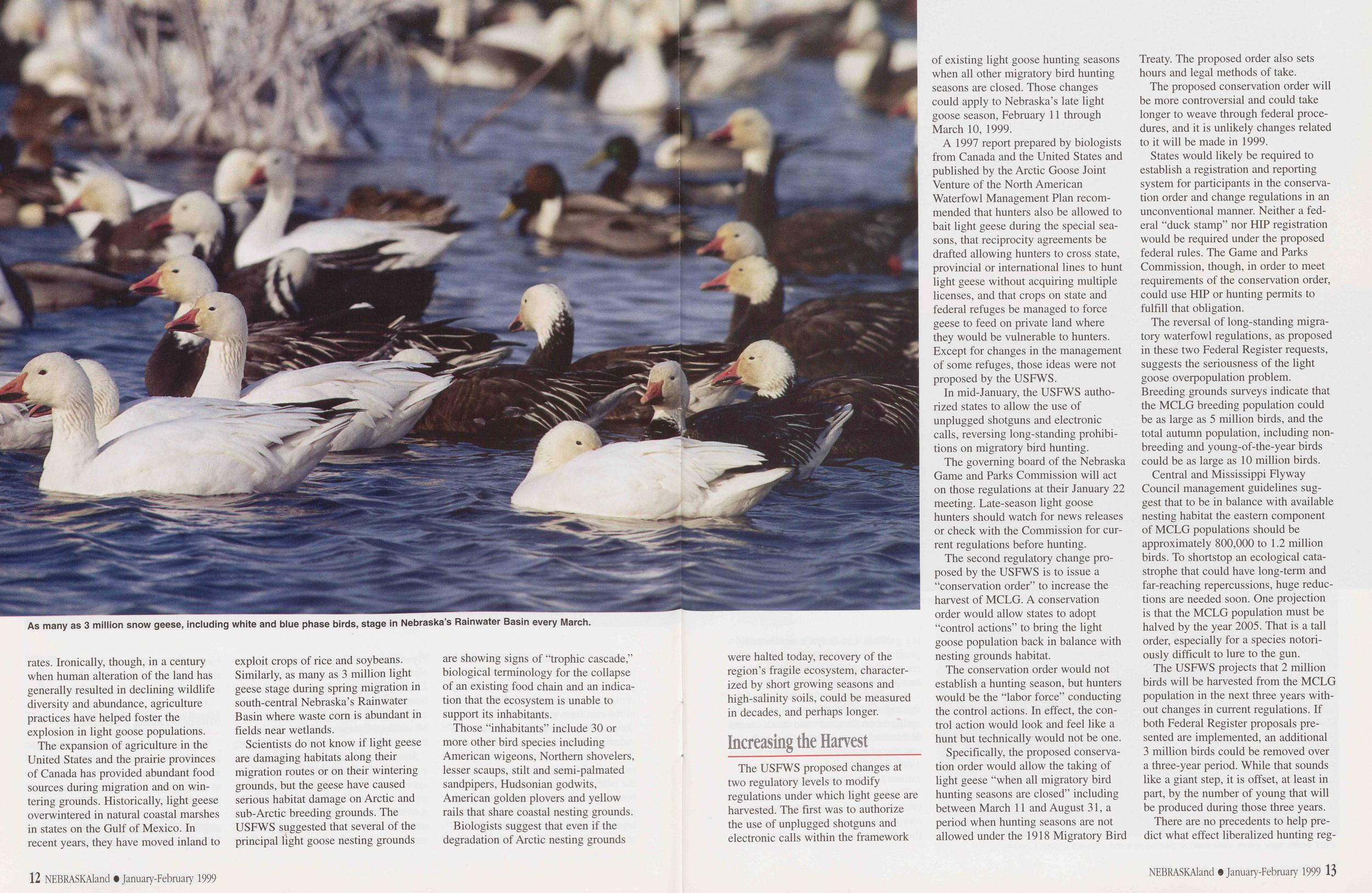
rates. Ironically, though, in a century when human alteration of the land has generally resulted in declining wildlife diversity and abundance, agriculture practices have helped foster the explosion in light goose populations.
The expansion of agriculture in the United States and the prairie provinces of Canada has provided abundant food sources during migration and on wintering grounds. Historically, light geese overwintered in natural coastal marshes in states on the Gulf of Mexico. In recent years, they have moved inland to exploit crops of rice and soybeans. Similarly, as many as 3 million light geese stage during spring migration in south-central Nebraska's Rainwater Basin where waste corn is abundant in fields near wetlands.
Scientists do not know if light geese are damaging habitats along their migration routes or on their wintering grounds, but the geese have caused serious habitat damage on Arctic and sub-Arctic breeding grounds. The USFWS suggested that several of the principal light goose nesting grounds are showing signs of "trophic cascade," biological terminology for the collapse of an existing food chain and an indication that the ecosystem is unable to support its inhabitants.
Those "inhabitants" include 30 or more other bird species including American wigeons, Northern shovelers, lesser scaups, stilt and semi-palmated sandpipers, Hudsonian godwits, American golden plovers and yellow rails that share coastal nesting grounds.
Biologists suggest that even if the degradation of Arctic nesting grounds 12 NEBRASKAland • January-February 1999 were halted today, recovery of the region's fragile ecosystem, characterized by short growing seasons and high-salinity soils, could be measured in decades, and perhaps longer.
Increasing the HarvestThe USFWS proposed changes at two regulatory levels to modify regulations under which light geese are harvested. The first was to authorize the use of unplugged shotguns and electronic calls within the framework of existing light goose hunting seasons when all other migratory bird hunting seasons are closed. Those changes could apply to Nebraska's late light goose season, February 11 through March 10, 1999.
A 1997 report prepared by biologists from Canada and the United States and published by the Arctic Goose Joint Venture of the North American Waterfowl Management Plan recommended that hunters also be allowed to bait light geese during the special seasons, that reciprocity agreements be drafted allowing hunters to cross state, provincial or international lines to hunt light geese without acquiring multiple licenses, and that crops on state and federal refuges be managed to force geese to feed on private land where they would be vulnerable to hunters. Except for changes in the management of some refuges, those ideas were not proposed by the USFWS.
In mid-January, the USFWS authorized states to allow the use of unplugged shotguns and electronic calls, reversing long-standing prohibitions on migratory bird hunting.
The governing board of the Nebraska Game and Parks Commission will act on those regulations at their January 22 meeting. Late-season light goose hunters should watch for news releases or check with the Commission for current regulations before hunting.
The second regulatory change proposed by the USFWS is to issue a "conservation order" to increase the harvest of MCLG. A conservation order would allow states to adopt "control actions" to bring the light goose population back in balance with nesting grounds habitat.
The conservation order would not establish a hunting season, but hunters would be the "labor force" conducting the control actions. In effect, the control action would look and feel like a hunt but technically would not be one.
Specifically, the proposed conservation order would allow the taking of light geese "when all migratory bird hunting seasons are closed" including between March 11 and August 31, a period when hunting seasons are not allowed under the 1918 Migratory Bird Treaty. The proposed order also sets hours and legal methods of take.
The proposed conservation order will be more controversial and could take longer to weave through federal procedures, and it is unlikely changes related to it will be made in 1999.
States would likely be required to establish a registration and reporting system for participants in the conservation order and change regulations in an unconventional manner. Neither a federal "duck stamp" nor HIP registration would be required under the proposed federal rules. The Game and Parks Commission, though, in order to meet requirements of the conservation order, could use HIP or hunting permits to fulfill that obligation.
The reversal of long-standing migratory waterfowl regulations, as proposed in these two Federal Register requests, suggests the seriousness of the light goose overpopulation problem. Breeding grounds surveys indicate that the MCLG breeding population could be as large as 5 million birds, and the total autumn population, including nonbreeding and young-of-the-year birds could be as large as 10 million birds.
Central and Mississippi Flyway Council management guidelines suggest that to be in balance with available nesting habitat the eastern component of MCLG populations should be approximately 800,000 to 1.2 million birds. To shortstop an ecological catastrophe that could have long-term and far-reaching repercussions, huge reductions are needed soon. One projection is that the MCLG population must be halved by the year 2005. That is a tall order, especially for a species notoriously difficult to lure to the gun.
The USFWS projects that 2 million birds will be harvested from the MCLG population in the next three years without changes in current regulations. If both Federal Register proposals presented are implemented, an additional 3 million birds could be removed over a three-year period. While that sounds like a giant step, it is offset, at least in part, by the number of young that will be produced during those three years.
There are no precedents to help predict what effect liberalized hunting regulations
NEBRASKAland • January-February 1999 13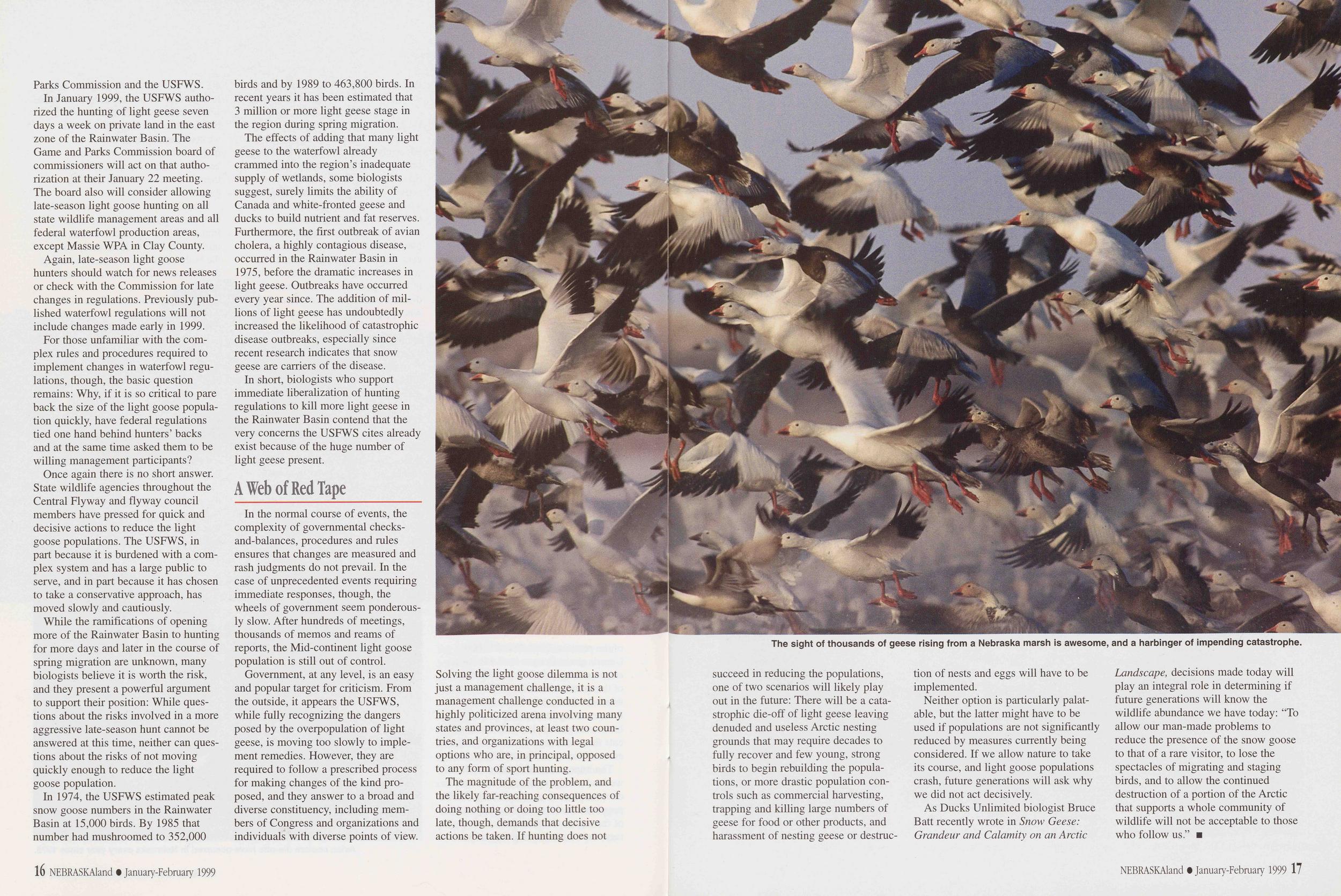
Parks Commission and the USFWS.
In January 1999, the USFWS authorized the hunting of light geese seven days a week on private land in the east zone of the Rainwater Basin. The Game and Parks Commission board of commissioners will act on that authorization at their January 22 meeting. The board also will consider allowing late-season light goose hunting on all state wildlife management areas and all federal waterfowl production areas, except Massie WPA in Clay County.
Again, late-season light goose hunters should watch for news releases or check with the Commission for late changes in regulations. Previously published waterfowl regulations will not include changes made early in 1999.
For those unfamiliar with the complex rules and procedures required to implement changes in waterfowl regulations, though, the basic question remains: Why, if it is so critical to pare back the size of the light goose population quickly, have federal regulations tied one hand behind hunters' backs and at the same time asked them to be willing management participants?
Once again there is no short answer. State wildlife agencies throughout the Central Flyway and flyway council members have pressed for quick and decisive actions to reduce the light goose populations. The USFWS, in part because it is burdened with a complex system and has a large public to serve, and in part because it has chosen to take a conservative approach, has moved slowly and cautiously.
While the ramifications of opening more of the Rainwater Basin to hunting for more days and later in the course of spring migration are unknown, many biologists believe it is worth the risk, and they present a powerful argument to support their position: While questions about the risks involved in a more aggressive late-season hunt cannot be answered at this time, neither can questions about the risks of not moving quickly enough to reduce the light goose population.
In 1974, the USFWS estimated peak snow goose numbers in the Rainwater Basin at 15,000 birds. By 1985 that number had mushroomed to 352,000 birds and by 1989 to 463,800 birds. In recent years it has been estimated that 3 million or more light geese stage in the region during spring migration.
The effects of adding that many light geese to the waterfowl already crammed into the region's inadequate supply of wetlands, some biologists suggest, surely limits the ability of Canada and white-fronted geese and ducks to build nutrient and fat reserves. Furthermore, the first outbreak of avian cholera, a highly contagious disease, occurred in the Rainwater Basin in 1975, before the dramatic increases in light geese. Outbreaks have occurred every year since. The addition of millions of light geese has undoubtedly increased the likelihood of catastrophic disease outbreaks, especially since recent research indicates that snow geese are carriers of the disease.
In short, biologists who support immediate liberalization of hunting regulations to kill more light geese in the Rainwater Basin contend that the very concerns the USFWS cites already exist because of the huge number of light geese present.
A Web of Red TapeIn the normal course of events, the complexity of governmental checks-and-balances, procedures and rules ensures that changes are measured and rash judgments do not prevail. In the case of unprecedented events requiring immediate responses, though, the wheels of government seem ponderously slow. After hundreds of meetings, thousands of memos and reams of reports, the Mid-continent light goose population is still out of control.
Government, at any level, is an easy and popular target for criticism. From the outside, it appears the USFWS, while fully recognizing the dangers posed by the overpopulation of light geese, is moving too slowly to implement remedies. However, they are required to follow a prescribed process for making changes of the kind proposed, and they answer to a broad and diverse constituency, including members of Congress and organizations and individuals with diverse points of view. Solving the light goose dilemma is not just a management challenge, it is a management challenge conducted in a highly politicized arena involving many states and provinces, at least two countries, and organizations with legal options who are, in principal, opposed to any form of sport hunting.
The magnitude of the problem, and the likely far-reaching consequences of doing nothing or doing too little too late, though, demands that decisive actions be taken. If hunting does not 16 NEBRASKAland • January-February 1999
Neither option is particularly palatable, but the latter might have to be used if populations are not significantly reduced by measures currently being considered. If we allow nature to take its course, and light goose populations crash, future generations will ask why we did not act decisively.
As Ducks Unlimited biologist Bruce Batt recently wrote in Snow Geese: Grandeur and Calamity on an Arctic Landscape, decisions made today will play an integral role in determining if future generations will know the wildlife abundance we have today: "To allow our man-made problems to reduce the presence of the snow goose to that of a rare visitor, to lose the spectacles of migrating and staging birds, and to allow the continued destruction of a portion of the Arctic that supports a whole community of wildlife will not be acceptable to those who follow us."
NEBRASKAland • January-February 1999 17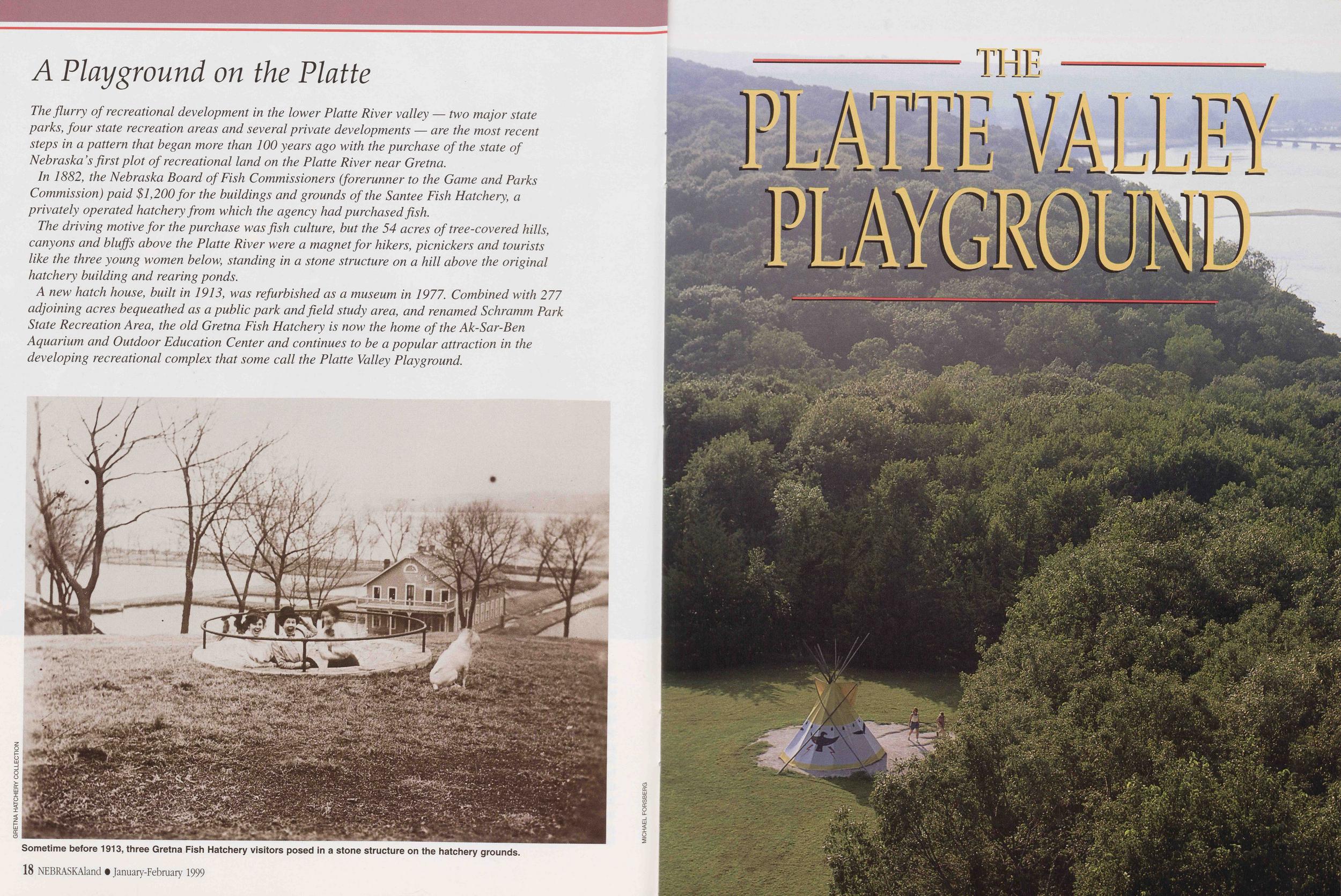
The Platte Valley Playground
A Playground on the PlatteThe flurry of recreational development in the lower Platte River valley — two major state parks, four state recreation areas and several private developments — are the most recent steps in a pattern that began more than 100 years ago with the purchase of the state of Nebraska's first plot of recreational land on the Platte River near Gretna.
In 1882, the Nebraska Board of Fish Commissioners (forerunner to the Game and Parks Commission) paid $1,200 for the buildings and grounds of the Santee Fish Hatchery, a privately operated hatchery from which the agency had purchased fish.
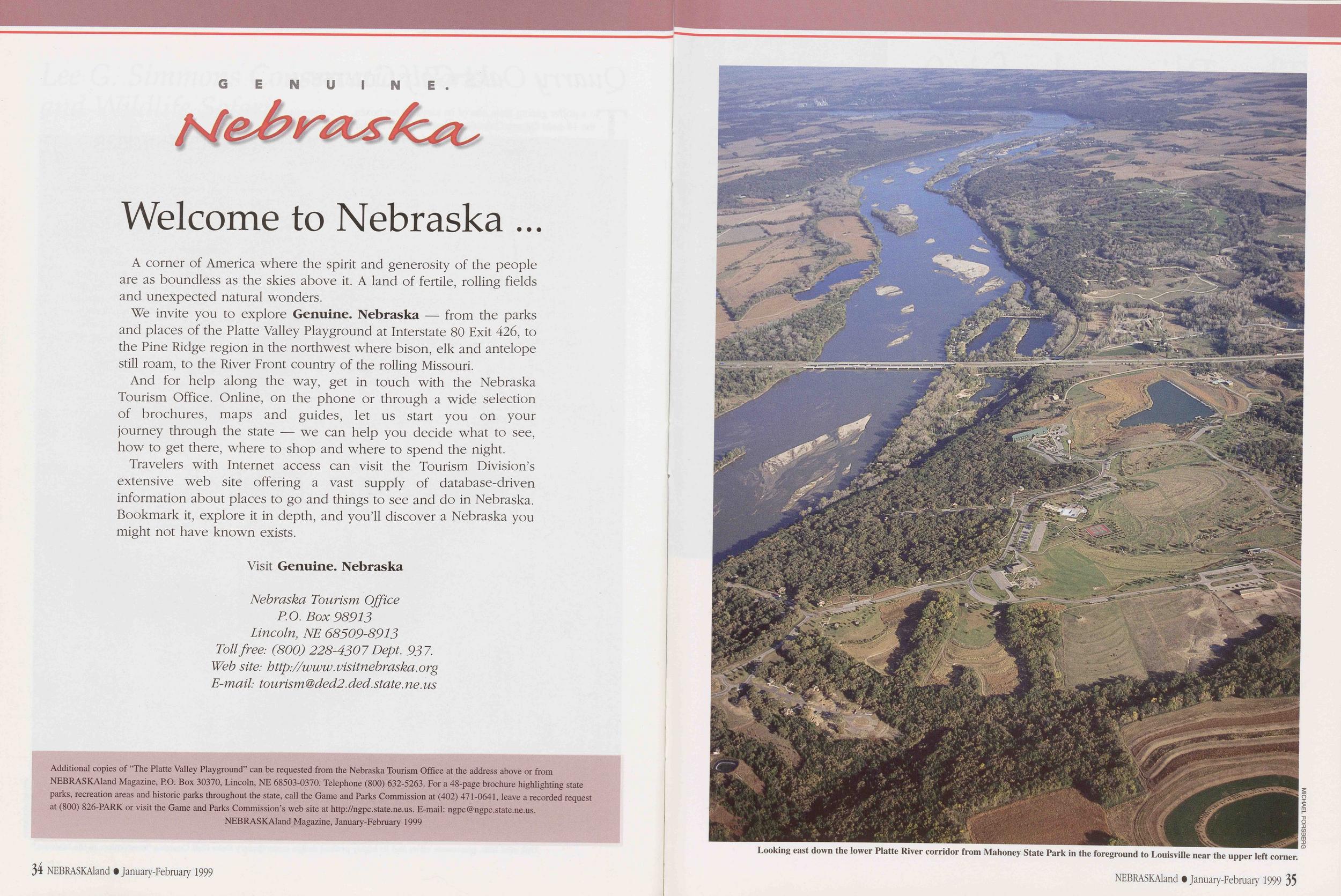
The driving motive for the purchase was fish culture, but the 54 acres of tree-covered hills, canyons and bluffs above the Platte River were a magnet for hikers, picnickers and tourists like the three young women below, standing in a stone structure on a hill above the original hatchery building and rearing ponds.
A new hatch house, built in 1913, was refurbished as a museum in 1977. Combined with 277 adjoining acres bequeathed as a public park and field study area, and renamed Schramm Park State Recreation Area, the old Gretna Fish Hatchery is now the home of the Ak-Sar-Ben Aquarium and Outdoor Education Center and continues to be a popular attraction in the developing recreational complex that some call the Platte Valley Playground.
 Introduction
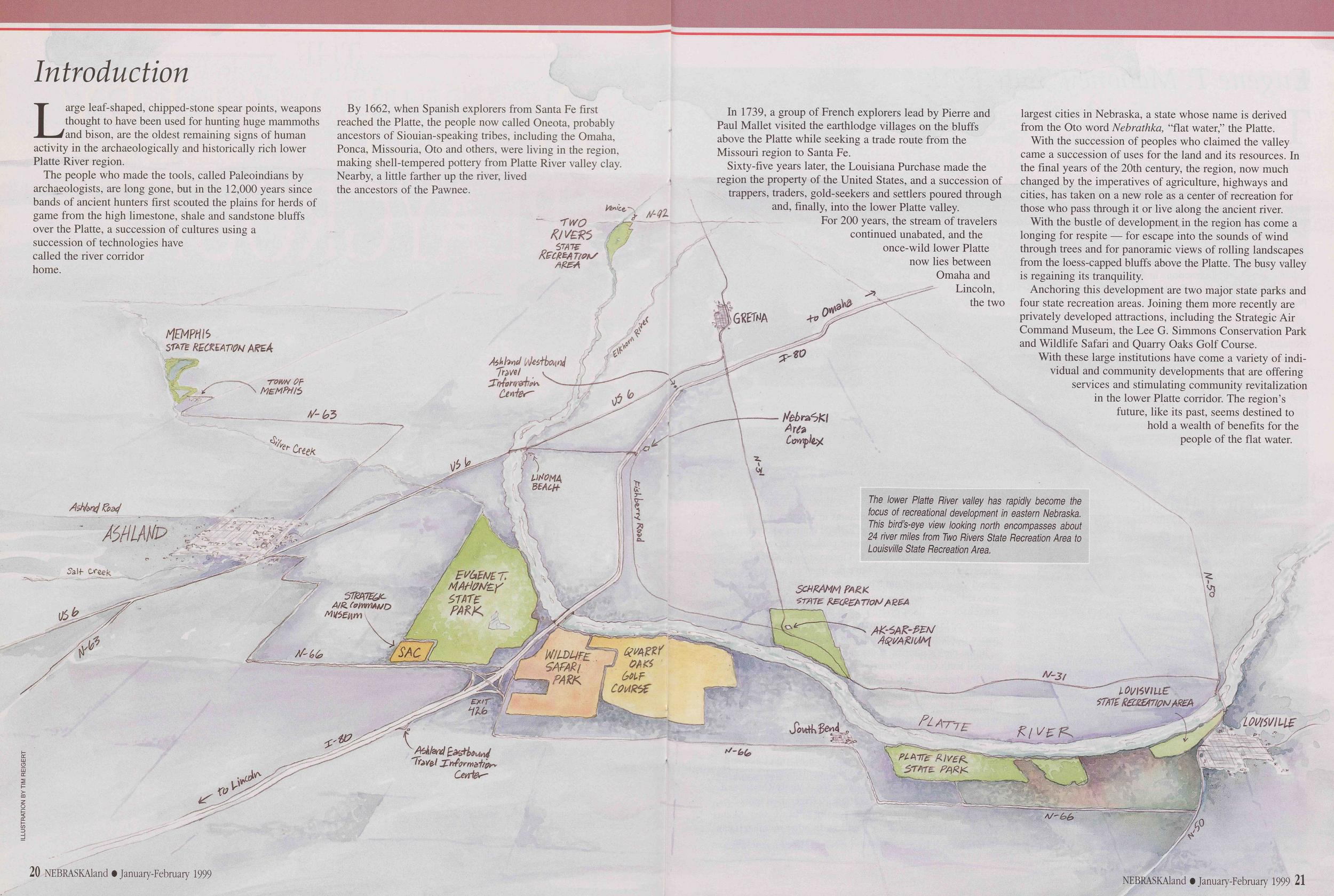
Large leaf-shaped, chipped-stone spear points, weapons thought to have been used for hunting huge mammoths and bison, are the oldest remaining signs of human activity in the archaeologically and historically rich lower Platte River region.
The people who made the tools, called Paleoindians by archaeologists, are long gone, but in the 12,000 years since bands of ancient hunters first scouted the plains for herds of game from the high limestone, shale and sandstone bluffs over the Platte, a succession of cultures using a succession of technologies have called the river corridor home.
By 1662, when Spanish explorers from Santa Fe first reached the Platte, the people now called Oneota, probably ancestors of Siouian-speaking tribes, including the Omaha, Ponca, Missouria, Oto and others, were living in the region, making shell-tempered pottery from Platte River valley clay. Nearby, a little farther up the river, lived the ancestors of the Pawnee.
20 NEBRASKAland • January-February 1999In 1739, a group of French explorers lead by Pierre and Paul Mallet visited the earth lodge villages on the bluffs above the Platte while seeking a trade route from the Missouri region to Santa Fe.
Sixty-five years later, the Louisiana Purchase made the region the property of the United States, and a succession of trappers, traders, gold-seekers and settlers poured through and, finally, into the lower Platte valley. For 200 years, the stream of travelers continued unabated, and the once-wild lower Platte now lies between Omaha and Lincoln, the two largest cities in Nebraska, a state whose name is derived from the Oto word Nebraska, "flat water," the Platte.
With the succession of peoples who claimed the valley came a succession of uses for the land and its resources. In the final years of the 20th century, the region, now much changed by the imperatives of agriculture, highways and cities, has taken on a new role as a center of recreation for those who pass through it or live along the ancient river.
With the bustle of development in the region has come a longing for respite — for escape into the sounds of wind through trees and for panoramic views of rolling landscapes from the loess-capped bluffs above the Platte. The busy valley is regaining its tranquility.
Anchoring this development are two major state parks and four state recreation areas. Joining them more recently are privately developed attractions, including the Strategic Air Command Museum, the Lee G. Simmons Conservation Park and Wildlife Safari and Quarry Oaks Golf Course. With these large institutions have come a variety of individual and community developments that are offering services and stimulating community revitalization in the lower Platte corridor. The region's future, like its past, seems destined to hold a wealth of benefits for the people of the flat water.
 Eugene T. Mahoney State Park
The picturesque Platte River valley in eastern Nebraska is the setting for Eugene T. Mahoney State Park, the newest and most modern of Nebraska's major state parks. First opened to the public in 1991, the 700-acre park lies between Omaha and Lincoln at Interstate 80 exit 426. The park is open year-round.
Mahoney State Park, a destination in its own right, is an anchor for the attractions that have been drawn to this part of the Platte valley since the park opened in 1991. Among them are the Strategic Air Command Museum and the Lee G. Simmons Conservation Park and Wildlife Safari, also at exit 426, and Quarry Oaks Golf Course, three miles east.
Other recreational attractions in the valley and nearby include Platte River State Park and Schramm, Louisville, Two Rivers and Memphis state recreation areas.
Mahoney's attractions include overnight accommodations and food service as well as diversions ranging from the sedentary and serene to the active and invigorating.
Mahoney offers year-round accommodations, recreation and services, but some park activities and facilities are seasonal. Many peak season activities are available May through October. Special activities are held in other months, and a yearly schedule of winter activities is maintained, including holiday lighting and theater performances. Other winter activities, including cross-country skiing, sleigh rides and ice fishing on U S West Lake, are weather dependent. Special activities may be held only on weekends or by advance arrangement.
Eugene T. MahoneyIn 1985, the Nebraska Legislature recognized the leadership of Eugene T. Mahoney in the revitalization of Nebraska's state park system by naming the new park overlooking the Platte River in his honor. Mahoney was director of the Game and Parks Commission from 1976 to 1988.
Mahoney is no stranger to public service. As a police officer, Nebraska state senator, director of the Game and Parks Commission and executive director of the Henry Doorly Zoo Foundation, he has devoted much of his life to helping create a better Nebraska.
His ability as an organizer and fund raiser is nowhere more evident than at Interstate 80 exit 426, which leads to Eugene T. Mahoney State Park, the Lee G. Simmons Conservation Park and Wildlife Safari and the Strategic Air Command Museum.
His presence is especially evident at Mahoney State Park and the Wildlife Safari. Mahoney harnessed the philanthropy of contributors to acquire the property and build major features of both attractions, and many of the projects today bear the donors' names.
Park ActivitiesFrom Memorial Day through Labor Day, the Richard L. Coyne Pool and Slide Complex is the hub of activity for the park's younger visitors. It features a regulation-size pool with a diving area, wading pool and two water slides, both more than 200 feet long.
Other park facilities also cater to visitors interested in vigorous activity, including a sand volleyball court, a multisport field, a softball diamond and the Owen Tennis Courts. Young athletes will find three well-equipped playgrounds, two outdoors and one indoors.
Golfers can work on their long game at the John R. Lauritzen Driving Range; visitors are welcome to bring their own clubs or to use clubs available at the range. The nearby Esther Marie Daniel Miniature Golf Course provides an opportunity to participate in another version of the game.
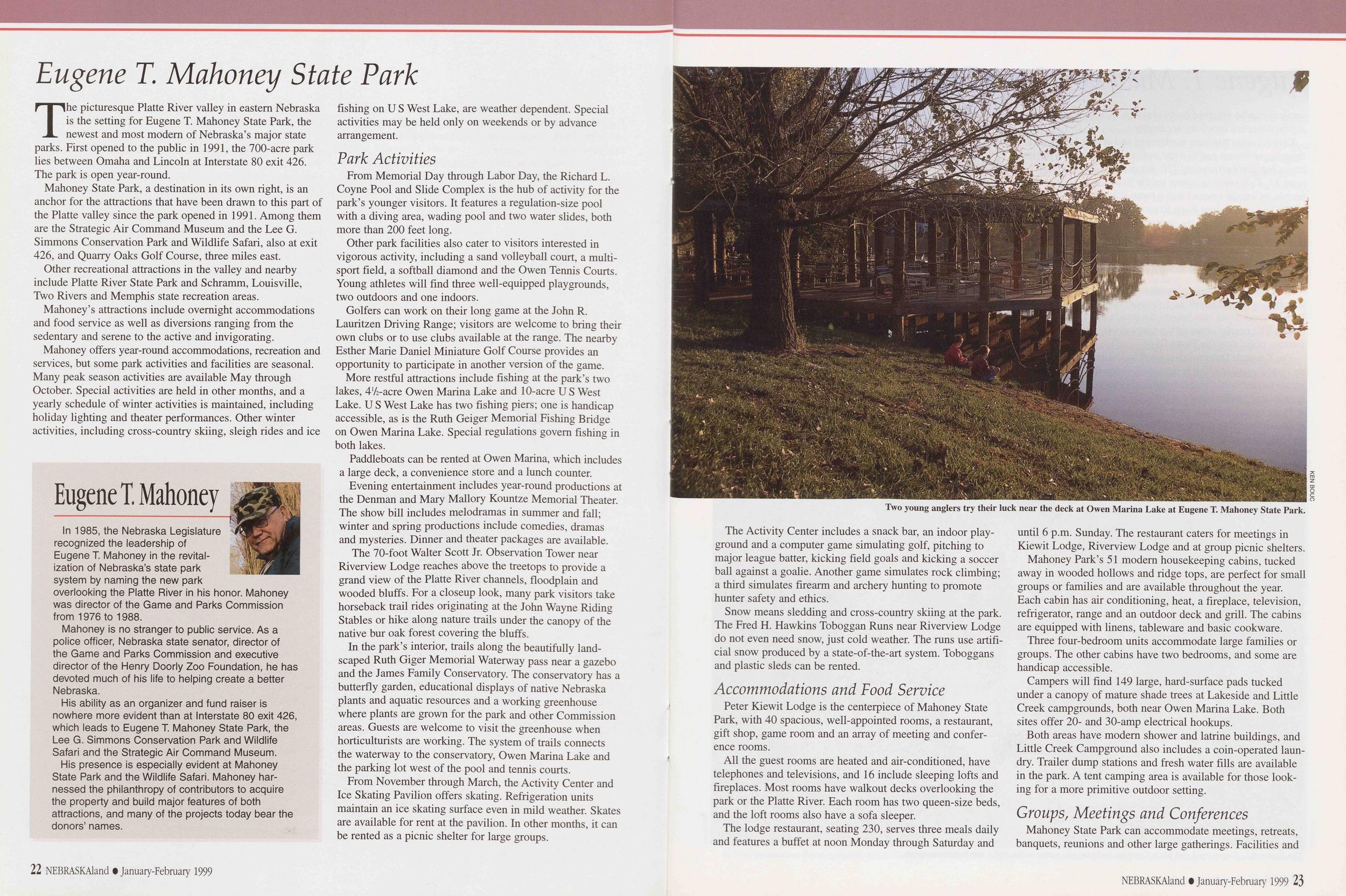
More restful attractions include fishing at the park's two lakes, 4 1/2-acre Owen Marina Lake and 10-acre US West Lake. U S West Lake has two fishing piers; one is handicap accessible, as is the Ruth Geiger Memorial Fishing Bridge on Owen Marina Lake. Special regulations govern fishing in both lakes.
Paddle boats can be rented at Owen Marina, which includes a large deck, a convenience store and a lunch counter.
Evening entertainment includes year-round productions at the Denman and Mary Mallory Kountze Memorial Theater. The show bill includes melodramas in summer and fall; winter and spring productions include comedies, dramas and mysteries. Dinner and theater packages are available.
The 70-foot Walter Scott Jr. Observation Tower near Riverview Lodge reaches above the treetops to provide a grand view of the Platte River channels, floodplain and wooded bluffs. For a closeup look, many park visitors take horseback trail rides originating at the John Wayne Riding Stables or hike along nature trails under the canopy of the native bur oak forest covering the bluffs.
In the park's interior, trails along the beautifully landscaped Ruth Giger Memorial Waterway pass near a gazebo and the James Family Conservatory. The conservatory has a butterfly garden, educational displays of native Nebraska plants and aquatic resources and a working greenhouse where plants are grown for the park and other Commission areas. Guests are welcome to visit the greenhouse when horticulturists are working. The system of trails connects the waterway to the conservatory, Owen Marina Lake and the parking lot west of the pool and tennis courts.
From November through March, the Activity Center and Ice Skating Pavilion offers skating. Refrigeration units maintain an ice skating surface even in mild weather. Skates are available for rent at the pavilion. In other months, it can be rented as a picnic shelter for large groups.
22 NEBRASKAland • January-February 1999The Activity Center includes a snack bar, an indoor play- ground and a computer game simulating golf, pitching to major league batter, kicking field goals and kicking a soccer ball against a goalie. Another game simulates rock climbing; a third simulates firearm and archery hunting to promote hunter safety and ethics.
Snow means sledding and cross-country skiing at the park. The Fred H. Hawkins Toboggan Runs near Riverview Lodge do not even need snow, just cold weather. The runs use artificial snow produced by a state-of-the-art system. Toboggans and plastic sleds can be rented.
Accommodations and Pood ServicePeter Kiewit Lodge is the centerpiece of Mahoney State Park, with 40 spacious, well-appointed rooms, a restaurant, gift shop, game room and an array of meeting and conference rooms.
All the guest rooms are heated and air-conditioned, have telephones and televisions, and 16 include sleeping lofts and fireplaces. Most rooms have walkout decks overlooking the park or the Platte River. Each room has two queen-size beds, and the loft rooms also have a sofa sleeper.
The lodge restaurant, seating 230, serves three meals daily and features a buffet at noon Monday through Saturday and until 6 p.m. Sunday. The restaurant caters for meetings in Kiewit Lodge, Riverview Lodge and at group picnic shelters.
Mahoney Park's 51 modern housekeeping cabins, tucked away in wooded hollows and ridge tops, are perfect for small groups or families and are available throughout the year. Each cabin has air conditioning, heat, a fireplace, television, refrigerator, range and an outdoor deck and grill. The cabins are equipped with linens, tableware and basic cookware.
Three four-bedroom units accommodate large families or groups. The other cabins have two bedrooms, and some are handicap accessible.
Campers will find 149 large, hard-surface pads tucked under a canopy of mature shade trees at Lakeside and Little Creek campgrounds, both near Owen Marina Lake. Both sites offer 20- and 30-amp electrical hookups.
Both areas have modern shower and latrine buildings, and Little Creek Campground also includes a coin-operated laundry. Trailer dump stations and fresh water fills are available in the park. A tent camping area is available for those look- ing for a more primitive outdoor setting.
Groups, Meetings and ConferencesMahoney State Park can accommodate meetings, retreats, banquets, reunions and other large gatherings. Facilities and services can be reserved up to one year in advance. All meeting facilities are handicap accessible.
NEBRASKAland • January-February 1999 23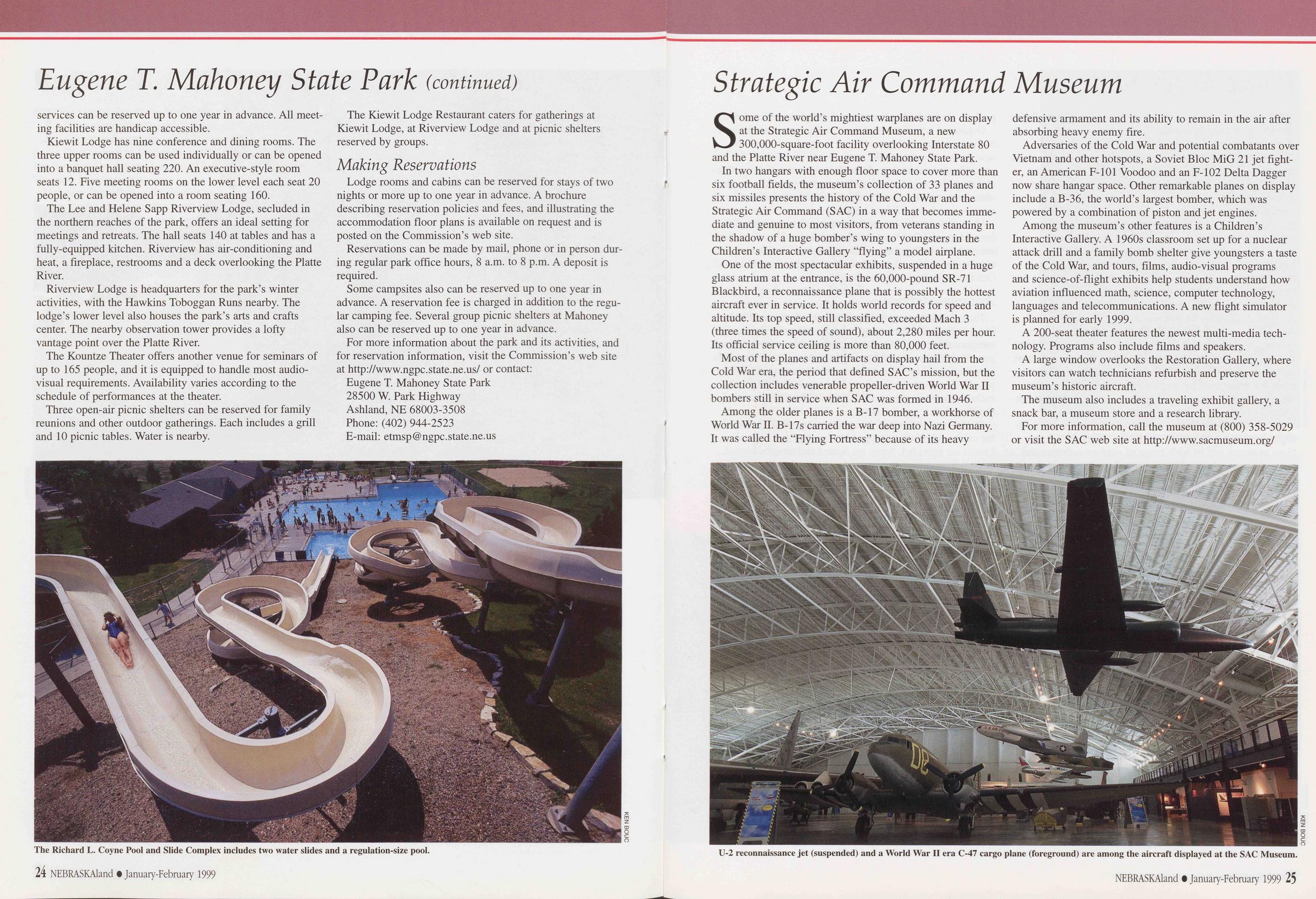 Eugene T. Mahoney State Park (continued)
Kiewit Lodge has nine conference and dining rooms. The three upper rooms can be used individually or can be opened into a banquet hall seating 220. An executive-style room seats 12. Five meeting rooms on the lower level each seat 20 people, or can be opened into a room seating 160.
The Lee and Helene Sapp Riverview Lodge, secluded in the northern reaches of the park, offers an ideal setting for meetings and retreats. The hall seats 140 at tables and has a fully-equipped kitchen. Riverview has air-conditioning and heat, a fireplace, restrooms and a deck overlooking the Platte River.
Riverview Lodge is headquarters for the park's winter activities, with the Hawkins Toboggan Runs nearby. The lodge's lower level also houses the park's arts and crafts center. The nearby observation tower provides a lofty vantage point over the Platte River.
The Kountze Theater offers another venue for seminars of up to 165 people, and it is equipped to handle most audio-visual requirements. Availability varies according to the schedule of performances at the theater.
Three open-air picnic shelters can be reserved for family reunions and other outdoor gatherings. Each includes a grill and 10 picnic tables. Water is nearby.
The Kiewit Lodge Restaurant caters for gatherings at Kiewit Lodge, at Riverview Lodge and at picnic shelters reserved by groups.
Making ReservationsLodge rooms and cabins can be reserved for stays of two nights or more up to one year in advance. A brochure describing reservation policies and fees, and illustrating the accommodation floor plans is available on request and is posted on the Commission's web site.
Reservations can be made by mail, phone or in person during regular park office hours, 8 a.m. to 8 p.m. A deposit is required.
Some campsites also can be reserved up to one year in advance. A reservation fee is charged in addition to the regular camping fee. Several group picnic shelters at Mahoney also can be reserved up to one year in advance.
For more information about the park and its activities, and for reservation information, visit the Commission's web site at http://www.ngpc.state.ne.us/ or contact:
Eugene T. Mahoney State Park 28500 W. Park Highway Ashland, NE 68003-3508 Phone: (402) 944-2523 E-mail: etmsp@ngpc.state.ne.usSome of the world's mightiest warplanes are on display at the Strategic Air Command Museum, a new 300,000-square-foot facility overlooking Interstate 80 and the Platte River near Eugene T. Mahoney State Park.
In two hangars with enough floor space to cover more than six football fields, the museum's collection of 33 planes and six missiles presents the history of the Cold War and the Strategic Air Command (SAC) in a way that becomes immediate and genuine to most visitors, from veterans standing in the shadow of a huge bomber's wing to youngsters in the Children's Interactive Gallery "flying" a model airplane.
One of the most spectacular exhibits, suspended in a huge glass atrium at the entrance, is the 60,000-pound SR-71 Blackbird, a reconnaissance plane that is possibly the hottest aircraft ever in service. It holds world records for speed and altitude. Its top speed, still classified, exceeded Mach 3 (three times the speed of sound), about 2,280 miles per hour. Its official service ceiling is more than 80,000 feet.
Most of the planes and artifacts on display hail from the Cold War era, the period that defined SAC's mission, but the collection includes venerable propeller-driven World War II bombers still in service when SAC was formed in 1946.
Among the older planes is a B-17 bomber, a workhorse of World War II. B-17s carried the war deep into Nazi Germany. It was called the "Flying Fortress" because of its heavy defensive armament and its ability to remain in the air after absorbing heavy enemy fire.
Adversaries of the Cold War and potential combatants over Vietnam and other hotspots, a Soviet Bloc MiG 21 jet fighter, an American F-101 Voodoo and an F-102 Delta Dagger now share hangar space. Other remarkable planes on display include a B-36, the world's largest bomber, which was powered by a combination of piston and jet engines.
Among the museum's other features is a Children's Interactive Gallery. A 1960s classroom set up for a nuclear attack drill and a family bomb shelter give youngsters a taste of the Cold War, and tours, films, audio-visual programs and science-of-flight exhibits help students understand how aviation influenced math, science, computer technology, languages and telecommunications. A new flight simulator is planned for early 1999.
A 200-seat theater features the newest multi-media technology. Programs also include films and speakers.
A large window overlooks the Restoration Gallery, where visitors can watch technicians refurbish and preserve the museum's historic aircraft.
The museum also includes a traveling exhibit gallery, a snack bar, a museum store and a research library.
For more information, call the museum at (800) 358-5029 or visit the SAC web site at http://www.sacmuseum.org/
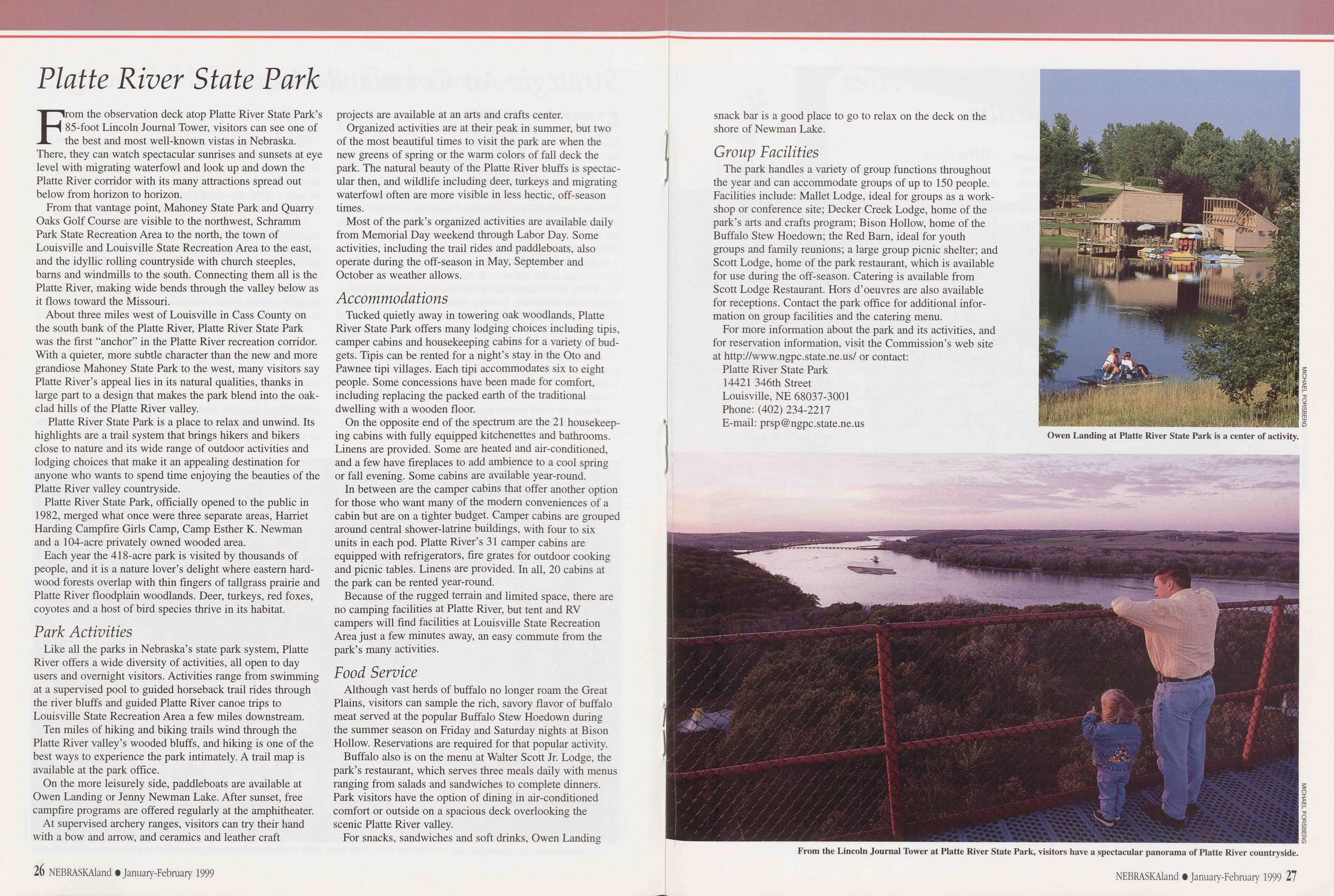 Platte River State Park
From the observation deck atop Platte River State Park's 85-foot Lincoln Journal Tower, visitors can see one of the best and most well-known vistas in Nebraska. There, they can watch spectacular sunrises and sunsets at eye level with migrating waterfowl and look up and down the Platte River corridor with its many attractions spread out below from horizon to horizon.
From that vantage point, Mahoney State Park and Quarry Oaks Golf Course are visible to the northwest, Schramm Park State Recreation Area to the north, the town of Louisville and Louisville State Recreation Area to the east, and the idyllic rolling countryside with church steeples, barns and windmills to the south. Connecting them all is the Platte River, making wide bends through the valley below as it flows toward the Missouri.
About three miles west of Louisville in Cass County on the south bank of the Platte River, Platte River State Park was the first "anchor" in the Platte River recreation corridor. With a quieter, more subtle character than the new and more grandiose Mahoney State Park to the west, many visitors say Platte River's appeal lies in its natural qualities, thanks in large part to a design that makes the park blend into the oakclad hills of the Platte River valley.
Platte River State Park is a place to relax and unwind. Its highlights are a trail system that brings hikers and bikers close to nature and its wide range of outdoor activities and lodging choices that make it an appealing destination for anyone who wants to spend time enjoying the beauties of the Platte River valley countryside.
Platte River State Park, officially opened to the public in 1982, merged what once were three separate areas, Harriet Harding Campfire Girls Camp, Camp Esther K. Newman and a 104-acre privately owned wooded area.
Each year the 418-acre park is visited by thousands of people, and it is a nature lover's delight where eastern hardwood forests overlap with thin fingers of tallgrass prairie and Platte River floodplain woodlands. Deer, turkeys, red foxes, coyotes and a host of bird species thrive in its habitat.
Park ActivitiesLike all the parks in Nebraska's state park system, Platte River offers a wide diversity of activities, all open to day users and overnight visitors. Activities range from swimming at a supervised pool to guided horseback trail rides through the river bluffs and guided Platte River canoe trips to Louisville State Recreation Area a few miles downstream.
Ten miles of hiking and biking trails wind through the Platte River valley's wooded bluffs, and hiking is one of the best ways to experience the park intimately. A trail map is available at the park office.
On the more leisurely side, paddle boats are available at Owen Landing or Jenny Newman Lake. After sunset, free campfire programs are offered regularly at the amphitheater.
At supervised archery ranges, visitors can try their hand with a bow and arrow, and ceramics and leather craft projects are available at an arts and crafts center.
Organized activities are at their peak in summer, but two of the most beautiful times to visit the park are when the new greens of spring or the warm colors of fall deck the park. The natural beauty of the Platte River bluffs is spectacular then, and wildlife including deer, turkeys and migrating waterfowl often are more visible in less hectic, off-season times.
Most of the park's organized activities are available daily from Memorial Day weekend through Labor Day. Some activities, including the trail rides and paddle boats, also operate during the off-season in May, September and October as weather allows.
AccommodationsTucked quietly away in towering oak woodlands, Platte River State Park offers many lodging choices including tipis, camper cabins and housekeeping cabins for a variety of budgets. Tipis can be rented for a night's stay in the Oto and Pawnee tipi villages. Each tipi accommodates six to eight people. Some concessions have been made for comfort, including replacing the packed earth of the traditional dwelling with a wooden floor.
On the opposite end of the spectrum are the 21 housekeeping cabins with fully equipped kitchenettes and bathrooms. Linens are provided. Some are heated and air-conditioned, and a few have fireplaces to add ambience to a cool spring or fall evening. Some cabins are available year-round.
In between are the camper cabins that offer another option for those who want many of the modern conveniences of a cabin but are on a tighter budget. Camper cabins are grouped around central shower-latrine buildings, with four to six units in each pod. Platte River's 31 camper cabins are equipped with refrigerators, fire grates for outdoor cooking and picnic tables. Linens are provided. In all, 20 cabins at the park can be rented year-round.
Because of the rugged terrain and limited space, there are no camping facilities at Platte River, but tent and RV campers will find facilities at Louisville State Recreation Area just a few minutes away, an easy commute from the park's many activities.
Food ServiceAlthough vast herds of buffalo no longer roam the Great Plains, visitors can sample the rich, savory flavor of buffalo meat served at the popular Buffalo Stew Hoedown during the summer season on Friday and Saturday nights at Bison Hollow. Reservations are required for that popular activity.
Buffalo also is on the menu at Walter Scott Jr. Lodge, the park's restaurant, which serves three meals daily with menus ranging from salads and sandwiches to complete dinners. Park visitors have the option of dining in air-conditioned comfort or outside on a spacious deck overlooking the scenic Platte River valley.
For snacks, sandwiches and soft drinks, Owen Landing 26 NEBRASKAland • January-February 1999 snack bar is a good place to go to relax on the deck on the shore of Newman Lake.
Group FacilitiesThe park handles a variety of group functions throughout the year and can accommodate groups of up to 150 people. Facilities include: Mallet Lodge, ideal for groups as a workshop or conference site; Decker Creek Lodge, home of the park's arts and crafts program; Bison Hollow, home of the Buffalo Stew Hoedown; the Red Barn, ideal for youth groups and family reunions; a large group picnic shelter; and Scott Lodge, home of the park restaurant, which is available for use during the off-season. Catering is available from Scott Lodge Restaurant. Hors d'oeuvres are also available for receptions. Contact the park office for additional information on group facilities and the catering menu.
For more information about the park and its activities, and for reservation information, visit the Commission's web site at http://www.ngpc.state.ne.us/ or contact:
Platte River State Park 14421 346th Street Louisville, NE 68037-3001 Phone: (402) 234-2217 E-mail: prsp@ngpc.state.ne.us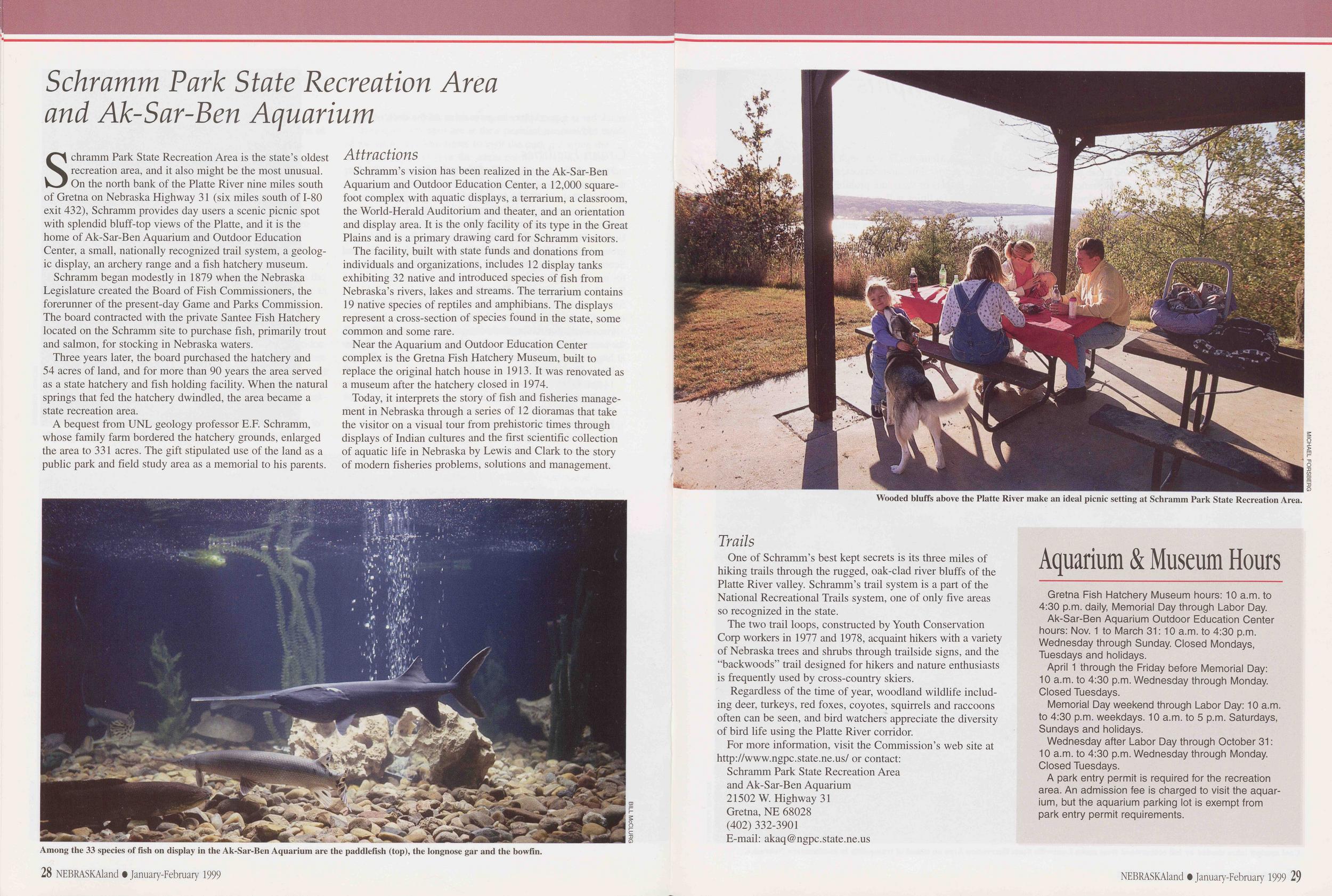 Schramm Park State Recreation Area
and Ak-Sar-Ben Aquarium
Schramm Park State Recreation Area
and Ak-Sar-Ben Aquarium
Schramm Park State Recreation Area is the state's oldest recreation area, and it also might be the most unusual. On the north bank of the Platte River nine miles south of Gretna on Nebraska Highway 31 (six miles south of 1-80 exit 432), Schramm provides day users a scenic picnic spot with splendid bluff-top views of the Platte, and it is the home of Ak-Sar-Ben Aquarium and Outdoor Education Center, a small, nationally recognized trail system, a geologic display, an archery range and a fish hatchery museum.
Schramm began modestly in 1879 when the Nebraska Legislature created the Board of Fish Commissioners, the forerunner of the present-day Game and Parks Commission. The board contracted with the private Santee Fish Hatchery located on the Schramm site to purchase fish, primarily trout and salmon, for stocking in Nebraska waters.
Three years later, the board purchased the hatchery and 54 acres of land, and for more than 90 years the area served as a state hatchery and fish holding facility. When the natural springs that fed the hatchery dwindled, the area became a state recreation area.
A bequest from UNL geology professor E.F. Schramm, whose family farm bordered the hatchery grounds, enlarged the area to 331 acres. The gift stipulated use of the land as a public park and field study area as a memorial to his parents.
AttractionsSchramm's vision has been realized in the Ak-Sar-Ben Aquarium and Outdoor Education Center, a 12,000 square-foot complex with aquatic displays, a terrarium, a classroom, the World-Herald Auditorium and theater, and an orientation and display area. It is the only facility of its type in the Great Plains and is a primary drawing card for Schramm visitors.
The facility, built with state funds and donations from individuals and organizations, includes 12 display tanks exhibiting 32 native and introduced species of fish from Nebraska's rivers, lakes and streams. The terrarium contains 19 native species of reptiles and amphibians. The displays represent a cross-section of species found in the state, some common and some rare.
Near the Aquarium and Outdoor Education Center complex is the Gretna Fish Hatchery Museum, built to replace the original hatch house in 1913. It was renovated as a museum after the hatchery closed in 1974.
Today, it interprets the story of fish and fisheries management in Nebraska through a series of 12 dioramas that take the visitor on a visual tour from prehistoric times through displays of Indian cultures and the first scientific collection of aquatic life in Nebraska by Lewis and Clark to the story of modern fisheries problems, solutions and management.
One of Schramm's best kept secrets is its three miles of hiking trails through the rugged, oak-clad river bluffs of the Platte River valley. Schramm's trail system is a part of the National Recreational Trails system, one of only five areas so recognized in the state.
The two trail loops, constructed by Youth Conservation Corp workers in 1977 and 1978, acquaint hikers with a variety of Nebraska trees and shrubs through trailside signs, and the "backwoods" trail designed for hikers and nature enthusiasts is frequently used by cross-country skiers.
Regardless of the time of year, woodland wildlife including deer, turkeys, red foxes, coyotes, squirrels and raccoons often can be seen, and bird watchers appreciate the diversity of bird life using the Platte River corridor.
For more information, visit the Commission's web site at http://www.ngpc.state.ne.us/ or contact:
Schramm Park State Recreation Area and Ak-Sar-Ben Aquarium 21502 W. Highway 31 Gretna, NE 68028 (402) 332-3901 E-mail: akaq@ngpc.state.ne.us Aquarium & Museum HoursGretna Fish Hatchery Museum hours: 10 a.m. to 4:30 p.m. daily, Memorial Day through Labor Day.
Ak-Sar-Ben Aquarium Outdoor Education Center hours: Nov. 1 to March 31: 10 a.m. to 4:30 p.m. Wednesday through Sunday. Closed Mondays, Tuesdays and holidays.
April 1 through the Friday before Memorial Day: 10 a.m. to 4:30 p.m. Wednesday through Monday. Closed Tuesdays.
Memorial Day weekend through Labor Day: 10 a.m. to 4:30 p.m. weekdays. 10 a.m. to 5 p.m. Saturdays, Sundays and holidays.
Wednesday after Labor Day through October 31: 10 a.m. to 4:30 p.m. Wednesday through Monday. Closed Tuesdays.
A park entry permit is required for the recreation area. An admission fee is charged to visit the aquarium, but the aquarium parking lot is exempt from park entry permit requirements.
NEBRASKAland • January-February 1999 29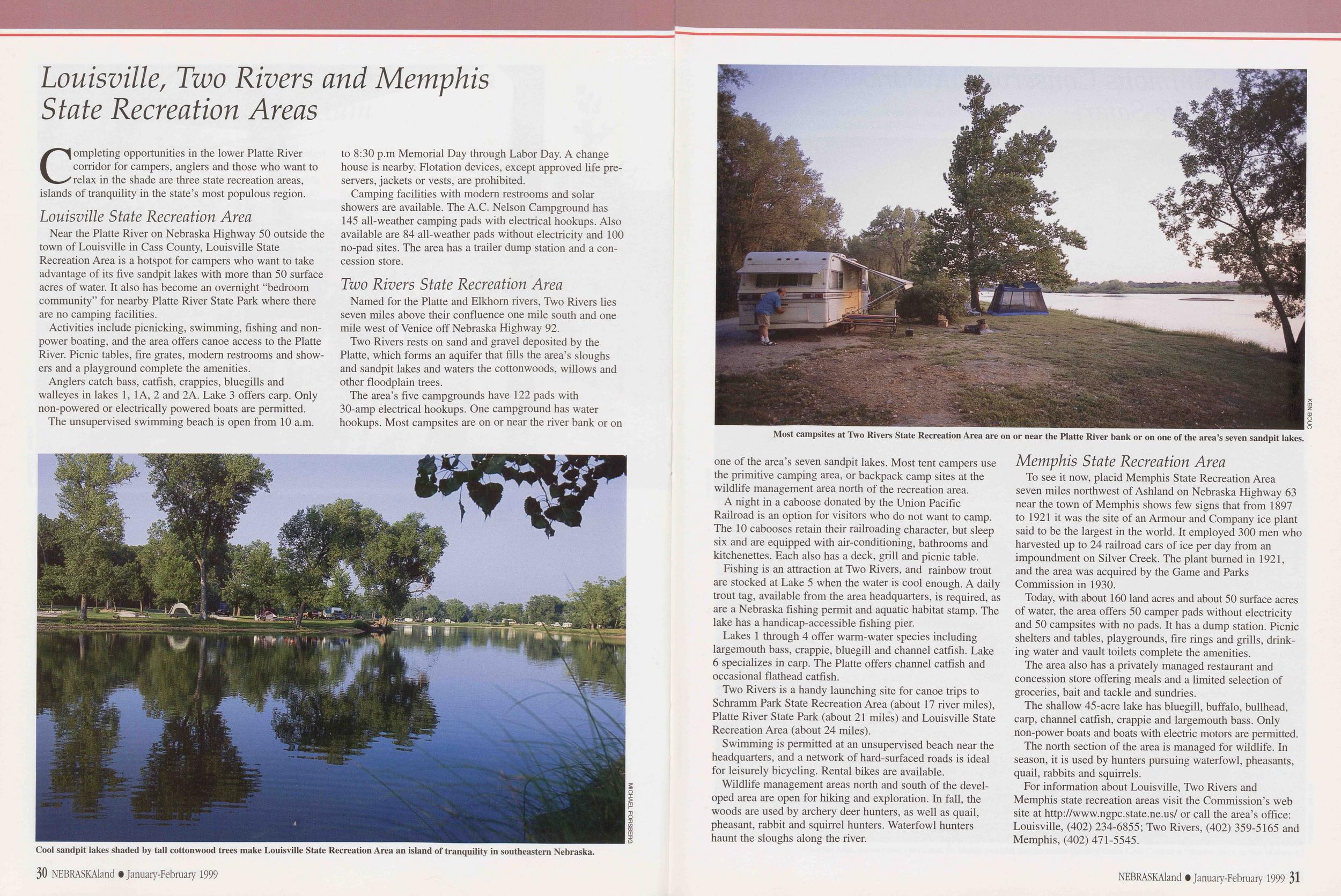 Louisville, Two Rivers and Memphis
State Recreation Areas
Louisville, Two Rivers and Memphis
State Recreation Areas
Completing opportunities in the lower Platte River corridor for campers, anglers and those who want to relax in the shade are three state recreation areas, islands of tranquility in the state's most populous region.
Louisville State Recreation AreaNear the Platte River on Nebraska Highway 50 outside the town of Louisville in Cass County, Louisville State Recreation Area is a hotspot for campers who want to take advantage of its five sandpit lakes with more than 50 surface acres of water. It also has become an overnight "bedroom community" for nearby Platte River State Park where there are no camping facilities.
Activities include picnicking, swimming, fishing and nonpower boating, and the area offers canoe access to the Platte River. Picnic tables, fire grates, modern restrooms and showers and a playground complete the amenities.
Anglers catch bass, catfish, crappies, bluegills and walleyes in lakes 1, 1A, 2 and 2A. Lake 3 offers carp. Only non-powered or electrically powered boats are permitted.
The unsupervised swimming beach is open from 10 a.m. to 8:30 p.m Memorial Day through Labor Day. A change house is nearby. Flotation devices, except approved life preservers, jackets or vests, are prohibited.
Camping facilities with modern restrooms and solar showers are available. The A.C. Nelson Campground has 145 all-weather camping pads with electrical hookups. Also available are 84 all-weather pads without electricity and 100 no-pad sites. The area has a trailer dump station and a concession store.
Two Rivers State Recreation AreaNamed for the Platte and Elkhorn rivers, Two Rivers lies seven miles above their confluence one mile south and one mile west of Venice off Nebraska Highway 92.
Two Rivers rests on sand and gravel deposited by the Platte, which forms an aquifer that fills the area's sloughs and sandpit lakes and waters the cottonwoods, willows and other floodplain trees.
The area's five campgrounds have 122 pads with 30-amp electrical hookups. One campground has water hookups. Most campsites are on or near the river bank or on
A night in a caboose donated by the Union Pacific Railroad is an option for visitors who do not want to camp. The 10 cabooses retain their railroading character, but sleep six and are equipped with air-conditioning, bathrooms and kitchenettes. Each also has a deck, grill and picnic table.
Fishing is an attraction at Two Rivers, and rainbow trout are stocked at Lake 5 when the water is cool enough. A daily trout tag, available from the area headquarters, is required, as are a Nebraska fishing permit and aquatic habitat stamp. The lake has a handicap-accessible fishing pier.
Lakes 1 through 4 offer warm-water species including largemouth bass, crappie, bluegill and channel catfish. Lake 6 specializes in carp. The Platte offers channel catfish and occasional flathead catfish.
Two Rivers is a handy launching site for canoe trips to Schramm Park State Recreation Area (about 17 river miles), Platte River State Park (about 21 miles) and Louisville State Recreation Area (about 24 miles).
Swimming is permitted at an unsupervised beach near the headquarters, and a network of hard-surfaced roads is ideal for leisurely bicycling. Rental bikes are available.
Wildlife management areas north and south of the developed area are open for hiking and exploration. In fall, the woods are used by archery deer hunters, as well as quail, pheasant, rabbit and squirrel hunters. Waterfowl hunters haunt the sloughs along the river.
Memphis State Recreation AreaTo see it now, placid Memphis State Recreation Area seven miles northwest of Ashland on Nebraska Highway 63 near the town of Memphis shows few signs that from 1897 to 1921 it was the site of an Armour and Company ice plant said to be the largest in the world. It employed 300 men who harvested up to 24 railroad cars of ice per day from an impoundment on Silver Creek. The plant burned in 1921, and the area was acquired by the Game and Parks Commission in 1930.
Today, with about 160 land acres and about 50 surface acres of water, the area offers 50 camper pads without electricity and 50 campsites with no pads. It has a dump station. Picnic shelters and tables, playgrounds, fire rings and grills, drinking water and vault toilets complete the amenities.
The area also has a privately managed restaurant and concession store offering meals and a limited selection of groceries, bait and tackle and sundries.
The shallow 45-acre lake has bluegill, buffalo, bullhead, carp, channel catfish, crappie and largemouth bass. Only non-power boats and boats with electric motors are permitted.
The north section of the area is managed for wildlife. In season, it is used by hunters pursuing waterfowl, pheasants, quail, rabbits and squirrels.
For information about Louisville, Two Rivers and Memphis state recreation areas visit the Commission's web site at http://www.ngpc.state.ne.us/ or call the area's office: Louisville, (402) 234-6855; Two Rivers, (402) 359-5165 and Memphis, (402) 471-5545.
NEBRASKAland • January-February 1999 31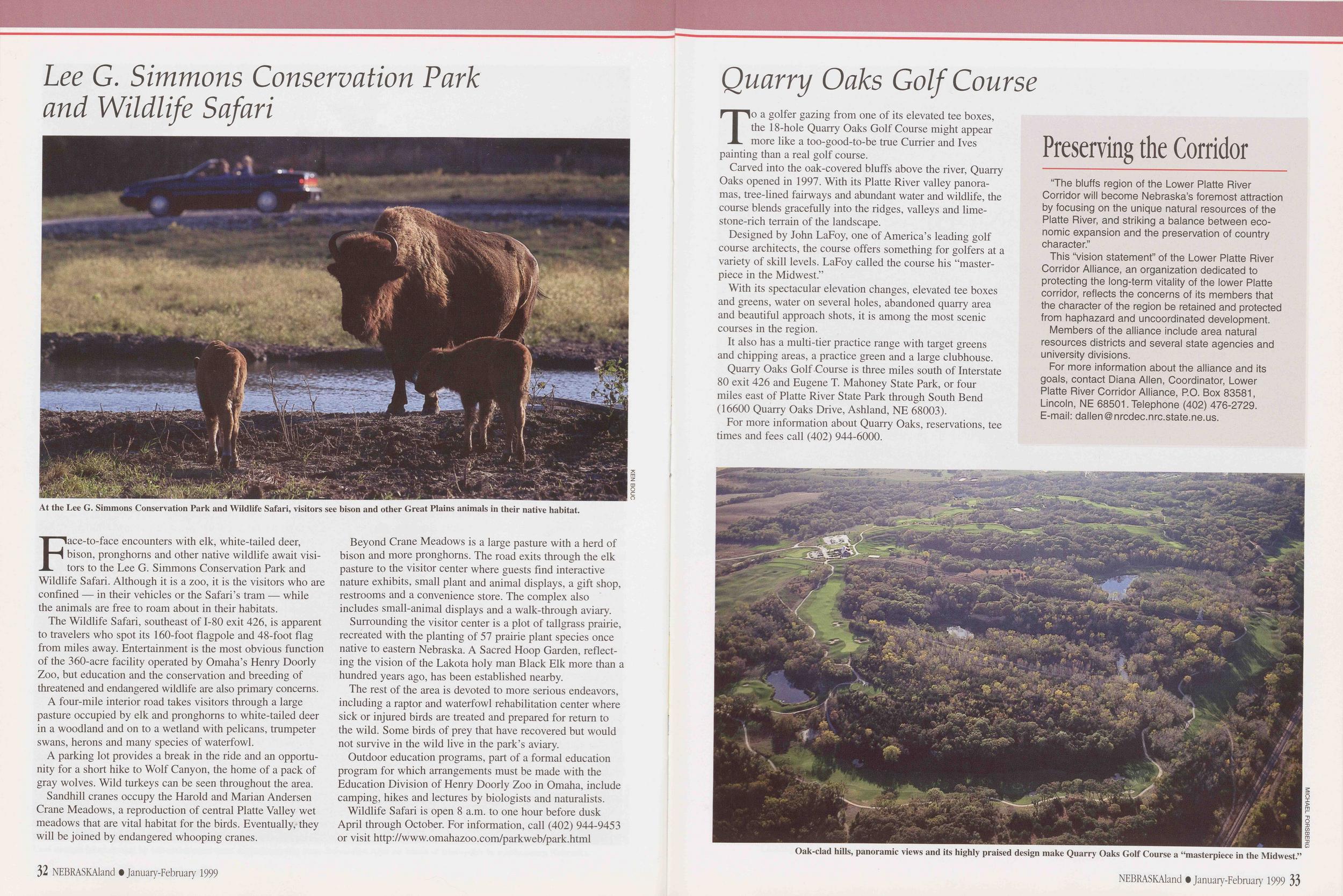 Lee G. Simmons Conservation Park
and Wildlife Safari
Lee G. Simmons Conservation Park
and Wildlife Safari
Face-to-face encounters with elk, white-tailed deer, bison, pronghorns and other native wildlife await visitors to the Lee G. Simmons Conservation Park and Wildlife Safari. Although it is a zoo, it is the visitors who are confined — in their vehicles or the Safari's tram — while the animals are free to roam about in their habitats.
The Wildlife Safari, southeast of 1-80 exit 426, is apparent to travelers who spot its 160-foot flagpole and 48-foot flag from miles away. Entertainment is the most obvious function of the 360-acre facility operated by Omaha's Henry Doorly Zoo, but education and the conservation and breeding of threatened and endangered wildlife are also primary concerns.
A four-mile interior road takes visitors through a large pasture occupied by elk and pronghorns to white-tailed deer in a woodland and on to a wetland with pelicans, trumpeter swans, herons and many species of waterfowl.
A parking lot provides a break in the ride and an opportunity for a short hike to Wolf Canyon, the home of a pack of gray wolves. Wild turkeys can be seen throughout the area.
Sandhill cranes occupy the Harold and Marian Andersen Crane Meadows, a reproduction of central Platte Valley wet meadows that are vital habitat for the birds. Eventually, they will be joined by endangered whooping cranes.
Beyond Crane Meadows is a large pasture with a herd of bison and more pronghorns. The road exits through the elk pasture to the visitor center where guests find interactive nature exhibits, small plant and animal displays, a gift shop, restrooms and a convenience store. The complex also includes small-animal displays and a walk-through aviary.
Surrounding the visitor center is a plot of tallgrass prairie, recreated with the planting of 57 prairie plant species once native to eastern Nebraska. A Sacred Hoop Garden, reflecting the vision of the Lakota holy man Black Elk more than a hundred years ago, has been established nearby.
The rest of the area is devoted to more serious endeavors, including a raptor and waterfowl rehabilitation center where sick or injured birds are treated and prepared for return to the wild. Some birds of prey that have recovered but would not survive in the wild live in the park's aviary.
Outdoor education programs, part of a formal education program for which arrangements must be made with the Education Division of Henry Doorly Zoo in Omaha, include camping, hikes and lectures by biologists and naturalists.
Wildlife Safari is open 8 a.m. to one hour before dusk April through October. For information, call (402) 944-9453 or visit http://www.omahazoo.com/parkweb/park.html
32 NEBRASKAland • January-February 1999 Quarry Oaks Golf CourseTo a golfer gazing from one of its elevated tee boxes, the 18-hole Quarry Oaks Golf Course might appear more like a too-good-to-be true Currier and Ives painting than a real golf course.
Carved into the oak-covered bluffs above the river, Quarry Oaks opened in 1997. With its Platte River valley panoramas, tree-lined fairways and abundant water and wildlife, the course blends gracefully into the ridges, valleys and lime-stone-rich terrain of the landscape.
Designed by John LaFoy, one of America's leading golf course architects, the course offers something for golfers at a variety of skill levels. LaFoy called the course his "masterpiece in the Midwest."
With its spectacular elevation changes, elevated tee boxes and greens, water on several holes, abandoned quarry area and beautiful approach shots, it is among the most scenic courses in the region.
It also has a multi-tier practice range with target greens and chipping areas, a practice green and a large clubhouse.
Quarry Oaks Golf Course is three miles south of Interstate 80 exit 426 and Eugene T Mahoney State Park, or four miles east of Platte River State Park through South Bend (16600 Quarry Oaks Drive, Ashland, NE 68003).
For more information about Quarry Oaks, reservations, tee times and fees call (402) 944-6000.
Preserving the Corridor"The bluffs region of the Lower Platte River Corridor will become Nebraska's foremost attraction by focusing on the unique natural resources of the Platte River, and striking a balance between economic expansion and the preservation of country character."
This "vision statement" of the Lower Platte River Corridor Alliance, an organization dedicated to protecting the long-term vitality of the lower Platte corridor, reflects the concerns of its members that the character of the region be retained and protected from haphazard and uncoordinated development.
Members of the alliance include area natural resources districts and several state agencies and university divisions.
For more information about the alliance and its goals, contact Diana Allen, Coordinator, Lower Platte River Corridor Alliance, P.O. Box 83581, Lincoln, NE 68501. Telephone (402) 476-2729. E-mail: dallen@nrcdec.nrc.state.ne.us.
 Welcome to Nebraska ..
A corner of America where the spirit and generosity of the people are as boundless as the skies above it. A land of fertile, rolling fields and unexpected natural wonders.
We invite you to explore Genuine. Nebraska — from the parks and places of the Platte Valley Playground at Interstate 80 Exit 426, to the Pine Ridge region in the northwest where bison, elk and antelope still roam, to the River Front country of the rolling Missouri.
And for help along the way, get in touch with the Nebraska Tourism Office. Online, on the phone or through a wide selection of brochures, maps and guides, let us start you on your journey through the state — we can help you decide what to see, how to get there, where to shop and where to spend the night.
Travelers with Internet access can visit the Tourism Division's extensive web site offering a vast supply of database-driven information about places to go and things to see and do in Nebraska. Bookmark it, explore it in depth, and you'll discover a Nebraska you might not have known exists.
Visit Genuine. Nebraska
Nebraska Tourism Office P.O. Box 98913 Lincoln, NE 68509-8913 Toll free: (800) 228-4307Dept. 937. Web site: http://www.visitnebraska.org E-mail: tourism@ded2.ded.state.ne.us Additional copies of "The Platte Valley Playground" can be requested from the Nebraska Tourism Office at the address above or from NEBRASKAland Magazine, P.O. Box 30370, Lincoln, NE 68503-0370. Telephone (800) 632-5263. For a 48-page brochure highlighting state parks, recreation areas and historic parks throughout the state, call the Game and Parks Commission at (402) 471-0641, leave a recorded request at (800) 826-PARK or visit the Game and Parks Commission's web site at http://ngpc.state.ne.us. E-mail: ngpc@ngpc.state.ne.us. NEBRASKAland Magazine, January-February 1999 34 NEBRASKAland • January-February 1999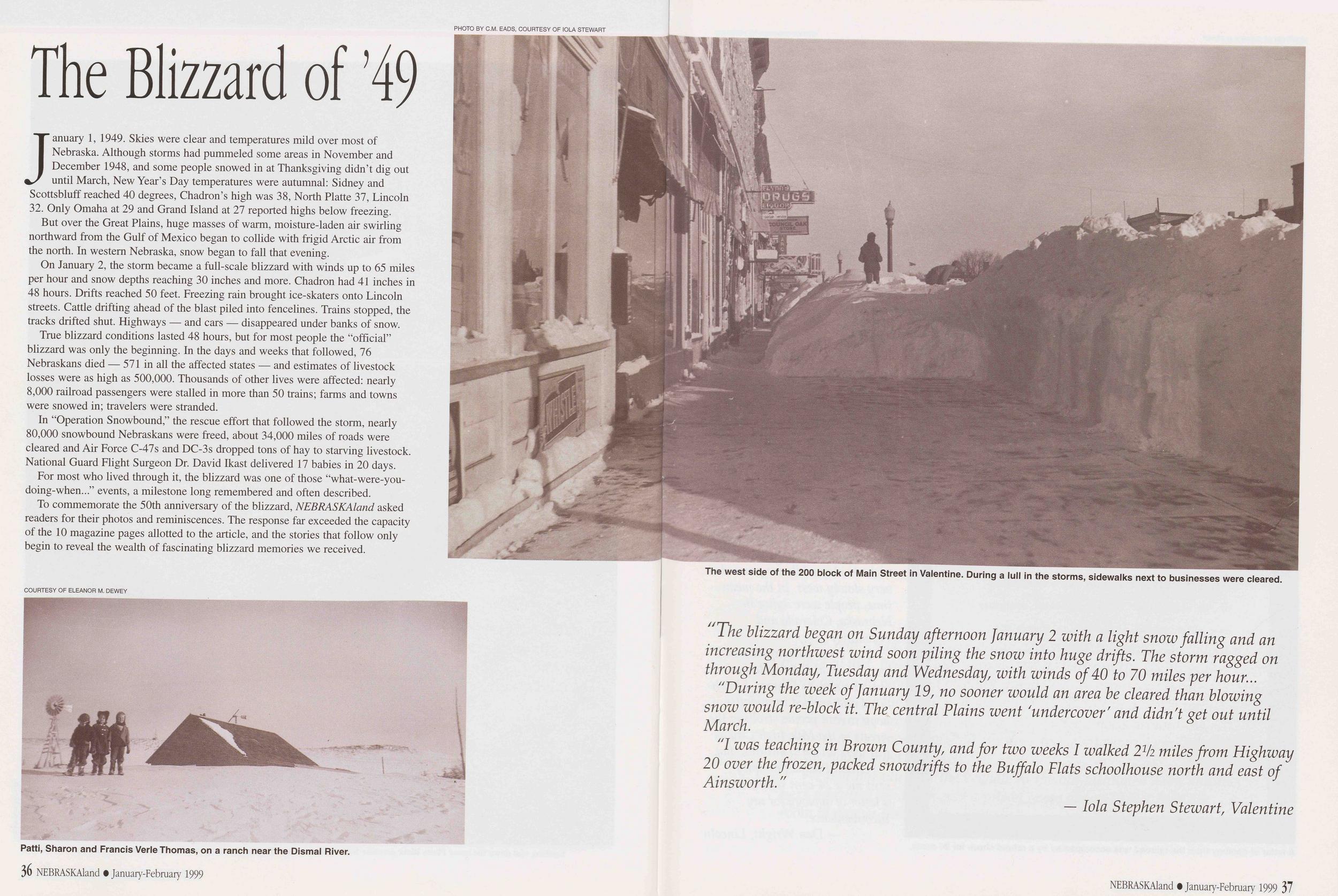
The Blizzard of '49
January 1, 1949. Skies were clear and temperatures mild over most of Nebraska. Although storms had pummeled some areas in November and December 1948, and some people snowed in at Thanksgiving didn't dig out until March, New Year's Day temperatures were autumnal: Sidney and Scottsbluff reached 40 degrees, Chadron's high was 38, North Platte 37, Lincoln 32. Only Omaha at 29 and Grand Island at 27 reported highs below freezing.
But over the Great Plains, huge masses of warm, moisture-laden air swirling northward from the Gulf of Mexico began to collide with frigid Arctic air from the north. In western Nebraska, snow began to fall that evening.
On January 2, the storm became a full-scale blizzard with winds up to 65 miles per hour and snow depths reaching 30 inches and more. Chadron had 41 inches in 48 hours. Drifts reached 50 feet. Freezing rain brought ice-skaters onto Lincoln streets. Cattle drifting ahead of the blast piled into fence lines. Trains stopped, the tracks drifted shut. Highways — and cars — disappeared under banks of snow.
True blizzard conditions lasted 48 hours, but for most people the "official" blizzard was only the beginning. In the days and weeks that followed, 76 Nebraskans died — 571 in all the affected states — and estimates of livestock losses were as high as 500,000. Thousands of other lives were affected: nearly 8,000 railroad passengers were stalled in more than 50 trains; farms and towns were snowed in; travelers were stranded.
In "Operation Snowbound," the rescue effort that followed the storm, nearly 80,000 snowbound Nebraskans were freed, about 34,000 miles of roads were cleared and Air Force C-47s and DC-3s dropped tons of hay to starving livestock. National Guard Flight Surgeon Dr. David Ikast delivered 17 babies in 20 days.
For most who lived through it, the blizzard was one of those "what-were-you-doing-when..." events, a milestone long remembered and often described.
To commemorate the 50th anniversary of the blizzard, NEBRASKAland asked readers for their photos and reminiscences. The response far exceeded the capacity of the 10 magazine pages allotted to the article, and the stories that follow only begin to reveal the wealth of fascinating blizzard memories we received.
The blizzard began on Sunday afternoon January 2 with a light snow falling and an increasing northwest wind soon piling the snow into huge drifts. The storm ragged on through Monday, Tuesday and Wednesday, with winds of 40 to 70 miles per hour...
"During the week of January 19, no sooner would an area be cleared than blowing snow would re-block it. The central Plains went 'undercover' and didn't get out until March.
"I was teaching in Brown County, and for two weeks I walked 2 1/2 miles from Highway 20 over the frozen, packed snowdrifts to the Buffalo Flats schoolhouse north and east of Ainsworth."
— Iola Stephen Stewart, Valentine NEBRASKAland • January-February 1999 37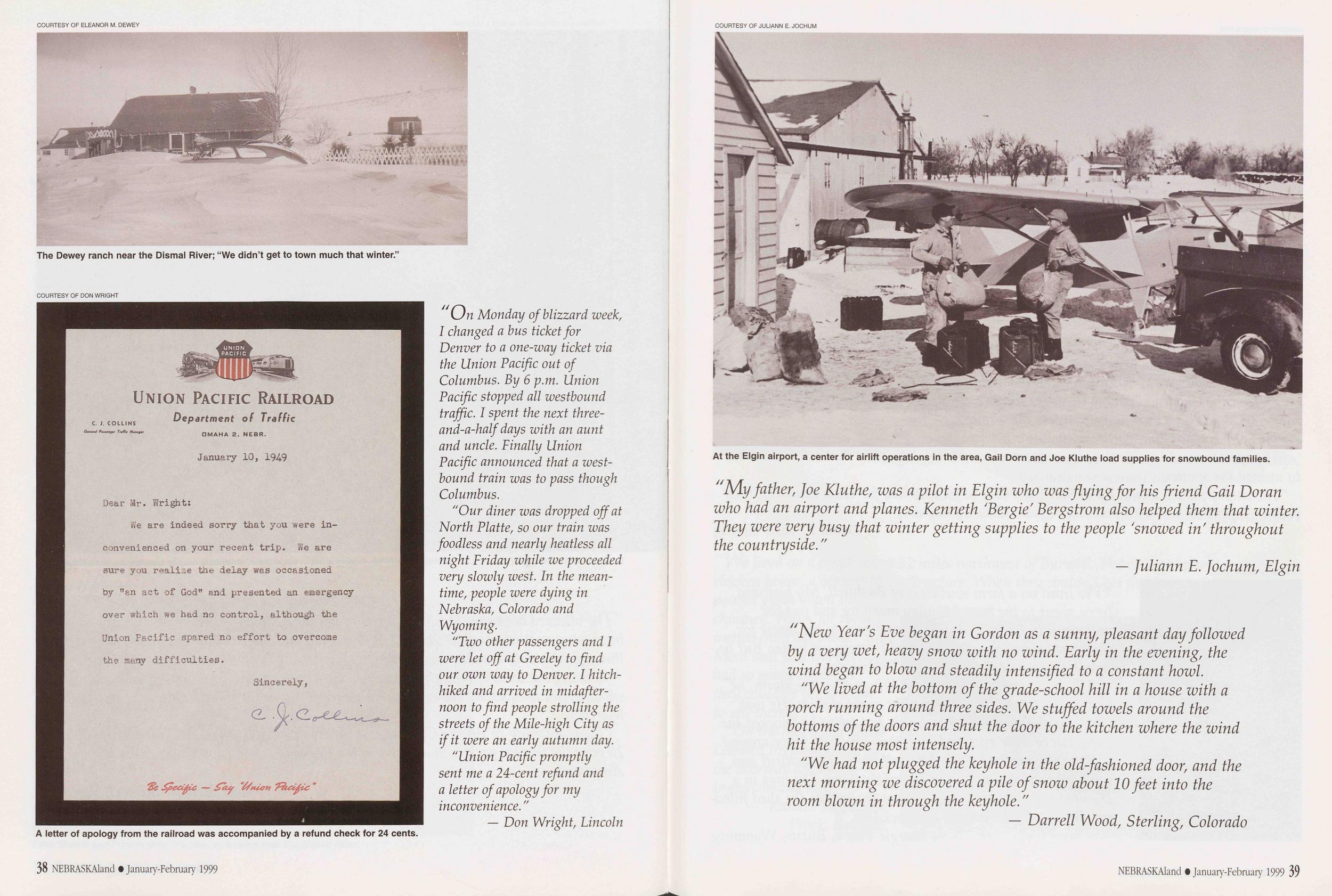
On Monday of blizzard week, I changed a bus ticket for Denver to a one-way ticket via the Union Pacific out of Columbus. By 6 p.m. Union Pacific stopped all westbound traffic. I spent the next three-and-a-half days with an aunt and uncle. Finally Union Pacific announced that a west-bound train was to pass though Columbus.
"Our diner was dropped off at North Platte, so our train was foodless and nearly heatless all night Friday while we proceeded very slowly west. In the meantime, people were dying in Nebraska, Colorado and Wyoming.
"Two other passengers and I were let off at Greeley to find our own way to Denver. I hitch-hiked and arrived in midafternoon to find people strolling the streets of the Mile-high City as if it were an early autumn day.
"Union Pacific promptly sent me a 24-cent refund and a letter of apology for my inconvenience."
— Don Wright, Lincoln 38 NEBRASKAland • January-February 19997 My father, Joe Kluthe, was a pilot in Elgin who was flying for his friend Gail Dor an who had an airport and planes. Kenneth 'Bergie' Bergstrom also helped them that winter. They were very busy that winter getting supplies to the people 'snowed in' throughout the countryside."
— Juliann E. Jochum, Elgin"New Year's Eve began in Gordon as a sunny, pleasant day followed by a very wet, heavy snow with no wind. Early in the evening, the wind began to blow and steadily intensified to a constant howl.
"We lived at the bottom of the grade-school hill in a house with a porch running around three sides. We stuffed towels around the bottoms of the doors and shut the door to the kitchen where the wind hit the house most intensely.
"We had not plugged the keyhole in the old-fashioned door, and the next morning we discovered a pile of snow about 10 feet into the room blown in through the keyhole."
— Darrell Wood, Sterling, Colorado NEBRASKAland • January-February 1999 39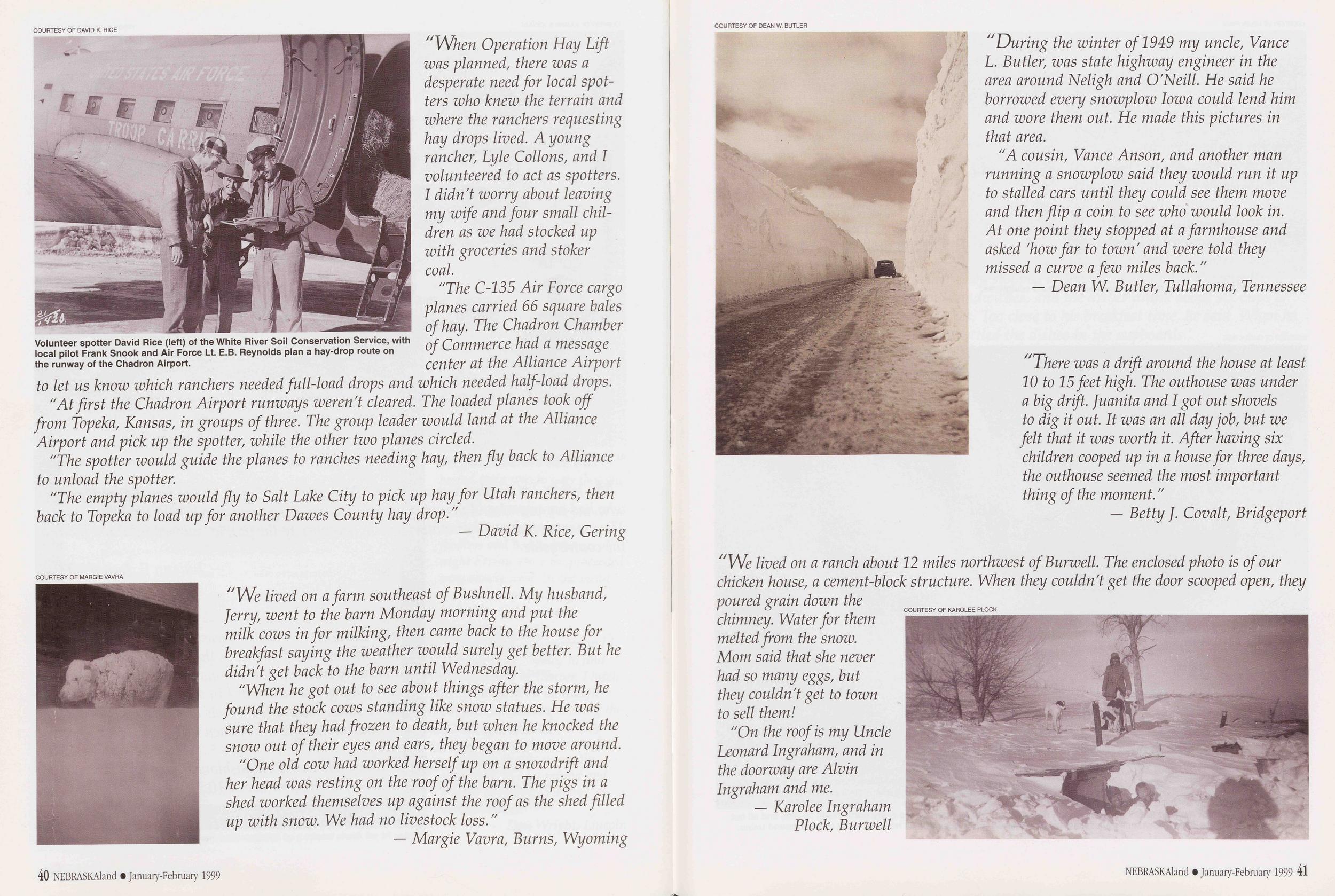
"When Operation Hay Lift was planned, there was a desperate need for local spotters who knew the terrain and where the ranchers requesting hay drops lived. A young rancher, Lyle Collons, and I volunteered to act as spotters. I didn't worry about leaving my wife and four small children as we had stocked up with groceries and stoker coal.
"The C-135 Air Force cargo planes carried 66 square bales of hay. The Chadron Chamber of Commerce had a message center at the Alliance Airport to let us know which ranchers needed full-load drops and which needed half-load drops.
"At first the Chadron Airport runways weren't cleared. The loaded planes took off from Topeka, Kansas, in groups of three. The group leader would land at the Alliance Airport and pick up the spotter, while the other two planes circled.
"The spotter would guide the planes to ranches needing hay, then fly back to Alliance to unload the spotter.
"The empty planes would fly to Salt Lake City to pick up hay for Utah ranchers, then back to Topeka to load up for another Dawes County hay drop."
— David K. Rice, Gering"We lived on a farm southeast of Bushnell. My husband, Jerry, went to the barn Monday morning and put the milk cows in for milking, then came back to the house for breakfast saying the weather would surely get better. But he didn't get back to the barn until Wednesday.
"When he got out to see about things after the storm, he found the stock cows standing like snow statues. He was sure that they had frozen to death, but when he knocked the snow out of their eyes and ears, they began to move around.
"One old cow had worked herself up on a snowdrift and her head was resting on the roof of the barn. The pigs in a shed worked themselves up against the roof as the shed filled up with snow. We had no livestock loss."
— Margie Vavra, Burns, Wyoming 40 NEBRASKAland • January-February 1999"During the winter of 1949 my uncle, Vance L. Butler, was state highway engineer in the area around Neligh and O'Neill. He said he borrowed every snowplow Iowa could lend him and wore them out. He made this pictures in that area.
"A cousin, Vance Anson, and another man running a snowplow said they would run it up to stalled cars until they could see them move and then flip a coin to see who would look in. At one point they stopped at a farmhouse and asked 'how far to town' and were told they missed a curve a few miles back."
— Dean W. Butler, Tullahoma, Tennessee"There was a drift around the house at least 10 to 15 feet high. The outhouse was under a big drift. Juanita and I got out shovels to dig it out. It was an all day job, but we felt that it was worth it. After having six children cooped up in a house for three days, the outhouse seemed the most important thing of the moment."
— Betty J. Covalt, Bridgeport"We lived on a ranch about 12 miles northwest of Burwell. The enclosed photo is of our chicken house, a cement-block structure. When they couldn't get the door scooped open, they poured grain down the chimney. Water for them melted from the snow. Mom said that she never had so many eggs, but they couldn't get to town to sell them!
"On the roof is my Uncle Leonard Ingraham, and in the doorway are Alvin Ingraham and me.
— Karolee Ingraham Flock, Burwell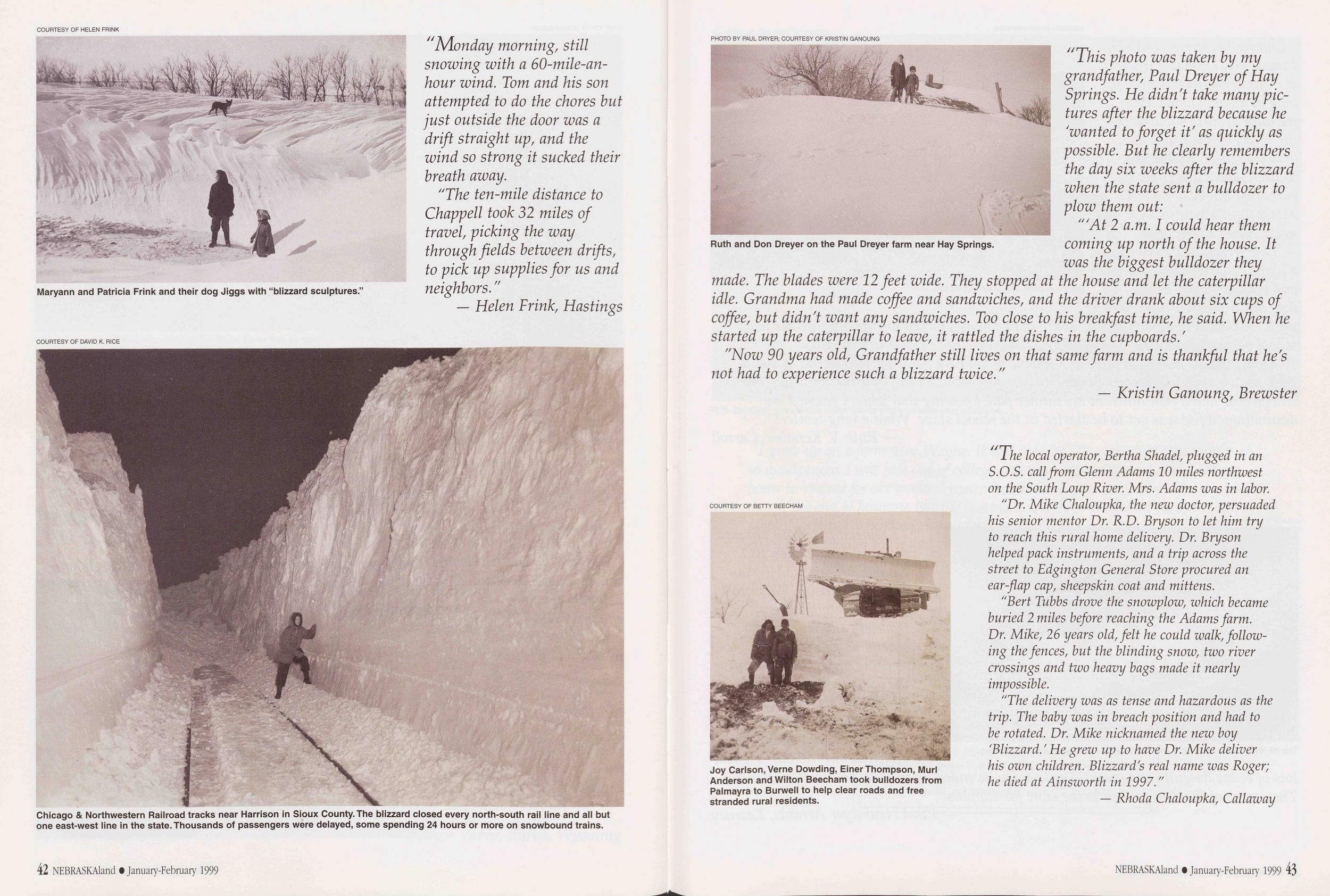
"Monday morning, still snowing with a 60-mile-an- hour wind, Tom and his son attempted to do the chores but just outside the door was a drift straight up, and the wind so strong it sucked their breath away,
"The ten-mile distance to Chappell took 32 miles of travel, picking the way through fields between drifts, to pick up supplies for us and neighbors."
— Helen Frink, HastingsThis photo was taken by my grandfather, Paul Dreyer of Hay Springs. He didn't take many pictures after the blizzard because he 'wanted to forget it' as quickly as possible. But he clearly remembers the day six weeks after the blizzard when the state sent a bulldozer to plow them out:
"'At 2 a.m. I could hear them coming up north of the house. It was the biggest bulldozer they made. The blades were 12 feet wide. They stopped at the house and let the caterpillar idle. Grandma had made coffee and sandwiches, and the driver drank about six cups of coffee, but didn't want any sandwiches. Too close to his breakfast time, he said. When he started up the caterpillar to leave, it rattled the dishes in the cupboards.'
"Now 90 years old, Grandfather still lives on that same farm and is thankful that he's not had to experience such a blizzard twice."
— Kristin Ganoung, BrewsterThe local operator, Bertha Shadel, plugged in an S.O.S. call from Glenn Adams 10 miles northwest on the South Loup River. Mrs. Adams was in labor.
"Dr. Mike Chaloupka, the new doctor, persuaded his senior mentor Dr. R.D. Bryson to let him try to reach this rural home delivery. Dr. Bryson helped pack instruments, and a trip across the street to Edgington General Store procured an ear-flap cap, sheepskin coat and mittens.
"Bert Tubbs drove the snowplow, which became buried 2 miles before reaching the Adams farm. Dr. Mike, 26 years old, felt he could walk, following the fences, but the blinding snow, two river crossings and two heavy bags made it nearly impossible.
"The delivery was as tense and hazardous as the trip. The baby was in breach position and had to be rotated. Dr. Mike nicknamed the new boy 'Blizzard.' He grew up to have Dr. Mike deliver his own children. Blizzard's real name was Roger; he died at Ainsworth in 1997."
— Rhoda Chaloupka, Callaway NEBRASKAland • January-February 1999 43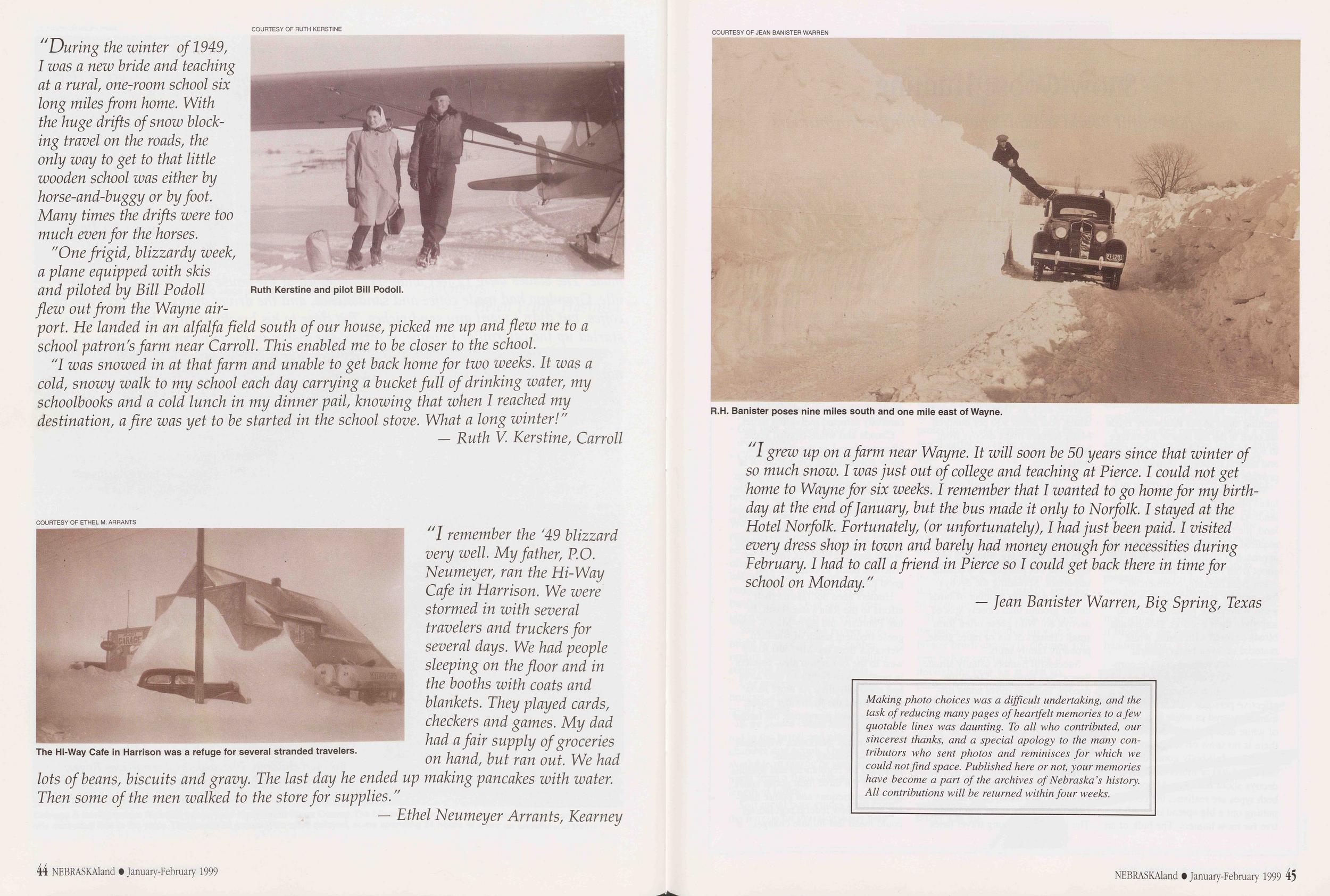
"During the winter of 1949, I was a new bride and teaching at a rural, one-room school six long miles from home. With the huge drifts of snow blocking travel on the roads, the only way to get to that little wooden school was either by horse-and-buggy or by foot. Many times the drifts were too much even for the horses.
One frigid, blizzardy week, a plane equipped with skis and piloted by Bill Podoll flew out from the Wayne airport. He landed in an alfalfa field south of our house, picked me up and flew me to a school patron's farm near Carroll. This enabled me to be closer to the school.
"I was snowed in at that farm and unable to get back home for two weeks. It was a cold, snowy walk to my school each day carrying a bucket full of drinking water, my schoolbooks and a cold lunch in my dinner pail, knowing that when I reached my destination, afire was yet to be started in the school stove. What a long winter!"
— RuthV. Kerstine, Carroll"I remember the '49 blizzard very well. My father, P.O. Neumeyer, ran the Hi-Way Cafe in Harrison. We were stormed in with several travelers and truckers for several days. We had people sleeping on the floor and in the booths with coats and blankets. They played cards, checkers and games. My dad had a fair supply of groceries on hand, but ran out. We had lots of beans, biscuits and gravy. The last day he ended up making pancakes with water. Then some of the men walked to the store for supplies."
— Ethel Neumeyer Arrants, Kearney 44 NEBRASKAland • January-February 1999"I grew up on a farm near Wayne. It will soon be 50 years since that winter of so much snow. I was just out of college and teaching at Pierce. I could not get home to Wayne for six weeks. I remember that I wanted to go home for my birthday at the end of January, but the bus made it only to Norfolk. I stayed at the Hotel Norfolk. Fortunately, (or unfortunately), I had just been paid. I visited every dress shop in town and barely had money enough for necessities during February. I had to call a friend in Pierce so I could get back there in time for school on Monday."
— Jean Banister Warren, Big Spring, Texas Making photo choices was a difficult undertaking, and the task of reducing many pages of heartfelt memories to a few quotable lines was daunting. To all who contributed, our sincerest thanks, and a special apology to the many contributors who sent photos and reminisces for which we could not find space. Published here or not, your memories have become a part of the archives of Nebraska's history. All contributions will be returned within four weeks. NEBRASKAland • January-February 1999 45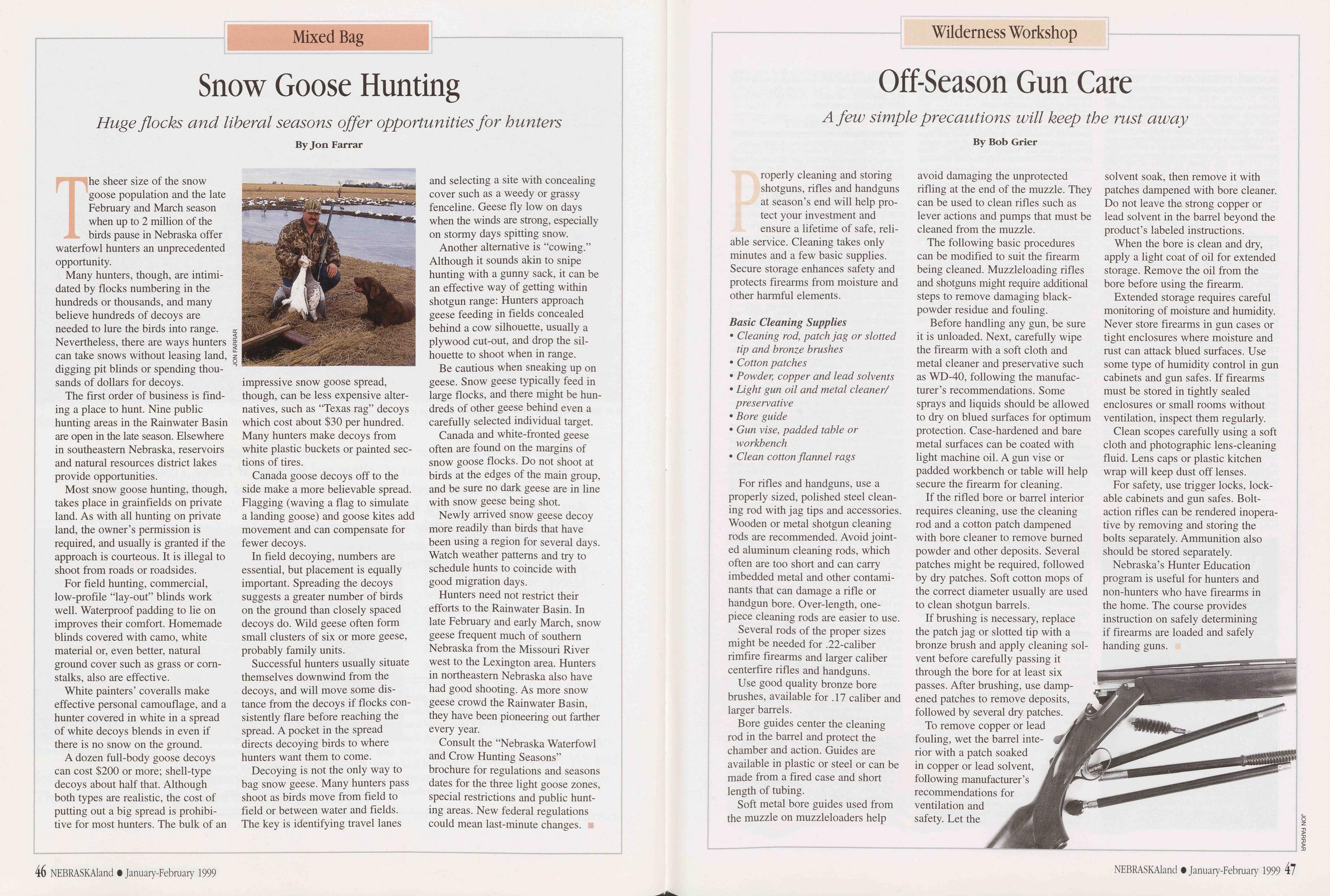
Mixed Bag
Snow Goose Hunting
Huge flocks and liberal seasons offer opportunities for hunters By Jon FarrarThe sheer size of the snow goose population and the late February and March season when up to 2 million of the birds pause in Nebraska offer waterfowl hunters an unprecedented opportunity.
Many hunters, though, are intimidated by flocks numbering in the hundreds or thousands, and many believe hundreds of decoys are needed to lure the birds into range. Nevertheless, there are ways hunters can take snows without leasing land, digging pit blinds or spending thousands of dollars for decoys.
The first order of business is finding a place to hunt. Nine public hunting areas in the Rainwater Basin are open in the late season. Elsewhere in southeastern Nebraska, reservoirs and natural resources district lakes provide opportunities.
Most snow goose hunting, though, takes place in grain fields on private land. As with all hunting on private land, the owner's permission is required, and usually is granted if the approach is courteous. It is illegal to shoot from roads or roadsides.
For field hunting, commercial, low-profile "lay-out" blinds work well. Waterproof padding to lie on improves their comfort. Homemade blinds covered with camo, white material or, even better, natural ground cover such as grass or cornstalks, also are effective.
White painters' coveralls make effective personal camouflage, and a hunter covered in white in a spread of white decoys blends in even if there is no snow on the ground.
A dozen full-body goose decoys can cost $200 or more; shell-type decoys about half that. Although both types are realistic, the cost of putting out a big spread is prohibitive for most hunters. The bulk of an impressive snow goose spread, though, can be less expensive alternatives, such as "Texas rag" decoys which cost about $30 per hundred. Many hunters make decoys from white plastic buckets or painted sections of tires.
Canada goose decoys off to the side make a more believable spread. Flagging (waving a flag to simulate a landing goose) and goose kites add movement and can compensate for fewer decoys.
In field decoying, numbers are essential, but placement is equally important. Spreading the decoys suggests a greater number of birds on the ground than closely spaced decoys do. Wild geese often form small clusters of six or more geese, probably family units.
Successful hunters usually situate themselves downwind from the decoys, and will move some distance from the decoys if flocks consistently flare before reaching the spread. A pocket in the spread directs decoying birds to where hunters want them to come.
Decoying is not the only way to bag snow geese. Many hunters pass shoot as birds move from field to field or between water and fields. The key is identifying travel lanes and selecting a site with concealing cover such as a weedy or grassy fence line. Geese fly low on days when the winds are strong, especially on stormy days spitting snow.
Another alternative is "cowing." Although it sounds akin to snipe hunting with a gunny sack, it can be an effective way of getting within shotgun range: Hunters approach geese feeding in fields concealed behind a cow silhouette, usually a plywood cut-out, and drop the silhouette to shoot when in range.
Be cautious when sneaking up on geese. Snow geese typically feed in large flocks, and there might be hundreds of other geese behind even a carefully selected individual target.
Canada and white-fronted geese often are found on the margins of snow goose flocks. Do not shoot at birds at the edges of the main group, and be sure no dark geese are in line with snow geese being shot.
Newly arrived snow geese decoy more readily than birds that have been using a region for several days. Watch weather patterns and try to schedule hunts to coincide with good migration days.
Hunters need not restrict their efforts to the Rainwater Basin. In late February and early March, snow geese frequent much of southern Nebraska from the Missouri River west to the Lexington area. Hunters in northeastern Nebraska also have had good shooting. As more snow geese crowd the Rainwater Basin, they have been pioneering out farther every year.
Consult the "Nebraska Waterfowl and Crow Hunting Seasons" brochure for regulations and seasons dates for the three light goose zones, special restrictions and public hunting areas. New federal regulations could mean last-minute changes.
46 NEBRASKAland • January-February 1999Off-Season Gun Care
A few simple precautions will keep the rust away By Bob Grierproperly cleaning and storing shotguns, rifles and handguns at season's end will help protect your investment and ensure a lifetime of safe, reliable service. Cleaning takes only minutes and a few basic supplies. Secure storage enhances safety and protects firearms from moisture and other harmful elements.
Basic Cleaning Supplies • Cleaning rod, patch jag or slotted tip and bronze brushes • Cotton patches • Powder, copper and lead solvents • Light gun oil and metal cleaner/ preservative • Bore guide • Gun vise, padded table or workbench • Clean cotton flannel ragsFor rifles and handguns, use a properly sized, polished steel cleaning rod with jag tips and accessories. Wooden or metal shotgun cleaning rods are recommended. Avoid jointed aluminum cleaning rods, which often are too short and can carry imbedded metal and other contaminants that can damage a rifle or handgun bore. Over-length, one piece cleaning rods are easier to use.
Several rods of the proper sizes might be needed for .22-caliber rimfire firearms and larger caliber centerfire rifles and handguns.
Use good quality bronze bore brushes, available for .17 caliber and larger barrels.
Bore guides center the cleaning rod in the barrel and protect the chamber and action. Guides are available in plastic or steel or can be made from a fired case and short length of tubing.
Soft metal bore guides used from the muzzle on muzzleloaders help avoid damaging the unprotected rifling at the end of the muzzle. They can be used to clean rifles such as lever actions and pumps that must be cleaned from the muzzle.
The following basic procedures can be modified to suit the firearm being cleaned. Muzzleloading rifles and shotguns might require additional steps to remove damaging black- powder residue and fouling.
Before handling any gun, be sure it is unloaded. Next, carefully wipe the firearm with a soft cloth and metal cleaner and preservative such as WD-40, following the manufacturer's recommendations. Some sprays and liquids should be allowed to dry on blued surfaces for optimum protection. Case-hardened and bare metal surfaces can be coated with light machine oil. A gun vise or padded workbench or table will help secure the firearm for cleaning.
If the rifled bore or barrel interior requires cleaning, use the cleaning rod and a cotton patch dampened with bore cleaner to remove burned powder and other deposits. Several patches might be required, followed by dry patches. Soft cotton mops of the correct diameter usually are used to clean shotgun barrels.
If brushing is necessary, replace the patch jag or slotted tip with a bronze brush and apply cleaning solvent before carefully passing it through the bore for at least six passes. After brushing, use dampened patches to remove deposits, followed by several dry patches.
To remove copper or lead fouling, wet the barrel interior with a patch soaked in copper or lead solvent, following manufacturer's recommendations for ventilation and safety. Let the solvent soak, then remove it with patches dampened with bore cleaner. Do not leave the strong copper or lead solvent in the barrel beyond the product's labeled instructions.
When the bore is clean and dry, apply a light coat of oil for extended storage. Remove the oil from the bore before using the firearm.
Extended storage requires careful monitoring of moisture and humidity. Never store firearms in gun cases or tight enclosures where moisture and rust can attack blued surfaces. Use some type of humidity control in gun cabinets and gun safes. If firearms must be stored in tightly sealed enclosures or small rooms without ventilation, inspect them regularly.
Clean scopes carefully using a soft cloth and photographic lens-cleaning fluid. Lens caps or plastic kitchen wrap will keep dust off lenses.
For safety, use trigger locks, lockable cabinets and gun safes. Boltaction rifles can be rendered inoperative by removing and storing the bolts separately. Ammunition also should be stored separately.
Nebraska's Hunter Education program is useful for hunters and non-hunters who have firearms in the home. The course provides instruction on safely determining if firearms are loaded and safely handing guns.
Classifieds
BOOKS/PUBLICATIONS/VIDEOSHOW TO FIND MORE outdoor opportunities! The Nebraska Sportsman's Atlas. Locations of all public lands and waters on county transportation maps. These maps show ALL the roads in Nebraska. Listings include federal, Nebraska Game & Parks, NRD holdings, hotels and motels and Nebraska's endless attractions. At only $18.75/copy a true time and frustration saver. To order write: Sportsman's Atlas Co., P.O. Box 132, Lytton, IA 50561 or call (800) 568-8334.
JU-JU SWALLOWED A PENNY, a Nebraska farm girl's book of the 1930s Depression Era. $7.50 ppd. Betty Heidbreder Dunn, Rt. 1, Box 363-G, Navasota, TX 77868.
DOGSTRAINING ALL BREEDS bird dogs - Vizslas for sale. Home of Rebel Rousers. Rozanek Kennels, 781 Rd. D, Schuyler, NE 68661. Phone (402) 352-8769.
ENGLISH SETTERS, German shorthairs, English pointers, Brittany spaniels - stud service, puppies and started dogs. Training for all pointing breeds. Plum Creek Kennel, (712) 529-4238 or (402) 298-8153.
RETRIEVER TRAINING. Area's top "retrievers only" trainer. Field trial and hunting dogs. Non-slip duck dogs! TKO Retriever Training Kennel (402) 623-4311.
CHESAPEAKE BAY, Labrador and golden retriever pups, started dogs and stud service. 16-time national champion pedigree. Visa & MasterCard. Platte Valley Retrievers (308) 995-2318.
YELLOW-BLACK LAB PUPS. Breeders hips O.F.A. and eyes CERE Excellent bloodlines and hunting potential. Call Mr. Bendler, Lexington, NE (308) 324-4247 or Lincoln (402) 477-1305.
WILDERNESS KENNELS. Gun dog training - over 60 years combined experience. Training all sporting breeds - retrievers, flushing and pointing dogs. All dogs worked on pen-raised birds and wild game. Training program includes obedience training - heel, sit, stay, down and come when called. Pups, started dogs and fully trained dogs for sale. Hunting dogs trained by hunters. Henry Sader, Wilderness Kennels, Roca, NE (402) 423-4212. Since 1968.
FISH/FISHING NEBRASKAland $16 per year For Visa and MasterCard orders, call 1-800-NEB-LAND (632-5263) For mail orders, send check or money order to NEBRASKAland Magazine P.O. Box 30370, Lincoln, NE 68503-0370. Order online at http://www.ngpc.state.ne.usFISH FOR SALE. Catfish, largemouth bass, small- mouth bass, perch, crappie, bluegill, walleye, northern pike, rainbow trout, Donaldson rainbow trout, grass carp, minnows, bullheads. Consulting available. Pleasant Valley Fish Farm, RR 1, Box 147, McCook, NE 69001. Phone (308) 345-6599.
NEBRASKA LAKE MANAGEMENT. Electrofishing surveys, water quality testing, fish stocking, lake restoration, aeration and fountains, weed and algae control and habitat enhancement. Rob Hofpar, Aquatic Biologist, licensed, insured and qualified. Phone (402) 486-0071 Lincoln, or toll-free (888) 850-2460.
FOOD/GIFTSNEBRASKA BASKETS: The original Nebraska company specializing in fine foods from Nebraska since 1984. A beautiful array of baskets filled with ethnic, healthful and long-time favorite foods. Call or write for our brochure: PO Box 22985, Lincoln, NE. 68542. 1-800-345-7725 or (402) 438-3111. Visit our web site: http://www.nebaskets.com.
HOMEBREWING/BEER & WINEMAKING sup- plies. Fermenter's Supply, 8410 K Plz. #10, Omaha, NE 68127. (402) 593-9171. Mail orders welcome.
ENJOY A TASTE of the good life! Award-winning gourmet BBQ sauces & seasonings, breadings, native jellies, fruit butters, honey, coffees and more! Great gift-set ideas! Toll free (888) 926-2879 or (308) 468- 5635. Hollman Foods, 1948 36 Road, Minden, NE 68959, or www.hollmans.com
FROM NEBRASKA GIFT SHOP... the world's largest selection of Nebraska-made food products and gifts. Historical Haymarket, 140 N. 8th., Lincoln, NE 68508; Westroads Mall, Omaha, NE. Call for free catalog (800) 399-5693.
BUFFALO - ORIGINAL HEALTH FOOD. Experience a taste of the West. Steaks, roasts and burgers are available at the Straight Arrow Bison Ranch, Broken Bow, NE or via UPS. Call for free brochure and recipe card (308) 872-3066.
GUIDES/OUTFITTERSMAD RIVER CANOES offers the finest quality and performance. For the finest canoes and accessories look to Great Plains Canoe Co., 205 Main, Springfield, NE 68059. Phone (402) 253-2000.
CANOE THE NIOBRARA...with an affordable canoe trip by Dry land Aquatics. One- and two-day trips...full service, or just canoe, tube or kayak. Transportation furnished. Your Niobrara River specialists... We do it your way! Dry land Aquatics, Dept. N, Box 33C, Sparks, NE 69220 or phone (800) 337- 3119. www.busdir.com/dryland
HENNECKE HUNTS - Guided and semi-guided hunts in Nebraska for dove, deer, ducks, geese, pheasant, quail and turkey. 24 years hunting experience, 10 years Nebraska Hunter Education instructor. Outstanding Canada goose hunting on west end of Lake McConaughy! Website: http://henneckehunts.com E-mail: kevin@henneckehunts.com (402) 645-8223.
GUNS/SHOOTING/ARCHERYGUNS - Browning, Winchester, Remington, Benelli. Hi-powers, shotguns, new, used, antiques. Want Pre-'64 Winchesters. Buy-Sell-Trade. (402) 729-6112. Bedlan's Sporting Goods, Fairbury, NE 68352.
MISCELLANEOUSRECREATIONAL CABIN. Quality built, newly constructed 12 x 20 with the outdoors person in mind. Use for a retreat, bunkhouse or temporary quarters. Ready to move to your location. Call (308) 762-4603.
FREE COMPUTERIZED HEALTH PROFILE analysis. Call (800) 682-3123 for information. Improve your health without immune system depleting drugs. Great home business.
REAL ESTATEFOR SALE IN NORTH-CENTRAL Nebraska - 1040 & 440 acre rec-ranches with timbered creeks, deer, wild turkey and prairie dog towns. Both with 4 bed- room 2 bath homes. Priced at $500.00 and $506.00 per acre. Swett Realty, Fred L. Swett-Broker, PO Box 265, Ainsworth, NE 69210. Phone (800) 585-1626, (402) 387-1626 day or night.
TAXIDERMYALLISON'S TAXIDERMY Studio & Gift Gallery - DU, SCI, Pheasants Forever & NTA Members. Mounted 36 state record fish. 421 N. Dewey. North Platte, NE 69101. Call (308) 534-2324 or (308) 534- 4267. Custom Designs.
VACATIONS/RESORTSFOR FISHING AND HUNTING accommodations. Jefco Inn, Gordon, NE 69343. South Cornell, (308) 282-2935.
THE OLDE MAIN STREET INN. An historic bed and breakfast located in the beautiful Pine Ridge country of Northwest Nebraska. Beautiful dining room with fireplace. Featuring prime rib, buffalo, seafood, homemade soups, chilis and desserts. Room service available. 115 Main Street, Chadron, NE 69337 (308) 432-3380. www.chadron.com/oldemain.
DIAMOND-E TROUT RESORT. 2 new lodges, 3 cottages on spring-fed lakes, stream. Private and secluded. Trout, bass, bluegill, etc. Paddle boats and playground equipment. For brochure, call (800) 974- 3002.
FREE OMAHA ZOO PASSES, American Family Inn Motel. See Rain Forest-Aquarium-I-MAX Theater- Old Market. 104 rooms, free VCR, rental movies, sparkling pool, gazebo, picnic area. $44-$50. (800) 253-2865.
OMAHA MOTEL on 1-80 and 144th St. (Exit 440). The Ben Franklin welcomes you. Near SAC Museum. 96 lovely rooms. HBO, free VCR, rental movies, huge swimming pool. Only $42-$50. (800) 688-3658.
HEARTLAND ELK RANCH bed and breakfast is located along the scenic, pine-covered, rolling hills of the Niobrara River valley near Valentine, NE. Guests are treated to our new and completely modern log vacation homes with views of the Sandhills meeting the Niobrara. Breakfast is served in a sun-drenched great room overlooking meadows of majestic elk. Next door to the river and kayaking, Smith Falls and the Fort Niobrara National Wildlife Refuge. Try mountain biking the newly opened Cowboy Trail. For reservations call (402) 376-1124.
ATTN: SPORTSMEN, FAMILIES, VACATIONERS, groups! Scenic sandhill valley ranch offers guest accommodations with complete cooking facilities. Excellent hunting, fishing, photography, hiking, lots of wildlife, and plenty of relaxation in serene surroundings. Contact: Bridges Double R Ranch, Mullen, NE, (308) 546-2314; fax (308) 546-2432; e-mail pbridge@neb-sandhills.net
DELUXE CABIN FOR RENT, three miles north of the Valentine Wildlife Refuge, two queen beds, cooking facilities, TV, Aub Lord, HC 37, Box 41, Valentine, NE 69201. Call (800) 270-0181.
SENECA NEBRASKA-MCCAWLEY HOUSE Bed & Breakfast, newly renovated hotel built in 1912 when the railroad was opening the Sandhills to travel and commence. Rate $42 - $70 for two, plus tax, full breakfast included. Smoke free building. No pets. (308) 639-3300 or (308) 639-3229.
NEBRASKA STATE PARK vacations. From stately Arbor Lodge in Nebraska City to wild and wooly Fort Robinson in the Pine Ridge, Nebraska state parks are the perfect spring getaway. For a 48-page brochure listing all park facilities, call (800) 826-7275.
Classified Rates: 750 per word, minimum $15. Closing: First business day two months before issue date. Classified ads are accepted on a first-come, first-served, space-available basis. Classified Ads, NEBRASKAland Magazine, RO. Box 30370, Lincoln, NE 68503-0370. Telephone (402) 471-5478. Fax: (402) 471-5528. E-mail: nebland@ngpc.state, ne. us 48 NEBRASKAland • January-February 1999In the Kitchen
How to Cook Your GooseSnow goose, like all waterfowl, is richly flavored. For reasons incomprehensible to those who have properly cared for snow geese in the field and in the kitchen, though, white geese have received poor reviews as table fare in some quarters.
The diet of snow geese is similar to that of other geese and is heavy on domestic grain when it is available. They "grub" for roots and shoots of aquatic plants more than Canada geese do, but so do some species of ducks held in high regard by hunters.
Just as hunters occasionally encounter a mallard or a Canada goose with an "off" flavor, they occasionally sink their teeth into a snow goose that is not as tasty as usual, but it happens no more often than with other species.
A few common sense rules will ensure that snow geese bring as much pleasure at home as they do over the decoys.
As with other game birds, inspect each goose's condition and decide how best to prepare it. Young geese of all species are prime candidates for roasting, older birds are more likely to be somewhat tougher and are best prepared in other ways.
Even during the late season in February and March, young-of- the-year snow, "blue" and Ross' geese can be identified by their plumage. Young white geese Are grayish. Young blues have no distinct white coloration on their heads and less color contrast on their bodies.
Older birds cannot be aged. A bird in full adult plumage could be a tender two-year-old, or a tough 10-year-old.
All waterfowl in good condition are fat compared to other game birds, but leaner than domestic ducks and geese, and overcooking will dry the flesh. Geese with ample body fat are the best choice for roasting, as they will be self-basting. When roasting a snow goose or other waterfowl, the breast should be draped with bacon or side pork, or larded with fat to baste the meat internally.
Shot damage is another consideration. Birds with substantial shot damage are best used for recipes in which the breast muscles are boned out, and other body parts, such as the legs and thighs, are prepared separately. Birds with low body fat or many pinfeathers are also good choices for skinning or boning.
As with all game birds, proper field care can make the difference between a goose that brings the cook rave reviews and one that sends eaters for second helpings of mashed potatoes.
There are two schools of thought about waterfowl field care. The oldest, now regaining its popularity, is aging birds in a cool (32 to 40 degrees), dry environment without picking or drawing. Birds can be aged for several days to a week or more. Properly done, harmless bacteria break down the muscle tissue, resulting in tender and flavorful meat.
More commonly, hunters immediately draw the entrails, and some even pull a few breast feathers to help the meat cool quickly. ambient air temperature, direct sunlight, in a vehicle or at home, should be avoided.
The skin of snow geese tends to tear easily when the birds are plucked. To avoid tearing, pull feathers "with the grain," from the head toward the tail. Do not attempt to pull too many feathers at a time. Snow goose skin is especially prone to tearing on electric pluckers.
Any waterfowl recipe can be used for snow geese. A favorite recipe for Canada geese or mallards will be a favorite recipe for snow geese. Cooking time should be adjusted according to the bird's weight. Snow geese typically weigh five to six pounds, yielding two to three pounds of meat. A large Canada goose can weigh 10 to 12 pounds, a wild mallard only two to three pounds.
Cooking times will be longer for birds stuffed with dressing. Many wildfowl fanciers prefer birds roasted quickly in a hot oven and served rare. Consult a reliable cookbook, preferably a wild game cookbook, for recommended cooking times.
With the current liberal snow goose limits, serious hunters are scrambling for new ways to prepare them. Break out of the tradition of roasting as the only wildfowl cooking method.
Snow goose recipes from throughout the continent are available in the Snow Goose Cookbook published by the Arctic Goose Joint Venture and edited by Deanna Knudson of the Canadian Wildlife Service.
Send $6 to: Snow Goose Cookbook, Nebraska Game and Parks Commission, P.O. Box 30370, Lincoln, NE 68503. The cookbook also is available over the counter at any Game and Parks Commission office. The 40-page, spiral-bound book includes 34 recipes and tips on snow goose hunting, field care and picking, m
— Jon Farrar NEBRASKAland • January-February 1999 49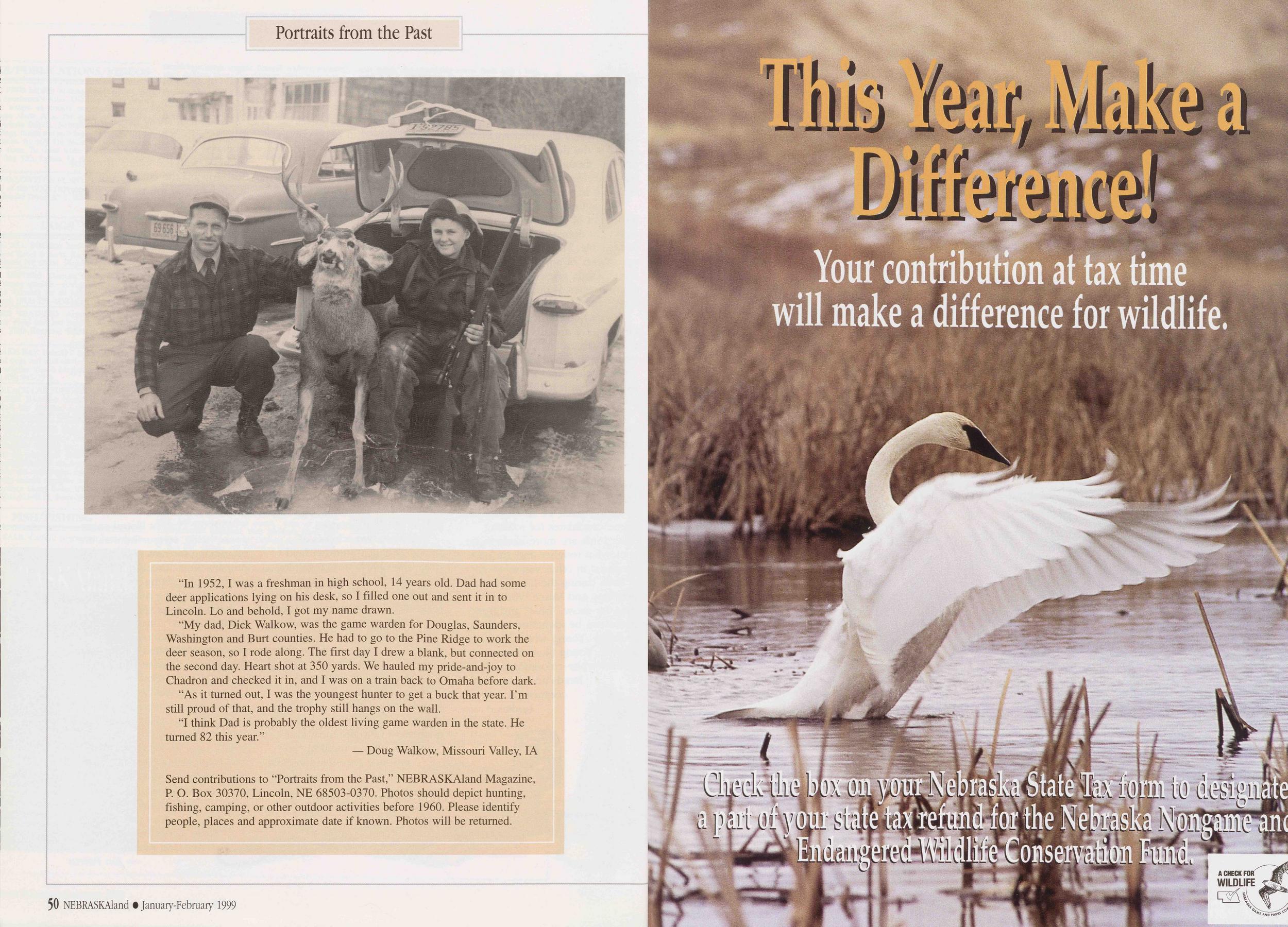
"In 1952,1 was a freshman in high school, 14 years old. Dad had some deer applications lying on his desk, so I filled one out and sent it in to Lincoln. Lo and behold, I got my name drawn.
"My dad, Dick Walkow, was the game warden for Douglas, Saunders, Washington and Burt counties. He had to go to the Pine Ridge to work the deer season, so I rode along. The first day I drew a blank, but connected on the second day. Heart shot at 350 yards. We hauled my pride-and-joy to Chadron and checked it in, and I was on a train back to Omaha before dark.
"As it turned out, I was the youngest hunter to get a buck that year. I'm still proud of that, and the trophy still hangs on the wall.
"I think Dad is probably the oldest living game warden in the state. He turned 82 this year."
— Doug Walkow, Missouri Valley, IASend contributions to "Portraits from the Past," NEBRASKAland Magazine, P. O. Box 30370, Lincoln, NE 68503-0370. Photos should depict hunting, fishing, camping, or other outdoor activities before 1960. Please identify people, places and approximate date if known. Photos will be returned.
50 NEBRASKAland • January-February 1999 THis Year, Make a Difference!
Position: 541 (20 views)