Volume 76, Issue 10, 1998
NEBRASKAland
Nebraska Game & Parks Commission December 1998 • $2.50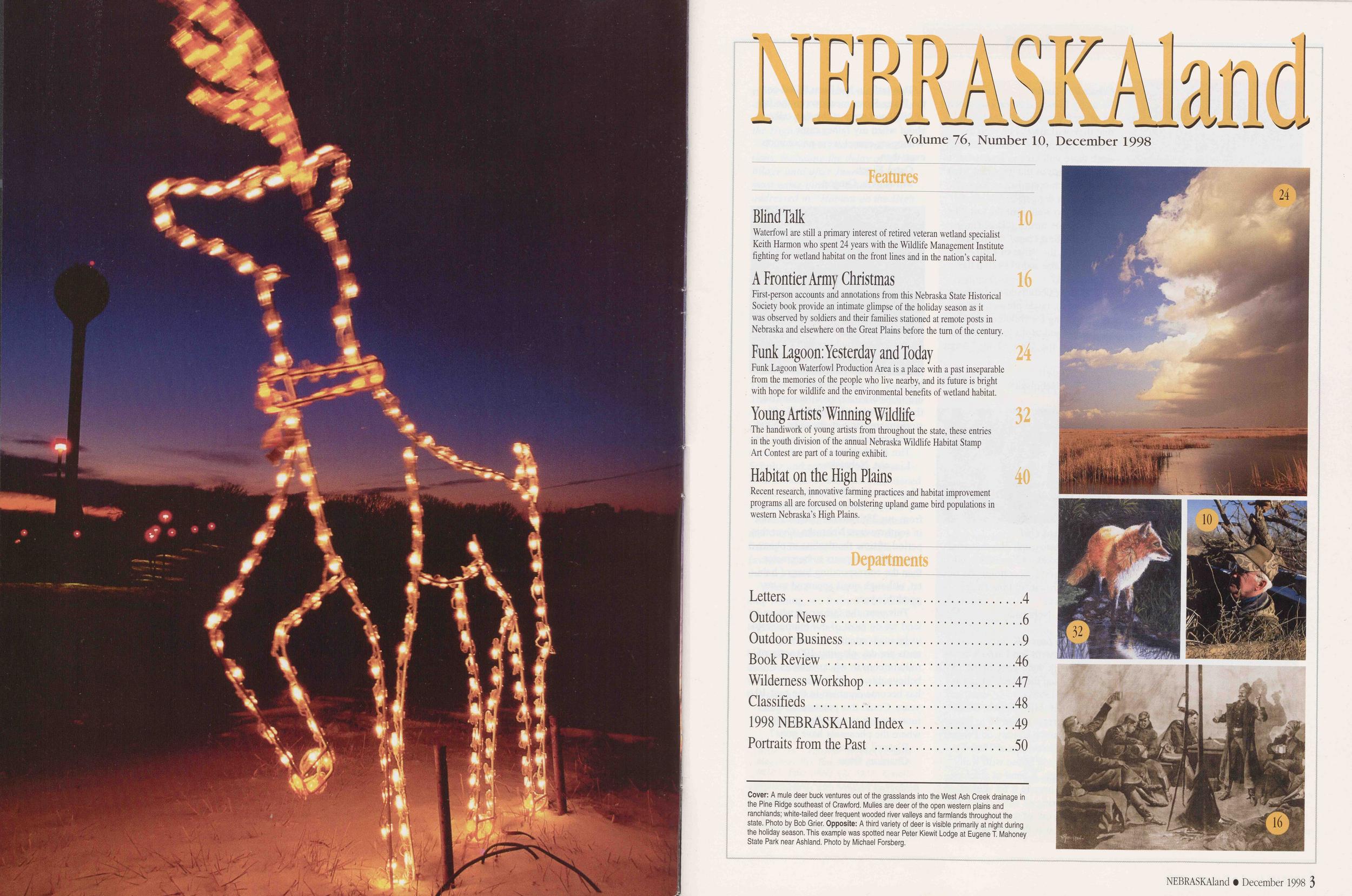
NEBRASKAland
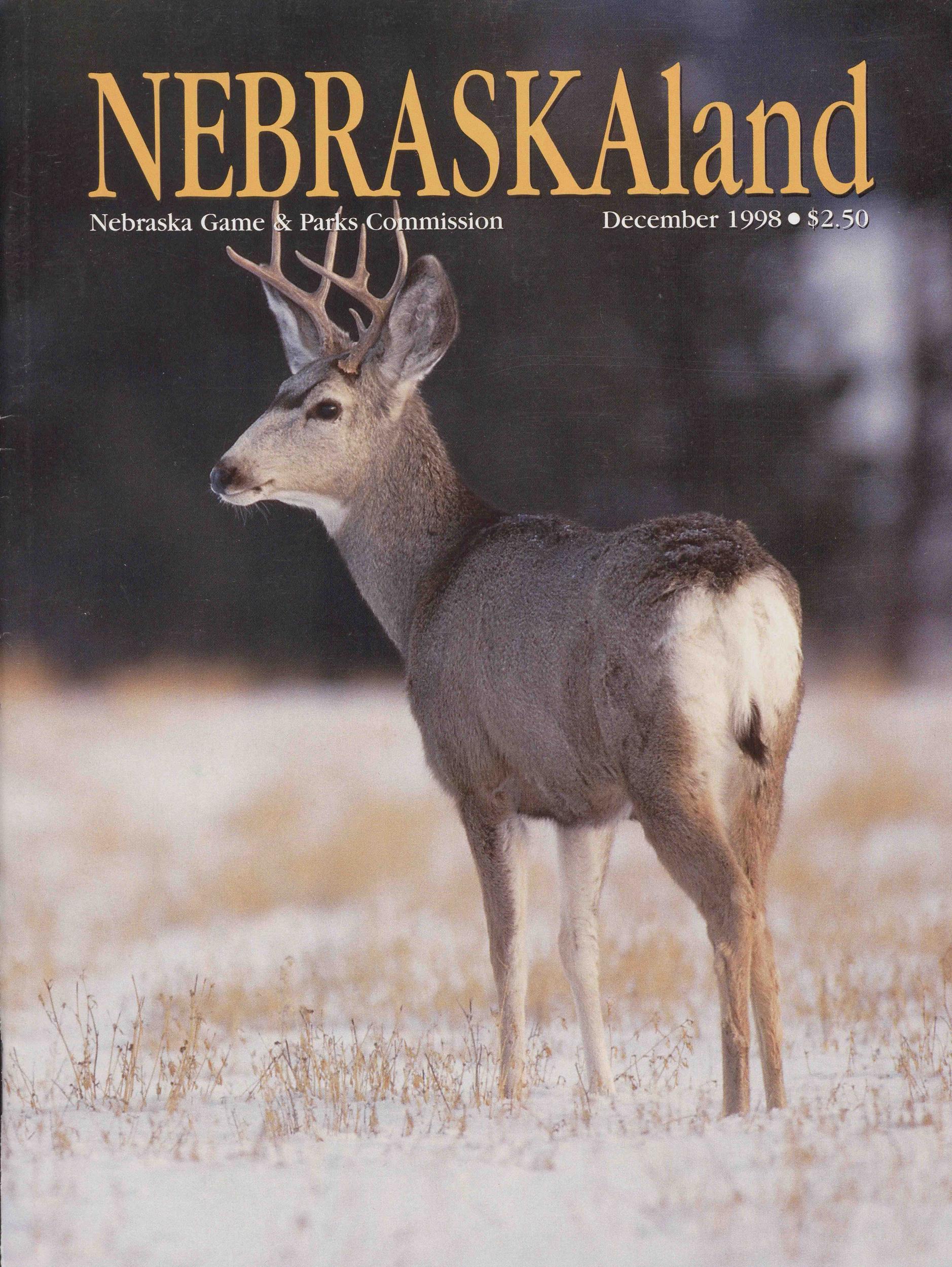
Volume 76, Number 10, December 1998 Features Blind Talk 10 Waterfowl are still a primary interest of retired veteran wetland specialist Keith Harmon who spent 24 years with the Wildlife Management Institute fighting for wetland habitat on the front lines and in the nation's capital. A Frontier Army Christmas 16 First-person accounts and annotations from this Nebraska State Historical Society book provide an intimate glimpse of the holiday season as it was observed by soldiers and their families stationed at remote posts in Nebraska and elsewhere on the Great Plains before the turn of the century. Funk Lagoon: Yesterday and Today 24 Funk Lagoon Waterfowl Production Area is a place with a past inseparable from the memories of the people who live nearby, and its future is bright with hope for wildlife and the environmental benefits of wetland habitat. Young Artists' Winning Wildlife 32 The handiwork of young artists from throughout the state, these entries in the youth division of the annual Nebraska Wildlife Habitat Stamp Art Contest are part of a touring exhibit. Habitat on the High Plains 40 Recent research, innovative farming practices and habitat improvement programs all are forcused on bolstering upland game bird populations in western Nebraska's High Plains. Departments Letters 4 Outdoor News 6 Outdoor Business 9 Book Review 46 Wilderness Workshop 47 Classifieds 48 1998 NEBRASKAland Index 49 Portraits from the Past 50 Cover: A mule deer buck ventures out of the grasslands into the West Ash Creek drainage in the Pine Ridge southeast of Crawford. Mulies are deer of the open western plains and ranchlands; white-tailed deer frequent wooded river valleys and farmlands throughout the state. Photo by Bob Grier. Opposite: A third variety of deer is visible primarily at night during the holiday season. This example was spotted near Peter Kiewit Lodge at Eugene T. Mahoney State Park near Ashland. Photo by Michael Forsberg.24
32
10
16
Letters
Ornate Box TurtlesSo many believe that various species of animals are without limitation — that they will always be with us. And, if they aren't, what is the big deal; there will always be another to take the place of the ones that went extinct. Such optimism is not only foolish, it is dangerous.
Are we to wait until the last pair of ornate box turtles ["Box Turtles: Life in the Fast Lane," November 1998] is on the verge of extinction before we take action to stop the exploitation?
The state's biodiversity is stronger with the box turtle present, and not as a plaything for children or an item of interest and profit to collectors.
Bravo to the "Turtle Lady" Angie Byorth.
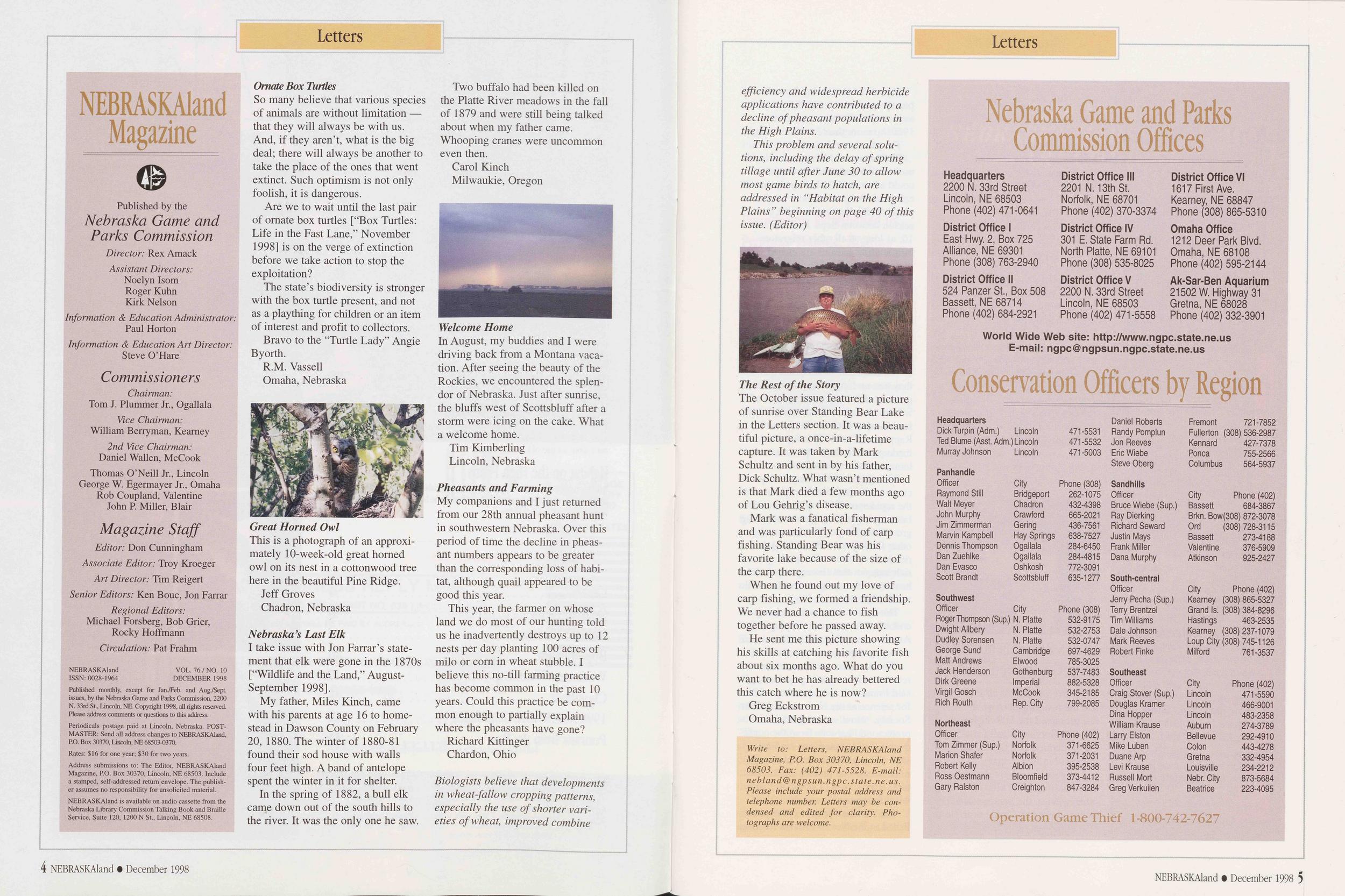
R.M. Vassell Omaha, NebraskaThis is a photograph of an approximately 10-week-old great horned owl on its nest in a cottonwood tree here in the beautiful Pine Ridge.
Jeff Groves Chadron, Nebraska Nebraska's Last ElkI take issue with Jon Farrar's statement that elk were gone in the 1870s ["Wildlife and the Land," August- September 1998].
My father, Miles Kinch, came with his parents at age 16 to homestead in Dawson County on February 20, 1880. The winter of 1880-81 found their sod house with walls four feet high. A band of antelope spent the winter in it for shelter.
In the spring of 1882, a bull elk came down out of the south hills to the river. It was the only one he saw.
Two buffalo had been killed on the Platte River meadows in the fall of 1879 and were still being talked about when my father came. Whooping cranes were uncommon even then.
Carol Kinch Milwaukie, OregonIn August, my buddies and I were driving back from a Montana vacation. After seeing the beauty of the Rockies, we encountered the splendor of Nebraska. Just after sunrise, the bluffs west of Scottsbluff after a storm were icing on the cake. What a welcome home.
Tim Kimberling Lincoln, Nebraska Pheasants and FarmingMy companions and I just returned from our 28th annual pheasant hunt in southwestern Nebraska. Over this period of time the decline in pheasant numbers appears to be greater than the corresponding loss of habitat, although quail appeared to be good this year.
This year, the farmer on whose land we do most of our hunting told us he inadvertently destroys up to 12 nests per day planting 100 acres of milo or corn in wheat stubble. I believe this no-till farming practice has become common in the past 10 years. Could this practice be common enough to partially explain where the pheasants have gone?
Richard Kittinger Chardon, Ohio Biologists believe that developments in wheat-fallow cropping patterns, especially the use of shorter varieties of wheat, improved combine 4 NEBRASKAland • December 1998 Letters Efficiency and widespread herbicide applications have contributed to a decline of pheasant populations in the High Plains. This problem and several solu- tions, including the delay of spring tillage until after June 30 to allow most game birds to hatch, are addressed in "Habitat on the High Plains" beginning on page 40 of this issue. (Editor)The October issue featured a picture of sunrise over Standing Bear Lake in the Letters section. It was a beau- tiful picture, a once-in-a-lifetime capture. It was taken by Mark Schultz and sent in by his father, Dick Schultz. What wasn't mentioned is that Mark died a few months ago of Lou Gehrig's disease.
Mark was a fanatical fisherman and was particularly fond of carp fishing. Standing Bear was his favorite lake because of the size of the carp there.
When he found out my love of carp fishing, we formed a friendship. We never had a chance to fish together before he passed away.
He sent me this picture showing his skills at catching his favorite fish about six months ago. What do you want to bet he has already bettered this catch where he is now?
Greg Eckstrom Omaha, Nebraska Write to: Letters, NEBRASKAland Magazine, P.O. Box 30370, Lincoln, NE 68503. Fax: (402) 471-5528. E-mail: nebland@ngpsun.ngpc.state.ne.us. Please include your postal address and telephone number. Letters may be con- densed and edited for clarity. Photographs are welcome.Nebraska Game and Parks Commission Offices
Headquarters 2200 N. 33rd Street Lincoln, NE 68503 Phone (402) 471-0641 District Office I East Hwy. 2, Box 725 Alliance, NE 69301 Phone (308) 763-2940 District Office II 524 Panzer St. , Box 508 Bassett, NE 68714 Phone (402) 684-2921 District Office III 2201 N. 13th St. Norfolk, NE 68701 Phone (402) 370-3374 District Office IV 301 E. State Farm Rd. North Platte, NE 69101 Phone (308) 535-8025 District Office VI 1617 First Ave. Kearney, NE 68847 Phone (308) 865-5310 Omaha Office 1212 Deer Park Blvd. Omaha, NE 68108 Phone (402) 595-2144 District Office V 2200 N. 33rd Street Lincoln, NE 68503 Phone (402) 471 -5558 Ak-Sar-Ben Aquarium 21502 W. Highway 31 Gretna, NE 68028 Phone (402) 332-3901 World Wide Web site: http://www.ngpc.state.ne.us E-mail: ngpc@ngpsun.ngpc.state.ne.us Headquarters Daniel Roberts Fremont 721-7852 Dick Turpin (Adm.) Lincoln 471-5531 Randy Pomplun Fullerton (308) 536-2987 Ted Blume (Asst. Adm.) Lincoln 471-5532 Jon Reeves Kennard 427-7378 Murray Johnson Lincoln 471-5003 Eric Wiebe Ponca 755-2566 Steve Oberg Columbus 564-5937 Panhandle Officer City Phone (308) Sandhills Raymond Still Bridgeport 262-1075 Officer City Phone (402) Walt Meyer Chadron 432-4398 Bruce Wiebe (Sup.) Bassett 684-3867 John Murphy Crawford 665-2021 Ray Dierking Brkn. Bow (308) 872-3078 Jim Zimmerman Gering 436-7561 Richard Seward Ord (308)728-3115 Marvin Kampbell Hay Springs 638-7527 Justin Mays Bassett 273-4188 Dennis Thompson Ogallala 284-6450 Frank Miller Valentine 376-5909 Dan Zuehlke Ogallala 284-4815 Dana Murphy Atkinson 925-2427 Dan Evasco Oshkosh 772-3091 Scott Brandt Scottsbluff 635-1277 South-central Officer City Phone (402) Southwest Jerry Pecha (Sup.) Kearney (308) 865-5327 Officer City Phone (308) Terry Brentzel Grand Is. (308) 384-8296 Roger Thompson (Sup.) N. Platte 532-9175 Tim Williams Hastings 463-2535 Dwight Allbery N. Platte 532-2753 Dale Johnson Kearney (308) 237-1079 Dudley Sorensen N. Platte 532-0747 Mark Reeves Loup City (308) 745-1126 George Sund Cambridge 697-4629 Robert Finke Milford 761-3537 Matt Andrews Elwood 785-3025 Jack Henderson Gothenburg 537-7483 Southeast Dirk Greene Imperial 882-5328 Officer City Phone (402) Virgil Gosch McCook 345-2185 Craig Stover (Sup.) Lincoln 471-5590 Rich Routh Rep. City 799-2085 Douglas Kramer Lincoln 466-9001 Dina Hopper Lincoln 483-2358 Northeast William Krause Auburn 274-3789 Officer City Phone (402) Larry Elston Bellevue 292-4910 Tom Zimmer (Sup.) Norfolk 371-6625 Mike Luben Colon 443-4278 Marion Shafer Norfolk 371-2031 Duane Arp Gretna 332-4954 Robert Kelly Albion 395-2538 Levi Krause Louisville 234-2212 Ross Oestmann Bloomfield 373-4412 Russell Mort Nebr. City 873-5684 Gary Ralston Creighton 847-3284 Greg Verkuilen Beatrice 223-4095 NEBRASKAland • December 1998 5
Outdoor News
Yankton Woman Sets New Nebraska Paddleilsh RecordKathy Reiman of Yankton, South Dakota, has set the record for the largest paddlefish caught in Nebraska.
She snagged the 93-pounder October 28 below Gavins Point Dam on the Missouri River.
Initially recorded in Yankton as weighing 98 pounds, the fish could not be accepted for a record because the scale on which it had been weighed was not certified.
By the time the problem with the scale was discovered, Reiman had begun cleaning the fish.
With the approval of Larry Hutchinson of the Nebraska Game and Parks Commission, the parts of Reiman's fish were weighed on a registered scale, and a 93-pound weight was confirmed. The fish measured 52!/2 inches from the eye to the fork of its tail.
The previous record of 91 pounds, 8 ounces was set by Warren Yelkin of Lincoln in 1978.
An overpopulation of snow geese and the resulting ecological crisis has prompted the U.S. Fish and Wildlife Service to call for a 50 percent reduction in light goose populations within four years.
The snow geese are destroying the arctic nesting areas vital to them and other species, the Service said. The Sen ice hopes to double or triple the annual harvest of light geese.
The Midcontinent light goose populations have jumped from an estimated 800,000 geese in the 1960s to more than 3 million today.
The plan has two parts: First, state wildlife agencies in 18 midwestern and southern states could allow hunters to use electronic calls and shotguns without magazine plugs during the regular light goose season between Sept. 1 and March 10, as long as all other migratory bird hunting seasons are closed.
Second, the Service could allow state wildlife agencies to use regulated hunting as a method for harvesting light geese between March 10 and August 31, when all migratory bird sport hunting seasons are closed.
"If we do not take steps now, these fragile ecosystems will continue to deteriorate to the point that they can no longer support light geese or the many other species of wildlife that share this arctic habitat," said Service Director Jamie Rappaport Clark. "This is a huma-nmade problem that requires a human-made solution."
Biologists believe the primary cause of the population explosion is the rapid spread of soybean and rice farming in the snow goose wintering grounds in Texas, Louisiana and other Gulf Coast states. The fields of rice and soybeans offer snow geese a rich banquet that leaves them fat and healthy as they prepare for the northward migration.
The National Aubudon Society endorsed the proposal developed by American and Canadian officials for reducing snow goose populations.
"For decades, we have striven to rebuild native wildlife populations," said Frank Gill, senior vice president for science at the National Audubon Society. "Now, we must learn to protect vital habitats from the consequences of our own success," he said. "The scientific data show we must act now to protect the fragile tundra for scores of other bird and wildlife species."
The Service's proposal was published in the Nov. 9 Federal Register.
6 NEBRASKAland • December 1998 Outdoor NewsWritten comments will be accepted until Jan. 8, 1999. Comments should be mailed to Chief, Office of Migratory Bird Management, U.S. Fish and Wildlife Service, Department of the Interior, MS 634, ARLSQ, 1849 C Street, NW, Washington, D.C. 20240.
Foundation Established to Promote Fishing, BoatingA first-of-its-kind foundation will develop a national campaign to introduce more Americans to recreational fishing and boating.
Congress has authorized $36 million over the next five years to promote fishing and boating through the new Recreational Boating and Fishing Foundation. The Secretary of the Interior can supplement that sum with another $2.6 million annually in administrative funds.
"This is a tremendous step forward that holds great potential for Nebraska and the rest of the country," said Don Gabelhouse, administrator of the Nebraska Game and Parks Commission Fisheries Division.
The foundation will encourage fishing and boating through several programs and will emphasize the role anglers and boaters play in preserving water resources.
Through special taxes on equipment and fuel, anglers and boaters pay for a significant part of the cost of aquatic conservation, said John Rogers, deputy director of the U.S. Fish and Wildlife Service.
Research shows that fishing permit sales around the country are stagnant or declining.
"The industry, if you want to call it that, has never marketed recreational fishing," Gabelhouse said. "The new foundation will be at the center of a coordinated, national program to reach out to specific segments of our society and encourage their participation."
The foundation is a partnership of state and federal fish and wildlife agencies and the sportfishing and
Outdoor News
Officer's Notebook
Protecting the Animals Hunters participate in wildlife management by having a personal wildlife ethic that includes respect for hunting laws and regulations. By regulating how many animals are taken and prohibiting the hunting of animals from less secure populations, game laws and regulations help ensure the future hunting, serve wildlife populations and help encourage the safety of hunters and others. Laws controlling methods of take, shooting times, seasons and bag limits help ensure that wildlife is not over harvested. Hunter education requirements and regulations governing loaded firearms in vehicles and prohibiting shooting from public roads help protect participants. The first settlers of North America found abundant wildlife and saw little need for regulations. Within a hundred years of the signing of the Declaration of Independence, however, the game pantry was bare in the heavily populated East, and wildlife was being sacrificed to human encroachment even in the rugged West. By the end of the 19th century, the once vast herds of deer, elk, bison and antelope were virtually gone. America's wildlife was on the verge of destruction, and the descendants of the colonists were calling for laws to protect the beasts. Early game wardens performed a thankless job for low pay and much abuse. The task, protecting wildlife from exploitation by unscrupulous hunters and poachers who sometimes became local legends, was huge. Nebraska's first meaningful game laws were enacted in 1901. By 1930, only 15 full-time game wardens patrolled the state. Some early wardens, such as Loron Bunney, whose name still evokes memories from old-timers, were as legendary as the poachers. A high overlook at the western end of Lake McConaughy where he observed "goings on" on the lake and on the river is still known as "Bunney's Point." Nebraska now has more than 50 conservation officers, still a small number to patrol the state's vast resources and huge number of users, and over the years, training and natural resource law enforcement have become more complex. Today, public education and communicating the principles of game management have become as important in deterring violations as making arrests. Well-trained, well-equipped and mobile officers are the front line contact with the public. In recent years, Nebraska conservation officers routinely contact more than 100,000 people per year, making about 3,500 arrests that result in about $275,000 in fines, liquidated damages and court costs. Annual conviction rates range from about 95 percent to 99 percent. The public provides valuable law enforcement information, in part through Operation Game Thief. Funded primarily by the Nebraska Wildlife Protectors Association, OGT maintains a toll-free number for reporting game violations anonymously. The program also offers rewards for information. In 1997, hotline calls resulted in 21 arrests and fines, costs and damages of more than $5,000. The OGT Hotline number is (800) 742-SNAP (7627). Conservation officers also are involved in game management decisions, providing survey information and personal observations. Officers often help conduct wildlife operations ranging from stocking to answering depredation complaints, and their opinions on proposed laws and regulations are solicited. Rocky Hoffmannboating industries.
"We believe that Americans who use our nation's precious aquatic resources to fish and boat will take better care of them, ensuring healthy fisheries and a strong conservation legacy for years to come," said Tom Bedell, chairman of the foundation. "This is especially important since one-third of our nation's surveyed rivers, streams, lakes and estuaries are unfit for basic uses such as fishing and swimming."
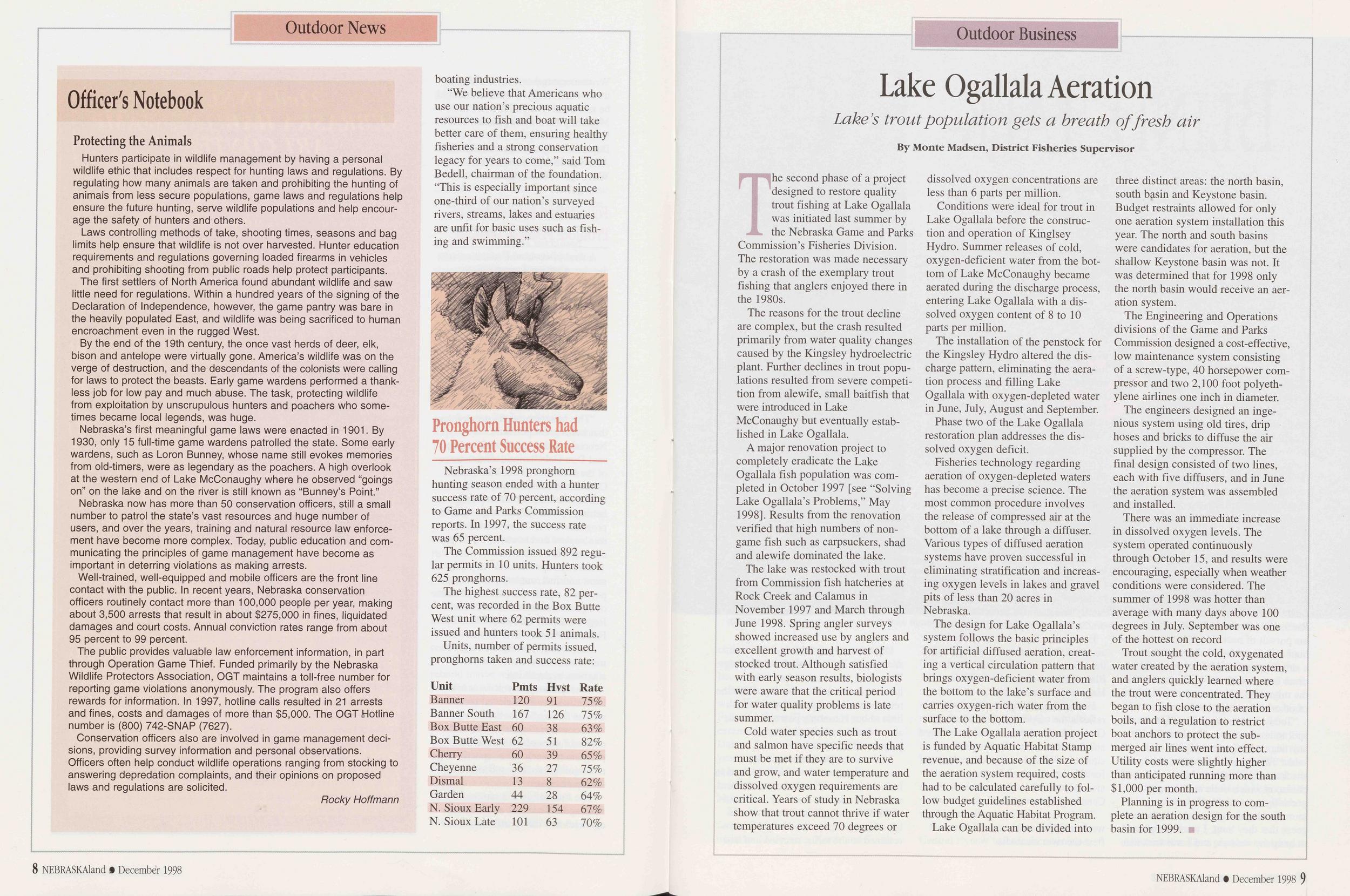
Nebraska's 1998 pronghorn hunting season ended with a hunter success rate of 70 percent, according to Game and Parks Commission reports. In 1997, the success rate was 65 percent.
The Commission issued 892 regular permits in 10 units. Hunters took 625 pronghorns.
The highest success rate, 82 percent, was recorded in the Box Butte West unit where 62 permits were issued and hunters took 51 animals.
Units, number of permits issued, pronghorns taken and success rate: Unit Pmts Hvst Rate Banner 120 91 75% Banner South 167 126 75% Box Butte East 60 38 63% Box Butte West 62 51 82% Cherry 60 39 65% Cheyenne 36 27 75% Dismal 13 8 62% Garden 44 28 64% N. Sioux Early 229 154 67% N. Sioux Late 101 63 70% 8 NEBRASKAland • December 1998Outdoor Business
Lake Ogallala Aeration
Lake's trout population gets a breath of fresh air By Monte Madsen, District Fisheries SupervisorThe second phase of a project designed to restore quality trout fishing at Lake Ogallala was initiated last summer by the Nebraska Game and Parks Commission's Fisheries Division. The restoration was made necessary by a crash of the exemplary trout fishing that anglers enjoyed there in the 1980s.
The reasons for the trout decline are complex, but the crash resulted primarily from water quality changes caused by the Kingsley hydroelectric plant. Further declines in trout populations resulted from severe competition from alewife, small baitfish that were introduced in Lake McConaughy but eventually established in Lake Ogallala.
A major renovation project to completely eradicate the Lake Ogallala fish population was completed in October 1997 [see "Solving Lake Ogallala's Problems," May 1998]. Results from the renovation verified that high numbers of non-game fish such as carpsuckers, shad and alewife dominated the lake.
The lake was restocked with trout from Commission fish hatcheries at Rock Creek and Calamus in November 1997 and March through June 1998. Spring angler surveys showed increased use by anglers and excellent growth and harvest of stocked trout. Although satisfied with early season results, biologists were aware that the critical period for water quality problems is late summer.
Cold water species such as trout and salmon have specific needs that must be met if they are to survive and grow, and water temperature and dissolved oxygen requirements are critical. Years of study in Nebraska show that trout cannot thrive if water temperatures exceed 70 degrees or dissolved oxygen concentrations are less than 6 parts per million.
Conditions were ideal for trout in Lake Ogallala before the construction and operation of Kinglsey Hydro. Summer releases of cold, oxygen-deficient water from the bottom of Lake McConaughy became aerated during the discharge process, entering Lake Ogallala with a dissolved oxygen content of 8 to 10 parts per million.
The installation of the penstock for the Kingsley Hydro altered the discharge pattern, eliminating the aeration process and filling Lake Ogallala with oxygen-depleted water in June, July, August and September.
Phase two of the Lake Ogallala restoration plan addresses the dissolved oxygen deficit.
Fisheries technology regarding aeration of oxygen-depleted waters has become a precise science. The most common procedure involves the release of compressed air at the bottom of a lake through a diffuser. Various types of diffused aeration systems have proven successful in eliminating stratification and increasing oxygen levels in lakes and gravel pits of less than 20 acres in Nebraska.
The design for Lake Ogallala's system follows the basic principles for artificial diffused aeration, creating a vertical circulation pattern that brings oxygen-deficient water from the bottom to the lake's surface and carries oxygen-rich water from the surface to the bottom.
The Lake Ogallala aeration project is funded by Aquatic Habitat Stamp revenue, and because of the size of the aeration system required, costs had to be calculated carefully to follow budget guidelines established through the Aquatic Habitat Program.
Lake Ogallala can be divided into three distinct areas: the north basin, south basin and Keystone basin. Budget restraints allowed for only one aeration system installation this year. The north and south basins were candidates for aeration, but the shallow Keystone basin was not. It was determined that for 1998 only the north basin would receive an aeration system.
The Engineering and Operations divisions of the Game and Parks Commission designed a cost-effective, low maintenance system consisting of a screw-type, 40 horsepower compressor and two 2,100 foot polyethylene airlines one inch in diameter.
The engineers designed an ingenious system using old tires, drip hoses and bricks to diffuse the air supplied by the compressor. The final design consisted of two lines, each with five diffusers, and in June the aeration system was assembled and installed.
There was an immediate increase in dissolved oxygen levels. The system operated continuously through October 15, and results were encouraging, especially when weather conditions were considered. The summer of 1998 was hotter than average with many days above 100 degrees in July. September was one of the hottest on record.
Trout sought the cold, oxygenated water created by the aeration system, and anglers quickly learned where the trout were concentrated. They began to fish close to the aeration boils, and a regulation to restrict boat anchors to protect the submerged air lines went into effect. Utility costs were slightly higher than anticipated running more than $1,000 per month.
Planning is in progress to complete an aeration design for the south basin for 1999.
NEBRASKAland • December 1998 9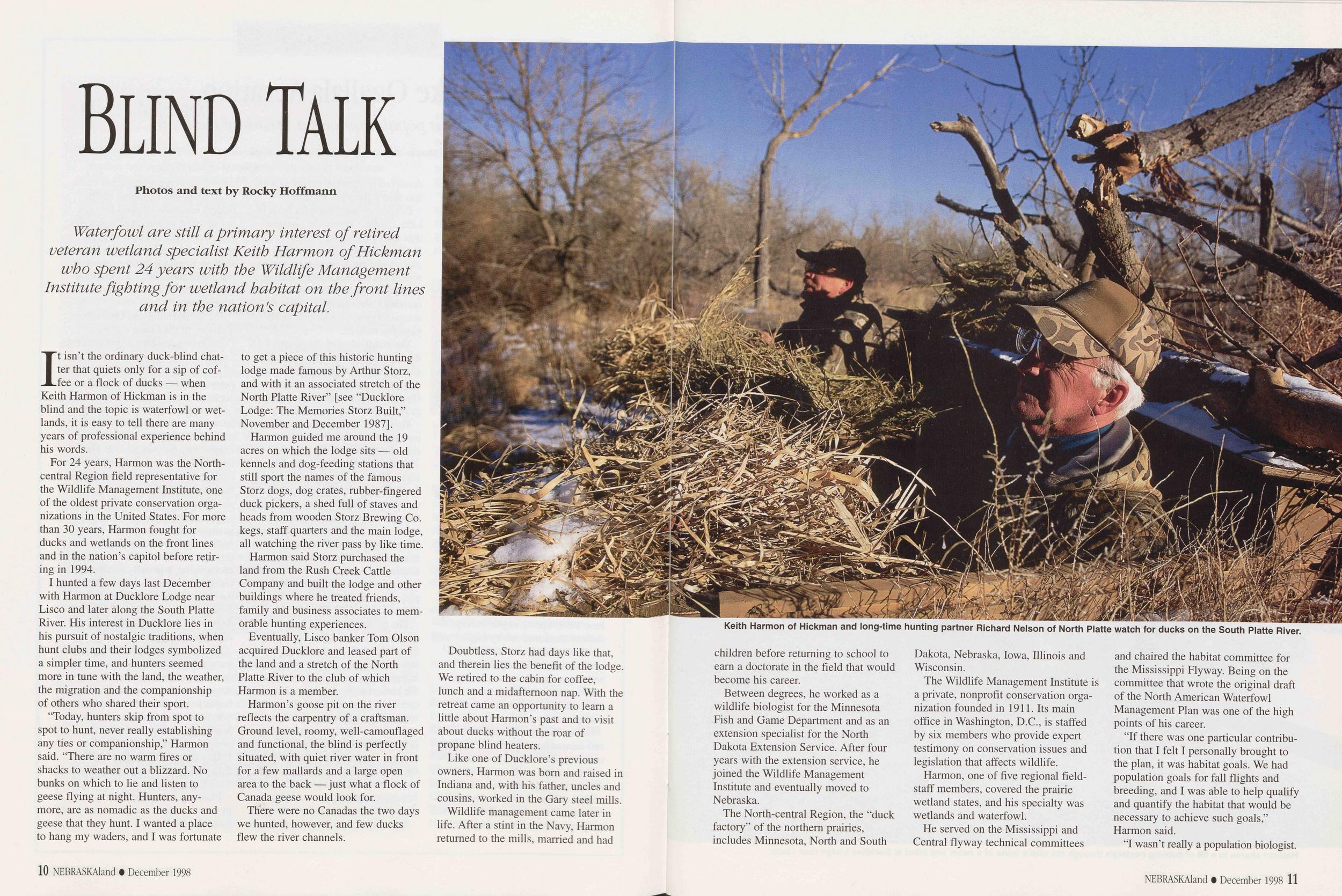
Blind Talk
Photos and text by Rocky Hoffmann Waterfowl are still a primary interest of retired veteran wetland specialist Keith Harmon of Hickman who spent 24 years with the Wildlife Management Institute fighting for wetland habitat on the front lines and in the nation's capital.It isn't the ordinary duck-blind chatter that quiets only for a sip of coffee or a flock of ducks — when Keith Harmon of Hickman is in the blind and the topic is waterfowl or wetlands, it is easy to tell there are many years of professional experience behind his words.
For 24 years, Harmon was the North-central Region field representative for the Wildlife Management Institute, one of the oldest private conservation organizations in the United States. For more than 30 years, Harmon fought for ducks and wetlands on the front lines and in the nation's capitol before retiring in 1994.
I hunted a few days last December with Harmon at Ducklore Lodge near Lisco and later along the South Platte River. His interest in Ducklore lies in his pursuit of nostalgic traditions, when hunt clubs and their lodges symbolized a simpler time, and hunters seemed more in tune with the land, the weather, the migration and the companionship of others who shared their sport.
Today, hunters skip from spot to spot to hunt, never really establishing any ties or companionship," Harmon said. "There are no warm fires or shacks to weather out a blizzard. No bunks on which to lie and listen to geese flying at night. Hunters, anymore, are as nomadic as the ducks and geese that they hunt. I wanted a place to hang my waders, and I was fortunate to get a piece of this historic hunting lodge made famous by Arthur Storz, and with it an associated stretch of the North Platte River" [see "Ducklore Lodge: The Memories Storz Built," November and December 1987].
Harmon guided me around the 19 acres on which the lodge sits — old kennels and dog-feeding stations that still sport the names of the famous Storz dogs, dog crates, rubber-fingered duck pickers, a shed full of staves and heads from wooden Storz Brewing Co. kegs, staff quarters and the main lodge, all watching the river pass by like time.
Harmon said Storz purchased the land from the Rush Creek Cattle Company and built the lodge and other buildings where he treated friends, family and business associates to memorable hunting experiences.
Eventually, Lisco banker Tom Olson acquired Ducklore and leased part of the land and a stretch of the North Platte River to the club of which Harmon is a member.
Harmon's goose pit on the river reflects the carpentry of a craftsman. Ground level, roomy, well-camouflaged and functional, the blind is perfectly situated, with quiet river water in front for a few mallards and a large open area to the back — just what a flock of Canada geese would look for.
There were no Canadas the two days we hunted, however, and few ducks flew the river channels.
Doubtless, Storz had days like that, and therein lies the benefit of the lodge. We retired to the cabin for coffee, lunch and a midafternoon nap. With the retreat came an opportunity to learn a little about Harmon's past and to visit about ducks without the roar of propane blind heaters.
Like one of Ducklore's previous owners, Harmon was born and raised in Indiana and, with his father, uncles and cousins, worked in the Gary steel mills.
Wildlife management came later in life. After a stint in the Navy, Harmon returned to the mills, married and had
10 NEBRASKAland • December 1998Keith Harmon of Hickman and long-time hunting partner Richard Nelson of North Platte watch for ducks on the South Platte River.
children before returning to school to earn a doctorate in the field that would become his career.
Between degrees, he worked as a wildlife biologist for the Minnesota Fish and Game Department and as an extension specialist for the North Dakota Extension Service. After four years with the extension service, he joined the Wildlife Management Institute and eventually moved to Nebraska.
The North-central Region, the "duck factory" of the northern prairies, includes Minnesota, North and South Dakota, Nebraska, Iowa, Illinois and Wisconsin.
The Wildlife Management Institute is a private, nonprofit conservation organization founded in 1911. Its main office in Washington, D.C., is staffed by six members who provide expert testimony on conservation issues and legislation that affects wildlife.
Harmon, one of five regional field-staff members, covered the prairie wetland states, and his specialty was wetlands and waterfowl.
He served on the Mississippi and Central flyway technical committees and chaired the habitat committee for the Mississippi Flyway. Being on the committee that wrote the original draft of the North American Waterfowl Management Plan was one of the high points of his career.
"If there was one particular contribution that I felt I personally brought to the plan, it was habitat goals. We had population goals for fall flights and breeding, and I was able to help qualify and quantify the habitat that would be necessary to achieve such goals," Harmon said.
"I wasn't really a population biologist.
NEBRASKAland • December 1998 11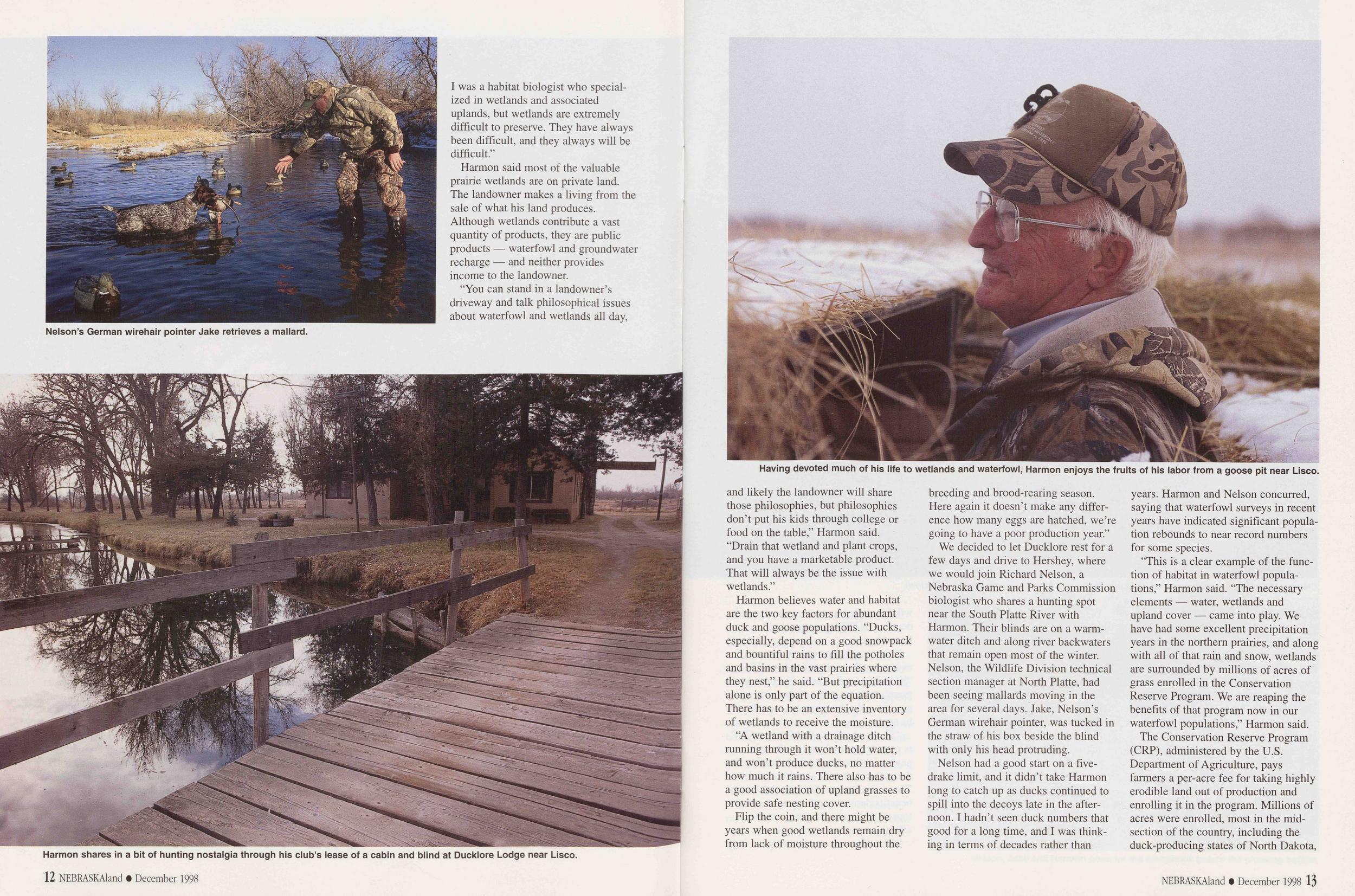
Nelson's German wirehair pointer Jake retrieves a mallard.
I was a habitat biologist who specialized in wetlands and associated uplands, but wetlands are extremely difficult to preserve. They have always been difficult, and they always will be difficult."
Harmon said most of the valuable prairie wetlands are on private land. The landowner makes a living from the sale of what his land produces. Although wetlands contribute a vast quantity of products, they are public products — waterfowl and groundwater recharge — and neither provides income to the landowner.
"You can stand in a landowner's driveway and talk philosophical issues about waterfowl and wetlands all day,
Harmon shares in a bit of hunting nostalgia through his club's lease of a cabin and blind at Ducklore Lodge near Lisco.
Having devoted much of his life to wetlands and waterfowl, Harmon enjoys the fruits of his labor from a goose pit near Lisco.
and likely the landowner will share those philosophies, but philosophies don't put his kids through college or food on the table," Harmon said. "Drain that wetland and plant crops, and you have a marketable product. That will always be the issue with wetlands."
Harmon believes water and habitat are the two key factors for abundant duck and goose populations. "Ducks, especially, depend on a good snowpack and bountiful rains to fill the potholes and basins in the vast prairies where they nest," he said. "But precipitation alone is only part of the equation. There has to be an extensive inventory of wetlands to receive the moisture.
"A wetland with a drainage ditch running through it won't hold water, and won't produce ducks, no matter how much it rains. There also has to be a good association of upland grasses to provide safe nesting cover.
Flip the coin, and there might be years when good wetlands remain dry from lack of moisture throughout the breeding and brood-rearing season. Here again it doesn't make any difference how many eggs are hatched, we're going to have a poor production year."
We decided to let Ducklore rest for a few days and drive to Hershey, where we would join Richard Nelson, a Nebraska Game and Parks Commission biologist who shares a hunting spot near the South Platte River with Harmon. Their blinds are on a warm-water ditch and along river backwaters that remain open most of the winter. Nelson, the Wildlife Division technical section manager at North Platte, had been seeing mallards moving in the area for several days. Jake, Nelson's German wirehair pointer, was tucked in the straw of his box beside the blind with only his head protruding.
Nelson had a good start on a five-drake limit, and it didn't take Harmon long to catch up as ducks continued to spill into the decoys late in the afternoon. I hadn't seen duck numbers that good for a long time, and I was thinking in terms of decades rather than years. Harmon and Nelson concurred, saying that waterfowl surveys in recent years have indicated significant population rebounds to near record numbers for some species.
"This is a clear example of the function of habitat in waterfowl populations," Harmon said. "The necessary elements — water, wetlands and upland cover — came into play. We have had some excellent precipitation years in the northern prairies, and along with all of that rain and snow, wetlands are surrounded by millions of acres of grass enrolled in the Conservation Reserve Program. We are reaping the benefits of that program now in our waterfowl populations," Harmon said.
The Conservation Reserve Program (CRP), administered by the U.S. Department of Agriculture, pays farmers a per-acre fee for taking highly erodible land out of production and enrolling it in the program. Millions of acres were enrolled, most in the midsection of the country, including the duck-producing states of North Dakota,
NEBRASKAland • December 1998 13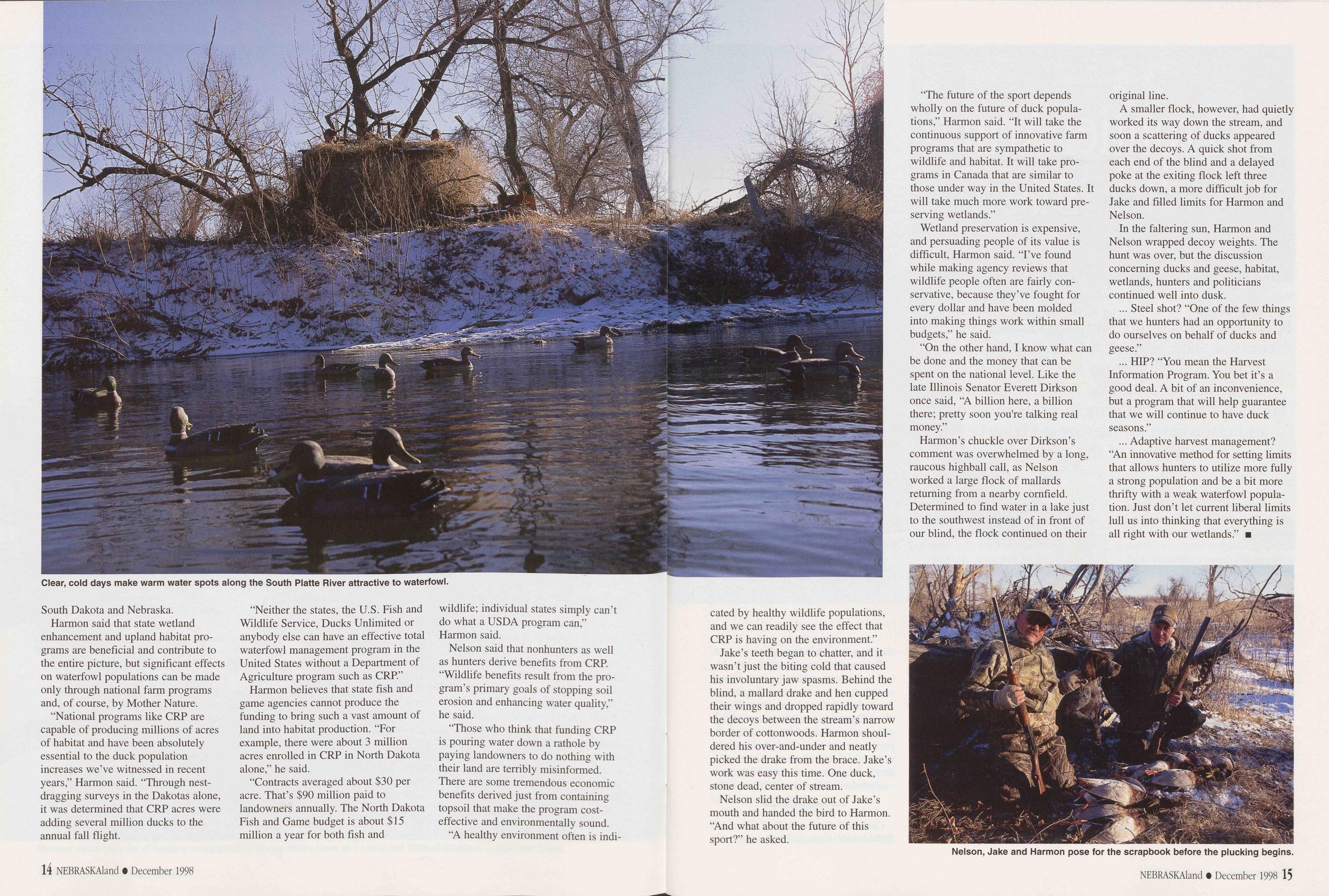
Clear, cold days make warm water spots along the South Platte River attractive to waterfowl.
South Dakota and Nebraska.
Harmon said that state wetland enhancement and upland habitat pro- grams are beneficial and contribute to the entire picture, but significant effects on waterfowl populations can be made only through national farm programs and, of course, by Mother Nature.
"National programs like CRP are capable of producing millions of acres of habitat and have been absolutely essential to the duck population increases we've witnessed in recent years," Harmon said. "Through nest- dragging surveys in the Dakotas alone, it was determined that CRP acres were adding several million ducks to the annual fall flight.
"Neither the states, the U.S. Fish and Wildlife Service, Ducks Unlimited or anybody else can have an effective total waterfowl management program in the United States without a Department of Agriculture program such as CRP."
Harmon believes that state fish and game agencies cannot produce the funding to bring such a vast amount of land into habitat production. "For example, there were about 3 million acres enrolled in CRP in North Dakota alone," he said.
"Contracts averaged about $30 per acre. That's $90 million paid to landowners annually. The North Dakota Fish and Game budget is about $15 million a year for both fish and wildlife; individual states simply can't do what a USDA program can," Harmon said.
Nelson said that nonhunters as well as hunters derive benefits from CRP. "Wildlife benefits result from the program's primary goals of stopping soil erosion and enhancing water quality," he said.
"Those who think that funding CRP is pouring water down a rathole by paying landowners to do nothing with their land are terribly misinformed. There are some tremendous economic benefits derived just from containing topsoil that make the program cost-effective and environmentally sound.
"A healthy environment often is indicated
14 NEBRASKAland • December 1998by healthy wildlife populations, and we can readily see the effect that CRP is having on the environment."
Jake's teeth began to chatter, and it wasn't just the biting cold that caused his involuntary jaw spasms. Behind the blind, a mallard drake and hen cupped their wings and dropped rapidly toward the decoys between the stream's narrow border of cottonwoods. Harmon shouldered his over-and-under and neatly picked the drake from the brace. Jake's work was easy this time. One duck, stone dead, center of stream.
Nelson slid the drake out of Jake's mouth and handed the bird to Harmon. "And what about the future of this sport?" he asked.
"The future of the sport depends wholly on the future of duck populations," Harmon said. "It will take the continuous support of innovative farm programs that are sympathetic to wildlife and habitat. It will take programs in Canada that are similar to those under way in the United States. It will take much more work toward preserving wetlands."
Wetland preservation is expensive, and persuading people of its value is difficult, Harmon said. "I've found while making agency reviews that wildlife people often are fairly conservative, because they've fought for every dollar and have been molded into making things work within small budgets," he said.
"On the other hand, I know what can be done and the money that can be spent on the national level. Like the late Illinois Senator Everett Dirkson once said, "A billion here, a billion there; pretty soon you're talking real money."
Harmon's chuckle over Dirkson's comment was overwhelmed by a long, raucous highball call, as Nelson worked a large flock of mallards returning from a nearby cornfield. Determined to find water in a lake just to the southwest instead of in front of our blind, the flock continued on their original line.
A smaller flock, however, had quietly worked its way down the stream, and soon a scattering of ducks appeared over the decoys. A quick shot from each end of the blind and a delayed poke at the exiting flock left three ducks down, a more difficult job for Jake and filled limits for Harmon and Nelson.
In the faltering sun, Harmon and Nelson wrapped decoy weights. The hunt was over, but the discussion concerning ducks and geese, habitat, wetlands, hunters and politicians continued well into dusk.
... Steel shot? "One of the few things that we hunters had an opportunity to do ourselves on behalf of ducks and geese."
... HIP? "You mean the Harvest Information Program. You bet it's a good deal. A bit of an inconvenience, but a program that will help guarantee that we will continue to have duck seasons."
... Adaptive harvest management? "An innovative method for setting limits that allows hunters to utilize more fully a strong population and be a bit more thrifty with a weak waterfowl population. Just don't let current liberal limits lull us into thinking that everything is all right with our wetlands."
Nelson, Jake and Harmon pose for the scrapbook before the plucking begins.
Excerpts from... A Frontier Army Christmas
First-person accounts and annotations from this Nebraska State Historical Society book provide an intimate glimpse of the holiday season as it was observed by soldiers and their families stationed at remote posts in Nebraska and elsewhere on the Great Plains before the turn of the century. We present here an extensive sampling of frontier army Christmas celebrations as told through first person accounts. Geoffrey Williston Christine, a nineteenth-century journalist and astute observer, could just as easily have provided the introduction to this book. Many elements of a frontier army Christmas — the difficulties, the ingenuity, the enjoyment — appear in his short vignette, written in 1875.Very different is the soldier's Christmas. Away out on the frontier, miles from any railroad, in a lonely little fort, surrounded by Indians, our army officers and their wives have no long rows of elegant shops from whose great supply of "holiday goods" they may select gifts for each other and their little ones as well as for the dear friends they have left behind them in their far eastern homes. They have no great array of market stalls loaded down with poultry, fruit and game, where they may purchase material for the Christmas dinner. For Christmas gifts and Christmas cheer they must depend entirely upon their own ingenuity. But what a wonderful genii that same ingenuity sometimes is, and what pretty things and pretty dishes he often evolves out of seemingly nothing, almost equaling in this respect the famous genii of Aladdin's wonderful lamp.
In a little frontier post away out on the trackless plains of the far west where not a shrub or tree of any kind could be seen even beneath the scorching sun of summer, I have known quite a respectable Christmas tree to be "faked" by splicing together several walking sticks, fastening them upright through a hole in a soap box and covering them with green tissue paper obtained from the post store, where all sorts of odds and ends accumulate in the course of years. The branches were formed by winding the central portion of long, stiff pieces of heavy wire about the trunk, formed as above, and allowing their ends to project.
That same Christmas night we had a ball at the commandant's quarters, and everybody in garrison, including not a few Indians, gathered around our improvised Christmas tree which seemed to afford as much delight to the oldest person present as to the fairy-like little maiden of five years — the commandant's daughter and the idol of the fort — for whom it had been fabricated.
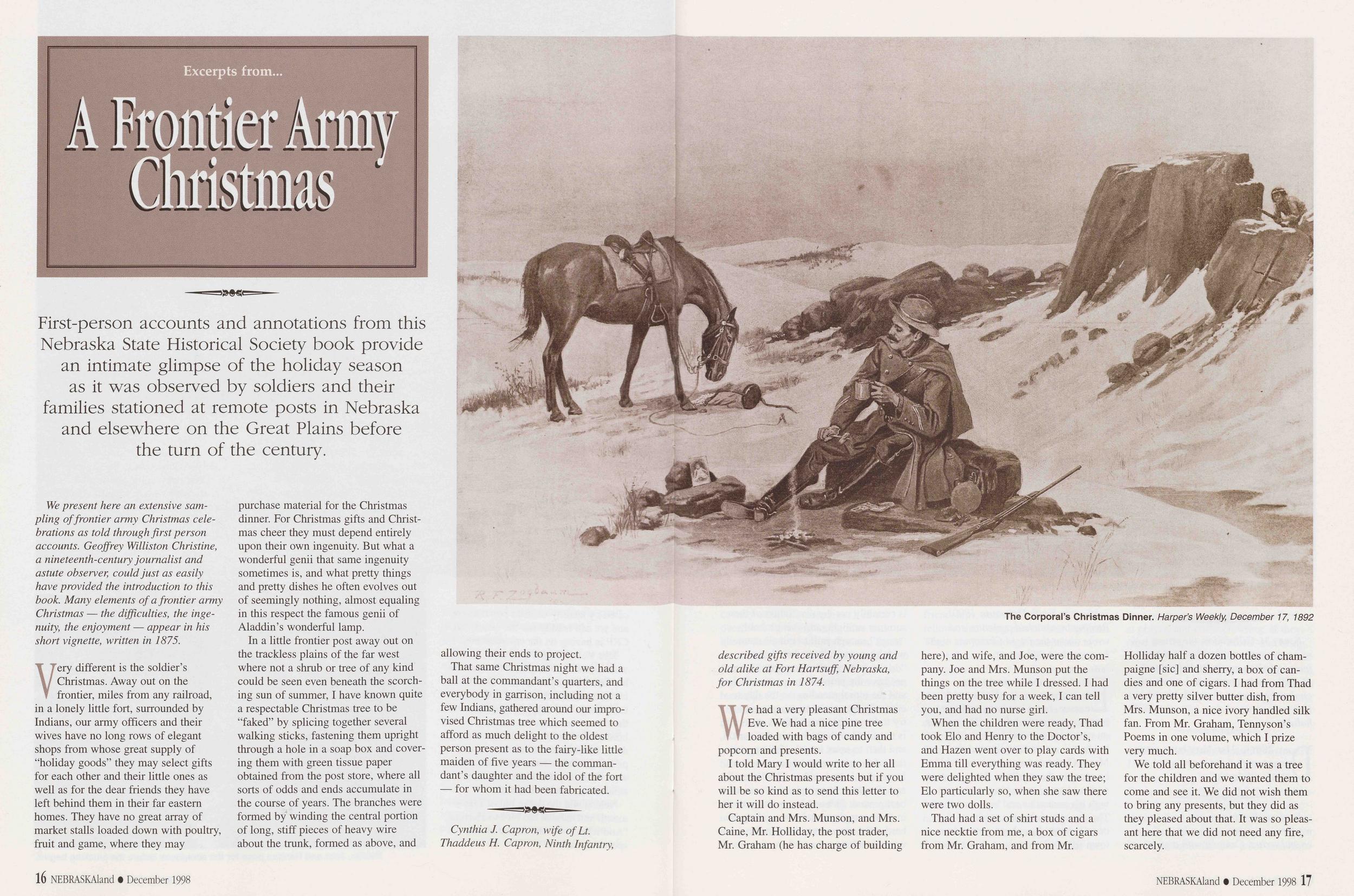
Cynthia J. Capron, wife of Lt. Thaddeus H. Capron, Ninth Infantry, 16 NEBRASKAland • December 1998The Corporal's Christmas Dinner.
We had a very pleasant Christmas Eve. We had a nice pine tree loaded with bags of candy and popcorn and presents.
I told Mary I would write to her all about the Christmas presents but if you will be so kind as to send this letter to her it will do instead.
Captain and Mrs. Munson, and Mrs. Caine, Mr. Holliday, the post trader, Mr. Graham (he has charge of building here), and wife, and Joe, were the company. Joe and Mrs. Munson put the things on the tree while I dressed. I had been pretty busy for a week, I can tell you, and had no nurse girl.
When the children were ready, Thad took Elo and Henry to the Doctor's, and Hazen went over to play cards with Emma till everything was ready. They were delighted when they saw the tree; Elo particularly so, when she saw there were two dolls.
Thad had a set of shirt studs and a nice necktie from me, a box of cigars from Mr. Graham, and from Mr. Holliday half a dozen bottles of champaigne [sic] and sherry, a box of candies and one of cigars. I had from Thad a very pretty silver butter dish, from Mrs. Munson, a nice ivory handled silk fan. From Mr. Graham, Tennyson's Poems in one volume, which I prize very much.
We told all beforehand it was a tree for the children and we wanted them to come and see it. We did not wish them to bring any presents, but they did as they pleased about that. It was so pleasant here that we did not need any fire, scarcely.
NEBRASKAland • December 1998 17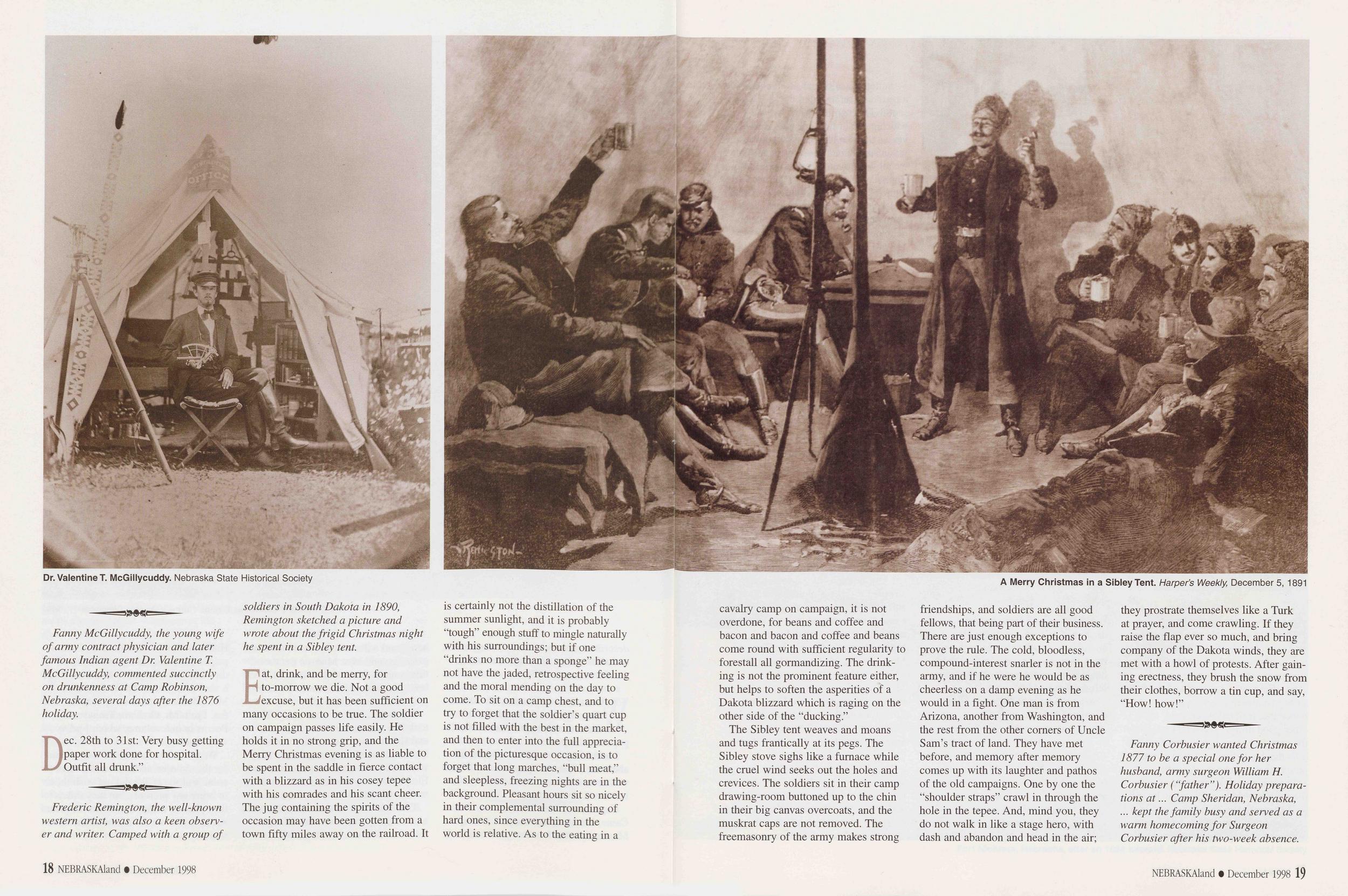
Dr. Valentine T. McGillycuddy. Nebraska State Historical Society
Eat, drink, and be merry, for to-morrow we die. Not a good excuse, but it has been sufficient on many occasions to be true. The soldier on campaign passes life easily. He holds it in no strong grip, and the Merry Christmas evening is as liable to be spent in the saddle in fierce contact with a blizzard as in his cosey tepee with his comrades and his scant cheer. The jug containing the spirits of the occasion may have been gotten from a town fifty miles away on the railroad. It is certainly not the distillation of the summer sunlight, and it is probably "tough" enough stuff to mingle naturally with his surroundings; but if one "drinks no more than a sponge" he may not have the jaded, retrospective feeling and the moral mending on the day to come. To sit on a camp chest, and to try to forget that the soldier's quart cup is not filled with the best in the market, and then to enter into the full appreciation of the picturesque occasion, is to forget that long marches, "bull meat," and sleepless, freezing nights are in the background. Pleasant hours sit so nicely in their complemental surrounding of hard ones, since everything in the world is relative. As to the eating in a
18 NEBRASKAland • December 1998A Merry Christmas in a Sibley Tent.
cavalry camp on campaign, it is not overdone, for beans and coffee and bacon and bacon and coffee and beans come round with sufficient regularity to forestall all gormandizing. The drinking is not the prominent feature either, but helps to soften the asperities of a Dakota blizzard which is raging on the other side of the "ducking."
The Sibley tent weaves and moans and tugs frantically at its pegs. The Sibley stove sighs like a furnace while the cruel wind seeks out the holes and crevices. The soldiers sit in their camp drawing-room buttoned up to the chin in their big canvas overcoats, and the muskrat caps are not removed. The freemasonry of the army makes strong friendships, and soldiers are all good fellows, that being part of their business. There are just enough exceptions to prove the rule. The cold, bloodless, compound-interest snarler is not in the army, and if he were he would be as cheerless on a damp evening as he would in a fight. One man is from Arizona, another from Washington, and the rest from the other corners of Uncle Sam's tract of land. They have met before, and memory after memory comes up with its laughter and pathos of the old campaigns. One by one the "shoulder straps" crawl in through the hole in the tepee. And, mind you, they do not walk in like a stage hero, with dash and abandon and head in the air; they prostrate themselves like a Turk at prayer, and come crawling. If they raise the flap ever so much, and bring company of the Dakota winds, they are met with a howl of protests. After gaining erectness, they brush the snow from their clothes, borrow a tin cup, and say, "How! how!"
Fanny Corbusier wanted Christmas 1877 to be a special one for her husband, army surgeon William H. Corbusier ("father"). Holiday preparations at... Camp Sheridan, Nebraska, ... kept the family busy and served as a warm homecoming for Surgeon Corbusier after his two-week absence. NEBRASKAland • December 1998 19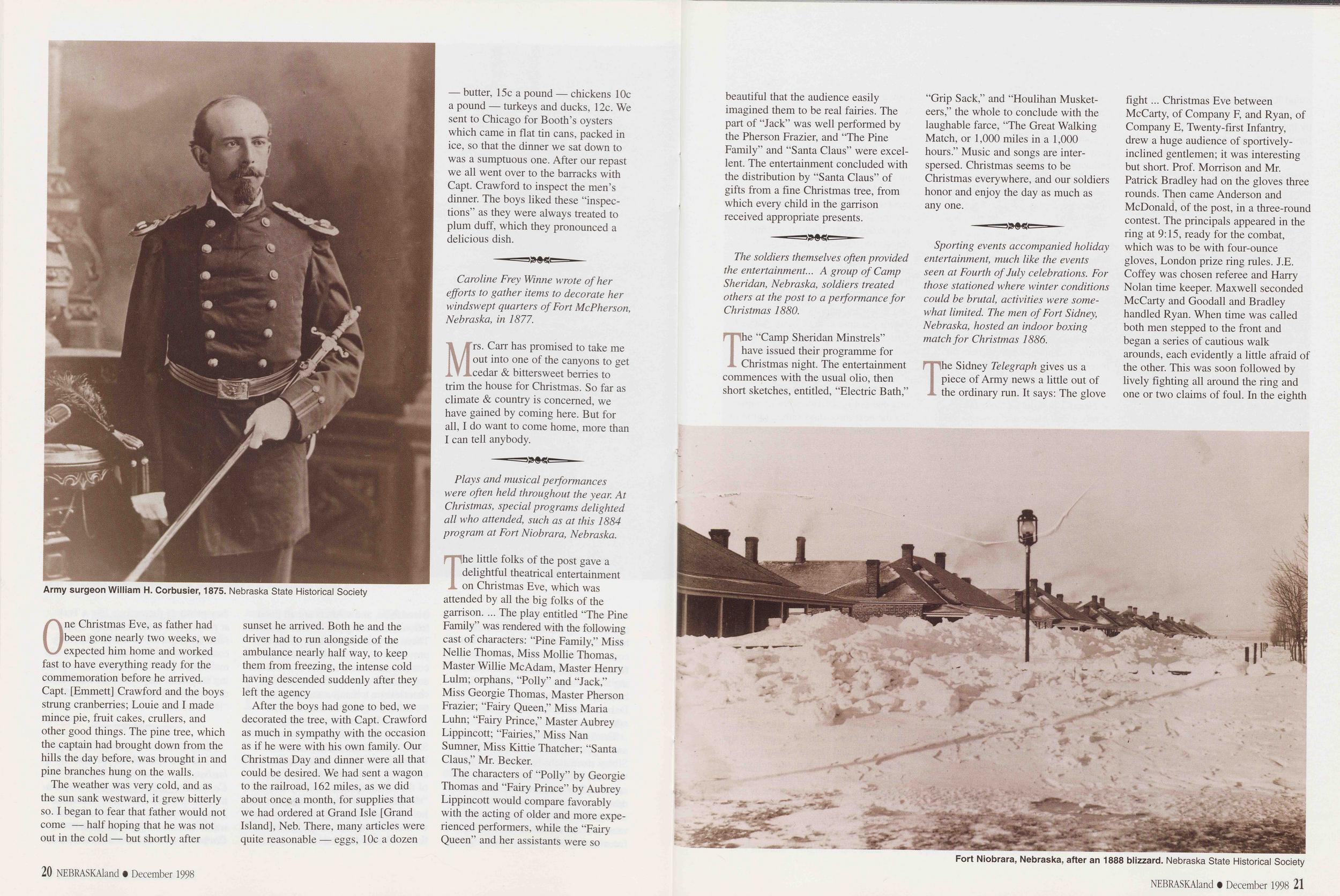
Army surgeon William H. Corbusier, 1875. Nebraska State Historical Society
One Christmas Eve, as father had [been gone nearly two weeks, we expected him home and worked fast to have everything ready for the commemoration before he arrived. Capt. [Emmett] Crawford and the boys strung cranberries; Louie and I made mince pie, fruit cakes, crullers, and other good things. The pine tree, which the captain had brought down from the hills the day before, was brought in and pine branches hung on the walls.
The weather was very cold, and as the sun sank westward, it grew bitterly so. I began to fear that father would not come — half hoping that he was not out in the cold — but shortly after sunset he arrived. Both he and the driver had to run alongside of the ambulance nearly half way, to keep them from freezing, the intense cold having descended suddenly after they left the agency
After the boys had gone to bed, we decorated the tree, with Capt. Crawford as much in sympathy with the occasion as if he were with his own family. Our Christmas Day and dinner were all that could be desired. We had sent a wagon to the railroad, 162 miles, as we did about once a month, for supplies that we had ordered at Grand Isle [Grand Island], Neb. There, many articles were quite reasonable — eggs, 10c a dozen — butter, 15c a pound — chickens 10c a pound — turkeys and ducks, 12c. We sent to Chicago for Booth's oysters which came in flat tin cans, packed in ice, so that the dinner we sat down to was a sumptuous one. After our repast we all went over to the barracks with Capt. Crawford to inspect the men's dinner. The boys liked these "inspections" as they were always treated to plum duff, which they pronounced a delicious dish.
Caroline Frey Winne wrote of her efforts to gather items to decorate her windswept quarters of Fort McPherson, Nebraska, in 1877.Mrs. Carr has promised to take me out into one of the canyons to get cedar & bittersweet berries to trim the house for Christmas. So far as climate & country is concerned, we have gained by coming here. But for all, I do want to come home, more than I can tell anybody.
Plays and musical performances were often held throughout the year. At Christmas, special programs delighted all who attended, such as at this 1884 program at Fort Niobrara, Nebraska.The little folks of the post gave a delightful theatrical entertainment on Christmas Eve, which was attended by all the big folks of the garrison. ... The play entitled "The Pine Family" was rendered with the following cast of characters: "Pine Family," Miss Nellie Thomas, Miss Mollie Thomas, Master Willie McAdam, Master Henry Lulm; orphans, "Polly" and "Jack," Miss Georgie Thomas, Master Pherson Frazier; "Fairy Queen," Miss Maria Luhn; "Fairy Prince," Master Aubrey Lippincott; "Fairies," Miss Nan Sumner, Miss Kittie Thatcher; "Santa Claus," Mr. Becker.
The characters of "Polly" by Georgie Thomas and "Fairy Prince" by Aubrey Lippincott would compare favorably with the acting of older and more experienced performers, while the "Fairy Queen" and her assistants were so
20 NEBRASKAland • December 1998beautiful that the audience easily imagined them to be real fairies. The part of "Jack" was well performed by the Pherson Frazier, and "The Pine Family" and "Santa Claus" were excellent. The entertainment concluded with the distribution by "Santa Claus" of gifts from a fine Christmas tree, from which every child in the garrison received appropriate presents.
The soldiers themselves often provided the entertainment... A group of Camp Sheridan, Nebraska, soldiers treated others at the post to a performance for Christmas 1880.The "Camp Sheridan Minstrels" have issued their programme for Christmas night. The entertainment commences with the usual olio, then short sketches, entitled, "Electric Bath," "Grip Sack," and "Houlihan Musketeers," the whole to conclude with the laughable farce, "The Great Walking Match, or 1,000 miles in a 1,000 hours." Music and songs are interspersed. Christmas seems to be Christmas everywhere, and our soldiers honor and enjoy the day as much as any one.
Sporting events accompanied holiday entertainment, much like the events seen at Fourth of July celebrations. For those stationed where winter conditions could be brutal, activities were somewhat limited. The men of Fort Sidney, Nebraska, hosted an indoor boxing match for Christmas 1886.The Sidney Telegraph gives us a piece of Army news a little out of the ordinary run. It says: The glove fight... Christmas Eve between McCarty, of Company F, and Ryan, of Company E, Twenty-first Infantry, drew a huge audience of sportively- inclined gentlemen; it was interesting but short. Prof. Morrison and Mr. Patrick Bradley had on the gloves three rounds. Then came Anderson and McDonald, of the post, in a three-round contest. The principals appeared in the ring at 9:15, ready for the combat, which was to be with four-ounce gloves, London prize ring rules. J.E. Coffey was chosen referee and Harry Nolan time keeper. Maxwell seconded McCarty and Goodall and Bradley handled Ryan. When time was called both men stepped to the front and began a series of cautious walk arounds, each evidently a little afraid of the other. This was soon followed by lively fighting all around the ring and one or two claims of foul. In the eighth
Fort Niobrara, Nebraska, after an 1888 blizzard.
Nebraska State Historical Society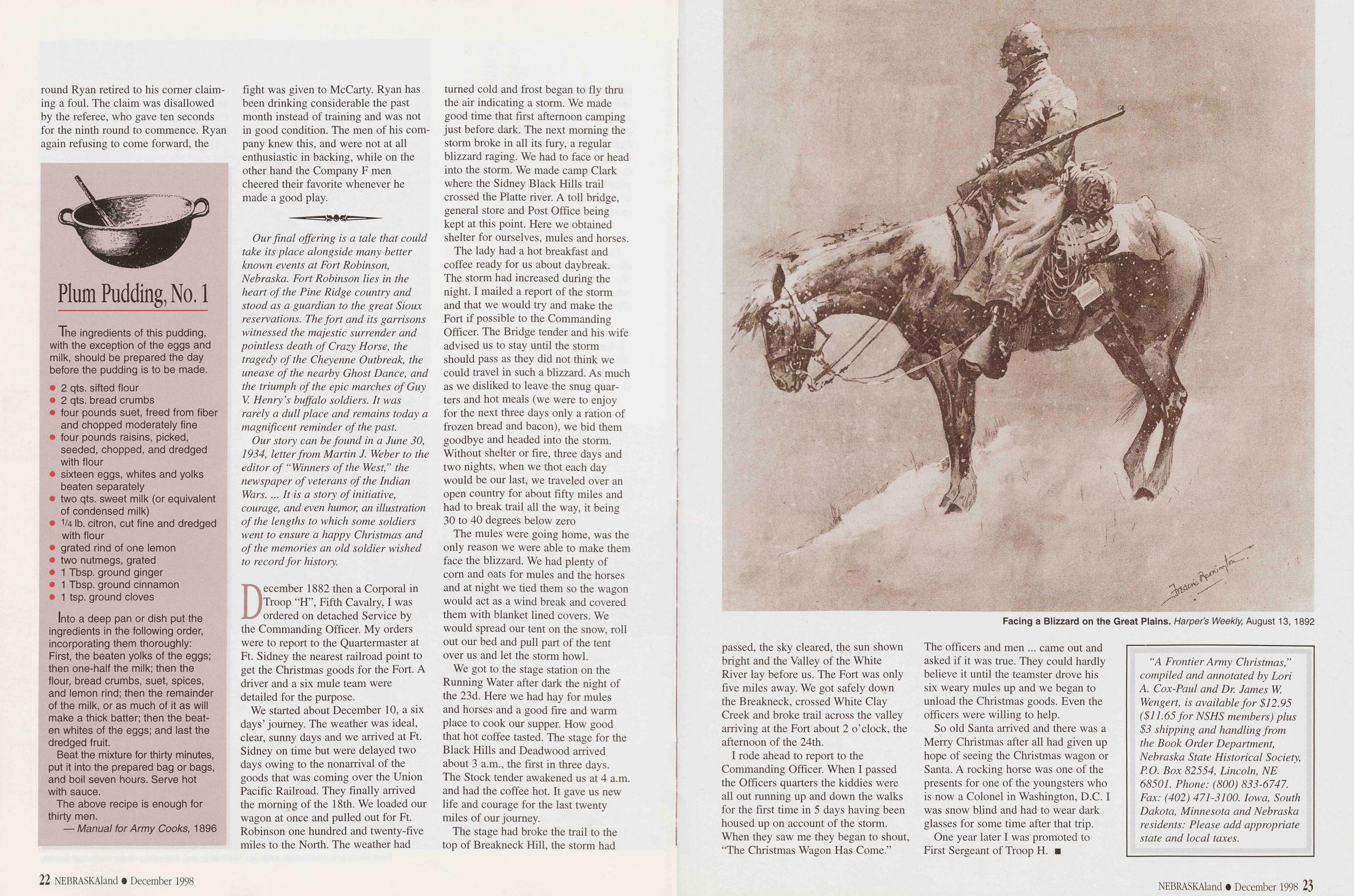
round Ryan retired to his corner claiming a foul. The claim was disallowed by the referee, who gave ten seconds for the ninth round to commence. Ryan again refusing to come forward, the
Plum Pudding, No. 1
The ingredients of this pudding, with the exception of the eggs and milk, should be prepared the day before the pudding is to be made. • 2 qts. sifted flour • 2 qts. bread crumbs • four pounds suet, freed from fiber and chopped moderately fine • four pounds raisins, picked, seeded, chopped, and dredged with flour • sixteen eggs, whites and yolks beaten separately • two qts. sweet milk (or equivalent of condensed milk) • 1/4 lb. citron, cut fine and dredged with flour • grated rind of one lemon • two nutmegs, grated • 1 Tbsp. ground ginger • 1 Tbsp. ground cinnamon • 1 tsp. ground cloves Into a deep pan or dish put the ingredients in the following order, incorporating them thoroughly: First, the beaten yolks of the eggs; then one-half the milk; then the flour, bread crumbs, suet, spices, and lemon rind; then the remainder of the milk, or as much of it as will make a thick batter; then the beaten whites of the eggs; and last the dredged fruit. Beat the mixture for thirty minutes, put it into the prepared bag or bags, and boil seven hours. Serve hot with sauce. The above recipe is enough for thirty men. — Manual for Army Cooks, 1896fight was given to McCarty. Ryan has been drinking considerable the past month instead of training and was not in good condition. The men of his company knew this, and were not at all enthusiastic in backing, while on the other hand the Company F men cheered their favorite whenever he made a good play.
Our final offering is a tale that could take its place alongside many better known events at Fort Robinson, Nebraska. Fort Robinson lies in the heart of the Pine Ridge country and stood as a guardian to the great Sioux reservations. The fort and its garrisons witnessed the majestic surrender and pointless death of Crazy Horse, the tragedy of the Cheyenne Outbreak, the unease of the nearby Ghost Dance, and the triumph of the epic marches of Guy V. Henry's buffalo soldiers. It was rarely a dull place and remains today a magnificent reminder of the past. Our story can be found in a June 30, 1934, letter from Martin J. Weber to the editor of "Winners of the West," the newspaper of veterans of the Indian Wars. ... It is a story of initiative, courage, and even humor, an illustration of the lengths to which some soldiers went to ensure a happy Christmas and of the memories an old soldier wished to record for history.December 1882 then a Corporal in Troop "H", Fifth Cavalry, I was ordered on detached Service by the Commanding Officer. My orders were to report to the Quartermaster at Ft. Sidney the nearest railroad point to get the Christmas goods for the Fort. A driver and a six mule team were detailed for the purpose.
We started about December 10, a six days' journey. The weather was ideal, clear, sunny days and we arrived at Ft. Sidney on time but were delayed two days owing to the nonarrival of the goods that was coming over the Union Pacific Railroad. They finally arrived the morning of the 18th. We loaded our wagon at once and pulled out for Ft. Robinson one hundred and twenty-five miles to the North. The weather had turned cold and frost began to fly thru the air indicating a storm. We made good time that first afternoon camping just before dark. The next morning the storm broke in all its fury, a regular blizzard raging. We had to face or head into the storm. We made camp Clark where the Sidney Black Hills trail crossed the Platte river. A toll bridge, general store and Post Office being kept at this point. Here we obtained shelter for ourselves, mules and horses.
The lady had a hot breakfast and coffee ready for us about daybreak. The storm had increased during the night. I mailed a report of the storm and that we would try and make the Fort if possible to the Commanding Officer. The Bridge tender and his wife advised us to stay until the storm should pass as they did not think we could travel in such a blizzard. As much as we disliked to leave the snug quarters and hot meals (we were to enjoy for the next three days only a ration of frozen bread and bacon), we bid them goodbye and headed into the storm. Without shelter or fire, three days and two nights, when we thot each day would be our last, we traveled over an open country for about fifty miles and had to break trail all the way, it being 30 to 40 degrees below zero.
The mules were going home, was the only reason we were able to make them face the blizzard. We had plenty of corn and oats for mules and the horses and at night we tied them so the wagon would act as a wind break and covered them with blanket lined covers. We would spread our tent on the snow, roll out our bed and pull part of the tent over us and let the storm howl.
We got to the stage station on the Running Water after dark the night of the 23d. Here we had hay for mules and horses and a good fire and warm place to cook our supper. How good that hot coffee tasted. The stage for the Black Hills and Deadwood arrived about 3 a.m., the first in three days. The Stock tender awakened us at 4 a.m. and had the coffee hot. It gave us new life and courage for the last twenty miles of our journey.
The stage had broke the trail to the top of Breakneck Hill, the storm had
22 NEBRASKAland • December 1998Facing a Blizzard on the Great Plains.
passed, the sky cleared, the sun shown bright and the Valley of the White River lay before us. The Fort was only five miles away. We got safely down the Breakneck, crossed White Clay Creek and broke trail across the valley arriving at the Fort about 2 o'clock, the afternoon of the 24th.
I rode ahead to report to the Commanding Officer. When I passed the Officers quarters the kiddies were all out running up and down the walks for the first time in 5 days having been housed up on account of the storm. When they saw me they began to shout, "The Christmas Wagon Has Come." The officers and men ... came out and asked if it was true. They could hardly believe it until the teamster drove his six weary mules up and we began to unload the Christmas goods. Even the officers were willing to help.
So old Santa arrived and there was a Merry Christmas after all had given up hope of seeing the Christmas wagon or Santa. A rocking horse was one of the presents for one of the youngsters who is now a Colonel in Washington, D.C. I was snow blind and had to wear dark glasses for some time after that trip.
One year later I was promoted to First Sergeant of Troop H.
"A Frontier Army Christmas," compiled and annotated by Fori A. Cox-Paul and Dr. James W. Wengert, is available for $12.95 ($11.65 for NSHS members) plus $3 shipping and handling from the Book Order Department, Nebraska State Historical Society, P.O. Box 82554, Lincoln, NE 68501. Phone: (800) 833-6747. Fax: (402) 471-3100. Iowa, South Dakota, Minnesota and Nebraska residents: Please add appropriate state and local taxes. NEBRASKAland • December 1998 23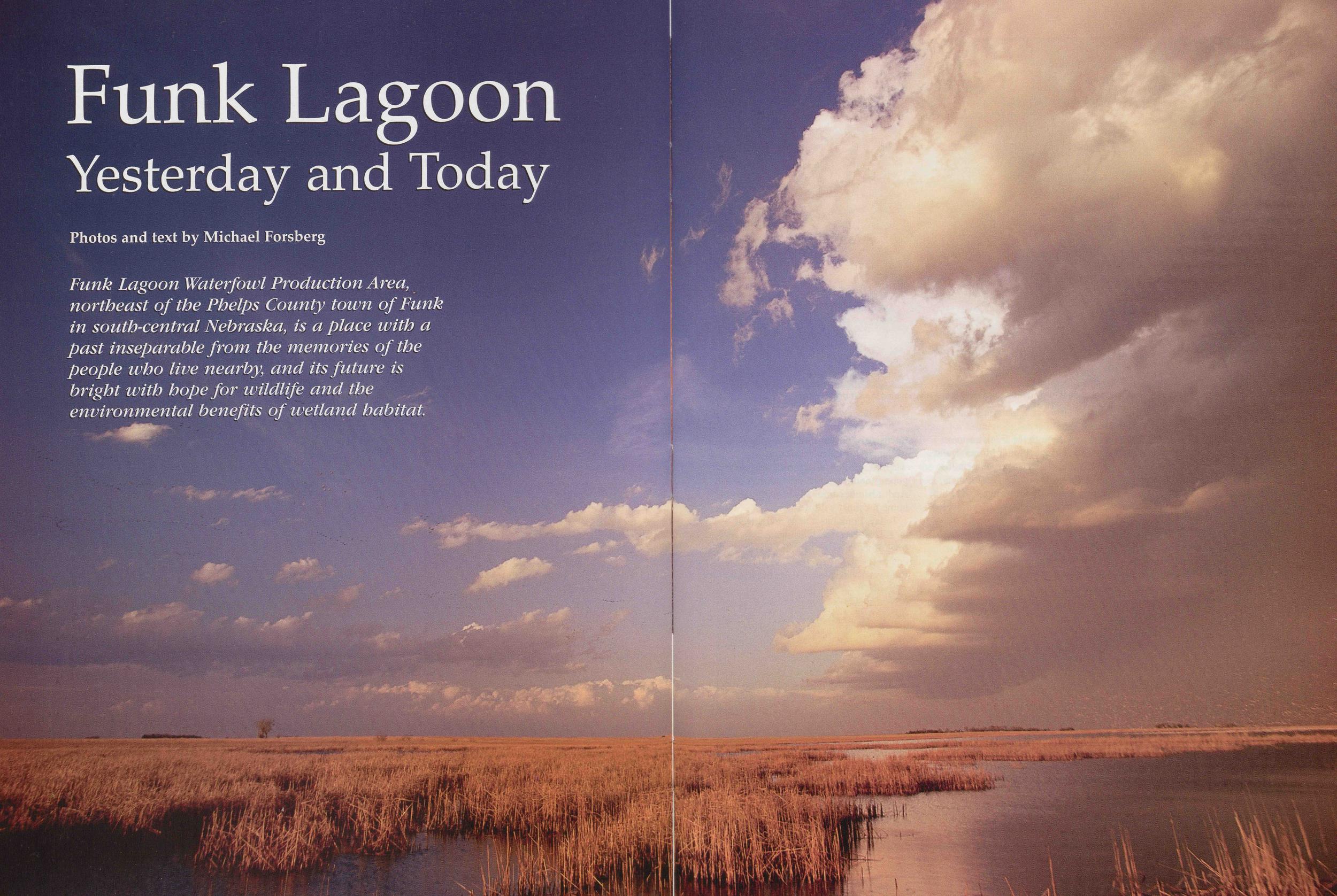
Funk Lagoon
Yesterday and Today Photos and text by Michael Forsberg Funk Lagoon Waterfowl Production Area, northeast of the Phelps County town of Funk in south-central Nebraska, is a place with a past inseparable from the memories of the people who live nearby, and its future is bright with hope for wildlife and the environmental benefits of wetland habitat.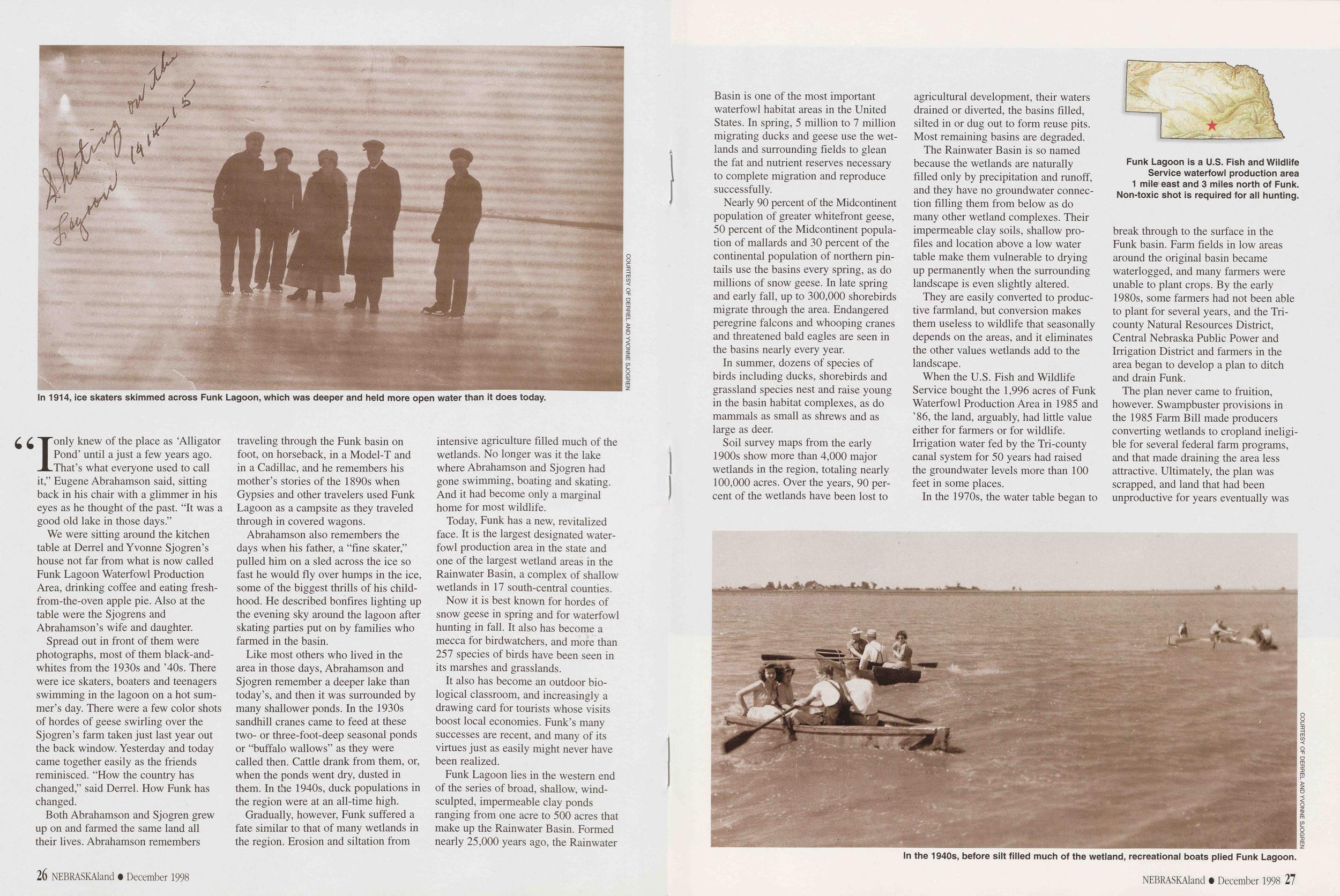
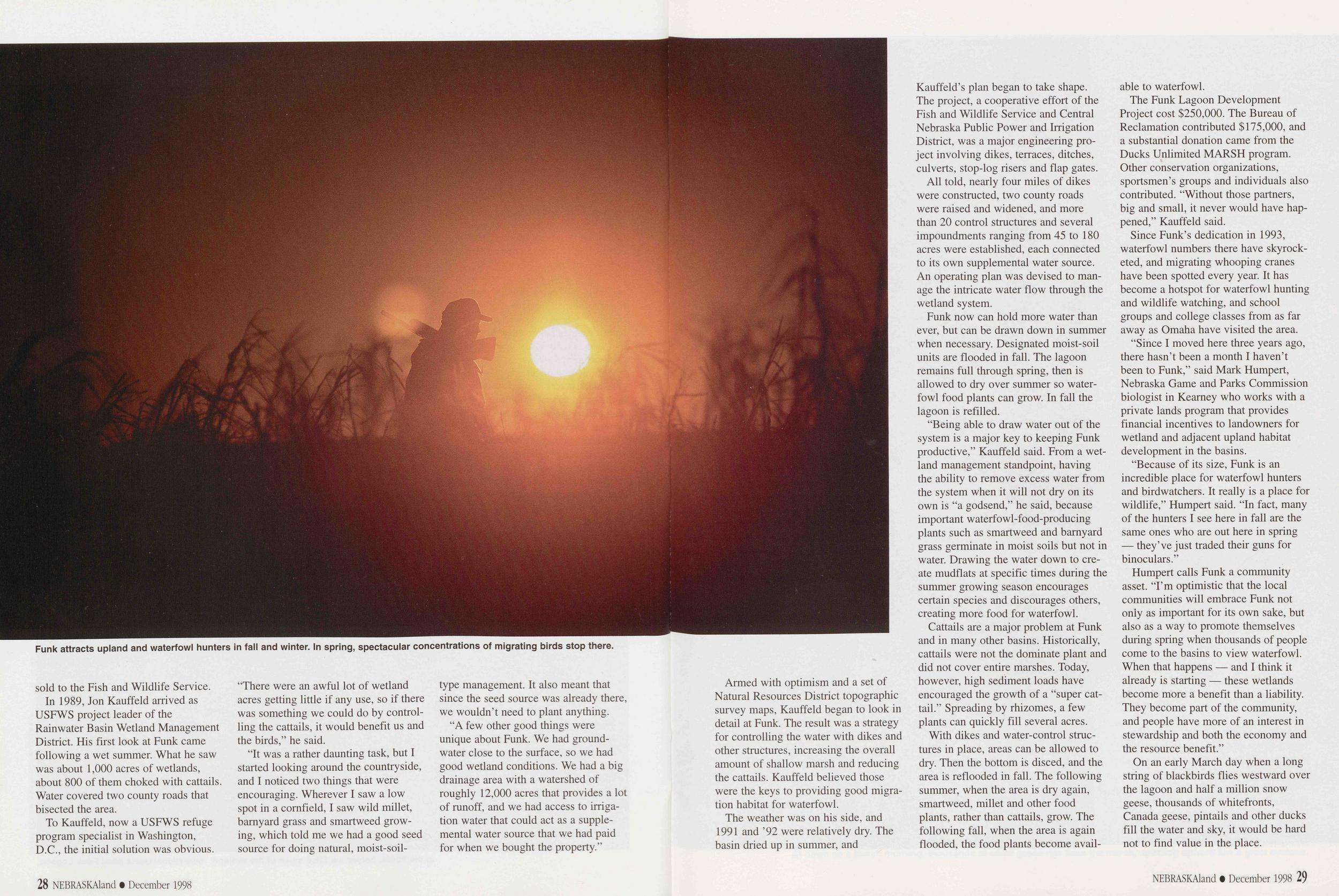
In 1914, ice skaters skimmed across Funk Lagoon, which was deeper and held more open water than it does today.
"I only knew of the place as 'Alligator Pond' until a just a few years ago. That's what everyone used to call it," Eugene Abrahamson said, sitting back in his chair with a glimmer in his eyes as he thought of the past. "It was a good old lake in those days."
We were sitting around the kitchen table at Derrel and Yvonne Sjogren's house not far from what is now called Funk Lagoon Waterfowl Production Area, drinking coffee and eating fresh- from-the-oven apple pie. Also at the table were the Sjogrens and Abrahamson's wife and daughter.
Spread out in front of them were photographs, most of them black-and- whites from the 1930s and '40s. There were ice skaters, boaters and teenagers swimming in the lagoon on a hot summer's day. There were a few color shots of hordes of geese swirling over the Sjogren's farm taken just last year out the back window. Yesterday and today came together easily as the friends reminisced. "How the country has changed," said Derrel. How Funk has changed.
Both Abrahamson and Sjogren grew up on and farmed the same land all their lives. Abrahamson remembers 26 NEBRASKAland • December 1998 traveling through the Funk basin on foot, on horseback, in a Model-T and in a Cadillac, and he remembers his mother's stories of the 1890s when Gypsies and other travelers used Funk Lagoon as a campsite as they traveled through in covered wagons.
Abrahamson also remembers the days when his father, a "fine skater," pulled him on a sled across the ice so fast he would fly over humps in the ice, some of the biggest thrills of his childhood. He described bonfires lighting up the evening sky around the lagoon after skating parties put on by families who farmed in the basin.
Like most others who lived in the area in those days, Abrahamson and Sjogren remember a deeper lake than today's, and then it was surrounded by many shallower ponds. In the 1930s sandhill cranes came to feed at these two- or three-foot-deep seasonal ponds or "buffalo wallows" as they were called then. Cattle drank from them, or, when the ponds went dry, dusted in them. In the 1940s, duck populations in the region were at an all-time high.
Gradually, however, Funk suffered a fate similar to that of many wetlands in the region. Erosion and siltation from intensive agriculture filled much of the wetlands. No longer was it the lake where Abrahamson and Sjogren had gone swimming, boating and skating. And it had become only a marginal home for most wildlife.
Today, Funk has a new, revitalized face. It is the largest designated waterfowl production area in the state and one of the largest wetland areas in the Rainwater Basin, a complex of shallow wetlands in 17 south-central counties.
Now it is best known for hordes of snow geese in spring and for waterfowl hunting in fall. It also has become a mecca for birdwatchers, and more than 257 species of birds have been seen in its marshes and grasslands.
It also has become an outdoor biological classroom, and increasingly a drawing card for tourists whose visits boost local economies. Funk's many successes are recent, and many of its virtues just as easily might never have been realized.
Funk Lagoon lies in the western end of the series of broad, shallow, wind- sculpted, impermeable clay ponds ranging from one acre to 500 acres that make up the Rainwater Basin. Formed nearly 25,000 years ago, the Rainwater
26 NEBRASKAland • December 1998Basin is one of the most important waterfowl habitat areas in the United States. In spring, 5 million to 7 million migrating ducks and geese use the wetlands and surrounding fields to glean the fat and nutrient reserves necessary to complete migration and reproduce successfully.
Nearly 90 percent of the Midcontinent population of greater whitefront geese, 50 percent of the Midcontinent population of mallards and 30 percent of the continental population of northern pintails use the basins every spring, as do millions of snow geese. In late spring and early fall, up to 300,000 shorebirds migrate through the area. Endangered peregrine falcons and whooping cranes and threatened bald eagles are seen in the basins nearly every year.
In summer, dozens of species of birds including ducks, shorebirds and grassland species nest and raise young in the basin habitat complexes, as do mammals as small as shrews and as large as deer.
Soil survey maps from the early 1900s show more than 4,000 major wetlands in the region, totaling nearly 100,000 acres. Over the years, 90 per- cent of the wetlands have been lost to agricultural development, their waters drained or diverted, the basins filled, silted in or dug out to form reuse pits. Most remaining basins are degraded.
The Rainwater Basin is so named because the wetlands are naturally filled only by precipitation and runoff, and they have no groundwater connection filling them from below as do many other wetland complexes. Their impermeable clay soils, shallow profiles and location above a low water table make them vulnerable to drying up permanently when the surrounding landscape is even slightly altered.
They are easily converted to productive farmland, but conversion makes them useless to wildlife that seasonally depends on the areas, and it eliminates the other values wetlands add to the landscape.
When the U.S. Fish and Wildlife Service bought the 1,996 acres of Funk Waterfowl Production Area in 1985 and '86, the land, arguably, had little value either for farmers or for wildlife. Irrigation water fed by the Tri-county canal system for 50 years had raised the groundwater levels more than 100 feet in some places.
In the 1970s, the water table began to
Funk Lagoon is a U.S. Fish and Wildlife Service waterfowl production area 1 mile east and 3 miles north of Funk. Non-toxic shot is required for all hunting.
break through to the surface in the Funk basin. Farm fields in low areas around the original basin became waterlogged, and many farmers were unable to plant crops. By the early 1980s, some farmers had not been able to plant for several years, and the Tri- county Natural Resources District, Central Nebraska Public Power and Irrigation District and farmers in the area began to develop a plan to ditch and drain Funk.
The plan never came to fruition, however. Swampbuster provisions in the 1985 Farm Bill made producers converting wetlands to cropland ineligible for several federal farm programs, and that made draining the area less attractive. Ultimately, the plan was scrapped, and land that had been unproductive for years eventually was
In the 1940s, before silt filled much of the wetland, recreational boats plied Funk Lagoon.
Funk attracts upland and waterfowl hunters in fall and winter. In spring, spectacular concentrations of migrating birds stop there.
sold to the Fish and Wildlife Service.
In 1989, Jon Kauffeld arrived as USFWS project leader of the Rainwater Basin Wetland Management District. His first look at Funk came following a wet summer. What he saw was about 1,000 acres of wetlands, about 800 of them choked with cattails. Water covered two county roads that bisected the area.
To Kauffeld, now a USFWS refuge program specialist in Washington, D.C., the initial solution was obvious. "There were an awful lot of wetland acres getting little if any use, so if there was something we could do by controlling the cattails, it would benefit us and the birds," he said.
"It was a rather daunting task, but I started looking around the countryside, and I noticed two things that were encouraging. Wherever I saw a low spot in a cornfield, I saw wild millet, barnyard grass and smartweed growing, which told me we had a good seed source for doing natural, moist-soil- type management. It also meant that since the seed source was already there, we wouldn't need to plant anything.
"A few other good things were unique about Funk. We had groundwater close to the surface, so we had good wetland conditions. We had a big drainage area with a watershed of roughly 12,000 acres that provides a lot of runoff, and we had access to irrigation water that could act as a supplemental water source that we had paid for when we bought the property."
28 NEBRASKAland • December 1998Armed with optimism and a set of Natural Resources District topographic survey maps, Kauffeld began to look in detail at Funk. The result was a strategy for controlling the water with dikes and other structures, increasing the overall amount of shallow marsh and reducing the cattails. Kauffeld believed those were the keys to providing good migration habitat for waterfowl.
The weather was on his side, and 1991 and '92 were relatively dry. The basin dried up in summer, and Kauffeld's plan began to take shape. The project, a cooperative effort of the Fish and Wildlife Service and Central Nebraska Public Power and Irrigation District, was a major engineering project involving dikes, terraces, ditches, culverts, stop-log risers and flap gates.
All told, nearly four miles of dikes were constructed, two county roads were raised and widened, and more than 20 control structures and several impoundments ranging from 45 to 180 acres were established, each connected to its own supplemental water source. An operating plan was devised to manage the intricate water flow through the wetland system.
Funk now can hold more water than ever, but can be drawn down in summer when necessary. Designated moist-soil units are flooded in fall. The lagoon remains full through spring, then is allowed to dry over summer so waterfowl food plants can grow. In fall the lagoon is refilled.
"Being able to draw water out of the system is a major key to keeping Funk productive," Kauffeld said. From a wetland management standpoint, having the ability to remove excess water from the system when it will not dry on its own is "a godsend," he said, because important waterfowl-food-producing plants such as smartweed and barnyard grass germinate in moist soils but not in water. Drawing the water down to create mudflats at specific times during the summer growing season encourages certain species and discourages others, creating more food for waterfowl.
Cattails are a major problem at Funk and in many other basins. Historically, cattails were not the dominate plant and did not cover entire marshes. Today, however, high sediment loads have encouraged the growth of a "super cattail." Spreading by rhizomes, a few plants can quickly fill several acres.
With dikes and water-control structures in place, areas can be allowed to dry. Then the bottom is disced, and the area is reflooded in fall. The following summer, when the area is dry again, smartweed, millet and other food plants, rather than cattails, grow. The following fall, when the area is again flooded, the food plants become available to waterfowl.
The Funk Lagoon Development Project cost $250,000. The Bureau of Reclamation contributed $175,000, and a substantial donation came from the Ducks Unlimited MARSH program. Other conservation organizations, sportsmen's groups and individuals also contributed. "Without those partners, big and small, it never would have happened," Kauffeld said.
Since Funk's dedication in 1993, waterfowl numbers there have skyrocketed, and migrating whooping cranes have been spotted every year. It has become a hotspot for waterfowl hunting and wildlife watching, and school groups and college classes from as far away as Omaha have visited the area.
"Since I moved here three years ago, there hasn't been a month I haven't been to Funk," said Mark Humpert, Nebraska Game and Parks Commission biologist in Kearney who works with a private lands program that provides financial incentives to landowners for wetland and adjacent upland habitat development in the basins.
"Because of its size, Funk is an incredible place for waterfowl hunters and birdwatchers. It really is a place for wildlife," Humpert said. "In fact, many of the hunters I see here in fall are the same ones who are out here in spring — they've just traded their guns for binoculars."
Humpert calls Funk a community asset. "I'm optimistic that the local communities will embrace Funk not only as important for its own sake, but also as a way to promote themselves during spring when thousands of people come to the basins to view waterfowl. When that happens — and I think it already is starting — these wetlands become more a benefit than a liability. They become part of the community, and people have more of an interest in stewardship and both the economy and the resource benefit."
On an early March day when a long string of blackbirds flies westward over the lagoon and half a million snow geese, thousands of whitefronts, Canada geese, pintails and other ducks fill the water and sky, it would be hard not to find value in the place.
NEBRASKAland • December 1998 29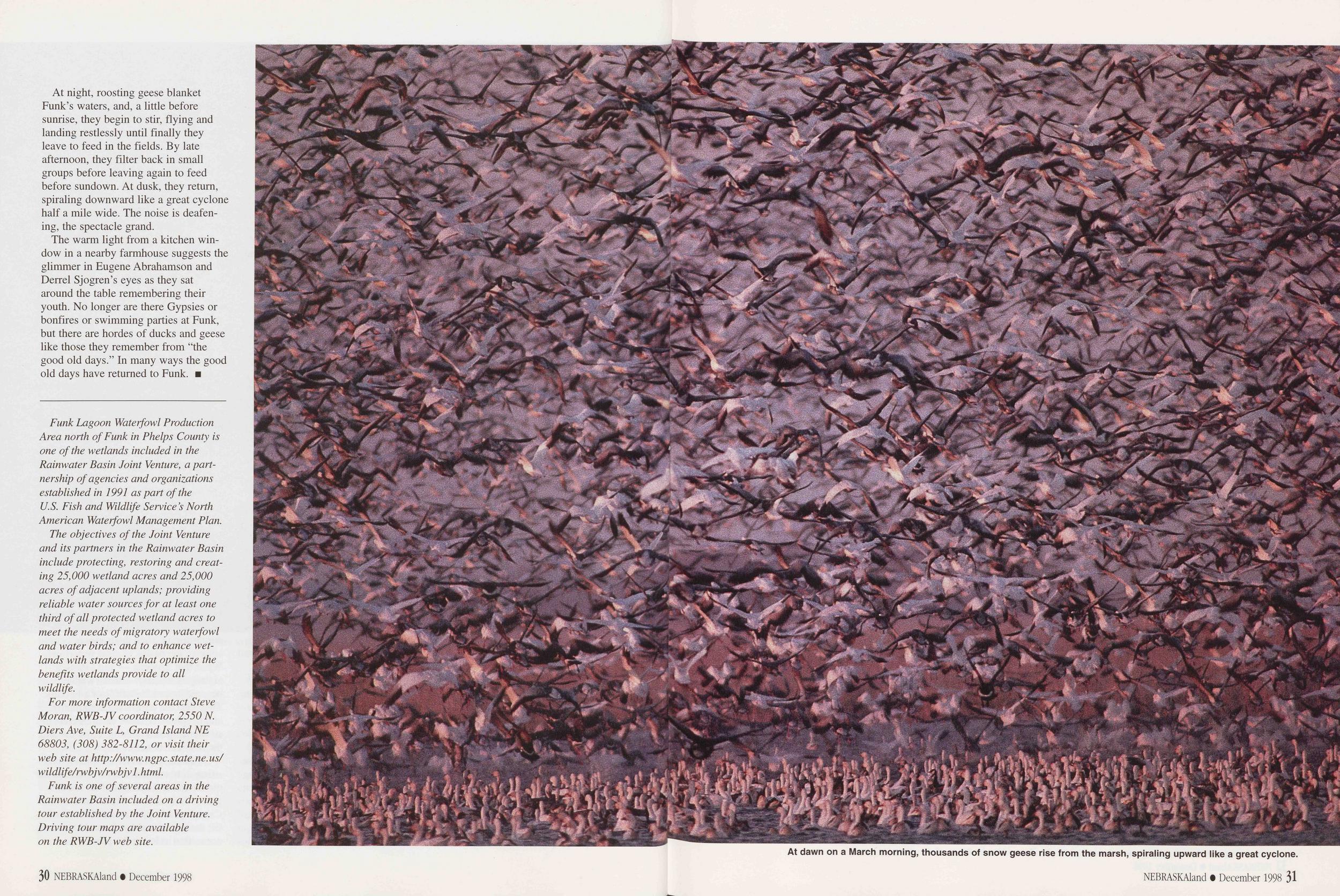
At night, roosting geese blanket Funk's waters, and, a little before sunrise, they begin to stir, flying and landing restlessly until finally they leave to feed in the fields. By late afternoon, they filter back in small groups before leaving again to feed before sundown. At dusk, they return, spiraling downward like a great cyclone half a mile wide. The noise is deafening, the spectacle grand.
The warm light from a kitchen window in a nearby farmhouse suggests the glimmer in Eugene Abrahamson and Derrel Sjogren's eyes as they sat around the table remembering their youth. No longer are there Gypsies or bonfires or swimming parties at Funk, but there are hordes of ducks and geese like those they remember from "the good old days." In many ways the good old days have returned to Funk.
Funk Lagoon Waterfowl Production Area north of Funk in Phelps County is one of the wetlands included in the Rainwater Basin Joint Venture, a partnership of agencies and organizations established in 1991 as part of the U.S. Fish and Wildlife Service's North American Waterfowl Management Plan. The objectives of the Joint Venture and its partners in the Rainwater Basin include protecting, restoring and creating 25,000 wetland acres and 25,000 acres of adjacent uplands; providing reliable water sources for at least one third of all protected wetland acres to meet the needs of migratory waterfowl and water birds; and to enhance wetlands with strategies that optimize the benefits wetlands provide to all wildlife. For more information contact Steve Moran, RWB-JV coordinator, 2550 N. Diers Ave, Suite L, Grand Island NE 68803, (308) 382-8112, or visit their web site at http://www.ngpc.state.ne.us/ wildlife/i'wbjv/rwbjvl. html. Funk is one of several areas in the Rainwater Basin included on a driving tour established by the Joint Venture. Driving tour maps are available on the RWB-JV web site. 30 NEBRASKAland • December 1998At dawn on a March morning, thousands of snow geese rise from the marsh, spiraling upward like a great cyclone.
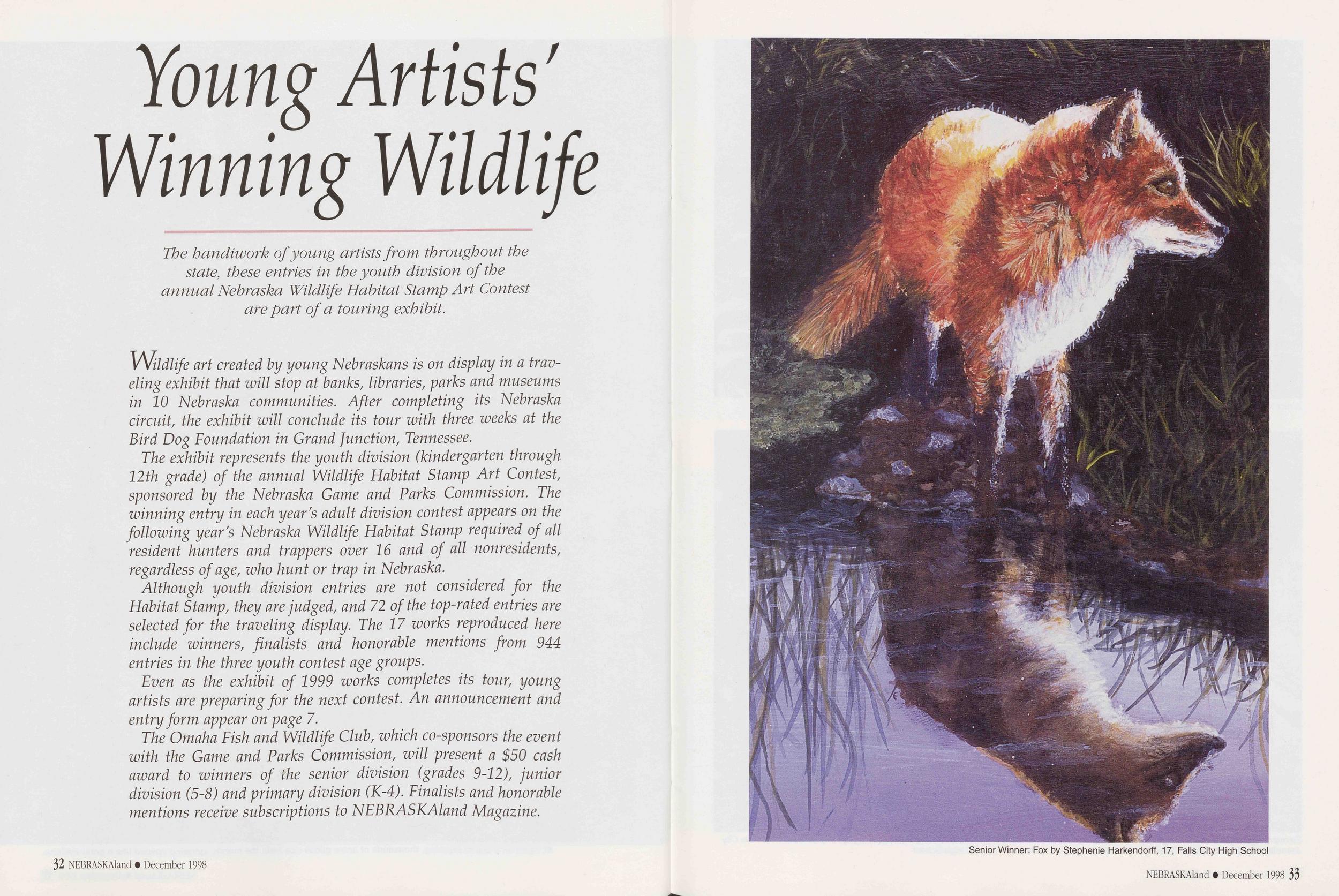
Young Artists' Winning Wildlife
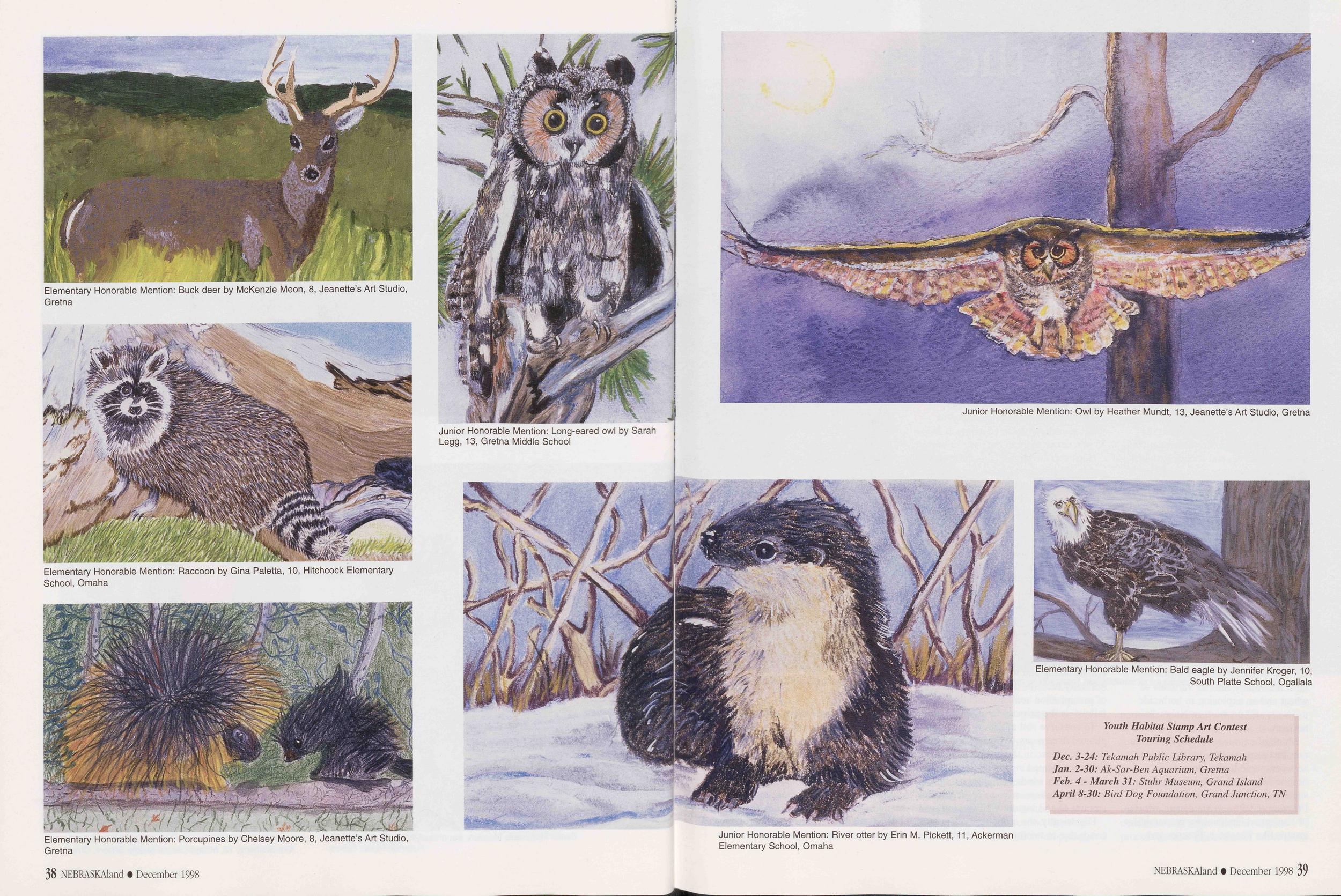
The handiwork of young artists from throughout the state, these entries in the youth division of the annual Nebraska Wildlife Habitat Stamp Art Contest are part of a touring exhibit.Wildlife art created by young Nebraskans is on display in a traveling exhibit that will stop at banks, libraries, parks and museums in 10 Nebraska communities. After completing its Nebraska circuit, the exhibit will conclude its tour with three weeks at the Bird Dog Foundation in Grand Junction, Tennessee.
The exhibit represents the youth division (kindergarten through 12th grade) of the annual Wildlife Habitat Stamp Art Contest, sponsored by the Nebraska Game and Parks Commission. The winning entry in each year's adult division contest appears on the following year's Nebraska Wildlife Habitat Stamp required of all resident hunters and trappers over 16 and of all nonresidents, regardless of age, who hunt or trap in Nebraska.
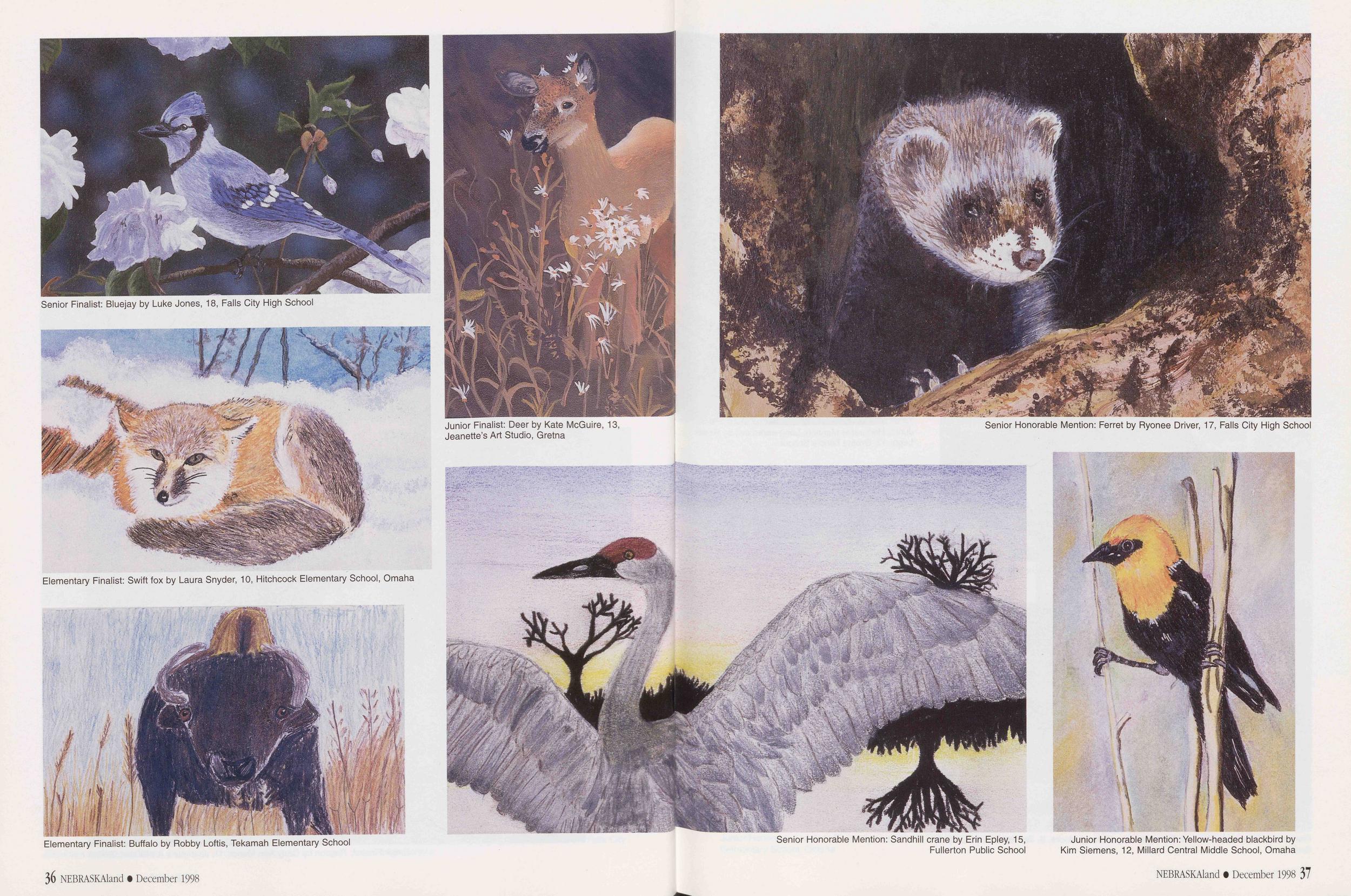
Although youth division entries are not considered for the Habitat Stamp, they are judged, and 72 of the top-rated entries are selected for the traveling display. The 17 works reproduced here include winners, finalists and honorable mentions from 944 entries in the three youth contest age groups.
Even as the exhibit of 1999 works completes its tour, young artists are preparing for the next contest. An announcement and entry form appear on page 7.
The Omaha Fish and Wildlife Club, which co-sponsors the event with the Game and Parks Commission, will present a $50 cash award to winners of the senior division (grades 9-12), junior division (5-8) and primary division (K-4). Finalists and honorable mentions receive subscriptions to NEBRASKAland Magazine.
32 NEBRASKAland • December 1998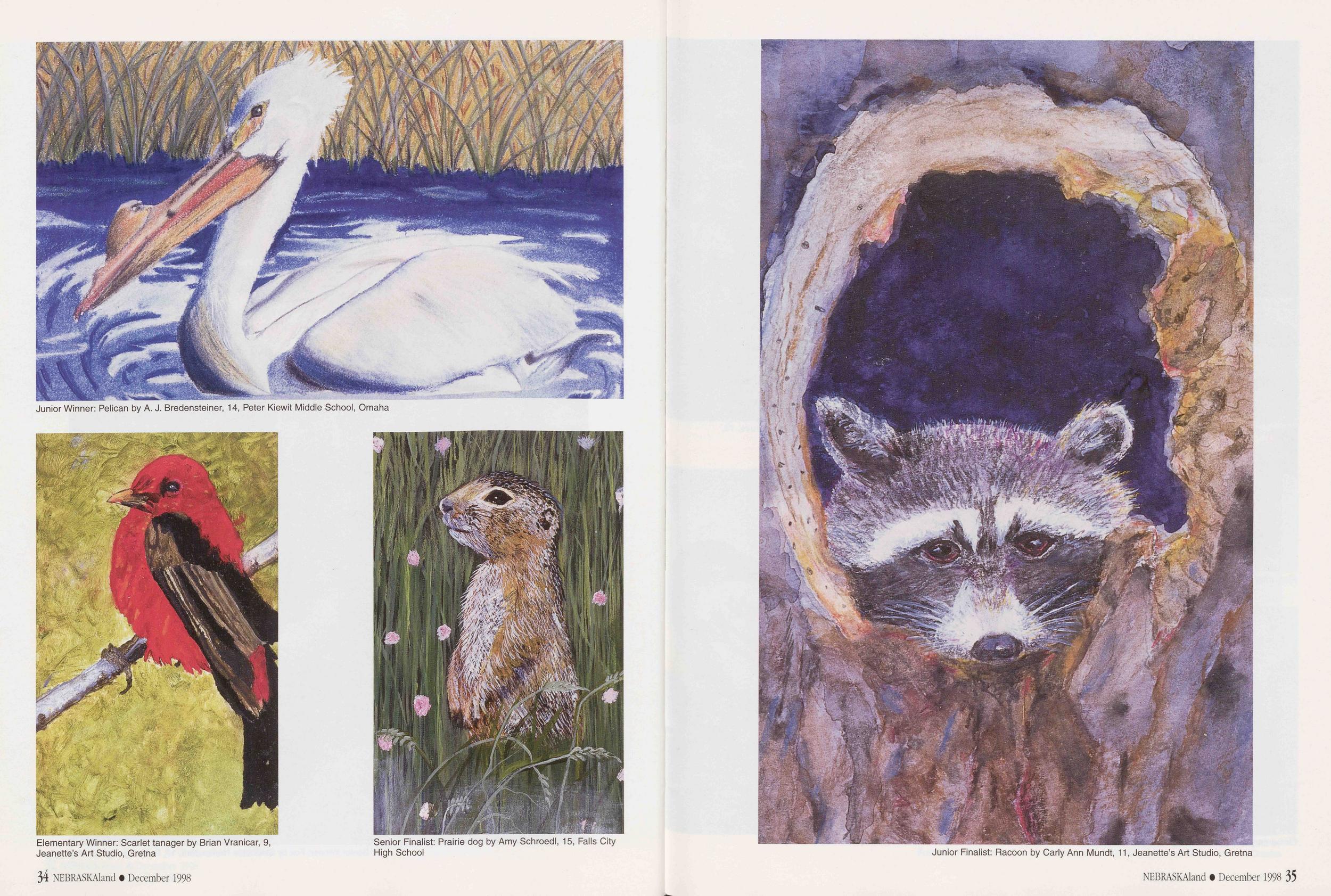
Habitat on the High Plains
By Ritch Nelson Photos by Bob Grier Recent research, innovative farming practices and habitat improvement programs all are focused on bolstering upland game bird populations in western Nebraska's High Plains.The year was 1961, and the ring-necked pheasant was king of Nebraska's game birds. Hunters and rural mail carriers conducting their annual wildlife surveys counted the bounty. A young hunter accompanying his father and several friends watched as pheasant after pheasant exploded into the sunrise from the tall weeds surrounding an abandoned farmstead, each rooster's cackle as sharp and clear as the frosty November morning.
Weedy fields, fencerows and farmsteads, abandoned after agriculture became less labor intensive, marked many areas of western Nebraska's High Plains well into the second half of this century. The elevated, relatively arid plains were still untouched by the wholesale changes that came with center-pivot irrigation beginning in the 1960s and the "fenceline-to-fenceline" fanning of the '70s. More efficient farm machinery, shorter varieties of wheat and an explosion in herbicide use were still on western Nebraska's horizon.
Much of extreme western Nebraska now has a sparse population of pheasants compared to the glory days, despite large-scale habitat programs such as the Conservation Reserve Program (CRP) and increasing efforts of concerned landowners, conservation groups like Pheasants Forever and wildlife biologists. Across the High Plains, a few pockets of good pheasant hunting have persisted, but overall, High Plains pheasant populations in some areas have declined as much as 75 percent or more in the past 30 years.
However, the High Plains landscape isn't without success or promise where game birds are concerned. Primarily as a result of the CRP, sharp-tailed grouse numbers have increased in most of the wheat-strip country of the Panhandle, and prairie chickens have responded favorably in southwestern Nebraska. Similar increases in prairie grouse numbers have been documented in other High Plains areas.
Wheat-fallow FarmingThe High Plains region of western Nebraska, eastern Colorado, southeastern Wyoming and western Kansas normally receives only 14 to 19 inches of precipitation annually, and "wheat-fallow" is the primary farming practice.
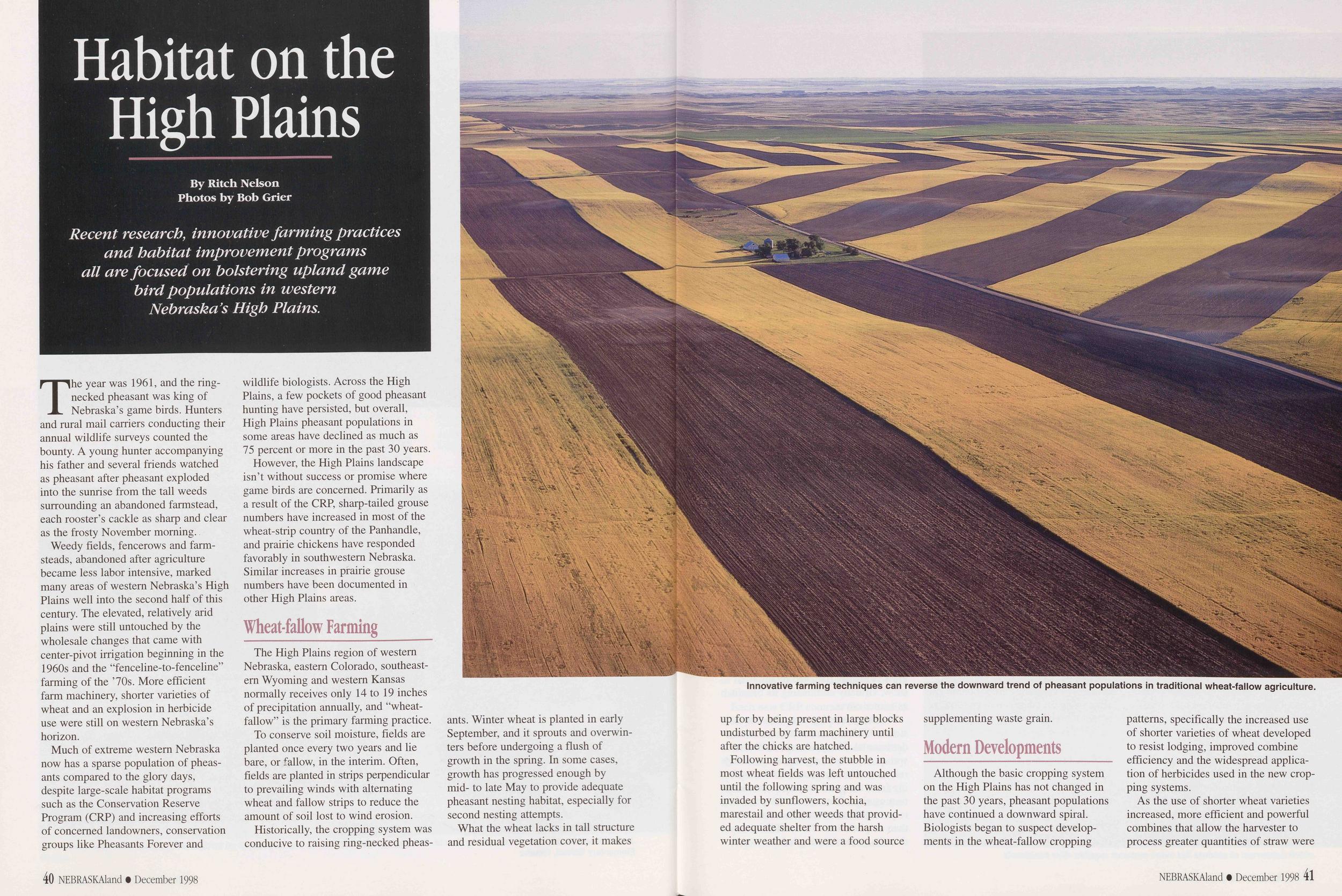
To conserve soil moisture, fields are planted once every two years and lie bare, or fallow, in the interim. Often, fields are planted in strips perpendicular to prevailing winds with alternating wheat and fallow strips to reduce the amount of soil lost to wind erosion.
Historically, the cropping system was conducive to raising ring-necked pheasants. Winter wheat is planted in early September, and it sprouts and overwinters before undergoing a flush of growth in the spring. In some cases, growth has progressed enough by mid- to late May to provide adequate pheasant nesting habitat, especially for second nesting attempts.
What the wheat lacks in tall structure and residual vegetation cover, it makes
40 NEBRASKAland • December 1998Innovative farming techniques can reverse the downward trend of pheasant populations in traditional wheat-fallow agriculture.
up for by being present in large blocks undisturbed by farm machinery until after the chicks are hatched.
Following harvest, the stubble in most wheat fields was left untouched until the following spring and was invaded by sunflowers, kochia, marestail and other weeds that provided adequate shelter from the harsh winter weather and were a food source supplementing waste grain.
Modern DevelopmentsAlthough the basic cropping system on the High Plains has not changed in the past 30 years, pheasant populations have continued a downward spiral. Biologists began to suspect developments in the wheat-fallow cropping patterns, specifically the increased use of shorter varieties of wheat developed to resist lodging, improved combine efficiency and the widespread application of herbicides used in the new cropping systems.
As the use of shorter wheat varieties increased, more efficient and powerful combines that allow the harvester to process greater quantities of straw were
NEBRASKAland • December 1998 41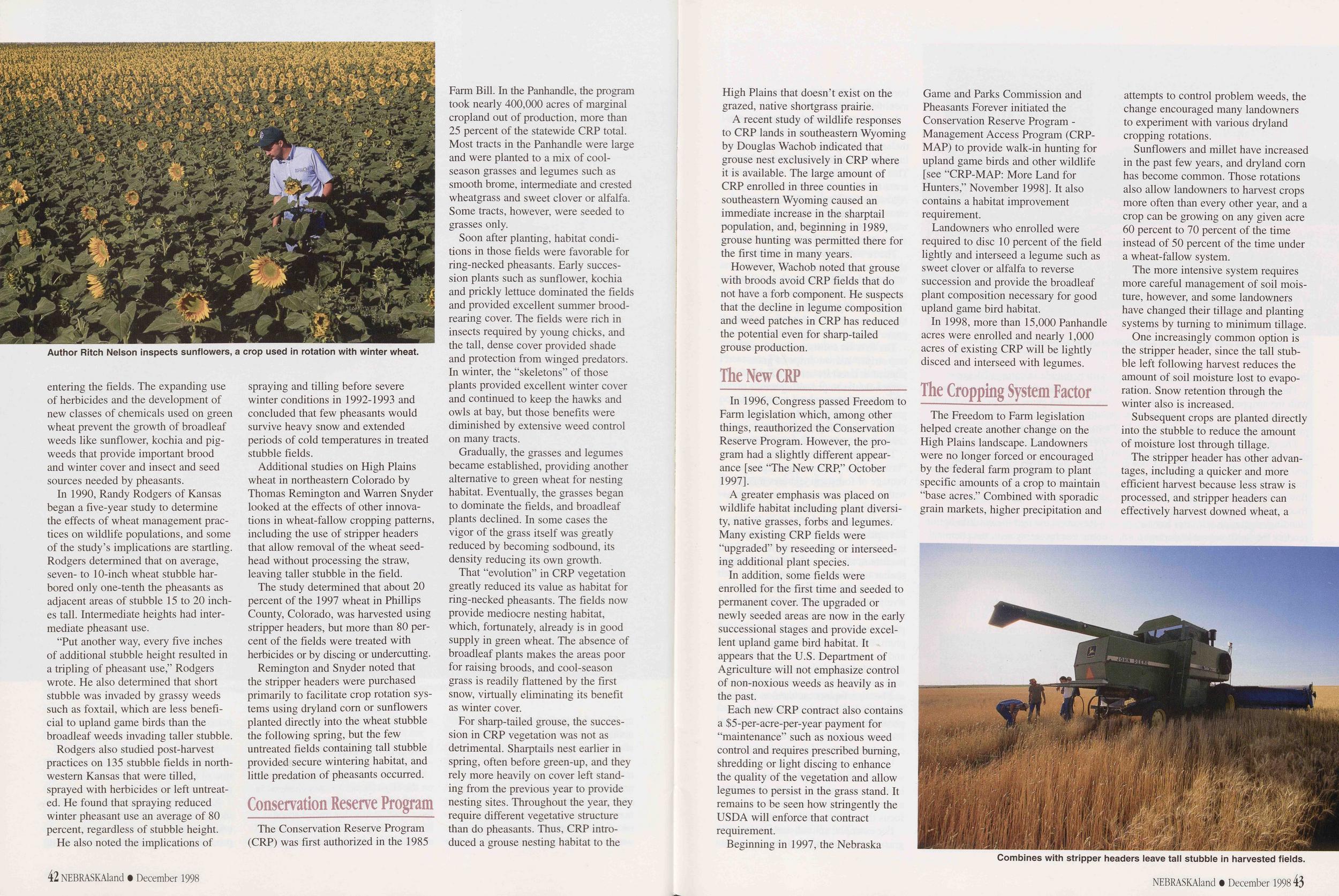
Author Ritch Nelson inspects sunflowers, a crop used in rotation with winter wheat.
entering the fields. The expanding use of herbicides and the development of new classes of chemicals used on green wheat prevent the growth of broadleaf weeds like sunflower, kochia and pig-weeds that provide important brood and winter cover and insect and seed sources needed by pheasants.
In 1990, Randy Rodgers of Kansas began a five-year study to determine the effects of wheat management practices on wildlife populations, and some of the study's implications are startling. Rodgers determined that on average, seven- to 10-inch wheat stubble harbored only one-tenth the pheasants as adjacent areas of stubble 15 to 20 inches tall. Intermediate heights had intermediate pheasant use.
"Put another way, every five inches of additional stubble height resulted in a tripling of pheasant use," Rodgers wrote. He also determined that short stubble was invaded by grassy weeds such as foxtail, which are less beneficial to upland game birds than the broadleaf weeds invading taller stubble.
Rodgers also studied post-harvest practices on 135 stubble fields in northwestern Kansas that were tilled, sprayed with herbicides or left untreated. He found that spraying reduced winter pheasant use an average of 80 percent, regardless of stubble height.
He also noted the implications of spraying and tilling before severe winter conditions in 1992-1993 and concluded that few pheasants would survive heavy snow and extended periods of cold temperatures in treated stubble fields.
Additional studies on High Plains wheat in northeastern Colorado by Thomas Remington and Warren Snyder looked at the effects of other innovations in wheat-fallow cropping patterns, including the use of stripper headers that allow removal of the wheat seed-head without processing the straw, leaving taller stubble in the field.
The study determined that about 20 percent of the 1997 wheat in Phillips County, Colorado, was harvested using stripper headers, but more than 80 percent of the fields were treated with herbicides or by discing or undercutting.
Remington and Snyder noted that the stripper headers were purchased primarily to facilitate crop rotation systems using dryland corn or sunflowers planted directly into the wheat stubble the following spring, but the few untreated fields containing tall stubble provided secure wintering habitat, and little predation of pheasants occurred.
Conservation Reserve ProgramThe Conservation Reserve Program (CRP) was first authorized in the 1985 Farm Bill. In the Panhandle, the program took nearly 400,000 acres of marginal cropland out of production, more than 25 percent of the statewide CRP total. Most tracts in the Panhandle were large and were planted to a mix of cool-season grasses and legumes such as smooth brome, intermediate and crested wheatgrass and sweet clover or alfalfa. Some tracts, however, were seeded to grasses only.
Soon after planting, habitat conditions in those fields were favorable for ring-necked pheasants. Early succession plants such as sunflower, kochia and prickly lettuce dominated the fields and provided excellent summer brood-rearing cover. The fields were rich in insects required by young chicks, and the tall, dense cover provided shade and protection from winged predators. In winter, the "skeletons" of those plants provided excellent winter cover and continued to keep the hawks and owls at bay, but those benefits were diminished by extensive weed control on many tracts.
Gradually, the grasses and legumes became established, providing another alternative to green wheat for nesting habitat. Eventually, the grasses began to dominate the fields, and broadleaf plants declined. In some cases the vigor of the grass itself was greatly reduced by becoming sodbound, its density reducing its own growth.
That "evolution" in CRP vegetation greatly reduced its value as habitat for ring-necked pheasants. The fields now provide mediocre nesting habitat, which, fortunately, already is in good supply in green wheat. The absence of broadleaf plants makes the areas poor for raising broods, and cool-season grass is readily flattened by the first snow, virtually eliminating its benefit as winter cover.
For sharp-tailed grouse, the succession in CRP vegetation was not as detrimental. Sharptails nest earlier in spring, often before green-up, and they rely more heavily on cover left standing from the previous year to provide nesting sites. Throughout the year, they require different vegetative structure than do pheasants. Thus, CRP introduced a grouse nesting habitat to the
42 NEBRASKAland • December 1998High Plains that doesn't exist on the grazed, native shortgrass prairie.
A recent study of wildlife responses to CRP lands in southeastern Wyoming by Douglas Wachob indicated that grouse nest exclusively in CRP where it is available. The large amount of CRP enrolled in three counties in southeastern Wyoming caused an immediate increase in the sharptail population, and, beginning in 1989, grouse hunting was permitted there for the first time in many years.
However, Wachob noted that grouse with broods avoid CRP fields that do not have a forb component. He suspects that the decline in legume composition and weed patches in CRP has reduced the potential even for sharp-tailed grouse production.
>The New CRPIn 1996, Congress passed Freedom to Farm legislation which, among other things, reauthorized the Conservation Reserve Program. However, the program had a slightly different appearance [see "The New CRP," October 1997].
A greater emphasis was placed on wildlife habitat including plant diversity, native grasses, forbs and legumes. Many existing CRP fields were "upgraded" by reseeding or interseeding additional plant species.
In addition, some fields were enrolled for the first time and seeded to permanent cover. The upgraded or newly seeded areas are now in the early successional stages and provide excellent upland game bird habitat. It appears that the U.S. Department of Agriculture will not emphasize control of non-noxious weeds as heavily as in the past.
Each new CRP contract also contains a $5-per-acre-per-year payment for "maintenance" such as noxious weed control and requires prescribed burning, shredding or light discing to enhance the quality of the vegetation and allow legumes to persist in the grass stand. It remains to be seen how stringently the USDA will enforce that contract requirement.
Beginning in 1997, the Nebraska Game and Parks Commission and Pheasants Forever initiated the Conservation Reserve Program - Management Access Program (CRP- MAP) to provide walk-in hunting for upland game birds and other wildlife [see "CRP-MAP: More Land for Hunters," November 1998]. It also contains a habitat improvement requirement.
Landowners who enrolled were required to disc 10 percent of the field lightly and interseed a legume such as sweet clover or alfalfa to reverse succession and provide the broadleaf plant composition necessary for good upland game bird habitat.
In 1998, more than 15,000 Panhandle acres were enrolled and nearly 1,000 acres of existing CRP will be lightly disced and interseed with legumes.
The Cropping System FactorThe Freedom to Farm legislation helped create another change on the High Plains landscape. Landowners were no longer forced or encouraged by the federal farm program to plant specific amounts of a crop to maintain "base acres." Combined with sporadic grain markets, higher precipitation and attempts to control problem weeds, the change encouraged many landowners to experiment with various dryland cropping rotations.
Sunflowers and millet have increased in the past few years, and dryland corn has become common. Those rotations also allow landowners to harvest crops more often than every other year, and a crop can be growing on any given acre 60 percent to 70 percent of the time instead of 50 percent of the time under a wheat-fallow system.
The more intensive system requires more careful management of soil moisture, however, and some landowners have changed their tillage and planting systems by turning to minimum tillage.
One increasingly common option is the stripper header, since the tall stubble left following harvest reduces the amount of soil moisture lost to evaporation. Snow retention through the winter also is increased.
Subsequent crops are planted directly into the stubble to reduce the amount of moisture lost through tillage.
The stripper header has other advantages, including a quicker and more efficient harvest because less straw is processed, and stripper headers can effectively harvest downed wheat, a
Combines with stripper headers leave tall stubble in harvested fields.
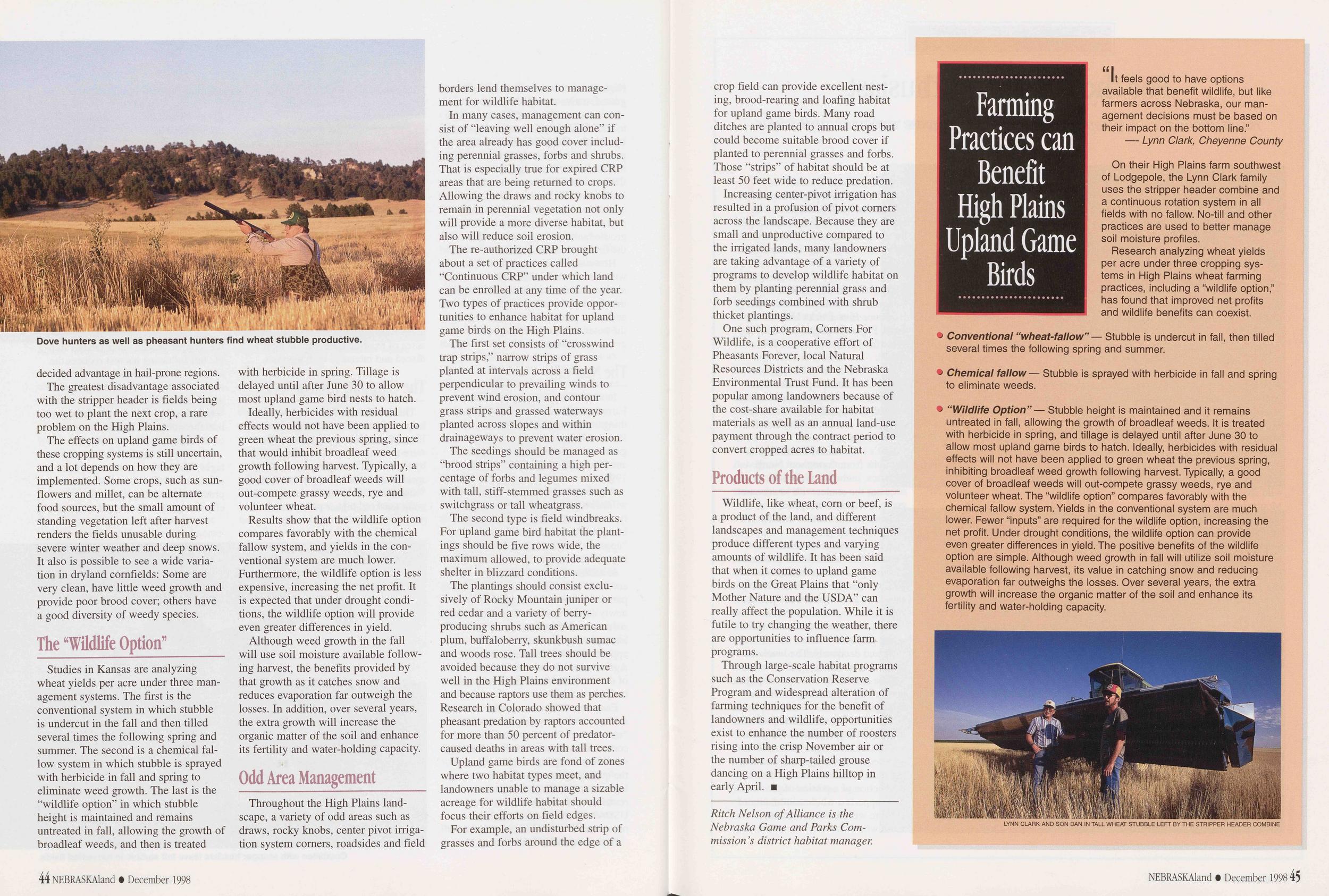
Dove hunters as well as pheasant hunters find wheat stubble productive.
decided advantage in hail-prone regions.
The greatest disadvantage associated with the stripper header is fields being too wet to plant the next crop, a rare problem on the High Plains.
The effects on upland game birds of these cropping systems is still uncertain, and a lot depends on how they are implemented. Some crops, such as sunflowers and millet, can be alternate food sources, but the small amount of standing vegetation left after harvest renders the fields unusable during severe winter weather and deep snows. It also is possible to see a wide variation in dryland cornfields: Some are very clean, have little weed growth and provide poor brood cover; others have a good diversity of weedy species.
The "Wildlife Option"Studies in Kansas are analyzing wheat yields per acre under three management systems. The first is the conventional system in which stubble is undercut in the fall and then tilled several times the following spring and summer. The second is a chemical fallow system in which stubble is sprayed with herbicide in fall and spring to eliminate weed growth. The last is the "wildlife option" in which stubble height is maintained and remains untreated in fall, allowing the growth of broadleaf weeds, and then is treated with herbicide in spring. Tillage is delayed until after June 30 to allow most upland game bird nests to hatch.
Ideally, herbicides with residual effects would not have been applied to green wheat the previous spring, since that would inhibit broadleaf weed growth following harvest. Typically, a good cover of broadleaf weeds will out-compete grassy weeds, rye and volunteer wheat.
Results show that the wildlife option compares favorably with the chemical fallow system, and yields in the conventional system are much lower. Furthermore, the wildlife option is less expensive, increasing the net profit. It is expected that under drought conditions, the wildlife option will provide even greater differences in yield.
Although weed growth in the fall will use soil moisture available following harvest, the benefits provided by that growth as it catches snow and reduces evaporation far outweigh the losses. In addition, over several years, the extra growth will increase the organic matter of the soil and enhance its fertility and water-holding capacity.
Odd Area ManagementThroughout the High Plains landscape, a variety of odd areas such as draws, rocky knobs, center pivot irrigation system corners, roadsides and field borders lend themselves to management for wildlife habitat.
In many cases, management can consist of "leaving well enough alone" if the area already has good cover including perennial grasses, forbs and shrubs. That is especially true for expired CRP areas that are being returned to crops. Allowing the draws and rocky knobs to remain in perennial vegetation not only will provide a more diverse habitat, but also will reduce soil erosion.
The re-authorized CRP brought about a set of practices called "Continuous CRP" under which land can be enrolled at any time of the year. Two types of practices provide opportunities to enhance habitat for upland game birds on the High Plains.
The first set consists of "crosswind trap strips," narrow strips of grass planted at intervals across a field perpendicular to prevailing winds to prevent wind erosion, and contour grass strips and grassed waterways planted across slopes and within drainageways to prevent water erosion.
The seedings should be managed as "brood strips" containing a high percentage of forbs and legumes mixed with tall, stiff-stemmed grasses such as switchgrass or tall wheatgrass.
The second type is field windbreaks. For upland game bird habitat the plantings should be five rows wide, the maximum allowed, to provide adequate shelter in blizzard conditions.
The plantings should consist exclusively of Rocky Mountain juniper or red cedar and a variety of berry-producing shrubs such as American plum, buffaloberry, skunkbush sumac and woods rose. Tall trees should be avoided because they do not survive well in the High Plains environment and because raptors use them as perches. Research in Colorado showed that pheasant predation by raptors accounted for more than 50 percent of predator-caused deaths in areas with tall trees.
Upland game birds are fond of zones where two habitat types meet, and landowners unable to manage a sizable acreage for wildlife habitat should focus their efforts on field edges.
For example, an undisturbed strip of grasses and forbs around the edge of a
44 NEBRASKAland • December 1998crop field can provide excellent nesting, brood-rearing and loafing habitat for upland game birds. Many road ditches are planted to annual crops but could become suitable brood cover if planted to perennial grasses and forbs. Those "strips" of habitat should be at least 50 feet wide to reduce predation.
Increasing center-pivot irrigation has resulted in a profusion of pivot corners across the landscape. Because they are small and unproductive compared to the irrigated lands, many landowners are taking advantage of a variety of programs to develop wildlife habitat on them by planting perennial grass and forb seedings combined with shrub thicket plantings.
One such program, Corners For Wildlife, is a cooperative effort of Pheasants Forever, local Natural Resources Districts and the Nebraska Environmental Trust Fund. It has been popular among landowners because of the cost-share available for habitat materials as well as an annual land-use payment through the contract period to convert cropped acres to habitat.
Products of the LandWildlife, like wheat, corn or beef, is a product of the land, and different landscapes and management techniques produce different types and varying amounts of wildlife. It has been said that when it comes to upland game birds on the Great Plains that "only Mother Nature and the USDA" can really affect the population. While it is futile to try changing the weather, there are opportunities to influence farm programs.
Through large-scale habitat programs such as the Conservation Reserve Program and widespread alteration of farming techniques for the benefit of landowners and wildlife, opportunities exist to enhance the number of roosters rising into the crisp November air or the number of sharp-tailed grouse dancing on a High Plains hilltop in early April.
Ritch Nelson of Alliance is the Nebraska Game and Parks Commission's district habitat manager.LYNN CLARK AND SON DAN IN TALL WHEAT STUBBLE LEFT BY THE STRIPPER HEADER COMBINE
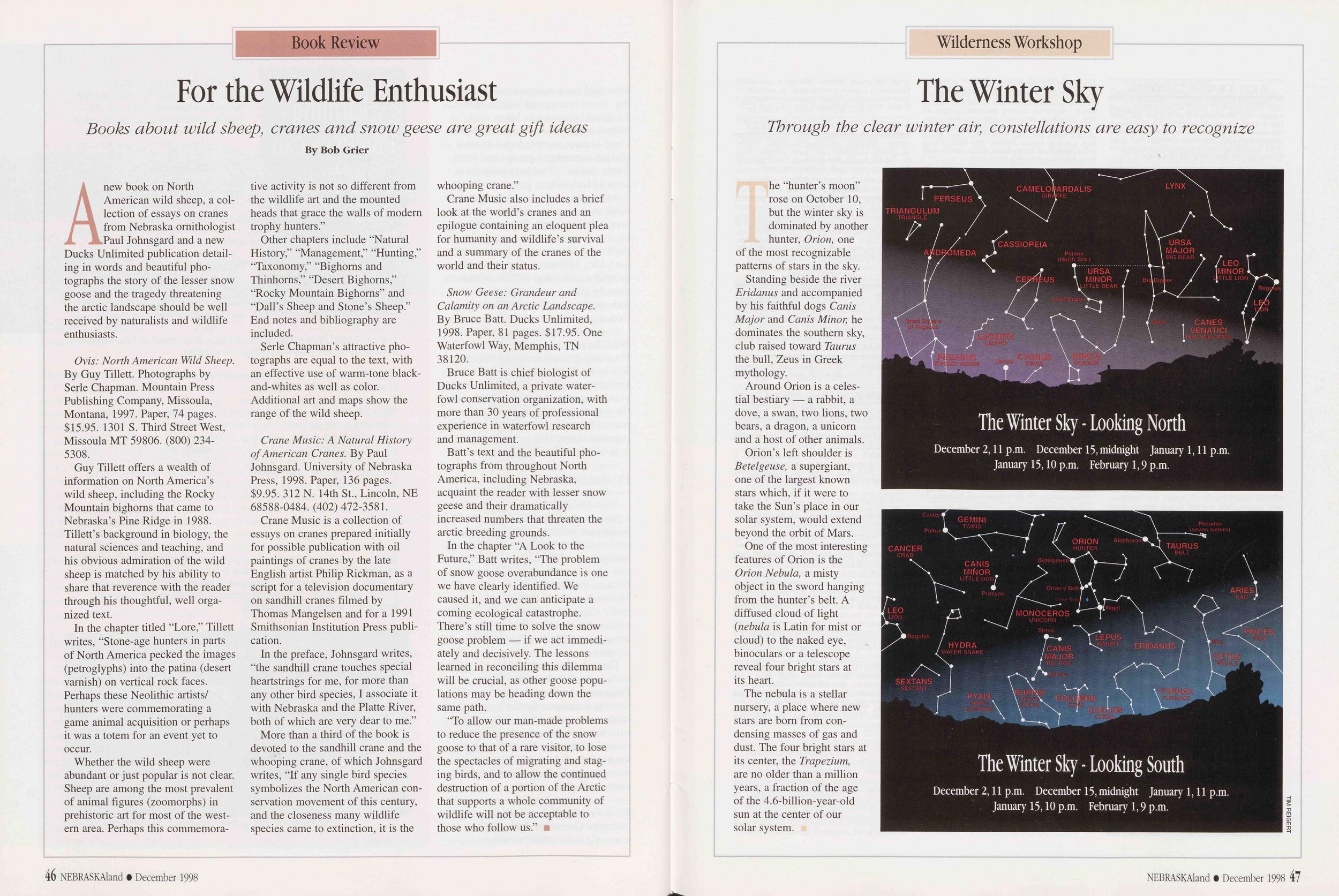
Book Review
For the Wildlife Enthusiast
Books about wild sheep, cranes and snow geese are great gift ideas By Bob GrierA new book on North American wild sheep, a col- lection of essays on cranes from Nebraska ornithologist Paul Johnsgard and a new Ducks Unlimited publication detail- ing in words and beautiful pho- tographs the story of the lesser snow goose and the tragedy threatening the arctic landscape should be well received by naturalists and wildlife enthusiasts.
Ovis: North American Wild Sheep. By Guy Tillett. Photographs by Serle Chapman. Mountain Press Publishing Company, Missoula, Montana, 1997. Paper, 74 pages. $15.95. 1301 S. Third Street West, Missoula MT 59806. (800) 234- 5308.Guy Tillett offers a wealth of information on North America's wild sheep, including the Rocky Mountain bighorns that came to Nebraska's Pine Ridge in 1988. Tillett's background in biology, the natural sciences and teaching, and his obvious admiration of the wild sheep is matched by his ability to share that reverence with the reader through his thoughtful, well orga- nized text.
In the chapter titled "Lore," Tillett writes, "Stone-age hunters in parts of North America pecked the images (petroglyphs) into the patina (desert varnish) on vertical rock faces. Perhaps these Neolithic artists/ hunters were commemorating a game animal acquisition or perhaps it was a totem for an event yet to occur.
Whether the wild sheep were abundant or just popular is not clear. Sheep are among the most prevalent of animal figures (zoomorphs) in prehistoric art for most of the west- ern area. Perhaps this commemora- tive activity is not so different from the wildlife art and the mounted heads that grace the walls of modern trophy hunters."
Other chapters include "Natural History," "Management," "Hunting," "Taxonomy," "Bighorns and Thinhorns," "Desert Bighorns," "Rocky Mountain Bighorns" and "Dall's Sheep and Stone's Sheep." End notes and bibliography are included.
Serle Chapman's attractive pho- tographs are equal to the text, with an effective use of warm-tone black- and-whites as well as color. Additional art and maps show the range of the wild sheep.
Crane Music: A Natural History of American Cranes. By Paul Johnsgard. University of Nebraska Press, 1998. Paper, 136 pages. $9.95. 312 N. 14th St., Lincoln, NE 68588-0484. (402) 472-3581.Crane Music is a collection of essays on cranes prepared initially for possible publication with oil paintings of cranes by the late English artist Philip Rickman, as a script for a television documentary on sandhill cranes filmed by Thomas Mangelsen and for a 1991 Smithsonian Institution Press publi- cation.
In the preface, Johnsgard writes, "the sandhill crane touches special heartstrings for me, for more than any other bird species, I associate it with Nebraska and the Platte River, both of which are very dear to me."
More than a third of the book is devoted to the sandhill crane and the whooping crane, of which Johnsgard writes, "If any single bird species symbolizes the North American con- servation movement of this century, and the closeness many wildlife species came to extinction, it is the whooping crane."
Crane Music also includes a brief look at the world's cranes and an epilogue containing an eloquent plea for humanity and wildlife's survival and a summary of the cranes of the world and their status.
Snow Geese: Grandeur and Calamity on an Arctic Landscape. By Bruce Batt. Ducks Unlimited, 1998. Paper, 81 pages. $17.95. One Waterfowl Way, Memphis, TN 38120.Bruce Batt is chief biologist of Ducks Unlimited, a private water- fowl conservation organization, with more than 30 years of professional experience in waterfowl research and management.
Batt's text and the beautiful pho- tographs from throughout North America, including Nebraska, acquaint the reader with lesser snow geese and their dramatically increased numbers that threaten the arctic breeding grounds.
In the chapter "A Look to the Future," Batt writes, "The problem of snow goose overabundance is one we have clearly identified. We caused it, and we can anticipate a coming ecological catastrophe. There's still time to solve the snow goose problem — if we act immedi- ately and decisively. The lessons learned in reconciling this dilemma will be crucial, as other goose popu- lations may be heading down the same path.
"To allow our man-made problems to reduce the presence of the snow goose to that of a rare visitor, to lose the spectacles of migrating and stag- ing birds, and to allow the continued destruction of a portion of the Arctic that supports a whole community of wildlife will not be acceptable to those who follow us."
46 NEBRASKAland • December 1998Wilderness Workshop
The Winter Sky
Through the clear winter air, constellations are easy to recognizeThe "hunter's moon" rose on October 10, but the winter sky is dominated by another hunter, Orion, one of the most recognizable patterns of stars in the sky. Standing beside the river Eridanus and accompanied by his faithful dogs Cards Major and Canis Minor, he dominates the southern sky, club raised toward Taurus the bull, Zeus in Greek mythology.
Around Orion is a celestial bestiary — a rabbit, a dove, a swan, two lions, two bears, a dragon, a unicorn and a host of other animals.
Orion's left shoulder is Betelgeuse, a supergiant, one of the largest known stars which, if it were to take the Sun's place in our solar system, would extend beyond the orbit of Mars.
One of the most interesting features of Orion is the Orion Nebula, a misty object in the sword hanging from the hunter's belt. A diffused cloud of light (nebula is Latin for mist or cloud) to the naked eye, binoculars or a telescope reveal four bright stars at its heart.
The nebula is a stellar nursery, a place where new stars are born from con- densing masses of gas and dust. The four bright stars at its center, the Trapezium, are no older than a million years, a fraction of the age of the 4.6-billion-year-old sun at the center of our solar system.
The Winter Sky-Looking North December 2,11 p.m. December 15, midnight January 1,11 p.m. January 15,10 p.m. February 1,9 p.m.
The Winter Sky-Looking South December 2,11 p.m. December 15, midnight January 1,11 p.m. January 15,10 p.m. February 1,9 p.m.
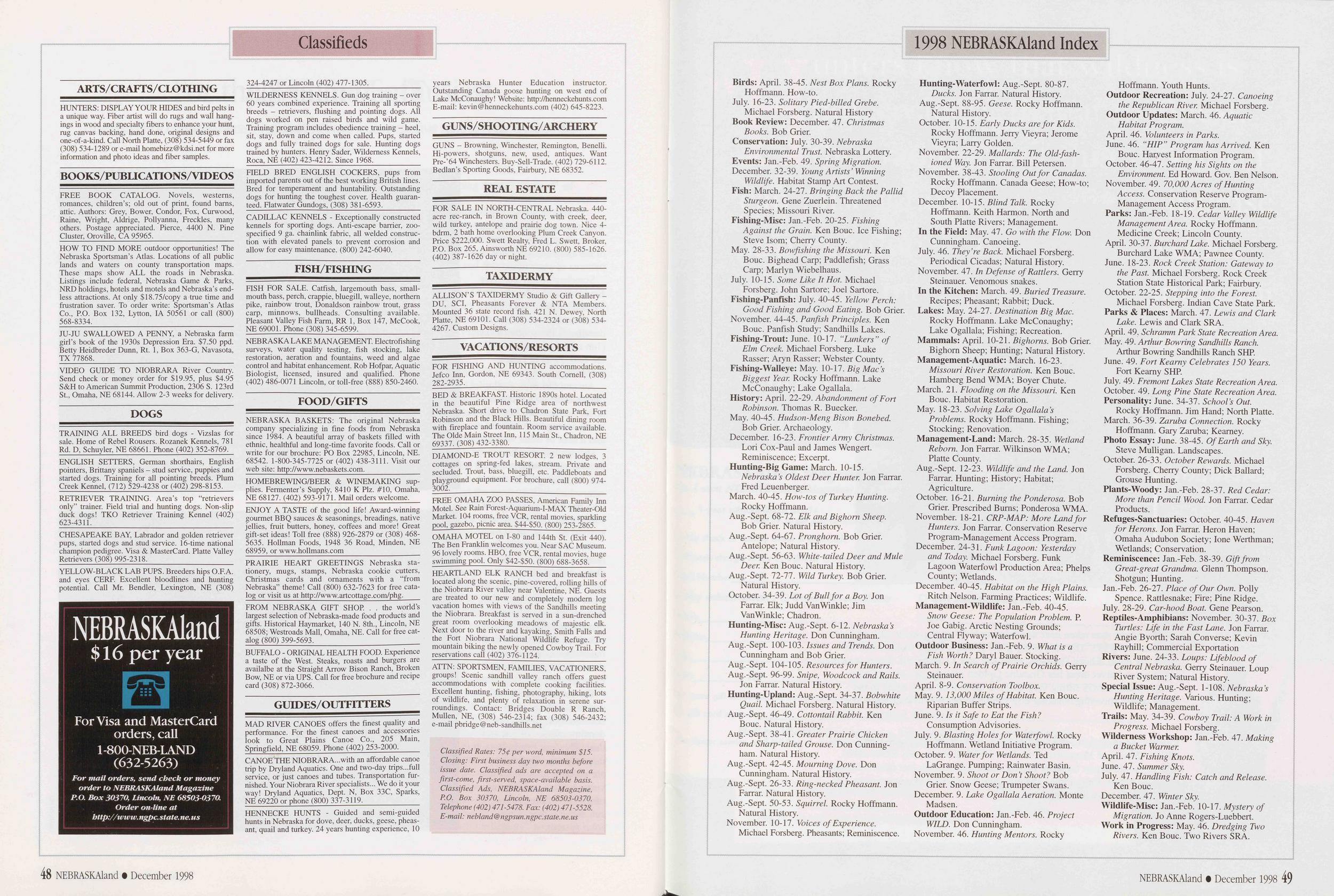
Classifieds
ARTS/CRAFTS/CLOTHING HUNTERS: DISPLAY YOUR HIDES and bird pelts in a unique way. Fiber artist will do rugs and wall hangings in wood and specialty fibers to enhance your hunt, rug canvas backing, hand done, original designs and one-of-a-kind. Call North Platte, (308) 534-5449 or fax (308) 534-1289 or e-mail homebizz@kdsi.net for more information and photo ideas and fiber samples. BOOKS/PUBLICATIONS/VIDEOS FREE BOOK CATALOG. Novels, westerns, romances, children's; old out of print, found barns, attic. Authors: Grey, Bower, Condor, Fox, Curwood, Raine, Wright, Aldrige, Pollyanna, Freckles, many others. Postage appreciated. Pierce, 4400 N. Pine Cluster, Oroville, CA 95965. HOW TO FIND MORE outdoor opportunities! The Nebraska Sportsman's Atlas. Locations of all public lands and waters on county transportation maps. These maps show ALL the roads in Nebraska. Listings include federal, Nebraska Game & Parks, NRD holdings, hotels and motels and Nebraska's endless attractions. At only $18.75/copy a true time and frustration saver. To order write: Sportsman's Atlas Co., P.O. Box 132, Lytton, IA 50561 or call (800) 568-8334. JU-JU SWALLOWED A PENNY, a Nebraska farm girl's book of the 1930s Depression Era. $7.50 ppd. Betty Heidbreder Dunn, Rt. 1, Box 363-G, Navasota, TX 77868. VIDEO GUIDE TO NIOBRARA River Country. Send check or money order for $19.95, plus $4.95 S&H to American Summit Production, 2306 S. 123rd St., Omaha, NE 68144. Allow 2-3 weeks for delivery. DOGS TRAINING ALL BREEDS bird dogs - Vizslas for sale. Home of Rebel Rousers. Rozanek Kennels, 781 Rd. D, Schuyler, NE 68661. Phone (402) 352-8769. ENGLISH SETTERS, German shorthairs, English pointers, Brittany spaniels - stud service, puppies and started dogs. Training for all pointing breeds. Plum Creek Kennel, (712) 529-4238 or (402) 298-8153. RETRIEVER TRAINING. Area's top "retrievers only" trainer. Field trial and hunting dogs. Non-slip duck dogs! TKO Retriever Training Kennel (402) 623-4311. CHESAPEAKE BAY, Labrador and golden retriever pups, started dogs and stud service. 16-time national champion pedigree. Visa & MasterCard. Platte Valley Retrievers (308) 995-2318. YELLOW-BLACK LAB PUPS. Breeders hips O.F.A. and eyes CERF. Excellent bloodlines and hunting potential. Call Mr. Bendler, Lexington, NE (308) 324-4247 or Lincoln (402) 477-1305. NEBRASKAland $16 per year For Visa and MasterCard orders, call 1-800-NEB-LAND (632-5263) For mail orders, send check or money order to NEBRASKAland Magazine P.O. Box 30370, Lincoln, NE 68503-0370. Order on-line at http://www. ngpc. state, ne. us WILDERNESS KENNELS. Gun dog training - over 60 years combined experience. Training all sporting breeds - retrievers, flushing and pointing dogs. All dogs worked on pen raised birds and wild game. Training program includes obedience training - heel, sit, stay, down and come when called. Pups, started dogs and fully trained dogs for sale. Hunting dogs trained by hunters. Henry Sader, Wilderness Kennels, Roca, NE (402) 423-4212. Since 1968. FIELD BRED ENGLISH COCKERS, pups from imported parents out of the best working British lines. Bred for temperament and huntability. Outstanding dogs for hunting the toughest cover. Health guaranteed. Flatwater Gundogs, (308) 381-6593. CADILLAC KENNELS - Exceptionally constructed kennels for sporting dogs. Anti-escape barrier, zoo- specified 9 ga. chainlink fabric, all welded construction with elevated panels to prevent corrosion and allow for easy maintenance. (800) 242-6040. FISH/FISHING FISH FOR SALE. Catfish, largemouth bass, smallmouth bass, perch, crappie, bluegill, walleye, northern pike, rainbow trout, Donaldson rainbow trout, grass carp, minnows, bullheads. Consulting available. Pleasant Valley Fish Farm, RR 1, Box 147, McCook, NE 69001. Phone (308) 345-6599. NEBRASKA LAKE MANAGEMENT. Electrofishing surveys, water quality testing, fish stocking, lake restoration, aeration and fountains, weed and algae control and habitat enhancement. Rob Hofpar, Aquatic Biologist, licensed, insured and qualified. Phone (402) 486-0071 Lincoln, or toll-free (888) 850-2460. FOOD/GIFTS NEBRASKA BASKETS: The original Nebraska company specializing in fine foods from Nebraska since 1984. A beautiful array of baskets filled with ethnic, healthful and long-time favorite foods. Call or write for our brochure: PO Box 22985, Lincoln, NE. 68542. 1-800-345-7725 or (402) 438-3111. Visit our web site: http://www.nebaskets.com. HOMEBREWING/BEER & WINEMAKING supplies. Fermenter's Supply, 8410 K Plz. #10, Omaha, NE 68127. (402) 593-9171. Mail orders welcome. ENJOY A TASTE of the good life! Award-winning gourmet BBQ sauces & seasonings, breadings, native jellies, fruit butters, honey, coffees and more! Great gift-set ideas! Toll free (888) 926-2879 or (308) 468- 5635. Hollman Foods, 1948 36 Road, Minden, NE 68959, or www.hollmans.com PRAIRIE HEART GREETINGS Nebraska sta- tionery, mugs, stamps, Nebraska cookie cutters, Christmas cards and ornaments with a "from Nebraska" theme! Call (800) 632-7623 for free catalog or visit us at http://www.artcottage.com/phg. FROM NEBRASKA GIFT SHOP. . . the world's largest selection of Nebraska-made food products and gifts. Historical Haymarket, 140 N. 8th., Lincoln, NE 68508; Westroads Mall, Omaha, NE. Call for free catalog (800) 399-5693. BUFFALO - ORIGINAL HEALTH FOOD. Experience a taste of the West. Steaks, roasts and burgers are availalbe at the Straight Arrow Bison Ranch, Broken Bow, NE or via UPS. Call for free brochure and recipe card (308) 872-3066. GUIDES/OUTFITTERS MAD RIVER CANOES offers the finest quality and performance. For the finest canoes and accessories look to Great Plains Canoe Co., 205 Main, Springfield, NE 68059. Phone (402) 253-2000. CANOE THE NIOBIlARA...with an affordable canoe trip by Dryland Aquatics. One and two-day trips...full service, or just canoes and tubes. Transportation furnished. Your Niobrara River specialists... We do it your way! Dryland Aquatics, Dept. N, Box 33C, Sparks, NE 69220 or phone (800) 337-3119. HENNECKE HUNTS - Guided and semi-guided hunts in Nebraska for dove, deer, ducks, geese, pheasant, quail and turkey. 24 years hunting experience, 10 years Nebraska Hunter Education instructor. Outstanding Canada goose hunting on west end of Lake McConaughy! Website: http://henneckehunts.com E-mail: kevin@henneckehunts.com (402) 645-8223. GUNS/SHOOTING/ARCHERY GUNS - Browning, Winchester, Remington, Benelli. Hi-powers, shotguns, new, used, antiques. Want Pre-'64 Winchesters. Buy-Sell-Trade. (402) 729-6112. Bedlan's Sporting Goods, Fairbury, NE 68352. REAL ESTATE FOR SALE IN NORTH-CENTRAL Nebraska. 440-acre rec-ranch, in Brown County, with creek, deer, wild turkey, antelope and prairie dog town. Nice 4-bdrm, 2 bath home overlooking Plum Creek Canyon. Price $222,000. Swett Realty, Fred L. Swett, Broker, P.O. Box 265, Ainsworth NE 69210. (800) 585-1626. (402) 387-1626 day or night. TAXIDERMY ALLISON'S TAXIDERMY Studio & Gift Gallery - DU, SCI, Pheasants Forever & NTA Members. Mounted 36 state record fish. 421 N. Dewey. North Platte, NE 69101. Call (308) 534-2324 or (308) 534- 4267. Custom Designs. VACATIONS/RESORTS FOR FISHING AND HUNTING accommodations. Jefco Inn. Gordon, NE 69343. South Cornell, (308) 282-2935. BED & BREAKFAST. Historic 1890s hotel. Located in the beautiful Pine Ridge area of northwest Nebraska. Short drive to Chadron State Park, Fort Robinson and the Black Hills. Beautiful dining room with fireplace and fountain. Room service available. The Olde Main Street Inn, 115 Main St., Chadron, NE 69337. (308) 432-3380. DIAMOND-E TROUT RESORT. 2 new lodges, 3 cottages on spring-fed lakes, stream. Private and secluded. Trout, bass, bluegill, etc. Paddleboats and playground equipment. For brochure, call (800) 974- 3002. FREE OMAHA ZOO PASSES, American Family Inn Motel. See Rain Forest-Aquarium-I-MAX Theater-Old Market. 104 rooms, free VCR, rental movies, sparkling pool, gazebo, picnic area. $44-$50. (800) 253-2865. OMAHA MOTEL on 1-80 and 144th St. (Exit 440). The Ben Franklin welcomes you. Near SAC Museum. 96 lovely rooms. HBO, free VCR, rental movies, huge swimming pool. Only $42-$50. (800) 688-3658. HEARTLAND ELK RANCH bed and breakfast is located along the scenic, pine-covered, rolling hills of the Niobrara River valley near Valentine, NE. Guests are treated to our new and completely modern log vacation homes with views of the Sandhills meeting the Niobrara. Breakfast is served in a sun-drenched great room overlooking meadows of majestic elk. Next door to the river and kayaking, Smith Falls and the Fort Niobrara National Wildlife Refuge. Try mountain biking the newly opened Cowboy Trail. For reservations call (402) 376-1124. ATTN: SPORTSMEN, FAMILIES, VACATIONERS, groups! Scenic sandhill valley ranch offers guest accommodations with complete cooking facilities. Excellent hunting, fishing, photography, hiking, lots of wildlife, and plenty of relaxation in serene surroundings. Contact: Bridges Double R Ranch, Mullen, NE, (308) 546-2314; fax (308) 546-2432; e-mail pbridge@neb-sandhills.net Classified Rates: 75t per word, minimum $15. Closing: First business day two months before issue date. Classified ads are accepted on a first-come, first-served, space-available basis. Classified Ads, NEBRASKAland Magazine, P.O. Box 30370, Lincoln, NE 68503-0370. Telephone (402) 471-5478. Fax: (402) 471-5528. E-mail: nebland@ngpsun.ngpc.state.ne.us 48 NEBRASKAland • December 19981998 NEBRASKAland Index
Birds: April. 38-45. Nest Box Plans. Rocky Hoffmann. How-to. July. 16-23. Solitary Pied-billed Grebe. Michael Forsberg. Natural History Book Review: December. 47. Christmas Books. Bob Grier. Conservation: July. 30-39. Nebraska Environmental Trust. Nebraska Lottery. Events: Jan.-Feb. 49. Spring Migration. December. 32-39. Young Artists'Winning Wildlife. Habitat Stamp Art Contest. Fish: March. 24-27. Bringing Back the Pallid Sturgeon. Gene Zuerlein. Threatened Species; Missouri River. Fishing-Misc: Jan.-Feb. 20-25. Fishing Against the Grain. Ken Bouc. Ice Fishing; Steve Isom; Cherry County. May. 28-33. Bowfishing the Missouri. Ken Bouc. Bighead Carp; Paddlefish; Grass Carp; Marlyn Wiebelhaus. July. 10-15. Some Like It Hot. Michael Forsberg. John Sartore; Joel Sartore. Fishing-Panfish: July. 40-45. Yellow Perch: Good Fishing and Good Eating. Bob Grier. November. 44-45. Panfish Principles. Ken Bouc. Panfish Study; Sandhills Lakes. Fishing-Trout: June. 10-17. "Lunkers" of Elm Creek. Michael Forsberg. Luke Rasser; Aryn Rasser; Webster County. Fishing-Walleye: May. 10-17. Big Mac's Biggest Year. Rocky Hoffmann. Lake McConaughy; Lake Ogallala. History: April. 22-29. Abandonment of Fort Robinson. Thomas R. Buecker. May. 40-45. Hudson-Meng Bison Bonebed. Bob Grier. Archaeology. December. 16-23. Frontier Army Christmas. Lori Cox-Paul and James Wengert. Reminiscence; Excerpt. Hunting-Big Game: March. 10-15. Nebraska's Oldest Deer Hunter. Jon Farrar. Fred Leuenberger. March. 40-45. How-tos of Turkey Hunting. Rocky Hoffmann. Aug.-Sept. 68-72. Elk and Bighorn Sheep. Bob Grier. Natural History. Aug.-Sept. 64-67. Pronghorn. Bob Grier. Antelope; Natural History. Aug.-Sept. 56-63. White-tailed Deer and Mule Deer. Ken Bouc. Natural History. Aug.-Sept. 72-77. Wild Turkey. Bob Grier. Natural History. October. 34-39. Lot of Bull for a Boy. Jon Farrar. Elk; Judd Van Winkle; Jim Van Winkle; Chadron. Hunting-Misc: Aug.-Sept. 6-12. Nebraska's Hunting Heritage. Don Cunningham. Aug.-Sept. 100-103. Issues and Trends. Don Cunningham and Bob Grier. Aug.-Sept. 104-105. Resources for Hunters. Aug.-Sept. 96-99. Snipe, Woodcock and Rails. Jon Farrar. Natural History. Hunting-Upland: Aug.-Sept. 34-37. Bobwhite Quail. Michael Forsberg. Natural History. Aug.-Sept. 46-49. Cottontail Rabbit. Ken Bouc. Natural History. Aug.-Sept. 38-41. Greater Prairie Chicken and Sharp-tailed Grouse. Don Cunningham. Natural History. Aug.-Sept. 42-45. Mourning Dove. Don Cunningham. Natural History. Aug.-Sept. 26-33. Ring-necked Pheasant. Jon Farrar. Natural History. Aug.-Sept. 50-53. Squirrel. Rocky Hoffmann. Natural History. November. 10-17. Voices of Experience. Michael Forsberg. Pheasants; Reminiscence. 1998 NEBRASKAland Index Hunting-Waterfowl: Aug.-Sept. 80-87. Ducks. Jon Farrar. Natural History. Aug.-Sept. 88-95. Geese. Rocky Hoffmann. Natural History. October. 10-15. Early Ducks are for Kids. Rocky Hoffmann. Jerry Vieyra; Jerome Vieyra; Larry Golden. November. 22-29. Mallards: The Old-fashioned Way. Jon Farrar. Bill Petersen. November. 38-43. Stooling Out for Canadas. Rocky Hoffmann. Canada Geese; How-to; Decoy Placement. December. 10-15. Blind Talk. Rocky Hoffmann. Keith Harmon. North and South Platte Rivers; Management. In the Field: May. 47. Go with the Flow. Don Cunningham. Canoeing. July. 46. They 're Back. Michael Forsberg. Periodical Cicadas; Natural History. November. 47. In Defense of Rattlers. Gerry Steinauer. Venomous snakes. In the Kitchen: March. 49. Buried Treasure. Recipes; Pheasant; Rabbit; Duck. Lakes: May. 24-27. Destination Big Mac. Rocky Hoffmann. Lake McConaughy; Lake Ogallala; Fishing; Recreation. Mammals: April. 10-21. Bighorns. Bob Grier. Bighorn Sheep; Hunting; Natural History. Management-Aquatic: March. 16-23. Missouri River Restoration. Ken Bouc. Hamberg Bend WMA; Boyer Chute. March. 21. Flooding on the Missouri. Ken Bouc. Habitat Restoration. May. 18-23. Solving Lake Ogallala's Problems. Rocky Hoffmann. Fishing; Stocking; Renovation. Management-Land: March. 28-35. Wetland Reborn. Jon Farrar. Wilkinson WMA; Platte County. Aug.-Sept. 12-23. Wildlife and the Land. Jon Farrar. Hunting; History; Habitat; Agriculture. October. 16-21. Burning the Ponderosa. Bob Grier. Prescribed Burns; Ponderosa WMA. November. 18-21. CRP-MAP: More Land for Hunters. Jon Farrar. Conservation Reserve Program-Management Access Program. December. 24-31. Funk Lagoon: Yesterday and Today. Michael Forsberg. Funk Lagoon Waterfowl Production Area; Phelps County; Wetlands. December. 40-45. Habitat on the High Plains. Ritch Nelson. Fanning Practices; Wildlife. Management-Wildlife: Jan.-Feb. 40-45. Snow Geese: The Population Problem. P. Joe Gabig. Arctic Nesting Grounds; Central Fly way; Waterfowl. Outdoor Business: Jan.-Feb. 9. What is a Fish Worth? Daryl Bauer. Stocking. March. 9. In Search of Prairie Orchids. Gerry Steinauer. April. 8-9. Conservation Toolbox. May. 9. 13,000 Miles of Habitat. Ken Bouc. Riparian Buffer Strips. June. 9. Is it Safe to Eat the Fish? Consumption Advisories. July. 9. Blasting Holes for Waterfowl. Rocky Hoffmann. Wetland Initiative Program. October. 9. Water for Wetlands. Ted LaGrange. Pumping; Rainwater Basin. November. 9. Shoot or Don't Shoot? Bob Grier. Snow Geese; Trumpeter Swans. December. 9. Lake Ogallala Aeration. Monte Madsen. Outdoor Education: Jan.-Feb. 46. Project WILD. Don Cunningham. November. 46. Hunting Mentors. Rocky Hoffmann. Youth Hunts. Outdoor Recreation: July. 24-27. Canoeing the Republican River. Michael Forsberg. Outdoor Updates: March. 46. Aquatic Habitat Program. April. 46. Volunteers in Parks. June. 46. "HIP" Program has Arrived. Ken Bouc. Harvest Information Program. October. 46-47. Setting his Sights on the Environment. Ed Howard. Gov. Ben Nelson. November. 49. 70,000 Acres of Hunting Access. Conservation Reserve Program- Management Access Program. Parks: Jan.-Feb. 18-19. Cedar Valley Wildlife Management Area. Rocky Hoffmann. Medicine Creek; Lincoln County. April. 30-37. Burchard Lake. Michael Forsberg. Burchard Lake WMA; Pawnee County. June. 18-23. Rock Creek Station: Gateway to the Past. Michael Forsberg. Rock Creek Station State Historical Park; Fairbury. October. 22-25. Stepping into the Forest. Michael Forsberg. Indian Cave State Park. Parks & Places: March. 47. Lewis and Clark Lake. Lewis and Clark SRA. April. 49. Schramm Park State Recreation Area. May. 49. Arthur Bowring Sandhills Ranch. Arthur Bowring Sandhills Ranch SHP. June. 49. Fort Kearny Celebrates 150 Years. Fort Kearny SHP. July. 49. Fremont Lakes State Recreation Area. October. 49. Long Pine State Recreation Area. Personality: June. 34-37. School's Out. Rocky Hoffmann. Jim Hand; North Platte. March. 36-39. Zaruba Connection. Rocky Hoffmann. Gary Zaruba; Kearney. Photo Essay: June. 38-45. Of Earth and Sky. Steve Mulligan. Landscapes. October. 26-33. October Rewards. Michael Forsberg. Cherry County; Dick Ballard; Grouse Hunting. Plants-Woody: Jan.-Feb. 28-37. Red Cedar: More than Pencil Wood. Jon Farrar. Cedar Products. Refuges-Sanctuaries: October. 40-45. Haven for Herons. Jon Farrar. Heron Haven; Omaha Audubon Society; lone Werthman; Wetlands; Conservation. Reminiscence: Jan.-Feb. 38-39. Gift from Great-great Grandma. Glenn Thompson. Shotgun; Hunting. Jan.-Feb. 26-27. Place of Our Own. Polly Spence. Rattlesnake; Fire; Pine Ridge. July. 28-29. Car-hood Boat. Gene Pearson. Reptiles-Amphibians: November. 30-37. Box Turtles: Life in the Fast Lane. Jon Farrar. Angie Byorth; Sarah Converse; Kevin Rayhill; Commercial Exportation Rivers: June. 24-33. Loups: Lifeblood of Central Nebraska. Gerry Steinauer. Loup River System; Natural History. Special Issue: Aug.-Sept. 1-108. Nebraska's Hunting Heritage. Various. Hunting; Wildlife; Management. Trails: May. 34-39. Cowboy Trail: A Work in Progress. Michael Forsberg. Wilderness Workshop: Jan.-Feb. 47. Making a Bucket Warmer. April. 47. Fishing Knots. June. 47. Summer Sky. July. 47. Handling Fish: Catch and Release. Ken Bouc. December. 47. Winter Sky. Wildlife-Misc: Jan.-Feb. 10-17. Mystery of Migration. Jo Anne Rogers-Luebbert. Work in Progress: May. 46. Dredging Two Rivers. Ken Bouc. Two Rivers SRA. NEBRASKAland • December 1998 49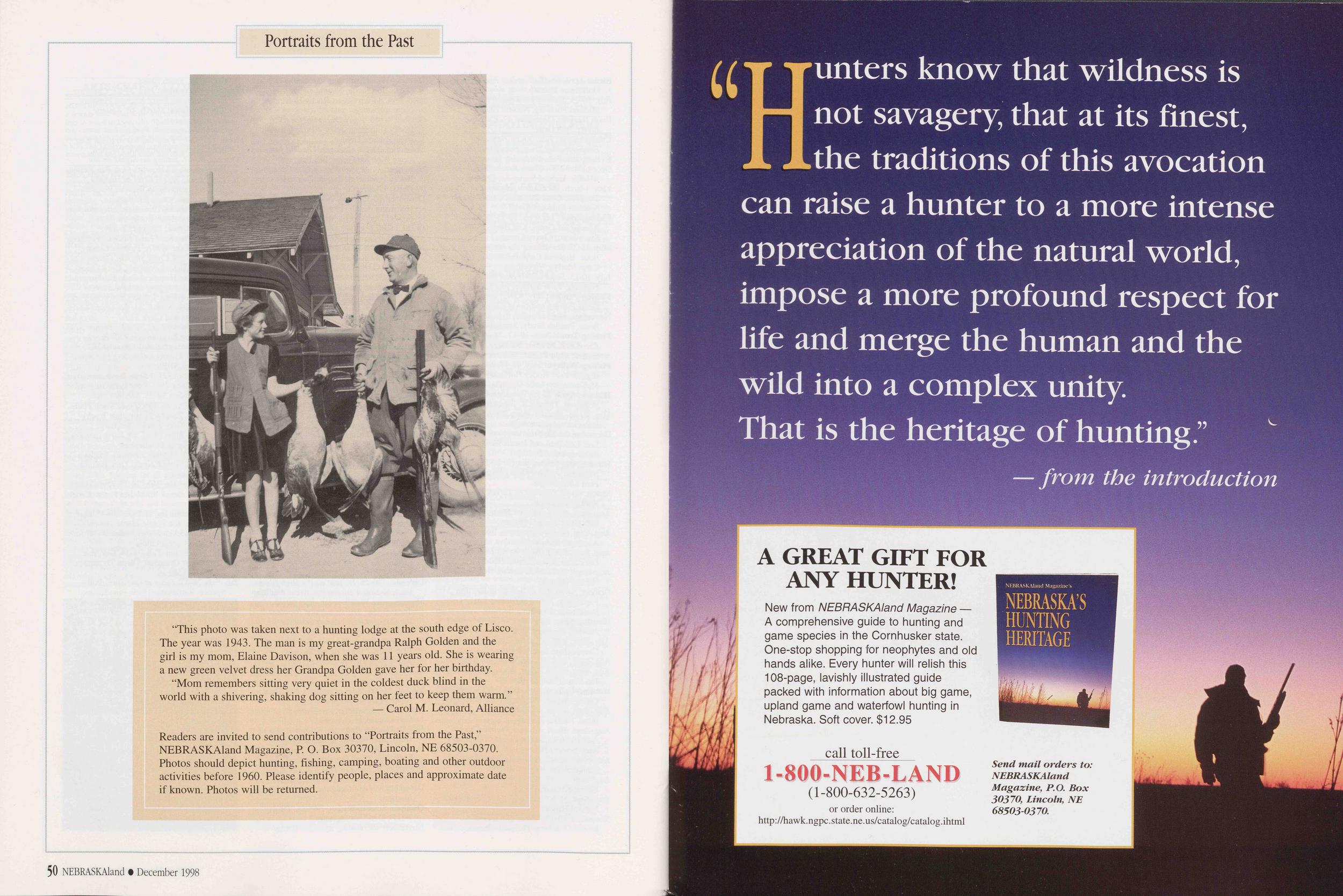
Portraits from the Past
Position: 704 (16 views)